/
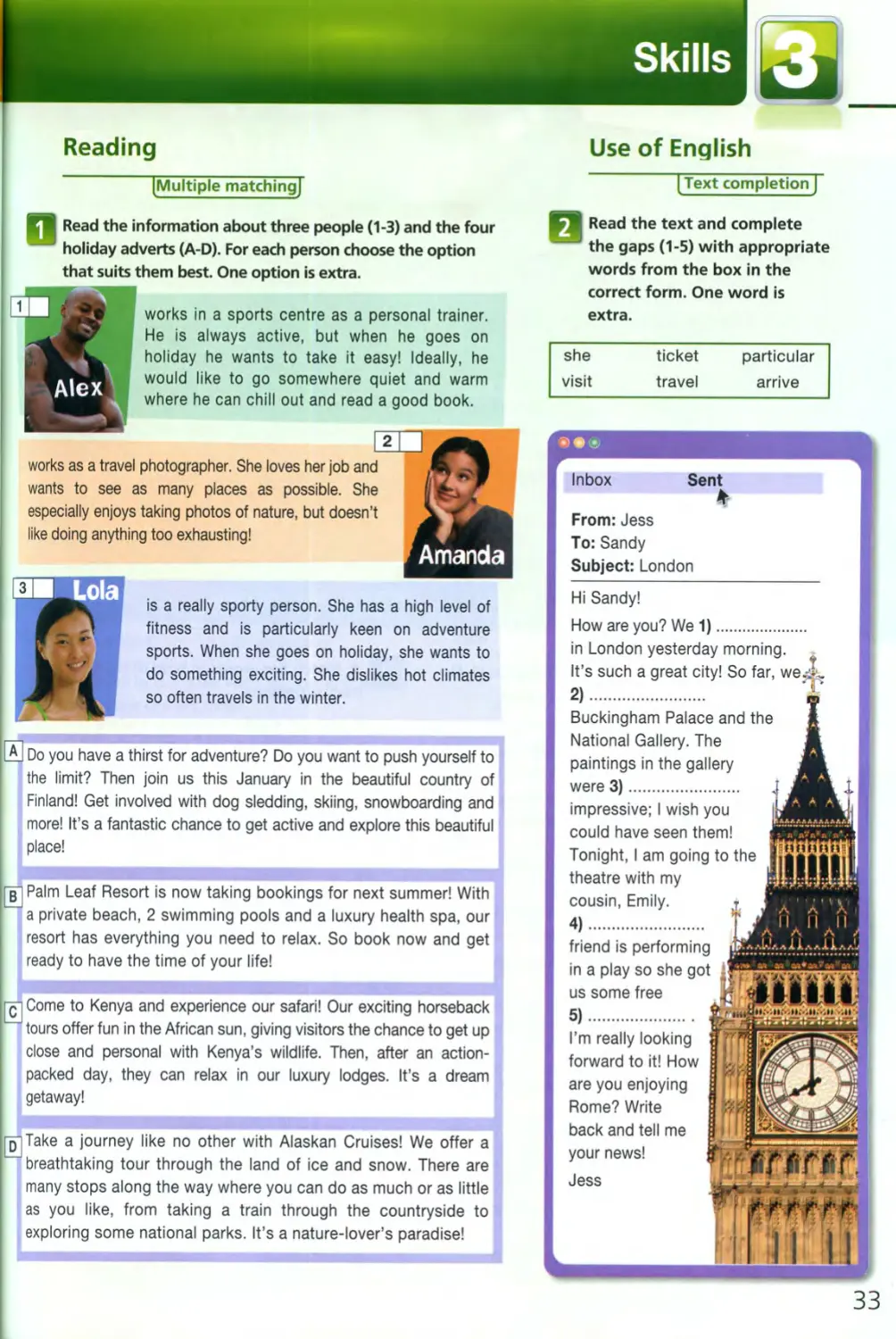
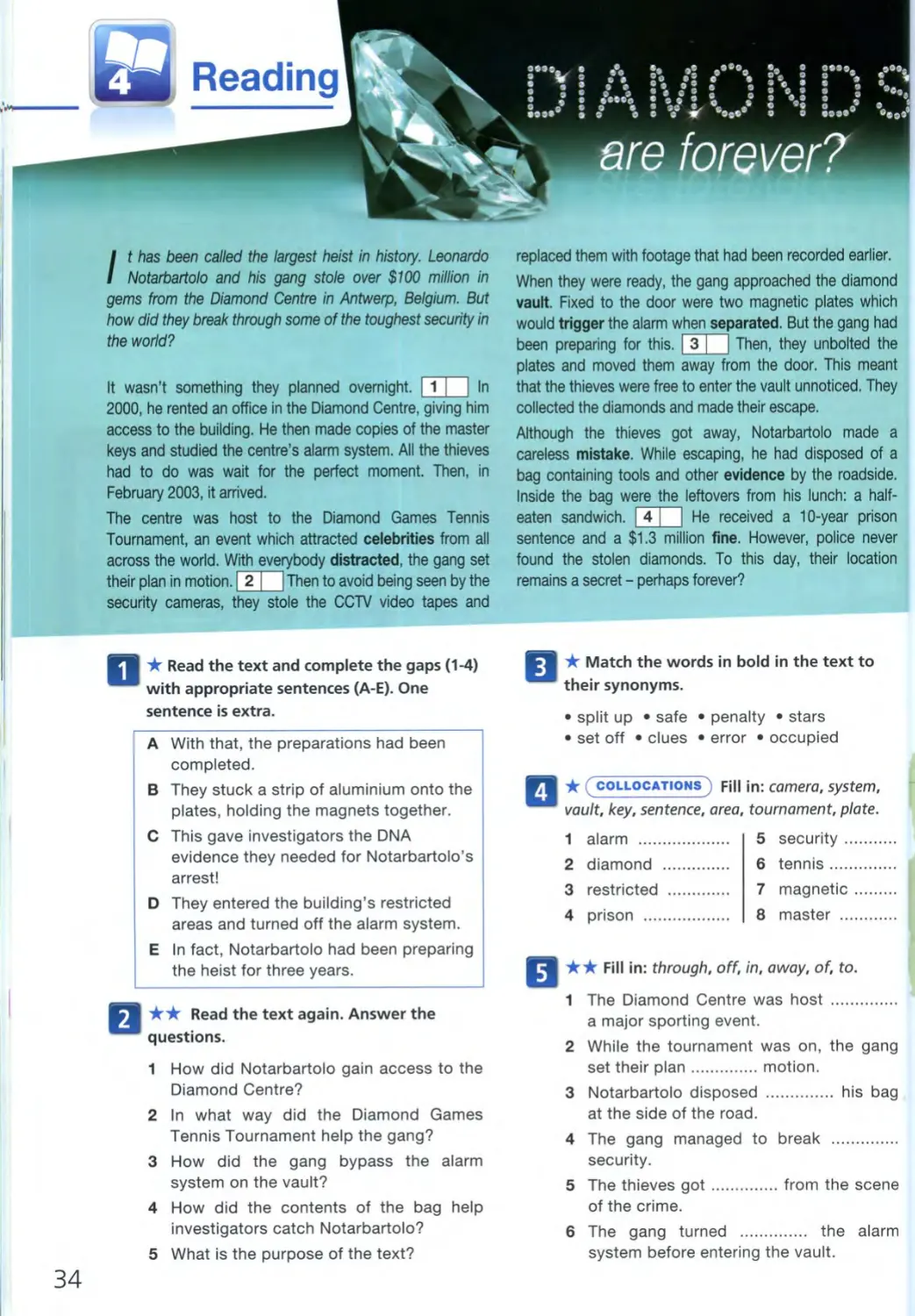
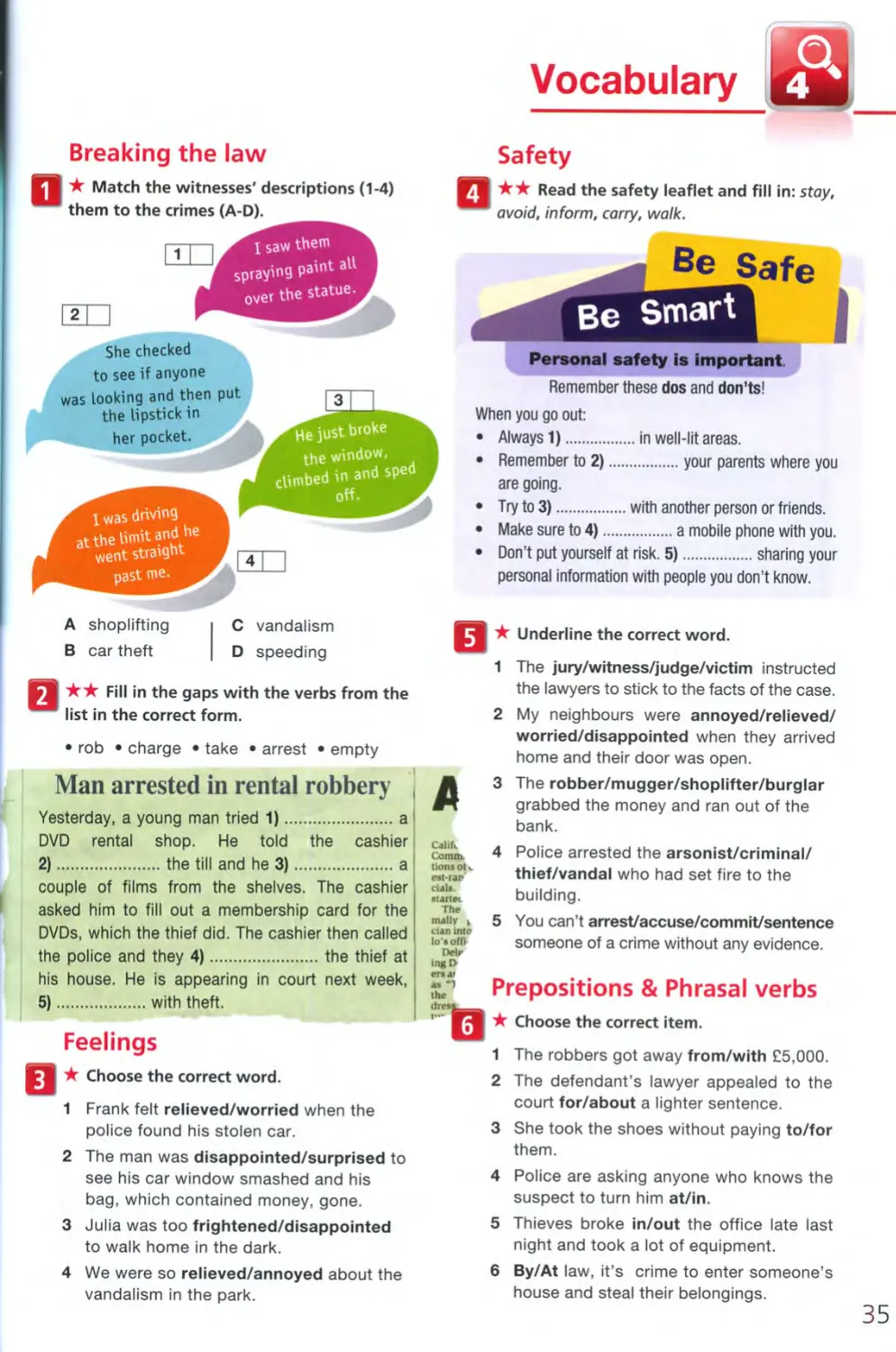
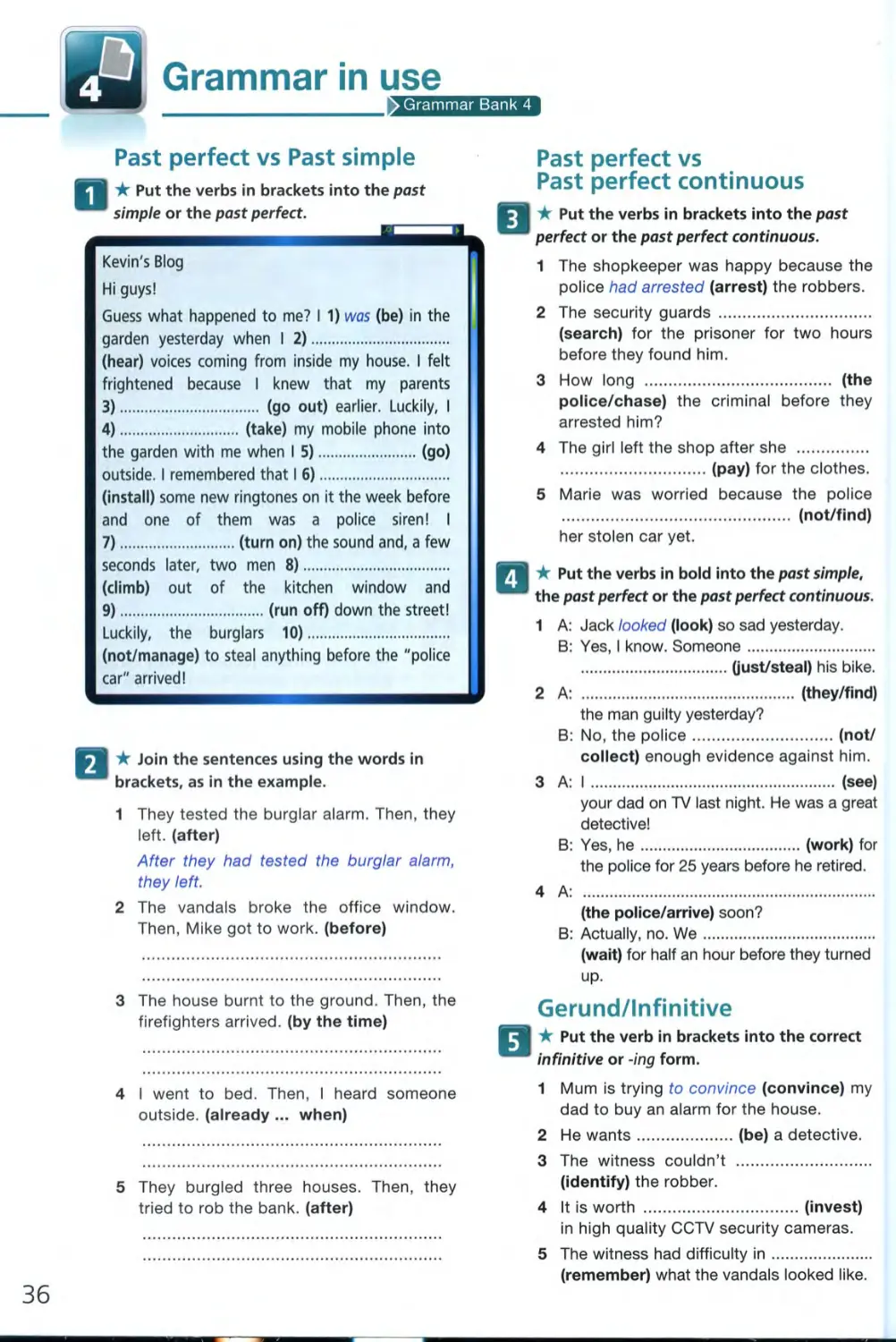
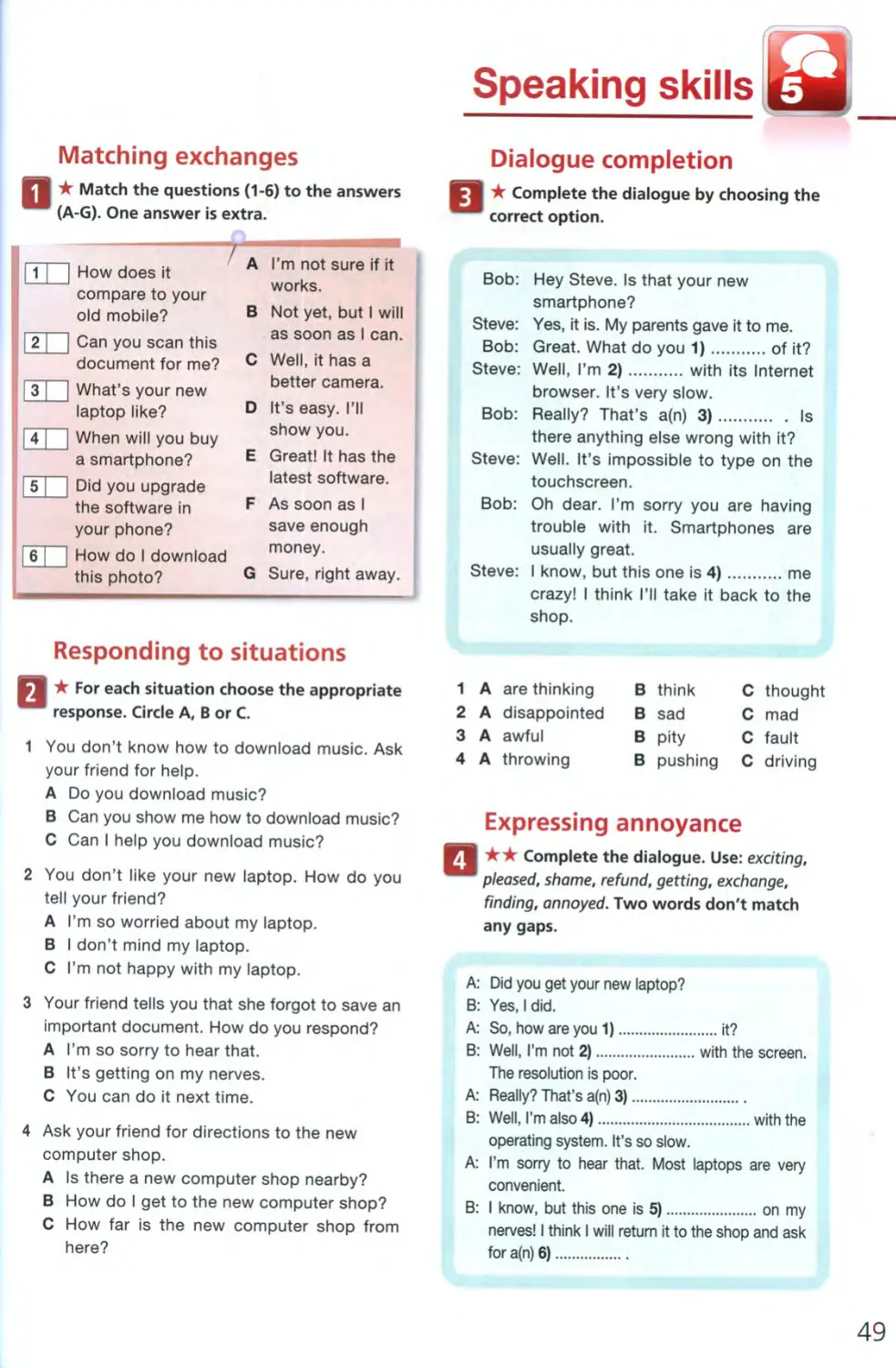
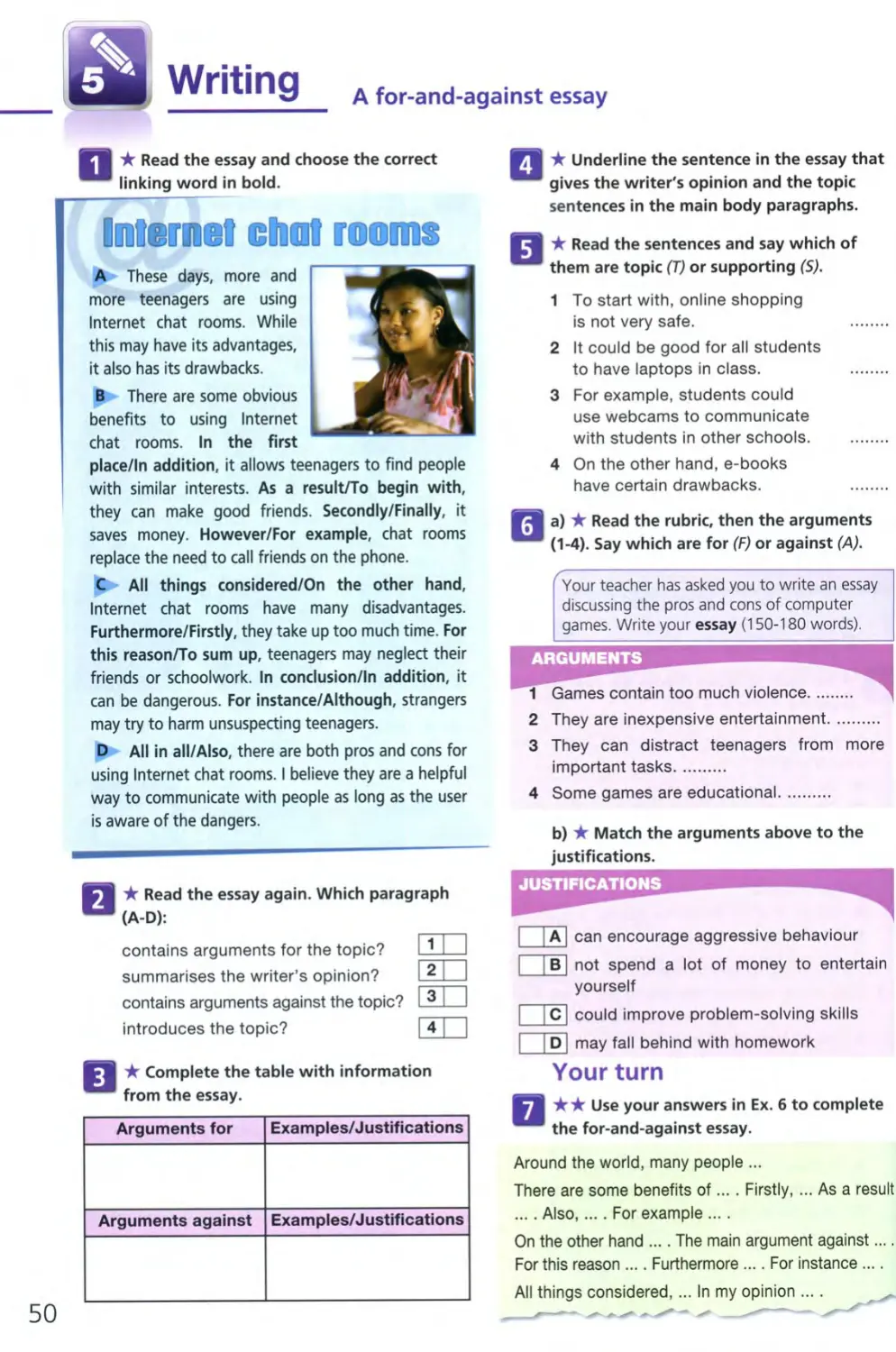
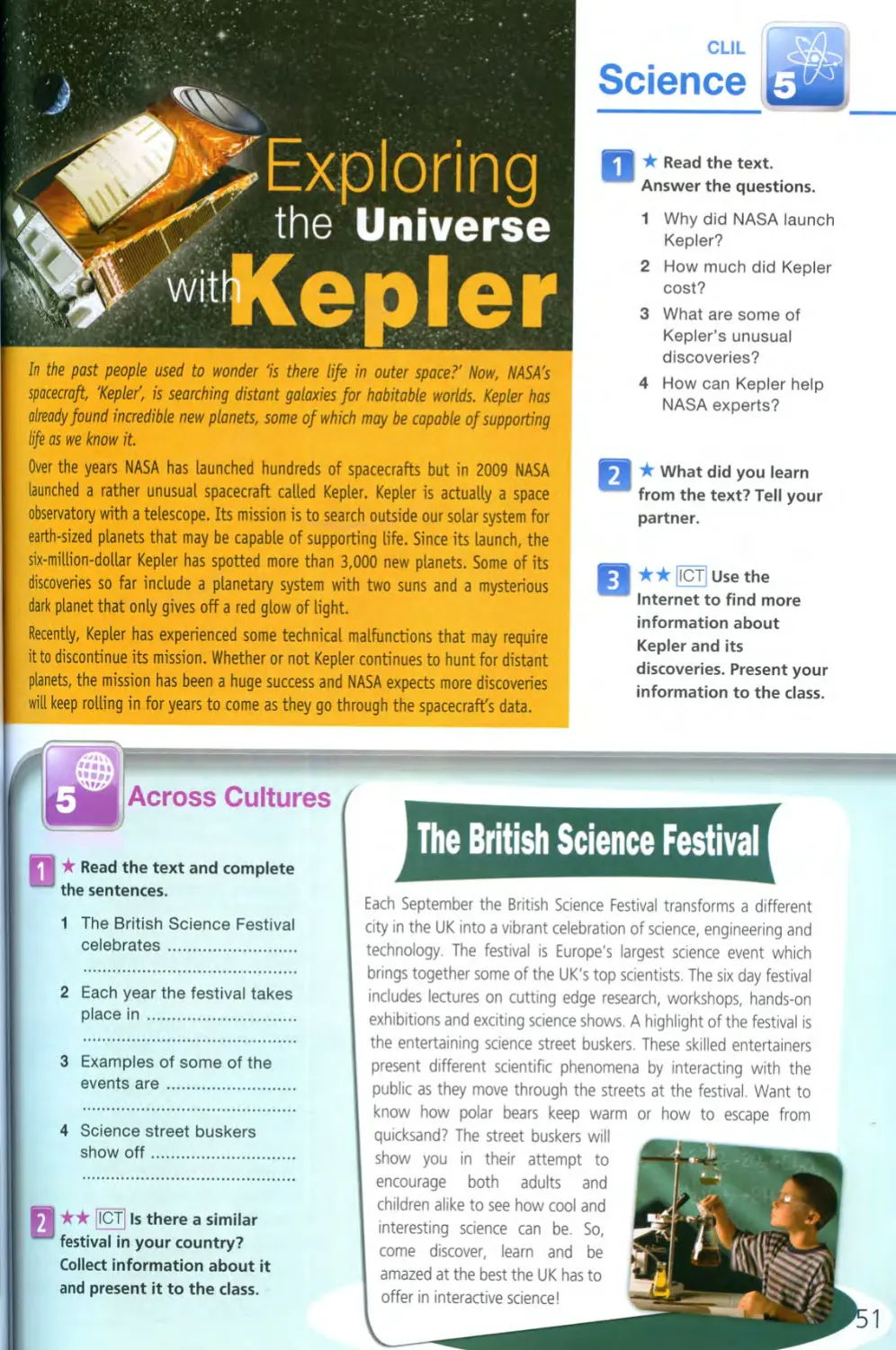
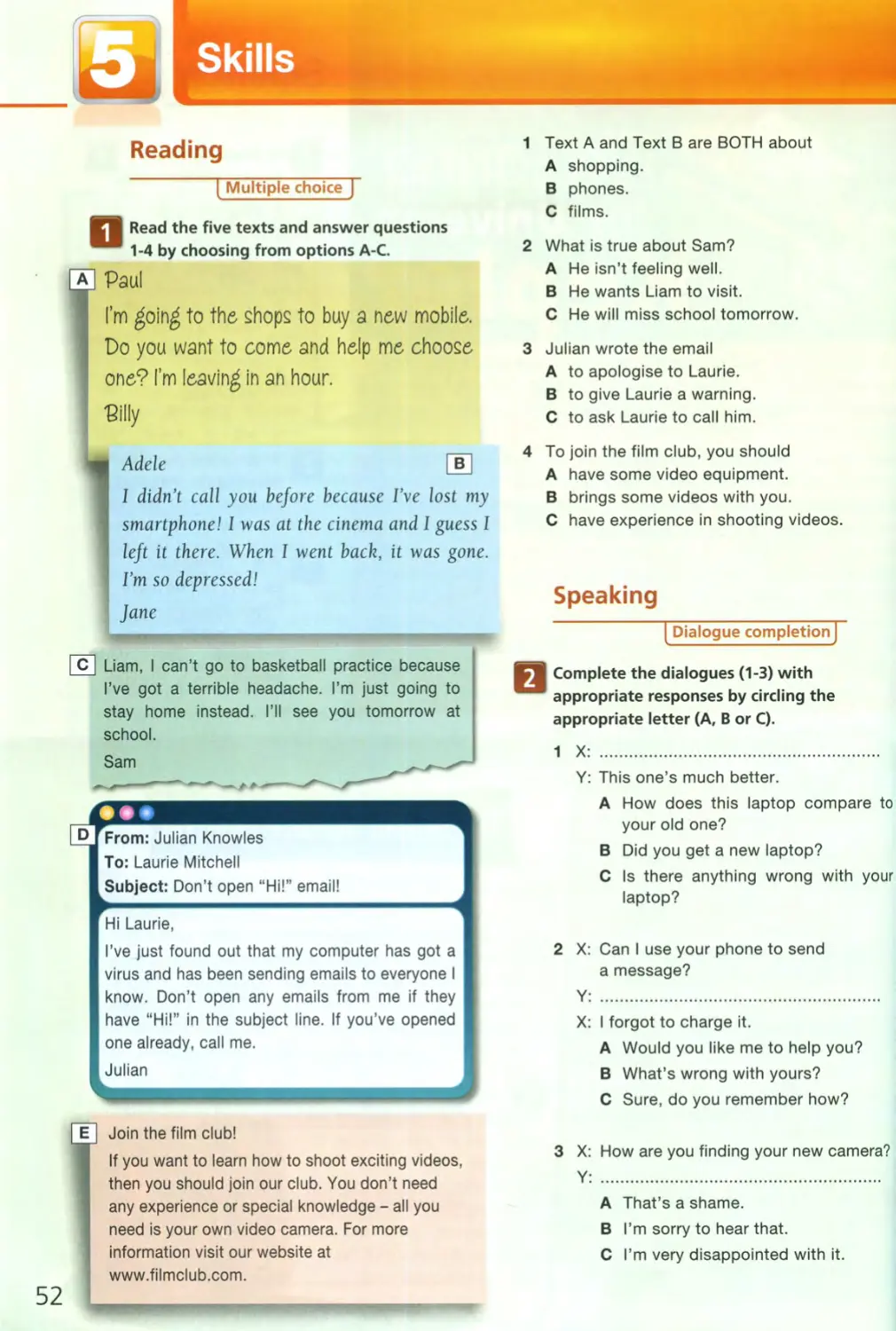

Author: Evans.V. Dooley.J.
Tags: english english grammar english language student book express publishing language learnin
ISBN: 978-1-4715-3500-0
Year: 2017

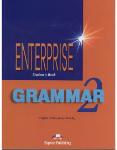


Text
                    Workbook & Grammar Book
Virginia Evans - Jenny Dooley
Express Publishing
Published by Express Publishing
Liberty House, Greenham Business Park, Newbury,
Berkshire RG19 6HW, United Kingdom
Tel.: (0044) 1635 817 363
Fax: (0044) 1635 817 463
email: inquiries@expresspublishing.co.uk
www.expresspublishing.co.uk
© Virginia Evans - Jenny Dooley, 2015
Design and Illustration © Express Publishing, 2015
Colour Illustrations: Angela, Andrew Simons © Express Publishing, 2015
First published 2015
Third impression 2017
Made in EU
All rights reserved. No part of this publication may be reproduced, stored in a retrieval system,
or transmitted in any form, or by any means, electronic, photocopying, or otherwise, without
the prior written permission of the publishers.
This book is not meant to be changed in any way.
ISBN 978-1-4715-3500-0
Acknowledgements
Authors' Acknowledgements
We would like to thank all the staff at Express Publishing who have contributed their skills
to producing this book. Thanks for their support and patience are due in particular to:
Megan Lawton (Editor in Chief); Mary Swan and Sean Todd (senior editors); Michael Sadler
and Steve Miller (editorial assistants); Richard White (senior production controller); the
Express design team; Warehouse (recording producers); and Kevin Harris, Kimberly Baker,
Steven Gibbs and Christine Little. We would also like to thank those institutions and
teachers who piloted the manuscript, and whose comments and feedback were invaluable
in the production of the book.
Every effort has been made to trace all the copyright holders. If any have been inadvertently
overlooked, the publishers will be pleased to make the necessary arrangements at the first
opportunity.
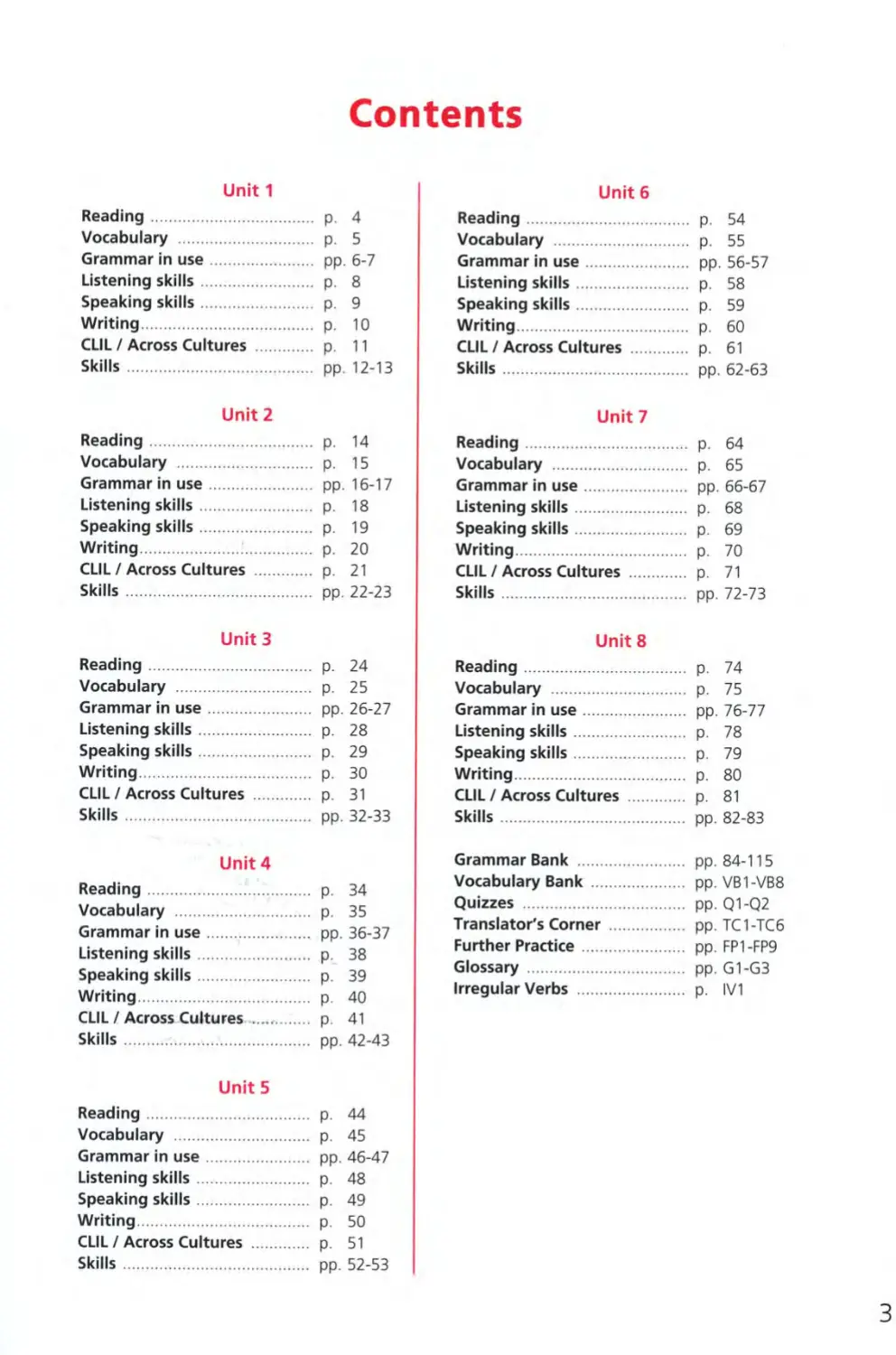
Contents
Unit 1
Unit 6
Reading .................... p 4
Vocabulary ................. p. 5
Grammar in use.............. pp. 6-7
Listening skills ........... p. 8
Speaking skills............. p. 9
Writing..................... p. 10
CLIL I Across Cultures ..... p 11
Skills...................... pp. 12-13
Unit 2
Reading .................... p. 14
Vocabulary ................. p. 15
Grammar in use.............. pp. 16-17
Listening skills ........... p. 18
Speaking skills............. p. 19
Writing..................... p. 20
CLIL / Across Cultures ..... p 21
Skills ..................... pp. 22-23
Unit 3
Reading..................... p. 24
Vocabulary ................. p. 25
Grammar in use.............. pp. 26-27
Listening skills ........... p. 28
Speaking skills............. p. 29
Writing..................... p. 30
CLIL / Across Cultures ..... p. 31
Skills...................... pp. 32-33
Unit 4
Reading .................... p. 34
Vocabulary ................. p. 35
Grammar in use.............. pp. 36-37
Listening skills ........... p. 38
Speaking skills ............ p. 39
Writing..................... p. 40
CLIL / Across Cultures ..... p 41
Skills...................... pp 42-43
Reading .................... p.	54
Vocabulary ................. p.	55
Grammar in use.............. pp.	56-57
Listening skills ........... p.	58
Speaking skills............. p.	59
Writing..................... p.	60
CLIL / Across Cultures ..... p.	61
Skills...................... pp.	62-63
Unit 7
Reading .................... p. 64
Vocabulary ................. p. 65
Grammar in use.............. pp. 66-67
Listening skills............ p. 68
Speaking skills ............ p. 69
Writing..................... p. 70
CLIL / Across Cultures ..... p. 71
Skills...................... pp. 72-73
Unite
Reading..................... p. 74
Vocabulary ................. P 75
Grammar in use.............. pp. 76-77
Listening skills............ p 78
Speaking skills............. p. 79
Writing..................... p. 80
CLIL / Across Cultures ..... p. 81
Skills ..................... pp. 82-83
Grammar Bank ............... pp. 84-115
Vocabulary Bank ............ pp. VB1-VB8
Quizzes .................... pp. Q1-Q2
Translator's Corner ........ pp. TC1-TC6
Further Practice ........... pp. FP1-FP9
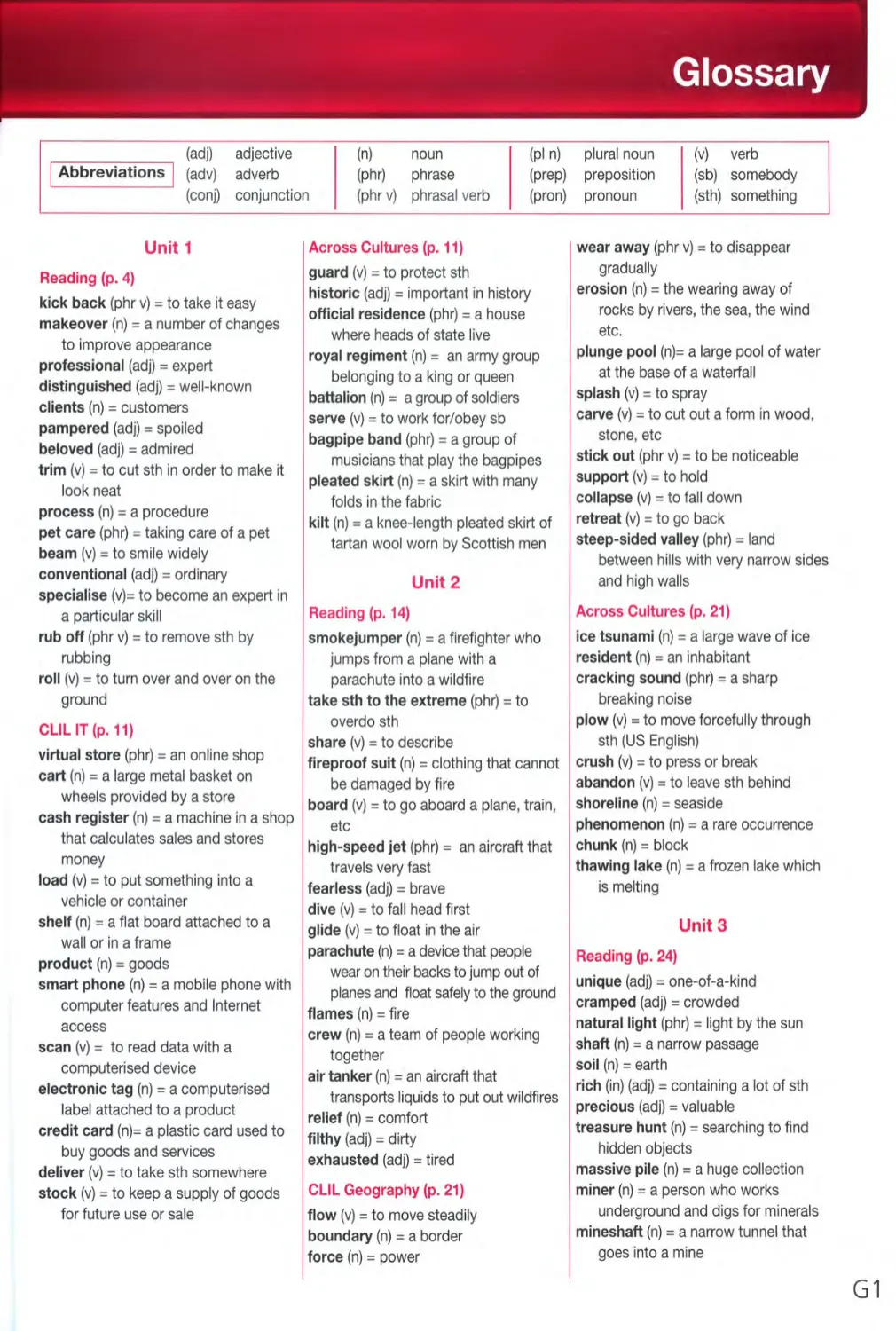
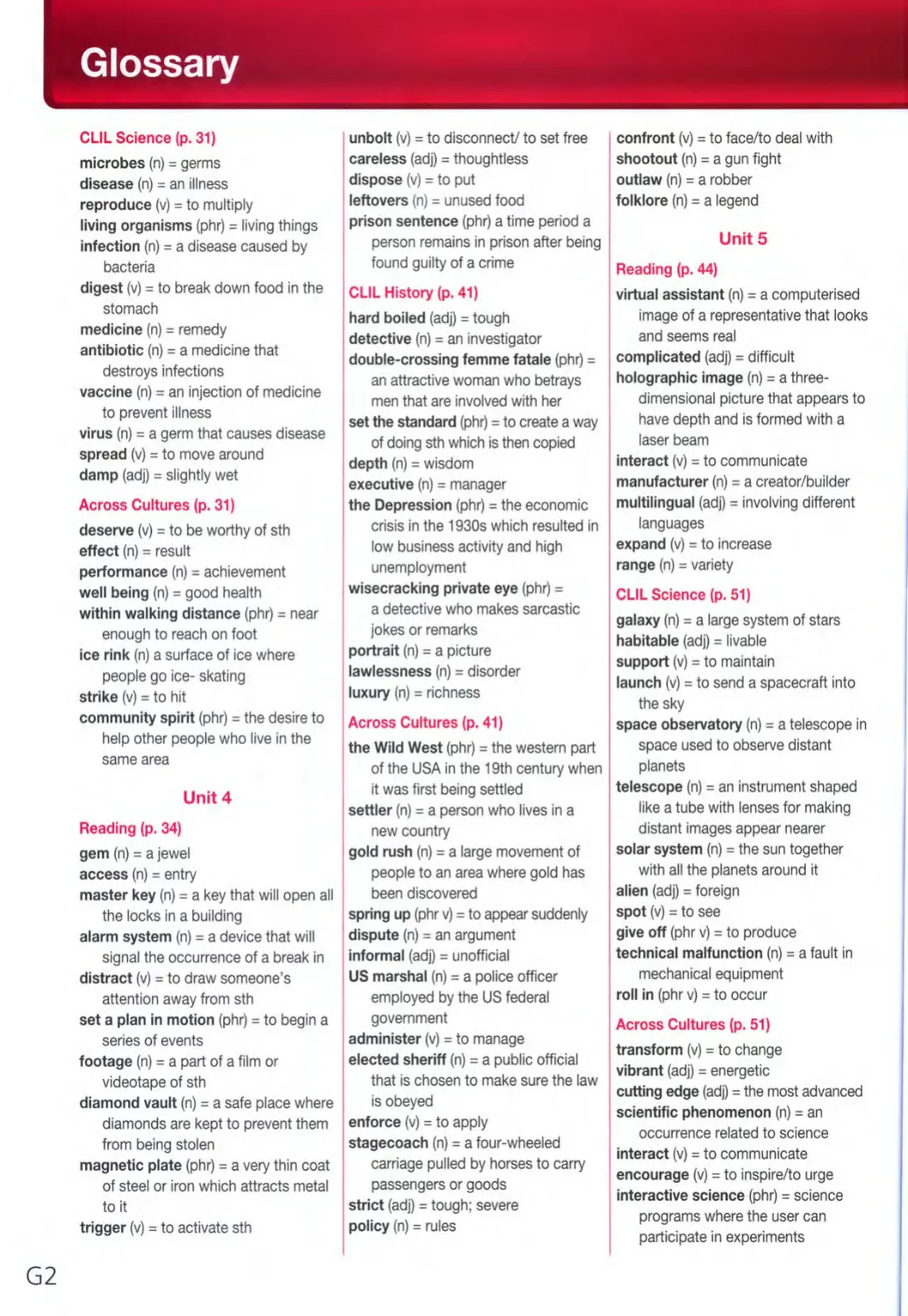
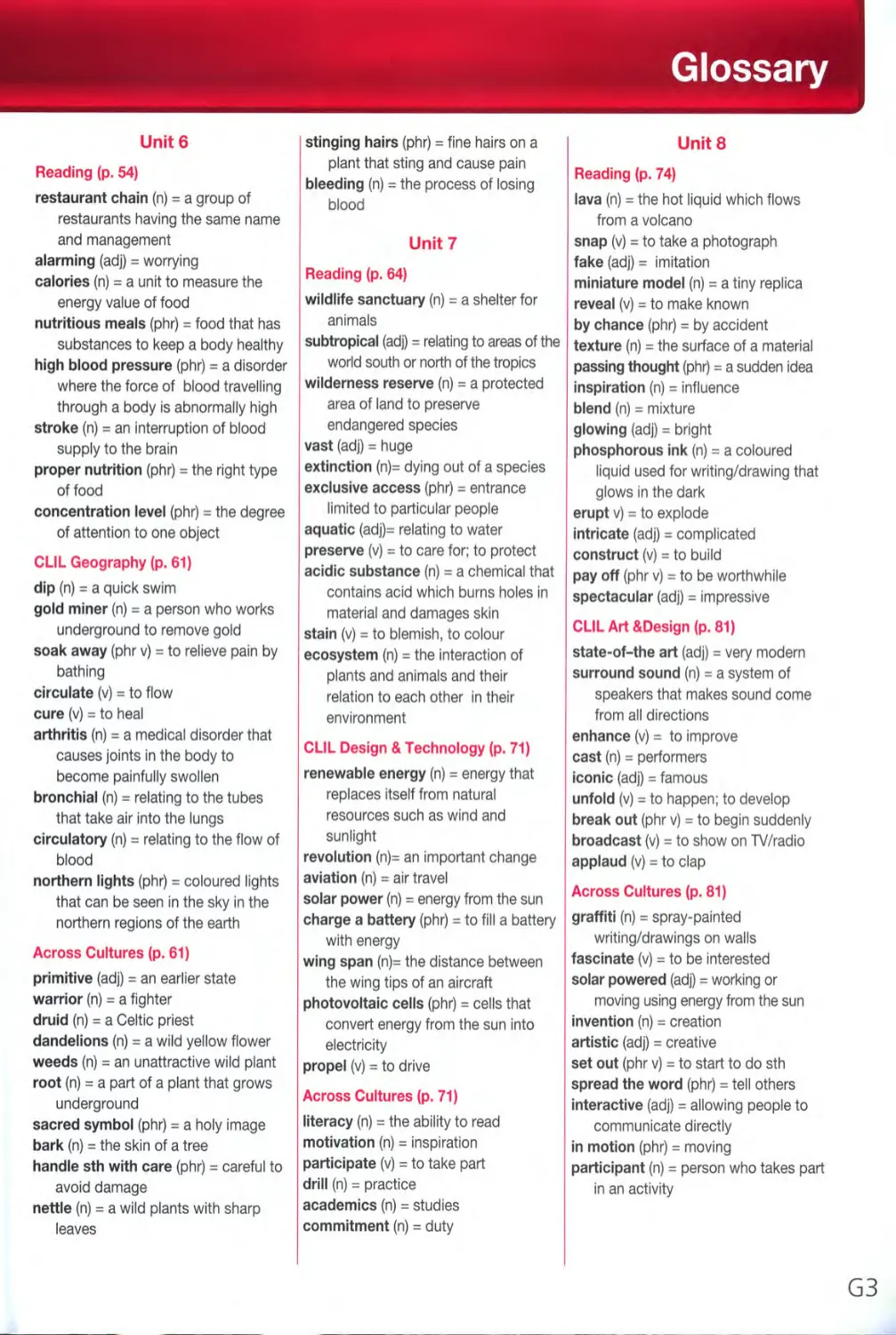
Glossary ................... pp. G1-G3
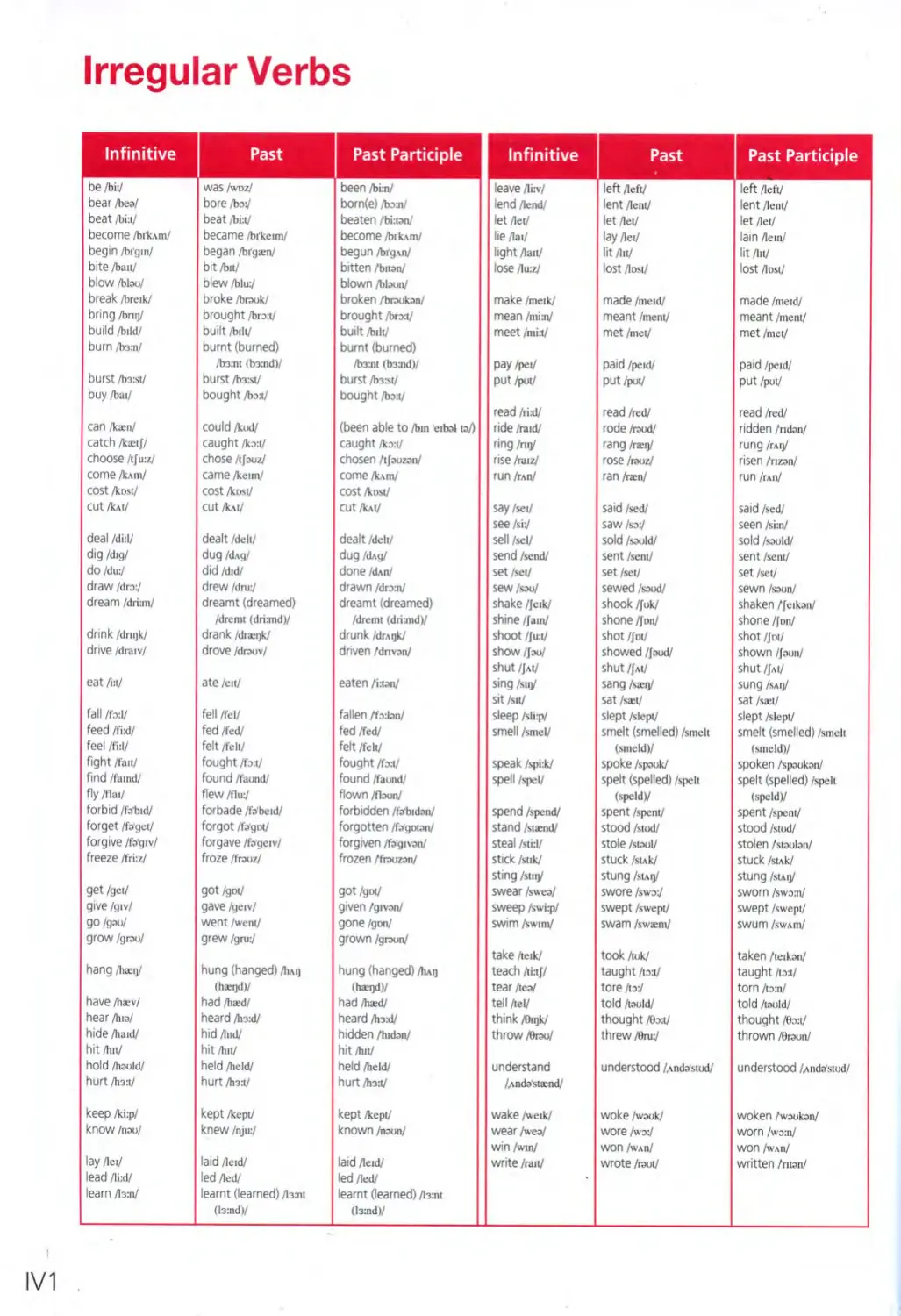
Irregular Verbs ............ p. IV1
Unit5
Reading..................... p.	44
Vocabulary ................. p	45
Grammar in use.............. pp.	46-47
Listening skills ........... p	48
Speaking skills............. p.	49
Writing..................... p.	50
CLIL / Across Cultures ..... p.	51
Skills...................... pp.	52-53
3
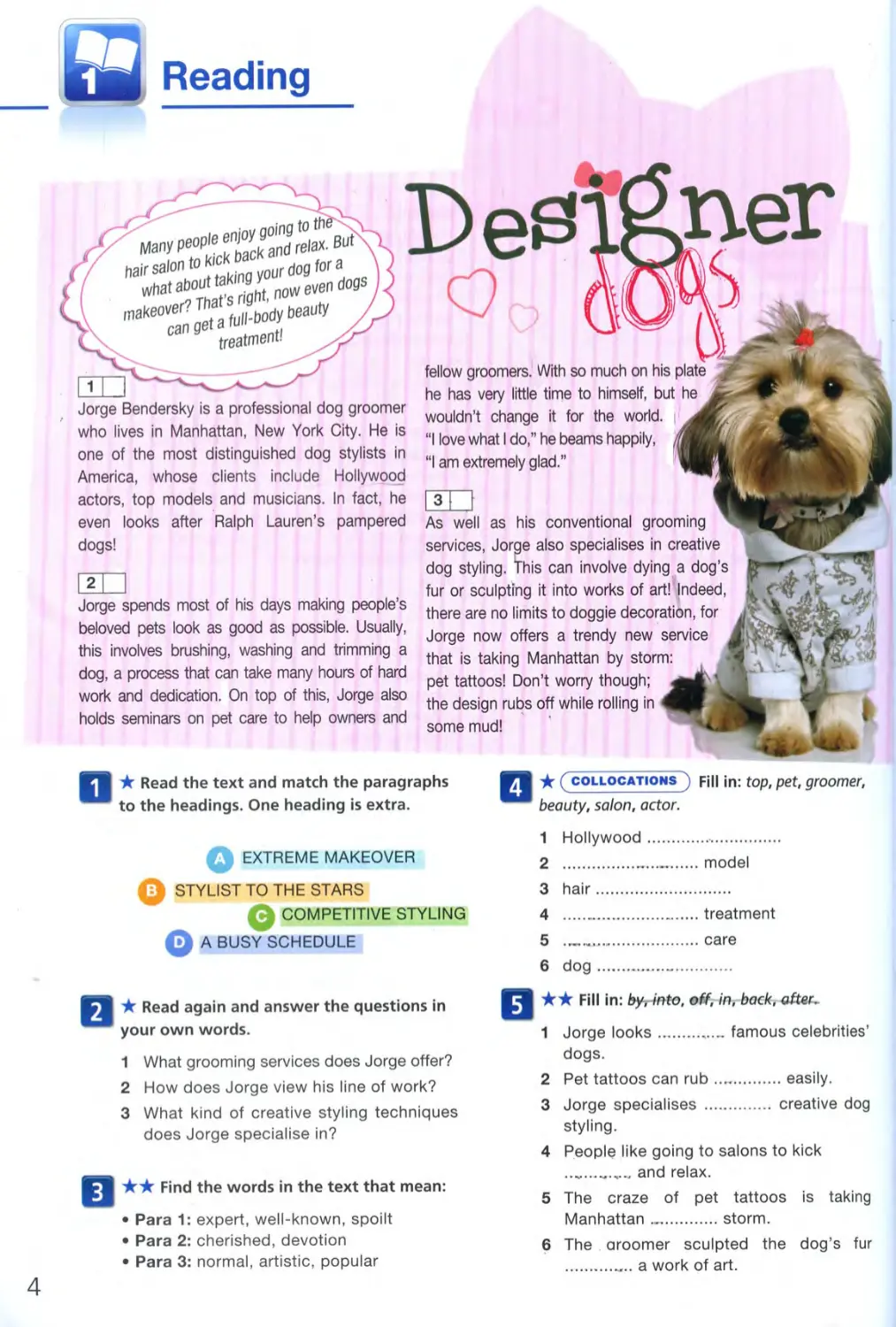
Reading
Ma"1 * *' pets®ss 'e°ax<
hair salon to к	dog for a
"e»“wevenW
mak“^getafu«-w<li;“auly /
Jorge Bendersky is a professional dog groomer
who lives in Manhattan, New York City. He is
one of the most distinguished dog stylists in
America, whose clients include Hollywood
actors, top models and musicians. In fact, he
even looks after Ralph Lauren’s pampered
dogs!
Jorge spends most of his days making people’s
beloved pets look as good as possible. Usually,
this involves brushing, washing and trimming a
dog, a process that can take many hours of hard
work and dedication. On top of this, Jorge also
holds seminars on pet care to help owners and
fellow groomers. With so much on his plate J
he has very little time to himself, but he Jfc
wouldn't change it for the world.
“I love what I do," he beams happily,
“I am extremely glad.”
As well as his conventional grooming ”
services, Jorge also specialises in creative
dog styling. This can involve dying a dog’s
fur or sculpting it into works of art! Indeed,
there are no limits to doggie decoration, for
Jorge now offers a trendy new service
that is taking Manhattan by storm:
pet tattoos! Don’t worry though;
the design rubs off while rolling in
some mud!	4.1
1
★ Read the text and match the paragraphs
to the headings. One heading is extra.
★ (collocations )
beauty, salon, actor.
Fill in: top, pet, groomer,
Q EXTREME MAKEOVER
Q STYLIST TO THE STARS
Q COMPETITIVE STYLING
ф A BUSY SCHEDULE
1 Hollywood..................
2 .................model
3 hair.................
4 .................treatment
5..................care
6 dog..........-.......
2
it Read again and answer the questions in
your own words.
5
1 What grooming services does Jorge offer?
2 How does Jorge view his line of work?
3 What kind of creative styling techniques
does Jorge specialise in?
3
★ ★ Find the words in the text that mean:
• Para 1: expert, well-known, spoilt
• Para 2: cherished, devotion
• Para 3: normal, artistic, popular
1	Jorge looks............ famous celebrities’
dogs.
2	Pet tattoos can rub.........easily.
3	Jorge specialises .......... creative dog
styling.
4	People like going to salons to kick
__________ and relax.
5	The craze of pet tattoos is taking
Manhattan ..............storm.
6	The aroomer sculpted the dog’s fur
.........a work of art.
4
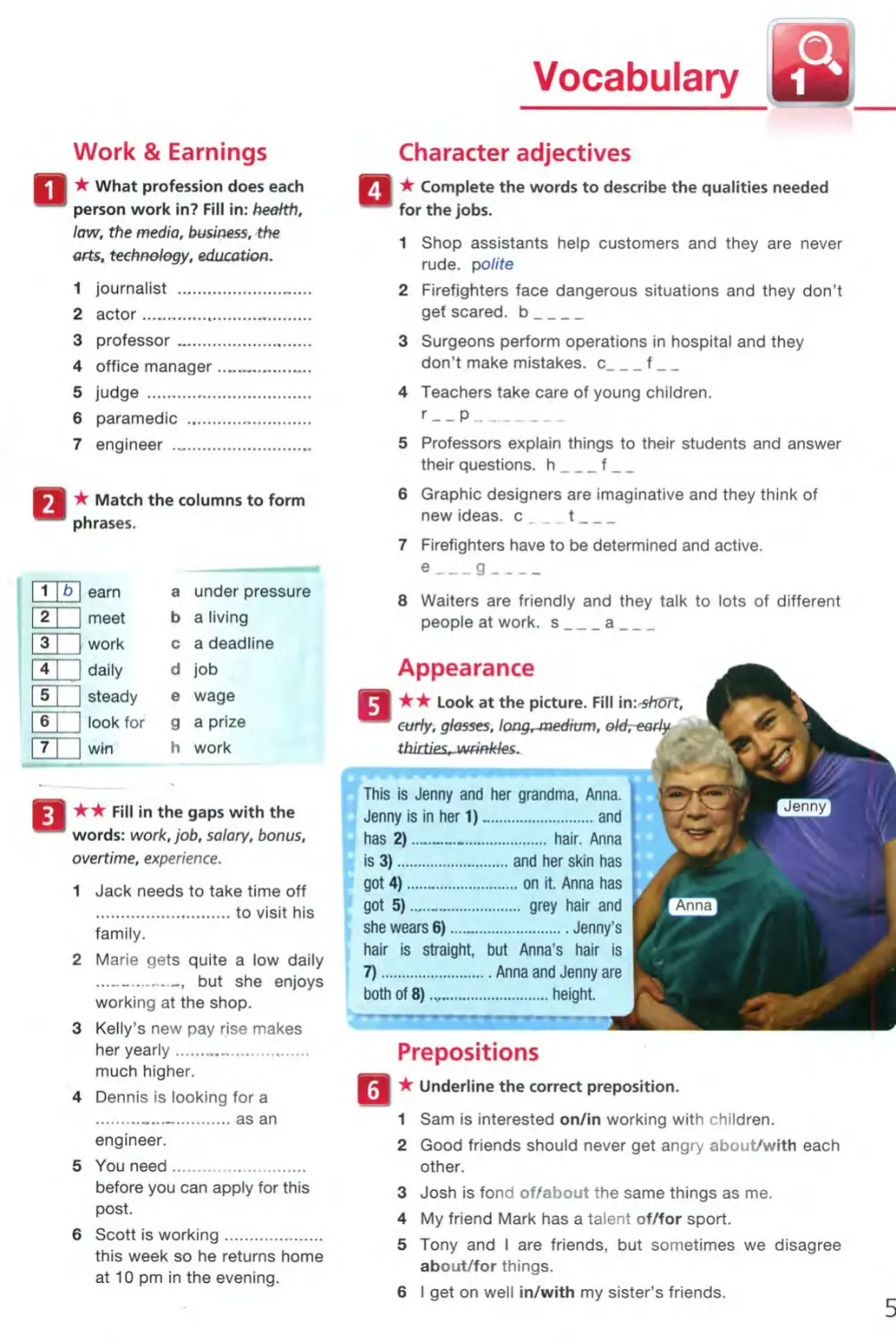
Work & Earnings
★ What profession does each
person work in? Fill in: health,
law, the media, business, the
arts, technology, education.
1	journalist ...............
2	actor..............-......
3	professor ~...............
4	office manager____________
5	judge ....................
6	paramedic ................
7	engineer .................
★ Match the columns to form
phrases.
1	b	earn	a	under pressure
2		meet	b	a living
3		work	c	a deadline
4		daily	d	job
5		steady	e	wage
6		look for	g	a prize
7		win	h	work
3
★ ★ Fill in the gaps with the
words: work, job, salary, bonus,
overtime, experience.
1	Jack needs to take time off
....................to visit his
family.
2	Marie gets quite a low daily
______________, but she enjoys
working at the shop.
3	Kelly’s new pay rise makes
her yearly.........-..........
much higher.
4	Dennis is looking for a
....................as an
engineer.
5	You need...................
before you can apply for this
post.
6	Scott is working.............
this week so he returns home
at 10 pm in the evening.
Vocabulary
Character adjectives
★ Complete the words to describe the qualities needed
for the jobs.
1	Shop assistants help customers and they are never
rude, polite
2	Firefighters face dangerous situations and they don’t
get scared, b___________
3	Surgeons perform operations in hospital and they
don’t make mistakes, c__________f _ _
4	Teachers take care of young children.
r__P_______________
5	Professors explain things to their students and answer
their questions, h________f____
6	Graphic designers are imaginative and they think of
new ideas, c_________t______
7	Firefighters have to be determined and active,
e________g_________
8	Waiters are friendly and they talk to lots of different
people at work, s_________a_______
Appearance
★ ★ Look at the picture. Fill in.shOrt,
curly, glasses, long,-medium, old, early
thirtieSr-wcinkles.	• 4
This is Jenny and her grandma, Anna.
Jenny is in her 1)...................and
has 2).......................hair. Anna
is 3)...................and	her skin has
got 4)..................on it. Anna has
got 5)...................  grey	hair and
she wears 6)...._................Jenny's
hair is straight, but Anna's hair is
7)..................Anna and Jenny are
both of 8)	...............height.
Prepositions
6
★ Underline the correct preposition.
1 Sam is interested on/in working with children.
2 Good friends should never get angry about/with each
other.
3	Josh is fond of/about the same things as me.
4	My friend Mark has a talent of/for sport.
5	Tony and I are friends, but sometimes we disagree
about/for things.
6 I get on well in/with my sister’s friends.
5
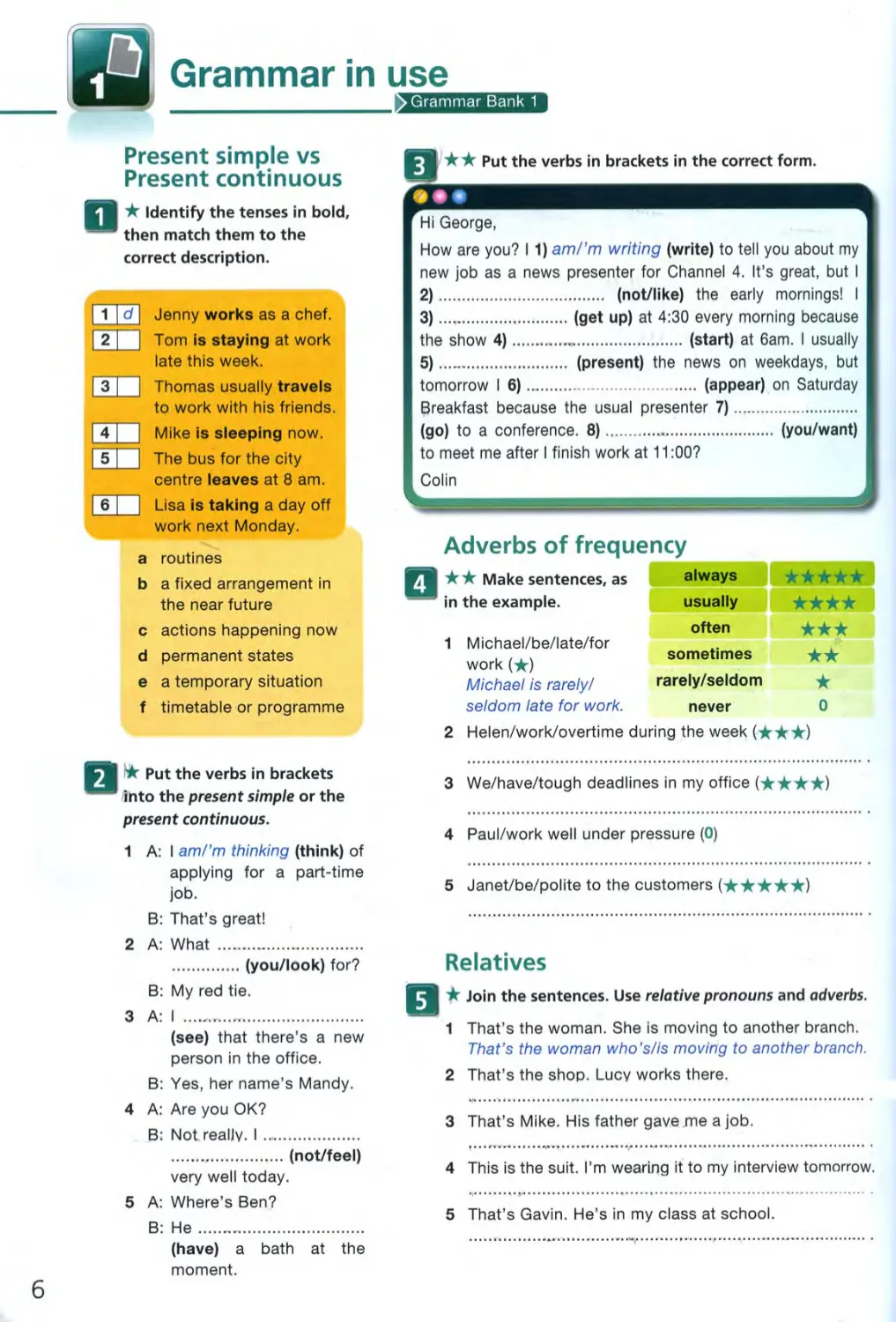
Grammar in use
Grammar Bank 1
Present simple vs
Present continuous
О ★ Identify the tenses in bold,
then match them to the
correct description.
★ ★ Put the verbs in brackets in the correct form.
Hi George,
How are you? I 1) am/’m writing (write) to tell you about my
new job as a news presenter for Channel 4. It’s great, but I
Jenny works as a chef.
Tom is staying at work
late this week.
| 3 | | Thomas usually travels
to work with his friends.
Mike is sleeping now.
The bus for the city
centre leaves at 8 am.
| 6 | | Lisa is taking a day off
work next Monday.
a routines
b a fixed arrangement in
the near future
c actions happening now
d permanent states
e a temporary situation
f timetable or programme
2
★ Put the verbs in brackets
into the present simple or the
present continuous.
1 A: I am/’m thinking (think) of
applying for a part-time
job.
B: That’s great!
2 A: What .....................
........(you/look) for?
B: My red tie.
3 A: I.........................
(see) that there’s a new
person in the office.
B: Yes, her name’s Mandy.
4 A: Are you OK?
B: Not really. I............
...............(not/feel)
very well today.
5 A: Where’s Ben?
B: He.......................
(have) a bath at the
moment.
2)....................... (not/like)	the early mornings! I
3)..................(get up) at 4:30 every morning because
the show 4).........................(start) at 6am. I usually
5)................... (present)	the news on weekdays, but
tomorrow I 6) .„...................... (appear) on Saturday
Breakfast because the usual presenter 7).....................
(go) to a conference. 8)......................... (you/want)
to meet me after I finish work at 11:00?
Colin
Adverbs of frequency
KB ★★ Make sentences, as in the example.	always	★ ★★★★
	usually	★ ★★★
1 Michael/be/late/for work (★)	often	★ ★★
	sometimes	★ ★
Michael is rarely/	rarely/seldom	★
seldom late for work.	never	0
2 Helen/work/overtime during the week (★★★)
3 We/have/tough deadlines in my office (★★★★)
4 Paul/work well under pressure (0)
5 Janet/be/polite to the customers (★★★★★)
Relatives
5
★ Join the sentences. Use relative pronouns and adverbs.
1 That’s the woman. She is moving to another branch.
That's the woman who’s/is moving to another branch.
2 That’s the shop. Lucy works there.
3 That’s Mike. His father gave me a job.
4 This is the suit. I’m wearing it to my interview tomorrow.
5 That’s Gavin. He’s in my class at school.
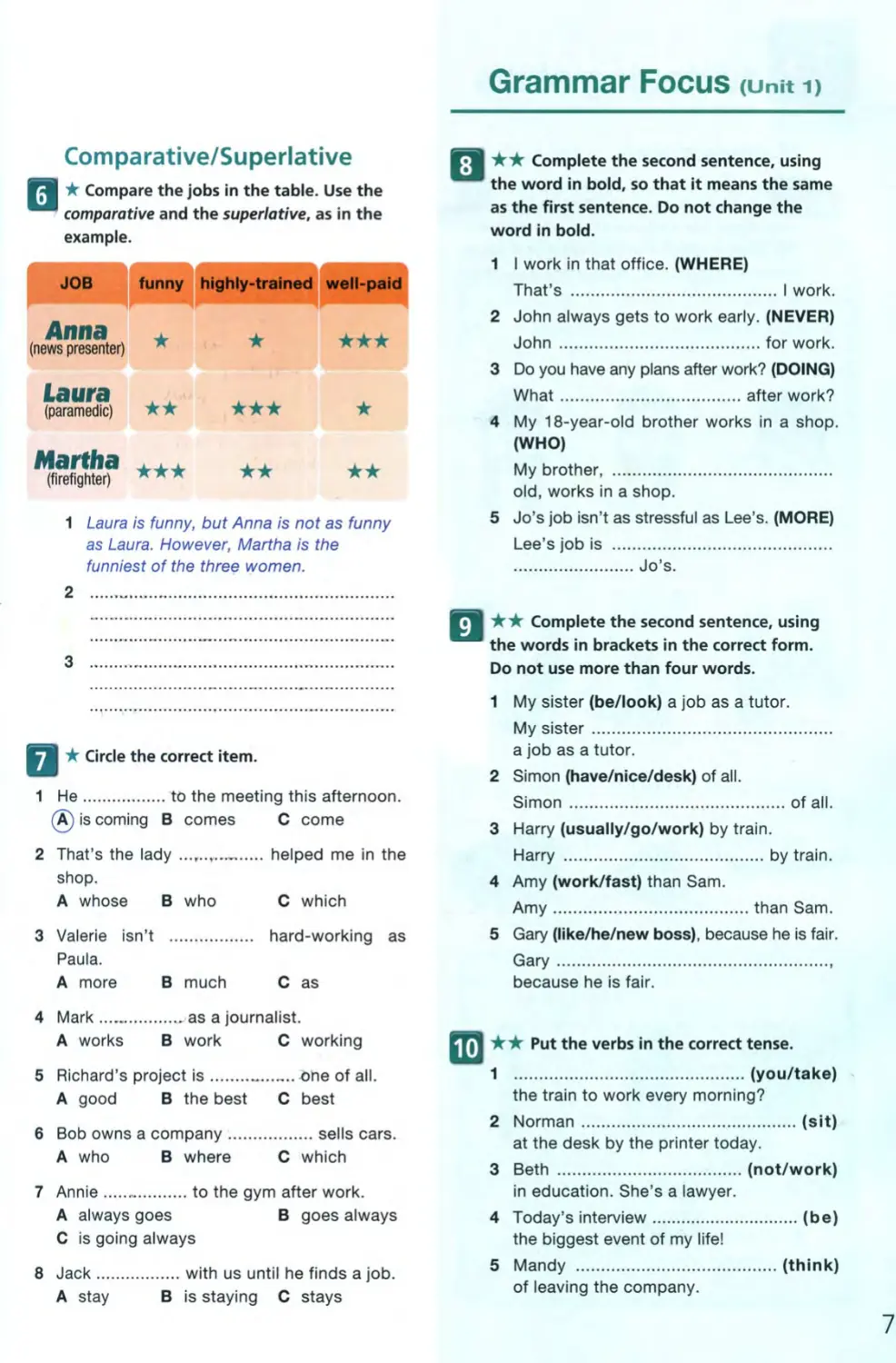
6
Grammar Focus «unit d
6
Comparative/Superlative
★ Compare the jobs in the table. Use the
comparative and the superlative, as in the
example.
JOB	funny	highly-trained	well-paid
Anna (news presenter)	★	★	★ ★
Laura (paramedic)	★ ★	★ ★★	★
Martha (firefighter)	★ ★ ★	★ ★	★ ★
1 Laura is funny, but Anna is not as funny
as Laura. However, Martha is the
funniest of the three women.
2 .....„..............................
3 .......................................
Q| ★ Circle the correct item.
1	He...........to	the meeting this afternoon.
A is coming В comes C come
2	That’s the lady ......... helped me in the
shop.
A whose В who C which
3	Valerie isn’t ......... hard-working as
Paula.
A more	В much	C as
4	Mark.........as a journalist.
A works	В work	C working
5	Richard’s project is........one of all.
A good	В the best	C best
6	Bob owns a company.............sells	cars.
A who	В where	C which
7	Annie...........to the gym after work.
A always goes	В goes always
C is going always
8	Jack.........with us until he finds a job.
A stay В is staying C stays
10
★ ★ Complete the second sentence, using
the word in bold, so that it means the same
as the first sentence. Do not change the
word in bold.
1	I work in that office. (WHERE)
That’s .............................I	work.
2	John always gets to work early. (NEVER)
John.............................for work.
3	Do you have any plans after work? (DOING)
What............................after	work?
4	My 18-year-old brother works in a shop.
(WHO)
My brother..............................
old, works in a shop.
5	Jo’s job isn’t as stressful as Lee’s. (MORE)
Lee’s job is ..............................
...............Jo’s.
★ ★ Complete the second sentence, using
the words in brackets in the correct form.
Do not use more than four words.
1	My sister (be/look) a job as a tutor.
My sister.................................
a job as a tutor.
2	Simon (have/nice/desk) of all.
Simon...............................of all.
3	Harry (usually/go/work) by train.
Harry ..........................by train.
4	Amy (work/fast) than Sam.
Amy.............................than	Sam.
5	Gary (like/he/new boss), because he is fair.
Gary.....................................
because he is fair.
1		(you/take)
the train to work every morning?
2	Norman..........................(sit)
at the desk by the printer today.
3	Beth .......................(not/work)
in education. She’s a lawyer.
4	Today’s interview................(be)
the biggest event of my life!
5	Mandy ..........................(think)
of leaving the company.
7
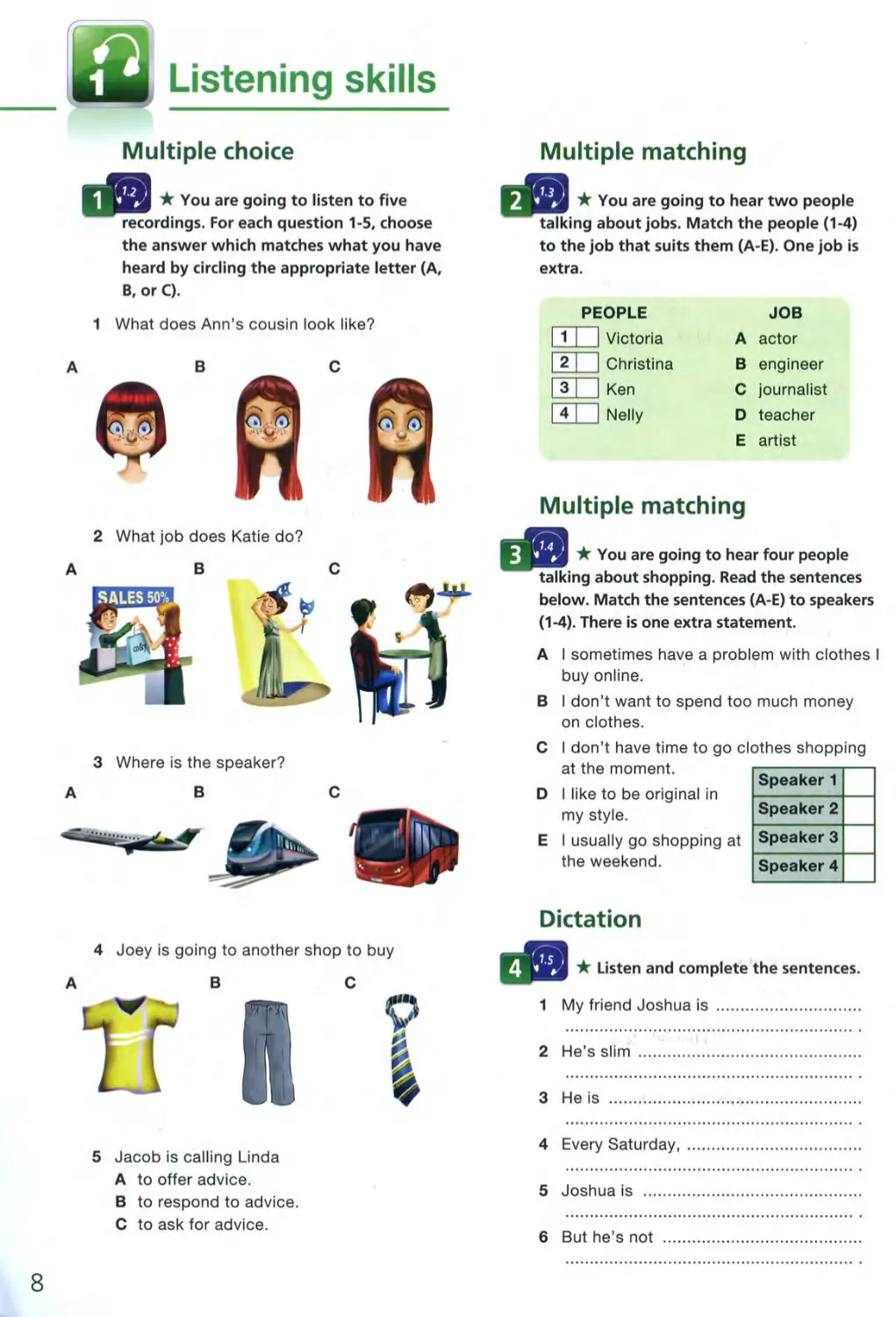
Listening skills
Multiple choice
+ You are going to listen to five
recordings. For each question 1-5, choose
the answer which matches what you have
heard by circling the appropriate letter (A,
B, or C).
Multiple matching
You are going to hear two people
about jobs. Match the people (1-4)
to the job that suits them (A-E). One job is
extra.
1 What does Ann’s cousin look like?
PEOPLE
Victoria
Christina
Ken
Nelly
JOB
A actor
В engineer
C journalist
D teacher
E artist
Multiple matching
2 What job does Katie do?
You are going to hear four people
talking about shopping. Read the sentences
below. Match the sentences (A-E) to speakers
(1-4). There is one extra statement.
A I sometimes have a problem with clothes I
buy online.
В I don’t want to spend too much money
on clothes.
3 Where is the speaker?
C
D
E
I don’t have time to go clothes shopping
at the moment.
I like to be original in
my style.
I usually go shopping at
the weekend.
Speaker 1
Speaker 2
Speaker 3
Speaker 4
4 Joey is going to another shop to buy
5 Jacob is calling Linda
A to offer advice.
В to respond to advice.
C to ask for advice.
Dictation
★ Listen and complete the sentences.
1 My friend Joshua is ...............
2 He’s slim .........................
3 He is .............................
4 Every Saturday,.....................
5 Joshua is .........................
6 But he’s not ......................
Speaking skills
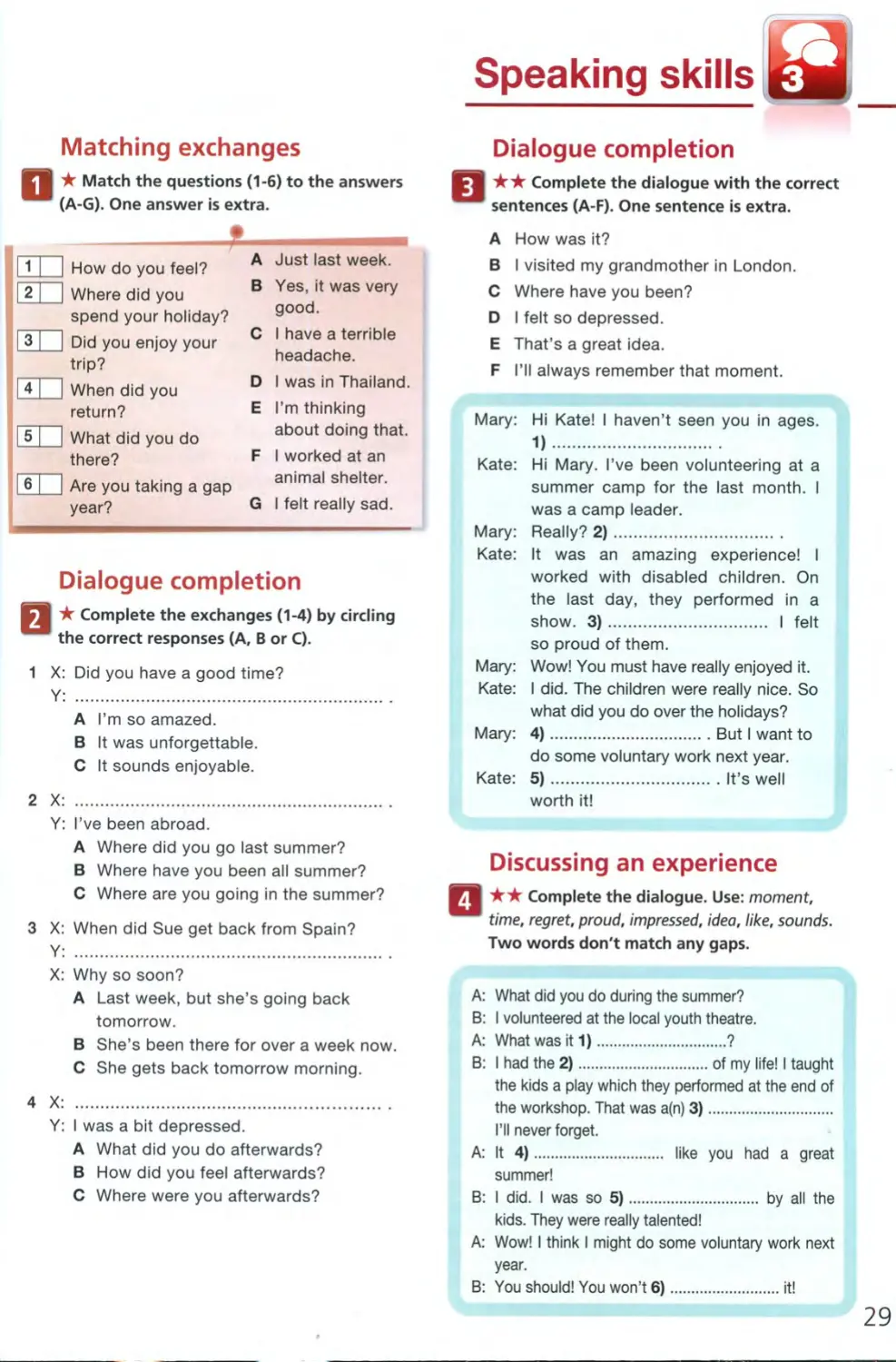
Matching exchanges
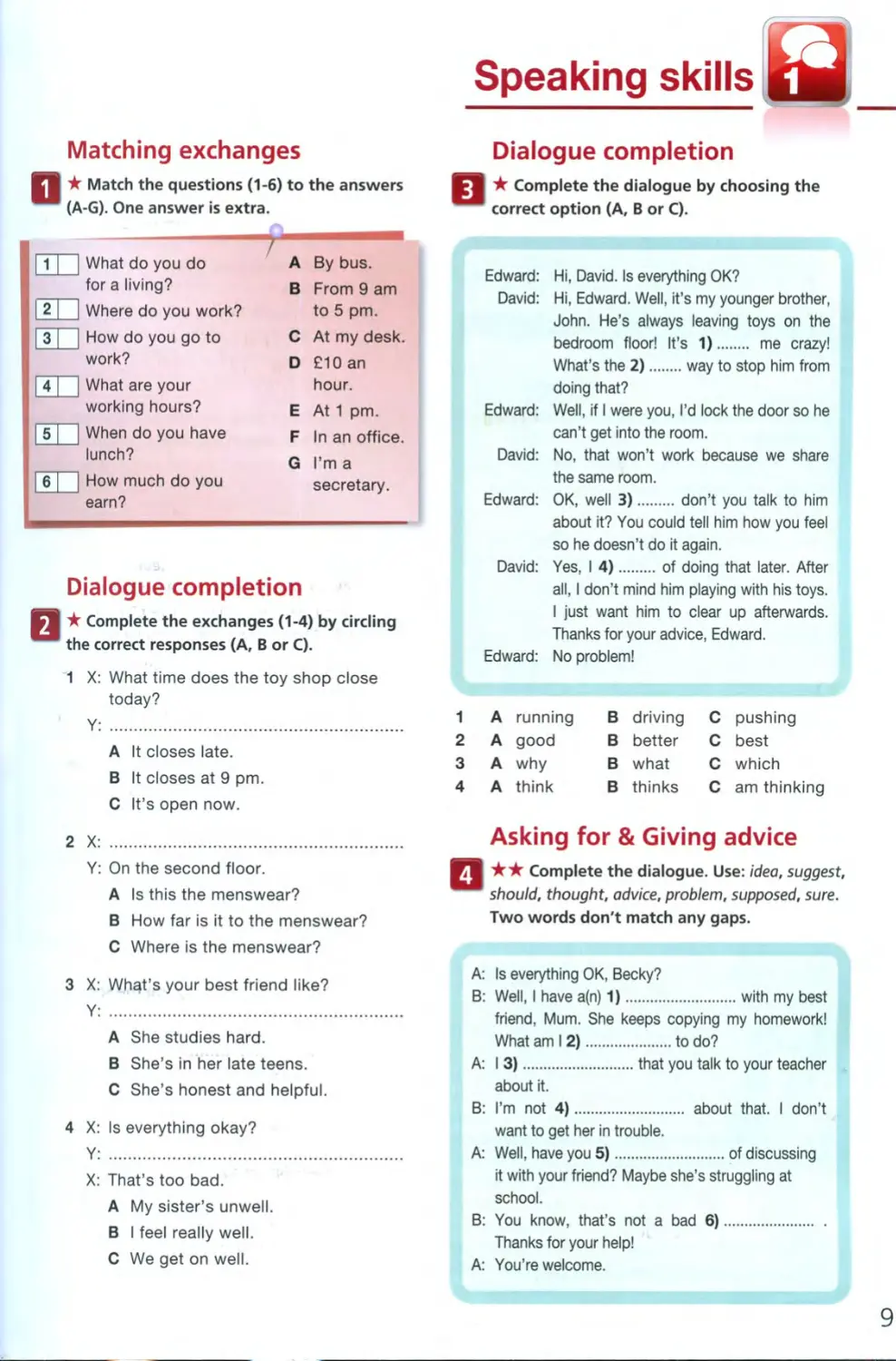
EV ★ Match the questions (1-6) to the answers
(A-G). One answer is extra.
Dialogue completion
★ Complete the dialogue by choosing the
correct option (A, В or C).
1|	J What do you do		By bus.
	for a living?	В	From 9 am
2|	J Where do you work?		to 5 pm.
3|	J How do you go to	c	At my desk.
	work?	D	£10 an
4I	J What are your		hour.
	working hours?	E	At 1 pm.
"®T	J When do you have	F	In an office.
	lunch?	G	I’m a
IL	П How much do you		secretary.
	earn?
Dialogue completion
2
★ Complete the exchanges (1-4) by circling
the correct responses (A, В or C).
1 X: What time does the toy shop close
today?
Y: ....................................
A It closes late.
В It closes at 9 pm.
C It’s open now.
2 X: .....................................
Y: On the second floor.
A Is this the menswear?
В How far is it to the menswear?
C Where is the menswear?
3 X: What’s your best friend like?
Y:.....................................
A She studies hard.
В She’s in her late teens.
C She’s honest and helpful.
4 X: Is everything okay?
Y: ....................................
X: That’s too bad.
A My sister’s unwell.
В I feel really well.
C We get on well.
Edward: Hi, David. Is everything OK?
David: Hi, Edward. Well, it’s my younger brother,
John. He’s always leaving toys on the
bedroom floor! It’s 1).............. me	crazy!
What’s the 2)....way to stop him from
doing that?
Edward: Well, if I were you, I’d lock the door so he
can’t get into the room.
David: No, that won’t work because we share
the same room.
Edward: OK, well 3).......don’t you talk to him
about it? You could tell him how you feel
so he doesn’t do it again.
David: Yes, I 4).......of doing that later. After
all, I don’t mind him playing with his toys.
I just want him to clear up afterwards.
Thanks for your advice, Edward.
Edward: No problem!
1	A	running	В	driving	C	pushing
2	A	good	В	better	C	best
3	A	why	В	what	c	which
4	A	think	В	thinks	c	am thinking
Asking for & Giving advice
★ ★ Complete the dialogue. Use: idea, suggest,
should, thought, advice, problem, supposed, sure.
Two words don't match any gaps.
A: Is everything OK, Becky?
B: Well, I have a(n) 1)................with	my best
friend, Mum. She keeps copying my homework!
What am I 2)..............to do?
A:	I 3)...............that	you talk to your teacher
about it.
B:	I’m not 4)................. about	that. I don’t
want to get her in trouble.
A:	Well, have you 5)................of discussing
it with your friend? Maybe she’s struggling at
school.
B:	You know, that’s not a bad 6)..................
Thanks for your help!
A: You’re welcome.
9
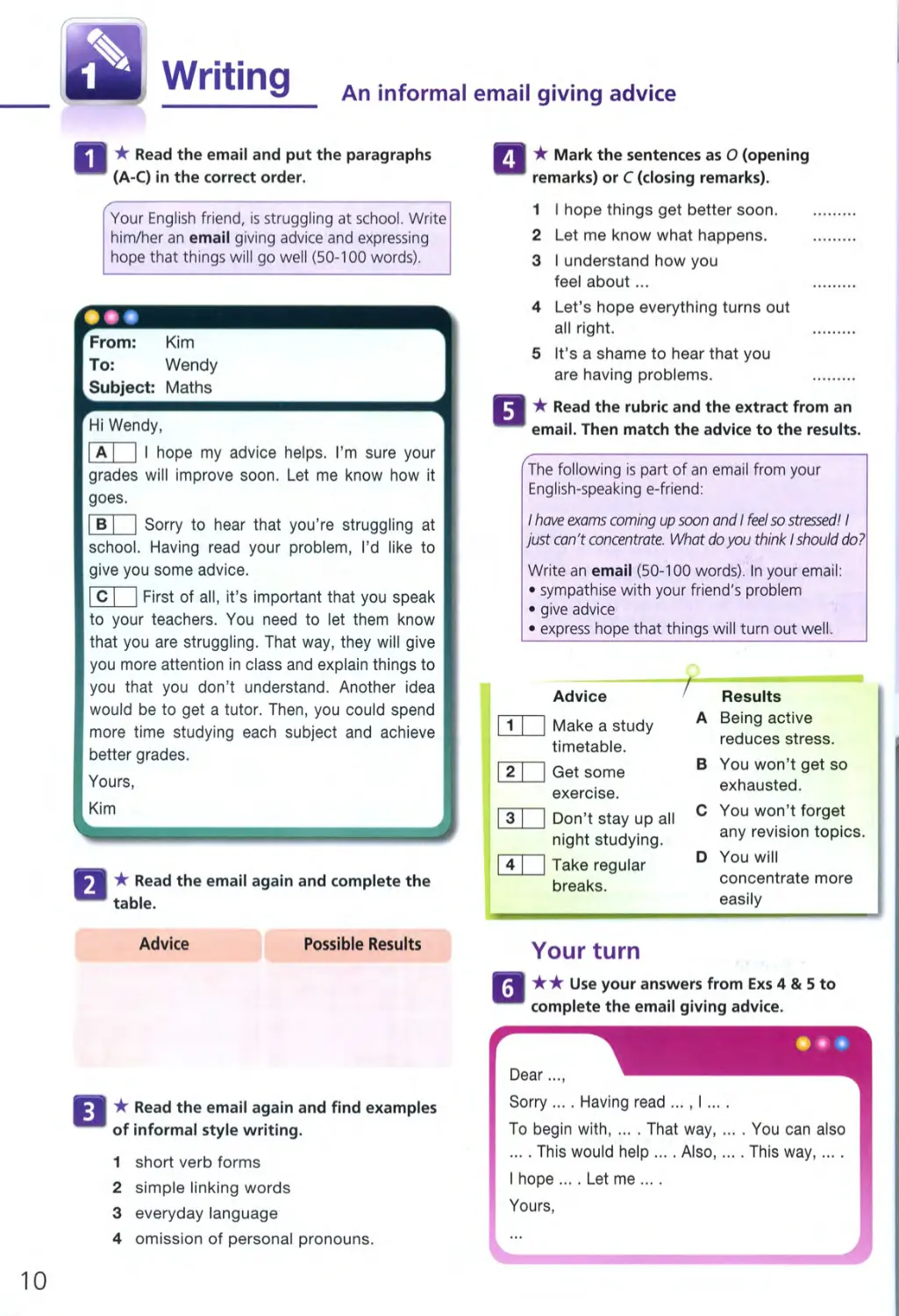
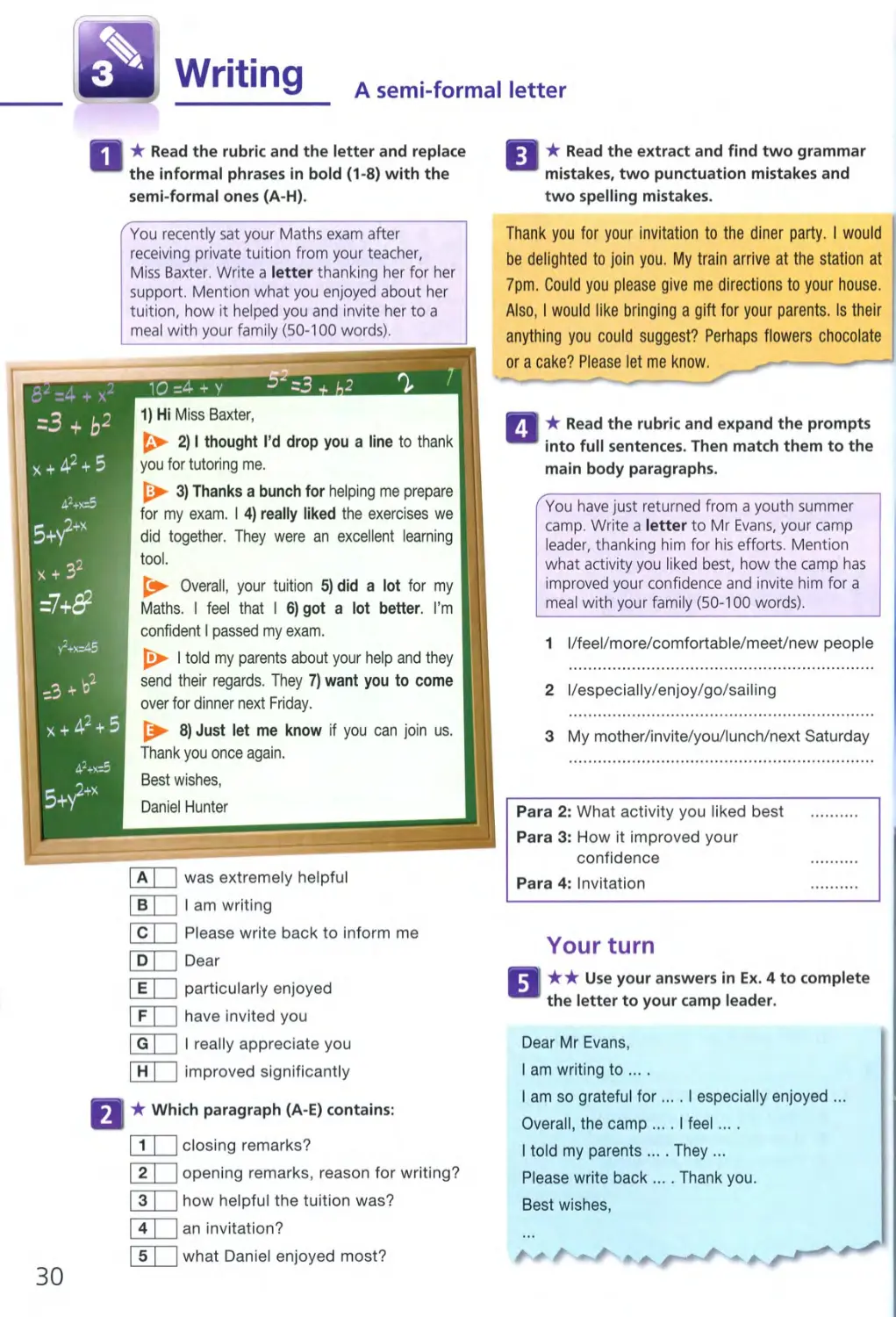
Writing
An informal email giving advice
★ Read the email and put the paragraphs
(A-C) in the correct order.
Your English friend, is struggling at school. Write
him/her an email giving advice and expressing
hope that things will go well (50-100 words).
From:	Kim
To:	Wendy
Subject: Maths
Hi Wendy,
[ A | | I hope my advice helps. I’m sure your
grades will improve soon. Let me know how it
goes.
| В | | Sorry to hear that you’re struggling at
school. Having read your problem, I’d like to
give you some advice.
| C | | First of all, it’s important that you speak
to your teachers. You need to let them know
that you are struggling. That way, they will give
you more attention in class and explain things to
you that you don’t understand. Another idea
would be to get a tutor. Then, you could spend
more time studying each subject and achieve
better grades.
Yours,
Kim
2
★ Read the email again and complete the
table.
4
★ Mark the sentences as О (opening
remarks) or C (closing remarks).
1	I hope things get better soon.........
2	Let me know what happens. ............
3	I understand how you
feel about...	.....
4	Let’s hope everything turns out
all right.	.....
5	It’s a shame to hear that you
are having problems.	.....
5
★ Read the rubric and the extract from an
email. Then match the advice to the results.
The following is part of an email from your
English-speaking e-friend:
/ have exams coming up soon and I feel so stressed! I
just can't concentrate. What do you think I should do?
Write an email (50-100 words). In your email:
•	sympathise with your friend's problem
•	give advice
•	express hope that things will turn out well.
Advice
| 1 | | Make a study
timetable.
| 2 | | Get some
exercise.
| 3 | | Don’t stay up all
night studying.
| 4 | | Take regular
breaks.
Results
A Being active
reduces stress.
В You won’t get so
exhausted.
C You won’t forget
any revision topics.
D You will
concentrate more
easily
Advice
Possible Results
Your turn
6
★ ★ Use your answers from Exs 4 & 5 to
complete the email giving advice.
3
★ Read the email again and find examples
of informal style writing.
1	short verb forms
2	simple linking words
3	everyday language
4	omission of personal pronouns.
10
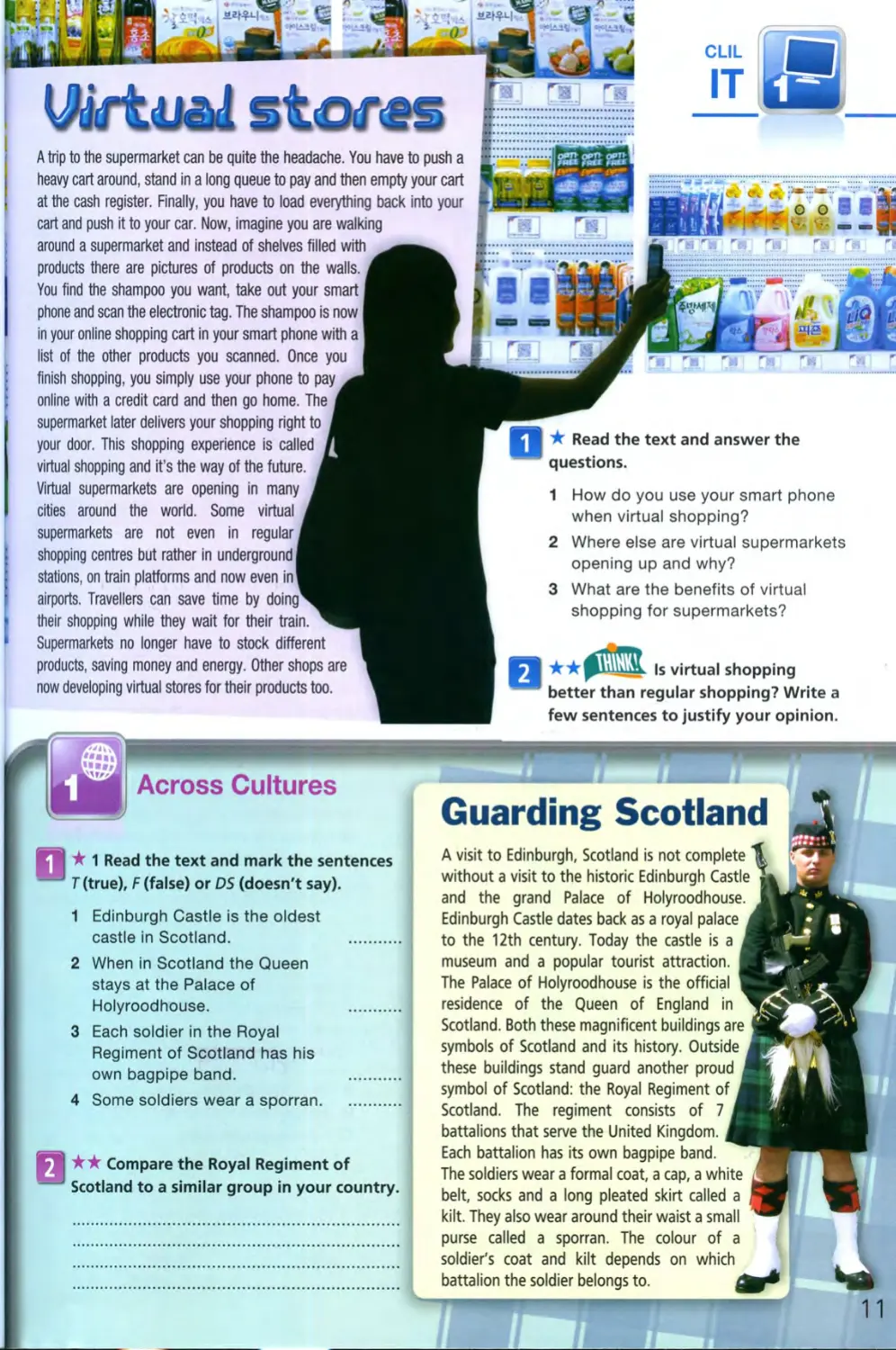
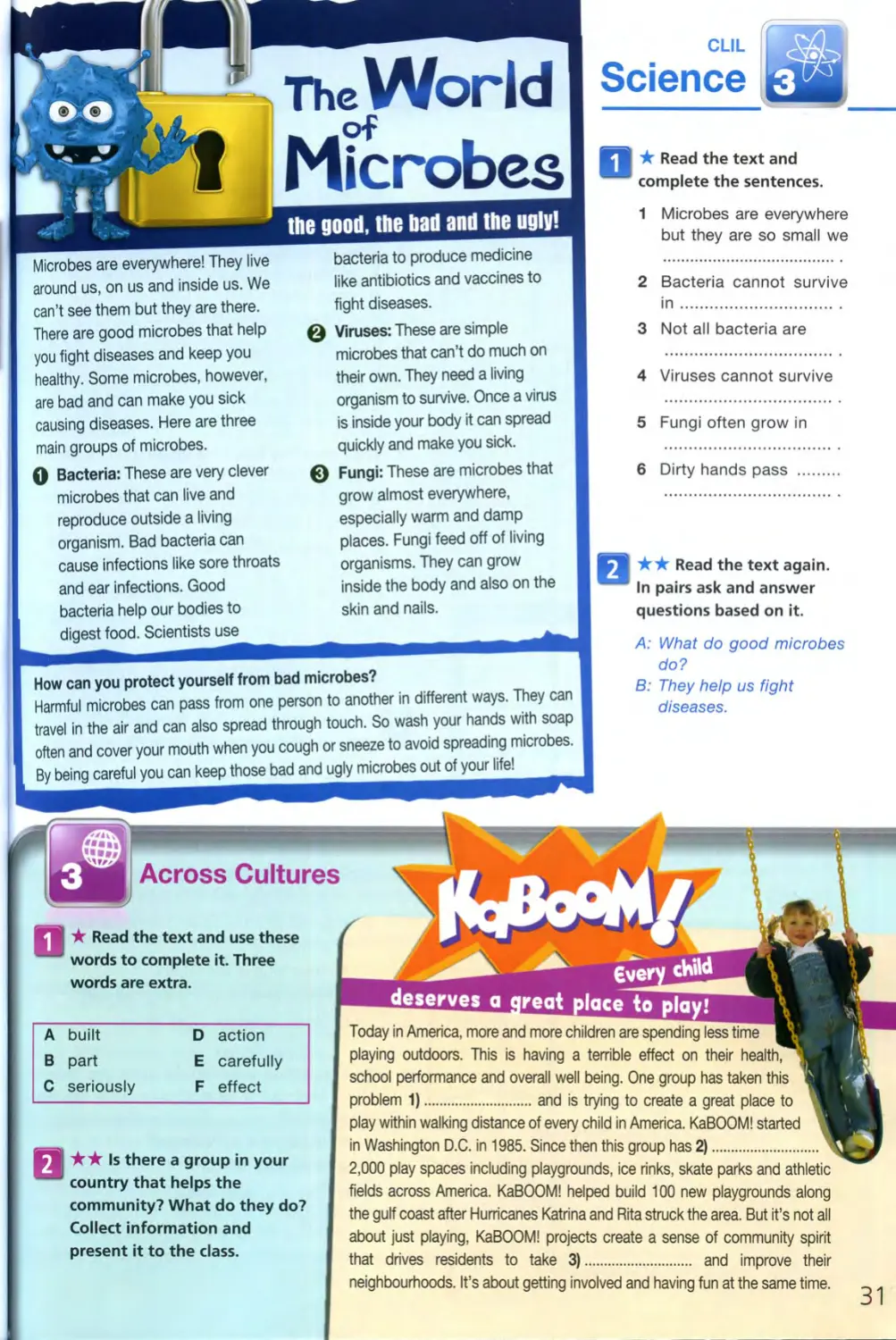
CLIL
1
:::
★ Read the text and answer the
questions.


wtual stores
A trip to trie supermarket can be quite the headache. You have to push a
heavy cart around, stand in a long queue to pay and then empty your cart
at the cash register. Finally, you have to load everything back into your
cart and push it to your car. Now, imagine you are walking
around a supermarket and instead of shelves filled with
products there are pictures of products on the walls.
You find the shampoo you want, take out your smart
phone and scan the electronic tag. The shampoo is now
in your online shopping cart in your smart phone with a
list of the other products you scanned. Once you
finish shopping, you simply use your phone to pay
online with a credit card and then go home. The
supermarket later delivers your shopping right to
your door. This shopping experience is called j
virtual shopping and it’s the way of the future. A
Virtual supermarkets are opening in many Л
cities around the world. Some virtual Л
supermarkets are not even in regular Ш
shopping centres but rather in underground
stations, on train platforms and now even in^H
airports. Travellers can save time by doing^B
their shopping while they wait for their train.
Supermarkets no longer have to stock different
products, saving money and energy. Other shops are
now developing virtual stores for their products too.

3
How do you use your smart phone
when virtual shopping?
Where else are virtual supermarkets
opening up and why?
What are the benefits of virtual
shopping for supermarkets?
Is virtual shopping
better than regular shopping? Write a
few sentences to justify your opinion.
Across Cultures
Guarding Scotland
3
1 Read the text and mark the sentences
T (true), F (false) or DS (doesn't say).
Edinburgh Castle is the oldest
castle in Scotland.	.......
When in Scotland the Queen
stays at the Palace of
Holyroodhouse.	.......
Each soldier in the Royal
Regiment of Scotland has his
own bagpipe band.	.......
Some soldiers wear a sporran.........
★★ Compare the Royal Regiment of
Scotland to a similar group in your country.
A visit to Edinburgh, Scotland is not complete
without a visit to the historic Edinburgh Castle
and the grand Palace of Holyroodhouse.
Edinburgh Castle dates back as a royal palace
to the 12th century. Today the castle is a
museum and a popular tourist attraction.
The Palace of Holyroodhouse is the official
residence of the Queen of England in
Scotland. Both these magnificent buildings are
symbols of Scotland and its history. Outside
these buildings stand guard another proud
symbol of Scotland: the Royal Regiment of
Scotland. The regiment consists of 7
battalions that serve the United Kingdom.
Each battalion has its own bagpipe band.
The soldiers wear a formal coat, a cap, a white
belt, socks and a long pleated skirt called a
kilt. They also wear around their waist a small
purse called a sporran. The colour of a
soldier's coat and kilt depends on which
battalion the soldier belongs to.
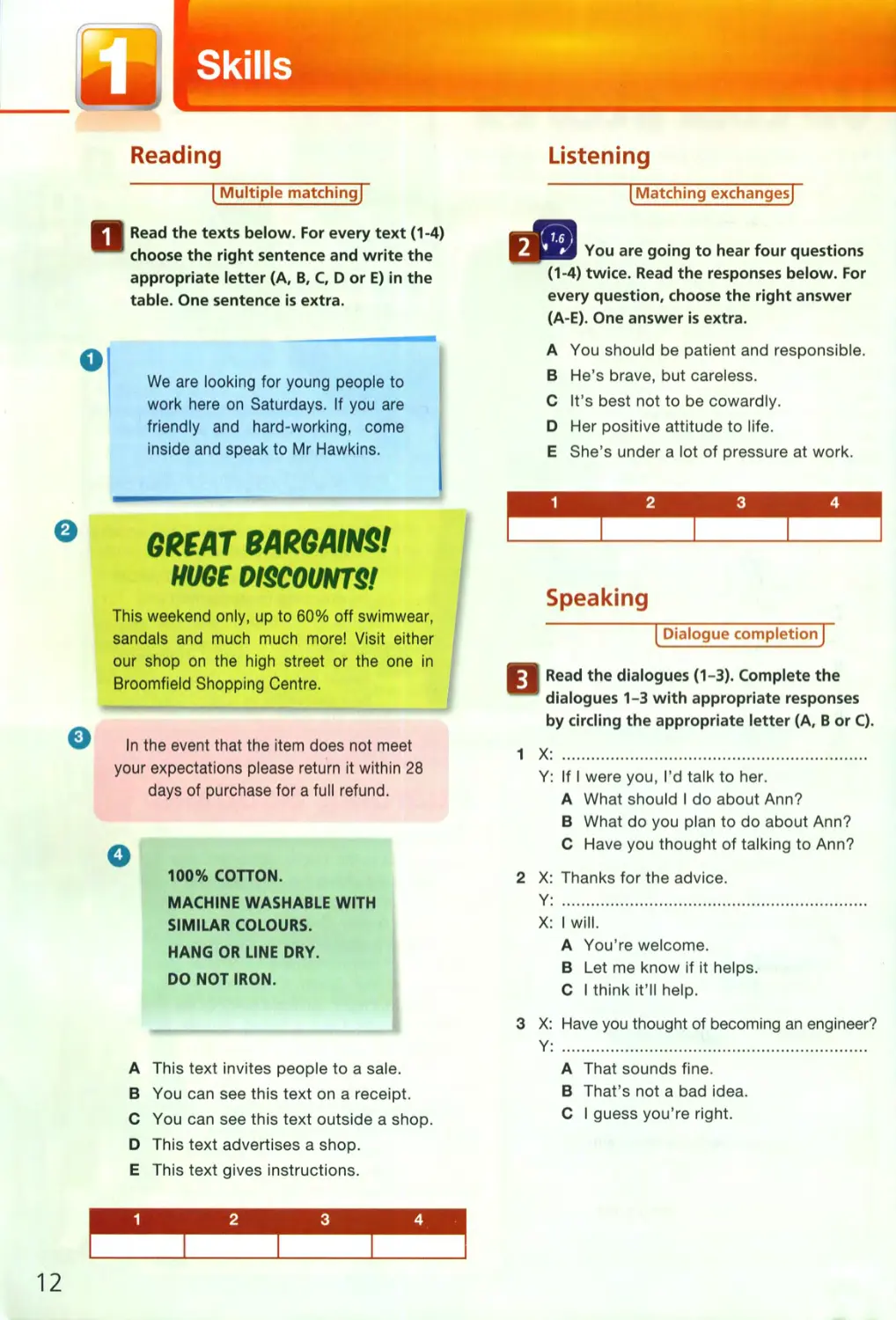
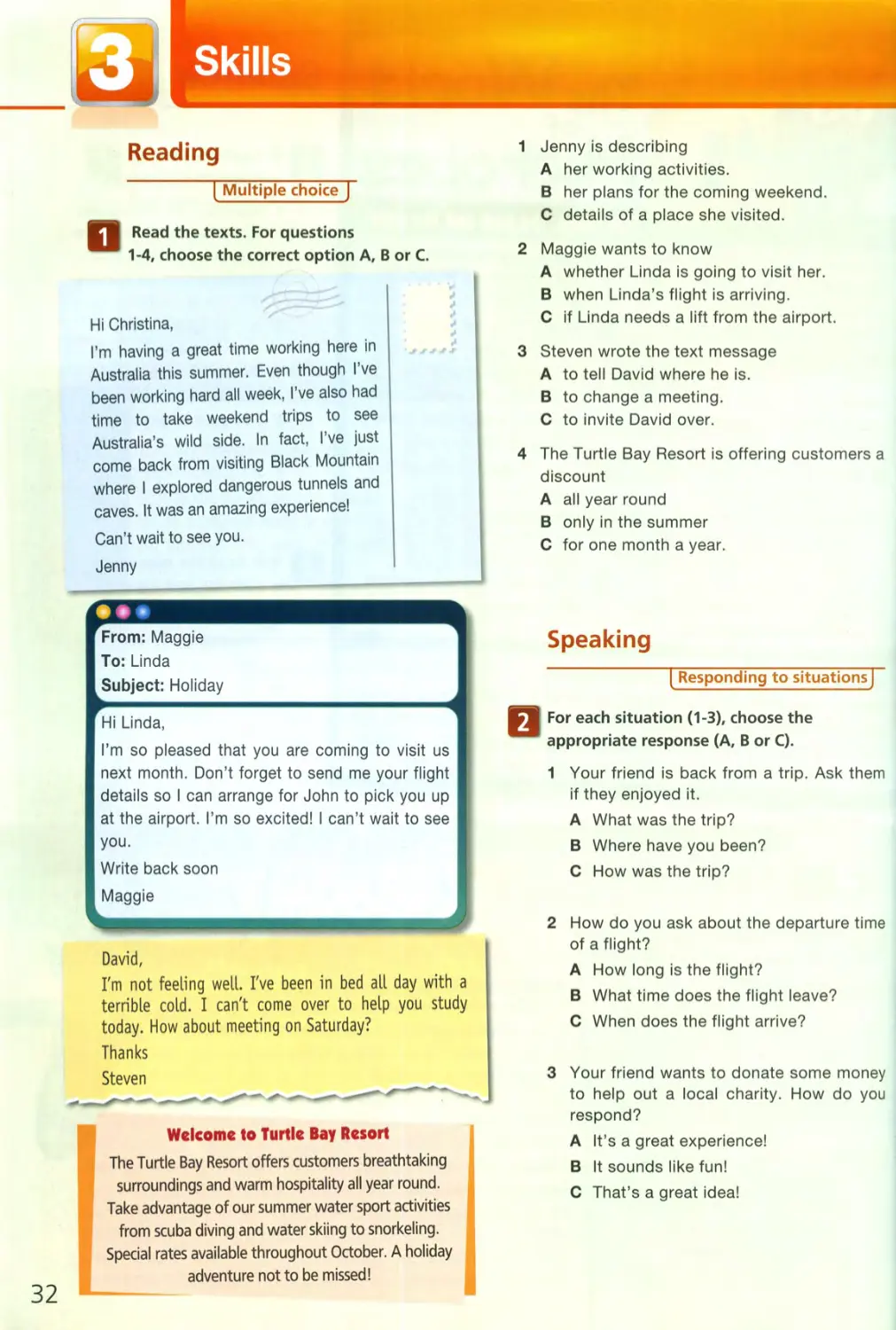
Skills
1
Reading
Read the texts below. For every text (1-4)
choose the right sentence and write the
appropriate letter (А, В, C, D or E) in the
table. One sentence is extra.
Listening
[Matching exchanges]
You are going to hear four questions
(1-4) twice. Read the responses below. For
every question, choose the right answer
(A-E). One answer is extra.
We are looking for young people to
work here on Saturdays. If you are
friendly and hard-working, come
inside and speak to Mr Hawkins.
A You should be patient and responsible.
В He’s brave, but careless.
C It’s best not to be cowardly.
D Her positive attitude to life.
E She’s under a lot of pressure at work.
12	3	4
GREAT BARGAINS!
HUGE DISCOUNTS!
This weekend only, up to 60% off swimwear,
sandals and much much more! Visit either
our shop on the high street or the one in
Broomfield Shopping Centre.
In the event that the item does not meet
your expectations please return it within 28
days of purchase for a full refund.
100% COTTON.
MACHINE WASHABLE WITH
SIMILAR COLOURS.
HANG OR LINE DRY.
DO NOT IRON.
A This text invites people to a sale.
В You can see this text on a receipt.
C You can see this text outside a shop.
D This text advertises a shop.
E This text gives instructions.
Speaking
Read the dialogues (1-3). Complete the
dialogues 1-3 with appropriate responses
by circling the appropriate letter (A, В or C).
1	X: .......................................
Y: If I were you, I’d talk to her.
A What should I do about Ann?
В What do you plan to do about Ann?
C Have you thought of talking to Ann?
2	X: Thanks for the advice.
Y:........................................
X: I will.
A You’re welcome.
В Let me know if it helps.
С I think it’ll help.
3	X: Have you thought of becoming an engineer?
Y: .......................................
A That sounds fine.
В That’s not a bad idea.
С I guess you’re right.
12	3	4
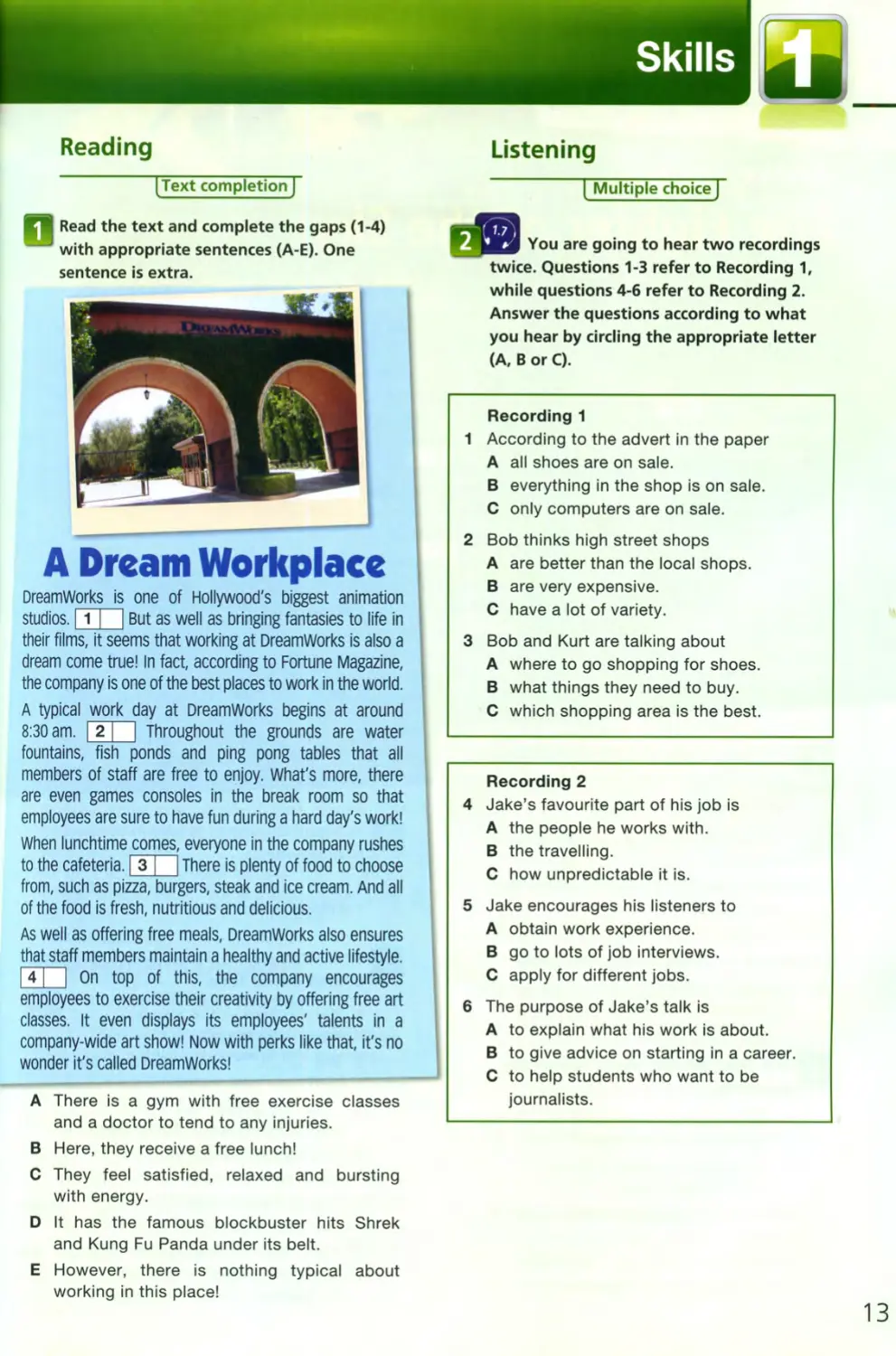
12
Skills
Reading
[Text completion^
Listening
[ Multiple choice J
KB Read the text and complete the gaps (1-4)
with appropriate sentences (A-E). One
sentence is extra.
A Dream Workplace
DreamWorks is one of Hollywood's biggest animation
studios. | 1 | ] But as well as bringing fantasies to life in
their films, it seems that working at DreamWorks is also a
dream come true! In fact, according to Fortune Magazine,
the company is one of the best places to work in the world.
A typical work day at DreamWorks begins at around
8:30 am. | 2	| Throughout the grounds are water
fountains, fish ponds and ping pong tables that all
members of staff are free to enjoy. What's more, there
are even games consoles in the break room so that
employees are sure to have fun during a hard day's work!
When lunchtime comes everyone in the company rushes
to the cafeteria. | 3 | ’ There is plenty of food to choose
from, such as pizza, burgers, steak and ice cream. And all
of the food is fresh, nutritious and delicious.
As well as offering free meals, DreamWorks also ensures
that staff members maintain a healthy and active lifestyle.
1Ш On top of this, the company encourages
employees to exercise their creativity by offering free art
classes. It even displays its employees' talents in a
company-wide art show! Now with perks like that, it's no
wonder it's called DreamWorks!
A There is a gym with free exercise classes
and a doctor to tend to any injuries.
You are going to hear two recordings
twice. Questions 1-3 refer to Recording 1,
while questions 4-6 refer to Recording 2.
Answer the questions according to what
you hear by circling the appropriate letter
(A, В or C).
Recording 1
1	According to the advert in the paper
A all shoes are on sale.
В everything in the shop is on sale.
C only computers are on sale.
2	Bob thinks high street shops
A are better than the local shops.
В are very expensive.
C have a lot of variety.
3	Bob and Kurt are talking about
A where to go shopping for shoes.
В what things they need to buy.
C which shopping area is the best.

Recording 2
4	Jake’s favourite part of his job is
A the people he works with.
В the travelling.
C how unpredictable it is.
5	Jake encourages his listeners to
A obtain work experience.
В go to lots of job interviews.
C apply for different jobs.
6	The purpose of Jake’s talk is
A to explain what his work is about.
В to give advice on starting in a career.
C to help students who want to be
journalists.
В Here, they receive a free lunch!
C They feel satisfied, relaxed and bursting
with energy.
D It has the famous blockbuster hits Shrek
and Kung Fu Panda under its belt.
E However, there is nothing typical about
working in this place!
13
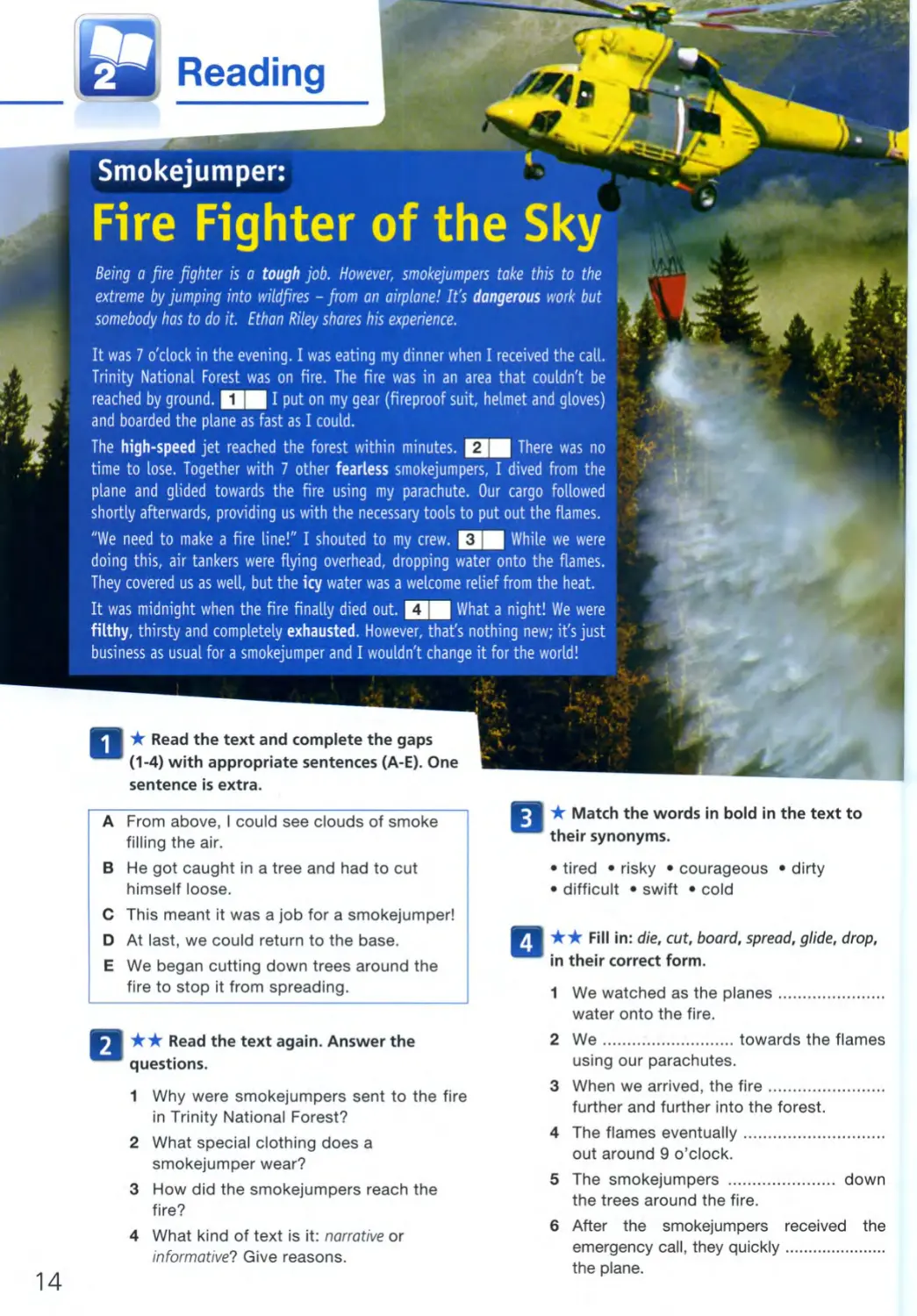
Reading
Smokejumper
Fire Fighter of the Sky
Being a fire fighter is a tough job. However, smokejumpers take this to the
extreme by jumping into wildfires - from an airplane! It's dangerous work but
somebody has to do it. Ethan Riley shares his experience.
I put on my gear (fireproof suit, helmet and gloves)
There was no
While we were
It was 7 o'clock in the evening. I was eating my dinner when I received the call.
Trinity National Forest was on fire. The fire was in an area that couldn't be
reached by ground. П!
and boarded the plane as fast as I could.
The high-speed jet reached the forest within minutes. Wl
time to lose. Together with 7 other fearless smokejumpers, I dived from the
plane and glided towards the fire using my parachute. Our cargo followed
shortly afterwards, providing us with the necessary tools to put out the flames.
"We need to make a fire line!" I shouted to my crew. Fll
doing this, air tankers were flying overhead, dropping water onto the flames.
They covered us as well, but the icy water was a welcome relief from the heat.
It was midnight when the fire finally died out. QB What a night! We were
filthy, thirsty and completely exhausted. However, that's nothing new; it's just
business as usual for a smokejumper and I wouldn't change it for the world!
★ Read the text and complete the gaps
(1-4) with appropriate sentences (A-E). One
sentence is extra.
A From above, I could see clouds of smoke
filling the air.
В He got caught in a tree and had to cut
himself loose.
C This meant it was a job for a smokejumper!
D At last, we could return to the base.
E We began cutting down trees around the
fire to stop it from spreading.
2
4
★ ★ Read the text again. Answer the
questions.
1	Why were smokejumpers sent to the fire
in Trinity National Forest?
2	What special clothing does a
smokejumper wear?
3	How did the smokejumpers reach the
fire?
4	What kind of text is it: narrative or
informative? Give reasons.
14
★ Match the words in bold in the text to
their synonyms.
•	tired • risky • courageous • dirty
•	difficult • swift • cold
★ ★ Fill in: die, cut, board, spread, glide, drop,
in their correct form.
1	We watched as the planes...............
water onto the fire.
2	We..................towards the flames
using our parachutes.
3	When we arrived, the fire..............
further and further into the forest.
4	The flames eventually..................
out around 9 o’clock.
5	The smokejumpers ................ down
the trees around the fire.
6	After the smokejumpers received the
emergency call, they quickly.............
the plane.
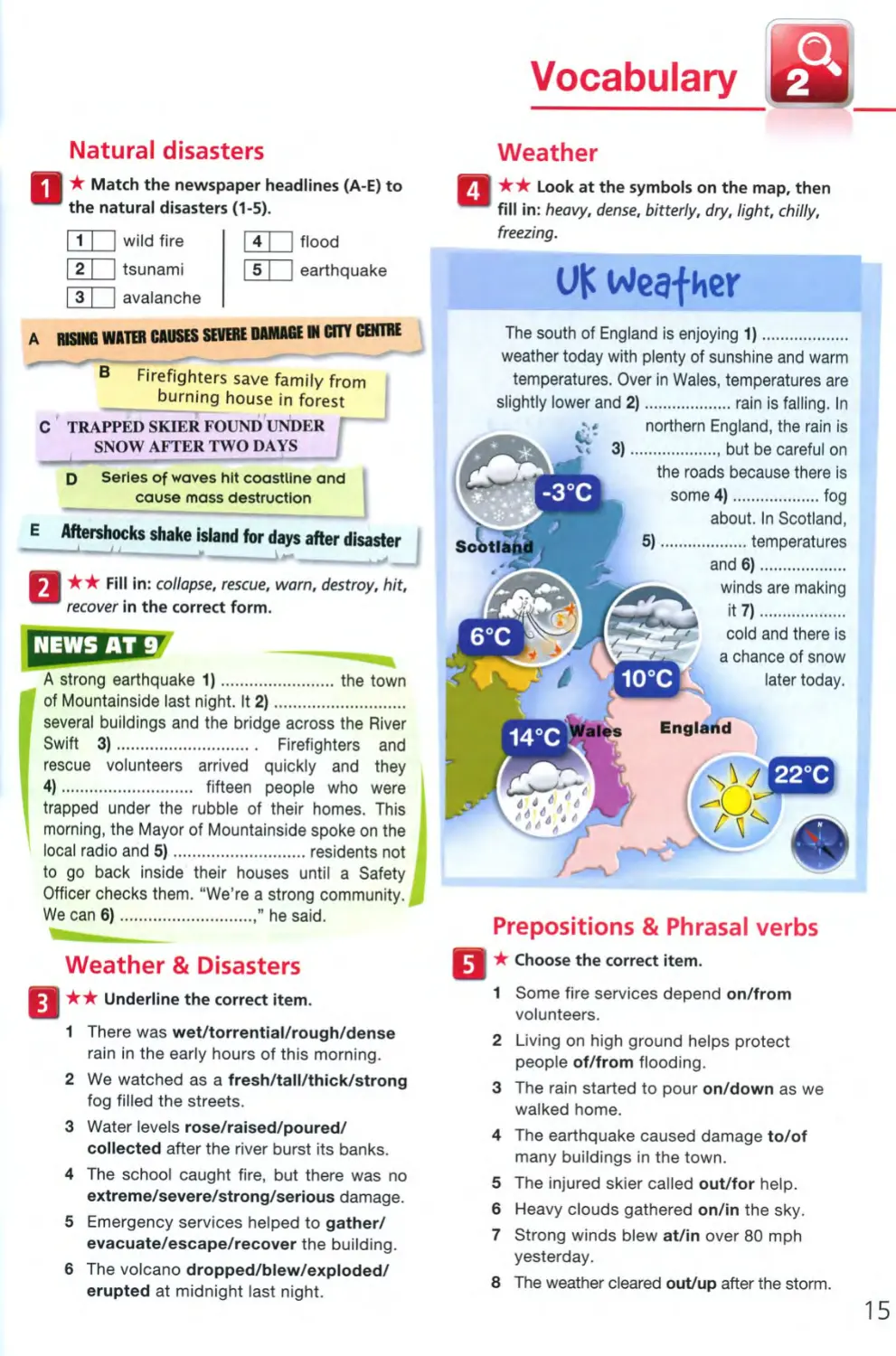
Vocabulary
Natural disasters
Weather
Щ ★ Match the newspaper headlines (A-E) to
the natural disasters (1-5).
4
★ ★ Look at the symbols on the map, then
fill in: heavy, dense, bitterly, dry, light, chilly,
| 1 | | wild fire
| 2 | | tsunami
| 3 | | avalanche
4	| flood
| 5 [ | earthquake
freezing.
UK Weafher
A RISING WATER CAUSES SEVERE DAMAGE IN МП CENTRE
В Firefighters save family from
burning house in forest
C TRAPPED SKIER FOUND UNDER
SNOW AFTER TWO DAYS
l	——	' *	1 '
D Series of waves hit coastline and
cause mass destruction
e Aftershocks shake island for days after disaster
★ ★ Fill in: collapse, rescue, warn, destroy, hit,
recover in the correct form.
NEWS AT 9
A strong earthquake 1)..............the	town
of Mountainside last night. It 2)...........
several buildings and the bridge across the River
Swift 3).................. Firefighters	and
rescue volunteers arrived quickly and they
4)................ fifteen people who were
trapped under the rubble of their homes. This
morning, the Mayor of Mountainside spoke on the
local radio and 5)............residents	not
to go back inside their houses until a Safety
Officer checks them. “We’re a strong community.
We can 6)...................he	said.
Weather & Disasters
5
The south of England is enjoying 1)...........
weather today with plenty of sunshine and warm
temperatures. Over in Wales, temperatures are
slightly lower and 2)..................rain	is falling. In
northern England, the rain is
3)...........but be careful on
the roads because there is
some 4).............fog
about. In Scotland,
5).........temperatures
and 6)..........
winds are making
it 7)...........
cold and there is
a chance of snow
later today.
v
Prepositions & Phrasal verbs
★ Choose the correct item.
3
★ ★ Underline the correct item.
1 Some fire services depend on/from
volunteers.
1 There was wet/torrential/rough/dense
rain in the early hours of this morning.
2 We watched as a fresh/tall/thick/strong
fog filled the streets.
3 Water levels rose/raised/poured/
collected after the river burst its banks.
4 The school caught fire, but there was no
extreme/severe/strong/serious damage.
5 Emergency services helped to gather/
evacuate/escape/recover the building.
6 The volcano dropped/blew/exploded/
erupted at midnight last night.
2	Living on high ground helps protect
people of/from flooding.
3	The rain started to pour on/down as we
walked home.
4	The earthquake caused damage to/of
many buildings in the town.
5	The injured skier called out/for help.
6	Heavy clouds gathered on/in the sky.
7	Strong winds blew at/in over 80 mph
yesterday.
8	The weather cleared out/up after the storm.
15
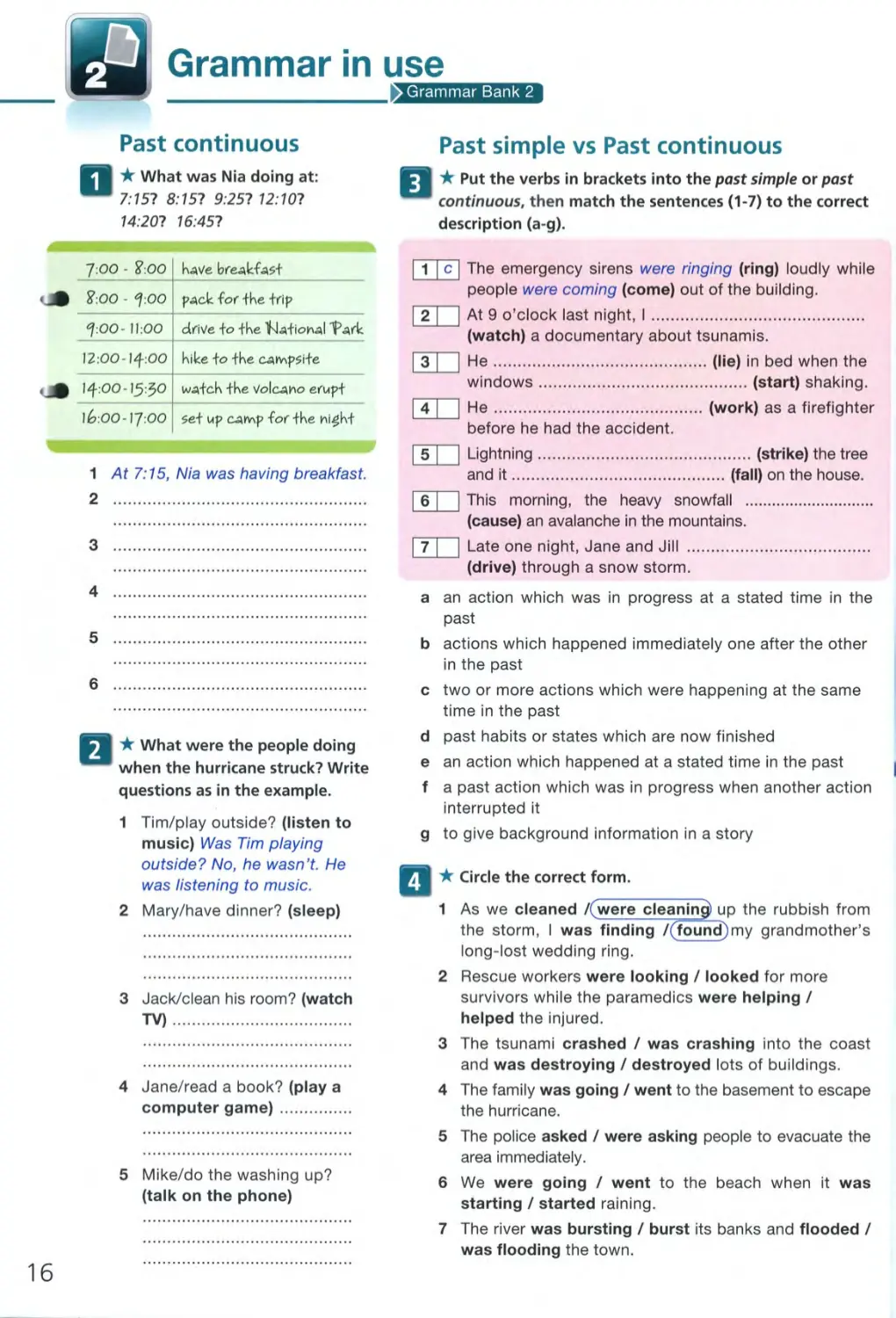
Grammar in use
► Grammar Bank 2
1
Past continuous
Past simple vs Past continuous
★ What was Nia doing at:
7:157 8:157 9:257 12:107
3
★ Put the verbs in brackets into the past simple or past
continuous, then match the sentences (1-7) to the correct
14:207 16:457
description (a-g).
7:00 - ?:00
?:00 - <7:00
<7:00- l!:00
!2:00-l<f:00
I4:OO-15:JO
|6:OO-I7:OO
have breakfast
pack for the trip
drive to the iNational "Park
hike to the campsite
watch the Volcano erupt
Set up camp for the ni^ht
1 At 7:15, Nia was having breakfast.
2 ...................................
3 ...................................
4 ...................................
5 ...................................
6 ...................................
2
★ What were the people doing
when the hurricane struck? Write
questions as in the example.
1 Tim/play outside? (listen to
music) И/as Tim playing
outside? No, he wasn't. He
was listening to music.
2 Mary/have dinner? (sleep)
| 1 | c | The emergency sirens were ringing (ring) loudly while
people were coming (come) out of the building.
[	] At 9 o’clock last night, I..........................
(watch) a documentary about tsunamis.
| 3 | | He.............................(lie) in bed when the
windows..............................(start) shaking.
[~4 | | He..............................(work)	as a firefighter
before he had the accident.
| 5 | | Lightning............................(strike) the tree
and it...........................(fall)	on the house.
| 6 | | This morning, the heavy snowfall ....................
(cause) an avalanche in the mountains.
| 7 | | Late one night, Jane and Jill ......................
(drive) through a snow storm.
a an action which was in progress at a stated time in the
past
b actions which happened immediately one after the other
in the past
c two or more actions which were happening at the same
time in the past
d past habits or states which are now finished
e an action which happened at a stated time in the past
f a past action which was in progress when another action
interrupted it
g to give background information in a story
4
★ Circle the correct form.
1 As we cleaned /(were cleaning) up the rubbish from
the storm, I was finding /(found)my grandmother’s
long-lost wedding ring.
3 Jack/clean his room? (watch
TV).........................
4 Jane/read a book? (play a
computer game)..............
5 Mike/do the washing up?
(talk on the phone)
2 Rescue workers were looking / looked for more
survivors while the paramedics were helping /
helped the injured.
3 The tsunami crashed / was crashing into the coast
and was destroying / destroyed lots of buildings.
4 The family was going / went to the basement to escape
the hurricane.
5 The police asked / were asking people to evacuate the
area immediately.
6 We were going / went to the beach when it was
starting / started raining.
7 The river was bursting / burst its banks and flooded /
was flooding the town.
16
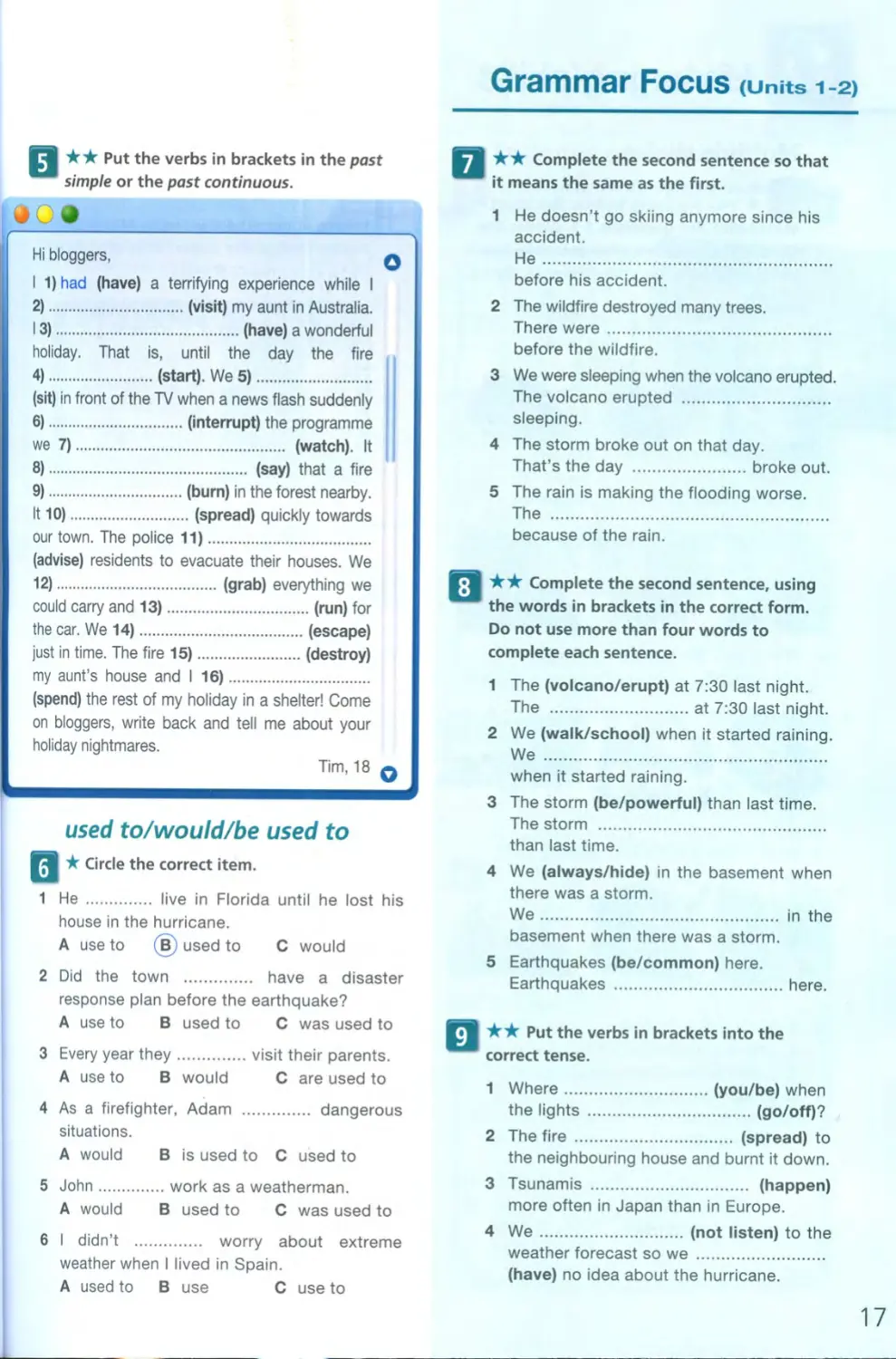
Grammar Focus (units 1-2,
★ ★ Put the verbs in brackets in the past
simple or the past continuous.
★ ★ Complete the second sentence so that
it means the same as the first.
Hi bloggers,
I 1)had (have) a terrifying experience while I
2)....................(visit) my aunt in Australia.
13)............................(have)	a wonderful
holiday. That is, until the day the fire
4)...............(start).	We 5).................
(sit) in front of the TV when a news flash suddenly
6)....................(interrupt) the programme
we 7)................................ (watch). It
8)............................... (say) that a fire
9)....................(burn) in the forest nearby.
It 10)...................(spread)	quickly towards
our town. The police 11)..........................
(advise) residents to evacuate their houses. We
12)........................(grab)	everything we
could carry and 13)......................(run) for
the car. We 14)..........................(escape)
just in time. The fire 15)..............(destroy)
my aunt’s house and I 16).........................
(spend) the rest of my holiday in a shelter! Come
on bloggers, write back and tell me about your
holiday nightmares.
Tim, 18 q
used to/would/be used to
6
Circle the correct item.
1	He doesn't go skiing anymore since his
accident.
He..........................................
before his accident.
2	The wildfire destroyed many trees.
There were..................................
before the wildfire.
3	We were sleeping when the volcano erupted.
The volcano erupted ........................
sleeping.
4	The storm broke out on that day.
That’s the day ..................broke out.
5	The rain is making the flooding worse.
The ........................................
because of the rain.
★ ★ Complete the second sentence, using
the words in brackets in the correct form.
Do not use more than four words to
complete each sentence.
1	The (volcano/erupt) at 7:30 last night.
The .....................at	7:30 last night.
2	We (walk/school) when it started raining.
We .......................................
when it started raining.
3	The storm (be/powerful) than last time.
The storm ................................
than last time.
4	We (always/hide) in the basement when
1 He .......... live	in Florida until he lost his
house in the hurricane.
A use to В) used to C would
2	Did the town .......... have a disaster
response plan before the earthquake?
A use to	В used to	C was used to
3	Every year they........visit their parents.
A use to	В would	C are used to
9
4	As a firefighter, Adam ......... dangerous
situations.
A would В is used to C used to
5	John.........work as a weatherman.
A would В used to C was used to
6	I didn’t ......... worry about extreme
weather when I lived in Spain.
A used to В use C use to
there was a storm.
We............................. in the
basement when there was a storm.
5 Earthquakes (be/common) here.
Earthquakes .....................here.
★★ Put the verbs in brackets into the
correct tense.
1	Where.....................(you/be)	when
the lights....................(go/off)?
2	The fire .................... (spread)	to
the neighbouring house and burnt it down.
3	Tsunamis ..................... (happen)
more often in Japan than in Europe.
4	We.....................(not	listen) to the
weather forecast so we ................
(have) no idea about the hurricane.
17
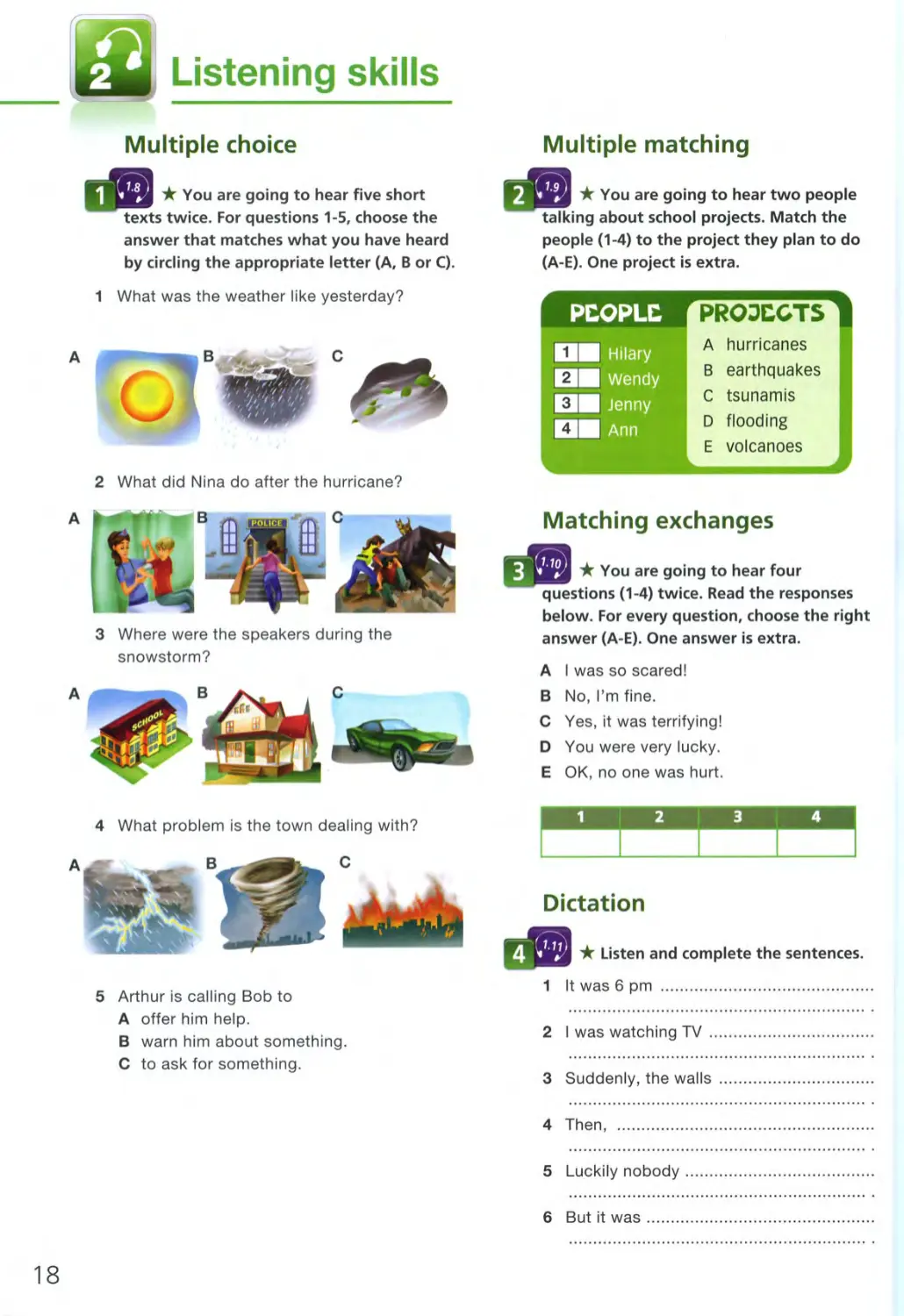
Listening skills
texts
Multiple choice
★ You are going to hear five short
twice. For questions 1-5, choose the
answer that matches what you have heard
by circling the appropriate letter (A, В or C).
Multiple matching
★ You are going to hear two people
talking about school projects. Match the
people (1-4) to the project they plan to do
(A-E). One project is extra.
1 What was the weather like yesterday?
PCOPLC
	Hilary
	Wendy
	Jenny
k.	Ann
PRODUCTS
hurricanes
earthquakes
tsunamis
flooding
volcanoes
2 What did Nina do after the hurricane?
Matching exchanges
3 Where were the speakers during the
snowstorm?
★ You are going to hear four
questions (1-4) twice. Read the responses
below. For every question, choose the right
answer (A-E). One answer is extra.
A I was so scared!
В No, I’m fine.
C Yes, it was terrifying!
D You were very lucky.
E OK, no one was hurt.
A
В
C
D
E
12	3	4
4 What problem is the town dealing with?
5 Arthur is calling Bob to
A offer him help.
В warn him about something.
C to ask for something.
Dictation
★ Listen and complete the sentences.
1 It was 6 pm .......................
2 I was watching TV...................
3 Suddenly, the walls.................
4 Then, ..............................
5 Luckily nobody......................
6 But it was..........................
18
Speaking skills
Matching exchanges
£ ★ Match the questions (1-6) to the answers
(A-G). One answer is extra.
3
Dialogue completion
★ Complete the dialogue by choosing the
correct option (A, В or C).
1	2 Did you use to live here?
pL	2 When did the storm hit?
131	J How often did you play basketball?
	2 What were you doing when the storm hit?
L=L	2 What sport did you do when you were young?
161	2 What did you do when
	you saw the fire?
A I used to play
basketball.
В I ran for help.
C Yes, when I
was 5.
D Every Saturday
morning.
E Just after 5
pm.
F I was
frightened.
G I was watching
TV.
Dialogue completion
★ Complete the exchanges (1-4) by circling
the correct responses (A, В or C).
1 X: ........................................
Y: No, it’s sunny outside.
A What’s the weather like outside?
В Was it cold yesterday?
C Is it raining?
2 X: Are you alright?
Y: ..........................................
A It was horrible!
В No one was hurt.
C I’m OK now.
3 X: Everything started shaking!
Y: ........................................
X: Yes, it was terrifying.
A What happened?
В Were you scared?
C Are you lucky?
4 X: A fire broke out in the school.
Y: ..........................................
X: Yes, there were no injuries.
A Was it awful?
В Were you terrified?
C Is everyone OK?
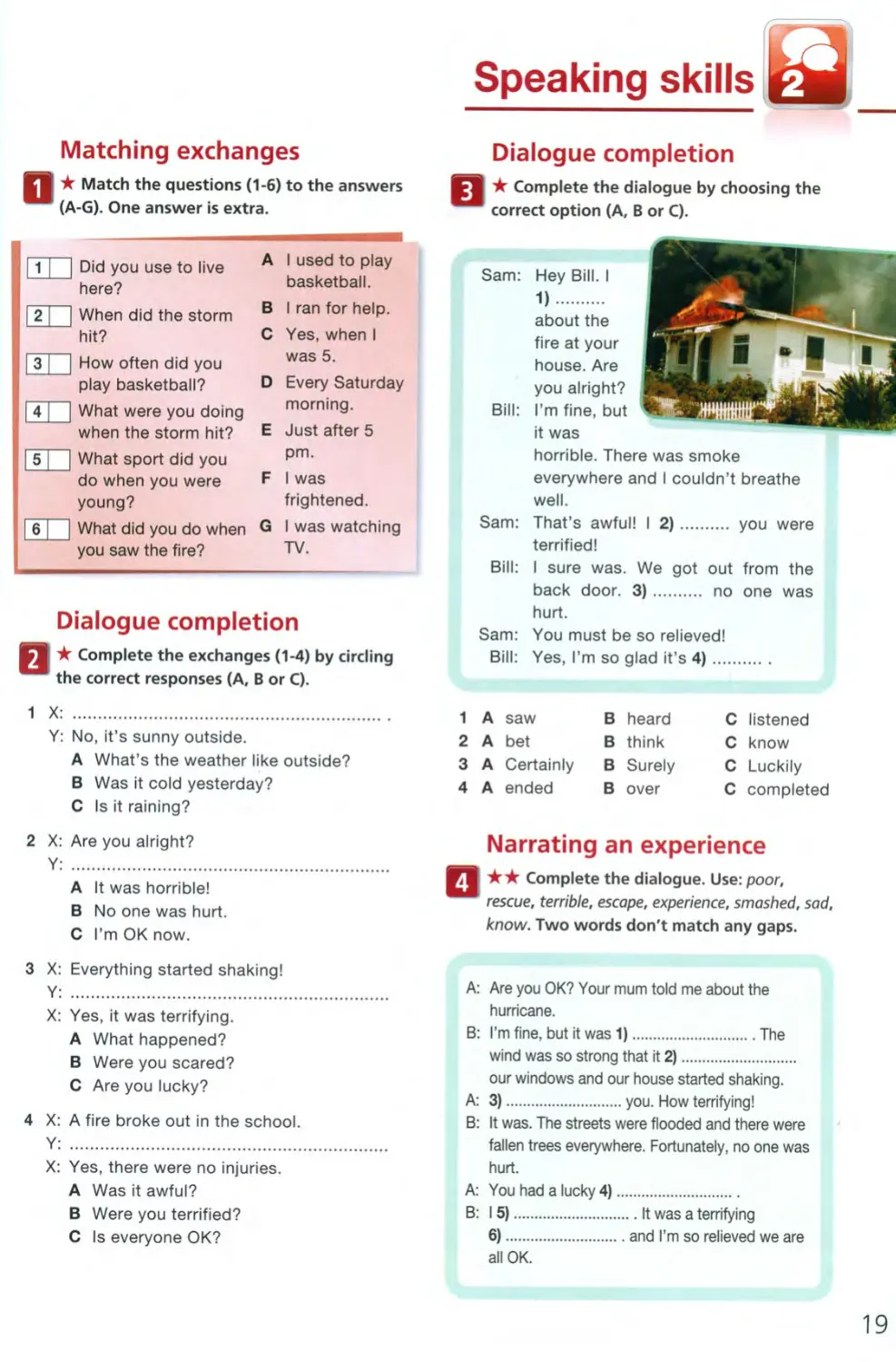
Sam: Hey Bill. I
1)................
about the
fire at your
house. Are
you alright?
Bill: I’m fine, but
it was
horrible. There was smoke
everywhere and I couldn’t breathe
well.
Sam: That’s awful! I 2)............... you were
terrified!
Bill: I sure was. We got out from the
back door. 3)................... no	one was
hurt.
Sam: You must be so relieved!
Bill: Yes, I’m so glad it’s 4)...........
1	A saw	В	heard	C	listened
2	A bet	В	think	C	know
3	A Certainly	в	Surely	c	Luckily
4	A ended	в	over	c	completed
Narrating an experience
rescue, terrible, escape, experience, smashed, sad,
know. Two words don't match any gaps.
A:	Are you OK? Your mum told me about the
hurricane.
B:	I’m fine, but it was 1)...................The
wind was so strong that it 2)....................
our windows and our house started shaking.
A:	3)..................you. How terrifying!
B:	It was. The streets were flooded and there were
fallen trees everywhere. Fortunately, no one was
hurt.
A: You had a lucky 4)......................
В: I 5)......................It	was a terrifying
6).......................and	I’m so relieved we are
all OK.
19
Writing
A story
1
★ Read the rubric, then the story and put
the paragraphs in the correct order.
★ Form adverbs from the adjectives to
complete the sentences: happy, slow, careful,
hard, patient.
Your teacher has asked you to write a short story
about an experience you had while on holiday.
Write your story (50-100 words).
£> Suddenly, I drove into very deep water and the
car stopped. I was stuck! I didn't know what to do
and began to panic. I started beeping the car horn,
but nobody was around to hear it.
After an hour, the emergency services finally
found and rescued me. Even though the car was
badly damaged, I felt so relieved. At least I was safe!
Last year I went on holiday in the English
countryside. One morning, I hired a car to visit
some attractions. I was driving along the road when
it started raining heavily. Then, the streets began to
flood!
2
★ Read the story again. Which paragraph:
contains the events in the order
they happened?
sets the scene?
contains what happened in the
end (feelings)?
1
2
И
★ Replace the adjectives in bold with
synonymous ones from the list: relieved,
1 The cars moved .................. through
the heavy traffic.
2 She waited..................in the queue.
3 The boxer punched his opponent as
....................as	he could.
4 Katie smiled .................. when she
saw her present.
5 He listened..............to their teacher.
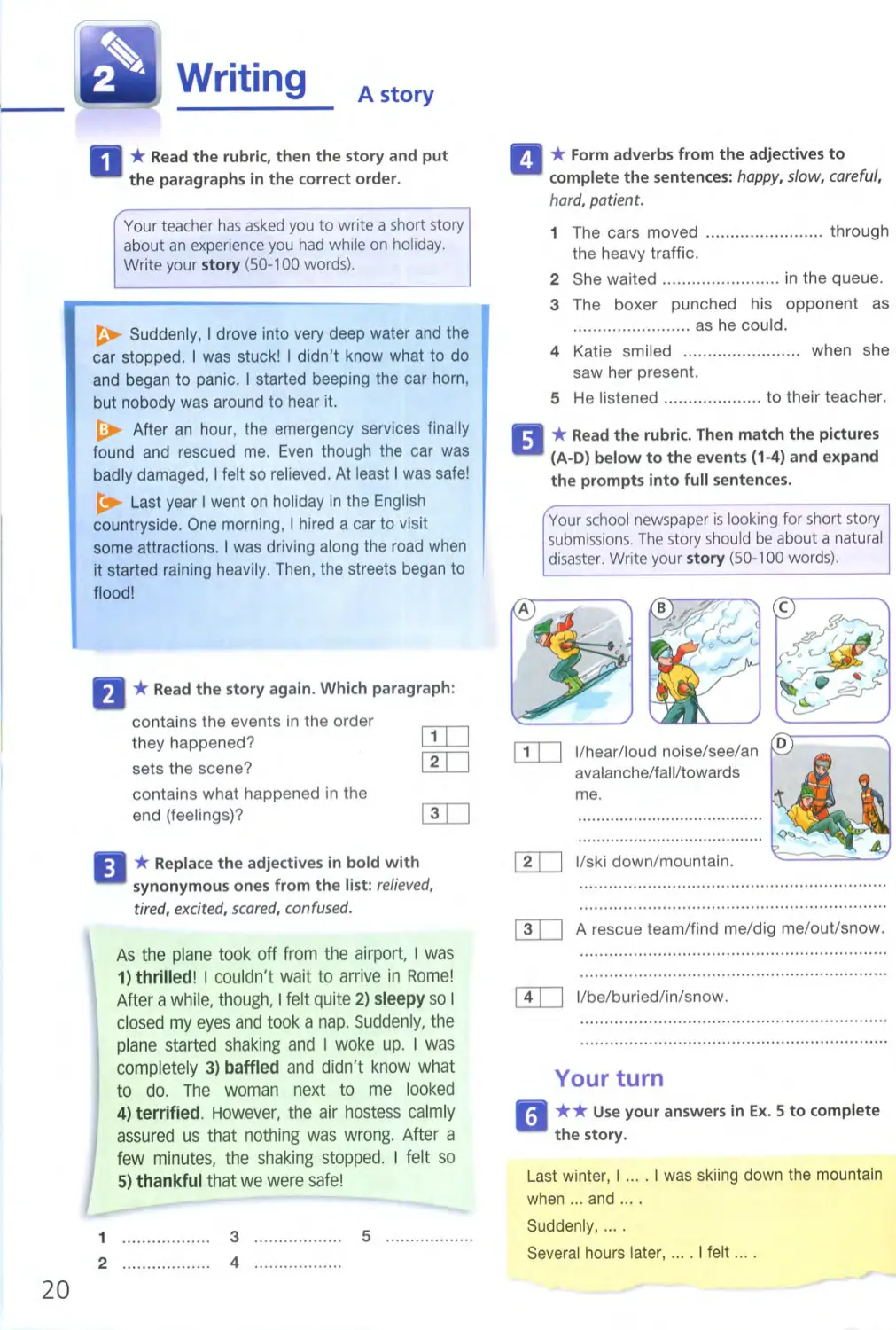
★ Read the rubric. Then match the pictures
(А-D) below to the events (1-4) and expand
the prompts into full sentences.
Your school newspaper is looking for short story
submissions. The story should be about a natural
disaster. Write your story (50-100 words).
l/ski down/mountain.
l/hear/loud noise/see/an
avalanche/fall/towards
me.

tired, excited, scared, confused.
| 3 [ | A rescue team/find me/dig me/out/snow.
As the plane took off from the airport, I was
1) thrilled! I couldn't wait to arrive in Rome!
After a while, though, I felt quite 2) sleepy so I
closed my eyes and took a nap. Suddenly, the
plane started shaking and I woke up. I was
completely 3) baffled and didn't know what
to do. The woman next to me looked
4) terrified. However, the air hostess calmly
assured us that nothing was wrong. After a
few minutes, the shaking stopped. I felt so
5) thankful that we were safe!
1 .............. з	............. 5 .................
2 .............. 4	.............
l/be/buried/in/snow.
Your turn
★ ★ Use your answers in Ex. 5 to complete
the story.
Last winter, I.... I was skiing down the mountain
when ... and ....
Suddenly,....
Several hours later.I felt....
20
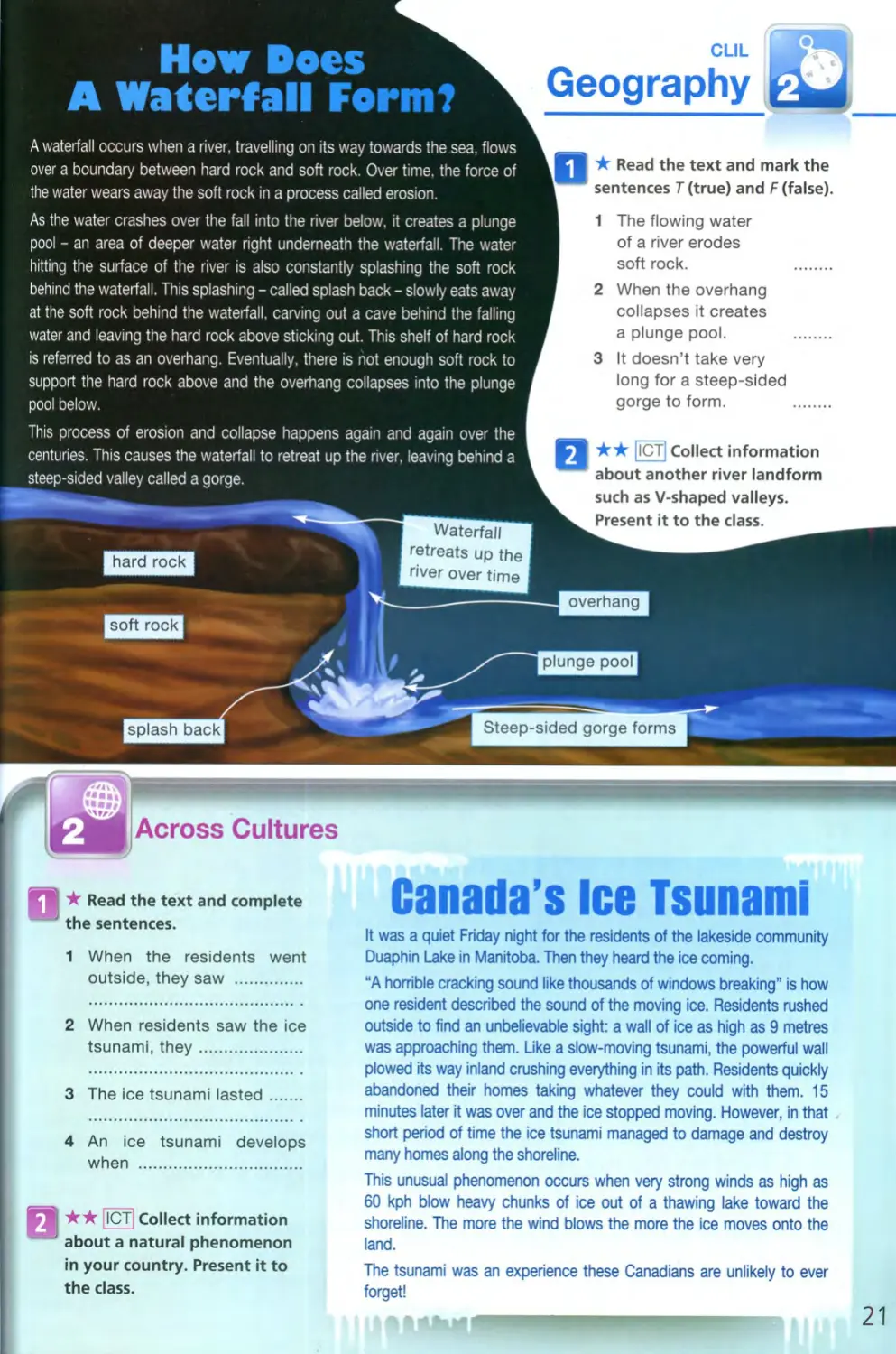
How Does
A Waterfall Form?
CLIL
Geography
A waterfall occurs when a river, travelling on its way towards the sea. flows
over a boundary between hard rock and soft rock. Over time, the force of
the water wears away the soft rock in a process called erosion.
As the water crashes over the fall into the river below, it creates a plunge
pool - an area of deeper water right underneath the waterfall. The water
hitting the surface of the river is also constantly splashing the soft rock
behind the waterfall. This splashing - called splash back - slowly eats away
at the soft rock behind the waterfall, carving out a cave behind the falling
water and leaving the hard rock above sticking out. This shelf of hard rock
is referred to as an overhang. Eventually, there is not enough soft rock to
support the hard rock above and the overhang collapses into the plunge
pool below.
This process of erosion and collapse happens again and again over the
centuries. This causes the waterfall to retreat up the river, leaving behind a
steep-sided valley called a gorge.
★ Read the text and mark the
sentences T (true) and F (false).
1
2
3
The flowing water
of a river erodes
soft rock.
When the overhang
collapses it creates
a plunge pool.
It doesn’t take very
long for a steep-sided
gorge to form.
hard rock
soft rock
Waterfall
retreats up the
river over time
★ ★ |ICT| Collect information
about another river landform
such as V-shaped valleys.
Present it to the class.
overhang
plunge pool
Steep-sided gorge forms
splash back
КЯ ★ Read the text and complete
1 the sentences.
1	When the residents went
outside, they saw ...........
2	When residents saw the ice
tsunami, they................
3	The ice tsunami lasted.....
4	An ice tsunami develops
when ........................
2
★ ★ |ICT| Collect information
about a natural phenomenon
in your country. Present it to
the class.
Canada’s ice Tsunami
It was a quiet Friday night for the residents of the lakeside community
Duaphin Lake in Manitoba. Then they heard the ice coming.
“A horrible cracking sound like thousands of windows breaking" is how
one resident described the sound of the moving ice. Residents rushed
outside to find an unbelievable sight: a wall of ice as high as 9 metres
was approaching them. Like a slow-moving tsunami, the powerful wall
plowed its way inland crushing everything in its path. Residents quickly
abandoned their homes taking whatever they could with them. 15
minutes later it was over and the ice stopped moving. However, in that
short period of time the ice tsunami managed to damage and destroy
many homes along the shoreline.
This unusual phenomenon occurs when very strong winds as high as
60 kph blow heavy chunks of ice out of a thawing lake toward the
shoreline. The more the wind blows the more the ice moves onto the
land.
The tsunami was an experience these Canadians are unlikely to ever
forget!
21
1
Skills
Reading
Use of English
[ Text completion"J
Read the texts below. For each
text (1-4) choose the right
sentence and write the
Read the text below. Complete the gaps
(1-3) with appropriate words (A-F) from the box to
obtain a grammatically and lexically correct text.
appropriate letter (А, В, C, D
or E) in the table. One
sentence is extra and does not
match any of the texts.
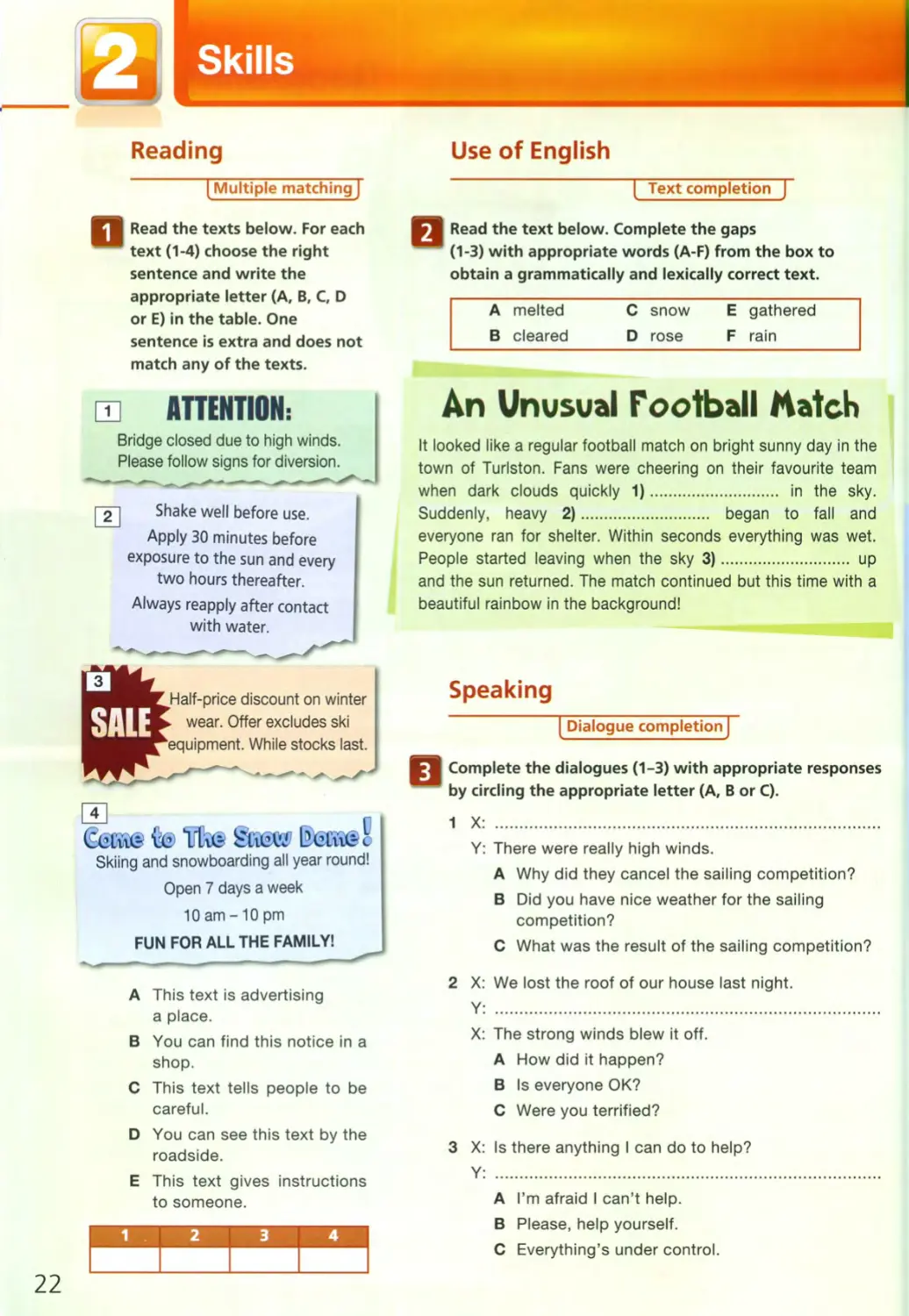
ATTENTION:
Bridge closed due to high winds.
Please follow signs for diversion.
2 Shake well before use.
Apply 30 minutes before
exposure to the sun and every
two hours thereafter.
Always reapply after contact
with water.
Half-price discount on winter
► wear. Offer excludes ski
“equipment. While stocks last.
tU Tlte £li(2W bdiUrc
Skiing and snowboarding all year round!
Open 7 days a week
10 am-10 pm
FUN FOR ALL THE FAMILY!
A This text is advertising
a place.
В You can find this notice in a
shop.
C This text tells people to be
careful.
D You can see this text by the
roadside.
E This text gives instructions
to someone.
12	3	4
A melted
В cleared
C snow	E gathered
D rose	F rain
An Unusual Tootball Match
It looked like a regular football match on bright sunny day in the
town of Turlston. Fans were cheering on their favourite team
when dark clouds quickly 1)...................... in	the sky.
Suddenly, heavy 2)..................... began to fall and
everyone ran for shelter. Within seconds everything was wet.
People started leaving when the sky 3).................... up
and the sun returned. The match continued but this time with a
beautiful rainbow in the background!
Speaking
Complete the dialogues (1-3) with appropriate responses
by circling the appropriate letter (A, В or C).
1 X: ...................................................
Y: There were really high winds.
A Why did they cancel the sailing competition?
В Did you have nice weather for the sailing
competition?
C What was the result of the sailing competition?
2 X: We lost the roof of our house last night.
Y: .....................................................
X: The strong winds blew it off.
A How did it happen?
В Is everyone OK?
C Were you terrified?
3 X: Is there anything I can do to help?
Y: ...................................................
A I’m afraid I can’t help.
В Please, help yourself.
C Everything’s under control.
22
Reading
Matching headings
to paragraphs
KV Read the text and match the
J headings (А-D) with the
paragraphs (1-3). One heading
does not fit any paragraph.
2
Use of English
[Text completion^
Read the text. Complete each gap by using a word from
the box in the correct form. Correct grammar and spelling
is required. There is one extra word.
we
one drive bad slow heavy
A Learning about a Natural
Disaster
В A Great Teacher
C A Critical Warning
D A Lesson Saves Lives
• From: Charles
To: Pierre
• Subject: Stranded!
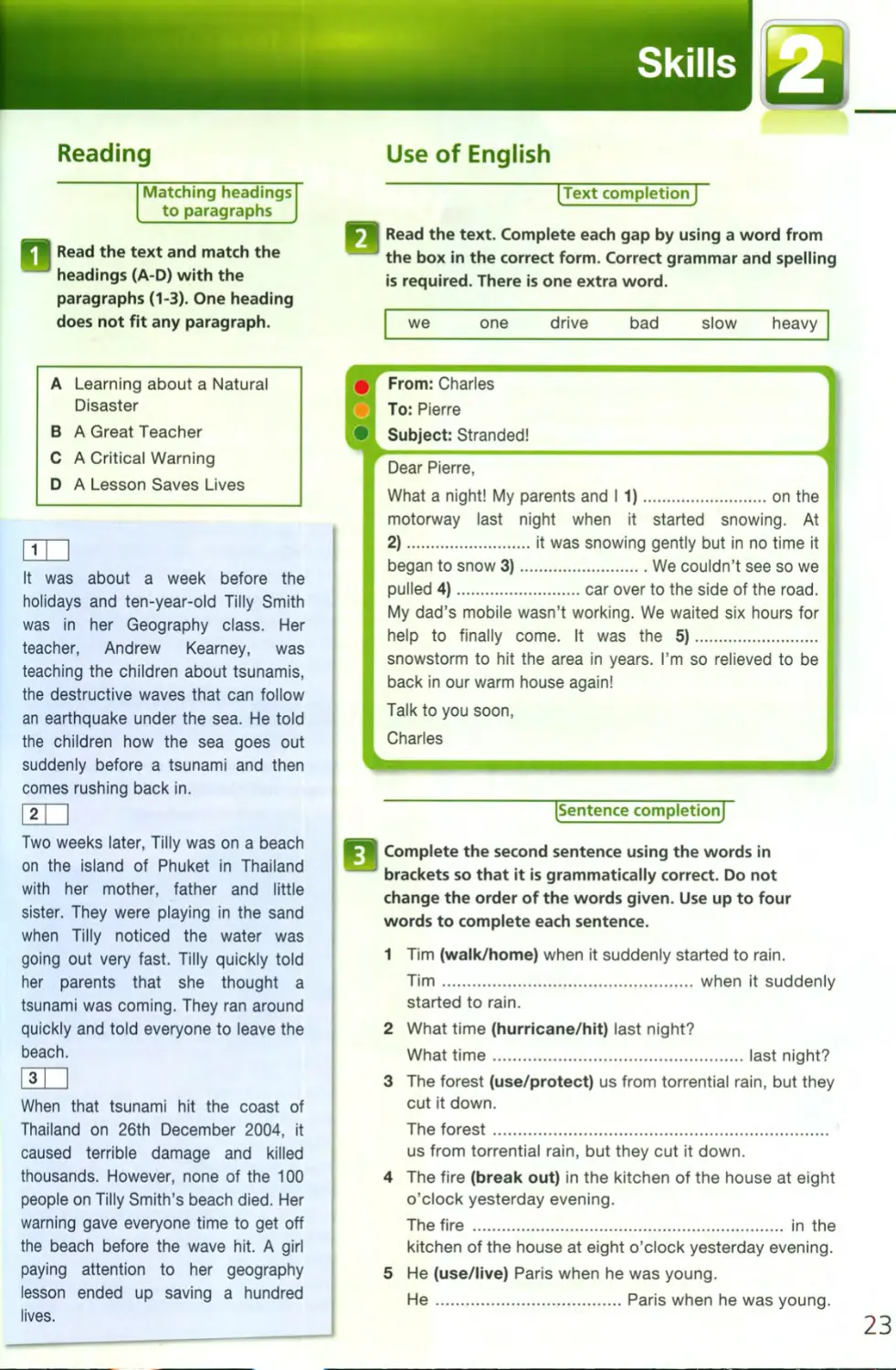
It was about a week before the
holidays and ten-year-old Tilly Smith
was in her Geography class. Her
teacher, Andrew Kearney, was
teaching the children about tsunamis,
the destructive waves that can follow
an earthquake under the sea. He told
the children how the sea goes out
suddenly before a tsunami and then
comes rushing back in.
m
Two weeks later, Tilly was on a beach
on the island of Phuket in Thailand
with her mother, father and little
sister. They were playing in the sand
when Tilly noticed the water was
going out very fast. Tilly quickly told
her parents that she thought a
tsunami was coming. They ran around
quickly and told everyone to leave the
beach.
Ш
When that tsunami hit the coast of
Thailand on 26th December 2004, it
caused terrible damage and killed
thousands. However, none of the 100
people on Tilly Smith’s beach died. Her
warning gave everyone time to get off
the beach before the wave hit. A girl
paying attention to her geography
lesson ended up saving a hundred
lives.
Dear Pierre,
What a night! My parents and I 1)...............on	the
motorway last night when it started snowing. At
2)................it was snowing gently but in no time it
began to snow 3).................We couldn’t see so we
pulled 4)...............car over to the side of the road.
My dad’s mobile wasn’t working. We waited six hours for
help to finally come. It was the 5).....................
snowstorm to hit the area in years. I’m so relieved to be
back in our warm house again!
Talk to you soon,
Charles
(Sentence completion]
3
Complete the second sentence using the words in
brackets so that it is grammatically correct. Do not
change the order of the words given. Use up to four
words to complete each sentence.
1	Tim (walk/home) when it suddenly started to rain.
Tim....................................when	it suddenly
started to rain.
2	What time (hurricane/hit) last night?
What time...................................last	night?
3	The forest (use/protect) us from torrential rain, but they
cut it down.
The forest...........................................
us from torrential rain, but they cut it down.
4	The fire (break out) in the kitchen of the house at eight
o’clock yesterday evening.
The fire ....................................... in	the
kitchen of the house at eight o’clock yesterday evening.
5	He (use/live) Paris when he was young.
He.........................Paris when he was young.
Reading
тд'?*:
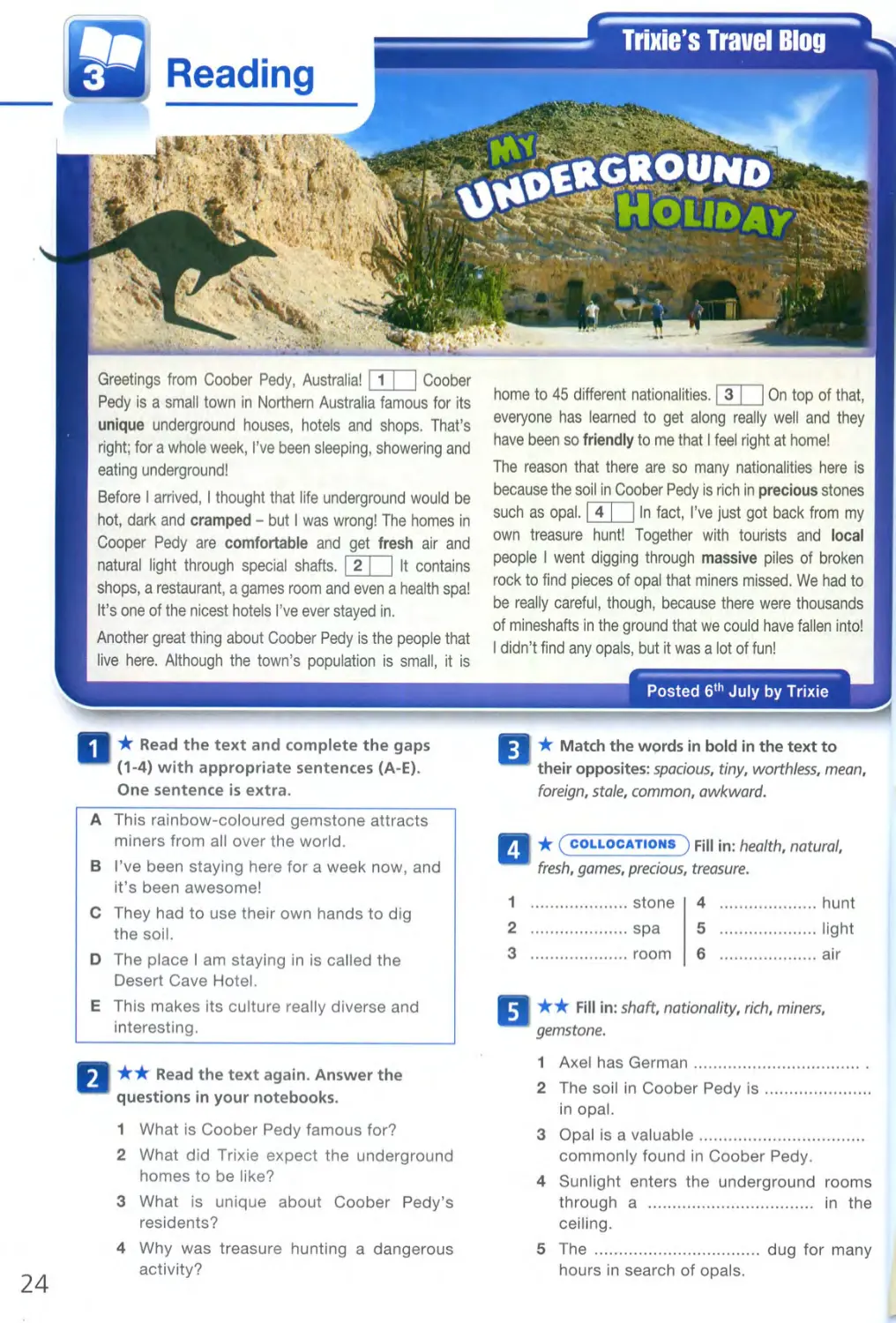
Trixie’s Travel Blog
Posted 6th July by Trixie

Greetings from Coober Pedy, Australia! | 1 | | Coober
Pedy is a small town in Northern Australia famous for its
unique underground houses, hotels and shops. That’s
right; for a whole week, I’ve been sleeping, showering and
eating underground!
Before I arrived, I thought that life underground would be
hot, dark and cramped - but I was wrong! The homes in
Cooper Pedy are comfortable and get fresh air and
natural light through special shafts. | 2 | | It contains
shops, a restaurant, a games room and even a health spa!
It’s one of the nicest hotels I’ve ever stayed in.
Another great thing about Coober Pedy is the people that
live here. Although the town’s population is small, it is
home to 45 different nationalities. | 3 | | On top of that,
everyone has learned to get along really well and they
have been so friendly to me that I feel right at home!
The reason that there are so many nationalities here is
because the soil in Coober Pedy is rich in precious stones
such as opal. [ 4_O 'n ^act' l've iust 90t back from my
own treasure hunt! Together with tourists and local
people I went digging through massive piles of broken
rock to find pieces of opal that miners missed. We had to
be really careful, though, because there were thousands
of mineshafts in the ground that we could have fallen into!
I didn’t find any opals, but it was a lot of fun!
n ★ Read the text and complete the gaps
(1-4) with appropriate sentences (A-E).
One sentence is extra.
★ Match the words in bold in the text to
their opposites: spacious, tiny, worthless, mean,
foreign, stale, common, awkward.
A This rainbow-coloured gemstone attracts
miners from all over the world.
В I’ve been staying here for a week now, and
it’s been awesome!
C They had to use their own hands to dig
the soil.
D The place I am staying in is called the
Desert Cave Hotel.
E This makes its culture really diverse and
interesting.
★ (collocations ) Fill in: health, natural,
fresh, games, precious, treasure.
1 ............stone	4
2 ............spa	5
3 ............room	6
..............hunt
..............light
..............air
gemstone.
2
★ ★ Read the text again. Answer the
questions in your notebooks.
1	What is Coober Pedy famous for?
2	What did Trixie expect the underground
homes to be like?
3	What is unique about Coober Pedy’s
residents?
4	Why was treasure hunting a dangerous
activity?
1	Axel has German.....................
2	The soil in Coober Pedy is..........
in opal.
3	Opal is a valuable..................
commonly found in Coober Pedy.
4	Sunlight enters the underground rooms
through a ...................... in the
ceiling.
5	The..................... dug	for many
hours in search of opals.
Vocabulary
Holidays
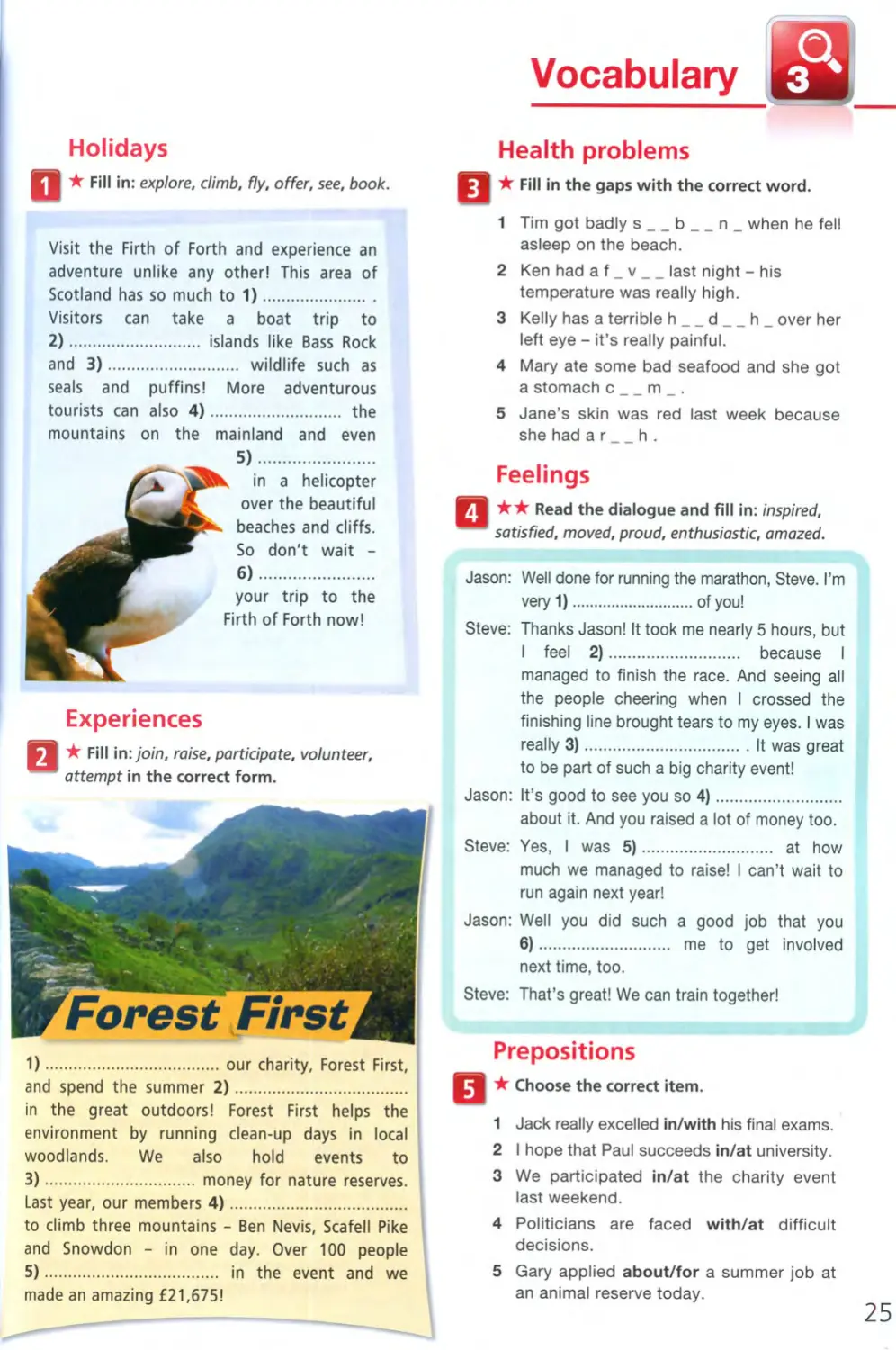
★ Fill in: explore, climb, fly, offer, see, book.
Health problems
★ Fill in the gaps with the correct word.
Visit the Firth of Forth and experience an
adventure unlike any other! This area of
Scotland has so much to 1).................
Visitors can take a boat trip to
2).................. islands	like Bass Rock
and 3)................... wildlife	such as
seals and puffins! More adventurous
tourists can also 4)................... the
mountains on the mainland and even
5)................
in a helicopter
over the beautiful
beaches and cliffs.
So don't wait -
6)................
your trip to the
Firth of Forth now!
Experiences
★ Fill in: join, raise, participate, volunteer,
attempt in the correct form.
1).....................our charity, Forest First,
and spend the summer 2)......................
in the great outdoors! Forest First helps the
environment by running clean-up days in local
woodlands. We also hold events to
3)..................money for nature reserves.
Last year, our members 4)....................
to climb three mountains - Ben Nevis, Scafell Pike
and Snowdon - in one day. Over 100 people
5)..................... in the event and we
made an amazing £21,675!
1	Tim got badly s___b__n_ when he fell
asleep on the beach.
2	Ken had a f _ v __ last night - his
temperature was really high.
3	Kelly has a terrible h__d__h_ over her
left eye - it’s really painful.
4	Mary ate some bad seafood and she got
a stomach c _ _ m _ .
5	Jane’s skin was red last week because
she had a r _ _ h .
Feelings
★ ★ Read the dialogue and fill in: inspired,
satisfied, moved, proud, enthusiastic, amazed.
Jason: Well done for running the marathon, Steve. I’m
very 1).......................of you!
Steve: Thanks Jason! It took me nearly 5 hours, but
I feel 2)............................ because I
managed to finish the race. And seeing all
the people cheering when I crossed the
finishing line brought tears to my eyes. I was
really 3)......................It was great
to be part of such a big charity event!
Jason: It’s good to see you so 4).................
about it. And you raised a lot of money too.
Steve: Yes, I was 5)..................... at how
much we managed to raise! I can’t wait to
run again next year!
Jason: Well you did such a good job that you
6).......................... me to get involved
next time, too.
Steve: That’s great! We can train together!
Prepositions
★ Choose the correct item.
1	Jack really excelled in/with his final exams.
2	I hope that Paul succeeds in/at university.
3	We participated in/at the charity event
last weekend.
4	Politicians are faced with/at difficult
decisions.
5	Gary applied about/for a summer job at
an animal reserve today.
4
5
25
Grammar in use
_________g
• Grammar Bank 3
Present perfect vs Past simple
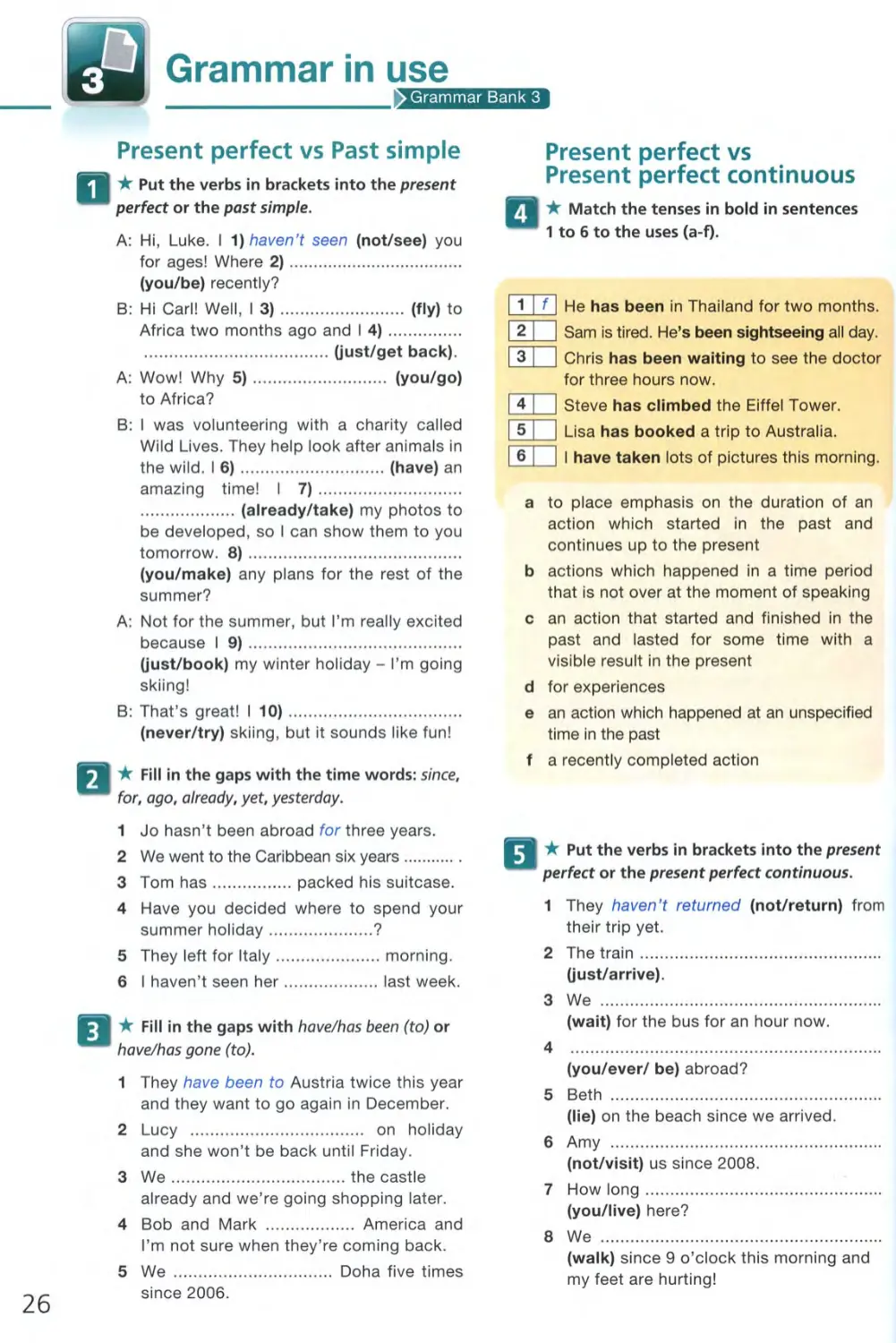
★ Put the verbs in brackets into the present
perfect or the past simple.
Present perfect vs
Present perfect continuous
A: Hi, Luke. I 1) haven't seen (not/see) you
for ages! Where 2).........................
(you/be) recently?
B: Hi Carl! Well, I 3).............. (fly) to
Africa two months ago and I 4)..........
.......................(just/get back).
A:	Wow! Why 5)................... (you/go)
to Africa?
В: I was volunteering with a charity called
Wild Lives. They help look after animals in
the wild. I 6)...................(have) an
amazing time! I 7)......................
............(already/take) my photos to
be developed, so I can show them to you
tomorrow. 8)............................
(you/make) any plans for the rest of the
summer?
A: Not for the summer, but I’m really excited
because I 9)...............................
Qust/book) my winter holiday - I’m going
skiing!
B:	That’s great! I 10).....................
(never/try) skiing, but it sounds like fun!
★ Match the tenses in bold in sentences
1 to 6 to the uses (a-f).
1	f

2

3
4

5

6
He has been in Thailand for two months.
Sam is tired. He’s been sightseeing all day.
Chris has been waiting to see the doctor
for three hours now.
Steve has climbed the Eiffel Tower.
Lisa has booked a trip to Australia.
I have taken lots of pictures this morning.
★ Fill in the gaps with the time words: since,
for, ago, already, yet, yesterday.
a to place emphasis on the duration of an
action which started in the past and
continues up to the present
b actions which happened in a time period
that is not over at the moment of speaking
c an action that started and finished in the
past and lasted for some time with a
visible result in the present
d for experiences
e an action which happened at an unspecified
time in the past
f a recently completed action
1
2
3
4
5
6
Jo hasn’t been abroad for three years.
We went to the Caribbean six years......
Tom has..............packed	his suitcase.
Have you decided where to spend your
summer holiday..............?
They left for Italy..........morning.
I haven’t seen her...........last week.
3
★ Fill in the gaps with have/has been (to) or
have/has gone (to).
1 They have been to Austria twice this year
and they want to go again in December.
2 Lucy ........................ on holiday
and she won’t be back until Friday.
3 We........................the castle
already and we’re going shopping later.
4 Bob and Mark ............. America and
I’m not sure when they’re coming back.
5 We ....................... Doha five times
since 2006.
★ Put the verbs in brackets into the present
perfect or the present perfect continuous.
1 They haven’t returned (not/return) from
their trip yet.
2 The train..................................
(just/arrive).
3 We ........................................
(wait) for the bus for an hour now.
4 ...........................................
(you/ever/ be) abroad?
5 Beth ......................................
(lie) on the beach since we arrived.
6 Amy .......................................
(not/visit) us since 2008.
7 How long...................................
(you/live) here?
8 We ........................................
(walk) since 9 o’clock this morning and
my feet are hurting!
26
Grammar Focus (units 1-3)
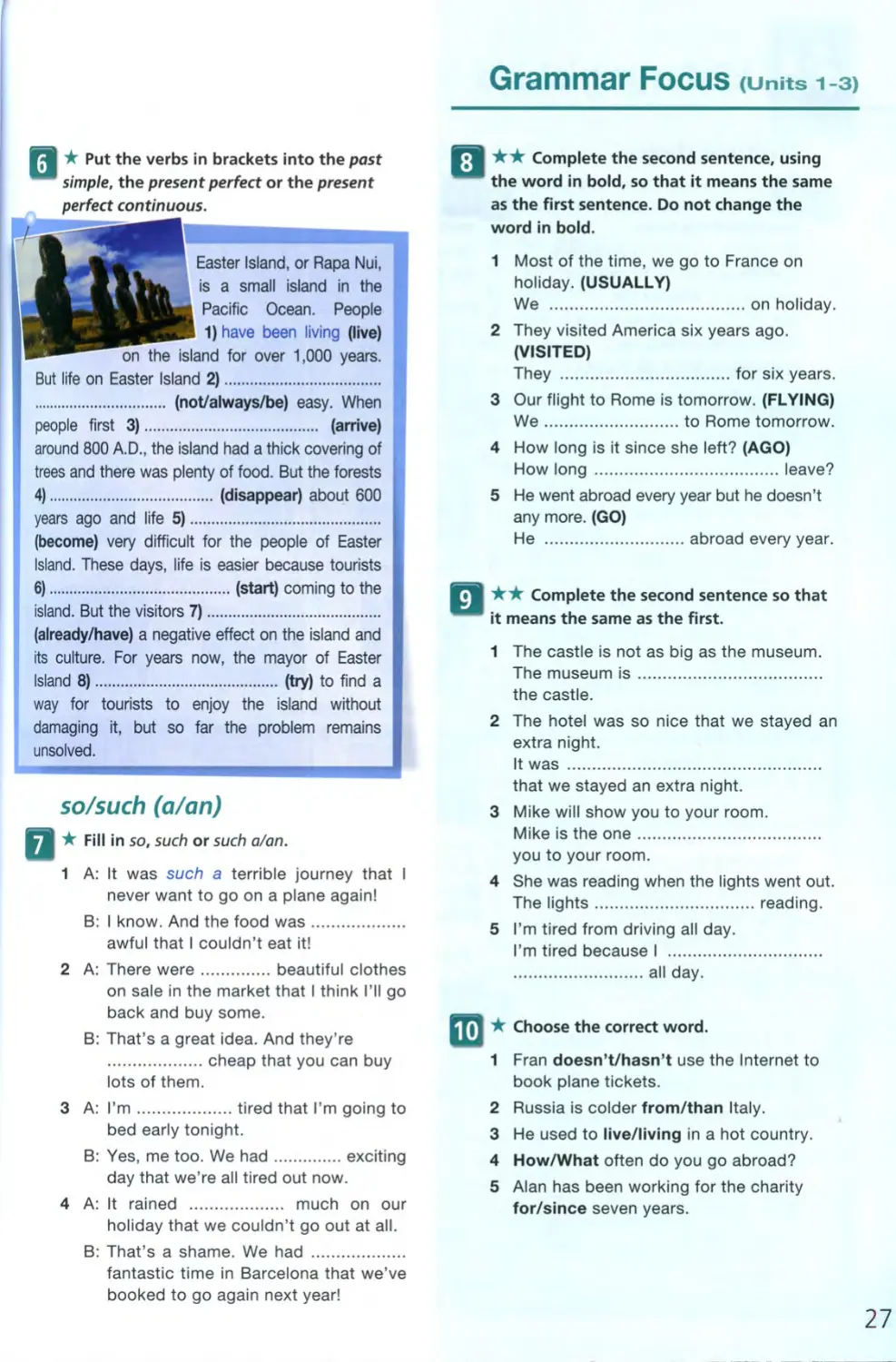
93 ★ Put the verbs in brackets into the past
simple, the present perfect or the present
8
perfect continuous.
Easter Island, or Rapa Nui,
is a small island in the
Pacific Ocean. People
1) have been living (live)
on the island for over 1,000 years.
But life on Easter Island 2).......................
................... (not/always/be) easy. When
people first 3).... (arrive)
around 800 A.D., the island had a thick covering of
trees and there was plenty of food. But the forests
4)........................(disappear) about 600
years ago and life 5)..............................
(become) very difficult for the people of Easter
Island. These days, life is easier because tourists
6)...........................(start) coming to the
island. But the visitors 7)........................
(already/have) a negative effect on the island and
its culture. For years now, the mayor of Easter
Island 8)...........................(try)	to find a
way for tourists to enjoy the island without
damaging it, but so far the problem remains
unsolved.
so/such (a/an)
Ц ★ Fill in so, such or such a/an.
1 A: It was such a terrible journey that I
never want to go on a plane again!
В: I know. And the food was.............
awful that I couldn’t eat it!
2 A: There were.............beautiful clothes
on sale in the market that I think I’ll go
back and buy some.
B: That’s a great idea. And they’re
..............cheap that you can buy
lots of them.
3 A: I’m..............tired	that I’m going to
bed early tonight.
B: Yes, me too. We had...........exciting
day that we’re all tired out now.
4 A: It rained ................ much	on our
holiday that we couldn’t go out at all.
B: That’s a shame. We had ..............
fantastic time in Barcelona that we’ve
booked to go again next year!
10
★ ★ Complete the second sentence, using
the word in bold, so that it means the same
as the first sentence. Do not change the
word in bold.
1 Most of the time, we go to France on
holiday. (USUALLY)
We .........................on holiday.
2 They visited America six years ago.
(VISITED)
They ....................for	six years.
3 Our flight to Rome is tomorrow. (FLYING)
We....................to Rome tomorrow.
4 How long is it since she left? (AGO)
How long.........................leave?
5 He went abroad every year but he doesn’t
any more. (GO)
He ......................abroad	every year.
★ ★ Complete the second sentence so that
it means the same as the first.
1	The castle is not as big as the museum.
The museum is...........................
the castle.
2	The hotel was so nice that we stayed an
extra night.
It was...............................
that we stayed an extra night.
3	Mike will show you to your room.
Mike is the one.........................
you to your room.
4	She was reading when the lights went out.
The lights.....................reading.
5	I’m tired from driving all day.
I’m tired because I ....................
...............all	day.
★ Choose the correct word.
1 Fran doesn’t/hasn’t use the Internet to
book plane tickets.
2	Russia is colder from/than Italy.
3	He used to live/living in a hot country.
4	How/What often do you go abroad?
5	Alan has been working for the charity
for/since seven years.
27
Listening skills
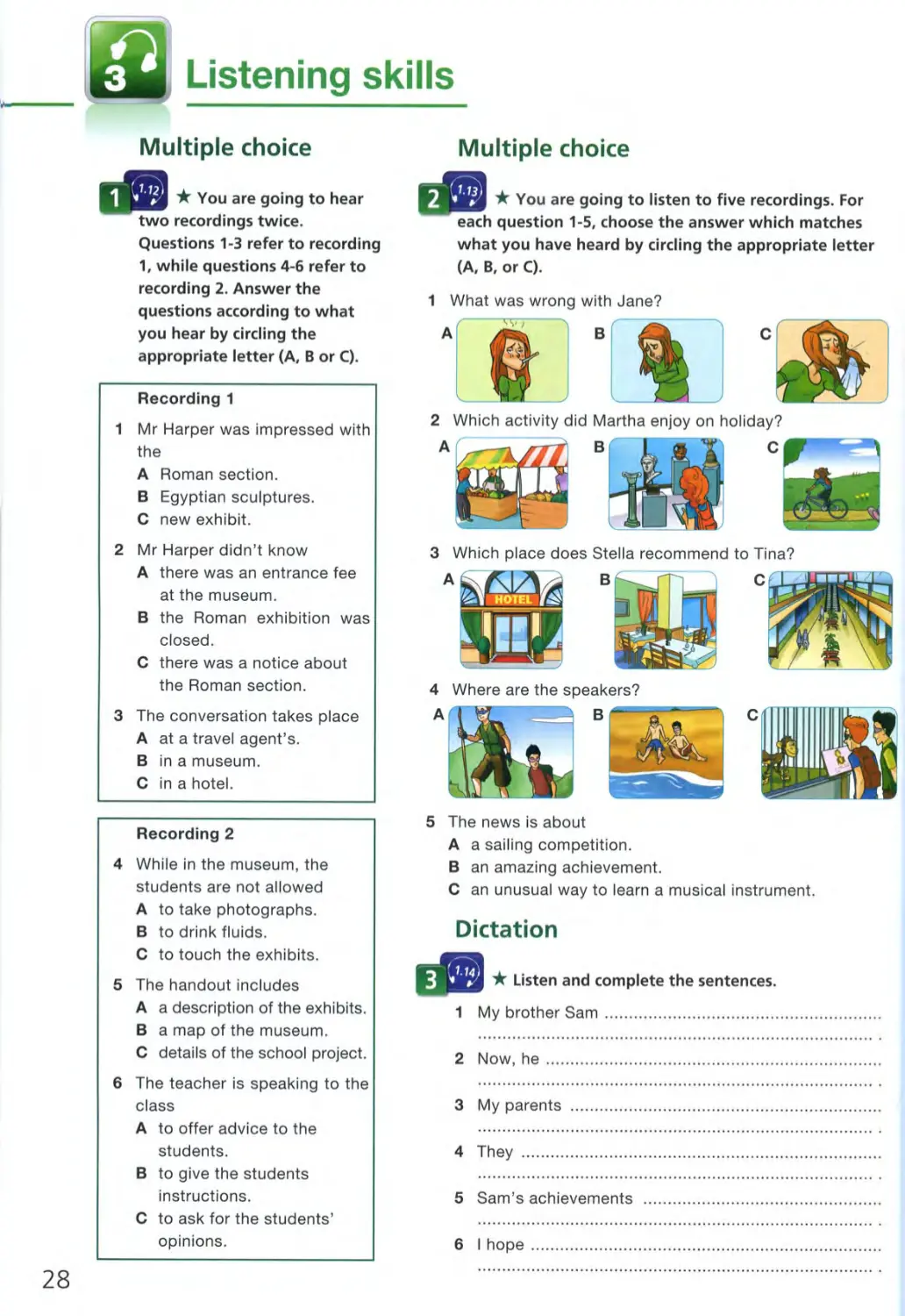
Multiple choice
★ You are going to hear
two recordings twice.
Questions 1-3 refer to recording
1, while questions 4-6 refer to
recording 2. Answer the
questions according to what
you hear by circling the
appropriate letter (A, В or C).
Recording 1
1 Mr Harper was impressed with
the
A Roman section.
В Egyptian sculptures.
C new exhibit.
2 Mr Harper didn’t know
A there was an entrance fee
at the museum.
В the Roman exhibition was
closed.
C there was a notice about
the Roman section.
3 The conversation takes place
A at a travel agent’s.
В in a museum.
C in a hotel.
Multiple choice
★ You are going to listen to five recordings. For
each question 1-5, choose the answer which matches
what you have heard by circling the appropriate letter
(A, B, or C).
1 What was wrong with Jane?
2 Which activity did Martha enjoy on holiday?
3 Which place does Stella recommend to Tina?
4 Where are the speakers?
Recording 2
4 While in the museum, the
students are not allowed
A to take photographs.
В to drink fluids.
C to touch the exhibits.
5 The handout includes
A a description of the exhibits.
В a map of the museum.
C details of the school project.
6 The teacher is speaking to the
class
A to offer advice to the
students.
В to give the students
instructions.
C to ask for the students’
opinions.
5 The news is about
A a sailing competition.
В an amazing achievement.
C an unusual way to learn a musical instrument.
Dictation
★ Listen and complete the sentences.
1 My brother Sam
2 Now, he
3 My parents
4 They
5 Sam’s achievements
6 I hope
28
Speaking skills
Matching exchanges
★ Match the questions (1-6) to the answers
(A-G). One answer is extra.
Dialogue completion
★ ★ Complete the dialogue with the correct
sentences (A-F). One sentence is extra.
1	—	How do you feel?	A	Just last week.
2		Where did you	В	Yes, it was very
	spend your holiday?			good.
LU		Did you enjoy your trip?	C	I have a terrible headache.
Ll	Г	When did you	D	I was in Thailand.
	return?		E	I’m thinking
L=J		What did you do		about doing that.
	there?		F	I worked at an
L?.		Are you taking a gap		animal shelter.
	year?		G	I felt really sad.
Dialogue completion
★ Complete the exchanges (1-4) by circling
the correct responses (A, В or C).
1 X: Did you have a good time?
Y: .....................................
A I’m so amazed.
В It was unforgettable.
C It sounds enjoyable.
2 X: ....................................
Y: I’ve been abroad.
A Where did you go last summer?
В Where have you been all summer?
C Where are you going in the summer?
3 X: When did Sue get back from Spain?
Y: .....................................
X: Why so soon?
A Last week, but she’s going back
tomorrow.
В She’s been there for over a week now.
C She gets back tomorrow morning.
4 X: ....................................
Y: I was a bit depressed.
A What did you do afterwards?
В How did you feel afterwards?
C Where were you afterwards?
A How was it?
В I visited my grandmother in London.
C Where have you been?
D I felt so depressed.
E That’s a great idea.
F I’ll always remember that moment.
Mary: Hi Kate! I haven’t seen you in ages.
1).............................
Kate: Hi Mary. I’ve been volunteering at a
summer camp for the last month. I
was a camp leader.
Mary: Really? 2)......................
Kate: It was an amazing experience! I
worked with disabled children. On
the last day, they performed in a
show. 3)............................ I	felt
so proud of them.
Mary: Wow! You must have really enjoyed it.
Kate: I did. The children were really nice. So
what did you do over the holidays?
Mary: 4).....................But I want to
do some voluntary work next year.
Kate: 5).....................It’s well
worth it!
Discussing an experience
★ ★ Complete the dialogue. Use: moment,
time, regret, proud, impressed, idea, like, sounds.
Two words don't match any gaps.
A:	What did you do during the summer?
В:	I volunteered at the local youth theatre.
A:	What was it 1)................?
В:	I had the 2)..................of	my life! I taught
the kids a play which they performed at the end of
the workshop. That was a(n) 3)..................
I’ll never forget.
A:	It 4).................. like	you had a great
summer!
В:	I did. I was so 5)................... by	all the
kids. They were really talented!
A:	Wow! I think I might do some voluntary work next
year.
B:	You should! You won’t 6)............it!
29
Writing
A semi-formal letter
О ★ Read the rubric and the letter and replace
the informal phrases in bold (1-8) with the
semi-formal ones (A-H).
3
★ Read the extract and find two grammar
mistakes, two punctuation mistakes and
two spelling mistakes.
Д/ + 5
42+x=5
:7+a?
/+x=45
4? + 5
You recently sat your Maths exam after
receiving private tuition from your teacher,
Miss Baxter. Write a letter thanking her for her
support. Mention what you enjoyed about her
tuition, how it helped you and invite her to a
meal with your family (50-100 words).

Thank you for your invitation to the diner party. I would
be delighted to join you. My train arrive at the station at
7pm. Could you please give me directions to your house.
Also, I would like bringing a gift for your parents. Is their
anything you could suggest? Perhaps flowers chocolate
or a cake? Please let me know. -
1)	Hi Miss Baxter,
2)	I thought I’d drop you a line to thank
you for tutoring me.
3)	Thanks a bunch for helping me prepare
for my exam. I 4) really liked the exercises we
did together. They were an excellent learning
tool.
Overall, your tuition 5) did a lot for my
Maths. I feel that I 6) got a lot better. I'm
confident I passed my exam.
[»> I told my parents about your help and they
send their regards. They 7) want you to come
over for dinner next Friday.
8) Just let me know if you can join us.
Thank you once again.
Best wishes,
Daniel Hunter
★ Read the rubric and expand the prompts
into full sentences. Then match them to the
main body paragraphs.
"You have just returned from a youth summer
camp. Write a letter to Mr Evans, your camp
leader, thanking him for his efforts. Mention
what activity you liked best, how the camp has
improved your confidence and invite him for a
meal with your family (50-100 words).
1 l/feel/more/comfortable/meet/new people
2 l/especially/enjoy/go/sailing
3 My mother/invite/you/lunch/next Saturday
[A [^] was extremely helpful
| В ]^] I am writing
f~C ] | Please write back to inform me
I PI I Dear
[E || particularly enjoyed
| F | | have invited you
G | | I really appreciate you
I н О improved significantly
Para 2: What activity you liked best ...........
Para 3: How it improved your
confidence	......
Para 4: Invitation	.......
Your turn
★ Which paragraph (A-E) contains:
| 1 | | closing remarks?
| 2 | | opening remarks, reason for writing?
| 3 | | how helpful the tuition was?
| 4 [ | an invitation?
| 5 | | what Daniel enjoyed most?
5
★ ★ Use your answers in Ex. 4 to complete
the letter to your camp leader.
Dear Mr Evans,
I am writing to ....
I am so grateful for.... I especially enjoyed ...
Overall, the camp .... I feel....
I told my parents .... They ...
Please write back .... Thank you.
Best wishes,
30
еэт
the good, the bad and the ugly!
Microbes are everywhere! They live
around us, on us and inside us. We
can’t see them but they are there.
There are good microbes that help
you fight diseases and keep you
healthy. Some microbes, however,
are bad and can make you sick
causing diseases. Here are three
main groups of microbes.
o Bacteria: These are very clever
microbes that can live and
reproduce outside a living
organism. Bad bacteria can
cause infections like sore throats
and ear infections. Good
bacteria help our bodies to
digest food. Scientists use
How can you protect yourself from bad microbes?
Harmful microbes can pass from one person to another in different ways. They can
travel in the air and can also spread through touch. So wash your hands with soap
often and cover your mouth when you cough or sneeze to avoid spreading microbes.
By being careful you can keep those bad and ugly microbes out of your life!
The World
of
Microbes
bacteria to produce medicine
like antibiotics and vaccines to
fight diseases.
Q Viruses: These are simple
microbes that can't do much on
their own. They need a living
organism to survive. Once a virus
is inside your body it can spread
quickly and make you sick.
© Fungi: These are microbes that
grow almost everywhere,
especially warm and damp
places. Fungi feed off of living
organisms. They can grow
inside the body and also on the
skin and nails.
CLIL
Science
1
complete the sentences.
1	Microbes are everywhere
but they are so small we
2	Bacteria cannot survive
in.......................
3	Not all bacteria are
4	Viruses cannot survive
5	Fungi often grow in
6	Dirty hands pass ......
2
★ ★ Read the text again.
In pairs ask and answer
questions based on it.
A:	What do good microbes
do?
B:	They help us fight
diseases.
D
F
A
В
Read the text and use these
words to complete it. Three
words are extra.
★ ★is there a group in your
country that helps the
community? What do they do?
Collect information and
present it to the class.
action
E carefully
effect
built
part
C seriously
Across Cultures
Today in America, more and more children are spending less time
playing outdoors. This is having a terrible effect on their health,
school performance and overall well being. One group has taken this
problem 1)...............and is trying to create a great place to
play within walking distance of every child in America. KaBOOM! started
in Washington D.C. in 1985. Since then this group has 2)........
2,000 play spaces including playgrounds, ice rinks, skate parks and athletic
fields across America. KaBOOM! helped build 100 new playgrounds along
the gulf coast after Hurricanes Katrina and Rita struck the area. But it’s not all
about just playing, KaBOOM! projects create a sense of community spirit
that drives residents to take 3)................ and improve their
neighbourhoods. It’s about getting involved and having fun at the same time.
Skills
Reading
[ Multiple choice j
1
Read the texts. For questions
1-4, choose the correct option A, В or C.
Hi Christina,
I’m having a great time working here in
Australia this summer. Even though I’ve
been working hard all week, I’ve also had
time to take weekend trips to see
Australia’s wild side. In fact, I ve just
come back from visiting Black Mountain
where I explored dangerous tunnels and
caves. It was an amazing experience!
Can’t wait to see you.
1 Jenny is describing
A her working activities.
В her plans for the coming weekend.
C details of a place she visited.
2 Maggie wants to know
A whether Linda is going to visit her.
В when Linda’s flight is arriving.
C if Linda needs a lift from the airport.
3 Steven wrote the text message
A to tell David where he is.
В to change a meeting.
C to invite David over.
4 The Turtle Bay Resort is offering customers a
discount
A all year round
В only in the summer
C for one month a year.
Jenny
From: Maggie
To: Linda
Subject: Holiday
Hi Linda,
I’m so pleased that you are coming to visit us
next month. Don’t forget to send me your flight
details so I can arrange for John to pick you up
at the airport. I’m so excited! I can’t wait to see
you.
Write back soon
Maggie
David,
I'm not feeling well. I've been in bed all day with a
terrible cold. I can't come over to help you study
today. How about meeting on Saturday?
Thanks
Steven
Welcome to Turtle Bay Resort
The Turtle Bay Resort offers customers breathtaking
surroundings and warm hospitality all year round.
Take advantage of our summer water sport activities
from scuba diving and water skiing to snorkeling.
Special rates available throughout October. A holiday
adventure not to be missed!
Speaking
[ Responding to situations J
For each situation (1-3), choose the
appropriate response (A, В or C).
1 Your friend is back from a trip. Ask them
if they enjoyed it.
A What was the trip?
В Where have you been?
C How was the trip?
2 How do you ask about the departure time
of a flight?
A How long is the flight?
В What time does the flight leave?
C When does the flight arrive?
3 Your friend wants to donate some money
to help out a local charity. How do you
respond?
A It’s a great experience!
В It sounds like fun!
C That’s a great idea!
32
Skills
Reading
Use of English
(Text completion [
KB Read the information about three people (1-3) and the four
holiday adverts (А-D). For each person choose the option
2
Read the text and complete
the gaps (1-5) with appropriate
that suits them best. One option is extra.
words from the box in the
correct form. One word is
works in a sports centre as a personal trainer.
He is always active, but when he goes on
holiday he wants to take it easy! Ideally, he
would like to go somewhere quiet and warm
where he can chill out and read a good book.
extra.
she	ticket	particular
visit	travel arrive
works as a travel photographer. She loves her job and
wants to see as many places as possible. She
especially enjoys taking photos of nature, but doesn’t
like doing anything too exhausting!
Amanda
a high level of
on adventure
is a really sporty person. She has
fitness and is particularly keen
sports. When she goes on holiday, she wants to
do something exciting. She dislikes hot climates
so often travels in the winter.
Inbox Sent
From: Jess
To: Sandy
Subject: London
Hi Sandy!
How are you? We 1)............
in London yesterday morning.
It’s such a great city! So far, we
2)---------------
Buckingham Palace and the
National Gallery. The
paintings in the gallery
were 3)...............
impressive; I wish you
could have seen them!
Tonight, I am going to the
theatre with my
cousin, Emily.
4)...............
friend is performing
in a play so she got
us some free
5)..............
I’m really looking
forward to it! How
are you enjoying
Rome? Write
back and tell me
your news!
Jess
I t has been called the largest heist in history. Leonardo
I Notarbartolo and his gang stole over $100 million in
gems from the Diamond Centre in Antwerp, Belgium. But
how did they break through some of the toughest security in
the world?
It wasn’t something they planned overnight. 1 j ’ In
2000, he rented an office in the Diamond Centre, giving him
access to the building. He then made copies of the master
keys and studied the centre’s alarm system. All the thieves
had to do was wait for the perfect moment. Then, in
February 2003, it arrived.
The centre was host to the Diamond Games Tennis
Tournament, an event which attracted celebrities from all
across the world. With everybody distracted, the gang set
their plan in motion. | 2 | | Then to avoid being seen by the
security cameras, they stole the CCTV video tapes and
replaced them with footage that had been recorded earlier.
When they were ready, the gang approached the diamond
vault. Fixed to the door were two magnetic plates which
would trigger the alarm when separated. But the gang had
been preparing for this. | 3 | | Then, they unbolted the
plates and moved them away from the door. This meant
that the thieves were free to enter the vault unnoticed. They
collected the diamonds and made their escape.
Although the thieves got away, Notarbartolo made a
careless mistake. While escaping, he had disposed of a
bag containing tools and other evidence by the roadside.
Inside the bag were the leftovers from his lunch: a half-
eaten sandwich. | 4 I He received a 10-year prison
sentence and a $1.3 million fine. However, police never
found the stolen diamonds. To this day, their location
remains a secret - perhaps forever?
★ Read the text and complete the gaps (1-4)
with appropriate sentences (A-E). One
★ Match the words in bold in the text to
their synonyms.
sentence is extra.
A With that, the preparations had been
completed.
В They stuck a strip of aluminium onto the
plates, holding the magnets together.
C This gave investigators the DNA
evidence they needed for Notarbartolo’s
arrest!
D They entered the building’s restricted
areas and turned off the alarm system.
E In fact, Notarbartolo had been preparing
the heist for three years.
★ ★ Fill in: through, off, in, away, of, to.
★ ★ Read the text again. Answer the
questions.
1 How did Notarbartolo gain access to the
Diamond Centre?
2 In what way did the Diamond Games
Tennis Tournament help the gang?
3 How did the gang bypass the alarm
system on the vault?
4 How did the contents of the bag help
investigators catch Notarbartolo?
5 What is the purpose of the text?
• split up • safe • penalty • stars
• set off • clues • error • occupied
ir collocations Fill in: camera, system,
vault, key, sentence, area, tournament, plate.
1 alarm .............
2 diamond ...........
3 restricted ........
4 prison ............
5 security........
6 tennis..........
7 magnetic........
8 master .........
1 The Diamond Centre was host ......
a major sporting event.
2 While the tournament was on, the gang
set their plan........motion.
3 Notarbartolo disposed .......... his	bag
at the side of the road.
4 The gang managed to break ...............
security.
5 The thieves got..........from the scene
of the crime.
6 The gang turned .............. the	alarm
system before entering the vault.
34
Vocabulary
Breaking the law
Safety
£ ★ Match the witnesses'descriptions (1-4)
them to the crimes (A-D).
★ ★ Read the safety leaflet and fill in: stay,
avoid, inform, carry, walk.
I saw them
A shoplifting
C vandalism
В car theft
D speeding
2
★ ★ Fill in the gaps with the verbs from the
list in the correct form.
• rob • charge • take • arrest • empty
Man arrested in rental robbery
Yesterday, a young man tried 1).........a
DVD rental shop. He told the cashier
2)...........the till and he 3).........a
couple of films from the shelves. The cashier
asked him to fill out a membership card for the
DVDs, which the thief did. The cashier then called
the police and they 4)..........the thief at
his house. He is appearing in court next week,
5)...........with theft.
Feelings
★ Choose the correct word.
1	Frank felt relieved/worried when the
police found his stolen car.
2	The man was disappointed/surprised to
see his car window smashed and his
bag, which contained money, gone.
3	Julia was too frightened/disappointed
to walk home in the dark.
Be Safe
Be Smart ’
Personal safety is important.
Remember these dos and don’ts!
When you go out:
•	Always 1).........in well-lit areas.
•	Remember to 2)...........your parents where you
are going.
•	Try to 3).........with another person or friends.
•	Make sure to 4)..........a mobile phone with you.
•	Don’t put yourself at risk. 5)......sharing your
personal information with people you don’t know.
5
CaliL
Comm
lions ot v
esi-rar
cUU.
stAHei
The
mall у k
cun into
lo t off)
Dek
ingD
etif
the
★ Underline the correct word.
1	The jury/witness/judge/victim instructed
the lawyers to stick to the facts of the case.
2	My neighbours were annoyed/relieved/
worried/disappointed when they arrived
home and their door was open.
3	The robber/mugger/shoplifter/burglar
grabbed the money and ran out of the
bank.
4	Police arrested the arsonist/criminal/
thief/vandal who had set fire to the
building.
5	You can’t arrest/accuse/commit/sentence
someone of a crime without any evidence.
Prepositions & Phrasal verbs
★ Choose the correct item.
1	The robbers got away from/with £5,000.
2	The defendant’s lawyer appealed to the
court for/about a lighter sentence.
3	She took the shoes without paying to/for
them.
4	Police are asking anyone who knows the
suspect to turn him at/in.
5	Thieves broke in/out the office late last
night and took a lot of equipment.
4 We were so relieved/annoyed about the
vandalism in the park.
6 By/At law, it’s crime to enter someone’s
house and steal their belongings.
35
Grammar in use
__________g
Grammar Bank 4
Past perfect vs Past simple
1
★ Put the verbs in brackets into the past
simple or the past perfect.
Kevin's Blog
Hi guys!
Guess what happened to me? I 1) was (be) in the
garden yesterday when I 2).......................
(hear) voices coming from inside my house. I felt
frightened because I knew that my parents
3).................... (go	out) earlier. Luckily, I
4)..................(take)	my mobile phone into
the garden with me when I 5)................(go)
outside. I remembered that I 6)..................
(install) some new ringtones on it the week before
and one of them was a police siren! I
7).................(turn	on) the sound and, a few
seconds later, two men 8)........................
(dimb) out of the kitchen window and
9)....................(run	off) down the street!
Luckily, the burglars 10)........................
(not/manage) to steal anything before the "police
car" arrived!
2
★ Join the sentences using the words in
brackets, as in the example.
1 They tested the burglar alarm. Then, they
left, (after)
After they had tested the burglar alarm,
they left.
2 The vandals broke the office window.
Then, Mike got to work, (before)
Past perfect vs
Past perfect continuous
★ Put the verbs in brackets into the past
perfect or the past perfect continuous.
1 The shopkeeper was happy because the
police had arrested (arrest) the robbers.
2 The security guards......................
(search) for the prisoner for two hours
before they found him.
3 How long ........................... (the
police/chase) the criminal before they
arrested him?
4 The girl left the shop after she ........
...................(pay)	for the clothes.
5 Marie was worried because the police
................................ (not/find)
her stolen car yet.
★ Put the verbs in bold into the past simple,
the past perfect or the past perfect continuous.
1 A: Jack looked (look) so sad yesterday.
B: Yes, I know. Someone.....................
.....................(just/steal)	his bike.
2 A: .............................. (they/find)
the man guilty yesterday?
B: No, the police......................(not/
collect) enough evidence against him.
3 A: I................................... (see)
your dad on TV last night. He was a great
detective!
B: Yes, he..........................(work)	for
the police for 25 years before he retired.
4 A: ..........................................
(the police/arrive) soon?
B: Actually, no. We.........................
(wait) for half an hour before they turned
up.
3 The house burnt to the ground. Then, the
firefighters arrived, (by the time)
Gerund/lnfinitive
★ Put the verb in brackets into the correct
infinitive or -Ing form.
4 I went to bed. Then, I heard someone
outside, (already ... when)
5 They burgled three houses. Then, they
tried to rob the bank, (after)
1 Mum is trying to convince (convince) my
dad to buy an alarm for the house.
2 He wants.................(be)	a detective.
3 The witness couldn’t ......................
(identify) the robber.
4 It is worth ....................(invest)
in high quality CCTV security cameras.
5 The witness had difficulty in..............
(remember) what the vandals looked like.
36
Grammar Focus (units 1-4)
6
★ Put the verbs in brackets into the correct
infinitive or -ing form.
8
Hercule Poirot is one of Agatha Christie's most well-
known characters. He's a Belgian detective who loves
1) investigating (investigate) mysteries. He's always
busy 2)................... (look)	for clues and he can
3).................(solve) the most difficult crimes.
At the end of each book, Poirot uses evidence
4)................... (reveal)	the identity of the
criminal. Poirot's character was so popular in the
1960s and 70s that, when he died in the novel
Curtain, the New York Times decided 5)..................
(publish) an article about him! Even today, decades
after Agatha Christie wrote her last Poirot story,
millions of people still enjoy 6).......................
(read) about the clever Belgian detective.
★ ★ Complete the second sentence, using
the words in brackets in the correct form.
Do not use more than four words to
complete each sentence.
1	Kelly (look/for) her earrings all day.
Kelly...................her earrings all day.
2	While (he/watch TV), the phone rang.
While.....................  the	phone rang.
3	I (not/see/Bill) since this morning.
I ...................since this morning.
4	Fred (like/he/job) as a lawyer a lot.
Fred .......................................
as a lawyer a lot.
5	He promised (call/me) later.
He promised .........................later.
★★ Complete the second sentence, using the
word in bold, so that it means the same as the
Sentence transformations
★ Complete each sentence with two to five
words, including the word in bold.
1	Henry waited until the burglars had left
before he called the police. (AFTER)
Henry didn’t call the police until after the
burglars had left.
2	After examining evidence for three hours,
she took a break. (BEEN)
She ....................................
for three hours before she took a break.
3	She wouldn’t help the police. (REFUSED)
She............................the police.
4	The man said he didn’t steal the money.
(DENIED)
The man .....................the money.
5	The police didn’t begin investigating the
crime scene until the house had been
sealed. (BEFORE)
The police waited until the house had
been sealed ............................
investigating the crime scene.
6	The judge forced her to pay a fine. (MADE)
The judge ..........................a fine.
7	It’s no use arguing with the police officer.
(SPENT)
There’s no .............................
with the police officer.
10
first sentence. Do not change the word in
bold.
1	As a child, he liked comics. (LIKE)
He .......................comics	as a child.
2	The trial happened in there. (PLACE)
That’s..................the trial happened.
3	It’s the first time I’ve been to court. (NEVER)
I.......................to court before.
4	Being a lawyer isn’t as stressful as being a
judge. (MORE)
Being a judge is ......................
being a lawyer.
5	He feels sorry that he caused so much
trouble. (REGRETS)
He .......................so much trouble.
1	Dennis has finished/had finished work
before the thief robbed his shop.
2	We want to thank/thanking the security
guard for his help.
3	Peter was jogging/jogged in the park
when he saw the vandals.
4	Helen has taken/had taken twenty
pictures of the crime scene so far.
5	It was the bigger/the biggest police
investigation in recent history.
37
Listening skills
Multiple choice
T/F statements
gtfj ★ You are going to listen to five
recordings. For each question (1-5), choose
★ You are going to hear an
announcement. Decide which sentences
the answer which matches what you have
heard by circling the appropriate letter (A,
B, or C).
1 Which car is Miss Kingsley describing?
(1-3) are T (true) and which are F (false).
1 The school library was destroyed
yesterday morning.	......
2 There is graffiti on the library
walls.	......
3 The speaker asks for the students’
help in repairing the damages.................
Matching exchanges
★ You are going to hear four
questions (1-4) twice. Choose the correct
2 Which of the following helped the police?
3 Where would you hear this announcement?
4 Which item was inside the woman’s handbag?
5 The speaker is
A offering safety advice to motorists.
В providing information about an accident.
C discussing the dangers of speeding.
response (A-E) according to what you hear
and write it in the right box. There is one
extra response.
A No, he is so relieved.
В I didn’t get a good look.
C No, he got away.
D I saw him quite clearly.
E He was so frightened.
12	3	4
Dictation
aw ★ Complete the dictation.
1 My friend Tina...........................
2 The police ..............................
3 When the incident occurred, she..........
4 She saw .................................
5 The motorist ............................
6 So he ...................................
7 Tina.....................................
8 But luckily......................................
38
Speaking skills
Matching exchanges
Л| ★ Match the questions (1-6) to the answers
(A-G). One answer is extra.
/
ur	J What time did the incident occur?	A В	20 minutes. 852 9567
HE SZ	| How fast was the driver going? J What was the car’s	C	At least 80 mph.
	registration number?	D	In his forties.
EZ	J How long did the
HI	ambulance take to arrive? J What’s your phone	E F	20 miles. BD76 LJR
EZ	number? J How old was he?	G	5:30 pm.
Responding to situations
2
★ For each situation (1-4), choose the
appropriate response. Circle A, В or C.
1	Describe a suspect to a police officer.
A I saw him quite clearly.
В He was in his late teens.
C He was acting suspiciously.
2	Ask your friend for details of an incident
they witnessed.
A How did you notice?
В What exactly did you see?
C What did you do?
3	How would a police officer ask to
describe a driver of a car?
A Did you get a look at the driver?
В Did you see the driver’s registration?
C Who is the driver?
4	How would a police officer request
further information from a witness?
A Call me if you have anything to add.
В Let me know if you see anything.
C Get in touch if you need anything.
Dialogue completion
★ ★ Complete the dialogue with the correct
sentences (A-F). One sentence is extra.
A Did you get a look at the driver?
В I went to check if the man was alright.
C Can you tell me what you saw?
D Seconds later, it hit a man crossing the
road.
E If you think of any more information, please
let us know.
F I saw him quite clearly.
A:	So, Mr Brown. You were on Rose Street at
11pm on Friday. 1)..............
B:	Well, I had just come out of the cinema when I
saw a car speed past me. 2).............But the
driver just kept going.
A:	Did you see what the driver looked like?
B:	3)......... He was in his late twenties with
short, fair hair and a moustache.
A:	Did you manage to get the car’s registration
number?
B:	Sadly not - it all happened so quickly.
A:	So what did you do then?
B:	4)......... Fortunately he just had a few
bruises, but I contacted the police.
A:	Thank you for your help. 5).........
B:	You’re welcome, Officer. I will.
Discussing a crime
★ ★ Complete the dialogue. Use: seemed,
time, notice, remember, look, tell, call. Two
words don't match any gaps.
A:	You were on Yale Road at 6 pm on Friday. Did
you 1)................anything	unusual?
В:	I was walking down the road when I saw a man
run out of the supermarket.
A: Did you get a 2)............at	him?
В: I couldn’t see that well, but he
3)..............to	be in his late teens.
A: Thank you for your 4).............. If	you
think of anything else, please give us a
5)................
В: I will, Officer.
39
Writing
An informal email giving
an eyewitness account “
★ Read the rubric, then read the email and
match the paragraphs to the headings.
You were in the park when you saw someone
drawing graffiti. Write an email to your English
friend telling him what you saw, and how you
felt (50-100 words).
FEELINGS
WHAT HAPPENED IN THE END
OPENING REMARKS
PLACE AND EVENTS
From:	James
To:	George
Subject:	Graffiti!
Hi George,
How are you? You’ll never guess what I saw yesterday!
I had gone to the local park to read a book. I was
relaxing on the soft grass when I saw a teenage boy with a
can of black spray-paint. He was drawing graffiti on the
clean walls of the park!
[?► Suddenly, two policemen turned up. They chased the
boy across the park and eventually caught him. Then, they
put him into their police car!
[j> It was over within minutes. I was shocked, but I’m glad
he got caught!
Write back and tell me your news.
James
★ Choose the correct word.
1 The robbers were surprising/surprised
when the police officers arrived.
2 I reported the terrifying/terrified incident
to the police.
3 It is worrying/worried to think that crime
is on rise.
4 His behaviour was shocking/shocked.
position. Then, identify the types of adverbs
(manner, degree, place, time, frequency).
1 The police haven’t arrived, (yet)
2 I lock my doors at night, (always)
3 The detective examined the clue, (carefully)
4 The thief got away! (almost)
5 Investigators couldn’t find the stolen
diamonds, (anywhere) ..........................
★ Read the rubric, then expand the prompts.
You witnessed a robbery at a jewellery shop last
week. Write an informal email to your English-
speaking friend explaining why you were there,
what happened and how you felt (50-100 words)
2
★ Which adjectives does the writer use to
describe these nouns?
1 .........park	4
2 .........grass	5
3 .........boy
.........spray-paint
.........walls
★ Put the adjectives in the correct order.
1 a(n) ...........................................
(plastic/cheap/little) toy
2 a(n) ...................................
(short/silk/pink/pretty) dress
3 a(n) ...................................
(young/handsome/English) man
4 a(n) ...................................
(long/dangerous/steel) sword
5 a(n) ...................................
(round/Persian/expensive) rug
1 last Friday/go/restaurant/meet a friend/lunch
2 sit/restaurant/across from/jewellery shop
3 see/man/leave/shop/hold/a bag
4 man/run/away/down/street
5 police/arrive within minutes/chase/man
6 policemen/catch/man
7 feel/relieved
Your turn
D ★ ★ Use your answers in Ex. 6 to complete
the email.
<O О
How are things? You’ll never guess what I
witnessed last week.
Last Friday I.... We were ... when .... He ...
The police .... They ....
It all happened very quickly. We felt....
40
i How Wild was the Wild West?
The Wild West refers to the time in American history when the first settlers
travelled west in hopes of land, gold and a better life. The California gold rush
of 1848 caused mining towns to spring up almost overnight. In the beginning such
settlements didn’t have officers of the law so the residents would settle their
disputes in informal miners' courts. Eventually, the federal government sent
judges and US marshals to administer larger areas. Locally elected sheriffs began
to enforce laws in the towns. Life for the first settlers was hard. They struggled to
live off the land and feed themselves. Most settlers were honest and hardworking
cowboys, farmers and miners. Contrary to western films, few people were actually
involved in gunfights, bank and stagecoach robberies. Fans of Hollywood
westerns may be surprised to know that many western towns had strict gun
control policies, making it illegal to carry guns in the town. In fact, one of the most
1
famous gunfights, the gunfight at O.K. Corral, was over carrying
guns in a town. Deputy Marshal Wyatt Earp and his
brothers confronted a gang over carrying
guns into a town that resulted in the now
famous shootout. Such stories and others of famous
outlaws like Billy the Kid and Jessie James
brought about the idea of a wild
and lawless west that became
CLIL
History E
★ Read the text and
complete the sentences.
1 Towns developed
quickly in the west
because ..........
2 Sheriffs were
responsible to
3 In most towns it was
illegal to ...................
The gunfight at O.K.
Corral was due to ..
4
part of American folklore that has
lasted over time.
Across Cultures
Щ ★ Read the text again and
J mark the sentences T (true),
F (false).
1	Chandler quit his job
at an oil company to
become a writer. ............
2	Chandler’s first story
was successful. .............
3	Phillip Marlow was
Chandler’s most
popular character. ..........
4	Chandler used Los
Angeles for the setting
of many of his stories.......
the Words of Raymond Chandler
American
American crime stories just wouldn't be the same
without Raymond Chandler. Chandler set the standard in American
crime fiction, bringing a quality and depth it hadn't seen before.
2
★ ★ [ICT What famous writers
are from your country? Collect
information about one of
them and what they write
about. Present it to the class.
In 1932, at the age of 44, Raymond Chandler decided to become a
crime fiction writer after losing his job as an oil company executive
during the Depression. His decision turned out to be a wise one
indeed, as a popular crime magazine published his first short story
‘Blackmailers Don’t Shoot’. In 1939, Chandler wrote his first novel,
‘The Big Sleep’, featuring the detective who would become his most
famous character - wisecracking private eye - Philip Marlowe who
had to deal with crime on the tough streets of Los Angeles. Chandler
gave his readers an unforgettable portrait of Los Angeles - “a city
where lawlessness mixed with luxury and dreams”. His fascinating
detective Philip Marlowe soon became a true American Classic.

Reading
Use of English
1
Read the texts below. For every text (1-4)
choose the right sentence and write the
2
Read the email. Complete the gaps with the
appropriate expressions (1-3) by circling
appropriate letter (А, В, C, D or E) in the
A, В or C.
table. One sentence is extra.
Q_____________STAFF WANTED_____________
Security guards needed to work in a busy
shopping centre. Candidates must be
prepared to work long hours. Experienced
candidates only. Please send CVs to Kings
Mall, 5 Croft Road, Paisley PA1 9QA.
To set the combination for this briefcase, hold
down the reset button on the back of the lock.
Then, choose a new set of combination
numbers and release the button.
Due to a recent injury, Mr Edwards has
cancelled his self defence classes until further
notice. We apologise for any inconvenience
this has caused you.
• From: Terry
To: Sandy
• Subject: Embarrassing day!
j Hi Sandy,
a I feel like such a fool! Yesterday, I was shopping I
I at Camden Market in London when I found a great I
I souvenir for my dad. So, I reached for my wallet to I
I check if I had enough money 1).........it and it I
I was gone! I panicked and started to scream. I saw I
J a policeman and ran 2).........to him to report I
I it. While he was writing his report, my friend Louise I
I called to tell me I 3)......... my	wallet at the I
I hotel. How embarrassing!
S Write soon,
I Terry
1	A	buy	В	to buy	C	buying
2	A	around	В	in	c	over
3	A	had left	В	left	c	was leaving
Attention All Shoppers
Speaking
For your safety, we remind you to
mind your personal belongings while
shopping. A closed circuit camera
monitors the shop all times.
Thank you
[ Dialogue completion]
This text...
A informs people about a change
in schedule.
В gives directions to a specific place.
C gives instructions.
D warns people to be careful.
E invites a response.
12	3	4
Read the dialogues (1-3). Complete the
dialogues 1-3 with appropriate responses by
circling the appropriate letter (A, В or C).
1	X: It was very kind of you to do that.
Y: .........................................
A Thank goodness. В Too bad.
C Don’t mention it.
2	X: ........................................
Y: I didn’t really notice.
A What exactly did you see?
В What did you do?
C What did they look like?
3	X: I like reading crime novels.
Y:..........................................
X: I hope so.
A Then you’ll love this one.
В Well, I can’t stand them.
C I’d rather watch a film.
42
Reading
Use of English
Matching headings
to paragraphs
KH Read the text and match the
J headings (А-D) with the
paragraphs (1-3). One heading
does not fit any paragraph.
[Text completion]
Read the text. Complete each gap by using a word from
the box in the correct form. Correct grammar and spelling
is required. There is one extra word.
officer rob break they find search
A THE VALUE OF ART
В SOUNDING THE ALARM
C CLEVERLY DISGUISED
D AN UNSOLVED CRIME
MISSING
MASTERPIECES
In the middle of the night on March 18th
1990, two men dressed in police uniforms
rang the buzzer of the Isabella Stewart
Gardner Museum in Boston, USA. They told
security that they had come to investigate a
disturbance, so the guards let them in
without question. But once inside, the
policemen handcuffed and tied them up in
the basement! The men weren’t policemen at
all; they were thieves!
m
The two men then spent over an hour stealing
13 priceless paintings, including work by
Rembrandt, Manet and Vermeer. By the time
the actual police arrived, they were far too
late. The thieves had stolen $500 million
worth of art together with the videotape from
the museum’s security cameras. They had
escaped without a trace.
Police conducted a lengthy investigation, but
despite their efforts they never captured the
thieves nor recovered the stolen paintings.
For now, there are just empty frames where
the paintings once hung; a powerful reminder
of the biggest art heist in history!
фГ From: Kelly
I To: Amy
• Subject: Relieved
Г Amy,
What a day!
When I got to my car this morning, I discovered that I
someone 1)..........into it! The window was broken and I
my briefcase was missing. I called the police and they sent I
two 2).........to my street. I told 3)......... I	didn’t I
have anything valuable in the briefcase. They made a I
report and suggested 4).............. the	bins in the I
neighbourhood. After they left, I looked around and guess I
what? I 5)........it in a bin a couple of blocks away! All I
my papers were still in it.
What luck!
Kelly
[Sentence completion]
3
Complete the second sentence using the correct form of
the words in brackets. Do not change the order of the
words. Add any words that are necessary.
1	The policeman looked tired because he (work) on the
case all day.
The policeman looked tired because he ...................
...............on the case all day.
2	The witness was (frighten/talk) to the police.
The witness was.............................................
to the police.
3	By the time the police arrived, the bank robber (escape)
the window.
By the time the police arrived, the bank robber ........
...............the window.
4	The security guard (not/like/work) the night shift.
The security guard .........................................
the night shift.
5	Karen (think/install) a burglar alarm.
Karen......................................a burglar alarm.
43
Reading
your airport virtual assistant!
Building a
Airports can be stressful and confusing places. The queues, the crowds, and the
complicated security rules can make you wish you had just stayed at home! However, in
the future there will be high-tech help available. Introducing AVA: the Airport Virtual
Assistant!
So what exactly is AVA? Well, it is actually a holographic image of a real person. To
create the hologram, the manufacturers videotape a person speaking and then project
the film onto a plastic screen. The result is a moving, three-dimensional image which
users can interact with. It's science fiction come to life!
If approached by a member of the public, AVA responds by giving general
information and security advice. According to the manufacturer, though, the help
that AVA will give will be much more advanced. AVA is going to have voice
recognition and will be able to answer traveller's questions directly. Even though it
only speaks English right now, the manufacturer also plans to introduce
multilingual assistants who will respond in numerous languages.
So what does this mean for real-life staff? The manufacturers say that virtual
assistants free-up employees to do more varied and interesting jobs. What's more,
AVA is not limited to airport use only. In fact, the makers are already expanding their
range of holograms for hospitals, offices, shops and museums. So could AVA soon be
commonplace? It seems that in the near future, virtual reality will soon become a
reality!
★ Read the text and for questions 1-3
choose the correct answer.
1	What general impression do you get from the
text?
A Air travel is unpleasant and stressful.
В A new invention will improve air travel.
C Virtual reality is exciting and fun.
2	What is the author’s purpose in writing the text?
A to entertain В to inform
C to persuade
3	Which of the writer’s attitudes comes across
the most strongly?
A He is excited about AVA.
В He doesn’t like flying.
C He likes science fiction.
I ★★ Read the text again. Answer the
questions.
1	According the to text, what makes an
airport a stressful place?
2	How does AVA work?
3	What features will AVA have in the future?
4	What is the benefit of using AVA over
real-life staff?
I ★ Match the words in bold in the text to
their opposites: rare, fake, relaxing, specific,
simple, still, decreasing.
4
5
2
★ (collocations j Fill in: voice, virtual,
general, fiction, image, advice.
1		information
2	.....................reality
3	.....................recognition
4	science....................
5	holographic...................
6	security...................
★ ★ Fill in: interact, hologram, manufacturers,
multilingual, advanced, assistant.
1	A(n).................is a flat image that
appears three-dimensional.
2	AVA is a virtual.............that can
provide help and information for travellers.
3	Technology of the future will be much
more....................than	it is now.
4	The..........................of	AVA
plan to use the device in various public
buildings.
5	When AVA becomes...................it
will be able to communicate with people
from all over the world.
6	In the future, people will be able to
...................with	AVA by asking it
questions.
3
44
Vocabulary
Electrical devices
Technology
KB * Look at the pictures and complete the
puzzle to find the hidden word.
4
+ Underline the correct item.
1	It’s a good idea to charge/update/
operate your antivirus software regularly.
2	If you edit/create/scan a document, be
sure to save the changes.
3	To open the program slide/click/scroll
on the icon.
4	Can I use your Wi-Fi to insert/attach/
connect to the Internet?
5	My laptop has 16 GB of memory/screen/
system.
The Internet
3
★ ★ Complete the online conversation with
the correct emoticons.
:-o Surprised	l-o Bored	%-) Confused
:-D Delighted Sad	$-) Greedy
' IM - users online
MadMax79: Hi! I’ve got some great news! 1).
KingJessie: Hi Max! Great news? What is it? 2)..
MadMax79: My mum got me a new TV!
KingJessie: Wow! 3)...That’s amazing!
MadMax79:1 wanted a new MP3 player too!
KingJessie: Come on! Don’t ask for too much! 4).
MadMax79: Yeah, I know - only joking!
KingJessie: My console broke this week. 5).I’ve got
nothing to do in the evenings. 6).
MadMax79: Hey, why don’t you come over to my house
and use mine?
KingJessie: Thanks Max!
5
★ ★ Fill in: home, life, chat, search, social,
high, wireless.
1 A: How do I see the latest news on your
website?
B: Just go to the...............page	-
all the links are there.
2	A: How do you communicate with friends
online?
В: I use..............rooms	and instant
messaging.
3	A: These days you can share so much on
...................networks.
B: Yes, I always follow what happens to
my friends on them.
4	A: What’s your favourite .............
engine?
В: I like Google - it’s easy to use and it
gives good results.
5	A: My printer has a ..................
connection to my laptop.
B: Wow - you can print from anywhere in
the house!
6	A: The battery................ on this
phone isn’t very good.
В: I have the same problem - mine only
lasts for a few hours.
7	A: Does this camera take..............
resolution photos?
B: Yes, the pictures are really nice and
sharp.
Prepositions & Phrasal verbs
★ Choose the correct item.
1	You can connect to/on the Internet at
the cafe.
2	You should scan your computer about/for
viruses every week.
3	It’s simple to attach files to/at your
emails.
4	Click on/in the icon to open the document.
5	Don’t forget to plug at/in your games
console to the TV.
6	One day robots might care for/with the
young.
7	Lots of teenagers use instant messaging
to communicate for/with their friends.
8	It’s illegal to download music to/from
the Internet without permission.
45
Grammar in use
► Grammar Bank 5
will/be going to/Present simple/
Present continuous
1
★ Underline the correct item.
1 Scientists believe that robots will help/
are helping us more in the future.
2 Hurry up - the technology exhibition will
open/opens at 4 pm!
3 I am installing/am going to install an
antivirus program when I get my new
computer.
4 I expect that Linda will buy/is going to
buy a new games console with the money
she got.
5 He is presenting/presents his invention
this afternoon.
6 Look, this digital camera is on offer! I will
tell/tell Sam about it.
7 I can hardly read this - the ink in the printer
runs out/is going to run out soon.
8 My brother is going to study/is studying
computer programming when he finishes
school.
Conditionals
★ Put the verbs in brackets into the correct
tense.
1 If we all have robots in the future, our
lives will become (become) much easier.
2 If I were you, I .......................
(upgrade) my computer.
3 If Larry hadn’t read the paper, he
............................(not/see)	the
advert for the digital camera.
4 Unless you buy a modem, you.............
................(not/be)	able to access
the Internet.
5 If I....................(put)	my mobile
in my bag, I wouldn’t have dropped it.
6 What ......................... (you/do)
if you had your own robot?
7 When the battery runs out, the phone
.........................(not/work).
8 If you have any problems with the new
software, you..................(call)	us.
2
★ Complete the dialogue with the correct
future form.
Daniel:	Hi, Sharon. How are you?
Sharon:	Fine, thanks. How are you?
Daniel:	I’m good. Are you busy this afternoon?
Sharon:	Not really. Why?
Daniel:	The IT department 1)are having (have) a meeting to discuss some changes.
Sharon:	What 2)	 (they/discuss)?
Daniel:	They 3)	 (talk about) upgrading the computers around the university and Brian 4)	(show)	us the updated software.
Sharon:	Sounds good. I expect people 5)	(have)	a lot of questions.
Daniel:	So, do you think you 6)	 (be) able to make it?
Sharon:	What time is it?
Daniel:	It 7)	(start)	at 2 pm.
Sharon:	Well, I have a meeting until 1 pm, but I 8)	(try)	to come after that.
Daniel:	OK, I hope I 9)	 (see)
you there.
★ Write a conditional sentence for each
situation.
1	The printer is broken. I can’t print the
document. If the printer wasn’t broken
I could print the document.
2	I expect she’ll pass her exams. Her
parents will buy her a new laptop....
3	My computer crashed. I lost all my work.
4	You don’t have an MP3 player. You can’t
listen to music...........................
5	You didn’t tell me your email address.
I couldn’t send you the pictures.......
6	You didn’t install antivirus software. Your
laptop got a virus. ......................
7	I won’t lend you my smartphone. You
must promise to take care of it...........
8	Join a social network. You will be able to
keep in touch with all your friends.
46
Grammar Focus «units i-s>
Wishes
★ Put the verbs in brackets into the correct
tense.
1	A: I wish I hadn't bought (not/buy) this
laptop.
B: Maybe you could return it and get
a different one.
2	A: I wish I......................(not/
have) so much homework to do.
B: The sooner you start on it, the sooner
you’ll finish.
3	A: I wish I .................... (work
out) this problem.
B: Let me see. Maybe I can help.
4	A: I wish it...........................
(stop) raining. It’s getting late.
B: Don’t worry. You can stay here tonight.
5	A: If only I ................... (not/
spend) so much money on that games
console.
B: Then you could afford to fix your
computer.
6	A: I wish that Matt....................
(not/leave) the TV on when he’s not
watching it.
B: Yes, it’s annoying, isn’t it?
7	A: If only I...................(be)
better at creating presentations on
the computer.
B: Why don’t you take a course?
★ Use the situations to make sentences
starting with / wish/lfonly.
1	I don’t have enough money to buy
a computer. I wish/lf only I had enough
money to buy a computer.
2	My neighbours play music loudly all the
time......................................
3	I didn’t install an antivirus program.
4	We can’t take good pictures with this
camera....................................
5	I didn’t go to the technology exhibition.
6	I don’t know how to scan a document.
9
★ ★ Complete the second sentence, using
the words in brackets in the correct form.
Do not use more than four words to
complete each sentence.
1 Mary (just/buy) a new digital camera.
Mary ........................................
a new digital camera.
2 This game is (expensive) of all.
This game is .........................of all.
3 (you/watch) TV at 10 o’clock last night?
............................TV	at 10 o’clock
last night?
4 I wish I (upgrade) my laptop earlier.
I wish I ................my	laptop earlier.
5 I believe we (live) in space in the future.
I believe we..............................
in space in the future.
★ ★ Complete the second sentence, using
the word in bold, so that it means the same
as the first sentence. Do not change the
word in bold.
1	Unless we hurry, we’ll miss the flight. (IF)
We’ll miss the flight........................
hurry.
2	Jo is my friend. Her dad is a chef. (WHOSE)
Jo........................a	chef, is my friend.
3	How long is it since he saw Ben? (AGO)
How long ................................Ben?
4	They started playing computer games
three hours ago. (BEEN)
They .....................................
computer games for three hours.
5	I arrived after the play had finished. (TIME)
The play had finished .......................
I arrived.
1	He.....................(attach) the file to
the email he sent me.
2	I think robots ..................... (do)
a lot more for us in the future.
3	He.....................(not/call) me yet.
4	You’d better..................... (study)
more.
5	2009 was the year when they ..............
(build) their first robot.
47
Listening skills
Multiple choice
Multiple matching
★ You are going to listen to five
recordings. For each question 1-5, choose
the answer which matches what you have
heard by circling the appropriate letter
(A, B, or C).
2
★ You are going to hear Lynn and Jack
talking about electronic devices. Match the
people (1-4) to what device (A-E) they are
getting. Write the appropriate letter (A, B,
С, D or E) in the right box. You'll hear the
conversation twice. One device is extra.
1 What present are the boys going to buy?
2 Which is Mr Oliver’s address?
p	EOPLE	DEVICE
1	Jack	A video games console
2	Ryan	В smartphone
3	Sue	C digital camera
4		 Lynn	D MP3 player E laptop
T/F statements
★ You will hear a teacher talking to
some students. Decide which sentences (1-3)
are true (T) and which are false (F).
3 What is the speaker talking about?
1 Students can use the computers
to check their emails.	.....
2 Students must log in using their
own username and password. ............
3 The teacher is warning students
not to do something.	.....
4 Where are the speakers?
5 Steve is calling Sarah
A to ask for her help.
В to offer her help.
C to ask about homework.
Dictation
★ Listen and complete the sentences.
1 Tomorrow, I........................
2 I .................................
3 Afterwards, I .....................
4 We ................................
5 We want to see ....................
6	But if it’s sold out, we .........
48
Speaking skills
Matching exchanges
Q ★ Match the questions (1-6) to the answers
(A-G). One answer is extra.
Dialogue completion
★ Complete the dialogue by choosing the
correct option.
LlL	n	“7 J How does it	A	I’m not sure if it works.
	compare to your
	old mobile?	В	Not yet, but I will
|2|	J Can you scan this		as soon as I can.
LlL	document for me? J What’s your new	C	Well, it has a better camera.
	laptop like?	D	It’s easy. I’ll
	J When will you buy		show you.
	a smartphone? J Did you upgrade	E	Great! It has the latest software.

I ь |
	the software in	F	As soon as I
	your phone?		save enough
LiL	J How do I download		money.
	this photo?	G	Sure, right away.
Bob: Hey Steve. Is that your new
smartphone?
Steve: Yes, it is. My parents gave it to me.
Bob: Great. What do you 1)........of it?
Steve: Well, I’m 2).......with its Internet
browser. It’s very slow.
Bob: Really? That’s a(n) 3)......... Is
there anything else wrong with it?
Steve: Well. It’s impossible to type on the
touchscreen.
Bob: Oh dear. I’m sorry you are having
trouble with it. Smartphones are
usually great.
Steve: I know, but this one is 4).....me
crazy! I think I’ll take it back to the
shop.
Responding to situations
★ For each situation choose the appropriate
response. Circle A, В or C.
1 You don’t know how to download music. Ask
your friend for help.
A Do you download music?
В Can you show me how to download music?
C Can I help you download music?
2 You don’t like your new laptop. How do you
tell your friend?
A I’m so worried about my laptop.
В I don’t mind my laptop.
C I’m not happy with my laptop.
3 Your friend tells you that she forgot to save an
important document. How do you respond?
A I’m so sorry to hear that.
В It’s getting on my nerves.
C You can do it next time.
4 Ask your friend for directions to the new
computer shop.
A Is there a new computer shop nearby?
В How do I get to the new computer shop?
C How far is the new computer shop from
here?
1 A are thinking
2 A disappointed
3 A awful
4 A throwing
В	think	C	thought
В	sad	C	mad
В	pity	C	fault
В	pushing C	driving
Expressing annoyance
★ ★ Complete the dialogue. Use: exciting,
pleased, shame, refund, getting, exchange,
finding, annoyed. Two words don't match
any gaps.
A: Did you get your new laptop?
B: Yes, I did.
A:	So, how are you 1)...............it?
B:	Well, I’m not 2).............with the screen.
The resolution is poor.
A:	Really? That’s a(n) 3)...............
B:	Well, I’m also 4).....................with	the
operating system. It’s so slow.
A: I’m sorry to hear that. Most laptops are very
convenient.
В: I know, but this one is 5)...............on	my
nerves! I think I will return it to the shop and ask
for a(n) 6)..........
49
Writing
A for-and-against essay
★ Read the essay and choose the correct
linking word in bold.
★ Underline the sentence in the essay that
gives the writer's opinion and the topic
1
Internet chut rooms
A These days, more and
more teenagers are using
Internet chat rooms. While
this may have its advantages,
it also has its drawbacks.
в There are some obvious
benefits to using Internet
chat rooms. In the first
place/ln addition, it allows teenagers to find people
with similar interests. As a result/To begin with,
they can make good friends. Secondly/Finally, it
saves money. However/For example, chat rooms
replace the need to call friends on the phone.
C All things considered/On the other hand,
Internet chat rooms have many disadvantages.
Furthermore/Firstly, they take up too much time. For
this reason/To sum up, teenagers may neglect their
friends or schoolwork. In condusion/ln addition, it
can be dangerous. For instance/Although, strangers
may try to harm unsuspecting teenagers.
D All in all/Also, there are both pros and cons for
using Internet chat rooms. I believe they are a helpful
way to communicate with people as long as the user
is aware of the dangers.
sentences in the main body paragraphs.
★ Read the sentences and say which of
them are topic (T) or supporting (S).
1 To start with, online shopping
is not very safe.
2 It could be good for all students
to have laptops in class.
3 For example, students could
use webcams to communicate
with students in other schools.
4 On the other hand, e-books
have certain drawbacks.
a) ★ Read the rubric, then the arguments
(1-4). Say which are for (F) or against (A).
Your teacher has asked you to write an essay
discussing the pros and cons of computer
games. Write your essay (150-180 words).
ARGUMENTS
1 Games contain too much violence.......
2 They are inexpensive entertainment.......
3 They can distract teenagers from more
important tasks.........
4 Some games are educational..........
b) ★ Match the arguments above to the
justifications.
2
★ Read the essay again. Which paragraph
(A-D):
contains arguments for the topic?
summarises the writer’s opinion?
contains arguments against the topic?
introduces the topic?
3
★ Complete the table with information
from the essay.
Arguments for	Examples/Justifications

Arguments against	Examples/Justifications

JUSTIFICATIONS
’ A | can encourage aggressive behaviour
В not spend a lot of money to entertain
yourself
| C | could improve problem-solving skills
|~D~| may fall behind with homework
Your turn
О ★ ★ Use your answers in Ex. 6 to complete
the for-and-against essay.
Around the world, many people ...
There are some benefits of.... Firstly,... As a result
.... Also,.... For example ....
On the other hand .... The main argument against....
For this reason .... Furthermore .... For instance ....
All things considered,... In my opinion ....
50
^Exploring
'fy the Universe
wtfKepler
CLIL
Science
1
★ Read the text.
Answer the questions.
In the past people used to wonder 'is there life in outer space?’ Now, NASA's
spacecraft, 'Kepler', is searching distant galaxies for habitable worlds. Kepler has
already found incredible new planets, some of which may be capable of supporting
life as we know it.
Over the years NASA has launched hundreds of spacecrafts but in 2009 NASA
launched a rather unusual spacecraft called Kepler. Kepler is actually a space
observatory with a telescope. Its mission is to search outside our solar system for
earth-sized planets that may be capable of supporting life. Since its launch, the
six-million-dollar Kepler has spotted more than 3,000 new planets. Some of its
discoveries so far include a planetary system with two suns and a mysterious
dark planet that only gives off a red glow of light.
Recently, Kepler has experienced some technical malfunctions that may require
it to discontinue its mission. Whether or not Kepler continues to hunt for distant
planets, the mission has been a huge success and NASA expects more discoveries
will keep rolling in for years to come as they go through the spacecraft's data.
1 Why did NASA launch
Kepler?
2 How much did Kepler
cost?
3 What are some of
Kepler’s unusual
discoveries?
4 How can Kepler help
NASA experts?
2
3
Across Cultures
О ★ Read the text and complete
the sentences.
1 The British Science Festival
celebrates...................
2 Each year the festival takes
place in.....................
3 Examples of some of the
events are...................
4 Science street buskers
show off.....................
Й ★★ 12J ls there a similar
festival in your country?
Collect information about it
and present it to the class.
★ What did you learn
from the text? Tell your
partner.
★ ★ |ICT Use the
Internet to find more
information about
Kepler and its
discoveries. Present your
information to the class.
The British Science Festival
Each September the British Science Festival transforms a different
city in the UK into a vibrant celebration of science, engineering and
technology. The festival is Europe's largest science event which
brings together some of the UK's top scientists. The six day festival
includes lectures on cutting edge research, workshops, hands-on
exhibitions and exciting science shows. A highlight of the festival is
the entertaining science street buskers. These skilled entertainers
present different scientific phenomena by interacting with the
public as they move through the streets at the festival. Want to
know how polar bears keep warm or how to escape from
quicksand? The street buskers will
show you in their attempt to
encourage both adults and
children alike to see how cool and
interesting science can be. So,
come discover, learn and be
amazed at the best the UK has to
offer in interactive science!
1
Skills
Reading
( Multiple choice~[
Read the five texts and answer questions
1-4 by choosing from options A-C
I a Paul
I’m ^oing to the shops to buy a new mobile.
Do you want to come and help me choose
one? I’m leaving in an hour.
' 'Billy
w Adele	в
I didn’t call you before because I’ve lost my
smartphone! I was at the cinema and I guess I
left it there. When I went back, it was gone.
। I’m so depressed!
Jane
~~C~| Liam, I can’t go to basketball practice because
I’ve got a terrible headache. I’m just going to
stay home instead. I’ll see you tomorrow at
school.
From: Julian Knowles
To: Laurie Mitchell
Subject: Don’t open “Hi!” email!
Hi Laurie,
I’ve just found out that my computer has got a
virus and has been sending emails to everyone I
know. Don’t open any emails from me if they
have “Hi!” in the subject line. If you’ve opened
one already, call me.
Julian
E I Join the film club!
If you want to learn how to shoot exciting videos,
then you should join our club. You don’t need
any experience or special knowledge - all you
need is your own video camera. For more
information visit our website at
www.filmclub.com.
1 Text A and Text В are BOTH about
A shopping.
В phones.
C films.
2 What is true about Sam?
A He isn’t feeling well.
В He wants Liam to visit.
C He will miss school tomorrow.
3 Julian wrote the email
A to apologise to Laurie.
В to give Laurie a warning.
C to ask Laurie to call him.
4 To join the film club, you should
A have some video equipment.
В brings some videos with you.
C have experience in shooting videos.
Speaking
[ Dialogue completion
Q Complete the dialogues (1-3) with
appropriate responses by circling the
appropriate letter (A, В or C).
1	X: .................................
Y: This one’s much better.
A How does this laptop compare to
your old one?
В Did you get a new laptop?
C Is there anything wrong with your
laptop?
2	X: Can I use your phone to send
a message?
Y: .................................
X: I forgot to charge it.
A Would you like me to help you?
В What’s wrong with yours?
C Sure, do you remember how?
3	X: How are you finding your new camera?
Y: .................................
A That’s a shame.
В I’m sorry to hear that.
C I’m very disappointed with it.
52
Skills
_________________________________________________Л	A
Reading
Use of English
Matching headings
to paragraphs
K| Read the text and match the
‘ paragraphs to the headings.
One heading is extra.
2
Read the text and complete the gaps (1-5) with
appropriate words from the box in the correct form. One
word is extra.
keep time it
successful
person rover
A Future Astronauts
В Space Travel
C A Popular Place
The National Space Centre is the biggest
space exhibition in the UK. It cost £52 million
and opened to the public in 2001. The
futuristic-looking building attracts around
250,000 visitors each year who come to
explore the fascinating exhibits and
experience the wonders of space!
m
The centre offers fun for all the family!
Visitors can learn about the universe, interact
with exhibits and walk among the planets!
What’s more, the Sir Patrick Moore
Planetarium is the biggest in the UK. The
special IMAX dome has a 360° screen that
makes viewers feel like they are part of the
film!
Everyone's favourite attraction is the Rocket
Tower, which contains two full-sized rockets.
There is also a real piece of moon rock on
display, as well as a space suit designed for
a dog and the Russian Vostock space
capsule. This is the capsule that carried the
first man into space in 1961; the legendary
astronaut Yuri Gagarin.
The Mars Explorers
Since 1996, NASA has been sending explorers to Mars. These explorers
are not 1).....................however - they are robots
called 'rovers'!
The latest rover is Curiosity, which 2)..............
landed on Mars on 6th August, 2012. It is the size of a small car and
travels very slowly - just 200 metres a day - on
3)	six	aluminum wheels. It has got a
robotic arm which it uses to examine the soil and rocks on the surface
of the planet. The 4)..................mission	is to find
evidence that Mars once supported life. Recent discoveries have
changed scientists' understanding of Mars.
If nothing goes wrong, the rover 5)..................on
exploring for about 14 years. In all that time, it's going to make many
more discoveries about the Red Planet!
3
Complete the second sentence using the words in
brackets so that it is grammatically correct. Do not
change the order of the words given. Use up to four
words to complete each sentence.
1	I wish I (not/spend) so much money on a new
smartphone.
I wish I..............................so	much
money on a new smartphone.
2	If you had Wi-Fi, you (can/connect) Internet anywhere
in the house.
If you had Wi-Fi, you.............................
Internet anywhere in the house.
3	When you see Warren, (you/ask/he) to call me,
please?
When you see Warren...............................
to call me, please?
4	He would have called for help if (he/have) mobile
phone.
He would have called for help if..................
..............................mobile	phone.
5	Ted (meet/he/friends) at 7 pm tonight.
Ted...............................at	7 pm tonight.
Reading
FAST FOO®
Know the Facts
You can find international fast food restaurant chains in
almost every country in the wodd. Many countries have
local fast food chains as well. There is one thing that these
' restaurants have in common: they serve unhealthy food.
In America, one out of every four people eats fast food
every day. Americans spend over $115 billion on
fast food every year and the rest of the world
has developed a taste for it as well. But why
is this fact so alarming to health experts?
Your body needs a certain amount of
fat, calories, sugar and salt every day,
but you should get them from nutritious
meals spread out over an entire day.
For instance, doctors suggest no more
than 2.3 grams of sodium per day, which
is about one teaspoon of table salt Many burgers at fast food
restaurants have far more than this. If you add a large order of chips
to your meal, then you could be eating ten times the recommended
daily amount of sodium! On top of this, many people drink cola with
their meals. But a single can of cola contains over ten teaspoons of
sugar! This sugar is full of empty calories (calories which contain no
nutrients) and is therefore bad for your health.
Too much fat and too many calories can lead to being overweight.
This can cause lots of health problems, such as high blood
pressure, heart attacks and strokes. In order to stay healthy,
doctors recommend that people avoid fast food and eat fresh,
home-cooked meals instead. These provide proper nutrition and
contain fewer calories than fast food. In addition, doctors advise
people to exercise frequently. This keeps the body in good
condition and improves a person's mood and concentration
levels. So, with a healthy diet and regular exercise, you can look
and feel your very best!
№ ★ Read the text and match
the paragraphs (1-3) to the
headings (А-D). One heading is
extra.
★ Match the words in bold in the text to their
synonyms.
• everyday • whole • portion • healthy
• shape • obese • advise • quantity
A Flavourless Food
В Staying Fit and Healthy
C A Cause for Concern
D Eating Over the Limit
★ collocations Fj|| jn: regular, junk, blood, heart, table,
concentration.
1 .....................levels	4 ..............salt
2
★ ★ Read the text again.
Answer the questions.
2 ..................food
3 ..............exercise
5 .............pressure
6 .............attack
1 Why is cola bad for your
health?
2 What can lead somebody to
gain unnecessary weight?
3 Which health problems are
associated with being
overweight?
4 Why are home-cooked
meals healthier than fast
food?
5 What is the purpose of the
text?
★ ★ Fill in: serves, developed, lead to, contains,
recommended, provides.
1 After his trip abroad, Sam................a taste for
spicy foods.
2	Sandy.....................a	Chinese restaurant to us.
3	My favourite restaurant...................delicious
well-prepared meals.
4	Eating unhealthy foods can ................... many
health problems.
5	Fast food............high	amounts of sugar and salt.
6	A well-balanced diet................you with all the
vitamins and minerals you need to stay healthy.
54
Vocabulary
Food & Drinks
Cooking methods
Q ★ Circle the odd word out. Then name the
food categories.
★ Choose the correct word.
1 salmon - chicken - tuna - shrimp
1
2
2 grapes - oranges - strawberries - carrots
3
3 eggs - cream - cheese - milk
4
For breakfast I had roasted/boiled eggs.
Dad likes fried/steamed chicken, but it’s
not very healthy!
For good scrambled/mashed potatoes,
add milk and butter.
Grilled/Fried meat is healthier than meat
cooked in oil.
4 coffee - orange juice - honey - tea
5 bread - bagels - cakes - sugar
5 I usually have something light in the
evening like scrambled/steamed
vegetables.
2
Tastes
creamy, spicy, salty,
sweet.
1 chilli peppers,
curry -
5
2 dark chocolate, black coffee -
3 crisps, chips -..................
4 yoghurt, ice cream -...................
5 cake, honey -...................
Extreme sports
★ ★ Combine the words to write the sports.
jumping
boarding
diving
climbing
1 ..............
2 ..............
bungee
«now
з ..................
4 ..................
Injuries
Quantities
3
6
★ ★ Complete the dialogue using the
following words: packet, jar, tin, bars, box.
A: I’m going to the supermarket to get a
1)...................of	baked beans. Do you
want anything?
B: Yes please, we need a few things for the
weekend. Can you get a 2)...............of
honey, a 3)...................of	crisps, and a
4)...................of	crackers?
7
A: Of course, are you sure you don’t want
anything else?
B: Oh, yes! I nearly forgot. Can you get me three
5)..................of	chocolate, too?
A:	OK, no problem. I’ll see you soon.
B:	Thanks! See you later!
★ ★ Cross out the wrong answer.
1	You can burn your finger - leg - head.
2	You can cut your hand - eye - finger.
3	You can break your arm - leg - eye.
4	You can bruise your eye - tooth - leg.
5	You can hit your head - skin - throat.
6	You can sprain your ear - wrist -ankle.
Prepositions & Phrasal verbs
★ Circle the correct word.
1 Use this cream - it will prevent the burn
from/of getting infected.
2 Mary fell unconscious and we had to bring
her about/round.
3 Jon will provide us with/of the equipment.
4 I'm bored with/of skiing - let’s try
snowboarding!
5 He ate too much and put on/in weight.
55
Grammar in use
_________g
•Grammar Bank 6
1
2
The passive
★ Write a passive sentence
using the words in brackets.
1 A: What do you know about
the fire?
B: It was caused by faulty
equipment.
(it/cause/faulty
equipment)
2 A: This meal is delicious!
B: ........................
(all the food/cook/
Sophie)
3 A: We need to decide who’s
bringing the food.
B: ........................
(everything/already/
arrange)
4 A: Who will make the cake?
B: ........................
(it/bake/a famous chef)
★ Turn the sentences from the
active to the passive.
1 They took Darren to hospital
after his accident last week.
Darren was taken to hospital
after his accident last week.
2 When will they show her
cookery programme on TV?
3
★ Complete the process by putting the verbs into the
correct passive form. Then, match the pictures to the stages.
1 Chocolate 1) is made (make) in Africa and South
America from cacao beans which 2)........................
(pick) by hand. Then, the beans 3)....................
(roast) in huge ovens.
2 After the beans 4).........................(dry) in the
ovens, the outer shells 5)............................
(remove) and the beans 6).............................
(break) into tiny pieces called “nibs”. Then, these nibs
7)............................(crush)	and made into a
paste in order to produce the chocolate.
3 Sugar 8).................(add)	to the paste, along with
vanilla and milk. Then the mixture 9).................
(heat), stirred and cooled several times before it
10).............................(pour)	into moulds.
The causative
4
★ Use the prompts to complete the dialogue. Use the
causative.
Jasper: Hi, Alex. I see you 1)'ve had your restaurant painted (your
restaurant/paint). Does that mean you’re opening soon?
Alex:	Not quite yet - we 2) ................................
....................(not/have/our oven/deliver) yet!
Jasper: Is everything else ready?
Alex:	Well, we 3).......................................(the
dining area/decorate) last week, but we still have to
4).................................(the	menus/print).
Jasper: It sounds like it’s all coming together.
Alex:	Yes, I 5).........................(the	invitations/
send) out soon.
3 The doctor is examining Tom.
4 They have discovered a new
medicine.
5
1
Make a causative sentence using the words in brackets.
Tom (cast/put on) his broken leg last week.
Tom had a cast put on his broken leg last week.
2 Carrie (her tooth/pull out) next Monday.
3 The boys (their hair/cut) now.
5 Who made the ice cream?
4 Alan (not/fresh milk/deliver) to his house.
5 Sue (her bag/snatch) outside the bank yesterday.
56
Grammar Focus (units i-e>
Sentence transformations
★ ★ Complete each sentence with two to
five words, including the word in bold.
1 Peter’s dinner was served by the head
waiter yesterday. (HAD)
Peter had his dinner served by the head
waiter yesterday.
2 The doctor has advised Sally to rest.
(ADVISED)
Sally...............................
.......................by	the doctor.
3 The men are painting Ben’s kitchen.
(HAVING)
Ben ................................
...........................painted.
4 Anna’s cookery book has just been
published. (HAS)
Anna ...............................
.....................book	published.
5 People spend a lot of money on fast
food every year. (SPENT)
A lot of money......................
.........................every year.
8
9
Reflexive/Emphatic pronouns
★ Fill in the correct reflexive or emphatic
pronoun.
1 A: All that food looks so delicious.
B: Help yourself - there’s plenty for
everyone.
2 A: Look! We put the tent up all by
B: Well done!
3 A: The children enjoyed...............
at the Extreme Sports Festival.
B: That's great!
4 A: Where did Joe go?
B: He went for a hike by.............
He should be back before nightfall.
5 A: Should I switch off the kettle?
B: No. It will switch.............off
when the water’s boiled.
10
★ ★ Complete the second sentence, using
the word in bold, so that it means the same
as the first sentence. Do not change the
word in bold.
1 No restaurant is as good as Jo’s. (THE)
Jo’s is...........................in town.
2 Patrick was skiing when he fell. (WHILE)
Patrick fell......................skiing.
3 Unless he exercises, he won’t get fit.
(EXERCISE)
If.............................he won’t
get fit.
4 Their kitchen was fitted yesterday. (HAD)
They...........................yesterday.
5 The shop had closed when we arrived.
(AFTER)
We arrived ....................closed.
★ ★ Complete the second sentence, using
the words in brackets in the correct form.
Do not use more than four words.
1 I (never/try) curry before.
I .........................curry before.
2 If you add sugar, (the cake/be) sweet.
If you add sugar.................sweet.
3 Skiing is (dangerous) than I realised.
Skiing is ........................... than
I realised.
4 We (have/dinner) when the storm started.
We ................................ when	the
storm started.
5 This dish (usually/make) using fresh herbs.
This dish .................................
using fresh herbs.
★ Choose the correct word.
1 He travelled by himself/him.
2 Have you ever/never done a skydive?
3 Cinnamon can use/be used to treat skin
problems.
4 Jo is suffering/suffered from asthma.
5 You should talk/to talk to a doctor about
your headaches.
57
Listening skills
Multiple choice
You are going to hear two
recordings twice. Questions 1-3 refer to
recording 1, while questions 4-6 refer to
recording 2. Answer the questions according
to what you hear by circling the appropriate
letter (A, В or C).
Multiple matching
You are going to hear four people
about food. Read the sentences
below. Match the statements (A-E) below to
speakers (1-4). There is one extra statement.
A I regularly eat junk food.
В I find cooking very relaxing.
Recording 1
1 Karen has injured her
A ankle.
В knee.
C toe.
С I enjoy International
cuisine.
D I’m not a very good
cook.
E I have to watch what
I eat.
Speaker 1
Speaker 2
Speaker 3
Speaker 4
2	Karen is upset about
A missing the volleyball game.
В wearing a bandage for another week.
C her parents taking her everywhere.
3	The conversation takes place in a
A hospital waiting room.
В doctor's waiting room.
C dentist’s waiting room.
Recording 2
4	The instructor asks the class to
A sign the class register.
В be on time for class.
C check the notice board.
5	The instructor advises her students to
A push themselves to the limit.
В take it easy during the class.
C warm up before class begins.
6	The instructor is speaking to the class to
A inform them about class rules.
В show them some yoga moves.
C introduce the students to the class.
T/F statements
You are going to hear a teacher
talking to some students. Decide which
sentences (1-3) are T (true) and which are
F (false).
1	The coach is leaving at 7:30 am.....
2	The students must bring their
own food.	.....
3	The announcement gives
information about how to travel
by coach.	.....
Dictation
★ ★ Listen and complete the sentences.
1	Last month, I .......................
2	I fell...............................
3	The doctor ..........................
4	I was advised .......................
5	This meant that I ...................
6	Next month, my team is playing ......
7	But luckily, I’m having .............
58
Speaking skills J?
Matching exchanges
KB ★ Match the questions (1-6) to the answers
(A-G). One answer is extra.
Dialogue completion
★ ★ Complete the dialogue with the correct
sentences (A-F). One sentence is extra.
/
rrr	J How long do you need	A	Fifty pounds.
	to rest for?	В	Two days
HE	] How much does it cost		ago.
	to get an x-ray?	C	39 degrees.
HE	J What temperature does	D	In one hour.
	the thermometer read?	E	Three times
ИЗ	J How far away is the		a day.
	hospital?	F	At least two
LEE	J When did you sprain		weeks.
EE	your ankle? | How often should I take these tablets?	G	10 kilometres.
Responding to situations
2
★ For each situation (1-4), choose the
appropriate response. Circle A, В or C.
1 How would a doctor ask a patient about
an injury?
A Were you badly injured?
В Where does it hurt?
C Why are you in pain?
2 Your friend is having an operation. What
do you say?
A Be careful.
В Take care of yourself.
С I hope it goes well.
3 You are a waiter and you have to take
a customer’s order. What do you say?
A What would you like to eat?
В How would you like that cooked?
C What dish would you recommend?
4 You are talking to a doctor on the phone.
Describe the symptoms of your illness.
A I’ve got a terrible cough.
В I had a really bad fall.
С I sprained my wrist.
A You’ve probably pulled a muscle.
В I think I’ve broken my arm.
C What’s bothering you?
D Will it get better soon?
E You’ll need to rest for two weeks.
F Can you move it around?
Dr Smith: Hi, John. 1).........
John: Hello Dr Smith. Well, I was
playing tennis when my wrist
suddenly started hurting. I’m
not sure what’s wrong.
Dr Smith: I see. 2)........
John: A little bit, but it’s really painful.
Dr Smith: 3).......But just to be safe,
you’re going to need an x-ray.
John: 4)......I’m training for a big
tennis tournament next month.
Dr Smith: 5).......After that, you can
start training again.
Discussing an injury
prescribe, bother, seems, swollen, pain, think.
Two words don't match any gaps.
A:	So what 1)................to be the
problem?
В:	I was jogging when I suddenly fell. I
2).................I’ve sprained my ankle.
A:	Well, it does look quite 3).............Can
you put any weight on it?
B:	Well, I can walk a little, but I’m in a lot of
4).................
A: It probably is a sprain, but just to be
5).................I want to send you for an
x-ray. I’m also going to 6)..............
you some painkillers.
B: OK, Doctor. Thank you!
59
Writing
An opinion essay
★ Read the essay. Match the words in bold
with the alternative ones below.
Many people take part in sport solely to win. As
far as I’m concerned, this is an unhealthy approach to
sport since exercise offers many other benefits.
To begin with, the main reason for playing sports
is to improve health and fitness. For this reason, people
who participate in sports have fewer weight problems
and illnesses. In addition, they suffer less from stress
and have higher concentration levels.
★ Underline the topic sentences in the main
body paragraphs and replace them with the
topic sentences below.
1
2
Most people exercise because it is good
for the body and mind.
Sports teach people how to interact
positively with their peers.
★ ★ Write a topic sentence using the
prompts for the paragraph below.
Secondly, sport helps people to develop social
skills. For instance, getting involved in sport
encourages people to make new friends. Moreover, it
teaches them to cooperate with each other and learn a
sense of responsibility.
Ц> To sum up, I think that people should not
only take part in sport in order to win. Playing
a sport offers many health
benefits and, at the
same time, is an
excellent way to
socialise with
others.
(Organic food/better/health/conventional food)
In particular, it has a higher vitamin content and is
more nutritious. Moreover, it contains fewer
chemicals that could be bad for the body.
a)	★ Read the rubric and match the
reasons/examples (а-d) to the viewpoints
they support (1-4).
You have had a class discussion about the
following topic: Should all children play team
sports'? Write an essay for your teacher
expressing your opinion (120-180 words).
2
1 For example ............................
2 In the first place .....................
3 Furthermore ............................
4 All in all..............................
5 To my mind .............................
★ Read the essay again. Which paragraph (A-D):
restates the writer’s opinion
and makes final comments?
HD
Viewpoints
| 1 | |teaches
discipline
| 2 | | takes up too
much time
| 3 | | encourages
positive
interaction
4 J too competitive
7	1	“
Reasons/examples
a could distract from
schoolwork
b training builds self-
control
c children learn to
work together
d pressure to perform
causes stress
states the topic and writer’s
opinion?
states the first viewpoint and
reasons?
3
b)	★ Decide whether you agree/disagree
with the statement in the rubric. Which
viewpoints support your opinion?
states the second viewpoint
and reasons?
3
★ Read the essay again and complete the
table.
Viewpoints	Reasons/Examples

Your turn
★ ★ Use your answers in Ex. 6 to complete
the opinion essay.
These days, many children .... In my opinion........
First of all,.... For instance,....
Secondly,... In particular,....
To sum up, I believe ... . Team sports ... and, at
the same time.......
60
О ★ Read the text and answer
the questions.
CLIL
Geography
Winters can get quite cold in inland Alaska with temperatures dropping as
low as -50°C, but residents there know how to stay warm with a dip in the
local hot springs.
Chena Hot Springs near the town of Fairbanks was discovered by gold
miners in 1905. By 1912, the locals were using the springs to soak away
their pains and keep warm. The springs are located at the centre of a
geothermal system. The water circulates deep underground and is heated
naturally by the earth before it reaches the surface. Many people believe
that bathing in the spring’s water can help cure skin conditions, muscular
pains and arthritis. People with bronchial and circulatory problem also
find the water helpful in treating their conditions. Besides the health
benefits of the hot springs, it’s a great place for a warm relaxing soak
while possibly viewing the amazing northern lights.
1 How is the water heated in
the Chena Hot Springs?
2 What illnesses do the hot
springs help treat?
3 What other natural
phenomena can you
experience at the hot
springs?
4 What is the purpose of the
text?
2
★ ★ |ICT] Do some research on
the Internet about another
place in nature that helps heal
illnesses. Present it to the class.
П
★ Read the text and complete
the sentences.
1
2
The Celts were experts in
the....................
Druids were the......
The ancient Celts of the British Isles are often
portrayed as wild and primitive warriors. However, the Celtic
people lived in harmony with nature. In fact, they knew a lot about
the healing powers of plants. Celts had their health problems treated
by druids- the wise men of the tribe.	-----
3
The Celts treated
fevers with
4 The bark of the
willow tree was
used for ..........
DANDELION
In spring, dandelions can be seen everywhere in the British ।
Isles. While they are often thought of as weeds by gardeners, |
these bright yellow flowers have many health benefits. The Celts
used dandelion roots to treat fevers.
5 Nettle leaves
were used by
the Celts to.........
★ ★ [ICT What did
people in your
country use in the past
to treat illnesses?
Collect information.
Present it to the class.
WILLOW
к The willow tree was a sacred symbol for the Celts. The bark
I of the willow tree contains ‘Acetyl Salicylic acid' - better
’ known as aspirin! The Celts boiled the bark in water and
took the mixture three times a day for relief from aches and
pains.
METTLE
Nettles are found growing wild in woodlands - but handle them
with care - these tough plants are covered with tiny little’
stinging hairs! Nevertheless, nettle leaves can actually
stop bleeding. Celtic warriors had their wounds treated
by nurses, who placed the leaves directly upon the wound.
Skills
Reading
Use of English
[Text completion]
1
Read information about the three markets
(A-C) and answer questions (1-4) below. For
every question choose the market it refers
to and write the appropriate letter in the
Read the text below. Complete the gaps 1-3
with appropriate words (A-F) from the box
to obtain a grammatically and lexically
correct text.
box. One of the markets matches two
questions.
FAMOUS
MARKETS
A) Castries Market, on the tropical island of St
Lucia, is one of the most colourful markets in the
world. It is located in an orange-roofed building,
which is home to more than 300 vendors, selling
fresh produce. However, this market doesn’t end
there. On the streets beyond, stalls stocked with
tropical fruits and flowers spill out under
rainbow-coloured umbrellas.
В La Boqueria in Barcelona, Spain, is one of the
biggest and oldest indoor markets in Europe.
La Boqueria has been operating at the same
location as far back as 1217 and attracts
crowds of locals and curious tourists every
day. It is famous for the many varieties of fresh
fish and seafood on sale.
Skydiving FAQs
How much training do I need
before I can skydive?
We provide 4-5 hours of training on the ground before
your first parachute 1)..........which is done with
an instructor next to you to activate your parachute.
Where can I buy a parachute?
Don’t 2)............about equipment as a beginner-
we'll provide it.
How dangerous is skydiving?
With the right equipment and training, it’s very safe. It’s
easy to 3)..........your ankle if you don’t land
properly, which is why so much of the training is
focused on proper landing techniques.
Speaking
3
Complete the dialogues (1-3) with
appropriate responses by circling the
appropriate letter (A, В or C).
Maeklong Market is in tropical Thailand. At the
market you can find many mouth-watering local
Thai ingredients such as lime, chilli and ginger.
However, the Maeklong market has one special
feature that truly sets it apart - it also has a train
passing through it! Eight times a day, a siren is
heard, and stallholders clear everything off the
track. Once the train passes, they move back
and continue selling!
Which market...
1	is also a tourist attraction?
2	is frequently interrupted?
3	takes place indoors and outdoors?
4	is of historical importance?
1 X: ........................................
Y: Help yourself.
A Would you like a piece of cake?
В Could you help me with the cake?
C Could I have some more cake?
2 X: What seems to be the problem?
Y: ..........................................
X: I’m sure it’s just sprained.
A I’m in a lot of pain.
В I’ve got a bad cut.
С I think I’ve broken my ankle.
3 X: Are you ready to order?
Y: .......................................
A Could you give me another minute?
В What would you like to drink?
C Yes. Can I have the bill, please?
62
Skills
Reading
Use of English
(Text completion}
El Read the information about the three people (1-3) and
the four holiday adverts (А-D). For each person choose
the option that suits them best. One option is extra.
2
Read the text and complete
the gaps (1-5) with appropriate
words from the box in the
Ben is crazy about sports! He is an excellent
athlete and enjoys exercising outdoors. He has a
particular interest in extreme sports. At the
moment, he is keen to try a water sport that will
push his endurance to the limit!
correct form. One word is
extra.
dead	grow	shape
they	nutrient	ten
Trisha loves the great outdoors. She is looking for
an activity that will get her out the house and
exploring nature. She’s not interested in
competitive team sports. She is highly energetic
and wants to get into shape.
Michael has a low level of fitness and wants to get
into shape. Ideally, he would like to exercise
indoors with other people. His schedule changes
often, so he can’t always exercise at the same
time. For him, the most important aspect is that he
has fun while losing weight.
Are you looking to get fit and shed a few pounds? Then come to
our aerobics classes! Our fun-filled workout is suitable for all
levels of fitness. There are a variety of classes at different times
for your convenience. Sign up today and start working towards
the body of your dreams!
Harrow Club is looking for new recruits to join our water polo
team! All our members will receive professional training as well
as the opportunity to participate in competitions throughout the
nation. Experienced candidates only.
The Pentland Hills is the perfect place for recreational sports.
Our many cycling trails are suitable for all levels of fitness. So
come and explore the spectacular Scottish countryside while
exercising at the same time!
Come to Kayak Canyon; the ultimate place for adventure sports!
Get a thrilling rush as you kayak through beautiful white waters!
Full training is provided, but only those with a high level of
fitness will be considered.
Normally, the soil
provides plants with all
the 1)...........
they need. But in
flooded areas
such as
swamps, plants
struggle to get
enough energy. As a result, they end
up catching their food by
2).............!	One such plant is
the sundew, a pretty flower with short,
sticky hairs on its leaves. It may look
harmless, but it is actually
3)................!	When an insect
lands on it, it gets stuck and can’t
escape. This makes an excellent meal
for the sundew! Another dangerous
plant is the Venus flytrap. Its leaves
4)..................like a pair of jaws
with sharp teeth along their edge.
When a fly lands on them,
they snap shut, trapping
the fly inside. This only
takes a 5)........
of a second! Gulp!
Reading
Ninepin Point Marine Reserve is a rare aquatic environment protected and
preserved by the Australian Government. Here, the water is rich in tannin; an
acidic substance which stains the water. This dark water blocks out sunlight,
creating a unique ecosystem normally found at much greater depths. For this
reason, anybody visiting Ninepin Point must be prepared to go diving! It contains
a fascinating variety of plant and animal life, including fairy penguins, sea
dragons and scorpionfish. There are also some beaches and rock pools that are
ideal for picnics!
Everglades National Park is the
largest subtropical wilderness
reserve in North America. The vast '/ *\
wetlands contain 800 species of /
animals, including 14 species in
danger of extinction. It has 200
archaeological sites and is home to the
Miccosukee tribe of Florida, a Native
American community that has exclusive
access to the park. Visitors to Everglades
can enjoy hiking, boating, birdwatching
and more! There’s something for
everyone, so plan your visit today!
K ” 	AJ Walkabout Wildlife Park
. ’t 4	is Australia’s number
4^, T	one wildlife sanctuary!
Here, visitors can get up
close and personal with some
of Australia’s wild animals! Not
only that, but there are also a series
.	of workshops and tours that are suitable
for people of all ages. The most popular is the
Wild Sleep Out tour, a two-day adventure where
visitors can sleep under the stars in the Australian
outback. So visit Walkabout Wildlife Park today and
experience Australian wildlife at its best!
Into the Wild

★ Read the texts (A-C) and the
questions (1-4). For each question choose
the right reserve and write the appropriate
letter in the box next to it. One reserve
matches two questions.
	Which park is best for someone who
1	wants to see endangered animals?
2	enjoys swimming with wildlife?
3	would like to go camping?
4	likes going for long walks?
3
★ Match the words in bold in the text to
their opposites: common, unsuitable, lacking,
undesirable, tame, dull, tiny.
★ (collocations^) Fill in: archaeological,
outback, sanctuary, substance, aquatic, rock.
1 wildlife ............ 4	...............site
2 Australian
3 acidic ..............
5 ..............pool
6 ...................
environment
5
★ ★ Fill in: suitable, reserve, tribe, extinction.
2
★ ★ Read the text again. Answer the
questions.
1 What makes Walkabout Wildlife Park a
unique place to experience Australian
wildlife?
2 What is special about the water in
Ninepin Point Marine Reserve?
3 Why should we protect Everglades
National Park?
1 There is one Native American
.................that	has access to
Everglades National Park.
2 The nature tours at Walkabout Wildlife Park
are......................for	all age groups.
3 Tourists visit the wilderness
.......................to	see animals in their
natural habitat.
4 I hope we can save all the endangered
64
animals from.....................
Global/Social issues
Education
Vocabulary
★★ Fill in: racism, deforestation,
warming, homelessness, poverty,
war, illiteracy, disease, pollution,
species.
1	The two countries have been
fighting against each other in
this ......................... for
over ten years.
2	There are many endangered
..........................that	are
close to extinction.
3	......................is a
serious problem in many
cities and many people live
on the street.
4	The charity wants to reduce
by opening more schools.
5	All pupils are treated equally at
this school -......................
will not be tolerated.
6	People are cutting down
trees and the rainforest is
being destroyed by
In India, education is 1)..................from	6 years old
and students must 2).....................school	until they
are 17.3)...................start	at 8 am and finish at 1:50
pm. Schools are 4)..........................and boys
and girls have lessons together. Students have to
5)....................two	exams before they leave school,
and they work very hard to
6)....................well	in them.
Children in India like going to school as
they know that education is very
important!
7	Heavy traffic is causing air
	in	our cities.
8	Families living in.........
often can't afford food and
clothing.
9	Increases in temperatures
due to global.................
are affecting the planet.
10	We have to act now to find a
cure for this deadly
Collocations
I ★★ Match the words to form
phrases.
I ★ Underline the correct word.
1	Our aim is to provide/sponsor a better future for
children.
2	I want to create/raise awareness about world poverty.
3	People have to prevent/fight animals from becoming
extinct.
4	High gas pollution/emissions are causing problems
in cities.
5	We should be able to exercise/improve our right to
free speech.
6	Global/Public warming is increasing across the world.
7	Paul has to do/take his driving test next month.
8	We have a(n) awareness/responsibility to save the
rainforest.
9	My sister will graduate/attend from university this year.
10	The organisation is run by public/trained professionals.
/
1		medical	a	zones
2		human	b	countries
3		developing	c	assistance
4		natural	d	rights
5		public	e	organisation
6		non-profit	f	spill
7		war	g	protest
8		oil	h	world
Prepositions & Phrasal verbs
★ Circle the correct item.
1	At/ln the beginning of the 20th century, panda
numbers were much higher.
2	We could run out/from of fossil fuels in less than 50
years.
3	The charity needs volunteers to carry out/across
important work.
4	Let’s bring about/out changes to the way we protect
the planet!
5	Since war broke off/out there has been an increase in
poverty.
65
Grammar in use
Grammar Bank 7
1
2
Modals
★ Choose the correct option.
1 A: Did you resit your exam?
B: No, I didn’t need to/
needn’t. I passed the
first time.
2 A: Might/Сап we start our
own environmental
group?
B: Sure! That’s a great idea!
3 A: You don’t have to/ought
to worry about Peter -
he’ll be fine.
B: You’re right, he’ll use his
phone if he needs us.
4 A: The charity is doing great
work.
B: Yes, we ought to/need
join in.
5 A: You should/shall take
some medicine if you feel
ill.
B: That’s a good idea,
I think I will.
★ Match the items in column A
to their synonyms in column B.
A	1	d	You mustn’t... You ought to... Shall I... ? They must be... She didn’t need to . You can’t be... Can I... ? He has to...
	2
	3
	4
	5
	6
	7
	8
В	a b	’m sure you aren’t... t wasn't necessary for ner to ...
c It’s a good idea to ...
d It is forbidden...
e Is it OK if I ...?
f He is obliged to ...
g Would you like me to ...
h I’m sure they are ...
3
5
★ Write the modal verb that matches the meaning in
brackets.
1 You....................join the charity for $3 a month,
(it’s possible)
2 We .................... arrive at school 30 minutes
before the exam starts, (it’s necessary)
3 You .................... take your mobile phone to
school, (it’s forbidden)
4 You....................buy a bike, (it’s a good idea)
5 She ................... travel to Africa to help build
schools, (it’s possible that she will)
6 He ................... read when he was four years
old. (was able to)
7 We .................... take care of the planet for
future generations, (it’s our duty)
★ ★ Rewrite the following sentences using the correct
modal.
1 It’s our duty to look after the environment.
We must look after the environment.
2 The students were obliged to take exams in June.
3 It’s likely that they’ll cancel the test.
4 He wasn’t able to come to the meeting.
5 Would you like me to help you?
Sentence transformations
★ Complete each sentence with two to five words,
including the word in bold.
1 I’m sure she isn’t still at school. (CAN’T)
She can't still be at school.
2 It wasn’t necessary for you to sell your car. (HAVE)
You ......................................sell	your car.
3 I’m sure that there’s a youth club in town. (MUST)
There..........................................in town.
4 It is possible that she is in a meeting. (MAY)
She........................................in	a meeting.
5 Perhaps he is at the Nature Reserve. (MIGHT)
He..................................the	Nature Reserve.
66
Grammar Focus (Units 1-7)
Singular/Plural nouns
+ Fill in: is or are.
1 The police are at the crime scene.
2 The rubbish........all over the garden!
3 The scissors.......on the table.
4 The news.........on at 9:00am.
5 My trousers........in the wash.
9
some/any/every/no & their
compounds
£я ★ Fill in: some, any, every, no and their
compounds.
Hi Tony,
I saw 1) something really interesting on TV last night. It
was a programme about our water footprint - the
water we use every day. 2)...................... has
one, no matter who they are or where they live. It’s not
just drinking water, but all the water we use for
3).................. in our lives! I learnt
4................... interesting facts. For example,
there are many places around the world where there is
5)..................to grow crops because the land
is so dry. I’m going to see if there is
6).................. information on the Internet
about what we can do to help. Did you watch
7)..................good on TV last night?
Talk to you soon,
Jeff
10
the
Fill in the where necessary.
1 ........Warsaw is the capital city of
11
Poland.
★ ★ Complete the second sentence, using
the word in bold, so that it means the same
as the first sentence. Do not change the
word in bold.
1 We’re obliged to save the forest so that
animals don’t lose their homes. (HAVE)
We ...............................the forest
so that animals don’t lose their homes.
2 We are able to make a difference. (CAN)
We............................a difference.
3 I regret not helping her. (ONLY)
If ....................................her!
4 It’s a good thing to raise money for
charity. (SHOULD)
We ............................for charity.
5 That’s the man. He won the marathon.
(WHO)
That’s the man ..........................
the marathon.
★ ★ Complete the second sentence, using
the words in brackets in the correct form.
Do not use more than four words to
complete each sentence.
1 Julie (be/good/fundraiser) in our group.
Julie.......................in	our group.
2 Peter (cycle) to work all month.
Peter ...................to	work all month.
3 I wish (people/help) the orphans.
I wish ....................the	orphans.
4 Jenny (volunteer) as an aid worker now.
Jenny .................................
as an aid worker now.
5 We (should/try/recycle) more.
We .................................more.
★ ★ Put the verbs in brackets into the
correct form.
2 Lake Karachay in Russia is........most
polluted lake on Earth.
3 About 65 million people live in......
United Kingdom.
4 What shall we have for........dinner
tonight?
5 .......India has a population of around
a billion people.
6 .......Amazon River is home to several
endangered species.
1 If we cared for the world, it.............
(be) a better place.
2 Medical supplies ................(deliver)
to the war zone daily.
3 The NGO....................(work) for five
months before they raised enough money.
4 Ann ........................ (just/donate)
some money to charity.
5 Terry used .................... (organise)
public protests.
67
Listening skills
Multiple choice
Multiple matching
★ You are going to listen to five
recordings. For each question 1-5, choose
the answer which matches what you have
heard by circling the appropriate letter
(A, B, or C).
1 What is Pete going to write about?
2 What is Claire doing to raise money?
jjrjj ★ You are going to hear four speakers
talking about going to university. Read the
sentences below. Match the sentences (A-E)
below to speakers (1-4) and write the
appropriate letter (А, В, C, D or E) in the
right box. You will hear the speakers twice.
One sentence is extra.
A I’m going to study abroad.
В I’m not going to university.
С I received advice about
my career choice.
D I’m taking a gap year
before university.
E I want a career in
Education.
Speaker 1
Speaker 2
Speaker 3
Speaker 4
T/F statements
★ Listen to an announcement and
mark the sentences T (True) or F (False).
3 Where is the speaker?
1 The nature hike will begin
on time	......
2 Lily’s talk on animal life will
take place at the Nature Booth...........
3 The announcement gives
information about booking
tickets.	......
4 What time are the boys meeting each other?
Dictation
ABC
★ ★ Complete the dictation.
1 Tomorrow, our class
2 The coach
5 Michael is calling Tony to
A make a suggestion.
В give an invitation.
C ask for his opinion.
3 Our teacher
4 I hope
5 Otherwise,
68
Speaking skills
Matching exchanges
I ★ Match the questions (1-6) to the answers
(A-G). One answer is extra.
Dialogue completion
★ Read the dialogue and fill in the gaps by
choosing the correct words (A, B, or C).
		What’s the name of
V
		the charity?	B Over 5 What is its aim?	million. Where does it get its funds?	panda' When was it founded? D 2100. What animal is	E To protect th. on the logo?	environment.
2
3

4
5

6		How many supporters has it got? G It’s WWF.
Responding to situations
уД ★ Read the situations (1-4) and choose the
correct responses (A, В or C).
1 Invite your friend to a charity event.
A You are welcome to come.
В It’s great that you are coming.
C It will be really enjoyable.
2 You don’t agree with your friend’s idea.
What do you say?
A I can’t help you.
В I don’t know about that.
C I’ll think about it.
3 You want to find a solution to the graffiti
problem in your area. What do you tell
your friend?
A Action needs to be taken to stop
graffiti.
В It upsets me to see graffiti.
C If only we cared about graffiti.
4 Your friend completed a marathon for
charity. What do you say?
A Good thinking!
В Good luck!
C Well done!
Jenny: Hi, Andrea. Did you have a good time
in the city yesterday?
Andrea: Oh, hi Jenny. Yes it was great. But I
was really 1)..................by the amount
of litter I saw. It really made the city
look ugly!
Jenny: Yes, I noticed that too when I visited
the city. Something 2)..................to be
done about this.
Andrea: Well, one 3)......................could
be to fine anyone caught littering.
Then, people would think twice about
littering.
Jenny: I don’t know about that. I think it
would help if CCTV cameras were
installed in the streets. If people saw
these, they might 4)..........................
against littering!
Andrea: Yes, that’s a good idea!
1 A terrified	В scared	C shocked
2 A should	В must	C needs
3 A explanation В solution	C result
4 A deciding	В to decide C decide
Discussing a problem
★ ★ Complete the dialogue. Use: idea,
action, appalled, public, problem, spraying,
vandalising, thinking. Two words don't match
any gaps.
A: So, how was your visit to the city?
B:	It was nice. But I was 1)................at the
amount of graffiti in the city.
A: It makes me angry to see graffiti on
2)	buildings.
В: I think something has to be done to stop this
3)
A: Well, I think anyone caught
4)	  graffiti	should be fined.
B: Yes I agree.
A: It would also be a good
5)	to	install CCTV
cameras. That way people would think twice
about 6)..............................property!
69
Writing
An essay suggesting solutions to problems
★ Read the rubric, then read the essay and
label the paragraphs with the correct
heading А, В, C or D.
Your teacher has asked you to write an essay
suggesting ways to reduce litter in your city.
Write your essay (120-180 words).
★ ★ Use the words/phrases in the list and the
ideas below to write supporting sentences.
• in particular • by doing this • then
• for instance • for example • as a result
1 • stop/cut/down/rainforests
• animals/not/lose/homes
A summary of opinion
В state the problem
C first suggestion & results
D second suggestion & results
In order to protect endangered species, it would
be a good idea to safeguard animal habitats.
| 1 | | Many people enjoy living in our neighbourhood.
However, there has recently been a great deal of litter on
our streets. So what can be done about this problem?
| 2 | | The situation could be improved by providing
additional waste disposal facilities. In particular, there
should be more bins in areas surrounding shops and in the
local park. This would encourage people to dispose of their
litter properly instead of dropping it on the street.
| 3 | | Another useful suggestion would be to speak to
members of the community. For example, we could form a
street clean-up team that would volunteer to pick up
litter on certain days. By doing this, it would ensure
the neighbourhood was kept tidy while also
strengthening community spirit.
f 4 | | The litter problem is an issue that
cannot be tackled alone. However,
if we all work together, we can
change people's attitudes
and improve our community.
2 • physical activity/improve/concentration
• study/more efficiently/feel/less stressed
A useful suggestion to reduce exam stress would
be to exercise regularly........................
★ Read the rubric and look at the notes.
Match the suggestions to the expected
results.
You have had a class discussion about the
problem of litter at the beach. Now your teacher
has asked you to write an essay suggesting
solutions to the problem (120-180 words).
★ Complete the table with ideas from the
essay.
Suggestions	Expected results

Suggestions
| 1 | | Organise A
clean-up
days.
| 2 | | Install more В
bins on the
beach.
Expected results
Allow people to
properly dispose of
their rubbish.
Keep the beach tidy
and build community
spirit.
3
★ ★ Expand the prompts into full
sentences. Use them to replace the topic
Your turn
sentences in the main body paragraphs in
the essay.
1 neighbourhood/litter problem/can/solve
by/ install/more bins.....................
2 good/idea/be/get/members/community/
involve/clean up/litter.............................
70	.............................................................
★ ★ Use your answers in Ex. 5 to complete
the essay suggesting solutions to problems.
These days, there is a lot of rubbish on the beach...
One suggestion would be .... By doing this.......
The situation could also be improved by ... .
As a result,...
The rubbish problem .... If we all........
SOI
CLIL
Design & Technology
★ Read the text. Use these
words in their correct form to
complete it. One word is extra.
Renewable En®*'gy
Goes Sky High!
• fuel • take • lead • it
• battery • power
The Solar Impulse is a revolution in aviation technology. It is a
single seat aircraft capable of 1).................off and flying
long distances both day and night fuelled entirely by solar power.
★ ★ Answer the questions.
1
What type of text is it:
persuasive, functional or
narrative?
The design of the aircraft began in 2003 by a Swiss team
2)............... by Bertrand Piccard and Andre Borschberg. By
2010, the aircraft made its first flight powered only by solar energy,
charging 3)................. batteries	in-flight. The Solar Impulse has
2 What is the author’s
purpose: to entertain;
to inform?
3 What is the text about?
a wing span of a Boeing 747 airliner, but it only weighs as much as a
midsize car. Its four engines 4)................... entirely	by solar
power, gathered by 12,000 photovoltaic cells on the top the plane’s
wings. The cells both propel the plane and charge its
5)............... to allow for flight at night. The aircraft reaches a
maximum speed of only 50 mph on its own power. For the design
team, speed was not an important part of the project. The idea
behind the Solar Impulse is to highlight the potential of clean energy
3
★ ★ [lCT| In groups collect
information about another
innovative way solar energy is
used. Prepare a presentation
for the class.
technologies that do not harm the environment. Next up for the
Swiss team: a trip around the world by solar plane!
Across Cultures
£ ★ Read the text and complete the
sentences.
1 The Playmakers Program mixes
2 The goal of the program is to
3 In the classroom students do
4 Students are encouraged by their
5 The programme teaches the importance
of....................................
Coaching Litei“acy
Over 60 percent of American
children do not read at grade
level when tested at grade 3. A
group of coaches have decided to
do something to improve literacy levels
in American children by combining
reading with American football. The Playmakers Program is a
reading programme aimed at increasing literacy by using
football as a motivation. In the programme students from
a variety of schools in California gather after school to play
American football, a favourite game for most American boys.
However football is not the only thing being taught. The kids also
participate in reading drills in the classroom supported by their
2
★ ★ |ICT Is there a similar programme that
helps children in your country? Collect
information then write what it does and
how it helps.
fellow players and coaches. Through football the students learn
the values of academic subjects, teamwork, commitment and
family. The students walk away from the programme both
winners on and off the field.
Skills
Reading
[ Multiple choice J
Read the four texts and answer questions
1-4 by choosing from options A-C.
Dad,
I’m next door helping Laura. She’s got her final exams
tomorrow and she’s really nervous. I won’t be back in
time to watch the reality show I like, so could you record
it for me?
Kate
В | Mum,
I’m going over to Adele’s to revise. We’ve got a
History test tomorrow, and I want to do well.
Don’t worry about cooking food for me - I’ll eat
something here.
Sally
1	Text A and Text В are both about
A television.
В dinner.
C studying.
2	Text C says you can
A sell your computer for a good price.
В buy a computer in perfect condition.
C test out the computer before buying it.
3	Ken wrote the email
A to invite Jo somewhere.
В to find out some information.
C to pass on some good news.
4	Text E is about
A when Kim will be home.
В how Kim is feeling.
C how Kim did in the exam
Use of English
Read the text. Complete the gaps with
appropriate expressions 1-3 by circling A, В
or C.
For sale: a two-year-old netbook. A few scratches,
but it works great - you can try it before you buy it!
Perfect for students - low price guaranteed. Call
Jem on 244 8798 between 6pm and 8pm.
(i»’
From: Ken
To: Jo
Hi Jo,
table for the celebration dinner.
Ken
Mum
a
Kim
Subject: Steve s graduation
I just wanted to remind you that it’s
Steve s graduation tomorrow, and we still
don t know if you re coming. Let me know
by this evening, because I want to book a
l\e just come out of
It was quite
the exam
difficult. I'm going to have
chat with the others о
how they did. So.
S06
be a bit late for dinner.
• From: Paul
' To: Phil
Subject: Help!
’ Hi Phil,
I just got my exam results back and they
1).......... terrible!	My parents are so
disappointed. The have told me that I 2)..........
have done better. Do you think you could help me
study? You could come over to my place after
school on Thursdays. My mum will make us
3).........to eat and then we can do an hour or
two of study. What do you think? Let me know!
Paul
1 A be	В is	C are
2 A ought	В should	C need
3 A anything	В something C everything
Skills
Reading
Matching headings
to paragraphs
Eli Read the text and match the paragraphs to
the headings. One heading is extra.
A Growth and Nourishment
В A Curious Mind
C Regular Care
D The Water Cycle
GARDEN IN A BOTTLE
m
On 17th April 1960, David Latimer asked himself an
interesting question: what would happen if he planted a
seed inside a bottle and sealed it shut? Well, he has
certainly found out! For in the glass bottle, David has a
thriving garden which has only been watered once in 53
years! But how is this possible?
un
The reason the plant has survived this long is because
the bottle is sealed tight. This means that no moisture
can escape. The plant's roots absorb the water in the
soil, and after using it, release it into the air. Unable to
escape the sealed container, this moisture is then
absorbed back into the soil and the process begins
again.
Use of English
[Text completionj
2
Read the text and complete the gaps (1-5)
with appropriate words from the box in the
correct form. One word is extra.
keep	establish	dead
country	be	organisation
Medicins San Frontieres, or MSF (known in
Canada and the USA as Doctors Without Borders)
is a medical organisation which
1)......................in	1971. Its purpose is to
provide health care in war and natural disaster
zones, and in areas where people are dying from
2).....................diseases. If MSF didn’t go
to these places, there 3)........................
little or no care available to the people there.
Private donations provide around 80% of the
4).................... budget.	This money funds
missions in more than 60 5)......................
around the world.
[Sentence completion)
Complete the second sentence using the
correct form of the words in brackets. Do
not change the order of the words. Add any
words that are necessary.
As well as recycling water, the plant also recycles the
nutrients in the soil. First, it uses the nutrients to grow
leaves. Then after a while it sheds these leaves, which
rot and return to the soil. Throughout this
process, no nutrients are lost. Instead,
they are constantly reused! This
makes the garden bottle a self-
contained ecosystem; a
miniature version
of the Earth
itself!
You (ought/donate) charity.
You............................. money
to charity.
Our school (be/build) in 1960.
Our school ...........................
in 1960.
If I (know/about/marathon), I would
have taken part.
If I .......................  I	would
have taken part.
I always watch the news; it (be/me/
favourite) programme on TV.
I always watch the news; it ..........
......................programme	on TV.
The charity (be/create) three years ago.
The charity ..........................
three years ago.
73
Take a look at this photograph. You’ll probably agree
that photographer Matthew Albanese has a very good
eye. Matthew has photographed everything from a
spinning tornado to the lava flow of an active volcano.
He's even snapped a Mars landscape and a Moon landing!
Just how is this possible?
The answer is simpler than you might imagine. All of his
landscapes are fake! Even though they look real, these
photographs actually show miniature models that Matthew
created in his home studio. But even more amazingly,
Matthew revealed that the idea behind these dreamlike
worlds actually came to him by chance!
Matthew said that he was busy in his kitchen one day
when he knocked over a large tub of paprika spice. As he
was cleaning it up, the colour and texture of the spice
suddenly reminded him of the planet Mars. Even though it
may have been just a passing thought, for Matthew it
was an inspiration. He began to study images of the ‘red
planet’ and then made his very own miniature Mars from a
blend of various spices. Then, he began to experiment
with more materials, such as
melted sugar for his
arctic landscapes and
glowing phosphorous ink
for his erupting
volcano.
To create such
intricate models takes a lot
of work. Matthew explained that he first
he must research his subjects in great detail. He then
experiments with different materials to find which look
the most realistic. After a slow and lengthy process,
Matthew finally constructs a model. But the work isn’t finished
yet: he then has to photograph it hundreds of times to achieve the
best result. Well, all his hard work has certainly paid off, because
the results are quite spectacular!
Ея ★★ Read the text again. Answer the m'
questions.	***"
1 What did Matthew find inspiring about
the paprika spice?
1
★ Read the text. For questions 1-4,
choose the correct option A, В or C.
2 What does Matthew need to do before he
can photograph his models?
1 Which of the following is true about
Matthew?
A He has journeyed into outer space.
В He is a travel photographer.
C He creates miniature landscapes.
2 What is the author’s purpose?
A to amuse В to inform
C to narrate
3 Matthew’s interest centres around
A Martian landscapes.
В model making.
C photography.
4 What overall impression do you get of
the writer from the text?
A He is impressed.
В He wants to try it for himself.
C He wants to meet Matthew.
3
4
★ Match the words in bold in the text to
their synonyms: detailed, artificial, bright,
brief, turning, impressive, mixture.
★ ★ Fill in: snap, imagine, knocked,
experiment, construct, research.
1	Matthew uses different materials to
	his	models.
2	It’s hard to ............... how much
work goes into Matthew’s photography.
3	Matthew...................over	a bowl of
paprika spice while he was cooking.
4	The photographer managed to.............
photos of the volcanic eruption.
5	Matthew has to .........................
with many materials to find out which
looks best.
6	Matthew uses the Internet to............
his subjects before starting to make a
model.
74
Vocabulary
Mass media
Щ ★ Match the extracts to the sections found
~ in newspapers/magazines.
1

2

3

4
TV guide
obituary
sports
reviews
5

6

7

8
weather
health
financial
classified ads
A
В
C
D
E
F
G
H
The talented screenwriter
died yesterday aged 65.
Temperatures will increase to 16°C
today, with a drop to 12°C overnight.
MOTORBIKE FOR SALE - BRAND NEW.
TEAM'S SPECTACULAR VICTORY
AMAZES THE CROWDI
The next episode is on Channel 7
on 16th April at 6pm.
Disappointing sales stop economic growth.
Research finds that plants help
against a variety of diseases.
The Great Gatsby remake is
a glamorous masterpiece!
Cinema
2
★ ★ Complete the gaps with the words
below.
•	director • screenwriter • producer
•	cast • soundtrack
r Superman is back on the big screen with a bang!
The classic hero returns to cinemas in Man of Steel.
This new adventure is brought to us by
1).........................Zack Snyder, with the
financial support of 2).............................
Christopher Nolan. Man of Steel features an all-star
3)....................... including famous actors
Kevin Costner and Russell Crowe. The script by
4)	 David	Goyer gives the story a
modern feel, while composer Hans Zimmer
completes the team, providing a thrilling
5)	 Audiences	are going wild
over this spectacular film! Make sure you don’t
к miss it!	хЛ
Cinema/Theatre/Media/Art
★ ★ Choose the correct word.
1	The film stars/plays/performs Leonardo
DiCaprio.
2	The artist draws/carves/paints statues
out of stone or wood.
3	Jenny is employed by Marvel to
decorate/paint/illustrate comics.
4	The magazine Top Health has a weekly
circulation/subscription/publication of
250,000 copies.
5	You can read gossip about famous people
in broadsheets/tabloids/articles.
6	Jack writes an advice section/
version/column in a health magazine.
7	The magazine is published weekly/daily/
monthly every Saturday.
8	Scott is the usher/curator/playwright of
the exhibition at the art gallery.
★ ★ Complete the sentences using the
words below.
•	remake • masterpiece • headlines
•	online • musical
1	Nowadays, lots of people read the news
.......................rather	than from
newspapers.
2	They are releasing a(n) ............
of the old film Cape Fear.
3	Carroll is a great singer. She first appeared
in a Broadway.........................
when she was 16.
4	The news about the destructive earthquake
made the .............................
5	Mary Shelley wrote the horror
........................Frankenstein
at the age of 18.
Prepositions & Phrasal verbs
1	The new exhibition pulled up/in crowds
to the art gallery.
2	Her favourite sports magazine comes
out/in every week.
3	He wants to sign in/up for painting classes.
4	The new book by/with writer Mary Hooper
is a great read!
5	In the story, the boys must escape from/
of the city.
75
Grammar in use
Grammar Bank 8
Reported speech
★ Fill in the gaps with said or told.
Hi bloggers,
Yesterday, my friend 1) told me about a new
exhibition that she had just seen. She 2)...
it was based on modern cinema. She 3).......
she had a great time and she 4)....me that I
should see it before it closed. I 5)..her I
would go at the weekend. I’ll get back to all of
you with more details.
* Underline the correct word.
1 “We really enjoyed the film last night,” Bob
said. Bob said us/they really enjoyed the
film the night before/that night.
2 “I’m reading an interesting article in the
paper,” Susie said. Susie said she/her was
reading an interesting article in the paper.
3 “The new play opens tomorrow,” said
Janet. Janet said that the new play
opened that day/the following day.
4 “I will visit the art gallery tomorrow,” Frank
said. Frank said that him/he would visit
the art gallery that day/the day after.
5 “You can see my finished painting,” Nigel
said. Nigel said that my/l could see his/
him finished painting.
★ ★ Rewrite the following sentences in
reported speech.
1 “I’ll buy a ticket for you as well,” Paul said.
Paul said (that) he would buy a ticket for
me as well.
2 “The exhibition is opening today,” said
the museum director..........................
3 “I can’t see the screen very well,” Carol
said.........................................
4 “When does the play start?” she said to me.
5 “Please lower the curtain,” he said to us.
6 “Don’t touch the exhibits!” she said to them.
★ Complete each sentence with two to
five words, including the word in bold.
1 “We can get some food before the film
starts,” George said. (COULD)
George said that we could get some food
before the film started.
2 “Gail went to the gallery a week ago,"
she said. (GONE)
She said that ..........................
the gallery the week before.
3 “What time does the documentary start
tonight?” he asked. (TIME)
He asked ...............................
that night.
4 “Did you see the news on TV last night?”
he asked me. (WHETHER)
He asked me ............................
the news on TV the night before.
5 “She has written some great books,”
Alan said. (HAD)
Alan said that .........................
some great books.
6 “Don’t touch the painting!" he said to me.
(TOLD)
He ........................the painting.
Clauses
★ Underline the correct word(s).
1	Ken went online in order to/so that he
could book his tickets.
2	They were late for the beginning of the
play because/the reason why their car
had broken down.
3	It was such/such a popular book that it
sold out within a week.
4	So/Such few people came to the opening
night that the play closed early.
5	The outdoor concert was amazing despite/
in spite the rain.
6	I was such/so tired that I fell asleep during
the film.
7	There’s no news on TV tonight the reason
why/as there is a journalists’ strike.
8	They bought a newspaper to/so to
check the classified ads.
76
Grammar Focus (units 1-8)
6
★ ★ Complete the sentences, as in the
example.
1	Even though she was ill, she sang very
well.
Despite being ill, she sang very well.
2	Even though it was raining, the opening
night was a success.
In spite of the fact that .............
3	In spite of not being good at art, Tina is
joining an art class.
Even though............................
4	No matter how good you say the film is, I
still won’t watch it.
However ...............................
5	The show was a bit boring, even though
it had great reviews.
In spite of............................
9
brackets.
1 He took out a subscription to the
magazine. It was half-price, (as)
As it was half-price, he took out a
subscription to the magazine. I He took
out a subscription to the magazine as it
was half-price.
2	Please call the art gallery. You can
reserve your tickets, (in order to) .......
3	We arrived early. We wanted to get good
seats, (so as).............................
4	Our train was late. We still made the
beginning of the show. (In spite of).......
5	I recommended the book to Emma. I had
enjoyed it so much, (because)..............
6	Take an umbrella. It might rain, (in case)
7	The book was very popular. It’s going to
be made into a film, (so ... that).........
10
★ ★ Complete the second sentence, using
the words in brackets in the correct form.
Do not use more than four words to
complete each sentence.
1	My mum (always/buy) a TV guide.
My mum .........................a	TV guide.
2	I hope (cinema/open) soon.
I hope............................soon.
3	Jackie (not/sell) any paintings yet.
Jackie ....................................
any paintings yet.
4	If you buy two tickets, (you/get) one free.
If you buy two tickets.....................
one free.
5	We (not/go) to the lecture yesterday.
We.........................................
to the lecture yesterday.
irir Complete the second sentence so that
it means the same as the first.
1	“Do you know him?” he said.
He asked me .........................him.
2	The art display was amazing. We stayed
for hours.
The art display........................
we stayed for hours.
3	A famous actor opened the theatre.
The theatre ..............................
a famous actor.
4	I’ve never seen such a good film.
That was .................................
I've ever seen.
5	I was watching TV when Jo called.
Jo called ............................TV.
★ ★ Choose the correct item or put the
verbs in brackets into the correct tense.
1	He is such/so a talented artist!
2	Iron Man .................... (created)
by Marvel Comics.
3	I couldn’t get/to get tickets as the concert
was fully booked.
4	My dad usually ................. (read)
the Sunday newspaper.
5	He told/said me to go out.
77
Listening skills
Multiple choice
Multiple matching
You are going to listen to five
recordings. For questions 1-5, choose the
answer which matches what you have heard
by circling the appropriate
letter (A, B, or C).
★ You are going to hear James and
Bob talking about cultural venues. Match
the people (1-4) to the venue they are going
to tonight (A-E). Write the appropriate
letter (А, В, C, D or E) in the right box. You'll
hear the conversation twice. One venue is
extra.
1 Where are the two women going on Friday?
2 Which instrument is Lewis going to learn to
play?
PEOPLE
1		James
2		Bob
3		Tom
4		Tony
VENUE
A concert hall
В theatre
C art gallery
D opera house
E cinema
Matching exchanges
★ You are going to hear four
questions. For every question (1-4) choose
the correct response (A-E) and write the
3 In what way is Jess involved with the school
play?
appropriate letter (А, В, C, D or E) in the
box. One response does not match any of
the questions.
A The special effects were brilliant!
В What time does it finish?
C We should go to the cinema.
D So that we get good seats.
E In the front row.
4 Where are the speakers?
12	3	4
Dictation
5 Andy is calling Steve to
A make a complaint.
В ask for a favour.
C make an apology.
★ ★ Complete the dictation.
1 My friend Emma
2 She asked whether I
3 She said
4 So I told her
78
Speaking skills
Matching exchanges
Щ ★ Match the questions (1-6) to the answers
(A-G). One answer is extra.
Dialogue completion
★ ★ Complete the dialogue with the correct
sentences (A-F). One sentence is extra.
			)'
Ш 4		How many tickets would you like? How much are the tickets? Which day would you like to book? Where are our seats?	A 14th July. В Two adults. C One month. D 8:30. E Row 4.
5		When does the	F 15 minutes.
|6|		performance start? How long does the interval last?	G £40 each.
Dialogue completion
★ Complete the exchanges (1-4) by circling
the correct responses (A, В or C).
1 X: What type of film do you like to watch?
Y: ...........
A Will Smith is really talented.
В Iron Man 3 was great.
C Comedies are my favourite.
2 X: ............
Y: I’m afraid we’re fully booked.
A Can I have two tickets for the show?
В How many tickets would you like?
C Have you bought tickets for the show?
3 X: Would you like to watch Matilda?
Y: ...........
X: A girl with magical powers.
A What happened in it?
В What’s it about?
C What’s the plot like?
4 X: ............
Y: Jude Law plays the leading role.
A What’s the main character like?
В Who stars in the film?
C Was it directed by anyone famous?
A How much are the tickets?
В Have you reserved any tickets?
C Can I make a booking for next Friday
instead?
D I’ll take balcony seats, please.
E I’d like three tickets for Friday’s opera,
please.
F Are these suitable for you?
Man: Hello. 1).........
Clerk: Unfortunately, the opera is sold out
this weekend. The earliest available
booking is for Tuesday evening.
Man: 2)..........
Clerk: No problem. Would you prefer stall
or balcony seats?
Man: 3)..........
Clerk: Seats in the stalls cost £35, while
balcony seats are £50.
Man: 4)..........
Clerk: Let’s see... We’ve got three seats in
Row F. 5).........
Man: They’re perfect!
Booking tickets for an event
★ ★ Complete the dialogue. Use: booked,
sold, stage, available, fine, enjoy, reserve, prefer.
Two words don't match any gaps.
A:	Have you got any seats 1)...............for
Saturday’s Bach concert?
B:	I’m sorry. We’re fully 2)..............this
weekend.
A:	Can I 3)..................two	seats for next
Saturday, then?
B:	Certainly. Would you 4)................. to
sit in the stalls or the balcony?
A:	The stalls will be 5)...............
B:	Okay. You’ll be sitting on Row 14, next to the
aisle. I hope you’ll 6).................the
show!
A: Thank you!
79
Writing
A formal email of complaint
О ★ Read the rubric and the email. Replace
the informal phrases in bold (1-6) with
formal ones (A-F).
3
You recently bought a camera lens and were
dissatisfied with the product as well as the
customer service. Write a formal email to the
manager of the shop describing your problem
and asking for a refund (50-100 words).
★ ★ Use the linkers in brackets to join the
sentences. Write them in your notebooks.
1	I had a receipt. The cashier refused to
exchange the item, (in spite of the fact)
2	The waiter did not bring a menu. I asked
him repeatedly, (even though)
3	The item was new. It was faulty, (despite)
4	We reserved a table. There were none
available upon arrival, (although)
From:	Iilywigan92@mail.com
To:	manager@camerashop.co.uk
Subject: Problem
Dear Sir/Madam,
£> 1) I just wanted to drop you a jLШ)
line to tell you about the terrible
customer service I received at your^^^v
shop on Monday 19th April.
[> To begin with, the shop assistant was
extremely rude. 2) Though I called him over
several times, I had no reply as he continued to
talk on his mobile phone. I had to wait twenty
minutes before he finally served me.
In addition, after I purchased a lens and
brought it home, I realised that it was scratched.
I returned it to the shop immediately, but the
assistant refused to 3) give me another one and
accused me of damaging it myself.
[»> Based on this experience, I 4) really want
5) all my money back. I 6) can’t wait to hear
what you have to say.
Yours faithfully,
Lily Wigan
| A Q look forward to your explanation
LB О insist upon
fc | | exchange it
j D | ~| I wish to inform you of
[ E ] | a full refund
[~F | | Despite asking him for help
★ Which paragraph (А-D) contains:
action expected to be taken?
details of second complaint?
the reason for writing?
details of first complaint?
E (endings) and say whether the tone is M
(mild) or S (strong).
1 I wish to inform you that the
5
service was unacceptable. (.....)	...
2	I demand a refund. (.....)	...
3	I look forward to hearing from
you soon. (........)	...
4	I am writing in connection with
the item I bought from your
shop. (........)	...
5	I feel I am entitled to a refund.
(....)
a)	★ Read the rubric. Then expand the
prompts into full sentences in your notebooks.
You went to a restaurant and were unhappy with
the service. Write a formal email of complaint to the
manager of the restaurant describing your situation
and requesting compensation (50-100 words).
1 Although/l/order/food/immediately/wait/
long time/it/arrive
2 I pay/bill/when/get home/realise/be
overcharged
b)	★ What compensation do you expect to
receive? ................................
Your turn
★ ★ Use your answers in Ex. 5 to complete
the formal email of complaint.
Dear Sir/Madam,
I am writing ....
To begin with, Although ..., I had to wait.... I had to
ask ...
Secondly......However, when I...
Based on ..., I must demand .... I look forward to ....
Yours faithfully,
80
CLIL
Art & Design
Sunlight Graffiti
Mist Olafur Eliasson invited the public to draw with light. It sounds
impossible, doesn’t it? But with the help of a little sun, it became
a reality...
1
Ever since his childhood Olafur Eliasson has been fascinated by light. He
liked the idea of a light that you could hold in your hand, so he went out
and created one. The result was a solar powered hand-held lamp called
“Little Sun”. Eliasson hopes his invention will help the people around the
world who live without electricity. Using his artistic talents, Eliasson set
out to spread the word about his lamp
and the issue of people living without
electricity through an interactive
art exhibition at the Tate Modern
gallery in London. Visitors to the
gallery were invited to use the
lamp to make their own light art
creations. By standing in front of a
camera which was connected to a
computer programme that could
photograph light in motion, the participants
used the Little Sun lamps in their hands to make drawings
just like graffiti, but drawn with sunlight.
★ Read the text and answer
the questions.
1 What is the idea behind
Eliasson's creation of the
“Little Sun”?
2 What is the purpose of the
interactive art exhibition at
the Tate Modern gallery?
3 How do participants in the
installation make their own
light art?
★ ★ |lCT| Collect information
about another unusual type of
art. Present it to the class.
Explain what materials are
used and how it is made.
Across Cultures
The Ride: New York City’s Ultimate
Theatre Experience!
KH + Read the text and match
the paragraphs (1-3) to the
headings (А-D). One heading is
extra.
Get ready for front row seats to a one-of-a-kind show that turns the
A The Final Act
В For New Yorkers Only
C Theatre on Wheels
D New York Scenes
What is an unusual type
of theatre or show in your
country? Collect information
on one. Write: where it is, what
it shows and why it is popular.
streets of New York into a stage. Climb aboard a state-of-the-art bus
with theatre seats facing a full-length window on the side of the bus. 40
video screens and surround sound enhance the 75-minute journey
through Time square and Manhattan with a cast of singers, dancers,
musicians, actors and comedians on the streets.
m
Besides the incredible streets and iconic landmarks of New York that
unfold before the audience’s eyes, the show explores the theme: What
makes New York the excitement capital of the world? Scenes from the
Broadway plays ‘West Side Story’ and ‘42nd Street’ come to life in the
streets as the bus passes by.
m
The show ends with the audience getting involved. The busload of
passengers break out singing the city’s most famous song “New York,
New York”. The audience’s singing is broadcast in the streets making
crowds stop and stare. While some join in and some applaud, you can’t
help but wonder: who's on stage, and who isn’t?
!81
Skills
Reading
Use of English
Text completion ~J
О Read the film festival adverts (A-C) and the
questions (1-4). For each question choose
the right advert and write the appropriate
letter in the box next to it. One advert
matches two questions
2
Read the text. Fill in each gap (1-3) with the
correct word (A, В or C).
Ф From:	Milly
I To:	Sue
Subject: Film
Come to the True/False Film Festival to
see the very best in documentary films!
Each year, we showcase documentary
films by the most talented filmmakers
around the world. In addition, we offer a
host of entertainment, from live bands to a
colourful parade! So book your tickets
now and don’t miss out! Passes from $65.
Hi Sue,
I was wondering if you’d like to come to the
cinema with me on Friday to see the new Jude
Law film. I was planning to go with Lisa, but she
says that she 1).... it already. Anyway, let me
know if you can make it 2)....that I can book
the tickets in advance. I want to get them as soon
as possible just 3).they sell out!
Milly
ф COMING SOON: The London International
Animation Festival. We offer a wide range of
entertaining and inspiring animated films
aimed specifically at adults. Moreover, there
is the chance to meet industry experts as
well as learn animation techniques. Join us
this October and we’ll prove to you that
cartoons aren’t just for kids! Tickets cost $95
for unlimited access to all events.
1 A saw
2 A as
3 A in case
В has seen
В so
В because
C had seen
C since
C although
(Text completion J
Read the text below. Complete the gaps 1-3
with appropriate words (A-F) from the box
to obtain a grammatically and lexically
correct text.
Q SummerScreen is Oxford’s new film
festival for the under 16s! There are
plenty of things to see and do, from open
air cinema to studio tours! We also offer
fun-filled workshops so you can learn to
make your own film. On top of all this,
there are lots of sports for kids to enjoy,
such as skateboarding and street
dancing. It’s the best place to enjoy the
summer sun! All events are free!
Which festival would be best for
someone who
1	likes watching films outdoors?
2	enjoys listening to live music?
3	doesn’t have much money to spend?
4	wants to speak to professional filmmakers?
A	pulls	C	length	E	charge
В	distance	D	takes	F	costs
The fate Modern Art Gallery
•	Where is the art gallery located?
It’s in London, on the bank of the River Thames. It’s
located within walking 1)..................... of
several underground stations.
•	How much is it to get in?
Admission to the permanent exhibitions is free of
2)...............However,	visitors will have to pay to
get into any of the special exhibitions.
•	When is the best time to visit?
The Tate Modern 3).............. in over 5 million
visitors a year, so it does get crowded at times.
Weekends are quite busy so the best time to visit is
on weekdays.
-------------------------------- -----------------
82
Skills
Reading
Use of English
(Text completion J
K|| Read the information about three people (1-3) and the
four cultural events (А-D). For each person choose the
option that suits them best. One option is extra.
2
Read the text and complete
the gaps (1-5) with appropriate
words from the box in the
correct form. One word is
extra.
Martha enjoys the arts, especially dance and
drama! She is outgoing and sociable and
would like to join a class. However, she
doesn’t have much free time to get involved.
Kyle loves going to the local cinema. He
especially likes fantasy films and even hopes to
work in the industry when he is older. However,
he doesn’t want to be an actor; he would rather
work off-set.
good	meet	they
look	large	painting
Hi Gabrielle,
Hope your holiday’s going
1)......................Holland
is fantastic! I’ve just come back
From: Joe
To: Gabrielle
Subject: Holland
Julie is interested in history and culture. As a
result, she spends most of her time wandering
through art galleries and museums. She is very
artistic and her hobbies include painting and
drawing.
Now showing at the Royal Academy of Arts: Degas and the
Ballet. This exhibit features the exquisite paintings and
sculptures of Edgar Degas. It also documents his artistic career,
exploring how photography and film influenced his work.
Do you want to take to the stage? Then come to our summer
dance camp! This intensive month-long workshop gets you
involved with a full-length production. At the end of the month,
you will dazzle all your friends by featuring in a musical! See our
website for further details.
from the Van Gogh Museum,
where I had a great time!
The museum has the
2)..........................
collection of Van Gogh works in
the world. There were so many
beautiful 3)..............;
I was simply blown away! I wish
you could have seen
4)...............  too.
Anyway, I have to go now. I
5)...........................
my mum in the lobby at 7pm.
It’s 6:45 now so I have to hurry.
Write back soon,
Joe
Take a step into the world of flamenco! Our group workshops
allow you to learn this classic dance at your own pace. There’s
no commitment required - just come along as often as you wish!
It’s the perfect opportunity to meet new people while having
fun!
If you fancy taking a look behind the scenes of your favourite
Hollywood films then the Special Effects Festival is the place for
you! Take a tour around our studio and meet experts in the
industry. It’s a must for all film fanatics!
83
Grammar Bank
Unit 1
Question words______________________________________
We use the following question words to ask about
people, places, things, etc.
•	People: who/whose Who is /ohn? He's my uncle.
Whose pencil is this? It's Cathy's, (possession)
•	Things: what/which What is your favourite sport?
Football, (unlimited choice) Which bag is yours? The
black one. (limited choice)
•	Place: where Where is he from? He's from Poland.
•	Time: when/how long (ago)/how often/what time
When does the train leave? At 10 pm.
How long does it take you to get to work? About an hour.
How often do you play tennis? Every week.
What time do you start school? At 8 am.
•	Quantity: how much How much flour do we need for
the cake? Not much.
•	Number: how many How many students are there in
your class? Thirty.
•	Manner: how How are we getting to the city centre?
By bus.
•	Reason: why Why is Kate so happy? It's her birthday
today.
•	Age: how old How old is your brother? Twenty.
Prepositions of time________________________________
•	We use prepositions of time (on, in, at) to say when
something happened, happens or will happen.
•	at is used for time (at 4 o'clock), holidays (at
Christmas, at Easter, at the weekend) and in
expressions (at the moment, at present, at dawn, at
noon/at lunchtime, at night, at midnight).
•	in is used for months (in July), seasons (in spring),
years (in 2013), centuries (in the 19th century),
and in expressions (in the morning/afternoon/
evening, in an hour, in a minute, in a week/few days/
month/year, in the night).
•	on is used for days (on Saturday), dates (on 21st
May), a specific part of a particular day (on Saturday
evening) and an adjective + day (on a hot day).
•	We use in with names of cities (in Cracow), and
countries (in Poland).
Note: We do not use prepositions of time:
a)	with the words today, tomorrow, tonight and
yesterday Mary isn't going to school tomorrow.
(NOT: on tomorrow.)
b)	with the words this, last, next, every, all, some,
each, one and any She's flying to Cracow this
Friday (NOT: on this Friday)
a/an - some/any - (how) much/many -
о lot/lots of-a few/а little_______________________
•	We use a/an with nouns when referring to an
unspecified thing. Cathy has got a bicycle. The
bicycle is red.
•	We use a before singular countable nouns which
begin with a consonant sound (a book, a car). We
use an before singular countable nouns which
begin with a vowel sound (an umbrella, an hour).
•	We don't use a/an with uncountable or plural
nouns. In these cases we use some (some orange
juice, some oranges).
•	We use some in the affirmative with uncountable
nouns and plural countable nouns. Some can also
be used in the interrogative when making offers or
requests. There is some milk in the fridge. There are ।
some apples in the basket. Would you like some tea?
•	We use any in interrogative and negative sentences
with uncountable nouns and plural countable
nouns. Any can also be used in affirmative sentences,
but there is a difference in meaning. Look at the
examples: Are there any cherries in the bowl? There
aren't any oranges in the fridge. You can pop in any
time. (= It doesn't matter what time.) You can take
any sweets you like. (= It doesn't matter which.)
•	Much and many are usually used in negative or
interrogative sentences. Much is used with
uncountable nouns and many is used with
countable nouns. We don't have much milk. Are
there many chairs in the classroom?
•	How much/many is used in interrogative sentences.
Much is used with uncountable nouns and many is
used with countable nouns. How much milk do we
want? How many tomatoes do we need?
•	A lot/lots of are used with both plural countable and
uncountable nouns. They are normally used in
affirmative sentences. The of is omitted when a
lot/lots are not followed by a noun. We've got a lot
of/lots of food. There are a lot of students in the class.
Have you got many friends? Yes, I've got a lot/lots.
•	A few means not many, but enough. It is used with
plural countable nouns. / have a few cherries. I can
make a cherry pie.
•	A little means not much, but enough. It is used
with uncountable nouns. / have a little flour. I can
make a cake.
•	Note: few/little means hardly any, not enough and
can be used with very for emphasis. Few people like
this dish as it is very spicy. I’ve got very little time this
week. I'm busy at work.
84
Question words
Г1 * Fill in: where, when, how, how old, how
much, how many, how long.
1 “Where is Jenny from?”
a/an - some/any -
(how) much/many -
a lot/lots of-a few/а little
3
“She’s from London.”
2	“..........................milk do you
take in your tea?” “Just a little.”
3	“..........................DVDs do
you have?”
“I’ve got 10.”
4	“................did	you get that bike?”
“Last month.”
5	“..........................does it take
to get to town?" “20 minutes."
6	“..........................is Fred?”
“He’s 16.”
7	“.............do	you get to school?”
“By bus.”
★ Complete the sentences with the correct
question words.
1 A: When do your lessons start?
B: At 8 o’clock in the morning.
2 A: ....................potatoes do you
want?
B: Can I have three, please?
3 A: .................do you go jogging?
B: In the park.
4 A: ..................sugar	should I use?
B: One spoonful is enough.
5 A: ....................does it take you
1 A: Would you like an apple?
B: Yes, please.
2 A: What have you got for lunch?
B: Just......cheese sandwich.
3 A: Can I have.......cheese on my
pasta?
B: Of course.
4 A: It looks like it’s going to rain.
B: Oh dear - have you got.....
umbrella?
5 A: Would you like....... ice cream for
dessert?
B: No, thanks.
★ Choose the correct word/phrase.
1	How much/How many rice do we need?
2	Do you have much/many books at home?
3	There’s a few/а little cake in the kitchen
if you want some.
4	We haven’t got any/some biscuits in the
cupboard.
5	How much/How many bananas are in
the fruit bowl?
to reach school?
B: About 15 minutes on foot.
Prepositions of time
★ Complete the sentences using in, on, at
where necessary.
1	She left on Tuesday morning.
2	My guitar lesson is.....15 minutes.
3	We play sports......the weekend.
4	His birthday is.....February.
5	I start school.....Monday.
6	I’m meeting my friends......6 pm.
7	We go to the beach.......hot days.
8	They have half an hour break......
lunchtime.
1	I’ve got......homework to do tonight.
A many	В a lot of	C much
2	Tim only takes.......milk in his tea.
A a little	В a few	C few
3	There aren’t.......carrots left.
A much	В a lot of	C many
4	There are......eggs. Let’s make an omelette.
A a few	В a little	C little
5	How........spaghetti shall I make?
A many	В much	C little
6	There are very.......apples in the fridge.
A little	В much	C few
85
Grammar Bank
Present simple_____________________________________
Form: subject + verb
Use
We use the present simple for:
•	permanent states, repeated actions and routines.
David works as an airline pilot, (permanent state) He
flies to Poland every weekend because of his job.
(routine/repeated action)
•	general truths and laws of nature. Water boils at
100°C. (general truth/fact)
•	timetables (trains, planes, etc) and programmes.
The plane to Cracow takes off at 5:30am. (timetable)
•	sport commentaries, reviews and narration. He kicks
the ball and passes it to Beckham, (sport commentary)
Brad Pitt acts superbly in the film, (review) So, the
Queen tells him ... (narration)
Time words/phrases used with the present simple:
always, usually, etc., in the morning/afternoon/evening/
every day/week, etc. at night/the weekends, etc.
Present continuous_________________________________
Form: subject + verb to be + main verb -ing
Use
We use the present continuous:
•	for actions taking place now and for temporary
situations. Right now she's looking at a holiday
brochure, (action at the time of speaking) He's
staying in Canada for a week, (temporary situation)
•	for actions happening around the time of speaking.
We're taking an exam this week.
•	with always when we want to express our irritation
at actions which happen too often. You're always
forgetting to pay the bills, (irritation)
•	for actions we have already arranged to do in the near
future, esp. when we know the time and place. He's
flying back to the UK next week, (future arrangement)
•	for changing or developing situations. More and
more forests are disappearing, (changing situation)
Time words/phrases used with the present
continuous: now, at the moment, these days, at
present, today, tonight, nowadays, etc.
Present simple vs Present continuous
Present simple Present continuous
permanent states and facts He works at a law firm.	temporary situations She's looking for a job these days.
habits/routines She goes to the cinema every Saturday.	actions happening at or around the time of speaking A film crew is recording the python right now.
timetables The train arrives at 10:00.	fixed arrangements in the near future He's flying to Spain tonight.
Adverbs of frequency_________________________
•	Adverbs of frequency can be used with the present
simple to show how often something happens.
He often goes jogging in the park.
Some adverbs of frequency are:
always (100%)
usually (75%)
often (50%)
sometimes (25%)
rarely/seldom/hardly ever (5%)
never (0%)
•	Adverbs of frequency come before the main verb
but after the verb to be and auxiliary or modal
verbs such as do, can, must, etc. The adverbs
rarely, seldom and never have a negative meaning
and are never used with the word not. Mary is
often late for school. You must always behave
yourself at the office. I rarely finish work at 5:00.
•	Adverbs of frequency go before the auxiliary verb in
short answers. Do you work long hours? No, I never do.
Stative verbs________________________________________
Stative verbs are verbs which do not normally have
continuous tenses because they describe a state rather
than an action. These include:
•	verbs which express likes and dislikes: like, love,
hate, dislike, enjoy, prefer. Cathy likes her job.
•	verbs of perception: believe, know, notice, remember,
forget, recognise, understand, realise, seem, think,
etc. / don't understand what the professor is saying.
•	verbs of the senses: see, hear, smell, taste, look, sound.
We often use can or could with these verbs when we
refer to what we see, hear, etc at the moment of
speaking. Your perfume smells nice, john must be in the
office; I can hear him talking on the phone.
•	Some Stative verbs have continuous tenses, but
there is a difference in meaning. Study the following
examples:
/ think that's a great job. (believe)
/ am thinking of applying for a part-time job. (am
considering)
He looks stressed, (seems, appears)
Paul is looking for a job. (searching)
/ see you're advertising for a new secretary, (perceive,
realise)
/ am seeing some of the applicants later, (am meeting)
/ hear you have a new job. (possess)
We're having dinner after work, (are having dinner-
idiom)
86
Present simple
★ Put the verbs in brackets into the present
simple or the present continuous.
1	A: My mum /s (be) a nurse.
B:	Really? ...........................
(she/work) in a hospital?
2	A: Where..............................
(you/go) now?
B:	To university. My lecture..........
(start) at 9am.
3	A: What time..........................
..........(the shop/usually/close)?
B:	At 5:00, but today it..............
.......(stay) open until 6:00.
4	A: They ..............................
(study) hard these days.
В: I know. They.......................
(want) to do well in their exams.
★ Put the verbs in brackets into the present
simple or the present continuous.
1	I usually shop (shop) at Topshop, but
today I'm going (go) to the flea market.
2	John..................(work)	as a pilot,
but right now he...............(take)
a break from flying.
3	These	days,	more and more young	people
................ (choose) a career	in
education. In fact, a lot of my friends
......................................(be) teachers.
4	Mark is so	annoying! He..............
................ (always/boast) about
how much he.....(earn).
Adverbs of frequency
★ Tick (/) the appropriate gap to show the
correct position of the adverb of frequency.
1	I / go ... for coffee with my friends
when we are shopping, (usually)
2	He ..... is	... late for work in the
morning, (never)
3	Brady Barr...must....be careful around
the animals he works with, (always)
4	I..work......at the weekend to finish a
project, (sometimes)
5	Overtime .... is .... available over the
summer months, (rarely)
6	I..eat.......my lunch in the park when
the weather is nice, (often)
12
Stative verbs
10
11
★ Tick (/) the correct sentence, as in the
example.
1	a My sister is thinking about
going to university.	/
b My sister thinks about going
to university.	....
2	a I am hearing that you are
advertising a new position. .................
b I hear that you are advertising
a new position.	...
3	a They are seeing the new
investors this afternoon.	...
b They see the new investors
this afternoon.	...
4	a The manager feels that we
should make the presentation.................
b The manager is feeling that we
should make the presentation.............
★ Put the verbs in brackets into the present
simple or the present continuous.
Mark is a student at university. He 1) works (work)
part-time as a shop assistant, but he
2)......................... (not/like)	his job.
He 3).........................(think) of applying
for work in the health profession because he
4).............................(study)	Medicine
at the moment. He 5)...........................
(look) for work as a paramedic because he
6).......................(enjoy) helping people.
Sentence transformations
★ ★ Complete the sentences with two to
five words using the word in bold.
1	James is a doctor in the hospital. (WORKS)
James works as a doctor in the hospital.
2	Carrie never saves her money. (ALWAYS)
Carrie ..........................money.
3	I have a meeting with Susan today. (AM)
I ............................today.
4	Max has jeans on today. (WEARING)
Max..............................today.
5	What’s your brother’s job? (DO)
What .........................for	a living?
6	Do you have any plans for later? (DOING)
What ............................later?
87
Grammar Bank
Relatives_______________________________________
The relative pronouns who/that, whose and which/ that
and the relative adverbs where/when/why introduce
relative clauses.
•	who/that/whose: people
which/that/whose: objects/animals
where: place
when: time
why: reason
•	We use who/that to refer to people. The man who/
that is with John is a famous actor.
•	\Ne use which/that to refer to animals, objects or
ideas. This is the house which/that has got a huge
swimming pool.
•	We use whose to show possession. It cannot be
omitted. That's the man whose father is a great
scientist.
•	We do not use a relative pronoun with another
pronoun (/, you, he, him, etc) / know someone who is
a singer. (NOT: / know someone who he is a singer.)
•	who/which/that can be omitted when it is the
object of the relative clause; that is, when there is a
noun or subject pronoun between the relative
pronoun and the verb. I spoke to a man (who/that)
I had met before, (the relative pronoun is the object)
That's the book (which/that) I read last summer.
•	who/which/that cannot be omitted if it is the
subject of the relative clause; that is, when there is
not a noun or a subject pronoun between the
relative pronoun and the verb. I know a man
who/that is a lawyer. The dog which/that ran away
is mine, (the relative pronoun is the subject)
•	We use where to refer to places. Where is used after
nouns like place, house, street, town and country.
This is the place where I work.
•	When is used to refer to time, usually after nouns
like time, period, moment, day and summer. It can
either be replaced by that or can be omitted. I'll
never forget the day (when/that) I first met him.
•	Why is used to give reason, usually after the word
reason. It can either be replaced by that or can be
omitted. The reason (why/that) I can't meet you
tonight is that I'm working overtime.
Defining/Non-defining relative clauses
•	A defining relative clause gives necessary
information and is essential to the meaning of the
main sentence. We do not put the clause in
commas. The woman who moved next door to us is
very polite. (Which woman is polite? The one who
moved next door to us.)
•	A non-defining relative clause gives extra
information and is not essential to the meaning of
the main sentence. The clause is put in commas.
We cannot use that instead of who. Beth, who is my
best friend, is honest. (Beth is honest - the meaning
of the sentence is clear. Who is my best friend -
gives extra information.)
Comparative/Superlative
Form
•	With one-syllable and two-syllable adjectives, we
form the comparative by adding -er and the
superlative by adding -est.
short - shorter - the shortest
Note: For one-syllable adjectives ending in vowel +
consonant we double the consonant, thin -
thinner - the thinnest. For two syllable adjectives
ending in consonant + -y we drop -y and add -ier/
•test, healthy - healthier - the healthiest
•	With adjectives of more than two syllables, we form
the comparative with more and the superlative with
the most, helpful - more helpful - the most helpful
•	With some two-syllable adjectives, such as friendly,
clever, narrow, etc, we form the comparative/
superlative either with -er/-est or with more/the
most, friendly - friendlier - the friendliest or friendly -
more friendly - the most friendly
•	We can use less in the comparative and the least in
the superlative as the opposite of more... than and
the most... . interesting - less interesting - the least
interesting
Irregular comparatives and superlatives
little - less - the least
many/much/a lot of- more - the most
good - better - the best
bad - worse - the worst
far - farther/further - the farthest/furthest
Use
•	We use the comparative to compare one person,
animal, thing, place, etc with another.
We can use than with the comparative.
Mary has a bigger office than /ohn.
•	\Ne use the superlative to compare one person,
animal, thing, etc, with two or more people,
animals, things, etc, in the same group.
•	We use the ... of/in with the superlative. We use in
with the superlative when we talk about places.
He's the friendliest boy In the class. He's the tallest of
all. She has got the longest hair in the world. (NOT:
of the worlcf)
Study the following examples:
•	very + adjective/adverb He is very polite.
•	much/а lot/far/a little/a bit + comparative form of
the adjective
She seems much better today than yesterday.
•	(not) as + adjective + as
)ohn is (not) as kind as Cathy.
88
Relatives
Comparative/Superlative
13
★ Fill in the correct relative pronoun. Then
write S (subject), О (object) or P (possessive).
16
★ Put the adjectives in brackets into the
comparative or superlative form adding any
Then, state if the relatives can be omitted or
necessary words.
not.
1	That’s the shop where they sell second-
hand clothes. (O - not omitted)
2	Confidence is a quality ..............
performers such as actors need.
3	He’s the boy..........dad is a surgeon.
4	She is the girl .............. wants	to
become a singer.
14
★ Fill in the correct relative pronoun adding
commas where necessary.
1	Philip, who is a surgeon, is buying the
house next door.
2	My friend.............. brother	is in my
class, is on the basketball team.
3	My job interview is the reason...........
I’m leaving early.
4	My favourite shop.............I	buy all my
clothes, is closing down.
5	Is that the suit........you are going to
wear to your job interview?
6	30th June is the day ................. we
usually go on holiday.
17
1	A: Julia has got long hair.
B: Yes, but Laura has got the longest
(long) hair in the class.
2	A: Lauren is ...........................
(creative) than her brother, Jack.
B: Yes, but Jack is.....................
(good) at sport.
3	A: I think teaching is .................
(stressful) job in the world.
B: Yes, you need to have a lot of patience.
4	A: Your new job has a...................
(low) salary than your old one.
B: Yes, but the work is.................
(interesting).
Underline the correct item.
1 It’s a bit/less colder today than yesterday.
2 Brian is more/much happier is his new job.
3 This factory is the biggest one of/in the
town.
4	Getting a high wage is least/less important
than enjoying your work.
5	I feel a lot/more better today, thanks.
6	Ann’s less/not as confident as her sister.
Sentence transformations
Sentence transformations
15
★ ★ Complete the second sentence with two
to five words, including the word in bold.
18
★ ★ Complete the sentences with two to
five words, including the word in bold.
1	Ben is a journalist. He works overseas.
(WHO)
Ben, who is a journalist, works overseas.
2	Carol works in this shop. (WHERE)
This is........................Carol	works.
3	This is Jenny. Her father is my History
teacher. (WHOSE)
This is Jenny ..........................
my History teacher.
4	These shoes are my favourite. I always
wear them to work. (WHICH)
These shoes................................
......................are my favourite.
5	He starts his new job tomorrow. (WHEN)
Tomorrow is the day .......................
..................................job.
1	Joe is taller than Andy. (AS)
Andy is not as tall as Joe.
2	I didn’t know he was so talented. (MUCH)
He’s ..............................I knew.
3	Doug has a bigger office than anyone
else. (THE)
Doug has ...............................
...................................all.
4	I’m not as brave as Dave. (LOT)
Dave is ...............................me.
5	Greg doesn’t earn as much as Debbie.
(LESS)
Greg............................Debbie.
6	This product is not as popular as the
rest. (OF)
This product is ................the rest.
89
Grammar Bank
Unit 2
Past simple vs Past continuous___________________
Past simple
We use the past simple for:
•	an action which happened at a stated or implied
time in the past, /onathan sprained his wrist two weeks
ago. (The time is stated. The action is complete.) He
couldn't write after that. (The time is implied.)
•	actions which happened immediately one after
the other in the past. He got out of bed, had a
shower and left for work.
•	for past habits or states which are now finished.
In such cases we can also use the expression used
to. People travelled/used to travel by carriage in the
old days.
Time words/phrases used with the past simple:
ago, yesterday, last week/month, etc.
Past continuous
We use the past continuous for:
•	an action which was in progress at a stated time
in the past. We don't know when the action
started or finished. It was raining heavily at 9
o'clock last night. (We don't know when the rain
started or when it stopped.)
•	a past action which was in progress when
another action interrupted it. We use the past
continuous for the action in progress (longer
action) and the past simple for the action that
interrupted it (shorter action).
She was walking when she slipped on some ice.
•	for two or more actions which were happening
at the same time in the past (simultaneous
actions). The ground was shaking while the people
were trying to find a way to get out of the building.
•	to give background information in a story.
The sun was shining and the wind was blowing
when he set off for work.
Time words/phrases used with the past
continuous: while, when, as, all day/night/morning,
all day yesterday, etc.
Note: When/While/As + past continuous (longer action)
lason twisted his ankle while/when/as he was running
on the sand. When + past simple (shorter action). Sam
was writing a letter when the lights went out.
used to/would____________________________________
Used to
•	Used to has the same form in all persons, singular
and plural, and is followed by the infinitive.
•	We form questions with the auxiliary did.
Did he use to work in the emergency services?
AFFIRMATIVE	I, You, He/She/lt, etc used to exercise.
NEGATIVE	I, You, He/She/lt, etc didn't use to exercise.
INTERROGATIVE	Did I, you, he/she/it, etc use to exercise?
SHORT	Yes, I, you, he/she/it, etc did.
ANSWERS	No, I, you, he/she/it, etc didn't.
•	We use used to to talk about past habits or things
that do not happen any more, /onathan used to
work as a volunteer for a rescue team. (Jonathan
doesn't work as a volunteer anymore.)
•	We can use the past simple or used to to talk about
past habits with no difference in meaning.
He used to be a firefighter. He was a firefighter.
Note: We can't use used to for actions which
happened at a stated time in the past. She joined a
group of volcano fans last summer. (NOT: She used to
join a group of volcano fans.)
Would
We use would/used to for repeated actions or routines
in the past. We do not use would with stative verbs,
because they describe states and not actions.
We used to/would go camping by the river. (We don't
go camping anymore.) BUT / used to be a volunteer.
(NOT: l-would-be a volunteer.)
Past simple vs Past continuous
1	Last Saturday, a huge wave was
smashing Z smashed)into our boat and
damaged / was damaging the deck.
2	A hurricane was hitting / hit the
coastline yesterday and destroyed /
was destroying several houses.
3	We watched / were watching TV while
the rain was pouring / poured down
outside.
4	I was reading / read a book when I
heard / was hearing the thunder.
5	Last month an earthquake was shaking /
shook the island and many buildings
were collapsing / collapsed.
6	She was hearing / heard the tsunami
warning, ran / was running outside and
was telling / told her mum.
7	At 8:00 this morning I was waiting /
waited for the bus in the pouring rain.
90
★ Put the verbs in brackets into the past
simple or past continuous.
1 A: What happened (happen) to you?
B:	When the earthquake................
(shake) the house, I ...............
(fall) and..........(injure)	myself.
2	A: What ..................... (you/do)
last night when the hurricane hit?
В: I ...................... (listen)	to
music in my room when suddenly the
lights...................(go	out)!
3	A: ....................... (you/see)	the
wildfire yesterday?
B: Yes, the forest.....................
(burn) all day. It was terrible!
4	A: Two people.............(get)	trapped
in an avalanche last weekend.
В: I know - the emergency services
...................... (find) them three
days ago.
5	A: I............................(walk)	to
school when the storm.................
(start) yesterday.
В: I ........................ (sleep),	but
the noise of the wind..................
(wake) me up.
'k'k Read the email and put the verbs in
the past simple or past continuous.
Hi Laura,
How are you? 1) Did you hear (you/hear) about the
floods here in the UK? We 2)......................
(have) a horrible experience last Saturday while we
3)..................... (travel) to my cousin’s
house in York. It 4)................(rain) heavily
when we 5).................(start) our journey and
while we 6)....................(drive) through the
countryside, the road 7)................(begin)	to
fill with water! Suddenly, our car 8).............
(stop). Dad 9)............. (call) the emergency
services, but while we 10).................(wait)
for help to arrive, the water 11).................
(rise) higher and higher! We 12)..................
(climb) onto the roof of our car and soon a
helicopter 13)......................... (arrive)	and
14)................ (take)	us to safety. We were
lucky that we 15)................(not/get) hurt!
Annie
used to/would
1	My father use to/used to be a firefighter.
2	Tim moved/used to move to a safer area
last year.
3	When we were younger, we use to/
would always hope for snow in winter.
4	Did Jim used to/use to work for the
mountain rescue?
5	When Karen was little, she use to/would
hide during storms.
6	I used to/would live in an area that
experienced a lot of floods.
★ ★ Complete the sentences with your own
words.
1	As they were walking up Mount
Nyamulagira the volcano erupted.
2	During the hurricane we ...............
3	He was watching TV while...............
4	When she was a child, she .............
5	Helen was reading when ................
6	I was talking on the phone while ......
Sentence transformations
to five words, including the word in bold.
1	The ground was shaking and we were
trying to get outside. (WHILE)
We were trying to get outside while the
ground was shaking.
2	The rain started at 10 am and stopped at
6 pm. (WAS)
It........................10am to 6pm.
3 As they were sleeping, the fire started.
(WHEN)
They ...................the	fire started.
4 We went sailing every week. (USED)
We...........................every week.
5 How long is it since you visited the
volcano? (AGO)
How long.....................the volcano?
91
Grammar Bank
Unit 3
Present perfect__________________________________
Form: have/has + past participle
Use
We use the present perfect:
•	for actions which happened at an unstated time
in the past. The exact time is not mentioned
because it is not important. We put more emphasis
on the action, lake has finished school. (When did
he finish school? We don't mention the exact time
because it is not important.)
•	for actions which started in the past and
continue in the present, especially with stative
verbs such as be, have, like, know, etc. She has
been a teacher at this school since 2004. (She started
working in this school in 2004 and she is still
working here.)
•	for actions which have recently finished and
whose results are visible now. He is very happy. He
has won a race. (We can see that he is happy.)
•	for an action which has happened within a
specific time period which is not over at the time
of speaking with time words/phrases such as:
today, this week/morning/evening/month, etc. She
has sent three emails this morning. (It's still morning
so this period of time is not finished.)
•	for a personal experience or change. They have
visited Poland.
Time words/phrases used with the present perfect:
for, since, already, just, always, ever, how long, yet,
lately, never, so far, today, this week/month, etc.
•	We use just to show that an action finished only a
few minutes earlier. I've just finished my homework.
•	We use yet in questions and negations. Have you
decided where to go on holiday yet? No, I haven't
decided yet.
NOTE: Yet is used in questions and negations with
the Present Perfect only.
•	We use already in positive statements and questions.
Have you already sent the email? Yes, I've already
done it.
•	We use since to state a starting point.
She has worked as a volunteer since 2004.
•	We use for to express duration.
Mary hasn't been on holiday for two years.
•	We use ever/never for personal experiences/changes
which have happened. I have never travelled abroad.
Have you ever visited Poland?
•	We use still in the affirmative with the present
continuous, BUT it can also be used with the present
perfect in negations for emphasis or to show surprise.
John is still taking a shower. He still hasn't found a job.
have been (to) - have gone (to)___________
•	we use have been (to) to say that someone went
somewhere but has come back. She's been to Spain.
(She went to Spain and she came back.)
•	we use have gone (to) to say that someone went
somewhere and is still there. He has gone to the
post office. (He has not returned yet.)
Present perfect vs Past simple
PRESENT PERFECT	PAST SIMPLE
an action which
happened at an unstated
time in the past
They have bought a yacht.
(\Ne don't know when.)
an action which started in
the past and is still
continuing in the present
Mary has worked as a tour
guide for ten years. (She
still works as a tour guide.)
an action which happened
at a stated time in the past
They bought it last week.
(When? Last week. Time
mentioned.)
an action which started
and finished in the past
He lived in Thailand for
three years. (He doesn't
live in Thailand anymore.)
Present perfect continuous_____________________
Form: have/has + been + verb -ing
Use
We use the present perfect continuous:
•	to place emphasis on the duration of an action
which started in the past and continues up to
the present. They have been sailing for two hours.
•	for actions which started and finished in the
past and lasted for some time with a visible
result in the present. He is tired because he has
been working all day.
NOTE: We use the present perfect to place emphasis on
the number but we use the present perfect continuous
to place emphasis on the duration. He has sent three
emails so far. He has been sending emails all day.
Time words/phrases used with the present perfect
continuous: since, for, how long, all day/week, etc.
so/such_____________________________________________
We use (so/such ... that) to express the result of sth.
•	such + a/an + adjective + singular countable noun ...
(that) She is such a nice person that everybody likes her.
•	such + adjective + uncountable or plural noun ...
(that) It was such good news that he told everyone.
•	so + adjective/adverb ... (that) He is so kind that
everyone likes him. He runs so fast that I can't catch him.
•	so + adjective + a(n) + noun ... (that) It was so great
a book that she couldn't put it down, (not usual)
•	such + a lot of+ noun ... (that) They had such a lot
of fun sailing that they decided to do it again.
•	so + few/little/many/much + noun ... (that)
She has so few friends that she feels lonely.
92
Present perfect vs Past simple
El ★ Put the verbs in brackets into the past
simple or the present perfect.
1	A: Julie has been (be) to Paris three times
this year.
B: Yes, she .............. (send)	me a
postcard last time she was there.
2	A: I..............(start) getting terrible
stomach cramps two days ago.
B:.....................................
(you/see) doctor yet?
3	A: I ..................................
(not/travel) abroad since 2009.
B: Really? I.................(visit)	my
cousins in Spain last summer.
4	A: I’m excited because I...............
.............(just/book) my holiday.
B: That’s great! I.....................
(arrange) mine last weekend.
Present perfect simple/
Present perfect continuous
perfect simple or present perfect continuous.
1	Amanda has been writing (write) to her
pen friend for 5 years, but she...........
(never/meet) her.
2	I’ve got a headache. I.................
(search) for flights online all day and I
Sentence transformations
4
★ ★ Complete the second sentence with
two to five words, including the word in
bold.
1	When did they go to Greece? (BEEN)
How long have they been in Greece?
2	It’s been six months since I last saw Joe.
(FOR)
I ........................six	months.
3	This is the best holiday I’ve ever had. (HAD)
I...................such a good holiday.
4	I’ve never visited Doha before. (EVER)
This is the first time I................
Doha.
5	We started walking at 10am. (SINCE)
We................................10am.
so/such
5
1	There were so few people signed up for
the trip that they had to cancel it.
2	There are ............ a lot of things to
see here that we don’t have time.
3	It was.............expensive a hotel that
we only stayed two nights.
4	There was............little	traffic that we
got to the airport quickly.
still...............(not/find)	anything.
3 We........................ (wait)	for Jake
for 2 hours and he......................
............(only/just/finish)	packing!
4 ............................ (you/speak)
★ ★ Join the sentences using the linkers in
brackets.
to the hotel manager yet? You ......
............(wait) for him all morning.
have/has gone - have/has been
★ Fill in the gaps with 've/'s been or ‘e/'sgone.
1	A: The Philips’ve gone to Singapore.
B: Oh, I ................there twice.
2	A: Hello, can I speak to Lucy?
B:	She isn’t here. She...............
away for the weekend.
3	A: I’m going to America next week.
B:	Really? I ...........there before.
4	A: Where is Eric?
B:	He...............to	see the doctor.
1	It was a beautiful day. We decided to go
for a walk, (such a ... that)
It was such a beautiful day that we decided
to go for a walk.
2	Jack was late. He missed his flight, (so ...
that)........................................
3	She had an awful headache. She had to
lie down, (such an ... that) ................
4	They were kind people. We decided to
visit them again next year, (such ... that)
93
Grammar Bank
Unit 4
Past perfect
Form: had + past participle
AFFIRMATIVE	l/You/He/She/lt/We/They had run.
NEGATIVE	I/You/He/She/It/We/They hadn't run.
INTERROGATIVE	Had l/you/he/she/it/we/they run?
SHORT	Yes, l/you/he/she/it/we/they had.
ANSWERS	No, l/you/he/she/it/we/they hadn't.
Use
We use the past perfect:
•	for an action that happened before another past
action or before a stated time in the past. The
thieves had already left before the police arrived.
•	for an action which finished in the past and whose
result was visible in the past, /ohn was happy
yesterday. He had signed a major contract.
The past perfect is the past equivalent of the present
perfect.
•	He was happy. He had got a promotion. (The action:
had got - happened in the past. The result: was
happy -was also visible in the past.)
•	He is happy. He has got a promotion. (The action: has
got - happened in the past. The result: is happy - is
still visible in the present.)
Time words/phrases used with the past perfect:
before, after, already, for, since, just, until, by, by the
time, etc.
Past perfect continuous
Form: had + been + verb -ing
AFFIRMATIVE	l/You/He/She/lt/We/They had been sleeping.
NEGATIVE	l/You/He/She/lt/We/They hadn't been sleeping.
INTERROGATIVE	Had l/you/he/she/it/we/they been sleeping?
SHORT	Yes, l/you/he/she/it/we/they had.
ANSWERS	No, l/you/he/she/it/we/they hadn't.
Use
We use the past perfect continuous:
•	to emphasise the duration of an action that
started and finished in the past before another
past action or stated time in the past. They had
been looking for the burglar for some time before
they finally caught him.
•	for an action which lasted for some time in the
past and whose result was visible in the past. She
had been studying for so many hours that she got a
headache.
The past perfect continuous is the past equivalent of
the present perfect continuous.
•	Her eyes were red. She had been crying for hours.
(The action: had been crying - lasted for some time
in the past. The result: red eyes - was also visible in
the past)
•	Her eyes are red. She has been crying for hours. (The
action: has been crying - started in the past. The
result: red eyes - is still visible in the present.)
Past perfect
★ Choose the correct item.
1	The thief had already robbed/already
robbed three banks before he had stolen/
stole the car.
2	Shelia had called/called the police after she
realised someone had burgled/ burgled her
house.
3	The men had disappeared/disappeared by
the time the police had got/got to the crime
scene.
4	The little girl had never run/never ran away
before so her parents had been/were
worried.
5	Fortunately, I had left/left my mobile phone at
home on the day someone had snatched/
snatched my handbag.
Past perfect vs
Past perfect continuous
★ ★ Put the verbs in brackets into the past
perfect or the past perfect continuous.
1	A: Why was Anderson so pleased
yesterday?
B: He had won (win) three cases in court.
2	A: The police finally caught the arsonist.
B: Yes, they...........................
(try) to find him for over three weeks.
3	A: Did you meet the police officers?
B: No, they ...........................
(not/arrive) by the time we left.
4	A: Detective Jones looked sleepy yesterday.
(he/work) on the case all night?
B: Yes, and he still couldn’t work out who
the burglar was.
5	A: Some teenagers trespassed onto Colin’s
property yesterday.
B: It was lucky that he....................
(install) detection lights a week before.
94
3
★ ★ Fill in the gaps with the verbs from the
list in the past perfect or the past perfect
continuous.
•	steal • not/sleep • play • run
•	forget • capture
1	Paul was out of breath because he had
been running after a thief who stole his
wallet.
2	The Chief of Police was happy because
his officers ............................
a dangerous criminal.
3	Emma had a headache because her
neighbours...............................
loud music all night.
4	Mike was tired because he.............
.................well the night before.
5	Jenny was sad because someone ........
................her diamond earrings.
6	Scott was worried because he .........
................to lock his front door.
★ ★ Put the verbs in brackets into the past
simple, the past perfect or the past perfect
continuous.
On Thursday 12th July, Julia Brooks was on her way to
her parents’ house in Scotland. She 1)had been
driving (drive) for four hours when she
2).........................(stop)	to have lunch at a
roadside cafe. When she 3)..........................
(come out) of the cafe, she saw that somebody
4)............................. (take)	her car. Julia
5)	 (report)	the crime. She
6)........................ (tell) Police Officer Kevin
Johnson that she 7).................................
(leave) her phone in the car. Officer Johnson
8)........................ (call)	the stolen phone.
When the thief 9).................... (answer)	it, he
10)............................. (tell)	him that he
11)......................(see) an advert in the local
paper for the car and he wanted to buy it. They
12).................. (arrange) to meet and Officer
Johnson 13).....................(arrest)	him!
★ Choose the correct item.
1	George had been working for the police force
.......35 years when he retired.
A since	C while
B)for	D during
2	They were trying to escape ....... the	police
arrested them.
A when	C while
В after	D by the time
3	The neighbours.........the police by the time
we got home.
A had been calling C were calling
В called	D had called
4	Officer Banks......all day, so he was tired.
A worked	C had worked
В had been working D has worked
5	Someone.......our car window last week.
A broke	C were breaking
В had broken	D had been breaking
6	.....they arrived at the court, the trial had
already started.
A After	C By the time
В While	D Until
Sentence transformations
★ ★ Complete the second sentence with two
to five words, including the word in bold.
1	Officer Stanley didn’t start the meeting
until everyone had arrived. (BEFORE)
Officer Stanley waited until everyone had
arrived before he started the meeting.
2	After searching for hours, the volunteers
decided to take a break. (BEEN)
The volunteers ............................
before they decided to take a break.
3	It was the first time they had used the
alarm system. (NEVER)
They.............................the alarm
system before.
4	They didn’t start the trial until all the
witnesses had arrived. (BEFORE)
They waited until all the witnesses .......
..............................the trial.
5	The lawyer visited his client before he
went back to his office. (UNTIL)
The lawyer didn’t go back to his office
.................................his client.
6	After serving as a police officer for 16
years, Kevin became an inspector. (HAD)
Kevin.....................a	police officer for
16 years before he became an inspector.
95
Grammar Bank
-ing form_____________________________________________
We use the -ing form:
•	as a noun. Stealing is a crime.
•	after the following verbs: like, dislike, love, hate, enjoy,
prefer, start, begin, finish, stop, etc to express general
preference. He enjoys watching detective stories.
•	after the verb go when we talk about activities. We
often go horse riding at the weekends.
•	after prepositions. Cathy isn't interested in reading
crime novels.
•	after the following phrases: be busy, it's no use, it's
(not) worth, there's no point (in), what's the use of,
can't help, can't stand, have difficulty (in), look
forward to. The witness had difficulty in recognising
the thief.
•	after the preposition to with verbs and expressions
such as look forward to, be used to, get round to,
object to, in addition to, prefer (doing sth to doing
sth else, etc.) He is used to working long hours.
•	after the following verbs: avoid, appreciate, admit,
confess, consider, deny, continue, imagine, involve,
mind, regret, risk, spend, suggest, etc. Mary avoids
walking home alone at night.
•	after: spend, waste, lose (time, money), etc. She
spends all her money buying gifts for her family.
to-infinitive_________________________________________
We use the to-infinitive:
•	to express purpose. The police searched the area to
find the robbers.
•	with the adverbs too and enough.
It’s too dark outside to walk home alone.
It isn't bright enough outside to walk home alone.
•	after be + adjective (happy, nice, sorry, etc).
I'm happy to hear you're fine after the attack.
•	after the following verbs: advise, agree, decide,
expect, hope, manage, offer, plan, promise, refuse,
seem, want, etc. They hope to catch the arsonist soon.
•	after be + the first/second, etc/next/last/best, etc.
He is always the first to arrive.
•	to talk about an unexpected event which can be
unpleasant usually with only. He went to the office
only to find out that he had left the file at home.
•	after would like/would love/would prefer. I'd love to
learn a foreign language.
Infinitive without to_________________________________
We use the infinitive without to:
•	after modal verbs (con, may, should, etc). We must
call for help.
•	after the verbs let and make. They let the suspect go
free. You shouldn't make him apologise. (BUT in the
passive: He shouldn't be made to apologise.)
•	after had better and would rather. You had better
tell the judge the whole truth. She would rather not
talk to the lawyer.
•	help is followed by the to-infinitive or the infinitive
without to. She helped me (to) do my homework.
Verbs taking the to-infinitive or the -ing
form with a change in meaning
Difference in meaning between the to-infinitive
and -ing form
Some verbs can take either the to-infinitive or the
ing form with a change in meaning.
•	forget + to-infinitive = not remember
He forgot to post the letter.
•	forget + -ing form = not recall
She will never forget visiting China.
•	remember + to-infinitive = not forget
john remembered to lock the door.
•	remember + -ing form = recall
/ don't remember meeting you before.
•	try+ to-infinitive = attempt, do one's best
She tried to win the competition.
•	try + -ing form = do sth as an experiment
Try cutting down on fat. You may lose weight.
•	stop + to-infinitive = stop temporarily in order to
do something else.
He stopped to buy a newspaper on his way home.
•	stop + -ing form = finish doing something.
She stopped going to the gym when she hurt her back.
Infinitive/Gerund
★ Say whether the words/expressions
below are followed by the (a) to-infinitive,
(b) infinitive without to, (c) -ing form, as in
the example.
1	expect	a
2	start	....
3	enough	....
4	must	....
5	it’s no use	....
6	offer	....
7	may	....
8	look forward to ........
9	refuse	....
10	finish	....
11	would rather ............
12	go	....
13	let	....
14	appreciate	....
15	manage	....
16	had better	....
96
8
Underline the correct item.
11
1 He had better turn/turning himself in.
2 I’m sorry to hear/hear that you’re ill.
3 What’s the use of lock/locking the front
door if you leave the windows open?
4 I don’t want to risk speeding/to speed -
it’s against the law!
5 Jenny called the police to assist/
assisting her.
6 You mustn’t to download/download
music without paying for it.
★ Choose the correct item.
1 He spends hours...crime shows on TV.
(A) watching В to watch C watch
2 You can...crime in our area by starting a
Neighbourhood Watch.
A preventing	В prevent C to prevent
3	Jason tried..the robber but he got away.
A catch	В catching C to catch
4 Working as a police officer must.quite
dangerous.
A be	В to be C being
5 She hopes....a promotion to Detective
Inspector.
A getting В to get C get
10
12
★ ★ Put the verbs in brackets into the
correct infinitive or -ing form.
1 A: I think there’s someone outside, but
it’s too dark to see (see).
B: We had better ........................
(call) the police.
2 A: Ron got home only......................
(find) that thieves had broken in.
B: I’m sorry.............................
(hear) that.
3 A: Do you want ................... (rent)
that new detective film on DVD?
B: Sounds great! I regret ...............
(miss) it at the cinema.
4 A: What can I do............... (protect)
my house from burglars?
B: You could.................. (install)
an alarm.
★ ★ Put the verbs in brackets into the
correct infinitive or -ing form.
1 a After thieves stole his wallet, Percy
stopped walking (walk) through the
park at night.
b The police car stopped ............
(check) that we were OK.
2 a She forgot ................ (tell)	her
parents about the phone call.
b I’ll never forget............. (go)
home only to find out thieves had
broken in.
3 a They tried..............(put out) the
fire, but they couldn’t.
b You should try .............. (put)
a CCTV camera in your shop.
4 a I remember ................ (talk)	to
the victim before the crime.
b Remember.................. (lock)	the
back door when you leave the house.
Sentence transformations
★ ★ Complete the second sentence with
two to five words, including the word in
bold.
1 Leaving your car unlocked is careless.
(TO)
It is careless to leave your car unlocked.
2 The detective allowed the man to go after
questioning him. (LET)
The detective ........................
after questioning him.
3 We can’t wait to meet the famous
detective. (LOOKING)
We’re ..................................
.................the	famous detective.
4 Lawyers do a lot of paperwork as well as
appear in court. (APPEARING)
In addition to........................
...................a	lot of paperwork.
5 Sam doesn’t walk through the park at
night. (AVOIDS)
Sam ..................................
..............................at	night.
97
Grammar Bank
Adjectives_________________________________________
•	Adjectives describe nouns. They have the same
form in the singular and plural, a cheap burglar
alarm - cheap burglar alarms
•	Adjectives go before the nouns they describe. It's a
pleasant day.
They also go after the verbs: be, look, seem, smell,
sound, feel, taste, etc. He's thin. He seems bored. He
feels tired.
•	There are opinion adjectives (smart, bad, etc),
which show what a person thinks of somebody or
something, and fact adjectives (short, big, old, etc),
which give us factual information about somebody
or something, that is, they describe what
somebody or something is like in reality.
Order of adjectives
•	Opinion adjectives go before fact adjectives.
a handsome young man
•	When there are two or more fact adjectives in a
sentence, they usually go in the following order:
Size	Age	Shape	Colour	Origin	Material	Noun
о small	old	oval	black	Italian	leather	bag
•	We do not usually use a long list of adjectives
before a single noun. A noun is usually described
by one, two or three adjectives at the most.
She bought an expensive French perfume.
•	The present and past participles can be used as
adjectives. The present participle describes what
somebody or something is (it answers the question,
what kind?) It's a very tiring job. (What kind of job?
Tiring.) The past participle describes how
somebody feels (it answers the question, how do
you feel?) He's very tired. (How does he feel? Tired.)
Adverbs______________________________________________
Adverbs describe verbs, adjectives or other adverbs.
•	An adverb can be one word (slowly) or a phrase (in
the street).
•	Adverbs usually go after verbs. (Simon drives
carefully.) They can also go before verbs (adverbs
of frequency). (He rarely calls me.) Adverbs go
before adjectives, other adverbs and past
participles. The test was surprisingly easy. She
speaks incredibly quickly. English is widely spoken.
Formation of adverbs_________________________________
•	We usually form an adverb by adding -ly to the
adjective, slow-slowly
•	Adjectives ending in -le drop e and take -y.
probable-probably
•	Adjectives ending in a consonant +y drop the -y
and take -Uy. heavy-heavily
•	Adjectives ending in -/ take -ly. careful-carefully
•	Adjectives ending in -ic usually take -ally,
tragic-tragically BUT public-publicly
•	Some adverbs are not formed according to the
above rules. They have either a totally different
form (good - well) or the same form as the
adjective (deep, early, fast, hard, high, late, long,
low, near, right, straight, wrong). Lucy is a fast
runner, (adjective) She runs fast, (adverb)
•	There is a difference in meaning between the
following pairs of adverbs:
She is studying hard these days, (hard = with effort)
/ could hardly see in the dark, (hardly = scarcely)
The market is near our home, (near = close to)
It took her nearly a month to finish the project.
(nearly = almost)
Cathy arrived late at school again, (late = not early)
/ ha ven't seen her lately, (lately = recently)
The plane flew high above the city, (high = at a high
level)
She is a highly respected manager, (highly = very)
Children enter the museum free, (free = without charge)
Nowadays, people travel freely within Europe, (freely =
without restraint)
•	The following words end in -ly, but they are
adjectives: friendly, likely, lively, lonely, lovely, silly,
ugly. We use the phrase in a... way/manner to form
their adverbs. She dances in a lively way/manner.
(NOT: She dances lively.)
Order of adverbs_______________________________________
•	Adverbs can describe frequency (how often),
manner (how), degree (to what extent), place
(where) and time (when).
•	Adverbs of frequency go after modal verbs and the
verb to be, but before main verbs. She can never beat
Kate at tennis. Ben is always late. I usually eat at
home.
•	Adverbs of manner go before the main verb, after
the auxiliary verb or at the end of the sentence.
He easily answered the questions in the test. He is
anxiously waiting for an answer. She opened the
letter carefully.
•	Adverbs of degree (absolutely, completely,
totally, extremely, very, quite, rather, etc) go
before an adjective, an adverb or a main verb, but
after an auxiliary verb. We quite enjoyed the film. I
didn't completely understand what he meant. She
was extremely careful.
•	Adverbs of place and time usually go at the end
of the sentence. Shall we meet outside? I saw him
yesterday.
•	When there are two or more adverbs they come in
the following order: manner - place - time. He
worked quietly at his desk all day.
BUT: verb of movement + place - manner - time.
She went home by taxi last night.
98
Adjectives
★ Fill in the gaps with the adjectives in the
correct order.
1	The burglar stole a(n) priceless, old, gold
(old/priceless/gold) necklace.
2	The thieves escaped in a.............
.............(white/small/dirty) van.
3	The man accused them of spraying
graffiti on the........................
................. (glass/rectangular/
large) window of his shop.
4	We lost all our......................
............ (wooden/antique/ltalian)
furniture when the house burnt down.
5	He stole a(n)........................
..(African/diamond/expensive) ring.
6	The suspect was wearing jeans and a ..
................... (new/leather/black)
jacket.
★ Underline the correct adjective.
1	The large number of burglaries in this
town is very worrying/worried.
2	Luke felt relieving/relieved when the
police arrived.
3	The ending of the detective film was so
disappointing/disappointed.
4	We were surprising/surprised to see
Tim’s family in court.
5	That burglar alarm has been ringing for
hours - it’s so annoying/annoyed!
6	Alice was very frightening/frightened
when she saw somebody trespassing in
her garden and she called the police.
Adverbs
★ Write the adverb of the following
adjectives.
16
17
19
1 recent	6 polite
recently
2 happy	7 good
3 tragic	8 fast
4 possible	9 bad
5 dramatic	10 wrong
★★ Choose an appropriate adjective, turn
it into an adverb and put it in the correct
sentence.
• patient • angry • easy • careful
1	The police officer listened patiently to the
witness for three hours.
2	“Somebody has stolen my car,” he
shouted ...................
3	He put the evidence in the bag........
so as not to damage it.
4	The officers solved the crime.........
- it only took them a few hours.
★★ Mark the sentences according to the
type of adverb: D (degree), F (frequency).
M (manner), P (place) or T (time).
1	The detective waited silently. M
2	The police arrived immediately.......
3	No one’s ever escaped from there.....
4	The robber was really sorry. ........
5	Security cameras always help to
identify criminals.	....
6	Two cars were stolen yesterday.......
18
1	It was a long chase and the robbers
near/nearly got away!
2	Kevin works hard/hardly as a private
detective.
3	The call to the emergency services is
free/freely - you don’t need to pay.
4	The police were too late/lately to catch
the thief.
★★ Put the adverbs in the correct place in
the sentence.
1 That lawyer loses in court, (rarely)
That lawyer rarely loses in court.
2 Robbers entered the bank, (at noon)
3 He solved the case, (easily, surprisingly)
4 She worked on the report, (in her office,
all night, hard)
99
Grammar Bank
Unit5
will______________________________________________
Form: subject + will + main verb
We use the future simple:
•	for on-the-spot decisions. This smartphone is cool.
I'll buy it. (on-the-spot-decision)
•	for future predictions based on what we believe
or imagine will happen, (usually with the verbs:
hope, think, believe, expect, imagine, etc; with the
expressions: I'm sure, I'm afraid, etc; with the
adverbs: probably, perhaps, etc.) Her teacher thinks
she'll be a great scientist one day. (future prediction
based on what we believe) She'll probably be late
tonight.
•	for promises (usually with the verbs promise/swear,
etc.) (I promise I'll help you create an email account
tonight.), threats (Stop playing computer games or I'll
send you to your room.), warnings (Save this file or
you’ll lose the document.), hopes (I hope I'll see you
soon.), offers (I'll lend you my car if you want.).
•	for actions/events/situations which will definitely
happen in the future and which we cannot control.
She will be ten years old next month. (We cannot
control it.)
Note: We never use will after words and expressions
such as while, before, after, till/until, as, unless, when,
once, as soon as, as long as, by the time, in case, on
condition, etc. We use the present simple or present
perfect instead. I'll call you as soon as I finish/have
finished work. (NOT:... as soon as I will finish.)
Time words/phrases used with the future simple:
tomorrow, the day after tomorrow, next week/month/
year, tonight, soon, in a week/month/year, etc.
be going to_______________________________________
Form: subject + verb to be (am/is/are) + going to +
base form of the main verb
We use be going to:
•	to talk about our future plans and intentions.
He is going to open his own restaurant soon.
(He's planning to ...)
•	to make predictions based on what we see or
know, especially when there is evidence. Look at
those dark clouds! It's going to rain, (prediction
based on what we see)
Time words/phrases used with be going to: in a little
while, tomorrow, the day after tomorrow, in two/three
etc. days time, next week/month/year, tonight, soon,
in a week/month, etc.
Present simple/Present continuous__________
•	We use the present simple with a future meaning
for timetables/programmes. My plane leaves in an
hour, (timetable/programme)
• We use the present continuous with a future
meaning for fixed arrangements in the near future.
They are having a party for their 50th anniversary on
Saturday, (fixed arrangement in the near future)
will/be going to/Present
simple/Present continuous
Choose the correct item.
1 Craig is thinking/thinks of selling his
MP3 player.
2 It looks like your camera run/is going to
run out of battery soon.
3 In the future, I think surgeons in hospitals
will be/are going to be robots.
4 What time do they test/are they testing
the new model this afternoon?
5 I’ve been playing computer games for
hours. I’ll go/go outside for a while.
6 When I leave school, I am studying/am
going to study Computing.
2
★ Put the verbs in brackets into the correct
future form.
1 A: It’s getting really dark in here.
В: I will turn on (turn on) the lights.
2 A: I’ve made plans to go shopping with
Paul this weekend.
B: Really? .............................
(you/look) for a new camera?
3 A: Can I borrow your laptop?
B: OK, but you must promise that you
...............(not/lose)	any of my files.
4 A: What do you think life................
...................(be) like in 2050?
В: I imagine there .....................
(be) enough food for everyone.
5 A: Careful! You .........................
(break) the games console!
B: Relax - it’s fine.
100
3
★ Put the verbs in brackets into the correct
future form.
1 I expect that everyone will own (own) a
robot in the future.
2 ......................... (Julie/send)	the
document when she’s finished typing it?
3 The first bus to town ...................
(leave) at 9am.
4 I’m afraid I.............................
(not/be) back in time for dinner tonight.
5 Ben and Luke.............................
.................... (install) some anti-
virus software on my computer today.
6 I hope I ........................... (get)
a games console for my birthday.
7 What ....................................
(you/plan) to do this evening?
8 Be careful! You .........................
..........................(drop)	it!
4
★ ★ Put the verbs in brackets into the
correct form. Use will, be going to, the
present simple and the present continuous.
Hi Steve!
What 1) are you doing (you/do) tomorrow night?
There’s a lecture on at the university called The
Future of Robotics and I was wondering if you
wanted to come with me. Dr Darcy Graham
2)..........................(speak) about living
with a robot and I think it 3)....................
(be) really interesting. I believe that, in the future,
robots 4) ..................(help) many people,
but I’m also afraid that they 5)..................
(cause) us problems too. I plan to ask Dr Darcy
lots of questions. I 6)...........................
(ask) her	about	robot	rights	and whether she
thinks robots	7)..........................(have)
feelings	in	the	future. The lecture
8)..........................(start) at 6:00, but I
9)............................ (probably/arrive)
about 5:30 to get a good seat. I hope that there
10)..................... (not/be) too many
people there!
Let me know if you want to come too.
Kevin
1 Don’t start the game yet - wait until Ray
arrives/will arrive.
2 She’ll pick up her new tablet when she
will finish/finishes work.
3 I will send you an email as soon as I
have/will have Internet.
4 I will let/let you have a go on the games
console after me.
5 I’ll go online once I will get/get home.
★ Circle the correct item.
1 The programme about robots..at 9pm.
A) begins В is beginning
C will begin
2 When he has saved enough money, he....
new speakers for his computer.
A is buying В buys
C is going to buy
3	Don’t worry - I.the documents for you.
A print	В will print C printing
4	I can’t meet you this afternoon. I . my
dad’s laptop today.
A am fixing	В fix	C will fix
5	I promise I.lose your MP3 player!
A didn’t	В don’t	C won’t
Sentence transformations
★ ★ Complete each sentence with two to
five words, including the word in bold.
1 Chris plans to update his computer soon.
(GOING)
Chris /s going to update his computer
soon.
2 Marion’s sixth birthday is next week. (BE)
Marion .....................next week.
3 I hope you will remember to take the
camera this time! (FORGET)
I hope ............................
to take the camera this time!
4 Lucy has arranged to go shopping with
Petra later today. (SHOPPING)
Lucy is ........................ with
Petra later today.
5 His intention is to buy a flatscreen TV.
(BUY)
He.....................a flatscreen TV.
101
Grammar Bank
Conditionals_______________________________________
Conditional clauses consist of two parts: the //-clause
(hypothesis) and the main clause (result).
When the //-clause comes before the main clause, the
two clauses are separated with a comma. If the weather
is good, we will go on a picnic.
Note: We don't use a comma when the //-clause
follows the main clause. We will go on a picnic if the
weather is good.
You'd better leave now. Otherwise, you'll miss the
flight. (If you don't leave now, you'll miss the
flight.) I'll go to the cinema providing/provided
(that) I find tickets. (... if I find tickets) Suppose/
Supposing you lost your keys, what would you do? In
the event of an emergency, sound the alarm.
Wishes__________________________________________
We can use wish/if only to express a wish.
Use
	IF-CLAUSE (hypothesis)	MAIN CLAUSE (result)
0 conditional general truth or scientific fact	if/when + present simple	present simple
	If/When you stay in the sun too long, you get sunburnt.
1st conditional real, likely to happen in the present/future	if+ present simple	future simple, imperative, can/ must/may, etc + bare infinitive
	If 1 finish my homework early, I'll come to the party. If you are ill, call the doctor. If you do the washing up, you may play outside.
2nd conditional •	unreal imaginary situation in the present/future •	advice	if+ past simple	would/could/ might + bare infinitive
	If 1 had a few days off, I'd go to the seaside. (BUT / don't have a few days off) unreal past. If 1 were you, I'd see a doctor, (advice)
3rd conditional •	imaginary situation in the past •	regret •	criticism	if + past perfect	would/could/ might have + past participle
	If they had seen ]ames, they would have told me. (BUT they didn't) If you had studied harder, you wouldn't have failed the exam. (criticism)
•	We can use were instead of was for all persons in
the //-clause of Type 2 conditionals. If he were/was
rich, he could help us with our problem.
•	With Type 1 conditionals we can use unless +
affirmative verb or if + negative verb. Unless you
leave now, you won't catch the last bus. (= If you
don't leave now, you won't catch the last bus.)
(NOT: Unless you don't leave)
•	We can form conditionals by using words/
expressions such as unless (type 1 conditionals),
providing/provided that, so/as long as, on
condition that, what if, even if, supposed/supposing
(type 2, conditionals), otherwise (= if not), but for,
and, or (else), even if, in case/in the event of.
102
I wish/lf only	USE
+ past simple/past continuous	/ wish/lf only 1 was/ were rich, (but I'm not)	to say that we would like something to be different about a present situation
+ past perfect	/ wish/lf only 1 had listened to your advice, (but 1 didn't) / wish/lf only 1 hadn't said anything, (but 1 did)	to express regret about something which happened or didn't happen in the past
+ sb/sth + would + bare infinitive	/ wish you would tidy your room. (Please, tidy your room.) / wish the wind would stop blowing, (wish for a change in a situation) / wish/lf only ]ohn would stop insulting people, (wish for a change in someone's behaviour)	to express: •	a polite imperative •	a desire for a situation or person's behaviour to change
•	If only is used in exactly the same way as wish but it
is more emphatic or more dramatic. We can use
were instead of was after wish and if only. If only/l
wish I was/were taller.
•	After the subject pronouns / and we, we use could
instead of would. I wish I could travel abroad.
(NOT: / wish I would travel...)
Conditionals
8
★ Put the verbs in brackets into the correct
tense.
1	Unless you restart (restart) your computer,
the update......................(not/work).
2	If I.................(have)	more money, I
..................(buy)	a new TV.
3	When you .................... (press)	this
button, the music................ (stop).
4	If I .................. (not/wait)	for the
sale, I .................... (not/get)	my
new MP3 player for half price.
* Fill in: if or unless.
1 If we make androids look more human,
people will trust them.
2 ......... you have installed antivirus
software, your computer won’t be safe.
3 ......... I find it cheaper somewhere
else, I'll buy the tablet here.
4 ......... I send too many SMS, my dad
will make me pay the bill.
5 ......... you type in the password, you
won’t be able to open the file.
10
12
13
Underline the correct word or expression.
1 Unless/As long as you save your changes
before closing a program, you’ll lose your
work.
2 Supposing/Providing we leave now, we
can get to the shop before it closes.
3 As long as/Even if you do well at the
exam, I’ll buy you that computer game.
4 He couldn’t fix my console in case/even
if he tried to.
5 In case of/Supposing any problems with
your software, call the store for help.
6 Suppose/Provide you broke your camera,
what would you do?
11
14
★ ★ Read the situations and write a conditional
sentence for each, as in the example.
1 I missed the offers. I paid so much for my
camera.
If I hadn't missed the offers, I wouldn’t have
paid so much for my camera.
2 Jack might come home early tonight.
We’ll play computer games.
3 I don’t have a camera. I can’t take a
picture.....................................
4 Tim might win the competition. He will
get a tablet as a prize.....................
5 They didn’t log in correctly. They couldn’t
access their email..........................
6 It’s raining. I can’t take my laptop outside.
Wishes
1 I wish I had/have emailed him earlier.
2 If only she would/could stop texting all
the time!
3 I wish I will/could fix my printer.
4 I wish he wouldn’t/doesn’t chat online.
5 If only I could bring/had brought my
phone with me. I’d call my friends!
★ ★ Rewrite the sentences using wishes, as
in the example.
1 I don't have a robot.
I wish/lf only I had a robot.
2 I forgot to include the attachment.
3 Martin watches TV all the time!
4 I broke my smartphone.
5 I don’t have a job.
Sentence transformations
★ ★ Complete each sentence with two to
five words, including the word in bold.
1 I don’t think it’s a good idea to buy that.
(WERE)
If I were you, I wouldn’t buy that.
2 If you don’t save your documents, you
may lose your work. (UNLESS)
You may lose your work...............
....................your documents.
3 I don’t have enough money for a
smartphone. (ONLY)
If ..................................
enough money for a smartphone!
4	Please don't use my tablet. (WISH)
I..........................my tablet.
5	It’s a pity you forgot your password.
(ONLY)
If ..................................
your password.
6	I didn’t call because I didn’t have your
number. (WOULD)
If I had had.........................
...............called.
103
Grammar Bank
Unite
The passive_______________________________
Form
We form the passive with the verb to be in the
appropriate tense and the past participle of the main
verb.
ACTIVE	PASSIVE
Present Simple	They clean the house every day.	The house is cleaned every day.
Present Continuous	They are cleaning the house now.	The house is being cleaned now.
Past Simple	They cleaned the house yesterday.	The house was cleaned yesterday.
Past Continuous	They were cleaning the house at 10 o'clock yesterday.	The house was being cleaned at 10 o'clock yesterday.
Present Perfect	They have already cleaned the house.	The house has already been cleaned.
Past Perfect	They had cleaned the house.	The house had been cleaned.
Future Simple	They will clean the house tomorrow.	The house will be cleaned tomorrow.
Modals	They can clean the house.	The house can be cleaned.
Infinitive	They have to clean the house.	The house has to be cleaned.
Notes:
•	The present perfect continuous and the past
perfect continuous are not normally used in the
passive.
•	We can use the verb to get instead of the verb to be
in everyday speech, when we talk about things that
happen by accident or unexpectedly. His car got
damaged in the accident.
Use
We use the passive:
•	when the person who carries out the action is
unknown, unimportant or obvious from the
context. The window was broken, (we don't know
who broke it) Her lunch is delivered every day. (it is not
important who delivers it) The cows are milked once a
day. (it is obvious that the farmer milks the cows)
•	when the action itself is more important than the
person who carries it out, as in news headlines,
newspaper articles, formal notices, instructions,
advertisements, etc. Two teenagers were injured in a
skydiving accident yesterday.
•	to make statements more formal or polite.
Smoking is prohibited in the museum.
Note: The passive is used more often in written English
than in spoken English.
Changing from active to passive________________
•	The object of the active sentence becomes the
subject of the passive sentence.
•	The active verb remains in the same tense, but
changes into a passive form.
•	The subject of the active sentence becomes the
agent, and is either introduced with the preposition
by or omitted.
ACTIVE subject Sam	verb made	object breakfast. 	1
i1		“I
PASSIVE subject	verb	object
Breakfast	was made	by Sam.
Only transitive verbs (verbs that take an object) can be
changed into the passive. They leave work early every
day. (intransitive verb; no passive form)
We use:
•	by + agent to say who or what carries out an
action. We use with + instrument/material/
ingredient to say what the agent used. The sauce
was made by a famous chef. It was made with garlic
and chilli peppers.
•	The agent can be omitted when the subject is
they, he, someone/somebody, people, one, etc.
They have eaten all the food, (active) All the food has
been eaten, (passive)
•	The agent is not omitted when it is a specific or
important person, or when it is essential to the
meaning of the sentence. The restaurant was
opened by Jamie Oliver.
•	With verbs which take two objects such as bring,
tell, offer, pay, send, promise, buy, lend, write, give,
etc, we can make two different passive sentences.
He gave her a cookery book, (active) She was given a
cookery book, (passive, more usual) A cookery book
was given to her. (passive, less usual)
•	In passive questions with who, whom or which we
do not omit by. Who cooked this meal? Who was
this meal cooked by?
The passive
1
★ Put the verbs in brackets into the correct
passive form.
1	The chicken was roasted (roast) in the
oven with garlic and olive oil.
2	I’m making soup and the dessert ........
......................(prepare)	by Amy.
3	The new restaurant .....................
(open) by the mayor tomorrow.
4	The reception starts soon and the cake
.......................(not/deliver)	yet!
104
★ ★ Rewrite the sentences in the passive
form.
1 The government might ban GM foods.
GM foods might be banned.
2 Someone left the knife on the table.
3 Japanese knotweed is invading many
local gardens.
4 They have already served the starters.
5 Who will examine the patient?
6 The readers had voted snowboarding the
best winter sport.
7 When did they introduce free diving?
8 Where were they holding the competition?
★ ★ Rewrite the newspaper headlines in
full sentences in the passive.
Ш TWO CLIMBERS INJURED
IN ACCIDENT YESTERDAY
Ц] COOKING LESSONS TO BF. MADE
AVAILABLE TO ALL SCHOOL CHILDREN
S MISSING CLIMBER STILL
NOT FOUND
И ITALIAN RESTAURANT TO BE
OPENED IN NEW STREET
[5] BUNGEE JUMPING COMPETITION
BEING HELD FOR CHARITY
1 Two climbers were injured in an accident
yesterday.
2 .............................
3 .............................
4 .............................
5 .............................
Fill in the gaps using by or with.
1 This sauce was made with chilli peppers.
2 The biscuits will be baked ..............the
Sentence transformations
★ ★ Complete each sentence with two to
five words, including the word in bold.
kids.
3	The starters are being prepared............
the junior chef.
4	The pizza was cut............a knife.
5	The recipe was created............Evan.
6	All the food in the restaurant is eaten
............wooden forks and spoons.
4
★ ★ Rewrite the following passage in the
passive in your notebooks.
TEEN SURVIVES SKYDIVING CATASTROPHE
Yesterday, eighteen-year-
old Karen Smith’s father
drove her to Hanson
Airfield for her first
skydiving lesson.
Unfortunately, no one had
checked Karen’s
equipment before her jump
and she crash-landed a few
kilometres from the
airfield. An ambulance
took Karen to hospital
where doctors examined
her. They are treating her
for two broken legs and
severe bruising. Police will
close Hanson Airfield until
further notice so that they
can conduct a full
investigation.
1	Jo has invited us for dinner. (HAVE)
We have been invited for dinner by Jo.
2	Who is performing the skydives?
(PERFORMED)
Who.............................by?
3	The kayaking accident involved two
teenage boys. (WERE)
Two..................................
in the kayaking accident.
4	They will use GM foods in their cafe from
April. (USED)
GM foods................................
in their cafe from April.
5	Floating pennywort had killed all the
other plants in the lake. (BEEN)
All the other plants in the lake ....
.................floating	pennywort.
6	Somebody has to check our parachutes
before we jump. (CHECKED)
Our parachutes.......................
before we jump.
105
Grammar Bank
The causative
We use have + object + past participle to say that we
arrange for somebody to do something for us.
Present Simple	He fixes the tap.	He has the tap fixed.
Present Continuous	He is fixing the tap.	He is having the tap fixed.
Past Simple	He fixed the tap.	He had the tap fixed.
Past Continuous	He was fixing the tap.	He was having the tap fixed.
Future Simple	He will fix the tap.	He will have the tap fixed.
Present Perfect	He has fixed the tap.	He has had the tap fixed.
Present Perfect Continuous	He has been fixing the tap.	He has been having the tap fixed.
Past Perfect	He had fixed the tap.	He had had the tap fixed.
Present Perfect Continuous	He had been fixing the tap.	He had been having the tap fixed.
Modals	He may fix the tap.	He may have the tap fixed.
•	Questions and negations of the verb have are
formed with do/does in the present simple and did
in the past simple. Do you have your hair cut every
month? Did she have the house cleaned?
•	We can also use have something done to express
that something unpleasant happened to somebody.
Mary had her purse stolen yesterday. (= Mary's purse
was stolen. This sentence shows that this unpleasant
incident happened to her.)
•	We can use the verb get instead of the verb have
only in informal conversations. We must get the
fridge repaired soon. (= We must have the fridge
repaired soon.)
Reflexive/Emphatic pronouns
Form
myself	yourself	himself/herself/itself
ourselves	yourselves themselves
Use:
We use reflexive pronouns:
•	with verbs such as burn, cut, hurt, introduce, kill,
look at, teach, etc, when the subject and the object
of the verb are the same. / (subject) introduced
myself (object) to the class.
•	in the following expressions: enjoy yourself (have a
good time), behave yourself (be good), help yourself
(you are welcome to take something if you want), she
lives by herself (she lives on her own), do it yourself
(do it without being helped), make yourself at home
(feel comfortable). Did you enjoy yourself at the party?
•	with the preposition by when we mean alone,
without company or without help (on one's own).
/ watched the film by myself/on my own.
We use emphatic pronouns to emphasise a noun or a
pronoun in a sentence. They usually come after the
noun or the pronoun they emphasise. I made the cake
myself. (I made the cake, nobody did it for me.) / need to
talk to Karen herself. (I need to talk to Karen, not to
anybody else.)
Notes:
•	We do not use reflexive pronouns with the verbs
get up, rest, meet and relax. She finds it difficult to
relax. (NOT: She finds it difficult to relax herself.)
•	The verbs dress, wash and shave are not normally
followed by a reflexive pronoun. However, we can
use a reflexive pronoun with these verbs when we
want to show that someone did something with a
lot of effort. She dressed in an evening gown and left
for the dinner party. BUT Although she had a broken
arm, she managed to dress herself.
The causative
7
★ Write a correct sentence for each picture,
as in the examples. Which sentences should
be in the causative?
1 the chef/cook/food
The Chef is cooking food.
2 James/deliver/dinner
James is having his
dinner delivered.
3 They/repair/bike
4 John/make/suit
106
8
9
10
★ ★ Complete the following exchanges
using the causative, as in the example.
1 A: Did you go to the hospital?
B: Yes, / had the burn treated (the burn/
treat) yesterday.
2 A: I’m getting my injections today.
B: Really? I ..........................
.................(already/mine/do).
3 A: Did you go to the supermarket this
morning?
B: No, I ..............................
......................(the	shopping/
deliver) later.
4 A: My leg has been hurting for weeks!
B: You ................................
(should/it/look at) by a doctor.
★ ★ Rewrite the following sentences in the
causative, as in the example.
1 Helen’s picture was taken by
a professional photographer.
Helen had her picture taken by
a professional photographer.
2 Someone has done Mrs Green’s
shopping.
3 When will they fix our cooker?
4 The doctor prescribed Tony’s medicine.
5 When did they deliver Matt’s fridge?
Sentence transformations
Ш ★ ★ Complete each sentence with two to
five words, including the word in bold.
1 A chef prepares Colin’s meals. (HAS)
Colin has his meals prepared by a chef.
2 Someone has painted Dave’s restaurant.
(HAD)
Dave............................painted.
3 The waiter is serving Tim’s lunch.
(HAVING)
Tim .....................................
by the waiter.
4 The doctor will examine my arm. (HAVE)
I ......................................
by the doctor.
Reflexive/Emphatic pronouns
12
★ Fill in the gaps with the correct reflexive/
emphatic pronoun.
1 Tom cut himself chopping tomatoes.
2 I went kayaking by ......................
3 We enjoyed ...................yesterday.
4 She burnt ...................on	the oven.
5 Alex, Adam, can you make dinner by
.................tonight?
6 The children behaved ................. at
dinner.
7 Jenny likes living by ...................
13
★ ★ Fill in the text with the appropriate
reflexive/emphatic pronoun if necessary.
★ ★ Read the situations and write sentences
using the causative, as in the example.
1 The waiter is taking Lewis’ order. What is
Lewis doing?
He’s having his order taken.
2 Ellen’s mum checked her temperature.
What did Ellen do?
Last weekend, my parents went out by
1) themselves. 1 was skateboarding in
the street when I fell and hurt
2)............. quite	badly. 1 hit my
knee and cut 3)................... on
the ground - it was really painful! My
brother saw me and came outside
3 The doctor was treating Jane’s wound.
What was Jane doing?
4 Someone has cleaned Mr Smith’s garden.
What has Mr Smith done?
4)	 to	help. He
looked at the cut and he decided to clean the wound
5)	 I couldn’t ride
6)................my skateboard again that day, but
my brother 7)....................... and	1 enjoyed
8)................playing	computer games instead.
107
Grammar Bank
Unit 7
Modals
Can/Could, may/might, must/have to, ought to, shall/
should, will/would:
•	don't take -s, -ing or -ed suffixes.
•	are followed by the bare infinitive (infinitive
without to).
•	come before the subject in questions and are
followed by not in negations.
•	don't have tenses in the normal sense.
Obligation/Duty/Necessity
(must, have to, should/ought to)
•	Must expresses duty/strong obligation to do sth,
and shows that sth is essential. We generally use
must when the speaker has decided that sth is
necessary (i.e. subjective). My driving test is
tomorrow. I must study. (It is my duty/l am obliged
to do sth.)
•	Have to expresses strong necessity/obligation.
We usually use have to when somebody other than
the speaker has decided that sth is necessary (i.e.
objective). Our teacher says that we have to hand in
our assignments by Friday. (It's necessary.)
•	Had to is the past form of both must and have to.
•	Should/Ought to express duty, weak obligation.
We should all donate money to help fight disease in
developing countries. (It's our duty-less emphatic
than must.)
Absence of necessity
(don't have to/don't need to, needn't)
•	don't have to/don't need to/needn't: It isn't
necessary to do sth in the present/future. She
doesn't have to resit the exam. You don't need to
finish the report by Friday. I needn't worry about the
results. (It isn't necessary.)
•	didn't need to/didn't have to: It wasn't necessary to
do sth. We don't know if it was done or not. They
didn't need to donate a lot of money to the charity.
(We don't know if they did.) (It wasn't necessary.)
Permission/Prohibition (con, may, mustn't, can't)
•	Can/May are used to ask for/give permission. May
is more formal than can. Can/May I have a look at
your essay? (Is it OK if...?) Yes, you can/may.
•	mustn't/can't: It is forbidden to do sth; it is against
the rules/law; you are not allowed to do sth. You
mustn't/can't talk in the library. (You aren't allowed.)
Possibility (can, could, may, might)
•	can + present infinitive: general/theoretical
possibility Not usually used for a specific situation.
People can set up charities, (it is theoretically possible)
•	could/may/might + present infinitive: possibility
in a specific situation We might organise a public
protest. (It is possible./It is likely./Perhaps.)
Note: We can use can/could/might in questions
BUT not may. Where could I find rare books?
Ability/lnability (con, could, was able to)
•	Can('t) expresses (in)ability in the present/future.
She can type really fast. (She is able to ...)
•	Could expresses general repeated ability in the past.
He could swim fast when he was five. (He was able to)
•	Was(n't) able to expresses (in)ability on a specific
occasion in the past. She was(n't) able to attend
yesterday's lecture. (She managed/didn't manage
to ...)
•	Couldn't may be used to express any kind of
inability in the past, repeated or specific. She
couldn't read when she was three, (past repeated
action) She couldn't/wasn't able to study yesterday
because she had to work overtime, (past single action)
Offers/Suggestions (con, would, shall, could)
•	can: Can I help you? (Would you like me to ...?)
•	would: Would you like some coffee? (Do you want
...?)
•	shall: Shall I open the door for you? (Would you
like me to ...?/Do you want me to ...?)
•	can/could: We can go to the library. You could ask
her to help you with the project. (Let's...)
Probability (will, should/ought to)
•	will: She will agree to come with us. (100% certain)
•	should/ought to: He should/ought to be on time.
(90% certain; future only; it's probable)
Advice (should, ought to, shall)
•	should: general advice She should study harder.
(It's my advice./l advise her to ...)
•	ought to: general advice We ought to respect the
animals. (It's a good thing/idea to do.)
•	shall: asking for advice Shall I apply for this job?
(Do you think it's a good idea ...?)
Logical assumptions/deductions (must,
may/might, can't)__________________________________
•	must: almost certain that this is/was true
It's Sunday. He must be at home. (I'm sure/certain)
•	may/might/could: possible that this is/was true
She isn't here yet but she may come later. (It is
possible./It is likely./Perhaps.)
•	can't/couldn't: almost certain that this is/was
impossible He is at work. He can't be at home. (I'm
sure that he isn't.)
108
1
Modals
★ Match the modal verbs in bold to their
meanings.
4
★ ★ Replace the words in bold with one of
the modals in the list: can, had to, could, was
able to, should, shall, don't have to, can't.
11 |d| He couldn’t answer the questions on
the exam.
121 | I might finish my homework before
dinner.
| 31 | May I watch the new music
programme on TV?
We must help people living in poverty.
Can I help you with that?
You ought to start revising for the test.
We have to hand in our projects today.
You mustn’t throw rubbish in the river.
a It’s a good idea.
b It’s possible.
c You aren’t
allowed.
d He wasn’t able to.
e It’s necessary.
f It’s our duty.
g Would you like
me to ...?
h Is it OK if...?
+ Fill in an appropriate modal verb that
matches the meaning in brackets.
1	You mustn't talk during the exam. (You
aren’t allowed)
2	We ....................study outside -
the weather is nice today. (Let’s)
3	They ............be	at home. (I’m certain)
4	We ....................do everything we
can to protect the planet. (It’s my advice)
5	Gary.....................go	to the street
protest today. (He isn’t able to)
1	He must be relieved now that his exams
are over.
2	Tom................volunteer	at the animal
shelter. He’s got allergies.
3	She.....................join	in the fun run
for UNICEF on Sunday. She hasn’t decided
yet.
4	Ann still hasn’t come home. She...........
enjoy working at the youth club.
5	John...................cycle	to school - he
doesn’t have a bicycle.
6	They.................be	at the fundraising
event. I’m not sure.
1	I advise you to turn the water off while
you are cleaning your teeth.
You should turn off the water while you
are cleaning your teeth.
2	In this country, you are forbidden to
leave school before the age of 16.
In this country, you ...............
3	It was necessary for Tom to resit his
exam.
Tom ................................
4	It isn’t necessary for you to volunteer -
you can just make a donation.
You ................................
5	Is it possible for me to join the group?
6	The charity managed to raise a lot of
money.
The charity.........................
7	Do you think that it’s a good idea for
me to take the exam this year?
8	Let’s ask for a fundraising pack.
We ........................................
Sentence transformations
★ ★ Complete each sentence with two to
five words, including the word in bold.
1	It’s possible that he’ll pass his exams.
(MAY)
He may pass his exams.
2	It’s not a good idea to leave the light on in
an empty room. (LEAVE)
You ................................
.................on in an empty room.
3	I’m sure he doesn’t know about the
problem. (KNOW)
He .....................the problem.
4	Perhaps she will volunteer at the shelter.
(MIGHT)
She........................shelter.
5	I advise you to look for a new job. (OUGHT)
You.......................for a new job.
6	I’m sure that Amy drives to work. (DRIVE)
Amy............................to work.
109
Grammar Bank
Singular/Plural nouns__________________________________
We use singular verb forms with:
•	mass nouns: butter, cheese, bread, air, gold, wood
etc. There is some butter left in the fridge.
•	school subjects: maths, geography, physics etc.
Physics is my favourite subject at school.
•	games: football, billiards, dominoes etc.
Billiards is my favourite game.
•	diseases: measles, mumps, flu etc.
Measles is a terrible childhood disease.
•	some other nouns: news, advice, information, money,
furniture, hair, homework, rubbish, jewellery, luggage
etc. The furniture in the room is quite old.
We use plural verb forms with:
•	objects consisting of two parts: items of clothing
(pyjamas, trousers, shorts etc), tools (scissors, pliers
etc), instruments (binoculars, compasses etc).
•	group nouns: family, team, police, staff etc, when
we mean the individuals that make up the group.
However, we use singular verb forms when we refer
to them as a unit. My family have different ideas on
certain issues. (We mean the individual members of
the family.) Mary's family always spends Easter
together. (We refer to them as a unit.)
some/any/every/no + compounds____________
Some, any, every, and no are used with uncountable
nouns and plural countable nouns.
	Countable	Uncountable
AFFIRMATIVE	some	some
INTERROGATIVE	any	any
NEGATIVE	not any/no	not any/no
	People	Things/Places
AFFIRMATIVE	someone/ somebody	something/ somewhere
INTERROGATE E	anyone/anybody	anything/ anywhere
NEGATIVE	no one/not anyone nobody/not anybody	not anything/ nothing not anywhere/ nowhere
•	Some and its compounds are also used in interrogative
sentences to make an offer or a request. Would you like
some coffee? (offer) Con / have some tea? (request)
•	When any and its compounds are used in affirmative
sentences, there is a difference in meaning. Study
the following examples: a) You can pop in any time.
(It doesn't matter when) b) Anyone/Anybody can
take part. (It doesn't matter who.) c) You can donate
anything. (It doesn't matter what.) d) You can sit
anywhere. (It doesn't matter where.)
•	Every is used with singular countable nouns.
Every student was given a certificate.
•	The pronouns everyone/everybody, everything and
the adverb everywhere are used in affirmative,
interrogative and negative sentences and are
followed by a singular verb. Everybody/Everyone is
studying for the exams.
The definitive article the__________________________
We use the:
•	with nouns when talking about something specific or
something that has already been mentioned. I bought
a top and a skirt. The top is white and the skirt is black.
•	with nouns that are unique (the Earth, the Sun, etc).
•	with the names of rivers (the River Thames), groups
of islands (the Canary Islands), mountain ranges
(the Andes), deserts (the Sahara Desert), oceans
(the Atlantic Ocean), canals (the Coral Canal),
countries when they include words such as States,
Kingdom, Republic (the United Kingdom), in
geographical terms (the North Pole/Arctic/Amazon).
•	with the names of musical instruments (the piano).
•	with the names of families (the Stevensons) and
nationalities ending in -sh, -ch or -ese (the Chinese).
•	with titles (the Queen) BUT not with titles including a
proper name (Queen Elizabeth).
•	with names of hotels (the Plaza Hotel), theatres/
cinemas (the National Theatre), ships (the Titanic),
organisations (the Red Cross), newspapers (the
Times) and museums (the Archaeological Museum).
•	with the words morning, afternoon and evening.
She usually studies in the afternoon.
•	with adjectives/adverbs in the superlative form.
He is the most gifted writer I've ever known.
We do not use the:
•	with uncountable and plural nouns when talking
about something in general. Mobiles are easy to use.
•	with proper names. This is Paul.
•	with languages, unless they are followed by the
word language. She speaks Spanish. BUT: The Greek
language.
•	with the names of countries which don't include
the word State, Kingdom or Republic (Germany,
Poland, (BUT the Netherlands, the Gambia), streets
(King Street), parks (Hyde Park), cities (Barcelona),
mountains (Everest), individual islands (Corfu),
lakes (Loch Ness) and continents (Africa).
•	with possessive adjectives or the possessive case.
This is my car. This is john's bike.
•	with the words home/Father/Mother when we refer
to our home or parents. Mother is at home.
•	with illnesses. He's got malaria. BUT flu/the flu,
measles/the measles, mumps/the mumps.
•	with by + means of transport: by bus/car/train/
plane etc. She travelled by bus. BUT She left on the
8 o'clock bus this morning.
110
6

Singular/Plural nouns
★ Choose the correct verb form.
1	Sue thinks Physics is/are boring.
2	The binoculars is/are kept in the
cupboard in the Science classroom.
3	Poor Lucy! Measles is/are a horrible
illness - I hope she feels better soon.
4	James thinks football is/are the best
sport of all.
5	All of the staff is/are working hard to
raise money for the charity.
6	My shorts is/are in the wash.
★ Underline the correct word.
1	Does someone/anyone have any
questions before the exam starts?
2	There’s something/nothing as rewarding
as helping people.
3	I can’t find my school bag anywhere/
everywhere! Have you seen it?
4	Everything/Something you need is in
the fundraising pack.
5	I’m confident that anyone/everyone will
pass this exam.
6	Are you looking for something/nothing?
9
some /any /no/е very &
compounds
(x2), no one, someone, everyone, something,
anything.
1	A: How was the fundraising event?
B:	It was great! I think everyone had a
good time.
2	A: What’s wrong?
B:	There’s.......................in	the
garden. Do you know him?
3	A: We need to do.........................
about homelessness in our city.
B: Yes, it’s a big problem.
4	A: I don’t know..........................
at my new school.
B: I’m sure you’ll make friends quickly.
5	A: Does.........................know	the
results of the exam?
B: No.......................has heard
.....................yet.
the
1	I read about the latest news in the
Guardian/Guardian every morning.
2	Diane is studying the Spanish/Spanish
at school.
3	There are a lot of worthy causes all over
world/the world.
4	I saw the Taj Mahal/Taj Mahal when I
was volunteering in India.
5	My neighbours, Robertsons/the
Robertsons, help out at the soup kitchen.
6	The new animal shelter is on Brown
Street/the Brown Street.
10
★ Complete the sentences using the, where
necessary.
1	I joined a volunteer group in Africa.
2	They're showing a film about endangered
animals at.......Odeon Cinema.
3	I had great fun studying ...... Art and
....P.E. at school.
4	.....Greek language	is difficult to learn.
5	..... Himalayas is a mountain range in
....Asia.
6	The fun run was one of .......... most
rewarding things I have ever done.
7	I don’t use my car for short journeys - I
walk or I travel by.....bus.
8	.....Nigel works for a charity that helps
....orphan children.
9	Homelessness is a problem in many
cities in......United Kingdom.
10	We’ll discuss your idea over....dinner.
★ ★ Fill in the where necessary.
Life for 1) the Senai family in 2)..Ethiopia used
to be very difficult. They lived in poverty because they
weren’t paid properly for the coffee they grew. Then
along came 3)....... Oxfam, a charity that helped
them to get a fair price for their coffee and changed
their lives. Now 4)..........Mr	Senai’s children go
to 5)..........school	and learn 6).......Maths,
Science and 7)......English language. Their lives
are better because of 8)...... help	they received
from Oxfam.
111
Grammar Bank
Unite
Reported speech_________________________________
Direct speech is the exact words someone said. We
use quotation marks in direct speech.
Reported speech is the exact meaning of what
someone said, but not the exact words. We do not use
quotation marks in reported speech. The word that
can either be used or omitted after the introductory
verb (say, tell, etc).
Say - Tell
•	soy + no personal object She said (that) she was
happy.
•	say + to + personal object She said to me (that)
she was happy.
•	tell + personal object She told me (that) she was
happy.
•	we use say + to-infinitive but never soy about. We
use tell sb, speak/talk about. He said to meet her at
the art gallery. He told her/spoke/talked about his
new exhibition.
SAY
TELL
ASK
hello, good morning/afternoon, etc, something/
nothing, so, a prayer, a few words, no more, for
certain/sure, sorry, etc.
the truth, a lie, a story, a secret, a joke, the
time, the difference, one from another,
somebody one's name, somebody the way,
somebody so, someone's fortune, etc.
a question, a favour, the price, after somebody,
the time, around, for something/somebody, etc.
Reported statements________________________________
•	In reported speech, personal/possessive pronouns
and possessive adjectives change according to the
meaning of the sentence, lames said, "I've booked
my ticket." (direct statement) James said (that) he
had booked his ticket, (reported statement)
•	We can report someone's words either a long time
after they were said (out-of-date reporting) or a short
time after they were said (up-to-date reporting).
Up-to-date reporting
The tenses can either change or remain the same in
reported speech.
Direct speech: Mary said, "I've booked the tickets."
(direct speech)
Reported speech: Mary said that she has/had booked
the tickets, (reported speech)
Out-of-date reporting
The introductory verb is in the past simple and the
tenses change as follows:
DIRECT SPEECH REPORTED SPEECH
Present Simple -» Past Simple
“I am busy." He said (that) he was busy.
Present Continuous -♦ Past Continuous
"I'm drawing She said (that) she was
sketches now." drawing sketches then.
Present Perfect -» Past Perfect
"/ have bought tickets He said (that) he had bought
for the opera."______tickets for the opera.
Past Simple -♦ Past Simple or Past Perfect
"We slept early They said (that) they slept/had
yesterday."__________slept early the day before.
Past Continuous -»Past Continuous or
Past Perfect Continuous
~'l was watching the I She said (that) she was watching/
news."	| had been watching the news.
______Will-> Would___________________________
"/ will be late."	| She said (that) she would be late.
•	Certain words and time expressions change
according to the meaning as follows: now -» then,
immediately; today -» that day; yesterday -» the
day before, the previous day; tomorrow -» the
next/following day; this week -» that week; last
week -»the week before, the previous week; next
week -»the week after, the following week; ago -»
before; here -»there
Reported questions_____________________________
•	Reported questions are usually introduced with: ask,
inquire, wonder or the expression want to know.
•	When the direct question begins with a question
word (who, where, how, when, what, etc), the
reported question is introduced with the same
question word. When did you leave? (direct
question) She asked/wondered when he had left.
(reported question)
•	When the direct question begins with an auxiliary (be,
do, have) or a modal verb (can, may, etc), then the
reported question is introduced with if or whether.
"Have you finished?" (direct question) He asked me
if/whether I had finished, (reported question)
•	In reported questions, the verb is in the affirmative.
The question mark and words/expressions such as
please, well, oh, etc are omitted. The verb tenses,
pronouns and time expressions change as in
statements. "Con you help me?" (direct question) She
asked him if he could help her. (reported question)
Reported orders/commands_______________________
•	We use order/tell + sb + (not) to-infinitive to
report orders/commands. "Sit down," he said. He
ordered/told them to sit down.
•	To report instructions, we use the verb tell + sb +
(not) to-infinitive. "Turn off the lights," she told
them. She told them to turn off the lights.
112
Reported speech
П ★ Fill in the gaps with say or tell in the
correct form.
1	The actor told a lot of jokes.
2	I’d like to......a few words.
3	I think Carie liked the film, but I can’t
...........for sure.
4	Excuse me, can you ........... me	the
way to the Apollo Theatre?
5	Paul, please........goodbye to Ms
Smith.
★ ★ Underline the correct tense. What
were the speaker's exact words?
1	A: Is Max coming to the cinema with us?
B: No, he said that he had to/is having
to go to his music lesson.
I have to go to my music lesson.
2	A: Do you want me to buy a newspaper?
B: No, thanks. Luke said that he will/
would get one.
3	A: Has Mike bought a new bike yet?
B: No, but he said that he had seen/has
seen one he liked in the classified ads.
4	A: Did Laura watch the film last night?
B: She said she doesn’t/didn’t have time.
4
★ ★ Complete the sentences below using
reported speech, as in the example.
Hurry up!
I'll lend you the DVD.
I'm going home.
ill you buy me some
popcorn, Dad?
Can you call back later?
1 Linda was tired, so she said (that) she was
going home.
2 We were late, so Mum.................................
3 I was hungry, so I .......................
4 The tickets weren’t on sale yet, so the
clerk.......................................
5	I didn’t see Iron Man 3 at the cinema, but
Nathan ................................
★ ★ Rewrite Dave's phone conversation
with Julia in direct speech in your notebooks.
Dave said that he was going to see The Great Gatsby at the
cinema. Julia asked him if he had read the book. Dave said
that he hadn't. Julia said that it was really good and she
told Dave that she would lend it to him. Dave said that it
was very kind of Julia.
Sentence transformations
6
★ ★ Complete each sentence with two to
five words, including the word in bold.
★ Rewrite the following sentences into
reported speech.
1 “I watched ‘Fast and Furious 6’ last
night,” Greg said to us.
Greg told us (that) he watched/had
watched ‘Fast and Furious 6' the night
before.
2 “Have you read the review?” she said to
me.
3 “Don’t change the channel!” he said to me.
4 “When does the show start?” Kate said.
5 “I am seeing a play tomorrow,” she said.
1 “Marin Alsop is a great violin player,”
Karen said. (WAS)
Karen said (that) Marin Alsop was a great
violin player.
2 “Have you ever been to the opera?” she
said to him. (ASKED)
She ......................................
...................ever	been to the opera.
3 “Wait outside!” the guard said to us. (TOLD)
The guard...........................outside.
4 “Which film did you watch last night?”
Barry asked me. (HAD)
Barry asked me ...........................
........................the night before.
5 “Return the book by Friday,” the librarian
said to Tim. (TOLD)
The librarian ............................
the book by Friday.
113
Grammar Bank
Clauses of concession_______________________________
Concession is expressed with:
•	although/even though/though + clause. Although/
Even though/Though he was tired, he came with us.
Though can also be put at the end of the sentence.
There was heavy traffic. He arrived on time, though.
•	despite/in spite of + noun/-ing form. Despite the
rain/raining, they sat in the garden.
•	despite/in spite of the fact (that) + clause. In spite
of the fact that it was raining, they sat in the garden.
•	while/whereas/but/on the other hand/yet + clause.
She danced very well; yet she didn't win the competition.
•	nevertheless/however + clause. / bought these tickets
online; however, they were still a bit pricey.
•	however/no matter how + adj/adv + subject (+
may) + verb. However hard she tried, she didn't win.
A comma is used when the clause of concession
either precedes or follows the main clause. Even
though it is hard work, he enjoys acting. He enjoys
acting, even though it is hard work.
Clauses of reason___________________________________
Clauses of reason are adverbial clauses and are used to
express the reason for something. They are introduced by:
•	because. I called them because they were late.
•	as/since (= because). I didn't buy the museum tickets
as/since they were too expensive.
•	the reason for + noun/-/ng form. The reason for her
delay was that she had missed the bus.
•	the reason why + clause. The reason why she was
late was that she had missed the bus.
•	because of/on account of/due to + noun. They
decided to go to the show because of/on account of/
due to the free tickets.
because of/on account of/due to the face that +
clause. They decided to go to the show because of/ on
account of/due to the fact that the tickets were free.
•	now (that) + clause. Now (that) we are all here, we
can start with our drawing class.
•	for = because (in formal written style). She
couldn't come to the concert hall, for she was ill.
Clauses of purpose__________________________________
•	Clauses of purpose are introduced by: so that, in
order to/so as to (formal English), or to-infinitive.
•	In order to/so as to (formal English), to + infinitive.
Please call the box office in order to reserve your seat.
She went to the shops to buy clothes.
•	We use so that + will/сап to refer to the present/
future and so that + would/could to refer to the past.
She's studying so that she can become a teacher. He
set his alarm so that he wouldn't oversleep.
Clauses of result__________________________________
Clauses of result are introduced by:
•	that (after such/so ...), (and) as a result, (and) as a
consequence, consequently, so, etc. It was such
lovely weather that he decided to play outside.
•	such a(n) + (adjective) + singular countable noun
... that. He is such a talented actor that everybody
admires him.
•	such + (adjective) + uncountable/plural noun ...
that. They are such friendly people that they make
you feel welcome.
•	such + a lot of+ noun ... that. They had such a lot
of fun at the cinema that they decided to go again.
•	so + adjective/adverb ... that. She is so talented
that she makes her parents proud.
•	so + few/little/many/much + noun ... that. He had so
little time that he decided not to start the presentation.
•	so + adjective + a(n) + noun ... that. It was so great
a film that they saw it twice, (not usual)
Question tags______________________________________
•	Question tags are short questions at the end of
statements. We form them with an auxiliary verb
and a subject pronoun. She's pretty, isn't she?
•	We use affirmative question tags after negative
sentences to ask for information. He isn't at work, is he?
•	We use negative question tags after affirmative
sentences to confirm information. He's nice, isn't
he?
•	Some verbs/expressions form question tags differently:
/ am - aren't I? I am late, aren't I?; imperative - will
you/won't you? Don't cry, will you/won't you?; Let's -
shall we? Let's eat, shall we?; I have (got) - haven't I?
He has (got) a dog, hasn't he?; I have (other
meanings) - don't I? She has dinner at 7 every day,
doesn't she?; There is - isn't there? There is a film on TV
tonight, isn't there?; This/That is - isn't it? That's your
dad, isn't it?
Intonation
•	When we are sure of the answer, the voice goes down
in the question tag. You live in Cracow, don't you? (*»)
•	When we are not sure of the answer and want to
check information, the voice goes up in the
question tag. She didn't sleep, did she? (**)
114
Clauses
Sentence transformations
7
10
1 I booked my tickets early to/so that get
the best seats.
2	Tony is upset since/because of the bad
reviews his book has received.
3	Let’s leave early so as to/so that we can
be there before the film starts.
4	The play was such/so interesting that we
saw it three times.
5	He was really looking forward to the show.
Whereas/However, he was disappointed.
8
★ Fill in: as, so that, even though, such,
despite, in order to.
1	I didn’t go to the play despite the fact
that I had paid for my ticket.
2	The cinema is closed ..................
carry out repair work.
3	We couldn’t go to the concert
..............all the tickets were sold out.
4	We decided to buy the painting
..................it	was very expensive.
5	She gave .................... a	moving
performance that we almost cried.
6	They put an ad in the paper............
they could make the event known to the
public.
9
★ ★ Rewrite the sentences using the
word(s) in brackets.
1 The play wasn’t very good. The audience
applauded at the end. (even though)
Even though the play wasn’t very good,
the audience applauded at the end./The
audience applauded at the end even
though the play wasn’t very good.
2	The show was cancelled. The singer was ill.
(on account of the fact that)
11
3	We bought front row tickets. They were
more expensive, (in spite of the fact that)
4	It was raining. We stayed in and watched
a DVD. (so)
5	He wants to see Iron Man 3. He has seen
the first two films, (since)
★ ★ Complete the sentence using two to
five words, including the word in bold.
1	The article was so funny that she
laughed out loud. (BECAUSE)
She laughed out loud because the article
was funny.
2	They decided to go for a coffee to talk
about the film. (SO)
They decided to go for a coffee
..........................about	the film.
3	They had so much fun that they are going
again tomorrow. (TIME)
They had ...................... that
they are going again tomorrow.
4	As a result of her feeling tired she left the
theatre early. (DUE)
She left the theatre early ............
........................she	felt tired.
5 Karl moved to the city because he wanted
to find work as an artist. (ORDER)
Karl moved to the city ................
....................work as an artist.
6 Billy likes going to the cinema, but his
brother prefers watching DVDs.
(WHEREAS)
Billy likes going to the cinema.....
.......................watching	DVDs.
7 The book was so good that I couldn't put
it down. (SUCH)
It was..............................
I couldn’t put it down.
8 Even though she was late, she still
enjoyed the performance. (FACT)
She enjoyed the performance............
...........................was	late.
Question tags
Complete with the correct question tag.
This is a great exhibition, isn’t it?
2 He’ll go to the show...........................?
3 You booked the tickets, .....................?
4	Darrel’s seen Iron Man 3, ..........?
5	We can go tomorrow..................?
6	Let’s stay in tonight...............?
7	There’s a new play on.................?
8	This is the last book.................?
115
I Vocabulary Bank
1
Work life
Label the pictures with
words from the list.
•	apply • get
•	graduate • retire
• work • have • look
from university
an interview
at the age of 60
2
Choose the correct word.
3
1 Kevin has a new part-
Fill in: wage, salary, income, earnings, perk, bonus, expenses,
benefit.
time/full-time job working
weekdays from 9am until
5pm.
2	Helen starts work/job at
8am every weekday.
3	The supermarket has a job
career/vacancy for a new
shop assistant.
4	Jerry studied for three years
to get the
experience/qualification
he needed for the job.
5	Kelly took/offered the job
and moved to another city.
6	Working as a firefighter is a
dangerous way to earn/win
a living.
7	Laura decided to ask/apply
for the position of graphic
designer.
8	Terry’s company wants to
transfer/transport him to
their office in Japan.
1	Ted is getting paid unemployment..........while
he searches for a job.
2	The company car was an extra ............. that
Melinda didn’t expect.
3	When I left school, my daily .......... was	only
£35.
4 The islanders rely on tourism for their main source of
5	The company pays for travelling ............... of
members of staff for journeys related to their job.
6	After his promotion, Jack’s............increased to
£2,000 a month.
7	The bank told my brother that his..........weren’t
high enough to get a loan.
8	Angela worked very hard this year so the company
gave her a.................
1	I’d like to apply...that job.
2	While I was working ....... a sales assistant, I got to
meet lots of people.
3	Has she filled.....her form yet?
4	I sit....a desk by the window.
5	For everything you sell, you earn a commission...15%.
6	He’s looking......new challenges in his career.
VB1
Vocabulary Bank
Disasters
Label the pictures with words from the list: drought, flood, car accident, ship wreck, train derailment,
earthquake, wildfire, plane crash.
Put the above disasters in the correct category.
Match the disasters (1-6) with what the
people say (A-F).
2
3
Look at the pictures and fill in the gaps in
the headlines with words from the list.
A 3I “Thousands of
people in the city
are already
suffering from the
disease and it’s
spreading rapidly.”
| В ; | “My neighbour’s
house was badly
1	factory explosion
2	tornado
3	volcanic eruption
4	epidemic
5	landslide
6	blizzard
• hurricane • famine • tsunami
• avalanche
IN PACIFIC ISLANDS
AS WINDS REACH
160 MPH.
damaged by the strong winds.”
; C ' | “The heavy snow was so bad that flights
from the airport were cancelled.”
D | “You could see the ash cloud from miles
away.”
E ' | “The side of the mountain collapsed and
buried our house under rocks and mud.”
j F j | “An accident at the chemical plant
yesterday injured two workers.”
CLIMBERS TRAPPED UNDER
SNOW FOR 6 HOURS AFTER
3).....................
IN THE ALPS.
THOUSANDS OF CHILDREN GO HUNGRY AS
.................................I
HITS VILLAGES.
Match the nouns in the columns (1-8) to the
verbs in the list (a-h).
leaves	|	5 |	| waves
sirens	]	6 |	|	lightning
fire	|	7 |	| wind
thunder	I	8 |	| windows
ED
m
a wail
b rumbles
c rustle
d cracks
e blazes
f howls
g rattle
h crash
VB2
3 I Vocabulary Bank
Booking a hotel room
Airport signs
confirm, en-suite, double bed, arrival, dates, single.
3
Complete the sentences with words from
the pictures below. Some pictures can be
2
A: Good morning, Golden View Hotel. How
can I help you?
B: Good morning, I'd like to make a
1)....................  please.
A: Of course, sir. Which
2)...................would you like to
stay?
B: From August 6th to August 8th.
A:	Are you interested in a
3).............................room	or a twin
room with a(n) 4)........................
bathroom?
B:	I'd like the twin room, please. With a
5)....................................  not
two single beds.
A:	Certainly, sir. For two nights bed and
breakfast that will be £200.
B:	Great. Do I need to pay now or when I
6) ...........................?
A:	You can pay on 7)........................
sir. Just remember to call the hotel the day
before you arrive to 8)..................
your booking. Can I have your full name,
please?
B:	Certainly. It's Thomas Harris.
Fill in: trip, travel, journey, cruise, tour, voyage,
flight.
1 We’re going on a..................to	the
seaside today - we’ll be back this
evening.
2 We went on a lovely..................
around the Greek islands last summer -
the ship was luxurious!
3 The..................from England to
America used to take weeks, but now
you can fly there in hours.
4 The train.................from York to
London takes around two hours.
5 We went on a...................of	all the
local museums.
6 Information on.........................
in Australia is available at the tourist
office.
7 His...................lands	at the airport
in a few hours.
VB3
used for more than one sentence.
1 You can get help at the
......................................desk.
2 You can get your holiday money at the
3 You can collect your luggage from the
4	You go to..............................
when you want to get on a plane.
5	You can meet your friends when they
land at the...............................
6	You collect your boarding pass and drop
off your bags at the......................
desk.
7	You go to the...........................
to board your plane.
8	You can buy friends and family presents
at the.......................shops.
9	You have to show your passport at
10 You go through..........................
to declare anything you’ve brought from
another country.
Vocabulary Bank
In court
Match the descriptions (A-G) to the law
breakers (1-7).
Led	J	someone who takes somebody by force and demands money to set them free	1	thief someone who breaks	2	burglar into people’s homes to	3	kidnapper steal things	4	arsonist someone who steals	5	hjjacker things from a shop by	robber hiding them in their clothes	7 shoplifter
В	u
C	I
| D | | someone who sets fire
to a property on purpose
| E | | someone who takes something that
doesn’t belong to them
| F | | someone who uses force to take control
of a vehicle
| G | | someone who uses force to steal from a
bank or a person
Match the people (1- 9) to the descriptions (A-l).
A		the person who is on trial for a crime
В		the person who saw or knows something about the crime
C		the person who helps the defence lawyer
D		the person who presents the case	1 prosecutor against the accused	2 defence
[ё		the person who writes	lawyer down what is said in	3 judge the courtroom	4 court reporter
E		the group of people	5 jury who listen to the 6 police officer arguments and make a verdict	7 witness
[e		the person who	8 Junior defence makes decisions in	lawyer the court and passes 9 the accused the sentence
I H | | the person who represents the accused in
court
I I ! I the person who takes the accused to the
court room and guards them
3
Use the words in Ex. 2 to label the people in the photograph.
1
2
3
4	......................... 7
5	the accused	q
6	......................... 9
VB4
5 I Vocabulary Bank
Space technology
1
Label the pictures with words from the list: probe, asteroids, galaxy, the Moon, space station, meteor,
star, planet, comet, astronaut, the Sun, satellite.
2
Match the pictures (A-L) to the definitions
(1-12).
1_
2
3
a collection of billions of stars
the star at the centre of our solar system
a structure in space that is the home to
astronauts and keeps going around the
earth
| 4 . la frozen object that leaves a ‘tail’ of dust
and gas as it moves through the sky
5 J a piece of rock that enters the atmosphere
and lights up as it breaks apart
someone who travels and works in space
a ball of gas that makes its own light and
energy, and is visible in the night sky
| 8 | ] a spacecraft that is sent into space, with
no people inside, to record information
and explore
a large rock that orbits the Earth every day
a large ball of rock or gas that orbits the
sun
[TT] | lots of small rocks or pieces of metal that
orbit a planet
112 | a spacecraft that orbits the Earth and
sends and receives information
Science & Scientists
3
Match the definitions (A-H) to the job
titles (1-8).
A

В
О

D
ГЁ
a person who creates a new device
a person who studies rocks and the
landscape
a person who studies living things
a person who studies and solves
problems with geometry and algebra
a person who creates new drugs and
medicines
G
H
a person who studies heat, light and other
types of energy
a person who studies the human mind
a person who observes and studies the
stars and outer space
1	biologist
2	mathematician
3	psychologist
4	physicist
5 inventor
6 astronomer
7 geologist
8 chemist
VB5
Vocabulary Bank
Food Packaging
Q Match the numbers on the picture to the explanations.
Calories
100
5%
Use by: 08/06/14 О
0 V Vegetarian
Typical Values
Energy
Protein
Carbohydrate
Sugar
Fat
Fibre
Salt
Sugar
10g
^11%1
100 ml contains
210 kJ (50 kcal)
3.6 g
48 g
4.8 g V
1.8 g
Og
trace
tfiefaJ-m
Keep refrigerated. Once opened,
consume within 3 days and by the/r
expiry date shown. Keep upright. '
Weight 1 LITRE ©
267 Broad Street,
Middleton Industrial Estate.
Summertown,
SL15 2PY	z
TEL: 01234 567 890	f
www.milkltd.co.uk
| F | | Recycling information This tells you if the product's
packaging can be recycled.
| G Storage instructions This tells you how and where to
keep the product.
| A |	| Expiry date This tells you when to use the product by.
| В |	| Bar code This is read by a machine and tells the
person who sells the product to you how much the
product costs.
C | | Manufacturer’s details This tells you the name,
address, phone number and website address of the
company who made the product.
p ] | Product size This tells you the weight or volume of
the product.
E | j Percentage of recommended daily amounts This
tells you how much of the recommended daily amounts
of sugar, fat and salt one glass of milk contains.
H Nutritional facts This tells you the quantities of each
food group that are in a certain amount of the product.
I | | Vegetarian label This shows that the product is
suitable for vegetarians.
j | | Product name This tells you what the product is
called.
Vitamins
2
Look at the table showing vitamins and their health benefits. Fill in: oranges,
sardines, crab, carrots, chicken, milk, lentils.
Vitamin	Benefits	Food Group	Food Sources
Д	Helps the skin, eyes and immune system.	Vegetables	spinach, 1)	  sweet potatoes
	Lowers cholesterol and helps sugar levels in the blood.	Poultry	duck, 2)	  turkey
	Helps carry oxygen in the blood and breaks down protein.	Seafood	octopus, oyster, 3)
	Helps fight illness and reduce stress.	Fruit	grapefruit, kiwi fruit, 4)
	Makes the bones and teeth strong.	Dairy products	5)	  cheese,	yoghurt
^oiicAdd	Helps the brain and nervous system function	Beans and pulses	kidney beans, chickpeas, 6)
	Helps keep the heart and nervous	Fish	mackerel, 7)	  tuna
Omega 3	system healthy
VB6
Vocabulary Bank
Education
Label the pictures with the words from the list: music school, secondary school, university, primary school,
vocational college, nursery school.
2
Complete the lists with the words below.
•	university • science lab • Biology
•	student • seminar • lecture
•	Business Studies • professor • canteen
•	boarding school • co-educational school
•	main hall • librarian • Law
•	tutor • Medicine • field trip • warden
•	Philosophy • online university • gym
•	classroom • comprehensive school
•	History • tutorial • lecturer • library
3
Types of Buildings &
institution facilities Subjects
• university •	• science lab •	• Biology •
•	•
		•
•	•	•
•	•	•
	•	•

People	Types of learning
• student •	• seminar •
•	•
•	•
•
• 	e
Fill in: enrol, research, scholarship, curriculum,
graduate, postgraduate, sit, qualify.
1	Todd won a...............to study Law.
2	My tutor told me to think about which
courses I wanted to................in.
3	Her sister got her degree last year and
now she’s doing a.................course.
4	The school has a very varied
......................with	lots of subjects.
5	I hope to............... as	a mechanic
at the end of this course.
6	Jon does a lot of................for	his
essays as part of his History degree.
7	We have to ..............three exams
next week.
Match the acronyms to their full forms.
1		BA
2		MBA
3		MA
4		MSc
5		PhD
6		BSc
A Doctor of Philosophy
В Master of Science
C Bachelor of Arts
D Bachelor of Science
E Master of Business
Administration
F Master of Arts
VB7
Vocabulary Bank
Theatres & Museums
1
Label the pictures with: usher, box office,
stage, auditorium, make-up artist, spotlight,
footlights, curtain.
2
Match the definitions of the words (A-H) to
the pictures above (1-8).
I A ' | the person who helps the actors prepare
for their performance
В J the area where the audience sit during the
show
I C | | the lights at the front of the stage that
shine on the actors and the set
the place where you can buy your tickets
the item that covers the stage after the
performance is over
| F | | the person who directs people to their
seats
G the area where the actors perform
H each of the lights that shine down on the
actors while they are performing
3
Choose the correct word to complete the
sentences.
1	The audience/spectators applauded at
the end of the performance.
2	People who work for the theatre use the
front/stage door to get backstage.
3	The wardrobe/cupboard department work
very hard to dress the actors.
4	The character/actor was very famous
and had played lots of roles.
5	During the interval/halftime we went to
the foyer to have a drink.
6	The actors’ clothes/costumes were
beautiful and looked amazing on stage!
a)	Label the picture with: curator, painting,
sculpture, visitors, seating area, tour guide.
b)	Match the people and objects (1-6) in Ex.
4a to the descriptions (A-F).
A

В

О

D

E

F
the person who shows visitors around
the person who is in charge of the gallery
a work of art created using paints
the people who go to an art gallery
a work of art carved from wood or stone
a place for visitors to sit down
VB8
Quizzes
Unit 1
Unit 3
Read through Unit 1 and mark the sentences as
T (true) or F (false). Correct the false statements.
Then write a similar quiz of your own.
1	Snakes and lizards are reptiles. .........
2	A herpetologist studies reptiles. ........
3	A surgeon works in the media. ............
4	A boa is cold-blooded.	.....
5	Sultan Kosen has the longest hair
in the world.	.....
6	The money a waiter earns daily
is his salary.	.....
7	A paramedic gives emergency
medical treatment.	.....
8	The small light brown spots on
someone’s face are called wrinkles...........
9	Topshop and Topman raise money
for charities.	.....
10	Polite is the opposite of careless. .....
Unit 2
Read through Unit 2 and complete the sentences.
Then write a similar quiz of your own.
1	Mount Nyamulagira is in the Democratic
Republic of C...........................
2	Magma is the same as I....................
3	The earthquake left thousands of people
h..........................
4	An a....................killed five
snowboarders in 2013 in Denver.
5	On October 8th 1871 a fire b..............
out in the O’Leary’s barn.
6	The 1871 Chicago Fire was one of the
biggest d..................of the 19th century.
7	There is often a water s..................
after an earthquake.
8	Pompeii was destroyed by a volcanic
e..........................
9	The flood resulted from days of
h..........................rain.
10	Emergency s......................rescued
people trapped in a collapsed building.
Read through Unit 3 and choose the correct
word. Then write a similar quiz of your own.
1	People call New York the Great Bazaar/Big
Apple.
2	The South Pole is in the Arctic/Antarctica.
3	John had a cramp/rash on his face.
4	Lisa felt inspired/proud when her son won
first prize.
5	The Symbol Gallery is in Denver/New York.
6	Tom is running in a marathon to
raise/manage money for cancer research.
7	Have you ever been to a charity
mission/event?
8	Tom has gone on a business journey/trip to
London.
9	I thought I’d write/drop you a line.
10	Bears migrate/hibernate in the winter; they
spend the winter in a state of deep sleep.
Unit 4
Read through Unit 4 and mark the sentences as
T (true) or F (false). Correct the false sentences.
Then write a similar quiz of your own.
1	Burglary is a petty crime.	.....
2	Downloading a film from the Internet
without paying for it is legal.	.....
3	Shoplifting is stealing from homes.......
4	The jury is a group of people from
the public who decide whether
the person accused is guilty or not.........
5	Agatha Christie is a famous
detective.	.....
6	Arson is the crime of setting fire to
a building or vehicle on purpose. ..........
7	Mrs Marple has appeared
in a TV series.	.....
8	Sherlock Holmes wrote
The Hound of the Baskervilles. .........
9	Sir Arthur Conan Doyle died
in 1930.	.....
10	Dr Watson is Sir Henry’s assistant......
Q1
Quizzes
Unit 5
Read through Unit 5 and choose the correct item.
Then write a similar quiz of your own.
1	ENIAC was designed in 1837/1946.
2	The android Bina48 can mimic/recite poetry.
3	Bina48 can express some human
emotions/memories.
4	Scientists have created artificial
thought/intelligence.
5	Don’t forget to operate/charge the battery.
6	You can print high life/resolution pictures
here.
7	Teens use their phones to text/scan their
friends.
8	Julie uses her smartphone for social/chat
networking.
9	Computer viruses/illnesses can damage
stored files.
10	Is your search/home page set to your
favourite website?
Unit 6
Read through Unit 6 and complete the sentences.
Then write a similar quiz of your own.
1	The death cap fungus is a p..............
mushroom; don’t eat it.
2	Tea and coffee are b.....................
3	Most people develop a skin r.............
after touching poison oak.
4	Add a p...............of salt to the soup.
5	Milk is a d...................product.
6	Prawns are in the s...................
section of a supermarket.
7	Eucalyptus oil can help clear a s........
nose.
8	There are some natural remedies which can
h........................wounds.
9	Cinnamon oil is an effective t...........
for skin problems.
10	Skin protects the body from b...........
Unit 7
Read through Unit 7 and mark the sentences as
T (true) or F (false). Correct the false statements.
Then write a similar quiz of your own.
1	Maasai live in Kenya.	.....
2	Richard Turere invented the
lion lights.	.....
3	Global warming is a social issue. .........
4	Lions in Africa are not an
endangered species.	.....
5	The WWF organisation helps
people get food.	.....
6	Unicef raises money to help
children in need.	.....
7	ProPlanet is an organisation that
protects the environment.	.....
8	The Iberian lynx is a type of reptile......
9	Action against Hunger was founded
by a group of doctors.	.....
10	A water footprint is the amount
of water a person consumes
every week.	.....
Unit8
Read through Unit 8 and complete the sentences.
Then write a similar quiz of your own.
1	A person who writes music, especially
classical music, is a c.......................
2	Some underwater artists paint on a special
w.....................canvas which does
not let water pass through it.
3	A b....................is a serious
newspaper.
4	A t....................newspaper focuses
on gossip.
5	The banjo is a musical i.....................
like the guitar.
6	When you shake the Hawaiian ‘uli’uli, it
creates a r..........................sound.
7	Read the c........................ads to find
a job.
8	Ben works as an u.......................in
the local cinema.
9	The a........................began	applauding
at the end of the play.
10	I am writing to c......................about
the poor service at your restaurant.
Q2
Translator’s Corner
Translate these words, phrases or sentences into your language.
Unit 1
Jobs/Work
actor
banker
judge
surgeon
journalist
sheriff
singer
paramedic
graphic designer
office manager
engineer
professor
tutor
news presenter
lengthy hours
part time
overtime
tough deadline
off work
Money
earn
win
gain
salary
wage
bonus
Character
brave
creative
honest
loyal
fair
responsible
helpful
careful
humorous
energetic
irresponsible
TC1
unfair	.......................
cowardly	.......................
humourless	.......................
careless	.......................
lazy	.......................
dishonest	.......................
disloyal	.......................
unhelpful	.......................
unimaginative	.......................
irresponsible	.......................
Appearance
slim	.......................
curly	.......................
handsome	.......................
freckles	.......................
beard	.......................
blond(e)	.......................
overweight	.......................
wavy	.......................
plump	.......................
in his/her late teens .......................
of medium height ............................
straight	.......................
middle-aged	.......................
wrinkles	.......................
well-built	.......................
bald	.......................
moustache	.......................
shoulder-length .............................
build	.......................
height	.......................
special features ............................
Asking for advice
What should I do? ...........................
I have a bit of a ...........................
problem with it...........................
Can you give me .............................
some advice? .............................
What am I supposed ..........................
to do?	.......................
What’s the best .............................
way to do it...?	.......................
Translator’s Corner
What do you think ..........................
I should do? ...........................
Giving advice
I suggest that you.........................
If I were you, I’d ...	....................
How about...?	.....................
You could ...	......................
Have you thought ..........................
of...?	.....................
It might be a good ........................
idea to ...	.....................
Responding to advice
I’m not sure about that....................
I don’t think that ........................
will help.	.....................
Yes, I suppose so. .........................
That sounds like ...........................
good advice! ...........................
Unit 2
Volcanoes
lava	.....................
slope	......................
crater	......................
magma	....................
smoke and ash cloud .......................
rim	....................
lava stream	....................
Natural disasters
wildfire	......................
hurricane	....................
tsunami	......................
avalanche	....................
volcanic eruption .........................
flood	......................
earthquake	....................
collapse	....................
rescue	.....................
save	.....................
survive	.....................
shake	.....................
damage	....................
erupt	....................
hit	.................
recover	...............
cause	.................
evacuate	.................
warn	...............
Weather
high temperatures ...................
bitterly cold	...............
dry weather	...............
torrential rain	...............
chilly wind	...............
dense fog	...............
cold air	...............
Asking about an experience
What happened? ......................
Is everyone OK? .....................
Describing an experience
It was frightening. .................
It was a horrible ...................
experience. .......................
Commenting on sb's experience
You were very lucky..................
I bet you were	...............
scared.	...............
Describing feelings
I was terrified.	...............
We were scared. .....................
We felt relieved. ...................
Unit 3
Holidays
explore	...............
book tickets	...............
borrow	...............
lend	...............
let	...............
join	...............
raise	...............
participate	...............
volunteer	...............
TC2
Translator’s Corner
Health problems
allergy	......................
runny nose	......................
sunburnt	......................
cramp	......................
fever	......................
rash	......................
Feelings
satisfied	......................
proud	......................
inspired	......................
amazed	......................
enthusiastic	......................
Asking about an experience
How was it?	......................
What was it like? .........................
Did you have
a good time? .............................
Describing an experience
It was a memorable ........................
experience.	......................
I had the time of .........................
my life.	......................
That was a moment .........................
I’ll never forget. .....................
I’ll always remember ......................
that moment. ...........................
Commenting on sb's experience
It sounds like you had ....................
an enjoyable time.......................
You must have really ......................
loved it.	......................
Describing feelings
I felt so sad.	......................
I was so impressed.........................
Unit 4
Crime
shoplifting	......................
dropping litter	......................
burglary	......................
TC3
robbery	.......................
vandalism	.......................
trespassing	.......................
arson	.......................
car theft	.......................
speeding	.......................
downloading	.......................
films illegally ...........................
forgery	.......................
disturbing the peace .........................
arrest	.......................
put in prison	.......................
rob a bank	.......................
sentence to	.......................
accuse of	.......................
break the law	.......................
find guilty	.......................
commit a crime ...............................
charge with	.......................
victim	.......................
witness	.......................
jury	.......................
judge	.......................
clues	.......................
criminal	.......................
Feelings
annoyed	.......................
frightened	.......................
relieved	.......................
disappointed	.......................
worried	.......................
surprised	.......................
Questioning a witness
What exactly did .............................
you see?	.......................
Did you notice ...............................
anything unusual? .........................
Did you see what .............................
he looked like? ...........................
Requesting further information
If you think of any more......................
information, please .......................
give us a call. ...........................
Translator’s Corner
Call this number ...........................
if you have	......................
anything to add. ........................
Responding to questioning
I didn’t really notice......................
I saw him quite clearly.....................
I contacted the police......................
Describing people
He was about 40	......................
years old.	......................
I’d say he was in his ......................
early twenties. .........................
He had dark curly hair......................
Unit5
Electrical devices
video games console ........................
digital camera	......................
smartphone	......................
flat screen TV	......................
MP3 player	......................
laptop	......................
fax	......................
Technology
charge	......................
connect	......................
scan	......................
update	......................
upgrade	......................
operate	......................
record	......................
download	......................
virus	......................
memory	......................
files	......................
wireless	......................
resolution	......................
desktop	......................
chat room	......................
slide show	......................
home page	......................
social network	......................
search engine	......................
scroll bar	......................
Asking about a product
What do you think .........................
of it...?	......................
What’s it like?	......................
Expressing annoyance
I’m not pleased ...........................
with its Internet ......................
browser.	......................
It's getting on	......................
my nerves.	......................
Sympathising
That’s a pity.	......................
I’m sorry to hear that.....................
Unit 6
Supermarket sections
Dairy	......................
Baking	......................
Bakery	......................
Tinned foods	......................
Pasta & rice	......................
Meat & poultry	......................
Frozen food	......................
Fruit & Vegetables ........................
Seafood	......................
Snacks	......................
Beverages	......................
Confectionery	......................
Tastes
spicy	......................
bitter	......................
sour	......................
sweet	......................
creamy	......................
salty	......................
juicy	......................
strong	......................
Quantities
Bar	......................
slice	......................
TC4
Translator’s Corner
pot	......................
pinch	......................
clove	......................
slice	......................
handful of	......................
tea bag	......................
packet	......................
jar	......................
tin	......................
Cooking methods
fried	......................
boiled	......................
grilled	......................
scrambled	......................
mashed	......................
roast(ed)	......................
grilled	......................
baked	......................
steamed	......................
Extreme Sports
snowboarding	......................
skydiving	......................
kayaking	......................
bungee jumping .............................
parachuting	......................
ice climbing	......................
Asking about an injury
What’s bothering ...........................
you?	......................
Where do you feel ..........................
the pain?	......................
Where does it hurt? ........................
Describing an injury
It looks like	......................
I’ve sprained ...........................
my leg.	......................
I’m in a lot of pain........................
It’s really painful. .......................
Treating an injury
You’re going to need .......................
an X-ray.	......................
I’m going to prescribe ......................
some painkillers..........................
Unit 7
Global issues
deforestation	.......................
endangered species ..........................
global warming ..............................
homelessness	.......................
poverty	.......................
racism	.......................
disease	.......................
war	.......................
air pollution	.......................
rubbish	.......................
illiteracy	.......................
Education
resit an exam	.......................
do a course	.......................
pass a test	.......................
fail a test	.......................
hand in my essay ............................
attend a class	.......................
take a course	.......................
graduate from	.......................
Presenting a problem
I was appalled	.......................
by this	.......................
behaviour.	.......................
It made me	.......................
sad to see	.......................
the animals. .............................
Something needs .............................
to be done	.......................
about it.	.......................
Action needs	.......................
to be taken	.......................
to stop this. ............................
Suggesting solutions
One solution	.......................
could be to...	.......................
(I think) it would be .......................
a good idea if............................
It would help if...	.......................
TC5
Translator’s Corner
Agreeing/Disagreeing
Great idea!	......
Good thinking!	......
That might work! ...........
I don’t know about .........
that.	........
I’m not sure that ..........
would work. .............
Unit8
Culture
decorate	......
design	......
draw	........
carve	......
illustrate	......
paint	........
exhibit	......
film	......
sculpture	......
painting	......
drawing	........
music	......
carving	........
pottery	......
dance	......
engraving	........
visual arts	........
performing arts ..............
Newspapers/Magazines
reviews	........
advice column	........
classified ads	......
front page	......
health	........
obituary	........
TV guide	........
finance	........
sports	......
weather	........
Musical instruments
trumpet	.......................
guitar	.......................
flute	.......................
piano	.......................
xylophone	.......................
triangle	.......................
drum	.......................
accordion	.......................
clarinet	.......................
saxophone	.......................
violin	.......................
harp	.......................
trombone	.......................
wind instruments .............................
string instruments ...........................
percussion	.......................
Requesting availability
Can I have two ...............................
tickets, please? ..........................
Can I reserve	.......................
seats for	.......................
Monday evening? ...........................
Stating availability
There are got two ............................
seats available in ........................
the front row. ............................
There’s nothing ..............................
available for Friday.......................
I am afraid.	.......................
Tickets are sold out..........................
They’re in the	.......................
front row.	.......................
They’re close to .............................
the stage.	.......................
They’re at the	.......................
back of	.......................
the auditorium. ...........................
TC6
Further Practice section (Phrasal verbs)
Unit 1
Choose the correct particle.
1	Can you write up/off the report, please?
2	They’re giving up/away free samples at the
supermarket.
3	Anna is looking for/to the file right now.
4	Doctors deal for/with sick patients.
5	Please write over/down your email address
so that I can send you the information.
6	John is setting up/for his own company.
7	Andrew wants to give into/up his job.
8	He always sets on/off for work at seven.
Unit 2
Choose the correct particle.
1	The fire broke off/out in the early hours of
the morning.
2	After the earthquake, the building was unsafe
so we called up/in an engineer.
3	The lights went out/down during the
hurricane.
4	Part of our roof broke out/off in the storm.
5	The whole community got involved in the
clean down/up after the tornado.
6	Look - the sun is shining. The weather is
finally clearing up/out.
7	We cleaned in/out the house after the flood.
8	The firefighters put on/out the fire.
9	I called for/from help when I saw the smoke.
10	The tremor made a car alarm go off/on.
Unit 3
Fill in: on (x2), in, out, up, off.
1 How did you find ............................
about this place? It’s brilliant!
2 Don’t forget to put .........................
a hat. It’s really sunny outside.
3 I checked ............................ Helen
and she’s OK now.
4 I’ve had to put ......................... my
holiday because I broke my arm.
5 We checked..........................our
hotel and were shown to our rooms.
6 Tom gave........................snowboarding
because it was too expensive.
FP1
Unit 4
Choose the correct particle.
1 A member of the public turned in/off the
thief.
2 The robbers blew up/away the safe to get
the money out.
3 Surprisingly, the burglar turned out/in to be
Alison’s neighbour.
4 Burglars break out/into people’s houses and
steal their possessions.
5 The thieves got away for/with some
priceless jewels.
6 The vandal broke off/up a piece of the
statue.
Unit5
Choose the correct particle.
1 The Internet isn’t working. Is the router
plugged on/in?
2 Quick! Turn on/over the TV - my favourite
programme is about to start.
3 I’ll send you the link once I log up/in to my
account.
4 Could you turn over/in to the other channel?
The news is on.
5 I always switch out/off my computer at the
end of the day.
6 Turn up/off the volume! I can’t hear what
they’re saying.
7 Remember to turn off/on the lights when you
leave.
unite
Fill in: after, on, down, round, out.
1 Be careful what you eat or you'll put
........................weight.
2 It’s important to look.....................
yourself when you’re ill.
3 I feel terrible. I think I’m coming
........................with something.
4 Karen passed ..................... because
of the heat.
5 Sally was brought...................... by
the doctor after she fainted.
Unit 7
Revision
Choose the correct particle.
Choose the correct particle.
1
2
3
4
5
6
7
8
9
10
11
Fill
1
2
3
4
5
6
7
8
We’re trying to put down/across the
message that using public transport is good
for the environment.
New laws could bring about/down a real
change in environmental issues.
Someone needs to break out/up the fight
over there.
If we are not careful, we will soon run away/
out of natural resources.
Some people are carrying on/out as if global
warming isn’t real.
Let’s run over/down the plan one more time.
The community set on/up a committee to
deal with beach pollution.
They put forward/down the idea of starting a
volunteer programme.
Fighting between the two sides broke in/out
during the night.
The organisation is carrying in/out important
work to help young people.
The soldiers sef out/off explosives during
the battle.
Unite
in: out (x3), in (x2), on, up, at.
He signed.............to	join the local drama
club.
Harry took...........the	role of director in
his school’s summer production.
The author brings ............ a	new book
every year.
The producer came ............ for	a lot of
criticism when the play flopped.
We managed to pull.............a	good profit
from the charity concert.
I can't wait to see the new action film - it
comes............this month.
I took...........an ad in the newspaper to
sell my laptop.
The little girl pulled.........her	mother’s
skirt because she wanted to leave.
1	The prisoner broke out/up of jail last night.
2	Someone broke up/into Jane’s house
yesterday.
3	After seeing each other for three years, Kevin
and Laura decided to break up/out.
4	The nurse brought Kelly out/round after she
fainted.
5	The author is bringing up/out a new book in
the autumn.
6	The scientists are carrying out/off tests on
the new medicine.
7	The new film is coming up/out in the summer.
8	I use the Internet to find on/out information
for my school projects.
9	Ray is giving away/off his school books
because he doesn’t need them anymore.
10	After several days, the fire went off/out by itself.
11	The security alarm went off/up when the
robbers broke the window.
12	Will you help me look to/for my glasses?
13	Claire looks after/for her cousins on Saturdays.
14	It was so hot in the room that Daisy passed
out/up.
15	Put on/in a coat if you’re going outside - it's
a bit cold today.
16	Put on/out that candle! You could start a fire.
17	They put off/out the meeting until next week
because the manager is away.
18	He finds it difficult to put across/up his ideas.
19	I’m going to put down/forward my plan to
the council on Monday.
20	The printer has run out of/away paper.
21	I think we should run down/over the
presentation again before lunch.
22	Fiona has set up/off a business selling the
jewellery that she makes.
23	Let’s sef off/up early tomorrow morning.
24	Don’t turn on/up the TV - it’s loud enough
already.
25	Please turn off/over your mobile phones
before the film starts.
26	It’s dark in here! I’ll turn off/on the lights.
27	I’ll have to write down/up my password or I’ll
forget it.
FP2
Further Practice section (Word formation)
Unit 1
Complete the sentences using a word derived
from the word in bold.
1	The.......................works	with reptiles.
(SCIENCE)
2	He was the best ...................... in
the play. (ACT)
3	The.........................has	a beautiful
voice. (SING)
4	He wants to be a news.....................
(PRESENT)
5	Harry is a talented.......................
(MUSIC)
Unit 2
Complete the sentences using a word derived
from the word in bold.
1	We travelled a great...................to
reach the mountain. (DISTANT)
2	The.........................shook	the
village. (ERUPT)
3	The flood caused huge.....................
(DESTROY)
4	The........................sent	rescue
workers to help after the tornado. (GOVERN)
5	I have a(n).......................with
Dr Ross. (APPOINT)
Unit 3
Complete the sentences using a word derived
from the word in bold.
1	It was a(n)..................adventure.
(AMAZE)
2	I got.......................by the view.
(INSPIRE)
3	He felt.....................after the
race. (SATISFY)
4	I’m......................about the trip.
(WORRY)
5	Seeing the orphaned animal made her feel
quite.........................(DEPRESS)
Unit 4
Complete the sentences using a word derived
from the word in bold.
1		is a crime.
(TRESPASS)
2	No one knew the painting was a(n)
.......................; it looked real.
(FORGE)
3	An alarm system offers..................
against burglary. (PROTECT)
4	The police....................is the
main character in the story. (INSPECT)
5	The......................tried	to escape
but the police caught him. (ROB)
Unit 5
Complete the sentence with a word derived from
the word in bold.
1 Today’s advances in technology seemed
.......................100 years ago.
(POSSIBLE)
2 I work for a(n)...................
company with offices all over the world.
(NATIONAL)
3 They have found......................
remains from the time of the dinosaurs.
(HISTORIC)
4 The computer is an incredible and
.......................invention. (ORDINARY)
5 Sending text messages during class is
......................behaviour.
(APPROPRIATE)
Unit 6
Complete the sentence with a word derived from
the word in bold.
1	The hotel was very expensive but it was
.......................(LUXURY)
2	His skin is extremely...................
to sun. (SENSE)
3	Your T-shirt is really...........(DIRT)
4	The parachute display team made a
........................pattern	in the sky.
(CIRCLE)
5	There are......................spices	for
sale in the market. (VARY)
FP3
Further Practice section (Word formation)
Unit 7
Unit8
Complete the sentence with a word derived from
the word in bold.
1	The smog above the city is caused by
...................from local factories. (EMIT)
2	Computers run on ........................
(ELECTRIC)
3	Raising......................of
environmental issues is important work.
(AWARE)
4	Many children live in....................
(POOR)
Complete the sentence with a word derived from
the word in bold.
1	She’s such a......................girl.
(BEAUTY)
2	At 800 pages it’s a....................
book. (LENGTH)
3	He is a very...............actor. (FAME)
4	The performer sang so..................
the audience could barely hear her. (SOFT)
5	The villagers wore.....................
clothes. (TRADITION)
Revision
Complete the sentences using a word derived from the word in bold.
1	The young star gave a fantastic
.......................in her debut role.
(PERFORM)
2	We’ve booked our........................
for the holiday - we’re staying in a hotel.
(ACCOMMODATE)
3	Lyn is under a lot of...................
at work. (PRESS)
4	We do a......................of sports at
my school, but basketball is my favourite.
(VARIOUS)
5	Most people have a nasty................
....................to poison oak. (REACT)
6	It’s.....................for you to bring
food to the conference as lunch is provided.
(NECESSARY)
7	Tom’s leg was very .....................
after he broke it in the accident. (PAIN)
8	The USA gained its .....................
in 1776. (DEPEND)
9	.....................is faster these days
because of the Internet. (COMMUNICATE)
10	The police arrested the three men for the
.......................of the jewels. (THIEF)
11	Before she travelled to Africa, Susan had
several ........................ to protect
her from diseases. (INJECT)
12	My visit to London was ................
because I went to a lot of museums. (MEMORY)
13	Mum sent my brother to his room because of
his bad...........................(BEHAVE)
14	The researchers made an important
....................last week. (DISCOVER)
15	The characters weren’t realistic and the story
was totally........................(BELIEVE)
16	Thanks to the public’s...................
the charity raised over a million pounds.
(GENEROUS)
17	I hope that the two companies reach a(n)
..........................soon. (AGREE)
18	I can’t tell the.................between
the two drinks - they taste the same to me.
(DIFFERENT)
19	The volunteer doctors provided free medical
.....................for	thousands of children.
(TREAT)
20	He was charged with downloading films
...........................(LEGAL)
21	Michael is a.................businessman
with his own company. (SUCCESS)
22	She lost all her .................... in
the fire. (POSSESS)
23	Call the box office to check the.........
of tickets for the show. (AVAILABLE)
24	Max is.......................to fish - if he
eats it, then he gets a rash. (ALLERGY)
25	A lot of plants and animals in the rainforest are
facing.........................(EXTINCT)
26	She claimed that she was.................
that the land was private property. (AWARE)
27	Claire and Anna had a(n).................
yesterday and now they’re not speaking to each
other. (ARGUE)
FP4
Further Practice section (Prepositions)
Unit 1
Choose the correct preposition.
1	The film crew are making their way among/
through the jungle.
2	My brother studies animals at/in the wild.
3	The team are currently waiting for the results
of/to their research.
4	Kevin is thinking to/of working overtime this
week to meet his deadline.
5	You can save money by shopping on/in a
budget.
6	This shop has a great range of/off clothes and
accessories.
7	Many students get stressed about/for their
exams.
8	To begin with/by, you need to improve your
grades.
9	Going to a gym really helped me get on/in
shape.
10	How much money do you spend on/for clothes
each year?
Unit 2
Choose the correct preposition.
1	We watched as clouds of smoke rose onto/
into the sky.
2	The tsunami caused destruction along the
west coast of/on the island.
3	Ten people died in/by the earthquake last
month.
4	He jumped off/out of bed when he heard the
alarm.
5	The mayor told everyone that there was
nothing to worry for/about.
6	A huge wave smashed into/in the side of the
boat.
7	Firefighters rushed to/at the scene to stop
the blaze.
8	In no time at all our whole neighbourhood
was in/on flames.
9	In/At that time, we didn’t know how bad the
disaster was.
10	During the fire, many buildings burnt to/in the
ground.
Unit 3
Choose the correct preposition.
1	He has been climbing mountains since the
age from/of twelve.
2	The dangers of/for frostbite are very serious
in polar regions.
3	Learning for/about other cultures is very
important.
4	Some artists create sculptures made from/
by rubbish!
5	The people who live there are in need for/of
vaccines for the disease.
6	Living in France helped Jason become fluent
in/on French.
7	I went abroad and had the time of/for my life!
8	She’s proud for/of the work she did on the
exchange programme.
9	The place where an animal lives is referred
to/by as its habitat.
10	Many animals hibernate in winter because
for/of low temperatures.
11	Temperate climates exist in/to areas like
Europe and North America.
12	Rainforests are home to/for a wide variety of
animals.
Unit 4
Choose the correct preposition.
1	The burglar managed to climb out of/by the
window.
2	They decided to press charges to/against
the shoplifters.
3	The police officer arrived in/without delay.
4	The officer arrested him for/with vandalism.
5	They are accused for/of several petty crimes.
6	The witness shed light to/on the mystery.
7	The inspector stumbled against/upon an
important clue.
8	The character was based on/at the author’s
friend.
9	The detective tried to make sense about/of
the mystery.
10	The character has appeared in/on TV screens
worldwide.
11	The eyewitness was talking to/at the police
officer.
12	He’s famous for/about his crime stories.
FP5
Further Practice section (Prepositions)
Unit5
Choose the correct preposition.
1	With the arrival to/of new technology, androids
are becoming a reality.
2	Robots are capable of/for doing amazing things.
3	A mindfile is a compilation of/about someone’s
memories and experiences.
4	Our professor has a vast knowledge of/for
science.
5	Machines can assist to/with helping elderly
people.
6	Double click on/to the file to open it.
7	Evan is involved to/in lots of after-school
activities.
8	How many emails do you send for/in a month?
9	My grandma has a mobile phone to use at/for
emergencies.
10	Julie is disappointed with/for her new
smartphone.
11	I can’t send emails if I don’t have access
to/for the Internet.
12	Students can use laptops by/for educational
purposes.
unite
Choose the correct preposition.
1	Some people are allergic for/to certain foods.
2	The symptoms of food poisoning can last
for/from many hours.
3	The rash can be treated with/for a special
cream.
4	Poison oak can give you a feeling of/with
burning pain.
5	Can you add some sugar to/on my tea, please?
6	She’s in/on a diet so that she can lose some
weight.
7	Cinnamon is ideal for/with treating minor skin
problems.
8	Michael was in/with a lot of pain when he
broke his arm.
9	Can I please arrange a meeting to/with
Doctor Adams?
10	On/ln my opinion, too much food is wasted
nowadays.
11	Some animals are kept in/with poor conditions.
12	Fruit and vegetables are rich with/in vitamins
and minerals.
Unit 7
Choose the correct preposition.
1	They’re working on/for an important invention.
2	Leaving your lights on can trick burglars
into/in thinking that someone is at home.
3	Dr Collins gave a speech about/for his invention
to the whole school.
4	We have to stop the destruction about/of the
environment.
5	We are looking for a cure for/to the disease.
6	She suffers from/for a rare illness.
7	It’s a good idea to book in/at advance for the
tour.
8	Our charity focuses about/on protecting the
giant tortoise.
9	NGOs depend for/on people’s support.
10	Our roads can’t cope with/for all this traffic.
11	Not everyone in the world has access to/for
clean water.
12	About a fifth of/from the world’s people live in
areas where there is little water.
Unite
Choose the correct preposition.
1	As a student he became fascinated to/with the
sea.
2	Deep sea divers in/by particular must adjust
their bodies to pressure changes.
3	She reads the advice column on/to a daily basis.
4	The magazine is divided into/in various
sections.
5	I'm tired by/of listening to the radio - can you
turn it off?
6	She was interested in/on the books for years
before she saw the film.
7	He converted the house into/in an art gallery.
8	It’s interesting to see how his poems compare
by/to his novels.
9	The quality of/about the performance last
night was very poor.
10	We were horrified for/at how rude the steward
was to us.
11	Many Op Art paintings don’t let the eye focus
at/on them properly.
12	Op Art became very popular with/for the public
in the 1960s.
FP6
Further Practice section (Sentence transformations)
Unit 1
Complete each sentence with two to five words,
including the word in bold.
1	I don’t know anyone more creative than Paul.
(MOST)
Paul is...............................I	know.
2	Jason is a chef; his restaurant often appears
on TV. (WHOSE)
Jason is the..................................
..........................on	TV.
3	The meeting is this afternoon. (HAVING)
We .............................this afternoon.
4	My 17-year-old brother has a part-time job.
(WHO)
My brother, ............................,
has a part-time job.
5	Alice is taller than Lucy. (AS)
Lucy ..................................Alice.
6	Jen opened her shop in 2012. (WHEN)
2012 was the year ....................her shop.
7	Mark’s salary isn’t as high as Ben’s. (THAN)
Mark’s salary..........................Ben’s.
8	I never go to bed after midnight. (ALWAYS)
I.................................midnight.
9	That’s the bank Emma works in. (WHERE)
That’s ................................works.
10	She wants to buy some shoes, but they’re
very expensive. (WHICH)
The shoes ....................................
are very expensive.
Unit 2
Complete each sentence with two to five words,
including the word in bold.
1	Jo didn’t like storms as a child. (USE)
As a child, Jo .......................storms.
2	Today wasn’t as cold as yesterday. (THAN)
Yesterday ............................today.
3	The earthquake happened after we went to
bed. (SLEEPING)
We..................................happened.
4	It doesn’t usually snow here. (HARDLY)
It .....................................here.
5	As children, our mum told us stories. (WOULD)
As children, our mum..........................
stories.
6	How long is it since the volcano erupted?
(LAST)
When ..................................erupt?
7	There isn’t a colder continent on Earth than
Antarctica. (THE)
Antarctica is..........................Earth.
8	The avalanche occurred in this spot. (WHERE)
This is ............................occurred.
9	Ryan lived near a park when he was young.
(LIVE)
Ryan .........................................
.................a	park when he was young.
10	The people living in the town lost their homes
in the flood last week. (RESIDENTS)
The...........................................
their homes in the flood last week.
Unit 3
Complete each sentence with two to five words,
including the word in bold.
1	It’s been years since he went on holiday.
(BEEN)
He .................................for years.
2	Diving is something I haven’t tried. (NEVER)
I ................................before.
3	We haven’t been abroad for four years. (TIME)
The last......................................
was four years ago.
4	She started planning the trip weeks ago.
(BEEN)
She.................................for weeks.
5	Gary rarely gets up after 7:00. (USUALLY)
Gary ...................................7:00.
6	The UK isn’t as hot as Greece. (THAN)
Greece ...............................the UK.
7	I went on holiday with my grandparents every
summer when I was younger. (GO)
When I was younger ...........................
holiday with my grandparents every summer.
8	They haven’t finished cleaning the hotel room
yet. (STILL)
They..........................................
...............................hotel room.
9	I didn’t enjoy my holiday because the weather
was terrible. (SO)
The weather was...............................
I didn’t enjoy my holiday.
10	Judy’s never been to France before. (FIRST)
It’s the............................to France.
FP7
Further Practice section (Sentence transformations)
Unit 4
Complete each sentence with two to five words,
including the word in bold.
1 Ronald didn’t give his statement until his
lawyer had arrived. (BEFORE)
Ronald waited until his lawyer ................
..............................his statement.
2 After working all night he was tired. (BEEN)
He was tired because he........................
...................................all night.
3 It took the jury 9 hours to give their verdict.
(AFTER)
The jury.......................................
9 hours.
4	I think burglary is more serious than shoplifting.
(AS)
I think shoplifting..............burglary.
5	That was the first time he had ever committed
a crime. (HAD)
He.....................................before.
6	I was driving home last night when I witnessed
an accident. (WHILE)
I witnessed an accident........................
...................................last night.
7	The police have evidence. They can arrest the
suspect. (ENOUGH)
The police.....................................
...............................the	suspect.
8	Sandra is sorry that she left the windows
unlocked. (REGRETS)
Sandra...............................unlocked.
9	The police are still examining the evidence.
(FINISHED)
The police ....................................
...........................the	evidence yet.
10	I never forget to put the alarm on. (ALWAYS)
I...................................the	alarm on.
Unit 5
Complete each sentence with two to five words,
including the word in bold.
1	Alan regrets not learning about computers
when he was young. (WISHES)
Alan ...................................
about computers when he was young.
2	Smartphones are more expensive than
mobiles (AS)
Mobiles.................................
...........................smartphones.
3	I’d watch films on a laptop but I don’t have
one. (HAD)
If I...........................watch films on it.
4	I plan to buy a TV tomorrow. (GOING)
I .............................a TV tomorrow.
5	When I was a child I didn’t have a computer.
(USE)
I ..........................................
a computer when I was a child.
6	We started working on this project 5 days
ago. (WORKING)
We .............................................
on this project for 5 days now.
7	I’d have gone to the lecture, but I was ill.
(BEEN)
If I .......................................
I would have gone to the lecture.
8	Spending all your money on computer games
is wasteful. (TO)
It is.......................................
all your money on computer games.
9	If you don’t follow the instructions, you may
install the program incorrectly. (UNLESS)
You may install the program incorrectly ........
..............................instructions.
10	The tablet is expensive. I can’t buy it. (TOO)
The tablet is .............................buy.
Unit 6
Complete each sentence with two to five words,
including the word in bold.
1	An unknown player beat the champion. (BY)
The champion....................................
an unknown player.
2	Many people criticise GM foods for being bad
for your health. (OFTEN)
GM foods ...................................
for being bad for your health.
3	It was the first time David had been ice
climbing. (NEVER)
David ..............................before.
4	She became a vegetarian years ago. (HAS)
She .....................................years.
5	Fruit is much healthier than sweets. (AS)
Sweets are ..............................fruit.
6	Max was playing football when he broke his
toe. (WHILE)
Max broke his toe ..........................
..................................football.
FP8
Further Practice section (Sentence transformations)
7	The parachuting team have raised a lot of
money. (BEEN)
A lot of money ...........................
the parachuting team.
8	The doctor is examining Roy’s leg.
(EXAMINED)
Roy.......................................
.............................by the doctor.
9	The only reason I ordered meat was because
they didn’t have any fish. (HAVE)
If they had had fish, I......................
....................................meat.
10	They are making her a cake. (MADE)
She ...................................for her.
Unit 7
Complete each sentence with two to five words,
including the word in bold.
1	It’s possible that I’ll do a fun run. (MIGHT)
I .................................a fun run.
2	The temperature on Earth is rising. (WARMER)
It ................................on Earth.
3	It is necessary for governments to do more to
help the poor. (HAVE)
Governments .................................
to help the poor.
4	The charity started helping people in war
zones ten years ago. (HAS)
The charity..................................
................in	war zones for ten years.
5	It was the first time she had taken part in a
charity event. (NEVER)
She .........................................
in a charity event before.
6	If we don’t reduce pollution, global
temperatures will keep rising. (UNLESS)
Global temperatures will keep rising ........
...............................pollution.
7	You aren't obliged to volunteer. (NEED)
You...............................volunteer.
8	Recycling rubbish is a good idea. (OUGHT)
We..................................rubbish.
9	A disease almost wiped out the Iberian lynx.
(WAS)
The Iberian lynx .........................
...............................a disease.
10	I’m sure there is more we can do. (MUST)
There ........................................
...............................we can do.
FP9
Unite
Complete each sentence with two to five words,
including the word in bold.
1	“I’ve seen the film twice," she said. (THAT)
She said......................................
the film twice.
2	Customers can only purchase tickets on our
website. (ORDER)
Customers must visit our website .............
..................................tickets.
3	This is the first 3D film I have ever seen.
(NEVER)
I ............................in	3D before.
4	“The tickets are sold out,” he said. (WERE)
He told me ...................................
......................................out.
5	I’d go to the cinema, but I don’t have enough
time. (GO)
If I had..........................to	the cinema.
6	Take some extra money because you might
decide to go out for dinner. (CASE)
Take some extra money ........................
.........................to go out for dinner,
7	The theatre is closed because building work
is taking place. (DUE)
The theatre is closed ........................
............that	building work is taking place.
8	I’ve never read a book as good as this. (BEST)
This is.............................ever read.
9	The play was so interesting that I want to see
it again. (SUCH)
It was........................................
I want to see it again.
10	I read about that exhibition in the newspaper.
(WHICH)
That’s the exhibition.....................
.........................in the newspaper.
Glossary
	(adj)	adjective	(n)	noun	(pl n)	plural noun	(V)	verb
Abbreviations	(adv)	adverb	(phr)	phrase	(prep)	preposition	(sb)	somebody
	(conj)	conjunction	(Phr v)	phrasal verb	(pron)	pronoun	(sth) something
Unit 1
Reading (p. 4)
kick back (phr v) = to take it easy
makeover (n) = a number of changes
to improve appearance
professional (adj) = expert
distinguished (adj) = well-known
clients (n) = customers
pampered (adj) = spoiled
beloved (adj) = admired
trim (v) = to cut sth in order to make it
look neat
process (n) = a procedure
pet care (phr) = taking care of a pet
beam (v) = to smile widely
conventional (adj) = ordinary
specialise (v)= to become an expert in
a particular skill
rub off (phr v) = to remove sth by
rubbing
roll (v) = to turn over and over on the
ground
CLILIT (p. 11)
virtual store (phr) = an online shop
cart (n) = a large metal basket on
wheels provided by a store
cash register (n) = a machine in a shop
that calculates sales and stores
money
load (v) = to put something into a
vehicle or container
shelf (n) = a flat board attached to a
wall or in a frame
product (n) = goods
smart phone (n) = a mobile phone with
computer features and Internet
access
scan (v) = to read data with a
computerised device
electronic tag (n) = a computerised
label attached to a product
credit card (n)= a plastic card used to
buy goods and services
deliver (v) = to take sth somewhere
stock (v) = to keep a supply of goods
for future use or sale
j Across Cultures (p. 11)
guard (v) = to protect sth
historic (adj) = important in history
official residence (phr) = a house
where heads of state live
royal regiment (n) = an army group
belonging to a king or queen
battalion (n) = a group of soldiers
serve (v) = to work for/obey sb
bagpipe band (phr) = a group of
musicians that play the bagpipes
pleated skirt (n) = a skirt with many
folds in the fabric
kilt (n) = a knee-length pleated skirt of
tartan wool worn by Scottish men
Unit 2
Reading (p. 14)
smokejumper (n) = a firefighter who
jumps from a plane with a
parachute into a wildfire
take sth to the extreme (phr) = to
overdo sth
share (v) = to describe
fireproof suit (n) = clothing that cannot
be damaged by fire
board (v) = to go aboard a plane, train,
etc
high-speed jet (phr) = an aircraft that
travels very fast
fearless (adj) - brave
dive (v) = to fall head first
glide (v) = to float in the air
parachute (n) = a device that people
wear on their backs to jump out of
planes and float safely to the ground
flames (n) = fire
crew (n) = a team of people working
together
air tanker (n) = an aircraft that
transports liquids to put out wildfires
relief (n) = comfort
filthy (adj) = dirty
exhausted (adj) = tired
CLIL Geography (p. 21)
flow (v) = to move steadily
boundary (n) = a border
force (n) = power
wear away (phr v) = to disappear
gradually
erosion (n) = the wearing away of
rocks by rivers, the sea, the wind
etc.
plunge pool (n)= a large pool of water
at the base of a waterfall
splash (v) = to spray
carve (v) = to cut out a form in wood,
stone, etc
stick out (phr v) = to be noticeable
support (v) = to hold
collapse (v) = to fall down
retreat (v) = to go back
steep-sided valley (phr) = land
between hills with very narrow sides
and high walls
Across Cultures (p. 21)
ice tsunami (n) = a large wave of ice
resident (n) = an inhabitant
cracking sound (phr) = a sharp
breaking noise
plow (v) = to move forcefully through
sth (US English)
crush (v) = to press or break
abandon (v) = to leave sth behind
shoreline (n) = seaside
phenomenon (n) = a rare occurrence
chunk (n) = block
thawing lake (n) = a frozen lake which
is melting
Unit3
Reading (p. 24)
unique (adj) = one-of-a-kind
cramped (adj) = crowded
natural light (phr) = light by the sun
shaft (n) = a narrow passage
soil (n) = earth
rich (in) (adj) = containing a lot of sth
precious (adj) = valuable
treasure hunt (n) = searching to find
hidden objects
massive pile (n) = a huge collection
miner (n) = a person who works
underground and digs for minerals
mineshaft (n) = a narrow tunnel that
goes into a mine
G1
Glossary
CLIL Science (p. 31)
microbes (n) = germs
disease (n) = an illness
reproduce (v) = to multiply
living organisms (phr) = living things
infection (n) = a disease caused by
bacteria
digest (v) = to break down food in the
stomach
medicine (n) = remedy
antibiotic (n) = a medicine that
destroys infections
vaccine (n) = an injection of medicine
to prevent illness
virus (n) = a germ that causes disease
spread (v) = to move around
damp (adj) = slightly wet
Across Cultures (p. 31)
deserve (v) = to be worthy of sth
effect (n) = result
performance (n) = achievement
well being (n) = good health
within walking distance (phr) = near
enough to reach on foot
ice rink (n) a surface of ice where
people go ice- skating
strike (v) = to hit
community spirit (phr) = the desire to
help other people who live in the
same area
Unit 4
Reading (p. 34)
gem (n) = a jewel
access (n) = entry
master key (n) = a key that will open all
the locks in a building
alarm system (n) = a device that will
signal the occurrence of a break in
distract (v) = to draw someone’s
attention away from sth
set a plan in motion (phr) = to begin a
series of events
footage (n) = a part of a film or
videotape of sth
diamond vault (n) = a safe place where
diamonds are kept to prevent them
from being stolen
magnetic plate (phr) = a very thin coat
of steel or iron which attracts metal
to it
trigger (v) = to activate sth
unbolt (v) = to disconnect/ to set free
careless (adj) = thoughtless
dispose (v) = to put
leftovers (n) = unused food
prison sentence (phr) a time period a
person remains in prison after being
found guilty of a crime
CLIL History (p. 41)
hard boiled (adj) = tough
detective (n) = an investigator
double-crossing femme fatale (phr) =
an attractive woman who betrays
men that are involved with her
set the standard (phr) = to create a way
of doing sth which is then copied
depth (n) = wisdom
executive (n) = manager
the Depression (phr) = the economic
crisis in the 1930s which resulted in
low business activity and high
unemployment
wisecracking private eye (phr) =
a detective who makes sarcastic
jokes or remarks
portrait (n) = a picture
lawlessness (n) = disorder
luxury (n) = richness
Across Cultures (p. 41)
the Wild West (phr) = the western part
of the USA in the 19th century when
it was first being settled
settler (n) = a person who lives in a
new country
gold rush (n) = a large movement of
people to an area where gold has
been discovered
spring up (phr v) = to appear suddenly
dispute (n) = an argument
informal (adj) = unofficial
US marshal (n) = a police officer
employed by the US federal
government
administer (v) = to manage
elected sheriff (n) = a public official
that is chosen to make sure the law
is obeyed
enforce (v) - to apply
stagecoach (n) = a four-wheeled
carriage pulled by horses to carry
passengers or goods
strict (adj) = tough; severe
policy (n) = rules
confront (v) = to face/to deal with
shootout (n) = a gun fight
outlaw (n) = a robber
folklore (n) = a legend
Unit 5
Reading (p. 44)
virtual assistant (n) = a computerised
image of a representative that looks
and seems real
complicated (adj) = difficult
holographic image (n) = a three-
dimensional picture that appears to
have depth and is formed with a
laser beam
interact (v) = to communicate
manufacturer (n) = a creator/builder
multilingual (adj) = involving different
languages
expand (v) = to increase
range (n) = variety
CLIL Science (p. 51)
galaxy (n) = a large system of stars
habitable (adj) = livable
support (v) = to maintain
launch (v) = to send a spacecraft into
the sky
space observatory (n) = a telescope in
space used to observe distant
planets
telescope (n) = an instrument shaped
like a tube with lenses for making
distant images appear nearer
solar system (n) = the sun together
with all the planets around it
alien (adj) = foreign
spot (v) = to see
give off (phr v) = to produce
technical malfunction (n) = a fault in
mechanical equipment
roll in (phr v) = to occur
Across Cultures (p. 51)
transform (v) = to change
vibrant (adj) = energetic
cutting edge (adj) = the most advanced
scientific phenomenon (n) = an
occurrence related to science
interact (v) = to communicate
encourage (v) = to inspire/to urge
interactive science (phr) = science
programs where the user can
participate in experiments
G2
Glossary
Unite
Reading (p. 54)
restaurant chain (n) = a group of
restaurants having the same name
and management
alarming (adj) = worrying
calories (n) = a unit to measure the
energy value of food
nutritious meals (phr) = food that has
substances to keep a body healthy
high blood pressure (phr) = a disorder
where the force of blood travelling
through a body is abnormally high
stroke (n) = an interruption of blood
supply to the brain
proper nutrition (phr) = the right type
of food
concentration level (phr) = the degree
of attention to one object
CLIL Geography (p. 61)
dip (n) = a quick swim
gold miner (n) = a person who works
underground to remove gold
soak away (phr v) = to relieve pain by
bathing
circulate (v) = to flow
cure (v) = to heal
arthritis (n) = a medical disorder that
causes joints in the body to
become painfully swollen
bronchial (n) = relating to the tubes
that take air into the lungs
circulatory (n) = relating to the flow of
blood
northern lights (phr) = coloured lights
that can be seen in the sky in the
northern regions of the earth
Across Cultures (p. 61)
primitive (adj) = an earlier state
warrior (n) = a fighter
druid (n) = a Celtic priest
dandelions (n) = a wild yellow flower
weeds (n) = an unattractive wild plant
root (n) = a part of a plant that grows
underground
sacred symbol (phr) = a holy image
bark (n) = the skin of a tree
handle sth with care (phr) = careful to
avoid damage
nettle (n) = a wild plants with sharp
leaves
stinging hairs (phr) = fine hairs on a
plant that sting and cause pain
bleeding (n) = the process of losing
blood
Unit 7
Reading (p. 64)
wildlife sanctuary (n) = a shelter for
animals
subtropical (adj) = relating to areas of the
world south or north of the tropics
wilderness reserve (n) = a protected
area of land to preserve
endangered species
vast (adj) = huge
extinction (n)= dying out of a species
exclusive access (phr) = entrance
limited to particular people
aquatic (adj)= relating to water
preserve (v) = to care for; to protect
acidic substance (n) = a chemical that
contains acid which burns holes in
material and damages skin
stain (v) = to blemish, to colour
ecosystem (n) = the interaction of
plants and animals and their
relation to each other in their
environment
CLIL Design & Technology (p. 71)
renewable energy (n) = energy that
replaces itself from natural
resources such as wind and
sunlight
revolution (n)= an important change
aviation (n) = air travel
solar power (n) - energy from the sun
charge a battery (phr) = to fill a battery
with energy
wing span (n)= the distance between
the wing tips of an aircraft
photovoltaic cells (phr) = cells that
convert energy from the sun into
electricity
propel (v) = to drive
Across Cultures (p. 71)
literacy (n) = the ability to read
motivation (n) = inspiration
participate (v) = to take part
drill (n) = practice
academics (n) = studies
commitment (n) = duty
Unite
Reading (p. 74)
lava (n) = the hot liquid which flows
from a volcano
snap (v) = to take a photograph
fake (adj) = imitation
miniature model (n) = a tiny replica
reveal (v) = to make known
by chance (phr) = by accident
texture (n) = the surface of a material
passing thought (phr) = a sudden idea
inspiration (n) = influence
blend (n) = mixture
glowing (adj) = bright
phosphorous ink (n) = a coloured
liquid used for writing/drawing that
glows in the dark
erupt v) = to explode
intricate (adj) = complicated
construct (v) = to build
pay off (phr v) = to be worthwhile
spectacular (adj) = impressive
CLIL Art &Design (p. 81)
state-of-the art (adj) = very modern
surround sound (n) = a system of
speakers that makes sound come
from all directions
enhance (v) = to improve
cast (n) = performers
iconic (adj) = famous
unfold (v) = to happen; to develop
break out (phr v) = to begin suddenly
broadcast (v) = to show on TV/radio
applaud (v) = to clap
Across Cultures (p. 81)
graffiti (n) = spray-painted
writing/drawings on walls
fascinate (v) = to be interested
solar powered (adj) = working or
moving using energy from the sun
invention (n) = creation
artistic (adj) = creative
set out (phr v) = to start to do sth
spread the word (phr) = tell others
interactive (adj) = allowing people to
communicate directly
in motion (phr) = moving
participant (n) = person who takes part
in an activity
G3
Irregular Verbs
Infinitive	Past	Past Participle |	Infinitive	Past	Past Participle
be /bi:/	was /woz/	been /bi:n/	leave Aim/	left Aeft/	left Aeft/
bear /Ьеэ/	bore Ha-J	born(e) /bam/	lend Aend/	lent Лет/	lent Лет/
beat /bi:t/	beat /bitt/	beaten /bittan/	let Aet/	let Aet/	let Aet/
become /Ьгклт/	became /brkeim/	become /Ьгклт/	lie Aai/	lay Heil	lain Дет/
begin /bi'gm/	began /ЬГдаеп/	begun /Ыдлп/	light Aatt/	lit An/	lit Alt/
bite /bail/	bit /bn/	bitten /Ьпэп/	lose Au:z/	lost Aost/	lost Aost/
blow /Ыао/	blew /ЫиУ	blown /Ыаип/
break /breik/	broke /Ьпюк/	broken /braukan/	make /meik/	made /meid/	made /meid/
bring /bnq/	brought /bratt/	brought /bran/	mean /mim/	meant /тет/	meant /тет/
build /biid/	built /bill/	built /btlt/	meet /mis/	met /met/	met /met/
burn /Ьз:п/	burnt (burned)	burnt (burned)
	Aramt (band)/	/bsmt (bsmd)/	pay /pel/	paid /peid/	paid /peid/
burst /b3:sl/	burst /batsi/	burst to:st/	put /put/	put /put/	put /put/
buy /bai/	bought /Ьэ.т/	bought /ban/
			read /rial/	read /red/	read /red/
can ton/	could /kud/	(been able to /bin eibai ta/)	ride /raid/	rode /mud/	ridden /ridan/
catch /kactf/	caught toi/	caught Atan/	ring /пд/	rang Irxgl	rung /глд/
choose /tfu.-z/	chose AJauz/	chosen /tjauzan/	rise /raiz/	rose /rauz/	risen /nzan/
come tom/	came /keim/	come tom/	run /глп/	ran Irxnl	run /глп/
cost tot/	cost Aost/	cost tot/
cut tot/	cut tot/	cut tot/	say/sei/	said /sed/	said /sed/
			see /siy	saw /say	seen /si:n/
deal /di:l/	dealt /dell/	dealt /deli/	sell /sei/	sold /sauld/	sold /sauld/
dig /dig/	dug /dag/	dug /<1лд/	send /send/	sent /sent/	sent /sent/
do /du:/	did /did/	done /don/	set/set/	set /set/	set /set/
draw /dray	drew /druy	drawn /dram/	sew/sau/	sewed /saud/	sewn /saun/
dream /dri:m/	dreamt (dreamed)	dreamt (dreamed)	shake /Jeik/	shook /Juk/	shaken /jeikon/
	/dremt (dri:md)/	/dremt (drimid)/	shine /Jam/	shone /Jon/	shone /Jon/
drink /dnqk/	drank /draeqk/	drunk /draqk/	shoot /J u:t/	shot /Jot/	shot /Jm/
drive /draiv/	drove /drauv/	driven ftlnvan/	show /Jau/	showed /Jaud/	shown /faun/
			shut /Jai/	shut /Jai/	shut /Jai/
eat /i:t/	ate leal	eaten /inan/	sing /яд/	sang /san]/	sung /tug/
			Sit /sit/	sat/san/	sat /s®t/
fall /Гэй/	fell Ke\)	fallen ffadan/	sleep /sli:p/	slept /slept/	slept /slept/
feed /fi:d/	fed /fed/	fed/fed/	smell /smel/	smelt (smelled) /smelt	smelt (smelled) /smelt
feel /Пй/	felt /felt/	felt /felt/		(smeld)/	(smeld)/
fight /fait/	fought /fan/	fought /fan/	speak /spi:k/	spoke /spook/	spoken /spaokan/
find /faind/	found /faund/	found /faund/	spell /spel/	spelt (spelled) /spelt	spelt (spelled) /spelt
fly /flat/	flew /flu/	flown /fbun/		(speld)/	(speld)/
forbid /tabid/	forbade /fabeid/	forbidden /fa’btdan/	spend /spend/	Spent /spent/	spent /spent/
forget /foget/	forgot /fagot/	forgotten /fagotan/	stand /sixnd/	Stood /stud/	stood /stud/
forgive /fagiv/	forgave /fageiv/	forgiven /fagivan/	steal /sti:l/	stole /staul/	Stolen /staulan/
freeze /fritz/	froze /fraoz/	frozen /frauzan/	stick /suk/	Stuck /suk/	Stuck /suk/
			Sting /sttq/	stung /sug/	stung /sug/
get /get/	got /got/	got /got/	swear /swea/	swore /sway	sworn /swam/
give Zgiv/	gave /geiv/	given /given/	sweep Isw'apl	swept /swept/	swept /swept/
go /gau/	went /went/	gone /доп/	swim /swim/	swam /swxm/	swum /swAm/
grow /дгаи/	grew Ignrj	grown /дгооп/
			take Aeik/	took Auk/	taken /leikan/
hang /haeg/	hung (hanged) Aug	hung (hanged) Aug	teach Ai:tJ/	taught Лая/	taught /ta:t/
	(hxqd)/	(haeqd)/	tear Aea/	tore /ta:/	torn Лат/
have /hatv/	had tod/	had Aued/	tell Ael/	told Aauld/	told Aauld/
hear /hia/	heard tod/	heard to:d/	think /Diqk/	thought ton/	thought /Ba:t/
hide /haid/	hid /hid/	hidden /hidan/	throw/Вгаи/	threw /ОтУ	thrown /Braun/
hit /hit/	hit /hit/	hit Ant/
hold /hauld/	held /held/	held /held/	understand	understood /.Andaslud/	understood /.Andastud/
hurt /batt/	hurt to:t/	hurt ton/	Mndastaend/
keep /ki.-р/	kept Дери	kept /kept/	wake /weik/	woke /wauk/	woken /waukan/
know /паи/	knew /nju:/	known /пэип/	wear /wea/	wore /way	worn /warn/
			win /win/	won /wan/	won /WAIl/
lay /lei/	laid Aeid/	laid Aeid/	write /ran/	wrote /rout/	written /топ/
lead Ai:d/	led /led/	led Aed/	•
learn /1з:п/	learnt (learned) Лз.ш	learnt (learned) Азан
	(Ismd)/	(Ismd)/
IV1
nn
Screen
a Syllabus
w based on
Common
European
jf Framework^
On Screen 3 is a course for learners of English at CEFR level B1. The course combines
active learning with a variety of lively topics presented in eight themed units.
rFOR THE STUDENT1
Express Publishing