/










Author: Thacker C. Wilson M. Vincent D.
Tags: english english grammar english language
ISBN: 978-1-108-71481-5
Year: 2020


Text
                    Cambridge
WORKBOOK
Annie Cornford and Andrew Reid
Better
Learning

Cambridge
UNIVERSITY PRESS
University Printing House, Cambridge CB2 8BS, United Kingdom
One Liberty Plaza, 20th Floor, New York, NY 10006, USA
477 Williamstown Road, Port Melbourne, VIC 3207, Australia
3 14 -32 1,3 rd Floor, Plot 3, Splendor Forum, Jasola District Centre, New Delhi - 110025, India
79 Anson Road, #06-04/06, Singapore 079906
Jose Abascal, 56-10, 28003 Madrid, Spain
Cambridge University Press is part of the University of Cambridge.
It furthers the University's mission by disseminating knowledge in the pursuit of education,
learning and research at the highest international levels of excellence.
www.cambridge.org
Information on this title: www.cambridge.org/978-1 -108-71481-5
© Cambridge University Press 2020
This publication is in copyright. Subject to statutory exception
and to the provisions of relevant collective licensing agreements,
no reproduction of any part may take place without the written
permission of Cambridge University Press.
First published 2020
2019181716151413121110987654321
Printed in 'country' by 'printer'
A catalogue record for this publication is available from the British Library
ISBN 978-1 -108-71481-5 Own it Workbook Level 3
ISBN 978-84-9036 -855-8 Collaborate Workbook Level 3
Additional resources for this publication at w w w . cambridge.org/ownit/resources
Cambridge University Press has no responsibility for the persistence or accuracy
of URLs for external or third-party internet websites referred to in this publication,
and does not guarantee that any content on such websites is, or will remain,
accurate or appropriate. Information regarding prices, travel timetables, and other
factual information given in this work is correct at the time of first printing but
Cambridge University Press does not guarantee the accuracy of such information
thereafter.

CONTENTS
__ ___
A
Starter Unit Welcome!
p4
Unitl Be inspired
p8
Unit 2 What is art?
pl6
Unit3 Spread the word!
p24
Unit 4 Healthy body, healthy mind
p32
Unit5 Save our planet!
p40
Unit6 Think outside the box
p48
Unit 7 A world of celebration
p56
Unit8 Back to school
p64
Unit 9 A holiday on the moon
p72
Exam tips and practice
p80
Language reference and practice
p86
Language Bank
pl06
Irregular Verbs
p ill
3

STARTER
WELCOME!
A message on an app
4 □ Read the conversation. How are Louise and Yanis
spending the summer?
F
VOCABULARY AND READING
Technology
1 Q Complete the sentences with the words in
the box.
Hey! How’s the
filmmaking course?
Are you enjoying it?
apps d evices emoji message
screen social media
k_______________ _ _______________>
1 My grandparents haven’t got many electronic
devices .
2 Do your eyes get tired when you look at the
computer
fora longtime?
3 We learn a lot about famous people by following
themo n .
4 Bella sends her mum a text
when she’s late
home.
5 My favourite
are Snapchat and BuzzFeed.
6 Which emotions can’t you express with an
1
LOUISE It’s great, thanks. And you? 1hope
you ’re not getting bored.
YANIS 1hardly ever get bored - 1love getting new
ideas and dancing in front of the group.
LOUISE Don’t you sometimes feel embarrassed?
YANIS Not at all! But I’m new to street dance, so
1often get upset if 1forget the steps. What
kind of film s are you making?
--
LOUISE We’re not making a whole film until the end
of the course. I’m so excited about that!
YANIS So what do they teach you?
LOUISE
।
We’re learning to use different devices like
video cameras and music apps.
YANIS Cool!
f
Feelings
2 Q Q (Circle)the correct words.
1 Mason gets(^mborrassed)/ excited when his mum
puts his baby photos on Facebook.
LOUISE After lunch we usually write film scripts or
practise doing make-up or costumes.
YANIS They’re making a short video of ourfinal
show - I’m a bit nervous about that!
LOUISE Why? You’re a great dancer! Hey, maybe
I can make a film about you one day!
2 I’m getting tired/ excited about tonight’s party!
3 You always do well in exams so don’t be
nervous I bored.
5 □ □ □ Answer the questions.
1 How does Yanis show that he is confident?
4 Janek was so embarrassed I tired that he fell
asleep at his desk.
5 Mandy’s crying - w hat’s she upset I excited about?
6 We’ re always so busy that we haven’t got time to
get tired I bored.
2 When does Yanis som etim es feel unhappy?
3 What is Louise excited about?
3 □ □ □ Write an example sentence for the words
below.
1 embarrassed
2 a p p -----------------------------------------------------------
3 screen
4 What idea does Louise have for a film?
4 STARTER UNIT

LANGUAGE IN ACTION
AND VOCABULARY
Present simple and present continuous
with adverbs of frequency
Music
4 Q (£ircle)nine more music words in the sound wave.
Put the words in the correct order to make
sentences.
1 ever/upset/gets/He/hardly/
He hardlyevergets upsets
2 steps / remember / I/the /don’t/ always
3 embarrassed /dance I often / Do/ when / get/you
/you/?
4 music/the/films /We/for/ write /the/ sometimes
sbass
Aboard
5 E3Q Match the definitions with words from
Exercise 4.
1 a loud, round instrument you play with your hands
or sticks _dnim_s_
2 a person who plays music and talks on the radio or
at a club
3 music popular in Jamaica with a strong rhythm
5 him/His/never/teachers/angry/get/with
2 Q Q (Circle)the correct words.
1 She^p/ayzng)/plays a computer game now.
2 I often feel I ’m often feeling bored at home.
3 Does Mario sometimes send / Is Mario sometimes
sending you photos?
4 The course is great: I’m having / hove a great time.
5 Iusually text I ’m usually texting my friend when I
can’t do my homework.
4 an electric instrument similar to a guitar with low
notes
5 music and songs in a traditional style
6 an electronic instrument similar to a piano
7 the artist usually speaks the words in this type of
music
8 people who love a band or musician
6 □ □ Complete the advert with the words in the box.
DJ drums fan heavy metal
jazz rap
Present simple for future
3 Q Q Write questions and answers about the future.
1 What time / the lesson begin tomorrow ? / at nine
What time does the lesson begin tomorrow?
It begins a t nine.
2 When / Tom arrive in Japan ?I tomorrow morning
3 What day / we get the exam results ? / on Friday
4 When / your music lesson finish? / at midday
Are you a big1 fan
of
music? Do you sing like a
bird oris2
more your
thing (fan of Tinie Tempah
maybe?). Do you play a
musical instrument like the guitar,
bass o r3_____ ? Or perhaps you want to be a
4_____ because you prefer to play records, not an
instrument? From relaxing, easy-listening5
to fast, loud 6_____ , you can learn and practise it
all at MLA Music Summer Camp. Click on the link
below for more information!
STARTER UNIT 5

LISTENING AND LANGUAGE
Past simple
IN ACTION
A conversation
1 Q Look at the photo. Where are the people?
G 2 Listen to the conversation. Why does Maria
go to the event in Exercise 1 every year?
n s n n Listen again. Are the sentences T (true) or
S01
F (false)?
1 The organisers of MusicFest sell the tickets in a
lottery. T
2 Maria doesn’t pay for her ticket.
3 She works every evening.
4 Maria hears and sees all the bands.
5 She loves the music, but doesn’t like the hot
weather.
0 4 QQE3 Listen again. Why do Maria and Noel
S01
mention the words in the box?
□ Complete the sentences with the past simple
form of the verbs in brackets.
1Ela wrote (write)agreatsongand(sing)
it for us last night.
2We(take)thedogsand(go)foralong
walk on the beach.
3I
(know) you were here because I
(see) your coat.
4
she(m ake) aCDforLuca’sbirthday?
5Marcus(nottell)usthathe(have)
concert tickets for all of us.
□ □ Complete the sentences with the correct past
simple form of the verbs in the box.
be (x2) learn not enjoy play
fall work
\_____________ ___ ________________ /
1 The heavy metal band played really loud music.
2We
the words to all the new songs.
3 The students
very hard before their exam.
4 Joe
embarrassed when h e
on the ice.
5I
theconcertlastnight.lt
boring.
□ □ □ Write questions about Maria and MusicFest
from Exercise 2. Then write the correct answers.
1 the organisers of MusicFest I sent Maria a letter / ?
Did the organisers of MusicFest send Maria a letter?
No, they didn’t . They sent her an email.
2 Maria / ask the organisers for a free ticket / ?
3 Maria / get a ticket in the lottery / ?
excited fans reggae singers tired
excited: Noel says Maria looks excited.
4 Maria / work at the campsite in the evening last
year/?
5 it / rain all weekend at MusicFest last year / ?
6 STARTER UNIT

WRITING
A review of an app
4 □ □ Complete the Useful language phrases with
the words in the box.
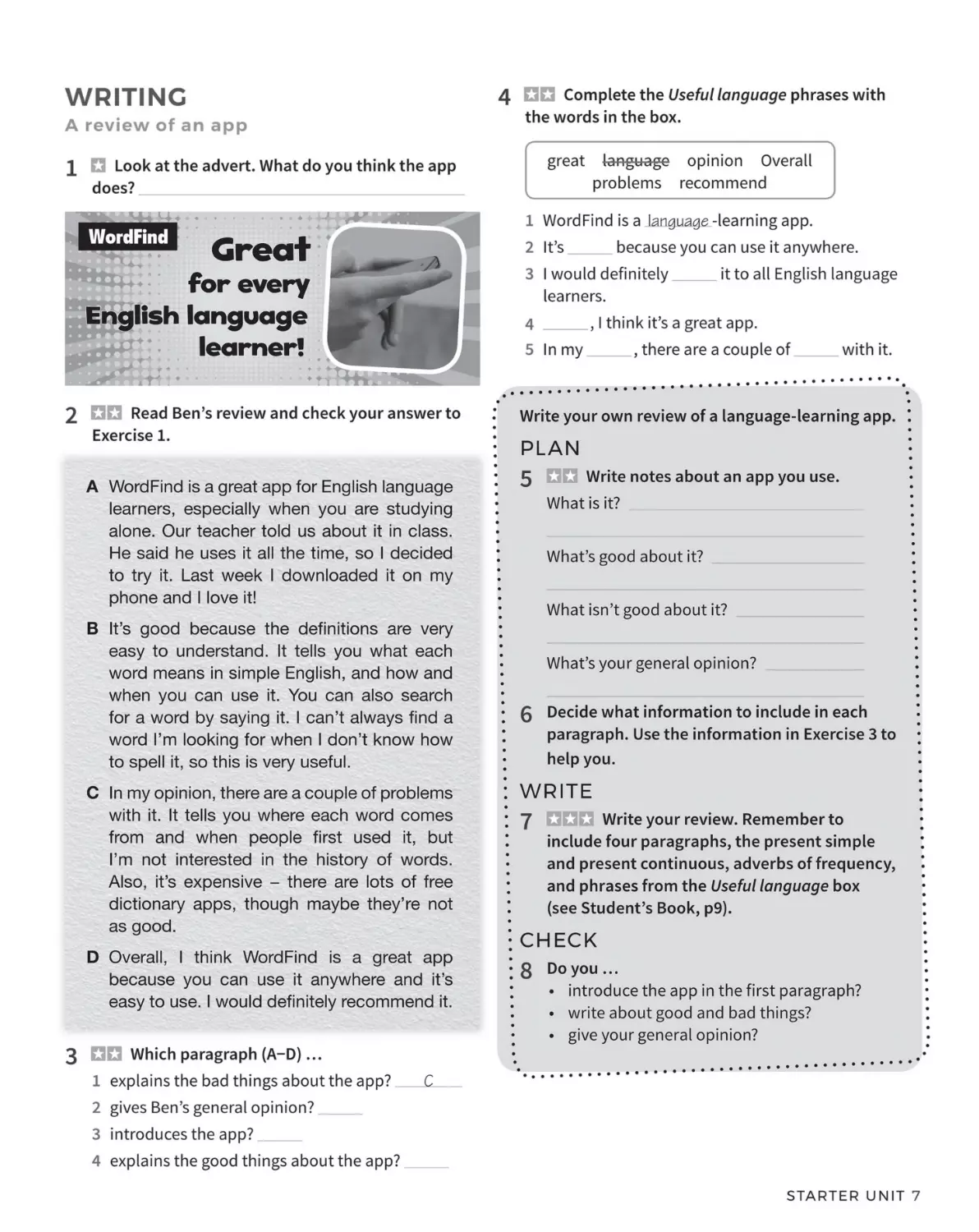
□ Look at the advert. What do you think the app
does?
great language opinion Overall
problems recommend
\_____________ ____ ________________ >
1 WordFind is a language-learning app.
2 It’s
because you can use it anywhere.
3 Iwould definitely
it to all English language
learners.
4 , 1think it’s a great app.
5Inm y ,thereareacoupleof
with it.
2 Q Q Read Ben’s review and check your answer to
Exercise 1.
A WordFind is a great app for English language
learners, especially when you are studying
alone. Our teacher told us about it in class.
He said he uses it all the time, so I decided
to try it. Last week I downloaded it on my
phone and I love it!
B It’s good because the definitions are very
easy to understand. It tells you what each
word means in simple English, and how and
when you can use it. You can also search
for a word by saying it. I can’t always find a
word I’m looking for when I don’t know how
to spell it, so this is very useful.
C In my opinion, there are a couple of problems
with it. It tells you where each word comes
from and when people first used it, but
I’m not interested in the history of words.
Also, it’s expensive - there are lots of free
dictionary apps, though maybe they’re not
as good.
D Overall, I think WordFind is a great app
because you can use it anywhere and it’s
easy to use. I would definitely recommend it.
3 □ □ Which paragraph (A-D)...
1 explains the bad things about the a p p ? C
2 gives Ben’s general opinion?
3 introduces the app?
4 explains the good things about the app?
• Write your own review of a language-learning app. *
.
•
PLAN
•
•
•
e
•
5 E3E3 Write notes about an app you use.
•
•
What is it?
«
I
•
<
What’s good about it?
•
What isn’t good about it?
•
What’s your general opinion?
•
•
• 6 Decide what information to include in each
;
paragraph. Use the information in Exercise 3 to
•
help you.
•
•
: WRITE
;
; 7 Q Q Q Write your review. Remember to
include four paragraphs, thepresent simple
‘
•
and present continuous, adverbs of frequency,
•
and phrases from the Useful language box
(see Student’s Book, p9).
' CHECK
• 8 d° you...
; • introduce the app in the first paragraph?
• write about good and bad things?
•
• give your general opinion?
STARTER UNIT 7

4 QQ Complete the sentences with the opposites in
the box.
anxious grumpy lazy shy silly
\
_
______________
7
1 Martin isn’t calm today. He’s anxious because of
his exam tomorrow.
VOCABULARY
Describing people
2 Idon’t think I’m confident. I’m usually quite
1 Q Find 11 more personality adjectives in the word
search.
AMC(TONFIDEN
R
MSAFDASEGREG
BSLFEYCUZJX
I
IEMIDTNVKCSN
TPROFENTUHOS
IAOBAEDCNECP
OTRSCSSEDEI
I
UIACTONFFRAR
SENSITIVEFBI
GNBEVRYWBULN
FTRSENS
IBLEG
NGHELPFULJWB
TALENTEDBNYS
3Mymotherisa lw a y s .She’snotcheerful
at all.
4 You’reso
sometimes. Why can’t you be
more sensible?
5 When she was young, my cat was always active.
Nowshe’sj u s t .
5 n n (Circle)the correct adjectives.
HOME
ABOUTME^ ARCHIVE
FOLLOW
My sister, Alicia, is a very \ponfiden^)/
talented person because she’s
always sure about herself and
knows what she’s good at. In fact,
she’s quite ^active I ambitious -
she’s got lots of goals and things
she wants to achieve. She’s also
sm art and really ^patient/ talented - she can play the
piano and is very good at sport. The only ‘problem’ is
that she’s not very Acheerful I sociable - she doesn’t like
going to parties and she doesn’t have many friends.
But if I have a problem, she’s always 2345h6 elpful I calm and
tries to solve it. Alicia is ^sensitive I patient, too - she
doesn’t get angry, even when other people make really
big mistakes. My sister is my hero!
2 □ □ Complete the sentences with words from
Exercise 1.
1 People think I’m confident , but I’m usually shy.
2 Paulisn’tv e r y .Helikesbeingalone.
3 Tyler is usually very
. He’s always smiling.
4 Kim and her brother are very different. He’s silly
and immature, but she’s
5 It’s better to be
and not panic in
dangerous situations.
6I’mv e r y -Igetupseteasily.
3 QQ Complete the table with the opposites of
words from Exercise 1.
in-
1 sensitive
im-
7
un-
2
3
4
5
6
Explore it!
Guess the correct answer.
Scientists believe that people who are
live longer than average.
a cheerful
b confident c grumpy
Find an interesting fact about how to live longer
and send the question in an email to a classmate
or ask them in the next class.
8 BE INSPIRED UNIT 1

READING
An article
1 Q Read the article quickly and answer the questions.
1 What is the name of the young man in photo A?
2 What is the name of the wave in photo B?
2 □ □ Match the words in bold in the article with the
definitions.
1 very surprised amazed
2 a physical or mental power to do something
3 a person who teaches other people
4 water that moves over the top of the sea
5 very difficult
6 wanting to do something very much
3 QE3 Are the sentences T (true) or F (false)? Correct
the false sentences.
1 Derek’s favourite surfer was also called Derek.
F Derek’s fathe r’s favourite surfer was also called
Derek,
2 Derek didn’t surf until he was a teenager.
3 Derek’s father taught Derek to surf.
4 Derek can hear which direction he needs to surf in.
5 People who saw Derek in Hawaii were very surprised.
6 Derek went to Hawaii to make a film with a
producer.
4 □ □ □ Answer the questions in your own words.
1 Why do you think Derek was determined to try
surfing?
2 What do you think inspired the film producer to
make a film about Derek?
sobsf wut houht sic >hit
Derek Rabelo was born in Brazil in 1992. His father called
him Derek after a famous surfing champion, Derek
Ho - his father’s favourite surfer. Derek’s father wanted
Derek to become a surfer, too, but there was a problem:
unfortunately, Derek was born blind. His father’s dream
to see his son surf seemed impossible!
When Derek was 17, his father told him about his dream.
From that moment, Derek was determined to try to
become a surfer. He went to the beach with his father
every day and started taking surfing lessons with an
instructor. Derek kept trying and finally, he learned to
surf!
Derek explains that although he can’t see, he
understands the noises that the waves make and he can
hear them when they are coming. He says every part
of a wave makes a different noise, so he knows which
direction to surf in.
In 2012, he flew to Hawaii to surf the famous Banzai
Pipeline - one of the most challenging and dangerous
waves in the world. Local surfers were amazed to see the
confident young blind man surf the huge wave with no
problem at all.
While Derek was surfing in Hawaii, he met a film producer
who believed that Derek had an amazing ability. The
producer decided to make a film about him. Beyond
Sight tells Derek’s inspirational story and teaches us that
nothing is impossible if you believe in yourself!
UNIT 1 | BE INSPIRED 9

LANGUAGE IN ACTION
Past simple and past continuous
with when, while and as
1 Q Complete the sentences with the past
continuous form of the verbs in the box.
3 n n Write sentences with the past simple and past
continuous and the words in brackets.
1 11 sleep / you I call / me last night (when)
I was sleeping when you called me la s t night.
2 he/finish/hisbook/he/wait/forthebus(as)
/------------------------------------------ \
do look not watch
rain sloop work
\
/
3 we/live/inLondon/we/go/tolotsofmuseums(while)
1 I was sleeping a t llo ’clockla st night.
That’s why Ididn’t check my emails.
211
yesterday, so Ididn’t go
out.
3 Mymum
late at the office
and came home late.
4I
for clothes online, but I
didn’t see anything I liked.
5 What
you
in the
kitchen? I heard a strange noise.
6 She
videos on the
computer - she was studying!
4 she/notsee/thecar/she/cross/thestreet(when)
5 I/ not cry / I/ watch / that inspirational film (while)
6 they / say / goodbye / they / leave / the party (as)
4 D Q (6ircle)the correct options.
2 QE3 Complete the conversation with the
past simple form of the verbs in brackets.
EMMA Hey, Ben!1Did you have (you / have)
a nice holiday?
BEN Hmm, not bad. 12
(help)
my uncle in his shop.
EMMA Why3
(you / do) that?
BEN Because my aunt4
(be)
ill, and he5
(not have)
tim e to go to the shop every day.
EMMA Wow! That’s really kind of you.
6
(it I be) difficult?
BEN Yeah. But my uncle7
(give) me some money after, so
18 (buy) some new
clothes.
EMMA Cool!
One day my wife was ill, so I/drove)/ was driving to the chemist
to get some medicine. While 12walked/w as walking back to the
car, I noticed that 13didn’t have/ wasn’t having my keys. They
were still in the car with my phone! I^kicked/w a s kicking the
wheels of my car when a teenager 5was arriving/ arrived on his
bike and 6asked/ was asking what was wrong. Itold him the
story and IExplained/ was explaining that we had another car
key at home, but it was five miles away. The boy said, ‘ I’ll get
the keys’ and then 8gave/was giving me his phone to call my
wife to explain what was happening. After 30 minutes, he 3came
/w a s coming back with the keys. As 110opened/was opening my
car, he rode away - before I could thank him!
5 □ □ □ Write a short paragraph in your notebook about a
time when someone helped you or you helped someone.
Use the past simple and past continuous.
10 BE INSPIRED UNIT 1

VOCABULARY AND
LISTENING
Phrasal verbs
□ (6ircle)the correct options.
1 Ifyou have a good relationship with
someone, you (get oh)/hang out\N\th them.
2 When you look after someone who is old,
ill or very young, you cheer up/take core
of them.
3 When you spend tim e with friends, you
hong out/deal with them.
4 When you try to solve a problem, you deal
with / depend on it.
5 Ifyou respect and admire someone, you
look up to/give up them.
6 When you make someone feel happier, you
cheer them up/hong them out.
7 When you stop trying to do something
because it is too difficult, you cheer u p/
give up.
8 When you need someone’s help and
support, you look up to/depend on them.
2 □ □ Complete the sentences with the
phrasal verbs from Exercise 1.
1 Ican’t go out tonight. Ihave a lot of
problems that I need to deal with .
2 Isometimes
my little brother
when my parents are not at home.
3 Ican’t do this homework - it’s too difficult.
A conversation
o3
Listen to the conversation. Why is Callum going to
i.oi
a concert?
a It’s a family member’s birthday.
b He wants to help people.
c It’s his weekend job.
/Pit 4
Listen again. Complete the notes with key words
101
and information.
Concert
• Takesplace at1 the sports centre
• Brandon’s 2
ill in the past,
4 I really
my mother. Ithink
she’s an amazing woman, and I’d like to be
the same as her when I’m older.
5I
my sister for help and advice.
Ioften don’t know what to do without her.
6 My grandfather is feeling sad these days, so
I’m trying to
him
7 Iusually
with friends at the
park, or in a cafe.
8 Paula doesn’t
with Susana
very well. They’re very different people.
concert to make money for people
with same illness.
• Brandon wants to make a minimum
of 3£
for charity.
Charity work
• Brandon made more than
4£
last month for charity.
• Jobs he did: washed 45 678
cu
t
grass in gardens, took rubbish away.
• Worked every afternoon and
6
5 E3E3Q Callum mentions running a race, giving up
chocolate and cutting off his hair for charity. Think of three
other ways to raise money.
1
2 _____________________________________________
3 _____________________________________________
UNIT 1 BE INSPIRED 11

LANGUAGE IN ACTION
used to
1 Q Match sentences 1-6 with a-f.
*'
1 I used to live in the countryside.
[c
*
<
2 Ididn’t use to like coffee.
**
3 I used to be really shy.
4 I used to like going to the gym.
*'
5 Iused to eat a lot of fast food.
**
6 Ididn’t use to have many friends.
a Now Idon’t have time.
b Now Ithink it’s unhealthy.
c Ilive in a city now.
d Now I have lots.
e I’ m much more confident these days.
f Now I have a cup every morning.
3 □ □ Look at the photos. Complete the sentences with the
correct form of used to.
1 I didn’t use to like ice cream , but now Ilove it!
2I
, but I play tennis now.
3I
, but now Iwant to be a teacher.
4I
, but I have one now.
5I
. Now Ihave a new one.
2 Q Complete the text with used to or
didn’t use to.
^ W llllllllllllllllllllllllllllllllllllllllllllllllllllllllllllllllllllllllllll//^
When I was very young, 11
used to
want to be a swimming teacher, because
| Iloved swimming and 12
like our sports teacher. Sometimes, I
|3
want to be an
astronaut as well, because I really liked
space. When I got older, I started to get
interested in computers. We
4
have a good computer
at home, only a very old one, but then
my dad decided to buy a really good one.
= My parents5
let me spend
much time on the computer-just a few
hours a week. When I was 1 3 ,1started
learning how to write my own games.
|I6
know how to do
that before, but I had a great teacher
at school who showed me how. In the
future, I’d like to be a games developer!
—
■
—
% llllllllllllllllllllllllllllllllllllllllllllllllllllllllllllllllllllllllllll^
4 □ □ Put the words in the correct order to make questions
with used to.
1youIuse/to/Did/mobilephones/haveI?
Did you use t o have mobile phones?
2did/How/communicate/with/people/use/to/you/?
3free/in/your/What/you/did/use/do/to/time/?
4 old/use/ people/What/you /think/did/of/to/?
5 nn Complete the answers to the questions from Exercise 4.
Use the correct form of used to and the verbs in the box.
be do have (x2) read send think (x2)
1 Well, no. I got my first m obile phone 15 years ago. Before
that, we didn’t use t o have the internet or even computers.
We
a phone at home, of course.
2We
letters, phone each other or just meet
up a lot. Life
calmer then.
3 Iwatched TV. I
a lot of books, too. A lot
of people now go shopping. W e
that
because we did n ’t have the money.
4 Good question! I
about them at all! I
Icouldn’t get old. Istill don’t think I’m old!
12 BE INSPIRED UNIT 1

WRITING
A letter to a magazine
3 QQ Complete the Useful language phrases in the
letter to a magazine with the words in the box.
1 n Read the competition details. What is the prize
for the best entry?
For view opinion Personally
4
Competition! W rite and tell us about a
helpful person in your life who you think deserves
an award. As always, the winning letter appears
online in next month’s edition and receives £100!
Answer the following questions.
• W h o is the most helpful person you know?
•W hat do/did they do to help you?
• W h y do you think they deserve to win an award?
□ □ Read the letter again. Are the sentences
T (true) or F (false)?
1 The writer wasn’t very happy at her old school.
2
3
4
2 Q Read the letter to a magazine. Does the writer
answer the questions in Exercise 1 in the same
order?
ma
The most helpful
person I know is my
English teacher,
Mrs Davies. In my
1__ opinion___ , she
should definitely win
an award. Here’s why.
A few years ago, I used
to go to a different school
and I liked it very much.
Then my parents got new jobs
different city and I changed schools. In the
new school, I was shy and not at all confident. I
didn’t make any new friends. The only person who
really noticed this was Mrs Davies. She helped
me by talking to me in the class, and putting
me in groups with other friendly students. She
also often asked questions that she knew I could
answer in front of the class.2
---- ---------
me
>that
She went to a new school because her parents
wanted to live in the countryside.
Her teacher asked her easy questions in class to
help her.
The writer thinks Mrs Davies should win the award
because she helped build her confidence.
was a very kind thing to do.3
-
*
------------ I think
Write your own letter to a magazine.
PLAN
5 QQ Think of a helpful person you know.
What do/did they do to help you? Why should
they win the competition?
WRITE
6 □□□ Write your letter. Remember to
include three paragraphs, past tenses, used
to and phrases from the Usefullanguage box
(see Student’s Book, pl7).
CHECK
7 Doyou...
•
introduce the person in the first paragraph?
•
say why the person should win?
•
use language for giving opinions?
I became more confident and sociable because of
Mrs Davies!
jnmy4
, Mrs Davies deserves an
award because she’s the calmest and most
patient teacher at our school. She’s also sensitive
to people’s feelings and always wants to help her
students. She helped me in a difficult situation
and she also inspired me to like English!
UNIT 1 | BE INSPIRED 13

VOCABULARY
Match the people with the adjectives in the box.
2 (gircle)the correct prepositions.
1 I always looked up with/to my older brother when
Iwas young.
2 Don’t look so sad. Cheer to/upl
3 Imight go out today. Itdepends on/ofthe
weather.
4 Itried running five kilometres yesterday, but Iwas
tired and gave u p/o u t after four kilometres.
5 You need to be very patient to deal with/on little
children.
6 Everyone gets in/ o n with John because he’s really
cheerful and sociable.
7 Iwas hanging o u t/on with my friends last night.
8 Iused to take care w ith/of my little sister when
she was a baby.
active ambitious calm cheerful
confident helpful inspiring patient
sensible sensitive sociable talented
\___________________________________
1 She runs every morning and goes to the gym at the
weekend, too!
2 Mark always wants to do things for other people.
3 He never gets nervous. He always looks relaxed.
4 Sara can play the piano very well. She’s also an
amazing singer.
5 Paula loves talking to people and making new
friends.
6 John is 100% sure about everything he does - he
believes he can do anything.
7 Iwas 45 minutes late, but Ashraf didn’t get angry at
a ll!_______
8 We all look up to George. He’s an amazing person.
LANGUAGE IN ACTION
3 Complete the sentences with the past simple and
past continuous form of the verbs in brackets.
1I(w
a l k ) totheshopswhenit
(start) to rain.
2Myfriend(phone)meas
I(w rite)himatext.
3 What
HarryandAbby
(do) when they
(hear) the news?
4H e (fin d ) anexpensivering
whenhe(clean)theirhouse.
5W e(leave)Tom’shousewhen
Lisa(arrive).
6AsI
(cross) the road, a woman
(hit) me with her bike!
9 Kerry is always playing tennis. She wants to be a
professional player one day.
10 Linda is always smiling, even when everyone else
is sad or tired.
11 Be careful what you say to Hannah. She gets upset
very easily.
12 Johann is a serious person. He always says and
does the right thing.
14 BE INSPIRED UNIT 1

4 Complete the conversation with the correct form of used to and the verbs in brackets.
A How old is your brother now?
B He’s nine.
A Wow! Iremember him when he1
(be) a little baby.
B Yes. And 12
(take) care of him, too! 13
(read) him bedtime stories!
A4
(you I give) him food and put him to bed?
BNo, I5
(not do) that. My parents6
(do) it. He’s changed a lot. He really
7
(look) up to me, but now he doesn’t!
CUMULATIVE LANGUAGE
5 Complete the text with the missing words.(Circle)the correct options.
When my mother was younger, she1
a singer.
I2
this until recently! She3
Jong,
blonde hair, and she4
really strange clothes.
In herfirst year at university, s h e5
some other
people who wanted to form a band. The other people
quickly6
out that she was a really talented
singer, so they asked her to join in. She7
famous, or anything like that, but she had a lot of fun.
Unfortunately, 18
any recordings of her singing.
They9
phones or video cameras then, so I can’t
see what she looked like. It’s difficult to believe that my
mum used to be a singer, because s h e 10
very
serious and sensible these days! She’s got short, dark
hair and she11
in a bank! Where did that young
pop singer12
?
1ais
b was being
c
was
2a notknow
b didn’t knew
c
didn’t know
3 a was having
b did have
c
used to have
4awore
b was wearing
c
wear
5 a was meeting
b met
c
meets
6 a found
b find
c
were finding
7 a weren’t
b wasn’t being
c
didn’t use to be
8 a haven’t got
b have not
c
hasn’t got
9 a weren’t having
b didn’t used to have
c
didn’t use to have
10 a always
b is always
c
always is
11 a works
b usually works
c
work
12 a goes
b went
c
go
UNIT 1 BE INSPIRED 15

2 WIS
H
A
A
R
T
T?
VOCABULARY
Visual and performing arts
□ Complete the visual and performing arts
words. Then match the words with photos a-h
1±iJ mmaking
@
*'
2s___ee _ a
_t
[*
'
3 o____ e___o a y
a___ e
_
4_a___io_ _e _i
5supu
e
6po_o_ a
_h_
7acie
ue
8i utaio
2 □ □ Correct the sentences by changing the
underlined words.
1 You see paintings and other art forms in a
performance.
2 A gallery is an inside or outside event where
you can see paintings and other art forms.
3 An exhibition is the action of entertaining
people by dancing, singing, acting or playing
music. ________
4 □ □ Match the people or things (1-6) with the
definitions (a-f).
1 contemporary dance [e .
2 fashion design
’
1■'
3 street art
*'
4 filmmaker
5 sculpture
*'
6 illustrator
a making objects that represent things, people or ideas
b someone who draws pictures for books
c someone who creates movies for TV or cinema
d working with clothes, shoes and sometimes hairstyles
e moving to music in a modern style
f paintings, graffiti, etc. outside in urban areas
3 Q Q Match the beginnings of the words with
the ends to make the names of the people who
do an activity.
danc
illustrat
sculpt
Explore it!
--------------------
Guess the correct answer.
Every
minutes, people
around the world take more photos than
the whole of humanity took in the 1800s.
a2
b10
c45
- ist
filmmak
Find an interesting fact about an art form and
send the question in an email to a classmate or
ask them in the next class.
fashion design
16 WHAT IS ART? UNIT 2

READING
A magazine article
J □ Look at the photo. What art form can you see and
where do you think it is?
2 n Read the article from an art magazine and check
your answer to Exercise 1.
3 QE3 Match the words in bold in the article with the
definitions.
1 going under water
sinking
2 people who work to protect the
environment
3 a dark orange-brown metal
4 put something into position
5 an ability to achieve something
6 keep or maintain something in its position
4 □□ Read the article again. Answer the questions.
1 Where did Lorenzo Quinn study art?
Inthe USA._________________________________
2 What are Quinn’s sculptures normally made from?
Support:
an art installation
Sculptor Lorenzo Quinn is the first artist to install
a work of art directly into the Grand Canal in
Venice. But who is he and what does his work
of art mean?
3 Which important problem does Support deal with?
\-
4 How are the giant hands ‘helping’ the Ca’ Sagredo
Hotel?
Quinn was born in Rome, but he has lived in
Spain and in the USA, where he studied art.
He hasn't always been a sculptor. He has also
been a singer and he has acted in films -
once as the painter Salvador Dali!
His sculptures have app eared at exhibitions
internationally. He usually works with metals
such as bronze, steel and aluminium. But
what inspired him to make visual art with two
enormous hands?
5 How did Quinn’s family help with Support?
6 Who can do something about climate change,
according to Quinn?
Together with many scientists and
conservationists, Quinn believes that the
Mediterranean Sea has risen and is still rising
because of climate change. Because of
higher water levels in the Grand Canal, the
historic city of Venice is slowly sinking, they
believe.
5 □□□ Answer the questions in your own words.
1 What’s your favourite form of art? Why do you like it?
The art installation, called Support, w hich
Quinn created for the Venice Art Biennale
exhibition, warns us about the danger of rising
water levels in this amazing city.The two giant
hands 'hold up' the famous Ca' Sagredo
Hotel on Venice's Grand Canal.
2 What other important issues does art often deal
with? Think of two examples.
7
Quinn used his son's hands as models for the
huge sculptures, to show the potential of the
next generation.The message is that the future
is in their hands.
UNIT2|WHATISART?17

Z-LIND ciav SIiVHM 8L
^ \ \n iiiiiiiiiiiiiiiiiiiiiiiiiiiiiiiiiiiiiiiiiiiiiiiiiiiiiiiiiiiiiiiiiiiiiiiiiiiiiiiiiiiiiiiiiiin //^
i§uiqpxa AjaA pue unq aje sassep jaq
pue ueaqqueo aqq pue eiqwopo ui
s
jaqaeaq A|/\| jaj-i] Aw
fr§upuep esps,
/spuauq Mau qeaj§ aw o s
£ ।’SuiwoapM
os si auoAjaA^ *
z
।ssep qsaq aqq si siqj_,
yqueiyijq s(qi - qsaq aqq si ssep esps aqq qnq ‘sassep
quajajqipAuew p9uiof9Agq T।pue spuauqA|/\],
4!^noqo djojM sjuapnjs jnojo dwoswqM poa^j
iS3SSV"13 3DNVQ l/\IOC133dd VS3VS dCIO NIOC
^ //IIIIIIIIIIIIIIIIIIIIIIIIIIIIIIIIIIIIIIIIIIIIIIIIIIIIIIIIIIIIIIIIIIIIIIIIIIIIIIIIIIIIIIIIIIIH lW '^
^noA oaci-i yeueo puejgj aqq uo
e]opuo§ e uo
jaAau’
|9
jAsea q(usi q| ^qiqqej e
qoajnqaide
jaAa noA
g
ueaA siqq s§uos
pooS Auew
ja§ uis aqunoAeq A|/\| v
^jeaA siqq sajnqdjnas
MauAue
uuinft ozuajoq
£
•qaA uoiqiqiqxa /v\au aqq
8MZ
•sjoqisiAjo jaqwnu snowjoua
ue
p^tps^q
uoiqeneqsu 1qje aqj_ y
upjq a>|Bw u;o{ aAeqjaAa a§ueqa
aqu/v\qou aa sq ou a>|BW OAoq /v\ejp aq
\ ____________________________________________________ _____________________________________________________/
•xoqaqquisqjaAaqqjowjoj
qaaqjad quasajd aqq qqiM qxaq aqq aqajdiuoj □ □ □ 9
•xoq aqq ui sqjaA aqqqo w j o j qaapad
quasajd aqq qqiM saauaquas aqq aqa]dwo3 Q Q £
auoqd Aw uo soqoqd qeaj§awos / a>jeq/on
cIw]yoapiAe/a>pwjoao/noA v
puoaas/awoa/on
LIuoiqiqadwoa e ui azud qsjy/u|/v\joao / aqs £
uaqaeaq qje ja q oq (aqu/v\)
wnwsjqes 9
jaqwnu
pue a w eu s(qsiqje aqq (a>|eq)
noA
g
•Aepoq >po/v\qje ApAO] a w o s (aas)
।v
•sppow
Diqsejd a w o s (a>|ew)
uajpyqa aqi £
•aauep
Ajejodwaquoa Aue (opqou)
aqs 3
•uoiqiqiqxa
Suiqsajaqui AjaA e oq (aq) u99q 9A^q a/\/\ y
o]ned oe$ oq/aq/oN
6/ oiy/qisiA jaAa / Aaqq 3
■LU|ysqi usssns^q 9q q.nq ‘qrusKq 9q
^99IU9/\ UI qq.^9(J pg9J J9A9 J9qq.ouq jnoA s^ iq
w]ijaqqIaas/on
LI aaiua/\ ui Lpoafj I peaj joao /jaqqojq jnoA y
•sjomsub puesuoiqsanbaqij/\/\□□ S
•qsiqje aqq Suiqaaw spH ’AjaipS aqq oq
spH g
•qi paAO] o m pue uopiqiqxa aqq aas oq
9Ap/v\ v
•sawiqqo sqoi aaiuaA oq
aAeq squajed A|/\| £
•>popp g Aq awoq
>peq Ayewjou spqs qnq u/v\oq oqui
spuapH 3
•qqSnoq |qeqm >jooq -doqs qje aqq oq U99q aAj t
-auo6 j o uaaq qqi/v\ saauaquas aqq aqa]dwo3 g g
•sqaypejq ui sqjaA aqqqo w j o j
qaapad quasajd aqq qqi/v\ saauaquas aqq aqajdwoo g 3
4eU9ADq/dAoq Aaqq ‘sax :g
^AjayeS/v\au aqq paqisiA Aaqq aAepi :\f 9
^quied Aeuds
asn oqMoq noA qq§nequaqaeaq qjejnoA oAoy/soy g
•qsiqjeqaajqs eqaw/qaaw joaou aAeq । v
•suoiqiqiqxa Auew pajisiA/ i m a qpaAeq Aaqi £
cq qnoqe oapiA qeqq paqaqeM noA soy/dAoy z
•ajnqdjnas aqq a>|ew oq azuojq(pasn)/asn seq an y
•suoiqdo qaajjoa aqq(a]ajij) p T
sqjaA je|n6ajji
pue je|n6aj qqiAA qaoqjad quasojj
Noi±av n i aovnoNvi

VOCABULARY AND
LISTENING
Music and theatre
□ Match the beginnings of the sentences
(1-6) with the ends (a-f).
1 The words of a song
2 A recording studio is where
3 The words an actor says
4 The audience are the people
5 You have an audition when
6 During a rehearsal
a who listen to the orchestra.
byouwantapartorroleinaplayorshow.
c are called the lyrics.
d you practise a play, concert or show.
e are called the lines.
f singers and m usicians record their music.
2 □ (Sircle)the correct options.
1 When the(prchestrd)/audience stopped
playing their instruments, we stood up
and clapped.
2 In the final show/scene, the friends say
goodbye and the film finishes.
3 Ireally want the line/part of Romeo in
the school production of Romeo and
Juliet.
A conversation
G 4 Q Q Listen to Melanie and David talking about Alma
201 1
Deutscher, a young musician. Answer the questions.
1 How does Melanie feel about Alma at the beginning of
the conversation?
2 Does she feel differently at the end?
D 5 E3E3 Listen again and answer the questions.
2.01
1 How does David know so much about Alma Deutscher?
He watched a programme about her on YouTube.
2 What art form is Alm a ’s Cinderella?
4 What’s your favourite type of part/show:
dance, music or theatre?
3 What musical instruments does Alma play?
3 □ □ □ Answer the questions.
1 Have you ever written lyrics for a song?
What was the song about?
4 Where was the perform ance of Cinderella?
5 How does Alma get some of her ideas and melodies?
2 Have you ever performed in a play or a
show? What part did you have?
6 What activity is a waste of time, according to Alma?
3 Have you ever played in or been to see
an orchestra? Which one?
6 □ □ □ Find out about another talented young person like
Alma Deutscher. Write a short paragraph about their life and
achievements in your notebook.
UNIT 2 WHAT IS ART? 19

LANGUAGE IN ACTION
Present perfect with already, just,
still and yet
1 Q Match sentences 1-6 with a-f.
*'
1 My mum’s just found her glasses.
[c.
*'
2 I haven’t seen that film yet.
I,
*
'
3 The show has already started.
*'
4 She still hasn’t heard from Joel.
*'
5 I’ve just had a second audition.
*'
6 The children haven’t gone to bed yet.
a She hopes he calls soon.
b Ihope Iget the part.
c Now she can see the stage.
d They’ll be tired in the morning.
e We’ve missed the beginning.
f We’ve got tickets to see it tomorrow.
3 □□ (gircle)the letter for the correct sentence.
1@ I’ve already seen the art exhibition.
B Already I’ve seen the art exhibition.
2A Dylan just has left for school.
B Dylan has just left for school.
3A She hasn’t tidied her room still!
B She still hasn’t tidied her room!
4A Have you bought the orchestra tickets yet?
B Have you bought yet the orchestra tickets?
5A Lay and Eva have come back from the cinema just.
B Lay and Eva have just come back from the cinema.
4 E3E3 Rewrite the sentences putting the words in
brackets in the correct position.
1 Hey, the gallery has announced an exciting event, (just)
Hey, the gallery has ju s t announced an exciting event.
2 Have you heard about the Picasso exhibition? (yet)
3 Someone has discovered an unknown painting, (just)
2 □□ Look at the photos. Write sentences about
what has just happened.
4 The gallery has bought it from a collector in Paris.
(just)______________________________________
5 It seems they have agreed a fair price, (already)
6 They haven’t told anyone how much they paid,
though, (still)_____________________________
1 sheIcuthishair
i^eJnasJuatc^^^
2 The children / finish school for the day
5 □□□ Put the words in the correct order to make
sentences and questions.
1 you IyetIseen / new /theIShrek film / HaveI?
HaveLyQLLseen theLiiew_Shrekj&lm y e t ^
2 artgallery/already/to/Enzo/the/has/gone/.
3 still / art project / finished / Susie / her / hasn’t /.
3they/haveaswim
4 audition/you/your/had/yet/Have/?
4 he/makeacake
5 have /They/intown /just/held/an exhibition /.
5 the girls / see a funny film
6 the boy / give her some flowers
6threetimes/been/have/We/to/already/the
theatre/this month / !
20 WHAT IS ART? UNIT 2

WRITING
A review
1 Q Look at the photo. (^irde)the correct answer.
The New Dance School is . . .
a a classical orchestra.
c a group of dancers,
b a music group.
2 Q Read the review. Why does the reviewer
recommend The New Dance School?
3 Q Which paragraph (A-D)...
1 gives a description of the band and its music? E3
2 explains what the reviewer liked / didn’t like about
it?
3 gives details of where you can see the band?
4 explains who the band’s audience is?
4 Q (Circle)the correct words in the Useful language
phrases. Then check in the review.
1 I’ve (jiever) / ever heard anything like it before.
2 It’s in/on at...
3 I recommend/ recommending it because . . .
4 It’s the best performance I’ve ever/never been to.
5 How/What I liked / didn’t like about it was ...
5 □□ Read the review again. Answer the questions.
1 Who is the concert for, in the reviewer’s opinion?
2 What does the reviewer like best about the band?
A
D
Have you seen The N ew Dance School yet?
I’ve never heard anything like it before.The
band is perfect fo r lovers o f international music
-
it’s the best performance I’ve ever been to!
The N ew Dance School’s music isn’t exactly
rock. It’s a bit like w orld music, but you can
really dance to it! The musicians are all really
talented.They create powerful rhythms w ith
a number of different instruments, like sitars,
bongos and steel drums - it ’s amazing.
W hat I liked about it was that the performers
were so happy and there was a lot of
movement in their music.They make you feel
cheerful. I was sitting in the audience, but I
really wanted to get up and dance!
I saw them at my local village hall. It was so
cool! These musicians haven’t been together
very long, but they have a big future! The next
New Dance School concert is on at the Edale
Music Festival, so don’t miss it. I recommend
it because the music has great energy and it
makes you want to dance.
Write your own review of a music concert.
PLAN
•
•
g E3E3 Make notes on a music concert you have ;
been to or seen on TV.
’
Where did you see it?
•
Who was the concert for?
What was it like?
<
What did you like / not like about it?
7 Decide what information to include in each
paragraph. Use the information in Exercise 3
to help you.
WRITE
8 QE3Q Write your review. Remember to
include four paragraphs, the present perfect
and phrases from the Useful language box
(see Student’s Book, p29).
CHECK
9 Do you...
• describe the event?
• saywhoitisfor?
• say what you liked / didn’t like about it?
UNIT2|WHATISART?21

2 REVIEW
VOCABULARY
LANGUAGE IN ACTION
Complete the sentences with the words in the box.
architecture contemporary dance exhibition
filmmaking illustrations performance
photography sculptures street art gallery
k__________________ __ >
3 Write questions and short answers (affirmative or
negative) in the present perfect.
1 you / see the new Almodovar movie? (/)
2 he / take photos of his sculpture? (/)
1 Eduardo goes to the cinema a lot because he’s
interested in
.
2 Lorenzo Quinn makes
of people and
things from different metals.
3 Il o v e ,butyouneedalotofenergy
and rhythm to move your body to the music.
4 The Louvre in Paris is the most famous art
in the world - the Mona Lisa is there.
5 They saw a wonderful
of paintings
and sculptures by a local artist.
6 The
in this book are in black and
white, not colour.
7 Wesawa
of High School Musical at our
local theatre - it was quite good.
8 Ibought a new camera for my
class.
I’ve taken some great pictures.
9 is to design, plan and make buildings.
10Some
is OK, but Ireally don’t like
graffiti. It looks messy.
3 the visitors / come from all over the world? (X)
4 she / ever sing in front of a big audience? (X)
5 they / hear your new song? (/)
6 you / have many exhibitions? (X)
7 she/be to that gallery before? (/)
8 the show/win many awards? (X)
2 Read the definitions and com plete the words.
5 (n) a_ ---------
; a short performance that an actor,
dancer, etc. gives to show they can play a
particular part
5 (n)1
:
the words of a song
1 (n)o
: a big group of musicians who play
different instruments together
(n) r_______ : the time when all the people
in a play, dance, etc. practise to prepare for a
performance
2 (n ) p_______
:
one of the people in a film, play or
dance
8 (n ) 1----------- - the words that an actor speaks
when performing in a film, play, etc.
(n) s_______ : a part of a play or film in which
the action happens in one place
(n)s ~
- a theatre performance or a
television or radio programme
( ? 3------ -----
:thegrou
P o f People together in one
place to watch or listen to a play, film, etc.
10 (n)r
_s_
: a place where a
musician makes and records their songs
22 WHAT IS ART? UNIT 2

4 Make the sentences negative using the words in brackets.
1 I’ve just done my homework, (not yet)
5 The sculptor has explained his work, (still not)
2 He’s read that book already, (still not)
6 We’ve just bought your new CD. (not yet)
3 We’ve been to Venice, (still not)
7 She’s just met the photographer, (still not)
4 The performance has just begun, (not yet)
8 I’ve been into Paul’s recording studio, (not yet)
CUMULATIVE LANGUAGE
5 Complete the conversation with the missing words. (€ircle)the correct options.
INTERVIEWER Hello and welcome. We’ve got some great music for you today, but 11
that one of our
most talented young singers, Lexi West, is in the recording studio. Welcome to London, Lexi!
LEXI
Thanks! It’s great to be here. Actually, 12
a house in the city. It’s all very new and
exciting for me!
INTERVIEWER Yeah? W he re3
live? You were born in Scotland, right? But of course you 4
all
over the world.
LEXI
That’s right. 15
back from New York, but while 16
and working abroad, I
didn’t have my own place. 17
with my parents.
INTERVIEWER Was there a lot of music in your home when you 8
, Lexi? I believe your father
9
songs for you.
LEXI
Yes, that’s right. My dad was definitely my inspiration, but he was also very sensible. I
10
on TV as a teenager, but he never let me miss school! Is till11
his advice:
it’s OK to be ambitious but don’t get impatient!
INTERVIEWER Well, Lexi, you 12
three number one hits, so you didn’t have to wait very long to be
famous!
1 a ’ve still heard
2 a didn’t buy
3adidyouuseto
4 a haven’t travelled
5 a was coming
6 a was singing
7 a didn’t use to
8 a have grown up
9 a has just written
10 a performing
11a used to forget
12 a ’ve already had
haven’t heard
c ’ve just heard
’ve just bought
c was just buying
were you used to
c useyouto
’ve travelled
c weren’t travelling
have already come
c ’ve just come
wasn’t singing
c used to sing
was living
c haven’t lived
grew up
c were growing up
didn’t use to write
c used to write
was performing
c have just performed
was forgetting
c haven’t forgotten
haven’t had
c were having
UNIT 2 WHAT IS ART? 23

3 SPREAD
THE WORD!
3 QE3 Complete the spidergrams with words from
Exercise 1.
VOCABULARY
Communicating
with your voice
with your face
1 Q Put the letters in order to make words
about communicating.
1 tereg
gr _e
__
e_i
2 retgesu
g
3 besiredc
d
4 ptreertin
i
5 stpo
p
6 eksha nsdah s
h
7 leims
s
8 vewa
w
9 latsenrta
t______________
10 wrheips
w
11 tsuho
s_
4 □ □ Complete the story with the correct form of words from
Exercise 1.
2 QQ Complete the sentences with words
from Exercise 1.
A thumbs up sign is a __gesture__that
means ‘good’.
Idon’t know what Jackie looks like. Can
you
her to me?
Don’tspeakloudly.P le a s e .
You’ll wake up the baby.
These instructions are in French. I need
someone to
them for me.
There’s Lucy across the road. Let’s
at her. Maybe she w ill see
2
5
8
us.
I only
when I’ m very angry.
Everyone understands when you
at them. It means you’re
happy.
It’s good to
comments
online and then wait for people to reply
to them.
I met my friend Kazue yesterday for the first time! Actually, Ifirst
met her online about six months ago. She’s from Japan and now
she’s visiting my country with her family. I1__ greeted her at
the airport when she arrived. In her emails, sh e2
herself as quite small, but in fact she’s as tall as me. I also met her
brother and her parents. Iwanted to 3
hands with
them, but Kazue quietly4
in my earthat Japanese
people don’t usually do that when they meet. I already knew what
her brother looked like, because Kazue som etim es5
photos of him online. He was very friendly and he 6
lot. Kazue’s parents don’t speak English, but Kazue7
everything Isaid into Japanese. Kazue and her family were tired
and wanted to go to their hotel. I arranged to meet Kazue the next
dayandwe8
goodbye as they drove away in a taxi.
a
Explore it!
Guess the correct answer.
People originally shook hands because ...
they wanted to find out how strong the
other person was.
they wanted to show that they didn ’t want to start a fight,
they wanted to check that the other person had clean
hands.
a
Find an interesting fact about greetings and send the
question in an email to a classmate or ask them in the
next class.
24 SPREAD THE WORD! UNIT 3

READING
An article
□ Look at the photo. What emotions/actions do the
emojis show?
2 Q Read the article and complete the paragraphs (A-D)
with the headings (1-4).
1 From Japan to the world
3 Japan’s alphabets
2 The most popular symbol 4 A world language
3 Q Find adverbs in the article with the meanings below.
1 in a good way (paragraph A) well
2 with no problems (paragraph B)
3 very much (paragraph C)
4 not how you expect (paragraph D)
4 Q Q Read the article again. Are the sentences 7 (true)
or F (false)? Correct the false sentences.
1 For verb endings like -ing, Japanese people use the
hiragana alphabet.
_____________________I ____________________
2 Katakana has got the most symbols.
Emoji
the world’s most popular alphabet?
Didyou know that the Japanese language has three
alphabets? One alphabet, katakana, is mostly for
foreign words, like ‘pizza’(L°tf). This alphabet has 48
characters, or letters and symbols. Another alphabet,
hiragana, is usually for grammar words, like the
word ending ‘L7c’, which changes a verb into the past
tense - similar to -ed in English. Hiragana has 46
characters. A third alphabet, kanji, has about 50,000
different symbols. It is usually for verbs, adjectives
and nouns. For example, ‘|JL|’is the Japanese symbol
for ‘mountain’. O ften a piece ofwriting contains all
three alphabets at the same time! Learning written
Japanese well can be difficult!
B __________________________________________________
3 You can’t use more than one alphabet in one text.
4 The first emoji didn’t express many different feelings.
5 In paragraph C, ‘ones’ refers to ‘ people’.
But there is another kind of‘alphabet’from Japan,
which everyone can easily recognise. You probably use
it a lot when you communicate with friends. It doesn’t
use letters, it uses emoji, which translates as ‘picture
character’in English. We can all recognise emoji when
we see them. They show a huge range offeelings or
actions, from love and sadness to dancing and waving.
6 The writer hopes emoji will become an international
language in the future.
C
The Japanese have used emoji
since 1999. Of course, these
early emoji were very simple
and people could only use
them to show basic emotions.
5 □ □ □ Answer the questions in your own words.
1 Which emoji do you use most often? Why?
Since then, they have become more and more popular
around the world and the number of emoji symbols
has greatly increased - now there are nearly 3,000
official ones. Everyone can understand emoji - it
doesn’t m atter which country they are from.
2 Apart from using emoji, how else can we show
emotions in text messages?
3 Is the alphabet in your language different from
English? How?
And what is the most common emoji symbol that
people use? Surprisingly, it is not a sm iling face or
a heart. It is the ‘tears ofjoy’emoji, showing a face
laughing and crying happily. Perhaps in the future,
they will create an emoji for every possible emotion
and we will be able to communicate with anyone in
the world, only by using emoji symbols!
UNIT 3 SPREAD THE WORD! 25

LANGUAGE IN ACTION
can, could, will be able to
1 Q Are these sentences about the past,
present or future?
1 Most people couldn’t send each other
quick messages 30 years ago.p
_ast
2 It’s possible that we will be able to
interpret any language on a smartphone
app.--------
3 Animals can’t communicate in the same
way that humans can.
4 Icouldn’t speak until Iwas three years
old. _____
5 Iwon’t be able to use my phone
in the mountains.
2 QE3 Complete the conversation with the
correct form of can, could or will be able to
and the verbs in brackets.
KIM \Can you tell (you / tell) me why
you didn’t reply to my email?
DAN Sorry! Iwas at my grandparents’
house in the middle of the
countryside. 12 (not use)
my phone.
KIM Really? But you 3
(post)
messages online. I saw them.
DAN Err, yes, but 14
(not check)
my emails.
KIM Right, anyway,5
(you/
help) me practise my presentation
tomorrow for next week’s test?
DAN Sorry, 16
(not do) it then.
I’m really busy. 17
(help)
you now, though.
KIM Oh, I8
(not practise) now. I
haven’t written anything yet.
DAN Well, we9
(write) it
together now, if you want. What’s
the topic of the presentation?
KIM How to communicate successfully!
3 ESQ Complete the blogs with one word in each gap.
HOME
ABOUT ME
ARCHIVE
Julia
11 couldn’t play the piano very well when Iwas
younger. Ididn’t like practising because the piano
was in our living room downstairs. That meant
everyone had to listen to me when I played and
no one2
watch TV or read. Now I’ve got an
electric piano and 13
use headphones. It’s great
because my fam ily4
hear anything I’m playing! So
now I’m practising a lot and 15
play quite well.
FOLLOW
Liam
16
swim at all, but I’d like to. Last
summer, Iwent with my friends to the beach
and 17
join in the fun in the water. That
made me feel sad, so I hope 18
be able
to start taking lessons in the next few months. I know
that 19
be able to swim like a fish after just a few
lessons, but Ijust want to be confident in the water so that I
10
be able to swim with my friends next summer!
4 Q Q Q Look at the information about Olga. Write sentences
with the correct form of con, could and will be able to.
1 Olga couldn’t play the piano when she was younger,
1
play
the piano
2
type
quickly
3
sleep ten
hours a
night
4
ask her
parents for
money
when
she was
younger
X
now
J
X
J
in the
future
r
hut_5±e_can_now._
2 ___________________________________
3 ___________________________________
4 ___________________________________
26 SPREAD THE WORD! UNIT 3

LISTENING AND VOCABULARY
A radio interview
Collocations with say and tell
H 1 □ □ Listen to a radio interview
301
about dolphins. Tick (/ ) the topics
that the people talk about.
1 □ dolphin communication and
3 □ Complete the flashcards with say or tell.
4
2
3
4
5
6
language
dolphin greetings
the language of human babies
dolphin body language
how quickly dolphins can swim
new technology
hello
a story
yes/no
sorry
O2
Listen again. Are the sentences
301
T (true) or F (false)?
1 Sara thinks that all dolphins speak
the same language.
F
2 Scientists believe dolphins have got
names. _____
3 Dolphins talk to each other at
the same time without stopping.
4
(something)
in Italian
the truth
someone
a secret
4 In one experiment, two dolphins
spoke on a phone.
5 Dolphins can communicate over long
distances.
6 Scientists have got the technology to
translate what dolphins are saying.
□ □ Complete the sentences with the correct form of the
collocations from Exercise 3.
1 Can I tell you a _seeret_? But promise you won’t tell
anyone else.
2Howdoy o
u
‘thank you’
?
3Letme
you a
about how I met my best friend.
4 The interviewer asked me if I wanted the job. I
,of
course!
5 Maria says she hasn’t got any money, but I don’t think she’s
. She always wears expensive clothes.
6I
to your brother in the street, but he didn’t answer me
and continued walking!
7 Il i k e ,butIcannevermakethemsoundfunny.
8 Iwant to
for shouting at you last week.
9 Edjust
me a b i g . I’ll never believe him again!
□ □ □ Answer the questions.
1 Have you ever told a ‘good’ lie to help someone? What lie did
you tell?
2 When you have a secret, who do you tell?
3 How many languages can you say something in? Which languages?
UNIT 3 SPREAD THE WORD! 27

LANGUAGE IN ACTION
Present perfect with for/since and
How long ... ?
Present perfect and past simple
3 n n Complete the joke with the past simple or
present perfect form of the verbs in brackets.
1 Q (Circle)the best ending for each sentence.
1 I’ve lived here for...
(a) two years.
b I was 14 years old.
2 I’ve had this phone for...
a a longtime.
b 2015.
3 I haven’t eaten anything since ...
a about three hours.
b this morning.
4 I’ve been able to speak French since ...
a 10 years ago.
b Iwas a child.
5 My best friend and I have known each other f o r ...
a six years.
b we started school
together.
6 Max has been on the computer since ...
a all day.
b he woke up.
2 □ □ Complete the questions with How long and the
present perfect form of the verbs in the box.
/----------------------------------------\
be have know like live
\ ________________________ _______________________ /
A 1 How long have you lived here?
5 □ □ □ Choose question 1 or 2 from Exercise 4.
Write your answers.
B For about six months. I really like it here. It’s a
nice city.
A So Emma and Kirsty are friends?2
each other?
B Since they were about three years old. They’ve
been best friends for ages!
A Ididn’t know Olivia liked watching tennis.
3
it?
B For a long time. She’s played in the school team
since she was really young.
A Isee that Will’s got a new bike.4
it?
B For ages. He needed a new one. The old one was
too small for him.
A I’m sorry I’m late, everyone.5
here?
B Not long. Don’t worry. We only got here ten
minutes ago.
®l
►Ji
&
►J►J►J►J►J►J►J►J►J►J►J►J►J►J►J►J►J►J►J►J►J►J►J►J►J►J►J►J►J►J►J
►J►J
My friend 1 told
(tell) me a funny
joke this morning. I
2
(hear) a
lot of jokes in my
life, but this one
3
(make)
me laugh when I
4
If
A girl and her father5
(be) at the dinner
table, having some soup. The g irl6
(ask)
her dad, ‘ Dad, are spiders nice to eat?’ ‘What a
horrible question,’
7
(say) the father. ‘ Can’t
you think of anything nice to say at dinnertime?
Please let me eat. 18
(eat not) anything
since this morning!’ The g irl9
(decide) to
be quiet. They both 1
0
(eat) their dinner
in silence. Later, the girl’s father11
‘Why did you want to know about spiders earlier?’
She replied, ‘ Oh, there was a spider in your soup.
Butit1
2
(go) now.’
►Ji
►J►J►J►J►J►J►J►J►J►J►J►J►J►J►J►J►J►J►J►J►J►J►J►J►J►Ji
4 Q Q Write questions with the present perfect or the
past simple.
l a you / ever / tell / a lie? JHave_yoii^verioL±aJie2_
b Who/you/tell/the lie to?
c Why/you/tell/it?
2 a anyone/ ever/tell / you a secret?
b it / a very big secret?
c you / ever / tell / another person the secret?
28 SPREAD THE WORD! UNIT 3

WRITING
A listicle
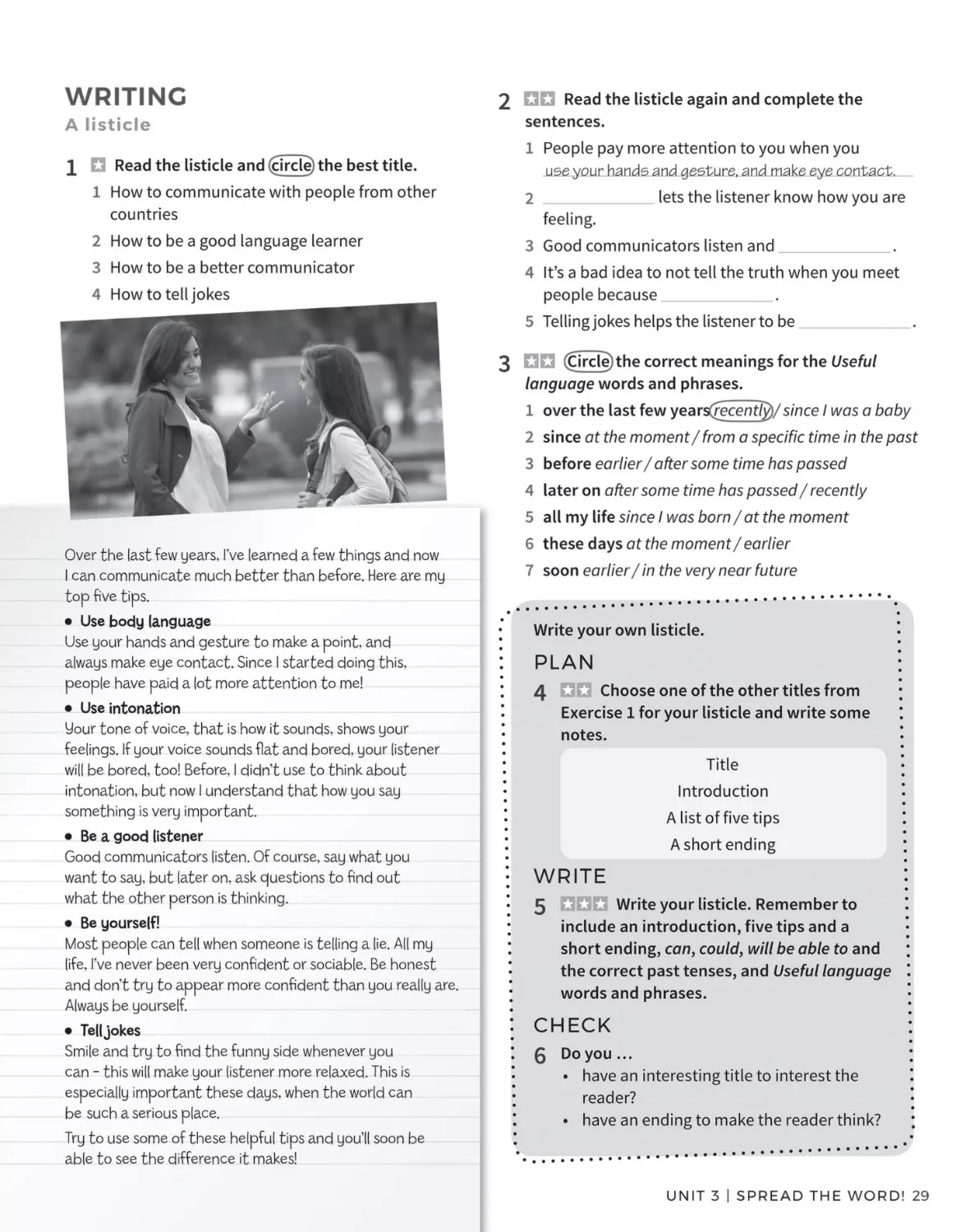
1 Q Read the listicle and (circle)the best title.
1 How to communicate with people from other
countries
2 How to be a good language learner
3 How to be a better communicator
Over the last few years, I’ve [earned a few things and now
I can communicate much better than before. Here are my
top five tips.
• Use body language
Use your hands and gesture to make a point, and
always make eye contact. Since I started doing this,
people have paid a lot more attention to me!
• Use intonation
Uour tone of voice, th a t is how it sounds, shows your
feelings. If your voice sounds flat and bored, your listener
will be bored, too! Before, I didn’t use to think about
intonation, b ut now I understand th a t how you say
something is very important.
• Be a good listener
Good communicators listen. Of course, say what you
want to say, but later on, ask questions to find out
what the other person is thinking.
• Be yourself!
Most people can tell when someone is telling a lie. All my
life, I’ve never been very confident or sociable. Be honest
and don’t try to appear more confident than you really are.
Always be yourself.
• Teltjokes
Smile and try to find the funny side whenever you
can - this will make your listener more relaxed. This is
especially im p ortan t these days, when the world can
be such a serious place.
Try to use some of these helpful tips and you’ll soon be
able to see the difference it makes!
2 QQ Read the listicle again and complete the
sentences.
1 People pay more attention to you when you
use your hands and gesture, and make eye contact.
2 lets the listener know how you are
feeling .
3 Good communicators listen a
n
d
.
4 It’s a bad idea to not tell the truth when you meet
peoplebecause.
5 Telling jokes helps the listener to b
e
.
3 H Q (6ircle)the correct meanings for the Useful
language words and phrases.
1 over the last few years(recently)/sin c e I was a baby
2 since at the moment/from a specific time in the post
3 before earlier/after some time has passed
4 later on after some time has passed/ recently
5 all mylifesinceIwasborn/at themoment
6 these days at the moment/earlier
7 soon earlier/in the very near future
Write your own listicle.
PLAN
4
Choose one of the other titles from
Exercise 1 for your listicle and write some
notes.
Title
Introduction
A list of five tips
A short ending
WRITE
5 □ □ □ Write your listicle. Remember to
include an introduction, five tips and a
short ending, can, could, will be able to and
the correct past tenses, and Useful language
words and phrases.
CHECK
6 Doyou...
• have an interesting title to interest the
reader?
• have an ending to make the reader think?
UNIT 3 SPREAD THE WORD! 29

3 REVIEW
VOCABULARY
J (g ird e )the correct words.
People '■greet/gesture each other in many
ways when they meet. AU around the world,
it’s very common to 2whisper/wave when
you want to attract someone’s attention, and
then simply 3smile/shout to show that you are
happy. If we don’t do this, then the other person
might interpret/translate your serious face as
meaning that you don’t want to meet them.
Perhaps the most common way to say hello in
Europe and North America is to 5wave / shake
hands. In other places, like Japan, people bow
(move their head and body forwards). In the
Philippines, some people perform a ^gesture/
shake called mano (this Spanish word 1po sts/
translates as ‘hand’ into English), putting the
other person’s hand on their head. In some
cultures, people put their noses together when
they meet. In Costa Rica, however, people
8shout/whisper ‘Ooooooooopppe!’ in a very
loud voice when they meet!
2 IthinkIcantobeabletogetagoodjob
in the future.
LANGUAGE IN ACTION
3 Tick ( / ) the correct sentences and correct five
incorrect sentences
1 I can swim when I was only two years old.
2 Complete the sentences with the correct form of
say or tell.
1CanI
you a secret?
2 I’dliketoknowhowt
o
‘I love you’ in
Italian.
3 When you don’t want to do something, you can
always
no.
4 Iknow Isaid Iwas 16,butIwasn’t
the
truth.
3 I couldn’t come to the party last night
because I was ill.
4 Will you be able to phone me when you
get home?
5 I can’t speak English until I went to school.
6 Can you watch TV late at night at the
weekend?
5 Paula didn’t
hello to me at the party.
6 George
me the story of how his parents
met. It was really funny.
7 I’m not very good at
lies - my face always
goes red!
8 Mike
a really terrible joke and no one
laughed.
7 The school will be able let me know about
my exam results next week.
8 Now I could speak Italian well, but in the
past I couldn’t.
30 SPREAD THE WORD! | UNIT 3

4 Complete the sentences with the past simple or present perfect form of the verbs in brackets.
1I(liv e ) inLondonforabouttenyears-Iloveithere.
2BeforeyoucametoLondon,howlo n g(yo u /live)inNewYork?
3 I t ( b e ) 50yearssincethefirstmansteppedontheMoon.
4 T h e y ( n o t learn) much Russian in Moscow - they were only there for two months.
5Mysiste r(n o t finish)readingthatbook,butshewillsoon.
6I
(not do) any exercise last week, so Iwant to do lots this week.
7YouandFrankgetonreallywell.Howlo n g(yo u Iknow)him?
8 Ican’t play football this afternoon because I ( f a l l ) off my bike yesterday.
CUMULATIVE LANGUAGE
5 Complete the text with the missing words. (girde)the correct options.
1
heard the story The Boy Who Cried Wolf? The parents of a young boy
asked him to look after their sheep on a lonely mountain. The b oy2
yes, but he soon found that it was a very boring job. After about four hours, he
decided to do something interesting. He started shouting, ‘ Help! Wolf!’ There
3
no wolf, of course, but his parents came running.
‘Where’s the wolf?’ they asked.
‘ Sorry!’ said the boy,‘ 14
.’
The parents5
very angry and went back to the village. A few hours
6
when suddenly the boy saw a real wolf! ‘ Help! Wolf!’ he shouted. But
this time, no one came. They thought it was a joke again! T his7
an old
story, but the message is still relevant. For example, once 18
togoto
school, so Itold my parents Iwas ill. Idon’t 9
tell lies, so they believed
me and Ididn’t go to school that day. But unfortunately, the next week, I really
was ill. My parents didn’t believe me this time and 110
stayathome-I
felt terrible! 111
lied since then! So remember: don’t tell lies, because
one day you 12
cry wolf when you really need to!
a
a
a
a
a
a
a
8a
a
a
a
a
5
6
10
31
Have you ever
b Have ever you
c Haven’t you never
is saying
b said
c told
is
b were
c was
was joking
b joke
c have joked
was
b were
c have been
are passing
b have passed
c passed
has been
b is being
cis
didn’t want
b didn’t wanted
c couldn’t want
usually
b never
c sometimes
won’t be able b couldn’t
c can’t
don’t
b didn’t
c haven’t
can’t
b couldn’t
c won’t be able to
UNIT 3 | SPREAD THE WORD!

4 HHEEAALLTTHHYY MBO
IN
D
D
Y,
VOCABULARY
Health and fitness
1 Q Complete the words and phrases with the vowels (a, e, i, o, u).
1 sw_e_at
8h_v_
_
f_v _r
2c__ gh
9gt_ll
3r_l_x
10gtstr_ss_d
4 tr___ n
11w _rm_p
5 sn___z _
12w_rk___ t
6gtb_tt
_r
13gt_n__ghsi___p
7g j-gg ng
2 Q Tick (/) the words or phrases which are in the correct
column and put a cross (X) next to the words in the incorrect
column. Then write one extra word for each column.
4 □ □ (Circle)the correct options.
CARO Hey, Azra! Do you want to go
Xfogging)/sweating in the park?
Meet me there?
AZRA Sorry, Ican’t. I’m getting ^better/
stressed about my exams.
CARO Oh, come on! Working 3o4 u t/in
will be good for you! __ I
3 QQ Complete the sentences with the correct form of the
words from Exercise 1.
1 Is it true that you can’t _
with your eyes open?
2Samis
for a half marathon at the moment.
3 A Isabel can’t come today. She’s not feeling very well.
B Oh, no! Ihope she
soon!
4He
a lot when he exercises. His clothes get
very wet!
5 Remember t o
before you run or do exercise,
especially in cold weather.
6 Don’t
about your exams - relax, you’ll be OK!
AZRA I have a ^sneeze/fevertoo. I’ m
really hot and Ifeel terrible.
CARO Oh, no! But it isn’t a good idea
to do school work if you want
to g et56better /stressed. I
AZRA I know ... anyway, you’ re
^training / relaxing for the
marathon - it’s very difficult
to run with you! ~
CARO OK. Get enough 7exercise/
sleep. Don’t study all night!
AZRA OK, and don’t forget to 8work
out/warm up before running.
You hurt your leg last time!
Explore it!
Guess the correct answer.
Almost half of all the bones
in the human body are in the
hands and feet/legs and arm s/
head and back.
Find an interesting fact about exercise
and the human body and send the
question in an email to a classmate or
ask them in the next class.
32 HEALTHY BODY, HEALTHY MIND | UNIT 4

READING
Online FAQs
1 Q Match the photos (a—d) with the FAQs and
answers (1-4).
Home
News
FAQs
Read some of our FAQs about keeping fit and
healthy during the school week and study sessions.
1 Q What can I do to get active during a school day and
when can I do it?
A Getting exercise on a school day can be easy. Not
enough people cycle or walk to and from school. And if
that takes too much of your time, then use your lunch
break to exercise or join a sports club after school.
2 Q I spend too much time sitting at a desk and not
enough time on my feet. What can I do?
A We spend too many hours sitting at a desk or in front of
a screen. Standing up exercises many different muscles.
These muscles can become w e a k when we don’t use
them enough. You can now buy adjustable desks, which
you can make higher so you can stand up while working.
It’s a good idea to stand and walk around every half an
hour during long study sessions.
3 Q What are fitness balls and how can they help me?
A Some people say they feel too silly sitting on a big
plastic ball. But fitness balls are a great way to work
out, as they help to build the muscles in your b a c k
and sto m a c h ... all while you’re sitting down! A fitness
ball for home study is perfect for long hours sitting
at a desk.
4 Q There is too much noise and stress in my life. How can I
get a little quiet time?
A One word: yoga. The practice of yoga is hundreds of
years old and when you find a little tim e between studying
and exams to relax in this way, you can concentrate better.
It’s free and it’s easy to do alone!
GET MORE INFORMATION HERE
3 Q B Read the online FAQs again and answer the
questions.
1 What times of the day can students do exercise,
according to the FAQs?
before and a fte r school and a t lunchtime.
2 What can happen to the body when we don’t stand
up regularly?
3 How often do you need to move around when
studying?
4 Why is the fitness ball unpopular with some
people?
2 □□ Match the words in bold in the online FAQs
w ith the meanings.
1 you need these to carry heavy objects muscles
2 the opposite of strong
3 where food goes in the body
4 the part of a computer where you see words or
pictures
5 if something is this, you can change it to make it
better.
6 the part of the body which is opposite to the front
5 How can a fitness ball help your body?
6 Which activity can students do to relax, according
to the FAQs?
4 □□□ Answer the questions.
1 Which of the things in the FAQs have you tried?
2 Think of one more FAQ about young people’s
health and fitness.
UNIT 4 | HEALTHY BODY, HEALTHY MIND 33

LANGUAGE IN ACTION
Quantifiers
1 Q Complete the sentences with much or many.
1 Kylie did too much exercise yesterday and now
she’s very tired.
2 Is it possible to have too
fun at the weekend?
3 There were too
people in the pool, so we
didn’t swim.
4 Everyone Iknow has too
work to take winter
holidays.
5 Skiing costs too
money for most students.
6 Too
students get stressed at exam time.
2 Q Match the beginnings of the sentences (1-6) with
the ends (a-f).
*
'
1 Swimming is great, but only a few
.
2 Please give me a little more
*
*
3 Relaxing is hard: I need a little
*
'
4 Our nearest gym is a few
I,_
*
*
5 It’s very hot, so take a little
*'
6 Stand up for just a few
a minutes every half an hour.
b kilometres away.
c schools have got swimming pools.
d water with you.
e help from my yoga teacher.
f time to finish my homework.
3 QQ Put the words in the correct order to make
sentences.
1 long I school I aren’t I enough / days / Normal
Normal school days a re n t long enough.
2 noisy / My/too/friend’s/are/dogs
4 □ □ Match the meanings (a-e) with the
sentences (1-5) in Exercise 3.
*
'
a He/She’s too young.
[5.
*
'
b They’ re too short.
[,
c They’ re not quiet enough.
*
'
d It’s not high enough.
*
'
e There are too many people.
.
5 E3DQ Complete the online post and its
response with the phrases in the box.
a few problems enough strength
not enough answers not enough options
too many questions too old too young (x2)
\
/
Young Teen Health
Posts:
FORUM
I'd like to see more advice about health and
fitness for boys on this website. There are
1 too many questions—from teenage girls
and 2
for boys. What advice can you
5 everyone / aren’t / chairs / fo r / There / enough
give young male teens for a regular work out?
Ahmet
3 enough/I’m/drive/can’t/not/because/I/old
Thanks for your comment, Ahmet! Teenage
boys can also have 3
with their body
image as they are growing up and changing.
Fitness for boys is easy when you're young,
but the early teenage years can be
complicated. You feel you're 4
to
play silly games with friends b u t5
to
work out in the gym with older guys. Perhaps
you haven't got6
yet to join an adult
sports team. But you're never7
to
exercise regularly. If there are 8
where you live, think about running or parkour,
or working out at home. Hope this helps!
4 her/Nasrin/desk/too/says/low/is
34 HEALTHY BODY, HEALTHY MIND | UNIT 4

VOCABULARY AND LISTENING
Healthy eating
□ Complete the puzzle. Use the clues.
1 These foods usually come from milk.
2 You can study this to learn about food and a
healthy diet.
3 We get most of our energy from these. You find
them in bread and pasta.
4 There is a lot of this in cheese and chocolate.
5 This helps food pass through the body.
6 We get these natural substances from fruit (C) or
sunlight (D).
7 A good mixture of many food types.
8 We count these to find out how much energy
there is in our food.
2 Q (Circle)the correct definition for the secret word
(in grey) in Exercise 1.
a They help your bones to grow longer.
b They help your body to grow stronger.
c They help your heart to work.
Ci 3 HD Underline the words that are the same
4.01
.
.
.
.
.
or similar in your language - notice any
differences in spelling. Then listen to the
English pronunciation.
1 A balance between mental and physical health
is important.
2 We know that calcium is good for our bones.
3 Do you know why cereals are good for you?
4 Our sports lessons always end with a fun
activity.
An interview
Ci4
4.02
□ □ Listentoan
interview about ‘Blue
Zones’. Number the
topics the speakers
mention in the order you
hearthem (1-4).
a
Q regular exercise
b Q the Mediterranean
diet
c
11 centenarians
d Q eating food from
the sea
Ci 5 E3Q Listen again and(gircle)the correct answers.
4.02
1 A Blue Zone is a place where people often ...
a become large.
(b) live to an old age.
c eat seafood.
2 Philippa was surprised because many Blue
Zones are...
a very big.
b in Asia.
c islands.
3 The food tofu is very high in ...
a carbohydrates, b calories. c protein.
4 Philippa says people in the Mediterranean
often ea t...
a too much meat.
b very little fat.
c a lot of sweet things.
5 Philippa thinks th a t ... also important for a
long life.
a family and friends are b working outside is
c getting up early is
UNIT 4 | HEALTHY BODY, HEALTHY MIND 35

LANGUAGE IN ACTION
should, shouldn't and ought to
4 QE3E3 Complete the web article with the
phrases in the box.
1 Q Look at the photos. Complete the sentences
with should or shouldn't and the correct verb.
1 You
should eat
enough fruit.
2You—
too much coffee.
3You—
too much chocolate.
4You—
enough fish.
5You—
too many sweet drinks.
6 You
enough vegetables.
2 QE3 Complete the sentences with should, shouldn't or
ought.
1 If you’re always late for class, you _ should get up earlier.
2 People who can’t get up
go to bed so late.
3 Ilona can’t relax: I think she
to do yoga.
4 Our teacher said w e
to eat our lunch outside
because it’s hot today.
5 You
give chocolate to dogs - it’s bad for them.
6We
eat more tofu because it’s full of protein.
ought to check ought-t-e-k-now
ought to start should drink should be
should take shouldn’t carry
shouldn’t spend
/(—y|\
'X.
Top tips for a road trip - by bike!
Planning a road trip by bike? Here's w hat you
1 ought t c >know to stay fit and healthy!
Your bike2
light enough because
if it's too heavy, cycling becomes difficult in
hot weather. But you 3
that it's big
enough for you - a bike that's too small soon
gets uncomfortable.
You 4
too many things with you. Too
many bags slow you down, so you 5
two small bags, maximum. You 6
lots of water, so take a one-litre water bottle.
You 7
too much money on maps:
paper maps are heavy. Download maps onto
your sm artphone before you leave home.
And finally, you 8
early in the day -
before it gets too hot!
3 o n Underline and correct one mistake in each sentence.
1 You don’t look well; perhaps you shouldn’t see a doctor,
should
2 Our fridge is empty so we ought go to the shops.
3 You should worry so much about your exams.
4 What should I to do to get fitter?
5 He oughts to eat more protein.
6 You shouldn’t to eat unhealthy food if you want to live to
be 100.
5 □□□ Chooseoneofthetopicsinthebox
and write three pieces of advice. Use should/
ought to and shouldn't.
eating more healthily
preparing for an exam
writing an essay
\
_
________________ J
36 HEALTHY BODY, HEALTHY MIND | UNIT 4

WRITING
A post on a forum
1□Readthepostonaforumandthe
response. Who does Carlos want to help?
What does Tom suggest?
2 □ □ Read the post and response again. Answer
the questions.
1 Why doesn’t Carlos’s grandma want a pet?
She thinks she’s too old.
2 How can pets help with stress?
3 Where should Carlos find out about a therapy pet?
4 Why is a therapy pet a better option for Carlos’s grandma?
Forum:
All things animals
Posts:
Carlos: My grandma
lives alone now. She
sits and thinks about
the past, and gets
stressed about her health. I think she
oughttogetacatoradog,butshe
thinks she’s too old. What do you think?
3 □ □ (£ircle)the correct options in the Useful language
phrases. Then check in the forum response.
1 You would/(gould) always ask ...
2 Have you ever tried sitting/ sit... ?
3 This/That way, your grandma can relax ...
4 Whydon’t/notyou look ...?
5 Ican recommend to try/trying ...
Tom@the Den: Hey, great that you’ve
written to me - thanks! We all have
stress in our lives and especially old
people living alone. Pets make people
feel happier and more relaxed. In fact,
did you know that they can also help
w ith stress? Have you ever tried sitting
with a cat or walking a dog when you’re
stressed? It really helps! Why? Stress
often causes high blood pressure and
just being near an animal can help to
lower it. I think your grandma should
definitely try having a pet. If she likes
dogs, for example, but doesn’t want to
keep a dog as a pet, I can recommend
trying a therapy dog. There are specially
trained dogs that can visit old people
with their owners or volunteers. Your
grandma can enjoy the dog without
worrying about it! Why don’t you look
online for a therapy pet centre near you?
Or you could always ask at your local
vets - they ought to be able to help.
That way, your grandma can relax and
beat stress.
Write your own response to a post on a forum.
'•
PLAN
4 □ □ Write notes on the problem below or use your
;
own ideas. Include a greeting, thanks, advice and
reasons for your advice.
•
‘ Please help! I’ m drinking two litres of cola a day!
•
I know it’s bad for me, but I think I’m addicted to
•
thesugar and caffeine! What can I do?’
I
>
: WRITE
; 5 H E3 n Write your response. Remember to use
should, shouldn’t, ought to, quantifiers and Useful
language phrases.
; CHECK
•
6 Doyou...
• have a greeting?
•
• give advice with reasons?
•.
• use an informal style?
UNIT 4 | HEALTHY BODY, HEALTHY MIND 37

REVIEW
VOCABULARY
Look at the photos and (circle)the correct
options.
2 Match the beginnings of the sentences (1-8)
with the ends (a-h).
1 Nutrition is the food we eat
2 Hamburgers, ice cream and chocolate
3 The number of calories in food
4 Carbohydrates give us
,
5 Protein helps our bodies
_
6 Fruit and vegetables contain
7 A balanced diet
8 Lots of fibre is good for the stomach
a tells us how much energy it has.
b to grow and be healthy and strong.
c alotofvitaminsAandC.
d and how our body uses it.
e the energy we need to move.
f havealotoffatinthem.
g and travels through the body quickly.
h is eating a good variety of healthy food.
1 sneeze/cough
2 sneeze/cough
5 warm up / sweat
6 have a fever/
get enough sleep
LANGUAGE IN ACTION
3 (Circle)the correct options.
1 Is there little/ enough food for everyone or
should I cook more?
2 We don’t use too many/ much milk
products in our restaurant.
3 Owen’s just gone out to buy a few/a little
eggs.
4 We all need to relax and have much/ a little
fun.
5 My baby sister isn’t old enough/ enough old
to make her own breakfast.
6 This article gives you a little/few ideas on
healthy diets.
3 go jogging / warm up
4 relax/get ill
7 sweat/warm up
8 get stressed/
get enough sleep
38 HEALTHY BODY, HEALTHY MIND | UNIT 4

4 Complete the sentences with should, shouldn’t or ought.
1 What
we eat to grow stronger?
2 The children
to eat fewer crisps and sweets.
3 A balanced diet
to have a little of everything.
4 You
drink coffee at night - it stops you from sleeping.
5 How much exercise
we do?
6 You
eat more than you need.
CUMULATIVE LANGUAGE
5 Complete the conversation with the missing words. (^ircle)the correct options.
INTERVIEWER
BERNADETTE
INTERVIEWER
BERNADETTE
INTERVIEWER
BERNADETTE
INTERVIEWER
BERNADETTE
INTERVIEWER
BERNADETTE
You’ve just completed a marathon, well done! I’m sure you’re tired, b u t1
to answer a few questions?
Sure, Ijust need 2
water. OK, so yeah, it was a great run.
It was! You 3
a runner, did you? Tell us how it started.
Ioften got ill when Iwas younger and Iwasn’t 4
to do sport.
That’s hard to believe! You’v e 5
a marathon in record time!
As a child Ispent6
time in bed and Ireally wasn’t fit at all.
Not enough young people exercise as much as t h e y 7
to. What changed
for you?
One day, my mother8
a TV programme about foods that some people
9
eat because it makes them ill. We later discovered that 110
eat bread or anything with gluten in it.
And what11
then?
I changed my diet right then and 112
gluten since then. I felt better,
started doing sport and the rest is history!
1acanyou
b will you be able
c should you
2atoomuch
b afew
c a little
3a didn’tusetobe
b usednottobe
c didn’t used to be
4 a enough strong
b too strong
c strong enough
5 a just completed
b still completed
c yet completed
6 a enough
b too little
c too much
7 a should
b ought
c shouldn’t
8 a is seeing
b has seen
c saw
9 a can’t
b can’t to
c can
10 a shouldn’t to
b shouldn’t
c ought to
11 a happens
b happen
c happened
12 a didn’t eat
b haven’t eaten
c still didn’t eat
UNIT 4 | HEALTHY BODY, HEALTHY MIND 39

5S
P
A
LA
V
N
E
E
O
T
U
!
R
VOCABULARY
Planet Earth
1 n Complete the crossword.
Use the clues.
DOWN 4/
1 We usually separate our paper, plastic and food
... into different bins.
2 Itry to save ... at home - Ialways turn off the
lights when I’ m not using them.
3 Cycling or walking is better forthe ... than
travelling by car.
5 Governments want to reduce the carbon ... (or
CO2) that their countries produce.
8 We all live on the ... Earth.
2 □□ Complete the notes with words from Exercise 1.
ACROSS -»
4 Tigers are an ... species. It’s possible they will
all die in a few years.
6 There used to be a lot o f ... near here, like birds
and butterflies, but not now.
7 Trees produce ... for us to breathe.
8 Traffic causes a lot of a i r ... in cities.
9 ... change causes hotter weather around the
world.
10 ... power from the sun produces a lot of
electricity in hot countries.
_
l n mg s y ।u wj --- ----- ----------------
• the amount of carbon 1_dioxide.. that we produce
•
2
(e.g. air, water a nd noise - less traffic!)
_
(e.g. plastic and food)
4
e3
• the effects of
temperatures and seas)______________________
• the amount of5
that we use (e.g. electricity
(e,g. rising
• the!
TV"r
----
_
(the air, our water, etc.)___________
(e.g. fish and other sea animals)_______
e
Earth (our home - we only have 0ne!)
7
• the8
• all animals, but especially
•••
1
9
3 E3E3E3 (£irclq)the correct words.
11 Plastic in the sea is bad for a ll... life,
from large whales to small fish.
Explore it!
Guess the correct answer.
How much of the plastic that we use
every year ends up in the seas and oceans?
a1%
b5%
c 10%
Find an interesting fact about pollution in the
sea and send the question in an email to a
classmate or ask them in the next class.
We face many environmental problems, such as rising
levels of Kcarbon)/ oxygen dioxide in the air, which cause
2climate / planet change. Plastic is also a big cause of
3pollution I waste. Every year, we put lots of plastic ^energy I
waste into our seas and oceans. This is a huge problem
for 5endangered/ marine life. It ends up in the stomachs
offish, which bigger animals then eat, including us. Many
animals are therefore becoming ^endangered / marine. But
plastic gets everywhere on th e 7planet / environment. Even
high mountains now have millions of tiny pieces of plastic
on them, carried there by the wind.
40 SAVE OUR PLANET! UNIT 5

News
Search
Home
News
Articles
Sign in Regist(
READING
A news story
J □ Look at the photos and read the
news story quickly. (Circle)the best
title.
Most of us have used straws. They are useful and 1 they can befun To
drink with . When we get a cola or juice from a cafe or restaurant, for
example, it often comes with a straw, 2345
.
We usually
1 things on a list_items_
2 put something in the bin after we have used it
3 an official law that stops something from
happening
4 use something again, or change it into something
different
5 sm all bits of rubbish in public places
use them once and then dispose of them immediately. In fact, people in
the USA use 500 million every day. That's enough straws to go around the
planet 2.5 times!
a Why we should use drinking straws
b The history of drinking straws
c The end of drinking straws?
The good news is that 4
.
More and more big
companies are deciding not to use straws, or to provide them only
when customers have asked for them . The US city of Seattle has already
put a ban on straws, and the European Union wants to do the same
by 2030. Scotland plans to do this in 2019. Even the British Queen
5
So, it is possible that plastic drinking straws will soon be a thing of the past.
Many people believe that we can continue to protect our environment
by also reducing all the other plastic objects that we only use once,
6
The big problem with straws is that many of them 3
Europeans recycle only about 30% of their plastic, and straws are in the top
ten items of litte r found on beaches every year.
C
2 QD Complete the article with the missing
sentence parts (a-f).
a
e
f
end up in the seas and oceans, as waste
such as bags, cups or bottles
they<a4T^e4u4T4o-dTHM<AA^
people are starting to do something about the
problem
including when we haven’t asked for one
has decided not to have plastic straws in any of her
houses
4 □ □ What do these numbers in the news story
describe?
1 30 The amount of their plastic, in percent, that
Europeans recycle.
3 n n Match the words in bold in the news story with
the definitions.
2 500 million
3 2.5
4 2019
510
5 □□□ Apart from a ban, how can we reduce the
number of plastic straws people use? Write three
ideas.
UNIT 5 SAVE OUR PLANET! 41

LANGUAGE IN ACTION
The first conditional
3 □ □ Complete the text with the verbs in the box.
J D (Circle)the correct options.
1 If Isee/don't see any litter on the beach, I’ll
pick it up.
2 Iwon’t use my bike tomorrow unless/ifit’s
raining. Idon’t want to get wet.
3 Unless we use/don't use alternative forms of
energy, we will create more air pollution.
4 Ifyou will leave/leave your computer on all
night, it will waste energy.
5 Some cities may/ maybe underwater ifsea
levels rise.
6 I’ll travel by train if Igo/might go on holiday
this year.
2 □ □ Complete the sentences with the
phrases in the box.
f
\
climate change may get worse
if we stop using so much plastic
te-w944rel^4h€-p!a4^
many types of plant will be in danger
there might be more plastic than fish by 2050
unless we protect them
1 Ifwe reduce our energy use,
i t will help the planet.
2 Many animals could become endangered
3 If we lose lots of insect species,
4 Ifwe don’t reduce the amount of carbon
dioxide,
5 Unless we stop polluting our oceans,
6 It will help the planet
act continue is might be
m ight not see will need
\
/
^\\M11II11IIIIIIIIIIII I l l i IIIIII1111111II III IIIII111 I l l i IIIIIIIIII1111 III 111II1111 III IIIII111 III III III II111//^,
If you drive somewhere on a summer’s night and check the
front window ofyour car after, you 1 might not see many
dead insects on it. This doesn’t sound like a problem. In fact,
ifyour car2
clean, you will probably be pleased.
However, this is a worrying sign. Over the last 30 years,
numbers of insects have fallen by 75%. But if there are fewer
flies and mosquitoes in the future, the w orld3
a
better place, right? Wrong! The problem is that if insects
4
to disappear, we will all be in trouble. Many plants
depend on them. As insects move from one plant to another,
they carry pollen, which helps plants to grow again. And if the
number of people on the planet keeps on rising, w e5
more and more food. Unless w e5
quickly, insect
numbers could fall even more. This could be very bad news for
both humans and the planet.
^ //IIIIIIIIIIIIIIIIIIIIIIIIIIIIIIIIIIIIIIIIIIIIIIIIIIIIIIIIIIIIIIIIIIIIIIIIIIIIIIIIIIIIIIIIIIIIIIIIIIIIIIIIW ^
4 QE3E3 Rewrite the second sentence so that it has a
similar meaning to the first. Use the words in brackets.
1 Ifwe don’t do something soon, it’s possible that
endangered species w ill disappear.
Endangered species could disappear if we d o n ’t do
something soon, (could)
2 There will be huge problems if we don’t protect our
environment.
our environment, there
w ill be huge problems, (unless)
3 Ifwe don’t stop using chemicals on farms, it’s possible
that insect numbers will fall.
ifwe don’t stop using
chemicals on farms, (might)
4 If we do something now, we might stop climate change.
Unless we do something now, we
clim ate change, (might)
5 QE3Q Complete the sentences with your own ideas.
1 Unless we do something about clim ate change,
2 We might be able to help the planet if
42 SAVE OUR PLANET! | UNIT 5

VOCABULARY AND LISTENING
Natural environments
Look at the photos and complete the natural environment words.
8s
9v
5c
10 w___________
2 Q Choose the three most difficult
words to remember from Exercise 1.
Then draw a picture of each one in your
notebook (see the Learn to learn tip in
the Student’s Book, p65).
A class discussion
n 4 Q Listen to the class discussion. Which four natural
5.01
.
.
environments from Exercise 1 do the students mention?
A 5 HD Listen again and complete the notes.
5.01
Hany talks about caves in 1 New Zealand .
Inside the caves there is a sm a ll2
3 HD (£ircle)the correct options.
1 Afstream)/bay is a small river, usually
in the countryside.
2 You only find icebergs/ cliffs in very
cold places like the Arctic.
3 A valley/cave is a big hole in a
mountain or underthe ground.
4 /Xcliff/valley is a high area of vertical
rock, usually near the sea.
5 A stream / waterfall is where a river
falls from a high point to a lower
point.
6 A volcano/bay is a mountain with a
hole at the top. Sometimes gases and
hot liquids come out.
7 A rainforest/waterfall is a hot place
with trees and lots of animals.
8 A bay/valley is an area between hills
or mountains. There is often a river at
the bottom.
To travel through the caves, you need to take
a3
. Ifyou look up at the top of the
cave, you can see thousands o f4
they look like stars.
Abbie talks about5
in Papua New
Guinea - these are very difficult to get to.
There are also rainforests where scientists
have found lots o f 6
. They have
discovered a colourful fish, a river7
and a tenkile tree
kangaroo. There are o n ly8
tree kangaroos alive today.
6 □ □ □ Think of three examples of natural environments from
Exercise 1 in your country. What are their names?
UNIT 5 SAVE OUR PLANET! 43

LANGUAGE IN ACTION
The second conditional
3 Q D Complete the blog post with the correct form of the
verbs in the box to make second conditional sentences.
J D (Circle)the correct options.
1 If Icould travel anywhere in the w orld,...
a I’ ll visit a jungle.
(b) I’d visit a jungle.
c I visited a jungle.
2 Idon’t know what would happen ...
a if all the insects w ill disappear,
b if all the insects would disappear,
c if all the insects disappeared.
3 What would happen if ...
a we cut down all the rainforests?
b we’d cut down all the rainforests?
c would we cut down all the rainforests?
4 IfIwere you,...
a I’d find out more information.
b Ifound out more information.
c I’m finding out more information.
5 People wouldn’t buy plastic products ...
a if they have a better alternative,
b if they had a better alternative,
c if they’d have a better alternative.
be (x3) can check find
not continue not use try
\
>
HOME
ABOUT ME
ARCHIVE
FOLLOW
If 11 could do anything to
help the planet, 12 would t r y
to stop people buying so many
things with palm oil in them. If
you 3
the ingredients
in the things you buy, you
4
palm oil in many
of them - from biscuits to
toothpaste. It’s a cheap form of
oil, and our products
5
more expensive if
companies 6
it.
The oil comes from trees which only grow in hot countries. This
means that we need to cut down rainforests to grow them. This
is a problem for the animals that live in rainforests, including
the orangutan. If we 7
to destroy their natural habitat,
orangutans wouldn’t be endangered. So, if there 8
one
useful thing everyone could do to protect the environment, it
9
to buy things which don’t contain palm oil.
2 E3E3 Complete the second conditional
sentences using the verbs in brackets.
1 If I had__ a bike, Iwould use it
to go to school, (have / use)
2I.
out today if it
cold,
(go I not be)
3 Ifthey
near the sea, they
to the beach a lot. (live / go)
4 The waterfall
more interesting
tolookatifit
raining, (be / be)
5 Ifwe
so much meat, we
so many rainforests, (not eat /
not cut down)
6 Houses near the coast
in
danger if sea levels
higher, (be
/get)
4 QE3Q Write second conditional sentences about the
situations.
1 People use so much plastic. There is so much waste.
If people didn’t use so much plastic, there wouldn’t be so
much waste.
2 I haven’t got a recycling bin, so I don’t recycle my rubbish.
IfI
my rubbish.
3 People don’t know about palm oil, so they buy products
which use it.
If people
products which use
it.
4 We don’t use solar power in our country. There isn’t enough
sunlight.
If
solar power in our country.
5 Palm oil is cheap. That’s why companies use it.
Ifpalm oil
it.
44 SAVE OUR PLANET! UNIT 5

WRITING
An opinion essay
Read the essay. Which environmental problem in the
photos (a-c) does the writer think is the most serious?
Our most serious environmental problem
There are many environmental problems nowadays and it is
difficult to know which one is the most important. Some people
1 believe that we should protect the rainforests. Other people
might think that we need to stop using plastic. Which is the most
important?
It would be good if we could solve both of these problems.
2
,inmy3
, the most serious problem is air
3 H D (£ircle)the correct options.
1 The first paragraph includes an introduction and
a question / the writer’s main opinion.
2 The second paragraph gives the writer’s m ain/
other people’s opinion.
3 The third paragraph offers reasons for/ possible
solutions to the problem.
4 The last paragraph introduces/ summarises the
writer’s opinion.
pollution. This is something that is getting worse in cities around
the world.4
, it has an effect on everyone as it is a
major cause of ill health, especially in children.
Inmy5
, the first step would be to reduce the number
of cars in cities, as this is one of the biggest causes of pollution.
In6
to this, we need to make more people use public
transport or cleaner forms of personal transport like bicycles.
We also need cleaner factories that don’t produce dangerous
gases which are bad for our health.
To7
up, if we have cleaner cities with cleaner air, we
will all become healthier. We will also spend more time outdoors,
exercising and enjoying our natural environment.
Write your own opinion essay.
PLAN
4
What do you think is the biggest
environmental problem? Think of two ideas
to support your opinion. Write notes.
Problem ___________________________
Solution 1 __________________________
Solution 2 __________________________
2 Q Q Completetheessay with the words in the
box. Sometimes more than one answer is possible.
addition believe Furthermore
However opinion sum view
\_______________ ____ __________________ /
5 Decide what information to include in each
paragraph. Use the information in Exercise 3
to help you.
WRITE
6 Write your opinion essay. Remember to
include four paragraphs, the first and second
conditional, and words and phrases from
the Useful language box (see Student’s Book,
p65).
CHECK
7 Do you...
• have an introduction with a question for the
reader to think about?
• have ideas and examples to support your
opinions?
• have a conclusion to support your opinion?
UNIT 5 SAVE OUR PLANET! 45

5 REVIEW
VOCABULARY
Match the beginnings of the sentences (1-10) with the ends (a-j).
1 Too much carbon
2 It’s important to save
I
3 Probably the biggest environmental problem is climate
*
'
4 We all need to recycle and reduce waste to help protect the [_ _
*
'
5 Plastic is a big problem for marine
*
'
6 Plants produce
I_
*
'
7 The white rhino is an endangered
.
8 We all live on the same
[*
'
9 Cars are the main cause of air
*
'
10 Sunny countries produce a lot of energy from
a change.
b species.
c oxygen, which all animals need to survive.
d planet, so we should look after it.
e life, like fish, whales and sea birds.
f dioxide causes global warming.
g pollution in cities.
h energy, and not waste it.
i solar power.
j environment.
2 Match the sentences with the words in the box.
LANGUAGE IN ACTION
/--------------------------------------------------------- \
cave cliff coast icebergs rainforest
stream volcano waterfall
\
___ _________________ /
3 Tick (/) the correct sentences and correct five
incorrect sentences.
1 We often have a picnic here. It’s nice to sit by the
water and see the ducks swimming past.
2 My grandparents have a house there. It’s nice
because you can just walk out onto the beach and
you can hear the sea at night.
3 You can walk into it and it’s really interesting. It’s
dark, but you can hear the sound of water deep
below you.
1 If I pass my exam tomorrow, I am really happy.
I might go for a walk along the coast tomorrow
if the weather will be nice.
3 Will you call me if you’re late?
4 Don’t stand too near the edge. I know it’s nice to
look down at the sea, but it can be dangerous.
4 Unless Idon’t do my homework now, Iwon’t have
time to go out later.
5 They cut down a large area, unfortunately, and it
w ill take hundreds of years for the trees and plants
to grow again.
6 They’ re very dangerous to boats and ships.
Remember that you can only see 10% of them. The
rest is below the sea.
7 Every second more than 150,000 gallons of water
drops to the ground below at Niagara!
8 It’s still active and you can often smell the gases
-
the heat and noise is incredible sometimes!
5 If Iwill have money, Iwill go to the cinema on
Friday.
6 Iwon’t buy a new phone unless this one breaks
completely.
7 If you look in the stream, you will may see
some fish.
8 You could have a rest if you feel tired.
46 SAVE OUR PLANET! | UNIT 5

4 Complete the sentences with the words in the box.
1 IfI
time, I
a trip to the bay.
2 Thetown
in trouble if that volcano
active.
3 Ifyou
more sociable, y o u
more friends.
4 You
i11if yo u
better care ofyourseIf.
5 IfI
a bike, I
to use the bus.
6 More people
eating meat if they
about the effects on the environment.
CUMULATIVE LANGUAGE
5 Complete the text with the missing words, (girde) the correct options.
I1
a TV documentary last month
about marine life and plastic. Every day,
we2
lots of plastic waste in the
oceans and even a little drinking straw
can have a terrible effect on an anim al.
For example, if a fish 3
one, it
could easily die. And if a sea bird ate the
fish, it4
the plastic, too. Plastic
in the oceans is a big problem because it
5
away. It ju st breaks down into
smaller and smaller pieces!6
we
do something about this problem, it will
get worse. So, 17
to make some
changes to my life. They’re small, but if
1 a have watched
b watched
c watch
2ahaveput
b used to put
c put
3aate
b would eat
c will eat
4aeats
b would eat
c will eat
5 a doesn’t go
b wouldn’t go
c isn’t going
6aIf
b Furthermore
c Unless
7 a have decided
b am deciding
c w ill decide
8adid
b does
c would do
9a usetouse
b used to use
c did use
10 a will use
b am using
c have used
11ayet
b already
c since
12 a couldn’t
b can’t
c won’t be able
everyone8
something sm all, it
would add up to something big. In the
past, 19
a lot of plastic straws
and bags. 110
straws without
thinking about it in cafes. Now, I just
say I don’t need one when they offer.
They haven’t stopped using straws in
cafes in my city11
, butIhope
they do soon. Anyway, we all need to do
something. If we don’t, then soon we
12
to enjoy the natural beauty
of the sea and its marine life.
UNIT 5 | SAVE OUR PLANET! 47

6 TTHHEIN
B
K
O
O
X
UTSIDE
VOCABULARY
Making things
□ (Circle) 12 more verbs in the word snake.
2 Q Q Complete the sentences with the correct fn/
of the verbs from Exercise 1.
1 Increase the oven temperature from 150 °C 3
200 °C.
2 Iwantto
the time I spend watching TV
from four hours to one hour a day.
3 Water
at 100 °C.
4 She
her feet in the sea for a few seconds
-
it was really cold!
5 the hot water into the cup and
sugar and milk.
6 the cake from the oven and
it
on a plate to cool.
7 You should
the soup with a spoon so it
doesn’t burn and stick to the pan.
8I
my eyes so I couldn’t see the frightening
scenes in the film.
9 Lara collects flowers - s h e
them flat and
puts them in a scrapbook.
10 Weuseourcarto
our caravan when we
go on holiday.
11 You should
fresh fish a t -20 °C for at least
seven days before eating it.
3 Q Choose one of the words from Exercise 1 and
think of an image to go with it. Write your ideas
in your notebook (see the Learn to learn tip in the
Student’s Book, p71).
4 Q Q (Circle)the correct words.
1 When the milk bo\\s, (pour)/ pull it into your coffee
cup.
2 Reduce/ Increase the temperature so that it’s really
cold.
3 Take a spoon and remove/stir the butter, sugar
and milk together for a few minutes.
4 Add/Cover the glass with paper and put it in the
fridge overnight.
5 I’ll freeze/ press any food that we don’t eat and we
can have it next month.
6 Don’t dip/freeze your finger into the hot liquid!
Explore it!
Guess the correct answer.
A chef in the USA invented crisps
when he...
a accidentally cooked some potatoes for too long,
b cut potatoes very thinly for an angry customer,
c poured hot fat over some frozen vegetables.
Find an interesting fact about an invention or
discovery and send the question in an email to a
classmate or ask them in the next class.
48 THINK OUTSIDE THE BOX UNIT 6

READING
A news story
□ □ Read the news story. Complete the paragraphs (A—D) with
the headings (1-4).
1 What was the problem?
3 What do people use it for now?
2 What was the solution?
4 Who was Vesta Stoudt?
The story of duct tape
A
In the early 1940s, the US army
was fighting in Europe in World
War II. Vesta Stoudt was a
woman from Illinois who had two
sons in the military. As part of the
war effort, she was
factory back home in the USA.
Her job was to inspect and
equipment for the soldiers
Europe.
3 n n Read the new story again and
answer the questions.
1 Where did Vesta Stoudt work?
J JacijCTyJoihcdlSA ._
2 Whatdid Vesta do at the factory?
2 □□ Match the words in bold in the
news story with the meanings.
1 made safe from damage secured
2 stopping liquid from entering
somewhere
3 the ability to stay calm and continue
doing something difficult
4 viewclosely to check condition
5 a long, narrow piece of material we
use to close things
6 the first example of something
3 What problem did Vesta want to
solve?
At the factory, they closed and s e cu re d the boxes of equipment
using a thin paper tape. However, the boxes were difficult to open
quickly, especially when they were wet. Vesta was worried that
soldiers’ lives might be in danger because they might not be able to
get their equipment out fast enough.
C _____________________________
Vesta suggested that they closed the boxes with a stronger,
waterproof tape. She designed a basic prototype of how she
thought the tape should be. The boxes were easier to open quickly
with this new tape. Vesta’s managers in the factory didn’t listen to her,
but she didn’t give up. She decided to write to Franklin Roosevelt,
the president of the United States.
D
_____________________
The letter worked and Vesta received a letter of thanks from
Roosevelt. The government then asked a company to make the tape
based on Vesta’s idea. The tape was a great success and probably
helped to save lives! Nowadays, duct tape, as it is known, is used for
many different things and in many different industries. It is used by
NASA in its spaceships and clothes are even made from it. And it’s
all thanks to the p a tie n c e of one inspiring American woman.
4 Why was Vesta’s prototype better than
the paper tape?
5 How did Vesta show patience?
6 What examples does the writer give of
how people use duct tape now?
4 □□□ Can you think of any other ways
people use duct tape? Write two ideas.
UNIT 6 THINK OUTSIDE THE BOX 49

LANGUAGE IN ACTION
Present simple passive
1 Q Complete the table with the past participle form
of the verbs. Decide if the verb is regular or irregular.
Verb
Past
participle
Regular
Irregular
add
added
J
break
catch
collect
connect
design
develop
eat
manufacture
throw
4 Q Q Write questions in the present simple passive.
Then write the correct answers using the places in
brackets.
1 coffee beans / grow / Iceland? (South America)
Are coffee beans grown in Iceland?
No, they aren't. Coffee beans are grown in South
Am erica____________________________________
2 most chocolate I produce I in Switzerland?
(Germany)
3 cars / manufacture / in Malta? (China)
4 insects / eat / in the UK? (Thailand)
2 Q Q Complete the sentences with the present
simple passive form of the verbs in brackets.
1 How many mobile phones _ aunejmadLe— every year
in Asia? (make)
2 Something new and exciting
every day.
(invent)
3 The potatoes
in very hot oil to make
crisps, (place)
4 These new inventions
enough, in my
opinion, (not test)
5
these materials
online or
should we go to a shop? (sell)
3 Q Q Complete the sentences with the present
simple passive form of verbs from Exercise 1.
1 Food waste JawllectedL for recycling - what a
great idea!
2 Sugar
to chocolate to make it sweet.
3 How many plastic bottles
in the rubbish
bin every day?
4 New ideas
here by brilliant young
inventors.
5 your computer
to the Internet
by a cable or wi-fi?
6 This system
to help blind people use a
computer.
5 bananas / grow / in Denmark? (Ecuador)
5 Q Q Q Completethetextwith the present simple
passive form of the verbs in brackets.
It’s difficult to believe, but glass
1 is made (make) of liquid
sand. That’s right, the same
sand that2
(find)
on the beach or in the desert.
When sand 3
(heat)
to about 1700 °C, it changes
into a liquid. Other minerals
4
(add) and when
it cools to a much lower
temperature, it changes
into glass. To make glass
containers, like jars or bottles, liquid glass
5
(pour) into containers in a particular
shape, called moulds. Of course, g la ss6
also
(use) for windows and w e 7
(protect) by glass, for example in cars, but glass
breaks easily, too. G lass8
easily
(recycle), so manufacturers can often use the same
glass again and again in their products.
50 THINK OUTSIDE THE BOX UNIT 6

VOCABULARY AND LISTENING
Materials and containers
1 Q Match the materials with the
containers in the box to make six objects.
Then write the words in the correct
column. Use each word only once.
bag box can cardboard
case glass jar leather
rubber silk tin tube
X_____________________________ /
Material
Container
x
silk
bag
2
3
4
5
6
A conversation
3 Q Look at the questions and think about possible answers.
1 What are jeans made of?
2 E3Q Complete the sentences with the
objects from Exercise 1.
1 Julia’s dress hasn’t got pockets. She
needs a little __ silk bag____ to put
her phone and purse in.
2 Agardenhoseisa
.
It’s long and thin. You use it to put water
on your flowers.
3 When Dad goes to work every morning,
he carries his laptop and all his important
papers in a
.
4 Our new computer came in a big
. Weusedittoputold
books and clothes in.
5 Tuna, peas and beans - what other
things come in a
?
6 My grandma used to have a
full of sweets and
chocolate for visiting children.
2 Who wears jeans?
3 How much do jeans cost?
4 What are the best styles?
5 What effect do jeans have on the environment?
Ci 4 Listen to two friends shopping for jeans. Which three
601 1
questions from Exercise 3 do the girls discuss?
Ci 5 E3E3 Listen again. Are the sentences T (true) or F (false)?
601
Correct the false sentences.
1 Nicole prefers white jeans to blue jeans.
F. Nicole prefers bluejeans.
2 The word ‘denim’ comes from the name of a French town.
3 Camila says good jeans can cost about £100.
4 Nicole says that some jeans factories use too much energy.
5 Nicole says Camila should find out information before she
buys jeans.
6 Camila doesn’t want to go to the shop that Nicole suggests.
UNIT 6 THINK OUTSIDE THE BOX 51

LANGUAGE IN ACTION
Past simple passive
1 Q Complete the sentences with the
past simple passive form of the verbs in
brackets.
1 Tolstoy’s novel War and Peace was
published (publish) in 1867.
2 The world’s most expensive violins
(make) by Antonio
Stradivari.
3Facebook(start)byHarvard
University students in 2004.
4 Is it true that some of Shakespeare’s
plays(notwrite)byhim?
5Lotsofmyphotos(lose)
when my phone broke.
6Paper(notinvent)inEurope
but in China.
2 □ □ Write questions in the past simple
passive.
1 when / first antibiotic/discover?
When was the fir s t antibiotic discovered?
2 where / the w orld’s first underground
railway / open?
3 □ □ Match the answers in the box with
the questions in Exercise 2. Write
sentences in the past simple passive.
1928 1971 1998 Athens Germany
Giza Toy Story London
1 Thefirstantibioticwasdiscoveredin1925.
2
3
4
5
6
7
8
4 E3E3E3 Read the text about Stonehenge. Rewrite the
underlined sentences using the past simple passive.
3 where / the first modern Olympics /
hold?
4 what / the first Pixar movie / call?
^W lllllllllllllllllllllllllllllllllllllllllllllllllllllllllllllllllllllllllllllllllllllllllllllllllllllllllllllllll//^
Who built Stonehenge and why Som eone built it continues to be a
great mystery. It is one of the most famous prehistoric monuments
in the UK. 2Someone started the building of Stonehenge about
5,000 years ago. Some people believe th a t3someone used
Stonehenge in a celebration of the sun. 4Someone designed it in
exact mathematical detail, as the stone circle perfectly matches
the direction of the midsummer sunrise and the midwinter sunset.
There are two types of stone at Stonehenge. The larger stones
are called ‘sarsens’. The tallest sarsen stands nine metres high
and weighs 25 tons - 5someone carried the stones 32 kilometres
to Stonehenge! The smaller ‘ bluestones’ weigh much less, but
6someone brought these stones from Wales, a distance of 225
kilometres. Nobody knows how 7someone transported such heavy
stones so far in those days.
5 where I the largest Egyptian pyramids I
build?
6 when / the first em ail / write?
7 where / the first CD / make?
8 when / Google/start?
1 it was built______________ 5
26
37
4
52 THINK OUTSIDE THE BOX UNIT 6

WRITING
A review
□ Look at the photo and read the
review. Is everything about the
smartwatch positive?
A If you're serious
about your fitness
training, you'll find this
smartwatch very helpful.
It counts the calories used
in every activity you do.
It also gives information
on goals, such as distance
you your heart rate. You can connect it to your
favourite fitness apps so that your performance
can help improve your training.
B This smartwatch is light and comfortable. The strap
looks like silk, though it's actually made from soft rubber.
It looks cool and modern, and it feels like silk on your
skin, too, so you won't know you're wearing it! It's also
waterproof, so you can walk straight into the shower after
your workout. The battery life is very good: it lasts up to
20 hours and it recharges very quickly.
C What I like about this smartwatch is that it's sporty and
strong, but it's also really comfortable so you can wear
it all day. However, I should point out that it's not cheap.
Overall, I think it's a really cool invention and I'm really
happy I bought this model!
Write your own review of an amazing digital
device or gadget.
PLAN
4 ESQ Think of an amazing digital device or
gadget. Write notes:
Who the device or gadget is for
2 Q Q Read the review again. In which paragraph
(A-C) can you find ...
1 a description of what the invention does
2 what the reviewer likes the most
3 a physical description
4 the reviewer’s general opinion
5 a disadvantage
6 who the invention is for
3 □ □ Put the words in the correct order to make
the Useful language phrases.
1 madefrom / soft rubber/is/The strap
Zh.e_st_rap_Ls■made from s o ft rruhtzer.
2 it’s a / really cool invention / Overall, / Ithink
3 it’s sporty and strong / about this smartwatch / is
that / What Ilike
4 it’s not cheap / mention that / Ishould / However,
5 The strap/looks/silk/like
What it does
What it looks like
; The advantages _______________________
One disadvantage _____________________
I Your opinion _________________________
•
-------------------------- ---------------------------- --------------------------------
•
* 5 Decide what information to include. Use the
•
•
information in Exercise 2 to help you.
: WRITE
: 6 n n n Write your review. Remember to
I
include the parts of the review from Exercise
2, the passive and phrases from the Useful
•
language box (see Student’s Book, p77).
: CHECK
I 7 Doyou...
• describe the device/gadget and who it’s for?
•
• say what the advantages/disadvantages are?
• give your general opinion?
UNIT 6 THINK OUTSIDE THE BOX 53

g REVIEW
VOCABULARY
LANGUAGE IN ACTION
Match the beginnings of the sentences
(1-8) with the ends (a-h).
1 If the fruit has stones in it,
2 You should reduce the
3 Don’t dip your fingers into
4 Palm oil boils
5 Add the sugar to the water
6 We waited for the liquid to freeze
7 Carefully pourthe liquid
8 Pull the paper off the
3 Complete the conversation with the present simple passive
form of the verbs in brackets.
a temperature when the sauce gets too
hot.
b at about 300 °C.
c solid before we ate the lollies.
d and stir both of them together.
e into the moulds.
f remove them before you cook it.
g ice lollies before the children eat them.
h very hot water - it’s dangerous!
BEN Do you know how
m uch coffee
1
(make)
every year?
HARI I’m sure it’s a lot.
I know that loads
of coffee
2
(use) in my house!
BEN Well, they
estimate that
over two billion
cups of coffee
3
(drink)
worldwide every
day.
HARI Wow! That is amazing! And where234
all that
2 Underline and correct one mistake
with materials and containers in each
sentence.
1 The clothes and shoes were packed in
cardboard jars.
2 It’s better to use glass boxes for jam, so
you can recycle them.
3 We gave our mum a pretty silk tube for
her birthday.
4 We don’t know what is in this tin bag
because there’s no label.
5 Our teacher always carries our
hom ework and exam papers in a leather
can.
6 Hospitals have a lot of rubber cases for
medical use.
coffee
(grow)? South America?
BEN Yes, well, most ofthe coffee which5
(buy) in
the UK6
(produce) in Brazil.
HARI Iguess the climate is just right there.
BEN Yes, it’s perfect because coffee7
(plant) in
the wet season, but sunshine8
(need) later
in the process. Coffee beans9
(dry) in the sun
and 10
(test) by experts.
HARI Hmm, how about a cup right now?
BEN Good idea!
54 THINK OUTSIDE THE BOX UNIT 6

4 Put the words in the correct order to make past simple passive questions.
Use the past participle form of the verb. Then write answers using the words in brackets.
1 was /When /the/build/Taj Mahal/?(around 1640)
cave paintings / were / those / Where / old / find / ?
(in France)
2 open I was I this / When / secondary school / ? (in
2010)
was /Where/tea/grow /first/?(inChina)
were / Where / these / make / computers / ? (in
6 write/was/When/Macbeth/?(in1606)
CUMULATIVE LANGUAGE
5 Complete the text with the m issing words.(£ircl^ the correct options.
I1
an interesting article about important inventions the other d ay .2
________ that
iping b a g s 3________in the 1960s by a Swedish engineer? Before plastic was
invented, shoppers4________ paper bags. These were much better for the environment.
Nowadays, governm ents5________to find ways to reduce the use of plastic bags. Ideas
include ‘Bags for Life’. These b ag s 6________ of cotton and are very strong, so shoppers can
use them again and again. Supermarkets have a ls o 7________ charging customers for their
plastic bags. The article also said that scientists believe th e y 8________ a special bacteria
th a t9________ eat plastic. The bacteria was discovered in a Japanese recycling centre in
2016. While the sc ie n tists10________ the bacteria, they accidentally made it even better at
eating plastic! At the moment, the bacteria can only eat the plastic in drinks bottles, but in
the future, i t 11________ be able to eat all types of plastic! If scientists
bacteria to eat all plastic, plastic bags would become a thing of the past!
12
a
a
a
a
read
Were you knowing
was invented
used to use
5
6
a
a are made
a
8
9
10
a
a
a
a
a
invented
can
investigated
might
would create
have read
Did you knew
were invented
use to use
tried
is made
begun
are invented
can to
have investigated
can
could create
c
c
c
c
c
did read
Did you know
invented
use to using
are trying
made
have invented
can will
were investigating
may not
might create
a super
UNIT 6 THINK OUTSIDE THE BOX 55

A WORLD OF
CELEBRATION
1 afpostumd)/
decoration
2 an atmosphere /
a stall
VOCABULARY
Festivals
1 Q Look at the photos and (circle)
3 afunfair/parade 4 aparade/float
5 alantern/firework
the correct options.
2 QQ Complete the
article with the
correct form of the
words from Exercise 1.
6 a decoration /
7 aprogramme/
funfair
8 aparade/
programme
9 a firework/
lantern
float
3
in Narita's narrow streets.The best
part of the festival is when decorated4
with people on
them are pulled through the streets to Narita's main temple.The
streets of Narita are beautiful at night when they are lit up by
5
on the sides of the buildings.
One of the biggest festivals in Japan is the
Gion Festival in Narita, a sm all town near
Tokyo. It's a celebration of the summer.
There are colourful1decorations all
over the town and people dress up in
traditional Japanese2
. Visitors
can enjoy food and drink at the many
3 Q Q (girdo)the correct options.
1 There was already^ crowd)/on atmosphere of
50,000 people at ten o’clock!
2 The biggest carnival/ ceremonyin the world is in
Rio, Brazil.
3 Great music and lots of people usually make a
good programme / atmosphere.
4 A funfair/ceremony is usually aformal event with a
long history.
, like a 40-metre big wheel or a super-fast train. In the
evening, people love th e 8
of boats, travelling up and
down the harbour with special lights on them!
New Year's Eve is always special in Sydney, Australia. You can see
a beautiful display o f6
in the night sky, with thousands
exploding over the Sydney Opera House.There are lots of things to
do during the day, too. Children can enjoy fantastic rides at the
4 Q Q Underline the stressed syllable in each word.
Two syllables Three syllables Four syllables
costume
atmosphere
ceremony
firework
carnival
decoration
funfair
parade
Explore it!
Guess the correct answer.
The famous Japanese
ceremony began around 700
years ago.
a tea
b coffee
c milk
Find an interesting fact about an ancient
ceremony. Then send the question in an email to
a classmate or ask them in the next class.

READING
A folk tale
1 Q Look at the pictures. What do you think
the folk tale is about? Read the story and
(circle)the correct answer.
a A prince who lost his son.
b A very brave dog.
c A brave prince who killed a wolf.
The wolf
and a baby boy
I
n the north of Wales, there
is a small village called
Beddgelert. According to an old
story, many hundreds of years
ago, a prince lived in the area.
It was a place of forests and
2 E3E3 Match the words in bold in the folk
tale with the meanings.
1 very shocked horrified
2 a long piece of metal used for fighting
dangerous wild animals. The prince loved hunting, so he had
lots of dogs. They spent a lot of time chasing animals through
the forests for sport. His favourite dog was called Gelert - a
faithful dog who the prince loved.
3 chasing and trying to catch and kill an
animal
4 a place in the ground where dead bodies
a re _______
5 strong and not changing in your
friendship with someone
6 put something into a hole in the ground
and covered it
3 QE3 Read the folktale again. (Circle)the
correct answers.
1 Why did the prince have dogs?
a Because he was lonely.
b To look after his castle.
Q To look for other animals.
2 What did the prince think when he saw
blood on his dog?
a His son was hurt.
b Something was missing.
c The dog was hurt.
3 What did the dog do?
a Killed the prince’s son.
b Killed a dangerous animal.
c Hid behind a bed.
4 What happened at the end?
a Everyone forgot about the dog.
b The village was given the dog’s name.
c The prince found another dog.
One day, the prince decided
to go hunting and called
for Gelert. To the prince’s
surprise, the dog came with
blood around its mouth. The
prince was horrified. Where
had the blood come from? He
had a terrible thought. He
ran to his son’s bedroom and
saw an awful sight. His baby
was missing and the floor
was covered in blood. The
prince realised what the dog
had done. With anger, he took
a sw ord and killed Gelert.
Seconds later, the prince heard
a cry from behind the bed.
There was his son, completely
safe. And next to his son was
a wolf - killed by Gelert, just
a few minutes earlier. The
prince felt very sad. He carried
his favourite dog outside and
buried it under some stones.
Beddgelert means ‘Gelert’s
grave’ in the Welsh language,
and you can see stones
m arking the g rav e in the village. However, the story might not
be true. Some people say th at a hotel owner placed the stones
there 200 years ago and, perhaps, invented the story to bring in
more tourists. And it worked! Now there are many events in the
town, from music festivals to firework displays on New Year’s
Eve. In the summer, people in the town grow lots of flowers as
decorations and Beddgelert has won competitions for being the
■most beautiful town in the country!
4 □ □ □ Thinkof a folk tale from your country. Write a
paragraph about it in your notebook.
UNIT 7 A WORLD OF CELEBRATION 57

LANGUAGE IN ACTION
Past perfect
1 Q Match sentences 1-6 with a-f.
1 I felt very tired.
(7
2 Icouldn’t go to the concert.
I,
*■ 1'
3 I already knew the story of the film.
*
*
4 I said sorry for being late.
*
'
5 Igot lost when Iwent to London.
(_,
*
'
6 Ididn’t know what time the concert started.
a I hadn’t looked at the
programme.
b I hadn’t bought any tickets.
c I had read the book.
d Ihadn’t finished my work
on time.
3 □ □ Complete the sentences with the past perfect
form of the verbs in brackets.
1 I hadn’t bought (not buy) a costume, so I didn’t
have anything special to wear to the carnival.
2T a lia ( n o t hear)ofthefestival
before she went there.
3 He got to the concert 20 minutes after it
___________ (start).
4 They went to London last year and they were also
there30yearsago.It(change) a
lot.
5 We didn’t want to see the new Bond film because
w
e ( n o t see)thepreviousoneyet.
6 When I got home, I realised that I
(leave) my phone at school.
4 HD (gircle)the correct options.
e Ihadn’t been there before.
f I hadn’t slept enough.
2 □ □ Read the sentences.
(£ircle)the action that happened
first, A or B.
1 She went to see the fireworks
because her friends had invited her.
A She went to see the fireworks.
® Her friends invited her.
2 When Isaw the programme, I knew
I’d seen the show before.
A I saw the programme.
B I saw the show.
3 They’d arranged to meet at the food
stall, but Tom couldn’t find Katy.
A They arranged to meet.
B Tom couldn’t find Katy.
4 After he’d phoned his mum, he
ordered a pizza.
A He ordered a pizza.
B He phoned his mum.
5 Megan felt a bit upset after she’d said
goodbye to them.
A Megan said goodbye to them.
B She felt a bit upset.
PAULA
MARCO
PAULA
MARCO
PAULA
MARCO
PAULA
MARCO
1 Did you go)/ Had you been anywhere interesting
during the holidays?
Well, I ^visited/ had visited my
grandparents in northern Italy
in September. They took me
to a town called Marostica. I
3didn ’t go / hadn’t been there
before.
Was it nice?
Yes, they have a chess
festival there.
Chess festival? That doesn’t
sound very interesting!
But it was! My grandparents
Hold/ had told me a lot
about it before 15went/had been and I’d
thought the same as you. But there was a giant
chess set in the middle of the town! And people
were dressed in costum es as chess pieces and they
6m oved/had moved around the board.
Right, OK. And do they do that every year?
Every two years. It’s to celebrate a famous chess
match that two princes 7played/ had ployed about
600 years ago. They H e ll/h ad fallen in love with the
same woman, but instead of fighting, they decided
to play chess!
58 A WORLD OF CELEBRATION UNIT 7

VOCABULARY AND LISTENING
Music festivals and live music
A conversation
1 Q Complete the lists with the words in the box.
One word can go in more than one list.
O 3 E3 Listen to the conversation. What is unusual
about the Secret Solstice Festival?
band member campsite encore
gig headliner stage support act
tent track venue
_______________
.____ .
_____________
1 where you can see a band:
2 where you can stay the night:
3 a singer or musician in a group: band member
O4
Listen again. Are the sentences T (true) or
7.01
_
..
.
F (faIse)?
1 Brandon hasn’t been to the Secret Solstice
Festival. T
2 The weather isn’t very cold at the festival.
3 Famous bands d o n ’t play at the festival.
4 One of the venues is in a dangerous place.
5 Brandon’s brother didn’t have tickets for the
volcano gig.
2 QQ Completethetextwith the correct form of the
words from Exercise 1.
5 QQ Look at Exercise 6. What type of information
(object, number or place) is missing in 1-7? (See the
Learn to learn tip in the Student’s Book, p86).
The 1 venue for Glastonbury Festival is a farm in
England. Thousands of music fans go there to see
their favourite bands.2
at Glastonbury
have included some of the biggest names in music,
like Radiohead and Katy Perry. There are also lots
of interesting, less fam ous3
to see. These
bands play on smaller4
in front of smaller
crowds. Visitors to the festival usually stay on a big
5_
with thousands o f6
_. There’s
always a great atmosphere at Glastonbury and the
bands always leave the fans shouting for an
7
UNIT 7 |A WORLD OF CELEBRATION
A 6 □ □ □ Complete the summary about the Secret
Solstice festival. Then listen again and check.
The Secret Solstice is a festival.
It takes place each year in
1 Iceland during the summer
solstice. Brandon says the
festival feels like a 2
- hour day. When Brandon’s
brother went, there were about
3_______ bands. One venue
at the festival was inside a
volcano. You needed to fly in a
4_______ to get there and then
go d o w n 5_______ metres to
reach the venue. O nly6
people could see the gig and
the tickets cost about7
pounds each.

LANGUAGE IN ACTION
4 □ □ Read the conversation. Then complete the
Reported statements
reported speech below.
1 Q How do the tenses and verbs change in
reported speech? Complete the table.
Direct speech
Reported speech
present simple
^astsimple
past simple
2
present perfect
3
present continuous
4
will
5
can
6
2 Q Complete the sentences with said or told.
1 Mysister_s _aid_ shewentto areally
interesting music festival last year.
2 George
me that he had some new
tracks for me to listen to.
3I
everyone that I had a spare ticket
for the concert.
4 Sally
that she couldn’t go to the
campsite because she didn’t have a tent.
5 Laura
us to meet her in front of
the stage.
6I
Ididn’t know who the support
act was.
3 QQ Rewrite the reported speech as direct
speech.
1 Ashraf said that he was in a cafe.
Tm in a cafe.____________________________
’
2 He told me that he was having lunch.
C
9
3 He said he wanted to meet me.
c
5
4 He said that he had been in the cafe for an
hour.
ME
Hi, Ashraf!
ASHRAF Hi! I’m really happy to see you! I have some
exciting news. I’m thinking of going to a
festival in the summer. Iwant you to come
w ith me.
ME
Hmm, I’m not sure. Where is it? How much
is it?
ASHRAF It’s not far away. It’s in the countryside. The
tickets are about £30. I’ve been there before.
Ihad a great time.
ME
OK, but where would we stay?
ASHRAF Well, there’s a campsite. We can stay in a tent.
It w on’t be expensive.
ME
OK, I’ll think about it.
ASHRAF Great!
Iwent to the cafe to meet Ashraf.
Hesaid that he1 was happyto
see me and that he2
some
exciting news. He told me that he
3
of going to a festival in the summer, and then
hetold me that he4
me to go with him. Isaid
that 15
sure, and Iasked where the festival
was and how much it was. Ashraf said that it
6
far away, in the countryside, and the tickets
7
about £30.
Hesaid that he8
there before and that he
9
a great time. He also said that w e10
in atent, so it11
very expensive. I said that I
12
about it.
5 □ □ □ Think of a conversation you had with someone
recently. What did you talk about? Write at least five
sentences using reported speech.
Iwastalkingt o Mumyesterday.Shetoldme____________
5 He told me he would leave in about 30
minutes.
6 He told me to come quickly.
60 A WORLD OF CELEBRATION | UNIT 7

WRITING
An email to a friend
1 □ Read the email quickly.
(£ircle)the photo that matches it.
Home
Inbox
Sent
From: Koren
To: Mott
^ello Matt,
2I just got your message, thanks. 3lt was nice of you to write!
You said you wanted to know all about the festival. I'd never been to
anything like it before, but it was great! I only spent a day there, but
I saw so many amazing things. There were lots of people dressed as
characters from film and TV. I'm attaching a photo of some people I met.
That's Spiderman on the left! He told me to say hello to you! I think I was
the only one not wearing a costume! I felt strange walking around in
normal clothes!
•
In the afternoon, there was an event with some really famous actors
from Star Wars. There were probably around 500 people in the audience,
asking questions. Unfortunately, I didn't get the chance to ask anything.
But one of the guests said that she had just filmed something really
exciting for the next film. Then she told us! I can't say anything - it's
a spoiler!
•
OK, 4I must go now. 5I hope to hear from you soon.
*
6I'II be in touch later,
;
Write your own email about a festival.
PLAN
;
4
Think of a festival you have been •
Karen
2 □ □ Put a-e in the order they appear in the email (1-5).
*'
a(
request for a reply
**
b _ goodbye
*
'
c ( description of the festival
d (1 greeting
*'
e [ thanks for writing
to. Write notes.
What kind of festival was it?
What did people wear?
What did people do?
What did you see and do?
How did you feel? ________________
5 Decide what information to include.
Use the structure in Exercise 2 to help
you.
WRITE
6 Write your email. Remember to
3 Q Q Match the underlined phrases in the email (1-6)
with the Useful language phrases (a-f).
*----
a Write back soon.
p
*
'
b Anyway, that’s all from me.
__
*
'
c Bye for now.
I
d Hi Matt,
I
*
'
e It was great to hear from you.
*
'
f Thanks for your email.
I
include the past perfect, reported
speech and phrases from the Useful
;
language box (see Student’s Book,
:
p89).
: CHECK
• 7 Doy°u •••
• • have a greeting and a goodbye?
• describe the ceremony?
•
• request a reply?
UNIT 7 A WORLD OF CELEBRATION 61

€ REVIEW
VOCABULARY
J Match the definitions with the
words in the box.
/--------------------------------------\
costume decoration
firework float funfair
lantern parade
programme stall
k_______________________ )
1 something you use to make
things look more interesting
or beautiful
2 a plan of all the activities and
events at a festival
3 a big table on the street where
people can buy things
4 a big decorated lorry that
moves through the streets
at festivals
5 a light that people can hold or
hang up in public places
6 the clothes you wear for a
special activity
2 Complete the sentences with words for music and live festivals.
1 There were three b
m
in Clean Bandit: Grace Chatto,
and Ja ck and Luke Patterson.
2 At the end of the concert, the audience shouted for more and the band
came back for an e
3 It was a terrible v
for a concert. I couldn’t see the stage
because it was really far away.
4 I don’t think this year’s festival will be very good. The h
are a
band from the 1990s that no one has heard of.
5 We went to a small g_______ last night - it was one of the best live
events I’ve been to.
6 Did you know that there is a bonus t
at the end of the album?
Most people don’t know about it.
7 Sometimes, the s
a
is better than the main performer.
8 The festival has a big c
with space for nearly 500 tents.
LANGUAGE IN ACTION
7 something that makes
beautiful lights and noises in
the night sky
3 Complete the sentences with the past perfect form of the verbs in
the box.
8 a large number of people
walking together, usually to
celebrate something
9 a place with games and
machines you can ride on
1 I didn’t go to the festival because I
that it was going to rain.
2 I’mglad that we
the tickets early, because they became really
expensive later.
3 By the time the headliners appeared, the support a c t s
on
stage for an hour.
4 My sister loved the concert. S h e
anything like it before.
5 When you checked the tickets online,
they
them all?
6 People
the street with lanternsand it looked beautiful.
62 A WORLD OF CELEBRATION UNIT 7

4 What did Mike say? Change the direct speech into reported speech.
1 ‘I want to go home.’
Mike said that
2 ‘I don’t feel well.’
Mike said that
3 Tv e taken some medicine.’
Mike said that
4 ‘I’ll take a taxi home’
Mike said that
5 ‘I can’t find a taxi number!’
Mike said that
6 ‘I’ll ask my mum to collect me.’
Mike said that
CUMULATIVE LANGUAGE
5 Complete the text with the missing words. C ird e )the correct options.
^ W lllllllllllllllllllllllllllllllllllllllllllllllllllllllllllllllllllllll//^
I live in a small town. It’s nice, but
nothing interesting e v e r1
.
So I was really surprised when my
dad 2
me that there would
be a big celebration. He said that the
bridge in the town 3
200 years
old this sum mer and there would
be a huge party. At first, I said that I
w asn’t interested. 14
over
that bridge thousands of times going
to school and 15
seeitinmy
summer holidays. But then my dad
said, ‘Ifyou 6
to the festival,
you’ll have a great time’. So I went.
And it really was great! Everyone was
1 a happens
b had happened
c is happening
2asaid
b asked
c told
3a isbeing
b should be
c would be
4awas
b had
c have been
5a notwant
b didn’t want to
c didn’t wanted
6acame
b will come
c come
7 a looks
b looking
c looked
8a was
b were
c had been
9 a was learning
b have learned
c had learned
10 a is built
b built
c was built
11 a was thinking
b used to think
c don’t think
12 a festivals enough
b too festivals
c enough festivals
dressed up in costumes and they had
a parade through the town centre.
The whole t o w n 7__________ like a big
history lesson! And in the evening,
the re 8__________ a big fireworks
display. Earlier that day, I9
that the bridge was really important
in history. I t 10__________ by a famous
architect. 111__________ it was just a
boring bridge! It was a great day, but I
still don’t think there a r e 12__________ ir
my town!
UNIT7|AWOR

8^S
B
C
A
H
C
O
K
O
T
L
O
VOCABULARY
School
1 □ (Circle)the correct verbs to complete
the phrases about school.
1 (phecrty/payvn a test
2 tell/fail an exam
3 get/pay detention
4 revise/get good grades
5 hand/pass in homework on time
6 cheat/pass an exam
7 pay/get attention to the teacher
8 revise/ takefor a test
9 take/pay an exam
10say/tell somebody off
11write / revise a n essay
3 Q Q Complete the sentences with the correct form of phrases
from Exercise 1.
1 I took an exam last week but I’m not sure how well Idid.
2 Ifyou
for bad behaviour, you won’t be able
to go to rugby practice after school!
3 He doesn’t always
for his school work - last
week he got a D for an essay.
4 Paula was very pleased when s h e
all her
-
she got As in the history and science!
5 Ican’t go out tonight. Ineed to
on capital cities and
I haven’t learned them all yet.
6I
on ancient history - Igot an F! I need to
take it again.
7 Why did the teacher
y o u ?Whatdidyou
do to make him angry?
8 Please try to
on time, Sam! That’s the second
time you’ve given it to me late this week!
9 Someone
in Miss Clarke’s class. They used
their phone to look for the answers!
10Unless you
and listen to everything he says,
you won’t know how to do the project.
4 □ □ □ Complete the sentences so they are true for you.
1 If Isaw someone cheating in a test, Iwould
2 It’s important for me to get good grades because
3 The last time I failed an exam was
4 One important exam Iwill take this year is
5 I usually revise for tests
Explore it!
2 Q Look at phrases 1-8 in Exercise 1.
Write them in the correct column.
Guess the correct answer.
Positive things
Negative things
cheatinatest
The highest school in the world is called
Phumachangtang in the Himalayas.
The school is more than 4,000/5,000/6,000
metres above sea level.
Find an interesting fact about education in your country
and send the question in an email to a classmate or ask
them in the next class.
64 BACK TO SCHOOL UNIT 8

READING
A report
1 Q What do you think is happening in the
photo? Read the report and check your ideas.
SCHOOL’S OUT
Alm ost 50,000 people were homeschooled in the UK last year.
Reasons fo r homeschooling can include a child’s special
needs, bullying or a lack Of good school options in the
area.We spoke to one ‘homeschooler’,Andrew James, from
Cumbria in the UK, about his experiences o f homeschooling.
Home
Sign in Register
‘ I started homeschooling three years ago - I’ m 14 now.
When I left junior school, I went straight to homeschooling,
so I’ve never been to secondary school. My mum was also
homeschooled, so she was keen for us to have a similar
education to hers. My parents believe tha t education is n o t
just about getting good grades o r taking exams - they think
a b ala n c e d education, including practical skills, is
also important.
My younger brother and I study at home with our parents
fo r seven hours a day. Both o u r parents used to be teachers
-
so th at helps! But having school at home doesn’t mean
there aren’t any rules.W e’re no t allowed to stay in bed all day,
obviously, but we can also choose what we learn. O f course,
we study normal subjects, but we also frequently go to
libraries, museums, exhibitions, concerts and sporting events
as part of our education.
We can also do other things that maybe you can’t do at
an ordinary school. For example, each year my brother
and I are allowed to plan a big trip to a place connected to
something we are studying. My bro the r studies geology, so
we went to Mount Vesuvius in Italy to learn about volcanoes.
Next year, I want to go to Amsterdam to visit the house of Anne
Frank because I’m learning about her famous d ia r y in my history
lessons.
It’s not all holidays and day trips - we work really hard and study
a lot! But I really love my home education. I wouldn’t change it
fo r anything!’
3 Q Q Read the report again. Are the sentences
T (true) or F (false)? Correct the false sentences.
1 Andrew has never attended an ordinary school.
F. He went to an ordinaryjunior school.
2 Andrew started homeschooling because he didn’t
like his school.
3 His parents taught at schools before they
hom eschooled Andrew.
4 Andrew and his brother do some studying outside
their home.
2 □ □ Match the words in bold in the report with the
meanings.
1 having equal amounts of something
2 a book with som eone’s thoughts and feelings
5 Their trips to other places are part of their education.
6 Andrew would like to go back to ordinary school in
the future.
3 the causes of an event or situation
4 very interested in
5 not enough of something
6 when someone hurts or frightens someone else
4 Q Q Q Think of two possible disadvantages of
homeschooling.
UNIT 8 BACK TO SCHOOL 65

LANGUAGE IN ACTION
can/can't
1 Q What do the sentences express? Write
permission, prohibition or ability.
1 Marcus can’t leave yet because he’s got
detention.
2 You had a very good grade for your essay
Can I read it ? ___________
3 Sonia can play two instruments and
she’s a great singer, too.
4 □ □ Write questions and short answers with the correct form
of be allowed to.
1 you / cycle to school? (yes)
Are you allowed to cycle to school? Yes..Iam,
2 your teachers / give detention? (yes)
3 boys / wear any clothes they like? (no)
4 students/talk in exams? (no)
2 □ (^irde)the correct options.
5 your best friend / sit next to you? (yes)
In my school, \Ne($an)/can’t learn Latin if
we want.
6 your parents / help with homework? (no)
2 Mysister can/can’t speak Italian, but she
speaks German well.
3 Mrs Evans says Ican/can’tleave until
I’ve finished this exercise.
4 Can/Can’t Iborrow your dictionary,
please?
5 Wecan/can’t understand you when you
speak clearly.
6 You can/can’tstay in bed allday. It’s bad
for you.
be allowed to
3 □ □ Put the words in the correct order
to make sentences. Then tick (/) the
sentences that are true for your school.
1 school/at/wear/allowed /
Students / aren’t /jewellery /to
Students aren’t allowed to wearjewellery
a t school.
2 lunchtime/ allowed / phones/
We/at/use/to/are/our
5 □ □ Complete the conversation with the missing words.
(£ircle)the correct options.
Ithink it’s hard to be the youngest in the family. My big sister
1
to go to bed when she wants, but 12
.On
4 shout/allowed /aren’t/the/You /
teachers/to / at
Fridays and Saturdays 13
stay up later, but not as late
as my sister. And my big brothers4
watch late shows
on TV! But they5
to leave the house w ithout helping
our parents. They6
go to college by car, but 17
drive yet so I cycle to school. All the people in my family
8
tell me off because I’m the youngest - it’s so unfair!
3 break time / football / play /
Students / at / are / allowed / to
1(a) is allowed
b are allowed
c can
2acan
b’mnot
c isn’t
3 a can’t
b can
c ’m not allowed to
4a canto
b is allowed to
c are allowed to
5 a aren’t allowed b can’t
c not allowed
6acan
b can’t
c aren’t allowed to
7a ’mallowedto b can
c can’t
8 a are allowed to b is allowed to
c aren’t allowed to
66 BACK TO SCHOOL UNIT 8

LISTENING AND VOCABULARY
A phone call
Attitude and behaviour
4 □ Complete the words with the correct vowels
1 Q You will hear an exchange student in the
Netherlands talking about what she likes about the
country. Write two questions you’d like to ask.
O2
Listen to the phone call. Does it answer
8.01
r
,
any of your questions from Exercise 1?
(a,e,/,o,u).
1 rude
2c_r_f_l
3 ch_ld_sh
4p_l_t_
5mtr
6 c_r
_I
—ss
7_rg n_s _d
8 n_ ghty
9d_s_rg n_s_d
10wll-bhvd
5 □ □ Complete the sentences with the words from
Exercise 4.
H 3 E3E3 Listen again and answer the questions.
8.01
1 What is the subject of the phone call?
Studying andlMn^Jn a na th
2 How long will Julia be in the Netherlands?
1 Rohan is a very well-behaved student: the teachers
never need to tell him off.
2 Patricia is a very
child. She never says
please!
3 Our teacher likes us to b e
and keep our
desks clean and tidy.
4 Pleasebe
when you cycle in the rain.
5 Don’t be
-
you should check your
homework for mistakes before you hand it in.
6 Our parents teach us to b e
and thank
visitors for coming to the house.
7 Bella’s pens and pencils are all over the floor. She’s
so
with her things!
8Mylittlecousinisv e r y !Myaunt’salways
telling him off, but he never listens.
9 Molly is nearly 16, but sometimes she is very
-
like a little girl.
10 Paul is younger than his sister Molly, but he’s much
more
and sensible.
3 What’s her favourite thing about life in the
Netherlands?
4 Why are Dutch drivers usually polite, according to
Julia?
5 How did Julia travel to school this morning?
6 Which country does Julia compare with the
Netherlands?
6 □ □ Match sentences 1-5 with a-e.
*'*
1 Jorge is so careless.
Ic
*
<
2 He’s usually very mature.
3 Ben’s a naughty boy at home.
___
*
'
4 Try to be more polite.
**
5 Eymen isn’t disorganised.
__
a He hardly ever does anything childish.
b It’s so rude not to say thank you.
c He should try to be more careful.
d His schoolwork is always tidy and organised.
e But he’s well-behaved at school.
UNIT 8 BACK TO SCHOOL 67

LANGUAGE IN ACTION
have to, must and need to
J D (^ircle)the correct options.
1 You(need to)/ don’t have to/m ustn’t revise for exams.
2 He must/ doesn’t need to / doesn’t have to be better-
behaved in class - he’s quite naughty!
3 Students don’t have to/ don’t need to/ mustn’t wear
make-up: it’s not allowed.
4 We don’t need to/have to/ mustn’t ask if we don’t
understand the questions.
5 You don’t have to/must/hove to finish the essay right
now. It’s for next week.
2 □ □ Put the words in the correct order to make the
Exam FAQs.
••• <>
Home
News
Sign in Register
Exam FAQs
1 need/ we/to/ anoptionalquestionI answer/ Do/?
Do we need to answer an optional question?_______
2 have/ we/Do/to/ apen/ use/?
3 do/What/first/need/to/we/do/?
4 if/we/What/have/do/to/do/ notsure/we’re/?
4 Q Q Are the sentences about the school notices
T (true) or F (false)? Correct the false sentences
with (don’t) have to or must (n’t). Sometimes
there is more than one possible answer.
1 You don’t have to make an appointment to see
the nurse.
F You have to I must make an appointment to
see the nurse._______________________________________
2 Students don’t have to switch off their phones
in the canteen.
5 do/ need/What/to/we/do/before/finish/we/?
3 You mustn’t make noise outside the library on
Monday morning.
6 have/ we/to/Do/theexamroom/ stay/in/?
4 Students must wear a funny costume to the
leaving party.
3 Q Q Complete the sentences with the phrases in the box. Then match the answers (a-f)
with the FAQs (1-6) in Exercise 2.
a You jneedLto check a11yo ur answe rs befo re yo u finish.
b You
in the room, but please leave quietly.
c You
all the questions carefully before you answer.
d If a question is optional, yo u
it.
e Yes, you
a black pen.
f You
something, so if
you’ re not sure about an answer,
don’t leave it - guess!
68 BACK TO SCHOOL UNIT 8

WRITING
An essay
□ Make a list of the advantages and disadvantages of
digital technology in school education. Then read the
essay. Does it have your ideas?
Should we reduce digital technology
in the classroom?
A Most of us find it difficult to imagine schools without
laptops or tablets, but some people believe that using
electronic devices in class too much can be a bad thing.
1essay, / In / outline / I / this some of the advantages and
disadvantages of technology and give my own opinion.
B 2hand, / the / On / one using digital technology in the
classroom can be more exciting than learning from
books. Technology can also encourage more students
to take part in group work through online activities. It is
also believed that using technology can help students
to remember what they learn.
5 Look at the essay question. Make notes
on your opinion and decide what to
include. Use the information in
Exercise 2.
Is weekend homework a good or bad thing?
C 3other / On / the / hand, technology may cause students
to stop paying attention in class. 4that / Some / say
technology is also bad for social skills, as students
might speak to each other less during lessons. 5argue /
that / Others technology can make cheating easier for
students - both in classwork and homework.
D In my opinion, there are more important advantages
than disadvantages, but there should be a balance
between technology and traditional classroom work.
Computers can never take the place of the teacher!
2 Q Match the parts of the essay (1-4) with
the correct paragraphs (A-D).
1 a conclusion w ith the w riter’s opinion J2_
2 bad things about digital technology
3 an introduction to the topic
4 good things about digital technology
3 H Q Put the underlined words in the essay
in the correct order to make the Useful
language phrases.
1 Jn this>essayJ outb’ne
4
2
5
3 ____________
Write your own essay.
PLAN
4 Think of two good things and two
bad things about weekend homework.
W rite notes.
Good things ____________________
Bad thing s ______________________
WRITE
6 □□□ Write your essay. Remember to
include fo u r paragraphs, can/can’t, be
allowed to, have to, must and need to and
the phrases fro m the Useful language
box (see Student’s Book, plOl).
CHECK
7 Doyou...
•
have an introduction and conclusion?
•
write about good things and bad things?
UNIT 8 BACK TO SCHOOL 69

g REVIEW
VOCABULARY
Match the beginnings of the sentences (1-6) with
the ends (a-f).
*
*
1 The teacher will tell you off if
*
'
2 If you revise well for a test,
*
'
3 It’s always wrong
*
'
4 If students don’t pay attention,
*■
'
5 We usually have to write an essay
6 If you work, you won’t fail
a when we take an English exam.
b the exam - you’ ll pass it.
c they won’t know what to do.
d you’ll get a good grade.
e to cheat in a test.
f you don’t hand in homework on time.
2 (£irde)the correct words.
1 Jonty is very well-behaved/ naughty: he never gets
detention.
2 It’s polite/rude to talk when your teacher’s talking.
3 I’ m so organised/ disorganised that Ican never
find anything.
4 She’s only ten but she’s really mature/childish for
her age.
5 Careful/Careless work doesn’t usually get good
grades.
6 You’ re so well-behaved/ naughty. You never do
anything Itell you!
7 Childish/ Mature people behave like someone a lot
younger.
8 Be careless/ careful with Ahmet - he’s very
sensitive!
9 He’s very rude/ polite: he always says ‘ please’ and
‘thank you’.
10 Very organised/ disorganised people plan
everything they do.
LANGUAGE IN ACTION
3 Complete the sentences with can, can’t or the
correct form of be allowed.
1 In some countries, girls
go to school
because their parents need their help.
2 Boys in that school
to wear long trousers.
They all wear shorts.
3We
to have smartphones in the exam
room: that’s cheating.
4 You
use the library after lunch but not in
the morning.
5 Ifyou’re late for an exam, you
totakeit-
you have to do it another day.
6 Your parents
help you because they don’t
know Latin.
70 BACK TO SCHOOL UNIT 8

4 Complete the sentences w ith the words in the box.
have to wear have to worry must be mustn’t run need to come need to meet
1 You really
quick. The test starts soon.
2 We don’t
school uniform at the weekend.
3 Sally doesn’t
. She’s revised well for the
test.
4 My parents
my teacher after school.
5We
in the corridors. It’s dangerous.
6 Doi
w ith you or can you go alone?
CUMULATIVE LANGUAGE
5 Complete the text with the missing words.(Circle)the correct options.
HOME
ABOUT ME
ARCHIVE
FOLLOW
Hello! In this week’s blog 11________ at exam preparation. Now,
if you usually2________ my blog, you’ll know that I hate exams.
I ju s t 3________ do them! If 14________ make exams history,
I would do it! Anyway, 15________ this subject a lot since my last
post and I think one important thing is planning: you 6
start revising well before your exams. You 7________ start months
before, but at least a 8________ weeks. You9________ also study
at school as well as at home. Find a quiet place, like the library,
so you 10________ concentrate. Little and often is the best way
to study; an hour a day is great. Also, do exercise between study
sessions - this helps you to relax. 111________ for a run in my
local park. Finally, get a good night’s sleep before the exam! In my
last exam, 112________ well the night before and I got a really bad
grade. OK, that’s all for now. More tips next week!
1alook
b ’m looking
c had looked
2aread
b will read
c have read
3acan
b can’t to
c can’t
4 a could
b can
c would
5 a ’m studying
b ’ve studied
c ’d studied
6amust
b don’t have to
c must to
7a haveto
b haven’t to
c don’t have to
8afew
b little
c enough
9 a shouldn’t
b should
c should to
10a needto
b have to
c ’llbeableto
11 a ’m going often
b go often
c often go
12 a hadn’t slept
b haven’t slept
c wasn’t sleeping
UNIT 8 BACK TO SCHOOL 71

9 a holiday
ON THE MOON
2 □ □ Whatisthehidden wordingreyinthe
puzzle in Exercise 1?
3 Q Q Complete the text with the correct form
of the words from Exercise 1. Sometimes
more than one answer is possible.
VOCABULARY
Travel
□ □ Complete the puzzle. Use the clues.
HOME DESTINATIONS FAQS
If you enjoy going
1 abroad and visiting
exotic places, then Indonesia
is one of the world’s most
interesting2
You can fly directly to the
capital, Jakarta. Flights can
be expensive, so it’s best to
make your3
early.
You can also arrive by4
, but this is a much longer
5
by sea through Singapore or Australia. Jakarta is
a lively city, and it’s just a short6
by plane to the
ancient city of Yogyakarta, where you can go7
and
enjoy old buildings, temples and even an active volcano. Many
tourists go to the island of Bali, which offers many types of
8
, from expensive hotels to cheap hostels. You
can, of course, stay in a large9
, some with their
own restaurants and private beaches. Finally, if you have lots
of time, Indonesia is a popular place to go10
: you
could spend months travelling around the country, enjoying
the local food and culture.
1 the place someone is
travelling to
2 in or to a different
country from yours
3 a family place with
hotels, pools, restaurants
and bars (two words)
4 when you travel
somewhere and go back
home in a short time
5 a large boat that you can
have a holiday on (two
words)
6 when you visit a place
and look around it, often
with a group of people
7 when you travel from
one place to another,
especially in transport
8 aplacetostayon
holiday, e.g. a hotel,
caravan or youth hostel
9 travelling with a large
bag, usually visiting
many places
10 visiting famous or
interesting places on
holiday
11 a reservation you make
to have a hotel room, or
a seat on a plane.
Explore it!
a s ... cars.
a 5,000
A cruise ship creates the same
amount of pollution in one day
Guess the correct answer.
b 20,000
c 1 million
Find an interesting fact about tourism and
the environment and send the question in
an email to a classmate or ask them in the
next class.
72 A HOLIDAY ON THE MOON | UNIT 9

READING
A magazine interview
J □ Look at the photos of drones. Then read the
interview and(circle)the best title.
a The dangers of drones
b Why drones will never solve transport problems
c How drones will change the way we travel
2 Q Q Match the words in bold with the definitions.
1 staying away from someone or something avoiding
2 taking things like food or books to someone’s
house
3 working quickly and in an organised way
4 arrive on the ground after moving down through
the air
5 not having a driver
6 big vehicles used to transport things
3 n n Read the interview again. Complete it with the
missing questions (1-5).
1 Isn’t this going to create lots of problems?
2 Won’t this make people lazy?
3 What other changes w ill there be?
4 How will we be travelling in the future?
5 What are the advantages?
4 ESQ Read the interview again. Answer the questions.
1 How will companies save money with new
technology?
They will use driverless trucks.
2 Where might we see flying taxis soon?
THE SKY’STHE LIMIT!
Com puter scientist Jeremy May answers our questions
about the future of transport.
A How will wo bo travelling in the future?
I think driverless taxis will become common. Not only
that, but companies will soon be using t r u c k s which
don’t have a driverThis will save companies a lot of
money. Some companies have developed a kind of flying
taxi, too. It works like a helicopter but it doesn’t need a
pilot - it’s actually a drone. It’s possible that some cities,
like Dubai, will have lots o f flying taxis in the near future.
B ____________________________________
Well, some people are worried that driverless taxis aren’t
safe. Flying taxis have to be even safer of course.The skies
are already full, so one challenge will be a v o iding objects,
like othe r drones, buildings and birds. But most of us
won’t need to worry. It’s likely that only the very rich will
be able to travel by flying taxi - in the beginning anyway
C
Firstly, these taxis will use electricity, so they will be more
environmentally friendly. Secondly, they will be able to
travel up to I 80 kilometres per hourThis, plus the fact
that they will be able to take off and land anywhere,
means that they will be much more efficient than
normal taxis.
D ____________________________________
Companies will soon start delivering things by drone.
In Dubai, a company tested a service for people who
wanted a coffee but didn’t want to travel to a cafe.
The people just ordered online and got th eir coffee
in a few minutes!
3 What might be the biggest danger for flying taxis?
4 What three things make flying taxis better than
normal taxis?
5 How w ill drones help people in danger?
It might! But the technology has a more serious use.
W e will be using drones to send quickly medicines o r
food to difficult-to-reach places like mountains o r islands.
This will be very useful in
emergencies.
UNIT 9 A HOLIDAY ON THE MOON 73

LANGUAGE IN ACTION
be going to and present continuous for future
1 Q Complete the sentences with the phrases in the
box. Then write A for the arrangements and P for the
predictions.
aren’t going to find is going to make
’ m going to ’ re travelling ’s leaving
1 Next week, I ’m going to _ Spain on holiday. A
2He
for the airport in an hour by taxi.
3 Technology
travel more environmentally
friendly.
4We
to Bali by plane, not cruise ship.
5 They
a way to travel which is 100% safe.
2 □ □ Decide if the sentences are arrangements or
predictions. Then complete them with the best form of the
verb in brackets.
1 I’m mooting (meet) my friend at four o’clock on
Saturday.
2 S h e ( n o t enjoy)thejourneybycruiseshipnext
week - she hates boats.
3W e (g o ) campinginGreeceinJuly.
4They(like) Madagascarnextsummer.The
wildlife there is incredible!
5ToddandLaura(have)lunchattheairport
tomorrow before their flight.
4 E3E3 (Circle)the best options. For one
answer, both options are possible.
^wimi iiiiiiiuimu iiiiui ii in iiinii uni iiinii ii iiinii mu in iiiiiiiuin i i i i h/4^
I read the other day that we 1are living/(will be)
(living)on Mars in the next 30 years. Well, you
and I^aren’t going to live /aren’t living on Mars
-
they 3are only sending/ are only going to send
theirtop astronauts in the nearfuture! Normal
people ^aren’t living/ won’t be living there for
a long time. The famous scientist Professor
Stephen Hawking said that we 5are going to
need/are needing to find a new planet in 100
years because we &are having/are going to
have more problems with climate change and
other things in the future. 17’m g iv in g /’m going
to give a presentation on space travel next
week at school, so I’ve done some research!
Hawking had previously said that in 1,000
years, people A re n ’t living/ won’t be living on
the Earth at all. I’m not sure Iagree - a lot of
things can happen in 1,000 years!
5 using/won’t/be/15years/petrol/We/in/cars/in
^ / /iiiiiiiiiiiiiiiiiiiiiiiiiiiiiiiiiiiiiiiiiiiiiiiiiiiiiiiiiiiiiiiiiiiiiiiiiiiiiiiiiiiim ^
Future continuous
3 Q Q Put the words in order to make sentences in the future
continuous. Then tick (/) the sentences you agree with.
1 abroad/in/I/20/living/be/years/will
JjM.LIJ2eJ.Mng_ahroadJri_2O_years_._
2 will / by 2025 / be / travelling / by flying taxi / Everyone
5 QE3E3 Write three predictions in the future
continuous. Use the ideas in the box or your
own ideas.
communication houses music
relationships work
\________________ _______________ >
3 doing / all / Robots/jobs / in / will / be /ten years
5y 2O5O, people won’t be communicating
face-to-face anymore.
4 50years/living/other/won’t/\Ne/be/planets/on/in
74 A HOLIDAY ON THE MOON UNIT 9

VOCABULARY AND LISTENING
Travel phrasal verbs
Complete the phrasal verbs in the sentences. Use
Conversations
3 Q You will hear two people planning a holiday.
Look at the map and answer the questions.
the words in the box.
around away back in off out
<______________________________________ /
1 After we’ve checked in to our hotel, Iwant to rest
and then have some lunch.
2 Wedidn’tgo
this summer. We stayed at
home for our holidays.
3 Ialways feel nervous when the plane is taking
4 We have to check
of the hotel early - at 9
o’clock - but we can leave our bags.
5Ourplaneisat2pm,soweneedtoset
for
the airport at around 11 am.
6 Iwent to Madrid for a short business trip, but Ididn’t
have time to look
the city.
7 It’s niceto get
on holiday once a year and
see a new place.
8 Our train was delayed, so we didn’t get
until
late at night.
9 What time is your plane expected to get
?
1 Which part of the world are they going to visit?
2 What’s the best way to travel around and see all
these places?
3 How much time do you think you would need?
2 Q Q Complete the email with the correct form of the
phrasal verbs from Exercise 1.
dTii 4
Listen to the conversation and check your
9.01
.
r-
.
Ik.
answers to Exercise 3. Do Emma and Mason
have the same ideas as you for questions 2
and 3?
5 E3E3 Listen again. Are the sentences 7 (true) or
901
F (fa Ise)?
1 Emma and Mason can travel anywhere in
Europe with their train tickets. T
2 Mason wants to go to the beach first.
3 Emma would like to visit museums.
4 Mason doesn’t want to go to Finland because
it’s cold.
5 Mason would like to visit some European
capitals.
6 Emma doesn’t want to go to large cities.
UNIT 9 | A HOLIDAY ON THE MOON 75

LANGUAGE IN ACTION
Relative pronouns and relative clauses
3 □ □ Complete the text with the clauses in the box
and the correct relative pronouns.
1 Q Complete the sentences with relative pronouns.
1 The town where we went on holiday last year
was quite cheap.
2 The plane
Itook was two hours late.
3 Spring is the time of year
you can see
beautiful pink trees in Japan.
4 The reason
Iwant to go to Turkey is to try
the food.
5 The woman
suitcase was damaged was
very upset.
6 New York is a good place for people
like
sightseeing.
2 Q Q Correct one mistake in each sentence.
1 I remember where we went to London to see the
Houses of Parliament.
Iremember when we went t o London t o see the
Houses of Parliament.
2 This is the holiday resort I will be staying.
3 Is that the girl bag got lost?
brings you has travelled to lots of countries
Ican see Igot a parcel in the post
Iwant to visit Japan opinion 11rust
The reason J why Iwant to visit Japan is my brother
Jonathan. He’s someone2
, including
the USA and Australia, but he always says that Japan
is his favourite place. He was working there when
I was quite young and he often used to send me
presents. Iloved the moment3
and there was something inside, like a cool toy, food
or a maneki-neko (this is like a little cat
4
good luck).
So, Jonathan is the person
5
the most about
travelling to different countries
-
I always ask him for advice. I
hope I can visit Tokyo one day,
and also other smaller towns
6
traditional
Japanese life.
4 I lost the camera I brought it with me.
5 I have an app on my phone tells me about all the
best tourist attractions.
4 □ □ □ Join the sentences using a relative pronoun.
1 These are the people. I met them on holiday.
Zheao are the pe_ople_whcZmet-on holiday.
2 France is the country. It has more tourists than any
other country.
6 Mark is the person who I’m going to visit him in
London.
3 The departures lounge is a place in an airport. You
wait for your plane there.
4 Drones are a new invention. They might replace
normal taxis.
5 Norway is the place. Iwill be travelling there next
summer.
6 We left early. The reason was bad weather.
7 Linda is the person. Her brother is a pilot.
76 A HOLIDAY ON THE MOON | UNIT 9

WRITING
An email to a host family
2 E3Put a-e in the order they
appear in Bedour’s email (1-5).
3 □□ Complete the email with
the Useful language phrases.
a
□ Read the email quickly. Tick (/)
the information that Bedour wants to
find out.
!*■
where Cardiff is
what she will study on the course
where she can find a place to stay
when the course starts
when the course finishes
how to travel to Cardiff
b __ questions about the trip
*
'
c J J greeting
C
2
3
4
5
6
e
Best wishes
Dear
Do you know
I’m writing to
thank you very much for
Home
Inbox
Sent
New
From: bedour2004@mymail.com
Write your own email to a school abroad.
PLAN
4 K3E3 Decide what you are going to study and
where. Write questions to ask your course
organiser about these things.
Your travel plans and when you arrive
Subject: Summer course
1 Dear Mr Hamilton,
I hope you're well.2
check
some details of my visit to Cardiff this summer. I'm looking
forward to starting the course and I hope I'm going to
really improve my English!
As you may know, this is going to be my first time in
the UK. Is it possible to ask some questions? I received
your w elcom e pack which gives information about
accommodation. Unfortunately, the places which were
listed all look a long way from the centre of Cardiff.
3
if I could find somewhere
closer? I'd prefer not to spend too much time travelling
each day.
I'd also like to ask about the exact dates of the course. I
know the course will be starting on 25 June, but do I have
to arrive earlier? Could you also tell me when the course
ends, exactly? I'm asking because it's important for me to
book my flights.
Finally,4
accepting me on this
course. My family are all so happy for me!
5
Your accommodation
Your course content and timetable
5 Decide what information to include. Use the
information in Exercise 2 to help you.
WRITE
6 □□□ Write your email. Remember to include
be going to, the present continuous, the future
continuous and phrases from the Useful
language box (see Student’s Book, pll3).
Bedour
7Doyou...
• use a greeting at the beginning and say
goodbye at the end?
• say whyyou are writing?
• say thank you?
UNIT 9 | A HOLIDAY ON THE MOON 77

g REVIEW
VOCABULARY
Match the beginnings of the sentences (1-8) with the ends (a-h).
1 We arrived at our final
a trips to local towns.
2 I didn’t stay in my own country for my last
holiday; I went
3 People like to visit the old market in my city -
it’s a popular
4 Istayedin a big
5 We went on several day
6 I went online and made all the
7 IfIhadlotsoftime, I’dliketo
8 Hotels, hostels or villa s: any
2 Underline and correct six travel phrasal verbs in
the sentences.
1 You need to check on at the airport two hours
before your flight.
2 Please check in of the hotel directly after breakfast,
no later.
3 My plane gets in at five o’clock in the morning. I’m
going to be so tired!
4 We’re going out on holiday next week. Can you
look after our cat?
5 My dad is on a business trip right now, but he’ll get
away tonight.
6 I looked on the city, but everything was closed.
7 After the plane took out, I had an amazing view
from the window.
8 What time are you setting off for the airport
tomorrow morning?
b abroad.
c accommodation is OK for me.
d holiday resort and my room looked out
over the beach.
e destination on time.
f go backpacking across the country.
g tourist attraction.
h bookings for my trip next week.
LANGUAGE IN ACTION
3 Complete the sentences with the correct form of the
verbs in the box. Use the tense in brackets.
have live meet not learn study visit
\________________________________________________________J
1 Next week, I
lunch with my grandparents,
(present continuous)
2 This time next year, I hope I
science at
university, (future continuous)
3 Some people think that w e
on other
planets in the future, (future continuous)
4We
lots of interesting places on holiday,
I’ m sure, (be going to)
5 My host family
me at the airport at six
o’clock, (present continuous)
6 Emma
much Spanish; she’s only staying
in Madrid for two weeks, (be going to)
78 A HOLIDAY ON THE MOON | UNIT 9

4 Write sentences using the correct relative pronoun from the options in brackets.
1 The person was sitting near me on the plane is a famous actor! (who / which)
2 Istayed at a holiday resort is one of the best in the country, (why / which)
3 That’s the passenger father is the pilot, (who / whose)
4 Cambodia is a country you can visit lots of interesting old cities, (where / that)
5 The main reason Iwant to visit Italy is all the great food, (which / why)
6 June and July is a time there’s a lot of rain in Japan, (when / where)
CUMULATIVE LANGUAGE
5 Complete the text with the missing words. Circle)the correct options.
4
Usually, it only takes about 12 hours to
fly from the UK to Thailand. That’s not
1
, but so far it’s been 32 hours
2
Ileft home! I had set off for
the airport early. Iwanted to relax after
checking in. After 13
in, the first
thing Isaw on the screens was that my
flight4
!At first, it was only two
hours, then four, then eight! 15
that there were problems with the
aeroplane.lt6
in London yet.
Itwas still in Moscow - about five hours
away! The airline told me 17
stay
in a hotel near the airport and they would
payforit.At3am,18
a phone
call saying that my plane had arrived, and
that9
Iwent immediately to the
airport, Iwould miss the flight! Igot on
the plane and many hours later it landed
at a new destination - Dhaka, the capital
of Bangladesh! My plane needed
10
some other passengers.
I’m still in Dhaka now!11
here
for four hours so far! 112
think
that travelling was fun, but now I’m not
so sure!
,
NEAflPA
X r KSZEIZ
E
NEWTIME GATE REMARK
15 1800
Delay
n 1930
0e1aV
1 a long enough
2 a since
3 a have checked
4 a was delayed
5a wastold
6 a hasn’t arrived
7acan
8aget
9aif
10a to pick up
11a Iwas
12a used to
b enough long
b for
b check
b delayed
b was said
b didn’t arrive
b could
b got
b when
b picking up
b I’ve been
buseto
c too long
c from
c had checked
c is delayed
c told
c hadn’t arrived
c would
c was getting
c unless
c pickup
c I’d been
c diduseto
UNIT 9 A HOLIDAY ON THE MOON 79

EXAM TIPS: Reading skills
Reading: M ultiple matching
Matching people with activities and things
You will read short descriptions of five people and match them with the best options. The options typically give
information about places, services, entertainment, restaurants, etc.
There are eight options for five people, so there will be three extra. These extra options usually fit only partially.
Exam guide: M ultiple matching
• To answer this question, you should first read through the short description of each person. You should then
decide what the most important information about each one is and underline it.
• Before reading through the options, think about what sort of thing you would recommend for each person.
For example, if they like eating fish, you might recommend a restaurant that specialises in fish dishes.
• Then read through each option and underline the important information.
• Always double-check and read the information carefully. Are there any traps? For example, a young man
might be looking for a sum mer job on an organic farm and one of the options offers this. But beware! The
young man also says he wants to improve his French and the job is in Spain, so it is not the perfect match.
• Be careful not to ‘word spot’. If the same word is in the description and in one of the options, it might be a
trap and not a match.
REMEMBER!
Make sure the text you choose matches all the requirements in the person’s description.
Reading practice: Multiple matching
Synonyms
Read the text and match the words in bold with the words in the box.
The descriptions and the
texts often have the same
information, but they are
written using different words.
I can really recommend the holiday Apartment in Pocos where we spent two weeks. The owner is a
TV 2celebrity who has a popular late-night khat show and is very 4well-known in Brazil. We didn’t
meet her, but her Assistant was waiting for us when we arrived. We Apologised for being so late, but
he was very friendly and 7not at all difficult. We promised to write a good review when we left!
80 EXAM TIPS AND PRACTICE

Unknown words
2 Look at the word in bold in each sentence and choose the option you
think has the closest meaning.
1 That actor played the lead in a film we went to see last week.
A director
B hero
C role
2 Parents shouldn’t be too harsh with teenagers at exam time.
A strict
B proud
C miserable
3 This restaurant offers a wide range of vegetarian and vegan options.
A variety
B line
C sort
4 He works with a team of exciting and innovative young designers.
A athletic B creative
C gentle
Look out for traps
Sometimes you have to
guess the meaning of a word
you don’t know. Look at
the context by reading the
sentences which come before
and after the word.
A useful way to check if your
answer is correct is to think about
why the other options are incorrect.
3 Read the descriptions of two people. Answer the questions.
Gabriela wants to study English at a language school in Cambridge, where she has
an aunt she can stay with. She loves football and wants to play in a team. Her language
level is not very advanced, but she is very keen to learn. She wants small classes
of mixed nationalities so that she has to speak English with her classmates.
Winston is 25. He is very good at football and has played professionally. Now he wants to
be a sports teacher, so he needs a teaching qualification in different sports. He is looking
for a college outside a city with good sporting facilities and cheap college accommodation.
1 Which description mentions accommodation: A, B or both?
2 Which description mentions student accommodation: A, B or both?
3 Which person likes sport, especially football? Gabriela, Winston or both?
4 Which person wants to teach sport? Gabriela, Winston or both?
4 Read the descriptions of two colleges. Answer the questions.
Greystones College was built in 2003 in attractive open countryside just outside Oxford. Places are available for
our language learning courses, which are taught in small numbers or intensively, one-to-one. Students stay with
local families, to give them the greatest opportunities to practise their language skills. There are good sporting
and social activities all year round.
Hinton College is located in one of the UK’s oldest and most beautiful university cities and has a high level of
success in English language learning. Our beginner classes are taught in groups of three or four by qualified
native speakers. Social activities are arranged as part of the course and team sports are encouraged. All our
courses are from one to six months in length.
1 Underline four important facts about each college:
• where they are
• how big the classes are
• what courses they offer
• what other activities they offer
2 What information tells you Greystones College is not suitable for Gabriela?
3 What information tells you Hinton College is suitable for Gabriela?
EXAM TIPS AND PRACTICE 81

EXAM TIPS: W riting skills
Writing an email in response to an annotated message
You will see a short message from an English-speaking friend. You have to respond to the message in
around 100 words. This tests your ability to understand a message with notes and to write a clear response.
Exam guide: Writing an email
• Read the instructions carefully so that you understand who you are writing to and why you are writing.
• Your answer should be around 100 words. Don’t write much more or much less than that.
• Begin and end your email correctly. Use:
-
your friend’s name
-
an opening phrase
-
one sentences for each point from the original email
-
a phrase to close
-
your name at the end.
• Start your sentences in different ways to make your email interesting.
• Don’t copy too much language from the question: try to think of synonyms where possible.
REMEMBER!
The message has handwritten notes which give you ideas about how to respond.
You must use all the notes in your answer: you will lose marks if you don’t!
Writing practice: Writing an email
Read the instructions and the statements that follow. Are the statements T (true) or F (false)?
You are planning to visit your friend Robin in Canada. Read Robin’s m essage and the notes you have made on it.
Then write on email to Robin.
1 Your friend Robin is in Canada.
2 The message is from Robin.
3 Robin is planning to visit you.
4 The notes on the message are Robin’s.
5 You answer using the notes.
6 Your answer should be in email form.
True
False
82 EXAM TIPS AND PRACTICE

Read the sentences from two emails from the same boy. One is to his
teacher, the other to his friend. Write them in the correct order under
the right heading, formal or informal.
Formal
Informal
Make sure you use the
appropriate style: it should
not be formal if you’re
writing to a friend.
I hope to be back at school on Monday.
I have a very bad cold and a high temperature.
Dear Mr Jacobs,
Yours, Michael Fanshaw
Please can you send me this week’s homework?
I apologise for my absence from class yesterday.
Cheers, Mike
See you next week with any luck.
I’ve got an awful cold - I’ m coughing and sweating.
Hi Pru,
Let me know if there’s any homework, OK?
Sorry Iwasn’t there yesterday.
3 Change the words in bold to make the sentences more interesting.
Use the words in the box or your own ideas.
Use a range of vocabulary:
make sure you don’t use the
same word too many times.
amazing boring brilliant colourful cool
freezing great hate love pleasant prefer rainy
k___________________________________________________ J
1 There’s a good skate park with a good cafe near my home.
2 We had a nice camping holiday but the weather was not nice.
3 I like swimming, but if you don’t like it we can do something you’d like more.
4 The art galleries in my town are not very interesting, but the Museum of Tomorrow is very interesting.
5 We could go to the carnival: it’s very nice and the costumes are usually nice.
4 Correct the mistake in each sentence.
1 Don’t forget switch off the lights when you leave.
Check your writing for any
mistakes in spelling or grammar.
2 Are you scared thunder and lightning?
3 The weather forecast says it’s going snowing tonight.
4 Ican’t sing because I’ve got a very hurt throat.
EXAM TIPS AND PRACTICE 83

EXAM TIPS: Listening skills
Listening: M ultiple choice
You will listen to short unrelated extracts and choose from three options. This tests your ability to listen
for specific information and answer a question about what you hear.
Exam guide: Multiple choice
• Use the tim e before you listen to read the questions. Read them carefully because they tell you what you
need to listen for.
• All the possible answers may be in the recording, but only one will answer the question.
• Focus on the general meaning of what you hear. You may have to listen for the person’s opinion, which is not
necessarily a single word or phrase.
• If you’ re not sure, mark the answers you think are possible and check on the second listening.
• Always give an answer, even if you’ re still not sure. A guess might be right.
• Use the second listening to check, even if yo u’ re sure you are right. Don’t stop listening!
REMEMBER!
You will hear the instructions on the recording. Listen
carefully and read the question at the same time because
this w ill help you understand the topic and the context.
Listening practice: Multiple choice
Underline two key words or phrases in each question.
1 What time does the girl’s exam start?
2 What is the man going to buy?
3 Which evening activity is for beginners?
4 Why did Caroline leave her job?
5 Where are the teacher’s keys?
6 What did Hari do this morning?
Underline the key words in the
question. Then listen for the words
which mean the same as the key words.
ft2You
hear a teenage girl speaking to her mother about
an exam. Read the question below.
What time does the girl’s exam start?
A It starts at 11.30.
B Four o’clock.
C It begins at nine.
Now listen to the conversation. Why are options A and B not correct?
If the recording is a dialogue,
listen for the right person: who
does the question refer to?
84 EXAM TIPS AND PRACTICE

3 You will hear two people talking about a play they’ve just seen. What words do you expect to hear in
connection with the three options? Choose from words in the box or use your own ideas.
too long too short boring interesting bad
great impressive old-fashioned
\_________________________________________________ 7
the length
the acting
the costumes
O 4 Listen to the conversation and answer the questions.
E.02
1 What did the woman think about the play?
A She thought the play was too long.
B She thought it was very disappointing.
C She liked the actors.
2 What did the man think of the costumes?
A He thought they were old-fashioned.
B He likes fifties fashion.
C He thought the clothes were terrible.
3 When is the play supposed to be set?
A the 1950s
B It’s not mentioned.
C nowadays
EXAM TIPS AND PRACTICE 85

LANGUAGE REFERENCE
STARTER
Adverbs of frequency
Adverbs of frequency
always
usually
often
sometimes hardly ever
never
100%
0%
• We use adverbs of frequency to say how often
som ething happens.
• We put them before the main verb, but after the verb
to be.
I often message my friends.
There are always music festivals in summer.
• Often, sometimes and usually can also come at the
beginning of the sentence.
Sometimes, my family and Ilisten to music.
Expressions of frequency
every
day / week / weekend / year
once/twice/threetimes aday/aweek/amonth/ayear
• We also use expressions of frequency to say how
often something happens.
• We usually place them after the verb phrase, but they
can also come atthe beginning or end of a sentence.
Isee my friends twice a week.
Every weekend, they give a concert.
• We can use an expression of frequency and an adverb
of frequency in the same sentence.
Iusually go on holiday once a year.
Present simple and present continuous
• We use the present simple to talk about facts, habits
and routines.
My sister likes rock music. I use my phone every day.
• We use adverbs of frequency (always, often, etc.)
w ith the present simple and at the moment and now
w ith the present continuous.
My dad often plays computer games with me.
My teacher is walking into the classroom now.
• We also use the present simple to talk about future
planned events if a future time expression is used or
understood.
My mum starts work at 10 am on Friday.
Hannah can’t come shopping with me this afternoon.
Past simple: regular and irregular verbs
Affirmative
Negative
1/He/She/It
called me.
didn’t call me.
We/You/They
Question
Did
1/he/she/it/we/you/they callyou?
Short answers
Yes,
1/he/she/it/we/you/they
did.
No,
1/he/she/it/we/you/they
didn’t.
• We use the past simple to talk about completed
events and actions in the past.
I watched the band ploy last night.
Three years ago, she had a great party.
• To form the affirmative of the past simple, we add
- ed or -d to the infinitive.
help - helped organise - organised play - ployed
• For verbs ending consonant +-y, remove the -y and
add -ied.
study - studied cry - cried try - tried
• For verbs ending consonant +vowel +consonant,
we double the final consonant and add -ed.
drop - dropped chat - chatted
• Many common verbs are irregular in the past simple.
get-got
put-put
have - had moke - mode
• Question words always go at the beginning of the
question.
How did the fire start?
Where was your brother last night?
86 LANGUAGE REFERENCE & PRACTICE

LANGUAGE PRACTICE
STARTER
Present simple and present continuous
with adverbs of frequency
Present simple for future
Put the words in brackets in the correct place in
the sentence.
1 Do you play in a band on Saturday night?
(always)
Do you always play in a band on Saturday night?
2 We see our friends at the jazz club in town.
(sometimes)
3 Put the words in the correct order to make sentences
about the future.
1 eightIEnglish/at/starts/lesson /past/OurIhalf
Our English lesson starts at halfpast eight.
2 begin / time / the / does / tomorrow / What / concert/ ?
3 arrives / at / train / My / 6.40 / grandparents’
3 My mum gets angry with me when I’ m late,
(never)
4 six/This/phone/shuts/tonight/mobile/at/shop
5 thetrip/We/for/morning/leave/our/in/early
4 Itext my teacher when Ican’t do my
homework, (hardly ever)
6 backIteacherIweek/We/our/ nextIessaysItheI
get/from
5 My brother’s football team wins the cup. (often)
6 Are those music apps free or not? (usually)
2 Complete the sentences with the correct form
of the verbs in the box.
do go have post spend study
Past simple
4 Use the prompts to make questions and answers in
the past simple.
1 When / you see that film? / last week
When did you see that film? I/We saw it last week.
2 What time / the girls go to bed? I after 11
1 Does your sister usually post photos
on social media?
2 I’m on holiday at the moment and I
a
great time!
3 How much money
you usually
each week?
4 What
your parents
when
you get good grades at school?
5We
by bus today because it’s too cold
to walk.
6 She
for exams this weekend, so she
hasn’t got much free time.
3 Where / your parents meet? I at college
4 What / he buy yesterday? I a new bike
5 How/the visitors get here? / by boat
6 When/the last bus leave?/at ten
LANGUAGE REFERENCE & PRACTICE 87

LANGUAGE REFERENCE
UNIT1
Past continuous
Affirmative
Negative
1/He/She/It was crying.
wasn’t crying.
We/You / They were crying.
weren’t crying.
Questions
Was
1/he/she/it
crying?
Were
we/you /they
Short answers
Yes,
1/he/she/it
was.
we 1you 1they
were.
No,
11he/she/it
wasn’t.
we/you/they
weren’t.
Used to emphasises that past states, habits and
actions are now finished.
It used to be a library, but now it's a museum.
l/l/e used to walk to school, but now we cycle.
\Ne do not use used to to talk about things that
only happened once, how many times something
happened or duration.
They went to the cinem a yesterday.
They-use d to g o to the-Gme ma y e sterdayz
My brother lived there for four years.
My brother used to live there for four years.
Used to does not have a present form. For present
habits and states, we use the present simple.
My cousin drinks coffee in the morning.
• We use the past continuous to talk about actions in
progress around a time in the past.
At seven o'clock, I was waiting for the bus.
Chloe was wearing jeans yesterday.
• We also use when, while and as to mean ‘during that
time’ or to connect two events happening at the
same time.
When my parents were studying, they didn't have the
internet.
While he was eating, the phone rang.
As Heather was walking, she was singing a song.
used to
Affirmative
Negative
1/He/She/It
used to play
football.
didn’t use to
We/You / They
play football.
Questions and short answers
Did
11you/he/she/it/we/
you / they use to be scared?
Yes,
1/he/she1
it/ we /you /
they
did.
No,
didn’t.
88 LANGUAGE REFERENCE & PRACTICE

LANGUAGE PRACTICE
UNIT1
Past simple and past continuous with
when, while and as
Complete the sentences with the past continuous
form of the verbs in the box.
cook look snow not study wear
1 It was snowing__ all day yesterday, so we
didn ’t play football.
2We
for you after class.
Where were you?
3Y
a
n
i s -hewasreading
a magazine!
4 Nina
her new shoes for the
first time.
5 What
you
in the kitchen earlier? It d id n ’t sm ell very nice!
2 Write sentences with when, while or as and the
correct form of the verbs. Some sentences can have
more than one answer.
1 Her father/ wait /she arrive home
Her father was waiting when sheLamved home.
2 The doorbell/ring/I make tea
3 The boys / cycle home / their teacher drive past
4 Our friends / arrive / we prepare lunch
5 I/ listen to music / Ido my homework
3 Circle the correct option.
1 What did they do /(yjere they doing)when
( we caiiertywere calling them?
2 She watched I was watching a film when her
computer broke / was breaking.
3 Ididn’t see I wasn’t seeing you while Ishopped /
was shopping in town.
4 The police stopped / were stopping her when she
drove / was driving to work.
5 We walked/ were walking to school when the rain
started I was starting.
6 They shouted I were shouting for ages, but nobody
heard I was hearing them.
4 Complete the conversation with the correct past
form of the verbs in brackets.
KARIM Hi, Lena! 1 Did you finish (you / finish)
your history essay yesterday?
LINA No, 12
(work) on it after school
when my mum3
(stop) me.
KARIM W hy4
(she/ do) that?
LINA Because she5
(want) me to
help her with dinner. Then my brother and
16
(watch) a wildlife film on TV.
KARIM Oh yeah, I 7
(see) that! So then I
guess you 8 (be) too tired!
LINA Correct!
used to
5 Make sentences with the correct form of used to and
the verbs in the box.
noteat have live play
1 Our neighbours used to have a horse.
2We
in a smaller apartment.
3 Children
outside until it got dark.
4 Ollie
vegetables, but he does now.
6 Make questions to match the answers.
1 Did you use t o go to school by bus______________ ?
No, not by bus. Iwent to school by bike.
2
?
No, my sister’s never eaten meat.
3
?
No, my sister played with me, but not my brother.
4
?
Olives? No, and I still hate them!
7 Circle the correct options.
British schoolteachers in the 1950s Y(psed to write)/ used
writing on chalkboards because, of course, they
2 didn’t have / weren’t having today’s technology. They
3 used to talk / did talk a lot while the children4 were
sitting / didn’t sit quietly. School books never5 didn’t use
to look / looked very interesting and there weren’t any
videos to watch. Many teachers6 used to be / were being
stricter than they are now, too.
LANGUAGE REFERENCE & PRACTICE 89

LANGUAGE REFERENCE
UNIT 2
Present perfect: regular verbs
Affirmative / Negative
Questions
1/ We/You / They
have walked /
haven’t walked
to school.
Have
11we/you / they
walked to school?
He/She/It
has walked /
hasn’t walked
Has
he/she/it
Short answers
Yes,
1/we/you /they have.
No,
1/we/you /they haven’t.
he/she/it
has.
he/she/it
hasn’t.
• We use the present perfect to talk about actions,
experiences and facts in the past, when the exact time
is not mentioned or important.
The orchestra have played my favourite song.
He has visited the a rt exhibition.
• We form the affirm ative with subject +have/has +
past participle.
I’ve talked to Danielle. She’s asked me for help.
• We form the negative with subject +haven’t/hasn’t +
past participle.
Max hasn’t auditioned for the port.
They haven’t perform ed in front of on audience.
• We form questions in the present perfect with have/
has +subject + past participle. We often use ever in
present perfect questions to ask about your whole life.
Has she ever had drum lessons?
Have you ever been to the theatre?
• We often use never to say ‘not at any time’ when
answering these questions.
A: Has he ever met a famous person? B: No, never.
• Regular past participles end in -ed, -d or -ied.
wont - wanted believe - believed worry - worried
Present perfect: irregular verbs
• Many common verbs have irregular past participles.
go-gone put-put be-been moke - mode
see - seen hear - heard
• We use go (gone) to say somebody has not returned
from a place or from doing an activity. We use be
(been) to say somebody has returned from a place or
from doing an activity.
They’ve gone to Rome. (They are in Paris now.)
They’ve been to Rome. (They have returned.)
Present perfect with just
• We usejust with the present perfect to talk about
very recent events and actions.
I’vejust heard the good news. It’s fantastic!
Dad’sjust got home and he’s feeling tired.
Present perfect with already, still and yet
• We often use already, still and yet with the present
perfect.
Jack has already been to the exhibition twice.
l/l/estill haven’t chosen a film to watch.
Ihaven’t hod time to go shopping yet.
• We use already to explain that something happened
before we expected or to emphasise it has happened.
We norm ally put already between have and the past
participle.
She has already bought a ticket. Ihave already seen
the show.
• We use still in negative sentences to express that
something we expected has not happened but we
imagine it will happen in the future. We put still
directly after the subject.
My uncle still hasn’t seen the new play.
• We use yet in negative sentences to emphasise that
something we expected has not happened. We put yet
after the com plete verb phrase.
John hasn’t arrivedyet.
Ihaven’t asked my parents for permission yet.
• We use yet in questions to ask if something has
happened before now. It comes at the end of the
question.
Have you bought the bus tickets yet?
• In short answers in the negative, we say Notyet.
A: Have you spoken to the drama teacher? B: Notyet.
90 LANGUAGE REFERENCE & PRACTICE

LANGUAGE PRACTICE
UNIT 2
Present perfect with regular and irregular
verbs
Present perfect with just, already, still,
and yet
Complete the sentences with the present perfect
form of the verbs in brackets.
1 A TV celebrity has opened (open) a new
supermarket in ourtown.
2ThisChinesecircus(not
perform) in Europe before.
3I ( lo o k ) everywhere,butIcan’t
find my phone.
4theDJ(play)
your favourite song?
5Ourteacher(work)asa
film-maker.
6they(invite)
you to their exhibition?
2 Complete the sentences with been or gone.
1 We’ve been on holiday. We came home yesterday.
2 Felix has
to Brazil three times.
3 The children have
out, but they
won’t be late.
4 I’ve
shopping. Please help me
with my bags.
5 Where’s Jared? Has h e
to bed?
6 My mum’s not here. She’s
to work.
3 Write questions with the present perfect and the
phrases in the box. Then write true answers.
be to a science museum take music lessons
make a sculpture see a ballet win a prize
\_____________ ______________________________ J
1 Have you evedzeenJx>a science_muae_um^
Yes, Ihave. / No, I haven’t.
2
3
4
5
6
4 Put the words in the correct order.
1 written / I’ve / some I lyrics /just / cool
I’vejust written some cool lyrics.
2 Hamlet/ seen / a/just / of / She’s / performance
3 songI\Ne/just/ our /first/ recorded I have
4 the I started / just / They’ve / rehearsal
5 auditioned /a/for/show/ a/just/ Mina /has/
part / in
5 Circle the correct sentences.
1 A <She still hasn’t played in a professional orchestra*
B She yet hasn’t played in a professional orchestra.
2 A The concert tickets haven’t arrived yet.
B The concert tickets haven’t arrived still.
3 A Have you read this review? No, already not.
B Have you read this review? No, not yet.
4 A Janek has already seen that film twice.
B Janek has still seen that film twice.
g Put the words in brackets in the correct position in
the sentences.
1 Esma has heard from the film director, (just)
Esmahas ju st heardfrom the filmdirector.
2 Has she had her audition? (yet)
3 Yes, she’s had an audition and an interview (already).
4 Has she heard what part she’s got? (yet)
5 No, the director hasn’t told her. (still)
LANGUAGE REFERENCE & PRACTICE 91

LANGUAGE REFERENCE
UNIT 3
can, could, will be able to
• We often use can to talk about ability to do something
in the present.
She can speak English and Polish.
• We often use could to talk about ability to do
something in the past.
l/l/e could visit the pyramids when we went to Egypt.
• We often use will be able to to talk about ability to do
something in the future.
I will be able to translate this document tomorrow.
Present perfect with for/since and
How long ... ?
For and since
• We use for and since with the present perfect to say
how long something has been true.
She hasn’t lived in Manchester for three years.
I ’ve lived here since I was seven.
• We use for with periods of time.
Liam ’s had a new bike for three days.
My parents have been married for 21 years.
• We use since with a reference to a specific time.
We’ve been best friends since 2009.
Emma and Anno haven’t seen each other since June.
How long... ?
• We use How long...? +present perfect to ask about
the duration of a state or activity.
A: How long have you known Greg?
B: I ’ve known him since 2012.
Present perfect and past simple
• We use the past simple when the moment in which
something happened has ended. When it happened
isn’t always mentioned, usually because it is clear.
I went to Liverpool in June, (it’s now July)
They began the exam two minutes ago. (it’s now 10.02,
not 10.00)
She wanted to ask you a question, (when I spoke to her)
• We use the present perfect when something started
or happened in the past and continues to be true until
now. We can say how long something has been true,
but not when it started.
I ’ve been to Liverpool, (when isn’t specified, but it
continues to be true)
They’ve begun the exam, (and the exam hasn’t finished)
She’s wonted to ask you a question fora few days, (she
continues to want to)
92 LANGUAGE REFERENCE & PRACTICE

LANGUAGE PRACTICE
UNIT 3
can, could, will be able to
Present perfect with for/since and How lo n g ... ?
Are the sentences about the P (past), Pr (present) or F
(future)?
1 We w on’t be able to wave goodbye when they leave.
F
2 Ican translate the instructions for you.
3 He will be able to come to the meeting.
4 My parents co u ldn ’t understand their Turkish
guests.
5 She couldn’t hear her phone, so she didn’t answer.
6 We can’t wait or we’ll miss our bus.
2 Complete the text with the correct form of can,
could or will be able to.
4 Complete the sentences with for or since.
1 I have known my friend Victoria for four years.
2 She hasn’t seen her grandparents
a long
time.
3 We’ve lived in this apartm ent_______ 2010.
4 Have you been at home
lunchtime?
5 Make questions with How long and the correct form
of the verb.
1 you / be at this school?
How long have you boon a t this school?
2 she / know her best friend?
3 they / live near you?
Beatriz comes from Sao Paulo, so s h e *1
___
can_
Present perfect and past simple
6 Circle the correct options.
1 My mother(bos worked) worked at this museum
since 2004.
2 He has told / told me the same joke yesterday.
3 They haven’t begun I didn’t begin the exam yet.
4 Has she ever told I Did she ever tell lies before?
7 Complete the conversation with the correct form of
the verbs in brackets.
LUIS Sorry I’m late, Vlad. How lo n g1 have you been
(be) here?
VLAD No problem, 12
(just get) here.
LUIS 3
the teacher
(arrive) yet?
VLAD No, not yet. S h e 4____________(tell) us
yesterday that she might be late.
LUIS Oh, did she? 15
(not hear) that.
Your English is very good!
VLAD Thanks! 16____________(study) it since 5th
grade.
speak Brazilian Portuguese very well. She speaks
English fairly well, but s h e 2
always
understand if people talk too fast. When she was
younger, she3
speak Spanish, but she
studied it at school and now she4
. Next
year, she’s going to stay with an aunt in Luzern.
She5
learn Swiss German there, but she
6 understand people in the French and
Italian speaking regions of the country.
3 Circle the correct options.
1We
hear the speaker because he’s talking
quietly.
A could
B couldn’t
C (can’t)
2 Hamza is so good at languages. H e
speak
a lot of them!
A will be able to B could
C can
3 My parents
choose to learn Greek or Latin
when they were at school.
A could
B can
C can’t
4 Ihope I
help you later. I’ ll be free this evening.
A can’t
B will be able to C could
5We
see the video if we miss the next class.
A couldn’t
B won’t be able to C canto
6 visit the British Museum when you’ re in
London next week?
AAbleyouto BCanyouableto CWillyoube
able to
4 Lucas / have that phone?
LANGUAGE REFERENCE & PRACTICE 93

LANGUAGE REFERENCE
UNIT 4
Quantifiers
Countable
Uncountable
a few
a little
enough
enough
too many
too much
• We use quantifiers to talk about the amount of
something.
• We use a few and a little to express small quantities.
I’ve got a few messages that I need to reply to.
I hove a little time to watch TV, but not much.
• We use too many/too much to say that an amount
is excessive.
There were too many options. Ididn’t know what to
choose!
There was too much noise and Icouldn’t sleep.
• We use enough to say that a quantity is sufficient and
not enough to say that a quantity is insufficient.
We’ve got enough players to make two teams.
Ididn’t have enough time to answer all the questions.
\Ne use should to say what we think is a good
idea or important to do - to give advice and
recommendations.
You should stay in bed ifyou have a fever.
Lauro shouldn’t use herphone before bed.
Should is the same in all forms. We use an infinitive
without to after should.
John should get more sleep. (John should to got
m ore sleep.)
\Ne use ought to when talking about things which are
desired or ideal.
We ought to eat lots of fruit and vegetables every day.
should/shouldn’t/ought to
Affirmative
Negative
1/He/She/It
should help.
shouldn’t help.
We/You / They
Questions
Should
1/he/she/it/
we/you/they
help?
Short answers
Yes,
11he/she /it/
we/you/they
should.
No,
shouldn’t.
94 LANGUAGE REFERENCE & PRACTICE

LANGUAGE PRACTICE
UNIT 4
Quantifiers
should/shouldn’t/ought to
Match the beginnings of the sentences with the ends.
1 Please be quiet, there’s
2 Too many students
3 Yoga exercises
don’t take
4 You’ll be tired if
you have
5 Do you think there’s
6 Muscles get weak if
you spend
a too much time, do they?
b too many late nights.
c too many hours sitting
at a desk!
d too much noise in here.
e are worried about
their exams.
f too much stress in
your life?
2 Complete the sentences with a little or a few.
1 Ido a few yoga exercises every morning at 7 am.
2 Jorge can give you
help in the gym if you need it.
3 There are
adjustable desks in our classroom.
4 You should take
exercise during long study
sessions.
5 Karla needs
more time to finish her homework.
6 Stop working for
minutes and take a walk.
3 Put the words in the correct order.
1 the/time/didn’t/We/to/testIhaveIenough/finish
We didn’t have enoughtime to flnish the test.
2bike/enough/buyIGisela’s/to/a/money/new/got
3 team/make/ThereIstudents/a/are/enough/to
4drive/old/you/car/Are/a/enough/to/?
5 me / adjustable / enough / This / high / isn’t / desk / for
5 Complete the sentences with should, shouldn’t
or ought.
1 You
shouldn’t
worry about the test -
it’ll be easy!
2 Melody
to go to bed early
and get more sleep.
3 Paula stay at home if she’s
feeling ill?
4I
to have more fish, but I
don’t really like it.
5We
buy too many sweet
things - they’ re bad for our teeth.
6 Correct the mistake in each sentence.
1 We shouldn’t take our coats today because
it’s really cold.
We should take our coats today because it’s
really cold.
2 Bella ought be more easygoing: she worries
too much.
3 You should to stay in bed if you have a fever.
4 Who should Ito ask when I need advice?
5 We shouldn’t all drink enough water.
7 Complete the text with the phrases in the box.
4 Circle the correct option.
1(A few/ A little new students joined our swimming class.
2I’ve got time enough/ enough time to help you.
3These desks cost too m uch/too many money.
4There were a little/ a few problems we couldn’t solve.
5Has everyone got too much/too many stress in their lives?
6Emilio takes a little/ a few exercise but not much.
ought to ask ought to do should find
should listen should read should speak
shouldn’t start shouldn’t worry
<___________________________________ >
Top tips for improving your English
You 1_ should read__English language magazines
or websites. You 2
this as often as
possible. If you like reading, you 3
English books or stories, but yo u 4
your teacher for recommendations. You
5
with something that’s too difficult.
You 6
to as much English as possible
too: podcasts, radio and TV are all good.
LANGUAGE REFERENCE & PRACTICE 95

LANGUAGE REFERENCE
UNIT 5
First conditional
if- clause
Main clause
(if+ present simple)
(will/won’t, may/might
(not), could)
If 1pass all my exams,
my parents will / may /
might buy me a present.
If 1don’t pass all my exams, 1won’t / may not / might
Unless 1pass all my exams, not go on holiday.
Main clause
if- clause
(will/won’t, may/might
(not), could)
(if+ present simple)
My parents will / may /
might buy me a present
if 1pass my exams.
My parents won’t buy me
a present
if 1don’t pass all my exams,
unless 1pass all my exams.
Question
Will my parents buy me a
present
if 1don’t pass all my
exams?
• We use first conditional sentences to talk about
possible situations in the present or future and say
what we think the result will be.
• We often use if +present simple to describe the
possible action or event.
We’ll pass the exam if we work hard.
• We can use unless + present simple instead of if not.
Unless we hurry up, we’ll miss the train.
• We use will/won’t+ infinitive when we are sure of
the result and m ay or might +infinitive when we
are less sure.
If we don’t leave now, we won’t catch the 8:30 bus.
If my grandfather doesn’t feel better, he m ay not visit
this weekend.
I might go the beach if it’s worm enough.
• When we use if to start the sentence, we use a comma
between the two parts.
If I ’ve got enough money, I ’ll go on holiday.
• We normally use will to make first conditional
questions. It is unusual to use may or might.
Will you chat with me online this evening ifyou have time?
Second conditional
if- clause
Main clause
(if+ present simple)
(would/could/might +
infinitive)
If 1knew him,
1would / could / might ask
him.
If 1didn’t know him,
1wouldn’t / couldn’t /
might not ask him.
Main clause
if- clause
(would/could/might +
infinitive)
(if+ past simple)
1would / could / might ask
him
if 1knew him.
1wouldn’t / couldn’t /
might not ask him
if 1didn’t know him.
Question
Would you ask him
if you knew him?
• We use the second conditional to talk about
im aginary situations in the present and their possible
consequences.
• We use if + past simple (affirmative or negative) to
describe the im aginary situation and would, could or
might for the consequence.
If he didn’t like you, he wouldn’t talk to you.
• We use would (not) when we are sure of the
consequence.
He would do better in school if he didn’t spend all his
time playing computer games.
• We use could (not) to express a possibility or ability as
a consequence.
If it was Saturday, we could go out for pizza.
I could do some volunteer work if I didn’t need to study
so much.
• We use might (not) to show we are less sure about the
consequence.
If I had more free time, I might take up the guitar.
Madison might lend you her laptop ifyou asked her.
• We can use was or were in the if- part of the sentence
with I, he/she and it.
If it wasn’t/weren’t so spicy, I could finish it.
I wouldn’t say anything if I were/was you.
96 LANGUAGE REFERENCE & PRACTICE

LANGUAGE PRACTICE
UNIT 5
First conditional
J Circle the correct option.
1 If l(?7ovg)/ will have enough time, I’ ll help you pick
up litter.
2 Unless Jenny calls, we don’t know/ won’t know
where she is.
3 Many more fish will die if they eat/will eat our
plastic waste.
4 If/Unless we use solar power, we will reduce air
pollution.
5 We might go swimming later if the sun comes/will
come out.
2 Put the phrases in the correct order.
1 I might / 1have enough money, / If/ buy a new phone
If I have enough money, I might buy a new phone.
2 cometo schoollater/you feelbetter/if/Willyou/?
4 Complete the second conditional sentences with the
correct form of the words in brackets.
1 If 1 had (have) the answer to the problems of
clim ate change, I would tell (tell) you.
2She(n o t ask)youtocomeifshe
(not like) you.
3W e(n o t endanger)animalssomuchifwe
(not destroy) their habitats.
4Ifw e (liv e ) nearthesea,Ithinkourhome
(be) in danger.
5I(n oteat)meatifI(be)you.
5 Correct the mistake in each sentence.
1 What would you do if you had won a million euros?
What would you do if you won a million euros?
2 Ifyou didn’t work so hard you would get so stressed.
3 Would those anim als safer if they lived in a zoo?
3 if / Henry will / he leaves last / switch off the lights
4 Ididn’t eat fish unless Ilived near the sea.
4 climate change, / our planet I Unless / we stop /
w ill get hotter
5 we’ll miss / we don’t leave soon, / the beginning of
the film / If
6 we collect all the plastic I The ocean / if / might get
cleaner
g Write second conditional sentences about the
problems.
1 I haven’t got enough money to buy a new phone
have more money / buy a new phone
If I had mono money, Iwould buy a now phono.
2 This coffee isn’t sweet enough.
this coffee / be better / if / you add / a little sugar to it
Second conditional
3 Choose the correct words to complete the sentences.
1 Our planet would be in danger if all the insects
would disappear /(disappeared).
2 What would you d o/did you do if someone gave
you a plastic straw?
3 Where wouldyou travel/w ould you travelled if you
had enough money?
4 There would be more oxygen if they wouldn’t
destroy/ didn ’t destroy rainforests.
5 We could reduce the effects of clim ate change if we
would use/used solar power.
3 We’ re not healthy because the air is polluted,
we all / be healthier / if/the air / not polluted
4 There are enough insects to feed everybody,
if / we all / eat insects / nobody / be hungry
LANGUAGE REFERENCE & PRACTICE 97

LANGUAGE REFERENCE
UNIT 6
Present simple passive
Affirmative
Negative
This bottle is
made of plastic.
isn’t
made of plastic.
These toys are
aren’t
Questions
Short answers
Is
this bottle
made of plastic? Yes,
it is.
No,
it isn’t.
Are
these toys
they
are.
they
aren’t.
• We use the passive form to describe actions and processes when we are not interested in, or don’t know, who is
responsible for the action or process.
English is spoken in many countries.
Many plastic bottles aren’t recycled.
• To form the present simple passive, we use is/are (not) + past participle.
The streets are cleaned on Sundays after the market finishes.
• We form questions with Is/Are + subject + past participle.
Is the main square decorated during the festival?
When are the results sent to students?
Past simple passive
Affirmative
Negative
The rubbish
was
thrown away.
wasn’t
thrown away.
The old chairs were
weren’t
Questions
Short answers
Was
the rubbish
thrown away? Yes,
it was.
No,
it wasn’t.
Were
the old chairs
they
were.
they
weren’t.
• We use the past simple passive to describe actions and processes in the past.
The competition winners were given books and a certificate.
• To form the past simple passive, we use was/were (not) +past participle.
The first CD was mode in 1982.
Some of us weren’t invited to the party.
• To form questions, we use was/were +subject + past participle.
Were the instructions written in Spanish or Portuguese?
Passive +by
• We use by with the passive to show who or what was responsible for the action.
The ‘Merchant of Venice’ was written by Shakespeare.
A lot of houses were destroyed by the fire.
98 LANGUAGE REFERENCE & PRACTICE

LANGUAGE PRACTICE
UNIT 6
Present simple passive
Past simple passive
Complete the conversation with the present simple
passive form of the verbs in brackets.
ANA How much waste 1
is recylcled
(recycle)
in your home?
4 Who built Machu Picchu?
BEN Well, glass and m etal2
(collect) every week. I’m not sure what
3________________ (do) with other m aterials we
recycle. Some waste4
(burn).
ANA Yes, but burning waste isn’t great. The air
5___________(pollute) because dangerous
gases like m e tha n e6________________ (create).
BEN True, but you can do simple things to help. I
never buy fruit th a t 7___________ (pack) in
plastic and very little energy8
(waste) in our apartm ent.
4 Complete the sentences with the past simple
passive form of the verbs in brackets.
1 The frisbee
was invented__ (invent) by
American college students.
2TheShard(build)neartheriverinLondon.
3Myfavouritepicture(paint)byFridaKahlo.
4Thefactoryworkers(notpay)verymuch.
5English(speak)inmanyholidayresorts.
5 Write questions using the past simple passive.
1 what clothes I wear / by teenagers in the 1950s
What clothes were worn by teenagers in the 1950s?
2 who / that amazing building / design by
2 Complete the text with the present simple passive
form of the verbs in the box.
/------------------------------------------------------ \
eat fly not grow pack process
produce sell send
x___________________________________________ /
A lot of the food th a t1_____is eaten_____in the UK
2
there. Oranges, for example,
3
in California. They
4________________ there and then they
5
to airports in Europe. Lorries
transport the fruit to towns, where they
6
in supermarkets. Incredibly, som e
fo o d 7________________ by ship to China, where it
8
before returning to Europe.
3 Circle the correct option to complete the sentences.
1 Where
BMWcars?
A did...produce B(are ... produced)
C produced ... by
2 The equipment
in a small factory near here.
A is pack B packed C is packed
3 A very strong tape
these boxes.
A is secured B secures C are secured
4 Their work
everyday by the managers.
A inspects B is inspecting C is inspected
5 The end product
for m any different things.
Auses Bisused Chasused
3 where/the American soldiers/send
4 what / those old wooden boxes / use for
6 Answer the questions in Exercise 5. Use the
information given.
1 blue jeans and T-shirts
5luejeans and T-shirts were worn by teenagers in
_theJ_95Qs.________________________________
2 Frank Lloyd Wright
3 to Europe
4 packing equipment
7 Rewrite the questions using the past simple passive
with by.
Who found those beautiful cave paintings?
Who were those beautiful cave paintings found by?
2 What destroyed the city of Pompeii?
3 Who wrote Romeo and Juliet?
LANGUAGE REFERENCE & PRACTICE 99

LANGUAGE REFERENCE
UNIT 7
Past perfect
Affirmative
Negative
1/You/He/She/It
had forgotten.
1/You/He/She/It hadn’t
We/You / They
We /You / They
(had + not) forgotten.
Questions
Short answers
Had
11you/he/she/it
forgotten?
Yes,
11you/he/she/it had.
we/you /they
No,
we/you /they
hadn’t.
• We use the past perfect with other past tenses to talk about actions or states that happened before the main past
action or state.
l/l/ehadn’t seen the news, so we didn’t know about the storms.
Icouldn’t call you on Friday because Ihod left my phone at home.
Reported statements
Direct speech
Reported speech
Present simple
‘ 1want some new jeans’.
He said (that) he wanted some new jeans.
Present continuous
‘We’re making our own clothes’.
He said (that) they were making their own clothes.
Past simple
‘ 1had a great time’.
She said (that) she’d had a great time.
Present perfect
‘We’ve just seen a live concert’.
She said (that) they’d just seen a live concert.
• When we report somebody’s words, we often have to change the verb forms - see the table above for how the verb
form s change.
• We often need to change pronouns in reported speech.
‘ You have to arrive before 7pm ’. - He said (that) we hod to arrive before 7pm.
100 LANGUAGE REFERENCE & PRACTICE

LANGUAGE PRACTICE
UNIT 7
Past perfect
Complete the sentences with the past perfect form
of the verbs in brackets.
1 I couldn’t go to the performance because I
had been
(be) ill.
2S h e(n o t sleep)verywell,soshefelttired
all day.
3Iwashappybecausemyteam (win).
4Werealisedthatw e(m eet) oncebefore.
5He(know ) abouttheeventforalongtime.
2 Circle the correct option.
1 When we arrived, the street party
A already was started. B has already started.
C (had already started)
2 Ididn’t want to see the movie until I
the book.
A was read B had read C hadn’t read
3 When we heard the noise, we knew something
A had happened. B happened. C happens.
4 They were so late that the performance
A has nearly finished. B nearly had finished.
C had nearly finished.
5 Yolanda ran to the station but the train
A had just leave. B had just left.
C was just left.
Reported statements
3 Circle the correct option.
1 They(sa^te//that it’s the biggest carnival in the world.
2 Edwin said/told everyone that he wasn’t coming.
3 Did anyone say/tell you what time the film began?
4 I have already said/told you not to do that.
5 The ticket says/tells that costumes are optional.
4 Write the direct speech in reported speech.
1 ‘ I had an interesting holiday.’
He said (that) he’d had an interesting holiday.
2 Tve already read the film review.’
Maria said (that)____________________
3 ‘We’ re making pizzas for dinner.’
They said (that)__________________
4 ‘Juan can’t leave before eight.’
Itold them (that)
5 Write the reported speech in direct speech.
1 She said she’d booked tickets for the exhibition.
‘I’ve^oo^edt\c^ete>-?orty]e_exhibitien.’ _
2 He told me he didn’t watch any daytime TV.
3 Jacky said she was waiting for her friend to arrive.
4 We told them we had never heard that band.
6 Read the email. Then complete the reported speech
below.
Hi Diana,
Bernie and I are having a brilliant time in Rio! We're
staying near the Copacabana beach, so we've swum
every day.The carnival has been amazing. I've never
seen so many fabulous costumes. We've loved every
minute! Actually, we don't want to leave!
Love, Susie
I've just had an email from Susie, who's in Rio with
Bernie. She said they 1 were having___ a brilliant
time. She said they2
near the
Copacabana beach, so they3
every
day. She wrote that the carnival4
amazing. She said that s h e 5
so
many fabulous costumes. She told me that they
6
every minute. Actually, they
7 to leave!
LANGUAGE REFERENCE & PRACTICE 101

LANGUAGE REFERENCE
UNIT 8
can/can’t, be allowed to
Affirmative/Negative
I’m (not)
You / We / They’re (not) allowed to run.
He / She / It’s (not)
Questions
Short answers
Am1
allowed
to run?
Yes, 1am.
No, I’m not.
Are
you/
we/
they
Yes, you / we / they are.
No, you /we/they
aren’t.
Is
he/
she /
it
Yes,he/she/itis.
No,he/she/itisn’t.
need to/don’t need to
Affirmative
Negative
1/We/You/
They
need to work. don’t need to work.
He/She/It needsto
work.
doesn’t need to work.
Questions
Do
1/we/you /they
need to work?
Does he/she/it
Short answers
Yes,
1/we/you/
they
do.
No, 1/we/you/
they
don’t.
he/she/it
does.
he /she / it doesn’t.
• We use be allowed to to say that we have
permission to do something.
We're allowed to use my aunt's laptop.
You're not allowed to take these books out of the library.
• We often contract be in negative sentences.
They aren't allowed to hove phones in class.
He isn't allowed to go to the party.
must/mustn’t
Affirmative
Negative
1/ He/She/ It
must go. mustn’t go.
We/You / They
• We use must to say what we think it is necessary
to do, to talk about obligation and to give strong
recommendations.
Imust start studying more.
You m ust listen to this song. It's fantastic!
• We use mustn’t to say what we think it is necessary
not to do, to talk about prohibition and to give
strong advice against something.
We mustn't forget to buy her a present.
Tell them that they mustn't be late tomorrow.
• Questions with must are not very common as they
sound quite form al. We tend to use have to instead.
Must Igo tobed so early?DoIhave togo tobed so
early?
• Must is the same in all forms.
• We use an infinitive without to after must.
• We use need to say that there is an obligation to do
something.
I need to go home after class.
• We use don’t need to to say there is no obligation to do
something.
I don't need to take the bus. I can walk.
have to/don't have to
Affirmative / Negative
1/ We/You / They have to learn / don’t have to learn.
He/She/It
has to learn / doesn’t have to learn.
Questions
Do
1/we/you /they
have to learn?
Does
he/she / it
Short answers
Yes, 1/we/you/they do.
No, 1/we/you
/they
don’t.
he/she/it
does.
he/she/it doesn’t.
• We use have to to say what it is necessary to do.
You have to answer all the questions in the exam.
He has to wear a uniform at school.
• We use don’t have to to say that it is not necessary to do
something, but that you can do it Ifyou want.
You don't have to help me with my homework.
Elsie doesn't have to get up early tomorrow.
• Question words go at the beginning of the question.
How much homework do you have to do every day?
When do we have to make a decision?
102 LANGUAGE REFERENCE & PRACTICE

LANGUAGE PRACTICE
UNIT 8
can/can’t, be allowed to
have to, must and need to
Write positive [+] or negative [-] sentences with
can or can’t.
1 Susanna / come with us tomorrow. [-]
Susannacan’t comew ithu stomorrow.
2 we / write in our English books. [+]
4 Correct the mistake in each sentence.
1 She donfr have to sit at the front of the class.
She doesn’t have to sit at the front of the class.
2 You have be well-behaved on the school bus.
3 Luis and his friend needs to finish their homework.
3 James / use his brother’s bike. [+]
2 Write sentences with be allowed to and the verb in
brackets.
1 We ir e allowed to wean (wear) boots in the winter.
2Andrea(have)herlaptopinclass.
3Franklin(not/drive)hisfather’scar.
4Children(notIbe)rudetotheirparents.
3 Make questions and short answers with be allowed to.
1 your teachers/give detention/yes
Are your teachers allowed to give detention?
Yes, they are.
2 your little sister / wear make-up / no
5 Circle the correct option.
1 It isn’t necessary to write a thank-you letter.
A <%q u don’t have to write a lettej). B You mustn’t
write a letter.
2 Ican go to the gym by bike.
A Ineed to take the bus. B Idon’t need to take
the bus.
3 It’s important for me to revise for exams.
A Idon’t need to revise. B I must revise.
4 We’ re not allowed to run in the corridors.
A We don’t have to run, but we can.
B We mustn’t run.
5 You must watch this video!
A Istrongly recommend it. B Idon’t think you’ll
like it.
3 they / use online dictionaries / yes
6 Complete the swimming pool rules with the phrases
in the box.
4 we/eat all these cakes/no
/ --------------------------------------------------------------------------------------------------------------------------------- \
don’t have to use don’t need to bring
have to have have to wear mustn’t come
must remember mustn’t run need to pay
\____________________________________________)
5 Carlos/play football with us/yes
You 1 mustn ’t come into the pool area in outdoor
shoes. You 2
rubber shoes round the
4 Must we to come into school at the weekend?
4 they / play in a professional orchestra. [-]
pool. You 3
attention on wet surfaces
and you4
at any time. There are
lockers in the changing rooms, but you
5
t hem . Yo u 6_______________ your
own towel, because towels are provided. However, if you
do use ours, you 7
to leave them in the
basket provided. Finally, swimmers under the age often
8
an accompanying adult.
LANGUAGE REFERENCE & PRACTICE 103

LANGUAGE REFERENCE
UNIT 9
be going to and present continuous
Affirm ative / Negative
Questions
1
’m/’m
not
going to
tell him.
Am1
going to
tell him?
He/She/It ’s/isn’t
Ishe1she/it
We/You1
They
’re 1
aren’t
Are we/you /
they
Short answers
Yes,
1am.
No,
I’m not.
he1she/itis.
he/she/itisn’t.
we/you / they are.
we / you / they aren’t.
• We use be going to to talk about future actions we have
decided to do.
After we finish school, I’m going to travel to Australia.
My grandparents ore going to stay with us this summer.
• We use the appropriate present form of be (not) +going +to
+verb.
I’m going to wear my new jeans and my red T-shirt.
We’re not going to take the bus.
• We form questions with be +subject +going +to +verb.
When are you going to start studying for the exams?
Is she going to get here before 9 o ’clock?
Present continuous for future
• We use the present continuous to talk about future
arrangements when they have a fixed date.
They’re getting married this summer.
What are you doing this weekend? I’m going shopping
with my parents.
Future continuous
Affirmative / Ne|gative
1/You/He/
She / It/WeI
You / They
will 1won’t
may / may not
might / might not
be lying on the beach
this time next week.
Question
Short answers
Will 1/you/he/
she/it/we/
you/they
be lying on the
beach this time
next week?
Yes, 1/ you / he/
she/it/we/you
/they will.
No,1/you/he/
she 1it/w e/you
/they won’t.
• We can use the future continuous to talk about
actions in progress at a point in time in the
future.
My sister will be living in London next year. Next
Saturday, we’ll be sitting on the beach.
• We use wiil/won’t when we feel sure about the
action in progress, and m a y (not)/might (not)
when we’re less sure.
They’ll be answering questions online at 7pm.
We might be having dinner at 9 pm.
Relative pronouns and relative
clauses
• We use relative clauses to make the person,
place or thing we are talking about clear.
My aunt has a friend who makes beautiful bags.
This is the song that I told you about.
• We use relative pronouns at the beginning of
relative clauses. We do not repeat the subject
pronoun when the subject of the pronoun and
follow ing clause are the same.
We know a lot of people who live in the village.
Woknowalotofpeoplewhotheyliveinthe
village.
• We use who or that to talk about people.
The mon who/that lives next door works at night.
She’s the scientist who’s/thot’s moving to
Antarctica next year.
• We use that or which to talk about things.
I don’t like books which/that have sad endings.
I wont boots which/that I con wear all year.
• We use where to talk about places.
That’s the office where my uncle works.
Try the restaurant where we had my party.
• We use when to talk about time.
That was the day when we were late for school.
It’s the holiday when everyone is happiest.
• We use why to talk about reasons.
You studied a lot. That’s why you passed!
I lost my passport. That’s why I’m so sod.
• We use whose to talk about possessions.
Do you remember the name of the guy whose
phone charger I borrowed lost week?
104 LANGUAGE REFERENCE & PRACTICE

LANGUAGE PRACTICE
UNIT 9
be going to and present continuous
Relative pronouns and relative clauses
Complete the sentences with the correct form of
be going to and the verb in brackets.
1 We are going to visit (visit) our old neighbours at
the weekend.
2S h e ( n o t come)withustoPeru.
3H e (le a v e ) forthestationatnine.
4They(deliver)theproductsby
drone next year.
5Flights(notbe)cheaperin
future, are they?
6you(buy)
the train tickets online?
Present continuous for future
2 Put the words in order.
1 train / travelling / on / to / the / night / Madrid / We’re
We’re travelling to Madrid on the night train.
2 meeting / the / friends / their / They’re / on / bus
4 Circle the correct option.
1 Ididn’t know the person(y/ho)/which sat next to me
on the train.
2 She’s the girl who/whose mother is from Chile.
3 Is August the time which/when it rains a lot in
Scotland?
4 This is the book that/whose was banned in the 1940s.
5 That’s the place why/where they used to meet.
6 It’s the holidays and that’s where/why I’ m happy!
5 Correct the mistake in each sentence.
1 Do you know who bags these are?
Do you know whose bags these are?
2 She can’t remember when she wanted to buy.
3 That is the language school she will be studying.
3 on / summer /going/ I’m/trip/this/ school/a
4 for/you /Are/birthday/having/a /your/party/?
5 tonight / isn’t / our / Stella / to / concert / coming
g Complete the conversation with the clauses in the
box and the correct relative pronoun.
<■
>
father was the artist told us she recommended
was the artist we could wait you took
\
/
Future continuous
3 Complete the text with the phrases in the box.
will be building will be cycling will bo d riving
will be making will be using won’t be doing
More p e ople1 will bo driving__ electric cars in the
4 I’ll never forget the time which I met Adele.
5 Is there a reason where you don’t want to fly?
future, in my opinion. Transport companies
2
driverless trucks, too. But I
wonder how teenagers3
their
daily journeys in 20 years? Many believe that they
4______________ more, but they5
that unless road conditions are improved. Today’s
keen cyclists hope that town planners
6
more cycle lanes by the time
their children are teenagers.
ALEXIA Arethosethephotos 1 t hat/whichyoutook
on holiday?
KARL Yes, Itook this one in Paris, remember?
ALEXIA Of course! It was our first day. We found a
museum 2
for the rain to
stop.
KARL That’s right! And look - this was the girl
3
about the exhibition.
ALEXIA Was she the person 4
?
KARL No, but she knew the man
5
andthat’s
6
the exhibition.
LANGUAGE REFERENCE & PRACTICE 105

106 LANGUAGE BANK

LANGUAGE BANK 107

108 LANGUAGE BANK

LANGUAGE BANK 109

110 LANGUAGE BANK

IRREGULAR VERBS
Infinitive
Past simple
Past participle
be
was/were
been
beat
beat
beaten
become
became
become
begin
began
begun
bite
bit
bitten
blow
blew
blown
break
broke
broken
bring
brought
brought
build
built
built
buy
bought
bought
catch
caught
caught
choose
chose
chosen
come
came
come
cost
cost
cost
cut
cut
cut
do
did
done
draw
drew
drawn
drink
drank
drunk
drive
drove
driven
eat
ate
eaten
fall
fell
fallen
feel
felt
felt
fight
fought
fought
find
found
found
fly
flew
flown
forget
forgot
forgotten
get
got
got
give
gave
given
go
went
gone
grow
grew
grown
hang
hung
hung
have
had
had
hear
heard
heard
hide
hid
hidden
hit
hit
hit
hold
held
held
hurt
hurt
hurt
keep
kept
kept
know
knew
known
leave
left
left
lend
lent
lent
Infinitive
Past simple
Past participle
let
let
let
lie
lied
lied
light
lit
lit
lose
lost
lost
make
made
made
mean
meant
meant
meet
met
met
pay
paid
paid
put
put
put
read
read
read
ride
rode
ridden
ring
rang
rung
rise
rose
risen
run
ran
run
say
said
said
see
saw
seen
sell
sold
sold
send
sent
sent
shine
shone
shone
shoot
shot
shot
show
showed
shown
shut
shut
shut
sing
sang
sung
sit
sat
sat
sleep
slept
slept
speak
spoke
spoken
spend
spent
spent
stand
stood
stood
steal
stole
stolen
swim
swam
swum
take
took
taken
teach
taught
taught
tear
tore
torn
tell
told
told
think
thought
thought
throw
threw
thrown
understand
understood
understood
wake
woke
woken
wear
wore
worn
win
won
won
write
wrote
written
LANGUAGE BANK 111

Acknowledgements
The authors and publishers acknowledge the following sources of copyright
material and are grateful for the permissions granted. While every effort has
been made, it has not always been possible to identify the sources of all the
material used, or to trace all copyright holders. If any omissions are brought to
our notice, we will be happy to include the appropriate acknowledgements on
reprinting & in the next update to the digital edition, as applicable.
Key: SU= Starter Unit; U = Unit.
Text
U1:Text about Derek Rabelo. Copyright © Derek Rabelo. Reproduce with permission;
U2:Text about Lorenzo Quinn. Copyright © Lorenzo Quinn. Reproduced with kind
permission; Text about Alma Deutscher. Copyright © Alm a Deutscher. Reproduced
w ith kind permission of Guy Deutscher.
Photography
The following photographs are sourced from Getty Images.
SU: Monkey Business Images/Getty Images Plus; Viktor Holm/Folio; Sidekick/E+;
relato/iStock/Getty Images Plus; Pekic/E+; M im a Foto/EyeEm; tuulijumala/iStock/Getty
Images Plus; Dmytro Synelnychenko/iStock/Getty Images Plus; PT Images; Westend61;
U1: GRANT ELLIS/AFP; Klisarova/Moment; Ryan McVay/Photodisc; UlrikTofte/
Photodisc; Nenov/iStock/Getty Images Plus; Jupiterimages/Stockbyte; Morsa Images/
DigitalVision; Compassionate Eye Foundation/Jetta Productions/Stockbyte; Lawrence
Manning/Corbis; Klaus Vedfelt/DigitalVision; fizkes/iStock/Getty Images Plus; Digital
Vision; U2: David_Ahn/iStock/Getty Images Plus; JOE KLAMAR/AFP; KidStock/Blend
Images; Daria Botieva/Eyeem; ollo/iStock Unreleased; Kathrin Ziegler/DigitalVision;
starman72/RooM; Zero Creatives/Cultura; kpalim ski/iStock/Getty Images Plus; Brian
Caissie; Adam Berry/Getty Images News; Vagengeym _Elena/iStock/Getty Images Plus;
Vit_M ar/iStock/Getty Images Plus; Mike H arrington/DigitalVision; Hero Images; fStop
Images - Holger Hill/Brand X Pictures; Foodcollection RF; Ryan McVay/Photodisc;
Tetra Images; miodrag ignjatovic/E+; d1 sk/iStock/Getty Images Plus; Fuse/Corbis;
U3: MikeCherim/E+; Westend61; praetorianphoto/E+; Tetra Images; Juanmonino/
iStock/Getty Images Plus; Blend Images - KidStock/Brand X Pictures; Rene Frederick/
Photodisc; recep-bg/E+; hkuchera/iStock/Getty Images Plus; Erik Isakson/Blend
Images; Jose Luis Pelaez Inc/Blend Images; U4: Stanislaw Pytel/DigitalVision;
SCIEPRO/Science Photo Library; Jose Luis Pelaez Inc/DigitalVision; gbh007/iStock/
Getty Images Plus; monkeybusinessimages/iStock/Getty Images Plus; Hero Images;
Dmytro Synelnychenko/iStock/Getty Images Plus; NYS444/iStock/Getty Images Plus;
Cavan Images; Hill Street Studios/Blend Images; pixelpot/iStock/Getty Images Plus;
Lemanieh/iStock/Getty Images Plus; margouillatphotos/iStock/Getty Images Plus; Ross
Woodhall/Cultura; monticelllo/iStock/Getty Images Plus; filmfoto/iStock/Getty Images
Plus; RascaIRJ/Moment Open; ShowVectorStudio/iStock/Getty Images Plus; VikiVector/
iStock/Getty Images Plus; apixel/E+; GMint/iStock/Getty Images Plus; Tetra Images;
anouchka/iStock/Getty Images Plus; Vasily Pindyurin; Image Source; Muriel de Seze/
DigitalVision; asiseeit/E+; mihailomilovanovic/E+; U5: Steve Clancy Photography/
Moment; Peter Dazeley/Photographer's Choice RF; FotoDuets/iStock/Getty Images
Plus;Thanatham Piriyakarnjanakul/EyeEm; Herianus Herianus/EyeEm; pepifoto/E+;
Westend61; AlinaYudina/iStock/Getty Images Plus; paul mansfield photography/
Moment; Sebastian Crespo Photography/Moment; Photos by R A Kearton/Moment
Open; Timothy Mbugua/EyeEm; zhuzhu/iStock/Getty Images Plus; JLR/Moment; Ippei
Naoi/Moment; Milton Cogheil/EyeEm; Yevgen Timashov/Cultura; Paola Moschitto-
Assenmacher/EyeEm; Matteo Colombo/Moment; Marko Konig; Ricardo Funari/Brazil
Photos/LightRocket; M att Cardy/Getty Images News; GREG BAKER/AFP; SeaTops;
U6: Food Delight/EyeEm; m m88/iStock/Getty Images Plus; M onty Rakusen/Cultura;
Photographer is my life./Moment; stevanovicigor/iStock/Getty Images Plus; Kiran
Ridley/Barcroft Images/Barcroft Media; hocus-focus/iStock Unreleased; Poh Kim
Yeoh/EyeEm; flyfloor/E+; U7: Keren Su/China Span; John W Banagan/Photographer's
Choice; FernandoQuevedo/iStock Editorial/Getty Images Plus; merc67/iStock Editorial/
Getty Images Plus; Alexander W Helin/Moment; © Philippe LEJEANVRE/Moment;
Oscar G Davila/EyeEm; Andreas Rentz/Getty Images Entertainment; pxel66/iStock/
Getty Images Plus; Satoshi-K/iStock Unreleased; nevereverro/iStock Unreleased;
gavran333/iStock/Getty Images Plus; 101 cats/E+; Bettmann; M atthew Eisman/
Redferns; Hero Images; Aleksandr_Vorobev/iStock Editorial/Getty Images Plus;
olmozott98/iStock Editorial/Getty Images Plus; BILLWECHTER/AFP Contributor; Kevin
Winter/Getty Images Entertainment; SAKhanPhotography/iStock/Getty Images Plus;
U8: Juice Images; Lafforgue/Art In A ll Of Us/Corbis News; Hero Images; mushakesa/
iStock/Getty Images Plus; piola666/E+; Wavebreakmedia/iStock/Getty Images Plus;
Hero Images; TadejZupancic/E+; skynesher/E+; U9: Marka/Universal Images Group;
arturbo/iStock/Getty Images Plus; iLexx/iStock/Getty Images Plus; Phonlam aiPhoto/
iStock/Getty Images Plus; andruxevich/iStock/Getty Images Plus; inhauscreative/
E+; Ed Freeman/The Image Bank/Getty Images Plus; Peter Samuels/DigitalVision;
m atthewleesdixon/iStock/Getty Images Plus; balipadma/iStock/Getty Images Plus.
The following photographs are sourced from another library.
U1: Copyright © Derek Rabelo; U2: Courtesy of the artist Lorenzo Quinn.
Illustration
U3: Amber Day; U4: Joanna Kerr; U7: Oliver Flores; U9: Joanna Kerr.
Typesetting: Blooberry Design
Cover illustration: Collaborate Agency
Audio recordings: Creative Listening
Video production: Lucentum Digital
Freelance editing: Jacqueline French, M atthew Duffy, Nicola Foufouti