/
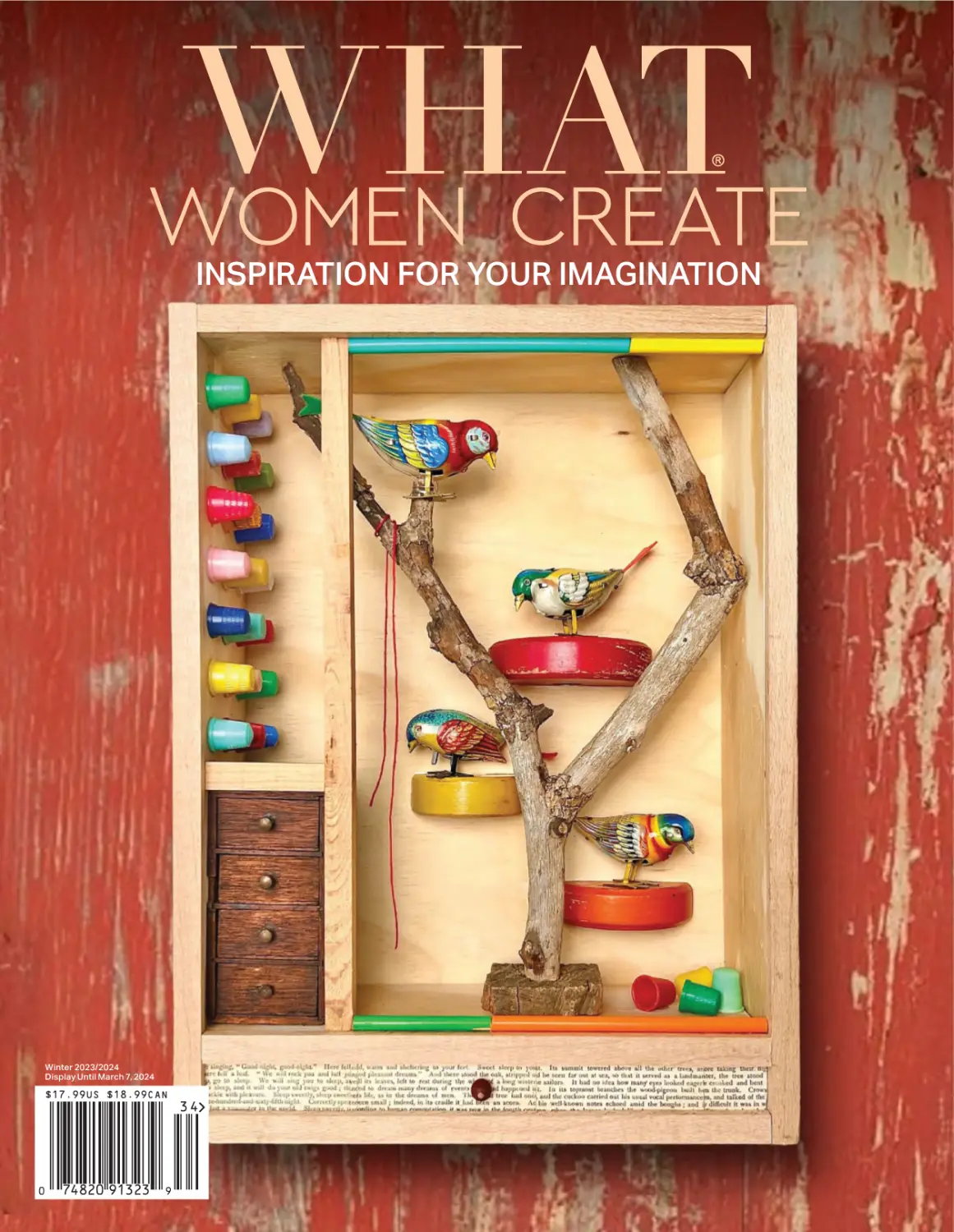






Text
INSPIRATION FOR YOUR IMAGINATION
Winter 2023/2024
Display Until March 7, 2024
$16.99 US $17.99 CDN
ARTIST:
CAROLINE HYDE-BROWN, PHOTO BY MARK DAVISON, P126
From a woman’s soul,
through a woman’s eyes,
by a woman’s hands.®
DESIGN & EDITORIAL
EDITOR IN CHIEF
Jennifer Blot
MARKETING MANAGER
Sammi Thomas
MANAGING EDITOR
Susan Harold
CIRCULATION/PRODUCTION
Weekly Retail Service
GRAPHIC DESIGN
Wendy Dunning
Thomas Smith
Smith@WeeklyRetailService.com
COPY EDITOR
Kelly Walters
HOW TO CONTACT US
CUSTOMER SERVICE &
SUBSCRIPTION INQUIRIES
WHAT WOMEN CREATE—Fulco Inc.
PO Box 3000, Denville, NJ 07834-3000
844-263-3472
WomenCreateCustService@FulcoInc.com
ADVERTISING INQUIRIES
Advertise@WomenCreate.com
SUBMISSION INQUIRIES
Submissions@WomenCreate.com
WHAT WOMEN CREATE®
WINTER ISSUE 21
PUBLISHED 4 TIMES
PER YEAR BY:
WRSL, LLC
65 Redding Road, Box 985
Georgetown, CT 06829
WomenCreate.com
POSTMASTER
Please send changes of address to:
WHAT WOMEN CREATE—Fulco Inc.
PO Box 3000, Denville, NJ 07834-3000.
Changes of address must be submitted in
writing.
Return undeliverable Canadian addresses to:
WHAT WOMEN CREATE—Fulco Inc.
PO Box 3000,
Denville, NJ 07834-3000
What Women Create® (USPS #21640)
is published quarterly by WRSL, LLC,
65 Redding Road, Box 985, Georgetown, CT
06829. Periodicals postage paid at Dover,
NJ, and at additional mailing offices.
What Women Create® is a registered trademark of WRSL
LLC and may not be used without permission. No part of this
publication may be reproduced without written permission
from the publisher or WRSL LLC. The information contained
in this magazine is provided AS IS. Neither WRSL LLC, nor
the publisher, make any representation or warranty with respect to this magazine or the contents thereof and do hereby disclaim all express and implied warranties to the fullest
extent permitted by law. WRSL LLC and the publisher do not
endorse any individuals, companies, products, services, or
views featured or advertised in this magazine.
©2023 WRSL LLC, all rights reserved. No part of this publication may be reproduced without written permission from
the copyright owner.
CONTENTS
58
FEATURES
8 Diana Laufer
24 Anne-Marie Krogh
58 Melanie LeGrand
80 Sherry Karver
94 Janet Carija Brandt
112 Barbara Safranek
126 Caroline Hyde-Brown
142 Beth Kephart
4
WHAT WOMEN CREATE | ISSUE 21
126
94
IN EVERY ISSUE
40
6 Where It Begins
DEPARTMENTS
152
40 Art of Business
Sarah Reed McNamara
74 Your Confident, Creative Business
Wendy Batten
152 Pet Tales
Phoebe, Dash and Lori Mitchell
ON THE COVER
FRONT: Diana Laufer
BACK: Sarah Reed McNamara / Photo by Jasmine Rose
WomenCreate.com
5
WHEREIt Begins
n every issue of WHAT Women Create, we
honor far more innovative women than
just the group of artists whose stories we
feature. That’s because so many of the women
who share the story of their artistic journey
end up giving a nod to another woman —
or women — who has impacted her life and
inspired her along the way.
This is something I love. It not only keeps
the cycle of inspiration moving forward, it
provides insight into how others affect us in
magical and profound ways. The act of writing
down our stories makes us reflect on our
eureka moments and the times we allowed
others to guide us, whether it was our incredible teachers and mentors, our incredible
mothers and grandmothers, or someone who
casually made a suggestion or offered advice
that would alter our course altogether.
For Janet Carija Brandt, who has put her
own spin on the venerable 17th-century art
of embellished caskets through her fairy taleinspired embroidery, it was Tricia Wilson
Nguyen, a designer and instructor who reacquainted Janet with the beauty and complexity of a genre she first fell in love with
at London’s Victoria and Albert Museum.
For Barbara Safranek, it was a reflection
on the creative skills she inherited from her
mother, Francy King, combined with the
call-to-action question posed by poet Mary
Oliver: What will you do with your one wild
and precious life? Diana Laufer was influenced by the instructors she encountered in
college — including painter Joan Brown and
artist/filmmaker Lynn Hershman Leeson,
who are recognized today as trailblazers. And
for Sarah Reed McNamara, it was the words
of a college professor’s wife encouraging her
to take a printmaking class — something
she says changed the entire trajectory of her
career and adult life.
I
Janet Carija Brandt, p 94
Barbara Safranek, p 112
Beth Kephart, p 142
Sarah Reed McNamara, p 40
Diana Laufer, p 8
These pages are filled with wonderful,
unique stories on the processes behind
creating, including an unconventional one
by author and bookmaker Beth Kephart
that is punctuated by her humorous, can-do
spirit. Traditionally, Women Create stories
are designed around our artists’ gorgeous
photo spreads, but in this case, breaking up
the text of Beth’s story and interspersing
photos interrupted the flow and the funny,
determined tone of a tale of transforming a
pile of soggy grass into something of beauty.
Even with limited photos, it’s easy to envision her overgrown lawn, the overflowing
contents of the lawn mower, and her determination to “do something with it.” I’m not
sure I will ever be inclined to go to the lengths
Beth did to create sheets of paper, but I was
happy to live vicariously through her.
This issue also marks the final installment
of Wendy Batten’s four-part series Your
Confident, Creative Business. Wendy has been
an indefatigable champion of the creative
entrepreneur and a voice of support and
encouragement when it comes to navigating
the ups and downs of running a small
business. Her perspective on prioritizing
tasks, time management and customer
service has been invaluable, and we are
grateful to have her as part of our Women
Create family.
And thank YOU for being part of our
Women Create family. We hope your
holiday season is filled with love and
creativity.
Jennifer Blot, Editor in Chief
WomenCreate.com
7
Diana Laufer
8
WHAT WOMEN CREATE | ISSUE 21
DIANA LAUFER is an assemblage artist based in the Hollywood Hills of Los Angeles, California.
Born and raised in cosmopolitan LA, Diana has grown up with a confluence of cultures that inspires her work
and, consequently, her experimentation in a variety of media. She is a Saori weaver, textile artist, painter and
collage artist. But she always returns to her first love: assemblage and dioramas.
10
WHAT WOMEN CREATE | ISSUE 21
Journey
I grew up in the San Fernando Valley (a
suburb of Los Angeles) when it was still filled
with orange groves and neighbors rode by
on horseback. My street had no sidewalks
and it was safe for us neighborhood kids to
ride our bikes and explore construction sites
(collecting the slug cutouts from electrical
boxes) and feed the ducks at the unfenced lake
at the historical Encino Adobe.
Not everything was carefree, however. As
a child of a Holocaust survivor, I was raised
amid fear, distrust and anxiety. Beginning in
childhood, creating art was my happy place. I
was a tomboy who loved being outside playing
kickball, but you would often find me in my
room drawing, painting or building something. Art was always my favorite subject.
I attended University of California,
Berkeley, where I planned on becoming a
journalism major. I was always very politically active and still am. But from my very
first semester, I took art electives. I was lucky
to have taken classes with some amazing
California artists, including painter Joan
Brown, printmaker David Goines, and
conceptual media artist Lynn Hershman
Leeson. I left journalism behind and graduated with a degree in graphic design so I could
get a job!
For years, I worked as an art director and
graphic designer for advertising and packaging within the entertainment industry.
I really did love it for a time. It was the
pre-computer era and one had to know how
to draw and spec type, and have a background
in art and design history, to be any good. I
had a dream job designing album covers for
a major music label, but it was hard to keep
up with my own art practice while working
in a visual field.
So, I took some time off to continue
making art and taking art classes, including a
graphic photo montage class taught by Cindy
Marsh, one of the founding members of the
Women’s Graphic Center at the Woman’s
Building in LA.
11
WomenCreate.com
A
fter I got married in the early 80s, my
husband and I traveled extensively
in Mexico and South America. I was
completely mesmerized by Latin American culture
and folk art. The materials, the colors, the soul of it.
From nichos to nativity scenes with chalkware animalitos. All beautiful, surreal worlds — dioramas in full
glory!
Around this time, I began creating what I have
dubbed my Spirit Houses. Influenced by Latin
American, Thai and Jewish folk art, I built wooden
boxes with hinged doors. I created collages of
ephemera, leaves and fabrics — framed in handembossed tin frames — to become the background
of each box. I then built out each diorama with threedimensional objects, some of which I brought back
from my travels, and others found in the remarkably rich cultural centers of Chinatown, Little Tokyo
and Olvera Street, right here in Los Angeles. I loved
combining different materials: colored sand, faux
flowers, marbles, sequins and tulle, to name a few,
all fused in the cultural influences of a true Angeleno.
In the early 90s, I became a mom and published
two children’s books, which I wrote and illustrated.
And then I had the opportunity to design my largest
diorama yet, a set for a Los Angeles theater company!
In 2010, I was diagnosed with amyloidosis. I
would eventually have a stem cell transplant and
then a kidney transplant (from my wonderful sister).
Recovery was long and hard, but creating art was a
major part of my healing process.
As I always loved set design and building little
worlds with my hands, I created a series of 3D
sets for my rescue dogs, Chester and Stella (aka
@HolyTerriers on Instagram). Each doggy diorama is
handmade using wood, paper, paint and found objects.
No Photoshop, filters or computer tomfoolery!
When the pandemic began, being immunocompromised, I was terrified. I basically stayed home like Rapunzel
(without the long blond hair) locked up in a tower. Luckily,
I live in the hills, which are filled with trees, plants and lots
of birdlife and I could be outside with my dogs. My passion
for birding was renewed, but I still wasn’t in the headspace
to create art.
Spending time on Instagram, I came across a wonderful
account and soon joined the @WhimsyandWonderArtClub.
It was just the fun and inspiring kick in the pants I needed!
I’m so grateful for this supportive group, which helped
reestablish my art-making passion.
For a year, I made food sculptures to get out of my head,
challenge myself and just have fun. And soon, I found my
way back to my first loves, assemblage and dioramas.
13
WomenCreate.com
The Process
14
Imagination has always been my sanctuary,
and art my escape to a safe and happy place.
My dioramas are self-contained imaginary
worlds where anything is possible.
Sometimes an idea for a new assemblage
just pops into my head. Other times, I’m
inspired by a prompt.
In July of this year, Trash Lamb Gallery, a
cool space in San Diego’s South Park neighborhood, had a call for art for a show titled
Survival is Insufficient. Submitted art had to
WHAT W
WOMEN CREATE | ISSUE 21
imagine a planet in a distant universe that
was overgrown with an abundance of exotic
flora, but where no sentient beings existed. I
instantly knew I wanted to invent mechanically engineered birds that flourished on
plant life.
When I begin thinking about creating a
new piece, I often know immediately what the
main components of the work will be made
of. I usually “see” most of the items from my
collections in my head.
WomenCreate.com
I
go through my collection of found objects and begin to pick
and choose to see what works. Creating assemblages is like
painting with objects. Which pieces go together? Do they
balance? How do the colors meld? What is the narrative created by the
juxtaposition of the objects?
I find the perfect small and very rustic box for the as-yet unbuilt
body. I choose a tin bird head, not plastic. Going through my stash of
wings, I like how the butterfly wings seem more exotic than bird wings.
I pay close attention to size, color and texture, and then I play around
with the parts until I land on what the emerging creature wants to be.
I sometimes feel like a mad scientist dissecting parts to piece together.
WHAT W
WOMEN CREATE | ISSUE 21
17
WomenCreate.com
F
inally, it’s time to attach the bird parts
to the box. Each element requires a
different way to be anchored. I use
whatever is necessary to hold a piece together: glue,
hammer and nails, drill and screws, miscellaneous
hardware, and even soldering. Problem-solving is
one of my favorite parts of creating.
Now, the center of the piece, the box, is still
empty. To elevate the finished artwork, I know the
inside of the bird’s body has to tell a compelling
story, in addition to looking fantastic. Thinking
about the planet’s exotic flora, I go through my
collection of vintage plastic aquarium plants and
select some bright fluorescent ones. I cut them up
and play around with different color combinations,
but something is still missing.
I get excited when I hit on the idea to use small
glass bottles to emulate beakers from a science lab.
I fill three small glass bottles with three different
colors of the plastic plants, then fill out the box with
extra faux plants to carefully craft an exotic but
miniature overgrown garden. I mix and match
materials until I reach that “aha” moment when
I just know it feels right. Lastly, I add a vintage
plastic bug for a pop of color and touch of whimsy.
I create a lot of bird dioramas. As an environmental activist, I am passionate about the earth
and animals. Birds are the literal canaries in the
coal mine. Metaphorically, I share the plight of
these beautiful creatures by showing them captive
but about to break free.
“Art is highly sensitive people reporting back
to the group what reality is like for them.”
— Pete Holmes
19
WomenCreate.com
“Art is a fantasy house built
on a real foundation. It is a
conscious act of splendor and
dementedness of over-reaching.”
— Jerry Saltz
20
WHAT W
WHAT
WOMEN CREATE | ISSUE 21
“I think of images as an immune system
and a transit system.”
— Lynda Barry
I am often asked where I find the materials I use
in my assemblages. I’ve always been a collector
of almost everything. I still frequent thrift stores
and flea markets to seek out unusual finds. Vintage
items used to be so much easier to come by, especially old wooden boxes! But, if I don’t find the
right box, I’ll build one. Luckily, I have a great local
resource for funky, vintage wood.
My collection of materials includes old plastic
and tin toys, baby doll parts, wooden cigar boxes,
old watch parts, rusted metal, vintage tin spice
22
WHAT W
WHAT
WOMEN CREATE | ISSUE 21
boxes and so much more. I also love ephemera,
including ethnic paper products like Mexican papel
picado, Chinese laser cut and dyed tissue, vintage
Japanese water flower packs and — woohoo! —
glassine envelopes. I have boxes of this stuff and
nothing gets thrown away because I never know
when I might need it for a new piece of art!
I feel so grateful that I am able to work doing
what I love. Inspired by nature and these magical
found objects, I create fantasy dream worlds of
whimsy and wonder. Please don’t wake me up!
What ’s Ahead
My vision is to turn a plain white room — let’s
say a 12-feet-by-12-feet square — into a walk-in
diorama/installation. I can picture the items I’d
use. They would mostly be miniature, so there
would need to be a lot of pieces to fill the space:
bits of paper with writing, colored string and lots
of colorful tiny objects. And it will tell a story that
I haven’t written yet.
Diana
www.DianaLauferArt.com
FACEBOOK: Diana.NugitLaufer
INSTAGRAM: Pompom_Empire
23
WomenCreate.com
PHOTO COURTESY OF ANNE-MARIE KROGH
AnneMarie
Krogh
PHOTOGRAPHY BY
TIA BORGSMIDT/
HOUSE OF PICTURES
24
WHAT
CREATE | ISSUE 21
WHAT WOMEN
W
WomenCreate.com
PHOTO COURTESY OF ANNE-MARIE KROGH
Handcrafted Artistry
I began my creative career as a graphic designer at
a design agency. But I began to question my profession when I was tasked with designing an annual
report for the tobacco industry — at the time my
mom was diagnosed with cancer.
It was a challenging period for me. My husband
and I were working full time and raising a small
child — and my work was very demanding and
stressful. I remember one afternoon arriving at
my son’s nursery crying after another late pickup.
Soon after that, I got sick with strep throat — but
when I was well and had to go back to work, my
body wouldn’t move. I called my doctor and after
a candid conversation, it was clear that I had been
under stress for so long that it had developed into
depression.
It was the hardest time —and the greatest gift.
On one of my many evening walks during this
time of recovering, I came across a small cellar
where a sculptor held pottery courses. I signed up
and found the greatest joy and peace at the wheel.
I felt at home.
When I couldn’t sleep at night, because my
thoughts couldn’t find peace, I visualized throwing
at the pottery wheel and would fall asleep.
I began to get better and started working as a
freelance graphic designer. It was really lovely
getting back to projects, and I worked with
wonderful clients who made a positive difference
in the world. I decided that I would only work with
clients I really resonated with.
After a few years of ceramics classes in the
evening and doing graphic design in the home
office, I rented my own studio and renovated it
completely. Here, I could spend all my evenings
and breaks working with ceramics.
When COVID came, I had time to create an
online shop. And when life returned to normal
again, I was so busy with ceramics that I didn’t
have time for graphics.
PHOTO BY JOSEFINE AMALIE
A N N E-M A R I E K R O G H founded her cozy
art and design studio on the ground floor of her
home in Copenhagen, Denmark. She is passionate
about working with clay and is known for her line
of whimsical ceramic bonbonnieres — or boxes for
candy or trinkets — and holiday-inspired bells and
small ornaments.
27
WomenCreate.com
WHAT WOMEN CREATE | ISSUE 21
IT HAS BEEN EIGHT YEARS
since I was introduced to ceramics, starting with
crafting lidded jars. I’m fascinated by creating
something that can be opened to reveal something
new. I use various techniques, including throwing
and molding, and then the pieces are painted and
personalized so that no two are identical. When
I work with clay, I can quickly try something out
and get a result — and there’s nothing that’s truly
right or wrong.
Every bonbonniere is for me a blank canvas. I
paint with underglaze, ceramic watercolour and
also use scrafitto, depending on my mood. I name
each one and the names are often names of people
I know or admire. I always look at the bonbonniere as I’m creating it to see if a name comes to
mind. You can be certain that if a bonbonniere is
called “Nina” or “Stine” or “Linn,” it is a favourite
of mine, simply because those are people I know
and love.
The gold top of the box is painted on with gold
lustre (12% gold). It requires working with a mask
in a ventilated room. It is then placed in the kiln
where the gold changes from brown to gold — it’s
a real wow moment when I open the kiln!
I have an 80-liter top-load kiln in my studio. I
dream about a bigger studio and kiln, but studio
rents are expensive and not easy to find. Also, my
studio is located in the same building we live in,
and that is really convenient.
PHOTO COURTESY OF ANNE-MARIE KROGH
29
WomenCreate.com
PHOTO COURTESY OF ANNE-MARIE KROGH
Joy of Creation
30
WHAT W
WOMEN CREATE | ISSUE 21
Being creative has always been a part of my life. I was brought
up in a family where it seemed everyone was doing some kind
of art. It was a natural way of spending time together as a family.
I remember my mom and I trying to mimic Picasso’s one-line
horse at the kitchen table.
To me, creativity was both a wonderful way to be connected
with my family and, also, a personal escape room. A secret, quiet
place — perfect for the shy and introverted child I was. My dad
had built a studio where I remember experimenting for the first
time with oil painting and printing equipment.
Today, I am developing my craft and learning continuously.
I like to work with both stoneware and porcelain, due to their
distinct characteristics. Porcelain can become almost transparent
when thinly thrown.
PHOTO COURTESY OF ANNE-MARIE KROGH
PHOTO COURTESY OF ANNE-MARIE KROGH
BOTH OF MY GRANDPARENTS
worked as porcelain painters at the Royal
Copenhagen factory. I remember considering
doing something similar when I was in school and
was asked to pick my future profession — but was
told you had to be good at chemistry, that it paid
poorly and was also really physically hard. Not
much positive was said about it then. So, I chose to
be a graphic designer instead. Today I have merged
the two and do all photography, graphic work and
marketing myself.
PHOTO COURTESY OF ANNE-MARIE KROGH
33
WomenCreate.com
PHOTO BY JOSEFINE AMALIE
34
WHAT WOMEN
CREATE | ISSUE 21
W
WomenCreate.com
PHOTO COURTESY OF ANNE-MARIE KROGH
I WOULD DESCRIBE MY STYLE
as whimsical and poetic and feminine. I like to
evoke feelings of empathy, joy and kindness. The
world can never get enough of that.
When I’m not working with clay, I love to sketch
and give my ideas time to incubate. Later, I often
go back to the sketches to translate some of the
themes and images into ceramics. The outcome
depends on my mood.
I love flipping through the little notebooks that
I have lying all over my studio. They are filled with
manifestations, sketches, and thoughts. I love
going through them and find that much of what
I dreamed of making and achieving in the past
has already happened. I never take it for granted.
I feel so fortunate to have a job that makes Monday
morning my favourite.
36
WHAT W
WOMEN CREATE | ISSUE 21
WomenCreate.com
Christmas Joy
At the moment I am preparing for the Christmas
season, and it is the busiest time of the year for me
as a maker. I am also developing a new shape for a
bonbonniere and trying to expand my knowledge of
wild clay. So, there’s a lot of experimentation and
development.
The porcelain ornaments I make are something that I really shouldn’t be making. They are
so time-consuming and difficult to fire in the kiln
since they are illustrated and glazed on both sides.
They can never be very profitable for me. But I love
making them.
I love Christmas. It’s a time filled with nostalgia
and traditions, and a time to remember those who
are no longer with us. I have always loved gathering
with my family to create ornaments, wreaths and
homemade decorations — traditions I want to pass
on to my boys, who are 10 and 13.
I always work intuitively, and the names of
my ornaments reflect my mindset. Often titles
are what comes to my mind when I look at them.
Affirmation titles such as “I am” and “Trust the
universe” are therefore a reflection of my own
thoughts and spirituality. They are meant as little
affirmation ornaments that can help you to remind
yourself of something important in your own life
journey.
When I create a ceramic ornament in the shape
of a person, I sometimes include details like a child
in a woman’s arms, or a person wearing a face
mask, reminiscent of the time of the COVID lockdowns. When people buy my ornaments, I enjoy
hearing why they choose specific ones, and why
they are meaningful to the buyer.
When I express myself creatively, I am fulfilled.
In a way, since clay is essentially earth, I lose touch
with the earth when I’m not being creative. I hope
I can continue doing what I love and coming up
with new ideas for the rest of my years, like the
potter Lucie Rie.
Anne-Marie
www.AnneMarieKroghStudio.com
INSTAGRAM: AnneMarieKrogh
Additional research by
Bente Halkjær/House of Pictures
38
WHAT W
WOMEN CREATE | ISSUE 21
WomenCreate.com
WHAT WOMEN CREATE | ISSUE 21
Sarah Reed
McNamara
SRM Prints
Photography by Jasmine Rose
SARAH REED MCNAMARA is a printmaker and textile
ARTIST based in Rockford, Illinois. She studied art history and
PRINTMAKING at Rockford University and established her
storefront, SRM PRINTS STUDIO + GIFT SHOP, in
the historic district of downtown Rockford, in August of 2023.
Sarah has been a PRINTMAKER in the community for over
a decade and her BRICK-AND-MORTAR STORE is the
culmination of a dream to work for herself, curate ARTISANMADE GOODS and share her love of print. She lives in
ROCKFORD with her two children and husband.
I grew up in a small town called Fox River Grove,
Illinois. I cannot talk about myself without talking
about where I grew up because it shaped me. I
loved growing up there. My earliest memories are
of being outside with the freedom to play, violets in
the backyard, my favorite forget-me-nots growing
in the creek beds and watching the water spiders
swim through the creek.
My childhood was not all charmed, there were
some very difficult parts, but my philosophy has
always been “forward and persist.” Resilience was
born in me early on, which shaped me as a woman
and informs all that I do as a mother, partner,
artist and business owner.
I did not grow up in a feminist house per se
and, for a large chunk of my early life, I didn’t have
my voice. My high school years were fun, wild and
full of transitions. In the middle of high school, I
moved to Rockford, a new, larger city, which was
a challenge, having grown up in a place where I
knew everyone. I still remember the anxiety of
eating lunch alone on the first day of school, but
I kept my mantra: Forward and persist — you
can do this. I was creative and loved the arts, and
preferred quiet activity.
I found my worth working 20 to 30 hours a week
at a retail store, while in school. I craved the independence that working gave me and loved to do
retail displays and inventory and learn from my
managers.
College is where everything came together for
me — I loved it. I had an affirming realization of
42
WHAT W
WHAT
WOMEN CREATE | ISSUE 21
myself, and for the first time, I felt my worth. I
could excel in my college courses, not just with
grades but as a person. As a first-generation college
student, my experience was a long one, but I would
not change it. I always loved taking scenic routes,
so that’s exactly what I did — it took me 10 years
to complete college and graduate.
Early into my college experience, it became
clear that I would be financially responsible for
my education, and I began to balance working to
pay for school and studying. I started at Rock Valley
College, where I earned my associate degree, then
spent time at DePaul University and the University
of Wisconsin-Madison studying history. My time
at UW Madison was met with peak burnout. I was
overworked, depressed, confused and needed a
break. I finally listened to my intuition and decided
to drop out. I knew I would go back to college, but
I needed to set the path.
A few years later, in 2008, I met my husband
at an art fair (love at first sight!). We married in
2011. One of the kindest, most supportive and
optimistic people I know, he knew of my struggles
with college and how much I wanted to go back.
He made it clear that he was there to help me with
my goals. I decided to apply to Rockford University
and, upon acceptance, decided on a double major
in art history and history.
Though a creative person, I had never taken any
formal art classes. I didn’t even draw for fun! I was
scared but decided on Printmaking 101, as I knew
the professor’s wife and she had encouraged me.
WomenCreate.com
M
y life would be incredibly
different if printmaking
and I hadn’t found each
other. One studio course
at Rockford University
changed the entire trajectory
of my adult life and career. I was able to continue
taking printmaking electives to fulfill my studio
courses and was simultaneously drawn to printmakers in my art history studies, specifically
German printmaker Käthe Kollwitz, Elizabeth
Catlett, and Mexican printmakers of the Taller de
Gráfica Popular.
After graduating in 2012, I took a full-time
nonprofit job but continued to work at my printmaking. I had a dream that someday I could make
it a full-time career — if I found the right avenues.
I was working on a new collection of linoleum
block prints when I was invited to do my first solo
show at a local cafe. This is when SRM Prints was
born. The day before the show, I realized I would
need business cards and social media handles —
so I typed out my initials, followed by “Prints,” and
there we were!
After that, I began to show my work more
frequently, taking opportunities that came my
way (never feeling I was too good for something),
44
WHAT W
WHAT
WOMEN CREATE | ISSUE 21
while learning to market myself. I also opened an
Etsy shop.
In 2015, I became pregnant with my daughter
(born 2016). I had a very tough pregnancy, was put
on bed rest, and had to leave my nonprofit job. I
even took a hiatus from printmaking, because I
couldn’t do anything!
The first couple of months of raising a newborn
(my daughter was a preemie) were exhausting, but
I began to feel my creativity grow and develop. I
continued to make linocut prints at home, and was
teaching myself textile printmaking, utilizing our
dining room table as my workspace. I began by
hand-printing onesies, swaddles and clothing for
my daughter, and eventually printed kitchen towels,
linens and yardage. My brain could not rest.
When my daughter was 6 months old, I felt
ready to be back in the classroom and audited a
printmaking class at my alma mater. I was planning large-scale prints for an art show, and it was
perfect timing to get studio time.
A month later, I found myself expecting again,
with our son (born 2017). While I was surprised,
it was very welcome and it didn’t hold me back.
I had an easier pregnancy this time around and
managed to power through the creation of large
print blocks for the show.
45
WomenCreate.com
T
hen, while still pregnant, I
was invited to do a large-scale
textile installation and prints
for a summer exhibition at the
Rockford Art Museum. I said
“yes,” without hesitating —
only to realize the install was planned for a few
weeks after my son’s due date.
With the incredible support of fellow artists
and the museum curator, I was able to accomplish the entire project, bringing my newborn
son to install with me every day. You never know
when an opportunity will be given again, so you
make it work.
After the exhibition, my business began
to rapidly grow, both online, through social
media, and through participation in art fairs
and markets. I was beginning to see real earnings. I moved into my first studio space in 2017,
which had room for my two main printmaking
practices — linoleum block printmaking and
46
WHAT W
WHAT
WOMEN CREATE | ISSUE 21
textile printing. It was time to separate the practice from the home and treat it like work.
Two of my hardest years of work building my
brand were 2018 and 2019. My kids were young,
but I knew that to grow a handmade business,
hard work and long days were needed. I put
myself out there and applied to more competitive art markets. Fortunately, I was accepted to
everything I applied to.
During those years, I spent every weekend
from October to Christmas at art fairs and
markets. I also worked nights a lot — usually
until 2 a.m. during the week — because I didn’t
want to miss out on time with my kids during
the day. I cannot underscore how much physical energy printmaking takes, from muscle
memory to endurance.
All the hard work paid off: I was able to build
a strong customer base, make friendships with
other makers and business owners, and find a
community of folks I could relate to.
Seeing a need for more artist opportunities in our
city, another maker and I began to host handmade
events and pop-up shops. We went on to form an
artists’ collective — GEM: Gather, Engage, Make —
establishing ourselves in a storefront in Rockford’s
historic downtown. We moved our maker spaces
inside and offered a curated retail section of artistmade goods.
I ran the retail storefront; and over the course of
four years, GEM hosted numerous events and workshops and leased studio spaces to women artists. I
grew a passion for running a brick-and-mortar and,
in December 2022, I became the sole proprietor of
the storefront.
But I began to feel overwhelmed running the large
space alone and felt it was time to take the next step
with my printmaking business, which would mean a
new storefront and moving away from the collective.
Though my kids were getting bigger, I still wanted to
be with them every day and realized that I could make
this work for us — if I did it my way.
“When we are young,
the words are scattered
all around us. As they
are assembled by
experience, so also
are we, sentence by
sentence, until the story
takes shape.”
— Louise Erdrich,
The Plague of Doves
47
WomenCreate.com
O
ne day I walked by a neighboring
business that had moved. Seeing
the storefront empty, I saw it in
an entirely new way and fell in
love with it, visualizing what it
could be. I signed the lease and
spent June and July of this year preparing the new
storefront, while closing out the other one, all while
running my handmade business.
SRM Prints Studio + Gift Shop opened August 1,
and it is my absolute dream! Opening day was incredibly heartwarming, seeing my community show up
to the space that is fondly called “the colorful shop
on the corner.”
Through thrifting and vintage sales, I sourced
every special fixture and display in the shop and
spent day and night curating the storefront, printing
textiles and planning the build-out for opening day.
I didn’t go into the move with a planned budget
(I don’t know that I recommend this!), but I worked
week to week to make it happen. I kept the faith that
each week, I could get to the next.
The storefront is inviting. I want people to feel
happy when they come in and for my customers to
embrace handmade items. I sell my print work, made
in-house, along with curated artisan-made gifts,
letterpress prints, ceramics and stationery goods.
48
WHAT W
WHAT
WOMEN CREATE | ISSUE 21
49
WomenCreate.com
“I do not want to die … until I have
faithfully made the most of my talent and
cultivated the seed that was placed in me
until the last small twig has grown.”
— Käthe Kollwitz
I
run my shop family-style. That means my
kids are often here. They belong here. I
created the sweetest kids’ spot in a front
window display for all kids to play in when
they are here with their families.
Being an artist-operated brickand-mortar means that I have learned to stop
apologizing for what I cannot do (this has been a
huge growth point for me), like being open 24/7.
I try to open six to seven days a week, but I’m the
only employee — and life can happen. The shop
50
WHAT W
WOMEN CREATE | ISSUE 21
hours during the week are based on school days
and my family’s life balance. I won’t miss my kids’
childhood.
I want other women to feel empowered to
do things their way — you can be a success on
your terms and your people will find you. I also
want other makers to see the timeline of how it
happened for me. It wasn’t an overnight success,
which social media can mislead folks to believe. It
was a gradual success that took shape over many
years of dedication to developing my craft.
51
WomenCreate.com
M
y business challenges are always related to
time. I rely on block scheduling my calendar,
creating daily task lists, and setting high
production goals. If I don’t meet them, I still
have my short goals attained. I have learned to
set boundaries with myself and others. Saying
no is not my strong suit, but I am working on it. I allow myself long
lead times for custom projects, since I am balancing a household,
studio and storefront. My next goal is to give myself more time off.
I’ve never had investors (besides my customers!), or small business loans, outside of what my husband and I put into SRM Prints
for materials in the beginning. My business has been a “from the
ground up” endeavor, coming to fruition by my hands, heart and
brain. My textile practice feeds the business and allows me to create
a sustainable business model.
52
WHAT WOMEN CREATE | ISSUE 21
I
get scared often. Sometimes I dive in
too deep, without having a plan. I can be
impulsive, but I always listen to my intuition. Running a small business is hard
and I am always learning.
I ask myself questions every week:
Will this be a busy week? Will I make it? Should
I be working every weekend, away from my kids
and partner? What can I do better? How can I let
those who offer to help, help? Am I supporting other
local businesses enough? Why is my house always
a disaster!?
One of my greatest challenges is asking for help,
but I am getting better at it. I get lost in my head
and feel isolated, but that is when I realize I need to
talk to one of my maker friends and my husband.
It’s my goal to hire an employee soon!
If I could give any advice to other makers or
small shops, it’s to trust your intuition — no one
knows you as well as you do! Create a circle of
trusted individuals who will listen to you when you
need it and return the favor when the time comes.
Supporting other creatives and small businesses is
imperative for this journey. We are stronger when
we are all thriving and supported.
My anxiousness ebbs and flows, but I
remind myself that I have created a career from
printmaking, from my ideas. I am living a life now
where I am the adult, the creator, the parent and
I choose to feel gratitude for this life. I am filled
with happiness every day that I get to walk into
my shop and do the work — often with my family
by my side.
Sarah
SRMprints
FACEBOOK: SRMprints
ETSY: www.Etsy.com/shop/SRMprints
INSTAGRAM:
55
WomenCreate.com
56
WHAT W
WOMEN CREATE | ISSUE 21
THROUGH THE LENS
JASMINE ROSE
is a photographer
native to the Midwest. She loves photography because
she is fascinated with light and hooked on the endless
chase of visual expression.
She has experience with commercial photography,
but her main passion is taking portraits of people.
Every person has a special and unique magic about
them, and capturing that spark of something on
camera is important — and fun!
Many people can feel hesitation over being
photographed because we all have worries about how
we are perceived. Jasmine tries to make the process
feel as natural as possible. She is passionate about
trying to share with others how beautiful they are.
Photography can frame the way someone
remembers and shares their story in the future. How
it felt to be in that moment, to wear that outfit, to love
those people. It’s the closest thing to pausing time for
ourselves.
When Jasmine is not taking photos, she also creates
stained-glass art through her business Electric Luster.
Jasmine
www.JasminePhotos.com
INSTAGRAM: Jasmirose
M anie Le
and
P H OTO G R A P H Y B Y L I S A A C E V E S
59
WomenCreate.com
Background story
I grew up in a small town in Ohio. My creative
journey began in these early years when my family
went through a traumatic experience the year I
turned 12. As a shy introvert, I learned to express
myself by writing stories and poetry. I didn’t
realize it at the time, but visiting my grandparents’
farm a few hours away provided unique childhood
experiences that fostered the art of daydreaming
and furthered my passion for various forms of
creative expression. I can see now those opportunities were blessings.
Then and now, time spent outside — unhurried and pausing to reflect — sparks a connection
within myself that in turn reveals something
God-given, honest and pure. In those moments
when I let my guard down and set free whatever
is speaking to me, something bold and beautiful
is birthed, especially in my work. Looking back at
times in my life when I’ve encountered trials or
difficulties, I’ve experienced that honesty, which
has guided me as I have evolved into the woman
and artist I am today.
As Miranda Lambert sings:
MELANIE LEGRAND is a self-taught
metalsmith artist and jewelry designer. She
resides in Georgia with her husband and their
11-year-old son. Her journey is inspired by her
travels with her family and time spent exploring
nature. When she isn’t in her studio hammering
away or sifting through trays of turquoise, you
can find her in the garden, journaling new ideas
and designs or taking long walks with her feisty
terrier, Henry.
60
WHAT W
WHAT
WOMEN CREATE | ISSUE 21
“I carry them around with me
I don’t mind having scars
Happiness ain’t prison
But there’s freedom in a broken heart”
There’s freedom in the broken places. It’s the
birthplace of grit and grace, where the story shines.
When they collide, it’s magic. Each piece I create
tells a story. It comes from a passionate desire to
make beautiful things, born out of heart and soul.
When I feel passion work its way into a piece of
jewelry, it is soul satisfying. And if someone else
loves it, too, the journey is beyond rewarding.
The Jo
ney
My metalsmithing journey began while vacationing in Hawaii with my husband for our 10th
anniversary. I purchased a hand-knotted necklace
crafted by a local artist, and the delicacy of the
knots and little beads captured my attention in a
way that prompted me to start researching how to
knot jewelry. There weren’t many avenues at that
time to learn such techniques. Through a great
amount of trial and error, I taught myself.
A third-grade teacher by day and hand-knotter
in my free time, I found great joy in learning this
technique. This all transpired at a time when my
husband and I could not conceive, spending years
with various doctors and procedures all ending in
disappointment.
Two years after we walked away from all forms
of medical help, by the grace of God, we found out
we were pregnant all on our own. That entire year
I felt like I was surrounded by angels. It’s hard
to describe, but I was so thankful and grateful, I
felt like I floated through the entire pregnancy in
awe that I would get to be a mom. At 39 years old,
I was considered at risk due to my age, but the
entire pregnancy and birth were surrounded by
little miracles and blessings.
Not long after my son was born, I started my
business on Etsy, aptly named Angelic Whimsey.
Watching metalsmithing videos, reaching out to
other metalsmiths, reading technique books and
taking online classes while my son napped, kept
the momentum going.
WomenCreate.com
62
WHAT W
WHAT
WOMEN CREATE | ISSUE 21
In
the beginning, everything I created
revolved around wings, angels and
feathers. Gradually, I learned additional
metalsmithing techniques, continuing to develop
and explore new ideas. What started as a confined
station in an extra bedroom turned into a full-time
jewelry business with a fully equipped studio. I’ve
designated specific workstations and studio areas
for metalworking and hammering; bezel and stone
setting; my hydraulic press and associated tools;
my inspiration board; torch table; photographing
station; a shipping station and metal clay work
station, complete with my pretty turquoise kiln.
And, of course, I have a special place designated
just for Henry — even though he tries to steal my
studio chair whenever he can!
My favorite part of this journey is how much
I have been able to share it with my son. When
he was little, I made a space in my studio where
we created all kinds of things together, and, also,
where he could explore ideas on his own whenever
he wanted. With an abundance of art supplies, we
played music and worked side by side for many
years. Now that he is 11, he enjoys designing robots
and engineering amazing projects and has his own
“studio,” but we still enjoy sharing creative time
together.
My studio is my happy place, designed to be
functional and fun. Whimsical art and family
photos decorate the walls. Mementos from my
family and a vision board provide lots of color and
joy. I keep inspirational magazines and books on
hand. My favorite music and twinkle lights keep
the studio cheerful and vibrant. Henry, my faithful
helper, steals anything that hits the floor and keeps
me on my toes! I look forward to coming to work
every day to see where my creativity will take me
next!
63
WomenCreate.com
Inspiration
I have a knack for finding hearts everywhere I
go. I can’t recall the first one, but it all started
after my son was born. They kept appearing
out of nowhere, and oftentimes during memorable experiences in my life, and now I have an
entire container filled with heart treasures that
continues to grow. Every single time I find one, I
am reminded of Mary Oliver’s quote, “Keep some
room in your heart for the unimaginable.”
I want to be receptive to unexpected and
extraordinary experiences, possibilities and
emotions that I might not have imagined.
Essentially, it’s about being open to the magic
and wonder that life can bring your way. I thrive
on the wonder. I chase it every day. It’s the catalyst for everything I create. The quote by E. B.
White, “Always be on the lookout for the presence
of wonder,” hangs in my studio as a reminder.
Nature is my muse, but unique turquoise
stones are where my design process begins.
Several years ago, we took a family vacation to
Arizona, visiting Sedona and the Grand Canyon.
We hiked, explored ruins, followed a well-known
trail and river and stood in awe of the amazing
rock formations around every bend. This trip
inspired my love for turquoise, Native American
history and American Western lifestyle. I’ve
almost exclusively worked with turquoise ever
since.
64
WHAT W
WHAT
WOMEN CRE
CREATE | ISSUE 21
WHAT WOMEN CREATE | ISSUE 21
The Proce
There’s a bit of mystery when I begin a new idea
or collection, sort of like a novel. You can’t know
the end until you begin. Any time I create in the
studio, it’s a lovely departure from my methodical approach to my personal life. My creativity
is not organized: It flows naturally and my work
is perfectly imperfect. I think that’s why I’m so
inspired by nature. I tend to dream up new ideas
when I’m out of the studio, observing nature’s
diversity and unpredictability. It teaches valuable
lessons about resilience and adaptation.
My work process is very similar. I usually start
with a specific idea that adapts and changes as I
go. In this case, I was drawing upon our family
adventure this summer to Wyoming.
For a recent project, I knew I wanted to make
hair combs, buttons and brooches that reflected
the Wyoming landscape and lifestyle — robin’segg-blue skies, lush green grass, mountain range
formations with blue rivers of water — along
with a flair for American Western design. I keep a
variety of turquoise stones on hand at all times to
choose from and, before I begin any actual work, I
take my time selecting stones that reflect the integrity of the project.
Once stones are chosen, I start by making
background shapes from sterling sheet by using
templates in my hydraulic press or by cutting
shapes with metal shears.
67
WomenCreate.com
All
edges are prepped
and filed. My hallmark stamp is added
to the back of all my work for authenticity. I carefully shape bezel wire around
each stone and solder together. This
requires precision, so the stone will fit
snugly. Once it is cleaned of all firescale, I
solder the bezel to the background shape.
The sterling is cleaned again after each
torch session.
68
WHAT W
WHAT
WOMEN CREATE | ISSUE 21
I like to add additional embellishments, like beaded wire or sterling balls,
for texture. It is a slow and steady process
and requires being very careful not to
melt the metal or have the solder overflow. Once finished, I add a patina that
darkens the metal and allows the deeper
recesses to pop with character.
69
WomenCreate.com
My work goes in a tumbler where it
is polished. After it comes out of the
tumbler, I polish it again and use a
strong adhesive to attach the decorative
part of the comb, brooch or button to
the backing.
One of my favorite parts is packaging
up my work and sending it off with love,
always attaching a handwritten note.
WHAT WOMEN CREATE | ISSUE 21
Whe I’m Going
My work continues to evolve as I readily explore and learn new
techniques. Future travels on the horizon will no doubt ignite
new ideas and opportunities, as does the change of every season.
Inspiration is everywhere.
In the future, my husband and I would like to relocate to the
Southwest. It is my dream to have an open studio where I work and
also sell my jewelry. A place surrounded by natural beauty where
I can offer private metalsmithing classes and share my knowledge with others. My business has become a platform for my work
and my story. I am thankful for those who support me and have
encouraged me on my journey.
“Now to him who is able to do immeasurably more than all we
ask or imagine, according to his power that is at work within us.”
— Ephesians 3:20
Melanie
www.AngelicWhimsey.com
INSTAGRAM: AngelicWhimsey
FACEBOOK: Angelic Whimsey Handcrafted
71
WomenCreate.com
72
WHAT W
WOMEN CREATE | ISSUE 21
THROUGH THE LENS
LISA ACEVES is a self-taught
photographer, and a wife and mother
of two, with a passion for capturing the
essence of beauty and style. With a
background and degrees in fashion and
marketing, she brings a unique perspective
to every photo shoot.
Lisa takes pride in empowering women
through her work, showcasing their
strength, grace and entrepreneurship that
defines them as the remarkable individuals
they are.
With an innate ability to make her
subjects feel comfortable in front of
the camera, she creates a collaborative
and enjoyable atmosphere on set,
understanding that personal branding is of
the utmost importance.
When Lisa isn’t behind the lens, she
enjoys supporting and collaborating with
small business owners who are women,
celebrating their achievements and
contributing to their success through
photography and insightful marketing
strategies. With an overriding commitment
to excellence, she endeavors to bring out
and highlight each client’s personal story
by focusing on their individual and unique
path to reach the success they envision for
themselves.
Lisa
INSTAGRAM:
LMarie.Photography_
73
WomenCreate.com
PART 4 OF A 4-PART SERIES
Your Confident, Creative Business
Where to
FOCUS YOUR TIME as
a creative business owner
W
elcome back to the final installment of Your
Confident, Creative Business series!
I’m Wendy Batten, a retail coach with years of
experience in the retail and small business trenches and, just
like you, a creative soul at heart. I’m also an imperfect time
manager.
Truthfully, I feel it will forever and always be something I
have to be intentional about.
In this article, we’ll dive into the important topic of where to
invest your precious time as a creative small business owner.
It’s not about managing time: It’s about prioritizing with
intention so that you can build a business that serves you and
your creative lifestyle.
The Time Conundrum
As creative small business owners, our businesses often
become an all-encompassing endeavor, leaving us little room
for the creativity that drove us in the first place.
It’s important to remember that we can’t “do it all.” It’s not
about being more efficient or using a better planner. The truth
is: You don’t HAVE to do anything. The constant need to feel
we SHOULD do everything is what causes stress and anxiety.
I’m an advocate for limiting what we do and giving ourselves permission to set boundaries, set down some of those
balls we are juggling and give ourselves some grace and space.
But how?
To start, I would love for you to define your time and really
think about:
1. LIFE TIME — not working on or in the business
2. WORK TIME — the actual hours you want to spend
on business
Some weeks, it might be more of one or another — life
happens. Set a plan for your work hours and do whatever you
can to protect those “off work” times to enjoy your life.
74
WHAT W
WOMEN CREATE | ISSUE 21
This simple exercise feels heavy to some. It was for me (for
many years): I should be working on this next proposal or I’ll just
check my socials and emails really quickly. I promise, if you set
some boundaries and bumpers around your “life time,” you will
be so much happier and you will avoid burnout (and resentment)
from your business.
Make this an executive CEO decision and give yourself permission to separate the hours. The choice is yours to make, no
one else will.
I personally stopped looking at emails, DMs and notifications
during life time. As a former people pleaser this was (and still is)
really hard. But I made a commitment to my well-being, and my
business’s well-being. I am not a brain surgeon or emergency
worker, and while my small business clients are super important
to me, as far as I know, no one has died from me not answering
emails — and my business is doing just fine. I set the boundaries
and, as a bonus, my customers seem to respect me more for it.
Yours will too, so stick to work during your work hours.
So, what should we focus on during our “work time”?
Making Time for Your Business
Once you have your working hours established, you have to be
intentional about where to focus that limited time.
Run Your Business by Design, Not Default
Many of us venture into business with dreams of being our own
boss and setting our own rules. The reality, though, is that being
your own boss is tough. To succeed, you must understand the
difference between working in your business and working on
your business.
We’ve established the difference between work time and life
time. Now, what can we do in those work times to be most effective in our creative business?
Competing priorities, squirrel brain (shiny object syndrome
is a real thing) and our natural creative curiosity get in our way
a lot.
There are five key areas that need to get consistent attention
in order for a business to grow and thrive. When you work on
these five things, in your now-structured work hours, you WILL
find a way to make it work. You will be getting the essential items
done, and by focusing on what matters most.
When we have unlimited time, it fills up. When we have finite
time or structured time, we will fill it with what matters most.
WENDY BATTEN is a small business
coach and consultant for creative shop
owners. She is obsessed with helping small
business owners develop their business skills,
get comfortable with the business side, and
reclaim their dream of growing a thriving
creative retail business through her online
courses, business coaching programs and
her popular podcast.
With 20-plus years of small business
experience, including running a successful
creative retail and studio business, she
understands what it’s like to be in the
trenches. Wendy works with hundreds of
creative shop owners across the globe from
a crooked cottage home by the sea that she
shares with her photographer husband in
Nova Scotia, Canada.
75
WomenCreate.com
The Five Core
Areas to Focus
Your Time
It’s not enough to be busy.
The question is: What are
we busy about?
To run your creative retail business successfully, there are five core areas where you must
focus your time. This is the shift that changed
everything in my business from feeling chaotic
to thriving. We, as humans and especially as
creatives, tend to veer to the things we like to do
more than the things we need to do as creative
CEOs.
Here are the five areas we, as creative business owners, need to make sure we are spending that work time on.
76
WHAT W
WOMEN CREATE | ISSUE 21
1
Business
Development
Business development is often overlooked or
used as a procrastination tool. However, investing time in improving your business foundations, acquiring new skills and staying updated
is crucial for long-term success. Learning and
growth should never stop.
Tasks in this category may include:
• Purposeful educational time
• Reviewing metrics/Key
Performance Indicators and
•
•
•
•
Quarterly and yearly planning
Decision-making
Vision storming for the business
Research and development
Marketing +
Sales
2
Marketing and sales are non-negotiables for
any business. The time you invest here can
have a significant impact on your profitability
and sustainability. Putting the right strategy in
place is key to your business success. Done right,
marketing can yield substantial returns on your
time, energy and money.
Tasks in this category include:
•
•
•
•
•
Planning marketing events
Promotional calendar planning
Creating shop/market displays
Community outreach/awareness
Creating, scheduling and
promoting content
Creative
Work
3
Don’t forget the heart of your business —
the creative work that generates income. It’s
easy to get caught up in administrative tasks
and neglect the very work that sustains your
business.
Tasks in this area:
• Anything that is considered your
revenue-generating work
4
Customer
Service/
Serving Your
Customers
Customer service plays a pivotal role in shaping
your customers’ perceptions of your business.
Exceptional customer service can turn customers
into raving fans who refer others. Customer service
can (and should) be limited to your working hours.
(I promise you will get used to this.)
Tasks in this category include:
• Managing and responding to
emails
• Handling direct messages
• In-person customer interactions
• Coordinating custom work
requests
• Streamlining and delegating
customer service tasks to free
up your time while ensuring your
clients feel well taken care of
5
Administrative
and Operations
These are the essential but often time-consuming
tasks that keep your business running smoothly.
While necessary, they don’t directly generate
revenue for you.
Tasks in this category include:
•
•
•
•
•
Organizing paperwork and receipts
Invoicing and tracking payments
Bookkeeping and accounting
Customer database management
Any repeatable tasks
Recognize that these tasks can easily eat up your
time, so it’s crucial to systematize, delegate or
eliminate them as much as possible.
Your action steps:
Keep this time pyramid handy and pay attention
to where you allocate your time.
Understanding where to spend your time as a
creative small business owner is the key to unlocking your business’s true potential. By prioritizing
your tasks with intention and focusing on what
matters in your business, you can transition from
feeling like the business is running you to thriving
as a creative entrepreneur.
Personally, this time pyramid helped me learn
to work on what’s important and realize that working on the admin for hours and hours wasn’t my
zone of genius, or making me money, so I streamlined and delegated that portion and now spend
more time on the things that matter at the top of
the pyramid. It’s a game-changer for me, and is
for my clients, too.
Remember, it’s about making time for your life
and your business’s health. Are you ready to run
your business by design, not by default? Invest
your time wisely and watch your creative business
soar to new heights.
Connect with me if you need any support with
your creative business, it would be my pleasure
to help you.
Is your mission larger
than your excuses?
For many (myself included), this pyramid was
completely inverted initially. Only when I flipped
it did I see my business grow.
A HELPFUL TIP | Replace “I have to” with
“I get to” and see how your mindset changes
around organizing your time and doing the
harder things!
Wendy
www.WendyBatten.com
PODCAST: The Creative Shop Talk Podcast
www.WendyBatten.com/Podcast-Intro
INSTAGRAM: WendyBatten.biz
79
WomenCreate.com
WHAT WOMEN CREATE | ISSUE 21
Photography by Chris Hardy
SHERRY KARVER
California artist SHERRY KARVER
is not a traditional photographer. She
pushes the boundaries of photography by
combining her images with other materials
to create a new hybrid that engages the
viewer on many different levels.
82
WHAT W
WHAT
WOMEN CREATE | ISSUE 21
M
y journey as an artist has had numerous
twists and turns — in a good way. If you
had asked me years ago where I would be
in 2023, or what kind of artwork I would
be making, I could never have guessed.
Things just have a way of evolving on their own.
I was born and raised in Chicago, Illinois, an only child
to parents who were Holocaust survivors from Poland. Art
was not an important element to them, but inadvertently
they both were instrumental in my early interest in art.
My dad was a tailor so there were always scraps of
fabric laying around that I would cut up and create things
with; and my mother worked for a company that made the
little colored squares glued on paint store brochures.
She would bring home extra ones, which developed
my interest in colors early on. I was probably the only
6-year-old who knew what aubergine or chartreuse
looked like.
I was enrolled in Saturday kids classes at the Art
Institute of Chicago and that probably had the biggest
impact on my love of art. The Art Institute opened to the
public at 10 a.m., but the classes started at 9 a.m., so the
guards would let us kids in whenever we arrived — and
I was always the first one there. I got to walk through
the entire Art Institute by myself in the semi-darkness
because the lights weren’t all on, and the air was cool
since the heat wasn’t on yet, and I was surrounded by all
these amazing paintings and sculptures. It was magical. Can
you imagine nowadays letting kids walk through a museum
alone before it opened? I was really lucky to have such an
experience every Saturday morning.
By the time I got to college my parents wanted me to
study something where I could get a job, so I majored in
sociology at Indiana University in Bloomington. I found
sociology interesting, but my heart wasn’t really into
working in that field. I had no idea what I wanted to do until
my senior year. I had time to take a ceramics class and that
literally changed my life. I knew then and there I was never
going into sociology. I was hooked on ceramics.
83
WomenCreate.com
A
fter graduating, I opened a ceramic
shop and studio in Chicago with a
business partner under the Morse
Avenue elevated train tracks. It was
a wonderful experience for four
years — until I heard something telling me I
needed to teach ceramics.
This itself was a magical experience, as I was
driving home from the shop one afternoon on
the Outer Drive in Chicago and I heard a voice
from somewhere telling me to go back to graduate school. I cannot to this day explain where
this voice came from, but I knew I had to follow
the direction. I went back to school and got my
MFA at the Newcomb Art Department at Tulane
University in New Orleans, so I could teach
college-level ceramics.
I moved around for the next several years,
following teaching jobs at the University of
Wisconsin, Milwaukee, San Diego State University,
Chico State, and finally ended up in Oakland,
California, teaching ceramics at Laney College for
30 years. Although I loved teaching ceramics, my
own work gradually evolved into photography and
mixed media painting around 2000.
Never in a million years did I think I would
leave ceramics, but things have a funny way of
happening. For a number of years, I had been
working on a series of two-dimensional clay wall
sculptures that I would hammer apart into many
small pieces and reassemble much like a jigsaw
puzzle, epoxying the pieces onto wooden boards.
One day I was distracted and stepped away
in the middle of doing this, and by the time I got
back, some of the pieces had shifted and the epoxy
had hardened enough so that I couldn’t fit the
rest of the pieces in — and I was only half done.
Not wanting to waste the part already finished, I
decided to paint the rest of the board with oils, and
a new direction was born. Sometimes, a mistake or
an unforeseen accident leads to a whole new idea.
84
WHAT W
WHAT
WOMEN CREATE | ISSUE 21
WomenCreate.com
I
PHOTO COURTESY OF SHERRY KARVER
started leaving out more and more
clay pieces until the board was
just paint. Simultaneously, I also
began exploring photography and
Photoshop on the computer and
started to incorporate those images into
my work.
At that time, my husband, poet and
novelist Jerry Ratch, and I were living in
the Emeryville Artists’ Cooperative in
Emeryville, California, in a wonderful
studio that had skylights but no windows.
Needing more air circulation and light
since I was now painting with oil, we left
the co-op and bought the former Rockridge
Woman’s Club in Oakland. In its heyday
in the 1930s, the club had 300 members,
but over the years that dwindled down to
only half a dozen when we bought it. We
converted it to a live/work space where we
still are today — 22 years later.
Currently, I have two ongoing series.
Identity and Perception combines my photo
images with oil, narrative text and resin
surface on wood panels, and deals with
issues of how we are as individuals within
crowds, often experiencing loneliness,
alienation, loss of identity, memories, etc.
My Missing Pieces of the Puzzle series
began during COVID, when Jerry and I
stopped going out much and got hooked on
doing commercial jigsaw puzzles. I noticed
that the puzzles often looked more interesting when they were only half done with
pieces missing, which gave me the idea to
have my own photos made into puzzles.
People are often searching for things
in life they have missed. Since the
pandemic, people have missed opportunities — missed seeing family and friends,
traveling, eating in restaurants, etc. It has
been a universal missing of things that
were once familiar and ordinary that we
just took for granted.
86
WHAT W
WHAT
WOMEN CREATE | ISSUE 21
PHOTO COURTESY OF SHERRY KARVER
I leave out some sections of the puzzle when
putting it together, and paint the negative spaces
with oils. The left-out pieces in my work represent our search for the missing pieces in our
lives, or in the world, and the realization that
not everything can be found and replaced. This
series conveys our need to find the acceptance
and serenity in what is not there, and the hopefulness that the missing parts could be open
spaces for something new to enter the picture.
“Be yourself;
everyone else is
already taken.”
— Oscar Wilde
87
WomenCreate.com
I will explain exactly how
these works are created:
I begin by putting together numerous photos I have
taken and use Photoshop to seamlessly combine
them into one image. I then send the image
to various companies I use that make custom
puzzles, in the U.S., China, and even Bratislava,
and get them back in a box of 1000 pieces.
I have to admit that my husband puts the
puzzles together, since that is the hobby he enjoys
most, while I am coming up with new images and
working on the next part of this multistep process.
I spend hours deciding which pieces to take out
and what to leave in, which is much harder than
it seems.
PHOTOS COURTESY OF SHERRY KARVER
88
WOMEN CREATE | ISSUE 21
WHAT
W
HAT W
PHOTOS COURTESY OF SHERRY KARVER
Once I have decided this, I coat the
front and back with a thin layer of Mod
Podge to hold it all together for easier
handling. Smaller puzzles are made in
one piece while larger ones are done
with two halves.
89
WomenCreate.com
PHOTOS COURTESY OF SHERRY KARVER
I test different colors for the background and
paint the wood panel with oil paint about a week
before gluing the puzzle onto it, giving the paint a
chance to dry well. I only paint the sections of the
panel that are visible, not where the puzzle will be
placed. The puzzle is then glued to the board using
Elmer’s glue, with bricks placed on top to seal it
down firmly.
After another week of letting all of this dry
completely, I do a resin pour over the entire
surface and use a propane torch to get rid of any
bubbles that appear. Resin pours can be tricky
and I recommend watching YouTube demonstrations, which is how I learned to do it. This is very
important: Be sure to wear a face mask, goggles,
rubber gloves and long sleeves so that no resin
touches your skin, and nothing is accidentally
inhaled or gets into your eyes. I usually do two or
three resin pours several days apart in order to get
a nice even surface.
PHOTO COURTESY OF SHERRY KARVER
“There is a crack in everything. That’s how
the light gets in.” — Anthem, Leonard Cohen
W
hat I find especially interesting, or
perhaps coincidental, is that my
work has come full circle from
earlier ceramic wall sculptures, that
I hammered apart and reconstructed
onto panels much like jigsaw puzzles, and my current
work, which is similar in concept, but uses totally different
materials — actual jigsaw puzzles!
Sherry
www.SherryKarver.com
INSTAGRAM: SherryKarver
91
WomenCreate.com
THROUGH THE LENS
CHRIS HARDY has been a
photojournalist for more than 30
years, working primarily for the Los
Angeles Times, the San Francisco
Examiner and the San Francisco
Chronicle. Over the course of his
newspaper career, he photographed
major news stories, from Super Bowls
to the Space Shuttle landing and the
Loma Prieta earthquake, as well as a
wide range of celebrities, politicians
and business leaders.
Chris was born in Long
Beach, California, and attended
Cal State University, Fullerton,
where he studied graphics and
photography. He started working as
a photographer for the Los Angeles
Times while he was still in school.
He then went on to work for the
San Francisco Examiner for 22 years,
where he helped develop the digital
photography program. He spent
five years with the San Francisco
Chronicle before going out on his
own as a freelancer and photography
teacher at San Francisco’s Academy of
Art University in 2005.
Chris’ freelance work includes
shooting the arts, sports and travel,
as well as corporate identity and
promotional photos.
His photographs have appeared
Time, Newsweek and Life magazines,
as well as in books and on album
covers. His awards include more than
20 San Francisco Bay Area Press
Photographers Association awards,
five California Press Photographers
Association awards, and six national
Picture of the Year awards.
Chris
www.ChrisHardyPhoto.com
INSTAGRAM: ChrisHardyPhotos
93
WomenCreate.com
WHAT WOMEN CREATE | ISSUE 21
Janet Carija Brandt
Photography by ChrisKauschPhotography.com
95
WomenCreate.com
Janet Carija Brandt
is an embroidery/textile artist living in
Indianapolis, Indiana. She really likes to
embroider. In fact, it was her husband
who pointed out the obvious to her:
“You need your stitching. You’re
happiest when you are stitching. You’re
always stitching!” — or words to that
effect. And all her work proves it.
96
WHAT W
WHAT
WOMEN CREATE | ISSUE 21
Needing
Needlewk
I remember the first time I saw a skein of embroidery
floss. I was 5, maybe 6, and standing in front of the
thread counter at Kresge’s. It was a yellow-orange
shade of thread and I wanted it so badly. A skein of
floss gives me the same thrill today.
I am a self-taught embroiderer with lots of bad
habits. I only learned about these stitching no-nos,
like licking my thread and putting knots on the back
of my work, in the last 10 to 15 years. I’m glad I didn’t
know sooner. Too many rules.
My first embroidery attempts were kits. They were
great because all the materials were included and
there were so many new stitches to learn.
I grew up in Gary, Indiana, a melting pot of Eastern
European communities. I have loved folk embroideries and the embroideries of my Croatian heritage
all my life.
My parents owned a women’s clothing store. I did
fashion illustrations, dressed windows, and planned
back-to-school fashion shows. And to think none of
that exists anymore. … But I loved it all.
The best part of Gary was having Chicago a short
train ride away. The Chicago Art Institute was free and
empty. Brentano’s bookstore on Wabash had a great
art and architecture department.
Architecture was my first real detour from embroidery. I had originally planned to study weaving and
textiles but switched majors and colleges at the last
minute. I did stitch during those years, but as the only
woman in the class I had to do it on the sly. It was
considered too girly. Of course, the best part of my
college years was meeting my husband. He has been
my greatest stitching supporter ever since.
The next decades pass in a blur of detours called
marriage, children, and a huge variety of freelance
jobs in graphic design and architectural model
building. I made my first doll after our daughter was
born. I’m still making them. I passed through a period
of wearable art and rug hooking. Rug hooking was
too labor-intensive for me, so I decided to combine
the wool fabric I was using for rugs with my love for
embroidery.
It led to my first book, WOW! Wool-on-Wool Folk
Art Quilts. I enjoyed writing and designing for books,
magazines and manufacturers. It was the perfect
work-from-home job. More books followed and more
embroidery was incorporated into the quilts. My last
book was about the creative process in each and every
one of us.
I explored digitized embroidery and created an
entire collection of ethnic dolls using digitized embroidery to stitch everything from the body shapes to the
costumes. And then it was time for architecture again
— only on a miniature scale. I decided to remodel the
dollhouse I had made for our daughter so many years
before. This was the beginning of the Red House, Once
Upon A Time and The World of Possibilities, an all-new
embroidery journey that took a very unexpected form.
97
WomenCreate.com
PHOTO COURTESY OF JANET CARIJA BRANDT
The Casket Jrney
Casket is a 17th-century word for box. In the
1600s, these boxes were covered with lavish 3D
embroideries in a technique then-called “raised
embroidery,” but now called stumpwork by many.
I saw my first embroidered casket at the Victoria
and Albert Museum as a college student studying
in London. It was love at first sight. It was also a
very long time ago (1974)!
The materials and shapes for this type of
embroidery were reintroduced by Tricia Wilson
Nguyen and her company Thistle Threads for the
first time in almost 400 years. I knew I wanted to
create my own story to go on my own casket. That
is, casket singular. I never imagined I would eventually create four very different ones!
98
WHAT W
WHAT
WOMEN CREATE | ISSUE 21
I found Tricia’s website quite by accident. I
was already experimenting with raised embroidery, but here was a class telling me about those
wonderful embroidered boxes like the ones I had
seen at the V&A all those years before.
Tricia was offering a class that included an
in-depth history of 17th-century raised embroidery, hundreds of detailed reference photos, all the
step-by-step stitch instructions and — best of all
— threads, trims and the unique boxes, available
for the first time in 400 years. The first offering of
the Cabinet of Curiosities class was well underway.
I signed up for the next class as soon as it was
offered. That was 10 years ago.
In addition to covering the boxes, I created
small dolls of the main characters, a theater, a
castle cross-section, maps and extra illustrations
to tell my story. The theme is the Golden Rule.
Of course, it takes place in the Golden Rule
Mountains, with two kingdoms and two kings: the
Dragon Prince who believes “he who has the gold
rules,” and the Princely Dragon, who lives by “treat
others as you want to be treated.”
I stitched my story using characters from fairy
tales, nursery rhymes, fables, and my imagination.
The outsides of the boxes are just the beginning. Inside you’ll find hidden drawers, secret
compartments and expanding scenes. Visitors
find something new each time they view my work.
My lifelong need for the tactile connection
between me and the cloth explains why I do most
of my embroidery “in hand” — meaning I don’t
use a hoop or frame if I don’t have to. Working in
hoops or frames serves an important function for
many techniques and I use them when necessary.
But I love the portability of working in hand.
Before I even started the casket classes, I had
stacks of drawings with ideas, themes, characters
and settings. I never had any intention of trying
to reproduce a 17th-century casket. After years of
designing my own quilts, rugs and embroideries,
I knew this, too, would be my own design with lots
of nods to the 17th century.
WomenCreate.com
"Engh is a feast."
— Buddhist proverb
WHAT WOMEN CRE
CREATE | ISSUE 21
Telling a story in stitches takes a good deal of thought and planning. First, I had to decide on a focal point for each embroidery,
which was usually a character. I would think about which moment
in the story I wanted to show. Then, I planned the setting and all
the little details to further the story along.
Meanwhile, I am always thinking about how I will actually
stitch it. I pick which parts will be in raised embroidery and which
parts will be flat and what stitches I will use to achieve those goals.
The best step of all is choosing threads from a rainbow of colors
and textures. So many possibilities each step of the way.
Most of the stitching for the caskets was done in silk
with wool and cotton showing up as well. I had never
stitched with silk before I started this project. For me, each
fiber stitches so differently. Silk seems to beg to be precise.
Or at least as precise as I am able to be. I find I work in a
much looser style when I stitch in cotton or wool.
The Red House casket was designed to look like a home
on the front. The sides feature different characters and
places. The top shows a little girl named “Once” and her
giant flying dog friend named “Time.” I used many of the
same doll-making skills I had acquired over the years
on the raised figures of the embroidered panels. I was
honored to have this casket exhibited at Winterthur
Museum for their 2018 needlework exhibit Embroidery:
The Thread of History.
The Enchanted Forest is a 3D forest creation. The
tree spirits and forest animals converge in a mossy
clearing. Making sure the trees were stable and secure
was a fun problem to solve. I documented my process
in a YouTube video.
101
WomenCreate.com
Fables to Go was me really stepping
out of the traditional casket imagery.
The abstract designs I call my “wander
scapes” are environments I would love
to travel through in real life. I chose
to use detached buttonhole stitches
throughout for two reasons. The colors
are more intense, and I didn’t have
to make all of the stitches through
the fabric. (This was before I had my
arthritic thumb rebuilt.) My animals
were strongly influenced by Milo
Winter’s 1919 version of Aesop’s Fables.
102
WHAT WOMEN CRE
CREATE | ISSUE 21
Creativity is one of �e most powerful traits
we possess. When we deprive children of
arts programs, we aren’t taking away busy
w�k. We are taking away a chance to learn
problem-solving ski�s. Life is no�ing but
fu�-time problem-solving, so why not learn
to do it creatively?
103
WomenCreate.com
WHAT WOMEN CREATE | ISSUE 21
The last casket is about the cycle of
a garden. One of the first 3D embroideries I created before I started the
caskets was the Gardening Angel. I
thought it fitting to put her on the
last box. The rest of the box tells the
origin story of the Dragon Prince and
the Princely Dragon. Beginnings and
endings coming full circle.
In between covering the caskets, I
stitched dolls and their clothing and
expanded the Red House dollhouse.
The buildings now cover one wall of my
studio. I enjoy making stages and their
settings. It is a motif that appears over
and over in my work. The largest stage
is the Enchanted Forest stage. Presently,
it holds small scale embroidered buildings of the village. The little people are
antique German folk figures.
There is also a cross section of the
Gold Castle ruled over by the Dragon
Prince. It was fun to see how much
detail I would be able to include at
that scale. Quite a bit, it turns out! The
entire image size is just 8 by 10 inches.
WomenCreate.com
Process
The last step of creating a casket is mounting the
embroideries onto the box.
If you would like to try this process yourself, start
with a simple wood box from any craft store.
Trace your embroidery design onto your fabric.
My favorite stitching material is osnaburg. It is the
very poor cousin of linen, but I like it. I like to use a
fine point Uniball pen for tracing.
Have fun stitching your creation using any thread
that makes you happy.
Remove hardware from the box and lightly sand
inside and outside. I’m not going to use the hinges on
the final box, so I fill the cutout area where the hinges
were originally recessed. I use wooden coffee stirrers.
WHAT WOMEN CRE
CREATE | ISSUE 21
Cut the stirrers to size, stack them up, glue in place
and when the glue is very dry, sand any rough edges.
You might want to add feet to your box, so now is a
good time to prime those. I thought about using either
miniature wooden spools or small wood thimbles.
Traditional 17th-century boxes were first covered
in paper. This is an important procedure uncovered
by Tricia Wilson Nguyen during her years of research.
She describes it in great detail, complete with videos,
in her embroidery course. The paper provides a
protected surface to adhere your embroidery.
Paste paper to the back of your embroidery. When
super dry, you can cut it to fit the box. I choose to
cover the lid of my box with embroidery and the lower
sections with a coordinating fabric.
Any raw edges can be covered with ribbon or a
decorative trim. Traditionally, edges were finished
with a beautiful woven silver trim!
WomenCreate.com
The Bo Line
From an early age, I’ve felt I’ve had a charmed
life. I have always seen possibilities around
me. I have an amazing husband and family
and I also have the daily opportunity to create.
A needle with a little thread lets you create
whole worlds. Enough truly is a feast.
108
WHAT WOMEN CRE
CREATE | ISSUE 21
Janet
Janetbrandt.com
INSTAGRAM: Janet.Brandt
YOUTUBE: Janet Brandt
https://Thistle-Threads.thinkific.com/
WomenCreate.com
110
WHAT WOMEN CRE
CREATE | ISSUE 21
THROUGH THE LENS
Chris Kausch is an Indianapolis professional
photographer who creates beautiful, artistic portraits
for a variety of occasions. Whether you need an
experienced wedding photographer in Indianapolis
for your special day, corporate event photography
for an upcoming event, senior pictures, engagement
portraits or simply the best family portraits, Chris
should be your choice of Indianapolis professional
photographers.
I am married to �e most beautiful girl in �e w�ld.
Photography k�ps me we� fed and I w�k f� people
who genuinely love my w�k.
God is Love.
Chris
www.ChrisKauschPhotography.com
111
WomenCreate.com
Barbara Safranek
112
WHAT WOMEN CRE
CREATE | ISSUE 21
113
WomenCreate.com
Transformative Dressing
What happens to move a woman out of her sartorial comfort zone? To take the
chance of looking foolish or having to explain her choices? It turns out, it doesn’t
happen without a push, and it doesn’t happen all at once. This is the creative journey
of BARBARA SAFRANEK of Spokane, Washington, to a new lease on life.
When my father died, I signed up for salsa lessons.
With his passing, I felt the urgency to live more
fully. It was the finitude of life that finally opened
me up to my real hunger — not just for beauty, but
for a fuller, more generous engagement with the
world. This was the beginning of my journey as a
sewist of bold and provocative garments.
Mary Oliver’s question in the poem The
Summer Day has guided me: “What will you do
with your one wild and precious life?”
I found myself diving more deeply into my
love of clothing design. It started when I developed a curiosity for the skirt I found in a thrift
shop made from a bold geometric print with an
unusual color combination. I came to discover
it was one of the thousands of batik-like designs
printed on machines invented in the 1800s by the
Dutch — called Dutch wax prints — that have
become culturally iconic in West Africa. I plunged
into the world of African prints and a spark of
inspiration grew into a transformative relationship with fashion and dressing.
My philosophy of wearing art did not come to
me fully formed. My first Dutch wax creation — a
tailored, princess-seam coat in a large border-toborder botanical print — was carefully planned
with attention to matching the vining design at
prominent seams and balancing the pattern over
the length and circularity of the garment. Still one
of my favorites, it was even more striking than I
had hoped for, but hung in my closet waiting for
my self-confidence to catch up to my imagination.
I finally stepped out, a frozen introvert inside
a coat vibrating with color and pattern. Not only
were conversations ignited at that concert I wore
it to, but people remembered my coat months
114
WHAT WOMEN CRE
CREATE | ISSUE 21
later. I began to see myself as someone who had
something to offer, and to engage with strangers —
dancers, artists, educators, entrepreneurs — and
my world expanded. The unapologetic, explosive
joy of Dutch wax prints has pushed me to be braver
and more generous and has made me a believer
that dressing boldly is like presenting yourself as a
gift and extending an invitation to others to engage
with curiosity and delight.
WomenCreate.com
“AS LONG AS WE
ARE ABLE TO BE
EXTRAVAGANT WE WILL
BE HUGELY AND DAMPLY
EXTRAVAGANT.”
— Mary Oliver, When the Roses
Speak, I Pay Attention
I
wonder if my mother would have
embraced her namesake, Francy King
Wearable Art? Francy was a minister’s
wife who filled a prescribed role, and I might be
crossing her lines of modesty and decorum with
my creations. But it was her creativity as a homemaker, especially her sewing skills, that put me
on this path as a maker. I find myself, in art and in
life, learning a complex dance between control and
letting go, preserving and transformation.
My confidence and skill as a designer have
grown, propelling me deeper into the playfulness
and experimentation of creating. Along the way,
one of my dad’s old suits presented itself to me
as fabric I could use to “ground” colorful African
prints and make them more connected to North
American culture. Conservative men’s suiting was
the ultimate judicious fabric and this combination
of lightweight wools with bold print cottons turned
out to be a very good match — in weight and
drape, warmth added, and in aesthetic restraint.
116
WHAT WOMEN CRE
CREATE | ISSUE 21
The process of “auditioning” fabrics to discover
successful and synergistic combinations is my
most demanding and creative task. It’s a term
quilters use to choose the fabrics that will carry
the design in a quilt.
I have been a landscape architect for several
decades and am inspired by the dynamic mix of
plant forms and textures in beautiful gardens.
Combining prints and textures in fabrics is a
similar design challenge.
I have a large collection of African prints to
choose from, which is usually where I start in auditioning. My husband and I have prepared dozens
of thrifted wool slacks — deconstructing, cleaning
and pressing, and folding and stacking them
in my dining room’s sideboard-turned-fabriccabinet — ready for their audition. Finding a solid
that enhances the print is just one of the roles to
be filled. The interplay of textures — layering of
sheer fabrics, piping, velvet collars, zippers and
buttons — swirl around, switch places and come
together in a sort of alchemy that surprises and
transcends forethought.
Each garment I create is one of a kind. I buy
only 6 yards of each print and every repurposed
fabric is unique. I’ve collected patterns with pieces
suitable for narrow widths of salvaged fabric,
and for creating shape in the seaming, which is
important when working with woven fabrics that
do not stretch or conform to the body. I create some
of my own patterns using a medium-weight clear
vinyl that is durable and see-through for placing
the print right where I want it on the garment.
Placing and cutting the fabric is a slow process,
requiring concentration and many decisions.
The whole process of designing and constructing
Francy King garments is truly slow fashion: Each
garment takes 20 to 30 hours.
117
WomenCreate.com
S
ome of my favorite garment details
include two-part sleeves (flattering
and useful for narrow strips of wool),
welt pockets (so clean and sharp) and bagged
linings. I line all of my coats with a heavy satin
that allows the coat to glide on over clothes, adds
warmth and provides extra flow and body to the
cotton. Often, I will choose a striking piece of the
print and appliqué it to the lining in a place only
the wearer will see. It’s a special affirmation for
the wearer and preparation for the experience of
wearing the art.
Pockets are a detail that I love to use liberally.
Pockets add great utility to clothing and are why
men don’t carry purses! I’ve mentioned welt
pockets, but I also love to hide pockets in seams,
create zippered pockets and sew interior pockets
into linings. I’ve even put a pocket in a sleeve. I also
reuse pockets from my repurposed items, such as
patch pockets on jeans, buttoned hip pockets on
men’s slacks and fancy welt pockets on women’s
wool skirts. Pockets are power!
119
WomenCreate.com
M
y longer coats are often
fit-and-flare shapes with full,
extravagant skirts. I make a
12-gore coat, with pieces that taper to just a few
inches at the waist, that takes the full 6 yards of the
print plus several pairs of wool pants to construct.
These long coats are perfect for transitional times
of cooler weather, and they are unforgettable
statement pieces for special occasions like holiday
parties or milestone celebrations. My dream is to
make a wedding coatdress someday for a bold
bride out of vibrant Dutch wax!
120
WHAT WOMEN CRE
CREATE | ISSUE 21
121
WomenCreate.com
S
horter Francy King coats can be dressed up or
down and their use is only limited by the imagination and personality of the wearer. One of my
most popular styles is a unisex bomber jacket. I’ve made
these in several sizes with botanical or geometric prints
combined with lace and wool. Chunky zippers and front
and inside pockets add casual comfort and utility. I don’t
presuppose anymore which bomber jacket will appeal to
whom and it puts a smile on my face to see men, especially,
stepping out of safe choices into a Francy King.
123
WomenCreate.com
124
WHAT WOMEN CRE
CREATE | ISSUE 21
I
think the juxtaposition of unexpected
materials is one of the most distinctive qualities of my art. There is the
surprise of unusual designs and colors, but also the
contrast in character of new and old fabrics and
the cultural shift of a print designed for women in
West Africa made into a garment for the climate
and mien of North America. On a more personal
level, I love being able to explore and articulate the
balance between my fashion flights of fancy and
my mother’s grounded restraint.
Contrast creates focus and helps people to
see things in a new way or more clearly, as they
really are. I hope my garments will do that: break
down stereotypes, invite conversation, inspire
risk-taking and open people up to living more
generously.
I have found creating and wearing joyful
art to be a fertile place in my life for expanding
community. Engaging friendships begin with
small things — a look, a smile, a conversation,
curiosity and caring interest in others — and one
of my favorite ways to set things in motion is with
a bold, provocative coat.
Barbara
www.FrancyKing.com
INSTAGRAM: DesignerFashion.FrancyKing
125
WomenCreate.com
Caroline Hyde-Brown
126
WHAT WOMEN CRE
CREATE | ISSUE 21
CAROLINE HYDE-BROWN is a Norfolk, Englandbased textile artist who specialises in contemporary
machine embroidery using foraged plant materials.
Her work combines a modern aesthetic with the
craftsmanship and quality of traditional technique.
Within her processes, she strives to maintain a
strong sense of global responsibility, simplicity and
collaboration. Her new book, Forage & Stitch, teaches
readers how to incorporate foraged materials into
their textile creations.
Discovering the Art &
Science of Embroidery
WHAT WOMEN CREATE | ISSUE 21
called “the paddock” at the bottom of our garden. We
had a derelict donkey shed that I used to sit in for hours,
listening to birdsong and waiting for the appearance of
the imaginary person that I was convinced was living in
our overgrown garden.
Nature is my safe space. I have always enjoyed the
quiet time it offers — I can simply forget and be still
with my thoughts. Walking through the countryside
or an ancient woodland is akin to meditation — it lifts
my body and mind. The simple act of putting one foot
in front of the other takes me to another place both
physically and mentally.
WomenCreate.com
PHOTO BY MARK DAVISON
I
have always been interested in textiles and nature. I will
never forget how I felt weaving my first piece of fabric at
school with my creative needlework teacher, Mrs. Poole.
I used this piece of fabric to create a small stool and I just
knew this was what I wanted to do for the rest of my life.
I am one of four children and had a childhood full of
outdoor play and arts and crafts. I was inspired by my
grandmother, who was a skilled tapestry embroiderer, and
my own mother used to tell me stories of how her mother
was a lacemaker, spinner and seamstress.
I spent most of my childhood drawing and painting
as well as being outside in a wild patch of woodland we
A
fter my daughter was born in 2009, we
relocated from the south of England to
East Anglia, which has a climate that can
be quite extreme: hot dry summers and temperate
sunny autumnal days, coupled with cold, wet, windy
winters. This provides me with plenty of inspiration,
with dramatic sunsets and vast open skies.
As a family, we always try to get into the woods or
explore the countryside, and I wanted Evie to have a
childhood that was immersed in nature and free.
Exploring the ancient rewilded heathland and
woods that intersperse the landscape in Norfolk
never fails to inspire me. As I forage for plant material,
leaves, seed pods and oak galls, I can reconnect to the
land and gather moments in time that are recreated
into unique textile stories.
130
WHAT WOMEN CRE
CREATE | ISSUE 21
WomenCreate.com
PHOTO BY MARK DAVISON
132
CRE
WHAT WOMEN CREATE
| ISSUE 21
“As we rejoice in our
new discoveries, we
can release our creative
ideas. This is the nature
of the harvest: a release
of the past, a gift in the
present and a promise of
hope for the future.”
—————
Clea Danaan
When I am outside immersed in
nature, I can forage leaves, twigs, seed
pods and flowers, happily spending
hours searching for little treasures. I
am constantly carrying out what I call
“observation studies,” where I leave
foraged items in little pots and baskets
around my studio or windowsills at
home. Living with them and watching
how they naturally dry or respond to
their environment enables me to turn
to them when I feel the time is right.
This slower, protracted implementation of creativity echoes the
philosophy of permaculture: working
with rather than against nature.
Embroidered Circles of Life (2021) — foraged
moss, vermicelli stitch, tulle and hand-dyed
wool.
Education and career
I originally trained in fashion design at Solent
University in Southampton, the town where I
was born. However, after a brief spell working
as a textile print designer for Gable Clothing &
Design Company, I decided to study textile design
at Nottingham Trent University. It was here that I
specialised in embroidery, a decision based on my
first love of cross stitch sewing — a love that began
as a child inspired by my grandmother’s stunning
tapestry works.
In 1995, during my graduation shows, I was
awarded a Graduate Showcase award. This enabled
me to exhibit at The Knitting & Stitching Show at
the Alexandra Palace in London and in Dublin. It
gave me the confidence to start my own business as
a freelance textile designer and I have never looked
back.
I embroidered pieces for the British Craft
Department at Liberty Regent Street, London,
and designed home furnishings and pictures for
the John Lewis Partnership UK. During this time,
I was also travelling widely, exhibiting at art venues
across the UK.
It was a peripatetic lifestyle, often involving tight
deadlines and pressure to complete the pieces for
each show. I enjoyed working in this way, however,
finding that the exhibitions gave me the opportunity to meet my customers directly. This boosted
my morale and helped focus my ideas.
In 2002, I was given the opportunity to work and
travel across the east and west coast of Japan during
a British Crafts promotion for Takashimaya. It
was a great honour to be exhibiting with such a
respected institution, and we were accompanied by
the Princess Diana Althorp exhibition. I was incorporating elements of bamboo, Kozo fibre and washi
paper into my work, combined with embroidered
flowers that had been dried and gathered from my
garden.
My embroidery is a creative response to the
transient nature of the places we work and live. I
create art to connect with others and challenge the
distinction between fine art and textiles.
134
WHAT WOMEN CRE
CREATE | ISSUE 21
Free machine embroidery with dried petals, daisies and leaves from my garden.
Embroidered lichen with fern. Foraged from
Wortham Ling, Suffolk, a wild heathland. 2019.
135
WomenCreate.com
Sketchbook Winter Studies, 2018-2019
The importance of research
Immersive research helps to refine my ideas and
explore the materiality of each piece. I visit locations
to conduct research centred around place, flora and
fauna.
Moonshine Beetle was a personal two-year research
project that I carried out a few years ago whilst
studying the Brecks, the flint capital of the UK in
prehistoric times. This species of beetle is endangered
and highly vulnerable to extinction.
The embroidered trees in my work represent the
pine tree rows which are indigenous to this area and
were originally planted in 1914 as hedges. Now fully
grown, they are twisted and contorted by the wind,
and are a distinctive feature of this area.
I am currently working on a research study with
two plant scientists looking at creating textiles from a
Neolithic crop (legume) called grass pea. By utilising
the waste or residue from the harvest of this crop, I am
136
WHAT WOMEN CRE
CREATE | ISSUE 21
looking at ways of creating living textile surfaces such as
hand-made paper, bowls and yarn. Raising the value of
this crop would improve the lives of many rural communities living across India where subsistence farmers rely
on this for vital food supply.
I have also been fortunate with a successful grant application from the University of the Arts London and the
British Council, aimed at supporting innovation within
the field of global sustainability and climate change.
Our research project WASTE NOT, based in the UK and
Malaysia, focuses on the extraction of colour by utilising
food waste and exploring natural plant-based mordants
for the fashion and textile industry. This international
collaboration is a pilot project and is still in the very early
stages of educational outreach. In the not-too-distant
future, though, we hope to be able to create a digital platform and social media presence to educate, empower and
inform others of our findings and colour palette.
Moonshine Beetle — The Brecks, 2018
Grass Pea Crop, 2020
137
WomenCreate.com
Tools for accessing
creativity:
DYEING SUPPLIES: A4 (8¼-by-11¾ inch)
piece of medium-weight calico, for the background;
rusty nails; tea or coffee; and a paintbrush, for
staining
PRINTING SUPPLIES: Acetone and pot;
printouts of tree lines; masking tape; medium-sized
stipple brush; brayer or rolling pin; tea towel
Forage & Stitch (ISBN 9781800920040)
is available from www.SearchPressUSA.com.
Writing my book
Forage & Stitch
Writing Forage & Stitch has provided me with yet
another turning point in my career as a textile
artist and researcher. I can honestly say that I
have loved every minute of writing the book. It has
helped me understand and connect with creatives,
and has allowed me to add depth to the memories
that I have committed to paper by writing each
chapter. It has enabled me to express myself, my
own feelings and ideas, and there is a real freedom
in creating stories about foraging and embroidery.
Simplicity and accessibility are key, as we all
live busy and complicated lives. I hope to help
enhance creativity and imagination through
educational outreach.
One of the projects I highlight in Forage & Stitch
is my re-creation of the Brecks landscape. You can
see how I make this in the following excerpt from
my book.
138
WHAT WOMEN CRE
CREATE | ISSUE 21
FREE-MACHINING ON SOLUBLE
FABRIC SUPPLIES: Outline of Scots pine
trees (this can be a simple drawing you create
personally); pencil or pen; A4 (8¼-by-11¾ inch)
piece of soluble fabric; 30.5 cm (12 inch) diameter
hoop; dark- and light-coloured machine threads (a
golden colour bobbin thread looks lovely with dark
green, navy blue or black top thread); darning foot;
tea towel or kitchen paper; old dish or tray
HAND-EMBROIDERY SUPPLIES:
Embroidery threads in coordinating colours;
embroidery or crewel needle; embroidery scissors;
fine thread (this can be 2-ply machine or handembroidery thread)
FINISHED SIZE: 25 by 17.5 centimeters
(9¾ by 7 inches)
Instructions
Using the dyeing supplies, dye your fabric
with rusty nails. Simply roll the fabric
round the nails, stick it in a jam jar and fill
with rainwater, then leave for a few weeks.
Remove the fabric from the jar, then leave to
dry completely. I also stained my fabric with
tea, along the top and bottom, for extra colour
interest.
Using the printing supplies, print the
rusted calico background with trees. If you
wish, you could print the fabric multiple
times. Leave to dry on a tea towel.
Stitch a row of Scots pine trees. I’ve used
black and gold threads — black for the top
thread and gold for the bobbin. Once you are
happy with the finish, dissolve the soluble
fabric, then leave the embroidered trees to
dry on a tea towel.
139
WomenCreate.com
Once everything is dry, frame up your
fabric. Pin your row of Scots pine trees over
the centre of the printed fabric.
Using the fine thread, couch down the tree
line to make sure it is absolutely secure. Rather
than couching just around the edge, I like to
work clusters of stitches in the top, bottom and
middle sections.
I wanted to create the impression of undergrowth in the foreground, so I decided to couch
down clusters of different sized twigs.
When complete, remove the fabric from
the hoop and iron the fabric, if necessary. I
decided to mount my piece on layered card,
then stretched and glued the edges to the back
with natural glue.
TIP: To enhance the dimensionality of the
trees, I prefer to hand couch. You can do this by
machine, but it can flatten the trees and make
them look more “placed” and less natural.
140
WHAT WOMEN CRE
CREATE | ISSUE 21
Caroline
www.TheArtOfEmbroidery.co.uk
INSTAGRAM: Artistcaz
WomenCreate.com
Beth
Kephart
is an author and bookmaker who has
lived in the same 100-year-old house
in the suburbs of Philadelphia for
decades, writing books about rivers
and hot-air balloons, Florence and
Seville, memoirs and memoir makers.
Recently, the author of
My Life in Paper: Adventures in
Ephemera (published this year
by Temple University Press)
decided to indulge in an
ancient art and make paper
with the grass that grew just
beyond her front door.
142
WHAT WOMEN CRE
CREATE | ISSUE 21
My husband doesn’t believe in
lawns. He’d be happier, he says,
with pebbles.
Not willing to exchange green and buds for
dusty stones, I’ve done all the green things
throughout our marriage. Planted the bushes
and seeds, tended the bulbs, paid the kids with
the lawn mowers, gone out just after dawn or
just before dusk and watered the unquenched,
slapping all the while at the bugs that swarm
around my head. We live on a small plot of
land that was once part of a golf course that
belonged to a country sprawl of a hotel, one
of the finest hotels there ever was, more than
a century ago.
Oh, if the elite could
see us now.
WomenCreate.com
PHOTO BY IVAN LOPEZ, UNSPLASH.COM
But last year the kid with the lawnmower
committed some fire-able offenses (like
driving his machine repeatedly into our house
and rattling the stucco; like running over and
through the garden I’d been tending), and so I
fired him. After that, there was no one willing
to do the mowing for a plot of land as small
and unremunerative as ours, and so all lawn
maintenance came to a halt.
Our grass grew knee high.
I lived in shame. Finally, humiliation and
adrenaline got the better of me. I snapped off
the evening news, hiked through the green
wilderness and cried big tears as I stood before
our nearest, lawn-attentive neighbor.
“Please can we borrow your mower,” I said.
Begged, might be the word.
Three weeks later, our borrowing days done,
our own lawn mower arrived. And that’s
how my husband became, at last, an actual
one-yard lawn-maintenance guy.
WHAT WOMEN CREATE | ISSUE 21
Our economy mower is the kind you push, not
the kind you ride. It’s the kind most people
would stow in a garage, except we have no
garage. It’s battery operated, no gas. All of this,
my husband has taken in stride. Once a week
during the height of grass-growing season, you
can find him at an early hour, making pretty
mowing patterns.
Several weeks ago, my husband, after
announcing a return to “Best in Neighborhood”
status, also announced this: “I left all the cut
grass in a pile by the trash can, in case you want
to do something with it.”
“Do something with it?” I repeated, tilting
the end of my sentence with a question-mark
sound. Then I remembered something I’d
mentioned casually long ago:
“Someday,” I’d
declared, “I’ll make
grass paper.”
Grass paper already exists, of course. This was
not some grand, original notion of mine. Like
the leaves of irises and yucca plants or the skins
of onions or the stalks of cattails (minus the
cigars), grass is a wonderful paper-making
material. A miracle of cellulose, chlorophyll
and water, grass is fibrous.
When you cut it up and drop it (carefully)
in a non-aluminum pot of washing-sodaenhanced water, you have before you the start
of something — fibers breaking away from
fibers so that they may come together again as
paper. Accelerate the process by rinsing the
macerated grass and pouring it into a blender.
Then ball the strained blendered stuff up and
place it on a sturdy surface. Find a pair of wide
wooden sticks.
Pound. Pretend
you are playing the
drums. What you’re
doing is very noble. You
are freeing fibers.
I had some smelly
fun with this.
I did the work outside, so as not to contaminate my kitchen. I got my husband involved
with the makeshift apparatus, the straining,
the drumming. The mosquitoes arrived uninvited. Once my grass fibers were as free as they
were ever going to be, I dumped them into
a vat of clean water, threw in some shredded
paper, tossed in some okra juice (I’d boiled
sliced okra and saved the slime; the slime is a
formation aid), and stirred the whole thing up
with my hand. Then I grabbed my little mold
and deckle. I dipped. I gently shook. I let the
water drain.
There, on the face of my mold was the start
of a piece of paper — by which I mean beaten
and soaked grass fibers attaching to beaten
and soaked grass fibers. Of course, the thin
wet sheet would have to be removed from the
mold, layered between old cotton T-shirts and
dried (along with other sheets) beneath a slab
of marble. Of course, this drying thing would
test my patience. But at the end of it all, a few
days later, I had myself something I had not
had before, made of grass that always knew, in
its green heart, that
it was anything
but trash.
WomenCreate.com
PHOTO BY IVAN LOPEZ, UNSPLASH.COM
A Step-by-Step Guide to the
Making of Grass Paper
(Materials and tools indicated in bold print)
1
2
3
Collect the mowed grass.
Four healthy-sized handfuls
should do the trick. Gratitude
toward the lawn mower
helps to ensure future
supplies.
Shred some existing paper.
I find that this gives the paper
you are making more strength
and character.
Slice and boil okra. The
resulting juice is an interesting
sticky pink concoction that
serves as a formation aid.
Discard the okra and set the
okra juice aside.
WHAT WOMEN CREATE | ISSUE 21
I shred copies of books that I
have written, especially copies
of books that contain printer
errors, as my memoir-in-essays,
Wife | Daughter | Self, did. But
anything no one will read again
will do.
If you want to fancy up your
paper, gather nontoxic
flowers (always check)
and blanch them by adding
them to boiling water for one
minute or so, then dumping
them into cold water. Asters,
pansies, calendula, bee
balm and marigolds are a
good place to start. Set the
blanched flowers aside.
4
5
6
Dissolve washing soda
(sodium carbonate) in warm
water (about 1 tablespoon
per quart of water). Those
with a separate basement/
cooking area will want to
boil the substance in a nonaluminum pot. (My little
house has no such space,
and washing soda in the
kitchen is not my idea of safe,
so I adjust accordingly.)
Place your grass fibers and
your shredded paper in a
big plastic tub and cover
it with the washing soda
water plus any additional
water you need to cover the
material. Let this tub sit for
at least overnight, stirring
occasionally with a wooden
spoon you will not be
returning to the kitchen.
Strain the paper solution,
rinsing it clean. If you have
used the washing soda,
best to strain several times.
Collect all the excess liquid
in a bucket and neutralize
it with a quart or two of
distilled white vinegar
before disposing of it. Now
collect the pulp, squeeze
excess liquid from it and beat
it with an old stick. You are
loosening the fibers.
Also, and importantly, you
can make paper without
washing soda. Just let your
fibers soak for many days,
to ensure that they are
sufficiently soft.
WomenCreate.com
PHOTO BY PUBLIC DOMAIN PICTURES, PEXELS.COM
7
8
9
Now, using an old blender,
add water to the purified
grass-shredded paper mix
and, cup by cup, blend. Pour
your blended pulp into your
rinsed-clean plastic-tub vat.
Work until all of your fibers
have been blended. Add
your okra juice to the vat
when you are done.
You now have slurry. At this
point, you can add your
blanched flowers (wet or
dry) to the slurry. (You could
alternatively add the flowers
to the molded paper later.)
With your mold and deckle
on hand, stir up the slurry in
the vat so that the loosened
fibers are suspended. Dip
your mold and deckle
into the slurry at an angle,
collecting the slurry, then
hold your mold and deckle in
the liquid horizontally, gently
moving the apparatus until
the slurry settles.
WHAT WOMEN CREATE | ISSUE 21
10
11
12
Lift the mold and deckle
from the water (maintaining
its horizontal position)
and let the excess water
drain. Remove the deckle.
Onto old cotton T-shirts
or actual couch sheets
(available for purchase
online), flip the mold upside
down, so that the newly
forming paper sheet is
touching the drying surface.
Then press a sponge to the
back of the mold to absorb
as much excess liquid as you
can. Carefully remove the
mold.
Place another cotton cloth
or couch sheet on top of
this new piece of paper and
begin again, forming paper
until you have a nice stack.
When you are finished pulling
all your sheets, leave them
beneath a heavy slab (I use
marble) and let them sit for
a few hours. Then clip each
couch sheet to a drying
rack so that the paper will
dry. Later, you’ll be able to
peel each piece of paper
from its couching sheet. I
like to press the dry paper
between boards to help
make them flat.
WomenCreate.com
PHOTO BY PUBLIC DOMAIN PICTURES, PEXELS.COM
I
use my paper to write
on, as endpapers for my
handmade books and as
cover art. Here are some images
of books I’ve made with all kinds
of handmade paper (not just grass
paper), in the studio where I make
them. I’ve also used my handmade
paper as a quilt of sorts, to decorate
my studio.
Beth
www.BethKephartBooks.com
INSTAGRAM: BethKephartNow
150
WHAT WOMEN CRE
CREATE | ISSUE 21
WomenCreate.com
152
WHAT WOMEN CRE
CREATE | ISSUE 21
PET TALES
Phoebe, Dash
and Lori Mitche
153
WomenCreate.com
hey call me Houdini, but my given name
is Phoebe. Dash is the shadowy figure you
will see in the photos. She’s my friend and
my lookout. I can get into any drawer or
cabinet, but sometimes I don’t want to get
out, so Dash will sit and look straight ahead
at wherever I am hiding — and then our
feeder is able to come find me.
Dash seems a little like a boy’s name, but she
was named this because she could move with
lightning speed. She still does.
Our feeder’s name is Lori Mitchell. She’s
usually pretty relaxed and will sit for hours
drawing and painting if we happen to fall asleep
on her lap. She gets a little more excited when
we start to chew up her watercolor paper. If she
doesn’t want us to eat it, then why put it on the
table in her studio?
And I’m also not sure why she doesn’t want
me to sit in the tray with all the colors. Just when
I get comfortable, she lifts me out and cleans me
off and we are banished to any other room but
her studio.
We have ways of getting back in. I can now
jump and pull down the door handle to open the
door. Dash tunnels under the folding blinds and
I follow. Or we just put our paws under the door
until she feels sorry for us and comes out for pets.
Lori also teaches art classes on the computer.
That’s our chance to make as much noise as
possible. One of my favorites is to knock something like a pen or paintbrush on the wood floor
and bat it around. I should have been a hockey
player.
She tries to challenge me with different water
containers used for painting. So far, she hasn’t
found one that I can’t tip over, and I get extra
points if it’s near her computer or her artwork.
She likes to play with me and makes her fingers
look like mice running across her keyboard. I
have the perfect surprise attack from under the
back of the computer. When we are not playing
games, I like to sit in a nice cool mixing bowl by
the window.
155
WomenCreate.com
WHAT WOMEN CREATE | ISSUE 21
ori has been creating artwork since I came
here. Before this home, I lived on the streets of
Tijuana, Mexico. Dash came from the streets, too,
so we are both pretty happy about our current
living conditions.
Dash used to pull loaves of bread
off the counter at night because she thought
that was all the food she was going to be able to
get. We have figured out that each day we get good
food, so she has stopped eating bread.
We also have Dan, our entertainer. He rearranges the furniture. He will stack dining room
chairs, one on top of the other, just to give us
something to play on. Sometimes he will move
the couch halfway into another room just so we
can pretend that we are in a whole new exciting
playroom. And don’t tell the feeder, but he gives us
bits of cheese if we are very patient and just stare
into his eyes as he is eating.
Lori brings home sketchbooks full of dog
sketches. I know she would much rather draw
cats, but we aren’t at the coffee shops around town
where she draws every week. I help her organize
all of her sketchbooks and the knickknacks on her
shelves. She has too much on her shelves, so I help
knock a few things off so it looks less cluttered. I
am very helpful like that.
I must go now. I just spotted a small box that
needs exploring.
Lori
www.LoriMitchellArt.com; www.DifferentJustLikeMe.com
PINTEREST: LorisStory
INSTAGRAM: LoriMitchellArt; DifferentJustLikeMe
ETSY: LoriMitchellArt
See more photos of Dash and me on
INSTAGRAM: Loris_Story
157
WomenCreate.com
THE
ONE THING
that will inspire you every day
For more info, scan to visit
WomenCreate.com/Membership
and start your FREE trial
WOMENCREATE.COM
ARTIST:
ANNE-MARIE KROGH, P24
INSPIRATION FOR YOUR IMAGINATION