/



















































Text
                    Ready for
First
coursebook with key
3rd Edition
Roy Norris
MACMILLAN EXAMS
Updated in line with Cambridge English: First (FCE) 2015 revisions

2
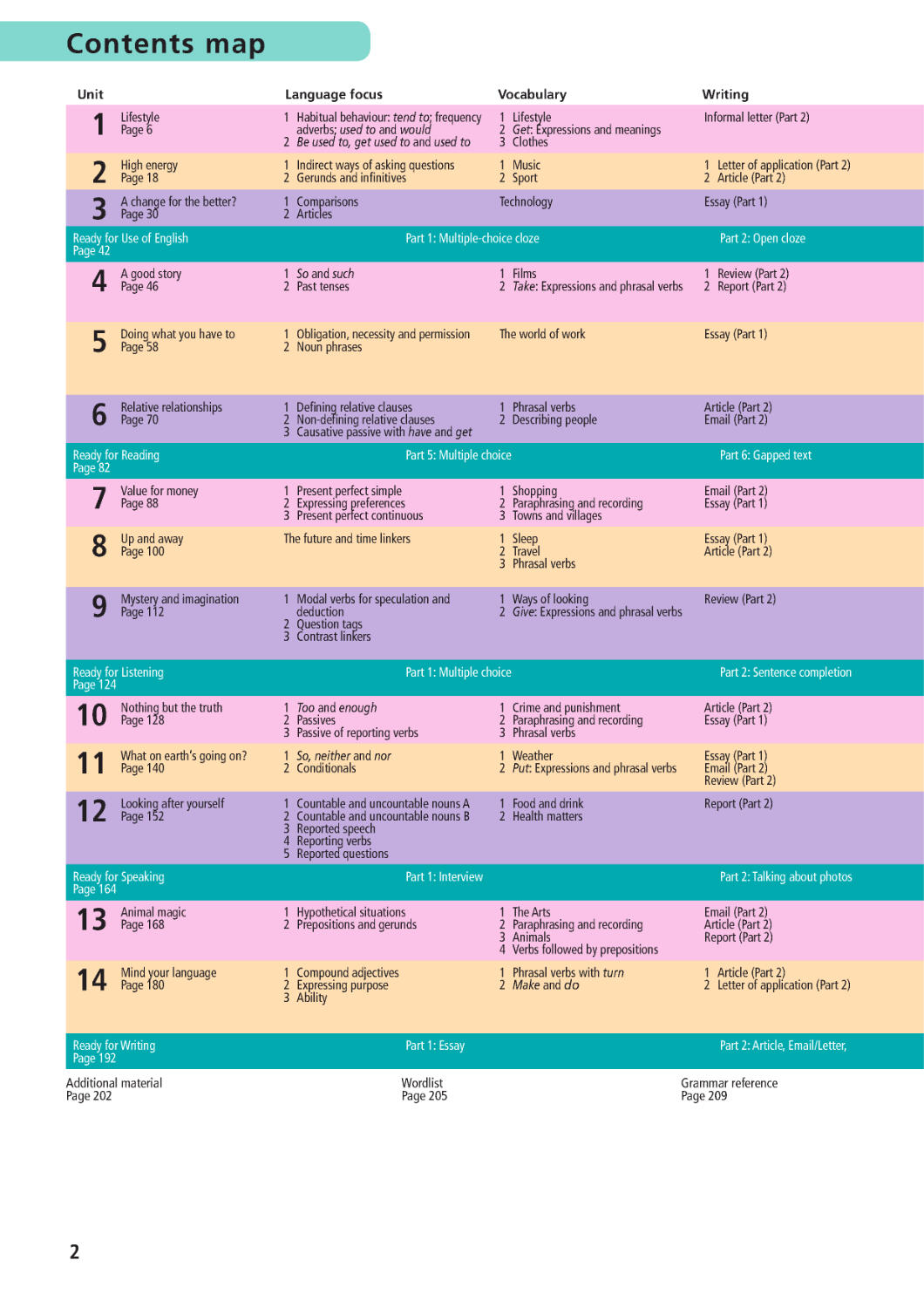
Contents map
Unit
Language focus
Vocabulary
Writing
Reading
Use of English
Listening
Speaking
1 Lifestyle
Page 6
1 Habitual behaviour: tend to; frequency
adverbs; used to and would
2 Be used to, get used to and used to
1 Lifestyle
2 Get: Expressions and meanings
3 Clothes
Informal letter (Part 2)
Multiple matching (Part 7)
Transformations (Part 4)
1 Multiple matching (Part 3)
2 Multiple choice (Part 1)
Talking about photos (Part 2)
2 High energy
Page 18
1 Indirect ways of asking questions
2 Gerunds and infinitives
1 Music
2 Sport
1 Letter of application (Part 2)
2 Article (Part 2)
Gapped text (Part 6)
Word formation: Affixes
Word formation (Part 3)
1 Sentence completion (Part 2)
2 Multiple choice (Part 4)
3 A change for the better?
Page 30
1 Comparisons
2 Articles
Technology
Essay (Part 1)
Multiple choice (Part 5)
Word formation: Nouns 1
Word formation (Part 3)
1 Multiple choice (Part 4)
2 Multiple matching (Part 3)
1 Collaborative task (Part 3)
2 Further discussion (Part 4)
Ready for Use of English
Page 42
Part 1: Multiple-choice cloze
Part 2: Open cloze
Part 3: Word formation
4 A good story
Page 46
1 So and such
2 Past tenses
1 Films
2 Take: Expressions and phrasal verbs
1 Review (Part 2)
2 Report (Part 2)
Gapped text (Part 6)
Word formation: Adjectives ending in
–ing and –ed
Transformations (Part 4)
Word formation (Part 3)
Preparing for listening: Focus on
distractors
Multiple choice (Part 1)
Talking about photos (Part 2)
5 Doing what you have to
Page 58
1 Obligation, necessity and permission
2 Noun phrases
The world of work
Essay (Part 1)
1 Multiple matching (Part 7)
Word formation: -en suffix
2 Open cloze (Part 2)
Word formation (Part 3)
Multiple-choice cloze (Part 1)
Transformations (Part 4)
1 Multiple choice (Part 4)
2 Sentence completion (Part 2)
1 Talking about photos (Part 2)
2 Collaborative task (Part 3)
6 Relative relationships
Page 70
1 Defining relative clauses
2 Non-defining relative clauses
3 Causative passive with have and get
1 Phrasal verbs
2 Describing people
Article (Part 2)
Email (Part 2)
2 Multiple choice (Part 5)
1 Multiple-choice cloze (Part 1)
Open cloze: Relative clauses
Transformations (Part 4)
1 Multiple matching (Part 3)
2 Multiple choice (Part 1)
1 Collaborative task (Part 3)
2 Interview (Part 1)
Ready for Reading
Page 82
Part 5: Multiple choice
Part 6: Gapped text
Part 7: Multiple matching
7 Value for money
Page 88
1 Present perfect simple
2 Expressing preferences
3 Present perfect continuous
1 Shopping
2 Paraphrasing and recording
3 Towns and villages
Email (Part 2)
Essay (Part 1)
Gapped text (Part 6)
Open cloze (Part 2)
Transformations (Part 4)
1 Sentence completion (Part 2)
2 Multiple choice (Part 4)
1 Talking about photos (Part 2)
Supermarket psychology
2 Interview (Part 1)
8 Up and away
Page 100
The future and time linkers
1 Sleep
2 Travel
3 Phrasal verbs
Essay (Part 1)
Article (Part 2)
1 Gapped text (Part 6)
Word formation: Adjectives
2 Word formation (Part 3)
Transformations (Part 4)
Multiple-choice cloze (Part 1)
1 Multiple choice (Part 1)
2 Multiple matching (Part 3)
1 Interview (Part 1)
2 Talking about photos (Part 2)
9 Mystery and imagination
Page 112
1 Modal verbs for speculation and
deduction
2 Question tags
3 Contrast linkers
1 Ways of looking
2 Give: Expressions and phrasal verbs
Review (Part 2)
1 Multiple choice (Part 5)
3 Multiple matching (Part 7)
Word formation: Adverbs
2 Open cloze (Part 2)
Multiple-choice cloze (Part 1)
Word formation (Part 3)
Transformations (Part 4)
1 Multiple choice (Part 4)
2 Sentence completion (Part 2)
Collaborative task (Part 3)
Ready for Listening
Page 124
Part 1: Multiple choice
Part 2: Sentence completion
Part 3: Multiple matching
Part 4: Multiple choice
10 Nothing but the truth
Page 128
1 Too and enough
2 Passives
3 Passive of reporting verbs
1 Crime and punishment
2 Paraphrasing and recording
3 Phrasal verbs
Article (Part 2)
Essay (Part 1)
Multiple choice (Part 5)
Transformations (Part 4)
Multiple-choice cloze (Part 1)
1 Multiple choice (Part 4)
2 Multiple matching (Part 3)
Talking about photos (Part 2)
11 What on earth’s going on?
Page 140
1 So, neither and nor
2 Conditionals
1 Weather
2 Put: Expressions and phrasal verbs
Essay (Part 1)
Email (Part 2)
Review (Part 2)
1 Multiple matching (Part 7)
2 Gapped text (Part 6)
3 Open cloze (Part 2)
Transformations (Part 4)
1 Sentence completion (Part 2)
2 Multiple choice (Part 1)
Collaborative task (Part 3)
12 Looking after yourself
Page 152
1 Countable and uncountable nouns A
2 Countable and uncountable nouns B
3 Reported speech
4 Reporting verbs
5 Reported questions
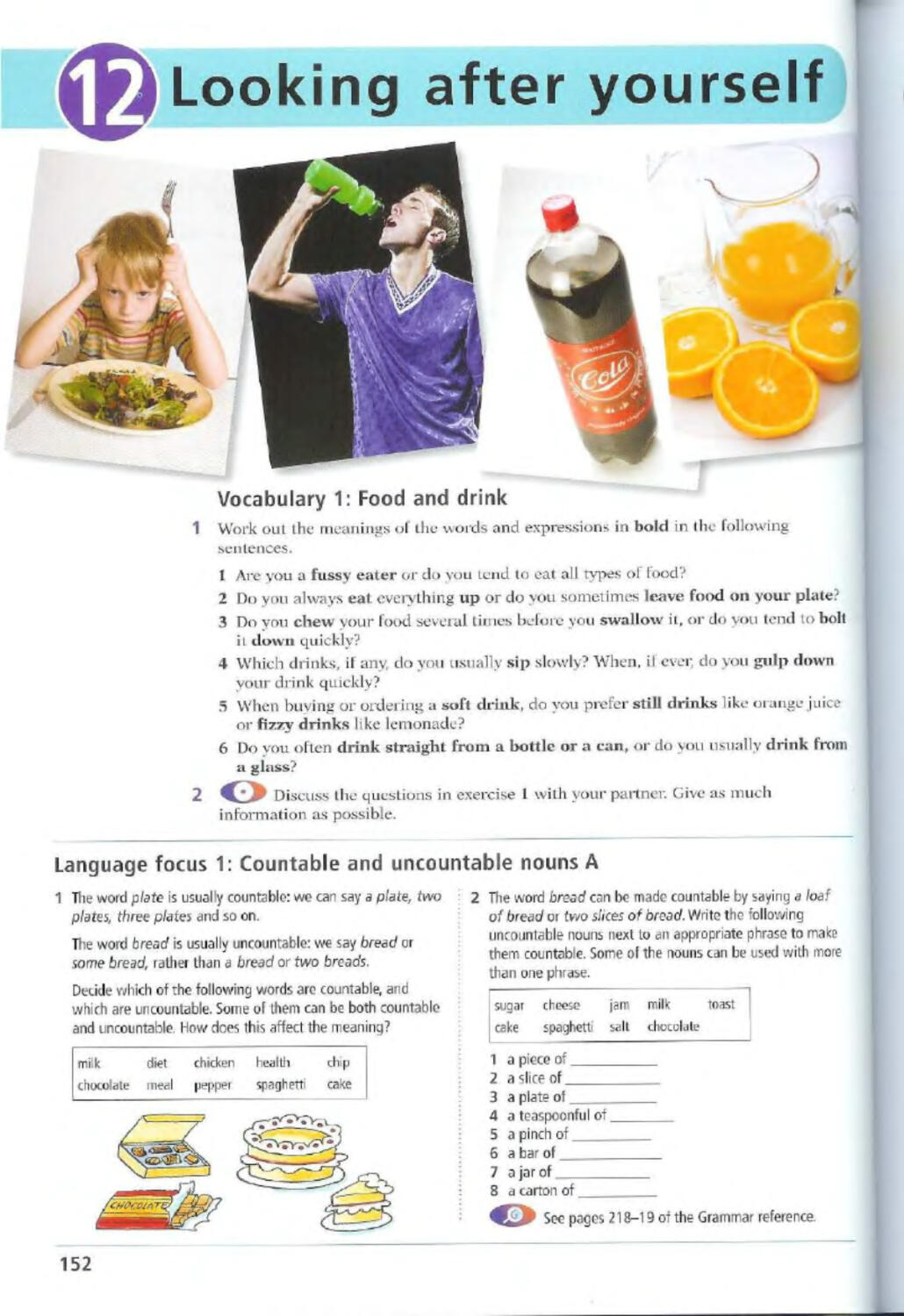
1 Food and drink
2 Health matters
Report (Part 2)
1 Multiple matching (Part 7)
2 Open cloze (Part 2)
Word formation: Nouns 2
Word formation (Part 3)
Transformations (Part 4)
Multiple-choice cloze (Part 1)
1 Multiple matching (Part 3)
2 Multiple choice (Part 4)
Talking about photos (Part 2)
Ready for Speaking
Page 164
Part 1: Interview
Part 2: Talking about photos
Part 3: Collaborative task
Part 4: Further discussion
13 Animal magic
Page 168
1 Hypothetical situations
2 Prepositions and gerunds
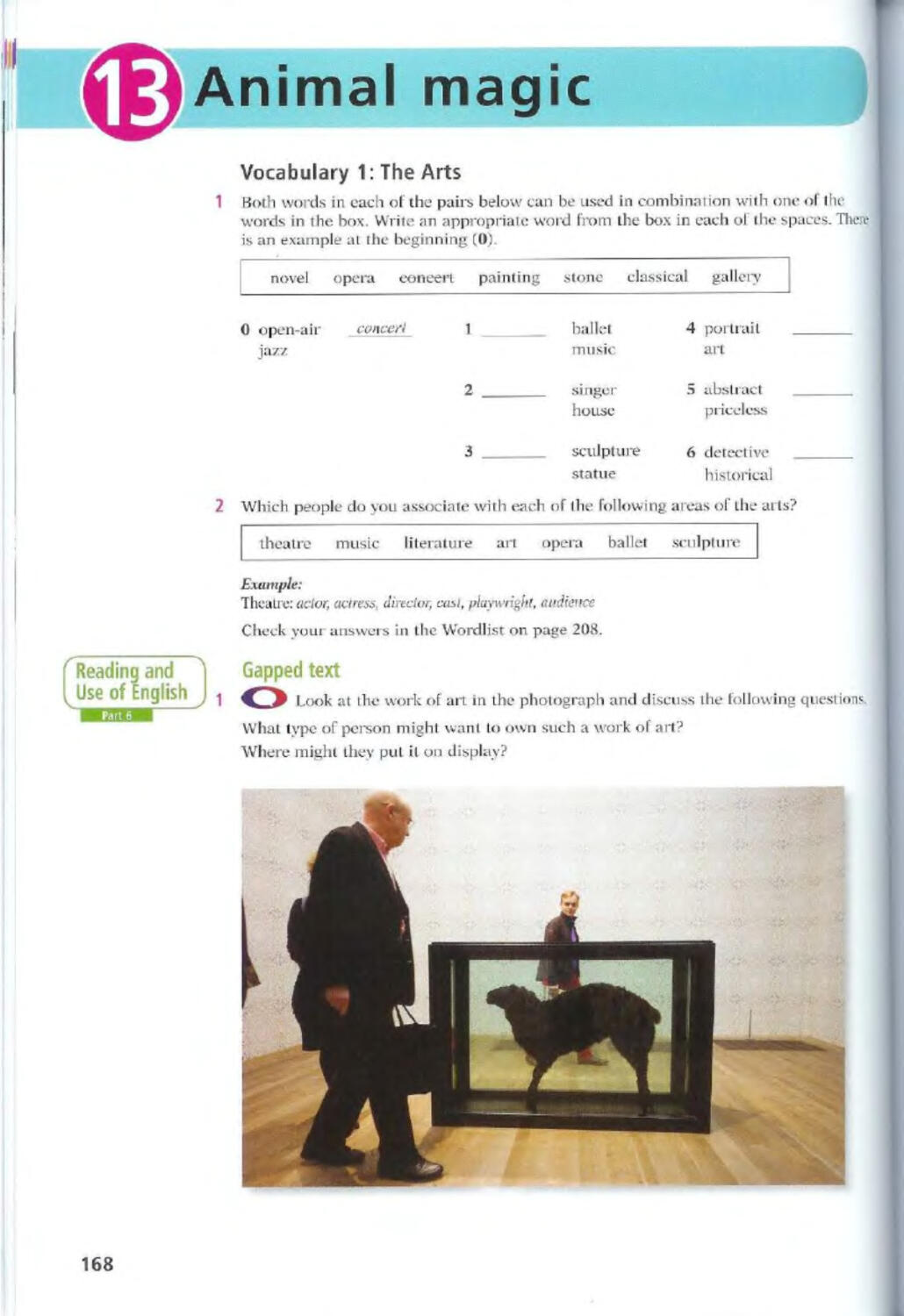
1 The Arts
2 Paraphrasing and recording
3 Animals
4 Verbs followed by prepositions
Email (Part 2)
Article (Part 2)
Report (Part 2)
Gapped text (Part 6)
Word formation: Suffixes –ible and
–able
Word formation (Part 3)
Transformations (Part 4)
1 Multiple choice (Part 4)
2 Sentence completion (Part 2)
1 Collaborative task (Part 3)
2 Further discussion (Part 4)
14 Mind your language
Page 180
1 Compound adjectives
2 Expressing purpose
3 Ability
1 Phrasal verbs with turn
2 Make and do
1 Article (Part 2)
2 Letter of application (Part 2)
1 Multiple choice (Part 5)
Word formation: Suffixes –ful and –less
2 Open cloze (Part 2)
Multiple-choice cloze (Part 1)
Transformations (Part 4)
Word formation (Part 3)
1 Multiple matching (Part 3)
2 Multiple choice (Part 1)
Talking about photos (Part 2)
Ready for Writing
Page 192
Part 1: Essay
Part 2: Article, Email/Letter,
Letter of application, Report, Review
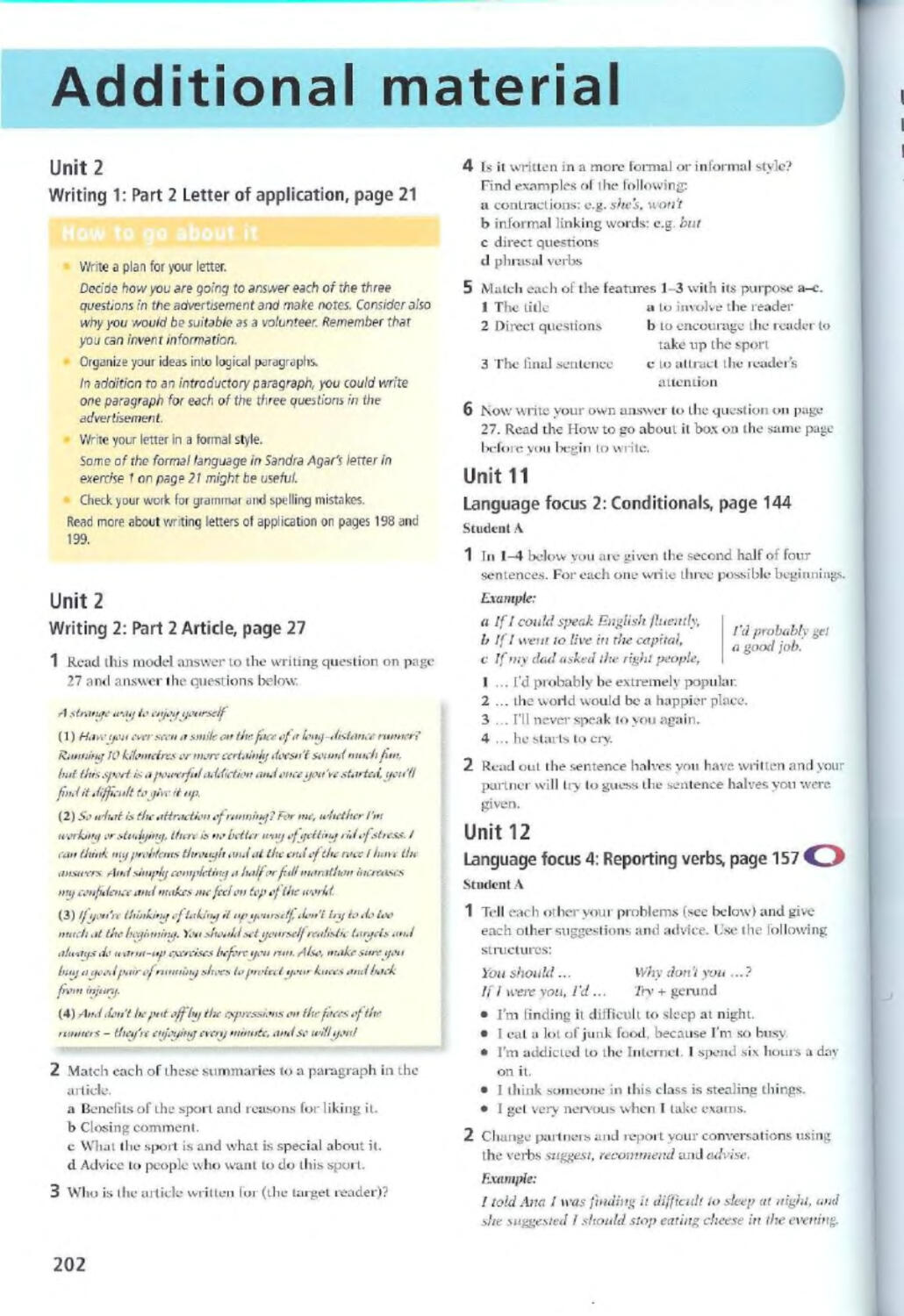
Additional material
Wordlist
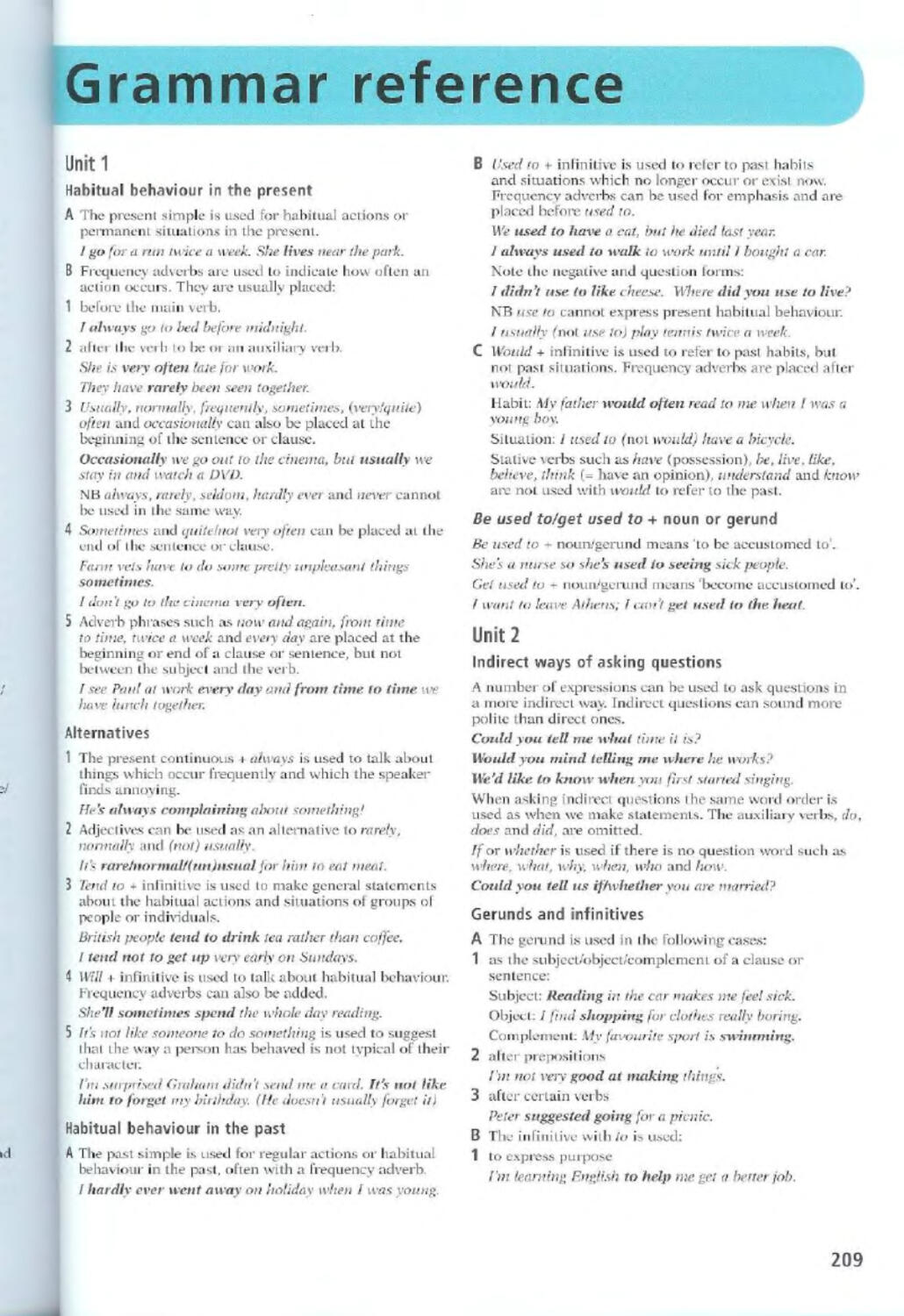
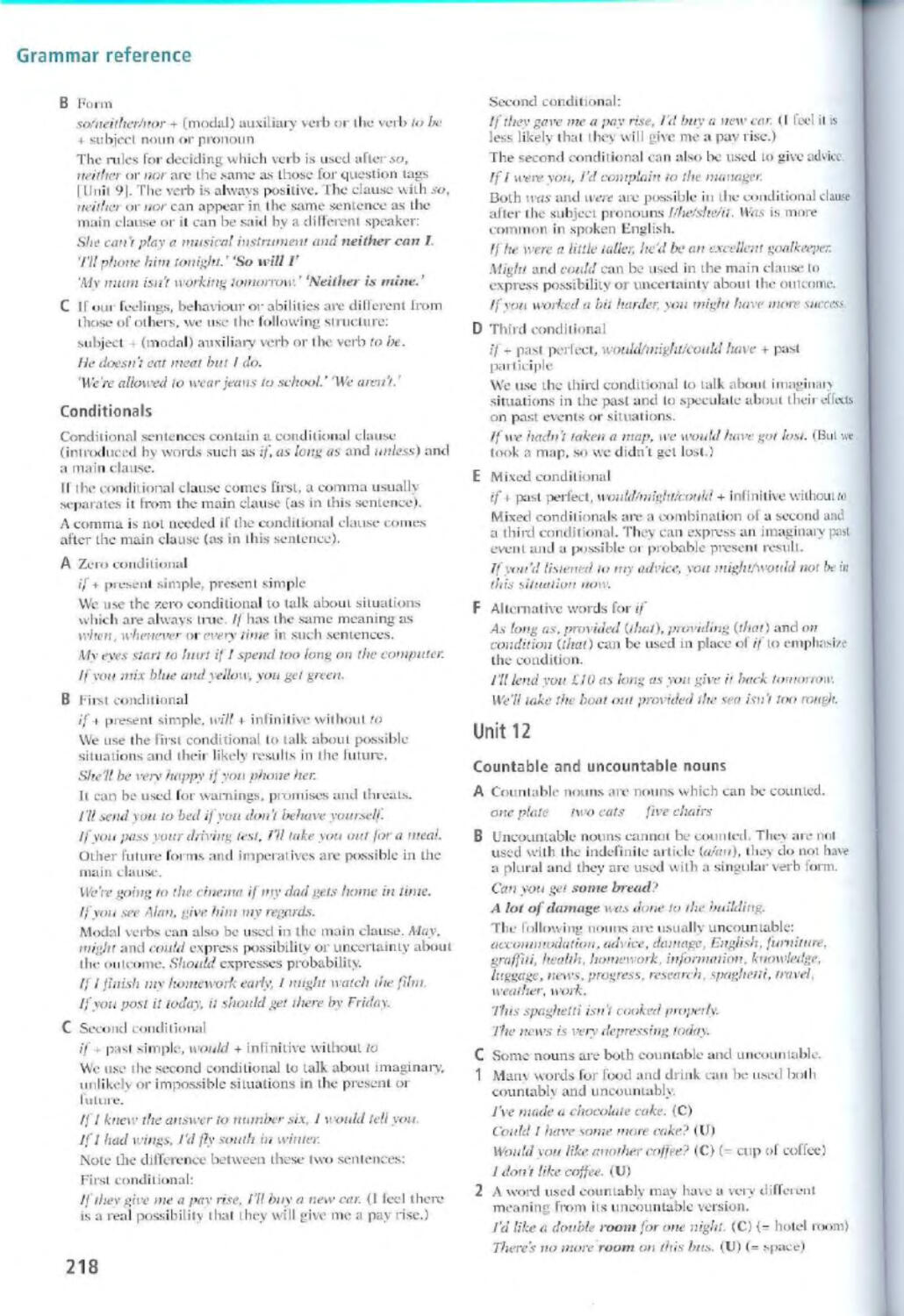
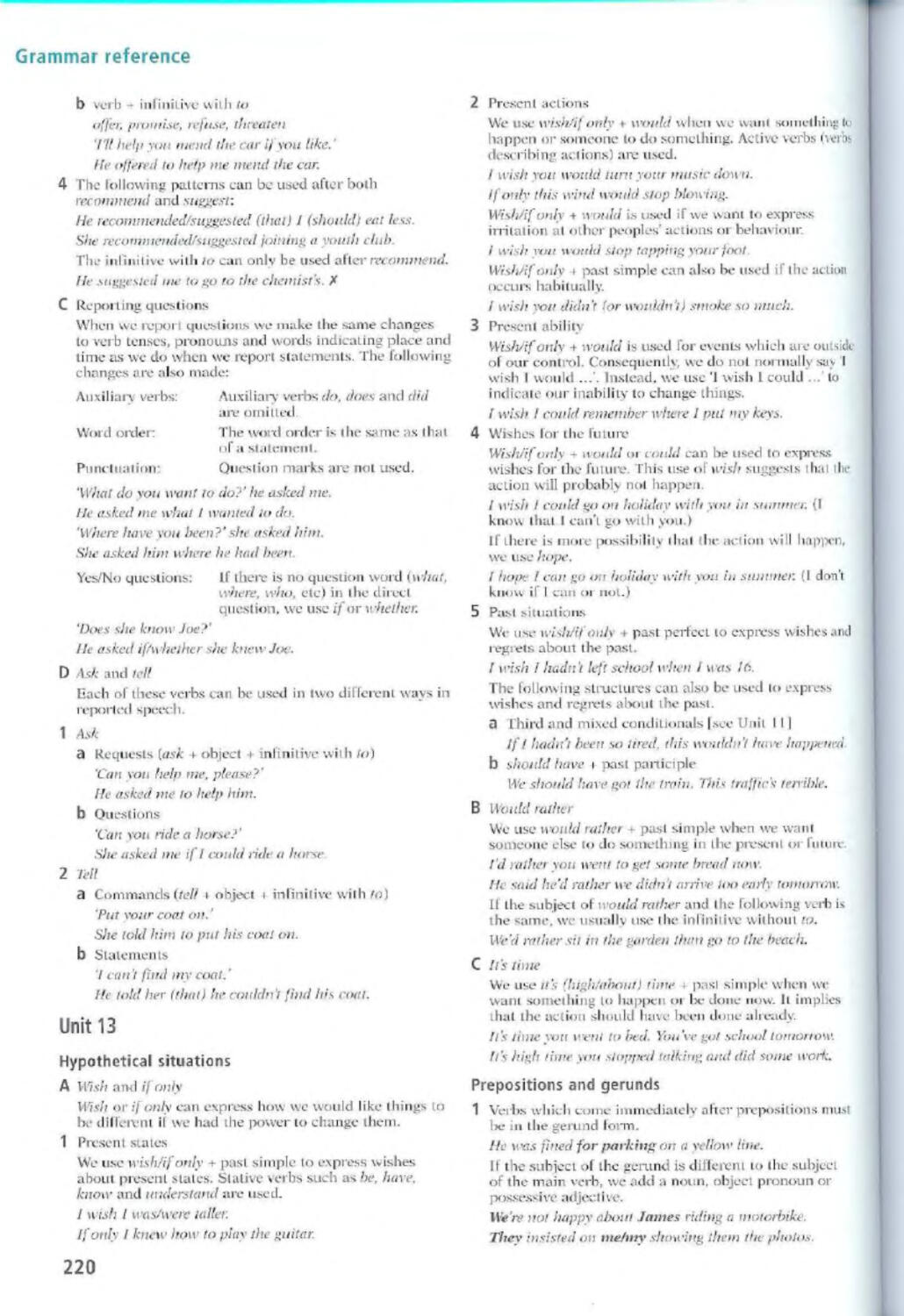
Grammar reference
Listening scripts
Answer key
Page 202
Page 205
Page 209
Page 222
Page 241

3
Unit
Language focus
Vocabulary
Writing
Reading
Use of English
Listening
Speaking
1 LifestylePage6
1 Habitual behaviour: tend to; frequency
adverbs; used to and would
2 Be used to, get used to and used to
1 Lifestyle
2 Get: Expressions and meanings
3 Clothes
Informal letter (Part 2)
Multiple matching (Part 7)
Transformations (Part 4)
1 Multiple matching (Part 3)
2 Multiple choice (Part 1)
Talking about photos (Part 2)
2 Highenergy
Page 18
1 Indirect ways of asking questions
2 Gerunds and infinitives
1 Music
2 Sport
1 Letter of application (Part 2)
2 Article (Part 2)
Gapped text (Part 6)
Word formation: Affixes
Word formation (Part 3)
1 Sentence completion (Part 2)
2 Multiple choice (Part 4)
3 Achangeforthebetter?
Page 30
1 Comparisons
2 Articles
Technology
Essay (Part 1)
Multiple choice (Part 5)
Word formation: Nouns 1
Word formation (Part 3)
1 Multiple choice (Part 4)
2 Multiple matching (Part 3)
1 Collaborative task (Part 3)
2 Further discussion (Part 4)
Ready for Use of English
Page 42
Part 1: Multiple-choice cloze
Part 2: Open cloze
Part 3: Word formation
4 Agoodstory
Page 46
1 So and such
2 Past tenses
1 Films
2 Take: Expressions and phrasal verbs
1 Review (Part 2)
2 Report (Part 2)
Gapped text (Part 6)
Word formation: Adjectives ending in
–ing and –ed
Transformations (Part 4)
Word formation (Part 3)
Preparing for listening: Focus on
distractors
Multiple choice (Part 1)
Talking about photos (Part 2)
5 Doingwhatyouhaveto
Page 58
1 Obligation, necessity and permission
2 Noun phrases
The world of work
Essay (Part 1)
1 Multiple matching (Part 7)
Word formation: -en suffix
2 Open cloze (Part 2)
Word formation (Part 3)
Multiple-choice cloze (Part 1)
Transformations (Part 4)
1 Multiple choice (Part 4)
2 Sentence completion (Part 2)
1 Talking about photos (Part 2)
2 Collaborative task (Part 3)
6 Relativerelationships
Page 70
1 Defining relative clauses
2 Non-defining relative clauses
3 Causative passive with have and get
1 Phrasal verbs
2 Describing people
Article (Part 2)
Email (Part 2)
2 Multiple choice (Part 5)
1 Multiple-choice cloze (Part 1)
Open cloze: Relative clauses
Transformations (Part 4)
1 Multiple matching (Part 3)
2 Multiple choice (Part 1)
1 Collaborative task (Part 3)
2 Interview (Part 1)
Ready for Reading
Page 82
Part 5: Multiple choice
Part 6: Gapped text
Part 7: Multiple matching
7 Valueformoney
Page 88
1 Present perfect simple
2 Expressing preferences
3 Present perfect continuous
1 Shopping
2 Paraphrasing and recording
3 Towns and villages
Email (Part 2)
Essay (Part 1)
Gapped text (Part 6)
Open cloze (Part 2)
Transformations (Part 4)
1 Sentence completion (Part 2)
2 Multiple choice (Part 4)
1 Talking about photos (Part 2)
Supermarket psychology
2 Interview (Part 1)
8 Upandaway
Page 100
The future and time linkers
1 Sleep
2 Travel
3 Phrasal verbs
Essay (Part 1)
Article (Part 2)
1 Gapped text (Part 6)
Word formation: Adjectives
2 Word formation (Part 3)
Transformations (Part 4)
Multiple-choice cloze (Part 1)
1 Multiple choice (Part 1)
2 Multiple matching (Part 3)
1 Interview (Part 1)
2 Talking about photos (Part 2)
9 Mysteryandimagination
Page 112
1 Modal verbs for speculation and
deduction
2 Question tags
3 Contrast linkers
1 Ways of looking
2 Give: Expressions and phrasal verbs
Review (Part 2)
1 Multiple choice (Part 5)
3 Multiple matching (Part 7)
Word formation: Adverbs
2 Open cloze (Part 2)
Multiple-choice cloze (Part 1)
Word formation (Part 3)
Transformations (Part 4)
1 Multiple choice (Part 4)
2 Sentence completion (Part 2)
Collaborative task (Part 3)
Ready for Listening
Page 124
Part 1: Multiple choice
Part 2: Sentence completion
Part 3: Multiple matching
Part 4: Multiple choice
10 Nothingbutthetruth
Page 128
1 Too and enough
2 Passives
3 Passive of reporting verbs
1 Crime and punishment
2 Paraphrasing and recording
3 Phrasal verbs
Article (Part 2)
Essay (Part 1)
Multiple choice (Part 5)
Transformations (Part 4)
Multiple-choice cloze (Part 1)
1 Multiple choice (Part 4)
2 Multiple matching (Part 3)
Talking about photos (Part 2)
11 Whatonearth’sgoingon?
Page 140
1 So, neither and nor
2 Conditionals
1 Weather
2 Put: Expressions and phrasal verbs
Essay (Part 1)
Email (Part 2)
Review (Part 2)
1 Multiple matching (Part 7)
2 Gapped text (Part 6)
3 Open cloze (Part 2)
Transformations (Part 4)
1 Sentence completion (Part 2)
2 Multiple choice (Part 1)
Collaborative task (Part 3)
12 Lookingafteryourself
Page 152
1 Countable and uncountable nouns A
2 Countable and uncountable nouns B
3 Reported speech
4 Reporting verbs
5 Reported questions
1 Food and drink
2 Health matters
Report (Part 2)
1 Multiple matching (Part 7)
2 Open cloze (Part 2)
Word formation: Nouns 2
Word formation (Part 3)
Transformations (Part 4)
Multiple-choice cloze (Part 1)
1 Multiple matching (Part 3)
2 Multiple choice (Part 4)
Talking about photos (Part 2)
Ready for Speaking
Page 164
Part 1: Interview
Part 2: Talking about photos
Part 3: Collaborative task
Part 4: Further discussion
13 Animalmagic
Page 168
1 Hypothetical situations
2 Prepositions and gerunds
1 The Arts
2 Paraphrasing and recording
3 Animals
4 Verbs followed by prepositions
Email (Part 2)
Article (Part 2)
Report (Part 2)
Gapped text (Part 6)
Word formation: Suffixes –ible and
–able
Word formation (Part 3)
Transformations (Part 4)
1 Multiple choice (Part 4)
2 Sentence completion (Part 2)
1 Collaborative task (Part 3)
2 Further discussion (Part 4)
14 Mindyourlanguage
Page 180
1 Compound adjectives
2 Expressing purpose
3 Ability
1 Phrasal verbs with turn
2 Make and do
1 Article (Part 2)
2 Letter of application (Part 2)
1 Multiple choice (Part 5)
Word formation: Suffixes –ful and –less
2 Open cloze (Part 2)
Multiple-choice cloze (Part 1)
Transformations (Part 4)
Word formation (Part 3)
1 Multiple matching (Part 3)
2 Multiple choice (Part 1)
Talking about photos (Part 2)
Ready for Writing
Page 192
Part 1: Essay
Part 2: Article, Email/Letter,
Letter of application, Report, Review
Additional material
Wordlist
Grammar reference
Listening scripts
Answer key
Page 202
Page 205
Page 209
Page 222
Page 241

Introduction
4
Welcome to Ready for First, a course which is
designed to help you prepare for the Cambridge
English: First examination, also known as First
Certificate in English (FCE).
This book contains a wide range of activities aimed
at improving your English and developing the
language and skills which you will need to pass the
examination. As well as providing relevant practice
in reading, writing, listening and speaking, each unit
of Ready for First includes one or more Language
focus sections, which revise the main grammar
areas, together with Vocabulary slots which will help
you to increase your word store.
A significant feature of the Use of English syllabus
in the book is the systematic approach to Word
formation. At regular intervals you will find special
sections which focus on the most important aspects
of word building, ensuring that you are properly
prepared for this part of the examination. There are
also sections, in Units 7, 10 and 13, devoted to the
important skill of paraphrasing and recording new
vocabulary.
At the end of every unit there is a two-page Review
section, which enables you to revise and practise the
new language you have encountered in the unit.
Throughout the book you will find the following
boxes, which are designed to help you when
performing the different tasks:
What to expect in the exam: these contain useful
information on what you should be prepared to see,
hear or do in a particular task in the examination.
How to go about it: these give advice and guidelines
on how to deal with different task types and specific
questions.
Don’t forget!: these provide a reminder of important
points to bear in mind when answering a particular
question.
Useful language: these contain vocabulary and
structures which can be used when doing a specific
writing or speaking activity.
Further information and advice on each of the
papers in the Cambridge English: First exam is
included in the five supplementary ‘Ready for ...’
units. These are situated at regular intervals in
the book and can be used at appropriate moments
during the course. The Ready for Writing unit
contains model answers for each of the main task
types, together with advice, useful language and
further writing tasks for you to complete.
At the end of the book you will find detailed
explanations of the grammar areas seen in the units
in the Grammar reference, together with a topic-
based Wordlist and the Listening scripts.
Overview of the Examination
The Cambridge English: First examination consists of
four papers, as shown below. The Writing, Listening
and Speaking papers each carry 20% of the total
marks; the Reading and Use of English paper carries
40% (20% for the Reading tasks and 20% for the
Use of English tasks). A low mark in one paper
does not necessarily mean a candidate will fail the
examination; it is the overall mark which counts.
Reading and Use of English 1 hour 15 minutes
There are seven parts to this paper: Parts 1 to 4
are grammar and vocabulary tasks; Parts 5 to 7 are
reading tasks. For the Use of English tasks, each
correct answer in Parts 1 to 3 receives one mark;
each question in Part 4 carries up to two marks. For
the reading tasks, each correct answer in Parts 5 and
6 receives two marks, and there is one mark for each
question in Part 7. For more information on this
paper, see the Ready for Use of English unit on pages
42 to 45 and the Ready for Reading unit on pages
82 to 87, as well as the relevant sections in the main
units of the book.
Part Task Type
Number
of questions
Task Format
1 Multiple-choice
cloze
8
A text with 8 gaps; there is a
choice of 4 answers for each gap.
2 Open cloze
8
A text with 8 gaps, each of which
must be completed with one
word.
3 Word Formation 8
A text containing 8 gaps. The task
is to complete each gap with the
correct form of a given word.
4 Key word
transformations
6
Gapped sentences which must be
completed using a given word.
5 Multiple Choice 6
A text followed by multiple-
choice questions with four
options.
6 Gapped Text
6
A text from which sentences
have been removed. Candidates
replace each of these in the
appropriate part of the text.
7 Multiple
Matching
10
A text preceded by multiple-
matching questions which
require candidates to find specific
information in a text or texts.

Introduction
1
5
Writing
1 hour 20 minutes
There are two parts to this paper, each of which
carries the same number of marks. Part 1 is
compulsory, so must be answered by all candidates,
whereas in Part 2 candidates choose one from three
tasks. You are required to write between 140 and
190 words for each part. For more information and
advice on the questions in this paper, see the Ready
for Writing unit on pages 192 to 201, as well as the
relevant sections in the main units of the book.
Part Task Type Number
of Tasks
Task Format
1
Essay
1
(compulsory)
Candidates are given an essay title
and notes to guide their writing.
2
3
(candidates
choose one)
A writing task with a clear context,
purpose for writing and target
reader. Candidates write one of
the following: article, email/letter,
report, review.
Listening
about 40 minutes
This paper consists of four parts with a total of 30
questions, each of which carries one mark. Each
part contains one or more recorded texts, which are
heard twice. Candidates are tested on their ability
to understand, for example, opinions, gist, the main
points or specific information. For more information
on this paper, see the Ready for Listening unit on
pages 124 to 127, as well as the relevant sections in
the main units of the book.
Part Task Type
Number
of Questions
Task Format
1
Multiple choice 8
Short unrelated extracts of
approximately 30 seconds
each with one or more
speakers. There are 3
options for each question.
2
Sentence
completion
10
A monologue lasting
approximately 3 minutes.
Candidates write a
word or short phrase to
complete sentences.
3
Multiple Matching 5
Five short monologues,
each lasting approximately
30 seconds. The
extracts are all related
to a common theme.
Candidates match extracts
with prompts.
4
Multiple choice 7
An interview or
conversation between two
or more speakers lasting
approximately 3 minutes.
There are 3 options for
each question.
Speaking
14 minutes
There are four parts to this paper. There are usually
two candidates and two examiners. Candidates
are given marks for range and correct use of
grammar and vocabulary, pronunciation, discourse
management (the ability to organize language
and produce extended responses) and interactive
communication. For more information on this paper,
see the Ready for Speaking unit on pages 164 to
167, as well as the relevant sections in the main units
of the book.
Part Task Type
Time
Task Format
1
Interview
2 minutes
Candidates give personal
information in response to
questions from the interviewer.
2
Talking about
photographs
4 minutes
Each candidate talks about two
pictures for about 1 minute,
and comments briefly on the
other candidate’s pictures.
3
Collaborative
Task
4 minutes
Candidates are given
instructions with written
prompts which they use for
discussion. Candidates speak
for about 3 minutes in total;
the giving of instructions takes
about 1 minute.
4
Further
discussion
4 minutes
The interviewer leads a
discussion which is related to
the topic of Part 3.
Roy Norris

6
1 Lifestyle
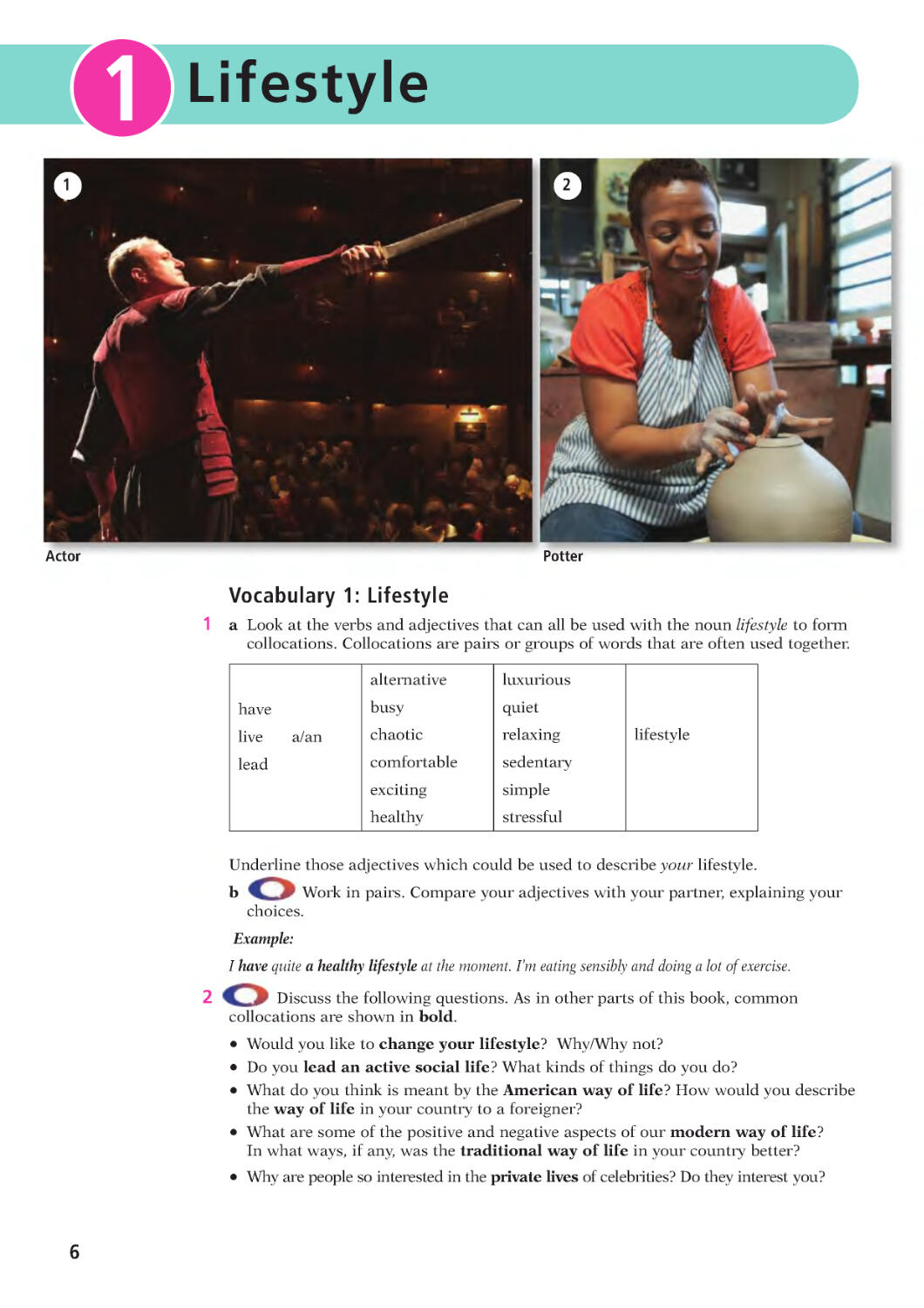
1
2
Actor
Potter
Vocabulary 1: Lifestyle
1 a Look at the verbs and adjectives that can all be used with the noun lifestyle to form
collocations. Collocations are pairs or groups of words that are often used together.
have
live
a/an
lead
alternative
busy
chaotic
comfortable
exciting
healthy
luxurious
quiet
relaxing
sedentary
simple
stressful
lifestyle
Underline those adjectives which could be used to describe your lifestyle.
b
Work in pairs. Compare your adjectives with your partner, explaining your
choices.
Example:
I have quite a healthy lifestyle at the moment. I’m eating sensibly and doing a lot of exercise.
2
Discuss the following questions. As in other parts of this book, common
collocations are shown in bold.
• Would you like to change your lifestyle? Why/Why not?
• Do you lead an active social life? What kinds of things do you do?
• What do you think is meant by the American way of life? How would you describe
the way of life in your country to a foreigner?
• What are some of the positive and negative aspects of our modern way of life?
In what ways, if any, was the traditional way of life in your country better?
• Why are people so interested in the private lives of celebrities? Do they interest you?

7
Talking about photos
1 Look at the four photographs. They show people who have different lifestyles. Before
you do the speaking task, read the information in the boxes below.
Student A Compare photographs 1 and 2 and say what you think the people might
find difficult about their lifestyles.
Student B When your partner has finished, say which lifestyle you would prefer to
lead.
2 Now change roles. Follow the instructions above using photographs 3 and 4.
Student A
• In Part 2 of the speaking exam you are not asked to describe the photographs in detail, but to compare
them. When doing this, comment on the similarities and differences:
Similarities: Both pictures show ...
Differences: In the first picture ... whereas in the second one ...
• When talking about what the people might find difficult about their lifestyles, give reasons for your
opinions. You could comment on some of the following:
daily routine
working hours
leisure time
type of home
friends
eating habits
health
travel
family life
Student B
• In the exam you have time to develop your answer fully and give reasons for your choice.
How to go about it
Useful language
I get the impression it’s a stressful life.
I expect/imagine she has to get up early.
He probably spends a long time away from home.
I doubt that she has much time for a social life.
Perhaps he doesn’t see his family very often.
She might/may get lonely during the day.
Lifestyle 1
Farm vet
Fisherman
What might the people find difficult about their lifestyles?
4
Speaking
Part 2
3

8
Multiple matching
You are going to read an article in which four people talk about their lifestyles. For
questions 1–10, choose from the people (A–D). The people may be chosen more than
once.
How to go about it
• Read all the questions to see the kind of information you are looking for.
• Read section A, then look again at the questions, answering any that you can.
To help you, one part of section A has been underlined. Match this part to one of the questions.
Then look in the rest of section A for any more answers.
• Do the same for the other three sections. Underline the relevant parts of the text as you answer the
questions.
• If there are any questions you have not answered, scan the whole text again looking for the information
you need.
Which person
admits to having an untidy house?
could not imagine doing any other type of work?
likes the unpredictable nature of their work?
is not particularly keen on taking exercise?
says they start the day like many other people?
does not have to go far to get to their place of work?
never has any trouble getting to sleep?
used to feel lonely while working?
says that people have the wrong idea about their work?
would prefer to go to bed earlier on many occasions?
This is your life
Four more personal accounts in our series on different lifestyles
A Colin Dobson: television and stage actor
Normally I get out of bed around midday. I’ll
sometimes go for a run after I get up, though it’s
not really my idea of fun. I’m not a fitness fan, but I
realize it’s important.
When I’m not rehearsing or on tour, afternoons usually
involve reading scripts or learning lines. My wife and
two sons are also actors, so at home there are usually
scripts lying all over the place. It’s a bit of a mess, I’m
ashamed to say. I’m passionate about histor y, and if
I’m working away from home, I spend the afternoons
in museums or historic buildings. I always get to the
theatre at the last minute, which annoys my co-actors,
but I don’t like arriving anywhere early.
After a performance I eat and spend a few hours
unwinding, so bedtime is often two or three in the
morning. I always fall asleep as soon as my head hits
the pillow.
1
2
3
4
5
6
7
8
9
10
1 Lifestyle
5
10
15
Part 7
Reading and
Use of English

9
C Janie Collins: farm vet
I used to have a dog and we’d go running together
most mornings, but I gave him to my mum in the end.
I tend to be out all day visiting farms and it wasn’t
fair to leave him alone. So now I don’t get as much
exercise as I’d like to.
I love my job, especially the variety and not knowing
what you’ll be doing from one day to the next. But
being a vet – any type of vet – is not what people
think. It’s not all cuddly lambs and cute little pigs. We
have to do some pretty unpleasant things sometimes,
things which would put you off working with animals
for life.
My mum wants to know when I’m going to settle down
with someone, but there’s no room for a dog in my
life, so I don’t see how I’ll be able to fit marriage in.
B Jodie Miller: potter
Before I started renting the workshop at the open-air
museum, I would crawl out of bed in the morning, get
dressed and go straight into the garage, which I’d
converted into a studio. Now I get the train and a bus,
so I have to get up early and my morning routine is
dull and conventional, the same one that’s played out
in millions of households.
On the plus side, though, I get to meet lots of people:
there are the museum visitors that come into the
workshop ever y day to watch me working, the other
craftspeople – the broom maker, the blacksmith or
the glassblower – and I also give classes. Working at
home was a solitar y business and I hated the fact that
I would often go for days without speaking to anyone.
I get lots of requests for personalized mugs, and
evenings are spent packaging up orders to send out
the next day. I often get to bed later than I would like.
D Mark Fudge: fisherman
My flat overlooks the port, so it’s just a short walk to
the Ellie May. That’s our boat, the place I think of as
home. I get lonely if I’m away from her for longer than
aweekorso–thecrewislikeafamilytome.
I’m one of four deckhands, which means that the first
mate – the second in command after the captain – gets
us to do cleaning and maintenance work as well as
pulling in the nets, then washing, salting, icing and
storing the fish. We work hard – six hours on, six
hours off, six hours on, six hours off – every day for
seven weeks. It’s tough, but I can’t see myself in any
other profession. There’s nothing else I’d rather do.
Reacting to the text
If you had to choose, which of the four people would you prefer to change places with
for a month? Why?
Lifestyle 1
35
40
45
20
25
30
50
55
60

10
Language focus 1: Habitual behaviour
A General tendencies
1 Which of the alternatives in this sentence is not possible?
I tend to be/use to be/am usually out all day visiting
farms.
Look at the Grammar reference on page 209 to see
how tend to is used.
2 Make three general statements about some of the following
groups of people in your country using tend to.
• football players
• teenagers
• elderly people
• teachers
• people in cities
• people in villages
Example:
The best football players in my country tend to go abroad.
They can earn much more money playing for foreign
clubs.
B Frequency adverbs
1 a Look at the following extracts from the reading text. In
what position is the frequency adverb placed in relation to
the verb?
I’ll sometimes go for a run after I get up.
At home there are usually scripts lying all over the place.
I always get to the theatre at the last minute.
b In this sentence, two of the adverbs are in the correct
position and two are not. Cross out the two incorrectly placed
adverbs.
Normally/Always/Sometimes/Never I get out of bed around
midday.
Check your ideas in the Grammar reference on
page 209.
2 For sentences 1–6, decide if the position of the adverb is
possible. If it is not possible, correct the sentence.
1 I rarely go out on weekday evenings.
2 I have usually my dinner in front of the television.
3 Never I spend more than ten minutes doing my English
homework.
4 Companies are always phoning me in the evening, trying
to sell me something – I get so annoyed.
5 Hardly I ever play computer games – I prefer reading.
6 It’s rare for me to go to bed before midnight, and quite
often I’ll stay up until two in the morning.
3
Say whether or not the sentences in exercise 2 are
true for you. Use frequency adverbs and the alternatives in
the Grammar reference on page 209.
Example:
1 It’s rare for me to stay at home on weekday evenings.
I usually do some type of sport; I tend to go running if
it’s not raining, and if it is, I’ll often go swimming or play
badminton.
C Used to and would
1 Used to and would can be used to talk about past habits.
Look at these sentences from the reading text and answer
the question.
a I would crawl out of bed and go straight into the
garage.
b I would sometimes go for days without speaking to
anyone.
c I used to have a dog and we’d go running together
most mornings.
In all three sentences, used to could be used instead of
would/’d before the verbs crawl and go, but in sentence c,
it is not possible to say I would have a dog. Why is this?
Check your ideas on page 209 of the Grammar
reference.
2 In the following paragraph, decide whether the underlined
verbs can be used with:
a both used to and would
b only used to
c neither used to nor would
In the bad old days my mum (1) had an executive position in a
pharmaceutical company. She often (2) worked long hours and
sometimes (3) went away on business trips for two or three
days at a time. Our dear old gran (4) looked after us on those
occasions, but it wasn’t the same as having a mum around. My
brother and I (5) didn’t like her being away from home, but we
never once (6) said anything, because we always (7) thought she
was happy in her work. Then one day she (8) announced she was
giving up her job to spend more time with her family. We (9) were
delighted at the change in lifestyle, but I’m not sure about my
mum: she often (10) said afterwards that being a full-time mother
was harder than being a business executive!
3 Write six sentences comparing your life now with your life
five years ago. Write about things which have changed.
Example:
I didn’t use to have a job, but now I work on Saturdays so
I have more money.
1 Lifestyle

11
Vocabulary 2: Get
1 a Look at these sentences from the reading text on pages 8 and 9 and try to remember
who said each one. The first one has been done for you.
a I get to meet lots of people. the potter
b Normally I get out of bed around midday.
c I don’t get as much exercise as I’d like to.
d I get lonely if I’m away from her for longer than a week or so.
e Igetthetrainandabus.
f I always get to the theatre at the last minute.
g The first mate gets us to do cleaning and maintenance work ...
h I get lots of requests for personalized mugs.
Check your answers on pages 8 and 9.
b What is the meaning of the words in bold in sentences a–h above?
Example: a have the opportunity to meet
2 The following sentences all contain phrasal verbs or expressions with get. Underline
the correct alternative. There is an example at the beginning (0).
0 That jumper looks so old and dirty. When are you going to get away/along/lost/rid of it?
1 Here’s my telephone number. If you have any problems, just get in talk/speak/touch/
tact with me.
2 I heard she was a lovely woman. Unfortunately I never got the occasion/event/
ability/chance to meet her.
3 I asked him how much he got paid/earned/money/salary but he refused to tell me.
4 Come on, hurry up and get moved/ready/ordered/fit! Your bus leaves in five minutes.
5 His parents are concerned about his behaviour. He’s always getting into problem/
trouble/punishment/damage at school.
6 His girlfriend left him in March and he still hasn’t got past/off/by/over it.
7 I can’t speak French very well, but I always manage to get across/through/by/over
with a dictionary and a few gestures.
8 They wanted to get to the opera house but they got up/out of/on/off the wrong bus
and ended up at the football stadium.
3
Discuss the following questions.
• How quickly do you get ready for school/work in the morning?
• How do you get to school/work? How long does it take you to get there?
• Did/Do you often get into trouble at school? What was the worst thing you ever did?
• Did/Do your parents ever get you to do any jobs around the house? How did/do
you feel about this?
• What sort of things do you do when you get angry? How quickly do you get over
your anger?
Lifestyle 1

12
Vocabulary 3: Clothes
1 How many of the items of clothing in the photographs can you name?
2 The following adjectives can be used to describe clothes. Which of them can you
match to the photographs?
tight-fitting
formal
tasteful
trendy
baggy
colourful
unfashionable
scruffy
casual
plain
smart
sleeveless
Multiple matching
1.1 –1.5
You will hear five different people talking about occasions when a person’s clothes and
appearance caused surprise or concern. For questions 1–5, match the speaker to the
correct occasion in the list A–H on page 13. Use the letters only once. There are three
extra letters which you do not need to use.
Before you do the task ...
Prediction
1 Match each of the people in the box
to the appropriate occasion A–H in
the listening task on page 13. More
than one word may be used for each
occasion and some words may be
used twice.
e.g. A wedding: guest, witness
What other people might you also
find in each of the situations?
e.g. At a wedding the people who get
married are the bride and groom.
2 Where does each occasion take place?
e.g. A wedding usually takes place in a church
or a registry office.
3 What clothes would you personally
wear on the occasions A–H mentioned
in the listening task on page 13?
e.g. If I was going to a wedding, I would buy an
expensive dress. I would probably wear high-
heeled shoes.
Now you are ready to do the task.
guest
spectator
audience
competitor
witness
star
candidate
host
invigilator
opponent
1 Lifestyle
Part 3
Listening 1

13
A a wedding
B a friend’s birthday party
C a classical ballet
D a sporting event
E a film premiere
F an examination
G a job interview
H a special family meal
Have you ever been in a situation where someone’s appearance caused surprise?
Language focus 2: Be used to, get used
to and used to
1 Look at the following sentences from the listening. In which
of them does used to
a mean ‘accustomed to’?
b refer to a past state which has now finished?
1 Her unconventional, yet practical clothing shocked
spectators, who were used to seeing women play in the
long, heavy dresses which were typical of that period.
2 And he used to live in France, which means he probably
wouldn’t mind changing countries if we needed him to.
3 ...he will have to get used to wearing something a
little more formal.
2 What is the difference in meaning between be used to and
get used to?
3 What form of the verb is used after be used to and get used
to?
Check your answers on page 209 of the Grammar
reference.
4
Talk about all the things you have to get used to in
the following situations:
• you get your first job
• you become famous
• yougoonadiet
• you get married
• you have children
• you retire
Example:
In a new job, you might have to get used to working
together with other people.
5 a If you went to live in Britain, what aspects of life there
would you find it difficult to get used to?
b Read the following text about Juan, who moved from
Spain to live in England. Ignore the gaps for the moment.
How many of the things which you spoke about in a are
mentioned?
Now that Juan has been living in England for five years he
(0) is used to doing (do) things differently, but it
hasn’t always been the case. When he first moved there he
couldn’t (1) ____ used to _____ (have) lunch at 1pm, so he
often (2) ____ used to _____ (cook) for himself in his flat
and eat at 3pm, as his family does in Spain. Even now I don’t
think he (3) ____ used to _____ (eat) English food, because
when he comes home to Madrid, he buys Spanish ‘delicacies’
to take back with him.
I remember how he (4) ____ used to _____ (write) to me
and complain about the shop closing times. It took him a
long time to (5) ____ used to not _____ (be) able to buy
anything after about five o’clock. Most shops in Spain close
at eight or nine in the evening.
He bought an English car a year ago, so he should (6) ____
used to _____ (drive) on the left by now. I wonder if he’ll
ever be able to (7) ____ used to _____ (drive) on the right
again when, or if, he comes back to live in Spain!
c Read the text again.
In the first gap write either be, is, get, or leave it blank.
In the second gap write the correct form of the verb in
brackets.
There is an example at the beginning (0).
d
What do you think a British person coming to
your country might find it difficult to get used to?
Lifestyle 1
What to expect in the exam
• You will have 30 seconds to read the eight
options. Use this time to try to predict some of
the ideas and language you might hear, as you
did on page 12.
• Some of the extracts may contain distractors
(key words or expressions which could cause
you to make the wrong decision). Pay close
attention both times you hear the recording.
Speaker 1
1
Speaker 2
2
Speaker 3
3
Speaker 4
4
Speaker 5
5

14
Informal letter
1 Read the following letter, which you have received from your English friend, Mark.
What two things does he ask you to tell him?
Would you accept Mark’s invitation? Why/Why not?
Part 2
Writing
Dear _______ ,
a) Many thanks for your last letter. The new house
sounds brilliant – how are you settling in? b) I’m
sorry I haven’t written sooner, but I’ve been really
busy helping my parents out on the farm.
It’s great fun, though I still haven’t got used to
getting up at six every morning to milk the cows!
We often have the radio on while we’re doing it, so
it’s not too bad. Then, once we’ve had breakfast, we
tend to spend the rest of the day outside, either in
the fields or looking after the sheep.
c) That reminds me, do you remember Lady, our
oldest sheepdog? Well, she’s just had puppies! If
you’re free in the summer, you could come and see
them all and help with the harvest as well. d) Let
me know if you can make it – we’d love to see you
again.
Anyway, e) I must go, as it’s getting late and
tomorrow we’ve got another early start. f) Can’t
wait to hear from you.
g) Best wishes
Mark
2 What is the purpose of each of the four paragraphs?
Example:
Paragraph 1: To say thank you for the letter and to apologize for not writing before.
3 Match each underlined expression a–g from Mark’s letter with an appropriate
alternative from 1–10. Which three phrases cannot be used and why are they
inappropriate?
Example: 1 e)
1 I’d better close now
6 I would be most grateful if you could inform me
2 Thanks a lot for the letter
7 I look forward to your prompt reply
3 Yours sincerely
8 Please write and tell me
4Bytheway
9 I’m sorry it’s taken me so long to write to you
5 All the best
10 I’m looking forward to hearing from you
Notice the use of contractions in Mark’s letter: I’m, it’s and haven’t. These are typical of
informal writing.
4 Find and circle the following linking words in Mark’s letter. Then use an appropriate
linker from the box to complete the gaps in sentences 1–5 on page 15. Each linker can
be used more than once.
but
while so and
as well
as
1 Lifestyle

15
1 You’ll never guess what happened to me ___________ I was shopping in the centre of
town the other day!
2 I’m writing to ask you to do me a favour ___________ I’ve got myself into trouble.
3 We’re having a party next Saturday ___________ we were wondering if you’d like to
come. Bring a friend ___________ .
4 I’d love to accept your invitation, ___________ I’m afraid I’m going to be busy.
5 I haven’t got any plans ___________ I’ll certainly be able to go.
5 Read the following instructions.
Six months ago you moved to a new house in another part of your country. Write
a reply to Mark’s letter giving news about how you are settling in to your new
surroundings and what a typical day is like. You should also say whether or not you
can accept his invitation to go and stay on his farm in the summer.
Write your letter in 140–190 words.
How to go about it
• Begin by referring in some way to the letter you have received from Mark.
• Use some of the informal language and linkers that you have just studied.
• Organize your letter into logical paragraphs, as in the letter from Mark.
Multiple choice
1.6 –1 .13
You will hear people talking in eight different situations. For questions 1–8, choose the
best answer (A, B or C).
Part 1
Listening 2
What to expect in the exam
• The eight recorded extracts are either monologues or conversations. You hear each one twice.
• You will hear distractors. Listen carefully both times to the whole of each extract.
1 You hear two people talking about a friend of
theirs.What does the woman say about the friend?
A He talks a lot about his lifestyle.
B He leads a comfortable lifestyle.
C He may change his lifestyle.
2 You overhear a man talking to a friend on his
mobile phone. Why is he phoning?
A to persuade his friend to do something
B to ask for some information
C to change an arrangement
3 You hear a woman talking about her family’s
financial situation. What is she going to do?
A ask someone to help her
Btrytofindajob
C sell something valuable
4 You overhear a man and a woman talking about
their morning routine.
How does the man feel about his mornings?
A He hates travelling to work.
B He does not like getting up early.
C He finds it difficult to talk to other people.
5 You hear a woman on the radio talking about her
experiences in a foreign country.
What surprised her about the people?
A the importance they give to clothes
B the type of food they eat
C their attitude to work
6 You turn on the radio and hear the following.
What is it?
A a review
B a news report
C an advertisement
7 You hear two people talking about the village they
both live in.
What does the woman think of the village?
A People are not always very friendly.
B Some of the roads are dangerous.
C There are not enough children.
8 You hear a man talking about his job.
Who is the man?
A a hotel doorman
B a hotel receptionist
C a hotel manager
Lifestyle 1

1 Review
16
Transformations
For questions 1–6, complete the second sentence so that it has a similar meaning to
the first sentence, using the word given. Do not change the word given. You must
use between two and five words, including the word given. Here is an example (0).
0 How long was your journey from London to Manchester?
TAKE
How long DID IT TAKE YOU TO get from London to Manchester?
Write the missing words IN CAPITAL LETTERS.
What to expect in the exam
• The second sentence of a transformation is a
paraphrase of the first sentence; it expresses
the same idea but with different words.
• Transformations test your knowledge of
grammar, vocabulary and collocation.
In the transformations below, all the language
which is tested appears in Unit 1, including the
Grammar reference on page 209.
• More than one feature of grammar and/
or vocabulary may be tested in a single
transformation.
In number 1 below, for example, consider:
–
the verb and preposition used with the
word rid.
–
the form of the verb after How about.
1 Why don’t you throw away that old blouse?
RID
How about _______________________________________ that old blouse?
2 I still find it strange to wear glasses.
USED
I still haven’t _______________________________________ glasses.
3 He never asks when he borrows my things!
ALWAYS
He is _______________________________________ asking!
4 Simon doesn’t usually drink coffee.
UNUSUAL
It _______________________________________ drink coffee.
5 Helen is not usually so pessimistic.
LIKE
It is _______________________________________ so pessimistic.
6 I can’t wait to see you again.
FORWARD
I’m really _______________________________________ you again.
Vocabulary
A Adjectives
For questions 1–6, decide which of the three words is not normally used with the
word in capitals at the end of the line. The first one has been done for you.
1 evening
afternoon
fancy
DRESS
2 high-heeled
expensive
tasteful
HAT
3 scruffy
plain
tight-fitting
SCARF
4 unfashionable sleeveless
trendy
SHOES
5 stressful
baggy
chaotic
LIFESTYLE
6 long-sleeved
modern
traditional
WAY OF LIFE
Part 4
Reading and
Use of English

Review 1
17
B Expressions crossword
Expressions for use in informal letters
Across
1 Many __________ for your letter.
5 I’m looking __________ to hearing from you.
8 By the __________ , how did the exam go?
9 Write back soon.
__________
,
Susie
12 I’m sorry it’s __________ me so long to write to you.
Down
2 Let me __________ if you can make it.
7 Anyway, I’d __________ close now.
11 Can’t wait to __________ from you.
Expressions with get
Across
3 Chewing gum is forbidden in class – get __________ of it now!
4 If you don’t get __________ the train now, it’ll leave without you!
10 They said they’d get in __________ with me, but so far they haven’t written or
phoned.
13 How much do you get __________ a week in your job?
Down
1 He’s always getting into __________ with the police.
3 Turn off the television right now and get __________ for school.
6 I had a shower, got __________ and then went out for a walk.
C People
Each of the words for people 1–6 has a relationship of some kind with one of the
words a–f. Match the words and then use them to complete the sentences below.
You may need to use plural forms.
1 invigilator
a groom
2 host
b spectator
3 bride
c patient
4 competitor
d audience
5 performer
e candidate
6 doctor
f guest
1 The youngest ____________ in the stadium surprised the ____________ by winning
the 400 metres in record time.
2 The only person I recognized at the party was the ____________ ; I didn’t know any
of the other ____________ .
3 The ____________ and ____________ looked very happy as they walked back down
the aisle after the ceremony.
4 Many members of the ____________ left the theatre before the end of the play,
disappointed at the acting of some of the ____________ .
5 After a thorough examination the ____________ could find nothing wrong with his
____________
.
6 One of the ____________ was caught cheating in the exam by the ____________ .
Writing
Write a short article of 140–190 words about your lifestyle. Use texts A–D in the
article on pages 8 and 9 as models. Include some of the vocabulary and grammatical
structures you have studied in this unit.
1
1
2
3
4
5
6
7
8
9
10
11
12
13

18
2 High energy
Reading and Speaking
Look at the photos on pages 18 and 19 and read about the shows. Talk with
your partner about how much you think you would enjoy each of the shows, giving
reasons. Then agree on one show which you could both see together.
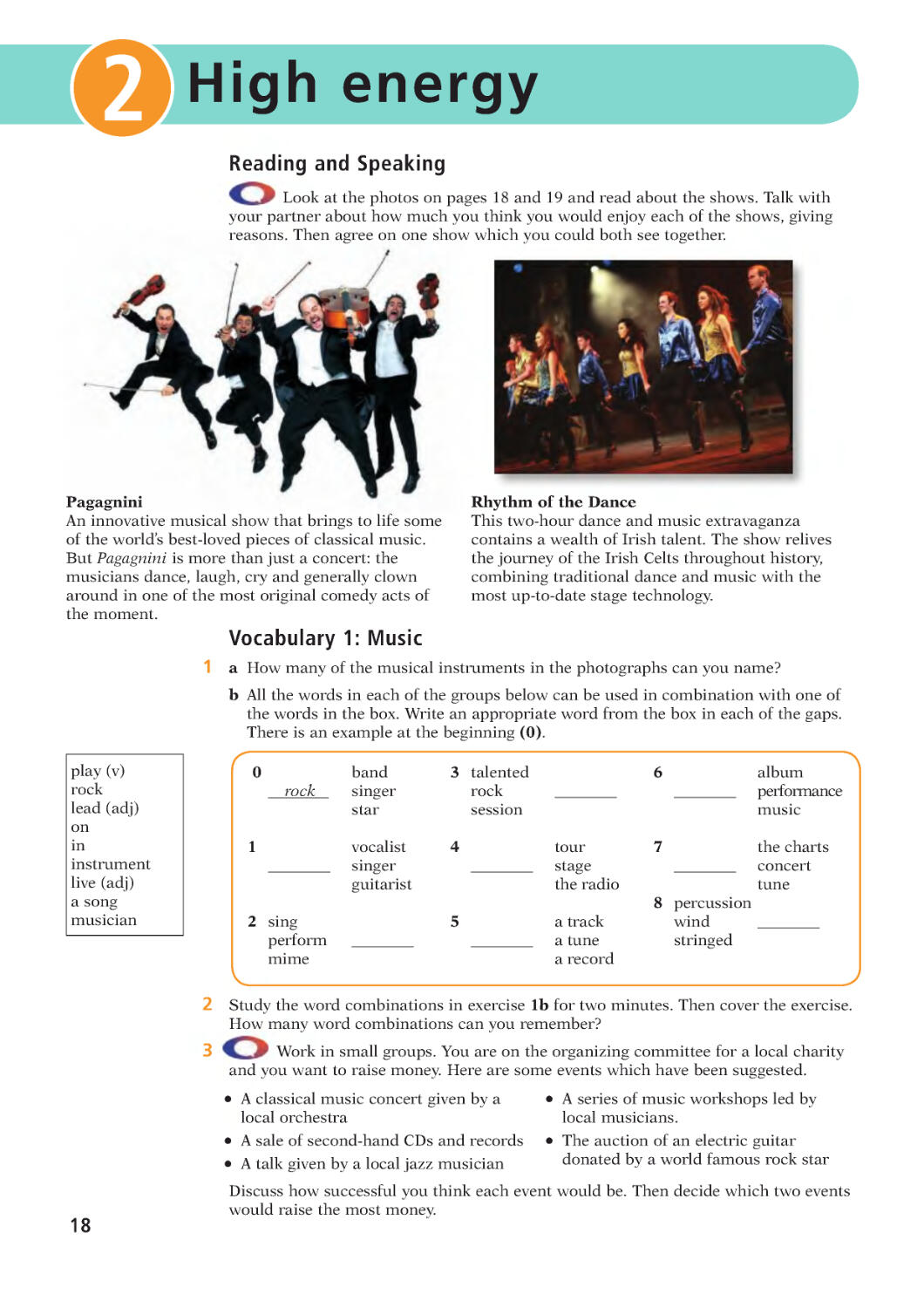
Pagagnini
An innovative musical show that brings to life some
of the world’s best-loved pieces of classical music.
But Pagagnini is more than just a concert: the
musicians dance, laugh, cry and generally clown
around in one of the most original comedy acts of
the moment.
Rhythm of the Dance
This two-hour dance and music extravaganza
contains a wealth of Irish talent. The show relives
the journey of the Irish Celts throughout history,
combining traditional dance and music with the
most up-to-date stage technology.
Vocabulary 1: Music
1 a How many of the musical instruments in the photographs can you name?
b All the words in each of the groups below can be used in combination with one of
the words in the box. Write an appropriate word from the box in each of the gaps.
There is an example at the beginning (0).
play (v)
rock
lead (adj)
on
in
instrument
live (adj)
a song
musician
2 Study the word combinations in exercise 1b for two minutes. Then cover the exercise.
How many word combinations can you remember?
3
Work in small groups. You are on the organizing committee for a local charity
and you want to raise money. Here are some events which have been suggested.
• A classical music concert given by a
local orchestra
• A sale of second-hand CDs and records
• A talk given by a local jazz musician
• A series of music workshops led by
local musicians.
• The auction of an electric guitar
donated by a world famous rock star
Discuss how successful you think each event would be. Then decide which two events
would raise the most money.
0
band
rock
singer
star
1
vocalist
________
singer
guitarist
2 sing
perform
________
mime
3 talented
rock
________
session
4
tour
________
stage
the radio
5
a track
________
a tune
a record
6
album
________
performance
music
7
the charts
________
concert
tune
8 percussion
wind
________
stringed

19
Sentence completion
1.14
1 a Read these Listening Part 2 instructions and the What to expect in the exam box.
You will hear a radio presenter called Jim Dunne talking about local entertainment
options. For questions 1–10, complete the sentences.
Part 2
Listening 1
What to expect in the exam
• The words you read in the question may not
be the same as the words you hear in the
recording, e.g . Question 1:
You read: Jim recommends Pagagnini to ...
You hear: I can guarantee ... will enjoy
watching these four guys.
• However, the word(s) you need to write are
actually heard in the recording.
• You may hear information which could fit the
gap but does not answer the question.
e.g. In question 2 below you will hear the
names of two places mentioned. Listen carefully
to ensure you choose the right one.
• You do not need to write more than three
words for each answer.
• Minor spelling errors can be made (e.g.
musicall) but the words must be recognizable.
b
Read questions 1–10 and, as you do so, discuss the type of information you
might need to write for each one.
Example: 1 This is probably a person or a group of people.
c Listen to the recording twice and complete the sentences.
Jim recommends Pagagnini to the (1) ........................................
Jim saw a Pagagnini concert last year in (2) ........................................
As well as classical music, Pagagnini play rock, blues and (3) ........................................
Jim says the Pagagnini show has no (4) ........................................
The first performance of Rhythm of the Dance was in (5) ........................................ in
Norway.
More than (6) ........................................ people have seen Rhythm of the Dance live on
stage.
Jim suggests listeners look at the section entitled (7) ........................................ on the
Rhythm of the Dance website.
The name of the first show that the Cirque Éloize performed at the Regent Theatre
was (8) ........................................
Some performers in iD appear on (9) ........................................ and RollerbladesTM.
One review of iD says it is full of originality, energy and (10) ........................................
2
Having listened to Jim Dunne, do you feel the same about the different shows
as when you did the Reading and Speaking activity on page 18? Why/Why not?
High energy 2
Cirque Éloize – iD
Sixteen artists on stage, thirteen circus disciplines, and
a world of urban dances such as breakdance and hip-
hop. The rock, electronic and poetic music, together
with the presence of video, highlight the show’s playful,
energetic, and youthful aspects.
Jeannot Painchaud (Director)
Tap Dogs
Tap Dogs are currently taking the world by storm with
their tap show that combines the strength and power of
workmen with the precision and talent of tap dancing.
‘
’

20
Language focus 1: Indirect ways of asking questions
3 Questions a–f were prepared by a music journalist planning
to interview one of the members of Pagagnini. Rewrite them
to make them indirect. If possible, choose a different phrase
from the box to begin each one.
1 Compare these two ways of asking the same question:
Direct: What time does the Pagagnini concert start?
Indirect: Could you tell me what time the Pagagnini
concert starts?
Asking questions in a more indirect way, using expressions
such as Could you tell me, can make them sound more
polite. Write the direct form of the following questions:
1 I’d be interested to know when Rhythm of the Dance
started performing.
When
?
2 Would you mind telling me why you call the show iD?
____________________________________________
3 I’d like to know if the Tap Dogs are planning to come here.
____________________________________________
2 Compare the direct and the indirect questions in exercise 1
above and answer the following questions:
a In numbers 1 and 2, what happens to the auxiliary
verbs did and do when the indirect question form is
used? How are the main verbs start and call affected?
b In number 3, what differences are there between the
word order of the direct question and that of the indirect
question?
c In number 3, where no question word (when, how,
what, where etc) appears in the direct question, which
word has to be added in the indirect question?
Check your ideas on page 209 of the Grammar
reference.
I’d be interested to know ... Could you explain ...
Would you mind telling us ... We’d like to know ...
Could you tell me ... I was wondering if you could tell me ...
a Why are you called ‘Pagagnini’?
____________________________________________
b When did you start performing together?
____________________________________________
c Have you ever toured outside of Europe?
____________________________________________
d What type of music do you prefer playing?
____________________________________________
e How many hours do you practise your instrument each
day?
____________________________________________
f Do you clown around when you’re off stage as well?
____________________________________________
4 a Student A: Write six indirect questions which you could
ask a member of Rhythm of the Dance.
Student B: Write six indirect questions which you could ask
a member of Cirque Éloize.
b
Take turns to roleplay an interview in which your
partner answers the questions you have prepared in a.
Letter of application
1 a Read the following Writing Part 2 instructions.
You see the following advertisement in your local English-language newspaper:
Part 2
Writing 1
Write your letter of application.
b Read the letter of application on page 21. Ignore the words and expressions in bold
(1–10) and answer the following question.
Do you think the applicant would be suitable for the job which is advertised?
Give reasons for your answer.
2 High energy
MUSICIANS AND DANCERS REQUIRED
We need teaching assistants for the music and dance
activities at our English-language summer school for
young children.
If you can speak English and believe you have the right
skills to teach music and/or dance to young people, you
are the right person for us.
Write to the director, Paul Beacon, and explain why you
would be a suitable person for the job.

21
2 When writing a letter of application to the director of a summer school, a formal
style is appropriate. However, in Sandra Agar’s application above, the words and
expressions in bold (1–10) are more appropriate to an informal letter. Replace each
one with a formal alternative from the box below.
Example: 1 Mr Beacon
I have no experience
I would like to apply
I feel
I look forward to hearing
I have seen
well-suited to
I have also been attending
Mr Beacon
a number
I would love to have the opportunity to
3 Which linking words does Sandra use in her letter.
Example: also
4 What is the purpose of each of the four main paragraphs in Sandra’s letter?
Example: Paragraph 1: Her reason for writing
5 Read the How to go about it box on page 202 before you do the following Writing
Part 2 task.
You see the following advertisement in your local English-language newspaper:
ARE YOU A MUSIC FAN?
We require English-speaking volunteers to help at a four-day international
pop and rock music festival aimed at raising money for charity.
•
What relevant music-related interests do you have?
•
Do you have experience of working with people?
•
How would you benefit from helping at this event?
Write to Paul Groves at Music for Life explaining why you would be
suitable as a volunteer.
Write your letter of application in 140–190 words.
High energy 2
Dear (1) Paul
(2) I’ve had a look at your advertisement in the latest edition of ‘English
Weekly’ and (3) I want to ask for a job as a music and dance teacher at
your summer school.
I am a twenty-year-old music student in my second year at
university and can play several instruments, including piano, violin
and clarinet. (4) I’ve also been going to a local dance academy for the
past twelve years and am a member of a modern -dance group called
‘ Pasos’.
Although (5) I’ve never done any jobs working with groups of children,
I teach piano and violin to (6) quite a lot of young private students. In
addition, I choreograph many of the dances for ‘ Pasos’ and teach the
steps to the other members of the group.
(7) I reckon I would be (8) really good at this job, as I am a very calm
and patient person. My whole life is devoted to music and dance and
(9) it’d be great if I could pass on my skills to other people.
(10) Can’t wait to hear from you.
Yours sincerely
Sandra Agar

22
Gapped text
1
You are going to read an article about the game of rugby. Look at the
photographs, which show men and women playing rugby, and discuss the following
questions.
How much do you know about rugby? What are some of the rules of the game?
The article you are going to read says that ‘rugby is rather like chess’: why do you think
it makes this comparison?
2 Read through the base text (the main text with the gaps). Are any of your ideas from
exercise 1 mentioned?
3 Six sentences have been removed from the article. Choose from the sentences A–G the
one which fits each gap (1–6). There is one extra sentence which you do not need to
use.
How to go about it
• Check that the whole sentence fits in with the
meaning of the text before and after the gap.
To help you do this, some words and phrases are
written in bold. These show connections between
the language in the text and the language in
the missing sentences. A number of grammatical
words such as them, this and these are written in
italics to show further connections.
Note: these connections are not shown in the
First examination.
• Now look at gap number 1. The words in bold
before and after the gap indicate that the
missing sentence:
a refers back to the words uncomplicated and
get points
b refers forward to the different ways of getting
points.
When you think you have found the sentence,
read the whole paragraph again to check that it fits.
• Now complete each of the remaining gaps
with an appropriate sentence. Do not choose
a sentence simply because it contains a
word which also appears in the base text.
For example, the word obstacles, before gap
number 2, is repeated in sentence G, but this
does not necessarily mean that G is the correct
answer.
• When you have finished, check that the
sentence which you have not used does not fit
into any of the gaps.
2 High energy
Part 6
Reading and
Use of English

23
How to play ... rugby
Welcome to a sport which will enchant and excite you, and take you to the heights and the depths of human
emotion. Learn the rules and you will be unable to resist it.
Rugby is a game of 40-minute halves with the most uncomplicated of objectives – to get more points than
your opponent. 1
You either touch the ball down over your opponents’ line, known as a try, for
five points, or kick the ball over your opponent’s posts; three points for a dropped goal and a penalty,
two points for a conversion (kicking the ball between the posts after a try).
The complexities in rugby arise as a result of the obstacles which are put in every rugby player’s path to make
it harder for him to score points. 2
This can be done in three ways: by throwing you to the
ground, by teaming up with other players to push against you when you have the ball in your hands or by
pushing against you when the ball is on the ground.
There is also the law that says the ball can only be passed backwards. 3
This is clearly rather
difficult to do when you have fifteen very large opponents standing in front of you ready to
throw you to the floor if they get anywhere near you.
Each team is made up of eight for wards and seven backs. The job of the for wards is to get the ball for the
quicker, lighter backs to score. Rugby is rather like chess: chess pieces have special functions, in the same
way that rugby players have specific tasks to perform. Within these roles they both employ various moves to
get to the other side. 4
Rugby is a game in which all the players work together, and the better
their relationships and understanding of one another, the better their chances of getting one of their team to the
try-line.
5
The tools you need to overcome them are simple: time and space. When you hear commentators
talking of tactics or strategies, they’re just talking about the various ways in which you ‘create space’ or ‘make
time’. For example, if the backs keep passing along the line they will eventually run into problems, as the last
player has no one else to pass to, and no space to run in. He’ll get thrown off the pitch by the opposition, and
the ball will go to them.
There are tactics like miss-moves (missing someone out in the line so that a defending player runs the
wrong way and leaves a gap) and dummies (pretending to pass so the opposition runs the wrong way).
6
There are a few other things which could be mentioned, but basically, rugby is nowhere near as complicated as
it looks. It is, after all, just a game.
A The point at which rugby becomes much more fun than a board game is in its
team dynamics.
B However, this complexity in the rules of rugby does not make the game any less
exciting to play, or indeed, to watch.
C The methods of scoring are equally simple.
D Because of this rule, players have to run forwards or they’ll end up back on their
own line.
E These strategies are both ways of tricking the opposition into opening up a gap
in the defence for you to run through before you run out of space.
F One such difficulty is that the opposing team can physically stop you from
scoring.
G Now we know the aim of playing rugby, and the nature of the obstacles that
stand in the way, we need to look at how to deal with these obstacles.
Reacting to the text
Would you be interested in watching or playing rugby? Why/Why not?
Are there any sports you have not played but would like to try out? If so, which
one(s)?
High energy 2
5
10
15
20
25

24
Language focus 2: Gerunds and infinitives
1 Look at the underlined words in the following extracts from
the reading text. For each one, explain why a gerund, an
infinitive without to, or an infinitive with to is used.
Example:
a to make: the infinitive with to is used to express
purpose, the reason why something is done.
a ... the obstacles which are put in every rugby player’s
path to make it harder for him to score points
b This can be done ... by throwing you to the ground.
c ... the backs keep passing along the line ...
d ... we need to look at how to deal with these obstacles.
2 Some verbs can be followed by a gerund and some others
can be followed by an infinitive with to. Complete each of
the following sentences using the correct form of the verb
in brackets. One verb in each sentence will be a gerund, the
other an infinitive with to.
1 When I suggested ___________ (go) skiing at the
weekend she was extremely enthusiastic and we
arranged ___________ (meet) at seven o’clock on
Saturday morning.
2 I can’t help __________ (smile) when I see my dad
playing tennis. He’s had hundreds of lessons but he still
hasn’t learnt ___________ (hit) the ball properly.
3 Paul seems ____________ (enjoy) playing golf. He’s even
considering ____________ (buy) his own set of clubs.
4 One of my cousins has promised ________ (take) me
windsurfing as soon as I’ve finished ________ (study).
5 At first my parents refused _____________ (let) me
go to karate lessons, but I kept __________ (ask) and
eventually they agreed.
3 Some verbs can be followed by more than one verb form.
Underline the correct alternatives in the following sentences.
In some sentences more than one alternative is correct.
1 It started rain/to rain/raining so they had to postpone
the match.
2 I only stopped have/to have/having a rest once during
the whole marathon.
3 Jones continued play/to play/playing football
professionally until he was forty.
4 These exercises should help you run/to run/running
faster.
5 Remember drink/to drink/drinking water before the
race.
6 Sally tried use/to use/using a heavier racket, and she
played a little better.
Read the Grammar reference on pages 209–10 and
check your answers.
4 The verbs in the box can be used to talk about our likes and
dislikes. They are all usually followed by the gerund.
Write each verb in an appropriate place on the line below
according to the strength of its meaning.
really enjoy
don’t mind
quite like
detest
can’t stand
don’t like
love
absolutely adore
hate
STRONG DISLIKE
STRONG LIKE
detest
absolutely adore
5 Certain adjectives followed by a preposition and the gerund
can also be used to talk about what does and doesn’t
interest you. Study the following table and complete each
space with a preposition from the box. The first one has been
done for you.
at in on about with of
adjective
noun or gerund
+ preposition
I’m (really)
keen on
sport/cinema etc
I’m not (really)
interested _____
listening to ... etc
I’ve never been
fond _____
watching ...
I’ve always been
good/bad _____
playing ...
I get (really)
bored _____
doing ...
I never get
excited _____
going ...
6 Write eight sentences about your likes and dislikes using the
language you have just studied.
Examples:
Preposition + gerund: I never get excited about going to the
cinema.
Verb + gerund: I quite like listening to jazz.
Gerund as subject: Collecting postcards is one of my favourite
pastimes.
7
Compare your sentences with your partner’s.
Ask questions about each other’s likes and dislikes.
Example:
A: I’ve always been keen on going to the cinema.
B: How often do you go?
A: I tend to go once every two weeks or so.
B: And what are your favourite films?
A: Well, I really enjoy watching science fiction, but I don’t
like films with a lot of violence. I get bored very easily
if there are lots of deaths.
You may be asked to talk about your interests in Part 1 of
the Speaking test. Make sure you develop your answers,
explaining and justifying your opinions.
2 High energy

25
Vocabulary 2: Sport
1 Underline the correct alternative in these extracts from the reading text on page 23.
a You foot/kick/give/fire the ball over your opponent’s sticks/poles/pillars/posts.
b ... obstacles which are put in every rugby player’s path to make it harder for him to
do/goal/score/mark points ...
c ... the ball can only be given/presented/passed/changed backwards.
d ... chess pieces/parts/packs/portions have special functions ...
e He’ll get thrown off the court/pitch/track/camp by the opposition ...
Check your answers on page 23.
2 Can you name all the sports in the pictures? Write the name of each sport next to the
verb which it is used with. The first one has been done for you.
do
athletics
.
go ________________________________________________________________________
play ______________________________________________________________________
3 a Write the name of the sport with which each group of four nouns is associated.
The first one has been done for you.
1
tennis
court
net
racket
backhand
2 ____________ pitch
referee
corner
foul
3 ____________ course
green
clubs
hole
4 ____________ slope
sticks
run
goggles
5 ____________ track
field event
lane
meeting
6 ____________ saddle
helmet
pedals
peloton
b Add each of these nouns to the appropriate group in a.
red card fairway gears lift service triple jump
4 a Complete each gap with a verb from the box.
beat draw hit take take win
1 Which sports _________ place on an ice rink?
2 Which country’s football team _________ Holland to win
the 2010 World Cup Final?
3 Which medal does a runner-up _________ ?
4 In which sports do you _________ the ball with a racket?
5 How many players from each team can _________ part at
one time in a game of basketball?
6 If two hockey teams _________ nil–nil, how many goals are
scored?
b
Answer the questions in a.
5
Work in pairs.
Student A Choose a sport and explain the rules to your
partner.
Student B Imagine that you are not familiar with your
partner’s sport. Ask your partner any questions
that are necessary to help you fully understand
the rules.
When you have finished, change roles.
High energy 2

26
Multiple choice
1.15
1
Look at the photographs of unusual sports. What do you think contestants
have to do in each one?
2 You will hear a man talking on the radio about unusual sports. For questions 1–7,
choose the best answer (A, B or C).
Part 4
Listening 2
What to expect in the exam
• Look at question 1 below and the following extract from the listening script. The underlined sections
contain words which are the same or similar to words in all three of the possible answers A, B and C. Only
one of these sections matches an answer; the others are distractors. Decide which is the correct answer and
say why the others are incorrect.
Now you may think this is just a bit of fun, but when I watched two men competing in a televised match
last year, I was amazed by their level of skill in each of these two very different disciplines. After all,
boxing is such an aggressive, violent sport – it’s about using the body, whereas chess is all about using
the brain.
• Although a particular option may be true, it may not be the correct answer to the question you are asked. In
question 2, all three statements are true but only one is something that Mike finds it difficult to believe.
1 When Mike saw a chess boxing match, he was
surprised by
A how skilled the competitors were at both parts
of the sport.
B how much fun the competitors were having.
C how aggressive the competitors were.
2 Having read about octopushing, Mike finds it
difficult to believe that
A players do not have to hold their breath for long
intervals.
B a high level of fitness is not required to play it.
C it is an exciting sport to watch.
3 What does Mike say about wife carrying?
A Male competitors must not be over a certain
weight.
B The name of the sport is not entirely
appropriate.
C The sport has a lot of complicated rules.
4 What is Mike’s criticism of sports like wife
carrying?
A They are not suitable for young children.
B They should not really be called sports.
C They are not worth taking seriously.
5 What do we learn about the organizers of toe
wrestling?
A They apply what they learn from international
competitions.
B They have arranged a number of events in
schools.
C They made a request which was rejected.
6 How does Mike feel about the human triumphs in
the Man Versus Horse Marathon?
A They are very surprising.
B They deserve more recognition.
C They are unlikely to be repeated.
7 Why did Mike give up running?
A He was injured.
B He lost interest.
C He had no time.
3
Would you be interested in taking part in or watching any of the sports Mike
mentions? Why/Why not?
Do you have any strange sports in your country? What do the competitors do?
2 High energy

27
How to go about it
• Before you write your article, read the model
and analysis on page 202.
• To help you plan your article, answer the
following questions and make notes.
Paragraph 1:
What is your favourite sport?
What is special about it?
Paragraph 2:
Why do you like it?
What are the benefits of doing it?
Paragraph 3:
What advice can you give to people who want to
take it up?
Are any special qualities, equipment or clothes
needed?
Paragraph 4:
What final encouragement can you give?
• Give your article a title and include some of the
features of style from page 202.
Word formation: Affixes
1 Add an appropriate suffix, -or, -er or -ant, to each of the verbs in the box to form
nouns for the people who perform these actions. You may need to make further
spelling changes to the verbs.
Example: win – winner
win
box
play
spectate
compete participate
listen
organize
run
ride
contest
Check your answers in the listening script on pages 223–4.
2 Add either -ist, -eer, -ee or -ian to the pairs of words below to form the nouns for the
corresponding people. Use the same suffix for both words in each pair. You may need
to make further spelling changes.
employ/train electric/politics
novel/science
mountain/engine
3 In 1–7 below, use the same prefix from the box with all three adjectives to make them
negative. The first one has been done for you.
dis-
un-
in-
ir-
il-
im-
Adjectives
Negative
1 lucky/concerned/reliable
_________________________________
2 experienced/competent/tolerant _________________________________
3 legal/logical/legible
_________________________________
4 moral/mature/modest
_________________________________
5 practical/patient/perfect
_________________________________
6 regular/responsible/relevant
_________________________________
7 honest/obedient/satisfied
_________________________________
4 What meaning do the prefixes in bold have in the following words?
undercook overeat prehistoric postgraduate hypermarket
microelectronics misspell rewrite ex-wife extraterrestrial
Article
Read the following Writing Part 2 instructions.
You have just seen this advertisement.
Write your article in 140–190 words.
Part 2
Writing 2
INTERNATIONAL SPORTS WEEKLY
• What is your favourite sport?
• Why do you like it?
• What advice would you give to
someone who wants to take it up?
We are looking for short articles answering
these questions and we will publish some
of the best articles next month.
High energy 2
unlucky/unconcerned/unreliable

2 Review
28
Word formation
1 In 1–6 below, one of each of the four words is not normally used. Underline the word.
1 undercook
undercharge
underestimate
undersleep
2 overgrown
overweight
overlittle
overcrowded
3 overeat
oversing
oversleep
overwork
4 misbehave
misunderstand
misspell
missucceed
5 dislove
dishonesty
disappearance
disobedience
6 uncommon
unselfish
unglad
unreliable
2 For questions 1–6, complete each of the gaps with the correct form of one of the
words from exercise 1.
1 These jeans should have cost £70, but the assistant made a mistake and __________
me. I only paid £50 for them.
2 The house has been abandoned for years. That’s why the garden is looking so
__________
.
3 I’m sorry I’m late. My alarm didn’t go off, so I __________ .
4 You’ve ____________ my surname. There are two ‘t’s in Hutton, not one.
5 Police are investigating the __________ of confidential documents from the Prime
Minister’s office.
6 Paul comes to school tired, and it is not __________ for him to fall asleep in class.
3 Now write five sentences of your own using some of the other words from exercise 1.
Leave a space in each sentence where the word should be and ask another student to
complete them.
Word formation
For questions 1–8, read the text below. Use the word given in capitals at the end of
some of the lines to form a word that fits in the space in the same line. There is an
example at the beginning (0). Write your answers IN CAPITAL LETTERS.
The Celebrated Pedestrian
Pedestrianism, an early form of racewalking, was an (0) __________________ popular
EXTREME
sport in 18th- and 19th-century Britain, attracting huge crowds of (1) __________ .
SPECTATE
Individuals would either aim to walk a certain (2) __________ within a specified
DISTANT
period of time or else compete against other pedestrians. Cash prizes were offered
but (3) __________ could also earn substantial amounts from the money gambled
PARTICIPATE
on events.
Perhaps the most famous (4) __________ was Captain Robert Barclay Allardice,
WALK
whose (5) __________ achievements earned him the title of ‘The Celebrated
ORDINARY
Pedestrian’. The Scotsman’s most memorable (6) __________ took place in 1809,
PERFORM
when he walked 1000 miles (1609 kilometres) in 1000 hours for a bet of 1000
guineas. Many considered it (7) __________ that he would complete the challenge,
LIKELY
which required him to walk a mile an hour, every hour, for forty-two days and
nights. He proved them wrong, though the task was so (8) __________ demanding
PHYSICAL
that by the end of the walk he had lost nearly fifteen kilos in weight.
EXTREMELY
Part 3
Reading and
Use of English

Review 1
29
Gerunds and infinitives
Complete each of the gaps below with the correct form of the verb in brackets.
1 I’ve been meaning _____________ (write) to you for ages but I just haven’t had the
time.
2 If we go skiing tomorrow, it’ll mean _____________ (get) up early. The slopes get
crowded very quickly.
3 I wish you’d stop _____________ (tap) your foot!
4 These long car journeys make me really hungry. Can we stop _____________ (have)
lunch soon?
5 When I tell you to be quiet, why must you always go on _____________ (talk)?
6 After looking at verbs which take the gerund, we went on _____________ (study)
those which are followed by the infinitive.
7 I tried hard _____________ (open) the window, but I couldn’t move it. It was stuck.
8 These plants look as if they need a lot more light. Try _____________ (put) them a
little closer to the window.
Vocabulary
A Sport
Complete each gap with a suitable word.
1 Our hotel was right next to the golf _________ we played on every morning. In fact,
our room overlooked the fairway of the eighteenth _________ .
2 The _________ blew his whistle to signal the end of the football match and hundreds
of jubilant United fans ran onto the _________ to congratulate their players.
3 I’m useless at tennis: I can’t even _________ the ball over the net with the _________ .
4 The _________ taking us to the top of the steepest ski _________ broke down halfway
up and we were left hanging in the air for over an hour.
5 Over three thousand runners will take _________ in this year’s marathon, which for
the first time ever takes _________ on a Sunday.
6 Barcelona _________ Valencia 3–2, while Real Madrid could only _________ 1–1 at
home to Rayo Vallecano.
B Music
Complete each of the gaps below with an appropriate word combination from page
18 of this unit. You may need to use nouns in the plural. There is an example at the
beginning (0).
0 I never buy live albums . You don’t get the same quality of sound as you do with a
studio recording.
1 Adele’s latest album sounds great. I heard a couple of tracks _________________ last
night.
2 I spend all my time in piano lessons practising the scales. I still haven’t learnt to
_________________
.
3 Her last record only got as far as number ten ___________________ .
4 When groups make a record they often have to employ __________________ to play
some of the instruments.
5 That guitar sounds awful! Are you sure it’s _________________ ?
6 I hate it when they _________________ on the TV. It’s so obvious they aren’t really
singing.
7 The band is going _________________ again next year. They’ll be playing in nine
European countries in three months.
8 Next on Capital Radio we’re going to _________________ from the latest ‘Sidewinder’
album. It’s called Ready for love – I hope you like it.
2