/


Author: Bsoul L.A.
Tags: history islam culture middle ages islamic world
ISBN: 978-1-4331-5186-6
Year: 2018


Text
www.peterlang.com
LABEEB AHMED BSOUL
PETER LANG
Medieval Islamic World: An Intellectual History of Science and Politics surveys major
scientific and philosophical discoveries in the medieval period within the broader
Islamicate world, providing an alternative historical framework to that of the pri-
marily Eurocentric history of science and philosophy of science and technology
fields. Medieval Islamic World serves to address the history of rationalist inquiry
within scholarly institutions in medieval Islamic societies, surveying developments
in the fields of medicine and political theory, and the scientific disciplines of astron-
omy, chemistry, physics, and mechanics, as led by medieval Muslim scholarship.
Dr. Labeeb Ahmed Bsoul (Ph.D., McGill University) is
Associate Professor at Khalifa University. Among his many
published articles and books are Formation of Islamic Jurisprudence
(2016), Islamic History and Law (2016), and International Treaties
(Mu‘ahadat) in Islam (2008).
P
E
T
E
R
L
A
N
G
B
s
o
u
l
M
e
d
i
e
v
a
l
I
s
l
a
m
i
c
W
o
r
l
d
AN INTELLECTUAL HISTORY OF
SCIENCE AND POLITICS
Medieval Islamic
World
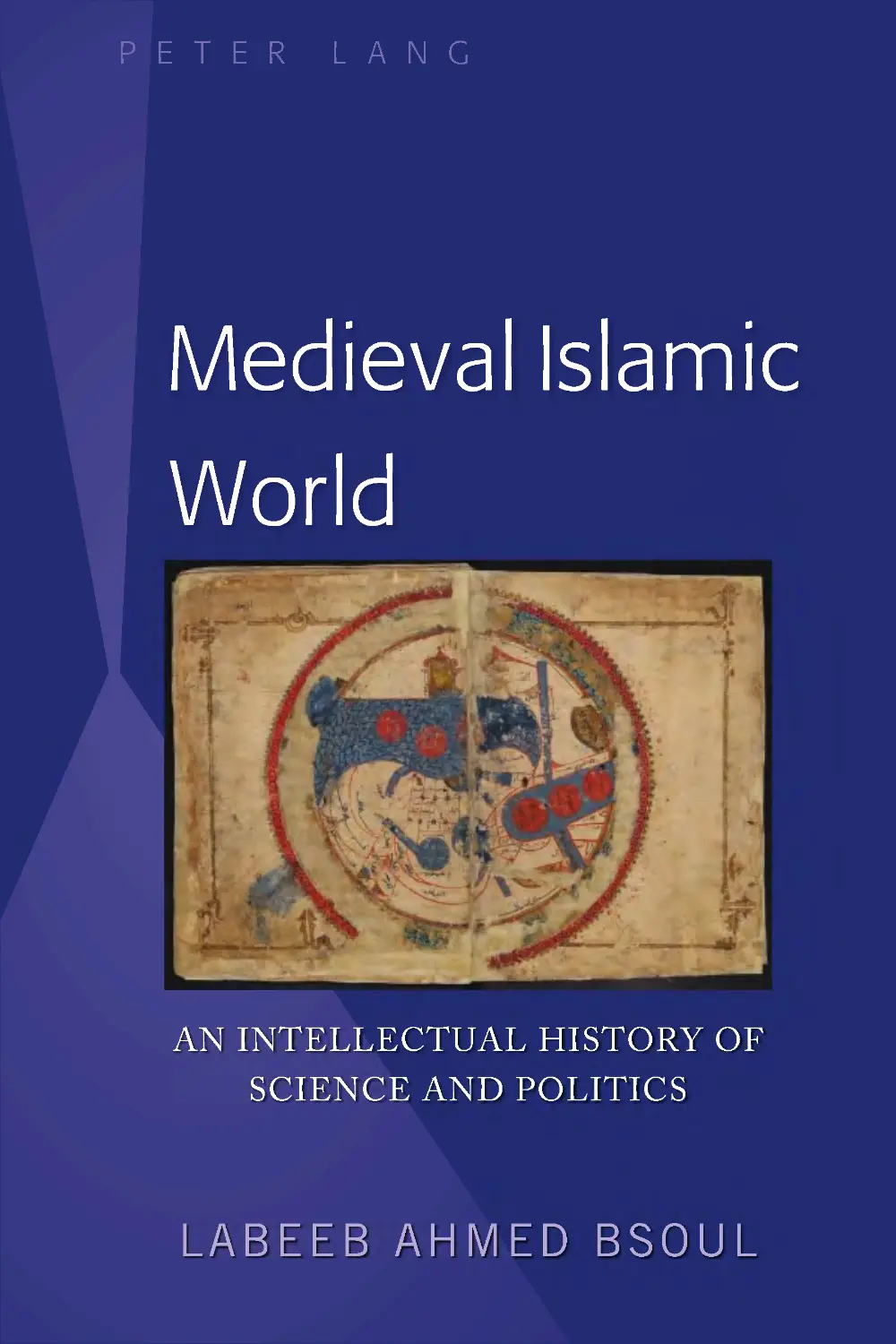
Cover image: Classic Kitāb al-masālik wa-al-mamālik world map, ‘Ṣūrat
al-Arḍ’ (Picture of the World) from an abbreviated copy of al-Iṣṭakhrī’s
Kitāb al-masālik wa-al-mamālik (Book of Routes and Realms). 589/1193.
Mediterranean. Gouache and ink on paper. Diameter 37.5 cm. Credit:
Leiden University Libraries. Cod. Or. 3101, ff. 4-5.
LABEEB AHMED BSOUL
PETER LANG
Medieval Islamic World: An Intellectual History of Science and Politics surveys major
scientific and philosophical discoveries in the medieval period within the broader
Islamicate world, providing an alternative historical framework to that of the pri-
marily Eurocentric history of science and philosophy of science and technology
fields. Medieval Islamic World serves to address the history of rationalist inquiry
within scholarly institutions in medieval Islamic societies, surveying developments
in the fields of medicine and political theory, and the scientific disciplines of astron-
omy, chemistry, physics, and mechanics, as led by medieval Muslim scholarship.
Dr. Labeeb Ahmed Bsoul (Ph.D., McGill University) is
Associate Professor at Khalifa University. Among his many
published articles and books are Formation of Islamic Jurisprudence
(2016), Islamic History and Law (2016), and International Treaties
(Mu‘ahadat) in Islam (2008).
P
E
T
E
R
L
A
N
G
B
s
o
u
l
M
e
d
i
e
v
a
l
I
s
l
a
m
i
c
W
o
r
l
d
AN INTELLECTUAL HISTORY OF
SCIENCE AND POLITICS
Medieval Islamic
World
Cover image: Classic Kitāb al-masālik wa-al-mamālik world map, ‘Ṣūrat
al-Arḍ’ (Picture of the World) from an abbreviated copy of al-Iṣṭakhrī’s
Kitāb al-masālik wa-al-mamālik (Book of Routes and Realms). 589/1193.
Mediterranean. Gouache and ink on paper. Diameter 37.5 cm. Credit:
Leiden University Libraries. Cod. Or. 3101, ff. 4 -5 .
Medieval Islamic
World
This book is part of the Peter Lang Humanities list.
Every volume is peer reviewed and meets
the highest quality standards for content and production.
PETER LANG
New York Bern Berlin
Brussels Vienna Oxford Warsaw
Labeeb Ahmed Bsoul
Medieval Islamic
World
An Intellectual History of
Science and Politics
PETER LANG
New York Bern Berlin
Brussels Vienna Oxford Warsaw
Library of Congress Cataloging-in-Publication Data
Names: Bsoul, Labeeb Ahmed, author.
Title: Medieval Islamic world: an intellectual history of
science and politics / Labeeb Ahmed Bsoul.
Description: New York: Peter Lang, 2018.
Includes bibliographical references and index.
Identifiers: LCCN 2017048401 | ISBN 978-1 -4331-5185 -9 (hardback: alk. paper)
ISBN 978-1 -4331-5186 -6 (ebook pdf)
ISBN 978-1 -4331-5188 -0 (epub) | ISBN 978-1 -4331-5189-7 (mobi)
Subjects: LCSH: Science—Islamic countries—History. | Medicine—Islamic countries—
History. | Muslim scientists. | Islam and science. | Political science—
Islamic countries—History . | Islam and politics.
Classification: LCC Q127.I742 B78 2018 | DDC 509.17/670902—dc23
LC record available at https://lccn.loc.gov/2017048401
DOI 10.3726/b13479
Bibliographic information published by Die Deutsche Nationalbibliothek.
Die Deutsche Nationalbibliothek lists this publication in the “Deutsche
Nationalbibliografie”; detailed bibliographic data are available
on the Internet at http://dnb.d -nb.de/.
© 2018 Peter Lang Publishing, Inc., New York
29 Broadway, 18th floor, New York, NY 10006
www.peterlang.com
All rights reserved.
Reprint or reproduction, even partially, in all forms such as microfilm,
xerography, microfiche, microcard, and offset strictly prohibited.
Dedicated to my beloved brother
Muhammad Ahmed Bsoul Abu Amar and his beloved family
contents
Acknowledgments
ix
Abstracts and Keywords
xiii
Introduction
1
Chapter 1. Characteristics of the Islamic Civilization
7
Islamic Characteristics of Scientific Trends
12
Chapter 2. Qurʾanic Experimental Method
25
The Elements of the Scientific Experimental Method in the
Qurʾan
25
Human Reasoning (al-qiyās)
27
Chapter 3. The Impact of Islamic Medicine on Modern Civilization and
Islamic Scientific Heritage of Medicine and Pharmacy
49
A Brief Overview of the History of Medicine
51
Medicine in the Prophetic Era
52
Medicine in the Umayyad Era
53
Medicine in the Abbasid Era
53
Specialized Branches of Medicine
70
Chapter 4. The Impact of Islamic Political Theory on
Modern Civilization
121
The Advice of Ṭāhir ibn Ḥusayn
122
viii
medieval islamic world
Policy Vision of Ibn Zafar (“the Sicilian”)
124
About the Author of Consolation for the Ruler During
the Hostility of Subjects
125
Brief history of Islamic Sicily
126
The Art of Politics by Machiavelli (d. 1527)
137
Points of Similarity
148
Points of Contrast
149
Conclusion
150
Chapter 5. Classical Muslim Scholars’ Contribution to the Fields of
Astronomy,Geography, Chemistry, Physics, and Mechanical
Engineering (ʿIlm al-Ḥiyal)
165
Astronomy
165
Islamic Astrological Achievements
166
The Most Important Muslim Astronomers
and Their Efforts
169
The Composition of the World
175
Models of the Seven Planetary Movements
176
Other Astronomical Works
176
The Astronomical Observatories
186
Astronomical Instruments
189
Geography
195
Muslim Scholars’ Contributions to Alchemy or Chemistry 206
Methodological Chemistry
208
Chemical Laboratories
210
Muslims and the Development of Physics
217
The Qurʾan and the Laws of Physics
218
Muslims and the Development of Physics
219
Mechanics (ʿIlm al-Ḥiyal)
229
Glossary
265
About the Author
269
Index
271
acknowledgments
In the Name of Allah (God), the Most Gracious,
the Most Merciful
Many people must be thanked for their contributions to the successful com-
pletion of this monograph. I would first like to express my gratitude to my
colleagues at Khalifa University, and other colleagues and role models, such
as esteemed professors Rushdi Rashid, Seyyed Hossain Nasr, George Saliba,
James Ayers, Hank McGuckin, Todd Lawson, Ghanim Yaʿqoubi, Ibrahim
Aoude, Dr. Jamal Zoubi, Omar Odeh, the late Professor Ibrahim Aburabiʿ, and
many others, for their guidance, encouragement, and the direct and indirect
discussions on many topics related to my personal research interest. I would
like to take the opportunity to extend my deep gratitude to Dr. Benaouda Ben-
said, who assisted me in a variety of ways, especially by his example of schol-
arship in the course of our studies and through his support on both personal
and academic levels, whose moral support and encouragement I will never for-
get. My deepest gratitude goes to Drs. Anas Al-Azzam, Bashar El-Khasawneh,
Mohammad Abu-Matar, Hamada Alshaer, Issam Qattan, Eiyad Abu-Nada,
Shadi Balawi, Ahsraf Al-Khateeb, Muhammad Abu Tayih, Baker Mohammad,
Kenan Hazirbaba, Mohammad Al-Khaleel, Yousef Abo Salem, Marwan
x
medieval islamic world
Abualrub, Imad Elayna, Yacine Addad, Khaled Saleh, Raed Shubair, Moh’d
Rezeq, Hassan Barada, Mahmoud Al-Qutayri, Sharmarke Mohamed, Maguy
Abi Jaoude, Ayman Abulail, Rachad Zaki, Emad Alhseinat, Faisal Shah Khan,
Hanin Abubaker, Syed Murtaza Jaffar, Shaju Badarudeen, Syed Mohammad
Tariq, Kinda Khalf, Jeremy Teo, Cecare Stefaini, Hiba Abu Nahla, Maisam
Wahab, Hana’ Marshoud, Amal Abdullah, Aya Shanti, Rasha, Ruba, and Aya
Nasser, Shahad Hardan, Dina Abuhejleh, Nada Mohamed El-Said, and Khalifa
Falah Al-Adwan Al-Anzi, with whom I was inspired to share my knowledge
and from whose interesting discussions I benefited immensely. I must also
thank the staff of the Khalifa University Library, especially Patricia Jamal and
Khawla Al-Hadhrami for their assistance and support during my research.
I am also grateful to many friends who aided me with moral support and
scholarly discussion. It would take many pages and much space to thank all
those who were part of my life and dear and true friends for many years. They
include Dr. Tarek Ladjal, Dr. Ihsan Shehadi, Abd al-Salam Muhamad Bsoul,
Muhamad Nimer Bsoul, Tawfeq Yousef Bsoul, Fakhry Salim Bsoul, Ahmed
Al-Hasan, Ehab Zayid Al-Taweel, and ʿAbbas Yaʿqoubi. I would also like to
thank many friends and students whose names are not mentioned here, but
who have contributed in one way or another to the completion of this study.
I would also like to express my deep gratitude and thanks to my colleagues
in the HSS Department at Khalifa University, Drs. Muhamad Waqialla,
Curtis Carbonell, Ricardo Archbold, Lejla Kucukali, Kristina Marcellus,
Dennis Balint, Katherine Hall, and Professor Joel Hayward for their friend-
ship, intellectual discussion and encouragement. I would like to acknowledge
the late Professor Tom Faulkner of Dalhousie University’s Department of
Comparative Religion, who supported and encouraged my work through-
out. Many thanks also to my students at McGill University, Saint Mary’s
University, Dalhousie University, United Arab Emirates University, Abu Dhabi
University, and Khalifa University Sciences in Islam with whom I was
inspired to share my knowledge and from whose interesting discussions I
benefited immensely.
I would like to express my gratitude and appreciation to Lisa Rivero, who
read the entire monograph and offered valuable suggestions for improvement. I
also extend special thanks and gratitude to Peter Lang Publishing for their pro-
fessionalism and dedication in bringing this book to completion. In particular, I
would like to thank most heartily chief editor Dr. Farideh Koohi-Kamali for her
professionalism and understanding, as well as special thanks to Megan Madden,
Editorial Assistant, and Jennifer Beszley, Production Editor, for their hard work,
acknowledgments
xi
professional correspondence, and persistence in producing this book according
to the highest professional standards. Jennifer has been a great communicator,
special talent, and wonderful human being throughout this process.
Finally, I am especially grateful to my wife Sana Ashour, for being beside
me throughout the difficult period while I was working on this monograph
and other research, as well as for providing the atmosphere to do research.
Her patience with me, while I was spending so much time doing research in
libraries and traveling, was exemplary. The same goes for my beloved children
Ahmed, Muhammed, Yousef, Saeed and Malak and Muhammad Saeed Bsoul,
may God be pleased with them always. My special gratitude and thanks go
to my beloved family the Bsouls in Reineh/Nazareth-Palestine, my brothers
Muhammad, Muwafaq, Ibraheem, Khaleel, and sisters Khawla, Lamya, Amal,
Maryam, and their families. Lastly, may God confer His blessings upon those
who have assisted me in whatever capacity in my studies and work and to
those who devoted their lives and scholarship to providing support for those
who need it most. Last but by no means least, I would like to thank those
scholars and individuals who contribute to improving lives and understanding
throughout the world, in order to make it a better place for all. AMEN!
abstracts and keywords
Chapter One: Characteristics of the Islamic Civilization
Islam emerged with its universal message, which was launched under its
broad and exclusive idea of seeking knowledge (ʿilm); it was the eminent
message of the Prophet Muhammad and his successor caliphs. Part of their
teaching was encouraging and motivating Muslims to seek and increase
their knowledge. Since knowledge became a necessity, Muslim scholars,
such as learned members of the community and religious figures emerged
and took upon themselves the path to fulfill the needs of Muslim commu-
nity’s demand to form schools, institutions, and translation centers from
foreign languages (i.e., translating Greek and Syriac into Arabic). Seeking
knowledge became a significant element of the Islamic civilization to serve
the needs of human progress to explore worldly affairs. Scholars were highly
received as a prominent figures by rulers in general, by the Rightly Guided
Caliphs, and in particular by their successors during the ʿUmayyed period
during the reign of ʿAbd al-Malik ibn Marwan and his successors, and they
flourished during the first period of the ʿAbbasid Caliphate. Scholars in a
variety fields became close to the caliph and were granted special privileges,
xiv
medieval islamic world
and they were behind the spread of Islam and knowledge from Transoxiana
to Andalusia and the neighboring states such as Asia and Africa. There-
fore, scholars emerged and led the path of knowledge through their tireless
strivings to fulfill their desire for knowledge, since it was highly regarded
as a ritual obligation and religious practice ordained by Qurʾan and the
Prophetic teachings.
Keywords: Islamic civilization, scholars, Prophetic teaching, caliphs,
science, scientist, translation movement, house of wisdom
Chapter Two: Qurʾanic Experimental Method
In many places, the Qurʾan in explicit verses provides guidance and signs
beyond a reasonable doubt, issuing an open invitation to unprecedented sci-
ence and innovation by activating the role of the human senses. This call
is evidence of a continuous correlation between faith, science, and work
in the religion of Islam. The Qurʾanic verses implicitly challenge human
minds to explore the universe through the method of an inductive approach
(al-istiqrāʾ). Islam is a religion based on logic and the necessary means to
encourage priorities of reasons and rational interpretations (al-qiyās) of uni-
versal matters and creation. Muslim scholars and scientists in general and,
in particular, Ibn al-Haytham used inductive methodology in their works,
experiments, and practice and were encouraged by the Qurʾan to seek truth
and please Allah. Classical Muslim scholars were diverse and guided by
the Islamic teachings, which led them to their innovation, interpretations,
experiments, discoveries and progress. The Qurʾanic verse reads: “This is
the creation of Allah. So show Me that which those (whom you worship),
besides those He has created. Nay, the Ẓālimun (polytheists, wrong-doers
and those who do not believe in the Oneness of Allah) are in plain error.
And indeed We bestowed upon Luqmān al-Hikmah (wisdom and religious
understanding, etc.) saying: ‘Give thanks to Allah,’ and whoever gives
thanks, he gives thanks for (the good of) his own self. And whoever is
unthankful, then verily, Allah is All-Rich (Free of all wants), Worthy of all
praise.” (Qurʾan 31:11−12)
Keywords: Qurʾan, al-istiqrāʾ (inductive approach), muslim Scholars,
scientists, al-hikmah (wisdom), al-qiyās (reasoning), logic, Ibn al-Hyatham.
abstracts and keywords
xv
Chapter Three: The Impact of Islamic Medicine on
Modern Civilization and Islamic Scientific Heritage of
Medicine and Pharmacy
Islamic Medicine was an important branch of knowledge. Medicine was prac-
ticed in a variety of ways in early Islam; it was known as the Prophetic medicine
and its progress and practice by Muslim scientists continued from the middle
of the eighth century to the middle of the seventeen century, spreading to many
Islamic regions. The medical theories were inherited from the Greeks and reached
the Muslim world through the translation of Greek manuscripts into Arabic. The
Muslim scientists benefited greatly from Greek works in terms of medical sci-
entific practice, which it further developed and refined. The medical scientific
practice captured the attention of many prominent medieval Muslim scientists
such as Ibn Sīnā, al-Rāzī, Ibn al-Haytham, al-Zahrāwī, Ibn Rushd, Ibn Khatib,
Ibn al-Nafīs, and many others. These scientists did not only study the transla-
tions of Greek medical manuscripts but they improved and developed this profes-
sion, leading them to produce medical encyclopedias that shaped this profession
and transformed Europe, having an impact on the European Renaissance during
the 14th through the 16th centuries. Moreover, Muslims scientists searched for
treatment via discovery of medication from available plants, trees, and herbs. In
addition to their practice, they excelled in the crafting and designing of medical
instruments for all type of surgeries, many of which are still used in modern med-
ical operation rooms. Islamic success in the medical field spread throughout the
regions and reached Europe.
Keywords: Islamic medicine, scientists, Ibn Sīnā, al-Rāzī, Ibn al-Haytham,
al-Zahrāwī, Ibn Rushd, Ibn Khatib, Ibn al-Nafīs, medications, pharmacy, med-
ical instruments, medieval Islam, Prophetic medicine, Greek scientists, Euro-
pean Renaissance
Chapter Four: The Impact of Islamic Political Theory on
Modern Civilization
Three scholars in the realm of political authority and rule help to explain polit-
ical theory in Islam and its impact on modern civilization. The three selected
prominent scholars are distinguished in different ways, such as differences
in time, place, and cultural and religious backgrounds. These differences is
xvi
medieval islamic world
reflected in the fact that two of the distinguish scholars, Ṭāhir ibn Ḥusayn
of Mesopotamia and Ibn Zafar of Sicily, are Muslims, who adhered to and
referenced in their writings Islamic culture. Machiavelli, however, came from
European and Christian culture. A comparison of the political theory of these
scholars and how they were influenced by one another helps to show the
extent of the influence of former cultures on future cultures, and the impact of
political transformations and movements of history in society, as well as the
political vision of each scholar. Further, writings, time, and place of the three
scholars determined their authenticity, originality of authority, and influence.
Keywords: Ibn Zafar al-Ṣiqilī, Ṭāhir ibn Ḥusayn, Machiavelli, political the-
ory, Islamic culture, European culture, Sicily, Mesopotamia, history, authority,
influence
Chapter Five: Classical Muslim Scholars’ Contribution
to the Fields of Astronomy, Geography, Chemistry,
Physics, and Mechanical Engineering (ʿIlm al-Ḥiyal)
The Muslim scientists were the first to invent the experimental method in their
handling of scientific data and the universe around them, leading to the estab-
lishment of the rules of the experimental scientific method (ʿilm al-istiqrāʾ),
which contemporary science is still influenced and guided by. Among the
Muslim scholars who have had a long tradition in this field are Ibn al-Haytham
in optics, Ibn al-Nafīs in medicine, al-Khwārizmī in mathematics, Jābir ibn
Ḥayān in chemistry, Banū Mūsā and al-Jazrī in mechanical engineering (ʿilm
al-ḥiyal), al-Biruni in astronomy, and others. Islamic sciences were associated
with many of the rituals of the religion, as the Islamic nation saw an unprece-
dented Qurʾanic interest regarding the universe and all its details. In the field
of geography, Muslims accurately determined the degrees of length and width,
enabling them to adjust the location of places by measuring the height of the
polar star or the sun (notable names are al-Masʿudi, al-Biruni, and others). The
contributions of Muslims in the field of physics allowed them to create a new
science from their achievements and discoveries.
Keywords: Banū Mūsā, mechanical engineering (ʿilm al-ḥiyal), astronomy
(ʿIlm al-Falak), chemistry (al-Khimyāʾ), physics, geography, mathematics,
al-Biruni, al-Khwārizmī, Jābir ibn Ḥayān, Ibn al-Haytham, al-Jazrī
introduction
The relation of science to the intellectual, political, economic, and social realms
in the Muslim world is not as it should be. This is true for at least a couple of rea-
sons. First, the media often portrays only a partial truth about Islam, by neglect-
ing to distinguish between Islam as an Abrahamic/monotheistic religion and
Muslims, tending to generalize about Islam and Muslims, and reporting with a
political agenda. Second, the Muslim world’s political emphasis on the Islamic
state has competed with support for scientific knowledge and development.
Another factor is that attention is rarely paid to the significant progress of
Muslim scholars in many fields of knowledge and their contributions to human
civilization. This book aims to fill that gap by examining political, social,
medical, literary, legal, and astronomical examples of classical Muslim schol-
ars and their works that emerged prior to the work of corresponding famous
non-Muslim scholars in the West. Instead of relying on generalizations, which
can perpetuate a negative stereotype of Islam to the rest of the world, this
book relies on classical texts to present another, fuller perspective of Islam to
the rest of the world, one that runs contrary to many Western and even some
Eastern mainstream perspectives.
Even some Muslims deny the impact of Islamic civilization on Europe.
This lack of proper perspective among Muslims is a result of their dispersion
2
medieval islamic world
and suffering, and due to the Muslim and Arab intellectuals and thinkers fol-
lowing and occasionally blindly imitating European scientists, cultures, works,
and ideas without knowing the origins of those ideas. However, a fair survey of
Western scholars and history shows the extent of Islamic civilization’s impact
on surrounding nations and continents, whether European or Asian.
It is fair to say, in general, that Arab-Islamic culture was central to the
time between ancient sciences and cultures and the European Renaissance.
Arab-Islamic thought and culture stretched from the ancient civilizations of
the Egyptians, Assyrians, Babylonians, and Chinese, to the civilization of the
Greeks and Alexandria and the Islamic era, influencing scholars in and around
the European Renaissance who read Arab scholars’ works translated into Latin
and European languages.
Arab-Islamic culture preserved Greek culture against loss. When Greek
books reached Muslim and Arab scholars and intellectuals, many of these
works were preserved in their Arabic translations. The West had been engaged
with Arab culture, even after its decline in Spain, for more than two gener-
ations until modern times and translation from Arabic did not cease in the
Renaissance era and post-Renaissance. However, direct contact with the Greek
world and civilization waned as of the middle of the thirteenth century, when
Greek books began to be translated directly to Latin without reference to the
Arabic translations.
The transformation of Arab-Islamic culture that emerged from Europe in
the Middle Ages to the age of modern enlightenment was not limited to the
transfer of knowledge from Ancient Greek, Indian, Babylonian, and Egyp-
tian sources or from Arabic books translated into Latin. Christian Europe also
adopted Arab knowledge, from texts of Islamic civilization and faith to public
and private life. Had the Catholic Church not tipped the balance in favor of
the Europeans in the Battle of Tours (Bataille de Poitiers) in 114/732, Islamic
civilization and Arab culture may have prevailed in Europe, and the Catholic
Church may have saved the world from much conflict and misery.
Arab-Islamic culture was a prelude to building the global scientific renais-
sance, as Arab and Muslim scientists transferred Greek and other scientific
knowledge. They transformed this scientific heritage into the Arabic language,
which was the language of science and culture, which had an impact on the
European Renaissance. The influence of Arab and Islamic culture in many
scientific, intellectual, and cultural fields is clear, such as innovative number-
ing and the Arabic zero, the decimal system, the theory of evolution prior to
Darwinian theory by hundreds of years, understanding of blood circulation
introduction
3
before Harvey by four centuries, gravity and the relationship between weight,
speed, and distance before Newton by many centuries, measuring the speed
of light and estimating angles of reflection and refraction, and estimating the
circumference of the earth and dimensions of celestial bodies, innovation of
astronomical instruments, the discovery of the high seas, and laying the foun-
dations of chemistry.
Arab-Islamic culture spread in the Western world, and European scientists
benefited from the original Arabic sources, finding this culture to be a great
scientific heritage and engaging in its study and analysis. Arabs and Muslims
were pioneers in modern scientific methods and represent modern science in
every field. From Arab-Islamic culture Europe’s intellectuals and scientists
gained more than just information; have also acquired scientific methodology
with all of its experimental and inductive innovation. The Europeans have
since found in Arab heritage and in Muslim Arab-Islamic culture their own
“wandering desire,” as is evidenced in many Western writers.
For example, a fascination with the size of the impact of Arab-Islamic
culture on the European Renaissance and European culture and science caused
the German scholar Sigrid Hunke to write with admiration of the cradle of civ-
ilization in the East. While the darkness of the Middle Ages enveloped Europe,
Islamic civilization was contributing to the advancement of science, medicine,
and philosophy.
1
Will Durant wrote in The Age of Faith that Muslims have contributed
effectively in all areas, that Ibn Sīnā was one of the greatest scientists in med-
icine, “al-Rāzī the greatest physician, Biruni the greatest geographer, Ibn
al-Haytham the greatest optician, Jabir probably the greatest chemist.”
2 Arabs
were also pioneers in education. Further, Durant wrote that Roger Bacon came
up with his theory of alchemy in Europe 500 years after Ibn Jabir, and Bacon
owed his knowledge to the Moroccans in Spain who took their knowledge
from the Muslims in the East. When thinkers and scientists appeared in the
European Renaissance, their genius and progress were from the shoulders of
the giants of the Muslim world.3
This monograph is divided into five chapters and a conclusion; it is an
extensive study of the contributions made by Muslims in human civilization
through careful research of various scientific fields, thus confirming the depth
and breadth of Muslims’ contributions to human development. The first chap-
ter begins with reference to the characteristics of Islamic civilization: the eth-
ics and scientific orientation, the correlation between science and work, and
appreciation of the value of time, as well as absolute freedom. The explicit call
4
medieval islamic world
by the Holy Qur’an for knowledge and its creation by activating the senses
associated with the mind of man, shows the correlation in Islamic civilization
between faith, science, and work.
In this regard, the second chapter, “Qur’anic Experimental Method,”
points out those Muslim scholars who were the first to invent the experimental
scientific method by dealing with the data around them, leading to the estab-
lishment of rules still used in contemporary science. Among the Muslim schol-
ars who have had a long tradition in this field are al-Hasan ibn al-Haytham, Ibn
al-Nafīs, al-Khwārizmī, Jābir ibn Ḥayān, among many others.
Chapter three, “The Impact of Islamic Medicine on Modern Civilization,”
discusses the Islamic sciences of medicine and pharmacy, pointing out that
there is no vital cultural area to which Muslims contributed that is greater than
medicine, understanding that this contribution did not serve the Muslim world
only, but extended to all of humanity a great service to this day. This chap-
ter presents the innovative methods and new sciences in the medical field that
came from Muslims. The chapter continues with the progress of Muslims in
anatomy and represents Muslims’ careful, scientific approach to medical facts
and their commitment to eliminating beliefs and stances not based on evidence
or proof. In addition, Muslims made significant advances in surgery, such as
orthopedic surgery and cancer surgery, and the subsequent development of new
materials and methods for stitching and sterilizing, and anesthesia during sur-
gery. The greatest Muslim surgeon born in the Middle Ages was al-Zahrāwī,
who achieved many medical achievements in this field and is considered the
founder of the methodology of this important branch of medicine.
The fourth chapter, entitled “The Impact of Islamic Political Theory on
Modern Civilization,” explores political thought and refers mainly to Sulwan
al-Muta by Ibn Zafar (d. 565/1170), and analysis of this work by Machiavelli
(d. 1527) in his famous work The Prince. This chapter reflects upon the sim-
ilarities and differences between the two political theorists and the origins of
their work, of which timing is an important factor.
The final chapter is titled “Classical Muslim Scholars’ Contribution to the
Fields of Astronomy, Geography, Chemistry, Physics, and Mechanical Engi-
neering (ʿIlm al-Hiyal).” This chapter discusses how astronomy in Muslims’
life was associated with their religion. There was unprecedented Qurʾanic
interest in books and knowledge concerning astronomy and the universe and
all its details. One Islamic achievement is the construction of an astronomi-
cal approach on the basis of a solid foundation of motivation, purpose, and
desire, for, in the words of Will Durant, Muslim astronomers would not accept
introduction
5
anything until it was proven by scientific experiments and experience. They
were conducting their research on purely scientific bases, leading to the most
important achievements of Muslim astronomers. Durant points out that one of
the manifestations of the Islamic scientific renaissance in the field of astron-
omy is the construction of observatories in the Islamic world from the East to
the West. Muslims were keen to establish their observatories in high places
because they are more accurate in the monitoring of the planets, as they rise
above any building that might obscure the sky.
In the field of geography, Muslims accurately determined lengths and
widths, enabling them to adjust the written location of places by measuring
the height of the polar star or sun. Among Islamic geographers, many were not
aware of one another. Hence, we see Masʿudi’s contribution as a historian of
geography, and we see al-Biruni’s world as a natural world that contributes to
geography as well as to the work of al-Kindi, who, among his astrological and
geographical contributions, proved that the sea surface is spherical. Al-Istakhri
was the first geographer with a clear methodology, which he mentioned in his
book The Book of Roads and Kingdoms (al-Masalik wal-Mamalik). He pointed
out the regions of Islam and other countries with accuracy, and included many
cities, rivers, mountains, etc.
On the contributions of Muslims to chemistry, the focus is on Jābir ibn
Ḥayān as the founder of methodological chemistry in Islamic civilization. The
Muslims relied on experiment alone to reach scientific truth, so they were very
interested in setting up laboratories to conduct their experiments. One of these
laboratories was a lab for Jābir ibn Ḥayān and another for al-Rāzī. Among the
chemical devices they created was a distillation device, as Muslims knew the
issue of balance of water was important to the world, and Khazini described
it accurately and developed a balance to measure the density of material. In
addition to methodology, we observe the contributions of Muslims in the field
of physics. Their achievements and discoveries include investigating the spe-
cific weight of metals and fluids by Sanad ibn ʿAli during the succession of
al-Ma’mun. Muslims have also been able to measure the specific weight of
liquids, which even in the modern era with its advanced means is difficult.
The field of mechanical engineering or ʿilm al-ḥiyal is covered in the
last part of chapter five, highlighting the classical Muslim scholars’ contribu-
tion to this particular field, such as al-Jazri, Ibn Yunus al-Masri, and Ahmad
ibn ʿAbdullah Hubish, Abū al-Ṣalt Umayya ibn ʿAbd al-ʿAzīz, and Taqi
al-Din al-Rasid al-Dimashqi, as well as their works and innovation and other
contributions to this field.
6
medieval islamic world
Notes
1. Sigrid Hunke, Allah’s Sun Over the Occident, trans. Faruq Baydun and Kamal Dasuqi
(Beirut: Dar al-Afaq, 1981), 289.
2. Will Durant, The Story of Civilization, vol. 4, trans. Muhammad Badran (Cairo: Lujant
al-Taʾlif wal-Tarjama, 1985), 196, 213.
3. Ibid., 213, 275.
Bibliography
Durant, Will. The Story of Civilization, Vol 4. Translated by Muhammad Badran. Cairo: Lujant
al-Taʾlif wal-Tarjama, 1985.
Hunke, Sigrid. Allah’s Sun Over the Occident. Translated into Arabic by Faruq Baydun and
Kamal Dasuqi as Shams al- ʿArab Tastaʿ ʿala al-Gharb: Athar al-Hadarah al-ʿ Arabiyyah fi
Uruba. Beirut: Dar al-Afaq, 1981.
·1·
characteristics of
the islamic civilization
Not more than one hundred years after the advent of Islam, Muslims, led by
scientists, proceeded in the codification of Islamic sciences and the study of the
natural sciences. Many historians in the East and West alike agree that these
studies and works have had a great impact on the growth of global culture and
prosperity in our contemporary world. When Islam expanded beyond the West
and settled its affairs in the first Abbasid era, and annexed various nations,
cultures, and non-Arabic speaking individuals, the most prominent of these
peoples were its scientists. Persians, especially, after they were well treated
by the Abbasid caliphs who made Baghdad their capital, came from differ-
ent areas and settled in the capital. Persians reached a considerable degree of
progress in cultural life, and in the Abbasid era were pushed to convert to and
accept Islam, and to integrate into public life. To learn the Arabic language,
they developed an Arabic compendium of their Persian knowledge, and classi-
fied the value of works in the Arab, religious, and natural sciences.
One reason for the progress of Islamic cultural life was that non-Muslim
citizens of Islamic lands (dhimmīs) enjoyed the favor and good graces of and
were sponsored by the Abbasid caliphs, who appreciated the talented individ-
uals among them. These individuals were given the opportunity to highlight
their scientific ability, and they had knowledge of foreign languages, especially
8
medieval islamic world
Greek and Syriac, which led caliphs to rely on them in the movement of trans-
lation into the Arabic language.
To build upon the scientific progress reached by Muslims in the first
Abbasid era, two groups of scholars were formed. One group of scholars
transmitted knowledge related to the Holy Qurʾan, including interpretation
and readings of science (ʿulūm al-tafsir wal-qira
̄
ʾa
̄
t), and the science of tra-
ditions and jurisprudence (ʿilm al-ḥadi
̄
th wal-fiqih), theology (ʿilm al-kala
̄
m),
and lexical science, such as philology, poetry, and rhetoric. The second group
of scholars worked in what was called the rational sciences, which included
philosophy, medicine, astronomy, chemistry, history, geography, music, and
mathematics.
Those who pass along knowledge of shariʾa (Islamic law) are the Qurʾanic
reciters or readers of the Qurʾan and the narrated sunna (Islamic law based on
Muhammad’s words or acts) of the Prophet Muhammad, since the sunna are
the interpretation and meaning of the Qurʾan and its legal provisions. They
first transferred their knowledge verbally. Upon discovery of paper, fear of the
loss of knowledge made it necessary to develop interpretations of the Qurʾan
and prophetic traditions. Islam teaches that the heart needs to have knowledge
and evidence that is correct, and then the heart needs to be advised as to the
provisions of the Qurʾan and sunna. In addition to that, the “corruptions of
the tongue” (e.g ., vain and useless talk, insults) showed the need to develop
language and grammatical guidelines, and jurisprudence became the science
of derivation, elicitation, and analogy or human reasoning.
Most of the early sciences were codified at the beginning of the first
Abbasid era in books circulated among the people, first inscribed on paper
made from papyrus imported from Egypt, then on paper (called al-kāghid)
brought from China.
1
The needs for paper increased in Islamic lands, because
of the advancement of science and the enthusiasm of scientists to publish their
works and compositions. The term warrāq meant the copying of books, includ-
ing copies and correction and binding of books, book sellers, and everything
related to book publishing.2 The warrāq sold these books in their shops, and
the individual members of the community interested in cultural life frequented
these shops to read or to purchase a variety of available books.
3
These book
shops were more like present-day public libraries; the story goes that al-Jahiz
spent most of his time in the book shops reading, and whenever he heard about
a new book, he searched for it.
4
Students received their education not in the Islamic schools run by the
state, but in Qurʾanic schools (known as kata
̄
ti
̄
b or madrasa) for boys. They
characteristics of the islamic civilization
9
were taught general education, including the memorization of the Qurʾan, and
how to read, write, and do arithmetic. The teacher received a customary salary,
and education in these kata
̄
ti
̄
b or madrasa were similar to primary schools in
the present day. However, specialized study was based in the masjid mosque
or masjid. Mosques included circles of knowledge where students studied var-
ious sciences and were taught by specialized scholars and elders; there were
circles of jurisprudence (fiqh), Qurʾanic exegesis (tafsi
̄
r), hadith (traditions
containing sayings of the Prophet Muhammad), and theology (ʿilm al-kala
̄
m).5
The student or knowledge seeker frequented the circle that fit his desires and
needs. The sheikh of the circle was paid according to his mission, and the state
did not intervene in this study nor in what was discussed, and supervised only
the length of study rather than the teachings of religion or public policy of the
State. If the sheikh of the circle was financially well off, he taught for free,
seeking the pleasure of Allah. An example is Abu Hanifa (d. 150/767), who by
profession was a tailor and vendor of fabrics; at the same time, he taught stu-
dents who frequented his circle for free, especially when he saw their serious-
ness and eagerness for study. After a discussion with knowledge-seekers, he
admitted them into his circle. These circles showed great talent; for example,
one of Abu Hanifa’s disciples who excelled as a frequent visitor to the circle
was al-Qadi Abu Yusuf (d. 182/798). The sheikh continued the curriculum for
his students in the mosque.
6
People’s passion toward science in the Islamic areas increased dramati-
cally; they traveled to major cities to connect with renowned scholars and to
increase their knowledge and virtue. Disciples attended the renowned schol-
ars’ circles to benefit from their knowledge, and then they taught and conveyed
to their own circles the knowledge they had obtained, following the style, sub-
ject, and methodology of their sheikhs and transmitting knowledge, originality,
and authority. This paved the path for scholars and knowledge seekers both in
the methods of science and Islamic guidance to please God.7 Thus, the hadith
scholars (ʿulama
̄
ʾ al-hadith i) traveled to seek knowledge from different parts
of the Muslim world to search for the truth, the “chain of transmitters” (record
of oral knowledge passed from narrator to narrator), and authenticity known as
“criticism of narrators” (ʿlm al-jarḥḥ wal-taʾdi
̄
l or ʿlm al-rija
̄
l).
8
Men of letters and literature also traveled to parts of the Islamic territories
for the same reason, to seek knowledge from original sources and authority,
such as al-Khalil ibn Ahmad (d. 175/791),
9
al-Asmaʾi, Abu Saʾid ʿAbd al-Malik
(d. 213/828),10 al-Kasaʾi, ʿAbu al-Hasan ʿAli ibn Hamza (d. 197/813),11
and others who traveled to the desert to learn and benefit from the people,
10
medieval islamic world
language, and literature, and to record what they had learned. Philosophers and
natural science students (i.e., students of chemistry, medicine, pharmacy, and
mathematics) traveled as far as Constantinople to purchase Greek books that
contained these sciences and translated them into Arabic so as to benefit from
them, a mission initiated by Caliph al-Maʾmun. Among the most notable of
these missions were the Byzantine travels of Hunayn ibn Ishaq (d. 259/873).
He mastered the Greek language, then returned to Basra, and traveled in Iraq,
Syria, and Alexandria to collect rare books.12
Abu Zaid al-Balakhi (d. 322/934) was passionate about the study of the
natural sciences, but he was a poor person. He traveled to the realms of Iraq on
foot and remained there for several years, then traveled to the neighboring coun-
try and met with scholars, benefitting from their knowledge.
13
He then became
the disciple of the world’s great philosopher, Abu Yusuf Yaʾqub al-Kindi (d.
260/873), and he studied from al-Kindi philosophy, astronomy, medicine, and
ethics. Thus, many knowledge seekers and later prominent scholars traveled to
various parts of the Islamic lands to increase their knowledge in spite of finan-
cial difficulties and poverty.14 They were driven by their determination and the
belief that seeking knowledge is a jihad (spiritual struggle), and that one who
died in the process of seeking knowledge died as a martyr; thus, knowledge
became a destination in itself, whether leading to affluence or to poverty.
The scientific movement in the Islam flourished in part because of the pro-
liferation of learning centers, which included scientists, at palaces, homes, and
mosques. Caliphs were keen on establishing these councils, learning centers,
and method of debates, leading to the popularity of cultural life. In debate that
took place before the caliph or in front of senior public officials, participants
were keen to master their material and to support their opinions with scientific,
substantiated, reasonable, and acceptable evidence, which audiences appreci-
ated. Differences of opinions led to even greater scientific progress, and sci-
entists were encouraged to continue their research, development, and debate.15
Abbasid caliphs encouraged people to demand study and research; Caliph
Harun al-Rashid (r. 169–193/786–809) ordered his governors to raise the sala-
ries of those who accepted the request of knowledge from the people, those who
attended regularly the councils or centers of learning of scholars, hadith narra-
tors, and those who studied jurisprudence. This led to an increase in the number
of youths who memorized the entire Qurʾan at the age of eight, diversified the
study of jurisprudence and accumulation of the method of knowledge of hadith,
and encouraged the debate of scholars at the age of 11 years old.16
characteristics of the islamic civilization
11
Al-Maʾmun (r. 197–218/813–833), the seventh Abbasid caliph, imitated
the example of his father, al-Rashid, in promoting the popularity of the sci-
entific movement, and oversaw the greatest era of thought in the history of
Islam.17 His deep passion for knowledge, science, and the arts turned Baghdad
in the era of al-Maʾmun into an unparalleled world center for culture and
science. He sponsored poetry, theology, philosophy, and astronomy, encour-
aged scientists and scholars to continue their research, and invited scholars and
scientists to participate, regardless of their religions and nationalities. All were
the subjects of a climate of care and honor created and prepared by Caliph
al-Maʾmun; these scholars’ knowledge and creative abilities flourished in a
variety of cultures in the Islam.18
The emergence of this scientific movement and activity was connected
in the Islamic civilization to the preservation of books and the emergence of
libraries. Most notable was the House of Wisdom (bayt al-ḥikmah), a large
library in Baghdad, which included books in various sciences. The Abbasid
caliphs spent large sums of money on valuable texts, and added to the House of
Wisdom books in multiple languages, including Arabic, Persian, Syriac, Greek
and Latin, and some Indian languages.
19
The House of Wisdom was occupied
by scientists from various cultures and knowledge, and these scientists depos-
ited copies of their own books. Its director supervised employees, arranged
books and indexes and categorized them, and oversaw the scribes and copy-
ists, arranging copies and fixing errors.20 The caliph appointed interpreters in
the House of Wisdom, appointed a chief to inspect and direct their work, and
audited and corrected their works. Thus, the House of Wisdom contributed
translations of books in different sciences and multiple languages to later gen-
erations. The translator dictated the book, and a number of scribes made multi-
ple copies, allowing for the preservation of these books and for readers to have
the opportunity to read them.21
Libraries were also located in homes of the rich and of senior public
officials and writers, such as Ishaq ibn Ibrahim al-Musili (d. 235/850),
22
mentioned by Ibn Nadim as a friend of many Abbasid caliphs and an expert
in theology, poetry, and jurisprudence, as well as excelling in music and
languages.
23
Muhammad ibn ʿUmar al-Waqidi (d. 208/823) left behind after
his death 600 chests (qamṭar) for storing books. Each qamṭar needed to be
carried by two men, and al-Waqidi hired two students as scribes for him day
and night.
24
Another well known example is Abu ʿUthman ʿUmru ibn Bahar
al-Jahiz (d. 255/869) and his books and passion for reading and writing.25
12
medieval islamic world
Abbasid caliphs’ efforts were not confined to the promotion of religious
sciences but extended to the natural sciences as well. One of the Abbasid
caliphs, al-Mansur, was the first caliph for whom books were translated from
foreign languages into Arabic, including the book of fables Kalilah wa-Dimna
(Kalla and Dimna) and the book Zij al-Sindhind al-Kabir (Great Astronom-
ical Tables of the Sindhind) in astronomy, and books of Aristotle, Euclid,
and Ptolemy, and other ancient books; these books later became available to
scholars.26
The Syriac of Mesopotamia (Iraq) had about fifty schools to teach Syriac
and Greek science, and these schools included libraries. The country of Iraq
since the time of Alexandria was influenced by Greek civilization. Many of the
translated books were not limited to Christian literature, but were also trans-
lations of works by Aristotle and Jallenius and Hippocrates, since these were
at the hub of the scientific movement at the time. Before Islam, the Syriacs
were transformed by Greek culture to the Persians. When the Abbasids began
to translate Greek books, the Syriacs were the perfect partners; they translated
Greek books that were already translated into the Syriac language, into Arabic.
These translated books added to Arab culture and to new research in medicine,
astronomy, music, philosophy, chemistry, and pharmacology, and the Arab
scholars added to these books commentaries and an emphasis on experimenta-
tion not found there previously.
27
This cultural prosperity included all branches of science and knowledge;
the most prominent encyclopedic scientists excelled in multiple sciences and
produced valuable books in fields of religion, Arab literature, rhetoric, gram-
mar, poetry, and the natural sciences. Scholars such as the Banu Musa brothers,
Ahmad and Hasan, were passionate in their collection of ancient books, and they
hired special translators; these brothers excelled and reached scientific success
that spanned the perimeter of the globe.28 Therefore, it is essential to acknowl-
edge the constructive role played by these Muslim scholars in the advancement
of science and culture, as well as the difficulties they faced and overcame, leav-
ing for generations in the West an immortal heritage from the Islamic civiliza-
tion. I continue to discuss this matter in the proceeding chapters.
Islamic Characteristics of Scientific Trends
During the eras when sciences flourished, Muslims took advantage of the thriv-
ing book market and dove through texts of knowledge, science, and ethics. Not
surprisingly, many of the textual sources of Islamic civilization promote the
characteristics of the islamic civilization
13
sciences and link science with faith. Note the Qurʾanic verse: “Read! In the
Name of your Lord, Who has created (all that exists)” (Qurʾan 96:1). Other
Qurʾanic and prophetic texts illustrate this trend:
Is one who is obedient to Allah, prostrating himself or standing (in prayer) during the
hours of the night, fearing the Hereafter and hoping for the Mercy of his Lord (like
one who disbelieves)? Say: “Are those who know equal to those who know not?” It
is only men of understanding who will remember (i.e . get a lesson from Allah’s Signs
and Verses). (Qurʾan 39:9)
And say: “My Lord! Increase me in knowledge.” (Qurʾan 20:114)
As for the prophetic sunna, consider the narrated hadith: “Seeking knowledge
is obligatory on every Muslim.”
29 Additional hadith regarding the value of
knowledge reads as follows:
“The superiority of the learned over the devout worshipper is like my superiority over
the most inferior amongst you (in good deeds).” He went on to say, “Allah, His angels,
the dwellers of the heaven and the earth, and even the ant in its hole and the fish (in
water) supplicate in favour of those who teach people knowledge.”
30
Moreover, there are these words of the Prophet:
The guidance and knowledge with which Allah has sent me are like abundant rain
which fell on a land. A fertile part of it absorbed the water and brought forth profuse
herbage and pasture; and solid ground patches which retained the water by which Allah
has benefited people, who drank from it, irrigated their crops and sowed their seeds;
and another sandy plane which could neither retain the water nor produce herbage.
Such is the similitude of the person who becomes well-versed in the religion of Allah
and receives benefit from the Message entrusted to me by Allah, so he himself has
learned and taught it to others; such is also the similitude of the person who has stub-
bornly and ignorantly rejected Allah’s Guidance with which I have been sent.31
In shariʾa (Islamic law) we find a clear correlation between ethics and
faith. This correlation helped to raise the Islamic civilization to sovereignty
over human civilization for centuries. Moreover, Islamic scientific trends
encouraged knowledge for everyone who sought it. In previous times and
other nations, the emphasis was on science and knowledge for upper-class reli-
gious men, the courts, and ruling families. The poor and women were denied
access to knowledge and reading the scriptures.
32
The advent of Islam empha-
sized knowledge (ʿilm) as a legitimate right for everyone, as spiritual reading
was directed to all without exception or selection, as seen in the preaching of
14
medieval islamic world
Prophet Muhammed, reflected upon in a hadith: “Seeking knowledge is com-
pulsory upon each Muslim [male and female alike].”
33
In addition, one characteristic of Islamic civilization is the correlation
between education and work. In other words, the work of an activist yields a
happy life. Knowledge (or science) is not a goal in itself but is part of worship
(law or shariʾa) and behavior to the satisfaction of the Creator, as this Qurʾanic
verse explicitly states:
And I (Allah) created not the jinns [invisible beings, either harmful or helpful, that
interfere with the lives of mortals] and humans except they should worship Me
(Alone). (Qurʾan 1: 56)
The question, then, is this: Does worship include work? And does work
include worship? Islamic civilization viewed knowledge (ʿilm) as a means
to worship, as worship that was sound in conduct and genuine in intentions
included all aspects of life. Thus, what distinguished Islamic civilization was
that science, knowledge, and their applications fell under the broad sense of
worship, as Muslim scholars sought the help of God in their research and works.
An important characteristic of Islamic civilization, which is different from
that of many Western cultures, is the appreciation the value of time, which
caused Muslims to use and consciously invest in time, since time is life. This
valuation appears in the primary sources (the Qurʾanic verses and Prophetic
traditions), for example, in this the Qurʾanic verse:
By Al-ʾ Asr (the time). Verily! Man is in loss. (Qurʾan103: 1–2)
And Prophet Muhammad instructed his followers to know and value the
importance of time34 in the following traditions:
Humankind will remain standing on the Day of Resurrection until he is asked about
four things: [an emphasis should be] on his life and how he spent it, his youth and how
he used it up, his property and how he acquired and managed it and his knowledge
and how he utilized it.
35
Free time and health are two of God’s favors that many people forget. It is
no wonder that appreciation of the value of time motivates Muslims to make
the best use of their time, leading to prolific scientific production and knowl-
edge. Among the polymath scientists who exemplify this productivity was
Abu ʿAli al-Hasan ibn al-Haytham (d. 430/1039), known in the west as Alha-
zen. He was one of the greatest physicists and is known to have written nearly
characteristics of the islamic civilization
15
200 works on mathematics and physics, as well as astronomy.36 It is especially
in the domain of physics that he made his outstanding achievements; he was
known by his contemporaries as Ptolemaemun II. He was a keen observer and
experimenter as well as a theoretician. His major work was on optics, known
as the best medieval work of its kind, a work that influenced the optical writ-
ings of Roger Bacon, Witelo, and Kepler.
37
Further, he made significant contri-
butions to the study of anatomy and diseases of the eye.38 Another example of
a scholar’s life dedication to knowledge is Ibn al-Nafīs (d. 687/1288), whose
medical encyclopedia consists of 300 volumes, of which only 80 volumes are
available in modern times.39
Another characteristic of Islamic civilization is the “regulation of rela-
tions,” an obligation that falls under the rubric of legal relations of Muslims
with others or nations (muʾa
̄
mala
̄
t).40 This characteristic is about the organi-
zation of public and private relations between people or between nations, the
ruler and the ruled, men and women, the scholar and the learner, youth and
elders, and the believer and the unbeliever. In Islam, more important is to
regulate the relationship between the Creator and the creature. Islamic civiliza-
tion dwells upon the reciprocal directions between rights, meaning reciprocity
between rights and duties.41 By demanding rights, one should have to perform
the duties which are the rights to others, thus comes the adage of rationality in
the human relations aspect of Islam (al-di
̄
n al-muʾa
̄
mala
̄
t), which includes the
domain of performance rights, fulfillment of trust (al-wafa
̄
ʾ bil-ʾuhū), and the
principle of fair treatment. The Qurʾan stresses this in many places:
Verily! Allah commands that you should render back the trusts to those, to whom they
are due; and that when you judge between men, you judge with justice. Verily, how
excellent is the teaching which He (Allah) gives you! Truly, Allah is Ever All-Hearer,
All-Seer. (Qurʾan 4:58)
The above verse means that contracts must not overrule the principles of
morality, justice, and the faithful fulfillment of trusts. Moreover, regarding
the domain of civil transactions and property, the Qurʾan stresses just and fair
conduct among Muslims and non-Muslims.
O you who believe! Eat not up your property among yourselves unjustly except it
be a trade amongst you, by mutual consent. And do not kill yourselves (nor kill one
another). Surely, Allah is Most Merciful to you. (Qurʾan 4: 29)
Also stressed are treaties among nations such as truce, peace, and the military,
such as the Treaty of Hudaibiyah (a ten-year treaty concluded by the Prophet)
16
medieval islamic world
and others.42 Muslims did not give up in the application of the shariʾa their
private or public rights or in particular the right of God.43
Also, Muslim scholars work with the freedom to produce works in many
fields of knowledge. The legitimacy of freedom or freedom of creativity of the
Islamic civilization was extended to all scholars regardless of their nationality
and faith (i.e ., to Jews and Christians under the realm of Islam). This cre-
ative and intellectual freedom allowed scientists to excel and produce needed
knowledge in all domains; their classical works attest to their achievements,
House of Wisdom as one example.
44
In Islam, the Qurʾan is the motive behind the intellectual thoughts and
discourse of the universe, life, sky, earth, and the alternation of night and day.
Allah calls Muslims to consider the impacts of their earthly paths, and the
Qurʾan is a call of reflection to stir absolute freedom on the grounds that, in
the universe, effects and phenomena must move sound hearts, powered by
reception, in order for the believer and scholar to progress with serenity and
confidence while working for civilization. In the political domain, respected
scientists are given both political and human freedom and are to be supported
by political rulers.
Political freedom, despite its vital role in the creation of civilization, was
not the only form of freedom but emerged alongside scientific freedom. Sci-
entists’ methodology differed from that of other scholars in that it relied on
debate. Intellectual freedom allowed them to correct even their sheikhs or
professors if they had persuasive evidence and proof and in a manner show-
ing commitment and reverence.
45
An example is the famous physician Ibn
al-Nafīs, who found and reported errors in the work of Ibn Sīnā, in spite of Ibn
Sīnā’s fame and intellectual status and Ibn al-Nafīs being subject to criticism
by later Muslim Islamic physicians. He did so, however, because he acted on
intellectual freedom, based on evidence and proof, rather than taking previous
research for granted.46
Among the characteristics of Islamic shariʾa is that it emerged to serve
and to be a guidance to all humanity without limitations of time or place. In
this, it is a universal human call for which Muslim conquerors traveled from
the Arabian Peninsula to the world around them, delivering an invitation of
Islam to all people. Arab conquerors mingled with the civilizations of Rome,
Africa, Persia, and Asia. Thus, the people of those continents and countries
participated in building the civilization of Islam. A number of followers of reli-
gions and doctrines contrary to Islam also have contributed to the progress of
Islamic civilization. Islamic civilization also absorbed strangers from Europe,
characteristics of the islamic civilization
17
Asia, and South Africa, as students benefited while attending Muslim schol-
ars’ circles of knowledge. This tolerance shown with enemies in the service of
science and knowledge is what happened in the Levant during the Crusades,
and of Andalusia in the Spanish Reconquista. The humanity of Islamic civili-
zation’s justice and equality included honoring all who entered its abode, even
nonbelievers.
The above historical events show the equity of Islamic civilization prac-
tices, an equity that has brought much justice to the world. This equity was
applied by the Islamic nation in all its affairs, including scientific aspects that
are going to be discussed in the pages that follow, in line with the teachings of
the Revelation of the Qurʾan, which reads as follows:
O you who believe! Stand out firmly for Allah and be just witnesses and let not the
enmity and hatred of others make you avoid justice. Be just: that is nearer to piety, and
fear Allah. Verily, Allah is Well-Acquainted with what you do. (Qurʾan 5:8)
Muslim scholars acted upon the moral guidance from the Qurʾan, which called
them to be fair when they transferred science and works of their predecessors,
and to preserve heritage and all fields of knowledge, from Greek through Roman,
Indian, Chinese and others. Muslims formed a cultural bridge that passed along
science after its development to Europe, which then saw the scientific and indus-
trial renaissance after the decline of the spread of Islamic civilization.
47
Notes
1. Abu ʿAbdullah Shihab al-Din Yaqut al-Hamawi, vol. 7 of Dictionary of Writers, ed. Ihsan
ʿAbbas (Beirut: Dar al-Gharb al-Islami, 1993), 176−177 and vol. 15: 122−124; Muhammad
ibn Hasan al-Fasi, vol. 3 of High Thought in the History of Islamic Jurisprudence, ed.
ʿAbd al-ʾ Aziz ibn ʿAbd al-Fatah al-Qariʾ (Madina: al-Maktabah al-ʾ Ilmiyya, 1976), 11;
Majd al-Din Muhammad Yaʾqub Fayruzabadi, The Surrounding Ocean, ed. Muhammad
Naʾim al- ʾArqusi (Beirut: Muʾasassat al-Risalah, 2003), 315; ʿAbd al-Ilah ʿAbd al-Qadir,
“al-Kaghid,” al-Bayan, Nov. 28th, 2009.
2. Abu al-Faraj Muhammed ibn Ishaq Ibn al-Nadim, The Catalogue, ed. YusufʾAli al-Tawil
(Beirut: Dar al-Kutub al-ʾ Ilmiyyah, 2010); Abu ʿAbdullah Shihab al-Din Yaqut al-Hamawi,
vol. 5 of Literary Dictionary, ed. Ihsan ʿAbbas (Beirut: Dar al-Gharb al-Islami, 1993),
1997−1998; Salah al-Din Khalil ibn Aybak al-Safadi, vol. 2 of Book of the Adequate Deaths
(Beirut: Dar Ihyaʾ al-Turath al-ʾ Arabi, 2000), 139; Shams al-Din Abu ʿAbd Allah Muham-
mad ibnʾUthman Dhahabi, vol. 2 of History of Islam and the deaths of celebrities and
scholars (Beirut: Dar al-Gharb al-Islami, 2003), 139; Abu al-Fadil Ibn Hajar al- ʾAsqalani,
vol. 6 of A Reworking of Balance of Moderation, ed. ʿ Abd al-Fattah Abu Ghuddah (Beirut:
Maktabat al-Matbuʾat, 2002), 557−559; Ismaʾil Basha al-Baghdadi, vol. 2 of Guidance of
18
medieval islamic world
Authors knowers and effects on writing (Beirut: Dar Ihyaʾ al-Turath al- ʾArabi, 1955), 55;
Kurkis ʿAwad, vol. 3 of “Paper and its Industry in the Middle Ages” (Damascus, Majalat
al-Majmaʾ al-ʾ Ilmi al-ʾ Arabi, 1948), 409−438 .
3. Fuat Sezgin, vol. 2 of History of Arabic Literature, tr. Mahmoud Fahmi Hijazi, ʿArafah
Mustafa, ʿAbd Allah (Riyad: Imam Muhammad ibn Suʾud al-Islamiyya), 292; Muhammad
ibn Makram Ibn Manzur, vol. 15 of Dictionary the tongue of the Arabs (Beirut: Dar Ihyaʾ
al-Turath al-ʾ Arabi, 1997), 274−275; Abu al-Nasir Ismaʾil ibn Hamad al-Jawhari, The
Crown of Language and the Correct Arabic (Beirut: Dar Ihyaʾ al-Turath al-ʾ Arabi, 1999),
1285−1286; Majd al-Din Muhammad Yaʾqub Fayruzabadi, The Surrounding Ocean, ed.
Muhammad Naʾim al-ʾ Arqusi (Beirut: Muʾasassat al-Risalah, 2003), 928.
4. Abu ʿUthman ʿUmru ibn Bahar al-Jahiz, The Misers, ed. Hasan al-Tibi (Beirut: Dar
al-Maʾrifah, 2008).
5. Labeeb Ahmed Bsoul, Islamic History and Law: From the 4th to the 11th century and
Beyond (New York: Palgrave Macmillan, 2016), 6–8 .
6. Labeeb Ahmed Bsoul, Formation of the Islamic Jurisprudence: From the Time of Prophet
Muhammad to the 4th Century (New York: Palgrave Macmillan, 2016), 85−89.
7. Muhammed ibn Idris al-Shafiʾi, Treatise on the Foundations of Islamic Jurisprudence, ed.
Ahmad M. Shakir (English translation as Islamic Jurisprudence: Shafiʾi’s Risala), tr. Majid
Khadduri (Baltimore: Johns Hopkins University Press, 1961), 78; Abu ʿAbdallah Muham-
mad ibn Ahmad al- Qurtubi, vol. 16 of Compendium of Legal Rulings of the Qur ’an, ed.
Sidqi Jamal ʿAttar (Beirut: Dar al-Fikir, 2002), 126; ʿImad al-Din Abu al-Fidaʾ Ibn Kathir,
vol. 4 of A Classic Exegesis of the Qur ’an (Beirut: Dar al-Maʾrifah, 1982), 137; Subhi
Salih, Studies in the Quranic Sciences (Beirut: Dar al-ʾ Ilm lil-Malayin, 1966), 17−21 .
8.
ʿAli ibn Ahmad Ibn Hazm, vol. 6 of The Science of Establishing Jurisprudence Rules, ed.
Ihsan ʿAbbas (Beirut: Dar al-Afaq, 1980), 146; Ibn Qayyim al-Jawziyya, vol. 2 of Informa-
tion for Those who write on Behalf of the Lord of the Worlds, ed. ʿ Abd al-Raʾuf Saʾd (Beirut:
Dar al-Jalil, 1973), 208; ʿAli ibn Muhammad al-Amadi, vol. 4 of The Science of Establishing
Jurisprudence Rules, ed. ʿAbd al-Razaq ʿAfifi (Beirut: al-Maktab al-Islami, 1982), 430−451;
Muhammed ibn Idris al-Shafiʾi, Treatise on the Foundations of Islamic Jurisprudence,
ed. Muhammad Shakir, 42; Muhammad ibn ʿAli Shawkani, Guidance to the Luminaries
(Beirut: Dar al-Fikr, 1992), 265; Abu Hamid Muhammad ibn Muhammad al-Ghazali,
vol. 2 of On Legal theory of Muslim Jurisprudence, ed. Muhammad Sulayman al-Ashqar
(Beirut: Dar al-Risalah al- ʾAlamiyyah, 2012), 384; Muhammad Abu Zahara, History of the
Islamic Schools (Cairo: Dar al-Fikr al-ʿ Arabi, 1987), 302; Muhammed ibn Idris al-Shafiʾi,
The Book of the Amalgamation of Knowledge, ed. Ahmad Muhammad Shakir (Cairo: Mak-
tabat ibn Taymiyyah, 1940), 49−50; Ibn Rajab, ʿAbd al-Rahman ibn Ahmad, The Virtue
of the Forefather over the Successor, ed. Muhammad ibn Nasir (Beirut: Dar al-Bashaʿir
al-Islamiyyah, 2003), 60−68.
9. Abu al-Faraj Muhammed ibn Ishaq Ibn al-Nadim, The Catalogue, 67−68 .
10. Ibid., 86−87.
11. Ibid., 103−104
12. Ibid., 463−464.
13. Ibid., 222−224.
14. Ibid., 414−423.
characteristics of the islamic civilization
19
15. Seyyed Hosssein Nasr, Science and Civilization in Islam, 2nd edition (Cambridge: Harvard
University Press, 1987), 41−58 .
16. Dimitri Gutas, Greek Thought, Arabic Culture: The Greco-Arabic Translation Movement
in Baghdad and Early Abbasid Society (2nd−4th/8th−10th centuries) (New York, London:
Routledge, 1998), 53−60.
17. Jim al-Khalili, The House of Wisdom: How Arabic Science Saved Ancient Knowledge and
Gave Us the Renaissance (New York: Penguin Press, 2011), 67−70.
18. Jonathan Lyons, The House of Wisdom: How the Arabs Transformed Western Civilization
(New York: Bloomsbury Press, 2009), 55−77; Franz Rosenthal, The Classical Heritage
in Islam (Berkeley and Los Angeles: The University of California Press, 1975), 6−10;
Francois Michaud, “The scientific institutions in the medieval Near East,” in Rushdi
Rashid, vol. 3 of Encyclopedia of the History of Arabic Science (Beirut: Markaz Dirasat
al-Wihda al- ʾArabiyya, 2005), 1258.
19. Francois Michaud, “The scientific institutions in the medieval Near East,” in Rushdi
Rashid. Encyclopedia of the History of Arabic Science, 1258−1260 .
20. Ibid., 1258−1259.
21. Jim al-Khalili, The House of Wisdom: How Arabic Science Saved Ancient Knowledge
and Gave Us the Renaissance, 23−29; Dimitri Gutas, Greek Thought, Arabic Cul-
ture: The Greco-Arabic Translation Movement in Baghdad and Early Abbasid Society
(2nd−4th/8th−10th centuries), 58−60; Francois Michaud, “The scientific institutions in the
medieval Near East,” in Rushdi Rashid, vol. 3 of Encyclopedia of the History of Arabic
Science 1259−1260 .
22. Abu al-Faraj Muhammed ibn Ishaq Ibn al-Nadim, The Catalogue, 226−228.
23. Ibid., 227.
24. Ibid., 157−158 .
25. Ibid., 291−296.
26. Dimitri Gutas, Greek Thought, Arabic Culture: The Greco-Arabic Translation Movement
in Baghdad and Early Abbasid Society (2nd−4th/8th−10th centuries), 28−33; Francois
Michaud, “The scientific institutions in the medieval Near East,” in Rushdi Rashid. vol. 3
of Encyclopedia of the History of Arabic Science 1261−1263 .
27. Francois Michaud, “The scientific institutions in the medieval Near East,” in Rushdi
Rashid, vol. 3 of Encyclopedia of the History of Arabic Science, 1258−1263 .
28. See Banu Musa, The Tricks Book, by Banu (sons of) Musa ibn Shakir, ed. Ahmad Y. al-Hassan
(Aleppo: Maʾhad al-Turath al-ʾ Ilmi al- ʾArabi, 1981); George Saliba, “Early Arabic Critique
of Ptolemaic Cosmology: A Ninth-Century Text on the Motion of the Celestial Spheres,”
Journal of the History of Astronomy 25 (1994): 115−141 .
29. Abu ʿUmar Yusuf Ibn ʿAbd al-Barr, vol. 1 of Merit of Science, ed. Abi al-Ashbal al-Zuhari
(Beirut: Dar Ibn al-Jawzi, 2014), 69−97 .
30. Ibid, 127−130 .
31. Ibid., 411−412 .
32. During the reign of King Henry VIII in the 16th century, when he addressed the British
Parliament on the prohibition of women to read the Gospel. Richard R. Losch, The
Many Faces of Faith: A Guide to World Religions and Christian Traditions (Grand
Rapids: William B. Eerdmans Publishing Company, 2002), 106; Anne J. Cruz; Mihoko
20
medieval islamic world
Suzuki, The Rule of Women in Early Modern Europe (Champaign: University of Illinois
Press, 2009).
33. Abu ʿUmar Yusuf Ibn ʿAbd al-Barr, vol. 1 of Merit of Science, 69−97 .
34. Abu ʿAbdullah Muhammad ibn Ahmad Al-Qurtubi, vol. 20 of Compendium of Legal Rul-
ings of the Qur ’an (Beirut: Dar al-Kitab al-ʾ Arabi, 2013), 166−168 .
35. Abu ʿUmar Yusuf Ibn ʿAbd al-Barr, vol. 1 of Merit of Science, 103−106.
36. George Saliba, “The theory of planetary motion in astronomy after the eleventh century,”
in Rushdi Rashid, vol. 1 of Encyclopedia of the History of Arabic Science, 113 −124.
37. Seyyed Hossein Nasr, Sciences and Civilization in Islam, 49−51; George Saliba, “The the-
ory of planetary motion in astronomy after the eleventh century,” in Rushdi Rashid, vol. 1
of Encyclopedia of the History of Arabic Science, 113−124.
38. Saʾid ibn Ahmad al-Andalusi, Science in the Medieval World: Book of the Categories of
Nations, trans. and eds. Semaan I. Salem and Alok Kumar (Austin: University of Texas
Press, 1991); Bayhaqi, ʿAli ibn Zayd, History of the Elders of Islam, ed. Muhammad Kurd
Ali (Damascus: al-Mujamaʾ al- ʾIlmi al-ʾ Arabi, 1976); Ahmad ibn Qasim Ibn Abi Usaybiʾa,
Biographical Dictionary of Physicians, ed. Muhammad Basil ʿUyun al-Sud (Beirut: Dar
al-Kutub al-ʾ Ilmiyya, n.d.) 505−516; Seyyed Hossein Nasr, Sciences and Civilization in
Islam, 49−51, 128−132; al-Hasan Nazif, vol. 1 of al-Hasan ibn al-Haytham: His Research
and his Optical Discoveries (Beirut: Markaz Dirasat al-Wihda al-ʾ Arabiyya, 2008), 10−29;
Fuat Sezgin, vol. 1 of History of Arabic Literature, tr. Mahmoud Fahmi Hijazi, ʿArafah
Mustafa, ʿAbd Allah (Riyad: Imam Muhammad ibn Suʾud al-Islamiyya, 1983); Rushdi
Rashid, vol. 2 of Analytical mathematics between the third and fifth centuries AH, tr.
Muhammad Yusuf al-Hijri (Beirut: Markaz Dirasat al-Wihda al-ʾ Arabiyya, 2011), 23−75.
39. Albert Z. Iskandar, “Ibn al-Nafīs,” vol. 9 of Dictionary of Scientific Biography, ed. Charles
C. Gillespie (New York: 1970−1980), 602−606; Yusuf Zaydan, Ibn al-Nafi
̄
s: Commentary
on Hippocrates’ Endemics (Cairo: Nahzat Masr, 2008); Yusuf Zaydan, Ibn al-Nafi
̄
s: Trea-
tise on body organs (Cairo: al-Dar al-Masriyyah al-Libnaniyya, 1999); Yusuf Zaydan, Ibn
al-Nafi
̄
s: Comprehensive Book in the Art of Medicine: Medication and Nutrition, 3 vols.
(Abu Dhabi: al-Mujamʾ al-Thaqafi, 2000).
40. See Labeeb Ahmed Bsoul, International Treaties (Muʾahadat) in Islam: Theory and Prac-
tice in the Light of Islamic International Law (Siyar) according to Orthodox Schools (Lan-
ham, Boulder, New York, Toronto, Plymouth: University Press of America, 2008), 39−81 .
41. Ibid, 2.
42. Muhammad Ibn Saʾd, vol. 2 of Book of the Major Classes (Beirut: Dar Sadiq, 1985),
95−96; Ibn Qudanah Muwaffaq al-Din ʿAbdullah ibn Ahmad, al-Mughni, ed. ʿAbdullah
al-Turki and ʿAbd al-Fatah al-Hiluw (Riyadh: Ministry of Islamic Affairs, 1997), 522;
Muhammad ibn ʿAbd al-Wahid Ibn Hamam, vol. 5 of Commentary on a well-known exege-
sis (Beirut: Dar al-Fikir, 1977), 466; Muhammad Husayn Haykal, The Life of Muhammed,
tr. Ismaʾil Raji al-Faruqi (Indianapolis: American Trust Publication, 1976).
43. See Muhammad Hamidullah, Majmuʾat al-Wathaʾiq al-Siyasiyya lil- ʿAhd al-Nabawi
wal-Khilafah al-Rashidah (Beirut: Dar al-Nafaʾis, 2009).
44. Muhammad ibn Abu Yaʾqub Ishaq Ibn al-Nadim, The Catalogue, ed. Yusuf ʿAli Tawil and
Ahmad Shams al-Din (Beirut: Dar al-Kutub al- ʾIlmiyya, 2010); al-Hasan ibn ʿAbdullah
Abu Hilal al- ʾAsakiri, Book of Firsts (Tanta: Dar al-Bashir, 2010).
characteristics of the islamic civilization
21
45. Muhammad Hafiz Dyab, Sayyed Qutub: Ideological and Political Discourse (Cairo: Ruʾya
lil-Nashir wal-Tawziʾ, 2010); Sayyed Qutub, In the Shade of Qur ’an, Cairo: Dar al-Shuruq,
2008), 538.
46. Abu al-Hasan ʿAlaʾ al-Din Ibn al-Nafīs, Commentary on Anatomy in Ibn Sīnā’s Canon, ed.
Salman Qatayah and Paul Ghalyunji (Cairo: al-Hayʾa al-Masriyya al-ʾ Amma, 1988).
47. Dimitri Gutas, Greek Thought, Arabic Culture: The Graeco-Arabic Translation Move-
ment in Baghdad and Early ʿAbbasid Society (2nd−4th/8th−10th centuries), 166−174;
Michaud, Francois. “The scientific institutions in the medieval Near East,” in Rushdi
Rashid, vol. 3 of Encyclopedia of the History of Arabic Science, 1257−1282; George
Saliba, Islamic Science and the Making of the European Renaissance (MIT Press,
2007), 193−232 .
Bibliography
Abu Hilal al- ʾAsakiri, al-Hasan ibn ʿAbdullah. Kitab al-Awaʾil [Book of Firsts]. Tanta: Dar
al-Bashir, 2010.
Abu Zahara, Muhammad. Tarikh al-Madhahib al-Islamiyyah [History of the Islamic Schools].
Cairo: Dar al-Fikr al- ʿArabi, 1987.
Amadi, ʿAli ibn Muhammad. al-Ihkam fi Usul al-Ahkam [The Science of Establishing Jurispru-
dence Rules], ʿAbd al-Razaq ʿAfifi. Beirut: al-Maktab al-Islami, 1982.
Andalusi, Saʾid ibn Ahmad. Science in the Medieval World: Book of the Categories of Nations.
Translated and edited by Semaʿan I. Salem and Alok Kumar. Austin: University of Texas
Press, 1991.
Baghdadi, Ismaʾil Basha. Hadiyat al-ʾ Arifin Asmaʾ al-Muʾalifin wa Athar al-Musanifin
[Guidance of Authors, Knowledge, and Effects on Writing]. Beirut: Dar Ihyaʾ al-Turath
al- ʾ Arabi, 1995.
Banu Musa. The Tricks Book, by Banu (sons of) Musa ibn Shakir, Ahmad Y. al-Hassan. Aleppo:
Maʾhad al-Turath al-ʾ Ilmi al-ʾ Arabi, 1981.
Bayhaqi, ʿAli ibn Zayd. Tarikh Hukamaʾ al-Islam [History of the Elders of Islam], Muhammad
Kurd Ali. Damascus: al-Mujamaʾ al-ʾIlmi al- ʾArabi, 1976.
Bsoul, Labeeb Ahmed. International Treaties (Muʾahadat) in Islam: Theory and Practice in
the Light of Islamic International Law (Siyar) according to Orthodox Schools. Lanham,
Boulder, New York, Toronto, Plymouth: University Press of America, 2008.
— —— . Formation of the Islamic Jurisprudence: From the Time of Prophet Muhammad to the
4th Century. New York: Palgrave Macmillan, 2016.
— —— . Islamic History and Law: From the 4th to the 11th century and Beyond. New York:
Palgrave Macmillan, 2016.
Cruz, Anne J., Suzuki, Mihoko. The Rule of Women in Early Modern Europe. Champaign: Uni-
versity of Illinois Press, 2009.
Dhahabi, Shams al-Din Abu ʿAbd Allah Muhammad ibnʾUthman. Tarikh al-Islam wa Wafiyat
al-Mashahir wal-A ʾlam [History of Islam and the Deaths of Celebrities and Scholars].
Beirut: Dar al-Gharb al-Islami, 2003.
22
medieval islamic world
Diyab, Muhammad Hafiz. Sayyed Qutub: al-Khitab wal-Aydiyulijiya [Sayyed Qutub: Ideologi-
cal and Political Discourse]. Cairo: Ruʾya lil-Nashir wal-Tawziʾ, 2010.
Fayruzabadi, Majd al-Din Muhammad Yaʾqub. The Surrounding Ocean, Muhammad Naʾim
al- ʾArqusi. Beirut: Muʾasassat al-Risalah, 2003.
Fasi, Muhammad ibn Hasan. al-Fikir al-Sami fi Tarikh al-Fiqh al-Islami [High Thought in the
History of Islamic Jurisprudence], ʿAbd al- ʾAziz ibn ʿAbd al-Fatah al-Qariʾ . Madina:
al-Maktabah al-ʾ Ilmiyya, 1976.
Fuat Sezgin. Tarikh al-Turath al- ʾArabi [History of Arabic Literature]. Translated by Mahmoud
Fahmi Hijazi, ʿArafah Mustafa, ʿAbd Allah. Riyad: Imam Muhammad ibn Suʾud al-
Islamiyya, 1991.
Ghazali, Abu Hamid Muhammad ibn Muhammad. al-Mustasfa min ʿIlm al-Usul [On Legal
theory of Muslim Jurisprudence], Muhammad Sulayman al-Ashqar. Beirut: Dar al-Risalah
al- ʾAlamiyyah, 2012.
Gutas, Dimitri. Greek Thought, Arabic Culture: The Greco-Arabic Translation Movement in
Baghdad and Early Abbasid Society (2nd−4th/8th−10th centuries). New York, London:
Routledge, 1998.
Hamidullah, Muhammad. Majmuʾat al-Wathaʾiq al-Siyasiyya lil- ʿ Ahd al-Nabawi wal-Khilafah
al-Rashidah [The Collection of Political Documents in the Era of the Prophet and the
Rightly Guided Caliphate Era]. Beirut: Dar al-Nafaʾis, 2009.
Haykal, Muhammad Husayn. The Life of Muhammed. Translated by Ismaʾil Raji al-Faruqi.
Indianapolis: American Trust Publication, 1976.
Ibn Abi Usaybiʾa, Ahmad ibn Qasim. ʿ Uyun al-Anbaʾ fi Tabaqat al-Atibaʾ [Biographi-
cal Dictionary of Physicians], Muhammad Basil ʿUyun al-Sud. Beirut: Dar al-Kutub
al- ʾ Ilmiyya, n.d.
Ibn ʿAbd al-Barr, Abu ʿUmar Yusuf. Jamiʿ Bayanal-ʾ Ilm wa Fazlihi [Merit of Science], Abi
al-Ashbal al-Zuhari. Beirut: Dar Ibn al-Jawzi, 2014.
Ibn Hajar al- ʾAsqalani, Abu al-Fadil (d. 852/1448). Lisan al-Mizan [A Reworking of Balance of
Moderation], ʿAbd al-Fattah Abu Ghuddah. Beirut: Maktabat al-Matbuʾat, 2002.
Ibn Hazm, ʿAli ibn Ahmad. Al-Ihkam fi Usul al-Ahkam [The Science of Establishing Jurispru-
dence Rules], Ihsan ʿAbbas. Beirut: Dar al-Afaq, 1980.
Ibn al-Nadim, Abu al-Faraj Muhammed ibn Ishaq. al-Fihrist [The Catalogue], YusufʾAli
al-Tawil. Beirut: Dar al-Kutub al- ʾIlmiyyah, 2010.
Ibn al-Nafīs, Abu al-Hasan ʿAlaʾ al-Din. Kitab Sharh Tashrih al-Qanun [Commentary on Anat-
omy in Ibn Sīnā’s Canon], Salman Qatayah and Paul Ghalyunji. Cairo: al-Hayʾa al-Masri-
yya al-ʾ Amma, 1988.
Ibn Hamam, Muhammad ibn ʿAbd al-Wahid. Sharh Fath al-Qadir [Commentary on a well-
known exegesis]. Beirut: Dar al-Fikir, 1977.
Ibn Kathir, ʿImad al-Din Abu al-Fidaʾ. Tafsir al-Qurʾan al-ʾ Azim [A Classic Exegesis of the
Qur ’an]. Beirut: Dar al-Maʾrifah, 1982.
Ibn Manzur, Muhammad ibn Makram. Lisan al-ʾ Arab [Dictionary the tongue of the Arabs].
Beirut: Dar Ihyaʾ al-Turath al- ʾArabi, 1997.
Ibn Qayyim al-Jawziyya. Aʾlam al-Muwaqiʾin ʿan Rabb al- ʾAlamin [Information for Those who
Write on Behalf of the Lord of the Worlds], ʿAbd al-Raʾuf Saʾd . Beirut: Dar al-Jalil, 1973.
characteristics of the islamic civilization
23
Ibn Qudanah Muwaffaq al-Din ʿAbdullah ibn Ahmad. al-Mughni [The Enriching], ʿAbdullah
al-Turki and ʿAbd al-Fatah al-Hiluw. Riyadh: Ministry of Islamic Affairs, 1997.
Ibn Rajab, ʿAbd al-Rahman ibn Ahmad (d. 795/1393). Bayan Fazl ʿIlm al-Salaf ʿal ʿIlm
al-Khalafi [The Virtue of the Forefather over the Successor], Muhammad ibn Nasir. Beirut:
Dar al-Bashaʿir al-Islamiyyah, 2003.
Ibn Saʾd, Muhammad. al-Tabaqat al-Kubra [Book of the Major Classes]. Beirut: Dar Sadiq,
1985.
Iskandar, Albert Z. “Ibn al-Nafīs,” Vol. 9 of Dictionary of Scientific Biography, Charles C.
Gillespie, 602−606 . New York: Charles Scribner ’s Sons, 1970−1980.
Jawhari, Abu al-Nasir Ismaʾil ibn Hamad. The Crown of Language and the Correct Arabic.
Beirut: Dar Ihyaʾ al-Turath al- ʾArabi, 1999.
Jahiz, Abu ʿUthman ʿUmru ibn Bahar. The Misers, Hasan al-Tibi. Beirut: Dar al-Maʾrifah, 2008.
Khalili, Jim. The House of Wisdom: How Arabic Science Saved Ancient Knowledge and Gave
Us the Renaissance. New York: Penguin Press, 2008.
Kurkis ʿAwad. “al-Waraq aw al-Khaghid: Sinaʾatihi fi al- ʾUsur al-Wista” Vol 3 [“Paper and its
Industry in the Middle Ages], 409−438. Damascus, Majalat al-Majmaʾ al-ʾ Ilmi al- ʾArabi,
1948.
Losch, Richard R. The Many Faces of Faith: A Guide to World Religions and Christian Tradi-
tions. Grand Rapids: William B. Eerdmans Publishing, 2002.
Lyons, Jonathan. The House of Wisdom: How the Arabs Transformed Western Civilization. New
York: Bloomsbury Press, 2009.
Michaud, Francois. “The scientific institutions in the medieval Near East,” in Rushdi Rashid.
Encyclopedia of the History of Arabic Science. Beirut: Markaz Dirasat al-Wihda al-ʾ
Arabiyya, 2005.
Nazif, Hasan. al-Hasan ibn al-Haytham: Buhuthuhu wa Kushfuhu al-Basariyya [al-Hasan ibn
al-Haytham: His Research and his Optical Discoveries]. Beirut: Markaz Dirasat al-Wihda
al- ʾArabiyya, 2008.
Qurtubi, Abu ʿAbdullah Muhammad ibn Ahmad. al-Jamiʾ li-Ahkam al-Qurʾan [Compendium
of Legal Rulings of the Qur ’an], Sidqi Jamal ʿAttar. Beirut: Dar al-Kitab al- ʾArabi, 2013.
Rashid, Rushdi. al-Riyadat al-Tahliliyya bayn al-qirn al-thalith wal-qirn al-khamis lil-Hijrah,
Vol. 2 [Analytical Mathematics Between the Third and Fifth Centuries]. Translated by
Muhammad Yusuf al-Hijri. Beirut: Markaz Dirasat al-Wihda al-ʾ Arabiyya, 2011.
Rosenthal, Franz. The Classical Heritage in Islam. Berkeley and Los Angeles: The University
of California Press, 1975.
Safadi, Salaah al-Din Khalil ibn Aybak. al-Wafi bi-l Wafiyat [Book of the Adequate Deaths].
Beirut: Dar Ihyaʾ al-Turath al- ʾArabi, 2000.
Saliba, George. Islamic Science and the Making of the European Renaissance. MIT Press, 2007.
—— —. “Early Arabic Critique of Ptolemaic Cosmology: A Ninth-Century Text on the Motion
of the Celestial Spheres.” Journal of the History of Astronomy 25 (1994): 115–141 .
—— —. “Nazariyat Harakat al-Kawakib fi ʿIlm al-Flak baʾd al-Qirn al-Hadi ʿAshar” [“The
theory of planetary motion in astronomy after the eleventh century”] in Rushdi Rashid.
Mawsuʾat Tarikh al- ʾUlum al- ʾArabiyya, Vol. 1 [Encyclopedia of the History of Arabic
Science], 113−124 . Beirut: Markaz Dirasat al-Wihdah al-ʾ Arabiyya, 2005.
24
medieval islamic world
Salih, Subhi. Studies in the Quranic Sciences. Beirut: Dar al-ʾ Ilm lil-Malayin, 1966.
Sayyed Qutub. In the Shade of Qur ’an. Cairo: Dar al-Shuruq, 2008.
Seyyed Hosssein Nasr. Science and Civilization in Islam, 2nd edition. Cambridge: Harvard
University Press, 1987.
Shawkani, Muhammad ibn ʿAli. Arshad al-Fuhul ʿala Tahqiq al-Haqq min ʿIlm al-Usul [Guid-
ance to the Luminaries]. Beirut: Dar al-Fikr, 1992.
Shafiʾi, Muhammed ibn Idris. Jamaʾ al-ʾ Ilm [The Book of the Amalgamation of Knowledge],
Ahmad Muhammad Shakir. Cairo: Maktabat ibn Taymiyyah, 1940.
— —— . Kitab al-Risalah [Treatise on the Foundations of Islamic Jurisprudence], Ahmad M.
Shakir. Cairo. English translation. Islamic Jurisprudence: Shafiʾi ʿs Risala. Translated by
Majid Khadduri. Baltimore: Johns Hopkins University Press, 1961.
Yaqut al-Hamawi, Abu ʿAbdullah Shihab al-Din. Dictionary of Writers, Ihsan ʿAbbas. Beirut:
Dar al-Gharb al-Islami, 1993.
Zaydan, Yusuf. Ibn al-Nafi
̄
s: Risalat al-Aʾdaʾ [Ibn al-Nafi
̄
s: Treatise on Body Organs]. Cairo:
al-Dar al-Masriyyah al-Libnaniyya, 1999.
— —— . Ibn al-Nafi
̄
s: al-Shamil fi al-Sinaʾat al-Tibiyya: al-Adwiyyah wal-Aghdhiyyah [Ibn
al-Nafi
̄
s: Comprehensive Book in the Art of Medicine: Medication and Nutrition], 3 vols.
Abu Dhabi: al-Mujamʾ al-Thaqafi, 2000.
— —— . Ibn al-Nafi
̄
s: Sharh Fusul Hippocrates [Ibn al-Nafi
̄
s: Commentary on Hippocrates’
Endemics]. Cairo: Nahzat Masr, 2008.
·2·
qurʾanic experimental method
Through several Qurʾanic texts, we can glimpse the landmarks, foundations,
and fundamentals of the unprecedented science of the experimental method,
which was invented by Muslims. The role of Islam in this innovative discovery
includes an emphasis on the human senses and the correlation between faith
and science and work.
The Elements of the Scientific Experimental Method
in the Qurʾan
The idea of extrapolation (using known or experienced facts to predict or
hypothesize something new) in the Qurʾan is an important element in the
eventual discovery of the scientific experimental method. The Qurʾan urges
contemplation and drawing one’s attention to the vast universe and space
around us:
Who has created the seven heavens one above another, you can see no fault in the cre-
ations of the Most Beneficent. Then look again: “Can you see any rifts?” (Qurʾan 67:3)
Then look again and yet again, your sight will return to you in a state of humiliation
and [feeling] worn out. (Qurʾan 67:4)
26
medieval islamic world
This text is an invitation to consider and reflect on the universe, coupled
with the challenge of the Creator for his creation in a losing battle with humil-
iation and being worn out. The Almighty asks the creature (who is worn out)
to consider their world a second and third time because He wants to teach
humans how to stir up their minds to strengthen their faith and talents, then
to realize their own weakness before the greatness of the universe, leading to
worship of its Creator.1
Because correct examination and exploration lead to correct results,
whether in science or all of life, the senses must be used optimally. In Islamic
teaching, all of the senses do not appear unless belief has settled in the heart,
which prepares the mind to benefit and be influenced. Those without faith pos-
sess senses that are impenetrable, as this Qurʾanic verse reads:
Verily! The worst of (moving) living creatures with Allah are the deaf and the dumb,
those who understand not (i.e . the disbelievers). (Qurʾan 8:22)
Examination and exploration (istiqrāʾ) also require a “turn of the mind” and
activation of one’s senses. Human beings can possess senses such as sight and
hearing but not use them in the right direction, and these people are considered
irrational and perhaps even equated with the worst of beasts.2 The Qurʾan fur-
ther describes and refers to them as follows:
And surely, We have created many of the jinns [supernatural creatures] and mankind
for Hell. They have hearts wherewith they understand not, they have eyes wherewith
they see not, and they have ears wherewith they hear not (the truth). They are like
cattle, nay even more astray; those! They are the heedless ones. (Qurʾan 7:97)
The Qurʾan urges man to search the universe and to discover the creations
of the Creator in it, and to search for a lack or defect or holes in the universe.
God knows that man will not and cannot find these flaws with his limited
senses, but He instructs and educates the Muslim community to search, exper-
iment, observe, and then make a conclusion. As the Qurʾanic verse explicitly
reads:
And among His Signs is the creation of the heavens and the earth, and the difference
of your languages and colors. Verily, in that are indeed signs for men of sound knowl-
edge. And among His Signs is the sleep that you take by night and by day, and your
seeking of His Bounty. Verily, in that are indeed signs for a people who listen. And
among His Signs is that He shows you the lightning, by way of fear and hope, and He
sends down water (rain) from the sky, and therewith revives the earth after its death.
Verily, in that are indeed signs for a people who understand. (Qurʾan 30:22−24)
qurʾanic experimental method
27
The different tongues, colors, sleep, lightning, and rain all give human
beings images and signs of their Creator and cause us to ponder the obedience
deserved by Him. Moreover, another Qurʾanic verse reads:
And in the earth are neighboring tracts, and gardens of vines, and green crops (fields,
etc.), and date-palms, growing out two or three from a single stem root, or otherwise
(one stem root for every palm), watered with the same water, yet some of them We
make more excellent than others to eat. Verily, in these things, there are Ayāt (proofs,
evidences, lessons, signs) for the people who understand. (Qurʾan 13:4)
This is an invitation to use the evidence and lessons of these molecules to
see into the heart and mind. The text here calls upon the mind and the senses
associated with it to see and hear, and moves the heart to connect to all of this
creation and greatness of God.
Human Reasoning (al-qiyās)
The Qurʾan draws attention to the necessity of persisting in exploring the
universe and calls believers (in particular) to monitor the changes needed to
strengthen and better understand their faith:
Look then at the effects (results) of Allah’s Mercy, how He revives the earth after its
death. Verily! That (Allah) Who revived the earth after its death shall indeed raise the
dead (on the Day of Resurrection), and He is Able to do all things. (Qurʾan 30:50)
This is an invitation to watch the created world for signs of life after death and
to draw the conclusion, through the senses, of the inevitability of future life
after the death of man in this life, just as there is life after the rain in a dead
land. One of these examples is originally a purely ideological issue, but it
refers to the importance of human reasoning (al-qiyās) to reach correct scien-
tific results, as the Qurʾan indicates in the following verse:
The Messiah (Jesus), son of Maryam (Mary), was no more than a Messenger; many
were the Messengers that passed away before him. His mother (Mary) was a Siddiqah
[i.e . she believed in the words of Allah and His Books (see Verse 66:12)]. They both
used to eat food (as any other human being, while Allah does not eat). Look how We
make the Ayāt (proofs, evidences, verses, lessons, signs, revelations, etc.) clear to
them, yet look how they are deluded away (from the truth). (Qurʾan 5:75)
This is an invitation to think in the form of human reasoning (al-qiyās) to prove
through logic and reason that the Prophet Jesus was a human being and not
28
medieval islamic world
god. He and his mother used to eat food, and this inevitably means he needed to
“take out waste” (the Qurʾanic text that does not mention the specific nature of
the waste as a manner of politeness). However, it is not fit for a god to eat food.
From this we see that the Qurʾanic context touched on many matters of meta-
physical importance and provided compelling arguments, appealing to both the
mind and senses, to answer the proponents of the resurrection.
In the Qurʾan, there is an explicit call to observe and activate the role of
the senses. For example, optimum exploitation of the senses of hearing and
vision (for example) does not imply only that a person can hear and see, but
requires that the senses work together with data from life and the universe.
There is no value to using one’s senses unless what one sees and hears serves
the great cause of human existence, which is to worship God:
Have they not travelled through the land, and have they hearts wherewith to under-
stand and ears wherewith to hear? Verily, it is not the eyes that grow blind, but it is the
hearts which are in the breasts that grow blind. (Qurʾan 22:46)
The invitation in the Qurʾan continues to this day and provokes man to ask
several questions: Where are those who do not see or hear? What was their
end? The more important question is why they are extinct:
Is it not a guidance for them (to know) how many generations We have destroyed
before them, in whose dwellings they walk? Verily, in this are signs indeed for men of
understanding. (Qurʾan 20:128)
The invitation is to observe and think, cogitate and wonder, and then get to the
truth, which is situated in the senses of the believer. This end (truth) is replica-
ble if the same instructions are repeated.
Another call is to observe the difference and change that occurs in repeti-
tive cosmic phenomena, such as night and day:
Verily! In the creation of the heavens and the earth, and in the alternation of night and
day, there are indeed signs for men of understanding. (Qurʾan 3:190)
In this picture of the universe by night and by day, the Qurʾanic text describes
induction of watching and careful consideration, leading to the right response
and to draw attention to the beauty of the universe with its scientific miracles:
And indeed We have adorned the nearest heaven with lamps, and We have made such
lamps (as) missiles to drive away the Shayatin (devils), and have prepared for them
the torment of the blazing Fire. (Qurʾan 67:5)
qurʾanic experimental method
29
This text emphasizes the aesthetic function of the scientific and practical side
of the beauty of creation. It also says:
Verily! We have adorned the near heaven with the stars (for beauty). (Qurʾan 37:6)
Thus, God uses the temptation of beauty to urge man (the believer) to look at
the world and get to know his Creator by questioning scientific observations.
It is no exaggeration to say that Muslim scientists were the first inventors
of the experimental method in handling scientific data and the universe around
them. This experimental technique has led to the establishment of the rules
of the experimental scientific method, which is still used by contemporary
science, known in the classical Arabic language of the Muslim scholars as
istiqrāʾ.
3
We now turn from the Qurʾanic features of the scientific method to the
style of discipline that produced the scientific method, and the features and
steps of ʿilm al-jarḥ wal-taʿdi
̄
l (the systematic approach to critiquing a hadith
narrator, or crediting and discrediting). This systematic approach was devel-
oped by eminent Sunni scholars in order to protect the Sunna of the Prophet
(traditional part of Islamic law based on words and acts of Muhammad) from
intruders and corruption4 and to evaluate the chain of oral transmission from
person to person of accounts of the Prophet. This method of critique was valu-
able for at least two reasons, the first being the Islamic sciences, all of which
were interconnected in theoretical, applied, or practical ways. The second
was the precision and sensitivity to detail on which the Islamic sciences were
based.5
The discipline of ʿilm al-jarḥ wal-taʿdi
̄
l (crediting and discrediting)
emerged from four main factors: first, the need for honesty and integrity; sec-
ond, accuracy and the search for sound judgment; third, commitment of good
manners to the subject under examinations (i.e ., al-jarḥ, which refers to a
series of expressions that are used to express some deficiency in the narrations
of a narrator; sometimes the narrator may be criticized for being a liar, a fabri-
cator of hadith, having a poor memory, or being unknown); lastly is the overall
description of the narrator as being acceptable. This includes descriptions such
as skilled and trustworthy, emphatically trustworthy, trustworthy, just, truthful,
and acceptable.
One can see how the application and repetition of this process would
establish an approach to applied science based on scientific integrity, honesty,
accuracy, and good manners in any dispute, equity with opponents, and sound
overall theory and scientific detail. This was the epistemological approach of
30
medieval islamic world
the hadith scholars in determining the authenticity of the hadith. Now it is
essential to discuss the process and steps of the scientific approach, followed
by practical selected samples of Muslim scholars’ epistemological methods in
the human experimental sciences.
Noticeable in the introductory works of Muslim scholars is the ongo-
ing call to examination, to request evidence, and to ensure fairness. This
approach emerged clearly such Muslim scholars as al-Hasan Ibn al-Haytham
(d. 450/1040), the polymath scholar in the fields of physics, mathematics and
optics; Ibn Sīnā (d. 427/1037), Abū Bakr Muhammad ibn Zakariya al-Rāzī
(d. 313/925),6 Ibn al-Nafīs (d. 687/1288), in medicine;7 Jābir ibn Ḥayān (d.
199/815), in chemistry;8 Ibn Khaldun (d. 808/1406), in sociology,9 and many
others. The rules of this experimental scientific method (istiqrāʾ) are based on
several principles that take the form of interconnected steps, each relying on the
preceding steps. Such steps are examination, observation, reasoning, the impo-
sition of hypotheses, the experiment, and, finally, the extracted results. This
was the general scientific approach formed and practiced by Muslim scholars
and introduced into their theories and the scholarship of their findings.10
In addition, Muslim scholars, committed to ethics of scientific research
and etiquette (Adabih), did not pursue what could not be realized by the human
mind, or search for forbidden or useless science (e.g ., science with no religious
purpose or connection), as indicated by Jābir ibn Ḥayān. They also were care-
ful to credit original authors and to retain the differences and rights in inherent
in their texts, as well as to observe polite commentary and correction when
necessary.
11
What distinguishes the experimental method of Muslim scholars was that it
was a method with a wide range of scientific freedom, one of making hypothe-
ses and then seeking with an open mind and vigilant senses in order to validate
induction or extrapolation (istiqrāʾ) based on observation, experimentation, and
the collection of results. This process was instrumental in moving past illusions,
myths, surmises, interpretations, and the connection of natural phenomena to
mythological legend, to a more rigorous development of human knowledge.
We will now discuss specific scientific scholars and how they incorporated
the scientific method into their research and theories, as well as how they ben-
efited from their predecessors and influenced their successors.
We begin with the encyclopedic scholar al-Hasan ibn al-Haytham (also
known as Alhazen). Jim al-Khalili, in his work titled Pathfinders: The Golden
Age of Arabic Science, wrote the following, which summarizes the essence of
Ibn al-Haytham’s scientific methodology:
qurʾanic experimental method
31
The seeker after truth is not one who studies the writings of the ancients and, fol-
lowing his nature disposition, puts his trust in them, but rather the one who suspects
his faith in them and questions what is gathered from them, the one who submits to
arguments and demonstration and not to the sayings of human beings whose nature
is fraught with all kinds of imperfection and deficiency. Thus the duty of the man,
who investigates the writings of scientists, if learning the truth is his goal, is to make
himself an enemy of all that he reads, and, applying his mind to the core and margins
of its content, attacking it from every side. He should also suspect himself as he per-
forms his critical examination of it, so that he may avoid falling into either prejudice
or leniency.12
A scientist, mathematician, astronomer, and philosopher, Ibn al-Haytham
made significant contributions to the principles of optics, astronomy, mathe-
matics, visual perception, and the scientific method (al-istiqrāʾ). He was the
first to explain that vision occurs when light bounces on an object and then
is directed to one’s eyes. He spent most of his life close to the court of the
Fatimid Caliphate in Cairo and earned his living authoring various treatises
and tutoring members of the nobilities. Ibn al-Haytham is widely considered
to be one of the first theoretical physicists and an early proponent of the con-
cept that a hypothesis must be proven by experiments based on confirmable
procedures or mathematical evidence—hence understanding the scientific
method 200 years before Renaissance scientists did. In medieval Europe, Ibn
al-Haytham was honored as the Ptolemaist Secundus (the Second Ptolemy) or
simply called “The Physicist.” He is also sometimes called al-Basri after his
birthplace, Basra, in Iraq, or al-Misri (of Egypt).13
It is essential to mention that Ibn al-Haytham grew up in the active era
(toward the end of the 10th/4th century) of science, philosophy, and the trans-
lation movement for Greek, Indian, and Persian works.14 His contemporary
times saw volatile and diverse scientific and philosophical trends in addition
to the various movements of thought and literature; thus, he was influenced by
what went on around him, reflecting on the religious and political conflicts of
the Fatimids and Abbasids, and chose instead to occupy himself with seeking
knowledge and achievement. He spent his early life showing patience and per-
severance, desiring to acquaint himself with a full range of knowledge from
his surrounding intellectual environment. He searched for knowledge, reading
what was available to him of the ancient books and works of Muslim scholars
before him. He was not satisfied with only familiarizing himself with literature
and remarks, and scrutinized and reflected upon the topics and subjects of
these books. Moreover, he summarized and wrote his own comments on what
he read, in order to understand it better.15
32
medieval islamic world
In terms of the exchange and transmission of knowledge in and from the
surrounding civilizations during the advent of Islam up to the Ibn al-Haytham
era, it is essential to discuss the motivation behind this transmission of knowl-
edge to the home of Islam: first, the Arab connection with other nations and
knowledge from these nations was useful and suited their needs and interests;
second, such knowledge was not available to them by any other source; and
third, as was mentioned earlier, the Qurʾan encourages Muslims to engage in
intellectual activity (al-tafki
̄
r), created in the heavens and on earth, and for the
human body. Whenever the state desired to expand its cultural activity in polit-
ical, economic, and other aspects, the expansion of knowledge contributed to
development, progress, growth, and urbanization.16
Ibn al-Haytham’s motive in his work and writings was to benefit general
science students. According to one of the modern scholars who dedicated an
excellent work to Ibn al-Haytham, Ibn al-Haytham spoke the following:
In my life I have done my best with my strength to keep in mind three things: One: to
benefit anyone requesting truth and to be an influence in my life and after my death;
Second: to practice to improve my vision and intellectual ability so as to perfect the
domain of science; And third: to use these tools for several decades to come in my
old age.
17
In short, Ibn al-Haytham was a man of moral excellence, high caliber, and
intelligence, an artist in the sciences, exceeding all of the scholars of his time
in mathematical science, alone in his expertise, and he was always busy with
many writings, classification, asceticism, and generous good deeds.18
It is important to state that Ibn al-Haytham was not motivated by materi-
alism, even though he was among the associates of the sixth Fatimi ruler Abu
ʿAli Mansur, known by his regnal title (name used during one’s reign) al-Hakim
bi-Amr Allah (r. 996 −1021), according to the works of Ibn Abi Usaybiʾa
and many others mentioned by Ibn Abi Usaybiʾa who dedicated space in their
works to Ibn al-Haytham’s nobility and character. Ibn Abi Usaybiʾa indicated
that at one point the ruler wanted to reward Ibn al-Haytham with a sum of
money (dinars); Ibn al-Haytham returned the money to the ruler, telling him
the following:
You need this money more than I do upon your return to your realm, and you should
know that there is no price or bribe nor gift to spread knowledge and peace.19 I can
truly satisfy my daily needs with what I earn, and if I accept your money, I am going
to be your slave, and if I spend it, I will become greedy, therefore, I will not occupy
my life with that and would rather be pleased with work and duties.20
qurʾanic experimental method
33
He is known to have said, “If I would be given the chance, I would imple-
ment a solution to regulate the Nile flooding.” This claim reached al-Hakim
Biamrallah, the Fatimid caliph in Egypt, who invited him to Cairo. Confident
of his own abilities, Ibn al-Haytham boasted that he would take the great Nile
River by building a dam and reservoir. Nevertheless, when he saw the extent of
the challenge and the marvelous remains of ancient Egypt on the river banks,
he reconsidered his own boastful thinking. If such a huge project could be
done, he reasoned, it would have been done by the brilliant builders of the
past who had left such fantastic architectural relics. He returned to Cairo to
inform the caliph that his solution was not possible.21 Knowing that this par-
ticular caliph did not entertain failure and that Ibn al-Haytham’s life would
be at risk if he were to disappoint him, Ibn al-Haytham feigned madness to
avoid the caliph’s wrath. He knew that Islamic law would protect a mad person
from bearing responsibility for his failure. Despite the caliph’s wild swings of
mood, he nevertheless abided by Islamic law. Rather than executing or expel-
ling Ibn al-Haytham from Cairo, the caliph decided to put the scholar under
permanent protective custody. That was required by law in order to ensure his
safety and that of others. Ibn al-Haytham was placed under what amounted
to house arrest, far from the lively discourses and debates to which he was
accustomed.22
Among the noble maxims of Ibn al-Haytham which directly contribute to
the core of the scientific method of Muslim scholars is this:
If you find good works of others, do not attribute them to yourself, and you should
reveal what you have benefited from; the child follows his father, and the speech to
the author.
23
I sought always knowledge and truth, and believe that in order for me to
get closer to God, there is no better way than the search for knowledge and truth.
24
Further, he said if a scholar invented a new idea or conducted fresh research
that had not come from anyone before him, that scholar should emphasize that
“We do not know of any ancients who demonstrated this [new] meaning nor
did we find it in books.”
25
As human beings, we are not perfect, but we strive
as much as our human ability and force allow, and it is overall from God we
draw our assistance.26
The more we look, the more clearly we see the practical, methodologi-
cal steps applied by Ibn al-Haytham, whose experiments passed through all
eight stages of what came to be known as the scientific method,27 including,
among others, syllogism, which he called induction, experiment, adjustment
of variables, and verification. He adopted this approach not only to validate the
34
medieval islamic world
assumptions in his hypothetical approach, but also he intended to search for
causes in order to discover errors or wrong hypotheses.28
Among leading Muslim scholars who were influenced by Ibn al-
Haytham’s works was Kamal al-Din ibn Hasan ibn ʿAli al-Farisi (d. 719/1319),
whose primary contributions were in optics and number theory. He benefited
greatly from the works of his predecessors in general and Ibn al-Haytham’s
works in particular, because he found there the certainty that is based on valid
assumptions and experiments.29 Of course, correct assumptions lead to valid
results and outcomes.
In the field of medicine, Muslims played a great role in the translation of
works from previous civilizations and nations. The translation process was
done with faithfulness, integrity, and confidence in terms of correction, rectifi-
cation, and commentaries; the process then moved to a later stage, character-
ized by creativity as well as Islamic knowledge (ʿilm). One example of the first
stage, which is that of the transmitters and translation movement, is Thabit ibn
Qurrah (d. 288/901), who excelled in several of the sciences, such as medicine,
astronomy, and mathematics. The second stage is represented by many schol-
ars or successors to the first stage, such as Abū Bakr Muhammad ibn Zakariya
al-Rāzī (d. 313/925) and Ibn Sīnā or Avicenna (d. 427/1037).
The second stage, creativity, can be seen clearly in the Islamic use of the
experimental scientific method (al-istigrāʾ) in medicine, as Muslim physicians
described symptoms and diagnosed illnesses, then connected and compared
data, and analyzed and interpreted results after careful and accurate observa-
tion. This was followed by testing assumptions and attempts to prove or dis-
prove those assumptions through experience, the end being the development
of medical theories and general laws.
The second example of a Muslim scholar who incorporated the scien-
tific experimental method (istiqrāʾ) in his medical work is Ala-al-din abu
Al-Hassan Ali ibn Abi-Hazm al-Qarshi al-Dimashqi (known as Ibn al-Nafīs)
(d. 687/1288), a polymath scholar in jurisprudence, traditions, philosophy,
logic, literature, and theology.30 He was most famous for his work in medi-
cine and the discovery of the minor blood circulation, as well as represent-
ing the scientific medical approach for Muslims. He ratified theories only if
they were approved rationally and measured by the senses; otherwise, he did
not believe or accept them.31 Through his scientific experimental method,
however, he addressed problems in the approaches of Galen and Ibn Sīnā.
The polite manner of disagreement with which he attributed some of their
scribes’ flaws signaled that he was well-read and intelligent, that he read
qurʾanic experimental method
35
critically, observed, and then compared to find the error and determine its
origin.32
Although scientists previous to Ibn al-Nafīs have been noted for their
innovation and the establishment of the experimental scientific method, Ibn
al-Nafīs brought a fresh, new spirit and attitude, and his effort arrived in a
peak time to serve human knowledge. Yusuf Zidan, a modern scholar on Ibn
al-Nafīs’s experimental scientific method, writes that it is noticeable how Ibn
al-Nafīs used direct experimentation, human analogical reasoning (al-qiyās),
and experimental trial (al-tajribah) in his discussion about means of proof.
Furthermore, Ibn al-Nafīs followed the principles according to scholars before
him; adjusting the analogy as necessary, and using experimental trial.33
Ibn al-Nafīs advised that when hearing something strange or unusual, one
should not immediately deny it, for strange things may be true and what is
familiar may be given false praise. Truth is what is true, not because of what
people say.
34
In the domain of mathematics, we will look at two examples of experi-
mental scientific methodology. The first example of experimental scientific
methodology is from Muhammad ibn Musa al-Khwārizmī (d. 235/850).
35
He lived in the era of Caliph Maʾmun, who embraced him. Al-Khwārizmī’s
methodology was reflected in his famous book known as The Compendious
Book on Calculation by Completion and Balancing (al-Jabir w-al Muqaba-
lah), where he stated in his introduction that scientists should write books for
their own legacy and the posterity of science.36 He established a mathematical
method to be used in everyday life; in his book mentioned above were such
everyday applications as selling and buying, and ritual applications such as
the inheritance and wills.37 He simplified findings that included divisions and
degree equations. Thus, he put forth a unique independent knowledge known
as al-jabir (or al-gabra)—algebra. Many mathematical concepts and terminol-
ogies based on the work of al-Khwārizmī are still used today, such as algebra
and algorithm.
38
A second mathematical example of applying the scientific methodology is
Muhammad ibn Muhammad ibn Yahya ibn Ismaʿil ibn al-ʿAbbas al-Buzjani
or Abu al-Wafa al-Buzjani (d. 338/998),
39
who excelled in every domain of
mathematics. His method was based on a combination of mathematical the-
ory and its applications, and he described the difference between the tasks of
engineers and craftsmen. He was among the first early scholars to emphasize
the importance of training for engineers to avoid errors, and he stressed the
importance of informing manufacturers of mathematical proofs. His approach
36
medieval islamic world
was to simplify mathematics for the public, by introducing simple mathemati-
cal problems that non-specialists could use and apply.40
The accuracy and creativity of Abu al-Wafa al-Buzjani are found in his
book titled The Book of Seven Grades (al-Manazil al-Sabʿ), a systematic
method to display information. Moreover, he included in his book an index
and features to facilitate the task of learning.
41
As for the field of chemistry, a profound Muslim chemist, Abu ʿAbdullah
Jābir ibn Ḥayān (d. 199 /815), is considered the father of chemistry.42 It is the
duty of a chemist to conduct experiments, and chemical knowledge cannot not
be known without conducting experiments.43 Further, he warned against going
into the non-beneficial parts of science (those with no religious significance)
because they are a waste of time, and in accordance with moral logic, one
should not waste time in the forbidden sciences, with the consequences of guilt
and sin.44 Moreover, one should avoid all of those scientists that address sci-
ence that extends beyond what the human mind can comprehend and outside
the scope of their senses:45
And follow not (O man i.e ., say not, or do not or witness not, etc.) that of which you
have no knowledge (e.g . one’s saying: “I have seen,” while in fact he has not seen,
or “I have heard,” while he has not heard). Verily! The hearing, and the sight, and the
heart, of each of those you will be questioned (by Allah). (Qurʾan 17:36)
What they realized was according to the limited human mind, regardless of
their own ambition. Again, an explicit verse of the Qurʾan addresses that
notion in the following verse:
And they ask you (O Muhammad) concerning the Ruh (the Spirit); Say: “The Ruh
(the Spirit): it is one of the things, the knowledge of which is only with my Lord. And
of knowledge, you (mankind) have been given only a little.” (Qurʾan 17:85)
We now turn to applying scientific methodology to the field of social sci-
ences theory, al-istighrāb. As was mentioned earlier regarding the passing on
of Islamic knowledge and authenticity known as the criticism of narrators (ʿlm
al-jarḥḥ wal-taʿdi
̄
l or ʿlm al-rijāl), the experimental inductive (al-istiqrāʾ)
method was used by Muslims since the beginning of its inception. It is no wonder
that the pioneers in the domain of the humanities took advantage of the scientific
method in their studies in order to prove their theories. Abu Zayd ʿAbd al-
Rahman ibn Muhammed Ibn Khaldun (d. 808/1406) is an excellent representative.
In Ibn Khaldun’s approach, the best example is his famous submitted mag-
num opus titled Introduction to History (al-Muqaddimah). Historians have
qurʾanic experimental method
37
praised the work for its deeply introspective conclusion and proclaimed its author
as highly knowledgeable. On the scientific method, Ibn Khaldun was strong in
his intuition regarding analysis and comparison, and successful in controlling
for reasons and factors as well as rulings, provisions, and rules and principles.46
Ibn Khaldun reflected on his methodological approach of his famous work
al-Muqaddimah by saying that “I have invented [a methodological approach]
among the bizarre aspects as strange doctrine and with an originality of meth-
odology and style.”
47 The truth is that the methodological approach of Ibn
Khaldun dealt with history in a way that was theoretically exceptional from
that of his predecessors. Whereas earlier historians saw history as diaries and
accidental records only, Ibn Khaldun was able to obtain a perspective that
was deeper and more systematic, and interpreting history in accordance with
the principle of divine truth with an emphasis on two factors: religion and
morality.48
Ibn Khaldun saw history in terms of outward and inward perspectives. The
outward takes into account accidents and events, and the inward is a thorough
consideration, examination, and explanation of facts and cause-and-effect.49
Thus, while Ibn Khaldun separated himself from the venerable philosophers,
he was right, because his approach and interpretation stood closer to the
core of the experimental inductive methods than that of the methodology of
the philosophers and theologians.
50
Therefore, Ibn Khaldun undisputedly is
the founder of sociology,51 the producer of a new social philosophy, and the
founder of historical methodology. Ibn Khaldun taught the following:
Society is an organism that obeys its own inner laws. These laws can be discovered
by applying human reason to data either culled from historical records or obtained
by direct observation. These data are fitted into an implicit framework derived from
his views on human and social nature, his religious beliefs and the legal precepts and
philosophical principles to which he adheres. He argues that more or less the same set
of laws operates across societies with the same kind of structure; so that his remarks
about nomads apply equally well to Arab Bedouins, both contemporary and pre-
Islamic, and to Berbers, Turkmen and Kurds. These laws are explicable sociologi-
cally, and are not a mere reflection of biological impulses or physical factors. To be
sure, facts such as climate and food are important, but he attributes greater influence
to such purely social factors as cohesion, occupation and wealth.
52
In my view, the attempt of humanities scholars to benefit from the exper-
imental method and its application, despite its success, faced a challenge
greater than what the natural science and mathematicians faced. Human sci-
ences rely on humans as a key element in human nature, and innermost factors
38
medieval islamic world
and influences overlap, as demonstrated in the following Qurʾanic verse: “And
shown him the two ways (good and evil)?” (Qurʾan 90:10). This means that
human beings are free to choose, to select between good and evil. Neverthe-
less, the Islamic law (shariʿa) and revelation were able to give Muslims a
broad understanding of the universe, life, humanity, and human beings’ rela-
tionships among each another. As for the science that deals with the secrets of
nature bestowed by God to His creatures, these deal with fixed data and are
directed by divine instincts.53
Given all of the above, we can say that the civilization of today continues
to rely the approach developed by Muslims, building upon the renewed cre-
ativity found in Islamic culture. Moreover, Muslims should be proud of some-
thing they introduced not only to Europe but to human history. They should be
especially proud of the scientific method, which was credited with preserving
the legacy and heritage of previous civilizations in the sciences and arts.54
However, some Europeans pirated Islamic methodology and knowledge,
by deliberately denying Muslim scholars credit for their renaissance, and thus
denying the Islamic influence on scientific fields further developed in Europe.
When Europeans claim that these achievements were theirs alone, they should
take into consideration the scientific bridge of Muslim methodology and
approach that brought knowledge to their continent, a continent that at the
time was arguably submerged in darkness and ignorance.
The approach of ancient civilizations (Greek and Roman) was dependent
solely on the human mind without the Islamic optimization of the senses of
hearing sound, sight, and intuition; instead, they used a mental approach that was
prone to mythology superstition and belief in a supernatural, phantom force.55
Moreover, in the age of European Renaissance, Francis Bacon (d. 1626)
was not the one who introduced inductive experiments (al-manhaj al-istiqrāʿi
̄
al-tajri
̄
bi
̄
), as is widely claimed.56 He defined induction that exists between
two or more cases, but this was different from the older, classical inductive
reasoning, that of extrapolation, conceived by Aristotle. Francis Bacon and his
followers employed a traditional induction devoid of the metaphysical.57
Francis Bacon’s reflection on the inductive experimental method consisted
of axioms leading to a result, and the greater the number of axioms, the more
results; in his view, induction is expressive of external reality so that we can get
out of the formal logic of Aristotle, and the induction must be consistent with
the rules and laws of the basic thought and be totally free of contradictions. The
terms and rules of induction are also available through sound observation and
experience, as are how to move from axioms to the rules of the results.58
qurʾanic experimental method
39
While there is no doubt that Bacon was influenced and motivated by clas-
sical Muslim scholarship such as Islamic manuscripts, books, and research, the
historical credit was given to Europe. Moreover, much of what Francis Bacon
was credited with knowing came from Islamic science and platforms.59
In conclusion, the modern scientific method of both theoretical and applied
research is both was born in and promoted Islamic civilization. Enormous
scientific progress and the communications revolution have come from over-
lapping cultures. Contemporary scholars have been influenced by the Islamic
scientific approach and civilization, and contemporary science owes much to
and is held spellbound by Muslim approaches and cultures that at one time
dominated and prevailed in the world.
Notes
1. Abu ʿAbdullah Muhammad ibn Ahmad al-Qurtubi, vol. 18 of Compendium of Legal Rul-
ings of the Qur ’an, 180−194.
2. Ibid, vol. 7: 321–323 .
3. Mustafa Nazif, Al-Hasan ibn al-Haytham: His Research and Optical Discoveries (Beirut:
Markaz Dirasat al-Wihdah al-ʿ Arabiyyah, 2008), 14–16 .
4. See Muhammad ibn Idris b. Mundir Ibn Abi Hatim, Critical Analysis of Narrators in Terms
of Their Righteousness and Accuracy in Memory and Writing (Beirut: Dar Ihyaʾ al-Turath
al- ʿArabi, 1970); Muhammad ibn Ahmad Ibn Haban, Critical Analysis of Narrators, ed.
Mahmud Ibrahim Zayid (Aleppo: Dar al-Waʿi, 1982); Ibn ʿAdi ʿAbdullah al-Jurjani,
The Complete Guide of Weak Narrators, al-Rijal, ed. Yahya Mukhtar Gazawi Suhil Zakar
(Beirut: Dar al-Fikir, 1988).
5. In The Reconciliation of the Fundamentals of Islamic Law, al-Shatibi reflected upon al-
istiqraʾ in Islamic jurisprudence (al-fiqh) as free of speculative content (qatʿi
̄
la zani
̄
); this
is an indication of inductive reasoning (al-istiqraʾ). The origin of Islamic jurisprudence is
categorically not presumptive; and the proof is that it arose from the faculties of law, and it
is definitive. The first statement (al-ẓahir) extrapolation is useful to cut. Abu Ishaq Ibrahim
al-Shatibi, The Reconciliation of the Fundamentals of Islamic Law (Beirut: Dar al-Kutub
al- ʿAlmiyya, 2009), 18–23 .
6. Abu al-Faraj Muhammed ibn Ishaq Ibn al-Nadim, The Catalogue, 469.
7.
ʿAbd al-Ḥayy ibn Ahmad Ibn ʿImād, vol. 5 of Shadharat al-Dhahab fi-Akhbar man Dha-
hab [Gold Nuggets in the News of Gold], ed. Mustafa ʿAbd al-Qadir ʿAṭa (Beirut: Dar
al-Qalam, 1980), 400–401 .
8. Paul Kraus, Mukhtar rasa il Jabir ibn Hayyan [Selected Treatises by Jābir ibn Ḥayān
“ The Messages of the Seventies”], trans. Qasim Muhammad al-Rajab (Baghdad: Maktabat
al-Muthana, 1935), 460–487; Qadri Tuqan, Maqam al- ‘A qil ‘and al-‘ Arab [The Place of
Reason among Arabs] (Beirut: al-Mu’asassah al-‘Arabiyya lil-Dirasat wal Nashr, 2003),
217–218.
40
medieval islamic world
9.
ʿAbd al-Ḥayy ibn Aḥmad Ibn ʿImad, vol. 7 of Shadharat al-Dhahab fi-Akhbar man Dha-
hab, 76.
10. Gustave Le Bon, La Civilisation des Arabes (Paris: Firmin-Didot); translated into Ara-
bic by ʿAdil Zuʿiter, 1969, as Hadarat al-ʿ Arab (Cairo: Matbaʿat ʿIssa al-Halibi, 1884),
475–476.
11. Abu al-Faraj Muhammed ibn Ishaq Ibn al-Nadim, The Catalogue, 546–550 .
12. Jim al-Khalili, Pathfinders: The Golden Age of Arabic Science (London: Penguin Books,
2010), 152; see also, Abu al-Hasan ʿAli Ibn al-Qafti, The Book of Learned Men, History
and Scientists (Cairo: Maktabat al-Adab, 2008), 114–115; Gregorias al-Malti Ibn al-ʿAbri,
Brief History of States (Cairo: Dar al-Afaq, 2001), 182; Ibn Abi Usaybiʾa Ahmad ibn Qasim,
Biographical Dictionary of Physicians, ed. Muhammad Basil and ʿed. M Ahmad al-Bazz
(Beirut: Dar al-Kutub al- ʿIlmiyya, n.d.), 506; Mustafa Nazif, Al-Hasan ibn al-Haytham: His
Research and Optical Discoveries (Cairo: Matbaʿat Nuri, 1942), 12; ʿ 19 al-Halim Muntasir,
The History of Science and the Role of Arab Scientists in its Progress (Cairo: Dar al-Maʿarif,
1981), 149.
13. Saʿid al-Andalusi, Categories of Nations (Beirut: Bu ʿUlwan, 1985), 150; Saʿid al-
Andalusi, Science in the Medieval World: Book of the Categories of Nations; trans.
and eds. Samʿan I. Salem and Alok Kumar (Austin: University of Texas Press, 1991);
Ibn Abi Usaybiʾa Ahmad ibn Qasim, Biographical Dictionary of Physicians, 505–515;
Jamal al-Din ʿAli ibn Yusuf al-Qifti, History of Learned Men, ed. Muhammad ʿed. ʿAbd
al-Rauf (Cairo: Maktabat al-Adab, 2008), 160–167; ʿAli ibn Yazid al-Bayhaqi, History of
the Elders of Islam, ed. Muhammad Kurd ʿAli (Damascus: al-Mujamaʿ al- ʿIlmi al- ʿArabi,
1976). Rushdi Rashid dedicated a volume on Ibn al-Haytham under the series of History of
Science among Arabs, titled Analytical Mathematics Between the Third and Fifth Centu-
ries, vol. 2: al-Hasan ibn al-Haytham, trans. Muhammad Yusuf al-Hujayri (Beirut: Markaz
Dirasat al-Wihdah al-ʿ Arabiyya, 2011), 23–74.
14. Ibn Abi Usaybiʾa Ahmad ibn Qasim, Biographical Dictionary of Physicians, 507.
15. Gregorias al-Malti Ibn al-ʿ Abri, History of States, 11.
16.
ʿUmar Farukh, History of Arab Thought to the Days of Ibn Khaldun (Beirut: Dar al-ʿ Ilm
lil-Malayin, 1983), 270.
17. Mustafa Nazif, Al-Hasan ibn al-Haytham: His Research and Optical Discoveries, 12.
18. Ibn Abi Usaybiʾa Ahmad ibn Qasim, Biographical Dictionary of Physicians, 505
19.
ʿ Ali ibn Zayd Bayhaqi, History of the Elders of Islam, 86.
20. Ibn Abi Usaybiʾa Ahmad ibn Qasim, Biographical Dictionary of Physicians, 506
21. Ibid, 505–506.
22. Jamal al-Din ʿAli ibn Yusuf al-Qifti, History of Learned Men, ed. Muhammad ʿAwni ʿAbd
al-Rauf, 115.
23. Saʿd ibn ʿAbd al- ʿAziz, Islamic Philosophy. Cairo: Matbaʿat al-Shaʿb, 102; ʿAli ibn Zayd
Bayhaqi, History of the Elders of Islam, 88.
24.
ʿ Abd al-Halim Muntasir, The History of Science and the Role of Arab Scientists in its Prog-
ress (Cairo: Dar al-Maʿarif, 1981), 152; Sulayman Fayad, Ibn al-Haytham, Optics Scientist
(Cairo: Dar al-Ahram, 1985), 42.
25.
ʿAbd al-Halim Muntasir, The History of Science and the Role of Arab Scientists in its
Progress, 149.
qurʾanic experimental method
41
26. Hasan al-Sharqawi, Muslim Scientists and Learned Men (Cairo: Muʾasassat Mukhtar,
1987), 202.
27. Ibn Abi Usaybiʾa Ahmad ibn Qasim, Biographical Dictionary of Physicians, 506.
28. Mahir ʿAbd al-Qadir Muhammad, Al-Hasan Ibn al-Haytham and the Establishing of the
Philosophy of Science (Alexandria: Dar al-Maʿrifah al-Jamiʿiyya, 1997), 36–42
29. Nader all-Bizri, “Al-Farisi, Kamal al-Din,” in vol. 1 of The Biographical Encyclopaedia of
Islamic Philosophy, ed. Oliver Leaman (London, New York: Thoemmes Continuum, 2006),
131–135; Kamal al-Din ibn Hasan ibn ʿAli, Revision of Binoculars for those with Vision
and Insights, ed. Mustafa Hijazi and Fuʾad Basha (Beirut: Dar al-Kutub w-al-Wathaʾiq al-
Qawmiyya, 1987, 2007); al-Hasan Ibn al-Haytham, The Book of Optics, ed. ʿ Abd al-
Hamid Sabrah (Kuwait: al-Majlis al-Watani lil-Thaqafah wa al-Funun wa al-Adab,
1983). The light is a natural phenomenon that captured the interest of philosophers and
scientists throughout the ages; the field of optics was the study of the nature of light
and its characteristics and related phenomena and applications. The importance of this
discipline is that any progress made by specialists reflected on the rest of the branches
of science and technical fields. Among the polymath scholars/scientists or philosophers
of the Arab Islamic civilization who dedicated special interest to light and its various
phenomena in some of their works were Yaʿqub ibn Ishaq al-Kindi (d. 873), Hunayn ibn
Ishaq (d. 873), Thābit ibn Qurrah (d. 901), Abū Bakr Muhammad ibn Zakariya al-Rāzī
(d. 925), Ibn Sīnā (d. 1037), Ibn Rushd (d. 1198), Nasir al-Din al-Tusi (d. 1274), Ibn
al-Nafīs al-Qurashi al-Nasri (d. 1288), and so on. However, Ibn al-Haytham had the most
extraordinary work in this important field with his masterpiece work titled The Book of
Optics, which was considered by specialists as the basis for the field of modern optics.
Modern scientists still refer to Ibn al-Haytham’s work in optics and maintain his signif-
icance whenever they discuss works in this field or compose treatises, books, and refer-
ences. Hence the importance of The Revision of the Optics (Tanqih al-Manazir) of Kamal
al-Din ibn Hasan ibn ʿAli al-Farisi, which is considered as a commentary, explaining and
critiquing Ibn al-Haytham’s work The Book of Optics, as Fuʾad Basha indicated in his
introduction to this work.
30. Abu Bakr ibn Ahmad Ibn Qadi Shuhba, vol. 1 of Biographies of the Shafi’aits, ed. al-Hafiz
ʿAbd al- ʿAlim Khan (Hyderabad: Matbaʿat Majlis Daʾirat al-Maʿarif al- ʿUthmaniyya,
1978), 107; Jalal Mazhar, The Civilization of Islam and its Impact on Global Progress
(Cairo: Maktabat al-Khanji, 1974), 346–347; Muhammad Sadiq al- ʿAfifi, The Develop-
ment of Scientific Thought among Muslims (Cairo: Maktabat al-Khanji, 1976), 205–207;
Muhammad ʿAli ʿUthman, Muslim World Scientists (Alexandria: Maktabat Maʿruf, 1998),
51–52; Khayr al-Din al-Zarkali, vol. 4 of Bibliographical Dictionary (Beirut: Dar al-ʿ Ilm
lil-Malayin, 2002), 271; ʿAli ʿAbdullah Dafaʿ, Pioneers of the Science of Medicine in
Islamic Civilization (Beirut: Muʾasassat al-Risalah lil-Tibaʿah wa-l Nashr, 1998), 451–453 .
31. M. Zaki Kiramani and N. K. Singh, “Ibn al-Nafīs,” vol. 2 of Encylopaedia of Islamic
Science and Scientists, 404–407; Yusuf Zidan Rediscovery of Ibn al-Nafi
̄
s (Abu Dhabi:
al-Majmaʿ al-Thaqafi, 1999), 24–31.
32. Nahyan Fancy, Science and Religion in Mamluk Egypt: Ibn al-Nafi
̄
s, Pulmonary Transit
and Bodily Resurrection (Routledge: London and New York, 2013), 25–26.
33. Yusuf Zidan, Rediscovery of Ibn al-Nafi
̄
s, 77; Shams al-Din Abu ʿAbd Allah Muhammad
ibn ʿUthman Dhahabi, The Lives of Noble Figures, ed. Shuʿayb al-Arnaʾut and Husayn
42
medieval islamic world
al-Asad (Beirut: Muʾassasat al-Risalah, 1985), 312; Nahyan Fancy, Science and Religion
in Mamluk Egypt: Ibn al-Nafi
̄
s, Pulmonary Transit and Bodily Resurrection, 23–25; Emily
Savage-Smith, “al-Tib,” in Rushdi Rashid. vol. 3 of Encyclopedia of Arabic Science
History, 1187–1188 .
34. Yusuf Zidan, Rediscovery of Ibn al-Nafi
̄
s, 3, 68.
35. Rushdi Rashid, “al-Jabir” in Rushdi Rashid, vol. 2 of Encyclopedia of Arabic Science His-
tory, (Beirut: Markaz Dirasat al-Wihdah al-ʿ Arabiyya, 2005), 463–467.
36. Abu al-Faraj Muhammed ibn Ishaq Ibn al-Nadim, The Catalogue, 438–439; Rushdi Rashid,
The Development of Arabic Mathematics: Between Arithmetic and Algebra (Netherlands:
Springer, 2013); Dimitri Gutas, Greek Thought, Arabic Culture: The Greco-Arabic Trans-
lation Movement in Baghdad and Early Abbasid Society (2nd–4th/8th–10th centuries),
133–134.
37. Solomon Grandz, “The Algebra of Inheritance: A Rehabilitation of Al-Khuwarizmi” Osiris
5 (1938): 319–391; Seyyed Hossein Nasr, Sciences and Civilization in Islam, 148–152.
38. See Rushdi Rashid, “al-Khwārizmī Concept of Algebra,” in Qustantin Zurayq, George
Nicholas Atiyeh, and Ibrahim M. Oweiss, Arab Civilization: Challenge and Responses:
Studies in Honor of Constantine K. Zurayk (New York: Sunny Press, 1998), 108; Solomon
Gandz, “The Origin of the Term ‘Algebra’,” The American Mathematical Monthly 33(9)
(1926, November): 437–440; Khalid Ahmad Harbi, Models of the Sciences of Islamic Civ-
ilization and Their Impact (Alexandria: Dar al-Wafaʾ, 2006).
39. Abu al-Faraj Muhammed ibn Ishaq Ibn al-Nadim, The Catalogue, 449–450 .
40. George Saliba, George, Islamic Science and the Making of the European Renaissance
(Cambridge, Mass.: MIT, 2007), 56.
41. Seyyed Hossein Nasr, Sciences and Civilization in Islam, 149, 170–171.
42. Abu al-Faraj Muhammed ibn Ishaq Ibn al-Nadim, The Catalogue, 546–550 .
43. Ibid, 546.
44. Jābir ibn Ḥayān, Concise Jābir ibn Ḥayān (Cairo: Paul Kraws, 1954), 4 , 234; Zaki Najib
Mahmud, Jābir ibn Ḥayān (Cairo: Maktabat Masr, 1961), 76–77 .
45. Muhammad ʿAli al-Jundi, Methodological Application of the Muslim Scholars (al-
Mansurah: Dar al-Wafaʾ, 1990), 15–137, 147.
46. Abderrahmane Lakhassi, “Ibn Khaldun” in History of Islamic Philosophy, edited by
S. H. Nasr and O. Leaman (London: Routledge, 2001), 353; Franz Rosenthal, trans., The
Muqaddimah, An Introduction to History (Princeton: Princeton University Press, 1958),
11–12; Darwish al-Jawydi, Mokaddimat Ibn Khaldun, by Abdurahman M. Ibn Khaldun
(Beirut: al-Maktabah al-Asriyah, 1995), 416; Mohammad A. Enan, Ibn Khaldun: His Life
and Work (New Delhi: Kitab Bhavan, 1979) 2–8; Walter J. Fischel, Ibn Khaldun in Egypt
(Berkeley: University of California Press, 1967), 20–29; Aziz al-Azmeh, Ibn Khaldun in
Modern Scholarship: A Study in Orientalism (London: Third World Centre, 1981); Myers,
Eugene. A., “Ibn Khaldun, fore-runner of ‘new science’,” in The Arab World. New York
(March 1966), 19–21; Syed Farid Alatas, Applying Ibn Khaldun: The Recovery of a Lost
Tradition in Sociology (Routledge: London and New York, 2014), 158–160 .
47. Charles Issawi and Oliver Leaman, “Ibn Khaldun, ‘Abd al-Rahman (1332–1406),” in vol.
4 of Routledge’s Encyclopedia of Philosophy (London: Routledge, 1998), 623–627.
48. Ibid.
qurʾanic experimental method
43
49. Ibid.
50. L .E . Goodman, “Ibn Khaldun and Thucydides,” Journal of the American Oriental Society.
Vol. 92, Issue 2 (April–June 1972): 250–270.
51. Will Durant, The Story of Civilization: The Reformation, 251 .
52. Charles Issawi and Oliver Leaman, “Ibn Khaldun, ʿAbd al-Rahman (1332–1406),” in
vol. 4 of Routledge’s Encyclopedia of Philosophy, 623–627.
53. Mustafa Hilmi, Research Methods in Islamic Sciences (Cairo: Maktabat al-Zahra’,
1984), 7.
54. Mustafa Nazif, Al-Hasan ibn al-Haytham: His Research and Optical Discoveries, 123–139.
55. Abu al-Hasan ʿAli al-Nadawi, Islam: Inspired by Civilization and its Preferences on
Humanity (Jada: Dar al-Manar, 1987), 85–89; Zaki Najib Mahmud, Renewing Arab
Thought (Amman: Wizarat al-Thaqafah, 2009), 312–316 .
56. Francis Bacon has been called the father of empiricism. His works argued for the possi-
bility of scientific knowledge based only upon inductive and careful observation of events
in nature. Most importantly, he argued this could be achieved by use of a skeptical and
methodical approach whereby scientists aim to avoid misleading themselves. While his
own practical ideas about such a method, the Baconian method, did not have a long lasting
influence, the general idea of the importance and possibility of a skeptical methodology
makes Bacon the father of the scientific method. This marked a new turn in the rhetori-
cal and theoretical framework for science, the practical details of which are still central
in debates about science and methodology today; Kamil Muhammad ʿUwidah, Francis
Bacon: Francis Bacon: Philosophy of Modern Experimental Approach (Beirut: Dar al-
Kutub al- ʿIlmiyyah, 1993), 12–17.
57. Mustafa Nazif, Al-Hasan ibn al-Haytham: His Research and Optical Discoveries, 123–128;
Yumna Tarif al-Khuli, Philosophy of Science in the 20th Century: Origins, Harvest, Future
Prospects (Kuwait: ʿAlam al-Maʿrifah, 2000), 264.
58. See Ibn al-Haytham’s reflection and work on the inductive experimental method which
came in (354–430/965–1045), compared with Francis Bacon’s (d. 1626) reflections. Ibn
al-Haytham’s work appears nearly six centuries before the work of F. Bacon. Mahmud
Fahmi Zidan, Induction and Scientific Methodology (Alexandria: Dar al-Jamiʿat al-
Masriyya, 1980), 74–78; Mustafa Nazif, Al-Hasan ibn al-Haytham: His Research and
Optical Discoveries, 123–139.
59. Will Durant, vol. 4 of The Story of Civilization: The Reformation, 869, 915, 939; Habib
al-Sharuni, Francis Bacon (Casablanca: Dar al-Thaqafah, 1981), 34–37; Kamil Muham-
mad ʿUwidah, Francis Bacon: Philosophy of Modern Experimental Approach (Beirut: Dar
al-Kutub al-ʿ Ilmiyyah, 1993), 12–17.
Bibliography
Abd al-Halim Muntasir. Tarikh al- ʿIlm wa dawr al- ʿUlamaʾ al-ʿArab fi Taqadumuh [The His-
tory of Science and the Role of Arab Scientists in its Progress]. Cairo: Dar al-Maʿarif, 1981.
Afifi, Muhammad al-Sadiq. Tatawur Al-Fikr Al-Ilmi ind Al-Muslimi [The Development of Scien-
tific Thought Among Muslims]. Cairo: Maktabat al-Khanji, 1976.
44
medieval islamic world
Alatas, Sayed Farid. Applying Ibn Khaldun: The Recovery of a Lost Tradition in Sociology.
London and New York: Routledge, 2014.
Azmeh, Aziz. Ibn Khaldun in Modern Scholarship: A Study in Orientalism. London: Third
World Centre, 1981.
Bayhaqi, ʿAli ibn Yazid. Ta ʾrikh Hukamaʾ al-Islam [History of the Elders of Islam]. Edited by
Muhammad Kurd ʾAli. Damascus: al-Mujamaʾ al-ʾ Ilmi al-ʾ Arabi, 1976.
Dafaʾ, ʾAli ʾAbdullah. Ruwad ʾIlm al-Tibb fi al-Hadarah al-Islamiyyah [Pioneers of the Science
of Medicine in Islamic Civilization]. Beirut: Muʾasassat al-Risalah lil-Tibaʾah wa-l Nashr,
1998.
Dhahabi, Shams al-Din Abu ʿAbd Allah Muhammad ibn ʿUthman. Siyar Aʿlam al-Nubalaʾ [The
Lives of Noble Figures]. Edited by Shuʿayb al-Arnaʾut and Husayn al-Asad. Beirut: Muʾas-
sasat al-Risalah, 1985.
Durant, Will. The Story of Civilization: The Reformation. New York: MJF Books, 1957.
Enan, Mohammad A. Ibn Khaldun: His life and Work. New Delhi: Kitab Bhavan, 1979.
Faruk, ʾUmar H. Tarikh al-Fikir al-ʾ Arabi ila Ayam Ibn Khaldun [History of Arab Thought to
the Days of Ibn Khaldun]. Beirut: Dar al- ʾIlm lil-Malayin, 1983.
Fayad, Sulayman. Ibn al-Haytham ʾAalim al-Basariyat [Ibn al-Haytham, Optics Scientist].
Cairo: Dar al-Ahram, 1985.
Fischel, Walter J. Ibn Khaldun in Egypt. Berkeley: University of California Press, 1967.
Gandz, Solomon. “The Algebra of Inheritance: A Rehabilitation of Al-Khuwarizmi.” Osiris 5
(1938): 319–391.
—— —. “The Origin of the Term ‘Algebra’.” The American Mathematical Monthly 33, no. 9
(1926, November): 437–440 .
Goodman, L. E . “Ibn Khaldun and Thucydides.” Journal of the American Oriental Society 92,
no. 2 (April−June 1972): 250–270.
Gutas, Dimitri. Greek Thought, Arabic Culture: The Greco-Arabic Translation Movement in
Baghdad and Early Abbasid Society (2nd–4th/8th–10th centuries). New York, London:
Routledge, 1998.
Harbi, Khalid Ahmad. Namadhij li-ʿ Ulum al-Hadarah al-Islamiyyah wa Atharuha ʿala al-Akhar
[Models of the Sciences of Islamic Civilization and Their Impact]. Alexandria: Dar al-Wa-
faʾ, 2006.
Hilmi, Mustafa. Manahij al-Bahth fi al- ʿUlum al-Islamiyya [Research Methods in Islamic Sci-
ences]. Cairo: Maktabat al-Zahraʾ, 1984.
Ibn ʿAbd al-ʿ Aziz, Saʿd. Falasifat al-Islam [Islamic Philosophy]. Cairo: Matbaʿat al-Shaʿb,
1977.
Ibn ʿAdi ʿAbdullah al-Jurjani. al-Kamil fi Öuʿafaʾ al-Rijal [The Complete Guide of Weak Narra-
tors]. Edited by Suhil Zakar, Yahya Mukhtar Gazawi. Beirut: Dar al-Fikir, 1988.
Ibn Haban, Muhammad ibn Ahmad. Kitab al-Majruhin min al-Muhadithin wal-Öuʿafaʾ wal-Ma-
trukin [Critical Analysis of Narrators]. Edited by Mahmud Ibrahim Zayid. Aleppo: Dar
al-Waʿi, 1982.
Ibn Abi Hatim, Muhammad ibn Idris b. Mundir. Kitab al-Jarh wal-Taʿdil [Critical Analysis of
Narrators in Terms of Their Righteousness and Accuracy in Memory and Writing]. Beirut:
Dar Ihyaʾ al-Turath al-ʿ Arabi, 1970.
qurʾanic experimental method
45
Ibn Abi Usaybiʾa Ahmad ibn Qasim. ʿUyun al-Anbaʾ fi Tabaat al-Atibaʾ [Biographical Dictio-
nary of Physicians]. Edited by Muhammad Basil and ʿAbbas Ahmad al-Bazz. Beirut: Dar
al-Kutub al-ʿ Ilmiyya, n.d .
Ibn al-ʿ Abri, Gregorias al-Malti. Tarikh Mukhtasr al-Duwal [Brief History of States]. Cairo: Dar
al-Afaq, 2001.
Ibn al-Haytham, al-Hasan. Kitab al-Manazir fi al-Absar ʿla al-Istiqamah [The Book of Optics].
Edited by ʿAbd al-Hamid Sabrah. Kuwait: al-Majlis al-Watani lil-Thaqafah wa al-Funun
wa al-Adab, 1983.
Ibn ʿImad, ʿAbd al-Hayy ibn Ahmad (d. 1089). Shadharat al-Dhahab fi-Akhbar man Dhahab
[Gold nuggets in the news of gold]. Edited by Mustafa ʿAbd al-Qadir ʿAta. Beirut: Dar
al-Qalam, 1980.
Ibn al-Nadim, Abu al-Faraj Muhammed ibn Ishaq. al-Fihrist [The Catalogue]. Edited by Yusuf
ʿAli al-Tawil. Beirut: Dar al-Kutub al-ʿ Ilmiyyah, 2010.
Ibn Qadi Shuhba, Abu Bakr ibn Ahmad. Tabaqat al-Shafiʿiyya [Biographies of the Shafi’aits].
Edited by al-Hafiz ʿAbd al-ʿ Alim Khan. Hyderabad: Matbaʿat Majlis Daʿirat al-Maʿarif
al- ʿUthmaniyya, 1978.
Issawi, Charles and Oliver Leaman, “Ibn Khaldun, ʿAbd al-Rahman (1332−1406),” in Encyclo-
pedia of Philosophy, Vol 4. London: Routledge, 1998, 623−627.
Jābir ibn Ḥayān. Mukhtar Jābir ibn Ḥayān [Concise Jābir ibn Ḥayān]. Cairo: Paul Kraws, 1954.
— —— . Kitab al-Khawas al-Kabir [Book of the Great Properties]. Amman: Maktabah al-Mus-
tafa al-Aliktruniyya, 2014.
— —— . Kitab al-Tajrid [Book of Denudation] (containing descriptions of human and animal
souls and chemical actions), within A group, edited and published by Holmyard, titled:
Musanifat fi ʿIlm al-Kimyaʾ lil-Hakim Jābir ibn Ḥayān [Chemistry Works of Jābir ibn
Ḥayān]. Paris, 1928.
Jalal Mazhar. Hadarat al-Islam wa Atharaha fi al-Taraqi al- ʿAlami [The Civilization of Islam
and its Impact on Global Progress]. Cairo: Maktabat al-Khanji, 1974.
Jawydi, Darwish. Mokaddimat Ibn Khaldun [Ibn Khaldun Introduction to History], by Abdurah-
man M. Ibn Khaldun. Beirut: al-Maktaba al-Asriyah, 1995.
Jundi, Muhammad ʿAli. Tatbiq al-Manhaj ʿand ʿUlamaʾ al-Muslimin [Methodological Applica-
tion of the Muslim Scholars]. al-Mansurah: Dar al-Wafaʾ, 1990.
Kamal al-Din ibn Hasan ibn ʿAli. Kitab Tanqih al-Manazir li-dhiwi al-Absar w-al-Basaʾir, Vol.
1 and 2 [Revision of Binoculars for those with Vision and Insights]. Edited by Mustafa
Hijazi and Fuʾad Basha. Beirut: Dar al-Kutub w-al-Wathaʾiq al-Qawmiyya, 1987, 2007.
Khalili, Jim. Pathfinders: The Golden Age of Arabic Science. London: Penguin Books, 2010.
Khuli, Yumna Tarif. Falsafat al- ʿIlm fi al-Qirn al- ʿAshrin: al-Hasad, al-Afaq al-Mustaqbaliyya
[Philosophy of Science in the 20th Century: Origins, Harvest, Future Prospects]. Kuwait:
ʿ Alam al-Maʿrifah, 2000.
Kiramani, M. Zaki, & N. K. Singh. “Ibn al-Nafīs”, Encyclopedia of Islamic Science and Scien-
tists, Vol. 2. New Delhi: Global Vision Publishing House. 404 −407.
Kraus, Paul. Mukhtar rasa il Jabir ibn Hayyan [Selected Treatises by Jābir ibn Ḥayān “The
Messages of the Seventies”]. Translated by Qasim Muhammad al-Rajab Baghdad: Makta-
bat al-Muthana, 1935.
46
medieval islamic world
Lakhassi, Abderrahmane. “Ibn Khaldun.” In History of Islamic Philosophy, edited by S. H. Nasr
and O. Leaman. London: Routledge, 2001.
Le Bon, Gustave. La Civilisation des Arabes Paris: Firmin-Didot; translated into Arabic by
ʿAdil Zuʿiter, 1969. Hadarat al- ʿArab, Cairo: Matbaʿat ʿIssa al-Halibi, 1884.
Mahmud, Zaki Najib. Jābir ibn Ḥayān. Cairo: Maktabat Masr, 1961.
— —— . Tajdid al-Fikir al- ʿArabi [Renewing Arab Thought]. Amman: Wizarat al-Thaqafah,
2009.
Muhammad, Mahir ʿAbd al-Qadir. al-Hasan Ibn al-Haytham wa Taʾsis falsafat al- ʿIlm
[Al-Hasan Ibn al-Haytham and the Establishing of the Philosophy of Science]. Alexandria:
Dar al-Maʿrifah al-Jamiʿiyya, 1997.
Muntasir, ʿAbd al-Halim. Tarikh al-ʿ Ilm wa Dawr al- ʿUlamaʾ al-ʿ Arab fi Taqadumuhu [History
of Science and the Role of Arab Scientists in its Progress]. Cairo: Dar al-Maʿarif, 1981.
Myers, Eugene A. “Ibn Khaldun, Forerunner of ‘New Science’.” In The Arab World. New York,
(March 1966), 19−21 .
Nadawi, Abu al-Hasan ʿAli. Al-Islam: Atharuhu fi al-Hadarah wa Fadlihi ʿala al-Insaniyyah
[Islam: Inspired by Civilization and its Preferences on Humanity]. Jada: Dar al-Manar,
1987.
Nader all-Bizri. “Al-Farisi, Kamal al-Din.” In The Biographical Encyclopedia of Islamic Phi-
losophy, Vol. 1, edited by Oliver Leaman, 131–135 . London, New York: Thoemmes Con-
tinuum, 2006.
Nahyan Fancy. Science and Religion in Mamluk Egypt: Ibn al-Nafi
̄
s, Pulmonary Transit and
Bodily Resurrection. London and New York: Routledge, 2013.
Nazif, Mustafa. al-Hasan Ibn al-Haytham: Buhuthih wa Kushufih al-Basariyyah [Al-Hasan ibn
al-Haytham: His Research and Optical Discoveries]. Beirut: Markaz Dirasat al-Wihdah
al- ʿArabiyyah, 2008.
Nasr, Seyyed Hosssein. Science and Civilization in Islam, 2nd edition. Cambridge: Harvard
University Press, 1987.
Qafti, Abu al-Hasan ʿAli ibn Yusuf ibn Ibrahim. Kitab Akhbar al-ʿ Ulamaʾ bi Akhbar al-Hu-
kamaʾ [The Book of Learned Men, History and Scientists]. Edited by Arif Ahmad ʿAbd
al-Ghani. Damascus: Dar al-ʿArab lil-Dirasat wal-Nashr, 2014.
—— —. Ta ʾrikh al-Hukamaʾ [History of Learned Men]. Edited by Muhammad ʿAwni ʿAbd
al-Rauf. Cairo: Maktabat al-Adab, 2008.
Qurtubi, Abu ʿAbdullah Muhammad ibn Ahmad. al-Jami‘ li-Ahkam al-Qurʾan [Compendium of
Legal Rulings of the Qur ’an]. Edited by Sidqi Jamal ʿAttar. Beirut: Dar al-Kitab al- ʿArabi,
2013.
Rashid, Rushdi. Volume dedicated to Ibn al-Haytham under the series of Tarikh al-ʿ Ulum ʿind
al- ʿArab [History of Science among Arabs], titled al-Riyadiyat al-Tahliliyya bayn al-qirn
al-thalilwal-qirn al-khamis lil-hijra [Analytical Mathematics Between the Third and Fifth
Centuries], vol. 2: al-Hasan ibn al-Haytham, translated by Muhammad Yusuf al-Hujayri.
Beirut: Markaz Dirasat al-Wihdah al- ʿArabiyya, 2011.
—— —. “al-Khwārizmī Concept of Algebra.” In Arab Civilization: Challenge and Responses:
Studies in Honor of Constantine K. Zurayk, edited by George N. Atiyeh and Ibrahim M.
Oweiss. New York: Sunny Press, 1988.
qurʾanic experimental method
47
— —— . The Development of Arabic Mathematics: Between Arithmetic and Algebra. Nether-
lands: Springer, 2013.
———.
“al-Jabir” in Rushdi Rashid. Mawsuʿat Tarikh al- ʿU lum al- ʿArabiyya [Encyclopedia
of Arabic Science History], Vol. II . Beirut: Markaz Dirasat al-Wihdah al- ʿArabiyya, 2005,
463−467.
Rosenthal, Franz, Tr). The Muqaddimah, An Introduction to History. Princeton: Princeton Uni-
versity Press, 1958.
Saʿid al-Andalusi. Science in the Medieval World: Book of the Categories of Nations. Translated
and edited by Semaʿan I. Salem and Alok Kumar. Austin: University of Texas Press, 1991.
—— —. Tabaqat al-Ummam [Categories of Nations]. Beirut: Bu ʿUlwan, 1985.
Saliba, George. Islamic Science and the Making of the European Renaissance. Boston: MIT
Press, 2007.
Savage-Smith, Emily. “al-Tib,” [The Medicine], in Rushdi Rashid. Mawsuʿat Tarikh al-ʿ Ulum
al- ʿArabiyya [Encyclopedia of Arabic Science History], Vol. III . Beirut: Markaz Dirasat al-
Wihda al-ʿ Arabiyya, 2005, 1187−1188 .
Sharqawi, Hasan. al-Muslimun ʿUlmaʾ wa-Hukamaʾ [Muslim Scientists and Learned Men].
Cairo: Muʾasassat Mukhtar, 1987.
Shatibi, Abu Ishaq Ibrahim. al-Muwafaqat fi Usul al-Shariʿa [The Reconciliation of the Funda-
mentals of Islamic Law]. Beirut: Dar al-Kutub al- ʿAlmiyya, 2009.
Sharuni, Habib. Francis Bacon. Casablanca: Dar al-Thaqafah, 1981.
Tuqan, Qadri. Maqam al- ‘A qil ‘and al- ‘Arab [The Place of Reason among Arabs] Beirut:
al-Mu’asassah al-‘Arabiyya lil-Dirasat wal Nashr, 2003.
ʿUthman, Muhammad ʿAli. Muslimun ʿAlamu al-ʿ Alam [Muslim World Scientists]. Alexandria:
Maktabat Maʿruf, 1998.
ʿUwidah, Kamil Muhammad. Francis Bacon: Faylasuf al-Manhaj al-Tajribi al-Hadith [Fran-
cis Bacon: Philosophy of Modern Experimental Approach]. Beirut: Dar al-Kutub al- ʿIlm-
iyyah, 1993.
Zarkali, Khayr al-Din. al-A ʿlam [Bibliographical Dictionary]. Beirut: Dar al-ʿ Ilm lil-Malayin,
2002.
Zidan, Mahmud Fahmi. al-Istiqraʾ w al-Manhaj al-ʿ Ilmi [Induction and Scientific Methodol-
ogy]. Alexandria: Dar al-Jamiʿat al-Masriyya, 1980.
Zidan, Yusuf. A ʿadat Iktishaf Ibn al-Nafi
̄
s [Rediscovery of Ibn al-Nafi
̄
s]. Abu Dhabi: al-Majmaʿ
al-Thaqafi, 1999.
·3·
the impact of islamic medicine
on modern civilization, and
islamic scientific heritage of
medicine and pharmacy
In the history of medicine, “Islamic” or “Arab” medicine refers to the med-
icine that evolved and then flourished during what is known as the “golden
age” of Islam (now considered as beginning in the eighth century and ending
during the 15th and 16th centuries), a time when Arabic was the lingua franca
of scholarship and scientific knowledge. During these centuries’ time, Islamic
medicine prospered as a result of the interaction that took place between tra-
ditional Arab medicine and external influences, key passages of which were
the first translations of earlier medical texts. The translations into Latin and
Hebrew of Arab/Islamic science-based medical texts written by al-Rāzī, Ibn
Sīnā, al-Kindi, al-Zahrāwī, Ibn Zuhr, and Ibn Rushd were significant in the
development of medicine and were the main medical texts taught at European
universities and hospitals until the 16th century.
Translating earlier scientific and philosophical works of other cultures is
vital to any program of innovation.1 If the research of Aristotle, Galen, and
Ptolemy had been lost, it would have been lost to the world forever, as if it and
they had never existed.
2
Arab Muslims were not satisfied with excerpted heri-
tage or synopses of ancient Persia or scientific heritage of Greece, and instead
adapted the knowledge of these two non-Muslim cultures to their needs and
ways of thinking in order to derive new knowledge.
3
The resulting knowledge
50
medieval islamic world
appeared in fields that were new to them such as medicine and philosophy, and
was particularly evident in their studies in chemistry, astronomy, mathematics,
and geography.
4
Over time, this new knowledge produced many Arab/Muslim
pioneers, researchers, and innovators in law, theology, philology, and the sci-
ences.5 This translated literature, when added to their own knowledge, gave the
Arab/Muslim mentality its own character and eventually passed into Europe
via Muslim-ruled Syria, Spain, and Sicily. Gradually, this imported knowledge
spread and, using it as a launching pad, European scientists and intellectuals
were able to lay the foundation for progress in science and other intellectual
endeavors that led to its Renaissance and gradually spread worldwide.6
In the 19th century, Gustave Le Bon wrote that he wished that the Mus-
lims had taken over France so that Paris would have become like Cordoba in
Andalusia (Muslim Spain).7 Muslim physicians made wide-ranging and signif-
icant contributions to many areas of medicine and devised medical inventions
and research that formed the basis of modern medicine.
8
For example, we can
cite Ibn Sīnā (980−1037), a physician, poet, philosopher, mathematician, and
astronomer,9 whose The Canon of Medicine (al-Qanun fi al-Tibb) was taught
at European universities for about eight centuries.
10
And then there are Ibn
al-Nafīs (d. 1288), who first discovered how the blood circulates,11 Ibn al-
Haytham (d. 1040), who wrote on the correct understanding of the relationship
between sight and seeing things,
12
as well as al-Kindi (d. 260/873), al-Rāzī
(d. 313/925), al-Zahrāwī (d. 404/1013), Ibn Zuhr (d. 557/1162), and Ibn Rushd
(d. 1198), not to mention a whole galaxy of scholars in other academic and
scientific fields.
13
Despite this, however, this history continues to be denied and underrated
in the West, where advances are usually attributed to Western scientists.14 Al-
Jahiz (d. 255/869) reported in his book The Book of Misers (al-Bukhlaʾ) a story
of the Arab physician Asad ibn Jani (d. around 235/850) as an example that
speaks directly to the widespread misunderstandings and prejudices regard-
ing Arab-Muslim medical heritage, even among Muslims themselves. Asad
was once told that his medical business was expected to flourish during the
plague year, to which he responded that it was no longer possible for someone
like him to make a living. When he was asked for a reason for his prediction,
he said that he was a Muslim and people had always thought, even before he
became a physician or even before he was born, that Muslims would never
succeed in medicine.
15
This chapter will shed light on the significance of these advances in Islamic
medicine, and examine their contribution to modern medicine, thus bringing
the impact of islamic medicine on modern civilization
51
greater awareness to the impact of the Arab Islamic heritage on today’s med-
ical science.
A Brief Overview of the History of Medicine
The Greek physician Hippocrates (460−365 bce) is credited with being the
“father of medicine,” for teaching medical knowledge to others, for the Hippo-
cratic Oath. His medicine-related books, statements, and words are held to be
beyond question. He was also responsible for several medical axioms, among
them “medicine is measure and experience,” “people eat to live, but do not
live to eat,” “do not take medication unless you need it,” and “wellness is
a secret property known only to those who do or do not possess it.”
16 How-
ever, long before Hippocrates, among the first medical practitioners were the
ancient Egyptians. Surviving papyri17 displayed in the museums of London,
Berlin, and New York show that Egyptians not only grasped the fundamentals
of medicine, but also went on to develop an extensive knowledge of diagnosis,
surgery, anatomy, and embalming. They were followed by the Babylonians,
Chinese, and Indians, and then the Greeks.18
Medicine was known to the pre-Islamic Arabs, just as it was to other peo-
ples, because this axiomatic science is indispensable.19 These Arabs applied
it according to their indigenous “tested” methods as opposed to scientific
knowledge, such as cautery or cauterization (al-Kay) and herbs, “witchcraft,”
fortune-telling, spells, and use of amulets. They had some familiarity with
the medicinal properties of honey and herbs, relying on procedures such as
phlebotomy (using a needle to make an incision in a vein) and cupping (using
cups to create suction on the skin), as well as diet, prevention, and providing
medical advice. Some examples of medical treatment such as walking still
have medicinal value, as in the saying “the stomach is the home of treatment,
and diet is the predominant remedy.”
20
The development of medicine for Muslims was made possible by con-
tact with Muslims from preceding civilizations such as Greece, Sasanian, and
others.21 Physicians in the city of Jundishapur contributed to the translation
of Greek medicine books and other books in various sciences;22 the most
important of these books to Muslims were those of the Greek physician Galen
(d. 200).23 The translator Hunayn ibn Ishaq, a Nestorian linguist who perfected
the Arab language, translated the work of Galen’s works on medicine and is
said to have translated 140 manuscripts, many of which contained medical
knowledge.24 Also, Christian Nestorians carried their books and scientific
52
medieval islamic world
heritage from the Greeks and Romans into the Islamic state, where Byzantines
chased them for sectarian reasons.25
One of the most prominent examples of the Greek influence in Islamic
medicine is the Hippocratic Oath (d. 365 BC), which requires the doctor to
promise the following:
1. To put forward the desire to provide treatment over the desire to make
money
2. To put forward the desire to treat the poor over the desire to treat the
rich
3. Not to prescribe harmful drugs or drugs expected to be used to harm
others
4. Not to prescribe drugs to women which cause miscarriage or infertility
5. To observe the privacy of patients’ symptoms and genitalia26
As Islamic medicine began to emerge and become influential, it gave rise
to an organized medical profession, as described below.
Medicine in the Prophetic Era
Muslims became interested in and gave careful attention to medicine during
Islam’s earliest days. As a result, a new kind of medicine emerged – “prophetic
medicine” – a collection of hadith (traditions) that outlined general hygienic
practices, recommended treatments for some diseases, and suggested some
rules related to eating, drinking, and other activities. Among the later Muslim
scholars who devoted themselves to prophetic medicine was Ibn Qayyim
al-Jawziyyah (d. 751/1351), whose Prophetic Medicine (al-Tibb al-Nabawi)
contains hadith that are closer to tips and general guidelines than medical
rules meant to be taken strictly; among his books is Provisions for the Return
of the Guidance for the Best of Worshippers (Zad al-Maʿad fi Hadi Khayr
al-ʿIbad).27 Another scholar, a judge named Shihab al-Din Abu al-ʿAbbas
Ahmad ibn Yusuf al-Tifashi (d. 651/1253), contributed a book on Prophetic
Medicine titled The Comprehensive Healing Arts: Attributes from the Prophet
(al-Shifa fi al-Tibb al-Musnad ʿan al-Sayyid al-Mustafa), including multiple
branches of what we can call general medicine. The collected sayings of the
Prophet are listed under these branches.28
A companion of the Prophet, Al-Shifaʾ bint Abdullah (bint Abdullah means
daughter of Abdullah [al-Qurayshiyya]) (d. 20/640), was a female physician
of the Propehetic Era who were literate and learned some skills of medicine,
the impact of islamic medicine on modern civilization
53
especially the treatment of skin diseases. She was appointed by Caliph ʿUmar
ibn al-Khattab to the position of market (Hisbah) inspector, putting her in
charge of bazzar inspections for Madina.
29
Another companion of the Prophet, Rufaida Al-Aslamia (daughter of
Saʿd al-Ansari), was a female nurse and physician. After the migration of the
Prophet Muhammad from Mecca to Madina, she participated in the conquests
of the Trench (al-Khandaq) and Khybar. She was a learned medical scholar
by practice, a writer, and a wealthy figure who spent her wealth on orphans,
ill members of the community, and needy people, volunteering her effort and
money for the sake of God. She was called to the nursing profession, the pro-
fession of medicine and healing, in which she excelled and became famous in
many lands. She provided shelter for the wounded, treated their wounds, and
consoled and comforted them. Rufaida participated in the conquest of Mecca,
moving with her medical tent and using camels to transport medical tools,
so as to treat casualties in the Muslim army camps, assisted by other female
companions. Rufaida’s medical tent, though primitive, was considered the first
field hospital in Islam, and she was the first Muslim nurse.30
Rufaida’s medical practice was not limited to invasions only. In peacetime
she worked on behalf of all the needy and had a special and prominent tent in the
Prophet’s mosque that served as a hospital for the treatment of sick and wounded.
She organized a team of nurses to take care of patients day and night, making her
the first woman to work in a system similar to the hospital system of our time.31
Medicine in the Umayyad Era
In the initial phase of the translation of medical and chemistry texts, under the
Umayyads (661–750), medicine began to be influenced by Greek knowledge.
Initiated by Khalid ibn Yazid, this the Umayyad caliphs began to patronize
Christian doctors who put into practice this new (to them) medical knowl-
edge.32 After Caliph ʿUmar ibn ʿAbd al- Aziz ordered that medical texts be
translated into Arabic, Masarjis and Yahya ibn Surafun translated Yuhanna ibn
Masawayh’s Compendium (al-Kunash).33 Among the most famous doctors of
this era were Ibn Athal and Abu al-Hakam al-Dimashqi, both of whom were
physicians to Caliph Muʿawiyah ibn Abu Sufyan.
34
Medicine in the Abbasid Era
Under the Abbasids (750−1258), the Muslim world witnessed a boom in med-
icine due to the spreading translation movement,35 including translations of
54
medieval islamic world
medical books of Hippocrates and Galen. Ongoing military conquests led to
a life of luxury and the diversity of foods and drinks among the elites, result-
ing in an increasing number of diseases and a growing demand and need for
medicine. The caliphs used Syriac physicians for their treatments.36 Caliph
al-Mansur summoned one well-known figure, Ibn Bukhtishu, from Jundisab-
our to serve as his personal physician. His sons followed his example, becom-
ing famous physicians in their own right.37 Such well-known physicians as
Yuhanna ibn Masawayh, Hunayn ibn Ishaq and his son Isha, Thābit ibn Qurrah
al-Ḥarrānī, and Qusta ibn Luqa al-Ba’albakki also translated medical books,
especially Greek texts, into Arabic.38
In the late third/ninth century, Muslim physicians incorporated these trans-
lations into their understanding and started correcting the errors made by the
original authors and adding their own insights.39 This introduced a new phase
into the evolution of Islamic medicine: the stage of creativity, innovation, and
authoring.
40
One manifestation of this phase was the emergence of medical
schools or “houses of the sick” (bimaristan)41 and a teaching system based on
theory (studying diseases and potential cures) and practice (practical training
and exercise). Students who wished to practice met with the chief physician,
observed the relevant examination techniques, learned how to prescribe treat-
ments, and then had to pass a final exam before receiving a license to practice
medicine. Specific medical specializations also began to emerge in this time,
such as general practitioners, surgeons, ophthalmologists, gynecologists, psy-
chiatrists, and dentists.42
During his reign, Abbasid Caliph al-Muqtadir (d. 320/932) issued an order
that medicine could not be practiced unless the proposed physicians under-
went licensing examinations, in order to prove their ability to practice, thus
making medical licensure a matter of law. These examinations were performed
in Baghdad under the caliph’s chief physician, Sinan ibn Thabit ibn Qurrah
(d. 331/943). Many hundreds of physicians were subject to this examination,
and more than 800 physicians succeeded; on the other hand, many others were
excluded from the test. The famous and more experienced physicians, already
haven proven their competency, were exempt from the exam.43
Medical boards were also established where physicians met to advise
on drug benefits and downsides, and possible outcomes of excessive drug
use.44 In Baghdad, there were chief physicians who oversaw the work and
conduct of physicians, monitoring their status and testing them, and punish-
ing those who neglected their duty or breached the honesty of this honorable
profession.45
the impact of islamic medicine on modern civilization
55
In Andalusia, the Caliph Abu Yusuf Yaʿqub ibn Abd al-Muʾmin
(r. 580−595/1184−1198) held the boards in the presence of many physicians,
headed by Abu Bakr Ibn Tufayl, Abdul Malik Ibn Zuhr (d. 557/1162) and
Abu Walid ibn Rushd (d. 595/1198).46 The al-Muwahidun introduced a new
position known as the department of physicians or higher medical authority,
responsible for the appointment of the chief or head of the physicians with
consultation of the caliph or by the caliph directly, his salary coming from the
House of Treasury (Bayt al-Mal).47
Interest in Andalusia accompanied the science of medicine, and one of
the things Andalusia did in order to improve the medical profession was to
create hospitals. The creation of medical clinics (bimaristān) as centers for
the study of medicine also offered places to treat patients free of charge. Other
improvements included preventing the practice of medicine or surgery in the
jurisdiction of those who did not have the necessary experience or compe-
tence, and preventing doctors from taking blood from people without their
permission. During the Almoravids (al-Murabitun) in Andalusia between
(484−540/1091−1144), especially in the era of Prince Yusuf ibn Tashfin
(480−455/1078−1106), conditions were developed for medical governance
and administration, such as facilitating a position for a head of the medical
industry to monitor the work of pharmacists and physicians. Such a system
was put in place in order to protect the Andalusian society from the actions of
charlatans.48 While some of the pre-Islamic medical practices, such as cauteri-
zation and the use of herbs, continued to be applied under the Umayyads, those
related to witchcraft were prohibited and abandoned.
49
During the 18th century, a time when scientific modernity emerged, inter-
est in and study of the history of science flourished right along with the devel-
opment and prosperity of scientific research. This discipline continued into
the following century, especially in those industrialized societies that eagerly
produced and consumed science, and remains ongoing today. The new history
of science departments, as well as teaching and research institutes, enabled
professors to research the history of the Arab/Islamic scientific heritage. For
several reasons, this research began outside the Arab/Islamic world and is still
linked to international scientific research institutions.
The present study is not intended to glorify the past, for a historical study
is of value only if it leads people to think in the present and is based on solid
foundations. The study seeks to provide documented knowledge and an accu-
rate timeline and memory of the Arab/Islamic world’s scientific past. History
teaches us that memory is often configured, and that knowledge is necessary
56
medieval islamic world
for national renewal and national identity. Among memory’s most important
components are those of rationality, and the Arab/Islamic world needs criti-
cal and objective knowledge of the memory of its “golden age,” especially in
terms of the natural and human sciences, in order to correct misperceptions
embedded in its national memory.
While Islam’s golden age was a time of great intellectual engagement and
scientific, social, and philosophical advances, the Arab/Islamic world’s great-
est contribution was in the field of medicine. Muslim scholars gathered vast
amounts of medical information from around the known world, added their
own observations, and developed new techniques and procedures that would
form the basis of modern medicine. For example, according to Ibn al-Nadim’s
The Catalogue (al-Fihrist), the great polymath al-Kindi (185−260/801−873)50
wrote 22 books in various medical fields.51 In his Medical Formulary
(Aqrabadhin), he described many preparations drawn from plant, animal, and
mineral sources and added knowledge drawn from India, Persia, and Egypt.
52
Like many Islamic works, his books contained information based upon medic-
inal herbs, such as aromatic compounds of musk, and inorganic medicines.53
It could be argued that this particular contribution represents the first divide
between medicine and pharmacology as separate sciences.54
Al-Rāzī (Rhazes [865-925]),55 who was at the forefront of medical
research, produced over 200 medical and philosophical works.
56
One of his
most famous achievements was to hang meat in locations throughout Bagh-
dad to determine, by the extent of its rot, the best place to erect a hospital in
Baghdad.
57
He wrote extensively on human physiology and understood how
the brain and nervous system controlled muscles; only the Islamic distaste for
dissection prevented him from refining his studies in this area. His main book,
The Comprehensive Book on Medicine (al-Hawi fiʿl Tibb),
58
was translated
into Latin and became the main medical reference text in Renaissance-era
Europe.59
Ibn Sīnā (also known as Avicenna) (d. 427/1037) believed that many diag-
noses could be made by checking one’s pulse and urine.60 In fact, a large part
of his Canon of Medicine deals with making diagnoses based upon the colour,
turbidity, and odour of the patient’s urine.
61
His other breakthroughs were sug-
gestions for infant care and guidelines for checking water’s level of purity in
order to prevent disease.62
Ibn al-Nafīs (1213−1288)63 was the first scholar of medicine to understand
the respiratory-circulatory system.64 Unfortunately his Comprehensive Book in
the Art of Medicine (al-Shamil fi Sinaʿa al-Tibbiyya), which was designed to
the impact of islamic medicine on modern civilization
57
be a 300-volume encyclopedia, was incomplete at the time of his death.65 He
was the first scholar correctly to describe the heart’s division into two halves
and the lack of pores connecting them, which contradicted Galen’s teaching.
66
Ibn al-Nafīs also stated that blood could only travel from one side of the heart
to the other by passing through the lungs.67
Al-Zahrāwī
Abu al-Qasim Khalaf ibn ʿAbbas al-Zahrāwī (322−404/936−1013), the
“father of surgery” who uprooted cancers and stopped bleeding, was the
author of the The Method of Medicine or He Who is Not Skilled in Anatomy
(al-Tasrif lima ʿAjiza ʿan al-Taʾlif, often shortened to al-Tasrif), in Latin
titled Concessio ei data qui componere haud valet, the most celebrated work
of the Middle Ages on the subject.
68
An important part of the book deals
with pharmacology, obstetrics, pediatrics, and midwifery, as well as gen-
eral human anatomy.69 Al-Zahrāwī (d. 404/1013) was born in the Andalusian
city of Zahra, grew up in Cordoba, and spent his life there. It is reported
that he was the personal physician of Caliph Abd al-Rahman III. Ibn Abi
Usaybiʾa mentions in his Essential Sources of Information on the Classes of
Physicians (ʿUyun al-Anbaʾ fi Tabaqat al-Atibbaʾ)
70
that al-Zahrāwī was a
virtuous doctor and an expert in devising compound drug treatments.71 He is
often known in the West by the Latinized forms of his name: Alsaharavius,
Albucasis, and Abulcasis.
72
Al-Zahrāwī’s most important book, The Method of Medicine or He Who is
Not Skilled in Anatomy, was a 1,500-page compendium of knowledge related
to internal medicine, pharmaceuticals, food, chemistry, pharmacology, and
surgery (the book’s most important sections).73 This work contributed to the
spread of Arab/Islamic surgery throughout Europe after Gerard of Cremona
(d. 1187) translated it into Latin in Toledo.
74
Divided into 30 articles, the book’
first (and longest) article discussed the faculties of medicine and its origin; the
second article mentioned 325 diseases sequentially from head to toe; articles
three to 26 were pharmacopoeias of single and composite medicines and their
preparation. In the 26th article, al-Zahrāwī addressed the diets and adequate
foods associated with curing specific diseases. The 27th article was an alpha-
betical listing of individual drugs; an advantage of this chapter is that it cor-
rected the pronunciation of some words. The 29th article focued on weights
and measures, and the last article was devoted to surgery, the compendium’s
most important subject.
75
58
medieval islamic world
This medical encyclopedia featured research in various branches of medi-
cine, dentistry, abdominal surgery, obstetrics and gynecology, orthopedic bone
fractures, urinary and in-kind contributions, and promissory notes. For exam-
ple, the section on dentistry described congenital misaligned shapes that affect
the jaws, recommended cleaning one’s teeth and removing tartar, pointed to
the possibility of re-implanting sound teeth after decaying, and warned of
unprofessional extraction methods (juhāl al-ḥajāmin).76
In abdominal surgery, al-Zahrāwī described his method of stitching up
intestinal wounds and eradicating tumors. In regards to urinary system dis-
eases, he explained at length how to catheter the bladder and its treatment, or
vaginal lithotomy, and how to dislodge urethral stones by puncturing them with
a special drill he devised.
77
In obstetrics and gynecology, he described several
types of vaginal laparoscopic, the Trendelenburg Position, the extraction of
conjoined placenta and a method for delivering twins, as well as a case of an
ectopic pregnancy that ended in a large abscess being extracted through the
bones of the dead fetus. Al-Zahrāwī proposed that varicose veins be treated by
eradicating the veins through convergent incisions. He also described osteo-
myelitis (i.e., inflammation) and surgical removal of shrapnel and chronic
fistulae.78
With respect to orthopedics, al-Zahrāwī initiated saturating straps for frac-
tures with albumen egg and suggested that holes be made in the bandages to be
placed over fractures so that they could be cleaned and discharge pus. He was
the first to use the technique of relocating shoulder dislocations, known today
as the Kocher maneuver, and removing the patella in order to treat multiple
fractures, a practice that gradually became the accepted pattern among modern
surgeons.79
What was unique about the features of al-Zahrāwī’s al-Tasrif was the
methodology applied to all of the subjects discussed therein, with pictures and
figures for more than 200 machines and tools he used – among them scalpels,
scissors and nippers, grapples, hooks, tongs, saws, rasps, irons, tongue cho-
linesterase, tongs, speculums, and catheters – most of which he devised and
invented. Made from wood, metal, leather, glass, or porcelain, these devices
had a simplicity that demonstrated the genius and craft of their designer.
80
Al-Zahrāwī excelled among the surgeons of his time by emphasizing the
necessity of perfecting surgical methods and techniques, and of mastering the
knowledge of physiology (e.g ., bones, nerves, muscles, arteries, and veins and
their forms and links to each other). Al-Zahrāwī, who witnessed medical disas-
ters due to surgeons’ lack of experience with the human anatomy, advised
the impact of islamic medicine on modern civilization
59
young surgeons, warned them against vanity, and exhorted them to be prudent
and diligent and to exert every effort to serve their patients. He presented this
advice to young surgeons as a knowledgeable teacher who had benefited from
his wide personal experiences. Article 30 of al-Tasrif is considered one of the
book’s most important chapters; throughout 97 subjects, he addressed all the
needs of surgical practice, treatments of the eyes with kohl (black mineral
powder), daily operations of orthopedists, simple circumcision and aphaere-
sis (blood withdrawal), and the complex and challenging eradication of large
tumors and eye operations and gynecology.
81
After Gerard of Cremona translated al-Tasrif into Latin, this work was
translated into Hebrew and other languages and appeared in ten other transla-
tions between 1494 and 1544.
82
In 1778, John Channing of Oxford translated
it into Latin while keeping the original Arabic text.83 A complete translation of
al-Tasrif contained 30 articles under the name Alsaharavius, the authorship of
which has proven by Lucien Leclerc via locations of the translations of vari-
ous sections of the al-Tasrif along with the names of its translators and dates
of the transmissions of al-Tasrif. Lucien Leclerc mentions among the trans-
lators and transmitters of al-Zahrāwī’s al-Tasrif the French Guy de Chauliac,
who cited statements by al-Zahrāwī more than 200 times in his book Major
Surgery, and Henri de Mondeville, surgeon to the king of France, in addition
to the Italians Mathieu de Gradibus and Santes de Ardoynis de Pesaro and
others.84
Thus, al-Zahrāwī’s surgery spread throughout Europe, and his al-
Tasrif became widely available to European physicians and medical students.
85
After the invention of the printing press in 1450, this book was one of the
four books printed in Venice in 1471.86 After that date, it was reprinted in
various editions and translations and thus became a reference for all authors
who wrote about surgery between the 12th and 16th centuries.87 Some authors
documented the material they quoted from the al-Tasrif, whereas others did
not.
88
Those who attributed and benefitted from the work of al-Zahrāwī are
more than can be designated, including Guy de Chauliac and Haller, who
confirmed that Abu Qasim al-Zahrāwī practiced ligating (closing off) arter-
ies before Ambroise Paré, and al-Zahrāwī may have been the first person to
use a needle-nose instrument for a tonsillectomy and nasal polyposis.89 He is
given credit for alerting surgeons to potential for danger in operations, and the
need for extreme caution.
90
Sprengel noted that al-Zahrāwī was also the first to
enforce the lithotomy urinary method among women,91 and Malgaigne argued
that al-Zahrāwī was the first to put ordinary dressings on open fractures and
60
medieval islamic world
the first to address and treat chronic dislocations. Historians of medicine rec-
ognize that al-Zahrāwī was a contestant for the first to use catgut sutures from
intestines to connect arteries.
92
It was al-Zahrāwī’s idea to use cotton bandages
to stop bleeding after tooth extraction and to use tampons in vaginal pelvic
fractures, and the first to mention hemophilia and attempt to treat it.93
Al-Zahrāwī’s work is retained in major libraries in the world, with 42 cop-
ies of the Arabic original manuscript, 27 manuscripts of Latin translations in
some of the most famous museums and libraries throughout the world, and 27
ancient editions of al-Zahrāwī’s al-Tasrif in Latin, Arabic and English, Spanish
and Hebrew in those libraries.94
Attention to and study of al-Zahrāwī’s surgery and work continued into
the 19th century and beyond, due to its creativity and entrepreneurship.
95
The
French scholar Lucien Leclerc, in 1862, translated article 30 into French under
the title “The Surgery of Abulcasis” (“La chirurgie d’Albucasis”).96 The most
important current research has been that of Dr. Farid Sami Haddad, who deliv-
ered at international conferences for the History of Medicine or published in
specialized journals more than 15 studies of most of the topics al-Tasrif (incor-
porating, as well, work of his father, Sami Haddad).
97
Research on al-Zahrāwī
has also appeared in the book A Pharmaceutical View of Abulcasis al-Zahrāwī
in Moorish Spain, by Sami Khalaf Hamarneh and his colleague Soni Decker,98
followed by the subsequent publication of a study of the evolution of surgery
in Arabic Medicine during medieval surgical development in medieval Arabic
medicine.99
Perhaps one of the most prominent publications about al-Zahrāwī’s surgery
is German scholar Sigrid Hunke’s Allah’s Sun Over the Occident (translated into
Arabic from the German Allahs sonne uber dem abendland unser Arabisches
erbe). She wrote that the field of surgery belongs to the Arabs in its origins and
growth, in professional development, and she lamented those who misrepre-
sented and ignored the works of the Arabs,100 attributing to the Church blame for
depriving the teaching of medicine in medical schools and denouncing all prac-
ticing physicians.101 Therefore, she credited the Arabs alone in raising the level
of surgery and thanked them for the survival of this medical branch of science.102
Ibn Zuhr
Discussion on the health of mothers and children, as well as of midwifery, is
of immense interest to those studying the historical development of nursing.
Ibn Zuhr (487−557/1094−1162) (also known as Avenzoar)103 was the other
the impact of islamic medicine on modern civilization
61
renowned Andalusian physician who left an indelible mark on the develop-
ment of Arab/Muslim clinical medicine and therapeutics. Abu Marwan Ibn
Zuhr was the son of Abu Alaʾ, himself a skilled physician in diagnosis and
treatment, and the grandson of a physician. Born in Seville in 465/1072, he
studied literature, jurisprudence, and the shariʿa sciences before studying
medicine under his father. A prolific writer and highly successful medical prac-
titioner, he was a friend of the well-known and popular jurist, physician, and
philosopher Ibn Rushd (d. 595/1198).104
In his famous and monumental work On Preventive Regimen and Treat-
ment (al-Taysir fi al-Mudawat wa al-Tadbir, often shortened to al-Taysir), Ibn
Zuhr explained how to diagnose and treat diseases. His scientific contributions
were exceptional even during his own time. In addition to his wide-ranging
knowledge, he specialized in and practiced medicine throughout his life and
was well-known for his descriptions of internal and skin diseases as well as
surgery. In addition, he investigated the causes and treatments of head diseases
and sores; diseases of the ears, nose, mouth, lips, teeth, and eyes; diseases of
the neck, lungs, and heart; and types of fevers and epidemic diseases. He also
described inflammation of heart membranes.
105
During his career, Ibn Zuhr relied on experimental, practical, and scien-
tific research and recorded his observations. This methodology enabled him to
detect previously unrecognized diseases. For example, he studied lung diseases
and performed a tracheotomy leading to the lungs.106 He was the first to feed
patients through injections, one of the first to study diseases in a particular envi-
ronment (e.g ., he spoke about diseases commonly found in Marrakech), and the
first to indicate the value of honey in medicine and food.107 Understandably,
he was admired by many of his contemporaries, especially by his friend Ibn
Rushd, who stated in his Generalities (al-Kulliyat fi al-Tibb) that Ibn Zuhr was
the greatest physician after Galen. This unparalleled physician of Andalusia108
had a major impact on the development of European medicine until the 17th
century, thanks to the translation of his work into Latin and Hebrew.
109
According to historiographer Ibn Abi Usaybiʾa’s Essential Sources
of Information on the Classes of Physicians (ʿUyun al-Anbaʾ fi tabaqat
al-Atibaʾ), Ibn Zuhr’s books and literature were crucial medical publications.
After giving his medical encyclopedia On Preventive Regimen and Treatment
to his friend Ibn Rushd, the latter wrote his Generalities (al-Kulliyat fi al-Tibb)
in such a way that the two books completed one another.
110
On Preventive Regimen and Treatment,111 translated into Latin and Hebrew
in 1490, had a major impact on European medicine until the 17th century.
62
medieval islamic world
Copies of it now reside in various places, including the Royal Treasury of
Rabat, Paris, Oxford (UK), and Florence (Italy).112 In 1991, the Academy of
the Kingdom of Morocco printed the book as part of its Heritage Series after it
was edited by Muhammed ibn ʿAbdullah al-Rawdani.113 Ibn Zuhr’s The Treat-
ment and Healing of the Soul and the Body (al-Iqtisad fi Islah al-Anfus w-al
Ajsad) is a compendium of diseases, medications, the need to remain healthy,
and psychiatry.114 Several manuscript copies of it are in existence, one of which
is in the Royal Treasury in Rabat. Another of his important books, Dietetics
and Medicine (al-Aghdiyyah wa-l Adwiyya), contains descriptions of various
types of foods and drugs and their effects on health115 and was translated into
Latin.116 Two copies of the manuscript were found in the Royal Treasury in
Rabat.
117
Ibn Rushd
Ibn Rushd (also known as Averroes) (1125−1198), another multitalented
Andalusian scholar, was more of a philosopher-theologian and scholar of the
Qurʾanic sciences than a physician.118 Nevertheless, his medical works were
remarkable. His major medical work, Generalities (al-Kulliyat fi al-Tibb),
which deals with the general rules of medicine, was translated into Latin in
1255.119 His philosophical, religious, and legal works, however, have received
far more attention.120 Among his teachers in medicine were ʿAli Abu Jaʿfar ibn
Harun al-Tarrajjani (d. 557/1180)121 and Abu Marwan ibn Hazbul.
122
Generali-
ties (general medicine), known in its Latin translation as Colliget, was written
between the years 1153 to 1169,123 and leaned heavily upon Galen; occasion-
ally Hippocrates was mentioned. It was subdivided into seven parts: Anatomy
of Organs (Tashrih al-Aʿḍāʾ), Health (al-Ṣiḥah), Sickness (al-Maraḍ), Symp-
toms (al-ʿAlāmāt), Drugs and Foods (al-Adwiyah w-al-Aghḍhiyah), Hygiene
(Hifẓ al-Ṣiḥah), and Therapy (Shifā al-Amrāḍ).
124
We will now focus on Ibn Rushd’s Generalities (al-Kulliyat fi al-Tibb),
one of the books that debated the subject of scientific thinking in medicine. Ibn
Rushd dealt with the theoretical study of medicine, without engaging in partic-
ulars; he left to specialized scholars the writings of details of particulars (aṣḥāb
al-kanannish), such as treatments for each disease that affects body parts.125
The importance of Ibn Rushd’s approach was in his adoption of an unfa-
miliar methodology to address medical matters, which was not the norm and
thus raised speculation and concern among researchers. This is what captured
my attention while reading his Generalities. In the last part of this book, Ibn
the impact of islamic medicine on modern civilization
63
Rushd alerted the reader to the fact that his work contained a treatment for
all types of diseases holistically, as opposed to addressing the healing of each
disease separately. Because this is the work and the approach adopted by
specialists (kanannish) and requires a devoted span of time, he was not able
to address these matters. Yet, for the concerned readers of Generalities who
desired to read and know the particulars of medicine, he referred them to the
work of Ibn al-Zuhr, On Preventive Regimen and Treatment (al-Taysir).126
Ibn Rushd promoted the work of Ibn Zuhr and his al-Taysir due to their
friendship, which manifested on many levels, most notably at the scientific
level. Their work subsequently spread far and wide. In fact, both books so
complemented each other that they can be said to form a complete medical
textbook. It is the view of Abi Usaybiʿah that, when Ibn Rushd finished with
his book Generalities, he asked Ibn Zuhr to compose a book on topics of par-
ticulars to fulfill what was lacking, as is stated in Essential Sources of Informa-
tion on the Classes of Physicians.
127
Historical evidence does not support Abi Usaybiʿah’s claims, since Ibn
Rushd recommended and referred to al-Taysir in his own Generalities; it
appears that the former was first to emerge. It also appears that Ibn Rushd
wrote his book Generalities two years after al-Taysir appeared. And during
the life of the latter, as it appears from the context of Ibn Rushd’s last chapter
of Generalities that Ibn Zuhr died in 557/1162, meaning that Generalities was
written much before that date, and that al-Taysir was written before the death
of the author by at least three to four years.128
Given the context of Ibn Zuhr’s al-Taysir, it is clear that he wrote it in
response to the orders of Caliph ʿAbd al-Muʾmin ibn ʿAli.129 On the other
hand, it should be noted that al-Taysir did not follow the methodology of
those specialists who dealt with the details of particulars or treatments for
each disease that affects body parts in their entirety. Perhaps this is what Ibn
Rushd meant by writing in the last chapter of his Generalities that Ibn Zuhr’s
book combined treatment with drugs. Ibn Zuhr himself confirmed this in the
foreword to al-Taysir, referring to this combination; however, the specialized
(al-kanannish) approach coordinated diseases and listed their drugs along with
them to make it easier for the author of the book to command the material, and
that is what he describes as blameworthy in other ways in terms of scientific
matters and the medical record.130
It is clear from the context of this discussion that the specialized (al-kanannish)
approach is not similar to the overall approach; it is less valuable in terms
of scientific inquiry, since it does not dwell on the search for scientific theories
64
medieval islamic world
or base results on causes. The difference can be understood with a comparison to
the legal profession, the various branches (furūʿ) being the specialized knowledge
and the foundations (uṣūl) of jurisprudence the overall approach. This is an old
tradition in the field of medical classification, such as that used by Greek physi-
cians. Galen, for example, pointed out that the purpose of Small Industry was not
to describe all the partial things, but to mention what was explained in his other
books.131 What was meant by the partial matters were individual drugs, which
referred to what had already been written in this regard. Galen’s book is used
here to illustrate the similarity of methodology and approach with Ibn Rushd’s
Generalities; in fact, we can say that the methodological structures were nearly
identical, since both discussed the original theory of the science of medicine.132
Galen’s approach was based on the limits of human knowledge, extending
the idea of mathematical limits (approaching but never reaching a value) to
medicine. He was not as interested in explaining or analyzing the limits them-
selves as he was in recognizing the consequences of limitations of knowledge,
and the danger of acting rashly or with certainty upon incomplete knowledge.133
A physician needs to know the reasons for health and the causes of
disease, as well as proper types of treatments. He or she must deal with
the present case, and as well as what might happen or was the cause of
the present. The greater need of a physician is to diagnose the present and
future situation. Signs indicate the state of the body and its organs’ function.
This is what made Galen devote several pages of his book to discussion of
bodily organs and was the reason for the logical order of his chapters and
paragraphs. It is safe to conclude that the work of Ibn Rushd’s Generalities
falls in theory of argument and authorship. And extrapolation of the logical
order governing the chapters and paragraphs confirms this, with some added
chapters or other expansion.
It is important to emphasize here the limits of a comparison between Gen-
eralities and Small Industry. It is true that Galen is mentioned 32 times in
Generalities, but this does not mean that Ibn Rushd used him as his primary
reference; he also cited many other scholars in the field, such as Aristotle, Hip-
pocrates, Ibn Sīnā, and Ibn Zuhr.134 Ibn Rushd had thoroughly studied Galen’s
works, accepted them within limits, and often contrasted his teachings with
those of the first teacher, Aristotle.135 For example, if, as Galen claimed, women
had “female testicles,” they apparently had no influence on procreation. Yet,
according to Aristotle, women become pregnant without emitting any sperm.
Ibn Rushd was more in agreement with Aristotle than with Galen.136 Occasion-
ally Ibn Rushd depended upon Aristotle’s views in his Generalities, but even
the impact of islamic medicine on modern civilization
65
in his summary of Galen’s works, such as al-Istiqsat and al-Mazaj,137 as well
as Generalities, were full of redress and observations that were often traceable
to Aristotle or Ibn Rushd. On the art of taking medical principles from the
natural sciences, Ibn Rushd on two books of Aristotle, namely, On Genera-
tion and Corruption (al-Kawn w-al- Fasad) and an Arabic compendium of
Meteorology (al-’Athar al-`Ulwiyyah), citing that the principles found in these
two books and other appropriate demonstrative reasoning, contrary to what
physicians who use only inappropriate reasoning such as dialectic. Therefore,
this often resulted in fatwas of false hearsay as Galen did in his Mazaj book
(Book of the Temperaments) more than once, for which sometimes Ibn Rushd
accused Galen of being in stage of illusion.138
Ibn Rushd refuted Galen’s claims about women’s roles in the formation of
the fetus and birth and accepted vehemently the opinion of Aristotle, who first
confirmed that women may carry children without emitting sperm. His per-
sonal curiosity led him to question directly several women, and they stressed
that sperm had nothing to do with pregnancy.
Two significant positions can be drawn from his medical practice and writ-
ings: (1) Ibn Rushd did not accept anything that lacked evidence, especially sci-
entific evidence, for he was influenced by Aristotle’s evidence-based approach
and Aristotelian scientific systems; and (2) he desired to fulfill the essence of
the art of medical industry, represented by experience and experiments. This
is why he favored and recommended Ibn Zuhr’s al-Taysir, because Ibn Zuhr
sought to make contributions to medicine that were practical as opposed to
theoretical or philosophical.
139
Anatomy
Anatomy offers a good example of the Muslim call to experiment, to watching,
and to careful consideration as a way to get to the scientific and medical facts,
and to avoid conjectures that are not based on evidence or proof. Anatomi-
cal study helped Muslims to understand the human organs and the relations
between them, and the function of the digestive system, skeletal and nervous
system, blood circulation, and so on. Even though the anatomical domain is
not purely an Islamic invention, Muslims had an impact on the expansion and
fidelity of the field, observation, and deep analysis. Some of Muslims’ contribu-
tions to anatomy include the following: Ibn al-Nafīs (d. 687/1288) discovered
the flow of blood circulation, explained the relationship between breathing and
pulse, and lung function and heart function, and corrected the Greek theory
about blood circulation.140 Modern science has wrongly attributed the modern
66
medieval islamic world
theory of pulmonary circulation to William Harvey; however, Ibn Al-Nafīs
explained these basic principles in the 13th century, nearly 350 years before
Harvey (1578–1657) was born.
Therefore, it is a fact that Muslim physicians contributed to the field of
anatomy in important ways. First, they discovered the flow of blood circu-
lation by explaining the relationship between respiration (lung function) and
pulse (heart function), correcting the Greek theory about the circulatory sys-
tem. Second, they carefully understood the function of the heart, lung, and
network of arteries and blood vessels, and recognized that Galen’s theory of
the purity of blood was not flawless. In addition, they stressed through ana-
tomical study that the heart does not have a hole between its ventricles, as
the Greeks believed. Muslim scientists also made a distinction between the
large veins and arteries, and they found that blood enters the lungs to become
saturated with oxygen, and not through food, as the Greeks thought. This was
centuries before William Harvey’s work.
141
Third, al-Rāzī understood that the
eighth cervical nerve comes from under the seventh cervical vertebrae and
feeds the little finger and ring finger. This is exactly the conclusion reached in
the modern era reached through advanced means. Fourth, they understood the
function of the human eyes and vision process and the link to the eye nerves
of the brain, and that the eye is a vision machine, as determined by Ibn al-Hay-
tham, and not only a photoreceptor. They were aided to understand the human
eye through autopsies on animals. Fifth, Muslims invalidated Galen’s theory
that the human lower jaw consists of two parts when ʿAbd al-Latif al-Bagh-
dadi (d. 629/1231), known by Ibn al-Labad, examined 2000 human jaws and
concluded that they consist of one piece;142 al-Zahrāwī (d. 404/1013) also stud-
ied the human jaw, dentistry, and the treatment of deformity.143 In anatomical
accuracy, Ibn Sīnā and al-Rāzī described the skeleton; they found the nervous
and muscular structures to be no different from what modern medicine has
determined.144 Finally, Muslim physicians distinguished between the urethra
and the course of semen through the urethra in the anatomy of the male organ
of progeneration.145
Surgery
In the field of surgery, Muslim physicians were divided into two types of spe-
cialist: the first was called al-ṭabib al-jarāʾiḥi, which means ‘specialized in
surgery’ (also dastakār in Persian, which means ‘the hand work’); the sec-
ond specialist, who did not practice surgery, was called al-ṭabi
̄
b al-ṭabāʾiʿi
̄
.
146
the impact of islamic medicine on modern civilization
67
Muslim surgeons practiced complex surgery, including orthopedic and cancer
surgery, and they developed materials and new methods of sutures and ster-
ilization in anesthesia during surgical procedures. Muslim scientists invented
a machine called the manifold for lithotripsy in the urethra or in the man’s
penis.147 They also practiced and explained fistulas processes. Many doctors
were celebrated for their excellence in surgery, such as Ibn Sīnā, al-Rāzī, and
Ibn al-Nafīs. 148
Al-Zahrāwī (d. 404/1013), whom we met earlier, is rightly considered the
founder of the methodology of surgery, and his work is still valid today. His
book The Method of Medicine or He Who is Not Skilled in Anatomy is an
Islamic main text in surgery, especially plastic surgery, which has been trans-
lated several times into Latin in Europe. He divided surgical operations into
three sections: ironing (al-kaʾ), using a scalpel, and splinting.149 Among his
medical achievements was that he was able to extract bladder stones through
surgery and to break up what he could not extract. He also extracted the stone
from females and, if necessary, he extracted it through the vagina. Al-Zahrāwī
was able to connect the large arteries before Ambroise Paré, the French sur-
geon who claimed this milestone for himself in 960/1552 and was considered
the father of surgery during the European renaissance.150
Muslims also excelled in orthopedic surgery, and Europe has long been
influenced by the way al-Zahrāwī treated fractures. He was the first to leave
a hole in the plaster ligature in open fractures. Muslims developed, through
general chemistry, material gypsum, which, when heated, turns into calcareous
material useful for osteopathy. They also contributed to the science of surgery
sutures and sterilization as well as anesthesia during surgical procedures to
cleanse the machines used in those processes.151 As for the surgical suture,
Muslims innovated field materials and new methods; for example, al-Rāzī and
al-Zahrāwī recommended using thread from the inner part of the intestines of
cats (catgut). These animal threads fade in the human body, and this method
has been used in internal surgery and in the production of special yarns for
stitching together incisions in surgery. Al-Zahrāwī wrote, “it should be a great
artery linking the two places by a strong dual string, preferably silk or string of
lute from the intestines of cats, lest it accelerates decay before the wound heals
in which bleeding occurs, then cut between the ligature.”
152 This silk is still
used in surgery today, especially in surgery of the arteries, as well as surgical
sutures from the intestines of animals.
153
These Islamic scientists knew how to
hide the stitches and explained their methods as carefully as any embroidery
stitches, especially in specialized surgeries.154
68
medieval islamic world
Muslim medical doctors have, throughout history, painstakingly worked
to discover what eases the pain that usually accompany surgeries. They used
an anesthetic substance they called al-marqad, as well as introduced analge-
sics for headaches and other pains. This material was an anesthesia of canna-
bis, opium, and tares (rye), and anesthetic. It has been noted these anesthetic
substances had been used by Thābit ibn Qurrah and Ibn al-Quff; Ibn Sīnā alone
referenced the rye, and he also described the effects of the drugs in terms
of intensity, and gave fixed and accurate proportions of both anesthetic and
opium with rye.
155
Ibn al-Bitar (d. 646/1248) introduced using the Mandrake plant156 for pain-
killers, and he called its anesthetic lipid dihin al-banj. His description of its use
was to apply to the ear to bring mild sleep. He also described the method of
using the aroma of basil, or its juice, to relieve pain, colds, and flu.157 Muslims
may have known of the properties of ether (al-athi
̄
r), which has been used
regularly as anesthesia in operations since the mid-19th century. Evidence
indicates that Razi discovered sulfuric acid, which he called green vitriol and
knew as al-ghūl, and experimented with interactions in a manner of distillation
and probably arrived at the substance of ether.
158
In addition, Muslim physi-
cians introduced the substance of Ichthammol (al-Akitūl)—which is a modern
remedy for the physical ache of the body, such as headache, and the main sub-
stance for all anesthesia materials used to this day.
159
Regarding surgical tools, a comparison of surgical instruments from the
time of al-Zahrāwī to surgical instruments in a refined global hospital today
would show little difference. Many of these surgical instruments have been
found in Fustat (Cairo) with a caldron made of copper and handbag used for
keeping these instruments. According to some scholars, Muslim physicians
such as al-Zahrāwī designed and crafted over 100 instruments in different
shapes and uses.160 They were made of various metals such as gold, silver,
copper, and steel. These metals were also used for medical tubing, which were
made as well from the feathers of some birds like eagles and geese. In addi-
tion, Muslims made a screw-shaped device from ebony to open the womb of
females.161
Among Muslims’ surgical practices, Andalusian physician Abdul al-Malik
ibn Zuhr (grandson) (d. 557/1162) recommended ophthalmological surgery,
and he performed an early, experimental tracheotomy (al-ḥathā).162 Moreover,
Muslim physicians treated with surgery heart cancer and cancers in general.
Greeks knew of this challenging disease, but the efforts of the Muslims can-
not be denied in terms of diagnosis, for they differentiated between benign
the impact of islamic medicine on modern civilization
69
tumors, polyps, and malignant, they identified the first tumors and other can-
cers, studying every organ of the human body. They treated cancer with spells
(ruquia), single and composite medicines through oral or phlebotomy, cau-
terization (kayʾ) or ironing, and surgical removal of benign tumors. Ibn Sīnā
emphasized the eradication of cancer (malignancy) with surgery in the first
stages for a greater chance of success, at the same time admitting that the
outcome was uncertain for removal of benign tumors.163 Al-Zahrāwī spoke of
the seriousness of this disease, saying that if the cancer was great, he was not
able to cure anyone, or that he had not previously been able to treat someone
successfully in a similar situation.164
Abdul al-Malik ibn Zuhr (grandson) (d. 557/1162) contributed to the treat-
ment of gastric cancer by following up with patients in jail.
165
Abu ʿAbdullah
Muhammad ibn ʿAli ibn Faraj al-Qurabilyani (d. 761/1359), an Andalusian
physician, also dealt with this disease in his book On the Treatment of Wounds
and Tumurs (al-Istiqsaʾ wal-Ibram fi ʿIlaj al-Jirahat wal-Awram).
166
More-
over, the work of Ibn al-Quff, Abu al-Farj Ya‘qub ibn Ishaq (d. 685/1286),
Basics in the Art of Surgery (ʿUmdat al-Islah fi Sinaʿat al-Jirah) is consid-
ered the oldest manuscript in surgery. Ibn al-Quff practiced surgery in the 12th
century, and he laid the foundations for surgery in his book, “the ʿUmdat in
surgery industry,” the first reference book for surgery. The book consists of 20
chapters: the first 10 chapters are theoretical and the second 10 chapters are
practical. The book discusses surgical pathology, methods of treatment, and
medicines needed by the surgeon. Ibn al-Quff was the first to invent a method
for the circumcision of children, based on the way a cylindrical body tight-
ens and breaks the skin. Also, he invented a cure for obstruction of the throat
when a tumor was in the throat or esophagus and cold air could not enter to
the heart chamber, by making a slit in the throat and then hooking up the veins
and arteries, splitting the two layers and cartilage, and then combining the two
sides of the skin with stitches. Ibn al-Quff also explained appropriate methods
for tonsillectomies and nasal polyps, and he described how to extract a dead
fetus and retained placenta, without anesthesia, in addition to other surgical
procedures and approaches advanced for his era.167
Ibn Butlan, Abu Anis al-Mukhtar ibn al-Hassan ibn ʿAbdun (d. 458/1064),
author of The Physicians’ Dinner Party (Daʿwat al-Attibaʾ), left many contri-
butions to medicine, including The Maintenance of Health (Taqwim al-Sihah),
in which he identified six elements that must be met for human health: fresh
air, moderate food and drink, balance between work and rest, balance between
waking and lethargy, and regularity of eliminating bodily waste, and active
70
medieval islamic world
emotion. The book was translated into Latin and published in Europe several
times. In his famous work The Physicians’ Dinner Party, he writes the biog-
raphy of an imaginary roving physician, who arrives in major cities and meets
with famous pharmacists in the medical market, and tells them about his spe-
cialty and interest in medicine.168
Ibn Butlan debated with his contemporary famous and prominent physi-
cian from Cairo ʿAli ibn Radwan (d. 453/1061). Among Ibn Radwan’s most
important contributions were his interest in clinical medicine, diagnoses of
the patient, identification of disease, examination of the patient’s external and
internal organs and skin, observation of the patient talking and walking, listen-
ing to the patient’s pulse, heart, and the temperament by directing questions,
and prescribing medication.
169
Other notable works are The Comprehensive
Book on Medicine (al-Hawi) by al-Rāzī, and The Canon of Medicine by Ibn
Sīnā.
Specialized Branches of Medicine
The accepted wisdom is that Muslims excelled in medicine to a degree that
made them specialize in some of its branches only after its domain had become
widespread. Given the encyclopedic character of Muslim physicians, it is not
surprising that one finds excellence in the domain of medicine as a science;
however, some did become famous in individual branches. Some physicians
also became famous in other traditional sciences (ʿulūm naqliyya), such as
Islamic jurisprudence science (fiqh), or history, while specializing in branches
of medicine, such as ophthalmology, embryology, psychiatry, dentistry, der-
matologist, epidemiology and infection, pharmacy, and hospitals.
Ophthalmology (al-Kaḥalah)
The Greeks wrote of medical consideration of the eyes and its diseases, and
Muslims translated the Greek books into Arabic. This led to the science of
Islamic eye medicine and the development of optics with an exclusive Islamic
character. Muslim physicians referred to the ophthalmologist or oculist as
al-kaḥāl and ophthalmology as al-kaḥalah. Perhaps the first of the early publi-
cations in this area was Hunayn ibn Ishaq’s work al-Ashar Maqalat ʿan al-ʿAyn
(10 Articles on the Eye), in which he searched for the psychological symp-
toms of the brain, eyesight, and health and diseases of the eye, their causes
and their characters.170 In addition was the work of Abu Zakariya Yuhanna ibn
Masawayh (d. 243/857), The Disorders of the Eye (Tagyirat al-ʿAyn).
171
the impact of islamic medicine on modern civilization
71
Medieval Islamic scientists (unlike their classical predecessors) consid-
ered it normal to combine theory and practice, including the crafting of pre-
cise instruments, and therefore found it natural to combine the study of the
eye with the practical application of that knowledge. The specialized instru-
ments used in their operations ran into the scores. Innovations such as the
“injection syringe,” a hollow needle invented by Abu al-Qasim Ammar bin Ali
al-Mawsili (d. 411/1022), (Mosul, Iraq), which was used for the extraction by
suction of soft cataracts, were quite common.172 Among al-Mawsili’s work is a
single book on ophthalmology, The Preferable Treatment of the Eye Diseases
(al-Muntakahb fi ʿIlaj Amrad al-ʿAy n), a book on healing the ills of the eye,
medicines, and surgical instruments. Included in this book are the experiences
and methods of ophthalmic surgery and a statement for autopsy. In this book of
125 chapters, al-Mawsili followed an accurate scientific approach, from which
many of his successors in the Middle Ages benefited, including the Andalu-
sian ophthalmologist or oculist Muhammad ibn Aslam al-Ghafqi (d. 1166).
The influence of al-Mawsili is reflected in al-Ghafqi’s work Right Guide to
Ophthalmology (al-Murhshid fi al-Kuhal).173 Also among his works was Anat-
omy of the Eye (Tashrih al-ʿAyn).
174
Al-Mawsili’s eye medicine achievements
included inventing the first method of surgery known as white water (cataract
or ketarkia) eye lens surgery. He designed and invented a hollow needle used
to suction soft cataracts, with no danger to the eye, a method followed even
today. Moreover, he invented an eye cover to address dim sight resulting from
strabismus in children.175
Among the famous Arab ophthalmologists was ʿAli ibn ʿIssa al-Kahhal
(d. 430/1010), a Christian from Baghdad. A distinguished eye doctor in his era,
his work Treasury for Ophthalmologists (Tadhkirat al-Kahalin)176 consisted
of three sections: the first section was on the anatomy of the eye, the second
section was on common eye diseases, and the third section was on internal
medicine of the eye. His work was translated into Latin, Hebrew, and German.
His book described the inflammation of the temporal artery, hypnosis, and
anesthesia drugs in surgery prior to medieval ophthalmology, an understand-
ing not found in the Greek works. He defined around 130 eye diseases, and his
work in this field included 32 treatises.
177
Among those who emerged in ophthalmology, the Ibn al-Nafīs authored
a work titled The Refined Book on Ophthalmology (al-Muhadhab fi al-Kuhl
al-Mujarrab), in which he explained eye diseases, therapies, and surgery, as
well as including a special treatise on conjunctivitis. Muslim doctors seem to
have be the first to give attention to conjunctivitis, as shown in their ophthalmic
72
medieval islamic world
works and writings. This may have been due to the widespread nature of the
disease among people in their times. Among those who addressed this disease
were Hunayn ibn Ishaq, ʿAli ibn Issa, al-Mawsili and their successors, such as
Ibn Zuhar who suggested treatment with surgery.178
Among the physicians who worked in ophthalmology in addition to those
mentioned above, was the work of a Syrian oculist who flourished in Hama,
Salah al-Din ibn Yusuf al-Kahhal (d. 696/1296), entitled Light of the Eyes and
Collection of Rules (Nur al-ʿAyun wa Jamiʿ al-Funun). This elaborate treatise
included illustrations of the eye anatomy, some surgical instruments, as well
as descriptions of the eye, causes of diseases, treatments and medicines, and
a description of the diseases that affect the eyelids, conjunctiva, cornea and
iris, and the drugs used to treat them. Four copies of the book have remained
preserved in the National Library in Paris, the Library of Gotha in Germany,
the new Library of Alexandria, and in Istanbul.
Lastly, one of the Muslim treatments of the eye is the use of kuḥul (kohl)
extracted from gunpowder applied to soothe eye inflammation. As men-
tioned by Ibn Jazlah in his work The Clear Path on What [Drugs] People Use
(al-Minhaj al-Bayan fi ma yastaʿmiluhu al-Insan), composition of kuḥul is a
treatment that strengthens the sight, and vacates the overlay of the cornea. He
was a prominent figure of medicine in his time, whose medical contributions
included thorough explanations for each disease, a review of the types of epi-
demics and diseases and times of their appearance, the countries where they
are prevalent, methods of diagnosis, and how to treat them. He pursued knowl-
edge of the human body and its diseases, and put what he learned in tables to
make it easier for ordinary intellectuals of his day to use the information in
therapy. He also linked the tables between the psychological and social states
of the patient and the type of the disease, and who may fall ill; those tables
were among the first tables that linked the sciences of medicine and sociology
and psychology. His father was a famous pharmacist in Baghdad who contrib-
uted to this field by describing drugs, herbs, and medicines, and all human uses
in the medical domain of meat and plants, cosmetics, and chemicals.
Other important Muslim contributions occurred in the specialties of der-
matology, in particular the treatment of skin diseases such as alopecia of the
head, pimples, and all types of head diseases. There was also a special interest
in pediatrics, which is characterized by Abu ʿAli Yahya ibn ʿIssa ibn Jazlah’s
(d. 493/1074) treatment in the field, who believed in the importance of music in
healing and prevention of diseases, writing that the role in music for unhealthy
souls is like of pharmaceuticals for diseased bodies.
179
the impact of islamic medicine on modern civilization
73
Embryology (ʿIlm al-Ajinah)
One branch of medicine in which Muslims excelled was embryology, as well
as obstetrics and gynecology. This is due to the guidance of the Holy Qur’an,
which clearly affected what Muslims were able to accomplish in field of
embryology, as the Qurʾanic verses reads:
And indeed We created man (Adam) out of an extract of clay (water and earth). There-
after We made him (the offspring of Adam) as a Nutfah (mixed drops of the male and
female sexual discharge) (and lodged it) in a safe lodging (womb of the woman). Then
We made the Nutfah into a clot (a piece of thick coagulated blood), then We made the
clot into a little lump of flesh, then We made out of that little lump of flesh bones, then
We clothed the bones with flesh, and then We brought it forth as another creation. So
blessed be Allah, the Best of creators. (Qurʾan 23:12−14)
Thus, through Qurʾanic guidance, scientific experiments, and observation,
Muslims were able to invalidate many of the false theories about embryos
that had prevailed for centuries, including that the fetus was generated from
retained menstrual blood. The Western world and European medicine did not
know the truth about what happened in the womb until the late 16th centu-
ries, after the discovery of microscopes that allowed scientists to see the male
sperm. However, before that discovery, European thought was that human
beings were at once fully created, but extremely tiny inside the sperm.
180
The contribution of Ibn Sīnā was his proficiency in diagnosing women,
pregnancy, and childbirth diseases, emergency situations, and on how to con-
duct birth and the problems encountered in operations, as detailed in his book
The Canon of Medicine (al-Qanun fi al-Tibb). For example, he accurately
described the uterus and performed a Caesarean section operation; he dis-
cussed infertility in men and women, including the psychological impact. He
also described false pregnancy and analyzed this phenomenon in women.181
The surgeon al-Zahrāwī worked in gynecology and obstetrics. He
described the stages of childbirth deliveries, along with how to deal with each
stage. Moreover, he created a special machine related to female medicine, sim-
ilar to a mirror for the vagina and uterus, made of ebony.182 Also, ʿAli ibn
ʿAbbas al-Majusi’s (d. 383/994) work The Complete Essential Book of the
Medical Art (Kamil al-Sinaʿah al-Tibiyya al-Daruriyya) has become a refer-
ence for all doctors in the East and West alike; this book is best known as the
“Royal Book” (al-Kitab al-Malaki). It was written for the Buyid ruler ʿAdud
al-Dawla (449/983), for whom al-Majusi was a personal physician; this book
discussed the parts and workings of the medical science industry. Al-Majusi
74
medieval islamic world
corrected the work of Hippocrates regarding the theory that the fetus came out
of the uterus because of increased movement inside, and instead confirmed
that uterine muscles cause the fetus to leave the uterus.
183
Yet another example
is a work of Lisan al-Din ibn Khatib al-Andalusi (d. 776/1374), titled Fetal
Development (Nushuʾ al-Janin).184
In the specialties of obstetrics and gynecology, children’s health care,
especially childhood disease, was represented by the work of Muhammad ibn
Yahya al-Baladi (d. 380) and his Management of Pregnants, Infants, Children
and to Preserve their Health and the Treatment of Diseases (Tadbir al-Habala
wal-Atfal wal-Subyan wa Hifz Sihatuhum wa Mudawat al-Amrad al-ʿAridah
lahum).185 This led to the contribution of Muslim physicians in the field of
pediatrics and to health protection. For example, al-Rāzī (d. 313/925) worked
on measles and smallpox, two of the most common diseases among children.186
Abu Jaʿfar ibn al-Jazzar (d. 369/979) was among the first Muslim physicians
to write on various medical specialties, such as pediatrics and the elderly; his
pediatric work is titled Youth Policy and Management (Siyasat al-Subyan wa
Tadbirahu).187 And Abu al-Qasim Ammar bin Ali al-Mawsili (d. 411/1022)
worked on childhood illnesses the involved the eyes; for example, he treated
childhood strabismus or walleye by covering the healthy eye,188 and many 21st
century ophthalmologists continue to apply this smart treatment.
Also, Ibn Mandaway, Abu ʿAli ibn Ahmad ibn ʿAbd al-Rahman’s (d.
410/1019) pediatric treatise titled Treatise on Pediatric Aches (Risalat Awjaʿ
al-Atfal) referenced suppositories for children, how to cut the umbilical cord,
how to clean waste from the baby and child’s nasal passages, for which he
advised using special bared fingernails, in order to protect the baby from con-
tamination, the use of floodlights, and nutrition, feeding, and its provisions.189
Lastly, Ibn Sīnā recommended that feeding of newborns should be done in
gradations, from soft foods first in infancy to solid foods only later. He recom-
mended that the child not be forced to keep up with the parents’ gait so as not
to suffer distortions in the bone.
Dentistry. One of the first Muslim works in dentistry was that of Hunayn
ibn Ishaq titled Treatise of the Discourse on the Protection of Teeth (Risalah
fi Hifz al-Asnan wa Istislahiha).
190
His book On the Preservation of Teeth and
Gums was also the first independent book about dentistry. The contents of
the book fell into two parts: first, discussion of prevention and protection of
teeth, or what is known as preventive medicine; and second, therapeutic drug
reviews and descriptions of dental disease and gums with appropriate drug
therapy.191 Al-Rāzī, in his work The Book on Medicine Dedicated to al-Mansur
the impact of islamic medicine on modern civilization
75
(Kitab al-Mansuri), addressed in the first article the mouth, tongue, and teeth
briefly; in the second and third articles, information on ways to prevent oral
diseases and tooth loss; and in the ninth article, diseases related to the teeth,
and a review of diseases from head to toe.192 In addition, a work regarding den-
tistry titled Division and Implanting (al-Taqsim wal-Tashjir) concisely sum-
marizes the symptoms and processes of diseases, consisting of 150 articles, the
45th to the 47th articles devoted to teeth, evaporation (al-bakhar), and tooth
extractions in the mouth. The 49th article is devoted to ills of the tongue, and
other parts of the book provide additional information related to certain oral
diseases. A special article is dedicated hemoptysis, vomit, and mucus in terms
of the cancroids in the mouth.193
The scientific article on dentistry in al-Rāzī’s work The Comprehensive
Book on Medicine (al-Hawi) is more than 60 pages in length, indicative of the
span of al-Rāzī’s influence on this aspect of medicine. Chapters are devoted
to the teeth and gums, analysis and tooth extraction, cauterization (kay), and
tightening braces for orthodontia, erosion, fragmentation and worms (which
grow in the gums), gum disease, and keeping healthy teeth and gums. Also
covered are children’s teeth, facilitating tooth growth by brushing the teeth,
and causes of the drying of saliva from the mouths of boys and men. Pharyn-
gitis is mentioned and the subject of research in the following five chapters,
and in scattered locations. He writes about sound, bronchitis, and oral dis-
eases, indicating a return to respect for gum and teeth in the chapter devoted
to that matter, then throat diseases, the sense of taste, and the throat, tongue,
pharyngitis, and pharynx. In addition, al-Rāzī incorporates the name of his
predecessors, both scientists and scholars, whose works he derived and bene-
fited from in the special section on dental aspects. Al-Rāzī gives a clear image
of dentistry in that era and includes the names of about 30 scientists from the
early period and contemporary to his time, in addition to the results of his own
experience and personal practice in this area.
194
Abu al-Hasan Ahmad ibn Muhammad al-Tabari lived in the fourth century/
10th century and left a work titled Compendium (al-Kunash), also known
as Hippocratic Treatments (al-Muʿalajat al-Buqratiyyah), which was a very
important book in the history of Arab medicine; however, it has not been
widely taught. He allocated the sixth article of the book to vowelization,
mouth, teeth, the uvula, throat, and neck; this article was composed of 58 sec-
tions and addressed the anatomy of the teeth, dental disease, the mouth, and
tongue. Then he allocated the 23rd to the 25th section to children’s mouth and
tongue diseases.195
76
medieval islamic world
Muslim doctors developed special machines to remove molars; these tools
were in the shape of a hook which could take off the remnants of a broken
tooth, while the roots of the broken molars were taken out with a kind of lever
with multiple shapes and uses. Dental instruments called al-Kalalib, similar to
the beaks of birds, could remove molars and other teeth. They also used topical
analgesic drugs for pain relief during operations. Ibn al-Quff (d. 685/1286)
described sedated extracts of henbane and opium.196
Skin Diseases and Dermatology. Abu al-Mansur al-Husain ibn Nuh
al-Qumri’s (d. 390/1000) works contributed to this branch of medicine. As he
stated in the book The Book of Wealth and Wishes (Gina wa Muna), there were
many dermatologists and methods of treatment and medicines.197 Ibn Sīnā
attending his circle, benefitted from his teaching, and incorporated the learning
in his medical profession and practice.198 This knowledge is still followed in
modern medicine, as in the use of mercury compounds (now yellow mercury
ointment) for pubic lice.
It was the belief of the era of Hippocrates that abscesses on wounds were
healthy phenomena to expel the harm done to the body, but Muslims awak-
ened to the danger and treated wounds with sterilization to disinfect them. Ibn
Sīnā also did this through hot patches, with strong vintage wine. Maeskulah
confirmed in 1959 that the effect of wine in the killing of germs is equivalent
to the effect of penicillin.
199
Epidemiology and Infection. As for epidemiology and infection, Muslim
physicians realized the relationship between endemic diseases and the envi-
ronment. Abu al-ʿAlaʾ ibn Zuhr’s (d. 525/1131) work titled The Book of Del-
icate Medical Questions (al-Nukat al-Tibiyya) was a directory or scientific
guide for advice relating to the weather and familiar endemic diseases in the
Moroccan city of Marrakech.
200
This leads us to discuss the infectious diseases
known to Muslims and the theories that brought them to their experience of
infection and epidemic disease. First, it is important to point out that the Pro-
phetic guidance played a role in correcting Muslims’ perceptions of infection.
The pre-Islamic, prevailing view was based on linking the causes of infection
through supernatural powers and fictitious myths. Islam came to enlighten its
followers by the guidance of Prophet Muhammad, as was narrated by Usamah
ibn Zayd the Prophet, on hadith (tradition) about the plague: “if the plague
occurred in a land do not intervene in it, and if you are in that land do not
escape from it”.
201
Therefore, Muslims knew the high risk of infection and
to be aware of it, and thus they studied infectious diseases, as in the work of
al-Rāzī (d. 313/925), whose book on medicine dedicated to al-Mansur, Kitab
the impact of islamic medicine on modern civilization
77
al-Mansuri, was the first study of the difference between measles and small-
pox, despite strong similarities between the two.202
Ibn al-Jazar al-Qayrawani (d. 369/979) dedicated a work to leprosy, a
contagious disease, titled Leprosy: Its Causes and Methods of Treatment
(Maqalah fi al-Jidham wa Asbabihi wa ʿAlajihih).203 Ibn Sahil or Ibn Ribin
al-Tabari (d. 366/870), in his Paradise of Wisdom in Medicine (Firdaws
al-Hikmahfi al-Tib), one of the oldest medical encyclopedias, addressed all
medical science sections known until his time, and systematically divided
these into seven parts and 30 articles, in total 360 sections.
204
He separated
the discussion from the general principles of medicine, gave general rules of
hygiene and diet, and discussed nutrition and the types of food, countries,
climate, and astronomy. He also included an encyclopedia on embryology,
psychology, medicine as a science, and animal science. The largest part of
the book was devoted to a review of diseases that affect different parts of the
body in detail.
205
For example he interpreted leprosy as an increase in the black
disruption in body mixtures, causing the eyebrows to fall out. He described
the symptoms of atrophy of the nose and deformation and contraction of
fingernails. Moreover, Ibn Ribin al-Tabari indicated that the disease affects
semen and is transmitted to offspring, and considered leprosy contagious as
are scabies and smallpox; he also described scabies and eczema. He wrote
about the insect that causes itching and said they could be extracted with
the tip of the needle, but did not mention the cause of scabies.206 However,
the credit for the discovery of an organism as a cause of leprosy went to the
Norwegian Gerhard Henrik Armauer Hansen in the 19th century; yet even
this work can be traced back to the late ninth century and manuscript called
The Cause and Treatment of Leprosy (Sabab al-Jidham wa ʿAlajihih). This
manuscript was lost, but the treatment which Ibn Ribin al-Tabari described
continued to circulate among his successors. Among Ibn Ribin’s successors
was Ibn Miskawayh (d. 421/1030), who dealt with infectious diseases on the
basis of practical and experimental science.
207
Ibn Sīnā (d. 427/1037), in his
medical encyclopedic work, The Canon of Medicine, also contributed to the
study of infectious diseases, vitiligo, leukoderma, and white and black lep-
rosy, and the real difference between them. He categorized leprosy into three
scales: vitiligo (al-bahaq), leprosy (al-baraṣ), and leukoderma (al-waḍiḥ);
vitiligo in hallow skin (a few or qali
̄
l); and leprosy (force or nāfidh) in the
skin and flesh. He wrote about tuberculosis, calling it anthrax (al-jurthūmah
al-khabi
̄
thah), and listed types, symptoms, and modes of transmission of
infection and how to prevent contagion.208
78
medieval islamic world
In terms of prevention of infectious diseases, Muslims were advised first
to attend to hygiene, and be careful in their private use of clothing and vessels.
They proclaimed the infection transmitted by contact with the patients’ clothes,
and were advised to isolate the infectious disease, and they were the first to
call for health quarantines. For example, Caliph al-Walid ibn ʿAbd al-Malik
(r. 86 −96/705−715) made efforts to isolate lepers in a private clinic, in an early
period of our history of civilization.209
One of those who studied infection theory was Lisan al-Din ibn Khatib al-
Andalusi (d. 776/1374), whose treatise on the bubonic plague was a medical and
health message of a particular kind, written for the Ibn Khatib al-Andalusi about
the dangers of plague that swept al-Andalus and Muslim regions in 749/1348. He
described the conditions of the emergence of the epidemic, the speed of its spread,
the first signs, and ways to hedge it. He highlighted the causes of plague (max-
imum to minimum causes) and explained its effects on the patient and methods
of treatment. He was criticized for his theory and his concept of destiny.
210
It was
reported that Ibn Khatib al-Andalusi wrote this letter as the “Plague Message”
(“Risalat al-Taʿun”), which is the same name that is mentioned in other compo-
sitions known to be by Ibn Khatib al-Andalusi, such as The Torch of Learning in
the Recollection of the Most Influential Notables of the City of Fez (Judhwat al-
Iqtibas fi man hala min al-Aʿlam madinat Fas), by Ahmad ibn al-Qadi
al-Miknas (d. 1025/1616). It has been edited recently in 2005 by Nur al-Din
al-Mawadin, and Margit Gabriele Muller has written about Ibn Khatib al-
Andalusi’s medical works.211
To prevent contagion, Muslims also pursued vaccination or immunization,
with studies implemented scientifically. This led them to the conviction that
there were small objects they could not see. Ibn Sīnā stated this fact but did
not have the means to view the objects at the time. This is what the European
Louis Pasteur (d. 1895) discovered and named microbes.212
Ibn Rushd (d. 596/1198), a successor of Ibn Sīnā, conducted the first vac-
cination against the Black smallpox. The idea was the same as what exists
today. The patient’s body blisters were made inflamed with inactive microor-
ganisms in the wrist or thumb, and then a little bit of those blisters were put
over and around the wound. In addition, Moroccans searched for clues to find
a vaccination against smallpox by taking pus from smallpox with a needle, or
snail crust, and then tingling the area between the index finger and thumb.213
After all of this anonymous effort, this wonderful medical discovery was
attributed to Edward Jenner, the English physician and scientist who was the
pioneer of smallpox vaccine, the world’s first vaccine in 1776.
the impact of islamic medicine on modern civilization
79
Psychiatry. Finally, at the beginning of the Islamic scientific renaissance,
psychiatry was clearly under the influence of Greek philosophy. This correla-
tion between philosophy and medicine was highlighted by many early Muslim
scholars, such as Ibn Sīnā, al-Rāzī, and al-Kindi; however, when the civilized
Muslims became independent from external influence, medicine was sepa-
rated from philosophy, and medicine grew in accordance with the experimen-
tal scientific method. Muslims knew psychiatry as one of the tributaries of the
important branches of medicine, with the realization that the physical aspect of
the patient has two sides: a physical and ailing body, and moral self. They also
realized that diseases that seemed physical may have a psychological factor.
For example, al-Rāzī noted that the joint pain in elderly people may be caused
by internal stress.
214
Ibn Sīnā made a connection between infertility and the
psychological factor, and he showed that after a couple’s divorce, if each mar-
ried a different spouse, giving birth may occur.215
That some psychological ailments do not seem to have an effect on the
human body were touched upon by Muslim physicians and were referred to as
illusion. They recommended that the physician pretend to ratify these patients’
complaints in order to gain their confidence and let them speak as they want,
and then the physician begin by treating the patients until they feel themselves
to be normal. These diseases could also be treated by intimidation, meaning
that the physician engaged patients away from their illness with something
more dangerous and serious than the illness. For example they treated psy-
chiatric illness with what they called delightful self (muffariḥāt al-nafs), an
especially joyful occasion which they tailored to every social class.
216
This is
according to what was indicated by the work of Badr al-Din al-Muzzafar ibn
Ibrahim ibn Qadi Bʿalbak (d. 645/1247) in his book The Joy of the Soul.217 Ibn
al-Haytham (d. 430/1040) indicated the impact of music upon humans and
animals,218 and Ibn Sīnā recommended a treatment that he called al-Maḥbūbat
to instill confidence in the patient to respond to his physician, and prescribed
drugs for psychiatric patients.
219
As Ibn Abi Usaybiʿa (d. 668/1270) discussed,
it is the necessity of the physician to obtain his patient’s confidence, and the
patient must think well of the physician as a factor in the speed of recovery.220
He stressed the importance of garments and the good shape of the doctor to
bring psychological comfort for the patient. An example of a physician’s dress
was found in the city of Damascus in al-Nuri hospital, decorated with Qurʾanic
writings used for psychotherapy.
221
In Cairo at a mosque near the al-Mansuri
hospital, there was call for a dawn prayer, and after calling for the prayer,
the muadhin started reciting soothing chants for recreation of the insomniac
80
medieval islamic world
patients. They had a private hall in the hospital for recreation with music and
traditional men’s dance, actor’s performances, and live funny stories.222
Among the psychological diseases treated by Muslim physicians was Neu-
rosis (al-mankhūlia), as called by al-Rāzī in his work The Comprehensive Book
on Medicine; others called it al-Sawdaʾ, and when the name and the adjective
are combined they called it Mélancholie (al-Malūkhūlya al-Sawda). Al-Rāzī,
in his work The Comprehensive Book on Medicine, gave a profoundly care-
ful analysis of this disease, including its manifestations, degrees, causes, and
treatment.
223
Also, physician Ishaq ibn ʿUmran (d. 320/932) addressed Neu-
rosis, and the physician Abu al-Barakat Hibatullah ibn Malka (d. 560/1165)
contributed to the psychiatric domain by introducing new and innovative treat-
ments for those diseases.
224
The Jewish Andalusian physician Abu ʿUmran
Musa ibn Maymun, known as the chief Musa al-Qurtubi (d. 601/1204), left
a work of mental illness, Treatises of Preference (al-Risala al-Afzaliyyah), in
which he discussed psychological cases, and the differences between normal
and pathological ones.225
Pharmacy. The field of pharmacy was and is still linked to medical science
on the one hand and, on the other hand, is concerned with the knowledge of
botany (herbs). Al-Biruni (d. 1043/1633)226 defined the profession of pharmacy.
By describing drugs known in his time, including types and means of trans-
mission, and immortalizing the most effective compositions, he elevated the
profession within the discipline of medicine.227 In early Islam, Muslim phy-
sicians did not face the narrow crisis of specialization. Therefore, we might
have found a physician or a pharmacist who had excelled primarily in another
science. Early Muslims organized this profession and underwent official and
rigorous accuracy and legitimacy tests in anticipation of the risk of negligence.
In 319/931, Abbasid Caliph al-Muqtadir Billah (r. 295−320/908−932) issued an
order for those who practiced the profession of pharmacy to be required to gain
a permit or clearance to be able to work. He placed control of this monitoring
of the participants of the profession in the al-muḥtasib (the person appointed in
charge of monitoring markets, hospitals, shops, etc.), who was someone doing
work voluntarily, without charge, to avoid fraud and to please God.228
During the Caliph Harun al-Rashid era, Abu Quraysh ʿIssa (d. 169/785)
was perhaps the first to be called a pharmacist. He accompanied the caliph’s
military campaigns in that capacity.229 The first scholar who dominated this pro-
fession as a pharmacist was Yuhanna ibn Masawaih (d. 243/857), the teacher
of Hunayn ibn Ishaq.230 The first work in pharmacy appears by Sabur ibn Sahl
al-Kusaj (d. 255/869), The Small Dispensatory (al-Aqrabadhin al-Saghir).
the impact of islamic medicine on modern civilization
81
The book was divided into 17 chapters and used by hospitals and pharmacies,
especially prior to the work of al-Aqrabadhin by Abu al-Hasan Hibatullah ibn
Saʿid (also known as Amin al-Dawlah ibn al-Tilmidh) (d. 560/1165).
231
Muslims made great strides in elevating the knowledge of pharmacol-
ogy, which they called al-ʿAshabah (meaning luxuriant or vegetation), and
in their contribution to the knowledge of what they referred to as sole and
compound drugs. Also, they exploited other sciences, such as chemistry, for
the extraction of new drugs. By sole drugs they meant drugs for which the
component consisted of single element, often vegetable-based. Ibn al-Bitar,
Abu Muhammad Diyaʾ al-Din ʿAbdullah ibn Ahmad (d. 646/1248), the most
famous scholar who engaged in this unique science, excelled in it for sev-
eral reasons. Since he emerged in late eras after his predecessors, he was able
to oversee a long convoy of scientists in this domain. His famous work was
Compendium on Simple Medicaments and Foods (Kitab al-Jamiʿ li-Mufradat
al-Adwiya wa-l -Aghdhiya), a glossary of sole drugs, organized according to the
organs of the body arranged in a simplified form, and divided into 20 chapters.
Within each chapter are reference to good sole drugs for diseases, in a concise
manner and useful for doctors and medical students.
232
He reviewed 150 works
of other scholars’ work, benefitting greatly from their works and avoiding their
mistakes.233 He resorted to a new method involving scientists of his time, such
as Rashid al-Din al-Suri (d. 639/1241), which is a drawing of each plant in
color, in several stages of growth and wilting. He also roamed the Islamic
world in the southern Andalusia to the Levant, where he presented a descrip-
tion of the field for the 1400 natural plants.
234
Pharmaceutical scientists also wrote about extractions and descriptions
of individual drugs for the agriculture workers (farmers) as an important ref-
erence. Among these works were those by al-Dinawari Abu Hanifa Ahmad
ibn Dawud (d. 282/895), Muʿjam al-Nabat,235 and Ibn Wahshiyya, Abu Bakr
Ahmad ibn ʿAli ibn Mukhtar (d. 318/930). Many of his compositions in chem-
istry and magic are in his Book of Agriculture, which is the most popular
ancient agricultural text.236 Ibn al-ʿAwam al-Ishbili, Abu Zakariya Yahya ibn
Muhammad (d. 580/1158) also applied knowledge of drugs to agriculture. He
organized his work al-Filahah al-Andalusiyya into books; the first included
the knowledge of the land, water, recipe work in planting, installation, and
related topics, while the second book was on agriculture and animals used for
cultivation. Both books were divided into 35 sections, 16 of which were about
land and agriculture, water, orchards, trees, the agricultural calendar, and the
impact of environmental factors in agriculture. The remaining 19 sections
82
medieval islamic world
included the importance of the sun to the earth, science of field crops, plant
protection, and birds and the animals of cow, sheep, goats and horses. The
mentioned about 585 plants in his books, most of which were medical plants,
food, decoration, and wind and sand repellents, and explanations of each plant
included selection of the land, the type of plant and method of planting, the
date and method of watering, the care and treatment of the plant, and the cure
of land and plant diseases and pests.237
Muslims established farms and private gardens for the germination
of medicinal herbs, and the Andalusians were known for this achieve-
ment in the Umayyad period. This preceded the Canadian Holllois Heber
(1605), who founded the first plantation of medicinal plants in Canada. At
the level of sole drugs, Muslims introduced newer alternatives for each
drug, and they contributed to written works in this domain, prompted by
drugs that they read about and were mentioned by Greek scholars in their
books. However, they found some they could not identify, so they were
keen on the description of herbal medicines which grew or were culti-
vated in the lands of the Muslims and not mentioned their predecessors’
works. They also included, along with the Arabic name for the drug, the
name in Greek, Berber, and Persian, mentioning the place and location
where these plants could be found, with a cutting, the plant’s characteris-
tics, and extracts. The sixth/13th century pharmaceutical work of Rashid
al-Din al-Suri (d. 639/1241), titled The Book of Simple Medicine (al-
Adwiyya al-Mufradah), was a book that started during the reign of al-Malik
al-Muʿazam. The approach in this book included sole drugs’ descriptions
along with medicines and drawings of colored plants in various stages; also,
the author mentioned medications not found in the work of his predeces-
sors. This confirms previous Muslims’ use of the experimental scientific
method. He was a scientist with a great tradition in science, known for
his description of vegetation and exclusively limited flora. He studied the
Levant plants with a groundbreaking study of the seed of each plant, even
when dried and withered.238 It is noteworthy that Ibn Abi Usaybiʾa in his
work wrote the following about Ibn al-Suri:
Rashid al-Din al-Suri included a drawing made with dyes of different types. He went
to the locations of plant origin and asked a photographer to portray for him the plant
in its environment and natural colors, which he strove to emulate. He then asked the
photograph to take photos of the plant in various stages, days to germination, fresh-
ness, flowering, fruit, and as dried. He performed this investigation process until it
was complete so as to reach true knowledge and certainty.239
the impact of islamic medicine on modern civilization
83
In addition to the work of Ibn al-Bitar (d. 646/1248), Compendium on Sim-
ple Medicaments and Foods, that was mentioned above, Ibn Sīnā (d. 427/1037),
in his masterpiece The Canon of Medicine, included 600 sole drugs, prior to
Ibn al- Bitar by nearly two centuries. He described the four stages to prepare a
sole medicine, 1. Cooking, 2. Crushing, 3. Burning, and 4. Washing/Rinsing.
In pharmacy as in other specialties, Muslims gave proper attribution to sci-
entific predecessors; for example, Ibn Juljul, Abu Dawud Sulayman ibn Hasan
(d. 377/994) was an influential Andalusian Muslim physician and pharmacol-
ogist who wrote an important book on the history of medicine titled Biograph-
ical Dictionary of Physicians,240 and he attributed to the personal physician of
the ʿUmayyad caliph Hisham the second in Andalusia work that influenced
him.
241
Muslims meant by composite drugs (al-adwiyya al-murakabah) those
drugs that were composed of more than one element and often consisted of
chemical elements or floral materials. Ibn Sīnā mentioned in The Canon of
Medicine 800 compound drugs; the production of these compound medicines
was been associated with chemistry.242 This means that the Muslims were
forced to follow the precise balance system of the elements’ weight of the drug
with a great care. At the beginning, they were confronted with the problem of
lack of uniformity of weight balance of their early-Renaissance predecessors;
then their studies and scientific experiments guided them to unify the scales,
for example, by using a grain of wheat as the smallest unit of the weight of the
drug elements.
Al-Rāzī’s (d. 313/925) extraordinary efforts in pharmacy included classi-
fying drugs in terms of their sources in four categories: first, earthen materi-
als/metals; second, floral materials; third, animal materials; and fourth, drugs
generated from the chemical elements.
243
He introduced the white lead in oint-
ments, and was the first scholar to use mercury as a purgative, experimenting
on a monkey to learn its effectiveness. The composition of the drug, according
to al-Rāzī, is shown in several chemical ways, including distillation, escala-
tion, filtration, and calcification. As a result of his research, he, for the first
time in the history of mankind, discovered antibiotics, as he added bread mold
and fungal grass to his medication, in dealing with the treatment of rotting
wounds.244
Abu Rihan al-Biruni (d. 440/1048) contributed a work called The Book of
Pharmacology (al-Saydana fi al-Tib), in which he proposed to pharmacists an
intelligent process that indicated the openness of Muslim culture. He led them
to the scientific method and gave them flexibility when using their medications
84
medieval islamic world
through the switch and cancellation of drug element, allowing pharmacists
to get rid of dangerous drugs or those unwanted for religious reasons. He
also encouraged this method to stimulate the pharmaceutical industry to find
suitable alternatives to the discarded elements. This work was translated into
English in 1573. He divided the book into two parts. The first part dealt with
the pharmaceutical science and drugs as treatment, while the second part dealt
with the names and uses of drugs, how to preserve them, effect, dosage and
locations.245
The most famous writings of Muslims in pharmacy in addition to the pre-
viously mentioned were the works of the Andalusian scholar al-Ghafiqi, Abu
Jaʿfar Ahmad (d. 560/1164). In The Book of Simple Medicine, he mentioned
more than 1000 sole drugs, with an accurate description of each drug, its use
and preparation, including plants from Spain, Africa, and the Arab countries.246
Another book by him called Herbs (al-Aʿshab) had 380 colorful painting of
plants and drugs painted with subtle bravura.
The work of Dawud Ibn ʿUmar al-Antaki (d. 1008/1599), Reference Work
on Medicine, Natural History and the Occult Sciences, explained medical
schools, individuals and the laws of composition, vocabulary, compounds, dis-
eases and treatment, and also includes jokes and oddities related to medicine.
This book consisted of an introduction and four chapters and a conclusion, in
which the author used Galenic terms, the Arabic names of drugs and herbs, and
their various uses. It also relied on a book by Dioscorides called al-Hashaʾish,
and the book of Ibn al-Bitar, The Book of Medicinal and Nutritional Terms
(al-Jamiʿ li-Mufradat al-Adwiyya wal-Aghdhiyya), in addition to the works of
al-Rāzī and Ibn Sīnā others.247
To conclude our discussion of Islamic pharmacy, it is important to mention
an achievement by Muslims that is still valid today. Ancient scholars specializ-
ing in pharmaceutical drug quality specifications singled out some of them in
their books meant for exam medicine, such as ʿAli ibn ʿAbbas al-Majusi’s (d.
383/994) The Complete Essential Book of the Medical Art (Kamil al-Sinaʿah
al-Tibiyya al-Daruriyya), and al-Ghafiqi’s (d. 560/1164) The Book of Simple
Medicine and Plants in the Book of Canon (Kitab al-Adwiyya al-Mufradah
al-Adwiyya al-Mufradah). Their efforts in this area included drug control
through a caliph’s representative (al-Muḥtasib) and inspections of pharmacies
once every week. They introduced ways of testing drugs, such as burning and
crushing for quality, smell, color, and taste. They deserve attribution for what
is called in the modern era of the history of medicine validity or expiration
date.
the impact of islamic medicine on modern civilization
85
Early Islamic Hospitals. Hospitals were known in Islamic history as the
al-bimārstān, a Persian word meaning “patients’ house.” At the Battle of
the Trench in the fifth year AH, historians consider the medical tent of the
female companion Rufaida Al-Aslamia as the first Islamic Hospital.248 In this
hospital for the treatment of patients and the patients’ injuries, she arranged
a team of nurses and divided them into groups to care for the sick, day and
night. Her work was not limited to the battles, but she also worked in peace-
time and consoled the needy, and she was the first Islamic woman to work
in a hospital, being the first nurse in Islam. She became famous among her
contemporaries in the art of surgery, and for this reason she was chosen by
the Prophet Muhammad to treat Saʿd ibn Muʿadh, who was wounded during
the Battle of the Trench. She used to look after the wounded and ill individ-
uals in person.249 However, the hospital was not run in the scientific sense,
except in the era of Umayyad Caliph al-Walid ibn ʿAbd al-Malik in 88/707
AH, during which it was dedicated to the isolation of contagious diseases,
especially leprosy.250
Active Abbasids in Iraq constructed public hospitals in the era of the caliphs
Rashid, Muʿtadhid, and Muqtadir, while the figureheads of their state were the
Baramikah and Buyids. Among the most prominent stages of the develop-
ment of medical services after the construction of hospitals in the Umayyad
period was an organization created by the Abbasid Caliph al-Muqtadir Billah
in the year 319/945. This update was the responsibility of the Abbasid minister
ʿAli Issa and physician Sinan ibn Thabit ibn Qurrah; committed doctors and
pharmacists had to get rigorous and thorough tests from a medical examiner,
permitting them the right to practice the medical profession. The grand caliph
was the person in charge al-Muḥtasib with absolute power to monitor doctors,
pharmacists, and hospitals, and to hold accountable negligence or those who
violated the honesty of this humanitarian profession.251 It was the efforts of
the caliph and his minister to expand the scope of medical services to include
prisons and remote areas, either in the provision of medical examination or
free treatment.252
There also emerged what we can call the mobile or roving hospital. As
well as prison, hospitals were known from the very early time of the military
hospital in Egypt where hospitals proliferated in the Umayyad era in its capital
Fustat (Cairo). Al-Fath ibn Khafqan (d. 246/860) erected another hospital,253
and Ahmad ibn Tulun in his first independent state from the Abbasid caliph-
ate, erected the ʿAlawi hospital in Fustat in 259/873, which he supervised and
visited every Friday and opened to the public.254 Kafur al-Akhsidi (d. 346/957)
86
medieval islamic world
built the lower (al-Asfal) hospital, and Egyptian hospitals flourished. In the
Fatimi period, the al-Qashashin hospital was founded near al-Azhar.255 During
the periods of both the Ayubid and Mamluks, Salah al-Din al-Ayubi erected
al-Nasrii hospital in Cairo, and Alexandria hospital.256 Al-Mansur Qallawn the
Mamluk Sultan (d. 689/1290) erected al-Mansuri hospital, the biggest and
most famous hospital in Cairo.
257
In Levant, hospitals flourished in the era
of al-Nuri al-Ayubi, and among the most famous hospital in Damascus was
al-Nuri hospital, which was built by al-Malik al-ʿAdil Nureddin Mahmud in
549/1154.
258
The Islamic hospital system was generally based on the presence of the
chief of physicians and heads of the physicians who engaged in their special-
ties under another head physician. Among the most famous of these was Sinan
ibn Thabit ibn Qurrah in Baghdad, Ibn al-Nafīs in the Levant, Ibn al-Bitar
in Egypt, and the chief of physicians.259 Although Muslim rulers spent gen-
erously on physicians, some refused to give those grants out of temperance
and anticipation of reward from Allah. Attached to every major hospital was a
school of medicine, a library, and a pharmacy, and these hospitals were places
to receive emergency cases, and included a private pavilion of pathological
specializations, such as dermatology, surgery, orthopedic pavilions, the pavil-
ion of the poor, and the pavilion insane, etc.
In the medical school, theoretical lessons were given by the physician to his
disciples to give them practical lessons on patients. The pharmacies were usually
attached to the hospital or the mosque, or they were mobile. The head physician,
called al-muhtār, was assisted by the young men. Also attached to the hospital
was a private bathroom for men and another for women. It has been reported
that 52 famous Islamic hospitals were erected in the era of Harun al-Rashid
toward the end of the second century/eight to the era of Ottoman Sultan Ahmad
in 1025/1616. We will select five examples of the hospitals in some detail.
First, the al-ʿAdadi hospital in Baghdad was founded by the Buwaihids
minister ʿAdd al-Dawlah ibn Buyaied in 371/981. Located in west of Baghdad,
it had 24 physicians, and its most important physician was Jibril ibn ʿAbdullah
ibn Bikhtishuʿ. Appended to it was a library, pharmacy, kitchen, and stores.
This hospital was renewed in 449/1057 during the reign of the Abbasid Caliph
al-Qaʾim bi-Amr Allah, when it increased the services provided to patients in
terms of providing them with food and medicine, as well as providing them
with mattresses and beds. It served a range of employees and staff, doctors,
janitors, guards, and gatekeepers, and next to the bathroom was a garden of
fruits and beans, used to provide food for those in the hospital.
260
the impact of islamic medicine on modern civilization
87
Second, al-Nuri hospital in Damascus was founded by the Ayubid al-
Malik al-ʿAdil, Nur al-Din ibn ʿImad al-Din ibn Zinki in 459/1154. It was
erected from ransom money for the release of one of the kings of the Franks.
The hospital still has a great reputation and its structure still stands to this
day.261 The poorer members of society were treated freely; according to
Islam, it was the endowment for the poor people. When the backpacker Ibn
Jubair entered it in 580/1184, he described his admiration for the greatness
of the structures and its medicine, which included a department of mental
disease.
262
The most important physician at its inception was Abu al-Majd ibn
Abu al-Hakam al-Bahal (d. 570/1174).263 It continued to play its role until the
year 1317/1899, when it closed due to the establishment of another hospital
in Damascus, Agharbaʾh Hospital. Later it was converted to private school. In
the present time, it contains the Museum of the History of Muslim Medicine.264
Third, the great al-Mansuri hospital in Cairo was founded by the Mamluk
sultan al-Mansur Sayd al-Din Qalawn in 683/1284, established in the former
palace of the Mamluk prince purchased by the sultan. It became an endowment
and generated one million dirham annually. Appended to it were a mosque, a
school of medicine, and a school for orphans, and it was available to the ben-
efit of all people. Its services were much greater than contemporary medical
services. Treatment was provided free of charge to the patient at home, and
each patient was accompanied by two helpers; also, there was a special bed,
and if the patient was released, a sum of money was available for expenses
so patients did not have to ask people for help or perform hard labor during a
period of convalescence after illness. The most fascinating aspect was the food
services allocated for the patient with illness or disease: specific pots were
designated for each patient that were not used by others and were kept for the
same patient after each meal to the next meal. Work continued in the hospital
until the French occupation of Egypt in 1213/1798.265
Fourth, Marrakech (Morocco) hospital was founded by somandair of the
faithful al-Mansur Abu Yusuf al-Muwahidi in 580/1184, also known as Mou-
lay Yacoub. He ordered its erection in a roomy place, planting trees around
and food products, and appended a pharmacy. Treatment was for the poor,
the rich, and for families and strangers. Poor patients who were released after
recovering were given money for expenses. Al-Mansur visited the hospital
every Friday, visiting the sick and asking about their conditions.266 The most
important physician at this hospital was Abu Ishaq al-Dani.
267
Fifth was the hospital of Granada/Andalusia, founded by one of the
Granada kings of Bani Nasr, Sultan Abu Bakr Muhammad ibn Yusuf ibn
88
medieval islamic world
Ismaʿil of Bani Nasr, the founder of kingdom of Granada, the last king of
Islam in Andalusia who reigned from 755−793/1354−1391. Ibn al-Khatib,
Lisan al-Din (d. 776/1374), in his work Briefing in Granada News (al-Ihatah
fi Akhbar Ghirnattah), described the hospital of Granada and reflected on the
structure and the services provided for its patients. Its building was made with
high perfection and beauty, which was an encouraging psychological comfort
for patients; it included water fountains, wrapped trees, expansive space, and
fresh air.268 As for the provided services, there was provision of housing for
physicians and students, and a large number of patient halls, multi-purpose
cabinets, and numerous watercourses. The Sultan designated fixed rations.
According to Ibn al-Khatib’s description of this hospital, it was the first of its
kind in Andalusia since the first Islamic conquest of Andalusia, and surpassed
the Egyptian al-ʿAdadi hospital in Cairo.269
It is important to note female physicians, and while I strived to identify
female physicians of Islam, I found little information. I am sure there are sig-
nificant proportions of Muslim women who were in children’s medicine, but
their information and biographies are scarce. This is due to many reasons, such
as the fact that Islamic history and human history focused on men in general,
and the womanly role appears only if that woman had somehow been involved
in memorable and famous historical events. Generally, the actual participation
of females in public life was little, and if it did happen, her education and
knowledge was gained in a completely closed society, in houses and within the
female community. There was no doubt that she was urged by the Islamic reli-
gion to wear the hijab (veil); this might have been a sign of modesty, decency,
and dignity for many Muslim women.
In spite of these obstacles, I can offer some examples. One is Rufaida
Al-Aslamia. She was a contemporary of the Prophet, a female companion, and
the Prophet set in his mosque a medical tent for treatment of wounded soldiers
in the Battle of the Trench in the 5/626, where she worked. The second female
physician is Zaynab from Bani Awd, who was best known among contempo-
raries for her treatments in the field of ophthalmology; she also had a promi-
nent role in general surgery, and by all accounts she was one of the pioneers
of ophthalmology in the Arab and Islamic civilization.
270
Ibn Abi Usaybiʿa
reported a presentation of cited references worth taking into consideration, two
Andalusian female physicians of the al-Zuhar family. From the reading of Ibn
Abi Usaybiʾa, Essential Sources of Information on the Classes of Physicians
(ʿUyun al-Anbaʾ fi Tabaqat al-Atibaʾ), while reporting about the physician
Abu Bakr ibn Zuhar (grandson) (d. 590/1194), he noted that he had a sister
the impact of islamic medicine on modern civilization
89
Umm ʿUmar who was famous in medicine, who practiced medicine along with
her daughter. It seems that they specialized in obstetrics and gynecology; they
were the caliph’s women physicians, and the caliph did not accept others for
his wives accept the female physicians of daughters of Ibn Zuhar. The domain
of medicine is undoubtedly filled with the scientific atmosphere of the al-
Zuhar family. The history record taught about nearly seven generations (men)
of the geniuses of al-Zuhar family in medicine, literature, and politics.271 A
final female physician to mention is Umm al-Husain al-Tanjaliyya.
Concluding Remarks
The history of Muslims is filled with intellectual and scientific feats in vari-
ous fields of science and in medicine in particular. It was the 5th century/11th
century that characterized the emergence of Arab scholars and Muslim figures
who were well versed in the field of medical science. They expanded upon the
fundamental bases of medicine and its development, and started to realize the
scientific experimental methods. The city of Baghdad was the central founda-
tion of this work, which focused on scientific talent in the rest of the Muslim
countries and the subsequent civilization.
During the early centuries of Islam, Muslims were pioneers of knowledge
and subsequently transmitted many of their scientific achievements to Europe.
According to many leading scholars, this occurred especially in the field of
medicine. However, the Arab/Muslim role in Europe’s scientific renaissance,
as well as in Europe’s subsequent scientific progress, remains largely unac-
knowledged and unknown in the West.
The role of Arab/Muslim science and philosophy in the Renaissance
should not be forgotten. Therefore, there is a demand for researchers famil-
iar with Latin and Hebrew, specialists in medieval culture, and those with an
adequate knowledge of Arab/Muslim heritage in science and philosophy.272
We hope to make such knowledge available to the younger generations of uni-
versity researchers. Arabs and Muslims have long been forced to consume the
“knowledge” produced by neo-orientalists, Arabization, and European schol-
ars. Perhaps the most important research done recently on the subject is what I
have cited in the above pages throughout this study.
273
Ibn Rushd’s division of medicine into “theoretical” and “clinical” was
adopted by many of the Muslim physicians mentioned above. The first branch
analyzes a person’s health and symptoms, disease and its causes, and treat-
ments. The second branch is left to the decision of the medical industry, which
90
medieval islamic world
considers how to preserve and promote health and under what circumstances,
healing and how to be free from any diseases, and recovery as practiced by
modern medicine in Europe today.
Finally, all of the aforementioned Muslim physicians recognized the work
of their predecessors regardless of their faith, for what mattered to them most
was their ongoing quest for theoretical knowledge, examining its ideas, and
recording new findings through scientific evidence. In modern scholarship, it
is rare to see any scientist mention the origin of his or her ideas. In contrast,
and despite their differences, Ibn Rushd frequently mentioned Galen in his
works. While it is a privilege to be exposed to modern scientific achievements
and advancements, which continue to expand, it would be even better to con-
nect the past with the present by acknowledging the work of others regardless
of the latter’s faith, culture, and language – even they happened to be Muslims
–
similar to the practice of Muslim scholars throughout Islam’s golden age.
Such acknowledgment is much healthier and more professional, and eventu-
ally it led to the European Renaissance. 274
Muslims are even more ready to remember their past glory when con-
fronted by the negative present.
275
Our contemporary reality differs signifi-
cantly from that of the previous few centuries. In fact, contemporary Western
civilization still denies many Arabs and Muslims their rights,276 while paying
lip service to the historic importance of their contributions and leadership in
various modern scientific fields, particularly medicine.
The medical books cited above were taught in medical schools for cen-
turies. Those of Ibn Sīnā, Ibn Zuhr al-Rāzī, Ibn Rushd, Ibn al-Nafīs, Ibn al-
Haytham, al-Kindi, and al-Zahrāwī had a major impact on medicine in Europe
during its Middle Ages, a time when Arabs and Muslims were the first to clas-
sify medicine as a branch of natural philosophy influenced by the ideas of
Aristotle and Galen. They defined and designated numerous medical special-
izations, such as ophthalmology, anatomy, therapy, dentistry, physiology, sur-
gery, and gynecology.
Muslims scholars of that time were open to new ideas and revered the
ancient texts, which enhanced the progress of medicine. They added to the
ancient medical ideas and techniques of other civilizations, developed medical
science and related areas, and then strengthened the medical field through their
own contributions in many areas (e.g ., surgery and the human body). And yet
many Western scholars continue to neglect their significant contributions and
their impact upon medicine as we know it today. Many Western scholars claim
that Muslims played no such role because they were dependent upon Roman
the impact of islamic medicine on modern civilization
91
and Greek medicine and did no more than translate it and pass it onto Europe.
Other Western scholars, among them George Sarton, have begun to reject such
claims.
Indeed medievalists have given us an entirely distorted view of the Middle
Ages, because of their failure to consider the evolution of positive knowledge
and technique, and taking in to account the enormous intellectual activity of
Islam ... From the eight to the 11th century the main intellectual efforts were
made under the patronage of Islam ... .277
In short, he argues that these traditional claims are mistaken because, with-
out the Arab and Muslim transformation of ancient Greek knowledge and their
significant commentary upon it, there would be no modernity and scientific
treasure for future scholarship and advancement.
278
Is al-Jahiz’s story of the
Arab physician now an anecdote or is it still relevant today?
Notes
1. Abu al-Faraj Muhammad ibn Abu Yaʿqub Ishaq Ibn al-Nadim, The Catalogue, eds. Yusuf
ʿAli Tawil and Ahmad Shams al-Din (Beirut: Dar al-Kutub al-ʿ Ilmiyyah, 2010), 436−464;
Dimitri Guatas, Greek Thought, Arabic Culture: The Graeco-Arabic Translation Move-
ment in Baghdad and Early ʻAbbasid Society (2nd−4th/8th−10th C.) (London: Taylor &
Francis Group, 1998), 2−8 .
2. Danielle Jacquart, “The Influence of Arabic Medicine in the Medieval West,” in vol. 3 of
Encyclopedia of Arabic Science, ed. Rushdi Rashid (London: Rutledge, 1996), 963−984.
3. Pilinio Prioreschi, “Medieval Medicine,” in vol. 5 of A History of Medicine (Omaha: Hura-
tious Press, 2003), 46−51 .
4. Felicitas Opwis and David Reisman, Islamic Philosophy, Science, Culture, and Religion:
Studies in honor of Dimitri Gutas (Leiden; Boston: Brill, 2012), 20; Howard R. Turner,
Science in Medieval Islam: An Illustrated Introduction (Austin: University of Texas Press,
1997); Seyyed Hossein Nasr, Islamic science: an illustrated Study ([S.l .]: World of Islam
Festival Publishing Co. 1976); Alparslan Açıkgenç, Islamic Science: Towards A Defini-
tion (Kuala Lumpur: International Institute of Islamic Thoughts and Civilization (ISTAC),
1996).
5. Ibn al-Nadim, The Catalogue, 62−141, 282−323, 397−474.
6. See A. Mark Smith, Ptolemy’s theory on visual perception: an English translation of the
Optics (American Philosophical Society, 1996).
7. Gustave Le Bon, La Civilisation des Arabes (The World of Islamic Civilization) (Paris:
Firmin-Didot), translated into Arabic by ʿAdil Zuʿiter, 1969, as Hadarat al- ʿArab (Cairo:
Matbaʿat ʿIssa al-Halibi, 1884). In the 13th century, Roger Bacon (1214−1294), known as
Doctor Mirabilis (“wonderful teacher”), placed considerable emphasis on the Arab schol-
ars’ contribution to philosophy and knowledge at large that was missing in Europe. See A.
Mark Smith, Ptolemy’s theory on visual perception: an English translation of the Optics
92
medieval islamic world
(American Philosophical Society, 1996), 58; Nader El-Bizri, “A Philosophical Perspective
on Alhazen’s Optics,” Arabic Sciences and Philosophy, Vol. 15 (2005): 189−218 .
8. Peter E. Pormann and Emilie Savage-Smith, Medieval Islamic Medicine (Edinburgh: Edin-
burgh University Press, 2007), Nigel J. Shanks, and Al-Kalai Dawshe, “Arabian Medicine
of the Middle Ages,” Journal of the Royal Society of Medicine 77, no. 1, (1984), 60−65.
9. Ibn Sīnā, The Life of Ibn Sīnā, ed. and trans. W. E . Gohlman (Albany, NY: State University
of New York Press, 1974).
10. Ibn Sīnā, The Canon of Medicine, ed. al-Qashsh (Cairo, 1987).
11.
ʿAlaʾ al-Din Abu al-Hasan ʿAli ibn Abi al-Hazm al-Qarshi al- Dimashqi (known as Ibn
al-Nafīs) was born in 1213 in Damascus and educated at the Medical College Hospital
(Bimaristan al-Nuri) founded by Nur al- Din al-Zanki. Apart from medicine, he learned
jurisprudence, literature, and theology and became a renowned expert on Shafiʿi jurispru-
dence as well as a reputed physician. His major significant contribution was his discov-
ery of the blood’s circulatory system, which William Harvey re-discovered in 1628. His
300-volume medical encyclopedia al-Shamil fi Sinaʿa al-Tibbiyya, which was incomplete
at the time of his death, remained a milestone of science and medicine in medieval Europe.
See Rihab ʿAkkawi, Ibn al-Nafi
̄
s ʿAli ibn al-Hazm al-Qarashi, Galenus al-ʿ Arab (Beirut:
Dar al-Fikir al- ʿArabi, 1996); Zidan Yusuf, Re-discovery of Ibn al-Nafi
̄
s, (Cairo: Nahdat
Mas r lil-Tibaʿah, 2008); Barakat Muhammad Murad, Ibn al-Nafi
̄
s: Trends of Modern
Medicine (Cairo: al-Sadr lil-Tibaʿah, 1990); Salman Qatayyah, The Arabic Physician: Ibn
al-Nafi
̄
s 1211−1288 (Beirut: al-Muʾasasah al- ʿArabiyyah lil-Dirasat, 1984).
12. Abu ʿAli al-Hasan ibn al-Haytham (354−430/965−1040), an optical engineer known in
the West as al-Hazen, was born in Basra and lived in Egypt for the rest of his life. Accord-
ing to al-Qafti’s The Book of Learned Men History and Scientists, Ibn al-Haytham, with
the governor of Egypt, al-Hakim bi-Amr Allah, regarded the Nile river for the prosperity
of the people of Egypt and claimed that he could build a dam across the great river that
would control its flow and alleviate the twin problems of droughts and floods. He said “if
I were given the opportunity to be there, I would make a great use of it.” The governor
invited Ibn al-Haytham to Egypt to learn what he could offer the country. Realizing that he
could do quite a bit, Ibn al-Haytham returned to the governor and apologized for his short-
comings. In order to avoid being punished, he pretended to go mad and remained so even
after the Fatimid ruler ’s death. He then spent his remaining time in the al-Azhar mosque as
an author, investigator, and researcher in various scientific fields. His tremendous achieve-
ments, described by Ibn Abi Usaybiʾa in his ʿUyun al-Anbaʾ fi tabaqat al-Atibbaʾ are
as follows: Ibn al-Haytham was independent, strong and intelligent, specialized in sci-
ence, not matched by any other scholar during his time in the mathematical sciences. He
was constantly occupied with research, both explained and summarized many of Galen’s
medical works, was an expert and asset to the medical industry both as regards its laws
and affairs; however, did not pursue it. His most important scientific works were The Book
of Optics, Doubts Concerning Ptolemy, The Correction of the Operations in Astronomy,
among others. Some argue that Ibn al-Haytham also wrote on theology, medicine, philos-
ophy, and other topics. See Ibn Abi Usaybiʾa, ʿUyun al-Anbaʾ fi tabaqat al-Atibbaʾ,
550−51; ʿAli ibn Yusuf al-Qafti, The Book of Learned Men History and Scientists (Beirut:
Dar al-Athar, 1998), 89−90; Jim al-Khalili, Pathfinders the Golden Age of Arabic Science
(London: Penguin Books, 2010), 152−154 .
the impact of islamic medicine on modern civilization
93
13.
ʿAbd al-Munʿim al-Hashimi ʿUmar Faruq al-Tabaʿ, Ibn al-Haytham: Founder of Light Sci-
ence (Beirut: Muasassat al-Maʿarif, 1993); Mustafa Nadif, al-Hasan ibn al-Haytham: His
Research and his Optical Discoveries (Beirut: Markaz Dirasat al-Wihdah al- ʿArabiyyah,
2008); Rihab ʿAkkawi, al-Hasan ibn al-Haytham: al-Hakim Batlimus al-Thani (Beirut:
Dar al-Fikr al- ʿArabi, 1997); Mahir ʿAbd al-Qadir Muhammad, al-Hasan ibn al-Hay-
tham wa-Taʾsis Falsafat al- ʿIlm (Alexandria: Dar al-Maʿrifah al-Jamiʿiyyah, 1997); Ibn
Abi Usaybiʾa, Essential Sources of Information on the Classes of Physicians (Beirut: Dar
al-Thaqafah, 1998).
14. Ingrid Hehmeyer and Alia Khan, “Islam’s forgotten contributions to medical science,”
Canadian Medical Association Journal (CMAJ), Vol. 176 (2007): 1467.
15. Abu ʿUthman ʿUmro ibn Bahar al-Jahiz, The Book of Misers, ed. Hasan al-Tibi (Beirut:
Dar al-Maʿrifah, 2008), 99.
16. Vivian Nutton, Ancient Medicine (London: Routledge, 2004), 53−65; Mahir ʿAbd al-Qadir
Muhammad ʿAli, Muqadamah fi Tarikh al-Tibb al- ʿArabi (Beirut: Dar al- ʿUlum al- ʿArabi-
yyah, 1988).
17. John Francis Nunn, Ancient Egyptian Medicine (Oklahoma: University of Oklahoma Press,
2002), 42−63; Stephanie Pain, “The pharaohs’ pharmacists,” New Scientist. 15 Decem-
ber, 2002 (2007): 40–43; Sir William Osler, The Evolution of Modern Medicine: A Series
of Lectures Delivered at Yale University on the Silliman Foundation (The Echo Library:
2009), 14−19.
18. Sir William Osler, The Evolution of Modern Medicine, 31 −36 .
19. Selma Tibi, “al-Rāzī and Islamic Medicine in the 9th Century,” Journal of the Royal Soci-
ety of Medicine 99 (2006): 206−208 .
20. Kamal al-Samarraʾi, vol. 1 of Briefing in Granada News (Baghdad: Wizarat al-Thaqafah
w-al- I ʿlam, 2008), 180, 230; Jan Retsö, The Arabs in antiquity: their history from the
Assyrians to the Umayyads (London: Routledge, 2002).
21. Dimitri Gutas, Greek Thought, Arabic Culture: The Graeco-Arabic Translation Movement
in Baghdad and Early Abbasid Society (2nd−4th/8th−10th centuries) (London: Routledge,
1998), 20−27.
22. Ibid.
23. Ibn Abi Usaybiʾa, Biographical Dictionary of Physicians, 109.
24. Ibid., 252−253; Ibn al-Nadim, The Catalogue, 463−464 .
25. Ibid., 95−139.
26. Emily Savage Smith, Medicine, in Rushdi Rashid, vol. 3 of Studies of the History and
Philosophy of Arabic Sciences (Beirut: Markaz Dirasat al-Wihda al-ʿ Arabiyya, 2005),
1195−1197.
27. Ibn Qayyim al-Jawziyyah, Prophetic Medicine, ed. Muhammad al-Iskandarani (Beirut:
Dar al-Kitab al-ʿ Arabi, 2012).
28. Shihab al-Din Abu al- ʿAbbas Ahmad ibn Yusuf al-Tifashi, The Book of Healing, ed. ʿAbd
al-Muʿti Amin Qalʿaji (Beirut: Dar al-Maʿrifah, 1988); Najwa ʿUthman, Ahmad ibn Yusuf
al-Tifashi Scientist and His Implications, The Fourth Symposium on Arab History of Sci-
ence (Aleppo: Aleppo University, 1987).
29.
ʿUmar Rida, vol. 1 of A‘lam al-Nisa’: fi al- ‘Alam al- ‘Arabi wal-Islami Kahalah [Women’s
Scientists: in the Arab world and Islam] (Beirut: Mu’asassat al-Rislah, 1990), 300−301 .
94
medieval islamic world
30. Muhammad Ibn Saʿd, vol. 8 of al-Tabaqat al-Kubra [A Compendium of Biographies of
Famous Islamic Personalities] (Beirut: Dar al-Fikir, 1994), 291; Ahmad ibn ʿAli Ibn Hajar
al- ʿAsqalani, vol. 8 of al-Isabah fi Tamyiz al-Sahabah, [A Comprehensive History of the
Companions], ed. ʿAli al-Bijawi (Beirut: Dar al-Jil, 1992); 135−136; Muhammad ʿAbd
al-Malik Ibn Hisham, vol. 3 of al-Sirrah al-Nabawiyya [The Biography of the Prophet]. ed.
Ahmad Hijazi al-Saqa (Cairo: Dar al-Turath al- ʿArabi, 1975), 250.
31.
ʿIzz al-Din Ibn al-Athir, vol. 7 of Assad al-Ghabag fi Ma‘rifat al-Sahbah [Lion of the
jungle in the knowledge of the Companions], ed. ‘Adil Ahad ‘Abd al-Mawjud ‘Ali Muham-
mad ‘Awad (Beirut: Dar al-Kutub al-‘Ilmiyyah, 1996), 89; Muhammad Ibn Saʿd, vol. 6 of
al-Tabaqat al-Kubra [A Compendium of Biographies of Famous Islamic Personalities]
(Beirut: Dar al-Fikir, 1994), 291.
32. Ibn al-Nadim, The Catalogue, 544−545; Abu Hilah al- ʿAskari, Book of the Firsts, ed. ʿAbd
al-Razaq al-Mahdi (Beirut: Dar al-Kutub al-ʿ Ilmiyyah, 1997), 185.
33. Ibid., 465−467.
34. Ibn Abi Usaybiʾa, Biographical Dictionary of Physicians (Beirut, Dar al-Kutub al-
ʿIlmiyyah, 1998), 232
35. Dimitri Gutas, Greek Thought, Arabic Culture: The Graeco-Arabic Translation Movement
in Baghdad and Early Abbasid Society (2nd−4th/8th−10th centuries) (London: Routledge,
1998), 54, 152
36. Ibn al-Nadim, The Catalogue, 466.
37. Ibid.
38. Ibid., 463−464.
39. Seyyed Hossein Nasr. Islamic Science: An Illustrated Study (London: World of Islam Fes-
tival Publishing Company, 1976), 151−192; De Lacy O’Leary, How Greek Science Passed
to the Arabs (London: Routledge & Kegan Paul Ltd., 1979).
40. Ibn Abi Usaybiʾa. Biographical Dictionary of Physicians, 8−21.
41. Hussain Nagamia, “Islamic Medical History and Current Practice,” Journal of the Interna-
tional Society for the History of Islamic Medicine, 2 (2003): 19−30; Rahman Haji Hasbul-
lah Haji Abdul, “The Development of the Health Sciences and Related Institutions During
the First Six Centuries of Islam,” Islamic Quarterly (Islamic Cultural Centre, London,
2000), 601−618 .
42. Andrew C. Miller, “Jundi-Shapur Birmaristans and the Rise of Academic Medical Cen-
ters,” Journal of the Royal Society of Medicine, 99 (2006): 615−617; Md. Shamsul Alam,
Mostafa Kabir Siddiqui, “The Development of the Health Sciences and Related Institutions
During the First Six Centuries of Islam,” Journal of Center for Development and Research,
Vol. 3 (2007): 51−63 .
43. Ibn Abi Usaybiʾa Ahmad ibn Qasim, Biographical Dictionary of Physicians, 276−280;
Ibn al-Nadim, The Catalogue, 473; al-Qifti, Jamal al-Din ʿAli ibn Yusuf, The Book of
Learned Men History and Scientists, ed. Muhammad ʿAwni ʿAbd al-Raʾuf (Cairo: Makta-
bat al-Adab, 2008), 191−192.
44. Ibn Abi Usaybiʾa Ahmad ibn Qasim, Biographical Dictionary of Physicians, 283.
45. Ibid., 283−285.
46. Ibid., 473−481 .
47. Ibid., 473, and 480; Nur al-Din, Medicine Medical Service in Andalusia During the Sixth/
Eight Century (Alexandria: Muʾasassat Shabab al-Jamiʿah, 2006), 47−49.
the impact of islamic medicine on modern civilization
95
48. Muhammad ibn ʿAbdulla Ibn al-Abar, The Book of Supplement, ed. Ibrahim al-Ibyari
(Cairo: Dar al-Kitab al-ʿ Arabi, 1989). 296.
49. Peter E. and Emilie Savage-Smith, Medieval Islamic Medicine, 115−144.
50. Abu Yusuf Yaʿqub ibn Ishaq al-Kindi (185−260/801−873), a Muslim Arab, excelled in
astronomy, philosophy, chemistry, physics, medicine, mathematics, music, psychology and
logic. Known in the West as Alkindus, he was one of the first itinerant Muslim philoso-
phers and was known for his introduction to the Arabs and Muslims of ancient Greek and
Hellenistic philosophy. Appointed to supervise the translation of philosophical and scien-
tific Greek works into Arabic in the House of Wisdom, he wrote original theses on ethics
and metaphysics, mathematics and pharmacy. He played an important role in introduc-
ing Indian numerals to the Muslim and Christian worlds, was a pioneer in cryptanalysis,
devised new ways to penetrate blades, and conducted experiments on music therapy. His
mathematical and medical status scale allowed physicians to measure a drug’s effective-
ness. Despite his important role in making philosophy accessible to Muslim intellectuals,
his writings became irrelevant after the emergence of such scholars as Farabi, and only
very few of them were studied. Yet he remains “the philosopher of the Arabs”. The author
of more than 30 theses in medicine, he was affected by the ideas of Galen. His most import-
ant work in this area concerns the use mathematics in medicine, especially in the field of
pharmacy. For example, his scale enabled doctors to determine a given drug’s efficacy and
his system based on the moon’s phases allowed doctors to determine the critical days of the
patient’s disease. In chemistry, al-Kindi opposed ideas of alchemy, as well as the possibil-
ity of extracting precious metals or precious gold from base metals, which he outlined in
a treatise called Refutation of the Claim of Those Who Claim the Artificial Fabrication of
Gold and Silver. He also founded the al-Kindi and Geber perfume industry, and conducted
extensive research and experiments in combining odors by converting plants to oils. Ibn
al-Nadim, The Catalogue, 414−422; Ibn Abi Usaybiʾa, Biographical Dictionary of Physi-
cians, 190−196.
51. Ibn al-Nadim, The Catalogue, 414−421; ʿAbd al-Salam al-Sayyid, Encyclopedia of Liter-
ature (Beirut: al-Ahiliyya lil-Nashr wa-l Tawziʿ, 2010), 265−268 .
52. Martin Levey, Early Arabic Pharmacology: An Introduction Based on Ancient and Medie-
val Sources (Leiden: E.J. Brill, 1973).
53. Ibn al-Nadim, The Catalogue, 418; Ibn Abi Usaybiʾa, Biographical Dictionary of Physi-
cians, 190−196; Martin Levey, The Medical Formulary or Aqrabadhin of al-Kindi (Mad-
ison and London: The University of Wisconsin Press, 1966); Sami Khalaf Hamarneh,
History of Arabic medicine and pharmacy: studies based on original manuscripts (Cairo:
Dar al-Mahsin Press, 1967).
54. Plinio Prioreschi, “Al-Kindi, A Precursor of the Scientific Revolution,” Journal of the
International Society for the History of Islamic Medicine 1 and 2, 17−19.
55. Abū Bakr Muhammad ibn Zakariya al-Rāzī served as head of the Bimarstan Baghdad
al-Muʿtadadi. He wrote approximately 200 medical books on various diseases and in
all branches of medicine known at that time. All of them were translated into Latin and
remained key medical references until the 17th century. His greatest books were History of
Medicine and “Mansouri” in Medicine, the latter of which includes precise descriptions of
the anatomy of the body. He invented the first surgical suture and created ointments, and
his works in the pharmacy contributed to the progress of pharmacology. Ibn al-Nadim’s
96
medieval islamic world
The Catalogue, al-Qafti’s The Book of Learned Men History and Scientists, and Ibn Abi
Usaybiʿa’s Essential Sources of Information on the Classes of Physicians all state that
al-Rāzī is known to have written a manuscript that has been lost. He wrote 200 books, rang-
ing from large encyclopedias to vignettes on medicine, philosophy, chemistry, and other
disciplines. We should make it clear that there are several unknown aspects regarding both
The Comprehensive Book on Medicine and al-Jamiʿ al-Kabir. Historians agree that al-Rāzī
was a virtuous and well-read physician and surgeon, as well as a link between science and
practice. He had courage, refuted those Greek masters of medicine whose views did not
agree with clinical practice, and reflected upon his view through his works in theory and
practice. This was seen as a greater share of his contribution to the field of medicine since
then. See Ibn al-Nadim, The Catalogue, 469−473; Jamal al-Din Abu al-Hassan ʿAli ibn
Yusuf al-Qafqi, Tarikh al-ʿ Ulamaʾ, ed. Yulus Libert (Cairo: Maktabat al-Adab, 2008), 271;
Ibn Abi Usaybiʾa, ʿUyun al-Anbaʾ fi tabaqat al-Atibbaʾ, 414−427.
56. Ibn al-Nadim, The Catalogue, 470–472; Jamal al-Din Abu al-Hassan ʿAli ibn Yusuf al-
Qafqi, Tarikh al-ʿ Ulamaʾ, ed. Yulus Libert (Cairo: Maktabat al-Adab, 2008), 271; Ibn Abi
Usaybiʾa, Muwafaq al-Din Abu al- ʿAbbas ibn Sadid al-Din al-Qasim, ʿUyun al-Anbaʾ fi
tabaqat al-Atibbaʾ, 414−427; Ibn Jaljal, Biographical Dictionary of Physicians, ed. Fuʾad
Sayyid (Beirut: Muʾassasat al-Risalah, 1985), 77−80 .
57. Ibn Abi Usaybiʾa, Biographical Dictionary of Physicians, 414−427; ʿAbd al-Salam
al-Sayyid, Encyclopedia of Literature (Beirut: al-Ahliyya li-Nashr wa-l Tawziʿ, 2011), 27.
58. Ibn al-Nadim, The Catalogue, 469−471.
59. The Comprehensive Book on Medicine is considered one of the greatest pre-modern med-
ical books. Faraj ibn Salem translated it into Latin in 1279 as Liber Dictus El Havi on the
order of Charles I. Translated again in Venice in 1452, it was entitled Continens Rasis.
It was retranslated several times after1486. European physicians considered al-Rāzī the
greatest clinical physician of the Middle Ages. Westerners still recognize his medical con-
tributions. For example, Princeton University placed his name on one of its plush buildings
in recognition of his grace and knowledge. See Seyyed Hossein Nasr, Islamic science: an
illustrated study, 204−207; Harbi ʿAbbas ʿAtitu Mahmud, and Hassan Halaq, Science in
Arabs: Its Origins and Cultural Features (Beirut: Dar al-Nahdah al- ʿArabiyyah, 1995),
291−293; Donald Campbell, Arabian Medicine and Its Influence on the Middle Ages:
Trubner ’s Oriental Series (London: Routledge, 2001).
60. William I. White, “A New Look at the Role of Urinalysis in the History of Diagnostic
Medicine,” Clinical Chemistry, vol. 37 (1991), 121.
61. Gruner Oskar Cameron, A treatise on the canon of medicine of Avicenna (London: Luzac,
1970), 331; Have C. Krueger, Avicenna’s poem on medicine (Springfield, IL: Thomas,
1963), 39; Edward G. Browne, Arabian Medicine (Cambridge: Cambridge University
Press, 1921), 45−52.
62. Ibn Sīnā, vol. 1 of al-Qanun, ed. Edward al-Qash (Beirut: Muʾasassat ʿIzz al-Din lil-Tiba
ʿ ah w-al-Nashr, 1987), 150−153 .
63.
ʿ Alaʾ al-Din Abu al-Hasan ʿAli ibn Abi al-Hazm al-Qarshi al- Dimashqi (known as Ibn
al-Nafīs) was born in 610/1213 in Damascus. Educated at Nur al- Din al-Zanki’s Medical
College Hospital (Bimaristan Al-Nuri), in 1236 he traveled to Egypt and worked in the
al-Nassiri and al-Mansuri hospitals. He eventually became the chief of physicians and
the impact of islamic medicine on modern civilization
97
the Sultan’s personal physician. Prior to his death he donated his house, library, and clinic
to the Mansuriyyah Hospital. A serious student of jurisprudence, literature, and theology,
he was considered an expert on Shafiʿi jurisprudence as well as a reputed physician. His
foremost medical contribution was his discovery of the blood’s circulatory system, which
William Harvey re-discovered three centuries later. His uncompleted 300-volume medical
encyclopedia, al-Shamil fi Sinaʿa al-Tibbiyya, remained a milestone of science and medi-
cine during the medieval period. See S. Qatayyah, The Arabic Physician Ibn Nafis (Beirut:
Arabic Corporation for Studies and Publication, 1984), 37−43.
64. Abdul Nasser Kaadan and Chadi Khatib, “Compund Drugs used in Diseases Treatment in
“al-Mujaz fi al-Tibb” book of Ibn al-Nafīs,” Journal of the International Society for the
History of Islamic Medicine, Vol. 8 −9 (2009−2010), 2−7.
65. See Youssuf Ziedan, “Ala al-Din (Ibn Nafis) al-Qarashi,” The Comprehensive Book on the
Medical Industry (Abu Dhabi: Cultural Foundation Publications, 1999).
66. Galen believed that the venous system was separate from the arterial system, except when
they came into contact via unseen pores. See E. J. Gordon, “William Harvey and the circu-
lation of the blood,” South Med Journal, 84 (1991), 1439−1444; Allan Chapman, “William
Harvey and the Circulation of the Blood,” Journal of Laboratory and Clinical Medicine,
126 (1995), 423−427. Ibn al-Nafīs based his knowledge in anatomy and scientific thinking
... the blood from the right chamber of the heart must arrive at the left chamber but there is
no direct pathway between them. The thick septum of the heart is not perforated and does
not have visible pores or invisible pores as Galen thought. According to Ibn al-Nafīs, the
blood from the right chamber must flow through the vena arterisa (pulmonary artery) to
the lungs, spread through its substances, be mingled there with air, pass through the arteria
venosa (pulmonary vein) to reach the left chamber of the heart and there form the vital
spirit. See Yusuf Zaydan, Re-discovery of Ibn al-Nafi
̄
s (Cairo: Nahdah Masr lil-Tiba ʿah
wa-l Nashr, 2008); Akkawi Rihab, Ibn al-Nafi
̄
s, ʿ Ali ibn Abi al-Hazem al-Qarashi “Jalinus
al-Arab” (Beirut: Dar al-Fikr al- ʿArabi lil-Tiba ʿah wa-l-Nashr, 1996).
67. Allan Chapman, “William Harvey and the Circulation of the Blood,” Journal of Labora-
tory and Clinical Medicine 126 (1995), 423–427; E. J . Gordon, “William Harvey and the
Circulation of the Blood”; S. E . Haddad & A. A. Khairallah, “A Forgotten Chapter in the
Circulation of the Blood,” Ann Surg, 104 (1936): 1−8; E. D. Coppola, “The Discovery of
the Pulmonary Circulation: A New Approach,” Bull Hist. Med, vol. 31 (1957), 44−77.
68. Muhammad al-Gharbi al-Khittabi, vol. 1 of Food and Nutrition of Authors in the Islamic
West (Beirut: Dar al-Gharb al-Islami, 1988), 113−120 .
69. Abu al-Qasim Khalaf ibn ʿAbbas al-Zahrāwī (d. 404/1013), the world surgeon, was
born in the Andalusian city of Zahra; he grew up in Cordoba and spent his life there. It
is reported that the doctor treated caliph Abd al-Rahman III. Ibn Abi Usaybiʾa mentions
in his Biographical Dictionary of Physicians that he was a virtuous doctor, and an expert
in single and effective compound drug treatment. In the medical industry, his best great
book is known as al-Tasifʾ liman ʿAjiza ʿan al-Taʾlif. See Ibn Hazm, ʿAli ibn Ahmad,
Vol. 2 of Risalah fi Fazl al-Andalus wa-Dikir Rijaliha, ed. Ihsan ʿAbbas (Beirut: al-Muʾa -
sassah al-ʿ Arabiyyah lil-Dirasat, 1980), 185; Amir al-Najar, History of Medicine in the
Islamic State (Cairo: Dar al-Sahwah, 1986), 221; Shawqi Abu Khalil, Scholars of Anda-
lusia (Damascus: Dar al-Fikr, 2004), 31; Jalal Mazhar, Hadarat al-Islam wa-Atharuha fi
98
medieval islamic world
al-Taraqi al- ʿAlami (Cairo: Maktabat al-Khanji, 1974), 331−332; ʿAli ʿAbdullah al-Dafaʿ,
Pioneers of the Science of Geography in Arab and Islamic Civilization (Beirut: Muʾasassat
al-Risalah lil-Tibaʿah wa-l Nashr, 1998), 5.
70. Ibn Abi Usaybiʾa, Biographical Dictionary of Physicians, 232, 466.
71.
ʿAli ibn Ahmad Ibn Hazm, vol. 2 of Risalah fi Fazl al-Andalus wa-Dikir Rijaliha, ed.
Ihsan ʿAbbas (Beirut: al-Muʾasassah al- ʿArabiyyah lil-Dirasat, 1980), 185; Amir al-Najar,
History of Medicine in the Islamic State (Cairo: Dar al-Sahwah, 1986), 221; Shawqi Abu
Khalil, Scholars of Andalusia (Damascus: Dar al-Fikr, 2004), 31; Jalal Mazhar, Hadarat
al-Islam wa-Atharuha fi al-Taraqi al-ʿ Alami (Cairo: Maktabat al-Khanji, 1974), 331−332;
ʿAli ʿAbdullah al-Dafaʿ, Pioneers of the Science of Geography in Arab and Islamic Civili-
zation (Beirut: Muʾasassat al-Risalah lil-Tibaʿah wa-l Nashr, 1998), 362.
72. Mario Tabanelli, Albucasi un chirurgo arabo dellʾalto Medio Evo: la sua epoca, la sua
vita, la sua opera (Firenze, L. S: Olschki, 1961); Sami Khalaf Hamarneh, A pharmaceuti-
cal view of Abulcasis al-Zahrāwī in Moorish Spain, with special reference to the “Adhean”
(Leiden: E.J. Brill, 1963).
73. M. S . Spink and G. L . Lewis, Albucasis on surgery and instruments; a definitive edition of
the Arabic text with English translation and commentary (London: Wellcome Institute of
the History of Medicine, 1973), 2−3 .
74. Max Meyerhofi, Science and Medicine: The Legacy of Islam (Oxford: Oxford University
Press, 1968), 331; M. S . Spink and G. L . Lewis, Albucasis on surgery and instruments; a
definitive ed. of the Arabic text with English translation and commentary Berkeley: Uni-
versity of California Press, 1973); Donald Campbell, Arabian Medicine and Its Influence
on the Middle Ages: Trubner ’s Oriental Series.
75. Ibn Abi Usaybiʾa, Biographical Dictionary of Physicians, 232; al-Zarkali, Khayr al-Din,
Bibliographical Dictionary (Beirut: Dar al- ʿIlm lil-Malayin, 2002), 310.
76. Abu al-Qasim Khalaf ibn ʿAbbas al-Zahrāwī, The Method of Medicine or He Who is Not
Skilled in Anatomy, 3.
77. Ibid., 129−133; ʿAbdul Nasser Kaadan, “Ablbucasis and Extraction of Bladder Stone,”
Journal of International Society for the History of Medicine, vol. 3 (2004): 28−30 .
78. M. S . Spink and G. L . Lewis, Albucasis on surgery and instruments, 169, 480.
79. Ahmad Shawkat al-Shati, The History of Medicine and its Scholars (Aleppo: Mudiriyyat
al-Kutub w-al Matbuʿat al-Jamiʿiyyah bi Jamiʿat Halab, 1981), 279−282, 299.
80. Ibid., 121−140.
81. Ibid., 1−2 .
82. F. Ramen, Albucasis (Abu Al-Qasim Al-Zahrāwī): Renowned Muslim Surgeon of the Tenth
Century (New York: Rosen Publishing Group, 2005).
83. Sami Khalaf Hamarneh and Glenn Sonnedecker, A pharmaceutical view of Abulcasis
al-Zahrāwī in Moorish Spain (Leiden: E.J. Brill, 1963), 28.
84. Lucien Le Clerc, Histoire de la Medecine arabe (Paris: E Leroux, 1876), 390, 454−455,
883; Sami Khalaf Hamarneh and Glenn Sonnedecker, A pharmaceutical view of Abulcasis
al-Zahrāwī in Moorish Spain, 28, 38, 43.
85. Mahmud Masri and Muhammad Hisham al-Naʿsan, Book of Anatomy (Abu Dhabi: al-
Mujamaʿ al-Thaqafi, 2005), 73−76; I. A. Nabri, “El Zahrawi (936–1013 AD), the father of
operative surgery,” Annals of the Royal College of Surgeons of England, vol. 65 (1983):
the impact of islamic medicine on modern civilization
99
132−134; N. R. F. Al-Rodhan and J. L. Fox, “Al-Zahrāwī and Arabian neurosurgery,
936−1013 AD,” Surgical Neurology, Vol. 26 (1986), 92−95.
86. Sami Khalaf Hamarneh, and Glenn Sonnedecker, A pharmaceutical view of Abulcasis
al-Zahrāwī in Moorish Spain, 27.
87. Donald Campbell, Arabian Medicine and Its Influence on the Middle Ages: Trubner ’s
Oriental Series, 14−31 .
88. C. Martine-Arguz, Ajo V. Bustamante-Martinez, J. M. Fernandez-Armayor, and Mereno-
Martinez, “Neuroscience in Al-Andalus and its Influence on Medieval Scholastics Medi-
cine,” Revista de neurología, vol. 34 (2002), 877−892.
89. Sammy Al-Benna, “Albucasis, a tenth-century scholar, physician and surgeon: His role in
the history of plastic and reconstructive surgery,” European Journal of Plastic Surgery, (29
September 2011) 35 (5): 379−387; Hamarneh, and Sonnedecker, A pharmaceutical view
of Abulcasis al-Zahrāwī in Moorish Spain, 26; Spink and Lewis Albucasis on surgery and
instruments: A definitive edition of the Arabic text with English translation and commen-
tary, London: Publications of the Wellcome Institute of the History of Medicine, 414−417;
Sigrid Hunke, Allah’s Sun Over the Occident, 278.
90. Kaf Al-Ghazal, “Al-Zahrāwī and Plastic Surgery,” Arab Med Journal, vol. 2 (2002), 16−18;
David W. Tschanz, “The Arab Roots of European Medicine,” Aramco World, May-June,
1197, 20−31; I. A. Nabri, “El Zahrawi (936−1013 AD), the father of operative surgery,”
Annals of the Royal College of Surgeons of England, vol. 6 (1983): 132−134 .
91. A. A. Khairallah, “Arabic Contributions to Anatomy and Surgery,” Ann. Med. Hist., vol. 4
(1942): 409−15 .
92. John S. Billings, The History and Literature of Surgery (Philadelphia: Lee Brothers and
Co., 1895), 36−39; S. I . Haddad, “Arabian Contribution to Medicine,” Anna Med. Hist.,
vol. 3 (1942): 60−72.
93. Sami Khalaf Hamarneh, A pharmaceutical view of Abulcasis al-Zahrāwī in Moorish Spain,
with special reference to the “Adhean” (Leiden: E. J . Brill, 1963), 24−27, 150.
94. Max Meyerhofi, Science and Medicine: The Legacy of Islam (Oxford: Oxford University
Press, 1968), 331.
95. M. S . Spink and G. L . Lewis, Albucasis on surgery and instruments, 26.
96. Ibid., 26−27.
97. Farid Sami Haddad, “Arab contribution to medicine,” Lebanese Medical. Journal,
Vol. 26 (1973), 331; Farid Sami Haddad, “Pioneers of Arabian Medicine,” Lebanese Med-
ical Journal, vol. 21 (1968): 2.
98. Sami Khalaf Hamarneh, A pharmaceutical view of Abulcasis al-Zahrāwī in Moorish Spain,
with special reference to the “Adhean” (Leiden: E. J . Brill, 1963).
99. Audrey Davis and Toby Appel, Bloodletting Instruments in the National Museum of History
and Technology Washington, D.C.: Smithsonian Institute; Hilton-Simpson, H. M . (1922).
Arab Medicine and Surgery: A Study of the Healing Arts in Algeria, London: Oxford Uni-
versity Press; Spink, M. S ., and G. L . Lewis (1973). Albucasis on Surgery and Instruments,
London: Wellcome Institute.
100. Sigrid Hunke, Allah’s Sun Over the Occident, trans. Faruq Baydun and Kamal Dasuqi
(Beirut: Dar al-Afaq, 1981), 288−290.
101. Ibid., 220−225.
100
medieval islamic world
102. Ibid., 310−315.
103. ʿ Abd al-Malik ibn Zuhr al-Andalusi, a noted scientist and researcher, inherited the study
and practice of medicine from his father. Considered the greatest teacher in clinical med-
icine after Abū Zakariya al-Rāzī, he was the first one to have the idea of respiratory
surgery. He also conducted original research in foods, drugs, fractures, and many other
fields. Ibn Zuhr left us a great scientific wealth, perhaps the most important of which
is his On Preventive Regimen and Treatment. This book on scientific medicine went
beyond the realm of opinion and theory by focusing on direct observation. It also pro-
vides descriptions of pericarditis, inflammation of the middle ear, and throat paralysis,
as well as the process of extracting gravel from the kidney and performing a tracheos-
tomy. Ibn Abi Usaybiʾa, Biographical Dictionary of Physicians, 278−291; Muhammmad
Sadiq al-ʿ Afifi, The Development of Scientific Thought among Muslims (Cairo: Maktabat
al-Khanji, 1976), 201.
104. Ibn Abi Usaybiʾa. Biographical Dictionary of Physicians, 517−521, 530.
105. Ibn Zuhr. On Preventive Regimen and Treatment, ed. Michael Khouri (Damascus: Dar
al-Fikr, 1983), 6, 106, 233, 277, 289, 326, 388, 389.
106. Henry A. Azar, The Sage of Seville: Ibn Zuhr, his time, and his medical legacy (Cairo: The
American University of Cairo Press, 2008), 37−39.
107. Hajji Khalifah, vol. 1 of Bio-bibliography of Muslim Learned Men and their Publications,
(Beirut: Dar al-Fikr, 1982), 354; Ibn ʿUdari Muhammad al-Marakishi, vol. 4 of Book of the
Amazing Story of the History of the Kings of Al-Andalus and Maghreb, ed. Ihsan ʿAbbas
(Beirut: Dar al-Thaqafah, 1983), 60−68 .
108. Abu ʿAbdallah Muhammad al-Ansari al-Marakashi, al-Dhyal w-al Takmilah li Kitabayi
al-Mawsul wal-Silah, ed. Muhammad bin Sharifah (Rabat: Kingdom of Morocco Acad-
emy, 1984), 668.
109. S . A. Nasr, Science and civilization in Islam (Lahore: Suhail Academy, 1968), 21.
110. Ibn Abi Usaybiʾa, Biographical Dictionary of Physicians, 530−533; Ibn Zuhr, On Preven-
tive Regimen and Treatment, 7.
111. This was mentioned in Ibn Zuhr in On Preventive Regimen and Treatment, 282, 385.
112. George Sarton, vol. 2, part 1 of Introduction to the History of Medicine (New York: Robert
E. Krieger Publishing Company, Inc., 1975), 231−234; H. A. Azar, M. R. McVaugh, and
J. Shatzmiller, “Ibn Zuhr (Avenzoar)’s description of verrucous malignancy of the colon
(with an English translation from Arabic and notes on its Hebrew and Latin versions),” Can
Bull Med Hist, vol. 19 (2002): 431−440 .
113. Abu Marwan ʿAbd al-Malik Ibn Zuhr, On Preventive Regimen and Treatment, ed.
Muhammad ibn ʿAbddallah al-Rawadani (Rabat: Kingdom of Morocco Academy
“Silsalat al-Turath,” 1991).
114. ʿ Abd al-Karim al-Baqi (1982). Intellectual Landmarks in the Arab-Islamic Civilization
(Damascus: Munshurat al-Sharkah al-Mutahidah, 1982), 115.
115. Ibn Abi Usaybiʾa Biographical Dictionary of Physicians, 291; Muhammad al-ʿ Arabi
al-KhiTabi, Encyclopedia of Medicine (Beirut: Dar al-Gharb al-Islami, 1991), 79−165;
Rosa Kuhne Brabant, El-Kitab al-Iqtisad de Avenzoar según el- MS. No. 834 de la Biblio-
teca del Real Monasterio de San Lorenzo de El Escorial. Ph.D. thesis (Madrid: Facultad de
Filosoffa y Letras, 1971).
the impact of islamic medicine on modern civilization
101
116. See Henry A. Aza, Ibn Zuhr (Avensoar) “Supreme in the Science of Medicine since Galen”:
The Translation of his Work into Latin and His Image in Medieval Europe, Ph.D. Disserta-
tion, University of North Carolina at Chapel Hill, 1998, Ann Arbor: UMI.
117. Henry A. Azar, The Sage of Seville: Ibn Zuhr, his time, and his medical legacy (Cairo: The
American University of Cairo Press, 2008), 23, 32−36, 69−74.
118. Seyyed Hossein Nasr and Oliver Leamna, History of the Islamic Philosophy (London:
Routledge, 1996), 334−336; O. Leaman, O. Averroes and His Philosophy, (Oxford: Clar-
endon Press, 1988; 2nd edition, Richmond: Curzon, 1997); M. Fakhry, Islamic Occasion-
alism and Its Critique by Averroes and Aquinas (London: Allen & Unwin, 1958).
119. Seyyed Hossein Nasr. Science and Civilization in Islam (Cambridge: Harvard Univer-
sity Press, 1987), 184−229; George Saliba, Arab Intellectual Thought: Its Origins and
its Development (Beirut: Jamiʿat Belmond, 1998), 163−190; idem., Islamic Science and
the Making of the European Renaissance, MIT, 2007), 194−197; M. Levey, The Medical
Formulary or Aqrabadhin of al-Kindi (Madison: University of Wisconsin Press, 1996);
Harbi ʿAbbas Mahmud Hassan Hallaq, Science of the Arabs, Its Origins and Features of
Civilization (Beirut: Dar al-Nahdah, 1995); Howard R. Turner. Sciences in Medieval Islam
(Austin: University of Texas Press, 1997); O’Leary De Lacy, How Greek Science Passed
to the Arabs (Chicago: Ares Publishers, 1979); Joel L. Kraemer, Humanism in the Renais-
sance of Islam: The Cultural Revival During the Buyid Age (Leiden: E. J. Brill, 1993), 1,
148; Ahmad Y. Hassan, “Factors behind the Decline of Islamic Science after the Sixteenth
Century,” Islam and the Challenge of Modernity (Kuala Lumpur, International Institute of
Islamic Thought, 1996), 351−389.
120. Seyyed Hossein Nasr and Oliver Leamna, History of Islamic Philosophy (London: Rout-
ledge, 1996), 334−336 .
121. Ibn Abi Usaybiʾa, Biographical Dictionary of Physicians, 24−25 .
122. Ibid., 279−281; Shams al-Din Muhammad ibn Ahmad al-Dhahabi, Islamic History and the
Lives of Noble Figures, ed. ʿ Umar ʿAbd al-Salam Tadmuri (Beirut: Dar al-Kitab al- ʿArabi,
1987–1992), vols. 9: 239, vol. 42: 197 and vol. 61: 197.
123. Ibn Rushd, Generalities, ed., Saʿid Shayban and ʿAmar al-Talibi (Cairo: al-Majlis al-ʿ Ala
lil-Thagqafah, 1989), 14−15 .
124. Ibid., 19−22 .
125. Ibn Abi Usaybiʾa, Essential Sources of Information on the Classes of Physicians, 487; Ibn
Rushd, 1989. Generalities, 422.
126. Ibn Rushd, Generalities, 422; Ibn Zuhr, On Preventive Regimen and Treatment, ed.
Muhammad ibn ʿAbddallah al-Rawadani (Rabat: Kingdom of Morocco Academy “Silsalat
al-Turath”, 1991); Henry A. Azar, The Sage of Seville: Ibn Zuhr, his time, and his medical
legacy, 77.
127. Ibn Abi Usaybiʾa, Biographical Dictionary of Physicians, 487.
128. Henry A. Azar, The Sage of Seville: Ibn Zuhr, his time, and his medical legacy, 78−79; Ibn
Rushd, Generalities, 422.
129. Ibn Zuhr, On Preventive Regimen and Treatment, 38
130. Ibid., 35.
131. Galen, Issues of the Medical Profession, translated by Hunayn ibn Ishaq, edited by Muham-
mad Salim Salim (Cairo, 1988), 181−182 .
102
medieval islamic world
132. Ibid., 2−3 .
133. Ibid., 7.
134. Henry A. Azar, The Sage of Seville: Ibn Zuhr, his time, and his medical legacy, 77
135. Ibid.
136. Ibn Rushd, Generalities, 70−71; Henry A. Azar, The Sage of Seville: Ibn Zuhr, his time, and
his medical legacy, 148.
137. Ibn Abi Usaybiʾa, Biographical Dictionary of Physicians, 478.; Ibn Rushd, Rasaʾil Ibn
Rushd al-Tibbiyyah, edited George Shihatah, Saʿid Zayid (Cairo: al-Hayʾah al-Masriyyah
al- ʿAmah lil-Kitab, 1987).
138. Ibn Rushd, Generalities, 341.
139. Ibid., 316−341
140. Albert Z. Iskandar, “Ibn al-Nafīs,” vol. 9 of Dictionary of Scientific Biography, edited by
Charles C. Gillespie (New York, 1970−1980), 602−606; Yusuf Zaydan, Commentary on
Hippocrates’ Endemics (Cairo: Nahzat Masr, 2008); Yusuf Zaydan, A Treatise on the Body
Organs (Cairo: al-Dar al-Masriyyah al-Libnaniyya, 1999); Yusuf Zaydan, Encyclopedia of
Medicine, three vols. (Abu Dhabi: al-Mujamʿ al-Thaqafi, 2000).
141. Muhammmad Sadiq al- ʿAfifi, The Development of Scientific Thought among Muslims, 208;
Ali ʿAbdullah al-Dafaʿ, Min Ruwad al-Hadarah al- ʿArabiyya wal-Islamiyya: Ibn Mandu-
way, (Maktabt al-Bahithin, 1999), 451; Aldo Mieli, al-‘ Ilm ‘and al-‘Arab wa Atharahu fi
Tatwir al-‘ Ilm al-‘ Alami [The Science of the Arabs and its Impact in the Development of
World Science] (Cairo: Dar al-Qalam, 1962).
142. Ibn Abi Usaybiʾa, Biographical Dictionary of Physicians, 634−648, in particular,
646−647.
143. Ibid., 460.
144. Ibid., 386, 402.
145. ʿAbd al-Latif al-Baghdadi Ibn al-Labad, al-Ifadah wal-Iʿtibar fi al-Umur al-Mushahadah
wal-Hawadith al-Muʿayanah bi-Ard Masr, ed. ʿ Ali Muhsin ʿIssa (Baghdad: Dar al-Hik-
mah, 1987), 185.
146. ʿAfifi Muhammad Sadiq, The Development of Scientific Thought among Muslims (Cairo:
Maktabat al-Khanji, 1977), 177−181.
147. Ibid., 11−14.
148. Donald Campbell, Arabian Medicine and Its Influence on the Middle Ages: Trubner ’s Ori-
ental Series, 88 .
149. Geoffrey L Lewis and Martin S Spink, Halaf ibn ʾAbbas Abu al-Qasim al- al-Zahrāwī (Los
Angeles: University of California Press, 1973), 10.
150. Ibid., 40; Sigrid Hunke (1981). Allah’s Sun Over the Occident, 278.
151. Hanifah Khatib, Arabic Medicine (Beirut: al-Ahliyya lil-Nashir, 1986), 32, 54; ʿAli
ʿ Abdullah al-Dafa,ʿ lamahat min Tarikh al-Tibb ʿand al-Muslimin al-Awaʾil (Riyadh: Dar
al-Rifaʿi lil-Nashir), 11, 66; Samii Hamarnih, History of the Heritage of Medical Sciences
among Arab Muslims (Jamiʿat Yarmuk: Jamiʿat al-Yarmuk, 1986), 312−114 .
152. Sigrid Hunke, Allah’s Sun Over the Occident, 277−278.
153. Ibid., 278; M. S . Spink and J. L . Lewis, J. L . In Albucasis on Surgery and Instruments (A
definitive edition of the Arabic text with English translation and commentary) (London:
Publications of the Wellcome Institute of the History of Medicine, 1973), VII−XV, 1−7,
280−283 .
the impact of islamic medicine on modern civilization
103
154. Ibid., 278−279.
155. Ibn Abi Usaybiʾa, Biographical Dictionary of Physicians, 7717−718; 401−407; 280−283 .
156. The error is believed widely that in 1884 the Europeans first knew this method, which
Muslims described hundreds of years ago.
157. Ibn Abi Usaybiʿa, Essential Sources of Information on the Classes of Physicians, 555−556 .
158. Ibid., 393.
159. Ibn Abi Usaybiʿa, Essential Sources of Information on the Classes of Physicians, 556.
160. Sigrid Hunke, Allah’s Sun Over the Occident, 278.
161. Ibn Abi Usaybiʿa, Essential Sources of Information on the Classes of Physicians, 460;
Sigrid Hunke, Allah’s Sun Over the Occident, 277−278.
162. Ibn Abi Usaybiʿa, Essential Sources of Information on the Classes of Physicians, 485−486 .
163. Sigrid Hunke, Allah’s Sun Over the Occident, 277−278.
164. Ibid., 278−279.
165. Ibn Abi Usaybiʿa, Essential Sources of Information on the Classes of Physicians, 486.
166. Shihab al-Din Ahmad ibn ʿAli Ibn Hajar al-ʿ Asqalani, vol. 4 of al-Durrar al-Kaminah fi
Aʿyan al-Maʾah al-Thaminah (Beirut: Dar al-Jil, 1970), 70.
167. Abu ʿAbdullah Muhammad ibn Khatib al-Salmani, vol. 3 of Briefing in Granada News,
ed. Muhamad ʿAbdullah ʿAnan (Cairo: Maktabat al-Khanji, 1975), 179−180; Khayr al-Din
Zarkali, vol. 6 of Bibliographical Dictionary (Beirut: Dar al- ʿIlm lil-Malayin, 1984),
285−287; ʿUmar Rida Kahalah, vol. 11 of Dictionary of Authors (Damascus: al-Maktabah
al-ʿ Arabiyyah, 1957), 33−36; Nicholas Lucien Leclerc, vol. 2 of Histoire de la médecine
arabe (Paris, 1876), 250; Muhammad al-ʿ Arabi al-Khitabi, vol. 27 of Medicine and Physi-
cians in Andalusia Islamic (Beirut: Dar al-Gharb al-Islami, 1988), 150−152 .
168. Ibn Abi Usaybiʿa, Essential Sources of Information on the Classes of Physicians, 300−302;
ʿAli ibn Yusuf al-Qafti, The Book of Learned Men History and Scientists, 193−195.
169. Ibn Abi Usaybiʾa, Essential Sources of Information on the Classes of Physicians, 516−524 .
170. Ibn al-Nadim, The Catalogue, 483−486 .
171. Ibn Abi Usaybiʿa, Essential Sources of Information on the Classes of Physicians, 232, and
222−232; Ibn al-Nadim, The Catalogue, 465.
172. Ibn Abi Usaybiʿa, Essential Sources of Information on the Classes of Physicians, 504.
173. Ibn Abi Usaybiʿa, Essential Sources of Information on the Classes of Physicians, 457−458;
al-Ghafqi, Kitab al-Murhshid fi fi Tibb al-KuhalI Riyyad: al-Idarah al- ʿAamma lil-Taw
ʿiyyah al- ʿIlmiyyah, 1990.
174. al-Zarkali, vol. 5 of Bibliographical Dictionary, 53.
175. Ibn Abi Usaybiʿa, Essential Sources of Information on the Classes of Physicians, 504.
176. Ibid., 255.
177. Daren Lin, “A Foundation of Western Ophthalmology in Medieval Islamic Medicine”
(PDF). UWOMJ. 78 (1): 41–45 .
178. Sigrid Hunke, Allah’s Sun Over the Occident, 270−282.
179. Ibn Abi Usaybiʿa, Essential Sources of Information on the Classes of Physicians, 315−316.
180. Ibid., 401.
181. Abu ʿAli Husain Ibn Sīnā, vol. 2 of The Canon of Medicin (Beirut: Dar Sadir, 1989), 586;
ʿAli ʿAbdullah al-Dafaʿ, Arab and Muslim Scholars in Medicine (Beirut: Muʾasassat al-
Risalah, 1983), 298; Mahmud al-Hajj Qasim, Medicine of Arabs and Muslims: History and
Contributions (Jidda: al-Dar al-Suʿudiyya, 1987), 118.
104
medieval islamic world
182. Rabie E. Abdel-Halim, Ali S. Altwaijiri, Salah R. Elfaqih, and Ahmad H. Mitwal,
“Extraction of urinary bladder described by Abul-Qasim Khalaf Alzahrawi (Albucasis)
(325−404 H, 930−1013 AD),” Saudi Medical Journal 24, 12 (2003): 1283−1291.
183. al-Zarkali, vol. 4 of Bibliographical Dictionary, 297; Zuhir Hamdan, vol. 2 of Scholars of
Arab Islamic Civilization in Basic and Cultural Sciences, (Damascus: Munshurat Wizarat
al-Thaqafah, 1995).
184. Abu al- ʿAbbas Ahmad ibn Muhammad al-Tilimsani al-Muqri, vol. 6 of The Aroma of the
Sweet Breeze, ed. Ihsan ʿAbbas (Beirut: Dar Sadir, 1968), 312; Lian al-Din ibn Khatib
al-Andalusi, Kitab al-Ihatah fi Akhbar Gurnatah, ed. Muhammad ʿAbdullah ʿAnan (Cairo:
Maktabat al-Khanji, 1973−1977), 4 vols; See the editor Muhammad ʿAnan’s introduction
to this work.
185. Muhammad ibn Yahya al-Baladi, Management of Pregnancy, Infants, Children and to Pre-
serving Their Health and the Treatment of Diseases, ed. Muhmud al-Hajj Qasim Muham-
mad (Riyadh: King Fahad National Library, 1980).
186. Selma Tibi, “al-Rāzī and Islamic Medicine in the 9th Century,” Journal of the Royal Soci-
ety of Medicine, 99 (2006): 206−208 .
187. Ibn Abi Usaybiʿa, Essential Sources of Information on the Classes of Physicians, 442−444;
Hajji Khalifah, vol. 1 of Kashf al-Zunun, 81; ʿUmar Rida Kahalah, vol. 2 of Dictionary of
Authors (Damascaus: al-Maktabah al- ʿArabiyyah, 1957), 234.
188. Ibn Abi Usaybiʿa, Essential Sources of Information on the Classes of Physicians, 504.
189. Ibid., 421−423; ʿAli ʿAbdullah al-Dafaʿ, Arab and Muslim Scholars in Medicine (Beirut:
Muʾasassat al-Risalah, 1983); Ali ʿAbdullah al-Dafaʿ, Min Ruwad al-Hadarah al- ʿArabi-
yya wal-Islamiyya: Ibn Manduway, Maktabt al-Bahithin.
190. Ibn Abi Usaybiʿa, Essential Sources of Information on the Classes of Physicians, 252, 256;
al-Zarkali, Khayr al-Din, vol. 2 of Bibliographical Dictionary, 287.
191. Hunayn ibn Ishaq, Treatise on Dentistry, ed. Muhammad Fuʾad al-Dhakiri (Aleppo: Dar
al-Qalam al- ʿArabi, 1996).
192. Abū Bakr Muhammad ibn Zakariya al-Rāzī, The book on medicine dedicated to al-Mansur,
ed. Hazim al-Bakri al-Sidiqi (Kuwait: Manshurat Maʿhad al-Makhtutat al- ʿArabiyya,
1997).
193. Abū Bakr Muhammad ibn Zakariya al-Rāzī, (1992). Classification of Diseases, ed.
Mahmud Subhi Hamami (Aleppo: Manshurat Maʿhad al-Turath al- ʿIlmial-ʿ Arabi, 1992).
194. Abū Bakr Muhammad ibn Zakariya al-Rāzī, The Comprehensive Book on Medicine
(Hyderabad: Matbaʿat Majlis Daʾirat al-Maʿarif al-ʿ Uthmaniyya, 1995), 30 vols.
195. Ibn Abi Usaybiʿa, Essential Sources of Information on the Classes of Physicians, 392.
196. Abu al-Faraj ibn Muwafaq al-Din Yaʿqub ibn Ishaq Ibn al-Quff, Book of Anatomy, 2 vols.
(Hydarabas: Majlis Daʿirat al-Maʿarif al-Uthmaniyya, 1937); Ibn Abi Usaybiʿa, Essential
Sources of Information on the Classes of Physicians, 717−718.
197. Ibn Abi Usaybiʿa, Essential Sources of Information on the Classes of Physicians, 399−400 .
198. Ibid., 400.
199. Sigrid Hunke, Allah’s Sun Over the Occident, 271−273.
200. Ibid., 474−476.
201. Ahmad ibn ʿAli Ibn Hajar al- ʿAsqalani, vol. 10 of Fath al-Bari Sharh Sahih al-Bukhari
(Riyadh: Dar al-Sallam, 2000), Vol. 10: 179; Ibn Qayyim al-Jawziyyah, vol. 4 of Provision
of the Hereafter, ed. Taha ʿAbd al-Raʾuf Taha (Beirut: Dar al-Qadiri, 1990), 38.
the impact of islamic medicine on modern civilization
105
202. Ibn Abi Usaybiʿa, Essential Sources of Information on the Classes of Physicians, 388−389.
203. Ibid., 444.
204. Ibid., 379.
205. Sahl al-Tabari Ibn Ribin, The Paradise of Wisdom in Medicine, ed. Muhammad Rawas
Qalʿaji and Muhammad Zafir al-Wafani (London: Muʾasassat al-Furqan lil-Turath al-
Islami, 1998).
206. Ibid., 379.
207. Ibid., 305.
208. Ibn Sīnā, The Canon of Medicine, ed. Edward al-Qash (Beirut: Miʾasassat ʿIzz al-Din, 1987).
209. ʿAbdullah Masʿud Saʿid, Al-Mustashfayat al-Islamiyya: min al- ʿAsr al-Umawi ʾla al-ʿ Asr
al- ʿUthmani, Amman” Dar al-Diyaʾ, 40; ʿAhmad ʿAwad ʿAbdulrahman, “Endowment of
Islamic Medical Civilization,” Silsalay Qadaya Islamiyya, no. 136, 4; ʿAbduh, ʿAbdul-
lah Kamal Musa, Umayyads and their Architectural Influences in the Levant, Iraq, Hijaz,
Yemen, Egypt and Africa, (Cairo: Dar al-Afaq al-ʿ Arabiyya, 2003), 97.
210. Lisan al-Din ibn Khatib al-Andalusi, Briefing in Granada News, ed. Muhammad ʿAbdul-
lah ʿAnan Cairo: Maktabat al-Khanji, 1973, vol. 4: 437−439.
211. Muhammad Fatuh al-Humaidi, Biography of the Notables Islamic Spain, ed. Ibrahim al-Ib-
yari (Cairo: Dar al-Kitab al-Masri, 1989); Margit Gabriele Muller, Practical handbook of
falcon husbandry and medicine (New York: Nova Science, 2009).
212. Sigrid Hunke, Allah’s Sun Over the Occident, 274−275.
213. Ibid., 273.
214. al-Rāzī, vol. 10 of The Comprehensive Book on Medicine, 155−157; Selma Tibi, “al-Rāzī
and Islamic Medicine in the 9th Century,” Journal of the Royal Society of Medicine, 99
(2006): 206−208; al-Rāzī, Abū Bakr Muhammad ibn Zakariya, Classification of Diseases,
ed. Subhi Mahmud Hamami (Aleppo: Maʿhad al-Turath al-ʿ Ilmi al-ʿ Arabi, 1992).
215. Amber Haque, “Psychology from Islamic Perspective: Contributions of Early Muslim
Scholars and Challenges to Contemporary Muslim Psychologists,” Journal of Religion
and Health, 43 (4) (2004): 357–377; Hanafy A. Youssef, Fatma A. Youssef, and T. R. Den-
ing, “Evidence for the existence of schizophrenia in medieval Islamic society,” History of
Psychiatry, 7 (25) (1996): 55–62 .
216. Harold G. Koenig, Faith that heals religious sources of support for mental health (Phila-
delphia: Templeton Foundation Press, 2005).
217. Ibn Abi Usaybiʿa, Essential Sources of Information on the Classes of Physicians, 702−706;
Badr al-Din al-Muzafar ibn Ibrahim ibn Qadi Bʿalbak, The Joy of the Soul, ed. ʿAbd al-
Fatah Hanun and Yasir al-Sabagh (Beirut: Dar al-Kutub al-ʿ Ilmiyyah, 2006).
218. See H. Floris Cohen, How Modern Science Came Into the World: Four Civilizations,
17th-Century (Amsterdam: Amsterdam University Press, 2010), 64; David Baker, The
Oxford Handbook of the History of Psychology Global Perspective (Oxford: Oxford Uni-
versity Press, 2013), 445.
219. Ibn Abi Usaybiʿa, Essential Sources of Information on the Classes of Physicians, 512−513 .
220. Ibid., 37.
221. Mohammad T. Masoud and Faiza Masoud, “How Islam changed medicine: Ibn al-
Haytham and optics,” The BMJ, British Medical Association, 332 (2006): 120.
222. Mustafa al-Subaʿi, One of the Masterpieces of Our Civilization (Beirut: al-Maktab al-
Islami, 1985), 145.
106
medieval islamic world
223. al-Rāzī, vol. 1 of The Comprehensive Book on Medicine, 89.
224. Ibn Abi Usaybiʿa, Essential Sources of Information on the Classes of Physicians, 343−348 .
225. Ibid., 537−536 .
226. Ibid., 421−423.
2 2 7. Martin Levey Early Arabic Pharmacology: An Introduction Based on Ancient and Medie-
val Sources (Brill Archive, 1973), 179.
228. Abu al-Hasan ʿAi ibn Muhammad ibn Habib al-Basri Mawardi, al-Ahkam al-Sultaniyya
(Beirut: Dar al-Kutub al- ʿIlmiyya, 1978) 240−241; ʿAbd al-Rahman al-Shiziri, End
of Grade in the Request of Accountability/Hesba (Beirut: Dar al-Thaqafah, 1981), 6−9,
161−162; Taqi al-Din Ahmad Ibn Taymiyya, Public Duties in Islam (Kuwait: Dar al-
Arqam, 1983), 32−33 .
229. Ahmad ibn Qasim Ibn Abi Usaybiʿa, Essential Sources of Information on the Classes of
Physicians, 192−196.
230. Ibid., 222−232.
231. Ibid., 207.
232. Abu Muhammad Diyaʾ al-Din ʿAbdullah ibn Ahmad Ibn al-Bitar, Compendium on Simple
Medicaments and Foods (Beirut: Dar al-Kutub al- ʿIlmiyyah, 1992), 4 vols.
233. Ibn Abi Usaybiʿa, Essential Sources of Information on the Classes of Physicians, 555−556 .
234. Ibid., 651−655.
235. Ibn al-Nadim, The Catalogue, 124−125 .
236. Ibid., 468; Jaakko Hameen-Anttila, The last pagans of Iraq: Ibn Wahshiyya and his
Nabatean Agriculture (Leiden; Boston: Brill, 2006).
237. Ibn al- ʿAwam, vol. 1 of Book of Agriculture, ed. Josef Bahqueri (Madrid, 1802), 5−7.
238. Ibn Abi Usaybiʿa, Essential Sources of Information on the Classes of Physicians, 651−655.
239. Ibid., 654.
240. Abu Dawud Sulayman ibn Hasan Ibn Juljul, Biographical Dictionary of Physicians, ed.
Fuʾad Sayyed (Beirut: Muʾasassat al-Risalah, 1985).
241. Ibid., 453−455.
242. Ibn Sīnā, The Book of Simple Medicine and Plants in the Book of Canon, prepared by
Sulayman ibn Ahmad, ed. Muhamad ʿAbd al-Amir al-Aʿsam (Baghdad: Dar al-Shuʾun
al-Thaqafiyya al-ʿ Amma, 1986).
243. Sigrid Hunke, Allah’s Sun Over the Occident, 327−329.
244. Ibid.
245. Abu Rihan Muhammad Biruni, Book of Pharmacology (Riyadh: Maktabat al-Malik Fahid
al-Wataniyya, 1973).
246. Ibn Abi Usaybiʿa, Essential Sources of Information on the Classes of Physicians, 421−423.
247. Dawud Ibn ʿUmar al-Antaki, Reference Work on Medicine Nnatural History and the Occult
Sciences (Beirut: al-Maktabah al-Thaqafiyya, 1990).
248. Abu Jarir Tabari, The History of Prophets and Kings, ed. Abu al-Fadil Ibrahim (Beirut:
Dar al-Kitab al-ʿArabi, 1987); Muhammad ʿAbd al-Malik Ibn Hisham, vol. 2 of The
Biography of the Prophet, ed. Ahmad Hijazi al-Saqa (Cairo: Dar al-Turath al-ʿArabi,
1975), 239.
249. Abu al-Fadil Ibn Hajar al- ʿAsqalani, vol. 7 of al-Isabah fi Tamyiz al-Sahabah, ed. ʿ Ali
al-Bijawi (Beirut: Dar al-Jil, 1992), 646; Muhammad Ibn Saʿd, vol. 3 of A Compendium of
Biographies of Famous Islamic Personalities (Beirut: Dar al-Fikir, 1994), 427.
the impact of islamic medicine on modern civilization
107
250. ʿAbdullah Masʿud Saʿid, Islamic Hospitals: from the Umayyad Period to the Ottoman Era,
40; ʿAhmad ʿAwad ʿAbdulrahman, “Endowment of Islamic Medical Civilization,” Silsalay
Qadaya Islamiyya, no. 136, 4, ʿAbduh, ʿAbdullah Kamal Musa (2003). Umayyads and
their Architectural Influences in the Levant, Iraq, Hijaz, Yemen, Egypt and Africa, 97.
251. Tabari, The History of Prophets and Kings, 171−174; ʿIzz al-Din Ibn al-Athir, vol. 6 of The
Complete History (Beirut: Dar al-Kitab al-ʿ Arabi, 1985), 106; Jalal al-Din al-Suyuti, His-
tory of Caliphs (Aleppo: Dar al-Qalam, 1991), 230; Ahmad ibn Qasim Ibn Abi Usaybiʿa,
Essential Sources of Information on the Classes of Physicians, 302.
252. Ibid., 303; Ibn al-Qafti, The Book of Learned Men History and Scientists, 130
253. Ahmad ibn ʿAli al-Maqrizi, vol. 4 of About the Planning of Cairo and its Monuments, ed.
Muhammad Zinhum and Madihah al-Sharqawi (Cairo: Maktabat Madbuli, 1998), 268.
254. Ibrahim ibn Muhammad Ibn Daqmaq, The Book of Victory for the Medium of Holding
the Monuments in the History and Geography of Egypt (Beirut: Dar al-Afaq al-Jadidah,
1990), 99; Abu al-Qasim ʿAbd al-Rahman Ibn ʿAbd al-Hakam, Egypt’s Invasions and
News (Cairo: Maktabat Madbuli, 1991), 138; Ahmad ibn ʿAli al-Maqrizi, vol. 2 of About
the Planning of Cairo and its Monuments, 102.
255. Ahmad ibn ʿAli al-Qalqashandi, vol. 3 of The Dawn of the Blind (Beirut: Dar al-Kutub
al-Ilmiʿyya, 1987), 417; Ahmad ibn ʿAli al-Maqrizi, vol. 3 of About the Planning of Cairo
and its Monuments, 74.
256. Husain ibn Ahmad Ibn al-Shahnah, al-Badir al-Zahir in the Victory of al-Malik al-Nasir,
ed. ʿ Umar ʿAbd al-Salam al-Tadmuri (Beirut: Dar al-Kutub al-Ilmiʿyya, 1983), 130−131 .
257. Ibid.; Kamil ibn Husain al-Ghazi, vol. 2 of History of Aleppo (Beirut: al-Matbaʿah
al-Maruniyya, 1923), 53.
258. Ahmad ibn ʿIssa, History of the Bimaristan/Hospitals in Islam (Beirut: Dar al-Raʾid
al- ʿArabi, 1981), 231.
259. Mustafa al-SubaʿI, One of the Masterpieces of Our Civilization, 142.
260. ʿ Abd al-Hay ibn Ahmad Ibn ʿImad, vol. 5 of Gold Nuggets in the News of Gold (Beirut:
Dar al-Afaq al-Jadidah, 1970), 334−335.
261. Ahmad ibn ʿIssa, History of the Bimaristan/Hospitals in Islam, 213.
262. Muhammad ibn Ahmad Ibn Jubir, Ibn Jubir ’s Journey (Beirut: Dar Sadir, 1980), 24.
263. Ibn Abi Usaybiʿa, Essential Sources of Information on the Classes of Physicians, 569;
Baqir Amin Ward, Dictionary of Arab Scholars, ed. Awad, Gurgis (Beirut: ʿAlam al-Kutub,
1996), 38–39; Elgood, Cyril Packard, A Medical History of Persia and the Eastern Caliph-
ate: From the Earliest Times until the Year A.D. 1932 (Cambridge: Cambridge University
Press, 2010), 237.
264. Ahmad ibn ʿIssa, History of the Bimaristan/Hospitals in Islam, 213−215
265. Shihab al-Din Ahmad Al-Nuwiri, vol. 31 of The Ultimate Ambition in the Branches of
Erudition (Cairo: al-Muʾasassa al-Masriyya al-ʿ Ammah, 1964), 106.
266. ʿ Abd al-Wahid Muhyi al-Din Marakishi, Book of the Amazing Story of the History of
the Kings of Al-Andalus and Maghreb, ed. Salah al-Din al-Hiwarii (Beirut: al-Maktabah
al- ʿAsriyya, 2006), 209.
267. Ahmad ibn Qasim Ibn Abi Usaybiʿa, Essential Sources of Information on the Classes of
Physicians, 491.
268. Lisan al-Din Ibn al-Khatib, vol. 2 of al-Ihatah fi Akhbar Ghirnattah (Cairo: Maktabat
al-Khanji, 1973), 25−27.
108
medieval islamic world
269. Ibid.
270. Ahmad ibn Qasim, Ibn Abi Usaybiʿa, Essential Sources of Information on the Classes of
Physicians, 162.
271. Ibid., 481.
272. Rushdi Rashid, Studies of the History and Philosophy of Arabic Sciences, (Beirut: Markaz
Dirasat al-Wihdah al-ʿ Arabiyyah, 2010), 375−398.
273. Ibid., 7−11 .
274. See the “Islam and Science: The road to renewal,” The Economist, June 26, 2013.
275. Muhammad Basha al-Makhzumi, Thoughts of Jamal Aldin al-Afghani, (Beirut: Dar
al-Haqiqah, 1980), 290.
276. Ahmad Salim Sʾidan (1988). Introduction to the History of Scientific Thought in Islam
(Kuwait: al-Majlis al-Watani lil-Taghafah wa-l-Funun al-Adab), 114−125; Albert Hourani
(1980). Arabic Thought in the Liberal Age: 1798−1939 (Cambridge: Cambridge Univer-
sity Press), 103−129.
277. George Sarton, Introduction to the History of Science, with recollections and reflections by
Robert K. Merton (New Brunswick, 1988), 140.
278. Ibid., 90, 92; Nigel J. Shanks and Al-Kalai Dawshe, “Arabian Medicine in the Middle
Ages,” Journal of the Royal Society of Medicine, vol. 77 (1984): 60−65; Jim al-Khalili,
Pathfinders the Golden Age of Arabic Science, (London: Penguin Books, 2010).
Bibliography
ʿAbd al-Salam al-Sayyid. Mawsuʾat ʿUlama al-ʿ Arab [Encyclopedia of Literature]. Beirut:
al-Ahiliyya lil-Nashr wa-l Tawzi, 2011.
Abdel-Halim, Rabie E., Ali S. Altwaijiri, Salah R. Elfaqih, Ahmad H. Mitwall. “Extraction
of urinary bladder described by Abul-Qasim Khalaf Alzahrawi (Albucasis) (325−404 H,
930−1013 AD).” Saudi Medical Journal 24, no. 12 (2003): 1283−1291.
ʿAbduh, ʿAbdullah Kamal Musa. Al-Amawiyun wa Atharuhum al-Miʿmariyya fi al-Sham
wal- ʿAraq wal-Hijaz wal-Yaman wa Masr wa Afriqya [Umayyads and their Architec-
tural Influences in the Levant, Iraq, Hijaz, Yemen, Egypt and Africa]. Cairo: Dar al-Afaq
al- ʿArabiyya, 2003.
Abdul-Rahman Haji Abdul. “The Development of the Health Sciences and related Institutions
during the First Six Centuries of Islam.” Islamic Quarterly (Islamic Cultural Centre, Lon-
don, 2000), 601−618 .
ʿAbdulrahman, ʿAhmad ʿAËf. “al-Awqaf al-Hadarah al-Tibiyya al-Islamiyya” [“Endowment
of Islamic Medical Civilization”]. Silsalay Qadaya Islamiyya, no. 136; (Cairo: al-Majlis
al-A‘lÉ lil-Shu’Ën al-Islamiyya, 2006.)
Abu al-Qasim Khalaf ibn ʿAbbas al-Zahrāwī. The Method of Medicine or He Who is Not Skilled
in Anatomy. Edited by ʿAbd al-ʿ Aziz Nasir, ʿAli al-Tuwijiri. Riyadh: Maabiʿ al-Firazdaq
al-Tijariyya, 1993.
Abu Hilah al- ʿAskari. Kitab al-Awaʾil [Book of the Firsts]. Edited by ʿAbd al-Razaq al-Mahdi.
Beirut: Dar al-Kutub al-ʿ Ilmiyyah, 1997.
the impact of islamic medicine on modern civilization
109
Abu Khalil, Shawqi. ʿU lamaʾ al-Andalus Ibdaʿatihum al-Mutamayizah wa-Atharuha fi al-
Nahdah al-Urubiyyah [Scholars of Andalusia]. Damascus: Dar al-Fikr, 2004.
Açıkgenç, Alparslan. Islamic Science: Towards A Definition. Kuala Lumpur: International Insti-
tute of Islamic Thoughts and Civilization (ISTAC), 1996.
ʿAfifi, Muhammmad Sadiq al. Tatawur al-Fikr al-ʿ Ilmi ʿanda al-Muslimin [The Development of
Scientific Thought Among Muslims]. Cairo: Maktabat al-Khanji, 1976.
ʿAli, Mahir ʿAbd al-Qadir Muhammad. Muqadamah fi Tarikh al-Tibb al- ʿArabi [Introduction in
the History of Arab Medicine]. Beirut: Dar al- ʿUlum al- ʿArabiyyah, 1988.
Akkawi, Rihab. Ibn al-Nafi
̄
s, ʿ Ali ibn Abi al-Hazem al-Qarashi “Jalinus al-Arab” . Beirut: Dar
al-Fikr al-ʿArabi lil-Tiba ʿah wa-l -Nashr, 1996.
Alam, Md. Shamsul Mostafa Kabir Siddiqui. “The Development of the Health Sciences and
Related Institutions during the First Six Centuries of Islam.” Journal of Center for Devel-
opment and Research vol. 3 (2007): 51−63 .
Al-Benna, Sammy, “Albucasis, a tenth-century scholar, physician and surgeon: His role in the
history of plastic and reconstructive surgery.” European Journal of Plastic Surgery, 35 no.
5 (29 September 2011): 379−387.
Allan Chapman. “William Harvey and the Circulation of the Blood.” Journal of Laboratory and
Clinical Medicine 126 (1995): 423−27.
Amir al-Najar. Fi Tarikh al-Tibb fi al-Dawlah al-Islamiyya [History of Medicine in the Islamic
State]. Cairo: Dar al-Sahwah, 1986.
Andalusi, Lisan al-Din ibn Khatib al-. al-Ihatah fi Akhbar Girnatah [Briefing in Granada News].
Edited by Muhammad ʿAbdullah ʿAnan. Cairo: Maktabat al-khanji, 1973.
Azar, Henry A. Ibn Zuhr (Avensoar) “Supreme in the Science of Medicine since Galen”: The
Translation of his Work into Latin and His Image in Medieval Europe, Ph.D . Dissertation,
University of North Carolina at Chapel Hill, 1998, Ann Arbor: UMI, 1988.
— —— . The Sage of Seville: Ibn Zuhr, His Time, and his Medical Legacy. Cairo: The American
University of Cairo Press, 2008.
Azar, H. A., McVaugh, M. R., Shatzmiller, J. “Ibn Zuhr (Avenzoar)’s description of verrucous
malignancy of the colon (with an English translation from Arabic and notes on its Hebrew
and Latin versions),” Can Bull Med Hist. , v ol. 19 (2002): 431−440.
Baker, David. The Oxford Handbook of the History of Psychology Global Perspective. Oxford:
Oxford University Press, 2013.
Baladi, Muhammad ibn Yahya. Tadbir al-Habala wal-Atfal wal-Subyan wa Hifz Sihatuhum wa
Mudawat al-Amrad al-ʿ Aridah lahum [Management of Pregnancy, Infants, Children and to
Preserving Their health and the Treatment of Diseases]. Edited by Muhmud al-Hajj Qasim
Muhammad, Riyad: Kinf fahad National Library, 1980.
Barakat Muhamad Murad. Ibn al-Nafi
̄
s: wa-Itijahat al-Tibb al-Hadith [Ibn al-Nafi
̄
s: Trends of
Modern Medicine]. Cairo: al-Sadr lil-Tibaʿah, 1990.
Baqi, ʿAbd al-Karim. Maʿalim Fikriyyah fi Tarikh al-Hadarah al-ʿ Arabiyyah al-Islamiyyah,
[Intellectual Landmarks in the Arab-Islamic Civilization]. Damascus: Munshurat
al-Sharkah al-Mutahidah, 1982.
Billings, John S. The History and Literature of Surgery. Philadelphia: Lee Brothers and Co., 1895.
110
medieval islamic world
Biruni, Abu Rihan Muhammad. al-Saydana fi al-Tib [Book of Pharmacology]. Riyad: Maktabat
al-Malik Fahid al-Wataniyya, 1973.
Brabant, Rosa Kuhne. El-Kitab al-Iqtisad de Avenzoar según el- MS. No. 834 de la Biblioteca
del Real Monasterio de San Lorenzo de El Escorial. Ph.D . thesis, Madrid: Facultad de
Filosoffa y Letras, 1971.
Browne, Edward G. Arabian Medicine. Cambridge: Cambridge University Press, 1921.
Campbell, Donald. Arabian Medicine and Its Influence on the Middle Ages: Trubner ’s Oriental
Series. London: Routledge, 2001.
Cohen, H. Floris. How Modern Science Came Into the World: Four Civilizations, 17th-Centurt.
Amsterdam: Amsterdam University Press, 2010.
Coppola, E. D. “The Discovery of the Pulmonary Circulation: A New Approach.” Bull Hist.
Med Vol. 31 (1957): 44−77.
Dafaʿ, ʿAli ʿAbdullah al-. A ʿlam al- ʿArab wal-Muslimin fi al-Tibb [Arab and Muslim Scholars
in Medicine]. Beirut: Muʾasassat al-Risalah, 1983.
—— —. Ruwad ʿIlm al-Tibb fi al-Hadarah al-Islamiyyah [Pioneers of the Science of Geography
in Arab and Islamic Civilization]. Beirut: Muʾasassat al-Risalah lil-Tibaʿah wa-l Nashr,
1998.
Davis, Audrey, and Toby Appel. Bloodletting Instruments in the National Museum of History
and Technology. Washington, D.C.: Smithsonian Institute, 1979.
Dhahabi, Shams al-Din Muhammad ibn Ahmad. Tarikh al-Islam wa- Wafiyat al-Mashahir w-al-
Aʿlam [Islamic History and the Lives of Noble Figures]. Edited by ʿUmar ʿAbd al-Salam
Tadmuri, Beirut: Dar al-Kitab al-ʿ Arabi, 1987−1992.
El-Bizri, Nader. “A Philosophical Perspective on Alhazen’s Optics,” Arabic Sciences and Phi-
losophy, vol. 15 (2005): 189−218.
Fakhry, M. Islamic Occasionalism and Its Critique by Averroes and Aquinas. London: Allen &
Unwin, 1958.
Felicitas Opwis and David Reisman. Islamic Philosophy, Science, Culture, and Religion: Stud-
ies in honor of Dimitri Gutas, Leiden. Boston: Brill, 2012.
Galen. al-Sinaʿah al-Sagirah [Issues of the Medical Profession]. Translated by Hunayn ibn
Ishaq, edited by Muhammad Salim Salim. Cairo: al-Hayʾah al-Masriyya al-Amma, 1988.
Geoffrey L Lewis, Martin S Spink. Halaf ibn ʿAbbas Abu al-Qasim al- al-Zahrāwī. Berkeley,
Los Angeles: University of California Press, 1973.
George Sarton. Introduction to the History of Science, with recollections and reflections by
Robert K. Merton. New Brunswick, 1988.
Ghazi, Kamil ibn Husain. Nahr al-Dhahab fi Tarikh Halab [History of Aleppo]. Beirut: al-
Matbaʿah al-Maruniyya, 1923.
Gordon, E. J . “William Harvey and the Circulation of the Blood.” South Med Journal 84 (1991),
1439−1444 .
Gruner, Oskar Cameron. A treatise on the canon of medicine of Avicenna, London: Luzac,
1970.
Gutas, Dimitri (1998). Greek Thought, Arabic Culture: The Greco-Arabic Translation Move-
ment in Baghdad and Early Abbasid Society (2nd−4th/8th−10th centuries), New York,
London: Routledge, 1998.
the impact of islamic medicine on modern civilization
111
Haddad, Farid Sami. “Pioneers of Arabian Medicine.” Lebanese Medical Journal 21 (1968):
2−7 .
— —— . “Arab contribution to medicine,” Lebanese Medical Journal 26 (1973): 331−337.
Haddad, S. E . and A. A. Khairallah. “A Forgotten Chapter in the Circulation of the Blood.” Ann
Surg 104 (1936):1−8 .
Haddad, S. I. “Arabian Contribution to Medicine,” Anna Med Hist. 3 (1942): 60−72.
Hajji Khalifah, Mustafa ibn ʿAbd Allah al-Qustantini. Kashf al-Ẓunun ʿan-Asami al-Kutub
waʾl - Funun [Bio-bibliography of Muslim Learned Men and their Publications] Baghdad:
Maktabat al-Mutanabbi, 1994.
Hamarneh, Sami Khalaf. A pharmaceutical view of Abulcasis al-Zahrāwī in Moorish Spain,
with special reference to the “Adhean.” Leiden: E. J . Brill, 1963.
—— —. History of Arabic medicine and pharmacy: studies based on original manuscripts.
Cairo: Dar al-MaHsin Press, 1967.
Hamarneh, Sami Khalaf, and Glenn Sonnedecker. A pharmaceutical view of Abulcasis
al-Zahrāwī in Moorish Spain. Leiden: E. J. Brill, 1963.
Hamarnih, Samii. Tarikh Turath al-ʿ ulum al-Tibiyya ʿand al-ʿ Arab al- Muslimin [History of the
Heritage of Medical Sciences among Arab Muslims]. Yarmuk: Jamiʿat al-Yarmuk, 1986.
Hamdan, Zuhir. A ʿlam al-Hadarah al-ʿArabiyya al-Islamiyys fi al- ʿUlum al-Asasiyya wal-
Tatbiqiyya [Scholars of Arab Islamic Civilization in Basic and Cultural Sciences]. Damascus:
Munshurat Wizarat al-Thaqaafah, 1995.
Humaydi, Muhammad Fatuh. Jadhwat al-Muqtabis fi Tarikh ʿUlamaʾ al-Andalus [Biography
of the Notables Islamic Spain]. Edited by Ibrahim al-Ibyari Cairo: Dar al-Kitab al-Masri,
1989.
Hameen-Anttila, Jaakko. The last pagans of Iraq: Ibn Wahshiyya and his Nabatean Agriculture.
Leiden, Boston: Brill, 2006.
Haque, Amber. “Psychology from Islamic Perspective: Contributions of Early Muslim Scholars
and Challenges to Contemporary Muslim Psychologists.” Journal of Religion and Health
43, no. 4 (2004): 357–377.
Hassan, Ahmad Y. “Factors behind the Decline of Islamic Science after the Sixteenth Century,”
Islam and the Challenge of Modernity, Kuala Lumpur, International Institute of Islamic
Thought (2006), 351−389.
Hassan Hallaq, Harbi ʿAbbas Mahmud. al-ʿU lum ʿind al- ʿArab: Usulaha wa- Malamihuha
al-Hadariyya [Science of the Arabs, Its Origins and Features of Civilization]. Beirut: Dar
al-Nahdah, 1995.
Hehmeyer, Ingrid, Alia Khan. “Islam’s forgotten contributions to medical science,” Canadian
Medical Association Journal (CMAJ), vol. 176 (2007): 1467.
Hilton-Simpson, H. M. Arab Medicine and Surgery: A Study of the Healing Arts in Algeria.
London: Oxford University Press, 1922.
Hourani, Albert. Arabic Thought in the Liberal Age: 1798−1939 . Cambridge: Cambridge Uni-
versity Press, 1980.
Hunke, Sigrid. Allah’s Sun Over the Occident. Translated into Arabic by Faruq Baydun and
Kamal Dasuqi as Shams al- ʿArab Tastaʿ ʿala al-Gharb: Athar al-Hadarah al-ʿ Arabiyyah fi
Uruba. Beirut: Dar al-Afaq, 1981.
112
medieval islamic world
Ibn al-Abar, Muhammad ibn ʿAbdulla. al-Takmilah li-Kitab al-Silah [The Book of Supplement].
Edited by Ibrahim al-Ibyari. Cairo: Dar al-Kitab al- ʿArabi, 1989.
Ibn ʿAbd al-Hakam, Abu al-Qasim ʿAbd al-Rahman. Futuh Masir wa-Akhbaraha [Egypt’s Inva-
sions and News]. Cairo: Maktabt Madbuli, 1991.
Ibn Abi Usaybiʾa Ahmad ibn Qasim. ʿUyun al-Anbaʾ fi Tabaat al-Atibaʾ [Biographical Dictio-
nary of Physicians]. Edited by Muhammad Basil and ʿAbbas Ahmad al-Bazz, Beirut: Dar
al-Kutub al-ʿ Ilmiyya, n.d .
Ibn al-ʿ Abri, Gregorias al-Malti. Tarikh Mukhtasr al-Duwal [Brief History of States]. Cairo: Dar
al-Afaq, 2001.
Ibn al-Athir, ʿIzz al-Din. al-Kamil fi al-Tarikh [The Complete History]. Beirut: Dar al-Kitab
al- ʿArabi, 1985.
— —— . Assad al-Ghabag fi Ma‘rifat al-Sahbah [Lion of the Jungle in the Knowledge of the
Companions]. Edited by ‘Ali Muhammad ‘Awad, ‘Adil Ahad ‘Abd al-Mawjud. Beirut: Dar
al-Kutub al-‘Ilmiyyah, 1996.
Ibn al- ʿAwwam. El-libro de agriculture/Kitab al-Filaha [Book of Agriculture]. Edited by Josef
Bahqueri. Madrid, 1802.
Ibn al-Bitar, Abu Muhammad Diyaʾ al-Din ʿAbdullah ibn Ahmad (d. 646/1248). al-Jamiʿ li-
Mufradat al-Adwiyyah wal-Aghdiyyah [The Book of Medicinal and Nutritional Terms].
Beirut: Dar al-Kutub al-ʿ Ilmiyyah, 1992.
Ibn Daqmaq, Ibrahim ibn Muhammad. Kitab al-Intisar li-Wasitat ʿAqd al-Amsar fi Tarikh Masir
wa-Jughrafiyataha [The Book of Victory for the Medium of Holding the Monuments in the
History and Geography of Egypt]. Beirut: Dar al-Afaq al-Jadidah, 1990.
Ibn Hajar al-ʿ Asqalani, Ahmad ibn ʿAli. Fath al-Bari Sharh Sahih al-Bukhari [Victory of the
Creator: Commentary on Bukhari]. Riyad: Dar al-Sallam, 2000.
—— —. al-Durrar al-Kaminah fi Aʿyan al-Maʾah al-Thaminah [A biographical dictionary of
leading figures of the eighth century]. Beirut: Dar al-Jil, 1970.
—— —. al-Isabah fi Tamyiz al-Sahabah, [A Comprehensive History of the Companions]. Edited
by ʿAli al-Bijawi. Beiurt: Dar al-Jil, 1992.
Ibn Hazm, ʿAli ibn Ahmad. Risalah fi Fazl al-Andalus wa-Dikir Rijaliha. Edited by Ihsan ʿAb-
bas. Beirut: al-Muʾasassah al- ʿArabiyyah lil-Dirasat, 1980.
Ibn al-Haytham, al-Hasan (d. 430/1040). Kitab al-Manazir fi al-Absar ʿla al-Istiqamah [The
Book of Optics]. Edited by ʿAbd al-Hamid Sabrah Kuwait: al-Majlis al-Watani lil-Thaqa-
fah wa al-Funun wa al-Adab, 1983.
Ibn Hisham, Muhammad ʿAbd al-Malik. al-Sirrah al-Nabawiyya [The Biography of the
Prophet]. Edited by Ahmad Hijazi al-Saqa Cairo: Dar al-Turath al-ʿ Arabi, 1975.
Ibn ʿImad, ʿabd al-Hay ibn Ahmad. Shadarat al-Dhahab fi Akhbar min Dhahab [Gold Nuggets
in the News of Gold]. Beiurt: Dar al-Afaq al-Jadidah, 1970.
Ibn Ishaq, Hunayn. Fi Hifz al-Asnan wal-Lithah wa Istislahiha [Treatise on Dentistry]. Edited
by Muhammad Fuʾad al-Dhakiri. Aleeppo: Dar al-Qalam al-ʿArabi, 1996.
Ibn ʿIssa, Ahmad. Tarikh al-Bimaristat fi al-Islam [History of the Bimaristan/Hospitals in
Islam]. Beiurt: Dar al-Raʾid al-ʿ Arabi, 1981.
Ibn Juljul, Abu Dawud Sulayman ibn Hasan. Tabaqat al-Atibaʾ wal-Hukamaʾ [Biographical
Dictionary of Physicians]. Edited by Fuʾad Sayyed. Beirut: Muʾasassat al-Risalah, 1985.
the impact of islamic medicine on modern civilization
113
Ibn Jubir, Muhammad ibn Ahmad. Rihlat Ibn Jubir [Ibn Jubir ’s Journey]. Beirut: Dar Sadir,
1980.
Ibn al-Khatib, Lisan al-Din (d. 767/1378). al-Ihatah fi Akhbar Ghirnattah [Briefing in Granada
News] Cairo: Maktabat al-Khanji 2 (1973): 25−27.
Ibn al-Labad, ʿAbd al-Latif al-Baghdadi (d. 629/1231). al-Ifadah wal-Iʿtibar fi al-Umur
al-Mushahadah wal-Hawadith al-Muʿayanah bi-Ard Masr [Account of Egypt]. Edited by
ʿAli Muhsin ʿIssa Baghdad: Dar al-Hikmah, 1987.
Ibn al-Nadim, Abu al-Faraj Muhammed ibn Ishaq (d. 380/990). The Catalogue. Edited by
YusufʿAli al-Tawil. Beirut: Dar al-Kutub al- ʿIlmiyyah, 2010.
Ibn al-Nafīs, Abu al-Hasan ʿAlaʾ al-Din ibn Abi Hazm (d. 686/1288). Kitab Sharh Tashrh
al-Qanun [Commentary on the book of Canon]. Edited by Salman Qatayah and Pual Gha-
lioungui. Cairo: al-Hayʾah al-Masriyyah al-ʿ Ammah lil-Kitab, 1988.
Ibn Qadi Bʿalbak, Badr al-Din al-Muzzafar ibn Ibrahim. Muffrih al-Nafs: ma yajlibu al-
faraḥ wa-al-surur min al-a ʼtimmah wa-adawiyah wa-al-angham wa-al- ʻutur [The Joy
of the Soul]. Edited by ʿAbd al-Fatah Hanun and Yasir al-Sabagh. Beirut: Dar al-Kutub
al- ʿIlmiyyah, 2006.
Ibn Qayyim al-Jawziyyah. Prophetic Medicine. Edited by Muhammad al-Iskandarani. Beirut:
Dar al-Kitab al-ʿ Arabi, 2012.
— —— . Zad al-Maʿad fi Hady Khayr al- ʿIbad [Provision of the Hereafter]. Edited by Taha
ʿAbd al-Raʾuf Taha. Beirut: Dar al-Qadiri, 1990.
Ibn al-Quff, Abu al-Faraj ibn Muwafaq al-Din Yaʿqub ibn Ishaq. Jamiʿ al-Gharad fi Hifz al-
Sihah wa-Dafʿal-Marad (On Preventive Medicine and the Preservation of Health), Edited
by Sami Khalaf al-Hamarnih Amman: a-Jamiʿah al-Urdoniyya, 1988.
— —— . Kitab al-ʿ Umdah fi al-Jirahah [Book of Anatomy] 2 vols. Hydarabas: Majlis Daʿirat
al-Maʿarif al-Uthmaniyya, 1937.
Ibn Ribin, Sahl al- Tabari. Firdaws al-Hikmahfi al-Tibb [The Paradise of Wisdom in Medicine].
Edited by Muhammad Rawas Qalʿaji and Muhammad Zafir al-Wafani. London: Muʾasas-
sat al-Furqan lil-Turath al-Islami, 1998.
Ibn Rushd. Generalities. Edited by, Saʿid Shayban and ʿAmar al-Talibi. Cairo: al-Majlis al-ʿ Ala
lil-Thagqafah, 1989.
Ibn Saʿd, Muhammad. al-Tabaqat al-Kubra [A Compendium of Biographies of Famous Islamic
Personalities]. Beiurt: Dar al-Fikir, 1994.
Ibn Sīnā, Abu ʿAli Husain. The Canon of Medicine. Beirut: Dar Sadir, 1989.
— —— . al-Adwiyya al-Mufradah fi Kitab al-Qanun fi al-Tibb [The Book of Simple Medicine
and Plants in the Book of Canon], prepared by Sulayman ibn Ahmad. Edited by Muhamad
ʿAbd al-Amir al-Aʿsam. Baghdad: Dar al-Shuʾun al-Thaqafiyya al- ʿAmma, 1986.
—— —. Sirat al-Shaykh al-Raʾis [The Life of Ibn Sīnā]. Edited and translated by W. E . Gohl-
man, Albany, NY: State University of New York Press, 1974.
Ibn al-Shahnah, Husayn ibn Ahmad. al-Badr al-Zahir fi Nusrat al-Malik al-Nasir [al-Badir
al-Zahir in the Victory of al-Malik al-Nasir]. Edited by ʿUmar ʿAbd al-Salam al-Tadmuri.
Beirut: Dar al-Kutub al-Ilmiʿyya, 1983.
Ibn Taymiyya, Taqi al-Din Ahmad. al-Hisba fi al-Islam [Public Duties in Islam]. Kuwait: Dar
al-Arqam, 1983.
114
medieval islamic world
Ibn ʿUdari, Muhammad al-Marakishi. al-Bayan al-Mugharab fi Akhbar al-Andalus wa-l Maghrib
[Book of the Amazing Story of the History of the Kings of Al-Andalus and Maghreb], Edited
by Ihsan ʿAbbas. Beirut: Dar al-Thaqafah, 1983.
Ibn ʿUmar al-Antaki, Dawud. Tadhkirat al-Albab wal-Jamiʿ lil-ʿ Ajab al- ʿAja [Reference Work
on Medicine, Natural History and the Occult Sciences]. Beirut: al-maktabah al-Thaqafiyya,
1990.
Ibn Zuhr, Abu Marwan ʿAbd al-Malik. On Preventive Regimen and Treatment. Edited by
Muhammad ibn ʿAbddallah al-Rawadani, Rabat: Kingdom of Morocco Academy “Silsalat
al-Turath.” 1991.
Iskandar, Albert Z. “Ibn al-Nafīs.” In Dictionary of Scientific Biography, vol. 9 . Edited by
Charles C. Gillespie, 602−606 . New York, 1970−1980 (1974).
Jacquart, Danielle. “The Influence of Arabic Medicine in the Medieval West.” In Encyclopedia
of Arabic Science, vol. 3. Edited by Rushdi Rashid, 963−984. London: Rutledge, 1996.
1996.
Jahiz, Abu ʿUthman ʿUmru ibn Bahar. The Book of Misers. Edited by Hasan al-Tibi. Beirut: Dar
al-Maʿrifah, 2008.
Joel L. Kraemer. Humanism in the Renaissance of Islam: The Cultural Revival During the Buyid
Age. Leiden: E. J. Brill, 1993.
Kaadan, Abdul Nasser. “Ablbucasis and Extraction of Bladder Stone.” Journal of International
Society for the History of Medicine vol. 3 (2004): 28−30 .
Kaadan, Abdul Nasser and Chadi Khatib. “Compund Drugs used in Diseases Treatment in
“al-Mujaz fi al-Tibb” book of Ibn al-Nafīs,” Journal of the International Society for the
History of Islamic Medicine, vol. 8 −9 (2009−2010): 2−7 .
Kaf Al-Ghazal. “Al-Zahrāwī and Plastic Surgery,” Arab Med Journal, vol. 2 (2002): 16−18 .
Kahalah, ʿUmar Rida. Muʿjam al-Muʾalifini [Dictionary of Authors]. Damascus: al-Maktabah
al- ʿArabiyyah, 1957.
— —— . A ‘lam al-Nisa’: fi al- ‘Alam al-‘ Arabi wal-Islami [Women’s Scientists: in the Arab
world and Islam]. Beirut: Mu’asassat al-Rislah, 1990.
Khairallah, A. A. “Arabic Contributions to Anatomy and Surgery.” Ann. Med Hist, vol. 4 (1942):
409−15 .
Khalili, Jim. Pathfinders the Golden Age of Arabic Science. London: Penguin Books, 2010.
Khatib al-Andalusi, Lisan al-Din ibn. Kitab al-Ihatah fi Akhbar Gurnatah [Briefing in Granada
News]. Edited by Muhammad ʿAbdullah ʿAnan. Cairo: Maktabat al-Khanji, 1973−1977.
Khatib, Hanifah. al-Tibb ʿand al- ʿArab [Arabic Medicine]. Beirut: al-Ahliyya lil-Nashir, 1986.
Khitabi, Muhammad al- ʿArabi. al-Tib wal-Atiba’ fi al-Andalus al-Islamiyya [Medicine and Phy-
sicians in Andalusia Islamic]. Beirut: Dar al-Gharb al-Islami, 1998.
Khitabi, Muhammad al- ʿArabi. al-Aghdhiyya w-al Adwiyyah ʿand Mu’alifi al-Gharb al-Islami
[Food and Nutrition of Authors in the Islamic West]. Beirut: Dar al-Gharb al-Islami, 1991.
Koenig, Harold G. (2005). Faith that heals religious sources of support for mental health. Phil-
adelphia: Templeton Foundation Press, 2005.
Krueger, Haven C. Avicenna’s poem on medicine. Springfield, IL: Thomas, 1963.
Le Bon, Gustave. La Civilisation des Arabes. Paris: Firmin-Didot; translated into Arabic by
ʿAdil Zuʿiter, 1969. Hadarat al- ʿArab, Cairo: Matbaʿat ʿIssa al-Halibi, 1884.
the impact of islamic medicine on modern civilization
115
Leaman, O. Averroes and His Philosophy, Oxford: Clarendon Press; 2nd ed., Richmond:
Curzon, 1998.
Leclerc, Nicholas Lucien. Histoire de la médecine arabe, vol. 2 (Paris, 1876), 250.
Levey, Martin. The Medical Formulary or Aqrabadhin of al-Kindi. Madison: University of
Wisconsin Press, 1966.
— —— . Early Arabic Pharmacology: An Introduction Based on Ancient and Medieval Sources.
Leiden: E. J. Brill, 1973.
Lin, Daren. “A Foundation of Western Ophthalmology in Medieval Islamic Medicine” (PDF).
UWOMJ. 78, no. 1 (2008): 41–45 .
Lucien Le Clerc. Histoire de la Medecine arabe, Paris: E Leroux, 1876.
Mahmud Masri and Muhammad Hisham al-Naʿsan. al-Jirahah fi al-Tibb al-Andalusi. Abu
Dhabi: al-Mujamaʿ al-Thaqafi, 2005.
Mahmud, Harbi ʿAbbas ʿAtitu and Hassan Halaq. al- ʿUlum ʿand al-ʿ Arab: Usulaha, Malami-
huha al-Hadariyyah [Science in Arabs: Its Origins and Cultural Features]. Beirut: Dar
al-Nahdah al-ʿ Arabiyyah, 1995.
Makhzumi, Muhammad Basha. Khatirat Jamal al-Din al-Afhgani al-Hussini [Thoughts of
Jamal Aldin al-Afghani]. Beirut: Dar al-Haqiqah, 1980.
Maqrizi, Ahmad ibn ʿAli. al-Mawaʿd wal-Iʿtibar/al-Khitat al-Maqriziyya [About the Planning
of Cairo and its Monuments]. Edited by Muhaamd Zinhum and Madihah al-Sharqawi.
Cairo: Maktabt Madbuli, 1998.
Marakashi, Abu ʿAbdallah Muhammad al-Ansari. al-Dhyal w-al Takmilah li Kitabayi al-Mawsul
wal-Silah [Supplement, Tail and Relevance]. Edited by Muhammad bin Sharifah. Rabat:
Kingdom of Morocco Academy, 1984.
Marakishi, ʿAbd al-Wahid Muhyi al-Din (d. 647/1248). al-Muʿjab fi Talkhis Akhbar al-Maghrib
[The Pleasant Book in Summarizing the History of the Maghreb]. Edited by Salh al-Din
al-Hiwarii. Beiurt: al-Maktabah al- ʿAsriyya, 2006.
Martine-Arguz, C., Bustamante-Martinez, Ajo V., Fernandez-Armayor, J. M., and Mereno-
Martinez. “Neuroscience in Al-Andalus and its Influence on Medieval Scholastics Medi-
cine,” Revista de neurología, vol. 34 (2002): 877−892.
Masoud, Mohammad T., Masoud, Faiza. “How Islam changed medicine: Ibn al-Haytham and
optics,” The BMJ, British Medical Association, 332 (2006):120.
Mahir, ʿAbd al-Qadir Muhammad. Al-Hasan ibn al-Haytham wa-Ta’sis Falsafat al-ʿIlm [Ibn
a-Haytham and Establishing the philosophy of science] Alexandria: Dar al-Maʿrifah
al-Jamiʿiyyah, 1997.
Mawardi, Abu al-Hasan ʿAi ibn Muhammad ibn Habib al-Basri (d. 450/1058). al-Ahkam al-
Sultaniyya [The Ordinances of Government and Religious Positions] Beirut: Dar al-Kutub
al- ʿIlmiyya, 1978.
Mazhar, Jalal. Hadarat al-Islam wa-Atharuha fi al-Taraqi al-ʿ Alami. Cairo: Maktabat al-Khanji,
1974.
Meyerhofi, Max. Science and Medicine: The Legacy of Islam. Oxford: Oxford University Press,
1968.
Mieli, Aldo. al-‘ Ilm ‘and al- ‘Arab wa Atharahu fi Tatwir al-‘ Ilm al-‘ Alami [The Science of the
Arabs and its Impact in the Development of World Science]. Cairo: Dar al-Qalam, 1962.
116
medieval islamic world
Miller, Andrew C. “Jundi-Shapur Birmaristans and the Rise of Academic Medical Centers.”
Journal of the Royal Society of Medicine, 99 (2006): 615−617.
Muller, Margit Gabriele. Practical handbook of falcon husbandry and medicine. New York:
Nova Science, 2009.
Muqri, Abu al-ʿ Abbas Ahmad ibn Muhammad al-Tilimsani. Nafh al-Tib min Ghusun al-Andalus
al-Ratib [The Aroma of the Sweet Breeze]. Edited by Ihsan ʿAbbas. Beirut: Dar Sadir, 1968.
Nabri, I. A. “El Zahrawi (936−1013 AD), the father of operative surgery.” Annals of the Royal
College of Surgeons of England, vol. 65 (1983): 132−134.
Nadif, Mus tafa. al-Hasan Ibn al-Haytham Buhuthih wa Kushufih al-Basariyyah [al-Hasan ibn
al-Haytham: His Research and his Optical Discoveries]. Beirut: Markas Dirasat al-Wihdah
al- ʿArabiyyah, 2008.
Nagamia, Hussain. “Islamic Medical History and Current Practice.” Journal of the International
Society for the History of Islamic Medicine, 2 (2003): 19−30.
Nasr, Seyyed Hossein. Science and Civilization in Islam. Cambridge: Harvard University Press,
1987.
—— —. Islamic science: an illustrated Study, [S.l.]: World of Islam Festival Publishing Co,
1976.
Nasr, Seyyed Hossein and Oliver Leamna. History of the Islamic Philosophy. London: Rout-
ledge, 1996.
Nunn, John Francis. Ancient Egyptian Medicine. Oklahoma: University of Oklahoma Press, 2002.
Nutton, Vivian. Ancient Medicine. London: Routledge, 2004.
Nuwiri, Shihab al-Din Ahmad. Nihayat al-Arrib fi Funun al-Adab [The Ultimate Ambition in the
Branches of Erudition]. Cairo: al-Muʾasassa al-Masriyya al-ʿAmmah, 1964.
O’Leary, De Lacy. How Greek Science Passed to the Arabs. London: Routledge & Kegan Paul
Ltd., 1979.
O’Leary, De Lacy. How Greek Science Passed to the Arabs. Chicago: Ares Publishers, 1979.
Osler, Sir William. The Evolution of Modern Medicine: A Series of Lectures Delivered at Yale
University on the Silliman Foundation. The Echo Library, 2009.
Packard, Elgood, Cyril. A Medical History of Persia and the Eastern Caliphate: From the Earli-
est Times until the Year A.D. 1932. Cambridge: Cambridge University Press, 2010.
Pain, Stephanie. “The pharaohs’ pharmacists.” New Scientist. 15 December 2007, 40–43 .
Pormann, Peter E., Savage-Smith, Emilie. Medieval Islamic Medicine. Edinburgh: Edinburgh
University Press, 2007.
Prioreschi, Pilinio. “Al-Kindi, A Precursor of the Scientific Revolution.” Journal of the Interna-
tional Society for the History of Islamic Medicine 1 and 2 (2002), 17−19.
_ __ _ _ . “Medieval Medicine.” In A History of Medicine, vol. 5, Omaha: Huratious Press (2003),
46−51 .
Puyan, Nasir. ”Ibn al-Nafīs and Serventus laids the foundation of circulation of the blood and
Harvey Discovered it.” Merit Research Journal of Medicine and Medical Sciences vol. 3,
no. 5 (May 2015): 202−209.
Qafti, Abu al-Hasan ʿAli ibn Yusuf ibn Ibrahim. Ta ʾrikh al-Hukamaʾ [The Book of Learned
Men History and Scientists], Edited by Muhammad ʿAwni ʿAbd al-Rauf. Cairo: Maktabat
al-Adab, 2008.
the impact of islamic medicine on modern civilization
117
Qalqashandi, Ahmad ibn ʿAli. Subh al-A ʿshafi Sinaʿat al-Inhsa [The Dawn of the Blind]. Beirut:
Dar al-Kutub al-Ilmiʿyya, 1987.
Qasim, Mahmud al-Hajj. al-Tibb ʿand al-ʿ Arab wal-Muslimin: Tarikh wa Musahamat [Medi-
cine of Arabs and Muslims: History and Contributions]. Jidda: al-Dar al-Suʿudiyya, 1987.
Qatayyah, S. The Arabic Physician Ibn Nafis, Beirut: Arabic Corporation for Studies and Pub-
lication, 1984.
Ramen, F. Albucasis (Abu Al-Qasim Al-Zahrāwī): Renowned Muslim Surgeon of the Tenth Cen-
tury, New York: Rosen Publishing Group, 2005.
Rashid, Rushdi (2010). Diraasat fi Tarikh al-ʿ Alum al- ʿArabiyyah wa-Falsafatuha [Studies
of the History and Philosophy of Arabic Sciences]. Beirut: Markaz Dirasat al-Wihdah
al- ʿArabiyyah, 2010.
Razi, Abū Bakr Muhammad ibn Zakariya. The Comprehensive Book on Medicine. Hyderabad:
Matbaʿat Majlis Daʾirat al-Maʿarif al- ʿUthmaniyya, 1955.
— —— . Kitab al-Taqsim wal-Tashjir: Taqsim al-ʿ Ilal [Classification of Diseases]. Edited by
Subhi Mahmud Hamami Allepo: Maʿhad al-Turath al-ʿ Ilmi al-ʿ Arabi, 1992.
— —— . al-Mansuri fi al-Tibb [The Book of Medicine for Mansur]. Edited by Hazim al-Bakri
al-Sidiqi, Kuwait: Manshurat Maʿhad al-Makhtutat al- ʿArabiyya, 1997.
Retsö, Jan. The Arabs in Antiquity: Their History from the Assyrians to the Umayyads, London:
Routledge, 2002.
Rihab ʿAkkawi. Ibn al-Nafi
̄
s ʿAli ibn al-Hazm al-Qarashi, Galenus al- ʿArab. Beirut: Dar al-Fikr
al- ʿArabi, 1996.
— —— . al-Hasan ibn al-Haytham: al-Hakim Batlimus al-Thani, Beirut: Dar al-Fikr al- ʿArabi,
1997.
Rodhan, N. R. F., and J. L . Fox. “Al-Zahrāwī and Arabian Neurosurgery, 936−1013 AD.” Sur-
gical Neurology, vol. 26 (1986): 92−95.
Sadiq, ʿAfifi Muhammad. Tatawur al-Fikr al- ʿAlmi ʿanda al-Muslimin [The Development of
Scientific Thought Among Muslims]. Cairo: Maktabat al-Khanji, 1997.
Saʿid, ʿAbdullah Masʿud. al-Mustashfayat al-Islamiyya: min al-ʿ Asr al-Umawi ʾla al-ʿ Asr
al- ʿUthmani [Islamic Hospitals: from the Umayyad Period to the Ottoman Era]. Amman:
Dar al-Diyaʾ, 1987.
Saʾidan, Ahmad Salim. Muqadama li-Tarikh al-Fikr al-ʿ Ilmi fi al-Islam [Introduction to the His-
tory of Scientific Thought in Islam]. Kuwait: al-Majlis al-Watani lil-Taghafah wa-l -Funun
al-Adab, 1998.
Saliba, George. Islamic Science and the Making of the European Renaissance. MIT, 2007.
— —— . al-Fikr al-ʿ Ilmi al-ʿ Arabi: Nashʾatuhu wa Tatwurahu [Arab Intellectual Thought: Its
Origins and its Development]. Beirut: Jamiʿat Belmond, 1998.
Salman Qatayyah. al-Tabib al- ʿArabi Ibn al-Nafi
̄
s 1211−1288 [The Arabic Physician: Ibn
al-Nafi
̄
s 1211−1288]. Beirut: al-Muʾasasah al-ʿ Arabiyyah lil-Dirasat, 1984.
Salmani, Abu ʿAbdullah Muhammad ibn Khatib. al-Ihatah fi Akhbar Ghirnata [Briefing
in Granada News]. Edited by Muhamad ʿAbdullah ʿAnan Cairo: Maktabat al-Khanji,
1975.
Samarraʾi, Kamal. Mukhtasar Tarikh al-Tibb ʿind al-ʿ Arab [A Brief History of Medicine among
Arabs]. Baghdad: Wizaarat al-Thaqafah w-al- I ʿlam, 2008.
118
medieval islamic world
Sarton, George. Introduction to the History of Medicine, New York: Robert E. Krieger Publish-
ing Company, Inc., 1975.
Shanks, Nigel J., Dawshe, Al-Kalai. “Arabian Medicine in the Middle Ages.” Journal of the
Royal Society of Medicine, vol. 77 (1984), 60−65 .
Shati, Ahmad Shawkat. Tarikh al-Tibb wa-Adabihi wa-A ʿlamihi [The History of Medicine and
its Scholars]. Aleppo: Mudiriyyat al-Kutub w-al Matbuʿat al-Jamiʿiyyah Jamiʿat Halab,
1981.
Shiziri, ʿAbd al-Rahman. Nihayat al-Rutbah fi Talab al-Hisbahi [End of Grade in the Request
of Accountability/Hesba]. Beirut: Dar al-Thaqafah, 1981.
Smith, A. Mark. Ptlomy’s Theory on Visual Perception: An English Translation of the Optics.
American Philosophical Society, 1996.
Smith, Emily Savage. “al-Tib,” [Medicine], in Rushdi Rashid. Mawsuʿat Tarikh al-ʿ Ulum
al- ʿArabiyya [Studies of the History and Philosophy of Arabic Sciences]. Beirut: Markaz
Dirasat al-Wihda al- ʿArabiyya vol. III (2005): 1195−1197.
Spink, M. S . and G. L. Lewis. Albucasis on Surgery and Instruments; a definitive edition of the
Arabic text with English translation and commentary. London: Wellcome Institute of the
History of Medicine; Berkeley: University of California Press, 1973.
Subaʿi, Mustafa. Min Rawaʾiʿ Hadaratuna [One of the Masterpieces of Our Civilization]. Bei-
rut: al-Maktab al-Islami, 1985.
Suyuti, Jalal al-Din (d. 911/1505). Tarikh al-Khulafaʾ [History of Caliphs]. Aleppo: Dar al-Qa-
lam, 1991.
Tabaʿ, ʿUmar Faruq, ʿAbd al-Munʿim al-Hashimi. Ibn al-Haytham: Muʾassis ʿIlm al-duʾ, [Ibn
al-Haytham: Founder of Light Science]. Beirut: Muasasat al-Maʿarif, 1993.
Tabanelli, Mario. Albucasi, un chirurgo arabo dell’alto Medio Evo: la sua epoca, la sua vita,
la sua opera [Albucasi, an Arab Middle Ages surgeon: his age, his life, his work]. Firenze:
L.S . Olschki, 1961.
Tabari, Abu Jarir. Tarikh al- Tabari: ʿUmam wal-Muluk [The History of Prophets and Kings],
Edited by Abu al-Fadil Ibrahim Beirut: Dar al-Kitab al-ʿ Arabi, 1987.
Tibi, Selma. “al-Rāzī and Islamic Medicine in the 9th Century.” Journal of the Royal Society of
Medicine 99 (2006): 206−208 .
Tifashi, Shihab al-Din Abu al- ʿAbbas Ahmad ibn Yusuf. al-Shifa fi al-Tib al-Musnad ʿan
al-Sayyid al-Mustafa [The Book of Healing]. Edited by ʿAbd al-Muʿti Amin Qalʿaji. Bei-
rut: Dar al-Maʿrifah, 1988.
Tschanz, David W. “The Arab Roots of European Medicine,” Aramco World, May-June 1997,
20−31 .
Turner, Howard R. Science in Medieval Islam: An Illustrated Introduction. Austin: University
of Texas Press, 1997.
ʿUthman, Najwa. Ahmad ibn Yusuf al-Tifashi wa-Atharihi al- ʿIlmiyya, al-Nadwah al-Rabiʿah
li-Tarikh al-ʿ Ulum ʿand al- ʿArab [Ahmad ibn Yusuf al-Tifashi Scientist and His Implica-
tions, The Fourth Symposium on Arab History of Science]. Aleppo: Aleppo University,
1987.
Ward, Baqir Amin. Muʿjam al-ʿ Ulamaʾal-ʿ Arab [Dictionary of Arab Scholars]. Edited by Awad
Gurgis. Beirut: ʿAlam al-Kutub, 1986.
the impact of islamic medicine on modern civilization
119
White, William I. “A New Look at the Role of Urinalysis in the History of Diagnostic Medi-
cine.” Clinical Chemistry, vol. 37 (1991): 121.
Youssef, Hanafy A.; Youssef, Fatma A.; Dening, T. R. “Evidence for the existence of schizo-
phrenia in Medieval Islamic Society,” History of Psychiatry, 7, no. 25 (1996): 55–62 .
Zahruni, Nur al-Din. al-Tib wal-Khadamat al-Tibiyyah fi al-Andalus khilal al-Qirn al-Sadis
hijri-al-Thani ʿUshar Miladi [Medicine Medical Service in Andalusia During the Sixth/
Eight Century]. Alexandria: Muʾasasat Shabab al-Jamiʿah, 2006.
Zarkali, Khayr al-Din. al-A ʿlam [Bibliographical Dictionary]. Beirut: Dar al-ʿ Ilm lil-Malayin,
1984.
Zaydan, Yusuf. “Ala al-Din (Ibn Nafis) al-Qarashi.” In The Comprehensive Book on the Medical
Industry. Abu Dhabi: Cultural Foundation Publications, 1999.
— —— . Ibn al-Nafi
̄
s: Risalat al-A ʿdaʾ [A Treatise on the Body Organs]. Cairo: al-Dar al-
Masriyyah al-Libnaniyya, 1999.
— —— . Ibn al-Nafi
̄
s: al-Shamil fi al-Sinaʿat al-Tibiyya: al-Adwiyyah wal-Aghdhiyyah [Ency-
clopedia of Medicine]. 3 vols. Abu Dhabi: al-Mujamʿ al-Thaqafi, 2000.
— —— . Iʿadat Iktishaf Ibn al-Nafi
̄
s [Re-discovery of Ibn al-Nafi
̄
s]. Cairo: Nahdah Masr lil-Tiba
ʿ ah wa-l Nashr, 2008.
— —— . Ibn al-Nafi
̄
s: Sharh Fusul Hippocrates [Commentary on Hippocrates’ Endemics].
Cairo: Nahzat Masr, 2008.
·4·
the impact of islamic
political theory on
modern civilization
This chapter deals with politics and government—including the concepts of
the king, the caliph, and the sultan—by focusing on the writings of three schol-
ars in the field: Ṭāhir ibn Ḥusayn ibn Zuriq Mahan al-Khazaʿi (d. 207/822),
the Sham al-Din Abu ʿAbdullah Muhammed Abu ʿAbdullah Ibn Zafar al-Ṣiqilī
(d. 565/1170), and the Italian Niccolò di Bernardo dei Machiavelli (d. 1527).
These three distinguished scholars differed from each other in many ways,
including time, place, and cultural and religious backgrounds. The first two
scholars were Muslims, and their point of reference was Islamic culture, even
while they lived in different times and areas. The third scholar, Machiavelli,
was from a European culture, and his reference was the Christian religion.
The study aims to look at what was written by these scholars, their influence,
the impact of previous cultures on the past, and the impact of urban transfor-
mations and the movement of history on the political vision of each writer,
including his advice for or opinion of state administrations and the proposed
conduct and rules of political affairs central to their thought.
122
medieval islamic world
The Advice of Ṭāhir ibn Ḥusayn
First is the work of Ṭāhir ibn Ḥusayn ibn Zuriq Mahan al-Khazaʿi (d. 207/822),
a general and governor who served under the ʿAbbasid Caliph al-Maʾmun.1
He wrote a letter of recommendations to his son ʿAbdullah ibn Tahir, upon
ʿAbdullah’s appointment by al-Maʾmun to governor of the provinces of
al-Riqah and Egypt.2 The recommendation included what a governor or ruler
should be in order to manage and demonstrate his power, that he should
embrace moral and religious manners, and Islamic politics, and exercise high
morals and lofty goals.3
Ṭāhir ibn Ḥusayn began his recommendation by urging his son ʿAbdullah
to monitor his piety and fear, both publicly and privately, and to remember the
Hereafter and to survive the Day of Resurrection and punishment. He invited
him to defend his subjects and to commit to justice for them (to protecting
them, their families, their position, the safety and security of their well-being,
and their comfort); to keep to their prayer, worship, and reading the Qurʾan
with sincerity of faith, and to follow the Sunna of the Prophet Muhammad
and adhere to morals, and to follow the path of the early companions. He rec-
ommended that he choose suitable people for the advisory board (shura) who
were truthful and loyal, and not to surround himself with empty promises and
commitments. He urged his son to understand and benefit from experience,
so as to reflect on his ability to surrender to uncertainty, and to look to what
is suitable and useful for his subjects. He advised him to use accountability
and research, and to deal directly with the matters of followers, to look after
the affairs of the citizens, to listen to their needs, to be sincere in his inten-
tions, and to practice self-evaluation, and to monitor his own work, since he is
responsible for his own conduct and accountable for his wrongdoing.4
Ṭāhir ibn Ḥusayn advised his son to fulfill his covenants, to fulfill his com-
mitment if he makes a promise, and turn a blind eye to the faults of the citizens,
to avoid lying and false speech, to disfavor those who gossip, to associate with
people of goodness and honesty, to avoid passions and injustice, to control him-
self during anger, to be subject to wisdom and gravitas, and to avoid harshness,
recklessness, and vanity. He recommended not be voracious for oneself, but to
place righteousness and piety ahead of wealth, and to spend for the parish and
the buildings of the country, the inspection of the guardians, the conservation of
their blood, and the relief of the lovelorn; he wrote that if money is the end and
one’s personal account the aim, it will not increase, but if money is used for the
good of the citizens, it will multiply and peace will prevail.5
the impact of islamic political theory
123
This well-known letter of Ṭāhir ibn Ḥusayn is mentioned in a number of
classical historians’ works, such as Ibn al-Athir’s (d. 630/1233) The Complete
History (al-Kamil fi al-Tarikh), in which he wrote this praise:
It is a collection of all that is needed for a prince’s morality, politics and so on, and
demonstrates excellence because it involves morality and encourages good manners
and lofty virtues; it is indispensable.6
Al-Tabari discussed in detail the legacy of Tahir’s advice to his son,7 and Ibn
Khaldun (d. 808/1406), in his Introduction to History (al-Muqaddimah), also
complimented the letter. After mentioning its thoroughness, he added, “This
is the best of what stood out in this policy and to inspire what God wills of
His slaves.”
8
Abu Jaʿfar Muhammad ibn Jarir Al-Tabari (d. 310/923) offered
similar praise for Ṭāhir ibn Ḥusayn in his The History of Prophets and Kings
(Tarikh al-Rusul wa l-Muluk), describing him as the most reliable and trust-
worthy and loyal figure during the reign of the ʿAbbasid Caliph al-Maʾmun.
9
Tahir was directly appointed by the caliph to many tasks, one of which was to
confront his opponents on several occasions.10
The above selected classical historians of Ṭāhir ibn Ḥusayn’s letter of
advice to his son are relevant to the work of the Italian Machiavelli (d. 1527)
in laying the foundations of “the art of politics.” Tahir instructed the sultan to
address his subjects’ conduct with mercy, recommending to surround them
with his justice and fairness, to show them compassion and righteousness,
and to be kind to them. When that is practiced, the citizens will be comforted,
the roads will be safe, justice will prevail, and life will improve, leading to
obedience and the preference for people’s wellness and safety. Therefore, he
urged to be humane with one’s subjects, not to jump to conclusions to enforce
order, to distribute wealth fairly to deserving individuals and general members
and not only to those who are close, not to impose authority upon those who
are incapable as a condition of fear, but rather show authority toward capa-
ble and qualified skilled individuals, and to train people to respect and act in
accordance to the proper deeds, which they will like and find satisfying.11 He
advised to promote the interests of all the people and to be committed to the
public’s satisfaction.
In addition, Tahir recommended that his son, the governor, follow up and
monitor the appointments of competent officials, monitor workers and work-
ing conditions, increase the possibilities of directing the work by himself, and
not delay today’s work until tomorrow, so as to avoid unnecessary burden.
This is what is known today as efficient workplaces. He recommended making
124
medieval islamic world
a compact with people in need, in particular those unable to gain a living, such
as orphans and widows. Known in modern times as social security or welfare,
he urged giving them livelihoods such as a source of food, in order to prevent
begging, and to provide shelters and specialized individuals to look after them,
and physicians for medical care and treatment. Further, he encouraged his son
to allow the citizens to see him and to speak directly with him, and to listen to
their complaints, without any intermediary; to be humble and approachable,
so as to soften them, and to give graciously and readily, reminding him of the
lessons and experiences of his predecessors, in particular of the people who
were associated with the sultan.12
He concluded his commandment to his son to contemplate this advice, and
to act upon it and always to have faith in Allah and depend upon Him in all
affairs. He was to do this as an act of service to his religion, so as to enable
him, the religion, and the goodness of the nation.13 Ṭāhir ibn Ḥusayn’s letter
summarizes the vision of policy and management of the state and governance in
the reign of ʿAbbasid Caliph al-Maʾmun at the beginning of the 3rd/9th century;
it represents a political vision of the Islamic culture in the relatively early reign.
Policy Vision of Ibn Zafar (“the Sicilian”)
Although common belief is that that the Italian Machiavelli (d. 1527) was the
original author of modern politics, Sham al-Din Abu ʿAbdullah Muhammed
Abu ʿAbdullah Ibn Zafar al-Ṣiqilī (“the Sicilian) (565/1170)14 rivalled Machi-
avelli in laying the foundations of the art of politics. The Italian political phi-
losopher Gaetano Mosca wrote that Ibn Zafar’s explanation to the Prince of
how to preserve his emirate or state, and the tricks to be followed to reach this
goal, preceded Machiavelli’s work The Prince, and that Ibn Zafar exceeded
Machiavelli in his discussion of political tricks.
Ibn Zafar, the Sicilian, who lived in the 5th/12th century (565/1170),
addressed politics in his famous book, Consolation for the Ruler During the
Hostility of Subjects (Sulwan al-Mutaʿ fi ʿUdwan al-Atbaʿ), which has been
translated into several languages, including Latin. He dealt with politics, gov-
ernance, and the sultan in a literary style, showing great compatibility with
what was written at a later time by the Italian scholar Niccolò Machiavelli in
his book The Prince. Both authors had the same purpose in writing their books,
and presented their works to their Princes as gifts, to help them to manage
affairs and state administration. Both authors intended to advise the Prince,
and they based their advice on history, stories, and lessons, an approach also
the impact of islamic political theory
125
seen in the advice of their predecessor Ṭāhir ibn Ḥusayn to his son ʿAbdullah.
This is why many scholars recognize that Machiavelli was familiar with the
book by Ibn Zafar and was influenced by him.
Consolation for the Ruler During the Hostility of Subjects was charac-
terized by a clear approach and precision of style, and good presentation and
arrangement. Ibn Zafar sketched out his approach early in his book, by relying
on the Qurʾan, Prophetic traditions (sunna), governance, proverbs, preaching
and poetry.
Ibn Zafar was influenced by Eastern, Persian, and Indian literature, such
as the book of Indian animal fables, Kalla and Dimna (Kalilah wa-Dimna). He
represented the Arab culture’s tolerance of world cultures, including Western
culture. He was born in Sicily, considered the crossroads of transient cultures
from East to West and from West to East, a major economic, commercial, and
maritime center. Ibn Zafar divided his book into five consolations: trust in God,
fortitude, patience, satisfaction, and asceticism. He defined all his consolations
adequately, and was committed to his judgments and the stories that he chose.
The five consolations in Consolation for the Ruler are about the art of pol-
itics, principles, and governance, conceived by Ibn Zafar al-Ṣiqilī as rules or
advice for the ruler. The ruler, namely Abu ʿAbdullah ibn Abu al-Qasim ʿAli
al-Qurashi, known as “Ibn Hamud,” the leader of Sicily, had been subjected
to the “aggression of the followers,” and lived in the vicinity of sedition and
conspiracies. Thus, he needed some kind of spiritual diversion to forget his
burdens. Ibn Zafar wrote his consolations with appreciation for their value
in terms of soothing the heart and ears, and providing sport for the mind and
character.
About the Author of Consolation for the Ruler During the
Hostility of Subjects
Ibn Zafar al-Ṣiqilī was known for his religious authority (ḥujat al-din) and was a
member of the field of knowledge and literature in the Arab-Islamic heritage. He
was born in Sicily in 497/1104. A traveler and seeker of knowledge, he moved in
his youth from Mecca, where he grew up, to Egypt, then to al-Mahdiya in North
Africa, then to Aleppo, passing through Egypt again. Then he settled in Hama
(modern Syria) and worked in an office (diwān). He did not make a subsistence
salary, and he suffered from poverty until his death.
15
Ibn Zafar was a literary scholar who was deeply versed in the sciences of
religion, language, and grammar. He was known as an authority on religion
126
medieval islamic world
(ḥujjat al-di
̄
n) for his profound classification in religious sciences. Ibn Zafar’s
works focused on religion, language, and literature. In religious science, he
wrote Al-Tashjin fi Usul al-Din, Asalib al-Ghayah fi Ahkam al-Ayya, and Ya n -
buʿ al-Hayyah, which is the Tafir al-Qurʾan.
In literature and poetry, he wrote delicate and gentle poems of love, and
he also wrote Commentary on the Maqamat of Harirri (Sharh Maqamat
al-Harirri) to explain the premises of al-Harirri. He was a man of letters and a
masterful storyteller, combining the stories of real history with his own stories,
and his Anecdotes of the Sons of Noble Breeding (Anbaʾ Nujabaʾ al-Abnaʾ)
lists 10 of the Prophet’s Companions, some of the Arabs in the pre-Islamic
(Jaahiliyya) era, as well as news of the Persian kings.
Consolation for the Ruler During the Hostility of Subjects was first trans-
lated by Michele Amari (1221–1307-1806/1889), an oriental Italian politician
and political scientist born in Palermo, Sicily. He translated Ibn Zafar’s Con-
solation into Latin, and then Consolation was translated into English, French,
and Italian and printed in Egypt, Lebanon, Syria, India, and Turkey; it was
edited more than once.
Brief History of Islamic Sicily
Sicily, which oversaw Western, African, and Eastern civilizations, included
the arts, literature, and sciences of Phoenician, Egyptian, Greek, Roman, Byz-
antine, and Arab cultures. Arabic culture flourished in Sicily; Muhammad
Abu al-Qasim Ibn Hawqil (d. 367/977) indicated that he witnessed about 300
mosques and 300 school teachers (970), and was famous for its scholars Abu
al-Qasim ibn al-Qataʿ (d. 515/1120)16 and Ibn Zafar.17
At the end of the second/eighth century, in the ancient world, the world
powers began to experience internal problems. The ʿAbbasid state, for exam-
ple, was preoccupied with the sedition that took place between al-Amin
(sixth Abbasid Caliph) and his brother al-Ma’mun (the seventh Abbasid
Caliph), and the effects of that strife, which lasted for years, reached their
regions of the country. The Byzantine state was preoccupied with the revolt of
Thomas the Slav of Macedonia, which lasted for many years, and this preoc-
cupation and retreat opened the door to the small, family-like states that were
affiliated with the Abbasid Caliphate and with a loyal, though often nominal,
allegiance. The most prominent of the small forces that emerged during that
period was the Aghlabid state in Tunisia, which began to emerge during the
reign of the Abbasid Caliph Harun al-Rashid, specifically in 185/801, a country
the impact of islamic political theory
127
with great maritime ambitions due to its geographical location. This ambition
was one of the most important reasons for conquering the island of Sicily.18
Strategically, Sicily is the largest Mediterranean island, and the richest in
terms of natural resources and economic resources. It is strategically located
between the coast of South Italy and the coast of Africa (Tunisia), which
divides the Mediterranean Sea into two parts: East and West. South Italy is
just north of the Strait of Messina and is five kilometers wide. It is also close
to the Tunisian coast and Quwsra Island to the west. This unique strategic
location was a direct cause of many of the historical events Tunisia experi-
enced, such as the descent of the Byzantines at the beginning of the Islamic
conquest movement and the Byzantine resistance that took place before the
Islamic conquest movement of North Africa, including the Islamic conquest
of southern Italy and the shores of the Adriatic Sea from its base (Sicily) while
under Islamic rule.19
Muslims’ Attempts to Conquer Sicily. Ibn Zafar lived in the last decade of
the 5th/11th century and in most of the first half of the 6th/12th century in the
state of the Normans, which was between 497−565/1104−1170. Because the
era when Ibn Zafar al-Siqilli lived and wrote influenced his work, especially,
Consolation for the Ruler During the Hostility of Subjects, we will spend some
time reviewing the history of Muslims’ attempts to conquer Sicily.
In 535 AD, Emperor Justinian I made Sicily a Byzantine province. For
the second time on the island, Greek became the main language of the people.
After the weakness of the Byzantine Empire, Sicily came under attack by Mus-
lims during the reign of Caliph ʿUthman ibn ʿAfan in 31/652, but this reign did
not last long and the Muslims left. Then Carthage was conquered, enabling the
Muslims to build a powerful fleet and construct a naval base that put them in
permanent maritime control.
20
In 80/700, the Arabs entered Qusrat Island (currently Pantelleria). Raids
by Islamic fleets on Sicily had occurred until the first half of the 18th century,
but only served to get some booty, and the Muslims had not yet settled in this
island.21 There were several attempts by Muslims to capture Sicily, including
an unsuccessful attempt by Muʿawiyya ibn Khadij, the governor of Africa,
and army commander ʿAbdullah ibn Qays Fazari, then by Muhammad ibn
Idris al-Ansari during the reign of Yazid II ibn ʿAbd al-Malik, who returned
home with only some spoils. Another attempt by Bishir ibn Safwan al-Kalbi
and the governor of Africa during the reign of Hisham ibn ʿAbd al-Malik in
109/737 was without success.22 Then ʿUbdaidahallh ibn Habab al-Fihri, gov-
ernor of Africa, sent his army commander Habib ibn Abu Ubdaidah to launch
128
medieval islamic world
a comprehensive attack on Sicily and Sardinia in 122/740, capturing Sraqusah
on the east coast of the island.23 The internal strife prevented an invasion of
Sicily, and the Byzantines fortified the island and prepared their fleet, which
protected the island from further attacks by Muslims for more than 50 years24
and resulted in trade agreements between Muslims and Byzantines, which
allowed Muslims to use Sicilian ports.
25
In 189/805, Ibrahim al-Aghlabi signed a truce treaty with the Constan-
tine governor of Sicily for a term of 10 years.26 This treaty was not followed
because of the breach by the Byzantine Sicilians of one of the most important
articles, namely the return of Muslim prisoners to their homes.27 In return,
in 197/812, the Aghlabids sent a fleet to attack some of the islands of Sicily,
and the Byzantine emperor sent a fleet to Italian coastal cities in response
to the Muslim fleet, but the Muslims were able to defeat the Byzantine fleet
and captured some of their ships.28 The Byzantines retaliated and attacked the
Muslims by sending a new fleet, and defeated the Islamic fleet. These attacks
and retreats between the Muslims and Byzantines resulted in a renewal of
the truce between Abu ʿAbbas ʿAbdullah ibn al-Aghlabi and general Gregory,
the Sicilian ruler, in 198/813 for another 10 years, but this did not stand for
long, The third Aghlabide ruler, Ziyadatullah al-Aghlabi, sent a fleet to capture
Sicily, but did not succeed; however, he was able to bring back the Muslim
prisoners.
29
Due to the political unrest between Byzantine Emperor Michael II and his
commander Juventus Euphemius over his marriage with a nun, the Emperor
ordered the governor of the island, Constantine, to end the state of this marriage
and punish Euphemius for his conduct. Euphemius responded to this threat
and led his fleet to Sicily, where he met with Constantine and defeated him. He
captured the city of Syracuse, killed Constantine, and proclaimed himself king
over the islands and appointed a general by the name of Baltah to oversee the
other sides of the island. Baltah and his cousin Michael, the governor of the
city of Palarm, managed to mobilize many solders and defeated Euphemius,
who escaped to North Africa, and Baltah seized the city of Syracuse. Then
Euphemius pleaded with the governor of Tunisia, Ziyadatullah al-Aghlabi,
offering to pay a tribute in return for making him governor. Ziyadatullah sent
his army, which was composed of diverse soldiers from different backgrounds
and led by Assad ibn al-Furat.30 In 212/827, Asad ibn al-Furat’s army took a
long time to fully occupy the island because of the people’s resistance and
internal conflicts. Then Turin fell in 289/902, and the occupation of the whole
island was completed in 314/965.31
the impact of islamic political theory
129
It should be noted that the invasion of the island of Sicily by the Mus-
lims began during the ʿAbbasid Caliph al-Maʾmun ibn Harun al-Rashiʿd
and was carried out by the Aghlabids (the rulers of Africa by the Abbasid
Caliphate) at a time when Sicily was under the sovereignty of the Byzantine
Empire. The invasion began in the year 212/827 during the reign of Ziadul-
lah ibn Ibrahim ibn al-Aghla and was led by the judge Qayrawan Assad ibn
al-Furat until the entire island fell in the year 291/904.32 Sicily became a
focal point for Muslims in their campaigns against Italy until they threatened
Rome itself after their troops landed at the port of Ostia.
33
When the Fatim-
ids eliminated the rule of the Aghlabids in Morocco in the year 297/909,
Sicily entered the authority of Fatimid rule. However, the subordination of
Sicily to Fatimid rule was not complete, especially in the era of the clan of
the al-Kalbids dynasty34 who had hereditary rule over Sicily autonomously
for more than 100 years from 336−444/948−1052.35 The internal conflicts
continued between the Muslim communities, the Spanish and the Africans,
between the Arab tribes (the Adnanites and the Qahtaniyans), and among the
Islamic sects of the Sunnis, Shiʿites, Muʿtazialite, and Kharijaite. Sicily was
divided into several Islamic emirates. It ended with the Norman conquest of
Sicily in 485/1092.36
Sicily in the Norman Period. The birth of Ibn Zafar occurred during the
reigns of Norman and Roger I, and Ibn Zafar left Sicily during the reign of
Gliam I in 544/1149. In the Norman Period, Sicily was subjected to attacks
from Muslims of the African coast on Constantinople. The Muslim fleet gained
maritime sovereignty, in particular the fleet of the Fatimids. Ibn Khaldun por-
trayed this temporary sovereignty as follows:
The Muslims of the era of the Islamic nation have overtaken this sea (sea of the
Romans) in all aspects and increased their power in it. The Christian nations could not
stop their fleets, and their fleets marched in and the Islamic armies were allowed in the
sea, from Sicily to the great land opposite it, from the northern enemy.
37
This Islamic sovereignty was lost when Roger I seized the African coast.
The Mediterranean became a “Norman lake” which the Sicilian fleets entered
unhindered, and the Normans struck African ports. The Muslims on Sicily
could not be bothered or feel sorry for what was happening to their brothers
in Africa. In fact, the army and the Sicilian fleet were composed of Muslim
soldiers led to fight their brothers for the ambitions of strangers in term of
religion and nationality. Sicily and its sovereignty were a harsh test of the
competing Muslim princes fighting among themselves. After being terrified
130
medieval islamic world
of becoming Roman, African, or Norman, Sicily experienced, under African
princes, self-sufficiency and self-interest.38
During these years, theAlmohad Caliphate emerged (542−663/1147−1265),
which fought and won many battles against the Christians, but were eventually
defeated. This period was characterized by a great deal of conflict between
the sultans and local princes who followed circumstances and interests. Ally
quickly turned into adversary, friend into enemy and enemy into friend.39 In
addition to the internal conflicts, the Islamic world was witnessing wars with
the Franks, who were exploiting the weakness of the Muslims, winning some
battles and losing others. From these attacks, the Franks took over the Levant,
Andalusia, and North Africa.40
In this era that Ibn al-Zafar was exposed to, the quest for knowledge and
circles of learned scholars were threatened, although history books and biog-
raphies of this time attest that many continued to make journeys to obtain
knowledge. In spite of the deteriorating conditions and the great conflicts,
the scientific movement and culture flourished. This is due to the caliphs and
princes, as they had a great deal of personal interest in science and culture.
They were keen to attract and benefit from prominent scholars of thought,
such as scientists and men of letters, and helped to showcase their views and
knowledge.41
Because of this scientific renaissance, the king and his men funded schol-
ars, showed them greater respect, and raised their social positions, jobs, and
titles, which helped to attract scientists to Sicily.42 In addition to this care
and respect for science and culture, rulers established scientific libraries.
As indicated by Ibn Hazm and narrated by al-Muqri, Caliph al-Hakam II
(r. 350−366/961−976) created a library with 44 indexes, and set up a wide mar-
ket for scientists and scholars to bring their goods (i.e ., books from each coun-
try);43 in addition, he established schools and institutes of higher education.44
In Morocco and Andalusia, the Almoravids and the Almohads pursued sci-
entific knowledge and knowledge-seekers, encouraged culture, and worked
with scientists; the people of Andalusia had a strong demand and desire for
science.45 In the state of the Almohads, despite the disturbances that took place
there, one of their prominent leaders and founder of the dynasty, Muhammad
ibn Tumart (d. 524/1130), was a prominent scholar, which led to the spread
of science and promotion of scientists and scholars.46 These are just a few
of a large number of scientists in different fields: Abu Bakr ibn al-ʿArabi (d.
543/1148), his famous work being Rulings of the Qurʾan (Ahkam al-Qurʾan);47
Ibn ʿAtiyya, Abu Muhammad ʿAbd al-Haqq (d. 546/1151), famous for his
the impact of islamic political theory
131
The Concise Record of the Exegesis of the Noble Book (Al-Muharar al-
Wajiz fi al-Tafsir al-Kitab al-ʿAziz);48 and Abu al-Qasim ibn Firah al-Shatibi
(d. 590/1194), his work being Hizr al-Amani (also known as al-Shatibiyyah).
49
In the Norman state, Roger II tended to associate with the scholars and
was a devotee of philosophers.50 The share of Muslim scholars in the scien-
tific movement was not small. Al-Sharif al-Idrisi, Abu ʿAbdullah Muhammad
al-Idrisi al-Qurtubi (d. 560/1165) was the head of the geography department in
Palermo, overseeing and organizing its efforts. During the era of Roger II, he
introduced important works such as the drawing of the world map of the earth
in a silver circle and including locations of the regions, writing a work known
as The Pleasure of Him Who Longs to Cross the Horizons (Nuzhat al-Mushtaq
fi Ikhtiraq al-Afaq),
51
and becoming famous for Roger ’s Book (Kitab Ruger).
52
Al-Idrisi continued to work in Palermo during the reign of Gilliam I, and he
wrote another book titled Pleasure of Men and Delight of Souls (Rawd al-Ans
wa Nuzhat al-Nafs). He was involved in other sciences as a botanist and wrote
a book titled Compendium of Plants and their Properties (al-Jamiʿ li Ashtat
al-Nabat). Ibn Abi Usaybiʿa referred to this work as The Book of Simple Med-
icine (Kutub al-Adwiyyah al-Mufradah);53 however, it is not possible to affirm
that he produced this work in Sicily.54
Among the famous Muslim scholars during this period in Sicily was Ibn
Zafar, who made great efforts in establishing the foundations of the state. In
addition to Consolation for the Ruler During the Hostility of Subjects, he also
wrote a book called The Principles of Governance (Fann Usul al-Hukm),
directed to the leader Ibn Hamud in 554/1159. In this latter book, he laid down
rules for the practice of governance.55
The following discussion is an attempt to illustrate the impact of the Arab
scholars of Sicily, especially Ibn Zafar (d. 1170) and his work Consolation for
the Ruler During the Hostility of Subjects, upon the work of the Italian scholar
Machiavelli (1469−1527). Ibn Zafar played a crucial role in the introduction
of human thought and political knowledge, as the founder of the art of politics
in its modern meaning, contrary to the Western misconception of Machiavelli
as the founder of art of politics in his book The Prince.56
Several modern works address the impact of Muslim scholars on the work
of Machiavelli, such as R. Hrair Dekmejian’s and Abdel Fathy Thabit’s article
titled “Machiavelli’s Arab Precursor: Ibn Zafar al-Siqilli.” This study high-
lights Ibn Zafar’s theories of power and leadership and draws relevant paral-
lels between Ibn Zafar’s magnum opus, Consolation for the Ruler During the
Hostility of Subjects, and Machiavelli’s Prince.57 Also notable is the work of
132
medieval islamic world
Joseph A. Kechichian and R. Hrair Dekmejian titled The Just Prince: A Man-
ual of Leadership.58
Ibn Zafar’s approach featured in Consolation differs from the logic of
Machiavelli in The Prince, in that the effects of Consolation are predomi-
nantly moral and philosophical, effects that are lacking in the approach of
Machiavelli in The Prince. As stated by Gaetano Mosca (d. 1941) in History
of Political Doctrines (Storia delle dottrine Politiche):
... he found a manuscript titled Sulwan al-Mutaʿ [Consolation for the Ruler], authored
by the Sicilian Arab Ibn Zafar, finding that the author of this manuscript responded
well to the “art of politics,” preceding about four centuries the book of Machiavelli’s
Prince.
59
Ibn Zafar was a political thinker of the highest caliber, rivaling the famous
Machiavelli. He lived 350 years before Machiavelli and was the adviser to the
Arabic governor of Sicily Abu al-Qasim ibn ʿAli al-Qurashi, when the Arabs
ruled the Italian island of Sicily. Crucial to our understanding of this political
thinker is the work of Professor Joseph Kechichian (King Faisal Center for
Research and Islamic Studies) and R. Hrair Dekmejian (University of South-
ern California), and their book The Just Prince: A Manual of Leadership.60 The
authors write that the The Prince of Machiavelli, considered an authority on
political thought, was quoted nearly verbatim in Ibn Zafar’s Consolation for
the Ruler During the Hostility of Subjects.
An important aspect of Ibn Zafar’s advice on the art of governance was his
concept of pillars of governance. Ibn Zafar categorized these pillars of kingly
virtue into five characteristics: mercy toward his citizens or people under his
authority, vigilance over them, avoidance of tyranny or the use of assaults, a
sensible and an intelligent knowledge of enemies, and a firm grasp of opportu-
nities.61 These pillars represented the stakes of governance: providing protec-
tion and security to citizens, treating them with compassion, providing a strong
national army to defend them, using diplomatic cleverness in treating enemies,
and using firmness in seizing opportunities for national interests. He also pro-
vided collective advice to identify indicators of the demise of governance:
The erosion of the command of the kings is indicated by five things: First: satisfaction
with events and not the experience of consequences; Second: the intention to treat his
people mischievously; Third: lacking the ability to provide the needs for his kingdom
in the event of shortage; Fourth: focusing his vision upon amusement and rather than
rational opinion; Fifth: a contempt and pejorative attitude toward the advice of the
wise and the opinions of people with statesmanship.62
the impact of islamic political theory
133
The above advice shows the causes behind the king’s loss of his authority and
the signs of his demise when the ruler relies on ministers and advisers who
lack governance experience. In addition, the ruler tends to treat his citizens
with cruelty and harm. Moreover, the ruler does not provide for the needs
of his province in the event of a shortage of resources for their needs. His
appointment and removal of his entourage favor his fanaticism rather than
objectivity, and he disregards the experienced and wise people in favor of lead-
ership from his compatriots.
The advice of Ibn Zafar to the Prince in Consolation for the Ruler During
the Hostility of Subjects can be viewed as a framework of internal and external
policies. In terms of the internal politics, Ibn Zafar’s advice is for the Prince to
follow five principles:
First, to retain the minimum rights of individuals upon assuming authority,
the Prince should not seek to reduce citizen rights or else the members of his
community will turn against him.
Second, to provide the needs of the community by maintaining a balance
between the resources of the community and its requirements. If the resources
are less than the amount of society’s wealth, this indicates the end of the
government.
Third, mercy should be the basis for dealing with the governed, without
excessive softness, with no undue cruelty. In case force is needed with those
who are against the community or the government, this is a matter of fighting
the people of the opposition, who break from the state of obedience and seek
to delegitimize society and threaten its unity.
63
In the words of Ibn Zafar, “If a
norm is abused, in return one should not be deem something good” (ilia karat
al-isʾ Laban, gam yarmulke gig al-Ibsen daana).64 Yet, in the case of popular
rebellion and corruption of the citizens, there is no option but to use a soft
approach to address the circumstances accordingly.
Fourth, to provide security for citizens/subjects, and to use vigilance to
protect them and protect their lives and property.
Fifth, to aid the administration and discipline and maintenance of the citi-
zens of its enemy, to help its interests and to deter injustice, to secure the gains
of robbery and to rectify injustice, and to resolve and remove the causes of
agitation; if the Prince succeeded in doing the above, he could use his citizens
to protect himself, to execute his orders, to counsel him, and to pay his enemy.
In term of foreign policy, Ibn Zafar’s advice to the Prince is as follows:
First, good governance is based on reality, not on illusions and non-associative
perceptions. Second, use the means of power and trickery together or choose
134
medieval islamic world
one according to what dictates the nature of the situation.65 Third, the existence
of a national army of the forces of solidarity defends its society. Fourth, pro-
vide the necessary firmness to seize opportunities in achieving the goals and
interests of the state.
It should be noted here that Ibn Zafar made it clear throughout his book
that the ruler should not engage in making a decision alone, and obliged the
ruler to consult and take the advice from his ministers and people of opinion
and experience. His book is rich with advice in this context, such as this:
Advice of unpleasant principles but sweet consequences is as bad as medicine that is
poorly used; it that leads to happy cure that is, nonetheless, criticized by many and
praised by few.
66
Ibn Zafar also advised the ruler to pursue advice and to use this as a tool to test
his candidates in order to know their intentions and their secrets:
The advice or opinion is the mirror of the mind; in case you need to know someone’s
sound mind, seek his advice.
67
Seek the advisee’s advice, if he advises something to hurt others, and doesn’t benefit
you, you should know that he is evil. In case he advises you with the advice that ben-
efits you and hurts other, you should know that he is greedy or ravenous. Lastly, if the
advisee advises you with the advice that benefits you and does not hurt others, then
you could listen to his advice and rely on him.
68
If you need to seek advice, you should consult individuals with wisdom and experi-
ence of your class, and do not consult those who are outside your class, as they might
take you out of your way for being out of the world of your characteristics.69
Who thought of the king that he discerns virtues over the virtue of his minister ’s dis-
cernment, it’s only a mistake ... but the acute criticism of the ministers pierced more
than the acute criticism of the kings, because the kings were not well-versed in the
politics of their criticism, but the ministers are well-versed in both the politics of the
kings and of the citizens as well. It is like the wild animals that catch prey, and also
attract more forcible prey, since they know the prey with precautionary measures and
acquisition gains.
70
Ibn Zafar also explained how the ruler should receive advice:
Infallibility of knowledge does not always benefit, because one can be considered
a sincere fool; for example, if he [the sincere fool] looks at the moon and the dune
clouds, he may think he is seeing the speed of the moon, and if he looks from an
the impact of islamic political theory
135
ongoing ship to the mainland, he will claim that the land is moving. The imbalance
did not come from the point of distortion, but from the point of view of his own
perception.
71
In the case of the ruler heeding only his own opinion and not taking any
advice, Ibn Zafar wrote that “It is powerful to imagine his own thought, that
he has the power of predominant opinion.”
72 He made it clear that among the
signs of retreating power is when the governor’s disrespect undermines the
advice of the people with opinions and experience.
Ibn Zafar al-ʿArabi al-Ṣiqilī’s Consolation for the Ruler During the Hos-
tility of Subjects is a basis for the art of governance internally and abroad,
explaining how to maintain the government and stay in power, the means to
preserve it, the reasons for its loss, and determining the means of how the
Prince should deal with his subjects and citizens, friends, and enemies abroad.
All of this confirms Ibn Zafar’s attention to what is today called politics or the
art of politics and his aim to portray the rules of action, in the service of the
art of governance, in order to change the method of political action, to ensure
its effectiveness.
Ibn Zafar’s position among Muslim political thinkers, especially among
the scholars of Ahl al-Sunnah and al-Jamaʿah (Sunnis), since he is considered
an Arab Sicilian originally from Mecca, counts him among the jurists of Ahl
al-Sunnah and al-Jamaʿah, and among the most famous works al-Musana fi
Fiqh ʿala Madhhab al-Imam Malik. It should be noted that he was involved
with other Islamic political thinkers in dedicating work to advise the kings,
such as al-Mawardi (d. 450/1058), author of The Book of Sincere Advice to
Rulers (Nasihat al-Muluk),
73
as well as Facilitating Judgment and Hasten-
ing Victory (Tashil al-Nazar wa Taʿjil al-Zafar fi Akhlaq al-Malik wa Siya-
sat al-Malik),74 and the work of Hamid al-Ghazali (d. 505/1111), The Forged
Sword in Counseling Kings (al-Tabr al-Masbuk fi Nasihat al-Muluk),
75
among
other advisory works. But these books tended to be works of political wisdom.
What distinguished Ibn Zafar from other Islamic political thinkers was his
uniqueness in giveng advice from reality, merging realism in his portrayal of
the rules and principles of the art of governance.
It is important to designate the characteristics of the Islamic political
thinkers and in particular the scholars of Ahl al-Sunnah and al-Jamaʿah,
and the position among them of of Ibn Zafar. The first camp is the camp that
was heavily influenced by Greek thought, and their members are counted as
just a transition to this thought; they include al-Kindi (d. 260/873), al-Farabi
(d. 339/951), and Ibn Rushd (d. 595/1199). The distinction here between Ibn
136
medieval islamic world
Rushd, on the one hand, al-Kindi and al-Farabi, on the other hand, is that Ibn
Rushd was considered to be more involved in Greek philosophy, understand-
ing, and knowledgeable than in the field of Islamic thought.
The second camp are members whose work favors visibility and privi-
lege to the rulers; they agreed in the case of rulings in the decisions of the
al-Qurʾan (the Book) and sunna, that the condemned shall be patient, and God
will reward. This camp includes Ibn al-Muqafaʿ (d. 142/759), in his work
Great and Small Literature (Al-Adab al-Kabir);76 al-Tartushi (d. 520/1126), in
his work The Lamp of Kings (Siraj al-Muluk);77 and Ibn Hadad (d. 649/1251),
in his work Precious Jewel for Princely Rule (Al-Jawhar al-Nafis fi Siyasat
al-Raʾis).78 This camp also includes Abu Hamid al-Ghazali (d. 505/1111), in
his work Ingots of Gold for the Advice of Kings (Al-Tabar al-Masbuk fi Nasihat
al-Muluk),79 and his Revival of Religious Learnings (Al-Ihyaʾ Ulum al-Din).80
But what distinguishes al-Ghazali from the rest of this group is that he raised
his opinion in this regard on a social basis and not on a religious basis, and it
was considered his personal opinion.
The third camp represents the originality of Islamic political thought
derived from the al-Qurʾan and the Sunna. This camp consists of three groups;
while these groups vary in approach, they all agreed in the results, which did
not go beyond the provisions of the law (shariʾa).
The first group consists of Shihab al-Din ibn Ibn Ibn Abi al-Rabiʿ (d.
272/886), in his work The Behavior of the Ruler in the Management of the
Kingdoms (Suluk al-Malik fi Tadbir al-Mamalik);81 al-Mawardi (d. 450/1058),
in his work The Ordinances of Government and Religious Positions (Al-Ah-
kam al-Sultaniyya);82 al-Juwayni (d. 478/1085), in his work Savior of the
Nation (Ghiyath al-Umam);83 and Ibn Taymiyya (d. 728/1328), in his work
Treatise on the Government of the Religious Law (Al-Siyasah al-Sharʿiyyah).
84
This group represents the peak of Islamic originality in the field of political
thought. Where Islam was represented by the primary sources of the al-Qurʾan
and the Sunna, they did not challenge nor wander far from them. Because their
research approach started with and connected directly to the primary sources,
the approach of this group was a deductive approach (manhaj istinbāti
̄
).
For the second group, the approach of its member was new and unprec-
edented in socio-political studies. They dealt with the world of politics by its
reality and not by interpretation of its phenomena, and were thus a model of
experimental scientific methodology in Islamic political thought. In the forefront
of this group was Ibn Khaldun (d. 808/1406) in his famous Introduction to His-
tory.85 He is considered the founder of the experimental scientific methodology
the impact of islamic political theory
137
in the field of Islamic political thought, at the level of all human knowledge.
This group also includes Abu ʿAbdullah ibn al-Azraq (d. 896/1491), in his work
The Wonders of State Conduct and the Nature of Kingship (Badaʾiʿ al-Sulul
fi Tabaʾiʿ al-Muluk);86 it is a book no less systematic than the Introduction
to History of Ibn Khaldun, but goes further than Ibn Khaldun by presenting an
individual book of political thought, on the one hand, and on the other hand, ibn
al-Azraq attributed each idea that was not his to its original sources.
The third and last group is represented by Ibn Zafar alone, since he began
to illustrate the art of the origins of governance from a basis of reality. In
his description of reality (where his interpretation of reality was not intended
as that of Ibn Khaldun and Ibn al-Azraq), he intended to represent a group
of practical principles that, if the Prince followed them, his policies at home
and abroad would become more powerful and effective; therefore, he was the
founder of the art of governance, at the level of all human knowledge, on the
one hand, and on the other hand, he was the originator of political realism, due
to his strong attachment to reality when he depicts the principles of the art of
governance, taking history as an instrument to observe the political reality. In
other words, Ibn Zafar was the founder of the inductive examination in Politi-
cal Studies methodology.
It should be noted here that there is a common misconception that Aris-
totle (in the fourth century BC) is the founder of the (inductive) experimental
method in political studies, that Aristotle resorted in his study of political sys-
tems to observation, but it was aimed at persuading. If Aristotle had actually
started this method, he would have targeted what this reality should be.
87
As
for Ibn Zafar, he began his portrayal of the rules of the art of governance from
the observation of reality. He aimed to describe this reality, and in his descrip-
tion of this reality, he described a set of rules of action from a set of observa-
tions of political reality. Thus, his approach was an inductive approach, and
Ibn Zafar had a head start on Machiavelli in this regard.
The Art of Politics by Machiavelli (d. 1527)
Machiavelli was born in Florence in 1469, and lived through the height of
the Italian Renaissance. Although the city of Florence was then the largest
European learning center, its political circumstances were turbulent, as in the
Italian provinces, in terms of political corruption and moral decay. In these
circumstances, Machiavelli grew up and in 1494 joined the government at
138
medieval islamic world
the age of 25. In 1498, he was promoted to secretary of the Second Advisory
Council of Florence, which, according to the Constitution of Florence, had
responsibilities in diplomatic and military affairs. Machiavelli then became
one of Florence’s policy makers and planners, and he was selected 24 times for
diplomatic missions to France, Rome, and other places. He spent 13 years in
this work, which earned him experience and knowledge of political affairs in
Europe at the time. But his bias favored the concerns of the Republicans (like
his father, who was a lawyer) in their struggle against the Medici family lost
him his political position, after the Medici returned to power. He was exiled
from his city, forced by the new government’s commitment to rural fiefdom to
depart from it and to be dependent on the modest income he earned. In exile,
in lieu of his failure in the government position, he engaged in writing, and in
1513 he wrote his most renowned work, The Prince. He intended to dedicate
The Prince to one of the Medici princes, hoping he would be invited back
to return to public service, prestige, and political rank. Due to his previous
friends in government, he was given the opportunity for several diplomatic
missions in his last days, but he had little function and impact.
Cardinal de Medici, who later became Pope Clement VII, entrusted
Machiavelli with writing the history of Florence, providing him with a small
annual salary. Machiavelli wrote many political works after his deep readings
of Latin works of ancient Greek translations, but he was famous for two books.
The first book, The Prince, completed in 1513, was distributed in manuscript
form and copied several times, but was not published until five years after his
death in 1532. While this book in fact failed to achieve the goal of its author
(the liberation and unification of Italy from the invaders), it has had a monu-
mental influence on Western political thinking.
88 His second work, Titus Livy,
Discourses upon the First Ten Books,
89
is a work of political history and phi-
losophy written ca. 1517 . The Discourses were published posthumously, with
papal privilege, in 1531. The title identifies the work’s subject as the first 10
books of Livy’s History of Rome (Ab urbe condita), which relate the expan-
sion of Rome through the end of the Third Samnite War in 293 B.C ., although
Machiavelli discussed what can be learned from many other eras, including
contemporary politics. Machiavelli saw history in general as a way to learn
useful lessons from the past for the present, and also as a type of analysis
which could be built upon, as long as each generation did not forget the works
of the past. Machiavelli frequently described Romans and other ancient peo-
ples as superior models for his contemporaries, but he also described political
greatness as something which comes and goes amongst peoples, in cycles.
the impact of islamic political theory
139
Discourses on Livy is comprised of a dedication letter and three books with
142 numbered chapters. The first two books (but not the third) are introduced
by unnumbered prefaces. A good deal has been made of the coincidence that
Livy’s history also contained 142 books in addition to its introduction and
other numerological curiosities that turn up in Machiavelli’s writings. Machi-
avelli wrote that his first book would discuss things that happened inside of
Rome as the result of public counsel (I. 1 .6); the second, decisions made by the
Roman people pertaining to the increase of its empire (II. Pr.3); and the third,
how the actions of particular men made Rome great (III. 1 .6).
90
It is essential to discuss the historical conditions experienced by Machiavelli.
In the early Middle Ages, the temporal authority and spiritual power were in the
hands of the Roman emperor. As the power of the Church expanded, it became
the sole determinant of the individual’s relationship with society and with the
existing authority, due to the development of standards of error and correct mea-
surements and to the connection of European Christian armies with the Muslims
during the Crusades. Europeans found that Islamic civilization and culture could
not compare with their own culture and civilization at the time. Every European
Christian witnessed the demand for knowledge at the universities of Andalusia,
and everyone who visited Sicily witnessed the freedom of research and reli-
gious tolerance. These ideas were the spiritual foundation of the Renaissance
and religious reform movements in Europe. The printing press, the compass, and
gunpowder were also important for physical support, as a result of the European
armies’ contact with the Tartar invaders who were influenced by Chinese civili-
zation. The printing press ended the church’s monopoly on knowledge that had
been halted for thousands of years; gunpowder destroyed the equestrian system,
which was the means of nobility in subordinating the population of individuals
in a feudal system. The compass also helped sailors and merchants to sail the
vast seas, and they brought goods and ideas to the citizens.
All this helped the collapse of medievalism; for this reason, the thinkers
attacked the church, and they used the mind to destroy the clergy. The medie-
val period receded from European political life due to the spiritual and mate-
rial factors of the past, the Renaissance movement, and the religious reform
movement. It should be noted here that as a result of the Renaissance move-
ment, the European mind returned to the ancient Greek culture (paganism),
which was uprooted by the Church and its monuments, except in relation to
Greek philosophical views and Roman legislation that approved the purposes
of the Church. This resulted in the rationalization of the mind in the material
and spiritual aspects of life.
91
140
medieval islamic world
In Machiavelli’s time, Italy was divided into five main city-states: the King-
dom of Naples in the south, the Duchy of Milan in the northwest, the Republic
of Venice in the north-east, and the Republic of Florence and the Province of
Papal in the center. This is in addition to a large number of independent states
ruled by princes who fought against one another and used the great kingdoms
to conquer their opponents, which enticed the German Empire, France, and
Spain to intervene in the Italian affair in an effort to find areas of influence.
The Papacy used Spain to preserve its property in the Italian peninsula and to
refuse to concentrate power in the hands of one ruler.
Machiavelli emerged during the reign of the Lorenzo de’ Medici, called
Lorenzo the Great, who considered his era the golden age of the Italian Renais-
sance. There was a balance between the five major political bodies in Italy
until his death in 1492. His successor, Piero, was forced to leave for exile two
years later after the city was invaded by Charles VIII of France. A monk called
Savona Rola appeared to reform the republic and succeeded in establishing a
theocratic government, but soon it collapsed and the monk was executed in
1498. After a few months, Machiavelli was chosen as a secretary of the Second
Advisory Council of Florence, a position which, according to the Constitution
of Florence, included responsibilities in diplomatic and military affairs. When
the French army came back to Florence after the 13 years Machiavelli spent
in his office, the people of Florence were under pressure of fear and dismay to
call the Medici. Machiavelli left his city to exile.
At this time, new factors had arisen from Italy’s problems, and the misery
and misadventure of Machiavelli increased. Martin Luther began his religious
reform, which led to a rivalry between Emperor Charles V of Germany and
King François I of France to dominate Italy. This led to the ruin of Rome and
to the expulsion of the Medici family from Florence.
92
To sum up, the climate of this turbulent political reality had a profound
impact on Machiavelli’s thinking, and the social reality also had a profound
impact on his thought. The resulting demonization of the mind and the effect
of the teachings of the Church had a particular impact.
The Prince consisted of an introduction and 26 chapters. In the introduc-
tion, Machiavelli declared this work as a gift to the Prince Lorenzo, son of
Piero de Medici, and desired to present the Prince with the book as modest
proof of his loyalty.93
The book was given to Lorenzo II di Medici in the hope of restoring
his post of Secretary of the Republic, which he lost after the Medici family
returned to power, leading to his deportation to the village of Santander. The
the impact of islamic political theory
141
book written as a guide for the new Prince, whose main objective was to estab-
lish the absolute state. Its chapters can be divided into three major topics: first,
the provinces and the ways of governing each of them, dealing with the civil,
religious, inherited, and mixed provinces, as well as those that had been con-
trolled either by force of the army or luck or assistance from others; second,
it detailed ways to protect the province militarily through the formation of
armies and the feasibility of building castles and forts; and third, the qualities
that must be upheld by the Prince. In these chapters, Machiavelli calls on the
Prince to be stripped of morals and virtues as it does not suit political action.
The book is supported by much historical evidence that confirms the
author’s ideas, although many of them are shocking, such as his explicit calls
for the prince to annihilate the families of the entire nobility, to humiliate him-
self by expelling the Moriscos from Andalusia, and Machiavelli’s justification
for many massacres. The text is nevertheless a useful resource for understand-
ing the nature of some of the political events of the time. While some believe
that the ideas of Machiavelli were mainly written in response to the already
bloody conflicts between the families of Italy during the end of the 15th century
and the beginning of the 16th century and his desire to preserve the unity of
Italy, his opponents claimed The Prince was a manual for committing tyranny.
Machiavelli discussed the types of provinces (republics, monarchies,
monasteries and churches), how to acquire those provinces, the means to pre-
serve them and the reasons for their loss. However, the most important thing
presented in his book was related to “the art of politics,” which forms the basis
of Chapters 15 to 26, where he sought to provide rules that the Prince should
follow in the face of his subjects, his friends, and the enemies of princes and
kings.
In Chapter 15, entitled “The Things to Which he Deserves Praise or
Blame,” Machiavelli writes
We now have to see the ways and the rules in which to deal with his subjects and
friends. I shall depart from the methods of other people. It is my intention to write
about something which shall be useful to him who understands it. It appears to me
more appropriate to seek the real truth of a matter rather than what is imaginary. Many
have dreamed up republics and principalities which in fact have never been known
or seen, but the gulf between how one lives is so wide from how one ought to live.94
Machiavelli begins Chapter 15 with guidelines for behavior that the Prince should
apply towards his relations with his subjects and friends. This text also explained
the rules that the Prince must follow to preserve his empire. Machiavelli advised
142
medieval islamic world
him to stay away from kindness and goodness (or, if we like, ethics) and to learn
how to use his morality in the service of his political aims:
This means that the prince, who wants to stay in power, should not be good at all
times. Hence it is necessary for a prince wishing to maintain his position to know how
to do wrong, and to make use of it or not according to necessity.95
At the same time, Machiavelli advises the Prince on what must be done to
preserve his empire:
If everything is considered carefully, it will be found that something which looks like
virtue, if followed, would be the prince’s ruin; while something else, which looks
like a vice, when followed brings him security and prosperity. ... All men when they
are spoken of, and chiefly princes for being more highly placed, are judged for some
of those qualities which bring them either blame or praise; ... one is reputed lib-
eral, another miserly; one is reputed generous, one rapacious; one cruel, one com-
passionate; one faithless, another faithful; one effeminate and cowardly, another bold
and brave; one affable, another haughty; one lascivious, another chaste; one sincere,
another cunning; one hard, another easy; one grave, another frivolous; one religious,
another unbelieving, and the like.96
Machiavelli shows the Prince that he has the necessary virtues (which he
mentioned earlier in other texts, such as being a benevolent benefactor and
faithful to the Covenant, brave ...):
It is necessary for him to be sufficiently prudent that he may avoid the bad reputation
of those vices which would lose him his state; and also to keep himself, if it be pos-
sible, from those which are not so dangerous; but if this is not possible, he may with
less hesitation abandon himself to them.
97
However, as Machiavelli thought, the Prince should learn to avoid despi-
cable behavior, and strive to assume responsibility for any blame cast upon
him. At the same time, he encourages the prince to turn to his vices if he deems
it necessary for the preservation of his empire. These texts illustrated Machi-
avelli’s appeal to the Prince, who wished to be known for being generous. A
Prince who was generous in nature and did not know how to use this vineyard
to maintain his rule would seek all his resources to maintain this generosity.
And if the Prince finds himself in such a situation, his people would dislike
him, lose their appreciation for him according to his poverty, and take advan-
tage of his generosity, which would gain him few followers. To illustrate this,
Machiavelli presented real examples:
the impact of islamic political theory
143
It is good to have a reputation for being generous. Nevertheless, generosity exercised
in a way that does not bring you the reputation for being generous, injures you. If you
exercise it modestly as it should be exercised, it may go unnoticed, and you will not
avoid the reproach of being a miser.98
Chapter 16, entitled “Parsimony Beats Generosity,” contained Machiavel-
li’s advice to the Prince on how to balance generosity and stinginess to main-
tain his rule. He explained that Pope Julius II had known generosity and used
it to reach the pope, but he then gave up generosity to provide the necessary
means from launching wars. The King of France (then) launched many wars
without imposing more taxes on his people because he was covered by the
expenses of these wars. And the King of Spain (then), if he was generous,
could succeed in a large number of projects.99
Chapter 17, entitled “Better to be Feared Than Loved,” included Machia-
velli’s advice to the Prince:
With a few exemplary executions, he will be more merciful than those who, through
too much mercy, allow disorders to arise, from which follow murders or robberies.
These harm the whole people, while those executions he ordered offend only the
individual.
100
These texts advocate that the Prince should be merciful, but must also
know how to use cruelty. Softness could lead to chaos. Cruelty values order,
which achieves unity and often destroys chaos. Machiavelli also warned of the
abuse of mercy with his subjects, and wrote that Cesare Borgia was cruel to his
people, but his cruelty brought order and unity to his country and imposed sta-
bility and loyalty.101 In the same chapter, Machiavelli asked whether it would
be better for the Prince to be loved or feared by his people. “So teach them to
fear you,” he wrote. “Just do not make them hate you. Do not take their offices,
their property, their jobs or their honors for yourself. Leave their staff alone,
but put a bit of stick about so everyone knows you’re the boss”:
A prince ought to inspire fear in such a way that, if he does not win love, he avoids
hatred; because he can endure very well being feared while he is not hated, which will
always be as long as he abstains from despoiling the property of his citizens, and from
their women.
102
These texts revealed the answer to the question raised by Machiavelli as
to whether it was better for people to fear the Prince rather than to love him.
Machiavelli saw that the people should be afraid and loved by the Prince, but
144
medieval islamic world
since it was difficult to combine fear and love, it was better to fear him than
to love him. Machiavelli explained that people did not hesitate to offend the
Prince who made himself as loving as they are. Machiavelli cited the exam-
ple of Chebio, whose armies roared in Spain because of his softness with his
soldiers, who were allowed to do things that did not conform to the military
regime.
103
In Chapter 18, entitled “How Should the Prince Keep his Promises?”
Machiavelli discussed the subtle art of lying. Machiavelli presented a set of
rules for the Prince in his relations with other princes, using animal instincts
as a guide. Machiavelli used the metaphor of the lion and the fox as the exem-
plary bestial natures to mimic. A lion is strong and brave, but not very cunning,
and the fox is cunning and easily escapes snares, but is not very strong:
A prince, therefore, who is forced to act like beast, ought to learn from the fox and the
lion; because the lion cannot defend himself against traps, and the fox cannot defend
himself against wolves.
104
The fox is not merely clever: it can recognize traps; it sees through the decep-
tions of others. Machiavelli suggested that the wolves are not just predators:
they lay snares for the unwitting, too. The lion does not merely brawl; by its
size and reputation, it keeps other predators at a distance. You can’t be one
without being the other, and survive in the political wilderness. You need to be
a bit of both; cunning and strength, fraud and force combined. Machiavelli saw
that the Prince should combine his actions with other princes between human
and animal methods:
You have to realize that there are two ways of conflict, one by law and the other by
force. As humans resort to the first path, animals resort to the second. Nevertheless,
the first is usually insufficient to achieve the desired goals. It is essential that the
prince knows how to use the two methods together. Machiavelli said that if the prince
resorted to the means of the animal, he must take among the animals fox and lion as
a model to take in this regard; he must work to be fox and lion at the same time.105
If the Prince was not a lion, he would not be able to see the net that was
fixed for him, and if only a fox, he would be unable to face the wolves; thus,
the Prince must be a lion and a fox at the same time.106 With regard to the
promises and undertakings that the Prince gave to others, he must be a fox, so
he would not take into consideration his conscience. Machiavelli argued that
this approach would be unpleasant if all people were good (but they were not).
The people in Machiavelli’s vision were ill-advised not to keep their promises
the impact of islamic political theory
145
to the Prince. Being good all the time would be harmful in the long run, he
warned; one needed to know how not to be good – how to be bad – to survive:
That to have them and always to observe them is harmful, and that to appear to
have them is useful. It’s all very well to appear merciful, faithful, humane, religious,
upright, and to be so, but with a mind so disposed that should you need to be otherwise
from those qualities, you will be able to become the opposite.107
In other words, it’s all very well to appear good, but you have to be capable
of being bad when necessary. When the time comes to act, you have to act as
circumstances demand, not according to a fixed moral compass. These texts
referred to a contemporary example: the actions of Pope Alexander VI, who did
nothing but deceive others. He did not think of anything else, and because of his
superiority and his skills in making promises, he always found the opportunity
to succeed in his deceit at the time when no one was less than him.108
In Chapters 19 to 24, Machiavelli advised the Prince to take care of every-
thing that would lead to contempt and hatred on the part of his people and that
would create hateful enmity at home and abroad whenever he had the oppor-
tunity to do so; even if he conquered his enemies, he doubled his status and
his greatness. He also advised him to work to gain fame, and to improve the
selection of his ministers by choosing the minister who aimed in all his actions
to service the interests of the Prince and not himself. He also advised him to
stay away from the hypocrites.
In Chapter 25, entitled “The Effect of Fortune on Human Affairs, and the
Ways to Resist it,” Machiavelli presented his view on the rulings of destiny:
Many men believe that the affairs of the world are governed by luck and by God; that
even wise men cannot control them, nor can anyone even improve things. They would
have us believe that it is not necessary to toil and sweat much over things, but to let
chance govern them.109
“Don’t sweat the small stuff” is the motto of those who believe many little
things are in the hands of fate, not free will. Machiavelli was inclined to believe
we still had free will, even if he believed fortune played a significant part:
Fortune may be the arbiter of one half of our actions, but she still leaves us the other
half, or perhaps a little less, to our free will.
110
These texts illustrated Machiavelli’s view of the rulings of destiny. He
wrote that many believed that worldly events were dominated by God, and
146
medieval islamic world
that God controlled them and that men should surrender completely. The
Prince could not ignore the human will completely, however, and in Machi-
avelli’s opinion, the man who challenged fate controlled half of his work
because the fate left him the other half, which was nearly to be control all
by himself.111
The last chapter, the 26th, entitled “An Exhortation to Liberate Italy from
the Barbarians,” was a call to Lorenzo de Medici, Florence’s contemporary
but inept ruler, to throw the foreign invaders out of the peninsula and unite
Italy. He wanted Lorenzo to establish a “new order” in the land, and to send
the French, Spanish, and German troops, who ravaged the country, packing.
It is worth mentioning here that Machiavelli’s ideas were not limited to The
Prince, but extended to his work Discourses; in these dialogues, Machiavelli
explored the expansion of the Roman Republic and showed his disregard for
religion and its separation from politics. It is from the views of Machiavelli
we see his prejudices and attitude towards the church (the Church of Rome
at the time).
The Church had the greatest influence in defaming Machiavelli. In order to
understand their position more clearly, we should first address the position of
Machiavelli on the Church and the entire prevailing feudal system in general.
Although he focused more on the Church, he also dealt with certain aspects of
the feudal society, which became a major obstacle to the natural development
of European societies. Machiavelli analyzed this reality in a manner that was
completely compatible with his historical age, which required that the estab-
lishment of absolute regimes would put an end to the feudal disorder. The fifth
section of the first book of Discourses reads as follows:
My name is nobility, all those who live in unemployment, and what gives them their
land without coming farming or any other work. Such people are an epidemic in every
city, and perhaps the worst of them are those who, in addition to their feudal fiefdoms,
have at their disposal and followers. There are many members of these two categories
of people in the Kingdom of Naples, in the Papal property, in Romana and Lombardy.
This is certainly why no republic or political life has been created in these areas.
Those born in such situations are very hostile to any A form of free civil government.
No attempt to establish a republic can be successful in such organized provinces. If a
man wishes to reorganize them, the only way is to establish a royal system. The rea-
son for this is that when the essence of corruption is so, the laws are not sufficient to
preserve and keep them. It is necessary to have laws in addition to the supreme power,
such as those which are the king usually, the possession of the absolute Sultan and
tyranny, which enables it to stop any extremism or exaggeration stems from ambition,
and corrupt procedures for people of the year and height.112
the impact of islamic political theory
147
Machiavelli strongly opposed the teachings of the Catholic Church, which
he considered a burden that prevented the active creativity of man. This was
not only an expression of the spirit of the times and in line with many of
Europe’s most prominent thinkers of the day, including the most determined
proponents of Christianity and the unity of the Church, such as Erasmus of
Rotterdam and Thomas Moore, but also in keeping with the views of the lead-
ers of the religious reform movement in neighboring Germany. But Machi-
avelli’s viewpoint was stronger than that of others. Is there anything more
telling or a deeper disappointment than this? Machiavelli said with a laugh
that was not without deep pain. “We, the Italians, condemn the Church and its
men, that we have become atheists and perverts,113 which was confirmed by
the leader of the Reform Movement, Martin Luther. Machiavelli placed Italy’s
unity above any other consideration, and blamed the Church for division.114
Thus, the main reason for Machiavelli’s hostility to the Catholic Church
was because the latter had become a stumbling block to the realization of his
greatest dream of seeing the nation united, strengthened, and honored. The
Papists, according to his correct analysis, were too weak to achieve Italian
unity on the one hand, and they did not wish to be unified by the outside on the
other. In order to understand the depth of this Machiavellian analysis, we must
remember the opposition of the Church to Italian unity over four centuries.
When the great dream of the Italians came true in 1870, the pope refused to
recognize Italy’s unified government and strongly opposed Rome’s accession
to it. He considered himself a prisoner of the Vatican and remained so until
1929, when Mussolini and the Pope agreed to a special treaty.
It should be noted here that Machiavelli stood by his close insight into the
evils of the Church. The republic sent two missions to Rome, during which they
learned about the ways of life of the clergy and the prevailing bribery among
them. They were then more convinced of the corruption of the ecclesiastical
system and its total disregard for the authentic spirit of the Christian religion.
The papal reaction to Machiavelli’s position was strong and cruel at the
same time. In 1557, the Jesuits of the Catholic Church burned all the works of
Machiavelli. At the same time, the Inquisition decided to deny the circulation
of these works, all of which were included in the list of forbidden books, and
the Council of the Church of Trent accepted it. In 1559, the church issued
a decree to burn an effigy of Machiavelli in public, while Rome printed his
works and performed his comedies in the presence of the Pope himself about
a quarter of a century prior. His book, The Comprehensive History of Flor-
ence, which was in eight volumes, was devoted to the whole of Italy’s political
148
medieval islamic world
history. It is considered by virtue of its depth of evaluation of historical events,
dramatic style, and power of language to be one of the greatest accomplish-
ments of modern historical studies, and it has not lost its importance to this
day. He wrote it at the personal request of Pope Clement VII and presented it
to him himself.
After discussing the significance of Machiavelli’s advice in his famous
work The Prince and some aspects of his other work known as Discourses
on Livy, we can move to comparisons between Machiavelli’s The Prince and
Consolation for the Ruler During the Hostility of Subjects of Ibn Zafar. Both
sought to provide rules of action that, if the Prince followed (at home and
abroad), would make him more powerful and effective, and both sought to
provide rules of art of the assets of governance to ensure the Prince maximum
effectiveness. The following is an attempt to illustrate the points of similarities
and differences between Machiavelli and Ibn Zafar.
Points of Similarity
Firstly, both presented their books as gifts to the Prince. Ibn Zafar presented
his book Consolation as a gift to the leader of Sicily and the leader of the
Muslims, “Ibn Hamud,” hoping that this Prince would seek to unite the Mus-
lims on the island and work on returning to the possessions of Muslims from
Norman hands (the Almohads recovered Mahdia in the same year in which Ibn
Zafar wrote this book). Machiavelli also presented his book The Prince to the
Prince Lorenzo, son of Piero de Medici, hoping that this Prince would unite
Italy and deliver it from the hands of the invaders. The fates of these two books
were their failure to achieve these goals in the lifetimes of both Ibn Zafar and
Machiavelli.
Second, both established rules of action and means, writing that if the
Prince followed them, his policies would be more powerful and effective,
whether from force and trick, recommending reliance on a strong army, reso-
lution of conflict, and firmness in seizing opportunities to achieve the goals, as
well as avoiding excessive softness with their subjects. Third, both used real-
ism in their analysis, derived their knowledge from practical experience, and
based their rules in the art of the origins of governance on historical events.
Fourth, both urged not to accept as final any solution on their part in the
political process; the rule of “delegation” provided by Ibn Zafar indicated that
the mandate of the provisions of destiny did not mean surrender and depen-
dence, but steadfastness and perseverance and continuous work to get out of
the impact of islamic political theory
149
the situation with minimal losses. In this context, Machiavelli went on to say
that one should not surrender completely to events without trying to do any-
thing, as he one always had partial control of destiny. Fifth, both referred to the
concept of power in political studies and the use of power and resourcefulness
in his foreign policy to ensure strength.
Points of Contrast
First is the question of separation of morality from politics. Machiavelli
advised the Prince that in order to remain in his rule, he must know how to use
good vices regardless of any blame because of the principle of the end justify-
ing the means, and because virtue was incompatible the realities of humanity.
Ibn Zafar advised the opposite of what Machiavelli advised the Prince. Ibn
Zafar’s invitation to the Prince was to the virtue of ethics, but he linked them
to politics and advised the Prince in the event of rebellion by his subjects to
stop harm, and to extend justice and charity, optimism and amnesty. For Ibn
Zafar, the best Prince was the one who linked his policy with the best ethics,
but for Machiavelli the best Prince was one who set morality apart from pol-
itics. Therefore, Machiavelli was impressed by Pope Alexander VI, Cardinal
Rodigio Borgia, who used poison in the face of his opponents, who did nothing
but deceive people, and who lost no opportunity to exploit them; yet the pope
was able to inspire his audience with his honesty and sincerity. Machiavelli’s
hero, however, was Cesare Borgia, the son of Pope Alexander VI and Machia-
velli’s contemporary. His biography inspired him to write his book The Prince.
Cesare Borgia killed his older brother and assassinated his sister’s husband
and hundreds of others in order to establish his authority.
115
Second, they differed in their views of religion. Ibn Zafar was a jurist
(al-faqih) and Qurʾanic interpreter (al-mufasir) who believed that religion was
the foundation of life and politics together, and his advice to the Prince was
in accordance with Islamic law (shariʾa). Machiavelli believed that religion
(Christianity) called for the defeat and contempt of the mundane in the face of
the idolatrous religion of the Greeks, which sanctified heroes and was revered
by men of thought, art and greats. Religion also was a tool of governance that
the Prince used to lead his people. If the Prince were strong and infidel, he
would have been better than a weak believer.
116
Third, both of them addressed human nature. Machiavelli was not certain
of human nature throughout his book. This was not strange, since Machiavelli
lived during the era of Cesare Borgia and other Italian nobility and delinquent
150
medieval islamic world
clergymen. He believed the wise Prince based policy on the assumption that
man was evil in nature. On the contrary, Ibn Zafar’s conception of human
nature was more generous in his Consolation. In another book by Ibn Zafar
entitled Anecdotes of the Sons of Noble Breeding (Anbaʾ Nujabaʾ al-Abnaʾ),
he highlighted the best in human nature.117
Fourth, pessimism was the predominant character of Machiavelli’s think-
ing, that man was immutable and incapable of achieving perfection. How-
ever, Ibn Zafar believed that man was created to attain perfection and that he
could elevate himself by freeing his mental energy and using it for good. Ibn
Zafar warned the Prince of the dangers of despair and boredom. Machiavel-
li’s advice, however, reflected pessimism as he felt the Prince had no time to
exercise morality and that there was a wide gap between reality and ideals.
118
Lastly, Machiavelli praised totalitarian rule and the principle of the self-
ishness. The Prince used to mobilize the masses to serve his own tyrannical
purpose and to surround him with glory and paranoia. This desire for tyranny
can spread throughout his subjects and to the world as a whole (Machiavelli’s
ideas have drawn Napoleon, Hitler, and Mussolini). As for Ibn Zafar, his book
showed that he was not inclined to totalitarian rule, but he criticized kings and
princes who made decisions alone without consulting their ministers or those
with experience and experts. He also criticized the cruelty of the kings and
princes toward their subjects. Machiavelli considered it better that the parish-
ioners fear the Prince than to love him, and the he should forbear cruelty, mur-
der, fraud, or any means as long as it maintained his authorit, and preserved
his power, especially during the emergence of the state (i.e ., replacing the old
regime with a new one). All of this was based on the premise that benefits and
interests are the basis of human relations, and that the best Prince was the one
who achieved maximum benefit by any means.
119
Conclusion
In conclusion, from the analysis of the texts of Consolation for the Ruler
During the Hostility of Subjects by Ibn Zafar and The Prince of Machiavelli,
and comparing points of similarities and differences, it is clear that Ibn Zafar
al-ʿArabi al-Ṣiqilī depicted the rules of the art of political rule about four cen-
turies before Machiavelli, when he indicated the means and tools that, if fol-
lowed by the Prince, would make his policies more powerful and effective. He
encouraged force and trickery (machination) when necessary, diplomacy in
foreign policy towards other princes, and softness in internal policies towards
the impact of islamic political theory
151
his subjects, but not excessive leniency, otherwise it would lead to the corrup-
tion of the people.
It is also clear that Ibn Zafar’s tendency to realism in portraying the rules
of the political art was based on historical examples that demonstrated the
validity of these rules. In this approach he adopted an extrapolative approach
(manhaj al-istiqrāʾ) that was prior to Machiavelli, as well as a reference to the
concept of force in political studies. Ibn Zafar al-Arabi al-Ṣiqilī, not Machi-
avelli, was the true founder of the art of politics in its modern sense at the
level of all human cultures. But perhaps Machiavelli had been influenced by
Ibn Zafar, like other Italians who were influenced by the Arab-Islamic her-
itage (such as Dante, who was influenced by his ideas about the afterlife of
Muslims). Sicily was the bridge that conveyed Islamic culture to Italy and
Central Europe at a time when Europe was living its dark ages. Especially the
Normans (and after them the German Empire) were the rulers of Sicily and
southern Italy at the same time. Machiavelli echoed the ideas of Ibn Zafar in
the use of means of power and resourcefulness, avoiding excessive leniency,
the use of historical examples as real proof of the validity of rules for political
rule, the relative non-acceptance of any final solution to the situation, and to
a certain extent his opinion of the disposition with the provisions of destiny.
We have demonstrated the merit of Ibn Zafar and his skill in portraying
the art of political rule in general and the implementation of tricks in particu-
lar. This contrasts with Machiavelli’s separation of politics from morality and
religion, the principle of the ends justifying the means as the basis for the art
of asceticism, his pessimistic view of man, his mistrust of human nature, and
his glorification of totalitarian rule. Machiavelli’s contempt for religion and
morality, extreme individualism, and flagrant material made him the mirror of
his age. Machiavelli was the righteous son of the Renaissance, which was char-
acterized by a reluctance toward religion and altruism in its practical aspects,
and the rejection of the idea of a divine system of man and the universe.
Notes
1. Abu al-Faraj Muhammed ibn Ishaq Ibn al-Nadim, The Catalogue, ed. Yusuf ʿAli al-Tawil
(Beirut: Dar al-Kutub al- ʿIlmiyyah, 2010), 235–236 .
2. Abu Jaʿfar Muhammad ibn Jarir Tabari, vol. 8 of The History of Prophets and Kings,
ed. Muhammad Abu al-Fadl (Beirut: Dar al-Maʿarif. 1979), 591; Ismaʿil ibn ʿUmar Ibn
Kathir, vol. 10 of The Beginning and the End: Islamic Historiography (Beirut: Maktabat
al-Maʿarif, 1977), 259; Hasan Ibrahim Hasan (1996). vol. 2 of History of Political, Reli-
gious, Cultural and Social Islam (Cairo: Dar Ihyaʾ al-Turath al- ʿArabi, 1996), 60.
152
medieval islamic world
3. Abu Jaʿfar Muhammad ibn Jarir Tabari, vol. 8 of The History of Prophets and Kings, 591;
Abu al-Hasan ʿAli ibn Abu al-Karam Muhammad Ibn al-Athir, vol. 6 of The Complete His-
tory (Beirut: Dar al-Kitab al-ʿArabi, 1985), 377; Abu al-ʿ Abbas Shams al-Diin Ibn Khalikan,
vol. 2 of Biographical Dictionary, ed. Iísan ʿAbbaas (Beirut: Dar Sadir, 1977), 83; Ismaʿil ibn
ʿUmar Ibn Kathir, vol. 10 of The Beginning and the End: Islamic Historiography, 259.
4. Abu Jaʿfar Muhammad ibn Jarir Tabari, vol. 5 of The History of Prophets and Kings, 156;
Ahmad Safwat Zaki, vol. 3 of The Mass of Arab Letters in the Era of the Glorious Arabic
(Beirut: al-Maktabah al-ʿ Ilmiyyam 1933), 406–407.
5. Ahmad Safwat Zaki, vol. 3 of The Mass of Arab Letters in the Era of the Glorious Arabic,
408.
6. Ibn al-Athir, vol. 6 of The Complete History, 364.
7. Ibid, vol. 8: 582–592.
8. Ibn Khaldun, Introduction to History (Beirut: Dar al-Qalam, 1981), 304.
9. Abu Jaʿfar Muhammad ibn Jarir Tabari, vol. 8 of The History of Prophets and Kings, 408.
10. Ibid., 412–415.
11.
ʿAbd al-Rahman ibn Muhammad Ibn Khaldun, Introduction to History, ed. Ahmad al-Zuʿbi
(Beirut: Dar al-Arqam, 2004), 339–346 .
12. Abu Jaʿfar Muhammad ibn Jarir Tabari, vol. 8 of The History of Prophets and Kings.
588–590.
13. Ibid., 584–585, 590.
14. Shams al-Din Abu ʿAbd Allah Muhammad ibn ʿUthman Dhahabi, vol. 12 of The Lives
of Noble Figures, ed. Shuʿayb al-Arnaʾut and Husayn al-Asad (Beirut: Muʾasassat al-
Risalah, 1981–1986), 270; Abu al- ʿAbbas Shams al-Din Ahmad ibn Muhammad ibn Abi
Bakr Ibn Khalikan, vol. 1 of Biographical Dictionary (Beirut: Dar al-Thaqafah, 1968),
660–661; Yaqut Abu ʿAbd Allah Shihab al-Din al-Hamawi, vol. 1 of Literary Dictionary,
ed. Ihsan ʿAbbas (Beirut: Dar al-Gharb al-Islami, 1993), 48–49; Ibn Hajar al-ʿ Asqalani
Shihab al-Din Ahmad ibn ʿAli, A Reworking of Balance of Moderation, ed. ʿAbd al-Fattah
Abu Ghuddah (Beirut: Maktabat al-Matbuʿat, 2002), 371–372; Mustafa ibn ʿAbd Allah
al-Qustantini Hajji Khalifah, Bio-bibliography of Muslim Learned Men and their Publi-
cations (Baghdad: Maktabat al-Mutanabi, 1994); Abu al-Fida Ismaʿil ibn ʿAli, The Brief
of Basra News (Beirut: Dar al-Maʿrifah, 1970), 523; Jalal al-Din ibn ʿAbd al-Rahman
al-Suyuti, vol. 1 of The Most of the Sagacious Concerning the Synchronical Layers of
Lexicologists and Philologists, ed. Muhammad Abu al-Fazil Ibrahim Beirut: al-Maktabah
al- ʿAsriyyah, 1964), 59–60.
15. Dhahabi, vol. 12 of The Lives of Noble Figures, 270; Ibn Khalikan, vol. 1 of Biograph-
ical Dictionary, 660–661; al-Hamawi, vol. 19 of Literary Dictionary, 48–49; Ibn Hajar
al- ʿAsqalani Shihab al-Din Ahmad ibn ʿAli, vol. 5 of A Reworking of Balance of Moder-
ation, ed. ʿ Abd al-Fattah Abu Ghuddah (Beirut: Maktabat al-Matbuʿat, 2002), 371–372;
Mustafa ibn ʿAbd Allah al-Qustantini Hajji Khalifah, Bio-bibliography of Muslim Learned
Men and their Publications (Baghdad: Maktabat al-Mutanabbi, 1994); Abu al-Fida Ismaʿil
ibn ʿAli, The Brief of Basra News, 523; Jalal al-Din ibn ʿAbd al-Rahman al-Suyuti, vol.
1 of The Most of the Sagacious Concerning the Synchronical Layers of Lexicologists and
Philologists, ed. Muhammad Abu al-Fazil Ibrahim (Beirut: al-Maktabah al- ʿAsriyyah,
1964), 59–60 .
the impact of islamic political theory
153
16. Zarkali, Bibliographical Dictionary, 269; Abu al-Qasim ʿAli ibn Jaʿfar Ibn al-Qataʾ,
Serious Pearl in the Island Poets: Sicily, ed. Bashir al-Bakhush (Beirut: Dar al-Gharb al-
Islami, 2005); and Kitab al-Afʿal (Beirut: ʿAalam al-Kutub, 1983).
17. Muhammad Abu al-Qasim Ibn Hawqal, vol. 1 of The Face of the Earth, also known as
Book of Roads and Kingdom (Beirut: Dar Sadir, 1990), 120–125 .
18. Ibn al-Athir, vol. 6 of The Complete History, 62–63; Tabari, vol. 5 of The History of Proph-
ets and Kings. 328; Muhammad Ibn ʿUdhari, vol. 1 of Book of the Amazing Story of the
History of the Kings of al-Andalus and Maghreb (Beiurt: Dar al-Thaqafah, 1983), 95;
Saʿd Zaghlul ʿAbd al-Hamid, vol. 2 of History of the Maghreb (Alexzandria: Manshaʾat
al-Maʿarif, 1979), 41; Muhammad ibn ʿAbdullah Ibn al-Abar, vol. 1 of A Biographical
Dictionary, ed. Husain Muʾnis (Cairo: Dar al-Maʿarif, 1985), 180–182.
19. Ahmad Tawfiq Madani, Muslims in the Island of Sicily and Southern Italy (Alger: al-Muʾ
asassag al-Wataniyya lil-Kitab, 1985), 56; Muhammad Ibn ʿUdhari, Book of the Amazing
Story of the History of the Kings of al-Andalus and Maghreb, 131–133; Abu al-Hassan
Ahmad ibn Yahya Buladuri, The Origins of the Islamic State, ed. Ridwan M. Ridwan (Bei-
rut: Dar al-Kutub al-ʿ Ilmiyyah, 1991), 231.
20. Denis Mack Smith, A History of Sicily: Medieval Sicily 800−1713 (London: Chatto &
Windus, 1968).
21. Ahmad Tawfiq Madani, Muslims in the Island of Sicily and Southern Italy (Alger: al-Muʾ
asassah al-Wataniyya lil-Kitab, 1985), 23–26; Sayyed Bazz ʿUrayni, State of Byzantium
323–1081 (Beirut: Dar al-Nahdah al- ʿArabiyya, 1982), 15–19; See Nadya Muhmud Mus-
tafa, The Umayyad State Is a Conquering State (Cairo: al-Maʿhad al-ʿ Alami lil-Fikir al-
Islami, 1996), 24.
22. Ibn al-Athir, vol. 3 of The Complete History, 497; Nadya Muhmud Mustafa, The Umayyad
State Is a Conquering State, 30; Husain Muʾnis, Atlas of Islamic History (Cairo: al-Zahraʾ
lil-Aʿlam al-ʿ Arabi, 1987) 286; Muhammad ʿAbdullah ʿAnan, Critical Positions in the
History of Islam (Cairo: Husian ʿAnan, 1996), 32–36; al-Sayyed ʿAbd al- ʿAziz Salim and
Ahmad Mukhtar al- ʿAbadi, vol. 1 of History of the Islamic Maritime in the Mediterranean
(Alexandria: Muʾasassat al-Shabab, 1971), 32–33 .
23. Ibn al-Athir, vol. 4 of The Complete History, 246–249; ʿAbd ʿUawn al-Rawdan , Encyclo-
pedia of Arab History (Amman: al-Ahliya lil-Nashir, 2007), 522–523.
24. Sayyed Bazz ʿUrayni, State of Byzantium 323–1081, 21–23; Ramadan ʿAbd al- ʿAzim,
The Conflict Between Arabs and Europe from the Emergence of Islam to the End of the
Crusades (Cairo: Dar al-Maʿarif, 1983), 113.
25. Tabari, vol. 6 of The History of Prophets and Kings, 530–531; Ibn al-Athir, vol. 4 of The
Complete History, 315.
26. Ibn ʿUdhari, vol. 1 of Book of the Amazing Story of the History of the Kings of al-Andalus
and Maghreb, 117; Muhammad al-Talibi, The Aghlabid State, AH 184 –296/AD 800–900:
Political History, 154.
27. Hasan Ibrahim Hasan, vol. 3 of History of Political, Religious, Cultural and Social Islam
(Beirut: Dar al-Jil, 1996), 245–247.
28. Ibid., 247.
29. Ibn ʿUdhari, vol. 1 of Book of the Amazing Story of the History of the Kings of al-Andalus
and Maghreb, 93–97; Ibn al-Athir, vol. 5 of The Complete History, 93–97.
154
medieval islamic world
30. Ibn ʿUdhari, vol. 1 of Book of the Amazing Story of the History of the Kings of al-Andalus
and Maghreb, 102; Muhammad al-Talibi, The Aghlabid State, AH 184 –296/AD 800–900:
Political History, 457; Ibn al-Abar, vol. 2 of A Biographical Dictionary, 281; Saʿd Zaghlul
ʿAbd al-Hamid, vol. 2 of History of the Maghreb, 217–218; Hasan Ahmad Mahmud,
Islamic World in the Abbasid Era (Cairo: Dar al-Fikir, 1982), 417.
31. Muhammad al-Talibi, The Aghlabid State, AH 184 –296/AD 800–900: Political History,
445–451.
32. Ahmad Mukhtar al-ʿ Abadi, ʿAbbasid and Fatimid History (Alexandria: Muʿasassat Shabab
al-Jamiʿah, 1993), 336.
33. Madani, Muslims in the Island of Sicily and Southern Italy, 50–112 .
34. Ibn al-Athir, vol. 8 of The Complete History, 156; Husain Muʾnis. Atlas of Islamic History,
293; Brian C. Catlos, Muslims of Medieval Latin Christendom, c . 1050 –1614 (Cambridge:
Cambridge University Press, 2014), 92–94; Michael Brett, The Rise of the Fatimids: The
World of the Mediterranean and the Middle East in the Fourth Century of the Hijra, Tenth
CE (Leiden: Brill, 2001), 320–321 .
35. Husain Muʾnis, Atlas of Islamic History, 293; Ahmad Mukhtar al- ʿAbadi, ʿAbbasid and
Fatimid History, 227, 336–337; Ihsan ʿAbbas, The Arabs in Sicily: A Study in History and
Literature (Beirut: Dar al-Thaqafah, 1975), 38–39, 44–45, 85–86; Ibn al-Abar, vol. 2 of
A Biographical Dictionary, 330.
36. Ahmad Mukhtar al- ʿAbadi, ʿAbbasid and Fatimid History, 336.
37.
ʿAbd al-Rahman Ibn Khaldun, Introduction to History, ed. Abu ʿAbdullah Saʿid al-
Manduh (Beirut: Muʾasassat al-Kutub al-Thaqafiyyah, 2005), 271–272; Ihsan ʿAbbas, The
Arabs in Sicily: A Study in History and Literature, 138.
38. Ihsan ʿAbbas, The Arabs in Sicily: A Study in History and Literature, 138.
39. Ibn Kathir, vol. 12 of The Beginning and the End: Islamic Historiography, 162.
40. Ibid., 162; Ibn al-Athir, vol. 8 of The Complete History, 219.
41. Ibn Khaldun, Introduction to History, 269–271; Saʿd ʿAbdullah al-Bashri, Scientific Life in
the Era of Caliphate in Andalusia (Makka: Jamiʿat Umm al-Qura, 1997), 98.
42. Ihsan ʿAbbas, The Arabs in Sicily: A Study in History and Literature, 158; Saʿd ʿAbdullah
al-Bashri, Scientific Life in the Era of the Rulers of the Communities in Andalusia, (Riyad:
Markaz al-Malik Faysal lil-Buhuth wal-Dirasat al-Islamiyya, 1993), 181.
43. Ahmad ibn Muhammad al-Muqri, vol. 1 of The Aroma of the Sweet Breeze (Beirut: Dar
Sadir, 1963), 385–386; Ibn al-Abar, vol. 1 of A Biographical Dictionary, 202; al-Qadi
Abu al-Qasim ibn Ahmad Saʿid al-Tulaitili, Categories of Nations (Cairo: Matbaʿat al-Sa
ʿadah, n.d.), 102.
44. Jawdat Hilal, Cordoba in Islamic History, 88; Saʿd ʿAbdullah al-Bashri, Scientific Life in
the Era of the Rulers of the Communities in Andalusia, 111–112 .
45. al-Muqri, vol. 1 of The Aroma of the Sweet Breeze, 206.
46. Hasan Ibrahim Hasan, vol. 4 of History of Political, Religious, Cultural and Social Islam,
278–288.
47. Khalaf ibn ʿAbd al-Malik Ibn Bashkawal, vol. 2 of The Relevance in the History of the
Andalusian Imams, Their Scholars, Their Innovators, Their Jurists and Their Literature,
ed. Ibrahim al-ʿ Ibari (Cairo: Dar al-Kitab al- ʿArabi, 1989), 558; Shams al-Din Abu ʿAbd
Allah Muhammad ibn ʿUthman Dhahabi, vol. 20 of The Lives of Noble Figures, 197; Hajji
Khalifah, vol. 1 of Bio-bibliography of Muslim Learned Men and their Publications, 20.
the impact of islamic political theory
155
48. Dhahabi, vol. 19 of The Lives of Noble Figures, 587; Ibn Bashkawal, Khalaf ibn ʿAbd
al-Malik, vol. 2 of al-Silah, ed. Ibrahim al- ʿIbari (Cairo: Dar al-Kitab al- ʿArabi, 1989),
558; Shams al-Din Muhammad ibn ʿAli al-Dawudi, vol. 1 of Exegesis and the Com-
mentators (Beirut: Dar al-Kutub al-ʿ Ilmiyyah, 1990), 260; Hajji Khalifah, vol. 2 of Bio-
bibliography of Muslim Learned Men and their Publications, 1631.
49. Dhahabi, vol. 21 of The Lives of Noble Figures, 261; Ibn Khalikan, vol. 4 of Biographical
Dictionary, 71.
50. Ihsan ʿAbbas, The Arabs in Sicily: A Study in History and Literature, 158.
51. Abu ʿAbdullah Muhammad al-Qurtubi al-Idrisi, The Pleasure of Him Who Longs to Cross
the Horizons (Cairo: Maktabat al-Thaqafa al-Diniyyah, 1980); Anwar Mahmud al-Zanati,
An Analytical Study in the Sources of Arab Heritage (Amman: Dar Zahran, 2011), 326–
327; Muhammad Amin Farshukh, Encyclopedia of the Geniuses of Islam in Astronomy,
Marine Science, Botany and Mechanics (Beirut: Dar al-Fikir al-ʿ Arabi, 1995), 188–191.
52.
ʿ Abd al-Rahman Ibn Khaldun, Introduction to History, ed. Aímad al-Zuʿbi (Beirut: Dar
al-Arqam, 2001), 77; Muhammad Mursi al-Hariri, Emergence of Political Thought in
Islam: Personalities and Doctrines (Alexandria: Dar al-Maʿrifah al-Jamiʿiyyah, 1985),
70–75; Muhammad ʿAbd al-Ghani, Al-Sharif al-Idrisi: The Most Famous Arab and Islam
Geographer (Cairo: al-Hayʾa al-ʿ Ammah lil-Taʾlif w al-Nashir, 1971), 4–5, 34–39.
53. Ibn Abi Usaybiʿa, Biographical Dictionary of Physicians, 460; Muhammad ʿAbd al-Ghani,
Al-Sharif al-Idrisi: The Most Famous Arab and Islam Geographer, 186–187.
54. Hasan Ibrahim Hasan, vol. 4 of History of Political, Religious, Cultural and Social Islam,
551–552.
55. Ibid., 219–222 .
56.
ʿ Adil Fathi Thabit, The Art of Governance of Ibn Zafar al-Arabi, the Sicilian Previous to
the Italian Machiavelli (Alexandria: Dar al-Jamiʿah al-Jadidah, 1998), 2.
57. R. Hrair Dekmejian and Abdel Fathy Thabit, “Machiavelli’s Arab Precursor: Ibn Zafar
al-Siqilli,” British Journal of Middle Eastern Studies 27, no. 2 (Nov. 2000): 125–126;
al-Maliki Abu Bakr ʿAbdullah ibn Muhammad, vol. 1 of The Meadow of Souls, Contain-
ing Biographical Details of More Than 275 Religious Scholars of Andalusia, Tunisia, and
Greater Morocco, ed. Bashir al-Nakush and Muhammad al-Matwi (Beirut: Dar al-Gharb
al-Islami. 1994), 186–187.
58. Joseph A. Kechichian and R. Hrair Dekmejian, The Just Prince: A Manual of Leadership,
Including Consolation for the Ruler During the Hostility of Subjects by Muhammad ibn
Zafar al-Siqilli (London: Saqi Books, 2003).
59. Adil Fathi Thabit, The Art of Governance of Ibn Zafar al-Arabi, the Sicilian Previous to the
Italian Machiavelli, 2–3.
60. Joseph A. Kechichiand and R. Hrair Dekmejian, The Just Prince: A Manual of Leadership
(London: Saqi, 2003).
61. Muhammad ibn ʿAbdullah Ibn Zafar, Book of Consolations in Conversation with Caliphs
and Noblemen: Consolation for the Ruler During Hostility of Subjects, ed. Abu Nahlah
Ahmad ibn ʿAbd al-Majid (Cairo: Asʿad Tarabzuni al-Husini, 1978), 55.
62. Ibid., 42.
63. Ibid., 32.
64. Ibid.
65. Its contemporary designation strategy and diplomacy
156
medieval islamic world
66. Ibid.
67. Ibid., 31
68. Ibid., 90
69. Ibid.
70. Ibid., 57.
71. Ibid, 83.
72. Ibid., 43.
73. Abu al-Hasan ʿAli ibn Muhammad al-Mawardi (d. 450/1058). The Book of Sincere Advice
to Rulers, ed. Fuʾad ʿAbd al-Munʿim Ahmad (Alexandria: Muʾasassat Shabab al-Jamiʿah,
1995).
74. Abu al-Hasan ʿAli ibn Muhammad al-Mawardi (d. 450/1058). Facilitating Judgment and
Hastening Victory, eds. Muhyi Hilal Sarhan and Hasan al-Saʿati (Beirut: Dar al-Nahdah,
1981).
75. Abu Hamid al-Ghazali (d. 505/1111). Ingots of Gold for the Advice of Kings, ed. Muham-
mad Ahmad Damg Beirut: al-Muʾasassah al-Jamiʿiyyah lil-Dirasat, 1987.
76. Ibn al-Muqafaʿ (d. 142), in his work Great and Small Literature, Beirut: Dar al-Jil, 1970.
77. Abu Bakr Muhammad ibn al-Walid al-Tartushi (d. 520/1126). The Lamp of Kings, ed.
Muhammad Fathi Abu Bakr Cairo: al-Dar al-Masriyya al-Libnaniyyah, 1994.
78. Ibn Hadad Muhammed ibn Mansur (d. 649). Precious Jewel for Princely Rule, ed. Ridwan
al-Sayyid (Beirut: Dar al-Taliʿah, 1983).
79. Abu Hamid al-Ghazali (d. 505/1111). Ingots of Gold for the Advice of Kings, ed. Muham-
mad Ahmad Damg (Beirut: al-Muʾasassah al-Jamiʿiyyah lil-Dirasat, 1987).
80. Abu Hamid al-Ghazali (d. 505/1111). Revival of Religious Learnings, ed. Badawi Tabanah
(Cairo: Dar Ihyaʾ al-Kutub al-ʿArabiyya, 1957).
81. Ibn Abi al-Rabiʿ, Shihab al-Din Ahmed ibn Muhammad (d. 372). The Behavior of the
Ruler in the Management of the Kingdoms, ed. Naji al-Takriti, (Cairo: al-Matbaʿah al-Hi-
jriyya, 1869). Naji al-Takriti, in his work The Political Philosophy of Ibn Abi Rabia, (Bei-
rut: Dar al-Andalus, 1980), in page 8, refers to this book that it was submitted to the 38th
ʿ Abbasid caliphate, al-Musta’sim, who was killed by Hulaku in 1258, and marks the end of
the ʿAbbasid caliphate; Ibn Abi al-Rabiʿ, Shihab al-Din Ahmed ibn Muhammad (d. 372).
The Behavior of the Ruler in the Management of the Kingdoms, ed. Prince ʿAbd al- ʿAziz
ibn Fahid ibn ʿAbd al- ʿAzis, (Riyadh: Dar al- ʿAdhiriyyah, 1980); The book implies a deep
political intellectual/philosophical maturity that is unlikely to have come after al-Kindi and
al-Farabi. The political trends in Ibn Abi al-Rabiʿ’s thought are influenced by the Greek
philosophy, which was widely translated in the era of al-Rashid and al-Maʾmun. The
method of writing Ibn Abi al-Rabiʿ is greatly influenced as confirms Dr. Naji al-Takriti that
by the book Yahya ibn ʿUday (d 365/975), the work of Ibn Abi al-Rabiʿ, many passages
of the book are almost identical with the author Yahya ibn ʿUday. Naji al-Takriti (1980).
The Political Philosophy of Ibn Abi Rabia, Beirut: Dar al-Andalus, 8; The book includes
important philosophical/political ideas, in which Ibn Abi al-Rabiʿ agrees with the scholars
of his time and other Arab Muslims or non-Arab scholars, that human beings are social
in nature, and that they need one another. And he then ends up with an important fact in
political philosophy, saying: “It has been shown from what we have stated that people are
forced to management, policy and order, and those who wish to do so should be among
the impact of islamic political theory
157
their noblest The Ibn Abi al-Rabiʿ, addresses a matter of no less importance.” He says
that the pillars of the state are four, and they are entrusted with the judicial and executive
functions, and the organs that form the state’s entity, while the caliph and shariʿa remain
the sole source of legislation, The King, Citizen/people, Justice/the principle of justice
and the justice system; Management/executive authorities. In his reference: The king (the
ruler) to engage in keeping his subjects busy in order not to find time to think about the
corrupt/revolt, and where Ibn Abi al-Rabiʿ, to the rank of philosophers of politics, after
Machiavelli, he makes politics a tool in the hands of the ruler. No wonder, Ibn Abi al-Rabiʿ
cited the Qurʾanic verses in his own style, the ideas of the Greek philosophers, Plato and
Aristotle seem clear as well as the works of Arab and Muslim philosophers, as well as
self-creativity in their ways to pursue the prospects of political philosophy. Then we are in
front of three main sources of a thinker such as Ibn Abi al-Rabiʿ, and perhaps others of this
level or what is close to it: Law (the Book/Qurʾan), Sunna and independent legal reasoning
(ijtihaad), engaged by achievements of philosophy (mijtahid), and self-creativity. Then we
read from the work of Ibn Abi al-Rabiʿ, a clear and important observation that increases
the value of his work at the scientific level and acquires confidence and credibility in his
clear reference to his citations/quotes from the books of other scholars, which does not
detract from the importance of his book. As indicated in the work Ibn Abi al-Rabiʿ, Shihab
al-Din Ahmed ibn Muhammad (d. 372). The Behavior of the Ruler in the Management of
the Kingdoms, 86–88, and 176–192. It is certain that the book has great philosophical and
political value, and it explores politics, philosophy, ethics, administration, law, and even
urban planning. This is what some contemporary Arab scholars such as Muhammad Jalal
Sharaf have called “Ibn Abi al-Rabiʿ, the first pioneer of Islamic political thought;” he
dedicated an entire chapter to the politics of Ibn Abi al-Rabiʿ, Muhammad Jalal Sharaf;
also al-Muʿti Muhammad, Emergence of Political Thought in Islam: Personalities and
Doctrines, vol. 2 (Alexandria: Dar al-Jamiʿat al-Masriyya, 1987), 193–241; Muhammad
Jalal Sharaf The Emergence of Political Thought and its Inheritance in Islam, (Beirut: Dar
al-Nahdah al-ʿ Arabiyya, 1990), 5–6.
82. Abu al-Hasan ʿAli ibn Muhammad al-Mawardi (d. 450/1058), The Ordinances of Govern-
ment and Religious Positions (Beirut: Dar al-Kutub al- ʿIlmiyyah, 1982).
83. Abi al-Maʿali Imam al-Haramayn al-Juwayni (d. 478/1085), The Succor of Nations Amidst
the Confusion of Darkness, eds. Mustafa Hilmi and Fuad ʿAbd al-Munʿim Ahmad (Alex-
andria: Dar al-Daʿwah, 1979).
84. Ahmed ibn ʿAbd al-Halim Ibn Taymiyya (d. 728/1328), Treatise on the Government of
the Religious Law, ed. Abu ʿAbdullah ʿAli ibn Muhammad al-Mughrabi (Kuwait: Dar al-
Arqam, 1986).
85.
ʿAbd al-Rahman ibn Muhammad Ibn Khaldun (808/1406). Introduction to History (Beirut:
Dar al-Qalam, 1981).
86. al-Azraq Abu ʿAbdullah (d. 896/1491), Marvel of State Conduct, and the Nature of Author-
ity, ed. ʿ Ali Sami al-Nashar (Cairo: Dar al-Salamah, 2008).
87. Muhammad Taha Badawi, Political Theory: The General Theory of Political Knowledge,
(Cairo: al-Maktab al-Masri al-Hadith, 1986), 264–273.
88. Thomas Hobbes (d. 1679), Leviathan, ed. Richard Tuck (Cambridge; New York: Cambridge
University Press, 1991); John Locke (d. 1704), Two Treatises on Government (New Haven,
158
medieval islamic world
CT, London: Yale University Press, 2003); Charles-Louis de Secondat, Baron de La Brède et
de Montesquieu (d. 1755). The Spirit of Laws, trans. Thomas Nugent (d. 1752) (Kitchener,
Ontario, Batoche, 2001); Jean-Jacques Rousseau (d. 1778), On the Social Contract, trans.
and ed.Donald A. Cress; introduced by Peter Gay (Indianapolis: Hackett Publishing, 1988).
89. Niccolo Machiavelli, Discourses on Livy, trans. Harvey C. Mansfield and Nathan Tarcov
(University of Chicago Press, 1996).
90. Niccolo Machiavelli, Discourses on Livy, 5–120; Fuʾad Muhammad Shibil, Political
Thought, vol. 1 (Cairo: al-Hayʾah al-Masriyyah al- ʿAmmah lil-Kitab, 1974), 339–341;
Niccolo Machiavelli, The Prince, introduction, translation and notes by Paul Sonnino (New
Jersey: New American Library, 1996), 3–20; Niccolo Machiavelli, The Prince, Trans. Dan-
iel Donno (New York: Bantam Books, 1981), 1–11, and 123–124 .
91. Fuʾad Muhammad Shibil (1974). Political Thought, 329–338 .
92. SeeLinda Villari (1891), The Life and Times of Niccolo Machiavelli; Niccolo Machiavelli
(1996), The Prince, 6–11 .
93. Niccolo Machiavelli, The Legacy of Political Thought Before and After the Prince, ed.
Khayri Hamad (Beirut: al-Ahliyya lil-Nashir, 2008), 45–46 .
94. Ibid., 108.
95. Ibid.
96. Ibid.
97. Ibid.
98. Ibid., 110
99. Ibid., 111.
100. Ibid., 110–113 .
101. Ibid., 114
102. Ibid., 114–115 .
103. Ibid., 116.
104. Ibid., 117–118 .
105. Ibid., 117.
106. Ibid.
107. Ibid., 119.
108. Ibid., 118–119.
109. Ibid., 149.
110. Ibid.
111. Ibid., 149–150 .
112. Niccolo Machiavelli, Discourses on Livy, vol. 1, trans. Harvey C. Mansfield and Nathan
Tarcov, (Chicago: University of Chicago Press, 1965), 12.
113. Ibid.
114. Ibid.
115. Fuʾad Muhammad Shibil, Political Thought, 343–344.
116. Niccolo Machiavelli (1965). Discourses on Livy, 63–65.
117. Muhammad ibn ʿAbdullah Ibn Zafar (d. 565/1170). Anecdotes of the Sons of Noble Breed-
ing, (Cairo: Dar al-Afaq, 1980).
118. Fuʾad Muhammad Shibil, Political Thought, 435, and 348–349.
119. Ibid., 346.
the impact of islamic political theory
159
Bibliography
al- ʿAbadi, Ahmad Mukhtar. al-Taʾrikh al-ʿ Abbasi wal-Fatimi [ʿAbbasid and Fatimid History].
Alexandria: Muʿasassat Shabab al-Jamiʿah, 1993.
ʿAbbas, Ihsan. Al- ʿArab fi Siqilyah: Dirasah fi al-Tarikh w al-Adab [The Arabs in Sicily: A Study
in History and Literature]. Beirut: Dar al-Thaqafah, 1975.
ʿAbd al-Ghani, Muhammad. Al-Sharif al-Idrisi: Ashhar Gugraiyi al- ʿArab w-al-Islam [Al-Sharif
al-Idrisi: The Most Famous Arab and Islam Geographer]. Cairo: al-Hayʾa al- ʿAmmah
lil-Taʾlif w al-Nashir, 1971.
ʿAbd ʿUawn al-Rawdan. Mawsuʿat Tarikh al- ʿArab [Encyclopedia of Arab History]. Amman:
al-Ahliya lil-Nashir, 2007.
Abu al-Fida Ismaʿil ibn ʿAli. Al-Mukhtasar fi Akhbar al-Bashar [The Brief of Basra News].
Beirut: Dar al-Maʿrifah, 1970.
ʿAnan, Muhammad ʿAbdullah. Mawaqif Hasimmah fi Tarikh al-Islam [Critical Positions in the
History of Islam]. Cairo: Husian ʿAnan, 1996.
Azraq, Abu ʿAbdullah. Badaʾiʿ al-Suluk fi Tabaʾi ʿ al-Muluk [Marvel of State Conduct, and the
Nature of Authority]. Edited by ʿAli Sami al-Nashar. Cairo: Dar al-Salamah, 2008.
Badawi, Muhammad Taha. al-Nazariyya al-Siyasiyya, al- al-Nazariyya al-ʿ Ammah lil-Maʿ
rifah al-Siyasiyya [Political Theory: The General Theory of Political Knowledge]. Cairo:
al-Maktab al-Masri al-Hadith, 1986.
Brett, Michael. The Rise of the Fatimids: The World of the Mediterranean and the Middle East
in the Fourth Century of the Hijra, Tenth CE. Leiden: Brill, 2001.
Buladuri, Abu al-Hassan Ahmad ibn Yahya. Futuh al-Buldan [The Origins of the Islamic State],
Edited by Ridwan M. Ridwan. Beirut: Dar al-Kutub al-ʿ Ilmiyyah, 1991.
Catlos, Brian C. Muslims of Medieval Latin Christendom, c. 1050 −1614 . Cambridge: Cam-
bridge University Press, 2014.
Dawudi, Shams al-Din Muhammad ibn ʿAli. Tabaqat al-Mufasirin [Exegesis and the Commen-
tators]. Beirut: Dar al-Kutub al-ʿ Ilmiyyah, 1990.
Dekmejian, R. Hrair and Abdel Fathy Thabit. “Machiavelli’s Arab Precursor: Ibn Zafar
al-Siqilli,” British Journal of Middle Eastern Studies, 27, no. 2 (Nov. 2000), 125−126 .
Dhahabi, Shams al-Din Abu ʿAbd Allah Muhammad ibn ʿUthman. Siyar Aʿlam al-Nubalaʾ [The
Lives of Noble Figures]. Edited by Shuiayb al-Arnaʾut and Husayn al-Asad. Beirut: Muʾa-
sassat al-Risalah, 1985.
Farshukh, Muhammad Amin Mawsuʿat ʿAbaqirat al-Islam fi al-Falak wal-ʿ U lum al-Bahri-
yya wa ʿIlm al-Nabat wa ʿIlm al-Micanica [Encyclopedia of the Geniuses of Islam in
Astronomy, Marine Science, Botany and Mechanics]. Beirut: Dar al-Fikir al-ʿ Arabi,
1995.
Ghazali, Abu Hamid. al-Tabar al-Masbuk fi Nasihat al-Muluk [Ingots of Gold for the Advice
of Kings]. Edited by Muhammad Ahmad Damg. Beirut: al-Muʾasassah al-Jamiʿiyyah
lil-Dirasat, 1987.
—— —. Ihyaʾ Ulum al-Din [Revival of Religious Learnings]. Edited by Badawi Tabanah. Cairo:
Dar Ihyaʾ al-Kutub al-ʿ Arabiyya, 1957.
160
medieval islamic world
Hajji Khalifah, Mustafa ibn ʿAbd Allah al-Qustantini. Kashf al-Zunun ʿan-Asami al-Kutub
waʾl - Funun [Bio-bibliography of Muslim Learned Men and their Publications]. Baghdad:
Maktabat al-Mutanabbi, 1994.
Hamawi, Yaqut Abu ʿAbd Allah Shihab al-Din. Muʿjam al-Udabaʾ: Irshad al-Arib ila Maʿrifat
al-Adib [Literary Dictionary]. Edited by Ihsan ʿAbbas. Beirut: Dar al-Gharb al-Islami,
1993.
Hasan, Ahmad Mahmud. al-ʿ Alam al-Islami fi al- ʿAsr al- ʿAbbasi [Islamic World in the Abbasid
Era]. Cairo: Dar al-Fikir, 1982.
Hasan Ibrahim Hasan. Tarikh al-Islam al-Siyasi waʾl-Dini waʾl-Thaqafi waʾl -Ijtimaʿi [History
of Political, Religious, Cultural and Social Islam]. Cairo: Dar Ihyaʾ al-Turath al- ʿArabi,
1996.
Hilal, Jawdat, Muhammad Mahmud Subuh. Qurtubah fi al-Tarikh al-Islami [Cordoba in Islamic
History]. Cairo: al-Hayʾah al-Amma lil-Kitab, 1986.
Hobbes, Thomas. Leviathan, Edited by Richard Tuck. Cambridge: Cambridge University Press,
1991.
Ibn Abi al-Rabiʿ, Shihab al-Din Ahmed ibn Muhammad. Suluk al-Malik fi Tadbir al-Mamalik
[The Behavior of the Ruler in the Management of the Kingdoms], Edited by Naji al-Takriti,
Cairo: al-Matbaʿah al-Hijriyya, 1869.
Ibn Abi Usaybiʾa Ahmad ibn Qasim. ʿUyun al-Anbaʾ fi Tabaat al-Atibaʾ [Biographical Dictio-
nary of Physicians]. Edited by Muhammad Basil and ʿAbbas Ahmad al-Bazz, Beirut: Dar
al-Kutub al-ʿ Ilmiyya, n.d .
Ibn al-Abar, Muhammad ibn ʿAbdullah. Kitab al-Hilah al-Sayraʾ [A Biographical Dictionary].
Edited by Husain Muʾnis Cairo: Dar al-Maʿarif, 1985.
Ibn al-Athir, Abu al-Hasan ʿAli ibn Abu al-Karam Muhammad. Al-Kamil fi al-Tarikh [The Com-
plete History]. Beirut: Dar al-Kitab al- ʿArabi, 1985.
Ibn al-Muqafaʿ . Al-Adab al-Kabir wal-Adab al-Saghir [Great and Small Literature]. Beirut:
Dar al-Jil, 1970.
Ibn al-Nadim, Abu al-Faraj Muhammed ibn Ishaq. Al-Fihrist [The Catalogue]. Edited by Yusuf
ʿAli al-Tawil Beirut: Dar al-Kutub al- ʿIlmiyyah, 2010.
Ibn al-Qataʾ, Abu al-Qasim ʿAli ibn Jaʿfar. Al-Durra al-Khatirah fi Shuʿara ʾ al-Jazirah: Jazirat
Siqilia [Serious Pearl in the Island Poets: Sicily]. Edited by Bashir al-Bakhush Beirut: Dar
al-Gharb al-Islami, 2005; and Kitab al-Afʿal Beirut: ʿAalam al-Kutub, 1983.
Ibn Bashkawal, Khalaf ibn ʿAbd al-Malik. Al-Silah fi Tarikh Aʾimat al-Andalus wa ʿUlamaʾhum
wa Muhdithihum wa Fuqahaʾihim wa ʾAbaʾim [The Relevance in the History of the Anda-
lusian Imams, Their Scholars, Their Innovators, Their Jurists and Their Literature]. Edited
Ibrahim al- ʿIbari Cairo: Dar al-Kitab al- ʿArabi.
Ibn Hadad, Muhammed ibn Mansur. Al-Jawhar al-Nafis fi Siyasat al-Raʾis [Precious Jewel for
Princely Rule]. Edited by Ridwan al-Sayyid Beirut: Dar al-Taliʿah, 1983.
Ibn Hajar al-ʿ Asqalani Shihab al-Din Ahmad ibn ʿAli. Lisan al-Mizan [A Reworking of Balance
of Moderation]. Edited by ʿAbd al-Fattah Abu Ghuddah. Beirut: Maktabat al-Matbuʿat,
2002.
Ibn Hawqal, Muhammad Abu al-Qasim. Surat al-ʾ Ard [The Face of the Earth], also known as
al-Masalik wal-Mamalik [Book of Roads and Kingdoms]. Beirut: Dar Sadir, 1990.
the impact of islamic political theory
161
Ibn Kathir, Ismaʿil ibn ʿUmar. Al-Bidayah waʾl -Nihayah [The Beginning and the End: Islamic
Historiography]. Beirut: Maktabat al-Maʿarif, 1977.
Ibn Khaldun, ʿAbd al-Rahman ibn Muhammad. Al-Muqaddimah [Introduction to History].
Edited by Abu ʿAbdullah Saʿid al-Manduh Beirut: Muʾasassat al-Kutub al-Thaqafiyyah,
2005.
Ibn Khalikan, Abu al- ʿAbbas Shams al-Din. Wafiyyat al-A ʾyan wa Anbaʾ Abnaʾ al-Zaman
[Biographical Dictionary]. Edited by Ihsan ʿAbbaas. Beirut: Dar Sadir, 1977.
Ibn Taymiyya, Ahmed ibn ʿAbd al-Halim. Al-Siyasah al-Sharʿiyyah fi Islah al-Raʿiyyah [Tre a -
tise on the Government of the Religious Law]. Edited by Abu ʿAbdullah ʿAli ibn Muham-
mad al-Mughrabi, Kuwait: Dar al-Arqam, 1986.
Ibn ʿUdhari, Muhammad. Al-Bayan al-Mugharab fi Akhbar al-Andalus wal-Maghrib [Book of
the Amazing Story of the History of the Kings of al-Andalus and Maghreb]. Beirut: Dar
al-Thaqafah, 1983.
Ibn Zafar, Muhammad ibn ʿAbdullah. al-Sulwanat fi Musamarat al-Khulfaʾ wal-Sadat: Sulwan
al-Mutaʿ fi ʿUdwan al-Atbaʿ, [Book of Consolations in Conversation with Caliphs and
Noblemen: Consolation for the Ruler During Hostility of Subjects]. Edited by Abu Nahlah
Ahmad ibn ʿAbd al-Majid. Cairo: Asʿad Tarabzuni al-Husini, 1978.
Ibn Zafar, Muhammad ibn ʿAbdullah. Anbaʾ Nujabaʾ al-Abnaʾ [Anecdotes of the Sons of Noble
Breeding]. Cairo: Dar al-Afaq, 1980.
Idrisi, Abu ʿAbdullah Muhammad al-Qurtubi. Nuzhat al-Mushtaq fi Ikhtiraq al-Afaq [The Plea-
sure of Him Who Longs to Cross the Horizons]. Cairo: Maktabat al-Thaqafa al-Diniyyah,
1980.
Juwayni, Abi al-Maʿali Imam al-Haramayn. Giyath al-Umam fi al-Tiyath al-Zulum [The Succor
of Nations Amidst the Confusion of Darkness]. Edited by Mustafa Hilmi and Fuad ʿAbd
al-Munʿim Ahmad. Alexandria: Dar al-Daʿwah, 1979.
Kechichian, Joseph A. and R. Hrair Dekmejian. The Just Prince: A Manual of Leadership,
Including Sulwan al-Mutaʿ fi ʿUdwan al-Atba [Consolation for the Ruler During the Hos-
tility of Subjects], by Muhammad ibn Zafar al-Siqilli. London: Saqi Books. 2003.
Locke, John. Two Treatises on Government. New Haven,CT: Yale University Press, 2003.
Machiavelli, Niccolo. The Prince. Translated by Daniel Donno. New York: Bantam Books,
1981.
______
Discourses on Livy. Translated by Harvey C. Mansfield and Nathan Tarcov. Chicago:
University of Chicago Press, 1965.
—— —. Discourses on Livy. Translated by Harvey C. Mansfield and Nathan Tarcov. University
of Chicago Press, 1996.
—— —. The Prince. Introduction, translation and notes by Paul Sonnino. New Jersey: New
American Library, 1996.
______
. The Prince/al-Amir: Turath al-Fikir al-Siyasi qabl al-Amir wa Baʿdahu [The Legacy
of Political Thought Before and After the Prince]. Edited by Khayri Hamad. Beirut: al-
Ahliyya lil-Nashir, 2008.
Mack, Smith D. A History of Sicily. Medieval Sicily: 800−171 . London: Chatto & Windus, 1968.
Madani, Ahmad Tawfiq. al-Muslimun fi Jazirat Siqilyah wa Janub Italia [Muslims in the Island
of Sicily and Southern Italy]. Alger: al-Muʾasassat al-Wataniyya lil-Kitab 1985.
162
medieval islamic world
Maliki, Abu Bakr ʿAbdullah ibn Muhammad. Riyad al-Nufus fi Tabaqat ʿUlamaʾ al-Qairawan
wa Afriqyyah wa Zihaduhum wa Nisaʾuhum wa Siyar min Akhbarahum wa Fadaʾilahum
wa Awsafuhum [The Meadow of Souls, Containing Biographical Details of More Than
275 Religious Scholars of Andalusia, Tunisia, and Greater Morocco]. Edited by Bashir al-
Nakush and Muhammad al-Matwi. Beirut: Dar al-Gharb al-Islami. 1994.
Mawardi, Abu al-Hasan ʿAli ibn Muhammad. Al-Ahkam al-Sultaniyya w-al Wilayat al-Diniyyah
[The Ordinances of Government and Religious Positions]. Beirut: Dar al-Kutub al-ʿIlmiyyah,
1982.
—— —. Nasihat al-Muluk [The Book of Sincere Advice to Rulers]. Edited by Fuʾad ʿAbd
al-Munʿim Ahmad Alexandria: Muʾasassat Shabab al-Jamiʿah, 1995.
—— —. Tashil al-Nazar wa Taʿjil al-Zafar fi Akhlaq al-Malik wa Siyasat al-Malik [Facilitat-
ing Judgment and Hastening Victory]. Edited by Muhyi Hilal Sarhan and Hasan al-Saʿati
Beirut: Dar al-Nahdah, 1981.
Montesquieu. The Spirit of Laws. Translated by Thomas Nugent, 1752. Kitchener, Ontario:
Batoche, 2001.
Muhammad Jalal Sharaf. Nashʿat al-Fikir al-Siyasi wa Tatawurahu fi al-Islam [The Emergence
of Political Thought and its Inheritance in Islam]. Beirut: Dar al-Nahdah al- ʿArabiyya,
1990.
Muhammad Jalal Sharaf, ʿAnd al-Muʿti Muhammad. al-Fikir al-Siyasi fi al-Islam: Shakhsiyyat
wa-Madhahib [Emergence of Political Thought in Islam: Personalities and Doctrines].
Alexandria: Dar al-Jamiʿat al-Masriyya, 1987.
Muhammad Mursi al-Hariri. Al-Sharif al-Idrisi wa Dawr al-Rihlah fi Gugrafiyatihi [Sharif al-
Idrisi and the Role of the Geographical Journey]. Alexandria: Dar al-Maʿrifah al-Jami
ʿiyyah, 1985.
Muʾnis, Husain. Atlas al-Tarikh al-Islami [Atlas of Islamic History]. Cairo: al-Zahraʾ lil -Aʿlam
al- ʿArabi, 1987.
Muqri, Ahmad ibn Muhammad. Nafhal-Tib min Ghusun al-Andalus al-Ratib [The Aroma of the
Sweet Breeze]. Beirut: Dar Sadir, 1963.
Mustafa, Nadya Muhmud. al-Dawlah al-Amawiyyah Dawlat Futuhat [The Umayyad State Is a
Conquering State]. Cairo: al-Maʿhad al- ʿAlami lil-Fikir al-Islami, 1996.
Naji al-Takriti. al-Falsafah al-Siyasiyyah ʿand Ibn Abi Rabiʿa [The Political Philosophy of Ibn
Abi Rabia]. Beirut: Dar al-Andalus, 1980.
Ramadan ʿAbd al-ʿ Azim. Al-Siraʿ bayn al- ʿArab wa Uruba min Zuhur al-Islam ʾla Intihaʾ
al-Hurub al-Salibiyya [The Conflict Between Arabs and Europe from the Emergence of
Islam to the End of the Crusades]. Cairo: Dar al-Maʿarif, 1983.
Rousseau, Jean-Jacques. On the Social Contract. Translated and edited by Donald A. Cress;
introduced by Peter Gay. Indianapolis: Hackett Publishing, 1988.
Saʿd ʿAbdullah al-Bashri. Al-Hayah al-ʿ Ilmiyyah fi ʿAsr Muluk al-Tawaʿif fi al-Andalus [Sci-
entific Life in the Era of the Rulers of the Communities in Andalusia]. Riyadh: Markaz
al-Malik Faysal lil-Buhuth wal-Dirasat al-Islamiyya, 1993.
Saʿd ʿAbdullah al-Bashri. Al-Hayah al-ʿ Ilmiyyah fi ʿAsr al-Khilafah fi al-Andalus [Scientific
Life in the Era of Caliphate in Andalusia]. Makkah: Jamiʿat Umm al-Qura, 1997.
the impact of islamic political theory
163
Saʿd Zaghlul ʿAbd al-Hamid. Tarikh al-Maghrib al-ʿ Arabi [History of the Maghreb]. Alexan-
dria: Manshaʾat al-Maʿarif, 1979.
Saʿid al-Tulaitili, al-Qadi Abu al-Qassim ibn Ahmad. Tabaqat al- ʾUmam [Categories of
Nations]. Cairo: Matbaʿat al-Saʿadah, n.d .
Salim, al-Sayyed ʿAbd al-ʿ Aziz and Ahmad Mukhtar al- ʿAbadi. Tarikh al-Bahriyya al-Islami-
yya fi Hwad al-Bahar al-Abyad al-Mutawasit [History of the Islamic Maritime in the Med-
iterranean]. Alexandria: Muʾasassat al-Shabab, 1971.
Shibil, Fuʾad Muhammad. al-Fikir al-Siyasi [Political Thought]. Cairo: al-Hayʾah al-Masriyyah
al- ʿAmmah lil-Kitab, 1974.
Suyuti, Jalal al-Din ibn ʿAbd al-Rahman. Baghiyat al-Wuʿat fi Tabaqat al-Lughawiyin wal-
Nuhat [The Most of the Sagacious Concerning the Synchronical Layers of Lexicologists
and Philologists]. Edited by Muhammad Abu al-Fazil Ibrahim Beirut: al-Maktabah al-
ʿAsriyyah, 1964.
Tabari, Abu Jaʿfar Muhammad ibn Jarir. Tarikh al-Rusul wa l-Muluk [The History of Prophets
and Kings]. Edited by Muhammad Abu al-Fadl, Beirut: Dar al-Maʿarif, 1979.
Talibi, Muhammad. al-Dawla al-Aghlabiyya 184-296/800-902: al-Tarikh al-Siyasi [The Aghla-
bid State, AH 184 -296/AD 800-900: Political History]. Beirut: Dar al-Maghrib al- ʿArabi,
1985.
Tartushi, Abu Bakr Muhammad ibn al-Walid. Siraj al-Muluk [The Lamp of Kings]. Edited by
Muhammad Fathi Abu Bakr Cairo: al-Dar al-Masriyya al-Libnaniyyah, 1994.
Thabit, ʿAdil Fathi. Fun Usul al-Hukum ʿand Ibn Zafar al- ʿArabi al-Ṣiqili
̄
al-Sabiq ʿla Machi-
avelli al-Itali [The Art of Governance of Ibn Zafar al-Arabi, the Sicilian Previous to the
Italian Machiavelli]. Alexandria: Dar al-Jemaʾah al-Jadidah, 1998.
ʿUrayni, Sayyed Bazz. Al-Dawlah al-Bizantiyyah 323−1081 [State of Byzantium 323−1081].
Beirut: Dar al-Nahdah al-ʿ Arabiyya, 1982.
Villari, Pasquale. The Life and Times of Niccolò Machiavelli, Translated by Linda Villari.
London: T. F. Unwin, 1898.
Zaki, Ahmad Safwat. Jamharat Rasaʾil al-ʿ Arab fi al- ʿAsur al- ʿArabiyya al-Zahirah [The Mass
of Arab Letters in the Era of the Glorious Arabic]. Beirut: al-Maktabah al-ʿ Ilmiyyam,
1933.
Zanati, Anwar Mahmud al- . Dirasah Tahliliyah fi Masadir al-Turath al-ʿ Arabi [An Analytical
Study in the Sources of Arab Heritage]. Amman: Dar Zahran. 2011 .
Zarkali, Khayr al-Din (2002). al-Aʿlam [Bibliographical Dictionary]. Beirut: Dar al-ʿ Ilm
lil-Malayin.
·5·
classical muslim scholars’
contribution to the fields
of astronomy, geography,
chemistry, physics, and
mechanical engineering
(ʿilm al-hiyal)
Astronomy
Astronomy has been associated with many Islamic rituals, and Islamic civili-
zation has a Qurʾanic interest in other divine books in terms of astronomy and
the universe surrounding man in all its details. In fact, the Holy Qurʾan views
the vast universe as an invitation to hearts that are starving for faith or closed
to good exhortation. The universal miracle of the Creator opens blind eyes,
deaf ears, and closed minds. Many Qurʾanic verses have brought the human
mind to search and reach the mystery of its greatness.
The Qurʾanic verse reads:
Those who remember Allah (always, and in prayers) standing, sitting, and lying
down on their sides, and think deeply about the creation of the heavens and the earth,
(saying): “Our Lord! You have not created (all) this without purpose, glory to You!
(Exalted be You above all that they associate with You as partners). Give us salvation
from the torment of the Fire. (Qurʾan 3:191)
The magnificence and precision of manufacturing is a way to affirm faith.
166
medieval islamic world
In another Qurʾanic verse, the Almighty says in a periphrastic manner:
“Are you more difficult to create, or is the heaven that He constructed?”
(Qurʾan 79:27).
The creation of the heavens and the earth is indeed greater than the creation of man-
kind, yet most of mankind know not. (Qurʾan 40:57)
This verse tells us that if the creation of people is easy, and the creation of
heaven is great, God the Creator is greater and bigger than both. In another
Quranic verse, the Almighty says:
Have they not looked at the heaven above them, how We have made it and adorned it,
and there are no rifts in it? (Qurʾan 50: 6)
The universe is knitted workmanship, and the magnificent sky is the perfect
ceiling of creation, says the Almighty:
It is He Who has set the stars for you, so that you may guide your course with their
help through the darkness of the land and the sea. We have (indeed) explained in detail
Our Ayat (proofs, evidences, verses, lessons, signs, Revelations, etc.) for people who
know. (Qurʾan 6:97)
Did not Muslims achieve astronomical science in their verse and draw those
stars on the astrolabe? Did not they tread in the darkness by inventing the
compass (the house of the needle)? German writer Sigrid Hunke wrote this of
Muslims and their religious practice:
Every prayer crier [muʾdhin] of prayer was a small astronomer. Because of his pro-
fession, he needed to know the prayer times and an accurate calculation of the time of
fasting and breakfast.
1
.
Islamic Astrological Achievements
Muslims built their astronomical approach on a solid foundation of motiva-
tion, purpose, and desire. According to the historian Will Durant, Muslim
astronomers did not accept anything until it was proven by scientific expe-
rience. They based their research on purely scientific rules.2 As with other
sciences, Muslim astronomers explored astronomical research in the cultures
that preceded them, led by Greeks and Indians. Arabs and Muslims began
to translate the books of astronomy in the Umayyad era, beginning with the
first astronomy book translated in 125/743, The Presentation of the Stars of
classical muslim scholars’ contributions
167
the Wise Hermos (ʿAtd Muftah al-Nujum). This was followed by the book
of astronomical tables of the Sindhind (Sindhind al-Kabir), summarized by
al-Khwārizmī (d. 235/850), the book The Four Articles in the Manufacture
of the Provisions of the Stars of Ptolemy (al-Arbaʿ Maqalat fi Sinaʿat Ahkam
al-Nujum), by Abu Yahya al-Batriq (d. 200/815), and the book of the Almagest
(al-Majisti) of Ptolemy, for which a number of Arab astronomers participated
in commentary and correcting its mistakes, such as Narizi (d. 310/922), al-
Buzjani (d. 388/998), al-Biruni (d. 440/1048), al-Tusi (d. 672/1274), and
Shirazi (d. around 710/1311). Arab astronomers then contributed their own
valuable works, such as Ma Shaʾ Allah, with the astrolabe and its copper cir-
cles, and Yahya ibn Abu Mansur, who set up an astronomical scale with Sanad
ibn ʿAli. During the reign of Caliph al-Maʾmun, Musa ibn Shakir and ʿAbdul-
lah ibn Habash composed an ephemeris of planetary movements. And during
the reign of the ʿAbbasid Caliph al-Mansur, Ibrahim al-Farazi (d. 180/776)
translated the book of astronomical tables Sindhind into Arabic. Muslims also
translated into Arabic a famous astronomical book of the Greek scientist Ptol-
emy, Almagest or al-Majisti, which dealt with constructive scientific criticism,
and even disproved its most important theories about the movement of planets
and the centrality of the earth to the universe.
Muslim astronomers and scientists moved from citation and translations
to production. The Islamic astrological movement had many right ideas and
theories about astronomy, such as a spherical earth that rotates. They posited
the spherical earth from the appearance of eclipses on the earth.
3 They came to
understand the motion of the planets as an oval motion, not a circular one, as
was previously believed.
At the time of the Abbasid Caliph al-Maʾmun, Muslims astronomers
achieved a remarkable achievement: they estimated the circumference of the
earth and reached a value close to the true value. To reach this goal, Al-Maʾmun
formed two groups; the first group consisted of Sanad ibn ʿAli (d. 219/833)
and Khalid al-Maruzi, and the second group consisted of ʿAli ibn ʿIssa al-
Istarlabi (d. around the third/ninth century) and ʿAli ibn al-Buhturi (d. 218/832).
This mission was carried out at two points, Palmyra, present day Tadmur in
Syria, and Sinjar, west of Mosul. As each team measured its own point, the
average score was taken by al-Maʾmun. The degree they measured was 56 line
miles (using a conversion of two-thirds mile to the present age’s half a mile).
As stated in the work of ʿUmar Farukh, History of Science Among Arabs,
three features of Islamic genius are evident in this important achievement:
belief in the Earth’s sphericality, sufficiency of measuring only one degree of
168
medieval islamic world
circumference of the earth, and measurement from two different places.4 The
number reached by the Muslims of the Earth’s circumference, 41,248 km, is
very close to modern computerized results of 40,070 km.
5
Muslims also were very successful in estimating the value of the solar
year, as in the following table, which shows the measurements of three civili-
zations for the solar year:
1. Greek civilization (Ptolemy): 365 days, 5 hours, 55 minutes, 22 seconds
2. Islamic civilization (al-Batani): 365 days, 5 hours, 46 minutes, 34
seconds
3. Modern era (computer): 365 days, 5 hours, 48 minutes, 56 seconds6
Muslims measured the height of the sun, along the slope of a tilt on a
horizontal surface, and this measurement was accurate when the machine was
installed high.
7
The Muslims knew the longitude (zero line) in a place called
Arin, but the precise location is unknown in the present time. They called the
main latitude “Midday Line.” What we know today as the earth’s division into
North and South, they called “Daytime Circle.” They called the intersection
point of latitude with main longitude “Dome of the Earth” or “Dome of the
Arenas.”
8
Muslims were also able to observe and monitor eclipses, as Ibn Yunus
al-Masri (d. 399/1009) did at al-Maqtam Observatory in Cairo many times,
as well as other scientists in other observatories. What is important here was
the ability of Muslims through their calculations and observatories to predict
an eclipse and determine the time it would occur, as scientists do in this age.
Two pieces of evidence illustrate this. The first is from al-Biruni (d. 440/1049),
who indicated in his work Sabian Tables (al-Zij al-Sabiʾ) the connections of
light (the sun and moon), which are evidenced by the times of the eclipse.9 The
second, narrated by al-Muqri in his work The Aroma of the Sweet Breeze (Nafh
al-Tib) of Ibn Bajah al-Andalusi (d. 533/1139), was that he was able to know
the time of the lunar eclipse, and collect his friends and companions and start
singing to them his poetry addressed to the moon until they saw the eclipse
of the moon in front of them.
10
In addition, Muslim astronomers explained
the phenomenon of tides and the extent of their association with the moon,
and studied the impact of tides on animals, plants, and inanimate objects.11
Also, Muslim astronomers were able to monitor sunspots and to interpret the
passage of some planets past the sun, when Ibn Rushd (d. 595/1199) moni-
tored the planet Mercury.12 They also discussed galaxies and tried to explain
classical muslim scholars’ contributions
169
their composition, as mentioned in al-Qazwini (d. 682/1283) in his famous
book Wonders of Creatures and Strange Existing (ʿAjaʾib al-Makhluqat).13
We know they observed comets, as history books mentioned many events
of comets. The first to monitor Halley’s Comet was al-Kindi (d. 260/873),
in 222/837,14 followed by Ibn al-Jawzi (d. 597/1201) in 299/913 in his book
A Categorical Collection of the History of the Nations (al-Muntazam fi Tarikh
al-Muluk w-al-Umam).15 Halley’s Comet was also mentioned in 379/989
by al-Maqrizi (d. 845/1417) in Lessons for the Seekers of the Truth (Itahaf
al-Hunafaʾ).
16
Ibn Athir (d. 630/1233), in The Complete History (al-Kamil fi
al-Tarikh), wrote about an event that took place in 222/837, describing the
appearance of a planet to the left of the Qibla, which was seen for 40 nights,
and then he saw a vision towards the east, with a very long tail. Recent studies
have shown that the comet was about six million kilometers away from the
Earth, so Ibn al-Athir described it as very close.17 This was also mentioned
in the work of Ibn Iyas (d. 930/1524), The Unique Shining Concerning Past
Events (Badaʾiʿ al-Zuhur), in 862/1454.18
The Most Important Muslim Astronomers and Their Efforts
The following is a discussion of the most important achievements of Muslim
astronomers, in chronological order, in order to trace the historical develop-
ment of Islamic astrology.
Al-Fazari, Abu Ishaq Ibrahim ibn Habib ibn Sulaiman (d. 166/777) served
during the reign of the ʿAbbasid caliph al-Mansur (r. 136-158/754-775). In
154/772, an Indian delegation came to Baghdad with a book of astronomical
tables, Sindhind al-Kabir, which later became famous. This book was writ-
ten in the year 6 or 7/627-8 by an Indian astronomer named Brahma Gupta
who lived in the reign of King Vayakhermakha. Al-Mansur assigned Ibrahim
al-Fazari the task to translate the work and to extract from it a book to be used
by the Arabs in calculating the movements of planets. Al-Fazari accomplished
what he was commissioned by the scholars and translators of his age. His
translation, Az-Zij ‛ala Sini al-‛Arab, was famous among Arab scholars, and
continued to the days of al-Maʾmun (r. 198−218/814−828). Al-Fazari was not
only a translator, but was also a writer who transformed understanding from
the India’s starry years to the Arabian moon years. Al-Fazari is credited with
setting the appropriate time to start the construction of the city of Baghdad.
Sources also indicate that he was the first to work as an astrologer in Islam.
According to Ibn al-Nadim’s The Catalogue (al-Fihrist), al-Fazari was not
170
medieval islamic world
only was the first Arab astrologer, but he also wrote Work with Flat Astro-
labe (Kitab alʿAmal bil-Istirlab) and a letter called Work with the Astrolabe
with a Circle (Kitab alʿAmal bil-Istirlab dhat al-Halaqah). The astrolabe had
five circles of copper: the half-day circle, the zodiac circle, the viewing circle,
the tilt circuit, and the solar circuit known as the planetary system. Al-Fazari
wrote other books, the most important of which were The Poem in the Science
of Stars (Kitab al-Qasidah fi ʿIlm al-Nujum) and The Measure of Desolation
(Kitab al-Miqyas lil-Zawal).19
The second Muslim astronomer is Banū Mūsā ibn Shakir, a senior astrolo-
ger who worked in the al-Maʾmun court, in the third/ninth century in Baghdad
between 198−218/814−833 . He was famous for his astronomical astrology,
and his sons were later known for astrometry, especially mechanical engineer-
ing. He and his sons built a large observatory on the bridge of Baghdad, where
they all worked and recorded their observations, in some respects surpassing
the work of Ptolemy and scholars after him.
The following is from Maʿruf Naji’s work entiled Astronomical Obser-
vatories in Baghdad During the Abbasid Period (al-Marasid al-Falikiyya bi-
Baghdad fi al-ʿAsr al-ʿAbbasi), Ibn Sahil or Ibn Ribin al-Tabari (d. 366/870),
in his book Paradise of Wisdom in Medicine (Firdaws al-Hikmahfi al-Tib):
At the Samarra Observatory, I saw a machine built by Banū Mūsā. It is a circular
shape that gets images of stars and animal symbols on its surface; it is operated by a
hydropower; whenever a star disappears in the sky, its image disappears at the same
moment in the machine; if a star appears in the sky, its image appears in the horizontal
line of the machine.20
The most prominent son of Banū Mūsā in mastering astronomical sciences
was Abu Jaʿfar Muhammad Musa ibn Shakir, the eldest son (d. 295/873).21
Al-Biruni wrote that one can rely on what the Banū Mūsā did. It seems that the
whole world owes these scholars for what they recorded in the fields of science.
Muhammad Musa ibn Shakir was not only an astronomer and a mathemati-
cian, but he also studied philosophy and logic, as well as atmospheric science.
As for the mechanical structures, we can look to the second brother, Ahmad.
Moreover, al-Hasan, the third brother, was educated in the field of engineering
until he became a prominent figure in al-Maʾmun’s court. His books featured
the circular atrium, and his elliptical forms remained a reference for scientists
for a long time. Their father, Musa ibn Shakir, was said to be the first to mea-
sure the circumference of the earth. He went to the Sinjar area in northern Iraq
to measure the distance that corresponds to one degree longitude. He and his
classical muslim scholars’ contributions
171
team found that the distance of the Earth’s circumference was equal to 66 2/3
Arabic miles, which is equivalent to 47,356 km, and this is close to the correct
number, which is 40,000 km.
22
According to Ibn al-Nadim in The Catalogue, among the works of astron-
omy of Musa ibn Shakir and his sons were The First Astronomy Movement
(Kitab Harkat al-Falak al-ʾUla), Conics (Kitab al-Makhrutat), Kitab al-Thulth
(Book of the Third), which is a treatise by Muhammad ibn Musa, and Book of
Summary in the Process of Calculation for Compulsion and Equation (Kitab
al-Taqawim lil-Manazil w al-Sayarat), by Ahmad ibn Musa, in addition to
many works in the field of mechanical engineering that will be discussed
later. The Banū Mūsā family has the virtue of their innovations and scientific
achievements in more than one field, and they were encouraged to translate the
most useful books of their time, and spread them among the nation; they sent a
specialist to the land of the Romans to carry these books to them, and brought
the books from each country, and they spent much money on that work.
23
The names of Banū Mūsā have spread throughout history and have been
associated with many achievements, the following of which are the most
important. They built their own observatory, equipped it with precision instru-
ments, and calculated the astronomical tables that were adopted for a long
time. They worked with astronomers during the reign of the Abbasid Caliph
al-Maʾmun to measure the degree of the half-day line to know the circumfer-
ence of the earth. However, their greatest achievementa was a book of modern
mechanical engineering (al-hiyal),24 which was a real precedent among their
contemporary scientists. One of the most famous books of astronomy is the
book entitled The First Astronomy Movement (Harkat al-Falak al-ʿUla). In
fact, Banū Mūsā could fill a book with their achievements and their scientific
and practical effects on the world, but they were deprived of the right to men-
tion and spread their science.25
The third Arab astronomer is al-Batani, Abu ʿAbdullah Muhammad ibn
Jabir Ibn Sīnān (d. 311/923). He was an astronomer and mathematician and
one of the pioneers of science in his time, a group some called Ptolemy Arabs,
and was considered by the French scientist Lland as one of the 20 most famous
astronomers in the world. Al-Batani achieved outstanding achievements in
the science of astronomy, as well as achievements in mathematical sciences
(trigonometry, algebra and geometry) and geography. The title “Ptolemy of
the Arabs” harkened to the astronomical, sporting, and geographical world of
Alexandria, “Claudius Ptolemy,” who lived in the second/eighth century. In
the West, al-Batani is known as “Albategnius” and “Albategni.”
26
172
medieval islamic world
The most important achievements of al-Batani were correct astrological
observations, which were the most accurate conducted by Arab astronomers
of meteorology, and the most accurate observations conducted until the 17th
century. This still astounds Western astronomers because al-Batani lacked pre-
cision astronomical machines that came into existence in the past two centu-
ries.
27
What he would be able to do now! Even so, al-Batani observed the angle
of the greatest inclination and measured the position of the height of the sun in
its apparent journey, and corrected some of Ptolemy’s elements from the sec-
ond/eighth century. Al-Batani also corrected the value of summer and winter
equinoxes. According to the value of the zodiac slope on the orbit of the day
rate, he found it to be 35 minutes and 23 seconds.28 Astronomical studies show
us that he made a mistake only in one minute according to the length of the
solar year with a high degree of precision, and a mistake of only two minutes
and 22 seconds, the fault due to dependence on Ptolemy’s observations.29 He
conducted accurate observations of eclipses30 that Western astronomers relied
on to calculate the acceleration of the moon during its movement within a cen-
tury. He demonstrated the possibility of a solar eclipse of the sun, in contrast to
the opinion of the Alexandrian astronomer Ptolemy.
31
He sited a large number
of stars and corrected some theories of movements of the moon and the plan-
ets of the solar system. He arrived at a strong theory of principles, explaining
and interpreting the phases of the moon. Al-Batani explained the movement of
the Earth,32 and he also developed a simple theory for estimating the circum-
ference of the Earth. Batani (d. 317/929) reached an estimation of the Sun’s
distance from the Earth, which is equal to 1070 the times of the Earth’s radius
at its nearest, and this result is close to its true value. And al-Sufi (d. 376/ 986)
set accurate tables for some stars, and was the first to refer to the star assembly
Andromeda in 964, describing it as a small cloud. This fact remained until, in
the world of contemporary physics, Weinberg gave his thoughts on the first
three minutes of the universe’s age in 1977.33
ʿAbd al-Rahman al-Sufi al-Rāzī (d. 376/986) was a Muslim senior astron-
omer and astrologer of the third/ninth century and the first person to say that
the earth was spherical. He is one of the greatest astronomers of Islam, in the
words of historian George Sarton.
34
He was a friend of the caliph al-Buwahey
ʿAdd al-Dawlah, who had taken him as a personal teacher to learn the posi-
tions and movements of the fixed stars. He was the head of the observatory of
the stars of ʿAdd al-Dawlah in Baghdad, and made a celestial map of it accord-
ing to the fixed stars and their sizes, and corrected the errors of his predeces-
sors. His book Book of the Fixed Stars (Kitab Suwar al-Kawakib al-Thabita)
classical muslim scholars’ contributions
173
contained astronomical colorful symbolic symbols and drawings,35 as did The
Forty-Eight Planetary Images (Suwar al-Kawakib al-Thamaniyyah w-al-
Arbʿin).
36
Ibn al-Nadim in The Catalogue mentioned him with some details,
such as his work Book of the Fixed Stars.37
Abu al-Wafaʾ Muhammad ibn Yahya ibn Ismaʿil al-Buzjani (d. 388/998)38
was one of the leading scientists in astronomy and mathematics. Many West-
ern scientists have also admitted that he was one of the most famous geometric
and arithmetical scholars. Abu al-Wafa’s importance is due to his contribution
to the advancement of trigonometry, where Karadi Fu acknowledged that the
contributions of Abu al-Wafaʾ to trigonometry cannot be disputed, because he
made this science simpler and clearer. He used a cutter and cosmetology, and
found a new way to calculate the cosine. He was also the first to prove the gen-
eral law of cosines in spherical triangles. Among his famous works in astron-
omy is The Complete Book (Kitab al-Kamil), which consists of three articles:
the first must be known before exposure to the movement of the planets, the
second is the movements of the planets, and the third is what are exposed to the
movements of the planets.39 He arrived at an equation to evaluate the positions
of the moon called a speed equation (Muʿadalat al-Surʿat).
40
Al-Buzjani’s
Almagest (Kitab al-Majisti)41 included research in three sciences, mathemat-
ics, astronomy and theoretical astronomy, and he managed with his machine
quarterly (al-rubuʿ) at a height of six meters to measure the eclipse of the
sun’s deviation. He also discovered the third difference of the moon (al-Ikhti-
laf al-Thalith), which is not the central equation, and the periodic difference,
which is incorrectly attributed to Tycho Brahe (d. 1601),
42
who came 600 years
later. Siddio deduced from this discovery of al-Buzjani that Islamic astronomy
reached as far as could be accessed without a telescope or observatory.43
Ibn Yunus al-Masri, Abu al-Hasan ʿAli ibn Saʿid (d. 399/1009) was one
of the most famous Arab astronomers who appeared after al-Batani and Abu
al-Wafaʾ al-Buzjani, and was probably the greatest astronomer of his time. For
his nobility, the Fatimids showed him tenderness, and established for him an
observatory on the mountain Muqtam south of Cairo (modern Hilwan). He was
ordered by the Fatimid Caliph al-ʿAzizbillah to work on astronomical tables,
which he completed in 411/1020 during the era of the ruler al-Hakim bi-Amr
Allah, al-ʿAzizbillah’s son, and called it Handbook of Astronomical Tables
(al-Zij al-Hakimi al-Kabir). This al-Zij (book used for astronomical calcula-
tions) included 81 chapters on which Egypt relied for the calendar of plan-
ets. Some chapters of this al-Zij have been translated into foreign languages.
Ibn Yunus was the one who observed the solar eclipse and the lunar eclipse in
174
medieval islamic world
367/978 in Cairo, proved the increasing movement of the moon, and gave the
most accurate measurement of the inclination of the zodiac known before the
introduction of modern astronomical machines. In recognition of his astronom-
ical efforts, one of the unseen surface areas of the moon was named for him.44
The most important scientific achievements of Ibn Yunus was the pen-
dulum, a scientific and technological gift to mankind. Ibn Yunis (d. 1009)
preceded Galileo (d. 1642) in the invention of the pendulum by several centu-
ries.45 His pendulum calculated time before the invention of the clock by the
hourglass or by the hour of the sun, and from this innovation were developed
time calculators. The pendulum also had a major role in the motion studies of
vibrations and oscillations. In his book Introduction to the History of Science,
George Sarton wrote that Ibn Yunis was the first to discover the trivial equa-
tion in trigonometry, while the West claims John Napier, a Scottish national
(1550−1617), as discoverer of this relationship.46 Among his works were Small
Astronomical Table (al-Zij al-Saghir), Modified Amendment (al-Taʿdil al-
Muhakam), Tables of Azimuth and Tables of Sun and Moon (Jadawil al-Simt
wa Jadawil fi al-Shams w al-Qamar), Care for Utilization of Knowledge of
Circles and Azimuth by Height (Riʿayat al-Intifaʿ fi Maʿrifat al-Dawaʾir w
al-Simt min qibal al-Irtifaʾ).47
Ibn al-Haytham, Abu ʿAli Muhammad ibn al-Hasan (d. 430/1040) made
great contributions to mathematics, optics, physics, astronomy, engineering,
ophthalmology, scientific philosophy, visual perception, and science in gen-
eral, using his scientific methods.48 Many of his scientific works and discover-
ies have been confirmed by modern science. Ibn al-Haytham corrected some of
the prevailing concepts at that time that were based on the theories of Aristotle,
Ptolemy, and Euclid. He proved the fact that light comes from objects to the
eye, not the reverse, as was believed in that period, and to him are attributed
the principles of the invention of the camera, and he was the first to explain the
eye’s full anatomy and to clarify the functions of its parts. He first studied the
effects of psychological factors and vision. Ibn al-Haytham is the first founder
of archeology and one of the pioneers of the scientific method.49 He is also one
of the first experimental physicists to deal with the results of observations and
experiments only, in an attempt to interpret mathematically without resorting
to experiments. Ibn al-Haytham moved to Cairo, where he lived most of his
life, and there it was mentioned that by his knowledge of mathematics, he
could regulate the Nile floods. Then, the Fatimid Caliph al-Hakim ordered him
to carry out his ideas. However, Ibn al-Haytham quickly realized the impos-
sibility of implementing his ideas, and he changed his mind, fearing for his
classical muslim scholars’ contributions
175
life, claiming madness and being forced to stay at home. Afterward, Ibn al-
Haytham devoted his life to his scientific work until his death.50
Ibn al-Haytham doubted the theories of Ptolemy and, in his manuscript pub-
lished between 416−419/1025−1028, criticized many of the works of Ptolemy,
including his book al-Magisti (“The Greatest”) and his work on planets and
optics, pointing to many contradictions found in these works.
51
Ibn al-Haytham
considered that some of the mathematical devices used by Ptolemy in astron-
omy, especially the path rate, failed in the physical properties of the circular
motion. He wrote sharp criticism of the physical reality of Ptolemy’s astronom-
ical system, pointing out the futility of his suggestion to link physical move-
ments, points, and lines. Ibn al-Haytham assumed that Ptolemy’s system could
not exist, and that this system, which Ptolemy imagined concerning the move-
ment of planets, was not exempted from the error of assumptions, and that the
movement of existing planets could not be produced according to this system.52
Ibn al-Haytham directed more criticism of Ptolemy’s work, arguing that
Ptolemy relied on intuition for his theories rather than recording observa-
tions about phenomena, whereas Ibn al-Haytham insisted on using scientific
experiments, observation, and reasoning. Unlike some astronomers who later
criticized the Ptolemaic system on the grounds that it was contrary to the phi-
losophy of Aristotelian physics, Ibn al-Haytham opposed it on its own terms.
For Ibn al-Haytham, the truth itself is looking for truths, being critical and
doubtful (such as Ptolemy’s work, which he said he respected very much), and
free of error. He said that criticism of those theories that dominate the book of
the Magistrate would have a big role in the growth of scientific knowledge. The
seeker of truth is not the one who studies the writings of the ancients, as they are,
and puts his trust in them. Rather, he is the one who attaches his faith to them and
wonders what he has gained from them, the one who seeks the argument, and
does not rely on the words of human nature, filled by all kinds of deficiencies and
shortcomings. Therefore, whoever investigates the writings of the scholars, if
the search for truth is his goal, is to denounce all that he reads, and uses his mind
to the core to examine those thoughts from every side. He must also question the
results of his study, so as to avoid any bias or indulgence.53
The Composition of the World
In his manuscript The Formation of the World (Hayʾat al-ʿAlam), despite his
criticism of Ptolemy, Ibn al-Haytham accepted Ptolemy’s theory of the Earth
as the center of the universe and gave a detailed description of the heavenly
176
medieval islamic world
domains in that manuscript: The Earth is a whole, and its center is the center
of the world. It is centered in the middle. It is stationary and does not move
in any direction with any kind of movement. It is always static. At a time
when Ibn al-Haytham was trying to study Ptolemy’s theory mathematically,
he said that each of Ptolemy’s planets had its own volcano. This work was
translated into Hebrew and Latin in the third and 14th centuries and had an
impact on astronomers such as George von Bauerbach in medieval Europe and
the Renaissance.54
Models of the Seven Planetary Movements
Ibn al-Haytham’s manuscript on astronomy was the model of the seven plane-
tary movements written in 427/1037. The surviving version of this manuscript,
which was recently discovered despite the loss of most of it, has therefore
not been published. Ibn al-Haytham described the first model after Ptolemy’s
model of planetary motion. The manuscript was not related to cosmology, but
was a systematic engineering study on the mechanics of motion, which in turn
led to innovative developments in micro-geometry.
55
His first experiment was to reject the ideas of path-rate, cosmic circuits,
and natural philosophy in astronomy. His model also suggested the idea of
the rotation of the Earth around its axis, and that the centers of motion were
geometric points without material connotations, as Johannes Kepler (d. 1630)
proved centuries later. In the manuscript, Ibn al-Haytham also described an
early conception of the Occam code, where he assumed that certain charac-
teristics of astronomical movements were minimal, in an attempt to model
planets to ignore cosmic hypotheses that could not be observed from Earth.56
Other Astronomical Works
Ibn al-Haytham differentiated between astrology and astronomy and refuted
the study of astrology, because of the methods used by astrologers who relied
on guessing rather than experimentation, and he opposed astrology with Islam.
In the book of mirrors, Ibn al-Haytham was the first to discover that the celes-
tial domains did not consist of solid objects. He also discovered that space
was less dense than air, which he later proved, and had a great influence on
the works of Copernicus (d. 1543) and Tycho Brahe (d. 1601) in astronomy.
57
In the past, Aristotle believed that the Milky Way was the result of the
tongues of some of the many large stars converging on each other, and that
classical muslim scholars’ contributions
177
the flames were igniting the upper part of the atmosphere. Ibn al-Haytham
denounced this because the Milky Way galaxy was very far from the earth and
did not belong to the atmosphere of the Earth. He wrote that if the Milky Way
galaxy were located around the earth’s atmosphere, “one must find a difference
in location for the fixed stars.” He described two ways to describe the move-
ment of the Milky Way galaxy: “either when one observes the Milky Way on
two different occasions from the same spot of the Earth, or when one looks at
it simultaneously from two places spaced above the surface of the earth.” He
made his first attempt to observe and measure the displacement of the Milky
Way galaxy and proved that as long as there is no displacement of the Milky
Way Galaxy, it does not belong to the atmosphere.58
Al-Biruni, Abu al-Rihan Muhammad ibn Ahmad al-Khawarizmi (d.
440/1048) traveled in India more than 40 years, gathering scientific research
that had a great impact on the progress of ideas and achievements. In India he
collected important information that helped him to write. He is considered a
famous mathematician in the fourth/10th century. His value is great in all fields
of science, including astronomy, mathematics and history. Al-Biruni worked
with astronomy, and he developed a theory that extracts the circumference of
the earth, called by the Frankish scientists al-Biruni formula.59
The most important work of al-Biruni in astronomy is the The Masʿudic
Canon (al-Qanun al-Masʿudi). The term “law” in the title of the book is a clear
reference to Ptolemy’s tables, called the law in the Arab sources. Therefore,
the work of al-Biruni is a zi
̄
j (a set of astronomical tables). Its content is greater
than that found in the regular zi
̄
j, but is an updated version of the al-Majisti
of Ptolemy. The volume is divided into 11 articles dealing with cosmology,
chronology, and trigonometry (including new theories developed by al-Biruni
and his companions), astrophysics, mathematical geography, the movement
of the sun, moon, eclipses, vision of the moon, constellations, planets, and
mathematical astronomy. The basic principles were based on Ptolemy’s sys-
tem, but the law included information related to the new Islamic cultures, and
added many corrections as a result of the observations by al-Biruni and his
predecessors. Since many of the sources used are lost in our time, the book of
law remained a source of information on the history of Islamic astronomy until
the 11th century.60
Al-Biruni’s book The Masʿudic Canon (al-Qanun al-Masʿudi) is the most
important work in astronomy, geography, and engineering. It contains 11 arti-
cles, each of which is divided into sections. In the fourth volume of the book, he
collected the findings of astronomers in India, Greece, and his contemporaries,
178
medieval islamic world
noting the differences he found. He decided to make his own instrument to
monitor his astronomical work, to put an end to his confusion of the results of
astronomers, to identify origins and seasons, to monitor the movement of the
sun’s rays, and to know the accurate length of the year. He studied the causes
of the appearance of the sun’s eclipse and the lunar eclipse and the difference
between them. He explained the reasons for the appearance of dawn before
sunrise with the rise of the atmosphere, and similarly the twilight after sunset
and their times. He explained the reasons that prevent seeing the crescent even
when it is on the horizon. He explained geometrically the relative boundaries
between the moon and the sun, the conditions of seeing the crescent unless
the weather factors intervened, and he explained the difference between the
stars (fixed planets) and the planets. He created a cylindrical astrolabe that
observed not only the planets and stars, but also the dimensions and height of
the objects. He also invented a special device that shows the prayer times with
precision and mastery.
61
The Remaining Signs of Past Centuries (al-Athar al-Baqiyya ʿan
al-Qurun al-Khaliya) by al-Biruni is a book about the stars and history, writ-
ten to Shams al-Mali Qabus, indicating the dates used by nations and the dif-
ference in origins. It is the most famous encyclopedia of science, having an
important historical and scientific heritage, as well as stories, news, and sci-
entific experiments, and shortened volumes on many aspects of knowledge.
62
In Elementary of Astrology (al-Tafhim li-Awʾil Sinaʿat al-Nujum),63 al-Biruni
wrote about being unable to control the parts of the great circle in the lower
parts of the circle and asked the author to prove the claim. In The Book of the
Suns (al-Shumus al-Shafiyya), he wrote about passions and doubts in in the
hearts of those who know.64
Al-Zarqali, Abu Ishaq Ibrahim ibn Yahya al-Naqash’s (d. 493/1100) fame
came from his pioneering work in astrophysics. He was the first to measure the
length of the Mediterranean in a precise way: 42 degrees, a figure very close
to the values of modern measurements. He was also the first to prove that the
height of the sun’s peak is 12.04 seconds for constants (the contemporary num-
ber is 11.08).65 He was the first to say the rotation of the planets in orbit is an
oval, and he invented new astronomical machines described in a book known
as the The Table of Zarqali (al-Sahifa al-Zarqaliyah), in which he explained
how to use the astrolabe on a new platform, and the improvements he added to
the astrolabe.
66
The book was dedicated to the al-Muʿtamdalallah Muhammad
ibn ʿAbad. calculated the sites of the stars and placed them in a scene known
as the Astronomical Works of Teledo (al-Azyaj al-Tulaytiliya), including the
classical muslim scholars’ contributions
179
observations he made with his colleagues in Toledo. He also wrote a very
important letter containing the necessary information for the manufacture and
use of the al-Sahifa al-Zarqaliyah, which provided great service to Arab and
Muslim scientists in the field of monitoring. Al-Sahifa al-Zarqaliyah was used
by Muslims as well as Europeans at the beginning the European Renaissance,
and was used by Copernicus in all astronomical observations. It is considered
as one of the most important astronomical instruments for monitoring and with
which the astronomer cannot dispense.67
In terms of his scientific contributions, al-Zarqali invented a new type
of astrolabe known as the “Zarqa Plate,” which was of great importance and
entered into a number of languages. In the fifteenth century, Rajyumontanus
published a manuscript showing its benefits, one of the first to show the move-
ment of the sun’s rays for stars, found to be up to 4.12 minutes per year (the
real value is 8 11 minutes). In addition, al-Zarqali set up tables on the planets,
known as the al-Zij al-Tulitili, based on his teachings in the city of Toledo from
1061 to 1080 AD, and corrected the geographical information of Ptolemy and
al-Khwārizmī. He found that the length of the Mediterranean was 42 degrees
and not 62 degrees.
68
Ibn Tufayl, Abu al-Bakr Muhammad ibn ʿAbd al-Malik (d. 585/1181) was
a philosopher, scientist, Arab physician, Muslim, and statesman.69 He is one
of the greatest Arab thinkers who left eternal monuments in several fields:
philosophy, literature, mathematics, astronomy, and medicine. He was known
in the West as “Abubacer”; he was one of the al-Muwahidun united ministers.
It is said that Ibn Tufayl had innovative ideas in astronomy and theories in
the composition and movements of celestial bodies. In spite of the fact that
there is nothing written about astronomy, except for some short passages in the
book of Ibn Tufayl (an Arabic philosophical fable; Haiy Ibn Yaqdan), we know
that Ibn Tufayl was dissatisfied with Ptolemy’s astronomical system, as Leon
Gutier writes in his book on Ibn Tufayl.
Ibn Rushd, in his central account of Aristotle’s Upper Monuments
(al-Athar al-ʿAlwiyya), criticized Ptolemy’s hypotheses about the composition
of the planets and their movements, and said that Ibn Tufayl in this field had
great theories that could be very useful.
70
In his preface to his famous book
on astronomy, al-Batruji stated that Ibn Tufayl created an astronomical sys-
tem and principles for his movements other than those set by Ptolemy. The
French researcher wondered about the possibility that Ibn Tufayl’s hypotheses
included some of the fundamental elements of the great astronomical reform
brought by Copernicus and Galileo after four centuries.71
180
medieval islamic world
His astronomical contributions included a philosophical tendency that the
universe is inevitable and it is spherical; this is true to the Qurʾanic truth that
was revealed in the verse:
See they not that We gradually reduce the land (of disbelievers, by giving it to the
believers, in war victories) from its outlying borders. (Qurʾan 13:41)
This is in accordance with the doctrine of the Hereafter and belief in the change
of the universe on the Day of Resurrection and the disruption of his exquisite
elegant system as revealed in the Qurʾanic verse:
When the sun Kuwwirat (wound round and lost its light and is overthrown). And when
the stars shall fall. (Qurʾan 81:1−2)
The universe is inevitable and it is spherical, as evidenced by the fact that the
mode of circle of some of the planets is greater than the circle of those plan-
ets that appear on the right or left, and if they appear together, they disappear
together. Besides that, Ibn Tufayl saw that the earth was spherical and the sun
was spherical, and the sun was much bigger than the earth.72
The prevailing concept at the time of Nasir al-Din al-Tusi, Abu Jaʿfar
Muhammad ibn Muhammad (d. 672/1274) was that of the centrality of the
earth – that is, the earth was the center of the universe. Al-Tusi criticized this
system and tried to find alternatives and solve the path rate.73 Nevertheless,
he could not find an explanation for Mercury movement’s, which was later
resolved by Ibn al-Shatir’ relying on a double-al-Tusi. Many scholars believe
that the double-al-Tusi found its way to the Vatican Library after the con-
quest of Constantinople in 1453 to reach the astronomer Nicholas Copernicus,
who relied on it in his famous theory of centrality of the sun, which radically
changed the concepts of astronomy and ended the belief that Earth is the center
of the universe. Through his observations at the “Marsad al-Maragha” obser-
vatory, which was the best observatory at the time, al-Tusi also managed to put
the most precise table of planetary motion at that time in his book Astronomic
Tables of Ilkhan (al-Zayj al-Ilikhani), which took 12 years, as requested by
Hulagu Mughal.74 This book contained an astronomical table for the calcula-
tion of planetary sites and star names and was widely used until the discovery
of the Sun’s central system of Nicholas Copernicus. He also managed to deter-
mine the average annual deviation of the Earth’s axis of 51 degrees per year,
close to the newly discovered level of 50.2 .75 Another work of al-Tusi was
his Admonition (al-Tadhkira), in which he presented astronomical theories but
classical muslim scholars’ contributions
181
made it difficult for many to understand, forcing scientists to explain them
in treatises and books. In this book, he criticized the book of Almagest (al-
Majisti) and proposed a new system rather than the simpler universe of the
Ptolemy system; he also studied in this book the sizes and dimensions of some
planets. Sarton admitted that what al-Tusi had criticized Almagest for showed
his genius and long pedigree in astronomy, and considered that his criticisms
were important to the reforms carried out by Copernicus, and his other writ-
ings and letters influenced about 274 works and treatises in different fields of
knowledge.
Al-Tusi and his team presented a great deal of practical knowledge from
which Galileo and Newton were able to refute the models built on Aristotle’s
physics and Ptolemy’s astronomy. Islamic astronomy reached its peak in the
13th and 14th centuries when al-Tusi and his followers surpassed the limits
of Ptolemy’s vision of the world, which dominated the scientific climate for
a full millennium. One of al-Tusi’s achievements is his strong criticism of
Ptolemy’s model of the planets, in which he saw Earth as the center of the
universe. Instead, al-Tusi came up with a new system of planets in his Mem-
oir on Astronomy (al-Tadhkirah fi ʿIlm al-Hay’ah). In this planetary system,
al-Tusi came up with mathematical theories to correct the faults in Ptolemy’s
astronomical body about planetary motion. It was the application of the al-Tusi
model of the planets to the motion of the moon, by Ibn al-Shatir, that produced
the lunar model that preceded the model used by Copernicus by more than 100
years and was largely identical to it -knowing that Copernicus was completely
undoing Ptolemy’s system and thus opening the door to modern theories.
76
For
the effects of the al-Tusi system on the work of Copernicus, Western scientists
called the name “Double-al-Tusi,” where double refers to al-Tusi and Coperni-
cus, which contradicted Aristotle’s theory that the movement was either linear
or circular.77 Al-Tusi proved that it was possible to produce linear motion from
two circular motions. Al-Tusi’s model and his aides succeeded in determining
the lunar lengths and distance from Earth, and this new theory of planets was
considered the most important achievement of Muslims in astronomy. This
technique was used to solve the problems of the Ptolemaic system, and the
path rate of many planets. This theory reached European scholars in the Coper-
nican era through the Western scholars who translated many of the works of
Muslim scholars.78
Al-Marakishi, Abu ʿAli al-Hasan ibn ʿAli ibn ʿUmar (d. 660/1262)
studied what the Greek scholar Ptolemy wrote about 170 AD, and mentioned
al-Majisti in his book and the science of geography and astronomy, and also
182
medieval islamic world
his criticism and correcting some of his ideas. He included a new map of the
Maghreb, and corrected the errors of some ancient geographers, especially the
map drawn by Ptolemy (24° C as opposed to Ptolemy’s estimate of 26° C),
and the estimation of some Arab geographers.79 He studied the Arab scientists
in mathematics and astronomy, and relied on some of their ideas. He was at
the forefront of al-Khawarizmi Muhammad ibn Musa (232/847) and studied
his achievements in mathematics. He was also influenced by what was written
by al-Batani Muhammad ibn Jabir Ibn Sīnān (d. 371/982) and Abu al-Wafa al-
Buzajani (d. 381/991) in mathematics and astronomy. He reviewed the achieve-
ments of some Arab scientists in Andalusia in mathematics and astronomy. He
was preceded by Abu Ishaq al-Zarqani, Ibrahim ibn al-Yahya (d. 493/1100)
and Jabir ibn Aflah al-Andalusi (d. 540/1146).
80
He was greatly influenced by
the innovations of al-Biruni Muhammad ibn Ahmad (about 440/1049), espe-
cially in geography, astronomy, and the movement of the celestial sphere.81
His book Wasf al-Kawn described the universe and dealt with the timing and
art of the solar watch industry, i.e., the operators, the manufacture of monitoring
devices and the way they work, in addition to the tables of width and length of
135 geographical locations. Also attributed to him is research in trigonometry, a
mathematical branch that Muslim scholars made a sophisticated scientific field
in which mathematical theory meets with astronomical research. In his second
book, Collector Principles and Objectives in the Science of Astronomy (Jamiʿ
al-Mabadi’ w al-Ghayat fi ʿIlm al-Miqat),82 Al-Marakishi was famous among
Western scholars and considered one of the greatest astronomers of Arabs and
Muslims. Haji Khalifa considered the book to be the greatest in this art. He
said that it is arranged four arts, namely arithmetic, the setting of machines,
the work of machines, and the attempts to acquire knowledge and power to be
devised. Sarton wrote that it was one of the best books of research on triangles.
It was translated by Emmanuel Cidio and published by his son Louis Amelie
Cedio in 1836−1834, and Karadi Fu published the section on the astrolabe.
Al-Marakishi’s other books in mathematics included Book of Conical Segments
(Kitab al-Qutuʿ al-Makhrutiyya) and Treatises in the Works Summarized in the
Sighting of the Cresent (Risala Talkhis al-ʿAmal fi Ru’yat al-Hilal), in which the
latitude and longitude circuits of 41 African cities between Cairo and Morocco
were precisely defined; no one preceded him for this achievement.83
Ibn al-Shatir al-Dimashqi, Abu al-ʿAlaʾ ibn ʿAli ibn Muhammad (d.
777/1375) was one of the most famous Arab Muslim astronomers in the
eighth/14th century. He was prominent in the modern astronomical era, and
the value of Ibn al-Shatir’s scientific study and its place in astronomy were
classical muslim scholars’ contributions
183
forgotten until the world noticed his contributions and achievements recently,
“specifically in the mid-20th century about 30 years ago, when the American
astronomer Edward Kennedy and his students at the American University of
Beirut drew attention to the astrological ideas of Ibn al-Shatir, especially the
solar model, when studying one of his astronomical works.”
84
Ibn al-Shatir introduced the most important astronomical theory in his-
tory, The Theory of the Rotation of the Earth and the Planets around the Sun
(Nadariyat Dawaraan al-Ard w al-Kawakib hawl al-Shams),85 which negated
the theory of Ptolemy and its proportions, in addition to astronomical theories
of high scientific value, and a vision of the system of celestial bodies. Ibn
al-Shatir’s research in astronomy was not limited to theoretical aspects, but
also extended to scientific and applied aspects.
86
He was a scientist in observ-
ing and astronomy. He invented many of the tools used in astronomical obser-
vations and arithmetic, all meticulously detailed, such as the astrolabe and
others, which remained for hundreds of years in both the Levant and the vari-
ous parts of the Ottoman Empire.87
Donald Hill, in his book Engineering Science in Islamic Civilization,
writes: “During the 14th century AD, the most important work in astronomical
time was done in Syria.”
88 After studying in Egypt, Muhammad ibn Ahmad
al-Mizzi or al-Miqati (d. 750/1349) returned to Syria, where he created tables
of prayer times in the city of Damascus,
89
similar to the tables of the city of
Cairo, and Ibn al-Shatir’s schedules for prayer times in an unspecified place at
the latitude of 34 degrees, although his most important achievements were in
the field of theoretical astronomy. On the road to the al-Mizzi and Ibn al-Shatir,
Shams al-Din al-Khalili made the most important contribution to the science
of the The Local Elevation and the Inclination of the Astronomical Astrol-
ogy (ʿIlm al-Miqat, al-Irtifaʿ al-Mahali wa mayil Falak al-Buruj), which were
derived by Ibn al-Shatir, with its relevance to the times for the sun and to the
timing of prayer in Damascus; it was used until the 19th century.90
Ibn al-Shatir left a number of books and letters, more than 30, most
of them still missing, and most of them in the fields of astronomy and the
instruments of monitoring and astronomical measurement and mathematics.
Found in the writings of Ibn al-Shatir are criticism of his predecessors of
astronomers, especially Nasir al-Din Tusi. Nevertheless, he relied on their
work. Ibn al-Shatir specialized in devices such as the astrolabe and the solar
system, used for centuries in the Levant, Egypt, the Ottoman Empire, and
the rest of the Islamic countries where it was relied on to control the time in
the Islamic world.91
184
medieval islamic world
Al-Khalili, Shams al-Din Muhammad ibn ʿAbdullah (d. 800/1398) was
a Muslim astronomer, from the people of Damascus. He was a colleague of
Ibn al-Shatir. One of his most important contributions was the design of new
chronological tables to solve all the standard problems of spherical latitude and
longitude. He studied astronomy in the Umayyad Mosque in Damascus and
the Damascus astronomical school; al-al-Khalili was able to convince astron-
omers of his preferences in establishing modern astronomy, giving spherical
astronomy authenticity and depth.92
But his works in astronomy have guaranteed his legacy, and his achieve-
ments in astronomical schedules scooped Copernicus. As for the importance
of the cosmic astronomer al-Khalili in astronomy, in the 20th century at the
international celebration of the memory of Copernicus (the Committee on
Astronomy History of the International Astronomical Union), Egypt proposed
the honoring the names of al-Khalili and other Muslim astronomers who have
achieved scientific achievement in the field of astronomy on some of newly
discovered moon craters.
One of al-Khalili’s most important achievements in astronomy was that he
designed new chronological tables to solve all the standard problems of spher-
ical longitude and latitude.93 These tables were particularly useful in solving
the issues that include the use of the cosine base of the spherical triangle. He
calculated in his tables more than 13 thousand values to the nearest two num-
bers of the fractions of the sixties.94 Al-Khalili gave three mathematical func-
tions, and gave all the lengthy instructions on the details of their extraction. He
also developed and gave valuable astronomical tables (jadāwil al-miqāt), used
for centuries later in the Levant, Egypt, and Turkey. In these centuries, those
countries became a major center for the science of stations of the staions of the
hajj (al-miqāt).
95
Khalili invented one of the astronomical instruments, a machine of the
astronomical quarter. In a letter, al-Khalili described the work of a horizontal
sandman. Al-Khalili’s tables preceded the Western world functions of Coper-
nicus, who is considered the father of modern astronomy. The Copernicus
tables are almost the same as those of al-Khalili. Moreover, the development
of a series of astronomical narratives collected the outcome of the findings
of Muslim scientists in the Middle Ages in the field of astronomy and in the
field of al-miqāt, which people knew about time. Among these are the tables
of mathematical functions used to solve spherical problems for all latitudes.
He had calculated the tables of the setting of the time of the sun for the lati-
tude of Damascus, and the organization of the prayer times for the Damascus
classical muslim scholars’ contributions
185
latitude, as did the astronomer Ibn Yunus in the fourth/10th century, but for
the latitude of Cairo.96
Ulugh Beg, Muhammad Tariq ibn Shah (d. 853/1449) was a prince,
astronomer, and mathematician who engaged in space engineering. The title
of Ulugh Beg means the great prince since his youth. He was the eldest son of
Muʿi al-Din Shah of Timorese, his favorite Persian wife, known as Goharshad,
grandson of the Mongol leader Timurlán, founder of the Timorese state. When
he became the ruler of Samarkand, he transformed it into the capital of science
and culture, built a school in it and in Bukhara, and called astronomers and
mathematicians such as Qadi Zadah al-Rumi and ʿAli al-Din al-Qushi to teach
there. Among his famous students was Ghayath al-Din al-Kashi, who built
an observation station for stars, where they put the tables of the al-Jadāwil
al-Sultāniyya, called the Persian al-zi
̄
j, which was very accurate. After the
death of Ulugh Beg, ʿAli al-Qushi traveled to Tabriz, Istanbul, and from there
the tables of the al-Jadāwil al-Sultāniyya reached Europe.
97
They also managed to correct and check the location of 992 stars, adding
27 stars in addition to what ʿAbdul Rahman al-Sufi mentioned in his book
Book of the Fixed Stars (Suwar al-Kawakib al-Thabitah). In 1437, Ulugh Beg
was able to check the length of time the sun is required to “return to its posi-
tion” annually. The duration of the solar movement is as follows:
365d, 6h, 10m, 8s = 365 . 2570370d and the margin of error was 58s
This was corrected by Nicholas Copernicus in 1525 by adding 28 seconds
only, after 88 years of the Observatory calculation, which was also approved
by the calculation of the Thābit ibn Qurrah.98 The Observatory station was
destroyed after his assassination, and the remains were discovered by a teacher
and archaeologist named Vladimir Viatikin, who later became museum direc-
tor in Samarkand.99 According to Gustave Le Bon, Ulugh Beg was separated
from the European astronomer Kepler only a century and a half. Ulugh Beg is
the last representative of Baghdad’s astronomical school.100
The United Nation’s announcement of the year 2009 as the “International
Year of Astronomy” coincided with the 400th anniversary of Galileo’s first
observation of the sky with a telescope. Within this framework, the panel dis-
cussed Muslim scientists’ contribution to the development of European sci-
ence of astronomy. Historians of science from various countries participated
in this panel held on 7−8 May 2010. The World Astronomical Commission
recently set up a committee to designate the topography of the moon and
186
medieval islamic world
turned to the selection of human scientists’ influential in the scientific history
who contributed to the arrival of man to the moon. Among them were 18 Mus-
lim scholars such as ʿAbbas ibn Firnas, Ibn Yunus al-Masri, Ibrahim al-Fazari,
al-Farghani, al-Biruni, al-Qazwini, Khwarizmi, Jabir ibn Hayyan, Ibn Batuta,
ʿUmar al-Khayam, and others.
The Astronomical Observatories
One of the manifestations of the Islamic scientific renaissance in the field of
astronomy is the construction of astronomical observatories in the Islamic
world from the Far East to the far West. Muslim astronomers are keen to
establish observatories in high places, because they are more appropriate and
more accurate in monitoring the planets, and because tall buildings obscure
the sky. Despite the early start of Muslims’ interest in astronomy, it seems that
the observatories did not show the scientific level101 known only in the era of
the ʿAbbasid Caliph al-Maʾmun,102 who during his reign was in charge of the
Observatory Mount of Qassayn in Damascus, and the Shamasiyah Observatory
in Baghdad.
103
The observatories then spread to Egypt, Morocco, Andalusia,
and the Islamic Far East,104 where we find the Observatory in Cairo, which was
established by the Fatimid ruler al-Hakim bi-Amr Allah (r. 386 −411/996−1021)
east of Cairo, on the mountain of al-Muqtam and headed by the famous astron-
omer Ibn Yunus al-Masri (d. 399/1009), where he was for 19 years.105
Ibn Yunus al-Masri’s work Handbook of Astronomical Tables (al-Zij
al-Hakimi al-Kabir) consisted of few theoretical inferences, yet it is a true
ephemeris since it provided tables of the planets’ movements, with the calcu-
lation of different arguments and explaining their applications. Ibn Yunus’s
observations and results were made available to scientists due to the transla-
tion at the beginning of the 19th century, and have been used by modern sci-
entists, for example for a better knowledge of the acceleration of the moon’s
rays.
106
The east Observatory of the Buyids in Baghdad was headed by Abu
Sahl al-Kuhi (d. 350/961), a Muslim scholar who was famous for astronomy
and mathematics in the fourth/10th century and who lived in Baghdad. He
was appointed in 378/988 by the Buyids ruler Sharaf al-Dawlah as the head
of the observatory he established in Baghdad.107 He was asked to provide a
study on the observation of the seven planets in terms of paths and move-
ment in their constellation. He was one of the most famous astronomers in
his time to provide a number of observations on which depended time. He
criticized some of the Greek astronomers’ hypotheses in astronomy and was
classical muslim scholars’ contributions
187
famous for the manufacture of observational machines, expanded them and
using the engineering evidence to solve problems. His treatises and works in
mathematics and astronomy included, just to mention few, Book of the Plow-
man Centers (Kitab Marakiz al-Akar), Book of the Astrolabe Status (Kitab
Sifat al-Istirlab), Book of Origins in the Movements of Euclid (Kitab al-Usul fi
Tahrikat Iqlidis), and Complete Campass and Its Workings (al-Birkar al-Tam
w al-ʿAmal Bihi).108
One of the most famous observatories was also an observatory of al-
Maraghah, located in Azerbaijan and founded by the Mongol Hulagu after the
fall of Baghdad directly in 657. He made Nasir al-Tusi his minister and the
head of the Observatory. Al-Tusi established the al-Maraghah Observatory as
a typical observatory. He brought books to the Observatory library of every
art, having stolen them from the libraries of Baghdad that survived the fires
of the Mongols, and he gathered to this observatory exalted astronomers from
Iraq and Syria. The observatory was famous for its precision instruments that
produced precise astronomical results.109
The Samarkand Observatory was founded by Timorland and developed
by his grandson Ulugh Beg in 823/1420, and he appointed as its chief Guyath
al-Din al-Kashi (d. 828/1425), who was monitoring eclipses between 809/1407
and 810/1408. Ulugh Beg was an astronomer monitoring the stars between
827−829/1424−1426, followed by Zij Ulugh Beg, and he was very precise in
determining the position of the stars used in degrees and minutes but did not
use the seconds.110
In addition to state-sponsored observatories, there were observatories
made by astronomical scientists with a proven record of accomplishment of
astrophysics and mathematics. Al-Maʾmun established the first observation
house in al-Shamasiya and made it a scientific establishment, with generous
funding. In addition, he set up a group of astronomers and scientists, and their
studies and observational research formed a continuous chain for two cen-
turies.
111
Then he built another observatory in 214/829, considered by some
specialists in astronomy as the first observatory in Islam.112 The astronomers
were asked to use the monitoring machines, and the most famous ones were
Sanad ibn ʿAli (d. 250/864), ʿIlm al-Din al-Baghdadi,
113
al-ʿAbbas ibn Saʿid
al-Jawhari (d. 246/860), Yahya ibn Mansur (d. 215/830), and others. By its
creation, the positive Arab astronomer era began.114
After the death of al-Maʿmun, Banū Mūsā ibn Shakir established an
observatory on the edge of the bridge connected to Bab al-Taq and Samarra’s
Observatory,115 and Bani al-Aʿlam’s observatories of the astronomer ʿAli ibn
188
medieval islamic world
al-Hasan Abu al-Qassim al-ʿAlawi known as Ibn al-Aʿlam (d. 375/986). Ibn
Aʿlam built a typical observatory in Baghdad known as the Observatory of
Ibn al-Aʿlam, on the order of the ʿAdd al-Dawalah Buyids, who supported
al-Aʿlam in all his scientific applications and even received them without
delay.116
Both Fatimid Caliphs al-ʿAziz and al-Hakim bi-Amr Allah built obser-
vatories in Cairo,117 and Sharaf al-Dawla ibn ʿAdud al-Dawla, the Buyid
ruler, set up an observatory in the garden of his palace known as the King-
dom House in Baghdad (Dar al-Mamlakah), called the Eastern Observatory.
The most important astronomers who engaged in this observatory were Abu
Ishaq ibn Hilal ibn Ibrahim al-Harani (d. 384/994)118 and ʿAbd al-Rahman
al-Sufi (d. 376/986).
119
The Seljuks in Nishapur, eastern Iran, built the Malikshah Obser-
vatory. According to Seyyed Nasr, this observatory was a royal one and
had a fairly long life, and in which several astronomers, including ʿUmar
al-Khayam, devised the Jalali calendar.120 Yet, the most famous observatory
is the Maraghah observatory, built by Nasir al-Din al-Tusi in the time of
Hulaku. It became an astronomical research institute that supplied him with
the machines that had raised its status, and he relocated 400 thousand sto-
len volumes from the libraries of Baghdad, Mosul, and Babylon. He called
on famous scientists from Andalusia and from the cities of Damascus and
Mosul to carry out monitoring and the setting up of the Azyāj under his
supervision.121
There were some special and general observatories in Egypt, the Obser-
vatory of the Dinuri in Asbahan and others, such as Ibn al-Shatir observatory,
and al-Batani Observatory in the Levant.122 There were many Muslim and
Arab scientists who worked in the field of astronomy and monitoring and
who became important in the field,123 most notable al-Batani Muhammad
ibn Jabir Ibn Sīnān (d. 371/982), Abu al-Saʿid ʿAli ibn ʿAbd al-Rahman ibn
Yunus al-Masri, Abu al-Wafaʾ Muhammad ibn Yahya ibn Ismaʿil al-Buzjani
(d. 388/998), al-Biruni, Abu al-Rihan Muhammad ibn Ahmad al-Khawarizmi
(d. 440/1048), al-Mujriti, Abu al-Qasim Musalama ibn Ahmad al-Andalusi
(d. 398/1007), Abu al-Qasim ʿAbbas ibn Firnas (d. 261/875), and Ahmad
ibn Kathir al-Farghani (d. 247/861), or Alfarganus, the author of Body of
the Orbits and Movements of Stars (Hayʾat al-Aflak wa Harakat al-Nujum),
in which he refuted the causes of eclipses and the absence of the sun at the
pole.124 It remained an astronomical text that had a major impact in Europe
for 700 years.125
classical muslim scholars’ contributions
189
Astronomical Instruments
The origin of the astrolabe is Greek, and its purpose was to mirror the stars
or the balance of the sun. The invention of the astrolabe was approximately
two centuries BC. For its many benefits, the Muslims called it the honorable
machine (al-Ālah al-Sharifah) and made it of copper and silver.126
Muslims developed many astronomical machines and invented new
devices.
127
The following discussion references the most prominent of the sci-
entists who are renowned for their manufacture, development, and improve-
ment of these new machines.128 One of the most famous astronomical devices
ever seen by Muslim astronomers and their predecessors is the astrolabe.
129
The
astrolabe has a long history of diverse forms and functions.130 Historically astro-
labes were used by astronomers and navigators to measure the inclined position
in the sky of a celestial body, day or night. It can thus be used to identify stars or
planets, to determine local latitude given local time and vice versa, to survey, or
to triangulate.131 It was used in classical antiquity, the Islamic Golden Age, the
European Middle Ages, and the Renaissance for all these purposes.
132
The astrolabe is a famous and well-known machine, the flat shape usu-
ally consists of a loop (al-ḥalaqah) to hang and lock (al-ḥabs), another
loop between the loop, and the mother (al-Umm) is the main device. Plates
(Al-Ṣafāʾiḥ), sometimes up to eight plates, are metal discs, painted with the
stars and the planets, and the network is a metal mesh placed over the plate
and that carries indicators and has the ability to rotate over the plate. A ruler
(Al-ʿAḍādah) is installed on the axis of the astrolabe and is above the metal
grid.133 Al-Khawarizmi cited an astrolabe 43 times and may have mentioned
hundreds of uses.
134
The Muslims added to the device’s beauty of form and
precision of manufacture, moving them to Europe where they remained in use
with European navigators until the 17th century.135
Astrolabes were further developed in the medieval Islamic world, where
Muslim astronomers introduced angular scales to the astrolabe, adding circles
indicating azimuths on the horizon; it was widely used throughout the Muslim
world, chiefly as an aid to navigation and as a way of finding the qibla, the
direction of Mecca.136 The first person credited with building the astrolabe in
the Islamic world is reportedly the 8th-century mathematician al-Fazari, Abu
Ishaq Ibrahim ibn Habib ibn Sulaiman, (d. 166/777).
137
The title of al-Asturlabi was given to many who developed and made astro-
labes, including Abu al-Qasim, Hibatullah ibn al-Husain ibn Yusuf al-Baghdadi,
who was known by al-Badiʿ al-Asturlabi (d. 534/1139),
138
who made the
190
medieval islamic world
spherical astrolabe. Al-Badiʿ moved to Baghdad and settled there during the
succession of al-Mustarshid (d.529/1135), contemporary to the Seljuk Sul-
tan Mahmud Abu al-Qasim ibn Muhammad (d. 525/1131), who honored and
sponsored him. Al-Badiʿ is counted as the greatest of his contemporaries in
the manufacture of astronomical instruments and the creation of the astrolabe.
He also developed the circle of the shape of the chair, which completed its
work, and circulated the use of the machine made by Abu Mahmud Humid al-
Khujandi (d. 390/1000) to measure the width of a particular place, and proved
that it can be used to measure the widths of different places, and wrote a treatise
in support of evidence.139 Al-Badiʿ included astronomical tables in a book enti-
tled al-Zij al-Mahmudi, presented to Sultan Mahmud ibn Muhammad Malik-
shah in 524/1130. He also wrote a poetry collection, and his poetry included
many astrological and engineering terms. Among his works was a collection
and arrangement of the poetry of Abu ʿAbdullah al-Husain ibn Hajaj.140 Al-
Badiʿ al-Asturlabi also wrote a treatise on astronomical instruments entitled
Astrolabe, Campass, and Ruler (al-Istirlab wal-Birkar wal-Mastara), includ-
ing all the information of interest to those who want to use or make IsÏirlāb.
Thus, al-Badiʿ al-Asturlabi was awarded an appreciation by the astronomy
profession, because this treatise became clear and sufficient scientific evidence
for the people who work in this field.141
The astrolabes were astronomical sensors of time. They solved questions
about places of celestial bodies, such as the sun and stars, and time, as well.
Muslim astronomers introduced a little astrolabe (al-Isturlāb al-Ṣagir), which
looked like a pocket watch and had the advantage of easy removal. Made by
the Banū Mūsā ibn Shakir in their observatory in Baghdad, Bridge Observa-
tory (Marsad al-Jisir), it is described as a circular-shaped machine with plan-
ets and zodiac signs, and was run with water, moving constantly; even if a real
body disappeared in the sky, the corresponding drawings on the surface of the
machine disappeared.142 The astrolabe al-Zawraqi invented was manufactured
by al-Sajzi, Abu al-Saʿid Ahmad ibn Muhammad (d. 415/1024), and based
on the idea of the movement of the Earth and its rotation around its center.143
A kind of water astrolabe (al-Isturlāb al-Māʾi) was invented by the Banu of
Musa ibn Shakir; we find one like it in Fez in the eighth/14th century, designed
by Abu Zayd ʿAbd al-Rahman ibn Sulayman al-Lajaʾi al-Fasi (d. 773/1372);
it was described as a sticker on the wall, and as the water ran down its the net-
work on the sheet, the beholder could look at the height of the sun, how long
it was, and how much time had passed since the day, or could look at the rise
of the planets at night.144
classical muslim scholars’ contributions
191
One kind of astrolabe is the spherical astrolabe (al-Istirlab al-Karawi
̄
),
said to be first made by Ibrahim al-Sahli (d. 473/1081). It is a circle with draw-
ings and circles in it; it has another circle divided by two halves, and there are
piercings or holes and hollows for zodiac circles, and the imaginary circuits
of planets and stars. It was easy to use and gave the time for all countries.145
One famous manufacturer of the astrolabe, in addition to the above mentioned,
was Ibn al-Safar, Muhammad ibn ʿAbdullah ibn ʿUmar (d. 426/1035), a math-
ematician and astronomer of Andalusia who composed an astronomical Zi
̄
j
and a treatise on the astrolabe (Kitab al-ʿAmal bil-Isturlab).
146
Ibn al-Shatir
(d. 777/1375) was active in the manufacture of astrolabes and repairing solar
clocks, and among his works in this field is Risalah fi Sunʿ al-Istirlab.147
These Muslim scientists also measured the height of the sun in the sky, which
enabled them to estimate the time of day or night, and to determine when the
sun rose or caused the stars.148 On the back of the astrolabes were printed inno-
vative tables from these calculations. These tables could contain information
on curves for time conversion, and a rectifier to convert the day of the month to
a place of the sun in the zodiac, trigonometry, and gradients for 360 degrees.149
One of the most famous astrological machines for which the precedence
is not known for certain are loops or rings, known to the Greeks with three
rings, then increased by Muslims to become five rings, usually made of cop-
per and large in size, ranging between three point five to five meters.
150
It
was believed that the astronomical machine was more accurate as it became
bigger. Each of its five rings represented an imaginary line in astronomy, and
was attached to the dome of the observatory.
151
Someone who was famous in
the manufacture of al-muḥalaqāt, was Habash al-Hasib, Ahmad ibn ʿAbdullah
al-Maruzi (d. 235/850),152 who spent most of his time studying most of the
sciences of his time, but was distinguished in the fields of astronomy and mon-
itoring machines. He was said to be the first to set a table for the tangent and
cotangent.153 Astrological instruments with azimuth, height, and strings were
made by Taqī al-Dīn Ibn Ma’ruf (d. 993/1585).
154
In 1577, Taqi al-Din built
an astronomical observatory, consisting of two huge buildings and placed on
a plateau overlooking the European part of the city of Istanbul, to make room
for a wide view of the night sky. The observatory was much like the mod-
ern institute, with a main building for the library and housing units dedicated
for the crew, while the smaller building was dedicated to hosting a group of
astronomical instruments built by Taqi al-Din. These include the giant ring
circle and the astronomical clock to measure the location and velocity of the
planets. Taqi al-Din hoped that by using these machines he would modify the
192
medieval islamic world
astronomical tables in the ancient Zi
̄
j, which describe the movement of the sun,
the moon, and the planets.155
The most important astronomical instrument used by Taqi al-Din, in any
case, was the Watch Hour (Sāʿat al-Mushāhadah), which he described in his
book The Nabek Tree of Extremism of Ideas (Shajarat Nabik li-Tataruf al-Afkar)
as a mechanical clock with three rotary wheels that show time in hours, minutes,
and seconds. This was used for astronomical purposes, specifically to measure
the stars. This is one of the most important practical astronomical innovations of
the 16th century, since the previous hours were not accurate enough to be used
for astronomical purposes. He created the Astronomical Observatory, which
was remarkably modern. He also invented the primitive telescope during his
first work in optics, but it is still unknown whether he used it for astronomical
purposes at his observatory. Taqi al-Din used his new watch for the making of
the Zi
̄
j, which he called The Pearl Mechanics (al-Luʾluʾ al-Maknun), and the
astronomical handbook, which was much more accurate than that of his con-
temporaries, i.e ., Tycho Brahe (d. 1601) and Nicholas Copernicus (d. 1543). The
values of Taqi al-Din were the most accurate because of the use of his Watch
Hour and many of his other precision machines.
156
The sixth machine, The Quatrand/Sixtant (ʾĀlat al-Suds), was so named
because it is one-sixth of a circle, an amphitheater that reached a height of
24 meters, and when it was used in the sea on a large scale, it was close to an
Eighth Circle Machine (ʾĀlat al-Thumun). The machine was also used for the
purposes of measuring astronomical angles and to calculate the angular sizes of
celestial bodies and thus calculate the difference of view.
157
The quadrilateral
astronomical instrument was so named because it took the form of a quarter,
including a small carry version and a huge version, which is located in obser-
vatories. A drawing on the edge of its arch indicated the time during the day
and drawings on the middle part of the quadrant lines indicated the movement
of the sun and the moon, as made by Abu al-Wafa al-Buzjani.158 It can reach as
high as 40 meters, as made by Ulugh Beg in his observatory in Samarkand.
159
They are usually made of copper, and sometimes of wood. They are commonly
used to identify zodiac signs, calculate trigonometry, and find out the depths
and the declination of the sun’s azimuth. Although Muslims borrowed this
discovery from the Greeks, they developed it proficiently with scientific and
practical skill, and introduced many versions, such as Quadrant with Hole(s)
(ʾĀlat al-Rubuʿ Dhat al-Thuqub, which was invented by Ibn Yunus al-Masri
in 370/981.160 Ibn al-Shatir wrote treatises on several inventions, such as Com-
plete Quadrant (al-Rubuʿ al-Tam) and Sine Quadran (al-Rubuʿ al-Mujib),
classical muslim scholars’ contributions
193
and On the Use of the Precious and Mysterious Quadrant (Risalal fi al-ʿAmal
bil-Rubuʿ al-Muqantar).161
Another machine was used to measure angles.
162
It had a length of nine
meters and was capable of various types of measurements. Its invention is
attributed to al-Muzafar al-al-Tusi (d. 610/1214).163 And among other astro-
nomical instruments is Infidel Instrument (ʾĀlat al-Kufār), a machine used for
accurate astronomical measurements and to give accurate aerial predictions
with time and place, and it was used by Westerners in the 14th century.164
Also included with astronomical instruments are devices that showed the
direction of al-Qiblah (direction to face while praying), such as the time box
made by the famous astronomer Ibn al-Shatir in 770/1369. This was a small-
sized machine whose mission was to know the prayer times and determine the
Qiblah, according to the location of the direction of the Kaʿbah.165
A model of these boxes is now preserved in Istanbul, but is more sophis-
ticated than it was at the time of Ibn al-Shatir, and it is as much as 500 years
old. On the upper face of the box is a compass clock, on the right of the clock
another indicator moves on a 90 degree scale, and on the back of the box is
a gazetteer of 92 cities.
166
Muslims also invented a kind of astrolabe with the
function to identify the Qiblah, known as the Qiblanama, and it is clear that
it dates back to a relatively late era when Turkish culture flourished. It was
described as a round and flat circular device. On one side are the names of the
Islamic cities, and in the center is a needle or gauge pointing to the Qiblah.167
Perhaps it is appropriate here to talk about two inventions of great interest,
not only in astronomy and geography, but also in public life. These inventions
are the compass and the pendulum. The controversy does not stop among his-
torians about who has the claim of this or that invention. However, I am not
a fan of conspiracy theory. I do not suppose that William Harvey stole the
discovery of Ibn al-Nafīs or that Newton knew of the accomplishment of Ibn
al-Haytham. What is often forgotten is “good faith” and that each of these
innovators in his age is isolated from the other. The “scientific phenomenon”
is a global issue and is not ruled by all parties in the same way. Although the
achievements of geniuses belong to all mankind, the competition of civiliza-
tions leads us always to search for the owners of precedence and who had the
honor of the first achievement.
As for the compass, research about its invention points between the Chi-
nese and Muslims, and it seems that the weight tends toward the Muslims. This
is because of concrete evidence used to support the Muslim, while the Chi-
nese claim lacks valid evidence in comparison. Since, it has been proven that
194
medieval islamic world
Muslims had knowledge of the characteristics of the magnet and its northward
direction, this is very close to the statement that they were the first to invent the
compass. The Arab Muslims knew the compass by several names, such as Bayt
al-Ibrah, al-Haqah, or al-Haku, or al-Dirah,168 and a compass was known to
be used by the famous Arab navigator Ibn Majid.169 As they needed to know the
Qiblah at night in the seas, we can imagine their exploiting the property of the
magnet’s orientation northward, thus giving them the idea of a compass. How-
ever, the Chinese were not aware of the characteristics of the magnet, and their
idea of the North and South poles is couched in mystery, legends, and myths.
Perhaps the motive behind the claim that the Chinese invented the compass is
because of their success in many other important inventions such as papermak-
ing, leading them to claim the compass, as well. Many Western scholars in the
field of science, technology, and social sciences favor the view that Muslims
invented the compass, such as Donald Hill, Sarton, Hunke, L. A. Sédillot, F.
Woepcke, Gustave Le Bon, and others.
170
The opinion presented by historians
and researchers indicates that the first Muslim compass was primitive, which
can serve to reinforce the opinion that they are the people of this invention. If
the Chinese had preceded them, we would see the compass of Muslims in a
fairly sophisticated form, for example, as when China’s advanced paper indus-
try reached the Muslim world. The first compass was composed of a hollow
piece of metal in the shape of a drooping fish that floats on the surface of the
water in a special dish.171 Further, the Arabs invented the compass by placing
a needle on a magnet and then placing it on a bowl filled with water so that the
needle floats over small sticks, specifically wooden poles, where the needle is
heading north. The invention of the compass enabled them to identify the four
directions, especially when the sky was covered with clouds or fog, useful in
observing the sun or celestial bodies, and this invention was relied upon during
exploratory trips, whether in the sea or land, to look at the sky to determine
trends and the sun and shadow. The Europeans knew the compass through
the Muslims, such as in the 14th-century, an Italian man called Flavio Gioia
(c. 1300), and the compass kept its Arabic name in all European languages,
“Busala.” During the Crusades, compasses were transported by Muslim nav-
igators in the Mediterranean Sea. During the fifteenth century, through the
era of Ibn Majid and the Muslim navigators of South Asia, compasses were
used by Italian and Spanish sailors, and those who say that the Arabs took the
idea of the needle from the Chinese are wrong. We can respond to their claim
through Chinese scholars who study Chinese history, for in ancient Chinese
manuscripts, they have found nothing about the magnetic needle.172
classical muslim scholars’ contributions
195
Another invention surrounded by controversy experienced no less fierce
an argument than that of the compass, mentioned above. Who was the inven-
tor of the pendulum? The invention of the pendulum is related to astronomy,
but the origin of its invention and its primary use was to serve astronomical
research, and its use was later expanded to the watch industry.173 The most
likely among the conflicting opinions is that the precedent was certainly an
Islamic one. Its use by Muslims was limited to astronomical observations,
but their use in astronomical research for the purpose of timing shows that
they knew accuracy in the measurement of time after they knew some of the
mechanisms which were discovered by Ibn Yunus al-Masri.174 Whereas some
scientists in the West attribute the discovery of the pendulum to the French
scholar Leon Foucault (d.1868), this was after the invention of the pendulum
by the Arab Muslim scholar Yunus al-Masri (d. 1009). Ibn Yunus had already
invented the pendulum several centuries prior to the attribution of the discov-
ery to Galileo.
175
The virtues of Arabs and Muslims in astronomy can be summed up by the
fact that they have transmitted astrological books about Greece, Persians, Indi-
ans, Chaldeans, and Syriacs, correcting some of their mistakes and expanded
on previous work in this field. This is a great accomplishment, especially when
we remember that the origins of those books have been lost, and none of them
are left other than the Arabic translations; from these translations the Euro-
peans transferred the origin of astronomy. The Arabs added discoveries that
advanced the field of astronomy considerably, and it is noteworthy that half
of the names of the stars are in names of Arabic origin, and these stars’ Arabic
names are still used in foreign languages. Arabs made astronomy an inductive
science dependent on observations, as they purged astronomy from astrology.
Geography
Muslims were interested in astronomical geography, which became the basis
of Arab geography. Astronomical geography is a branch of geography mostly
based on mathematical methods, in order to connect astronomical geography
with the times of prayer, fasting, and pilgrimage. Muslim scholars drew this
type of geography from Indian doctrine in mathematical geography through
Persia, as well as from the Greek doctrine through Syria.
176
It seems that the
Greek influence was stronger, as is the case in most sciences. Despite this, Mus-
lims succeeded in overcoming this effect in terms of quantity of production,
196
medieval islamic world
or through the critical position of that heritage, which they learned from the
theories and results.177 Among those who were influenced by Ptolemy’s book
and approach and who included the astronomical approach in their literature
was Muhammed ibn Musa al-Khwārizmī (d. 235/850), who wrote The Image
of the Earth (Surat al-Ard).178 He singled out independent research but did not
imitate anyone, and corrected the Azyāj the astrological or astronomical tables
of Ptolemy. Al-Khwārizmī’s Image of the Earth is the most famous and most
influential work of the geographic astronomers who came after him. There is a
great difference between his work and the book of Ptolemy, although he bene-
fited greatly from Ptolemy. Al-Khwārizmī disagreed with Ptolemy’s division of
the provinces. While Ptolemy divided the world into 21 regions, al-Khwārizmī
divided it into seven provinces by latitude degrees. He was the first to do so,
beginning the provinces from south to north. This division is what the Arabs
knew before they knew Ptolemy. He mentioned provinces individually accord-
ing to each region, while Ptolemy focused on regions. He also displayed his
geographic material in lists, and he disagreed with Ptolemy in identifying
many geographical dimensions of places. The astrological lists in the Image of
the Earth work are like Azyāj. He mentioned the name of the place and then the
longitude on which it is located, and then the latitude began with the cities, the
mountains, the seas, the islands, and the rivers. Places began according to their
gradual distance on the basis of their location from the meridian that passes
through the islands of happiness on the coast of West Africa. 179
In the scientific process of the Islamic geographies, the most prominent
were polymath scholars, whose knowledge was not limited to one subject.
Geography had a place of their scientific study, since geography is a science
associated with the humanities such as history and sociology and has a connec-
tion with pure science such as astronomy and mathematics. Hence, we see a
contribution of al-Masʿudi as a historian of geography, and also al-Biruni, the
natural science pioneer scholar, contributing to the field of geography. Among
al-Kindi’s astrological geographical contributions was saying that the surface
of the sea is spherical.180
Istakhri, Abu al-Qasim Ibrahim Muhammad (d. 346/957) was the first
geographer with a clearly defined methodology. In 339/951, he toured the
country, starting from the Arab countries, to India and then to the shores of the
Atlantic Ocean. In his travels he met a number of scientists in different fields.
The sources of the science of land, which was later known as geography, were
not available in his era. This was the first Arab geographical classification in
this field, either from actual viewing or from Ptolemy’s book. His work Book
classical muslim scholars’ contributions
197
of Roads and Kingdoms was translated into several languages and printed sev-
eral times. He mentioned the regions of the earth and its kingdoms in general,
continuing to the Islam countries in detail, and divided the land of the globe
into 20 provinces, and then mentioned each region, including the cities, seas,
and rivers. As such, he first mentioned the Arab lands and then followed by
talking about the Persian Sea, Morocco, Egypt, the Levant, the Sea of Rome,
the Arabian Peninsula, Iraq, and Khorasan, and what they called the lands of
Sindh, India and Mesopotamia. The second book was written by Istakhri, was
given the same title of Image of the Earth (Surat al-Aqalim).
181
Ibn Haway, Abu al-Qasim Muhammad ibn ʿAli (d. 367/978) was a writer,
geographer, historian, traveler, and merchant from the 10th/fourth century. In
336/977, he compiled the most famous of his works, entitled Image of the
Earth.182 It was an accurate and useful description, included a detailed descrip-
tion of the lands occupied by Muslims in Spain and Italy, especially Sicily, as
well as the Byzantine Empire. He discussed the number of languages spoken in
the Caucasus, and said that the Azeri and Persian languages are the languages
of communication in Caucasus region. He described Kiev and Sviatoslav I’s
way to Bulgar Volga and the Caspian Sea. He also divided the world into sev-
eral kingdoms of political units, including Islam, and then the Kingdom of the
Romans and the Kingdom of India, including maps.183
Also among the famous Muslim geographers was al-Maqdisi, Abu ʿAb-
dullah Shams al-Din al-Bushari (d. 390/1000), and among his famous works
was The Best Differences in the Knowledge of the Regions (Ahsan al-Taqasim
fi maʿrifat al-Aqalim). His methodological approach in this book was that he
did not indicate any information unless he visited or observed it personally,
and that is why he was limited to the home of Islam only, for two reasons: first,
in his view there was no need to include the homes of war or infidels, and,
second, he had not visited the other countries.184 He was motivated to compile
this work because he felt that the lands of Islam in the fourth/10th century
geographically were not described adequately enough in terms of seas, lakes,
rivers, cities, monuments, plants, animals, etc. So he freed himself and visited
the most Islamic countries. His book The Best Differences in the Knowledge
of the Regions included all the branches of geography that are recognized in
the current era, while presenting the various regions of the Islamic world.185
At the beginning of 356/966, al-Maqdisi began his journey from the city of
Jerusalem to the Arabian Peninsula, with the purpose of pilgrimage (hajj).
Then he visited Iraq, Assyria, Egypt, and Morocco, and visited the non-Arab
Islamic countries, started with the region of the Mashriq, then the Dilim, the
198
medieval islamic world
Rehab, the mountains, Khuzestan, Persia, Kerman and Sindh, and in 375/985
he ended his journey and his writing in the city of Shiraz, capital of the prov-
ince of Persia, at the age of 40. He bore all hardship and danger and spent a for-
tune, for the sake of obtaining knowledge. He came up with the idea of colored
maps and chose appropriate colors: the borders and roads red, the sand yellow,
the seas green, the rivers of blue, and the mountains the color of dust.
186
Another of the most famous geographers of Islam was al-Sharif al-Idrisi,
Abu ʿAbdullah Ahmad ibn Muhammad (d. 560/1165), a Muslim scholar and
a top geographer in history and one of the founders of the science of geog-
raphy. He also wrote literature and poetry and of plants, and studied philos-
ophy, medicine, and stars in Cordoba. His illustrations and maps were used
throughout the European Renaissance. He sought to identify the patterns of
rivers, lakes, and highlands, including information on major cities as well as
state borders. Attributed to him is the epithet of the Arabs’ Turbulon (referring
to the great Greek geographer Turbulon). He was one of the most prominent
students in mathematics; he invented geometry before ancient Archimedes.
He toured the country and visited the Hijaz and Egypt, reaching the coasts
of France and England, and he traveled to Constantinople and the shores of
Asia Minor. He lived for a while in Sicily and stayed there as a guest of the
Norman king Roger II. He was keen to gain knowledge. Al-Sharif al-Idrisi
explained to Roger II the position of the Earth in space using the egg to rep-
resent the Earth; he likened the earth to the white-coated egg, just as the earth
in the sky was surrounded by galaxies.187 In Sicily, in 550/1155, he wrote his
famous book entitled The Pleasure of Him Who Longs to Cross the Horizons
(Nuzhat al-Mushtaq fi Ikhtiraq al-Afaq).188 It included regional and compre-
hensive geography of the Islamic world and Europe, and contained 70 maps.
One of his most famous effects in the maps is his circular map of the world
engraved on a pure silver circle. This idea came from King Roger II, who
boasted of it as a result of his sponsorship of science and knowledge, and put
it in his palace before the delegations. It weighed 400 lbs., more than 200 kg.
Al-Sharif al-Idrisi created a map of the earth between latitudes 63 north and 16
south, an achievement that came to emphasize the spherical earth that al-Sharif
al-Idrisi imagined.
189
Al-Qazwini, Abu ʿAbdullah Zakariya ibn Muhammad (d. 682/1283) went
in his youth to Damascus and then to Iraq, where he settled and took over the
judiciary. This was in the succession of the ʿAbbasid caliph al-Mustaʿsim, and
he continued in his post until Baghdad fell into the hands of the Mongols. He
compiled many books in the fields of geography and natural and economic
classical muslim scholars’ contributions
199
history, had theories in meteorology, and had a passion for plants, animals,
nature, astronomy, and geology.190 Two of his books are Wonders of Creatures
and Strange Existing (ʿAjaʾib al-Makhluqat)191 and The Effects of the Country
and the News of Servants (Athar al-Bilad wa Akhbar al-ʿIbad),192 dealing with
human, natural, and economic geography.193
And among the eighth/14th century Muslim geographers was al-ʿUmari,
Abu al-ʿAbbas Shihab al-Din ibn al-Fadilullah al-Dimashqi (d. 749/1348),
born in Damascus during the reign of Sultan al-Nasir Muhammad ibn Qalawun.
He then went to Cairo and assumed the presidency of diwān al-inshāʾ (the
Bureau), compiling many studies. He studied geopolitics, history, wonders of
nations, and astronomy, and toured the country from the Levant to the Hijaz,
Anatolia, and other lands. His work entitled Pathways of Sight in the King-
doms (Masalik al-Ibsar fi Mamalik al-Amsar)194 was a huge volume consisting
of 10,000 pages from the original manuscript, concerned with descriptive, eco-
nomic, and historical geography.
195
Muslims gave their geographical knowledge many names; the geograph-
ical concept was not an independent specialization in itself, as with other
sciences. Works in this area can be included under the name of osmograph,
which are the works that look at the appearance of the universe and its general
composition and include geography, astronomy, and geology. It is the science
of longitude and latitude lines and the science of country assessment, as they
have an astronomical content. The content description of roads and transpor-
tation routes was called ʿIlm al-Burud (pl. of bari
̄
d), or Book of Roads and
Kingdoms (ʿIlm al-Masalik wal-Mamalik).
196
The geographical works describ-
ing the totality of regions and countries were called ʿIlm al-Aqali
̄
m (the sci-
ence of the regions),197
ʿIlm ʿAjaʾib al-Buldan (the science of the wonders of
the countries),
198
and what dealt with climate came under the name of ʿIlm
al-Anwaʾ. Astronomical geography was called ʿIlm al-Hayʾah (the science of
the universe),199 and they used the term “image of the Earth” for its current
geographically term.
Muslims used the word geography at first according to Greece’s use of it.
This is what Yaqut al-Hamawi meant when he wrote that:
The purpose of the building of the ancients, philosophers and wise men, including
Ptolemy, they called their books in that geography which meant by Image of the Earth
[Sūrat al-Ard ].
200
Also, Ikhwan al-Safa was the first to use the term geography in Rasāʾil (trea-
tises) and interpreted it as the image of the earth. The treatises also dealt with
200
medieval islamic world
the geography of the cities, their inhabitants and their natures, their works, their
customs and their animals. The fifth Risalah or treatise risālah fi al-gughrāfyā
(treatise in geography) listed each of the seven regions and thousands of cities.
Every city had different languages, colors, natures, etiquettes, creeds, work,
and professions. Also, their customs were not the same, nor were the animals
and minerals, which differed in form, taste, color, and smell. The reason for
this is the difference of the country’s nationalities, the soil of the regions, and
the water’s sweetness and salinity.201
The writings of Muslims in geography were not limited to specific areas,
but extended to many different fields. These writings began with the ancient
geographical knowledge of the Arabian Peninsula as well as other peoples who
entered Islam. It also relied on translation from various Greek, Persian, and
Indian sources. The Muslims corrected many mistakes and added many of the
notes to the translated books. Some of their most important contributions dealt
with astronomy and regional, human, and economic geography.
The Early geographical Islamic renaissance began when al-Nadar al-Basri
published his information in a book in the year 123/741. It was primitive geog-
raphy information, but the first necessary step in the long geographical sci-
entific journey.202 It should be taken into consideration that the Arabs before
Islam and in the formative period had a natural geographical heritage, but it
was of a transitional oral nature of experience and inheritance in circumstances
imposed by life at the time. Of course, it was not a systematic approach or
structured information until it became a documented and codified science in
the second half of the second/eighth century.
The beginning of the Muslim geography was correct and effective as they
linked geography with astronomy in many scientific and practical areas; it is
difficult to distinguish between these two sciences. Although it is believed that
the systematic connection between geography and astronomy is an achieve-
ment won by modern European science, Islamic heritage proves the primacy
of Muslims in linking these two sciences.
203
It is the result of the convergence
of astrological sciences to serve the geographical efforts; Muslims reached a
precise and accurate identification of longitude and latitude, and they were able
to adjust the site of places by measuring the height of the polar star or the sun.
204
The second book of astronomical or mathematical geography which is
particularly important is of Suhrab, entitled The Wonders of the Seven Territo-
ries (ʿAjaʾib al-Aqalim al-Sabʿah ila Nihayat al-ʿAmarah),
205
which deals with
cities, seas, islands, mountains, springs, and rivers, each in its own sequence
within the seven regions, in the form of astronomical tables. As for the work
classical muslim scholars’ contributions
201
of Abu ʿAbdullah Muhammad ibn Jabir al-Sabi, well known as al-Batani (d.
371/982), his work Tables of the Disks of the Astrolabe (Kitab al-Zij al-Sabi)
is actually a book in astronomy and is the only which reached the results of the
monitoring of fixed planets, and determined the tendency of the cycle of the
eclipse (astronomy) with great accuracy, and the length of the year and seasons
and the orbit of the sun, and discussed the movements of the moon and the
planets and corrected some information about them.206
Al-Biruni (d. 371/982) was a multi-disciplinary scientist within the field
of geography and other sciences, and his astronomical views and attempts to
measure the circumference of the earth and its movements are particularly
important. Indeed, the contributions of astronomers in the field of mathemati-
cal geographies are endless. Perhaps the greatest service that Arab and Muslim
astronomers have done for Arab geography is the development of astronomi-
cal tables through which geographical locations can be determined, as well as
the study of the movement of planets and stars and their connection to earth
phenomena. It is the core of astronomical geography, and Ikhwan al-Safa trea-
tises also contributed to the development of astronomical concepts in their
known Treatises (Rasaʾil).
207
In the field of maritime navigation or, rather, marine science, the greatest
navigator to emerge was Shihab al-Din al-Saʿdi al-Najdi Ahmad ibn Majid
(d. 904/1499). His work Book of the Benefits of the Principles of Seamanship
(al-Fawaʾid fi Usul al-Bahar wal-Qawaʾid) consisted of marine science theory
in navigation. Beside his practical experience in guiding the sailors and mark-
ing and describing the shores of Indian Ocean, he was the first to suggest the
idea of excavating the Suez Canal. He saw that the Red Sea extended to the
Mediterranean Sea, and the first was deeper and the surface was lower than the
second, and that the land separation between them could be opened to facili-
tate maritime trade, instead of turning around Africa in the south through the
mountains al-Qamar, the Cape of Good Hope Raʾs al-Rajaʾ al-Salih.208
In terms of geographical dictionaries, Muslims were the first to explore
this field, such as Abu ʿUbaid ʿAbdullah al-Bakri (d. 487/1094) from Andalu-
sia, who excelled in his research. He compiled a work entitled Book of Roads
and Kingdoms, a description of the geography of Andalusia, Europe, and
North Africa. He also compiled another famous book, one of the first of the
geographical dictionaries, entitled Muʿjam ma Istuʿjam, which included a col-
lection of what was mentioned in the world, such as history, dates and poems,
houses and regions, villages and monuments, mountains, water and wells; he
also typed on the letters of the lexicon order.209
202
medieval islamic world
Another famous figure in field of geographical dictionaries is Yaqut
al-Hamawi, Abu ʿAbdullah Shihab al-Din (d. 626/1229), a writer and
author of encyclopedias and a calligrapher engaged in science. He lived in
Baghdad until his death and called himself ʿAbdul Rahman. He traveled to
Aleppo, where he was welcomed by its minister and doctor Gamal al-Din al-
Qafati, who designated a special fund and salary available for him in the city
of Aleppo. He admired the governor for his knowledge and was very happy
and honored there, and spent five years in Aleppo, where he finished his first
writing of his Glossary of Countries (Muʿjam al-Buldan), at the age 45 years.
Yaqut al-Hamawi’s most important work,210 Glossary of Countries a lexicon
of countries, characterized by its thoroughness and accuracy, and dealing with
the country of Islam. He treated his material linguistically and historically,
and he was keen to explain the names and return them to their Arabic origin,
arranging them alphabetically with an interest in estimating distances between
geographical features. He mentioned the social and cultural aspects of the pop-
ulation and the people living in cities and regions. In general, the lexicon was
characterized by accuracy, honesty and inquiry in the service of its geographi-
cal material; it was translated and printed several times.
211
The geographical journey is directly related to Islamic geographi-
cal knowledge, and a source of its knowledge. The Qurʾan motivated and
encouraged Muslims to consider the conditions of the previous nations and
the remaining effects, and to take from this lessons and sermon. The enor-
mous heritage of Muslims can be classified into forms of journey according
to their motives, such as the religious journey of pilgrimage, the economic
journey of commerce, the cultural journey to seek knowledge, and the geo-
graphical journey of watching, recording, and documenting. It is possible to
see these destinations or some of them in one man in one journey. Among
the celebrities of the globetrotter geographers, we will mention three of the
most famous. These include Ibn Fadlan, Ahmad ibn al-ʿAbbas al-Baghdadi
(d. 349/960),
212
who took a trip to the countries of al-Saqalibah,
213
Bul-
garia, Russia, and the Scandinavian countries (Denmark, Sweden, Finland,
Norway and Iceland). Those countries that have become indebted to Ibn
al-Fadlan and his journey, which he documented himself after his return
to Baghdad; his writings were the first documented description of these
countries in that dark period in theirs. His description of geography, the cus-
toms of its people, and social, political and religious situations have been
described as the first historical reference to research of the lives of these
countries and peoples.
classical muslim scholars’ contributions
203
Ibn Fadlan’s journey began when the king al-Saqalibah Atab Almish ibn
Yaltowar accepted Islam along with his people. He sent his envoy to the ʿAb-
basid caliph al-Muqtadir Billah, in 309/921, asking the caliph to send Mus-
lim scholars to teach him and his people about the Islamic religion, to build
a mosque for them, and to help him build some castles in order to protect
him from the Jewish tribes the Khazars, who caused corruption in his terri-
tory.214 The Caliph sent a delegation consisting of some religious scholars and
some state officials, headed by Ahmad Ibn Fadlan, in view of his scientific and
cultural status, and his knowledge of the of Shariʿah, which qualified him to
supervise the scholars and teachers during that official mission.215
The journey lasted about four years, including 11 months, during which
Ibn Fadlan and his mission members Taqi al-Turki, Baris al-Suqlabi and
Sawsan al-Rasi traveled through what was then called the Scandinavian coun-
tries, or the country of fierce Viking fighters. These were pagan and barbarous
tribes, who robbed and looted. Ibn Fadlan lived among them, talked with them
at length, and described their lives and beliefs, customs and traditions. He also
spoke about the Russian country (Russia), and described it very accurately, and
talked about their social life and their different religions and strange customs.
In his letter, Ibn Fadlan gave an accurate description of the countries he
visited, indicating their geographical and demographic character, and elab-
orating on their weather and climate. He then described the social, political,
religious, and economic life of these countries. At that time, the country was
engulfed in deep darkness, ignorance, and strange habits; so Ibn Fadlan was
surprised by what he saw, such as the killing of the maid and burying her
with her master to serve him in the afterlife. He also addressed the economic,
social aspects, and customs of the Russians, which was based on the white
slave trade, and the sale of the fur they received from their abundant hunting
in those areas.216
The impact of Ibn Fadlan’s scientific and cultural journey was great for
the knowledge of the customs and traditions of peoples he had experienced
during his journey. His manuscript of his journey to the Turks, Khazar, and
Russian lands is the first reference to those seeking knowledge of the lives of
peoples during that period. The books of geography and journeys dealt with
his Risalah, in which he mentioned his journey with great interest, and became
their first source in documenting the lives and customs of these peoples and
describing their geography and nature. Ibn Fadlan’s journey had a wide reso-
nance in the countries of Europe, and was adopted by Western researchers with
scrutiny and revision, and there were dozens of books and references about Ibn
204
medieval islamic world
Fadlan and his cultural scientific journey. Ibn Fadlan’s journey was translated
into most European languages, and many analyses and discussions have been
published.
217
The second globetrotter is Ibn Jubair al-Andalusi, Abu al-Hasan Ahmad
ibn Muhammad (d. 614/1217).218 He traveled three journeys to the east. The
first journey took place in 579/1183, from Granada to Ceuta, to Alexandria
and from there he went to Mecca.219 He performed the al-hajj (pilgrimage),
visited the al-Madina, Kufa, Baghdad, Mosul, Aleppo and Damascus, went
to Sicily, then returned to Granada in 581/1185. His journey took two years,
and he recorded his observations in a diary and in his work known as the The
Journey of Ibn Jubair (Rihlat Ibn Jubair).220 The was followed by his second
journey, which was prompted by the news about the restoration of Jerusalem
from the Crusaders by the Sultan Sala al-Din in 583/1187. His journey began
in 585/1189 and ended in 586/1190.221 His third and last journey was the result
of the death of his wife, whom he loved very much. He took this trip as a
relief from grief and the pain from the loss of his beloved wife, and to ease
his suffering from the separation from her. He went from Ceuta to Mecca and
stayed there for a period of time and then went to Jerusalem, Cairo, and then
Alexandria, where he died in 614/1217.222
The impact of Ibn Jubair’s scientific and cultural journey had great impact
and his work Rihla is considered one of the most important works in journey
literature. He mentioned in this book a review of the monuments and mosques
and bureaus of official state departments (dawāwi
̄
n), and included his obser-
vations of what he suffered through his journey to the Arab East (al-Mashriq
al-ʿArabi).223 He described the situation of Egypt during the reign of Sultan
Salah al-Din al-Ayyubi, commended him for removing the tax on pilgrims; he
also described the al-Aqsa Mosque and the Umayyad Mosque in Damascus
and the wonderful watch that was made by Radwan al-Saʿati. He criticized
many of conditions, and some of the most important observations he recorded
were about the island of Sicily, its mosques, its fields and its palaces, and the
Islamic Arabic civilization left by the Arabs in this island.224
Ibn Jubair left a great fortune in his book The Journey of Ibn Jubair;
he reflected upon all of life during the seventh/13th century in the East and
Maghreb and his impressions of the cities and their importance.225 Many Mus-
lim Arabic and Islamic civilization scholars have benefited from Ibn Jubair’s
Rihla and his journey, such as al-ʿAbdari, al-Balawi, al-Maqrizi, al-Muqri,
226
Ibn Batutah, and others. For example, Ibn Batutah is considered the prominent
geographer; he copied all of the private information in Aleppo, Damascus,
classical muslim scholars’ contributions
205
and Baghdad from the book The Journey of Ibn Jubair (Rihlat Ibn Jubair)
and placed it in his own works in this field. It is worth mentioning that any
researcher who wishes to write about Arabia, Sicily, or Andalusia returns to the
The Journey of Ibn Jubair.227 Ibn Jubair’s The Journey of Ibn Jubair was trans-
lated to many foreign languages and won the admiration, attention, and appre-
ciation of prominent Westerners, such as the Russian orientalist Krakovski
Ignatius Ulianova,228 William Wright, Robertson Smith, Calistino Cheaperly,
and others.229
Through our previous review of geographical achievements through the
ideas of scientists, scholars, and their works, we can see the geography sections
defined by Muslims as human geography, social geography, economic geog-
raphy, political geography, regional geography, and astronomical geography.
Because geographers and others of an encyclopedic nature find among them
scholars who are in many diverse branches of geography, Muslim geographers
prioritized what is known today as geography as a modern science and social
geography, which was clearly discussed by Ibn Khaldun in his Introduction to
History.230 He was the first to study geographical phenomena as an important
factor in the identification and composition of living conditions, colors, and
morals. That is, he studied the climate and the terrain of population, activities,
and cultural life, thus combining three sciences in his study of these human
phenomena: history, geography, and society.
231
In concluding this section of the field of geography, it is fair to refer to the
Arabic geographical writing as a real wealth that the Arab library should glo-
rify, the result of diligence. The activity contributed by a distinguished team of
Arab geographers shed light on the geographical reality in all its dimensions
and portrayed the extent and feasibility of civilized progress, which has been
held by Muslims throughout the world for more than eight centuries. The geo-
graphical writings in books, dictionaries, encyclopedias, and atlases are mixed
with historical writings, and with many other and varied information, and also
rely on journeys that ensure depth, originality, and investigation in the study
of the status of land and the universe by Arab scientists interested in geogra-
phy. Their writings in this area do not mix with historical writings and are not
affected by intentions or digressions recorded by the writer.
This is a quick presentation of Muslims’ contributions to geography. In
these contributions, Muslim geographers delved deeper into astronomy to
determine locations, the times of sunrise and sunset everywhere, and how
al-hajj was a powerful motivation to describe the journey. They encouraged
visits to the horizons and the extensions of the Islamic state, and the need
206
medieval islamic world
to connect their parts with each other, leading to the interest in correspon-
dence and travel. We saw how Muslims benefited from Indian, Persian, and
Greek cultures, and how they added to the heritage of these cultures after they
absorbed and represented them. We saw how Muslims traveled from journey
to revelation and to description and analysis, from astronomy to cartography
geographically.
Finally, Islamic geography began with the journeys and ended with the
maps, from description to analysis, and from analysis to structure. Islamic
geography, as with Greek geography and modern geographies, included theo-
ries that connected the two elements of geography, the environment and soci-
ety, and added to the connection of time with place, and history with geography.
Muslim Scholars’ Contributions to
Alchemy or Chemistry
A disagreement exists with the origin of the term “chemistry.” Some research-
ers attribute it to an ancient Egyptian origin taken from “Kamt,” which is the
name of ancient Egypt, meaning the black earth, and some attribute it to the
Greek origin of the word “qīmā,” meaning molten metal.232 And some scholars
attribute chemistry to Arabic origin, from kamā yakmā, which means hide or
cover; it is in this reference we see the beginnings of the science’s ambigu-
ity. Muslims refer to chemistry by many names such as al-Simyāʾ, al-Ṣanʿa,
al-Tadbir, and ʿIlm al-Hajar. Before Islamic civilization, chemistry was noth-
ing but a failed attempt to convert cheap metals into gold and silver, relying on
reason and logic, and putting aside the scientific method based on experience
and observation.
233
This approach to chemistry remained until the emergence of Muslim sci-
entists who founded the scientific method engaged both sense and reason in
reaching scientific facts in this field of science in particular. Muslims origi-
nated and invented the science and rules of chemistry, and Jābir ibn Ḥayān
was the first scientist to establish this great science. Jābir ibn Ḥayān made the
experiment the basis of his work, and therefore was the first to use the scien-
tific laboratory experiment in scientific research methodology and to lay down
the rules. He called for attention to experience and accuracy of observation,
based on the experimental method. He wrote that the perfection of this profes-
sion is based on experimental practices; those who did not work and try would
get nothing at all.
234
classical muslim scholars’ contributions
207
Will Durant wrote this regarding Muslim scholars’ contributions in the
field of chemistry:
Muslims invented chemistry as a scientific science; Muslims introduced careful
observation and scientific experimentation in the field, whereas Greece, as we know,
was confined to industrial experience and mysterious hypotheses; They invented the
al-Anbi
̄
q antibodies and gave it its name, analyzed countless materials chemically,
compiled in their writings work about the stones, and distinguished between alkalis
and acids, and examined the materials that tended to them. They studied hundreds of
medical drugs and they made many chemical elements of them. It was the science
of the transformation of metals into gold, which was taken by Muslims from Egypt,
which brought them to the science of chemistry in reality, through the many discov-
eries appear to be coincidental. And the methodological experience and approach in
which they engaged in this science were more than most medieval methods applied to
the correct scientific means.235
Since Greek chemistry was not subject to scientific experiment, the Greek her-
itage quoted by Muslims had the same tendency of weakness and deviation in
the field of chemistry; as stated by Gustave Le Bon, the knowledge that was
transmitted from Greece to the Arabs in chemistry was weak.236 So how did
the Greek knowledge of chemistry reach Muslims? The first influence came
from the Alexandria School, which became a scientific center for Greek ideas
in chemistry. Through this school and its remnants of Greek scientists and
ancient Egyptian Copts, the students of Islam saw the beginning of their scien-
tific rise in chemistry based on the books of Greeks and others. However, the
Alexandria School was unable to eliminate its approach attributed to chem-
istry, which was based on chemistry of illusions and philosophical theory.237
The Islamic conquests in general and the opening of Egypt in particular,
and its types of literature, captured the attention of Muslim scholars, including
books dealing with the gold industry and various types of chemical processes.
Therefore, the result of the work of Muslims in the field of chemistry became
clearer than in the field of physics. The word “chemistry” in the sense of the
manufacture of gold and silver was known to Muslims since the first/seventh
century, and led them to the concept of early chemical books, which explains
why the first book transferred to Arabic was a book or rather a treatise on
chemistry.
Historical sources show that the first intensive work that focused on the
translation of chemical books and others took place in the time of Khalid ibn
Yazid (90/708), according to Ibn al-Nadim’s The Catalogue, such as that of
Khalid ibn Yazid ibn Muʿawiya, called hakim ʾāl Marwān (philosopher of the
208
medieval islamic world
people of al-Marwan). He was virtuous, with a passion and love of science,
and he ordered to bring a group of Greek philosophers fluent in Arabic to
reside in Egypt to translate books from the Greek and Coptic languages into
Arabic. These were the first translations that took place in Islam from Greek
to the Arabic language.238 Khalid ibn Yazid was the first to be affected by the
work of chemistry, beyond that of a scientist, encouraging translation and
work beyond being a practitioner.239
Methodological Chemistry
Achieving a rigorous empirical research methodology based on qiyās (human
reasoning) and istiqrāʾ (induction), based on observation and experimentation,
was an important Islamic addition to the progress of science in the world.
This approach was totally contrary to what the Greeks, Indians, or others were
doing; these civilizations were often satisfied with the assumption of theories
without trying to prove them in practice. Most of them were theoretical philos-
ophies, not applied in many cases, even if they were true. This led to a great
confusion between the correct and false theories. However, Muslims came up
with the experimental method in dealing with the scientific and cosmic data
around them, which led to the establishment of the rules of the experimental
scientific method, which is still the science of contemporary guidance.
The application by Muslims of the experimental method on previous the-
ories, regardless of the name of the theory, or however famous, led to the
discovery of many of the mistakes that scientists had inherited over successive
centuries. Muslim scientists did not simply criticize and test the earlier theo-
ries, they also often assumed the new hypotheses, then tested them until the
hypothesis became a theory – if it proved close to the truth – and then tested
the theory until it was finally proved to be true rather than theoretical. They
conducted many trials without boredom.
Muslim scientists relied on al-istiqrāʾ (the experimental method), and
many Muslim scholars had a long history in this field, such as the chemi-
cal philosopher Jābir ibn Ḥayān (d. 199/815),
240 al-Khawarizmi, the physician
and philosopher al-Rāzī, Abū Bakr Muhammad ibn Zakariya (d. 313/925),
241
al-Hasan ibn al-Haytham, Abu ʿAli Muhammad (d. 430/1040), who is called
Ptolemy II, mathematician, engineer, physician, and sage,242 Ibn al-Nafīs, ʿAlaʾ
al-Din ʿAli ibn Abi al-Hazm al-Qurashi (d. 687/1288), the most knowledge-
able person of his time in medicine,243 and many others. There comes a stage
of methodology that we can call moral methodology in dealing with science
classical muslim scholars’ contributions
209
and chemistry, about which al-Jaldaki, ʿIzz al-Din ʿAlaʾ ibn Muhammad (d.
743/1343) wrote: It is supposed, for the chemical scientist, the concealment of
this science and prohibition of transmission to someone who is not entitled to
it, because in it lies the destruction of the world. 244
Many researchers and scholars consider Jābir ibn Ḥayān (d. 199/815) to
be the founder of methodological chemistry in Islamic civilization. He wrote:
And the cadre of the perfection of this profession is practice and experiment; who-
ever does not practice nor do experiment, he will never accrue of anything. He who
pursues the path of this experiment is a true scientist, think about the experiment in
all occupations.245
Jābir ibn Ḥayān indicated the following in the first article of his book
entitled Book of the Great Properties (al-Khawas al-Kabir):
We mention in these books the characteristics of what we have seen only, without
what we have heard, or have been told and read, after we have examined it and exper-
imented, and what is true we reported and what is wrong we rejected, and what we
have extracted, we also measured against the conditions of these people.
246
The science of chemistry carried a pariah image as a work of magic and astrol-
ogy, more than experimentation and verification. Therefore, the public and
private position was dominated by mistrust of this work and its objectives. But
Muslim chemical scientists succeeded in changing that pariah image through
what they taught and practiced, through experiment and observation, with
patience and perseverance, and they did not despair until they reached satisfac-
tory results, as was referred to by the prominent 14th century leading chemist
al-Jaldaki, ʿIzz al-Din ʿAlaʾ ibn Muhammad.
247
Despite this methodological idealism in the rhetoric of al-Jaldaki, which
represented an advanced era of Islamic chemistry, his statement showed the
secretive state of the chemical work, and he referred to the secret of this sci-
ence and suggested to the worker to preserve it. Moreover, this leads us to
address this view that prevailed in the anthropologists of this science, despite
the progress and transition from myth to science, and from the suspicion and
illusion to experience and observation.
But this view of chemistry has not ceased, as we can see by examples. The
first goes back to the second half of the eighth/14th century with Khalil ibn
Aybak al-Safadi (d. 764/1363), who wrote that the profession in chemistry was
validated with love and literature more than with science, as when he referred to
the poetry of Kamal al-Din ibn al-Nabih (d. 619/1222), and a poem that pointed
210
medieval islamic world
out that the goal of chemistry was to turn metals into gold as was the mistaken
belief of the former nations.248 The other example goes back to the ninth/fif-
teenth century and the position of Ibn Khaldun (d. 808/1406), who launched a
relentless war on chemists. He described Jābir ibn Ḥayān as the great magician,
and said this about al-Majriti (d. 398/1008), a leading figure of the people of
Andalusia in teaching and sorcery.
249
Ibn Khaldun issued his view on this sci-
ence, saying that it was wrong to pretend that this was a natural industry.250
When discussing the views of Khalil ibn Aybak al-Safadi and of Ibn Khal-
dun, the first view does not require a response because it was one of humor and
irony. As for Ibn Khaldun’s view, it was a serious and openly stated position.
In explaining this phenomenon, we see it first as the inherited traditional view
of this science, which was accepted at the beginning of the Islamic chemical
renaissance, but not in a time that proceeded the time of Ibn Khaldun for cen-
turies. Second, Ibn Khaldun’s lack of knowledge of the truth of this science
is perhaps the first reason Ibn Khaldun closed his mind to the possibility of
modifying that vision.
Chemical Laboratories
Muslims relied on experiment alone only to reach the scientific truth and so
they were very interested in the establishment of chemical laboratories to con-
duct their experiments. One of these laboratories was a laboratory for Jābir ibn
Ḥayān and another was for Abū Bakr al-Rāzī, and we can take them as models.
Jabir’s laboratory was discovered under the ruins of the ancient city of
Kufa and emerged from the excavation as an underground cellar. It contained a
table, furnaces, bonfire, mortar, lathe, scissor, spoon, radiator, funnel, strainer,
sponge trough, machine for calcification, dropper, distillation equipment,
scales, and alembic.251
He was the first to use a delicate balance and accurate weights in labora-
tory experiments, weighing amounts less than 1/100 pounds, and is attributed
with preparing compounds of potassium carbonate and sodium and lead and
antimony, and using manganese dioxide to remove colors in the glass industry.
Jabir also crystallized the theory that the chemical union is connected to the
atoms of the interacting elements, and that mercury and sulfur are represented
when they combine and form a new substance. Most of his experiments were
conducted in a private laboratory discovered in the ruins of the city of Kufa in
the late 12th/18th century.252
Since Jābir ibn Ḥayān’s work was based on the principles of experiment
in a laboratory in the field of the applications of chemical theories, he had
classical muslim scholars’ contributions
211
many discoveries. He discovered alkali, gold water, silver water, ammonia
salt, and invented paper resistant to fire and pigment of cloth that prevented
water leakage. He was the first to discover nitric acid and hydrochloric acid,
and he distilled many of the compounds of toxins such as arsenic. Muslim
philosophers also made great contributions to alchemy. The most influential
in this regard was Jābir ibn Ḥayān. He analyzed the elements of Aristotle
(fire, air, water, earth) in terms of four basic qualities: heat, cold, drought,
and humidity.253
According to Jābir ibn Ḥayān, in all minerals two of these qualities are
internal and two are external. For example, lead is very cold and dry, while
gold is hot and humid. Thus, Jabir developed a theory so that by rearranging
the properties of one metal, other metals could be produced. Under this logic,
the search for the philosopher’s stone began in Western alchemy. Jabir devel-
oped numerology whereby the root of the word for the name of the material in
Arabic, when treated with different transformations, remained in accord with
the physical properties of the element.254
Jābir ibn Ḥayān set the system of elements used in medieval alchemy.
Its original system consisted of seven elements, which included the five tra-
ditional elements (ether, air, earth, fire, and water), as well as two chemical
elements representing metals: sulfur and burning stone, which described the
principle of combustion, ideal for mineral properties. Shortly thereafter, the
system evolved into eight elements, with the Arab concept of the three princi-
ple minerals: sulfur gives flammability or combustion, mercury gives volatil-
ity and stability, and salt gives hardness.
255
Abū Bakr al-Rāzī was known as an encyclopedic person of a unique
type, one of the greatest pioneers, who provided mankind with great ser-
vices, especially in the fields of various sciences, whose great effects con-
tinue to this day. He was a comprehensive scientific encyclopedist, chemist,
competent pharmacist, capable physicist, author, and philosopher. His
laboratory, as known from The Book of Secrets in Chemistry (Kitab al-
Asrar fi al-Kimyaʾ), was the closest thing to a chemical laboratory.256 It was
meant for the al-Rāzī’s laboratory to conduct experiments, as he described
20 devices used for his experiments, including glass, metal or pottery, pestle
gavel, coolant, distillation equipment, hook, weights, a machine for cal-
cification, dropper, melting pot, crucible, clay pot, and goblet. Al-Rāzī’s
laboratory was expected to contain chemicals and other tools, which must
have been made by himself. He used the processes of filtration in his lab
with linen cloth and put fabrics between the overlapping devices when con-
ducting experiments.
257
212
medieval islamic world
Abū Bakr al-Rāzī performed many of the chemical processes required by
his experiments. According to both Fadil Ahmad al-Taʾi’s Encyclopedia of
Arab Islamic Civilization (Mawsuʿat al-Hadarah al-ʿArabiyah al-Islamiya)
and George Qanawati’s “The Arabic Alchemy” (“al-Khimyaʾ al-ʿArabiyya),”
the following are the most important chemical processes required by Abū Bakr
al-Rāzī’s experiments:258
1. Purification: the process of removing the impurities from the material
desired by the chemical, using many methods, such as melting, distil-
lation and recrystallization
2. Distillation: the process of converting the liquid heat to steam, and
then steam again to the liquid by the condenser, and the reception of
liquid condensate in a special flask. This method is used to separate
volatiles from non-volatile liquids.
3. Milling: the process of mixing metals with mercury, and was consid-
ered at the time of Razi as a prelude to the processes of calcification
and escalation
4. Liquids: Dehumidification of a particular substance using hot air (air
bath)
5. Calcification: a process similar to the roasting, but in the calcification
heating is direct until the substance turns into powder
6. Sublimation: The process of converting some solids into gaseous form
without passing the liquid state
7. Escalation: the process of obtaining the volatile material using the
capacitor and to receive it in a special flask
8. Waxing: the process of fusion of some materials by adding other mate-
rials to help it. For example, when adding sodium carbonate to sand,
it is easier for the latter to melt. Al-Rāzī used many salts in smelting
organic matter.
9. Crystallization: the process of dissolving the material in a suitable sol-
vent at high temperatures, and when the solution cools the dissolved
substance crystals dissociate from the solution itself purely with dis-
solved solids in the solution. By filtration the crystalline material is
obtained completely pure.
10. Filtration: the process of separating some solids from liquid. In this
process, al-Rāzī used a suppression of filtration no different from that
presented by chemistry labs today, and was replaced with the usual
filter paper with fabrics made of hair and linen.
classical muslim scholars’ contributions
213
It may be advisable to mention the tools and instruments of chemical
experiments used by Muslims before discussing their achievements in chemis-
try, so that we can identify any means and devices used to arrive at their great
findings. In terms of the chemical tools and devices, the distillation device
consisted of three parts, al-qurʿah was paper distillation, then the upper part
of the condenser, then the midget, and the lower part was the receiving flask
for the diameter of what had been distillated.259 Al-Kashani invented the dis-
tillation process for a special horn whose function is to renew the combustion
materials automatically.
260
In the labs of chemists, the scale was the most important of these devices.
Al-Rāzī called the natural scale a scale used to measure weight of the same
type. As was mentioned earlier, Muslims called chemistry ʿilm al-mi
̄
zān; more
specifically, this designation was given to a branch of chemistry, which cor-
responds in modern science to what is called qānūn al-awzān al-mutakāfiʾa
(the law of equivalent proportions or weights).
261
Muslims knew about water
balance, which was discussed by Abu al-Fatih ʿAbd al-Rahman Khazini (d.
550/1155), who described it accurately and its uses to measure the density of
the material.
262
As for al-Biruni, Abu al-Rihan Muhammad ibn Ahmad al-Khawarizmi (d.
440/1048), he did not believe in the conversion of minerals. He believed in
the unity of the scientific trends in the Islamic and Arab worlds. Al-Biruni
based his research on his personal experiences, and this is the principle of
experimentation in scientific research, which is the true principle of immortal
Arab and Islamic civilization. Al-Biruni explained the process of extracting
minerals and determining their specific weights in the air and water, which
were in accordance with the values known today as mercury, iron, tin, lead,
and emeralds, as well as the enumeration of minerals and gases known at the
time and the locations of raw materials and methods of extraction. Al-Biruni
used mercury amalgam with gold and steel making, and introduced basal lead
carbonate, using the method now known as the Dutch method.
263
Al-Kindi, Abu Yusuf Yaʿqub ibn Ishaq (d. 260/873) translated many Greek
books into Arabic, and Ibn al-Nadim mentioned in his The Catalogue that
al-Kindi about 230 books and letters. One of his most famous works in chem-
istry is Book of Precious Jewels (Kitab al-Jawahir al-Thamina), and a treatise
and book entitled Treatise in Color and Gives a Color (Risala fi ma Yusbagh
fa Yusbihu Lawnan), and Book of the Chemistry of Fragrance (Kitab al-
ʿUtur wal-Tasʿidat), which was printed in Leipzig in 1948 after its translation,
The Fragrance and its Types (Kitab al-ʿUtur wa Anwaʿuhu), and The Book of
214
medieval islamic world
Alert to the Deceit of Chemists (Kitab al-Tanbih ʾila Khadʿ al-Kimyaʾin), and
Waving Glass (Kitab Talwih al-Zujaj). Al-Kindi introduced a combination of
fusion and smelting, a method still used to this day. Al-Kindi used the most
famous mineral toxins of our time, which consist of cyanide ion in the leaves
of the alfalfa plant, as well as yellow arsenic. Al-Kindi mentioned a recipe
for iron coloring of swords and cutlery. One the organic materials and herbs
included in the composition was alfalfa plant, which has been shown to be
highly concentrated because it contains a relatively large amount of sodium
or potassium cyanide. Both Arnaldos and Gerard of Cremona translated al-
Kindi’s books in the field of chemistry and pharmacy into Latin, and the latter
said that he was “fertile of knowledge, and that he was unique in his knowl-
edge of the whole sciences.”
264
As for al-Jaldaki, the scientists have concluded from his studies and
research that chemicals do not interact with each other except in certain
weights.
265
It is indisputable that this idea was the basis for the invention of
the law of fixed proportions in chemical union, claimed by the inventor Joseph
Braust, who came five centuries later. Al-Jaldaki gave a detailed description of
the method of prevention and precautions required from the risk of gas inhala-
tion caused by chemical reactions. He was the first to think about the invention
and use of masks in chemistry labs. He also studied alkali, citrus, and mercury
properties and influenced the soap industry and its importance in cleaning, and
was the first to separate gold from silver. He described various types of distil-
lation, and explained the method of distillation that is currently used, such as
filter papers and distillation under the water bath and double distillation. His
description of chemicals omitted only the substance of the material, but he is
considered the first scientist to be able to know that each material is generated
by special combustion colors.
266
Al-Majriti, Abu al-Qasim ibn Ahmad al-Qurtubi (d. 1007) traveled to
the Arab East and worked with the scholars and philosophers there and then
returned to Andalusia.
267
He was the Imam of the mathematicians in Anda-
lusia. He also excelled in chemistry. He was a scholar of astronomy and star
movements. Al-Majriti relied on the theories of Jābir ibn Ḥayān and al-Rāzī as
a chemist. He wrote about the reactions of chemicals and observed them. He
even described a chemical experiment that was taken by the scientists Priestley
and Lavoisier from research found centuries later: “Mercury took the glass free
of impurities and placed it in an egg-shaped glass flask, and placed it in a pot
that looked like cooking pots, and ignited under it a quiet fire after it was cov-
ered and left it heated for 40 days and nights ... ” Al-Majriti’s books included
classical muslim scholars’ contributions
215
Ranks of Scholars (Rutbat al-Hakim), Aims of Scholars (Ghayat al-Hakim),
and Book of Minerals and Precious Stones (Mufakharat al-Ahjar al-Karimah),
and he believed in the theory of gold.
268
Turning to Abu Muwafaq al-Mansur, in the last years of the 10th century
AD, a book appeared in the pharmacy which contained extensive research
in the Greek, Indian, Arabic, and Persian medicines. It included much chem-
ical information, such as on “sodium carbonate” and described the method
of extracting it from the ashes of some marine plants, describing it as a soft
white substance with the taste of CaO, and extracting lime or lime milk in the
removal of hair from leather, and described arsenic as “arsenic oxide” and
chalk as “silicic acid” extracted from bamboo. Copper was described as a dis-
play of air that turns into a green material, which, if heated strongly, resulted
in a black substance that could be used to give hair a black color. It described
copper compounds and toxic lead, especially blue and white lead, and how
the process of heating calcium sulphate turns into lime. If mixed with egg
whites, this resulted in good adhesions to treat bone fractures, and the sub-
stance referred to is a similar to what we now call “plaster of Paris,” and Abu
Mansur was the first to reveal its usefulness in surgery.
269
Industrial chemistry came in as an active element in the development of
Islamic industry, as a result of the extent to which methodological chemistry
played an important role in the development of the industries which contrib-
uted to the appreciation in the Islamic civilization. In this regard, Gustuv Le
Bon wrote:
It seems to us how much knowledge Muslims in industrial chemistry have in their
taste for dyeing, metal extraction, steelmaking, and leather tanning.
270
The efforts of al-Kindi and al-Rāzī, who were active in Muslim industrial
chemistry, have been followed by many scholars. Industrial chemistry touched
on many important aspects of public life in Muslim life. On the military side,
they were able to develop the gunpowder industry, oil, explosives, and fire-
arms. On the medical side, Muslims made many complex drugs such as intro-
ducing mercury into ointments, painting medical instruments with precious
metals, and distilled alcohol for anesthesia purposes. They introduced the use
of nella, curcuma, and saffron. They used alum to stabilize the dyes in fabrics,
and they produced anti-fire preparations on wood and textiles. They used caus-
tic soda for the manufacture of soap and rayon. They developed many active
acids that are involved in many industries, such as sulfuric acid and nitro chlo-
ric acid, and used manganese dioxide to remove the coloration in the glass.271
216
medieval islamic world
In the field of ceramic industry, ʿAbdullah ibn ʿAbdullah al-Kashani was able
to make decorated colored ceramics, by using dyestuff chemicals and other
materials affixed to those dyes at very high temperatures.
272
In conclusion, from the above, Muslim scientists used various chemical
processes, whether in the preparation of compound drugs or in some industries,
and tested through these processes the characteristics of the elements involved
in these processes, and they used different types of materials or developed them
to suit their purposes, either to separate liquids or to prepare raw materials, to
remove impurities, or to convert materials from one form to another. Also, from
the above we find that the science of chemistry did not become a real science
until Muslims had command of it; they took chemistry out of the framework of
theory and symbolism and astrology and magic, where it was in previous civi-
lizations, to experience and observation and conclusion. As the basis of modern
chemistry, Muslims were the pillar of this edifice and its focus.273
Muslims were the ones who invented chemistry as a scientific science,
says Durant. Muslims introduced careful observation, scientific experimenta-
tion, and careful monitoring of their results in the field, whereas Greece was
limited to industrial experience and mysterious hypotheses.
274
They invented
the Anbiq and named it, analyzed a number of materials chemically, placed
compositions in stones, distinguished between alkalis and acids, and studied
and used hundreds of medical drugs. It was the science of the transformation
of metals into gold, which was taken by Muslims from Egypt, which brought
them to the right science of chemistry, through hundreds of statements that
appear by chance, and thanks to the way they persisted in the work of this
science, applying to most medieval methods the correct scientific methods.275
The Europeans have benefited from the theories of the Muslims and their
experiences in chemistry, and they translated all the books of Arabic chemistry
into Latin. Muslims were the first to lay the foundations of the scientific study
of chemistry based on the experiments. Jābir ibn Ḥayān, as we will see in the
next section, with the help of God, was the long hand in the emergence of
chemistry, organizing many methods of research and analysis, and identifying
a number of chemicals. His research contained some of the first chemical ref-
erences until the 18th century Europe. It was a manifestation of the influence
of Western civilization on Muslims or on the Islamic civilization in the field of
chemistry, as evidenced by the Europeans’ use of many of the Arabic chemical
terms, such as Camphor, Alkali, Anabic, Alcohol, and Tutia.
276
The influence of Muslims in the field of chemistry is evident in the Ency-
clopedia of Vincent de Beauvais. “The articles attributed to De Beauvais are
classical muslim scholars’ contributions
217
full of references to Jabir,” Professor Meyerhoff says. No one denies the
importance of this encyclopedia to the West. There is this statement in the
11th edition of the British Encyclopedia: “The first industry of ammonia
salt was known in Egypt, and it provided Europe with many years of this
salt. The people of Venice and then the Dutch were the first to carry this
trade from Egypt to Europe. The way in which Egyptians made ammo-
nium salt was not known in Europe until 1719 when Dr. Limer, the French
Consul in Cairo, sent to the French Academy the way in which this salt is
made in Egypt.” Gustave Le Bon wrote: “The research conducted by Reno
and Favier, and in the same way by Casiri, Andrès and Viardot, has clearly
demonstrated that gunpowder with the driving force as an explosive pro-
pellant is an original Arab invention. ... that the Arabs, in short, invented
firearms”. It is almost certainly Muslims who invented chemistry as a sci-
entific science; Muslims have introduced careful observations and scientific
experiments, and carefully monitored their results in the field where, as far
as we know. Greece has confined itself to industrial experience and ambi-
guity. These achievements and testimonies, first and foremost, reflect, in
some ways, the progress of the Islamic civilization through which it sought
to serve all mankind.277
Muslims and the Development of Physics
The science of physics was not known by that name in the Islamic scientific
civilization; however, Muslims fought for the accuracy of this science, known
in the modern era as physics. They talked about sound, sight in terms of image,
gravity, movement, and mirrors in terms of lenses. Muslims defined physics
by the science of nature and mixed it sometimes with mathematics and chem-
istry. Also known to them was an applied science which is the science of ʿlm
al-ḥiyal (mechanics). Also, they included optics in this science because it was
one of its branches. This is the science that Europe has developed into indus-
tries that have changed contemporary life, such as cameras, microscopes, eye-
glasses, etc.
Physics is basically an experimental science that relies on observation
and precise measurements of the development of laws, access to theories that
help us understand natural phenomena, and then harnessing them for the ben-
efit of man; so physics helps us to understand much of what is in our world
and surrounds us. In addition, physics is the basis of all applied science and
218
medieval islamic world
technology; engineers design cars and aircraft based on certain principles in
physics, and physics provides the laws and theories to engineers and scientists
to put spacecraft on their paths and to receive information sent by satellites.
The study of physics has led to the use of radioactive materials and diagnosis
and treatment of certain diseases; in addition, physics is behind the design of
many household appliances, from vacuum cleaners to video recorders.
The Qurʾan and the Laws of Physics
As usual, the Qurʾan was an important source for Muslim scientists in the
inspiration of the spirit of physics and laws. What was stated in the Qurʾan
concerning the miracles of physics includes that the atmospheric pressure is
lower than the surface of the earth, as the Qurʿanic verse reads:
And whomsoever Allah wills to guide, He opens his breast to Islam, and whomsoever
He wills to send astray, He makes his breast closed and constricted, as if he is climb-
ing up to the sky. Thus Allah puts the wrath on those who believe not. (Qurʾan 6:125)
We know today that the oxygen gas necessary for breathing in the atmosphere
is generally less as we rise from the surface of the earth; so we have trouble
breathing the higher we rise until reaching the point of suffocation. In above
cited verse, the Qurʾan informed mankind of a sign of prophecy, and a testimony
that the Qurʾan is from the Lord of the heavens and the earth; this science was
not known then by scientists and those ignorant since the time of Adam and in
the time of prophet Muhammad, peace be upon him. It became known only after
the rise of man in the upper atmosphere in modern times, as the Almighty said:
Say: It (this Qurʾan) has been sent down by Him (Allah) (the Real Lord of the heav-
ens and earth) Who knows the secret of the heavens and the earth. Truly, He is Oft-
Forgiving, Most Merciful. (Qurʾan 25:6)
The above verse reminds humans of the secret of the heavens and the earth.
This verse contains a remarkable reference to the rotation of the earth, which
is the rotation that is considered the reason for the coming of the night and the
day according to our recent information. Almighty also said:
He has created the heavens and the earth with truth. He makes the night to go in the
day and makes the day to go in the night. And He has subjected the sun and the moon.
Each running (on a fixed course) for an appointed term. Verily, He is the All-Mighty,
the Oft-Forgiving. (Qurʾan 39:5)
classical muslim scholars’ contributions
219
He also said:
His is the kingdom of the heavens and the earth. And to Allah return all the matters
(for decision). He merges night into day (i.e . the decrease in the hours of the night is
added into the hours of the day), and merges day into night (i.e. the decrease in the
hours of the day is added into the hours of the night), and He has full knowledge of
whatsoever is in the breasts. (Qurʾan 57:5−6)
At the beginnings Muslim physics, they took the principles of physics from
Greece and through the translations of works such as Aristotle’s work “The
Physics.” They also took notice of the works of Archimedes and Heron and
developed their theories and ideas in mechanics. While the Greeks depended
entirely on abstract philosophical ideas and mental reasoning, Arab and Mus-
lim scientists relied on experimentation and abductive approach (al-istiqrāʾ),
adopted the scientific method of research and inquiry, and developed what
they inherited from the Greeks, relying on applied scientific experience. This
method gave their scientific work clarity and creativity, making them known
for their achievements in the fields of nature, chemistry, medicine, pharmacy,
and more.
Muslims and the Development of Physics
The contributions of Muslims in physics were sophisticated because of their
many scientific sciences associated with this science, such as astronomy and
mechanical engineering. Their innovations overlapped these sciences, and in
the science of machines or what was called the science of al-ḥiyal, the prog-
ress of Muslims was remarkable. They invented and developed what they
inherited. The astrolabe was used to measure the positions of the planets and
determine their course, and monitor the weather conditions and navigation
affairs. Al-Khawarizmi mentioned about 45 methods of use for the astrolabe,
which was also the main subject of Abu Ishaq al-Zarqali al-Tulitili’s book
entitled al-Safiha al-Zijiyya, which entered Europe during the 10th century
and remained in effect until the 17th century. The Muslims called the astrolabe
many names, including al-Tumari, al-Hilali, al-Qawsi, al-Janubi, al-Musartiq,
al-Mubatah, and Huq al-Qamar, and many books and treatises were written
about the astrolabe.
The superiority of Muslims was distinctive in the supernatural mentality
of al-Biruni, and his transfer to the Islamic civilization of the science of phys-
ics and geology was an influential move that history will not forget. First, the
220
medieval islamic world
superiority of Muslims in this field was remarkable and undeniable; they were
accurate in estimating some objects very close to some contemporary studies,
and they set accurate schedules for certain metals and gemstones. Among their
achievements and discoveries, one who discussed the weight of minerals and
fluids was Abu al-Tayib, Sanad ibn ʿAli (d. 250/864), who lived during the
reign of the ʿAbbasid caliph al-Maʾmun (199−218/815−833).
278
The first stage began with Abu Sahl al-Kuhi (d. 405/1014),279 who
amended and corrected many of the issues of the Greek hypotheses in this con-
text.
280
Then came Ibn al-Haytham in his book Balance of Wisdom (Mizan al-
Hikmah), with his article “Centers of Weight” (“Marakiz al-Athqal”).281 He
also discussed the relationship between the weight and density of the air,
explaining the theory of changing the body by changing the air itself, and
looking at the bodies floating in the fluid and their percentage; discussed in
the same article was the fall of objects and their attraction to the earth, and the
determination of the strength of descent and change depending on the distance
from the Earth.282 He wrote in a letter sent to Abu Ishaq al-Sabi: “The weight
centers are left of something to go until six consecutive articles.”
283
The impact of al-Biruni, Abu al-Rihan ibn Muhammad (d. 436/1048) was
such that he dazzled the world with innovations that were no less accurate
than modern weights. According to Jack Whistler, al-Biruni measured quali-
tative weights by using a density scale from his own invention called the nat-
ural scale (al-Mi
̄
zān al-Ṭabi
̄
ʿi
̄
). He set the principle that the specific weight of
something is proportional to the volume of water it removes. He also proved in
the wider field of work the movement of artesian well water, and it is no doubt
that al-Biruni is the forerunner in the field of determining the specific gravities
of many metals and stones that are not very different – in terms of accuracy
–
from the modern definitions of the same materials. Al-Biruni defined the
qualitative weight of 18 stones of precious stones and metals, including gold,
mercury, copper, iron, tin, lead, and sapphire.284
The contributions of al-Khazini Abu al-Fatih Abdul Rahman (d. 550/1155)
can be seen through his book Balance of Wisdom (Mizan al-Hikmah),285 which
he wrote before Torricelli discussed the weight, density, and pressure of the air.
He pointed out that air has the weight and strength to elevate like liquids, that
the weight of the body immersed in air is less than its real weight, and that the
amount of weight is followed by the density of air. Al-Khazini discussed the
density of air to address how to find densities for solid and liquid bodies, and
invented a balance, which moved on an amphibious arm, for the weights of
objects in the air and in water.286
classical muslim scholars’ contributions
221
Thābit ibn Qurrah (d. 288/901) addressed the topic of gravity, writing:
“increasing the clod of mud back down; because between them and the com-
pleteness of the earth is similar in all symptoms, mean coldness and density,
and the thing is attracted to the greatest of it.” Muhammad ibn ʿUmar al-Rāzī
explained this phrase at the end of the sixth century of emigration: “If we
throw the clod of mud up, it goes back down, so we know that it has a force
that requires getting down, so that we did not throw it up.” These statements
indicate that Muslims have done great work on the issue of gravity, and they
have derived from their readings and experiences important results, which
have given them a head start in this matter.287
Ibn al-Haʾik, Abu Muhammad al-Hasan ibn Ahmad ibn Yaʿqub al-Hama-
dani (d. 334/946) was one of the greatest geographers of the Arabian Pen-
insula in his time. He was also a historian, genealogist, and poet, and had
knowledge of astronomy, wisdom, philosophy, and chemistry.288 He compiled
many books, the most famous of which is The Precious Metals Gold and
Silver (Kitab al-Jawharatain al-ʿAtiqatain al-Maʾiʿatain min al-Safraʾ wal-
Bayad (al-Dhahb wal-Fidah)).289 In chemistry, Ibn al-Haʾik al-Hamdani was
not interested in converting copper into gold, as was common in his time.
But he studied the metals known in his time, properties, methods of purifica-
tion, and industrial and medical uses. The most important characteristic of Ibn
al-Haʾik al-Hamdani in this book is its reliance on the experimental approach.
Ibn al-Haʾik al-Hamdani is believed to be the first to refer to the fact of gravity
in this book by saying:
who was under earth (in the Southern Hemisphere) his stability in stature, like above,
his projection and foot in the surface down like his status in the top, and like stability
of his feet on it: it is like a magnet stone which attract strength of iron to all sides,
either of the above, the strength of him and the earth got together to attracted and
rounded by him, earth really forced him by attraction because the power of these
stones do not lift who are at the top and do not force down those who are down.290
With this clarification, Ibn al-Haʾik al-Hamdani established the first partial fact
in the physics of gravity, which is known, as indicated by Ahmad Fuʾad Basha,
as “energy of the position” or “energy latency,” resulting from the height of
objects from the Earth, although not explicitly stated that the objects attract
each other, which is the basic fundamental meaning of the law of general
attraction of Isaac Newton.
His successor al-Biruni, Abu al-Rihan ibn Muhammad (d. 436/1048)
confirmed that the earth attracts what is above to the center in his book The
222
medieval islamic world
Masʿudic Canon (al-Qanun al-Masʿudi).291 Al-Khazini Abu al-Fatih Abdul
Rahman (d. 550/1155) wrote in his book Balance of Wisdom (Mizan al-Hik-
mah) that the body is moving with its own strength, never to the center of the
earth only.292 Abu ʿAbdullah Fakhr al-Din al-Rāzī’s (d. 606/1210) work Ori-
ental Research in Theology and Natural Sciences (al-Mabahith al-Mashriqi-
yyah fi ʿIlm al-Ilahiyat wal-Tabiʿiyat) generalized the idea of gravity on all
objects in the universe,293 and then Ibn Malka, Abu al-Barakat Hibatullah al-
Baghdadi (d. 560/1165)294 corrected the error of Aristotle, when he wrote that
heavy objects fall faster than light objects. Galileo already had proven the
important scientific fact that the speed of the body which falls under free-fall
of gravity does not stop at all because of its mass, when the movement is free
from any external obstacles, and expressed this fact in his book al-Muʿtabar fi
al-Hikmah (Reflection of Wisdom):
Also if the objects moved in the void to equate heavy and light movement, the moving
cone on its sharp head, and the moving cone on its wide base in speed and slowness;
because they differ in the water easily breached by the violation of the broken resistor
such as water, air, and so on.295
Further Ibn Malka wrote in his Reflection of Personal Wisdom that:
Therefore, it facilitates the path of scientific learning, which is in view and reason-
ing, and this particular law is used in this science called natural science attributed to
nature, which includes the science of the senses of movements, motions and engines,
and what is along with movements, forces of movements, and movements of critical
effects).
In other places Ibn Malka, in the same manuscript, wrote:
and people they named natural all physical strength, I mean all the principle of action
by objects which presence, so the natural things are the things attributed to this force,
either as subjects to, as issued it by the bodies, it is call the natural objects, what
effects, movements and bodies issued by colors and shapes. Is the science that looks
at these natural things, it is the beholder in every moveable and static, and what about,
what of it, and the movement and stillness. Nature is the things under the senses of
objects and their conditions.296
In terms of the third law of motion, it means that if a particle is interacting,
the force that the first particle has on the second particle, called the power
of action, is equal in absolute value and reverses the direction of the force
that the second particle has on the first, called reactive strength. Isaac Newton
classical muslim scholars’ contributions
223
formulated that law in his mathematical form: “Every action has a reaction,
equal to it in quantity and against it in the direction.” Centuries before Newton,
Ibn Malka, in his book Reflection of Personal Wisdom, indicated the following:
The loop is drawn between the wrestlers as each one is an attracting force to resist the
strength of the other. If one of them wins, he has been free of the power of attracting
the other but that force exists in the oppressed, otherwise it would not need the other
for the attraction. And every movement, in time is inevitable: the stronger force moves
faster, and in a shorter time; the stronger the force, the increased speed, the shorter
time; if the intensity is not infinite, speed is not, and that the movement becomes more
in time; Distance in a period of time at the speed of the end of the intensity (i.e ., the
intensity of the force). 297
In that regard, al-Idrisi (d. 560/1165) in his book The Pleasure Excursion of
One Who Is Eager to Traverse the Regions of the World wrote that “The earth
is attractive because of weight, like a magnet stone attracts iron.”
298
Although, modern scholarship attributes to Isaac Newton the discovery of
the law of gravity through the famous story of the apple, the fact is that Ibn
al-Haʾik, Abu Muhammad al-Hasan ibn Ahmad ibn Yaʿqub al-Hamadani (d.
334/946) was the first one who spoke about the Earth’s gravity in his book The
Precious Metals Gold and Silver, as cited above. Newton’s date of death was
1139/1727, while the date of death of Ibn al-Haʾik, Abu Muhammad al-Hasan
ibn Ahmad ibn Yaʿqub al-Hamadani was 334/946. Thus 1727 -946 = 381 years:
Ibn al-Haʾik al-Hamadani introduced the law of gravity four centuries prior to
Isaac Newton. Thus it is clear that the scientists of Islamic civilization suc-
ceeded in reaching partial facts on the way to complete the human perception
of the phenomenon of gravity, away from the old philosophical views. They
proved that the methods of research in knowledge depend on the nature of their
subjects, and without this enormous revolution and scientific research, ancient
myths remained until Isaac Newton stood on the shoulders of the giants of
Muslim scientists to make his glory and fame.299
As for the studies of light and image, Muslims’ contributions were unri-
valed. Al-Kindi (d. 260/873) mentioned that the tremendous speed of light
does not require time. Al-Rāzī (d. 313/925) explained the phenomenon of
the expansion of the human eye pupil in the darkness and its narrowness in
the light. He had a special treatise on this issue entitled The Effective Cause
Behind the Scrutiny of the Optics (al-ʿIla al-ti min Ajliha Tadiq al-Nawazir fi
al-Zalma). Al-Rāzīʿs scientific efforts in the field of light included another trea-
tise entitled The Modality of Sights (Kayfiyat al-Absar), and al-Rāzī exceeded
224
medieval islamic world
Ibn al-Haytham in the so-called theory of sight (naẓariyat al-abṣār), which is
that the light falls on visual objects and then is reflected on and seen by the
eye.
300
Ibn al-Haytham Abu ʿAli Muhammad ibn al-Hasan (d. 430/1040), the
knight of this field, understood that the light is two types, accidental light fall-
ing on the visuals, and self-emitted light from the sun and fire. He also dis-
covered by experiment that multiple straight beam sources of light do not mix
with air, as previously thought, but each has its own path; he experimented on
several burning candles.
301
Ibn al-Haytham made use of the medical efforts in the anatomy of the eye
organically to interpret the vision physically, for which he is credited with the
circulating names, such as retina, cornea, and conjunctiva. He explained how
vision occurs through the impression of the image on the retina and then its
association with the optic nerve in the brain, and he also explained why we
see a visible thing once, despite seeing it with two eyes.
302
Ibn al-Haytham
also experimented with proving the law of reflection by taking iron pellets
and dropping them from different heights to see how much they bounce. The
angle of fall was equal to the angle of reflection.
303
And also addressed the
phenomenon of refraction or as he called it, the turning of objects in water, and
explained that the speed of light in the penetration of the air was greater than
its speed to penetrate the water, giving us the phenomenon of refraction.
304
Ibn
al-Haytham also came up with the theory of particles that Newton had already
thought of, based on the fact that the light is composed of infinitesimal minu-
tiae. When it is spread, either it is reflected on the fractured objects or broken
in objects.305 He also said that the moon is not bright but reflects the sunlight
on it, which he wrote in Treatises on the Light of the Moon (Risalat Dawʾ
al-Qamar).
306
A manuscript written in the light of the moon written before his
book al-Manazir, this was the first successful attempt to combine mathemat-
ical astronomy and physics, and the oldest attempt to apply the experimental
method in astronomy and astrophysics. It refuted the common idea that the
moon reflects sunlight like a mirror, correcting it by saying that “the moon
reflects the light from those parts of its sunlit surface,” to prove that “the light
emits from every point on the surface of the moon.”
307
One of the astronomical
results achieved by Ibn al-Haytham during his study of light science was his
ability to calculate the thickness of the atmosphere layer of 15 km, which is
exactly what the modern era has reached. He arrived at his number through
analysis of the density of water and air layers and the diffraction range of
refraction of light in each.308
classical muslim scholars’ contributions
225
Muslims studied mirrors and lenses and paved the way with these studies
for the emergence of eye glasses later. Al-Kindi (d. 260/873) wrote a study
on the Burning Mirrors based on a study in this regard of Archimedes (d. 212
B.C .), and thus collected 24 beams at one point of burnt mirrors and illustrated
them with drawings. He wrote that we can burn on any dimension we desire.309
Also, in the field of mirrors and lenses, according to Sigrid Hunke, Ibn al-
Haytham’s visual research included study of the reflection movement in the
round mirrors and the burnt mirrors in the circles, which came to be known as
the law of optical effects, then he investigated the effect of the convergence
of rays and zoomed objects through an incandescent mirror and a large bottle,
which made possible the invention of eye glasses.310 Ibn Haytham even col-
lecting rays at one point, and from the intense heat discovered the same idea
that underlies the solar oven.311
Ibn al-Haytham, using a dark cabinet and a small closet, shone light
through a small hole on an object, which reflected on the perforated wall to
form a light bearing a picture. All around it was dark, and Ibn al-Haytham
noted several results from this interesting experiment. He observed the aper-
ture from which the light shone inside the room, if the large image became a
blurry image, if the hole was too small and the light faded, and if the image
was not printed on the opposite side of the hole.312 This means that Ibn al-
Haytham made a connection between the size of the hole and the distance
of light. Ibn al-Haytham also noted that the beam of light fell straight, and
it dropped to the conical base on the light source and the head at the narrow
aperture; this is offset by another cone and head associated with the first cone,
and its base is on the inner wall for the open hole.313
It is likely that Ibn al-Haytham saw the picture reflected in the mirror
appear upside down; there is no doubt that this Haythamatic experience was
the first experimental phase for the so-called camera or solar imaging. Ibn
al-Haytham’s scientific study addressed the invention of solar photography
before the actual appearance in Europe, where its beginnings did not appear
until 1822.314
As for sound, one of the most important disciplines of physics, Muslims
were also able to contribute. We find that Ibn Sīnā (d. 427/1037) decided that
vision was faster than the sound because sound included time and vision had
no time. This has been noted in beating drums, thunder, and lightning, and he
explained that sound was slower than images because sound was moving in the
air and wavy.315 And Ibn Sīnā confirmed what al-Kindi mentioned before him.
Ikhwan al-Safa compared the sound in its spread with a rush and corrugation,
226
medieval islamic world
likening the movement of sound to spherical and expanding motion; the more
it expands, the weaker it gets. Al-Jaldaki wrote that sound wave and motion
do not mean a transitional movement of water, air, or a particular person, but
were shocks that occur after being shocked, and silence after silence.316 Every
sound had an echo and may not be heard sometimes due to the proximity and
or short time frame.
317
These scientists described the human voice according to degree and used
appropriate descriptive and linguistic names, including al-abaḥ, al-jahi
̄
r, al-
mujaljal,al-muṣalṣal, al-daqi
̄
q, and al-shaji
̄
etc.
318
They categorized the sounds
of animals into animals with lungs and animals with wings and mute animals.
And they explained the difference in the degree of sound and type of creatures
to the body and the strength of the sound of rippling air surrounding it.
319
On the other hand, in physics, al-Khazini, ʿAbd al-Rahman (d. 530/1136)
dealt with atmospheric pressure, asserting that it was based on air, which has
weight, and therefore had pressure. Al-Khazini was guided to this scientific
fact after he saw the effect of air on the weights of a single metal; he noted that
a body’s weight in a vacuum was not the same weighed when in the air. He
said the air had pressure like water, and that the body lacked weight due to air
density. In this way, al-Khazini was prior to Italian scientist Evangelista Torri-
celli who has for centuries been widely attributed as inventor of the barometer
in 1643 in the field of atmospheric pressure.
320
Al-Farisi, Kamal al-Din Abu al-Hasan (d.720/1320), taught by well-known
scholars such as Qutub al-Din al-Shirazi (d. 711/1312), encouraged his student
to learn the book of Ibn al-Haytham, Abu ʿAli Muhammad ibn al-Hasan (d.
430/1040), al-Manazir. One prominent effort of al-Farisi was the book The
Revision of the Optics (Tanqih al-Manazir lidhawi al-Albab wal-Basaʾir),321
in which he explained the ideas and theories of Ibn al-Haytham regarding the
refraction of light and the invention of the dark cabinet.322 One of the phe-
nomena explained by al-Farisi was the rainbow, which his teacher al-Shirazi
addressed for the first time, followed by al-Farisi who explained it more accu-
rately and precisely.323 He found that the occurrence of this phenomenon was
caused by the reflection of sunlight through drops of rain water. When Newton
came in 1672, he added to al-Farisi’s theory an explanation of the emergence
of colors in the rainbow, which al-Farisi could not reach.
In conclusion, like all sciences that progress and evolve with the succes-
sion of nations and civilizations, the natural sciences of Muslims began in the
writings of Greece, which were based on abstract philosophy in their attempts
to understand nature, without experiments having a role in those attempts.
classical muslim scholars’ contributions
227
However, Muslim scholars soon developed this base of understanding; they
contributed to the development of the science of physics brilliantly and intel-
ligently, as if they had created a new science. They made physics a science
based on experiments and istiqrāʾ (extrapolation), instead of relying on phi-
losophy or reflections and abstract ideas. As a result, they derived new theo-
ries and innovative research, such as the laws of motion, water laws, and the
law of gravity. They also examined the specific weights of metals and liquids
and were able to measure the specific weights of a fluid, which, in this era,
included sophisticated means and still today remains a difficult process.
In the beginning, Muslims relied on the books of former eras, such as
Aristotle’s The Nature of Archeology, as well as Archimedes, which contained
information on floating bodies in water and the specific weights of certain
materials, and Heron the Alexandrian who spoke about the wheel and the-
ory of motion. Then Muslim scientists developed these theories and ideas and
were able to remove them from the stage of abstract theory to practical expe-
rience, which is the basis of this science.
As for the science of fluids, Muslim scientists presented specialized chap-
ters on how to calculate their specific weights. They invented many methods of
extraction. They came to know the density of some elements, and their calcu-
lations were accurate and match at times what is now accepted. Of the Muslim
scholars who were famous for physics, Abu al-Rihan al-Biruni (d. 440/1049)
“determined the qualitative density of 18 types of precious stones, and put in
the rule that states that the density of the body is proportional to the volume of
water that displaces ... He explained the reasons for the exit of water from the
natural spring, and the artesian wells in the theory of pots (naẓariyat al-awāni
al-mustaÏriqah); the law of gravity makes the liquid reach the same height if
it is placed in connected tubes, although they are different in shape, size and
angles; the theory of pots is governed by one law, the law of gravity, equalizing
all things, whatever their position.”
324
Al-Khazini Abu al-Fatih Abdul Rahman (d. 550/1155), well known
for his work Balance of Wisdom (Mizan al-Hikma) in the field of physics,
focused on the subject of dynamics and static fluid (hydrostatic) to an extent
that surprised the researchers who came after him. His theories continue to be
studied in the field of motion and static up to the present. His theories were
the theory of inclination and the theory of impetus; these two theories played
an important role in the science of mechanics, and many historians in the
history of science consider al-Khazini a professor of physics for all ages.325
Al-Khazini devoted most of his time to studying the subject of static liquids.
228
medieval islamic world
He invented a machine to know the specific weights of liquids and discussed
in his study the subject of resistance suffered by the body from the bottom
up when immersed in liquid. Al-Khazini used the same device used by his
great teacher Abu al-Rihan al-Biruni in determining the specific gravity of
some solid and liquid materials. Al-Khazini arrived at his conclusions with a
great degree of accuracy, which attracted the attention of his contemporaries
and those who followed him. Al-Khazini mentioned the air’s material and
weight before Torricelli, and he also pointed out that the air has weight and
strength like liquids, that the weight of a body immersed in the air is less than
its real weight, that the amount of weight is dependent on the density of air,
and that Archimedes’ principle applies not only to liquids, but also to gases.
These studies have paved the way for the invention of barometers, air sprays,
pumps, and so forth; thus al-Khazini was prior to Torricelli, Pascal, Boyle,
and others in this domain.326
Muslim scholars have the merit of discovering the laws of motion. The
importances of the laws of the motion are that they are the core of modern
civilization. All sciences of machinery in the present era, from car, train, plane,
and space rockets are based on it, and from the laws of the motion human
beings were able to land on the moon. The laws of motion are also the basis
of all physical sciences that are based on motion; optics are the movement of
light, sound is the movement of light waves, and electricity is the movement
of electrons.
People in the East and West assume that the discoverer of laws of motion
was the English scientist Isaac Newton, since he published his book entitled
Mathematical Principles of Natural Philosophy. This has been the well-known
belief in the whole world, with the exception of scientific references and of
course Muslim schools, until the beginning of the 20th century when this claim
was refuted by a research group of contemporary natural Muslim scholars,
Mustafa Nazif, Professor of Physics,327 Jalal Shawqi, Professor of Mechanical
Engineering,
328
and ʿAli ʿAbdulla al-Dafaʿ, Professor of Mathematics.
329
They
studied and based their arguments on the original Islamic manuscripts in this
field. The result of their study is that they discovered that the real credit for the
discovery of the laws of motions goes to the Muslim scholars, and that it was
the role of Newton only to collect the material of these laws and formulation,
and identify them in mathematical form. Apart from emotion and abstract the-
oretical speech, the effort of Muslim scholars was clear and explicit, supported
by the many texts documented in their manuscripts, which they made seven
centuries before the advent of Newton.
classical muslim scholars’ contributions
229
Centuries before Isaac Newton, Ibn Malka, Abu al-Barakat Hibatullah
al-Baghdadi (d. 561/1166), in his Reflection of Personal Wisdom (al-Muʿtabr
fi al-Hikma), proved and discussed the law of gravity, but rare scholars gave
his work attention until recently. And Abu ʿAbdullah Fakhr al-Din al-Rāzī’s
(d. 606/1210) work Oriental Research in Theology and Natural Sciences (al-
Mabahith al-Mashriqiyyah fi ʿIlm al-Ilahiyat wal-Tabiʿiyat),
330
and Ibn al-
Haytham’s work al-Manazir explain and illustrate cases and many experi-
ments to prove the law of gravity.331
Mechanics (ʿIlm al-Ḥiyal)
Mechanics (ʿilm al-hiyal) was known to the Greeks, an ancient science that
interested the peoples of the past, such as the ancient Egyptians, Chinese,
Greeks, and Romans, but most of these peoples used mechanics for religious
purposes in the temples, or in the practice of magic and entertainment with
the kings. The Chinese used brides moving on the religious stage, their joints
controlled by the actor’s invisible strings, and the ancient Egyptians in their
temples displayed statues with a moving jaw and the sound of whistling when
the wind blows. The ancient Egyptians benefited from this science in the con-
struction of their temples and large statues or transportation, while the Greeks
were the first to write books in this science and set the scientific rules, and
made scientific instruments to aid movement that used the force of water or air.
The beginning of Muslims’ arrival in ʿilm al-ḥiyal (mechanical science)
came for two reasons: the first was influenced by the relatively slight heritage
they used from previous nations, especially the Greeks and others; the second
was the necessity of natural evolution of the rising science line in the life
of Muslims, where ʿilm al-ḥiyal (science of mechanics) came in response to
the practical need for what produced important sciences such as theories of
physics, in terms of movement, weight, and gravity. As for the first reason, the
Arabs began this science by translating the books of the Greeks, such as Euclid,
Archimedes, Aristotle, Abelinos, and Heron of Alexandria.
332 As for the sec-
ond reason, Muslims divided their achievements in the science of ʿilm al-ḥiyal
into two important parts: the means of traction and lifting weight by force with
water and air, and movements of ḥarakāt al-awāni
̄
al-ʿaji
̄
bah (strange pots).333
The purpose of the first part was practical, which is most important in the
applications of this science. The purpose of the second part was entertainment
and decorating the palaces of the elite. But this was also a reflection of the
230
medieval islamic world
sophistication of the Islamic mindset in the field of industrial technology. The
indications of this science of crafts and machines began to appear very early,
for example, the famous watch that the Caliph Harun al-Rashid presented as
a gift to the French king Charlemagne before the end of the second/eighth
century. Further, for all this, ʿilm al-ḥiyal of Muslims had a new goal: to trick
human weakness and to facilitate human activity by using machines.
334
At the same time the door opens at 12 leading to the inside of the clock,
the knight comes out and rolls around the clock, then returns to where he left.
If the time is 12, 12 knights come out of the doors once, and turn around full
circle and then return and enter the doors and shut behind them. This was the
description that came in both foreign and Arab references about the clock, a
marvel of art, and raised the eyebrows of the king in astonishment as well as
his entourage. But the monks of the palace thought that within the clock were
a demon, and they would lie in wait at night. They brought an axe and hatchet,
and they destroyed the clock, but they did not find within anything. The Arabs
had arrived at the development of this type of machine to measure time. During
the reign of the Caliph al-Maʾmun they gave the King of France a more sophis-
ticated clock managed by mechanical force by hanging steel weights in chains
instead of water power.335 From this story, we see the extent of Muslim scholars’
development in the science of mechanics or what they called science engineer-
ing or ʿilm al-ḥiyal while Europe was in the era of darkness336
.
Written books and other works were late for that period, first compiled
by ʿilm al-hiyal Abu ʿAli al-Husain ibn Muhammad al-Adami in his Crafts,
Strings, and Clocks (al-Hirafat wal-Khitan wa ʿAmal al-Saʿat).
337
Among the
most famous Muslim scholars in the science of ʿilm al-ḥiyal were Banū Mūsā
ibn Shakir, Muhammad (259/873), Ahmad and al-Hasan, who wrote the book
al-Hiyal al-Nafiʿah (Useful Mechanics).
338
Ibn Khalikan described this book as
wonderful ḥiyal, a strange wonder that included every strange machine and he
read it and found it to be one of the best books to enjoy, and in one volume.339
This book described 100 mechanical machines, including 20 of which were
of useful scientific value, and most of these machines were descriptions of
fun games.340 Historians admired a huge astronomical monitoring machine,
operated in their observatory and managed by a hydrostatic momentum, show-
ing all the stars in the sky and reflecting them on a large mirror. If a star was
detected, it was recorded in the machine, and if a star disappeared, it was
immediately recorded. They also invented a machine that ignited the light
itself, and the fuse rose automatically and it poured the oil itself and the wind
could not extinguish it.341
classical muslim scholars’ contributions
231
Al-Khazini, ʿAbd al-Rahman (d. 550/1155) devoted his Mizan al-Hikmah
to a discussion of scales. He contributed to the science of ʿilm al-ḥiyal
(mechanics) in the importance of the manufacture of scales and very accurate
in scientific research. Khazini is known for his contributions to physics in his
book The Balance of Wisdom. His composition was completed in 515/1121
and remained an important part of the achievements of Islamic civilization in
physics. The book contained his studies in the forces of static fluid balance, its
composition and uses, and the development of theories of the forces of fric-
tion and fluids that lie in it, as developed by its predecessors and knowledge.
The book also contained descriptions of the machines previously installed by
it, including the metric measurement of Papus, and the Biruni condenser (a
special type of laboratory instrument, similar to a glass tube containing a tube
that holds fluid inside it due to the effect of air pressure). Its mechanisms are to
balance the fluid, the specialized balance and the standard scales (in which the
point between two arms is longer than the other and the longer arm is the one
where the centers of force slide).342
Al-Biruni and al-Khazini were the first scientists to apply scientific meth-
ods to experiments on static forces and mobile forces, especially in the calcula-
tion of qualitative weight. Khazini and the Muslim scholars who preceded him
united the static forces and the mobile forces in one branch of science, called
the mechanics of motion. They also combined and synthesized the forces of
equilibrium of fluid with the moving forces, thus giving rise to a new science
called the forces of balance of moving fluid.343
Among the experts of ʿilm al-ḥiyal (mechanics) mentioned by historians
is Abū al-Ṣalt Umayya ibn ʿAbd al-ʿAzīz (d. 529/1135), an Andalusian resided
in Egypt during the late Fatimid era. In the work of Ibn Abi Usaybiʾaʿ, we
learn that Abū al-Ṣalt was imprisoned, and the reason for his imprisonment in
Alexandria was that a boat had arrived, loaded of copper, and the boat sank,
and they did not have any available means to rescue the boat, due to the deep
water in the sea. He met with the best son of the King of Alexandria and found
that he was able to prepare him with all the machinery needed to raise the
boat from the bottom of the sea. He asked him to do that, and received all the
machinery he was asking for, and was charged a sum of money for it. A great
boat was set up parallel to the boat that had sunk. He laid down ropes and
ordered people with experience in the sea to dive. He ordered the group to do
what they do in those machines, and the abrasive ropes rose to them first and
they used the wheels in their hands until they had the boat that was sinking,
and it rose close to the surface of the water, and then when the cords were cut,
232
medieval islamic world
the boat fell back to the bottom of the sea. Abū al-Ṣalt, in an effort to soften
the results, referred to the lifting of the boat, but the fate did not help him and
the King was mad at him and the machinery was lost, so the King ordered his
imprisonment, and required he remain in detention for a period of the inter-
cession of some objects. This was in the reign of al-Amir Biahkamullah and
the Ministry of al-Malik al-Afzal ibn Amir al-Juyush. Thus, this attempt, if
unsuccessful, reveals an open mind and a lack of experience.344
But the most famous of this series of scientists and Muslim engineers was
Abu al-ʿIzz ibn Ismaʿil al-Jazrī (d. 602/1206), a brilliant engineer and inven-
tor, skilled in industrial drawing and an artist. He assumed the chairmanship
of the engineers, joined the Princes Service in Diyarbakir, northern Iraq and
the Levant. His book A Compendium on the Theory and Useful Practice of the
Mechanical Arts (al-Jamiʿ bayn al-ʿIlm wal-ʿAmal al-Nafiʿ fi Sinaʿat al-Hi -
yal) is considered the greatest Islamic heritage in its field, a complete, clear,
accurate presentation with wonderful drawings. According to Ahmad Yusuf
al-Hasan, the editor of this book, it was the most detailed work of its kind and
can be considered the peak in this area among Islamic achievements.345 It con-
tained 175 paintings and illustrations, 16 of which were colored; it included
details of water-lifting machines, fountains, water clocks and ringing clocks,
locks and doors, and many entertainment machines. These machines are what
al-Jazrī invented and manufactured. From the information available about this
book, we believe that it was meant by its greatness and accuracy to be a guide
for a workshop that manufactures all contained therein; the technician who
used this work would not need new graphics or have difficulty understanding
the drawings and illustrations of the book.
Given the importance of time in the lives of civilized nations, the first
Muslims calculated time periods, and they gave special attention to an industry
that counts their time, especially the timing of religious rituals such as prayer
and fasting. Hence, Muslims have excelled in the manufacture of watches that
operate with multiple sources of energy. Muslims in the Islamic East called
the watch al-miqātah, and the people of East called it al-munjānah. Muslim
watchmakers used to pronounce binkām as a description for the hour; its origin
is Persian, meaning the hourglass machine, and later came to mean all time
machines.
One of the most famous time machines of all time was the one given by the
ʿAbbasid Caliph Harun al-Rashid in 192/808 as a gift to the French king Char-
lemagne. It was a water clock ticking every hour with the fall of copper balls
on a metal disc;346 its exterior appearance was made of brass, with amazing
classical muslim scholars’ contributions
233
craftsmanship.347 The French historian Robertus Angelicus claimed it was one
of the finest mechanical devices.348 This gift seems to have brought the Islamic
watch industry to Europe.
349
Another famous watch was the clock attached to the Umayyad Mosque in
Damascus, to the right of the outside of it from the door of Jeron, called a door
clock. The globetrotter Ibn Jubair (d. 614/1217), when he visited Damascus
on his famous journey, gave a description of that clock is 580/1184.350 One of
the Moroccan clocks, the clock of the al-Qayrawan Mosque, munjānah, made
of wood by Abu ʿAbdullah Muhammad al-Habak al-Talmasani in 749/1348,
had an impact that still remains in place in the house of the sponsor of Awqāf
(endowment) connected to the observatory tower of the aforementioned
mosque.
351
We must also include the al-Fasiya clock made by ʿAli ibn Ahmad
al-Talmasani in 758/1358 that works with bolts (trūūs) and is connected to
great springs run by running water down the clock.352
The previous method for the work of the al-Fasiyah clock is a model for
the work of water clocks that are placed on the surface of the running water,
or those with pulleys equipped with pots in a water tank, with fixed speed, and
the pulley in turn runs a string connected to other pulleys to move the clock.
353
Muslims benefited from the phenomenon of the ebb and flow of tides to turn
them into energy to move their clocks. Thus, Abu Ishaq Ibrahim al-Zarqali
(d. 493/1100) made two clocks on the banks of the Teg River in Toledo. They
were working at the time of a demonstration when Christians entered the city
in 1085. Other possibilities for the transfer of this knowledge cannot be ruled
out in different regions, especially in Syria during the Crusader occupation.
But it is most likely that Spain is the region likely to have this type of transi-
tion.354 Muslims in Andalusia also made clocks that operated according to the
weight system with a balance of a mercurial hammer, before it appeared in
Europe by two and a half centuries.355
Other types of clocks that Muslims made were the solar clock, also called
al-rukhāmah and al-muzawalah. These were solar clocks because they worked
during the day according to the shadow which was moved by the sun in its
orbit. They were called al-rukhāmah (marble) because their surface was made
of marble or stone, and al-muzawalah was probably named after the sun’s
demise. They were in many varied forms and spread widely and were known
before the Muslims for a long time. They were mostly composed of marble or
stone surfaces placed horizontally or vertically, and on this surface were graded
as lines and signals. To deduce the time when the shadow of the al-muzawalah,
a metal rod was placed at the tip of the marble surface, and its shadow moved
234
medieval islamic world
as the sun moved in its path. They were divided into 12 degrees, according to
daylight hours, then along came a meteorologist named Ahmad ibn ʿAbdullah
Hubish (d. aprox. 260/874) who lived in the era of al-Maʾmun and al-Muʿta-
sim. The Abbasid caliph spent most of his time studying many sciences of
his time but was distinguished in the fields of astronomy and monitoring
machines. He is said to be the first to set a table for tangent and cotangent.
356
He was author of the Book of Marbles and Scales (Kitab al-Rakhaʾim wal-
Maqayis) and made the division of marble solar clock in 60 parts, according
to an advanced mathematical equation to set the height of the sun, so tim-
ing became more accurate than before.357 Some scientists have contributed
several works of this type, such as al-Khawarizmi’s Book of Marbles (Kitab
al-Rukhamah), al-Kindi’s Treatise in the Works of Marbles (Risalah fi ʿAmal
al-Rukhamah), and Thābit ibn Qurrah Clock Machines called Marbles (Kitab
Alat al-Saʿat al-lati tusama al-Rukhamat).358
Among those who dealt with the history of clocks in general and the work
of solar clocks in particular was Taqī al-Dīn Ibn Ma’ruf (d. 993/1585). He was
summoned by Sultan Suleiman the Magnificent to Istanbul, as he explained in
his book entitled Celestial Lights in Praise of the Best Creation (al-Kawakib
al-Duriyyah fi Wadiʿ al-Bankamat al-Dawriyyah) in the Arabic language and
translated into Turkish. He studied many clocks spread throughout the Islamic
world, and he presented a theoretical and practical study, especially for solar
clocks.359 He was one of the Arab Muslim polymaths: a scientist, astronomer,
engineer, and inventor, and the maker of wall clocks and watches, as well as
an agricultural and genetic expert. He was a physician and pharmacist, a Mus-
lim ruler and keeper of prayer times in the mosque. He authored more than
90 books on various subjects, including astronomy, astrology, clock making,
engineering, mathematics, mechanics, optics, and natural philosophy; yet only
24 books survived.360 He was widely acclaimed for his reputation, and many
scholars of his time in the Ottoman Empire attributed to him the title of the
greatest scientist on Earth.
361
In terms of mechanical machines, Muslims made many self-propelled
mechanical machines by harnessing energies derived from water, air, or mer-
cury. Muslims exploited the energy generated by running water in the rivers
to run their clocks, as explained earlier, and also to move some of the other
machines for various benefits such as lifting the water to the top and grind-
ing grains and the compression of plants to extract oils. They could not reach
this level of progress without their knowledge of water laws and movement,
such as fluid pressure and balance, and the theory of al-Awani al-MustaÏraqa
classical muslim scholars’ contributions
235
(hydrostatic paradoxes) which was applied to fountains and to raise the water
to the upper tanks. These techniques were known to Muslims as al-ḥiyal
al-nāfiʿah (useful tricks), machinery and equipment that support research that
depends on aerodynamics, fluid movement, and equilibrium (hydrodynam-
ics and hydrostatics). One of the most famous researches in this domain was
al-Biruni (d. 440/1049). Even if the scientists of the Islamic civilization had
seen some of the ancient Egyptians, Persians, Indians, Chinese, and Greeks in
the field of ʿilm al-ḥiyal (science of tricks) or mechanical engineering, what
they inherited from previous civilizations was limited in both theoretical and
practical terms, and they added their own scientific rules and they composed
leading books in this field, many of which are still unknown or missing.362
The science of useful tricks (ḥiyal al-nāfiʿah) represented the advanced
technical aspect in the sciences of Islamic civilization, where engineers and
technicians applied their theoretical knowledge to benefit all who served
religion, and achieved the manifestations of civilization and reconstruc-
tion. They made the purpose of this science to achieve a great act with easy
effort, intended to use of the ḥiyal (place of force), mind over muscle, and the
machine as body replacement.
363
It is a cultural trend characterized by nations
that have made strides in the fields of science and civilization. It is also the
focus of the philosophy of any invention produced by the minds of scientists
every day in an effort to improve human life and reduce hardship as much as
possible. Perhaps the moral dimensions led the Islamic mind in the direction
of creativity and uniqueness in the field of useful tricks. The former Muslim
peoples were dependent on slaves and resorted to the system of forced labor
to accomplish work that required great physical effort, without looking at the
energy these slaves used. When Islam forbade forced labor and gave honor
to slaves, they strove to prevent their exhaustion, as well as the exhaustion of
animals. After the desire of the ʿilm al-ḥiyal (science of tricks) to use no more
religious and spiritual influence on the followers of their doctrines, such as the
use of moving statues or speaking by priests, and the use of organ music and
other machines producing sounds in the temples, Islam made the connection
between the servant and his Lord, without the need for intermediary or optical
illusion. The new goal of the technique of ḥiyal al-nāfiʿah (useful tricks) was
to use mechanical machines to aid humans.364
Perhaps one of the most important achievements of mechanical engineer-
ing (or the science of useful tricks) is evident in the possibilities used by Mus-
lims in lifting stones and building materials to complete the high buildings
of mosques, minarets, arches, and dams. It is enough proof for you to see the
236
medieval islamic world
high elevations of Islamic architecture in times when the mechanical cranes of
our time were absent. The skill of the Muslim engineers in the reach of lifting
machines helped, no doubt, to accomplish those immortal works. Otherwise,
how could they raise a minaret on the roof of a mosque 70 meters, which is
more than 20 floors? In this context, we cannot forget the “wall of the eye” in
Cairo during the days of Salah al-Din al-Ayubi, which transported water from
the mouth of the bay on the Nile to the fortress over Mount Muqatam. There
was a water-borne animal tank that raised the water to 10 meters to flow over
the fence, until it reached the castle.
According to ʿAli Kurd, the Arabs did not invent their own buildings,
but reflected in their engineering their love for decoration and kindness, and
invented the arched bow and the drawing of compasses, and made their mas-
tery in the architecture of domes and ceilings and knowledge of trees and flow-
ers for their mosques and joy for their palaces without weariness for the new
age, and showed all the significance of their desire to love the inscriptions and
adornment.365
For example, the heritage of former nations introduced to Muslims the
al-shadūf (water-lifting system),
366
still used in rural areas in most of the Mus-
lim world. Al-Shaduf is a horizontal axis column swinging on a fulcrum, and at
one end is a bucket to carry the water and at the other end a weight to achieve
balance.
367
Al-Saqiyyah was also known by Muslims, but they added to its 200
pieces; it is also still used by rural people for ease of reliability and repair. It
is simply managed with a donkey, ox, or other animal, circling and connecting
the animal to a pillar that moves horizontally and vertically, in turn moving a
large wheel with pods that sink into a water or a river. These pots carry water
and then empty in a basin prepared for this purpose to be able to benefit from
water in irrigation or agriculture.
368
One of the machines designed by Muslims is what we might call al-Jazrī’s
pump, invented by the engineer al-Jazrī (d. 602/1206). Donald Hill reflected
upon al-Jazrī’s pump, and said it occupies the utmost importance and prestige
in the invention of the steam engine and pumping apparatus.369 It is a two-
cylinder reciprocating pump designed to raise water to a height of 10 meters,
and is an early example of using the act of rotation for this purpose. The inno-
vation that al-Jazrī produced in his pump was that it contained two water pull-
ers to pull the water, and two pistons inside two cylinders.370
Large machines that were commonly used in the river countries in the
Levant and other al-Tawāḥīn (mills) were also known in previous civilizations,
but Muslims developed upon them and increased their power. These machines
classical muslim scholars’ contributions
237
took several forms, horizontal and vertical, and had a very large wheel with
wings, running the grinding mill directly by the water, with a capacity of up
to 10 steam horsepower. Water was not the only way to move these mills; air
was also used. The purpose of the mills varied; some of them were used to
raise water to high altitudes, including those used to extract oils, and the paper
industry used them to mash the raw dough from which paper was made. The
city of Fez in the seventh/13th century had between 300–400 of these mills.371
Though the Islamic mindset of creativity and invention, Muslims suc-
ceeded in moving their machines with self-generated energy, without the need
for an external source such as air or water. They invented a dūlāb (wheel)
provided with containers of mercury around its perimeter. These containers
were not fully filled, and when the wheel moved, these containers moved,
and as they moved, the mercury fluctuated inside to generate spontaneous
self-movement.372
It does not take away from their accomplishments to acknowledge that
Muslims relied on their predecessors for their renaissance and civilization in
engineering. We cannot accept the view that “Greece did not leave in ancient
geometry an increase to the increase, and no one could succeed Euclid without
a knowledge of engineering (330–320 BC) to increase the science of some-
thing fundamental.” The greatest advantage of the Arabs in engineering is that
they cared about what had been neglected by the peoples and then saved it
from loss, and handed it to the Europeans. The Europeans then took Greek
engineering from the Arabs, and translated it into Greek.373
Notes
1. Sigrid Hunke, Allah’s Sun Over the Occident (Beirut: Dar al-Afaq, 1981), 131.
2. Will Durant, vol. 4 of The Story of Civilization (Cairo: Lujant al-Taʾlif wal-Tarjam, 1957),
182.
3.
ʿUmar Farukh, History of Science Among Arabs (Beirut: Dar al-ʿ Ilm lil-Malayin, 1984),
170.
4. Ibid, 162.
5. Edward S. Kennedy, “Mathematical Geography,” in Rushdi Rashid, vol. 3 of Encyclopedia
of the History of Arabic Science (New York: Routledge, 2006), 267−276.
6. Ibid., 267−290.
7. Gustave Le Bon, Civilization of the Arabs, translated into Arabic by ʿAdil Zuʿiter as Hadarat
al- ʿArab (Paris: Firmin-Didot, 1969), 473.
8. Ibid, 472–475.
9.
ʿUmar Farukh, History of Science Among Arabs, 164.
238
medieval islamic world
10. al-Muqri, Amad ibn Muammad, vol. 1 of Naf al-Tibmin Gusun al-Andalus al-Ratib, ed.
Isan ʿAbas (Beirut: Dar Sadir, 1968), 25.
11.
ʿUmar Farukh, History of Science Among Arabs, 170.
12. Ibid, 168.
13. Ibid; Qazwini Zakariya ibn Muammad. Wonders of Creatures and Strange Existing, ed.
Faruq Saʿid (Beirut: Dar al-Afaq, 1983).
14. Abu al-Faraj Muhammed ibn Isaq Ibn al-Nadim, The Catalogue, ed. YusufʿAli al-Tawil
(Beirut: Dar al-Kutub al-ʿ Ilmiyyah, 2010), 416–418; Tony Abboud, al-Kindi: The Father
of Arab Philosophy (New York: Rosen Center, 2006), 40, 69–70.
15. Ibn al-Jawzi, Abu al-Faraj ʿAbd al-Raman ibn ʿAli, vol. 7 of A Categorical Collection of
the History of the Nations, ed. Muammad and Mustafa ʿAbd al-Qadir ʿAta, and Naʿim
Zarzur (Beirut: Dar al-Kutub al-ʿ Ilmiyya, 1992), 180.
16. Amad ibn ʿAli al-Miqrizi, vol. 1 of The Preaching of Hanafis with the News of the Fatimid
Imams and Caliphs, ed. Jamal al-Din al-Shayal and Muammad Hilmi Amad (Beirut: Dar
al-Kutub al-ʿ Ilmiyya, 2001), 19.
17.
ʿIzz al-Din Ibn Athir, vol. 8 of The Complete History (Beirut: Dar al-Kitab al- ʿArabi,
1985), 391.
18. Muammad ibn Amad Ibn Iyas, The Unique Shining Concerning Past Events (Beirut: Dar
al-Kutub al-ʿ Ilmiyya, 1982).
19. Abu al-Faraj Muhammed ibn Isaq Ibn al-Nadim, The Catalogue, 437; Seyyed Hossein
Nasr, Sciences and Civilization in Islam (London: The Islamic Texts Society, 1987), 168;
ʿUmar Farukh, History of Science Among Arabs, 161.
20. Maʿruf Naji, Astronomical Observatories in Baghdad during the Abbasid Period (Baghdad:
Dar al-Jumhuriyyah, 1967), 5; Ibn Ribin, Sahl al-Tabari, Paradise of Wisdom in Medicine,
ed. Muammad Rawas Qalʿaji and Muammad Zafir al-Wafani (London: Muʾasassat al-
Furqan lil-Turath al-Islami, 1998); Sigrid Hunke, Allah’s Sun Over the Occident, 122.
21. Abu al-Faraj Muhammed ibn Isaq Ibn al-Nadim, The Catalogue, 435
22. Ibid; Hasan Halaq, Science at the Arab its Origins and Features of Civilization (Beirut: Dar
al-Nahdah, 1995), 344.
23. Abu al-Faraj Muhammed ibn Isaq Ibn al-Nadim, The Catalogue, 435
24. Banū Mūsā ibn Shakir, The Book of Ingenious Devices, ed. Amad Yusuf al-Hasan, Mua-
mmad Khayatah and Mustafa al-Taʿmari (Aleppo: Maʿhad al-Turath al- ʿIlmi al- ʿArabi,
1981).
25. Abu al-Faraj Muhammed ibn Isaq Ibn al-Nadim, The Catalogue, 434–435 .
26. Gustave Le Bon, Civilization of the Arabs, 457.
27. Abu al-Faraj Muhammed ibn Isaq Ibn al-Nadim, The Catalogue, 444–445 .
28. Hasan Halaq, Science at the Arab its Origins and Features of Civilization, 316–317.
29. Jim al-Khalili, in his work titled Pathfinders: The Golden Age of Arabic Science, 206–207.
30. Abu al-Faraj Muhammed ibn Isaq Ibn al-Nadim, The Catalogue, 445; ʿUmar Farukh, His-
tory of Science Among Arabs, 163 –164 .
31. Seyyed Hossein Nasr, Sciences and Civilization in Islam, 170.
32. Ibid.; Gustave Le Bon, Civilization of the Arabs, 457.
33. In 1977, physicist Steven Weinberg (1933), winner of the Nobel Prize in Physics, pub-
lished a book entitled The First Three Minutes, which explains the idea of the origin of the
classical muslim scholars’ contributions
239
universe based on the model of the Big Bang, based on a large number of results of various
physical experiments. The universe is in continuous expansion.
34. Seyyed Hossein Nasr, Sciences and Civilization in Islam, 170.
35. See George Saliba, Islamic Science and the Making of the European Renaissance (Cam-
bridge, Massachusetts: MIT Press, 2007), 87.
36.
ʿAbd al-Raman al-Sufi, The Forty-Eight Planetary Images (Beirut: Dar al-Afaq al-
Jadiidah, 1981).
37. Abu al-Faraj Muhammed ibn Isaq Ibn al-Nadim, The Catalogue, 450.
38. Ibid., 448–459.
39. George Saliba, Islamic Science and the Making of the European Renaissance, 56.
40.
ʿUmar Farukh, History of Science Among Arabs, 167.
41. Abu al-Wafaʾ Muammad ibn Yaya ibn Ismaʿil al-Buzjani ʿAli Musa. Almagest, ed. ʿAli
Musa with the supervisor of Rushdi Rashid (Beirut: Markaz Dirasat al-Widah al- ʿArabiyya,
2010); Mujsati al-Buzjani included research in three sciences: mathematics, monitoring,
astronomy and theoretical astronomy. He was always considered one of the main com-
ponents of the Arab-Islamic scientific library. It is a prominent reference in the history of
science among Arabs. In his introduction to the book, Rushdi Rashid saw that scientists of
the third/ninth century made significant progress in the science of mathematics and astron-
omy, especially with their work in the observatories established in Damascus and Baghdad.
They responded to the task of revising their scientific means and developing new knowl-
edge. They addressed these issues to solve the issues raised by their civilization, such as the
definition of the Qibla and sight of the crescent and determining the dimensions of places
and others. This book gained of the special intention of the editor ʿAli Musa, who noted
that the contents of Almagest became great knowledge of the sciences of mathematics and
astronomy. ʿAli Musa pointed out that many may be surprised to note that most of what
students learn in high school about the laws of trigonometry is due to Abu al-Wafaʾ and its
applications in astronomy, that Arabs influenced the teaching of trigonometry. In general,
trigonometry is useful in knowing the dimensions, structure, spaces, intersections and rela-
tionships between dimensions, even over long distances, using measurements and angles.
The second part of the book raises a great interest in how al-Buzjani invented machines to
monitor dimensions, distances, shapes and paths. The third section is the theoretical study
of theoretical cosmology, in which it is clear that al-Buzjani was influenced by the Greek
sciences in general, especially Ptolemy. They have accepted their basic idea that earth is the
center of the universe, which requires the observer to think about the movement of stars,
stars and planets, as an avalanche moves on a coiled surface in the shape of a huge ball,
centered on the earth! It is obvious that this perception has gone behind the back of science.
On the other hand, the observation of al-Buzjani and its record of astronomical conditions
remains of historical importance, in the sense that they contribute to the drawing of what
was the image of the sky for the earth observer, at that time. This historical “snapshot” can
be seen as part of the accumulation of scientists’ knowledge of the conditions of space and
stars. It remains that al-Buzjani’s Almagest, the entire passage of the cumulative path of
science, the whole path of science, which requires giving scholars and scientists the right
and credit of every human contribution they have had made to the knowledge of humanity,
and abandon the arrogance, as well as to be aware of the continuous progress in science,
240
medieval islamic world
and should not sit in the form of crying over the past, in exchange for the inability to deal
with the present, and prepare for the future!
42. Tycho Brahe, born Tyge Ottesen Brahe in 1601, was a Danish nobleman known for his
accurate and comprehensive astronomical and planetary observations. He was born in the
then Danish peninsula of Scania. See Ali ʿAbdullah al-Dafaʿ, Pure Science in Arab and
Islamic Civilization, (Beirut: Muʾasassat al-Risalah, 1981), 376–382 .
43. Gustave Le Bon, Civilization of the Arabs, 457.
44.
ʿ Umar Farukh, History of Science Among Arabs, 172; Rushdi Rashid, vol. 1 of Encyclopedia
of the Arabic Science History (Beirut: Markaz Dirasat al-Wihda al- ʿ Arabiyya, 2005), 89.
45.
ʿAli ʿAbdullah al-Dafaʿ, Pure Science in Arab and Islamic Civilization, 302; Seyyed Hos-
sein Nasr, Sciences and Civilization in Islam, 170; Donald Hill, Islamic Science and Engi-
neering, 83.
46. George Sarton, vol. 1 of Introduction to the History of Science (Baltimore: Williams and
Wilkins, 1950), 53; Seyyed Hossein Nasr, Sciences and Civilization in Islam, 170.
47. Qadri Hafiz Tuqan, Arab Heritage in Mathematics and Astronomy (Beirut: Dar al-Shuruq,
1980), 55–66, 149–150 .
48. Ibn Abi Usaybiʾa Ahmad ibn Qasim, Biographical Dictionary of Physicians (Beirut: Dar
al-Kutub al-ʿ Ilmiyya, n.d), 505–516 .
49. Jim al-Khalili, in his work titled Pathfinders: The Golden Age of Arabic Science, London:
Penguin Books, 2010), 152; See also Abu al-Hasan ʿAli Ibn al-Qafti, History of Learned
Men (Cairo: Maktabat al-Adab, 2008), 114–115; Gregorias al-Malti Ibn al- ʿAbri, Brief
History of States (Cairo: Dar al-Afaq, 2001), 182; Ibn Abi Usaybiʾa Amad ibn Qasim,
Biographical Dictionary of Physicians, ed. Muammad Basil and ʿAbbas Amad al-Bazz
(Beirut: Dar al-Kutub al- ʿIlmiyya, n.d .), 506; Mustafa Nazif, al-Hasan ibn al-Haytham:
His Research and his Optical Discoveries (Cairo: Matbaʿat Nuri, 1942), 12; ʿAbd al-Halim
Muntasir, History of Science and the Role of Arab Scientists in its Progress (Cairo: Dar
al-Maʿarif, 1981), 149.
50. Ibn Abi Usaybiʿa Ahmad ibn Qasim, Biographical Dictionary of Physicians, 505–507.
51. Ibn al-Haytham Abu ʿAli Muammad ibn al-Hasan, Doubts About Ptolemy, ed. ʿ Abd al-
Hamid Sabra, Nabil al-Shahabi and Ibrahim Madkur (Cairo: Dar al-Afaq, 1971).
52. Ibid., 53; George Saliba, Islamic Science and the Making of the European Renaissance,
100–102.
53. Abu al-Hasan ʿAli Ibn al-Qafti, History of Learned Men (Cairo: Maktabat al-Adab, 2008),
114–115; Gregorias al-Malti Ibn al- ʿAbri, Brief History of States (Cairo: Dar al-Afaq,
2001), 182; Ibn Abi Usaybiʾa Amad ibn Qasim, Biographical Dictionary of Physicians,
ed. Muammad Basil and ʿAbbas Amad al-Bazz (Beirut: Dar al-Kutub al- ʿIlmiyya, n.d .),
506; Mustafa Nazif, al-Hasan ibn al-Haytham: His Research and his Optical Discoveries
(Cairo: Matbaʿat Nuri, 1942), 12; ʿAbd al-Halim Muntasir, History of Science and the Role
of Arab Scientists in its Progress (Cairo: Dar al-Maʿarif, 1981), 149.
54. Rushdi Rashid dedicated a volume on Ibn al-Haytham under the series of Analytical Math-
ematics Between the Third and Fifth Centuries, vol. 2, al-Hasan ibn al-Haytham, trans.
Muammad Yusuf al-Hujayri (Beirut: Markaz Dirasat al-Widah al- ʿArabiyya, 2011), 23–74;
George Saliba, A History of Arabic Astronomy: Planetary Theories during the Golden Age
of Islam (New York: New York University Press, 1984), 60–67.
classical muslim scholars’ contributions
241
55. Rushdi Rashid, “The Celestial Kinematics of Ibn al-Haytham,” Arabic Sciences and Phi-
losophy (Cambridge University Press, 2007), issue 17, no. 1, 7–55 .
56. M. J . L . Young, J. D . Latham, and R. B. Serjent, Religion, Learning and Science in the
ʿAbbasid Period (Cambridge University Press, 1990), 257–259; Smith, A. Mark, From
Sight to Light: The Passage from Ancient to Modern Optics (Chicago: Chicago University
Press, 2015), 328–329.
57. Saliba, George, Islamic Science and the Making of the European Renaissance, 232, 247;
George Saliba, A History of Arabic Astronomy: Planetary Theories During the Golden Age
of Islam (New York University Press, 1994), 245, 250, 256–257; Rushdi Rashid, vol. 1 of
Encyclopedia of the Arabic Science History, 113–123 .
58. Rushdi Rashid, “The Celestial Kinematics of Ibn al-Haytham,” Arabic Sciences and Phi-
losophy (Cambridge University Press, 2007), issue 17, no. 1 ., 8–9; Mohaini Mohammed,
Great Muslim Mathematicians (Penerbit: Universiti Technologi Malysia (UTM), 2000,
49–50; Yasmeen M. Faruqi, “Contributions of Islamic scholars to the scientific enterprise,”
International Education Journal, 7, no. 4 (2006): 395–396.
59. Rushdi Rashid, vol. 1 of Encyclopedia of the Arabic Science History, 89.
60. Edward Stuart Kennedy. “al-Biruni’s Masudic Canon,” in al-Abath, 24, 59–81; Edward
Stuart Kennedy et al, Studies in the Islamic Exact Sciences, (Beirut: American University
of Beirut, 1983), 573–595.
61. Rushdi Rashid, vol. 1 of Encyclopedia of the Arabic Science History, 90–92.
62. Abu al-Rian Muammad ibn Amad al-Biruni, The Remaining Signs of Past Centuries,
eds. Ghasan al-Nasir, Talal al-Hudithi, and Amad Ayub (Damascus: Dar al-ʿ Arab, 2013);
Rushdi Rashid, vol. 1 of Encyclopedia of the Arabic Science History, 92–94.
63. Abu al-Rian Muammad ibn Amad al-Biruni. Elementary of Astrology, eds. Basil al-Taʾi,
Muammad Nayif, and Nada Nijim (Irbid: ʿAlam al-Kutub al-Hadith, 2004.
64. Rushdi Rashid, vol. 1 of Encyclopedia of the Arabic Science History, 280–285.
65. Sigrid Hunke, Allah’s Sun Over the Occident, 194; Seyyed Hossein Nasr, Sciences and
Civilization in Islam, 170–171.
66. Donald Hill, Islamic Science and Engineering, 79.
67. Abu al-Qasim ibn Amad ibn ʿAbd al-Raman Saʿid al-Andalusi, Categories of Nations, ed.
Husain Muʾnis (Cairo: Dar al-Maʿarif, 1988), 152; Rushdi Rashid, vol. 1 of Encyclopedia
of the Arabic Science History, 397–382 .
68. Gustave Le Bon, Civilization of the Arabs, 462; M. Zaki Kirmani and N. K . Singh,
“al-Zarqali Abu Isaq Ibrahim Ibn Yaya al-Naqqash (d. 1100),” vol. 1 of Encyclopedia
of Islamic Science and Scientists (New Delhi: Global Vision, 2005), 1142–1145; Rushdi
Rashid, vol. 1 of Encyclopedia of the Arabic Science History, 380–382 .
69. Sala al-Din Khalil ibn Aybak al-Safadi, vol. 4 of Book of the Adequate Deaths (Beirut: Dar
Iyaʾ al-Turath al- ʿArabi, 2000), 37.
70. Lisan al-Din Ibn al-Khatib, vol 1 of al-Iatah fi Akhbar Ghirnattah (Cairo: Maktabat
al-Khanji, 1973), 193–194.
71. Tuqan Qadri Hafiz, Arab Heritage in Mathematics and Astronomy, 201.
72. Abu al-Bakr Muammad ibn ʿAbd al-Malik Ibn Tufayl, Ibn Tufayl “Arabic Philosophi-
cal Fable,” ed. Amad Amin (Beirut: al-Dar al-Masriyyah al-Libnaniyyah, 2013), 92–93;
ʿUmar Farukh, History of Science Among Arabs, 177.
242
medieval islamic world
73. Seyyed Hossein Nasr, Sciences and Civilization in Islam, 54–56; Husain Muʾnis, History
of Andalusian Thought (Cairo: Maktavt al-Thaqafah, 1955), 348.
74. Sigrid Hunke, Allah’s Sun Over the Occident, 133; Rushdi Rashid, vol. 1 of Encyclopedia
of the Arabic Science History, 127; Donald Hill. Islamic Science and Engineering (Edin-
burgh: Edinburgh University Press, 2004), 75.
75. Seyyed Hossein Nasr, Sciences and Civilization in Islam, 55.
76. Rushdi Rashid, vol. 1 of Encyclopedia of the Arabic Science History, 129, 155–157.
77. Ibid., 158–160; Donald Hill, Islamic Science and Engineering, 71.
78. Rushdi Rashid, vol. 1 of Encyclopedia of the Arabic Science History, 134–136, 170–171;
George Saliba, Islamic Science and the Making of the European Renaissance, 160–161;
Donald Hill, Islamic Science and Engineering, 71–75.
79. Halima El Ghrari, Building Scientific Thought in Islamic Civilization (Rabat: al-Munazamat
al-Islamiyya lil-Tarbiyya wal-ʿ Ulum, 2002), 98; François Charette, “Marrakushi: Sharaf
al-Din Abu ʿAli al-Hasan ibn ʿAli ibn ʿUmar al-Marrakushi.” In Thomas Hockey,
et al., The Biographical Encyclopedia of Astronomers (New York: Springer, 2007),
739–740.
80. Rushdi Rashid, vol. 1 of Encyclopedia of the Arabic Science History, 125.
81. Mayer, Leo Ary, Islamic Astrolabists and Their Works (Geneva: Albert Kundig, 1956),
p. 46.
82. Nasser D. Khalili, The Collection of Islamic Art, “The Jamiʿ al-Mabadiʾ waʾl -Ghayat of
al-Marrakushi,” volume XII, Part One, London, 1997, cat. 118, pp. 190–192, and 200;
Rushdi Rashid, vol. 1 of Encyclopedia of the Arabic Science History, 208.
83. Mustafa ibn ʿAbdullah al-Qustantini Haji Khalifa, vol. 3 of Bio-bibliography of Muslim
Learned Men and their Publications (Beirut: Dar al-Kutub al- ʿIlmiyya, 1982), 227–228.
84. George Saliba, Islamic Science and the Making of the European Renaissance, 121–123 .
85. Rushdi Rashid, vol. 1 of Encyclopedia of the Arabic Science History, 214.
86. Donald Hill, Islamic Science and Engineering, 72.
87. George Saliba, Islamic Science and the Making of the European Renaissance, 204–207.
88. Donald Hill, Islamic Science and Engineering, 65–66 .
89. Khayr al-Din al-Zarkali, vol. 2 of Bibliographical Dictionary, Beirut: Dar al-ʿ Ilm lil-
Malayyin, 2002), 327; Carl Brockelmann, vol. 2 of History of Geographical Literature, tr.
ʿAbd al-Halim al-Najar (Cairo: Dar al-Maʿarif, 1968), 195–229.
90. Donald Hill, Islamic Science and Engineering, 65–66 .
91. Seyyed Hossein Nasr, Sciences and Civilization in Islam, 173.
92. Rushdi Rashid, vol. 1 of Encyclopedia of the Arabic Science History, 233
93. Ibid., 229.
94. Ibid., 235.
95. Donald Hill, Islamic Science and Engineering, 64.
96. Baqir Amin al-Ward, Dictionary of Arab Scholars, ed. Kurkis Awad (Beirut: ʿAlam al-Ku-
tub, 1986); Rushdi Rashid, vol. 1 of Encyclopedia of the Arabic Science History, 233–235 .
97. Donald Hill, Islamic Science and Engineering, 84; Rushdi Rashid, vol. 1 of Encyclopedia
of the Arabic Science History, 237.
98. Rushdi Rashid, vol. 1 of Encyclopedia of the Arabic Science History, 204–206 .
99. Seyyed Hossein Nasr, Sciences and Civilization in Islam, 81–82; George Saliba, Islamic
Science and the Making of the European Renaissance, 189–190, 244.
classical muslim scholars’ contributions
243
100. Gustave Le Bon, Civilization of the Arabs, 460.
101. Amad Imam Ibrahim, History of Astronomy Among the Arabs (Cairo: al-Hayʾah al-Masri-
yya, 1975), 15.
102. Gustave Le Bon, Civilization of the Arabs, 456.
103. Sigrid Hunke, Allah’s Sun Over the Occident, 182.
104. Amad ʿAbd al-Razaq, Islamic Civilization in the Middle Ages Sciences (Cairo: Dar al-Fikir
al- ʿArabi, 1991), 83; Rushdi Rashid, vol. 1 of Encyclopedia of the Arabic Science History,
179.
105. ʿUmar Farukh, History of Science Among Arabs, 172.
106. Rushdi Rashid, vol. 1 of Encyclopedia of the Arabic Science History, 89.
107. Georgi Zaydan, vol. 3 of History of Islamic Civilization, ed. Husain Muʾnis Cairo: Dar
al-Hilal, 1973), 215.
108. George Saliba, Islamic Science and the Making of the European Renaissance, 83; Rushdi
Rashid, vol. 1 of Encyclopedia of the Arabic Science History, 36; Halima El Ghrar, Build-
ing Scientific Thought in Islamic Civilization, 17–18.
109. Sigrid Hunke, Allah’s Sun Over the Occident, 283; ʿUmar Farukh, History of Science Among
Arabs, 173; Gustave Le Bon, Civilization of the Arabs, 458; Seyyed Hossein Nasr, Sciences
and Civilization in Islam, 54–56, and 80–82; Saliba, George, Islamic Science and the Making
of the European Renaissance, 243–244; Donald Hill, Islamic Science and Engineering, 85;
Rushdi Rashid, vol. 1 of Encyclopedia of the Arabic Science History, 40–42.
110. Rushdi Rashid, vol. 1 of Encyclopedia of the Arabic Science History, 42; Donald Hill,
Islamic Science and Engineering, 84; Saliba, George, Islamic Science and the Making of
the European Renaissance, 189–190; Seyyed Hossein Nasr, Sciences and Civilization in
Islam, 170, and 174.
111. Amad ʿAbd al-Razaq, Islamic Civilization in the Middle Ages Science (Cairo: Dar al-Fikir
al- ʿʿ Arabi, 1991), 83; Georgi Zydan, vol. 3 of Tarikh al-Tamadun al-Islami (Beirut: Dar
al-Hayat, 1997), 12.
112. Maʿruf Naji, Astronomical Observatories in Baghdad during the Abbasid Period, 8.
113. Ibn al-Qafti Jamal al-Din Abu al-Hasan ʿAli ibn Yusuf, History of Learned Men (Cairo:
Matbaʿat al-Saʿadah, 1908), 158.
114. Tuqan Qadri Hafiz, Arab Heritage in Mathematics and Astronomy, 139.
115. Maʿruf Naji, Astronomical Observatories in Baghdad during the Abbasid Period, 12.
116. Ibn al-Qafti Jamal al-Din Abu al-Hasan ʿAli ibn Yusuf, History of Learned Men, 235.
117. Sigrid Hunke, Allah’s Sun Over the Occident, 283; ʿUmar Farukh, History of Science
Among Arabs, 122; Hikmat Najiib, Studies in the History of Science Among Arabs (Mosul:
Jamiʿat al-Mosul, 1977), 188.
118. ʿUmar Farukh, History of Arabic Literature (Beirut: Dar al-ʿIlim lil-Malayin, 1981),
558−559.
119. Maʿruf Naji, Astronomical Observatories in Baghdad during the Abbasid Period, 13−14.
120. Seyyed Hossein Nasr, Sciences and Civilization in Islam, 80; Rushdi Rashid, vol. 1 of
Encyclopedia of the Arabic Science History, 40−41 .
121. Sigrid Hunke, Allah’s Sun Over the Occident, 283; ʿUmar Farukh, History of Science
Among Arabs, 132 −133 .
122. Rushdi Rashid, vol. 1 of Encyclopedia of the Arabic Science History, 368 −369, 379−380;
Tuqan Qadri Hafiz, Arab Heritage in Mathematics and Astronomy, 132−133 .
244
medieval islamic world
123. Amad ʿAbd al-Razaq, Islamic Civilization in the Middle Ages Sciences, 83.
124. Abu al-Faraj Muhammed ibn Isaq Ibn al-Nadim, The Catalogue, 444; Rushdi Rashid, vol. 1
of Encyclopedia of the Arabic Science History, 53 –54, 253–254; Seyyed Hossein Nasr,
Sciences and Civilization in Islam, 182–183; Saʿid al-Andalusi, Abu al-Qasim ibn Amad
ibn ʿAbd al-Raman (d. 462 .1070). Categories of Nations, 54–55; Ibn al-Qafti Jamal al-Din
Abu al-Hasan ʿAli ibn Yusuf (d. 646/1248). History of Learned Men, 78.
125. Saliba, George, Islamic Science and the Making of the European Renaissance, 81.
126. ʿAli ʿAbdullah al-Dafaʿ (1998). Pure Science in Arab and Islamic Civilization, 150; ʿAfifi
Muammad Sadiq (1977). The Development of Scientific Thought Among Muslims, 82–83;
Donald Hill, Islamic Science and Engineering, 57–58; Seyyed Hossein Nasr, Sciences and
Civilization in Islam, 168–173.
127. Huriyyah Sharid, Astrological Machines in the Islamic World from the Fourth/10th to the
Eighth/14th Centuries, (Algeria: Maʿhad al-Athar Jamiʿat al-Jazaʾir, 1992), 31.
128. Georgi Zaydan, History of Islamic Civilization, vol. 3: 215; Muammad ʿAbd al-Raman
Maraba (1998). Reference in the Arabs History of Science, Beirut: Dar al-Jil, 515; Maʿruf
Naji, Astronomical Observatories in Baghdad during the Abbasid Period, p. 5 .
129. Sigrid Hunke, Allah’s Sun Over the Occident, 139.
130. Amad ʿAbd al-Razaq (1991). Islamic Civilization in the Middle Ages Sciences, 75.
131. Amad ʿAbd al-Baqi (1991). Features of Arab Civilization, Beirut: Markaz Dirasat al-Widah
al- ʿArabiyyah, 463.
132. Georgi Zaydan. History of Islamic Civilization, vol. 3:12.
133. Abu al-Faraj Muhammed ibn Isaq Ibn al-Nadim, The Catalogue, 437; Muammad ʿAbd
al-Raman Maraba (1988). Reference in the Arabs History of Science, Beirut: Manshurat
Bair al-Mutawasit, 442; Stanwood Cobb (1982). Muslims in the History of Civilization, tr.
Muammad Fati ʿUthman Jadda: al-Dar al-Susiyah, 95–96.
134. Sigrid Hunke, Allah’s Sun Over the Occident, 138.
135. ʿ Abbas Mamud al-ʿ Aqad (2002). The Effects of Arabs in European Civilization, Cairo:
Dar al-Nahdah, 44; Jawdat Hilal, Muammad M. Sub, Cordoba in Islamic History, (Cairo:
Dar al-Qalam, 1962), 105; Donald Hill, Islamic Science and Engineering, 85–86; Rushdi
Rashid, vol. 1 of Encyclopedia of the Arabic Science History, 170–171, and vol. 1: 260–266 .
136. Rushdi Rashid, vol. 1 of Encyclopedia of the Arabic Science History, 173–176.
137. King, D. A (1981). “The Origin of the Astrolabe According to the Medieval Islamic
Sources,” Journal for the History of Arabic Science, 5: 44; Rushdi Rashid, vol. 1 of Ency-
clopedia of the Arabic Science History, 47–50
138. Suter, Heinrich and King, DavidA., “al-Badiʿ al-Asturlabi,” in Encyclopaedia of Islam, vol. III,
edited by Kate Fleet, Gudrun Krämer, Denis Matringe, John Nawas, Everett Rowson. Con-
sulted online on 17 May 2017 <http://dx.doi.org/10.1163/1573-3912_ei3_COM_22881 .
139. Rushdi Rashid, vol. 1 of Encyclopedia of the Arabic Science History, 37–38 .
140. Ibn Khalikan, Abu al-ʿ Abbas Shams al-Diin (d. 680/1282). Biographical Dictionary, vol. 6:
50–53; Salaa al-Din Khalil ibn Aybak al-Safadi (d. 764/1363), Book of the Adequate
Deaths, vol. 27:160.; al-Zarkali, Khayr al-Din, Bibliographical Dictionary (Beirut: Dar
al- ʿIlm lil-Malayyin 1986), vol. 8:71.
141. Gregorias al-Malti Ibn al- ʿAbri, Brief History of States (Cairo: Dar al-Afaq, 2001), 210;
ʿ Umar Farukh, History of Arabic Literature, Beirut: Dar al-ʿ Ilm lil-Malayin, 1972), vol.
3: 271–272; Ibn Abi Usaybiʾa Ahmad ibn Qasim, Biographical Dictionary of Physicians,
classical muslim scholars’ contributions
245
376-380; al-Zarkali, Khayr al-Din (2002). Bibliographical Dictionary, vol. 8: 71–72;
al-Yafiʿi, ʿAbdullah ibn Asʿad (d. 768/1367). Mirror of the Jinan and the Lesson of Vigi-
lance in Knowing the Events of Time, ed. Khalil Mansur (Beirut: Dar al-Kutub al- ʿIlmiyya,
1997), vol. 3: 200–201 .
142. Hajji Khalifah, vol. 1 of Bio-bibliography of Muslim Learned Men and their Publications,
81; Sigrid Hunke, Allah’s Sun Over the Occident, 122.
143. ʿUmar Farukh, History of Science Among Arabs, 172.
144. Ibid., 174.
145. Ibid., 175.
146. Saʿid al-Andalusi, Categories of Nations, 69–70; Ibn Abi Usaybiʾa, Biographical Dictio-
nary of Physicians, 482.
147. Rushdi Rashid, vol. 1 of Encyclopedia of the Arabic Science History, 127–131 .
148. Hikmat Najib ʿAbd al-Raman, Studies in the History of Science Among Arabs, 298; Qadri
Hafiz Tuqan, Arab Heritage in Mathematics and Astronomy, 110–115 .
149. Donald Hill, Islamic Science and Engineering, 75; Amad ʿAbd al-Razaq, Islamic Civiliza-
tion in the Middle Ages Sciences, 64; Rushdi Rashid, vol. 1 of Encyclopedia of the Arabic
Science History, 219–230; ʿUmar Farukh, History of Science Among Arabs, 42 –43 .
150. Hajji Khalifah, vol. 1 of Bio-bibliography of Muslim Learned Men and their Publica-
tions, 906; Amad ʿAbd al-Baqi, Features of Arab Civilization, 463; Amad ibn Abu Yaʿqub
al-Yaʿqubi, vol. 1 of History of Yaʿqubi (Beirut: Dar Sadir, 1970), 136.
151. Hikmat NajibʿAbd al-Raman, Studies in the History of Science Among Arabs (Mosul:
Jamiʿat al-Musil, 1977), 298; Huriyyah Sharid, Astrological Machines in the Islamic
World from the Fourth/10th to the Eighth/14th Centuries, 31.
152. He was known for his speed and arithmetic ability and so called al-Hasib. He was one of
the closest people to the caliph al-Maʾmun, who supplied him with generous funds. His
contribution in astronomy and monitoring machines was characterized by his originality.
His teachers in this field were Muammad ibn Ibrahim al-Fazari (d. 180/796), who made the
first astrolabe in Islam and Muhammad ibn Musa al-Khwārizmī (d. 235/850), who was the
first to make a mathematical table for the tangent and cotangent. See Rushdi Rashid, vol. 1
of Encyclopedia of the Arabic Science History, 62 –65; Gregorias al-Malti Ibn al-ʿ Abri,
Brief History of States, 100.
153. Ibid; Seyyed Hossein Nasr, Sciences and Civilization in Islam, 169; Sigrid Hunke, Allah’s
Sun Over the Occident, 134–135 .
154. Rushdi Rashid, vol. 1 of Encyclopedia of the Arabic Science History, 42; Amad Yusuf
Hasan, Taqi al-Din and Arab Mechanical Engineering, with Kitab al-Turuq al-Suniyyah
fi al-ʾ Alat al-Ruaniyyah, min al-Qirn al-Sdis ʿAshar (Aleppo: Jamiʿat Halab Maʿhad
al-Turath al-ʿ Ilmi al-ʿ Arabi, 1987).
155. King David A. “Taki al-Din.” vol. 10 of Encylopaedia of Islam, 2nd Ed., 132–133 .
156. Amad Yusuf Hasan, Taqi al-Din and Arab Mechanical Engineering, with Sublime Methods
in Spiritual Machines from the 16th Century, 116–119.
157. M. Zaki Kirmani and N. K. Singh, “al-Kujandi, Abu, Mumud Hamid Ibn al-Khidr
(d. 100),” vol. 2 of Encyclopedia of Islamic Science and Scientists (New Delhi: Global
Vision, 2005), 567–569.
158. Gustave Le Bon, Civilization of the Arabs, 458.
159. Sigrid Hunke, Allah’s Sun Over the Occident, 141.
246
medieval islamic world
160. Rushdi Rashid, vol. 1 of Encyclopedia of the Arabic Science History, 36.
161. Ibid., 128–130.
162. Amad ʿAbd al-Razaq, Islamic Civilization in the Middle Ages Sciences, 77.
163. Anwar ʿAbd al-Halim, Arab Navigation and Sea Science, Kuwait: Dar al-Maʿrifah, 142.
164. Sigrid Hunke, Allah’s Sun Over the Occident, 140.
165. Donald Hill, Islamic Science and Engineering, 62–67; Rushdi Rashid, vol. 1 of Encyclope-
dia of the Arabic Science History, 179–180, 190–193.
166. Rushdi Rashid, vol. 1 of Encyclopedia of the Arabic Science History, 217–219, 223–238 .
167. Ibid.
168. Ibid., 199, 300.
169. Khayr al-Din al-Zarkali, vol. 1 of Bibliographical Dictionary, 200; Muammad Hasan
al- ʿAdirus, Ibn Majid the Astronomer (Abu Dhabi: Dar al-Mutanabi, 1992), p. 19. In 1475,
Ibn Majid the inventor of the magnet needle.
170. Sarton George, Tarikh al- ʿIlm, ed. Ibrahim Bayumi Madkur (Cairo: Dar al-Maʿarif, 1979);
Sigrid Hunke, Allah’s Sun Over the Occident; Louis-Amélie Sédillot, History of the Arabs:
Their Civilization, Philosophical, Scientific, and Literary Schools, 2002.
171. Saʿid ʿAbd al-Fata ʿAshur, vol. 2 of Europe in the Middle Ages (Cairo: Maktabat al-Anglu al-
Masriyya, 1980), 512.
172. Ibid; Donald Hill, Islamic Science and Engineering, 288–296.
173. Donald Hill, Islamic Science and Engineering, 300–302.
174. ʿUmar Farukh, History of Science Among Arabs, 167.
175. Maurice Shirbil, Encyclopedia of Inventors and Discoverers, 421; ʿUmro Abu al-Fadil,
“The European Renaissance Was Based on the Discovery of IbnYunus al-Sadafi,” al-Itiad
Newspaper, Sunday, August 22, 2010.
176. ʿUmar Farukh, History of Science Among Arabs, 195.
177. Gustave Le Bon, Civilization of the Arabs, 468–469.
178. Abu Jaʿfar Muammad ibn Musa al-Khawarizmi, Book of the Description of the Earth,
(Baghdad: Matbaʿat al-Rabitah, 1962).
179. Edward Kennedy Stewart, “Mathematical Geography,” in Rushdi Rashid, vol. 1 of Ency-
clopedia of the Arabic Science History, 272, 279.
180. ʿUmar Farukh, History of Science Among Arabs, 195.
181. Ibid., 199; Gustave Le Bon, Civilization of the Arabs, 470.
182. Abu al-Qasim Muammad ibn ʿAli al-Nusibi Ibn Huwqal, The Image of the Earth (Beirut:
Dar Sadir, 1990).
183. ʿUmar Farukh, History of Science Among Arabs, 197–198.
184. Ibid., 196–197.
185. Abu ʿAbdullah Shams al-Din al-Bushari al-Maqdisi, The Best Differences in the Knowl-
edge of the Regions (Cairo: Maktabat Madbuli, 1991).
186. Gustave Le Bon, Civilization of the Arabs, 470.
187. Edward Kennedy Stewart, “Mathematical Geography,” in Rushdi Rashid, vol. 1 of Ency-
clopedia of the Arabic Science History, 286–289.
188. Abu ʿAbdullah Amad ibn Muammad al-Sharif al-Idrisi, The Pleasure Excursion of One
Who Is Eager to Traverse the Regions of the World (Cairo: Maktabat al-Thaqafah al-
Diniyya, 1980).
classical muslim scholars’ contributions
247
189. Edward Kennedy Stewart, “Mathematical Geography,” in Rushdi Rashid, vol. 1 of Ency-
clopedia of the Arabic Science History, 286–289; ʿUmar Farukh, History of Science Among
Arabs, 208 .
190. ʿUmar Farukh, History of Science Among Arabs, 209–210.
191. Abu ʿAbdullah Zakariya ibn Muammad al-Qazwini, ʿAjaʾib al-Makhluqat, ed. Faruq Saʾd
(Beirut: Dar al-Afaq, 1983).
192. Abu ʿAbdullah Zakriya ibn Muammad al-Qazwini. The Effects of the Country and the
News of Servants (Beirut: Dar Sadir, 1960).
193. ʿIssa ʿAli Ibrahim, Geographic Thought and Geographical Disclosure (Alexandria: Dar
al-Maʿrifah, 2000), 72.
194. Abu al-ʿ Abbas Shihab al-Din ibn al-Fadilullah al-Dimashqi al-ʿ Umari, Pathways of Sight
in the Kingdoms, ed. Dorothea Krawulsky (Beirut: al-Markaz al-Islami lil-Buuth, 1986).
195. ʿUmar Farukh, History of Science Among Arabs, 211 .
196. Abu al-Qasim ʿUbaidullah ibn ʿAbdullah Ibn Khurdadhibah, Book of Roads and Kingdoms
(Baghdad: Maktabat al-Muthana, 1990).
197. Abu Isaq Ibrahim al-Istakhrabi, Book of Regions, ed. Johann Heinrich Moller (n.p.: n.p,
1960).
198. Abu ʿAbdullah Shihab al-Din Yaqut al-Hamawi, Glossary of Countries (Beirut: Dar Iyaʾ
al-Turath al-ʿ Arabi, 1997).
199. Muʾayad al-Din al- ʿAradi, The Book of Astronomy, ed. George Saliba (Beirut: Markaz
al-Widah al- ʿArabiyya, 1990).
200. Abu ʿAbdullah Shihab al-Din Yaqut al-Hamawi, vol. 1 of Glossary of Countries, 24.
201. Ikhwan al-Safa, Treatises of Ikhwan al-Safa (Beirut: Dar Sadir, 1057), 188–189; Shakir
Khasbak, Geography of Arabs (Beirut: al-Muʾasassah al-ʿ Arabiyya lil-Dar, 1986), 21–22 .
202. Gustave Le Bon, Civilization of the Arabs, 470; The title of al-Nadar al-Basri’s book is
not known, yet what Gustave Le Bon indicated is that the “oldest book we know about the
Arabs in the science of geography is the book published by the al-Nadar al-Basri in the year
123/740, in this book al-Nadar dealt with the various subjects that are not geographically
related mostly ...”
203. Ibid., 471; This designation is repeated for more than one work of more than one Muslim
geographer. So, it seems that this designation is the name of a self-standing science rather
than the title of a particular book. This science is defined in the modern era as regional
geography.
204. Qadri Hafiz Tuqan, Arab Heritage in Mathematics and Astronomy (Beirut: Dar al-Shuruq,
1980), 55–66, 92.
205. Suhrab, The Wonders of the Seven Territories, att. Hans von Mzik (Vienna: Adolf Holtz-
mann Press, 1929), 5.
206. Shakir Khasbak, Geography of Arabs, 21.
207. Ibid., 22.
208. ʿUmar Farukh, History of Science Among Arabs, 212.
209. Andria Mechail, “Geography,” in Rushdi Rashid, vol. 3 of Encyclopedia of the Arabic Sci-
ence History (Beirut: Markaz Dirasat al-Wida al- ʿArabiyya, 2005), 1025, 1029, and 1046.
210. Abu ʿAbdullah Shihab al-Din Yaqut al-Hamawi, Glossary of Countries (Beirut: Dar Iyaʾ
al-Turath al-ʿ Arabi, 1997).
248
medieval islamic world
211. ʿUmar Farukh, History of Science Among Arabs, 214.
212. Khayr al-Din al-Zarkali, vol. 1 of Bibliographical Dictionary, 195−196.
213. These expeditions launched in the Middle Ages, especially by the Arab geographers, were
to peoples originating in many countries. They came to the land of Constantinople and
also the land of the Bulgarians. Some of them settled in the northern part of the European
continent, as in the Volga River. Some historians (i.e ., Ibn al-Kalbi al-Masʿudi, the scholar
of the science of genealogy, and Ibn Khaldun) mentioned the origins of Saqalibah/Salkala,
but the narratives are different in terms of branches; however, they correspond to the origin
of Yaffith ibn Noa.
214. Amad ibn al- ʿAbbas al-Baghdadi Ibn al-Fadlan, Ibn Fadlan Treatise on the Description of
the Journey to the Land of Turks, Khazars, Russians, and Saqalibah, ed. Sami al-Dahan
(Beirut: Maktabat al-Thaqafah al-ʿ Alamiyya, 1987), 26–27.
215. Abu ʿAbdullah Shihab al-Din Yaqut al-Hamawi, vol. 1 of Glossary of Countries, 382−385 .
216. Amad ibn al- ʿAbbas al-Baghdadi Ibn al-Fadlan, Ibn Fadlan Treatise on the Description of
the Journey to the Land of Turks, Khazars, Russians, and Saqalibah, ed. Shakir Liʿibi (Abu
Dhabi: Dar al-Suwidi, 2013), 100; Abu ʿAbdullah Shihab al-Din Yaqut al-Hamawi, vol. 2
of Glossary of Countries, 429–432 .
217. Ibn al-Fadlan, Ibn Fadlan Treatise on the Description of the Journey to the Land of Turks,
Khazars, Russians, and Saqalibah, 29.; Among the most famous geographers and biogra-
phers narrated from the work of Ibn Fadlan’s journey were Abu ʿAbdullah Shihab al-Din
Yaqut al-Hamawi (d. 626/1229), Glossary of Countries, and Zakariya ibn Muammad
al-Qazwini (d. 682/1283), The Effects of the Country and the News of Servants (Beirut:
Dar Sadir, 1960).
218. Lisan al-Din Ibn al-Khatib, vol. 2 of Briefing in Granada News, ed. Muammad ʿAbdullah
ʿAnan (Cairo: Maktabat al-Khanji, 1973), 382.
219. Abu al-Hasan Amad ibn Muammad Ibn Jubair al-Andalusi, Rilat Ibn Jubair (Beirut: Dar
Sadir, 1964), 14–15; ʿAbd al-Raman Humidah, The Arab Geographers, Scholars, and
Excerpts of their Effects (Damascus: Dar al-Fikir, 1984), 409–410 .
220. Abu al-Hasan Amad ibn Muammad Ibn Jubair al-Andalusi, Rilat Ibn Jubair (Beirut: Dar
Sadir, 1964).
221. ʿAbd al-Raman Humidah, The Arab Geographers, Scholars, and Excerpts of their Effects
(Damascus: Dar al-Fikir, 1984), 419–410 .
222. Ibid. 410.
223. Shawqi Daif, The Journey (Cairo: Dar al-Maʿarif, 1956), 71.
224. Abu al-Hasan Amad ibn Muammad Ibn Jubair al-Andalusi, Rilat Ibn Jubair ʾla al-Sham
wal-Hijaz wal- ʿIra, ed. ʿArid Amad ʿAbd al-Ghani (Damascus: Dar al- ʿArab lil-Dirasat,
2014); for the detail description of Ibn Jubair ’s journeys, see Muammad Mustafa Ziyada,
The Journey of the Brilliant Writer Ibn Jubair (Cairo: Dar al-Tarir, 1968).
225. ʿAbdullah al-Dafaʿ, Pioneers of the Science of Geography in Arab and Islamic Civilization
(Jazan: Nadi Jazan al-Adabi, 1986), 172–175.
226. Amad ibn Muammad al-Muqri, vol. 2 of History of Science and the Role of Arab Scientists
in its Progress, ed. Isan ʿAbbas (Beirut: Dar Sadir, 1968), 382.
227. ʿAbdullah al-Dafaʿ, Pioneers of the Science of Geography in Arab and Islamic Civiliza-
tion, 174–175.
classical muslim scholars’ contributions
249
228. Krackovski Ignatius Ulianovich, vol. 1 of History of Geographical Literature, tr. Sala
al-Din ʿUthman (Cairo: al-Jamiʿah al- ʿArabiyyah, Lijnat al-Taʾlif wal-Tarjamah, 1963),
301
229. Muammad Amin Farshukh, Riab Khadir ʿAkawi, vol. 2 of Encyclopedia of the Geniuses of
Islam (Beirut: Dar al-Fikir al- ʿArabi, 1992), 166.
230. ʿAbd al-Raman ibn Muammad Ibn Khaldun, Ibn Khaldun’s Introduction to History
(Beirut: Dar al-Qalam, 1986).
231. ʿUmar Farukh, History of Science Among Arabs, 192.
232. George Qanawati, “The Arabic Alchemy,” in Rushdi Rashid, vol. 3 of Encyclopedia of the
Arabic Science History 1090–1091.
233. Ibid., 1090.
234. Seyyed Hossein Nasr, Sciences and Civilization in Islam, 42–43 .
235. Will Durant, vol. 4 of The Story of Civilization, tr. Muammad Badran (Cairo: Lujant al-Taʾ -
lif wal-Tarjama, 1985), 187.
236. Gustave Le Bon, Civilization of the Arabs, 474.
237. George Qanawati, “The Arabic Alchemy,” in Rushdi Rashid, vol. 3 of Encyclopedia of the
Arabic Science History, 1101–1103 .
238. Ibid., 1102–1104; Abu al-Faraj Muhammed ibn Isaq Ibn al-Nadim, The Catalogue, ed.
Yusuf ʿAli al-Tawil (Beirut: Dar al-Kutub al-ʿ Ilmiyyah, 2010), 544–545.
239. George Saliba, Islamic Science and the Making of the European Renaissance, 45–46;
Seyyed Hossein Nasr, Sciences and Civilization in Islam, 191.
240. Abu al-Faraj Muhammed ibn Isaq Ibn al-Nadim, The Catalogue, 546–550; Khayr al-Din
al-Zarkali (2002), vol. 2 of Bibliographical Dictionary, 103.
241. Abu al-Faraj Muhammed ibn Isaq Ibn al-Nadim, The Catalogue, 469; Salaa al-Din Khalil
ibn Aybak al-Safadi, vol. 3 of Book of the Adequate Deaths, 62.
242. Ibn Abi Usaybiʿa Ahmad ibn Qasim, Biographical Dictionary of Physicians, 505–516;
ʿUmar Rida Kaalah, vol. 9 of Dictionary of Authors (Damascus: al-Maktabah al- ʿArabi-
yyah, 1957), 225–226 .
243. ʿabd al-Hay ibn Amad Ibn ʿImad, vol. 5 of Gold Nuggets in the News of Gold (Beirut: Dar
al-Afaq al-Jadidah, 1970), 400–401.
244. He is one of the greatest chemists, known for his work and reference to major prominent
scholars such as Jābir ibn Ḥayān, Abū Bakr al-Rāzī, Ibn Rushd, Abu al-Qasim al-Iraqi
and others. He served the history of chemistry in Islam. He revived many works that dis-
appeared from his predecessors. He made scientific experiments in the field of chemistry.
Although most of his works are analytical, he is one of the scholars to whom modern schol-
ars owe much. Among the most important of his works are Nihayat al-Talab, al-Burhan fi
Asrar ʿIlm al-Mizan, and many others. See Mustafa ibn ʿAbdullah al-Qustantini Haji Khal-
ifa, vol. 2 of Bio-bibliography of Muslim Learned Men and their Publications, 1531–1534 .
245. Jābir ibn Ḥayān, Book of Denudation, edited and published by Holmyard as title Chemistry
Works of Jābir ibn Ḥayān (Paris, 1928).
246. Jābir ibn Ḥayān, Book of the Great Properties, 232
247. George Qanawati, “The Arabic Alchemy,” in Rushdi Rashid, vol. 3 of Encyclopedia of the
Arabic Science History, 1091.
248. ʿUmar Farukh, History of Science Among Arabs, 256.
249. ʿ Abd al-Raman ibn Muammad Ibn Khaldun, Ibn Khaldun’s Introduction to History, 497, 500.
250
medieval islamic world
250. Ibid., 513; George Qanawati, “The Arabic Alchemy,” in Rushdi Rashid, vol. 3 of Encyclo-
pedia of the Arabic Science History, 1123–1126.
251. Khayr al-Din al-Zarkali, vol. 2 of Bibliographical Dictionary, 104.
252. ʿAli ʿAbdullah al-Dafaʿ, Pure Science in Arab and Islamic Civilization, 275.
253. ʿAbd al-Halim Muntasir, History of Science and the Role of Arab Scientists in its Progress
(Cairo: Dar al-Maʿarif, 1980), 105–106; Hikmat Najiib, Studies in the History of Science
Among Arabs, 266.
254. Seyyed Hossein Nasr, Sciences and Civilization in Islam, 258–268; Jalal Mazhar, The Civ-
ilization of Islam and its Impact on Global Progress (Cairo: Maktabat al-Khanji, 1974),
281; Gustave Le Bon, Civilization of the Arabs, 25.
255. Riab Khadir ʿAkawi Muammad Amin Farshukh, vol. 4 of Encyclopedia of the Geniuses of
Islam, 29; Akram ʿAbd al-Wahab, 100 Scientists Who Changed the Shape of the World, 17;
George Qanawati, “The Arabic Alchemy,” in Rushdi Rashid, vol. 3 of Encyclopedia of the
Arabic Science History, 1105–1107.
256. George Qanawati, “The Arabic Alchemy,” in Rushdi Rashid, vol. 3 of Encyclopedia of the
Arabic Science History, 1109.
257. Ibid., 1109–1111; Seyyed Hossein Nasr, Sciences and Civilization in Islam, 268–278.
258. George Qanawati, “The Arabic Alchemy,” in Rushdi Rashid, vol. 3 of Encyclopedia of the
Arabic Science History, 1109–1111; Fadil Amad al-Taʾi’s, The Science of Chemistry and
Pharmacology Among Arabs, 34.
259. George Qanawati, “The Arabic Alchemy,” in Rushdi Rashid, vol. 3 of Encyclopedia of the
Arabic Science History, 1109.
260. Sigrid Hunke, Allah’s Sun Over the Occident, 326.
261. George Qanawati, “The Arabic Alchemy,” in Rushdi Rashid, vol. 3 of Encyclopedia of the
Arabic Science History, 1106–1107.
262. ʿAbdullah ibn ʿAbbas al-Jarari, The Arabs’ Progress in Science and Industry and their
Professorships to Europe (Cairo: Dar al-Fikir, 1962), 109.
263. Abu al-Futu Muammad al-Tawansi Muammad ʿAtiyah al-Abrashi, A Series of Biographi-
cal Scholars of Arab Culture (Cairo: Maktabat al-Nahda, 1956), 116–119, 143–144; Majid
ʿUdwan, Mawsuʿat ʿUlmaʾ al-Kimiyaʾ, 17.
264. Abu al-Faraj Muhammed ibn Isaq Ibn al-Nadim, The Catalogue, 414–422; Abu al-Futu
Muammad al-Tawansi Muammad ʿAtiyah al-Abrashi, A Series of Biographical Scholars
of Arab Culture, 23; Amad ʿAbd al-Baqi, Features of Arab Civilization, 412–413.
265. George Qanawati, “The Arabic Alchemy,” in Rushdi Rashid, vol. 3 of Encyclopedia of the
Arabic Science History, 1098, 1116–1117.
266. Muammad Faris, Encyclopedia of Arab and Muslim Scholars, 114; Majid ʿUdwan Maw-
suʿat ʿUlmaʾ al-Kimiyaʾ, 20; Abu al-Futu Muammad al-Tawansi Muammad ʿAtiyah
al-Abrashi, A Series of Biographical Scholars of Arab Culture, 20.
267. George Qanawati, “The Arabic Alchemy,” in Rushdi Rashid, vol. 3 of Encyclopedia of the
Arabic Science History, 1114–1115 .
268. Muammad Faris, Encyclopedia of Arab and Muslim Scholars, 191; Majid ʿUdwan,
Mawsuʿat ʿUlmaʾ al-Kimiyaʾ, 29.
269. Muamad Fayad, Jabir Ibn Hayyan and his Successors (Cairo: Dar al-Maʿarif, 1998).
88–89; George Sarton, Tarikh al-ʿ Ilm ed. Ibrahim Bayumi Madkur, 676; E.J . Holmyard,
Alchemy. (Mass.: Courier Corporation, 1957), 60–104 .
classical muslim scholars’ contributions
251
270. Gustave Le Bon, Civilization of the Arabs, 477.
271. Donald Hill, Islamic Science and Engineering, 120–126; ʿAfifi Muammad Sadiq, The
Development of Scientific Thought Among Muslims, 159.
272. ʿUmar Farukh, History of Science Among Arabs, 255.
273. Gustave Le Bon, Civilization of the Arabs, 476; Saʾir Basmaji, History of Illustrated Sci-
ence (Beirut: Dar al-Maʿrifah, 2017), 31–32.
274. Will Durant, vol. 4 of The Story of Civilization, tr. Muammad Badran, 187.
275. See Ahmed Y. al-Hassan and Donald R. Hill, Islamic Technology: An Illustrated History
(Cambridge, New York: Cambridge University Press, 1992).
276. Robert Halleux, “The Reception of Arabic Alchemy in the West,” in Rushdi Rashid, vol. 3
of Encyclopedia of the Arabic Science History, 1127–1149.
277. Ibid, 1148–1149; Gustav Le Bon, Civilization of the Arabs, 477.
278. B.A. Rosenfeld and Ekmeleddin Ihsanoğlu, Mathematicians, Astronomers, and Other
Scholars of Islamic Civilization and Their Works (7th–19th c.) (Istanbul: IRCICA, 2003),
28–29; Jim al-Khalili, The House of Wisdom: How Arabic Science Saved Ancient Knowl-
edge and Gave Us the Renaissance (New York: The Penguin Press, 2003); ʿUmar Farukh,
History of Science Among Arabs, 223 .
279. Halima El Ghrari, Building Scientific Thought in Islamic Civilization (Rabat: al-Muna-
zamat al-Islamiyya lil-Tarbiyya wal- ʿUlum, 2002). 18; Seyyed Hossein Nasr, Sciences and
Civilization in Islam, 170.
280. Rushdi Rashid, vol. 2 of Encyclopedia of the Arabic Science History, 548–551.
281. Halima El Ghrari, Building Scientific Thought in Islamic Civilization, 18–19.
282. Ibid., 21–23.
283. J . L . Berggren, “The correspondence of Abu Sahl al-Kuhi and Abu Ishaq al-Sabi: a trans-
lation with commentaries,” J. Hist. Arabic Sci., volume 7, 1983, 39−124 .
284. Seyyed Hossein Nasr, Sciences and Civilization in Islam, 133–138; Yaqut al-Hamawi, Dic-
tionary of Writers (Beirut: Dar al-Fikir, 1980); ʿAli Amad al-Shaat, Abu al-Rian al-Biruni
(Cairo: Dar al-Maʿarif, 1968); S. M. Razaullah Ansari, “On the Physical Researches of
al-Biruni,” Indian Journal of History of Science, Vol. 10, No.2, November 1975, 198–199;
ʿ Umar Farukh, History of Science Among Arabs, 223.
285. Qadri Hafiz Tuqan, Arab Heritage in Mathematics and Astronomy, 505–55 .
286. Amad ʿAbd al-Baqi, Features of Arab Civilization, 422; ʿAbdullah ibn ʿAbbas al-Jarari,
The Arabs’ Progress in Science and Industry and their Professorships to Europe, 110.
287. Abu al-Faraj Muhammed ibn Isaq Ibn al-Nadim, The Catalogue, 435–437; M. Zaki
Kirmani, N. K. Singh, “Thabit Ibn Qurra, al-Sabiʾ al-Harrani (836–901),” vol 4 of Ency-
clopedia of Islamic Science and Scientists (New Delhi: Global Vision, 2005), 1028–1034.
288. Khayr al-Din al-Zarkali, vol. 2 of Bibliographical Dictionary, 179; Jalal al-Din ʿAbd
al-Raman Suyuti, vol. 1 of The Must of the Sagacious Concerning the Synchronical Lay-
ers of Lexicologists and Philologists, ed. Abu al-Fadil Ibrahim (Beirut: al-Maktabah al-
ʿAsriyya, 1965), 498.
289. al-Hasan ibn Amad al-Hamadani, The Precious Metals Gold and Silver, ed. Amad Fuʾad
Basha (Cairo: Dar al-Kutub wal-Wathaʾiq al-Qawmiyyah, 2009).
290. Amad Fuʾad Basha, Islamic Scientific Heritage (Cairo: Dar al-Fikir al-ʿ Arabi, 2002), 90.
291. Sigrid Hunke, Allah’s Sun Over the Occident, 149–150 .
292. Amad Fuʾad Basha, Islamic Scientific Heritage, 91.
252
medieval islamic world
293. Ibid.
294. A physician and philosopher famous in the sixth /12th century, he was known by the name
of al-Baladi to the general public. He was born and raised in Basra, then traveled to Bagh-
dad and worked in the palaces of both ʿAbbasid caliphs al-Muqtadi and al-Mustazhir. He
was given great status and named the Iraqi philosopher of his time.
295. Amad Fuʾad Basha, Islamic Scientific Heritage, 91–92.
296. al-Hasan ibn Amad al-Hamadani, vol. 2 of The Precious Metals Gold and Silver, 35–36 .
297. Ibid., 91; al-Hasan ibn Amad al-Hamadani, vol. 1 of The Precious Metals Gold and Silver,
ed. Amad Fuʾad Basha, 2, 244–245 .
298. Abu ʿAbdullah Amad ibn Muammad al-Sharif al-Idrisi, vol. 1 of Nuzhat al-Mushtaq fi
Ikhtiraq al- ʾAfaq, 7–8 .
299. Sigrid Hunke, Allah’s Sun Over the Occident, 401–402; ʿAbbas Mamud al-ʿ Aqad, The
Effects of Arabs in European Civilization, 38–39.
300. Amad ʿAbd al-Baqi, Features of Arab Civilization, 418.
301. ʿAfif Dimashqiyya, Scientific Performance (Beirut: Dar al-Fata al- ʿArabi, 1980), 49.
302. Ghoul A. Russell. “The Origin of Physiological Optics,” in Rushdi Rashid, vol. 2 of Ency-
clopedia of the Arabic Science History, 887–888.
303. Rushdi Rashid, vol. 2 of Encyclopedia of the Arabic Science History, 843–865.
304. ʿAfif Dimashqiyya, Scientific Performance, 51.
305. Amad ʿAbd al-Baqi, Features of Arab Civilization, 114.
306. Abu ʿAli Muamad ibn al-Hasan, Treatises on the Light of the Moon (Hyderabad:
Matbaʿat Majlis Daʾirat al-Maʿarif al-ʿ Uthmaniyya, 1983); ʿUmar Farukh, History of Sci-
ence Among Arabs, 364 .
307. Muammad ibn al-Hasan Ibn al-Haytham, Treatises on the Light of the Moon (Hyderabad:
Matbaʿat Dar al-Maʿarif al-ʿ UthmaniyyaP; ʿAlam al-Fikir (Kuwait: Wizarat al-ʾ Ilam,
1983).
308. Sigrid Hunke, Allah’s Sun Over the Occident, 149.
309. Amad ʿAbd al-Baqi, Features of Arab Civilization, 111 .
310. Sigrid Hunke, Allah’s Sun Over the Occident, 149–150 .
311. Rushdi Rashid, “Ibn al-Haythamʿs Scientific Research Programme,” in Mohammad D.
al-Amri, Mohamed El-Gomati, and M. Suhail Zubairy, eds., Optics in Our Time (Basil:
Springer International Publishing, 2016), 35–36 .
312. Mahir ʿAbd al-Qadir Muammad, Ibn al-Haytham and Establishing the Philosophy of Sci-
ence; ʿAfifi Muammad Sadiq, The Development of Scientific Thought Among Muslims, 159.
313. ʿUmar Farukh, History of Science Among Arabs, 395–396.
314. Rushdi Rashid, vol. 2 of Encyclopedia of the Arabic Science History, 848–854 .
315. Amad ʿAbd al-Baqi, Features of Arab Civilization, 112–113 .
316. Ibid., 107.
317. Ibid., 109.
318. Riab Khadir ʿAkawi Riab Muammad Amin Farshukh, vol. 4 of Encyclopedia of the
Geniuses of Islam, 57.
319. Amad ʿAbd al-Baqi, Features of Arab Civilization, 108.
320. Ibid., 99; Mustafa al-Jayusi, Encyclopedia of Arab and Muslim Scholars (Amman: Dar
Usamah, 2005), 189–190; Qadri Hafiz Tuqan, Arab Scientists and their Efforts to Civiliza-
tion, Riyyad: Manshurat al-Fakhiriyya, 1980).
classical muslim scholars’ contributions
253
321. Abu al-Hasan Kamal al-Din al-Farisi, The Revision of the Optics, ed. Mustafa Hijazi
(Amman: Amad Fuʾad Pasha lil-Tibaʿah wal-Nashr, 1988); ʿUmar Farukh, History of Sci-
ence Among Arabs, 407.
322. Sigrid Hunke, Allah’s Sun Over the Occident, 199.
323. Amad ʿAbd al-Baqi (1991). Features of Arab Civilization, 118; Rushdi Rashid (2016).
“Ibn al-Haythamʿs Scientific Research Programme,” in Mohammad D. al-Amri, Mohamed
El-Gomati, M. Suhail Zubairy eds., Optics in Our Time (Basil: Springer International Pub-
lishing 2016), 36.
324. Will Durant, The Story of Civilization, tr. Muammad Badran, 186; ʿAfifi Muammad Sadiq,
The Development of Scientific Thought Among Muslims, 133.
325. Seyyed Hossein Nasr, Sciences and Civilization in Islam, 138–144; al-Zarkali, Khayr
al-Din, vol. 3 of Bibliographical Dictionary, 305–306.
326. Ali ʿAbdullah al-Dafaʿ, Pure Science in Arab and Islamic Civilization, 330–331; Seyyed
Hossein Nasr, Sciences and Civilization in Islam, 128–129, 130–145 .
327. Mustafa Nazif, al-Hasan ibn al-Haytham: His Research and his Optical Discoveries
(Cairo: Matbaʿat Nuri, 1943), 763.
328. Shawqi Jalal Amad, History of Astronomy Among the Arabs (Kuwait: Muʾasassat al-
Kuwait lil-Taqadum al- ʿIlmi, 1990); and Arab Heritage in Mechanics (Cairo: ʿAlam
al-Kutub, 1973).
329. Ali ʿAbdullah al-Dafaʿ, Pure Science in Arab and Islamic Civilization, 376–382; Contri-
bution of Muslim Scholars in Mathematics (Beirut: Dar al-Shuruq, 1981); and Pioneers of
the Science of Geography in Arab and Islamic Civilization (Jazan: Nadi Jazan al-Adabi,
1986), 172–175.
330. Abu al- ʿAbbas Shams al-Diin Ibn Khalikan, vol. 4 of Biographical Dictionary, 248–252;
Seyyed Hossein Nasr, Sciences and Civilization in Islam, 321.
331. Mary Rosenskaya “ʿIlm al-Sukun (Static),” in Rushdi Rashid, vol. 2 of Encyclopedia of
the Arabic Science History, 796–802; Seyyed Hossein Nasr, Sciences and Civilization in
Islam, 128–145.
332. ʿ Umar Farukh, History of Science Among Arabs, 225.
333. Amad ʿAbd al-Baqi, Features of Arab Civilization, 420.
334. M. Zaki Kirmani, N. K . Singh, “Water Clocks,” vol. 4 of Encyclopedia of Islamic Science
and Scientists, 1111 –1114
335. ʿ Umar Farukh, History of Science Among Arabs, 226.
336. Hikmat Najib ʿAb-Raman, Studies in the History of Science Among Arabs (Mosul: Muʾ
asassat Dar al-Kitab, 1977), 284–292.
337. Ibid.; Abu al-Faraj Muhammed ibn Isaq Ibn al-Nadim, The Catalogue, 446.
338. Abu al-Faraj Muhammed ibn Isaq Ibn al-Nadim, The Catalogue, 434–435.
339. Ibid., 228.; Abu al-ʿ Abbas Shams al-Diin Ibn Khalikan, vol. 5 of Biographical Dictionary,
161–163.
340. Amad ʿAbd al-Baqi. Features of Arab Civilization, 425.
341. Abu al-Faraj Muhammed ibn Isaq Ibn al-Nadim, The Catalogue, 435.
342. M. Zaki Kirmani and N. K. Singh, “al-Khazini, Abuʾl -Fath ʿAbd al-Raan (1115–1130),”
vol. 2 of Encyclopedia of Islamic Science and Scientists, 559–566.
343. M. Zaki Kirmani and N. K. Singh, “ al-Biruni, Abu Rayhan Muammad Ibn Amad
(d. 973–?),” vol. 1 of Encyclopedia of Islamic Science and Scientists, 149–161 .
254
medieval islamic world
344. Ibn Abi Usaybiʾa Ahmad ibn Qasim, Biographical Dictionary of Physicians, 460–461;
ʿUmar Farukh, History of Science Among Arabs, 228.
345. Abu al- ʿIzz ibn Ismaʿil al-Jazrī, A Compendium on the Theory and Useful Practice of the
Mechanical Arts, ed. Amad Yusuf al-Hasan (Aleppo: Maʿhad al-Turath al-ʿ Ilmi al- ʿArabi,
1979); M. Zaki Kirmani and N. K. Singh, “al-Jazari (12th century),” vol. 2 of Encyclopedia
of Islamic Science and Scientists, 511–513 .
346. Gustave Le Bon, Civilization of the Arabs, 476.
347. Sigrid Hunke, Allah’s Sun Over the Occident, 142.
348. Donald Hill, “Mechanical Civil Engineering,” in Rushdi Rashid, vol. 3 of Encyclopedia of
the Arabic Science History, 1014–1015 .
349. Ibid., 1015–1016.
350. Abu al-Hasan Amad ibn Muammad Ibn Jubair al-Andalusi, Rilat Ibn Jubair (Beirut: Dar
Sadir, 1964), 189–190; Ibn Jubair ʿUmar Farukh, History of Science Among Arabs, 168.
351. ʿAbdullah ibn ʿAbbas al-Jarari, The Arabs’ Progress in Science and Industry and their
Professorships to Europe, 23.
352. Ibid.
353. Donald Hill, Islamic Science and Engineering, 191.
354. Donald Hill, “Mechanical Civil Engineering,” in Rushdi Rashid, vol. 3 of Encyclopedia of
the Arabic Science History, 1015.
355. Ibid.
356. Abu al-Faraj Muhammed ibn Isaq Ibn al-Nadim, The Catalogue, 202.
357. Regis Morlon. “ ʿEastern Arab Astronomy between the 8th and 11th Centuries,” in Rushdi
Rashid, vol. 1 of Encyclopedia of the Arabic Science History, 62–65; Amad ʿAbd al-Baqi
(1991). Features of Arab Civilization, 424.
358. Amad ʿAbd al-Baqi, Features of Arab Civilization, 424.
359. Rushdi Rashid, vol. 1 of Encyclopedia of the Arabic Science History, 42; Amad Yusuf
Hasan, Taqi al-Din and Arab Mechanical Engineering, with Sublime Methods in Spiri-
tual Machines from the 16th Century (Aleppo: Jamiʿat Halab Maʿhad al-Turath al- ʿIlmi
al-ʿ Arabi, 1987).
360. Mustafa ibn ʿAbdullah al-Qustantini Haji Khalifa, vol. 1 of Bio-bibliography of Muslim
Learned Men and their Publications, 147–148 .
361. Khayr al-Din al-Zarkali, vol. 7 of Bibliographical Dictionary, 105–106; Seyyed Hossein
Nasr, Sciences and Civilization in Islam, 88; Donald Hill, “Mechanical Civil Engineering,”
in Rushdi Rashid, vol. 3 of Encyclopedia of the Arabic Science History, 996–997 .
362. Donald Hill, “Mechanical Civil Engineering,” in Rushdi Rashid, vol. 3 of Encyclopedia of
the Arabic Science History, 964.
363. Amad Fuʾad Basha, Islamic Scientific Heritage, 29.
364. Ibid., 30.
365. Muammad Kurd ʿAli, vol. 1 of Islam and the Arab Civilization (Cairo: Matbaʿat Lujnat
al-Taʾlif wal-Tarjamah, 1968), 14–15 .
366. Donald Hill, “Mechanical Civil Engineering,” in Rushdi Rashid, vol. 3 of Encyclopedia of
the Arabic Science History, 985.
367. Ibid., 985–986.
368. Ibid, 988–989.
classical muslim scholars’ contributions
255
369. Donald Hill, Islamic Science and Engineering, 195.
370. Ibid., 195−196; Donald Hill, “Mechanical Civil Engineering,” in Rushdi Rashid, vol. 3 of
Encyclopedia of the Arabic Science History, 992−993, 996−997 .
371. ʿAbdullah ibn ʿAbbas al-Jarari, The Arabs’ Progress in Science and Industry and their Pro-
fessorships to Europe, 48; Donald Hill, “Mechanical Civil Engineering,” in Rushdi Rashid,
vol. 3 of Encyclopedia of the Arabic Science History, 997−1003 .
372. Donald Hill, “Mechanical Civil Engineering,” in Rushdi Rashid, vol. 3 of Encyclopedia of
the Arabic Science History, 1000−1003.
373. Amad ʿAli al-Mula, The Effects of Muslim Scientists on European Civilization (Damascus:
Dar al-Fikir, 1981), 157−158 .
Bibliography
Abboud, Tony. al-Kindi: The Father of Arab Philosophy. New York: Rosen Center, 2006.
ʿAbd al-Razaq, Ahmad. al-Hadarah al-Islamiyya fi al-ʿ Asur al-Wista al-ʿ Ulum al-ʿA qliyya
[Islamic Civilization in the Middle Ages Sciences]. Cairo: Dar al-Fikir al-ʿ ʿArabi, 1991.
ʿAbd al-Wahab, Akram. 100 ʿAlim Ghayaru Wajh al-Alam [100 Scientists Who Changed the
Shape of the World]. Cairo: Dar al-Talaʾiʿ, 2005.
Abd al-Rahman, Hikmat Najiib. Dirasat fi Tarikh al- ʿUlum ʿand al-ʿ Arab [Studies in the His-
tory of Science Among Arabs]. al-Mosul: Jamiʿat al-Mosul, 1977.
Abd al-Rahman al-Sufi. Kitab Suwar al-Kawakib al-Thamaniyyah w-al-Arbʿin [The Forty-Eight
Planetary Images]. Beirut: Dar al-Afaq al-Jadiidah, 1981.
Abrashi, Muhammad ʿAtiyah, Abu al-Futuh Muhammad al-Tawansi. Silsalat Tarajim Aʿlam
al-Thaqafah al- ʿArabiyya [A Series of Biographical Scholars of Arab Culture]. Cairo:
Maktabat al-Nahda, 1956.
Abu al-Wafaʾ Muhammad ibn Yahya ibn Ismaʿil al-Buzjani. Kitab al-Majisti [Almagest]. Edited
by ʿAli Musa, with the supervision of Rushdi Rashid. Beirut: Markaz Dirasat al-Wihdah
al- ʿArabiyya, 2010.
Abu Fadil, ʿUmro. “al-Nahda la-Urubiyya Qamat ʿala Iktishaf Ibn Yunus al-Sadafi” [“The Euro-
pean Renaissance Was Based on the Discovery of Ibn Yunus al-Sadafi”]. al-Itihad Newspa-
per, Sunday, August 22, 2010.
ʿAdirus, Muhammad Hasan. Ibn Majid al-Malah al-Falaki [Ibn Majid the Astronomer]. Abu
Dhabi: Dar al-Mutanabi, 1992.
Ahmad, Shawqi Jalal. al-ʿ Ulum al-ʿ A qliyya fi al-Manzumat al-ʿ Arabiyya: Dirasat Wathaʾiqi-
yya wa Nusus [Mental Sciences in Arab Organizations: Documentary Studies and Texts].
Kuwait: Muʾasassat al-Kuwait lil-Taqadum al-ʿ Ilmi, 1990.
—— —. Turath al- ʿArab fi al-Mikanika [Arab Heritage in Mechanics]. Cairo: ʿAlam al-Kutub,
1973.
Ahmad Imam Ibrahim. Tarikh al-Falak ʿand al-ʿ Arab [History of Astronomy Among the Arabs].
Cairo: al-Hayʾah al-Masriyya, 1975.
ʿAli, Muhammad Kurd. al-Islam wal-Hadarah al- ʿArabiyyah [Islam and the Arab Civilization].
Cairo: Matbaʿat Lujnat al-Taʾlif wal-Tarjamah, 1968.
256
medieval islamic world
ʿAli Ahmad al-Shahat. Abu al-Rihan al-Biruni, Cairo: Dar al-Maʿarif, 1968.
Andalusi, Saʿid Abu al-Qasim ibn Ahmad ibn ʿAbd al-Rahman. Tabaqat al-Umam [Categories
of Nations]. Edited by Husain Muʾnis Cairo: Dar al-Maʿarif, 1988.
Ansari, S. M. Razaullah. “On the Physical Researches of al-Biruni,” Indian Journal of History
of Science, Vol. 10, No.2, November 1975, 198−199.
Anwar ʿAbd al-Halim. al-Milahah wa ʿUlum al-Bahar ʿand al- ʿArab [Arab Navigation and Sea
Science]. Kuwait: Dar al-Maʿrifah, 1979.
ʿ Aqad, ʿAbbas Mahmud. Athar al-ʿ Arab fi al-Hadarah al-Urubiyyah [The Effects of Arabs in
European Civilization]. Cairo: Dar al-Nahdah, 2002.
ʿ Aradi, Muʾayad al-Din. Kitab al-Hayʾah [The Book of Astronomy]. Edited by George Saliba
Beirut: Markaz al-Wihdah al-ʿ Arabiyya, 1990.
ʿ Ashur, Saʿid ʿAbd al-Fatah. ʾUruba fi al- ʿAsur al-Wusta [Europe in the Middle Ages]. Cairo:
Maktabt al-Anglu al-Masriyya. 1980.
Banū Mūsā ibn Shakir. Kitab al-Hiyal [The Book of Ingenious Devices, by Banu (sons of)
Musa ibn Shakir]. Edited by Ahmad Yusuf al-Hasan, Muhammad Khayatah and Mustafa
al-Taʿmari Aleppo: Maʿhad al-Turath al-ʿ Ilmi al-ʿ Arabi, 1981.
Baqi, Ahmad ʿAbd. Maʿalim al-Hadarah al- ʿArabiyya [Features of Arab Civilization]. Beirut:
Markaz Dirasat al-Wihdah al-ʿ Arabiyyah, 1991.
Baqir, Amin al-Ward. Muʿjam al-ʿ Ulamaʾ al-ʿ Arab [Dictionary of Arab Scholars]. Edited by
Kurkis Awad Beirut: ʿAlam al-Kutub, 1986.
Basha, Ahmad Fuʾad. al-Turath al- ʿImi al-Islami: Shayʾun min al-Madi amm Zada lil-Ati
[Islamic Scientific Heritage: Something from the Past or Increased to the Next?]. Cairo:
Dar al-Fikir al-ʿ Arabi, 2002.
Basmaji, Saʾir. Tarikh al- ʿUlm al-Musawar [History of Illustrated Science]. Beirut: Dar
al-Maʿrifah, 2017.
Berggren, J. L . “The correspondence of Abu Sahl al-Kuhi and Abu Ishaq al-Sabi: A translation
with Commentaries,” J. Hist. Arabic Sci., volume 7, 1983, 39−124 .
Biruni, Abu al-Rihan Muhammad ibn Ahmad. al-Athar al-Baqiyya ʿan al-Qurun al-Khaliya
[The Remaining Signs of Past Centuries], Edited by Ghasan al-Nasir, Talal al-Hudithi, and
Ahmad Ayub Damascus: Dar al-ʿ Arab, 2013.
— —— . al-Tafhim li-Awʾil Sinaʿat al-Nujum [Elementary of Astrology]. Edited by Basil al-Taʾi,
Muhammad Nayif, and Nada Nijim Irbid: ʿAlam al-Kutub al-Hadith, 2004.
Charette, François. “Marrakushi: Sharaf al-Din Abu ʿAli al-Hasan ibn ʿAli ibn ʿUmar al-
Marrakushi.” In Thomas Hockey, et al, The Biographical Encyclopedia of Astronomers,
739−740. New York: Springer, 2007.
Cobb, Stanwood. al-Muslimun fi Tarikh al-Hadarah [Muslims in the History of Civilization].
Translated by Muhammad Fathi ʿUthman. Jadda: al-Dar al-Suusiyah.
Dafaʿ, ʿAbdullah. Ruwad ʿIlm al-Gughrafya fi al-Hadarah al- ʿArabiyyah wal-Islamiyyah [Pio-
neers of the Science of Geography in Arab and Islamic Civilization]. Jazan: Nadi Jazan
al-Adabi, 1986.
— —— . al- ʿU lum al-Bahtah fi al-Hadarah al- ʿArabiyya w al-Islamiyya [Pure Science in Arab
and Islamic Civilization]. Beirut: Muʾasassat al-Risalah, 1981.
classical muslim scholars’ contributions
257
— —— . Isham ʿUlamaʾ al-Muslimin fi al-Riyadiyat [Contribution of Muslim Scholars in Math-
ematics]. Beirut: Dar al-Shuruq, 1981.
Daif, Shawqi. al-Rihlat [The Journey]. Cairo: Dar al-Maʿarif, 1956.
Dimashqiyya, ʿAfif. Umsiyat ʿIlmiyya [Scientific Performance]. Beirut: Dar al-Fata al- ʿ Arabi, 1980.
Durant, Will. The Story of Civilization: The Reformation. New York: MJF Books, 1957.
—— —. Qisat al-Hadarah [The Story of Civilization]. Translated by Muhammad Badran. Cairo:
Lujant al-Taʾlif wal-Tarjama, 1985.
El Ghrari, Halima. Binaʾ al-Fikir al-ʿ Ilmi fi al-Hadarah al-Islamiyaa: Malamih min Siyar
ʿU lamaʾ Muslimin min ʿUsur Mukhtalifah [Building Scientific Thought in Islamic Civiliza-
tion: Features of Muslim Scholars from Various Ages]. Ribat: al-Munazamat al-Islamiyya
lil-Tarbiyya wal- ʿUlum, 2002.
Faris, Muhammad. Mawsuʿat ʿUlmaʾ al- ʿArab wal-Muslimin. [Encyclopedia of Arab and Mus-
lim Scholars]. Beirut: al-Muʾasasat al- ʿArabiyya lil-Dirasat, 1993.
Farisi, Abu al-Hasan Kamal al-Din. Tanqih al-Manazir lidhawi al-Albab wal-Basaʾir [The Revi-
sion of the Optics]. Edited by Mustafa Hijazi, Amman: Ahmad Fuʾad Pasha lil-Tibaʿah
wal-Nashr, 1988.
Farshukh, Muhammad Amin, Rihab Khadir ʿAkawi. Mawsuʿat ʿAbaqirat al-Islam [Encyclope-
dia of the Geniuses of Islam]. Beirut: Dar al-Kikir al- ʿArabi, 1992.
Farukh, ʿUmar. Tarikh al-Adab al-ʿ Arabi [History of Arabic Literature]. Beirut: Dar al-ʿ Ilm
lil-Malayin, 1972.
—— —. Tarikh al-ʿ Ulum ʿand al- ʿArab [History of Science Among Arabs]. Beirut: Dar al-ʿ Ilm
lil-Malayin, 1984.
Faruqi, Yasmeen M. “Contributions of Islamic scholars to the scientific enterprise,” Interna-
tional Education Journal 7. no. 4 (2006): 395–6 .
Fayad, Muhamad. Jābir ibn Ḥayān wa Khulafaʾuhu [Jabir Ibn Hayyan and his Successors].
Cairo: Dar al-Maʿarif, 1998.
Haji Khalifa, Mustafa ibn ʿAbdullah al-Qustantini. Kashf al-Zunun ʿan Asami al-Kutub wal-
Funun [Bio-bibliography of Muslim Learned Men and their Publications]. Beirut: Dar
al-Kutub al-ʿ Ilmiyya, 1982.
Halleux, Robert. “Istiqbal al-Khimyaʾ al-ʿ Arabiyya fi al-Gharb” [“The Reception of Arabic
Alchemy in the West”]. In Rushdi Rashid, Mawsuʿat Tarikh al- ʿUlum al-ʿ Arabiyya, Vol. 3
[Encyclopedia of Arabic Science History], 1127−1149. Beirut: Markaz Dirasat al-Wihda
al- ʿArabiyya, 2005.
Hamadani, al-Hasan ibn Ahmad. Kitab al-Jawharatain al-ʿ Atiqatain al-Maʾi ʿatain min al-
Safraʾ wal-Bayad (al-Dhahb wal-Fidah) [The Precious Metals Gold and Silver]. Edited by
Ahmad Fuʾad Basha. Cairo: Dar al-Kutub wal-Wathaʾiq al-Qawmiyyah, 2009.
Hasan, Halaq. al- ʿUlum ʿand al-ʿ Arab: Usuliha wa Malamihuha al-Hadariyya [Science at the
Arab its Origins and Features of Civilization]. Beirut: Dar al-Nahdah, 1995.
Hassan, Ahmad Yusuf (1987). Taqi al-Din wal-Handasah al-Mikanikiyyah al- ʿArabiyya [Taqi
al-Din and Arab Mechanical Engineering], with Kitab al-Turuq al-Suniyyah fi al-ʾAlat
al-Ruhaniyyah, min al-Qirn al-Sadis ʿAshar [Sublime Methods in Spiritual Machines from
the 16th Century]. Aleppo: Jamiʿat Halab Maʿhad al-Turath al-ʿ Ilmi al-ʿ Arabi.
258
medieval islamic world
Hassan, Ahmed Y., Donald R. Hill. Islamic Technology: An Illustrated History. Cambridge:
New York: Cambridge University Press, 1986.
Hilal, Jawdat, Muhammad M. Subh. Qurtubah fi al-Tarikh al-Islami [Cordoba in Islamic His-
tory]. Cairo: Dar al-Qalam, 1962.
Hill, Donald. Islamic Science and Engineering. Edinburgh: Edinburgh University Press, 2004.
—— —. “al-Handasah al-Madaniyya al-Mikanikiyah” [“Mechanical Civil Engineering”], in
Rushdi Rashid, Mawsuʿat Tarikh al-ʿ Ulum al-ʿArabiyya, Vol 3 [Encyclopedia of the Ara-
bic Science History], 963−1016 . Beirut: Markaz Dirasat al-Wihda al-ʿ Arabiyya, 2005.
Holmyard, E. J. Alchemy. Mass.: Courier Corporation, 1957.
Humidah, ʿAbd al-Rahman. A ʿlam al-Jughrafiyyin al- ʿArab wa Muqtatafat min Atharihim [The
Arab Geographers, Scholars, and Excerpts of their Effects]. Damascus: Dar al-Fikir, 1984.
Hunke, Sigrid. Allahs sonne uber dem abendland unser Arabisches erbe [Allah’s Sun Over
the Occident]. Translated into Arabic by Faruq Baydun and Kamal Dasuqi, Shams al- ʿArab
Tastaʿ ʿala al-Gharb: Athar al-Hadarah al-ʿArabiyyah fi Uruba. Beirut: Dar al-Afaq, 1981.
Ibn Hawqal, Abu al-Qasim Muhammad ibn ʿAli al-Nusibi. Surat al-Ard [The Image of the
Earth]. Beirut: Dar Sadir, 1990.
Ibn Hayan, Jabir. Kitab al-Khawas al-Kabir [Book of the Great Properties]. Amman: Maktabah
al-Mustafa al-Aliktruniyya, 2014.
___ __. Kitab al-Tajrid [Book of Denudation, Containing Descriptions of Human, Animal Souls
and Chemical Actions] within A group edited and published by Holmyard titled: Musanifat fi
ʿIlm al-Kimyaʾ lil-Hakim Jābir ibn Ḥayān [Chemistry Works of Jābir ibn Ḥayān]. Paris, 1928.
Ibn Abi Usaybiʿa, Ahmad ibn Qasim. ʿUyun al-Anbaʾ fi Tabaqat al-Atibaʾ [Biographical Dic-
tionary of Physicians]. Edited by Muhammad Basil ʿUyun al-Sud. Beirut: Dar al-Kutub
al- ʿIlmiyya, n.d.
Ibn al-ʿ Abri, Gregorias al-Malti. Mukhtasr Tarikh al-Duwal [Brief History of States]. Cairo: Dar
al-Afaq, 2001.
Ibn al-Fadlan, Ahmad ibn al- ʿAbbas al-Baghdadi. Risalat Ibn Fadlanfi Wasf Bilad al-Turk
wal-Khazar wal-Rus wal-Saqalibah [Ibn Fadlan Treatise on the Description of the Journey
to the Land of Turks, Khazars, Russians, and Saqalibah], Edited by Sami al-Dahan. Beirut:
Maktabat al-Thaqafah al-ʿ Alamiyya, 1987.
Ibn al-Fadlan, Ahmad ibn al- ʿAbbas al-Baghdadi. Risalat Ibn Fadlanfi Wasf Bilad al-Turk
wal-Khazar wal-Rus wal-Saqalibah [Ibn Fadlan Treatise on the Description of the Jour-
ney to the Land of Turks, Khazars, Russians, and Saqalibah]. Edited by Shakir Liʿibi. Abu
Dhabi: Dar al-Suwidi, 2013.
Ibn al-Haytham Abu ʿAli Muhamad ibn al-Hasan. al-Shukuk ʿala Batlimus [Doubts About Pto-
lemy]. Edited by ʿAbd al-Hamid Sabra, Nabil al-Shahabi and Ibrahim Madkur. Cairo: Dar
al-Afaq, 1971.
_ _ __ _ . Risalat Dawʾ al-Qamr [Treatises on the Light of the Moon]. Hyderabad: Matbaʿat Dar
al-Maʿarif al-ʿ Uthmaniyya; ʿAlam al-Fikir, Kuwaut: Wizarat al- ʾIlam, 1983.
Ibn al-Jawzi, Abu al-Faraj ʿAbd al-Rahman ibn ʿAli. al-Muntazam fi Tarikh al-Muluk w-al-
Umam [A Categorical Collection of the History of the Nations], Edited by Muhammad and
Mustafa ʿAbd al-Qadir ʿAta, and Naʿim Zarzur Beirut: Dar al-Kutub al- ʿIlmiyya, 1992.
classical muslim scholars’ contributions
259
Ibn al-Khatib, Lisan al-Din. al-Ihatah fi Akhbar Ghirnatah [Briefing in Granada News]. Edited
by Muhammad ʿAbdullah ʿAnan. Cairo: Maktabat al-Khanji, 1973.
Ibn al-Nadim, Abu al-Faraj Muhammed ibn Ishaq. al-Fihrist [The Catalogue]. Edited by
YusufʿAli al-Tawil Beirut: Dar al-Kutub al-ʿ Ilmiyyah, 2010.
Abu al-Hasan ʿAli Ibn al-Qafti. Akhbar al-ʿ Ulamaʾ bi Akhbar al-Hukamaʾ [History of Learned
Men]. Cairo: Maktabat al-Adab, 2008.
Ibn Athir, ʿIzz al-Din. al-Kamil fi al-Tarikh [The Complete History]. Beirut: Dar al-Kitab
al- ʿArabi, 1985.
Ibn ʿImad, ʿabd al-Hay ibn Ahmad. Shadarat al-Dhahab fi Akhbar min Dhahab [Gold Nuggets
in the News of Gold]. Beirut: Dar al-Afaq al-Jadidah, 1970.
Ibn Iyas, Muhammad ibn Ahmad. Badaʾi ʿ al-Zuhur fi Waqaʾi ʿ al-Duhur [The Unique Shining
Concerning Past Events]. Beirut: Dar al-Kutub al-ʿ Ilmiyya, 1982.
Ibn Jubair al-Andalusi, Abu al-Hasan Ahmad ibn Muhammad. Rihlat Ibn Jubair [The Journey
of Ibn Jubair]. Beirut: Dar Sadir, 1964.
Ibn Khaldun, ʿAbd al-Rahman ibn Muhammad. Muqadammat Ibn Khaldun [Ibn Khaldun’s
Introduction to History]. Beirut: Dar al-Qalam, 1986.
Ibn Khalikan, Abu al- ʿAbbas Shams al-Diin. Wafiyyat al-A ʾyan wa Anbaʾ Abnaʾ al-Zaman
[Biographical Dictionary], Edited by Ihsan ʿAbbaas. Beirut: Dar Sadir, 1977.
Ibn Khurdadhibah, Abu al-Qasim ʿUbaidullah ibn ʿAbdullah. al-Masalik wal-Mamalik [Book of
Roads and Kingdoms]. Baghdad: Maktabat al-Muthana, 1990.
Ibn Ribin, Sahl al-Tabari. Firdaws al-Hikmah fi al-Tibb [Paradise of Wisdom in Medicine],
Edited by Muhammad Rawas Qalʿaji and Muhammad Zafir al-Wafani. London: Muʾasas-
sat al-Furqan lil-Turath al-Islami, 1998.
Ibn Tufayl, Abu al-Bakr Muhammad ibn ʿAbd al-Malik. Haiy Ibn Yaqdan [Ibn Tufayl (an
Arabic philosophical fable)], Edited by Ahmad Amin. Beirut: al-Dar al-Masriyyah al-
Libnaniyyah, 2013.
Ikhwan al-Safa. Rasa’il Ikhwan al-Safa [Treatises of Ikhwan al-Safa]. Beirut: Dar Sadir,
1957.
ʿIssa, ʿAli Ibrahim. al-Fikir al-Gughrafi wal-Kushuf al-Gughrafiyyah [Geographic Thought and
Geographical Disclosure]. Alexandria: Dar al-Maʿrifah, 2000.
Istakhrabi, Abu ishaq Ibrahim. Kitab al-Aqalim [Book of Regions]. Edited by Johann Heinrich
Moller, n.p .: n.p, 1960.
Jarari, ʿAbdullah ibn ʿAbbas. Taqadum al- ʿArab fi al-ʿ Ulum wal-Sinaʿat wa Istadhiyatuhum
li-Uruba [The Arabs’ Progress in Science and Industry and their Professorships to Europe].
Cairo: Dar al-Fikir, 1962.
Jayusi, Mustafa. Mawsuʿat ʿIlamaʾ al-ʿ Arab wal-Muslimin wa Aʿlamuhum [Encyclopedia of
Arab and Muslim Scholars]. Amman: Dar Usamah, 2005.
Jazri, Abu al-ʿIzz ibn Ismaʿil. al-Jamiʿ bayn al-ʿ Ilm wal-ʿ Amal al-Nafiʿ fi Sinaʿat al-Hiyal [A
Compendium on the Theory and Useful Practice of the Mechanical Arts]. Edited by Ahmad
Yusuf al-Hasan Aleppo: Maʿhad al-Turath al- ʿIlmi al- ʿArabi, 1979.
Kennedy, Edward Stewart. “Mathematical Geography.” In Rushdi Rashid, Encyclopedia of the
History of Arabic Science, Vol. 3, 267−-276. New York: Routledge, 2006.
260
medieval islamic world
— —— . “al-Gughrafya al-Riyadiyya” [“Mathematical Geography”]. In Rushdi Rashid, Maw-
suʿat Tarikh al- ʿUlum al-ʿ Arabiyya [Encyclopedia of the History of Arabic Science],
267−292. Beirut: Markaz Dirasat al-Wihda al-ʿ Arabiyya, 2005.
— —— . “al-Biruni’s Masudic Canon,” in al-Abhath, 24 (1971), 59−81 .
— —— . Studies in the Islamic Exact Sciences, Beirut: American University of Beirut, 1983.
Khalili, Jim. Pathfinders the Golden Age of Arabic Science, London: Penguin Books, 2010.
— —— . The House of Wisdom: How Arabic Science Saved Ancient Knowledge and Gave Us the
Renaissance New York: The Penguin Press, 2011.
Khasbak, Shakir. al-Gughrafya ʿand al-ʿ Arab [Geography of Arabs]. Beirut: al-Muʾasasa
alʿArabiyya lil-Dar, 1986.
Khawarizmi, Abu Jaʿfar Muhammad ibn Musa. Jadawil al-Amkinah allati Istakhrajaha al-
Khawarizmi min Kitab Surat al-Ard wa ʿAjaʾib al-Aqalim al-Sabʿah/ Surat al-Ard min
al-Mudun wal-Jibal wal-Bihar wal-Jazaʾir wal-Anhar [Book of the Description of the
Earth]. Baghdad: Matbaʿat al-Rabitah, 833.
King, D. A. “The Origin of the Astrolabe According to the Medieval Islamic Sources.” Journal
for the History of Arabic Science, 5 (1981): 44−53 .
— —— . “Taki al-Din.” Encylopaedia of Islam, 2nd Ed., 10: 132−133 .
Kirmani, M. Zaki and N. K. Singh. “al-Kujandi, Abu, Muhmud Hamid Ibn al-Khidr (d. 100).”
In Encyclopedia of Islamic Science and Scientists, Vol 2, 567−569. New Delhi: Global
Vision, 2005.
— —— . “al-Birui, Abu Rayhan Muhammad ibn Ahmad (d. 973-?),” In Encyclopedia of Islamic
Science and Scientists, Vol. 1, 149−161 . New Delhi: Global Vision, 2005.
— —— . “al-Zarqali Abu Ishaq Ibrahim ibn Yahya al-Naqqash (d. 1100),” In Encyclopedia of
Islamic Science and Scientists, Vol. 4, 1142−1145 . New Delhi: Global Vision, 2005.
— —— . “al-Jazari (12th century).” In Encyclopedia of Islamic Science and Scientists, Vol. 2,
511−513. New Delhi: Global Vision, 2005.
— —— . “al-Khazini, Abuʾl -Fath ʿAbd al-Rahan (1115−1130),” In Encyclopedia of Islamic Sci-
ence and Scientists, Vol. 2, 559−566 . New Delhi: Global Vision, 2005.
— —— . “Thabit Ibn Qurra, al-Sabiʾ al-Harrani (836−901).” In Encyclopedia of Islamic Science
and Scientists, Vol. 4, 1028−1034 . New Delhi: Global Vision, 2005.
— —— . “Water Clocks.” In Encyclopedia of Islamic Science and Scientists, Vol. 4, 1111−1114 .
New Delhi: Global Vision, 2005.
Krackovski Ignatius Ulianovich. Tarikh al-Adab al-Gughrafi [History of Geographical Litera-
ture]. Translated by Salah al-Din ʿUthman. Caior: al-Jamiʿah al- ʿArabiyyah, Lijnat al-Taʾ -
lif wal-Tarjamah, 1963.
Le Bon, Gustave. La Civilisation des Arabes [Arab Civilization]. Paris: Firmin-Didot, translated
into Arabic as Hadarat al- ʿArab byʿAdil Zuʿitir. Cairo: Dar al-Alam al- ʿArabi, 1969.
Mahir, Muhammad ʿAbd al-Qadir. al-Hasan Ibn al-Haytham wa Taʾsis falsafat al-ʿIlm [Ibn
al-Haytham and Establishing the Philosophy of Science]. Alexandria: Dar al-Maʿrifah
al-Jamiʿiyya, 1997.
Maqdisi, Abu ʿAbdullah Shams al-Din al-Bushari. Ahsan al-Taqasim fi maʿrifat al-Aqalim [The
Best Differences in the Knowledge of the Regions], Cairo: Maktabat Madbuli, 1991.
classical muslim scholars’ contributions
261
Marhaba, Muhammad ʿAbd al-Rahman. Marjaʿ fi Tarikh al- ʿUlum ʿand al- ʿArab [Reference in
the Arabs History of Science]. Beirut: Dar al-Jil, 1998.
Maʿruf Naji. al-Marasid al-Falikiyya bi-Baghdad fi al- ʿAsr al- ʿAbbasi [Astronomical Observa-
tories in Baghdad during the Abbasid Period]. Baghdad: Dar al-Jumhuriyyah, 1967.
Mary Rosenskaya “ʿIlm al-Sukun (Statica).” In Rushdi Rashid, Mawsuʿat Tarikh al-ʿ Ulum
al- ʿArabiyya, Vol. 2 [Encyclopedia of Arabic Science History], 783−822 . Beirut: Markaz
Dirasat al-Wihda al- ʿArabiyya, 2005.
Mayer, Leo Ary. Islamic Astrolabes and Their Works, Geneva: Albert Kundig, 1956.
Mazhar, Jalal. Hadarat al-Islam wa Atharaha fi al-Taraqi al- ʿAlami [The Civilization of Islam
and its Impact on Global Progress]. Cairo: Maktabat al-Khanji, 1974.
Michael, Andria. “al-Gughrafya” [“Geography”]. In Rushdi Rashid. Mawsuʿat Tarikh al- ʿ
Ulum al- ʿArabiyya, Vol. 2 [Encyclopedia of Arabic Science History], 1017−1034 . Beirut:
Markaz Dirasat al-Wihda al- ʿArabiyya, 2005.
Miqrizi, Ahmad ibn ʿAli. Itiʿad al-Hunafaʾ bi Akhbar al-A ʾimmah al-Fatimiyin al-Khulafaʾ
[The Preaching of Hanafis with the News of the Fatimid Imams and Caliphs]. Edited by
Jamal al-Din al-Shayal and Muhammad Hilmi Ahmad. Bierut: Dar al-Kutub al- ʿIlmiyya,
2001.
Mohamed, Mohaini. Great Muslim Mathematicians. Penerbit: Universiti Technologi Malysia
(UTM), 2000.
Morlon, Regis. “ ʿIlm al-Falak al-ʿ Arabi al-Sharqi bayna al-Qirnayn al-Thamin wak-Hadi
ʿAshar” [“Eastern Arab Astronomy between the 8th and 11th Centuries”]. In Rushdi
Rashid, Mawsuʿat Tarikh al- ʿUlum al-ʿ Arabiyya, Vol. 1 [Encyclopedia of Arabic Science
History], 25−96. Beirut: Markaz Dirasat al-Wihda al- ʿArabiyya, 2005.
Muhammad Mustafa Ziyada. Rihlat al-Katib al-Adib al-Bariʿ al-Labib Abu al-Husain Muham-
mad ibn Ahmad ibn Jubair [The Journey of the Brilliant Writer Ibn Jubair]. Cairo: Dar
al-Tahrir, 1968.
Mula, Ahmad ʿAli. Athar al- ʿUlamaʾ al-Muslimin fi al-Hadaeah al-Urubiyyah [The Effects of
Muslim Scientists on European Civilization]. Damascus: Dar al-Fikir, 1981.
Muʾnis, Husain. Tarikh al-Fikir al-Andalusi [History of Andalusian Thought]. Cairo: Maktabat
al-Thaqafah, 1995.
Muntasir, ʿAbd al-Halim. Tarikh al- ʿIlm wa dawr al- ʿUlamaʾ al-ʿ Arab fi Taqadumuh [History
of Science and the Role of Arab Scientists in its Progress]. Cairo: Dar al-Maʿarif, 1981.
Muqri, Ahmad ibn Muhammad. Nafh al-Tib min Ghusun al-Andalus al-Ratib [The Aroma of the
Sweet Breeze], Edited by Ihsan ʿAbbas, Beirut: Dar Sadir, 1968.
Naji, Maʿruf. al-Marasid al-Falikiyya bi-Baghdad fi al- ʿAsr al-ʿAbbasi [Astronomical Observa-
tories in Baghdad During the Abbasid Period]. Baghdad: Dar al-Jumhuriyya, 1967.
Nasr, Seyyed Hossein. Science and Civilization in Islam. London: The Islamic Texts Society,
1987.
Nasser D. Khalili. Collection of Islamic Art. Science, Tools, and Magic: Part One. Body and
Spirit, Mapping the Universe. Oxford University Press: London 1997, cat. 118, pp.190–200 .
Nazif, Mustafa. al-Hasan ibn al-Haytham: Buhuthahu wa Kushufuhi sl-Basariyya [al-Hasan
ibn al-Haytham: His Research and his Optical Discoveries]. Cairo: Matbaʿat Nuri, 1943.
262
medieval islamic world
Qafti Jamal al-Din Abu al-Hasan ʿAli ibn Yusuf. Akhbar al-ʿ Ulamaʾ bi Akhbar al-Hukamaʾ
[History of Learned Men]. Cairo: Matbaʿat al-Saʿadah, 1908.
Qanawati, George. “al-Khimyaʾ al- ʿArabiyya” [“The Arabic Alchemy”]. In Rushdi Rashid.
Mawsuʿat Tarikh al-ʿ Ulum al- ʿArabiyya, Vol. 3 [Encyclopedia of the Arabic Science His-
tory], 1089−1126. Beirut: Markaz Dirasat al-Wihda al-ʿ Arabiyya, 2005.
Qazwini, Abu ʿAbdullah Zakriya ibn Muhamad. Athar al-Bilad wa Akhbar al-ʿ Ibad [The Effects
of the Country and the News of Servants]. Beirut: Dar Sadir, 1960.
Qazwini Zakariya ibn Muhammad. ʿAjaʾib al-Makhluqat wa Gharaʾib al-Mawjudat [Wonders
of Creatures and Strange Existing]. Edited by Faruq Saʿid Beirut: Dar al-Afaq, 1983.
Rashid, Rushdi. “Ibn al-Haythamʿs Scientific Research Programme.” In Mohammad D. al-Amri,
Mohamed El-Gomati, M. Suhail Zubairy, eds., Optics in Our Time, 35−57. Basil: Springer
International Publishing, 2016.
— —— . al-Riyadiyat al-Tahliliyya bayn al-qirn al-thalilwal-qirn al-khamis lil-hijra [Analytical
Mathematics Between the Third and Fifth Centuries], dedicated volume on Ibn al-Hay-
tham under the series History of Science Among Arabs, 23−74. Translated by Muhammad
Yusuf al-Hujayri al-Hasan ibn al-Haytham. Beirut: Markaz Dirasat al-Wihdah al- ʿArabi-
yya, 2011.
— —— . Mawsuʿat Tarikh al- ʿUlum al- ʿArabiyya [Encyclopedia of the Arabic Science History].
Beirut: Markaz Diraasat al-Wihdah al-ʿ Arabiyya, 2005.
— —— . “The Celestial Kinematics of Ibn al-Haytham,” Arabic Sciences and Philosophy, Cam-
bridge University Press, issue 17, no. 1 (2007), 8−9 .
Rida, Kahalah, ʿUmar. Muʿjam al-Muʾalifini [Dictionary of Authors]. Damascus: al-Maktabah
al- ʿArabiyyah, 1957.
Rosenfeld, B. A. and Ekmeleddin Ihsanoğlu. Mathematicians, Astronomers, and Other Scholars
of Islamic Civilization and Their Works (7th –19th centuries). Istanbul: IRCICA, 2003.
Russell, Ghoul A. “Nashʾat ʿIlm al-Basariyat al-Fizuluji” [“The Origin of Physiological Optics”]
in Rushdi Rashid. Mawsuʿat Tarikh al-ʿ Ulum al- ʿArabiyya Vol. 2 [Encyclopedia of Arabic
Science History], 859−910. Beirut: Markaz Dirasat al-Wihda al-ʿ Arabiyya, 2005.
Sadiq, ʿAfifi Muhammad. Tatawur al-Fikr al- ʿAlmi ʿanda al-Muslimin [The Development of
Scientific Thought Among Muslims]. Cairo: Maktabat al-Khanji, 1977.
Safadi, Salah al-Din Khalil ibn Aybak. al-Wafi bi-l Wafiyat [Book of the Adequate Deaths]. Bei-
rut: Dar Ihyaʾ al-Turath al- ʿArabi, 2000.
Saliba, George. Islamic Science and the Making of the European Renaissance, MIT Press, 2007.
— —— . A History of Arabic Astronomy: Planetary Theories During the Golden Age of Islam.
New York: New York University Press, 1994.
Sarton, George. Introduction to the History of Science. Baltimore: Williams and Wilkins, 1950.
— —— . Tarikh al-ʿ Ilm [History of Science]. Edited by Ibrahim Bayumi Madkur. Cairo: Dar
al-Maʿarif, 1979.
Sédillot, Louis-Amélie. Tarikh al-ʿ Arab al-ʿ Am: Hadaratuhum, Madarisuhum al-Falsafiyya,
wal- ʿIlmiyyah wal-Adabiyya [History of the Arabs: Their Civilization, Philosophical, Sci-
entific, and Literary Schools]. Aman: al-Ahliyya, 2002.
Sharid, Huriyyah. al- ʾAlat al-Falakiyyah fi al-ʿ Alam al-Islami min al-Qirn al-Rabiʿ ʾla al-Qirn
al-Thamin Hijri al-Muwafiq lil-Qirn al-ʿ Ashir ʾala al-Qirn al-Rabiʿ ʿAshar Miladi
classical muslim scholars’ contributions
263
[Astrological Machines in the Islamic World from the fourth/10th to the eighth/14th Centu-
ries]. Algeria: Maʿhad al-Athar Jamiʿat al-Jazaʾir, 1992.
Sharif al-Idrisi, Abu ʿAbdullah Ahmad ibn Muhammad. Nuzhat al-Mushtaq fi Ikhtiraq al-ʾ A -
faq [The Pleasure Excursion of One Who Is Eager to Traverse the Regions of the World].
Cairo: Maktabat al-Thaqafah al-Diniyya, 1980.
Shirbil, Maurice. Mawsuʿat al-Muktashifin wal-Mukhtariʿin [Encyclopedia of Inventors and
Discoverers]. Beirut: Dar al-Kutub al-ʿ Ilmiyya, 1991.
Smith, A. Mark. From Sight to Light: The Passage from Ancient to Modern Optics, Chicago:
Chicago University Press, 2015.
Suhrab. ʿAjaʾib al-Aqalim al-Sabʿah ila Nihayat al-ʿ Amarah [The Wonders of the Seven Terri-
tories], att. Mzik, Hans von. Vienna: Adolf Holtzmann Press, 1929, 5.
Suter, Heinrich, and David A. King. “al-Badiʿ al-Asturlabi.” al-Badiʿ al-Asturlabi -Brill Refer-
ence. June 01, 2009. Accessed May 17, 2017. http://dx.doi.org/10.1163/1573-3912_ei3_
COM_22881 .
Suyuti, Jalal al-Din ʿAbd al-Rahman. Baghyat al-Wuʿat fi Tabaqat al-Lughawiyin wal-Nihat
[The Must of the Sagacious Concerning the Synchronical Layers of Lexicologists and Phi-
lologists]. Edited by Abu al-Fadil Ibrahim. Beirut: al-Maktabah al- ʿAsriyya, 1965.
Taʾi ʾ, Fadil Ahmad. ʿ Ilm al-Kimyaʾ wal-Saydalah ʿand al-ʿ Arab [The Science of Chemistry and
Pharmacology Among Arabs]. Baghdad: al-Maktabah al-Wataniya, 1994.
Tuqan, Qadri Hafiz. ʿ Ulamaʾ al- ʿArab wama Aʿtuhu lil-Hadarah [Arab Scientists and their
Efforts to Civilization]. Riyyad: Manshurat al-Fakhiriyya, 1980.
— —— . Turath al-ʿ Arab al-ʿ Ilmi fi al-Riyadiyat w al-Falak [Arab Heritage in Mathematics and
Astronomy]. Beirut: Dar al-Shuruq, 1980.
ʿUdwan, Majid Muhammad. Mawsuʿat ʿUlmaʾ al-Kimiyaʾ [Encyclopedia of Chemistry Scien-
tists] http://www.tahmil-kutub-pdf.info/book/2583/.html
ʿUmari, Abu al- ʿAbbas Shihab al-Din ibn al-Fadilullah al-Dimashqi. Masalik al-Ibsar fi Mama-
lik al-Amsar [Pathways of Sight in the Kingdoms]. Edited by Krawulsky, Dorothea. Beirut:
al-Markaz al-Islami lil-Buhuth, 1986.
Yaʿqubi, Ahmad ibn Abu Yaʿqub. Tarikh al-Yaʿqubi [History of Yaʿqubi]. Beirut: Dar Sadir,
1970.
Yaqut al-Hamawi, Abu ʿAbdullah Shihab al-Din. Muʿjam al-Buldan [Glossary of Countries].
Beirut: Dar Ihyaʾ al-Turath al- ʿArabi, 1997.
—— —. Muʿjam al-Adabaʾ [Dictionary of Writers]. Beirut: Dar al-Fikir, 1980. Yafiʿi, ʿAbdullah
ibn Asʿad. Mirʾat al-Jinan wa ʿAbrat al-Yaqdan fi Maʿrifat ma Yuʿtabar min Hawadith
al-Zaman [Mirror of the Jinan and the Lesson of Vigilance in Knowing the Events of Time].
Edited by Khalil Mansur. Beirut: Dar al-Kutub al- ʿIlmiyya, 1997.
Young, M. J. L., J. D. Latham, and R. B. Serjent. Religion, Learning and Science in the ʿAbbasid
Period. Cambridge: Cambridge University Press, 1990.
Zarkali, Khayr al-Din. al-A ʿlam [Bibliographical Dictionary]. Beirut: Dar al- ʿIlm lil-Malayyin,
1986.
Zaydan, George. Tarikh al-Tamadun al-Islami [History of Islamic Civilization]. Edited by
Husain Muʾnis Cairo: Dar al-Hilal, 1973.
glossary
al-Adwiyah w-al-Aghḍhiyah: drugs and foods
al-Adwiyya: medications
al-ʿAlāmāt: symptoms
al-Ālah al-Shari
̄
fah: the honorable machine
aṣḥāb al-kanannish: specialized scholars in the writings of details of particu-
lars, treatments for each disease that affects body parts
al-Asrār fi
̄
al-Ki
̄
myāʾ: a directory of a chemical laboratory
ʿAtḍ Muftāḥ al-Nujūm: the presentation of the stars
Bayt al-Ḥikmah: House of Wisdom
Bayt al-Māl: House of Treasury
Bimaristān: medical clinics as centers for the study of medicine
al-dawrah al-Damawiyyah: pulmonary circulation
diwān: office
dūlāb: wheel
Falak: astronomy
Fann Uṣūl al-Ḥukum: the art of governance
Fiẓyā: physics
furūʿ: branches in the jurisprudence
Gughrāfyā: geography
266
medieval islamic world
Ḥarkat al-Falak al-ʿUlā: the first astronomy movement
al-Hāwi
̄
fi
̄
ʿl Ṭib: The Comprehensive in Medicine
Hayʾat al-ʿĀlam: the formation of the world
Ḥifẓ al-Siḥah: hygiene
al-Ḥiyal al-Nāfiʿah: useful mechanics
ʿIlm: knowledge, science
Ilm al-Aqāli
̄
m: the science of the regions
ʿIlm al-ḥadi
̄
th wal-fiqh: the science of narrative reports of the deeds and saying
of the Prophet and understanding of the law, and, therefore, jurisprudence
ʿIlm al-Ḥiyal: mechanical engineering
ʿIlm al-jarḥḥ wal-taʿdi
̄
l or ʿ lm a-lrijāl: a branch of hadith sciences that focuses
on the transmitters of ḥadiths and their isnād/the process of providing
authentication for hadiths, to determine their trustworthiness and sound-
ness/criticism of narrators
ʿIlm al-kalām: dialectical or systematic theology
iktishāf al-ʿilah: causes in order to prove the error /wrong hypothesis
istiqrāʾ: examination induction or extrapolation based on the observation then
experimental, and then collect the results to reach the truth
al-Isṭirlāb: astrolabe
al-jabir /al-gabra: resulting from his method and the true and proper logic
al-Jabir w-al Muqābalah: The Compendious Book on Calculation by Comple-
tion and Balancing
juhāal al-ḥajāmi
̄
n: unprofessional extraction methods
al-kāghid: paper
al-kaḥāl: ophthalmologist or oculist
al-kaḥalah: ophthalmology
al-kay: cautery/cauterization, and herbs cauterization/kayy
al-Kulliyyāt fi
̄
al-Ṭib: generalities (general medicine)
al-manhaj al-raraḍi
̄
: hypothetical approach
al-Maraḍ: sickness
Marṣad: observatory
Mizwār al-Aṭibāʾ: medical profession or department of physicians
Mizwār al-Dār al-Sulṭāniyya: higher medical authority, responsible for the
appointment of chief or head of the physicians with consultation of the
caliph or by the caliph directly
Muʾāmalāt: legal relations of Muslims with others/nations
al-muzawalah: probably named after the sun’s demise
glossary
267
Naḍariyat Dawarāan al-Arḍ w al-kawākib ḥawl al-Shams: the theory of the
rotation of the earth and the planets around the sun
qamṭar: receptacle for storing books
al-Qānūn fi
̄
al-Ṭibb: the canon of medicine
qibla: the direction of Mecca
al-qiyās: human reasoning to reach the correct scientific results
Raqāṣ: pendulum, swing, dance
risālah fi al-gughrāfyā: treatise in geography
al-rukhāmah: marble
al-Ṣafāʾiḥ: the plates
al-Shāmil fi
̄
Ṣināʿā al-Ṭibbiyya: the comprehensive in medical industry
Shariʿa: literally, the way of the water hole, came to mean the Islamic Law
based on the Qurʾan and the sunna
Shifā al-Amrāḍ: therapy
Shūrā: advisory
al-ṣiḥah: health
al-ṣināʿah al-ṣagi
̄
rah: small industry
Sulwān al-Muṭāʿ fi
̄
ʿUdwān al-Atbā: Consolation for the Ruler During the
Hostility of Subjects
Ṣūrat al-Arḍ: image of the Earth
Tashri
̄
ḥ al-aʿḍāʾ: anatomy of organs
al-Taṣri
̄
f lima ʿAjiza ʿan al-Taʾli
̄
f: the method of medicine or he who is not
skilled in anatomy
al-Ṭawāḥi
̄
n: mills
al-Taysi
̄
rfi
̄
al-Mudawāt wa al-Tadbi
̄
r: On Preventive Regimen and Treatment
Ṭib: medicine
ʿulūm al-tafsi
̄
r wal-qirāʿāt: the sciences of explanation, commentary espe-
cially of the Qurʾan
ʿulum naqliyya: traditional sciences
uṣūl: origins
al-Wafāʾ bil-ʿUḥūūd: fulfilment of trust and the principle of fair treatment
warrāq: copying of books/bookseller
al-Zi
̄
j: astronomical tables; pl. Azyāj
about the author
Dr. LABEEB AHMED BSOUL
لوص
ُ
ب دمحأ بيبل .د
Associate Professor
Department of Humanities and Social Sciences, Khalifa University
Dr. Labeeb Ahmed Bsoul received his undergraduate and graduate degrees
in International Relations (with honors) from San Francisco State University
(California, USA) in 1991. He received his doctorate degree (Ph.D.) from
McGill University in Montreal, Canada in Middle East and Islamic Studies in
2003. He has held teaching positions at St. Mary’s University and Dalhousie
University in Halifax-Canada, United Arab Emirates University, Abu Dhabi
University and, since 2009, he has held the distinguished position of Associate
Professor at Khalifa University. His areas of interest and expertise are modern
and contemporary history of the Middle East, International Relations, Orien-
talism, the Palestinian Catastrophe, Middle East and Islamic Studies, the Sci-
ences of Islam and Islamic International Law and Treaties (Siyar). Dr. Bsoul is
a published author and has penned numerous articles in a leading international
journal on Middle East and Islam.
For the past several years, Dr. Bsoul has engaged in collecting and review-
ing literature on the Sciences of Islam during the Islamic Golden Age (750
C.E. to 1258 C.E.) to the present. He is interested in this subject and aiming to
work with prominent scholars in the field to explore research on several issues,
essentially seeking to scrutinize the process, methodology and epistemologi-
cal approach that was adopted by the classic Muslim community in general
270
medieval islamic world
and Ibn al-Haytham in particular, who were both rulers and scholars in the
eighth to thirteenth centuries (which greatly contributed to the Golden Age of
Islamic Sciences). The task is to examine the process and procedures that led
to success, and ultimately to compare these successful results with those of the
contemporary Muslim world. His goal is to reach an understanding of what
needs to be done in order to preserve the scientific progress that existed in the
past and to examine its decline in the modern period.
He contributes to the field of social science through his research in the
History of the Middle East intellectual legal discourse from 570 A.D. to the
present, both Classical and Modern periods. Since his appointment to the rank
of Associate Professor in October 2012, the primary focus of his research
has been the formation of Islamic jurisprudence from the Prophetic era up to
the present, in addition to the Islamic history and law. His original research
includes two submitted and accepted monographs.
index
A
Abbas ibn Firnas, Abu al-Qasim 186, 188
Abbasid Caliphate
Aghlabid dynasty 126, 128–129
astronomy 167–171, 186
Fatimid Caliphate and 31
geography 198–199, 203
learning centers 10
mechanics 232–234
medicine 53–89
non-Muslims and 7–8
physics 220
political theory 122–124, 126, 129
promotion of science by 7–12
see also Abbasid caliphs
Abbasid caliphs
al-Amin 126
Harun al-Rashid 10, 80, 85, 126–127,
230, 232–233
al-Maʾmun 10–11, 35, 122–124, 126, 129,
167, 171, 186, 220, 230, 234, 245n152
al-Mansur 12, 54, 167, 169
al-Muqtadid 252n294
al-Muqtadir 54, 80, 85, 203
al-Mustansir 130, 252n294
al-Mustaʿsim 198
al-Muʿtadhid 85
al-Musta’sim 156n81
al-Muʿtasim 234
Abu ʿAli Mansur see Hakim bi-Amr Allah
Abu al-Hakam al-Dimashqi 53
Abu Hanifa 9
Abu al-Hasan al-Tabari 75
Abu al-Mansur 215
Abū al-Ṣalt, Umayya ibn ʿAbd al-ʿ Azīz 5,
231–232
Abu al-Wafa al-Buzjani 35–36, 173, 182,
188, 192
Abu Zaid al-Balakhi 10
Ahmad ibn ʿAbdullah Hubish 5, 234
alchemy 3, 95n50, 206–217 see also
chemistry
Adami, Abu ʿAli al-Husain ibn Muhammad
230
272
medieval islamic world
Adud al-Dawla 73, 188
Alexandria 2, 10, 12, 231
astronomy 171–172
chemistry 207
geography 204
hospital 86
Library of Alexandria 72
see also Heron of Alexandria
Alexandria School (chemistry) 207
Alhazen see Ibn al-Haytham, Abu ʿAli
al-Hasan
Almohad Caliphate
creation of 130
political theory 130–137, 148–151
see also Almohad caliphs
Almohad caliphs
Abd al-Muʾmin 55, 63
Ibn Tumart 130
al-Mansur, Abu Yusuf Yaqub (also known
as Moulay Yacoub) 87
Almoravid Dynasty 55, 130
Amari, Michele 126
Ammar bin Ali al-Mawsili, Abu al-Qassim
71
anatomy see under medicine
Archimedes 198, 219, 225, 227–229
Ardoynis, Santes de 59
Aristotle 157n81
astronomy 176, 179, 181
chemistry 211
inductive reasoning 38, 137
medicine 64–65, 90
physics 174–176, 219, 222, 227
translation and preservation of texts 12,
49, 229
Asad ibn Jani 50
Asmaʾi, Abu Saʾid ʿAbd al-Malik 9
Assyria 2, 197 see also Syriac language;
Syriac people
astronomical geography 195–196, 199–201,
205–206
astronomy 4–5, 8, 10–12, 95n50, 165–195,
214, 239n41, 240n42, 245n152
al-Ālah al-Sharīfah (the honorable
machine) 189
astrolabe (al-Isṭirlāb) 167, 170, 178–179,
182–183, 189, 191–193, 219, 245n152
al-Biruni 167–168, 170, 177–178, 182,
186, 188, 221–222
compass 166, 193–195
composition of the world 175–176
Ibn Yunus al-Masri 5, 168, 173–174,
185–186, 188, 192, 195
instruments 189–196, 199, 230
Islamic achievements 166–169
mechanics and 230, 234
models of the seven planetary movements
176
most important Muslim astronomers
169–175
observatories 186–188
pendulum 174, 193, 195
physics and 219, 221, 224
al-zīj (astronomical tables; pl. Azyāj) 168,
173–174, 179, 185–186, 188, 190, 196
Sindhind tables 12, 167, 169
see also astronomical geography
authority 99, 123, 125, 132–133, 139, 149
Avenzoar see Ibn Zuhr, Abdul al-Malik
Averroes see Ibn Rushd, Abu Walid
Avicenna see Ibn Sina, Abu ʿAli Husain
Azraq, Abu ʿAbdullah ibn 137
B
Babylonian civilization 2, 51, 188
Bacon, Francis 38–39, 43n56, 43n58
Bacon, Roger 3, 15, 91n7
Badiʿ al-Asturlabi 189–190
Bakri, Abu ʿUbaid ʿAbdullah 201
Baladi, Muhammad ibn Yahya 74
Banū Mūsā brothers (sons of Banū Mūsā ibn
Shakir) 12, 170–171, 230
Abu al-Qasim Ahmad ibn Musa ibn Sha-
kir 170–171, 230
Abu Jaʿfar Muhammad ibn Musa ibn
Shakir 170–171, 230
Al-Hasan ibn Musa ibn Shakir 170, 230
Banū Mūsā ibn Shakir 170–171, 187, 190, 230
index
273
Batani, Muhammad ibn Jabir Ibn Sīnān 168,
171–173, 182, 188, 201
Battle of the Trench 85, 88
Battle of Tours (Bataille de Poitiers) 2
Beauvais, Vincent de 216–217
Biruni, Abu al-Rihan 3, 5
astronomy 167–168, 170, 177–178, 182,
186, 188, 201, 219, 221–222
Book of Pharmacology 83–84
chemistry 213
geography 196, 201
Masʿudic Canon 177–178, 221–222
pharmacy 80, 83–84
physics 227–228
Remaining Signs of Past Centuries 178
Sabian Tables 168
scientific method and 231
useful tricks and 235
Biruni condenser 231
blood see medicine
Borgia, Cesare 143, 149
Brahe, Tycho 173, 176, 192, 240n42
Buyid dynasty 73, 85, 186, 188
C
caliphates see Abbasid Caliphate; Almohad
Caliphate; Fatimid Caliphate; Rashinud
Caliphate; Umayyad Caliphate
caliphs see also Abbasid caliphs; Almohad
caliphs; Fatimid caliphs; Rashinud
caliphs; Umayyad caliphs
Catholic Church 2, 138–140, 143,
145–149
Pope Alexander VI 145, 149
Pope Clement VII 138, 148
Pope Julius II 143
Pope Pius XI 147
Channing, John 59
Charlemagne 230, 232
chemistry
al-Asrār fī al-Kīmyāʾ (directory of a
chemical laboratory) 211
chemical laboratories 210–217
Jābir ibn Ḥayān 206, 208, 209–211, 214,
216
Jaldaki 209, 214, 226, 244n249
al-Kindi 213–215
methodological chemistry 208–210
Muslims’ contributions to 206–217
pharmacology and 81–83
al-Rāzī 210–215
scientific methodology and 36, 208–217,
221
in Umayyad era 53
Chinese civilization
astronomy 193–194
mechanics 229, 235
medicine 51
paper and printing 8, 139
Christianity 2, 12, 16, 71, 233
Crusades 17, 139, 193, 204, 233
medicine in Umayyad Era and 53
Nestorians 51–52
political theory and 121, 129–130,
139–140, 146–147, 149
Protestant Reformation 140, 147
see also Catholic Church
Copernicus, Nicholas 176, 179–181,
184–185, 192
D
Dafa, Ali ʿAbdulla 228
Darwin, Charles 2
Decker, Soni 60
Dekmejian, R. Hrair 131–132
Dioscorides 84
Durant, Will 3–5, 166, 207, 216–217
E
Egypt 31, 33, 92n12
astronomy 183–184, 186, 188
chemistry 206–208, 216–217
journey literature 197–198, 204
mechanics 231, 235
274
medieval islamic world
medicine and hospitals 51, 56, 85–88,
96n63
paper 8
political theory 122, 125–126
Erasmus 147
Euclid 12, 174, 187, 229, 237
European Middle Ages 2–3, 31, 90–91,
92n11, 139, 176, 189
European Renaissance 31, 38
Arab-Islamic culture’s impact on 1–3, 17,
50, 89–90
astronomy 176, 179, 189
geography 198
medicine and surgery 56, 67
political theory 137, 139–140, 151
experimental method see scientific
experimental method
F
Fakhr al-Dīn al-Rāzī, Abu ʿAbdullah 222, 229
Farabi 95n50, 135–136, 156n81
Farghani, Ahmad ibn Kathir 186, 188
Farisi, Kamal al-Din Abu al-Hasan 34, 226
Fatimid Caliphate
Abbasid Caliphate and 31
astronomy 173–174, 186, 188
Ibn al-Haytham and 31–33, 92n12
mechanics 231
medicine 86
Sicily and 129
Fatimid caliphs
al-ʿ Aziz 173, 188
al-Hakam II 130
al-Hakim bi-Amr Allah 32–33, 173–174,
186, 188
al-Qaʾim 86
Fazari, Ibrahim 169–170, 186, 189
Foucault, Leon 195
G
Galen 61, 84
on blood circulation 57, 66, 97n66
Ibn al-Haytham and 92n12
Ibn al-Nafīs and 34
Ibn Rushd and 62, 64–65, 90
al-Kindi and 95
on medical classification 64
translation and preservation of texts 49,
51, 54
Galileo Galilei 174, 179, 181, 185, 195, 222
geography (gughrāfyā) 5, 131, 171,
181–182, 195–206, 221
astronomical or mathematical geography
177, 195–196, 200–201, 205
dictionaries 201
Ibn Fadlan 202–204
Ibn Jubair 87, 204–205, 233
Ilm al-Aqālīm (the science of the regions)
199
Islam and 202–203
Istakhri 196–197
journey literature 197–205
al-Khwārizmī 196
maritime sicence 201–202
rasāʾil (treatises) 199–200
risālah fi al-gughrāfyā (treatise in
geography) 200
scientific process and 196
Ṣūrat al-Arḍ (Image of the Earth)
196–197, 199
Wonders of the Seven Territories (Suhrab)
200–201
Gerard De Cremone 57, 59
Ghafiqi, Abu Jaʿfar Ahmad 84
Ghafqi, Muhammad ibn Aslam 71
Ghazali, Abu Hamid 135
Gilliam I 131
Gioia, Flavio 194
Golden Age of Islam 49, 56, 90, 189 see
also Islamic Renaissance
Greek civilization
astrology 166–168, 177, 181–182, 186,
189, 191–192, 195, 239n41
chemistry 206–208, 213, 215–217
geography 195, 198–200, 296
mechanics 229, 235, 237
index
275
medicine 51, 54–55, 64–66, 68, 70–71,
79, 82, 91, 95n50, 96n55
physics 219–220, 226
political theory 126–127, 135–136,
138–139, 149, 156–157n81
translation and preservation of texts
2–3, 10, 12, 17, 31, 51–52, 54, 91,
166–167, 195, 200, 208, 213, 219, 237
see also Archimedes; Aristotle; Galen;
Hippocrates; Ptolemy
Guy de Chauliac 59
H
Habash al-Hasib, Ahmad ibn ʿAbdullah
al-Maruzi 245n152, 191
Haddad, Farid Sami 60
Haddad, Sami 60
hadith see Islamic civilization
Hakim bi-Amr Allah 32–33
Haller, Jordan D. 59
Hamarneh, Sami Khalaf 60
Harvey, William 3, 66, 92n11, 97n63, 193
Henri de Mondeville 59
Heron of Alexandria 219, 227, 229
Hill, Donald 183, 194, 236
Hippocrates 12, 51, 54, 62, 64, 74, 76
Hitler, Adolf 150
hospitals
al-ʿ Adadi hospital (Baghdad) 86, 88
ʿ Alawi hospital (Fustat) 85
Alexandria hospital 86
Granada/Andalusia hospital 87–88
al-Mansuri hospital (Cairo) 86–87
Marrakech hospital (Morocco)
al-Nasrii hospital (Cairo) 86
al-Nuri hospital (Damascus) 87
al-Qashashin (near al-Azhar) 86
Rufaida’s medical tent as first Islamic
hospital 53, 85, 88
House of Treasury (Bayt al-Māl) 55
House of Wisdom (Bayt al-Ḥikmah) 11, 16,
95n50
Hulagu Khan 180, 187
Hunayn ibn Ishaq 80
10 Articles on the Eye 70
dentistry 74
ophthalmology 70, 72
as translator 10, 51, 54
Hunke, Sigrid 3, 166, 194, 225
Allah’s Sun Over the Occident 60
I
Ibn Abi al-Rabiʿ, Shihab al-Din Ahmed ibn
Muhammad 136, 156–157n81
Ibn Abi Usaybiʾa, Ahmad ibn Qasim 32, 79,
131
Essential Sources of Information on the
Classes of Physicians 57, 61, 82, 88,
231
Ibn al- ʿArabi, Abu Bakr 130
Ibn Athal 53
Ibn al-Athir, ʿIzz al-Din 123, 169
Ibn ʿAtiyya, Abu Muhammad ʿAbd al-Haqq
130–131
Ibn Batuta 186, 204
Ibn al-Bitar, Abu Muhammad `Abdullah b.
Ahmad Al-Andalusi 68, 83–84
Ibn Bukhtishu 54
Ibn Butlan 69–70
Ibn Fadlan, Ahmad 202–204
Ibn Hadad, Muhammed ibn Mansur 136
Ibn al-Haʾik al-Hamdani 221, 223
Ibn Hamud (Abu ʿAbdullah ibn Abu al-Qasim
ʿ Ali al-Qurashi) 125, 131–132, 148
Ibn Haway, Abu al-Qasim Muhammad ibn
ʿAli 197
Ibn al-Haytham, al-Hasan (also known as
Alhazen) 92n12, 193
astronomy 174–176
Balance of Wisdom, The 220
Formation of the World, The 175–176
known as al-Basri 31
known as Ptolemaist Secundus (the Second
Ptolemy) 15, 31, 208
medicine 79, 90
optics 50, 66, 224–226
276
medieval islamic world
as polymath 14–15, 30
on Ptolemy 174–176
scientific experimental method 4, 30–34,
43n58, 174, 208
Ibn Hazm, ʿAli ibn Ahmad 130
Ibn Jazlah, Abu ʿAli Yahya ibn ʿIssa 72
Ibn al-Jazzar 74, 77
Ibn Jubair, Abu al-Hasan Ahmad ibn
Muhammad 87, 204–205, 233
Ibn Juljul, Abu Dawud Sulayman ibn Hasan
83
Ibn Khaldun, ʿAbd al-Rahman 30
Introduction to History 36–37, 123,
136–137
scientific experimental method 4, 37, 208
Ibn Khatib al-Andalusi, Lisan al-Din 74,
78, 88
Ibn al-Labad, Abd al-Latif al-Baghdadi 66,
78, 88
Ibn Majid, Shihab al-Din al-Saʿdi al-Najdi
Ahmad 194, 201
Ibn Malka, Abu al-Barakat Hibatullah
al-Baghdadi 80
Reflection of Personal Wisdom 222–223,
229
Ibn Miskawayh 77
Ibn al-Muqafaʿ136
Ibn al-Nadim, Abu al-Faraj Muhammed ibn
Ishaq 11
Catalogue 56, 95–96n55, 169–171, 173,
207, 213
Ibn al-Nafīs, Abu al-Hasan ʿAlaʾ al-Din 90,
92n11, 96–97n63, 193
blood circulation 50, 56–57, 65–66,
97n66
chief of physicians in the Levant 86,
96–97n63
Commentary on Anatomy in Ibn Sīnā’s
Canon 16, 34
Comprehensive Book in the Art of Medi-
cine 15, 56–57, 92n11, 97n63
scientific experimental method 16, 30,
34–35, 208
surgery 67
Ibn Qadi Bʿalbak, Badr al-Din al-Muzzafar
ibn Ibrahim 79
Ibn Qayyim al-Jawziyya 52
Ibn al-Quff, Abu al-Farj Ya‘qub ibn Ishaq
68–69, 76
Ibn Rushd, Abu Walid (also known as
Averroes)
anesthesia 68
astronomy 168, 179
clinical versus theoretical medicine 89
on Galen 61–62, 64–65, 90
Generalities on Medicine 61–65
medical boards and 55
medicine 49–50, 62–65
political theory 135–136
vaccination 78
Ibn al-Safar, Muhammad ibn ʿAbdullah ibn
ʿUmar 191
Ibn Sahil al-Tabari, Ibn Sahil 77
Ibn al-Shatir 180–183
Theory of the Rotation of the Earth and
the Planets around the Sun 183–184,
188, 191–193
Ibn Sīnā, Abu ʿAli Husain (also known as
Avicenna) 3, 34, 64, 90, 225
anatomy 66
Canon of Medicine, The 50, 56, 70, 73,
77, 83
dermatology 76
embryology 73–74
infectious diseases 77
intellectual freedom and 16
pharmacy 83–84
as polymath 30
psychiatry 79
surgery 67, 68–69
translation of works of 49
vaccination 78
Ibn al-Suri, Rashid al-Din 81–82
Ibn Taymiyya, Ahmed ibn ʿAbd al-Halim
136
Ibn al-Tilmidh, Amin al-Dawlah 81
Ibn Tufayl, Abu Bakr 55, 179–180
Ibn ʿUmar al-Antaki, Dawud 84
index
277
Ibn Yunus al-Masri, Abu al-Hasan ʿAli ibn
Saʿid 5, 168, 173–174, 185–186, 188,
192, 195
Handbook of Astronomical Tables 173,
186
Ibn Zafar al-Ṣiqilī, Muhammed 121, 124,
126–127, 129–137
Anecdotes of the Sons of Noble Breeding
126, 150
Consolation compared with Machiavelli’s
The Prince 148–151
Consolation for the Ruler During
the Hostility of Subjects 124–127,
131–133, 135, 148, 150
Ibn Zuhr, Abdul al-Malik (also known as
Avenzoar) 49–50, 60–62, 68–69, 90,
100n103
On Preventive Regimen and Treatment
(al-Taysir) 61–63, 65, 100n103
translations of al-Taysir 61–62
Ibn Zuhar family 88–89
Ibn Zuhr, Abu al- ʿAlaʾ 61, 76
Idrisi, Abu ʿAbdullah Muhammad 131, 198,
223
Indian civilization
astronomy 166, 169, 177, 195
chemistry 208, 215
geography 195–197, 200, 206
literature 125
mathematics 95n50, 195
mechanics 235
medicine 51, 56
translation and preservation of texts 2, 11,
17, 31
inductive reasoning see under scientific
experimental method
Ishaq ibn Hunayn 54
Ishaq ibn Ibrahim al-Musili 11
Ishaq ibn ʿUmran 80
Islamic civilization
characteristics of 7–12
correlation between education and work
14
creative freedom 16
dhimmīs (non-Muslim citizens of Islamic
lands) 7
equity 16–17
hadith (traditions containing sayings of
the Prophet Muhammad) 9–10, 13–14,
29–30, 52, 76
House of Wisdom 11, 16
jihad (spiritual struggle) 10
learning centers 10
libraries 11–12
link between science and faith 12–13
political freedom 16
regulation of relations 15–16
scientific trends 12–17
shariʿa (Islamic law) 38, 61, 157n81, 203
sunna (Islamic law based on Muhammad’s
words or acts) 8, 13, 29, 122, 125,
135–136, 157n81
value of time 14
warrāq (copying of books) 8
see also individual caliphates; Qurʾan
Islamic knowledge (ʿilm) 13–14, 34
and criticism of narrators 9, 36
Islamic Renaissance 5, 38, 79, 130, 186,
200, 210, 237 see also Golden Age of
Islam
Istakhri, Abu al-Qasim Ibrahim Muhammad
196
Book of Roads and Kingdoms 5,
196–197
J
Jābir ibn Ḥayān, Abu ʿAbdullah 4–5, 30, 36,
206, 208–211, 214, 216
Jahiz, Abu ʿUthman ʿUmru ibn Bahar 8, 12,
50, 91
Jaldaki, ʿIzz al-Din ʿAlaʾ ibn Muhammad
209, 214, 226, 244n249
Jazri, Ismaʿil 232, 236
jurisprudence 39n5, 61, 64, 70
Islamic civilization and 8–11
Shafiʿi jurisprudence 92n11, 97n63
278
medieval islamic world
Justinian I 127
Juwayni, Abi al-Maʿali Imam al-Haramayn
136
K
Kahhal, ʿAli ibn ʿIssa 71
Kahhal, Salah al-Din ibn Yusuf 72
Kalilah wa-Dimna (Kalla and Dimna) 12,
125
Kamal al-Din ibn al-Nabih 209–210
Kechichian, Joseph A. 132
Kennedy, Edward Stewart 183
Khalil ibn Ahmad 9
Khalid ibn Yazid 53, 207–208
Khalili, Jim 30–31
Khalili, Shams al-Din 183
Khazini, ʿAbd al-Rahman 5, 213, 220, 222,
226–228, 231
Balance of Wisdom 220, 222, 227, 231
Khwārizmī, Muhammad ibn Musa 4, 35,
167, 179, 186, 196, 245n152
Kindi, Abu Yusuf Yaʾqub 5, 10, 79, 90
astronomy 169, 196
chemistry 213–215
mechanics 234
Medical Formulary 56
medicine 49–50, 79, 90, 95n50
philosophy 79, 95n50
physics 223, 225
political theory 135–136, 156n81
as translator 213
Kuhi, Abu Sahl 186, 220
Kurd, ʿAli 236
L
Le Bon, Gustave 50, 185, 194, 207, 215, 217
Leclerc, Nicholas Lucien 59–60
libraries 60, 72, 130
astronomy and 180, 187–188, 191,
239n41
geography and 205
hospitals and 86
Islamic civilization and 8, 11–12
qamṭar (receptacle for storing books) 11
Luther, Martin 140, 147
M
Machiavelli, Niccolò 4, 121, 123–125,
131–132, 137–148
Comprehensive History of Florence
147–148
Discourses on Livy 138–139, 148
The Prince compared with Ibn Zafar ’s
Consolation 148–151
Majriti, Abu al-Qasim ibn Ahmad al-Qurtubi
210, 214–215
Majusi, ʿAli ibn ʿAbbas 73–74, 84
Maqdisi, Abu ʿAbdullah Shams al-Din
al-Bushari 197–198
Marakishi, Abu ʿAli al-Hasan ibn ʿAli ibn
ʿUmar 181–182
mathematics 30–32, 34–37, 214, 245n152
al-jabir (algebra) 35, 171
astronomy and 170–177, 181–187,
239n41
geography and 195–196, 198, 200–201
geometry 171, 173, 176, 178, 198, 237
mechanics and 234
medicine and 50, 64
physics and 217, 223–224, 228
trigonometry 171, 173–174, 177, 182,
191–192, 239n41
Mathieu de Gradibus 59
Mawardi, Abu al-Hasan ʿAli ibn Muhammad
135–136
Mawsili, Abu al-Qasim Ammar bin Ali 71
Mecca 125, 135, 204
conquest of 53
qibla (the direction of Mecca) 169, 189,
193–194, 239n41
mechanics (ʿilm al-ḥiyal) 229–237
Abū al-Ṣalt 231–232
index
279
Banū Mūsā family 230
clocks 230, 232–234
dūlāb (wheel) 237
al-Jazri 232, 236
science of useful tricks (ḥiyal al-nāfiʿah)
235
al-ṭawāḥīn (mills) 236
medications see medicine: pharmacy
medicine 49–91
in Abbasid Era 54–57
al-ʿ alāmāt (symptoms) 62
anatomy 4, 65–66, 90, 95n55, 97n66
blood circulation 2–3, 34, 50, 56–57,
65–66, 92n11, 97n63, 97n66
blood withdrawal 55, 59
bone fractures 58–60, 67, 215
cancer 4, 57, 67–69
chief or head of physicians 54–55, 86,
96–97n63
creative and authoring phase of 54
dentistry 58, 60, 66, 74–76
embryology and children’s health care 60,
73–74
epidemiology and infection 76–78
eye anatomy 15, 71–72, 174, 224
female physicians 52–53, 88–89
ḥifẓ al-siḥah (hygiene) 62
Hippocratic Oath 51–52
history of 51–57
Ibn Khatib 74, 78, 88
Ibn al-Nafīs 50, 56–57, 65–67, 86, 90,
92n11, 96–97n63, 193
Ibn Rushd 49–50, 55–56, 61–65, 68, 70,
73–74, 77–78, 83, 89–90
Ibn Sīnā 49, 64, 66–69, 78–79, 83–84,
90, 225
Ibn Zuhr 49–50, 60–62, 65, 68, 69, 90,
100n103
Islamic Golden Age and 49, 56, 90
al-kay (cautery or cauterization) 51, 55,
69, 75
al-marqad (anesthetic substance) 68
medical boards and licensing 54–55
medical instruments 59, 68, 71–72, 76
medical schools (bimaristān) 54, 60, 84,
86, 90
obstetrics and gynecology 57, 58–60,
73–74, 89
ophthalmology (al-kaḥalah) 68, 70–72,
74, 88
orthopedics 4, 58, 67
pharmacy and pharmacology 55–57,
60–61, 70, 72, 80–87, 95n50, 95–96n55
prophetic medicine 52–53
psychiatry 79–80
pulmonary circulation 66
al-Rāzī 56, 66–68, 70, 74–77, 79–80,
83–84, 96n55, 96n59, 100n103
skin diseases and dermatology 76
specialized branches of 54, 70–89
in Umayyad Era 53–54
al-Zahrāwī 49–50, 57–60, 66–69, 73, 90
see also hospitals; surgery
Medici family 138, 140–141, 146, 148
Mesopotamia 12, 197
medieval Europe see European Middle Ages
Moore, Thomas 147
Mosca, Gaetano 124, 132
Muqri, Ahmad ibn Muhammad 130, 168, 204
Mussolini, Benito 147, 150
Muwahidun 55
N
Napoleon Bonaparte 150
Newton, Isaac 3, 181, 193, 221–224,
226, 228
O
optics see under physics
P
papyri 8, 51
Paré, Ambroise 59, 67
280
medieval islamic world
Pasteur, Louis 78
Persia
astronomy 185, 195
geography 195, 197–198, 206
Islamic civilization 7, 11–12, 16
literature 125–126
mechanics 232, 235
medicine 56, 66, 82, 85, 215
translation and preservation of texts 7,
11–12, 31, 49, 200, 206
Persian language 11, 31, 66, 82, 85, 185,
197, 232
philosophy 3, 31, 34, 37
Greek 79
Islamic philosophers 3, 8, 10–11, 31, 34,
37, 61–62
Islam’s golden age and 56
light and 41n29
social philosophy 37
translation and preservation of texts 10,
12, 49–50
physics (fiẓyā), 15, 30, 172, 174–175, 181,
207, 217–229, 231
al-Biruni 227–228
Ibn al-Haytham 224–226
Ibn Malka 222–223, 229
al-Khazini 220, 222, 226–228, 231
Muslims and development of 219–229
optics 217, 223, 226, 228, 234
Qurʾan and laws of 218–219
translation and preservation of texts 219
political theory 121–151
authority 123, 125, 132–133, 139, 149
Consolation compared with The Prince
148–151
history of Islamic Sicily 126–137
Ibn Zafar al-Ṣiqilī 121, 124, 126–127,
129–137, 150
Machiavelli 121, 123–125, 131–132,
137–148
muʾāmalāt (legal relations of Muslims
with others/nations) 15
Ṭāhir ibn Ḥusayn 121–125
Ptolemy 170, 199, 239n41
Almagest 167, 175, 177, 181–182, 196
al-Batani on 172
al-Biruni on 177
Ibn al-Haytham known as Ptolemaist
Secundus (the Second Ptolemy) 15,
31, 208
Ibn al-Haytham on 174–176
Ibn Rushd on 179
Ibn al-Shatir on 183
Ibn Tufayl on 179
al-Khwārizmī on 196
al-Marakishi on 181–182
translations of works of 12, 49, 167
al-Tusi on 181
al-Zarqali on 179
Ptolemy Arabs 171
Q
Qadi Abu Yusuf 9
Qazwini, Abu ʿAbdullah Zakariya ibn
Muhammad 186, 198
qibla see under Mecca
Qumri, Abu al-Mansur al-Husain ibn Nuh 76
Qurʾan
activation of senses 4, 26, 28
astronomy and 4, 165–166, 180
characteristics of Muslim civilization and
7–17
examination and exploration 26
extrapolation 25, 30
geography and 202
human reasoning (al-qiyās) and 27–39
ʿ ilm al-ḥadīth wal-fiqih (science of
traditions and jurisprudence) 8
ʿ ilm al-jarḥ wal-taʿdīl (crediting or
discredited a hadith narrator) 29
ʿ ilm al-kalām (theology) 8
intellectual activity (al-tafkīr) encouraged
by 32
medicine and 62, 73, 79
political theory and 122, 125–126,
130–131, 136, 149, 157n81
physics and 218–219
Qurʾanic exegesis (tafsīr) 8–9
index
281
Qurʾanic interpreter (al-mufasir) 149
Qurʾanic schools (katātīb or madrasa)
8–9
reciters and readers 8
scientific experimental method and 25–39
temptation of the world’s beauty 28–29
ʿulūm al-tafsir wal-qirāʾāt (interpretation
and readings of science) 8
Qurʾanic verses
1:56 14
3:190 28
3:191 165
4:29 15
4:58 15
5:8 17
5:75 27
6:97 166
6:125 218
7:97 26
8:22 26
13:4 27
13:41 180
17:36 36
17:85 36
20:114 13
20:128 28
22:46 28
23:12–14 73
25:6 218
30:22–24 26
30:50 27
37:6 29
39:5 218
39:9 13
40:57 166
50:6 166
57:5–6 219
67:3 25
67:4 25
67:5 28
79:27 166
81:1–2 180
90:10 38
96:1 13
103:1–2 14
Qurtubi, Abu Imran Mussa bin Maimun ibn
Abdallah 80
Qusta ibn Luqa al-Ba’albakki 54
R
Rashinud Caliphate (Prophetic Era) 52–53
Rashinud caliphs
Umar 53
Uthman 127
Rāzī, Abū Bakr Muhammad ibn Zakariya
(also known as Rhazes)
anatomy 66
Book on Medicine Dedicated to
al-Mansur 74–77
chemical laboratories 5, 210–215
Comprehensive Book on Medicine 56, 70,
75, 80, 96n55, 96n59
influence of 3, 50, 56, 74–75, 90,
95–96n55, 96n59, 211
pharmacy 83–84
psychiatry 79–80
scientific experimental method 30, 208
surgery 67–68, 100n103
theory of sight (naẓariyat al-abṣār)
223–225
translation and preservation of texts 34,
49
Renaissance, European see European
Renaissance
Roger II 131, 198
Roman civilization 17, 38, 52, 90–91,
129–130, 138–139, 146, 171, 197, 229
Rufaida Al-Aslamia (companion of the
Prophet) 53, 85, 88
S
Sabur ibn Sahl al-Kusaj: The Small
Dispensatory 80–81
Saʿd ibn Muʿadh (companion of the
Prophet) 85
Safadi, Khalil ibn Aybak 209–210
282
medieval islamic world
Sahli, Ibrahim 191
Sarton, George 91, 172, 174, 181–182, 194
scientific experimental method (al-istiqrā)
25–39
astronomy and 166–167, 174–175, 178,
181–183, 186–188, 190
chemistry and 36, 174, 206–217, 221
elements of in Qur ’an 25–39 (see also
Qur ’an)
ethics of scientific research and etiquette
(Adabih) 30
experimental trial (al-tajribah) 35
human reasoning (al-qiyās) 27–39
humanities and 37–38
Ibn al-Haytham 30–34, 43n58
inductive reasoning 3, 28, 30, 33, 36–38,
39n5, 43n56, 137, 195, 208
Islamic civilization and 12–17
Islamic scholars and 30–38
mathematics and 35–36
medicine and 33–34, 49–51, 55–56,
61–65, 71, 73, 78–79, 82–83, 89–91
physics and 217–219, 221, 224–225, 227
political theory and 130–131, 136–137,
151
social sciences and 36–37
and style of Islamic discipline 29–30
senses of man 28, 38, 75, 222
Shatibi, Abu Ishaq Ibrahim 39n5
Shatibi, Abu al-Qassim ibn Firah: Hizr
al-Amani (also known as al-Shatibiyyah)
131
Shawqi, Jalal 228
Shifaʾ bint Abdullah (companion of the
Prophet) 52–53
Sicily 50, 126–132, 139, 151, 197–198,
204–205 see also Ibn Zafar al-Ṣiqilī,
Muhammed
Sinan ibn Thabit ibn Qurrah 54, 85–86
Smith, Robertson 205
sociology 30, 37, 72, 196
Spain 2–3, 50, 84, 129, 140, 143–144, 146,
194, 197, 233
Andalusia 17, 50, 55, 57, 97n69, 198 (see
also Ibn Rushd, Abu Walid; Ibn Zuhr,
Abdul al-Malik)
Sufi, ʿAbd al-Rahman 172–173, 185, 188
Book of the Fixed Stars 172–173, 185
surgery 4, 57–61, 66–73, 95–96n55,
100n103
Abu al-Qasim
anesthesia 4, 67–69, 71, 215
bone fractures 215
Egypt and 51
as medical specialization 54
sterilization 4, 67, 76
stitching and sutures 4, 58, 60, 67, 69,
95n55
surgical instruments 59, 66, 71
types of surgery specialists 66–67
women and 85, 88–89
see also medicine
Syria 10, 50, 125–126, 167, 183, 187, 195,
233
Syriac language 8, 11–12
Syriac people 8, 11–12, 54, 195
T
Tabari, Abu Jaʿfar Muhammad ibn Jarir 123
Ṭāhir ibn Ḥusayn ibn Zuriq Mahan al-Khazaʿi
121–125
Tanjaliyya, Umm al-Husain 89
Taqī al-Dīn Ibn Ma’ruf 5, 191–192, 234
Tartushi, Abu Bakr Muhammad ibn al-Walid
136
Thabit, ʿAdil Fathi 131
Thabit ibn Qurrah 34, 54, 68, 185, 221, 234
Tifashi, Ahmad ibn Yusuf 52
translation and translation movement 2, 8,
31
astronomy 166–167, 169, 171, 173, 176,
181–182, 186, 195
mechanics 8, 10–12
medicine 34, 49–51, 53–54, 56–57,
59–62, 67, 70–71, 84
philosophy 10, 12, 49–50
physics 219
political theory 124, 126, 138
Tusi, Nasir al-Din 167, 180–181, 183,
187–188
index
283
U
Ulianovich, Krackovski Ignatius 205
Ulugh Beg, Muhammad Tariq ibn Shah 185,
187, 192
Umar al-Khayam 186, 188
Umari, Abu al-ʿAbbas Shihab al-Din ibn
al-Fadilullah al-Dimashqi 199
Umayyad Caliphate
astronomy 166–167, 184
medicine 53, 55, 82–83, 85
Mosque of Damascus 184, 204, 233
Umayyad caliphs
Abd al-Rahman III 57, 97n69
Hisham ibn ʿAbd al-Malik 127
Hisham II 83
Muʿawiyah ibn Abu Sufyan 53
Umar II 53
al-Walid ibn ʿAbd al-Malik 78, 85
Usamah ibn Zayd (companion of the
Prophet) 76
V
Viatikin, Vladimir 185
W
wandering desire 3
Waqidi, Muhammad ibn ʿUmar 11–12
Whistler, Jack 220
Wright, William 205
Y
Yaqut al-Hamawi, Abu ʿAbdullah Shihab
al-Din 199, 202
Yuhanna ibn Masawaih 53–54, 80
Yusuf ibn Tashfin 55
Z
Zahrāwī, Abu al-Qasim 4, 49–50, 57–60, 90
gynecology and obstetrics 73
Method of Medicine or He Who is Not
Skilled in Anatomy (al-Tasrif) 57–60,
67
surgery 58, 60, 66–69
translations of al-Tasrif 57, 59–60
Zarqali, Abu Ishaq Ibrahim 178–179, 233
Zaynab of Bani Awd 88
Zidan, Yusuf 35