/




Author: Tabor M.
Tags: numerical methods nonlinear dynamics dynamic systems applied dynamics
Year: 1988
Similar



Text
                    CHAOS AND
INTEGRABILITY
IN NONLINEAR
DYNAMICS
An Introduction
Michael Tabor
CHAOS AND
INTEGRABILITY
IN NONLINEAR
DYNAMICS
AN INTRODUCTION
MICHAEL TABOR
Department of Applied Physics
Columbia University
New York, New York
WILEY
A Wiley-lnterscience Publication
JOHN WILEY & SONS
New York I Chichester I Brisbane I Toronto I Singapore
PREFACE
The aim of this introductory text is to provide a transition from traditional
courses in differential equations and classical mechanics to the rapidly
growing areas of nonlinear dynamics and chaos and to present these “old”
and “new” ideas in a broad and unified perspective.
The reason for such an approach is that many students in the physical
and engineering sciences (with typical backgrounds in differential equations
and classical mechanics), eager to learn about the new and exciting results
concerning chaos in dynamical systems, sometimes tend to see this “new”
field as distinct from the “old” courses. I believe that the former can be
more fully appreciated when seen as a natural extension of the latter. One
way of emphasizing this relationship is through Hamilton’s equations of
motion. These fundamental equations of classical mechanics provide a
natural framework in which to discuss the phase-space dynamics of systems
of differential equations that are capable of displaying both integrable and
chaotic behavior. Furthermore, considerable emphasis is placed on the
concept of integrability, since a firm grasp of this concept considerably
enhances one’s appreciation of nonintegrable dynamics and the significance
of the fundamental KAM theorem. This also provides the background for a
later chapter on integrable partial differential equations and soliton
dynamics.
The first four chapters of this book, namely, “The Dynamics of Differen-
tial Equations,” “Hamiltonian Dynamics,” “Classical Perturbation
Theory,” and “Chaos in Hamiltonian Systems and Area-Preserving Map-
pings,” form the core of the book and are written at a level suitable for
advanced undergraduates and beginning graduate students. Here the
prerequisites need be little more than the standard courses on differential
equations and classical mechanics. Although it might be argued that some
of the material contained in these chapters can be found scattered among
other, existing texts and reviews, the aim (and hope) is that these “old” and
“new” ideas are here drawn together in a unified way. In addition, Chapter
2 on “Hamiltonian Dynamics” is presented in a “traditional” way—but with
a definite “geometric” slant. This is achieved by means of an appendix,
“Geometric concepts in classical mechanics,” which is linked to the main
text through a series of footnotes and asides. The aim here is to help
vii
УШ / PREFACE
students make a relatively painless transition (should they wish to do so)
from the “traditional” to the “geometric” presentations of classical
mechanics.
Many of the excellent texts now appearing on chaos and nonlinear
dynamics concentrate on dissipative dynamical systems. Here, for the
reasons stated above, our main emphasis is on chaos in Hamiltonian
systems. Nonetheless, in order to keep a broad view, one introductory
chapter (Chapter 5) on dissipative dynamics is included. Where possible, an
attempt is made to emphasize the connections with the dynamical concepts
of the preceding chapters, as well as the relevance of these ideas to real
fluid dynamical problems.
The remaining three chapters are an attempt to show the breadth and
diversity of topics in nonlinear dynamics. Although written at a slightly
more advanced level than the preceding chapters, they really only require
the additional prerequisites of a course in elementary quantum mechanics
(for Chapters 6 and 7) and complex variable theory (for Chapter 8).
Chapter 6 introduces a currently active research area exploring possible
connections between classical chaos and the corresponding quantum
mechanical behavior of systems in the “semiclassical limit.” Chapter 7 is
concerned with the dynamics of nonlinear partial equations and, in parti-
cular, with those that have the property of being integrable and exhibiting
solitons. At first sight it might appear that studies of chaos and solitons are
mutually exclusive, since the former is concerned with the properties of
nonintegrable systems and the latter with the properties of integrable
systems. However, I believe it is very important that these concepts be
learned together. It will only be through an appreciation of chaos and
integrability in both ordinary and partial differential equations that
significant breakthroughs will be achieved in the understanding of real
physical problems involving spatiotemporal chaos such as fluid dynamical
turbulence.
The final chapter, on “Analytic Structure of Dynamical Systems,” is an
introduction to another recent research topic that attempts to unify the
enormously diverse properties of ordinary and partial differential equations,
be they integrable or nonintegrable, through the study of the singularities
that their solutions can exhibit in the complex domain.
This text could be used as the basis of a two-semester course with the first
four or five chapters providing a first semester of general background and
the second semester being devoted to more specialized topics such as those
introduced in the last three chapters. Nonetheless, the text is very much
designed to be read as a whole. Sections or subsections marked by an
asterisk (*) tend to contain slightly more advanced or technical information
and can be omitted at a first reading without loss of continuity.
It should be emphasized that this book is not meant to be an up-to-the-
minute review on chaos. Accordingly, I have tended to draw only on well-
established physical models and their associated references. The growth of
PREFACE / IX
the literature has been enormous in recent years, and no attempt has been
made to provide a complete bibliography (now almost an impossible task).
This being so, I apologize in advance to all those many researchers whose
excellent works have not been cited here.
I would particularly like to thank my graduate students Frank Cariello,
Joel Chaiken, and Gregory Levine for their considerable assistance in
preparing this manuscript. I could consider no chapter complete until it had
been brutally dissected and constructively criticized by them. If this text has
any merit, aimed as it is at a student audience, it will be in no small part due
to their efforts.
Finally, I would like to thank William G. Lewis for his help in preparing
the diagrams and Lois Winter for her heroic efforts in typing this manu-
script.
Michael Tabor
New York, New York
November 1988
CONTENTS
1 THE DYNAMICS OF DIFFERENTIAL EQUATIONS	1
1.1	Integration of Linear Second-Order Equations I 1
1.2	Integration of Nonlinear Second-Order Equations I 6
1.3	Dynamics in the Phase Plane I 13
1.4	Linear Stability Analysis I 20
1.5	Time-Dependent Integrals* I 31
1.6	Nonautonomous Systems I 33
1.7	Further Remarks on Integration of Differential Equations I 36
Appendix 1.	1 Elliptic Functions I 39
Sources and References I 41
2 HAMILTONIAN DYNAMICS
42
2.1	Lagrangian Formulation of Mechanics I 42
2.2	Hamiltonian Formulation of Mechanics I 48
2.3	Canonical Transformations I 54
2.4	Hamilton-Jacobi Equation and Action-Angle Variables I 63
2.5	Integrable Hamiltonians I 68
Appendix 2.1 Legendre Transformations I 79
Appendix 2.	2 Geometric Concepts in Classical
Mechanics I 81
Sources and References I 88
3 CLASSICAL PERTURBATION THEORY	89
3.1	Elementary Perturbation Theory I 89
3.2	Canonical Perturbation Theory I 96
3.3	Many Degrees of Freedom and the Problem of Small
Divisors /102
3.4	The Kolmogorov-Arnold-Moser Theorem /105
3.5	Summary of KAM Theorem and Its Variants* I 113
Sources and References /117
xll I CONTENTS
4	CHAOS IN HAMILTONIAN SYSTEMS AND
AREA-PRESERVING MAPPINGS	118
4.1	The Surface of Section I 118
4.2	Area-Preserving Mappings / 126
4.3	Fixed Points and the Poincare-Birkhoff Fixed-Point
Theorem /135
4.4	Homoclinic and Heteroclinic Points I 142
4.5	Criteria for Local Chaos I 148
4.6	Criteria for the Onset of Widespread Chaos /154
4.7	Statistical Concepts in Strongly Chaotic Systems /167
4.8	Hamiltonian Chaos in Fluids /174
Appendix 4.1 Surface of Section as a Symplectic
Mapping /183
Sources and References /185
5	THE DYNAMICS OF DISSIPATIVE SYSTEMS	187
5.1	Dissipative Systems and Turbulence I 187
5.2	Experimental Observations of the Onset of Turbulence I 192
5.3	Theories and Concepts in the Onset of Turbulence /195
5.4	Mathematical Models of Strange Attractors I 204
5.5	Period-Doubling Bifurcations /215
Sources and References I 225
6	CHAOS AND INTEGRABILITY IN SEMICLASSICAL
MECHANICS	228
6.1	The Connection between Quantum and Classical
Mechanics I 228
6.2	The WKB Method and the Bohr-Sommerfeld Quantization
Condition I 231
6.3	Semiclassical Quantization for Many Degrees of
Freedom I 235
6.4	Regular and Irregular Spectra: Eigenvalue-Related
Properties I 240
6.5	Regular and Irregular Spectra: Eigenvector-Related
Properties I 246
6.6	Quantum Maps: Evolution of Wavepackets I 255
6.7	Quantum Maps: Closed-Orbit Quantization* I 264
Appendix 6.1 The Method of Stationary Phase I 272
Sources and References I 275
7	NONLINEAR EVOLUTION EQUATIONS AND
SOLITONS	278
7.1	Historical Background I 278
7.2	Basic Properties of the KdV Equation I 282
CONTENTS / xiii
73 The Inverse Scattering Transform: Basic Principles I 290
7.4	The Inverse Scattering Transform: The KdV Equation I 295
7.5	Other Soliton Systems I 304
7.6	Hamiltonian Structure of Integrable Systems /311
7.7	Dynamics of Nonintegrable Evolution Equations /316
Sources and References /319
8	ANALYTIC STRUCTURE OF DYNAMICAL
SYSTEMS
322
8.1	The Quest for Integrable Systems I 322
8.2	Ordinary Differential Equations in the Complex Domain I 328
8.3	Integrable Systems of Ordinary Differential Equations I 337
8.4	Painleve Property for Partial Differential Equations* I 350
Sources and References I 357
Index
359
CHAOS AND
INTEGRABILITY
IN NONLINEAR
DYNAMICS
1
THE DYNAMICS OF
DIFFERENTIAL
EQUATIONS
1.1 INTEGRATION OF LINEAR SECOND-ORDER EQUATIONS
Integrating even a simple differential equation should be regarded as much
more than an automatic exercise in mathematical manipulation. It can,
especially for those equations pertaining to dynamical systems, cast light on
a system’s deepest geometric properties.
The ubiquitous second order, linear, ordinary differential equation
x 4- w2x = 0
(1.1.1)
(where denotes time derivative d/dt) can describe the motion of a
particle under a linear restoring force, that is, small displacement oscil-
lations. Here the standard notation prevails, that is, w = Jklm, where k is
the force constant and m is the particle mass. For such a simple equation,
one “automatically” makes the substitution x(t) = eat and obtains the solu-
tion
x(t) = a sin(tot+ 5)
(1.1.2)
The two constants of integration, namely, the amplitude a and phase shift
fi, can be obtained from the initial value data x(0) and x(0), that is,
a = (x2(0) + ш2х2(0))1/2/ш, 5 = tan ^xfOJ/wxfO)) (1.1.3)
1
2 / THE DYNAMICS OF DIFFERENTIAL EQUATIONS
1.1.a Integration by Quadrature
We now go back to (1.1.1) and solve it via, at first sight, a more convoluted
route. Although not strictly necessary, it is, as a first step, convenient to cast
(1.1.1) in the form of a pair of coupled first-order equations, that is,
x = y
у = - 0)2X
(1.1.4a)
(1.1.4b)
As we shall soon see, this first-order representation, especially for Hamil-
tonian systems (described in Chapter 2), is particularly convenient and leads
to a much more “geometrical” picture of the motion. If we multiply both
sides of (1.1.4a) by a)2x and both sides of (1.1.4b) by у and add the two
together, we obtain the identity
yy + a)2xx = 0
(1.1.5)
The left-hand side is simply the time derivative (d/dt)(^>y2 + ^<o2x2), which
immediately identifies the bracketed quantity as a constant, that is,
i(y2 + a,2x2) = Z1
(1.1.6)
The constant (in time) function Ц is usually termed a constant of motion or a
first integral. Since у = x, Ц can be immediately identified as the mechanical
energy of the system. This quantity can now be used to reduce Eq. (1.1.4)
from a second-order to a first-order system. From (1.1.6) one explicitly
expresses у in terms of x and Zb that is, у = V2(Zi -^aj2x2), and hence
(1.1.4a) becomes
^ = V2(A-^2x2)
dt
(1.1.7)
This equation can now be “solved” as an explicit integral or quadrature,
that is,
dx
V2(Z! — |co2x2)
(1.1.8)
Of course, having integrated both sides of (1.1.7), we now have a second
constant of integration (denoted as Z2) so we can write
t + I2 —
dx
V2(Zi -|co2x2)
(1.1.9)
The right-hand side of (1.1.9) is easily identified as the arcsin integral, that
is,
INTEGRATION OF LINEAR SECOND-ORDER EQUATIONS / 3
r 1	. _i I X(D '
t + /2 — — Sin I ,_
и W2T
(1.1.10)
At this point, t is expressed as a (multivalued) function of x, but here the
inversion is trivial and the final result is
x(t) =-------sin(ojt 4- I2co)
CO
(1.1.11)
which is, of course, identically equivalent to the result originally obtained in
Eq. (1.1.2). Notice that there have been essentially four steps in this
procedure:
(i)	Identification of a first integral.
(ii)	Use of the integral Д to reduce the order of the differential equation
by one.
(iii)	An explicit “integration” or “quadrature”.
(iv)	An inversion to obtain a single-valued solution.
For such a simple equation as (1.1.1), this (apparently tortuous) route
would appear to have no advantage over the solution obtained by the
simple substitution x(t) = eat. However, as soon as nonlinear terms appear
in the differential equation, that simple method is no longer applicable and
the “integration by quadratures” becomes a more natural procedure.
However, as will soon become strikingly clear in the course of this book,
there are deep dynamical reasons why many, if not most, equations cannot
be integrated by quadratures—especially when higher than second order.t
We again emphasize that our ability to integrate an equation is more than a
mathematical nicety but touches right at the heart of the deepest properties
of a system.
tin fact, even for lower-order equations there can sometimes be technical difficulties. For
example, the nonlinear first-order equation
x = x2
is trivially integrated (do it!), whereas its nonautonomous version
x = x2- t
cannot be solved by quadratures (try it!). For this particular case, however, the substitution
x = y/y transforms it to the linear second-order equation
у + ty = 0
for which a convergent power-series solution, called the Airy function, is known. The
substitution that we have used is an example of a “linearizing” transformation Such a
linearization is tantamount to completely solving the problem at hand. We will return to such
exact linearizations in Chapter 7.
4 I THE DYNAMICS OF DIFFERENTIAL EQUATIONS
Historically, it is worth noting that the development of methods for
integrating differential equations (the first person to attempt this was Isaac
Newtont) was a major activity of eighteenth- and nineteenth-century
mathematics. This reached considerable levels of virtuosity in the hands of
such great mathematicians as Jacobi, who was instrumental in developing
the theory of elliptic functions, which can be used to integrate certain
classes of nonlinear differential equations. Before we consider such equa-
tions, some further aspects of the linear system (1.1.1) and its modifications,
are worthy of discussion.
For the linear system of (1.1.1) the period of the motion is obvious from
the explicit form of the solution (1.1.2); that is, a complete cycle of the
motion is completed in a time T = 2ir/a). This can also be deduced from the
explicit quadrature (1.1.8) when evaluated as a definite integral between the
limits of the motion. Denoting the first integral Д explicitly as the
mechanical energy, E = %(x + a>2x2), the limits of integration are simply
x = ±42Ё!(я) (the square root in (1.1.8) vanishes at these two points). The
time to complete a full cycle of the motion is thus:
dx
(1.1.12)
x/2(E	2O)2 X2^)	(O
Obviously, for this linear system, the period is independent of the energy
(or, equivalently, independent of the initial conditions). Now compare with
a simple nonlinear system, that is,
x + fix3 = 0
(1.1.13)
which might correspond to the motion of a particle under a nonlinear
restoring force (with “force constant” /3). The first integral of (1.1.13) is
easily deduced to be = |x2 + i/3x4, which again may be interpreted as the
mechanical energy, E, of the system. The definite integral equivalent to
(1.1.12) is now
e'-(4E/0),/4
dx
V2(E-^x4)
T = 2
which fortunately can be evaluated explicitly in terms
function (Г), that is,
(1.1.14)
of the gamma
(1.1.15)

Now the period is explicitly dependent on the energy. In this particular case
it decreases as a function of energy, that is, the more excited the particle the
tHowever, the first integration, in today's notation, is due to Leibniz—apparently performed
on November 11, 1675. (A brief historical survey is given by Ince (1956).)
INTEGRATION OF LINEAR SECOND-ORDER EQUATIONS I 5
quicker it completes a cycle of motion. Equivalently we can associate with
the motion a characteristic, and now energy dependent, frequency w(E)
given by <o(E) = 2тг/Т(Е).
This simple example illustrates an all-important difference between linear
and nonlinear systems—namely, for the latter the characteristic frequency is
a function of the energy (or, equivalently, a function of the initial con-
ditions). This becomes particularly significant when the system is subjected
to a perturbation or to an external force.
1.1.b The Damped Oscillator
Returning to the linear equation (1.1.1), it can easily be modified to include
the effect of a frictional force, that is,
x + Ax + o)2x = 0
(1.1.16)
where A is the “damping” or “frictional” coefficient. The solution of
(1.1.16) is, again, most easily found by making the substitution x(t)= eat
leading to
x(t) = ae Xtf2 sin(pt + 6)
(1.1.17)
where now the frequency v is given by v =	—A2 (which presupposes
that 4co2 > A2 since for 4<o2<A2 the solution is purely decaying) and the
amplitude a and phase 6 can be determined (although not the same as for
(1.1.1)) from the initial data x(0) and x(0). Clearly, the presence of friction
retards motion and the solution (1.1.17) corresponds to that of damped
oscillations. For A < co the characteristic period 2tt/p is little different from
the undamped period 2tt/o). In this limit it is still meaningful to think of a
mean mechanical energy constructed from the sum of the mean (i.e.,
averaged over a period) squared velocity (x)2 and displacement (x)2,
namely, Ё = |[(x)2 + co2(x)2]. However, this is no longer a conserved quan-
tity and one finds that
E(t) = E(Q)e~Xt
(1.1.18)
where E(0) is the initial value of the “energy.” Having emphasized the idea
of integration by quadratures, one might ask whether the system (1.1.16),
now written as a first-order pair,
x = y
у = —o)2x — Ay
(1.1.19a)
(1.1.19b)
can be similarly treated. In the undamped case the energy provided a
time-independent first integral with which to reduce the order of the system.
6 I THE DYNAMICS OF DIFFERENTIAL EQUATIONS
Now, as just illustrated, such a quantity is no longer conserved. It might
appear, then, that a quadrature is no longer possible. However, as we shall
see in Section 1.5, for one value of Л one can introduce a time-dependent
integral which can be used to effect an explicit reduction of order. These
time-dependent integrals are rather rare beasts, and the few cases in which
they can be found are consequently rather interesting.
1.2 INTEGRATION OF NONLINEAR
SECOND-ORDER EQUATIONS
For differential equations describing physical processes (vibrations, chem-
ical reactions, population growth, etc.), nonlinearity is the rule rather than
the exception. A fairly wide class of second-order nonlinear equations can
be cast in the form
<?X E7 \
J,'1'1
(1.2.1)
where F(x) might be some polynomial, rational, or transcendental function
of x. In the case of polynomial functions, for example,
F(x) = a0+ aix + a2x2 + • • • + anxn	(1.2.2)
we can easily effect a quadrature, that is,
dx
[2(aox + 20ix2 +• • • + (l/n + l)anxn+I + Ii)]1/2
(1.2.3)
where F is the integral of motion. The problem lies in evaluating the
integral on the right-hand side of (1.2.3). For those F(x) with a highest
nonlinearity of x3, this can be achieved “explicitly” and the solution to
(1.2.1) can be expressed in terms of what are known as elliptic functions.
These are the natural generalization of the standard circular functions (sine,
cosine, etc.). The elliptic integrals are the corresponding generalization of
the inverse circular functions (arcsin, arccos, etc.). In a simple minded way,
it is not too hard to see how such functions might arise. For the linear
problem (1.1.1), the key to its solution was the integration (1.1.8)—the
integral being identified as the arcsin function. For integrals involving
higher powers of x (i.e., Vl - x3, V1 — x4, etc.), it seems (in hindsight!) not
unreasonable to expect the corresponding integral to be the inverse of some
more complicated periodic function. The theory of elliptic functions was
independently developed by Abel and Jacobi, the latter published a
monumental treatise Fundamenta Nova Theoriae Functionum Ellipticarum
on the subject in 1829. As was often the case at that time, Gauss (who was
INTEGRATION OF NONLINEAR SECOND-ORDER EQUATIONS / 7
extremely cautious about publishing results—a welcome change from today)
had probably obtained a number of these results previously. Although
elliptic functions only enable us to solve a relatively small class of equations
of the form (1.2.1), these include (suitably transformed) important problems
such as the pendulum; and for that case alone, it is worth learning a little
more about them. The subject is enormous, so here we will just sketch out
some of the basic ideas.t (Extra, technical details are given in Appendix
1.1.)
Consider now some general second-order equation of the form
d2x
= A 4- Bx + Cx2 + Dx3	(1.2.4)
which might, for example, correspond to the equation of motion for a
particle moving under a force function expanded to third order in the
displacement. As we shall soon learn, the solutions to this equation can be
expressed in terms of Jacobi elliptic functions. If the right-hand side of
(1.2.4) only includes terms up to second order in x, the solution can then be
expressed in terms of Weierstrass elliptic functions. (As might be imagined,
there are a variety of relationships between these two functions.) Further-
more, other right-hand sides to (1.2.4), including certain rational functions
of x and simple transcendental functions such as sin(x) and cos(x) (which
arise in the all-important pendulum equation), can also be integrated in
terms of one or other of the elliptic functions.
1.2.a Jacobi Elliptic Functions
The first integral of (1.2.4) is easily identified as
-(ax^^Bx2 + ^Cx3 + ^-Dx4\=I1
\dt/ \	2	3	4	/
(1.2.5)
and for convenience we rewrite (1.2.5) in the form
dx\2
~dt)
= a + bx + cx2 + dx3 + ex4
(1.2.6)
The quartic expression on the right-hand side can be factorized, that is,
= e(x - a)(x - P)(x - y)(x - 8)
,dtJ
(1.2.7)
tA discussion of elliptic functions might appear to be somewhat “old-fashioned.” However, at
a deeper level their algebraic geometry gives important insights into the meaning of “in-
tegrability.” These ideas will be discussed further in later chapters and Chapter 8 in particular.
8 I THE DYNAMICS OF DIFFERENTIAL EQUATIONS
which, in turn, can be transformed (see Appendix 1.1) into the canonical
form (due to Legendre)
I dx\
W =(l-*2)(l-fc2x2)
xdt/
(1.2.8)
The right-hand side of the resulting integration, that is,
Jdt =
dx
V(1 - x2)(l - k2x2)
(1.2.9)
is termed an elliptic integral of the first kind and is often denoted as F(x, k),
that is,
F(x, k) =
dxr
'o x/(l - x'2)(l - k2x'2)
(1.2.10)
(clearly, in the limit к = 0 this just reduces to the arcsin function). An
equivalent form to (1.2.10) is obtained by making the transformation
x = sin 6, that is,
F(0, k) =
f* d0'
'o x/1 — k2 sin20'
(1.2.11)
There is a whole bagful of terminology associated with elliptic integrals
(to avoid clutter, elliptic integrals of the second and third kind are sum-
marized in Appendix 1.1), and some of the more important terms are:
(i)	к—“modulus”
(ii)	k' = Vl — k2—“complementary modulus”
(iii)	К = F(l, k) = F(tt/2, k)—“complete elliptic integral of the first
kind”
(iv)	K' = F(l, k') = Fk'nil, k')—“complementary complete integral of the
first kind”
The Jacobi elliptic functions are the inverses of the elliptic integral (1.2.11)
(or 1.2.10). Writing
dff
L V1 - k2 sin2 0'
(1.2.12)
INTEGRATION OF NONLINEAR SECOND-ORDER EQUATIONS I 9
the elliptic function, denoted by the symbol sn, is defined ast
sn(u, k) = sin 0	(1.2.13)
There are, in fact, other elliptic functions—for example, the one denoted as
cn is defined as
cn(u, k) = cos 0	(1.2.14)
The analogy with the circular functions (i.e., sine and cosine), should be
clear, as are the definitions of the inverse elliptic functions, that is,
и = sn-1(sin 0, k) = cn-1(cos 0, k)	(1.2.15)
There is a bewildering array of properties and identities involving the
elliptic functions, and some of them are given in the appendix. Here we just
draw attention to their periodicity properties. The periods are determined
by the complete elliptic integrals defined earlier, and the integral К plays a
role analogous to that of тг for the circular functions, that is,
sn(u ± 2K, k) = —sn(u, k), cn(u ± 2K, k) = —cn(u, k) (1.2.16)
The complementary complete integral K'—or to be more precise,
iK'—plays a role analogous to that of hr as the period of the hyperbolic
functions sinh and cosh, that is,
sn(u± IK', k) = ~--—сп(м ± iK', k) =	(1.2.17)
к sin(n, к)	к sn(M, k)
The elliptic functions are thus doubly periodic functions; that is, they have
both a real and imaginary period.
fAt a first reading, the definition (1.2.13) can be a bit confusing. To understand how it comes
about, consider evaluating the elliptic integral (1.2.12) (or (1.2.10)) for the case к = 0. This is
just the arcsin integral, so one has
u=0 = sin-1(x)	(i)
Thus taking the sin of both sides, one obtains
sin и = sin 3( = x)	(ii)
Now consider the case к 0. The right-hand side of (i) is no longer arcsin but, instead, is the
inverse of some more complicated function which we denote as sn. Thus (ii) becomes
sn и = sin 0( = x)	(iii)
10 I THE DYNAMICS OF DIFFERENTIAL EQUATIONS
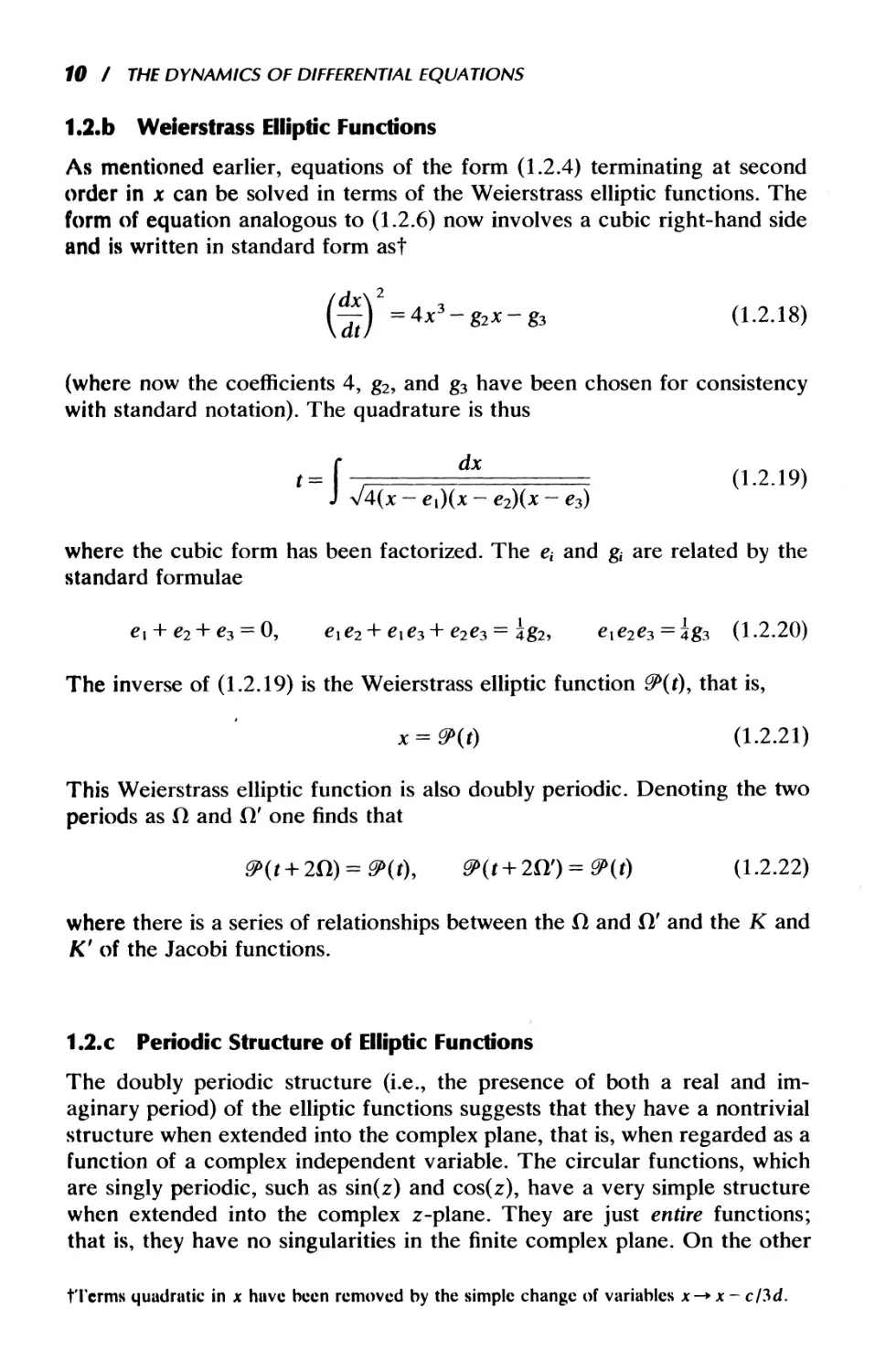
1.2.b Weierstrass Elliptic Functions
As mentioned earlier, equations of the form (1.2.4) terminating at second
order in x can be solved in terms of the Weierstrass elliptic functions. The
form of equation analogous to (1.2.6) now involves a cubic right-hand side
and is written in standard form ast
/ dx\
О =4*3-&x-g3	(1.2.18)
\at/
(where now the coefficients 4, g2, and g3 have been chosen for consistency
with standard notation). The quadrature is thus
,-f ,___________d^===	(1.2.19)
J - ei)(x - e2)(x - e3)
where the cubic form has been factorized. The Ci and g, are related by the
standard formulae
ei + e2 + e3 = 0, eie2 + eie3 + e2e3 = £g2, Cie2e3 = ig3 (1.2.20)
The inverse of (1.2.19) is the Weierstrass elliptic function that is,
x = &(t)	(1.2.21)
This Weierstrass elliptic function is also doubly periodic. Denoting the two
periods as fl and fl' one finds that
0>(t + 2fl) = 0>(t),	0>(t + 2fl') = 0>(t)	(1.2.22)
where there is a series of relationships between the fl and fl' and the К and
K' of the Jacobi functions.
1.2.C Periodic Structure of Elliptic Functions
The doubly periodic structure (i.e., the presence of both a real and im-
aginary period) of the elliptic functions suggests that they have a nontrivial
structure when extended into the complex plane, that is, when regarded as a
function of a complex independent variable. The circular functions, which
are singly periodic, such as sin(z) and cos(z), have a very simple structure
when extended into the complex z-plane. They are just entire functions;
that is, they have no singularities in the finite complex plane. On the other
tTcrms quadratic in x have been removed by the simple change of variables x-* x - c/3d.
INTEGRATION OF NONLINEAR SECOND-ORDER EQUATIONS / 11
hand, the elliptic functions of both Jacobi and Weierstrass are meromorphic
functions; that is, they have (isolated) pole singularities in the complex
plane. In fact, these poles are organized in a regular, latticelike structure,
which reflects the doubly periodic nature of these functions. Indeed it would
appear that the behavior of these functions in the complex plane (i.e., their
analytic structure) is a fundamental factor in determining our ability to
“integrate” the associated differential equations. This deep, and as yet not
fully understood, issue is discussed further in Chapter 8.
1.2.d The Pendulum Equation
A most important nonlinear equation, which can be integrated exactly in
terms of the Jacobi elliptic functions, is the classical pendulum equation.
Taking the angle of libration to be 0 (see Figure 1.1), the equation of
motion for an oscillating particle of unit mass is easily shown to be
dr L
(1.2.23)
where L is the length of the string and g is the gravitational constant. In the
limit of small displacement, the sin can be expanded to first order to yield
the standard equation of motion for a simple harmonic oscillator (cf. (1.1.1))
'i’" <?»-<>
dt2 L
(1.2.24)
the solution of which has the characteristic frequency co = Vg/L. The first
integral of (1.2.23) can again be identified as the (scaled) mechanical energy
E' of the system, that is,
1 /d0\2
2 \dt)
cos 0 = E'
(1.2.25)
Figure 1.1 The classical pendulum executing a swing of
angle 0 under the gravitational force mg.
12 I THE DYNAMICS OF DIFFERENTIAL EQUATIONS
(Here E' = E/mL2, where E is the actual energy of the system (with mass
m)). The quadrature becomes
t =
________dO'________
V2(E'-F(g/L) cos 0')
(1.2.26)
(for convenience we simply drop the second constant of integration, which
here merely plays the role of a phase shift). The integral in (1.2.26) can be
transformed into the form of an integral of the first kind, that is, (1.2.11).
The first step is to introduce the variable cos ш = — E\Llg), thereby chang-
ing (1.2.26) into
t =
о
’() Vcos 0' —COS 0)
dO'
(1.2.27)
The next step is to introduce the transformations cos 0 = 1 — 2 k2 sin2<p and
к = sin(&)/2), which, with a little manipulation, casts (1.2.27) into the
desired form, that is,
t =
dip'
Vl — k2sin2 ip
(1.2.28)
where the modulus is given explicitly by к = V|(l + E'Llg) = sin(<o/2). The
inversion in terms of the Jacobi elliptic function is immediate, namely,
(1.2.29)
and hence the desired result of expressing 0 as an explicit function of time is
thus
0(t) = 2 sin 1
к sn^t
(1.2.30)
The period of the motion can be calculated, as we did for the linear
problem, as the definite integral of (1.2.26). Here the range of integration is
from the equilibrium position 0 = 0 to the classical “turning point” 0O —
cos^-E'L/g), which we have defined to be the variable ш. Using the
transformations cos 0= 1-2k2 sin2 <p and к = sin(w/2), it is easy to show
that in terms of the angle <p, this turning point is just тг/2. Since the period is
defined as the time to complete a full cycle of the motion (i.e., from 0 = 0 to
to - ft, and back again to 0 = 0), the integral (1.2.28), evaluated between
the limits 0 and тг/2, must be multiplied by 4, that is,
DYNAMICS IN THE PHASE PLANE I 13
T(k) = 4
(L pZ2 d<P
g Jo Vl - fc2 sin2 <p
(1.2.31)
Thus the period is just the complete elliptic integral times a simple factor.
Since F(tt/2, 0) = tt/2, the limiting behavior of (1.2.29) is
T(0) = 2-n-J- = —
V g ы
(1.2.32)
which is merely the period of simple harmonic motion described by Eq.
(1.2.24). If the modulus in (1.2.31) is replaced by the complementary
modulus k' = Vl - k2, the result would be the complex period
Пк') = 4у1-г(^,к')
* g \2	/
(1.2.33)
of the (doubly) periodic motion. At first sight, the idea of a complex period
for a pendulum would appear to be devoid of physical meaning. However, it
can be thought of as just the period the pendulum would have if the sign of
gravity were changed; that is, as it were, if the world was turned on its
head (this is easily seen from the definition of k, that is, к = sin(co/2) =
Vi(l + E'L/g)).
1.3 DYNAMICS IN THE PHASE PLANE
So far, little attempt has been made to visualize the nature of a solution to
the various differential equations discussed above—other than a vague
mental picture of the “position variable” x = x(t) oscillating periodically in
time. A most valuable description of a solution is obtained by examining its
behavior in the phase plane. As we shall see, this can even be achieved, in
some cases, without having to integrate the equations of motion. Returning
to the first-order representation of the linear problem (1.1.1) (i.e., the pair
of equations (1.1.4)), the two (independent) variables x and у define a space
in which the solution moves. This is the phase space of the system; and
since it is (strictly) two-dimensional, we also refer to it as the phase plane.
For a system of n first-order equations of the form
*1 =/l(Xi, ..., x„)
X2 /2(^1, • • • , ^n)
%n fn(XU . . . , Xn)
14 I THE DYNAMICS OF DIFFERENTIAL EQUATIONS
each variable xb x2,..., x„, can be thought of as an independent phase-
space coordinate in the associated n-dimensional phase space.
Although the notion of a phase space can be associated with any system
of differential equations, we shall learn that for those systems of equations
derived from a Hamiltonian system, the associated phase space has an
especially rich geometric structure. The value of the phase-space coor-
dinates (x and у in this simple case (1.1.4)), at any instant in time,
completely defines the state of the system at that time. Typically, a given
solution to the equations of motion will map out, as a function of time, a
smooth curve in the phase plane. This is termed a phase curve (sometimes
level curve), and the motion along it is termed the phase flow. Furthermore,
owing to fundamental uniqueness properties of solutions to differential
equations, different phase-space trajectories do not cross each other. When
many different solutions (corresponding to different initial conditions) are
plotted out on the same phase plane, a (sometimes quite complicated)
picture of the overall behavior emerges. Such a picture, made up of sets of
phase curves, is often referred to as a phase portrait.
At first sight, it is not necessarily obvious which regions of the phase
plane the solutions to Eqs. (1.1.4) will explore. This is where the existence
of a (constant) integral of motion plays a most significant role. In this
particular case it is just the mechanical energy E = 2(y2 + <o2x2). Clear-
ly, the phase flow must be confined to ellipses whose major and minor
axes are determined by the energy E (and hence the initial conditions x(0)
and y(0)). These ellipses cut the x-axis at x = ±>f2Elo) (which are, of
course, just the classical “turning point” of motion used as the limits of
integration in (1.1.12)) and the у-axis at y = ±V2E (see Figure 1.2). Thus
the existence of a (constant) first integral has provided a definite geometrical
constraint on the phase flow, that is, it has constrained the motion in the
two-dimensional phase space to closed one-dimensional regions (the phase
curves). The origin of the phase plane, x = у = 0, corresponds to an obvious
Figure 1.2 Phase curves for the simple harmonic oscillator (1.1.4).
DYNAMICS IN THE PHASE PLANE / 15
Figure 1.3 Phase curve for the
damped harmonic oscillator (1.1.19).
equilibrium point of the motion and the overall phase portrait is just a set of
concentric ellipses, growing smoothly as a function of energy, centered
around this point.
By contrast, the phase portrait for the frictionally damped linear oscil-
lator, Eq. (1.1.19), is quite different. For this case there is no constant first
integral to constrain the motion. Now all solutions just spiral (at a rate
depending on the damping coefficient) into the equilibrium point at the
origin (see Figure 1.3).
For nonlinear equations (such as (1.1.13)), with a constant first integral
and executing bounded motion, the phase portrait is again a set of concen-
tric (quartic in this case) curves centered around the origin. For more
general nonlinearities, such as in Eq. (1.2.4), the phase portrait can become
more complicated, depending on the signs of the various coefficients. This
will be discussed shortly.
1.3.a Phase Portrait of the Pendulum
First we consider the phase portrait for the pendulum. For notational
consistency, we now denote the variables 0 and 0 of Eq. (1.2.23) as x
and y, respectively. As a first-order system, the equations of motion
are just
x = y	(1.3.1a)
y = —J^sinx	(1.3.1b)
and the first integral is
y2 —— cos x = E'	(1.3.2)
2 y L
16 I THE DYNAMICS OF DIFFERENTIAL EQUATIONS
A number of purely physical considerations can provide a guide to how the
phase portrait will turn out. For small energies, the pendulum will just
oscillate about the equilibrium point x = у = 0 in nearly linear fashion.
Clearly, in this regime the phase portrait will just be a set of curves
centered about this point. As the energy increases, the pendulum will
execute ever-larger librations until finally a point is reached when the
pendulum (assuming a “stiff” string) goes right “over the top” and starts to
execute unhindered rotational motion which gets ever faster as the energy
increases further. This critical point is reached when the pendulum has
sufficient energy to swing all the way from the rest angle x = 0 to x =
±77—this energy is just E' = g/L. The point x = ±tt, with у = 0 (i.e., the
pendulum “standing on its head”), is an equilibrium point—but clearly an
unstable one. Furthermore, owing to the periodic nature of the restoring
force, this pattern must be repeated at every multiple of 2тг to the left and
right of x = 0. Thus at every x = ±2птг there is a stable equilibrium point,
and at every x = ±(2n + 1)tt there is an unstable equilibrium point. Fur-
thermore, these latter points mark a transition from librational to rotational
motion, and the associated phase curves change from closed to open
(corresponding to unbounded rotational motion). Thus the overall phase
portrait takes the form shown in Figure 1.4. The pair of phase curves that
separate the librational and rotational motion and that meet at the unstable
equilibrium points is termed the separatrix.
An analytical description of the motion along the separatrix is easily
obtained. Here the energy is E' = g/L, so the modulus takes the value
к = V|(l + E'Llg) = 1; hence the period, evaluated according to (1.2.31),
becomes infinite since
эт/2
) Vl - sin2 <p
oo (1.3.3)
Figure 1.4 Phase curves for the pendulum (1.3.1). Stable equilibrium points are
located at x = ± 2птг, and unstable ones are located at x = ± (2n + 1)тг.
DYNAMICS IN THE PHASE PLANE / 17
Furthermore, there is a convenient identity (see Appendix 1.1) sn(u, 1) =
tanh(u), so the actual solution (1.2.30) takes the form (where now we are
using the notation x = 3)
x(t) = 2 sin l[tanh(fVg/E)J	(1.3.4)
Since limx^±0o tanh(x) = ±l, it clearly takes an infinite time for the dis-
placement x(t) to reach the unstable equilibrium point at x = ±ir (i.e., the
approach is exponentially slow). This result is, of course, completely con-
sistent with the infinite period obtained in (1.3.3).
1.3.b Phase Portraits for Conservative Systems
For the systems considered so far, the existence of a constant first integral
has enabled us to define the phase curves globally. That is, the explicit
function E = E(x, y), which is just the mechanical energy, determines the
phase curves for all initial conditions. An explicit solution to the equations
of motion does not appear to be required. These systems, for which the
energy is a constant of motion, are termed conservative systems; and when
the energy function can be written in the (usual) form of kinetic energy +
potential energy, the construction of the phase curves (often called level
curves for conservative systems) is particularly easy. For the sorts of system
considered here, we may write
E = E(x, y) = |y2 + V(x)	(1.3.5)
where the “potential function” V(x) is (typically) some nonlinear function
of x, for example, V(x) =—(g/L) cos x for the pendulum or V(x) =
ax2 + bx4 for the “quartic oscillator.” By thinking of the corresponding
equation of motion
dV
x +— (x) = 0	(1.3.6)
dx
as describing the motion of a particle in the potential well V(x) (although
the equation may not have a mechanical origin), physical intuition guides
the drawing of the level curves. For example, for the simple linear system
(1.1.1) the potential function V(x) is just a parabola in which the motion is
forever confined—bouncing backwards and forwards between the classical
turning points determined by E = V(x) (i.e., x = ±V2E/to2). Now there is a
rather obvious “matching” between the level curves of Figure 1.2 and the
classical motion in the potential (see Figure 1.5). For the pendulum case,
V(x) = — (g/L) cos x is a periodic potential well. Below the periodically
spaced maxima, the motion is clearly bounded libration and above the
18 / THE DYNAMICS OF DIFFERENTIAL EQUATIONS
Figure 1.5 Matching of phase curves with
classical motion in potential V(x) for a simple
harmonic oscillator.
maxima the motion is unbounded (rotation in this case). The maxima
themselves provide obvious unstable equilibrium points (the slightest dis-
turbance will send the particle rolling into one valley or another), whereas
the minima are obviously stable equilibrium points. A plot of the potential
energy functions V(x) is again easily matched to the set of level curves (see
Figure 1.6).
Figure 1.6 Matching of phase curves with classical motion for a pendulum.
DYNAMICS IN THE PHASE PLANE / 19
Figure 1.7 Matching of phase curves with
classical motion for a quartic potential.
Now consider the level curves associated with the system
x — x + x3 = 0	(1.3.7)
The energy is just E = |y2 + V(x), where the potential energy function is
V(x) = — |x2 + |x4 (again, у = x). This function (plotted in Figure 1.7) has
minima at x = ±l (of depth E = -|), has a maximum at x = 0, and, for
large x (positive or negative), increases steeply as a “quartic” parabola. For
energies — 4 < E < 0, the particle will be trapped in one or other of the two
minima in which it executes librational motion. The corresponding sets of
level curves will obviously be closed curves centered about those stable
equilibrium points. For energies above the maximum at x = 0, the motion
will now be larger amplitude librations between the “outer walls” of the
potential energy well. Again, the level curves will be a set of larger closed
curves now centered about x = 0. The maximum of the potential at this
point is clearly an unstable equilibrium point and separates the small am-
plitude motions (about x = ±l) from the large amplitude motions (about
x = 0). Clearly, at the energy E = 0 the level curve is a (figure-eight)
separatrix.
Another simple example is provided by the system
x + x-x2 = 0	(1.3.8)
Now the potential energy function V(x) = | x2 — jx3 has a single minimum
at x = 0 and maximum at x = 1 (with height E = |). The set of level curves
is easily deduced and is sketched in Figure 1.8.
20 / THE DYNAMICS OF DIFFERENTIAL EQUATIONS
Figure 1.8 Matching of phase curves with
classical motion for a cubic potential.
1.4 LINEAR STABILITY ANALYSIS
For conservative systems (in one dimension), a global phase portrait is
particularly easy to construct. The equilibrium points play an important role
and clearly have a characteristic local behavior, that is, sets of closed
curves around the stable points and hyperbolic-looking regions in the
neighborhood of the unstable points. For nonconservative systems, a global
phase portrait is difficult to construct unless an explicit solution is known to
the equations of motion. However, it is always possible to build up an
approximate, local phase portrait by identifying the equilibrium points
(henceforth referred to as the fixed points) and drawing the phase curves in
their neighborhood, the nature of which will depend on their stability. Fixed
points can be thought of as the “organizing centers” of a system’s phase-
space dynamics. Thus by identifying them and their stability, one can build
up a fairly global picture of a system’s behavior.
1.4.	a The Stability Matrix
Consider some general second-order systems of the form
X = f(x, y)
У = g(*. У)
(1.4.1a)
(1.4.1b)
LINEAR STABILITY ANALYSIS / 21
where f and g are any (typically nonlinear) smooth functions of x and y.
The fixed points of the motion are those values of x and y, denoted as x0
and y0, for which the phase flow is stationary (i.e., those points for which
x = у = 0), that is,
f(x0, yo) = 0	(1.4.2a)
g(*o, yo) = 0	(1.4.2b)
There can be any number of points (x0, yo) satisfying these conditions,
depending on the precise functional form of f and g. Having identified
these points, their stability can be determined by examining the evolution of
some small displacement (Sx, Sy) about (x0, yo). Expanding f and g in
powers of Sx, Sy, one obtains
Sx = fx(x0, yo) 8x + fy(x0, y0) 8y + JxyUo, Уо) Sx Sy + • • •	(1.4.3a)
8y = gx(*o, Уо) 8x + gy(x0, yo) 8y + gxy(x0, y0) Sx Sy + • • • (1.4.3b)
To first order, (1.4.3) can be written as the linear system (1.4.4), and we
refer to them as the “linearized” equations (this first-order approximation is
not to be confused with the type of exact linearization mentioned on p.3),
that is,
— [Sxl = Г ^х°’ y°) f^x°’ У°П Г Sx] ц 4 4)
dt LSyJ Lgx(x0, yo) gy(x0, yo)JLsyJ
where the 2x2 matrix (to be denoted as M) is often referred to as the
stability matrix. The system of first-order linear equations (1.4.4) (which is
easily generalized for an nth-order system of the form xf =fi(xb ..., xn),
i = 1,..., n) is easily solved with the eigenvalues of M determining the
stability of the associated fixed point. Denoting the column vector (Sx, Sy)
as SX and denoting the two eigenvectors associated with the two eigen-
values Ai and A2 as Di and D2, the general solution to (1.4.4) is the linear
combination
SX=c1D1eJ^t-i-c2D2e^t
(1.4.5)
where and c2 are arbitrary coefficients, and the eigenvalues are just the
roots of the equation
det|M —AI| = 0
(1.4.6)
where I is the unit matrix. From our previous considerations, it is clear that
if both Ai and A2 are pure imaginary numbers, the displacement will just
rotate about the associated fixed point and locally the phase curves will be
22 / THE DYNAMICS OF DIFFERENTIAL EQUATIONS
closed ellipses—a clear manifestation of a stable fixed point. On the other
hand, if the A, (i = 1, 2) acquire real parts, the displacements will, depending
on the sign, decay or grow exponentially, indicating some form of stability
or instability respectively. In fact, there is a whole range of possibilities,
each leading to a particular type of fixed point; this classification is listed
below. Note, by the way, that although the stability type is determined
by the eigenvalues AH A2, the eigenvectors DH D2 should not be
ignored—their form determines the actual directions of the local phase
flows.
1.4.b Classification of Fixed Points
Case (i). A) < A2 < 0—this is usually termed a stable node. The local flow
decays in both directions, determined by Dx and £>2, into the fixed point
(Figure 1.9a).
Figure 1.9 Local phase flows for (a) stable
node, (b) unstable node, and (c) hyperbolic
point.
LINEAR STABILITY ANALYSIS I 23
Case (ii). Xx> A2 > 0—an unstable node. The local flow grows exponen-
tially away from the fixed point in both directions (Figure 1.9b).
Case (iii). Ar < 0 < A2—a hyperbolic point (or “saddle” point). One
direction grows exponentially, and the other decays exponentially (Figure
1.9c). This is, in fact, the type of pattern found for the unstable equilibrium
points of the pendulum and the nonlinear oscillators (1.3.7) and (1.3.8).
Often the incoming and outgoing directions are referred to as the stable and
unstable manifolds (of the separatrix), respectively.
Case (iv). Ai=—a + i/3, A2 = — a — ifi(a, ft > 0)—a stable spiral point.
Owing to the negative real part (since A1? A2 are the roots of a quadratic
equation, they form a complex conjugate pair), the flow spirals in toward
the fixed points (Figure 1.10a).
Case (y). Ai = a + i/3, A2 = a - ip—an unstable spiral point. Now owing
to the positive real parts, the flow spirals away from the fixed point (Figure
1.10b).
Figure 1.10 Local phase flows for (a) stable
spiral point, (b) unstable spiral point, and (c)
elliptic point.
24 / THE DYNAMICS OF DIFFERENTIAL EQUATIONS
Case (vi). Ai = + io), A2 = — ico—an elliptic point (or “center”). The flow
is locally pure rotation about the fixed point. This is the type of stable
equilibrium point discussed in some of the earlier examples (Figure 1.10c).
For the spiral-point cases (cases (iv) and (v)) and the elliptic-point case
(case (vi)), there is the question as to whether the flow (in or out) is
clockwise or anticlockwise. This may be determined from the linearized
equations (Eqs. (1.4.4)) by setting 8y = 0 and 8x > 0: If 8y < 0, this implies
a “downward” motion (i.e., a locally clockwise motion), whereas if 8y > 0,
the motion is “upwards” and hence anticlockwise.
So far, all the cases considered have nondegenerate roots Ab A2. In the
case of degenerate roots, the general solution to (1.4.4) is of the form
3X = (dDi + c2(D2 + Di	(1.4.7)
The nature of the fixed points will depend on (obviously) the sign of and the
nature of the eigenvectors Di and D2.
Figure 1.11 Local phase flows for (a) stable star, (b) unstable star, (c) stable
improper node, and (d) unstable improper node.
LINEAR STABILITY ANALYSIS / 25
Case (vii). If D2 = (0, 0) (i.e., a null vector and Di arbitrary), then the
flow lines will be independent, intersecting straight lines forming
(a)	a stable star if Л <0 (Figure 1.11а)
(b)	an unstable star if Л >0 (Figure 1.11 b)
Case (viii). If D2 is not a null vector, then the flow lines will be curved,
forming
(a)	a stable improper node if Л <0 (Figure 1.11c)
(b)	an unstable improper node if Л >0 (Figure 1.11 d)
1.4.c Examples of Fixed-Point Analysis
We now work through a series of examples to illustrate the various types of
fixed-point analysis. First of all, consider our old friend the damped linear
oscillator (1.1.19); the only fixed point is clearly at x0 = yo = 0. Obviously
there is no need to linearize these equations, which we now write in the
matrix form
0
1 Ip
-A-lLy
(1.4.8)
and the two eigenvalues of M are easily determined to be
Ai = — ^ + ^VA2 — 4co2 and A2 = — — — - VA2 —4co2
2 2	2 2
There are various possibilities depending on the relative sizes of A and co.
Case (a). For A2>4co2 we obtain Ai<A2<0, and hence (0,0) is a
stable node.
Case (b). For A2<4co2 we obtain Ar = A* = — A/2 + iV4co2 — A2/2, and
hence (0, 0) is a stable spiral.
Setting 8y = 0 and 3x>0 in Eqs. (1.4.8), we observe that 3y<0 and
hence deduce that the spiral motion is clockwise (see Figure 1.3).
Case (c). For A2 = 4co2 we obtain A! = A2 = —A/2; hence for this
degenerate case, (0, 0) is a stable improper node.
Another case worth considering again is that of the pendulum (Eqs.
(1.3.1)). There is an infinite set of fixed points (x„, y„) = (± птт, 0), n =
26 / THE DYNAMICS OF DIFFERENTIAL EQUATIONS
0,1, 2,..., and the linearized equations are
dt
3x1
8yJ
0
g
——cos x„
(1.4.9)
The eigenvalues are Л1э2 = ± iV(g/L) cos xn. If хп = 2итг, they become
= ± iyjglL, corresponding to elliptic fixed points; if xn = (2n 4- 1)тг, they
become = ± \lglL, corresponding to hyperbolic fixed points. Now consider
the case of a damped pendulum, that is,
x = y	(1.4.10a)
у = — sin x — Ay
(1.4.10b)
The fixed points are still at the same positions, that is, (xn, yn) = (± птг, 0),
but now the linearized equations are
ЛГ 3x1
dtl3yj
0
— -7 cos xn
(1.4.11)
with corresponding eigenvalues
x A 1 / 2 4g
ai=~2+2 V “yCOSXw’
Л2 = -^-|Уа2-^со8Хп
At the fixed points (xn, yn) = (±(2и + 1)tt, 0), the situation is still A2<0<
Ai, corresponding to hyperbolic behavior. At the points (xn, y„) =
(± 2птт, 0), a variety of cases now arise.
Case (a). X2<4g/L—AH A2 form a complex conjugate pair (with nega-
tive real part), corresponding to a stable spiral point with (check it)
clockwise rotation (see Figure 1.12).
Case (b), X2>4g/L—now we have Ar<A2<0, corresponding to a
stable node.
Case (c). X2 = 4g/L—we have the degenerate case A] = A2 = —A/2,
corresponding to a stable improper node.
Since energy is no longer conserved, the levels curves cannot be drawn
exactly without an explicit form of the solution. However, identification of
the fixed points and the local flow patterns, including actual directions,
enable one to at least sketch a reasonable global phase portrait.
An interesting class of equations is the predator-prey type introduced by
LINEAR STABILITY ANALYSIS I 27
Figure 1.12 Phase plane for damped pendulum (1.4.10) for X2<4g/L.
Voltera to investigate population dynamics. A simple example is furnished
by the system
x = x — xy	(1.4.12a)
y = -y + xy	(1.4.12b)
where x might denote a rabbit population and у might denote a fox
population. The following, somewhat cynical, scenario is feasible: If у = 0
and x > 0, the rabbit population can grow without bound since there are no
foxes to eat them; however, if x = 0 and у >0, the fox population will die
off because there are no rabbits to eat. With both species present, there is
the possibility of a balance between these competing effects, with the
hungry foxes reducing the rabbit population and enhancing their own
population while at the same time running the risk of starvation if they eat
too many of the rabbits. Equations (1.4.12) represent a very simple model
of this process, and it is not difficult to think up various modifications
corresponding to effects of overcrowding, disease, insanity, or even the
appearance of killer-rabbits.
The system has the two fixed points (xb yi) = (0, 0) and (x2, y2) = (1,1)
and the linearized equation
d Г 3x1 _ Г1 - у, — х^ 1Г 3x1
dt L3yJ L y, — l+xjl3yj
(1.4.13)
where i = 1,2. For the fixed point (xb y0 = (0, 0), the eigenvalues are
easily determined to be A = ±l (i.e., a saddle point), and, on finding the
respective eigenvectors Di and D2, the general solution is found to be
34;,]
e+‘ + c2
(1.4.14)
28 / THE DYNAMICS OF DIFFERENTIAL EQUATIONS
where c\ and c2 are some arbitrary constants. From this solution we observe
that the incoming flow is down the у-axis and the outgoing flow is along the
x-axis. For the second fixed point (x2, y2) = (1,1), the eigenvalues are found
to be Л = ± i, that is, an elliptic (or center) point. Setting 8y = 0, 8x > 0 in
the equations of motion (1.4.13), we note that 8y>0 and hence that the
rotation about the elliptic fixed point is anticlockwise. Notice that this flow
is consistent with the flow direction about the saddle point and that a global
phase portrait can be sketched approximately but, of course, not completely
(Figure 1.13).
A slightly more complicated example is the system
x = x(4 — x — y)
y=y(x —2)
(1.4.15a)
(1.4.15b)
with the three fixed points (xb y0 = (0, 0), (x2, y2) = (1,1), and (x3, y3) =
(4,0) and the linearized equations
d Г3x1 _ Г4 — 2Xj — у, — Xi 1Г8x
dt LSyJ L yi Xi~ 2JL3y
(1.4.16)
where i = 1, 2, 3. The behavior of the three fixed points is as follows:
1.	(xi, yi) = (0, 0) has eigenvalues A12 = — 2, 4 (i.e., a hyperbolic point),
and the general solution is
8x1	Г11
J“ C1 Lol
e4t + c2
e
—2t
(1.4.17)
Thus the incoming direction is down the у-axis, and the outgoing
direction is along the x-axis.
Figure Phase plane for Eq. (1.4.12).
LINEAR STABILITY ANALYSIS / 29
2.	(x2, У2) = (2, 2) has eigenvalues Л12 = — 1 ± h/3 (i.e., a stable spiral
point). For 8y = 0 and 8x > 0 we obtain 8y > 0, so the spiral direction
is anticlockwise.
3.	(x3, Уз) = (4, 0) has eigenvalues Л1?2 = — 4, 2 (i.e., a hyperbolic point),
and the general solution is
5x1	Г11
Sy] “ C' L()J
e 4t + c2
e2t
(1.4.18)
Thus the incoming direction is along the x-axis, and the outgoing
direction has a slope 8y/8x = 6/— 4 = — 3/2. By taking careful note of the
directions of the local flows associated with each of the fixed points, a
reasonable estimate of the global phase portrait can be sketched (Figure
1.14).
It is always important to remember that the fixed-point stability analysis
is based on linearized equations of motion. It is quite possible that the
predictions thus made will not be borne out by the full nonlinear equations.
Elliptic fixed points, as predicted by a linear stability analysis, are parti-
cularly susceptible to breakdown under nonlinear perturbation. A nice
example is given by Bender and Orszag (1978) as follows: The system
x = — у + x(x2 + y2)	(1.4.19a)
у = x + y(x2 + у2)	(1.4.19b)
is, according to linear stability theory, easily determined to have an elliptic
fixed point	at	x =	у	= 0	with anticlockwise rotation	(do	it!).	In fact, the
nonlinear	equations	have	an unstable spiral point	emanating	from the
origin, as may be determined from the exact solution. Multiplying (1.4.19a)
by x and (1.4.19b) by у and adding, one obtains xx + yy = (x2 + y2)2, which,
Figure 1.14 Phase plane for Eq.
(1.4.15).
30 I THE DYNAMICS OF DIFFERENTIAL EQUATIONS
in the polar variable r = Vx2 + y2, is the equation
“[r2(0]=r4(0
2 dt
(1.4.20)
with the exact solution
r(t) =
r(0)
Vl-2r2(0)r
(1.4.21)
Thus not only does the radius r(t) grow with time, but the solution actually
blows up at the critical time rCrit = (2r2(0))-1.
1.4.d Limit Cycles
Another type of behavior that will not be picked by a linear analysis is that
of a limit cycle. A famous example of a system exhibiting such a feature is
the Van der Pohl oscillator:
x — A(1 — x2)x + a>2x = 0	(1.4.22)
A linear stability analysis of its first-order representation
x = y
(1.4.23a)
у = A(1 — x2)y — a)2x
(1.4.23b)
suggests fixed points at x = у = 0, which will be an unstable node if A2 > 4a>
and an unstable spiral point if A2 <4o>2. Considering just the latter case, as
x and у increase, (1.4.23b) will eventually be dominated by the nonlinear
term (i.e., limx,y^oo у = — Ax2у), which would then suggest a decay back to
the origin. Thus trajectories far from the origin move inwards. By con-
tinuity, there must be (at least) one solution that stays in the middle. This
solution is the limit cycle, which is a closed orbit encircling the origin.
Solutions starting either within or without it are attracted to it but can never
cross it. An exact solution to the equation of motion (Eq. (1.4.22)) is not
known, so although simple physical consideration predicts limit cycle
behavior (the nonlinear term can be thought of as a position-dependent
friction which changes sign at x = 1), the precise shape of the limit cycle
must be determined numerically.
An example of a system with an analytically determinable limit cycle is
x = x + у - x(x2 + y2)	(1.4.24a)
у = — x + у - y(x2 + у2)	(1.4.24b)
for which linear stability analysis predicts an unstable spiral point, with
TIME-DEPENDENT INTEGRALS I 31
clockwise rotation, about the origin. Equation (1.4.24) can be solved in the
same way as (1.4.19), that is, in polar coordinates. Denoting R(t) = r2 =
x2 + y2, one finds the equation of motion R to be
R + 2R2-2R = Q
(1.4.25)
This Ricatti-type equation can be exactly linearized by the substitution z///
to the equation f2f = 0, which is easily soluble. Hence
R(t) = x2(t) + y2(t) = C-^-_
crezt + c2
(1.4.26)
(where Ci and c2 are arbitrary constants), which would suggest that the
solutions to (1.4.24) tend to a limit cycle of radius 1 as r-»oo. Linear
stability analysis of systems higher than second order will be deferred to
later sections. The situation can become very complicated, since the (local)
flows along the n independent directions are no longer restricted to a plane
as in the 2-D case and can become intertwined in most complicated ways.
1.5 TIME-DEPENDENT INTEGRALS*
Time-dependent integrals are rare and, accordingly, rather interesting
entities. A simple example is furnished by a special case of the damped
linear oscillator (1.1.6), which we again write as a first-order system
(without loss of generality we set oj = 1):
x = y
у = -x-Ay
(1.5.1a)
(1.5.1b)
First multiply both sides of (1.5.1a) by 2x and both sides of (1.5.1b) by 2y
to obtain
2xx=2xy
2yy = — 2Ay2 —2xy
(1.5.2a)
(1.5.2b)
Now multiply both sides of (1.5.1a) by Ay and both sides of (1.5.1b) by Ax
to obtain
Axy = Ay2
Axy = - A2xy - Ax2
(1.5.3a)
(1.5.3b)
32 I THE DYNAMICS OF DIFFERENTIAL EQUATIONS
Adding together both sets of Eqs. (1.5.2) and (1.5.3), one obtains
2xx + 2yy + Axy + Axy = — Ay2 - A2xy - Ax2
which is just
-j- (x2 + y2 + Axy) = - A(y2 + x2 + Axy)
at
which integrates exactly to
x2 + y2 + Axy = qe Xt
(1.5.4)
where ci is the constant of integration. Equation (1.5.4) can be used to
express у as a function of x and t; but only for the special value of A = 2,
when the left-hand side is a perfect square, will the expression be of the
simple form
(1.5.5)
Substitution of this into (1.5.1a) leads to the exactly soluble first-order
equation
(1.5.6)
which has the decaying solution
x(t) = (c2 + t\Zc[)e
(1.5.7)
where c2 is the second constant of integration. This result is, of course,
identical to the solution of (1.1.16) in the case of degenerate eigenvalues
(which occurs when ш = 1, A = 2). For conservative systems, the presence
of a time-independent first integral provides a definite geometric constraint
on the phase flow. In this case, one might think of (1.5.5) as providing a
constraint in the form of a straight line, given by x + у = constant, which
shrinks exponentially toward the origin.
Another example is furnished by the system of equations
X = - 2 X + y2
(1.5.8a)
(1.5.8b)
Multiplying (1.5.8a) by x and (1.5.8b) by у and adding gives
4 (I (x2 + y2)) = -1 (x2 + y2)
at \2	/2
(1.5.9)
у = Vc? e * — x
x + x = Vc? e
У = - 2 у - xy
NONAUTONOMOUS SYSTEMS / 33
which integrates to
x2 + y2 = ce
(1.5.10)
Substituting y2 = ce * — x2 into (1.5.8a) gives the first-order nonlinear
equation
x +1 x + x2 = ce
(1.5.11)
This is in the form of a Ricatti equation, which can be linearized exactly by
the substitution x = y/y to yield the linear second-order equation
у + i у - ce 'у = 0
(1.5.12)
which, in principle, can be solved by standard power-series methods. For
this example, one can think of the phase flow being constrained to the
exponentially shrinking circle defined by (1.5.10).
1.6 NONAUTONOMOUS SYSTEMS
So far, all the systems considered have been autonomous; that is, time has
only played the role of the independent variable and has not appeared
explicitly in the equation of motion. A not uncommon situation is one in
which a system is subjected to some form of external time-dependent force
F(t). Such situations could include repeated stress testing of a beam or an
atom in a radiation field. Particularly interesting are those cases where F(t)
is a periodic function, for example, F(t) cos(flt). Consider as an example
the damped, driven linear oscillator
x + Ax + oj2x = eF(t)
(1.6.1)
where e can be thought of as a “coupling parameter”—in the limit e—>0,
the system becomes autonomous again. In that limit, the phase space is
two-dimensional, whereas for e 0 it is important to realize that the phase
space becomes three-dimensional with “time,” thereby providing the extra
dimension. To see this, consider the specific case of a periodic driving
force, that is,
x + Ax + <i)2X = e cos(flt)
(1.6.2)
Denoting z = £lt as a third dependent variable, (1.6.2) can be written as
x = y
У = — Ay — (x)2X + € cos(z)
z = П
(1.6.3a)
(1.6.3b)
(1.6.3c)
34 I THE DYNAMICS OF DIFFERENTIAL EQUATIONS
For e = 0, the solutions to (1.6.3b) (i.e., x(r) and y(r)) are meaningfully
plotted, as a continuous function of time, in the x, у phase plane. To
continue this practice in the case e / 0 can be highly misleading, since now
one can find phase curves intersecting each other in apparent contradiction
of the uniqueness property of solutions to ordinary differential equations. Of
course this is not the case, and what one is seeing is the effect of projecting
the three-dimensional phase space (x, y, z) onto the two-dimensional (x, y)-
plane.
The extra dimension can lead to completely new types of behavior, and
for driven nonlinear systems the solutions can sometimes evolve in an
apparently chaotic—but still completely deterministic—manner.t Little can
be said about this behavior analytically, and the detailed behavior can often
only be resolved on a computer. These matters will be discussed at length in
later chapters. For the moment, we shall concentrate on those systems for
which some analytical results can be obtained. This is mainly limited to
driven linear systems; and although these cannot display (deterministic)
chaos, the results obtained provide a useful background to the study of
nonlinear systems.
Equations of the form (1.6.1) can be solved using the standard tech-
niques for inhomogeneous linear equations. For the homogeneous limit of
(1.6.1) (i.e., e = 0), we denote the two independent solutions as Xi(t) and
x2(t) and their (nonvanishing) Wronskian as
W(t) = Xi(t)x2(t) - x2(t)x[(t)
The solution to (1.6.1) is written as the sum of the general homogeneous
solution and a particular solution, that is, x(t) = xh + xp, where xh =
CiXi + c2x2 and xp = uxi + vx2; here the function u(t) and v(t) are deter-
mined by
U = —€
rz.G'W)
J w(t')
dt'
tx2(tf)F(tf)
V = €
1.6.a The Driven Oscillator
Firstly consider the undamped version of (1.6.2), that is,
x + (i>2x = e cos(flt)
(1.6.4)
tThis is the first point in the main text that the word chaos appears. By a chaotic solution to a
deterministic equation we mean a solution whose outcome is very sensitive to initial conditions
(i.e., small changes in initial conditions lead to great differences in outcome) and whose
evolution through phase space appears to be quite random.
NONAUTONOMOUS SYSTEMS / 35
The particular solution is easily determined to be xp(t) =
[е/(бо2 — H2)J cos(fh) (working with the complex forms of homogeneous
solution x = makes the computations easier), and hence the overall
solution is
x(t) = a sin(wt + 6) + — 2—cos(flt)
(O —11
(1.6.5)
where the amplitude a and phase 8 are given in Eq. (1.1.3). Thus the
solution is a superposition of oscillations with the intrinsic frequency to and
external frequency П. Clearly the solution breaks down when the external
and intrinsic frequencies match—this is an example of resonance. In order
to see how the solution behaves in the limit П—we write the solution
(1.6.5) in the form
x(t) = fl'sin(o)t+ £') + 7 6 (cos(fh) -cos(cot)) (1.6.6)
a) —11
which can always be done by suitable definition of the amplitude (a') and
phase (S'). The limit £1—> co is found by L’Hopital’s rule to be
x(t) = a'sin(o)t+ S') + -^- tsin(€o)	(1.6.7)
2 co
The second, secular, term implies unbounded linear growth of the am-
plitude at resonance and physically corresponds to the unrestrained ab-
sorption of energy by the system from the external field.
This behavior is in strong contrast to that of driven nonlinear oscillators.
A famous example of such is the Duffing oscillator:
x + (o2x + /Зх3 = e cos(£lt)	(1.6.8)
The associated homogeneous problem is easily integrated in terms of Jacobi
elliptic functions, but now the solution will have a period that is energy
dependent. A resonance can still be induced by “hitting” the system with a
driving frequency £1 that exactly matches the intrinsic frequency of the
current motion. Now, however, as energy is absorbed and the amplitude of
the oscillations increase, the intrinsic frequency also changes and takes the
system out of resonance, thereby preventing secular growth. This is a case
of nonlinearity stabilizing a resonance through what might be termed a
“nonlinear feedback” mechanism. However, for a sufficiently strong driving
force (i.e., large e), there can be feedback between both the fundamental
motion and its harmonics and the external field. In this regime the solution
can start to exhibit chaotic behavior, oscillating in time in an apparently
random manner. This will be discussed at length in Chapter 4.
36 / THE DYNAMICS OF DIFFERENTIAL EQUATIONS
1.6.b The Damped Driven Oscillator
Now let us return to the damped, linear driven problem (1.6.2). Assuming
that the homogeneous problem has oscillatory (but, of course, damped)
solutions, the overall solution to the inhomogeneous problem may be
written as
x(t) = aeHA/2,t sin(rt+ 5) +	202л 1/2	(1-6.9)
where the intrinsic frequency v = |л/4ю2 — Л. The amplitude a and phase 6
of the homogeneous part are determined by the initial conditions and the
“external” phase 5'= tan'(—ЛП/(со2 — П2)). Obviously as t increases, the
homogeneous part of the solution decays and one is finally left with
\ e cos(flf+ 5')	z. . 4
X(0 ~ ((w2 -ft2)2 + A2ft2)1/2	(L610)
and although the amplitude of the motion becomes large at resonance
(о =П, it does not diverge. The asymptotic solution (1.6.10) corresponds to
steady oscillations of constant energy, which represents a balance between
the energy pumped into the system by the external field and the energy
dissipated by the friction. This steady state corresponds to simple limit cycle
behavior.
In the case of a nonlinear damped and driven system, that is, the Duffing
oscillator
x + Ax + a>2x + fix3 = €COS(£lt)	(1.6.11)
much more complicated behavior can occur. For small driving forces,
simple limit cycle behavior is still observed. However, as e is increased, this
cycle is found to bifurcate into a “double” limit cycle with twice the original
period. As e is further increased, further bifurcations keep on occurring
(i.e., from two-cycle to four-cycle to eight-cycle, etc.) until the motion
becomes quite chaotic. This highly complicated aperiodic limit cycle, which
is reached at the end of the bifurcation sequence, is termed a strange
attractor. These attractors are the mechanism by which dissipative systems
(which one might imagine would always eventually decay to some boring
limiting behavior) can display chaotic solutions. Much more of this will be
discussed in Chapter 5.
1.7 FURTHER REMARKS ON INTEGRATION OF
DIFFERENTIAL EQUATIONS
The notion of “integrating” a differential equation is clearly a delicate one.
For most of the second-order examples considered so far, the existence of a
constant first integral—the mechanical energy for the conservative
FURTHER REMARKS ON INTEGRATION OF DIFFERENTIAL EQUATIONS / 37
cases—enabled us to reduce the order of the equation by one, thereby
reducing the task of finding a solution to a “quadrature.” Phrases such as
“an exact solution” or “an analytical solution” to a differential equation
have been used here (and elsewhere) rather glibly. It is certainly not a
stupid question to ask what one means by such convenient phrases. After
all, before the advent of elliptic functions, might not the simple nonlinear
differential equations of the quartic oscillator or pendulum-type have ap-
peared to be insoluble? Indeed one can ask what happens “beyond” the
elliptic functions, that is, for differential equations like (1.2.4) with powers
of x higher than x3. Here at least there is still an integral of the motion (the
energy) that enables one to get down to a quadrature—these integrals are
termed hyperelliptic integrals. However, now the inversion becomes much
more complicated, and many deep results from algebraic geometry come
into play.
For second-order systems that are not conservative, the question of
“integration” becomes more tricky. In some cases, as discussed in Section
1.5, we were able to find a time-dependent integral that allowed a reduction
of order. Clearly though, these are rather special cases. Other awkward
equations are systems such as
у = 6y2+ t
у = 2y3 + ty + a
(1.7.1)
(1.7.2)
known as the first and second Painleve transcendents, respectively. These
do not have known first integrals and cannot be “integrated by quadra-
tures.” Clearly though, equations like these obviously have a “solution,”
but the extent to which this solution can be represented “analytically” as
opposed to a piece of computer output is a nontrivial issue.
One factor that is now believed to be important in discussing this issue is
that of analytic structure—namely, the behavior of the solution in the
complex plane. Fortunately, a number of important properties, such as the
type of singularity a solution can exhibit, can be determined directly from
the equations of motion without recourse to an actual solution (which, of
course, we may not “know”). It may be that if the analytic structure is
sufficiently “simple,” the associated equation may in some sense be “in-
tegrable.” This will be discussed further in Chapter 8.
To some extent, questions of integrability for autonomous second-order
systems may be rather academic. For these cases, the motion is always
confined to the two-dimensional phase plane and can never exhibit parti-
cularly complicated or chaotic motion. As soon as the phase space acquires
a third dimension (or greater), as might arise for a nonautonomous second-
order system or a third order autonomous system, the question of in-
tegrability becomes much more critical, since now chaotic behavior is
possible. Now the existence of “integrals of the motion” becomes very
38 I THE DYNAMICS OF DIFFERENTIAL EQUATIONS
important since, as we have seen, they provide a geometric constraint to the
phase flow. Consider the following autonomous third-order system
x = y	(1.7.3a)
y = — xz + x	(1.7.3b)
z = xy	(1.7.3c)
We first observe from (1.7.3a and 1.7.3c) that xx = z. This identifies the
(constant) integral of motion
b2-z = h	(1.7.4)
so now the orbits in the 3-D phase space (x, y, z) are seen to be restricted
to a surface defined by Eq. (1.7.4). This integral can now be used to reduce
the third-order system (1.7.3) to a second-order system
x = x(l-/!)-ix3	(1.7.5)
This second-order system can, in turn, be reduced to a first-order system by
using the second integral
г(х2 —(1 — Л)х2 + зх4) = Z2	(1.7.6)
which can again be thought of as providing another geometrical constraint
on the phase flow. Equation (1.7.6) can be integrated in terms of Jacobi
elliptic functions. Thus the identification of the two integrals Л and I2 has
enabled one to reduce the solution of the original third-order system down
to a single “quadrature”—in this sense, one can think of having “com-
pletely integrated” the system.
Now consider the system
x = y + jB	(1.7.7a)
y = — xz + x	(1.7.7b)
z = xy4-ax	(1.7.7c)
where a and jB are constants. Here one finds that unless a = jB, integrals
like /i (and then Z2) cannot apparently be found—so now the system would
appear not to be “integratable.”t So without the assistance of numerical
tThc word “integratable” is abominable English but may serve a useful purpose. For
Hamiltonian systems (Chapter 2), the term “integrable” has a very special geometrical
implication that is distinct from non-Hamiltonian systems (such as (1.7.3), which can nonethe-
less be “integrated”).
ELLIPTIC FUNCTIONS I 39
studies, it is not clear where in the 3-D phase space the solution might
wander.
The simple (and carefully designed!) examples (1.7.3) and (1.7.7) raise
many fundamental questions. Firstly, how does one find integrals of the
motion (if they exist)? As the order of the equations gets higher and their
functional form becomes more complicated, this is a very difficult task. In
fact, there is no systematic procedure for doing this—one has to rely on
experience, luck, and, in desperation, prayer! It may be, as some brilliant
work of the Russian mathematician Sofya Kovalevskaya a hundred years
ago implied, that the existence of integrals may be tied up with the analytic
structure of the differential equations. Another fundamental question
concerns the actual number of integrals one needs to find in order to effect
a complete “integration.” This is where it is important to distinguish
between different classes of dynamical system. For those that are Hamil-
tonian (which (1.7.3) and (1.7.7) are not), some very strong results are
available. As will be discussed in the next chapter, if the system has as many
integrals (N) as “degrees of freedom” (i.e., half the dimension of the phase
space), then the system can be “integrated by quadratures”. Briefly, this
stems from very special geometrical properties of the Hamiltonian—N
integrals are enough to restrict the flow in a particular way which can then
be parameterized in terms of a special set of coordinates that are trivially
integrated. For non-Hamiltonian systems, the situation is less happy. For an
nth-order system, x = ft (xi, ..., x„), i = 1,..., n, one needs n — 1 integrals
in order to effect a complete integration.
APPENDIX 1.1 ELLIPTIC FUNCTIONS
To reduce Eq. (1.2.7), namely,
/ dx\
I — I = e(x - a)(x — /3)(x — y)(x - 3) = eG2(x)
X at/
to the standard (Legendre) form
(^) = (1 - y2)(l - fc2y2) = H2(y)
\ at/
we follow Davis (1962). From (l.A.l) we can write
1 dx
e}l2G(x) dt
(l.A.l)
(1.A.2)
(1.A.3)
Introducing the variables
|2 = (jB ~ g)(x - q) 2 = (/3 - y)(a - 5)	2 = (jB - 5)(q - y)
(q — 8)(x — /3)’	(q — y)(j3 — 8)’	4
(1.A.4)
40 / THE DYNAMICS OF DIFFERENTIAL EQUATIONS
we obtain	M dx _ 1 dy G(x) dt ~ H(y) dt	(1.A.5)
and hence	1 dx _ 1	dy	(1.A.6)
Thus	e1,2G(x) dt ~ H(y) d(eV2Mt) ~
у = sn(e1/2Mr, k)
(1.A.7)
and hence the original variable x can be solved for by using the first
equation in (1.A.4).
Elliptic integrals of the first kind are the integrals
F(x, fc) = f
Л)
dx'
V(1 - x'2)(l - fc2x'2)’
k2< 1
(1.A.8)
or its equivalent
F(0, k) =
f* dO'
l0 Vl - fc2sin20'
(1.A.9)
where x = sin 0. Elliptic integrals of the second kind are
J-X /1 — J?2 r'2
\ —dx', k2 < 1
о v 1 ~xz
or its equivalent
J-e
x/1 — fc2 sin2 0' dO'
о
(1.A.10)
where again x = sin 0. Elliptic integrals of the third kind are
or its equivalent
о (1 + nx'2)V(l - x'2)(l - k2x'2)
(1.A.12)
p о
П(0, n, k)=\
Jo
_____________dff_____________
(1 + n sin2 0')V1 - fc2 sin20'
under the same change of variables as before.
(1.A.11)
(1.A.13)
SOURCES AND REFERENCES I 41
There are an enormous number of relationships between elliptic func-
tions starting with the basic elliptic integral
p dff
'o Vl - k2 sin2 0'
(1.A.14)
The following functions are defined:
sn(u, k) = sin 0	(l.A.15a)
cn(u, k) = cos 0	(l.A.15b)
dn(u, k) = Vl - k2 sin2 0	(l.A.15c)
am(u, k) = 0	(l.A.15d)
,	, 4 sn(u, k) tn(u, k)=	= tan 0	(l.A.15e)
cn(u, k)
Some of the special values and relationships are
sn(O) = 1, cn(O) = 1,	dn(0) = 1,	am(0) = 0	(1.A.16)
sn2(u) + cn2(u) = 1	(1.A.17)
sn(— u) = — sn(u), cn(— u) = cn(u)	(1.A.18)
sn(u, 0) = sin(u), cn(u, 0) = cos(u)	(1.A.19)
.	, . . eu—e~u	(1.A.20)

sn(u, i) tann(u)	_
e + e
cn(u, 1) = dn(u, 1) = sech(u) =	_u	(1.A.21)
SOURCES AND REFERENCES
Arnold, V. I., Ordinary Differential Equations, MIT Press, Cambridge, Mas-
sachusetts, 1978.
Bender, С. M. and S. A. Orszag, Advanced Mathematical Methods for Scientists and
Engineers, McGraw-Hill, New York, 1978.
Davis, H. T., Introduction to Nonlinear Differential and Integral Equations, Dover,
New York, 1962.
Ince, E. L., Ordinary Differential Equations, Dover, New York, 1956.
2
HAMILTONIAN
DYNAMICS
2.1 LAGRANGIAN FORMULATION OF MECHANICS
In this section we discuss some of the basic principles of the Lagrangian
formulation of classical mechanics. This provides the necessary background
to learn about the Hamiltonian formulation, which, in turn, provides the
natural framework in which to investigate the ideas of integrability and
nonintegrability in a wide class of mechanical systems. Many of the
differential equations discussed in Chapter 1 describe the motion of a
particle moving in some force field (represented as the gradient of a
potential energy function) and, as such, they are examples of Newtonian
equations of motion.! Since Newton’s pioneering work, the “laws” of
mechanics have been the subject of ever more general and elegant for-
mulations. General equations of motion can be seductively derived by
invoking such fundamental principles as the homogeneity of space and time
and the use of an almost magical variational principle (“Hamilton’s
principle”) to the extent that the resulting “laws” would appear to have
been determined from purely deductive (“absolute”) principles. Nonethe-
less, it should always be remembered that all these results are at some point
based on experimental facts and human experience—they have just stood
the test of time remarkably well. (For example, there was no reason or
evidence to doubt that Newton’s laws could describe microscopic systems
until spectroscopic evidence came along to indicate the need for quantum
mechanics.)
tThe reader is assumed to be familiar with the basics of Newtonian mechanics and such
concepts as constraints and generalized coordinates (see, for example, Chapter I of Goldstein
(1980)).
42
LAGRANGIAN FORMULATION OF MECHANICS t «
2.1.a The Lagrangian Function and Hamilton's Principle
If one considers a mechanical system consisting of a collection of parti-
cles—interacting amongst each other according to well-defined force
laws—then experience has shown that the “state of the system” is com-
pletely described by the set of all the positions and velocities of the
particles. The coordinate frame need not be cartesian, as was the case in
Newton’s work, and the description can be effected by means of some set of
“generalized coordinates” q, (i = 1,..., n) and “generalized velocities” q,
(i = 1,..., n). (The use of generalized coordinates relieves a system from
the explicit presence of holonomic constraints.)
If a system moves from a position at some time labelled by the
coordinate set q(1) = qi(ti),..., qn(h), to a position q(2) = qi(t2), • • •, qrXfc) at
another time t2, then the actual motion can be determined from Hamilton’s
principle of least action. This requires that the integral of the so-called
Lagrangian function takes the minimum possible value between the initial
and final times. For the moment, we treat the Lagrangian as a “black box”,
merely stating that it can only be some function of those variables on which
the state of a system can depend (i.e., the generalized coordinates, velo-
cities, and time), namely,
L = L(qu . .., qn, qA,..., qn, t)	(2.1.1)
The famous “principle of least action,” or “Hamilton’s principle,” requires
that the action integral
W = J 2 L(q, q, t) dt
(2.1.2)
be a minimum. For the moment, we drop the subscript on the q/s and qf’s
and assume a single degree of freedom. The positions q(I) and q(2) at the
initial and final times b and t2 are assumed fixed. (Allowing the end points
to also vary with time has other important consequences.) There can be
many different paths q(t) connecting q(1) and q(2), and the aim is to find
those that extremize (which usually means minimize but can, in fact, also
result in a maximum) the action (2.1.2). This is done by looking at the effect
of a “first variation,” that is, adding small excursions along the path which
vanish at either end (i.e., 3q(b) = 3q(t2) = 0). A remarkable feature of this
procedure is that we are considering the effect of these variations about a
path which we do not yet know. The first variation of the action W is then
determined by

L(q + 8q, q+ 8q, t) dt- L(q, q, t) dt
(2.1.3)
44 / HAMILTONIAN DYNAMICS
By expanding the first integrand to first order, one obtains the variation
f'* Z3L dL \
5W= I — 8q-\------------------8q)	dt
J(, \dq 4 dq V
(2.1.4)
Using dq = ddq/dt and integrating the second term by parts yields
8W
(2.1.5)
By the end-point condition, the first term on the right-hand side vanishes. If
the variation is to be an extremum, then 8W = 0; this can only occur if the
integrand vanishes, that is,
dL
dq
d /dL'
dtxdq.
(2.1.6)
= 0
For n degrees of freedom q19..., qn, the variation must be effected for
each variable independently, that is, q^t) + dq^t). The net result is the set of
equations
d dL
dtxdqi) dqi
(2.1.7)
which are the celebrated Lagrange's equations. If the (correct!) form of the
Lagrangian is known for the given mechanical system, then the set of
second-order equations (2.1.7) are the equations of motion for the system
and, given the initial data qt(0), 4/(0) (i = I,..., n) will determine the entire
history of the system.t
In determining the correct form for the Lagrangian function it is interes-
ting to see how far one can go in making this choice by invoking only the
most basic principles. In their brilliant text on mechanics, Landau and
Lifshitz (1960) persuasively argue that, for a free particle at least, the
principles of homogeneity of time and isotropy of spacet determine that the
Lagrangian can only be proportional to the square of the (generalized)
velocities. If the constant of proportionality is taken to be half the particle
mass, then the Lagrangian for a system of noninteracting particles is just
their total kinetic energy in rectilinear coordinates, that is,
tSo powerful did this deterministic framework appear that Laplace was led to say “We ought
then to regard the present state of the universe as the effect of its preceeding state and as the
cause of its succeeding state.”
tThese two properties ensure that the motion can be considered in the context of an “inertial
frame,” that is. independent of its “absolute” position in space and time.
LAGRANGIAN FORMULATION OF MECHANICS / 45
L=T=X^ niitf
i=l
Beyond this, “experimental” facts have to be invoked in that if the particles
interact amongst each other according to some force law contained in a
“potential energy function” V(qH..., qn), then, to quote Landau and
Lifshitz (1960), “experience has shown that” the correct form of the
Lagrangian is
L=T-V=t V(qi,...,qn)	(2.1.8)
1 = 1
The potential energy function is such that the force acting on each particle
is determined by
F; = -/-V(qb...,q„)	(2.1.9)
dqi
(This provides a definition of the potential energy, since it ensures that the
net work done by a system in traversing a closed path in the configuration
(i.e., coordinate) space is zero.) For velocity-independent potentials,
Lagrange’s equations (Eqs. (2.1.7)) become
dV
mqi = -—	(2.1.10)
dqt
which, in the case of cartesian coordinates, are just Newton’s equations.
2.1.b Properties of the Lagrangian
Given the Lagrangian for a system of (interacting) particles, a number of
interesting properties of that system can be deduced. First we consider the
total time derivative of the Lagrangian, that is,
d . . 4 dL , dL . dL
-jUq, 9, 0 = I —q, + Z — + —
dt	i dqt i дф dt
_ y. d / dL \ dL
~^,dt\4idqi) dt
Thus
d / . dL \ dL
dt \ i	/ dt
(2.1.11)
46 I HAMILTONIAN DYNAMICS
For a closed system (i.e., one which does not interact with any external
forces), the homogeneity of time ensures that L does not depend explicitly
on time, and thus the “energy”
у . dL
. dqt
(2.1.12)
is a constant of the motion; that is, the system considered is conservative
(see Chapter 1). Furthermore, using the definition of L in (2.1.8), it is easily
deduced that
E= T + V
(2.1.13)
Using L, one may define the generalized forces

(2.1.14)
and, most importantly, the generalized momenta
dL
(2.1.15)
where only for cartesian coordinates do we obtain = mqt. With these two
definitions, Lagrange’s equations can then be cast in the form
Pi = Fi, i = 1,..., n
(2.1.16)
Clearly, if any one of the generalized coordinates, say qk, is missing from
the Lagrangian, we obtain the associated generalized force Fk = 0 and
hence (from (2.1.6)) the corresponding generalized momentum pk = cons-
tant. Missing coordinates are sometimes referred to as cyclic—clearly, cyclic
coordinates simplify the integration of the equations of motion. With the
above definition of the the energy of the system (2.1.12) can then be
written as
n
E = L Pi<ii - L
i = l
(2.1.17)
If a system is closed and space is homogeneous, then the net effect of all
the particle forces must be zero, that is, £"=1 Ft = 0 (in Newton’s third law
this is stated, for two bodies, as “action and reaction are equal and
opposite”). In this case we may deduce from (2.1.16) that =
constant; that is, the overall translation of a system of particles is constant.
LAGRANGIAN FORMULATION OF MECHANICS / 47
Thus we see that by invoking such fundamental principles as homogeneity
of time and space (for closed systems), one may deduce basic conservation
laws such as the conservation of energy and total momentum. These results
are examples of a deep and general result known as Noether's theorem,
which states that for every group of transformations that leaves the
Lagrangian function invariant, there is an associated conserved quantity;
for example, invariance under translation in time and space leads to
conservation of energy and (linear) momentum, respectively. Another sim-
ple example is a system invariant under rotation—here angular momentum
will be conserved.
2.1.c Properties of the Generalized Momenta
In the Lagrangian picture of mechanics, the generalized coordinates and
velocities are considered as independent variables. Now we have also
defined another set of variables, the generalized momenta # (Eq. (2.1.15)).
The simple connection between the generalized momenta and velocities in
the cartesian coordinate system is deceptive in that the are truly a
completely independent (from the and ф) set of variables. The
differences are deep and are most clearly seen when viewed from a more
geometric point of view.t So deep and elegant is this structure that Arnold
(1978) has described Hamiltonian mechanics (i.e., the description of
mechanics in terms of the pt and qf) as “geometry in phase space.”
In a more traditional framework, an important property of the pt that
distinguishes them from the qt is that they are expressible as the gradient of
a scalar field—this is a simple way of demonstrating their covariant proper-
ties. To see this, we return to the action integral (2.1.2). For a given
extremal path, that is, a path satisfying Eqs. (2.1.7), this is just a definite
integral, that is, the value of the action along the path connecting q(tx) and
q(t2). A variational principle can still be applied to (2.1.2)—but this time to
see how the action varies between neighboring extremal paths with the
same initial point but different final points. So now one looks at the
variation of W for q = q(t) + 8q, where q(t) is an actual extremal path with
q({) = q(t{) fixed and q(2) = q(t2) + 3q(t2) as the varying end point. The
tThe velocities are examples of tangent vectors and transform as contravariant variables. The
combined set of variables qt, qt (i = 1,..., n) forms a 2n-dimensional manifold known as a
tangent bundle (TM), and the Lagrangian then becomes the mapping of the tangent-bundle
space to a scalar field, namely, L: TM-+ R (i.e., it converts the set qif qt to a real number).
Momenta have completely different geometric properties. They transform as covariant vari-
ables, and the phase space made up of the set qi9 p, (i=l,...,n) is a 2n-dimensional
symplectic manifold with very different geometric properties from the tangent bundle space of
Lagrangian mechanics. For a full account, the reader is referred to V. I. Arnold’s (1978)
wonderful book Mathematical Methods of Classical Mechanics. An introductory account of
these concepts is given in Appendix 2.2.
48 I HAMILTONIAN DYNAMICS
variation leads to the same result as (2.1.5), that is,
8W =
(2.1.18)
but since the path is assumed to be extremal, the integral vanishes and one
is left with just the end-point contributions. Since the initial point is fixed,
we have 8q(ti) = 0; and denoting 8q(t2) as just 8q and using p = dL/dq, one
has 8W — p8q or
n
8W='£ Pi 8qt
i=l
(2.1.19)
for a system of n degrees of freedom. From this result follows the property
that the pt are gradients of the action, that is,
dW
p-=^
(2.1.20)
at a given time along a given extremal path. By contrast, note that it is not
possible to express q as the gradient of a scalar field.
2.2 HAMILTONIAN FORMULATION OF MECHANICS
Hamiltonian mechanics is the description of a mechanical system in terms
of generalized coordinates qt and generalized momenta pt. Although the
Hamiltonian formulation of classical mechanics contains the same physical
information as the Lagrangian picture, it is far better suited for the
formulation of quantum mechanics, statistical mechanics, and perturbation
theory. In particular, the use of Hamiltonian phase space provides the ideal
framework for a discussion of the concepts of integrability and nonin-
tegrability and the description of the chaotic phenomena that can be
exhibited by nonintegrable systems.
2.2.a Transformation to the Hamiltonian Picture
To effect the transformation from the Lagrangian description involving the
qi and the ф 1° the Hamiltonian description, one uses the standard tech-
nique of Legendre’s transformation (see Appendix 2.1). The Legendre
transform of L = L(q, q, t) with respect to q to a new function in which q is
expressed in terms of p is
w(p, q, t) = £ M ~ Mq. q, 0	(2.2. i)
1-1
HAMILTONIAN FORMULATION OF MECHANICS I 49
where p, q, and q are the n-component vectors p = (pi,..., pn), q=
(qb ..., qn), q = (4i,..., qn) and the new function H is the Hamiltonian of
the system. The crucial relationship is that which defines p{ in terms of the qt
and 4ь namely,
Pi(q, q, 0 = rr(q, q, 0
<4
(2.2.2)
which, providing
/0
(2.2.3)
can be inverted to express the qt in terms of the pt with (at this stage) and
t treated as parameters.
consider the Lagrangian
L =
As a simple example of this transformation,
n 1
E V(qi,...,q„)
(2.2.4)
From this we determine
dL
P‘=l^=mq'
dqt
(2.2.5)
and since condition (2.2.3) is satisfied, the inverse is (trivially in this case)
4i
Pi
mi
(2.2.6)
and thus the Hamiltonian is
M(p> q) = t, Pi(^) - {Ё ~ m>(^) ~	• • • ’ я»)}
i=i \mf/ ii=i z хпц/	j
i=l Lilli
(2.2.7)
Although the Lagrangian (2.2.4) describes an important class of mechanical
system, the simplicity of the relationship between the p^ and 4i is such that
some of the subtlety is lost. A standard example of a less trivial trans-
formation is provided by the case of a particle moving under gravity but
constrained to a smooth wire frame of specified shape.t
tThis is an example of an holonomic constraint.
50 / HAMILTONIAN DYNAMICS
Consider a bead of mass tn sliding smoothly on a wire of shape z = f(x)
in the vertical (z, x)-plane. To begin with, think of unconstrained motion
in this plane. This will require, in the Lagrangian description, two co-
ordinates and velocities (i.e., x, z and x, z); thus the kinetic energy is
T = | m(x2 + z2). Now introduce the relationship between x and z, that is,
z = f (x), from which one obtains z = x(df/dx) = xf'(x). Thus one finds
T = |m(x2 + z2) = jmx2(l + (f'(x))2)	(2.2.8)
The potential energy is just that due to gravity (i.e., V = mgz — mgf(x)),
and so the Lagrangian is
L = |mx2[l + (f'(x))2]- mgf(x)	(2.2.9)
From Eq. (2.1.5) the generalized momentum is
p = ^=mx(l+(f'(x))2)	(2.2.10)
and hence
m(l + (/'(x))2)
(2.2.11)
Thus from (2.2.1) the Hamiltonian is
г Z \	2	л
H(p' x) = p m(l+(№))2)' {(?) „и! +	" + (/'W)2)' т’’"Л'I
2
(2.2.12)
2.2. b Hamilton's Equations
Given the Lagrangian for a system, Lagrange’s equations of motion were
derived from Hamilton’s principle. Clearly, we now want to derive equa-
tions of motion for the Hamiltonian formulations of the problem. These can
also be derived on the basis of a variational principle (see Section 2.3.C for a
discussion of this) but are more directly seen as follows. The differential of
H, defined by (2.2.1), is
... V J. . - J dL . dL dL
dH = LPi dqi + qi d^-— dq-— dq^-— dt
i	dqt	dqi	dt
(2.2.13)
HAMILTONIAN FORMULATION OF MECHANICS / 51
I he first and third terms on the right-hand side cancel by the definition
Pt = dL/dqe, and using the relation pf = dL/dqi (Eq. (2.1.6)), one obtains
dH = £ dp, - Pi dqt - dt
dt
(2.2.14)
'Thus one obtains the famous “canonical” or Hamiltonian equations of
motion, namely,
dH
dqi
. dH
qi~dPi’
plus the additional relationship! (for explicitly time-dependent systems)
dH _ dL
dt dt
(2.2.15)
(2.2.16)
'fhe system of equations (2.2.15) form a set of 2n first-order equations in
contrast to the set of n second-order equations obtained in the Lagrangian
description. Although in Chapter 1 we saw that a second-order equation,
say of the form x = f (x), could be written as a pair of first-order equations
by introducing a new variable у = x, it should be clear that they are not
necessarily in Hamiltonian form. Consider the sliding-bead problem.
Hamilton’s equations are
. dH	p
X	dp	m(l+(f'(x))2)
(2.2.17a)
dH p^f\xYf\x) f,, ,
'’--a?" J(i + (Hx))!)=-m^w
On the other hand, Lagrange’s equation is
..	/'(x)(x2F(x)+g)
X l+(f(x))2
Introducing the variable у = x, one obtains the pair
x = y
(2.2.17b)
(2.2.18)
(2.2.19a)
. : /'(y2r + g)
y i+(D2
(2.2.19b)
which are clearly quite different from the pair (2.2.17a) and (2.2.17b).
tin addition, one may easily demonstrate that dH/dt = dH/dt. Comparison with the canonical
equations (2.2.15) suggests that, formally, one could also consider — H and t to be a pair of
canonical variables. This concept is especially valuable for time-dependent Hamiltonians
where one often considers the (2n + 2)-dimensional “extended” phase space of
..., pn, ф,...,	— H, L (See the later discussion of the Poincare-Cartan invariant)
52 / HAMILTONIAN DYNAMICS
Hamilton’s equations (2.2.15) have a number of important properties; for
the moment, we discuss them in the context of a time-independent Hamil-
tonian. First of all, the set of 2n variables qi,...,qn, ..., pn—often
called the “canonical” or “canonically conjugate” variables (e.g., “p, is the
momentum conjugate to ф”)—define a 2n-dimensional phase space (cf. the
discussion of phase space in Chapter 1). The solution to Hamilton’s equa-
tions
qM = ^(q0, Po, 0, pM = A(qo, Po, i)
(2.2.20)
where q0 = (^i(O),..., gn(0)), p0 = (pi(0),..., pn(fi)) are the set of initial
conditions, define the mechanical state of the system at time t. As time
evolves, q(f), p(f) map out a phase-space trajectory which explores certain
regions of the phase space. Precisely what regions these are is the fun-
damental issue—which we shall soon discuss.
It is easy to see that Eqs. (2.2.15) satisfy the “incompressibility” con-
dition
i=Adqi dpj
(2.2.21)
Imagine a blob of phase-space “fluid”—Eq. (2.2.21) is just a statement that
this blob has zero divergence. Thus a volume element in phase space is
preserved under the Hamiltonian flow—this is Liouville’s theorem and is one
of the most fundamental properties of Hamiltonian systems.t In the sliding-
bead problem, for example, it is easily seen from Eqs. (2.2.17) that the
phase-space flow is indeed divergenceless. Notice on the other hand that
the pair (2.2.19) deduced from the Lagrangian does not preserve volume
(area, to be more precise, in this case) in the (x, y) “phase space.”
So symmetric are Hamilton’s equation in p and q that it seems natural to
consider the variables д and qt on very much of an equal footing. Often it is
convenient to introduce a single “set” of 2n coordinates where z =
(qt, • .., qn, Pi, • • •, pn)- Thus for a given Hamiltonian H = H(q, p) = H(z),
Hamilton’s equations can be written in the concise form
z=J-VH(z)
(2.2.22)
where V = (dzi,..., dz2n) and the 2n x 2n matrix J is termed the symplectic
matrix
(2.2.23)
where is the n x n unit matrix.
tA more geometric account of Liouville's theorem is given in Appendix 2.2.
HAMILTONIAN FORMULATION OF MECHANICS I 53
2.2.	c Poisson Brackets*
Of particular importance is our ability to integrate Hamilton’s equations.
For systems with just one degree of freedom (i.e., just a single pair of
canonical variables (p, q)), we can integrate the pair of first-order equations
in the ways discussed in Chapter 1. However, whether it be one or many
degrees of freedom, the crucial step is to identify the integrals of motion. In
the Hamiltonian picture, the time dependence of dynamical quantities can
be formulated very elegantly. Consider some function f=f(p, q, t); then
# = V (d® d/ t dp, d/\ ! df
dt I=1 \ dt dqi dt dpi/ dt
= у (dH df dH df\ । df
i = i \dpi dqi dqi dpi/ dt
= [H,/] + ^
J dt
(2.2.24)
where [H, /] is the Poisson bracket of f with H. There is a close analogy
between the Poisson brackets of classical mechanics and the commutator
brackets of quantum mechanics. In fact, one can write the Poisson bracket
for any pair of dynamical quantities, for example,
Lg, fl Li \ n n n n /
i = i \dpi dqi dqi dpi)
(2.2.25)
If a quantity is explicitly time independent (i.e., f=f(p, q) and its Poisson
bracket with H vanishes), then it is clear from (2.2.24) that f is a constant
of motion. Obviously, since the Poisson bracket of H with itself is zero, the
energy of a time-independent system (i.e., H = E) is a constant of motion.
Following from its definition (Eq. (2.2.25)), the Poisson bracket may be
shown to have a variety of properties. For the three given functions /, g, h,
one finds
[/,g]=-[g,/]
(2.2.26a)
[/+g, h] = [/, h] + [g, h]	(2.2.26b)
L/g, M = /[g, M + g[/, Л]	(2.2.26c)
If, [g, /»]] + [g, [b, /]] + [Л, If, gU = 0	(2.2.26d)
the last of which, with its characteristic cyclic structure, is known as
Jacobi's identity. The set of properties (2.2.26) shows that the Poisson
brackets satisfy what is known as a Lie algebra. There is nothing to stop one
from choosing the various functions f, g, h to be just individual canonical
54 / HAMILTONIAN DYNAMICS
variables, in which case one obtains relations of the form
[<7>,<fc] = 0,	[p„P/] = O, [д,^] = 30	(2.2.27)
which are closely analogous to those obtained in quantum mechanics (e.g.,
the third relation becomes [Д, ф] = - /Л30). If f and g are both constants of
motion (i.e., [H, /] = [H, g] = 0), then it follows by Poisson’s theorem that
the bracket between f and g is also a constant of motion, that is, [/, g] =
constant. This is easily seen from the Jacobi identity (2.2.26d), that is,
[/, [g, H]] + [g, [H,+	[/, g]] = 0. Since the first two brackets vanish
(because f and g are constants), we are immediately left with the desired
result [H, [/, g]] = 0, which indicates that [/, g] is also a constant. However,
Poisson’s theorem may not always be very useful in practice (i.e., for
constructing new integrals of motion), since the bracket [/, g] may just be a
simple constant (e.g., zero) or just a function of the original integrals f
and g.
In Chapter 1 we saw that, in general, a system of n first-order equations
requires n — 1 integrals (these include both the nontrivial “integrals of
motion” and the trivial “constants of integration”) in order to effect a
complete “integration.” Does this mean, then, that for the system of 2n
equations of a Hamiltonian system we require 2n — 1 integrals of motion to
solve the problem? Fortunately, as already mentioned, it turns out that,
owing to the special symplectic structure of Hamilton’s equations, one only
requires n integrals of motion. However, to see how this miracle occurs, it
is useful to first of all learn about what are termed canonical trans-
formations. These are the transformations of variables for which the Hamil-
tonian structure of the system is still preserved.
2.3 CANONICAL TRANSFORMATIONS
In the Lagrangian description of a system (i.e., the description in terms of
generalized coordinates and velocities qi9 qff it is sometimes convenient to
transform to some new set of generalized coordinates, that is,
Q = Q(^i,...,^)	(2.3.1)
to simplify the integration of the equations of motion (e.g., a transformation
from cartesian to polar coordinates). In the Hamiltonian description, there
are now two sets of independent variables, the pf and qt (i = l,...,n),
which, as we have discussed, are very much on an equal footing. Thus we
now have to consider the possibility of transformations from one set of
phase-space variables (#, qt) to some new set (Pf, Q), that is,
P, = P.iqi,..., q„, pt,..., pn)	(2.3.2)
O/ = Qi(qi,---,qn,pi,-..,pn)
CANONICAL TRANSFORMATIONS / 55
Notice that the new Pt and Qt can be, in general, functions of both the old
Pi and qL. Those cases in which the transformations just involve making the
new Pi and Q functions of only the old p, and qh respectively (i.e., as in Eq.
(2.3.1)), are referred to as point transformations. Transformations of the
form (2.3.2) are referred to as canonical transformations if the symplectic
structure of the system is still preserved. Loosely speaking (a more precise,
geometric definition will be given later), this means that the canonical form
of Hamilton’s equations are still preserved, that is,
д	d
Qi =	H'(Q, P), Pi = —— H'(Q, P)	(2.3.3)
where H' = H'(Q(q, p), P(q, p)) is the transformed Hamiltonian. (The trans-
formation of H(p, q) to H'(P, Q) is not always just a simple substitution of
variables—see later.)
2.3.	a The Preservation of Phase Volume
A fundamental property of canonical transformations is that phase volume
is preserved.t If ПГ=1 dpt dqt represents a volume element in the “old” phase
space and llP-i dPidQt represents a volume element in the “new” phase
space, then we require that
n	f n
fl dpi dqt = fl dPi dQi
i=l	J i=l
(2.3.4)
where the integral sign represents a 2n-dimensional integration over a
tin fact, the preservation of phase volume is just one of a hierarchy of quantities, preserved
under canonical transformation, known as the Poincare invariants. The first of these is the
invariant
Пп	c c n
= JJ z
dPtdQt
which represents the sum of areas (of a phase-space element) projected onto the set of (pf, q,)
planes. In geometric language this is expressed in terms of the “ differential 2-form” that is,
£ dpt л dqt = £ dPi л dQi
i=i	i=i
where л denotes the so called wedge product. This result provides a rigorous, geometric
definition of canonical transformations. All other invariances, including (2.3.4), follow from
this (see Appendix 2.2).
56 I HAMILTONIAN DYNAMICS
prescribed volume in phase space. The two integrals are related by the
Jacobian of transformation, that is,
П dPt dQt =
i=l
Й(РЬ ..., Pn, Qi,..., Q„) A . .
—----------------------— I I apt dq,
d(jh,...,pn,qi, . ,qn) ;=i
(2.3.5)
Thus a volume preserving transformation must have unit Jacobian, namely,
d(Pi,..., P„, Qi,..., Qn) _ a(pi,  , p„, <?i,.. , q„)
3(pi,..., pn, qi,..., qn) 3(Pi, ..., P„, Qb ..., Q„)
Consider the very simple example
Q = -p, P = q	(2.3.7)
Then
ap aQ
а(р,ч) ap ao 11 ol	’2'3'8’
dq dq
which therefore shows that (2.3.7) is a volume-preserving (canonical)
transformation. The transformation (2.3.7) demonstrates on just how equal
a footing the p and q are; that is, they can be interchanged—but with a sign
change. Notice that if we did not make that sign change (e.g., Q = p,
P = q)9 the Jacobian would be —1. In fact, this need for the sign change
should not be surprising since it is required to preserve the form of
Hamilton’s equations (2.3.3) under interchange of P and Q.
An example of a noncanonical transformation is that from polar to
cartesian coordinates, that is,
q = P cos Q, p = P sin Q
(2.3.9)
since
d(q, p) _ I— P sin Q P cos QI
8(Q, P) I cos Q sin Q I
(2.3.10)
which indicates that phase volume is not preserved.
Liouville’s theorem is the statement that phase volume is preserved
under the Hamiltonian flow—we saw this in Section 2.2.b as an almost
obvious “incompressibility condition” that follows from the form of Hamil-
ton’s equations. In fact, we can couch Liouville’s theorem in the language
of canonical transformations as follows. Consider some phase-space tra-
CANONICAL TRANSFORMATIONS / 57
jectory along which some initial q0, p0 at time t0 evolve to some qi, pi at a
(short) time t later, that is,
= q(t + St) = q0 + 8t ^1	+ O(8t2)
dt I
= q0 + St H(q0, po, t) + O(3t2)
Эро
Pi = p(t+Si) = p0+St^|	+ O(8t2)
dt I,=k)
= po - 8t-^—H(q0 po, 0 + О(8Р)
dqo
If the transformations from q&, p0 to qi, pi is, in fact, a canonical trans-
formation from one set of variables to the other, then the Jacobian
<Хф, Pi)/d(go, Po) must be unity. We find
д(ф, Pl) _ d(q0, Po)	d<7i dpi dqo dq0 dqi dpi	=	л	d2H	e d2H 1 + 8t	8t 2 dqodpo	dqo d2H	,	d2H 	 1
	dp0 dp0		Ol	Г Ol dpo	dq0dp0
= 1 + O(8t2)
= 1 in limSt—>0
Note that the vanishing term is O(8t2) rather than O(8t). Because this
change is proportional to O(8t2), it follows that over any finite period of
time (i.e., any multiple of 8t), the total change of area goes as O(8t)—which
vanishes in the limit 8t-+0. Thus the “infinitesimal transformation”
generated by the Hamiltonian itself is a canonical transformation. The
phase volume in the variables q0, pG is preserved under transformation (due
to the Hamiltonian flow) to the “new” variables pi—which is, of course,
just a statement of Liouville’s Theorem.
2.3.	b The Optimal Transformation
The practical use of canonical transformations (although they certainly
have an elegant structure in their own right) is to find those transformations
58 / HAMILTONIAN DYNAMICS
that make the integration of Hamilton’s equations as simple as possible. The
optimal case is the one in which all the Q, are cyclic; that is, the trans-
formed Hamiltonian depends only on the new momenta Pf:
H(P1,..., pn, qi,..., qn)->	...,Pn)	(2.3.11)
Hamilton’s equation then becomes very simple since
Pt = — ~7T = 0,	i.e., Pt = const., i=l,...,n	(2.3.12a)
dQi
Q, = ^ =	Pn)	(2.3.12b)
where the f are some time-independent function of the Pf. The equation for
Qi can then be immediately integrated, that is,
Qi = fit + Si, i=l,...,n	(2.3.12c)
where $ = Qj(O) are a set of arbitrary constants determined by the initial
conditions. Clearly, the new set of “momenta” P, are constants of the
motion. Thus if we can find them we are able to effect a complete
integration of the equations of motion. The P£ and 8t constitute a set of 2n
integrals. The n Pi are the set of nontrivial constants of motion (or first
integrals) that enable one to “perform” the integration, and the n are the
set of trivial constants of integration that enable one to “complete” the
integration. (If need be, these solutions can then be transformed back, in
principle at least, to the original representation in terms of “old” p£’s and
(ft’s.) Of course we have to be able to do two things: (1) find these magical
new variables and (2) know how to correctly transform the Hamiltonian into
its new representation.
2.3.	C Generating Functions
Canonical transformations are effected by means of so-called generating
functions.^ One way to introduce them is through a variational principle.
Although formally elegant, it is perhaps easier, at least for time-in-
dependent problems, to proceed via a simpler route that only involves the
principle of phase-volume preservation. (Here we follow the presentation of
tit is important to emphasize that generating functions are more than formalism—as sometimes
appears on a first reading. They are extremely useful. They enable one to find, directly, both
the “new” canonical P and Q and their relationship to the “old” p and q. This is, in effect,
“two for the price of one.” If one did not use a generating function but just started off with
some О = O(q, p), one would probably have to work quite hard to find the corresponding
canonical P = P(q, p).
CANONICAL TRANSFORMATIONS / 59
Percival and Richards (1982)). For the moment, consider just one degree of
freedom and the canonical sets of variables (p, q) and (P, Q). Then by
phase-volume preservation, we obtain
J J dp dq = J J dPdQ
R	R
(2.3.13)
over some closed region R. By Stokes’ theorem, the double integrals may
be replaced by a line integral about the closed path <€ enclosing R, that is,
b pdq = ф PdQ
(2.3.14)
Now we are assuming that the P, Q are some function of the p, q (i.e.,
P = P(p, q), Q = O(p, g)), but there is nothing to stop us from writing this
as a mixed dependence between variables (i.e., P = P(Q, q), p = p(Q, q),
where now Q and q are considered as the independent variables). Thus
(2.3.14) can be written as
[p(Q, q) dq - P(Q, q) dQ] = 0
(2.3.15)
This implies that the integral must be the differential of some function—call
it Fi(Q, q). One can now write
f [p^-P^O] = <f dFdO,q) = & (^dQ + ^-dq) (2.3.16)
'<$	J<€ XdQ dq J
and equating coefficients of dq and dQ, one observes that
Р = Г’ Ft(Q, q)
(2.3.17a)
F = “^iF1(0’
(2.3.17b)
Equation (2.3.17a) provides a relationship between p and (q, Q), which
then has to be inverted (which will be possible if d2FJdq 80^0) to give the
dependence Q = Q(q, p). This is then substituted in (2.3.17b) to obtain the
other desired relation P = P(q, p).
In the above example, (q, Q) were chosen as the independent vari-
ables—obviously, other combinations (e.g., (P, q), (Q,p), (P, p)) that mix
the two sets together are also possible. Consider the first of these, that is,

60 I HAMILTONIAN DYNAMICS
the (P, q) combinations. To proceed, we note the identity
d(pQ) = <|>pdQ +
Qdp
(2.3.18)
substituting this in (2.3.15) and introducing a new differential dF2(P, q), we
obtain, analogous to (2.3.16),
Г	Г	f	dP
t [pdq+Qdp] = ® dF2(P,q)=9 \—^dP + —^dq
'<$	J<& L dP dq
(2.3.19)
from which follows the pair of relationships
P = T~ p2(P, q)
(2.3.20a)
(2.3.20b)
A very simple example of the F2 generating functions is F2(P, q) = Pq,
which, from (2.3.20), is just seen to be the identity transformations:
p =----= P, Q = —^=Q	(2.3.21)
r dq	dP 4
From the above discussions it should be clear that there are two other
generating functions F3(Q, p) and F4(P, p). For our purposes, F2 is the most
important. Discussion of the general properties and interrelationships be-
tween the Fi (i = 1,..., 4) can be found in any standard mechanics text.
If the canonical transformations is time independent, the transformation
of the “old” Hamiltonian H(p, q) to the “new” Hamiltonian H'(P, Q) is a
straightforward change of variables, that is,
FT = H'(P, Q) = H(p(P, O), q(P, Q))
(2.3.22)
It is not difficult to verify, using the chain rule and the Jacobian property
d(P, Q)!d(p, q) = 1, that
dH' dH
dP ~ dP
(2.3.23)
dH' dH
dQ ~ dQ
(2.3.24)

CANONICAL TRANSFORMATIONS I 61
Explicitly, the first of these follows from
ЭН' . dQ . dQ . dQdH dQdH
—— = Q =— q + — p =------
dP dq dp dq dp dp dq
dQ/dHdQ ЭНЭР\ ЭО/ЭНЭО dHdP'
dq \8Q dp dP dp) dp \8Q dq dP dq.
dH/dQdP dQdP\
dP \dq dp dp dq)
dH
dP
where we have used the chain rule in the second line and the Jacobian
property in the third. Equation (2.3.24) is derived in an analgous fashion.
The transformation of the Hamiltonian in the case of an explicitly
time-dependent transformation (e.g., F2 = F2(P, q, t)) is less straightforward
than for the time-independent case. Although the required transformation
can be derived using the same types of argument given above, a more
elegant route is via a variational principle. The idea is to (formally) consider
Hamilton’s principle in phase space, that is, to write the action integral in
terms of the Hamiltonian and require (cf. (2.1.2))
8
(pq - H(p, q, i)) dt = 0
(2.3.25)
(There are some subtle considerations here. For example, the variation of
(2.1.2) only requires that the end-point contributions in configuration space
(i.e., dqfji) and 8q(t2)), must vanish. For (2.3.25), one also has to consider
what to do with the variations of p at the end points: Interestingly enough
(2.3.25) can be used to derive Hamilton’s equations without having to
specify these conditions. These delicate issues are further discussed by
Goldstein (1980).) For the present purposes, we use qdt=dq and write
(2.3.25) as
Ct2
8 (pdq—H(p,q, t))dt = O	(2.3.26)
The same principle must hold for any other canonical pair of variables
(P, Q), so we can also writet
r*2
5 (PdQ — H'(P, Q. t))dt = Q
(2.3.27)
t'l'he quantity pdq — Hdt is known as the Poincare-Cartan invariant. In geometric language, it
is an example of a “differential 1-form.” Such a 1-form is invariant under canonical trans-
formations.
62 / HAMILTONIAN DYNAMICS
These two integrals can differ, at most, by the total differential of some
function of the canonical variables and t (provided that end-point con-
tributions in the (p, q) and'fP, Q) spaces, respectively, vanish). Calling this
total derivative dF, we can therefore write
pdq-Hdt=PdQ-H' dt+dF	(2.3.28)
From this we immediately see that
dF
H'(P, Q. t) = H(p, q,t) + —	(2.3.29)
dt
If we identify F as the generating function, this gives us the desired rule for
transforming time-dependent Hamiltonians. To complete the story, consider
the case of F being a function of q and Q, that is, a type-1 generating
function F = Fi(Q, q, t). In this case, (2.3.28) immediately gives, in addition
to (2.3.29),
p = ^- Ft(Q, q, t)	(2.3.30a)
dq
and
P = --|rFi(Q,q,0	(2.3.30b)
If, on the other hand, F is of type 2 (i.e., a function of P, q, and t), then we
rewrite (2.3.28) as
d(F + PQ) = pdq+QdP + (H' - H) dt	(2.3.31)
from which we obtain (setting F -I- PQ = F2(P, q, t), where Q is written as a
function of P, q, and t)
P = ~~ F2(P, q, t)	(2.3.32a)
dq
and
Q = ^F2(P,<?,0	(2.3.32b)
as well as (2.3.29). Similar arguments can be carried through for all four
types of generating function, and we have the general result
ЭЕ
H'(P, Q,t)= H(p, </,,) + —, i = 1,2,3,4	(2.3.33)
HAMILTON-JACOBI EQUATION AND ACTION-ANGLE VARIABLES / 63
In the next section we will show how all this canonical formalism can be
used to explicitly integrate an important class of Hamiltonian systems.
2.4 HAMILTON-JACOBI EQUATION AND
ACTION-ANGLE VARIABLES
Our goal is to find the canonical transformation to a set of constant
conjugate momenta (as in Eq. (2.3.11)). To achieve this, we actually have
to find a suitable generating function. This will be of the F2 type, that is, a
function of the “old” coordinates qi,... ,qn and “new” momenta, which,
for conventions sake, we denote as аъ..., an. We denote the generating
function as S = S(qi,..., qn, ..., an). From Eqs. (2.3.25) we have the
relations
d
Pi=— S(qi,	an)
dqi
Pi = — S(qi,..., qn, at,..., an)
da.
(2.4.1a)
(2.4.1b)
where the Д are the “new” coordinates conjugate to the az. From (2.3.22)
the relationship between the “new” Hamiltonian ..., an) and the
“old” H(qi,..., qn, ръ ..., pn) is then
h(<7i,..., qn, ....	= H'(«i, ...,»„)	(2.4.2)
\	dqx dqn/
Here the right-hand side of (2.4.2) is to be viewed as a constant quantity,
that is, the value of the Hamiltonian. Equation (2.4.2) is a first-order partial
differential equation for S in n independent variables (qi, i = 1,..., n)
known as the time-independent Hamilton-Jacobi equation.t Equations of
this type have in their “complete solution” n independent constants of
integration—these can be taken as the set of eq. i= 1,..., n. Solving the
Hamilton-Jacobi equation is equivalent to solving, in effect, the canonical
equations of motion. Except for a class of mechanical systems known as
tFor time-dependent Hamiltonians the time-dependent Hamilton-Jacobi equation takes the
form
dS rr/
—+ Hl
ot \
dS
"dqC
dqn /
0
where now the generating function S depends on t. For conservative systems the time
dependence separates (i.e., S = S(qi,..., qn, ab ..., an) — Et) and the time-independenl
equation (2.4.2) is reclaimed with E = H'(aH ..., a„).
64 / HAMILTONIAN DYNAMICS
separable—to be discussed later—this is, in general, a very difficult task (as
indeed it should be in conformity with the principle of “conservation of
difficulty”—an everyday experience for physicists!). We can, at least, see
the form of the solution S from relations (2.4.1). For a fixed set of one
has
ds = E 7^ d4i = E Pi d4i	(2.4.3)
i=i dqi	i=l
Thus S is the line integral
ГЧ n
S = I £ A d4i
•Чо i = l
(2.4.4)
where q0 = <ji(O),..., qn(0) is the initial point on the classical trajectory,
with the given set of a,, and q = q\(t),..., qn(t) is a moving (i.e., time-
dependent) point on that path. Obviously, to know the explicit form of S we
need to know the actual classical path from q0 to q, that is, the solution to
the problem.
2.4.	a Hamilton-Jacobi Equation for One Degree of Freedom
For systems of one degree of freedom, the Hamilton-Jacobi equation is
fairly easy to solve. The old Hamiltonian is just a function of one pair of
canonical variables (i.e., H = H(p, q)), and the “new” Hamiltonian is just a
function of one (constant) canonical momentum (i.e., H' = For
time-independent problems, the trick is to set the constant of integration a
equal to the Hamiltonian itself, that is, H' = a (a is, of course, just the
energy of the system). The Hamilton-Jacobi equation is now
(d	\
q,— S(q, a)) = a
dq	)
(2.4.5)
with the generating function relations
p = — S(q, a)	(2.4.6a)
p=-^-s(q, a)
(2.4.6b)
Since the transformation is canonical, the equations of motion for the
transformed Hamiltonian are
HAMILTON-JACOBI EQUATION AND ACTION-ANGLE VARIABLES / 65
dH' n
a —---— 0
P =
dFT
da
which are trivially integrated to give a = constant = H' (by definition) and
/3 = t-to
(2.4.7)
Note that for our one-degree-of-freedom system, we now have two in-
tegrals, namely, the nontrivial constant of motion a and the trivial constant
of integration t0. Combining (2.4.7) with (2.4.6b) and (2.4.4) gives
t-/o =
С4 d
=	d(i
(2.4.8)
For simple particle-in-potential-field motion, the Hamiltonian takes the
form (cf. Eq. (2.2.7))
2
H(p, q) = £~ + V(q)
(2.4.9)
in which case, since H(p, q) = H\a) = a, we obtain
p(q, a) = ±	— V(q))
and thus (2.4.8) becomes the quadrature
(2.4.10)
t~to =
Гq dq
lqo Vo - V(q)
(2.4.11)
Since for conservative systems the constant of integration a is nothing more
than the mechanical energy E= H, we have ended up with the quadrature
(1.1.9) of Chapter 1. It now might seem as though we have expended a vast
amount of energy on fancy formalism in order to obtain a result that we
already knew on page 2! However, as we shall now see, the above exercise
is useful in that it provides the background for finding a particularly useful
type of canonical variables—the action-angle variables—which play an
important role in describing the properties of systems of many degrees of
freedom.
2.4.	b Action-Angle Variables for One Degree of Freedom
From the investigations in Chapter 1 for bounded Hamiltonian systems, we
saw that the phase-space trajectories were confined to closed invariant
66 I HAMILTONIAN DYNAMICS
curves in the phase plane. The motion is thus, of course, periodic, returning
to the same point in (p, </)-space after a characteristic period 2тг/^, where to
is the frequency of motion to complete a full cycle. The idea of action-angle
variables is to find the pair of conjugate variables such that the conjugate
“coordinate” increases by 2tt after each complete period of motion.
Denoting these variables as /, 0, where I is the constant conjugate
momentum, the pair of generating function relations are
p = ^-S(<7, I)
dq
0 = ^-S(q,I)
(2.4.12a)
(2.4.12b)
and the Hamilton-Jacobi equation is (cf. (2.4.5))
n(q,^\ = a = H'(I)
\ dq/
(2.4.13)
For a path with a fixed value of a (and hence fixed value of I, since
a = one obtains from (2.4.12b)
dO _ Э /dS
dq dl \dqt
(2.4.14)
Our requirement is that on one cycle around the invariant curve (denoted
by <£), with that fixed value of a, the change in 0 is 2тг, that is,
Г d [ dS	d [
2тг=<|> dd = — Ф — <ty = —Ф pdq	(2.4.15)
о J dq	dl
This condition can be satisfied if
(2.4.16)

which is taken as the definition of the action variable. A little care is
required in the treatment of the constant of integration a and the constant
conjugate momentum I. The Hamilton-Jacobi equation (2.4.13) is still
solved for S as a function of q and a, that is,
J‘4
p(q, a) dq
ч<>
(2.4.17)
HAMILTON-JACOBI EQUATION AND ACTION-ANGLE VARIABLES / 67
and then the action variable is computed from (2.4.16) as
/ = Ф p(q,a)dq
(2.4.18)
around the invariant curve with the fixed value of a = Н'(Г) = E. (By
integrating around the closed loop the multivaluedness of p in (2.4.10) is
resolved in that both branches are involved in the integration.) The
canonical equations for the transformed Hamiltonian are
i=-—H'(i) = o se	(2.4.19a)
0 = ^-тН'(1) = Ш(1) dl	(2.4.19b)
which are integrated immediately to give
I = const.	(2.4.20a)
0 =	+ 8	(2.4.20b)
where to(I) is the characteristic frequency of motion (cf. Eq. (1.1.12)) and
£ = 0(0). Having obtained the action variable from (2.4.18) and hence the
precise connection between it and a, one can then write S in (2.4.17) in
terms of its dependence on q and I. Now the generating relation (2.4.12)
can be used to obtain the explicit dependence of p and q in terms of I and
0, that is, p = p(I, 0), q = (7, 0).
A straightforward example is provided by the simple harmonic oscillator
with Hamiltonian
H-|(p2+toV)
(2.4.21)
The Hamiltonian-Jacobi equation is
l/dS\2
2\dq/
+|wV = «
(2.4.22)
where a is the constant of integration which we take to be the total
mechanical energy E= H. The action variable is thus
V2(E-5<«>2<?2) dq
2 77 J<g
(2.4.23)
where the closed path <€ is the round trip between the turning points
68 / HAMILTONIAN DYNAMICS
±\l2E/a>. The integral (2.4.23) is easily evaluated to give
d)
(2.4.24)
This now gives the relation between the constant of integration a — E and
the new constant “momentum” I, that is, a = E = H'(I) = I(d. The
generating function can now be written as
S(q, I) = Г y/2(I(D-^>2q2) dq	(2.4.25)
From the generating function relation (2.4.12b), one can explicitly obtain
q = q(I, 0), which is easily found to be
q = \l~~ sin(0 + 3)	(2.4.26)
V (Л)
where 5 is some phase shift (5 = sin^z/oto/T^E)). Since Hamilton’s equa-
tions are so easily integrated (i.e., 0=(ut+8), the solution (2.4.26) is
immediately identified with that obtained in Eq. (1.1.11).
A less trivial example is provided by the system (1.1.13), which in
Hamiltonian form is expressed as
H = |p2 + W	(2.4.27)
The action is found to be
0 1/2
(2A28)
and hence the “new” Hamiltonian as a function of action is expressed as
H(I) = I413
/34тт6/3\
\22r8(i)/
1/3
(2.4.29)
This is now a nonlinear problem because from Hamilton’s equation we see
that frequency is action dependent, that is, ы(1) = const, x I113.
2.5 INTEGRABLE HAMILTONIANS
For systems of one degree of freedom, a solution always seems pos-
sible—whether it is by the methods discussed in Chapter 1 or by the
INTEGRABLE HAMILTONIANS / 69
Hamilton-Jacobi equation technique just described. However, we must now
face up to the problem of systems with many degrees of freedom.
2.5.	a Separable Systems
I he Hamilton-Jacobi equation (2.4.2) for n degrees of freedom cannot, in
general, be solved unless it is separable, that is, the generating function can
be written as a sum of n-terms—each depending on only one coordinate,
namely,
n
S(qt,..., qn, ai,..., an)= £ Sk(qk, аъ . .., a„)	(2.5.1)
k=l
A rather simple class of systems for which this separation is obviously valid
is one in which the Hamiltonian itself is the sum of n-independent parts of
the form
n
H(pi,..., pn, qi,..., qn) = X Hk(pk, qk)
k = l
(2.5.2)
(e.g., a system of n-uncoupled oscillators). In this case the Hamilton-Jacobi
equation is simply
Hfcl—, qk I = ak,
\dqk J
к = 1,..., n
(2.5.3)
where the ak are related by a = ax + a2 + • • • + an = H' and a is the value
of the transformed Hamiltonian H'. Often the Hamiltonian will not be in
such a convenient form as (2.5.2), but there is still the hope that the
Hamilton-Jacobi equation can be separated in some other (orthogonal)
coordinate system. Some examples of separable coordinate systems are
given in Landau and Lifshitz (1960).
Assuming, though, that a separation of the form (2.5.1) is still possible,
the relation
pk=—~Sk(qk, ai,.. an)
dqk
(2.5.4)
shows that each pk is a function of only one qk. Furthermore, if the motion
is periodic in each of the qk (i.e., some form of libration (or rotation) in each
degree of freedom), then a set of action variables can be introduced:
fit л Ф Pk(qk, ^i,..., <^n) dqk
J<€k
(2.5.5)
70 I HAMILTONIAN DYNAMICS
where is the closed path corresponding to a complete librational motion.
Having obtained the Ik (and their relation with the ak), they can be
substituted into S and the second generating function relation can be
invoked, that is,
6k = If = £ Л Sm(qm, h, . . ., In)	(2.5.6)
Vlk m = l V*k
where 0k is the angle-variable conjugate to Ik. The transformed Hamil-
tonian	., Ik) provides the canonical equations
4 = -t|-H'(Ii,...,U = 0	(2.5.7a)
vvk
ёк =	H'(A, ...,!„) = «*(Л,	(2.5.7b)
where ык is the frequency associated with each degree of freedom, which
are trivially integrated to give
Ik = const.
0k - *>k(A, • • •, In)t+ 8k
(2.5.8a)
(2.5.8b)
where 8k are some arbitrary constants (“phase shifts”). Note that the set of
Ц,..., In, 8i,8n constitute the set of 2n constants of integration that
are required in the integration of a system of 2n first-order equations.
Clearly, though, the Ik are a rather special set of constants—since once we
have them, the symplectic structure of the Hamiltonian immediately gives
us the other set.
2.5.	b Properties of Integrable Systems
In general, however, it is not obvious that a given Hamiltonian will be
separable and that the action variables can be defined as in (2.5.5). From all
our preceeding discussions it should be clear that the key to integrating a
Hamiltonian system of n degrees of freedom is to find n independent
integrals (constants) of motion. If these can be put in the form of n constant
conjugate momenta, Hamilton’s equations are then trivially integrated
(even if the transformation back to the original p and q is not trivial).
Furthermore, if it is possible to find n independent “librational” paths 4ok, a
set of action variables can be defined explicitly. As we shall see, this does
not, in fact, require separability of the form (2.5.1).
If F/(p, q) is an integral of motion, then along any phase-space trajectory
its value is (of course) constant, that is,
INTEGRABLE HAMILTONIANS I 71
Л(р(О, q(0) = /	(2.5.9)
In terms of the Poisson bracket notation of Section 2.2.C, we can write
[H, К] = 0	(2.5.10)
A Hamiltonian system is said to be completely integrable if there exist n
integrals of the motion Fb ..., Fn, with say Fi = H, which are in involution.
This latter term means that the F] all commute with each other, that is,
Fj] = 0, i = 1,..., n, j = 1,..., n (2.5.11)
I he significance of this property will become clear shortly.
The existence of the n integrals E means that the phase-space tra-
jectories will be confined to some n-dimensional manifold, M, in the
2 n-dimensional phase space (recall (Chapter 1) that for a system of one
degree of freedom, the existence of one integral confined the motion to an
invariant (one-dimensional) curve). What we can now show is that the
manifold M has the topology of an n-dimensional torus. Recalling the
symplectic matrix defined in Eq. (2.2.23), we define the “velocity” fields
£=J-VF,	i=l,...,n	(2.5.12)
where V = (dqi,..., dqn, dpi,..., dpn). If Ft = H, then (2.5.12) defines the
actual Hamiltonian flow, which, by virtue of the existence of the set of
integrals F1?..., Fn, must wholly lie on M. Thus the vector field is
tangent to M. In fact, all n “velocity” fields & are tangent to M and, by
virtue of the involutive property (2.5.11), are all linearly independent. A
standard theorem in topology (the Poincare-Hopf theorem—sometimes
called the “hairy ball” theorem) tells us that an n-dimensional manifold (M)
for which one can construct n independent vector fields tangent to M has
the topology of an n-dimensional torus. (This notion is easily seen by
comparing the act of combing the hairs on a 2-D torus or a 2-D sphere—in
the later case, a hair will always stick up at the pole—see Figure 2.1.)
Figure 2.1	(a) Smoothly "combed" vector fields on a 2-torus. (b) Singular
point of vector field on a 2-sphere.
72 / HAMILTONIAN DYNAMICS
The existence of these tori in phase space then provides the means of
defining action variables in an invariant (i.e., representation-independent)
way. The n-torus is a naturally periodic object and can be considered as the
direct product of n independent 2тг periodicities. In other words, one can
define n topologically independent closed paths (£k on the torus where none
of the 4ok can be deformed continuously into each other or shrunk to zero
(see Figure 2.2). The set of action variables can thus be defined as
(2.5.13)
and from the generating function S = S(<?i,..., qn, I19..., In), one can
obtain the conjugate-angle variables
ek =	$(<h> ..., qn, , In)	(2.5.14)
dlk
Hamilton’s equations in the action-angle representation are
4 = -^-H'(/i,...,4.) = 0	(2.5.15a)
0k = 7^- H'(/1, ...,/„) = юк(Д, ...,/„)	(2.5.15b)
dlk
It is important to note that if the system is completely integrable, the
transformation to action-angle variables is global. That is, the whole phase
Figure 2.2 The two topologically independent curves % and % on a 2-torus.
INTEGRABLE HAMILTONIANS / 73
space is filled with tori (although there can also be some multidimen-
sional separatrices—see later), and a given trajectory will lie, forever,
on one torus or another. A given set of initial conditions
..., qn(0), fi(0),..., pn(0)) fixes particular values of the integrals,
that is, fi = Fi(p(Q), q(0)). This set of F determines on which torus the
trajectory lies (i.e., the actual values of the set of actions i = 1,..., n);
and the value of the angle variables ft, at a given time, determines the
position of the trajectory on that torus.
For a conservative system of n degrees of freedom, that is,
Е=Н(Р1,...,рп,ф,...,^)	(2.5.16)
which is completely integrable, the following important dimensions can be
identified:
(i)	Phase space: 2n-dimensional
(ii)	Energy shell: 2n — 1-dimensional
(iii)	Tori: n-dimensional
An illustrative table is easily drawn up:
Degrees of Freedom n	1	2	3	4
Dimension of phase space:	2	4	6	8
Dimension of energy shell: 13	5	7
Dimension of tori:	12	3	4
A number of significant points can be deduced from these numbers. Firstly,
for one-degree-of-freedom systems, the energy shell and tori are the same
one-dimensional manifold. Formally this means that these systems are
ergodic .t Secondly, for n = 2, the two-dimensional tori are embedded in the
three-dimensional energy shell. This means that they divide the energy shell
into an inside and outside. Thus if there was somehow a “gap” between tori
(which occurs for nonintegrable systems), then a trajectory in that gap
cannot escape from it. Thus, thirdly, for n>3, trajectories in “gaps”
between higher-dimensional tori can escape to other regions of the energy
tin statistical mechanics the term ergodic means that any system trajectory “uniformly”
explores the energy shell. Uniformly means that the “time average” of a given quantity, say
ftp. q). must equal its “phase average,” that is,
lim [ f (p(t), q(0) dt = f dp f dq/(p, q) 8(E - H(p, q))
where the 8(E- H(p, q)) represents the “microcanonical ensemble,” that is, the measure on
the energy shell E= H.
74 / HAMILTONIAN DYNAMICS
shell. This gives rise to a phenomenon known as Arnold diffusion. (See
Lichtenberg and Lieberman (1983) for a discussion of this topic.)
2.5.C Examples of Integrable Systems
There are a number of simple examples of multidimensional integrable
systems. The first is the two-dimensional harmonic oscillator with Hamil-
tonian
H = |(pi + P2 + wiqi + ыгЯт)	(2.5.17)
The two integrals of motion are just the Hamiltonians (energies) associated
with each mode, that is,
FI = E1=l(p? + w?q?), F2 = E2=l(p2 + o>2d)	(2.5.18)
This system is of the type defined in Eq. (2.5.2), for which the Hamilton-
Jacobi equation is obviously separable. The motion consists of independent
librations in the (pb and (p2, ^2) planes, and the actions are easily
determined to be
/1=7-^ Pi(qi, El, E2) dqi, £ = 7-^ Рг(<?2, Ei, £2) dq2 (2.5.19)
2 77	Jc^2
where the circuits and ^2 are the round trips between the librational
turning points ±V2Ei/wi and ±V2E2/w2, respectively. The Hamiltonian
(2.5.17) in action variables is simply
H(Ib I2) — CO j ^2^2
(2.5.20)
For conservative two-degree-of-freedom systems such as this, it is in-
structive to plot contours of constant energy E = H(Ii,I2) in the I2
action plane (see Figure 2.3). Each point on one of these surfaces cor-
Figure 2.3 Constant energy surfaces in
the (/1z /2)-plane for a two-dimensional
simple harmonic oscillator.
INTEGRABLE HAMILTONIANS / 75
responds to a particular value of Ib I2 and, hence, to a particular torus in
the phase space.
Another simple two-dimensional system is a free particle, of mass m, in a
box, that is,
H = ^(Px + p>),	0<x<a,0<y<b
(2.5.21)
Since the coordinates x and у are cyclic, the momenta (or, to be more
precise, the moduli of the momenta, since there is a sign change, e.g.,
px —► — px, on collision with a wall) are the constants of motion. The actions
are just
1
2tt
t pxdx = -|px|,
2tt
(2.5.22)
and hence the transformed Hamiltonian is
rrr2 / T2 T2>
Н(Д,/2) = —(4 + -j
2m\a b t
(2.5.23)
Notice that this is a nonlinear system since from Hamilton’s equations the
frequencies are seen to be action-dependent, that is,
дН 7Г2 r	dH tt2
~	~~	2	w2 — ту —	75 h
d±i ma	dl2 mb
(2.5.24)
The “action surfaces” of constant energy are shown in Figure 2.4. Notice
that the normal VjH(Ii, I2) (where Vi = (dli, d/2)) direction changes
smoothly along a given surface—this corresponds to the fact that now the
frequencies vary from torus to torus.t (Obviously, VfH(I) = (wi(I), w2(I).)
A final simple example is a motion on the plane under a central force
potential, that is,
2	2
^+J^_+V(r)
2 m 2 mr2
(2.5.25)
where r and are the plane-polar coordinates. Notice that the angular
coordinate is cyclic, so the angular momentum рф is (obviously) a conserved
I Such a system is termed nondegenerate and satisfies the condition
>«14^1*»
76 / HAMILTONIAN DYNAMICS
Figure 2.4 Constant energy surface for the particle-in-a-box. The vector I
identifies a particular torus on the surface, and the normal at that point
determines the associated frequency vector. (Here /3 = tan'XoiJa^).)
quantity. Thus the two integrals are
Fi = pv, F2 = H(p„ pv, r)= E
(2.5.26)
For rotational motion the closed path needed to define the corresponding
action integral is just rotation of cp from 0 to 2 it. Thus the two action
integrals are
Ii=^-^P-pd<p = pv
LIT J
(2.5.27a)
i r	1 Гг2 ,__________________
I2 = — ф pr dr = -	V2m(E-/i/2mr2- V(r)) dr (2.5.27b)
2ttJ	7Г Jr,
Figure 2.5 Constant energy surfaces for a typi-
cal central force Hamiltonian.
INTEGRABLE HAMILTONIANS / 77
where n and r2 are the librational turning points. The precise form of I2 will
depend on V(r). For a typical repulsive-core-attractive-tail-type potential,
one would expect to see the “action surfaces” sketched in Figure 2.5.
2.5.	d Motion on the Tori
Owing to the periodic nature of the (Hamiltonian) flow on tori, one can
express a given dynamical quantity /(p, q) as a multiple Fourier series in the
angle variables 0b ..., 0n. Thus, for example, the ф can be expressed as
®(0= E
kj=-
E а^к2,...,кпе‘^+к^-^М
= £•••£	ei(k'M'+ ' +k^,+i^s'' - ’k^	(2.5.28)
ki kn
where the Fourier coefficients	which depend on the actions, are
determined by
<4°(I) = f" de, • • • f2" dOnqt(l, 0) е'(к'е-+ ’ +k^	(2.5.29)
Jo	Jo
where qf(I, 0) denotes the qf(t) expressed as functions of the action-angle
variables. Variables that can be expressed in such multiple series are usually
referred to as multiply periodic. Their precise behavior will be determined
by the values of the frequencies c^. If the frequencies are not rationally
related, the motion on a given torus (i.e., the torus with that set of will
never exactly repeat itself. Such orbits are usually termed quasi-periodic.
Thus a single orbit will eventually cover the torus uniformly; that is, flow is
ergodic on the torus.f This is easily seen for the 2-D case. Here the 2-torus
is topologically equivalent to the unit square with identified edges (see
Figure 2.6). If the ratio wi/w2 is irrational, one can easily verify the
ergodicity of the motion. This was apparently first proved by Jacobi in 1835
but had been considered nonrigorously by the fourteenth-century scholar
Nicholas Oresme (ca. 1325-ca. 1382). If, on the other hand, the frequen-
cies are all rationally related, the motion will eventually repeat itself—these
are usually referred to as closed orbits. For the two-dimensional case, this
tErgodicity on the torus means, again, that time average equals phase average. Using the
action-angle variables for the given torus, this means that
lim [ T q(0) dt = -Д- [277 /(p(I, 0), q(I, 0)) dO
T-»oo J_T	(277)n Jo
More on ergodicity and related concepts will be found in Chapter 4.
78 / HAMILTONIAN DYNAMICS
Figure 2.6 Equivalence between a 2-torus and (unit) square with identified
edges.
requires just a single relation of the form
(J| _ n
(O2 m
(2.5.30)
For flow on a torus with this frequency ratio, the orbit will close after m
cycles of 0| and n cycles of 02. For the n-dimensional case, closure requires
n — 1 relations of the form
£ ki(t)i = 0
i=l
(2.5.31)
A completely integrable system is termed nondegenerate if the condition
(2.5.32)
is satisfied. This ensures that the frequencies vary from torus to torus (i.e.,
the system is nonlinear). Thus on a given energy shell, some tori will be
covered by closed orbits, whereas other tori will be covered by quasi-
periodic orbits. Although there are an infinity of rational numbers, they
form what is known as a set of zero measure in the space of real numbers;
that is, they are infinitely outnumbered by the irrationals. Thus for a
nondegenerate system the set of tori with closed orbits, although dense, will
be infinitely outnumbered by the tori covered with quasi-periodic orbits.
Nonetheless, we shall see that the closed orbits play a significant role in
determining the properties of integrable systems under perturbation.
2.5.e Fundamental Issues
This brings us to some fundamental issues. So far we have only discussed
completely integrable systems, that is, ones which have as many first
LEGENDRE TRANSFORMATIONS / 79
Integrals as degrees of freedom. What happens if the system does not have a
get of n first integrals? Another way of putting this is to ask what happens to
an integrable system under nontrivial perturbation. Are the tori preserved,
albeit in some “distorted form,” or are they destroyed? Resolution of this
fundamental issue became one of the main tasks of nineteenth- and twen-
tieth-century mechanics and was only resolved in the early 1960s. This will
be discussed in detail in the following chapters.
Another fundamental question is: Given some Hamiltonian system, how
does one know if it is integrable in the first place? One way of answering
this question is to try and identify explicitly the n integrals of motion—if
they exist. Except for special cases (e.g., separable systems), this is usually
an impossible task—one has to be a genius or lucky, or both. The resolution
of this issue, that is, the identification of integrable systems, is still being
researched. Some of the current ideas on this topic will be examined in
Chapter 8.
APPENDIX 2.1 LEGENDRE TRANSFORMATIONS
A curve (or surface) can be represented by either a set of points or by a set
of tangent planes as shown in Figure 2.7a. The Legendre transformation
provides the transformation between these two representations. Here we
follow the geometrical construction given by Arnold (1978). Consider the
curve у = f(x), which is a convex function, that is,
Figure 2.7 (a) Curve y= f(x) and associated set of tangent planes. (6) Con-
struction of Legendre transform variable g(s).
(b)
(2.A.1)
80 / HAMILTONIAN DYNAMICS
The Legendre transformation of f is a new function g of a new variable s
constructed as shown in Figure 2.7b. We see that g(s) is the maximum
vertical distance between the straight line у = sx and /(x), that is,
g(s) = sx — /(x) = G(s, x(s))	(2.A.2)
Since the point x(s) is defined by the maximum condition
^ = s-/'(x) = 0	(2.A.3)
dx
we see that the new variable 5 is just the slope of /(x), that is,
s=f'(x)	(2.A.4)
and since / is convex, the point x = x(s) is unique (if it exists).
As a simple illustration, consider the curve defined by the Hamiltonian
function H(p), that is, у = H(p). Following the above construction (now in
the (y, p)-plane), the new function, let us call it L(s), is therefore
L(s) = sp—H(p)	(2.A.5)
Now in this case the new variable is s = dH/dp= q, so the Legendre
transform is
L(q) = qp~H(p)	(2.A.6)
where p is expressed as a function of q through the relationship q =
dH(p)/dp. This example illustrates the general classical result
W(p,q)=lM.-£	(2.A.7)
i=l
and
L(q,q)=£p4-H	(2.A.8)
i = l
where in (2.A.7) the qt are expressed as functions of the pt through
Pt=-^- L(q, q)	(2.A.9)
and in (2.A.8) the pt are expressed as functions of the qt through
GEOMETRIC CONCEPTS IN CLASSICAL MECHANICS / 81
4i = 7- W(p, q)
(2.A.10)
In order that both transformations be unique, we require that L and H be
convex functions (cf. (2.2.3)) of ф and #, respectively.
APPENDIX 2.2 GEOMETRIC CONCEPTS IN CLASSICAL
MECHANICS
We first distinguish between covariant and contravariant vectors. Consider
a vector a = (ab ..., an), where each of the is a functiuon of the
coordinates x = (xb ..., xn), that is, a, = a7(x). Now consider changing to a
new coordinate set у = (уъ ..., yn). The vector a is termed contravariant if
it transforms according to the rule
«*=£^4	(2.A.11)
where dt are the a7 expressed in terms of the new variables у,. If a is
contravariant, it is common to label its components with a superscript, that
is, a = (a1,..., an). However, here we will use subscript labeling
throughout. A useful example of a contravariant vector is the infinitesimal
separation between adjacent points, that is, dx = (dxi,..., dxn). These
infinitesimals transform as (using the chain rule)
dy^t^-dxj	(2.A.12)
7=1 dx.
As another example consider the following operator (whose significance
will become clear shortly):
(2. A. 13)
dXt
where £ = §(xb ..., xn). Transforming (2.A.13) to the y, coordinates gives
а а ау. д a - a
i = ij=i	dXidy, j=i dy.
(2.A.14)
where
dXi
that is, the quantities $ transform as contravariant vectors.
(2.A.15)
82 / HAMILTONIAN DYNAMICS
By contrast, the vector b = (b i,..., bn) is termed covariant if it trans-
forms under the coordinate change x—>y as

(2. A. 16)
Vectors that are gradients of a scalar field are examples of covariant
vectors. Thus if bt = dF(x)/dXi and bi = dF(y)/dyh it is easily seen that
- Д dx, dF Д dx, ,
bi =	= ^bi
j=i dyt /=i dyj
(2.A.17)
By demonstrating that the generalized momenta pt can be represented as
the gradient of the action, that is, Eq. (2.1.20), we see that they are
covariant vectors. (A common notation is to label the components of
covariant vectors with subscripts in contrast to the superscripts used for
contravariant quantities.)
The operator introduced in (2.A. 13) is an example of a tangent vector.
When it acts on some scalar function h = й(хг,..., xn), at a specified point
x = X, it gives the directional derivative of h at that point, that is,
(2.A.18)
i = l	Wx=X
Consider now some curve <p = <p(5), parameterized by the variable which
passes through the point X at the 5 value 5 = 0. If = (<рг,..., cpn) has the
coordinate representation cp^s) = then the directional derivative of any
quantity along <p(s) at the point X is determined by the tangent vector
(2.A.19)
where
d(pi\
ds I s=o
(2.A.20)
Obviously, if <p is just a system trajectory q(t) = (qi(t),..., qn(t)), where we
identify 5 as time, we see that the £ are just the velocity components ф(0-
Thus the velocities can be identified as contravariant vectors.
Through a given point X many different trajectories can pass and this
gives rise to a whole set of possible tangent vectors. This collection of
vectors at X gives rise to a vector space termed the tangent space at the
point X. It is denoted by TMX where M is the manifold, that is, the
n-dimensional “space” which the system inhabits. The tangent bundle is
GEOMETRIC CONCEPTS IN CLASSICAL MECHANICS / 83
simply the collection of all possible tangent spaces at all possible points X in
M. It is denoted by TM.
In the Lagrangian description of a dynamical system the state of the
system is described by its positions qt and velocities ф. Thus at any point Q,
at any instant t we have the tangent vector
e=Z<?.(o/-|	(2.A.21)
i a^lq=Q
that is, the state of the system can be identified with a point in the tangent
bundle. The value of the Lagrangian can thus be regarded as the mapping
of TM to a scalar field, that is, L:TM—> (where is the space of real
numbers).
The Hamiltonian description of mechanics is in terms of coordinates ф
and conjugate momenta ph the latter quantities transforming as covariant
vectors. The associated 2 и-dimensional phase space is a symplectic mani-
fold which has many special properties. The most important property of
Hamiltonian systems is the preservation of phase volume under the (Hamil-
tonian) flow. To appreciate this at a geometric level requires the language
of differential forms.t
A differential one-form—here denoted by the symbol co1—is a quantity
(here defined for two dimensions) of the form
a)1 = bidxi + b2dx2	(2.A.22)
where fei = fei(x19 x2) and b2 = b2(x{, x2) are the components of a covariant
vector. Now consider what happens to to1 under a change of variables
(x—>y). Using (2.A. 12) for the transformation of the contravariant quan-
tities dxi, we have
2	2 2 ax- 2
o>‘ = X bt dx, = X £ bt —- dyj = X bj dy, (2.A.23)
i=i	i=ij=i оу,
where
2 ax-
b^tbi-1	(2.A.24)
which is the usual rule for covariant transformations. Thus from (2.A.23)
we see that the 1-form co1 is invariant under transformation of variables.
In Hamiltonian mechanics the frequently occurring quantity
co1 = £ Pi dqt	(2.A.25)
i=i
t According to Arnold (1978), “Hamiltonian mechanics cannot be understood without the use
of differential forms.”
84 / HAMILTONIAN DYNAMICS
is thus seen to be an example of a 1-form. If the phase space is “extended”
to include time as an independent variable, with conjugate variable —H,
then we can also construct the 1-form
n
a)1 = £ pi dqt - Hdt
i = l
(2.A.26)
known as the Poincare-Cartan 1-form. As described in Section (2.3.c), such
a 1-form is invariant under canonical transformation, that is,
n	n
£ Pi dqi-Hdt=Y Pi dQi - H' dt + dF
i=1	i=l
(2.A.27)
where H = H(pl9 ..., pn, q19 ..., qn, t), H' = H'(P19 ..., Pn, ..., Qn, t),
and dF is a total differential which turns out to be the generating function
effecting the canonical transformation between the pi9 and vari-
ables. A fundamental property of the 1-form (2.A.26) is that its integral
around a closed curve, encompassing a tube of trajectories, that is,
r n
to1 = ф £ pi dqi - Hdt
i=l
(2.A.28)
is the same for any other closed curve W encircling the same tube of
trajectories, that is,
(2.A.29)
As a special choice of and we can imagine identifying a particular
set of initial conditions р,(0), #(0) at t = 0 and following the “evolution”
of under the Hamiltonian flow. At time t = T, will have evolved
into the (still closed) curve In the extended phase space
(pn,..., pn, q19..., qn, t) the two curves (at t = 0) and (at t=T)
correspond to closed curves lying in different t = constant “planes.” We can
write (2.A.29) as
r Y,Pidqt — Hdt =
’<% <=i
r n
f £
J<eT 1=1
Pi dqi - Hdt
(2.A.30)
but, since the integrations are being carried out at fixed time slices in the
extended phase space, dt = 0 and hence (2.A.30) reduces to
f n	f n
b E Pi dqi = I E Pi dqt
'«<-1	J<eT i=i
(2.A.31)
GEOMETRIC CONCEPTS IN CLASSICAL MECHANICS / 85
I’he 1-form	is sometimes called Poincare’s relative integral
invariant.
Of particular importance in Hamiltonian mechanics are differential 2-
forms. These 2-forms can be constructed from the “product” of 1-forms but
now the “product” is the exterior or wedge product. It is different from the
usual product in that it obeys the “antisymmetry” rules
dxj л dxj = —dxj л dxi
(2.A.32)
and
dxi л dxi = 0
(2.A.33)
where the wedge symbol л denotes the exterior product. The exterior
product of functions and differentials obeys the rules
bj л dxj = dxj л bi = bi dxj	(2.A.34)
and hence
dxi a (bi dx^ = bi dxi л dxj	(2.A.35)
Consider now the exterior product between the 1-forms 0i = bi dx1-¥ b2 dx2
and 02 = Ci dx} + c2 dx2. Following the above rules we find
0i л 02 = (bi dxi + b2 dx2) a (ci dxi + c2 dx2)
= (bic2 — b2Ci) dxi a dx2
= -e2A0i	(2.A.36)
The form Oi a 02 is an example of a differential 2-form and we denote it by
the symbol co2.
Under the change of variables xr = Xi(yi, y2), x2 = x2(yi, y2) we have
_ dXi , dXi ,	. __4
dxi = — dyi + — dy2	(2. A.37)
dyi dy2
and
dx2 = dyi +dy2	(2.A.38)
dyi dy2
hence the 2-form dxi a dx2 transforms as
dxi a dx2
/dXi dX2
\dyi dy2
dXi dx2
dy20yi
dyi a dy2
д(хъ X2)
д(уг, y2)
dyi a dy2
(2.A.39)
86 / HAMILTONIAN DYNAMICS
when d(x15 x2)/d(yb y2) is, of course, just the Jacobian of transformation.
Thus in dynamical terms, if the transformation is the canonical trans-
formation between one set of conjugate variables (p, q) and another set
(P, Q), we have
dp л dq = dP л dQ
(2.A.40)
where for a canonical transformation we are assuming a unit Jacobian. This
preservation of 2-form under caribnical transformation is a fundamental
property of Hamiltonian systems and can be generalized to any number of
degrees of freedom, that is,
n	n
Y, dpi л dqt = £ dPi a dQi
i=l
(2.A.41)
Just as 2-forms can be constructed from the wedge product of 1-forms, it
is also possible to construct wedge products between 2-forms. The wedge
product of <o2 = £"=i dpt л dqt with itself gives (using the rules described
above) the 4-form
<o4 = w2 л w2 = £ dpi л dpj л dqt л dqj
(2.A.42)
This process can be repeated to construct ever “higher” forms (for
example, to8 = а)4 л a)4 = a)2 a a>2 л ио2 a od2) all the way up to the n-fold
wedge product a)2n = at2 л ио2 л • • • л to2, at which point the form becomes
the single term
to2n = J} dpi л dqi
i = l
(2.A.43)
which is just the volume element for n-dimensional phase space. All the
differential forms from to2 to uo2n are invariant under canonical trans-
formation, with the invariance of uo2n just being a statement of Liouville’s
theorem.
Two-forms may also be obtained from 1-forms by means of exterior
differentiation. If to1 is the 1-form bidxi, then its exterior derivative
duo' is given by
(n	\ n
Y, bi dxi) = £ dbi л dxi
i=l	/	i=l
(2.A.44)
which we recognize as a 2-form. As an explicit example consider the
two-dimensional 1-form to1 = bi(xi, x2) dxt + fe2(xi, x2) dx2; then
GEOMETRIC CONCEPTS IN CLASSICAL MECHANICS / 87
da)1 = dbr л dxi + db2 л dx2
/dbi	. dbi	\	_ (db2	_ db2 . \	_
I — dxi 4-----dx2 | л dxi + I — dXi 4-----dx2 I л dx2
\дхг dx2	/	\dXi dx2 /
db2
8bi\
dx2)
dxi л dx2
(2.A.45)
This last result is very suggestive of Green’s theorem for the transformation
of a line integral around a closed curve to an area integral over the
domain D (enclosed by <£). In the x, у plane this takes the form (Stokes’
theorem)
<f> f(x, y) dx + g(x, y) dy = [ f	dx dy
J<g	J J \dx dy/
D
(2.A.46)
In the language of differential forms this is elegantly expressed as
D
(2.A.47)
where cd1 is the 1-form fdx + gdy and co2 = duo1 is the 2-form df л dx +
dg л dy.
For a one-degree-of-freedom Hamiltonian we can write (2.A.47) as
dp л dq
(2.A.48)
where is a closed curve taken on a t = constant plane in the extended
phase space (p, q, t). There is no difficulty in interpreting (2.A.48)—it just
states that the integral around the closed curve in the p, q plane equals
the area integral over the domain A enclosed by The result (2.A.47) can
be written down for systems with any number of degrees of freedom. By
exterior differentiation we have
(n	\ n
X P> dqi) = X dp, л dqt
i=l	/	i=l
(2.A.49)
but now the interpretation of the integration is more subtle. What we must
write is
X Pi dq.
i=l
X
i=l
dpi л dqi
(2.A.50)
88 I HAMILTONIAN DYNAMICS
where now the A, are the set of areas found by projecting the closed curve
(on a t = constant slice of the extended phase space) onto each of the
(Pi, qi) planes. (This is sketched in Fig. 4.5, Chapter 4.) Using the result
(2.A.31) we see that this sum of projected areas is preserved under the
Hamiltonian flow, that is,
(2.A.51)
where the AI?T are the projected areas associated with the curve 7o-r. These
ideas can be extended to the higher forms co4, to8,..., uo2n. In fact, all n of
these forms are conserved under the phase flow (or other canonical trans-
formations). This set of “conserved” quantities is known as the Poincare
invariants. All these “conservation laws” follow from the result (2.A.51) for
the 2-form and it is thus this property (of the 2-form) that provides the
fundamental definition of canonical transformations. As already mentioned,
Liouville’s theorem is seen to be a statement about the conservation of the
form to2”, namely
(2.A.52)
that is, phase volume preservation under the Hamiltonian flow, or phase
volume preservation under canonical transformation, namely
(2.A.53)
(In (2.A.52) VT is just the “evolved” initial volume V and in (2.A.53) VPQ
is the volume transformed from (p, q) space to (P, Q) space.)
SOURCES AND REFERENCES
Arnold, V. I., Mathematical Methods of Classical Mechanics, Springer-Verlag, New
York, 1978.
Born, M., The Classical Mechanics of the Atom, Ungar, New York, 1960.
Goldstein, H., Classical Mechanics, 2nd ed., Addison-Wesley, Reading, Mas-
sachusetts, 1980.
Landau, L. D. and E. M. Lifshitz, Mechanics, 2nd ed., Pergamon Press, Oxford,
1960.
Lichtenberg, A. J., and M. A. Lieberman, Regular and Stochastic Motion, Springer-
Verlag, New York, 1983.
Percival, I. C. and D. Richards, Introduction to Dynamics, Cambridge University
Press, Cambridge, 1982.
3
CLASSICAL
PERTURBATION
THEORY
3.1 ELEMENTARY PERTURBATION THEORY
Completely integrable Hamiltonian systems are exceptional.! Nonetheless,
despite their rarity, integrable systems play an important role in our
understanding of nonintegrable systems. This is because it is often con-
venient to represent a given Hamiltonian system in the form of an
integrable part Ho plus some (small) nonintegrable perturbation H19 that is,
H(p, q) = H0(p, q) + eHi(p, q)	(3.1.1)
where the perturbation parameter e is assumed <1. The idea is to find
approximate solutions to H(p, q) in the form of the “exact” solutions to
Ho plus small corrections due to H](p, q). This is the subject of pertur-
bation theory, and the most famous example is in its application to
planetary motion in our solar system. The motion of the earth about the
sun—treated as a strictly “two body” problem—is an exactly soluble (i.e.,
integrable) problem. (The earth orbits the sun in Keplerian orbits).
However, other planets, particularly Jupiter, provide a non-negligible
influence that can be considered as a small perturbation to the two-body
problem. This “three-body” problem, even when stripped down to its
TThere are some significant results to this effect. For example, Siegel has shown that in certain
classes of Hamiltonian system, the nonintegrable ones form a dense set (Siegel and Moser,
1971) and Markus and Meyer (1974) have proved that generic Hamiltonian dynamical systems
are neither integrable nor ergodic.
89
90 I CLASSICAL PERTURBATION THEORY
simplest form, has proven to be a formidable task in that all efforts—in-
cluding those of some of the most famous mathematicians—failed to
produce convergent perturbation expansions for the approximate orbits.
This famous/infamous problem will be discussed further in due course, but
for the moment we will describe some simpler examples of perturbation
theory which can indicate the profound problems that lie ahead.
The central idea of perturbation theory is to expand the solution x(t) in
a power series in e, that is,
x(t) = X0(t) + €Xi(t) + 62x2(0+ ' ' ’	(3.1.2)
where x0(t) is the exact solution to the integrable part of the problem, and
the corrections x^t), x2(t), • • • are calculated recursively. Clearly, the
expansion is such that in the limit e—>0 we retain only the “integrable” part
of the problem. Provided that e is sufficiently small, it might be hoped that
only a few terms in the series (3.1.2) will provide an accurate representation
of the “true” solution—although even for a small e, there is no guarantee
that this will be so for long times—in other words, for any expansion of the
form (3.1.2) we are faced with the major issue of its convergence. Some
simple, yet instructive, examples of series expansions can be found in the
problem of finding approximate roots to polynomial equations.
3.1.a Regular Perturbation Series
Consider the simple quadratic equation
x2 + x — 6e = 0
(3.1.3)
where e is assumed small. The “zero-order” problem equivalent to the
“integrable” part of a dynamical problem, x2 + x = 0—has the two roots
x = 0, —1. We now attempt to construct the roots of the “perturbed”
problem (3.1.3) as a power-series expansion of the form
OO	00
X = E a"e" = Oo+ E an^n
n=0	n=l
(3.1.4)
where a0 is one of the two zero-order roots about which we are expanding.
Substituting the expansion (3.1.4) into (3.1.3) and equating each power of e
to zero, we obtain up to O(e2):
O(e°):	ao+ao = 0	(3.1.5a)
O(e’):	2aofli + «1 -6 = 0	(3.1.5b)
O(€2):	a2 + 2a()a2 + a2 = 0	(3.1.5c)
ELEMENTARY PERTURBATION THEORY I 91
Equation (3.1.5a) just gives us the expected zero-order roots. For each
choice of a0, we can successively solve (3.1.5b), (3.1.5c), and so on, to
higher orders of e. Thus the two roots of (3.1.3) are easily found to have the
expansion
Xi = 6e — 36e2 + O(e3)
x2 = — 1 — 6e + 36e2 — O(e3)
So, for example, for the choice e = 0.01, these two roots are (to order e2)
Xi =0.0564 and -1.0564, which agree to the third decimal place with the
exact solutions. Expansions of the form (3.1.4) are examples of a regular
perturbation series in that they have a finite radius of convergence and the
solutions tend to the zero-order results in the limit e —> 0.
3.1.b Singular Perturbation Series*
Now consider the polynomial
ex2-Ex- 1=0	(3.1.6)
This is clearly not a regular problem since in the limit e —> 0 the zero-order
system has only one root, whereas the perturbed problem has two. Situa-
tions like this, that is, where the 6 = 0 limit is fundamentally different from
the neighboring (i.e., small e) behavior, are termed singular perturbation
problems. In this case the expansion may not take the form of a power
series, but if it does it will have a vanishing radius of convergence.
Although we will not be considering such cases for our mechanical prob-
lems, it is instructive to complete this exercise.t The unperturbed part of
(3.1.6) (i.e., x — 1 = 0) has the obvious zero-order root x = 1. The singular
part of the problem is associated with the other root, which goes to oo in
the limit e—>0, as may easily be verified, in this case, from the exact
solution. However, the root x = l clearly behaves “regularly” as e—>0,
so we can construct regular perturbation expansion about it (i.e.,	= 1 +
Я1б+ a2e2 + - • •)- On substitution into (3.1.6), the expansion coefficients
ab a2,... are easily determined and we obtain the expansion
х1 = 1-бН-2б2+О(б3)	(3.1.7)
The second root goes to 00 as e—>0, implying that it behaves as some
inverse power of e (i.e., x = O(l/en)). This suggests a rescaling of Eq.
(3.1.6) by means of the substitution x= y/en. By balancing the terms ex2
and x in (3.1.6) (this is the method of “detailed balance” described, for
tSingular perturbation problems will appear again in Chapter 6 in the context of semiclassical
mechanics.
92 I CLASSICAL PERTURBATION THEORY
example, in Bender and Orszag (1978)), one sees that the only consistent
scaling is
x = exy
which leads to the equation
y2+y — e = 0
(3.1.8)
(3.1.9)
This is now in the form of a regular problem with zero-order roots yi = 0,
y2 = 1. Regular expansions of the form у = En=o bnen are easily determined
and one finds that
yi = e — e2 + 2e3 + O(e4)
y2 = — 1 — e + e2 — 2e3 + O(e4)
Transforming back to the original variable x by means of (3.1.8), we find
that the two roots are
x = 1 - e + 2e2+ O(e3)	(3.1.10a)
X = --- 1 + e —2e2+ O(e3)	(3.1.10b)
Equation (3.1.10a) is nothing more than the regular root (3.1.7), and
(3.1.10b) is the singular root. For this rather trivial problem, one may
confirm that (3.1.10a) and (3.1.10b) are indeed correct from the exact
solution x = (l/2e)(- 1 ± Vl +4e) by making the standard binomial expan-
sion of the square root.
3.1.c Regular Perturbation Series for Differential Equations
A simple example of a regular perturbation expansion solution to a
differential equation is provided by the first-order system
dx
— = X + €X
dt
(3.1.11)
with initial condition x(0) = A and the assumption that 0 < e < 1. (Here we
follow the presentation of Percival and Richards (1982)). Using the expan-
sion (3.1.2) and equating powers of e, we find
O(e°): x0 = x0	(3.1.12a)
O(e'): Xi = Xi + xo	(3.1.12b)
O(e2): x2 = x2 + 2xi Xo	(3.1.12c)
ELEMENTARY PERTURBATION THEORY I 93
The zero-order (integrable) part of the problem (Eq. (3.1.12a)) is easily
solved to give
x0(t) = Ae'	(3.1.13)
Substitution of this into (3.1.12b) gives
Xi = Xi + A2e2t	(3.1.14)
with the initial condition Xi(0) = 0. (By setting all xn(0) = 0 for n> 1, we
ensure that the solution to (3.1.11) satisfies x(0) = A for all e.) The linear
inhomogeneous equation (Eq. (3.1.14)) is easily solved to give
Xi(t) = ^V(e'-l)	(3.1.15)
which may, in turn, be substituted into (3.1.12c), yielding the result
x2(t) = A3eI(eI - I)2	(3.1.16)
Thus to O(e2) the solution of (3.1.11) is
x(t) = Ae‘[l + eA(e‘ - 1) + e2A2(e‘ - I)2] + O(e3)	(3.1.17)
Equation (3.1.11) can also be solved exactly by forming the linearized
equation by means of the substitution x = 1/y (an alternative linearization is
provided by x = y/y). Either way, one obtains the result
-Ac *
40 = (1 —eA(e'-l))	(3.1.18)
Expanding the denominator gives the result x(t) = Aer^„=0 [eA(ef —l)]n,
which obviously matches (3.1.17) up to O(e2). This expansion clearly has a
radius of convergence determined by eA(ef — 1) < 1. Thus there is a critical
time tc beyond which the series becomes invalid. This time is easily
determined from the condition А(е‘< - 1) = 1, that is,
(3.1.19)
For completeness we briefly consider the generalization of (3.1.11), namely
dx
— = x + ex
dt
(3.1.20)
where a is any power. This equation (often referred to as a Bernoulli
94 / CLASSICAL PERTURBATION THEORY
equation) can be linearized by the substitution y = x’ ", leading to the
result
x(t) = e‘(x(O)’~" + e(l -
(3.1.21)
This may again be represented as a power series with the critical time
determined by
1 , /x(0)1-" + e'
tc =----г In (-----------
a — ]	\ e
(3.1.22)
from which we deduce that the power-series expansion will converge for all
(positive) t< tc provided that a > 1.
We now turn to the series expansion solution of a “real” mechanical
problem, namely, the standard example of a perturbed harmonic oscillator
of the form
x + WqX — ex3 = 0
(3.1.23)
In fact, for the choice e = co о/6 this system corresponds to the pendulum
differential equation expanded to third order in the angular displacement x.
Although (3.1.23) can be easily integrated in terms of elliptic functions, we
want to investigate the validity of the small e expansion about the simple
harmonic oscillator solution. Following the presentation of Lictenberg and
Lieberman (1983) we substitute (3.1.2) into (3.1.23), and obtain
O(e°):	x0+ юохо = 0	(3.1.24a)
O(e1):	x’i + (OqXi = Xo	(3.1.24b)
O(e2):	x2 +coox2 = 3xqXi	(3.1.24c)
and so on. The zero-order equation (Eq. (3.1.24a)) has the solution x0(t) =
A cos(coot) for the initial condition xo(t) = 0, x0(t) — A. Substitution of x0
into (3.1.24b) gives
x*i + WqXi = iA3(cos(3coo0 + 3 cos(cooO)	(3.1.25)
where we have used the trigonometric identity cos3 x =
|(cos(3x) + 3 cos(x)). Equation (3.1.25) is a linear inhomogeneous equation
which can be solved by the standard methods described in Chapter 1. The
general solution takes the form
А3	ЗА3
Xi(t) = Ai cos(co0t) + Bi sin(€oot)-——5cos(3co0t) +7—sin(wot)
32 Wo	8 (Wo
(3.1.26)
ELEMENTARY PERTURBATION THEORY I 95
which has the secular term t sin(coot) because of the fact that in (3.1.25) the
second right-hand “driving” term is in resonance with intrinsic oscillator
frequency. Clearly, the small e expansion has failed—even at first
order—since we know that the nonlinearity of the system stabilizes the
resonance. The way out of this difficulty was found by Poincare and others
(Poincare, 1892), who showed that both the amplitude x and frequency co
must be expanded in powers of e. (In anticipation of what we shall soon
learn about “canonical perturbation” theory of Hamiltonian systems, we
comment that both sets of canonical variables (i.e., the p and q) must be
expanded in powers of e—so in hindsight, this approach should not be too
surprising.) In fact, we now assume that x = x(cot) is a periodic function of
the variable cot with period 2тг (hints of the angle variable) and expand both
x and (t) as
x = x0 + eXi + e2x2 + • • *, co = coo + ecoi + eto2 + • • •
Now using the relation
d2 2 d2 .	у ч2 d2
л5-"
in Eq. (3.1.23) and equating powers of e as before, one obtains
O(e°): <^(xS + 4) = 0	(3.1.27a)
(□(e1): coo*i + 2tooco1x£+tooXi = Xo	(3.1.27b)
O(e2): (OoX2 + 2(oocoiXiXi + (ш2 + 2шосо2)хй + coqX2 = 3xoXt	(3.1.27c)
and so on, where prime denotes differentiation with respect to the new
variable cot. Equation (3.1.27a) again has the standard linear solution
x0(t) = Acos(cot), which, on substitution into (3.1.27b), gives
— 2АшОй)1 cos(to0t) + 4 A3 cos(3a>o0 + 4 A3 cos(tu0t) (3.1.28)
Since we are requiring that x = x(tot) be a periodic function, the terms
causing secular behavior (i.e., those proportional to cos(o)o0) in (3.1.28)
must be eliminated. This can be achieved by choosing
wi = -l А2ш0	(3.1.29)
which leads to the well-behaved periodic solution of (3.1.24b)
A3
X|(t) = Ai cos(co0t) + Bi sin((oot)- ——^cos(3co0t)	(3.1.30)
32cO()
96 I CLASSICAL PERTURBATION THEORY
This procedure can be continued to higher orders in € with the correct
choices of higher-order frequency corrections eliminating secular terms at
every order. Notice that this approach requires not only x and a) to be
expanded in powers of e but also the assumption that x be a periodic
function of the variable art. This idea can be given a much more general
(and elegant) formulation known as canonical perturbation theory.
3.2 CANONICAL PERTURBATION THEORY
Canonical perturbation theory exploits the special properties of action-
angle variables. By and large, it is very successful for autonomous systems
of one degree of freedom. For systems of two or more degrees of freedom,
it succinctly shows up the profound difficulties associated with solving the
“many-body” problem. As we shall see, it is these difficulties that are, in a
sense, the “seeds” of chaotic behavior. These difficulties were considered,
until recently, to be virtually insuperable. For now, we just concentrate on
one-degree-of-freedom systems. A careful discussion of these will facilitate
our investigation of the many-body problem described in Section 3.3.
The starting point is to express the system as a function of the action-
angle variable (I, 0) of the zero-order system, that is,
H(I, 6>) = H0(I) + eH1(I, e)
(3.2.1)
These zero-order action-action variables are still perfectly good canonical
variables; and by expressing the perturbation term Hi in terms of them, the
canonical equations of motion for (3.2.1) are simply
i = - — на, e)
de
(3.2.2a)
e = ^-H(i,e)
(3.2.2b)
Although in (3.2.1) we have put the perturbation as an order e (e<^l)
correction, it may be that the perturbing forces can themselves be ordered
in a power series in e, that is,
H(/, 0) =	+ eH^I, 6) + e2H2(/, 6) + O(e3)	(3.2.3)
and so on. The basic idea of canonical perturbation theory is to find a new
set of action-angle variables (J, <p) for the perturbed system H(Z, 0) such
that there is a canonical transformation to a new Hamiltonian which is a
function only of the J, that is, H(I, 0)-+ K(J)A If this is achieved, (3.2.3)
tMy colleague Professor H. Goldstein has suggested that if H is called the Hamiltonian, К
should be called the Kamiltonian.
CANONICAL PERTURBATION THEORY I 97
becomes a completely integrable system whose equations of motion are
trivially integrated.
3.2.a Perturbation Series for the Hamilton-Jacobi Equation
For the zero-order system, Hamilton’s equations are just
1 = ~Щ/) = 0	(3.2.4a)
OU
0 =Hn(I) = ы0(Г)	(3.2.4b)
dl
and for the perturbed system they become
I = - H(I, 0) = - e - e2 + O(e3)	(3.2.5a)
OU	OU	OU
0 = -^- H(I, 0) = w0(7) + e + e2 ТГ + O<c3)	<3-2-5b>
dl	dl dl
The aim is to find the generating function S= S(0, J), where 6 is the old
angle (coordinate) and J is the new action (momentum) (cf. the type-F2
generating function in Section 2.3), which effects the desired transformation
through the standard relations
^S(0,J),	<p=^-S(0, J)
du	dJ
(3.2.6)
S is also expanded in power series in e, that is,
S= S0+eSi + e2S2+ • • •
(3.2.7)
where So= J0 is the identity generator (see Eq. (2.3.21)). Using the rela-
tions (3.2.6), one obtains the time-independent Hamilton-Jacobi equation
h0(^\+ eHl (S °}+ c2H2(S *) + • • • =	(3-2.8)
\du/	\du /	\du J
Furthermore, one now expands the “new” Hamiltonian K(J) in an e series,
that is,
K(J) = Kv(J) + eKi(J) + €2K2(J) + • • •
The next stpge is to use the series expansion (3.2.7) for S in each of the
98 I CLASSICAL PERTURBATION THEORY
terms on the right-hand side of (3.2.8) and expand these terms out in a
Taylor series. Thus for example, the term involving Ho is expanded as
Но\д0.
dSi 7 9S2
—-+e2 —
90	90
. dStdHn 2(1/9SA292HO9S29HO\
+ O(e3)
Expanding up to terms of O(e2), the Hamilton-Jacobi equation (Eq. (3.2.8))
thus becomes
Ho(J)+e{^^+H1} +
I9J J
211 /aSA2 d2Ho, as2 dH0 as, 9H,
€ { — I I  t” ।--------1--------1
l2\d0/ 9J2	90 9J 90 9J
= K0(J)+eK1(J)+e2K2(J)
Equating powers of e leads to the system of equations
O(e°): H0(J) = Ko(J)	(3.2.9a)
О(е*):	H^J, 0) = KAJ)	(3.2.9b)
dU dJ
O(e2):	+ ——+H2(J, 0) = K2(J) (3.2.9c)
V ’	2\90/ 9J2	90 9J 90 9J V	V
3.2.b Solutions to First Order in e
From (3.2.9a) we see that we can write KG(J) = that is, KG(J) is
found by replacing I by J in the zero-order Hamiltonian Ho. At O(e) (i.e.,
Eq. (3.2.9b)), we have (again) replaced I by J in the terms involving Ho
and Hi (their functional form remaining unaltered) and write
к a J) = <oo(/) — Si(0, J) + Hi( j, e)
(3.2.10)
At this point, one exploits the periodicity of the motion in the (old) angle
variable 0 and averages Eq. (3.2.10) over this variable. Since Si and
subsequent Siy i = 2, 3,..., are assumed periodic in 0 and we require that
the mean of their derivative vanishes, one obtains the first-order energy
correction
Ki(J) = Hi(J, 0)
(3.2.11)
where
CANONICAL PERTURBATION THEORY I 99
____	1	/•2-n
27Г Jo
(3.2.12)
In some cases it may be that Hi itself is zero. Having obtained Ki(J), we
can now solve (3.2.10) for Sb that is,
st(0, j) = -2- [K,(J) - Hi(j, 0)]
30	<00(J)
(3.2.13)
Since Ki(J) is just the “mean” part of Hi(J, 0) (see Eq. (3.2.11)), it is
convenient to denote the right-hand side of (3.2.13) as Hi =
Hi(J, 0) — Ki(J); that is, Hi represents the “periodic” part of Hi. So now
we write (3.2.13) as
2S1(e,j) = —
90	Wo(J)
(3.2.14)
Both sides of (3.2.14) are periodic in в, and we represent them as Fourier
series in the angle variable 0, that is,
ОС
Н1(Л 0) = I Ak(J)eike
k=l
oo
Si(J, 0) = z Bk(J)eike
k=O
(3.2.15a)
(3.2.15b)
The summation in (3.2.15a) excludes к = 0 since, by definition, Hi is taken
to be purely periodic (i.e., there is no constant term). Although Si can
include an arbitrary function of J (corresponding to the к = 0 term in
(3.2.15b)), it is convenient to set it to zero and from now on all such
summation will exclude the zero term.
Equating coefficients in (3.2.14) we find that
Bk(J) =
i
k<oG(J)
Ak(J)
(3.2.16)
where the Ak(J) are assumed to be known. Thus the first-order generating
function takes the form
Si(J, 0) =
у iAk(J) ike
k ka>0(J)
(3.2.17)
rhe generating function relations (3.2.6) can now be used to find the “new”
100 I CLASSICAL PERTURBATION THEORY
action-angle variable correct to first order in e,t that is,
<P=0+e — Sl(J, 0)
dJ
(3.2.18a)
I-6^S,(J,0)
du
and the corrected frequency is given by
<o(J) = Wo(J) + €— Kt(J)
oJ
(3.2.18b)
(3.2.18c)
Thus the perturbed motion consists of the unperturbed motion plus O(e)
oscillatory corrections. Secular terms do not appear. (A potential source of
difficulty is if the zero order frequency соо(1) is, or is close to, zero—this can
occur for motion near a separatrix.)
3.2.c Solutions to Higher Order in e
So far, we have only taken the calculation to first order in e. At second
order in e (3.2.9c) we have (again replacing I by J in the terms involving
H2 as well as and Ho)
— = K2(J)-H2(J, 0)-|(—)	—	(3.2.19)
dj эе	2\д0/ dJ2 de dJ
which, on averaging over 0, gives the second-order energy corrections
__	1 / П C \ 2 42	n т_г П
K2(J) = H2(J,0)--{^j	(3-2-20)
One can now solve for S2 from
^S2(0,J)=------
90	d>o(J)
2 92
T72 W)
dJ
ast a
Tod]

(3.2.21)
where H2(J, 0) represents the periodic part of H2 (which is defined exactly
like Hi(J, 0)), This procedure can be carried to all orders in e (see, for
tin order to evaluate the J to first order in e in (3.2.18b), the argument J in St(J, 6) is simply
replaced by the symbol /.
CANONICAL PERTURBATION THEORY I 101
example, Lichtenberg and Lieberman (1983) or Born (I960)). Thus at order
cn, one obtains an equation of the form
^^=Kn(J)-Vn(0,J)
о J du
(3.2.22)
where Vn is the collection of terms computed at lower orders of e. Using
the averaging procedure, one obtains
Kn(J)= Vn(0, J)	(3.2.23)
and hence
sn(J, e) = —vn(o, J)
du	<Oo(J)
(3.2.24)
where Vn represents the periodic part of Vn. Equation (3.2.24) is then
solved by expanding both sides in Fourier series and equating coefficients.
3.2.d The Perturbed Oscillator
As a simple example of the method, we return to (3.1.23) and solve it by
canonical perturbation theory. This equation is expressed in the form
	H(p, q) = Ho(p. q) + eHx(p, q)	(3.2.25)
where	Ho(p, q) = k(p2 + <4<J2)	(3.2.26a)
and	Hi(p, q) = q3	(3.2.26b)
The action-angle solution to (3.2.25) was already determined in Chapter 2,
that is,
H0(I) = I(D0
(3.2.27a)
and
I21 • л
q = \l—sin 0
V Шо
(3.2.27b)
where 0 = ы01+ 8. The result (3.2.27b) can be used to express Hi in terms
of the zero-order action-angle variables, that is,
/2 A 3/2
Hi(Z, 0) = (—) sin3 0
W()/
(3.2.28)
102 I CLASSICAL PERTURBATION THEORY
Following the procedures just described, we find at O(e)
ш0 Z- SAO, J) = Kt(J) - Ht(J, 0)
(3.2.29)
and, on averaging over 0, it is found that H^J, 0) = 0, that is, there is no
first-order correction to the energy. Equation (3.2.29) is easily solved for Sj
to give
Si = — I —) -sin2 0 cos 0 + -cos 0
(o0 \(oo/	13	3
(3.2.30)
At O(e2) one obtains
S2(0, J) = K2(J)Ht(j, 0)	(3.2.31)
o0	2\d0/dJ
where the term involving (dSi/00)2 (cf. (Eq. (3.2.9c)) is absent, since for
this linear zero-order problem we have d2HG/dI2 = 0. Using (3.2.30) and
(3.2.29) and averaging over 0, the second-order energy correction is easily
found to be
i c r2
K2(J) = -——	(3.2.32)
2 too
Thus to second order in e, the “new” Hamiltonian takes the form
K(J) = MoJ-e2^^	(3.2.33)
4<oo
and hence the new frequency is
o>(J) =	K(J) = a>0 - e2	(3.2.34)
dJ	2 O)Q
which displays the (here weak) amplitude dependence typical of nonlinear
systems.
3.3 MANY DEGREES OF FREEDOM AND THE PROBLEM OF
SMALL DIVISORS
For systems of two or more degrees of freedom, canonical perturbation
theory is formulated in exactly the same way as before—but now profound
THE PROBLEM OF SMALL DIVISORS I 103
difficulties arise, even at first order in e. Consider the system
H(I, 0) = H0(I) +	0)	(3.3.1)
where I = (Д,..., In) and 0 = (0b ..., 0n) are the и-dimensional vectors of
actions and angles, respectively. Hamilton’s equations are expressed as
i = -VeHo(I) = 0	(3.3.2a)
and
0= VJHo(f) = <oo(I)	(3.3.2b)
where = (30i,..., d0n), Vz = (dl15..., dln), and too(I) =
(too,i(I), • • •, too,n(I)) is the n-dimensional frequency vector. Again we aim
to construct perturbatively a new set of canonical variables (J,<p) which
transform the perturbed system to integrable form (i.e., H(I, 0) = К (J)) by
means of a generating function S = S(0, J) satisfying the relations
I = VeS(0, J), <P = VjS(0, J)	(3.3.3)
S is expanded as an € power series of the form
S = 0 - J 4- eSi + e2S2 4- • • •	(3.3.4)
where the leading term corresponds to the usual identity transformation.
The Hamilton-Jacobi equation
Ho( VeS) + eH^S, 0) = K0(J) + eX,(J) + O(c2)	(3.3.5)
is treated in exactly the same way as before, leading to
O(e°): H0(J) = K0(J)	(3.3.6a)
O(€*): V<A • V,H0(J) + Hi(J, 0) = K,(J)	(3.3.6b)
and so on, where we have again replaced I by J in the left-hand side of
(3.3.6b). Using (3.3.2b) in (3.3.6b) gives
*>o(J) * VA(0, J) = Ki(J) - HX(J, 0)	(3.3.7)
The first-order energy correction is again determined by assuming that Si is
a periodic function of 0 and averaging over all the angle variables, that is,
K1(I)=H1(J,0)
(3.3.8)
104 I CLASSICAL PERTURBATION THEORY
where
J» 2 77	р2тг
der • • • d$M 0)
0	Jo
(3.3.9)
The real problem arises in trying to solve (3.3.7) for Sj. Expanding both Si
and the “periodic” part of Hr in n-dimensional Fourier series, that is,
Si(M) = r Simeime
m
^(0,1) = S' Hlm eim 9
m
(3.3.10)
(3.3.11)
where m = ть.m„ and the prime denotes the absence of the term
m = (0,..., 0) in the summation, one easily finds that
Si(0,J) = /L'
m
im-0
Im в
m • <oo(J)
(3.3.12)
3.3.a Small Divisors
It might appear, in keeping with the results obtained for one-degree-of-
freedom systems, that one could proceed in this manner to higher orders in
e. However, if the fundamental frequencies <o0(J) are commensurable (i.e.,
m • <Oo(J) = 0), the sum in (3.3.12) will obviously diverge. In fact, even if the
<oo are incommensurable, one can always find some (large) m such that
coo • m is arbitrarily small. This is the infamous problem of small divisors
that so plagued advances in classical mechanics over the past hundred
years.
In some cases it is possible that convergence of the series might be
maintained by a corresponding smallness of the numerators. However, it
was demonstrated a long time ago, by Bruns, that (roughly speaking) the
values of the <oo(J) for which the series are (absolutely) convergent and
those for which the series are not convergent lie arbitrarily close to each
other. From this it follows, owing to the J dependence of the <oo, that S
derived in the way described above is not a continuous function of the J.
However, since this continuity is an assumed prerequisite of the whole
perturbation procedure (see Eqs. (3.3.2) and (3.3.3)), it follows that the
perturbation series, even if they happen to converge for certain <oo(J), do
not necessarily represent the actual motion. Further research by Poincare
conclusively demonstrated that Fourier-like series (such as (3.3.10) and
(3.3.11)) could not provide a convergent representation for perturbed
systems. Thus, such fundamental issues as the long time stability of
planetary orbits in the solar system could not be satisfactorily resolved.
Here, the best that could be obtained were results for a finite time stability
based on some truncation of the series.
THE KOLMOGOROV-ARNOLD-MOSER THEOREM I 105
3.3.b The Fundamental Problem
I'he best efforts by some of the most eminent mathematicians of the time
failed to resolve the small divisor problem. (Poincare called it the “fun-
damental problem” of classical mechanics, and it seemed as though there
was an insurmountable obstacle to further progress. This state of affairs was
nicely summarized by Max Born, who was interested in classical pertur-
bation theory to solve problems in the “old quantum theory,” in the
statement (Born, 1960):
It would indeed be remarkable if Nature fortified herself against further
advances in knowledge behind the analytical difficulties of the many-body
problem.
One opinion held was that the addition of even the smallest nonin-
tegrable perturbation would render the system ergodic; that is, the system
would explore the entire energy shell in a statistical manner such that time
average equals phase-space average. This was the motivation behind the
famous Fermi-Ulam-Pasta calculation—one of the first dynamics cal-
culations every carried out on a computer in the early 1950s. These workers
took a chain of harmonic oscillators coupled with a cubic non-linearity and
investigated how the energy in one mode would spread among the rest.
They expected to see a statistical sharing of energy. Much to their surprise
they found it to cycle periodically, implying that the system was much
“more” integrable than they had thought. (In fact, it turned out to be
integrable beyond their wildest dreams—the continuum limit of their model
is a remarkable nonlinear partial differential equation called the Kortweg-de
Vries equation.t)
The resolution of the “fundamental problem” came in the early 1960s
with the announcement of the now famous Kolmogorov-Arnold-Moser
(KAM) theorem, which is described in the following sections. However, we
conclude this section by remarking that perturbation theory and its many
variants, including, for example, the relatively recently developed Lie
transform methods, are still a most valuable tool. Many of these techniques
are nicely reviewed and illustrated by Lichtenberg and Lieberman (1983).
3.4 THE KOLMOGOROV-ARNOLD-MOSER THEOREM
The big breakthrough came in 1954, when Kolmogorov outlined a theorem
that was subsequently proved by Arnold and Moser in the early 1960s
(Kolmogorov, 1954; Moser, 1962; Arnold, 1963). Following the notation of
Arnold, we assume that an (integrable) Hamiltonian function Ho is pertur-
tThis topic is discussed in Chapter 7.
106 I CLASSICAL PERTURBATION THEORY
bed by some function Hi such that
H=H0(I) + H1(1,0)
(3.4.1)
where Hi is taken to be periodic in the original angle variables (i.e.,
Hi (I,0 + 2tt) = Hi (1,0)) and is required, in some sense, to be “small
enough” (i.e., Hi < 1). (Think of Hi being multiplied by some small
parameter e, for example.) Hamilton’s equations are thus
dHi
dOt ’
dli
(3.4.2)
where the co, are the unperturbed frequencies, that is, to, =dHo/dIi.
For most initial data, Kolmogorov sketched the proof that the motion of
(3.4.1) remains predominantly quasiperiodic, that is, confined to tori, and
that the complement of the quasi-periodic motion (i.e., the chaotic motion)
has as small a (Lebesgue) measure as Hi is small. The KAM theorem is
formulated by assuming that the Hamiltonian is analytic in a complex
domain ((1) of phase space and that the unperturbed motion is non-
degenerate, that is,
detM=det|ggpO	(3.4.3)
I dlj I	\dlidlj I
The next step is to identify, in the unperturbed system, a particular torus,
call it To, through its associated set of frequencies co = co(I). Specifically, we
select an incommensurate frequency vector co = co* (i.e., co • к 0 for all
integers k£) and state that the equations of the invariant torus To(co*) of the
unperturbed system are 1 = 1*, where co(I*) = co*. That is, the system has
frequencies co* on To(co*) and 0 = co* is the linear flow on the torus To.
The stage is now set to state a version of the remarkable KAM theorem:
Theorem (Arnold and Avez (1968), Theorem 21.7). If Hi is small
enough, then for almost all co* there exists an invariant torus T(co*) of
the perturbed system such that T(co*) is “close to” To(co*).
Moreover, the tori T(co*) form a set of positive measures whose comple-
ment has a measure that tends to zero as |Hi|—>0.
The proof of this theorem—which is highly nontrivial, even if it is easily
stated—is due to Arnold (1963). The version proved by Moser (1962) deals
with an equivalent class of mappings (see Section 3.5 and Chapter 4). We
will not give the actual proof here but, instead, will attempt to discuss some
of the basic ideas behind it. It is difficult to overstate the profound
importance of the KAM theorem since it breaks the age-old deadlock of
THE KOLMOGOROV-ARNOLD-MOSER THEOREM I 107
the small divisor problem in classical perturbation theory and, indeed,
provides the starting point for an understanding of the appearance of chaos
in Hamiltonian systems.
Notice that the whole philosophy of the KAM theorem is different from
that of traditional perturbation theory. Rather than attempting to construct
global solutions to the Hamilton-Jacobi equation by building on the un-
perturbed motion, KAM concentrates on proving the existence of in-
dividual tori in the (weakly) perturbed system that satisfy certain conditions.
That is, they were able to prove that a given torus T(co*) exists if the
frequency co* is sufficiently irrational. This approach is analogous to finding
a particular root of an (algebraic) equation. The two basic ingredients of the
proof are:
(/) A “superconvergent” root-finding procedure, which is the function
space analogue of the old Newton-Raphson method. This procedure has
remarkable convergence properties that can “outstrip” the divergences
found in traditional perturbation theory.
(//) A number-theoretic analysis that determines how irrational the
frequencies co* must be for the “root” (i.e., the torus T(to*)) to exist.
3.4.a Superconvergent Perturbation Theory
The superconvergence of the Newton-Raphson technique is easily illus-
trated by the example of finding the zero of some function f(x) (i.e.,
f(x) = 0), given some initial condition x = x0. Expanding /(x) about x = x0
gives
oo
/(x0 + (x - x0)) = £ fn(x- x0)n/nl = 0,
n=O
Writing out the first few terms, we have
fo + (x - Xo)fi + 2(x - Xo)2/2 + 6 (X - Xo)3/3 + • •  = 0
or
(x - Xo) + (x - Xo)2(^) +1 (x - x0)3(y) +
2	\/i/	6	\fi/
fSL
fi
Let — folf\ = e, and revert the series to express (x — x0) in powers of e, that
is,
(x - x<>) = e + e2 + e3 (2Ш -£\ + • •
X 2/1 J \ \Zji/ bji/
Thus one can build up a “perturbation series” for finding the “root” x.
108 I CLASSICAL PERTURBATION THEORY
Notice this is a power series of the form £ cnen, where the coefficients cn are
all functions of the “unperturbed” solution, that is, cn = cn(fi, i = 1,..., n),
where ft = (dlf | dxl)x=X(i. What we have constructed is, of course, just a
regular perturbation expansion of the type introduced in Section 3.1.a.
Now consider Newton’s method. Starting at x0, we obtain the next
approximation Xi from
/(x) = /(x + (x - Xo)) “ f (Xo) + (Xi - x0)f '(x0) = 0
that is,
Now, using %] as the initial guess,
f(x) = f (Xi + (x - X!)) = f (X1) + (x2 - Xi)f (X1) = 0
we obtain
Repeating this procedure at each step leads to
X„ - X„-1 =	= en	(3.4.4)
f (x„-l)
We can determine the convergence by estimating e,t+i in terms of en. Now
f (x„) = /(x„-i) + (x„ - Xn-i)f '(x„_i) + • • •
= f (xn_!) + eJ'lX'.-t) +	f "(x„_i) + • • •
and
f(xn) = /'(x„-i) + e„/"(xn_,) +	/'"(Xn-j) + • • •
Therefore
/(Xn) ^_/(xn-l) + C„/'(x„-i) +	X„-i) + ~ ~ •
/'(X„)	/'(X„-1) + €n/"(xn-l) + • • •
_ /(Xn-,)	е^ГСх,,-!)	=_
/'(x^,) 6n 2 f (x„_,) ’	€" e" 2 f(x„-i)
THE KOLMOGOROV-ARNOLD-MOSER THEOREM I 109
That is,
~f(x„)_ 1 2 Hx„-1)
f(x„)	2 e"
Hence e„+i = O(e^). Thus, the iteration is quadratically convergent, that is,
x - x0 = L cne« = E cn^2" = Ci€ + c2e2 + c3e4 + c4e8 + • • •	(3.4.5)
n	n
where cn = cn(xn-i).
The key to this remarkable convergence and its crucial difference to the
regular perturbation approach is that at each stage, f is evaluated at the
latest solution rather than the original unperturbed solution x0. It is this that
lies at the heart of the convergence properties of the KAM theorem.
3.4.b Number-Theoretic Properties of the Frequencies
A useful paraphrase of the KAM theorem is that “For sufficiently small
perturbation, almost all tori are preserved.” The important and delicate
issues are the estimates of “sufficiently small” and “almost all.” The latter
notion is determined by the second ingredient in the theorem, namely, the
number-theoretic properties of the co*. The theorem excludes tori with
rationally related frequencies, that is, n — 1 conditions of the form
co • к = 0	(3.4.6)
These tori are, in some sense (to be discussed in detail later), “destroyed.”
Already there might seem to be a contradiction since we have said, in the
context of small divisors, that any irrational number can be approximated
arbitrarily closed by a rational number. This would seem to imply that all
the tori are, in fact, destroyed. This is where the “almost all” comes in and
is related to the number-theoretic problem of just how closely irrational
numbers can be approximated by rationals.
For a two-degree-of-freedom system, the condition for closed orbits is
just
toi	r
— — o-=
a>2	s
r, s integers
(3.4.7)
For quasi-periodic motion the frequency ratio a is an irrational numbert
tThe discovery of irrational numbers by a student of Pythagoras was suppressed by
Pythagoras’s followers, and the student was put to death (after he tried to leak the news to the
Daily Papyrus).
110 I CLASSICAL PERTURBATION THEORY
and cannot be written exactly as r/s but can be approximated arbitrarily
closely by rational a.
A simple example of a rational approximation to an irrational number is
the approximations of 3.141592654, namely,
r_3 31	314 3142
5-Г 10’ 100’ 1000’
which are very crude rational approximations to тг. For these ap-
proximations we obtain
r
a —
s I

(3.4.8)
The best rational approximations are obtained by using continued fractions
namely,
a =	+ 1
ai +J____
02 + 1
#3 + • • •
(3.4.9)
The numbers afj = 0, 1,2,...) can be obtained as follows: a0 is the integral
part of cr, ai is the integer part of the reciprocal of a — a0, «2 is the integer
part of the reciprocal of the remainder of ab and so on, that is,
TT= 3 + 1___
7 + 1____
15 + 1___
1 + 1____
292 + - • •
The successive approximants of a continued fraction are just the sequence
<r„ = — = a0 + 1___
Sn	ai +_1__
+ 1 .
X	(3.4.10)
Eln
So, the successive approximants to тг are
o-j =V = 3.1429...
<72 = ^ = 3.14151 ...
THE KOLMOGOROV-ARNOLD-MOSER THEOREM I 111
<T3 = ii3 = 3.1415929...
the last one being known to Tsu-Chung Chi in fifth-century China (later
found by A. van Roomen in sixteenth-century Europe). The sequences crn
always converge, with successive approximants being greater than or less
than a. Moreover, one may show that
1
$п$п— 1
(3.4.11)
that is, successive approximants converge at least as fast as 1/s2, whereas
the decimal truncation only went as 1/s.
There is an extensive and beautiful theory of continued fractions. Some
numbers (e.g., the transcendental numbers like tt and e) have very rapidly
converging approximants. Quadratically irrational numbers converge most
slowly: Lagrange showed that for this class of numbers the continued
fraction is periodic, for example,
x/3= 1 + 1__
2 + 1__
1 + 1__
2+1____
1	+ 1
2	+ - • •
A very famous irrational number is the golden mean
1 + 1
There is still much that is not known about continued fraction (e.g., the
representation of e3). Continued fractions can also be used to represent
functions—Euler used them to find solutions of the Riccati equation. (See,
for example, the book by Ince (1978, p. 178).)
KAM showed that the preserved tori satisfy the irrationality condition
0)1 r
0)2 s
K(e)
for all r, s.
(3.4.12)
Not much is known about K(e), other than K(e)—>0 as e—>0. The “des-
112 I CLASSICAL PERTURBATION THEORY
1
Figure 3.1 Deleted zones of width
k/s25 at rational points in the unit
interval.
499 88 32 15.6
1
2
К
5.66
4
+
к
32
troyed” tori are the complementary set satisfying
€01 r
€02	5
о c
(3.4.13)
This is more restrictive than the strict commensurability condition ni€0i +
n2(x)2 = 0. However, it is still enough to ensure a finite measure of preserved
tori. This may be seen by considering the unit interval and deleting from it
zones of width К Is1'5 as shown in Figure 3.1. The total length deleted is
thus
°° ic	°°	1
5=1 5	л
(3.4.14)
which goes to zero as e—>0. This is only a crude (over) estimate. In fact,
any width KIs*, with jit>2, would ensure a finite measure of preserved
tori.t
3.4.C Other Aspects of the KAM Theorem
The KAM theorem also requires that the perturbation be “sufficiently
small.” However, there is still no precise estimate, in general, of how small
“sufficiently small” should be. Early estimates were of the order of 10-48
(any units!). However, what matters is that the theorem does provide us
with a proof of existence of tori under (albeit very small) perturbation.
Numerical experiments show that tori are preserved under much stronger
perturbation than indicated by the theory. We also mention that analyticity
of the Hamiltonian (i.e., Ho = H0(I)) is not strictly necessary. Moser’s
version of the KAM theorem requires that only the first 333 derivatives
exist! Subsequent work has brought that number right down.
The KAM theorem does not say anything about the fate of the “rational
tori,” that is, the ones that are, in some sense, “destroyed” under pertur-
bation. It is these destroyed tori that provide the “seeds” of chaotic
behavior observed in nonintegrable systems. How this comes about will be
discussed at length in Chapter 4.
tA nice illustration of this idea is given on page 6 of the book by Kac and Uhlenbeck (1958).
SUMMARY OF KAM THEOREM AND ITS VARIANTS I 113
3.5 SUMMARY OF KAM THEOREM AND ITS VARIANTS*
The KAM theorem can be generalized to a variety of systems with suitable
conditions on the degeneracy and periodicity.!
3.5.a Autonomous Systems
For the Hamiltonian
H= HG(l) + eHi(I, 0)
the nondegeneracy condition
detl^Uo
1да7Г
(3.5.1)
guarantees preservation of most invariant tori under small perturbations,
e < 1.
In addition, the condition for “ isoenergetic nondegeneracy” namely,
	a2H0	dH0
	dlidL	dli
det	1 J
		n
		V
(3.5.2)
guarantees the existence, on every energy level surface, of a set of invariant
tori whose complement has a small measure. If n = 2, the isoenergetic
nondegeneracy condition also guarantees the stability of the action vari-
ables; that is, they remain close to their initial values, for sufficiently small
e, for all time.
The idea behind the isoenergetic nondegeneracy condition is to ensure
that the ratios of frequencies on a given torus vary smoothly from torus to
torus. Consider
d /(Of
dl\ \й>2-
1 /	d(x)2\
(x)2\	оЦ dli/
d (WA _	1 ( dcoi	d<w2\
I J	2 I ^2 n f	^1 nr I
dl2 \^2/	<*>2 \	d±2	d±2 /
tThis section is based on Appendix 8 of Arnold (1978).
114 I CLASSICAL PERTURBATION THEORY
Figure 3.2 Transverse intersection
of a family of nested 2-D tori.
These can be combined into an equivalent form:
	a2Ho a2Ho aHp		da>\ dcoi
	dl2t dlidl2 dlt			 	 d Ii	dl2
	fHp ^Hq dHp		d(x)2 d(O2
tie i	dl2dli dll dl2		dll dl2
	дН0 дН0
				 0		(X)l (x)2	0
	dlj	dl2
For a system of two degrees of freedom, we can place a 2-D plane in the
3-D energy level set, transversally intersecting the 2-D family of tori as
sketched in Figure 3.2. In this picture, the isoenergetic nondegeneracy
condition ensures that the frequency ratio a = (x)i/a)2 varies smoothly from
circle to circle. Under perturbation, the frequencies of the preserved tori
usually depend on the size of e; however, if (3.5.2) is satisfied, the frequency
ratios will be preserved under changes in e.
If (ojtoz is irrational, a given starting point will never exactly return on
itself. If, on the other hand, a is rational—and by our isoenergetic non-
degeneracy condition these will be interspersed among the irrationals—a
starting point will return to itself. It is these “rational curves” that are
“destroyed” under perturbation and their precise fate will be described in
the next chapter.
3.5.b Mappings!
From our picture of rotations about circles representing the intersection of
a family of tori with a plane (Figure 3.2), it is not difficult to generalize to
tMappings are discussed in more detail in Chapter 4.
SUMMARY OF KAM THEOREM AND ITS VARIANTS I 115
the notion of a “mapping,” that is, a transformation that moves one around
a 2 n-dimensional annular manifold in discrete steps—that is, a trans-
formation of the form
0=0 + VrSo(I')
(3.5.3)
where So is some “generating function”. In the case of n = 1, this mapping
represents the rotation around a circle, of radius I, with “frequency”
dSo/dl. Under a perturbation Si (I, 0), that is,
0=0 + VrS(I', 0)
I' = I + VeS(I,O)	(3.5.4)
where S = So+ eSi, 6 < 1, the nondegeneracy condition
^1441 °	0.5.5)
137,37, г
guarantees the preservation of most manifolds under the perturbation.
In the case of n = 1 (i.e., mappings of circles into circles), the non-
degeneracy condition means that the angle of rotation varies (smoothly)
from circle to circle.
Moser’s version of the KAM theorem was based on such mappings.
Unlike Arnold’s version, Moser’s version did not require analyticity of the
generating function, only that it be a C333 function! Later, the theorem
was proved requiring the existence of far fewer derivatives.
3.5.C Periodic Systems
For a periodically perturbed system, that is,
H = H0(I) + eHi(1,0, t)
(3.5.6)
where Hi (I, 0, t+ t) = Hi (I, 0, t) with r as the period, one can think of the
phase space as being 2n 4-1-dimensional, that is, (1,0, /) = Rn x Tn+1 (cf.
Figure 4.6). In this situation the invariant tori have dimension n + 1, and the
nondegeneracy condition
(3.5.7)
guarantees the preservation of most of these tori under small perturbation
116 I CLASSICAL PERTURBATION THEORY
e<l. If n= 1, the condition also guarantees that the action variable is
“stable,” that is, for sufficiently small e it remains near its initial value
for all t.
3.5.d Stable Equilibrium Points
In the neighborhood of an elliptic fixed point, the following version of the
KAM theorem can be proved. If the linearized frequencies do not have
low-order resonances of the form
fcicoi + k2<^2^~ • • • + kna)n = 0	(3.5.8)
where the fc, are integers such that
0<Z|fci|<4	(3.5.9)
1=1
then the Hamiltonian function can be reduced to what is known as Birkhoff
normal form (see Arnold (1978), Appendix 7), namely,
H = Ufa) + higher-order terms	(3.5.10)
where the тк = 1,..., n correspond to the variables тк = p£+ q2k such that
тк = 0 at the equilibrium point and where
n	J
Ho(t) = £ wkTk + -£ b>kiTkTi	(3.5.11)
k=i	k,i
The phrase “higher-order terms” in (3.5.10) denotes terms of degree higher
than 4, that is, terms involving the powers rN, N>4.
The nondegeneracy condition
det|wkZ| ± 0	(3.5.12)
guarantees the existence of a set of tori in a sufficiently small neighborhood
about the equilibrium position. The isoenergetic nondegeneracy condition
det|T о1/О	(3.5.13)
further guarantees the existence of such a set, sufficiently close to the
equilibrium point, on every energy surface.
SOURCES AND REFERENCES I 117
SOURCES AND REFERENCES
Arnold, V. I., Mathematical Methods of Classical Mechanics, Springer-Verlag, New
York, 1978.
Arnold, V. L, and A. Avez, Ergodic Problems of Classical Mechanics, Benjamin,
New York, 1968.
Bender, С. M., and S. A. Orszag, Advanced Mathematical Methods for Scientists and
Engineers, McGraw-Hill, New York, 1978.
Berry, M. V., Regular and irregular motion, AIP Conference Proceedings, No. 46,
Topics in Nonlinear Dynamics, AIP, New York, 1978.
Born, M., The Classical Mechanics of the Atom, Ungar, New York, 1960.
Ince, E. L., Ordinary Differential Equations, Dover, New York, 1956.
Lichtenberg, A. J., and M. A. Lieberman, Regular and Stochastic Motion, Springer-
Verlag, New York, 1983.
Markus, L., and K. R. Meyer, Generic Hamiltonian dynamical systems are neither
integrable nor ergodic, Mem. Am. Math. Soc. 144 (1974).
Percival, I. C., and D. Richards, Introduction to Dynamics, Cambridge University
Press, Cambridge, 1982.
Poincare, H. Les Methods Nouvelles de la Mechanique Celeste, Gauthier-Villars,
Paris, 1892.
Kac, M., and S. Ulam, Mathematics and Logic, Praeger, New York, 1968.
Khinchin, A. Ya., Continued Fractions, University of Chicago Press, Chicago, 1964.
Siegel, C. L., and J. Moser, Lectures in Celestial Mechanics, Springer-Verlag, New
York, 1971.
The original KAM papers are:
Arnold, V. I., Small denominators and the problem of stability of motion in classical
and celestial mechanics, Russ. Math. Surv. 18, 85-191 (1963).
Kolmogorov, A. N., On the preservation of quasi-periodic motions under a small
variation of Hamilton’s function, Dokl. Akad. Nauk. SSSR, 98, 525 (1954). An
English version can be found in Proceedings of the 1954 International Congress of
Mathematics, North-Holland, Amsterdam, 1957.
Moser, J., On invariant curves of area-preserving mappings on an annulus, Nachr.
Akad. Wiss. Goettingen Math. Phys. KI 1 (1962).
4
CHAOS IN
HAMILTONIAN
SYSTEMS AND
AREA-PRESERVING
MAPPINGS
4.1 THE SURFACE OF SECTION
In the preceding chapters we have talked at length about the evolution of
orbits in (multidimensional) phase space, but, apart from the phase-plane
pictures of one-degree-of-freedom systems discussed in the first chapter, we
have said little about how that motion can be visualized in practice. Clearly,
there is the problem of dimension. For a two-degree-of-freedom (Hamil-
tonian) system, the phase space is four-dimensional and, if conservative, the
energy shell is three-dimensional. Even following the motion on this 3-D
energy shell is difficult—especially when faced with a 2-D piece of paper on
which to plot it! To this end, a most valuable technique, due to Poincare
(1892) and Birkhoff (1932), termed the surface of section, has been
developed. Although applicable to higher-dimensional systems, it is parti-
cularly well suited for conservative Hamiltonian systems of two degrees of
freedom. In terms of the development of the subject of nonlinear dynamics,
it is worth noting that some of the first—and still highly regarded—surface
of section computations for nonintegrable Hamiltonians started to appear in
the literature at about the same time as the KAM theorem. Computer
118
THE SURFACE OF SECTION I 119
studies such as these have played a major role in both complementing and
prompting theoretical developments of the subject.
4.1.a Surface of Section for Two-Degree-of-Freedom Hamiltonians
Consider a two-degree-of-freedom conservative Hamiltonian of the form
E = H =	(p2 + p2y) + V(x, y)
(4.1.1)
The study of the motion of the orbits of this system can be reduced to a
two-dimensional problem in the following way. On a given energy shell,
take a “slice” of the phase space at some given point, say у = 0. Now,
follow a given orbit (obtained by numerically integrating Hamilton’s equa-
tions on a computer); every time it passes through the point у = 0, note the
corresponding values of px and x. If the potential V(x, y) supports bounded
motion, the orbit will repeatedly pass through this phase-space slice and in
this way one can build up a “map” of successive (px, x) values as illustrated
in Figure 4.1. This is the surface of section, and a point on it defines the
state of the system to within a sign. This is easily seen since, given E and
у = 0, one has
Py = ±
2m(E-——p2x — V(x,0)
\ 2m
(4.1.2)
The surface of section is normally constructed by just keeping one sign of
py, say py > 0.
120 / CHAOS IN HAMILTONIAN SYSTEMS AND AREA-PRESERVING MAPPINGS
If we denote the initial conditions of a given orbit (i.e., some px, x, E,
у = 0) on the section as the point Xo, the successive intersections
Xi, X2,..., Xn provide a type of phase-plane “mapping” of the motion.
This is an important concept that we shall discuss in detail later on. For
now, though, we note that the times between the successive intersections
with the surface of section (i.e., the points Xo, Xb...) are not necessar-
ily equal. If we choose an initial condition corresponding to an orbit lying
on a torus, the sequence of points Xo, X1? X2,... will lie on some smooth
curve corresponding to the intersection of that torus with the surface of
section (see Figure 4.2). If the chosen torus is one on which the frequency
ratio (x)J(x)2 is irrational, we know that a single orbit covers the torus
ergodically. This will be manifested in the surface of section by the
(gradual) “filling up” of the smooth curve by the successive iterates Xt. On
the other hand, if the frequency ratio is rational, the orbit is closed and
there will only be a finite number of intersections Xi (i = 0,..., n), such
that Xo — Xn, where n is determined by the rationality of coi/co2.
As discussed in the previous chapter, the KAM theorem tells us that for
a weakly (nonintegrably) perturbed Hamiltonian, most tori are preserved.
We have loosely talked about the other tori being, in some sense, “des-
troyed.” Trajectories in these regions are now free to wander over larger
regions of the phase space, and this is manifested on the surface of section
as a random-looking “splatter” of points through which a smooth curve
cannot be drawn. Of course, by eye it is difficult to be objective about what
a “random splatter” is, but if a trajectory is run long enough, a pattern
clearly different from smooth curves is usually apparent. Eventually, one
can even hope to see (small) areas of the surface of section being filled up.
Furthermore, there are some important computational tests (the com-
putation of power spectra and Lyapunov exponents) to be described in
Section 4.5 that enable one to distinguish objectively between the “regular”
orbits, which lie on smooth curves in the surface of section, and the
“irregular” (or chaotic) ones, which give rise to the random-looking pat-
terns. Nonetheless, the surface of section is an enormously valuable tool
and, when computed for a large number of initial conditions on the same
Figure 4.2 Successive intersections of a tra-
jectory on a torus with surface of section.
THE SURFACE OF SECTION / 121
energy shell, it is able to give an immediate picture of the enormously
complicated phase-space structure of nonintegrable systems.
4.1.b The Henon-Heiles Hamiltonian
One of the most famous and enduring surface of section studies, carried out
over 20 years ago, is due to Henon and Heiles (1964). Their paper is a
model of lucid scientific writing and is a “must” on any reading list. Their
Hamiltonian takes the form
H = kp2x + p2y + x2+y2) + x2y-ly3	(4.1.3)
and was chosen as a simple model for the motion of a star in a cylindrically
symmetric, gravitationally smoothed galactic potential. It can also provide a
simple model for a pair of nonlinearly coupled molecular bonds. The
potential energy function V(x, y) = (x2 + y2)/2 + x2y — y3/3, sketched in
Figure 4.3, supports bounded motion up to an energy E=|. For small
displacements, the motion is nearly linear; however, as the energy increases,
the particle “samples” more and more of the nonlinearity in the potential
with correspondingly interesting consequences. In Figure 4.4 we show the
now-famous surfaces of section computed (for a variety of initial conditions
at each energy) at E = t2, %, and |. At E = h, the motion is predominantly
integrable and (virtually) all the initial conditions studied lead to orbits lying
on smooth curves. The self-intersecting curve, where the intersections
(points А, В, C in Figure 4.4a) are apparently (to the eye only!) smooth, is a
type of separatrix which we shall discuss in more detail later. At E = the
surface of section has clearly changed. Some of the smooth curves still
remain, whereas others have “broken up” in various ways. In the right-hand
family of curves, there now appears a “chain” of five “islands.” This is
generated by a single trajectory which jumps, successively, from island to
island, gradually filling up the set of five small curves. On the other hand,
Figure 4.3 Potential energy contours
for Henon-Heiles system. Beyond
outermost triangle (at energy E = I)
motion can become unbounded.
122 I CHAOS IN HAMILTONIAN SYSTEMS AND AREA-PRESERVING MAPPINGS
Figure 4.4 Surfaces of section for Henon-Heiles system at (a) E ==	(b) E = I,
and (c) E = l. (Reproduced, by permission, from Ford (1975).)
the self-intersecting structure at E = i'2 has now disappeared and instead we
see random splatter of points (generated by a single orbit) through which a
smooth curve cannot be drawn. By E = |, virtually all smooth curves have
disappeared except for a few tiny islands. The set of points, which fills up
most of the accessible energy shell, is generated by a single orbit. This
remarkable sequence of pictures gives a very clear illustration of the way in
which the motion of a nonintegrable Hamiltonian (there is no other first
integral apart from the energy) can change from predominantly regular to
predominantly chaotic behavior.
4.1 .c The Toda Lattice
Before we discuss the nature of this transition in detail, we describe the
results of another rather instructive surface of section study. This is the
investigation by Ford and co-workers of the three-particle Toda lattice,
which consists of three particles on a ring with exponential interactions. The
THE SURFACE OF SECTION I 123
Hamiltonian takes the form
d2 n2 n2
H =	+ е-^,~Чз) + g-^-o,) + e-(43-42) _ 3	(4.1.4)
2mi 2m2 2m3	'	’
which, owing to the fact that p{ + p2 + p3 = 0 (check this), can be reduced to
an equivalent two-dimensional form
H = PL + _pL + _L	+ e2y-2^3X + e -4y} _ 1	(4 Д 5)
2mx 2my 24	8
For small displacements, the motion is again almost linear, and, in fact, if
the exponentials are expanded to third order, the potential-energy term is
just the same as that of the Henon-Heiles system.t However, unlike the
latter, the motion is bounded for all energies. Working with the equal mass
case mx = my, the surfaces of section were found to be made up entirely of
smooth curves at E = I, E = 256, and (up to ) E = 56,000—which was their
computer limit! There were absolutely no signs of chaos, and these results
strongly suggested that the system (4.1.5) is, in fact, integrable. Motivated
by these numerical results, He non (1974) found the other first integral to be
F = 8px(p2 - 3p2) + (px + V3py) e2y-2'/3x
+ (Px-^py)e2y+2^x-2pxe-4y	(4.1.6)
which, in the limit of small displacements, tends to
12(ypx-xpy)	(4.1.7)
which is just the angular momentum of the system. By contrast, a sub-
sequent study by Casati and Ford (1975) for the case of unequal masses
(i.e., mjmy 7^ 1) revealed chaotic behavior in the surface of section. Apart
from illustrating the nice interplay between numerical experiment and
theory, these results again raise the fundamental question of how the
integrability of the system (4.1.5) might have been predicted without all that
computational effort. A detailed discussion of this problem is postponed to
Chapter 8.
4.1 .d Surface of Section as a Symplectic Mapping
A fundamental property of the surface of section for Hamiltonian systems is
that it corresponds to an area-preserving or, to be more precise, symplectic
mapping. To see what is meant by this, it is first instructive to recall some
earlier ideas. Firstly, there is Liouville’s theorem (Sections 2.2 and 2.3),
tA systematic study of successive truncations of the Toda lattice has been carried out by
Contopoulos and Polymilis (1987).
124 I CHAOS IN HAMILTONIAN SYSTEMS AND AREA-PRESERVING MAPPINGS
which tells us that phase volume is preserved under the Hamiltonian flow.
For a one-degree of freedom system, this is just preservation of area in the
(p, q)-phase plane. Thus, for some area A, enclosed by a closed curve
we can write (using the Stokes’ theorem result f p dq = f f A dp dq)
pdq = & pdq	(4.1.8)
where % is the shape of the curve after it has evolved under the Hamil-
tonian flow for a time t. This notion can be extended to many degrees of
freedom. Thus, for a tube of trajectories in 2n-dimensional phase space,
encircled by some closed curve % one again has
<Ppdq = (t p dq	(4.1.9)
where p = pb ..., pn, q = qr,..., qn. Of course, the integrals in (4.1.9) no
longer correspond to a simple area as is the case for n = 1. Instead, it
corresponds to the sum of areas projected onto the set of (p,, qj-planes
(Figure 4.5). It is in this sense that we call the preservation symplectic
(rather than area-preserving), and, in fact, this is just another statement of
the property that the Hamiltonian flow itself is a canonical transformation.
For conservative two-degree-of-freedom systems of the type discussed
above one may show (see Appendix 4.1) that an enclosed area on the
Figure 4.5 Symplectic area preservation. The area enclosed in evolving con-
tour % is the sum of the projections AK and Ay. This sum is conserved under the
Hamiltonian flow.
THE SURFACE OF SECTION I 125
surface of section (i.e., j^px(x, у = 0, E) dx), will be preserved under the
How.
The surface of section technique can also be used for time-dependent
Hamiltonian systems. In the case of periodically driven one-degree-of-
freedom systems it is particularly easy to define. For such a Hamiltonian,
that is,
H(p, q, t + T) = H(p, q, t)	(4.1.10)
where T is the period of the time-dependent part, the phase space is just
the three-dimensional space of the p, q, and t variables. An area-preserving
surface of section is simply obtained by taking stroboscopic “snapshots” of
the (p, q)-plane at times nT, n = 0,1, 2,.... The set of points X> =
(p(t+iT), q(t+iT)) provides the desired surface of section (Figure 4.6).
Obviously in this case, as opposed to the autonomous systems discussed
above, the time between successive intersections is precisely equal.
The reader will have noticed that in our discussions of the surface of
section technique, the word mapping has appeared quite frequently. So far,
though, this term has only been used in the rather vague sense of some
transformation, generated by the Hamiltonian flow, that takes a phase point
Xi to a new phase-space location Xi+i, that is, for some mapping T
Xi+l=TXi	(4.1.11)
Furthermore, this transformation is, in some sense, “area-preserving” or
• X3
•x2
. *xi
xo	>
Figure 4.6 Three-dimensional phase space of periodically perturbed system.
Surface of section is constructed from stroboscopic slices at t = nT.
126 I CHAOS IN HAMILTONIAN SYSTEMS AND AREA-PRESERVING MAPPINGS
symplectic. In fact, the notion of an area-preserving mapping is an enor-
mously valuable tool for studying Hamiltonian systems. As will be de-
scribed, such mappings—even very simple ones—can display all the generic
properties of nonintegrable Hamiltonian systems, and eventually we shall
discuss these two classes of systems on the same footing. Owing to their
relative simplicity, many theorems are more easily proven for mappings
than for general Hamiltonians—as well as being much easier to study
numerically. So, in order to be able to provide the most detailed discussion
of all the phenomena observed in, for example, the Henon-Heiles surfaces
of section—such as the break up of tori and the appearance of island chains
and chaotic trajectories—we first of all investigate the properties of area-
preserving mappings.
4.2 AREA-PRESERVING MAPPINGS
4.2.a Twist Maps
An important class of area-preserving map is the twist map. A convenient
way to introduce them—and to show their connection with Hamiltonian
systems—is to reconsider our previous discussion of surfaces of section.
Recall that, for a two-degree-of-freedom system, the surface of section for a
trajectory lying on a torus is a sequence of points Xo, Xt,... lying on a
smooth curve, which corresponds to the intersection of that torus with the
surface of section. Furthermore, if the frequency ratio coi/co2 is irrational,
the sequence Xi fills up the curve ergodically, whereas if coi/co2 is rational,
only a finite sequence of iterates, corresponding to a closed orbit, appears.
Now, assuming an integrable system, consider a family of nested tori which,
for an isoenergetic nondegenerate system (cf. Eq. (3.5.2)) will have a
frequency ratio which varies smoothly, say increases, from torus to torus.
Considering just one of these tori, with actions I2 (on the energy shell
E = Н(1Ъ I2)), the linear flow on the torus is, of course, just
^(0 = ^^+^(0)
02(O = <o2r+02(O)
(4.2.1a)
(4.2.1b)
where coi = coi(/i, I2) = ЭН/ЭД and co2 = co2(Ii, /2) = ЭН/Э12. The time, t2, it
takes for 02 to complete а 2тг cycle is simply t2 = 2tt/co2. In this amount of
time, the change in 0t is thus
Oi(t+t2) = 0i(t) + tM2
= 0i(t) + 2ir<i)J<i)2
= 0|(О + 2тга(/|)
(4.2.2)
AREA-PRESERVING MAPPINGS I 127
where a = coi/co2, which is called the rotation number, is written as a
function of just Л since, on a given energy shell E = H(I19I2), h can always
be expressed in terms of 1Ъ that is, I2 = h(E, It). If we now consider the
(/1, 0i)-plane as a surface of section (see Figure 4.7), the successive inter-
sections of a trajectory (on this torus) with this plane are just the points
X/ = (0i(t+ it2), Ii). Changing to the notation ft = 0i(t+ it2) and r= 1г the
sequence of points X, = Х,(г, 0) associated with the flow on a given torus
(with a given “radius” Ii) can be represented by the mapping
ft-ы = 0r + 2тга(ц)
ri+i = n
(4.2.3a)
(4.2.3b)
where a is taken to be a smoothly varying function of r. Such a mapping is
called a twist map. As it stands, it is rather simple in that all it does is map
points, albeit uniformly or discretely, around a given circle—uniformly for
irrational a and discretely for rational a. Clearly, one can think of (4.2.3) as
an integrable mapping. A given circle 4> of points will clearly be mapped
into itself. We thus say that a twist map maps circles into circles, and we
0
(b)
Figure 4.7 (a) Point X, on a torus coordinatized by action-angle variables /1z
(b) Successive points Xif Xj+1, Xi+2 of corresponding twist map in (r(= /,),
0(= 0i))-plane.
128 / CHAOS IN HAMILTONIAN SYSTEMS AND AREA-PRESERVING MAPPINGS
Figure 4.8 Radial line of points twisted under
twist-map action.
represent this symbolically as
T(<£) =
(4.2.4)
However, since the rotation number a(r) increases with r, a radial line of
points will clearly be twisted under T (Figure 4.8). Hence the term twist
map. The mapping (4.2.3) is obviously area preserving since
d(0j-n, *i+i) _
a(ft,r<)
(4.2.5)
We also comment that, as it stands, it does not really matter whether in Eq.
(4.2.3a) we write a as a function of r, or ri+i. We shall return to this point
shortly.
For a nonintegrable system, the KAM theorem tells that tori with
rational frequency ratios do not “survive.” In terms of the twist map, we
can think of the addition of some “nonintegrable” perturbation, that is,
ft+i — Oi + 2тга(г1) + effji, Oi)
ri+i = rt + cg(rI, Oi)
(4.2.6a)
(4.2.6b)
where f and g are chosen to ensure that the area-preserving property
(4.2.5) still holds. The natural question to ask about is the preservation of
circles under the perturbation. This was Moser’s (Moser, 1962) famous
contribution to the KAM theorem in which he proved that for sufficiently
small perturbation, circles with sufficiently irrational winding numbers are
preserved. (See Section 3.5.)
4.2.b Mappings on the Plane
We can also write mappings in cartesian coordinates, that is,
Xi+1 = /(x„ y,)
y>+i = g(x„ yi)
(4.2.7a)
(4.2.7b)
AREA-PRESERVING MAPPINGS I 129
which will, of course, be area preserving if
У1+1)
d(Xi, yj
(4.2.8)
If / and g are polynomials, the mapping is termed an entire Cremona
transformation. The properties of the mapping depend on the form of f and
g. If they are only linear functions, for example,
Xi+i = Xi cos a — yi sin a
(4.2.9a)
У1+1 — Xi sin a + yi cos a
(4.2.9b)
the mapping is just a simple rotation through the angle a. Another simple
linear transformation is
xl+1 = Xi 4- yt	(4.2.10a)
yi+i = y<	(4.2.10b)
which corresponds to a linear shear parallel to the x-axis.
A nonlinearly perturbed version of (4.2.9), that is,
Xi+i = Xi cos a — (у, — x?) sin a	(4.2.1 la)
T:
У1+1 — Xi sin a 4- (у, — xf) cos a	(4.2.1 lb)
has been the subject of a beautiful study by Henon (1969). (Another piece
of obligatory reading!) It is valuable to note that this mapping can be
written as the “composition” of two simpler mappings corresponding to a
nonlinear shear and a simple rotation (Figure 4.9). That is, one can write
T=TXT2
(4.2.12)
Figure 4.9 Effect on an area element of nonlinear shear T, followed by rotation
T2 corresponding to the Henon map.
130 I CHAOS IN HAMILTONIAN SYSTEMS AND AREA-PRESERVING MAPPINGS
Figure 4.10 (a) Typical phase plane of Henon map with а =0.2114. (b) Blowup
of region around right-hand-most hyperbolic point. (Reproduced, by per-
mission, from Henon (1969).)
where
Xi+l/2 = Xi
У/+1/2 = У/-Х-
(4.2.13a)
(4.2.13b)
xj+1 = Xj+i/2 cos а — yi+i/2 sin а
T2:
У;+1 = Xj+1/2 sin a + yi+1/2 cos a
(4.2.14а)
(4.2.14b)
It is important to note that the mapping (4.2.11) is invertible. The inverse
transformation T~l takes the form
AREA-PRESERVING MAPPINGS I 131
xt = xf+1 cos a + Vi-i-i sin a
J1:
У/ = — xi+i sin a 4- yl+i cos a 4- (xi+1 cos a 4- yi+1 sin a)2
Thus some “final” point on an orbit can be uniquely “time-reversed” back
to the initial point (xCb y0).
A numerical study of Henon’s map (4.2.11) is easily performed. For a
given rotation angle a, one can study—even on a pocket calculator—the
evolving iterates for a variety of different initial conditions (x0, Уо). Some
typical results, as obtained by Henon (1969), are shown in Figure 4.10.
They clearly show all the typical features of a Henon-Heiles-like surface of
section with families of smooth curves, island chains, and chaotic tra-
jectories. The separatrixlike structure of Figure 4.10a is particularly inter-
esting. On this scale, the intersections look almost smooth; however, when
132 I CHAOS IN HAMILTONIAN SYSTEMS AND AREA-PRESERVING MAPPINGS
the scale is enlarged, on sees (as shown in the now famous Figure 4.10h) an
incredibly rich, fine structure of island chains interspersed in a “sea” of
chaos. In the sections that follow, we will (attempt to) explain the origins of
this wonderful complexity.
4.2.c Connection between Area-Preserving Maps and Hamiltonians
Although Henon’s map displays all the generic features of a nonintegrable
Hamiltonian, it is not obviously derivable from one. It is therefore worth
asking if area-preserving maps can be derived explicitly from Hamiltonian
systems. Consider a simple one-degree-of-freedom Hamiltonian of the form
H(p,q) = )>p2+V(q)	(4.2.15)
for which Hamilton’s equations are simply
q = p	(4.2.16a)
dV
P=------	(4.2.16b)
dq
One could try writing the time derivatives on the left-hand sides of
(4.2.16) as first-order differences, that is, q = (q,+i — q,)/At, where q,+1 =
q(t + At) and q, = q(t). The discretized version of (4.2.6) would then take
the form
q.+i = q, + p,At
(4.2.17a)
p>+i =р;-Дг
ay
^q.
q=Qi
(4.2.17b)
However, this is not an area-preserving transformation since
d(q,+l,Pi+i)
d(qt, Pt)
1
Д/
* д У
~kt---2
dq?
a2 v
l+(At)2^
dq)
1
and we are assuming that At is finite (cf. discussion of infinitesimal canoni-
cal transformations in Chapter 2). However, if the q dependence of
(4.2.17b) is changed from q, to q,+1, that is,
Qi+i = qi + p;At
(4.2.18a)
Pi+i = p.-Д1
(4.2.18b)
q=4i+i
the mapping is easily seen to become area preserving.
AREA-PRESERVING MAPPINGS I 133
It is now interesting to determine what sort of Hamiltonian would give
rise to precisely such equations of motion. Instead of (4.2.15), consider a
time-dependent Hamiltonian of the form
H(p, q, t) =
pt
2/
V(q)
1 - у
0 < t < yT
yT<t<T
(4.2.19a)
(4.2.19b)
where 0<y<l. Physically, this corresponds to a situation in which a
particle (of unit mass) undergoes free translation for a period yT and then
experiences an impulsive force due to the potential V(q), for a period
(1 - у) T— a process that is then repeated periodically. Hamiltonians such as
these are used to describe ray propagation in wave guides where the
impulse is due to periodically spaced lenses. Integrating Hamilton’s equa-
tions for (4.2.19) over any one period t= IT to t = (i + 1)T yields precisely
Eqs. (4.2.18) (with At replaced by T). We can also interchange the order of
operations in (4.2.19), that is,
H(p, q, t) =
V(q)
7
Pt
2(1 - y)’
0<t<yT
yT<t<T
(4.2.20a)
(4.2.20b)
in which case integration of Hamilton’s equations yields
qi+i = 4i+ TPi+1
Pi+i = Pi~T
fdV \
\ Эд / q=q.
(4.2.21a)
(4.2.21b)
which is again an area-preserving map on the plane.
There is, of course, really no difference between the Hamiltonians
(4.2.19) and (4.2.20), although the mapping equations for the latter have a
certain nice symmetry about them as follows.
4.2.d Discrete Lagrangians*
For mappings such as (4.2.21), we can introduce the discrete Lagrangian

(4.2.22)
134 I CHAOS IN HAMILTONIAN SYSTEMS AND AREA-PRESERVING MAPPINGS
and the corresponding discrete action function
W(qi+l, qf) = TL(qi+l, qt) =	TV(qi)
(4.2.23)
from which one easily deduces the symmetric pair of generating relations
aw	dW(qi+l,qi)
Pi = U+i, </<),	Pi+i = —7-—
dqi	dqi+i
(4.2.24)
Thus one can develop a rather elegant variational formalism for area-
preserving maps closely analogous to the standard classical mechanical
results. The discrete Lagrangian formalism will be used in our discussion of
“quantum maps” in Sections 6.6 and 6.7.
4.2.	e The Standard Map
A much-studied mapping is the one obtained by introducing the potential-
energy function
к
V(q) =	cos(2™7)	(4.2.25)
(2 77)
into Eqs. (4.2.21), thereby obtaining the equations of motion
#+1 = qt + Pi+i	(4.2.26a)
к
Pi+i ~ Pi + — sin(2Tr#)	(4.2.26b)
2tt
where we have set T = 1. This mapping is usually studied with both p and q
taken as periodic variables with period unity; that is, the mapping is
confined to the unit torus, and we rewrite (4.2.26) as
qi+i = qi + Pi+i,	mod q = 1	(4.2.27a)
к
Pi+i = Pi + —sin (2тг#),	mod p = 1	(4.2.27b)
2 77
This is the Taylor-Chirikov or “standard” mapping, the latter name stem-
ming from its ubiquity in a variety of theoretical and practical problems. A
typical phase plane, for к = 0.97, is shown in Figure 4.11. Again we see a
wonderfully rich structure of delicately interwoven regular and chaotic
motions. The reader may also have noticed that some of the invariant
curves (tori) extending across the phase plane are apparently permeated
THE POINCARE-BIRKHOFF FIXED-POINT THEOREM I 135
Figure 4.11 Typical phase plane of standard map with к = 0.97. (Reproduced,
by permission, from Greene (1979).)
with small holes. This is not a numerical artifact but is, instead, a mani-
festation of the fact that the invariant curves are not really tori but are the
so-called cantori. This latter term has been invoked to suggest the con-
nection with a Cantor-set-like structure. These exciting notions are outside
the scope of these lectures, although we will return to the Cantor-set
concept in dynamical systems in the next chapter.
4.3 FIXED POINTS AND THE POINCARE-BIRKHOFF FIXED
POINT THEOREM
For a mapping T, a fixed point (X*) of T is a point for which
TX* = X
(4.3.1)
In the case of a periodic orbit which maps out a sequence of n iterates (i.e.,
X(), Xi,..., Xn) such that Xn+i = Xi, it is clear that each X, is a fixed point
of T", where Tn denotes n successive applications of the mapping T, that
is,
TnXi = Xi
(4.3.2)
As we found in our discussions in Chapter 1 on phase-plane dynamics,
fixed points are convenient centers about which the dynamics can be
136 I CHAOS IN HAMILTONIAN SYSTEMS AND AREA-PRESERVING MAPPINGS
“organized.” Indeed, the fixed-point analysis for mappings is virtually
identical to our previous results with the important difference that the
area-preserving property of T considerably restricts the allowed types of
fixed points.
4.3.a The Tangent Map
Consider some mapping T whose action we denote symbolically as
(4.3.3)
This could represent a transformation of the sort given in Eqs. (4.2.7). For
simplicity, let us assume there is a fixed point of T at the phase-plane origin
(x, y) = (0, 0). Linearizing T in the standard way about this point, we have
the (linear) mapping, often referred to as the tangent map:
_ Г
3yi+1J lT2i
Т121Г 3xfl
T^JlSyJ
(4.3.4)
(so, for example, for Eqs. (4.2.7), Tu = (dfldx)x=y=0, etc.). The nature of
the fixed point is then determined by the eigenvalues of (4.3.4), that is,
Tn — A
T21
Ti2 I
T22 — AI
(4.3.5)
= 0
These eigenvalues are found by solving the quadratic equation
A2 - A(Tn + T22) + A(TnT22- TI2T21) = 0
which we write as
A2 - A(trace(T)) + A(det(T)) = 0
Since T is an area-preserving transformation (i.e., det(T) =1), the roots are
simply
Al,2 = l(trace( T)) ± iV(trace( T))2 - 4	(4.3.6)
There are three possibilities, depending on the value of trace(T):
1. |trace(T)| < 2; Ab A2 are a complex conjugate pait lying on the unit
circle, that is,
A! = e+ia, A2 =	(4.3.7)
2. |trace(T)| > 2; the eigenvalues are real numbers satisfying
THE POINCARE-BIRKHOFF FIXED-POINT THEOREM I 137
Л2 — 1/A-i
(4.3.8)
3. |trace(T)| = 2; the eigenvalues take on the value
Л] — A2 — i 1
(4.3.9)
Using the standard techniques of linear algebra, it is always possible to
transform to a representation that diagonalizes (4.3.4), that is,
6+il ГЛ1 OjR/1
LO A2JLi?J
where, given the transformation matrix A,
XX
LSy.J L^iJ
and ATA-1 = Г^.1 .°1
L" a2J
The three different eigenvalue cases are now easily interpreted.
4.3.b Classification of Fixed Points
The first case (i.e., Л1>2 = e±ia) is simply the rotation
 lltl
(4.3.10)
in the neighborhood of the fixed point (0, 0). This obviously corresponds to
a stable or elliptic fixed point. Thus in the immediate neighborhood of (0, 0)
we expect to find invariant curves (see Figure 1.10c). (Also see the
discussion of the KAM theorem for equilibrium points in Section 3.5.)
For the second case (i.e., A2 = 1/AJ, the linearized transformation takes
the form
Lo
0 1Г61
i/aJUJ
(4.3.11)
0
e
which leads to hyperbolic motion in the neighborhood of (0, 0). The precise
behavior of (4.3.11) will be determined by the sign of A:
Case (a) A > 0 gives a regular hyperbolic fixed point in which suc-
cessive iterates of (4.3.11) stay on the same branch of the hyperbola (see
Figure 4.12a),
Case (b) AX) gives a hyperbolic-with-reflection fixed point in which
successive iterates of (4.3.11) jump backwards and forwards between
opposite branches of the hyperbola (see Figure 4.12fe). This is easy to see
138 I CHAOS IN HAMILTONIAN SYSTEMS AND AREA-PRESERVING MAPPINGS
Figure 4.12 (a) Hyperbolic fixed point, (b) Hyperbolic-with-reflection fixed
point.
since
The third case, which is a special case corresponding to Aj = A2 = ± 1, is
best understood by recognizing that in the original variables (8xi? 5y,) the
(linearized) transformation (4.3.4) can always be written as (choosing A| =
+ D
3xi+i“| Г1 cir^X/l
3yl+J LO iJlSyJ
(4.3.12)
where c is any constant, which corresponds to a translation parallel to the
x-axis. This is known as a parabolic fixed point (see Figure 4.13). For the
particular choice 8y0 = 0, we note that every point on the x-axis is a fixed
point of (4.3.12). This is the situation that arises for invariant tori, or
Figure 4.13 Parabolic fixed point.
THE POINCARE-BIRKHOFF FIXED-POINT THEOREM / 139
curves, covered with closed orbits, with every point on the curve (in the
phase plane or on the surface of section) being a fixed point of the flow.
4.3.	C Poincare-Birkhoff Fixed-Point Theorem
We are now in the position to tackle, in some detail, the fundamental
question of the fate of tori with rational frequency ratios, or curves with
rational rotation number, under (small) perturbation. It is convenient to
approach this problem from the point of view of twist maps, which we write
in the form (see Section 4.3) that makes the connection with two-degree-of-
I’reedom Hamiltonians. Again thinking of the (transversal) intersection of
family of tori, we can write the unperturbed twist map as
</ = <р + ^$о(П	(4.3.13a)
dl
Г= I	(4.3.13b)
where, in the case of 2-D tori, we note that dS0/dI = 2ttcoi/co2. (Here the
primed variables indicate the (i + l)th iterate of the mapping and unprimed
variables the ith iterate.) The KAM theorem tells us that for sufficiently
small perturbation eSi(Z, <p), that is, the mapping
<₽' = <₽ + 777 S0(I') + e	<p)	(4.3.14a)
dl	dl
r = I + e—St(I,<p)	(4.3.14b)
dtp
“most” invariant curves will be preserved, provided that the nondegeneracy
condition
(4.3.15)
is satisfied, with the term “most” excluding those curves with rational
rotation number a = coj/co2 — r/s.
We can use these maps to study the precise fate of the rational curves
under perturbation. Consider two curves T+ and which lie on either side
of the curve with rational rotation number a = r/s, as sketched in Figure
4.14a. We also assume that a = a(I) increases smoothly with increasing I.
If we denote the mapping by T, that is,
(4.3.16)
140 I CHAOS IN HAMILTONIAN SYSTEMS AND AREA-PRESERVING MAPPINGS
(a)
Figure 4.14 (a) Invariant curves of unperturbed twist map T with rotation
numbers a<rls for a = r/s for and a>r/s for ^+. (b) Effect of
perturbed twist map Te on these curves. Since relative twists of and are
preserved, there will be one point X between them whose angular coordinate is
preserved. Curve R drawn between and is curve of these points.
then every point on is a fixed point of Ts since
(p + 2ттг
I
(4.3.17)
Thus, relative to % rotates anticlockwise and rotates clockwise
under the mapping Ts.
Now consider the (weakly) perturbed mapping Te. By the KAM
theorem, 4d+ and are preserved, albeit in slightly distorted form, say
and ^7- These curves are now invariant curves of Te, that is,
and Te(^;)=^7
(4.3.18)
Furthermore, we assume that e is sufficiently small such that the relative
twists of and are preserved under Tse. If this is so, then there must be
only one point between ^7 and whose angular coordinate <p is preserved
under Ts€. In fact, along each radius (emanating from the center) there must
be one such point, so we can draw a curve R of these points (Figure 4.14b).
R is not an invariant curve of Te, but on R must lie the fixed points of Ts€.
(A fixed point has preserved “angle” and “radius”—so far we just have the
curve of preserved angles.) These may be found by subjecting R to the
mapping T^, that is,
= TseR
(4.3.19)
The new curve R' will intersect R at an even number of points (this follows
THE POINCARE-BIRKHOFF FIXED-POINT THEOREM I 141
Figure 4.15 (a) Mapping of curve of points R into new curve R' = T*R. Points P
are the intersection points of these two curves, (b) By following "flow lines/'
these points are seen to be alternatively hyperbolic and elliptic fixed points.
from simple geometry)—these are the fixed points of T* (see Figure 4.15a).
(We exclude from this argument any nongeneric points of tangency be-
tween R and R'.) This is the famous Ротсагё-Birkhoff fixed-point theorem,
which states that for the rational curve of an unperturbed system, with
rotation number r/s (for which every point is a fixed point of Ts), only an
even number of fixed points 2ks (k = 1,2, 3,. ..) will remain under pertur-
bation. (We shall soon see that these fixed points are alternately stable and
unstable.) That the number of fixed points is an even multiple of 5 is easy to
see. Consider one of the (even number of) fixed points found from the
intersection of R and R'. By definition, it is a fixed point of Tse. Under Tc
the orbit generated is X, TeX, T..., Ts~x X. However, each point of
this closed orbit is also a fixed point of Tse. Hence there are 5 fixed points
associated with each intersection point of R and Rr—hence 2ks fixed points
overall.
Returning to Figure 4.15, all we have to do is follow the “flow lines” to
see that the fixed points are alternately elliptic and hyperbolic. Thus, under
perturbation of the rational curve with a = r/s, 2ks fixed points of Tse
remain, of which ks are elliptic and ks are hyperbolic in alternating
sequence. Now, around each elliptic fixed-point we will find a family of
invariant curves. This family is itself subject to the KAM theorem (see
Section 3.5.d), so its rational members will break up according to the
Poincare-Birkhoff fixed point theorem. The same structure must then be
repeated about this subsequence of elliptic fixed points, and so on. Thus,
around each elliptic fixed point there is a simultaneous application of the
Poincare-Birkhoff fixed-point theorem and KAM theorem which leads to a
remarkable self-similar structure on all scales, as sketched in Figure 4.16.
142 I CHAOS IN HAMILTONIAN SYSTEMS AND AREA-PRESERVING MAPPINGS
Figure 4.16 Successive applications of KAM
and Poincare-Birkhoff fixed-point theorems
leading to self-similar fixed-point structure,
(x denotes hyperbolic fixed points.)
4.4 HOMOCLINIC AND HETEROCLINIC POINTS
To complete the picture shown in Figure 4.16, we now have to consider
what happens in the neighborhood of the hyperbolic fixed points. As we
shall see, the results are very striking. Here we follow the discussion given
by Berry (1978).
A hyperbolic fixed point is characterized by four invariant curves or
manifolds. These are the two ingoing or stable manifolds, H+, and the two
outgoing or unstable manifolds, H , as shown in Figure 4.17. Points on H+
Figure 4.17 Stable manifolds H+ and unstable
manifolds H' of a hyperbolic fixed point.
H”
HOMOCLINIC AND HETEROCLINIC POINTS I 143
approach the fixed point H exponentially slowly, that is,
lim Tsx-+H, (x on H+)	(4.4.1)
s—»O0
whereas points on H recede from H exponentially slowly, that is,
lim T~sx-+ H, (x on H~)	(4.4.2)
s—»OO
4.4.a The Intersections of H+ and H~
We will now investigate the way in which H+ and H~ can “interact” with
each other. As we have already seen, for integrable systems the H4 and H~
manifolds emanating from a hyperbolic fixed point (see, e.g., the pendulum)
form a separatrix. In Figure 4.18a we show the case of an outgoing
manifold joining up smoothly with an ingoing manifold to form a single
smooth loop. Such a curve is sometimes called a homoclinic orbit. In Figure
4.18b we show another example in which the H4 and H~ from a family of
three hyperbolic fixed points (i.e., fixed points of T3) all join up smoothly in
the manner shown. This is not dissimilar (only superficially!) to the structure
seen in the E = ^2 surface of section for the Henon-Heiles system (Figure
4.4a).
This smooth joining of manifolds is the exceptional (i.e., nongeneric)
situation that can only arise in integrable systems. The generic situation is
far more complex. The manifolds H+ and H are not allowed to intersect
themselves but, instead, intersect each other as shown in Figure 4.19. If the
intersection point(s) involve the H+ and H~ manifolds from the same fixed
point or from the fixed points of the same family (e.g., the three fixed points
of T3 shown in the inner part of Figure 4.16), they are called homoclinic
Figure 4.18 (a) Smooth joining of H~ to H+ from same hyperbolic fixed point X
leading to homoclinic orbit, (b) Family of three smoothly connected hyperbolic
points Xu X2, X3.
144 I CHAOS IN HAMILTONIAN SYSTEMS AND AREA-PRESERVING MAPPINGS
Figure 4.19 Intersection of stable manifold /7+ and unstable manifold H,
emanating from the same hyperbolic fixed point, to give homoclinic point X. It
should be emphasized that the curves drawn here do not correspond to a
(single) trajectory but, rather, correspond to the curve(s) drawn through the
successive intersections of a trajectory with the plane.
points. If the intersecting H+ and H' emanate from the fixed points of
different families (e.g., the fixed points of T3 and T4 shown in the inner and
outer parts of Figure 4.16), they are called heteroclinic points. However,
these intersections are not at all simple! Consider the homoclinic point X
in Figure 4.20a and its adjacent points X' and X". These two points map,
as shown, to TX' and TX", respectively. The problem is that, since X is
“ahead” of both X' and X", its image TX is required, by the continuity of
the mapping, to be “ahead” of both TX' and TX". This is clearly im-
possible. However, the contradiction can be resolved by making a loop in
the manifold as shown in Figure 4.20b. Now TX is a new intersection (i.e.,
homoclinic) point. Continuing the argument, TX must map to a new
homoclinic point T2X via a second loop as shown in Figure 4.20c.
Furthermore, since T2X is closer to the hyperbolic point than TX, the
distance between T2X and TX will be less than that between TX and X.
By area preservation, the area in the loops between X and TX and T2X
must be the same. This being so, the second loop must be longer and
thinner than the first. Further repetition of this argument results in an
infinite number of intersections, that is, the whole area becomes dense with
homoclinic points with the intervening loops becoming ever longer and
thinner. The overall picture (Figure 4.21) is one of incredible complexity.
This was appreciated by Poincare, who wrote about it in his seminal treatise
Les Methodes Nouvelles de la Mechanique Celeste (Poincare, 1892) as
follows:
The intersections form a kind of lattice, web or network with infinitely tight
loops; neither of the two curves (H+ and H") must ever intersect itself but it
must bend in such a complex fashion that it intersects all the loops of the
network infinitely many times.
HOMOCLINIC AND HETEROCLINIC POINTS I 145
Figure 4.20 (a) Neighboring points X'
and X" being mapped to TX' and 7X" and
apparently nonunique image, TX, of
homoclinic point X. (b) Creating a
unique image TX by inserting a loop in
the manifold, (c) Image 7^X of TX creat-
ing a longer and thinner loop enclosing
the same area.
One is struck by the complexity of this figure which I am not even attempting
to draw. Nothing can give us a better idea of the complexity of the three body
problem and of all the problems in dynamics where there is no holomorphic
integral and Bohlin’s series diverge.
We can now fill in, at least approximately, the details of Figure 4.16 and
obtain the following picture (Figure 4.22). It is remarkable to think that this
structure repeats on all scales and, furthermore, is the generic situation for
nonintegrable systems. Thus, as remarkable as the detailed dynamics
(shown in Figure 4.10b) in the neighborhood of the hyperbolic fixed point
of Henon’s map might have seemed at first, it should now not be so
surprising.
146	CHAOS IN HAMILTONIAN SYSTEMS AND AREA-PRESERVING MAPPINGS
Figure 4.21 Network of intersections of H* and H~ leading to dense area of
homoclinic points and network of ever longer and thinner loops of the same
area (hatched regions).
4.4.b Whorls and Tendrils
In trajectory-by-trajectory studies such as those shown for Henon’s map, we
see the “seas” of chaos but, of course, we do not see curves corresponding
to the wildly intersecting manifolds H+ and H~. In order to get a sense of
what this structure actually looks like, we have to iterate a whole line
element (each point of which corresponds to a different initial condition)
under the mapping. Such a computation is shown in Figure 4.23 for a line
element in the neighborhood of a hyperbolic fixed point of Henon’s map.
Figure 4.22 Typical self-similar
network of elliptic and hyperbolic
fixed points with associated homo-
clinic webs. (Reproduced, by per-
mission, from Ford (1975).)
HOMOCLINIC AND HETEROCLINIC POINTS I 147
Figure 4.23 (a) Iteration of line
element in neighborhood of hyper-
bolic fixed point leading to a "ten-
dril." (Reproduced, by permission,
from Berry (1978).) (b) Iteration of
line element in neighborhood of ell-
ipic fixed point leading to a "whorl."
We call these oscillations of the line element, with their characteristic
flailing structure, homoclinic oscillations. In fact, in any (strongly) chaotic
region (not necessarily the neighborhood of just one hyperbolic fixed point),
a line element will evolve in this way—stretching exponentially fast and
flailing backwards and forwards. This characteristic feature, found for
evolving line elements on the plane, has been termed a tendril. This is in
contrast to the behavior of a line element evolving in the neighborhood of
an elliptic fixed point. On the basis of our discussions of twist maps, it is not
difficult to deduce that the line element will form a tightly curling structure
that we term a whorl. The whorl-tendril features are the “real-world”
manifestations of chaos in area-preserving maps. As we will describe in
Section 4.8, the lovely patterns that one sees in cream floating on the
surface of a cup of coffee, or of gasoline films flowing down the street on a
rainy day, can be explained precisely in these terms.
Finally, we make a remark about heteroclinic points. Since these corre-
spond to the intersections of H+ and H~ from different fixed-point families
(e.g., T3 and T4 of Figure 4.16), it is likely that some intervening invariant
curve (i.e., some torus with (very) irrational winding number) will also have
to break down. Clearly, this will require a stronger perturbation. Thus one
can expect the appearance of heteroclinic points to herald the onset of fairly
widespread chaos. Criteria for the onset of such widespread chaos are
important since it is believed that this will, for example, enhance transport
processes. A number of techniques to predict this transition have been
developed, including the method of overlapping resonances due to
148 I CHAOS IN HAMILTONIAN SYSTEMS AND AREA-PRESERVING MAPPINGS
Chirikov and the method of residues due to Greene. These will be discussed
in subsequent sections.
4.5 CRITERIA FOR LOCAL CHAOS
4.5.a Lyapunov Exponents
An important characteristic of chaotic motion is the great sensitivity of the
motion to small changes in initial conditions. Closely neighboring tra-
jectories are found to diverge exponentially, whereas regular trajectories
are found to separate only linearly in time. (Note, of course, that this
divergence cannot go on forever in a bounded phase space.) The rate of
divergence can be precisely quantified in terms of Lyapunov exponents,
which measure the mean rate of exponential separation of neighboring
trajectories. In fact, Lyapunov exponents are an extremely useful way of
characterizing dynamical systems, and their use is by no means restricted to
the Hamiltonian systems considered in this chapter. So, for generality, we
will consider some (autonomous) system governed by the differential equa-
tions
^=Я(Х1,...,х„),	z=l,...,n	(4.5.1)
at
In our examinations of the stability of a given fixed point, we linearized
the equations of motion about that point. Now we linearize the equations
about any reference orbit x = (xb x2,. •., xn) to yield the tangent map
dbxj
dt
7 = 1
Sx,
x=x(t)
(4.5.2)
The norm
d(0 =	8x2,(t)
(4.5.3)
provides a measure of the divergence of two neighboring trajectories, that
is, the reference trajectory x and its neighbor with initial conditions x(0) T
3x(0). The mean rate of exponential divergence is defined as
a = hm -1 In I---)
t->oo \t) \d(O)J
(4.5.4)
where d(0) =	8x^(6). In addition, as will be explained below, it can
be shown that there exists a set of n such quantities a., i	n. These
are called the Lyapunov characteristic exponents and they can be ordered
by size, that is
£Г| СГ2 O3 > * * *	(Г,
(4.5.5)
CRITERIA FOR LOCAL CHAOS I 149
For regular motion, however, the exponents are zero since d(t) grows only
linearly (or possibly algebraically) with time
In order to understand these ideas more fully, it is useful to first of all
consider the Lyapunov exponents of mappings. Indeed, the simplest pos-
sible case is a one-dimensional map of the form
xi+i=/(x,)	(4.5.6)
where f(x) is some (simple) nonlinear function of x, for example,
f(x) = 4Ax(l - x). The remarkable dynamical properties of such a map will
be described at greater length in Chapter 5. The tangent map is simply
Xi+I = f\Xi) 8x, = П	(4.5.7)
,=o
where f'(xj) is the derivative of /(x) evaluated at each point x7 along the
given trajectory. The associated Lyapunov exponent is easily deduced by
analogy with (4.5.3) to be
।	г N	I
a = lim — In fl ГЦ) 3x0
N-^oo TV L7= 1	J
1 N
= lim Z 1п|Г(х>)|	(4.5.8)
N^oo 1У j = o
The exponent a is independent of the initial point x0 (apart from a set of
measure zero initial conditions). In the case of /(x) = x2 the reader should
have little difficulty in verifying that a = In 2.
In the case of multidimensional mappings
xi+1 = F(xf)
where x and F are и-dimensional vectors, there will be a set of n charac-
teristic exponents corresponding to the n eigenvalues of the associated
tangent map. Introducing the eigenvalues A,(N), i = 1,..., n, of the matrix
(TM)N - (M(xN)M(xN_1) • • • M(xi))1/N	(4.5.9)
where M(xJ is the linearization of F at the point xb the exponents are
defined as
erf = lim ln|Ai(N)|, i = n	(4.5.10)
N-^OO
It should be clear that for area-preserving maps and Hamiltonian flows, the
sum of the exponents must be zero in order to ensure that phase volume is
preserved.
We now turn to the case of flows, as governed by Eqs. (4.5.1), and write
150 I CHAOS IN HAMILTONIAN SYSTEMS AND AREA-PRESERVING MAPPINGS
(4.5.2) in the vector form
4&z = M8z
(4.5.11)
where 6z = (3xi,..., 8xn) and M is the linearized matrix with elements
(М)ц = (3/\7dXj)x=x(r). There will exist a set of basis vectors (i = 1,..., n)
such that 8z = £"=i а^. The stretching (or contracting) rates in each of the
directions e, provide us with the set of exponents cr, (i = 1,..., n), which
can be ordered as in (4.5.5). Clearly, as time evolves, a small volume
element will be stretched most in the direction with the largest exponent.
Thus, in practice, (4.5.4) will yield just this exponent (<rb according to
(4.5.5)). For Hamiltonian systems with n degrees of freedom, the vector 8z
becomes 2n-dimensional (i.e., 8z = (8qi,..., 8qn, 8px,..., 8pn)), and there
will be 2n exponents. However, now there is a special symmetry between
the <rz, namely,
rr2n z4 1
(4.5.12)
Thus any stretching in one “direction” is canceled by contraction in
another, thereby ensuring Liouville’s theorem. If the exponents are cal-
culated on a given energy shell, the space is 2n— 1-dimensional. Thus it
follows from (4.5.12) that two (or more, depending on the dynamics) of the
ai must be zero.
The actual computation of exponents for n-dimensional flows (rather
than mappings) is nontrivial. Consider, for example, working with the
definition (4.5.4). If the norm d(t) increases exponentially, there will be the
risk of computer overflow and related errors. Instead, one uses a scheme
suggested by Benettin et al. (1976). Here one starts with the initial norm
d(0) normalized to unity and computes the divergence over some interval t,
which is then renormalized back to a norm of unity. In this way, one
computes (see Figure 4.24) the sequence of quantities
dj = ||8x<,_,>(t)||
(4.5.13)
where || || denotes Euclidean norm, and
8xw(0) =
8х(>-п(т)
4
(4.5.14)
where 8x(/)(r) is computed from (4.5.2), with the initial values 8x(/)(0), along
the reference trajectory x from x(/t) to x((/+ l)r). By analogy with (4.5.4),
one defines
1 N
(Tn —
(4.5.15)
CRITERIA FOR LOCAL CHAOS I 151
Reference
orbit
Figure 4.24 Computation of the largest Lyapunov exponent. After each period
t, the distance from the reference orbit is rescaled back to d(0).
Furthermore, for т not too large, it can be shown that the limit N-^oo exists
and is independent of t. Indeed, one can show that
lim crN = (Ti
(4.5.16)
where cri is the largest of the set of exponents (4.5.5). The computation of
the complete spectrum of Lyapunov exponents ab ..., <rn requires more
sophisticated techniques; a discussion of this important problem is better
left to the experts (see Benettin et al. (1980)).
A quantity related to Lyapunov exponents, but more difficult to compute
in practice, is the so-called Kolmogorov entropy (KS entropy). Formally, it is
defined somewhat like entropy in statistical mechanics (i.e., it involves
partitions of phase space, etc.) and gives a measure of the amount of
information lost or gained by a system as it evolves. A remarkable result of
Pesin (1977) shows that it can be computed from the Lyapunov exponents
by the relation
hk =	£ ai dp
'P <Ti>Q
which represents the sum of all positive Lyapunov exponents averaged over
some (connected) region of phase space P with measure dp. A very
readable introduction to this idea, which includes computation of hk for the
Henon-Heiles system, has been given by Benettin et al. (1976).
152 I CHAOS IN HAMILTONIAN SYSTEMS AND AREA-PRESERVING MAPPINGS
4.5.b Power Spectra
Another valuable characterization of orbits is in terms of their Fourier
transform or power spectrum. Indeed, in many experimental systems (e.g.,
fluid dynamics), the data are often recorded as the Fourier transform rather
than as the real time (or space) signal.
Firstly, consider the case of regular motion. Since the trajectories are
confined to tori, they can be represented in the standard form
4(0 = I qm eim (<o,+8)	(4.5.17)
m
where qw are the vector of Fourier coefficients associated with the variables
q = (qb..., qn), and co = (coi,..., con) are the frequencies of the associated
torus. Clearly, the Fourier transform of (4.5.17)—or rather its squared
modulus—will just be a set of 8-functions at the fundamental frequencies <o
and various overtones. The term power spectrum is, strictly speaking,
defined to be the Fourier transform of the correlation function of a
particular variable, say qh namely
C(t) = (qi(0)qM)	(4.5.18)
where ( ) denotes some ensemble average. The power spectrum is thus
!(«>) = ^~
2tt
С(г)е1ШГ dt
(4.5.19)
a result which is an example of the Weiner-Khinchine theorem.
For regular motion, a natural choice of ensemble is just the associated
torus. Since it is covered by a one-parameter (the initial phase 8) family of
trajectories, the ensemble average is just the (phase) average over all 8. In
this case it is easy to show that
C(l) = MV""'
m
(4.5.20)
and hence
Цы) = £ |<7^|28(т • ы - ы)
т
(4.5.21)
where the q™ are the Fourier coefficients associated with the variable
Furthermore, for tori with incommensurable frequencies, the flow is ergodic
on the torus. Thus, phase average equals time average and one can
compute 1(d)) just using a single trajectory, that is,
Г/ л 1 r 1
!((*>) = — hm —
2. 77 7*—кто /
qM е‘ш‘ dt
(4.5.22)
CRITERIA FOR LOCAL CHAOS / 153
(thus defined, /(co) is essentially the spectral line-shape function much used
in spectroscopy).
In practice, a time series is only available for a finite time, and the
spectrum is really a convolution between the actual motion and the “box-
function” h(t)= 1, —T<t<T. For example, consider the simple case of
the periodic motion
q(t) = Ae
(4.5.23)
Using (4.5.22), it is easy to show that
n	2|A|2 sin2(co — fl)T
I (co) = lim ——!— ---------------—5--------
7' - >cz. 7T (co — fl)2 T
(4.5.24)
which, for finite T, exhibits a maximum at co = fl and a series of sym-
(a)
0.5'
I(u)
0.4-
0.3-
Figure 4.25 Power spectra (of the quantity (x(t) + y(O) for individual tra-
jectories of the Henon-Heiles system at E = l: (a) regular trajectory; (b) irre-
gular trajectory.
154 I CHAOS IN HAMILTONIAN SYSTEMS AND AREA-PRESERVING MAPPINGS
metrical, decaying side-bands. In the limit T-*oo, (4.5.24) reverts to
the expected 3-function at co = fl.
In the chaotic regime, one can still go ahead and compute /(co), using a
single trajectory, as defined in (4.5.22). (Strictly speaking, this is no longer a
“line-shape” function since it is not clear what the ensemble is in (4.5.18).)
One finds that the spectrum of an irregular trajectory is much more
complicated than for a regular one. Typically, one sees some dominant
peaks surrounded by a lot of “grass” (see Figure 4.25). On the basis of
numerical evidence alone, it is not clear whether this grassy portion of the
spectrum is truly continuous for the irregular trajectories of generic Hamil-
tonian systems. Nonetheless, the difference in spectrum between regular
and irregular motion is usually fairly striking and again provides a valuable
characterization of dynamical systems. Indeed, there are a number of
important rigorous results available which tell us that a system will only
have a discrete spectrum if it is “ergodic,” whereas to have a continuous
spectrum it must be “mixing.” (See Section 4.7 for a brief discussion of
these concepts.)
4.6 CRITERIA FOR THE ONSET OF WIDESPREAD CHAOS
So far our discussions of chaos have been of a local nature in that we have
concentrated on the chaotic behaviour of individual trajectories as well as
the means of identifying them and quantifying their behavior. As useful as
these techniques are, it would clearly be valuable if there were also methods
for estimating when—as a function of energy or some nonlinear coupling
parameter—the bulk of the trajectories become chaotic. This is what we
term “widespread” chaos—although we hasten to add that in all of the
techniques to be described, the notion of “widespread” is somewhat sub-
jective, and a precise measure of this does not seem to be quantifiable.
Nonetheless, estimates of when widespread chaos first appears are most
useful. For example, in theories of unimolecular decomposition, it can
indicate the validity of statistical, rather than dynamical, theories. In other
situations, it can similarly indicate when it becomes valid to think in terms
of transport processes. In this section we will briefly describe two such
techniques. The first is the method of overlapping resonances due to
Chirikov (1979), which is capable of giving crude analytical estimates of the
onset of widespread chaos. The other is due to Greene (1979) and is able to
predict when individual tori will breakdown. More detailed reviews of these
and other methods have been given elsewhere (Tabor, 1981; Lichtenberg
and Lieberman, 1983).
4.6.a Method of Overlapping Resonances
In order to understand Chirikov’s method, we must first understand what is
meant by a resonance. Consider some integrable, n-degree-of-freedom
CRITERIA FOR THE ONSET OF WIDESPREAD CHAOS I 155
Hamiltonian Ho perturbed by some Hi, that is,
H(I,0) = Ho(I)+eH1(I,O)
(4.6.1)
where I, 0 are the «-component action-angle vectors. In the usual way, we
write Hi as a Fourier series in the angle variables, namely,
H(1,0) = Ho(I) + e £	’e
m
(4.6.2)
where Hm(I) are the Fourier coefficients and m = (mh ..., mn). The equa-
tions for the unperturbed variables are, of course,
л = л(о)
ft = соД1)г + ft(0)
(4.6.3)
where co, = dHG/dIt and /ДО) and ft(0) are the initial values. Now consider
the situation in which Ho is perturbed by only one term in the Fourier sum,
that is,
H(1,0) = Ho(I) + €Hm(I)eime
(4.6.4)
In this case the perturbed variables satisfy the equations of motion
ii = -i€rniHm(T)eim‘e
ft = соД1) +eH^I) e,m'e
(4.6.5a)
(4.6.5b)
where the prime denotes differentiation with respect to To first order in
e, Eqs. (4.6.5) can be integrated by simply substituting, where appropriate,
the unperturbed solutions (4.6.3), in which case (4.6.5a) yields
Л-/ДО)-
emiHm(I(0))ei(n,<o)t+i8
m • co
(4.6.6)
where 6 is a phase factor. Clearly, such an approximation will break down
for any m • <o(I) < e. This is known as a resonance, and the reader will see
that this is essentially the same as the small divisor effect discussed in
Chapter 3. Indeed, we have already seen an example of a resonance in
Chapter 1, in the case of the driven linear oscillator (1.6.4) in which the
solution has a denominator proportional to to2 —fl2 (1.6.5), where co is the
intrinsic frequency and П is the external driving frequency. For a single
perturbing term (i.e., Eq. (4.6.4)), such a resonance is not a disaster and can
be removed by a suitable canonical transformation as described below.
Indeed, the system (4.6.4) is still completely integrable since it is possible to
156 I CHAOS IN HAMILTONIAN SYSTEMS AND AREA-PRESERVING MAPPINGS
construct new integral of motion of the form
F = ml	(4.6.7)
where rii is a vector orthogonal to m (i.e., m • in = 0). This is easily verified
by taking the Poisson bracket of F with H, namely,
[ ’ J ^AdiidOi detdit)
= -iet, rhjnijHtn eim ’e = 0	(4.6.8)
/=1
Thus, isolated resonances, although they can cause a considerable distortion
of tori in their neighborhood, do not introduce any chaos into a system.
However, when two or more resonances are simultaneously present, they
will render a system nonintegrable. Furthermore, when they are sufficiently
“close” to each other, they will result, as is now described, in the ap-
pearance of widespread chaos.
In a very readable illustration of the resonance problem, Walker and
Ford (1969) took the integrable Hamiltonian
Ho(/i, I2) = +	3/i/2 + /2	(4.6.9)
and investigated the effect of adding a 2:2 resonance and a 3:2 resonance,
that is,
H(I, 0) = H0(I) + a/iI2 cos(2 0! - 262) + Д/?/2 /2 cos(2- 3 02) (4.6.10)
The effect of each resonance in isolation and together is shown in Figure
4.26. At low energies the two resonant zones are well separated. As the
energy of the system is increased, the two zones overlap and a “macros-
copic zones of instability” appears. By this term, Walker and Ford simply
meant a clearly visible splatter of points on the surface of section. The size
of this zone increases with increasing energy. The structure is further
complicated by the appearance of “secondary” resonant zones as the two
principal zones approach each other. By means of a numerical in-
vestigation, the authors were able to predict the energy at which the
overlap of the resonances first occurred; that is, they were able to predict
(successfully) the onset of widespread chaotic motion. The overlapping of
resonances would appear to play a key role in such an onset, as well as giv-
ing a great deal of physical insight. When principal zones start overlap-
ping, many higher-order resonances are also involved and thus one may be
moderately confident that fairly large areas of phase space have had (most
of) their tori destroyed and that the ensuing chaos will indeed be “wide-
CRITERIA FOR THE ONSET OF WIDESPREAD CHAOS I 157
Figure 4.26 Surfaces of section of resonant Hamiltonian (4.6.10): (a) only 2:2
resonance acting (/3 = 0); (b) only 2:3 resonance acting (a = 0); (c) both
resonances present (a = /3 = 0.02) but widely separated at £ = 0.18; and (d) the
two resonant zones overlapping at £ = 0.2905; the erratic splatter of points is
generated by a trajectory started in the region of resonance overlap.
(Reproduced, by permission, from Walker and Ford (1969).)
spread,” since trajectories are now free to wander between regions that
were previously separated by nonresonant tori.
A means of predicting approximately when resonant overlap will occur
has been proposed by Chirikov (1979). This method works best for forced
one-dimensional oscillators, a model very useful in the design of ac-
celerators or in the study of molecular bonds or atoms subjected to
radiation fields. We consider a one-dimensional nonlinear oscillator (e.g.,
158 I CHAOS IN HAMILTONIAN SYSTEMS AND AREA-PRESERVING MAPPINGS
Ho = |(p2 + ^q4)) perturbed by an external periodic force, for example
V = gcos(</>), where ф = £lt+ фо is the external phase. The unperturbed
system, being one-dimensional, can always be solved in action-angle vari-
ables (/, 0), and we can then express any (reasonable) external field as a
Fourier series in these variables, that is,
H = Но(П + 6 L eiime+m»	(4.6.11)
m,n
In what follows, the results are only significant for nonlinear oscillators. In
the linear case, we know that when the external frequency fl equals the
oscillator frequency co, the motion “blows up.” In the nonlinear case, there
is also a resonance in the vicinity of fl = co. However, as discussed in
Chapter 1, when the amplitude of the oscillator increases, the frequency,
which is energy dependent, changes and the system comes out of resonance.
In the above case, the oscillator frequency is given by the usual equation,
cu(Z) = dHo/dl, and there is a resonance at those values of I = Ir such that
^ = 7	(4-612)
In this case the corresponding phase (and its harmonics) 10 — кф are slowly
varying compared to other terms in the series (4.6.11). By virtue of the
nonlinearity of Ho, there will, of course, be other values of Ir giving rise to
other resonances, and, generally speaking, the set of resonances is every-
where dense. However, to simplify matters, we start by considering the
resonance (4.6.12) in isolation and examine the behavior of the Hamiltonian
in its vicinity. In the next few paragraphs we show how to reduce (4.6.11) to
a simple form from which a “resonance width” can be estimated.
Drawing on our study of canonical transformations in Chapter 2, we
introduce the generating function
F = F(J, 0, ф) = (10 - кфУ + 0Ir	(4.6.13)
where J is the new momentum and the term 0Ir provides, as we see below, a
convenient shift in the origin of the new action variable J. From the
generating function, we obtain the relations
dF
I = — =IJ+Ir	(4.6.14)
d0
and
^ = 77 = Ю—кф
dJ
(4.6.15)
CRITERIA FOR THE ONSET OF WIDESPREAD CHAOS I 159
where is the new “resonant” phase conjugate to the new momentum J.
The time derivative of F is also required, that is,
dF
at
= kilJ
(4.6.16)
Performing the canonical transformation the Hamiltonian becomes, in
terms of the new variables,
H = H0(J) + € £ Vmn(J) exp[ i ~:{тф + (km + «/)</>}]
т.п	L I	J
— k£U (4.6.17)
The transformed Hamiltonian has almost the same form as the original one
(4.6.11). However, by performing this transformation, one is effectively
putting the observer in a rotating frame in which the rate of change of the
new phase measures the slow deviation from resonance. Although it is not
necessarily true that ф < ф, we assume that it is near the resonance and,
hence, that during one complete cycle of ф, ф will have passed through
many cycles. The average contribution of these rapidly oscillating terms is
zero, and this leads us to the next stage, namely, averaging the Hamiltonian
over the fast-phase variables, that is,
1 f ^7T
w(j,<a) = —	Щ},ф,ф)аф
ZttJo
(4.6.18)
The resulting “averaged” Hamiltonian, H, takes the form
H = Ho( J) + e £ Vp(>_pfc cos(p«/0 - ШJ	(4.6.19)
p
where we have gone over to real arithmetic (assuming V-^k = Vt_k and
Voo = 0 as well as absorbing a factor of 2 in the Fourier coefficients Vpt -pk).
There are still all the harmonics to deal with, but at this stage we make the
assumption
Vpl,_pk « Vt,-k for p = 2, 3,...	(4.6.20)
and (4.6.19) reduces to
H = H0(J) + eVh-k cos ф - кШ	(4.6.21)
The last stage is as follows. Having worked on the assumption that ф < ф in
the region of the resonance (4.6.12), we expand (4.6.21) about I = Ir to
second order, although we assume that the coefficient Vi ~k(J) is only a
160 I CHAOS IN HAMILTONIAN SYSTEMS AND AREA-PRESERVING MAPPINGS
slowly varying function of I. Thus we obtain
(n LJ \	r2 / n2 Tj v
^r)	+/2v(tFt) +cV/.-k(4)cos<A-fcflJ
or / I=Ir	L \ 01	/ I = Ir
(4.6.22)
Since (dH0/dI)I=Ir = ы(1г), the terms that are linear in J conveniently cancel
by the resonance condition (4.6.12). Dropping the constant term H0(Ir), we
are left with the “resonant” Hamiltonian
j2
Hr = —— + eVi-k cos ф
2M
(4.6.23)
where the “mass” M is given by
(4.6.24)
The “resonant” Hamiltonian (4.6.23) has exactly the form of a pendulum
Hamiltonian whose separatrix (see Figure 4.27) is determined by the equa-
tion
JSx = ± (4MeVi-k)1/2 cos(j)
Figure 4.27 Phase plane for pendulum Hamiltonian (4.6.23) showing separatrix.
CRITERIA FOR THE ONSET OF WIDESPREAD CHAOS I 161
In the old (I, 0) variables, this is simply
Isx = Ir± (A4) cos(^ 2 "~0	(4.6.26)
where
(Mr) = 21(еМУ^кУ12	(4.6.27)
The quantity (Mr) is the resonance “half-width,” which can also be expres-
sed in terms of frequency, that is,
<M) -	(4.6.28)
Notice that since M~l = 12(ды1д1) the resonance half-width’s dependence
on the order of the resonance is only in the Fourier coefficients Vt _k. From
(4.6.27) and (4.6.28), we can see that the effect of a resonant perturbation is
of €>(e1/2).
It is important to note that several assumptions have gone into the
derivation of the resonant Hamiltonian (4.6.23). Nonresonant terms in H
are neglected by assuming they are rapidly oscillating, and hence their
average value over a cycle of motion is zero. The resonance harmonics
have been neglected by assuming Vz _fc << Vpi-pk‘, furthermore, the higher-
order terms in the expansion about Ir have been dropped. Chirikov (1979)
has suggested that these assumptions can be summarized in the “moderate
nonlinearity condition”
1
€<<«<<-
€
(4.6.29)
where a = (1/(л))(д(я)/д1). This condition is discussed further by Chirikov.
So far, though, the “resonant” Hamiltonian (4.6.23) is still integrable,
since it consists of only one resonance in isolation. Chirikov’s “criterion of
overlapping resonances” is obtained by evaluating the width of another
(principal) resonance and then finding the coupling strength e at which the
two resonances touch; that is, we find the e for which
(ДаЛ + (Д(ог)2 = ДН	(4.6.30)
where (Дсог)1 and (Дсог)2 are the widths of the two resonances and ДН is
their separation. The width of each resonance zone is calculated in-
dependently of all the others; clearly, this is a major approximation and one
simply hopes that the “moderate nonlinearity condition” (4.6.29) will
ensure that the error is not too great.
162 I CHAOS IN HAMILTONIAN SYSTEMS AND AREA-PRESERVING MAPPINGS
Chirikov (1979) has tested his method out on a number of simple
systems. Of particular interest is the one with model Hamiltonian
H(l,o,t) = y+K £ cos(0- nt)	(4.6.31)
Physically, it represents a rotor (of unit mass) being acted on by an infinite
series of resonances or, alternatively, when written in the equivalent form
H(I, в, t) = ^-+ 2ттК cos 0 f 8(2mn — t) (4.6.32)
Z	m=— oo
as a pendulum subject to a series of “kicks” at times t = 2ттт. The reader
may confirm that integration of Hamilton’s equations over one period yields
precisely the “standard map” (4.2.26) with p = I and q = 0 and к =
К/(2тг)2. Each term in the series of resonances provides us directly with a
resonant Hamiltonian (cf. (4.6.23))
H(n} = —+ К cos фп	(4.6.33)
where фп is the slowly varying phase (0- nt). One can immediately write
the resonance half-width from (4.6.28), that is,
(Д(ог)п = 2K1/2	(4.6.34)
Resonances occur at every integer value of = I = Ir = n (this is represen-
ted schematically in Figure 4.28). The spacing between resonances is unity
(ДП = I(rn+1) - I(rn) = (n + 1) - n = 1), and they touch when
ДП 1
(Д<ог)= — = -	(4.6.35)
This enables one to predict the critical value of the perturbation parameter
К at which resonance overlap occurs, that is, since
(Acor) = 2K1/2 = |	(4.6.36)
this gives
Kcrit = ^	(4.6.37)
Numerical studies of this system suggest that widespread chaos sets in at
about К = 4п; that is, the overlap criterion is out by about a factor 2|.
Further refinements, such as including higher harmonics of the resonant
phases, give an improved estimate of К
CRITERIA FOR THE ONSET OF WIDESPREAD CHAOS / 163
I 1
Figure 4.28 Phase plane of resonances for "kicked" pendulum Hamiltonian
(4.6.32).
Chirikov’s method has been the object of much research activity, and
sophisticated versions of it (to deal, for example, with the effect of “secon-
dary” resonances) have been developed which are able to give far more
accurate predictions for the onset of widespread chaos. The technique can
also be applied to autonomous systems with many degrees of freedom (the
theory is “cleanest” for driven one-degree-of-freedom systems). The
underlying ideas are the same, but the analysis becomes more complicated;
the interested reader is referred elsewhere to follow up this topic.
4.6.b Greene's Method
We now turn (albeit too briefly) to discuss an important method, developed
by Greene (1979), for predicting the onset of chaotic motion based on the
stability properties of closed orbits. It is based on the hypothesis that the
dissolution of an invariant curve (torus) can be associated with the sudden
change from stability to instability of nearby closed orbits. To see this more
164 I CHAOS IN HAMILTONIAN SYSTEMS AND AREA-PRESERVING MAPPINGS
precisely, imagine a weakly perturbed integrable system. According to the
KAM theorem, those invariant curves with “sufficiently” irrational winding
number are preserved. The neighboring rational (and close-to-rational)
curves break up in the manner described previously (the Poincare-Birkhoff
fixed-point theorem), that is, into equal numbers of elliptic (stable) and
hyperbolic (unstable) fixed points. Greene’s method is based on the obser-
vation that when the perturbation is made sufficiently strong (or the energy
high enough), the set of stable fixed points also becomes unstable (they
become “hyperbolic-with-reflection” fixed points). The contention is that
this then signals the dissolution of an invariant curve “close” to that set of
fixed points. Recalling the discussion of the KAM theorem in Chapter 3, a
rather nice way of estimating the closeness of a closed orbit to a given
invariant curve is by expressing that curve’s winding number in the form of
a continued fraction, that is,
t 1
« = a0 + ——7-r-
Я1 +1
Я 2 + 1
a3 + - • •	(4.6.38)
where a0,	a2,... are positive integers. Thus the successive trunctions of
this representation of an irrational winding number yield the winding
numbers of the closed orbits that become ever “closer” to the chosen
invariant curve. By following the stability properties of these sequences of
closed orbits, as they “close in” on an invariant curve, Greene (1979) was
able to predict the breakup of that curve.
The two essential ingredients of this method are (1) finding the closed
orbits and (2) determining their stability characteristics. A detailed dis-
cussion of the former problem is outside the scope of this chapter. Suffice it
to say that there are now a variety of well-developed and efficient methods
for finding closed orbits of any desired topology (winding number). Of these
we mention the approach described by Greene (1979) and a method
developed by Helleman and Bounds (1979). We describe the stability
analysis by using the example studied in detail by Greene, namely, the
“standard map” (on the unit torus), that is,
к
In + i = I„ + —sin 2irOn,	mod 1=1	(4.6.39a)
2tt
0n+1 = On + In+1,	mod 0 = 1	(4.6.39b)
The parameter к can be regarded as a perturbation parameter; for к = 0,
the mapping takes the trivial form
Л1+1	4
(4.6.40a)
CRITERIA FOR THE ONSET OF WIDESPREAD CHAOS I 165
On+x = On^In+i	(4.6.40b)
In this case, the mapping is clearly “integrable,” since all the orbits lie on
straight lines. These are just the invariant curves of the unperturbed
mapping. Returning to Figure 4.11, which shows the standard map com-
puted at к = 0.97, we see some strongly irregular orbits, filling up sub-
stantial portions of the phase plane, as well as the typical alternating
hyperbolic and elliptic fixed-point structure. Notice also that there are still
invariant curves remaining that divide the phase space. These curves
prevent a trajectory from wandering over the whole phase plane. Clearly, it
will not be until these curves are destroyed that the “chaos” will be truly
widespread.
The stability of a given closed orbit is determined by evaluating the
tangent-space mapping. This corresponds to linearizing the mapping at
each iteration. Thus if we denote the “tangent-space” variables as (81, 80),
we have the tangent map
ч+J Ы
where
M =
1	- kcos2TT0nl
1 1 — fc COS 27T0„J
The tangent mapping is, of course, area preserving since
det|M| = 1
(4.6.41a)
(4.6.41b)
(4.6.42)
For an orbit that closes after Q iterations of the mapping, the eigenvalues,
A±, of the 2x2 matrix
° n
л*о,= П
n=i LI
— к COS 2 770n
1 — к COS 2 770n
(4.6.43)
give the stability indices, or Floquet multipliers, of the orbit. Denoting the
matrix elements of M(c>) by M^o), we have explicitly
л± = |(М)?> + Mg>) ± |((M)?) + W)2 - 4)1/2	(4.6.44)
where we have made use of condition (4.6.42), that is,
~	= 1	(4.6.45)
From our previous discussions we know that if the eigenvalues are complex,
166 I CHAOS IN HAMILTONIAN SYSTEMS AND AREA-PRESERVING MAPPINGS
the orbits are stable, whereas if the eigenvalues are real, the orbits are
unstable. Greene (1979) introduces a quantity called the residue, which is
defined as
R = |(2 - Tr(M(O)))	(4.6.46)
where Tr denotes trace.
From (4.6.44), it is easy to see that if O<R<1, the eigenvalues are
imaginary and hence the orbit is stable, that is, the fixed points are elliptic.
If R < 0 or R > 1 the eigenvalues are real and hence the orbit is unstable.
More precisely, for R < 0 the fixed points are hyperbolic and for R > 1 they
are “hyperbolic-with-reflection.” (For parabolic fixed points, R = 0.) It can
be shown that for an orbit of “length” Q, the residue is proportional to к °
for both large and small k. (Recall that к is the perturbation parameter for
the system studied here.) A quantity, called the mean residue j\ is then
introduced that scales away this exponential dependence on Q, that is,
/R\i/o
(4.6.47)
where P is some arbitrary constant introduced for practical convenience.
We can now proceed to characterize the stability properties of the sequence
of closed orbits converging on a chosen invariant curve. Each successive
closed orbit (determined through the successive truncations of the con-
tinued fraction representation of the winding number of the chosen curve)
has a larger Q, corresponding to increasing topological complexity of that
orbit. The remarkable thing is that the corresponding sequence of mean
residues is found to converge to some finite value. The rate of convergence
seems to be determined by the value of /3; for this problem the optimum
value was found to be 0 For further discussion of this matter, the reader
is referred to Greene’s original papers (Greene, 1979). It is then demon-
strated (empirically) that when the converged mean residue becomes
greater than unity (now assuming p = 1), the invariant curve associated with
that sequence of closed orbits is destroyed.
This criterion then enables one to find the value of the perturbation
parameter к at which any chosen invariant curve breaks up. For the above
system the method has been found to give very accurate results. Further-
more, Green (1979) has made an ingenious extension of his method to
predict the onset of widespread chaos. It is based on the conjecture that the
more closely an irrational curve can be approximated by a sequence of
rationals, the smaller the perturbation (k) required to destroy it. Thus one
might reasonably assume that the last invariant curve to be destroyed will
be the one whose winding number is least closely approximated by a
sequence of rationals. This is the invariant curve whose winding number has
the continued fraction representation
STATISTICAL CONCEPTS IN STRONGLY CHAOTIC SYSTEMS I 167
1+1
1 + • • •
(V5-1)
2
(4.6.48)
which is the famous “golden mean.” Thus by the time к is sufficiently large
so that this invariant curve breaks up, one may fairly confidently assume
that all the other curves have also been destroyed. There will then be no
impediment to an irregular trajectory wandering over the whole of the
phase plane, and widespread chaos will ensue. The critical value of к
corresponding to the breakup of the golden mean curve was found to be
about unity, in close agreement with the observed onset of widespread
chaos.
4.7 STATISTICAL CONCEPTS IN STRONGLY
CHAOTIC SYSTEMS
We have already mentioned the concept of ergodicity several times, and in
this section we will enlarge the discussion to include other, related concepts
that are useful in understanding the properties of strongly chaotic systems.
Excellent, introductory discussions of these ideas have been given by
Lebowitz and Penrose (1973) and Zaslavskii and Chirikov (1972).
4.7.a Ergodicity
A simple illustration of ergodicity is provided by recalling the case, given in
Section 2.5, of flow on a torus with irrationally related frequencies. Con-
Figure 4.29 Ergodicity on the torus: Small-
area element exploring the torus by uniform
translation.
168 I CHAOS IN HAMILTONIAN SYSTEMS AND AREA-PRESERVING MAPPINGS
sider a two-dimensional torus, for which we write the flow as
</>! = 277Ю] Z4- ф1(0),	mod </>i = l	(4.7.1a)
ф2 = 2тг(о2Г + (/>2(0),	mod </>2=1	(4.7.1b)
where we have introduced the variables </>, = ejliT which have period 1.
This 2-D torus is topologically equivalent to the unit square with identified
edges, and, as already described, it is easy to see that the flow is
ergodic—and hence time average equals phase average—if <x>i/co2 is irra-
tional. Notice (of course) that a small-area element only explores the torus
by uniform translation without itself ever undergoing any distortion (see
Figure 4.29). It should be clear from this example that ergodicity does not
imply chaotic behavior.
4.7.b Mixing
Chaotic behavior is associated with the exponential divergence of nearby
trajectories and hence positive Lyapunov exponents. In this case a small-
area element will clearly undergo considerable distortion as it evolves—this
leads to the concept of mixing. A simple system which exhibits mixing is the
famous “cat map” of Arnold (linear automorphism of the unit torus), which
is nothing more than the linear, area-preserving transformation T
Г ______Г1 1 *1 Г xnl
Ly„+J 11 2jLynJ
mod x = 1
mod у = 1
(4.7.2)
As illustrated in Figure 4.30 after only two iterations of the map, an area
element undergoes considerable distortion. The difference between (4.7.1)
and (4.7.2) is that the latter has a shearing component and it is this plus the
periodicity of the torus that lead to the observed effect of both stretching
and mixing. By contrast with (4.7.1), a small-area element not only trans-
lates around the torus but rapidly becomes a long thin filament. Clearly
mixing implies ergodicity, but ergodicity does not imply mixing.
The eigenvalues of T are easily computed to be
3±x/5
2
(4.7.3)
with A+A_ = 1 since the transformation is area preserving. The two real
eigenvalues A+ and A- lead to exponential stretching and contracting,
respectively—the former in the direction of the eigenvector
2
(4.7.4a)
STATISTICAL CONCEPTS IN STRONGLY CHAOTIC SYSTEMS / 169
(a)
Figure 4.30 (a) Two iterations of the Arnold cat map. (Reproduced, by per-
mission, from Arnold and Avez (1968).) (b) Mixing on the torus: Small-area
element exploring the torus by translation and stretching.
170 I CHAOS IN HAMILTONIAN SYSTEMS AND AREA-PRESERVING MAPPINGS
and the latter in the direction
Figure 4.30 (Continued)
(4.7.4b)
For this simple linear mapping, it is easy to see that the (positive) Lyapunov
exponent is just a = ln[(3 + л/5)/2].
The mapping Tn has many fixed points. They are easily determined by
Figure 4.31 Schematic representation of homoclinic (P) and heteroclinic (Q)
points of the cat map. T? (/’ = 1,..., 4) are the four fixed points of T1, and T] is
the fixed point of T. The homoclinic points P are due to intersections of the H+
and H manifolds of the T*, and the heteroclinic point Q is due to intersection
of H manifold of T] and H' manifold of If.
STATISTICAL CONCEPTS IN STRONGLY CHAOTIC SYSTEMS I 171
solving the equation
С]=т"й_Ш (4-7-5)
where к and I are the integers required to mod the iterates of Tn back onto
the unit square. Obviously, the only fixed point of T itelf is just (x, y) =
(0, 0). For T2 the fixed points are (1/5, 3/5), (2/5, 1/5), (3/5, 4/5), and (4/5,
2/5), which are all hyperbolic with eigenvalues (A±)2 = (7 ± 3\/5). It is also
rather easy to identify the homoclinic and heteroclinic points of the cat
map. For example, the fixed point (0, 0) of T has stable (H+) and unstable
(H-) manifolds which wrap around the torus in irrational directions, given
by and £+, respectively, and therefore intersect each other (but never
themselves) infinitely often. The same argument also applies to the stable
and unstable manifolds of the fixed points of T2, but these will also intersect
the H+ and H~ of the fixed point of T, thereby leading to an infinity of
heteroclinic points as well (see Figure 4.31).
4.7.c The Baker's Transformation and Bernoulli Systems
Another simple transformation with striking properties is the so-called
Baker's transformation, which can be written as the following mapping on
the unit square:
0 < X„ < 2
2x„—1“|
yj2+d’
1 < x <C1
2 — Л/п 1
(4.7.6)
which corresponds to repeated doublings in the x direction and halvings in
the у direction. The mapping is completely reversible; and if it is run
backwards, the doubling occurs in the у direction and the halving occurs in
the x direction. As Figure 4.32 shows, this area-preserving transformation
is reminiscent of a baker rolling out dough. Again it is clear that just a few
iterations of the mapping will lead to rapid mixing.
The strongly random nature of this simple transformation can be seen by
representing the iterates (x„, yn) in binary notation, that is, as strings of
zeros and ones. Simple examples of binary numbers are = 0.0001000 ...,
я = 0.001000 ..., | = 0.01000 ..., and so on. Less trivial numbers, such as
irrationals, consist of infinite, nonrepeating strings of zeros and ones. Note,
however, the basic property that the doubling of a number corre-
sponds to moving the decimal point one place to the right and halving a
number corresponds to moving it one place to the left. This is ideal for the
baker’s transformation. An initial condition Xo = (xo, Уо) is represented by
the strings
172 I CHAOS IN HAMILTONIAN SYSTEMS AND AREA-PRESERVING MAPPINGS
Figure 4.32 Baker's transformation.
Xo — • fli«2«3 • • •	• • •
(4.7.7a)
yo = • bib2b3 ...bi...
(4.7.7b)
where the at and hL are all either 0 or 1. The position of this point in the
unit square can be conveniently represented by putting these two strings
back to back, that is,
Xo — ... bi... b3b2bi. d\d2d3 ... di...	(4.7.8)
Since (forward) iteration of the map corresponds to doubling of x and
halving of y, Xx is obtained by simply moving the decimal point (4.7.8) one
place to the right, that is,
X\ — ... bi... b3b2b\Ci\. d2d3 ... di...	(4.7.9)
and so on, for the successive Xt. This process is known as a Bernoulli shift.
Now consider a more “coarse-grained” description of the motion in which
an orbit (or some function of the orbit) is identified by 0 if 0 < xn < 1 and by
1 if xn < 1. This identification simply corresponds to taking just the first
digit in the (full) binary representation of the xn. In this way, the coarse-
grained history of the motion (i.e., the sequence of iterates
Xo, Xb X2,..., Xi?...) will just be the sequence аь л2, a3,...,	, and
so on. If the map is run from n = —00 to n = +°o, the history is then the
doubly infinite sequence
... bi... b3b2bxdid2d3 ... di...	(4.7.10)
(Recall that in the reverse direction (i.e., —o° < n < 0), x and у deforma-
tions are interchanged.) The crucial point is that for typical, irrational,
initial coordinates (x0, yo), the associated binary representations (4.7.7) are
infinite nonrepeating sequences of zeros and ones and hence the doubly
infinite sequence (4.7.10) is as random as that which would be obtained by a
fair coin toss (1 for heads, 0 for tails). Thus a completely deterministic
dynamical system (4.7.6) generates motion that appears to be completely
random! Such a system is known as a Bernoulli system and represents the
STATISTICAL CONCEPTS IN STRONGLY CHAOTIC SYSTEMS I 173
ultimate in randomness. A most significant result in dynamical systems
theory is the demonstration that near any homoclinic point of a mapping,
the motion can be locally represented by a mapping with the Bernoulli
property. We have already seen that homoclinic points are dense in the
neighborhood of hyperbolic fixed points in nonintegrable Hamiltonian
systems; so the above result reinforces the idea that the chaotic, yet
deterministic, trajectories observed in these systems have a truly random
nature. Some nice illustrations of this concept have been given by Berry
(1978).
4.7.d Hierarchies of Randomness
From the above examples it is clear that different types of dynamical system
can have greater or lesser degrees of randomness. An approximate
classification of this hierarchy is as follows
(i) Ergodic System. This is the “weakest” type of behavior in which
phase average equals time average, that is,
lim
/(x, 0 dt = {f(x, 0)
(4.7.11)
where ( ) denotes ensemble average over the manifold being considered.
Simple examples are irrational flow on a torus or, for one-dimensional
systems, flow on the energy shell (see Section 2.5). It is important to recall
that generic n-dimensional Hamiltonians (n > 1) are not ergodic over the
entire energy shell, since this is typically divided by (surviving) tori.
(//) Mixing Systems. As illustrated, this is a much stronger property
than ergodicity. By contrast with (4.7.11), mixing implies that
lim f(x, r) = </(x, /)>
(4.7.12)
that is, no time averaging is required to achieve “equilibrium.” It may be
shown that the spectrum of mixing systems is continuous, whereas that of
ergodic systems is discrete. (There is, in fact, an intermediate state termed
weakly mixing which is sufficient for a continuous spectrum.)
(/77) K-Systems. These are systems with positive Kolmogorov entropy.
This means that a connected neighborhood of trajectories must exhibit a
positive average rate of exponential divergence.
(/V) C-Systems (also called Anosov Systems). These are systems
which are globally unstable, that is, every trajectory has a positive,
Lyapunov exponent. The cat map is an example of a C-system.
174
CHAOS IN HAMILTONIAN SYSTEMS AND AREA-PRESERVING MAPPINGS
(v) Bernoulli Systems. These are systems whose motion is as random as
a fair coin toss (e.g., the baker’s transformation).
Any member of the hierarchy also exhibits the properties of “lower”
members. So, for example, the cat map, which is a C-system, also has the
properties of a К-system (in this case the KS entropy is ln[(3 + V5/2)] and
exhibits mixing, which, in turn, implies ergodicity).
4.8 HAMILTONIAN CHAOS IN FLUIDS
So far, all our discussions of chaos have been illustrated by computer
studies of simple model systems. Furthermore, we have done little more
than pay lip-service to the physical contexts in which these models might
arise (e.g., nonlinear oscillations, accelerators, wave guides, molecules in
radiation fields, etc.). Clearly, the reader would be much happier if there
was some “real-life” physical situation in which he could actually see
chaos—possibly even a surface of section—with the naked eye. As it turns
out, this wish can be fulfilled for certain classes of fluid dynamical problems,
which we shall now describe.
4.8.a Fluid Mechanical Background
The first step is to understand the difference between the “Eulerian” and
“Lagrangian” descriptions of fluid dynamics. The former specifies the
velocity field, u = (u, v, w), of a fluid with respect to a fixed coordinate
frame, that is,
и = u(x, y, z, t)
v = v(x, y, z, t)
w = w(x, y, z, t)
(4.8.1a)
(4.8.1b)
(4.8.1c)
where (u, v, w) are obtained (in principle) by solving the fluid dynamical
equations (see Section 5.1) subject to the specified boundary conditions. If
the velocity field is explicitly dependent on time, it is termed unsteady, in
contrast to the time-independent steady fields. On the other hand, the
Lagrangian description involves the following individual fluid “particle”
trajectories. Thus for a given velocity field, one follows a particle by solving
the set of ordinary differential equations
x = u(x, y, z, t)
У = v(x, y, z, t)
(4.8.2a)
(4.8.2b)
HAMILTONIAN CHAOS IN FLUIDS I 175
z = w(x, y, z, t)
(4.8.2c)
subject to the initial conditions (x(0), y(0), z(0)).
For an incompressible two-dimensional fluid, one has
ux + vy = 0
(4.8.3)
which tells us that there must be an exact differential dip such that
дф
u = —
ay
дф
V =----
dX
(4.8.4a)
(4.8.4b)
The function ф = ф(х, у, t) is termed the stream function. If one is using
the Lagrangian description, one can then write the equations of motion
(4.8.2) in the form
x = — (x, y, t)
dy
(	t\
(4.8.5a)
(4.8.5b)
which has a Hamiltonian structure, with ф playing the role of the Hamil-
tonian and x and у being the canonical variables. It is worth emphasizing
that this Hamiltonian structure stems from the incompressibility condition
(4.8.3) and is valid whether the fluid is viscous or not. Thus, in two
dimensions, one is able to determine the fluid particle paths by following the
phase-space dynamics of Eqs. (4.8.5).
The precise dynamics will, of course, depend on the nature of ф. For
steady flows, ф is time independent and Eqs. (4.8.5) reduce to the
autonomous system
x = фу(х, у)
У = ~фх(х, у)
(4.8.6а)
(4.8.6b)
which we know, from chapter 1, to be completely integrable with the
trajectories lying on smooth curves—termed stream lines in fluid
dynamics—in the (x, y) phase plane. However, for unsteady flows (i.e.,
time-dependent ф), we know that there is the possibility of chaotic
behavior. In order to actually follow the fluid-particle trajectories, they
must be tagged in some “passive” way, that is, in such a way that they still
176 I CHAOS IN HAMILTONIAN SYSTEMS AND AREA-PRESERVING MAPPINGS
follow the dynamics of (4.8.5) without affecting the velocity field. This can
usually be achieved with dye, but of course in practice this leads to a
distribution (“passive scalar distribution”) of tagged fluid particles (e.g., a
streak or blob being tagged rather than an individual particle). Thus one is
then observing the phase-space evolution of a whole family of trajectories.
The deformations of such a family (line element or curve) were discussed in
Section 4.4—namely, that line elements on the plane can develop two
principal structures, “whorls” and “tendrils,” corresponding to the presence
of elliptic and hyperbolic fixed points, respectively. The appearance of
tendrils is thus a manifestation of fluid-particle chaos in the fluid—a
phenomenon that is also referred to as chaotic advection or Lagrangian
turbulence, the latter term being invoked to imply the idea of chaos within
the Lagrangian picture of fluid dynamics. (Notions of Eulerian turbulence
will be briefly discussed in Chapter 5.) Finally we mention that whereas in
two dimensions an unsteady flow is needed for the appearance of chaos, in
three dimensions chaos can occur for steady flows (i.e., Eqs. (4.8.2) with
time independent right-hand sides).
4.8'b The Model System
In practice, we would like to find a fluid dynamical system that is two-
dimensional, unsteady, and one for which the associated stream function is
known explicitly—thereby enabling us to perform computer studies to
compare with laboratory experiments. Although this might sound somewhat
like a tall order, such a system can be constructed and was the subject of a
recent, detailed study by Chaiken et al. (1986). The system in question is
closely related to what is known as a journal bearing. This corresponds to
two cylinders, one placed within the other with the gap between them filled
with a viscous fluid (traditionally a heavy lubricant). Both cylinders can
rotate independently about their axes, which are typically set not to coin-
cide with each other (i.e., the cylinders are eccentric). If the fluid depth is
sufficiently large compared to the (outer) cylinder radius, the system can be
considered as approximately two-dimensional. If the fluid viscosity is
sufficiently high and the cylinder rotation rates are sufficiently low (leading
to the so-called Reynolds number being very small), the fluid equations can
be solved in the Stokes’ approximation, that is,
pV2u=Vp	(4.8.7)
where u = (u, v) is the two-dimensional velocity field, v is the kinematic
viscosity, and p is the pressure. The boundary conditions are that the
component of fluid velocity normal to inner and outer cylinder boundaries
must equal the corresponding component of the associated cylinder velo-
cities. Provided that the cylinders (one or both) are rotating at a steady
HAMILTONIAN CHAOS IN FLUIDS I 177
(a)	(b)
Figure 4.33 Typical streamlines for (a) inner-cylinder-only rotation and (b)
outer-cylinder-only rotation. Curves plotted are exact solutions to Eq. (4.8.8)
with appropriate boundary conditions. Hatched regions correspond to inner
cylinder.
(angular) velocity, (4.8.7) is a steady-state problem. Furthermore, by noting
that the curl operation kills gradients (i.e., V X (V p) = 0) and that V x u =
— V2i/r, (4.8.7) can be reduced to the biharmonic equation
V4i^ = 0	(4.8.8)
For the particular geometry of the system discussed here, it has been known
for some time that this equation admits an exact, closed form solution in
bipolar coordinates. Some typical results are shown in Figure 4.33 for the
cases of inner-cylinder-only and outer-cylinder-only rotation. What is plot-
ted here are curves of constant ф in the (x, y)-plane—streamlines in fluid
dynamical terms, invariant tori in dynamical terms. For these steady-state
solutions, the fluid particles behave in an entirely regular way following
their respective streamlines.
We now need to introduce some (controlled) unsteadiness into the
system. This can be achieved by modulating the cylinder rotations. The
simplest case of this is to rotate the cylinders alternately in time. The
solution to (4.8.8) is then a piecewise linear combination of the solutions
corresponding to the separate cylinder motions. Thus as one cylinder
Figure 4.34 Typical surface of section com-
puted from Eqs. (4.8.5). (Reproduced, with
permission, from Chaiken et al. (1986).)
Figure 4.35 (a) Initial contour generated by rotation of outer cylinder. Com-
parison of experiment and computation after: 7 periods (b) and (c); 15 periods
(d) and (e); 21 periods (f) and (g). (Reproduced, with permission, from Chaiken
et al. (1986).)
178
HAMILTONIAN CHAOS IN FLUIDS I 179
rotates, a fluid particle follows its streamline and then jumps (virtually
instantaneously in a Stokes’ flow) to a different streamline as the cylinder
motions are switched. It is this mechanism that can lead to chaos as the
particles evolve in the three-dimensional phase space (x, y, t). The motion
is conveniently followed by constructing a surface of section by taking
strobosopic “snapshots” of the (x, y) phase plane—the time interval being
the sum of the two cylinder rotation times (see Figure 4.6). A typical such
surface of secton, generated by solving Eqs. (4.8.5) numerically, is shown in
Figure 4.34 exhibiting the generic mixture of regular and irregular motions.
4.8.c Experimental Results
The formation of whorls and tendrils can be used to identify regions of
regular and irregular motion, respectively. For example, in the above case
an evolving line element (i.e., a streak of dyed fluid) will form whorls in the
neighborhood of the main three-island chain and tendrils in the intervening
chaotic regions. In Figure 4.35 we show the evolution of an initial curve
embracing these regions. As the sequence clearly shows, three large whorls
are formed on which are superimposed small homoclinic oscillations (ten-
drils). The computer simulations are compared directly with the laboratory
experiment in which a matching curve of dyed fluid (glycerine in this
experiment) placed on the fluid surface evolves under exactly the same
cylinder motions (alternate piecewise rotations) as used in the computer
studies. (The apparatus is shown in Figure 4.36.)
As the cylinder parameters (i.e., rotation rates and eccentricity) are
varied, phase planes exhibiting different degrees of chaos are found. In
Figure 4.37 we show the case of a strongly chaotic phase plane with only a
few tiny island regions left. In this situation we would expect to see the
formation of giant tendrils. This is demonstrated in the sequence in Figure
4.38. Computer simulations become difficult in this case since the exponen-
tial separation of neighboring points leads to a rapid breakdown of numeri-
cal resolution. (To overcome this the initial curve would have to be packed
with an enormous number of initial points.) By contrast, the laboratory
experiment has no such problems and in Figure 4.39 we show the striking
result of running the experiment for several periods longer than can be
followed numerically. As it turns out, the laboratory experiment can also be
used to construct surfaces of section. (The reader is referred to the original
paper (Chaiken et al., 1986) for the technical details.) In Figure 4.40 we
show a laboratory surface of section obtained at the parameters cor-
responding to the numerical simulation shown in Figure 4.34. Quite good
agreement is obtained, with the laboratory result clearly showing the
correct elliptic and hyperbolic regions. This is one of the few examples of a
surface of section of a chaotic Hamiltonian flow being directly visualized in
the laboratory.
180 I CHAOS IN HAMILTONIAN SYSTEMS AND AREA-PRESERVING MAPPINGS
top view
Figure 4.36 Schematic diagram of experimental apparatus. Contours of dyed
fluid are placed on surface of glycerine, and their evolution is followed under
controlled cylinder motions. (Reproduced, with permission, from Chaiken et al.
(1986).)
Figure 4~37 Strongly chaotic surface of
section computed from Eqs. (4.8.5).
(Reproduced, with permission, from
Chaiken et al. (1986).)
Figure 4.38 Initial contour (a) generated by rotation of outer cylinder. Com-
parison of experiment and computation after: 4 periods (b) and (c); 5 periods
(d) and (e); 6 periods (f) and (g). (Reproduced, with permission, from Chaiken
et al. (1986).)
181
Figure 4.39 Same experiment as in Figure 4.38 after 12 periods. (Reproduced,
with permission, from Chaiken et al. (1986).)
Figure 4.40 Experimental surface of section to be compared with numerically
obtained result shown in Figure 4.34. (Reproduced, with permission, from
Chaiken et al. (1986).)
182
SURFACE OF SECTION AS A SYMPLECTIC MAPPING I 183
APPENDIX 4.1 SURFACE OF SECTION AS A
SYMPLECTIC MAPPING
The special “area-preserving” property of the surface of section for two-
degree-of-freedom, conservative systems can be seen most elegantly in the
geometric language introduced in Appendix 2.2.
From the invariance properties of the Poincare-Cartan 1-form
£7=i pi dqi - Hdt we have (cf. Eq. (2.A.29))
Г n	r n
Ь £ pi dqt — Hdt = ф У pi dqi — Hdt
к i=i	Jw i=i
(4.A.1)
where and Td are any two closed curves enclosing the same tube of
phase-space trajectories. If and are curves taken at constant time
slices, t = 0 for curve and t = T for curve (now denoted as ^T), there
is no contribution from the Hdt terms and we obtain the result (4.1.9) (or
Eq. (2.A.31)), namely,
p n	f n
Ь E Pi = Ф E Р‘ dq,
'<e i=l	1=1
(4.A.2)
Now consider the two-degree-of-freedom case with the 1-form pxdx +
py dy and define an “initial” curve as a set of initial conditions on the
(p, x) plane at у = 0 at a fixed energy E. That is, is a curve of points on
the surface of section. Under the Hamiltonian flow these points will evolve,
forming a “tube” of trajectories in the “extended” phase space
(pX4 py, x, y; t). For bounded motion this tube will eventually pass back
through the surface of section at у = 0. However, there is no reason to
assume that each point on the tube will pass through у = 0 at the same time.
Thus, although the reintersection of the tube with the surface of section will
be some closed curve, say <#', it will not be of the “fixed time slice” type
used in (4.A.2). Thus we must consider the Poincare-Cartan invariant in
(4.A.1), namely,
<p pxdx + py dy- Hdt = w pxdx +pydy—Hdt
(4.A.3)
However, for a family of trajectories on a given energy shell E — H =
constant we note that
Hdt = (b Hdt = 0
(4.A.4)
Furthermore, since the curves and %>' are defined on planes with fixed у
184 I CHAOS IN HAMILTONIAN SYSTEMS AND AREA-PRESERVING MAPPINGS
b Pydy = <b Pydy = O
(4.A.5)
Thus we are left with the result
pxdx = <b pxdx
(4.A.6)
namely, that the area on a surface of section is conserved under the
Hamiltonian flow. That is why we can speak of the surface of section, for a
two-degree-of-freedom system, as an area-preserving map.
For more than 2 degrees of freedom the same idea holds but now the
“surface of section” is a (2n —2)-dimensional surface embedded in the
(2n~ l)-dimensional energy shell (of a conservative n-degree-of-freedom
Hamiltonian). If the “surface” is defined at qt = constant, then (4.A.3)
generalizes to
p n	f n
b E Pi dqi + Pl dqi ~Hdt = 9 £ p, dqt + p, dqi~ Hdt (4. A.7)
’<« i=2	Jsg' i=2
By analogy with (4.A.4) and (4.A.5) we have vanishing contributions from
the terms f p{ dq{ and f Hdt about both and and are hence left with
the result
г n	r n
b Pi dqi =Ф E Pi d4i
i=2	i=2
(4.A.8)
These integrals no longer correspond to simple areas but rather the pro-
jected areas on the various (pI? ф) planes (see (2.A.50)), namely,
dp, dqt
-f
A'i
dpi dqi
(4.A.9)
where the Ai are the various projections of and A\ the projections of .
Thus we see that the surface of section is a symplectic mapping.
SOURCES AND REFERENCES I 185
SOURCES AND REFERENCES
Texts and General Review Articles
Arnold, V. I., and A. Avez, Ergodic Problems of Classical Mechanics, Benjamin,
New York, 1968.
Berry, M. V., Regular and irregular motion, AIP Conference Proceedings, No. 46,
Topics in nonlinear dynamics, AIP, New York, 1978.
Birkhoff, G. D., Dynamical Systems, American Mathematical Society, Providence,
RI, 1927.
Ford, J., The statistical mechanics of analytical dynamics, in E. D. G. Cohen, Ed.,
Fundamental Problems in Statistical Mechanics, Vol. 3, North-Holland, Am-
sterdam, 1975.
Helleman, R. H. G., Self generated chaotic behaviour in nonlinear mechanics, in E.
D. G. Cohen, Ed., Fundamental Problems in Statistical Mechanics, Vol. 5,
North-Holland, Amsterdam, 1980.
Lichtenberg, A. J., and M. A. Lieberman, Regular and Stochastic Motion, Springer-
Verlag, New York, 1983.
MacKay, R. S., and J. D. Meiss, Hamiltonian Dynamical Systems, Adam Hilger,
Bristol, 1987. This volume contains a valuable compilation and extensive biblio-
graphy of many fundamental research papers in Hamiltonian dynamics.
Moser, J., Stable and Random Motions in Dynamical Systems, Annals of Mathema-
tical Studies, Vol. 77, Princeton University Press, Princeton, NJ, 1973.
Poincare, H., Les Methods Nouvelles de la Mechanique Celeste, Gauthier-Villars,
Paris, 1892.
Section 4.	1
Casati, G., and J. Ford, Stochastic transition in the unequal-mass Toda lattice, Phys.
Rev., A12, 1702 (1975).
Contopoulos, G., and C. Polymilis, Approximations of the 3-particle Toda lattice,
Physica, 24D, 328 (1987).
Ford, J., S. D. Stoddard, and J. S. Turner, On the integrability of the Toda lattice,
Prog. Theor. Phys., 50, 1574 (1973).
Henon, M., and C. Heiles, The applicability of the third integral of motion: some
numerical experiments, Astron. J., 69, 73 (1964).
Henon, M., Integrals of the Toda lattice, Phys. Rev., B9, 1921 (1974). See also
accompanying paper by H. Flaschka.
Section 4.	2
Henon, M., Numerical study of quadratic area preserving mappings, Quart. Appl.
Math., 27, 291 (1969).
MacKay, M. S., J. D. Meiss, and I. C. Percival, Transport in Hamiltonian systems,
Physica, 13D, 55 (1984). Cantori and their applications are discussed.
MacKay, R. S., Introduction to the dynamics of area preserving maps, Proceedings
186 I CHAOS IN HAMILTONIAN SYSTEMS AND AREA-PRESERVING MAPPINGS
of the Spring College on Plasma Physics, Trieste, 1985, World Scientific, Singa-
pore, 1985. A good geometrical introduction to area preserving maps is given.
Percival, I. C., Variational principles for invariant tori and cantori, AIP Conference
Proceedings, No. 57, Nonlinear Dynamics and the Beam-Beam Interaction, AIP,
New York, 1980. Discrete Lagrangians are introduced.
Section 4.	5
Benettin, G., L. Galgani, and J. M. Strelcyn, Kolmogorov entropy and numerical
experiments, Phys. Rev., A14, 2338 (1976).
Benettin, G., L. Galgani, A. Giorgilli, and J. M. Strelcyn, Lyapunov characteristic
exponents for smooth dynamical systems and for Hamiltonian systems; a method
for computing all of them, Meccanica, 15, 9 (1980).
Pesin, Ya. B., Characteristic Lyapunov exponents and smooth ergodic theory, Russ.
Math. Surveys, 32(4), 55 (1977).
Section 4.	6
Chirikov, B., A universal instability of many dimensional oscillator systems, Phys.
Reports, 52, 263 (1979).
Escande, D. F., Stochasticity in classical Hamiltonian systems: universal aspects,
Phys. Reports, 121, 165 (1985). Further developments of the Chirikov method
are described.
Greene, J. M., A method for determining a stochastic transition. J. Math. Phys., 20,
1183 (1979).
Helleman, R. H. G., and T. Bountis, Periodic solutions of arbitrary period, varia-
tional methods, Lecture Notes in Physics, Vol. 93, Stochastic Behavior in Classi-
cal and Quantal Hamiltonian Systems, Springer-Verlag, New York, 1979.
Tabor, M., The onset of chaos in dynamical systems, Adv. Chem. Phys., 46, 73
(1981).
Walker, G. H., and J. Ford, Amplitude instability and ergodic behavior for con-
servative nonlinear oscillator systems, Phys. Rev., 188, 416 (1969).
Section 4.	7
Lebowitz, J., and O. Penrose, Modern ergodic theory, Phys. Today, 26, 23 (1973).
Zaslavskii, G. M., and B. Chirikov, Stochastic instability of nonlinear oscillations,
Sov. Phys. Usp., 14, 549 (1972).
Section 4.	8
Chaiken, J., R. Chevray, M. Tabor, and Q. M. Tan, Experimental study of
Lagrangian turbulence in a Stokes’ flow, Proc. R. Soc. London A, 408, 165
(1986).
5
THE DYNAMICS OF
DISSIPATIVE SYSTEMS
5.1 DISSIPATIVE SYSTEMS AND TURBULENCE
In this chapter we turn our attention from Hamiltonian systems and
area-preserving maps to the dynamics of dissipative systems. These have
already been discussed in Chapter 1 in the context of various damped
oscillator systems which can display limit point and limit cycle behavior.
However, as was already hinted at in Section 1.6, dissipation does not
always damp out interesting dynamics and can, under the right circum-
stances, result in the appearance of chaotic behavior.
Much of the current research on dissipative dynamical systems has been
motivated by the desire to explain various phenomena observed in real
fluid dynamical experiments, and some examples of these will be discussed
in the next section. There is, furthermore, the possibility that the proper-
ties of these systems may provide some insights into the enormously
complicated issue of fluid dynamical turbulence, although, to date, success
in this direction has been rather limited.! To set the stage for our discussion
of the successes (and failures) of this approach, we first give a very brief
discussion of the relevant fluid dynamical concepts.!
tAt a meeting of the British Association in London in 1932 the noted fluid dynamicist Sir
Horace Lamb is reputed to have said: “I am an old man now, and when I die and go to Heaven
there are two matters on which I hope for enlightenment. One is quantum electrodynamics and
the other is the turbulent motion of fluids. And about the former I am really rather optimistic.”
(The author would like to thank Prof. P. C. Martin for his help with finding this quotation.)
tClearly, the reader should consult the standard texts, such as the excellent Fluid Mechanics
by Landau and Lifschitz (1959), for more details.
187
188 / THE DYNAMICS OF DISSIPATIVE SYSTEMS
5.1 .a The Navier-Stokes Equation
The fundamental equations of motion for an incompressible fluid are the
Navier-Stokes equations, namely,
	h(u- V)u - p V 2u = Vp + f dt	p	(5.1.1a)
div u = 0	(5.1.1b)
u = 0 on 2	(5.1.1c)
where 2 is the region bounding the fluid, u is the fluid velocity field
(u = u(x, y, z, 0), P is the pressure, p is the fluid density, f is the external
forces (if any), and v is the kinematic viscosity. It is the presence of the
viscous term p V 2u that provides the mechanism by which energy can be
dissipated. Equation (5.1.1a) is a three-dimensional partial differential
equation for the velocity field u with respect to a fixed coordinate frame.
(From our discussion in Section 4.8, we recall that this corresponds to the
Eulerian description of the fluid.) Equation (5.1.1b) is the incompressibility
condition, and Eq. (5.1.1c) is the boundary condition. The sad truth is
that even today, little is known about the formal properties (let alone
finding exact solutions) of the Navier-Stokes equation in three dimensions;
for example, there is still no proof of existence of solutions for all times.
(Such results are, however, available for the two-dimensional equations.)
However, as far as experimental observations of fluid flows are concer-
ned (i.e., the physical reality that the Navier-Stokes equations represent),
much is known. These studies were pioneered by Reynolds in the 1880s. An
important part of his work was the introduction of the dimensionless
parameter, now termed the Reynolds number,
V
where U and L are, respectively, typical velocity and length scales of the
system under study, and p is the kinematic viscosity. When the
Navier-Stokes equations are written in nondimensional form, that is,
scaling the velocities by U and the coordinates by L (the time scale is thus
LIU), one obtains (dropping the force term in (5.1.1a))
— + (u- V)u —— V2M = - Vp
dt
(5.1.2)
where the pressure has been rescaled as p—> p/pU2. Reynolds’ fundamental
observation was that as R is increased, the flow can make a transition
DISSIPATIVE SYSTEMS AND TURBULENCE I 189
from smooth, regular behavior—laminar flow—to an erratic, chaotic
behavior—turbulent flow.
5.1 .b The Concept of Turbulence
In fluid dynamics the term turbulence is generally accepted to mean a state
of spatiotemporal chaos; that is, the fluid exhibits chaos on all scales in
both space and time. A satisfying mathematical description of this state
has proved to be one of the great challenges of applied mathematics. In
recent years there has been some hope that the chaos exhibited by simple
dynamical systems (o.d.e.’s and mappings) may help in this understanding.
However, it is most important to emphasize that these simple systems only
exhibit temporal chaos. Thus although there is little chance, at this stage,
that they can explain fully developed turbulence, they may provide some
insight into the onset of turbulence, that is, the situation in which the
velocity fields start to fluctuate randomly in time but still stay fairly well
organized spatially. It is important to compare what we are about to
discuss in this chapter with the ideas described in Section 4.8. There we
talked about Lagrangian turbulence, that is, the phase space chaos ex-
hibited by individual (or distributiuons thereof) fluid-particle trajectories.
We were able to show that very simple velocity fields—even at vanishing-
ly small Reynolds numbers—were able to exhibit chaotic behavior; we also
showed how this chaos was able to explain certain spatially complicated
patterns seen in a fluid. By contrast, turbulence in the Eulerian description
(Eulerian turbulence) corresponds to the appearance of spatiotemporal
chaos of the associated velocity fields—a situation that arises at high
Reynolds numbers. At this stage there is little understanding of the con-
nection (if any) between Lagrangian and Eulerian turbulence.
In this chapter we will be considering the onset of turbulence (in the
Eulerian description) using models involving simple, dissipative dynamical
systems. The study of such models, which may, in reality, have only a
tenuous link to real hydrodynamic situations, has, nonetheless, led to some
profound new ideas, and, despite their sometimes abstract nature, their
choice has been motivated by the desire to interpret real experiments. So
to start with, we shall describe some experimental studies that exhibit the
onset of turbulence.
5.1.c A Hamiltonian Digression*
In the absence of viscosity the Navier-Stokes equation is replaced by
Euler’s equation:
|+(n-V)u = ~Vp	(5.1.3)
The required boundary condition corresponds to the fact that the fluid
190 I THE DYNAMICS OF DISSIPATIVE SYSTEMS
cannot penetrate the boundary 3, that is,
<9nu = 0 on 3
where dn corresponds to the derivative normal to the boundary (here
assumed stationary). Note this is in contrast to the boundary condition
(5.1.1c) for the Navier-Stokes equation in which the velocity (as opposed
to its normal derivative) is zero on 3.
In two dimensions the Euler equations are, in component form (u =
(и, t>)),
ди	1 dp
dt	y p dx
dv
----b UVX + VVv
at x У
(5.1.4a)
(5.1.4b)
Furthermore, the equation of continuity (incompressibility condition) is
div и = ux + vv = 0 JV	у	(5.1.5)
From this condition follows, as already described in Section existence of an exact differential йф such that	4.8, the
udy + vdx = dф	(5.1.6)
which thus enables one to write
dф	dф u =	, v =	 dy	dx	(5.1.7)
The function ф is called the stream function.^
An important fluid dynamical quantity is the vorticity:
£= V xu	(5.1.8)
Taking the curl of the Euler equations kills the pressure term and yields
-^+ V x(uxg) = 0
(5.1.9)
tWe emphasize that the existence of a stream function in two dimensions is a consequence of
the incompressibility condition (5.1.5)—it is not affected by the presence (or absence) of
viscosity.
DISSIPATIVE SYSTEMS AND TURBULENCE I 191
However, in two dimensions the vorticity becomes a simple scalar field,
that is,
^=юх-иу = -\72ф	(5.1.10)
in which case Euler’s equation becomes
^(У2ф) + Дф, 72<Д)=0	(5.1.11)
dt
where
ЛФ, V 2ф) =	= фх(?2ф)у - фуф2ф)х
(x, у)
A common approach in fluid dynamical studies is to expand the vorticity f
as a sum of “point vortices,” that is,
£ = £ I]5(x - x;), x = (x, y)
>=i
(5.1.12)
where the Г7 are the “strengths” or circulations of each point vortex
located at x7. One may then easily show that
1 n
S IJ log |x-X;|
Z77 f = ]
(5.1.13)
The equations of motion for the ith point vortex moving in the field of the
remaining n — 1 point vortices are
dxi
dt
=£1 = _J_ у г (y< ~y^
* 2>y,	2,^,'
(5.1.14a)
dy, _	<?i/r = 1 Л (х, -ху)
dt V‘ dxt 2tt ’ r2j
(5.1.14b)
where r2j = |x, — x;|2. If one now defines the function
# = -7-2X1; log |x; -x,|
477 у
(5.1.15)
then the equations of motion can be written in Hamiltonian form:
dXi _ dH	г dy, _ dH
dt dyt'	1 dt	dXi
(5.1.16)
192 I THE DYNAMICS OF DISSIPATIVE SYSTEMS
Is such a system integrable? To be so would require N—l integrals of
motion. For three point vortices, one can find integrals associated with the
rotational and translational invariances (Noether’s theorem), thereby
reducing the system to one that can always be integrated. For four point
vortices, one can reduce the Hamiltonian to one of two degrees of
freedom. Numerical studies (e.g., surfaces of section and Lyapunov
exponents) show that this is a nonintegrable system displaying the generic
mixture of regular and irregular motion (see, for example, the review by
Aref (1983)). Interestingly enough, this does not necessarily imply that the
system remains nonintegrable as	and little is known about the
formal properties of Eqs. (5.1.16) in this limit.
5.2 EXPERIMENTAL OBSERVATIONS OF THE
ONSET OF TURBULENCE
5.2.a Couette Flow
The first experiment we shall consider is a Couette flow. This situation
corresponds to the flow of a fluid between concentric cylinders with either
the inner or outer (or both) cylinders rotating with some known angular
velocity П (see Figure 5.1). The Reynolds number can be defined as
п£1(г0- n)

(5.2.1)
As the Reynolds number is increased past a critical value Rc, the initial,
purely azimuthal flow makes a transition to flow consisting of horizontal
toroidal vortices superimposed on the azimuthal flow as sketched in Figure
5.2. This transition was first examined in detail and successfully predicted
by G. I. Taylor in 1923.
Figure 5.1 System of concentric cylinders used in
Taylor-Couette flow experiment.
EXPERIMENTAL OBSERVATIONS OF THE ONSET OF TURBULENCE I 193
Figure 5.2 Transition at critical Reynolds number Rc from azimuthal flow to
toroidal vortices (Taylor vortices).
POWER SPECTRUM (cm2s"2Hz-’)
10’
10-'
10-’
10'
10-’
10-3
10’
10"’
IO’3
------1------r-
- COUETTE FLOW
- (a)
10"’
IO"’
IO"5
IO"’
IO’3
10-5
10-’
IO"3
10-5
CONVECTION
2',
1	1 I " I	1	I
0	0.05	0.10	0.15
FREQUENCY f (Hz)
RELATIVE FREQUENCY ы/П
Figure 5.3 (a-c) Velocity power spectra for Taylor-Couette flow at (a) R/Rc =
9.6, (b) R/Rc = 11.0, and (c) R/Rc = 18.9. (d-f) Velocity power spectra for Ray-
leigh-Benard convection at relative Rayleigh number (d) 35.6, (e) 41.9, and (f)
43.0. The flow is periodic in (a) and (d), quasi-periodic in (b) and (e), and broad
band (chaotic) in (c) and (f). (Reproduced, with permission, from Swinney
(1978)).
194 I THE DYNAMICS OF DISSIPATIVE SYSTEMS
As the Reynolds number is increased beyond Rc, further transitions
occur corresponding to the superposition of transverse waves on the
horizontal vortices. Detailed experimental investigations of these processes
have been carried out in the last few years. In particular, we shall refer to
the work of Swinney, Gollub, and co-workers (Swinney and Gollub, 1978),
using what is called laser Doppler velocimetry, a technique that determines
the fluid velocity at a given point in space without perturbing the flow.
They examined the radial velocity component at a series of Reynolds
numbers. The results are conveniently expressed in the form of the power
spectrum of the fluid velocity.
The results show a series of distinct regimes (the described power
spectra are shown in Figure 5.3a-c):
(i) Periodic Flow (Figure 5.3а). The power spectrum consists of a single
intense line at frequency
(ii) Quasiperiodic Flow (Figure 5.3b). A second frequency component
is present (appearing above R/Rc— 10). Other lines in the spectrum are
various combinations and overtones of the two fundamental frequencies.
(Hi) Chaotic Flow (Figure 5.3c). The spectrum contains significant
broad band portions (well above experimental noise levels), implying a
chaotic component in the motion. At the R/Rc value shown here, the sharp
frequencies are still present but disappear at higher R/Rc, leaving an
essentially continuous spectrum.
Thus, overall, we see that the spectrum of the flow seems to go through
just a few well-defined transitions, corresponding to periodic flows of
increasing complexity, to an essentially continuous spectrum.
5.2.b Rayleigh-Benard Convection
In this system the fluid is contained between horizontal, thermally con-
ducting plates heated from below. The distance from equilibrium is
measured in terms of the so-called Rayleigh number, R3, which is propor-
tional to the temperature difference between the plates. Rayleigh, in 1916,
showed that at a critical value of Ra the pure conduction state would
become unstable to perturbation, forming “convection rolls” as sketched
in Figure 5.4. This instability is usually called the Rayleigh-Benard in-
stability (similar convection cells had been studied by Benard in 1900). We
shall discuss the underlying theory in more detail later.
Experimentally, this problem has also been studied by the same tech-
niques used for Couette flow. We show the results (in Figure 5.3d-f) for
water, at 70°C, contained in a small rectangular box. The results are
again in the form of power spectra. Overall, there seems to be a similar
sequence of events to the Couette flow. Namely, beyond the critical
Rayleigh number there is, at first, only one frequency and its harmonics in
THEORIES AND CONCEPTS IN THE ONSET OF TURBULENCE I 195
RO = R(OC1
oooo
(a)	(b)
Figure 5.4 Transition at critical Rayleigh number R(ac} from conductive mode to
convective rolls.
the spectrum. At some higher Ra a second line appears. All other lines in
the spectrum are identifiable as overtone and combination lines. Finally, as
Ra is increased further, the sharp components essentially vanish, leaving an
approximately continuous spectrum.
It turns out that the geometry of the container can be important. For
example, studies by Ahlers and Behringer (1978) on the convection of
liquid helium in cylindrical cells show similar results for small aspect ratio
(height-to-radius ratio), but for large aspect ratio the spectrum becomes
noisy almost immediately after the initial onset of convection; that is,
there appear to be no periodic regimes at all.
For both the Couette flow and Rayleigh-Benard convection, the pri-
mary instabilities were successfully predicted (by Taylor and Rayleigh,
respectively) on the basis of linear stability theory. However, there are
other flows for which linear stability analyses are unsuccessful and in which
the onset of turbulence undergoes different sequences of events, for
example, flow past a cylinder and flow down a pipe (Poiseuille flow). In the
latter case, for example, linear stability analysis yields a critical Reynolds
number of infinity, whereas in practice it lies between 2000 and 100,000.
Here the turbulence can result from irregularities at the entrance region, in
the pipe walls, or from other causes.
These examples should illustrate just how complicated the onset of
turbulence can be—every case can be a little bit different. However, in the
Couette and Rayleigh-Benard problems, there can be common features,
namely, initially periodic regimes of increasing complexity making a rather
sharp transition to an essentially continuous spectrum corresponding to
chaotic behavior. With these observations in mind, we now turn to a
discussion of some of the theories that have been put forward to explain
the onset of turbulence.
5.3 THEORIES AND CONCEPTS IN THE
ONSET OF TURBULENCE
In this section we discuss a number of theories—and the concepts they
invoke—that have been devised to explain the onset of turbulence as
observed, for example, in the experiments just described. This discussion
196 I THE DYNAMICS OF DISSIPATIVE SYSTEMS
will provide the background for our investigations of the model systems on
which they can betested.
5.3.a Landau-Hopf Theory
This theory was developed in the early 1940s. The idea here is that the
solution (to the Navier-Stokes equation) is quasi-periodic, but as the
Reynolds number is increased the solution “picks UP” more and more
frequency components, that is,
u(t) =	d)2t)(x)2t, o>3t)—> • • •	(5.3.1)
or more generally
u(x, 0 = z e'n,(“,+8)	(5.3.2)
m
where <o = <ob to2,..., and m = mi, m2,... ,mk with к —> <» as R —> <».
The rate at which new frequencies are picked up becomes faster as
R-*oo. The frequencies (a>b..., a)k) are all assumed to be irrationally
related so that as the number of components increases the spectrum
becomes (rapidly) so complicated that it is essentially indistinguishable
from the continuous spectrum of truly chaotic motion.
We can already see that this picture of perpetually quasi-periodic
“turbulence” is at variance with the experimental observations, for exam-
ple, Couette flow and Rayleigh-Benard convection. However, before we
dismiss this model, we should consider its implications a little further.
First of all, what is the meaning of a solution “picking up” new
frequencies? Our solution u(x, t) can be thought of as following a tra-
jectory in some (infinite-dimensional) phase space. However, unlike the
phase space of Hamiltonian systems, the presence of dissipation causes the
contraction of phase-space volume. This means that the trajectory will
eventually end up on some limiting manifold (of measure zero in the whole
of the phase space). For example, in a linear oscillator subject to simple
frictional damping, the phase-space trajectory will spiral into a limit point.
The same oscillator subject to a more sophisticated damping
mechanism—for example, the Van de Pohl oscillator—will spiral onto a
limit cycle. In a similar way, our phase-space trajectory corresponding to
the state of the fluid flow will end up on some limiting manifold.
Clearly, when there is just one frequency component present (i.e.,
w(0 = /(^10), this means that the solution has settled down onto a simple
periodic orbit (limit cycle). The appearance of a second, independent
frequency (i.e., u(t) = f((i>it, w2t)) then implies that the solution has
settled onto a two-dimensional torus. (An n-dimensional torus, Tn, can
be defined as the product of n independent periodic cycles.) Thus with the
THEORIES AND CONCEPTS IN THE ONSET OF TURBULENCE I 197
U = f (cu 11 )	U = f (tu 11, <j)21 )
(a)
(b)
Figure 5.5 Transition from (a) limit point to (b) limit cycle (one frequency) to
(c) limit 2-torus (two frequencies).
appearance of each new frequency component, the solution trajectory
makes a transition to a new torus with the same dimensionality as the
number of independent frequencies (see Figure 5.5). The next question to
ask is how the trajectory makes the transition from one limiting manifold
to the next; that is, why does the original manifold become unstable and a
new stable one of higher dimensionality appear?
5.3.b Hopf Bifurcation Theory
The basic ideas governing these transitions are provided by the celebrated
Hopf bifurcation theory, which we shall now discuss briefly. A full account
can be found in the text by Marsden and McCracken (1976). We assume
that our equations of motion are governed by a “flow” of the form
^ = FM(x), x = xb...,xfc	(5.3.3)
where /jl is some system parameter (e.g., the Reynolds number). The Hopf
theorem is concerned with the stability of the solutions of the above
equation as a function of the parameter /jl. The critical points of Eq.
(5.3.3) are those points x = x* for which
dx*
— = 0, i.e., FM(x*) = 0	(5.3.4)
dt
Their stability is determined by examining the eigenvalues, Л = Л(/г), of
the associated tangent map of FM(x), evaluated at the critical points.
Provided that the Л all lie in the left half-plane, that is, all have strictly
negative real parts, the critical point is a simple limit point (Figure 5.6a).
The Hopf bifurcation occurs if one can show that a complex conjugate pair
of eigenvalues cross, at nonzero speed, from the left to the right half-plane,
that is, acquire positive real parts. Provided that certain complicated
conditions involving the first, second, and third derivatives of FM(x*) are
satisfied at the critical value of /1 = p,c (the value of ijl at which the Л cross
198 I THE DYNAMICS OF DISSIPATIVE SYSTEMS
Figure 5.6 (a) Orbits spiraling in to limit point, (b) Orbits spiraling on to a
stable limit cycle.
to the right half-plane), it can be shown that the limit point has bifurcated
into a stable periodic orbit (limit cycle), that is, all nearby orbits are
attracted to it (Figure 5.6b). This transition is known as a normal Hopf
bifurcation (sometimes called a supercritical bifurcation). A simple way to
visualize the transition from stable limit point to stable limit cycle is, as
sketched in Figure 5.7, to imagine the motion of a particle in a single
minimum potential which changes to a double minimum potential as a
function of p. Another situation can also arise, namely, that no attracting
(stable) solution is formed at pc. In this case, one finds that for p< pc there
exists an unstable periodic orbit which gradually shrinks down to an
unstable limit point as p passes pc, as sketched in Figure 5.8. This situation
is known as an inverted (or subcritical) Hopf bifurcation. It should be clear
that the Landau-Hopf picture for the onset of turbulence requires a
sequence of normal Hopf bifurcations. One might ask, assuming normal
bifurcations, how the higher transitions actually occur (e.g., the transition
from periodic orbit to 2-torus). Pictorially, one could imagine the situation
sketched in Figure 5.9. To demonstrate this explicitly is not so easy. Briefly,
Figure 5.7 Schematic representation of normal Hopf bifurcation. Stable limit
point at p< p< (a) making transition through p — pc (b) to unstable limit point
for p> р^ (c).
THEORIES AND CONCEPTS IN THE ONSET OF TURBULENCE I 199
Figure 5.8 Schematic representation of inverted Hopf bifurcation. Unstable
limit cycle at /jl <	(a) making transition through m —Me (b) to unstable limit
point for /Jb> plc (c).
this is done by looking (Figure 5.10) at the motion on a Poincare map
(which is just like the Poincare surface of section used in the study of
Hamiltonian systems). If one can prove the existence of stable invariant
circles on the map, one then has a torus. Note that by examining the
transformation on the Poincare map, the original flow (differential equation)
is now seen in the form of a diffeomorphism (smooth invertible mapping).
Formally, one thus needs a Hopf bifurcation theorem for diffeomorphisms.
Such theorems are available.
However, as we saw at the beginning of our discussion of the Lan-
dau-Hopf theory, it is not in agreement with observation. Clearly, a more
sophisticated theory is required—this is the Ruelle-Takens theory.
5.3.C Ruelle-Takens Theory
This theory, which was announced in 1971, is initially like the Landau-Hopf
theory in that there are normal bifurcations to invariant tori of successively
higher dimensionality. However, Ruelle and Takens (1971) suggested that
by the time T4 is reached, the motion can become trapped on manifolds
that are no longer smooth tori but are of a complex topology which they
called strange attractors. Later work, with Newhouse (Newhouse et al.,
1978), has shown that strange attractors can exist by the time T3 is reached.
Figure 5.9 Schematic representation of limit cycle making transition to 2-torus.
200 I THE DYNAMICS OF DISSIPATIVE SYSTEMS
(a)	(b)
Figure 5.10 (a) Poincare map P of limit cycle is a single point. (b) As cycle
makes transition to 2-torus, Poincare map displays circle of points.
These strange attractors are manifolds that do not have a simple integer
dimension; that is, they lie somewhere between, say, a surface and a
volume. This notion of noninteger dimensionality has been studied exten-
sively by Mandelbrot (1983) in the context of fractals, which will be
discussed in Section 5.3.e.
The crucial point of the Ruelle-Takens-Newhouse theory is that in the
case of the attractor satisfying certain conditions such that it is an “axiom A
attractor” (it turns out in practice that this class is rather restrictive), the
motion on it is chaotic. That is, the motion is very sensitive to initial
conditions, time correlations show exponential decay (proved only in cer-
tain cases), and the average behavior is described by a measure dp with
nonzero entropy.
These properties of strange attractors provide the crucial distinction
between the Landau-Hopf theory and the Ruelle-Takens theory. In the
former, the motion is always assumed to be intrinsically quasi-periodic. In
the latter, by invoking the existence of a strange attractor, there is now a
mechanism by which the motion of entirely deterministic dissipative
dynamical systems can display intrinsically chaotic behavior. Thus, chaos is
possible in a dissipative system without the imposition of external noise.
At first sight, the idea of chaos in a dissipative system would seem to be
counterintuitive since, as we learned in the context of Hamiltonian systems,
sensitivity to initial condition implies divergence of nearby trajectories (and
hence positive Lyapunov exponents), whereas dissipation implies attraction
of trajectories. Certainly, for flows (differential equations) on the plane (i.e.,
THEORIES AND CONCEPTS IN THE ONSET OF TURBULENCE I 201
Figure 5.11 Two nearby initial con-
ditions (dashed line and solid line) in
x-y plane spiraling out exponentially
(stretching) and being attracted back
(folding) in the z-direction.
in a two-dimensional phase space), it would seem (and is) topologically
impossible to reconcile these two opposing concepts. However, if there is a
third (or more) dimension to the phase space, the paradox can be resolved
as follows. Imagine trajectories diverging in a plane by spiraling out from
some unstable spiral point, leaving the plane and then “folding over” and
returning (i.e., being attracted) back to the center of the spiral. This is
illustrated in Figure 5.11. There are clearly two basic processes at work (i)
stretching, which gives the sensitivity to initial conditions, and (ii) folding,
which gives the attraction. Since trajectories in phase space cannot cross
the repeated stretching and folding operations must result in an object of
great topological complexity.
To obtain some idea of this complexity, we appeal to a simple model
transformation, known as the Smale horseshoe mapping (Smale, 1963),
which consists of a sequence of stretching and folding operations as follows.
The sequence begins (see Figure 5.12) by taking some initial rectangle and
stretching it out in (say) the x-direction and contracting it by a somewhat
(d)	(e)	(f)
Figure 5.12 The Smale horseshoe mapping. Initial square (a) is stretched to
double its length to rectangle of reduced area (b) and folded over into
horseshoe (c). In (d), (e), and (f), the process is repeated, giving doubly folded
horseshoe in (f).
202 I THE DYNAMICS OF DISSIPATIVE SYSTEMS
A
(i) (ii) (iii)
(b)
Figure 5.13 (a) Typical cross section A-A' of Smale horseshoe, (b) Successive
cross sections (i), (ii), and (iii) show appearance of Cantor-set-like structure.
greater amount in the у-direction. In this way the original rectangle is
stretched out into a long thin one of slighter reduced area (i.e., the area has
been contracted as behoves a dissipative system. The next step is to fold
the resulting rectangle over into the shape of a horseshoe.t The sequence of
operations is now repeated. The horseshoe is stretched out into a longer and
thinner one and then folded over, giving a type of double hairpin structure.
As this transformation is iterated further, a highly complex structure is
clearly obtained. If one looks at a cross section of successive images of the
transformation (see Figure 5.13), one sees a sequence of segments doubling
in number with each iteration (i.e., two segments after the first iteration,
four segments after the second, and so on). As is described in Section 5.3.e,
this structure corresponds to what is known as a Cantor set, which is a
simple example of a fractal object.
5.3.d Other Scenarios
Although the Ruelle-Takens-Newhouse theory is a great improvement
over the previous theories, it is still not quite the whole story. It has now
been realized that there are, in fact, many different “routes to tur-
bulence”—the Ruelle-Takens-Newhouse “scenario” just being one of
them. A particularly interesting route is one that occurs via a sequence of
period doubling bifurcations; this route is discussed in detail in Section 5.5.
tThis sequence is not dissimilar to the Baker’s transformation described in Section
4.7—however, with the important difference that that transformation is area preserving.
THEORIES AND CONCEPTS IN THE ONSET OF TURBULENCE I 203
Another important route is that of intermittency. These scenarios have been
nicely reviewed by Eckman (1981) and are discussed at length in the
excellent book by Berge et al. (1984).
5.3.	e Fractals
A well-known example of a simple fractal is the Koch snowflake shown in
Figure 5.14. This leads to a curve which has infinite length but which
encloses a finite area. Unlike a simple curve that has (topological) dimen-
sion one, this curve has a dimension, known as the Hausdorf-Besicovitch
dimension (DH), lying between one (a curve) and two (a surface). In fact,
one may show for this case that
log 4
DH = 7-^t=1.2618...	(5.3.5)
log 3
A fundamental property of such fractals—as is readily apparent in this
simple example—is that they are self-similar; that is, at whatever scale they
are perceived, they have the same appearance. A fractal object may have
some largest scale, but, in principle, there should be no smallest scale at
which the basic structure is not reproduced. (In practice, there may well be
a lower limit too.) One often says that these structures have a Cantor-set-
like structure. The original Cantor set was constructed by dividing the unit
interval into thirds, removing the central third and repeating the process on
each remaining segment, and so on (see Figure 5.15). In this case the
Hausdorf-Besicovitch dimension is
Dh = ~ = 0.6309..
log 3
(5.3.6)
For such geometrically simple objects as the snowflake and the Cantor set,
DH is easily computed from the following considerations. Here we consider
the latter case. Define the total measure of points lying on a line segment of
length I to be some function pc = p,(/). If, in the Cantor set construction of
dividing a line into two separate thirds, we assume the total measure of
points to be preserved, it follows that
(5.3.7)
ju,(3/) = 2p,(/)
Figure 5.14 First stages in construction of Koch snowflake.
204 I THE DYNAMICS OF DISSIPATIVE SYSTEMS
(a)
(b)		 -----------------------
(c)	--- ----- ---------- -----
(d)	- -	- -	- -	- -
Figure 5.15 Construction of Cantor set: (a) unit interval; (b) removal of central
Jrd portion; (c) removal of central §th portions; (d) removal of central ^th
portions, and so on.
If one then assumes that scales as a power of I, that is,
(5.3.8)
the exponent 6 is easily determined from (5.3.7) to be just log 2/log 3. This
exponent is then identified as the “fractal dimension” DH- In many cases the
fractal dimension of a self-similar object has to be computed numerically.
At the time of writing, this has become a most active area of research. To
date, one of the most practical algorithms for computing dimension is that
due to Grassberger and Procaccia (1983). In any such algorithm the
computed quantity is usually not DH itself but is, instead, some related
dimension. In the case of the Grassberger-Procaccia method, based on the
properties of a certain correlation function, the computed dimension is a
lower bound to DH-
Finally, while on the subject of fractals, in theories of fully developed
turbulence it is believed that vortex sheets fold themselves up into infinitely
complicated fractal structures.
5.4 MATHEMATICAL MODELS OF STRANGE ATTRACTORS
We now turn to an examination of some simple mathematical models that
exhibit some form of strange attractor.
5.4.	a The Lorenz System
This remarkable system was investigated by Lorenz in 1963—all the more
remarkable since it was constructed long before strange attractors were
known about. Its purpose was to provide a simplified model of atmospheric
convection to determine whether long-range weather forecasting was pos-
sible. In more recent years, this system has been investigated in detail by
many workers. Many of these results are reviewed in the book by Sparrow
(1982).
One considers a fluid of uniform depth H with imposed temperature
different ДТ. In the case where all the motions are parallel to the (x-z)
plane and uniform in the у-direction, the governing equations of motion
MATHEMATICAL MODELS OF STRANGE ATTRACTORS I 205
can be expressed in the two-dimensional form
d 7 dll/ d ~ dl// d o	4 dO
— (V •/')= —— (V <A)- —— (V‘(A)+pV (V i/O + ga —
dt dz dx dX dz	dx
dO dOdi// dOdif/ t t ATdlft
dt dz dx dX dZ	H dx
(5.4.1)
where ф is the stream function for the two-dimensional motion; that is, the
velocity components (u = (u, w)) are given by
and в is the temperature field measuring the deviation from the equilibrium
state. The various coefficients are
g = gravitational constant,
a = coefficient of thermal expansion,
v = kinematic viscosity, and
к = thermal conductivity.
Rayleigh found that solutions of the form
/ TTCLXX . / 7TZ'
ф = (До sin I ——) sinl —
(тгах\ . /ttz
ТГ) sin ITT
n /	\ n
(5.4.3)
would grow if the Rayleigh number, that is, the quantity
gaH3AT
(5.4.4)
is greater than the critical value
(5.4.5)
The minimum value of R*,c) occurs for a2 = 2, giving
R‘ac) = ^T = 657.511
4
(5.4.6)
206 I THE DYNAMICS OF DISSIPATIVE SYSTEMS
Solution of the problem numerically requires the integration of the pair
of t\vo-dimensional partial differential equations (5.4.1). This is always an
unpleasant task. An alternative approach to direct numerical integration is
to expand the functions ф and 0 in a basis set. In this case by taking
periodic boundary conditions in both directions, one has
ф(х, z,t) = X
m=l
в(х, z,t) = £ X
m—0n=1
(ттгха
,,
n
(nirz
H
(5.4.7)
Substitution of these expansions into the partial differential equations yields
an infinite set of ordinary differential equations. Actual integration requires
a finite truncation of the infinite set.
Lorenz (1963) took the most extreme truncation possible by including
only the coefficients <//ц (denoted by X), 0ц( Y), and 0Q2(Z)- With various
scalings, this yields the system of three coupled ordinary differential equa-
tions:
X = a(Y—X)
Y= —XZ+rX — Y
Z=XY-bZ
(5.4.8)
г
where a = — = Prandtl number
к
r = —- = (normalized) Rayleigh number
R<c)
b = 4/(1 + a2) = geometric factor
and the time variable is scaled as t= tt^I + a2)Kt/H2. In the set of
equations (5.4.8), usually referred to as the Lorenz equations, the variables
X, Y, and Z can be assigned simple physical interpretations, that is,
X « intensity of convective motion,
Y oc temperature difference between ascending and descending currents,
and
Z « distortion of vertical temperature profile from linearity.
We now examine some of the properties of the equations (5.4.8):
(a) Divergence
„ ax dY dz
^-гт; + тт;+т^=_(6 + о’+1)
ал dr dZ
(5.4.9)
MATHEMATICAL MODELS OF STRANGE ATTRACTORS I 207
which is negative since b and a are positive. Denoting a typical element of
phase-space volume by T(t), we thus have a contraction of the form
Г(г) = Г(0)е'(ь+<т+1)г	(5.4.10)
Hence all trajectories will ultimately become confined to some form of
limiting manifold.
(b) Critical Points. The points satisfying the condition
X= Y=Z = Q
are
(i) X = Y = Z = 0, corresponding to the state of no convection, that is,
pure conduction.
(ii) X = Y=+Vfc(r-1), Z = (r—1) and X = Y = -V/>(r- 1), Z =
(r—1), corresponding to the states of steady convection. Note that
the steady convective states only exist for r > 1.
(c) Stability Properties. The linearized transformation is of the form
_d
dt
'8X'
8Y
8Z_
— a	a	0 		~8X'
(o--Z)	- 1	-X		8Y
у	X	-b.		,8Z.
(5.4.11)
from which one can deduce the stability properties of the critical points.
(i) (X, У, Z) = (0, 0, 0): For r < 1 this is stable, that is, all eigenvalues
have negative real parts; for r> 1, one eigenvalue acquires a positive
real part. The critical point is unstable and hence convection will
start on infinitesimal perturbation. Note that the stability of the
critical point depends only on the value of the Rayleigh number.
(ii) (X, У, Z) = (± \/b(r- 1), ±Vb(r- 1), r— 1): For r>l, the eigen-
values consist of one real negative root and a pair of complex
conjugate roots. This pair of critical points can be shown to become
unstable if
_ сг((т+ b + 3)
(o’ —b—1)
a condition that can only be satisfied for positive r if
<r>(h+l)
(5.4.12)
Note that the stability of these critical points no longer depends on
just the value of the Rayleigh number.
208 I THE DYNAMICS OF DISSIPATIVE SYSTEMS
In his study, Lorenz (1963) chose the parameter values
b = 8/3 and <7=10
With this choice, the steady (convective) states become unstable at
470
,. = — = 24.74...
and the contraction rate is D = — 13.67, which is, in fact, extremely fast.
We now summarize what happens to the solutions of the Lorenz equa-
tions as r is gradually increased.
(i)	0 < r < 1: The origin is a globally attracting stationary solution, and
all trajectories (i.e., all different initial conditions) eventually spiral
into it.
(ii)	l<r<24.74: The origin becomes unstable and bifurcates into a
pair of locally attracting stationary solutions C = (Vb(r—1),
yJb(r- 1), r-1) and C' = (- \lb(r- 1), -\/b(r— 1), r-1). Virtually
all trajectories converge to either C or C'. The exceptions are the
(measure zero) set of trajectories that stay in the vicinity of the
origin. At around r— 13.926, the origin develops into a homoclinic
point. Beyond this r value, the “basins of attraction” around C and
C' are no longer distinct and trajectories can cross backward and
forward between the two before settling down.
(iii)	r ~ 24.74: As mentioned, this is the critical value at which the steady
states C and C become unstable. However, the Hopf analysis shows
that as this critical value of r is passed, there is an inverted
bifurcation; that is, the limit points C and C' do not become stable
limit cycles.
(iv)	r> 24.74: Trajectories integrated in this regime show remarkable
behavior. In Lorenz’s original paper (Lorenz, 1963), he studied the
trajectory with initial conditions (X, Y, Z) = (0, 1,0) (i.e., a slight
deviation from equilibrium) at a value of r = 28. For this value of r,
the unstable steady states are C = (6^2, 6>/2, 27) and C' = (- 6>/2,
— 6>/2, 27). His computations showed that once certain transient
oscillations had died away, the motion became highly erratic. This is
a result of the solution spiraling around one of the fixed points, C or
C', for some arbitrary period and then jumping to the vicinity of the
other fixed point, spiraling around that for a while and then jumping
back to the other, and so on. This combination of spiraling out
(along the unstable manifold) and returning (along the stable mani-
fold) gives rise to the stretching and folding mechanism discussed
earlier and results in a highly complex manifold, namely, a form of
MATHEMATICAL MODELS OF STRANGE ATTRACTORS I 209
Z
Figure 5.16 Solution of the Lorenz equation computed at г = 28. The horizontal
plane is at z — U. (Reproduced, with permission, from O. Lanford, Turbulence
Seminar, Lecture Notes in Mathematics, Vol. 615, Springer-Verlag, New York,
1977.)
strange attractor. A typical orbit on this attractor is shown in Figure
5.16. (The apparent regularity of this structure in the figure is
deceptive—the attractor is highly complex.) The power spectrum of
the trajectory is essentially continuous, indicating highly chaotic
motion.
The Lorenz system has a three-dimensional phase space, and one might
ask if there is some compact way of representing the motion—perhaps
analogous to the surface-of-section technique used for Hamiltonian sys-
tems. Once transients have died out and the system has “settled” on the
strange attractor, the individual variables X, Y, and Z all show chaotic
behavior when plotted as a function of time. With great perspicacity,
Lorenz (1963) followed the values of the successive maxima of Z(t)—that
is, the maximum value attained by Z (call it Z„)—as it spiraled about one
of the fixed points Cor C' before jumping over to the other fixed point and
attaining its next maximum value (call it Zn+l), and so on. The plot of Zn+i
versus Zn takes the form shown in Figure 5.17. Remarkably enough, this
one-dimensional “mapping” contains the essence of the Lorenz attractor
dynamics. The properties of such one-dimensional maps will be discussed in
detail in Section 5.5.
The nature of the Lorenz attractor has been investigated in great detail.
It is certainly strange, although apparently not an axiom A attractor. Notice
210 I THE DYNAMICS OF DISSIPATIVE SYSTEMS
zn + l Л
450 -
400 -
350
300
300
350
400
450
Zn
Figure 5.17 Maxima versus previous maxima Zn for Lorenz equations at
r = 28. (Reproduced, with permission of the American Meteorological Society,
from E. N. Lorenz, J. Atmos. ScL, 20, 130-141 (1963).)
that although the motion clearly becomes chaotic beyond r — 24.74, the
sequence of events leading up to this chaos does not include any periodic
regimes; that is, this is not the complete Reulle-Takens scenario for the
onset of turbulence.
It is also of interest to ask what happens at very large values of r.
Investigations by various workers reveal that there are alternating regimes
of turbulent and periodic behavior. That is, as r is increased above 28, the
strange attractor changes into a periodic limit cycle (around r = 145 to
r= 148). This lives on for a while as r is increased and then changes back
into a strange attractor. At higher r this then changes back into another
limit cycle (around r = 210 to r = 234). As the limit cycle regime changes
into a chaotic regime, one can detect an effect called intermittency, that is,
turbulent “bursts” interrupting the otherwise periodic motion. Various
types of intermittency can occur; these are all discussed in detail in the
book by Berge et al (1984). Finally we remark that as interesting as all this
high-r behavior is (i.e., alternating chaotic and periodic regimes), it makes
the Lorenz model rather unrealistic as far as “real” turbulence is concerned.
5.4.b Variations on the Lorenz Model
One of the major deficiencies of the Lorenz model is that it is such an
extreme truncation. Clearly, it is important to examine what happens as
more modes are added on. A study of a 14-mode version of the Lorenz
model has been made by Curry (1978). We give a very brief summary of his
MATHEMATICAL MODELS OF STRANGE ATTRACTORS I 211
results. There seem to be a number of distinct regimes. (Note that Curry’s r
parameter is slightly different from Lorenz’s, so absolute values should not
be compared.)
(i)	l<r<43.48: The motion converges to the stable fixed points
(there are two) of the system.
(ii)	r — 43.70. A stable limit cycle appears; that is, there has been a
normal Hopf bifurcation. At around r — 44.07, the period of this
limit cycle doubles.
(iii)	44.6 < r< 45.10. There is substantial evidence for the existence of a
stable 2-torus.
(iv)	r>45.10. Here a strange attractor appears which looks remarkably
similar (in a suitable projection) to the Lorenz attractor.
Although it is encouraging that a strange attractor is still found for this
system, a word of caution is now in order. A more systematic study of
Lorenz-like models with ever-increasing numbers of modes certainly
reveals very rich dynamics. However, the most sensitive parameter in this
family of systems seems to be the number of modes itself! In other words,
Figure 5.18 Trajectories from Rossler equations (5.4.13) projected on x-y plane
with associated power spectra. Computed at (A) c = 2.6, (В) c = 3.5, (С) c = 4.1,
(D) c = 4.18, (E) c = 4.21, (F) c = 4.23, (С) c = 4.30, (/7) c = 4.60. (Reproduced,
with permission, from Crutchfield et al. (1980).)
212 I THE DYNAMICS OF DISSIPATIVE SYSTEMS
there does not seem to be a unique behavior to which these systems
converge. This strongly suggests that small-mode truncations of partial
differential equations may not give a reliable picture of the “true” behavior
(whatever that is!) when many spatial scales are physically significant.
Indeed, an active area of current research is devoted to proving the
existence of finite-dimensional attractors in various partial differential
equations; this is known as “inertial manifold” theory (see, e.g., Doering et
al. (1988)).
Nonetheless, simple models such as the Lorenz equations are interesting
in their own right for their rich dynamical behavior. Another interesting
system, for example, is the Rossler model:
X = -(Y+Z)
У=Х + 0.2У	(5.4.13)
Z = 0.2 + XZ-cZ
As the parameter c is increased, the motion undergoes a distinctive
sequence of period-doubling bifurcations until a type of strange attractor-
like behavior is attained (shown in Figure 5.18). Another model that shows
a similar behavior is the Duffing oscillator (1.6.11) introduced in Chapter 1.
5.4.C The Henon Map
Naturally, one would also like to find simple algebraic mappings that can
display strange attractors. It will come as no surprise by now that such a
mapping has been constructed by Henon. It takes the very simple form
= у, - ax? + 1	(5.4.14a)
T:
У1+1 = bxi	(5.4.14b)
It is a contraction mapping since
d(xi+b yL+,) = b	(5.4.15)
d(Xi, У.)
T can be thought of as the product of three simpler mappings, that is,
	rp _ у f yw Т"Г	(5.4.16)
where
	T': x' = x, у' = у + 1 — ax2
	T": x" = bx', y" = y'	(5.4.17)
	qrfff.	Iff _ If	Ilf _ ff I . л	у , у	л
MATHEMATICAL MODELS OF STRANGE ATTRACTORS / 213
Figure 5.19 Sequence of transformations in Henon map. An area element (a) is
folded (b), contracted (c), and rotated (d).
which corresponds to bending, contraction, and rotation, respectively (see
Figure 5.19). It is this composition of transformations that provides the
necessary ingredients of stretching and folding required for the generation
of chaotic behavior. It should also be noted that the mapping, like its
area-preserving cousin (4.2.11), is invertible, the inverse taking the form
X/ = yi+i/b
У< = xi+1- 1 + ayj+i/b2
(5.4.18a)
(5.4.18b)
Thus some final point can, in principle, be uniquely “time-reversed” back
to its initial point (x0, y0).
Overall, the numerical results show that within some fairly large region
of the x-y phase plane, all trajectories land up on a complicated looking
manifold—the “Henon attractor.” Outside this region the trajectories
escape to infinity. In a beautiful sequence of computer-generated pictures
(see Figure 5.20), Henon (1976) clearly shows that this attractor has a
Cantor-set-like structure. Power spectra of the Henon map have been
computed and found to be suitably noisy. (Although the Henon attractor is
clearly strange, it apparently does not fall within the rather restrictive axiom
A category.)
Finally, we mention an amusing variant of the Henon mapping, known as
the Lozi mapping:
Xi+I = У; + 1 - a\X,|
y.+i = bXi
(5.4.19)
which also exhibits a strange attractor made up of straight line segments.
For this system it is possible to prove that the attractor is of the axiom A
type.
Figure 5.20 (a) Henon attractor computed from (5.4.19) with a = 1.4, b = 0.3.
(b) Blowup of boxed region in (a) showing Cantor-set-like structure of attractor.
Further blowups of boxed region in (b) show same structure. (Reproduced,
with permission of Springer-Verlag, from M. Henon, Comm. Math. Phys., 50,
69-77 (1976).)
214
PERIOD-DOUBLING BIFURCATIONS I 215
5.5 PERIOD-DOUBLING BIFURCATIONS
As mentioned earlier, an important “route to turbulence” is that of period-
doubling bifurcations. Remarkably, this complicated behavior is exhibited
by one of the simplest nonlinear mappings possible, namely, one-dimen-
sional mappings of the form
^n+1 f(xn)
(5.5.1)
if f(x) satisfies certain conditions. Of these mappings, one of the most
famous is the so called logistic map
= 4Axn(l - xn), 0 < x < 1
(5.5.2)
where A is an adjustable parameter. One of its earlier applications was in
biology as a simple model of population dynamics (hence its name), and the
reader is recommended to read the beautiful and seminal article by May
(1976) which describes some of the basic phenomenology of this system as
the parameter A is varied. For small A, one finds that all iterates (providing
x0 0) converge onto a single limit point. This behavior persists until A
passes 0.75. The single fixed point, for larger A, bifurcates into a pair of
fixed points—that is, a period-2 limit cycle. As A is further increased, the
period-2 limit cycle bifurcates into a period-4 cycle, which subsequently
bifurcates into a period-8 cycle, and so on. The A values at which the
bifurcations occur (AH A2, A3,...) become ever closer, converging
geometrically to a critical value Aoo (about 0.892). At this point, the orbit
becomes aperiodic. Beyond this point, both chaotic orbits and odd-period
limit cycles start to appear. At A = 1, the motion is formally ergodic on the
unit interval (0,1); beyond A = 1, all orbits escape to oo.
A most significant observation is due to Feigenbaum (1978) who noticed
a geometric convergence of the period-doubling sequence, that is,
ATO-A„oc3-"	(5.5.3)
On defining
8n =
An+l h-n
^n+2 — An+]
(5.5.4)
he found numerically that 8n (as n —> oo) converged to the value 3 =
4.6692016. His remarkable discovery was that other nonlinear maps, of the
form (5.5.1) with different forms of f(x) (within a certain class), all had this
same convergence rate. Thus 5 became dubbed a universal number. Al-
though this particular “universality” is limited to a relatively small class of
maps and flows (these include the Henon map, the Lorenz model, and some
216 I THE DYNAMICS OF DISSIPATIVE SYSTEMS
small-mode truncations of the Navier-Stokes equations), it has generated
some beautiful theory and has been observed in a variety of experiments.
5.5.a The Period-Doubling Mechanism
For a mapping of the form
^n+1	/(*„)
(5.5.5)
the sequence of iterates, starting at x0, is
Xl = f (Xo)
X2 = f (Xi) = /(/(x0))
X„+1 = f (x„) = /(/( . . . f (Xo))) = Г (Xo)
where fn(xG) denotes the nth functional iteration of /(x) (not the nth power
of /(x)). If /(x) is a linear function of x, these iterates are trivial, but if /(x)
is nonlinear, for example,
f (x) = 4Ax(l - x)
(5.5.6)
the successive iterates become polynomials of ever-higher order (for (5.5.6),
/"(x) is a polynomial of order 2"). Despite this complexity, the iterates x,
can be followed by the simple graphical procedure of plotting у = /(x) and
the line y = x on the same graph (Figure 5.21) and moving successively
vertically and horizontally between these two curves. As shown, this yields
the successive iterates x0, xb x2,... - The point at which the curve and the
line intersect (i.e., у = /(x) = x) must correspond to a fixed point of the
iteration sequence. This fixed point is easily determined by solving the
equation
x* = 4Ax*(l - x*)	(5.5.7)
which has the two roots
x* = 0 and х* = 1-^А
For iterates of /(x) to remain in the interval (0,1), we require that 0 < A < 1
and 0 < x < 1. Thus for A < i only the fixed point x* = 0 lies in the bounded
interval; but for A < 1, both fixed points can be reached. These points
PERIOD-DOUBLING BIFURCATIONS I 217
(b)	(c)
Figure 5.21 (a) Graphical procedure for calculating successive iterates x, of
logistic map. (b) Iterates spiraling onto stable fixed point x*. (c) Iterates
spiraling away from unstable fixed point x*.
will be attracting or repelling (stable or unstable) depending on the slope of
f(x). Consider the fixed point x* (i.e., x* = /(x*)) and set xn = x* + en; then
by expanding to first order, one finds that
x„+I=/(x* + en) = f(x*) + e„f'(x*)
= x* + e„f'(x*)
Now x„+i = x* + en+i, so we obtain
— = /'(x*)
(5.5.8)
Clearly, the subsequent iterates of e„ will only converge if |/'(x*)| < 1. In
218 I THE DYNAMICS OF DISSIPATIVE SYSTEMS
summary, we say that
if |f'(x*)|<l,
if |/'(x*)| = 1,
if |f'(x*)|>l,
then x* is stable,
then x* is marginally stable, and
then x* is unstable.
One can also observe these basic stability properties from the graphical
procedure (sketched in Figure 5.21). For the choice of mapping (5.5.2), one
may easily deduce the stability of the two fixed points x* = 0 and x* =
1 - 1/4Л. One finds that:
x* = 0 is stable for 0 < A < | and unstable for A > 1
x* = 1 - 1/4A is unstable for 0 < A < i and stable for | < A < 1
Thus, at least for 0<A<|, the entire behavior of (5.5.2) is known. For
A < 4, all iterates (in the interval (0,1)) converge to x = 0; and for 4 < A < i,
all iterates converge to x = 1 — 1/4A.
For A > 4 it might appear, at first glance, that there are no attracting
fixed points. What in fact happens is that the stable fixed point at x =
1-1/4A, which becomes unstable at A=J (at this point /'(x*) = - 1),
bifurcates into a stable 2-cycle. The crucial point is that these two fixed
points (which make up the 2-cycle) are now the stable fixed points of the
composed function
f2 = f(/(x))
(5.5.9)
The appearance of these points can be understood by examining graphs of f
and f2 as shown in Figure 5.22. The function f is a single humped function
(symmetric about x = 5), whereas the function f2 is a symetric double-
humped function (it is a polynomial of degree 4). If x* is a fixed point of /,
then it is also a fixed point of f2. For example, for A < i, x* is the only
(stable) fixed point of f and f2. Its stability can be deduced as follows:
Define x2 = /2(x0) = /(xO, where Xi = /(x0), and use the chain rule to
compute
dx I

(5.5.10)
a result that is easily generalized to
Tr(xo)l
dx I
= /'(x0)/'(xI)f(X2)...f'(x„l)
X-=X()
(5.5.11)
PERIOD-DOUBLING BIFURCATIONS I 219
Figure 5.22 (a) For A>l, x* is an un-
stable fixed point of f(x). (b) The com-
posed function f2(x) = f(f(x)). In (b), x?
and x* are the stable fixed points of
f2(x). The slope of f2(x) is the same at
both of these points.
For the fixed point x* = x0, clearly x2 = Xi = x* and hence
/2'(x*)-/'(x*)f'(x*) = (/'(x*))2
(5.5.12)
Thus if |/'(x)| < 1, then |f2'(x)|<l; and if |/'(x)|> 1, then |/2'(x)| > 1. In
other words, if x* is a stable limit point of /, it is also a stable limit point of
f2; and if x* is an unstable limit point of f, it is also an unstable limit point
of f2.
For A >i, x* and x* are (stable) fixed points of f2. However, since they
are not fixed points of /, they are mapped into each other under f, that is,
x?=f(x!) and x?=/(x?)
Thus the pair of points x* and x* make up the 2-cycle, and an initial point
will eventually settle into the sequence x*, x*, x*, x*,.... An important
point to note is that the slopes of f2 at x* and x* are the same, that is,
/24x?) = f(xt)f(x!) and f2'(xt) = /'(x!)f(xt)
220 I THE DYNAMICS OF DISSIPATIVE SYSTEMS
Figure 5.23 The four stable fixed
points x* (/ = 1,...,4) of the com-
posed function f4(x) = f2(f2(x)). The
slope of f4(x) is the same at each of
the x*.
since x* and x* map into each other. Thus the two fixed points x* and x*
are simultaneously stable for A > 4 and then become simultaneously un-
stable (when /2'(х*) = —1) at some larger value of A. At this value of A
(call it A2, where Ai = i), these two points each bifurcate into two new fixed
points to give a stable 4-cycle corresponding to the fixed points of
f4 = f2(f2M)	(5.5.13)
as shown in Figure 5.23. As described at the beginning of this section, this
period-doubling sequence continues with the associated A values converg-
ing geometrically.
This period-doubling sequence (or cascade) is universal for mappings of
the form (5.5.5), provided that /(x) has a single, locally quadratic, maxi-
mum.! The reasons for this universality are deep and have led to the
development of functional renormalization group theory with close analo-
gies to the renormalization group techniques used in statistical mechanics.
Excellent accounts of this have been given by Feigenbaum (1978) and in
the book by Collet and Eckman (1980).
5.5.b The Bifurcation Diagram
The detailed dynamics of the mapping (5.5.2) are easily followed on a
computer. The basic numerical experiment (ideal for a PC) is to study the
iterates of /(x) for successive values of A. The diagram shown in Figure
tThe precise condition is that the so-called Schwarzian derivative of f (x), that is, the quantity
ГМ 3/H*)\2
f(x) 2\f(x)/
is negative in the bounded interval.
PERIOD-DOUBLING BIFURCATIONS I 221
Figure 5.24 Bifurcation diagram computed for logistic map from first period-
doubling bifurcation at A=1 to ergodic limit at A = 1. Ax marks the period-
doubling accumulation point.
5.24 is easily obtained: For each A value, one iterates the map until all
“transients” have died out and the orbit settles onto its “asymptotic state”
(e.g., 2-cycle, 4-cycle, 2n-cycle,..., 6- or 3-cycle or aperiodic attractor,
etc.) Notice the following basic features:
(i)	The successive bifurcations of 2"(n = 1,2,...) cycles become ever
more compressed in A space.
(ii)	Chaotic bands appear beyond Aoo.
(iii)	Odd cycles (e.g., 3-cycles appear in the chaotic regime.^
(iv)	Completely “uniform” chaotic behavior occurs at A = 1. (We shall
later see that here the motion is truly ergodic on the (0, 1) interval.)
The structure beyond the period-doubling accumulation point Aoo is
incredibly rich. Some of the current terminology (introduced by Yorke and
co-workers (Grebogi et al., 1983)) for the observed phenomena are as
follows: The sudden collapse of a chaotic band is called a subduction, and
its subsequent broadening is called an internal crisis; and the complete
broadening at A = 1 is called a crisis.
Returning to the period-doubling bifurcations, their successive
tThe appearance of odd-period cycles seems to be intimately related to the appearance of
chaos in mappings and has led to the Li-Yorke conjecture “period three implies chaos” (Li
and Yorke, 1975).
222 I THE DYNAMICS OF DISSIPATIVE SYSTEMS
parameter values are tabulated below:
n Cycle Type
Xn (A Value at Which Cycle Appears)
1 2-cycle
2 4-cycle
3 8-cycle
4 16-cycle
5 32-cycle
0.75
0.86237
0.88602
0.89218
0.8924728
oo Aperiodic attractor
0.892486418
Of course, one would like to know if there are any “real” experiments (as
opposed to non-physical numerical models) in which such a sequence can
be observed. Clearly, resolving the high-order bifurcations is experiment-
ally very difficult. However, some beautiful experiments by Libchaber et al.
(1983) on Rayleigh-Benard convection for mercury in a magnetic field
show at least four period doublings with a universal scaling that agrees to
within 5% of Feigenbaum’s number.
5.5.C Behavior beyond Aoo
Although the attractor at Aoo is aperiodic (has infinite period) and looks
chaotic, it does not, in fact, display sensitive dependence to initial con-
ditions; that is, the aperiodic attractor should not be thought of as some sort
of strange attractor. This can be demonstrated by computing the associated
Lyapunov exponent. For one-dimensional maps (cf. Section 4.5), this
exponent is just
lim-log|D/"(xo)|	(5.5.14)
n—П
where x0 is the initial condition and Dfn denotes the quantity dfn/dx
defined in Eq. (5.5.11). The orbit at A^ is found to have zero Lyapunov
exponent. As A is increased beyond A^, the orbits are found to have
(overall) increasing exponent values except in the neighborhood of those
points where the odd-period cycles appear (at which point the exponent
drops to zero).
The maximum Lyapunov exponent is found at A = 1, at which point the
map can be shown to have an invariant ergodic measure. At this A value,
the map (5.5.2) is easily transformed to the form
y„+l = l- 2y2n	(5.5.15)
under the change of variable x = |(y+l). The transformed map is now
PERIOD-DOUBLING BIFURCATIONS I 223
bounded on the interval — 1 < у < 1. Under the further change of variable
у = sin 0, we obtain
0„+i = sin ^cosZflJ
(5.5.16)
This is just a linear transformation in 0 (i.e., 0n+1 = 20n + тг/2), and, except
for a set of measure zero, all initial conditions will iterate uniformly over the
interval 0<	77; that is, the probability measure P(0) is constant. In the
corresponding у interval, — 1 < у < 1, the measure P(y) must therefore be
related to P(0) by
P(y) dy = — dO
77
where the factor l/тг is just the normalization P(0) dO = тг. Thus
р(у) = 1Т = ~^
77 dy 77 V 1 — у
(5.5.17)
It is an easy exercise to verify this distribution numerically by iterating
(5.5.15) for very large n and placing the iterates in small bins of width Ду.
It is also not difficult to show that the Lyapunov exponent of (5.5.15) is In 2.
The fact that orbits beyond can have positive Lyapunov exponents
implies that they show sensitive dependence to initial conditions. How can
this be so for one-dimensional mappings? Up to now it would appear that
the relevant stretching and folding mechanisms required to produce chaotic
behavior require a three-dimensional phase space for flows (differential
equations) and two dimensions for diffeomorphisms, that is, smooth, in-
vertible mapping (which can be thought of as the Poincare maps of some
higher-dimensional flow). The crucial point is that, unlike the two-dimen-
sional mappings considered previously (e.g., Henon’s quadratic map
(4.2.11) or attractor map (5.4.14)), the one-dimensional map (5.5.2) is
noninvertible. Thus, as is easily seen from Figure 5.25, an iterate xn+1 has
two possible pre-images. It is this multivaluedness that gives rise to the
desired stretching and folding mechanism. Consider the line interval 0<
x< 1. As shown in Figure 5.25, the portion ()<x<^ is stretched out to
double its length (double for A = 1 and less than double for A < 1) to cover
the interval 0 < x < 1. The remaining portion | < x < 1 is also doubled in
length but is folded back onto the interval 1 > x > 0. This suggests why the
mapping of Zn+1 versus Zn constructed by Lorenz (Figure 5.17) for orbits
on his attractor is able to capture the essence of the dynamics. The mapping
is clearly noninvertible, implying that the motion can be chaotic.
Another important feature of the motion beyond A*, is the appearance of
period-3 (and other odd) cycles. The appearance of these period-3 cycles
224 I THE DYNAMICS OF DISSIPATIVE SYSTEMS
I---1--1 — I----------------1--------H -
0	1/2	10	1	2	0	1
(i)	(ii)	(iii)
(b)
Figure 5.25 (a) The logistic map is noninvertible since each iterate xn+1 has two
possible pre-images xn and x'. (b) The map stretches the unit interval (i) to
double its length (ii) and folds it back onto the unit interval (iii).
can be understood by examining the properties of f3(x). For small A, the
only fixed points of f3(x) are the fixed points of f(x) (unstable for f3, of
course). As Л increases, a special value, A*(> AJ, is reached, where f3
becomes exactly tangent to the line у = x, as shown in Figure 5.26, and a
3-cycle is born. It is at this point that a tangent bifurcation ensues. Notice
Figure 5.26 Birth of a period-3 orbit: The fixed points x* (/ = 1,2,3) of f*(x) are
exactly tangent to the line у = x. The slope of f3(x) is the same at each of the x*.
SOURCES AND REFERENCES I 225
that tangency occurs when the slope of f3 (at the tangent points) is + 1. (For
period doublings, the bifurcations occur when f2"(x) = —1.) For A>A*,
each fixed point of the 3-cycle bifurcates into a pair of fixed points—one
stable and one unstable. Such bifurcations are also called saddle-node
bifurcations. This is in contrast to the period-doubling bifurcations, also
termed pitchfork bifurcations, which involve the transition from an unstable
fixed point to a pair of stable fixed points.
5.6.d Other Universality Classes
We emphasize that the “universal” numbers are only universal for a
particular class of mappings. The numbers found by Feigenbaum are those
relevant to maps with a single quadratic maximum. For the family of maps
f(x) = 1 - a|x|"
(5.5.18)
we find period doubling—but for each n, the universal numbers are
different:
n:	2	4	6	8
3 (numerical):	5.1224 9.3160 13.3721 17.3987
For area-preserving maps on the plane, that is,
^n4-l	yn)
Уи+1 = g(x„, yn)
(5.5.19)
period-doubling bifurcation sequences have also been found. Here the
universal exponent is found to be 5 = 0.7210978.... All these different
universal exponents (and other scaling properties not discussed here) can be
calculated by means of the functional renormalization group theory.
SOURCES AND REFERENCES
Texts and General Review Articles
Berge, P., Y. Pomeau, and C. Vidal, Order Within Chaos, Hermann, Paris, 1984.
Chorin, A. J., and J. E. Marsden, A Mathematical Introduction to Fluid Mechanics,
Springer-Verlag, New York, 1979.
Cvitanovic, P., Universality in Chaos, Adam Hilger, Bristol, 1984. This volume
contains a valuable compilation and extensive bibliography of many fundamental
research papers in dissipative dynamical systems.
226 I THE DYNAMICS OF DISSIPATIVE SYSTEMS
Dold, A., and B. Eckmann, Eds., Turbulence Seminar, Springer-Verlag Lecture
Notes in Mathematics, Vol. 615, Springer-Verlag, New York, 1977.
Eckman, J. P., Roads to turbulence in dissipative dynamical systems, Rev. Mod.
Phys., 53, 643 (1981).
Eckman, J. P., and D. Ruelle, Ergodic theory of chaos and strange attractors, Rev.
Mod. Phys., 57, 617 (1985).
Guckenheimer, J., and P. Holmes, Nonlinear Oscillations, Dynamical Systems and
Bifurcations of Vector Fields, Springer-Verlag, New York, 1983.
Landau, L. D., and E. M. Lifshitz, Fluid Mechanics, Pergamon, Oxford, 1959.
Lanford, О. E., Strange attractors and turbulence, in H. L. Swinney and J. P.
Gollub, Eds., Hydrodynamic Instabilities and the Transition to Turbulence,
Springer-Verlag Topics in Applied Physics, Vol. 45, Springer-Verlag, New
York, 1981.
Newell, A. C., Chaos and turbulence: is there a connection, Conference on Mathe-
matics Applied to Fluid Dynamics and Stability (special proceedings dedicated in
memory of Richard C. DiPrima), SIAM, Philadelphia, 1985.
Schuster, H. G., Deterministic Chaos, Physik-Verlag, Weinheim, 1984.
Thompson, J. M. T., and H. B. Stewart, Nonlinear Dynamics and Chaos, Wiley,
Chichester, 1986.
Section 5.	1
Aref, H., Integrable, chaotic and turbulent vortex motion in two-dimensional flows,
Ann. Rev. Fluid Meeh., 15, 345 (1983).
Section 5.	2
Ahlers, G., and R. P. Behringer, Evolution of turbulence from the Rayleigh-Benard
instability, Phys. Rev. Lett., 40, 712 (1978).
Swinney, H. L., Suppl. Prog. Theor. Phys., 64, 164 (1978).
Swinney, H. L., and J. P. Gollub, The transition to turbulence, Phys. Today,
August, 41 (1978).
Section 5.	3
Grassberger, P., and I. Procaccia, Measuring the strangeness of strange attractors,
Physica, 9D, 189 (1983).
Mandelbrot, B., The Fractal Geometry of Nature, Freeman, San Francisco, 1983.
Marsden, J. E., and M. McCracken, The Hopf Bifurcation and Its Applications,
Springer-Verlag, New York, 1976.
Newhouse, S. E., D. Ruelle, and F. Takens, Occurrence of strange axiom A
attractors near quasiperiodic flows on Tm, m>3, Commun. Math. Phys., 64, 35
(1978).
SOURCES AND REFERENCES I 227
Ruelle, D., and F. Takens, On the nature of turbulence, Commun. Math. Phys., 20,
167; and 23, 343 (1971).
Smale, S., Diffeomorphisms with many periodic points, in S. S. Cairns, Ed.,
Differential and Combinatorial Topology, Princeton University Press, Princeton,
NJ (1963).
Section 5.	4
Crutchfield, J., D. Farmer, N. Packard, R. Shaw, G. Jones, and R. J. Donnelly,
Power spectral analysis of a dynamical system, Phys. Lett., 76A, 1 (1980)
Curry, J., A generalized Lorenz system, Commun. Math. Phys., 60, 193 (1978).
Doering, C. R., J. D. Gibbon, D. D. Holm, and B. Nicolaenko, Low dimensional
behaviour in the complex Ginzburg-Landau equation, Nonlinearity, 1, 279
(1988).
Henon, M., A two dimensional mapping with a strange attractor, Commun. Math.
Phys., 50, 69 (1976).
Lorenz, E. N., Deterministic nonperiodic flow, J. Atmos. Sci., 20, 130 (1963).
Lozi, R., Un attracteur etrange? du type de Henon, J. Phys., 39, 9 (1978).
Rossler, О. E, An equation for continuous chaos, Phys. Lett., 57A, 397 (1976).
Sparrow, C., The Lorenz Equations, Springer-Verlag, New York (1982).
Section 5.	5
Collet, P., and J. P. Eckman, Iterated Maps on the Interval as Dynamical Systems,
Progress in Physics, Vol. 1, Birkhauser, Boston, 1980.
Grebogi, С., E. Ott, and J. A. Yorke, Crises, sudden changes in chaotic attractors,
and transient chaos, Physica, 7D, 181 (1983).
Feigenbaum, M. J., Universal behavior in nonlinear systems, Physica, 7D, 16
(1978a).
Feigenbaum, M. J., Quantitative universality for a class of nonlinear transfor-
mations, J. Stat. Phys., 19, 25 (1978b).
Li, T. Y., and J. A. Yorke, Period three implies chaos, Am. Math. Monthly, 82, 985
(1975).
Libchaber, A., S. Fauve, C. Larouche, Two parameter study of routes to chaos,
Physica, 7D, 69 (1983).
May, R. M., Simple mathematical models with very complicated dynamics, Nature,
261, 459 (1976).
Mackay, R. S., Renormalization in area-preserving maps, Ph.D. Thesis 1982,
Princeton University (University Microfilms Inc., Ann Arbor, MI). An excellent
introduction to renormalization in area preserving maps.
6
CHAOS AND
INTEGRABILITY IN
SEMICLASSICAL
MECHANICS
6.1 THE CONNECTION BETWEEN QUANTUM AND
CLASSICAL MECHANICS
Although the underlying principles of quantum mechanics, such as
Heisenberg’s uncertainty principle, have no analogue in classical
mechanics, there has always been much interest in determining the nature
of the transition from quantum to classical mechanics. For example, as will
be discussed below, when the quantal equations of motion, namely,
Schrodinger’s equation, are solved for particles with large momenta, that is,
short de Broglie wavelength, the motion of the associated wave packet is
little different from that which can be deduced from solving the cor-
responding classical equations of motion. (We also mention that this limit-
ing transition is analogous to the transition from wave optics to geometric
optics in the limit of short wavelengths.)
6.1.	a The Semiclassical Limit for Time-Dependent Problems
Consider a particle of mass m moving in space under the influence of some
(smooth) potential V = V(q), where q = (qu q2, qi). The classical Hamil-
tonian is, of course, just
i з
H = r-Ep?+V(q)	(6.1.1)
zw i=i
228
THE CONNECTION BETWEEN QUANTUM AND CLASSICAL MECHANICS I 229
and the corresponding time-dependent Schrodinger equation is
ih^V(q,t)=WV(q,t)
(6.1.2)
where h is Planck’s constant (divided by 2тг), ^(q, t) is the wavefunction,
and Ж is the Hamiltonian operator obtained in the usual way by making the
substitution pi-^ ih(d/dqi) in (6.1.1), that is,
^ = j-v2+V(q)
2m
(6.1.3)
where V2 = d2/dql + d2/dq2 +d2/dql is the Laplacian operator. Making the
substitution
44q, t) = eiS(4’t)/h	(6.1.4)
(which we emphasize is, at this stage, an ansatz and not an approximation)
in (6.1.2) yields
-^ = ^-VS-VS+ V(q) —y—V2S	(6.1.5)
dt 2m	2m
If the last term is in some sense negligible, equation (6.1.5) reduces to
n С 1
-l,7’ = ^(VSo)2+V(q)	(6.1.6)
dt 2m
which is just the classical time-dependent Hamilton-Jacobi equation, and So
(now an approximation to the S in (6.1.4)) is identified as the action integral
(cf. (2.1.2))
So(q, 0 = L(q, q, t') dt'
(6.1.7)
Dropping the last term in (6.1.5) can be thought of, formally, as taking the
limit ft—>0. Of course, h is a natural constant and by this limit we really
mean the situation in which the quantities having the same dimensions as ft,
namely action, become large relative to ft. At first sight, the passage from
(6.1.2) to (6.1.6) via (6.1.4) might appear straightforward. However, as we
shall discuss in this chapter, this limit is very subtle. In fact, this should
already be clear from (6.1.4) since the limit ft—>0 leads to ever more rapid
oscillations in the wavefunction; that is, the limit is highly singular (cf. the
brief discussion of singular perturbation theory in Chapter 3). It is com-
230 I CHAOS AND INTEGRABILITY IN SEMICLASSICAL MECHANICS
pletely wrong to think that one can somehow write quantum mechanical
quantities as classical quantities plus an expansion of corrections in powers
of ft.
6.1.	b The Semiclassical Limit for Time-Independent Problems
In the case of stationary quantum mechanical states, the time and space
dependence of the wavefunction is separable and one writes
^(q, 0 = <A(q)eiEt/ft
(6.1.8)
where E is the energy of the stationary state. Now the ansatz (6.1.4) can be
written as
^(q, 0 = e lS^lEtlh	(6.1.9)
and (6.1.5) becomes
-!-(VS-VS)+V(q)-E-^-V2S = 0	(6.1.10)
2m	2m
The ft—->0 limit then gives the time-independent Hamilton-Jacobi equation
i
— (VS0)2+ V(q) = E	(6.1.11)
2m
where
So(q)=f p-dq	(6.1.12)
with q() being some initial point on a given trajectory. The formal ft—>0
limit is equivalent to requiring that
(VS0)2>ft|V2S0|	(6.1.13)
and recalling that p = VS (see (2.3.20a)), this inequality can be written as
|p|2 = fc|V-p|	(6.1.14)
For one-dimensional problems, this condition has a simple interpretation in
terms of the de Broglie wavelength X(q) = 2irh/p(q), namely,
-l-Ni
2тг Idq|
(6.1.15)
THE WKB METHOD I 231
which states that the approximation is only valid if the de Broglie
wavelength varies slowly over distances of order of itself. It is a standard
result (see, for example, the excellent text on quantum mechanics by
Landau and Lifshitz (1965)) to further show that this condition breaks down
near the classical turning points of the particle motion. In those regimes
where (6.1.15) is valid, we clearly have a scheme for obtaining approximate
solutions to the Schrodinger equation by using classical quantities. In
quantum mechanics this is known as the semiclassical (or quasi-classical)
approximation and is also often referred to as the WKB (Wentzel-Kramers-
Brillouin) approximation.
6.2 THE WKB METHOD AND THE BOHR-SOMMERFELD
QUANTIZATION CONDITION
The techniques that we are about to describe are not restricted to quantum
mechanical problems but have wide applicability to solving (linear)
differential equations that depend on a small parameter in a singular
manner. For example, consider the simple boundary value problem
ey" + у = 0,	0 < x < 1
(6.2.1)
with boundary conditions y(0) = 0, y(l) = 1. The exact solution is easily
determined to be
sin (x/Ve)
sin (l/Ve)
(6.2.2)
(provided that e / (птг)-2), which breaks down in the limit c—>0. Clearly,
this singular limit will make the solution of more general equations of the
form
ey" + V(x)y = 0
where V(x) is some nontrivial function of x, quite difficult. A most useful
procedure was developed by Rayleigh, Jefferies, and others (prior to WKB),
who demonstrated that the solution could be written in the form of the
exponential of a power series in e, namely,
11 °°
- X enSn(x)
€ n=0
(6.2.3)
(An excellent discussion of this method is given by Bender and Orszag
(1978).)
232 I CHAOS AND INTEGRABILITY IN SEMICLASSICAL MECHANICS
6.2.	a The WKB Expansion
Here we concentrate on the quantum mechanical context in which the small
parameter is identified as ft. Consider for now the one-dimensional, time-
independent Schrodinger equation
V(x))^ + O	(6.2.4)
2m dx
and make the ansatz
«A(x) = e,s<Jt,/*	(6.2.5)
where S(x) is the series
S(x) = S0 + hSi + h2S2 + - • •	(6.2.6)
Substituting (6.2.5) into (6.2.4) and equating successive powers of й leads to
the hierarchy of equations
О(й°):
О(й’):
О(й2):
R2 + 2m(E-V(x)) =0
\ OX /
dSi asp t 1 d2s0 _ 0
dx dx 2 dx2
/dSA2 ~/dSo\/dS2\ d2Si
\дх/ \dx/\dxJ dX2
(6.2.7a)
(6.2.7b)
(6.2.7c)
Recalling that p = dSo/dx, the first two of these equations are easily solved
to give
S0(x) = ± f p(x') dx' = ± f y/2m(E — V(x')) dx' (6.2.8)
•'Xo
and
Si(x) = — InVp(x) + In c
(6.2.9)
where c is a constant of integration and x0 is some initial point on the
trajectory. Expressions for S2, S3,... can easily be determined, although
they rapidly become quite complicated algebraically. Using (6.2.8) and
(6.2.9), the approximate wavefunction to first order in ft is just
ф(х) = — exp( + - ( p(x') dx') + — exp( - - | p(x') dx')	(6.2.10)
Vp X йЛо ' Jp X	7
THE WKB METHOD I 233
where the two roots of (6.2.8) provide the two linearly independent solu-
tions to (6.2.4), which are combined with the arbitrary constants A and В to
form the general solution (6.2.10). In the regions E> V(x), p(x) is
positive; these are known as the classically allowed regions. For E < V(x),
the classically forbidden regions, p(x) is imaginary. These regions have no
meaning classically but quantum mechanically correspond, of course, to
regions through which “tunneling” can occur. The solution (6.2.10) clearly
breaks down in neighborhood of the classical turning points E = V(x), that
is, p(x) = 0. In the neighborhood of these regions, the probability density
|</>(x)|2 becomes large. This is exactly in keeping with one’s classical
intuition that one is most likely to find a particle in the regions where it
spends most time, namely, at the turning points (where it moves the
slowest). The divergence of the solution (6.2.10) at the turning points is not
an insuperable problem, and beautiful mathematical techniques—known as
uniform approximations—have been developed to find solutions that pass
smoothly from the allowed to disallowed regions without divergence. There
is an important analogue to these classical divergences in geometric optics.
These are the caustics, which correspond to the coalescence of rays which
leads to points or regions of high intensity such as that observed in focusing
(of light). The notion of caustics will play a significant part in our latter
discussion of the properties of semiclassical wavefunctions.
6.2.	b Bohr-Sommerfeld Quantization
The two exponentials in (6.2.10) can always be combined to give a real
solution (in the classically allowed region) of the form
i/,(x) = -=sin<-	p(x')
dx' + a
(6.2.11)
where a is a certain phase factor. It may be shown that in order for the
solution (6.2.11) to join smoothly with its (exponentially decaying) form to
the left of the classical turning point x0, the phase a must be тг/4. Thus
(6.2.11) becomes
ф(х) = —sin]- p(x')
у/p wa
dx' + —
4
(6.2.12)
where we have relabeled the turning point x0 as the point a.
Now consider the situation in which the motion is bounded between the
two classical turning points a and b, that is, a < x < b. The wavefunction
(6.2.12) could thus also be written as
(x) = —— sin] - I p(x') dx' 4-----F
Vp 4iJx	4
p(x') dx'----
(6.2.13)
234 I CHAOS AND INTEGRABILITY IN SEMICLASSICAL MECHANICS
which can be interpreted as taking the wavefunction around a path from x
to the (right-hand) turning point b and back to a again. The phase in
(6.2.13) illustrates a well-known result in geometric optics—namely, a wave
experiences a phase loss of тг/2 as it passes through a caustic (in this case
the “round-trip” through the turning point b). The wavefunction (6.2.12)
was written with respect to the (left-hand) turning point a—it could just as
well have been written with respect to b, that is,
В (1 f b
ф(х) = — sint -	p(x')
p Jx
, , tt)
dx + — ?
41
(6.2.14)
In order that the wavefunction be single-valued, the forms (6.2.12) and
(6.2.14) must be the same, and from (6.2.13) it is easily seen that this will be
so, provided that
p(x') dx' — — = И7Г,
ъ	2
и = 0,1,2,...
(6.2.15)
and A = B(— l)n. The condition (6.2.15) can also be written as
p(x') dx' = 2 тгй( n +1)
(6.2.16)
where f represents the integral around the closed path from a to b and back
to a again. The reader will recognize the left-hand side of (6.2.16) as
defining the classical action variable for one-dimensional bounded motion.
The condition (6.2.16) is known as the Bohr-Sommerfeld quantization rule,
which was devised in the framework of the “old quantum theory,” in which
the classical action variables were set equal to integral multiples of h. At
that time the | was introduced as an empirical correction in order to match
experimental results (spectroscopically measured energy levels). In the
subsequent development of quantum mechanics this correction, the zero-
point energy, arose naturally as a consequence of the uncertainty principle.
Here we have seen (in the semiclassical picture) that it arises as a con-
sequence of phase loss at a caustic.
For one-degree-of-freedom systems, the condition (6.2.16) explicitly
determines the quantal eigenvalues En, that is,
p(x') dx' = Ф V2m(E„- V(x')) dx' = 2irh(n + ^	(6.2.17)
provided that the integral can be inverted. For the case of a simple
harmonic oscillator (i.e., V(x) = ^<o2x2), (6.2.17) easily yields the result
En = (n+ 2)«>ft. This is one of the rare cases where the semiclassical
SEMICLASSICAL QUANTIZATION FOR MANY DEGREES OF FREEDOM I 235
quantization condition agrees exactly with the quantum mechanical result.
Such cases are known as correspondence identities.
6.3 SEMICLASSICAL QUANTIZATION FOR MANY
DEGREES OF FREEDOM
In the old quantum theory there was much interest in attempting to
generalize the Bohr-Sommerfeld rule to systems of many degrees of
freedom (N). Initially it was thought that this could only be achieved if the
system was separable (see Section 2.5). In this case each action variable,
corresponding to each degree of freedom, was set to a multiple of ft, that is,
Д = Ф Pkdqk = nkh	(6.3.1)
where Tk is the closed contour associated with the motion in the kth degree
of freedom, and nk is the corresponding quantum number. Assuming that
an explicit transformation to action-angle variables was known, the energy
levels were determined by the condition
EnA,n2t ...,nN =	= rnh, I2 = n2h,	nNh) (6.3.2)
Note that there are as many quantum numbers as there are degrees of
freedom and that in the “old” quantum theory there were no zero-point
energy corrections.
6.3.	a Einstein's Quantization Condition
It was quickly recognized (see Born’s The Mechanics of the Atom (Born,
I960)) that such a procedure was not unique since if a system was separable
in different coordinate systems (e.g., an isotropic 3-D harmonic oscillator is
separable in both cartesian and polar coordinates), nonequivalent quan-
tizations would be obtained. This difficulty was resolved in a remarkable
paper by Einstein in 1917, in which he demonstrated that the actions must
be defined according to Eq. (2.5.13), namely,
1 f n
Ik = у Ф X Pt dqi	(6.3.3)
that is, in terms of the invariant tori, before (6.3.2) could be used to find the
eigenvalues (Einstein, 1917). Furthermore, Einstein appreciated that the Tk
could not always be defined and that if the motion was in some sense
ergodic, a “new” type of quantization condition would be required. Soon
the “new” quantum theory (i.e., wave mechanics) made these issues redun-
236 I CHAOS AND INTEGRABILITY IN SEMICLASSICAL MECHANICS
dant, and it was only recently that their significance—in light of our
improved understanding of classical mechanics—was appreciated.
In the old quantum theory the quantization conditions (i.e., setting each
action equal to an integral multiple of ti) did not include the “zero-point
energy” of other than as an empirical correction. In the analysis of the
one-dimensional WKB wavefunction, we saw that this term afose naturally
as a phase loss due to caustics. This can be generalized to multidimensional
problems once the corresponding wavefunction is correctly formulated.
6.3.b EBK Quantization
Again we look for a wavefunction of the form ф = AelS/h and to begin with
assume a completely integrable, time-independent Hamiltonian system of N
degrees of freedom, as described in Chapter 2, with the action function S
S(q, I) = f p(q', I) dq'
Ao
(6.3.4)
where q0 is some (arbitrary) initial point. From (6.3.4) we recall the standard
relationship between the conjugate variables, that is,
O = VIS(q, I) and p = VqS(q,I)
(6.3.5)
On the classical torus with actions I, the classical orbits are distributed
uniformly in 0. Thus the associated density of points in the configuration
space q is the projection of the density on the torus onto q space, that is,
dO j I d2S I
— = det-------— ,
dq \dqjdlk\
j, к = 1,..., N
Since the probability density of the wavefunction is |<Д|2, we deduce that the
amplitude A is
(6.3.6)
a result first obtained by Van Vleck in 1928 (Van Vleck, 1928). In the case
of a one-degree-of-freedom system, it is easy to see that A oc l/Vp in
keeping with the WKB analysis. Finally, it is most important to recognize
that S is a multivalued-valued function of q, which follows from the fact
that p is now multivalued—for example, in the case of one-dimensional
bounded motion (see Figure 6.1a), p is a two-valued function of q, that is,
p(q, Г) = ± >/2^(Н(ГГ V(<?))
(6.3.7)
SEMICLASSICAL QUANTIZATION FOR MANY DEGREES OF FREEDOM I 237
Figure 6.1 (a) Phase plane for one-dimensional bounded motion showing
typical constant energy curve Momentum p is a two-valued function of q;
the two branches pjq) and Рг(д) coalesce at classical turning points q0. Turning
points are characterized as those points on whose tangents are parallel to
p-axis. (b) Projection of (given by dO/dq) onto q-axis, giving smooth
envelope of |</r(q)|2; projection is singular at classical turning points.
Thus a wavefunction of the form ф = AelS/h must be summed over all
possible branches of S, that is,

1/2
eiSr(q,I)/ft
(6.3.8)
where the sum over r denotes the sum over branches. (The WKB wave-
function (6.2.10) is just the two-branch sum associated with one-dimen-
sional bounded motion.)
In order that the wavefunction (6.3.8) be single-valued, the total phase
change on completing one classical “circuit” must be an integral multiple of
2 77. For an N-dimensional torus there are N topologically distinct circuits
(k = 1,..., N) whose traversal will return one back to the same point.
Furthermore, in traversing <ёк, one may pass through caustics—each one
238 I CHAOS AND INTEGRABILITY IN SEMICLASSICAL MECHANICS
leading to a phase loss of тг/2. Thus the single-valuedness condition takes
the form
If
p(q',I)dq'-ak - = 2пктг
(6.3.9)
where ak is the number of caustics traversed. These numbers are usually
referred to as the Maslov indices. Thus the general multidimensional
quantization condition is of the form
4=Ф p • dq = 2тгй nk-
R	14
(6.3.10)
which is usually termed the EBK (Einstein-Brillouin-Keller) quantization
rule.
6.3.	C Semiclassical Wavepackets*
Interestingly, wavefunctions of the form (6.3.8) need not be confined to the
description of stationary states. A wavefunction can be associated with any
smooth N-dimensional surface (call it £) embedded in the 2N phase space
(see Figure 6.2). Such a surface in (p, q) space can be represented as some
function of the form p(q). The only restriction is that this dependence must
Figure 6.2 (a) Lagrangian manifold £ in (p, q) space. Points on £ are labeled by
new canonical variables Q. (b) Evolving Lagrangian manifold showing
appearance of two caustics q* and q%.
SEMICLASSICAL QUANTIZATION FOR MANY DECREES OF FREEDOM I 239
be given in the form of a gradient, that is,
p(q) = VqS
(6.3.11)
where S is a certain function to be defined shortly. For any smooth function
S, the manifold £ thus constructed is termed a Lagrangian manifold. From
(6.3.11) we note that £ has the Lagrangian property
dpL = dpL
dqj dqt
(6.3.12)
In the same way that angle variables are used to coordinatize position on
tori, we introduce a set of variables Qi,..., QN to label points on the
Lagrangian manifold. It then becomes possible to introduce a set of
canonical “momenta” Pi (i = 1,..., N) conjugate to the Qi and identify the
function S in (6.3.11) as the generating function for the canonical trans-
formation between (p, q) and (P, Q) variables, that is,
p = VqS(q, P) and Q = VPS(q, P)
(6.3.13)
Using the previously given arguments for identifying particle density in q
space (now the projection |dQ/dq|), the wavefunction associated with the
Lagrangian manifold £ is just

1/2
e(iM)S(q,P)
(6.3.14)
where for now we are assuming p to be a single-valued function of Q. We
note that this form of wavefunction is only dependent on our ability to
identify a Lagrangian manifold which is not restricted to integrable sys-
tems.!
Typically, £ will not be a stationary manifold and will evolve in time. The
evolution of £ (denoted as £t) under the Hamiltonian flow will typically be
very complicated. In a 2-D phase space, Yt will develop whorls and tendrils;
in higher dimensions, the morphologies will only be more complicated.
Furthermore, p will typically become an ever more multivalued function of
q (see Figure 6.2), and more caustics will appear. Eventually, the proli-
feration of caustics will lead to a breakdown of the validity of the wave-
function (6.3.14). This very significant point will be discussed in Section
6.6.
t The invariant tori of integrable systems are Lagrangian manifolds—but with the important
property that they are stationary.
240 I CHAOS AND INTEGRABILITY IN SEMICLASSICAL MECHANICS
6.4 REGULAR AND IRREGULAR SPECTRA:
EIGENVALUE-RELATED PROPERTIES
For nonintegrable Hamiltonian systems the KAM theorem tells us that
more and more tori are “destroyed” as the (nonintegrable) perturbation is
increased. For strongly nonintegrable systems the motion is predominantly
chaotic and few tori persist. For most bound states at these energies the
EBK rules are clearly no longer applicable; as already mentioned, this
problem was appreciated long ago by Einstein. The full significance of this
difficulty was, however, only recognized more recently by Percival (1977),
who proposed that in the semiclassical limit h—>0, the bound-state energy
spectrum! might be divided into two parts:
1.	A regular spectrum corresponding to regimes of integrable (regular)
motion in which all states can be quantized according to the EBK
rules.
2.	An irregular spectrum corresponding to regimes of predominantly
chaotic (irregular) motion in which EBK is no longer applicable.
The two different classes of spectra may have very different properties,
reflecting the differences in the “underlying” classical motion. The notion
of an irregular spectrum is particularly exciting since it suggests, in some
sense, that there will be a manifestation, in the limit й—>0, of the “underly-
ing” classical chaos in the quantum mechanical properties of a system. This
possibility has even led some researchers to invoke notions of “quantum
chaos,” which are not always associated with the limit й—>0. However,
everything that we discuss here is strictly in the context of the semiclassical
limit, and any notion of “quantum chaos” implies an association with
underlying classical chaos.
Our discussion of the contrasting properties of the regular and irregular
spectra is conveniently divided into two parts. The first, covered in this
section, is primarily concerned with eigenvalue-related properties; the
second, covered in the next section, is primarily concerned with eigen-
vector(wavefunction)-related properties.
6.4.	a Regular and Irregular Bound States
The fundamental distinction between a regular and irregular (semiclassical)
state is that the former may be labeled by a complete set of “good”
quantum numbers n = (rii,..., nN), where N is the number of degrees of
freedom. Thus a state with quantum numbers n may be associated with that
family of trajectories lying on the N-dimensional torus with constant actions
given by the EBK rules (6.3.10). Thus there is a one-to-one cor-
t The term spectrum is here simply taken to mean a set of energy levels.
REGULAR AND IRREGULAR SPECTRA: EIGENVALUE PROPERTIES I 241
respondence between a regular state and a classical torus. By contrast, for a
state of the irregular spectrum, there is not only no meaningful assignment
of “good” quantum numbers but also no clear association between such a
state and a given region of phase space, other than it should “occupy” a
volume of order (2?rft)N. Various workers have, nonetheless, suggested that
by using certain classical perturbation techniques in the chaotic regimes
“approximate” tori can still be constructed (ultimately, of course, such
perturbation series must diverge in these regimes) and used for EBK
quantization purposes.t In the model systems tested, the energy levels thus
obtained agreed quite well with the exact quantal calculations. These results
touch on a very important point—namely, that the systems studied did not
contain many bound states and therefore corresponded to a situation in
which h is relatively “large.” Clearly, if the regions of phase space occupied
by chaotic motion are much smaller than O((27rft)N), that is, the “size” of a
quantum state, they will have little significance quantum mechanically.
Thus these results suggest that h plays some sort of “smoothing” role that
can patch up otherwise destroyed tori. Clearly, however, once h becomes
sufficiently small, this approach is no longer applicable and one is faced with
the fundamental issue of trying to find a semiclassical quantization condition
for chaotic systems. As yet, no “direct” scheme has been found, although
an “indirect” method using the classical periodic orbits is available. This
important technique will be introduced in the context of “quantum maps”
in Section 6.7.
This lack of “good” quantum numbers for the irregular states has led
Percival (1977) to conjecture that the regular and irregular spectra will be
distinguishable by means of their transition probabilities. Transitions be-
tween states of the regular spectrum will be characterized by strong
selection rules; that is, one expects to see a spectrum (in the sense of a
spectroscopic observable) of just a few intense lines corresponding to
strongly coupled states. On the other hand, states of the irregular (energy)
spectrum are expected to be coupled with similar intensity to all those states
of a similar energy that correspond to the same “chaotic” regions of phase
space; that is, one expects to see a spectrum of many weak lines. There are,
as yet, no reported experimental observations that unambiguously indicate
the existence of an irregular spectrum.
6.4.	b Power Spectra and the Correspondence Principle
The correspondence between classical power spectra (as described in
Chapter 4) and quantal (transition) spectra is easily understood in the
regular regime. Consider the two EBK states En = H(I = пй) and Em =
H(I = тй), where for convenience we drop the Maslov terms. For Em
sufficiently close to En we may expand the former about the latter in a
tSee Jafid and Reinhardt (1979).
242 I CHAOS AND INTEGRABILITY IN SEMICLASSICAL MECHANICS
Taylor series to obtain, to first order,
Em =	+ й(ш-n) • [ViH(I)]I=n* + • • •	(6.4.i:
The quantal transition frequency a)mn is therefore given by
(Em-En)
Wmn =----7----(m ~ П) <о(пЙ)
n
(6.4.2)
where we use (2.5.15b). Thus the power spectrum of a classical trajectory
belonging to the torus with action 1 = пй will have lines that correspond
(approximately) to the n—>m quantal transition. In the limit й—>0 or
|n|>|n —m| the classical and quantal frequencies become equal. Further-
more, the squared moduli of the classical Fourier coefficients correspond to
the quantal transition probabilities. In practice (i.e., for finite й), the best
agreement between classical and quantal spectra is often obtained by
comparing the quantal spectrum for n—>m transition with the classical
spectrum of a trajectory lying on the torus with the “mean action” 1 =
ft(m + n)/2 rather than the “initial state action” I = пй.
In contrast to the regular regime, the power spectra of irregular tra-
jectories are immensely complicated and display, essentially, an infinity of
lines. It is not at all clear at this stage how one might compare such spectra
with the quantal spectrum. It may well be that a meaningful comparison is
only possible when both spectra are averaged over some range of tra-
jectories and states, respectively. Much more consideration of a “cor-
respondence principle” for the irregular regime is now required.
6.4.	c Sensitivity to Perturbation
Percival (1977) has also predicted that regular and irregular states will be
distinguishable by their behavior under perturbation. Irregular states will be
very sensitive to an external or slowly varying perturbation—in some sense
reflecting the sensitivity to initial conditions of chaotic classical
orbits—whereas regular states will be relatively stable. This conjecture was
first tested by Pomphrey (1974), who investigated the eigenstates of the
Henon-Heiles-type Hamiltonian
H = $(p2x + p2y + x2 + y2) + A(x2y — |y3)	(6.4.3)
using a value of A = 0.088. The quantity calculated was the “second
difference,” Д2ЕЬ where
Д2Ei = Д(А + ДА) + 2Д(А) - Д(А - ДА)	(6.4.4)
which gives a measure of the sensitivity of the ith eigenvalue to small
changes (ДА) in the perturbation. A number of very large second
REGULAR AND IRREGULAR SPECTRA: EIGENVALUE PROPERTIES I 243
differences were found for states with energies in the predominantly chaotic
regime. This would appear to confirm Percival’s prediction, and other
studies have backed up these findings. In particular, we mention one by
Noid et al. (1980), which again worked with Hamiltonian (6.4.3) but now
with Л =0.1118. Owing to the symmetry of the potential, the eigenvalues
can have either A (nondegenerate) or E (doubly degenerate) symmetry.
Furthermore, each state can be assigned a principal quantum number and
an approximate “angular-momentum” quantum number. It was found that
high-angular-momentum states all had small Д2Д, whereas low-angular-
momentum states had consistently larger Д2Д. (This phenomenon has also
been noted by McDonald and Kaufman (1979, 1988) in their study of the
eigenstates of the “stadium” described below.) This behavior is consistent
with the underlying classical dynamics. The high-angular-momentum states
could all be associated with tori (i.e., stable motion) and hence quantized by
EBK, even in the predominantly chaotic regime. On the other hand, the
low-angular-momentum states, when they could be computed semiclassic-
ally, were found to be associated with those tori that were the first to be
destroyed at higher energy. This study also revealed another interesting
feature, namely, the possibility of both level “crossings” and “avoided
crossings.” At high energies and where symmetry permitted, a number of
states were found to cross as a function of A. If this effect were not taken
into account, spuriously large values of Д2Д would have been calculated.
6.4.	d Level-Spacing Distributions
Berry (1983) has emphasized the importance of examining energy spectra
on different scales of й in order to fully reveal the differences between
regular and irregular spectra. On the finest scales, one is identifying
individual eigenvalues. This can be achieved for regular states by means of
the EBK rules but, as discussed above, is not yet possible for irregular
states. By contrast, on the largest scales, one is only able to characterize the
spectrum in terms of an average density of states p(E) given by the
Thomas-Fermi formula
p(E) = И - H(P’ 4» dP d4	(6.4.5)
\Л7ГП) J J
which is just the Lionville measure of classical phase space at energy E
divided by the statistical volume (2tt^)n “occupied” by a quantum state.
Clearly, at this coarsest scale there is no means of distinguishing between
the effects of regular and irregular classical motion. At intermediate scales
of resolution, the various clusterings and distributions of the energy levels
reveal much about the underlying motion.
At these intermediate scales, one of the most actively investigated
aspects of the energy spectrum has been the statistics of level-spacing
244 I CHAOS AND INTEGRABILITY IN SEMICLASSICAL MECHANICS
distributions. These are the properties of the spectrum on scales of the
order of the mean level spacing, which, from (6.4.5), is seen to be of order
that is, (p)1. An overview of this topic has been given by Berry in the
1987 Bakerian Lecture of the Royal Society (Berry, 1987). The most
significant quantity is the nearest-neighbor level-spacing distribution charac-
terized by the probability function P(s) ds. which gives the probability that
the spacing of a pair of neighboring (in energy) levels lies between s and
5 + ds. This quantity was much used in the study of the statistical properties
of nuclear energy levels which have a very high density of states. By
assuming that the nuclear energy levels could be modeled by the eigen-
values of random matrices whose elements are drawn from a Gaussian
ensemble, Wigner (1957) made the remarkable conjecture that
P(s) = s(TT/2)e“(7r/4)s2	(6.4.6)
This result was subsequently shown to be in almost perfect agreement with
the exact solution to this model (the derivation of which proved to be a
formidable task in mathematical physics; see Mehta (1967)). Experimental
data on nuclear energy levels amply confirmed Wigner’s prediction. Im-
portant points to note are that P(s)-+0 as s—>0, which implies some form
of level “repulsion” or “avoided crossing,” and that (nuclear) energy levels
can belong to different symmetry classes, whereas the Wigner distribution
(6.4.6) only applies to each such class. Thus if the distributions from
different classes are mixed together, a Poisson distribution, that is,
P(s) = e~s	(6.4.7)
results which corresponds to a completely random, uncorrelated organiza-
tion of levels.
To study the level-spacing statistics of the eigenvalues of a single
Hamiltonian, one can create an “ensemble” by taking the limit й —> 0 such
that the density of states tends to infinity at a given energy E. In this way
one can take meaningful statistical samples of the level spacings (suitably
“normalized” by the mean spacing) in a small energy band about E.
For completely integrable systems (i.e., ones for which all states can be
quantized by EBK), it has been proved (Berry and Tabor 1977) that P(s)
takes the Poissonian form (6.4.7), provided that the Hamiltonian is non-
degenerate, that is,
detl-^l + 0	(6.4.8)
Thus the most probable level spacing is zero, implying a strong clustering of
levels. That this is so should not be too surprising. The regular states have a
full complement of good quantum numbers and can therefore form strongly
REGULAR AND IRREGULAR SPECTRA: EIGENVALUE PROPERTIES I 245
correlated sequences in quantum number, that is, (гц + 1, n2,..., nN), (гц +
2, n2,..., nN), (hi + 3, n2,..., nN),.... It is these sequences that can lead to
Percival’s strong selection rules. However, from the point of view of energy
spacings, all these sequences will be jumbled up and little correlation is to
be expected. In the case of degenerate Hamiltonians, such as systems of
harmonic oscillators, different distributions are obtained that depend on
subtle number-theoretic properties of the fundamental frequencies.
For nonintegrable systems there has been much speculation as to the
form of P(s), with the anticipation that it should be more like the Wigner
distribution, thereby, in some sense, reflecting the “randomness” of the
irregular spectrum. Many numerical studies have been performed, all of
which indicate a transition from Poissonian behavior in integrable regimes
to some Wigner-like distribution, which tends to zero as s—>0, in chaotic
regimes. Various workers have given arguments to support the claim that
lim P(s) - sy	(6.4.9)
s—>0
where у is some exponent. Berry (1981) has argued that y= m — 1, where
m is the number of parameters of the system that must be varied in order to
produce degeneracies of energy levels. Although the idea of a connection
between the semiclassical irregular spectrum and the eigenvalue spectra
associated with various ensembles of matrices is very tantalizing, a rigorous
demonstration of this has yet to be made. It is also not clear whether
level-spacing distributions can be obtained with sufficient accuracy
experimentally to enable one to make an unambiguous identification of a
regular or irregular spectrum.
6.4.	e Spectral Rigidity*
Another statistical characterization of level spacings, which can distinguish
between integrable and chaotic systems, is that of spectral rigidity. An
energy spectrum can be described in terms of the “spectral staircase”
function
JV(E) = S@(E-En)	(6.4.10)
n
where © is the unit step function and the En are a sequence of ordered (in
energy) eigenvalues. Thus for increasing E, Л(Е) exhibits a step of unit
height at each eigenvalue En. The derivative of Jf(E) is the density of
states, that is,
djf
p(E) = — (E) = ^8(E-En)	(6.4.11)
n
246 I CHAOS AND INTEGRABILITY IN SEMICLASSICAL MECHANICS
whose phase-space average, p(E), is just the Thomas-Fermi result (6.4.5).
The average of #(E), that is,
MV = H @(E - H(p, q)) dp dq
уЛТГп) J J
(6.4.12)
is the total phase-space volume up to energy E divided by (2tt^)n and gives
the total number of states below energy E.
The spectral rigidity Д(Е) is defined as the local average of the mean
square deviation of the staircase function #(E) from the best-fitting straight
line over a range of energy corresponding to L mean level spacings (recall
from (6.4.5) that the mean level spacing is (p)-1), that is,
/ ri( F} rLf2^(E)	\
Д(Е) = (min	de[A\E + e) - A - Be]2)	(6.4.13)
\ A,В L J—L/2p(E)	'
A semiclassical analysis of (6.4.13) by Berry (1985) has shown that Д(Е) can
be expressed as a sum of contributions from the closed (i.e., periodic)
classical orbits of the system, with the very long orbits playing the most
significant role. (A more detailed discussion of the role of periodic orbits in
describing the semiclassical limit of the energy spectrum is given in Section
6.7.) His results show that over a certain range of L, (i) Д(£) = L/15 if the
system is classically integrable, (ii) Д(Е) = In LItt1 4- E if the system is
classically chaotic with time-reversal symmetry, and (iii) Д(Е) =
In L/Zt^ + D if the system is classically chaotic and does not have time-
reversal symmetry. Here D and E are certain constants. For very large
values of L, Д(Е) behaves in a nonuniversal manner. For more details of
these important results, the reader is referred to Berry’s original paper
(Berry, 1985).
6.5 REGULAR AND IRREGULAR SPECTRA: EIGENVECTOR-
RELATED PROPERTIES
In this section we examine various properties of the wavefunctions of
regular and irregular states.
6.5.	a Regular Bound-State Wavefunctions
For regular states the semiclassical wavefunction takes the form (6.3.8).
Thus for a state with quantum numbers n, we write <An(q) (except for certain
phase factors) as
•An(q) = £ det
a2S(g,l„)
dqjdlk
1/2
(6.5.1)
REGULAR AND IRREGULAR SPECTRA: EIGENVECTOR PROPERTIES I 247
where ln identifies the phase-space torus with actions 1 = (п + а/4)й. The
probability density |t/rn|2 evaluated from (6.5.1) will include oscillatory
cross-terms corresponding to interference between the different branches of
S. These terms can be eliminated by a local averaging over some width Д
which vanishes more slowly than й as й-^O. This leads to a “coarse
graining” of the form
_	i p д+Д/2
f(4) = T fWdq'	(6.5.2)
A Jq-A/2
for a given function f (q), where
Д
lim Д = 0 and lim — = 0
h-^0	й^О й
Thus the coarse-grained probability density is
йЖ2 = 1|^-|	<6-5-3)
r \dqjdlk I
This has the geometrical interpretation of corresponding to the projection
of the torus associated with the nth state onto the coordinate plane (see
Section 6.3). As a simple example, consider one-dimensional bounded
motion for which
=	(6.5.4)
\dqdl\ \aq\
This coarse-grained form of |<Д(д)|2, sketched in Figure 6.1b, is singular at
the classical turning points; these singularities correspond, as discussed in
the previous section, to caustics. However, this form of |<Д|2 provides, in the
limit й—>0, the envelope of the oscillations of the true quantal probability
density (in the classically allowed region).
So far, though, everything we have said applies only to the wavefunc-
tions of the regular states. Defining a semiclassical form of the wavefunc-
tion for irregular states is much more difficult. The problem is that for
irregular trajectories, p is no longer a finitely multivalued function of q;
instead, it has infinitely many branches. (Alternatively, one may say that in
the chaotic regime, no global solution to the Hamilton-Jacobi equation
exists.)
6.5.	b The Wigner Function
To be able to compare the semiclassical forms of the regular and irregular
states, it has been suggested that the use of the Wigner function may
248 I CHAOS AND INTEGRABILITY IN SEMICLASSICAL MECHANICS
provide a convenient alternative to the study of the wavefunctions them-
selves. The Wigner function provides a quantal analogue to classical
phase-space density. It takes the form
W’(p, я) = f dx e 2,₽	+ x)«A*(q -x)
(тгй) J
(6.5.5)
Examination of W(p, q) in a particular phase plane (pf, ф) provides one with
a quantal analogue to the Poincare surface of section. The Wigner function
has many interesting properties, but for our purposes the most important is
that its projection onto the coordinate plane gives the quantal probability
density, that is,
J VV(p, q)dp = |t/»(q)|2
(6.5.6)
In the case of regular states the semiclassical form of the wavefunction
<Am(q) can be used to evaluate the associated pure state Wigner function
Wm(p,q). It may then be shown (Berry, 1977a) that in the classical limit,
ft = 0, Wm(p, q) reduces to
Wm(p, q) = S(I(p, q) - Im)	(6.5.7)
that is, the Wigner function “collapses” onto a delta function on the
classical torus associated with the mth state. As described above, projection
of this torus onto the coordinate plane gives the limiting form of the
probability density. The results of these projections depend on the “orien-
tation” of the torus in phase space. This can lead to a variety of different
caustic structures. There are subtle differences between the results obtained
for separable and nonseparable integrable systems.
For finite ft (i.e., in the semiclassical limit), the Wigner function displays a
regular structure of “diffraction fringes.” Projection of this form of
Wm(p, q) onto the coordinate plane yields the correct oscillatory form of
|<Am(q)|2- Comparison of the classical and semiclassical limiting forms of
Wm(p, q) shows that for regular states, the role of ft is to add a regular
structure (the quantum oscillations) onto a smooth classical background. In
Figure 6.3 we show a Wigner surface of section, for a regular state of a
Henon-Heiles-type system, calculated by Hutchinson and Wyatt (1980).
An investigation of the Wigner function for irregular states might again
appear to be frustrated by our lack of knowledge of a semiclassical form for
the wavefunction. However, some progress can be made by adopting a
slightly different point of view. For regular states, the classical limit of the
Wigner function is the phase-space manifold (the torus) with which the state
REGULAR AND IRREGULAR SPECTRA: EIGENVECTOR PROPERTIES / 249
Figure 6.3 Wigner distribution (px, x)-plane of 10th eigenstate of the Hamil-
tonian H = ^(px + p2 + 0.49x2 + 1.69y2) — O.KXxy2 —x3). (a) Perspective and (b)
contours showing smooth concentric pattern of phase-space density.
(Reproduced, with permission, from Hutchinson and Wyatt (1980).)
is associated. In the extreme chaotic regime, an irregular state is probably
associated with a large portion of the corresponding energy shell. This
being so, a reasonable conjecture for the classical limit of the Wigner
function is that it be the (normalized) microcanonical distribution (see
Section 6.5.f), that is,
W(p „) =___g(B-H(p,q))___
ФЧ) JdpJdq5(E-H(p.q))
(6.5.8)
For finite h, although the exact form of W is not known, one anticipates
that a surface of section of W would display a random splatter of phase-
space density. This is analogous to the Poincare surface of section observed
for irregular trajectories.
250 I CHAOS AND INTEGRABILITY IN SEMICLASSICAL MECHANICS
Working with the above form of W, one can investigate the limiting
form of the associated |<A(q)|2 by use of (6.5.6). This has been done by Berry
(1977b), who shows that for systems of two or more degrees of freedom,
l<A(q)l2 vanishes at the classical boundaries. This “anticaustic” structure is in
sharp contrast to the caustic structure found for regular states.
6.5.	C Spatial Correlations in Wave Functions
The Wigner function can also be used to provide information about the
wavefunctions themselves rather than just about their squared moduli. A
spatial autocorrelation function for the state i^(q) can be defined as
C(x, q) =
i/r(q + x)</>*(q-x)
l»A(q)l2
(6.5.9)
where the overbars denote, as before, a local averaging. There is a simple
relationship between C(x, q) and W(p, q), namely,
r,v . fdp W(p,q)e2 p x/*
l<A(4)|2
(6.5.10)
where W(p, q) is the coarse-grained Wigner function, that is, its classical
limiting form. The behavior of C(x, q) has been investigated for both
regular and irregular states. It is concluded that for regular states, C(x, q) is
anisotropic, whereas for irregular states, it is isotropic—taking the form of a
Bessel function for certain forms of potential. Overall, regular states are
expected to exhibit strong, anisotropic interference oscillations with just a
few scales of oscillations. In the case of irregular states, ф should exhibit
more moderate, spatially isotropic oscillations with a continuous spectrum
of wavevectors (р/й), that is, oscillations on all scales. This would imply that
ф(ц) is a Gaussian random function of q.
The role played by й in the chaotic regime is very different from that
played in the regular regime. Chaotic classical dynamics displays structure
down to arbitrarily fine scales. Here й “smooths away” this fine structure,
and irregular states display structure only down to scales of order й. Again
we emphasize that the notion of an “irregular state” is a semiclassical one,
namely, an й-»0 phenomenon. However strong the nonintegrable pertur-
bation, if й is not sufficiently “small,” one should not expect to observe
irregular states. Indeed, the interplay between the limits h-+0 and e—>0,
where e is the (nonintegrable) perturbation parameter, is highly nontrivial
and can lead to a variety of different regimes of regular and irregular
spectra.
REGULAR AND IRREGULAR SPECTRA: EIGENVECTOR PROPERTIES I 251
6.5.	d Some Numerical Results
With the above remarks in mind, we now turn to some numerical in-
vestigations of wavefunctions in the regular and irregular regimes. Noid et
al. (1979) have computed the exact quantal probability density for states of
a Henon-Heiles-type system (with the fundamental frequencies in the ratio
2:1 rather than 1:1). In Figure 6.4 we show their |</4q)|2 computed for a
regular state. A classical trajectory belonging to the associated (EBK) torus
is also shown. The probability density is clearly confined to the region
enclosed by the “boxlike” caustic structure of the associated trajectory.
(b)
X AXIS
Figure 6.4 (a) Quantal probability density |</>(q)|2 of "regular state" of the
Hamiltonian H = l(p2 +p2 + A.96x2 + G.49y2) — 0.08(xy2-0.08)'3) with eigen-
value £ = 4.265. (b) Trajectory of orbit belonging to associated EBK torus.
(Reproduced, with permission, from Noid et al. (1979).)
252 I CHAOS AND INTEGRABILITY IN SEMICLASSICAL MECHANICS
From the regularity of the oscillations of |<A(q)|2, it is clear that </r(q) will
have a regular pattern of nodal lines. In Figure 6.5 we show |<A(q)|2
computed for a state at a higher energy and for which EBK quantization
was not possible. A typical irregular trajectory at that energy is also shown.
For this state, |<A(q)|2 appears to have spread, like the trajectory, over most
of the classically allowed configuration space. The whole structure of the
wavefunction is now much less regular than before.
Another interesting study is that made of the wavefunctions of the
“stadium” by McDonald and Kaufman (1979). However, it should be noted
that for this system the potential is infinite at the classical boundaries and
hence i/r(q) must go to zero there (i.e., the “anticaustic” conjecture cannot
be tested). For aspect ratio у = 0 the “stadium” reduces to a circle. In
Figure 6.5 (a) Quantal probability density |<A(q)|2 of an "irregular state" at
energy E = 8.0 of Hamiltonian used in Figure 6.4 (b) Trajectory of typical
irregular orbit at same energy. (Reproduced, with permission, from Noid et al.
(1979).)
REGULAR AND IRREGULAR SPECTRA: EIGENVECTOR PROPERTIES I 253
Figure 6.6 (a) Perspective of one quadrant of wavefunction amplitude i/r(q) for
state with eigenvalue к = 65.38142 of stadium with aspect ratio y = 0 (i.e.,
circle), (b) Nodal structure of this state. Apparent noncrossing of nodal lines is
due to computer graphics. (Reproduced, with permission, from McDonald and
Kaufman (1979).)
(a)
Figure 6.7 (a) Perspective of one quadrant of wavefunction amplitude <A(q) for
state with eigenvalue к = 65.036 of stadium with y = 1. (b) Nodal structure of
this state—in this case there are actually no crossings of nodal lines.
(Reproduced, with permission, from McDonald and Kaufman (1979).)
254 I CHAOS AND INTEGRABILITY IN SEMICLASSICAL MECHANICS
Figure 6.6 we show McDonald and Kaufman’s computations of a wave-
function for this case. The amplitude shows regular, strongly directional
oscillations and rises to a maximum around an inner circle that corresponds
to an underlying caustic. The nodal structure displays a regular pattern of
intersecting nodal lines. In Figure 6.7 we show the results obtained for a
state of almost the same energy but now in a stadium with y= 1. The
difference is striking. The amplitude is now uniformly distributed
throughout the whole of the classically allowed region, and the nodal
structure is very irregular with apparently no crossings of nodal lines.
6.5.	e Nodal Patterns
There has been some discussion about the relationship between the changes
in nodal structure and the onset of chaotic motion. The noncrossing of nodal
lines has been carefully discussed by Pechukas (1972) in the context of
nonseparable systems, that is, systems whose Hamiltonian cannot be
separated in orthogonal coordinates. It is now clear that one cannot
distinguish between a change of nodal pattern as a genuine manifestation of
some form of underlying chaos and that due to an increasing “non-
separability” (which, of course, does not imply nonintegrability) of the
system in the coordinate space in which the wavefunction is plotted. Indeed,
it is possible to construct integrable systems whose wavefunctions have
arbitrary nodal complexity.
6.5.	f Localization Theorems*
In both of the examples cited in Section 6.5.d, the changes in the wave-
functions are undoubtedly related, to some extent, to the changes in the
underlying classical dynamics. However, in both cases it is not easy to make
a direct, one-to-one correlation between the changes in the classical
dynamics and those in the quantum mechanics. In the regular case we can,
since the semiclassical form of the wavefunction is known. In the irregular
case, lack of knowledge of the semiclassical mechanics makes a direct
comparison much more difficult. To date, the only rigorous results available
are theorems to the effect that sequences of quantum states localize, in the
limit h^O, to those regions of classical phase space that support an
invariant measure (Shnirelman, 1974; Helton and Tabor, 1985). For
sequences of regular states, the invariant torus is the obvious invariant set.
For irregular systems, one possible invariant set is just the energy shell, that
is, the Liouville measure 8(E— H). However, other invariant sets may still
be possible candidates.
6.5.	g Microwave Ionization Experiments
The study of regular and irregular spectra is fascinating in its own right,
even if there has been little success in verifying any of the predictions
experimentally. However, recently, one class of experiments has provided a
direct insight into the connection between quantum mechanics and classical
QUANTUM MAPS: EVOLUTION OF WAVEPACKETS I 255
chaos. These concern the microwave ionization of the hydrogen atom.
Here, microwave radiation can be used to strip off the electrons in highly
excited states with quantum numbers of order 80 plus, that is, well within
the regime where semiclassical approximations are valid. From the classical
point of view, the radiated atom can be modeled as a driven oscillator, and
the dynamics can ultimately be reduced to that of the Chirikov map. The
onset of high ionization yields seems to be well correlated with the onset of
widespread chaos classically. Beautiful, controlled experiments have been
performed, and the results can be compared with classical, semiclassical,
and quantal calculations, both theoretical and numerical. Much of this work
has been recently reviewed by Jensen (1985).
6.6 QUANTUM MAPS: EVOLUTION OF WAVEPACKETS
A problem in studying the semiclassical mechanics of nonintegrable
systems is to find model systems for which detailed computations (analytical
and numerical) of both the classical and quantum mechanics are feasible.
For conservative systems the lowest dimensionality that can display classical
chaos is two degrees of freedom. Although for such systems quantities such
as Lyapunov exponents and surfaces of section are now relatively easy to
compute, other desired properties such as the enumeration of all the closed
orbits are virtually unachievable.t Similarly, accurate quantum mechanical
computations of energy levels and eigenfunctions for small h (i.e., high
density of states) is still, computationally, very expensive and prone to
increasing instability as й—>0. These difficulties suggest the desirability of
studying simpler, but generic, dynamical systems. As we discussed in
Chapter 4, area-preserving mappings are a suitable candidate since they
exhibit all the generic properties of nonintegrable systems. Furthermore,
being one-dimensional (i.e., on the plane), the associated classical (and, as
we shall see, quantal) properties are relatively easy to compute. By studying
the semiclassical mechanics of area-preserving maps, we will be able to
draw on many of the results given in Chapter 4—although for continuity we
will repeat some of the relevant equations here.
6.6.	a The Classical Map
First recall one-dimensional, time-dependent Hamiltonians of the form
7w
l2p,(l-y)’
H(p, q, t) =
0< t< yT
yT<t<T
(6.6.1)
t“ Analyzing a general potential system with two degrees of freedom is beyond the capability of
modern science4’ (Arnold 1978, page 22).
256 I CHAOS AND INTEGRABILITY IN SEMICLASSICAL MECHANICS
where p, is the particle mass and 0 < у < 1, which corresponds to a
sequence of periodically alternating kinetic and potential motions. Integrat-
ing the associated Hamilton’s equations over any one period t= nT to
t = (n + l)T yields the area-preserving map of the phase plane onto itself,
that is,
Pn+i = Pn~ TV'(qn)
(6.6.2a)
Qn+i Qn T Pn+i
P
(6.6.2b)
where prime denotes differentiation with respect to q. At this point it is
convenient to recall Percival’s discrete Lagrangian (Section 4.2.d)
)2
V\Qn)
(6.6.3)
the associated action function
W(qn+i, qn) = TL(qn+l, qn) =	- TV(q„) (6.6.4)
and the “generating” relations
dW
dqn
_ dW
Pn+l ~ n	(^n + 1,
dqn+i
qn)
(6.6.5)
6.6.	b The Quantum Map
Having identified the Hamiltonian (6.6.1) associated with the mapping
(6.6.2), the “quantum mechanics” of the mapping can now be formulated.
The idea is to find the corresponding quantal operator U that maps the
statet of the system |n) at “time” n to its state \n 4-1) at “time” n + 1, that
is,
\n + 1> = U\n)	(6.6.6)
This can be transformed to the position representation, namely, </rn(q) =
{q | n), as follows
Фп+itq) = (q |n +1) = <q| #1«)
J <<?l dq’
J <q\U\q')ilin(q') dq'
(6.6.7)
tHere we are using standard “bra,” “ket” notation.
QUANTUM MAPS: EVOLUTION OF WAVEPACKETS I 257
where we have used the standard identity $\q)(q\dq= 1. Again we
emphasize that the subscripts n, n-Fl refer to “time,” corresponding to
iterates of the map (6.6.2), and not quantum number. The Hamiltonian
operator Ж corresponding to (6.6.1) is obtained by the usual rules and we
write
W, q, t) =
( 1
-
. 2^(1 - y)’
0 < t < yT
yt< t< T
(6.6.8)
where q and p are the position and momentum operators, respectively (in
position space q = q and p = —th dldq). The evolution operator U =
is evaluated over a period T and is easily seen to take the form
IJ = e-V(q)T/h e~p2T/2fzh
(6.6.9)
which, like the classical map, does not depend on у (just integrate the
time-dependent Schrodinger equation (6.1.2) from t = 0 to t=T.) Note
that since the kinetic and potential energy operators act separately in
(6.6.8), U conveniently factorizes into the form (6.6.9). In the position
representation the matrix elements {q\ Ujq') are straightforward to evaluate
and one finds that
1/2
e i(p(q-q')?/2T- VtqYDIh-i'rrll	(6.6.10)

Using (6.6.4) and setting q = qn+i and q' = qn, we note that (6.6.10) can also
be cast in the form
(2wft)
1/2 p2W(qn+1,9n)
L dq dq’
1/2
eiW(qn + p^)/ft (6.6.11)
that is, the propagator (Green’s function) from the “state” \qn) to |gn+1)
expressed as an amplitude times a phase—the latter just being the classical
action along a path from qn to qn+1. The matrix element (6.6.10) is used in
(6.6.7) to obtain the integral evolution equation
/	.. \ 1/2	r-
=	e'^-iV^Tlh I dq'M} e^(4-4',2,2Th (6.6.12)
\2irnl/	J-oo
It is not difficult to verify that in the limit T -» 0 the classical map (6.6.2)
reduces to Hamilton’s equations q = dH/др, p = -dH/dq for the continuous
evolution of the system governed by the Hamiltonian H, which corresponds
258 I CHAOS AND INTEGRABILITY IN SEMICLASSICAL MECHANICS
to the time average of (6.6.1), that is,
H = ip2 + V(q)	(6.6.13)
Similarly, in the limit T —> 0 the “quantum map” reduces to the standard
time-dependent Schrodinger equation (6.1.2) with Hamiltonian operator
corresponding to (6.6.13). In fact, the time step T can be thought of as a
perturbation parameter: In the limit T —»0 the motion reduces to an
integrable one-degree-of-freedom Hamiltonian and the (p, q) phase plane is
just covered by invariant curves. For T > 0 the dynamics becomes that of
the discrete mapping (6.6.2), and, as T is increased, more and more of the
invariant curves are destroyed and the phase plane exhibits the generic
structure of regular and chaotic motions.
6.6.	C The Evolution of Classical and Quantal States
The above formulation can now be used to investigate the evolution of
quantum states in regimes of chaotic motion in a way that permits a
one-to-one comparison between the classical and quantal behavior. Firstly,
consider the conservative one-degree-of-freedom Hamiltonian (6.6.13).
The quantal stationary states, i/w), of this system can be computed (typic-
ally numerically) to a high degree of accuracy. Furthermore, in the semi-
classical limit, each of these states can be associated with an invariant
Lagrangian manifold, %, in the (p, q) phase space through the Bohr-
Sommerfeld quantization rule, that is,
J = (t pdq = (m + 2)^	(6.6.14)
•1^0
where we associate the eigenvalue Em = H(I = (m + tyi) with the stationary
state ф(т\ Now consider “switching on,” at t = 0, the switching pertur-
bation T. The classical motion is now governed by the Hamiltonian (6.6.1).
The invariant curves % (of Й), identified by (6.6.14) are no longer
invariant curves of (6.6.1), and they will evolve into complicated mor-
phologies depending on the phase-space structure of (6.6.1); these
morphologies are precisely the whorls and tendrils discussed in Chapter 4.
Similarly, the stationary states <Д(т) (of H) are no longer stationary states of
Ж (6.6.8), and they will now evolve according to the integral equation
(6.6.12).
The evolving Lagrangian manifolds can be compared (in the limit h -> 0)
with their associated evolving quantum states by computing (at each time
step n) |iAnW)(q)|2 and the projection of 4on onto the q-axis—the latter
quantity corresponding to the coarse-grained |<Д(<?)|2 (see Section 6.4). We
illustrate this by citing some results taken from Berry et al. (1979). This
QUANTUM MAPS: EVOLUTION OF WAVEPACKETS I 259
study investigated the mapping
Pn+i = Pn~ q3n+\	(6.6.15a)
4n+\ = qn + Pn	(6.6.15b)
which has the averaged Hamiltonian H = p2/2 + q4/4, that is, a simple
quartic oscillator. The phase plane of (6.6.15) is shown in Figure 6.8a. The
largest curve superimposed on this picture in Figure 6.86 is an invariant
curve of H—with the units chosen, it corresponds, through (6.6.14), to the
18th bound state of the corresponding quantal system. In Figure 6.9 we
show how this curve evolves under the classical map; after only five
iterations, % already displays remarkable complexity, reminiscent of the
passive scalar patterns discussed in Section 4.8. In one can clearly see
Figure 6.8 (a) Typical phase plane of the area-preserving map (6.6.15). (6) Same
phase plane as in (a) but with three invariant curves of Hamiltonian (6.6.13)
superimposed. (Reproduced, with permission, from Berry et al. (1979).)
260 I CHAOS AND INTEGRABILITY IN SEMICLASSICAL MECHANICS
the small whorls associated with the island chain shown in Figure 6.8 and
the long thin tendrils associated with the hyperbolic regions through which
passes. The overall spiral shape already apparent in corresponds to a
“giant” whorl associated with rotation about the central fixed point q = p =
0. In Figure 6.10a we show the projections of the ^n. After only two
iterations there is a striking proliferation of caustics; this seems to be a
characteristic feature of the chaotic regime. Now compare with the quan-
tum map pictures of |i/r(g)|2 (Figure 6.11a). At n = 2 there is a striking
change from a regular structure featuring only one scale of oscillations to a
structure featuring multiple scales of oscillations. The projections of the
associated evolving curves provide the smooth envelope for ||Д|2 for n = Q
and n = l only. Thereafter, the proliferating caustic structure and |<Д|2
appear to bear little relation; this is hardly surprising since the caustics
are now clustering on scales smaller than the characteristic de Broglie
wavelength. Clearly, the quantal wavefunctions cannot resolve classical
features (in phase space) on scales less than O(h). In order to make a
comparison between the classical projections and the |<Д|2 for n>2, both
must be smoothed over a scale of О(й). This is shown in the sequences in
Figure 6.10b and Figure 6.1 lb; quite good agreement between the two is
observed.
QUANTUM MAPS: EVOLUTION OF WAVEPACKETS I 261
Figure 6.9 Classical maps %, of initial family of trajectories %, which is the
outermost curve shown in Figure 6.8(b). Small square marked in % has "area"
ft. (Reproduced, with permission, from Berry et al. (1979).)
262 I CHAOS AND INTEGRABILITY IN SEMICLASSICAL MECHANICS
(a)	(b)
Figure 6.10 (a) Projection of maps onto q-axis showing proliferation of
caustics after n = 2. (b) Projections smoothed over width Aq = 0.05.
(Reproduced, with permission, from Berry et al. (1979).)
QUANTUM MAPS: EVOLUTION OF WAVEPACKETS I 263
Figure 6.11 (a) Quantum maps showing evolution of |</r(q)|2. The initial state
(n = 0) is 18th bound state of H = p2/2 + q4/4 (with associated WKB curve %), (b)
Quantum maps smoothed over same width as used in Figure 6.10b.
(Reproduced, with permission, from Berry et al. (1979).)
264 I CHAOS AND INTEGRABILITY IN SEMICLASSICAL MECHANICS
These results show ft playing two different roles, depending on the
classical regime. Initially ft is, in effect, adding quantum structure (the
oscillations in ф) onto the smooth classical background (the initial curves
%) and ^i). However, as the classical structure evolves complexities (whorls
and tendrils) on scales of less than O(ft), ft begins to play a smoothing role
in that it cannot “resolve” these fine-scale structures. More detailed dis-
cussions are given in the paper by Berry et al. (1979). Other discussions of
quantum maps have been given by Casati et al. (1981) and Berman and
Zavlaskii (1978).
6.7 QUANTUM MAPS: CLOSED-ORBIT QUANTIZATION*
As mentioned in Section 6.4, there is no “direct,” EBK-like quantization
condition for nonintegrable Hamiltonians. However, an alternative semi-
classical technique, pioneered by Gutzwiller (1971), has been developed
which uses the closed classical orbits of the system. For general Hamil-
tonian systems, its formulation is rather complicated. However, quantum
maps provide a simpler framework for introducing the basic ideas. To
begin, we review the required quantum mechanical background.
6.7.a Quantum Mechanical Background
A particle of mass m in a potential field V(q) (q = (qb q2, </з)) satisfies the
Schrodinger equation
ft2	1
— V2 + E„- V(q) kn(q) = 0
Zm	J
(6.7.1)
where the tAn(q) form a complete set of eigenfunctions (labeled by some
vector of quantum numbers collectively denoted as n) with corresponding
eigenvalues En. The quantum mechanical density of states is defined as
p(E) = X 8(E — En)
(6.7.2)
that is, a delta-function spike at each eigenvalue. The Green’s function
(propagator) for Eq. (6.7.1) satisfies the equation
[ft2	1
— V2 + E - V(q) G(q, q') = 8(q - q')
Zm	J
(6.7.3)
and can be written in the “bilinear form”
n -С L^n
(6.7.4)
QUANTUM MAPS: CLOSED-ORBIT QUANTIZATION I 265
On taking the “trace” of the Green’s function (i.e., setting q' equal to q and
integrating over all q), one obtains
[ dq G(q, q) = £	*	(6.7.5)
J	n к kn
Using the formal relationship
F	- ie-n8(E - En)	(6.7.6)
E - En + it	E — En
(where 0* denotes Cauchy principal value), writing
G(+)(q,q') = Z^zaW; (677)
and taking the limit e 0 gives
p(E) = --Im f dq G<+)(q, q)	(6.7.8)
Later we shall see that in the semiclassical limit it is possible to represent
G(q, q') in terms of the classical paths connection q and q' and that the
trace operation picks out precisely the closed orbits of the system.
6.7.b The Quasi-Energy Spectrum
For Hamiltonians such as (6.6.1) with periodic time dependence of the form
H(p, q,t+T)=H(p, q, T)
(6.7.9)
we have seen (cf. (6.6.6)) that its quantal state at “time” N is obtained by N
applications of the associated unitary operator U, that is,
|</r(t + NT)) = GN|<A(t)>
(6.7.10)
The operator U can possess a spectrum of eigenstates |n) such that
UN\n} = e~iNa",h\n)
(6.7.11)
where the eigenvalues a„, which lie on the unit circle, are termed the
quasi-energies. Using (6.7.11), we can then write
Tr( UN) = £ <n| UN|n) = £ e~i(Na"m
(6.7.12)
266 I CHAOS AND INTEGRABILITY IN SEMICLASSICAL MECHANICS
It is convenient to introduce the scaled eigenvalues
6n=y	(6.7.13)
and then define the quasi-energy density of states as the Fourier sum
P(£)=A Z eiNE™Tr(t7N) = -^- £ Yei(NTm(E-^
ЛТГП N=-oo	£7ГП ^=-oo n
(6.7.14)
The function p(E) can also be represented as a sum of delta functions (cf.
(6.7.2)) by invoking the identity!
Z 8(x —n) = Z e2,riMx	(6.7.15)
n = —oo	M=— 00
from which we see that
p(£) = Z Z3(Mwfi-(E-e„))
M=— oo П
(6.7.16)
where co = 2tt/T is the natural period of the associated Hamiltonian (6.7.9).
Note that associated with each quasi-energy level en there is an infinite set
of states, that is, E = en + Мюй, M = 0, ±1, ±2,....
6.7.C The Quantum Map Propagator
The starting point is the “one-step” propagator from \qn) to |gn+i) given in
(6.6.11). To form the “n-step” propagator (i.e., to take the system from the
state |<7o) to |(/n)), one must evaluate the (n — l)-dimensional integral
(<7„|[>|qo) = J dqi(<?o|(7|qi){<7i|C7|q2> J Й2(д2Ц7|д3> •' * J dqn-A(qn-i\U\qn}
(6.7.17)
tThis identity is a special case of a very useful mathematical trick, much used in semiclassical
problems, known as the Poisson sum formula. Its general form is
Z 8(6 = Z I SM e2™Mx dx
1=0	M=~o° Jo
which enables one to represent an infinite sum of functions by an infinite sum of related Fourier
transforms. It can be derived by operating on both sides of (6.7.15) with dxg(x). Note that
the crude and commonly used approximation of replacing a sum Xi by the integral J dl just
corresponds to using the term M = 0 in the Poisson sum formula.
QUANTUM MAPS: CLOSED-ORBIT QUANTIZATION I 267
In the limit h -> 0 this integral can be evaluated by the all-important method
of stationary phase. This technique is of central importance in semiclassical
problems, and the reader is urged to refer to Appendix 6.1 for an intro-
ductory account. To see how this technique is used to evaluate (6.7.17), we
first of all consider the “two-step” propagator
{qi\U\q0) = (уЦ) I dqi
\Z7Tn/ J
Г <?W(q2, <b) 32W(qi,qo)11/2
L dq2dq! dqidq0 J
XexpJ-[W(g2, <?i) + W(<7i, qo)]
n
(6.7.18)
In the limit й-»0, the exponential term is highly oscillatory except at its
stationary phase point determined by the condition
— [W(q2, qi) + VV(qi, qo)] = - Pi(q2, qi) + Pi(qi, qo) = 0 (6.7.19)
dqi
where we have used the “generating” relations (6.6.5). This condition will
be satisfied if qi is the point on the classical path connecting q2 and q0. We
denote this point as qi = qci- The next step in the stationary phase ap-
proximation is to evaluate the amplitude factor (see Appendix 6.1)
A —	^2	^2 a , VV(q2, qO	W(qi,q0) dq2dqi	dqi dq®	(A 7 7ГП
^20 —	d
	- —[Pi(^2, qi)-pi(qb q0)]
	dqi	41=41
Differentiating pi(q2, qi)-pi(qi9 qo) = 0 with respect to q0, one obtains, via
the chain rule,
- ту [Pi(<?2, ф) - Р1(ф, qo)] = ту pi(qi, <7o)/|j = туту W(qb q0)/|y
dqi	dq0	/ oqo dqodqi	l oq0
and hence
—----- W(q2, qi)  ^1
dq2dqi	dqoJ
a2
dq2dq0
W(q2, qo)
J qi=qi
(6.7.21)
where we have used the classical “combination” rule (i.e., the additivity of
the action along a classical path)
W(q2, q\) + W(q4, q0) = W(q2, q0)
(6.7.22)
268 I CHAOS AND INTEGRABILITY IN SEMICLASSICAL MECHANICS
Using these results, the semiclassical approximation to (6.7.18) is thus
/ i \1/2r a2
<dMqo> = (y4) -v
\27ГП/
W(q2, qo)]
1/2
e(i/ft)W(q2,qo) (6J23)
where W(q2, qo) is the classical action along the (classical) path from q0 to
q2. Repeated application of the stationary phase method to (6.7.17) gives
the semiclassical approximation to the n-step propagator, namely,
-	/ i \1/2 Г d2
<4n\U\q0>=(—-)	——
xZ'TTrl/ Ldgndg0
W(qn, qo)]
1/2
e(/M)w(qn,%)	(6.7.24)
where we are assuming that the classical path does not pass through any
caustics—hence the absence of any extra phase factors.
6.7.d Tracing the Propagator
In order to discuss the tracing of the propagator, it is convenient to
introduce the notation
K(qn,q0, r) = {qn\U\q0)
(6.7.25)
where r = nT is the time to evolve from q0 to qn. The trace, that is,
Tr(K) = dqK(q,q, r)
(6.7.26)
consists of contributions from paths that begin and end at the same point.
These contributions are of two types:
(i) Paths of zero length, that is, q = q with 7 = 0, and
(ii) Paths of length-n steps, that is, q = qn, q = q0 with т = nT.
It is only the second type of path that gives a nontrivial contribution to
the trace. Using the semiclassical form of K, that is, (6.7.24), we have to
evaluate
/ i \1/2 г г a2
Tr(K) = (-4)
\27ГП/ J Ldqndqo
11/2
e(iM)w(qn,qo) (6 7.27)
where it is understood that qn = q0 = q. Again using the method of sta-
tionary phase, the stationary phase points come from those paths that satisfy
QUANTUM MAPS: CLOSED-ORBIT QUANTIZATION I 269
the condition
[/- ™(Яп, Яо)
Ldqn
d
dqo
W(qn,
[Pn(qny qo) Po(qn, ^o)]qn = qo=q
qn=qo=q
= Pn(q, q) ~ Po(q, q) = 0	(6.7.28)
These paths correspond to the closed orbits of the system since they begin
and end at the same position in both q and (by (6.7.28)) p space. Provided
that each closed orbit is isolated (we will return to this point later), the
calculation can procede. Evaluation of the amplitude factor is highly
nontrivial. It takes the form
d2
dqndq0
A .2	<2
—2 W(qn, q0) + 2 • - W(qn, q0)
dqn	dqndq0
d2
4---2
dqo
qn=qo=q
which can then be shown (see Tabor (1983) for details) to be directly
proportional to the residue R (defined in Section 4.6), of the orbit. Overall,
one finds that the contribution to Tr(K) from each closed orbit takes the
form
1 / 1 \1/2
Tr(K)=^(^| e(lM)W(T)
2\K /
(6.7.29)
where W(r) denotes the action around the orbit.
The closed orbits fall into three categories:
(i) 0 < R < 1—the orbits are stable and manifested in the phase plane of
the mapping as elliptic fixed points. The residue can be expressed in
the form
R = sin21
(6.7.30)
where v is the so-called stability angle.
(ii) R < 0—the orbits are unstable, corresponding to hyperbolic fixed
points. Now v = iu and
(6.7.31)
(iii) R > 1—the orbits are again unstable but now corresponding to
hyperbolic-with-reflection fixed points. In this case, v = тг 4- iu and
270 I CHAOS AND INTEGRABILITY IN SEMICLASSICAL MECHANICS
R = cosh2l
iA
2/
(6.7.32)
Returning to the stationary phase result (6.7.29), it must also be borne in
mind that there is a contribution from repeated traversals of each orbit.
Thus the final result for a given stable orbit takes the form
Tr(X) sin(№/2)
e(i/h)NW
(6.7.33)
where N corresponds to the number of traversals and where the factor | in
(6.7.29) disappears when we take account of the contributions from both
the “forward” and “backward” traversals. For hyperbolic fixed points, the
corresponding result is
Tr(K) = - i f	(6.7.34)
smh(№/2)
and for hyperbolic-with-reflection fixed points, we obtain
w) = £	/9xe	<6-7-35)
cosh(№/2)
In each of the formulae (6.7.33), (6.7.34), and (6.7.35), the exponent W
corresponds to the action of just one circuit of the given orbit.
In the case of stable orbits, (6.7.33) suffers a serious defect in that it will
diverge every time Null is a multiple of тг. This is due to the appearance of
a caustic in the classical propagator and represents a breakdown in the
method of stationary phase used to evaluate (6.7.29). The expression for
hyperbolic orbits (6.7.34) also suffers from a divergence problem—but only
for и = 0, which rarely occurs in practice. Resolution of this issue is
nontrivial, and various “first-order” approximations to (6.7.33) and (6.7.34)
have been proposed to overcome these divergences. Ultimately, this defect
must be remedied by suitable modifications of the stationary phase ap-
proximation (i.e., uniform approximations), which takes account of coalesc-
ing stationary phase points.
These results can be assembled to provide a semiclassical representation
of the density of states (6.7.14) in terms of contributions from the closed
orbits. Overall, one obtains
p(E) = p° + £ p}(E) + p}\E) + rf\E)
i
(6.7.36)
where p° is the mean density of states p° = Т/2тгЛ (this is the contribution
QUANTUM MAPS: CLOSED-ORBIT QUANTIZATION I 271
from paths of zero length); the sum over j represents the sum of con-
tributions from each topologically distinct orbit. The three terms under the
summation sign in (6.7.36) represent the contributions from the three
different orbital stability types, that is,
T 00	1 FN _ 1
p!(E) = У .-z- r sin — (ET + W.)	(6.7.37)
’ 2ттй	sin(Nvy/2)	Lft	"J
P?(E) = I - k/L -Г? (ET + W})1	(6.7.38)
2тгй	sinh(Nuz /2) Lft 7 J
T 00	1	TN - 1
P$HI)(E) =77 I	/9. sin -(ET + W,)	(6.7.39)
2 чти ]v=i cosh(№iz/2) Ln	J
6.7.e Discussion of Closed-Orbit Theory
From the practical point of view, closed-orbit quantization is not the most
useful technique since it requires the enumeration of all closed orbits and
their associated properties—an enormous task for mappings, let alone
generic Hamiltonians of two or more degrees of freedom. However, a very
important feature of the method is the insight it gives into the clustering of
energy levels. Each closed orbit gives an oscillatory contribution to p(E),
whose ^‘wavelength,” ДЕ, in energy space is determined by the relationship
&E(dW/dE) = 2тгй, where VV is the total action around the orbit. (This
total action includes the possibility of repeated circuits of a given orbit.)
Since dW/dE is just the period of the orbit, T(E), we see that ДЕ =
2тгй/Т(Е). Thus each closed orbit gives an oscillatory contribution to p(E)
on a scale of О(й), which is far greater (for more than one degree of
freedom) than the mean level spacing, which is O(hN).
This can be seen from a different point of view by considering the
“smoothed density of states.” This is defined as the density of states
obtained when p(E) (6.7.2) is smoothed by a continuous weighting func-
tion—typically of Lorentzian form, that is,
pT(E)=f dE'p(E') — —	\	2	(6.7.40)
J-о	тг(Е —E) +y
where у is a smoothing width. This width corresponds to adding an
imaginary part, iy, to the energy in (6.7.5) since
Л+,* <6-7-4i)
тг n E — En + iy тг n (E — En) + у
Thus each delta function in p(E) is replaced by a Lorentzian peak in p7(E).
As у gets larger, the Lorentzians overlap and p7(E) will only be able to
resolve certain clusterings of energy levels in p(E). The connection with the
272 / CHAOS AND INTEGRABILITY IN SEMICLASSICAL MECHANICS
closed-orbit representation of p(E) is easily seen since, to first order, the
effect of adding an imaginary part to the energy in the phase factor is just
dW
W(E + iy) - W(E) + iy — = W(E) + iyT(E) (6.7.42)
dE
Thus the contribution of each closed orbit to py(E) is damped, for a fixed y,
by an amount proportional to the period of the orbit. Thus long orbits, or
repeated circuits of a given orbit, only make exponentially small con-
tributions to py(E). In this way, just a few (short) periodic orbits can give an
approximate representation of p(E) with the oscillations in py(E) represent-
ing various clusterings of the energy levels.
By contrast, in the case of the spectral rigidity function (discussed in
Section 6.4.e), which measures certain long-range correlations in the energy
spectrum, the semiclassical analysis shows that this quantity is primarily
determined by the very long closed orbits of the system.
The closed-orbit theory formulated here is for nonintegrable systems in
that it assumes all the closed orbits to be isolated. However, in the case of
integrable systems, this is no longer so and they form one parameter
families lying on tori. In these cases also, the spectrum can be represented
in terms of the closed orbits using a theory developed by Balian and Bloch
(1974) and Berry and Tabor (1976). (For some nonintegrable systems,
certain closed orbits form “small,” continuous families—these too can be
handled by the above-mentioned techniques)
APPENDIX 6.1: THE METHOD OF STATIONARY PHASE
The method of stationary phase concerns itself with the evaluation of
oscillatory integrals of the form
I = f g(x) e0/ft)/(x) dx
(6.A.1)
where Xi and x2 are the limits of integration, and ft is a small
parameter—Planck’s constant in semiclassical applications. In the limit
ft —> 0 the integrand will oscillate rapidly, and most of these oscillations will
cancel each other out (i.e., there is destructive interference). The dominant
contribution to the integral will come from those points where the phase is
stationary, that is, those points x, for which
m)=o
(6.A.2)
where prime denotes differentiation with respect to x. The points x, are
termed stationary phase points, and for now we will assume that they are (1)
THE METHOD OF STATIONARY PHASE I 273
suitably separated from each other and (2) suitable far away from the end
points.
Near each isolated stationary phase point, /(x) is mapped onto the
quadratic form
f (x) = /(Xi) + at2
(6.A.3)
where t is a variable similar to x and where
a = +l
if
f"(x,)>0
and
a = —l if f"U)<0
Provided that Xi << xf << x2, the limits of integration are pushed to ±oo and
the integral (6.A.1) becomes
/ = f g(x(t)) e(ima‘2 dt
J-oo	dt
(6.A.4)
The next stage is to expand the slowly varying part of the integrand
(dx(t)/dt)g(x(t)) in powers of t about the stationary phase point t = 0. (Note,
from (6.A.3), the correspondence between the stationary phase point xf in
(6.A.1) and t = 0 in (6.A.4).) To a first approximation, we retain only the
leading term, that is,
g(x(0) =
dt	\dt / t=o
(6.A.5)
since g(x(0)) = g(Xi). The derivative dx/dt can be obtained by differentiat-
ing the mapping relationship (6.A.3). A first differentiation gives
dx df _
dt dx
but since (df/dx)XXi is zero we must differentiate again, yielding
dx\2 d2f d2x df _
dt) dx2 dt2 dx
(6.A.6)
(6.A.7)
The second term on the left-hand side of (6.A.7) is again zero, so we obtain
dx\ _ I 2a
(6.A.8)
274 / CHAOS AND INTEGRABILITY IN SEMICLASSICAL MECHANICS
Thus the integral (6.A.4) becomes
/ 7	r+°°
1 = WTHi g(X1) e(imf(x,} I e<i/*2)e'2 dt (6-A.9)
" I/ \^4‘/|	J—oo
The remaining integral is just a simple Gaussian integral, that is,
J eia,2'h dt = (ттй)1/2 eitnr/4	(6.A.10)
and we obtain the final “stationary phase approximation”
’ \ J \^i/|	'	Ч- /
where
z ч	f + 1,
sgn(x) = 1
x > 0
x<0
For a set of isolated stationary phase points xt (i = 1, 2,..., n), each one
makes a contribution to (6.A.1) of the form (6.A.11), and the final result is
just the sum of all such contributions.
A most important modification of the stationary phase approximation
concerns the evaluation of (6.A.1) in the case of nonisolated stationary
phase points. This is the topic of uniform approximations. Consider the
phase function f to now be a function of some parameter p9 that is,
f = f(x;p) with the (local) behavior, as a function of p, as sketched in
Figure 6.12. For p< pc, f exhibits two well-separated stationary points, xt
and x2, which can each make separate contributions to (6.A.1) of the form
(6.A. 11). As p approaches pc, Xi and x2 become closer and merge at
Xi = x2 = xc when p = pc. At this point both f'(xc) and f"(xc) are zero and
(6.A. 11) breaks down. Beyond pc there are no (real) stationary phase
points. Clearly, the simple mapping (6.A.3) is no longer valid and a more
general mapping, which “models” this behavior, is required. This mapping
takes the form
f (x) = (з)«3- a(n)t+ b(fjL)
(6.A.12)
where t is similar to x — xc, a(p) is similar to pc — p, and b(p) is related to
the isolated stationary phase points Xi and x2. The details of the ensuing
analysis is beyond the scope of this text. The overall result is an ap-
proximation in which the Gaussian integral (6.A. 10) is replaced by an Airy
function such that the solution behaves uniformly over the full range of p,
SOURCES AND REFERENCES I 275
Figure 6.12 Separate stationary phase points хл and x2z for p << pcz merging at
Xi = x2 = xcz for p = pc. For fj'> I'J'c there are no real stationary phase points.
that is, goes through p = pc without divergences and, in the limit p, < pc,
reduces to the stationary phase result for the isolated points хг and x2.
For situations with more coalescing stationary phase points, in one or
more dimensions, still more general mappings than (6.A. 12) are required. It
turns out that these can be systematically identified through the use of
Thom’s theorem on the singularities of gradient mappings—more popularly
known as Catastrophe Theory.
SOURCES AND REFERENCES
Texts and General Review Articles
Berry, M. V., Semiclassical mechanics of regular and irregular motion, in G. loos,
R. H. G. Helleman, and R. Stora, Eds., Chaotic Behavior of Deterministic
Systems, Les Houches Lectures, Vol. 18, North-Holland, Amsterdam, 1983.
Eckhardt, B., Quantum mechanics of classically nonintegrable systems, Phys.
Reports C, 163, 205 (1988).
Landau, L. D., and E. M. Lifshitz, Quantum Mechanics, 2nd ed., Pergamon, Oxford,
1965.
Percival, I. C., Semiclassical theory of bound states, Adv. Chem. Phys., 36, 1
(1977).
Section 6.	2
Bender, С. M., and S. A. Orszag, Advanced Mathematical Methods for Scientists and
Engineers, McGraw-Hill, New York, 1978.
Norcliffe, A., and I. C. Percival, Correspondence identities: I, J. Phys. В, 1, 774
(1968); 1, 784 (1968); 2, 578 (1969).
Section 6.	3
Berry, M. V., and N. L. Balazs, Evolution of semiclassical states in phase space, J.
Phys. A, 12, 625 (1979).
Born, M., The Mechanics of the Atom, Ungar, New York, 1960.
276 I CHAOS AND INTEGRABILITY IN SEMICLASSICAL MECHANICS
Einstein, A., Zum Quantensatz von Sommerfeld und Epstein, Verh. Deutsch. Phys.
Ges., 19, 82 (1917).
Van Vleck, J. H., The correspondence principle in the statistical interpretation of
quantum mechanics, Proc. Math. Acad. Sci. USA 14, 178 (1928).
Section 6.	4
Berry, M. V., Quantizing a classically ergodic system: Sinai’s billiard and the KKR
method, Ann. Phys. NY, 131, 163 (1981).
Berry, M. V., “Semiclassical theory of spectral rigidity,” Proc. R. Soc. London,
A400, 229 (1985).
Berry, M. V., Quantum Chaology (Bakerian Lecture of the Royal Society), Proc. R.
Soc. London, A413, 183 (1987).
Berry, M. V., and M. Tabor, Level clustering in the regular spectrum, Proc. R. Soc.
London, A356, 375 (1977).
Bohigas, O., and M. J. Giannoni, Chaotic motion and random-matrix theory, in J. S.
Dehesa, J. M. G. Gomez, and A. Polls, Eds., Mathematical and Computational
Methods in Nuclear Physics, Lecture Notes in Physics, Vol. 209, Springer-Verlag,
New York, 1984.
Jaffe, C., and W. P. Reinhardt, Time dependent methods in classical mechanics:
calculation of invariant tori and semiclassical energy levels via classical Van
Vleck transformations, J. Chem. Phys., 71, 1962 (1979).
McDonald, S. W., and A. N. Kaufman, Spectrum and eigenfunctions for a Hamil-
tonian with stochastic trajectories, Phys. Rev. Lett., 42, 1189 (1979). Additional
photographs were kindly furnished by the authors from “Ray and wave optics of
integrable and stochastic systems,” Lawrence Berkeley Lab. Report No. 9465.
McDonald, S. W., and A. N. Kaufman, Wave chaos in the stadium: Statistical
properties of short-wave solutions of the Helmholtz equation, Phys. Rev. A, 37,
3067 (1988).
Mehta, M. L., Random Matrices and the Statistical Theory of Energy Levels,
Academic, New York, 1967.
Noid, D. W., M. L. Koszykowski, M. Tabor, and R. A. Marcus, Properties of
vibrational energy levels in the quasi-periodic and chaotic regimes, J. Chem.
Phys., 72, 6169 (1980).
Pomphrey, N., Numerical identification of regular and irregular spectra, J. Phys. B,
7, 1909 (1974).
Porter, С. E., Statistical Theories of Spectra: Fluctuations, Academic, New York,
1965.
Wigner, E. P., Gatlinberg Conf, on Neutron Physics, Oak Ridge Natl. Lab. Rept no.
ORNL-2309, p. 57 (1957). This report is reproduced in the volume by Porter.
Section 6.	5
Berry, M. V., Semi-classical mechanics in phase space: A study of Wigner’s
function, Philos. Trans. R. Soc. London, 287, 237 (1977a).
SOURCES AND REFERENCES I 277
Berry, M. V., Regular and irregular semiclassical wavefunctions, J. Phys. A, 10,
2083 (1977b).
Helton, J. W., and M. Tabor, On the classical support of quantum mechanical
wavefunctions, Physica, 14D, 409 (1985).
Hutchinson, J. S., and R. E. Wyatt, Quantum ergodicity and the Wigner dis-
tribution, Chem. Phys. Lett., 72, 378 (1980).
Jensen, R. V., in G. Casati, Ed., Chaotic Behavior in Quantum Systems, NATO ASI
Series, Series B: Physics, Vol. 120, Plenum, New York, 1985.
McDonald, S. W., and A. N. Kaufman, Spectrum and eigenfunctions for a Hamil-
tonian with stochastic trajectories, Phys. Rev. Lett., 42, 1189 (1979).
Noid, D. W., M. L. Koszykowski, and R. A. Marcus, Semiclassical calculation of
bound states in multidimensional systems with Fermi resonance, J. Chem. Phys.,
71 2864 (1979).
Ozorio de Almeida, A. M., and J. H. Hannay, Geometry of two dimensional tori in
phase space: projections, sections and the Wigner function, Ann. Phys. NY, 138,
115 (1982).
Pechukas, P., Semiclassical approximation of multidimensional bound states, J.
Chem. Phys., 57, 5577 (1972).
Shnirelman, A. I., Ergodic properties of eigenfunctions, Usp. Mat. Nauk., 29, 181
(1974).
Section 6.	6
Arnold, V. I., Mathematical Methods of Classical Mechanics, Springer-Ver lag, New
York, 1978.
Berman, G. P., and G. M. Zavlaskii, Condition of stochasticity in quantum nonlinear
systems, Physica, 91A, 450 (1978).
Berry, M. V., N. L. Balazs, M. Tabor, and A. Voros, Quantum maps, Ann. Phys.
NY, 122, 26 (1979).
Casati, G., В. V. Chirikov, F. M. Israelev and J. Ford, in G. Casati and J. Ford,
Eds., Stochastic Behavior in Classical and Quantum Hamiltonian Systems,
Lecture Notes in Physics, Vol. 93, Springer-Verlag, New York, (1981).
Korsch, H. J., and M. V. Berry, Evolution of Wigner’s phase space density under a
nonintegrable quantum map, Physica, 3D, 627 (1981).
Section 6.	7
Balian, R., and C. Bloch, Distribution of eigenfrequencies, Ann. Phys. NY, 60, 401
(1970). Also see the sequels: Ann. Phys. NY, 64, 271 (1971); 69, 76 (1972); 85,
514 (1974).
Berry, M. V., and M. Tabor, Closed orbits and the regular bound spectrum, Proc.
R. Soc. London, A349, 101 (1976).
Gutzwiller, M. C., Bound states of an atom, J. Math. Phys., 8, 1979 (1967). Also
see the sequels: J. Math. Phys., 10, 100 (1969); 11, 1791 (1970); 12, 343 (1971).
Tabor, M., A semiclassical quantization of area preserving maps, Physica, 6D, 195
(1983).
NONLINEAR
EVOLUTION
EQUATIONS AND
SOLITONS
7.1 HISTORICAL BACKGROUND
A principal theme of the preceding chapters has been that nonlinear
systems of just a few degrees of freedom can display very complex
behavior. A natural question to ask is, what happens to all this dynamics in
the limit of the number of degrees of freedom becoming infinite? In this
limit, the degrees of freedom, or modes, are treated as a continuum with a
continuous label x rather than a discrete index i = 1,..., N. Thus the
description of a system in terms of a finite number of ordinary differential
equations (o.d.e.’s), with time as the only independent variable, goes over to
a partial differential equation (p.d.e.) with both x and t as the independent
variables. If only a few nonlinear o.d.e.’s can display complex behavior, it
might be thought that a continuum of them (i.e., a nonlinear p.d.e.) could
only display more complicated behavior. In many cases this is indeed so,
and nonlinear p.d.e.’s will display chaos in both time and space. However,
there is also an important class of nonlinear p.d.e.’s whose behavior is
remarkably regular, that is, they are, in effect, integrable. The properties of
these systems and the behavior of their solutions has given rise to what is
generally considered to be one of the most significant advances in post-war
mathematical physics.
278
HISTORICAL BACKGROUND I 279
7.1.a Russell's Observations
The story begins over 150 years ago with the now famous observations
made by the Scottish engineer John Scott Russell while riding (on horse-
back) near the Union Canal outside Edinburgh. His report (Russell, 1844)
reads as follows:
I was observing the motion of a boat which was rapidly drawn along a narrow
channel by a pair of horses, when the boat suddenly stopped—not so the mass
of the water in the channel which it had put in motion; it accumulated round
the prow of the vessel in a state of violent agitation, then suddenly leaving it
behind, rolled forward with great velocity, assuming the form of a large
solitary elevation, a rounded, smooth and well-defined heap of water, which
continued its course along the channel apparently without change of form or
diminution of speed. I followed it on horseback and overtook it still rolling on
at a rate of some eight or nine miles an hour, preserving its original figure
some thirty feet long and a foot to a foot and a half in height. Its height
gradually diminished and after a chase of two miles I lost it in the windings of
the channel. Such in the month of August 1834 was my first chance interview
with that singular and beautiful phenomenon which I have called the Wave of
Translation....
Russell carried out many experiments on solitary waves and concluded
that the persistence of their form was genuine and that the speed of
propagation in a channel of uniform depth was
c = Vg(h+ t?)	(7.1.1)
where rj is the amplitude of the wave, h is the depth of the (undisturbed)
channel, and g is the gravitational constant.
Russell’s results were controversial since it was not believed at that time
that such a wave could be stable. The Astronomer Royal, Sir John Her-
schel, dismissed it as “merely half of a common wave that has been cut off.”
There was also a dispute with Airy, who had developed a shallow-water
wave theory in which such waves were not stable. The controversy was
resolved in 1895 by Korteweg and de Vries (1895), who derived an
equation governing weakly nonlinear shallow-water waves of the form
^ = 3 /I/	2)
dt 2 V h \ dx 3dx 3 dx3/
in which a = h3/3 — Th/ gp, where T is the surface tension of the liquid of
density p. This equation was found to have solitary wave solutions of
permanent form. After Korteweg and de Vries’s work, the problem disap-
peared and it was not until the early 1960s that Eq. (7.1.2) reappeared in
certain plasma physics problems.
280 I NONLINEAR EVOLUTION EQUATIONS AND SOLITONS
At this stage we note that introduction of the scaled variables
, 1
t = -
2
* ha
u = —- 7) — - a
2 ' 3
1 1
reduces (7.1.2) to the form
ur-6uux + uxxx =0
(7.1.3)
7.1.b The FUP Experiment
A motivation for studying the Korteweg-de Vries equation (hereafter
referred to as the KdV equation) was provided by the work of Fermi, Ulam,
and Pasta (FUP) in 1955 (Fermi et al., 1955). Recall (from Chapter 3) that
here the physical question was one of energy distribution in a chain of
nonlinear oscillators. The speculation was that as the number of oscillators
tended to infinity (the “statistical limit”), the energy would distribute itself
uniformly among all the modes, implying ergodicity on the energy shell.
Their model consisted of a one-dimensional nonlinear chain, of equal
masses, with nearest neighbors connected by a force law of the form
F(A) = к(Д + аД2). This gave the following system of coupled nonlinear
o.d.e.’s:
my, = fc(yi+i + yt-i - 2y;) + fca[(y.+i ~ У<)2 - (У; - У.-i)2]	(7.1.4)
where yf = yf(t) (i = 1, 2,..., N- 1) and yo= yn = 0. Initial conditions were
typically chosen to be уДО) = sin(/7r/N), yf(0) = 0. Working with N = 64 the
system of equations (7.1.4) was integrated numerically on the Los Alamos
MANIAC computer. (It is worth noting that this was one of the first
peacetime uses of the computer for scientific research, t) Their results
showed that the bulk of the energy tended to cycle periodically through the
initially populated modes and that there was little energy sharing—an
unexpected result at the time.
7.1.c Discovery of the Soliton
The scene now changes to Princeton, 1965, for the work of Kruskal and
Zabusky. They were interested in the continuum limit of the Fermi-Ulam-
Pasta chain, which they derived in the following way (Zabusky and Kruskal
(1965)). Setting the distance between the springs to be h and introducing
tin 1977, at the First International Conference on Stochastic Behavior in Classical and
Quantum Systems held in Como, Italy, Dr. Pasta reminisced about those computations. The
program was, of course, punched on cards. A “DO” loop was executed by the operator feeding
in the deck of cards over and over again until the loop was completed!
HISTORICAL BACKGROUND I 281
the variables t' = cot, <o = \lklm, and x' = xfh (where x = ih), they showed
that by expanding the yi±1 in Taylor series to fourth order in h, (7.1.4)
becomes (dropping primes)
h2
Уи Ухх + £УхУхХ "h 12 У**х* + 6^(б/1 > ^ )
(7.1.5)
where e = 2 ah. The next stage is to look for an asymptotic solution of the
form
У~Ф(х, T)
where T = et/2 and X = x — Г, that is, a right moving wave. Noting that
yt = —фх + г^Фт, one obtains
Фтх + ФхФхх + S2 Фхххх = 0	(7.1.6)
where 8 = h2/12. Finally, setting и = фх yields
uT + uux + &2Uxxx = 0	(7.1.7)
which is, within trivial scalings, just the reduced form of the KdV equation
(7.1.3)!
Zabusky and Kruskal (1965) studied the KdV equation (7.1.7) numeric-
ally, imposing the periodic boundary conditions u(L, t) = u(0, t), ux(L, t) =
ux(0, t), and uxx(L, t) = uxx(0, t). (We immediately comment that this choice
of periodic boundary conditions was for numerical convenience and does
not affect the fundamental result.) Working with an initial condition of the
form u(x, 0) = cos(2 тгх/L), 0 < x < L, they found that the solution broke up
into a train of (eight) solitary waves of successively larger amplitude. The
larger waves traveled faster than the smaller ones, and, remarkably, the
former traveled “through” the latter and emerged from the “collisions”
apparently unscathed! This behavior is akin to the superposition principle
for linear waves, although in this case the waves are highly nonlinear. The
term soliton was introduced by Zabusky and Kruskal (1965) to describe
these remarkably stable nonlinear solutions. Their numerical results were
followed by the development of a remarkable new solution technique by
Kruskal and co-workers (Miura et al., 1968) which led to the development
of a whole new area of mathematical physics—which might loosely be
termed soliton mathematics. To begin with, though, we first investigate
some of the more elementary properties of the KdV equation.
282 I NONLINEAR EVOLUTION EQUATIONS AND SOLITONS
7.2 BASIC PROPERTIES OF THE KdV EQUATION
There are two basic forces at work in the KdV equation—which from now
on we consider in the form (7.1.3). These are (1) the nonlinearity, that is,
the term uux, which tends to “sharpen” the wave up, and (2) the dispersion,
due to the term wxxx, which tends to “spread” the wave out.
7.2.a Effects of Nonlinearity and Dispersion
For a smooth initial condition, such as the one considered by Zabusky and
Kruskal (1965), the term uxxx is relatively small compared to the nonlinear
term and one can consider the initial evolution to be governed by
ut — 6uux = 0
(7.2.1)
This is a standard, quasi-linear, first-order p.d.e which is capable of
developing shock solutions. Briefly, this can be seen as follows.! Consider
the solution to (7.2.1) to be of the form
u(s) = u(x(s), t(s))
(7.2.2)
where s parameterizes certain paths, termed characteristics, in the (x, t)-
plane. Then, from the differential equation
du dx	dt
ds ds	ds
(7.2.3)
we deduce
dt
ds~
(7.2.4a)
dx
— = —6u
ds
(7.2.4b)
%-0
as
(7.2.4c)
The set of equations (7.2.4) are easily integrated (ignoring constants of
t A fuller discussion can be found in any standard text on partial differential equations, such as
Carrier and Pearson (1976).
BASIC PROPERTIES OF THE KdV EQUATION I 283
(b)
Figure 7.1 (a) Straight-line characteristics associated with Eq. (7.2.1) for smooth
initial condition u0(x) (dotted line), (b) Sequence showing sharpening of u(x, t)
as solution evolves toward crossing characteristics.
2М I NONLINEAR EVOLUTION EQUATIONS AND SOLITONS
integration) to give
t(s) = s	(7.2.5a)
x(s) = — 6suo(x)	(7.2.5b)
u(s) = Uo(x)	(7.2.5c)
where Uo(x) = u(x, 0) is the initial condition for (7.2.1). Thus along the
characteristics defined by (7.2.5a) and (7.2.5b), the solution u(s) is constant,
that is, maintaining the initial amplitude given at 5 = 0. However, the
characteristics—which are straight line paths—have a slope proportional to
Mo(x), and, depending on the precise shape of this initial data, the charac-
teristics can cross. It is not difficult to see (see Figure 7.1) that this will lead
to a steepening of the wave and hence to a wave-breaking-like
phenomenon known as shock formation.
As the wave steepens, the term uxxx in (7.1.3) will become significant and
we must now consider how the evolution of the wave will be affected by the
linear part of the equation
Ut *" uxxx =0	(7.2.6)
Such an equation always admits a solution of the form
u(x, t) = el(fcx-w0	(7.2.7)
and, by direct substitution into (7.2.6), one obtains the “dispersion relation”
w(fc) = -fc3	(7.2.8)
Thus longer wavenumbers travel with faster phase velocities, given by
c = o)(k)/k = -fc2, and the wave (7.2.7) will spread out as it evolves. Thus,
in some sense, this dispersive effect will balance the nonlinear effects and
lead to the formation of the stable solitary waves.
7.2.b A Traveling Wave Solution
A simple form of solitary wave solution can be obtained as follows. One
assumes a right traveling wave solution of the form
u(x, t) = f(x- ct) = f(z)
(7.2.9)
where z = x — ct, and, by direct substitution into (7.1.3), one obtains the
ordinary differential equation (prime denotes differentiation with respect
to z)
f— 6//" — c/'= 0
(7.2.10)
BASIC PROPERTIES OF THE KdV EQUATION I 285
A first integration with respect to z yields
f" = 3f2 + cf+d	(7.2.11)
where d is a constant of integration, which is the o.d.e. for Weierstrass
elliptic functions described in Chapter 1. A second integration yields
(zf) — f3+ ^cf2 + df + e	(7.2.12)
where e is a second constant of integration. Equation (7.2.12) can now be
integrated by quadratures to yield the elliptic integral
z - Zo = [ -F-- - .	(7.2.13)
J V2(/3 + |cf2+ df+e)
If (7.1.3) is defined on the infinite domain and one takes the boundary
conditions /,	f"-+0 as z—it is easy to deduce from (7.2.11) and
(7.2.12) that both the constants of integration d and e are zero. In this case
the quadrature (7.2.13) reduces to
z-z0=[—=L=	(7.2.14)
J fV2f+7
which is easily integrated and inverted to yield
f(z) = -|c sech2(|Vc(z - Zo))	(7.2.15)
Owing to the minus sign, the solution is of the form of a negative amplitude
traveling wave (the sign would be positive if (7.1.3) were ut + 6uux + uxxx =
0), with the amplitude proportional to wave speed; that is, larger waves
travel faster. The sech2 form of (7.2.15) gives the wave its localized
“lwnp”-like structure as first seen by Russell (1844). In the numerical
experiments of Zabusky and Kruskal (1965), each member of the family of
traveling waves was also observed to have a sech2-like shape. However, the
reason for the appearance of such a family and their stability cannot be
explained by a simple traveling wave analysis. A much deeper theory is
required.
7.2.C Similarity Solutions
Another type of solution to (7.1.3) can also be found by what is termed a
similarity transformation. If the variables x, t, и are scaled according to
k“x, kpt, u—» k7u, direct substitution into the KdV equation shows
that it is invariant to these scalings if 0 = 3a and у = -2a. Any choice of a
286 I NONLINEAR EVOLUTION EQUATIONS AND SOLITONS
may be made, for example, a = 1. Thus (7.1.3) is invariant to the scalings
x^»kx, t^> k3t, u^k 2u
Furthermore, the combinations of variables
x/t1/3,	ut2/3
are also scale invariant. These results suggest a change of variable, namely,
z = x/(3t)1/3	(7.2.16a)
u(x,t) = -(3t)~2f3f(z)	(7.2.16b)
where the factor 3 in the scalings has been chosen for convenience. Noting
that
d _ dz d _ Z d
dt dtdZ 3tdZ
and
d _dz d _	1 d
dX dx dz (3t)1/3 dZ
the KdV equation transforms to
f+ (6/- z)f - 2f = 0	(7.2.17)
Another type of similarity reduction is obtained by setting
z = x + 3r2	(7.2.18a)
and
u(x, t)=t + f(z)	(7.2.18b)
This leads (after one integration) to
f" = 3f2- t+c	(7.2.19)
where c is a constant of integration. This equation is a special ordinary
differential equation known as the first Painleve transcendent. Equation
(7.2.17) is related to another of these special equations, namely, the second
Painleve transcendent. The significance of the appearance of these special
ordinary differential equations on making similarity reductions of the KdV
equation will be discussed in Chapter 8.
BASIC PROPERTIES OF THE KdV EQUATION I 287
7.2.d Conservation Laws
If we think of a p.d.e., such as the KdV equation, to be a dynamical system
with an infinite number of degrees of freedom, it is natural to ask, in
keeping with our preceding discussions, if the equations have any integrals
of motion. For p.d.e.’s the notion of integrals of motion is replaced by the
notion of conservation laws. These are relations of the form
Tt + Xx = 0
(7.2.20)
where T and X are certain functions of the solution to the p.d.e., u, and its
derivatives. T is termed the density, and —X is called the flux. If T and
X are connected by a gradient relationship (i.e., T = Fx) and hence from
(7.2.20), X = - Ft, the conservation law is trivial since
(Fx)t + (-Fx), = 0
(7.2.21)
If, for systems defined on the infinite interval (—oo x < oo), the flux X
decays to zero as x-^oo, integrating both sides of (7.2.20) with respect to x
yields
dt
(7.2.22)
This has the consequence that
Tdx = constant
(7.2.23)
Thus we can think of these quantities as the p.d.e. analogues to the integrals
of motion for o.d.e.’s.
For the KdV equation (7.1.3) the equation itself is in conservation law
form, that is,
(u), + (-3u2+ uxx)x =0
From this conservation law we see that
udx = constant
(7.2.24)
which represents the conservation of mass. Multiplying the KdV equation
through by u, it is not difficult to obtain the second conservation law
(и2), + (-2и3-1и? + uuxx)x = 0
288 I NONUNEAR EVOLUTION EQUATIONS AND SOLITONS
In this case we see that
u2 dx = constant	(7.2.25)
J—oo
which represents the conservation of momentum. A certain amount of
experimentation yields a third conservation law of the form
(u3 + |ux)( = (2U4 - 3u2uxx + 6uu2 - uxuxxx + 2UXX)X (7.2.26)
and hence
f (u3 + |Ux) dx = constant	(7.2.27)
Later on we shall describe how the integral (7.2.27) actually represents the
Hamiltonian for the KdV equation.
Having found three conservation laws, one naturally asks if there are any
more and, indeed, if there could be an infinite number corresponding to the
infinite number of degrees of freedom? This latter result would imply, in
some sense, a type of complete “integrability.” Kruskal and co-workers
(Miura et al., 1968) found, at first, by little more than brute-force pencil-
and-paper computations, nine conservation laws. A heroic effort by Miura
(1968) produced a tenth, which, at that time, strongly suggested that there
were indeed an infinite number of conserved quantities.
7.2.e The Miura Transformation
An important part of Miura’s investigation of conservation laws for the
KdV equation was the simultaneous study of a closely related equation,
called the modified KdV (mKdV) equation, which takes the form
Ut + 6u2ux + uxxx = 0
(7.2.28)
This equation can be derived, in a similar manner to the KdV equation,
from the Fermi-Ulam-Pasta lattice if the nonlinearity is taken to be cubic
rather than quadratic. Miura found a set of conservation laws for the mKdV
equation parallel to the set for the KdV equation. His crucial observation
was that the two sets of conservation laws were connected by the “Miura
transformation”
u = vx + v2
(7.2.29)
where и and v denote solutions to the KdV and mKdV equations, respec-
tively. Furthermore, if we make the notation
P(u) = ut ~6uux -I- uxxx = 0
(7.2.30a)
BASIC PROPERTIES OF THE KdV EQUATION I 289
and
K(v) = vt 4- 6v2vx 4- vxxx = 0	(7.2.30b)
then one finds, using (7.2.29), that
P(u) = (2v + ^-\k(v)
\ dx/
(7.2.31)
These results subsequently motivated Miura et al. (1968) to introduce a
slightly different transformation of the form
и = w 4- ewx 4- e2w2	(7.2.32)
where e is some (small) parameter. With this transformation, one finds that
P(u) = (14- 6 —4-2€2w^Q(w)
\ dx /
(7.2.33)
where
Q(w) = wt — 6(w + e2w2)wx 4- wxxx = 0	(7.2.34)
is known as the Gardner equation. Note that Q(w) can also be written in
conservation law form, that is,
(w)t4-(—3w2 — 2e2w34- wxx)x =0	(7.2.35)
The idea is to expand w in a small e power series, that is,
w = £ с’™,	(7.2.36)
/=o
The individual w, are easily found by solving (7.2.32) recursively, giving
w0= и	(7.2.37a)
W! = - ux	(7.2.37b)
w2 = uxx — u2	(7.2.37c)
and so on. The conservation laws are found by substituting (7.2.36) into
(7.2.35) and equating powers of e. This result follows from the fact that
290 I NONUNEAR EVOLUTION EQUATIONS AND SOLITONS
(7.2.36) is itself in conservation form. The first few laws are
O(e°): (w0), = (3 wo - w0Jx
(wjt = (6wowi - wixx)x
O(e2): (w2), = (3w? + 6wow2 + 2wo- w2xx)x
(7.2.38a)
(7.2.38b)
(7.2.38c)
The reader will be able to verify that (7.2.38a) and (7.2.38c) correspond to
the conservation laws (7.2.24) and (7.2.25), respectively. (Derivation of the
latter requires use of (7.2.38a) to rearrange the left-hand side of (7.2.38c).)
The law found at О(ех) is just the differential of the law found at O(e°).
This is a general result: The conservation laws found at the odd powers of e
are just derivatives of those found at the preceding even powers.
7.2.	f Galilean Invariance
Gardner’s transformation provides an algorithm to compute an infinity of
conserved densities for the KdV equation. As discussed in Chapter 2 the
existence of an integral—here a conserved density—implies the existence of
some special symmetry or invariance. That the KdV equation should
possess an infinity of such symmetries suggests that it must have some very
special properties.
One basic invariance possessed by the KdV equation is Galilean (or
translation) invariance. If one makes the change of variables, namely,
t' = t, x = x — ct, u'(xr, t') = u(x, t) + gc
which corresponds to transforming to a frame of reference moving to the
right, the KdV equation becomes
ие-6и'их'+ И/х'х' = 0
that is, it is invariant to such a transformation. By contrast, the mKdV
equation is easily seen not to be Galilean invariant. However, if the above
change of variables is applied to the Miura transformation (7.2.29), one
obtains the Gardner transformation (7.2.32) on setting c = 2e2.
7.3 THE INVERSE SCATTERING TRANSFORM:
BASIC PRINCIPLES
So far the basic facts we have learned about the KdV equation are: (1) it
exhibits (numerically) solitons, (2) it possesses a variety of special solutions,
(3) it is Galilean invariant, and (4) it possesses an infinite number of
THE INVERSE SCATTERING TRANSFORM: BASIC PRINCIPLES I 291
conservation laws which are connected to those of the mKdV equation
through the Miura transformation
vx + v2 = и
(7.3.1)
This was, approximately, the information at the disposal of Gardner,
Greene, Kruskal, and Miura (GGKM) in 1967 (Gardner et al., 1967). Their
observation was that (7.3.1) is a Riccati equation for v which can be
linearized (see Chapter 1) by making the substitution
Фх
(7.3.2)
to yield
фхх = м(х, 1)ф
(7.3.3)
Furthermore, since the KdV equation is Galilean invariant, и can be
replaced by и — Л, where Л is any (at this stage) constant. On making this
shift, (7.3.3) becomes
фхх~(и(х, 1)-Х)ф = 0
(7.3.4)
Ф
which is just the one-dimensional time-independent Schrodinger equation
for a “potential” u(x, t) with eigenvalues Л.
7.3.	a The Connection with Quantum Mechanics
GGKM then made a remarkable intuitive leap by proposing that the time
evolution of u(x, t), according to the KdV equation, could be studied
through the properties of the quantum mechanical problem (7.3.4). Their
idea was as follows. Given an initial condition и = u(x, 0), solve the “direct
scattering” problem, that is, treat u(x, 0) as a potential in the Schrodinger
equation (7.3.4) and find all the associated eigenvalues and eigenfunctions.
As и evolves, or deforms as a function of t, these associated quantum
mechanical properties—termed the scattering data—will also evolve. At this
point it is most important to emphasize that the variable t in u(x, t) should
be thought of as some deformation parameter in the KdV equation and
should in no way be confused with the time variable that apppears in the
traditional time-dependent Schrodinger equation. The idea of GGKM was
that the evolution of the scattering data, initially obtained from u(x,0),
might somehow be obtained without having to solve the KdV equation
directly. If this could be achieved, the scattering data, thereby obtained at
some later value of t, could be used to “reconstruct” the “potential” u(x, t).
292 I NONLINEAR EVOLUTION EQUATIONS AND SOLITONS
This latter step involves solving the quantum mechanical inverse scattering
problem, that is, going from the scattering data to the potential, in contrast
to the direct scattering problem of going from the potential to the scattering
data. This indirect route to solving the KdV equation is sketched below:
Scattering data
at t = 0 —
Scattering data
____ at г
Direct	<	Evolution of scattering data	Inverse
scattering		scattering
problem		problem
Initial u(x,0)---------------------------------------------------------> w(x, t)
potential	ut ~6uux + uxxx = 0
7.3.b Analogy with Fourier Transforms
Such a scheme is not as far fetched as it might at first sound and is, in fact,
closely analogous to the use of Fourier transforms in solving linear evolu-
tion equations. Consider such an equation, on the interval — oo < % < oo9 of
the form
ut =	— J и
(7.3.5)
where «^(d/dx) is a polynomial in d/dx, that is, a linear operator. A simple
example would be <2> = d2/dx2, in which case (7.3.5) is just the standard
diffusion equation. Now define the Fourier transform of u(x, t):
u(k, t) = f u(x, t)elkx dx
J—oo
(7.3.6)
Also define the “inverse” Fourier transform:
1 f00
й(/с, t)e~ikx dk
2 77 J-oo
(7.3.7)
Fourier transforming the p.d.e. (7.3.5) gives the evolution equation for
u(k, t), that is,
= J£(ik)U
dt
This linear equation has the simple solution
u(k, t)=u(k,O)eWM<
(7.3.8)
THE INVERSE SCATTERING TRANSFORM: BASIC PRINCIPLES I 293
where the initial Fourier transform data й(к, 0) is determined from the
given initial data u(x, 0), that is,
й(к, 0) =
dx
(7.3.9)
The evolution of the “Fourier data” й(к, t) is governed by the trivial
relation (7.3.8) and can be inverted at any subsequent value of t to give the
desired u(x, t), namely,
u(x, t) = f u(k, 0)ey(,k)' e lkx dk
Z7T J_oo
(7.3.10)
Thus the solution route is analogous to that proposed by GGKM, that is,
Fourier data й(к, 0) at t = 0 				Fourier data
				 at t,	й(к, t) Inverse Fourier transform
Fourier transform Initial	4	Evolution of Fourier data
data u(x, 0)			ut = ^£(d/dx)u		>M(X	Л)
Of course the GGKM method is more complicated since the evolution is
nonlinear. To understand how it works, we must first discuss in more detail
the quantum mechanical direct and inverse scattering problems.
7.3.	c The Direct Scattering Problem
Depending on its precise shape, a given potential Uo(x) = u(x, 0) can
support bound states. The Schrodinger equation (7.3.4) will then admit a
corresponding set of discrete eigenvalues, kn=— kn (n = l,...,N) cor-
responding to “negative energy” bound states with associated eigen-
functions фп(х), that is,
Фп,хх (wo(x) “I" кп)фп 0
(7.3.11)
Bound-state eigenfunctions are required to be square integrable and nor-
malized to unity, that is,
[ |<Mx)|2dx=l
1—00
(7.3.12)
294 I NONLINEAR EVOLUTION EQUATIONS AND SOLITONS
The normalizing constant, cn, that ensures (7.3.12) is defined by
lim ек»хфп(х) = cn
(7.3.13)
This follows from the assumption that uq(x) decays to zero sufficiently
rapidly as x-»±oo such that (7.3.11) reduces to фпхх - к2пфп = 0. One may
also define, equivalently, the cn by
ПОО	-1-1/2
IФп(х)\2 dx
(7.3.14)
The set of eigenvalues An (n = 1,..., N) is termed the bound-state spec-
trum.
At positive energy the Schrodinger equation for Uo(x) exhibits a con-
tinuous spectrum and we set A = fc2. As is well known, quantal wave-
functions can exhibit reflection above a potential barrier. Thus the asymp-
totic form of ф(х) in the limit x —> 00 is
lim ф(х) = e~ikx + b(k)e+ikx	(7.3.15)
where the first term on the right-hand side represents an incoming wave and
the second term represents the reflected wave with reflection coefficient b(k).
In the limit x->—oo, we have
lim ф(х) = a(k)e lkx
(7.3.16)
which represents the transmitted wave with transmission coefficient a(k).
7.3.	d The Inverse Scattering Problem
The term scattering data is used to mean, for a given potential, the set of all
bound-state eigenvalues, An, normalizing constants, cn, and the continuum
functions a(k) and b(fc). A remarkable result of Gelfand, Levitan, and
Marchenko in the 1950s (quite independent of anything to do with solitons!)
was to show how the scattering data could be used to uniquely find the
associated potential function Uo(x) (Gelfand and Levitan, 1955; Mar-
chenko, 1955). Assuming that u0(x) satisfies the boundedness condition
[ (1 + |x|)|uo(x)| dx <00
'—oo
(7.3.17)
one defines the following quantity
B(0= T. c2ne knC + 4- [ b(k)e‘k{ dk
n — 1	Z 7Г J—oo
(7.3.18)
THE INVERSE SCATTERING TRANSFORM: THE KdV EQUATION I 295
which can be thought of as a sort of Fourier transform of the scattering
data. The next step is to solve the following linear integral equation
K(x, y) + B(x + y) + f B(x + z)K(z, y)dz = O (7.3.19)
J—oo
for the function K(x, y). If K(x, y) can be found, then it is possible to show
that the potential uo(x) giving rise to the scattering data used in (7.3.18) is
given by
uo(x) = - 2(dldx)K(x, x)	(7.3.20)
A truly remarkable result!
In order to use all this to solve the KdV equation, we have to:
(i)	find out how the scattering data “evolves” as Uo(x) is “deformed”
into u(x, t) and
(ii)	be able to solve the Gelfand-Levitan-Marchenko equation (Eq.
(7.3.19)).
As it turns out, (i) can be solved relatively easily. The problem, in keeping
with the conservation of difficulty principle, is (ii). Unfortunately, (7.3.19)
can only be solved exactly for rather special cases, but these include the
case required to explain the appearance of solitons. These results are
discussed in the next section.
7.4 THE INVERSE SCATTERING TRANSFORM:
THE KdV EQUATION
To begin with, we again emphasize that the variable t appearing in the KdV
equation
ut — 6uux + uxxx = 0	(7.4.1)
should not be thought of as “real” time but rather as a deformation
parameter. Thus in the Schrodinger equation we can assign a t dependence
to the eigenvalue A without confusion, that is,
фхх ~ (w(x, t) - A(t))iA = 0	(7.4.2)
where ф = ф(х, t).
7A.a The Isospectral Deformation
Using (7.4.2) to express и as a function of ф, that is,
u=~ + A	(7.4.3)
Ф
296 I NONLINEAR EVOLUTION EQUATIONS AND SOLITONS
it follows that
_ Фхх1	фхх$1
— I	,2
Ф Ф
(7.4.4)
with analogous expressions obtainable for uux and uxxx. For these latter
terms it is convenient to eliminate third and higher derivatives (with respect
to x) of ф by repeated use of (7.4.2). In this manner the KdV equation
(7.4.1) can be reexpressed as
Х,ф2 + (фМх-фхМ)х = 0	(7.4.5)
where
M= ф{ — 2(и + 2)С)фх + ихф
(7.4.6)
For bound-state eigenfunctions the ф are square integrable, so integrat-
ing both sides of (7.4.5) from — oo to +oo yields
Az J ф^х = —$ (фМх — фхМ)х(1х
= — \фМх — фхМ\-с
(7.4.7)
Since УХ ф2 dx is just a nonzero constant, (7.4.7) implies that
A, = 0
(7.4.8)
This is an immensely significant result since it tells us that for a potential
u(x, t), deformed according to the KdV equation, the bound-state eigen-
values Aw(r) (n = 1,..., N) remain unchanged' This is an example of what
is termed an isospectral deformation. In the continuum (i.e., A > 0), there is a
solution to the Schrodinger equation for every value of A. Thus we can
simply argue that at every positive energy, A is fixed and hence A, = 0.
Either way, (7.4.5) gives
Мххф - Мфхх = 0
(7.4.9)
and by using (7.4.2) for фхх we write this as a second-order differential
equation for M, that is,
Mxx —(u —A)M = 0
(7.4.10)
= 0
The general solution to (7.4.10) is of the standard form
THE INVERSE SCATTERING TRANSFORM: THE KdV EQUATION I 297
M = Аф + Bep
(7.4.11)
where ф and ep are the two linearly independent solutions. Obviously one of
these solutions is just the eigenfunction ф (just compare (7.4.2) and
(7.4.10)). It is a standard result to show that the second solution <p can be
computed from
x dx'
<p =
(7.4.12)
which is easily verified by checking that the Wronskian <рхф — фхер = 1.
However, it is not difficult to show from the asymptotic properties of
(7.4.10) that B = 0 for both the bound states and the continuum. (In the
limit x-»±oo, (7.4.10) becomes Mxx+AM = 0; and using the asymptotic
forms of ф in (7.4.11), this can only be satisfied for nontrivial <p if В = 0.)
Thus, overall, we have
M = ф1 — 2(u + 2К)фх + ихф = Аф
(7.4.13)
For bound states, we can go further and also show that A = 0. Multiply
both sides of (7.4.13) by ф to obtain
фф, - 2(u + 2К)ф2 + ихф2 = Аф2	(7.4.14)
and rewrite this as
^ф2)1^(иф2-2фх-4Кф2)х = Аф2
(7.4.15)
For square integrable bound-state eigenfunctions, we can now integrate
over x to obtain
(7.4.16)
The second term on the left-hand side of (7.4.16) is zero—as is the first term
by the constancy of the normalization integral. Thus A = 0 and we have
ф( — 2(u + 2Х)фх + ихф = 0
(7.4.17)
7.4.b Evolution of the Scattering Data
Equation (7.4.17) can now be used to derive the “evolution” equation for
the normalization constants cn(t). In the limit x->°°, for suitably decaying и
and ux, (7.4.17) reduces to
2 dx
Ф2

(7.4.18)
298 I NONUNEAR EVOLUTION EQUATIONS AND SOLITONS
where we have set A = — for the eigenfunction фп. By definition,
lim <Д„(х, t) = cn(t)e k*x
(7.4.19)
so by direct substitution of (7.4.19) into (7.4.18) we obtain the first-order
ordinary differential equation for cn, namely,
dcn
“77 = 4^
at
(7.4.20)
This has the simple solution
c„(t) = c„(0)e4fc"‘
(7.4.21)
where the initial value c„(0) is the bound-state normalization constant for
the nth eigenfunction of uo(x) = u(x, 0).
In the case of the continuum, we still have to work with (7.4.13), but
setting A = k2 and again taking the limit x^00, (7.4.13) reduces to
ф( — 4к2фп = Аф
(7.4.22)
Recalling the asymptotic form
lim ф(х, t) = e lkx + b(k, t)eikx
(7.4.23)
direct substitution into (7.4.22) and the choice A = Aik3 yields the evolution
equation for b(k, t), namely,
^ = 8ifc3b
dt
(7.4.24)
This has the solution
b(k, t) = b(k, 0)e8i't’‘
(7.4.25)
where b(k, 0) is the reflection coefficient for uo(x). Using the same
arguments for the limit x — co, it is easy to show that
^ = 0
dt
(7.4.26)
and hence
a(k, t) = a(k, 0)
(7.4.27)
THE INVERSE SCATTERING TRANSFORM: THE KdV EQUATION I 299
The reader will now see that the desired miracle has occurred—namely,
that under deformation according to the KdV equation the scattering data
An(0), c„(0), a(k, 0), b(k, 0), associated with the initial potential uq(x),
evolve according to simple linear equations. Since the deformation is
isospectral, we have A„(t) = A„(0). Using (7.4.21) and (7.4.25), we can
construct the corresponding quantity
OO	-j л OO
B(£; t) = Z c2n(t)e~k^ + — b(k, t)e‘k( dk
H=1	ЛТТ J—oo
(7.4.28)
and, on solving (if we are lucky!) the Gelfand-Levitan-Marchenko equation
for R(x, y; t), we obtain u(x, t) from
u(x, t) = -2(d/dx)K(x, x; t)
(7.4.29)
This whole procedure, called the inverse scattering transform, or 1ST, is, in
effect, an indirect linearization of the KdV equation with a strikingly close
analogy to the Fourier transform method. Indeed, 1ST is often referred to as
a nonlinear Fourier transformation.
As was hinted earlier on, the real problem lies with solving the integral
equation for K(x, y; t). It turns out, to date, that it can only be solved in
closed form for those scattering problems which are reflectionless, that is,
those for which b(k, t) = b(k, 0) = 0.
7.4.	C A Two-Soliton Solution
A standard illustration of the 1ST for the KdV equation is provided by the
study of potentials of the form u0(x) = - V sech2 x, where V is a constant.
Here we work with the particular case
u(x, 0) = - 6 sech2 x	(7.4.30)
The associated Schrodinger equation
фхх + (6 sech2 x + A)i/r = 0	(7.4.31)
can be solved exactly. (Details are given in the excellent account by Drazin
(1983)). There are just two bound-state eigenfunctions:
Ф1 = | sech2(x),	with Ai = - k2 = - 4 and c2(0) = 12
ф2 = 2 tanh(x) sech(x),	with A2 = — k% = — 1 and c2(0) = 6
Fortunately, all sech2 potentials and reflectionless, so b(k) = 0. Thus
300 I NONLINEAR EVOLUTION EQUATIONS AND SOLITONS
ВЦ, t) = E cn(0« V
n = l
= X c2(0)e8k^
n = l
= 12e64t~2i + 6e8t^	(7.4.32)
For reflectionless potentials the Gelfand-Levitan-Marchenko equation can
be solved by assuming the kernel to be of the form
K(x, y; t) = f P„(x, t)e~k^	(7.4.33)
n = l
Using this separation for the problem at hand, one may show that
ч -3^2e28,+x~2y+ 2e36'~x~2y — e36'~2x~y + e^24,+2x~y) л ...
X’ *	(3cosh(x-28t) + cosh(3x-36t))
Then, using (7.4.29), the solution can (eventually) be expressed as
12(3 + 4 cosh(2x — 81) + cosh(4x — 641))
M *	(3 cosh(x-28t) + cosh(3x-36t))2
Note that u(x, 0) = — 6 sech2 x. To understand the properties of this solu-
tion we follow the analysis given by Drazin (1983). This involves introduc-
ing the variables Xi = x-4k2t = x - 16t and x2 = x-4k2t = x-4l
Expressing the arguments of the cosh terms in (7.4.35) in terms of Xi we
obtain
= 12(3 + 4cosh(2xi 4-24t) + cosh(4x1))
(3 cosh(xi - 12r) + cosh(3xi + 121))2
Now, for fixed Xi, take the limit t—>o° and discard the exponentially
decaying portions of the cosh terms, that is,
-96e2*1+24‘
lim u(x, t) — +i2r 3x. + 12t\2
г—>oo	v	I V	)
=__________-32___________
((l/>/3)e2x> + V3e“2x')2
=__________-32___________
ln>/3 ।	2xj+ln>/3)2
= - 8 sech2(2xi + 5)	(7.4.37)
where 6 = lnV3. Similarly, by expressing (7.4.35) in terms of x2, we obtain
— 12(3 + 4 cosh(2x2) + cosh(4x2 — 481))
(3 cosh(x2 - 24 0 4- cosh(3x2 - 241))2
(e)	10.0 5.0
-20.0 -15.0 -10.0 -5.0 Л -5.0\ -10.0	5.0	10.0	15.0 20.0
Figure 7.2 Sketch of evolution of two-soliton solution (7.4.35) for (a) t = -0.75, (b) t = -0.4, (c) t = -0.15, (d) t = -0.1, (e) t = 0.0, (f) t = 0.1, (g)
t = 0.15, (h) t = 0.4, and (/) t = 0.75 showing the two separate solitons of depths 8 and 2, respectively, merging at t = 0 to give the initial potential
u(x, 0) = -6 sech2 x and then separating again with the deeper wave overtaking the smaller one. The "mass" fXo u(xf t) dx is conserved
throughout. (Computation by Mr. E. Dresselhaus (private communication).)
302 I NONLINEAR EVOLUTION EQUATIONS AND SOLITONS
and, on taking the limit t—»c°, we have
-24e“4^+48t
hm U(X, t) (3e-X2+24, + e-3x2+24()2
=_________-8_________
(V3e^ + (1/V3)e“^)2
— - 2 sech2(x2 + 5)
(7.4.38)
In the same spirit, one can, in fact, show that in the limit >±oo for either
fixed X] or x2, u(x, t) behaves as
lim u(x, 0 = - 2 sech2(x2 ± 8) - 8 sech2(2xi T 5)	(7.4.39)
t—>±oo
From the above analysis we can now understand the behavior observed
by Zabusky and Kruskal (1965). The solution represents the interaction of
two solitary traveling waves (cf discussion of traveling wave solutions in the
previous section). At t = —oo the deeper wave lies to left of the shallow one
(see Figure 7.2). As f-»0, the deeper wave catches up with the shallower
one and at t = 0 they merge into the original potential u(x, 0) = —6 sech2 x.
Remarkably, as they separate again, with the deeper wave moving
ahead of the shallower one. At t = +oo the solution is again just the sum of
two separate solitary waves, with the only consequence of the collision
being the small phase shift 6.
7.4.d More General Solutions
The result obtained for this “two-soliton” potential is fairly easily general-
ized to any potential of the form u(x, 0) = — V sech2 x. For such a potential
supporting N bound states with eigenvalues Лм = - к2 (и = 1,..., N), the
asymptotic form of solution is
N
lim u(x, t) = £ -2Л2 sech2(kn(x-4k„t— 8n))	(7.4.40)
t_>+QO	n = l
where the phase shift is given by
5" 2k„ 4
c2(0)
2kn
(7.4.41)
Such a solution is called an N-soliton solution. As t—the initial condition
takes up into a train of solitary traveling waves, with the deepest at the front
and the shallowest at the rear. As t goes from —00 to +<», the only effect of
the interactions is just the phase shift 8n.
THE INVERSE SCATTERING TRANSFORM: THE KdV EQUATION I 303
Our identification of the solitons has come about through considering the
limit t—»±oo. In fact, it is possible to show that the N-soliton solutions can
be represented exactly in the general form
TV
w(x, 0 = E -4kn<An(x, t)
n = l
(7.4.42)
where the фп are the bound-state eigenfunctions with eigenvalues An = -
For potentials which are not reflectionless, the continuum portion of the
quantal spectrum renders the Gelfand-Levitan-Marchenko equation in-
tractable to exact solution. However, the same basic picture holds, and in
the limit r-»oo the initial condition separates into a procession of isolated
traveling waves. The continuum has the effect of introducing an oscillatory
portion to the solution which dies out dispersively as l-»oo. This
phenomenon is sometimes termed radiation. Little is known about the exact
nature of this part of the solution, although some asymptotic estimates are
available. A discussion of some of these results can be found, for example,
in Ablowitz and Segur (1981) or Drazin (1983). (The latter also gives a
simple example.)
7.4.e The Lax Pair*
The reader will have noticed that the quantum mechanical problem boils
down (for the bound state spectrum) to the pair of linear equations
Фхх = (и-Х)ф	(7.4.43a)
and
ф1 = 2(u + 2А)фх - ихф	(7.4.43b)
In order for these equations to be consistent with each other, they must
satisfy the “integrability condition”
<Axxt = Фгхх	(7.4.44)
Differentiating (7.4.43a) with respect to t and using (7.4.43b) yields
Фхх1 = (^i — uux + Aux — At)j/r + 2(u + 2A)(u — А)фх (7.4.45)
where, for now, we are not assuming At = 0. Similarly, differentiating
(7.4.43b) with respect to x finally gives
Ф<хх = (5uux + Aux — иххх)ф + 2(u + 2A)(u — А)фх
(7.4.46)
304 I NONUNEAR EVOLUTION EQUATIONS AND SOLITONS
In order to satisfy condition (7.4.44), we immediately see that the following
two conditions must be imposed, namely,
and
ut — 6 uux + uxxx = 0
At = 0
(7.4.47)
(7.4.48)
The pair of equations (7.4.43) is termed a Lax pair after Lax, who showed
(immediately following GGKM) that the KdV equation and other closely
related nonlinear evolution equations are equivalent to the isospectral
integrability condition for pairs of linear operators.
7.5 OTHER SOLITON SYSTEMS
For a while it was thought that the 1ST technique developed by GGKM was
only applicable to the KdV equation. However, within a few years a whole
host of other, physically important, nonlinear evolution equations were
found to have soliton solutions and suitable ISTs developed. For these
systems the quantal problem does not, typically, involve the time-in-
dependent Schrodinger equation any more and a different, but related,
eigenvalue problem has to be solved. Here we just introduce a few of these
equations and some of their simple solutions and briefly describe the basic
1ST procedure. Fuller accounts can be found in the cited texts.
7.5.a The Modified KdV Equation
An evolution equation that we have already mentioned is the mKdV
equation, namely,
vt + 6v2vx 4- vxxx = 0
(7.5.1)
The first step is to look for traveling wave solutions of the form
v(x, t) = f(z)
(7.5.2)
where z = x — ct. Direct substitution into (7.5.2), followed by two in-
tegrations, yields the quadrature
Z- Zo =

(7.5.3)
where d and e are the first two integration constants. The general solution
to this problem is in terms of Jacobi elliptic functions, but for the choice of
OTHER SOLITON SYSTEMS I 305
boundary conditions /,/'—*0 as z —the quadrature reduces to
z -f
°
(7.5.4)
This is easily integrated and inverted to give the solitary wave solution
f(z) = ~\Tc sech(x/c(z - z0))
(7.5.5)
Note that the solution is a sech rather than the analogously obtained sech2
solution (7.2.15) for the KdV equation.
Another simple solution can be obtained by a similarlity transformation.
Following the arguments given in Section 7.2, it is not difficult to show that
(7.5.1) is invariant to the scalings x-> kx, t-> k3t, k~Tu. This suggests
the change of variables,
z = xltx,\ u(x, t) = t 1/3f(z)	(7.5.6)
which gives
r + 6//'4z/'4/ = 0	(7.5.7)
This can be integrated once to yield
/" +2/3 —|z/+c = 0	(7.5.8)
which is the special ordinary differential equation known as the second
Painleve transcendent.
7.5.b The Sine-Gordon Equation
A very important nonlinear p.d.e. is the Sine-Gordon equation
utt ~~ uxx + sin и = 0
(7.5.9)
This equation, as well as various solution techniques, was already used in
the last century, where it appeared in various problems of differential
geometry. A more contemporary use for it is in relativistic field theory. It is
often convenient to study (7.5.9) in the variables
=	7? = 2(x + t)	(7.5.10)
which transforms it to
U&) = sin и
(7.5.11)
306 I NONUNEAR EVOLUTION EQUATIONS AND SOLITONS
The periodicity of the sine introduces some interesting properties. If (7.5.9)
is linearized (i.e., expanded to first order) about the solution <Д = 0, one
obtains
- uxx + и = 0
(7.5.12)
for which the dispersion relations are easily seen to be
io =	+ \
(7.5.13)
This is real for all real k, implying that ф = 0 is a stable equilibrium point.
This should hardly be too surprising since if the space-dependent part of
(7.5.9) is dropped, one is just left with the simple pendulum equation
utt + sin и = 0. On the other hand, if (7.5.9) is expanded about the solution
и = 7Г, the result is
Utt ~ uxx - и = 0
(7.5.14)
which has the dispersion relations
co = Vk2 — 1
(7.5.15)
This demonstrates that the solution и = тг is unstable for 0 < к < 1. This is
again consistent with the properties of the space-independent problem.
A traveling wave analysis (i.e., setting u(x, t) = f(z)), yields after one
integration the quadrature
Z - Zo = (c2 - 1)1/2 [ .	:
J \Z2(d-2sin2(^/))
(7.5.16)
where d is the first constant of integration. For the particular choice d = 0,
(7.5.16) is easily solved to give
z — z0 = ± Vl - c2 ln(± tan(i/))	(7.5.17)
and hence
f(z) = ±4 tan^e±(z~Zo)/71-c2)	(7.5.18)
This solution takes on different shapes, depending on the choice of signs.
For the case of both signs being positive, /(z) rises, from left to right, from
zero to a height of 2тг (see Figure 7.3). Such a solution is called a kink. The
solutions whose amplitude decays from 2тг down to zero are termed
antikinks. Although, at first sight, these solutions look quite different from
solitons, their derivative has the characteristic sech shape, that is,
OTHER SOLITON SYSTEMS I 307
(b)
Figure 7.3 (a) Kink solution f(z)=4tan 1[exp(z)] and (b) anti-kink solution
f (z) = 4 tan-1[-exp(z)].
ux(x, t) = f'(z) =
. sech((z - ZoMVF7?)
v 1 — cz
(7.5.19)
Kinks (and antikinks) show all the collisional properties of solitons; that
is, they emerge unscathed from collision, suffering only a phase shift. A
two-kink solution that demonstrates this property was derived, using stan-
dard separation of variables techniques, by Perring and Skyrme (1962).
(This predates the work of Kruskal and co-workers, but at that time the full
significance of their result was not appreciated.) The solution (see Drazin
(1983) for details) takes the form
/ v л _ircsinh(x/Vl -c2)
u(x, t) = 4 tan 11-----—---------7
(7.5.20)
cosh(ct/Vl - c2)
308 I NONUNEAR EVOLUTION EQUATIONS AND SOLITONS
The limits f-»±oo yield
lim u(x, t) = 4 tan	5)/V1 c2 — e (x Ct+S)/V1 c2]
(7.5.21)
and
lim u(x, t) = 4 tan-1[-e~(x+cr+s)/Vl-c2 +	(7.5.22)
where we have introduced the phase shift
6 = Vl - c2
(7.5.23)
The behavior of this solution is sketched in Figure 7.4.
Figure 7.4 Evolution of Perri ng-S купле solution (7.5.20) for (a) t<0, (b) t = 0,
and (c) t>0.
OTHER SOLITON SYSTEMS I 309
Another special solution to the Sine-Gordon equation can be obtained
by a similarity transformation. Working with (7.5.11), one notes that it is
invariant to the scalings £—>	and q-^q/k. Making the substitution
u(£, q) ~ f(z), where z = t;q, yields
zf" + f' = sin(f)
(7.5.24)
The change of variable g = elf then gives
„ (g')2,(2g'-g2+l). Q
g	2z
(7.5.25)
which is a special case of the third Painleve transcendent.
7.5.C The NLS Equation
Another significant nonlinear p.d.e. is the nonlinear Schrodinger equation
(NLS), which takes the form
iut = uxx + 2u|u|2
(7.5.26)
where и represents the amplitude of an almost monochromatic wave train.
Note that this is a complex equation. Thus |u|2 gives the (real) amplitude of
the wavetrain envelope, which is also found to be of sech2 form.
7.5.	d A General 1ST Scheme*
As was mentioned at the beginning of the section, the 1ST for the above
equations is different from that used for the KdV equation. The relevant
schemes were developed by Zakharov and Shabat (1979) and Ablowitz et
al. (1974). Here the associated eigenvalue problem is the two-component
system of equations
vlx = - i&x + qv2
v2x = i&2 + rvx
(7.5.27a)
(7.5.27b)
where q = q(x, t) and r = r(x, t) are the potentials and £ is the eigenvalue.
Note that if r=— 1, (7.5.27) reduces to the Schrodinger equation v2xx +
(q + £2)^ = 0. The associated time-dependent part of the problem takes the
general form
V\t =	+ Bv2
v2t = Cvx - Av2
(7.5.28a)
(7.5.28b)
where A, B, and C are various functions of q and r and the spectral
310 I NONUNEAR EVOLUTION EQUATIONS AND SOLITONS
parameter £. The derivation of the precise forms of A, B, and C for the
particular equations considered here is not, in fact, all that difficult.
However, we omit the details and refer the reader to the account given in
Ablowitz and Segur (1981).
For the Sine-Gordon equation, one sets q = —r = ~ux/2 and obtains the
scattering problem
2
(7.5.29)
and
^COSM
i
— sm и
4£
i
— — cos и
4<
(7.5.30)
The reader may easily verify that these equations are the Lax pair for the
Sine-Gordon equation since the “integrability condition”
th
V2Jxt
V1
U2Jtx
(7.5.31)
will only be satisfied if (i) gt = 0 (i.e., the deformation is isospectral) and (ii)
uxt = sin u.
For the NLS equation the scattering problem is found to be
± u*
u Г Vi
#JLv2
(7.5.32)
where the asterisk denotes complex conjugate, and
Vil _ r2ig2±iuu*
v2Jt [т2и*^±1их
2u£ + iux 1Г nil
— 2 i£2 т inn* J L v2J
(7.5.33)
The integrability condition for this system is
iut = uxx± 2 u2 u*
(7.5.34)
It turns out that the case with the minus sign cannot exhibit soliton
solutions, whereas the positive-sign case can.
For the mKdV equation the scattering problem is
-%
-F U
U |pl
dL2
(7.5.35)
HAMILTONIAN STRUCTURE OF INTEGRABLE SYSTEMS I 311
and
Vil r-4i£3±2i£u2	4u£2 + 2i£ux — мхх=*=2и3“|Гг1“|
v2J t L =F4 u£2 ± 2 i£ux ± uxx + 2 u3	4 i£3 =F 2 i£u2J L v2J
(7.5.36)
for which the integrability condition is
ut±6u2ux + uxxx = Q
(7.5.37)
In this case, soliton solutions can be found for either sign.
A version of the Gelfand-Levitan-Marchenko equation for these systems
has been derived, although its solution is highly nontrivial. In addition, the
basic eigenvalue problem (7.5.27) can, unlike the Schrodinger equation
(7.4.2), have solutions whose eigenvalues form complex conjugate pairs.
This leads to an oscillatory type of soliton solution known as breathers or
bions.
7.6 HAMILTONIAN STRUCTURE OF INTEGRABLE SYSTEMS
One of the most important properties of soliton equations is that they are
integrable Hamiltonian systems. Here we give a simple account of this
which, in turn, provides a link between the properties of the finite-degree -
of-freedom integrable systems described in Chapters 2 and 3 and their
continuum counterparts discussed here.
7.6.	a The Functional Derivative
An important mathematical technique that we require is the variational or
functional derivative. This is easily understood by recalling the variational
principle used in Chapter 2. Consider some functional, denoted by F[u], of
the form
F[u] = I /(x, u, ux) dx
JxA
(7.6.1)
in which f is some function of x, u, and ux with и = u(x) and ux = du/dx.
An obvious example of (7.6.1) is the action integral where f is the
Lagrangian and where u(x) is interpreted as q(t). An ordinary derivative
(of, for example, g(x)) is evaluated by determining the effect of adding a
small deviation to the argument of the function, that is, g(x + Ax); the
functional derivative is evaluated by determining the effect of a small
deviation to the function u(x), that is, u(x) + 8u(x) in f(x, u, ux). In this way
312 I NONLINEAR EVOLUTION EQUATIONS AND SOLITONS
we can evaluate the first variation of F[u] in the usual way, that is,
3F[u] — f f(x, и + (u + 8u)x) dx — f f(x,u,ux)dx (7.6.2)
where the variation 3u(x) is assumed to vanish at the end points Xi and x2.
Expanding the first integrand to first order in 8u, one obtains
SF[u] =
— 8u (3u)xl dx
du dUx J
(7.6.3)
where (8u)x = d(8u)/dx. Evaluating the second term by parts (assuming that
Su(xi) = 8u(x2) = 0) gives the standard result
8F[u] =
(7.6.4)
The integrand is termed the variational derivative and we denote it by
8F!8u, that is,
8F=dl _d_(df_
8u du dxxdUx
(7.6.5)
Now consider the more general case in which f is a function of any number
of derivatives of u, that is,
fX2
Я»] = f(x, u, uxx,..., unx) dx
(7.6.6)
where u„x = dnu/dxn. In this case the variational derivative is easily found
to be
8F Д , лхт dm ( df \
— = /. (-1)  1—— I
8u	dxm\dumxJ
(7.6.7)
where the alternating signs have come from repeated integrations by parts
to bring (8u)mx down to 8u. Some simple examples are as follows: For
Г 00
F[u] = I (2u2) dx
J—oo
(7.6.8)
we obtain
8F
8u
HAMILTONIAN STRUCTURE OF INTEGRABLE SYSTEMS I 313
and for
	c°° F[u]= J &ftdx	(7.6.9) J—oo
we obtain	8F «	Wxx OU
A less trivial example is (7.2.27), that is,	the conserved density in the KdV equation .OO
F[u]=	(u3 + $u2)dx	(7.6.10)
J—oo
for which	8F — = 3u2- uxx	(7.6.11) OU
Thus the KdV equation can be expressed as
	м' = г(1г)	‘ (7-6-12) dX XOU/
where F is the functional given in (7.6.10).
Functional derivatives can also be defined in the following way. Consider
the functional (7.6.1) in which и is also a function of some parameter a
(i.e., и = u(x; a)), so that
f X2
F[u(x, a)] = J f (x, u(x, a), Ux(x, a)) dx	(7.6.13)
The derivative of F with respect to a, using the chain rule, is
dF da	+	(7.6.14) JX1 \du да dux da /
where dujda = d(dulda)ldx. Again integrating by parts (and assuming
vanishing end-point contributions) gives
dF = da	(-^-\}dx	(7.6.15) JX1 дахди dxxduJJ
314 I NONUNEAR EVOLUTION EQUATIONS AND SOLITONS
This can be written as
dF
da
2 du 8F
------dx
, da 8u
(7.6.16)
and can be taken as the definition of 8FI8u. (This is obviously generalizable
to (7.6.6).)
7.	6.b Hamiltonian Structure of the KdV Equation
The Hamiltonian nature of (7.6.12) was first demonstrated by Gardner
(1971), whose approach we follow here. In his derivation the solution
и = u(x, t) to the KdV equation is assumed to be periodic in the interval
(0, 2 тг). In this case, и can be represented by the Fourier series
00
u(x, t) = E ukeik*
k=-°°
(7.6.17)
where uk = uk(t) are a set of complex coefficients. Thinking of the function
F[u] given in (7.6.10) as a function of the set of “parameters” uk, we can
use (7.6.16) to write
dF
dUk
f2v 8F du
Io 8u d uk
f27r5F
I
OU
dx
,ikx
dx
*0
(7.6.18)
where we have used (7.6.17). From this
representation of 8F!8u, that is,
relation we obtain the Fourier
5F_J_ у
8u 2 77 k^L
'lr
du-k
(7.6.19)
Using (7.6.12), the equations of motion for the individual uk are just
duk _ ik dF
dt 2rrdu-k
By defining, for к > 0, the variables
Ufc	I
Qk—~, Pk — u~k, h = — f
к	2t7
(7.6.20)
(7.6.21)
(7.	6.20) is exactly in the form of the Hamiltonian system
HAMILTONIAN STRUCTURE OF INTEGRABLE SYSTEMS I 315
dqk dfi	dpk __ dH
dt dp^	dt dqk
(7.6.22)
Using the above definitions, one can then go on to define the Poisson
bracket of two functionals, F and G, as
Ге- гч 1 V (dFdG dF dG\
2 tr k=i \dqk dpk dpk dqk /
i / dF dG , dF dG'
= — у. I к----------к---------
27Tfc=i \ dlik dU—k dU—kdUk‘
i “ , dF dG
= 7— 2. к—-—
"ii к=—oo и @ — к
(7.6.23)
Using (7.6.19), one can then show that (7.6.23) can be re-expressed as
'o
(7.6.24)
which can be taken as the definition of the Poisson bracket [F, G]. Such a
bracket can be shown to satisfy the Jacobi indentity.
We recall from Section 7.2 that the KdV equation has an infinite number
of conserved densities of the form
F„[u] = Tndx
(7.6.25)
where the range of integration is (0, 2тг) for periodic systems or (—oo, oo) for
systems on the infinite domain. Since the Fn are conserved (i.e., are
constants of motion), their Poisson bracket with the Hamiltonian H (defined
by (7.6.21) and (7.6.10)) must vanish, that is,
^ = [Fn,H] = J
8Fn d
8u dx
(7.6.26)
27r5F d (8G
One can further go on to show that all the Fn commute with each other,
that is,
[F„,Fm] = 0
(7.6.27)
for all n and m. This is the continuum analogue of the property (2.5.11) of
finite-degree-of-freedom integrable Hamiltonians. Thus the KdV equation
can be thought of as a completely integrable, infinite-degree-of-freedom
Hamiltonian system. Continuing the analogy with finite systems, the result
(7.6.27) furthermore suggests that the KdV flow must, it some sense, be
316 I NONUNEAR EVOLUTION EQUATIONS AND SOLITONS
confined to an infinite-dimensional torus. Further, remarkable work by
Zakharov and Faddeev (1971) identified the canonical transformation of H
to action-angle variables in which these variables are expressible in terms of
the 1ST scattering data.
7.6.	C Hamiltonian Structure of the NLS Equation
All the soliton equations discussed in this chapter can be shown to be
Hamiltonian systems with an associated Poisson bracket (the original re-
striction of (0, 2tt) is not required). To conclude we just mention the case
of the NLS equation (7.5.26), which we write in the form
iu, = UxX + 2u2v
— ivt = vxx + 2 v2 и
(7.6.28a)
(7.6.28b)
where v = u*. In this case the Hamiltonian is
H = - i (u2v2 - uxvx) dx
(7.6.29)
and Eqs. (7.6.28) are immediately given by the canonical relations
8H	8H
8v’	* 8u
(7.6.30)
7.7 DYNAMICS OF NONINTEGRABLE
EVOLUTION EQUATIONS
Integrable partial differential equations exhibiting soliton solutions arise
surprisingly often in the derivation of realistic physical models of various
wave phenomena occurring in one dimension. (For an introductory review
see the article by Gibbon (1985).) Equally important are the host of closely
related nonlinear evolution equations which are not integrable and have no
1ST solution. These equations can exhibit behavior ranging from finite time
singularities (“blowup”) to spatial chaos. It seems likely that an improved
understanding of spatiotemporal chaos (and perhaps even fluid dynamical
turbulence) will be provided by the study of some of these model equations.
This is an enormous topic, but to complete our picture of chaos and
integrability (in a sense, these two opposing concepts are brought together
in this context) in dynamical systems we briefly mention some of the
“canonical” models and their associated behaviors.
DYNAMICS OF NONINTEGRABLE EVOLUTION EQUATIONS I 317
7,7л Self-Focusing Singularities
The nonlinear Schrodinger equation in two dimensions, namely,
iut + Au+ u|u|2 = 0
(7.7.1)
where A denotes the two-dimensional Laplacian, is not soluble by 1ST and,
furthermore, its solutions can exhibit a finite time blowup or a “self-
focusing” singularity. This singularity is usually studied with (7.7.1) cast in
radially symmetric coordinates, that is,
Id/ du\ . I9
!«,+- —(r — ) + UU2 = 0
rdr\ dr/
(7.7.2)
with и = u(r, t). That a singularity is possible can be seen from quite simple
mechanical principles (see, for example, the paper by Berkshire and Gibbon
(1983)). For Eq. (7.7.2), one can write down integrals corresponding to
conservation of mass and energy, respectively, namely,
М=2тг| |u|2rdr
Jo
(7.7.3)
and

(7.7.4)
The moment of inertia can also be defined, that is,
I = 2tt( |u|2r3 dr
Jo
(7.7.5)
which, in turn, can be shown to be related to the energy integral through
d27
—7 = 4E
dt2
(7.7.6)
For suitable choice of initial conditions u(r, 0), one can have E < 0 with the
consequence that I < 0. This leads to a vanishing moment of inertia in finite
time, that is, collapse (blowup).
The precise nature of the singularity is difficult to determine and has
stimulated a lot of theoretical work—much of it initiated by Zakharov and
co-workers (see, for example, Zakharov and Synakh (1976)). This earlier
work suggested that the singularity (in time) was algebraic; that is, the
solution behaved like (t—1*)2/3 as it approached the blowup time t*.
Subsequent work suggests that the singularity has a much more complicated
318 I NONLINEAR EVOLUTION EQUATIONS AND SOLITONS
logarithmic structure (see, for example, the paper by McLaughlin et al.
(1986)). Singularities in the NLS equation are not confined to the two-
dimensional case. Indeed they can occur for the general equation
iut + kdu+u\u\2(r = 0	(7.7.7)
where Ad is the d-dimensional Laplacian and a is the order of the
nonlinearity. For each dimension d there will be a a for which a self-
focusing singularity can be found. For example, in one dimension, the
quartic NLS equation
iUf + uxx + u\u|4 = 0	(7.7.8)
exhibits blowup. Early work by Zakharov and Synakh (1976) suggested an
algebraic blowup going as (t— t*)4/7—but again it seems that the singularity
is more complicated than this.
7.7.	b The Zakharov Equations
In many physical contexts, one is interested in modeling the interaction of
long waves with short waves. For example, in the theory of Langmuir waves
in plasma physics the interaction between a rapidly oscillating electric field
(denoted by u) and a slowly varying ion density (denoted by v) takes the
form
iut + uxx + uv = 0
1
^xx _ 7^2 Vtt = ~~ )xx
(7.7.9a)
(7.7.9b)
These are known as the one-dimensional Zakharov equations. Equations
such as (7.7.9) also arise in models of excitations in idealized DNA chains
proposed by Davydov (1979). An important feature of Eqs. (7.7.9) is the
limit of large C in (7.7.9b). In this case, one has vxx = - /3(|u|2)xx; in other
words, v is directly proportional to и and (7.7.9a) reduces to the integrable,
soliton-bearing, NLS equation. However, the full equations are not in-
tegrable and cannot be solved by 1ST. Numerical studies show them to be
capable of very complicated behavior. By contrast, if Eqs. (7.7.9) are
reduced to a “one-wave” form by factorizing the operator (d2/dx2 —
(\/C2)(d2ldt2)) into (д/дх + (1/C)(d/dt)) (d/dx - (l/C)(d/df)), one obtains
iut + UxX + uv = 0	(7.7.10a)
t>, = -0(M2)x	(7.710b)
which are integrable and have an 1ST solution. Particularly important is the
physically more realistic, two-dimensional version of (7.7.9), namely,
iut + Ди + uv = 0
(7.7.11a)
SOURCES AND REFERENCES I 319
Д»-^2»П = -0Д(М)	(7.7.11b)
In this case the large C limit reduces (7.7.11a) to the 2-D NLS equation
which can display blowup. Numerical simulations of (7.7.11) display a rich
behavior including near blowup followed by “burnout.” (A good review of
these phenomena, in the plasma context, is given by Goldman (1984).)
7.7.	C Coherence and Chaos
An important model system for the study of spatiotemporal chaos is the
damped and driven one-dimensional Sine-Gordon equation, namely,
— uxx + sin и = Г cos(wt) — aut	(7.7.12)
This equation is typically studied with periodic boundary conditions, that is,
u(x + L, t) = u(x, t). Detailed numerical studies of (7.7.12) have been car-
ried out by Bishop et al. (1983) and others. A rich range of behaviors is
found as the driving and damping parameters, Г and a, respectively, are
varied. Typically, though, the spatial structure of the solutions tends to be
quite coherent; that is, they just exhibit a few well-defined spatial modes.
What is especially striking is that this spatial coherence can be maintained
even when the temporal evolution becomes chaotic. It seems clear that the
soliton structure of the unperturbed (Г = a = 0) system can be quite robust.
In a variety of problems in statistical mechanics and fluid dynamics, two
equations frequently occur—these are the Ginzburg-Landau and closely
related Newell-Whitehead equations, respectively. A typical form for these
equations (in one dimension) is
ut = auxx + @u— y|u|2u	(7.7.13)
where и usually represents the (complex) amplitude of some unstable mode
and a, p, у are adjustable parameters that can be complex. This equation,
which can be generalized to higher dimensions, can exhibit an enormous
variety of behaviors, ranging from the coherent to the chaotic, depending
on the choice of parameter values. The properties of such equations are a
most active area of research.
SOURCES AND REFERENCES
Texts and General Review Articles
Ablowtiz, M. J., and H. Segur, Solitons and the Inverse Scattering Transform, SIAM,
Philadelphia, 1981.
Dodd, R. K., J. C. Eilbeck, J. D. Gibbon, and H. C. Morris, Solitons and Nonlinear
Wave Equations, Academic, London, 1982.
320 I NONUNEAR EVOLUTION EQUATIONS AND SOLITONS
Drazin, P. G., Solitons, London Mathematical Society Lecture Notes, Vol. 8,
Cambridge University Press, Cambridge, 1983.
Lamb, G. L., Jr., Elements of Soliton Theory, Wiley, New York, 1980.
Miura, R. M., The Korteweg-de Vries equation, a survey of results, SIAM Rev. 18,
412 (1976).
Section 7.	1
Fermi, E., J. Pasta, S. Ulam, Studies in nonlinear problems, I, Los Alamos report LA
1940 (1955). Reproduced in (A. C. Newell, Ed.), Nonlinear Wave Motion,
American Mathematical Society, Providence, RI, 1974.
Korteweg, D. J., and G. de Vries, On the change of form of long waves advancing
in a rectangular canal, and on a new type of long stationary waves, Phil. Mag.,
39, 422 (1895).
Russell, J. Scott, Report on waves, Report of the 14th Meeting of the British
Association for the Advancement of Science, John Murray, London (1844).
Zabusky, N. J., and M. D. Kruskal, Interaction of solitons in a collisionless plasma
and the recurrence of initial states, Phys. Rev. Lett., 15, 240 (1965).
Section 7.	2
Carrier, G. F., and Carl E. Pearson, Partial Differential Equations, Academic, New
York, 1976.
Miura, R. M., Korteweg-de Vries equation and generalizations, I. A remarkable
explicit nonlinear transformation, J. Math. Phys. 9, 1202 (1968).
Mirua, R. M., C. S. Gardner, and M. D. Kruskal, Korteweg-de Vries equation and
generalizations, II. Existence of conservation laws and constants of motion,” J.
Math. Phys., 9, 1204 (1968).
Section 7.	3
Gardner, C. S., J. M. Greene, M. D. Kruskal, and R. M. Miura, Method for solving
the Korteweg-de Vries equation, Phys. Rev. Lett., 19, 1905 (1967).
Gardner, C. S., J. M. Greene, M. D. Kruskal, and R. M. Miura, The Korteweg-
de Vries equation and generalizations, VI. Methods of exact solution, Commun.
Pure Appl. Math., 27, 97 (1974).
Gelfand, I. M., and В. M. Levitan, On the determination of a differential equation
from its spectral function, Am. Math. Soc. Transl. Ser 2, 1, 259 (1955).
Marchenko, V. A., On the reconstruction of the potential energy from phases of the
scattered waves, Doklady Akad. Nauk., 104, 695 (1955).
Section 7.	4
Lax, P. D., Integrals of nonlinear evolution equations and solitary waves, Commun.
Pure Appl. Math., 21, 467 (1968).
SOURCES AND REFERENCES I 321
Zabusky, N. J., and M. D. Kruskal, Interaction of solitons in a collisionless plasma
and the recurrence of initial states, Phys. Rev. Lett., 15, 240 (1965).
Section 7.	5
Ablowitz, M. J., D. J. Каир, A. C. Newell, and H. Segur, The inverse scattering
transform—Fourier analysis for nonlinear problems, Stud. Appl. Math., 53, 249
(1974)
Perring, К. K., and Skyrme, T. H. R., A model unified field equation, Nucl. Phys., 31,
550 (1962).
Zakharov, V. E., and P. B. Shabat, A scheme for integrating the nonlinear
equations of mathematical physics by the method of the inverse scattering
problem, I, Fund. Anal. Appl., 8, 226 (1974); 13, 166 (1979).
Section 7.	6
Gardner, C. S., The Korteweg-de Vries equation and generalizations, IV. The
Korteweg-de Vries equation as a Hamiltonian system, J. Math. Phys., 12, 1548
(1971).
Zakharov, V. E., and L. D. Faddeev, Korteweg-de Vries equation, a completely
integrable system, Funct. Anal. Appl., 5, 280 (1971).
Section 7.	7
Berkshire, F. H., and J. D. Gibbon, Collapse in the n-dimensional nonlinear
Schrodinger equation—a parallel with Sundman’s results in the N-body problem,
Stud. Appl. Math., 69, 229 (1983).
Bishop, A. R., K. Fesser, P. S. Lomdahl, and S. E. Trullinger, Influence of solitons
in the initial state on chaos in the driven, damped Sine-Gordon system, Physica,
7D, 259 (1983).
Davydov, A. S., Solitons in molecular systems, Phys. Scr., 20, 387 (1979).
Gibbon, J. D., A survey of the origins and physical importance of soliton equations,
Philos. Trans. R. Soc. London, A315, 335 (1985).
Goldman, M. V., Strong turbulence of plasma waves, Rev. Mod. Phys., 56, 709
(1984).
McLaughlin, D. W., G. C. Papanicolaou, C. Sulem, and P. L. Sulem, Focusing
singularity of the cubic Schrodinger equation, Phys. Rev. A, 34, 1200 (1986).
Newell, A. C., and J. A. Whitehead, Finite amplitude, finite band width convection,
J. Fluid Meeh. 38, 279 (1969).
Zakharov, V. E., Collapse of Langmuir waves, Sov. Phys. JETP, 72, 908 (1972).
Zakharov, V. E., and V. S. Synakh, The nature of the self-focusing singularity, Sov.
Phys. JETP, 41, 465 (1976).
8
ANAL YTIC STRUCTURE
OF DYNAMICAL
SYSTEMS
8.1 THE QUEST FOR INTEGRABLE SYSTEMS
A recurrent theme of the preceding chapters has been the distinction
between integrable and nonintegrable systems. The latter can exhibit
chaotic behavior, whereas the former are distinguished by the existence of a
full complement of integrals and exhibit stable, multiply-periodic behavior.
Integrable systems form the “building blocks” about which perturbation
theories can be developed. In the case of finite-dimensional Hamiltonian
systems, this ultimately led to the KAM theorem concerning the preser-
vation of phase space tori under perturbation. In the case of infinite-degree-
of-freedom systems (i.e. p.d.e.’s), we have seen that, when integrable, they
can exhibit soliton solutions.
Despite all the advances in nonlinear dynamics, a fundamental question
still remains, namely: Given a system of equations, how can one tell a priori
whether or not they are integrable? For example, given the Henon-Heiles
system with adjustable coefficients, that is,
H = |(p2 + p2 + Ax2 + By2) + Dx2y — |Cy3	(8.1.1)
are there any combinations of the four parameter values А, В, C, D for
which it is integrable? As it turns out, there are just four such cases. These
are:
(a)	DIC = 0, any A, В;
(b)	£>/C = —1, A/B = l;
322
THE QUEST FOR INTEGRABLE SYSTEMS I 323
(c)	D!C = ~i, any A, В;
(d)	D/C = -k, A!B = -k.
Of these, case (a) is trivial and case (b) is not too difficult to spot since the
equations of motion separate under a simple change of variables. However,
cases (c) and (d)—particularly case (d)—are far from obvious.
One approach to identifying the integrable cases of such a system is to
find the integrals of motion. In general, this is a most difficult undertaking,
requiring a combination of genius, luck, and prayer. For certain special
classes of system, namely, two-degree-of-freedom Hamiltonians with simple
algebraic integrals (i.e., integrals that are polynomial in the canonical p and
q), algorithms based on Bertrand’s method (devised in 1852 and discussed
in Whittaker (1959)) can be used to find the integrals. For non-Hamiltonian
systems such as the Lorenz equations
x = a(y — x)
у = — xz + Rx — у
z = xy — Bz
(8.1.2)
determination of integrability requires one to identify, if they exist, time-
dependent integrals (see Section 1.6). As we shall see, there are, in fact, a
few special combinations of the parameter values a, R, В for which these
equations are integrable. Although there are also procedures that can
sometimes find the corresponding integrals, they, like Bertrand’s method for
Hamiltonian systems, have a restricted range of applicability and are
computationally cumbersome.
The situation for partial differential equations is no less happy. For
example, given the following set of nonlinear p.d.e.’s
Ut + 6 uux + uxxx = 0
ut + 6 и2 ux + uxxx = 0
ut + 6 u3 ux 4- uxxx = 0
(8.1.3a)
(8.1.3b)
(8.1.3c)
how can one determine which ones are integrable and capable of exhibiting
n-soliton solutions? Of course, from Chapter 7 we identify the first two as
the KdV and modified KdV equations, respectively, for which the inverse
scattering transforms are known and explicit n-soliton solutions have been
constructed. But what about the last equation? In lieu of finding its inverse
scattering transform (not known), one could attempt to construct con-
servation laws. So far only three have been found, but there is no proof that
there are no more. Another approach is to study the system numerically by
colliding solitary waves to see if they have soliton-like properties, that is,
retain their shape and speed after collision. For this system, soliton behavior
324 I ANALYTIC STRUCTURE OF DYNAMICAL SYSTEMS
is not observed numerically. Although this is a good indication of nonin-
tegrability, it is clearly not a proof.
Overall, our aim is to find a simple analytical test that can identify
integrable cases of both o.d.e.’s and p.d.e.’s—be they Hamiltonian or not.
The answer appears to lie in the complex plane, that is, in the types of
singularities exhibited by the solutions when analytically continued into the
complex domain of their independent variables. Although, at first, this
might sound rather intimidating, such an analysis is straightforward to
implement and, in fact, only depends on the properties of the given
differential equation(s)—it does not need the explicit construction of solu-
tions. This idea is, in fact, quite old and has its origins in the classic work of
the great Russian mathematician Sofya Kovalevskaya.!
8.1 .a The Work of Kovalevskaya
Her famous work, for which she won the Bordin prize of the Paris Academy
of Science in 1888, concerned the solution of the Euler-Poisson equations,
which describe the motion of a heavy top rotating about a fixed point. They
are a system of six first-order, nonlinear, coupled ordinary differential
equations of the form
A^ = (B- C)qr-/3zo+ yy0 at	(8.1.4a)
B^~=(C-A)pr-YXo + azo dt	(8.1.4b)
dr C — = (A- B)pq - ay0 + j3x0 dt	(8.1.4c)
da ~dt=l3r-yq	(8.1.4d)
dp ~dTyp-ar	(8.1.4e)
dy	o -=a4-l3p	(8.1.4f)
where p, q, r are the components of angular velocity and a, [3, у are the
direction cosines that define the orientation of the top. The sets of variables
А, В, C and x0, y0, z0 are the moments of inertia and the position
tThe life of Kovalevskaya (1850-1891) is as fascinating as her work. Her autobiography, A
Russian Childhood, is well worth reading. She had to overcome enormous obstacles to pursue
her mathematical studies in an age when such a career (if any) was deemed totally “unsuitable”
for a woman.
THE QUEST FOR INTEGRABLE SYSTEMS I 325
coordinates of the center of gravity, respectively. These are the adjustable
parameters of the system, for different values of which the system may or
may not be integrable.
In Kovalevskaya’s day, solutions to (8.1.4) had only been found for a few
special cases and it was not known if it was possible to solve the equations
for general А, В, C and x0, y0, z0. The system (8.1.4) has three “classical”
first integrals for all parameter values. These are
Ц = Ap2 + Bq2 + Cr2 - 2(x0« + yo/3 + zoy)	(8.1.5a)
h = Apa + Bqfi + Cry	(8.1.5b)
/3 = a2 +/32 + y2 = 1	(8.1.5c)
The first and second of these are the total energy and angular momentum,
respectively; the the third represents a simple geometric constraint. The key
to solving the Eqs. (8.1.4) is to find a fourth integral, thereby reducing the
system to a second-order form that can then be integrated by quadratures.
The cases for which a fourth integral was known were:
(i)	Euler’s case, in which x0 = yo= z0, that is, the center of gravity
coincides with the fixed point. Here it is not difficult to verify that
the fourth integral is
/4 = A2p2 + B2q2 + C2r2	(8.1.6)
(ii)	Lagrange’s case, in which A = B, x0= y0= zo = 0, that is, a sym-
metric top with center of gravity along the z-axis. In this case, Eq.
(8.1.4c) becomes trivial and the fourth integral is just
I4=r	(8.1.7)
(iii)	The completely symmetric case, in which A = В = C.
These three cases can all be integrated in terms of Jacobi elliptic functions.
Kovalevskaya’s approach to this mechanical problem was completely
new and involved the ostensibly unphysical techniques of complex variable
theory. Apparently motivated by the work of Fuchs on the properties of
first-order differential equations in the complex plane, she set out to
determine the types of singularities that Eqs. (8.1.4) could exhibit. Her aim
was to find the conditions under which the only movable singularities
exhibited by the solutions in the complex time plane were ordinary poles.
At this point we must digress in order to understand what is meant by
a movable singularity. For linear ordinary differential equations the sin-
gularities are determined by the coefficients in the equation and are at fixed
326 I ANALYTIC STRUCTURE OF DYNAMICAL SYSTEMS
locations in the complex domain. For example, the equation
^-f(z) + ^f(z) = O	(8.1.8)
az Z
has a fixed singularity at the point z = 0. In this case the solution is just
/(z) = cellz and we see that the singularity at z = 0 is, in fact, an essential
singularity. (Essential singularities will be discussed in more detail in Sec-
tion 8.2.a.) In contrast to linear equations, nonlinear differential equations
can exhibit singularities that are movable, that is, whose location depends
on the initial conditions. For example, the equation
-y-/(z)+ f2(z) = 0	(8.1.9)
az
has the solution
f(z) = -^—	(8.1.10)
z + z0
where z()=l/f(0). Thus /(z) has a simple pole at z = - z0, where z0 is
determined by the initial value /(0). The equation
^-/(z) + f3(z) = 0	(8.1.11)
az
has the solution
where now z0 = l/Vf(O). So in this case the equation exhibits a movable
branch point.
Kovalevskaya found that there were just four cases for which the
Euler-Poisson equations exhibited only movable poles. These were the
three cases already known and a new one (Kovalevskaya’s case) in which
A = В = 2C, z0 = 0. For this case she found the fourth integral to be
I, = (p2-q2-^a) +(lpq-^	(8.1.13)
and integrated the equations of motion by means of some virtuoso work
involving hyperelliptic functions.
At the time, it was not understood why such an approach should work,
that is, why a particular singularity structure in the complex domain could
THE QUEST FOR INTEGRABLE SYSTMES I 327
determine the (real time) integrability of a mechanical system. Her result
was thought to be a special property of the rigid-body problem, and there
do not seem to have been any other applications of this idea to mechanical
systems. It is only in recent years that the generality of this approach has
been appreciated and that some insights into why it works have been
obtained.
8.1.b The Work of Painleve
Although Kovalevskaya’s work was apparently not pursued outside the top
problem, a major activity in late nineteenth-century mathematics was the
classification of ordinary differential equations according to the types of
singularities that their solutions could exhibit. The most extensive of these
investigations was carried out by the French mathematician Paul Painleve.t
Following the earlier work of Fuchs and others on the classification of
first-order equations, he studied the class of second-order equations
^-=F\
dx2
(8.1.14)

where F is analytic in x and rational in у and dy/dx. Within this class of
equations he found just 50 types whose only movable singularities are
ordinary poles. This special analytic property is now frequently referred to
as the Painleve property. Of these 50, he found that 44 could be integrated
in terms of “known” functions (Ricatti equations, elliptic functions, etc.).
The remaining six, now termed the Painleve transcendents, do not have
algebraic integrals and cannot be integrated by quadratures. Painleve
himself only found the first two of the transcendents (which we denote as PI
and PII, respectively), namely,
PI: ^ = 6y2 + x
ax
d2y ,
PII: —7 = 2y3 + xy + a
dx
(8.1.15)
(8.1.16)
where a is an arbitrary parameter. The remaining four transcendents were
found by some of his pupils; the sixth, due to Gambier, contains the other
five as limiting cases.
Although the Painleve transcendents can only be represented in the form
of convergent local expansions they are related, asymptotically, to some of
tPainleve was both an important mathematician and politician—serving as French defense
minister in World War I. He was an aviation enthusiast and, as a friend of the Wright brothers,
became aviation’s first passenger (nonpaying).
328 I ANALYTIC STRUCTURE OF DYNAMICAL SYSTEMS
the “known” functions of analysis. For example, in the case of PI the
so-called Boutroux transformation
y = Zil2^ t = U514
transforms it into
d2&)	~ 1 d<x) 4
dz2	t dt 25t2
which, in the limit r—>oo, becomes a special case of the Weierstrass elliptic
function.
Painleve’s work seemed to have little relevance to physical problems and
quickly disappeared into the mathematical literature. However, in the last
10 years or so there has been a remarkable resurgence of interest in the
work of Kovalevskaya and Painleve (and others), and their ideas have been
found to play a central role in determining and understanding the in-
tegrability of dynamical systems. Before we describe this work, we devote
the next section to a brief review of the relevant properties of differential
equations in the complex domain.t
8.2 ORDINARY DIFFERENTIAL EQUATIONS IN THE
COMPLEX DOMAIN
8.2.a Local Representations
In the case of very simple nonlinear differential equations such as (8.1.9)
and (8.1.11), the nature of their movable singularities is revealed by the
form of the exact solution. Although exact solutions are typically not
obtainable, the nature of the movable singularities can be determined rather
easily by studying the “local” properties of the solutions.
Given an nth-order ordinary differential equation of the form
dny^r(dn-xy
dzn \dzn'v
dz’
(8.2.1)
У, z
where F is analytic in the independent variable z and rational in the
remaining arguments, the behavior of its solution(s) at a movable sin-
gularity is determined by a leading-order analysis. Here one makes the
ansatz
y(z) = a(z - z0)“
(8.2.2)
tAn excellent account of this topic is given in Ordinary Differential Equations in the Complex
Domain by Einar Hille (1976).
ORDINARY DIFFERENTIAL EQUATIONS IN THE COMPLEX DOMAIN I 329
where a and a are to be determined and z0 is an arbitrary location in the
complex z-plane (i.e., the location of the movable singularity). Substitution
of (8.2.2) into (8.2.1) and balancing the most singular terms determines a
and a. For example, consider the second-order equation
~7~2 = 6y2+Ay	(8.2.3)
az
which we know from Chapter 1 has an exact solution in terms of Weier-
strass elliptic functions. The substitution (8.2.2) gives
aa(a - l)(z - z0)a~2 = 6a2(z — z0)2a + Aa(z - z0)a
The most singular terms, often referred to as the dominant balance terms
(i.e., the second derivative and the 6y2), must balance at the singularity z0.
Equating the exponents (i.e., a — 2 = 2a) gives a = — 2. Similarly, the
coefficients must balance (i.e., aa(a — 1) = 6a2) from which we deduce that
a= 1. Thus at z0 the solution to (8.2.3) behaves as y(z) = (z — z0)~2 (i.e.,
a second-order pole). Notice that the lower-order term in this equation (i.e.,
Ay) does not affect the behavior at z0. For higher nonlinearities in (8.2.3),
the order of the singularity changes. Thus the equation
^< = 2y3 + Ay	(8.2.4)
dz
which we know is soluble in terms of Jacobi elliptic functions, is easily
shown to behave at a movable singularity as y(z) = (z — z0)-1 (i.e., a
first-order pole). Higher-order nonlinearities in (8.2.4) are easily seen to
result in movable branch point behavior.
The leading-order analysis only tells us about the behavior of a solution
at a singularity. In order to determine the behavior in the neighborhood of
the singularity, a local expansion must be constructed. If the singularity is
indeed a movable pole, then this expansion will be a simple Laurent series.
Consider, for example, Eq. (8.2.3). We already know that at leading order it
behaves as a second-order pole, so a Laurent series, if it is valid, should
take the form
oo
y(z) = £ a7(z - Zo)’~2	(8.2.5)
y=o
This ansatz can be tested for self-consistency by direct substitution into the
equation. This leads to the relationship
OO	OO 00	oo
£ a/(J - 2)(/ - 3)(z - z0)'~4 = 6 £ £ atak{z - z0)7+fc"4 + A £ a7(z - z0)'~2
/-()	/-() k-()	/=()
330 / ANALYTIC STRUCTURE OF DYNAMICAL SYSTEMS
which can be simplified to give the recursion relations for the ah namely,
J-l
a7(j + l)(j - 6) = 6 £ aj-iai + Aaj-2	(8.2.6)
/=1
where we have used aQ = 1. Solving recursively for the ah one finds that
/=1:	«! = 0
7 = 2:	«2 = —A/12
7 = 3:	«3 = 0
7 = 4:	a4 = - A2/24
7 = 5:	«5 = 0
At j = 6, one has the relationship
0 . a6 = 12a4a2 + Aa4	(8.2.7)
and, by virtue of the values of a2 and a4, the right-hand side vanishes. This
means that «6 is arbitrary. Thus the Laurent series (8.2.5) is seen to have
two arbitrary parameters, namely, ae and z0—the latter just being the
arbitrariness of the pole position. We know that since (8.2.3) is a second-
order o.d.e., its general solution is characterized by two arbitrary
parameters. The above analysis shows that these are manifested in the
(local) Laurent expansion (8.2.5) by the arbitrariness of a6 and z0. Thus we
may conclude that in the neighborhood of a movable singularity z0, the
general solution to (8.2.3) does indeed behave as a second-order pole. We
will often refer to this result by saying that Eq. (8.2.3) has the Painleve
property.! It is a straightforward exercise to show that Eq. (8.2.4) has the
Painleve property with y(z) having the local expansion
oo
y(z) = E aSz - zo)/-1
7=o
(8.2.8)
in which a4 and z0 are the arbitrary parameters.
The powers of (z — z0) at which the arbitrary coefficient appear are often
termed the resonances.t A simple analysis can be performed to determine
the resonances without having to grind through the full recursion relations.
tWe also often say that a solution has the Painleve property if it has a local single-valued
expansion. It is possible for a differential equation to exhibit more than one singularity type.
These lead to different solution branches. When all solution branches have the Painleve
property, we say that the differential equation has the Painleve property.
ФResonances are sometimes termed Kovalevskaya exponents.
ORDINARY DIFFERENTIAL EQUATIONS IN THE COMPLEX DOMAIN / 331
This is carried out by making the substitution
y(z) = a(z - zoy + p(z - z0)r+a	(8.2.9)
where a and a have been determined from a leading-order analysis. From
this, one can set up a linear equation in p and determine the powers, r, at
which p is arbitrary. So, for example, in the case of Eq. (8.2.3), one makes
the substitution
y(z) = (z - Zo)"2 + p(z - zoy~2	(8.2.10)
Working with the dominant balance terms, one has
6(z - z0)“4 + p(r- 2)(r- 3)(z - Zo)r“4 = 6[(z - zoy2 + p(z - z0)r 2]2
and equating terms linear in p yields
p(r+ l)(r — 6) = 0	(8.2.11)
Thus for p to be arbitrary, one requires that either r = — 1 or r = +6. The
root r = 6 tells us that the coefficient a6, corresponding to the power
(z —z0)4 in (8.2.5), should be arbitrary. The root r=-l does not cor-
respond to the power (z — z()) 3 (this is not supported by the equation);
instead, it corresponds to the arbitrariness of z().
The resonance analysis only tells us which coefficients should be arbi-
trary, and this has to be verified by checking the full recursion relations. At
the resonances, one usually finds some condition, termed a compatibility
condition, that has to be satisfied in order to secure arbitrariness of the
coefficient. For example, in Eq. (8.2.3), the relevant compatibility condition
is 12а4л2 + Aa4 = 0. For this problem, it is satisfied for all values of A. For
more complicated problems, one will often find that arbitrariness is only
obtained for special values of the system parameters. For example, if (8.2.4)
is modified to include a first-derivative term, that is,
^+в4У-^У-2У3 = 0	(8.2.12)
dz dz
the coefficient a4 in the series (8.2.8) is only arbitrary if A = —2B2/9. If this
condition is not satisfied, the simple Laurent series can no longer be a valid
local representation of the general solution. In this case the series has to be
generalized in such a way so as to “recapture” an arbitrary coefficient at
j = 4. The new series, termed a psi series, reveals that the singularity is no
longer an ordinary pole but, instead, has a complicated logarithmic multi-
valuedness. This analysis will be described in Section 8.2.c.
In all the discussion so far, we have assumed only integer leading orders
332 / ANALYTIC STRUCTURE OF DYNAMICAL SYSTEMS
and resonances. It is quite possible, depending on the order and non-
linearities of the equation, for one or both of these quantities to be
non-integer (e.g., irrational or complex). In these cases the singularities are
clearly no longer ordinary poles, and the system in question does not have
the Painleve property. Since, as suggested by Kovalevskaya’s work, the
Painleve property is a hallmark of integrability, we see that even at the level
of a leading order and resonance analysis, one has a simple analytical “hint”
about a system’s nonintegrability.
We conclude this subsection by making a few remarks about essential
singularities. These are singularities whose local expansions have an infinite
number of negative powers. A simple example is the fixed essential sin-
gularity in the solution f(z) = cex,z to the linear, first-order equation (8.1.8).
Here the local expansion is just
e
(8.2.13)
For nonlinear first-order equations of the form
Y = F(y, z)
(8.2.14)
it turns out that for a fairly wide class of F(y, z), these equations can only
exhibit movable poles or algebraic branch points—but only fixed essential
singularities. However, if the nonlinear o.d.e. is of the second order, it is
possible for the essential singularities to become movable. A simple exam-
ple is the o.d.e.
(8.2.15)
where y' denotes dyldz, which has the general solution
y(z) = CiC1/(z
(8.2.16)
exhibiting a movable essential singularity at z — c2. In addition to movable
essential singularities, second-order nonlinear o.d.e.’s can also exhibit
movable logarithmic and transcendental branch points. Although the latter
types of singularities can be identified by local analysis, essential sin-
gularities are difficult to identify unless the solution is known explicitly. At
this time, little is known about the role of movable essential singularities in
determining the integrability of a given system. We also comment that as
differential equations become of higher order, ever more complicated types
of movable singularity can appear.
ORDINARY DIFFERENTIAL EQUATIONS IN THE COMPLEX DOMAIN I 333
8.2.b General and Singular Solutions
So far we have concentrated on local representations of general solutions,
that is, expansions with as many arbitrary parameters as the order of the
equation. It is important to recognize that solutions with less than the full
complement of arbitrary parameters can also exist; these are termed sin-
gular solutions. As a simple example, consider the first-order nonlinear
o.d.e.
^^=l+/2(z)	(8.2.17)
dz
The general solution is f (z) = tan(z — c), where c is the one arbitrary
parameter. This solution exhibits a series of movable poles at z =
с + (2и + 1)tt/2. However, (8.2.17) also has the singular solutions f (z) = ± i
which have no arbitrary parameters.
It turns out that singular solutions, if they exist, play an important and
rather subtle role in determining the integrability of a differential equation.
What these solutions in fact represent are the envelopes of families of
general solutions. We illustrate this idea with an example of Clairaut’s
equation.! Consider the first-order equation
(8.2.18)
where f' denotes df/dz. The general solution is
fg(z)=cz~c2	(8.2.19)
where c is the one arbitrary parameter. If Eq. (8.2.18) is differentiated with
respect to z, one obtains
f"(z - 2/') = 0	(8.2.20)
This equation has two solutions, namely, (a) /" = 0 and (b) z = 2f'. One
integration of solution (a) gives ff = c, which, on substitution into (8.2.18),
yields the one-parameter general solution (8.2.19). From solution (b) we
have f' = z/2, and substitution of this into (8.2.18) yields the (no-parameter)
singular solution
A(z) = z2/4	(8.2.21)
If we plot fs(z) and a family (i.e., different c values) of fg(z), we see that the
former is the envelope of the latter (see Figure 8.1).
tClairaut’s equation takes the general form f=zf'+ F(f'), where F is an analytic function of f
The reader will observe the parallel between what follows and the discussion of Legendre
transformations in Appendix 2.1 of Chapter 2.
334 I ANALYTIC STRUCTURE OF DYNAMICAL SYSTEMS
Figure 8.1 General and singular solutions of Clairaut's equation (8.2.18).
Dashed lines represent one-parameter family of general solutions fg(z) = cz-c2
for different c values; solid line is singular solution fs(z) = z2/4 giving envelope
of general solutions.
8.2.C Psi Series
Returning to Eq. (8.2.12), we know from the leading-order and resonance
analyses that at a singularity the solution behaves as a first-order pole and
that the resonances occur at j = 4 and j = — 1. Direct substitution of the
ansatz (8.2.8) into (8.2.12) yields the recursion relations
/-1 к
a>(i + UG - 4) = - Ba^ + Aa,_2 + 2 £ £	(8.2.22)
fc=i1=1
From this, one obtains, using a0 = 1,
/=1: al= — B/6
j = 2: a2 = ~(A+ B2/6)/6
ORDINARY DIFFERENTIAL EQUATIONS IN THE COMPLEX DOMAIN I 335
j = 3: a3 = - B(A/2 + B2/9)/6
j = 4: 0 . a4 = B2(A + 2B2/9)/3
The last of these gives the compatability condition that ensures the arbi-
trariness of a4. This will only be satisfied if A = — 2B2/9.
If this condition is not satisfied, the arbitrariness of a4 can be recaptured
by modifying the ansatz (8.2.8). If one now tries the modified expansion
y(z) = £ aj(z - zGy l + b(z - z0)3 ln(z - z0)	(8.2.23)
the same results are obtained at j = 1, 2, and 3; however, at j = 4 (i.e., at
order (z — z0)3), one obtains
5b
Thus if one sets b = - B2(A + 2B2/9)/15, a4 becomes arbitrary. Of course
the additional term in (8.2.23) introduces various powers and combinations
of terms involving ln(z — z0). In order to make a self-consistent expansion in
which all these additional terms balance, the series (8.2.23) must be
generalized to
oo oo
y(z) = X Z alk(z - zoy-'((z - z0)4 ln(z - z0))k	(8.2.24)
j=0 k=0
This is known as a (logarithmic) psi series. It is the local representation of
the general solution to (8.2.12) about a movable singularity at z = z0. Now
the arbitrary parameters are z0 and a40. From (8.2.24) we see that the
singularity is no longer a movable pole but is, instead, a movable logarith-
mic branch point. Obviously, the equation (8.2.12) does not have the
Painleve property unless A = - 2B2/9.
Other types of psi series are possible. Suppose we had a second-order
o.d.e. whose leading order was, say, a = — 1 but with a resonance at some
irrational power of (z - z0), say (3. In this case the local expansion takes the
form
oo oo
y(2)=Z Z ajk(z- г0)’~1фк
j=0 fc=O
(8.2.25)
where i^ = (z-z0)^. The psi series (8.2.24) and (8.2.25) indicate that the
solutions of the associated equations have a very complicated multisheeted
structure in the complex plane. However, it turns out that a detailed
analysis of these series is still possible and that some remarkable insight into
the nature of the solutions can be obtained (see Section 8.3.e).
336 I ANALYTIC STRUCTURE OF DYNAMICAL SYSTEMS
8.2.d Elliptic Functions and Algebraic Curves*
In Chapter 1 we introduced the idea of elliptic functions and wrote the
differential equation for Weierstrass elliptic functions in the standard form
3 - S2X ~ g3
(8.2.26)
The quadrature is thus
dx'
^4(x' - £i)(x' - e2)(x' - e3)
(8.2.27)
where the cubic form has been factorized. The roots et, e2, e3 are related to
g2 and g3 according to the standard formulae given in Eq. (1.2.20). As it
stands, (4.2.27) gives t as an infinitely multivalued function of x. The
inverse (i.e., x = &(t)) is just the Weierstrass elliptic function. As already
indicated in Chapter 1, ^(t) is a doubly periodic function of complex t in
which the singularities are organized in a regular latticelike structure. Using
the local analysis techniques described above, the singularities of S?(t) are
easily seen to be second-order poles.
Further insights can be obtained by examining the integrand in (8.2.27) in
the complex x-plane. Clearly, it has three square root branch points at
x = i = 1, 2, 3. By pairing up two of these branch points and the third
one with the point at infinity, the complex plane acquires two branch cuts.
Standard “cutting and pasting” along these cuts shows that the associated
Riemann surface can be folded into a two-dimensional torus with a single
hole. We term this a surface of genus one. This takes us into the realms of
algebraic geometry. Here one can associate with a given Riemann surface a
certain irreducible polynomial which, in turn, defines an algebraic curved
For surfaces of genus one, the canonical form of the associated curve is
r2 = 4s3 - g2s - g3	(8.2.28)
If we identify r = dSP/dt and s = SP(t) we see that this curve corresponds
exactly to Eq. (8.2.26). Curves such as (8.2.28) are termed elliptic curves
and they have the important property that the coordinates r and 5 are
meromorphic functions of some parameter t. From the results of our local
analysis this is exactly what we would expect since we have demonstrated
that P(t) only exhibits movable poles.
The Weierstrass and Jacobi elliptic functions are both meromorphic
tA good source for these concepts is Analytic Function Theory by E. Hille (1982).
INTEGRABLE SYSTEMS OF ORDINARY DIFFERENTIAL EQUATIONS / 337
functions (of t) and are easily associated with elliptic curves. Consider now
Eq. (8.2.26) in which the right-hand side is a polynomial of order 5, denoted
as f5(x). Local analysis tells us that the movable singularities are now square
root branch points. The corresponding quadrature is now the hyperelliptic
integral
f* dx'
t- fo= -7==	(8.2.29)
where f6 is a sixth-order polynomial obtained from f5. The corresponding
Riemann surface is now a surface of genus two—a torus with two holes. The
associated algebraic curve, a hyperelliptic curve, can no longer be
parameterized in terms of meromorphic functions. However, Jacobi obser-
ved that certain symmetrical combinations of hyperelliptic integrals do have
meromorphic inverses.
The theory of hyperelliptic integrals and their inverses can be cast in a
very general form and generalized to many dimensions. The integrals
(8.2.27) and (8.2.29) are special cases of what are termed abelian integrals.^
The Riemann surfaces associated with these integrals are termed abelian
varieties, and the right combinations of variables, termed abelian functions,
are meromorphic functions. It now seems that these concepts play a crucial
role in determining the integrability of dynamical systems and can help
explain why the Painleve property—as first used by Kovalevskaya—can
provide a test for integrability.
8.3 INTEGRABLE SYSTEMS OF ORDINARY
DIFFERENTIAL EQUATIONS
8.3.a The Henon-Heiles System
We now demonstrate how the integrable cases of the Henon-Heiles Hamil-
tonian (8.1.1) can be identified by means of the Painleve property. Here it is
convenient to write the equation of motion in Newtonian form, that is,
x = — Ax — 2Dxy
у = - By- Dx2 + Cy2
(8.3.1a)
(8.3.1b)
where denotes d/dt. The first step is to carry out a leading-order
analysis by setting
x = a(t- foF, у = b(t- toF
(8.3.2)
tNamed after the great Norwegian mathematician Niels Abel (1802-1829), who died in
poverty and relative obscurity before his 27th birthday.
338 / ANALYTIC STRUCTURE OF DYNAMICAL SYSTEMS
where both a and ft are assumed < 0. The balance at the singularity t0 is
not affected by the linear terms, so one considers the equations
aa(a - l)(t - to)"-2 = ~ 2Dab(t - fo)“^	(8.3.3a)
- l)(t- to)*3'2 " Da2(t — t0)2" + Cb2(t- to)2/3	(8.3.3b)
These equations immediately reveal that two different types of leading
order are possible. These are, where X = DjC,
3
case (i): a = — 2, a = ± — V2 + 1/Л
^ = -2, b = -|
and, if one assumes that a is less negative than /3,
case (ii): a = |±— 48Л, a = arbitrary
Д = -2,	b = ^
where the above form of a has come from equating the coefficients in
(8.3.3a) (Д and b having already been determined from (8.3.3b)). In case
(ii), a has two roots. However, since the most singular behavior that can be
supported by the equations of motion is (t— t0)2, both roots can only exist
for A > —2.
The leading-order analysis is already yielding valuable information. If we
are interested in the Painleve property (i.e., that the movable singularities
be poles), this immediately restricts A to those values for which the case (ii)
a is integer. Typically, a is irrational and for A > 1/48, a becomes complex.
We note that for the original Henon-Heiles system (i.e., in which A =
В = C = D = 1), a = (1 ± i\/47)/2. As it turns out, these complex singular-
ities lead to some remarkably complicated structures in the complex t-
plane.
The two different solution branches, case (i) and case (ii), must both be
tested for the Painleve property. At this stage of the analysis it is not clear
which one corresponds to the general solution and which one corresponds
to a singular solution—if it should exist. The next step is to carry out a
resonance analysis. For the case (i) branch, we set
3
x = ± — V2 + 1/A t~2 + ptr2
y = -^r2 + qf-2
INTEGRABLE SYSTEMS OF ORDINARY DIFFERENTIAL EQUATIONS I 339
where p and q are arbitrary parameters. Setting up the linear equations for
p and q from the dominant balance terms in Eqs. (8.3.1), we find that the
resonances occur at
r = -1, 6, i ± | Vl-24(1 + 1/A)
(8.3.4)
Since Eqs. (8.3.1) are fourth order, there must be four arbitrary parameters
in the local expansion of the general solution. One of these is just the
singularity position to (corresponding to the resonance at r = — 1), the other
is at r = 6, but the remaining two are determined by the value of A. In order
that both of these be greater than zero we must have A > 0 or A < —In the
range —| < A < 0 there are only three positive resonances and the case (i)
branch must then correspond to a singular solution. Furthermore, in order
to have only integer resonances (in the hope of obtaining a solution with the
Painleve property), Eq. (8.3.4) imposes further restrictions on allowable A
values. In fact it is not difficult to determine that these A values are (a)
A = —1, r = —1, 2, 3, 6, (b) A=—2, r = —1,0, 5, 6, and (c) A =	r=-3,
— 1, 6, 8, with the last of these cases corresponding to a singular solution.
For a resonance analysis of the case (ii) branch, we set
x = ata± + ptr+a*
y=^"2+^-2
where | ±	-48 A and a is already arbitrary. We also note that the
dominant balance terms for this analysis are just
x = — 2Dxy
у = Су2
(8.3.5a)
(8.3.5b)
In this case the resonances are found to be at
-1, 0, 6, =fV1 -48A
(8.3.6)
where the resonance at r = 0 corresponds to the arbitrariness of the leading-
order coefficient a and the =F sign in the last of (8.3.6) corresponds to the
choice a+ and a , respectively. Now, four-parameter solutions only exist for
A > —Again, integer resonances will only occur for special A values.
The combination of leading-order and resonance analyses has already
narrowed down considerably the A values for which both case (i) and case
(ii) solutions have integer leading orders and resonances. These are just
A = - 1, ~2, and —6. The associated resonance structure is tabulated below.
340 / ANALYTIC STRUCTURE OF DYNAMICAL SYSTEMS
A	Case (i)		Case (ii)
	Leading Orders	Resonances	Leading Orders	Resonances
-1	II И	r = -l, 2, 3, 6	P TO P TO II " 'll " * 1	r = -l, 0, 6, 7 r = —7,—1,0,6
_ i	II И	r = -l, 0, 5, 6	CN 7 1 7 " и ", и "+ во. а «о. a	r = -l, 0, 5, 6 r = —5, -1, 0, 6
_ i 6	II И	r = —3, -1, 6, 8	P TO P TO II *' II " м Л д Л	r = -l, 0, 3, 6 r = —3, -1, 0, 6
The reader may have noticed something peculiar about the case A = — |.
The case (i) resonance at r = 0 corresponds to the vanishing of the leading-
order coefficient a = ±1V2 + l/Л. Since the original ansatz was that x(t) =
a(t— fc)"2 at leading order, there is clearly a contradiction. As it turns out,
the leading order is not —2 but involves logarithmic terms.f Thus there are
now only two candidates for the Painleve property. The first is A = — 1, with
the case (i) singularities corresponding to the general solution and the case
(ii) singularities (ft = -2, a+ = 4) corresponding to the singular solution.
The other candidate is A = with case (i) now being the singular solution
and case (ii) ((3 = —2, a- = — 1) being the general solution.
In order to verify the single-valuedness of the solutions, the full recursion
relations must now be tested for self-consistency at the resonances. For
A = — 1 we make the ansatz
х(0= E 2
/=0
y(0 = E W 2
i=o
(8.3.7a)
(8.3.7b)
for the general solution (setting to = O for notational convenience). The
tThe analysis here is somewhat tricky, but one may show that at leading order (setting t() = 0
for notational convenience) we have
(15 \ i/2	3	/ 5 \
—) r2(lnl) 1/2 and У =	2-(^)' 2(|n') '
INTEGRABLE SYSTEMS OF ORDINARY DIFFERENTIAL EQUATIONS / 341
recursion relations are (setting C = — D in Eq. (8.3.1b))
(/ —2)(/ —3) —6	±6]Га'1
±6	(j- 2)(j — 3)- 6 J Lb/J
-Aaj-2- 2D X «,/b,
/=1
J-l
- Bbj-2 - D X (dj-tai + bj-M
/=1
(8.3.8)
Given that aG = ± 3/D and bo = — 3/D we find
y=l: ai = bi = 0
Г-6 ±61 Г«2] r=F3 A/Dl
,-2: L±6 -bJLbJ “ L+3B/dJ
The determinant of the matrix on the left-hand side vanishes corresponding
to the resonance at j = 2. The null vector of this matrix is just [1, ±1], so in
order that a2, b2 be arbitrary we require that
[1, ± 1]ГТЗА/Л1 _
L-3B/DJ
This is the compatability condition and is only satisfied if A = B. If this is
not the case, then logarithmic terms must be included in the series in order
to recapture the arbitrariness of these coefficients. The recursion relations
must be checked up to j = 6 to ensure that the compatibility conditions are
satisfied at the remaining resonances j = 3 and j = 6. That this is so is fairly
easy to demonstrate. The singular solution (i.e., the case (ii) branch) may
similarly be shown to be single-valued. Thus, overall, one concludes that
the Henon-Heiles system has the Painleve property for A = — 1 provided
that A = B. In this case the equations of motion are
x = — Ax — 2Dxy
(8.3.9a)
у = - Ay — D(x2 + y2)
(8.3.9b)
and, on introducing the new variables u = x + y, v = x — y, these equations
separate into the pair
u = — Au — 2 Du2
v = -2v + 2Dv2
(8.3.10a)
(8.3.10b)
which are both easily integrated in terms of elliptic functions.
342 / ANALYTIC STRUCTURE OF DYNAMICAL SYSTEMS
In the case A = — I the general solution corresponds to the case (ii)
branch and one has to test the series
oo
x(0 = E a/-1
i=o
y(0 = E ь/ 2
i=o
(8.3.11a)
(8.3.11b)
for consistency at the resonances r = 3 and 6, with the resonance r = 0
already being guaranteed at leading order. In this case the recursion
relations are found to be self-consistent without any restrictions. A similar
result is found for the case (i) singular branch. Thus for A = — g we find that
the Henon-Heiles system has the Painleve property and that the Hamil-
tonian
H = 12(p2x + p2y+Ax2+ By2) + Dx2y + 2Dy3	(8.3.12)
is integrable for all A and B. Verification of this prediction is not as easy as
before but is provided by the discovery of the second integral, which takes
the form
F = x4+ 4x2y2 — 4x(xy — yx) + 4Ax2y + (4A-B)(x2 + Ax2) (8.3.13)
(It also turns out that the equations of motion separate in parabolic
coordinates.)
8.3.b Integrable Systems with Movable Branch Points
The requirement that a system has the Painleve property means that its
solution(s) must live on a single Riemann surface with an arbitrary number
of isolated movable poles. It is possible that this condition is too restrictive
for determining integrability, and we now relax this condition and allow for
movable rational branch points. We illustrate this idea by considering the
Henon-Heiles system in the range —| < A < 0. In this case it is only the case
(ii) singularities that have four arbitrary parameters. In order that the
associated resonances be rational numbers, we deduce from (8.3.6) that
1< —<5
n
(8.3.14)
which results in the leading orders
«4(i-n p-2
2\ n/
(8.3.15)
INTEGRABLE SYSTEMS OF ORDINARY DIFFERENTIAL EQUATIONS I 343
and resonances
-1,0, —, 6
n
(8.3.16)
Included in this set is, of course, the known integrable case Л =
—i, corresponding to m/n = 3. For these special Л values (8.3.14) we can
then make the ansatz that about a movable singularity (set at tG = 0) the
expansions take the form
x(t) = t
—(m—n)/2n
E ajt<ln
i=o
OO
y(0 = t"2 E
j=0
(8.3.17a)
(8.3.17b)
In order for these expansions to be valid the compatibility conditions at the
resonances at j=m and j = 6n must be satisfied (the resonance at r = 0
being trivially satisfied). It turns out that both the compatibility conditions
are only satisfied for m/n = 2, corresponding to A = —provided that
В = 16A (this condition appearing at the first resonance). Thus, for this
case, the local expansions take the form
x(0 = t1/2 E
j=0
(8.3.18a)
OO
y(0 = г2 E aif'
i=o
(8.3.18b)
Furthermore, the associated three-parameter solution corresponding to the
case (i) singularities is single-valued with resonances at r = — 7, —1, 6, 12.
The general solution (8.3.18a) has isolated movable square-root branch
points, and under the “local” change of variable t2 = t the expansion
becomes single-valued in t. However, in this particular case we can also
make the “global” change of dependent variable X = x2 and hence make
the solutions single-valued in the variables (X, y). These results led to the
prediction that the Hamiltonian
H = i(px + p2y + Ax2 + 16 Ay2) + x2y + iry3
(8.3.19)
is integrable. This result was independently confirmed by Hall (1983), who
found the second integrable to be
G = 4р1 + (2Х2 + 4х2у)р2-зхчрхРу+зх4-5Х4у-Вх6-тх4у2 (8.3.20)
344 / ANALYTIC STRUCTURE OF DYNAMICAL SYSTEMS
The idea that systems with rational branch points—and these do not have
to be “locally” or “globally” transformable to single-valued solutions—can
sometimes be integrable has been termed the weak Painleve property. Many
examples of integrable systems with the weak Painleve property have now
been found. A brief discussion of why the Painleve and weak Painleve
properties can indicate integrability will be given in Section 8.3.d.
8.3.C The Lorenz System
We now turn to the non-Hamiltonian dynamical system (8.1.2) and demon-
strate that the Painleve property can still be used to identify integrable
cases. At leading order we set
x(t) = ao(t-to)a, y(t)= b0(t-«oA z(t) = c0(t- to)y
and easily determine that
a = -l,	0 = -2, y = —2
ao = ^2i, bo = ±2 Ц a, Co = — 2/ a
A resonance analysis reveals that the resonances occur at
r = —1,4,6
Thus for the Lorenz system the leading orders and resonances do not
depend on the system parameters. On making the ansatz
x(i) = E ajt' 1 /=o	(8.3.21a)
y(0 = E bjt’-2 i=o	(8.3.21b)
z(0 = ECjt’~Z J=o	(8.3.21c)
the recursion relations are found to be
[(/-I) — 2/<r	— a (j-2)	o - 2i	?'	1 II	- aa^ j-i Г»	1	V	(8.3.22)
. 2i/a	-2i		.d	Paj-2 bj—i /1 aj-iCi i=i j-i - BCj-i + E Oj-tbi L /=1
INTEGRABLE SYSTEMS OF ORDINARY DIFFERENTIAL EQUATIONS / 345
At j = 1, one finds
ai =—^(1+2B —Зо-), bi = 2i,	c,=^-(3o- + l— B) (8.3.23)
3	3<r
and at 7 = 2 we have
’ 1
-2/a
_2i/a
— a
0
-2i
(Л Г«2'
2i b2
0jLc2
—aai
Ra0 bi
-Bci + arbi
The determinant of the left-hand matrix vanishes corresponding to the
resonance appearing at this order. Multiplying through by the null vector
[2i/a, 0,-1] yields the compatibility condition
B(B — 1) — 6cr2 + 2cr + Bcr = 0	(8.3.24)
which will be satisfied if
B = 2a or B=l— 3a
(8.3.25)
The analysis at j = 3 and j = 4 becomes more complex, but the final result is
a compatibility condition at j = 4 of the form
a3Ci + a2c2 + «1С3 — Ra2 + b3 T ia3bi + ia2b2 + iaxb3 - iBc3 = 0	(8.3.26)
which, on substitution of the explicit forms of the аь biy c, (i = 1, 2, 3), gives
the compatibility condition in terms of the system parameters B, a, R.
Note, however, that (8.3.26) contains terms involving the a2, b2, c2 which
are arbitrary. This has the result of splitting the condition (8.3.26) into two
parts—one group of terms independent of the arbitrary parameter intro-
duced at 7 = 2 and another group of terms all multiplied by that parameter.
In order for (8.3.26) to be satisfied, both groups of terms must vanish
independently. (For full details, see the paper by Tabor and Weiss (1981).)
Both compatibility conditions are only satisfied simultaneously for three
sets of parameter values (excluding the trivial case a = 0)
(a)	1 O- = 2,	B = l,	R = 0	(8.3.27a)
(b)	a = 1,	В = 2,	R=<>	(8.3.27b)
(c)	(T = 3,	B = 0,	R arbitrary	(8.3.27c)
For the first of these cases the integration of the equations is fairly
straightforward and provides a nice exercise in the use of time-dependent
346 I ANALYTIC STRUCTURE OF DYNAMICAL SYSTEMS
integrals. Writing the equations as
х + |х = 2У	(8.3.28a)
у 4- у = — xz	(8.3.28b)
z + z = xy	(8.3.28c)
we notice that multiplying Eq. (8.3.28a) through by 2x and subtracting the
result from (8.3.28c) yields
^- (z - x2) = -(z - x2)
dt
Thus one obtains the time-dependent integral
Л = z — x2 = Ae 1	(8.3.29)
Furthermore, if we multiply (8.3.28b) through by у and (8.3.28c) by z, the
resulting sum yields the second integral
I2 — У2 + z2 — Be 2t	(8.3.30)
These two integrals can now be used to reduce the original third-order
system to a single quadrature. Introducing the new variables
и = xetl2, v = ye\ w = zel
the two integrals become time independent, that is,
= w — u2 = A	(8.3.31a)
I2 = v2+w2=B	(8.3.31b)
Elimination w between the two of these gives
v = ((B - A2) - 2A2u2 - u4)1/2	(8.3.32)
In the new variables the original system of equations (8.3.28) becomes
u = ^ve~t/2	(8.3.33a)
v = - uwe~tl2	(8.3.33b)
w = — uve~tl2	(8.3.33c)
INTEGRABLE SYSTEMS OF ORDINARY DIFFERENTIAL EQUATIONS I 347
Inserting the expression for v from (8.3.32) into Eq. (8.3.33a) gives the
quadrature
which can be solved in terms of Jacobi elliptic functions. The evolution of
the remaining variables follows trivially from (8.3.31a) and (8.3.32a).
The integration of the Lorenz equations for the other two sets of
parameter values (8.3.27b) and (8.3.27c) is a little more involved, but
Segur (1980) has shown how this can be accomplished in terms of the
second and third Painleve transcendents, respectively.
It is interesting to note that for the parameter values В = 2a, R arbi-
trary, one time-dependent integral, namely,
Л = 2 az - x2 = Ae 2(Tt
(8.3.35)
can always be found. Except for the cases R = 0 and R = the system does
not have the Painleve property. However, the existence of this one integral
is enough to eliminate the possibility of chaotic behavior even if it is not
enough to permit a complete integration by quadratures. A similar situation
arises for В = 1, R = 0, a arbitrary. In this case the one integral is
Ii = (y2 + z2) = e 2t
(8.3.36)
8.3.d Why Does the Painleve Property Work?
The Painleve property (and the “weak” Painleve property) apparently
provides a direct test of integrability. However, a proof of why this should
be so is far from easy. In the past few years, some progress in this direction
has been made, although these results require the sophisticated concepts of
algebraic geometry introduced in Section 8.2.d. However, a simple
argument that may be helpful is as follows. An important theorem due to
Liouville states that if /(z) is an entire bounded function of z, then it can
only take on one value, that is,
f(z) = c
(8.3.37)
In other words, f(z) must be a constant. Now since (time-independent)
integrals of the motion are constant in time, it follows that they are entire
functions of complex t. For a rather narrow class of integrable Hamiltonian
systems, termed algebraically integrable, the integrals are polynomial func-
tions of the canonical variables, that is, they take the form
I = E Cnn. п Р"‘ЧГ‘
(8.3.38)
348 I ANALYTIC STRUCTURE OF DYNAMICAL SYSTEMS
where n, m are the N-dimensional vectors (nb ..., nN),	, mN) and
N is the number of degrees of freedom. The individual and will have
movable singularities of various types. However, in order that I be constant
we require that all the singular terms in the sum (8.3.38) must cancel at any
singularity position t0. This will only be possible for polynomials of the
above form if the local expansions for the and q, correspond to poles or,
perhaps, rational branch points. Clearly, if the expansions for the canonical
variables have irrational, complex, or other multivalued powers of (t — t0), it
would (typically) not be possible to construct a polynomial function of them
in which these powers cancel. (Note, of course, that the Hamiltonian
function itself will always be an entire (i.e., constant) function.)
Clearly, such an argument is only valid for polynomial integrals. It
suggests that for Hamiltonians with integrals that are irrational or trans-
cendental functions of the canonical variables the Painleve property would
not be an appropriate test for integrability. The analytic structure of such
systems is, to date, an explored area.
8.3.e Singularity Structure of Nonintegrable Systems*
Although they are outside the scope of these lectures, we briefly mention
some of the immensely complicated structures that can appear in the
complex plane of nonintegrable systems. One example is the Henon-Heiles
system when A = 1 (i.e., its original form). In this case, one finds for the case
(i) singularities the leading orders
a = -2, P = ~2
and resonances
r = -l,i±^V47,6
2
and for the case (ii) singularities the leading orders are
a=|±^V47,	0 = -2
2
r=-l,0,T ь/47, 6
Thus both types of singularity can appear in the general (four-parameter)
solution. Notice that the case (ii) leading order coincides with the case (i)
resonance. As it happens, this can only occur for the A values +1 and
as may be verified by solving Vl —48A = Vl -24(1 T 1/A). Numerical
studies by Chang et al. (1982) show that in the complex t-plane the sin-
gularities arrange themselves in self-similar spirals. This leads to an im-
INTEGRABLE SYSTEMS OF ORDINARY DIFFERENTIAL EQUATIONS I 349
mensely complicated, fractal-like distribution of singularities that cluster on
ever-finer scales. This recursive clustering of singularities appears to lead to
the formation of a natural boundary in the complex t-plane past which the
solution cannot be analytically continued. In the neighborhood of a given
complex singularity, the local expansion can be expressed formally as a psi
series of the form (for the case (i) singularities)
x(0 = Z I aikt' 2тк + X X «А*' 2тк
;*<>k=0	j=Ok = l
OO 00	oo oo
y(0 = I Z Ь/к^-2тк + X X bikt^2rk
j=0 k=0	j=()k = l
(8.3.39a)
(8.3.39b)
where
t= ta,
f = t*,
a =| + ^V1-24(1 4-1/Л)
« = | —JV1 — 24(1 + 1/Л)
Similar formal expansions can be written for the case (ii) singularities. We
emphasize that the expansions (8.3.39) are “formal” since, in view of the
recursive singularity clustering, it is not clear if they have a finite radius of
convergence. Nonetheless, it turns out that by carefully analyzing these
expansions it is possible to determine the precise geometry of the observed
singularity structures.
For the Lorenz equations the nonintegrable cases are characterized by
logarithmic series of the form
oo oo
x(t) = X X ajkt^lTk
i=0 k=0
(8.3.40a)
where
У(0 = X X № 2тк
j=0 k=()
oo oo
z(t)= X X ^ikt''2Tk
j=0 k=0
(8.3.40b)
(8.3.40c)
т = t2 In t
(8.3.41)
if the compatibility conditions are not satisfied at the first resonance and
т = t4 In t
(8.3.42)
350 I ANALYTIC STRUCTURE OF DYNAMICAL SYSTEMS
if the compatibility conditions first fail at the second resonance. Numerical
studies of the Lorenz equation and of the closely related Duffing equation
by Levine et al. (1988) show that now the singularities recursively cluster in
the complex t-plane in the form of n-armed stars, where n = 2 if the psi
series involves (8.3.41) and n = 4 if it involves (8.3.42). These structures
can again be predicted analytically. Furthermore, very detailed analysis of
the logarithmic psi series is possible, leading to some remarkable analytical
insights into the properties of the associated nonintegrable motion.
8.4 PAINLEVE PROPERTY FOR PARTIAL
DIFFERENTIAL EQUATIONS*
In view of the insights that can be obtained from studying the singularity
structure of ordinary differential equations, it is natural to ask if a similar
approach can be taken with partial differential equations. In particular, it
would be extremely useful if some version of the Painleve property for
o.d.e.’s could be developed to test for integrability in p.d.e.’s. An obvious
problem here is that the solutions to p.d.e.’s are functions of at least two
independent variables and that the analytic continuation of such functions is
far less straightforward than for functions of a single complex variable. The
resolution of this issue will be described shortly—for the meantime we
consider a simpler approach.
In the discussion of soliton equations in Chapter 7, considerable
emphasis (and use) was placed on the various reductions of those p.d.e.’s to
o.d.e.’s. Thus, for example, the KdV equation reduces to an elliptic o.d.e.
under a traveling wave transformation and to a Painleve transcendent under
a similarity transformation. Indeed, the reader may have realized by now
that for all the integrable equations considered there, the reductions always
seemed to lead to o.d.e.’s with the Painleve property. It was this observation
that lead Ablowitz, Ramani, and Segur (ARS) (1980) to conjecture that “a
nonlinear p.d.e. is solvable by an inverse scattering transform only if every
nonlinear o.d.e. obtained by exact reduction has the Painleve property.”
(The conjecture allows for changes of variable in the o.d.e. when testing for
the Painleve property.) Put another way, this conjecture suggests that a test
for integrability of a p.d.e. (in the sense that an 1ST exists) is to test all its
reductions to o.d.e.’s for the Painleve property. Unfortunately, it does not
seem possible to ever know what all these reductions are. Nonetheless, the
ARS conjecture does suggest that some type of meromorphicity property of
the p.d.e. is associated with its integrability. Naturally, though, one would
like to have a direct means of testing a p.d.e. for this property without
having to make reductions to o.d.e.’s.
8.4.a A Generalized Laurent Expansion
A major difference between analytic functions of one and several complex
variables is that the singularities of the latter cannot be isolated. It turns out
PAINLEVE PROPERTY FOR PARTIAL DIFFERENTIAL EQUATIONS I 351
that if f(zi,..., Zn) is a meromorphic function of the n complex variables
Zt(i = 1,..., n), the singularities of f lie on analytic manifolds of dimension
2n — 2. These manifolds, which we term singular manifolds, are determined
by conditions of the form
</>(z1?..., zn) = 0	(8.4.1)
where ф is an analytic function in the neighborhood of the manifold defined
by (8.4.1).
The existence of these singular manifolds suggests a way of generalizing
the concept of a Laurent series for functions of one complex variable to
functions of many complex variables. Thus for an analytic function и =
u(zi,..., zn), Weiss et al. (1983) have proposed a generalized Laurent
expansion of the form
u(zb ..., z„) =	£ urf'	(8.4.2)
<p ,=o
where
Ф = ф(гъ ...,zn)	(8.4.3)
and
Uj = Uj(zx,zn)	(8.4.4)
are analytic functions of zb..., zn in the neighborhood of the manifold
(8.4.1) and a is an integer. The analogy with traditional Laurent series in
the one-variable case is easily seen by setting ф(г) = (z — z0) and recogniz-
ing the Uj as the (now constant) expansion coefficients. If the validity of the
expansion (8.4.2) can be demonstrated, then we can claim that и is
“single-valued” about the arbitrary movable singular manifold (8.4.1). In
this way we can use the expansions (8.4.2) to define a “Painleve property”
for the solutions to p.d.e.’s.
An important (and useful) property of the function ф is that its gradients
should not vanish on the singular manifold itself. Consider, for example, ф
as function of the two variables x and t. The singular manifold is thus
defined by
</>(x, t) — 0	(8.4.5)
In the neighborhood of this surface the implicit function theorem tells that
ф can be represented as
ф(х, t) = x - </>(t)	(8.4.6)
where
W(0.0 = o
(8.4.7)
352 I ANALYTIC STRUCTURE OF DYNAMICAL SYSTEMS
provided that
фх(х, 0^0	(8.4.8)
on (8.4.5). Similarly, if we expand ф(х, t) as ф = t— 0(x) in the neighbor-
hood of (8.4.5), then we require ф{(х, t) 0 in order that ф(х, 0(x)) = 0.
To actually test a given (nonlinear) p.d.e. for the generalized Painleve
property, one proceeds analogously to ordinary differential equations. Sub-
stitution of the ansatz (8.4.2) into the given p.d.e. determines the possible
values of a and the recursion relations for the Note that since the Uj are
functions of the these recursion relations will now take the form of
coupled p.d.e.’s involving the and </>. As with o.d.e.’s, there will also be
powers of ф for which the associated ц are arbitrary (i.e., resonances).
These resonances are a manifestation of the Cauchy-Kovalevskaya
theorem for p.d.e.’s, which tells us that a local expansion of the general
solution must have as many arbitrary functions as the order of the equation.
Failure for a u7 to be arbitrary at a resonance tells us that the ansatz (8.4.2)
is not valid and that some version of a generalized psi series is required to
recapture the required arbitrariness. The initial stages of the analysis may
be simplified by first carrying out the analogue of the leading order and
resonance analyses. These quickly reveal the different singularity types and
which ones correspond to general and singular solutions. After this the
analysis becomes more difficult than for o.d.e.’s since the recursion relations
for the Uj are systems of coupled p.d.e.’s. However, this difficulty can be
overcome by using the implicit function theorem. Thus, for the two-
dimensional problem u(x, t), we just use ф = х—фА) and the expansion
coefficients u7(x, t) reduce to functions of t only (i.e., щ = Uj(t)). This
reduction renders the recursion relations much more tractable. However, as
we shall see later, use of the full expansions yields far more information than
just a test for single-valuedness.
8.4.b Examples of the Painleve Property for p.d.e/s
A simple illustration of the technique is provided by Burgers’ equation
ut + uux = uxx	(8.4.9)
Although this equation does not exhibit soliton solutions, it can be thought
of as “integrable” since it can be exactly linearized (and hence solved) by
means of the Hopf-Cole transformation.! The leading-order test is per-
tOn making the substitution и = -2фх/ф, (8.4.9) reduces to
Ф< = Фхх
which is the exactly soluble heat equation. Although this method of solution is credited to Hopf
(1950) and Cole (1951), it was given as an exercise in Forsyth’s Theory of Differential
Equations, Part IV published at the turn of the century.
PAINLEVE PROPERTY FOR PARTIAL DIFFERENTIAL EQUATIONS I 353
formed by setting
и = иофа
(8.4.10)
and balancing the dominant terms uux and uxx. This easily gives
a = — 1 and и0 = —2фх	(8.4.11)
A resonance analysis is also easily performed by setting
и = иоф~х + рфг~1	(8.4.12)
which yields resonances at r = — 1 and 2. The first resonance just cor-
responds to the arbitrariness of ф itself. One now tests the ansatz.
oo
U = X Щх, 1)ф’~г
j=Q
(8.4.13)
by developing the recursion relations for the ц and checking that u2 is an
arbitrary function. Since both the ц and ф are functions of x and t we note
that
ux = E иЕ*Ф’ 1 + (/“ ^Ф’ 2(цфх)
i=o
uxx = E м7,ххф7-1 + (/- 1)ф;-2(2имфх + и,фхх) + (/ - 1)(/ - 2)</>'-3(i0x)
7=0
ut = E ЦлФ7-1 +(/“ 1)Ф7-2(мА)
7=0
The full recursion relations take the form
(/+ l)(j 2)фх11}	и^—2ф( Uj—2xx
"I" (/ 2)[uj_ i ф1 2и^-1уХфх и]—гфхх]
j-i
+ X [uj-kUk.x + (к - 1)и,ц_кфх] (8.4.14)
k=l
From these one finds that
/ = 0: u<) = -2</>x	(8.4.15a)
/=1: ф, + и1фх = фхх	(8.4.15b)
354 I ANALYTIC STRUCTURE OF DYNAMICAL SYSTEMS
j = 2\ — (фг + ui</>x - фхх) = 0
dx
(8.4.15c)
By (8.4.15b) the compatibility condition (8.4.15c) is satisfied identically and
the arbitrariness of u2 is confirmed. Thus the generalized Laurent series
(8.4.13) is a valid “local” representation of the general solution to Burgers’
equation in the neighborhood of a movable singular manifold ф(х, t) = 0.
Therefore we can say that the equation has the Painleve property.
A more important example is the KdV equation
ut + 6 uux + uxxx = 0	(8.4.16)
In this case a leading-order analysis gives a = — 2 and u0 = — 2ф2х and a
resonance analysis gives r = — 1, 4, and 6. For this equation the recursion
relations become more complicated and it is convenient to test for the
Painleve property in the “reduced” framework, namely, by setting ф(х, t) =
x — фО) and Uj = Uj(t). Now the recursion relations take the much simpler
form
j-i
(/+= - илз>(-(/-4)иу-2ф(-6 £ Uj_kuk(k-2) (8.4.17)
k=l
from which one finds
j = 0:	uo = - 2
j = 1:	Mi = 0
j = 2:	м2 = - Ф./6
j = 3:	m3 = 0
j = 4: 0 . u4 = 0
j = 5:	m5 = -</>„/36
/ = 6: 0 . Me = — 2м4<Д( — 12m2m4 = 0
Thus the expansion
OO
u(x, 0=2 u7</>7-2
J=()
(8.4.18)
is a valid representation of the general solution, and we can say that the
KdV equation also has the Painleve property.
PAINLEVE PROPERTY FOR PARTIAL DIFFERENTIAL EQUATIONS I 355
For the higher-order KdV equation
ц 30u ux 4- 20uxuxx 4" 10uuxxx 4" uxxxxx	(8.4.19)
one finds that there are now two different leading-order behaviors, namely,
« — ~ 2 with uq = — 2</>x and a = — 2 with u0 = — 6</>x. The former case has
resonances at r = - 1, 2, 5, 6, 8 and corresponds to the general solution,
whereas the second case is a singular solution with resonances at / = —3,
— 1, 6, 8, 10. In this case, both branches may be shown to have single-
valued expansions (of the form (8.4.18)), and the equation is again seen to
have the Painleve property.
8.4.c Lax Pairs and Auto-Backlund Transformations
Although the reduced framework provides the quickest way to determine
whether or not a system has the Painleve property, it turns out that the full
expansions contain a remarkable amount of additional information. For ex-
ample, if one develops the full recursion relations for the KdV equation,
one finds that
/ = 0: u0 = — 2ф2	(8.4.20а)
j 1. u,\ 2фхх	(8.4.20b)
j = 2:	4- 4фхфххх - Зф2хх 4- 6ф2хи2 = 0	(8.4.20с)
у* 3. фХ( 4" 6фххи2 4" фхххх 2фхи3 0	(8.4.20d)
j 4. “ (фхг 4~ фхххх 4" 6фххи2 2</>хм3) 0 ох	(8.4.20е)
the last of which demonstrates that u4 is arbitrary by virtue of (8.4.20d).
The relations at j = 5 and j = 6 are rather complicated but still self-
consistent. Thus the full, single-valued series may be written as
— 2</>x 2фхх
u(x, t) = —-y- 4--------F u2 4- и3ф 4- и4ф2 4- • • •
Ф Ф
д2
= 2 log Ф + Z ЧФ1'2	(8.4.21)
ОХ	у=2
By examining the recursion relations, one finds that the expansion (8.4.21)
can be consistently truncated at О(ф°) by
(i) setting the arbitrary functions u4 and и6 equal to zero,
356 I ANAL YTIC STRUCTURE OF DYNAMICAL SYSTEMS
(ii) requiring that u3 = 0, and
(iii) requiring that u2 itself satisfies the KdV equation.
If these three conditions are satisfied, it is easily demonstrated that
This being equations	ц = 0,	j>3	(8.4.22) so, one now obtains from (8.4.20) and (8.4.21) the system of d2 u(x, t) = 2 —log ф + u2	(8.4.23a) ФхФ, + 4фхфххх - Зф2хх + 6и2ф2х = 0	(8.4.23b) Фх1 ”1” фхххх 3"6и2фхх 0	(8.4.23с) u2>t + 6и2и2х + и2,ххх = 0	(8.4.23d)
The three equations (8.4.23b)-(8.4.23d) would appear to be an overdeter-
mined system for the variables ф(х, t) and u2(x, t). However, they are
entirely self-consistent, with (8.4.23d) being the solvability condition for
(8.4.23b) and (8.4.23c). This is demonstrated by means of the substitution
фх(х, t) = ф2(х, t)	(8.4.24)
which transforms (8.4.23b) and (8.4.23c) into
фхх + (A + u2(x, 1))ф = 0	(8.4.25a)
ф{~^~^Фххх + 6u2(x, 1)фх + 3ux(x, 1)ф = 0	(8.4.25b)
which is precisely the Lax pair for the KdV equation (8.4.23d)! The trun-
cated expansion (8.4.23a) provides what is termed an auto-Backlund trans-
formation for the KdV equation.! It provides the means by which new
solutions to the KdV equation can be created from old ones. Thus if one
starts off with u2 being the one-soliton solution, the pair (8.4.25) can be
solved to give the corresponding scattering eigenfunction. Through (8.4.24)
this gives ф which, together with the original u2 in (8.4.23a), gives a new
solution—the two-soliton solution in fact—to the KdV equation.
The above example demonstrates how the singular manifold expansions
not only can provide a simple “Painleve test” for p.d.e.’s but also how they
tMore about Backlund transformations can be found in the books by Drazin (1983) and by
Ablowitz and Segur (1981).
SOURCES AND REFERENCES I 357
can be used to actually find the associated Lax pair and auto-Backlund
transformation. Recent research has shown this to be a rather general
procedure. Indeed, the method can also be applied to o.d.e.’s for which
“Lax pairs” can also be defined. In these cases the derived Lax pair yields
the integrals of motion and algebraic curve for the equation as well.
SOURCES AND REFERENCES
Texts and General Review Articles
Golubev, V. V., Lectures on Integration of the Equations of Motion of a Rigid Body
About a Fixed Point, State Publishing House, Moscow, 1953.
Hille, E., Analytic Function Theory, Vols. I and II, Chelsea, New York, 1982.
Hille, E., Ordinary Differential Equations in the Complex Plane, Wiley, New York,
1976.
Section 8.1
Kovalevskaya, S., A Russian Childhood (B. Stillman, Ed.), Springer-Verlag, New
York, 1978.
Kovalevskaya, S., Sur le probleme de la rotation d’un corps solide autour d’un point
fixe, Acta Math., 12, 177 (1889); 14, 81 (1889).
Oeuvres de Paul Painleve, Vol. I, Centre National de la Researche Scientifique,
Paris, 1973.
Tabor, M., Modern dynamics and classical analysis, Nature, 310, 277 (1984).
Whittaker, E. T., A Treatise on the Analytical Dynamics of Particles and Rigid
Bodies, 4th ed., Cambridge University Press, Cambridge, 1959.
Section 8.3
Bountis, T., H. Segur, and F. Vivaldi, Integrable Hamiltonian systems and the
Painleve property, Phys. Rev. A, 25, 1257 (1982).
Chang, Y. F., M. Tabor, and J. Weiss, Analytic structure of the Henon-Heiles
Hamiltonian in integrable and nonintegrable regimes, J. Math. Phys., 23, 531
(1982).
Chang, Y. F., J. M. Greene, M. Tabor, and J. Weiss, The analytic structure of
dynamical systems and self-similar natural boundaries, Physica, 8D, 183 (1983).
Hall, L. S., A theory of exact and approximate configurational invariants, Physica,
8D, 90 (1983).
Levine, G., J.-D. Fournier, and M. Tabor, Singularity clustering in the Duffing
oscillator, J. Phys. A, 21, 33 (1988).
Ramani, A., B. Dorizzi, and B. Grammaticos, Painleve conjecture revisited, Phys.
Rev. Lett., 49, 1539 (1982).
Segur, H., Solitons and the inverse scattering transform, lectures given at the
International School of Physics, “Enrico Fermi,” Varenna, Italy, 1980.
358 / ANALYTIC STRUCTURE OF DYNAMICAL SYSTEMS
Tabor, M., and J. Weiss, Analytic structure of the Lorenz system, Phys. Rev. A, 24,
2157 (1981).
Further insights into the workings of the Painleve property can be found in:
Adler, M., and P. van Moerbeke, “The algebraic integrability of geodesic flow on
SO(4), Invent. Math., 67, 297 (1982).
Ercolani, N., and E. Siggia, Painleve property and integrability, Phys. Lett. A, 119,
112 (1986).
Haine, L., The algebraic complete integrability of geodesic flow on SO(7V), Com-
mun. Math. Phys., 94, 271 (1984).
Yoshida, H., Necessary condition for the existence of algebraic first integrals, Celest.
Meeh., 31, 363 (1983); 31, 381 (1983).
Section 8.4
Ablowitz, M. J., and H. Segur, Solitons and the Inverse Scattering Transform, SIAM,
Philadelphia, 1981.
Ablowitz, M. J., A. Ramani, and H. Segur, A connection between nonlinear
evolution equations and o.d.e.’s of P-type, J. Math. Phys., 21, 715 (1980).
Cole, J. D., On a quasi-linear parabolic equation occurring in aerodynamics, Quart.
Appl. Math. 9, 225 (1951).
Drazin, P. G., Solitons, London Mathematical Society Lecture Notes, Vol. 85,
Cambridge University Press, Cambridge, 1983.
Forsyth, A. R., Theory of Differential Equations. Part IV. Partial Differential Equa-
tions. Vol. VI, Cambridge University Press, Cambridge, 1906 (republished by
Dover, New York, 1959).
Hopf, E., The partial differential equation u, + uux = puxx, Comm. Pure Appl.
Math., 3, 201 (1950).
Newell, A. С., M. Tabor, and Y. B. Zeng, A unified approach to Painlev6
expansions, Physica, 29D, I (1987).
Osgood, W. F., Topics in the Theory of Functions of Several Complex Variables,
Dover, New York, 1966.
Weiss, J., M. Tabor, and G. Carnevale, The Painleve property for partial differential
equations, J. Math. Phys., 24, 522 (1983).
INDEX
Abel, Niels, 337
Abelian functions, integrals, varieties, 337
Action-angle variables:
for many degrees of freedom. 68-70, 74-77
for one degree of freedom, 65-68
in semiclassical quantization, 234, 235
Action integral, 43
Airy function, 3
and uniform approximations. 274
Algebraically integrable systems, 347
Algebraic curves, 336
Analytic structure:
of elliptic functions, 11
and integrability, 39
Anosov systems, 173
Anti-kink solution, 306
Area preserving maps:
and Hamiltonian systems, 132
invertible, 130
on the plane, 128
and surface of section, 123
twist maps, 126
Arnold diffusion, 74
Averaging, in canonical perturbation theory, 98
Baker’s transformation, 171
Bernoulli equation. 93
Bernoulli system, 171
Bifurcation:
Hopf, see Hopf bifurcation theory
period doubling, see Period doubling
pitchfork, 225
saddle-node, 225
subcritical, 198
supercritical, 198
tangent, 224
Bions. 311
Bohr-Sommerfeld quantization, 233
Boutroux transformation, 328
Branch points:
logarithmic, 335
rational, 342
Breathers, 311
Burgers equation, 352
Canonical perturbation theory:
to first order, 98-100
to higher orders, 100-101
for many degrees of freedom, 102-104
for perturbed oscillator, 101
and small divisors, 104
Canonical transformations, 54-63
Cantori, 135
Cantor set, 202, 203
Catastrophe theory, 275
Cat map, 168-171
Cauchy-Kovaleskaya theorem, 352
Caustics, 233
in quantum maps, 260
Chaos, definition of, 34
Chaotic advection, 176
Characteristics, 282
Clairaufs equation, 333
Closed orbits, 77
and semiclassical quantization, 264-272
and spectral rigidity, 246
cn function, 9
Conservation laws, 287-288
and Gardner equation, 289
Conservative systems, phase portraits of, 17
Constant of motion, 2
Constraints, holonomic, 43, 49
Continued fractions, 110-111
and Greene’s method, 164
Contravariant variables, 47, 81
Correspondence identities, 234
Correspondence principle, 241
Couette flow, 192-194
Covariant variables, 47, 81
Cremona transformation, 129
Crisis, 221
C-systems, 173
Curry attractor, 210
Cyclic coordinates, 46
Damped oscillator, 5
with driving, 36
359
360 / INDEX
de Broglie wavelength, 230
Deformation parameter, 295
Density of states:
and closed orbit quantization, 264-272
Thomas-Fermi formula, 243
Differential forms:
1-form, 61, 83
2-form, 55, 85
л-form, 86
and Stokes’ theorem, 87
Direct scattering problem, 291, 293-294
Discrete Lagrangians, 133
and quantum maps, 256
Dispersion relation, for KdV equation, 284
Doubly periodic functions, 9, 10
Driven oscillator. 34
Duffing oscillator, 35
EBK quantization, 236
Einstein, and semiclassical quantization, 235
Elliptic curves, 336
Elliptic fixed points, 24. See also Fixed points
for area-preserving maps, 137
and Poincare-Birkhoff fixed point theorem,
134-142
Elliptic functions:
and algebraic geometry, 7, 336-337
analytic structure of, 336-337
general properties of, 39-41
of Jacobi, 7-9
periodic structure of, 10
and solution to pendulum equation, 11-13
of Weierstrass, 10
Elliptic integrals, 6, 8
general properties of, 39-41
Energy shell, 73
Entire functions, 10
and integrability, 347-348
Equilibrium points, of pendulum, 16
Ergodicity, 73, 167-168
Essential singularities, 326, 332
Eulerian description of fluid dynamics, 174
Euler-Poisson equations, 324
Extended phase space, 51
Exterior:
differentiation, 86
product, 85
Feigcnbaum number, 215
Fermi-Ulam-Pasta (FUP) experiment:
and KdV equation, 280
and statistical sharing of energy, 105
First integral, 2
First variation, of action integral, 43
Fixed points:
classification of:
elliptic, 24
hyperbolic, 23
improper node, stable and unstable, 25
node, stable and unstable, 22-23
spiral point, stable and unstable, 23
star, stable and unstable, 25
examples of:
damped linear oscillator, 25
pendulum, 25
predator-prey equations, 26-29
failure of analysis, 29
Fourier transforms, and linear evolution equations,
292
Fractals, 203-204
Functional derivative, 311-314
Functional iteration, 216
Functional renormalization group, 220
Fundamental problem of Poincare, 105
Galilean invariance of KdV equation, 290
Gardner equation, 289
Gelfand-Levitan-Marchenko equation, 295
Generalized coordinates, 42
Generalized momenta:
as covariant variables, 47, 82
as gradient of action, 48
properties of, 47-48
General and singular solutions, 333
Generating functions, 58-63
Golden mean:
and continued fractions, 111
and Greene’s method. 167
Greene’s method, and onset of chaos, 163-167
Green function, in quantum mechanics, 264
Hamiltonian, 96
equations of motion, 50-52
function, 49-50
transformation to, 48, 80-81
Hamiltonian structure:
of KdV equation, 314
of NLS equation, 316
Hamilton-Jacobi equation:
and canonical perturbation theory, 97-98
for one degree of freedom, 64-65
time dependent, 63
time independent, 63
Hamilton’s principle. 42-43
Hausdorf-Besicovitch dimension, 203
Henon-Heiles Hamiltonian:
analytic structure of, 337-344
INDEX I 361
eigenfunctions of, 251-252
integrable cases of, 332
surface of section of, 121-122
Henon’s mapping:
area preserving, 129-132
strange attractor, 212-214
Heteroclinic points:
of cat map, 171
properties of, 142-146
Homoclinic orbit, 143
Homoclinic oscillations, 147
Homoclinic points:
of cat map, 171
properties of, 142-146
Homogeneity of time, 44
Hopf bifurcation theory, 197-199
Hopf-Cole transformation, 352
Hyperbolic fixed points, 23. See also Fixed
points
for area preserving maps, 137
and Poincare-Birkhoff fixed point theorem,
139-142
Hyperbolic-with-reflection fixed point, 137
Hyperelliptic integrals, 37, 337
Inertial frame, 44
Inertial manifolds, 212
Integrable Hamiltonians:
examples of, 74-77
properties of, 70-74
and partial differential equations, 311-316
Integration of differential equations, further
remarks on, 36-39
Integration by quadrature, 2-4
Intermittency, 203, 210
Internal crisis, 221
Inverse scattering problem, 294-295
Inverse scattering transform (1ST):
basic principles, 290-295
for KdV equation, 295-303
for mKdV equation, 310-311
for NLS equation, 310
for Sine-Gordon equation, 310
Invertible mappings, 130, 213
Irrational numbers, 111
Irregular spectrum:
definition of, 240
general properties of eigenfunctions, 246-254
general properties of eigenvalues, 240-246
Isoenergetic nondegeneracy, 113-114
Isospectral deformation, 295
Isotropy of space, 44
Jacobian of transformation, 56
Jacobi elliptic functions, see Elliptic functions
Jacobi identity, 53, 315
Journal bearing, chaotic advection experiment, 176
KAM theorem:
for autonomous systems, 113
basic ideas, 105-107
for mappings, 114
for periodically perturbed systems, 115
for stable equilibrium points, 116
Kink solution, 306
Koch snowflake, 203
Kolmogorov entropy, 151
Korteweg-de Vries (KdV) equation:
basic properties of, 282-290
and discovery of soliton, 280-281
first derivation of, 279
Hamiltonian structure of, 314-316
inverse scattering transform of, 295-299
two-soliton solution of, 299-302
Kovalevskaya, Sofya, 324
Kovalevsky exponents, 330
K-systems, 173
Lagrangian:
discrete, 133
equations of motion, 44
function and Hamilton’s principle, 43-45
general properties of, 45-47
manifold, 239
transformation to Hamiltonian picture, 48-50, 80
Lagrangian description of fluid dynamics, 174
Lagrangian turbulence, 176
Landau-Hopf theory of turbulence, 196
Laser Doppler velocimetiy, 194
Laurent series, 329-330
Lax pairs, 303
and Painlevfc property, 327, 355
Leading order analysis for singularities, 328
Legendre transformations, 48, 79-81
Level spacing distributions, 243-245
Lie algebra, 53
Limit cycles, 30-31, 196
Linearizing transformations, 3
Linear stability analysis. 20-31. See also Fixed points
failure of, 29
Liouville’s theorem, 52
and canonical transformations, 56
differential geometry of, 88
Localization theorems. 254
Local representations, of solutions to differential
equations, 328
362 / INDt.X
Logistic map:
basic phenomenology of, 215
bifurcation diagram of, 220-222
ergodic behavior of, 222-223
noninvertibility of, 223
period doubling of, 216-220
Lorenz system:
analytic structure of, 344-347
general properties of, 204-210
integrable cases of, 345
strange attractor of, 208-210
time-dependent integral of, 346-347
Lozi map, 213
Lyapunov exponents:
computation of, 151
for flows, 150
for mappings, 149
Mappings, area-preserving:
and Hamiltonians, 132-133
Henon’s, 129-131
on the plane, 128-132
and surface of section, 123-126
twist, 126-128
Maslov indices, 238
Meromorphic functions, 11
Method of stationary phase, 267, 272-275
Microcanonical ensemble, 73
Microwave ionization of hydrogen, 254
Miura transformation, 288-290
Mixing, 168
Modified KdV (mKdV) equation:
inverse scattering transform of, 310
and Miura transformation, 288
simple properties of, 304-305
Movable singularities, definition of, 325
Multiply periodic orbits, 77
Natural boundaries, 349
Navier-Stokes equation, 188
Newell-Whitehead equation, 319
Newtonian equations of motion, 42
Newton-Raphson method, and superconvergent
perturbation theory, 107
Nodal patterns of eigenfunctions, 254
Noether’s theorem, 47
Nonautonomous systems, 33-36
Nondegenerate Hamiltonians. 75, 78. See also
Isoenergetic nondegeneracy
Noninvertible mapping, 223
Nonlinear feedback, 35
Nonlinear Fourier transform, 299. See also Inverse
scattering transform (1ST)
Nonlinear Schrodinger (NLS) equation, 309, 310
Normalization constant, 294 See also Direct
scattering problem
V-soliton solutions, 302
Number theory, and properties of frequency, 109-112
Oscillator:
cubic, 19-20
damped linear. 5-6
Duffing, 35, 36
nonautonomous, 33-36
quartic, 19
simple harmonic, 1-3
Overlapping resonances:
basic idea of, 156-157
method of, 154-163
for standard map, 162-163
Painleve, Paul, 327
Painleve property:
and auto-Backlund transformations, 355
and integrability, 347
and Lax pairs, 355
for ordinary differential equations, 330,
337-342
for partial differential equations, 350-355
Painleve transcendents:
first and second, 37, 286
third, 309
Parabolic fixed points, 138. See also Fixed points
Pendulum:
and method of overlapping resonances, 160-161
period of, 13
phase portrait of, 15
separatrix of, 16-17
solution in terms of elliptic functions, 11-12
Period doubling:
in area-preserving maps, 225
basic mechanism of, 216-220
bifurcation diagram of, 220-222
universality of, 215, 220
Period of oscillation, 4
Period three orbits, 221, 224
Perturbation expansions:
for first-order ordinary differential equation,
92-94
for Hamilton-Jacobi equation, see Canonical
perturbation theory
regular, 90-91
for second-order ordinary differential equation,
94-96
and secular terms, 94-95
INDEX I 363
singular, 91-92
Phase:
curve, 14
flow, 14
plane, 13
Phase portrait, 14
for conservative systems, 17-20
of pendulum, 15-17
Phase space:
of Hamiltonian systems, 52
symplectic structure of, 47, 52, 81-88
Phase volume, preservation of:
under canonical transformations, 55-56
differential geometry of, 55, 88
and Liouville’s theorem, 52, 56-57
Pitchfork bifurcations, 225
Poincare-Birkhoff fixed-point theorem, 139-142
Poincare-Cartan invariant:
as differential 1-form, 61, 84
and surface of section, 183-184
Poincare-Hopf theorem, 71
Poincare invariants, 55, 88
Point transformations, 55
Point vortices, 191
Poiseuille flow, 195
Poisson brackets:
in Hamiltonian mechanics, 53-54
for KdV equation, 315
Poisson distribution, of energy level spacings,
244
Poisson sum formula, 266
Power spectra:
for classical trajectories, 152-154
and correspondence principle, 241-242
of fluid dynamical experiments, 193-194
Psi-series, 331, 334-335
Quadrature, integration by, 2
Quantum maps:
closed orbit quantization of, 268-272
evolution of, 258-263
formulation of, 256-258
propagators for, 266-268
Quartic NLS equation, 318
Quasi-energy spectrum, 265
Quasiperiodic orbits, 77
Radiation, in nonlinear evolution equations, 303
Rayleigh-Benard convection:
experimental observation of, 194-195
Lorenz model of, 204-206
Rayleigh number, 205
Recursion relations, 330
Reduction of order, of ordinary differential equations,
3
Reflection coefficient, 294. Srr also Direct scattering
problem
Regular perturbation expansions, лее Perturbation
expansions
Regular spectrum:
definition of, 240
general properties of eigenfunctions, 246-254
general properties of eigenvalues, 240-246
Residue, of periodic orbits, 166, 269
Resonances, see also Overlapping resonances
in analytic structure analysis, 330
illustration of, 155
in simple oscillators, 35
Reynolds number, 188
Riccati equation, 31, 33
Rossler attractor, 212
Ruelle-Takens theory, 199-202
Russell, John Scott, 279
Saddle-node bifurcation, 225
Scattering data, 291-292
evolution of, 297-299
Schwarzian derivative, 220
Secular terms, in perturbation theory, 95
Self-focusing singularities, 317-318
Semiclassical limit:
as a singular limit, 229
for time-dependent problems, 228-230
for time-independent problems, 230-232
Semiclassical wavepackets, 238-239
Sensitivity to initial conditions, 34
Sensitivity to perturbation, of energy levels,
242-243
Separable systems. 69-70
Separatrix, 16
in cubic and quartic oscillators, 19-20
for pendulum, 16-17
stable and stable manifolds of, 143
Shock formation, 284
Similarity solutions:
for KdV equation, 285
for mKdV equation, 305
for Sine-Gordon equation, 309
Sine-Gordon equation:
with damping and driving, 319
inverse scattering transform for, 310
simple properties of, 305-309
Singularity structure:
and integrability, 39. See also PainlevS property
364 I INDEX
Singularity structure: (Continued)
and Kovalevskaya, 324-327
of nonintegrable systems, 348-350
Singular manifolds, 351-352
Singular perturbation expansions, see
Perturbation expansions
Smale horseshoe, 201-202
Small divisors, problem of, 102-104
sn function, 9
Soliton:
first observation of, 279
numerical discovery of, 280-281
theory of, see Inverse scattering transform
(1ST)
Spatial correlations, of wavefunctions, 250
Spatiotemporal chaos, 189
Spectral rigidity, 245-246, 272
Stability matrix, 20. See also Fixed points
Stable manifolds, 142-146
Stadium:
eigenfunctions of, 252-254
eigenvalues of, 243
Standard map:
and Greene’s method, 164-167
method of overlapping resonances for, 162-163
phase plane of, 134-135
Strange attractors:
basic properties of, 199-202
in Curry system, 211
in Duffing oscillator, 36
in Henon map, 212-214
in Lorenz system, 208-210
in Rossler system, 212
Stream function, 175, 190
Stream lines, 175
Stretching and folding, 201
Subcritical bifurcation, 198
Subduction, 221
Superconvergent perturbation theory, 107-109
Supercritical bifurcation, 198
Surface of section:
basic properties of, 119-121
for chaotic advection experiment, 177-181
for Henon-Heiles system, 121-122
as a symplectic mapping, 123-126, 183-184
for time-dependent systems, 125
for Toda lattice, 122-123
Symplectic manifold, 47
Tangent:
bundle, 47
space, 82
vector, 82
Tangent bifurcations, 224
Tangent map, 136-137
Tendrils:
in Lagrangian turbulence, 176, 179
properties of, 146-147
Three-body problem, 89
Time-dependent integrals, 6, 31-33
of Lorenz system, 346-347
Toda lattice, 122-123
Tori:
and definition of action variables, 72
and integrable Hamiltonians, 71
motion on, 77-78
preservation of, under perturbation, 79, 106-107
Trace, of propagator, 268
Transmission coefficient, 294. See also Direct
scattering problem
Traveling wave solution:
for KdV equation, 284
for mKdV equation, 304
for Sine-Gordon equation, 306
Turbulence, concept of, 189
Twist maps, 126-128
Two-body problem, 89
Two-dimensional NLS equation, 317
Two-kink solution, for Sine-Gordon equation, 307
Two-soliton solution, for KdV equation, 299-302
Uniform approximation, 233, 274
Unstable manifolds, 142-146
Van der Pohl oscillator, 30
Variational derivative, 312
Voltera equations, 27
Vorticity, 190. See also Point vortices
Wedge product, 55, 85
Weierstrass elliptic functions, see Elliptic functions
Whorls:
in Lagrangian turbulence, 176, 179
properties of, 146-147
Wigner distribution, 244
Wigner function, 247-248
WKB expansion, 232-233
Zakharov equations, 318-319