/


Author: Harrelson Sarah
Tags: art fashion architecture design cultured magazine
ISBN: 2638-7611
Year: 2023



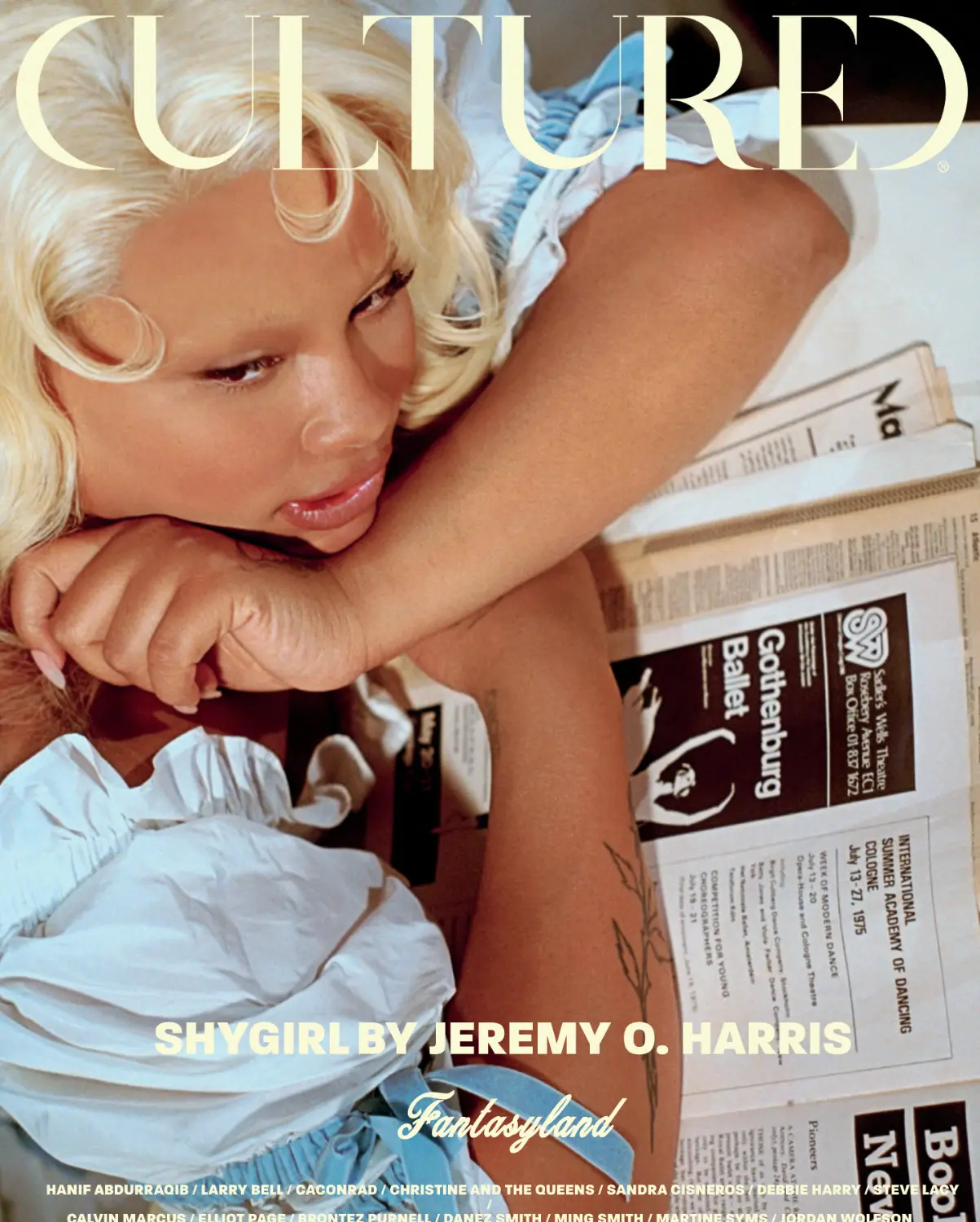
Text
SHYGIRL BY JEREMY O. HARRIS
Fantasyland
ABDURRAQIB / LARRY BELL / CACONRAD / CHRISTINE AND THE QUEENS / SANDRA CISNEROS / DEBBIE HARRY / STEVE LACY
63HANIF
culturedmag.com
/
FENDI BOUTIQUES 888 291 0163 FEN D I.COM
DESIGN
DINING
SHOPPING
CULTURE
BEYOND BELIEF
miamidesigndistrict.net/beyond-belief
Future residences located at:
10245 Collins Avenue, Bal Harbour, FL 33154
ORAL REPRESENTATIONS CANNOT BE RELIED UPON AS CORRECTLY STATING THE REPRESENTATIONS OF THE DEVELOPER. FOR CORRECT REPRESENTATIONS, MAKE REFERENCE TO THIS BROCHURE AND TO THE
DOCUMENTS REQUIRED BY SECTION 718.503, FLORIDA STATUTES, TO BE FURNISHED BY A DEVELOPER TO A BUYER OR LESSEE.
RIVAGE BAL HARBOUR CONDOMINIUM (the “Condominium”) is developed by Carlton Terrace Owner LLC (“Developer”) and this offering is made only by the Developer’s Prospectus for the Condominium.
Consult the Developer’s Prospectus for the proposed budget, terms, conditions, specifications, fees, and Unit dimensions. Sketches, renderings, or photographs depicting lifestyle, amenities, food services,
hosting services, finishes, designs, materials, furnishings, fixtures, appliances, cabinetry, soffits, lighting, countertops, floor plans, specifications, design, or art are proposed only, and the Developer reserves
the right to modify, revise, or withdraw any or all of the same in its sole discretion. No specific view is guaranteed. Pursuant to license agreements, Developer also has a right to use the trade names, marks, and
logos of: (1) The Related Group; and (2) Two Roads Development, each of which is a licensor. The Developer is not incorporated in, located in, nor a resident of, New York. This is not intended to be an offer to sell,
or solicitation of an offer to buy, condominium units in New York or to residents of New York, or of any other jurisdiction where prohibited by law. 2023 © Carlton Terrace Owner LLC, with all rights reserved.
Alexis Ralaivao, Double date (detail), 2022, oil on canvas. Courtesy of the artist.
Alexis Ralaivao
on s’enrichit de ce que l’on donne, on
s’appauvrit de ce que l’on prend
Through August 11, 2023
297 Tenth Avenue, New York
Marcia Hafif, 27. (detail), June 1963, lacquer on canvas. © Estate of Marcia Hafif
Larry Bell
Liz Deschenes
Dan Flavin
Frank Gerritz
Marcia Hafif
Peter Halley
Ralph Humphrey
Donald Judd
Minimalism
and Its Afterimage
Curated by Jim Jacobs and Mark Rosenthal
Ellsworth Kelly
Jonathan Lasker
Sol LeWitt
Richard Long
Robert Mangold
John McCracken
Howardena Pindell
Robert Ryman
Fred Sandback
Jan Schoonhoven
Sturtevant
Christopher Wilmarth
Through August 11, 2023
509 West 27th Street, New York
CONTENTS
June/July/August 2023
44
CULTURED HOSTS A PANEL ON COLLECTING
In partnership with Louis Vuitton, the magazine hosted a panel of art collectors at the
fashion house’s Meatpacking District pop-up in New York.
46
INSIDE DIOR’S GARDEN OF EDEN
The house’s annual summer capsule collection brings a touch of playful kitsch to
Beverly Hills.
48
STUDIO FREQUENCIES
Six artists reflect on their relationship to music, and share the sounds that keep
them company in the studio.
60
SUMMER DISPATCH: PHOTOGRAPHY
Four iconic photographers dig through their archives for an image that conjures a
musical era and an intimate moment.
68
THE STEALTH LUXURY OF SAVETTE
New York–based designer Amy Zurek is
transcending the trend cycle to craft heirlooms for a
new era.
70
PLACES TO GATHER
Belgian architect and designer Vincent
Van Duysen reflects on his approach to distilling
intimate memories into a collection of versatile
pieces for the home.
73
SUMMER DISPATCH: POETRY
To mark the season, three groundbreaking
contemporary poets share musings from their
summer hideaways.
82
A NEW CHAPTER
Pageboy, Elliot Page’s writerly debut, offers an
intimate glimpse into the life of an actor who has grown
up alongside his audience.
Clothing and accessories by Dior Autumn/Winter
2023-2024 collection. Photography by Pat Martin.
28 culturedmag.com
CONTENTS
June/July/August 2023
84
SCOTT SAMPLER’S SECRET SAUCE
For the former filmmaker turned viticulture renegade, natural wine is a form
of artistic expression and resistance against a conformist industry.
86
SEAWATER AND PSYCHEDELICS
Tara Walters’s ethereal painting practice is informed by a fine blend of
psychic retreats and spiritualists.
90
THE TIMELESSNESS OF TØKIO M¥ERS
The British musician and producer has a slate of collaborations and solo projects on
the horizon. They’re pulling him in new and exciting directions.
92
WELCOME TO THE BALMING TIGER
UNIVERSE
As K-pop sweeps the globe, the rising Seoul-based group is
adding new dimensions to the genre.
94
YOUNG CURATORS 2023
The annual list features six practitioners
blazing new paths in a crowded field.
102
LITTLE STUDIO OF HORRORS
Javier Barrios’s practice, rooted in the work that
surrounded him in childhood, will be on view this summer
for his first solo show with Clearing in Brussels.
106
STANDING ON THE CORNER
The music collective is heralded for blending
sounds of the African diaspora with the raw energy of
New York. This summer, they present an avant-garde sonic
installation at MoMA PS1.
116
SHYGIRL’S FANTASYLAND
The musician speaks with Jeremy O. Harris
about forming her own sultry, silky brand of
experimental pop.
Calvin Marcus photographed in Los Angeles.
Photography by Julie Goldstone.
30 culturedmag.com
CONTENTS
June/July/August 2023
BRONTEZ PURNELL AND STEVE
LACY ON CHURCH CHOIRS AND
CLUB RECORDS
Brontez Purnell DMs his friend, musician Steve
Lacy, for a conversation about gatekeeping,
witchcraft, and being the loudest one in the room.
124
SYMS AND BEN BABBITT
130 MARTINE
ON CELLISTS AND HYPNOTISTS
The artists dissect their fortuitous meeting,
the connection between the human body and
technology, and the creative potential of
hanging out.
THE MAN WHO TURNED BLONDIE’S
HAIR BLACK
Blondie’s Debbie Harry and Chris Stein reminisce
about their collaboration with the late Swiss artist
H.R. Giger.
136
3 RECORDS THAT CHANGED HANIF
ABDURRAQIB’S LIFE
Writer and poet Hanif Abdurraqib takes a break from
penning his forthcoming book to reflect on the albums
that raised him.
140
EVERYONE HAS QUESTIONS FOR
CHRISTINE AND THE QUEENS
To mark the release of his latest album, the musician
answers questions on life and love from his friends
and collaborators.
146
INTO THE WILD
With its Autumn/Winter 2023 collection,
Dior pens a billet-doux to three women who
subverted the dictums of their time: Catherine
Dior, Édith Piaf, and Juliette Gréco.
150
CAConrad at St. Mark’s Church
in New York. Photography by
Mary Manning.
BILLIE MILAM WEISMAN AND LARRY BELL
ON ART IN LOS ANGELES
The pair connect for a conversation about the city
that defined their careers.
160
THINKING WITH YOUR HANDS
Five cutting-edge design studios reflect on
their processes and inspirations—from road trips to
local landscapes.
168
OBJECTS OF AFFECTION
The season’s finest high jewelry unfurls
across a verdant botanical wonderland.
178
32 culturedmag.com
SHOP JILSANDER.COM
ALEC SOTH
Photographer
Minneapolis-based photographer Alec Soth has
published over 25 books of his work—including
Songbook (2015), I Know How Furiously Your
Heart Is Beating (2019), and A Pound of Pictures
(2022)—and has had over 50 solo exhibitions at
institutions including the Jeu de Paume in Paris
and Media Space in London. In 2008, he created
Little Brown Mushroom, a multimedia enterprise
focused on visual storytelling, and in 2013, he
received a Guggenheim Fellowship. He is also a
member of Magnum Photos. For this issue, Soth
shot poet Danez Smith, a fellow Minneapolis
creative, at home. “I’ve been a fan of Danez’s
urgent poetry for a long time,” says Soth.
“What a pleasure to peek into their world.”
MARTINE SYMS
Artist
Martine Syms has captured the art world’s
imagination with a practice that combines
conceptual grit, humor, and social commentary.
She has had solo exhibitions at the Museum
of Modern Art and the Art Institute of Chicago,
and received a Guggenheim Fellowship this year.
Syms has written and directed three feature
films: The Mundane Afrofuturist Manifesto,
Incense Sweaters & Ice, and The African
Desperate. Ahead of her first solo Sprüth Magers
show, she speaks with fellow artist, frequent
collaborator, and friend Ben Babbitt.
34 culturedmag.com
MARY MANNING
Photographer
New York–based photographer Mary Manning has had solo exhibitions at Canada gallery and
Cleopatra’s, and at Sibling in Toronto. Last year, they curated the exhibition “Looking Back/
The 12th White Columns Annual” for White Columns. Grace Is Like New Music, a book of their
recent works, was published by Canada in 2023. The photographer spent an afternoon with
poet CAConrad outside St. Mark’s Church for this issue. “Making a portrait with CAConrad
in the west yard of St. Mark’s Church was a dream assignment,” says Manning. “When we
finished, CA generously gave me a tarot reading with the most beautiful deck I’ve ever seen.”
ALEC SOTH, PHOTOGRAPHY BY STERRE OTTEN; MARY MANNING, IMAGE COURTESY OF MARY MANNING; MARTINE SYMS, PHOTOGRAPHY BY GABRIELLE DATU.
CONTRIBUTORS
ESCAPE
UNTIL 25 JUNE
SOUTHAMPTON, NEW YORK
Ed Clark, Untitled (Midi Series) (detail), 2004, Acrylic on canvas, 70.2 × 79.4 cm / 27 × 31 ¼ in © The Estate of Ed Clark
LÉON PROST
KARLA LEYVA
JESSE GLAZZARD
Photographer
Photographer
Photographer
Autodidact Léon Prost strives to catch
what goes unseen. As a French reportage
photographer and director, Prost traveled in
Romania with his analog camera, documenting
his journey through the country. He has shot for
publications including L’Officiel Hommes, M le
magazine du Monde, and Regain. For this issue,
the photographer turned his lens on FrenchLebanese architect Lina Ghotmeh.
Karla Leyva is a transdisciplinary artist working
to analyze the fantasy around colonized bodies
in an increasingly digital world. Implicit in her
work is the desire to expand the body beyond
the flesh, the desire to leave the periphery,
to be seen, touched, felt, consumed, and
discarded. Leyva has shown her work in Pereira,
Los Angeles; Portland, Oregon; London; and
across Mexico, where she currently lives. She
entered the world of Javier Barrios, a fellow
Mexico City resident, for this issue. “What I
like the most about him,” she says, “is that he
works very hard to be the great artist he is now.”
Jesse Glazzard was born and raised in
Yorkshire and lives in London, after graduating
from Central Saint Martins in 2019. He has
documented moments among his close friends
over several years, and has shot and directed
for brands including Calvin Klein, Ssense, and
Adidas, among others. A regular CULTURED
contributor, the photographer captured French
musician Christine and the Queens for this
issue in Paris. “I love working with Chris,” says
Glazzard. “It was especially nice this time
because I got to see some of the city. We
started the shoot with a few push-ups.”
LARRY BELL
Artist
Taos, New Mexico–based artist Larry Bell is
one of the most noteworthy representatives
of abstract art in the postwar period, with a
career spanning nearly six decades. Bell’s
medium, “light on surface,” often utilizes the
technology of thin film deposition of vaporized
metals and minerals on glass surfaces. Bell
exhibits extensively in museums and galleries
across the world, and is the recipient of
numerous public art commissions. For this
issue, he spoke with collector Billie Milam
Weisman about their parallel lives in the arts.
“I always enjoy talking with Billie,” says Bell of
his longtime friend. “She is a real fixture in the
LA art scene.”
36 culturedmag.com
KARLA LEYVA, PHOTOGRAPHY BY KARLA LEYVA; LÉON PROST, IMAGE COURTESY OF LÉON PROST; JESSE GLAZZARD, PHOTOGRAPHY BY NORA NORD; LARRY BELL, PHOTOGRAPHY BY ERIC SCHWARTZ.
CONTRIBUTORS
NEW YORK
DOYLE LANE: WEED POTS
Curated by Ricky Swallow
Through August 4, 2023
CHASE HALL
September 5 – October 14, 2023
LOS ANGELES
20
Celebrating David Kordansky Gallery’s 20th Anniversary
Through August 19, 2023
SHARA HUGHES
DEANA LAWSON
September 9 – October 21, 2023
LOS ANGELES
5130 W. Edgewood Pl.
T: 323.935.3030
NEW YORK
520 W. 20th St.
T: 212.390.0079
DAVIDKORDANSKYGALLERY.COM
DAVE HOLMES
NELL KALONJI
madison moore
Writer
Stylist
Writer
Dave Holmes is an editor-at-large and
columnist for Esquire whose work has
appeared in publications including the
Los Angeles Times, Rolling Stone, and
New York magazine. He is thrilled to have
interviewed the artistic polymath that is
TØKIO M¥ERS for CULTURED’s summer
music issue. When it comes to his other
summer music picks, Holmes will tell you
this in confidence, because he feels he
can trust you: He still listens to that first
Wilson Phillips album about once a week.
London-based Nell Kalonji is senior fashion editorat-large for AnOther Magazine and a guest fashiondirector-at-large at Luncheon. She has collaborated
with photographers such as Alasdair McLellan,
Collier Schorr, Craig McDean, Jack Davison, and
Nadine Ijewere. For this issue, she styled cover star
Shygirl for her fantastical 1950s-inspired shoot.
“Shy and I love collaborating on editorials like
this,” says Kalonji. “It allows us to play with a wider
range of characters than we can for stage or carpet
looks. Shy was transforming in front of our eyes and
getting into character, but it felt really natural—
like this is her world.”
madison moore is a writer and DJ based in
Providence, Rhode Island. He is the author of
Fabulous: The Rise of the Beautiful Eccentric, a
2018 ode to fabulousness as an act of queer
resistance published by Yale University, where
he received his PhD in American studies. moore
has contributed to The Atlantic, Theater, and the
Journal of Popular Music Studies. This summer,
he will be the scholar-in-residence at the Sag
Harbor arts organization the Church. In this
issue, the writer introduces a conversation
between the genre-defying musicians Steve Lacy
and Brontez Purnell.
LEGS MCNEIL
Writer
In 1975, Legs McNeil co-founded Punk magazine,
serving as the publication’s “resident punk,”
which involved drinking, interviewing rock stars,
and spreading chaos wherever he went. In 1988,
McNeil’s drinking privileges were permanently
revoked, and he became a senior editor at Spin
before releasing the books Please Kill Me (1996),
The Other Hollywood (2005), and Dear Nobody
(2013). In this issue, McNeil spoke with Blondie’s
Debbie Harry and Chris Stein about making the
cover art for KooKoo, Harry’s debut solo album,
with artist H.R. Giger.
38 culturedmag.com
DAVE HOLMES, PHOTOGRAPHY BY LAURA PAVLAKOVICH; MADISON MOORE, PHOTOGRAPHY BY ROME GOD; NELL KALONJI, PHOTOGRAPHY BY FELIX COOPER; LEGS MCNEIL, PHOTOGRAPHY BY CHRIS STEIN, 1976.
LEGS MCNEIL, ANYA PHILLIPS, AND DEBBIE HARRY SHOOTING “THE LEGEND OF NICK DETROIT” FOR PUNK MAGAZINE.
CONTRIBUTORS
Founder | Editor-in-Chief
SARAH G. HARRELSON
Senior Editor
MARA VEITCH
Chief Revenue Officer
CARL KIESEL
Senior Creative Producer
REBECCA AARON
Publisher
LORI WARRINER
Fashion Directors
ALEXANDRA CRONAN, KATE FOLEY
Italian Representative—Design
CARLO FIORUCCI
Associate Editor
ELLA MARTIN-GACHOT
Editorial Assistant
SOPHIE LEE
Copy Editor
EVELINE CHAO
Junior Art Directors
HANNAH TACHER, ORIANA REN
Contributing Art Directors
MAFALDA KAHANE, SARA PENA
Editor-at-Large
KAT HERRIMAN
New York Contributing Arts Editor
JACOBA URIST
Interns
LAINE ALLISON
ISABELLA BARADARAN
CAROLINE BOMBACK
MARIA CLARA COBO
ELIZABETH COHAN
SOPHIE COLLONGETTE
MARIANA DE JESUS SZENDREY
AMELIA STONE
Prepress/Print Production
PETE JACATY
Senior Photo Retoucher
BERT MOO-YOUNG
Podcast Editor
SIENNA FEKETE
Contributing Editors
JULIA HALPERIN, LILY KWONG, MARTINE SYMS, FRANKLIN
SIRMANS, SARAH ARISON, DOUG MEYER, CASEY FREMONT,
MICHAEL REYNOLDS, DOMINIQUE CLAYTON
CULTURED Magazine
2341 Michigan Ave
Santa Monica, California 90404
TO SUBSCRIBE, visit culturedmag.com. FOR ADVERTISING information, please email info@culturedmag.com.
Follow us on INSTAGRAM @cultured_mag.
ISSN 2638-7611
40 culturedmag.com
LETTER
from
the
EDITOR
MARA VEITCH, ELLA MARTIN-GACHOT, SARAH HARRELSON, HANNAH TACHER, AND REBECCA AARON IN NEW YORK CITY
FOR THE SET EVENT. PHOTOGRAPHY BY DAVID BENTHAL.
WALTER PATER, THE 19TH-CENTURY ART
critic, once wrote that “all art constantly aspires
towards the condition of music.” It’s true—
when a meal or a painting or a piece of writing
comes together perfectly, it sings.
Our summer music issue takes a deep dive
into this idea. We turned to artists, writers,
musicians, and people who do a little bit of all
those things, and set them the insurmountable
task of defining their relationship to sound.
Studio Frequencies, our portfolio focused on
the music that keeps artists company in the
studio, is one approach to this. In it, Jordan
Wolfson points out the absurdity of the
exercise, responding to a question about his
earliest sonic memory with, “Insane question.”
Wolfson is right. Music is so intimately intertwined with daily life and with memory that it’s
almost impossible to account for its influence
on our lives. We discovered this ourselves while
putting the issue together.
The following pages celebrate a group of
ar tists who pull inspiration from across
disciplines and channel it into music. Brontez
Purnell—novelist, poet, and a musician in his
own right—speaks with alt-R&B icon Steve Lacy
about “flow, melody, and cadence,” three
formal qualities shared by musical composition
and narrative form. Martine Syms and Ben
Babbitt, frequent collaborators who teamed up
to create a soundscape for Syms’s first solo
exhibition at Sprüth Magers in Los Angeles,
discuss music’s centrality to their existence,
and their anxieties about and experiments with
A.I.-generated vocals. Poet and cultural critic
Hanif Abdurraqib contributed three graceful
paeans to the albums that changed his life. Our
summer poetry portfolio, curated by Associate
Editor Ella Martin-Gachot, sees three of the
form’s boundary-breaking contemporary voices
share sound bites from their summer
hideaways. Shygirl, the issue’s cover star, talks
to play wright and critic Jeremy O. Harris
about building the music career that she
fantasized about during her early Tumblr days
in Southeast London.
Summer is about experimentation and
creativity, but it’s also a time of unexpected
community. For this reason, we’re thrilled to
present our special limited-edition artists
cover—shot by William Jess Laird as part of our
first of two Hamptons issues guest-edited by
Joel Mesler—which spotlights a spectacular
group of artists who have found camaraderie
together during long summer days out east. The
limited release, which will be available in select
locations starting in late June, is a testament to
coming together and the intimacy of the
season, and we’re very proud to see it out in
the world.
I hope that this issue provides you with
some inspiration—for your summer playlists,
dinner table conversations, and beyond.
LEFT: SHYGIRL shot in London,
wearing a dress by Molly Goddard.
Photography by Rachel Fleminger
Hudson. Styling by Nell Kalonji.
Creative Direction by Studio& and
Rachel Fleminger Hudson.
Sarah G. Harrelson
Founder and Editor-in-Chief
@sarahgharrelson
Follow us | @cultured_mag
42 culturedmag.com
RIGHT: Rashid Johnson, Sanford
Biggers, Sheree Hovsepian, Eric
Fischl, Mary Heilmann, Sarah
Aibel, Hank Willis Thomas, and
Joel Mesler shot in East Hampton.
Photography by William Jess Laird.
CHARLIE JARVIS, KEVIN CLAIBORNE
HANNAH TRAORE
ABOVE: SARAH HARRELSON, SOPHIA COHEN, CAIO TWOMBLY, HANNAH TRAORE, EVERETT TAYLOR
GAGE GOMEZ, HENRY BLYNN
SARAH LARSON, SHARON HOROWITZ
SOPHIA COHEN, LILY MORTIMER
SARAH HARRELSON, CAIO TWOMBLY
DANA FAROUKI, CHASE LEGER, LESLIE FINERMAN
CULTURED HOSTS A
PANEL ON COLLECTING
This April, CULTURED partnered with Louis Vuitton to host
a panel of art collectors at the fashion house’s Meatpacking
District pop-up in New York.
PHOTOGRAPHY BY DAVID BENTHAL
REBECCA REID, CAIO TWOMBLY
TO COMMEMORATE THE RELEASE OF THE SIXTH ANNUAL YOUNG
COLLECTORS LIST, CULTURED took over Louis Vuitton’s kaleidoscopic popup space this spring for an evening of conversation and champagne. The
magazine presented “The Art of Collecting,” a panel moderated by CULTURED
founder Sarah Harrelson, who invited members of the magazine’s extended
family—including Hannah Traore, founder and director of Hannah Traore
Gallery; Kickstarter CEO Everette Taylor; notable collector and Gagosian
liaison Sophia Cohen; and Caio Twombly, co-founder and co-director of
Amanita Gallery—to share their collecting stories. Guests such as Jasmine
44 culturedmag.com
KATHLEEN LYNCH, JASMINE WAHI
Wahi, Nina Runsdorf, Sharon Coplan Hurowitz, and Dana Farouki gathered
to take in the latest iteration of Yayoi Kusama’s collaboration with Louis
Vuitton. The whimsical space was outfitted in bright green polka dots and
floral sculptures to welcome the arrival of the spring season. The evening’s
panelists, decked out in their Louis Vuitton finest, expounded on their
personal collecting philosophies and the principles that have shaped their
creative careers. For those onstage, building a collection is an exercise in
stewardship, not ownership. “I don’t see myself as a collector,” said Taylor.
“I see myself as a caretaker of the work.”
Esmaa Mohamoud
Let Them Consume Me
In The Light
On view through August 26
Kavi Gupta
219 N. Elizabeth St. Floor 1
Chicago IL 60607
kavigupta.com | 312 432 0708
INSIDE DIOR’S
GARDEN OF EDEN
The house’s annual
summer capsule collection
brings a touch of playful
kitsch to Beverly Hills.
BY AMELIA STONE
PHOTOGRAPHY BY PAUL VU
THE 18TH CENTURY BROUGHT
abou t a suite of innovations,
including the steam engine, the
piano, and the establishment of the
novel as a literary genre. The period
also engendered an aesthetic
revolution in Europe, with tides
shif ting toward frivolous rococo.
O n e o f t h e key el e m e n t s i n
this maximalist revolution was
toile de Jouy, a traditionally monochrome fabric featuring vignettes
of countr yside scenes, romantic
picnics, and luscious flora and
fauna. This summer, the style—the
46 culturedmag.com
18th centur y version of a comic
strip—will make its way to beaches
and tennis courts with Dioriviera,
Maison Dior’s annual summer
capsule collection that takes Toile
de Jouy Sauvage, a dusty pink and
gray interpretation of the classic
pattern, as its leitmotif.
Designed by Dior’s creative
director of women’s haute couture,
ready -to -wear, and accessories
collections, Maria Grazia Chiuri, the
collection presents a slew of summer
necessities adorned with Toile de
Jouy Sauvage. Dioriviera will be
available in nine pop-up boutiques in
idyllic summer destinations across
the world, from Capri to Saint Tropez
and Beverly Hills. The maison will
take up residence in the iconic
Beverly Hills Hotel through the
summer season, offering Dioriviera
disciples and newcomers alike the
opportunity to browse iconic bags
like the Lady D-Lite and the Dior Book
Tote, along with scarves and satin
shirts adorned with the enduring
house code.
Channeling the playful kitsch of
toile de Jouy, the pop-up’s interior
takes the form of an immersive
sandcastle filled with life -sized
sand sculptures of wildlife, giving
visitors a taste of lighthear ted
luxury. Surf-inspired cabins line the
perimeter, offering Dior parasols,
yoga mats, and surfboards. Poolside, guests will recline under Toile
de Jouy Sauvage–coated cabanas,
where they can schedule boutique
relaxation treatments at the Jardin
des Rèves Dior Spa. The pop -up
experience promises to be a lush
summer respite, this year and
every year.
fur niture
l i g h ti ng
o ut do or
1 3 4 M a d i s on Av e N e w York
d d cny c .c om
access o ries
s ys t em s
AN AR TI S T’S S T U DIO I S A HAV E N — A SO U N DIN G
B OARD F OR ID E A S GOO D AN D BAD, A COM PANION O N
DARK DAYS AN D IN SPIRE D ON E S. TH E S E S PACE S
PL AY O CCA SIO NA L H O S T TO CU R ATOR S, CO L L ECTOR S,
AN D F RIE N D S, B UT IN TH E DAY-TO - DAY H U M
O F CRE ATIO N, TH E Y WR AP TH E IR PROTECTIV E ARM S
ARO U N D TH E IR AR TI S T S, E NV E LO PIN G TH E M.
CU LTU RE D A SK E D SIX M AK E R S W H O S E WORK
SPAN S TH E DI SCIPL IN E S O F ARCH ITECT U RE ,
PE RF ORMAN CE , PAINTIN G , AN D SCU L P T U RE TO RE F L ECT
ON TH E IR R E L ATION S H IP TO M U SIC, AN D
S HARE TH E SO U N D S TH AT K E E P TH E M COM PANY
IN TH E S T U DIO.
Studio
FREQUENCIES
CLAUDE DEBUSSY
JOHN LENNON
DRAKE
JORDAN
WOLFSON
48 culturedmag.com
PH OTO G R A PH Y BY B R A D TO RC H IA
The Los Angeles–based provocateur is known for an extensive,
uninhibited practice that probes identity politics, pettiness, and the
baseness of the virtual-industrial complex. Wolfson’s work, which
has taken the form of video, sculpture, installation, photography,
and performance, is neither dogmatic nor didactic, opting instead
for an uneasy opacity. This summer, the artist’s transgressive
streak will be on view through July 22 with “Drawings,” a show
that mines the (short) life and legacy of John Fitzgerald Kennedy
Jr. at Gagosian’s Basel outpost. In December, the National Gallery
of Australia will host a survey of the artist’s work. When it comes
to the relationship between music and art-making, Wolfson’s
philosophy is simple: Less is more.
WHAT IS THE ROLE OF MUSIC IN YOUR PRACTICE? Depends. I used to
think pop was radical; now I just like sculpture.
WHAT’S YOUR FAVORITE WAY TO LISTEN TO MUSIC? [With] Apple
AirPods Max in a La-Z-Boy at my studio, or driving at night.
WHAT’S THE BEST STUDIO SOUNDTRACK? We don’t listen to music at
the studio, but probably everyone laughing and enjoying working together.
WHICH MUSICIAN WOULD YOU ASK TO WRITE THE SOUNDTRACK TO
YOUR LIFE? I’d never dare to ask that of another artist, but since you
did… Erik Satie.
FIRST SONIC MEMORY? That’s an insane question.
culturedmag.com 49
JIBZ
CAMERON
PH OTO G R A PH Y
BY C H A R L I E G RO S S
FUNKADELIC
PINK FLOYD
AUSTRA
THE POINTER SISTERS
CARDI B
LINTON KWESI JOHNSON
PATRICK COWLEY
FEVER RAY
CHARLOTTE ADIGÉRY
PRINCE
YOKO ONO
JANET JACKSON
RAY LYNCH
BRIAN ENO
LEE “SCRATCH” PERRY
NINA HAGEN
GRACE JONES
DONNY HATHAWAY
BLACK SABBATH
PENGUIN CAFE ORCHESTRA
SNEAKS
LATTO
SONIDO GALLO NEGRO
FREE KITTEN
CAN
DICKS
NORMANI
LAURIE ANDERSON
PERE UBU
As a 10-year-old, Jibz Cameron wrote in a poem, “I am the wolf. I run /
through the forest. / I howl / back / AND forth / through the forest. /
looking for that place / the place where I / can let it all out.” In the nearly
four decades since those words flowed out of her, Cameron—better known
as her high-camp alter ego Dynasty Handbag—has found myriad pockets
and platforms of expression, from her Los Angeles variety show “Weirdo
Night,” which will be resurrected this summer, to a topsy-turvy take on
Titanic this past May at New York’s Pioneer Works. This fall, the artist’s
visual practice will be on view in the Hammer Museum’s “Made in L.A.”
biennial. Cameron’s musical landscape is as riotous and polychrome as
her persona.
WHAT’S THE BEST SOUNDTRACK TO GET DRESSED TO? Before a show,
I need something mighty, like the Stooges or Megan Thee Stallion, to get
me doing air kicks, gnashing my teeth, and stomping about with borrowed
confidence. If I need to get grounded, I listen to Johann Sebastian Bach’s
“Mass in B Minor.” One of my favorite compositions of all time is “India,” by
John Coltrane. I don’t want to sound like a dick. This interview is like, “What
music do you like?” And I’m all, “Bach, complex jazz?” But there you have
it. I love Bach, and I love John Coltrane. Do I understand it? No, and nary
shall I try! Whomst cares!
FIRST SONIC MEMORY? I was obsessed with the radio and never wanted
to miss a song, so I would record it at night. Like, I put a tape in the tape
deck to record the radio and then flipped it in the middle of the night. I also
called the radio a lot and demanded that songs be played. I was about 7 or
8 when “Cum on Feel the Noize” by Quiet Riot (best band name of all time
perhaps) was on the Top 40, and I remember calling the radio station telling
them to play it again. I remember this really well because it’s also a shameful
memory—they laughed at me.
FAVORITE SOUND? I bumped my head into a gigantic wind chime recently,
and it was like I was scoring my own cartoon. The sound of an outdoor concert
from far away is a great, sad, weird sound. Dogs howling with a siren. Any
double bass drums. Frogs. Getting up to pee at 3 a.m. and hearing an owl.
Windshield wipers.
WEIRDEST SOUND YOU CAN MAKE? I can do a decent Martha
Stewart impression.
50 culturedmag.com
VIELMETTER LOS ANGELES
“Perpetual Portrait”
July 8 — August 19, 2023
1700 S Santa Fe Ave, Los Angeles, CA 90021 +1 213 623 3280
vielmetter.com
CALVIN
MARCUS
PH OTO G R A PH Y BY
J U L I E G O L D S TO N E
THE BEACH BOYS
RADIOHEAD
KRAFTWERK
The words “surreal” and “absurd” are thrown around when
Calvin Marcus’s name comes up. But the San Francisco–born,
Los Angeles–based artist tends more towards the deadpan
and discomforting. His deceptively nonchalant paintings, forays
into sculpture, and screen-printed works dilate the longer you
observe them. This summer, a work of Marcus’s will be included
in Clearing’s first Art Basel booth, and the artist will continue to
develop his Tuscan TOMATO Residency with the gallery’s Brussels
director, Lodovico Corsini. In the midst of these varied projects
and practices lies a deep connection to music, which offers the
artist both a contemporary catalyst and a time-travel machine.
WHAT’S YOUR FAVORITE WAY TO LISTEN TO MUSIC? My studio has wooden
floors and a large wooden ceiling, so the acoustics are really nice; it’s the
best place to listen to music. It sounds so good and big to be in there with
my favorite music of the moment.
WHAT SOUNDS DO YOU ASSOCIATE WITH LA? Cars accelerating. There
are also a lot of birds in my neighborhood. Every time I’m on the phone with
someone walking my dog around, the person on the line always comments
on how loud the birds are.
FIRST SONIC MEMORY? My uncle swimming across a lake on a family
camping trip we went on as kids. I still hear his voice and the sound of the
water around him.
FAVORITE SOUND? The sound of a skateboard passing by gives me great
nostalgia. I’ve been skateboarding since I was 12—less now, but I still love
the sound of the hard wheels and loud bearings. It sounds like a snake
striking perpetually.
52 culturedmag.com
Clay Pop
Los Angeles
Curated by Alia Dahl
June 24 – August 12, 2023
Diana Yesenia Alvarado
Alex Anderson
Alex Becerra
Genesis Belanger
Seth Bogart
Kenturah Davis
Woody De Othello
Sharif Farrag
Ryan Flores
Joel Gaitan
Melvino Garretti
Lizette Hernandez
Stephanie Temma Hier
Sydnie Jimenez
Grant Levy-Lucero
Candice Lin
Jasmine Little
Amelia Lockwood
Jiha Moon
Ruby Neri
Maija Peeples-Bright
Brian Rochefort
Jennifer Rochlin
Brie Ruais
Stephanie H. Shih
Alake Shilling
Peter Shire
Christopher Suarez
Magdalena Suarez Frimkess
Amia Yokoyama
Maryam Yousif
Bari Ziperstein
Sharif Farrag, Stump, 2019–2023
JEFFREY DEITCH • 7000 SANTA MONICA BLVD, LOS ANGELES • LA@DEITCH.COM
CHASE
HALL
PH OTO G R A PH Y BY
LAUREN RODRIGUEZ HALL
ROBERT GLASPER
STEVIE WONDER
CHARLIE WILSON
TYLER, THE CREATOR
FUTURE
A TRIBE CALLED QUEST
JIMI HENDRIX
BLACK SABBATH
Q-TIP
DIZZY GILLESPIE
ANTHONY HAMILTON
NIPSEY HUSSLE
GENNY!
CHARLES BRADLEY
LAURYN HILL
TUPAC SHAKUR
ELTON JOHN
ANDRÉ 3000 AND BIG BOI
GIL SCOTT-HERON
KENDRICK LAMAR
B.B. KING
EARL SWEATSHIRT
WHITNEY HOUSTON
ARETHA FRANKLIN
LYFE JENNINGS
LENNY KRAVITZ
KIRK FRANKLIN
NAJEE
MARVIN SAPP
NOEL POINTER
ESTHER PHILLIPS
BOB MARLEY
BOBBY CALDWELL
JAY-Z
EARL KLUGH
RED HOT CHILI PEPPERS
ESTHER PHILLIPS
THELONIOUS MONK
CANDI STATON
STEVE LACY
This year, Chase Hall developed a relationship with the opera. The
New York and Los Angeles–based artist was commissioned by the
Metropolitan Opera to create a set of paintings inspired by Luigi
Cherubini’s Medea last fall, and renewed his ties with the hallowed
institution in the spring with a vast painting honoring Terence
Blanchard’s Champion—an epic chronicle of boxer Emile Griffith’s
life—which was blown up to even more colossal proportions to
adorn the building’s facade. This summer, the CULTURED Young
Artist 2021 alum confronts another behemoth, Jackson Pollock, in
an exhibition at the Aspen Art Museum, the second in a series of
artist-led presentations called “A Lover’s Discourse.” For the painter,
music is a mirror, a history book, and a portal to transcendence.
WHAT IS THE ROLE OF MUSIC IN YOUR PRACTICE? Music has been a
father figure, a brother, a mentor, a diary, a Pandora’s box, an ancestor, a
journey, and a mirror of my questions and concerns. It has allowed me to
locate what art is and to see how it disseminates into real-time culture and
humanity. I’m like a poor man’s Rick Rubin—I can’t play a lick, but I know what
I like and feel, and what it has showed me of myself, others, and the world.
WHAT SOUNDS HAVE INFLUENCED THE WORK THAT WILL BE ON DISPLAY
AT THE ASPEN ART MUSEUM? Free jazz, percussion, samba, freestyle
rapping—areas of music that are challenging, intuitive, guttural, spiritual, and
informed by the many years prior to their action. The possessive qualities of
painting often remind me of someone catching the Holy Ghost, or their eyes
rolling back into their skull as they blare through their saxophone. Music is
a space, and so is painting—it’s about making that space one you love to
come home to.
FIRST SONIC MEMORY? Growing up, my mom always played Elton John and
Tupac [Shakur] in her old black Toyota 4Runner, smoking cigarettes. Those two
are etched into my memory.
54 culturedmag.com
The transformative power of art meets the spirit of
individuality and ingenuity in one-of-a-kind collectible
design and artisan-crafted fine art. Authenticity and
uniqueness lie within the exceptional craftsmanship and
artistic expression of independent studio artists.
Tapestry: Gerri Spilka, 2022
Wood and LED Sculpture: John Procario, 2023
Bronze Console: Gary Magakis, 2023
212-673-0531 // www.toddmerrillstudio.com
ISHI
GLINSKY
PH OTO G R A PH Y BY
R U B E N D IA Z
NTS MIXTAPES
POWWOW SONGS
PHILIP GLASS
YELLOW MAGIC ORCHESTRA
YVES TUMOR
BEACH HOUSE
Ishi Glinsky’s practice mimics the meticulous virtuosity of
a composer. The Los Angeles–based artist is tied to the
landscape—and baseball team—of his adopted home, but
through his work he digs into the traditions and creative
ecosystem of his tribe, the Tohono O’odham Nation, and other
North American First Nations. This summer, Glinsky will bring
these concerns, and their material articulations, to the fore
as part of the Hessel Museum of Art’s “Indian Theater: Native
Performance, Art, and Self-determination Since 1969,” and Tiwa
Select’s presentation at the North American Pavilion in London.
In the fall, the artist heads back to LA, where he will be featured
in the Hammer Museum’s “Made in L.A. 2023: Acts of Living.”
WHAT SOUNDS HAVE INFLUENCED THE WORK THAT YOU’LL BE SHOWING
AT THE BIENNIAL? One facet of my next sculpture is inspired by the stillness
and silence of the start of a powwow. It’s about creating a memory of viewing
and participating in the Grand Entry of a powwow, while also zeroing in on
the regalia and objects that create a roar, [the] concert of sounds mostly
meant for healing.
WHAT’S YOUR FAVORITE WAY TO LISTEN TO MUSIC? Headphones. I
like to keep what I’m listening to private. I have a shared studio space,
but even if no one is around, I’d rather crank up my headphones than use
a speaker.
FIRST SONIC MEMORY? Quail songs and thunder from the summer
monsoons. The sound and smell of desert monsoons are very particular to
the Southern Arizona desert and different from anywhere else.
FAVORITE SOUND? My partner’s laugh, gessoing a canvas, the sound of
a home run.
56 culturedmag.com
LO S A N G E L E S
N E W YO R K
SAN FR ANCISCO
SY D N E Y
Our rugs lie lightly on this earth.
A R M A D I L LO - C O . C O M
MELBOURNE
BRISBANE
LINA
GHOTMEH
PH OTO G R A PH Y
BY L É O N PRO S T
ANA MOURA
JOHANN SEBASTIAN BACH
MILES DAVIS
IBRAHIM MAALOUF
AMÁLIA RODRIGUES
FAIRUZ
OUM KALTHOUM
NINA SIMONE
ARVO PÄRT
DHAFER YOUSSEF
ZIAD RAHBANI
NICCOLÒ PAGANINI
CHILLY GONZALES
FELIX MENDELSSOHN
MARIA CALLAS
The Paris-based architect—whose projects include the Hermès
workshops in Normandy, the Estonian National Museum in
Tartu, and the Stone Garden apartment block in her native
Beirut—grew up wanting to be an archaeologist. Though
fate had other plans, she brings from that field a meticulous
sensibility regarding landscapes and the passing of time, as
well as a fascination with the most humble of materials. This
June, Ghotmeh will travel to London to debut her design for
the 22nd edition of the Serpentine Pavilion, baptized “À
table.” The French dining call is a fitting motto for Ghotmeh,
whose connection to music emphasizes the gathering of
disparate elements—no matter the origin, generation, or genre.
58 culturedmag.com
HOW DO YOU THINK ABOUT SOUND IN THE SPACES YOU DESIGN? I work
with sound engineers to study the sound experience within the spaces I
design. Each one has a different sound requirement. When working on
atelier spaces such as Hermès, the sound of hammers and leather working
tools is rendered musical with the acoustic paneling used on the walls. At
the Palais de Tokyo restaurant, Les Grands Verres, the high space and the
risk of noise reverberation shaped our material choices for the renovation;
everything was orchestrated to have the most intimate experience.
WHAT’S THE BEST PLAYLIST FOR GATHERING AROUND A MEAL? The
whispers and laughter of people around the table.
WHAT SONG REPRESENTS WHERE YOU’RE AT IN YOUR LIFE AND
PRACTICE AT THE MOMENT? “Overture (‘Sinfonia’) in C Major” by
composer Marianna Martines.
SUMMER DISPATCH PHOTOGRAPHY
On the following pages, four photographers
share an image from a summer day that
continues to inspire them.
DAVID MONTGOMERY
In 1967, the Brooklyn-born, London-based photographer, known
for his intimate approach to portraiture, became the first American
to photograph Queen Elizabeth II. Four years later, he took on
another British heavyweight: the Rolling Stones.
DAVID MONTGOMERY, THE ROLLING STONES, 1970.
60 culturedmag.com
“I WAS MAKING A LIVING AS an advertising photographer,
but I also did a lot of editorial work for The Sunday Times. I
was shooting plenty of royalty and
prime ministers for the magazine. I
ended up taking this picture of the
Rolling Stones as a favor for a friend
of mine. I never went to clubs, I was
not on the scene—I was the scene,
if you know what I mean. Mick
[Jagger] was a couple of hours late;
it was summertime and hot. The
rest of the band was politely sitting
around. By the time Mick came,
we were all a bit hungry. There was
a fish and chips shop down at the
bottom of the road. I thought, Well,
since they’re an English band, I’ll
shoot it in a fish shop for some nice
local color. Everybody eats fish and
chips, nothing glamorous about
it. There were some teenagers
in there, but nobody paid any
attention to us. That’s the great
thing about London, or England
anyway. The band was busy talking
amongst themselves, so I had my
hands full getting them all to look
at the camera. I was starting to
get a bit fed up with it. I thought,
Let’s just get this done. I want to go
home and have supper. Mick was
clearly tired, not the most dynamic,
but you knew he was ‘the one.’ I’d
photographed Jimi Hendrix, who
was truly special, the Queen, and
even Paul McCartney, but Mick is like electric, you know?
Look, they’re the greatest rock-and-roll band in the world.
That’s all there is to it. The fish and chips shop is still around,
only it moved down a half a block. When I go there, I always
think, Did that really happen? Was that really real?”
SUMMER DISPATCH PHOTOGRAPHY
MING SMITH
Over a half-century–long career, the Detroit-born, Harlem-based
photographer—and the first Black woman photographer to have a work
acquired by the Museum of Modern Art—has captured the auras of music
legends like Grace Jones, Sun Ra, and Tina Turner. But for all her stirring
portraits, it is a candid summer snapshot that sticks most with Smith, a
testament to the resilience and joy of Black family.
“I WAS MARRIED TO WHAT I WOULD call an avant-garde
jazz musician. It was a period of lost jazz. Jazz always
represented the freedom coming out of Black culture. I was
touring with his group, the World Saxophone Quartet, all
over the world—and I would work along the way, too. Here, I
was attending this cool festival in Atlanta, Georgia, where a
long list of musicians, including Kenny G, were performing. I
was heading toward the entrance, which was crowded with
people ready to celebrate and relax on a nice summer day,
and I saw a family. They were just hanging out in the park.
The Atlanta Child Murders [of 1979–81] were happening that
summer. These were young Black boys—I think there were
28 of them at the time—who had been either strangled or
stabbed or shot, and they were found not far from where
they were murdered, in a park. It sent shock waves around
the world, but the media was saying, ‘Well, it was tragic and
everything, but these children didn’t have fathers.’ What
does that have to do with it? So when I saw this family, I was
like, Look, there’s a father right there … How beautiful is that
family? They were working class folks. There was a father
with his arms around his wife, and their two daughters, just
swinging back and forth. They were in a private moment,
a family moment. You know, I shoot cultural icons—Tina
Turner, James Baldwin—but this photograph was expressing
something bigger, something totally sincere, something that
was political, but beautiful. I love this image. I knew when I
took it that it was a winner. Even without the history, it would
have been a special one for me.”
MING SMITH, FAMILY FREE TIME IN THE PARK, 1982.
64 culturedmag.com
62
THE NEW ICON
OF WATERFRONT
LUXURY IN
FORT LAUDERDALE
A COLLECTION OF ONLY 65 RESIDENCES
THAT BRING TO LIFE THE SOPHISTICATED
GLAMOUR OF THE EDITION IN
TWO - OR THREE-BEDROOMS
WITH BEAUTIFUL WATERWAY VIEWS.
FOR MORE INFORMATION + 1 954 355 7116 FORTLAUDERDALEEDITIONRESIDENCES.COM @EDITIONRESIDENCESFTL
SALES GALLERY LOCATED AT 3115 TERRAMAR STREET, FORT LAUDERDALE, FL 33304
ORAL REPRESENTATIONS CANNOT BE RELIED UPON AS CORRECTLY STATING THE REPRESENTATIONS OF THE
DEVELOPER. FOR CORRECT REPRESENTATIONS, MAKE REFERENCE TO THIS BROCHURE AND TO THE DOCUMENTS
REQUIRED BY SECTION 718.503, FLORIDA STATUTES, TO BE FURNISHED BY A DEVELOPER TO A BUYER OR LESSEE.
These materials are not intended to be an offer to sell or solicitation to buy a unit in the condominium to be known, while the applicable license remains in effect, as Edition Residences Fort Lauderdale. Such an offering shall only be made pursuant to the prospectus (offering circular) for the condominium and no statements
should be relied upon unless made in the prospectus or in the applicable purchase agreement. In no event shall any solicitation, offer or sale of a unit in the condominium be made in or to residents of any state or country in which such activity would be unlawful. All images, designs and views depicted herein are artist’s
conceptual renderings based upon preliminary development plans, and are subject to change without notice. All such materials are not to scale and are shown solely for illustrative purposes. Developer makes no representation that such improvements will be built or will be built as depicted. The project graphics, renderings
and text provided herein are copyrighted works owned by Developer. All rights reserved. Unauthorized reproduction, display or other dissemination of such materials is strictly prohibited and constitutes copyright infringement. The project is being developed by LV Bayshore SPE, LLC (“Developer”), which has a limited
right to use the “Edition” trademarked names and logos. All statements, disclosures and/or representations herein are made by Developer and not the licensor and you agree to look solely to Developer (and not to the licensor and/or any of its afÏliates) with respect to any and all matters relating to the marketing, and/or
development of the project and with respect to the sales of units in the condominium. No real estate broker is authorized to make any representations or other statements regarding the project and no agreements with, deposits paid to or other arrangements made with any real estate broker are or shall be binding on Developer.
SUMMER DISPATCH PHOTOGRAPHY
DEREK RIDGERS
For over four decades, British photographer Derek Ridgers has
been capturing the rough edges of concerts, musicians, and
their wildest fans. One late night in the ’80s, he turned his lens
on the Cramps, and captured the psychobilly band sweating and
screaming onstage.
“THIS IS THREE-QUARTERS of the rock band the Cramps
harmonizing into one microphone. It was Sunday, April 6,
1986. The weather was overcast in Deinze, which is in Belgium.
I remember that day very well because our trip was written up
in the U.K. magazine Time Out, and I shot this photograph on
commission for them. I’d traveled there early that morning
from London with a coach-load of rabid, rockabilly Cramps
fans. We headed back to London on the same coach after
the gig ended, so it was a round trip of about 26 hours. The
headline of the piece was ‘Hell on Wheels.’ It wasn’t really
hell for me, but the journalist who wrote it was much less
tolerant of spending that long in the company of a lot of overenthusiastic Cramps fanatics.
I was 35 at the time, and I was very lucky to get the job
because I’d only been taking photographs professionally for
three or four years. If I’d had a camera when I started going
to concerts in my teens—when rock was far more fringe—I
could have taken some incredible shots. I saw Jimi Hendrix
in December of 1966, and I was so close that I could have
operated his pedals for him.
The Cramps were a truly fantastic live band—one of the
best I’d ever seen. They didn’t take themselves too seriously,
but they took the music very seriously. Poison Ivy was hugely
interested in vintage guitars. She was a great rhythm guitarist
and, I think, still cruelly underrated. In any case, they certainly
weren’t an all-ages band. Lux Interior would sometimes
disrobe and wag his weenie at the audience.
I’m not sure a 72-year-old ex–rock-photographer is at all
qualified to talk about the music scene today, but for me, the
heyday of guitar-based rock was really the ’60s, and the genre
properly came of age in the ’70s and ’80s. Since then, it’s been
in a slow decline, endlessly repeating itself. I hope I don’t
sound like an old curmudgeon, but I suspect I do. So much
about life now is better than it was. Just not live rock.”
DEREK RIDGERS, THE CRAMPS, 1986.
66 culturedmag.com
64
March 31–September 10
Tickets at guggenheim.org
Global Partners
Work in progress by Sarah Sze, 2022. © Sarah Sze. Photo: Courtesy Sarah Sze Studio
SUMMER DISPATCH PHOTOGRAPHY
JAMEL SHABAZZ
The Brooklyn-born Jamel Shabazz has captured the raw alchemy
of street life across the world, but the photographer is best known
for documenting the birth of hip hop in his hometown. His
instinctual style allows him to capture city dwellers at their most
confident and expressive—in moments of celebration, uproar, and
ennui. On a humid evening in the ultimate crucible of humanity,
Shabazz snapped a photo that has stuck with him to this day.
“It was a Saturday night in Times Square during the summer
of 1981. It’s just a group of friends enjoying the evening
with their boombox. I had just gotten home from Germany,
where I’d been stationed, and I took this photograph during
a period when I was rediscovering the New York that I had
been so homesick for during those years. I used to hear
the song “What’s Happening Brother” by Marvin Gaye in
my head whenever I photographed the streets. That song
is about a Vietnam [War] veteran coming back to America,
and he’s trying to understand what’s happening.
As a young photographer who was trying to get better,
Times Square was the place to go. Back then, it was like Las
Vegas for many young people. People from all five boroughs
and the rest of the world would gather there to see a movie,
go to dinner, and just socialize. On this particular evening,
I was developing my skills shooting at night, and as you
can see from the composition, I was still figuring it out.
Technically, this is not a good photo—it’s full of distractions.
I spent pretty much the entire afternoon and early evening
standing on the corner of 7th [Avenue] and 42nd Street.
When the trains came in, hundreds of people would get off
who I wanted to photograph; I would pull them over and
show them my portfolio and engage with them, and like
that I built up a body of work. I found a lot of couples, and
focused my lens on love, diversity, [and] people from all
over the world. When I saw this group, I thought, Everything
is there. The fashion is there, the friendship is there, the hip
hop is there. It just represented everything to me.”
JAMEL SHABAZZ, SATURDAY NIGHT LIVE, 1981.
68 culturedmag.com
66
GARY
SIMMONS
JUN 13OCT 1, 2023
MCA
MUSEUM OF
CONTEMPORARY ART
CHICAGO
Lead support is provided by the Harris Family
Major support is provided by Ellen-Blair Chube;
Foundation in memory of Bette and Neison
Jack and Sandra Guthman; Susie L. Karkomi and
Harris, Zell Family Foundation, Cari and Michael
Marvin Leavitt; Kovler Family Foundation; Liz
Sacks, Nancy and Steve Crown, Hauser & Wirth,
and Eric Lefkofsky; Gael Neeson, Edlis Neeson
The Joyce Foundation, and Karyn and Bill
Foundation; Carol Prins and John Hart; and the
Silverstein.
Terra Foundation for American Art.
Gary Simmons (b. 1964, New York, NY; lives in Los Angeles, CA), Double Cinder, 2007. Pigment,
oil paint, and cold wax on canvas; 102 × 84 in. (259 × 213.4 cm). The Joyner/Giuffrida Collection.
© Gary Simmons. Photo: Ian Reeves.
THE STEALTH
LUXURY OF
SAVETTE
New York–based designer Amy Zurek
is transcending the trend cycle, crafting
heirlooms for a new era.
CONSTANTIN BRÂNCUSI SCULPTURES, a plastic tote from New York’s Chinatown,
and the sunlit paintings that line the walls of the Whitney Museum of American Art
are a few things that have inspired the unconventional handbags designed by Amy
Zurek, who founded her luxury brand Savette in 2020. “I absorb the world around
me,” she says on a cloudy New York afternoon, “and that impacts the design of
the pieces.”
Zurek wants to reframe the narrative around accessories by designing
impactful, timeless bags that can be cherished forever by people who celebrate
any aesthetic—from Lady Gaga to Emily Ratajkowski, both of whom are devotees
of the brand. She doesn’t design with trends in mind, striving instead to create
modern heirlooms to be passed down through generations. This is an undertaking
that the designer is well-prepared for: After studying fine art and art history at the
University of Pennsylvania, Zurek graduated from the fashion design program at
Parsons School of Design and landed jobs at luxe, minimalist brands, including
Khaite and The Row.
One afternoon, Zurek was taking stock of the gaps in her own wardrobe. “I
was looking for a bag that was minimal, clean, and thoughtfully crafted from highquality materials, but wasn’t overly plain or austere,” she recalls. “Something
that had a subtle but recognizable element that wasn’t a logo.” Thus, Savette
was born—and so was the Symmetry Pochette: a compact, ladylike bag and
crowd favorite, with a petite top handle and an oversized turn-lock. “It’s not the
most functional everyday piece,” she says, “but there’s a simple sophistication
about it.”
Though Zurek’s pieces conjure a vision of pristine, elegant femininity—the
kind of thing you’d see in an Audrey Hepburn film—she insists they aren’t meant to
be babied. Rather, they’re made with timelessness in mind, and feature resistant
materials like woven leather. “Often, women are worried that a bag is going to get
scratched, or they’re going to wear it in the rain, and it will be ruined,” says Zurek.
“Our bags aren’t bulletproof, but that was definitely something we considered. If
you’re investing in an item, you want it to last.” Every piece is made in Italy, in a
three-generation family-owned factory, with all materials produced on-site or in
neighboring regions of Italy.
True to the Savette ethos, which nods to family heirlooms and fine art,
Zurek’s mother and grandmother serve as the designer’s personal style guides,
inspiring the shapes and textures of the young brand. “I have a lot of jewelry from
my grandmother,” says Zurek. “She collected a lot of Georg Jensen and Elsa
Peretti. I really treasure those pieces, and they inspired some of our hardware
elements, like our signature locks.”
As the hunt for fresh design trends wages on—Balletcore! Indie sleaze!
Barbiecore!—Zurek is carving out a space for herself in a crowded fashion
landscape. “I wanted to make handbags that exist outside of the cycle of trends,”
she says. “I think that’s an uncommon design philosophy today, when we’re
inundated, season after season, with newness.” What’s next for Savette? Zurek
sees the brand expanding, perhaps first into small leather goods or a limited
collection of homewares. But at the moment, her focus is clear. “I want the bags
to be wearable by many kinds of women in all seasons.” she says. “Our guiding
principle is timelessness.”
BY KRISTEN BATEMAN
PHOTOGRAPHY BY MAEGAN GINDI
68 culturedmag.com
“I have a lot
of jewelry
from my
grandmother.
I really treasure
those pieces,
and they inspired
some of our
hardware
elements.”
AMY ZUREK IN THE STUDIO SHOOTING SAVETTE’S
NEW FALL/WINTER COLLECTION.
culturedmag.com 69
Places To Gather
Last year, Belgian architect and designer Vincent Van Duysen partnered with Zara Home to
launch Zara Home+, a collection of furniture and accessories for the living room. This year, the
duo have partnered for a second collection that takes the dining room—a space of gathering
and tradition—as its focus. To mark the release, Van Duysen reflects on his process of distilling
intimate memories into joyful, versatile pieces.
Portrait by Zeb Daemen.
WHAT IS THE ETHOS OF THIS
COLLECTION? It’s about time and
traveling down memory lane. The
goal was to translate my DNA into a
full program, hearkening back to
the last 30 years of my work. The
starting point for this challenging
exercise was to revisit the key
elements that defined my signature,
distill [the] shapes and forms, and
instill purity into these new creations.
70 culturedmag.comv
DID YOU FIND INSPIRATION IN
OTHER FORMS OF VISUAL ART,
FILMS, OR TEXTS? I am like a
sponge absorbing the most diverse
disciplines. Everything has the
potential to inspire me: a documentary, images on Instagram,
books, galleries, movies... It’s all
filtered through my empathy and my
imagination. That’s how I create. But
I’m most creative when surrounded
by people. Daily encounters are what
inspire me the most. And my travels.
And my team!
HOW DO YOU MAKE SURE YOUR
PIECES STAND THE TEST OF
TIME? At the core, there’s organic
material and shapes, tactile and
textured pieces, and clean, pure lines.
YOU
USED
OAK,
ASH,
JUTE,
COTTON, AND LIMESTONE IN
THIS COLLECTION. WHAT DREW
YOU TO THESE MATERIALS? First
of all, they have texture, warmth,
and character, and they age
well with time. They are all natural
and sourced locally. We like to
collect the scraps—solid oak, for
example—and upcycle them for
smaller pieces such as candle holders
or plate servers.
SUMMER DISPATCH
POETRY
Senses awaken
in summer hours,
whether they’re spent
in stif ling cities,
sleepy countrysides,
or on breezy shores. Soundscapes
swell to accommodate the rhythms of outdoor gatherings,
and scents waft—a tableau vivant of life in all its forms.
To mark the season, three groundbreaking contemporary poets
share their musings on the sounds of summer.
culturedmag.com 73
DANEZ SMITH AT HOME IN MINNEAPOLIS. PHOTOGRAPHY BY ALEC SOTH.
DANEZ SMITH
How does a life accumulate? How does it write itself on skin, and leave its mark on our insides? Danez Smith
reckons with these questions through their explosively present poetry, which mines humor as much as pain.
Following their acclaimed poetry collections Homie and Don’t Call Us Dead, their newest compilation of poems,
Bluff, will publish in 2024. A scribe of a Black, queer experience, Smith pens a summer dispatch from their
Minneapolis home.
64 culturedmag.com
74
SUMMER DISPATCH POETRY
MORNING, MAY
they’re back! the babies are back! opened the window this morning,
as it’s the time of year for opening the windows, and there they are!
the babies! laughing! crying! arguing! laughing! cussing! running!
getting in line! getting into fights! laughing! singing! singing! the kids
singing down the slide or swinging singing a song stitching the same
air they slice making half-moons with light-up shoes. they’re singing!
laughing! laughing! playing! The children are playing! someone tell
the future, tell the earth, tell July, tell the former-children, the number
-one enemy of children, that the children are back! they are laughing!
we have not killed them all! there are still children! there’s still time!
there are babies and they are playing playing playing and the sun
is giggling on their faces and the moon hasn’t yet gone her way
she’s standing by her door, counting the children so she can balance
the books again through their windows tonight. the children! the book
of the dead is not yet final. outside, the rabbits are ready to rob
the gardens, the squirrels are back on their mess, the dogs
have been evicted back to the yards. and the babies are back.
don’t tell the country where the children are. please let the babies
see September. please tell my country our children are gone.
tell the guns and their husbands that we lost the babies
in the snow. tell the politicians their prayers worked,
they don’t have to think of the children anymore. i hear
the babies though the window. lord, let them stay
the only sound. the babies are alive! hide them
before America finds out. now what will we do
about Time?
culturedmag.com 75
CACONRAD AT ST. MARK’S CHURCH IN NEW YORK. PHOTOGRAPHY BY MARY MANNING.
CACONRAD
CAConrad fell for poetry as a child, rummaging through library shelves to absorb the words of Vladimir
Mayakovsky and Emily Dickinson. In 2005, Conrad began developing their (Soma)tic Poetry Rituals, structures
that instigate an “extreme present” in which to write. Today, they live just up the Connecticut River from the
place where Dickinson spent her life: Amherst, Massachusetts. This summer, their work—nearly five decades’
worth—will be honored with a show of poetry as art objects at the Batalha Centro de Cinema in Porto, Portugal.
To mark the occasion, they share a poem from their forthcoming book, Listen to the Golden Boomerang Return, a
collection of odes to yearning, the weather’s consequences, and the passing of time.
76 culturedmag.com
SUMMER DISPATCH POETRY
it was
sexy how
you politely
declined the
larger halo
ocean waves travel
thousands of miles
never revealing the
source of their power
enough poems have been
wasted on human cruelty
we dig hard to
find the
other
world
press pen with
everything in us
write Gate to open
9 pages at once
stay open
ignore how much
you want to close
I love you it must
be said I love you
can you hear it arriving
after countless miles
hold my hand as we
feel relief with the
crashing waves
culturedmag.com 77
SANDRA CISNEROS IN SAN MIGUEL DE ALLENDE. PHOTOGRAPHY BY KEITH DANNEMILLER.
SANDRA CISNEROS
Sandra Cisneros writes from the in-between. The Chicago-born author is a citizen of Mexico and the United
States, a maestro of both poetry and prose, and a transgenerational voice. Last fall, she published Woman
Without Shame/Mujer sin vergüenza, her first book of poetry in 28 years, and was also awarded the prestigious
Ruth Lilly Poetry Prize. She is currently adapting her beloved bildungsroman, The House on Mango Street, into
an opera with composer Derek Bermel. From the sanctuary of San Miguel de Allende, Mexico, where Cisneros
has lived for the last 10 years, the poet shares a sound bite from a brewing storm.
68 culturedmag.com
78
SUMMER DISPATCH POETRY
HOUSE ALARM,
SAN MIGUEL DE ALLENDE
I can get used to the boom
of fireworks at dawn detonating
dogs, roosters, donkeys,
church bells jolting
the faithless awake
on holy and unholy days,
Padre Dante’s
wobbly hymns warbled
from a loudspeaker,
the Otomí procession
of armadillo guitars,
ocarinas, conch shells,
drums thumping a furious beat,
but–
can’t get used to this:
the billionaire’s house alarm
wailing like a weary child
at el Mercado San Juan de Dios.
Worse,
los mexicanos
see me as una gringa,
think it’s my house alarm.
I don’t have one. But,
for safety’s sake,
can’t say this.
The billionaire’s gone
to New Zealand.
This the reason his
San Miguel house sits
vulnerable to local
and extranjero
rage all season.
Summer simmers the ire of
neighbors against all newcomers
who have raised the rent
and made living in el centro
imposible.
Afternoon rains arrive
ahead of the hurricanes
that straddle both
coasts every summer.
Clouds drag a violet
shroud of rain across the valley.
Beyond the gauzy mountains,
strands of lightning crackle
louder than the neighbor’s
house alarm.
Temperature plummets.
Scent of silver.
Pirul trees shiver a drizzle of dust.
Palm trees sashay brittle skirts.
Basso profundo rumble.
Jackpot rush of coins
breaking from the heavens.
¡La ropa, la ropa! Housewives
rescue rooftop laundry
snapping in the wind
sweeping in from Celaya,
fifty kilometers away, the most
dangerous city in the republic,
home base to our home state’s cartel.
But we live in the most
beautiful city in the world.
With nary a worldly care,
save a false alarm.
Or so our realtors swear.
culturedmag.com 79
Spirit
in the
Land
This exhibition is organized
by Trevor Schoonmaker,
Mary D.B.T. and James H.
Semans Director, Nasher
Museum of Art at Duke
University.
nasher.duke.edu
Lead support for Spirit in the
Land is provided by the Ford
Foundation.
On view through
Jul 9, 2023
Major support for Spirit in the
Land is provided by The Andy
Warhol Foundation for the
Visual Arts.
This project is supported in part by
the National Endowment for the Arts.
At the Nasher, Spirit in the Land is supported
by the Mary Duke Biddle Foundation; The
Duke Endowment; the Nancy A. Nasher
and David J. Haemisegger Family Fund for
Exhibitions; the Frank Edward Hanscom
Endowment Fund; the Janine and J. Tomilson
Hill Family Fund; Katie Thorpe Kerr and
Terrance I. R. Kerr; Alexandria and Kevin
Marchetti; Parker & Otis; Lisa Lowenthal
Pruzan and Jonathan Pruzan; and Caroline
and Arthur Rogers.
Barkley L. Hendricks, Under Zim’s Tree, 1998. Oil
on canvas, 17 1/4 x 17 1/4 inches (43.82 x 43.82 cm).
Collection of the Nasher Museum of Art at Duke
University, Durham, North Carolina. Gift of Susan
and Barkley L. Hendricks to commemorate naming
Trevor Schoonmaker as Mary D.B.T. and James H.
Semans Director of the Nasher Museum of Art at
Duke University, 2020.6.2. © Barkley L. Hendricks.
Courtesy of the Estate of Barkley L. Hendricks and
Jack Shainman Gallery, New York.
“Look at any
story about fame.
How does it end?
It’s strange that
these narratives are
still so alluring in
our society.
Literally every
celebrity memoir
or biopic—
it all ends
the same.”
82 culturedmag.com
A NEW CHAPTER
“Pageboy”—Elliot Page’s writerly debut, out this
month—offers an intimate glimpse into the life of an
actor who has grown up alongside his audience.
BY MARA VEITCH
PORTRAIT BY CATHERINE OPIE
ELLIOT PAGE HAS BEEN ACTING since the age of 10. With
turns in Juno, Whip It, Inception, and The Umbrella Academy, Page was
unmissable, a household name. But the actor was also performing in
his personal life—the role of the young starlet, eminently talented
and touchingly self-effacing. Until the actor came out as transgender
three years ago, he was frozen in place by the bifurcated demands
of celebrity: an easily marketable varnish and a smiling face, or a
parody of suffering worthy of tabloid coverage. With his new memoir,
Pageboy, the actor peels back years’ worth of calcified preconceptions,
offering a powerful counternarrative to the ones that have swirled
around him since childhood. The memoir—a collection of aching,
tender, and raw vignettes that draw on the historic violence,
Indigenous erasure, and natural beauty of his hometown of Halifax,
Nova Scotia—chronicles moments of furtive, youthful love, isolated
Hollywood adolescence, and the lurching process of finding queer
community. To mark the book’s release, Page sits down with
CULTURED’s senior editor to reflect on the ritual and relief of putting
pen to paper.
MARA VEITCH: What was your relationship to writing before taking this on?
ELLIOT PAGE: It was minimal. In the brief moments when I did engage with
it, I felt some form of a flow. But I could never sit for long periods or stay with
something. It would be a spurt, and I’d move on. I love to read—that’s a big part
of my life—but writing to this degree, not so much.
VEITCH: Did any of the writing from those spurts find their way into Pageboy?
PAGE: A couple did. There were old notes in my phone that I drew from.
VEITCH: The book is full of these tiny, crystal-clear moments. In a life that’s full
of tiny moments, how did you decide which ones to hold up to the light?
PAGE: The first time I actually, seriously sat down, I wrote that first Paula chapter,
which came out stream-of-consciousness. When the book deal became real, I
spent the first couple of weeks feeling, not necessarily overwhelmed, but the
acknowledgement of what I’d taken on. At first I focused on whatever came up
organically. As I went on, I’d pick an age or a period, and think of a story—or a
relationship or a friendship—that covered that period, and build upon it.
VEITCH: Did that overwhelmed feeling come from the pressure of sifting through
your own experiences, or was it more like, “I owe pages”?
PAGE: I guess both, and the fear of never having written something to this
extent. Every time I read a book I think, How the fuck does somebody do this?
That, plus talking about things that, of course, were not easy to talk about. I
really felt that in my body as I wrote. It was fascinating, like, I’d hunch over, I’d
start to sweat. I would try to strike a balance for myself: Okay, this week I wrote
about a rather traumatic incident, so next week I’ll write about getting to wear a
Speedo as a kid.
VEITCH: How did your work as an actor inform your writing process?
PAGE: I imagine lots of writers do this, but it felt like I could visualize each
memory, and translate it on paper in a way might be be similar to translation
from script to screen. It was as if I was watching each moment, which helped
me to write it in a more cinematic way.
VEITCH: Who were some of the writers who fueled your writing process?
PAGE: I mean, where do I begin? In terms of memoirs, I love Saeed Jones’s How
We Fight for Our Lives; Maggie Nelson’s Bluets and The Argonauts; Alexander
Chee’s How to Write an Autobiographical Novel; Carmen Maria Machado’s In The
Dream House; and Tanya Tagaq’s Split Tooth. The way they’re strung together,
the way they flow, the way they just keep pulling you forward…
VEITCH: You return often to the history of Halifax—the Halifax Explosion,
Indigenous erasure, resource extraction—and how it seeps into the architecture
of your family. Why did you decide to make Halifax one of the book’s primary
characters?
PAGE: It’s about my fascination with time—all the life that has come and gone,
that shapes who we are. Some awful things, some positive things. It’s also
about my personal interest in things like the Halifax Explosion. Eventually my
editor had to say, “Okay Elliot, that’s enough about that.”
VEITCH: You return often to our insignificance as human beings. Can you
elaborate on that?
PAGE: I think often of my own life in relation to grains of sand, the stars, and
the sky. I have some days where that thought is quite scary and sad, and other
days where that thought is really exciting and liberating. It makes me feel less
precious about myself, the things that have happened to me, or the anxiety and
stress that I’m dealing with. Like the book coming out, for example. I say to
myself, Elliot, you’re a tiny speck. There are a lot of books in the world.
VEITCH: Is that a form of resistance to the pressures of celebrity? I don’t
remember many moments in the book where you fully embrace your relationship
to fame.
PAGE: It does feel awkward and it always has. I’m finding my love for acting
again in such a significant way, which is really special. I loved it as a teen—when
I discovered film and art and all these things, and then was able to play all these
interesting roles. That was thrilling. What a true gift to get to throw yourself into
something like that. The attention—or being told that you’re special because
of it—felt very odd and uncomfortable, and I think just simply not true. It can
enhance those feelings of emptiness and loneliness. I mean, look at any story
about fame. How does it end? It’s strange that these narratives are still so
alluring in our society. Literally every celebrity memoir or biopic—they all end
the same.
VEITCH: Has your relationship to that uncomfortable side of things changed?
PAGE: Now, everything feels different. Before, when I’d get recognized on the
street, I had a difficult time with it. Now, my ability to interact with people when
they want to chat, or want a photo, is totally new. I feel present, and I have lovely
conversations with people. It’s a significant shift.
VEITCH: How do you want people to feel when they read this book?
PAGE: It’s weird to think—oh my gosh—people are gonna read this, you know?
We’re all so pressured to become this narrow version of who we are. We take
in all these toxic and unhealthy expectations, and we’re not encouraged to be
our full selves. A part of me hopes it allows people to feel seen, to explore
internally, investigate, and be who they want to be. I hope it helps people
to say, you know, “Fuck you,” to those pressures and fully step into their
authentic selves.
culturedmag.com 83
84 culturedmag.com
SCOTT SAMPLER AT HIS WINERY IN BUELLTON, CALIFORNIA.
SCOTT SAMPLER’S
SECRET SAUCE
TH E F ORM E R F IL M DIRECTOR
TU RN E D V ITICU LT U RE RE N EG A D E
CH O SE NATU R A L WIN E A S H I S
F ORM O F RE SI S TAN CE AG AIN S T
AN IN D U S TRY S T U CK IN IT S WAYS.
BY RE B ECCA A ARO N
P OR TR AIT BY HAN NA H TACH E R
SCOTT SAMPLER HAS FOUND HIMSELF in an industrial complex in Buellton,
California. He came to the dusty Central Coast community by way of Beverly Hills
and Los Feliz to open his winery, where he makes the “porch pounders” and fine
wines that are sipped in some of Los Angeles’s most prestigious restaurants.
The winery is more of a creative studio, filled with vestiges of his past lives.
His dog, Serge, and cat, Shangy, keep him company in a curated yet cluttered
space stacked with crates of vinyls ranging from bossa nova to hip hop, framed
works by his artist father, and his own portraits of infamous LA microstars.
Sampler’s upbringing is steeped in Old Hollywood lore—he grew up as
a regular at Musso & Frank with Frank Gehry’s daughters as his babysitters,
and landed his first job as Quentin Tarantino’s assistant. The proximity to fame
never dazzled him—one night, when Tarantino asked Sampler to drive him to a
party, he declined. He had a date at a Dizzy Gillespie concert lined up, and plans
to make movies of his own.
After studying philosophy and fine art at the University of California,
Berkeley, Sampler returned to Los Angeles in 1990, where he wrote screenplays
and directed angst-ridden music videos for ’90s rock bands. Along the way,
Sampler collected wine obsessively. That’s what happens when your foodie
parents sneak you sips at L’Orangerie. “Wine was always in the background,”
recalls Sampler. To add some color to days spent writing scripts, Sampler
hosted a string of dinner parties that he called “Saucefest,” where collectors,
gallerists, and artists gathered for bacchanalian evenings featuring Sampler’s
infamous pasta sauce, inspired by his grandmother’s recipe.
While searching for reprieve from heartbreak at a friend’s house in Malibu,
something clicked. With his wine collection at critical mass and the vast
untouched acreage of the Santa Monica Mountains surrounding him, Sampler
decided it was time for a new chapter. “Talking to the producers and agents for
the action comedy script I was rewriting was not that exciting,” he recalls, “but
talking to the viticulturists and winemakers I befriended was very interesting. It
brought me down to earth.”
He was determined to emulate the style of his favorite old school Italian
producers, from Barolo to Friuli, who made slow wines with long macerations—
“THE SOMME LIE R
AT SPAGO B ROKE
DOWN IN TE ARS OF
JOY IN THE MIDDLE
OF THE TA STIN G.”
but with no chemical intervention save for minimal sulfurs at the bottling
stage. “Everyone thought I was crazy for wanting to make wine this way,” says
Sampler, “but it was my calling. The sirens were hurtling me towards the rocks.”
While the idea of natural winemaking is increasingly popular among makers and
tasters today, the concept of making wine without a laundry list of additives was
practically taboo in 2010, the year of Sampler’s first harvest. When the vintners
and wine experts in Sampler’s periphery rebuffed his vision, he redoubled
his commitment to natural winemaking as a form of artistic expression—and
protest against the status quo.
Ultimately, he found a like-minded mentor: a Santa Barbara winemaker
who showed him where to source the fruit and shared his own fermenters.
The crush facility, where Sampler planned to process his wine, also doubted
his non-interventionist philosophy, forcing him to sign a waiver stating that he
would pay for the wine even if it tasted like vinegar. He managed to curry favor
with the facility’s owner, a zany septuagenarian surfer, who ultimately gave
him a key to the place. The first batch turned out exceptionally well.
The result of Sampler’s tireless, meticulous labor spoke for itself. When
Sampler placed his first bottles at Spago in Beverly Hills, he realized that by
wrangling an unconventional process, he had managed to touch something
inside people. “The sommelier [at Spago] broke down in tears of joy in the
middle of the tasting,” he recalls. For Sampler, the sommelier’s reaction—
along with the art world’s embrace of his bright, funky wines—was proof that
his protest was not in vain.
Countless tears, graveyard shifts, and sold-out vintages later, Sampler’s
wines can be found in restaurants like Bell’s in Los Alamos, Otoko in Austin,
Blue Hill at Stone Barns in New York, and all the best natural wine shops
in-between. Sampler rarely leaves his studio during fermentation, tasting
his wines constantly at each stage in his proprietary process. Thirteen
years later, Sampler’s operation boasts three flagship lines—the Central
Coast Group Project, L’Arge D’Oor, and Scotty Boy!—each with distinct
personalities, but all the result of long maceration, skin fermentation, and
conscientious objection.
culturedmag.com 85
86 culturedmag.com
TARA WALTERS AT HER LOS ANGELES ARTS DISTRICT STUDIO.
SEAWATER
AND
PSYCHEDELICS
Tara Walters’s ethereal painting practice is informed by a
fine blend of psychic retreats, seawater, and spiritualists.
This fall, the artist will travel to London for her solo
presentation with Kristina Kite Gallery at Frieze Art Fair.
BY KAT HERRIMAN
PHOTOGRAPHY BY ZOE CHAIT
T
HE DRIVE FROM ARTIST TARA WALTERS’S cornflower blue
Malibu hideaway to the parking lot of her sunlit studio in the
downtown Los Angeles Arts District takes 25 minutes, if you
time it right. It takes closer to an hour and a half if you make
an innocent stop at the Palisades Village Erewhon, which
ends up being too crowded, so you console yourself with
gluten-free, sugar-free brownies from Lauren Conrad’s favorite bakery down the
street and then head back to Erewhon to validate your parking ticket with a
single cucumber seltzer.
No matter how fast or slow you drive afterwards, the sloshing in the
back seat is inevitable. It’s not the seltzer, but the sound of two tall plastic
buckets filled with clear seawater Walters collected off the coast of Point
Dume yesterday.
“Pretty good,” says Walters, as she stands in the middle of her industrial
studio, evaluating the water’s transparency before snatching a still-wet painting
as large as she is from the wall. In one fluid gesture, she lays the bowing
stretcher gently on the floor and drowns it in a hefty pour of saltwater. There will
be more waves to come before the painting is finished. I imagine an exhausted
Mickey Mouse in the studio below, bailing out a rising sea like in Fantasia, but
of course, in reality, the puddle will soon be dry. Tomorrow, after the water
evaporates, only the tea leaves and trace minerals will remain: a shimmering
film suspended in oil paint.
The process of marrying paint and sea is reminiscent of 1950s action
painters like Helen Frankenthaler, but relatively new to Walters. It is the result of
a series of epiphanies the 33-year-old artist had during graduate school at the
ArtCenter College of Design in Pasadena, studying with professors like artist
Laura Owens and critic Bruce Hainley. While the former remains a mentor, it is
the latter whom Walters credits with pushing her to paint by putting the kibosh
on a series of burned compositions on canvas she used to apply to school.
“Bruce said, ‘Stop painting with fire. LA has enough fires,’” recounts Walters
with a laugh. “I would not be where I am today without him.”
Down a material crutch and overstocked on candles, Walters decided to
lean into astrology and spiritualism to see if another door would open up. It was
not the first time she had reinvented herself. As a teenager in Washington, D.C.,
she was a wild-horse breaker, ballet dancer, and choir girl, known among her
teachers for her penchant for art. So when she injured her face playing softball
in her backyard, a year in bed wasn’t an opportunity for rest and relaxation but
a chance to shift directions. Walters eventually became a weekend ceramicist,
a vocalist by the name of Faery Teeth, and a member of Lee Barron’s Cloud
Club, the avant-garde Cambridge, Massachusetts–based artistic cooperative
counting Neil Gaiman and Amanda Palmer as members. She also decided to
return to both horses and school, landing at the Savannah College of Art and
Design, where her teachers told her grad school was a necessary next step.
In the end, her many life experiences collided at a weeklong psychic retreat
in Ojai. It was there that Walters found her new direction and began, as she calls
it, “dropping in.” “I would just see all of these visions. A horizon. A boat in the
mist. A moon. And then I would start painting them or write them down to paint
later,” says the artist. She later adopted a surrealist technique that involved
pressing a wet canvas face-down on the studio floor to see what pareidolia
emerged from the debris.
Walters informally refers to this misty body of work as her “future-telling
paintings.” That is what some of them have gone on to do. Before she found her
bungalow tucked in a hidden lurch of Malibu coastline, she painted its view. A
month before her beloved horse Cessna passed away, Walters put the finishing
touches on her first official portrait, which doubled as an homage to a formative
encounter with Laura Owens’s untitled horse painting from 2004. When Walters
saw the work in the artist’s 2017 survey at the Whitney Museum of American
Art, she took it as a sign she could be a painter too. “The freedom in her work
gave me permission,” she says. “There weren’t a lot of other artists painting
the subject matter she was and being taken seriously for it.”
Art history interests Walters, but it doesn’t subsume her. I’m the one who
starts name-dropping to see what will happen. I open with Rose Wylie, Cecily
culturedmag.com 87
“I had this bucket of
seawater hanging around
the studio for a long time,
and then one day in a fit of
frustration with a painting,
I dumped it all out.
Brown, Florine Stettheimer, and Karen Kilimnik: chicks who love their horses,
flip the canon upside down, and aren’t afraid to wash out. Walters concedes
the point—“I love them”—and then counters with her hometown heroes: the
Washington Color School. “I paint in stains,” she says. It’s true that Walters
now builds all of her paintings layer by layer using a technique that recalls the
saturated, unprimed canvases of Morris Louis and Kenneth Noland, but she
adds her own LA twist. Walters discovered the process by accident around
the same time she learned to drop in. “I had this bucket of seawater hanging
around the studio for a long time, and then one day in a fit of frustration with a
painting, I dumped it all out. When I returned, my studio was covered in glitter,”
recalls Walters. “I thought, This is insane. What is the ocean showing me? Then I
started figuring out how to mimic that effect in the paintings. It evolved into this
primal state where I was just staining and staining and staining and staining
with water and paint.”
The first suite of these fortune-telling saltwater paintings comprised
“Whispers,” Walters’s ArtCenter graduation show in 2020. The following year
brought “Dropping In,” her well-reviewed debut at Kristina Kite Gallery, which
featured hazy tableaux worthy of Lisa Frank: big bouquets, fairy-tale castles,
and frisking dolphins. None of these figures made it to the edge of the frame,
nor did any of Walters’s paint—instead, her images remain suspended inside
the canvas like wavy portals to other dimensions. This has become a visual
idiom for the artist and a gentle reminder that her images are of the mind and
spirit rather than of the earth. In creating these gateways, Walters hopes to
transport the viewer to other planes of consciousness. “I always like the part
of the painting where it looks like it’s abstract and then it’s not,” says Walters.
It’s these moments of misreading that make space for the doubt necessary to
believe in something intangible. I’m not surprised to learn Walters identifies
with spiritualist artist and medium Hilma af Klint, who loaded her canvases with
cookie crumbs and keys to other dimensions. They share a belief in painting’s
ability to deliver the viewer to the sublime.
By some fate of Walters-sized proportions, after spending the day
shadowing her pilgrimage from sea to studio, we are reunited not a month
later in another improbably surreal setting: Venice, Italy. Walters is making her
international debut at Barbati Gallery with “Sailing to the Garden Party.” Later
this fall, I’ll see her again in another port, London, for her solo presentation with
Kristina Kite Gallery at the Frieze Art Fair. I don’t know if I’ll make it to Shanghai
for her show at Antenna Space in May 2024, but if Walters sees it in one of
her dreams, it might happen. At the moment, she is working on a door painting,
adding a knob where there originally wasn’t a way to get in. What will happen
when she opens it? Just beyond the threshold, I hear the waves of decision and
coincidence crashing into one another like an ocean’s roar.
When I returned,
my studio was
covered in glitter.”
88 culturedmag.com
culturedmag.com 89
THE TIMELESSNESS
OF
TØKIO M¥ERS
The British musician and producer has a slate of
collaborations and solo projects on the horizon,
and they’re pulling him in new and exciting directions.
BY DAVE HOLMES
“INDUSTRIES LIKE TO PUT THINGS IN A BOX,” says TØKIO M¥ERS, with
genuine bewilderment. The 39-year-old pianist, producer, arranger, and—
according to an unexpected new collaborator—“musical alchemist” is sitting
in his London home, having just received the masters for his upcoming
solo piano album. He’s also putting the finishing touches on yet another
full-length record of indefinable, intimate, arena-filling, hip hop–infused
classical electronic music, and getting ready to drop a multimedia tribute
to a mathematical concept and a watch. TØKIO M¥ERS will not be confined.
His senses won’t, either. “I have this thing called synesthesia,” says
M¥ERS. It’s a sensory phenomenon in which a person’s perceptual pathways
merge and interact. One might taste colors, perceive time as having a shape,
or, in M¥ERS’ case, experience music visually. “I see sound with color,” he
says. “I have from an early age, before I knew it had a name. I just knew I was
hearing music and seeing specific colors.” He’s in good artistic company here:
Painter David Hockney experiences synesthesia, as did Wassily Kandinsky,
and writers Vladimir Nabokov and Arthur Rimbaud. In the world of music, a
list of famous synesthetes is as scattered across the genre map as M¥ERS’
music: Franz Liszt, Dev Hynes, Billy Joel, Aphex Twin, and Andy Partridge of
XTC (whose song “Senses Working Overtime” we can now understand on a
new level). “[Synesthesia] helps me to write, to remember huge archives of
songs, to get into the zone of playing and performing and arranging,” says
M¥ERS. “It really is magic.”
M¥ERS’ writing process starts at the piano, the first instrument he
picked up as a kid. But a London upbringing allowed him to add new colors to
his sonic palette. “As I got older, I started to branch out and go to clubs and
festivals, and I found myself being influenced by new cultures and sounds.
I started to learn drums, synthesizers, and steel-pan percussion. But it all
starts at the keyboard.” These days, the keyboard is nomadic. “You don’t
have to be in a really expensive studio anymore. I travel a lot now, and I
make sure to have my laptop, a hard drive, and a miniature keyboard. I can
get the thoughts out in an instant. It’s a great time to be making music,
because of that freedom.”
A mind that naturally combines sound, color, and shape can only be a
benefit to M¥ERS’ latest assignment. In June, he’ll unveil “Timeless,” the
first musical contribution to Jaeger-LeCoultre’s interdisciplinary Made of
Makers program, in which the luxury watchmaker collaborates with artists
and craftspeople to, as CEO Catherine Rénier says, “explore and extend the
dialogue that exists between horology and art.”
90 culturedmag.com
“Timeless” is a tribute to the brand’s iconic Reverso watch. “We’ve
created four chapters to represent the four sides of the watch. You’ll hear the
chiming sounds of the actual timepieces falling onto the watch’s display in
the manufacture,” explains M¥ERS. And since the ratio of the watch’s width
to its length is 1.618—the “golden ratio,” a proportion found throughout
natural and man-made forms, and in Rénier’s words, “a universal signifier
of beauty”—the tempo of the piece is 161.8 beats per minute. “Timeless”
will provide the soundtrack to Jaeger-LeCoultre’s Golden Ratio Musical Show,
a video installation projected onto sheets of falling water, debuting in Los
Angeles this summer. And just to add some color, the piece will be in the key
of G minor, because, adds M¥ERS, “that’s the key where I see this golden
ray of light.”
“Getting played on the radio is a challenge,” he admits. “Everything is in
a box there. Are you classical, are you EDM, are you hip hop?” We’re speaking
just days after the passing of another indefinable music legend last March.
“Ryuichi Sakamoto really opened a door for people like me to push the limits.
I can do shows with just a piano. I can do shows with piano and orchestra. I
can create a set that’s chilled and relaxed, or I can get the party going like we
did in Qatar in front of 40,000 people for the World Cup. I genuinely hope that
there’s a kid watching what I do and seeing it in the same way.”
Who needs radio, anyway? How archaic. How pre–TØKIO M¥ERS.
Music that isn’t bound by genre may be a challenge to market, but it
stands a much higher chance of becoming timeless itself. M¥ERS’ 2017
debut album, Our Generation, combines classical piano with hip hop and
EDM for a sonic experience detached from time or trend—tunes you could
hear at a piano bar as easily as at the Electric Daisy Carnival. When I ask
M¥ERS what’s musically timeless, his answer comes quickly: “Clair de
Lune” by Claude Debussy. “I play it almost every day at the piano,” he says.
“Last time I was in Paris shooting a video, I started to play it at the piano,
and the video crew started whistling right away, from the first note to the
very end.”
“I’m definitely choosing the hard road,” he says. “But when it pays, it
really pays in terms of the magnitude of the connections.” Soon, M¥ERS will
release Our Generation II (“The same kind of vibe, a whole montage of what
I love.”), and the solo piano album for which he just received the masters.
A tour is imminent, but there’s a lot of tech and lighting to work out. It all
adds up to a sound and a career that’s easy to love when you stop trying to
classify it. Just listen and let it diffuse through your senses.
IMAGE COURTESY OF JAEGER-LECOULTRE.
“I’m
definitely
choosing
the hard
road. But
when it
pays, it
really
pays.”
culturedmag.com 91
92 culturedmag.com
WELCOME TO THE
BALMING TIGER
UNIVERSE
A S K - P O P SW E E P S TH E G LO B E , B A L M I N G
TI G E R —TH E R I S I N G S E O U L - B A S E D G RO U P —
I S A D D I N G N E W D I M E N S I O N S TO T H E G E N R E .
L ATE R TH I S Y E A R , TH E A LTE R N ATIV E K - P O P
G RO U P W I L L R E L E A S E TH E I R F I R S T F U L L L E N GTH S T U D I O A L B U M , A N A M A L G A M ATI O N
O F TH E K A L E I D O S CO PI C R E F E R E N C E S T H AT
I N S PI R E TH E B A N D’S 1 1 M E M B E R S.
BY MONICA USZEROWICZ
PHOTOGRAPHY BY NIKOLAI AHMED
“SOS,” a recent single by the Seoul-based band Balming Tiger, is an
erratic heartbeat of a song. It opens with an electric riff, softens into
bass-heavy grooves, then quickens, the vocals oscillating between
whispery declarations of love, husky rap verses, and moans of despair.
It’s dizzying—and dizzyingly catchy. In the accompanying video, five
of the group’s 11-plus members wander through Hong Kong in a lightstreaked dream reminiscent of Wong Kar-wai’s Chungking Express. No
two Balming Tiger songs are alike, and the combined effect renders their
catalog startlingly distinct. “SOS” is palpably Balming Tiger: floating
between languages, with each member given their chance to shine.
Already beloved names in Seoul’s art and independent music
communities, the members of Balming Tiger—among them filmmakers,
visual artists, writers, singers, and producers—cohered in 2018, finding
cross-disciplinary synergy through music. The group recalls the moment
they came together: “It was natural. It had to happen,” they say over
email. “Making fun music while giggling, not worrying about what others
think—that’s what Balming Tiger means to us.” They’re a multilingual
“hip hop” group, to be sure, but playful enough that their sound feels
limitless. Between their individual and collective projects, the group’s
members are wildly prolific, with each project united by a sense of
ecstatic experimentation.
The same year they became a group, Balming Tiger established a
technicolor cosmos of visual art, short films, and a broad discography:
the Balming Tiger universe. Several singles feature a corresponding
cartoon—in the comic for “Kolo Kolo,” two anthropomorphic felines
neutralize a demonic clown with a bowl of malatang—and most album
covers double as standalone artworks. “In some cases, the music
actually begins with visuals. It’s never just about supplementing the
music,” says the group. In 2021, the collective debuted “The G.O.A.T.,”
a YouTube series of cartoon shorts highlighting the work of Asian artists,
including filmmaker Apichatpong Weerasethakul, sculptor Lee Bul,
novelist Qiu Miaojin, and architect Wang Shu. “We wanted to feature
great artists across genres—although not well-known worldwide,” they
say. (The group’s pan-Asian sensibility is reflected in its name, which
is a play on Tiger Balm, the analgesic ointment originally developed in
Myanmar.) Despite the buzz that surrounds them, Balming Tiger has yet
to release a full-length studio album—their first, a culmination of the
EPs, films, and comics that they’ve created over the last six years, will
be released later this year.
Balming Tiger describes themselves as “an alternative K-pop group,”
and the term is certainly fitting. Most listeners understand the world of
K-pop as a subsection of pop music, with performers known as idols and
a manufactured audio production process. But this definition belies the
complex artistry of said icons, and the genre’s multidisciplinary depth.
K-pop, in reality, is a cinematic universe that encompasses creative
design, film, and a wealth of musical styles. “Our work is a mix of many
genres—but it’s always K-pop, even if it’s unfamiliar,” says Balming Tiger.
The group has always released their music independently, but they were
catapulted into a new echelon, sharing a spotlight with the biggest band
in the world, after “SEXY NUKIM,” their 2022 single featuring BTS’s Kim
Nam-joon, aka RM. (The K-pop idol and burgeoning art collector is also
a longtime Balming Tiger fan.)
In interviews, the group laughs often. At their shows, crowds
inevitably form mosh pits. They poke fun at each other with the sweet
humor and buzzy joy that comes from finding your people. “We are very
lucky to be at the center of the culture while Korean content is becoming
a global phenomenon,” says Balming Tiger. “At the same time, this
is something that we, as a country, already have. We’ve consistently
presented stories that we’re good at—the most Korean, the most
personal. The same is true of Balming Tiger. Rather than assessing what
the global trend is, we try to express something personal and essential.”
“OU R WORK IS A MIX
OF MANY G E NRE S —
B UT IT’S ALWAYS
K- P OP, E V E N IF IT’S
U N FAMILIAR .”
culturedmag.com 93
YOUNG
CURATORS
2023
62 culturedmag.com
00
94
BY JACOBA URIST
THESE DAYS, anything from a sock drawer to a hotel minibar can
be curated. Late-aughts lifestyle brands saw “curation” as a catchall
for “in good taste,” but what those marketing geniuses didn’t grasp
was the root of the practice. The verb “to curate” comes from the Latin curare,
which means “to take care of.” This is what great curators do—attend to the
world, and its political, aesthetic, social, spiritual, and physical realities—with
great empathy. Sometimes this means mounting exhibitions. Sometimes this
means seducing funders. Sometimes this means creating a space to utter out
loud what we all need to hear. Curators play, at any given moment, the role of
coach, administrator, figurehead, protector, heretic, writer, academic, installer,
soothsayer, or friend. It is a critical, often thankless calling that requires a
Renaissance man’s arsenal. The best curators have mastered these roles not
only because they care, but because they have a unique vision to contribute.
Curating is an active practice, and CULTURED’s eighth annual young curators
list celebrates that sense of forward motion. These six practitioners span
movements, mediums, and approaches to institutional and guerilla curation,
but each is attentive and thoughtful in all that they do. In their own words,
they reflect on the art of blazing new paths in a crowded field.
–Kat Herriman
culturedmag.com 95
ASHTON COOPER
ASHTON COOPER ENTERED the art world as a
journalist before deciding to enrich her practice
with an institutional perspective. Now, the Hammer
Museum fellow and art historian has a front-row
curatorial seat for the shaping of the museum’s
fall exhibition, “Made in L.A. 2023: Acts of Living.”
As the Hammer Museum’s current Luce
Curatorial Fellow, you are immersed in one of
the world’s greatest experimental and academic
institutions. I remember one of the first shows
you curated in 2016 at the Knockdown Center in
Queens, a cultural venue also prized for risk-taking.
“Read My Lips” was really important for me. It was
a two-person exhibition of paintings and sculptures
by Loren Britton, as well as prints and video by Kerry
Downey. In that show, I was really thinking through
what it means to flirt with the refusal of visibility
of queer and transgender artists, and how that
translates to art projects. In conjunction with the
exhibition, I staged a roundtable symposium on the
notion of queer abstraction, which was emergent at
the time. That transcript ended up being published
in a scholarly journal and continues to circulate in
new conversations.
The roundtable was recently quoted in a book
called Trans Care [by Hil Malatino], published in
2020. The past 10 years or so have made it clear
that it’s not enough to bring under-recognized artists
into institutional spaces. We need to rethink the
ways that we describe and historicize their work.
I’m really interested in how artists think about their
own identifications in relation to their art-making
practices, both historically and now.
You also have a writing practice. How does that
inform your vision?
My first job after Barnard [College] was as an art
journalist. I still write reviews for Artforum regularly.
When I started, I was talking to artists constantly, and
I began making connections across studio visits and
across different practices. I decided to do my own
shows to bring these artists and their ideas together.
Since 2016, I’ve done nine shows in nonprofits
and galleries. I realized I was interested in working
institutionally to deepen my practice, so I started
my PhD at the University of Southern California in
2018, which I’m finishing at the end of the year. I’ve
specialized in modern and contemporary art, with a
focus on queer, feminist, and anti-racist approaches
to historical thinking.
Tell us about “Made in L.A. 2023: Acts of
Living.” More than other U.S. biennials,
it’s known for introducing and amplifying the most
significant, emerging artists of the day.
I feel incredibly lucky to be working on “Made in
L.A.” There are 39 artists in the show, and getting
to know each one of them is such a pleasure. It’s
been energizing to be welcomed into so many
studios. Diana Nawi and Pablo José Ramírez have
been amazing curatorial mentors. I am inspired by
the energy that they bring to their work and their
kindness. Diana and Pablo have conceived this
incredible structure, where the show is organized in
these constellations of loosely conceived genealogies
of Los Angeles artists.
I wrote an essay for the catalog that focuses
on one of those constellations. My approach to
curating is guided by clear feminist politics. In the
simplest sense, that means combating systems of
exclusion and devoting attention to under-recognized
artists. I’m interested in challenging and revising the
dominant narratives about contemporary art that tend
to exclude non-white methodologies and practices
that exceed easy categorization.
PHOTOGRAPHY BY SADIE SPEZZANO.
96 culturedmag.com
STEPHANIE SEIDEL
IT’S NO SURPRISE THAT STEPHANIE SEIDEL’S
work at the Institute of Contemporary Art, Miami
has helped bring the international art world to
the city. A thoroughly contemporary curator in all
respects, Seidel unearths the understudied facets
of every artist’s narrative, from emerging voices to
household names.
You joined ICA Miami in the spring of 2016. What
makes the museum a unique place to focus your
curatorial practice?
Two things are unique and special to me about the
ICA’s exhibition program. On one hand, it brings
artists to a museum platform to exhibit their work
for the first time, such as the shows I worked on for
Diamond Stingily or Tomm El-Saieh. The second thing
is providing new insights into established artists’
work, whether less-known or understudied. When we
showed him, Tomm El-Saieh was a super-established
artist who wasn’t known in the United States much.
The ICA Miami presents artists that you can’t find
anywhere else in the U.S. and puts them on the
map. Everybody knows Judy Chicago as the Dinner
Party artist, for instance, but when we undertook the
show “Judy Chicago: A Reckoning,” that I co-curated
[in 2018–19], we exhibited many other works. We
showed super-minimal early sculptures and superfigurative ’80s paintings to create different narratives
and went into depth on the artist’s practice. Recently,
I organized “Betye Saar: Serious Moonlight,” a
survey that brought lesser-known installations to
life that hadn’t been seen for 30 years. The show
has toured to the Frac Lorraine in Metz, France, and
to Kunstmuseum Luzern in Switzerland.
How do the exhibitions you organize influence the
museum as an institution?
What’s most important to me and to the museum is
creating scholarship around our programs through
lectures, talks, and seminars. Every large show has
an exhibition catalog. Personally, as a curator, it’s
important to shape narratives that have not been
told loudly enough.
Miami also provides a singular context for
art viewing.
It’s a very dynamic city that’s unique for the influence
of the Caribbean diaspora. In many ways, it’s the
crossroads between North America, South America,
and the Caribbean.
What’s next?
I’m currently working on a presentation for the artist
Tau Lewis—who is going to win the Ezratti Family
Prize for Sculpture, awarded by the ICA Miami to a
living artist—with a newly commissioned groundfloor installation. I’m also working on a show for
Zilia Sánchez, a Cuban artist based in Puerto Rico,
which opens next year. I’m interested in historical
and contemporary forms of feminism—not as applied
to female artists, but rather a way of approaching
things and unearthing narratives that lie outside of
the mainstream.
PHOTOGRAPHY BY CHRIS CARTER.
culturedmag.com 97
PHOTOGRAPHY BY MASON WILSON.
BERNARDO MOSQUEIRA
AS A CURATOR dedicated to Latinx art, Bernardo
Mosqueira helped solidify Rio de Janeiro’s
significant international contemporary art scene.
Now, he’s set his sights on reframing the curatorial
conversation in New York.
You are the inaugural ISLAA Curatorial Fellow
at the New Museum, in partnership with the
Institute for Studies on Latin American Art,
which supports emerging curators dedicated to
Latin American and Latinx art. How would you
describe your journey there?
I was only 21 years old when I curated my first
show. Since then, I’ve been working at different
institutions. I was part of the curatorial team of
Galeria de Arte Ibeu for five years, which is a very
experimental and important institution in Rio. In
2015, I started developing Solar dos Abacaxis
[as an artistic developer], a project that started
literally from zero and now is the most active and
important nonprofit art space in Rio. At Solar, we
did almost 50 shows in the past eight years. In
2019, I decided to do a master’s at the Center
for Curatorial Studies at Bard College. I moved
straight from Rio to upstate New York, which was
98 culturedmag.com
a very radical decision. After two years there, I
moved to New York City, and started working at
the New Museum a month later. Over the past
two years, I’ve helped curate seven or eight
projects there. It’s been a very prolific period at
the institution.
What is the overarching theme of your curatorial
practice?
I’ve been working a lot to build bridges between
Brazil and all of the territories in the Global South.
I work with a lot of artists from Latin America,
Africa, the Middle East, and Southeast Asia,
which is actually very hard to do. There aren’t
many institutions in Brazil showing contemporary
art from these regions. Now that I’ve moved to
New York, it’s been very important for me to try
to change the way that artists from the Global
South are portrayed and categorized. I’m trying to
identify the different forms of violence that artists
from the Global South have to endure in order to
leave, to work, and to show here.
Can you describe a recent show that embodies
this ethos?
One was a 2022 group show that I co-curated
with Mariano López Seoane at the Institute for
Studies on Latin American Art called “Eros Rising:
Visions of the Erotic in Latin American Art,” in
which we selected works from ISLAA’s gigantic
collection of Latin American art, from the 1950s
until now. We also commissioned a whole new
group of acquisitions to the collection that were all
made in the last several years. We had some very
important names for Latin American art history,
such as Artur Barrio, David Lamelas, and Feliciano
Centurión. We added very radical artists too:
Wynnie Mynerva from Peru, La Chola Poblete from
Argentina, and Castiel Vitorino Brasileiro from
Brazil. It was unique, trying to reshape the most
conventional narrative about Latin American art.
Another one was Daniel Lie’s “Unnamed
Entities,” [2022], at the New Museum, the artist’s
first solo exhibition in the United States. It was
a big installation, made with natural materials.
There were plants sprouting and rotting, mushrooms growing and decaying; the smells, the color,
and the shapes were constantly changing. It was
strange and spiritually powerful: How can we think
about life and death in nonbinary ways?
ZOE LUKOV
INDEPENDENT CURATOR ZOE LUKOV reinvents the
rules with her nonprofit Art in Common, bringing
contemporary artists to audiences well beyond the
white cube. Based in Malibu, Lukov is no stranger
to the curatorial echelons of biennials and art
museums—but now, her goal is to situate art in
public life.
Your career trajectory includes researching dance in
Colombia on a Fulbright fellowship, working at the
Museum of Contemporary Art in Los Angeles, and
assisting artistic director Franklin Sirmans ahead of
the Prospect New Orleans triennial’s third edition,
before eventually becoming chief curator at Faena
Art in Miami.
When I got hired by MOCA, Jeffrey Deitch was
there. He ended up being my master’s program in
understanding how to put exhibitions together, how
to add to the canon of art history, and how to oppose
it. My mom was also an art historian. She took me
to openings and exhibitions, and art was a natural
part of my life growing up. My curatorial practice
definitely stems from a focus on the body, and I
think that generally, when I curate, there’s a focus
on performance. But when there isn’t performance,
there’s a lot of work that has to do with the body.
Your 2021 exhibition “Skin in the Game,” which
debuted during Miami Art Week and went on to
Chicago the following year, comes to mind.
That show dealt with our skin and how things are
transmitted and perceived through the body. That
was an important show to me. We were in the
pandemic, and I was finding footing outside of an
institution, trying out this new idea—Okay, I can do
these kinds of feral exhibitions that exist in unlikely
places. This trajectory has not just been about
creating new spaces for art, but allowing people to
feel connected to art who might not otherwise. I’m
trying to encourage people to see art as a basic
human right. Art is the way we tell our stories. We
can all understand it, even though there are barriers
to entry.
Tell me about Art in Common, the nonprofit you
founded.
I partnered with cultural producer Abby Pucker to
bring “Skin in the Game” to Chicago, to create a
roving exhibition model that responds to each city
it’s in: commissioning new work from local artists,
and placing it in context with more canonical works
or more historic, established artists. The model
that Art in Common follows is that all exhibitions
are free and open to the public. They’re not in a
gallery or museum. You don’t necessarily know how
you’re supposed to engage with the work when you
enter, so it allows for a more immediate access
point. There’s music. There’s a party. It’s this other
experience of what contemporary art can be or how
to create dialogues within these spaces.
PHOTOGRAPHY BY HANNAH TACHER.
culturedmag.com 99
JORDAN CARTER
JORDAN CARTER arrived at the Dia Art Foundation,
a site-specific earth-art mecca, by way of the Art
Institute of Chicago—with a passion for Fluxus and
a long-standing reverence for artistic intentionality.
You’re a Dia Art Foundation curator with a
specialization in Fluxus and global conceptual art
of the 1960s and ’70s. Did you have an aha moment
about the avant-garde artistic movement? When did
you realize it was your life-long curatorial mission?
I got my undergraduate degree at Brown University,
where I was introduced to the notion of curatorial
practice. I took a senior seminar in the Department
of Modern Culture and Media about object theory,
which looked at non-object art, how objects gain
cultural value, and how they become contextualized
in museum collections. After that, I did several
internships—first at the Centre Pompidou in Paris,
and later at the Studio Museum in Harlem, which
was very informative for me. My pivotal moment
was during a year-long internship at the Museum of
Modern Art, where I worked specifically in the Fluxus
collection. I learned about Fluxus at Brown, so I hit
the ground running at MoMA—unpacking it physically
and conceptually—working on a collection exhibition
which showed in 2013 and 2014, called “There Will
Never Be Silence: Scoring John Cage’s 4’33”.”
After four years at the Art Institute of Chicago, you
transitioned just over a year ago to Dia.
The nature of the work that I do is that you need to
see it in person. After a lot of pandemic setbacks,
I finally opened the first U.S. solo exhibition
of artist Stanley Brouwn at the Art Institute of
Chicago this spring, with a concurrent, distinct, and
complementary presentation of Brouwn’s work at
Dia Beacon. Many people in the United States are
unfamiliar with Brouwn, who is powerful, elusive, and
very intentional around the conditions of his work—
he did not allow any interpretation, reproduction,
or photography of it. He disavows the notion of
biography and bibliography as mediating factors in
the experience of artwork. The Art Institute has a full
range of his object-based practice, and I was able
to complement that experience with two rooms of
“site-responsive” works at Dia Beacon. I’m excited
to have these exhibitions on view at both locations.
What is a curatorial issue that you’re preoccupied
with at the moment?
After the Stanley Brouwn exhibition, one thing has
me thinking: We talk so much—in curatorial practice,
in the academy, and in dialogue with artists—about
notions of refusal. But what does it mean to refuse?
What does it mean to withdraw? How can an artist’s
legacy persist into the future if there’s no scholarship
around it? Sometimes the most rigorous thing is to
do nothing at all. My co-curator Ann Goldstein and
I did our very best to realize something that would
not compromise Brouwn’s intentions. Of course, it
would have been fantastic to write a book, but I’ve
been asking myself, What does it really mean to host
refusal and honor an artist’s intentions?
PHOTOGRAPHY BY LORI SAPIO.
100 culturedmag.com
PHOTOGRAPHY BY BART KIGGEN.
KAREN VAN GODTSENHOVEN
FROM HER PERCHES at the Metropolitan
Museum of Art’s Costume Institute and Ghent
University’s art history department, Karen Van
Godtsenhoven has taken feminist theory and
design to new heights. Now a freelance curator,
Van Godtsenhoven embraces the interdisciplinary
art of fashion curation, one garment at a time.
During Covid, you left your associate curator
role at the Met and moved to Antwerp with your
husband, while expecting your first child. What’s
it like to curate for the Met remotely?
It’s a new world. I couldn’t have imagined before
that I’d be able to work on such intense projects
from abroad. With regards to my personal life, I’m
very grateful that this worked out, but I do miss
the photo shoots at the museum.
Describe some of your recent curatorial projects
in New York.
In fall 2019, the Met’s “Camp: Notes on Fashion”
drew [over] 250 objects from the 17th century to
the present. Susan Sontag’s essay “Notes on
‘Camp’” provided the framework for the exhibition,
and we organized a lot of outdoor activities with
the drag and LGBTQ+ community. After that, I
worked on the museum’s kimono show during
the pandemic [“Kimono Style: The John C. Weber
Collection”], which had a more serene vibe. As
a fashion curator, I’m free to mix media. We had
kimonos and Western costumes, but also a lot
of magazines, hair accessories, and fashion
books from Japan. At the Met, there are 18
depar tments to draw from. Because it’s an
encyclopedic museum, you learn from people
from all these other disciplines. I’m not stuck in
a fashion bubble.
You’re currently finishing your PhD in fashion
theory at Ghent University, where you studied
literature and gender studies as an undergraduate.
What’s different 20 years later?
When I was here [as an undergraduate], there were
no fashion studies. It wasn’t an academic field.
Now, fashion studies are very popular—there aren’t
enough professors. I’m pursuing a PhD in design
poetics, which looks at feminist theory and how it
connects to the work of female designers from the
1960s to today. This new generation of students
makes their own shows in the metaverse. They’re
teaching us, too.
How has fashion evolved as a medium?
Fashion enjoys a lot of cross-pollination—maybe
because as fashion curators, we’re used to
being sort of in the “lower arts.” We’re not old
master paintings. But much has changed over
the last decade because of big shows at the
Met, like “Alexander McQueen: Savage Beauty,”
which illustrate that fashion has become more
serious and has to fight less to earn a place
in museums.
culturedmag.com 101
LITTLE STUDIO
OF
HORRORS
AR TI S T JAV IE R BARRIO S’S PR ACTICE I S RO OTE D IN TH E WORK
THAT SU RRO U N D E D H IM IN CH IL D H OO D —THAT O F M E XICAN
M U R A L I S T J O S É CL E M E NTE OROZCO AN D TH E D R AWIN G S H E
AN D H I S B ROTH E R SCR AW L E D O N TH E MAN I L A PAPE R – L IN E D
WA L L S O F TH E IR M OTH E R’S H OM E . TH I S FA L L , TH E AR TI S T
WI L L B RIN G H I S E E RIE , F ECU N D WORKS TO B RU S S E L S F OR H I S
F IR S T SO LO S H OW WITH CL E ARIN G .
BY K AT H E RRIMAN
JAVIER BARRIOS IN HIS MEXICO CITY STUDIO.
PHOTOGRAPHY BY KARLA LEYVA.
JAVIER BARRIOS DOESN’T KNOW HOW OLD he was when he first stared
up at José Clemente Orozco’s menacing murals at the Hospicio Cabañas
in Guadalajara. The vaulted hellscape lives rent-free in the artist’s psyche
anyway. As a child, he and his siblings would dodge scorching squares of
sun as they ran along the porticos downtown before seeking reprieve in the
cold, domed chapel where, in the 1930s, the Mexican muralist realized 57
separate vignettes across the ceiling. A Gesamtkunstwerk embedded with
veiled allegories from Mexico’s history, Orozco’s murals depict a violent
world on the verge of collapse, a place where peaks of sailing ships are
almost indistinguishable from the furious seas that whip them: a kingdom
made of line and flame.
On a hot fall day, I strained my neck to examine Man of Fire, the central
panel in Orozco’s riddled composition, in which a man appears to be
either slipping into a fiery abyss or summoning it to life. Nearby, images of
landscape and pain mingle: Severed torsos could be confused with rocks,
and buildings cringe in agony. If you know Barrios’s botanical drawings of
ferociously faced orchids and petal-ringed skulls, it is easy to see why the
Mexico City–based artist calls Orozco his compass. “He’s one of those
artists that every time I feel lost, I look at the work and I’m like, Okay, maybe
this way,” says Barrios. Part of what makes Orozco Barrios’s patron saint is
the career he cut as both an insider and an outsider. Like his peers Diego
Rivera and David Alfaro Siqueiros, Orozco was employed by the Mexican
government, but he wasn’t very successful at bolstering its reputation—he
was too busy being a genre-defining visionary.
More than his contemporaries, Orozco commandeered the mural
as a form that could handle the kind of gray area not typically afforded
by politics. Orozco’s grotesque hybrids—knights riding horses with two
heads or mechanical haunches—embody both humor and despair.
Barrios displays a similar passion for loaded ambiguities. His drawings
of hybrid flower monsters, in their John James Audubon specificity and
Hayao Miyazaki ingenuity, scare up images of colonial looting and cultural
extraction without ever referencing them by name. Beautiful ends cannot be
separated from their violent means.
Barrios looks to visual culture where beauty and death’s codependency
is emphasized. The artist has an affection for Sunday cartoon strips,
where characters infinitely die and respawn. He is a lover of Jigoku Zoshi,
the 12th-century Buddhist hell scrolls, and the fiery, grinning demons they
depict. He playfully connects the language of Japanese anime to that of
Mexican artists like Orozco. “They both put strong, unlike images together
but in a very funny way that reinforces both. I admire work that can do
multiple things at once,” says Barrios. “People assume illustrations of
hell are disconnected from botany, but I can see there are some things
that they could teach each other.”
I first encountered Barrios’s work at the Drawing Center in New York.
A cluster of his yellow paper monsters were the standout for me in a yeartopping 2022 group show organized by the Walker Art Center’s curator of
visual arts, Rosario Güiraldes, titled “Drawing in the Continuous Present.”
The exhibition addressed the bifurcated thinking on what makes a drawing
a drawing, manifested by two seminal exhibitions: Connie Butler’s 1999
survey “Afterimage: Drawing Through Process,” at Los Angeles’s Museum
of Contemporary Art, and artist Laura Hoptman’s “Drawing Now: Eight
Propositions,” which she guest-curated at the Museum of Modern Art in
2002. Güiraldes digested both schools of thought—drawing as a verb
and a noun—and proposed her own “both/and” synthesis: Drawing is
neither a process nor a product, but a multifaceted tool for fantasizing,
translating, and spiritualizing. In Barrios’s furious and loose images of
Frankenstein flowers on his signature manila paper, Güiraldes found
an expression of her argument. “Drawing is beyond art. It is language,”
Barrios tells me.
We are sitting in the living room of his Condesa apartment in Mexico
City; its casual magnificence would make any digital nomad blush. Every
available surface is adorned with either life or art. Cartoons and books on
ancient civilization are stacked so high that they are indecipherable from
the furniture. Sheets of paper are everywhere, and Barrios is the weight
holding it all down. He milks a pause and then says, “Of course, I love art.
I love art-making. I love being an artist … but drawing came before, and
it’s going to be there after. If art ends in the future, drawing will survive.”
Drawing as a survival strategy is something that traces back to Barrios’s
earliest days. His mother used to line the walls of their home with manila
paper so that instead of scolding her children for making a mess, they
could make the world their own. A few years later, Barrios’s mother signed
him up for Sunday afternoon art classes. The other students were adults;
he was 14. It was in this senior citizen painter’s circle that Barrios found
his first mentors, people who spoke his language.
How many sheets of paper have drifted through Barrios’s life? It
would need to be weighed in tons. He used to buy it by the kilo. One day,
when he ran out of white paper for class, he grabbed some of the manila
paper his mother still had handy. He found in its yellowness an old friend;
it would become a key part of his practice. “In school, my teachers used
to tell me that it wasn’t a good idea to make art from this naive attitude
of creativity and that I had to study,” says Barrios. “I still research, but
I’m trying to not talk too much about it.” His books nod in silent reply. A
departure from the chokehold that conceptualists like Gabriel Orozco and
Abraham Cruzvillegas had on the 1990s Mexican scene, Barrios’s drawing
for drawing’s sake is almost heretic. “Sometimes I even felt selfish about
still working with [the orchids] because it’s so satisfying that I even feel
I’m being lazy not trying different things,” he admits.
The truth is that Barrios has already exhausted other avenues, and
his house is full of proof. He makes zines, sculptures, drawings, and
paintings, which all coalesce in the jungle he shares with his anthropologist
partner, Montserrat Pérez Castro. My favorite detail of the place is the
halo of orchids that rings Barrios’s studio across the breezeway from
his kitchen. Mug in hand, he opens the door and we look at a work in
progress pinned to the wall like a butterfly. The little, verdant office
reminds me of Invernadero, 2022, Barrios’s greenhouse sculpture that
went on view across town last fall at his Mexico City gallery, Pequod Co.
The uncomfortably large dollhouse operates like a lightbox, transforming
his sinister watercolors into a Josef Frank–like paper lantern.
Barrios points to one of the razor-faced blossoms in front of us
and cracks a textbook on pre-Columbian art. Lately, his attention has
landed on sacrificial obsidian knives produced in central Mexico in the
14th and 15th centuries. “These knives show the profile of a face with
eyes and teeth,” explains Barrios. “Teeth were related with fertility and
seeds, and so the act of cutting the chest with the tooth side of the knife
was also interpreted as a type of planting. The act of taking life was the
same motion as creating it.” These fecund weapons are the driving force
behind Barrios’s first solo show with Clearing, which opens in Brussels in
September. The beginnings of the exhibition are just starting to sprout,
with Barrios tending them like a careful gardener. Each one is an evolving
affirmation of life, happily licking death in the face.
JAVIER BARRIOS, INVERNADERO, 2022.
PHOTOGRAPHY BY SERGIO LÓPEZ.
“PEOPLE A S SU ME ILLU STR ATION S
OF HE L L ARE DISCONNECTE D
F ROM BOTANY,
B UT I CAN SE E THE RE ARE SOME
THINGS THAT THE Y COU LD TE ACH
E ACH OTHE R .”
104 culturedmag.com
JAVIER BARRIOS, CYPRIPEDIUM CON COSTILLAR, 2021.
IMAGE COURTESY OF THE ARTIST.
culturedmag.com 105
STANDING
ON THE
CORNER
This summer, Gio Escobar—the heart of the post-genre
music collective known as Standing on the Corner—will
present an avant-garde sonic installation at MoMA PS1
that blends the group’s New York roots with their ancestral
ties to Puerto Rico and the African continent.
“LET’S HIT THE STREETS,” says Gio Escobar, the enigmatic frontman of the
music collective Standing on the Corner. It is a warm day, past 70 degrees,
and he suggests that we take a walk outside his pop-up acupuncture center
in the East Village, the Taíno Needle Science Institute, currently operating
out of Performance Space New York. He lives in Crown Heights, the
neighborhood that raised him, but the acupuncture center—smack-dab in
the middle of downtown Manhattan—is where he spends his days.
It makes sense that Escobar, a musician whose power stems from his
ability to combine the sounds of the African diaspora into singular musical
pieces, is enamored with an integrative medicine practice that has been
around since the Ming Dynasty. It seems to have brought tranquility to a
number of Black activists of the past. “I recommend trying it,” he tells me,
but I’m an acupuncture virgin. This is my first time even seeing a clinic.
Escobar fell in love with it after learning that George Jackson and
Mutulu Shakur, two of his revolutionary idols, practiced acupuncture. “Their
unbreakable love for their people inspired me. I feel indebted to them to do
my part for my community, to help my brothers and sisters,” says Escobar.
The idea to open the acupuncture space, which will be accessible to the
public through June, materialized after several failed attempts to lead music
workshops at Rikers Island, the infamous New York prison complex. “It is
important to fight for every single person,” he says. “I am an artist, and I
have several ways to use those tools. Acupuncture is one of those ways.”
My anxiety around our meeting is about more than just needles. For
those at the creative heart of alternative music, Standing on the Corner—a
loose group of musicians that orbit around Escobar—is known for making
some of the most compelling, genre-irreverent music of our moment.
Escobar formed Standing on the Corner in 2016, and took its name from
Children of the Corn, the notorious Harlem supergroup formed of rappers
Big L, Killa Kam, Bloodshed, Herb McGruff, and Murda Mase. “They were
BY JAYSO N B U F OR D
PH OTO G R APH Y BY J O N H E N RY
106 culturedmag.com
style-forward cats. It was the outfits and the fashion when it came to those
guys, for me,” says Escobar as we walk down the block, cigarettes in hand.
Everything seems to go right when two native New Yorkers are together.
Before we left the acupuncture center, Escobar showed me the piano
that sits in the space. In a few weeks, it will be transported to MoMA
PS1 in Queens for the opening of “Seven Prepared Pianos for the Seven
African Powers,” a durational, sonic multimedia installation that nods to
the African sensibilities that surround Standing on the Corner’s music. The
centerpiece is a large installation that brings together spiritual aesthetics
and specialized instruments. It is made of seven custom-built pianos,
and Escobar’s composition will be played on all of them. Cameras will be
installed in each instrument and projected onto a large screen, allowing
viewers to experience its complexity in real time.
“Think of it as a carousel,” he tells me with excitement. “Not because
it’s turning, but because there are so many elements in this piece. Each
stage houses its own piano.” The composition, titled “Bembé Secreto”—
or “secret party”—is half music, half historical practice, connecting the
sounds of Standing on the Corner to the diasporic African and Puerto Rican
communities that Escobar hails from.
As a New York collective, Standing on the Corner’s music is eclectic—
eclectically Black. Their music is free-form and jazz-leaning, fueled by
manipulated vocals and fearless improvisation. Each album draws from a
disparate mix of genres: funk, hip hop, soul, jazz, indie rock. But above all,
the music is refreshingly unprescribed and experimental: “Anything I put out
in the world is never intended to be different,” says Escobar. “I just want to
figure out the best way to express A-B-C.”
But Escobar’s music is different—fearlessly political, reflecting the
scope of African music both traditional and contemporary, and resisting
industry-imposed constraints. “Side X,” the opening track off the group’s
GIO ESCOBAR PHOTOGRAPHED IN A QUEENS CEMETERY.
culturedmag.com 107
108
64 culturedmag.com
culturedmag.com
GIO ESCOBAR AT PERFORMANCE SPACE NEW YORK.
2017 album, Red Burns, opens with a piercing, weary line about the murder
of Eric Garner at the hands of the NYPD: “The inability to breathe is what
this album is about.” Compared to more self-righteous, hectoring groups like
Public Enemy or Black Star, Standing on the Corner presents an alternative
approach to weaving activism into music: They’re genuine progressives, in
touch with dialogues around gender, sexuality, and policing.
In many ways, we are where we’re from—and Escobar’s neighborhood
has given him a lot to work with. As a kid, he lived in Williamsburg and
Crown Heights, but made his bones in the latter neighborhood, where he
felt at home among the African American population. He grew up on a
steady diet of G-Unit and the Diplomats; some of their style and swagger
injected itself directly into the soul of an artistically inclined young man. As
a result, Escobar and his collaborators reflect the multiculturalism of their
home city—he is Puerto Rican, multi-instrumentalist Nate Cox and drummer
Savannah Harris are Black, former member and saxophone player Caleb
Giles is also Black—and the neighborhoods in Brooklyn and Harlem where
communities of color melded together harmoniously before the Bill de Blasio
and Eric Adams eras, and before the influx of white renters and classist
transplants uprooted them.
Rather than conform to the demands of a Eurocentric musical canon
that has become the industry standard, Escobar focuses his efforts on
eroding the barriers that divide the world music genres that surround him—
because pop is not the stuff he grew up with, and because there comes a
time for every artist of color when they reach their limit for stomaching the
whistling whiteness of a media machine dead set on planting its flag on
Black and Brown people.
“No disrespect to anyone who makes that music,” he says, “But I
choose to only discuss the canon that I grew up with in my community:
the African canon.” When I ask Escobar how it felt to see the number of
Puerto Rican and Black people in Crown Heights dwindle as he got older,
he appears more reserved. “I sometimes think gentrification is almost
cliché,” says Escobar. “Everything has a reaction. When things get
bad, that can create something new and creative. We’ve got to make our
micro-communities.”
Escobar is ready to perform in a white cube setting in the city that he
grew up in; it would be any New York kid’s dream to play in the same borough
that raised the likes of Nas and Prodigy. But for Escobar, this sense of local
pride is also a global one: Moving through Brooklyn’s pockets of Caribbeans
and Puerto Ricans often feels, to Escobar, like taking a trip to the homeland.
The chaotic harmony of these places—their bodegas and street corners—is
what consumes and fuels his work, but don’t expect him to sell you on it.
“I’m not presenting this to anyone,” he asserts. “If you know, you know.”
“Anything I put
out in the world is
never intended to
be different. I just
want to figure out the
best way to express
A-B-C.”
culturedmag.com 109
Nairy Baghramian, B 75, BH, Mod. NB, Ref. CO, MM, 2012.
Stainless steel, concrete, plaster, cotton thread, rubber,
65 × 19 1/3 × 4 1/3 in (165 × 49 × 12 cm).
Courtesy the artist, Marian Goodman Gallery, and kurimanzutto.
June 22–October 22, 2023
Nairy Baghramian:
Jupon de Corps
Aspen Art Museum
637 East Hyman Avenue, Aspen, CO 81611
aspenartmuseum.org | 970.925.8050
Hours: 10 AM–6 PM, Closed Mondays
Admission to the AAM is free
courtesy of Amy and John Phelan
AAM exhibitions are made possible by the
Marx Exhibition Fund. General exhibition
support is provided by the Toby Devan Lewis
Visiting Artist Fund. Additional support is
provided by the AAM National Council.
fernandowongold.com
SUMMER
SERIES
Rebecca
Morris
Featured Artists & Conversations
July 6 | 12:30PM
International Artist
Honoree
Christian
Marclay
Mickalene
Thomas
July 12 | 11:30AM
July 20 | 12:30PM
Paul
Pfeiffer
Julia
Phillips
July 27 | 12:30PM
August 3 | 12:30PM
Presented by Melony and Adam Lewis in honor of Toby Devan Lewis
Premier Sponsor:
Media Sponsor:
Free and open to the public, register at ANDERSONRANCH.ORG
Just 15 minutes from downtown Aspen | 5263 Owl Creek Road, Snowmass Village
SHYGIRL’S FANTASYLAND
BRONTEZ PURNELL
AND STEVE LACY ON
CHURCH CHOIRS AND
CLUB RECORDS
MARTINE SYMS
AND BEN BABBITT
ON CELLISTS AND
HYPNOTISTS
THE MAN WHO TURNED
BLONDIE’S HAIR BLACK
3 RECORDS THAT CHANGED
HANIF ABDURRAQIB’S LIFE
EVERYONE HAS
QUESTIONS FOR
CHRISTINE AND THE
QUEENS
INTO THE WILD
COLLECTOR BILLIE MILAM
WEISMAN AND ARTIST LARRY
BELL ON THE LOS ANGELES
ART SCENE OF THE 1960S
THINKING WITH
YOUR HANDS
OBJECTS
OF
AFFECTION
6.21.2023
culturedmag.com 115
SHYGIRL’S
FANTASYLAND
BY
JEREMY
O. HARRIS
PHOTOGRAPHY BY RACHEL FLEMINGER HUDSON
STYLING BY NELL KALONJI
CREATIVE DIRECTION BY STUDIO&
116 culturedmag.com
THIS PAGE: Shygirl wears a top and skirt by Di Pesta.
OPPOSITE: Shygirl wears a dress by Molly Goddard, earrings by Alighieri, and shoes by Freed of London.
culturedmag.com 117
118 culturedmag.com
Shygirl wears a custom dress by The OWN Studio and shoes by Piferi.
culturedmag.com
culturedmag.com119
65
SHYGIRL IS FORMING HER OWN SULTRY, SILKY BRAND OF EXPERIMENTAL POP.
THE 30-YEAR-OLD LONDONER RELEASED HER DEBUT ALBUM, NYMPH, JUST A YEAR AGO, BUT IN THAT SHORT TIME HAS BECOME A
BONA FIDE ARTIST’S ARTIST—A STALWART, SELF-GUIDED WORLD-BUILDER WHO ESCHEWS CATEGORIZATION IN HER WORK AND PERSONA
ALIKE, EARNING NODS FROM THE LIKES OF RIHANNA AND ARCA. BUT SHYGIRL WAS A FINE ART PHOTOGRAPHER FIRST, STUDYING
THE MEDIUM AT THE UNIVERSITY OF BRISTOL BEFORE TURNING HER FOCUS TO MUSIC. THIS SPRING, SHE RELEASED NYMPH_O,
THE DELUXE EDITION OF HER DEBUT, FEATURING POP ICONOCLASTS TINASHE, SEVDALIZA, DETO BLACK, AND ERIKA DE CASIER,
ALONG WITH A CLUTCH OF INSPIRED REMIXES BY DISRUPTIVE SIRENS LIKE BJÖRK AND EARTHEATER. WITH NYMPH_O, SHYGIRL
SHOWS US THAT REINVENTION IS HER RESTING STATE. HERE, SHE SPEAKS WITH THE PLAYWRIGHT, CULTURAL CRITIC, AND ACTOR
JEREMY O. HARRIS, FRESH OFF OF THE RED CARPET AT CANNES, ABOUT TUMBLR, LOSING FANS, AND EMBRACING VULNERABILITY.
Shygirl wears a custom dress by Tara Hakin.
JEREMY O. HARRIS: I met you through your music.
You worked with SOPHIE, who dated a friend of
mine. We also shared a hair stylist, Latisha [Chong].
I was excited that I had a crumb of a connection to
you. When I met you in real life, it was like meeting
a character you’d read about and fallen in love
with deeply.
SHYGIRL: Latisha told me, “You and Jeremy need
to link.” I was aware of you, but when someone
tells me that someone else likes me—especially
when that person provokes a public response—I’m
like, “You have my full attention.” I’m conceited in
that way. When I learned more about you, I was
like, “This person is on my frequency.”
HARRIS: What does that frequency look like to
you?
SHYGIRL: There’s a curiosity in our work, a
capriciousness in how we approach things. You
used to post these videos—collages almost—that
give new context to things we take for granted.
That’s how I see what I do. It’s like, Here’s
something you think you’re familiar with—think
again.
HARRIS: Did that come from your upbringing?
SHYGIRL: I grew up in Southeast London, but I
wanted to get out. Some people are content with
where they are—some never are. I know social
120 culturedmag.com
media is a boring topic now, but I’m so into how
we use it as a tool. I found my old Tumblr the other
day. It was funny to see what I wrote when I was
still living back home with my parents, wondering
what the world was like.
HARRIS: I’m making a documentary right now, and
I talk about how Tumblr inspired my curiosities.
Tumblr kids are the most interesting people. The
same is true of TikTok, which is similar in its ability
to throw something your way that you had no idea
about.
SHYGIRL: I look back at some of my early artwork
and photography, and it’s obvious that I was very
much in my Tumblr phase. But it’s good to find
inspiration outside of the Internet. Now I’m making
things on a bigger scale, so I have to ask myself,
What inspires me when I’m not being fed things?
HARRIS: Totally. Those spaces allowed me a
degree of anonymity from being read by identity
markers—like the fact that I was so obviously gay,
or the fact that I was Black, or even the fact that
I was poor. I curated my Tumblr so that I could
be anyone. Was your personhood shaped in a
positive way by that anonymity?
SHYGIRL: I did not speak to anyone in my real life
about my Tumblr. I had a whole other life where
I could reshape myself in a way that I can’t now,
because I’m more visible. If I were to say, “What
is Shygirl to you?” you’d have an idea. I try to
reinvent that idea every time I make new work to
give to people, and it’s hard.
HARRIS: That’s another thing that draws me to
your music. That fantasy life, that idea that when
you give the world your work, it’s no longer you
doing it—it’s your avatar, it’s Shygirl. That avatar
could be anything, and you can project whatever
you want onto it. It feels queer to me in a way.
SHYGIRL: I’ve never really spoken about my queer
identity. My music and the visual landscape that
I created speak for me, you know? I like that I’ve
accurately represented myself in my work without
having to explain too much. For me, art should be
left for the audience to engage with—and I put
my body, my whole being into it. I’ve let myself be
interpreted as the audience decides.
HARRIS: There’s been an erosion of cultural
literacy around what art-making is and how art
functions. People like you resist that deeply
because, when you have a visual art practice, you
don’t necessarily feel the need to talk much. The
work is somehow a portrait. Is your relationship to
explaining your art shaped by being a fine artist?
SHYGIRL: Definitely. That’s why I’m drawn to
people that move things forward and are inspired
“IT WAS FUNNY
TO FIND THE THINGS
I WROTE WHEN
I WAS STILL LIVING
BACK HOME WITH
MY PARENTS,
WONDERING
WHAT THE WORLD
WAS LIKE.”
–SHYGIRL
by what came before. That’s why I’m drawn to
you—the language you use inspires me. I don’t
want to be in a bubble on my own, I want to be
cross-pollinating.
HARRIS: I love it. What’s next for you, Shy?
SHYGIRL: I was really fulfilled by my first album,
and learned a lot about electronic music and my
own taste. Now in the studio, I strip things back
to focus on my songwriting. I’m incredibly happy
now, but when I first started making music I really
wasn’t. That was a journey in itself. The thing is,
everyone will get to know me better as I get to know
myself. I definitely plan to be in people’s faces
forever; I’ve decided that. I enjoy the platform I
have and the pressure it gives me.
HARRIS: You know when you read a magazine, and
one quote is really big because it’s like the bomb
quote of the interview? You just gave CULTURED
seven of them. Are you hyper-aware of what you
say, or do amazing bon mots just fall out?
SHYGIRL: They just fall out. But I enjoy words and
I definitely know which ones to pick. I’m good at
writing hooks, but we already know that.
HARRIS: Do you have a practice right now? I’ve
been trying to process the fact that my job has
become less interesting to me. Before, I wrote
plays secretly. Now, I’m like a famous writer, so
I can’t just go do other things, because I pay
my bills by writing plays. The minute playwriting
became a job, it became boring. I think it’s partly
because I never had a practice where I wake up
every morning and write. I’ve just started doing
that, and now I like writing in a new way.
SHYGIRL: I start every song by finding that phrase
that makes me say, Where the fuck am I taking
this? That’s what I’ve been trying to do in the
studio recently by taking away the direction and
not knowing for sure if I’m making a dance record.
That leaves me vulnerable, because I’ve built a
fan base through alternative electronic music.
It’s harder, at this stage, to give an audience a
different sound and expect them to stay with you.
I’m still in my introductory phase, even if there is
some notoriety.
HARRIS: Do you worry about losing people?
SHYGIRL: I might lose them, and I need to be
okay with that. In the end, I’m the only one who
needs to stay onboard. As long as I’m engaged,
there is more to come.
HARRIS: In theater, there’s this idea of the
“emerging playwright” and the “established
playwright.” There are emerging playwrights
who’ve been writing plays much longer than I
have, but because I’ve been to Broadway, I’m no
longer allowed that title. But I still need to believe
that I’m an emerging playwright, right? If I don’t
remember that my voice is still growing, I’m going
to plateau.
SHYGIRL: You almost have to split yourself in two.
There’s the side of you that’s aware of how people
see you, and the side that you keep naive. The
latter is the artistic one that sees things brandnew every day.
HARRIS: How do you keep that side protected?
SHYGIRL: I change my environment a lot. I say yes
to things that make me nervous. I articulate my
feelings to those around me. Recently, I stopped
partying so much. I didn’t have an issue, I just
thought, Let me see what this makes room for.
HARRIS: What has that felt like?
SHYGIRL: Things fall into place when you let them.
I was on tour when I made that decision, and fell
completely into the bubble of a relationship. I was
never the type of person to dive in like that—I
was into my autonomy. It turned my ideas about
myself upside-down. I turned 30 this month,
so I’m having my whole mid-life situation, but
I’m also able to make braver creative decisions
because of the work I’ve done and its reception.
I’m so grateful to my audience for that, but I hope
they trust me with whatever I choose next.
culturedmag.com 121
Production by
PUNDERSONS GARDENS
Makeup by CELIA BURTON
Hair by AMIDAT GIWA
Nails by ANGEL MY LINH
122 culturedmag.com
Set Design by CAMILLA BYLES
Lighting Assistance by DAN
DOUGLASS and DANNY COZENS
Fashion Assistance by
HONOR DANGERFIELD and
GIULIA BANDIOLI
Photography Assistance by
GABOR HERCZEGFALVI
Hair Assistance by
AVRELLE DELISSER
Set Assistance by TOM HOPE,
COLUMBA WILLIAMS, and
ANNABELLE HANCOCK
Shygirl wears a custom dress by Molly Goddard.
culturedmag.com
culturedmag.com123
69
124 culturedmag.com
BRONTEZ PURNELL
AND
STEVE LACY
AH E A D O F TH E RE L E A S E O F H I S N E W RECOR D,
NO JACK SWIN G , AN D TH E O PE N IN G O F
H I S D E B U T SO LO S H OW, “ANTI - A LTE R EGO,”
AT N E W YORK’S TROT TE R& S H O L E R G A L L E RY
TH I S SU M M E R , B RO NTEZ PU RN E L L D M’E D
H I S F RIE N D, M U SICIAN S TE V E L ACY, F OR
A CO NV E R SATIO N AB O U T G ATE K E E PIN G ,
WITCH CR A F T, AN D B E IN G TH E LO U D E S T O N E
IN TH E ROO M.
BY S TE V E L ACY
PH OTO G R APH Y BY O L IV E R YAN
ON
CHURCH CHOIRS
AND
CLUB RECORDS
culturedmag.com 125
“I’M A 4 0 -Y E AR - OL D GAY, B L ACK MAN W HO PL AYS
P OP PU NK . I F E E L LIKE I DID SOM E THIN G WRON G —
LIKE , ARE N’T I SU PP O SE D TO B E A HOU SE DJ
OR SOM E THIN G? ”– B RONTEZ PU RNE L L
BRONTEZ PURNELL IN OAKLAND, CALIFORNIA.
“IT IS A PRIVILEGE TO BE ABLE TO EXPERIMENT,” says Brontez Purnell.
In all that he does, the Oakland-based punk provocateur is animated by
a sense of play. Purnell moves promiscuously among the disciplines of
filmmaking, dance, writing, music, and performance art (he also plays with the
East Bay punk band Gravy Train!!!!).
The 40-year-old artist’s work is exciting partly because he is not afraid
to go there. His writing is filled with humor and longing, bursting with urgent
commentary on queer social, sexual, and romantic life. Winner of the 2018
Whiting Award for Fiction and the 2022 Lambda Literary Award in Gay Fiction,
he is the author of The Cruising Diaries (2014), Johnny Would You Love Me
If My Dick Were Bigger (2015), Since I Laid My Burden Down (2017), and
100 Boyfriends (2021).
This month, Purnell drops No Jack Swing, the latest of the artist’s forays
into the radically new. The breezy seven-track LP is the inaugural release from
Papi Juice Records, a new arm of the long-running New York dance party and
art collective, in collaboration with DJ Josh Cheon’s Dark Entries Records, a
bellwether in preserving the queer underground sounds of San Francisco. “Josh
[Cheon] reissues lost records from Patrick Cowley’s estate, and Patrick Cowley
worked with Sylvester, so this collaboration is kind of historic,” says Purnell. The
split release is certainly momentous, because it situates the artist at the heart
of the most exciting synergy in contemporary queer music history, a line that
connects Patrick Cowley and Sylvester to Papi Juice, which has long centered
queer people of color in nightlife and in music. “Papi Juice really is just a circuit
126 culturedmag.com
party for queer POC. If we had that in our 20s, we wouldn’t have been this
fucked-up,” muses Purnell. “We were always in these gay spaces with these
crazy older white dudes, and that wreaked havoc on our self-esteem.”
With an iconic trio of production credits from the elusive composer and
producer Nightfeelings, Purnell himself, and Telfar Studios—yes, that Telfar—
No Jack Swing is bright and ecstatic, composed of layered phone recordings.
“All the guitar parts, the saxophone, cellos, and violins were recorded as voice
memos,” says Purnell. The artist comes from a long line of vocalists and blues
musicians, and the record features appearances from Cody Critcheloe of SSION
and Andrea Genevieve of Purple Rhinestone Eagle. But No Jack Swing’s most
powerful cameo comes from the New Zion Missionary Baptist Church choir of
Belle Mina, Alabama, which Purnell grew up singing in. “All them girls be in
church singing,” says Purnell, recalling his childhood spent in choirs with his
cousins. “So I was like, ‘Yo, I want my cousins singing on these tracks.’”
The main thing Purnell wants you to know about No Jack Swing? “No Jack
Swing is a new wave record. No Jack Swing is a mutant R&B record. No Jack
Swing is a punk record,” he says, animated. “This is the electroclash record
I should have made in 2004. But you know what? Twenty years late is better
than never.” Here, Purnell talks with Steve Lacy—another artist known for his
genre-blurring experimentalism—about live music, choir practice, and the icons
that came before.
–madison moore
STEVE LACY: What inspired you to make an electronic album? Who are some
of your inspirations when it comes to putting vocals on electronic beats?
BRONTEZ PURNELL: I’m a 40-year-old gay, Black man who plays pop punk.
I feel like I did something wrong—like, aren’t I supposed to be a house DJ or
something? Either way, during quarantine I wanted to make a “dub” record—
like old-school Jamaican style. I had friends in places like Oakland, Paris,
Los Angeles, and New York record many of the parts on their phones, in their
bedrooms. I layered it all together but then, I dunno, the early effects felt a
little too DIY and scrappy, and I wanted to go FUCKING MAXIMAL. No Jack
Swing in my head was supposed to be like Kid Cudi meets Meredith Monk, but
somewhere along the way I ditched the pretensions and allowed myself to just
be a pretty Black boy making a pop record—and like, why the fuck shouldn’t I?
LACY: I love your album title. It gives me a familiar feeling. How do you come
up with titles? Do you have them in mind prior to making your records?
PURNELL: TITLES ALWAYS COME FIRST. I’m a conceptual artist before I’m
anything else, even when I make music. Improv and jamming are for jazz
musicians and fucking hippies, and I’m neither.
LACY: Who are some of your inspirations when it comes to putting vocals on
electronic beats?
PURNELL: KeiyaA, Pamela Z, Frank Ocean meets Frank O’Hara, the Slits,
ESG, Brijean Brijean Brijean, Le Tigre, and the Beastie Boys’s Paul’s Boutique.
LACY: I’m a huge fan of your books. Jeremy O. Harris sent me Johnny Would
You Love Me If My Dick Were Bigger, and I’ve been obsessed with you ever
since. I’ve also read 100 Boyfriends, which I loved. I’d imagine writing a book
and writing a song are two different processes for you, but I’m curious—what
are some parallels between the two, if any?
PURNELL: When writing songs, you can actually get away with being a super
cheesy poet in a way that you can’t really get away with when you’re, like, a
printed poet. If you took every Sam Smith lyric, put it in a book, and marketed
it as STRICT literature, the poetry community would want BLOOD. I’m not
dissing Sam Smith of course—I love her or whatever—I’m saying that the
thing that sells their words is their voice and the character that they embody
when singing about heartache, loss, or longing.
Poets have to make sure that they are putting something on the page
that can animate the dead space in ANY reader’s head. But also, I think
literature, and the English language in general, is heavily gatekept by some
pretty lame and stifling precepts. When you make songs you can slur sounds,
force rhymes if you’re confident enough, and hell, you can even make words
up. Soundscapes in general are just an entirely different universe from the
written word. That said, I feel like I sometimes write really beautiful—even
clever—shit that gets buried under melody and production. It’s weird to say,
but sometimes in music, the writing and the sound are like two different
babies fighting for their mom’s attention.
LACY: I hate when people ask me this, but I’m gonna ask you anyways.
Do you have a dream collaborator, not limited to music?
PURNELL: TBH, working with Nightfeelings [who produced No Jack Swing] was
one of my biggest dreams! I first kicked it with him over a decade ago. He
was going to Oberlin [College and Conservatory] and studying sound and film
I think, and he invited me to host the gay student union ball. This was, like,
2011. I thought Teengirl Fantasy, his project at the time, was so peculiar
and avant-forward, and I really wanted to collab with him. SO I FUCKING DID.
Another dream collaborator is whoever produced Lady Miss Kier’s, like, 30year–long unreleased drum-and-bass record—I wanna make a drum-and-bass
record with that person. And last but not least, JANET JACKSON.
LACY: Are you a good texter or a bad texter?
PURNELL: I tend to over-text. Someone will text me, like, “How was your day?”
And I’ll be like, “OMG MY CHILDHOOD WAS SOOOOOO HARD, THERE WAS
THIS ONE TIME…” I’m fucking gross.
LACY: You have your own flow, melody, and cadence. I hear you sing and
automatically know it’s you based on that flow. What music did you grow up
with that shaped your melodies? They’re so quirky and weird, but also so
charming and soulful. I really love that.
PURNELL: I grew up in a cotton field and singing in church—JUST LIKE TINA
FUCKING TURNER. Belle Mina, Alabama, my hometown, is just three hours
southeast of Nutbush, Tennessee, which is Tina’s hometown, but I digress.
I started singing in church in the late ’80s, and we didn’t even have a
microphone or P.A. The song belonged to whoever could sing the loudest, not
the prettiest. It’s such a FUCKED-UP pecking order, but I think it influenced
me spiritually. I have spent a lifetime battling how I feel about my voice: how it
sounds and why it sounds how it sounds. I was put in speech class when I was
5, which I now look back on with this dark epiphany that they did that because
I sounded like a faggot. I’ve never really stuttered or anything, but I do tend to
draw out vowel sounds, which is maybe just a Southern thing in general. Either
way, it took me A LONG TIME to love my fucked-up voice.
But I think in music, conformity of sound is ALWAYS the goal. When I
was in art school at [University of California,] Berkeley, I learned from this
sound artist, Xandra Ibarra, that before colonization, the vowel sound “A” was
pronounced differently in every country. Then, the gatekeepers decided that
it had to be one sound worldwide—think of how many beautiful sounds were
destroyed in that balance. I often think about this notion of A.I. taking over
music—A.I. took over music over a decade ago with auto-tune! I don’t mind
auto-tune, but I’m more interested when we critique it as a tool of conformity.
Anyway, I like the word “quirky.” It’s a cute segue into saying that something
sounds “non-conforming,” so thank you bb <3. That was a VERY LONG way
to say, basically, that I’m a weirdo who doesn’t mind someone singing off-key
as long as they are genuinely singing their heart out. I think that, sometimes,
singing has to be ugly.
LACY: Do you have a favorite movie genre?
PURNELL: It’s called a choreo-movie. The best examples for me are the Yvonne
Rainer films. They deal with poetry, image, movement, and text onscreen, and
jumble all these things up. Another word for this is “dislinear narrative.” I
sometimes write for TV, and when I do that, I have to sit through 90 hours of
people literally talking psychobabble—which, like, barf. The fact that I WATCH
THEM make shit up in front of me, just to put five minutes’ worth of story
on a screen, makes me wanna fucking kill somebody. So in my free time, I
would rather watch non–plot-driven things—“dislinear narratives” OR stories
on Instagram. I find watching 300 Instagram stories in a row INFINITELY more
entertaining than 98 percent of the movies they put out these days.
LACY: Do you remember the first physical record you ever got?
PURNELL: I was, like, 16, and I was in Montgomery, Alabama. I had my dad
buy me a record player, and I bought the first album by the B-52’s—I got
“Dance This Mess Around” tattooed on my arm a short time later, when I was
19—and Blondie’s Parallel Lines simultaneously. It’s funny that I call myself
a “punk,” whatever that even means anymore, but my first vinyl records were
these new wave records. Long story short, that was a fun-ass summer.
LACY: What are your thoughts on music festivals?
PURNELL: I hate crowds, and these days I’m always afraid that some guntoting America-lover is going to shoot up the fuckin’ place—GIRL REAL TALK.
Honestly, my favorite place to listen to music is an empty bar where I have
room to twirl like a fucking princess. I like consuming music alone or with
maybe 20 close people; call me crazy. I lived in punk warehouses for most
of my adult life, so there was always some band playing in my living room.
Because I experienced so much music in this private way, I got kind of spoiled.
THAT SAID, I also practice witchcraft and believe that festivals and shit are
super important to normal human functioning—it’s also a very epic way to
experience music. Standing with 30,000 other people who are all on the same
page mentally is its own drug, and I think it makes manifest something in the
ether. I can’t hate on it, but at the same time, the idea of standing in line for
a porta potty at Coachella? EW! GIRL, NO!!!!!! To quote Chrissie Hynde of the
Pretenders, “Not me baby, I’m too precious.”
LACY: I stole this question from Chef Alisa [Reynolds] but it’s a good one:
If you were to lose your sense of smell and taste forever, what would be your
last meal?
PURNELL: Duh. HUMAN FLESH! I’ve always been, like, curious.
culturedmag.com 127
128 culturedmag.com
“I STAR TE D SINGING
IN CH URCH IN THE
L ATE ’80 S, AND WE
DIDN’T E VE N HAVE
A MICROPHONE
OR P. A . TH E SON G
B E LONGE D TO
WHOE VE R COU LD
SING THE LOU DE ST,
NOT THE PRE T TIE ST.
IT’S SUCH A F UCKE D
U P PECKING ORDE R,
B UT I THINK IT
INF LU E NCE D
ME SPIRITUAL LY.“
− B RONTEZ PU RNE L L
culturedmag.com 129
MARTINE SYMS
AND
BEN BABBITT
TH E AF RICAN DE SPE R ATE , MAR TIN E SY M S’S 202 2 F E AT U RE F I L M
D E B UT, ROCK E D TH E AR T WOR L D WITH IT S IN CI SIV E CRITIQ U E O F
CRE ATIV E IN S TITUTION S AN D TH E IR IM PE N E TR AB L E VO CAB U L ARY,
IT S P SYCH E D E LIC M U M B L ECORE PLOT, AN D DIAM O N D S TIN G I LY’S
B RIL LIANTLY D E AD PAN D E L IV E RY A S L E A D CH AR ACTE R PA L ACE
B RYANT. TH E SE E L E M E NT S W E RE S E W N TO G E TH E R BY A R AB ID F E V E R
DRE AM O F A SCORE , HATCH E D BY SY M S, CO M P O S E R - CH OREO GR APH E R
CO LIN SE L F, AN D B E N BAB B IT T. TH O U G H TH E Y O N LY M E T A F E W
Y E AR S AGO, SY M S AN D BAB B IT T— W H O H A S WORK E D WITH AN G E L
O L SE N, W E Y E S B LOO D, AN D H OW TO DRE S S W E L L , AN D CO - F O U N D E D
TH E V ID EO G AM E S TU DIO CAR DB OAR D CO M PU TE R — H AV E B ECO M E
CLO SE CO L L AB OR ATOR S. TH E LO S AN G E L E S – BA S E D PAIR’S L ATE S T
U N D E R TAKIN G I S TH E AU DIO COM P O N E NT O F SY M S’S F IR S T S PRÜ TH
MAG E R S SO LO S H OW, “ LO S E R BACK H O M E ,” W H ICH RU N S TH RO U G H
TH E SU M M E R . H E RE , TH E Y DI S S ECT TH E IR F OR T U ITO U S M E E TIN G , TH E
CON N ECTION B E T WE E N TH E H U MAN B O DY AN D TECH N O LO GY, AN D TH E
CRE ATIV E P OTE NTIA L O F HAN G IN G O U T.
BY B E N BAB B IT T
PH OTO G R APH Y BY J U L IE GO L D S TO N E
ON CELLISTS
AND HYPNOTISTS
130 culturedmag.com
MARTINE SYMS AT HER LOS ANGELES STUDIO.
culturedmag.com 131
132 culturedmag.com
MARTINE SYMS: Ben, I met you in the summer of 2021, but already knew your
name. A Ben Babbitt figure had been in several of my dreams before I met you.
So, it was a matter of time, right?
BEN BABBITT: We met and then you texted me a dream that you had.
SYMS: Yeah, that’s how I got your phone number.
BABBITT: From your dream? That’s prophetic.
SYMS: That’s how my dreams work. I’m pretty tapped, you know. During the
time we were working on The African Desperate, we were also just playing music
together, which was really fun.
BABBITT: It all felt very natural and not forced. When you, Colin [Self], and I
worked on the score, we formed a little band, and it was really joyful. You’re
one of the easiest people to work with. It was the perfect mixture of support,
acceptance, encouragement, and challenge. You obviously have your vision.
It’s very dialed and confident, but you’re also very open and not too controlfreaky nitpicky.
SYMS: Scoring is just fun; it’s really fluid. I was in hypnosis earlier, and one
thing we were talking about was my energy. I like to play, have fun with what I’m
doing, and feel open to discovery. The hypnotist reminded me that I often bring
that sense of play to situations, which I forget sometimes.
BABBITT: That dynamic is hard to describe, but it feels like there’s a mutual
reaching for something. It’s like feeling around in the dark.
SYMS: Definitely. It’s always funny to me when someone’s not into music. I
don’t understand that—it’s so fundamental to my existence.
BABBITT: I can’t talk to a person who isn’t into music. I can’t be in the same
room with a person like that.
SYMS: You’ve been performing a lot lately—how is that experience different
from recording?
BABBITT: Performing is like a hybrid of fixed, pre-composed stuff that I’ve spent
tons of time on. But even if you’re playing something that’s fully baked, stuff
still goes wrong onstage in front of an audience. Even just the way it feels, the
vulnerability of being seen, I’m not really one of those people who feeds off
that attention.
When I’m performing, I wanna feel some kind of visceral catharsis, right?
But at the same time, I have a laptop onstage with me, which can make me feel
trapped—it’s a delicate environment where, if you flick the mouse wrong, you
can fuck everything up.
SYMS: For me, that’s where improvisation helps. I wanted to start doing shows
where I share my computer screen but nothing is scripted, like, Okay, I’m just
going to tell a story using this digital portal of images and sounds without trying
to make it perfect or using Keynote or anything. What was exciting to me about it
was the improvisation—once I felt like I was doing the same things, it became
much less interesting to me.
I took voice lessons from [Odeya Nini] for years, and before that I took
yoga classes at her house three times a week. She would always talk about the
voice, how you’re touching people with it, how you can envelop people with it.
It’s like this weird fingerprint, because only you have your voice. I go in and out
of wanting to use my voice in my work, but I think you can bring a lot of disparate
elements together through your voice.
BABBITT: You made an A.I. model of your voice for one of your recent shows
culturedmag.com 133
“IT’S ALWAYS
F U NNY TO
ME WHE N
SOMEONE’S NOT
INTO M U SIC.
I DON’T
U NDE RSTAND
THAT— IT’S
SO F U NDAME NTAL
TO MY
E XISTE NCE .”
– MAR TINE SYM S
134 culturedmag.com
[“Neural Swamp / The Future Fields Commission,” 2021], and it’s really
fascinating and uncanny. There’s something about making music now that cuts
through a lot of the existential confusion I feel in response to the oncoming
tidal wave of A.I., or whatever the fuck is happening. I still want to hear a human
voice—as hippie or cheesy as that is to say.
SYMS: I vocal tone every morning, so you can get as cheesy-hippie as
you want.
BABBITT: In my early teens, I was drawn to people who were really in touch with
the specificity of the human body and what it can do with technology—even
really old technology, like a cello, for example. There’s an amazing, seamless
melding of body and instrument. When you make music on the computer, it’s
not that there aren’t stakes…
SYMS: No, but the stakes are different when you’re making work with humans.
Being with other humans is always anxiety-inducing and exciting to me, and I
seek that out.
BABBITT: I’m gravitating toward that human element right now, even though
I find it to be pretty uncomfortable. But it’s two sides of the same coin—the
physical anxiety and vulnerability, and also the excitement and thrill and feeling
yourself surviving it, and connecting.
SYMS: That’s what I was thinking when you mentioned the melding of bodies
and technologies. Like, the sound of an orchestra is very specific—it can only
be achieved one way, and it sounds like nothing else. There’s also stuff that
sounds like it came from a computer and could only come from a computer, and
I’m equally interested in that—I want both of them. I recently started playing
guitar again—sometimes I call it my “babe magnet,” because it just sits in
my apartment and people are like, “Oh, you play guitar?”—but it’s true, an
instrument has this pull to it.
BABBITT: I felt that way about painting in the past, because it’s not part of
my work at all, and it’s not a screen. It’s a physical act that you can get lost
in. The music for The African Desperate occupies an interesting place between
fidelities. It doesn’t conform to the prescribed binary of, like, Is it hi-fi or lo-fi? Is
it digital or analog? Is it performed or sampled?
We went for this almost psychedelic melting and collapsing of all those
categories in the same piece of work. Do you remember when we did the endcredits song? You thought it sounded too shiny and flat, so we played the mix
out loud and recorded it on my phone, then AirDropped it to my computer. We
brought that into the session and fucked with it a bit.
SYMS: People really respond to that track. You can hear Colin and me in the
background joking around and making noise. I’m gonna joke on myself by
quoting Fred Moten and Stefano Harney. There’s one part in an interview [with
Stevphen Shukaitis in The Undercommons: Fugitive Planning and Black Study,
2013], where they talk about the Marvin Gaye album What’s Going On, and
the idea of when voices turn into music as an example of calling a class into
session. They talk about teaching and how there’s a moment, as a teacher,
when you have to shift tones and command people’s attention—but you also
don’t want to do that too soon. You want everyone to chat and do their thing
first. That idea, of the shift from one mode to the other, really stuck with me.
That’s what I love about that recording.
BABBITT: That’s how it feels to work with you. Somehow you have the ability to
make all the hanging out and fucking around part of the work.
MARTINE SYMS, “LOSER BACK HOME” (INSTALLATION
VIEW), 2023. IMAGE COURTESY OF THE ARTIST AND
SPRÜTH MAGERS.
culturedmag.com 135
BLONDIE, AMSTERDAM 1977 © ANTON CORBIJN
THE MAN
WHO
TURNED
BLONDIE’S
HAIR
BLACK
Blondie’s Debbie Harry and
Chris Stein reminisce about
working with the late Swiss artist
H.R. Giger—the Oscar-winning
mastermind behind the extraterrestrial
monster in the 1979 film “Alien.”
The intergalactic collaboration and
its aesthetic repercussions are the
subject of Stein’s new photo-focused
memoir, released this spring. To
mark the occasion, Harry and Stein
sat down with their old friend, the
music journalist and co-founder of
the seminal “Punk” magazine, Legs
McNeil.
BY LEGS MCNEIL
I HAD THE PLEASURE OF WORKING with Debbie Harry and Chris Stein in
the mid-1970s on two fumetti-style features in Punk magazine—“The Legend
of Nick Detroit” in 1976, and “Mutant Monster Beach Party” in 1978. They
were two full-length photo-cartoon issues of the magazine, written by me
and starring Harry. She was one of the funniest and most professional stars
I ever worked with. Stein, Harry’s songwriting partner and Blondie bandmate
(as well as her boyfriend for 15 years or so), contributed his fantastic photos
to the projects.
Harry and Stein were always open to wacky and original ideas, so I can
only imagine the fun they had when they met H.R. Giger, the cult artist who
created the mechanical lizard-monster in Ridley Scott’s 1979 sci-fi classic
Alien. The release of H.R. Giger: Debbie Harry Metamorphosis: Creating the
Visual Concept for KooKoo, Stein’s recently published coffee table tome that
chronicles Harry’s collaboration with the late Swiss artist, reveals the world
that the trio created around the singer’s 1981 solo album, KooKoo. But it
was Giger’s Alien monster that first captured the cultural imagination. I mean,
what kind of mind could dream up huge, abandoned spaceships equipped
with pulsating alien eggs, and creatures that pop out and wrap their tentacles
around your neck, feeding off you, before exploding out of your chest? “That
movie was a cultural phenomenon,” Stein tells me. “Alien was just what it
fucking was, and everybody was crazy about it.”
“I knew about Giger from the ’60s,” recalls Stein. “Some of his artwork
was in head shops then, and it was so cool and weird.” Giger’s was a
burgeoning name in late ’60s counterculture, but he exploded onto the music
scene when Keith Emerson—of the English progressive-rock supergroup
around the corner from our apartment. So we decided to go. At the time, Giger
wasn’t as well-known, so it was no big deal to anybody but us. Nowadays,
it would’ve been heralded as one of the most important art shows of the
decade, with lines around the block!”
By 1980, Blondie was one of the biggest acts in the business, having
found multi-platinum success with their album Parallel Lines. It also didn’t
hurt that the Giorgio Moroder–scored soundtrack for the 1980 film American
Gigolo featured Blondie’s “Call Me” as its theme song. The song topped the
charts for six consecutive weeks—the band’s biggest single and their second
number-one hit in the United States. Despite their own celebrity, the pair were
starstruck at the chance to meet Giger. “I saw him as sort of grandfatherly,
even though he was a ladies’ man,” recalls Harry. “It was hard to reconcile
this sweet, charming man with the guy who created one of the most terrifying
monsters of the 20th century.” Stein remembers it this way: “[Giger] was
there [at the gallery] with his Oscar. He and his wife [Mia] knew who we were
because by that time we were the number-one band in the world.”
“So we invited them back to our apartment on 57th Street,” continues
Harry. “We talked and had drinks and became friends.” Imagine Harry and
Stein chatting for hours with Giger about things that slither in the unseen
galactic night. It’s no wonder that a creative partnership was born. “It was
Chris’s idea to get him to do the cover for my first solo album, KooKoo,” says
Harry. Giger agreed and invited the pair to spend two weeks at his home in
Zurich for the project.
When Harry and Stein holed up in the artist’s Swiss bungalow, the rumors
they’d heard about the artist proved true. “I watched him work on a couple of
“CHRIS AND I WERE BOTH FANS OF MONSTER MOVIES,
ESPECIALLY SCIENCE FICTION MONSTERS. THEY’VE
ALWAYS BEEN PART OF THE BLONDIE CATALOG, NOT
ONLY IN OUR MUSIC BUT IN OUR PERSONAL LIVES.”
—DEBBIE HARRY
Emerson, Lake & Palmer—dropped by Giger’s Zurich, Switzerland, home in
the early ’70s. “I remember it was a fairly modest bungalow from the outside,
until you went in,” Emerson told Prog magazine in 2020. “The interior décor
was overpowering, gothic to the extreme. From floor to ceiling his unique
airbrush technique had transformed a simple room into a cathedral. Giger
had gone three-dimensional—his toilet had arms coming out [of it], almost
engulfing the sitter.”
Emerson was so impressed with Giger that he hired the artist to
design the album cover for ELP’s 1973 album Brain Salad Surgery, an eerie
extravaganza featuring a sarcophagus-like skull that morphs into a sexy
woman’s mouth. “I was familiar with the album cover Giger designed for
Emerson, Lake & Palmer’s Brain Salad Surgery, and another record cover
he did for a heavy metal band,” Debbie Harry tells me. “Chris and I were
both fans of monster movies, especially science fiction monsters. They’ve
always been part of the Blondie catalog, not only in our music but in our
personal lives.”
The punk scene that revolved around CBGB, the Bowery bar from
which Blondie emerged in the ’70s, was home to a ragtag amalgamation of
musicians influenced by ’60s garage rock, like the Electric Prunes and the
Strangeloves, as well as comic books, TV reruns, and, of course, monster
movies. Harry and Stein, along with the rest of their cohort, were diehard
Giger fans. “Shortly after Giger received his Oscar for Alien,” continues Harry,
“Chris and I read that he was going to show his paintings and sculptures
from the movie at the Hansen gallery at 41 East 57th Street, which was right
138 culturedmag.com
his books—he would send the pictures back many times for color corrections
if a shot was a little too brown, or a little too blue. He was a perfectionist and
his own biggest critic,” recalls Stein. “He also had a fucking life-size Alien [in
the studio]. He told us that he would come down to the bathroom in the middle
of the night, and it would scare the shit out of him. He considered that a great
success, to make something that he was actually afraid of!” For Harry, it was
business as usual. “I think we went right to work the next day,” she writes in
Stein’s book, “learning to live with the monster in the corner.”
The result of their collaboration was an album cover with an intergalacticmeets-ancient-Egyptian feel to it. Harry’s signature blonde hair was dyed
black, and four needles pierced her face. KooKoo attained only moderate
commercial success, reaching number 25 on the U.S. Billboard 200, and was
not the breakout hit that its producers Nile Rodgers and Bernard Edwards of
Chic hoped it would be. Still, it was a gas for Harry and Stein to dive deep into
the world of one of their creative idols.
I asked Harry if it was difficult to make the transition from blonde
bombshell to black-haired Wicked Witch of the West during her KooKoo era.
“Debbie let the blonde thing go for a while when we were working on her solo
stuff,” interjects Stein, “and it made the front page of the New York fucking
Post. There was a picture of Debbie with dark hair, and the headline was, ‘Oh
My God, What Did She Do to Her Head?’” Harry, for her part, agrees. “Oh
Legs,” she sighs. “You know how the record companies are, and how the
media wants you to stay exactly the same. They just wanted to hold onto the
blonde thing.”
CAPTION
TKTKTKTK
H.R.
GIGER.
PHOTOGRAPHY BY CHRIS STEIN.
culturedmag.com
culturedmag.com139
65
3 RECORDS
THAT CHANGED
ED
HANIF
ABDURRAQIB’S
LIFE
Through several acclaimed collections of essays
and poetry, Hanif Abdurraqib has established
himself as a tender and incisive voice in
contemporary culture. There’s Always This Year,
his forthcoming book about basketball and his
Ohio upbringing, will be published in early 2024.
PHOTOGRAPHY BY KENDRA BRYANT
HANIF ABDURRAQIB AT SPOONFUL RECORDS IN COLUMBUS, OHIO.
NIGHTBIRDS
by LaBelle
“I FIRST ENCOUNTERED NIGHTBIRDS, not through the sound of it, but
through the look of LaBelle. When I was a kid, I saw a photo of LaBelle in
their spacesuits on the wall of a friend’s house. Patti is leaning with her
face in her palm. I thought, Who are these Black women from outer space?
I knew who Patti LaBelle was because my mother loved her. Nightbirds, for
my money—and I think according to critical response, too—is the only good
LaBelle album. The other ones are pretty rough, but they’re rough for a reason.
LaBelle’s sonic impulses were all over the place. I adore Nightbirds because
they found a sound that worked for them. The arrangements were deep in funk
and had nice horns, but it’s also an album of sad songs. It’s an album about
loneliness. Even ‘Lady Marmalade’ is kind of about loneliness.
Of all the albums on this list, Nightbirds is the one I listen to the most.
There are certain albums that I am desperate to show people. One of my
142 culturedmag.com
greatest pleasures is flipping to side two of Nightbirds—one of the greatest
side-twos in music history. It opens with ‘What Can I Do for You?’ It then goes
straight into the title track. Then you get ‘Space Children.’
I was talking to a friend, another critic, about a Drake album—I think it
was Scorpion—a few years ago. I was like, ‘There are 25 songs here, and I
like maybe 10. That doesn’t feel like an album to me.’ He said, ‘So you can
just make a playlist of the 10 songs you like, and that’s your Drake album.’
I thought, My job isn’t to make the Drake album. Drake’s job is to make the
Drake album. I guess I’m old school—I always love the physicality of a record.
Now, I’m fine to let that go, I can acknowledge that the era of the album as
physical object has waned. But that doesn’t mean artists should lose their
responsibility for narrative-building, for crafting a sequenced arc of songs, not
just a compilation with the occasional hit thrown in.”
ASTRAL WEEKS
by Van Morrison
“I REMEMBER WHEN A NEW BRANCH of the Columbus Metropolitan Library
was built at the end of my street. That meant I could go to the library, sit in a little
booth, and listen to CDs all day. I was at the mercy of the library workers who
preloaded the CD changers, and I would sit there with a pair of headphones on.
One day, when I was 16, I went and Astral Weeks was on.
I had no idea who Van Morrison was, no idea what I was getting into. Astral
Weeks opens, and you’re drifting. It’s that space I really like where you’re almost
asleep, but not quite. The phase where you’re awake enough to realize that you’ll
soon be in a dream state. You’re still tethered enough to the waking world to
relish the anticipation. That’s what the beginning of Astral Weeks feels like to me.
The listening pods were set up along the back of the library, which looked
out into deep forest and overgrown grass. I remember listening to the album
and staring out at what seemed like endless green. ‘Sweet Thing’ is such an
atrociously, offensively beautiful love song. I can’t believe that a person wrote
that about another person. And Van Morrison was like 21 when he recorded it!
There’s one line that I love: ‘And I shall drive my chariot down your streets and
cry / Hey, it’s me, I’m dynamite and I don’t know why.’ What a beautiful lyric.
There’s a certain ridiculousness to it—a love song that lays bare the absurdity
of being in love.
I was at a hardcore show like five years ago in Cincinnati. It was one of the
old-school hardcore shows I used to go to, where 30 or so very enthusiastic
people thrash into each other. There was a point where the guitarist was tuning
his guitar, and he started playing the opening notes of ‘Sweet Thing.’ It wasn’t
a hardcore version, just a very tender, soft cover. I remember thinking, What
an incredible, unlikely place for this song to pop up, what an amazing place for
it to live.”
culturedmag.com 143
HOUNDS OF LOVE
by Kate Bush
“WHEN I WAS 18, I had a girlfriend with far more developed music taste than
mine. She introduced me to Kate Bush’s sonic leap from her album The Dreaming
[1982] to Hounds of Love [1985], which completely blew my mind. I grew up in
a household where pop, world music, and jazz were played relentlessly, so I
got heavy into the punk scene when I was 17. Everything I listened to had to
be punk, industrial, hardcore, goth, or dark wave. I had repressed my affection
for pop, and when I heard Hounds of Love for the first time, it unlocked that. I
wish I could relive that moment. I remember it vividly—it was the summer of
2002, and we were at my girlfriend’s house. Her parents were on vacation, so
we essentially moved in together for two weeks. It was one of those homes on
the east side of Columbus where older Black folks lived, and everything was in
its perfect place.
Because everything was pristine, we were confined to the record room,
which had this horrendous, thick, lime-green carpet. Her parents had an
144 culturedmag.com
incredible record collection; it covered the walls from floor to ceiling. Summer
was ending, and she was going back to college in Boston. It’s strange when
you’re young and the end of something precious is near. It’s not a malicious
feeling, more kind of mournful. I remember listening to ‘Watching You Without
Me’ and looking across the room at this person I’d known since I was 11 years
old, thinking, Man, we had a good run. It was my first healthy break-up. She’s
doing very well. I saw her last month when I did a reading in Boston, where she
still lives, and she came with her partner and her kid.
Hounds of Love and The Dreaming create an arc of companionship, feeding
into each other. The Dreaming is a very good album, but you can see that it was
a stepping stone for Bush. It felt like an experiment that had gone extremely
well—daring but playful. I like lush, electric sounds, large extended notes
pushed to the edge of breathlessness, and big, swelling crescendos. She had
to make something very good in order to learn how to make something perfect.”
culturedmag.com
culturedmag.com145
00
EVERYONE
HAS QUESTIONS FOR
CHRISTINE
AND
THE QUEENS
To mark the release of his latest album, the
musician answers questions on life and love from
his friends and collaborators.
PH OTO G R APH Y BY J E S S E G L AZZ AR D
SAINTS ARE BORN FROM THEIR APPARITIONS, those evanescent
moments where they are touched by the grace of a higher being. Redcar,
better known under the moniker Christine and the Queens, has had a few
such visions in the past year. The 34-year-old French musician is known
for critically acclaimed releases like his 2014 debut album, Chaleur
Humaine, and cusp-of-the-pandemic EP La vita nuova—sonic lightning
bolts that slalom between shades of pop. With each project, Redcar
sheds skins and dons new ones with theatrical flair. Last fall, he released
Redcar les adorables étoiles, a sonic prologue to this summer’s Paranoïa,
Angels, True Love.
Though Redcar’s career has been defined by its dynamism, Paranoïa,
Angels, True Love may mark his most meaningful departure yet. Recent
years have brought significant change in the artist’s life. He lost his mother
four years ago, and he came out as trans last year. For Redcar, who began
work on the album from an eerie perch in the Los Feliz neighborhood of
Los Angeles, the album chronicles a dark, desperate dive into loneliness
and the sublime. Over about a month, he lived and worked monastically
in a trance-like state of consciousness: “Every day was spent quite
alone, praying a lot, walking for hours, seeking visions,” he remembers.
146 culturedmag.com
“Almost like a kid, I put myself in the state of waiting. I realized that I
actually like music when it appears to me, or happens to me.” Produced
by the legendary Mike Dean—who shaped the recent work of artists
including the Weeknd, Beyoncé, and Lana Del Rey—and featuring vocal
contributions from Madonna and 070 Shake, Paranoïa, Angels, True Love
soars and plunges, bringing listeners on a heady emotional ride. “It was
like working in a pure swarm of energy, and it made me feel so alive,” says
Redcar of his angelic trio of collaborators.
Angels—including the artist’s late mother—are at the core of the
record, which takes as its inspiration Tony Kushner’s 1991 play, Angels
in America. The musician was drawn to the idea of otherworldly beings
appearing in his life, and “breaking the fabric of space and time.” Music,
though, remains Redcar’s forever teacher. “I love to be a student,” he says.
“I love when music humbles my ass with cosmic slaps every time. It makes
me grow as I go.”
To mark the release of Redcar’s opus, CULTURED asked a few of
his friends and admirers to share their burning questions with the
enigmatic artist.
–Ella Martin-Gachot
REDCAR IN PARIS, FRANCE.
culturedmag.com 147
PERFUME GENIUS
“HOW DO YOU BALANCE WILDER CREATIVE
INSTINCTS AND THE SPIRITUAL COMPONENT
OF ART-MAKING WITH THE DEMANDS AND
PRESSURES OF BEING IN THIS BUSINESS?”
That’s a fucking serious question, dude, but I still
love you. Leave your husband for me. I’ve stopped
thinking about business altogether. I’m the classic
anti-capitalist teenager of the family—that makes
me a living contradiction, but fuck it. Honestly, we
are sailing towards everything sounding like fucking
advertising music, bro. I turned to rock ’n’ roll as a
way to protect myself from that. Sure, you can try
to sell my songs, but I only want to make music that
makes me feel something.
LISA TADDEO
“YOU HAVE THIS GRAND PASSION AND SENSITIVITY,
AND YOU CREATE SUCH POWERFUL ART EVEN IN THE
THROES OF EMOTIONAL UPHEAVAL. DO YOU FEEL
MORE PEACE WHEN YOU HAVE UNITY, COMFORT, AND
PROGRESS IN YOUR ARTISTIC EXPRESSION, OR WHEN
YOU HAVE UNITY, COMFORT, AND PROGRESS IN YOUR
ROMANTIC LIFE?”
Thank you for noticing that I open my heart. I think
of true love as this all-encompassing empathy,
and I’m still searching for that. So far, I’ve only
experienced groundbreaking passion through
friction. It’s been a great source of pain, but also
a source of enlightenment in my music—which
became the cathedral, the shelter where I went
to make sense of things. This new record is a true
heart-opener—I love music that feels like the listener
MISTY COPELAND
“‘I AM DONE WITH BELONGING.’ I COMPLETELY
RELATE TO THIS QUOTE BECAUSE I HAVE BEEN
TOLD THAT I DON’T BELONG FOR MOST OF MY
CAREER. DO YOU HAVE A SUPPORT SYSTEM YOU
RELY ON THAT MAKES BELONGING FEEL LESS
IMPORTANT TO YOU?”
and artist are processing together. I see that as my
discipline now. But I think that kind of relationship
is in my future. I’m looking for the kind of love that
illuminates my personal life and my practice—for me
the two are so intertwined.
My life has always been very complicated around
this question of belonging. I lost my mom, and the
great lesson of this grief is that I have all this love
for someone who is invisible now. I know I sound
like a very lonely boy, but that knowledge gives me
strength every day. I also started touring again, so
I’m starting a relationship with my tour family. I
give so much onstage, and they become a strong
support system. The only thing that brings me true
acceptance and relief is praying to my mother, and
praying to Jesus. I’m interested to see what that’s
going to do to my dancing on this tour.
OCEAN VUONG
“WHEN WAS THE LAST TIME YOU FELT TRULY
PROUD OF YOURSELF?”
This morning, when I was sweating on my gym bike. I
was like, Another day, Redcar, another day. You’ve got
to show up for yourself every day. Mood.
148 culturedmag.com
ZOE LISTER-JONES
“WHAT’S YOUR LOVE LANGUAGE?”
I discovered it recently. It’s touch! I had no idea! I grew
up reading so much literature, and after all that, my
love language is touch? I used to be so sure of myself.
Being an adult sucks.
WOLFGANG TILLMANS
DÂM-FUNK
“IN YOUR SONG ‘GOYA SODA’ I UNDERSTAND YOU
DREW INSPIRATION FROM THE WORKS OF SPANISH
PAINTER FRANCISCO GOYA. DO YOU HAVE A
FAVORITE ARTWORK?”
“WE FIRST MET IN THE SUNSHINE OF
LOS ANGELES. IF I WERE NOT CREATING
MUSIC FULL-TIME, I’D MOST LIKELY BE A
METEOROLOGIST. WHAT KIND OF WEATHER
INSPIRES YOUR BEST WRITING?”
“Goya Soda” was inspired by the painting Saturn
Eating His Children, which is about the connection
between revulsion and desire. A favorite artwork?
I would have to say Francis Bacon, but I can’t pick
just one. His work is an intersection between
abstraction, surrealism, poetry, destruction,
I suspect it’s sunny weather. I wrote “Tilted,” one of
my best hits, on a sunny day. That’s a big component
of why I’m going to move to LA—also to be close you,
so that we can do sessions together.
truth, pain. Inside the genius of that work, there is
tenderness.
ELIZA DOUGLAS
“WHAT IS A QUESTION YOU HAVEN’T BEEN ASKED IN
AN INTERVIEW, BUT WISH YOU WOULD BE?”
AMALIA ULMAN
“DID AN ANIMAL EVER CHANGE YOUR LIFE?”
Yes, of course. My first real love was my childhood
cat, who would sing along with me. He was my great
love, and he died when I was 18. I had another cat
with my ex-boyfriend called Scrunchy. He was a
Maine Coon, and I lost him in the divorce. He was
very chatty, and his giant paws were so fucking cute.
So many questions are never asked! It’s baffling,
really. I’m surprised that people are always
interested in the same things. I miss intricate poetic
questions that make my mind race to a place I would
never expect. I’d love to speak more about my
approach to dancing and my background in theater.
People acknowledge it and then they move on, but
really it’s the core of my practice.
culturedmag.com 149
INTO THE
WILD
With its Autumn/Winter 2023 collection, Dior pens a billet-doux to three women who
subverted the dictums of their time: Catherine Dior, sister to the house’s founder and
French resistance fighter who returned to Paris to become a florist; Edith Piaf, who
dominated the airwaves with her soulful voice; and Juliette Greco, a bohemian who
shaped Parisian style with her monochrome looks. The maison’s creative director
Maria Grazia Chiuri, the maison’s creative director of women’s haute couture, readyto-wear and accessories collections, took the trio’s rebellious spirits as inspiration took
the trio’s rebellious spirits as inspiration, crafting an effortlessly chic collection that,
like its muses, is powerful, timeless, and a little bit wild.
Photography By
Styling by
PAT M A RTIN
REBECCA R A M SEY
ALL CLOTHING AND ACCESSORIES BY
DIOR AUTUMN/WINTER 2023-2024 COLLECTION.
150 culturedmag.com
culturedmag.com
culturedmag.com151
63
64 culturedmag.com
152
culturedmag.com
culturedmag.com 153
66 culturedmag.com
154
culturedmag.com
culturedmag.com 155
156 culturedmag.com
culturedmag.com
culturedmag.com157
69
Makeup by KARO KANGAS
Hair by NIKKI PROVIDENCE
Casting by TALLULAH BERNARD
70 culturedmag.com
158
culturedmag.com
Photography Assistance by
ALEX CONSTABLE
Fashion Assistance by
TALLULA BELL MADDEN
Makeup Assistance by
KRISHNA BRANCH-MACKOWIAK
Special thanks to
MALIBU CANYON RANCH
culturedmag.com 159
COLLECTOR
BILLIE MILAM
WEISMAN AND
ARTIST LARRY BELL
In 1982, Frederick R. Weisman purchased a historic villa in the leafy Holmby Hills
neighborhood of Los Angeles. Together with his wife, the curator Billie Milam Weisman,
the entrepreneur and inveterate art collector moved over 400 works into the space,
transforming it into a living homage to modernist, postwar, and contemporary art.
Today, Billie helms the Frederick R. Weisman Art Foundation, making its holdings—
which include works by Pablo Picasso, Isamu Noguchi, Helen Frankenthaler, and
Ed Ruscha—available to the public through tours and loans to museums worldwide.
Here, Billie speaks to Larry Bell—the contemporary artist whose glass cubes she first
encountered as a conservator at the Los Angeles County Museum of Art—about the
city that defined their careers.
ON THE LOS
ANGELES ART SCENE
OF THE 1960S
BY LARRY BELL
PHOTOGRAPHY BY YOSHIHIRO MAKINO
160 culturedmag.com
Franz Kline, Buried Reds, 1953; Isamu Noguchi, Little She, 1969; Roy
Lichtenstein, Studio Wall with Hanging Pencil, 1973; Adolph Gottlieb,
Untitled (Orange Blast), 1967; Bryan Hunt, Lure, 1978; Anthony Caro,
Silver Piece V, 1976–77; Duane Hanson, Florida Shopper, 1973; Helen
Frankenthaler, Gateway, 1988; Keith Haring, Untitled, 1984; Francis
Bacon, Study for the Eumenides, 1981.
culturedmag.com 161
Kenneth Noland, Prime Course, 1964; Andrzej Lemiszewski,
Untitled, 1983; Yves Klein, Victoire de Samothrace [Winged Victory of
Samothrace], 1962; John Buck, Here and There, 1986; Larry Rivers,
The Beauty and the Beasts I, 1975; Claes Oldenburg, Profiterole,
1989; Claes Oldenburg, Fagend Study, 1968-1976; Gwynn Murrill,
Bird, 1991; Keith Haring & L.A. II (Angel Ortiz), Vase, 1982; Alexander
Calder, Untitled, 1966.
162 culturedmag.com
“You can’t collect
because of a trend or
because it’s ‘the right thing
to do’—you have
to truly believe in
the artist.”
—Billie Milam Weisman
culturedmag.com 163
“I never trust a collector.
I never trust an art dealer, either.”
— Larry Bell
CULTURED: How did you two first cross paths?
LARRY BELL: It was before the Punic Wars.
BILLIE MILAM WEISMAN: Larry, my first encounter with you was with your
work, when I started at LACMA in the late ’70s. Years later, Fred and I drove
to Taos to visit you. The only directions you gave me were, “Hang a right at
the pile of rocks.” I found the pile of rocks, hung a right, and ended up at your
neighbor’s. He was a pre-Columbian art dealer who I happened to know, and
he showed us the way.
CULTURED: Describe the Los Angeles art scene at that time.
BELL: My closest friends were Ken Price, Ed Moses, Craig Kauffman, and that
gang. We lived in Venice and kept each other amused outside the commercial
gallery scene. The most interesting galleries at that time were Ferus Gallery,
the David Stuart Galleries, and Virginia Dwan’s gallery. Nicholas Wilder was
an important personality in the scene. He had a gallery on Santa Monica
Boulevard.
WEISMAN: It’s important to remember that Los Angeles didn’t have a major
art museum until 1965, when LACMA opened. Before that, there was just
the Natural History Museum [of Los Angeles County]. Then the Museum of
Contemporary Art opened, then the Geffen Contemporary at MOCA, and now
the Broad. Once these museums opened, our artists really started rising to
the top. Before all that, galleries must have been where the arts blossomed.
BELL: The truth is, as artists, our excuse for being social was drinking beer
with friends in their studios, looking at their work, and talking about it. We
never got too precious about the work. Our relationships were based on
humor—that was the glue that held everybody together.
CULTURED: Billie, what did you admire most about Larry’s work? How do
you understand its staying power, given your museum background?
WEISMAN: I’ve always been impressed with Larry’s innovation in introducing
the reflective qualities of art and the light it emits. He’s taken this focus to
different mediums—canvas, paper, and three-dimensional cubes and large
sculptures, which he’s done more in recent years. I think what connected all of
the artists in that movement was the use of light, just like the impressionists
in the South of France. Larry probably epitomizes that more than almost any
other artist of that time.
CULTURED: Larry, as an artist, did you ever feel drawn to New York over
Los Angeles?
BELL: We were all curious about the amount of action available to New York
artists. It was a fantasy land in a weird way—there were many more galleries
and museums at their disposal. There was no real art market in Los Angeles
in those days. I don’t think any of us really thought there was going to be any
money in what we did, although we certainly aspired to make a living from our
work, which is everybody’s right. But making a living and making art are two
separate acts.
WEISMAN: It seemed to me that New York artists didn’t communicate with
each other like the LA artists did. You were all in constant communication. Did
you see that camaraderie in the New York artists?
BELL: Absolutely. The first people I met when I went to New York were Frank
Stella, Donald Judd, Larry Poons, and Richard Serra. You could go to a
restaurant like Max’s Kansas City and sit down with people like Willem de
164 culturedmag.com
Kooning and William S. Burroughs. There wasn’t really a place like that in
LA in those days, maybe with the exception of Barney’s Beanery. They all
had access to the important curators, who wanted to be around interesting
artists, so the scene was more mixed there. When Andy Warhol and his gang
of crazies came to LA in 1962 for a show at Ferus, everybody was thrilled to
host him. When I had my first show in New York, he threw a party for me at
the Factory.
CULTURED: Billie, what drew you to the artists that you collected?
WEISMAN: I had just finished a graduate degree in art history when I met
Fred. He taught me what I could never learn in school: to trust my passion. You
can’t collect because of a trend or because it’s “the right thing to do”—you
have to truly believe in the artist. That’s how I learned to look at art properly.
Before that, I was looking for what I was supposed to see.
BELL: I agree. There are four tools that every artist needs: improvisation,
intuition, spontaneity, and, most importantly, trust. You have to trust what
you’re doing and flow with it.
WEISMAN: Those qualities shine through to a person who’s collecting for the
right reasons.
CULTURED: Larry, how do you decide whether or not to trust a collector?
BELL: I never trust a collector. I never trust an art dealer, either. Of course,
Fred and, later, Billie were big-time collectors and very giving people. When
Fred traveled to New York, he always offered us artists a ride on his plane.
I remember going [to his house] one morning, and seeing a crew of people
rearranging his paintings. I was impressed with how much he cared about the
work he collected.
CULTURED: What made your relationship evolve past a transactional artist/
collector dynamic?
BELL: The motivations for collecting are so varied that it’s hard to put your
finger on anything but the generosity of the collector in welcoming all people
to share their treasures. The Weismans threw incredible parties—if [someone
like] Ellsworth Kelly was in town, they always invited local artists who could
benefit from meeting them.
WEISMAN: Collecting is for the enrichment of your own life, but it comes with a
responsibility to share. When artists make work, it becomes their baby. When
we took on the responsibility of caring for an artist’s child, we understood the
responsibility to not only maintain it properly, but to share it with the child.
CULTURED: What do you think is the role of art in public life?
WEISMAN: When I purchased my first piece of art, I had the urge to hoard it
because I treasured it so much. Now, I’ll pull pieces from the walls of my own
home and add them to exhibitions across the world—not because it has our
name on it, but because I’m so proud that other people get to see them. It’s
a wonderful feeling, and art can teach everybody, no matter their discipline in
life, to be more open-minded.
BELL: Billie, please take care of yourself and stay around for a long time,
because you’ve done a lot of good. I’m a collector myself—I have nearly 500
12-string acoustic guitars, and I think of them as sculptures that sing. Each
has its own personality; I feel great joy from holding, playing, and possessing
them. That feeling must be similar to Billie’s passion for art. They make me
feel whole, and that’s what art is all about. Nothing but feeling.
Helen Frankenthaler, Magic Carpet, 1964; Diego
Giacometti, Square Low Table with Knotted
Crossbrace, 1929-1940; Yves Klein, Vénus, 1982.
culturedmag.com 165
Billie Milam Weisman at her Holmby Hills
villa. Mark Rothko, No. 14/No. 10 (Yellow
Greens), 1953, Isamu Noguchi, Wave in
Space No. 1, 1972.
166 culturedmag.com
James Rosenquist, Time Flowers, 1973; John De Andrea,
Mona, 1984; Laura Grisi, Apollinaire’s Secret, 1985;
Max Ernst, Lit-cage et son paravent [Folding Bed and Its
Screen], 1974-75.
culturedmag.com 167
THINKING WITH
YOUR HANDS:
LOUIS VUITTON’S
LATEST OBJETS
NOMADES
COLLECTION
We don’t often think of furniture traveling, making its way around the world in a
plane or ocean liner. Indeed, luxury furniture and design objects are often thought
of as immovable artifacts, destined to accumulate glances and dust in a museum or
home. With its Objets Nomades collection, founded in 2012, Louis Vuitton seeks
to overthrow the cryogenic sentence imposed on prestige design. Each year, the
French house commissions the most ingenious creative minds to conceive playful
pieces that traipse between practicality and extravagance. The 11 new Objets
Nomades presented at Milan Design Week this spring reflect Vuitton’s legendary
savoir faire, material sensibilities, and dedication to technological innovation. Five
of the participating studios offered CULTURED a glimpse into their processes
and inspirations—from road trips to local landscapes.
168 culturedmag.com
culturedmag.com 169
143
ALL IMAGES COURTESY OF LOUIS VUITTON.
ZANELLATO/BORTOTTO
ZANELLATO/BORTOTTO’S BASKET TABLE FOR LOUIS VUITTON’S OBJETS NOMADES 2023.
PHOTOGRAPHY BY PHILIPPE LACOMBE.
GIORGIA ZANELLATO AND DANIELE BORTOTTO founded their eponymous
studio in Treviso, Italy, 10 years ago. Since then, the pair has dabbled
in product design, art direction, and interior design, and collaborated
with storied brands, including Tod’s and Pierre Frey. For their third Objets
Nomades partnership with Louis Vuitton, the studio created Basket Table,
drawing on the French house’s research on woven materials.
HOW IS ZANELLATO/BORTOTTO’S ETHOS REFLECTED IN THESE NEW
OBJETS NOMADES? Collaboration, dialogue, and exchange are fundamental
principles for good design. During the development of our new Objets
Nomades, we collaborated with Louis Vuitton’s design team to obtain the
best possible result. Internally in our studio, the exchange of ideas is key—it
leads to all of our choices.
WHERE DO YOU FIND INSPIRATION? Venice is very dear to us, and, because
WHAT’S A DESIGN FRONTIER THAT YOU’RE EXCITED TO EXPLORE? We
would like to experiment with interior design. It is interesting to contextualize
our design objects in spaces and mix them together with what we like.
of its thousand years of history, it has so many stories to tell. It is our pleasure
to express them through our projects.
170 culturedmag.com
ATELIER OÏ
ARMAND LOUIS, PATRICK REYMOND, AND AUREL AEBI.
“Playing and experimenting
with the material is the
common thread, the initial
impulse that drives all our
creations. We see this as
a collaboration with the
material.” –Atelier Oï
ATELIER OÏ was founded in 1991 by Aurel Aebi, Armand Louis, and Patrick
Reymond, and has been an Objets Nomades partner since the collection’s
inaugural edition 11 years ago. This year, the Swiss studio—whose offices
overlook the serene Lac de Bienne in La Neuveville—presented four new
objects, including Quetzal, a bird-like mobile, and Chandelier, a 1.2-meter
high leather- and light-filled sculpture.
HOW IS ATELIER OÏ’S ETHOS REFLECTED IN THESE NEW OBJETS
NOMADES? “It is said that some think, others act! But the true condition of
human beings is to think with their hands.” –Denis de Rougemont, [Penser avec
les mains, 1972]. Our creative process begins by interacting with the material.
We become familiar with it, and identify its characteristics, limits, possibilities,
and phenomena. It is through our hands that we come into contact with it and
that is why we express ourselves mainly through them—thinking with our hands.
WHERE DO YOU FIND INSPIRATION? In the Moïtel [our headquarters], there are
WHAT’S A DESIGN FRONTIER THAT YOU’RE EXCITED TO EXPLORE? We
spaces dedicated to projects that are either in progress or already completed. Our
designers draw on the “living archive” of previous projects to inform and inspire
new creations in the context of each new challenge. It is like the yeast in breadmaking: Something taken from one project is used to enrich and elevate the next.
are fortunate to be able to tackle projects of all sizes, from pens to residences.
It’s exciting to see how our projects transform and scale—an object can be
transformed into an installation that fills an entire space—or how our own
techniques can inspire new creations.
culturedmag.com 171
RAW EDGES’S BINDA SOFA FOR LOUIS VUITTON’S OBJETS
NOMADES 2023. PHOTOGRAPHY BY PHILIPPE LACOMBE.
172 culturedmag.com
RAW EDGES
YAEL MER AND SHAY ALKALAY. PHOTOGRAPHY BY MATTHIEU SALVAING.
YAEL MER AND SHAY ALKALAY founded Raw Edges 16 years ago. In
2009, they were named Designers of the Future by Design Miami/Basel,
and their star has steadily ascended ever since. With collaborators like
Stella McCartney and Airbnb, and works in the permanent collections of
the Museum of Modern Art, the Art Institute of Chicago, and the Vitra
Design Museum, the London-based duo balance a beginner’s mind with an
expert’s skills. This equipoise was instrumental in the development of their
new Objets Nomades, Binda Armchair and Sofa.
WHERE DO YOU FIND INSPIRATION? It’s not very romantic, but, as our
ideas often come as a result of trial and error, “the place” of inspiration for
us would simply be our studio. At the same time, when we are in the middle
of a project and there are problems to be solved, it’s very important to leave
the studio and go for a walk or a cycle. Solutions to problems come when
you least expect them to.
HOW IS RAW EDGES’S ETHOS REFLECTED IN THESE NEW OBJETS
NOMADES? Our work is about introducing playful new inventions. In our
Objets Nomades “Concertina” collection, for example, we worked on a
collapsible armchair that is folded in a beautiful and surprising way. It is
very much related to the time when Louis Vuitton was founded, during the
Industrial Revolution, when so many new inventions were presented.
WHAT’S ONE MATERIAL THAT ALWAYS TRANSCENDS YOUR
EXPECTATIONS? Paper! Not that it doesn’t get enough credit, but it is still
amazing what can be done with such basic material. The ease, directness,
and beauty in creating paper models is magical, and sometimes it leads to
even bigger surprises like Binda, our latest addition to the Objets Nomades,
which started as a paper model of a tennis ball.
culturedmag.com 173
CAMPANA
CAMPANA CELEBRATED its 35th anniversary in 2019, and in the years since,
its design legacy has become even more essential. Founded by Brazilian brothers
Fernando and Humberto Campana, the studio is a true design Swiss Army knife,
jumping from landscaping and furniture-making to scenography and fashion. For
this year’s Objets Nomades, the brothers revisited their classic Cocoon hanging
chair, which has been updated with a disco flair, and adapted their Bomboca
sofa into a metallic sculpture.
WHERE DO YOU FIND INSPIRATION? In the most ordinary and banal things—on
a city walk, amidst a forest, or in a foreign country. We capture a specific moment
with our eyes and derive a story from it, which we then translate into an object.
This process infuses our work with a sense of purpose and resilience. It is a
constant endeavor to leave the world better than how we found it.
HOW IS CAMPANA’S ETHOS REFLECTED IN THESE NEW OBJETS
NOMADES? The latest Objets Nomades pieces—Disco Cocoon and Bomboca
Mirror—are about joy and celebration. They are beacons of light; they bring
positivity and good vibes. They connect art and design, craft and technology,
blurring the boundaries among disciplines.
WHAT’S ONE MATERIAL THAT ALWAYS TRANSCENDS YOUR
EXPECTATIONS? Styrofoam, also known as expanded polystyrene. Our goal
was to give this material a second life and reduce waste. During the prototyping
phase, we discovered that Styrofoam is an excellent medium for exploring
various crafting techniques. This realization led to “Meteoro,” a collection of
armchairs, sofas, and shelves sculpted from upcycled polystyrene, covered
with hand-stitched metallic leather. These pieces exhibit strength, durability,
and lightness, proving that even Styrofoam, which is not well regarded in terms
of sustainability, can have positive qualities.
174 culturedmag.com
CAMPANA’S DISCO COCOON FOR LOUIS VUITTON’S
OBJETS NOMADES 2023.
PHOTOGRAPHY BY PHILIPPE LACOMBE.
culturedmag.com 175
147
ATELIER BIAGETTI
“When we started this
piece, we were thinking
about a luminous landmark,
a celestial totem that acts
as a point of reference for
a contemporary, domestic
landscape.” –Atelier Biagetti
LAURA BALDASSARI AND ALBERTO BIAGETTI.
PHOTOGRAPHY BY MATTHIEU SALVAING.
DESIGNER ALBERTO BIAGETTI AND ARTIST LAURA BALDASSARI, the
husband-and-wife team behind Atelier Biagetti, made design-world waves in
Milan with their 2016 Salone del Mobile presentation, “NO SEX,” a meditation on
physical connection in a digitized world. This year, the studio’s Objets Nomades
contribution is Flower Tower, a glistening and translucent lamp composed of 15
HOW IS ATELIER BIAGETTI’S ETHOS REFLECTED IN THESE NEW OBJETS
NOMADES? The title itself gives us a sense of fresh, unprejudiced equilibrium
flower-shaped glass bubbles.
with the natural environment around us. Flower Tower is an infinite column of
light, a metaphor for our inner light. When we started this piece, we were thinking
about a luminous landmark, a celestial totem that acts as a point of reference
for a contemporary, domestic landscape.
WHERE DO YOU FIND INSPIRATION? There are certain “optimal conditions.”
WHAT’S ONE MATERIAL THAT ALWAYS TRANSCENDS YOUR EXPECTATIONS?
One is proximity to the sea, since we were born by the seaside. Another is long
drives. Our best projects were born in our car, during moments when there are
no deadlines or interferences.
Materials are related to our psychology; they’re part of the visible and legible
DNA of each work. Flower Tower is made of crystalline blown glass that’s pure
at the core, a fragile and translucent starting point.
176 culturedmag.com
ATELIER BIAGETTI’S FLOWER TOWER
FOR LOUIS VUITTON’S OBJETS NOMADES 2023.
PHOTOGRAPHY BY PHILIPPE LACOMBE.
culturedmag.com 177
147
PHOTOGRAPHY BY
Adam Friedlander
Objects
of Affection
“We are made aware that magnitude of material things is
relative, and all objects shrink and expand to serve the passion
of the poet. Thus, in his sonnets, the lays of birds, the scents and
dyes of flowers, he finds to be the shadow of his beloved; time,
which keeps her from him, is his chest; the suspicion she has
awakened, is her ornament.”
—RALPH WALDO EMERSON, “MISCELLANIES”
STYLING BY
Emma Magidson
and Henrique Cirilo
178 culturedmag.com
TIFFANY & CO.
Schlumberger by Tiffany & Co. Bird on a Rock Brooch
culturedmag.com 179
BVLGARI
180 culturedmag.com
Serpenti High Jewelry Necklace
VAN CLEEF & ARPELS
Rose de Noël Suite
culturedmag.com 181
DAVID YURMAN
182 culturedmag.com
High Jewelry Spiky Flora Drop Earrings
CHANEL
High Jewelry Earrings
culturedmag.com 183
HARRY WINSTON
184 culturedmag.com
Winston Cluster Necklace