/



Text
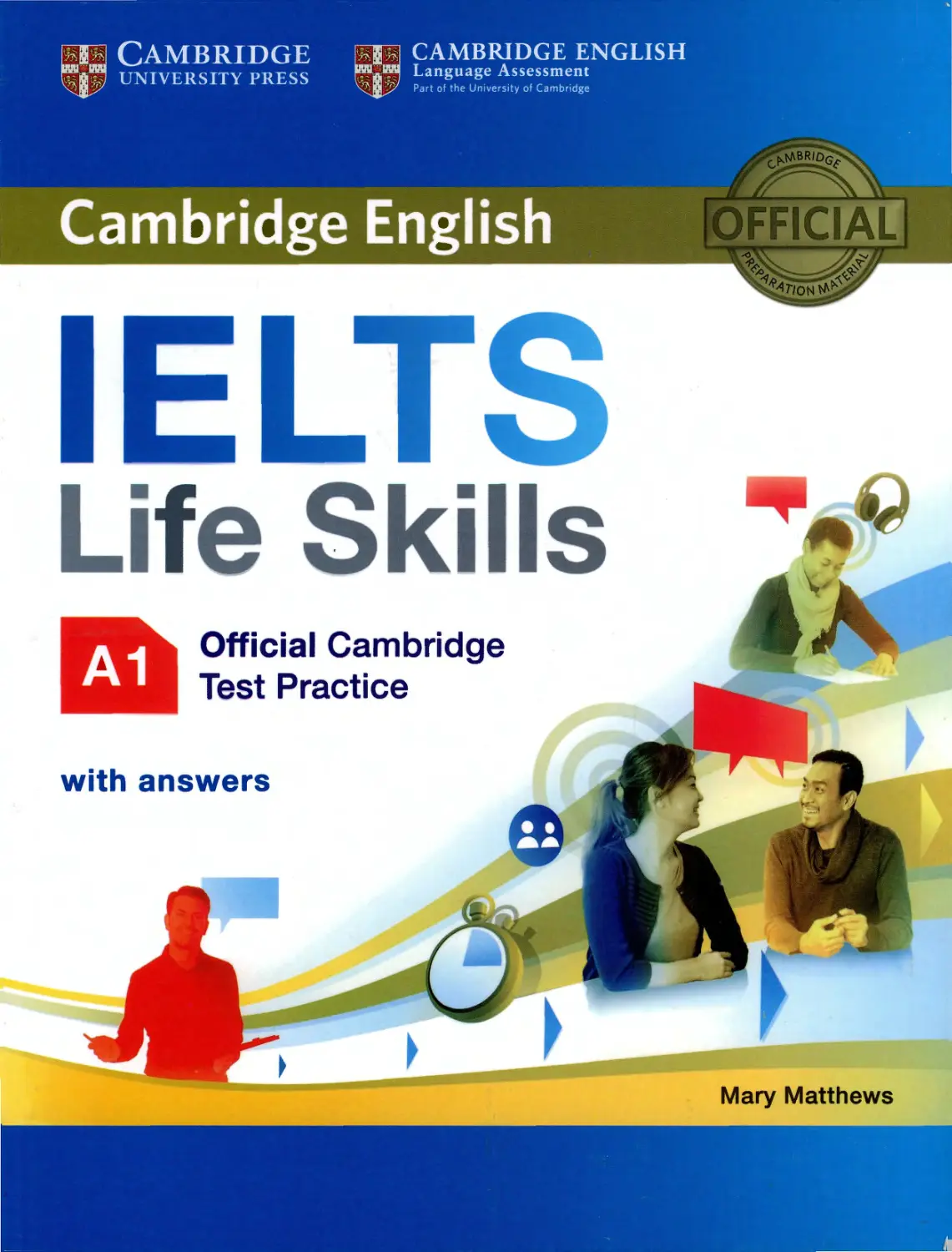
                    Life Skills
Official Cambridge
Test Practice
with answers
Mary Matthews

DOWNLOADABLE AUDIO
This is your downloadable audio activation code:
Do not share this activation code with anyone else.
This code can only be used once.
How do I activate my product?
O Go to: www.cambridgelms.org/main
Register on Cambridge Learning Management System (CLMS) as a
student and go to 'My Learning'.
Click on 'Activate new product' and follow the instructions on screen.
Teachers: Avoid delays - if you don't yet have a login for CLMS, register as
a student for this download. You can upgrade/change to teacher access
later with the help of your Cambridge University Press representative.
System requirements:
O Windows Vista, Windows 7, Windows 8, Windows 8.1
O Mac OSX 10.8 and 10.9
O JavaScript Enabled
O Minimum 3Mbps Internet Connection
Minimum browser versions supported:
O Internet Explorer 10 and 11, Safari 6.0 and 7.0, most recent versions of
Firefox and Chrome
Supported tablets
O iPad 4, optimised for iOS 7 and iOS 8 with Safari
O Samsung Galaxy Tab 2 10.1, optimised for Android 4.2 .2 with most recent
version of Chrome
Please note:
O Once the activation code has been revealed, this book cannot be returned.
O This activation code can only be used once, is personal to you, and cannot
be re-used by anyone else.
O Support for browsers and operating systems will vary over time. For the
latest information visit:
www.cambridgelms.org/main/p/frequentlyaskedquestions
O Full terms and conditions are available at:
www.cambridgelms.org/main/p/termsofuse

Life Skills
Official Cambridge
Test Practice
with answers
Mary Matthews

Cambridge University Press
www.cambridge.org/elt
Cambridge English Language Assessment
www.cambridgeenglish.org
Information on this title: www.cambridge.org/9 7813 16 5o 7124
© Cambridge University Press and UCLES 2016
This publication is in copyright. Subject to statutory exception
and to the provisions of relevant collective licensing agreements,
no r eproduction ofany part may take place without the written
permission of the publishers.
First published 2016
Printed in Italy by Rotolito Lombarda S.p .A
A catalogue record for this publication is available from the British Library
ISB N 978-1-316-50712-4 Student's Book with answers and Audio
ISBN 978-1-316-50711-7 Audio CDs (2)
The publishers have no responsibility for the persistence or accuracy of URLs
for external or third-party internet websites referred to in this publication, and
do not guarantee that any content on such websites is, or will remain, accurate
or appropriate. Information regarding prices, travel timetables, and other factual
information given in this work is correct at the time of first printing but the
publishers do not guarantee the accuracy of such information thereafter.

CONTENTS
Information about the IELTS Life Skills test
How to use this book
Tips for testing learners
Test 1
Test 2
Pictures for Test 1
Pictures for Test 2
Test 3
Test 4
Pictures for Test 3
Pictures for Test 4
Transcripts and Answer keys
Prompt questions for the teacher
Acknowledgements
4
5
6
8
16
24
25
26
34
42
43
44
54
55

TIPS FOR TESTING LEARNERS
The following t ips are designed to help any teacher give realistic,
authentic exam practice to their learners. The tips are designed to
be specific to the IELTS Ute Skills test, so they will be useful both
to more experienced teachers who are used to holding practice
tests and less experienced teachers who have not taken the role of
examiner with their learners before.
Practice tests are an essential part of preparation. They give
learners a clear idea of exactly what will happen during their test
and they are a valuable opportunity to deal with confusion and
misunderstandings before the real test. In this way, they help
learners to deal with exam nerves and apprehension. This is
obviously vital for those who have never taken a formal exam before
or those whose previous exam experience was many years ago.
However, in order for the practice test to be as useful as possible,
it is very important for the teacher to try to recreate exact test
conditions as much as possible. This involves finding a separate
space away from the rest of the class ~f the tests are being
conducted in lesson time) and careful preparation before the test.
Familiarise yourself with both the materials and the test format well
before the test and adopt the role of 'examiner', rather than 'teacher'
throughout. The more realistic you can make the practice test, the
more useful it will be for your learners. If possible, prepare some
feedback either for each pair or for the whole class for the lesson
following the practice tests. The feedback can either be on exam
skills, language used in the test, or both. This will mean the practice
tests are a valuable tool for development as well as assessment for
your learners.
Before the practice test
Room and furniture
•
Arrange a separate test area for the tests. It does not need to
be a classroom; a small office would be suitable, as long as it
is quiet and has a power point for the CD player.
•
Arrange the furniture in a suitable format before the test. You
will need one or two desks (depending on size) and three
chairs. You should sit slightly away from the 'candidates',
but not too far. The atmosphere should be formal but not
intimidating or unfriendly.
•
As far as you can, make sure that the candidates are not
sitting opposite a sunny window with the sun in their eyes.
Materials and equipment
•
Have enough paper and pencils for all the candidates to
take notes.
•
Check both the CD and the CD player before the test for any
problems.
6 I TIPS FOR TESTING LEARNERS
The test frame
•
Make sure you are thoroughly familiar with the test frame (i.e .
the words the examiner uses) and materials well before the
practice test; you can write some simple reminders on small
sticky notes to keep yourself organised during the test.
•
If possible, practise reading the test frame (script) with another
teacher beforehand to ensure that you are using a suitable
tone of voice and speed. Or you could record yourself and
play it back.
•
Try to make the script sound as natural as possible. Use an
appropriate speed for the level but keep your voice natural
and clear.
•
Emphasise key words naturally but clearly as A1 learners often
have problems hearing sentence stress.
The tasks
•
Ensure that you have chosen appropriate tasks, i.e. do not
choose a task relying on experience of education or training
for someone who has never attended school.
•
However, be careful not to choose materials you know
your learners like; you need to base your choice on how
appropriate they are for your learners, not if they will like them.
Timing
•
Experiment with different timing devices until you find the one
that is easiest to use. Timing is essential in this test. You need
to be able to count seconds. You are not allowed to use your
mobile phone for timing in the test.
•
Make sure the timing device is discreetly placed so only you
can see it and that it does not have a loud tick.
•
Do not look obviously at the timing device throughout the
exam. You need to keep a very close eye on t ime but keep it
to discreet glances.
Comfort
•
Make sure you have water to hand for yourself and the
candidates.
•
Keep t he temperature in the room as comfortable as possible.
•
Make sure you have a b reak of at least a couple of minutes
between each pair of candidates to f inish off the test scores
and prepare the materials for the next pair.
Marking
•
Ensure that you are completely familiar with the assessment
criteria and the marksheet.
•
If possible, arrange to test with anot her teacher t he first time
you do practice tests, i. e . t ake it in turns to be the examiner so
you can f eed back on each other's performance.

TIPS FOR TESTING LEARNERS
During the practice test
•
To keep the exams standardised and fair, it is essential to stick
to the test frame (script) with each pair of candidates.
•
If a candidate does not understand the instructions for a task,
first repeat the instructions more slowly from the script.
•
If the candidate still does not understand, break the
instructions down into easy-to-follow steps and give examples
to help them.
•
Do not try to rephrase the instructions completely unless you
are confident you can do it in language which suits the level of
the learners or you could confuse them more.
•
Never try to 'help' the candidate by using their first language,
even in a practice test. This would never happen in the real
test. Deal with the problem in feedback afterwards.
•
Do not fidget during the listening; it distracts the candidates.
•
Do not jump in too soon if the candidates hesitate or stumble.
Give them a few seconds to think or recover.
•
If communication breaks down completely in Phase 2b,
use the prompts at the back of the book (see page 54) to
encourage communication.
•
If using the prompts does not work, encourage three- way
communication by asking open but brief questions yourself
such as 'Why did you say you don't like public transport,
Ahmed?'
•
Do not 'join in ' with the activity, offering your own views and
opinions, even to encourage communication. Instead, ask
open q uestions (i.e . questions that can't be answered with just
Yes or No) to encourage the candidates to speak.
•
Use simple gestures during the exam to support the students
and cut down on any extra narrative from you, e.g . if the
learners start talking to you in Phase 1b and 2b, instead of
to each other, indicate with your hands that they should talk
together in a pair.This saves you having to interrupt and say
' Please talk to your partner.·
•
If one learner is dominating in Phase 1b or 2b, you will need to
encourage the quieter learner to speak, with questions such
as 'And what do you think?' or ' Do you have anything to say
about that? '
•
If one person continues t o dominate, you may have to politely
interrupt them and remind them to let the other person speak.
•
Sometimes, a learner is so nervous or has such a low level of
English that they do not speak in the test, or the other person
cannot understand them. In this case, you will need to help
the stronger one by taking part in the exam yourself, whilst
giving as much opportunity as possible for the quiet person to
join in if and when they can.
•
If you stumble while you are reading the script or if you make
a mistake, pause, apologise, go back to the beginning of the
sentence and start again .
TIPS FOR TESTING LEARNERS I 7

TEST 1
Phase 1a
@ 4-5 minutes
8 ITEST1
(9 This test should not exceed 18 minutes.
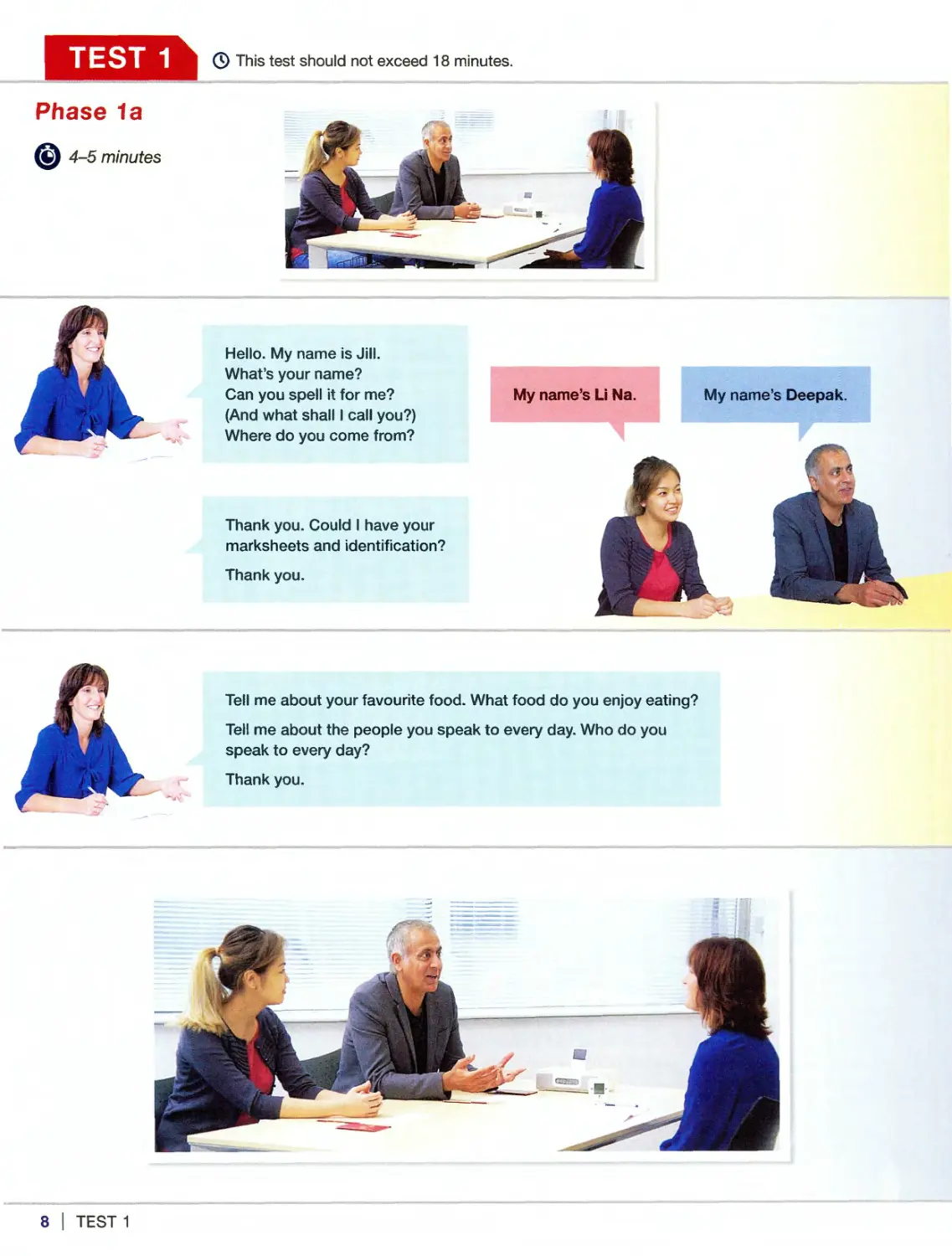
Hello. My name is Jill.
What's your name?
Can you spell it for me?
(And what shall I call you?)
Where do you come from?
Thank you. Could I have your
marksheets and identification?
Thank you.
My name's Li Na.
Tell me about your favourite food. What food do you enjoy eating?
Tell me about the people you speak to every day. Who do you
speak to every day?
Thank you.
---
----
---
-
:=====
·--
My name's Deepak.

1111111i;tm,m•""""'--
Test tips
•
Make sure you know how to spell your name .
•
Speak clearly so the examiner can hear you easily.
•
In the second part , try to give as much information as you can .
•
Use language you know wel l. Do not try to use language you
are not sure about.
1. The examiner will ask you and the other candidate questions about your name and nationality.
Look at the questions he or she w ill ask you.
(i) 2 . Listen to the examiner askin g each candidate:
Iii • their name
• to spell their name
• where they come from.
Listen carefully to their answers. The examiner can also ask 'What shall I ca ll you?' if they think you
use another name, for example, an English name.
Now it's your turn. Listen and answer the examiner's questions using the same sentences you heard
in the record in g.
Useful language
My name's . . . Please call me ... I come from ...
Next, the examiner will ask you and the other candidate questions about one or two different topics.
Listen to Deepak and Li Na. The examiner asks them about t heir favourite food and about the
people they speak to every day.
e 5. Now practise with a partner. Ask your partner these questions.
A: Tell me about your favourite food.
B: Tell me about the people you speak to every day.
Here are some ideas to he lp you:
• food from your country
• when you eat it
• who you eat it with
Useful language
I really like .. . because ...
I eat it for breakfast I lunch I dinner.
I usually eat this food with ...
Here are some ideas to help you:
• your friends and family
• people at work
• people you speak to in English
Useful language
Every day I speak to ...
At work I speak to ...
I always I sometimes speak Engl ish with ...
TEST1/9

TEST 1
Phase 1b
@ 5 minutes
10ITEST1
Now I'd like you to ask each other some questions.
Deepak, I'd like you to ask Li Na about a child she knows well.
Li Na, I'd like you to ask Deepak about the things he likes doing at quiet times.
Now think about the questions you want to ask. You have one and a half minutes.
You can write down your questions if you want to.
If you don't understand, please ask me.
Deepak, are you ready? Please ask Li Na your questions.
Thank you.
Li Na , are you ready? Please ask Deepak your questions.
Thank you.

TEST. 1 PRAem.1eE
'
.
'
"
.~
.
~-
-~~ --
-S OS <? ~N -''"""" "'''""-
...,
---.., ,.- =<' =° •7> ~ '<" ,_..,
Test tips
•
If you do not understand your partner's question , say ' I' m sorry I don 't understand '
or 'Can you repeat that, please? '
•
Try to ask your partner 'information questions'. For example , use questions words
like what, where and who.
•
Remember to use question words like do or does.
•
Answer your partner's questions clearly. Try not to give short answers like Yes or No .
1. Read the examiner's questions and write down some questions you could ask.
Learner A: think of questions to ask Learner B about a child he/she knows.
Learner B: think of questions to ask Learner A about what he/she does in quiet times.
Here are some ideas to help you.
Example questions
Learner A
How do you know this child?
Has he/she got brown I black I blonde hair?
Is he/she a happy I clever child?
Learner B
What do you like doing at quiet times?
Where do you do this?
Do you like listen ing to music?
What is he/she good at?
Do you always do this alone or with other people?
2. Listen to Deepak and Li Na asking each other questions about their topics. Listen carefully to the
questions they use.
3. Now practise asking questions and giving answers with your partner.
Try to use questions with what, when, who and where.
Learner A, I'd like you to ask Learner B about a child he/she knows well.
Learner B , I'd like you to ask Learner A about the things he/she likes doing at quiet times.
Here are some ideas to help you :
A CHILD YOU KNOW WELL
• family I friend I neighbour?
• age
• What does he/she like doing?
• Where ... live?
• hair, eyes
Useful language
He's/She's my .. .
He's/She's got .. .
He/She likes I doesn't like .. .
He 's/She's very I quite I a little bit ...
QUIET TIMES
• books, TV programmes, films
• writing to friends and family
• c ooking
• music you enjoy
• using the computer
Useful language
I really like I enjoy ...
I like doing this because ...
I prefer doing this in the morning I afternoon I
evening because . ..
I always do this alone because ...
I sometimes do this with other people because ...
e 4. When you finish , change topics with your partner an d do the activity agai n.
TEST1)11

TEST 1
Phase 2a
@ 4 minutes
12ITEST1
In this part of the test, you are going to listen to two recordings and answer
some questions. You can make notes if you want to.
You hear two people talking about college classes. Who is talking? A student ,
a parent, or a teacher?
Listen to the information.
Deepak, in the first recording , who is talking? A student, a parent, or a teacher?
Li Na , in the second recording , who is talking? A student, a parent, or a teacher?
Thank you.
Now listen again , and answer these questions.
Li Na, in the first recording, what does Mrs
Black teach? And how long is the course?
Deepak, in the second recording , what does
Mr Chang teach? And what number is the
classroom?
Thank you.

TEST 1 PRACTICE
Test tips
•
•
•
•
If you do not understand the questions , ask the examiner to repeat them .
Say, 'Can you repeat that, please?'
You can write the important words or even write the question in your own language .
The examiner will not look at your notes. They are not part of the exam .
Do not try to understand every word. Listen for the important words to get the mean ing .
These words are nouns , verbs , adjectives and adverbs.
You do not need to answer the questions in sentences . You can answer with one or two words .
You can practise this part of the test with a partner or alone.
If you do not have a partner, answer a// the questions.
In the test, the examiner will show you some pictures. Look at the pictures on page 24.
Then listen to the recording and answer the examiner's questions .
You can practise this part of the test with a partner or alone.
If you do not have a partner, answer a// the questions.
Listen to the two recordings again and answer the examiner 's questions.
3. Now listen to Li Na and Deepak doing this part of the test and check your answers.
TEST1/13

TEST 1
Phase 2b
@) 3-4 minutes
14ITEST1
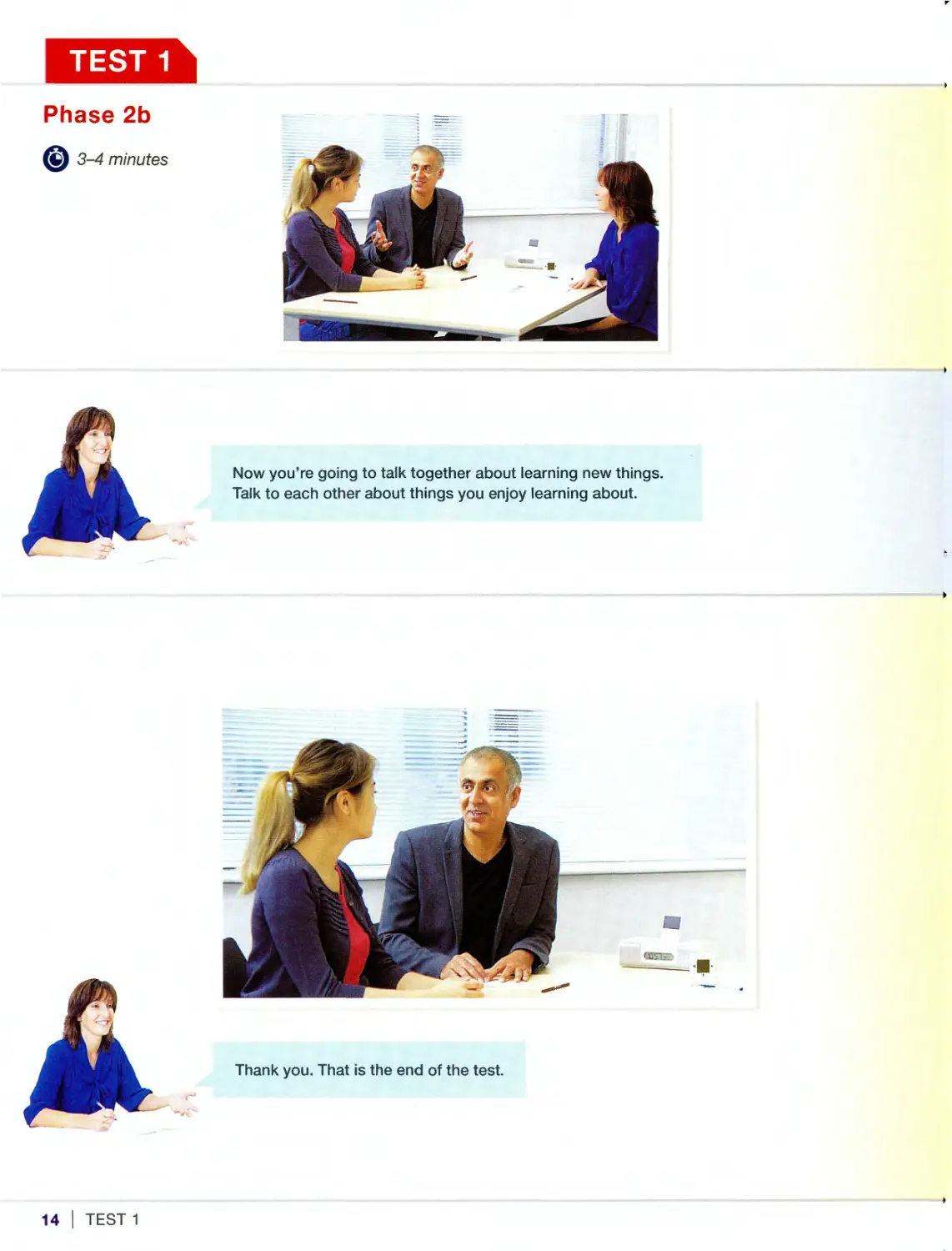
Now you're going to talk together about learning new things.
Talk to each other about things you enjoy learning about.
·==:::::__ ·• ·
Thank you. That is the end of the t est.

(i) 1.
i
Test tips
•
Remember you must give you r partner t ime to talk too . You ca n
ask your partner 'How/What about you? ' or 'What do you th ink? '
•
Listen to your partner and reply to what they say.
Don 't think about what to say next wh en t hey are talking .
•
Sometimes , people talk very quickly when th ey are ne rvous
in an exam. If you do this, try to slow down. Pause between
sentences to help your partner understand you.
•
Ifyou do not know a word,try to describe it.
Listen to Deepak and Li Na doing this part of the test. Listen to the way each person helps the other
person to speak as much as possible.
1---------- - ------,"-
'''·------------~---------------
e 2. Now practise talking wit h a partner about the same topic. Try to t alk for three to four minutes.
Think about:
LEARNING NEW THINGS
• other things you are learning no w
• How important is it to learn new things?
• your teachers
• How do you like to learn?
• Are you a good learner?
• What do you want to learn in the future ?
• favourite subjects at school
• learning English
Useful language
Why do you like learn ing new things?
Are you learning something at the moment?
What was the last thing you learned?
What do you want to learn in the future?
I like I enjoy I love learning new things because .. .
Learning new things is difficult, but ...
The last new thing I learned was . ..
The next thing I want to learn is ...
TEST1I15

TEST 2
Phase 1a
@ 4-5 minutes
16ITEST2
(9 This test should not exceed 18 minutes.
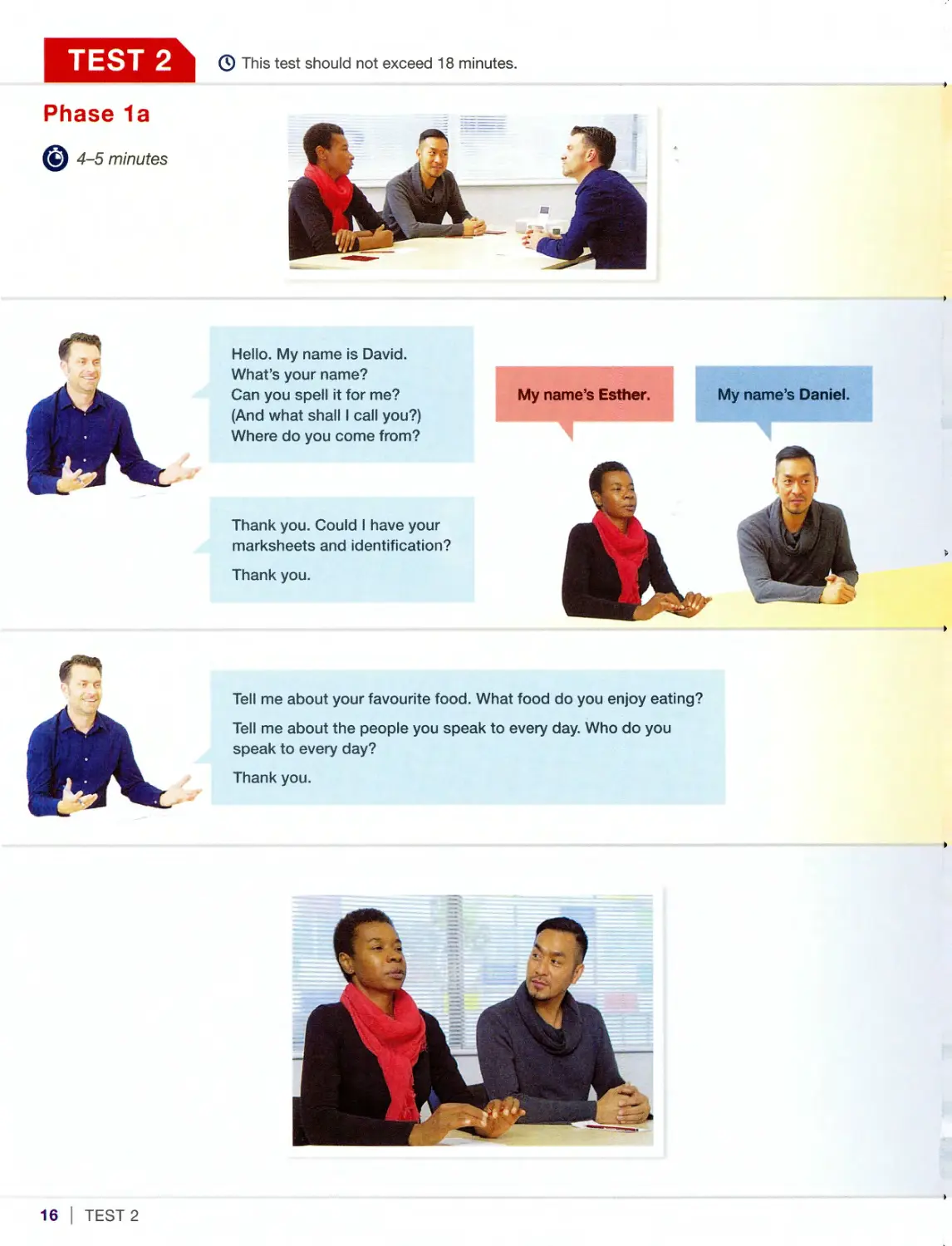
Hello. My name is David.
What's your name?
Can you spell it for me?
(And what shall I call you?)
Where do you come from?
Thank you. Could I have your
m arksheets and identification?
Thank you .
My name's Esther.
Tell me about your favourite food. What food do you enjoy eating?
Tell me about the people you speak to every day. Who do you
speak to every day?
Thank you.
My name's Daniel.

TEST 2 PRACTICE
Test tips
•
When you are speaking , remember to say I'm, not I am and I don't, not I do not.
•
You don't need to speak perfect English. The important thing is that people can understand you.
•
Answer the questions about the topic the examiner gives you. Do not start talking about other things.
•
Do not move around in the exam. This can make it difficult for your partner. Hold a pen or pencil to
give your hands something to do.
1. The examiner will ask you and the other candidate questions about you r name and nationality.
Look at the questions he or she will ask you.
Listen to the examiner asking each candidate:
• their name
• to spell their name
• where they come from.
Listen carefully to their answers. The examiner can also ask 'What shall I call you?' if they think you
use another name, for example, an English name.
Now it's your turn. Listen and answer the examiner's questions using the same sentences you he~!d
in the recording.
Useful language
My name's .. . Please call me ... I come from ...
Next, the examiner will ask you and the other candidate questions about one or two different topics.
Listen to Esther and Daniel. The examiner asks them about their favourite food and about the people
they speak to every day.
e 5. Now practise with a partner. Ask your partner these questions.
A: Tell me about your favourite food.
B: Tell me about the people you speak to every day.
Here are some ideas to help you :
• food you eat every day
• when you eat it
• English food
Useful language
We eat lots of ...
I eat it for breakfast I lunch I dinner.
We make it with ...
I usually eat this food with ...
Here are some ideas to help you:
• people in your family
• people at work
• people in your English classes
Useful language
Every day I speak to ...
At work I speak to ...
I always I sometimes speak English with ...
Sometimes I phone my ...
TEST2I17

TEST 2
Phase 1b
@) 5 minutes
18 ITEST2
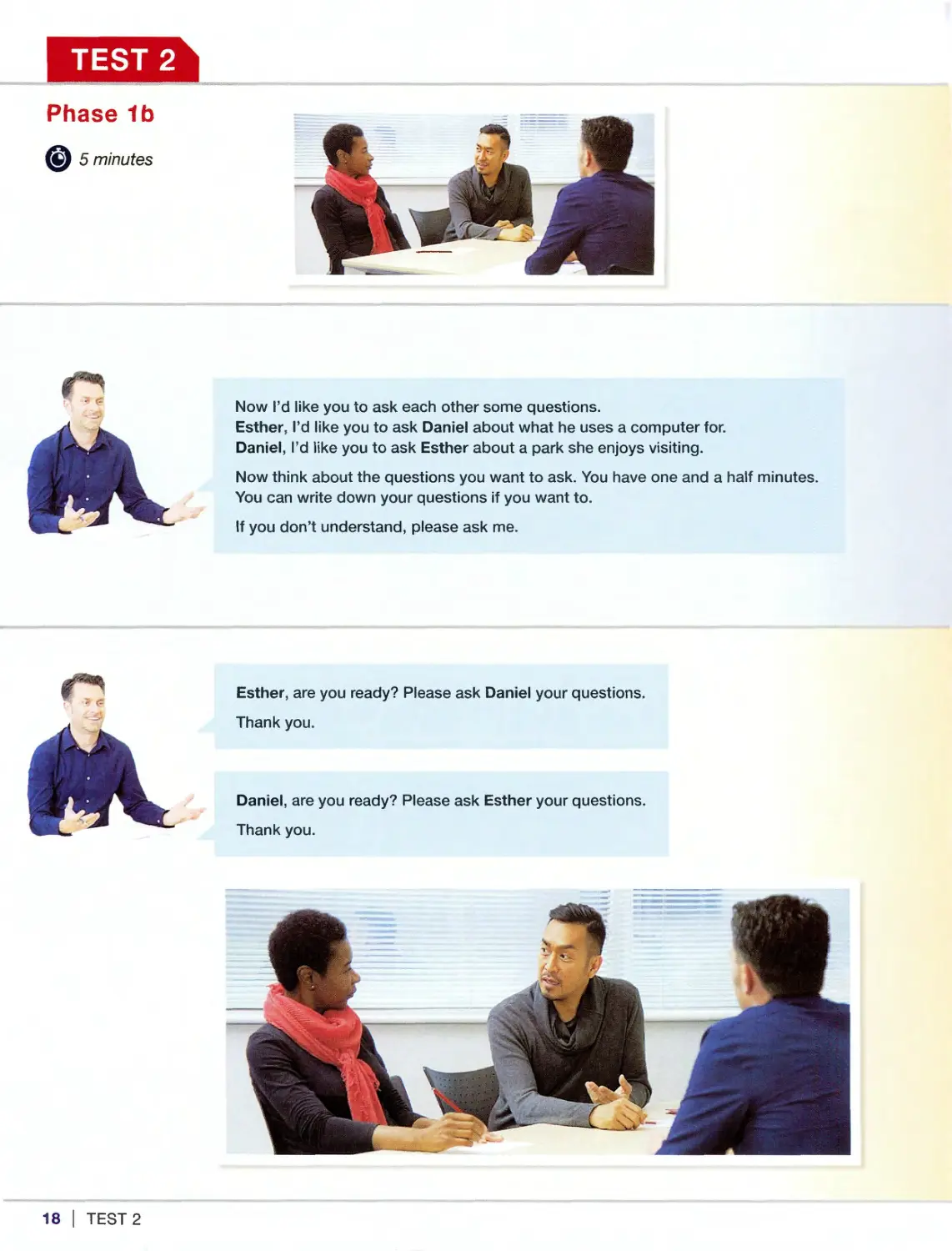
Now I'd like you to ask each other some questions.
Esther, I'd like you to ask Daniel about what he uses a computer for.
Daniel, I'd like you to ask Esther about a park she enjoys visiting.
Now think about the questions you want to ask. You have one and a half minutes.
You can write down your questions if you want to.
If you don't understand, please ask me.
Esther, are you ready? Please ask Daniel your questions.
Thank you.
Daniel, are you ready? Please ask Esther your questions.
Thank you.

-~---lititJR;tAillffl.________________ _
Test tips
•
Try not to say the same thing again and again .
•
Say what you think. Do not say what you think the examiner wants to hear.
•
Think about the correct word order in your questions.
•
Make sure you listen carefully to your partner. The examiner needs to know
how well you understand English . This is part of the test of your listening skills .
1. Read the examiner's questions and write down some questions you could ask.
Learner A: think of questions to ask Learner B about using a computer.
Learner B: think of questions to ask Learner A about a park he/she likes.
Here are some ideas to help you.
Example questions
Learner A
What do you like doing on your computer?
How often do you use your computer?
How many hours do you spend on your
computer every day I week I month?
Do you play games on your computer?
Learner B
Where is this park?
What do you like doing there?
What can children do in the park?
Can you describe this park?
Do you go to the park alone?
2. Listen to Esther and Daniel asking each other questions about their topics. Listen carefully to the
questions they use.
3. Now practise asking questions and giving answers with your partner.
Try to use questions with what , when, who and where.
Learner A, I'd like you to ask Learner B what he/she uses a computer for.
Learner B, I'd like you to ask Learner A about a park he/she enjoys visiting.
Here are some ideas to help you :
USING A COMPUTER
• playing games
• shopping
• the news
• talking or writing to friends
• work or studying
• keeping photos
Useful language
I use the computer for ...
I like ... on the computer
I need to use a computer for . ..
Computers are good for ...
A PARK
• meeting friends
• sports
• place for children to play
• things you can see
• Is it near your home?
• different people who go there
Useful language
I like I love this park because ...
My children can ... in this park.
I like I enjoy ... there.
Igotothisparkto...
e 4. When you finish, change topics with your partner and do the activity again.
TEST2I19

TEST 2
Phase 2a
Ct) 4 minutes
20/TEST2
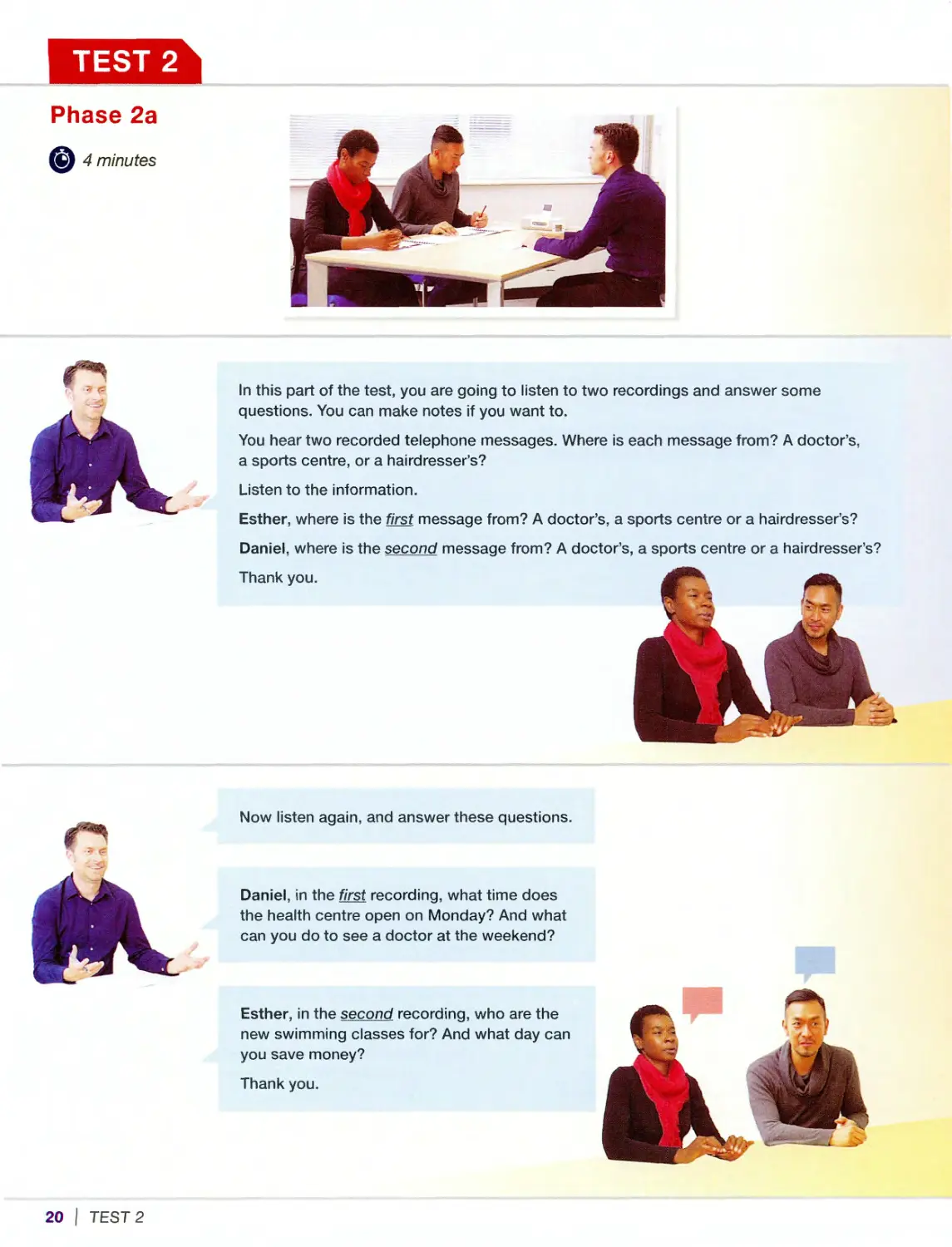
In this part of the test, you are going to listen to two recordings and answer some
questions. You can make notes if you want to.
You hear two recorded telephone messages. Where is each message from? A doctor's ,
a sports centre, or a hairdresser's?
Listen to the information.
Esther, where is the first message from? A doctor's, a sports centre or a hairdresser's?
Daniel , where is the second message from? A doctor's , a sports centre or a hairdresser's?
Thank you .
Now listen again , and answer these questions.
Daniel , in the first recording , what time does
the health centre open on Monday? And what
c an you do to see a doctor at the weekend?
Esther, in the second recording, who are the
new swimming classes for? And what day can
you save money?
Thank you.

Test tips
•
Only listen for the answers to your questions . Do not try to listen for
your partner's answers.
•
You do not have to write down the questions. You can listen carefu ll y
and remember them.
•
Remember the exam iner will ask you three questions . Your first question
is about one recording, then two more questions on the other recording.
•
Try not to worry. Breathe slowly and stay calm .
You can practise this part of the test with a partner or alone.
If you do not have a partner, answer all the questions.
In the test , the exam iner w ill show you some pictures. Look at the pictures on page 25.
Then listen to the recording and answer the examiner 's questions .
You can practise this part of the test with a partner or alone.
If you do not have a partner, answer all the questions.
Listen to the two recordings again and answer the examiner 's questions.
3. Now listen to Esther and Daniel doing this part of the test and check your answers.
TEST2I21

TEST 2
Phase 2b
@ 3-4 minutes
22ITEST2
Now you're going to talk together about the food you eat. Talk to each
other about the food that's good for you and food that's bad for you.
Thank you. That is the end of the test.

e2.
Test tips
•
Try to help your partner by asking questions like 'Why do you
think that?' or 'Te ll me more about that. '
•
Look at your partner when you are talking to them.
•
Try to make this part of the test like a normal conversation .
•
You do not need to talk without stopping. Everyone needs time
to think in a conversation .
Listen to Esther and Daniel doing this part of the test. Listen to the way each person helps the other
person to speak as much as possible.
Now practise talking with a partner about the same topic . Try to talk for three to four minutes.
Talk together about the food that 's good for you and food that 's bad for you.
Think about:
GOOD AND BAD FOOD
• food in your country
• British food
• the food you eat every day
• healthy and unhealthy food you like
Useful language
Do you think you eat healthy food? Why?
What kind of things do you eat every day?
Which food from your country is good for you?
Do you like some unhealthy food?
Do your children eat healthy I unhealthy food?
I like to eat healthy food because ...
We usually eat ...
Most days we eat ...
• cooking
• food on special days
• eating with your family
• fast food
The food from my country is healthy I unhealthy because . ..
On special days we eat . ..
I think English food is ...
TEST2 I23

PICTURES FOR TEST 1
a student
a parent
a teacher
24 I PICTURES FOR TEST 1

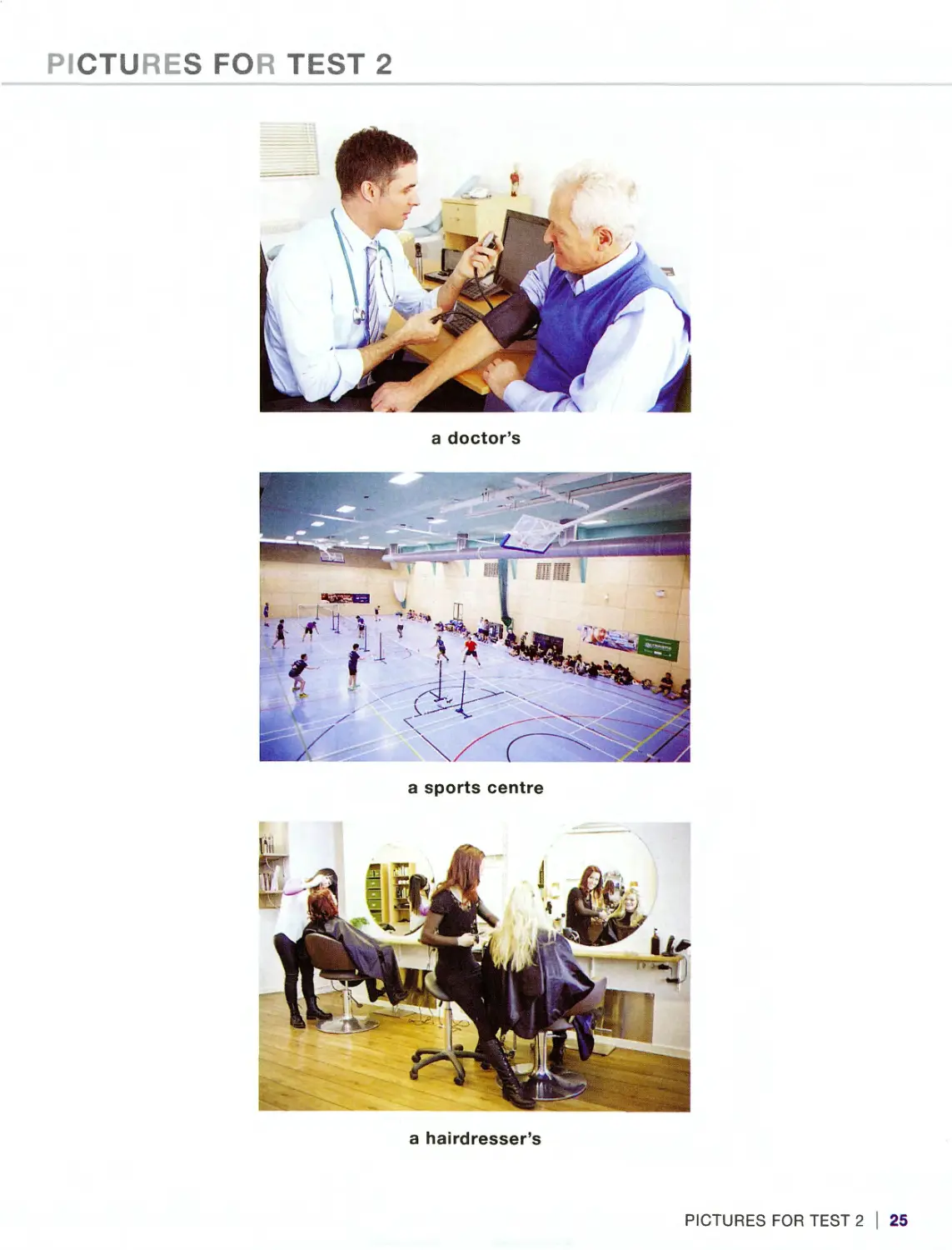
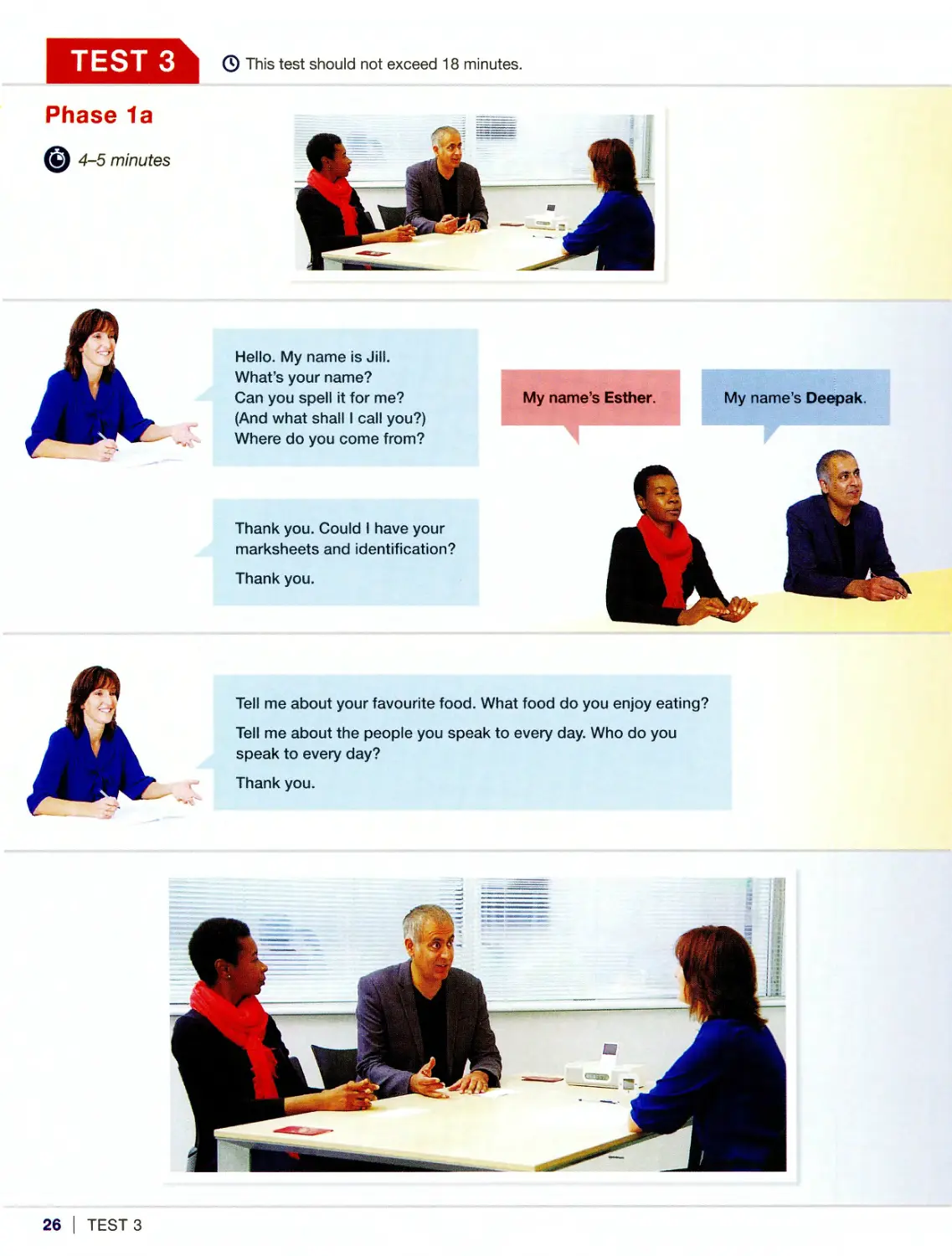
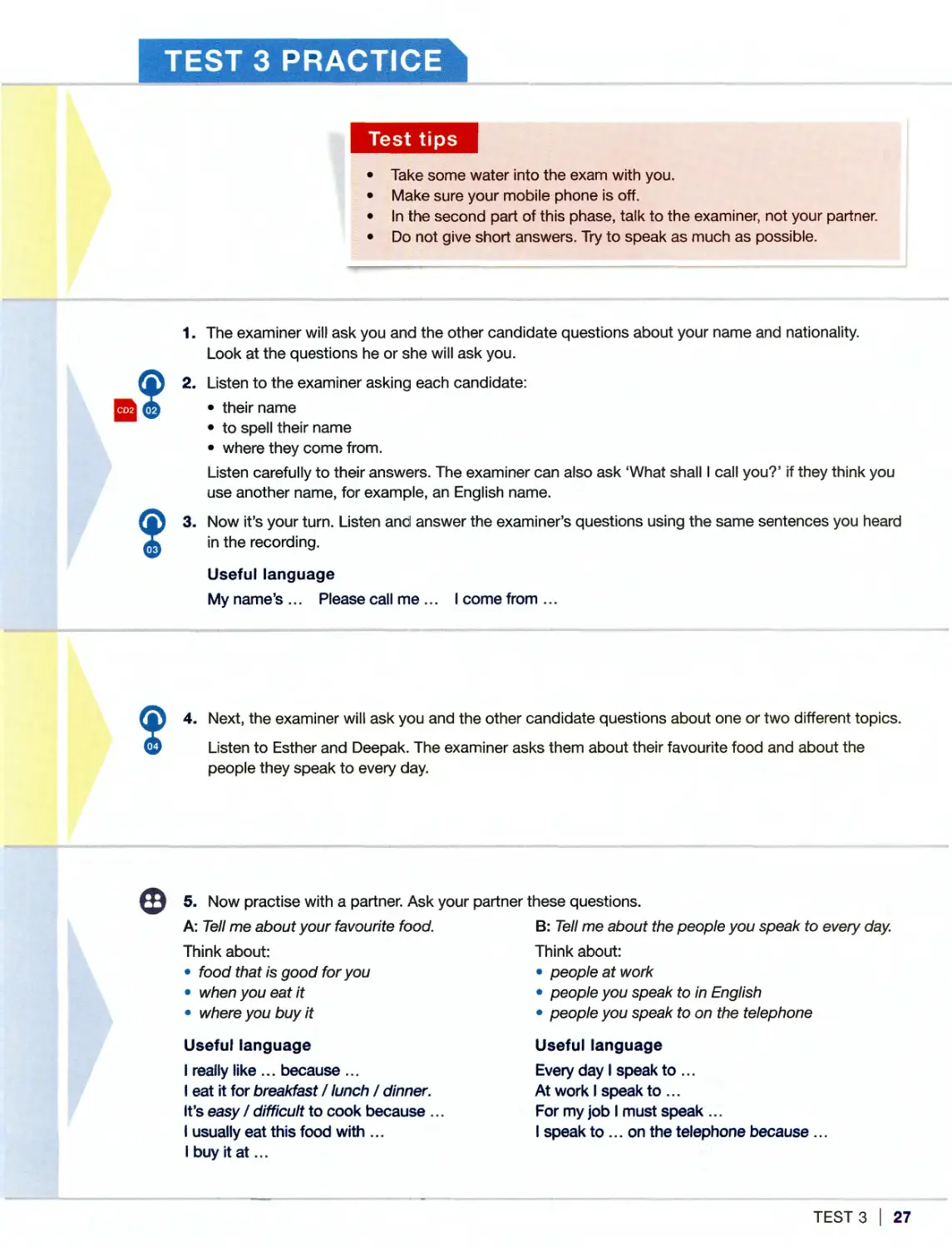
PICTURES FOR TEST 2
a doctor's
a sports centre
a hairdresser's
PICTURES FOR TEST 2 I 25

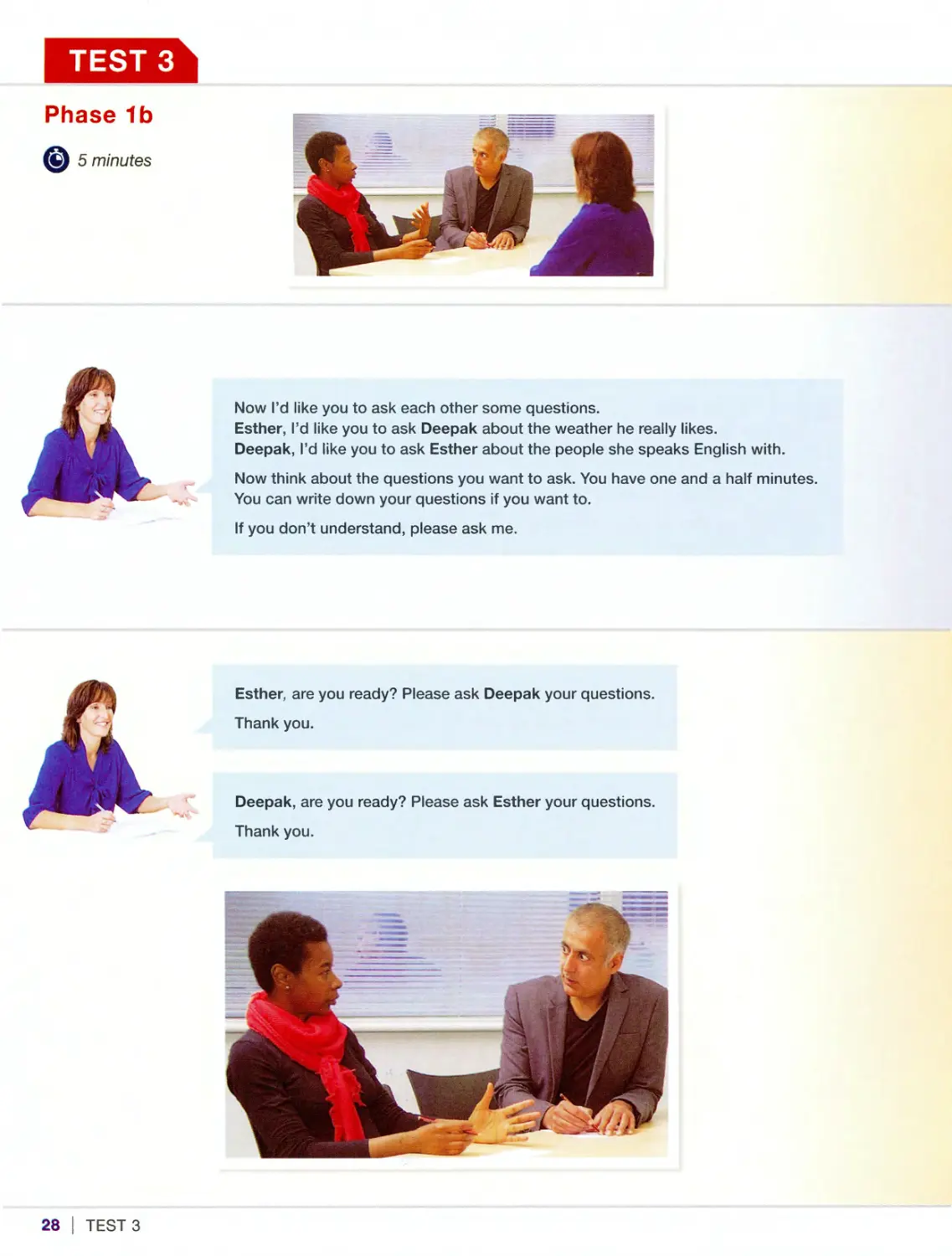
TEST 3
Phase 1a
@) 4-5 minutes
26ITEST3
(9 This test should not exceed 18 minutes.
Hello. My name is Jill.
What's you r name?
Can you spell it for me?
(And what shall I call you?)
Where do you come from?
Thank you . Could I have your
marksheets and identification?
Thank you.
My name's Esther.
Tell me about your favourite food. What food do you enjoy eating?
Tell me about the people you speak to every day. Who do you
speak to every day?
f'
Thank you.
~-=====-
___
---
---
---
--
My name's Deepak.

TEST 3 PRACTICE
Test tips
•
Take some water into the exam with you.
•
Make sure your mobile phone is off.
•
In the second part of this phase, talk to the examiner, not your partner.
•
Do not give short answers. Try to speak as much as possible.
1. The examiner will ask you and the other candidate questions about yo ur name and nationality.
Look at the questions he or she will ask you.
2. Listen to the examiner aski ng each candidate:
• their name
• to spell their name
• whe re they come from.
Listen carefully to their answers. The examiner can also ask 'What shall I call you? ' if they think you
use another name, for example, an English name .
Now it's your turn. Listen an d answer the examiner's questions using the same sentences you heard
in the recording .
Useful language
My name's . .. Please call me ... I come from ...
Next, the examiner will ask you and the other candidate questions about one or t wo different topics.
Listen to Esther and Deepak. The examiner asks them about their fav ourite food and about the
people they speak to every day.
e 5. Now practise with a partner. Ask your part ner these q uestions.
A: Tell me about your favourite food.
B: Tell me about the people you sp eak to every day.
Think about:
Think about:
• food that is good for you
• when you eat it
• where you buy it
Useful language
I really like ... because .. .
I eat it for breakfast I lunch I dinner.
It's easy I difficult to cook because ...
I usually eat this food with .. .
lbuyitat .. .
• people at work
• people you speak to in English
• p eople you speak to on the telephone
Useful language
Every day I speak to ...
At work I speak to ...
For my job I must speak ...
I speak to . .. on the telephone because .. .
TEST3I27

TEST 3
Phase 1b
@ 5 minutes
28ITEST3
Now I'd like you to ask each other some questions.
Esther, I'd like you to ask Deepak about the weather he really likes.
Deepak, I'd like you to ask Esther about the people she speaks English with.
Now think about the questions you want to ask. You have one and a half minutes.
You can write down your questions if you want to.
If you don't understand, please ask me.
Esther, are you ready? Please ask Deepak your questions.
Thank you.
Deepak, are you ready? Please ask Esther your questions.
Thank you.

TEST 3 PRACTICE
Test tips
•
You can 't ask the examiner to tell you words in the exam.
•
If you can't remember a word , try to use other words.
•
Use language like 'That's interesting' or 'That's good ' when your partner speaks.
•
Do not speak to the examiner in this part of the exam. Speak to your partner.
1 . Read the examiner's questions and write down some questions you could ask.
Learner A: think of questions to ask Learner B about the weather he/she likes.
Learner B: think of questions to ask Learner A about who he/she speaks English with.
Here are some ideas to help you.
Example questions
Learner A
Learner B
What kind of weather do you have in your country?
Do you like the weather in your country I in the UK?
What do you do when the weather's good I bad?
How do you feel when the weather's good I bad?
Do you always speak English in you r
English lessons?
Do you like speaki ng English?
Is it difficult to speaking English?
What is easy I difficult for you in Eng lish ?
2. Listen to Esther and Deepak asking each other questions about their topics. Listen carefully to the
questions they use.
3. Now practise asking questions and giving answers with your partner.
Try to use questions with what, when, who and where.
Learner A, I'd like you to ask Learner 8 about the weather he/she really likes.
Learner 8 , I'd like you to ask Learner A about the people he/she speaks English with.
Here are some ideas to help you :
WEATHER
PEOPLE YOU SPEAK ENGLISH TO
• the weather in your country I the UK
• family and friends
• weather you like I love
• people at work
• weather you don't like I hate
• in English lessons
• how good weather makes you feel
• in shops I at the doctor's
• how bad weather makes you feel
• on the telephone
• what you like to do in good I bad weather • What is difficult about speaking English?
Useful language
I love sunny I rainy I hot I cold I windy
weather because ...
When the weather's goodI bad, I like to ...
GoodI Bad weather makes me feel ...
In my country, the weather's a/way s I
sometimes ...
Useful language
Speaking English is easy I difficult because ...
I like speaking English because . ..
I must speak English when ...
It's important to sp eak English b ecause . . .
e 4. When you finish, change topics with your partner and do the activity again .
TEST3 I29

TEST 3
Phase 2a
@ 4 minutes
30ITEST3
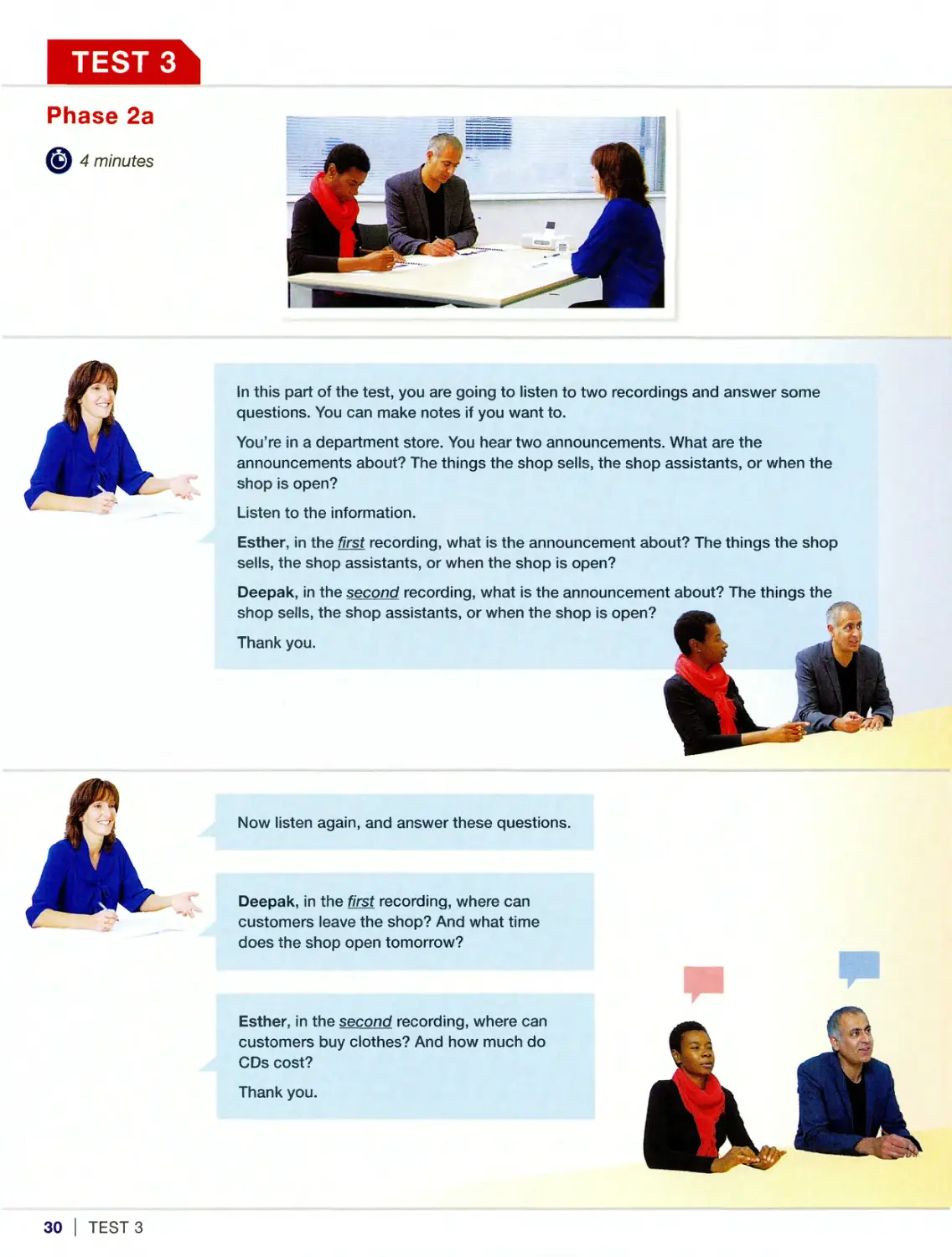
In this part of the test, you are going to listen to two recordings and answer some
questions. You can make notes if you want to.
You 're in a department store. You hear two announcements. What are the
announcements about? The things the shop sells, the shop assistants, or when the
shop is open?
Listen to the information.
Esther, in the first recording, what is the announcement about? The things the shop
sells, the shop assistants, or when the shop is open?
Deepak, in the second recording, what is the announcement about? The things the
shop sells, the shop assistants, or when the shop is open?
Thank you .
Now listen again, and answer these questions.
Deepak, in the first recording, where can
customers leave the shop? And what time
does the shop open tomorrow?
Esther, in the second recording, where can
customers buy clothes? And how much do
CDs cost?
Thank you.
IIJIII

TEST 3 PRACTICE
.....
"'"""
= =. r=,o
Test tips
•
Remember there are two recordings. The examiner will tell you which
recording to listen to. If you are not sure, ask the examiner.
•
If you don't understand an important word, do not stop listening .
Often the speaker says the word again.
•
You can write the answer down when you hear it.
•
Close your eyes or look at the table to help you listen. Do not look at the
examiner or your partner.
You can practise this part of the test with a partner or alone.
If you do not have a partner, answer all the questions.
In the test, the examiner will show you some pictures. Look at the pictures on page 42 .
Then listen to the recording and answer the examiner's questions.
2. You can practise this part of the test with a partner or alone.
If you do not have a partner, answer all the questions.
Listen to the two recordings again and answer the examiner's questions.
3. Listen to Esther and Deepak doing this part of the test and check your answers .
TEST3 \31

TEST 3
Phase 2b
@ 3-4 minutes
32 / TEST3
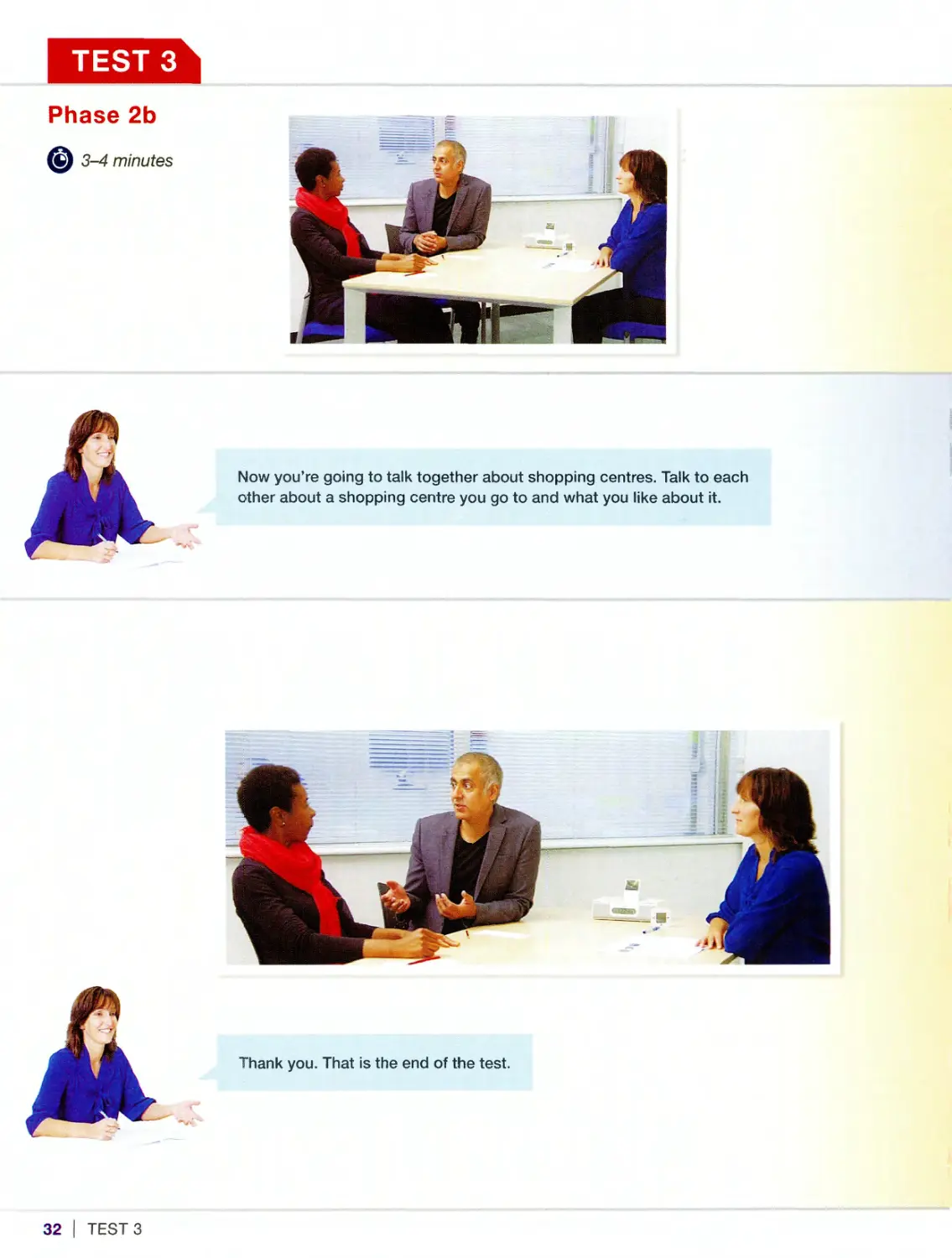
Now you're going to talk together about shopping centres. Talk to each
other about a shopping centre you go to and what you like about it.
Thank you. That is the end of the test.

111-111a;L121m•----------------
(i) 1.
i
e2.
Test tips
•
If you and your partner can't think of anything to say, the examiner will ask questions to
help you.
•
Do not try to talk about difficult things. The exam is testing your English , not your ideas.
•
You can 't speak your own language w ith your partner in the test.
•
If you do not think the same thing as your partner, say 'That's interesting , but I think ... '
Listen to Esther and Deepak doing this part of the test. Listen to the way each person helps the
other person to speak as much as possible.
Now practise talking with a partner about the same topic. Try to talk for three to four minutes.
Think about:
SHOPPING CENTRES
• things I like about shopping centres
• things I don 't like about shopping centres
• different kinds of shops
• places to eat
• places for children to play
• cinemas
Useful language
Do you go to shopping centres in your country?
What other things can you do in shopping centres?
Who do you go shopping with?
• meeting friends
• Who do you go to shopping centres with?
• How often do you go to shopping centres?
• Are they expensive?
• other places to shop, for example, markets,
small shops
Why do you like markets I small shops more than shopping centres?
My favourite shop in my shopping centre is .. .
I go to the shopping centre with ...
Shopping centres are different in my country because . ..
I go to the shopping centre to ...
TEST3 I33

TEST 4
Phase 1a
@ 4-5 minutes
34 ITEST4
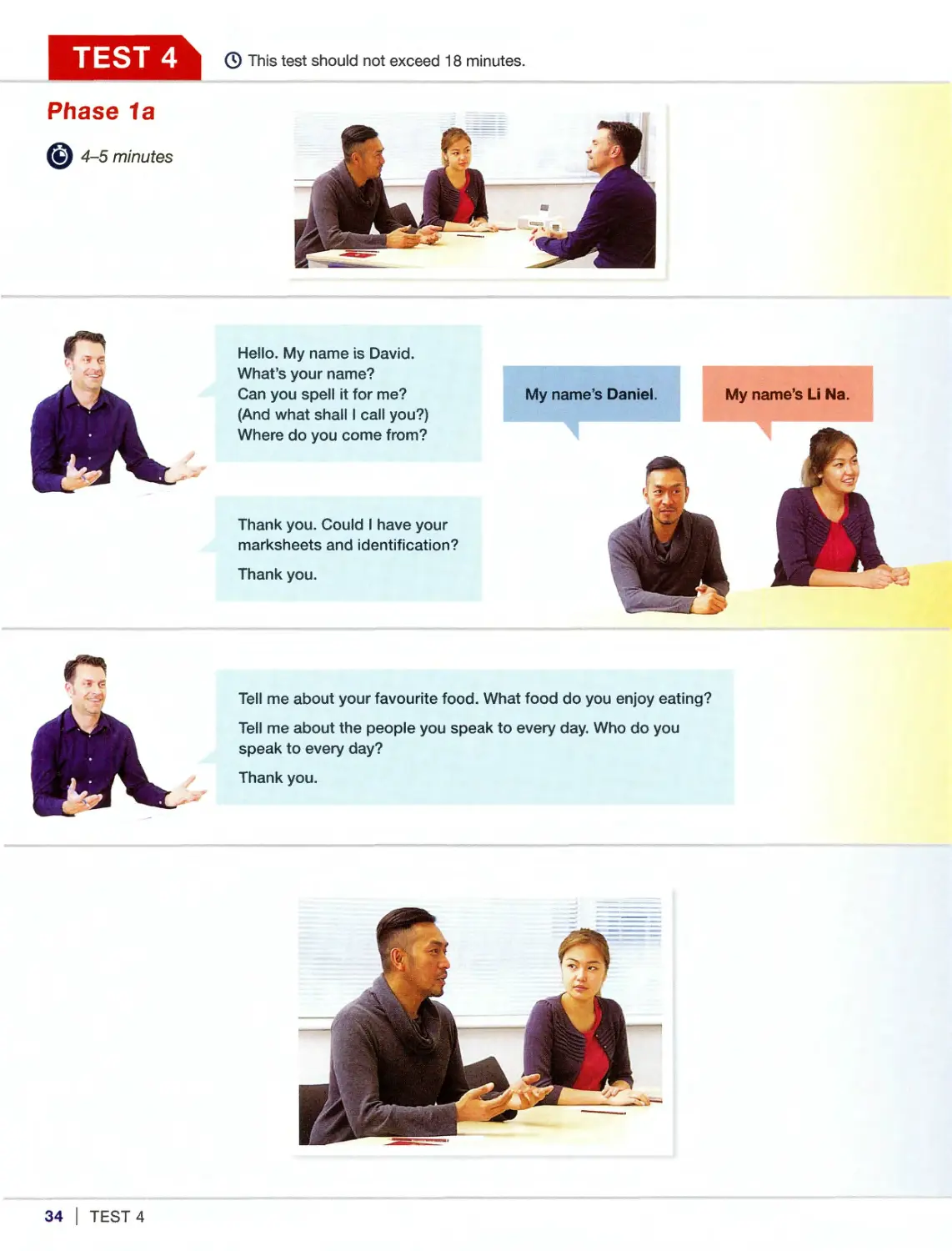
(9 This test should not exceed 18 minutes.
Hello. My name is David.
What's your name?
Can you spell it for me?
(And what shall I call you?)
Where do you come from?
Thank you. Could I have your
marksheets and identification?
Thank you.
My name's Daniel.
Tell me about your favourite food. What food do you enjoy eating?
Tell me about the people you speak to every day. Who do you
speak to every day?
Thank you.
My name's Li Na.

TEST 4 PRACTICE
'----
.. ,...... _~..
"" '.
-
"""
... ,,,
Test tips
•
Do not take lots of things into the test room with you. Put them in another room if you can.
•
Before the test, when you are waiting, speak English with your partner to practise.
•
Do not try to use difficult words in the test.
•
If you make a mistake when you say a word, try to say it again .
1. The examiner will ask you and the other candidate questions about your name and nationality.
Look at the questions he or she will ask you.
Listen to the examiner asking each candidate:
• their name
• to spell their name
• where they come from.
Listen carefully to their answers. The examiner can also ask 'What shall I call you? ' if they think you ·
use another name, for example, an English name.
Now it's your turn. Listen and answer the examiner's questions using the same sentences you heard
in the recording .
Useful language
My name's . . . Please call me ... I come from ...
Next, the examiner will ask you and the other candidate questions about one or two different topics.
Listen to Li Na and Daniel. The examiner asks them about their favourite food and about the people
they speak to every day.
e 5. Now practise with a partner. Ask your partner these questions.
A: Tell me about your favourite food.
B: Tell me about the people you speak to every day.
Here are some ideas to help you :
• food that is different from British food
• who cooks it
• where you buy it
Useful language
I really like .. . because ...
It's easy I difficult to cook because . ..
For lunch I tea I usually have ...
Ibuyitat... .
Here are some ideas to help you:
• people at work
• people you speak to in English
• people you speak to on the telephone
Useful language
Every day I speak to ...
At work I speak to ...
It's easy to speak ...
. . . is difficult for me.
TEST4 I35

TEST 4
Phase 1b
@ 5 minutes
36\TEST4
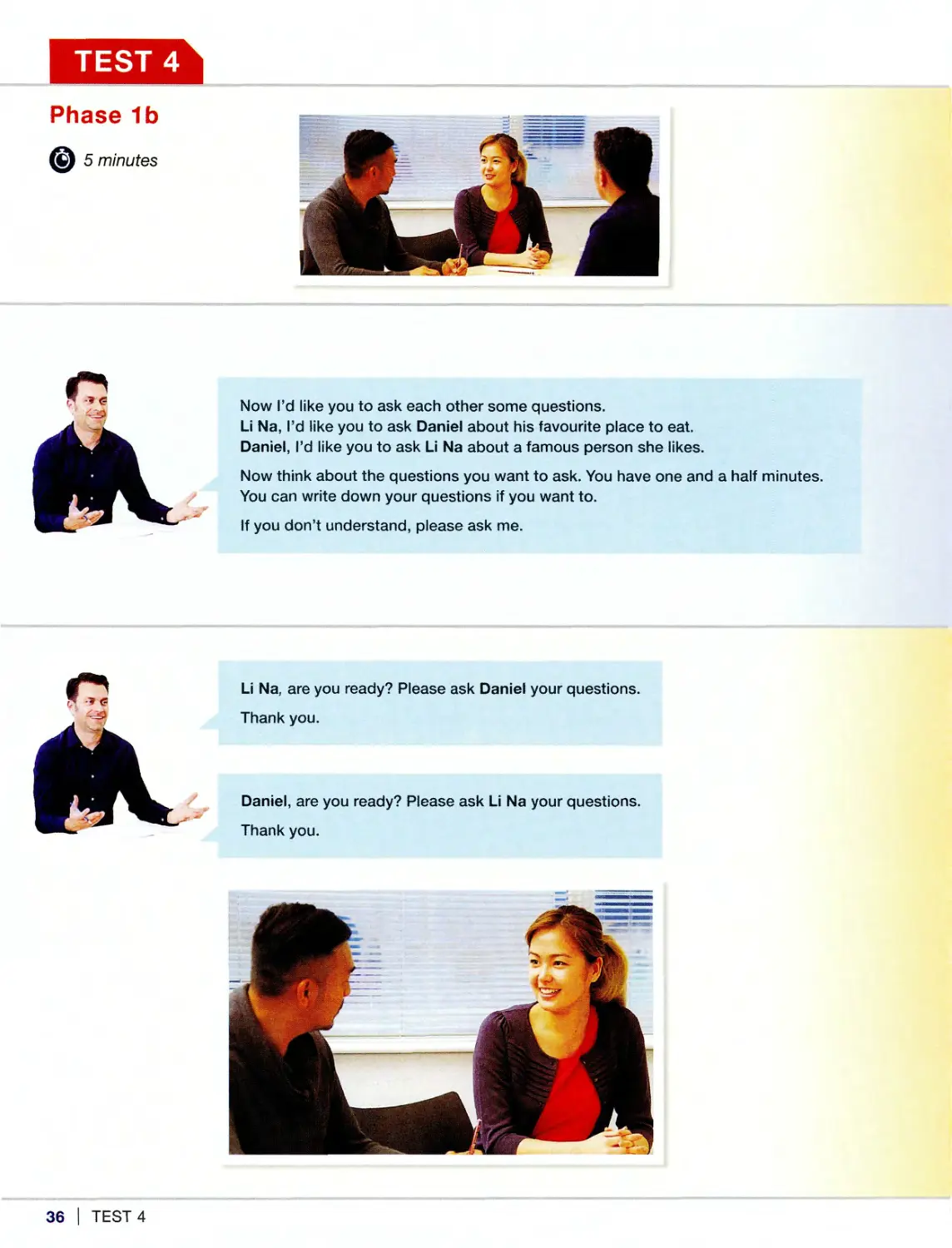
Now I'd like you to ask each other some questions.
Li Na, I'd like you to ask Daniel about his favourite place to eat.
Daniel, I'd like you to ask Li Na about a famous person she likes.
Now think about the questions you want to ask. You have one and a half minutes.
You can write down your questions if you want to.
If you don't understand, please ask me.
Li Na, are you ready? Please ask Daniel your questions.
Thank you .
Daniel, are you ready? Please ask Li Na your questions.
Thank you.

Test tips
•
If you can't hear your partner, say 'Sorry, I can't hear you. Can you repeat that , please? '
•
If you make a mistake in the question, start the question again.
•
If your partner doesn't understand your question, try to say it again in a different way.
•
Do not look at your notes when you ask the questions. Look at your partner.
1. Read the examiner's questions and write down some questions you could ask.
Learner A: think of questions to ask Learner B about his/her favourite place to eat.
Learner B: think of questions to ask Learner A about a famous person he/she likes.
Here are some ideas to help you.
Example questions
Learner A
What kind of food can you get there?
Why do you like the food there?
Do lots of people go there? Why?
Is it expensive or cheap?
Learner B
What does this person do?
Are they famous in you r cou ntry?
Why do you like this perso n?
What do you know about this person?
2. Listen to Li Na and Daniel asking each other questions about their topics. Listen carefully to the
questions they use.
3. Now practise asking questions and giving answers with your partner.
Try to use questions with what, when , who and where.
Learner A, I'd like you to ask Learner B about his/her favourite place to eat.
Learner 8 , I 'd like you to ask Learner A about a famous person he/she likes.
Here are some ideas to help you :
FAVOURITE PLACE TO EAT
• where it is
• the kind of food they have
• the price of the food
• the people who work there
• how often you go there
• who you go there with
Useful language
The food's very .. .
It's a nice place to go because .. .
Lots of people go there because . ..
The people who work there are . . .
FAMOUS PERSON
• a famous person in your country I the world
• a person from the past who is famous
• why they are famous
• why you like them
• how you can find information ab out them - T\I,
newspaper, internet
• Are they important?
Useful language
This person's famous because .. .
I think this person is ...
They' re important (in my country) because .. .
I like this person because . ..
e 4. When you finish , change topics with your partner and do the activity again.
TEST4 [37

Phase 2a
@ 4 minutes
38 ITEST4
In this part of the test, you are going to listen to two recordings and answer some
questions. You can make notes if you want to.
You hear some people talking. Where are they? In a bank, in a travel agent's, or in a post
office?
Listen to the information.
Li Na, in the first recording , where are they? In a bank, in a travel agent's, or in a post
office?
Daniel, in the second recording, where are they? In a bank, in a travel agent's, or in a
post office?
Thank you.
Now listen again, and answer these questions.
Daniel , in the first recording, who is the
woman sending the parcel to? And how much
does it cost to send it?
Li Na, in the ~econd recording, who does t he
man want to visit in Germany? And how much
does it cost to travel to New York?
Thank you.

Test tips
•
Make sure you can understand times eas ily and quickly.
For example, six o'clock or 8:30 am I half past eight.
•
You can't ask the examiner to play the record ing again .
•
Make sure you can understand dates easily and quickly.
For example , the 9th of February.
•
Do not stop listen ing because you th ink you know the answer.
Listen to the end of the recording to be sure.
You can practise this part of the test with a partner or alone .
If you do not have a partner, answer all the questions.
In the test , the exam iner will show you some pictures. Look at the pictures on page 43.
Then listen to the recording and answer the exam iner's questions.
2 . You can practise this part of the test with a partner or alone.
If you do not have a partner, answer all the questions.
Listen to the two recordings again and answer the examiner' s questions.
3. Now listen to Li Na and Daniel doing this part of the test and check your answers .
TEST4I39

Phase 2b
@ 3-4 minutes
40 \TEST4
Now you ' re going to talk together about things you have to do in town. Talk
to each other about which places you go to and what you have to do there.
Thank you. That is the end of the test.

TEST 4 PRACTICE
e2.
Test tips
•
Ask your partner 'Shall I start?' or ' Do you want to start?' in this activity.
•
If your partner is speakin g too much, say 'Excuse me , can I speak now? '
Do not ask the examiner 'Was I good?' or 'Was I bad?' after the test. They can 't tell you.
Do not try to take your notes from the test with you when yo u fini sh .
Listen to Li Na and Daniel doing this part of the test. Listen to the way each person helps the other
person to speak as much as possible.
Now practise talking with a partner about the same topic . Try to t alk for three to fo ur minutes.
Think about:
PLACES IN TOWN
• places - the bank, the post office, the
travel agent's, the supermarket, the
doctor's, children 's clothes shops
• why you like I don 't like these places
• how often you go to these places
• how you travel there
Useful language
When do you have to go into town?
Are the people who work there nice?
Do the people help you? How?
• Do you go with other people?
• Do you speak English there ?
• the people who work in these places
• Do you want to work in one of these
places?
Do you want to work in a bank I post office I travel agent's? Why? Why not?
I have to go to town when ...
I don't like going to the ... because .. .
The people who work there are .. .
I think it's a good job because .. .
TEST4 I41

PICTURES FOR TEST 3
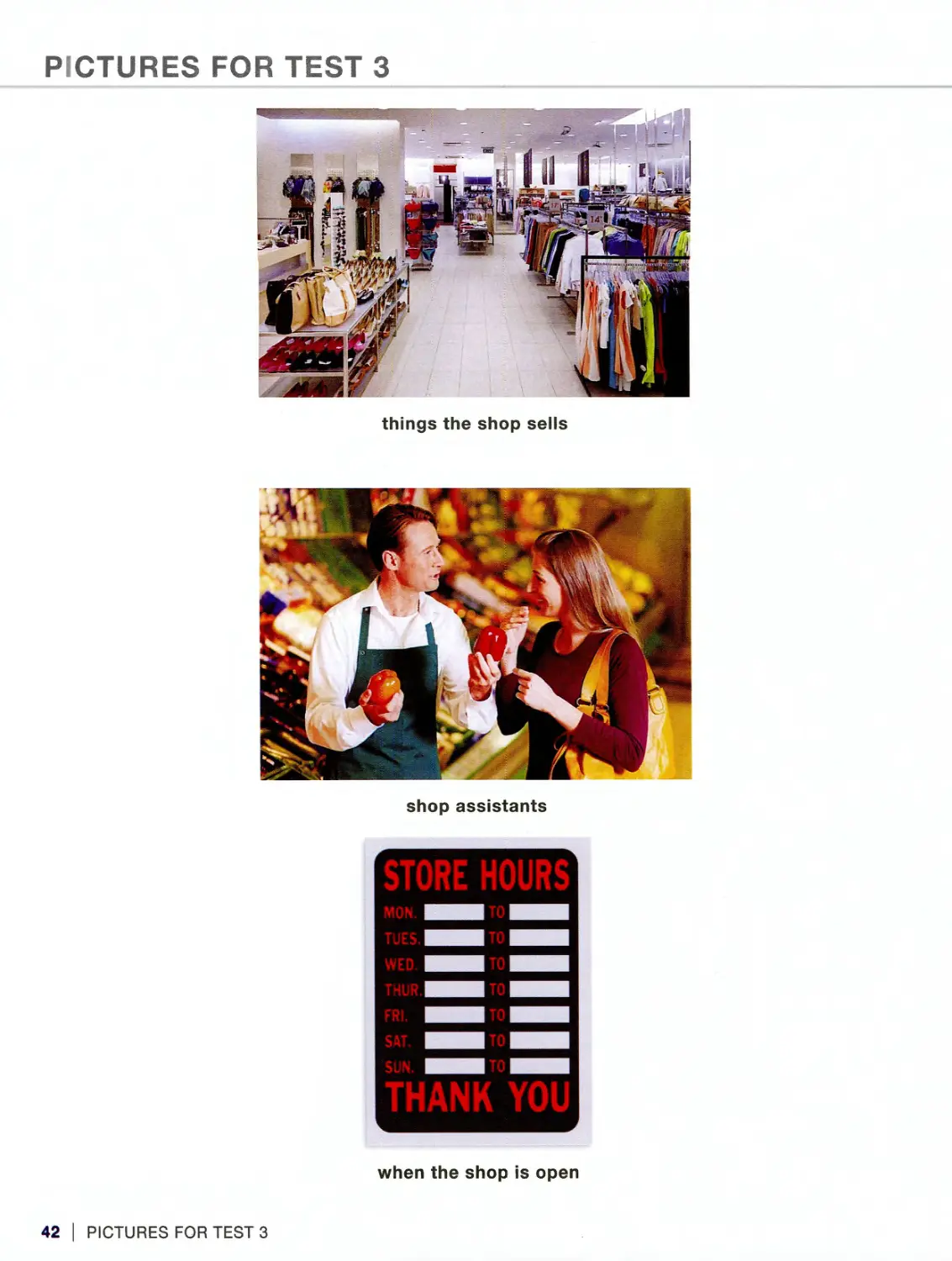
things the shop sells
shop assistants
when the shop is open
42 I PICTURES FOR TEST 3

PICTURES FOR TEST 4
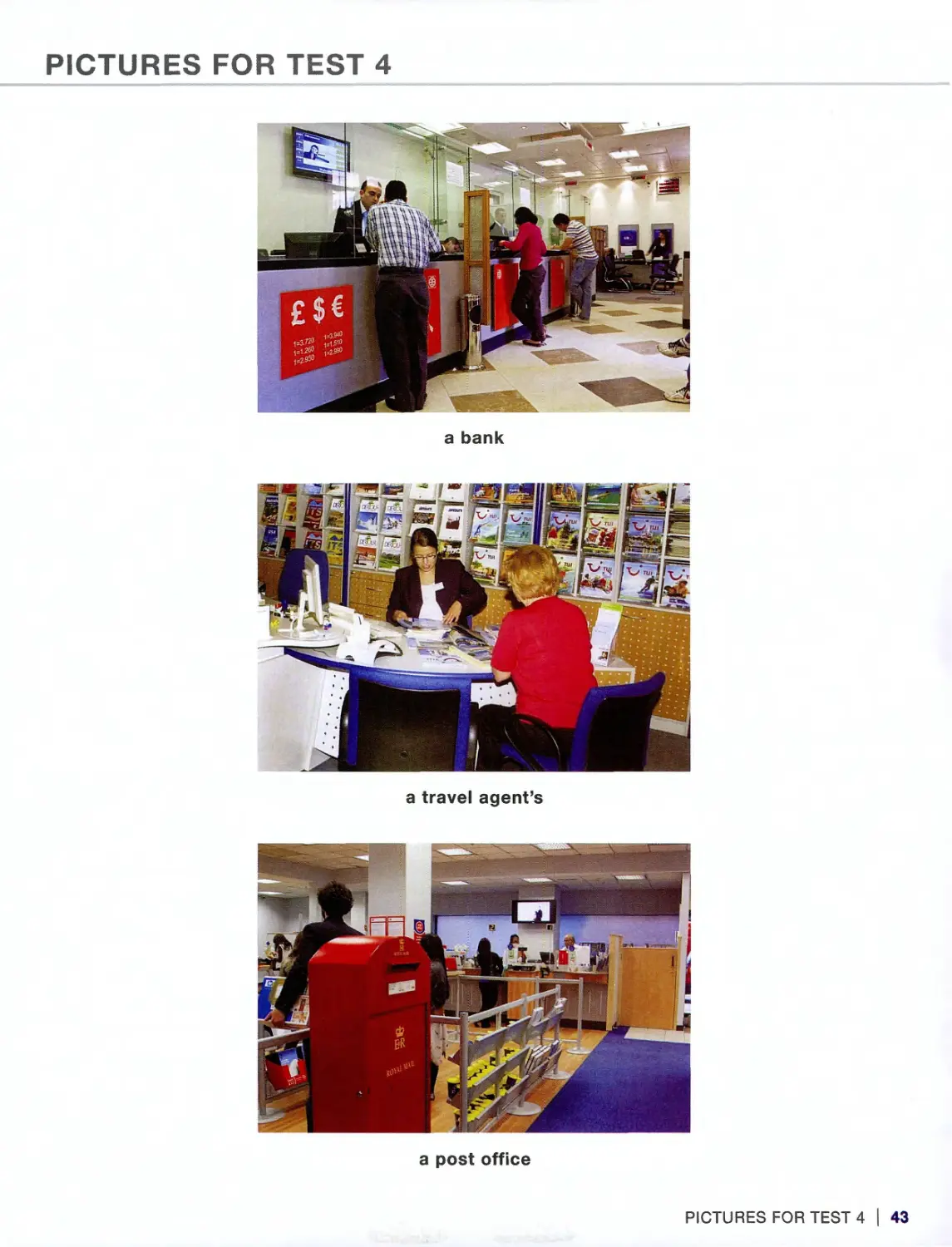
a bank
a travel agent's
a post office
PICTURES FOR TEST 4 \ 43

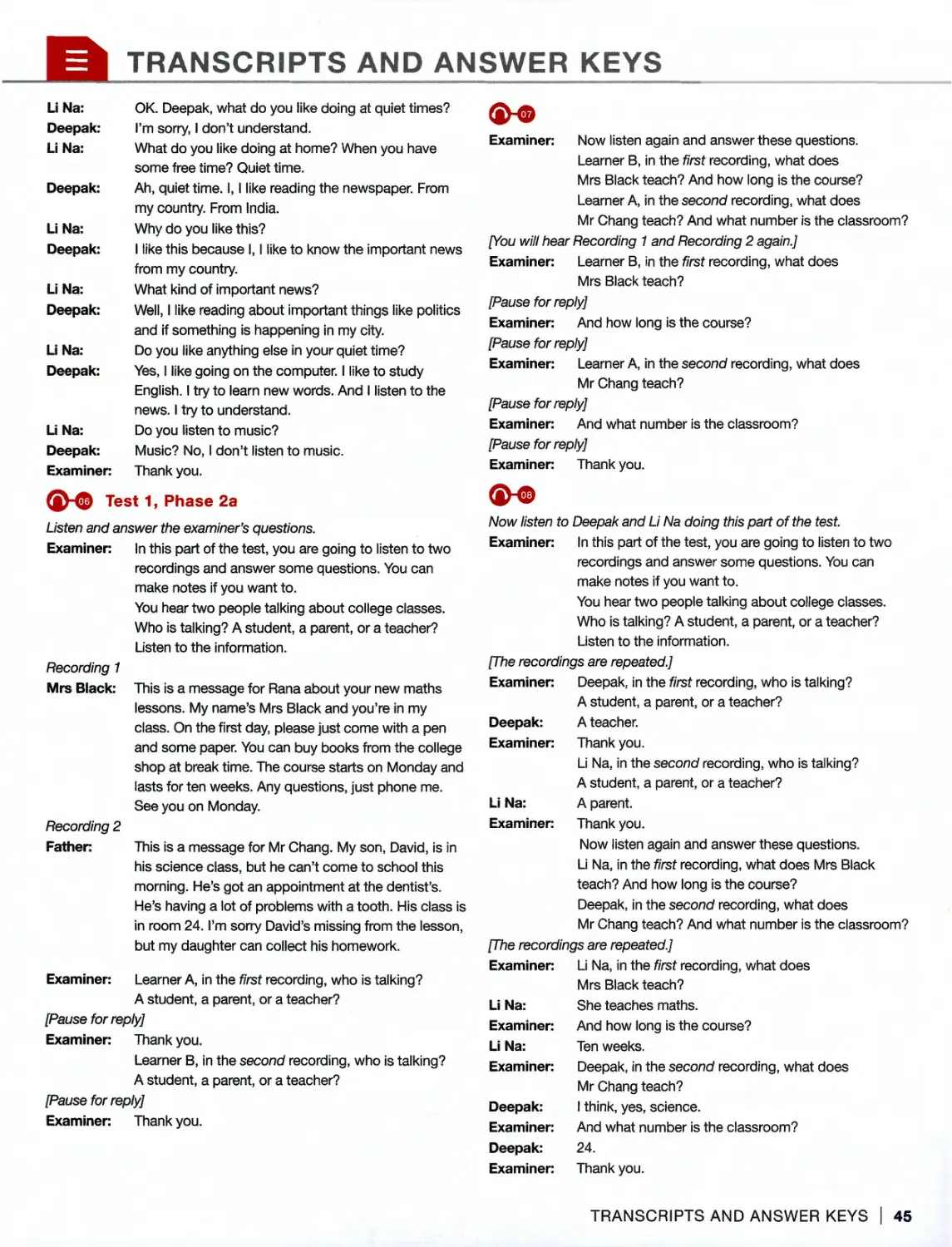
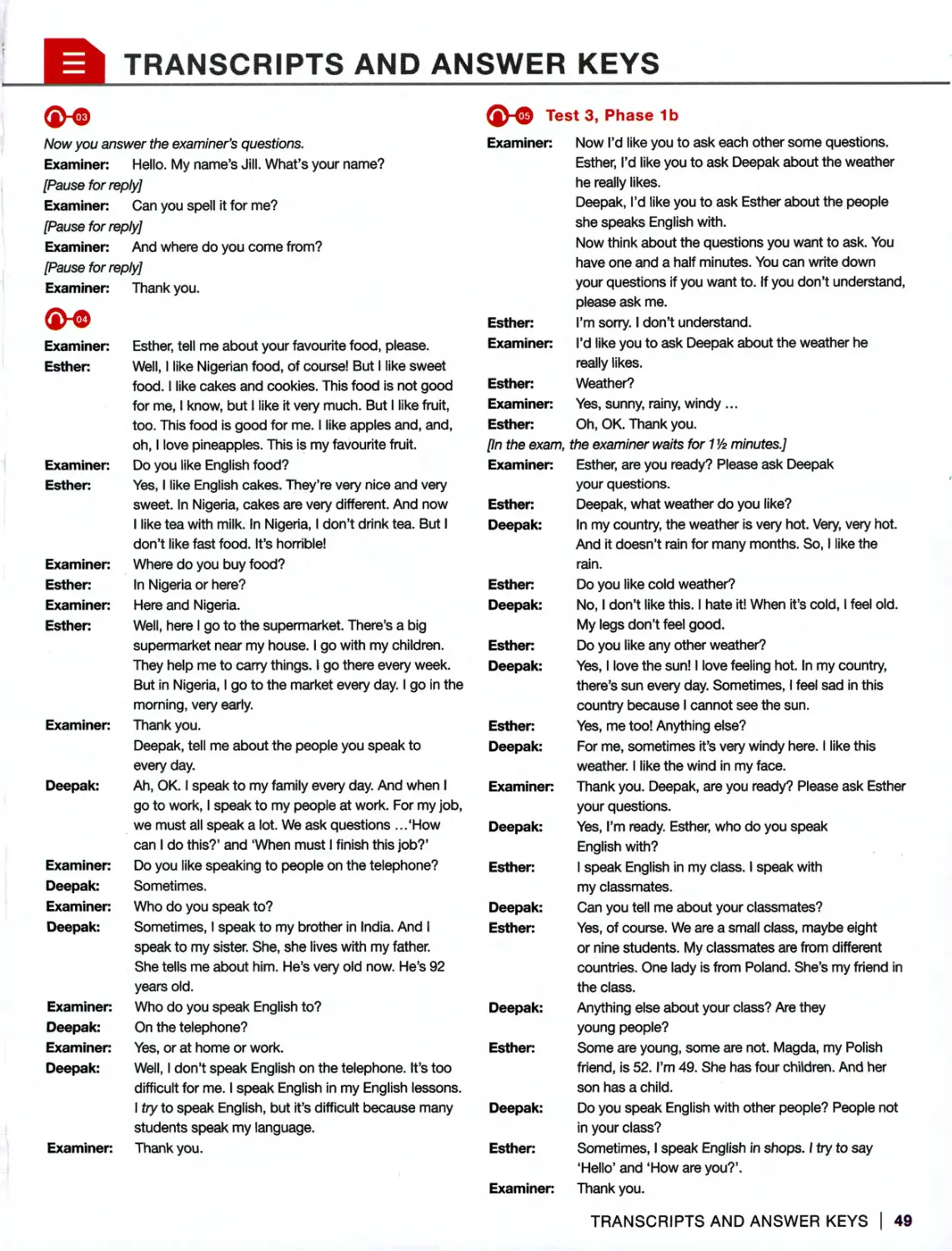
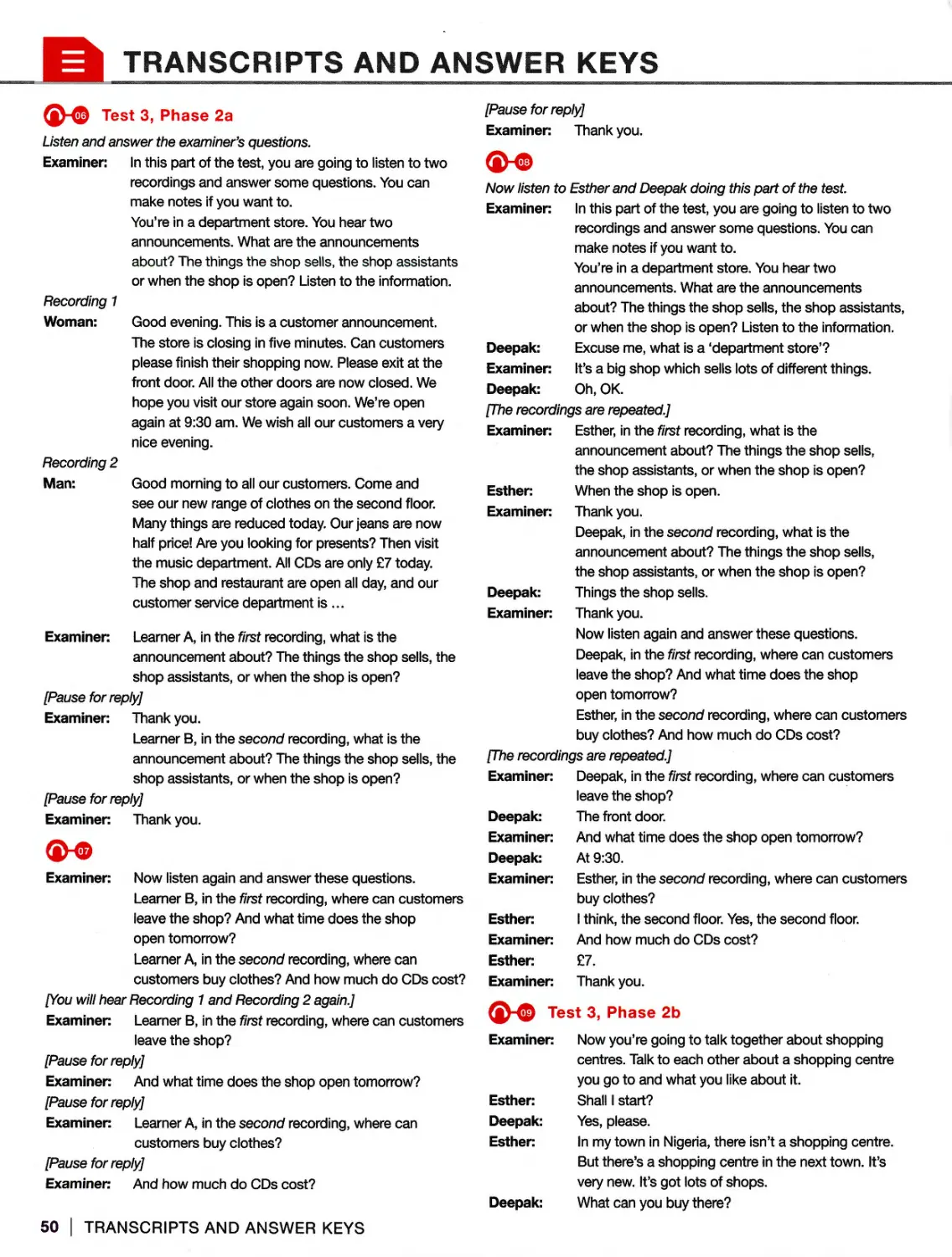
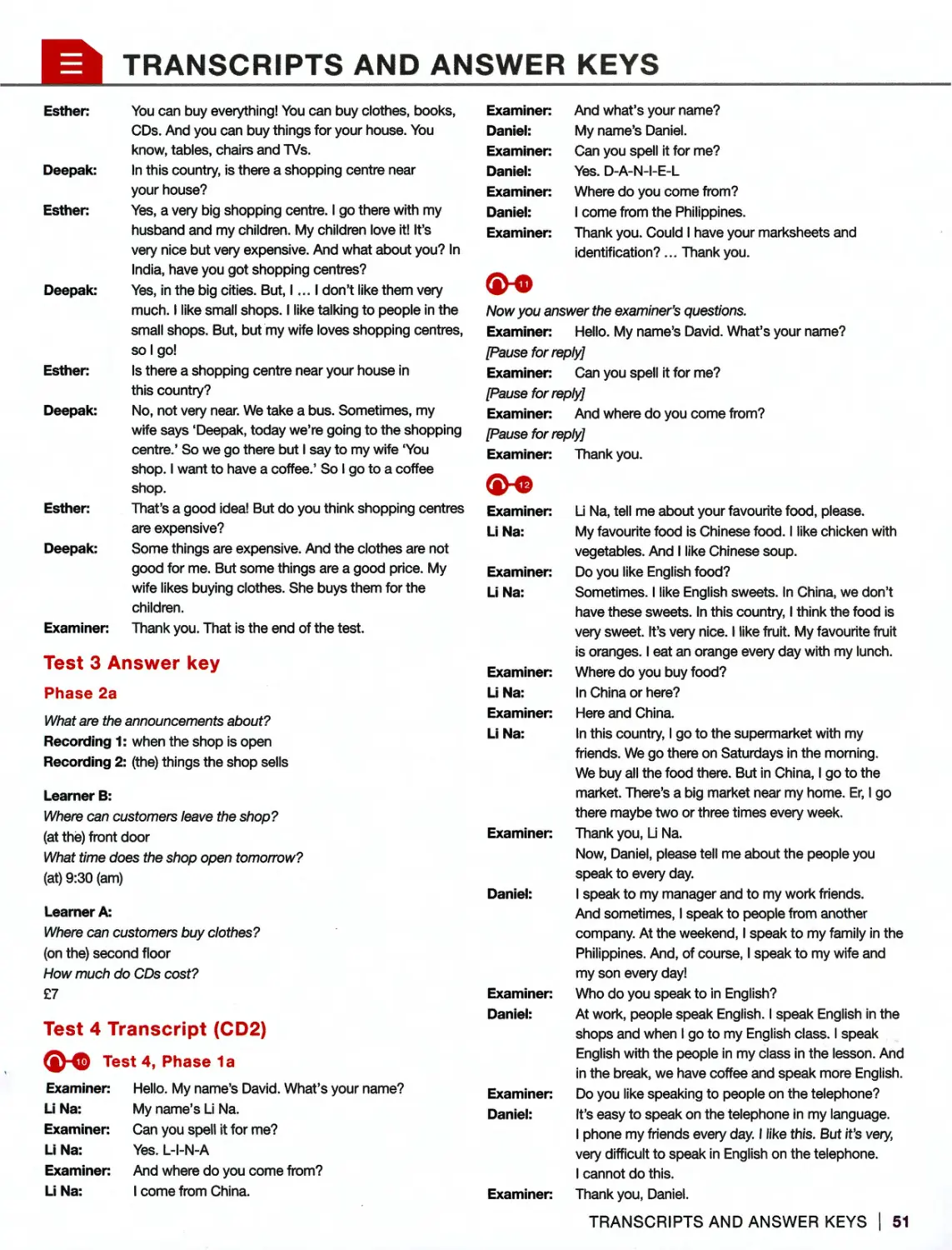
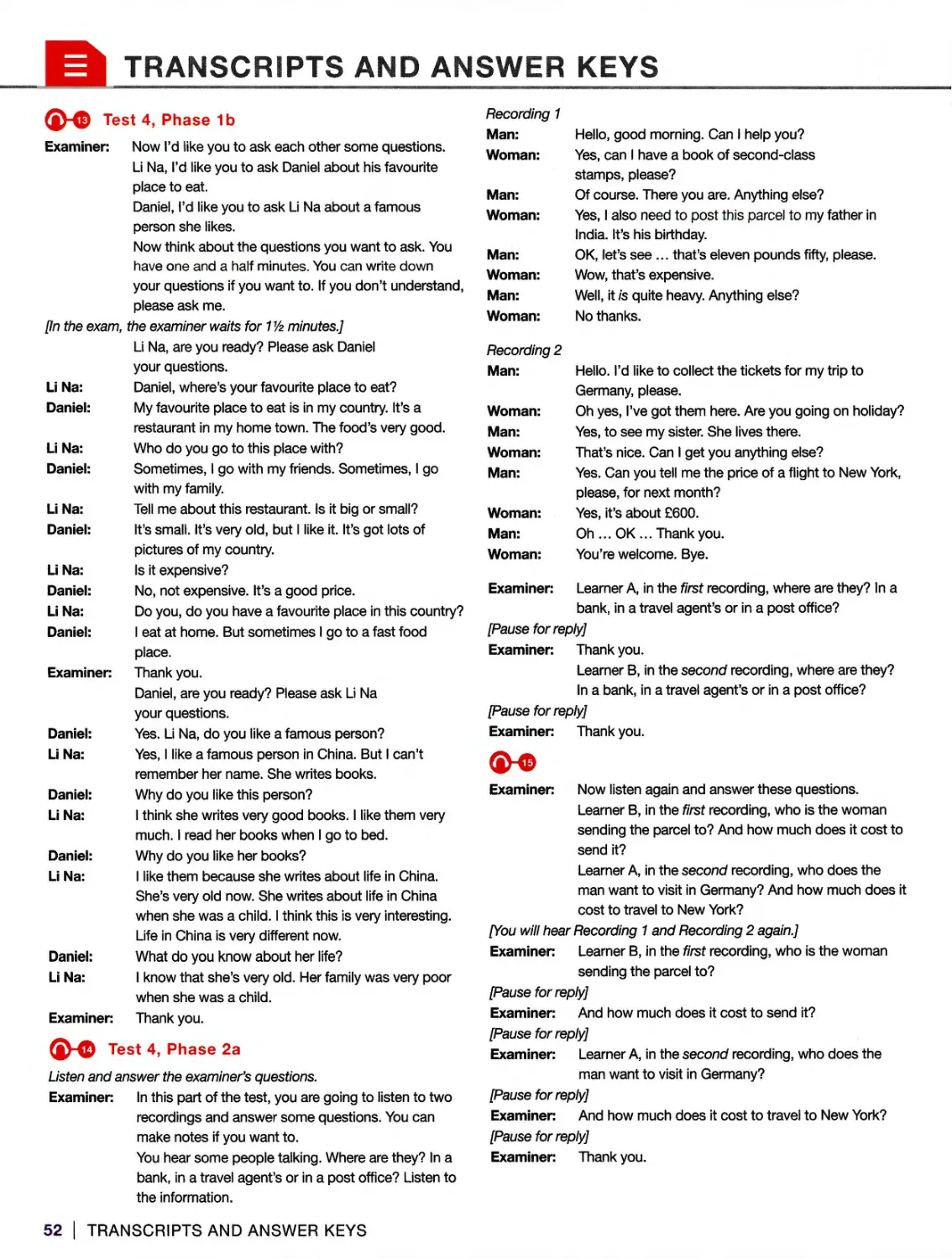
TRANSCRIPTS AND ANSWER KEYS
Test 1 Transcript (CD1)
(i)-0 Test 1, Phase 1a
Examiner:
Deepak:
Examiner:
Deepak:
Examiner:
Deepak:
Hello. My name is Jill. What's your name?
My name's Deepak.
Can you spell it for me?
Yes. D-E-E-P-A-K
And where do you come from?
I come from India.
Examiner:
And what's your name?
Li Na:
My name's Li Na.
Examiner:
Can you spell it for me?
Li Na:
Yes, of course. L+N-A
Examiner:
Where do you come from?
Li Na:
I come from Wuhan , in China.
Examiner:
Thank you. Could I have your marksheets and
identification? ... Thank you .
Now you answer the examiner's questions.
Examiner:
Hello. My name is Jill. What's your name?
[Pause for reply]
Examiner:
Can you spell it for me?
[Pause for reply]
Examiner:
And where do you come from?
[Pause for reply]
Examiner: Thank you.
Examiner:
Deepak, tell me about your favourite food . What food
do you enjoy eating?
Deepak:
Well , of course, I like Indian food. I, I like curry with
chicken and rice. I like spicy food , very spicy.
Examiner:
Do you like English food?
Deepak:
Examiner:
Deepak:
Examiner:
Li Na:
Examiner:
Li Na:
Examiner:
Li Na:
Examiner:
Deepak:
Examiner:
Yes, yes, sometimes it's nice, quite nice.
What English food do you like?
I like potato, you know, mashed potato, and also I
like pies, pies with meat and pies with fruit. And I
like chocolate!
Li Na, tell me about your favourite food.
I like Chinese food like noodles an d dumplings with
meat. And I like other Chinese food. I love rice with
fried vegetables. I love this very much.
Who do you eat meals with?
In China?
Yes, or in theUK.
Here I eat with my friends. We cook and eat together.
But in China, I eat with my family. My parents and
my brother.
Deepak, tell me about the people you speak to
every d ay.
In my family?
Yes, and the other people you speak to every day.
44 I TRANSCRIPTS AND ANSWER KEYS
Deepak:
Well, I speak to my wife. She is the first person I
speak to every morning. Then I speak t o my children.
I' ve got one daughter and two sons. When I go to
work, I speak to my friends, ...
Examiner:
Who do you speak to in English?
Deepak:
I speak to my family in Hindi, but at work, I must
speak English. My friends at work speak many
languages . .. Pol ish , Spanish , so we must all speak
English. It's difficult sometimes. But we must learn.
Examiner:
Li Na:
Examiner:
Li Na:
Li Na, is it easy or difficult to speak in Eng lish?
For me, it's very difficult. English is very different
from my language. The words are strange t o
me. And it's very difficult to understand. Often ,
I cannot understand.
Do you always speak English in your classes?
Yes, I try to speak English all the time. But it's difficult
for me.
Examiner:
Thank you.
(i)-G Test 1, Phase 1b
Examiner:
Now I'd like you to ask each other some questions.
Deepak, I'd like you to ask Li Na about a child she
knows well. Li Na, I'd like you to ask Deepak about
the things he likes doing at quiet times.
Now think about the questions you want to ask. You
have one and a half minutes. You can write down
your questions if you want to. If you don't understand,
please ask me.
[In the exam, the examiner waits for 1V2 minutes.]
Deepak, are you ready? Please ask Li Na
your questions.
Deepak:
Li Na:
Deepak:
Li Na:
Deepak:
Li Na:
Deepak:
Li Na:
Deepak:
Li Na:
Deepak:
Li Na:
Deepak:
Li Na:
Deepak:
Li Na:
Deepak:
Li Na:
Examiner:
OK. Li Na, do you know any children well?
Not very well , but quite well.
What's his name?
Well, it's a girl. Her name's Lili.
How old is she?
She's five years old. She's nearly six.
Where does she live?
She lives near me in China. Near my flat in China.
Who is she?
Pardon?
Who is she? Your cousin? The daughter of
your friend?
Ah! She's my .. . cousin's daughter. Yes , my
cousin's daughter.
Is she pretty?
Yes, she's very pretty! She's got brown hair and
beautiful eyes.
Anything else?
She's quite tall and very slim . Sh e loves dancing.
Is she a clever girl?
Oh yes! She's very clever. She loves her school. She
loves drawing and she's very good at mathematics.
Thank you. Li Na, are you ready? Please ask Deepak
your questions.

TRANSCRIPTS AND ANSWER KEYS
Li Na:
Deepak:
Li Na:
Deepak:
Li Na:
Deepak:
Li Na:
Deepak:
Li Na:
Deepak:
OK. Deepak, what do you like doing at quiet times?
I'm sorry, I don't understand.
What do you like doing at home? When you have
some free time? Quiet time.
Ah, quiet time. I, I like reading the newspaper. From
my country. From India.
Why do you like this?
I like this because I, I like to know the important news
from my country.
What kind of important news?
Well, I like reading about important things like politics
and if something is happening in my city.
Do you like anything else in your quiet time?
Yes, I like going on the computer. I like to study
English. I try to learn new words. And I listen to the
news. I try to understand.
Li Na:
Do you listen to music?
Deepak:
Music? No, I don 't listen to music.
Examiner:
Thank you.
~ Test 1, Phase 2a
Listen and answer the examiner's questions.
Examiner:
In this part of the test, you are going to listen to two
recordings and answer some questions. You can
make notes if you want to.
Recording 1
Mrs Black:
Recording 2
Father:
You hear two people talking about college classes.
Who is talking? A student, a parent, or a teacher?
Listen to the information.
This is a message for Rana about your new maths
lessons. My name's Mrs Black and you're in my
class. On the first day, please just come with a pen
and some paper. You can buy books from the college
shop at break time. The course starts on Monday and
lasts for ten weeks. Any questions, just phone me.
See you on Monday.
This is a message for Mr Chang. My son, David, is in
his science class, but he can't come to school this
morning. He's got an appointment at the dentist's.
He's having a lot of problems with a tooth. His class is
in room 24. I'm sorry David's missing from the lesson ,
but my daughter can collect his homework.
Examiner:
Learner A, in the first recording, who is talking?
A student, a parent, or a teacher?
[Pause for reply]
Examiner:
Thank you.
Learner B, in the second recording , who is talking?
A student, a parent, or a teacher?
[Pause for reply]
Examiner: Thank you.
Examiner:
Now listen again and answer these questions.
Learner B, in the first recording, what does
Mrs Black teach? And how long is the course?
Learner A, in the second recording, what does
Mr Chang teach? And what number is the classroom?
[You will hear Recording 1 and Recording 2 again.]
Examiner:
Learner B, in the first recording, what does
Mrs Black teach?
{Pause for reply}
Examiner:
And how long is the course?
{Pause for reply}
Examiner:
Learner A, in the second recording, what does
Mr Chang teach?
[Pause for reply]
Examiner:
And what number is the classroom?
[Pause for reply]
Examiner:
Thank you.
Now listen to Deepak and Li Na doing this part of the test.
Examiner:
In this part of the test, you are going to listen to two
recordings and answer some questions. You can
make notes if you want to.
You hear two people talking about college classes.
Who is talking? A student, a parent, or a teacher?
Listen to the information.
{The recordings are repeated.]
Examiner:
Deepak, in t he first recording , who is talking?
A student, a parent, or a teacher?
Deepak:
A teacher.
Examiner:
Thank you.
Li Na, in the second recording, who is talking?
A student, a parent, or a teacher?
Li Na:
A parent.
Examiner:
Thank you.
Now listen again and answer these questions.
Li Na, in the first recording, what does Mrs Black
teach? And how long is the course?
Deepak, in the sec ond recording, what does
Mr Chang teach? And what number is the classroom?
{The recordings are repeated.]
Examiner:
Li Na, in the first recording, what does
Mrs Black teach?
Li Na:
She teaches maths.
Examiner: And how long is the c ourse?
Li Na:
Ten w eeks.
Examiner:
Deepak, in the second recording , what does
Mr Ch ang t each?
Deepak:
I think, yes, science.
Examiner:
And what number is the classroom?
Deepak:
24.
Examiner:
Thank you.
TRANSCRI PTS AND ANSWER KEYS I 45

TRANSCRIPTS AND ANSWER KEYS
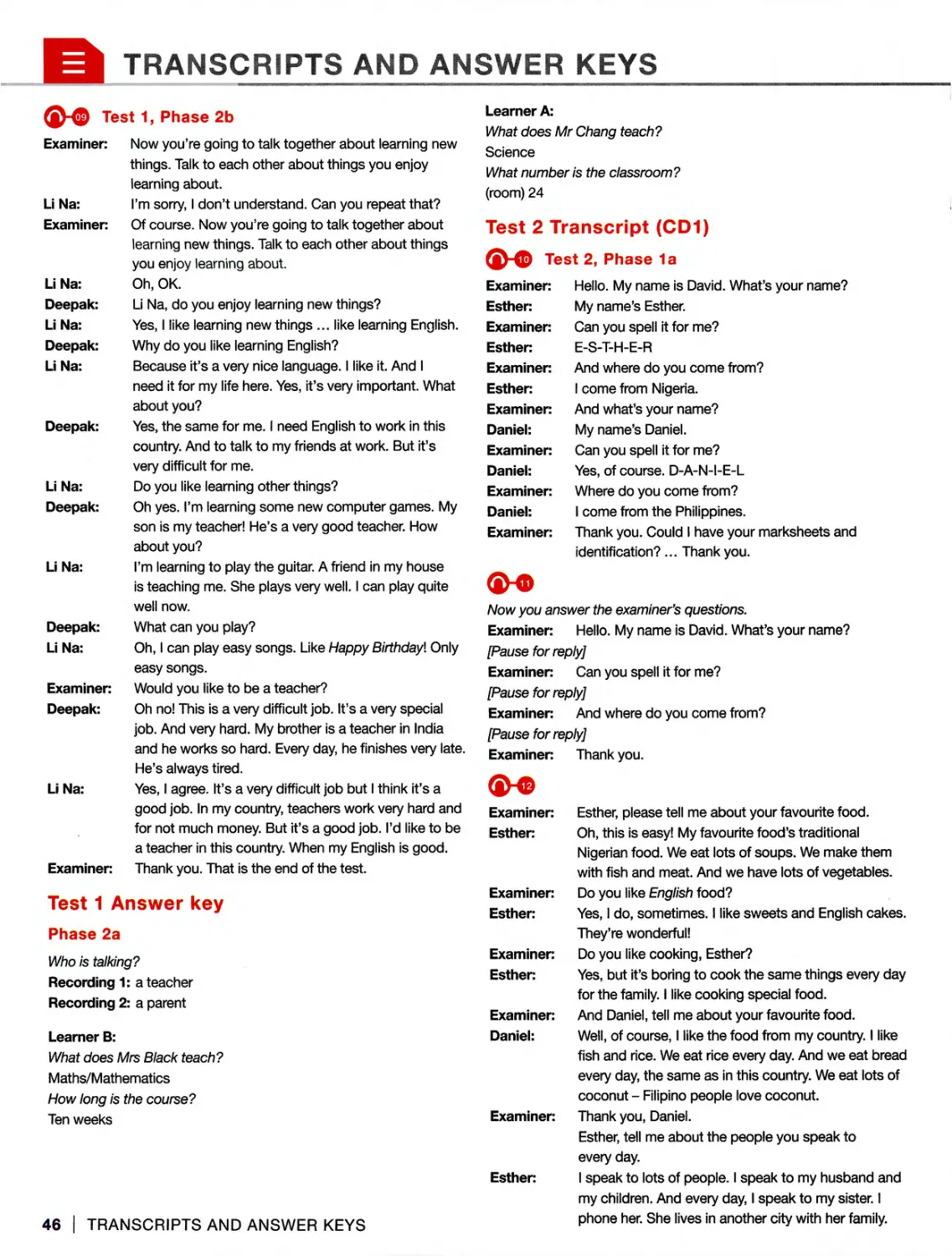
(i)-0 Test 1, Phase 2b
Examiner:
Li Na:
Examiner:
Li Na:
Deepak:
Li Na:
Deepak:
Li Na:
Deepak:
Li Na:
Deepak:
Li Na:
Deepak:
Li Na:
Examiner:
Deepak:
Now you're going to talk together about learning new
things. Talk to each other about things you enjoy
learning about.
I'm sorry, I don't understand. Can you repeat that?
Of course. Now you 're going to talk together about
learning new things. Talk to each other about things
you enjoy learning about.
Oh.OK.
Li Na, do you enjoy learning new th ings?
Yes, I like learning new things . . . like learning En!Jlish.
Why do you like learning English?
Because it's a very nice language. I like it. And I
need it for my life here. Yes , it's very important. What
about you?
Yes , the same for me. I need English to work in this
country. And to talk to my friends at work. But it's
very difficult for me.
Do you like learning other things?
Oh yes. I'm learning some new computer games. My
son is my teacher! He 's a very good teacher. How
about you?
I'm learning to play the guitar. A friend in my house
is teaching me. She plays very well. I can play quite
well now.
What can you play?
Oh , I can play easy songs. Like Happy Birthday! Only
easy songs.
Would you like to be a teacher?
Oh no! This is a very difficult job. It's a very special
job. And very hard . My brother is a teacher in India
and he works so hard . Every day, he finishes very late.
He's always tired .
Li Na:
Yes , I agree. It' s a very difficult job but I think it's a
good job. In my country, teachers work very hard and
for not much money. But it's a good job. I'd like to be
a teacher in this country. When my English is good.
Examiner:
Thank you. That is the end of the test.
Test 1 Answer key
Phase 2a
Who is talking?
Recording 1: a teacher
Recording 2: a parent
Learner B:
What does Mrs Black teach?
Maths/Mathematics
How long is the course?
Ten weeks
46 I TRANSCRIPTS AND ANSWER KEYS
Learner A:
What does Mr Chang teach?
Science
What number is the classroom?
(room) 24
Test 2 Transcript (CD1)
(i)O Test 2, Phase 1a
Examiner:
Esther:
Examiner:
Esther:
Examiner:
Esther:
Examiner:
Daniel:
Examiner:
Daniel:
Examiner:
Daniel:
Examiner:
Hello. My name is David. What's your name?
My name's Esther.
Can you spell it for me?
E-S-T -H-E -R
And where do you come from?
I come from Nigeria.
And what's your name?
My name's Daniel.
Can you spell it for me?
Yes, of course. D -A-N-1 -E-L
Where do you come from?
I come from the Philippines.
Thank you. Could I have your marksheets and
identification? ... Thank you.
Now you answer the examiner's questions.
Examiner:
Hello. My name is David. What's your name?
[Pause for reply]
Examiner:
Can you spell it for me?
[Pause for reply]
Examiner:
And where do you come from?
[Pause for reply]
Examiner:
Thank you.
Examiner:
Esther:
Examiner:
Esther:
Examiner:
Esther:
Examiner:
Daniel:
Examiner:
Esther:
Esther, please tell me about your favourite food .
Oh , this is easy! My favourite food 's traditional
Nigerian food. We eat lots of soups. We make them
with fish and meat. And we have lots of vegetables.
Do you like English food?
Yes, I do, sometimes. I like sweets and Eng li sh cakes.
They're wonderful!
Do you like cooking, Esther?
Yes, but it's boring to cook the same things every day
for the fami ly. I like cooking special food.
And Daniel, tell me about your favourite food.
Well, of course, I like the food from my country. I like
fish and rice. We eat rice every day. And we eat bread
every day, the same as in this country. We eat lots of
coconut - Filipino people love coconut.
Thank you, Daniel.
Esther, tell me about the people you speak to
every day.
I speak to lots of people. I speak to my husband and
my children. And every day, I speak to my sister. I
phone her. She lives in another city with her family.

TRANSCRIPTS AND ANSWER KEYS
Examiner:
And Daniel, tell me about the people you speak to
every day.
Daniel:
I speak to my manager at work and to my friends
at work. Sometimes, I speak to my family in the
Philippines. I use the computer. Then I meet my
friends in the evening and we speak together.
Examiner:
Who do you speak to in English?
Daniel:
I always speak English at work, but with my friends,
I speak my language. At work, there are only people
who speak English but my friends are all Filipino.
Examiner:
Thank you.
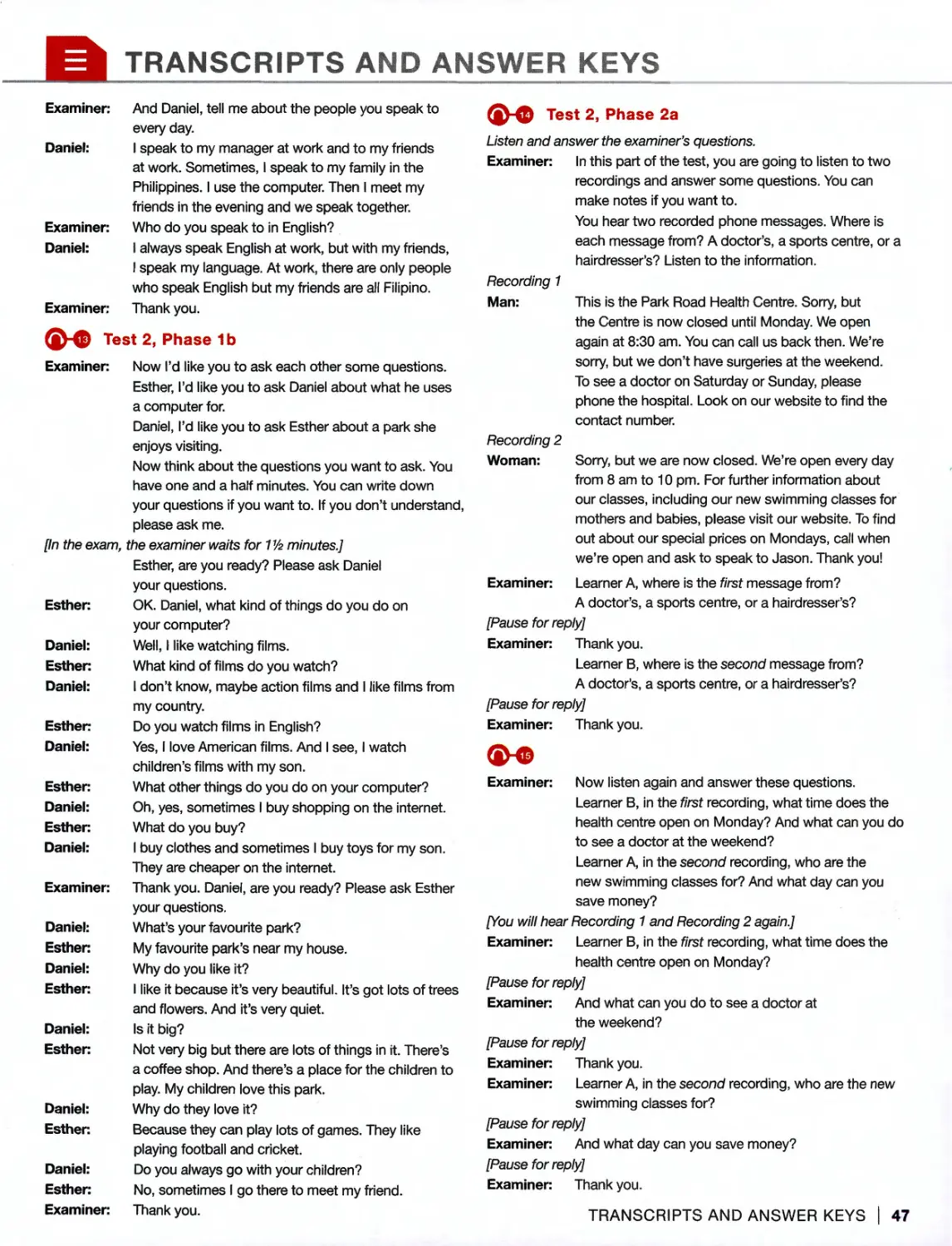
('i)-49 Test 2, Phase 1b
Examiner:
Now I'd like you to ask each other some questions.
Esther, I 'd like you to ask Daniel about what he uses
a computer for.
Daniel, I'd like you to ask Esther about a park she
enjoys v isiting.
Now think about the questions you want to ask. You
have one and a half minutes. You can write down
your questions if you want to. If you don't understand,
please ask me.
{In the exam, the examiner waits for 1!12 minutes.]
Esther, are you ready? Please ask Daniel
your questions.
Esther:
Daniel:
Esther:
Daniel:
Esther:
Daniel:
Esther:
Daniel:
Esther:
Daniel:
Examiner:
Daniel:
Esther:
Daniel:
Esther:
Daniel:
Esther:
Daniel:
Esther:
Daniel:
Esther:
Examiner:
OK. Daniel, what kind of things do you do on
your computer?
Well , I like watching films.
What kind of films do you watch?
I don't know, maybe action films and I like films from
my country.
Do you watch films in English?
Yes, I love American films. And I see, I watch
children's films with my son.
What other things do you do on your computer?
Oh, yes, sometimes I buy shopping o n the internet.
What do you buy?
I buy clothes and sometimes I buy toys for my son.
They are cheaper on the internet.
Thank you. Daniel, are you ready? Please ask Esther
your questions.
What's your favourite park?
My favourite park's near my house.
Why do you like it?
I like it because it's very beautiful. It's got lots of trees
and flowers. And it's very quiet.
Is it big?
Not very big but there are lots of things in it. There's
a coffee shop. And there's a place for the children to
play. My children love t his park.
Why do they love it?
Because they can play lots of games. They like
playing football and cricket.
Do you always go with your c hildren ?
No, sometimes I go there to meet my fri end.
Thank you.
(i')-CD Test 2, Phase 2a
Listen and answer the examiner's questions.
Examiner:
In this part of the test, you are going to listen to two
recordings and answer some questions. You can
make notes if you want to.
Recording 1
You hear two recorded phone messages. Where is
each message from? A doctor's, a sports centre, or a
hairdresser's? Listen to the information.
Man:
This is the Park Road Health Centre. Sorry, but
Recording 2
the Centre is now closed until Monday. We open
again at 8:30 am. You can call us back then. We ' re
sorry, but we don't have surgeries at the weekend.
To see a doctor on Saturday or Sunday, please
phone the hospital. Look on our website to find the
contact number.
Woman:
Sorry, but we are now closed. We ' re open every day
from 8 am to 10 pm. For further information about
our classes, including our new swimming classes for
mothers and babies, please v isit our website. To find
out about our special prices o n Mondays, call when
we're open and ask to speak to Jason. Thank you!
Examiner:
Learner A, where is t he first message from?
A doctor's , a sports centre, or a hairdresser's?
[Pause for reply]
Examiner:
Thank you.
Learner B, where is t he second message f rom ?
A doctor's, a sports centre, or a hairdresser's?
[Pause for reply]
Examiner:
Thank you.
Examiner:
Now listen again and answer these questions.
Learner B, in the first recording, what time does the
health centre open on Monday? And what can you do
to see a doctor at the weekend?
Learner A, in the second recording, who are the
new swimming classes for? And what day can you
save money?
[You will hear Recording 1 and Recording 2 again.]
Examiner:
Learner B, in the first recording, what time does the
health centre open o n Monday?
[Pause for reply]
Examiner:
And what can you do to see a doctor at
the weekend?
[Pause for reply]
Examiner:
Thank you.
Examiner:
Learn er A , in the second recording, w ho are the new
swimming classes for?
[Pause for reply]
Examiner:
And what day can you save money?
[Pause for reply]
Exa miner:
Thank you .
TRANSCRIPTS AND ANSWER KEYS I 47

TRANSCRIPTS AND ANSWER KEYS
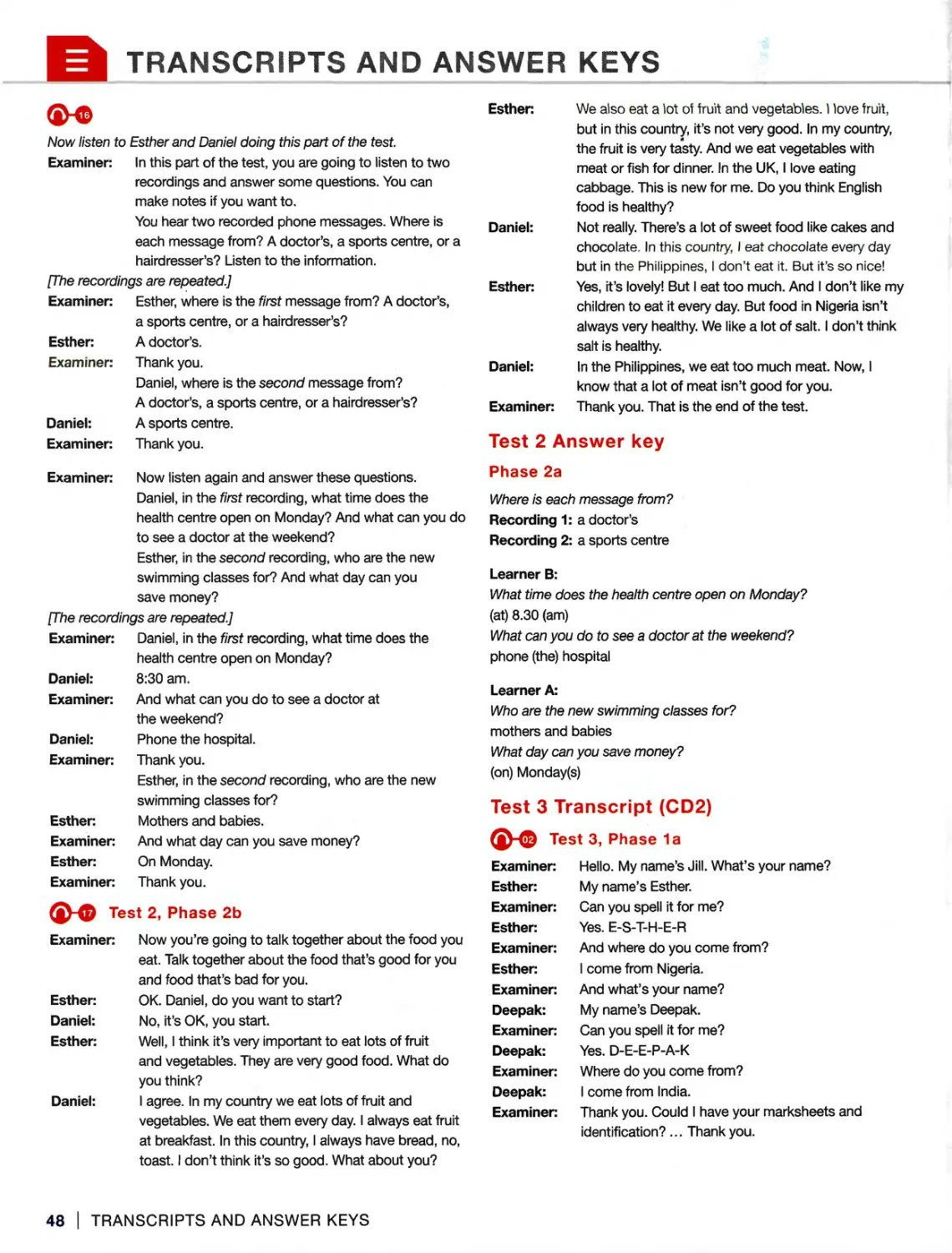
Now listen to Esther and Daniel doing this part of the test.
Examiner:
In this part of the test, you are going to li sten to two
recordings and answer some questions. You can
make notes if you want to.
You hear two recorded phone messages. Where is
each message from? A doctor's, a sports c entre, or a
hairdresser's? Listen to the information.
[The recordings are repeated.}
Examiner:
Esther, where is the first message from? A doctor's,
a sports centre, or a hairdresser's?
Esther:
A doctor's.
Examiner:
Thank you.
Daniel, where is the second message from?
A doctor's, a sports centre, or a hairdresser's?
Daniel:
A sports centre.
Examiner:
Thank you.
Examiner:
Now listen again and answer these questions.
Daniel, in the first recording, what time does the
health centre open on Monday? And what can you do
to see a doctor at the weekend?
Esther, in the second recording, who are the new
swimming classes for? And what day can you
save money?
[The recordings are repeated.]
Examiner: Dan iel , in the first recording, what time does the
health centre open on Monday?
Daniel:
8:30 am.
Examiner:
And what can you do to see a doctor at
the weekend?
Daniel:
Phone the hospital.
Examiner: Thank you.
Esther, in the second recording , who are the new
swimming classes for?
Esther:
Mothers and babies.
Examiner:
And what day can you save money?
Esther:
On Monday.
Examiner:
Thank you.
(i)-G Test 2, Phase 2b
Examiner:
Esther:
Daniel:
Esther:
Daniel:
Now you're going to talk together about the food you
eat. Talk together about the food that's good for you
and food that's bad for you.
OK. Daniel , do you want to start?
No, it's OK, you start.
Well , I think it's very important to eat lots of fruit
and vegetables. They are very good food. What do
you think?
I agree. In my country we eat lots of fruit and
vegetables. We eat them every day. I always eat fruit
at breakfast. In this country, I always have bread, no,
toast. I don't think it's so good. What about you ?
48 I TRANSCRIPTS AND ANSWER KEYS
Esther:
We also eat a lot ot truit and vegetables. \ love fruit,
but in this country, it's not very good. In my country,
the fruit is very ta'sty. And we eat vegetables w ith
meat or fish for dinner. In the UK, I love eating
cabbage. This is new for me. Do you think English
food is healthy?
Daniel:
Not really. There's a lot of sweet food li ke cakes and
c hocolate. In this country, I eat chocolate every day
but in the Phili ppines, I don't eat it. But it's so nice!
Esther:
Yes, it's lovel y! But I eat too much. And I don 't like my
children to eat it every day. But food in Nigeria isn 't
always very healthy. We like a lot of salt. I don 't think
salt is healthy.
Daniel:
In the Philippines, we eat too much meat. Now, I
know that a lot of meat isn't good for you.
Examiner:
Thank you. That is the end of the test.
Test 2 Answer key
Phase 2a
Where is each message fro m?
Recording 1: a doctor's
Recording 2: a sports centre
Learner B:
What time does the health centre open on Monday?
(at) 8.30 (am)
What can you do to see a doctor at the weekend?
phone (the) hospital
Learner A:
Who are the new swimming classes for?
mothers and babies
What day can y ou save money?
(on) Monday(s)
Test 3 Transcript (CD2)
(i)-0 Test 3, Phase 1a
Examiner:
Hello. My name's Jill. What' s your name?
Esther:
My name's Esther.
Examiner:
Can you spell it for me?
Esther:
Yes. E-S -T-H -E-R
Examiner:
And where do you come from?
Esther:
I come from Nigeria.
Examiner:
And what's your name?
Deepak:
My name's Deepak.
Examiner:
Can you spell it for me?
Deepak:
Yes. D -E-E-P -A-K
Examiner:
Where do you come from?
D eepak:
I come from India.
Examiner: Thank you. Could I have your marksheets and
identification? . . . Thank you.

TRANSCRIPTS AND ANSWER KEYS
Now you answer the examiner's questions.
Examiner:
Hello. My name's Jill. What's your name?
[Pause for reply]
Examiner:
Can you spell it for me?
[Pause for reply]
Examiner:
And where do you come from?
[Pause for reply]
Examiner:
Thank you .
Examiner:
Esther:
Examiner:
Esther:
Examiner:
Esther:
Examiner:
Esther:
Examiner:
Deepak:
Examiner:
Deepak:
Examiner:
Deepak:
Examiner:
Deepak:
Examiner:
Deepak:
Examiner:
Esther, tell me about your favourite food , please.
Well , I like Nigerian food, of course! But I like sweet
food . I like cakes and cookies. Th is food is not good
for me, I know, but I like it very much. But I like fruit,
too. This food is good for me. I like apples and, and,
oh , I love pineapples. This is my favourite fruit.
Do you like English food?
Yes , I like English cakes. They' re very nice and very
sweet. In Nigeria, cakes are very d ifferent. And now
I like tea with milk. In Nigeria, I don't drink tea. But I
don't like fast food . It's horrible!
Where do you buy food?
In Nigeria or here?
Here and Nigeria.
Well, here I go to the supermarket. There's a big
supermarket near my house. I go with my children.
They help me to carry th ings. I go there every week.
But in Nigeria, I go to the market every day. I go in the
morning, very early.
Thank you .
Deepak, tell me about the people you speak to
every day.
Ah , OK. I speak to my family every day. And when I
go to work, I speak to my people at work. For my job,
we must all speak a lot. We ask questions ... 'How
can I do this? ' and 'When must I finish this job?'
Do you like speaking to people on the telephone?
Sometimes.
Who do you speak to?
Sometimes, I speak to my brother in India. And I
speak to my sister. She, she lives w ith my father.
She tells me about him. He's very old now. He's 92
years old.
Who do you speak English to?
On the telephone?
Yes, or at home or work.
Well , I don't speak Engl ish on the telephone. It 's too
difficult for me. I speak English in my English lessons.
I try to speak English, but it's difficult because many
students speak my language.
Thank you.
(i)-0 Test 3, Phase 1b
Examiner:
Now I'd like you to ask each other some questions.
Esther:
Examiner:
Esther:
Examiner:
Esther:
Esther, I' d like you to ask Deepak about the weather
he really li kes.
Deepak, I'd like you to ask Esther about the people
she speaks English with.
Now think about the questions you want to ask. You
have one and a half minutes. You can write down
your questions if you want to. If you don't understand,
please ask me.
I' m sorry. I don't understand.
I'd like you to ask Deepak about the weather he
really likes.
Weather?
Yes , sunny, rainy, windy .. .
Oh , OK. Thank you.
[In the exam, the examiner waits for 1Y2 minutes.]
Examiner:
Esther, are you ready? Please ask Deepak
your questions.
Esther:
Deepak:
Esther:
Deepak:
Esther:
Deepak:
Esther:
Deepak:
Examiner:
Deepak:
Esther:
Deepak:
Esther:
Deepak:
Esther:
Deepak:
Esther:
Deepak, what weather do you like?
In my country, the weather is very hot. Very, very hot.
And it doesn't rain for many months. So, I like the
rain.
Do you like cold weather?
No, I don't like this. I hate it! When it's cold, I feel old.
My legs don't feel good.
Do you like any other weather?
Yes, I love the sun! I love feeling hot. In my country,
there's sun every day. Sometimes, I fee l sad in th is
country because I cannot see the sun.
Yes, me too! Anything else?
For me, sometimes it's very windy here. I like this
weather. I like the wind in my face.
Thank you . Deepak, are you ready? Please ask Esther
your questions.
Yes, I'm ready. Esther, who do you speak
English with?
I speak English in my class. I speak with
my classmates.
Can you tell me about your classmates?
Yes, of course. We are a small class, maybe eight
or ni ne students. My classmates are from different
countries. One lady is from Poland . She 's my friend in
the c lass.
Anyth ing else about your class? Are they
young people?
Some are young, some are not. Magda, my Polish
friend, is 52. I'm 49. She has four children . And her
son has a child.
Do you speak English with other people? People not
in your class?
Sometimes, I speak English in shops. I try to say
' Hello' and 'How are you?' .
Examiner:
Thank you.
TRANSCRIPTS AND ANSWER KEYS I 49

TRANSCRIPTS AND ANSWER KEYS
(i)--G Test 3, Phase 2a
Listen and answer the examiner's questions.
Examiner:
In th is part of the test, you are going to listen to two
recordings and answer some questions. You can
make notes if you want to.
Recording 1
You ' re in a department store. You hear two
announcements. What are the announcements
about? The things the shop sells , the shop assistants
or when the shop is open? Listen to the information.
Woman:
Good evening. This is a customer announcement.
Recording2
The store is closing in five minutes. Can customers
please finish their shopping now. Please exit at the
front door. All the other doors are now c losed. We
hope you visit our store again soon. We're open
again at 9:30 am. We w ish all our customers a very
nice evening.
Man:
Good morning to all our customers. Come and
see our new range of clothes on the second fl oor.
Many th ings are reduced today. Our jeans are now
half price! Are you looking for presents? Then visit
the music department. All CDs are only £7 today.
The shop and restaurant are open all day, and our
customer service department is . ..
Examiner:
Learner A, in the first record ing , what is the
announcement about? The things the shop sells , the
shop assistants, or when the shop is open?
{Pause for reply]
Examiner:
Thank you.
Learner 8 , in the second recording, what is the
an nouncement about? The t hings the shop sells, the
shop assistants, or when the shop is open?
[Pause for reply]
Examiner:
Thank you.
Examiner:
Now listen again and answer these questions.
Learner 8 , in the first recording , where can customers
leave the shop? And what time does the shop
open tomorrow?
Learner A, in the second recording , where can
customers buy clothes? And how much do CDs cost?
[You will hear Recording 1 and Recording 2 again.]
Examiner:
Learner B, in the first recording, where can customers
leave the shop?
[Pause for reply]
Examiner:
And what time does the shop open tomorrow?
[Pause for reply]
Examiner:
Learner A, in the second recording, where can
customers buy clothes?
[Pause for reply]
Examiner:
And how much do CDs cost?
50 I TRANSCRIPTS AND ANSWER KEYS
[Pause for reply]
Examiner:
Thank you .
Now listen to Esther and Deepak doing this part of the test.
Examiner:
In this part of the test, you are going to listen to two
recordings and answer some questions. You can
make notes if you want to.
Deepak:
Examiner:
Deepak:
You 're in a department store. You hear two
announcements. What are the announcements
about? The things the shop sells, the shop assistants,
or when the shop is open? Listen to the information.
Excuse me, what is a 'department store'?
It's a big shop which sells lots of different th ings.
Oh,OK.
[The recordings are repeated.]
Examiner:
Esther, in the first recording, what is t he
announcement about? The things the shop sells ,
the shop assistants, or when the shop is open?
Esther:
When the shop is open .
Examiner:
Thank you.
Deepak, in the second recording, what is the
announcement about? The things the shop sells ,
the shop assistants, or when the shop is open?
Deepak:
Things the shop sells .
Examiner:
Thank you .
Now listen again and answer these questions.
Deepak, in the first record ing , where can customers
leave the shop? And what time does the shop
open tomorrow?
Esther, in the second recording, where can customers
buy clothes? And how much do CDs cost?
[The recordings are repeated.]
Examiner:
Deepak, in the first recording, where can customers
leave the shop?
Deepak:
Examiner:
Deepak:
The front door.
And what time does the shop open tomorrow?
At 9:30.
Examiner:
Esther, in the second recording, where can customers
buy clothes?
Esther:
I think, the second floor. Yes, the second floor.
Examiner:
Esther.
And how much do CDs cost?
£7.
Examiner:
Thank you .
<i"-0 Test 3, Phase 2b
Examiner:
Esther:
Deepak:
Esther:
Deepak:
Now you ' re going to talk together about shopping
centres. Talk to each other about a shopping centre
you go to and what you like about it.
Shall I start?
Yes , please.
In my town in Nigeria , there isn 't a shopping centre.
But there's a shopping centre in the next town. It's
very new. It's got lots of shops.
What can you buy there?

TRANSCRIPTS AND ANSWER KEYS
Esther:
Deepak:
Esther:
Deepak:
Esther:
You can buy everything! You can buy clothes, books,
CDs. And you can buy things for your house. You
know, tables, chairs and TVs.
In this country, is there a shopping centre near
your house?
Yes, a very big shopping centre. I go there with my
husband and my children. My children love it! It's
very nice but very expensive. And what about you? In
India, have you got shopping centres?
Yes, in the big cities. But, I .. . I don't like them very
much. I like small shops. I like talking to people in the
small shops. But, but my wife loves shopping centres,
soIgo!
Is there a shopping centre near your house in
this country?
Deepak:
No, not very near. We take a bus. Sometimes, my
wife says 'Deepak, today we're going t o the shopping
centre.' So we go there but I say to my wife 'You
shop. I want to have a coffee.' So I go to a coffee
shop.
Esther:
That's a good idea! But do you think shopping centres
are expensive?
Deepak:
Some things are expensive. And the clothes are not
good for me. But some things are a good price. My
wife likes buying clothes. She buys them for the
children.
Examiner: Thank you. That is t he end of the test.
Test 3 Answer key
Phase 2a
What are the announcements about?
Recording 1: when the shop is open
Recording 2: (the) things the shop sells
Learner B:
Where can customers leave the shop?
(at the) front door
What time does the shop open tomorrow?
(at) 9:30 (am)
Learner A:
Where can customers buy clothes?
(on the) second floor
How much do CDs cost?
£7
Test 4 Transcript (CD2)
~ Test 4, Phase 1a
Examiner:
Hello. My name's David. What's your nam e?
Li Na:
My name's Li Na.
Examiner:
Can you spell it for me?
Li Na:
Yes. L-1-N -A
Examiner: And where do you come from?
Li Na:
I come from China.
Examiner:
Daniel:
Examiner:
Daniel:
Examiner:
Daniel:
Examiner:
And what's your name?
My name's Daniel.
Can you spell it for me?
Yes.D-A-N-1-E-L
Where do you come from?
I come from the Philippines.
Thank you. Could I have your marksheets and
identification? ... Thank you.
Now you answer the examiner's questions.
Examiner:
Hello. My name's David. What's your name?
[Pause for reply]
Examiner:
Can you spell it for me?
[Pause for reply}
Examiner: And where do you come from?
[Pause for reply}
Examiner: Thank you.
Examiner:
Li Na:
Examiner:
Li Na:
Examiner:
Li Na:
Examiner:
Li Na:
Examiner:
Daniel:
Examiner:
Daniel:
Examiner:
Daniel:
Examiner:
Li Na, tell me about your favourite food, please.
My favourite food is Chinese food. I like chicken with
vegetables. And I like Chinese soup.
Do you like English food?
Sometimes. I like English sweets. In China, we don't
have these sweets. In this country, I think the food is
very sweet. It's very nice. I like fruit. My favourite fruit
is oranges. I eat an orange every day with my lunch.
Where do you buy food?
In China or here?
Here and China.
In this country, I go to the supermarket w ith my
friends. We go there on Saturdays in the morning.
We buy all the food there. But in China, I go to the
market. There's a big market near my home. Er, I go
there maybe two or three t imes every week.
Thank you, Li Na.
Now, Daniel, please tell me about the people you
speak to every day.
I speak to my manager and to my work friends.
And sometimes, I speak to people from another
company. At the weekend, I speak to my family in the
Philippines. And, of course, I speak to m y wife and
my son every day!
Who do you speak to in English?
At work, people speak English. I speak English in the
shops and when I go to my English class. I speak
English with the people in my class in the lesson. And
in the break, w e have coffee and speak more English.
Do you like sp eaking to p eople on the telephone?
It's easy to speak on the telephone in my language.
I phone my friends every day. I like this. But it's very,
very difficult to speak in English on the t elephone.
I cannot do t his.
Thank you, Daniel.
TRANSCRIPTS AND ANSWER KEYS \ 51

TRANSCRIPTS AND ANSWER KEYS
(i)-CD Test 4, Phase 1b
Examiner:
Now I'd like you to ask each other some questions.
Li Na, I'd like you to ask Daniel about his favourite
place to eat.
Daniel, I 'd like you to ask Li Na about a famous
person she likes.
Now think about the questions you want to ask. You
have one and a half minutes. You can write down
your questions if you want to. If you don 't understand,
please ask me.
{In the exam, the examiner waits for 1~ minutes.]
Li Na:
Daniel:
Li Na:
Daniel:
Li Na:
Daniel:
Li Na:
Daniel:
Li Na:
Daniel:
Examiner:
Daniel:
Li Na:
Daniel:
Li Na:
Daniel:
Li Na:
Daniel:
Li Na:
Li Na, are you ready? Please ask Daniel
your questions.
Daniel, where's your favourite place to eat?
My favourite place to eat is in my country. It's a
restaurant in my home town. The food's very good.
Who do you go to this place with?
Sometimes, I go with my friends. Sometimes, I go
with my family.
Tell me about this restaurant. Is it big or small?
It's small. It's very old , but I like it. It's got lots of
pictures of my country.
Is it expensive?
No, not expensive. It's a good price.
Do you , do you have a favourite place in this country?
I eat at home. But sometimes I go to a fast food
place.
Thank you.
Daniel, are you ready? Please ask Li Na
your questions.
Yes. Li Na, do you like a famous person?
Yes, I like a famous person in China. But I can 't
remember her name. She writes books.
Why do you like this person?
I think she writes very good books. I like them very
much . I read her books when I go to bed.
Why do you like her books?
I like them because she writes about life in China.
She's very old now. She writes about life in China
when she was a child. I think this is very interesting.
Life in China is very different now.
What do you know about her life?
I know that she 's very old. Her family was very poor
when she was a child.
Examiner:
Thank you.
(i)-e Test 4, Phase 2a
Listen and answer the examiner's questions.
Examiner:
In this part of the test, you are going to listen to two
recordings and answer some questions. You can
make notes if you want to.
You hear some people talkin g. Where are they? In a
bank, in a travel agent's or in a post office? Listen to
the information.
52 I TRANSCRIPTS AND ANSWER KEYS
Recording 1
Man:
Hello, good morning. Can I help you?
Woman:
Yes, can I have a book of second-class
stamps, please?
Man:
Of course. There you are. Anything else?
Woman:
Yes, I also need to post this parcel to my father in
India. It's his birthday.
Man:
OK, let's see ... that's eleven pounds fifty, please.
Woman:
Wow, that's expensive.
Man:
We ll, it is quite heavy. Anything else?
Woman:
No thanks.
Recording 2
Man:
Woman:
Man:
Woman:
Man:
Woman:
Man:
Woman:
Hello. I'd like to collect the tickets for my trip to
Germany, please.
Oh yes, I 've got them here. Are you going on holiday?
Yes, to see my sister. She lives there.
That's nice. Can I get you anything else?
Yes . Can you tell me the price of a flight to New York ,
please, for next month?
Yes, it's about £600.
Oh .. . OK ... Thank you.
You're welcome. Bye.
Examiner:
Learner A, in the first recording , where are they? In a
bank, in a travel agent's or in a post office?
[Pause for reply}
Examiner:
Thank you .
Learner B, in the second recording, where are they?
In a bank, in a travel agent's or in a post office?
[Pause for reply]
Examiner:
Thank you .
Examiner:
Now listen again and answer these questions.
Learner B, in the first recording, who is the woman
sending the parcel to? And how much does it cost to
send it?
Learner A, in the second recording, who does the
man want to visit in Germany? And how much does it
cost to travel to New York?
[You will hear Recording 1 and Recording 2 again.]
Examiner:
Learner B, in the first recording , who is the woman
sending the parcel to?
[Pause for reply}
Examiner:
And how much does it cost to send it?
[Pause for reply}
Examiner:
Learner A, in the second recording , who does the
man want to visit in Germany?
[Pause for reply]
Examiner:
And how much does it cost to travel to New York?
[Pause for reply}
Examiner:
Thank you.

TRANSCRIPTS AND ANSWER KEYS
Now listen to Li Na and Daniel doing this part of the test.
Examiner:
In this part of the test, you are going to listen to two
recordings and answer some questions. You can
make notes if you want to.
You hear some people talking. Where are they? In a
bank, in a travel agent's or in a post office? Listen to
the information.
[The recordings are repeated.]
Examiner:
Li Na, in the first recording, where are they? In a bank,
in a travel agent's or in a post office?
Li Na:
In a post office.
Examiner:
Thank you .
Examiner:
Daniel, in the second recording, where are they? In a
bank, in a travel agent's or in a post office?
Daniel:
In a travel agent's.
Examiner:
Thank you.
Now listen again and answer these questions.
Daniel , in the first recording, who is the woman
sending the parcel to? And how much does it cost to
send it?
Li Na, in the second recording, who does the man
want to visit in Germany? And how much does it cost
to travel to New York?
[The recordings are repeated.]
Examiner:
Daniel, in the first recording, who is the woman
sending the parcel to?
Daniel:
Her father.
Examiner:
Daniel:
Examiner:
And how much does it cost to send it?
Eleven pounds fifty.
Li Na, in the second recording, who does the man
want to visit in Germany?
Li Na:
His sister.
Examiner:
And how much does it cost to travel to New Yo rk?
Li Na:
About six hundred pounds.
Examiner:
Thank you .
(i)-G Test 4, Phase 2b
Examiner:
Now you 're going to talk together about things you
have to do in town. Talk to each other about which
places you go to and what you have to do there.
Li Na:
OK. Do you want to start, Daniel?
Daniel:
Yes, OK. I don't go into town very often. But
sometimes I go with my son. We go when he
needs new clothes. I don't like this shopping! What
about you?
Li Na:
I go to my bank. I send money to China, to my family.
I do this every month. And I go to the post office. I
buy things for my brother. He likes British clothes. I
send them to China. What about you , Daniel?
Daniel:
Yes , my bank's in town. But I don't go there
often. I use the internet. But I often go to the post
office for my job. I send things to our company in
th e Philippines.
Examiner:
Do you go to the bank and post office on your own or
do you ask someone to help you? Who do you ask?
Li Na:
I go with my friend. I speak to the person in the bank
but she helps me, you know, if I can 't understand.
Daniel, do you go to the bank and the post office with
a friend?
Daniel:
Not really, but sometimes my wife is with me.
Li Na:
Can you understand everything?
Daniel:
No, but I can understand what I need to do.
Sometimes I say 'I'm sorry I don't understand. Please
speak slowly.' They always help me.
Li Na:
In my bank, they're very friendly but sometimes there
are so many people. So I use the machines, but this is
very difficult for me.
Examiner: Thank you. That is the end of the test.
Test 4 Answer key
Phase 2a
Where are they?
Recording 1: in a post office
Recording 2: in a travel agent's
Learner B:
Who is the woman sending the parcel to?
(her) father
How much does it cost to send it?
£11 .50
Learner A:
Who does the man want to visit in Germany?
(his) sister
How much does it cost to travel to New York?
(about) £600
TRANSCRIPTS AND ANSWER KEYS I 53

PROMPT QUESTIONS FOR THE TEACHER
These questions are taken from the test paper. They are suggested
questions the examiner can use to encourage candidates to
speak more.
All Tests, Phase 1 a
Topic question 1
What time do you have breakfast/lunch/dinner?
Who do you eat meals with?
Do you like English food?
Do you like cooking? (What do you like to cook?) (Is it d ifficult
t o make?)
Where do you buy food?
Topic question 2
Do you like speaking to people on the telephone? (Who do you
speak to?)
Who do you speak to in English? (Tell me about them .)
Is it easy or d ifficult to speak in English? (What is easy/d ifficult?)
Do you always speak in English in your classes?
Test 1, Phase 2b
How many teachers have you got? (Tell me about him/her/them.)
Do your teachers give you homework? (Is this a good thing?)
What do you like doing in your classes?
What do you talk about with your teachers?
Would you like to be a teacher? (Is it a good job?)
Test 2, Phase 2b
Do you eat healthy food? (What food do you eat?)
Do you sometimes eat food that is bad for you? (Tell us about it.)
Is food from your country good for you? (Which food from your
country is good/bad for you?)
What do you eat on special days?
Do you like eating English food? (What English food do you like?)
Test 3, Phase 2b
Is there a shopping centre near(. ..) (the town or city where
you live)?
What do you buy when you go to a shopping centre?
Who do you go to the shopping centre wit h? (Which shops do you
go to?)
Do you sometimes eat at the shopping centre? (What do you eat?)
Do you like buying things in other places? (Where do you go?) (What
do you buy there?)
Test 4, Phase 2b
Do you use the bank I post office I travel agent's in (. . .) (the town or
city where you live)? (What for?)
Do you go to the bank I post office I travel agent's on your own or
do you ask someone to help you? (Who do you ask?)
Are the people who work in banks I post offices I travel
agents' friendly?
Would you li ke to work in a bank or post office? (Is it a good job?)
54 j PROMPT QUESTIONS FOR THE TEACHER

ACKNOWLEDGEMENTS
The authors and publishers acknowledge the following sources
of copyright material and are grateful for the permissions granted.
While every effort has been made, it has not always been possible to
identify the sources of all the material used, or to trace all copyright
holders. If any omissions are brought to our notice, we will be happy
to include the appropriate acknowledgements on reprinting and in
the next update t o the digital edition, as applicable.
The publishers are grateful to the following for permission to
reproduce copyright photographs and material:
Key: B = bottom, C =centre, T =Top
p.24(T): © wavebreakmedia/Shutterstock; p.24(C): © Olesya
Feketa/Shutterstock; p.24(8): © gualtiero boffi/Shutterstock;
p.25 (T): © Monkey Business/Shutterstock; p.25(C): © Mark
Waugh; p.25 (B) : © gemenacom/Shutterstock; p.42(T): © JN/Alamy;
p.42(C): © Kzenon/Shutterstock; p .42(8): © Judith Collins/Alamy;
p.43(T): © B O'Kane/Alamy; p.43(C): © dpa Picture Alliance/Alamy;
p.43(8): © Robert Stanforth/Alamy.
Cover illustration by Andy Potts (Anna Goodson Illustration Agency)
using photographs by Gareth Boden (taken on commission for
Cambridge University Press).
The photographs on pages 8-22 and 26-40 were taken on
commission by Gareth Boden for Cambridge University Press.
Recordings by Leon Chambers at The Soundhouse Ltd.
ACKNOWLEDGEMENTS I 55

IELTS
Life Skills
~ Official Cambridge
lill Test Practice
This Student's Book prepares candidates for the IELTS Life Skills - A 1 Speaking and Listening
test, which is used to prove language level for UK Visa requirements. It contains four practice
tests with a full answer key. Ideal for class, group-based work, or self-study.
•
Sample tests w ith photographs of model examiner and candidates help you understand
each part of the test.
•
Activities and test tips provide practice and advice.
•
Audio recordings of two people doing the speaking and listening test provide
model answers.
The accompanying Audio is downloadable using the access code in the front cover.
Also available:
A1 Audio CD for class-based study
CAMBRIDGE ENGLISH CORPUS
The Cambridge English Corpus is a @
multi-billion w ord collect ion of written
e
and spoken Eng lish. It includes the
Cambridge Learner Corpus, a u nique
bank of exam candidate papers.
O ur authors study t he Corpus to see how Eng lish is
really used, and t o identify typical learner mistakes.
This means t hat Cambridge materials help students to
avoid mistakes, and you can be confident the language
taught is useful, nat ural and f ully up to date.
www.cambridge.org/corpus
CAMBRIDGE QUALITY GUARANTEE