/






















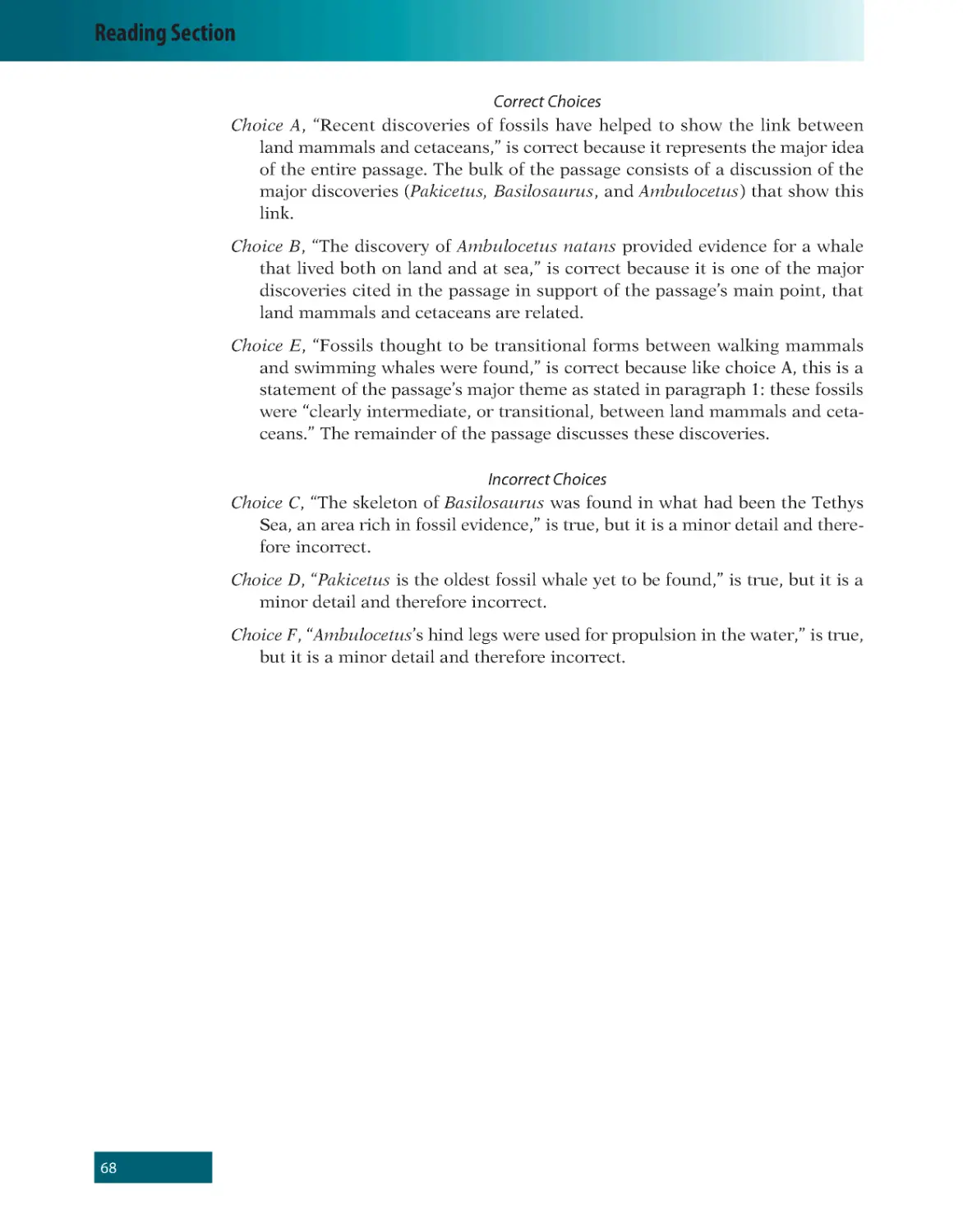
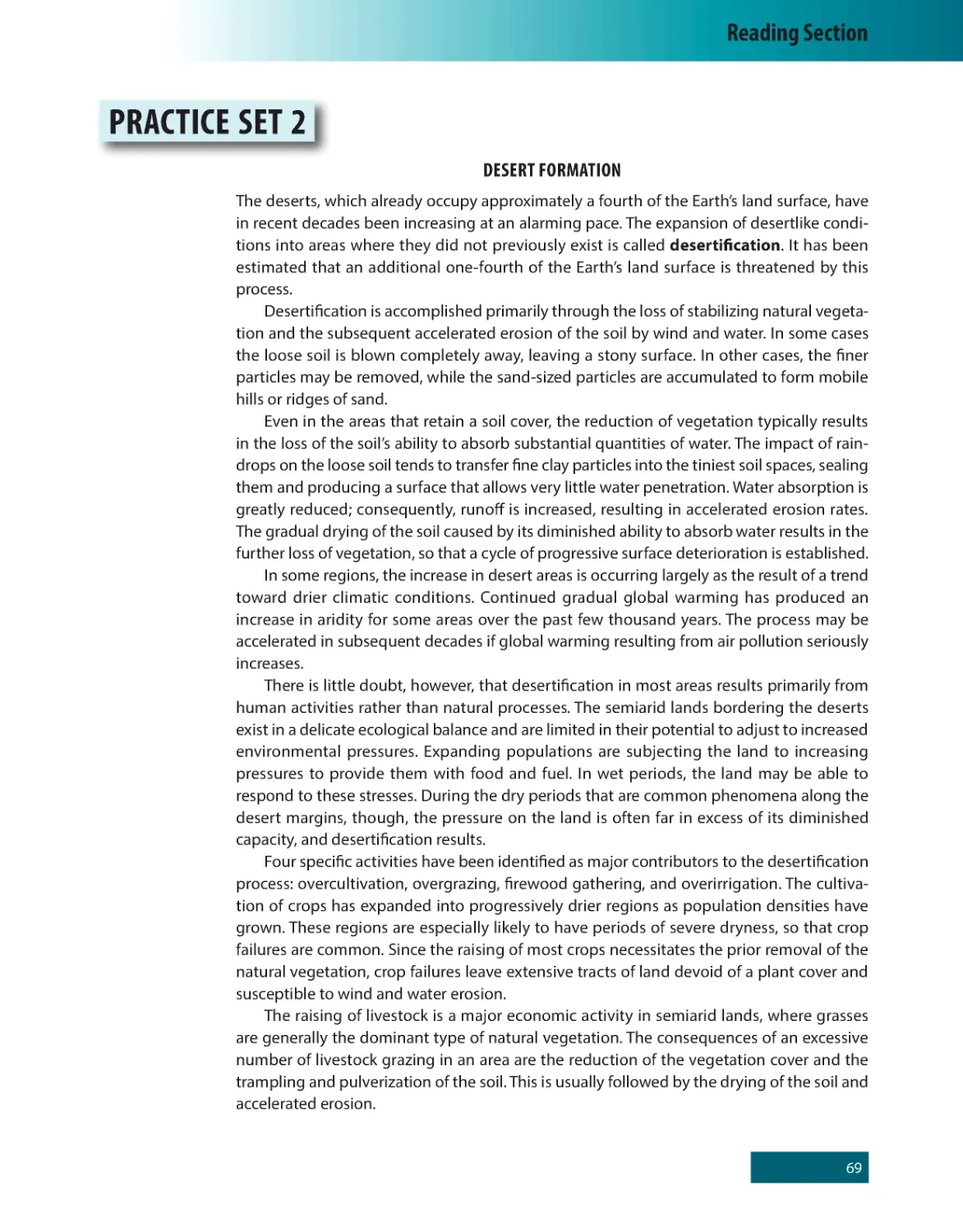


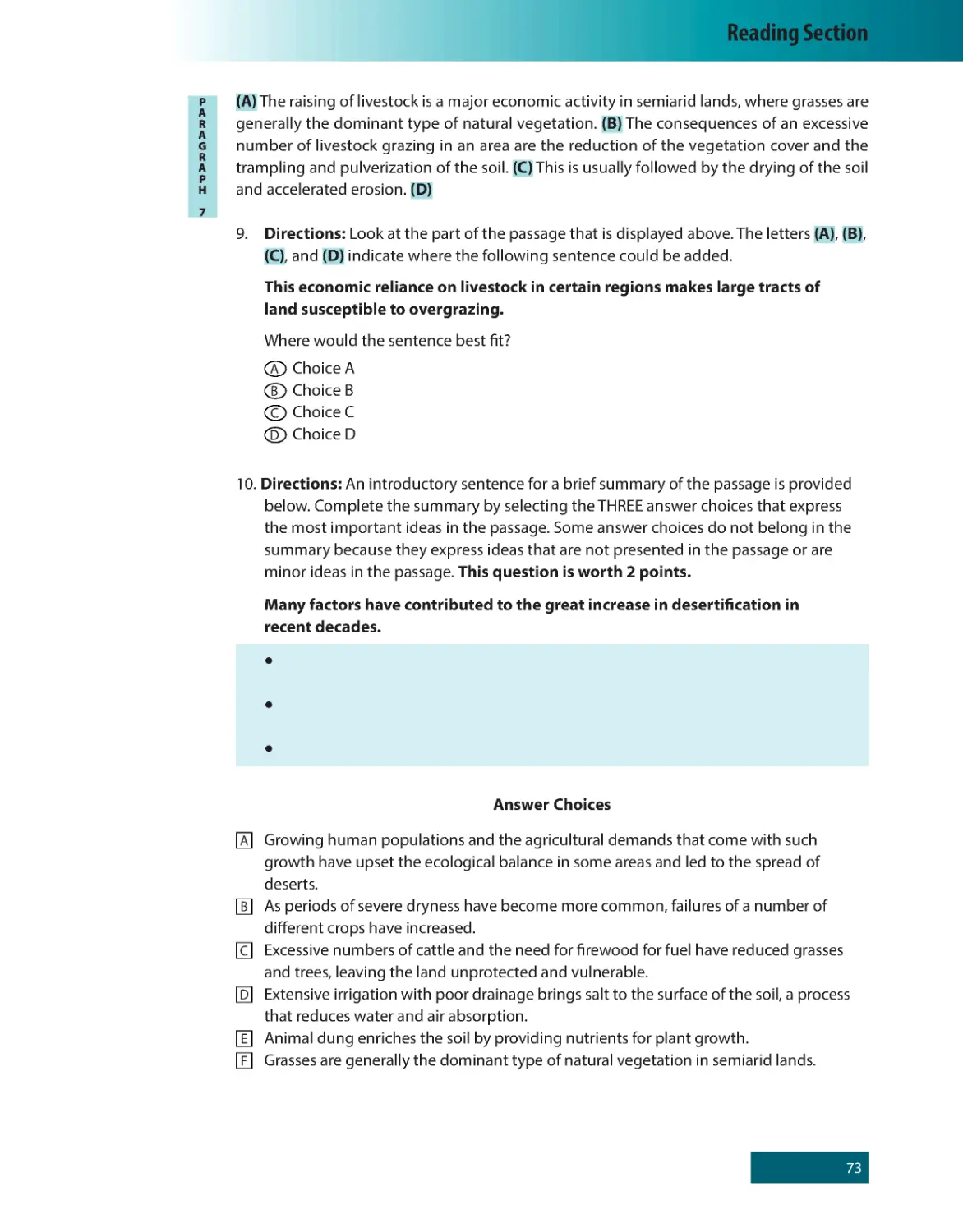
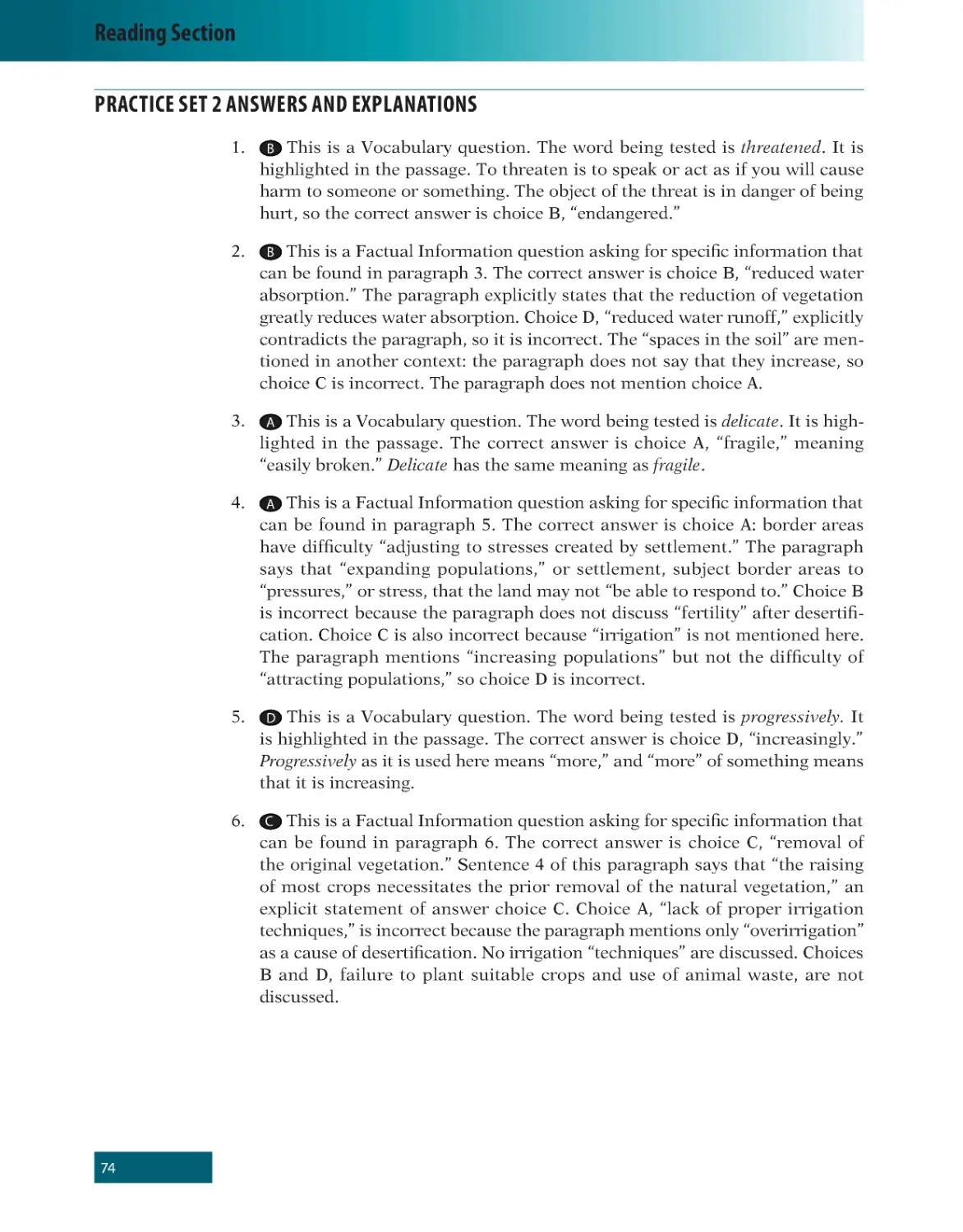












































































































































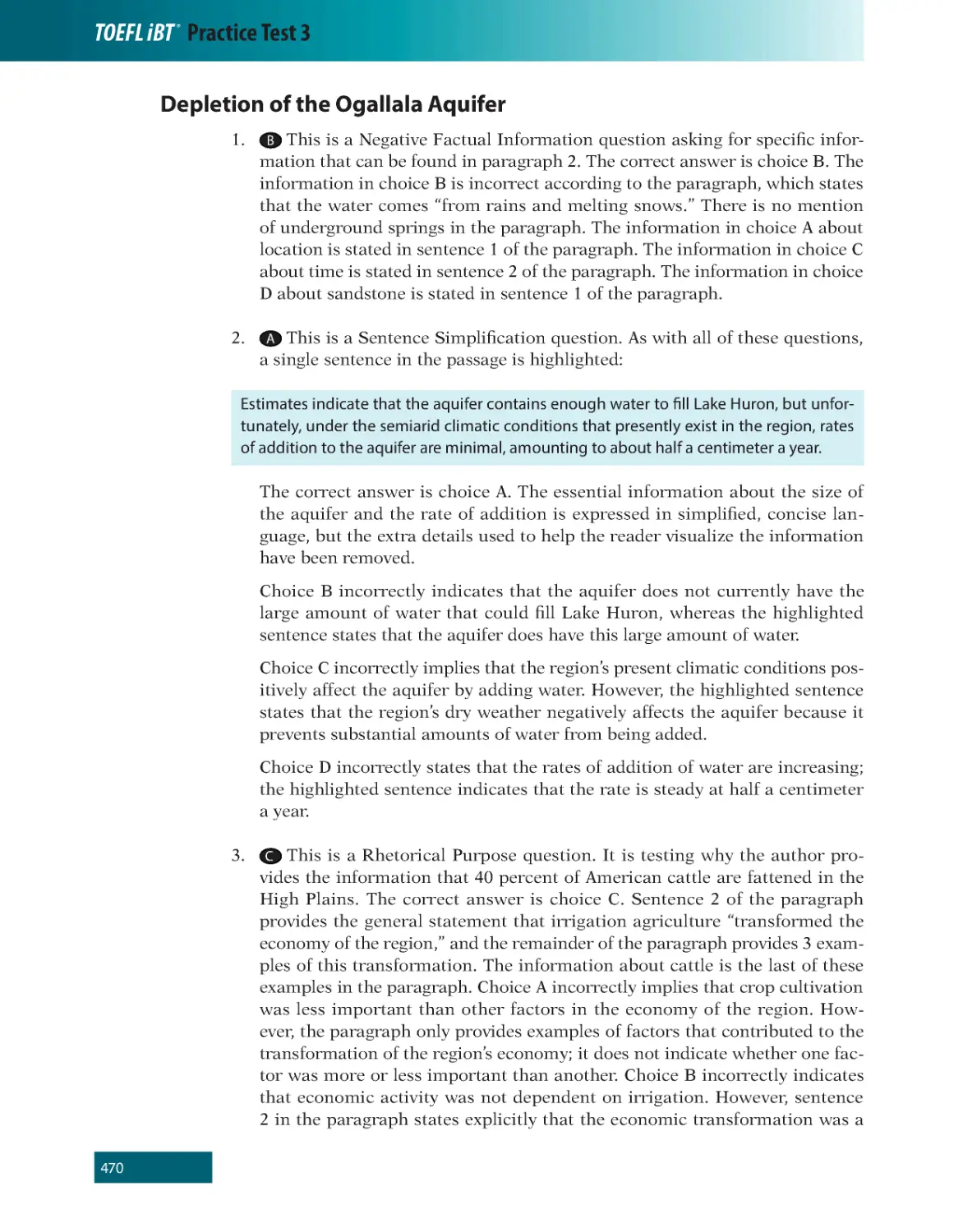


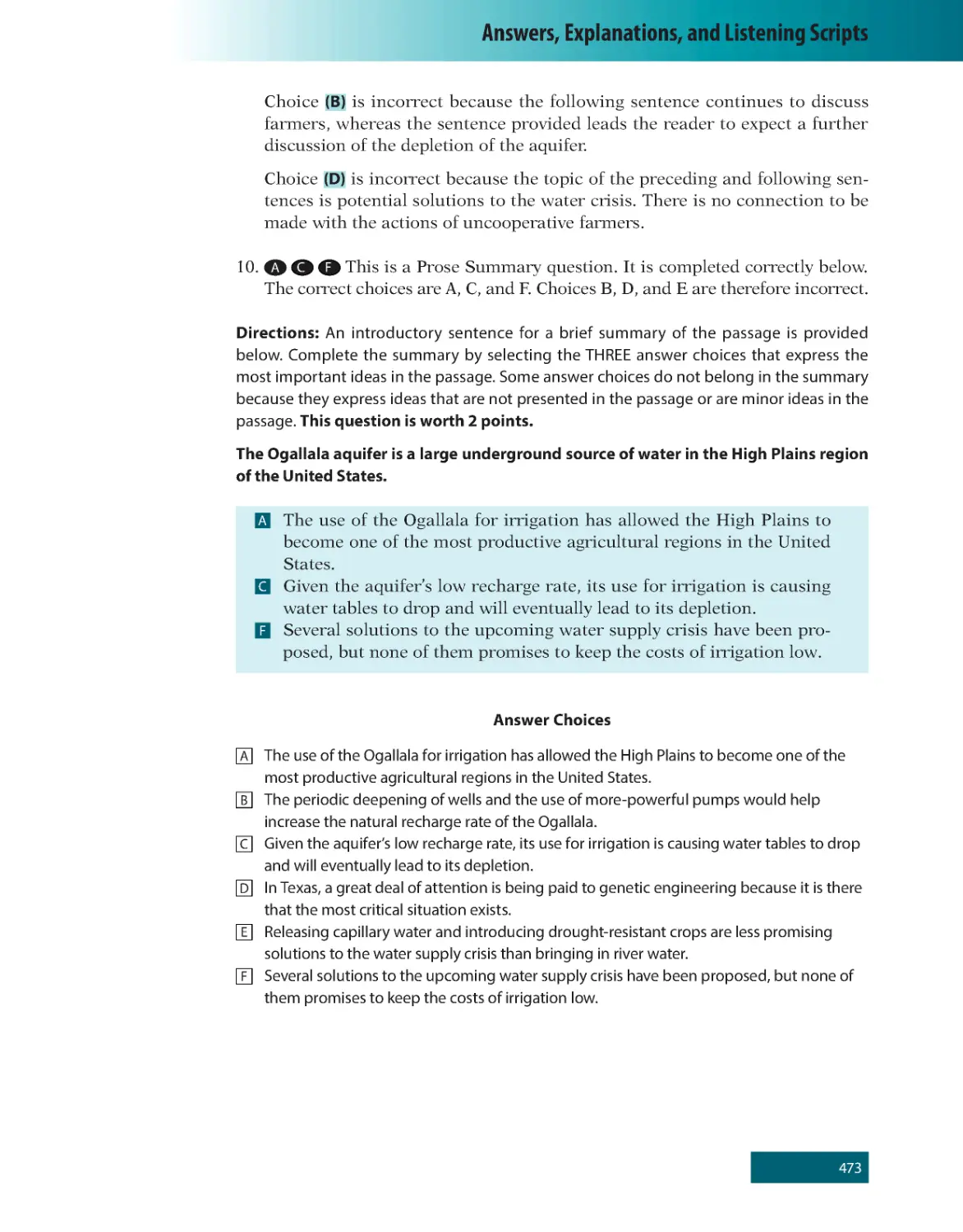
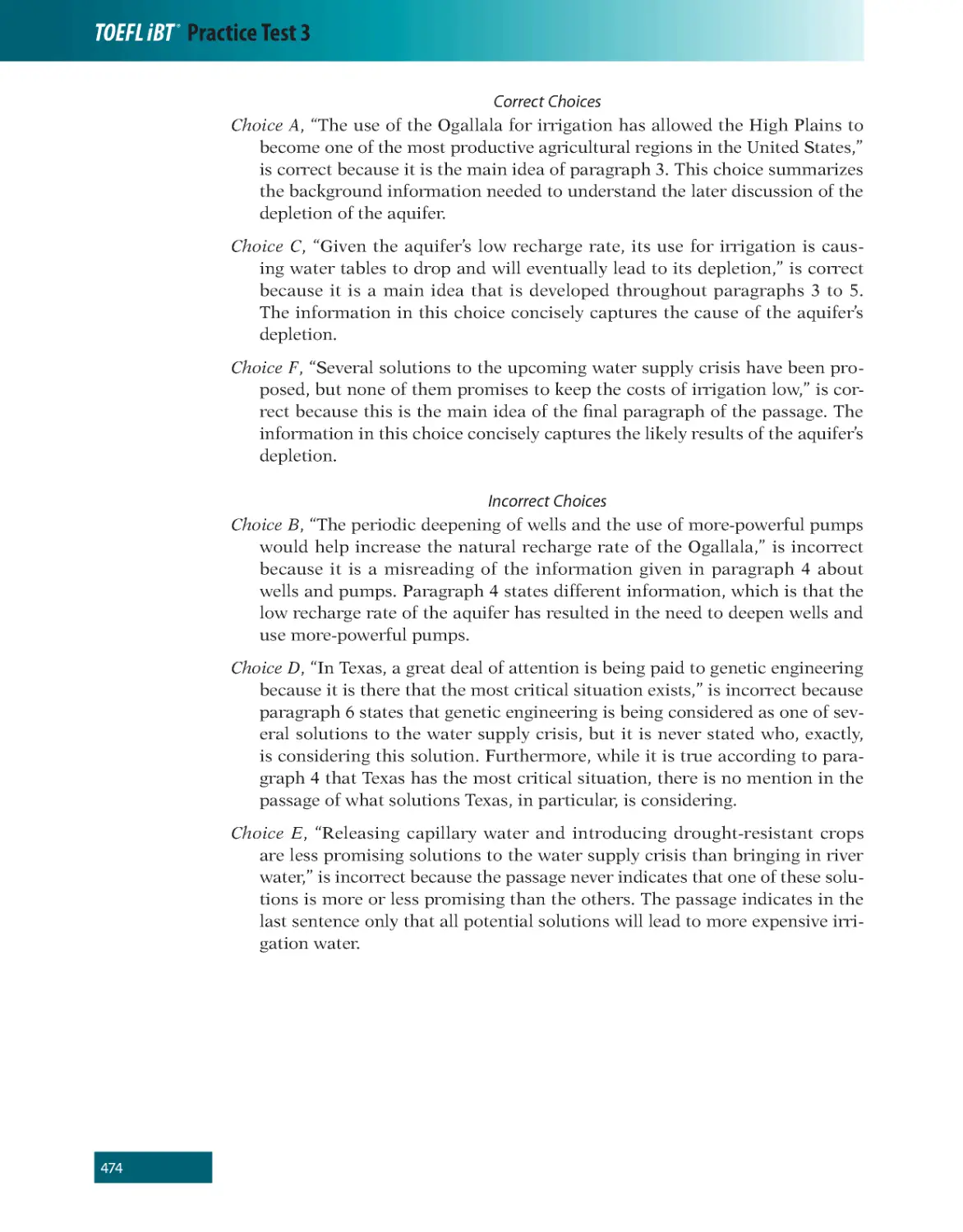
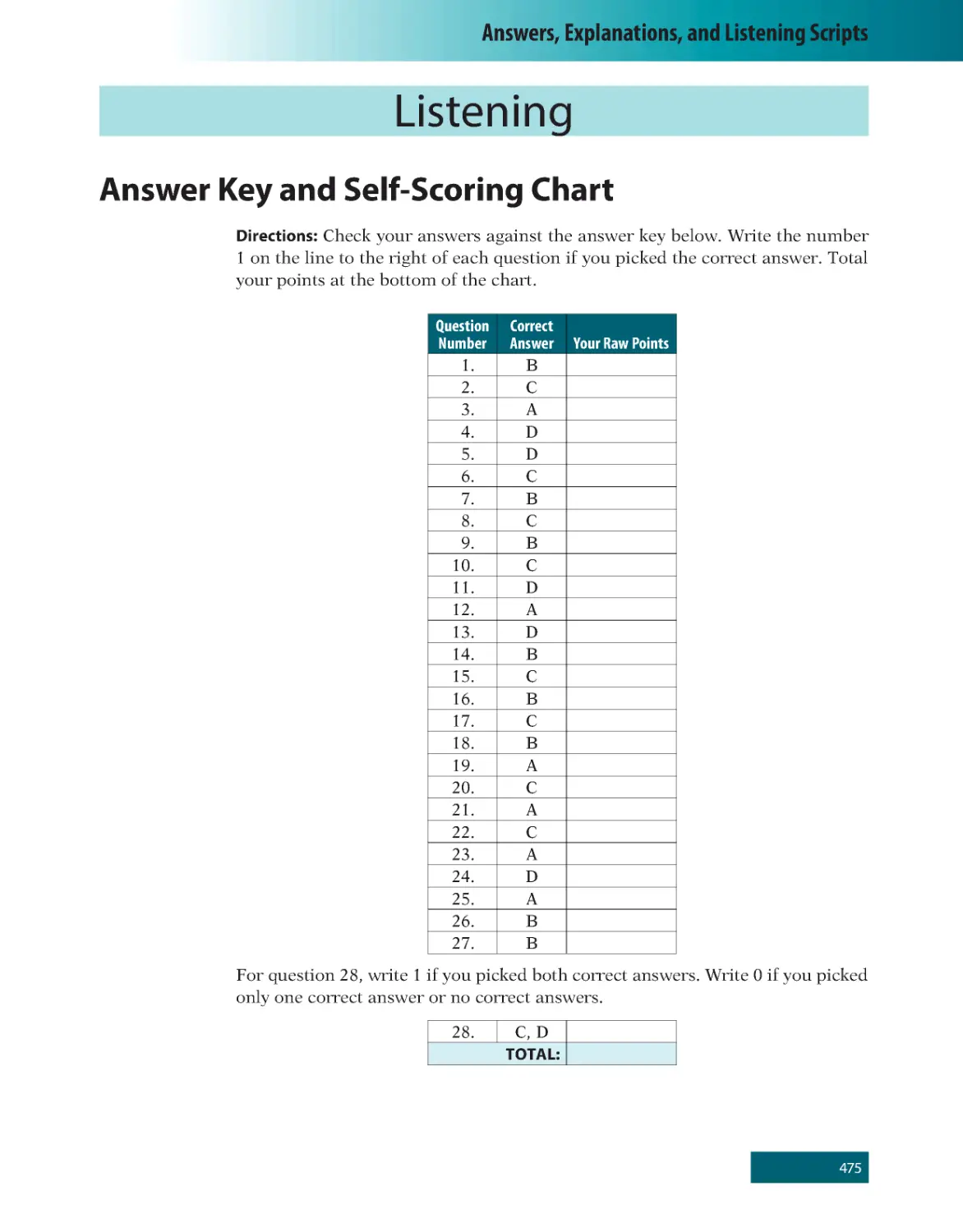



































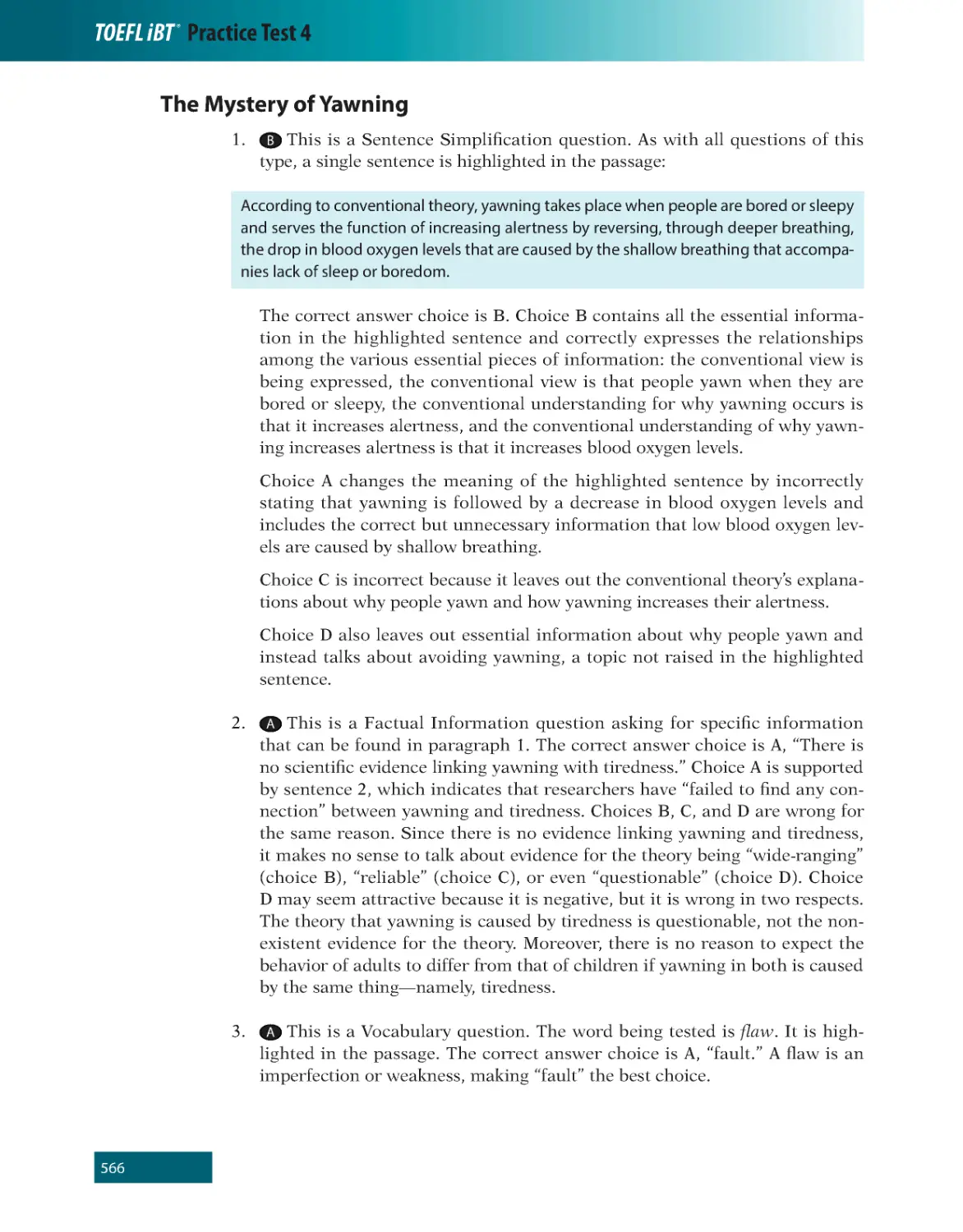


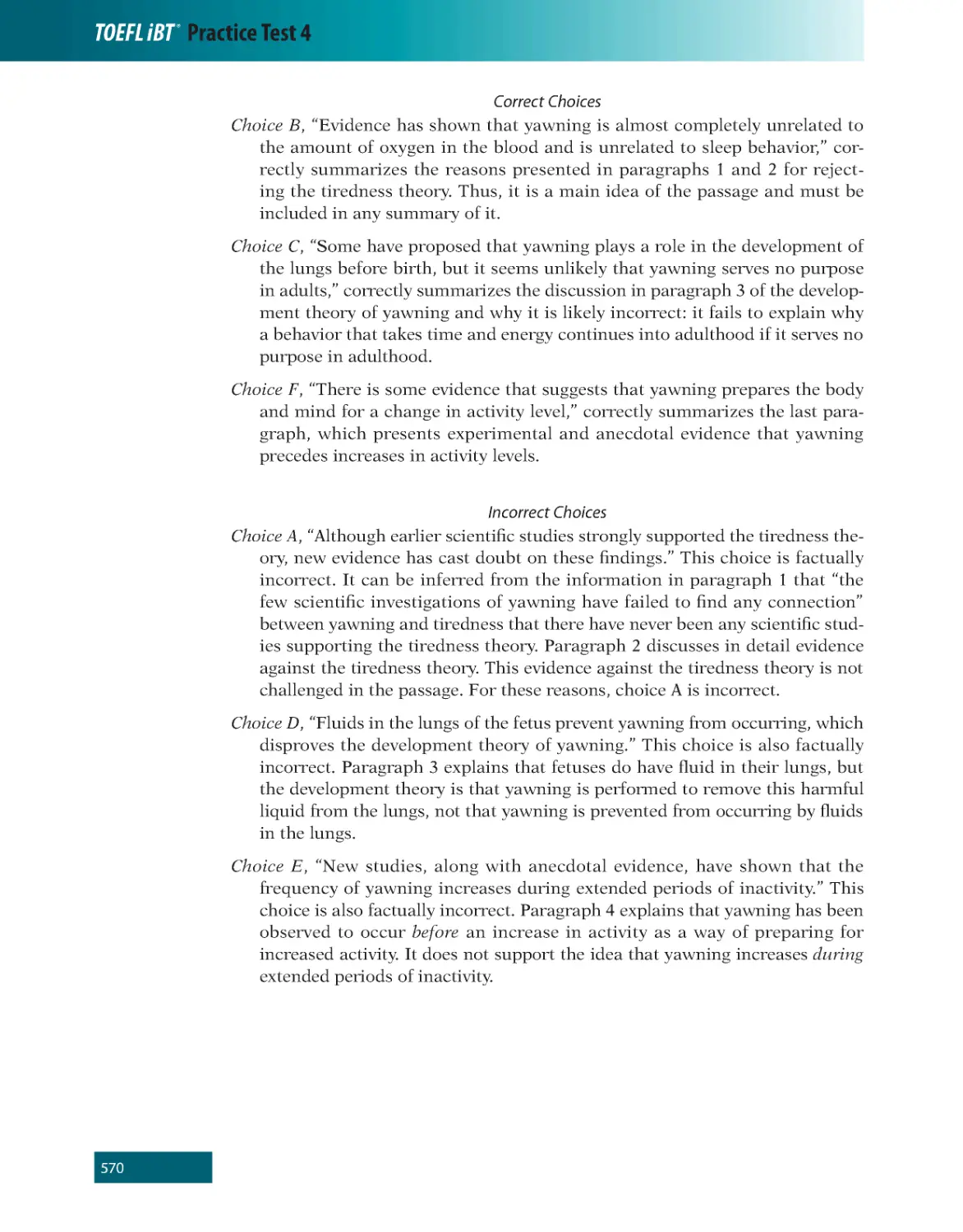
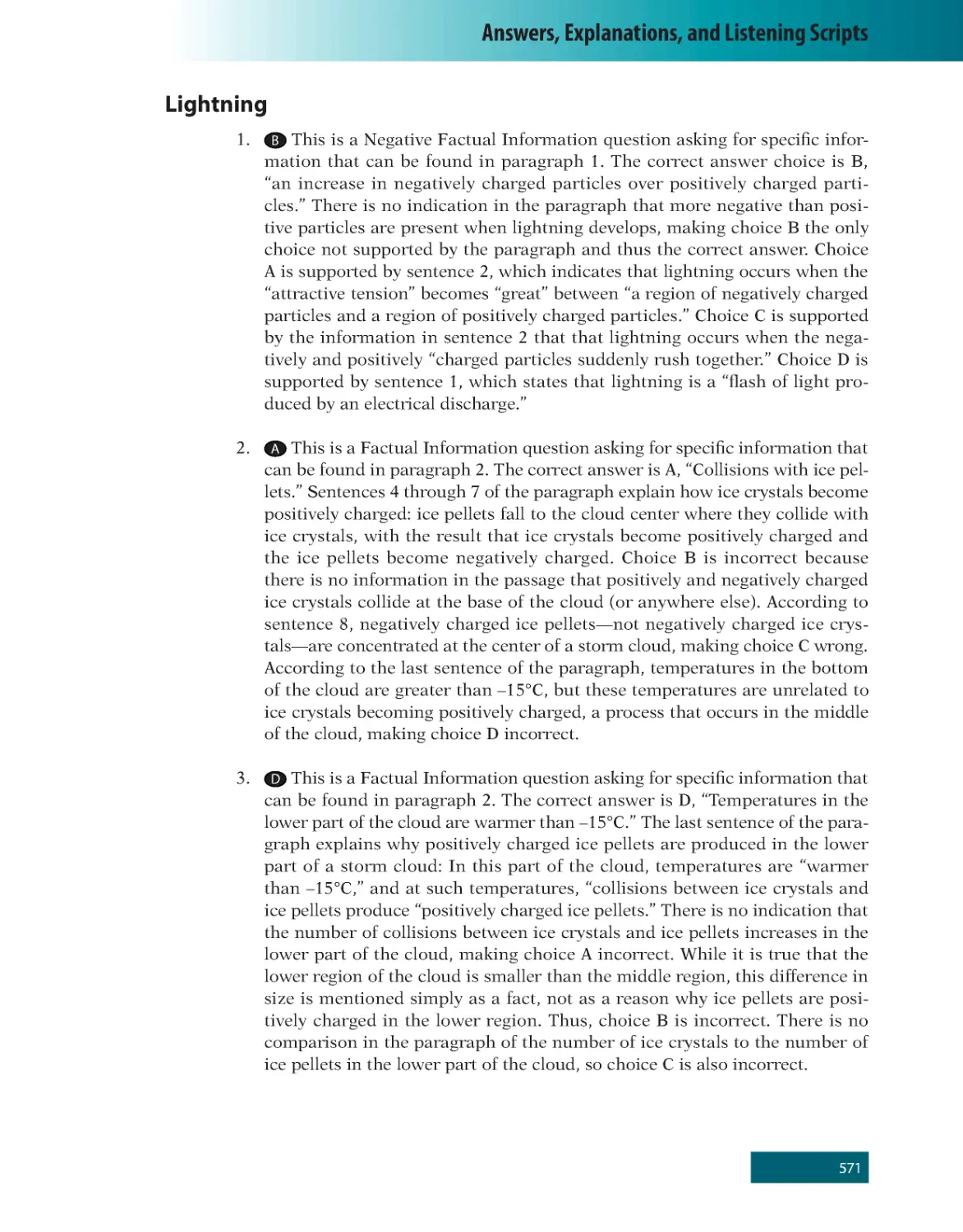


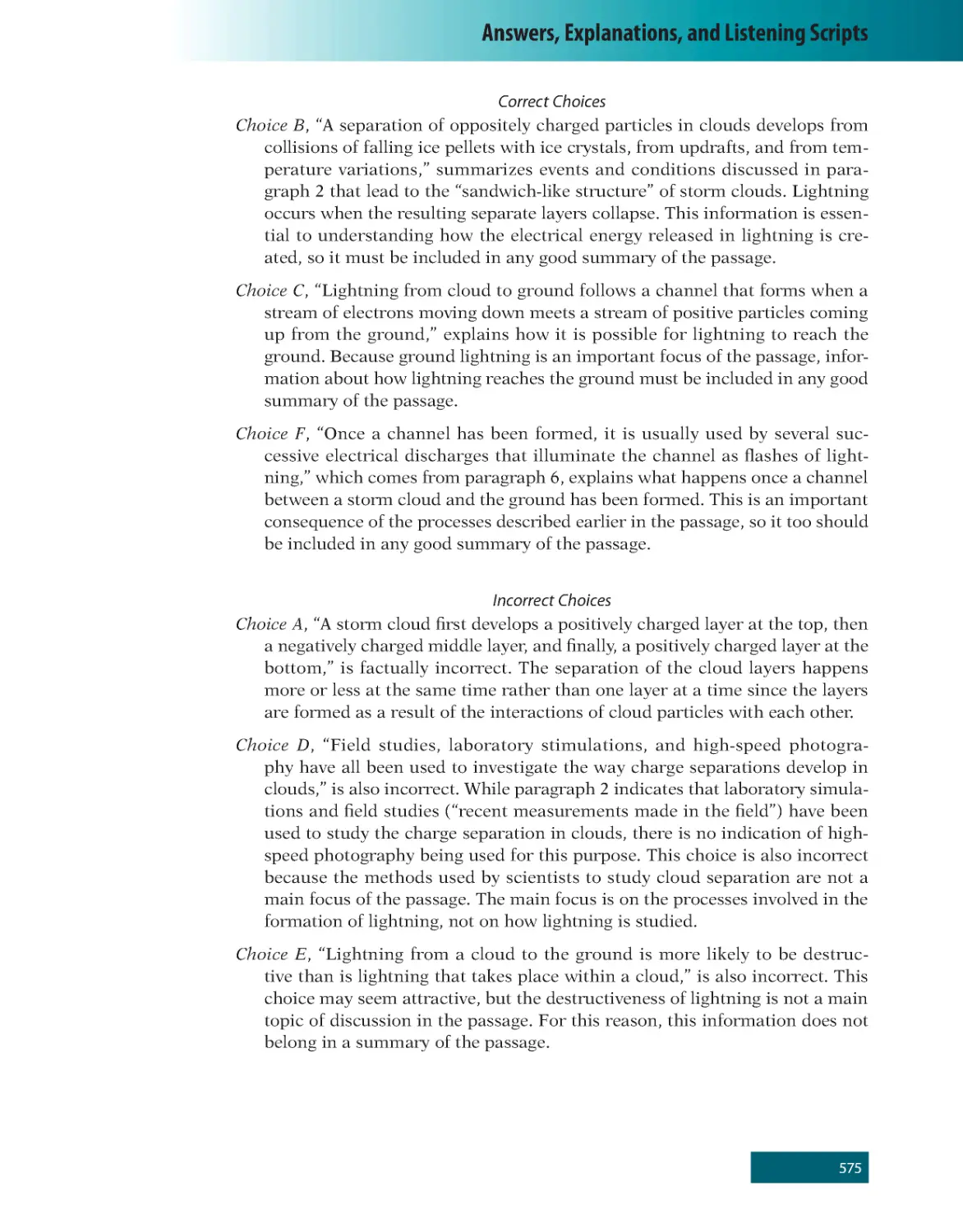




































Text
                    TOEFL GoLearn!TM
From The People Who Make The Test!
to
the
The
iBT ®
Test
SIXTH EDITION

Copyright © 2020 by Educational Testing Service. All rights reserved. ETS, the ETS logo, TOEFL and TOEFL iBT are registered trademarks of Educational Testing Service (ETS) in the United
States and other countries. IN ENGLISH WITH CONFIDENCE and TOEFL GOLEARN! are trademarks of ETS. All other trademarks are property of their respective owners. 467198262
ets.org/toefl/shoptestprep
TOEFL GoLearn!TM
TOEFL® Practice Online
The real TOEFL iBT ® test experience
TOEFL® Practice Online tests give you the experience
of taking the real TOEFL iBT ® test — wherever you are.
All TOEFL Practice Online tests:
• Use real questions from past TOEFL iBT tests
• Have the same on-screen format you’ll see in the test center
• Offer scores and performance feedback within 24 hours for
all four sections: Reading, Listening, Speaking and Writing
Choose from full-length tests, half tests or Speaking-only tests. Each
volume has a different set of questions, so you can practice a few times
to prepare for success on the test.
With TOEFL Practice Online, you can gain the confidence you need
to succeed on test day. Get started now!

The Official Guide to the TOEFL® Test
Using the Digital Resources
The test questions in this book are from actual TOEFL iBT ® tests. However, the screens and delivery formats are
not identical to the actual test. When you take the actual TOEFL iBT test, you may notice some variations in how
the questions are presented to you on screen.
Installation
First, go to www.mhprofessional.com/TOEFL6e. Once on the site, you’ll be prompted to enter your access code—
you can find your unique code in an envelope at the end of the book. Please note that this code is redeemable
only by you, a maximum of two times.
Once you enter your access code, a download will automatically begin. This download will contain the audio
files you need as well as files that contain the practice tests in both PC and Mac® format.
Main Menu For Practice Tests
When you launch the program, the following screen will appear:
Taking TOEFL iBT® Practice Tests on Your Computer
From the Main Menu, choose Practice Test 1, 2, 3, or 4. Then select the test section you wish to take: Reading,
Listening, Speaking, or Writing. Note that you can take each section more than once.

When you open a test section, you will first be provided with instructions for that section. A timer on the
screen shows how many minutes and seconds you have left for that section. You can hide the timer if you find it
distracting.
If you must take a break during the test, select Main Menu at the top of the screen. This will take you back to
the main menu. When you are ready to resume, open the test section again, and select the Continue button. Your
work will not be lost, and you will begin exactly where you left off. The timer clock will stop while you are on your
break and will restart immediately when you resume the test. Try not to take breaks too often, because on the
actual test, the clock keeps running even if you leave the room on a break.
Answering Questions
To answer the questions in the Reading and Listening sections, select the corresponding answer oval or follow
the instructions given. For some questions, you will need to select more than one answer choice. After selecting
your answer or answers, select Next to continue. In the Reading section, you can move back to review your
answer choice by selecting the Previous button.
For the Speaking section, you should record your response to each question into a recording device after you
hear the instruction telling you to begin speaking. Stop recording once the response time expires.
For the Writing section, write your response to each question in the space provided within the time allowed.
When all the questions in a section have been answered, select the Next button to complete the section.
Playing Audio Tracks
In the Listening, Speaking, and Writing sections, you will listen to audio tracks. Audio controls are available at the
bottom of the screen. At the end of a track, select the Next button to start answering questions.
Your Performance
On the Main Menu, select a section of any test you have taken. You will get information on the percentage of
questions answered correctly for the Reading and Listening sections only. Select the Review button. By selecting
Review Section, you will see the correct answer and the rationale explaining why the answer is correct for each
question in the Reading and Listening sections. For the Speaking section, you will be provided with important
points for each question, sample responses, and rater comments on the responses. Follow the instructions for
listening to sample responses. Use the important points, sample Speaking responses and rater comments to
evaluate your performance on the Speaking section. For the Writing section, you will be given topic notes, sam-
ple essays, and rater comments on the essays. Use these to evaluate your performance on the Writing section.
Audio Files For Working Through the Tests in the Book
You may choose to work with the tests printed in the book rather than with the tests on your computer. If so, you
will still need to listen to the audio tracks. So once you copy the folder named “Audio Files” to your computer,
you can select the audio tracks by number as you proceed through the book. As you work through the tests in
the book, a headphones symbol
will indicate each time you need to play a track. Click on the number of the
track as instructed in the book.

to
the
The
Test
iBT ®
SIXTH EDITION

to
the
The
Test
iBT ®
SIXTH EDITION

Copyright © 2021, 2017, 2012, 2009 by Educational Testing Service. All rights
reserved. Printed in the United States of America. Except as permitted under the
United States Copyright Act of 1976, no part of this publication may be reproduced
or distributed in any form or by any means, or stored in a database or retrieval
system, without the prior written permission of the publisher.
123456789LHS2423222120
Domestic Edition
ISBN
978-1 -260 - 47035 -2
MHID
1-260 -47035 -0
978-1-260 - 47324 -7
e-ISBN
1-260 -47324 -4
e-MHID
Copyright © 2021, 2017, 2012, 2009. Exclusive rights by McGraw Hill for manufacture
and export. This book cannot be re-exported from the country to which it is
consigned by McGraw Hill. The International Edition is not available in North
America.
ETS, the ETS logo, SpeechRater, TOEFL, TOEFL iBT, and TOEFL GO! are registered
trademarks of ETS in the United States and other countries. TOEFL GOLEARN! and
MyBest are trademarks of ETS in the United States and other countries.
McGraw Hill books are available at special quantity discounts to use as premiums
and sales promotions or for use in corporate training programs. To contact a
representative, please visit the Contact Us pages at www.mhprofessional.com.

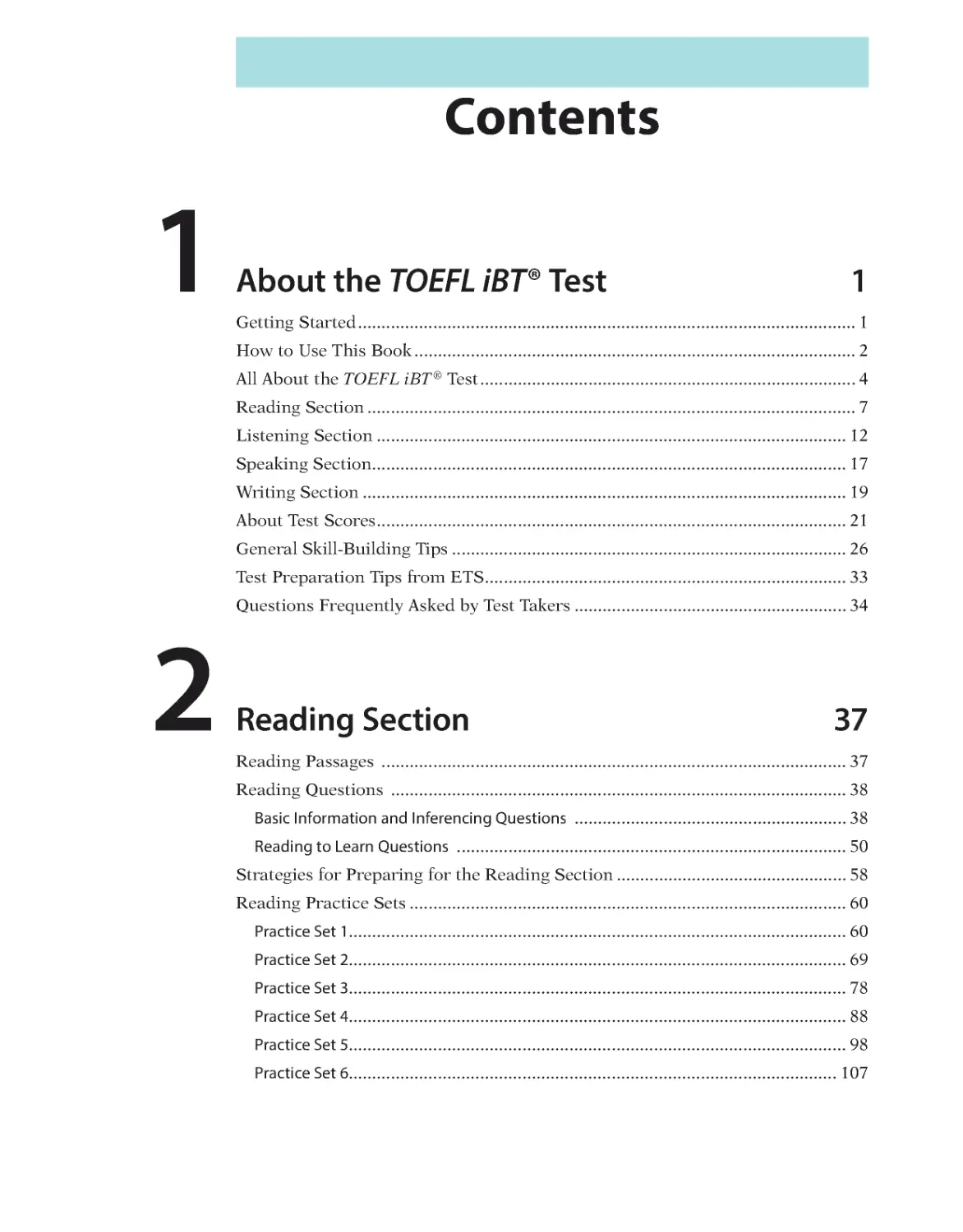
Contents
Contents
1 About the TOEFL iBT® Test
1
Getting Started .......................................................................................................... 1
How to Use This Book .............................................................................................. 2
All About the TOEFL iBT ® Test ................................................................................ 4
Reading Section ........................................................................................................ 7
Listening Section .................................................................................................... 12
Speaking Section..................................................................................................... 17
Writing Section ....................................................................................................... 19
About Test Scores.................................................................................................... 21
General Skill-Building Tips .................................................................................... 26
Test Preparation Tips from ETS............................................................................. 33
Questions Frequently Asked by Test Takers .......................................................... 34
2 Reading Section
37
Reading Passages ................................................................................................... 37
Reading Questions ................................................................................................. 38
Basic Information and Inferencing Questions .......................................................... 38
Reading to Learn Questions ................................................................................... 50
Strategies for Preparing for the Reading Section ................................................. 58
Reading Practice Sets ............................................................................................. 60
Practice Set 1.......................................................................................................... 60
Practice Set 2.......................................................................................................... 69
Practice Set 3.......................................................................................................... 78
Practice Set 4.......................................................................................................... 88
Practice Set 5.......................................................................................................... 98
Practice Set 6........................................................................................................ 107

Contents
3 Listening Section
117
Listening Materials .............................................................................................. 117
Listening Questions ............................................................................................. 119
Basic Comprehension Questions .......................................................................... 120
Pragmatic Understanding Questions .................................................................... 126
Connecting Information Questions ....................................................................... 129
Strategies for Preparing for and Taking the Listening Section ......................... 135
Listening Practice Sets ......................................................................................... 137
Practice Set 1........................................................................................................ 137
Practice Set 2........................................................................................................ 142
Practice Set 3........................................................................................................ 147
Practice Set 4........................................................................................................ 152
Practice Set 5........................................................................................................ 158
4 Speaking Section
163
The Speaking Section .......................................................................................... 163
Speaking Tasks ...................................................................................................... 165
The Independent Task .......................................................................................... 165
The Integrated Tasks ............................................................................................ 167
Speaking Scoring Rubric ...................................................................................... 180
Independent Task: Question 1 ............................................................................... 180
Integrated Tasks: Questions 2, 3, and 4 ................................................................... 182
Strategies for Preparing for and Taking the Speaking Section ......................... 184
Frequently Asked Questions About the TOEFL® Speaking Section .................. 185

Contents
5 Writing Section
187
The Writing Section ............................................................................................. 187
The Integrated Writing Task ................................................................................ 188
How the Task Is Phrased ....................................................................................... 190
Strategies for Taking the Integrated Writing Task .............................................. 191
Integrated Writing Scoring Rubric ...................................................................... 193
Sample Scored Responses for the Integrated Writing Task ...................................... 195
The Independent Writing Task ............................................................................ 199
How Essays Are Scored ......................................................................................... 200
Independent Writing Scoring Rubric .................................................................. 203
Sample Scored Responses for the Independent Writing Task .................................. 205
Independent Writing Topics ................................................................................ 210
Topic List ............................................................................................................. 210
6 Authentic TOEFL iBT® Practice Test 1
215
Reading.................................................................................................................. 217
Listening ................................................................................................................ 237
Speaking ................................................................................................................ 249
Writing ................................................................................................................... 255
Answers, Explanations, and Listening Scripts .................................................... 261
7 Authentic TOEFL iBT® Practice Test 2
313
Reading.................................................................................................................. 315
Listening ................................................................................................................ 335
Speaking ................................................................................................................ 347
Writing ................................................................................................................... 353
Answers, Explanations, and Listening Scripts .................................................... 359

Contents
8 Authentic TOEFL iBT® Practice Test 3 409
Reading.................................................................................................................. 411
Listening ................................................................................................................ 431
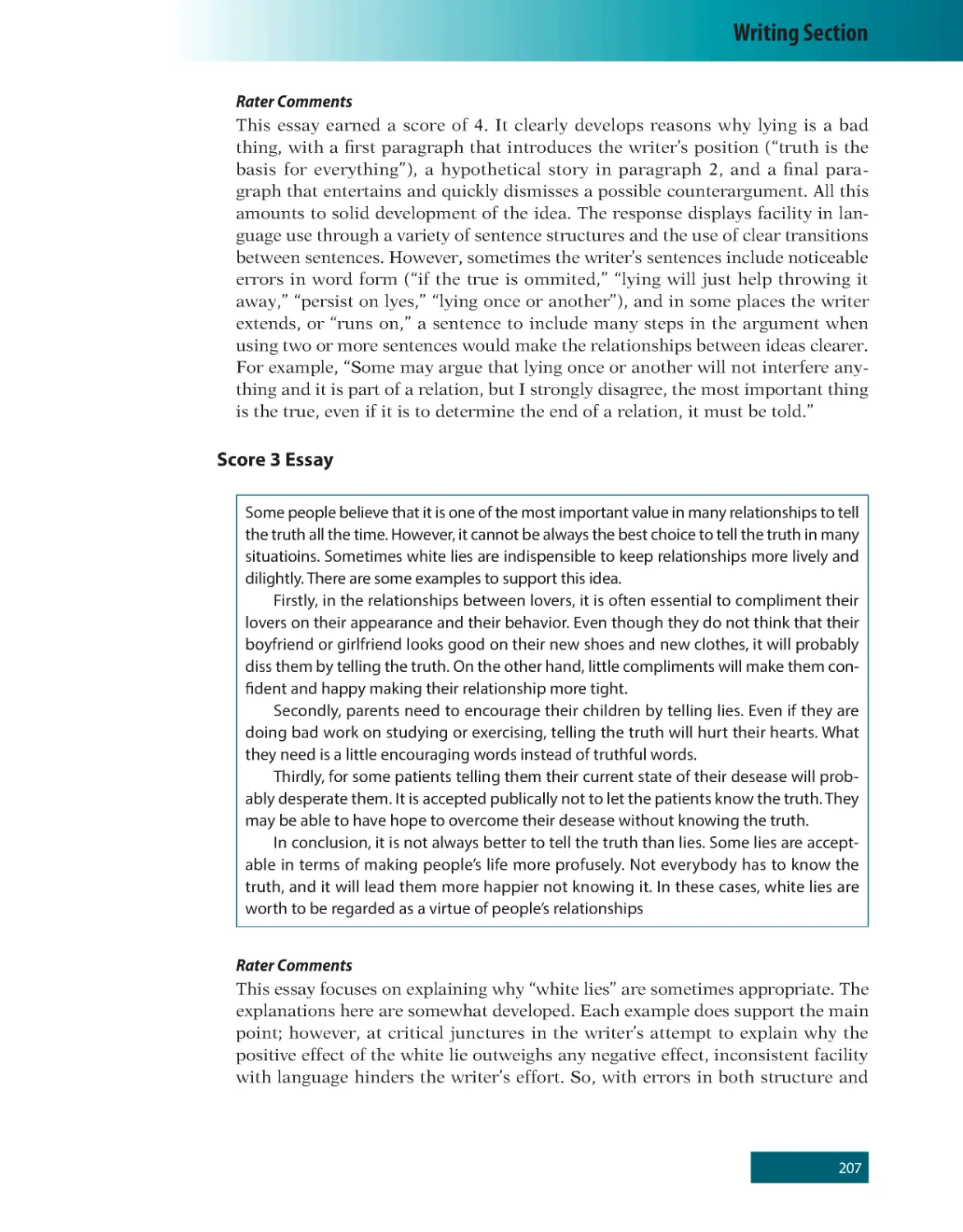
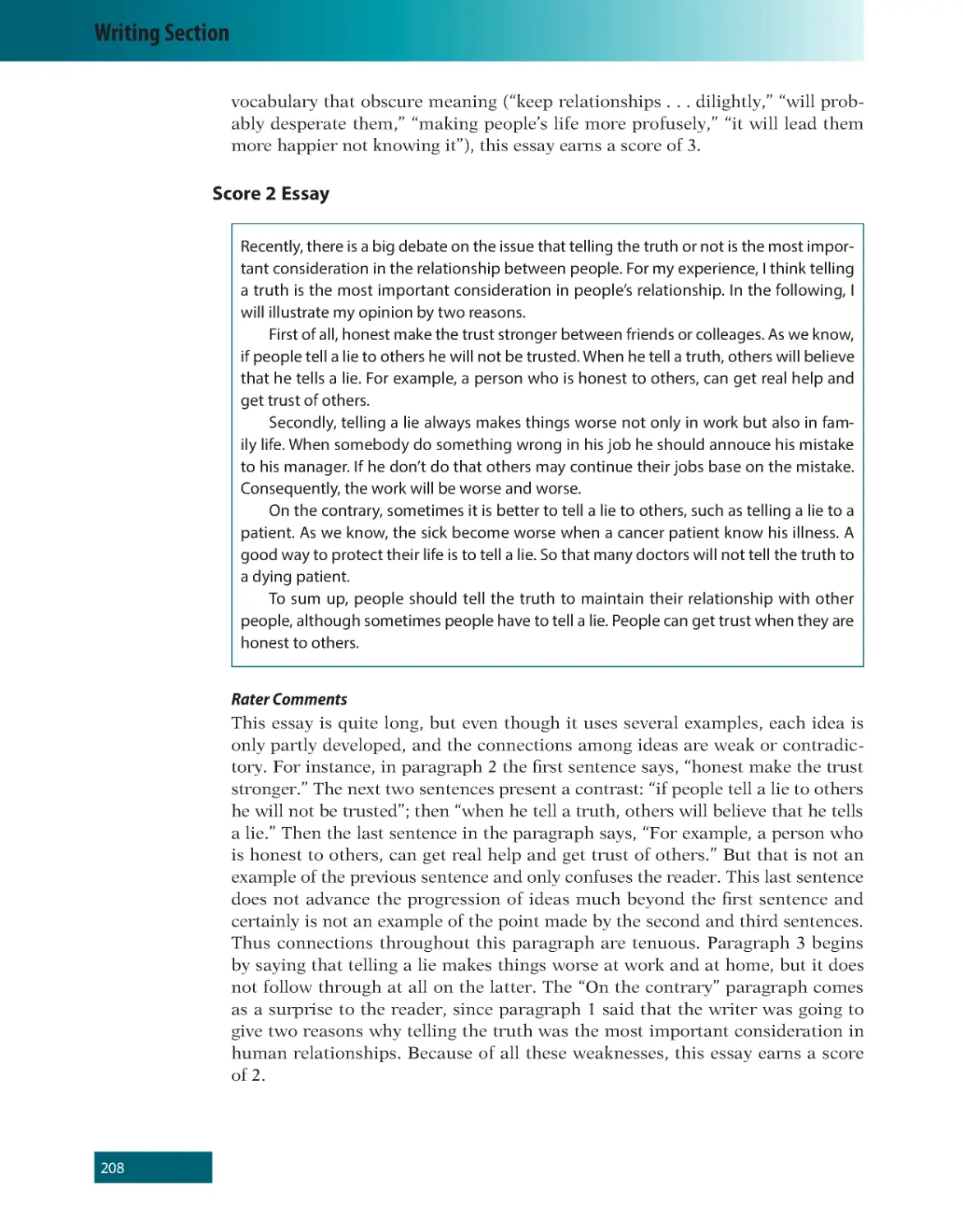
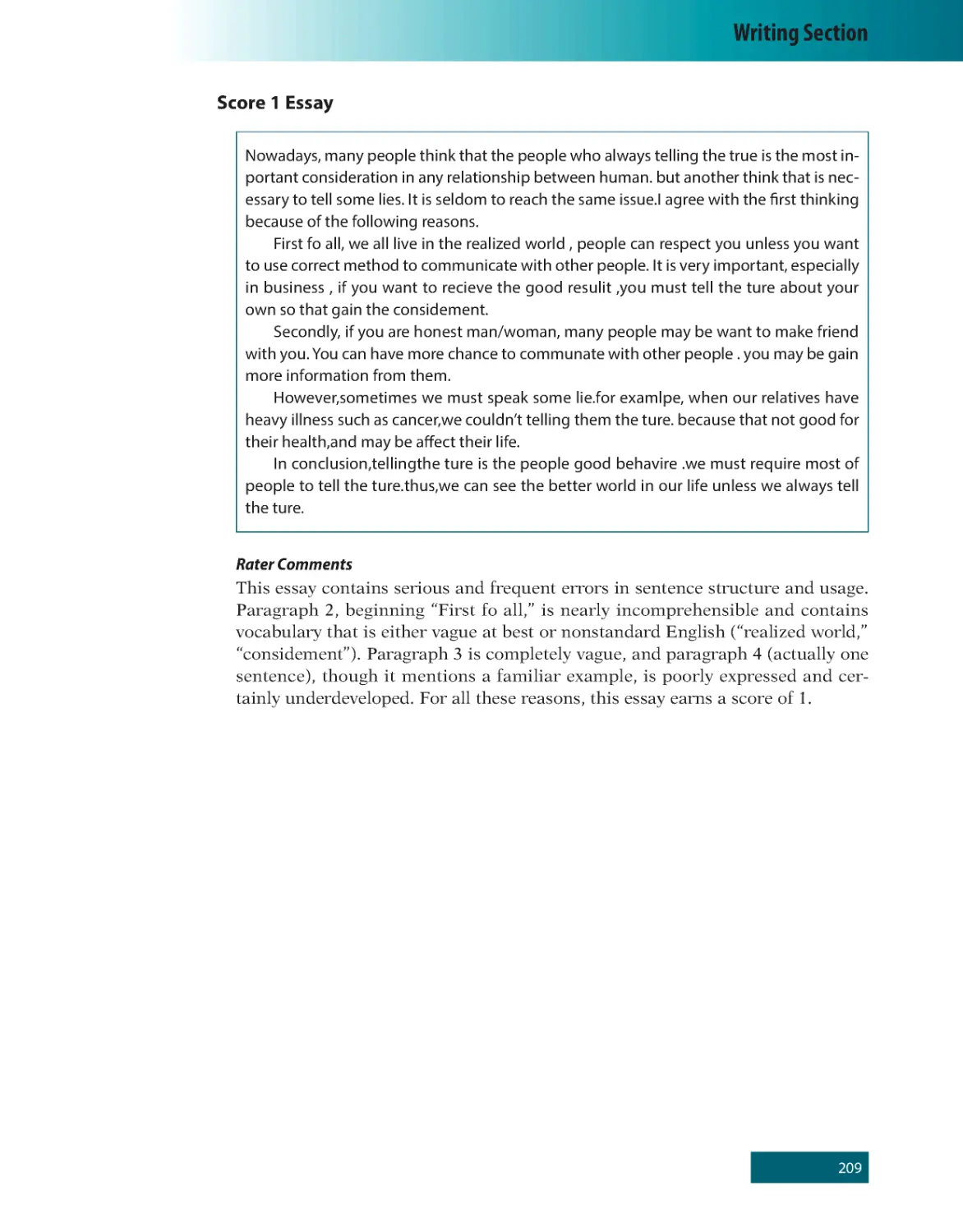
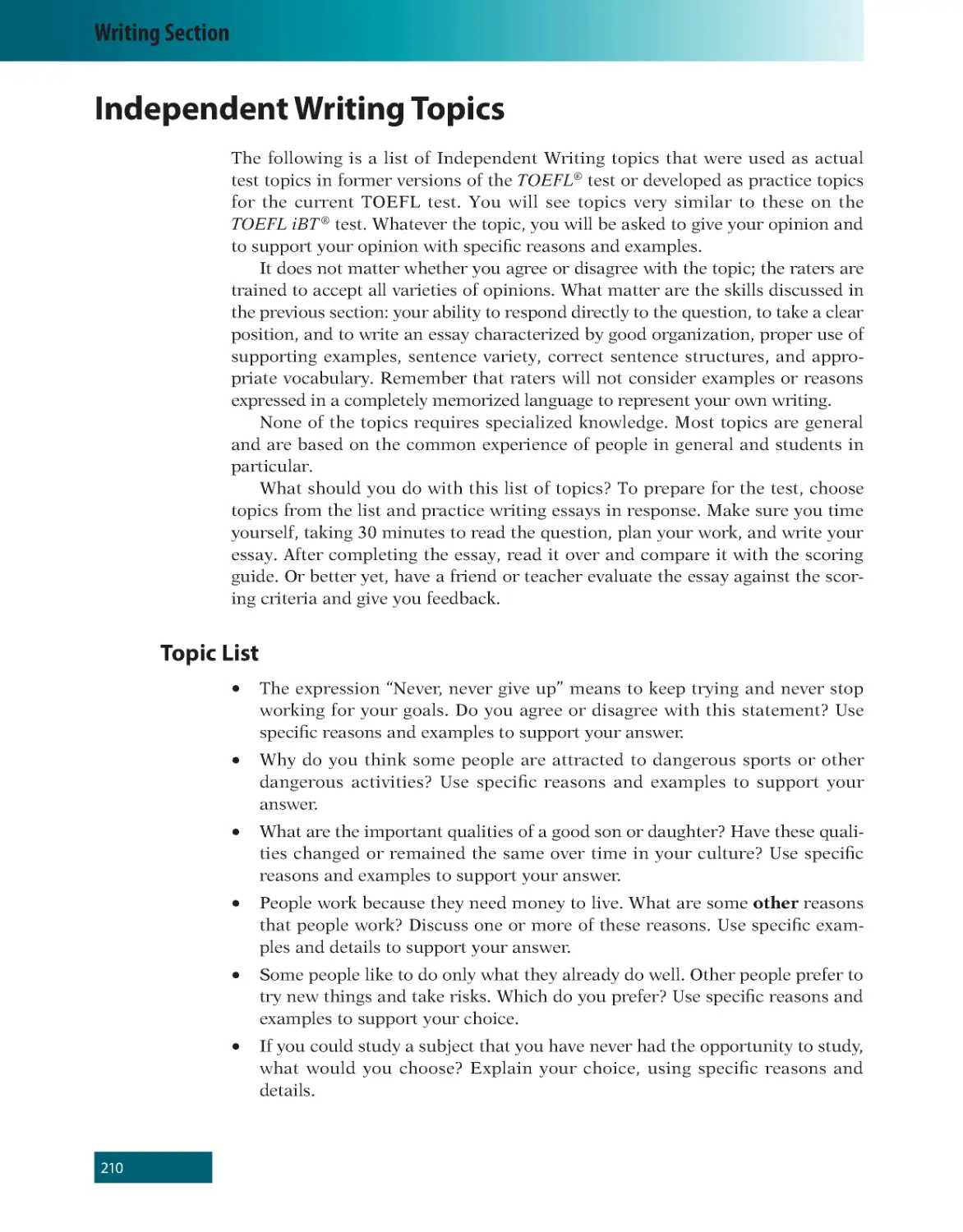
Speaking ................................................................................................................ 445
Writing ................................................................................................................... 451
Answers, Explanations, and Listening Scripts .................................................... 457
9 Authentic TOEFL iBT® Practice Test 4 509
Reading.................................................................................................................. 511
Listening ................................................................................................................ 531
Speaking ................................................................................................................ 545
Writing ................................................................................................................... 551
Answers, Explanations, and Listening Scripts .................................................... 557
10 Writer’s Handbook for
English Language Learners
613
Grammar ............................................................................................................... 613
Usage ..................................................................................................................... 626
Mechanics.............................................................................................................. 633
Style ....................................................................................................................... 643
Organization and Development ........................................................................... 648
Advice to Writers ................................................................................................... 661
Revising, Editing, and Proofreading .................................................................... 667
Glossary ................................................................................................................. 670
Appendix: Performance Feedback for Test Takers........................................................ 675

to
the
The
Test
iBT ®
SIXTH EDITION

1About the
TOEFL iBT ® Test
Read this
chapter
to learn
The main features of the TOEFL iBT ® test
What kind of questions are on the test
How you can use this book to help you prepare for the test
1
This Official Guide has been created to help English language learners
understand the TOEFL® test and prepare for it. By preparing for the test,
you will also be building the skills you need to succeed in an academic set-
ting and go anywhere in your career and in life.
Getting Started
Start your preparation for the TOEFL® test by reading the following important
information about the test, testing requirements, and your TOEFL scores.
Undergraduate, graduate, and postgraduate programs around the world
require students to demonstrate their ability to communicate in English as an
entrance requirement.
The TOEFL test gives test takers the opportunity to prove they can communi-
cate ideas effectively by simulating university classroom and student life commu-
nication. The language used in the test reflects real-life English language usage in
university lectures, classes, and laboratories. It is the same language professors
use when they discuss course work or concepts with students. It is the language
students use in study groups and everyday university situations, such as buying
books at the bookstore. The reading passages are from real textbooks and course
materials.
TOEFL® Scores Can Help You Go Anywhere
The TOEFL® test measures how well test takers use English, not just their knowl-
edge of the language. Because it is a valid and reliable test with unbiased, objec-
tive scoring, the TOEFL test confirms that a student has the English language
skills necessary to succeed in an academic setting.
That’s why it has been the world’s premier academic English test for more
than five decades. TOEFL scores are accepted by more than 11,000 universities
and other institutions in more than 180 countries, including Australia, Canada,

2
About the TOEFL iBT ® Test
New Zealand, the U.S., the U.K . and all across Europe and Asia. The test is
administered at thousands of secure, ETS-approved test centers in more than 180
countries. More than 35 million people around the world have taken the TOEFL
test to help achieve their dreams.
Who Creates the TOEFL® Test?
The TOEFL® test is developed and administered by Educational Testing Service
(ETS), the world’s largest educational assessment and research organization. Our
mission is to advance quality and equity in education. Providing fair, valid and
reliable assessments is central to why we exist.
Who Is Required to Take the TOEFL® Test?
If your first or native language is not English, it is likely that the college or uni-
versity that you wish to attend will require you to take an English-language pro-
ficiency test. However, you should check with each institution to which you are
applying to confirm their requirements.
How Is the TOEFL® Test Used in the Admissions Process?
Your test scores will be considered together with other information you supply to
the institution to determine if you have the appropriate academic and language
background to be admitted to a regular or modified program of study. Often,
your field of study and whether you are applying as a graduate or undergraduate
student will determine what TOEFL® scores you need.
Is There a Minimum Acceptable Score?
Each institution that uses TOEFL® scores sets its own minimum level of acceptable
performance. These minimums vary from one institution to another, depending
on factors such as the applicant’s field of study, the level of study (undergraduate
or graduate), whether the applicant will be a teaching assistant, and whether the
institution offers English as a Second Language support for its students.
How to Use This Book
This book and its digital resources give you instruction, practice, and advice on
strategies for performing well on the TOEFL® test.
• Chapter 1 provides an overview of the test, information about test scores,
and an introduction to the on-screen appearance of the different parts of
the TOEFL iBT ® test, along with general test-taking suggestions.
• Chapters 2, 3, 4, and 5 provide in-depth discussions of the kinds of ques-
tions that appear in each section of the test. Each chapter also includes

3
About the TOEFL iBT ® Test
practice questions and explanations of correct answers so that you will
understand the actual communicative skills that are being tested in each
section.
• Chapters 6–9 provide four full-length actual TOEFL iBT® tests that will
give you an idea of how you might perform on the actual test.
• Chapter 10 is the Writer’s Handbook, a guide to help you write essays in
English. It covers grammar, usage, mechanics, style, and organization and
development. There is also a discussion of different types of essays, tips on
how to improve your essay by revising, editing, and proofreading, and a
glossary.
• The digital download supplied with this book provides on-screen versions
of the full-length actual tests from Chapters 6–9 . It also includes num-
bered audio tracks for all of the listening materials that accompany the
practice questions in this book. For more information about how to use
the digital resources, see the instruction page in the front of the book.
You can use this book to familiarize yourself with the appearance, length,
and format of the test. For additional practice and to experience the real test, go
to TOEFL® Practice Online at www.ets.org/toeflpractice. TOEFL® Practice Online
offers:
• a real TOEFL iBT test experience
• the same on-screen format you’ll see at the test center
• a variety of practice tests to help you prepare for test day
• performance feedback and scores within 24 hours on all four skills
TOEFL® Practice Online can help you become familiar with the way the test
is delivered and what it is like to answer the questions under timed conditions.
This Official Guide will help you understand the language skills you will need to
succeed on the test and in the classroom.
Use the practice tests in this book and from TOEFL® Practice Online to deter-
mine which of your skills are the weakest. Then follow the advice in each skill
chapter to improve those skills. You should use other materials to supplement
the practice test questions in this book.
Because the TOEFL test is designed to assess the actual skills you will need to
be successful in your studies, the very best way to develop the skills being mea-
sured is to study in an English program that focuses on:
• communication using all four skills, especially speaking
• integrated skills (for example, listening/reading/speaking, listening/reading/
writing)
However, even students who are not enrolled in an English program should
practice the underlying skills that are assessed on the TOEFL test. In other words,
the best way to improve performance on the test is to improve your skills. Each
chapter of this book gives you explicit advice on how to connect your learning
activities to the kinds of questions you will be asked on the test. Perhaps you

4
want to improve your score on the Reading section. The best way to improve
your English reading skills is to read frequently and to read many different types
of texts in various subject areas (sciences, social sciences, arts, business, and oth-
ers). The Internet is one of the best resources for this, but any books, magazines,
or journals are very helpful as well. It is best to progress to reading texts that are
more academic in style, the kind that would be found in university courses.
In addition, you might try these activities:
• Scan the passages to find and highlight key facts (dates, numbers, terms)
and information.
• Increase vocabulary knowledge, perhaps by using flash cards.
• Rather than carefully reading each word and each sentence, practice
skimming a passage quickly to get a general impression of the main idea.
• Choose some unfamiliar words in the passage and guess the meanings
from the context (surrounding sentences).
• Select all the pronouns (he, him, they, them, and others) and identify which
nouns each one refers to in the passage.
• Practice making inferences and drawing conclusions based on what is
implied in the passage as a whole.
All About the TOEFL iBT ® Test
The TOEFL iBT ® test consists of four sections: Reading, Listening, Speaking, and
Writing. The entire test is about three hours long, and all sections are taken on
the same day.
Key Features
• The TOEFL iBT® test measures all four language skills that are important for
effective communication: speaking, listening, reading, and writing, empha-
sizing the test taker’s ability to use English effectively in academic settings.
• It reflects how language is really used with integrated tasks that combine
more than one skill, just as in real academic settings. The integrated ques-
tions ask test takers to:
read, listen, and then speak in response to a question
listen and then speak in response to a question
read, listen, and then write in response to a question
• It represents the best practices in language learning and teaching. In the
past, English instruction focused on learning about the language (espe-
cially grammar), and students could receive high scores on tests without
being able to communicate. Now teachers and learners understand the
importance of using English to communicate, and activities that integrate
language skills are popular in many English language programs.
About the TOEFL iBT ® Test

5
Format
• The TOEFL iBT ® test is administered via the Internet at a secure network
of testing centers around the world.
• Instructions for answering questions are given with each section. There is
no computer tutorial.
• The test is not computer-adaptive. Each test taker receives items that
cover the full range of ability.
• Test takers can take notes throughout the entire test. At the end of testing,
all notes are collected and destroyed at the test center to ensure test
security.
• In the Listening and Speaking sections, you may hear some native
English-speaker accents that are not from North America, such as British
or Australian. To hear samples, visit www.ets.org/toefl/ibt/about/content/.
• For the Speaking section, test takers wear noise-canceling headphones
and speak into a microphone. Responses are recorded digitally and sent
to ETS to be scored.
• For the Writing section, test takers type their responses. The typed
responses are sent to ETS for scoring.
• For the Speaking and Writing responses, ETS uses both certified human
raters and artificial intelligence (AI) scoring to provide a complete and
accurate picture of a test taker’s ability.
• After finishing the test, test takers will be able to view their unofficial
scaled scores for the Reading and Listening sections. Scoring of the
Speaking and Writing sections takes place only after the test administra-
tion and cannot be provided in real time.
• Official scores are reported both online and by mail.
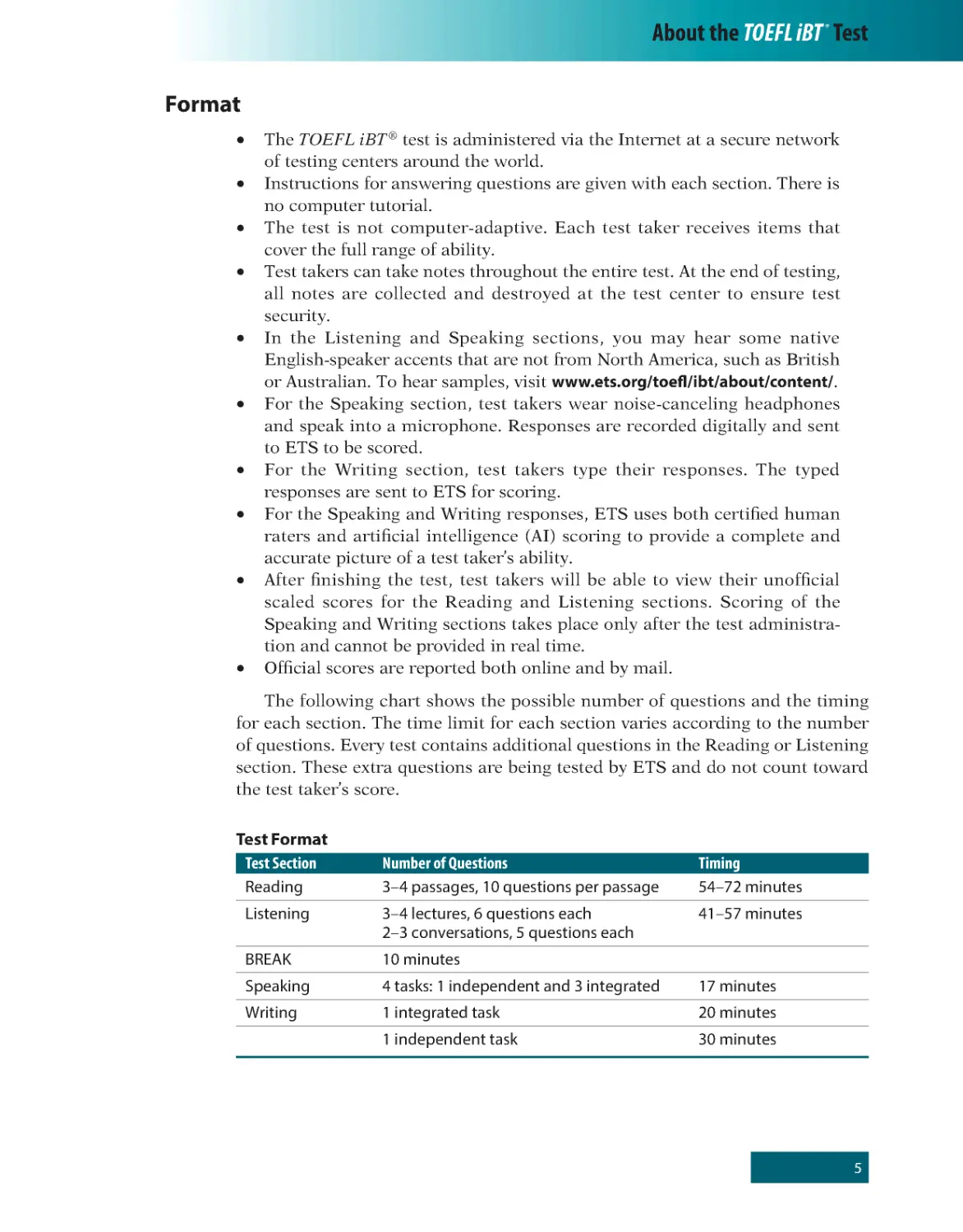
The following chart shows the possible number of questions and the timing
for each section. The time limit for each section varies according to the number
of questions. Every test contains additional questions in the Reading or Listening
section. These extra questions are being tested by ETS and do not count toward
the test taker’s score.
Test Format
Test Section
Number of Questions
Timing
Reading
3–4 passages, 10 questions per passage
54–72 minutes
Listening
3–4 lectures, 6 questions each
2–3 conversations, 5 questions each
41–57 minutes
BREAK
10 minutes
Speaking
4 tasks: 1 independent and 3 integrated
17 minutes
Writing
1 integrated task
20 minutes
1 independent task
30 minutes
About the TOEFL iBT ® Test

6
Toolbar
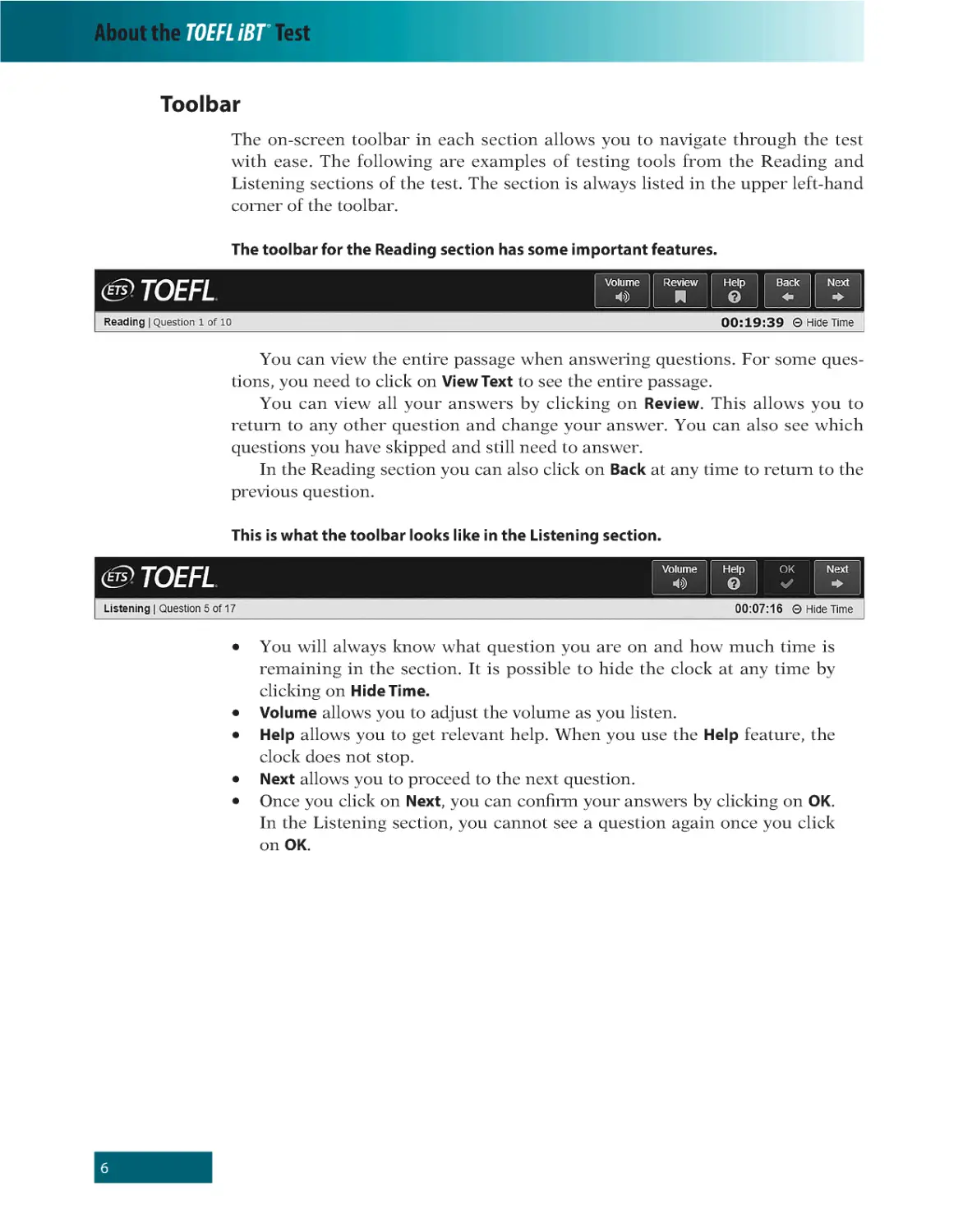
The on-screen toolbar in each section allows you to navigate through the test
with ease. The following are examples of testing tools from the Reading and
Listening sections of the test. The section is always listed in the upper left-hand
corner of the toolbar.
The toolbar for the Reading section has some important features.
You can view the entire passage when answering questions. For some ques-
tions, you need to click on View Text to see the entire passage.
You can view all your answers by clicking on Review. This allows you to
return to any other question and change your answer. You can also see which
questions you have skipped and still need to answer.
In the Reading section you can also click on Back at any time to return to the
previous question.
This is what the toolbar looks like in the Listening section.
• You will always know what question you are on and how much time is
remaining in the section. It is possible to hide the clock at any time by
clicking on Hide Time.
• Volume allows you to adjust the volume as you listen.
• Help allows you to get relevant help. When you use the Help feature, the
clock does not stop.
• Next allows you to proceed to the next question.
• Once you click on Next, you can confirm your answers by clicking on OK.
In the Listening section, you cannot see a question again once you click
on OK.
About the TOEFL iBT ® Test

7
Reading Section
Academic Reading Skills
The Reading section measures your ability to understand university-level aca-
demic texts and passages. In many academic settings around the world, students
are expected to read and understand information from textbooks and other
academic materials written in English. The following are three purposes for aca-
demic reading:
Reading to find information
• effectively skimming text for key facts and important information
• increasing reading fluency and rate
Basic comprehension
• understanding the general topic or main idea, major points, important
facts and details, vocabulary in context, and pronoun references1
• making inferences2 about what is implied in a passage
Reading to learn
• recognizing the organization and purpose of a passage
• understanding relationships between ideas
• organizing information into a category chart or a summary in order to
recall major points and important details
• inferring how ideas throughout the passage connect
Description
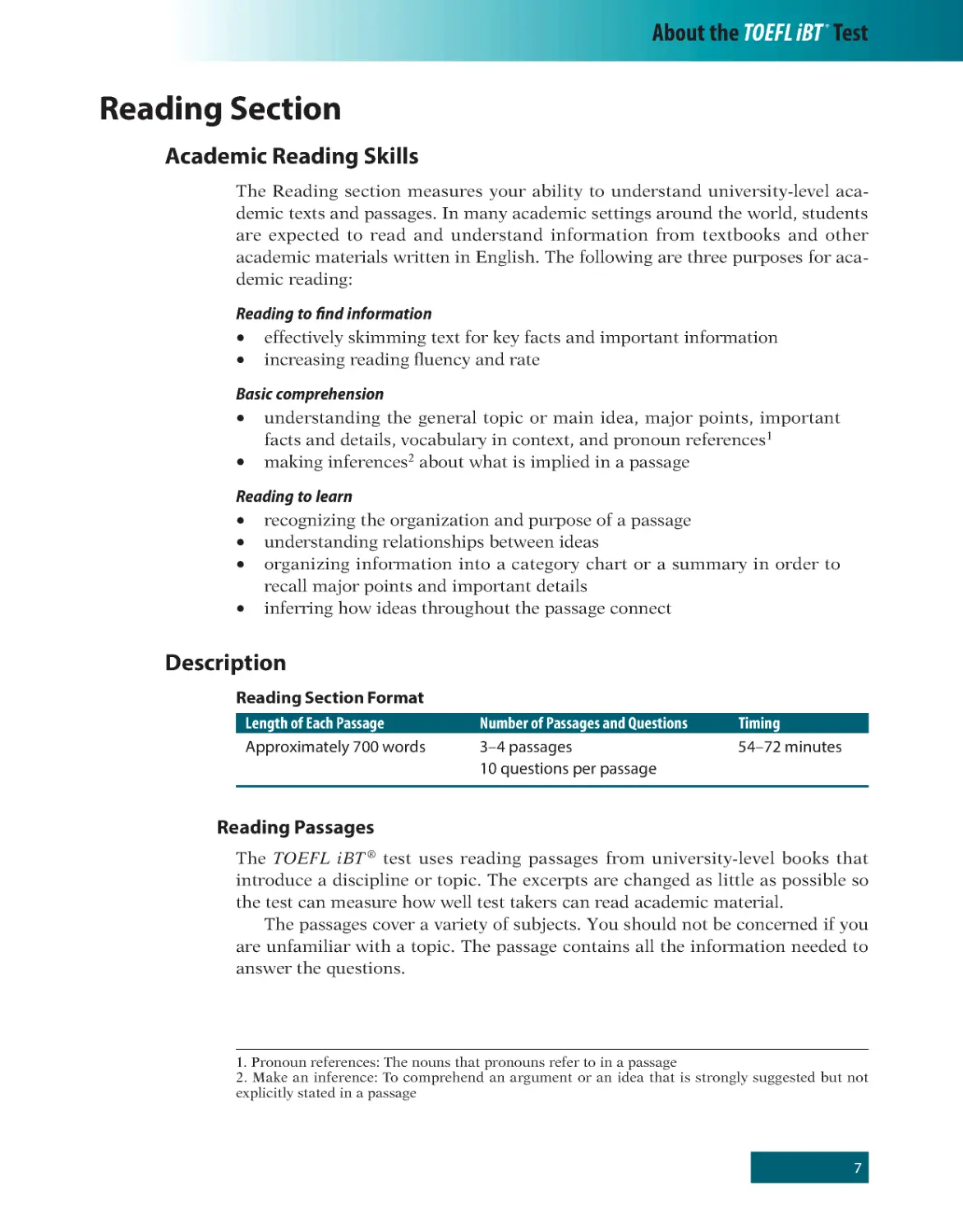
Reading Section Format
Length of Each Passage
Number of Passages and Questions
Timing
Approximately 700 words
3–4 passages
10 questions per passage
54–72 minutes
Reading Passages
The TOEFL iBT ® test uses reading passages from university-level books that
introduce a discipline or topic. The excerpts are changed as little as possible so
the test can measure how well test takers can read academic material.
The passages cover a variety of subjects. You should not be concerned if you
are unfamiliar with a topic. The passage contains all the information needed to
answer the questions.
1. Pronoun references: The nouns that pronouns refer to in a passage
2. Make an inference: To comprehend an argument or an idea that is strongly suggested but not
explicitly stated in a passage
About the TOEFL iBT ® Test

All passages are classified into three basic categories:
• exposition3
• argumentation4
• historical
Often, passages present information about the topic from more than one per-
spective or point of view. This is something you should note as you read. Usu-
ally, you are asked at least one question that allows you to demonstrate that you
understood the general organization of the passage. Common organization types
that you should be able to recognize are:
• classification
• compare/contrast
• cause/effect
• problem/solution
You must read through or scroll to the end of each passage before receiving
questions on that passage. Once the questions appear, the passage appears on the
right side of the computer screen. The questions are on the left. (See the illustra-
tion that follows.)
8
3. Exposition: Material that provides an explanation of a topic
4. Argumentation: Material that presents a point of view about a topic and provides evidence to
support it
About the TOEFL iBT ® Test

9
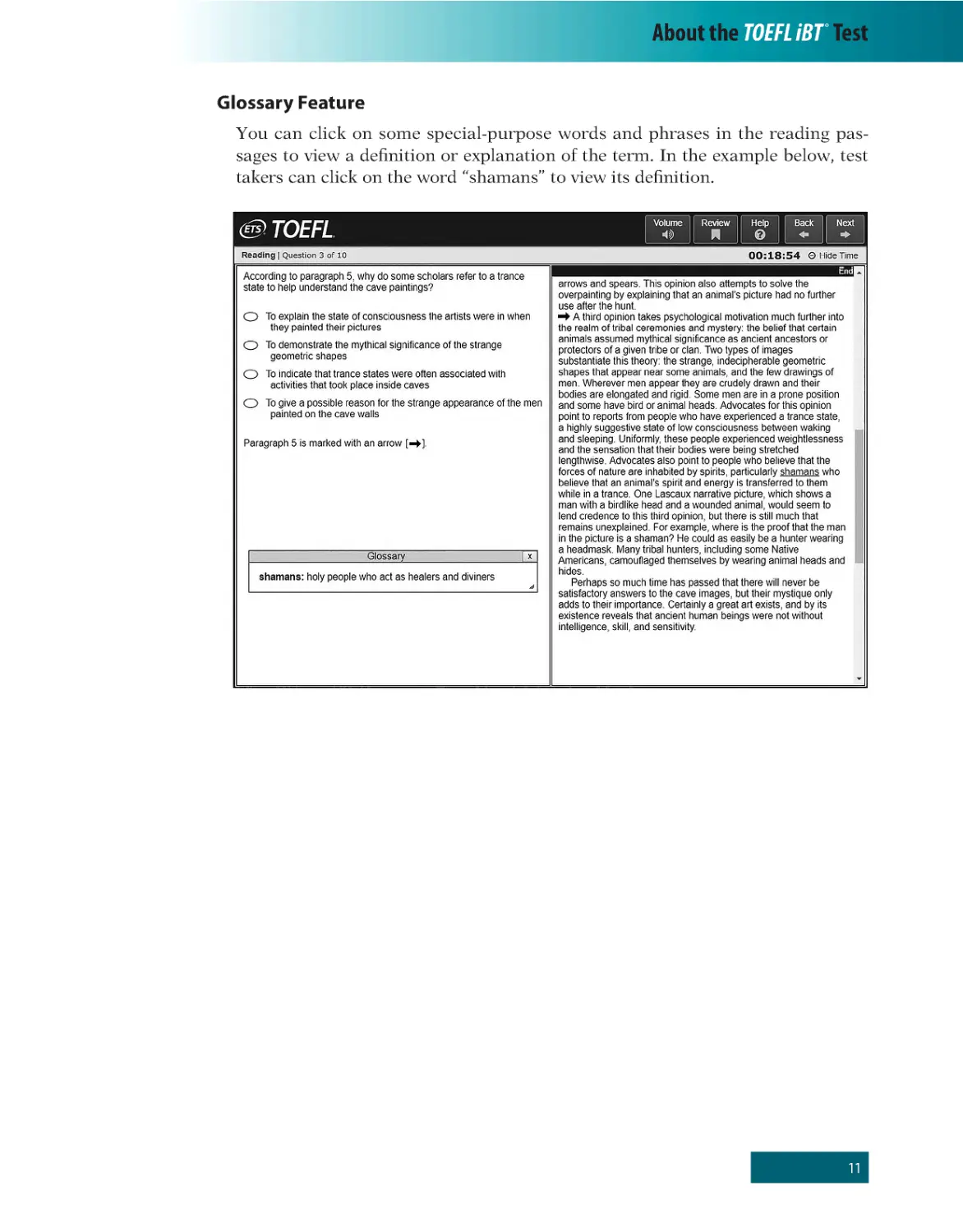
You do not need any special background knowledge to answer the questions
in the Reading section correctly. The definition of difficult words or phrases in
the passage may be provided. If you click on a hyperlinked word, a definition
appears in the lower left part of the screen.
The 54 to 72 minutes allotted for this section include time for reading the
passages and answering the questions.
Reading Question Formats
There are four question formats in the Reading section:
• questions with four choices and a single correct answer in traditional
multiple-choice format
• multiple-choice questions with more than one answer (for example, two
correct answers out of four choices)
• questions with four choices and a single answer that ask test takers to
“insert a sentence” where it fits best in a passage
• “reading to learn” questions that have more than four choices and require
more than one answer
Features
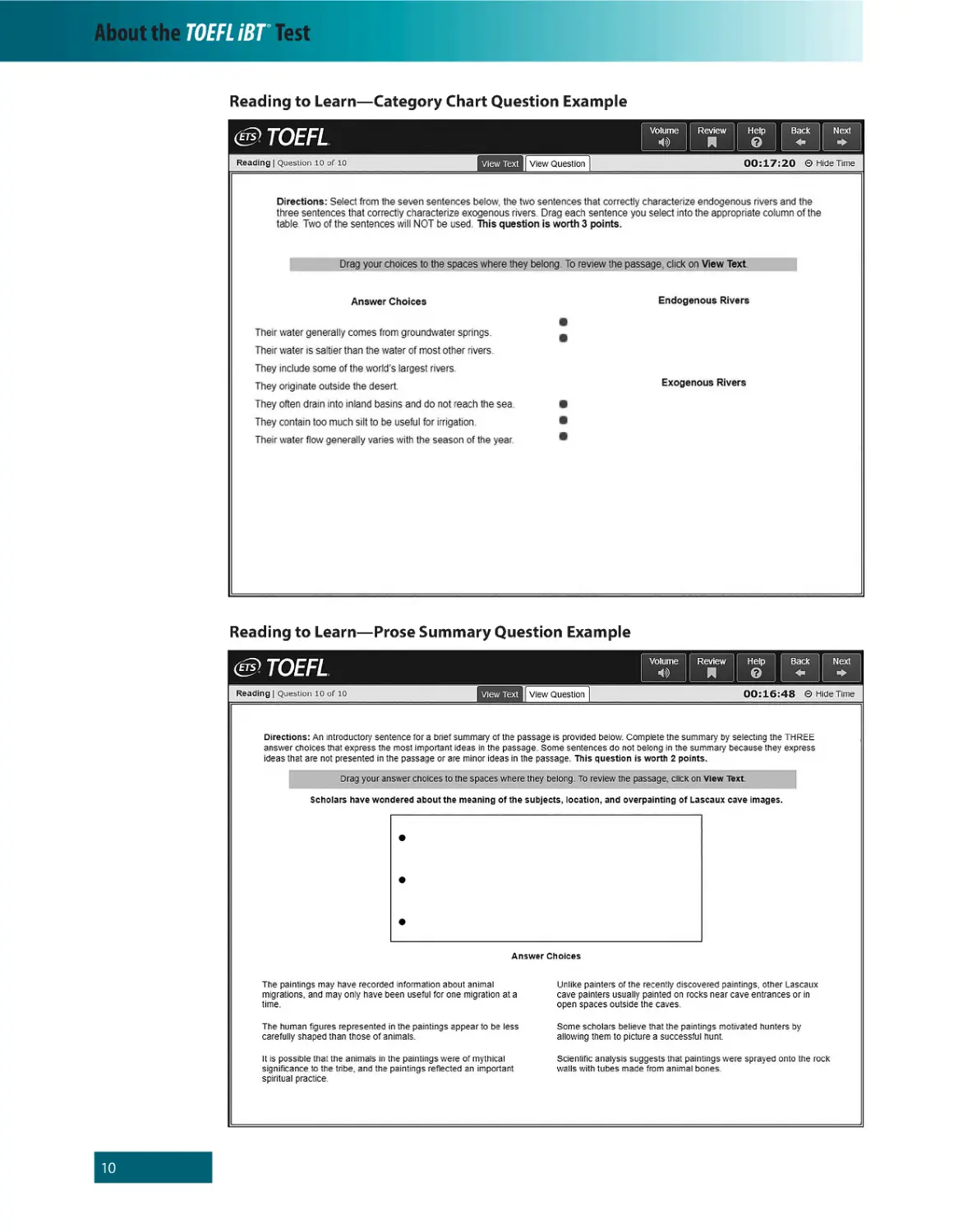
Reading to Learn Questions
These questions test your ability to recognize how the passage is organized and
understand the relationships among facts and ideas in different parts of the
passage.
You are asked to sort information by placing the text options provided into a
category table or a summary (see the examples on the next page). The summary
questions are worth up to 2 points each. Some table questions are worth up to
2 points and others are worth up to 3 points, depending on the number of correct
answers expected. Partial credit is given for both summary questions and table
questions.
About the TOEFL iBT ® Test

10
Reading to Learn—Category Chart Question Example
Reading to Learn—Prose Summary Question Example
About the TOEFL iBT ® Test

Glossary Feature
You can click on some special-purpose words and phrases in the reading pas-
sages to view a definition or explanation of the term. In the example below, test
takers can click on the word “shamans” to view its definition.
11
About the TOEFL iBT ® Test

Listening Section
Academic Listening Skills
The Listening section measures your ability to understand spoken English. In
academic settings, students must be able to listen to lectures and conversations.
Academic listening is typically done for one of the three following purposes:
Listening for basic comprehension
• comprehend the main idea, major points, and important details related to
the main idea (Comprehension of all details is not necessary.)
Listening for pragmatic understanding5
• recognize a speaker’s attitude and degree of certainty
• recognize the function or purpose of a speaker’s statement
Connecting and synthesizing6 information
• recognize the organization of information presented
• understand the relationships between ideas presented (for example, com-
pare/contrast, cause/effect, or steps in a process)
• make inferences7 and draw conclusions based on what is implied in the
material
• make connections among pieces of information in a conversation or
lecture
• recognize topic changes (for example, digressions8 and aside statements9)
in lectures and conversations, and recognize introductions and conclu-
sions in lectures
Description
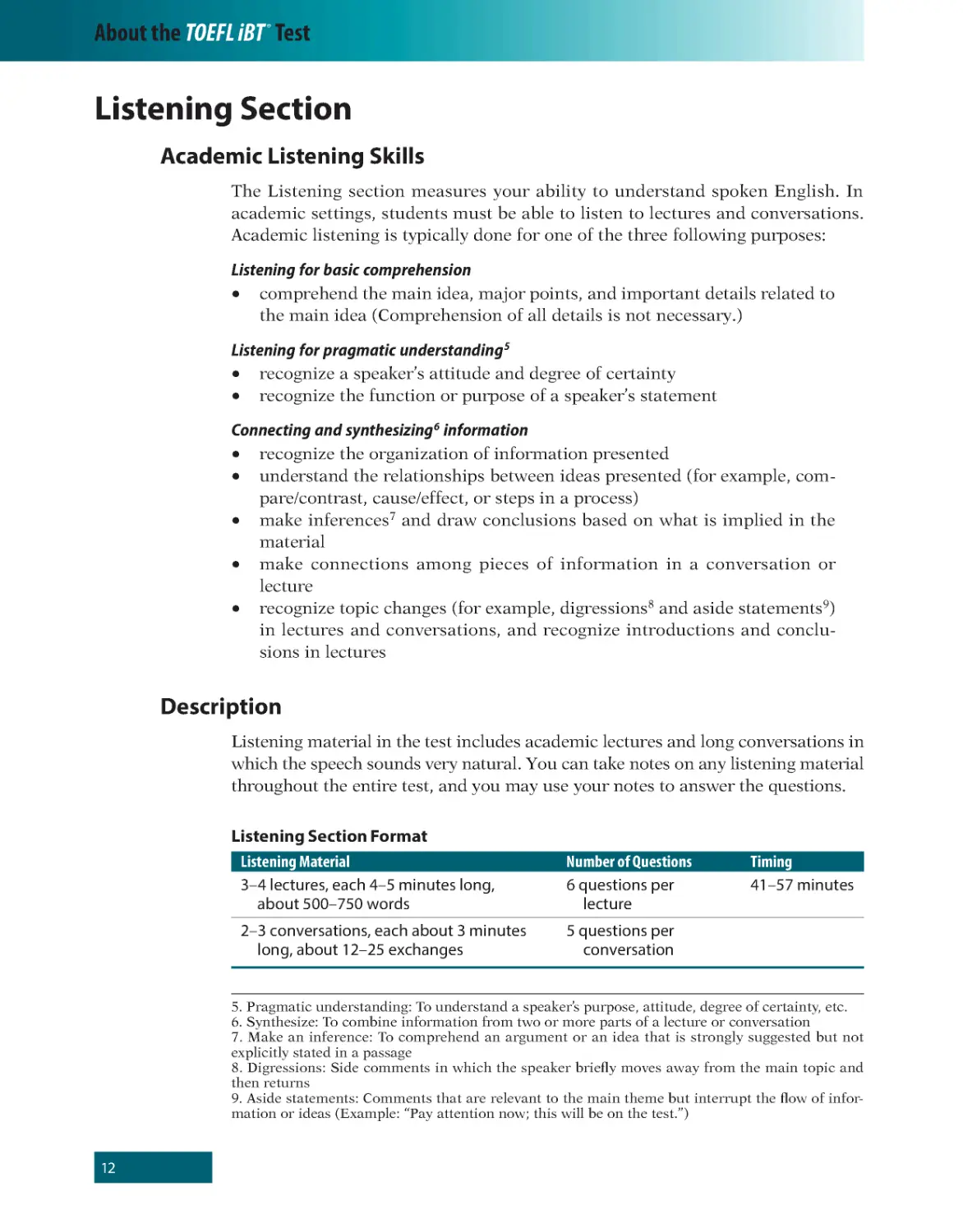
Listening material in the test includes academic lectures and long conversations in
which the speech sounds very natural. You can take notes on any listening material
throughout the entire test, and you may use your notes to answer the questions.
Listening Section Format
Listening Material
Number of Questions
Timing
3–4 lectures, each 4–5 minutes long,
about 500–750 words
6 questions per
lecture
41–57 minutes
2–3 conversations, each about 3 minutes
long, about 12–25 exchanges
5 questions per
conversation
12
5. Pragmatic understanding: To understand a speaker’s purpose, attitude, degree of certainty, etc.
6. Synthesize: To combine information from two or more parts of a lecture or conversation
7. Make an inference: To comprehend an argument or an idea that is strongly suggested but not
explicitly stated in a passage
8. Digressions: Side comments in which the speaker briefly moves away from the main topic and
then returns
9. Aside statements: Comments that are relevant to the main theme but interrupt the flow of infor-
mation or ideas (Example: “Pay attention now; this will be on the test.”)
About the TOEFL iBT ® Test

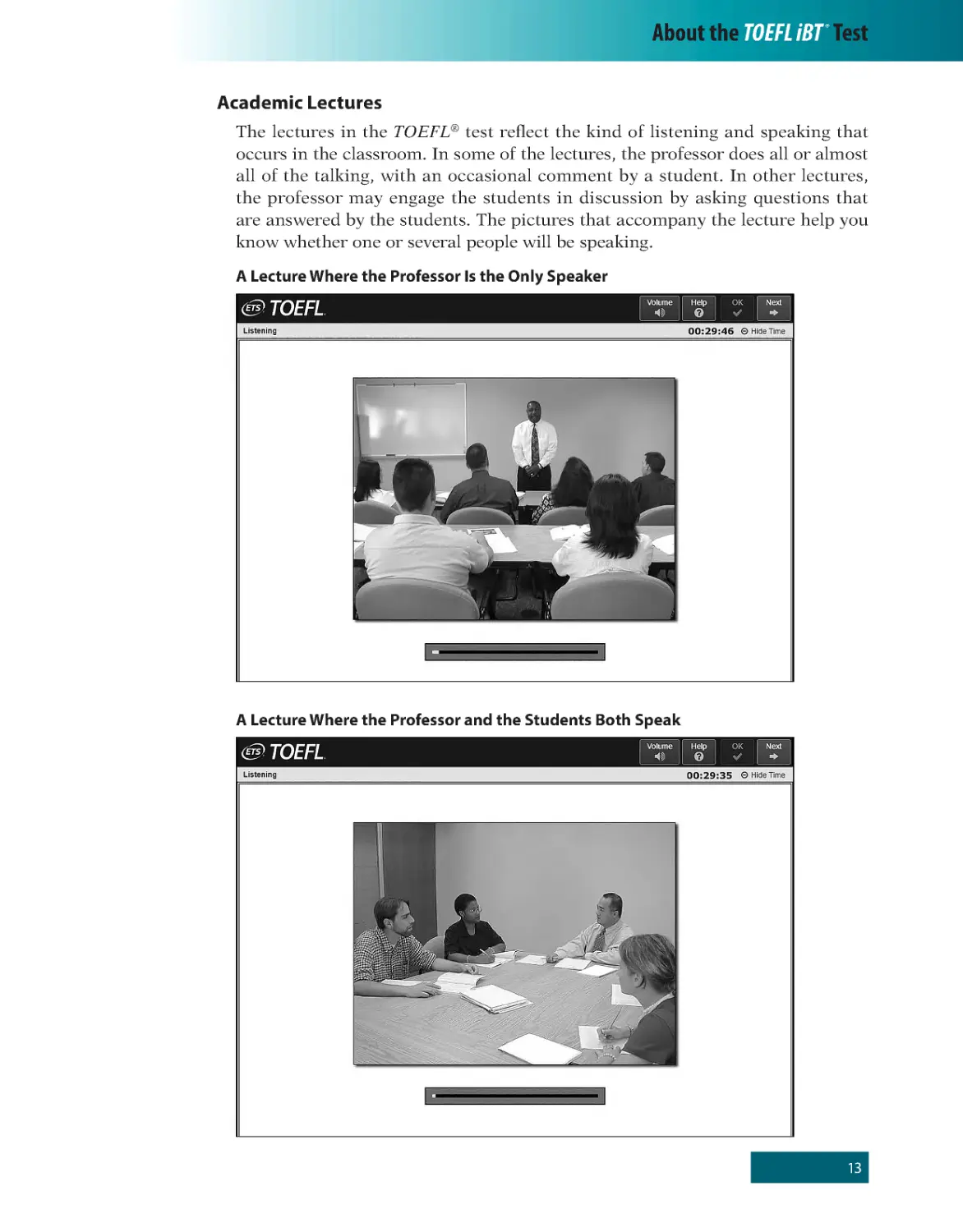
Academic Lectures
The lectures in the TOEFL® test reflect the kind of listening and speaking that
occurs in the classroom. In some of the lectures, the professor does all or almost
all of the talking, with an occasional comment by a student. In other lectures,
the professor may engage the students in discussion by asking questions that
are answered by the students. The pictures that accompany the lecture help you
know whether one or several people will be speaking.
13
A Lecture Where the Professor Is the Only Speaker
A Lecture Where the Professor and the Students Both Speak
About the TOEFL iBT ® Test

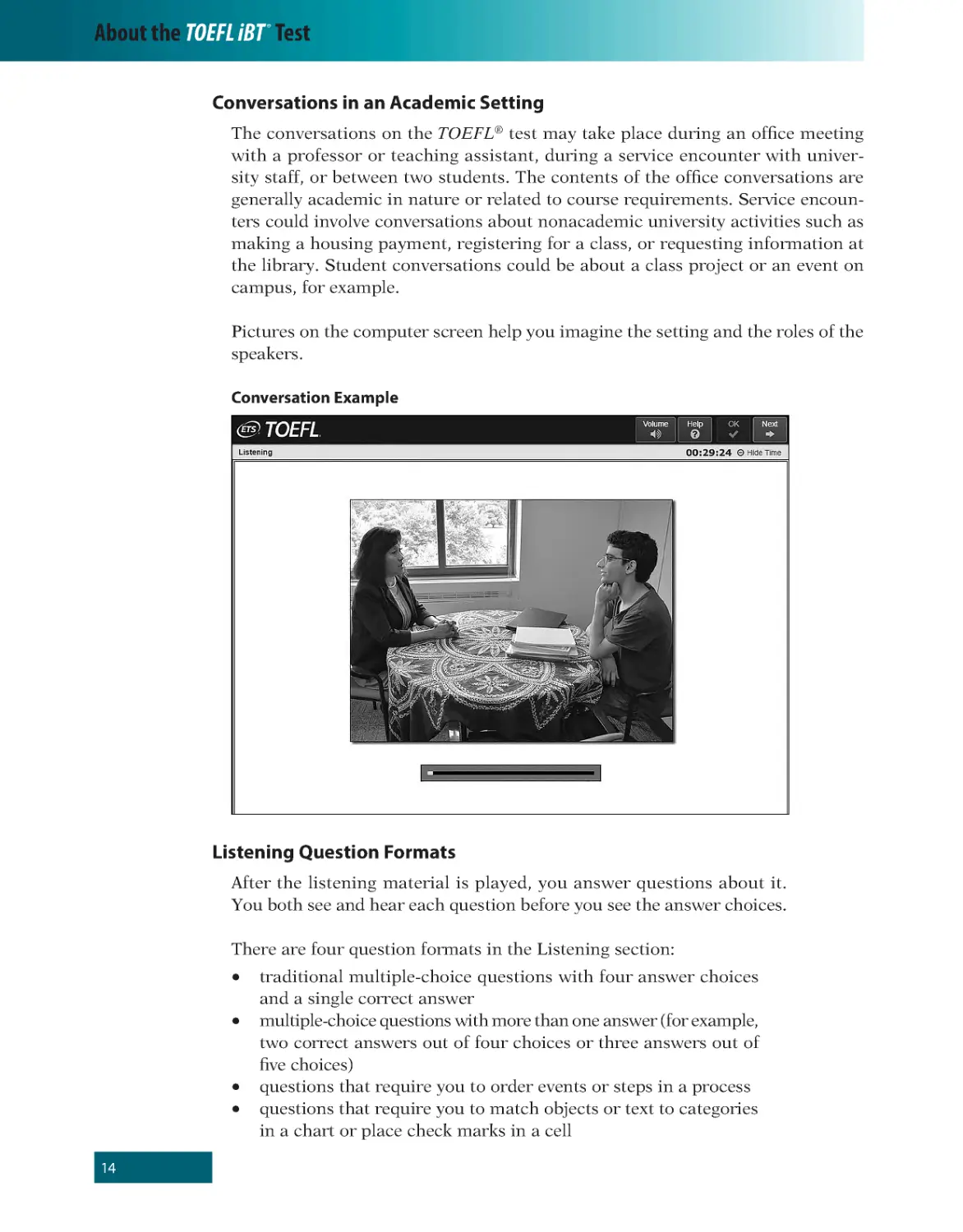
Conversations in an Academic Setting
The conversations on the TOEFL® test may take place during an office meeting
with a professor or teaching assistant, during a service encounter with univer-
sity staff, or between two students. The contents of the office conversations are
generally academic in nature or related to course requirements. Service encoun-
ters could involve conversations about nonacademic university activities such as
making a housing payment, registering for a class, or requesting information at
the library. Student conversations could be about a class project or an event on
campus, for example.
Pictures on the computer screen help you imagine the setting and the roles of the
speakers.
14
Conversation Example
Listening Question Formats
After the listening material is played, you answer questions about it.
You both see and hear each question before you see the answer choices.
There are four question formats in the Listening section:
• traditional multiple-choice questions with four answer choices
and a single correct answer
• multiple-choice questions with more than one answer (for example,
two correct answers out of four choices or three answers out of
five choices)
• questions that require you to order events or steps in a process
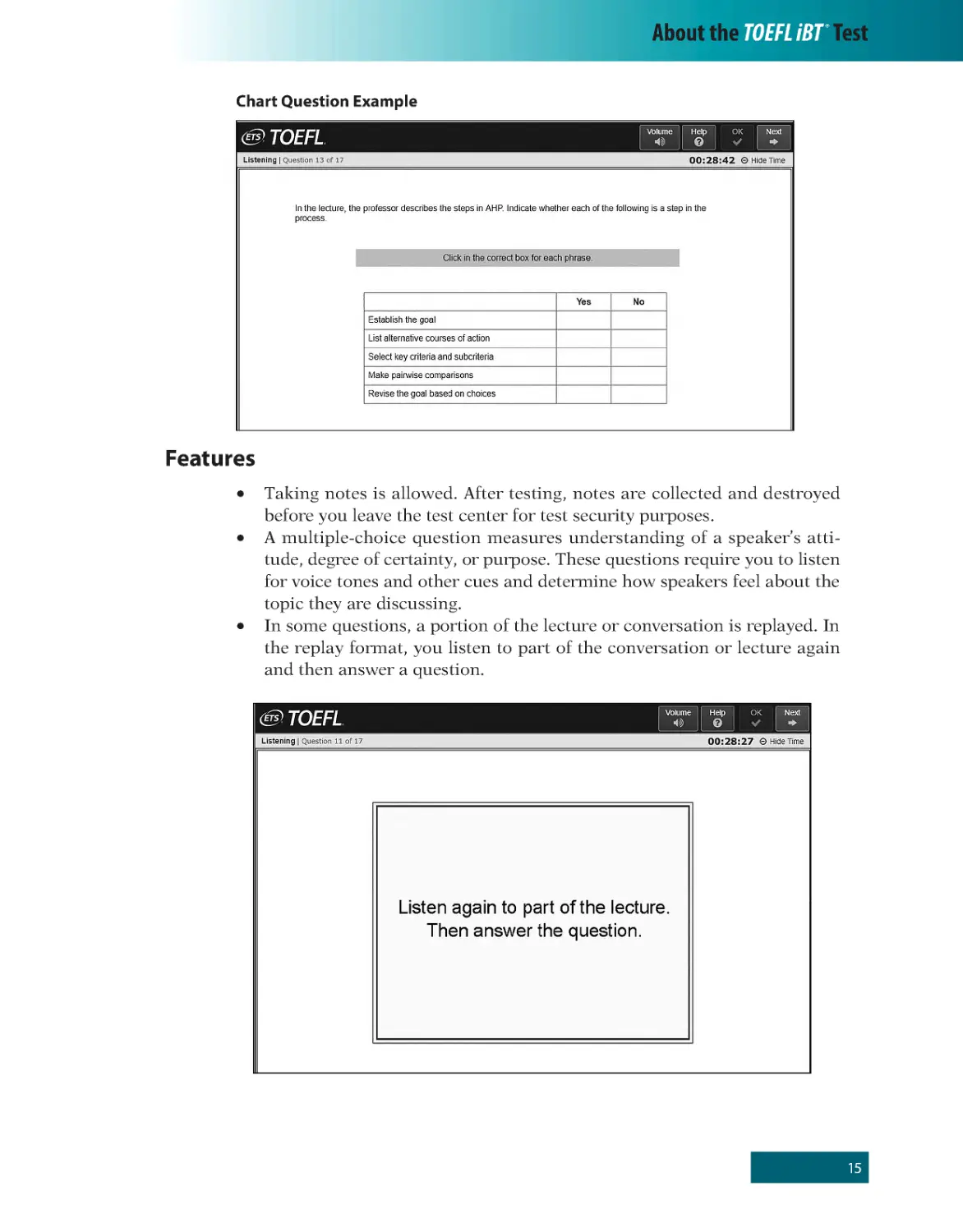
• questions that require you to match objects or text to categories
in a chart or place check marks in a cell
About the TOEFL iBT ® Test

Chart Question Example
Features
• Taking notes is allowed. After testing, notes are collected and destroyed
before you leave the test center for test security purposes.
• A multiple-choice question measures understanding of a speaker’s atti-
tude, degree of certainty, or purpose. These questions require you to listen
for voice tones and other cues and determine how speakers feel about the
topic they are discussing.
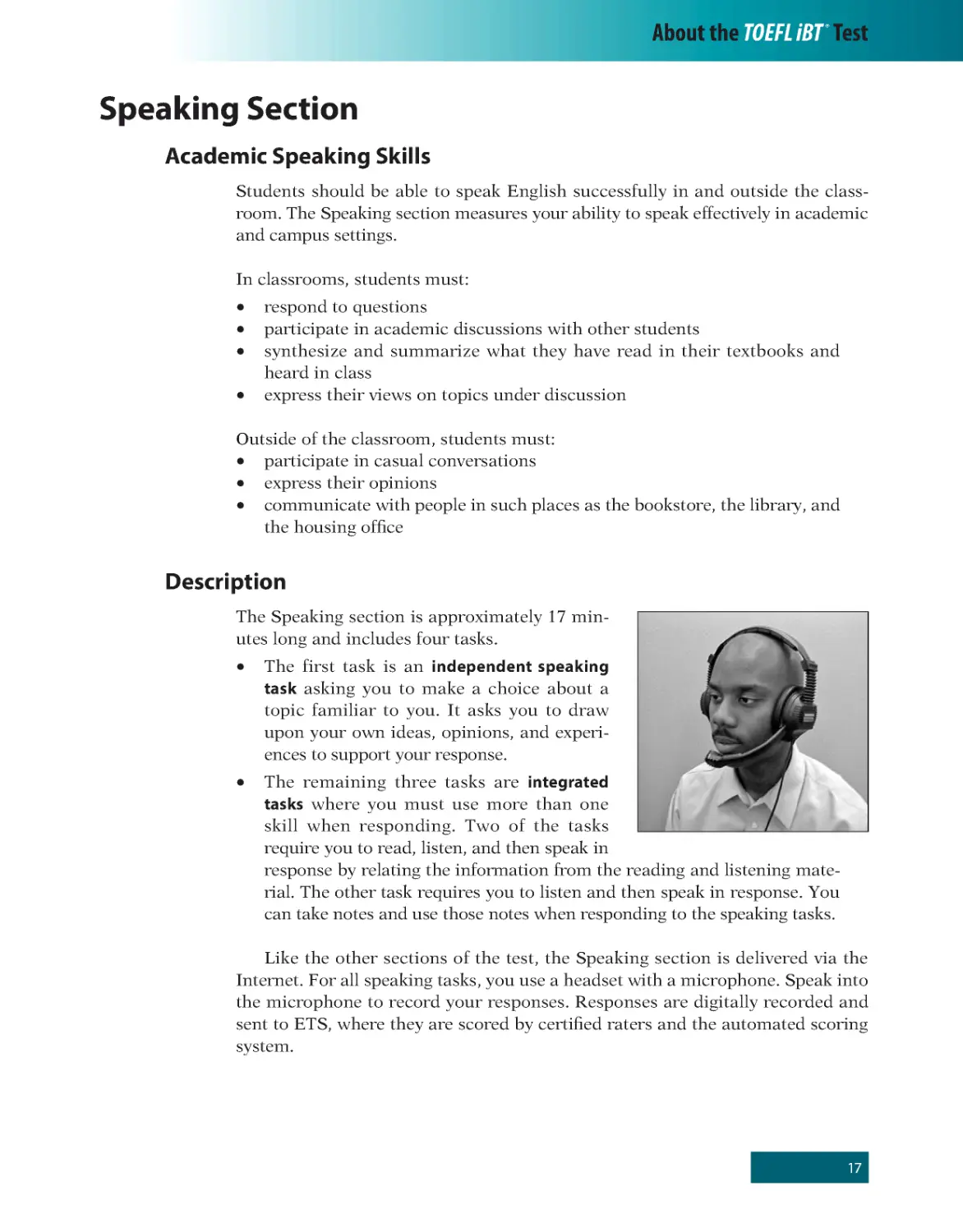
• In some questions, a portion of the lecture or conversation is replayed. In
the replay format, you listen to part of the conversation or lecture again
and then answer a question.
15
About the TOEFL iBT ® Test

This is an example of a type of question that measures the comprehension of the
purpose of a speaker’s statement.
16
About the TOEFL iBT ® Test

Speaking Section
Academic Speaking Skills
Students should be able to speak English successfully in and outside the class-
room. The Speaking section measures your ability to speak effectively in academic
and campus settings.
In classrooms, students must:
• respond to questions
• participate in academic discussions with other students
• synthesize and summarize what they have read in their textbooks and
heard in class
• express their views on topics under discussion
Outside of the classroom, students must:
• participate in casual conversations
• express their opinions
• communicate with people in such places as the bookstore, the library, and
the housing office
Description
The Speaking section is approximately 17 min-
utes long and includes four tasks.
• The first task is an independent speaking
task asking you to make a choice about a
topic familiar to you. It asks you to draw
upon your own ideas, opinions, and experi-
ences to support your response.
• The remaining three tasks are integrated
tasks where you must use more than one
skill when responding. Two of the tasks
require you to read, listen, and then speak in
response by relating the information from the reading and listening mate-
rial. The other task requires you to listen and then speak in response. You
can take notes and use those notes when responding to the speaking tasks.
Like the other sections of the test, the Speaking section is delivered via the
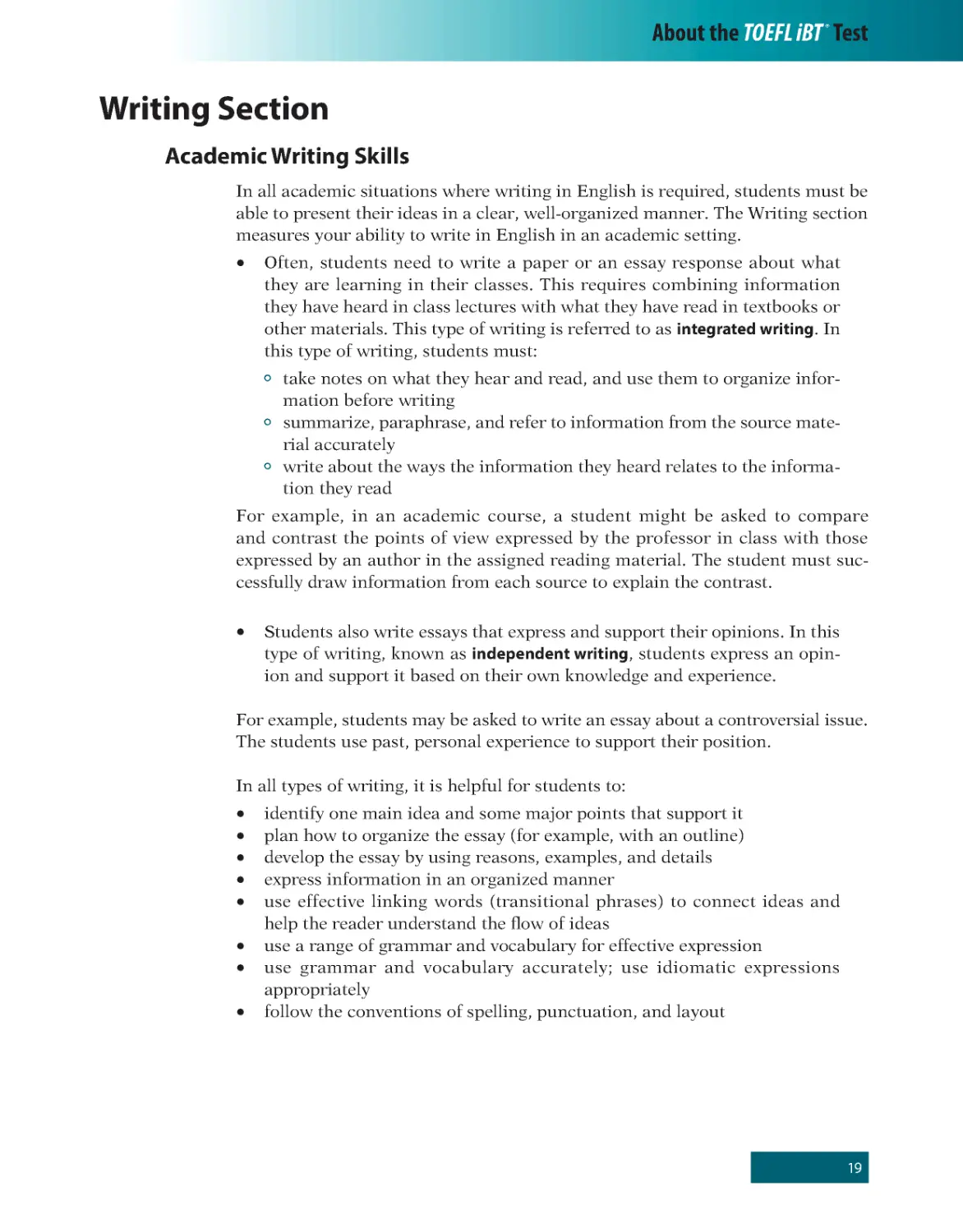
Internet. For all speaking tasks, you use a headset with a microphone. Speak into
the microphone to record your responses. Responses are digitally recorded and
sent to ETS, where they are scored by certified raters and the automated scoring
system.
17
About the TOEFL iBT ® Test

18
Speaking Task Types
Task Type
Task Description
Timing
Independent Task
1: Paired Choice
This question asks the test taker to make and
defend a personal choice between two
contrasting behaviors, ideas, or courses of action.
Preparation time: 15 seconds
Response time: 45 seconds
Integrated Tasks
Read/Listen/Speak
2: Fit and Explain
Campus Situation
• A reading passage (80–110 words) presents a
campus-related issue.
• A listening passage (60–80 seconds) comments
on the issue in the reading passage.
• The question asks the test taker to summarize
the speaker’s opinion within the context of the
reading passage.
Preparation time: 30 seconds
Response time: 60 seconds
3: General/Specific
Academic Course
Topic
• A reading passage (80–110 words) broadly
defines a term, process, or idea from an
academic subject.
• An excerpt from a lecture (60–90 seconds)
provides examples and specific information
to illustrate the term, process, or idea from the
reading passage.
• The question asks the test taker to combine and
convey important information from the reading
passage and the lecture excerpt.
Preparation time: 30 seconds
Response time: 60 seconds
Listen/Speak
4: Summary
Academic Course
Topic
• The listening passage is an excerpt from a
lecture (90–120 seconds) that explains a term
or concept and gives concrete examples to
illustrate that term or concept.
• The question asks the test taker to summarize
the lecture and demonstrate an understanding
of the relationship between the examples and
the overall topic.
Preparation time: 20 seconds
Response time: 60 seconds
TOTAL
17 minutes
About the TOEFL iBT ® Test

Writing Section
Academic Writing Skills
In all academic situations where writing in English is required, students must be
able to present their ideas in a clear, well-organized manner. The Writing section
measures your ability to write in English in an academic setting.
• Often, students need to write a paper or an essay response about what
they are learning in their classes. This requires combining information
they have heard in class lectures with what they have read in textbooks or
other materials. This type of writing is referred to as integrated writing. In
this type of writing, students must:
take notes on what they hear and read, and use them to organize infor-
mation before writing
summarize, paraphrase, and refer to information from the source mate-
rial accurately
write about the ways the information they heard relates to the informa-
tion they read
For example, in an academic course, a student might be asked to compare
and contrast the points of view expressed by the professor in class with those
expressed by an author in the assigned reading material. The student must suc-
cessfully draw information from each source to explain the contrast.
• Students also write essays that express and support their opinions. In this
type of writing, known as independent writing, students express an opin-
ion and support it based on their own knowledge and experience.
For example, students may be asked to write an essay about a controversial issue.
The students use past, personal experience to support their position.
In all types of writing, it is helpful for students to:
• identify one main idea and some major points that support it
• plan how to organize the essay (for example, with an outline)
develop the essay by using reasons, examples, and details
•
• express information in an organized manner
• use effective linking words (transitional phrases) to connect ideas and
help the reader understand the flow of ideas
• use a range of grammar and vocabulary for effective expression
• use grammar and vocabulary accurately; use idiomatic expressions
appropriately
• follow the conventions of spelling, punctuation, and layout
19
About the TOEFL iBT ® Test

Description
The total time for the Writing section is 50 minutes. Test takers write their
responses to two writing tasks (see the table below). Responses are typed into the
computer and sent to ETS, where they are scored by both certified raters and the
automated scoring system.
Writing Task Types
Task Type
Task Description
Task 1
Integrated Writing:
Read/Listen/Write
• Test takers read a short text of about 250–300 words (reading time, 3 minutes)
on an academic topic.
• Test takers may take notes on the reading passage.
• The reading passage disappears from the screen during the lecture that
follows. It reappears when test takers begin writing so they can refer to it
as they work.
• Test takers listen to a speaker discuss the same topic from a different
perspective. The listening passage is about 250–320 words long (listening
time, about 2 minutes).
• The listening passage provides additional information that relates to points
made in the reading passage. Test takers may take notes on the listening
passage.
• Test takers write a summary in connected English prose of important points
made in the listening passage, and explain how these relate to the key points
of the reading passage. Suggested response length is 150–225 words; however,
there is no penalty for writing more as long as it is in response to the task
presented.
• Response time: 20 minutes
Task 2
Independent Writing:
Writing from Knowledge
and Experience
• Test takers write an essay that states, explains, and supports their opinion
on an issue. An effective essay will usually contain a minimum of 300 words;
however, test takers may write more if they wish.
• Test takers must support their opinions or choices rather than simply list
personal preferences or choices.
• Typical essay questions begin with statements such as:
— Do you agree or disagree with the following statement? Use reasons and
specific details to support your answer.
— Some people believe X. Other people believe Y. Which of these two positions
do you prefer/agree with? Give reasons and specific details.
• Response time: 30 minutes
20
About the TOEFL iBT ® Test

About Test Scores
Score Scales
The TOEFL iBT ® test provides scores in four skill areas:
Reading
0–30
Listening
0–30
Speaking
0–30
Writing
0–30
Total Score
0–120
The total score is the sum of the four skill scores.
Rating of Speaking and Writing Responses
Speaking
Responses to all four Speaking tasks are digitally recorded and sent to ETS. The
responses from each test taker are scored by four different certified raters and the
automated scoring system. The response for each task is rated on a scale from 0
to 4 according to the rubrics on pages 180–183. The scores from the four tasks
together are converted to a scaled score of 0 to 30.
Raters listen for the following features in test taker responses:
• Delivery: How clear was the speech? Good responses are fluid and clear,
with good pronunciation, natural pacing, and natural-sounding intona-
tion patterns.
• Language use: How effectively does the test taker use grammar and
vocabulary to convey ideas? Raters determine the test taker’s ability to
control both basic and more complex language structures and to use
appropriate vocabulary.
• Topic development: How fully do test takers answer the question and how
coherently do they present their ideas? How well did the test taker syn-
thesize and summarize the information in the integrated tasks? Good
responses generally use all or most of the time allowed, and the relation-
ship between ideas and the progression from one idea to the next are clear
and easy to follow.
It is important to note that raters do not expect test takers’ responses to be
perfect. Even high-scoring responses may contain occasional errors and minor
problems in any of the three areas described above.
21
About the TOEFL iBT ® Test

Writing
Responses to all writing tasks also are sent to ETS. The responses are rated by
two certified raters and the automated scoring system on a scale of 0 to 5 accord-
ing to the rubrics on pages 193–194 and 203–204. The average of the scores on
the two writing tasks is converted to a scaled score of 0 to 30.
• The response to the integrated writing task is scored on the quality of
writing (organization, appropriate and precise use of grammar and vocab-
ulary) and the completeness and accuracy of the content.
• The independent writing essay is scored on the overall quality of the
writing: development, organization, and appropriate and precise use of
grammar and vocabulary.
It is important to note that the raters recognize that the responses are first
drafts. They do not expect test takers to produce a well-researched, comprehen-
sive essay. For that reason, test takers can earn a high score with a response that
contains some errors.
Score Reports
TOEFL® score reports provide valuable information about a test taker’s readiness
to participate and succeed in academic studies in an English-speaking environ-
ment. Score reports include:
• a score for each test section (skill)
• total score
Test taker score reports also include feedback on test taker performance.
For Reading and Listening, performance is described as high, medium, or low.
For Speaking, performance is described as advanced, high-intermediate, low-
intermediate, and below low-intermediate. For Writing, performance is described
as advanced, high-intermediate, low-intermediate, basic, and below basic. The
feedback also describes what test takers in each score range typically know and
can do with the English language.
Score Requirements
Each institution sets its own requirements for TOEFL® scores. Test takers should
consult their target institutions to determine their specific TOEFL score require-
ments. A list of colleges, universities, and agencies that accept TOEFL scores
and a list of institutional score requirements reported to ETS can be obtained at
www.toeflgoanywhere.org.
22
About the TOEFL iBT ® Test

23
About the TOEFL iBT ® Test
MyBest TM Scores
All TOEFL iBT® score reports sent after August 1, 2019, regardless of the test
administration date, automatically include MyBestTM scores along with the tradi-
tional scores from your selected test date. This new feature combines your best
scores for each section from all of your valid TOEFL iBT scores in the last two
years to give you a way to show your best overall test performance, like this:
ETS® Security Guard text is printed with a special heat-sensitive ink for security. To activate this security feature, apply heat to the text,
either by rubbing it or blowing on it, and the ETS Security Guard text will disappear.
Copyright © 2020 by Educational Testing Service. All rights reserved. ETS, the ETS logo, TOEFL and TOEFL iBT are registered trademarks of Educational Testing Service (ETS) in
he United States and other countries. MyBest is a trademark of ETS. 491488848
A. Setiadi
73, Jalan Cilaki
BANDUNG 40115
INDONESIA
Date of Birth: October 13, 1992
Country of Birth: Indonesia
Native Language: Bahasa
Test Center: STN22222C
Test Center Country: United States
ID Type: Passport
ID No.: 23645
Issuing Country: Indonesia
Test Date: October 19, 2019
Security Identification
Inst. Code
00000
00000
00000
00000
Dept. Code
00
00
00
00
01-07
A total score is not reported when one or more sections have not been administered.
Expired scores are not included in MyBestTM calculations.
MyBestTM Scores
Your highest section scores from all valid
test dates, as of October 26, 2019 .
October 19, 2019
Test Date Scores
Reading:
Test Date:
Oct 19, 2019
22
Listening:
Test Date:
Mar 10, 2019
Writing:
Test Date:
Jun02, 2019
Speaking:
Test Date:
Oct 19, 2019
20
0
30
230
30
210
30
0
30
Reading:
Listening:
Speaking:
Writing:
Sum of Highest
Section Scores
Total Score
0
120
83
out of 120
220
30
220
30
210
30
180
30
86
out of 120
S
A
M
P
L
E
• Approximately six days after your test date, you will receive an e-mail let-
ting you know that your scores are available in your TOEFL iBT online
account. Within two days after your scores are available, you will also be
able to download and print a PDF copy of your score report from your
account.
• t If you elected to receive a printed score report, it will be mailed within
eleven days after your test date. Allow seven to ten days after that date for
mail delivery in the United States and more time for mail delivery to other
locations.
• Official score reports will be sent directly to your designated recipients
within eleven days after you take the test.

24
About the TOEFL iBT ® Test
Sample TOEFL iBT® Score Report
Copyright © 2020 by Educational Testing Service. All rights reserved. ETS, the ETS logo, TOEFL and TOEFL iBT are registered trademarks of Educational Testing Service (ETS) in
the United States and other countries. MyBest is a trademark of ETS. 491488848
THIS IS A PDF SCORE REPORT, DOWNLOADED AND PRINTED BY THE TEST TAKER.
A. Setiadi
73, Jalan Cilaki
BANDUNG 40115
INDONESIA
Name: Setiadi, Atin
Last (Family/Surname) Name, First (Given) Name, Middle Name
Email: asetiadi@ets.org
Gender: F
Date of Birth: October 13, 1992
Country of Birth: Indonesia
Native Language: Bahasa
Test Center: STN22222C
Test Center Country: United States
ID Type: Passport
ID No.: 23645
Issuing Country: Indonesia
Appointment Number: 0000 0000 0036 5909
Test Date: October 19, 2019
Security Identification
Test Taker Score Report
Inst. Code
00000
00000
00000
00000
Dept. Code
00
00
00
00
01-07
MyBestTM Scores
Your highest section scores from all valid
test dates, as of October 26, 2019 .
October 19, 2019
Test Date Scores
Reading:
Test Date:
Oct 19, 2019
22
Listening:
Test Date:
Mar 10, 2019
Writing:
Test Date:
Jun02, 2019
Speaking:
Test Date:
Oct 19, 2019
20
0
30
230
30
210
30
0
30
Reading:
Listening:
Speaking:
Writing:
Sum of Highest
Section Scores
Total Score
0
120
83
out of 120
A total score is not reported when one or more sections have not been administered.
Expired scores are not included in MyBestTM calculations.
220
30
220
30
210
30
180
30
86
out of 120
S
A
M
P
L
E

25
About the TOEFL iBT ® Test
Setiadi, Atin
Date of Birth: October 13, 1992
Appointment Number: 0000 0000 0036 5909
Test Date: October 23, 2019
THIS IS A PDF SCORE REPORT, DOWNLOADED AND PRINTED BY THE TEST TAKER .
Test Taker Score Report
INSTITUTION CODES
The Institutions and Department code numbers shown on the front page are the ones you
selected before you took the test.
For additional information about TOEFL iBT scores, score ranges,
and how to improve your skills, visit www.ets.org/toefl/ibt/scores.
IMPORTANT NOTE TO SCORE USERS: This is a PDF score report, downloaded and printed by the test taker. Therefore, ETS cannot guarantee that it has
not been altered. To verify the scores on this report, please contact the TOEFL Score Verification Service at +1-800-257 -9547 or +1-609-771-7100. Scores
more than two years old cannot be reported or validated.
Dept.
01, 04 –41, 43–98
00
Where the Report Was Sent
Admissions office for graduate study in a field other than management
(business) or law according to the codes selected when you registered
Admissions office for undergraduate study
02
Admissions office of a graduate school of management (business)
03
Admissions office of a graduate school of law
42
Admissions office of a school of medicine or nursing or licensing agency
99
Institution or agency that is not a college or university
SCORE RANGES
Total Score
0–120
Listening
0–30
Advanced
24–30
High - Intermediate
18–23
Low - Intermediate
4–17
Below Low - Intermediate
0–3
Reading
0–30
Advanced
24–30
High - Intermediate
18–23
Low - Intermediate
4–17
Below Low - Intermediate
0–3
Speaking
0–30
Advanced
25–30
High - Intermediate
20–24
Low - Intermediate
16–19
Basic
10–15
Below Basic
0–9
Writing
0–30
Advanced
24–30
High - Intermediate
17–23
Low - Intermediate
13–16
Basic
7–12
Below Basic
0–6
Copyright © 2020 by Educational Testing Service. All rights reserved. ETS, the ETS logo, TOEFL and TOEFL iBT are registered trademarks of Educational Testing Service (ETS) in
the United States and other countries. MyBest is a trademark of ETS. 491488848
Sample TOEFL iBT® Score Report
S
A
M
P
L
E

26
About the TOEFL iBT ® Test
General Skill-Building Tips
The best way for English language learners to develop the skills measured by the
TOEFL® test is to enroll in an English language learning program that features:
• reading, listening, speaking, and writing skills, with an emphasis on
speaking
• an integrated skills approach (for example, instruction that builds skills in
listening/reading/speaking or listening/reading/writing)
In addition to the advice for improvement listed in the Appendix of this book,
ETS has created the following tips for test takers, which also contain information
useful to teachers.
Reading Tips
English language learners can improve their English reading skills by reading
regularly, especially university textbooks or other materials that cover a variety
of subject areas (for example, sciences, social sciences, arts, business, and oth-
ers) and are written in an academic style. A wide variety of academic texts can be
found on the Internet as well as in magazines and journals.
Reading to Find Information
• Skim passages to find and highlight key facts (dates, numbers, terms) and
information.
• Practice frequently to increase reading rate and fluency.
Reading for Basic Comprehension
• Practice skimming a passage quickly to get a general impression of the
main idea.
• After skimming a passage, read it again more carefully and write down
the main idea(s), major points, and important facts.
• Choose some unfamiliar words in the passage and look them up in a dic-
tionary to determine their meaning.
Check Your English Reading Skills
TOEFL® Practice Online gives you the experience of taking the real TOEFL iBT® test.
It includes real past test questions, scores, and performance feedback within
24 hours, and offers full tests, half tests, or Speaking-only test options.
www.ets.org/toefl/shoptestprep

27
About the TOEFL iBT ® Test
Reading to Learn
• Identify the passage type (for example, cause/effect, compare/con-
trast, classification, problem/solution, description, narration) and its
organization.
• Organize the information in the passage:
Create an outline of the passage to distinguish between major and
minor points.
If the passage categorizes information, create a chart and place the
information in appropriate categories.
On the TOEFL® test, test takers do not have to create such charts. Instead, a chart
with possible answer choices is provided for them, and they are required to fill in the
chart with the correct choices. Practicing these skills will help test takers think about
summarizing and categorizing the information they read.
Listening Tips
English language learners can improve their listening skills by listening
regularly to spoken English. Watching movies, television, and videos, and
listening to podcasts and radio broadcasts provide excellent opportunities to
build general listening skills. Listening to a variety of academic materials is
the best way to improve academic listening skills. Audiotapes, CDs, DVDs,
and podcasts of lectures and presentations are equally valuable and are avail-
able at libraries, at bookstores, and on websites. Those with transcripts are
particularly helpful. Some websites that are a good source of listening mate-
rial are www.npr.org, www.bbc.co.uk/radio, www.bbc.co.uk/learningenglish, or
https://learningenglish.voanews.com/.
Listening for Basic Comprehension
• Increase vocabulary.
• For an unfamiliar word, try to guess the general sense of the word’s meaning
based on the context in which it is used.
• Focus on the content and flow of spoken material. Do not be distracted by
the speaker’s style and delivery.
• Anticipate what a person is going to say as a way to stay focused.
• Stay active by asking yourself questions (for example, What main idea is
the professor communicating?).
• Listen for words or phrases that indicate a change in topic or a digression.

28
About the TOEFL iBT ® Test
• Listen to a portion of a lecture or talk and create an outline of important
points. Do not try to write down every word that you hear. Do make a
note of major points and important details. When you are finished, lis-
ten again to check, modify, or add to what you have written. Gradually
increase the length of the lecture or talk you listen to and outline.
• Listen to an entire lecture or talk. Write a sentence that indicates the main
idea of what you heard. Listen again to check what you have written and
to write down key details.
Notes
The Reading section measures the ability to recognize paraphrases. The ability to
paraphrase is also important for the integrated tasks in the Writing and Speaking
sections of the test.
The Listening section does not measure summarizing skills, but practicing these skills
is useful for the integrated tasks in the Speaking and Writing sections.
Listening for Pragmatic Understanding
• Think about what each speaker hopes to accomplish when making an
assertion or asking a question. Is the speaker apologizing, complaining,
or making a suggestion? For example, if a speaker says “It’s cold in this
room,” is the speaker doing more than making a comment about room
temperature? Is that speaker suggesting that someone do something to
adjust the room temperature? If a speaker makes an assertion such as
“I’m sure you must have thoughts about that,” is the speaker indirectly
asking people to share their thoughts?
• Notice the speaker’s degree of certainty. How sure is the speaker about the
information? Does the speaker’s tone of voice indicate something about
his or her degree of certainty?
• Listen for aside statements.
• Watch a recorded TV or movie comedy. Pay careful attention to the way
stress and intonation patterns are used to convey meaning.
Listening to Connect and Synthesize Ideas
• Think about how the lecture you’re hearing is organized. Listen for the
signal words that indicate the introduction, major steps or ideas, exam-
ples, and the conclusion or summary.
• Identify the relationships between ideas. Possible relationships include:
cause/effect, compare/contrast, and steps in a process.
• Listen for words that show connections and relationships between ideas.
• Listen to recorded material and stop the recording at various points.
Predict what information or idea will be expressed next.
• Create an outline of the information discussed while listening or after
listening.

29
About the TOEFL iBT ® Test
Check Your English Listening Skills
TOEFL® Practice Online gives you the experience of taking the real TOEFL iBT® test.
It includes real past test questions, scores, and performance feedback within
24 hours, and offers full tests, half tests, or Speaking-only test options.
www.ets.org/toefl/shoptestprep
Speaking Tips
The best way to practice speaking is with native speakers of English. If you do
not live in an English-speaking country, finding native speakers of English might
be quite challenging. In some countries, there are English-speaking tutors or
assistants who help students with conversation skills and overall communication
skills. You may also be able to find online tutors or conversation partners with
whom you can practice speaking English. Another way to practice speaking is
by joining an English club whose members converse in English about movies,
music, and travel. If a club does not exist in your area, start one and invite native
speakers to help you get started.
Independent Speaking Task
• Make a list of topics that are familiar, and practice speaking about them.
• Describe a preference and your reason for the preference.
• Express an opinion by clearly stating your point of view and providing
clear and detailed reasons for your opinion.
• Make a recommendation and explain why it is the best way to proceed.
• Practice giving one-minute responses to topics.
Integrated Speaking Tasks
• Find a textbook that includes questions about the material at the end of
chapters, and practice answering the questions orally.
• Read a short article (100–200 words). Make an outline that includes only
the major points of the article. Use the outline to orally summarize the
information.
• Find listening and reading material on the same topic covered by the
article. The material can contain similar or different views. (The Internet
and the library are good places to find information.) Take notes or create
outlines on the listening and reading material:
Orally summarize the information in both the written and spoken
materials. Be sure to paraphrase using different words and grammati-
cal structures.
Orally synthesize the material by combining the information from the
reading and listening materials and explaining how they relate.
State an opinion about the ideas and information presented in the read-
ing and listening material and explain how they relate.

30
About the TOEFL iBT ® Test
All Speaking Tasks
• Try to use one new vocabulary word or phrase each day.
• Make a one-minute recording of a native speaker of English. (It can be
someone you know or a recording from the Internet, TV, radio, etc.)
Replay the recording two times to get familiar with the speaker’s rhythm
and intonation. Then play the recording a third time, and try to speak
aloud along with the speaker. Even if you don’t pronounce all the words
correctly, this will help help you become familiar with native speaker
stress and intonation patterns.
• When practicing for the TOEFL® test using the tips above, take 15 seconds to
think about what you are going to say before you speak. Write down a few
key words and ideas, but do not attempt to write down exactly what you are
going to say. (Raters will be able to detect responses that are read and will
give them a lower score.)
• As you listen to English speakers, try to identify words and expressions
that help connect the speakers’ ideas. Then try to include these expres-
sions when you speak in order to introduce new information, to connect
ideas, and to mark important words or ideas. This helps listeners more
easily follow what you are saying. (For example, “on the one hand,” “what
that means is,” “one reason is,” another difference might be.”)
• Monitor your progress and ask an English teacher or tutor to evaluate
your speech using the appropriate Speaking rubrics. (See pages 180–183
for the rubrics.)
Check Your English Speaking Skills
TOEFL® Practice Online gives you the experience of taking the real TOEFL iBT ® test.
It includes real past test questions, scores, and performance feedback within
24 hours, and offers full tests, half tests, or Speaking-only test options.
www.ets.org/toefl/shoptestprep
Writing Tips
Integrated Writing Tasks
• Find a textbook that includes questions about the material at the end of
chapters, and practice writing answers to the questions.
• Read an article that is about 300–400 words long. Make an outline that
includes the major points and important details of the article. Use the out-
line to write a summary of the information and ideas. Summaries should
be brief and clearly communicate only the major points and important
details. Be sure to paraphrase using different words and grammatical
structures.
• Find listening and reading material on a single topic on the Internet or
in the library. The material can provide similar or different views. Take
notes on the written and spoken portions, and do the following:

31
About the TOEFL iBT ® Test
Summarize the information and ideas in both the written and spoken
portions.
Synthesize the information and discuss how the reading and listening
materials relate. Explain how the ideas expressed are similar, how one
idea expands upon another, or how the ideas are different or contradict
each other.
Paraphrasing
Paraphrasing involves restating something from the source material in one’s own
words. On the TOEFL® test, test takers receive a score of zero if all they do is
copy words from the reading passage. Practice paraphrasing words, phrases, sen-
tences, and entire paragraphs frequently using the following tips:
• Learn to find synonyms with ease. Pick 10 to 15 words or phrases in a
reading passage and quickly think of synonyms without looking them up
in a dictionary or thesaurus.
• Write a paraphrase of a reading passage using only your notes. If you
have not taken notes, write the paraphrase without looking at the original
text. Then check the paraphrase with the original passage to make sure
that it is factually accurate and that you have used different words and
grammatical structures.
Independent Writing Tasks
• Make a list of familiar topics and practice writing about them.
• For each topic, state an opinion or a preference and then support it with
evidence.
• Practice planning and writing at least one essay for each topic. Be sure to
take 30 minutes to plan, write, and revise each essay.
• Think about and list all ideas related to a topic or task before writing. This
is also called “prewriting.”
• Identify one main idea and some major points to support that idea, and
plan how to communicate them (by creating, for example, an outline to
organize ideas).
• Create a focused thesis statement and use it to develop the ideas presented
in the essay.
• Develop the essay by using appropriate explanation and detail. However,
remember that reasons or examples expressed in completely memorized
language will not be considered to represent your own writing.
All Writing Tasks
• Increase vocabulary and knowledge of idiomatic speech so you can use it
appropriately.
• Learn grammatical structures so well that you can use them naturally
when writing.

32
About the TOEFL iBT ® Test
• Learn the conventions of spelling, punctuation, and layout (for example,
paragraph creation).
• Express information in an organized manner, displaying unity of thought
and coherence.
• Use signal words and phrases, such as “on the one hand” or “in conclu-
sion,” to create a clear structure for your response.
• As you practice, ask yourself these questions:
Did I complete the task?
Did I write clearly?
Did I avoid making grammatical errors?
Did I use words correctly?
Did I organize my ideas clearly and coherently?
Did I use the time effectively?
• Monitor your own progress and ask an English teacher or tutor to evalu-
ate the writing by using the appropriate Writing rubric. (See pages 193–
194 and 203–204 for the rubrics.)
Check Your English Writing Skills
Are you ready for test day? TOEFL® Practice Online gives you the experience of taking
the real TOEFL iBT® test. It includes real past test questions, scores, and performance
feedback within 24 hours, and offers full tests, half tests, or Speaking-only test options.
www.ets.org/toefl/shoptestprep
Note
Teachers: It is a good idea for English programs to use the TOEFL® Speaking and Writing
rubrics (pages 180–183, 193–194, and 203–204) to measure students’ abilities and
evaluate their progress. This helps test takers build their skills for the TOEFL test.

33
About the TOEFL iBT ® Test
Test Preparation Tips from ETS
Once you have built your skills and practiced, you will be ready for the TOEFL®
test. Here are some good test-taking strategies recommended by ETS:
• Carefully follow the directions in each section to avoid wasting time.
• Click on Help to review the directions only when absolutely necessary
because the test clock will not stop when the Help function is being used.
• Do not become overwhelmed. Concentrate on the current question only,
and do not think about how you answered other questions. This is a habit
that can be learned through practice.
• Avoid spending too much time on any one question. If you have given the
question some thought and you still do not know the answer, eliminate
as many answer choices as possible and then select the best remaining
choice. You can review your responses in the Reading section by clicking
on Review. However, it is best to do this only after all the questions have
been answered so you stay focused and save time.
• Pace yourself so you have enough time to answer every question. Be aware
of the time limit for every section/task, and budget enough time for each
question/task so you do not have to rush at the end. You can hide the time
clock if you wish, but it is a good idea to check the clock periodically to
monitor progress. The clock will automatically alert you when 5 minutes
remain in the Listening and Reading sections, as well as in the indepen-
dent and integrated tasks in the Writing section.

34
About the TOEFL iBT ® Test
Questions Frequently Asked by Test Takers
Test Benefits
Why should I take the TOEFL® test?
No matter where in the world you want to study, the TOEFL® test can help you
get there. You will be eligible for admission to virtually any institution in the
world, including the top colleges and universities in the United States, Canada,
the United Kingdom, Australia, and New Zealand. See the Destination Search at
www.ets.org/toefl.
The TOEFL test gives you more flexibility on when, where, and how often you
take the test, and more practice tools and feedback than any other English lan-
guage test in the world.
Test takers who are well prepared for the TOEFL test can feel confident that
they are also well prepared for academic success.
What makes the TOEFL® test better than other English language tests?
The TOEFL® test assesses a test taker’s ability to integrate English skills and to
communicate about what he or she reads and hears. These are the skills you will
actually use in an academic classroom.
The test also measures speaking more fairly than other tests. Each Speaking
response is evaluated by four different raters, which is more objective and reli-
able than other tests that use only one interviewer from a local test site.
Who else benefits from the test?
Admissions officials and faculty at colleges and universities, as well as adminis-
trators of certification and licensing agencies, receive better information on an
applicant’s English communication skills.
Registration
How and when do I register for the test?
Online registration is the easiest method. You can also register by mail or by
phone. See www.ets.org/toefl for details. Registration is available three to four
months before the test date. Register early, as seats can fill up quickly.
Where and when can I take the TOEFL® test?
The test is given on fixed dates, more than 50 times a year, via the Internet at
secure test centers. The ETS testing network, with test centers in more than 180
countries, is the largest in the world. Go to www.ets.org/toefl for a list of loca-
tions and dates.
How much does the TOEFL® test cost?
The price of the test varies by country. Please check the TOEFL® program website
at www.ets.org/toefl for the test fees in your country.

35
About the TOEFL iBT ® Test
Test Preparation
Are sample questions available?
Yes. The TOEFL iBT® Free Practice Test, on the TOEFL® website at
https://www.ets.org/toefl/test-takers/ibt/prepare, provides free unlimited access
to one full-length TOEFL iBT ® test, including answer keys for the Reading and
Listening questions as well as sample responses with rater commentary for the
Speaking and Writing questions. Practice for each section of the test with free sets
of TOEFL iBT ® questions from previous tests are also available on the website.
Can I take a practice test and get a score?
Yes. Practice tests can be purchased at TOEFL® Practice Online, at
www.ets.org/toefl/shoptestprep. This site features practice tests that include
exclusive TOEFL iBT ® practice questions covering all four skills: Reading, Listen-
ing, Speaking, and Writing, with scoring provided by certified ETS raters.
Scores and Score Reports
How do I get my scores?
Scores are posted online approximately six days after the test date and then
mailed to the institutions you selected. All TOEFL iBT ® score reports, regardless
of the test administration date, automatically include MyBestTM Scores along with
the traditional scores from your selected test date. MyBestTM Scores (also known
as superscores) reflect the combination of your highest section scores from all
valid test dates in the last two years, and the sum of those section scores.
Included with your registration fees are:
• one online score report for you and one printed score report if requested
• up to four official score reports that ETS will send directly to the institu-
tions or agencies that you select before you take the test
Can I order additional score reports?
Yes. For a small fee, you can send score reports to as many institutions as you
choose. See www.ets.org/toefl for details.
How long are scores valid?
ETS will report scores for two years after the test date.
Will institutions accept scores from previous tests?
Check with each institution or agency directly.

36
About the TOEFL iBT ® Test
Test Delivery
What skills are tested on the TOEFL iBT® Test?
The test is given in English, has four sections on reading, listening, speaking, and
writing, and takes about three hours.
Section
Time Limit
Number of Questions
Reading
54–72 minutes
27–40
Listening
41–57 minutes
28–39
Break
10 minutes
Speaking
17 minutes
4 tasks
Writing
50 minutes
2 tasks
Can I take only one section of the test?
No. The entire test must be taken to receive a score.
Which computer keyboard is used?
The TOEFL iBT® test uses a standard English-language computer keyboard
(a QWERTY keyboard). This type of keyboard takes its name from the first six
letters in the top row of the keyboard, below the numbers. If you haven’t used this
kind of keyboard before, practice on one before test day to become familiar with
it. In some countries, the common keyboard used is configured to QWERTY, and
a template is provided to each test taker to help with locating the few keys that
are in a different location.

2Reading Section
Read this
chapter
to learn
The 10 types of TOEFL® test Reading questions
How to recognize each Reading question type
Tips for answering each Reading question type
Strategies for preparing for the Reading section
37
the section. In the Reading section, you may skip questions and come back to
The TOEFL iBT ® test Reading section includes three or four reading passages,
each approximately 700 words long. There are multiple questions per
passage. You have from 54 to 72 minutes to answer all questions in
them later, as long as you answer all the questions before time is up.
Reading Passages
TOEFL iBT ® Reading passages are excerpts from college-level textbooks and pub-
lished articles that would be used in introductions to a discipline or topic. The
excerpts are changed as little as possible because the goal of the test is to assess
how well test takers can read the kind of writing that is used in an academic
environment.
The passages cover a variety of subjects. Do not worry if you are unfamil-
iar with the topic of a passage. All the information needed to answer the ques-
tions is in the passage. All TOEFL® reading passages are classified into three
basic categories based on author purpose: (1) Exposition, (2) Argumentation, and
(3) Historical.
Often, passages will present information about the topic from more than
one perspective or point of view. This is something you should note as you read
because usually you will be asked at least one question that allows you to show
that you have understood the general organization of the passage. Common types
of organization you should be able to recognize are:
• classification
• comparison/contrast
• cause/effect
• problem/solution
TOEFL reading passages are approximately 700 words long, but the passages
used may vary somewhat in length. Some passages may be slightly longer than
700 words, and some may be slightly shorter.

Reading Section
38
Reading Questions
Reading questions cover Basic Information skills, Inferencing skills, and Reading
to Learn skills. There are ten question types. The following chart summarizes the
categories and types of TOEFL iBT ® Reading questions.
TOEFL® Reading Question Types
Basic Information and Inferencing questions
1. Factual Information questions (2 to 5 questions per set)
2. Negative Factual Information questions (0 to 2 questions per set)
3. Inference questions (1 to 2 questions per set)
4. Rhetorical Purpose questions (1 to 2 questions per set)
5. Vocabulary questions (1 to 2 questions per set)
6. Reference questions (0 to 2 questions per set)
7. Sentence Simplification question (0 or 1 question per set)
8. Insert Text question (1 question per set)
Reading to Learn questions (1 per set)
9. Prose Summary
10. Fill in a Table
The following sections will explain each of these question types. You will find
out how to recognize each type and see examples of each type with explanations.
You will also find tips that can help you answer each Reading question type.
Basic Information and Inferencing Questions
Type 1: Factual Information Questions
These questions ask you to identify factual information that is explicitly stated
in the passage. Factual Information questions can focus on facts, details, defini-
tions, or other information presented by the author. They ask you to identify
specific information that is typically mentioned only in part of the passage. They
generally do not ask about general themes that the passage as a whole discusses.
Often, the relevant information is in one or two sentences.
How to Recognize Factual Information Questions
Factual Information questions are often phrased in one of these ways:
• According to the paragraph, which of the following is true of X?
• The author’s description of X mentions which of the following?
• According to the paragraph, X occurred because . . .
• According to the paragraph, X did Y because . . .
• According to the paragraph, why did X do Y?
• The author’s description of X mentions which of the following?

Tips for Factual Information Questions
• You may need to refer back to the passage in order to know what
exactly is said about the subject of the question. Since the question may
be about a detail, you may not recall the detail from your first reading
of the passage.
• Eliminate choices that present information that is contradicted in the
passage.
• Do not select an answer just because it is mentioned in the passage.
Your choice should answer the specific question that was asked.
Example
PASSAGE EXCERPT: “. . . Sculptures must, for example, be stable, which requires an
understanding of the properties of mass, weight distribution, and stress. Paintings must
have rigid stretchers so that the canvas will be taut, and the paint must not deteriorate, crack,
or discolor. These are problems that must be overcome by the artist because they tend to
intrude upon his or her conception of the work. For example, in the early Italian Renaissance,
bronze statues of horses with a raised foreleg usually had a cannonball under that hoof. This
was done because the cannonball was needed to support the weight of the leg. In other
words, the demands of the laws of physics, not the sculptor’s aesthetic intentions, placed the
ball there. That this device was a necessary structural compromise is clear from the fact that
the cannonball quickly disappeared when sculptors learned how to strengthen the internal
structure of a statue with iron braces (iron being much stronger than bronze) . . . ”
According to paragraph 2, sculptors in the Italian Renaissance stopped using cannonballs
in bronze statues of horses because
A they began using a material that made the statues weigh less
B they found a way to strengthen the statues internally
C the aesthetic tastes of the public had changed over time
D the cannonballs added too much weight to the statues
Explanation
The question tells you to look for the answer in the excerpted paragraph, which
in this case is paragraph 2. You do not need to skim the entire passage to find the
relevant information.
Choice A says that sculptors stopped putting cannonballs under the raised legs
of horses in statues because they learned how to make the statue weigh less and
not require support for the leg. The passage does not mention making the stat-
ues weigh less; it says that sculptors learned a better way to support the weight.
Choice C says that the change occurred only because people’s taste changed,
meaning that the cannonballs were never structurally necessary. That directly
contradicts the passage. Choice D says that cannonballs added weight to the stat-
ues. This contradicts the passage, which says that the cannonball was needed to
support the weight of the leg of the statue. Choice B correctly identifies the rea-
son the passage gives for the change: sculptors developed a way to strengthen the
statue from the inside, making the cannonballs physically unnecessary.
39
Reading Section

Type 2: Negative Factual Information Questions
These questions ask you to verify what information is true and what information
is NOT true or not included in the passage based on information that is explicitly
stated in the passage. To answer this kind of question, first locate the relevant
information in the passage. Then verify that three of the four answer choices are
true and that the remaining choice is false. Remember, for this type of question,
the correct answer is the one that is NOT true.
How to Recognize Negative Factual Information Questions
You can recognize negative fact questions because the word “NOT” or “EXCEPT”
appears in the question in capital letters.
• According to the passage, which of the following is NOT true of X?
• The author’s description of X mentions all of the following EXCEPT . . .
Tips for Negative Factual Information Questions
• Usually a Negative Factual Information question requires you to check
more of the passage than a Factual Information question. The three
choices that are mentioned in the passage may be spread across a para-
graph or several paragraphs.
• In Negative Factual Information questions, the correct answer either
directly contradicts one or more statements in the passage or is not
mentioned in the passage at all.
• After you finish a Negative Factual Information question, check your
answer to make sure you have accurately understood the task.
Example
PASSAGE EXCERPT: “The United States in the 1800s was full of practical, hardworking
people who did not consider the arts—from theater to painting—useful occupations.
In addition, the public’s attitude that European art was better than American art both
discouraged and infuriated American artists. In the early 1900s there was a strong feeling
among artists that the United States was long overdue in developing art that did not
reproduce European traditions. Everybody agreed that the heart and soul of the new country
should be reflected in its art. But opinions differed about what this art would be like and how
it would develop.”
According to paragraph 1, all of the following were true of American art in the late 1800s
and early 1900s EXCEPT:
A Most Americans thought art was unimportant.
B American art generally copied European styles and traditions.
C Most Americans considered American art inferior to European art.
D American art was very popular with European audiences.
Explanation
Sometimes in Negative Factual Information questions, it is necessary to check
the entire passage in order to make sure that your choice is not mentioned. How-
ever, in this example, the question is limited to one paragraph, so your answer
should be based just on the information in that paragraph. Choice A is a restate-
ment of the first sentence in the paragraph: since most Americans did not think
40
Reading Section

that the arts were useful occupations, they considered them unimportant. Choice
B makes the same point as the third sentence: “. . . the United States was long
overdue in developing art that did not reproduce European traditions,” which
means that up to this point in history, American art did reproduce European
traditions. Choice C is a restatement of the second sentence in the paragraph:
American artists were frustrated because of “the public’s attitude that European
art was better than American art. . . .” Choice D is not mentioned anywhere in the
paragraph. Because you are asked to identify the choice that is NOT mentioned
in the passage or that contradicts the passage, the correct answer is choice D.
Type 3: Inference Questions
These questions measure your ability to comprehend an argument or an idea that
is strongly implied but not explicitly stated in the text. For example, if an effect
is cited in the passage, an Inference question might ask about its cause. If a com-
parison is made, an Inference question might ask for the basis of the comparison.
You should think about not only the explicit meaning of the author’s words but
also the logical implications of those words.
How to Recognize Inference Questions
Inference questions will usually include the word infer, suggest, or imply.
• Which of the following can be inferred about X?
• The author of the passage implies that X . . .
• Which of the following can be inferred from paragraph 1 about X?
Tips for Inference Questions
• Make sure your answer does not contradict the main idea of the passage.
• Do not choose an answer just because it seems important or true. The
correct answer must be inferable from the passage.
• You should be able to defend your choice by pointing to explicitly stated
information in the passage that leads to the inference you have selected.
Example
PASSAGE EXCERPT: “. . . The nineteenth century brought with it a burst of new discoveries
and inventions that revolutionized the candle industry and made lighting available to all.
In the early-to-mid-nineteenth century, a process was developed to refine tallow (fat from
animals) with alkali and sulfuric acid. The result was a product called stearin. Stearin is harder
and burns longer than unrefined tallow. This breakthrough meant that it was possible to
make tallow candles that would not produce the usual smoke and rancid odor. Stearins were
also derived from palm oils, so vegetable waxes as well as animal fats could be used to make
candles... ”
Which of the following can be inferred from paragraph 1 about candles before the nine-
teenth century?
A They did not smoke when they were burned.
B They produced a pleasant odor as they burned.
C They were not available to all.
D They contained sulfuric acid.
41
Reading Section

Explanation
In the first sentence from the excerpt, the author says that “new discoveries and
inventions” made “lighting available to all.” Candles are only kind of lighting dis-
cussed in the passage. If the new discoveries were important because they made
candles available to all, we can infer that before the discoveries, candles were
not available to everyone. Therefore choice C is an inference about candles we
can make from the passage. Choices A and B can be eliminated because they
explicitly contradict the passage (“the usual smoke” and “rancid odor”). Choice
D can be eliminated because sulfuric acid was first used to make stearin in the
nineteenth century, not before the nineteenth century.
Type 4: Rhetorical Purpose Questions
Rhetoric is the art of speaking or writing effectively. In Factual Information ques-
tions, you are asked what information an author has presented. In Rhetorical
Purpose questions, you are asked why the author has presented a particular piece
of information in a particular place or manner. Rhetorical Purpose questions
ask you to show that you understand the rhetorical function of a statement or
paragraph as it relates to the rest of the passage.
Sometimes you will be asked to identify how one paragraph relates to another.
For instance, the second paragraph may give examples to support a statement in
the first paragraph. The answer choices may be expressed in general terms (for
example, “a theory is explained and then illustrated”) or in terms that are specific
to the passage. (“The author explains the categories of adaptation to deserts by
mammals and then gives an example.”)
A Rhetorical Purpose question may also ask why the author quotes a certain
person or why the author mentions a particular piece of information (Example:
Why does the author mention “the ability to grasp a pencil”? Correct answer: It
is an example of a motor skill developed by children at 10 to 11 months of age.)
How to Recognize Rhetorical Purpose Questions
These are examples of the way Rhetorical Purpose questions are typically worded:
• The author discusses X in paragraph 2 in order to . . .
• Why does the author mention X?
• Why does the author compare X to Y?
Tips for Rhetorical Purpose Questions
• Know the definitions of these words or phrases, which are often used
to describe different kinds of rhetorical purposes: “to illustrate,” “to
explain,” “to contrast,” “to refute,” “to note,” “to criticize.”
• Rhetorical Purpose questions usually do not ask about the overall orga-
nization of the reading passage. Instead, they typically focus on the logi-
cal links between sentences and paragraphs.
42
Reading Section

Example
PASSAGE EXCERPT: “. . . Sensitivity to physical laws is thus an important consideration
for the maker of applied-art objects. It is often taken for granted that this is also true for
the maker of fine-art objects. This assumption misses a significant difference between
the two disciplines. Fine-art objects are not constrained by the laws of physics in the same
way that applied-art objects are. Because their primary purpose is not functional, they are
only limited in terms of the materials used to make them. Sculptures must, for example,
be stable, which requires an understanding of the properties of mass, weight distribution,
and stress. Paintings must have rigid stretchers so that the canvas will be taut, and the paint
must not deteriorate, crack, or discolor. These are problems that must be overcome by the
artist because they tend to intrude upon his or her conception of the work. For example, in
the early Italian Renaissance, bronze statues of horses with a raised foreleg usually had a
cannonball under that hoof. This was done because the cannonball was needed to support
theweightoftheleg... ”
Why does the author discuss the “bronze statues of horses” created by artists in the early
Italian Renaissance?
A To provide an example of a problem related to the laws of physics that a fine artist
must overcome
B To argue that fine artists are unconcerned with the laws of physics
C To contrast the relative sophistication of modern artists in solving problems related to
the laws of physics
D To note an exceptional piece of art constructed without the aid of technology
Explanation
You should note that the sentence that first mentions “bronze statues of horses”
begins “For example . . .” The author is giving an example of something that was
introduced earlier in the paragraph. The paragraph overall contrasts how the
constraints of physical laws affect the fine arts differently from applied arts or
crafts. The fine artist is not concerned with making an object that is useful, so he
or she is less constrained than the applied artist. However, because even a fine-
arts object is made of some material, the artist must take into account the physi-
cal properties of the material. In the passage, the author uses the example of the
bronze statues of horses to discuss how artists had to include some support for
the raised foreleg of the horse because of the physical properties of the bronze.
So the correct answer is choice A.
Type 5: Vocabulary Questions
These questions ask you to identify the meanings of individual words and phrases
as they are used in the reading passage (a word might have more than one mean-
ing, but in the reading passage, only one of those meanings is relevant). Vocabu-
lary that is tested actually occurs in the passage; there is no “list of words” that
must be tested. Usually a word or phrase is chosen to be tested as a vocabulary
question because understanding that word or phrase is important to understand-
ing a large or important part of the passage. On the TOEFL® test, some words in
the passage may be unusual or technical or have special meanings in the context
of the topic; they are defined for you. If you click on the hyperlinked word in the
43
Reading Section

passage, a definition will appear in a box. In this book, words of this type are
defined at the end of the passage. Naturally, words that are tested as vocabulary
questions are not defined for you.
How to Recognize Vocabulary Questions
Vocabulary questions are usually easy to identify. You will see one word or phrase
highlighted in the passage. You are then asked a question like any of the following:
• The word “X” in the passage is closest in meaning to . . .
• The phrase “X” in the passage is closest in meaning to . . .
• In stating X, the author means that . . .
Tips for Vocabulary Questions
• Remember that the question is not just asking the meaning of a word;
it is asking for the meaning as it is used in the passage. Do not choose
an answer just because it can be a correct meaning of the word; under-
stand which meaning the author is using in the passage.
• Reread the sentence in the passage, substituting the word or phrase you
have chosen. Confirm that the sentence still makes sense in the context
of the whole passage.
Examples
PASSAGE EXCERPT: “In the animal world the task of moving about is fulfilled in many ways.
For some animals locomotion is accomplished by changes in body shape . . .”
The word “locomotion” in the passage is closest in meaning to
A evolution
B movement
C survival
D escape
Explanation
Locomotion means “the ability to move from place to place.” In this example, it is
a way of restating the phrase “the task of moving” in the preceding sentence. So
the correct answer is choice B.
PASSAGE EXCERPT: “Some poisonous snake bites need to be treated immediately or the
victim will suffer paralysis . . .”
In stating that the victim will “suffer paralysis” the author means that the victim will
A lose the ability to move
B become unconscious
C undergo shock
D feel great pain
Explanation
In this example, both the words tested from the passage and the possible answers
are phrases. Paralysis means “the inability to move,” so if the poison from a snake
bite causes someone to “suffer paralysis,” that person will “lose the ability to
move.” The correct answer is choice A.
Reading Section
44

Type 6: Reference Questions
These questions ask you to identify referential relationships between the words
in the passage. Often, the relationship is between a pronoun and its antecedent
(the word to which the pronoun refers). Sometimes other kinds of grammatical
reference are tested (like which or this).
How to Recognize Reference Questions
Reference questions look similar to vocabulary questions. In the passage, one
word or phrase is highlighted. Usually the word is a pronoun. Then you are asked:
• The word “X”inthepassage refers to . . .
The four answer choices will be words or phrases from the passage. The high-
lighted word or phrase refers to only one of the choices.
Tips for Reference Questions
• If the Reference question is about a pronoun, make sure your answer
is the same number (singular or plural) and case (first person, second
person, third person) as the highlighted pronoun.
• Substitute your choice for the highlighted word or words in the sen-
tence. Does it violate any grammar rules? Does it make sense?
Examples
PASSAGE EXCERPT: “. . . These laws are universal in their application, regardless of cultural
beliefs, geography, or climate. If pots have no bottoms or have large openings in their sides,
they could hardly be considered containers in any traditional sense. Since the laws of physics,
not some arbitrary decision, have determined the general form of applied-art objects, they
follow basic patterns, so much so that functional forms can vary only within certain limits . . . ”
The word “they” in the passage refers to
A applied-art objects
B the laws of physics
C containers
D the sides of pots
Explanation
This is an example of a simple pronoun-referent question. The highlighted word
they refers to the phrase “applied-art objects,” which immediately precedes it, so
choice A is the correct answer.
Often, the grammatical referent for a pronoun will be separated from the pro-
noun. It may be located in a preceding clause or even an earlier sentence.
PASSAGE EXCERPT: “. . . The first weekly newspaper in the colonies was the Boston Gazette,
established in 1719, the same year that marked the appearance of Philadelphia’s first newspa-
per, the American Mercury, where the young Benjamin Franklin worked. By 1760 Boston had
4 newspapers and 5 other printing establishments; Philadelphia, 2 newspapers and 3 other
presses; and New York, 3 newspapers. The distribution, if not the sale, of newspapers was
assisted by the establishment of a postal service in 1710, which had a network of some 65
offices by 1770, serving all 13 colonies . . .”
Reading Section
45

The word “ which” in the passage refers to
A distribution
B sale
C newspaper
D postal service
Explanation
In this example, the highlighted word is a relative pronoun, the grammatical
subject of the relative clause “which had a network of some 65 offices . . .” The
relative clause is describing the postal service, so choice D is the correct answer.
PASSAGE EXCERPT: “. . . Roots anchor the plant in one of two ways or sometimes by a com-
bination of the two. The first is by occupying a large volume of shallow soil around the plant’s
base with a fibrous root system, one consisting of many thin, profusely branched roots. Since
these kinds of roots grow relatively close to the soil surface, they effectively control soil ero-
sion. Grass roots are especially well suited to this purpose . Fibrous roots capture water as it
begins to percolate into the ground and so must draw their mineral supplies from the surface
soil before the nutrients are leached to lower levels . . .”
The phrase “this purpose” in the passage refers to
A combining two root systems
B feeding the plant
C preventing soil erosion
D leaching nutrients
Explanation
In the example, the highlighted words are a phrase containing a demonstrative
adjective (this) and a noun (purpose). Because a fibrous root system can keep soil
in place, it can be used to stop erosion, and grass roots are a fibrous root system.
The sentence could be reworded as “Grass roots are especially well suited to pre -
venting soil erosion,” so choice C is the correct answer.
Type 7: Sentence Simplification Questions
In this type of question you are asked to choose a sentence that has the same
essential meaning as a sentence that occurs in the passage. Not every reading set
includes a Sentence Simplification question. There is never more than one in a set.
How to Recognize Sentence Simplification Questions
Sentence Simplification questions always look the same. A single sentence in the
passage is highlighted. You are then asked:
• Which of the following best expresses the essential information in the
highlighted sentence? Incorrect answer choices change the meaning in
important ways or leave out essential information.
Reading Section
46

Tips for Sentence Simplification Questions
• Make sure you understand both ways a choice can be incorrect:
It misrepresents information in the highlighted sentence.
It leaves out something important from the highlighted sentence.
• Make sure your answer does not contradict the main argument of the
paragraph in which the sentence occurs, or the passage as a whole.
Example
PASSAGE EXCERPT: “. . . Although we now tend to refer to the various crafts according to
the materials used to construct them—clay, glass, wood, fiber, and metal—it was once
common to think of crafts in terms of function, which led to their being known as the
“applied arts.” Approaching crafts from the point of view of function, we can divide them
into simple categories: containers, shelters, and supports. There is no way around the fact
that containers, shelters, and supports must be functional. The applied arts are thus bound
by the laws of physics, which pertain to both the materials used in their making and the
substances and things to be contained, supported, and sheltered. These laws are universal in
their application, regardless of cultural beliefs, geography, or climate. If a pot has no bottom
or has large openings in its sides, it could hardly be considered a container in any traditional
sense. Since the laws of physics, not some arbitrary decision, have determined the general
form of applied-art objects, they follow basic patterns, so much so that functional forms can
vary only within certain limits. Buildings without roofs, for example, are unusual because
they depart from the norm. However, not all functional objects are exactly alike; that is why
we recognize a Shang Dynasty vase as being different from an Inca vase. What varies is not
the basic form but the incidental details that do not obstruct the object’s primary function . . .”
Which of the following best expresses the essential information in the highlighted sen-
tence? Incorrect answer choices change the meaning in important ways or leave out es-
sential information.
A Functional applied-art objects cannot vary much from the basic patterns determined
by the laws of physics.
B The function of applied-art objects is determined by basic patterns in the laws of
physics.
C Since functional applied-art objects vary only within certain limits, arbitrary decisions
cannot have determined their general form.
D The general form of applied-art objects is limited by some arbitrary decision that is
not determined by the laws of physics.
Explanation
It is important to note that the question says that incorrect answers change the
original meaning of the sentence or leave out essential information. In this exam-
ple, choice D changes the meaning of the sentence to its opposite; it says that the
form of functional objects is arbitrary, when the highlighted sentence says that
the forms of functional objects are never arbitrary. Choice B also changes the
meaning. It says that the functions of applied-art objects are determined by phys-
ical laws. The highlighted sentence says that the form of the object is determined
Reading Section
47

by physical laws but the function is determined by people. Choice C leaves out an
important idea from the highlighted sentence. Like the highlighted sentence, it
says that the form of functional objects is not arbitrary, but it does not say that it
is physical laws that determine basic form. Only choice A makes the same point
as the highlighted sentence and includes all the essential meaning.
Type 8: Insert Text Questions
In this type of question, you are given a new sentence and are asked where in
the passage it would best fit. You need to understand the logic of the passage as
well as the grammatical connections (like pronoun references) between sentences.
Every set includes an Insert Text question. There is never more than one in a set.
How to Recognize Insert Text Questions
Insert Text questions are easy to identify when taking the TOEFL iBT ® test. In
the passage you will see four black squares. The squares are located at the begin-
nings or ends of sentences. Sometimes all four squares appear in one paragraph.
Sometimes they are spread across the end of one paragraph and the beginning of
another. You are then asked this question:
Look at the four squares [■] that indicate where the following sentence could be added to
the passage.
[You will see a sentence in bold.]
Where would the sentence best fit? Click on a square [■] to add the sentence to the pas-
sage.
Your job is to click on one of the squares and insert the sentence in the text.
The following is an example of how this question displays on the TOEFL iBT test.
Reading Section
48

Tips for Insert Text Questions
• When taking the TOEFL iBT ® test, try the sentence in each of the places
indicated by the squares. You can place and replace the sentence as
many times as you want.
• Look at the structure of the sentence you are inserting. Pay special atten-
tion to connecting words; they can provide important information about
where the sentence should be placed.
• Frequently used connecting words:
On the other hand
Further, or Furthermore
Similarly
For example
Therefore
In contrast
On the contrary
In other words
Finally
As a result
• Make sure that the inserted sentence connects logically to both the sen-
tence before it and the sentence after it, and that any pronouns agree
with the nouns they refer to.
The Insert Text question is formatted differently in print versions of the test.
See below for an example of what the Insert Text question will look like in the
practice sets and tests of this book. Although the formatting is slightly different,
the task you must complete is the same: indicate where the sentence would best
fit in the passage.
Example
PASSAGE EXCERPT: “Scholars offer three related but different opinions about this puzzle.
(A) One opinion is that the paintings were a record of the seasonal migrations made by
herds. (B) Because some paintings were made directly over others, obliterating them, it is
probable that a painting’s value ended with the migration it pictured. (C) Unfortunately, this
explanation fails to explain the hidden locations, unless the migrations were celebrated with
secret ceremonies. (D)”
Directions: Look at the part of the passage that is displayed above. The letters (A), (B), (C),
and (D) indicate where the following sentence could be added.
All three of them have strengths and weaknesses, but none adequately
answers all of the questions the paintings present.
Where would the sentence best fit?
A Choice A
B Choice B
C Choice C
D Choice D
Reading Section
49

Explanation
In this example, choice A is the correct answer. The new sentence makes sense
only if it occurs in the first position, after the first sentence. In that place, “All
three of them” refers back to “three related but different opinions.” The informa-
tion in the sentence is a commentary on all three of the “opinions”; the opinions
are related, but none is a complete explanation. Logically, this evaluation of all
three opinions must come either as an introduction to the three opinions, or as
a conclusion about all three. Only the introductory position is available, because
the paragraph does not include all three opinions.
Reading to Learn Questions
There are two types of Reading to Learn questions: “Prose Summary” and “Fill
in a Table.” Reading to Learn questions require you to do more than the Basic
Information questions. As you have seen, the Basic Information questions focus
on your ability to understand or locate specific points in a passage at the sentence
level. The Reading to Learn questions also involve:
• recognizing the organization and purpose of the passage
• organizing the information in the passage into a mental framework
• distinguishing major from minor ideas and essential from nonessential
information
• understanding rhetorical functions such as cause-effect relationships,
compare-contrast relationships, arguments, and the like
In other words, these questions require you to demonstrate an understanding
of the passage as a whole, not just specific information within it.
Reading to Learn questions require you to show that you are able not only
to comprehend individual points, but also to place the major ideas and support-
ing information from the passage into an organizational framework or structure
such as a prose summary or a table. By answering correctly, you will demon-
strate that you can recognize the major points of a text, how and why the text has
been organized, and the nature of the relationships within the text. Having an
organized mental representation of a text is critical to learning because it allows
you to remember important information from the text and apply it in new situ-
ations. If you have such a mental framework, you should be able to reconstruct
the major ideas and supporting information from the text. By doing so, you will
demonstrate a global understanding of the text as a whole. On the TOEFL® test,
each reading passage will have one Reading to Learn question. It will be either a
Prose Summary or a Fill in a Table question, never both.
Type 9: Prose Summary Questions
These questions measure your ability to understand and recognize the major
ideas and the relative importance of information in a passage. You will be asked
to select the major ideas in the passage by distinguishing them from minor ideas
or ideas that are not in the passage. The correct answer choice will synthesize
major ideas in the passage. Because the correct answer represents a synthesis
Reading Section
50

of ideas, it will not match any particular sentence from the passage. To select
the correct answer, you will need to create a mental framework to organize and
remember major ideas and other important information. Understanding the rela-
tive importance of information in a passage is critical to this ability.
In a Prose Summary question, you will be given six answer choices and asked
to pick the three that express the most important ideas in the passage. Unlike the
Basic Information questions, each of which is worth just 1 point, a Prose Summary
question is worth 2 points. You can earn 0 to 2 points depending on how many
correct answers you choose. If you choose no correct answers or just one correct
answer, you will earn no points. If you choose two correct answers, you will earn 1
point. If you choose all three correct answers, you will earn 2 points. The order in
which you choose your answers does not matter for scoring purposes.
Example
Because the Prose Summary question asks you to show an understanding of the different
parts of the passage, it is necessary to read the entire passage. Parts of the following passage
have already been used to illustrate other question types.
APPLIED ARTS AND FINE ARTS
Although we now tend to refer to the various crafts according to the materials used to con-
struct them—clay, glass, wood, fiber, and metal—it was once common to think of crafts in
terms of function, which led to their being known as the “applied arts.” Approaching crafts
from the point of view of function, we can divide them into simple categories: containers,
shelters, and supports. There is no way around the fact that containers, shelters, and sup-
ports must be functional. The applied arts are thus bound by the laws of physics, which
pertain to both the materials used in their making and the substances and things to be
contained, supported, and sheltered. These laws are universal in their application, regard-
less of cultural beliefs, geography, or climate. If a pot has no bottom or has large openings
in its sides, it could hardly be considered a container in any traditional sense. Since the laws
of physics, not some arbitrary decision, have determined the general form of applied-art
objects, they follow basic patterns, so much so that functional forms can vary only within
certain limits. Buildings without roofs, for example, are unusual because they depart from
the norm. However, not all functional objects are exactly alike; that is why we recognize a
Shang Dynasty vase as being different from an Inca vase. What varies is not the basic form
but the incidental details that do not obstruct the object’s primary function.
Sensitivity to physical laws is thus an important consideration for the maker of applied-
art objects. It is often taken for granted that this is also true for the maker of fine-art objects.
This assumption misses a significant difference between the two disciplines. Fine-art objects
are not constrained by the laws of physics in the same way that applied-art objects are.
Because their primary purpose is not functional, they are only limited in terms of the mate-
rials used to make them. Sculptures must, for example, be stable, which requires an under-
standing of the properties of mass, weight distribution, and stress. Paintings must have rigid
stretchers so that the canvas will be taut, and the paint must not deteriorate, crack, or dis-
color. These are problems that must be overcome by the artist because they tend to intrude
upon his or her conception of the work. For example, in the early Italian Renaissance,
bronze statues of horses with a raised foreleg usually had a cannonball under that hoof. This
Reading Section
51

was done because the cannonball was needed to support the weight of the leg. In other
words, the demands of the laws of physics, not the sculptor’s aesthetic intentions, placed
the ball there. That this device was a necessary structural compromise is clear from the fact
that the cannonball quickly disappeared when sculptors learned how to strengthen the
internal structure of a statue with iron braces (iron being much stronger than bronze).
Even though the fine arts in the twentieth century often treat materials in new ways,
the basic difference in attitude of artists in relation to their materials in the fine arts and
the applied arts remains relatively constant. It would therefore not be too great an exag-
geration to say that practitioners of the fine arts work to overcome the limitations of their
materials, whereas those engaged in the applied arts work in concert with their materials.
An introductory sentence for a brief summary of the passage is provided below. Complete
the summary by selecting the THREE answer choices that express the most important ideas
in the passage. Some sentences do not belong in the summary because they express ideas
that are not presented in the passage or are minor ideas in the passage. This question is
worth 2 points.
This passage discusses fundamental differences between applied-art objects
and fine-art objects.
•
•
•
Answer Choices
A Applied-art objects fulfill functions, such as containing or sheltering, and objects with
the same function have similar characteristics because they are constrained by their
purpose.
B It is easy to recognize that Shang Dynasty vases are different from Inca vases.
C Fine-art objects are not functional, so they are limited only by the properties of the
materials used.
D Renaissance sculptors learned to use iron braces to strengthen the internal structures
of bronze statues.
E In the twentieth century, fine artists and applied artists became more similar to one
another in their attitudes toward their materials.
F In all periods, fine artists tend to challenge the physical limitations of their materials
while applied artists tend to cooperate with the physical properties of their materials.
Reading Section
52

Explanation
Correct Choices
Choice A: Applied-art objects fulfill functions, such as containing or sheltering,
and objects with the same function have similar characteristics because they
are constrained by their purpose.
Explanation: As the introductory sentence states, the passage is mainly a contrast
of applied-art objects and fine-art objects. The main point of contrast is func-
tionality: applied-art objects are functional, whereas fine-art objects are not.
The first part of the passage explains the consequences of functionality for
the materials and “basic forms” of applied-art objects. The second part of the
passage explains the consequences of not being functional to the materials
and forms of fine-art objects. A good summary of the passage must include
the definition of “applied-art objects” and the major consequence (objects
with the same function will follow similar patterns), so choice A should be
included.
Choice C: Fine-art objects are not functional, so they are limited only by the prop-
erties of the materials used.
Explanation: Because the passage contrasts applied-art objects and fine-art
objects, a good summary should include the basic difference. Including
choice C in the summary provides the basic contrast discussed in the passage:
applied art objects are functional; fine-art objects are not. Fine-art objects are
not as constrained as applied-art objects because they do not have to perform
a function.
Choice F: In all periods, fine artists tend to challenge the physical limitations of
their materials, while applied artists tend to cooperate with the physical prop-
erties of their materials.
Explanation: The last paragraph of the passage presents a further consequence
of the basic contrast between applied-art objects and fine-art objects. This is
the difference between the attitude of fine artists toward their materials and
the attitude of applied artists toward their materials. A good summary will
include this last contrast.
Incorrect Choices
Choice B: It is easy to recognize that Shang Dynasty vases are different from Inca
vases.
Explanation: Although this statement is true, it is not the main point of the first
paragraph or of the passage. In fact, it contrasts with the main point of the
paragraph: objects that have the same function are all similar. The last sen-
tence of the first paragraph says that the Shang Dynasty vase and the Inca
vase are different in “incidental details,” but the “basic form” is the same.
Including choice B in the summary misrepresents the passage.
Choice D: Renaissance sculptors learned to use iron braces to strengthen the
internal structures of bronze statues.
Explanation: Choice D summarizes the information in sentences 9, 10, and 11 of
paragraph 2. Within the context of the passage, this information helps you
Reading Section
53

understand the meaning of the limitations that materials can impose on fine
artists. However, remember that the directions say to choose the statements
that express the most important ideas in the passage. The example is less
important than the general statements of difference. If choice D is included,
then choice A or C or F would be left out, and the summary would be missing
an essential point of contrast between fine arts and applied arts.
Choice E: In the twentieth century, fine artists and applied artists became more
similar to one another in their attitudes toward their materials.
Explanation: This choice should be excluded because it is not supported by the
passage. It is a misreading of paragraph 3, which says that the difference in
attitude between fine artists and applied artists has not changed. Obviously,
a choice that contradicts the information or argument in the passage should
not be part of your summary.
Type 10: Fill in a Table Questions
In this kind of question, you will be given a partially completed table based on
information in the passage. Your job is to complete the table by clicking on cor-
rect answer choices and dragging them to their correct locations in the table.
Fill in a Table questions measure your ability to conceptualize and organize
major ideas and other important information from across the passage and then
to place them in appropriate categories. This means that you must first recognize
and identify the major points from the passage and then place those points in
their proper context.
Just as for Prose Summary questions, the able reader will create a men-
tal framework to organize and remember major ideas and other important
information.
Doing so requires the ability to understand rhetorical functions such as cause-
effect relationships, compare-contrast relationships, arguments, and the like.
When building your mental framework, keep in mind that the major ideas in
the passage are the ones you would include if you were making a fairly high-level
outline of the passage. The correct answer choices are usually ideas that would
be included in a slightly more detailed outline. Minor details and examples are
generally not included in such an outline because they are used only to support
the more important, higher-level themes. The distinction between major ideas/
important information and less important information can also be thought of as
a distinction between essential and nonessential information.
Passages used with Fill in a Table questions have more than one focus of devel-
opment in that they include more than one point of view or perspective. Typical
passages have the following types of organization: compare/contrast, problem/
solution, cause/effect, alternative arguments (such as theories, hypotheses), and
the like.
Correct answers represent major ideas and important supporting information
in the passage. Generally these answers will not match specific phrases in the
passage. They are more likely to be abstract concepts based on passage informa-
tion or paraphrases of passage information. Correct answers will be easy to con-
firm by able readers who can remember or easily locate relevant text information.
Reading Section
54

Incorrect answers may include information about the topic that is not men-
tioned in the passage or that is not directly relevant to the classification categories
in the table. They may also be obviously incorrect generalizations or conclu-
sions based on what is stated in the passage. Be aware that incorrect answers
may include words and phrases that match or resemble words or phrases in the
passage.
Table Rules
Tables can have two or three columns/rows containing bullets representing four
to five correct answer choices.
There will always be more answer choices than there are correct answers.
Some answer choices will not be used.
An answer choice can be used only once in the table. If an answer choice
applies to more than one answer category, or to no category in a table, a row or
column labeled “both” or “neither” will be available in the table for placement of
that answer choice.
Scoring
To earn points, you must select correct answer choices and organize the choices
correctly in the table. You may receive partial credit, depending on how many
correct answers you choose.
You can earn up to 2 points for tables with four correct answers and up to
3 points for tables with five correct answers. The number of points a particular
table item is worth is indicated in the Directions.
On 2-point tables, you will receive no credit for selecting zero, one, or two
correct answers. You will receive one point for three correct answers and two
points for all four correct answers.
On 3-point tables, you will receive no credit for selecting zero, one, or two
correct answers. You will receive one point for three correct answers, two points
for four correct answers, and three points for all five correct answers.
Reading Section
55

Example
Note: The passage used for this example is the same one that was used above for the Prose
Summary example question. In an actual test, you will not receive both a Prose Summary
question and a Fill in a Table question about the same passage.
Directions: Complete the table below to summarize information about the two types of art
discussed in the passage. Match the appropriate statements to the types of art with which
they are associated. This question is worth 3 points.
TYPES OF ART
STATEMENTS
The Applied Arts
Select 3
⦁
⦁
⦁
The Fine Arts
Select 2
⦁
⦁
Statements
A An object’s purpose is primarily aesthetic.
B Objects serve a functional purpose.
C The incidental details of objects do not vary.
D Artists work to overcome the limitations of their materials.
E The basic form of objects varies little across cultures.
F Artists work in concert with their materials.
G An object’s place of origin is difficult to determine.
Correctly Completed Table
Directions: Complete the table below to summarize information about the two types of art
discussed in the passage. Match the appropriate statements to the types of art with which
they are associated. This question is worth 3 points.
TYPES OF ART
STATEMENTS
The Applied Arts
Select 3
■B Objects serve a functional purpose.
■E The basic form of objects varies little across cultures.
■F Artists work in concert with their materials.
The Fine Arts
Select 2
■A An object’s purpose is primarily aesthetic.
■D Artists work to overcome the limitations of their materials.
Reading Section
56

Explanation
Correct Choices
Choice A: An object’s purpose is primarily aesthetic. (Fine Arts)
Explanation: This is an example of a correct answer that requires you to identify an
abstract concept based on text information and paraphrases of text informa-
tion. In paragraph 2, sentence 5, the passage states that the primary purpose of
Fine Arts is not function. Then, in paragraph 2, sentence 11, the passage men-
tions a situation in which a sculptor had to sacrifice an aesthetic purpose due
to the laws of physics. Putting these statements together, the reader can infer
that fine artists, such as sculptors, are primarily concerned with aesthetics.
Choice B: Objects serve a functional purpose. (Applied Arts)
Explanation: This is stated more directly than the previous correct answer. In
paragraph 1, sentences 1, 2, and 3 make it clear how important function is in
the applied arts. At the same time, paragraph 2 states that Fine Arts are not
concerned with function, so the only correct place for this statement is in the
Applied Arts category.
Choice D: Artists work to overcome the limitations of their materials. (Fine Arts)
Explanation: This is stated explicitly in the last paragraph of the passage. In that
paragraph, it is made clear that this applies only to practitioners of the fine arts.
Choice E: The basic form of objects varies little across cultures. (Applied Arts)
Explanation: In paragraph 1, sentence 5, the passage states that certain laws of
physics are universal. Then in sentence 7, that idea is further developed with
the statement that functional forms can vary only within limits. From these two
sentences, you can conclude that because of the laws of physics and the need for
functionality, the basic forms of applied-art objects will vary little across cultures.
Choice F: Artists work in concert with their materials. (Applied Arts)
Explanation: This is stated explicitly in the last paragraph of the passage. In
that paragraph, it is made clear that this applies only to practitioners of the
applied arts.
Incorrect Choices
Choice C: The incidental details of objects do not vary.
Explanation: This idea is explicitly refuted by the last sentence of paragraph 1 in
reference to the applied arts. That sentence (referring only to applied arts) states
that the incidental details of such objects do vary, so this answer cannot be
placed in the Applied Arts category. This subject is not discussed at all in refer -
ence to fine-art objects, so it cannot be correctly placed in that category either.
Choice G: An object’s place of origin is difficult to determine.
Explanation: This answer choice is implicitly refuted in reference to applied arts
in the next-to-last sentence of paragraph 1. That sentence notes that both
Shang Dynasty and Inca vases are identifiable as such based upon differences
in detail. By inference, then, it seems that it is not difficult to determine an
applied-art object’s place of origin. Like the previous incorrect answer, this
idea is not discussed at all in reference to fine-art objects, so it cannot be cor-
rectly placed in that category either.
Reading Section
57

Strategies for Preparing for the
Reading Section
Now that you are familiar with the 10 question types that are used in the TOEFL®
Reading section, you are ready to sharpen your skills by working on whole reading
sets. In the following pages, you can practice on six reading sets created by ETS for
the TOEFL iBT ® test. The question types are not labeled, but you should be able
to identify them and understand what you need to do to answer each correctly.
After each passage and question set you will find answers and explanations for
each question.
In addition to practicing on these sets, here are some other suggestions for
improving the skills that will help you perform well on the Reading section:
The best way to improve reading skills is to read frequently and to read many
different types of texts in various subject areas (sciences, social sciences, arts,
business, and others). The Internet is one of the best resources for this, and of
course books, magazines, and journals are very helpful as well. Make sure to
regularly read texts that are academic in style, the kind that are used in university
courses.
Here are some suggestions for ways to build skills for the three reading pur-
poses covered by the TOEFL iBT test.
1. Reading to find information
• Scan passages to find and highlight key facts (dates, numbers, terms) and
information.
• Practice this frequently to increase reading rate and fluency.
2. Reading for basic comprehension
• Increase your vocabulary knowledge, perhaps by using flash cards.
• Rather than carefully reading each word and each sentence, practice
skimming a passage quickly to get a general impression of the main idea.
• Build up your ability to skim quickly and to identify the major points.
• After skimming a passage, read it again more carefully and write down
the main idea, major points, and important facts.
• Choose some unfamiliar words in a passage and guess the meaning from
the context (surrounding sentences).
• Select all the pronouns (he, him, they, them, and others) and identify
which nouns they refer to in a passage.
• Practice making inferences and drawing conclusions based on what is
implied in the passage as a whole.
58
Reading Section

Reading Section
3. Reading to learn
• Identify the passage type (classification, cause/effect, compare/contrast,
problem/solution, description, narration, and so on).
• Do the following to organize the information in the passage:
Create an outline of the passage to distinguish between major and
minor points.
If the passage categorizes information, create a chart and place the
information in appropriate categories. (Remember: on the test, you do
not have to create such a chart. Instead, a chart with possible answer
choices is provided for you, and you must fill in the chart with the cor-
rect choices.) Practicing this skill will help you think about categorizing
information and be able to do so with ease.
If the passage describes the steps in a process, create an outline of the
steps in their correct order.
• Create a summary of the passage using the charts and outlines.
• Paraphrase individual sentences in a passage, and then progress to para-
phrasing an entire paragraph. Note: the TOEFL iBT ® Reading section
measures the ability to recognize paraphrases. The ability to paraphrase
is also important for the integrated tasks in the Writing and Speaking sec-
tions of the test.
59

Reading Practice Sets
PRACTICE SET 1
THE ORIGINS OF CETACEANS
It should be obvious that cetaceans—whales, porpoises, and dolphins—are mammals.
They breathe through lungs, not through gills, and give birth to live young. Their stream-
lined bodies, the absence of hind legs, and the presence of a fluke1 and blowhole2 can-
not disguise their affinities with land-dwelling mammals. However, unlike the cases of sea
otters and pinnipeds (seals, sea lions, and walruses, whose limbs are functional both on
land and at sea), it is not easy to envision what the first whales looked like. Extinct but
already fully marine cetaceans are known from the fossil record. How was the gap between
a walking mammal and a swimming whale bridged? Missing until recently were fossils
clearly intermediate, or transitional, between land mammals and cetaceans.
Very exciting discoveries have finally allowed scientists to reconstruct the most likely
origins of cetaceans. In 1979, a team looking for fossils in northern Pakistan found what
proved to be the oldest fossil whale. The fossil was officially named Pakicetus in honor of the
country where the discovery was made. Pakicetus was found embedded in rocks formed
from river deposits that were 52 million years old. The river that formed these deposits was
actually not far from an ancient ocean known as the Tethys Sea.
The fossil consists of a complete skull of an archaeocyte, an extinct group of ances-
tors of modern cetaceans. Although limited to a skull, the Pakicetus fossil provides pre-
cious details on the origins of cetaceans. The skull is cetacean-like but its jawbones lack
the enlarged space that is filled with fat or oil and used for receiving underwater sound
in modern whales. Pakicetus probably detected sound through the ear opening as in land
mammals. The skull also lacks a blowhole, another cetacean adaptation for diving. Other
features, however, show experts that Pakicetus is a transitional form between a group of
extinct flesh-eating mammals, the mesonychids, and cetaceans. It has been suggested that
Pakicetus fed on fish in shallow water and was not yet adapted for life in the open ocean. It
probably bred and gave birth on land.
Another major discovery was made in Egypt in 1989. Several skeletons of another early
whale, Basilosaurus, were found in sediments left by the Tethys Sea and now exposed in the
Sahara desert. This whale lived around 40 million years ago, 12 million years after Pakicetus.
Many incomplete skeletons were found but they included, for the first time in an archaeo -
cyte, a complete hind leg that features a foot with three tiny toes. Such legs would have
been far too small to have supported the 50-foot-long Basilosaurus on land. Basilosaurus
was undoubtedly a fully marine whale with possibly nonfunctional, or vestigial, hind legs.
An even more exciting find was reported in 1994, also from Pakistan. The now extinct
whale Ambulocetus natans (“the walking whale that swam”) lived in the Tethys Sea 49 million
years ago. It lived around 3 million years after Pakicetus but 9 million years before Basilosau-
rus. The fossil luckily includes a good portion of the hind legs. The legs were strong and ended
in long feet very much like those of a modern pinniped. The legs were certainly functional
both on land and at sea. The whale retained a tail and lacked a fluke, the major means of
Reading Section
60

locomotion in modern cetaceans. The structure of the backbone shows, however, that Ambu-
locetus swam like modern whales by moving the rear portion of its body up and down, even
though a fluke was missing. The large hind legs were used for propulsion in water. On land,
where it probably bred and gave birth, Ambulocetus may have moved around very much like
a modern sea lion. It was undoubtedly a whale that linked life on land with life at sea.
1. Fluke: The two parts that constitute the large triangular tail of a whale
2. Blowhole: A hole in the top of the head used for breathing
Directions: Now answer the questions.
P
A
R
A
G
R
A
P
H
1
It should be obvious that cetaceans—whales, porpoises, and dolphins—are mammals.
They breathe through lungs, not through gills, and give birth to live young. Their stream-
lined bodies, the absence of hind legs, and the presence of a fluke1 and blowhole2 cannot
disguise their affinities with land-dwelling mammals. However, unlike the cases of sea ot-
ters and pinnipeds (seals, sea lions, and walruses, whose limbs are functional both on land
and at sea), it is not easy to envision what the first whales looked like. Extinct but already
fully marine cetaceans are known from the fossil record. How was the gap between a walk-
ing mammal and a swimming whale bridged? Missing until recently were fossils clearly
intermediate, or transitional, between land mammals and cetaceans.
1. Fluke: The two parts that constitute the large triangular tail of a whale
2. Blowhole: A hole in the top of the head used for breathing
1. Which of the following can be inferred from paragraph 1 about early sea otters?
A It is not difficult to imagine what they looked like.
B There were great numbers of them.
C They lived in the sea only.
D They did not leave many fossil remains.
Reading Section
61

P
A
R
A
G
R
A
P
H
3
The fossil consists of a complete skull of an archaeocyte, an extinct group of ancestors of
modern cetaceans. Although limited to a skull, the Pakicetus fossil provides precious details
on the origins of cetaceans. The skull is cetacean-like but its jawbones lack the enlarged
space that is filled with fat or oil and used for receiving underwater sound in modern
whales. Pakicetus probably detected sound through the ear opening as in land mammals.
The skull also lacks a blowhole, another cetacean adaptation for diving. Other features,
however, show experts that Pakicetus is a transitional form between a group of extinct
flesh-eating mammals, the mesonychids, and cetaceans. It has been suggested that Pakice-
tus fed on fish in shallow water and was not yet adapted for life in the open ocean. It prob-
ably bred and gave birth on land.
2. The word “precious” in the passage
is closest in meaning to
A exact
B scarce
C valuable
D initial
3. Pakicetus and modern cetaceans have
similar
A hearing structures
B adaptations for diving
C skull shapes
D breeding locations
4. The word “It” in the passage refers to
A Pakicetus
B fish
C life
D ocean
P
A
R
A
G
R
A
P
H
4
Another major discovery was made in Egypt in 1989. Several skeletons of another early
whale, Basilosaurus, were found in sediments left by the Tethys Sea and now exposed in the
Sahara desert. This whale lived around 40 million years ago, 12 million years after Pakicetus.
Many incomplete skeletons were found but they included, for the first time in an archaeo -
cyte, a complete hind leg that features a foot with three tiny toes. Such legs would have
been far too small to have supported the 50-foot-long Basilosaurus on land. Basilosaurus
was undoubtedly a fully marine whale with possibly nonfunctional, or vestigial, hind legs.
5. The word “ exposed” in the passage
is closest in meaning to
A explained
B visible
C identified
D located
6. The hind leg of Basilosaurus was
a significant find because it showed
that Basilosaurus
A lived later than Ambulocetus
natans
B lived at the same time as
Pakicetus
C was able to swim well
D could not have walked on land
Reading Section
62

P
A
R
A
G
R
A
P
H
5
An even more exciting find was reported in 1994, also from Pakistan. The now extinct whale
Ambulocetus natans (“the walking whale that swam”) lived in the Tethys Sea 49 million
years ago. It lived around 3 million years after Pakicetus but 9 million years before Basi-
losaurus. The fossil luckily includes a good portion of the hind legs. The legs were strong
and ended in long feet very much like those of a modern pinniped. The legs were certainly
functional both on land and at sea. The whale retained a tail and lacked a fluke, the major
means of locomotion in modern cetaceans. The structure of the backbone shows, how-
ever, that Ambulocetus swam like modern whales by moving the rear portion of its body up
and down, even though a fluke was missing. The large hind legs were used for propulsion
in water. On land, where it probably bred and gave birth, Ambulocetus may have moved
around very much like a modern sea lion. It was undoubtedly a whale that linked life on
land with life at sea.
7. Why does the author use the word
“ luckily” in mentioning that the Ambu-
locetus natans fossil included hind
legs?
A Fossil legs of early whales are a rare
find.
B The legs provided important
information about the evolution of
cetaceans.
C The discovery allowed scientists to
reconstruct a complete skeleton of
the whale.
D Until that time, only the front legs
of early whales had been discov-
ered.
8. Which of the sentences below best ex-
presses the essential information in the
highlighted sentence in the passage?
Incorrect choices change the meaning
in important ways or leave out essen-
tial information.
A Even though Ambulocetus swam by
moving its body up and down, it
did not have a backbone.
B The backbone of Ambulocetus,
which allowed it to swim, provides
evidence of its missing fluke.
C Although Ambulocetus had no
fluke, its backbone structure shows
that it swam like modern whales.
D By moving the rear parts of their
bodies up and down, modern
whales swim in a different way
from the way Ambulocetus swam.
63
Reading Section

P
A1
R
AA
GN
RD
A
P2
H
S
Extinct but already fully marine cetaceans are known from the fossil record. (A) How was
the gap between a walking mammal and a swimming whale bridged? (B) Missing until
recently were fossils clearly intermediate, or transitional, between land mammals and ce-
taceans.
(C) Very exciting discoveries have finally allowed scientists to reconstruct the most
likely origins of cetaceans. (D) In 1979, a team looking for fossils in northern Pakistan found
what proved to be the oldest fossil whale.
9. Directions: Look at the part of the passage that is displayed above. The letters (A), (B),
(C), and (D) indicate where the following sentence could be added.
This is a question that has puzzled scientists for ages.
Where would the sentence best fit?
A Choice A
B Choice B
C Choice C
D Choice D
10. Directions: An introductory sentence for a brief summary of the passage is provided
below. Complete the summary by selecting the THREE answer choices that express
the most important ideas in the passage. Some answer choices do not belong in the
summary because they express ideas that are not presented in the passage or are
minor ideas in the passage. This question is worth 2 points.
This passage discusses fossils that help to explain the likely origins of ceta-
ceans—whales, porpoises, and dolphins.
•
•
•
Answer Choices
A Recent discoveries of fossils have helped to show the link between land mammals and
cetaceans.
B The discovery of Ambulocetus natans provided evidence for a whale that lived both on
land and at sea.
C The skeleton of Basilosaurus was found in what had been the Tethys Sea, an area rich in
fossil evidence.
D Pakicetus is the oldest fossil whale yet to be found.
E Fossils thought to be transitional forms between walking mammals and swimming
whales were found.
F Ambulocetus’s hind legs were used for propulsion in the water.
Reading Section
64

PRACTICE SET 1 ANSWERS AND EXPLANATIONS
1. A This is an Inference question asking for information that can be inferred
from paragraph 1. Choice A is the correct answer because paragraph 1 says
that sea otters are unlike early mammals whose appearances are not easy to
imagine. By inference, then, the early appearance of sea otters must be easy
(or not difficult) to imagine.
2. C This is a Vocabulary question. The word being tested is precious. It is
highlighted in the passage. The correct answer is choice C, “valuable.” Any-
thing that is precious is very important and therefore valuable.
3. C This is a Factual Information question asking for specific information that
can be found in the passage. Choice C is the correct answer. Paragraph 3
describes the differences and similarities between Pakicetus and modern ceta-
ceans. Sentence 3 of that paragraph states that their skulls are similar. The
other three choices describe differences, not similarities.
4. A This is a Reference question. The word being tested is It. That word is
highlighted in the passage. This is a simple pronoun-referent item. Choice A,
“Pakicetus,” is the correct answer. The word It here refers to a creature that
probably bred and gave birth on land. Pakicetus is the only one of the choices
to which this could apply.
5. B This is a Vocabulary question. The word being tested is exposed. It is
highlighted in the passage. The correct answer is choice B, “visible.” Exposed
means “uncovered.” A skeleton that is uncovered can be seen. Visible means
“can be seen.”
6. D This is a Factual Information question asking for specific information that
can be found in the passage. Choice D is the correct answer because it is
the only detail about the skeleton of Basilosaurus mentioned in paragraph 4,
meaning that it is significant. Choice A is true, but it is not discussed in the
detail that choice D is, and does not represent the significance of the discov-
ery. Choice C is not mentioned, and choice B is not true.
7. B This is an Inference question asking for a conclusion that can be drawn
from the passage. Paragraph 5 explains that this discovery provided impor-
tant information to scientists that they might not have been able to obtain
without it. Therefore you can infer that the discovery was a “lucky” one. The
passage offers no support for the other choices. Therefore choice B is the cor-
rect answer.
Reading Section
65

8. C This is a Sentence Simplification question. As with all of these questions,
a single sentence in the passage is highlighted:
The structure of the backbone shows, however, that Ambulocetus swam like mod-
ern whales by moving the rear portion of its body up and down, even though a fluke
was missing.
Choice C is the correct answer because it contains all of the essential infor-
mation in the highlighted sentence. Choice A is not true because Ambulocetus
did have a backbone. Choice B is not true because the sentence says that the
backbone showed how the Ambulocetus swam, not that it was missing a fluke.
Choice D is not true because the sentence states that Ambulocetus and mod-
ern whales swam in the same way.
9. B This is an Insert Text question. You can see the four possible answer
choices in paragraphs 1 and 2.
Extinct but already fully marine cetaceans are known from the fossil record. (A) How was
the gap between a walking mammal and a swimming whale bridged? (B) Missing until
recently were fossils clearly intermediate, or transitional, between land mammals and
cetaceans.
(C) Very exciting discoveries have finally allowed scientists to reconstruct the most
likely origins of cetaceans. (D) In 1979, a team looking for fossils in northern Pakistan found
what proved to be the oldest fossil whale.
The sentence provided is “This is a question that has puzzled scientists for
ages.” The correct place to insert it is at choice (B).
The sentence that precedes choice (B) is in the form of a rhetorical ques-
tion, and the inserted sentence explicitly provides a response to it. None of
the other sentences is a question, so the inserted sentence cannot logically
follow any one of them.
Reading Section
66

10. A B E This is a Prose Summary question. It is completed correctly
below. The correct choices are A, B, and E. Choices C, D, and F are therefore
incorrect.
Directions: An introductory sentence for a brief summary of the passage is provided
below. Complete the summary by selecting the THREE answer choices that express the
most important ideas in the passage. Some answer choices do not belong in the summary
because they express ideas that are not presented in the passage or are minor ideas in the
passage. This question is worth 2 points.
This passage discusses fossils that help to explain the likely origins of
cetaceans—whales, porpoises, and dolphins.
A Recent discoveries of fossils have helped to show the link between land mam-
mals and cetaceans.
B The discovery of Ambulocetus natans provided evidence for a whale that lived
both on land and at sea.
E Fossils thought to be transitional forms between walking mammals and swim-
ming whales were found.
Answer Choices
A Recent discoveries of fossils have helped to show the link between land mammals and
cetaceans.
B The discovery of Ambulocetus natans provided evidence for a whale that lived both on
land and at sea.
C The skeleton of Basilosaurus was found in what had been the Tethys Sea, an area rich in
fossil evidence.
D Pakicetus is the oldest fossil whale yet to be found.
E Fossils thought to be transitional forms between walking mammals and swimming
whales were found.
F Ambulocetus’s hind legs were used for propulsion in the water.
Reading Section
67

Correct Choices
Choice A, “Recent discoveries of fossils have helped to show the link between
land mammals and cetaceans,” is correct because it represents the major idea
of the entire passage. The bulk of the passage consists of a discussion of the
major discoveries (Pakicetus, Basilosaurus, and Ambulocetus) that show this
link.
Choice B, “The discovery of Ambulocetus natans provided evidence for a whale
that lived both on land and at sea,” is correct because it is one of the major
discoveries cited in the passage in support of the passage’s main point, that
land mammals and cetaceans are related.
Choice E, “Fossils thought to be transitional forms between walking mammals
and swimming whales were found,” is correct because like choice A, this is a
statement of the passage’s major theme as stated in paragraph 1: these fossils
were “clearly intermediate, or transitional, between land mammals and ceta-
ceans.” The remainder of the passage discusses these discoveries.
Incorrect Choices
Choice C, “The skeleton of Basilosaurus was found in what had been the Tethys
Sea, an area rich in fossil evidence,” is true, but it is a minor detail and there-
fore incorrect.
Choice D, “Pakicetus is the oldest fossil whale yet to be found,” is true, but it is a
minor detail and therefore incorrect.
Choice F, “Ambulocetus’s hind legs were used for propulsion in the water,” is true,
but it is a minor detail and therefore incorrect.
Reading Section
68

PRACTICE SET 2
DESERT FORMATION
The deserts, which already occupy approximately a fourth of the Earth’s land surface, have
in recent decades been increasing at an alarming pace. The expansion of desertlike condi-
tions into areas where they did not previously exist is called desertification. It has been
estimated that an additional one-fourth of the Earth’s land surface is threatened by this
process.
Desertification is accomplished primarily through the loss of stabilizing natural vegeta-
tion and the subsequent accelerated erosion of the soil by wind and water. In some cases
the loose soil is blown completely away, leaving a stony surface. In other cases, the finer
particles may be removed, while the sand-sized particles are accumulated to form mobile
hills or ridges of sand.
Even in the areas that retain a soil cover, the reduction of vegetation typically results
in the loss of the soil’s ability to absorb substantial quantities of water. The impact of rain-
drops on the loose soil tends to transfer fine clay particles into the tiniest soil spaces, sealing
them and producing a surface that allows very little water penetration. Water absorption is
greatly reduced; consequently, runoff is increased, resulting in accelerated erosion rates.
The gradual drying of the soil caused by its diminished ability to absorb water results in the
further loss of vegetation, so that a cycle of progressive surface deterioration is established.
In some regions, the increase in desert areas is occurring largely as the result of a trend
toward drier climatic conditions. Continued gradual global warming has produced an
increase in aridity for some areas over the past few thousand years. The process may be
accelerated in subsequent decades if global warming resulting from air pollution seriously
increases.
There is little doubt, however, that desertification in most areas results primarily from
human activities rather than natural processes. The semiarid lands bordering the deserts
exist in a delicate ecological balance and are limited in their potential to adjust to increased
environmental pressures. Expanding populations are subjecting the land to increasing
pressures to provide them with food and fuel. In wet periods, the land may be able to
respond to these stresses. During the dry periods that are common phenomena along the
desert margins, though, the pressure on the land is often far in excess of its diminished
capacity, and desertification results.
Four specific activities have been identified as major contributors to the desertification
process: overcultivation, overgrazing, firewood gathering, and overirrigation. The cultiva-
tion of crops has expanded into progressively drier regions as population densities have
grown. These regions are especially likely to have periods of severe dryness, so that crop
failures are common. Since the raising of most crops necessitates the prior removal of the
natural vegetation, crop failures leave extensive tracts of land devoid of a plant cover and
susceptible to wind and water erosion.
The raising of livestock is a major economic activity in semiarid lands, where grasses
are generally the dominant type of natural vegetation. The consequences of an excessive
number of livestock grazing in an area are the reduction of the vegetation cover and the
trampling and pulverization of the soil. This is usually followed by the drying of the soil and
accelerated erosion.
Reading Section
69

Firewood is the chief fuel used for cooking and heating in many countries. The
increased pressures of expanding populations have led to the removal of woody plants
so that many cities and towns are surrounded by large areas completely lacking in trees
and shrubs. The increasing use of dried animal waste as a substitute fuel has also hurt the
soil because this valuable soil conditioner and source of plant nutrients is no longer being
returned to the land.
The final major human cause of desertification is soil salinization resulting from over-
irrigation. Excess water from irrigation sinks down into the water table. If no drainage
system exists, the water table rises, bringing dissolved salts to the surface. The water evapo-
rates and the salts are left behind, creating a white crustal layer that prevents air and water
from reaching the underlying soil.
The extreme seriousness of desertification results from the vast areas of land and the
tremendous numbers of people affected, as well as from the great difficulty of reversing
or even slowing the process. Once the soil has been removed by erosion, only the passage
of centuries or millennia will enable new soil to form. In areas where considerable soil still
remains, though, a rigorously enforced program of land protection and cover-crop planting
may make it possible to reverse the present deterioration of the surface.
Directions: Now answer the questions.
P
A
R
A
G
R
A
P
H
1
The deserts, which already occupy approximately a fourth of the Earth’s land surface,
have in recent decades been increasing at an alarming pace. The expansion of desertlike
conditions into areas where they did not previously exist is called desertification. It has
been estimated that an additional one-fourth of the Earth’s land surface is threatened by
this process.
1. The word “threatened ” in the passage is closest in meaning to
A restricted
B endangered
C prevented
D rejected
P
A
R
A
G
R
A
P
H
3
Even in the areas that retain a soil cover, the reduction of vegetation typically results in the
loss of the soil’s ability to absorb substantial quantities of water. The impact of raindrops
on the loose soil tends to transfer fine clay particles into the tiniest soil spaces, sealing
them and producing a surface that allows very little water penetration. Water absorption
is greatly reduced; consequently, runoff is increased, resulting in accelerated erosion rates.
The gradual drying of the soil caused by its diminished ability to absorb water results in the
further loss of vegetation, so that a cycle of progressive surface deterioration is established.
2. According to paragraph 3, the loss of natural vegetation has which of the following
consequences for soil?
A Increased stony content
B Reduced water absorption
C Increased numbers of spaces in the soil
D Reduced water runoff
Reading Section
70

P
A
R
A
G
R
A
P
H
5
There is little doubt, however, that desertification in most areas results primarily from
human activities rather than natural processes. The semiarid lands bordering the deserts
exist in a delicate ecological balance and are limited in their potential to adjust to increased
environmental pressures. Expanding populations are subjecting the land to increasing
pressures to provide them with food and fuel. In wet periods, the land may be able to
respond to these stresses. During the dry periods that are common phenomena along the
desert margins, though, the pressure on the land is often far in excess of its diminished
capacity, and desertification results.
3. The word “delicate ” in the passage
is closest in meaning to
A fragile
B predictable
C complex
D valuable
4. According to paragraph 5, in dry
periods, border areas have difficulty
A adjusting to stresses created by
settlement
B retaining their fertility after
desertification
C providing water for irrigating crops
D attracting populations in search of
food and fuel
P
A
R
A
G
R
A
P
H
6
Four specific activities have been identified as major contributors to the desertification pro-
cess: overcultivation, overgrazing, firewood gathering, and overirrigation. The cultivation
of crops has expanded into progressively drier regions as population densities have grown.
These regions are especially likely to have periods of severe dryness, so that crop failures
are common. Since the raising of most crops necessitates the prior removal of the natural
vegetation, crop failures leave extensive tracts of land devoid of a plant cover and suscep-
tible to wind and water erosion.
5. The word “progressively” in the
passage is closest in meaning to
A openly
B impressively
C objectively
D increasingly
6. According to paragraph 6, which
of the following is often associated
with raising crops?
A Lack of proper irrigation
techniques
B Failure to plant crops suited to the
particular area
C Removal of the original vegetation
D Excessive use of dried animal waste
Reading Section
71

P
A
R
A
G
R
A
P
H
9
The final major human cause of desertification is soil salinization resulting from overirriga-
tion. Excess water from irrigation sinks down into the water table. If no drainage system
exists, the water table rises, bringing dissolved salts to the surface. The water evaporates
and the salts are left behind, creating a white crustal layer that prevents air and water from
reaching the underlying soil.
7. According to paragraph 9, the ground’s absorption of excess water is a factor in de-
sertification because it can
A interfere with the irrigation of land
B limit the evaporation of water
C require more absorption of air by the soil
D bring salts to the surface
P
A
R
A
G
R
A
P
H
10
The extreme seriousness of desertification results from the vast areas of land and the tre -
mendous numbers of people affected, as well as from the great difficulty of reversing or
even slowing the process. Once the soil has been removed by erosion, only the passage
of centuries or millennia will enable new soil to form. In areas where considerable soil still
remains, though, a rigorously enforced program of land protection and cover-crop planting
may make it possible to reverse the present deterioration of the surface.
8. Which of the sentences below best expresses the essential information in the high-
lighted sentence in the passage? Incorrect choices change the meaning in important
ways or leave out essential information.
A Desertification is a significant problem because it is so hard to reverse and affects
large areas of land and great numbers of people.
B Slowing down the process of desertification is difficult because of population
growth that has spread over large areas of land.
C The spread of deserts is considered a very serious problem that can be solved only
if large numbers of people in various countries are involved in the effort.
D Desertification is extremely hard to reverse unless the population is reduced in the
vast areas affected.
Reading Section
72

P
A
R
A
G
R
A
P
H
7
(A) The raising of livestock is a major economic activity in semiarid lands, where grasses are
generally the dominant type of natural vegetation. (B) The consequences of an excessive
number of livestock grazing in an area are the reduction of the vegetation cover and the
trampling and pulverization of the soil. (C) This is usually followed by the drying of the soil
and accelerated erosion. (D)
9. Directions: Look at the part of the passage that is displayed above. The letters (A), (B),
(C), and (D) indicate where the following sentence could be added.
This economic reliance on livestock in certain regions makes large tracts of
land susceptible to overgrazing.
Where would the sentence best fit?
A Choice A
B Choice B
C Choice C
D Choice D
10. Directions: An introductory sentence for a brief summary of the passage is provided
below. Complete the summary by selecting the THREE answer choices that express
the most important ideas in the passage. Some answer choices do not belong in the
summary because they express ideas that are not presented in the passage or are
minor ideas in the passage. This question is worth 2 points.
Many factors have contributed to the great increase in desertification in
recent decades.
•
•
•
Answer Choices
A Growing human populations and the agricultural demands that come with such
growth have upset the ecological balance in some areas and led to the spread of
deserts.
B As periods of severe dryness have become more common, failures of a number of
different crops have increased.
C Excessive numbers of cattle and the need for firewood for fuel have reduced grasses
and trees, leaving the land unprotected and vulnerable.
D Extensive irrigation with poor drainage brings salt to the surface of the soil, a process
that reduces water and air absorption.
E Animal dung enriches the soil by providing nutrients for plant growth.
F Grasses are generally the dominant type of natural vegetation in semiarid lands.
Reading Section
73

PRACTICE SET 2 ANSWERS AND EXPLANATIONS
1. B This is a Vocabulary question. The word being tested is threatened. It is
highlighted in the passage. To threaten is to speak or act as if you will cause
harm to someone or something. The object of the threat is in danger of being
hurt, so the correct answer is choice B, “endangered.”
2. B This is a Factual Information question asking for specific information that
can be found in paragraph 3. The correct answer is choice B, “reduced water
absorption.” The paragraph explicitly states that the reduction of vegetation
greatly reduces water absorption. Choice D, “reduced water runoff,” explicitly
contradicts the paragraph, so it is incorrect. The “spaces in the soil” are men-
tioned in another context: the paragraph does not say that they increase, so
choice C is incorrect. The paragraph does not mention choice A.
3. A This is a Vocabulary question. The word being tested is delicate. It is high-
lighted in the passage. The correct answer is choice A, “fragile,” meaning
“easily broken.” Delicate has the same meaning as fragile.
4. A This is a Factual Information question asking for specific information that
can be found in paragraph 5. The correct answer is choice A: border areas
have difficulty “adjusting to stresses created by settlement.” The paragraph
says that “expanding populations,” or settlement, subject border areas to
“pressures,” or stress, that the land may not “be able to respond to.” Choice B
is incorrect because the paragraph does not discuss “fertility” after desertifi-
cation. Choice C is also incorrect because “irrigation” is not mentioned here.
The paragraph mentions “increasing populations” but not the difficulty of
“attracting populations,” so choice D is incorrect.
5. D This is a Vocabulary question. The word being tested is progressively. It
is highlighted in the passage. The correct answer is choice D, “increasingly.”
Progressively as it is used here means “more,” and “more” of something means
that it is increasing.
6.
Reading Section
74
C This is a Factual Information question asking for specific information that
can be found in paragraph 6. The correct answer is choice C, “removal of
the original vegetation.” Sentence 4 of this paragraph says that “the raising
of most crops necessitates the prior removal of the natural vegetation,” an
explicit statement of answer choice C. Choice A, “lack of proper irrigation
techniques,” is incorrect because the paragraph mentions only “overirrigation”
as a cause of desertification. No irrigation “techniques” are discussed. Choices
B and D, failure to plant suitable crops and use of animal waste, are not
discussed.

7. D This is a Factual Information question asking for specific information that
can be found in paragraph 9. The correct answer is choice D, “bring salts to
the surface.” The paragraph says that the final human cause of desertifica-
tion is salinization resulting from overirrigation. The paragraph goes on to
say that the overirrigation causes the water table to rise, bringing salts to the
surface. There is no mention of the process as “interfering” with or “limiting”
irrigation, or of the “amount of air” the soil is required to absorb, so choices
A, B, and C are all incorrect.
8. A This is a Sentence Simplification question. As with all of these questions,
a single sentence in the passage is highlighted:
The extreme seriousness of desertification results from the vast areas of land and the
tremendous numbers of people affected, as well as from the great difficulty of reversing
or even slowing the process.
The correct answer is choice A. That choice contains all of the essential
information in the highlighted sentence and does not change its meaning. The
only substantive difference between choice A and the tested sentence is the
order in which the information is presented. Two clauses in the highlighted
sentence, “the great difficulty of reversing . . . the process” and “the tremen-
dous numbers of people affected,” have simply been reversed; no meaning has
been changed, and no information has been removed. Choices B, C, and D are
all incorrect because they change the meaning of the highlighted sentence.
9. B This is an Insert Text question. You can see the four possible answer
choices in paragraph 7.
(A) The raising of livestock is a major economic activity in semiarid lands, where grasses are
generally the dominant type of natural vegetation. (B) The consequences of an excessive
number of livestock grazing in an area are the reduction of the vegetation cover and the
trampling and pulverization of the soil. (C) This is usually followed by the drying of the soil
and accelerated erosion. (D)
The sentence provided, “This economic reliance on livestock in certain
regions makes large tracts of land susceptible to overgrazing,” is best inserted
at choice (B). The inserted sentence refers explicitly to relying on “livestock in
certain regions.” Those regions are the ones described in the sentence preced-
ing choice (B), which states that raising livestock is “a major economic activ-
ity in semiarid lands.” The inserted sentence then explains that this reliance
“makes large tracts of land susceptible to overgrazing.” The sentence that
follows choice (B) goes on to say that “The consequences of an excessive num-
ber of livestock grazing in an area are . . .” Thus the inserted sentence con-
tains references to both the sentence before choice (B) and the sentence after
choice (B). This is not true of any of the other possible insert points, so choice
B) is correct.
(
Reading Section
75

10. A C D This is a Prose Summary question. It is completed correctly
below. The correct choices are A, C, and D. Choices B, E, and F are therefore
incorrect.
Directions: An introductory sentence for a brief summary of the passage is provided
below. Complete the summary by selecting the THREE answer choices that express the
most important ideas in the passage. Some answer choices do not belong in the summary
because they express ideas that are not presented in the passage or are minor ideas in the
passage. This question is worth 2 points.
Many factors have contributed to the great increase in desertification in
recent decades.
A Growing human populations and the agricultural demands that come with
such growth have upset the ecological balance in some areas and led to the
spread of deserts.
C Excessive numbers of cattle and the need for firewood for fuel have reduced
grasses and trees, leaving the land unprotected and vulnerable.
D Extensive irrigation with poor drainage brings salt to the surface of the soil, a
process that reduces water and air absorption.
Answer Choices
A Growing human populations and the agricultural demands that come with such
growth have upset the ecological balance in some areas and led to the spread of
deserts.
B As periods of severe dryness have become more common, failures of a number of
different crops have increased.
C Excessive numbers of cattle and the need for firewood for fuel have reduced grasses
and trees, leaving the land unprotected and vulnerable.
D Extensive irrigation with poor drainage brings salt to the surface of the soil, a process
that reduces water and air absorption.
E Animal dung enriches the soil by providing nutrients for plant growth.
F Grasses are generally the dominant type of natural vegetation in semiarid lands.
Reading Section
76

Correct Choices
Choice A, “Growing human populations and the agricultural demands that come
with such growth have upset the ecological balance in some areas and led to
the spread of deserts,” is correct because it is a recurring theme in the pas-
sage, one of the main ideas. Paragraphs 5, 6, 7, and 9 all provide details in
support of this statement.
Choice C, “Excessive numbers of cattle and the need for firewood for fuel have
reduced grasses and trees, leaving the land unprotected and vulnerable,” is
correct because these are two of the human activities that are major causes of
desertification. The causes of desertification is the main theme of the passage.
Paragraphs 6, 7, and 8 are devoted to describing how these activities contrib-
ute to desertification.
Choice D, “Extensive irrigation with poor drainage brings salt to the surface of
the soil, a process that reduces water and air absorption,” is correct because
it is another of the human activities that are a major cause of desertifica-
tion, the main theme of the passage. Paragraph 6 mentions this first, then
all of paragraph 9 is devoted to describing how this activity contributes to
desertification.
Incorrect Choices
Choice B, “As periods of severe dryness have become more common, failures of
a number of different crops have increased,” is incorrect because it is a sup-
porting detail, not a main idea of the passage.
Choice E, “Animal dung enriches the soil by providing nutrients for plant growth,”
is incorrect because it is contradicted by paragraph 8 of the passage.
Choice F, “Grasses are generally the dominant type of natural vegetation in semi-
arid lands,” is incorrect because it is a minor detail, mentioned once in pass-
ing in paragraph 7.
Reading Section
77

PRACTICE SET 3
EARLY CINEMA
The cinema did not emerge as a form of mass consumption until its technology evolved
from the initial “peepshow” format to the point where images were projected on a screen
in a darkened theater. In the peepshow format, a film was viewed through a small open-
ing in a machine that was created for that purpose. Thomas Edison’s peepshow device, the
Kinetoscope, was introduced to the public in 1894. It was designed for use in Kinetoscope
parlors, or arcades, which contained only a few individual machines and permitted only
one customer to view a short, 50-foot film at any one time. The first Kinetoscope parlors
contained five machines. For the price of 25 cents (or 5 cents per machine), customers
moved from machine to machine to watch five different films (or, in the case of famous
prizefights, successive rounds of a single fight).
These Kinetoscope arcades were modeled on phonograph parlors, which had proven
successful for Edison several years earlier. In the phonograph parlors, customers listened to
recordings through individual ear tubes, moving from one machine to the next to hear dif-
ferent recorded speeches or pieces of music. The Kinetoscope parlors functioned in a simi-
lar way. Edison was more interested in the sale of Kinetoscopes (for roughly $1,000 apiece)
to these parlors than in the films that would be run in them (which cost approximately $10
to $15 each). He refused to develop projection technology, reasoning that if he made and
sold projectors, then exhibitors would purchase only one machine—a projector—from him
instead of several.
Exhibitors, however, wanted to maximize their profits, which they could do more read-
ily by projecting a handful of films to hundreds of customers at a time (rather than one
at a time) and by charging 25 to 50 cents admission. About a year after the opening of
the first Kinetoscope parlor in 1894, showmen such as Louis and Auguste Lumière, Thomas
Armat and Charles Francis Jenkins, and Orville and Woodville Latham (with the assistance
of Edison’s former assistant, William Dickson) perfected projection devices. These early
projection devices were used in vaudeville theaters, legitimate theaters, local town halls,
makeshift storefront theaters, fairgrounds, and amusement parks to show films to a mass
audience.
With the advent of projection in 1895–1896, motion pictures became the ultimate form
of mass consumption. Previously, large audiences had viewed spectacles at the theater,
where vaudeville, popular dramas, musical and minstrel shows, classical plays, lectures, and
slide -and-lantern shows had been presented to several hundred spectators at a time. But
the movies differed significantly from these other forms of entertainment, which depended
on either live performance or (in the case of the slide-and-lantern shows) the active in-
volvement of a master of ceremonies who assembled the final program.
Although early exhibitors regularly accompanied movies with live acts, the substance
of the movies themselves is mass-produced, prerecorded material that can easily be repro-
duced by theaters with little or no active participation by the exhibitor. Even though early
exhibitors shaped their film programs by mixing films and other entertainments together
in whichever way they thought would be most attractive to audiences or by accompanying
them with lectures, their creative control remained limited. What audiences came to see
was the technological marvel of the movies; the lifelike reproduction of the commonplace
Reading Section
78

motion of trains, of waves striking the shore, and of people walking in the street; and the
magic made possible by trick photography and the manipulation of the camera.
With the advent of projection, the viewer’s relationship with the image was no longer
private, as it had been with earlier peepshow devices such as the Kinetoscope and the Mu-
toscope, which was a similar machine that reproduced motion by means of successive im-
ages on individual photographic cards instead of on strips of celluloid. It suddenly became
public—an experience that the viewer shared with dozens, scores, and even hundreds of
others. At the same time, the image that the spectator looked at expanded from the minus-
cule peepshow dimensions of 1 or 2 inches (in height) to the life-size proportions of 6 or 9
feet.
Directions: Now answer the questions.
P
A
R
A
G
R
A
P
H
1
The cinema did not emerge as a form of mass consumption until its technology evolved
from the initial “peepshow” format to the point where images were projected on a screen
in a darkened theater. In the peepshow format, a film was viewed through a small open-
ing in a machine that was created for that purpose. Thomas Edison’s peepshow device, the
Kinetoscope, was introduced to the public in 1894. It was designed for use in Kinetoscope
parlors, or arcades, which contained only a few individual machines and permitted only
one customer to view a short, 50-foot film at any one time. The first Kinetoscope parlors
contained five machines. For the price of 25 cents (or 5 cents per machine), customers
moved from machine to machine to watch five different films (or, in the case of famous
prizefights, successive rounds of a single fight).
1. According to paragraph 1, all of the following were true of viewing films in
Kinetoscope parlors EXCEPT:
A One individual at a time viewed a film.
B Customers could view one film after another.
C Prizefights were the most popular subjects for films.
D Each film was short.
Reading Section
79

P
A
R
A
G
R
A
P
H
2
These Kinetoscope arcades were modeled on phonograph parlors, which had proven suc-
cessful for Edison several years earlier. In the phonograph parlors, customers listened to
recordings through individual ear tubes, moving from one machine to the next to hear dif-
ferent recorded speeches or pieces of music. The Kinetoscope parlors functioned in a simi-
lar way. Edison was more interested in the sale of Kinetoscopes (for roughly $1,000 apiece)
to these parlors than in the films that would be run in them (which cost approximately $10
to $15 each). He refused to develop projection technology, reasoning that if he made and
sold projectors, then exhibitors would purchase only one machine—a projector—from him
instead of several.
2. The author discusses phonograph par-
lors in paragraph 2 in order to
A explain Edison’s financial
success
B describe the model used to
design Kinetoscope parlors
C contrast their popularity to that of
Kinetoscope parlors
D illustrate how much more techno-
logically advanced Kinetoscope
parlors were
3. Which of the sentences below best
expresses the essential information in
the highlighted sentence in the pas-
sage? Incorrect answer choices change
the meaning in important ways or
leave out essential information.
A Edison was more interested in
developing a variety of machines
than in developing a technology
based on only one.
B Edison refused to work on
projection technology because
he did not think exhibitors would
replace their projectors with newer
machines.
C Edison did not want to develop
projection technology because it
limited the number of machines he
could sell.
D Edison would not develop
projection technology unless
exhibitors agreed to purchase
more than one projector from him.
Reading Section
80

P
A
R
A
G
R
A
P
H
3
Exhibitors, however, wanted to maximize their profits, which they could do more readily
by projecting a handful of films to hundreds of customers at a time (rather than one at a
time) and by charging 25 to 50 cents admission. About a year after the opening of the first
Kinetoscope parlor in 1894, showmen such as Louis and Auguste Lumière, Thomas Armat
and Charles Francis Jenkins, and Orville and Woodville Latham (with the assistance of Edi-
son’s former assistant, William Dickson) perfected projection devices. These early projection
devices were used in vaudeville theaters, legitimate theaters, local town halls, makeshift
storefront theaters, fairgrounds, and amusement parks to show films to a mass audience.
4. The word “readily” in the passage is closest in meaning to
A frequently
B easily
C intelligently
D obviously
P
A
R
A
G
R
A
P
H
4
With the advent of projection in 1895–1896, motion pictures became the ultimate
form of mass consumption. Previously, large audiences had viewed spectacles at the
theater, where vaudeville, popular dramas, musical and minstrel shows, classical plays, lec-
tures, and slide-and-lantern shows had been presented to several hundred spectators at a
time. But the movies differed significantly from these other forms of entertainment, which
depended on either live performance or (in the case of the slide-and-lantern shows) the ac-
tive involvement of a master of ceremonies who assembled the final program.
5. According to paragraph 4, how did the early movies differ from previous
spectacles that were presented to large audiences?
A They were a more expensive form of entertainment.
They were viewed by larger audiences.
B
C They were more educational.
D They did not require live entertainers.
Reading Section
81

P
A
R
A
G
R
A
P
H
5
Although early exhibitors regularly accompanied movies with live acts, the substance of
the movies themselves is mass-produced, prerecorded material that can easily be repro-
duced by theaters with little or no active participation by the exhibitor. Even though early
exhibitors shaped their film programs by mixing films and other entertainments together
in whichever way they thought would be most attractive to audiences or by accompanying
them with lectures, their creative control remained limited. What audiences came to see
was the technological marvel of the movies; the lifelike reproduction of the commonplace
motion of trains, of waves striking the shore, and of people walking in the street; and the
magic made possible by trick photography and the manipulation of the camera.
6. According to paragraph 5, what role did early exhibitors play in the presentation of
movies in theaters?
A They decided how to combine various components of the film program.
B They advised filmmakers on appropriate movie content.
C They often took part in the live-action performances.
D They produced and prerecorded the material that was shown in the theaters.
P
A
R
A
G
R
A
P
H
6
With the advent of projection, the viewer’s relationship with the image was no longer pri-
vate, as it had been with earlier peepshow devices such as the Kinetoscope and the Muto-
scope, which was a similar machine that reproduced motion by means of successive images
on individual photographic cards instead of on strips of celluloid. It suddenly became pub-
lic—an experience that the viewer shared with dozens, scores, and even hundreds of oth-
ers. At the same time, the image that the spectator looked at expanded from the minuscule
peepshow dimensions of 1 or 2 inches (in height) to the life-size proportions of 6 or 9 feet.
7. The word “It” in the passage refers to
A the advent of projection
B the viewer’s relationship with the
image
C a similar machine
D celluloid
8. According to paragraph 6, the images
seen by viewers in the earlier peep-
shows, compared with the images pro-
jected on the screen, were relatively
A small in size
B inexpensive to create
C unfocused
D limited in subject matter
Reading Section
82

P
A
R
A
G
R
A
P
H
3
(A) Exhibitors, however, wanted to maximize their profits, which they could do more read-
ily by projecting a handful of films to hundreds of customers at a time (rather than one at
a time) and by charging 25 to 50 cents admission. (B) About a year after the opening of
the first Kinetoscope parlor in 1894, showmen such as Louis and Auguste Lumière, Thomas
Armat and Charles Francis Jenkins, and Orville and Woodville Latham (with the assistance
of Edison’s former assistant, William Dickson) perfected projection devices. (C) These early
projection devices were used in vaudeville theaters, legitimate theaters, local town halls,
makeshift storefront theaters, fairgrounds, and amusement parks to show films to a mass
audience. (D)
9. Directions: Look at the part of the passage that is displayed above. The letters (A), (B),
(C), and (D) indicate where the following sentence could be added.
When this widespread use of projection technology began to hurt his Kineto-
scope business, Edison acquired a projector developed by Armat and intro-
duced it as “Edison’s latest marvel, the Vitascope.”
Where would the sentence best fit?
A Choice A
B Choice B
C Choice C
D Choice D
10. Directions: An introductory sentence for a brief summary of the passage is provided
below. Complete the summary by selecting the THREE answer choices that express
the most important ideas in the passage. Some answer choices do not belong in the
summary because they express ideas that are not presented in the passage or are
minor ideas in the passage. This question is worth 2 points.
The technology for modern cinema evolved at the end of the nineteenth
century.
•
•
•
Answer Choices
A Kinetoscope parlors for viewing films were modeled on phonograph parlors.
B Thomas Edison’s design of the Kinetoscope inspired the development of large-screen
projection.
C Early cinema allowed individuals to use special machines to view films privately.
D Slide-and-lantern shows had been presented to audiences of hundreds of spectators.
E The development of projection technology made it possible to project images on a
large screen.
F Once film images could be projected, the cinema became a form of mass consumption.
Reading Section
83

PRACTICE SET 3 ANSWERS AND EXPLANATIONS
1. C This is a Negative Factual Information question asking for specific infor-
mation that can be found in paragraph 1. Choice C is the correct answer.
The paragraph does mention that one viewer at a time could view the films
(choice A), that films could be viewed one after another (choice B), and that
films were short (choice D). Prizefights are mentioned as one subject of these
short films, but not necessarily the most popular one.
2. B This is a Rhetorical Purpose question. It asks why the author mentions
“phonograph parlors” in paragraph 2. The correct answer is choice B. The
author is explaining why Edison designed his arcades like phonograph par-
lors; that design had been successful for him in the past. The paragraph does
not mention the phonograph parlors to explain Edison’s financial success, so
choice A is incorrect. The paragraph does not directly discuss the situations
described in choices C and D, so those answers too are incorrect.
3. C This is a Sentence Simplification question. As with all of these questions,
a single sentence in the passage is highlighted:
He refused to develop projection technology, reasoning that if he made and sold projec-
tors, then exhibitors would purchase only one machine—a projector—from him, instead
of several.
The correct answer is choice C. That choice contains all of the essential
ideas in the highlighted sentence. It is also the only choice that does not
change the meaning of the sentence. Choice A says that Edison was more
interested in developing a variety of machines, which is not true. Choice B
says that the reason Edison refused to work on projection technology was
that exhibitors would never replace the projectors. That also is not true; the
highlighted sentence implies that he refused to do this because he wanted
exhibitors to buy several Kinetoscope machines at a time instead of a single
projector. Choice D says that Edison refused to develop projection technology
unless exhibitors agreed to purchase more than one projector from him. The
highlighted sentence actually says that Edison had already reasoned or con-
cluded that exhibitors would not buy more than one, so choice D is a change
in essential meaning.
4. B This is a Vocabulary question. The word being tested is readily. It is high-
lighted in the passage. Readily means “easily,” so choice B is the correct
answer. The other choices do not fit in the context of the sentence.
5. D This is a Factual Information question asking for specific information that
can be found in paragraph 4. The correct answer is choice D. Early mov-
ies were different from previous spectacles because they did not require live
actors. The paragraph states (emphasis added):
“But the movies differed significantly from these other forms of entertainment, which de-
pended on either live performance or (in the case of the slide-and-lantern shows) the active
involvement of a master of ceremonies who assembled the final program.”
Reading Section
84

So the fact that previous spectacles depended on live performances is
explicitly stated as one of the ways (but not the only way) that those earlier
entertainments differed from movies. The other answer choices are not men-
tioned in the paragraph.
6. A This is a Factual Information question asking for specific information that
can be found in paragraph 5. The correct answer is choice A, “They decided
how to combine various components of the film program,” because that idea
is stated explicitly in the paragraph:
“Early exhibitors shaped their film programs by mixing films and other entertainments to-
gether.”
The other choices, while possibly true, are not explicitly mentioned in the
paragraph as being among the exhibitors’ roles.
7. B This is a Reference question. The word being tested is It. That word is
highlighted in the passage. Choice B, “the viewer’s relationship with the
image,” is the correct answer. This is a simple pronoun-referent item. The
sentence says that “It” suddenly became “public,” which implies that what-
ever “It” is, it was formerly private. The paragraph says that “the viewer’s
relationship with the image was no longer private,” so that relationship is the
“It” referred to here.
8. A This is a Factual Information question asking for specific information that
can be found in paragraph 6. The correct answer is choice A. The paragraph
says that the images expanded from an inch or two to life-size proportions,
so “small in size” must be correct. The paragraph does not mention the other
choices.
9. D This is an Insert Text question. You can see the four possible answer
choices in paragraph 3.
(A) Exhibitors, however, wanted to maximize their profits, which they could do more read-
ily by projecting a handful of films to hundreds of customers at a time (rather than one at
a time) and by charging 25 to 50 cents admission. (B) About a year after the opening of
the first Kinetoscope parlor in 1894, showmen such as Louis and Auguste Lumière, Thomas
Armat and Charles Francis Jenkins, and Orville and Woodville Latham (with the assistance
of Edison’s former assistant, William Dickson) perfected projection devices. (C) These early
projection devices were used in vaudeville theaters, legitimate theaters, local town halls,
makeshift storefront theaters, fairgrounds, and amusement parks to show films to a mass
audience. (D)
The inserted sentence fits best at choice (D) because it represents the final
result of the general use of projectors. After projectors became popular, Edi-
son lost money, and although he had previously refused to develop projection
technology, now he was forced to do so. To place the sentence anyplace else
would interrupt the logical narrative sequence of the events described. None
of the sentences in this paragraph can logically follow the inserted sentence,
so choices (A), (B), and (C) are all incorrect.
Reading Section
85

10. C E F This is a Prose Summary question. It is completed correctly
below. The correct choices are C, E, and F. Choices A, B, and D are therefore
incorrect.
Directions: An introductory sentence for a brief summary of the passage is provided
below. Complete the summary by selecting the THREE answer choices that express the
most important ideas in the passage. Some answer choices do not belong in the summary
because they express ideas that are not presented in the passage or are minor ideas in the
passage. This question is worth 2 points.
The technology for modern cinema evolved at the end of the nineteenth
century.
C Early cinema allowed individuals to use special machines to view films
privately.
E The development of projection technology made it possible to project images
on a large screen.
F Once film images could be projected, the cinema became a form of mass
consumption.
Answer Choices
A Kinetoscope parlors for viewing films were modeled on phonograph parlors.
B Thomas Edison’s design of the Kinetoscope inspired the development of large-screen
projection.
C Early cinema allowed individuals to use special machines to view films privately.
D Slide-and-lantern shows had been presented to audiences of hundreds of spectators.
E The development of projection technology made it possible to project images on a
large screen.
F Once film images could be projected, the cinema became a form of mass consumption.
Reading Section
86

Correct Choices
Choice C, “Early cinema allowed individuals to use special machines to view
films privately,” is correct because it represents one of the chief differences
between Kinetoscope and projection viewing. This idea is discussed at several
places in the passage. It is mentioned in paragraphs 1, 3, 4, and 6. Thus it is a
basic, recurring theme of the passage and, as such, a “major idea.”
Choice E, “The development of projection technology made it possible to pro-
ject images on a large screen,” is correct because this is a major idea that is
treated in paragraphs 3, 4, 5, and 6. This development was essentially the rea-
son that the cinema did “emerge as a form of mass consumption.”
Choice F, “Once film images could be projected, the cinema became a form of
mass consumption,” is correct because it represents the primary theme of
the passage. It is explicitly stated in the passage’s opening sentence; then the
remainder of the passage describes that evolution.
Incorrect Choices
Choice A, “Kinetoscope parlors for viewing films were modeled on phonograph
parlors,” is incorrect because, while true, it is a minor detail. The Kinetoscope
parlors are described in paragraph 2, but the fact that they were modeled on
phonograph parlors is not central to the “evolution” of cinema.
Choice B, “Thomas Edison’s design of the Kinetoscope inspired the development
of large-screen projection,” is incorrect because it is not clear that it is true,
based on the passage. While it may be inferred from paragraph 3 that the
Kinetoscope inspired the development of large-screen projection, it seems
more likely that the pursuit of greater profits is what really inspired large-
screen-projection development. Since this answer is not clearly supported in
the passage, it cannot be considered a “main idea” and is incorrect.
Choice D, “Slide-and-lantern shows had been presented to audiences of hundreds
of spectators,” is incorrect because it is a minor detail, mentioned only once
in paragraph 4 as part of a larger list of theatrical spectacles.
Reading Section
87

PRACTICE SET 4
AGGRESSION
When one animal attacks another, it engages in the most obvious example of aggressive
behavior. Psychologists have adopted several approaches to understanding aggressive
behavior in people.
The Biological Approach. Numerous biological structures and chemicals appear to
be involved in aggression. One is the hypothalamus, a region of the brain. In response to
certain stimuli, many animals show instinctive aggressive reactions. The hypothalamus
appears to be involved in this inborn reaction pattern: electrical stimulation of part of the
hypothalamus triggers stereotypical aggressive behaviors in many animals. In people, how-
ever, whose brains are more complex, other brain structures apparently moderate possible
instincts.
An offshoot of the biological approach called sociobiology suggests that aggression is
natural and even desirable for people. Sociobiology views much social behavior, includ-
ing aggressive behavior, as genetically determined. Consider Darwin’s theory of evolution.
Darwin held that many more individuals are produced than can find food and survive into
adulthood. A struggle for survival follows. Those individuals who possess characteristics
that provide them with an advantage in the struggle for existence are more likely to sur-
vive and contribute their genes to the next generation. In many species, such characteris-
tics include aggressiveness. Because aggressive individuals are more likely to survive and
reproduce, whatever genes are linked to aggressive behavior are more likely to be transmit-
ted to subsequent generations.
The sociobiological view has been attacked on numerous grounds. One is that people’s
capacity to outwit other species, not their aggressiveness, appears to be the dominant fac-
tor in human survival. Another is that there is too much variation among people to believe
that they are dominated by, or at the mercy of, aggressive impulses.
The Psychodynamic Approach. Theorists adopting the psychodynamic approach
hold that inner conflicts are crucial for understanding human behavior, including aggres-
sion. Sigmund Freud, for example, believed that aggressive impulses are inevitable reac-
tions to the frustrations of daily life. Children normally desire to vent aggressive impulses
on other people, including their parents, because even the most attentive parents cannot
gratify all of their demands immediately. Yet children, also fearing their parents’ punish-
ment and the loss of parental love, come to repress most aggressive impulses. The Freudian
perspective, in a sense, sees us as “steam engines.” By holding in rather than venting “steam,”
we set the stage for future explosions. Pent-up aggressive impulses demand outlets. They
may be expressed toward parents in indirect ways such as destroying furniture, or they may
be expressed toward strangers later in life.
According to psychodynamic theory, the best ways to prevent harmful aggression may
be to encourage less harmful aggression. In the steam-engine analogy, verbal aggression
may vent some of the aggressive steam. So might cheering on one’s favorite sports team.
Psychoanalysts, therapists adopting a psychodynamic approach, refer to the venting of
aggressive impulses as “catharsis.”
1 Catharsis is theorized to be a safety valve. But research
findings on the usefulness of catharsis are mixed. Some studies suggest that catharsis leads
Reading Section
88

to reductions in tension and a lowered likelihood of future aggression. Other studies, how-
ever, suggest that letting some steam escape actually encourages more aggression later
on.
The Cognitive Approach. Cognitive psychologists assert that our behavior is influ-
enced by our values, by the ways in which we interpret our situations, and by choice. For
example, people who believe that aggression is necessary and justified—as during war-
time—are likely to act aggressively, whereas people who believe that a particular war or
act of aggression is unjust, or who think that aggression is never justified, are less likely to
behave aggressively.
One cognitive theory suggests that aggravating and painful events trigger unpleas-
ant feelings. These feelings, in turn, can lead to aggressive action, but not automatically.
Cognitive factors intervene. People decide whether they will act aggressively or not on the
basis of factors such as their experiences with aggression and their interpretation of other
people’s motives. Supporting evidence comes from research showing that aggressive peo-
ple often distort other people’s motives. For example, they assume that other people mean
them harm when they do not.
1. Catharsis: In psychodynamic theory, the purging of strong emotions or the relieving of tensions
Directions: Now answer the questions.
P
A
R
A
G
R
A
P
H
3
An offshoot of the biological approach called sociobiology suggests that aggression is
natural and even desirable for people. Sociobiology views much social behavior, includ-
ing aggressive behavior, as genetically determined. Consider Darwin’s theory of evolution.
Darwin held that many more individuals are produced than can find food and survive into
adulthood. A struggle for survival follows. Those individuals who possess characteristics
that provide them with an advantage in the struggle for existence are more likely to survive
and contribute their genes to the next generation. In many species, such characteristics in-
clude aggressiveness. Because aggressive individuals are more likely to survive and repro-
duce, whatever genes are linked to aggressive behavior are more likely to be transmitted to
subsequent generations.
1. According to Darwin’s theory of evolution, members of a species are forced to struggle
for survival because
A not all individuals are skilled in finding food
B individuals try to defend their young against attackers
C many more individuals are born than can survive until the age of reproduction
D individuals with certain genes are more likely to reach adulthood
Reading Section
89

P
A
R
A
G
R
A
P
H
5
The Psychodynamic Approach. Theorists adopting the psychodynamic approach hold
that inner conflicts are crucial for understanding human behavior, including aggression.
Sigmund Freud, for example, believed that aggressive impulses are inevitable reactions to
the frustrations of daily life. Children normally desire to vent aggressive impulses on other
people, including their parents, because even the most attentive parents cannot gratify
all of their demands immediately. Yet children, also fearing their parents’ punishment and
the loss of parental love, come to repress most aggressive impulses. The Freudian perspec-
tive, in a sense, sees us as “steam engines.” By holding in rather than venting “steam,” we
set the stage for future explosions. Pent-up aggressive impulses demand outlets. They may
be expressed toward parents in indirect ways such as destroying furniture, or they may be
expressed toward strangers later in life.
2. The word “gratify” in the passage is
closest in meaning to
A identify
B modify
C satisfy
D simplify
3. The word “they” in the passage
refers to
A future explosions
B pent-up aggressive impulses
C outlets
D indirect ways
4. According to paragraph 5, Freud
believed that children experience con-
flict between a desire to vent
aggression on their parents and
A a frustration that their parents do
not give them everything they
want
B a fear that their parents will punish
them and stop loving them
C a desire to take care of their
parents
D a desire to vent aggression on
other family members
5. Freud describes people as “ steam
engines” in order to make the point
that people
A deliberately build up their
aggression to make themselves
stronger
B usually release aggression in
explosive ways
C must vent their aggression to
prevent it from building up
D typically lose their aggression if
they do not express it
Reading Section
90

P
A
R
A
G
R
A
P
H
7
The Cognitive Approach. Cognitive psychologists assert that our behavior is influenced
by our values, by the ways in which we interpret our situations, and by choice. For example,
people who believe that aggression is necessary and justified—as during wartime—are
likely to act aggressively, whereas people who believe that a particular war or act of ag-
gression is unjust, or who think that aggression is never justified, are less likely to behave
aggressively.
P
A
R
A
G
R
A
P
H
8
One cognitive theory suggests that aggravating and painful events trigger unpleasant feel-
ings. These feelings, in turn, can lead to aggressive action, but not automatically. Cognitive
factors intervene. People decide whether they will act aggressively or not on the basis of
factors such as their experiences with aggression and their interpretation of other people’s
motives. Supporting evidence comes from research showing that aggressive people often
distort other people’s motives. For example, they assume that other people mean them
harm when they do not.
6. Which of the sentences below best
expresses the essential information in
the highlighted sentence in the pas-
sage? Incorrect answer choices change
the meaning in important ways or
leave out essential information.
A People who believe that they are
fighting a just war act aggressively
while those who believe that they
are fighting an unjust war do not.
B People who believe that
aggression is necessary and
justified are more likely to act
aggressively than those who
believe differently.
C People who normally do not
believe that aggression is
necessary and justified may act
aggressively during wartime.
D People who believe that
aggression is necessary and
justified do not necessarily act
aggressively during wartime.
7. According to the cognitive approach
described in paragraphs 7 and 8, all
of the following may influence the
decision whether to act aggressively
EXCEPT a person’s
A moral values
B previous experiences with
aggression
C instinct to avoid aggression
D beliefs about other people’s
intentions
Reading Section
91

P
A
R
A
G
R
A
P
H
5
The Psychodynamic Approach. Theorists adopting the psychodynamic approach hold
that inner conflicts are crucial for understanding human behavior, including aggression.
Sigmund Freud, for example, believed that aggressive impulses are inevitable reactions to
the frustrations of daily life. Children normally desire to vent aggressive impulses on other
people, including their parents, because even the most attentive parents cannot gratify all
of their demands immediately. (A) Yet children, also fearing their parents’ punishment and
the loss of parental love, come to repress most aggressive impulses. (B) The Freudian per-
spective, in a sense, sees us as “steam engines.” (C) By holding in rather than venting “steam,”
we set the stage for future explosions. (D) Pent-up aggressive impulses demand outlets.
They may be expressed toward parents in indirect ways such as destroying furniture, or
they may be expressed toward strangers later in life.
8. Directions: Look at the part of the passage that is displayed above. The letters (A), (B),
(C), and (D) indicate where the following sentence could be added.
According to Freud, however, impulses that have been repressed continue to
exist and demand expression.
Where would the sentence best fit?
A Choice A
B Choice B
C Choice C
D Choice D
9. Directions: Complete the table below by matching five of the six answer choices with
the approach to aggression that they exemplify. This question is worth 3 points.
Approach to Understanding Aggression
Associated Claims
Biological Approach
• ___________________________________
Psychodynamic Approach
• ___________________________________
• ___________________________________
Cognitive Approach
• ___________________________________
• ___________________________________
Answer Choices
A Aggressive impulses toward people are sometimes expressed in indirect ways.
B Aggressiveness is often useful for individuals in the struggle for survival.
C Aggressive behavior may involve a misunderstanding of other people’s intentions.
D The need to express aggressive impulses declines with age.
E Acting aggressively is the result of a choice influenced by a person’s values and beliefs.
F Repressing aggressive impulses can result in aggressive behavior.
92
Reading Section

PRACTICE SET 4 ANSWERS AND EXPLANATIONS
1. C This is a Factual Information question asking for specific information that
can be found in the passage. The correct answer is choice C, “many more indi-
viduals are born than can survive until the age of reproduction.” This answer
choice is essentially a paraphrase of paragraph 3, sentence 4: “Darwin held
that many more individuals are produced than can find food and survive into
adulthood.” Choices A and B are not mentioned at all. Choice D may be true,
but it is not stated in the passage as a fact; an inference is needed to support it.
2. C This is a Vocabulary question. The word being tested is gratify. It is high-
lighted in the passage. The correct answer is choice C, “satisfy.” If a person’s
desires are gratified, those desires are fulfilled. Thus the person is satisfied.
3. B This is a Reference question. The word being tested is they. It is high-
lighted in the passage. The correct answer is choice B, “pent-up aggressive
impulses.” This is a simple pronoun-referent item. The word they here refers
to something that “may be expressed toward strangers later in life.” This is the
“outlet” toward which the “aggressive impulses” mentioned may be directed.
4. B This is a Factual Information question asking for specific information that
can be found in paragraph 5. The correct answer is choice B, “a fear that
their parents will punish them and stop loving them.” The question asks what
causes the conflict between the desire to vent aggression and children’s fears.
The answer is found in paragraph 5 in the sentence that reads, “Yet children,
also fearing their parents’ punishment and the loss of parental love, come to
repress most aggressive impulses.” Answer choice B is the only choice that
correctly identifies the cause of the conflict created by repressing aggression
in children.
5. C This is a Rhetorical Purpose question. It asks you why the author men-
tions that Freud described people as “steam engines” in the passage. The
phrase being tested is highlighted in the passage. The correct answer is choice
C, “must vent their aggression to prevent it from building up.” Steam engines
will explode if their steam builds up indefinitely. The same is true of people,
as choice C indicates. The other choices are not necessarily true of both peo-
ple and steam engines, so they are incorrect.
6. B This is a Sentence Simplification question. As with all of these questions,
a single sentence in the passage is highlighted:
For example, people who believe that aggression is necessary and justified—as during
wartime—are likely to act aggressively, whereas people who believe that a particular
war or act of aggression is unjust, or who think that aggression is never justified, are less
likely to behave aggressively.
Reading Section
93

The correct answer is choice B. It contains all of the essential information
in the highlighted sentence. The highlighted sentence compares people who
believe particular acts of aggression are necessary and those who do not, in
terms of their relative likelihood to act aggressively under certain conditions.
This is precisely what choice B says: “People who believe that aggression is
necessary and justified are more likely to act aggressively than those who
believe differently.” It compares the behavior of one type of person with that
of another type of person. Nothing essential has been left out, and the mean-
ing has not been changed.
Choice A changes the meaning of the sentence; it says categorically that
“those [people] who believe that they are fighting an unjust war do not [act
aggressively].” The highlighted sentence merely says that such people are “less
likely” to act aggressively, not that they never will; this changes the meaning.
Choice C says, “People who normally do not believe that aggression is nec-
essary and justified may act aggressively during wartime.” This is incorrect
because it leaves out critical information: it does not mention people who do
believe aggression is necessary. This choice does not make the same compari-
son as the highlighted sentence.
Choice D, “People who believe that aggression is necessary and justified do
not necessarily act aggressively during wartime,” also changes the meaning
of the sentence by leaving out essential information. In this choice, no men-
tion is made of people who do not believe aggression is necessary. This choice
does not make the same comparison as the highlighted sentence.
7. C This is a Negative Factual Information question asking for specific infor-
mation that can be found in paragraphs 7 and 8. Choice C is the correct
answer.
Choice A, “moral values,” is explicitly mentioned as one of the influences
on aggressive behavior, so it is incorrect. Choices B (“previous experiences”)
and D (“beliefs about other people”) are both explicitly mentioned in this
context. The sentence in paragraph 8 says, “People decide whether they will
act aggressively or not on the basis of factors such as their experiences with
aggression and their interpretation of other people’s motives.” Choice C, the
“instinct to avoid aggression,“ is not mentioned, so it is the correct answer
here.
Reading Section
94

8. B This is an Insert Text question. You can see the four possible answer
choices in paragraph 5.
The Psychodynamic Approach. Theorists adopting the psychodynamic approach hold
that inner conflicts are crucial for understanding human behavior, including aggression.
Sigmund Freud, for example, believed that aggressive impulses are inevitable reactions to
the frustrations of daily life. Children normally desire to vent aggressive impulses on other
people, including their parents, because even the most attentive parents cannot gratify all
of their demands immediately. (A) Yet children, also fearing their parents’ punishment and
the loss of parental love, come to repress most aggressive impulses. (B) The Freudian per-
spective, in a sense, sees us as “steam engines.” (C) By holding in rather than venting “steam,”
we set the stage for future explosions. (D) Pent-up aggressive impulses demand outlets.
They may be expressed toward parents in indirect ways such as destroying furniture, or
they may be expressed toward strangers later in life.
The sentence provided, “According to Freud, however, impulses that have
been repressed continue to exist and demand expression,” is best inserted at
choice (B).
Choice (B) is correct because the sentence being inserted is a connective
sentence, connecting the idea of childhood repression in the preceding sen-
tence to the “Freudian perspective” in the sentence that follows. The use of
the word however in this sentence indicates that an idea already introduced
(the repression of children’s aggressive impulses) is being modified. Here, the
inserted sentence tells us that Freud thought that even though these impulses
are repressed, they continue to exist. This serves as a connection to the next
sentence and the “Freudian perspective.” Inserting the sentence at choice
(A) would place the modification (“however, impulses . . . continue to exist”)
before the idea that it modifies (repression of impulses). This makes no logi-
cal sense. Inserting the sentence at choice (C) would move the modifying sen-
tence away from its logical position immediately following the idea that it
modifies (repression of impulses). Placing the insert sentence at choice (D)
moves the sentence farther from its logical antecedent and with no connec-
tion to the sentence that follows it.
Reading Section
95

9. This is a Fill in a Table question. It is completed correctly below. Choice B
is the correct answer for the “Biological Approach” row. Choices A and F are
the correct answers for the “Psychodynamic Approach” row. Choices C and
E are the correct answers for the “Cognitive Approach” row. Choice D should
not be used in any row.
Directions: Complete the table below by matching five of the six answer choices with the
approach to aggression that they exemplify. This question is worth 3 points.
Approach to Understanding Aggression
Associated Claims
Biological Approach
B Aggressiveness is often useful for
individuals in the struggle for survival.
Psychodynamic Approach
A Aggressive impulses toward people are
sometimes expressed in indirect ways.
F Repressing aggressive impulses can
result in aggressive behavior.
Cognitive Approach
C Aggressive behavior may involve a
misunderstanding of other people’s
intentions.
E Acting aggressively is the result of a
choice influenced by a person’s values
and beliefs.
Answer Choices
A Aggressive impulses toward people are sometimes expressed in indirect ways.
B Aggressiveness is often useful for individuals in the struggle for survival.
C Aggressive behavior may involve a misunderstanding of other people’s intentions.
D The need to express aggressive impulses declines with age.
E Acting aggressively is the result of a choice influenced by a person’s values and beliefs.
F Repressing aggressive impulses can result in aggressive behavior.
Reading Section
96

Correct Choices
Choice A: “Aggressive impulses toward people are sometimes expressed in indi-
rect ways” belongs in the “Psychodynamic Approach” row based on para-
graph 5. That paragraph, in explaining the psychodynamic approach, states,
“Pent-up aggressive impulses demand outlets. They may be expressed toward
parents in indirect ways such as destroying furniture . . .”
Choice B: “Aggressiveness is often useful for individuals in the struggle for sur-
vival” belongs in the “Biological Approach” row because, as stated in para-
graph 3, “An offshoot of the biological approach called sociobiology suggests
that aggression is natural and even desirable for people.” The remainder of
that paragraph explains the ways in which aggressive behavior can be useful
in the struggle for survival. Neither of the other approaches discusses this
idea, so this answer choice belongs here.
Choice C: “Aggressive behavior may involve a misunderstanding of other people’s
intentions” belongs in the “Cognitive Approach” row based on paragraph 8.
The theme of that paragraph is that people decide to be aggressive (or not)
largely based upon their interpretations of other people’s motives. It goes
on to say that these interpretations may be “distorted,” or misunderstood.
Accordingly, this answer choice belongs in this row.
Choice E: “Acting aggressively is the result of a choice influenced by a person’s
values and beliefs” belongs in the “Cognitive Approach” row based on para-
graph 7, which states, “Cognitive psychologists assert that our behavior is
influenced by our values, by the ways in which we interpret our situations,
and by choice.” Thus this is an important aspect of the cognitive approach.
Choice F: “Repressing aggressive impulses can result in aggressive behavior”
belongs in the “Psychodynamic Approach” row based on paragraphs 5 and 6.
Both of those paragraphs explicitly make this point in the section of the pas-
sage on the psychodynamic approach.
Incorrect Choice
Choice D: “The need to express aggressive impulses declines with age” is not men-
tioned in connection with any of the approaches to aggression discussed in
the passage, so it should not be used.
Reading Section
97

PRACTICE SET 5
ARTISANS AND INDUSTRIALIZATION
Before 1815 manufacturing in the United States had been done in homes or shops by
skilled artisans. As master craftworkers, they imparted the knowledge of their trades to
apprentices and journeymen. In addition, women often worked in their homes part-time,
making finished articles from raw material supplied by merchant capitalists. After 1815
this older form of manufacturing began to give way to factories with machinery tended by
unskilled or semiskilled laborers. Cheap transportation networks, the rise of cities, and the
availability of capital and credit all stimulated the shift to factory production.
The creation of a labor force that was accustomed to working in factories did not occur
easily. Before the rise of the factory, artisans had worked within the home. Apprentices
were considered part of the family, and masters were responsible not only for teaching
their apprentices a trade but also for providing them some education and for supervis-
ing their moral behavior. Journeymen knew that if they perfected their skill, they could
become respected master artisans with their own shops. Also, skilled artisans did not work
by the clock, at a steady pace, but rather in bursts of intense labor alternating with more
leisurely time.
The factory changed that. Goods produced by factories were not as finished or elegant
as those done by hand, and pride in craftsmanship gave way to the pressure to increase
rates of productivity. The new methods of doing business involved a new and stricter sense
of time. Factory life necessitated a more regimented schedule, where work began at the
sound of a bell and workers kept machines going at a constant pace. At the same time,
workers were required to discard old habits, for industrialism demanded a worker who was
alert, dependable, and self-disciplined. Absenteeism and lateness hurt productivity and,
since work was specialized, disrupted the regular factory routine. Industrialization not only
produced a fundamental change in the way work was organized; it transformed the very
nature of work.
The first generation to experience these changes did not adopt the new attitudes eas-
ily. The factory clock became the symbol of the new work rules. One mill worker who finally
quit complained revealingly about “obedience to the ding-dong of the bell—just as though
we are so many living machines.” With the loss of personal freedom also came the loss of
standing in the community. Unlike artisan workshops in which apprentices worked closely
with the masters supervising them, factories sharply separated workers from management.
Few workers rose through the ranks to supervisory positions, and even fewer could achieve
the artisan’s dream of setting up one’s own business. Even well-paid workers sensed their
decline in status.
In this newly emerging economic order, workers sometimes organized to protect their
rights and traditional ways of life. Craftworkers such as carpenters, printers, and tailors
formed unions, and in 1834 individual unions came together in the National Trades’ Union.
The labor movement gathered some momentum in the decade before the Panic of 1837,
but in the depression that followed, labor’s strength collapsed. During hard times, few
workers were willing to strike1 or engage in collective action. And skilled craftworkers, who
spearheaded the union movement, did not feel a particularly strong bond with semiskilled
factory workers and unskilled laborers. More than a decade of agitation did finally bring a
Reading Section
98

workday shortened to 10 hours to most industries by the 1850s, and the courts also recog-
nized workers’ right to strike, but these gains had little immediate impact.
Workers were united in resenting the industrial system and their loss of status, but they
were divided by ethnic and racial antagonisms, gender, conflicting religious perspectives,
occupational differences, political party loyalties, and disagreements over tactics. For them,
the factory and industrialism were not agents of opportunity but reminders of their loss of
independence and a measure of control over their lives. As United States society became
more specialized and differentiated, greater extremes of wealth began to appear. And as
the new markets created fortunes for the few, the factory system lowered the wages of
workers by dividing labor into smaller, less skilled tasks.
1. Strike: A stopping of work that is organized by workers
Directions: Now answer the questions.
1. Which of the following can be inferred from the passage about articles manufactured
before 1815?
A They were primarily produced by women.
B They were generally produced in shops rather than in homes.
C They were produced with more concern for quality than for speed of production.
D They were produced mostly in large cities with extensive transportation networks.
P
A
R
A
G
R
A
P
H
2
The creation of a labor force that was accustomed to working in factories did not occur
easily. Before the rise of the factory, artisans had worked within the home. Apprentices
were considered part of the family, and masters were responsible not only for teaching
their apprentices a trade but also for providing them some education and for supervis-
ing their moral behavior. Journeymen knew that if they perfected their skill, they could
become respected master artisans with their own shops. Also, skilled artisans did not work
by the clock, at a steady pace, but rather in bursts of intense labor alternating with more
leisurely time.
2. Which of the sentences below best expresses the essential information in the high-
lighted sentence in the passage? Incorrect answer choices change the meaning in
important ways or leave out essential information.
A Masters demanded moral behavior from apprentices but often treated them
irresponsibly.
B The responsibilities of the master to the apprentice went beyond the teaching
of a trade.
C Masters preferred to maintain the trade within the family by supervising and
educating the younger family members.
D Masters who trained members of their own family as apprentices demanded
excellence from them.
Reading Section
99

P
A
R
A
G
R
A
P
H
3
The factory changed that. Goods produced by factories were not as finished or elegant
as those done by hand, and pride in craftsmanship gave way to the pressure to increase
rates of productivity. The new methods of doing business involved a new and stricter sense
of time. Factory life necessitated a more regimented schedule, where work began at the
sound of a bell and workers kept machines going at a constant pace. At the same time,
workers were required to discard old habits, for industrialism demanded a worker who was
alert, dependable, and self-disciplined. Absenteeism and lateness hurt productivity and,
since work was specialized, disrupted the regular factory routine. Industrialization not only
produced a fundamental change in the way work was organized; it transformed the very
nature of work.
3. The word “disrupted” in the passage is closest in meaning to
A prolonged
B established
C followed
D upset
P
A
R
A
G
R
A
P
H
4
The first generation to experience these changes did not adopt the new attitudes easily.
The factory clock became the symbol of the new work rules. One mill worker who finally
quit complained revealingly about “obedience to the ding-dong of the bell—just as though
we are so many living machines.” With the loss of personal freedom also came the loss of
standing in the community. Unlike artisan workshops in which apprentices worked closely
with the masters supervising them, factories sharply separated workers from management.
Few workers rose through the ranks to supervisory positions, and even fewer could achieve
the artisan’s dream of setting up one’s own business. Even well-paid workers sensed their
decline in status.
4. In paragraph 4, the author includes the
quotation from a mill worker in order
to
A support the idea that it was
difficult for workers to adjust to
working in factories
B show that workers sometimes quit
because of the loud noise made by
factory machinery
C argue that clocks did not have a
useful function in factories
D emphasize that factories were
most successful when workers
revealed their complaints
5. All of the following are mentioned in
paragraph 4 as consequences of the
new system for workers EXCEPT a loss
of
A freedom
B status in the community
C opportunities for advancement
D contact among workers who were
not managers
Reading Section
100

P
A
R
A
G
R
A
P
H
5
In this newly emerging economic order, workers sometimes organized to protect their
rights and traditional ways of life. Craftworkers such as carpenters, printers, and tailors
formed unions, and in 1834 individual unions came together in the National Trades’ Union.
The labor movement gathered some momentum in the decade before the Panic of 1837,
but in the depression that followed, labor’s strength collapsed. During hard times, few
workers were willing to strike or engage in collective action. And skilled craftworkers, who
spearheaded the union movement, did not feel a particularly strong bond with semiskilled
factory workers and unskilled laborers. More than a decade of agitation did finally bring a
workday shortened to 10 hours to most industries by the 1850s, and the courts also recog-
nized workers’ right to strike, but these gains had little immediate impact.
6. Which of the following statements about the labor movement of the 1800s is sup-
ported by paragraph 5?
A It was successful during times of economic crisis.
B Its primary purpose was to benefit unskilled laborers
C It was slow to improve conditions for workers.
D It helped workers of all skill levels form a strong bond with each other.
P
A
R
A
G
R
A
P
H
6
Workers were united in resenting the industrial system and their loss of status, but they
were divided by ethnic and racial antagonisms, gender, conflicting religious perspectives,
occupational differences, political party loyalties, and disagreements over tactics. For them,
the factory and industrialism were not agents of opportunity but reminders of their loss of
independence and a measure of control over their lives. As United States society became
more specialized and differentiated, greater extremes of wealth began to appear. And as
the new markets created fortunes for the few, the factory system lowered the wages of
workers by dividing labor into smaller, less skilled tasks.
7. The author identifies “ political party loyalties” and “disagreements over tactics” as two
of several factors that
A encouraged workers to demand higher wages
B created divisions among workers
C caused work to become more specialized
D increased workers’ resentment of the industrial system
Reading Section
101

P
A
R
A
G
R
A
P
H
1
Before 1815 manufacturing in the United States had been done in homes or shops by
skilled artisans. (A) As master craftworkers, they imparted the knowledge of their trades
to apprentices and journeymen. (B) In addition, women often worked in their homes part-
time, making finished articles from raw material supplied by merchant capitalists. (C) After
1815 this older form of manufacturing began to give way to factories with machinery
tended by unskilled or semiskilled laborers. (D) Cheap transportation networks, the rise of
cities, and the availability of capital and credit all stimulated the shift to factory production.
8. Directions: Look at the part of the passage that is displayed above. The letters (A), (B),
(C), and (D) indicate where the following sentence could be added.
This new form of manufacturing depended on the movement of goods to dis-
tant locations and a centralized source of laborers.
Where would the sentence best fit?
A Choice A
B Choice B
C Choice C
D Choice D
9. Directions: Complete the table below by indicating which of the answer choices de-
scribe characteristics of the period before 1815 and which describe characteristics of
the 1815–1850 period. This question is worth 3 points.
Before 1815
1815–1850
•
•
•
•
•
Answer Choices
A A united, highly successful labor movement took shape.
B Workers took pride in their workmanship.
C The income gap between the rich and the poor increased greatly.
D Transportation networks began to decline.
E Emphasis was placed on following schedules.
F Workers went through an extensive period of training.
G Few workers expected to own their own businesses.
Reading Section
102

PRACTICE SET 5 ANSWERS AND EXPLANATIONS
1. C This is an Inference question asking for an inference that can be sup-
ported by the passage. The correct answer is choice C, “They were produced
with more concern for quality than for speed of production.”
A number of statements throughout the passage support choice C. Para-
graph 1 states, “Before 1815 manufacturing in the United States had been
done in homes or shops by skilled artisans . . . After 1815 this older form
of manufacturing began to give way to factories with machinery tended by
unskilled or semiskilled laborers.”
Paragraph 2 states, “Before the rise of the factory . . . skilled artisans did
not work by the clock, at a steady pace, but rather in bursts of intense labor
alternating with more leisurely time.”
Paragraph 3 states, “The factory changed that. Goods produced by factories
were not as finished or elegant as those done by hand, and pride in crafts-
manship gave way to the pressure to increase rates of productivity.”
Taken together, these three statements, about production rates, the rise of
factories after 1815, and the decline of craftsmanship after 1815, support the
inference that before 1815, the emphasis had been on quality rather than on
speed of production. Answer choices A, B, and D are all contradicted by the
passage.
2. B This is a Sentence Simplification question. As with all of these questions,
a single sentence in the passage is highlighted:
Apprentices were considered part of the family, and masters were responsible not only
for teaching their apprentices a trade but also for providing them some education and
for supervising their moral behavior.
The correct answer is choice B. Choice B contains all of the essential infor-
mation in the highlighted sentence. The highlighted sentence explains why
(part of the family) and how (education, moral behavior) a master’s responsi-
bility went beyond teaching a trade. The essential information is the fact that
the master’s responsibility went beyond teaching a trade. Therefore choice B
contains all that is essential without changing the meaning of the highlighted
sentence.
Choice A changes the meaning of the highlighted sentence by stating that
masters often treated apprentices irresponsibly.
Choice C contradicts the essential meaning of the highlighted sentence. The
fact that “Apprentices were considered part of the family” suggests that they
were not actual family members.
Choice D, like choice C, changes the meaning of the highlighted sentence
by discussing family members as apprentices.
3. D This is a Vocabulary question. The word being tested is disrupted. It is
highlighted in the passage. The correct answer is choice D, “upset.” The word
upset here is used in the context of “hurting productivity.” When something is
hurt or damaged, it is “upset.”
Reading Section
103

4. A This is a Factual Information question asking for specific information that
can be found in paragraph 4. The correct answer is choice A, “support the
idea that it was difficult for workers to adjust to working in factories.” The
paragraph begins by stating that workers did not adopt new attitudes toward
work easily and that the clock symbolized the new work rules. The author
provides the quotation as evidence of that difficulty. There is no indication in
the paragraph that workers quit due to loud noise, so choice B is incorrect.
Choice C (usefulness of clocks) is contradicted by the paragraph. The factory
clock was “useful,” but workers hated it. Choice D (workers’ complaints as a
cause of a factory’s success) is not discussed in this paragraph.
5. D This is a Negative Factual Information question asking for specific infor-
mation that can be found in paragraph 4. Choice D, “contact among work-
ers who were not managers,” is the correct answer. The paragraph explicitly
contradicts this by stating that “factories sharply separated workers from
management.” The paragraph explicitly states that workers lost choice A
(freedom), choice B (status in the community), and choice C (opportunities
for advancement) in the new system, so those choices are all incorrect.
6. C This is a Factual Information question asking for specific information that
can be found in paragraph 5. The correct answer is choice C, “It was slow to
improve conditions for workers.” The paragraph states, “More than a decade
of agitation did finally bring a workday shortened to 10 hours to most indus-
tries by the 1850s, and the courts also recognized workers’ right to strike, but
these gains had little immediate impact.” This statement explicitly supports
choice C. All three other choices are contradicted by the paragraph.
7. B This is a Factual Information question asking for specific information
about a particular phrase in the passage. The phrase in question is high-
lighted in the passage. The correct answer is choice B, “created divisions
among workers.” The paragraph states, “they (workers) were divided by eth-
nic and racial antagonisms, gender, conflicting religious perspectives, occu -
pational differences, political party loyalties, and disagreements over tactics.”
So “political party loyalties” and “disagreements over tactics” are explicitly
stated as two causes of division among workers. The other choices are not
stated and are incorrect.
8. D This is an Insert Text question. You can see the four possible answer
choices in paragraph 1.
Before 1815 manufacturing in the United States had been done in homes or shops by
skilled artisans. (A) As master craftworkers, they imparted the knowledge of their trades
to apprentices and journeymen. (B) In addition, women often worked in their homes part-
time, making finished articles from raw material supplied by merchant capitalists. (C) After
1815 this older form of manufacturing began to give way to factories with machinery
tended by unskilled or semiskilled laborers. (D) Cheap transportation networks, the rise of
cities, and the availability of capital and credit all stimulated the shift to factory production.
Reading Section
104

The sentence provided, “This new form of manufacturing depended on the
movement of goods to distant locations and a centralized source of laborers,”
is best inserted at choice (D). The inserted sentence refers explicitly to a “new
form of manufacturing.” This “new form of manufacturing” is the one men-
tioned in the sentence preceding choice (D), “factories with machinery tended
by unskilled or semiskilled laborers.” The inserted sentence then explains that
this new system “depended on the movement of goods to distant locations
and a centralized source of laborers.” The sentence that follows choice (D)
goes on to say, “Cheap transportation networks, the rise of cities, and the
availability of capital and credit all stimulated the shift to factory produc-
tion.” Thus the inserted sentence contains references to both the sentence
before choice (D) and the sentence after choice (D). This is not true of any of
the other possible insert points, so choice (D) is the correct answer.
9. This is a Fill in a Table question. It is completed correctly below. The correct
choices for the “Before 1815” column are B and F. Choices C, E, and G belong
in the “1815–1850” column. Choices A and D should not be used in either
column.
Directions: Complete the table below by indicating which of the answer choices describe
characteristics of the period before 1815 and which describe characteristics of the 1815–
1850 period. This question is worth 3 points.
Before 1815
1815–1850
B Workers took pride in their
workmanship.
C The income gap between the rich and
the poor increased greatly.
F Workers went through an extensive
period of training.
E Emphasis was placed on following
schedules.
G Few workers expected to own their
own businesses.
Answer Choices
A A united, highly successful labor movement took shape.
B Workers took pride in their workmanship.
C The income gap between the rich and the poor increased greatly.
D Transportation networks began to decline.
E Emphasis was placed on following schedules.
F Workers went through an extensive period of training.
G Few workers expected to own their own businesses.
Reading Section
105

106
Correct Choices
Choice B: “Workers took pride in their workmanship” belongs in the “Before
1815” column because it is mentioned in the passage as one of the character-
istics of labor before 1815.
Choice C: “The income gap between the rich and the poor increased greatly”
belongs in the “1815–1850” column because it is mentioned in the passage as
one of the characteristics of society that emerged in the period between 1815
and 1850.
Choice E: “Emphasis was placed on following schedules” belongs in the “1815–
1850” column because it is mentioned in the passage as one of the character-
istics of labor in the factory system that emerged between 1815 and 1850.
Choice F: “Workers went through an extensive period of training” belongs in the
“Before 1815” column because it is mentioned in the passage as one of the
characteristics of labor before 1815.
Choice G: “Few workers expected to own their own businesses” belongs in the
“1815–1850” column because it is mentioned in the passage as one of the
characteristics of society that emerged in the period between 1815 and 1850.
Incorrect Choices
Choice A: “A united, highly successful labor movement took shape” does not
belong in the table because it contradicts the passage.
Choice D: “Transportation networks began to decline” does not belong in the
table because it is not mentioned in the passage in connection with either the
period before 1815 or the period between 1815 and 1850.
Reading Section

PRACTICE SET 6
SWIMMING MACHINES
Tunas, mackerels, and billfishes (marlins, sailfishes, and swordfish) swim continuously. Feed-
ing, courtship, reproduction, and even “rest” are carried out while in constant motion. As
a result, practically every aspect of the body form and function of these swimming “ma-
chines” is adapted to enhance their ability to swim.
Many of the adaptations of these fishes serve to reduce water resistance (drag).
Interestingly enough, several of these hydrodynamic adaptations resemble features de-
signed to improve the aerodynamics of high-speed aircraft. Though human engineers are
new to the game, tunas and their relatives evolved their “high-tech” designs long ago.
Tunas, mackerels, and billfishes have made streamlining into an art form. Their bodies
are sleek and compact. The body shapes of tunas, in fact, are nearly ideal from an engineer-
ing point of view. Most species lack scales over most of the body, making it smooth and
slippery. The eyes lie flush with the body and do not protrude at all. They are also covered
with a slick, transparent lid that reduces drag. The fins are stiff, smooth, and narrow, quali-
ties that also help cut drag. When not in use, the fins are tucked into special grooves or de-
pressions so that they lie flush with the body and do not break up its smooth contours.
Airplanes retract their landing gear while in flight for the same reason.
Tunas, mackerels, and billfishes have even more sophisticated adaptations than these
to improve their hydrodynamics. The long bill of marlins, sailfishes, and swordfish probably
helps them slip through the water. Many supersonic aircraft have a similar needle at the
nose.
Most tunas and billfishes have a series of keels and finlets near the tail. Although most
of their scales have been lost, tunas and mackerels retain a patch of coarse scales near the
head called the corselet. The keels, finlets, and corselet help direct the flow of water over
the body surface in such a way as to reduce resistance (see the figure). Again, supersonic
jets have similar features.
Because they are always swimming, tunas simply have to open their mouths and water
is forced in and over their gills. Accordingly, they have lost most of the muscles that other
fishes use to suck in water and push it past the gills. In fact, tunas must swim to breathe.
They must also keep swimming to keep from sinking, since most have largely or completely
lost the swim bladder, the gas-filled sac that helps most other fish remain buoyant.
One potential problem is that opening the mouth to breathe detracts from the stream-
lining of these fishes and tends to slow them down. Some species of tuna have specialized
grooves in their tongue. It is thought that these grooves help to channel water through the
mouth and out the gill slits, thereby reducing water resistance.
There are adaptations that increase the amount of forward thrust as well as those that
reduce drag. Again, these fishes are the envy of engineers. Their high, narrow tails with
swept-back tips are almost perfectly adapted to provide propulsion with the least possible
effort. Perhaps most important of all to these and other fast swimmers is their ability to
sense and make use of swirls and eddies (circular currents) in the water. They can glide past
eddies that would slow them down and then gain extra thrust by “pushing off ” the eddies.
Scientists and engineers are beginning to study this ability of fishes in the hope of design-
ing more efficient propulsion systems for ships.
107
Reading Section

108
Reading Section
The muscles of these fishes and the mechanism that maintains a warm body tempera-
ture are also highly efficient. A bluefin tuna in water of 7°C (45°F) can maintain a core tem-
perature of over 25°C (77°F). This warm body temperature may help not only the muscles to
work better, but also the brain and the eyes. The billfishes have gone one step further. They
have evolved special “heaters” of modified muscle tissue that warm the eyes and brain,
maintaining peak performance of these critical organs.
Directions: Now answer the questions.
P
A
R
A
G
R
A
P
H
1
Tunas, mackerels, and billfishes (marlins, sailfishes, and swordfish) swim continuously. Feed-
ing, courtship, reproduction, and even “rest” are carried out while in constant motion. As
a result, practically every aspect of the body form and function of these swimming “ma-
chines” is adapted to enhance their ability to swim.
1. The word “ enhance ” in the passage is closest in meaning to
A use
B improve
C counteract
D balance

109
Reading Section
P
A
R
A
G
R
A
P
H
3
Tunas, mackerels, and billfishes have made streamlining into an art form. Their bodies are
sleek and compact. The body shapes of tunas, in fact, are nearly ideal from an engineering
point of view. Most species lack scales over most of the body, making it smooth and slippery.
The eyes lie flush with the body and do not protrude at all. They are also covered with a slick,
transparent lid that reduces drag. The fins are stiff, smooth, and narrow, qualities that also
help cut drag. When not in use, the fins are tucked into special grooves or depressions so that
they lie flush with the body and do not break up its smooth contours. Airplanes retract their
landing gear while in flight for the same reason.
2. Why does the author mention that “Airplanes retract their landing gear while in
flight”?
A To show that air resistance and water resistance work differently from each other
B To argue that some fishes are better designed than airplanes are
C To provide evidence that airplane engineers have studied the design of fish
bodies
D To demonstrate a similarity in design between certain fishes and airplanes
P
A
R
A
G
R
A
P
H
4
Tunas, mackerels, and billfishes have even more sophisticated adaptations than these to
improve their hydrodynamics. The long bill of marlins, sailfishes, and swordfish probably
helps them slip through the water. Many supersonic aircraft have a similar needle at the
nose.
3. According to paragraph 4, the long bills of marlins, sailfish, and swordfish probably
help these fishes by
A increasing their ability to defend themselves
B allowing them to change direction easily
C increasing their ability to detect odors
D reducing water resistance as they swim

110
Reading Section
P
A
R
A
G
R
A
P
H
6
Because they are always swimming, tunas simply have to open their mouths and water is
forced in and over their gills. Accordingly, they have lost most of the muscles that other
fishes use to suck in water and push it past the gills. In fact, tunas must swim to breathe.
They must also keep swimming to keep from sinking, since most have largely or completely
lost the swim bladder, the gas-filled sac that helps most other fish remain buoyant.
4. According to the passage, which of the following is one of the reasons that tunas are
in constant motion?
A They lack a swim bladder.
B They need to suck in more water than other fishes do.
C They have large muscles for breathing.
D They cannot open their mouths unless they are in motion.
P
A
R
A
G
R
A
P
H
7
One potential problem is that opening the mouth to breathe detracts from the streamlin-
ing of these fishes and tends to slow them down. Some species of tuna have specialized
grooves in their tongue. It is thought that these grooves help to channel water through the
mouth and out the gill slits, thereby reducing water resistance.
5. Which of the sentences below best expresses the essential information in the high-
lighted sentence in the passage? Incorrect answer choices change the meaning in
important ways or leave out essential information.
A These fishes often have a problem opening their mouths while swimming.
B The streamlining of these fishes prevents them from slowing down.
C The streamlining of these fishes tends to slow down their breathing.
D Opening the mouth to breathe can reduce the speed of these fishes.

111
Reading Section
P
A
R
A
G
R
A
P
H
8
There are adaptations that increase the amount of forward thrust as well as those that
reduce drag. Again, these fishes are the envy of engineers. Their high, narrow tails with
swept-back tips are almost perfectly adapted to provide propulsion with the least possible
effort. Perhaps most important of all to these and other fast swimmers is their ability to
sense and make use of swirls and eddies (circular currents) in the water. They can glide past
eddies that would slow them down and then gain extra thrust by “pushing off ” the eddies.
Scientists and engineers are beginning to study this ability of fishes in the hope of design-
ing more efficient propulsion systems for ships.
6. According to the passage, one of the adaptations of fast-swimming fishes that might
be used to improve the performance of ships is these fishes’ ability to
A swim directly through eddies
B make efficient use of water currents
C cover great distances without stopping
D gain speed by forcing water past their gills
P
A
R
A
G
R
A
P
H
9
The muscles of these fishes and the mechanism that maintains a warm body temperature
are also highly efficient. A bluefin tuna in water of 7°C (45°F) can maintain a core tempera-
ture of over 25°C (77°F). This warm body temperature may help not only the muscles to
work better, but also the brain and the eyes. The billfishes have gone one step further. They
have evolved special “heaters” of modified muscle tissue that warm the eyes and brain,
maintaining peak performance of these critical organs.
7. According to paragraph 9, which of the following is true of bluefin tunas?
A Their eyes and brain are more efficient than those of any other fish.
B Their body temperature can change greatly depending on the water temperature.
C They can swim in waters that are much colder than their own bodies.
D They have special muscle tissue that warms their eyes and brain.

112
Reading Section
P
A5
R
AA
GN
RD
A
P6
H
S
Again, supersonic jets have similar features.
(A) Because they are always swimming, tunas simply have to open their mouths and
water is forced in and over their gills. (B) Accordingly, they have lost most of the muscles
that other fishes use to suck in water and push it past the gills. (C) In fact, tunas must swim
to breathe. (D) They must also keep swimming to keep from sinking, since most have
largely or completely lost the swim bladder, the gas-filled sac that helps most other fish
remain buoyant.
8. Directions: Look at the part of the passage that is displayed above. The letters (A), (B),
(C), and (D) indicate where the following sentence could be added.
Consequently, tunas do not need to suck in water.
Where would the sentence best fit?
A Choice A
B Choice B
C Choice C
D Choice D
9. Directions: Complete the table below by indicating which features of fishes are associ-
ated in the passage with reducing water resistance and which are associated with in-
creasing thrust. This question is worth 3 points.
Reducing Water Resistance
Increasing Thrust
•
•
•
•
•
Answer Choices
A The absence of scales from most of the body
B The ability to take advantage of eddies
C The ability to feed and reproduce while swimming
D Eyes that do not protrude
E Fins that are stiff, narrow, and smooth
F The habit of swimming with the mouth open
G A high, narrow tail with swept-back tips

113
Reading Section
PRACTICE SET 6 ANSWERS AND EXPLANATIONS
1. B This is a Vocabulary question. The word being tested is enhance. It is high-
lighted in the passage. The correct answer is choice B, “improve.” To enhance
something means to “make it better.” If something has been “improved,” it
has been made better.
2. D This is a Rhetorical Purpose question. It asks why the author mentions
that “Airplanes retract their landing gear while in flight.” The phrase being
tested is highlighted in the passage. The correct answer is choice D, “To dem-
onstrate a similarity in design between certain fishes and airplanes.” The
paragraph in which the highlighted phrase appears describes how certain
fish use their fins. The highlighted phrase is used to provide a more familiar
example (airplanes) of the principle involved to help the reader visualize how
fins work. The paragraph does not discuss airplanes in any other context, so
choices B and C are incorrect. Air and water resistance are not mentioned in
this paragraph, so choice A is incorrect.
3. D This is a Factual Information question asking for specific information that
can be found in paragraph 4. The correct answer is choice D, “reducing water
resistance as they swim.” The overall theme of the passage is how certain
fish swim so efficiently. Paragraphs 1 and 2 make the general statement that
“practically every aspect of the body form and function of these swimming
‘machines’ is adapted to enhance their ability to swim. Many of the adapta-
tions of these fishes serve to reduce water resistance (drag).”
Paragraph 4 explicitly states (emphasis added), “Tunas, mackerels, and bill-
fishes have even more sophisticated adaptations than these to improve their
hydrodynamics. The long bill of marlins, sailfishes, and swordfish probably
helps them slip through the water.” This is a specific example of one adapta-
tion that these fish have made to increase their swimming efficiency. None of
the other choices is mentioned in the paragraph.
4. A This is a Factual Information question asking for specific information that
can be found in the passage. The correct answer is choice A, “They lack a
swim bladder.”
Paragraph 6 explicitly states, “tunas must swim to breathe. They must also
keep swimming to keep from sinking, since most have largely or completely
lost the swim bladder.” The other choices are not supported by the passage.
5. D This is a Sentence Simplification question. As with all of these questions,
a single sentence in the passage is highlighted:
One potential problem is that opening the mouth to breathe detracts from the stream-
lining of these fishes and tends to slow them down.
The correct answer is choice D. That choice contains all of the essential
ideas in the highlighted sentence. It is also the only choice that does not
change the meaning of the sentence. It omits the fact that this is a “problem”

114
Reading Section
and also that it “detracts from the streamlining” because that information is
not essential to the meaning.
Choice A says that these fish have trouble opening their mouths while
swimming, which is not true. Choice B, that streamlining prevents fish from
slowing down, may be true, but it is not mentioned in this sentence. The fish
are slowed down when they open their mouths, which reduces streamlining.
Choice C, that streamlining slows the fishes’ breathing, is also not mentioned.
6. B This is a Factual Information question asking for specific information that
can be found in the passage. The correct answer is choice B, “make efficient
use of water currents.” Paragraph 8 explicitly states, “Perhaps most important
of all to these and other fast swimmers is their ability to sense and make
use of swirls and eddies (circular currents) in the water. They can glide past
eddies that would slow them down and then gain extra thrust by ‘pushing off’
the eddies. Scientists and engineers are beginning to study this ability of
fishes in the hope of designing more efficient propulsion systems for ships.”
The other choices are not mentioned in connection with the performance of
ships.
7. C This is a Factual Information question asking for specific information that
can be found in paragraph 9. The correct answer is choice C, “They can swim
in waters that are much colder than their own bodies.” That paragraph says,
“A bluefin tuna in water of 7°C (45°F) can maintain a core temperature of
over 25°C (77°F).” So it is clear that choice C is correct. Choice A is not stated
in the paragraph. Choice B is contradicted by the paragraph. Choice D is true
of billfish, not bluefin tuna.
8. B This is an Insert Text question. You can see the four possible answer
choices in paragraph 6.
Again, supersonic jets have similar features.
(A) Because they are always swimming, tunas simply have to open their mouths and
water is forced in and over their gills. (B) Accordingly, they have lost most of the muscles
that other fishes use to suck in water and push it past the gills. (C) In fact, tunas must swim
to breathe. (D) They must also keep swimming to keep from sinking, since most have
largely or completely lost the swim bladder, the gas-filled sac that helps most other fish
remain buoyant.
The sentence provided, “Consequently, tunas do not need to suck in water,”
is best inserted at choice (B). The sentence offers an explanation for the muscle
loss described in the sentence that follows choice (B) and is a result of the fact
described in the preceding sentence, which says that because the fish are always
swimming, they only have to open their mouths to suck in water. Thus if the
provided sentence is inserted at choice (B), it offers a logical bridge between
cause and effect. The sentence makes no logical sense anywhere else.

115
Reading Section
9. This is a Fill in a Table question. It is completed correctly below. The correct
choices for the “Reducing Water Resistance” column are A, D, and E. Choices
B and G belong in the “Increasing Thrust” column. Choices C and F should
not be used in either column.
Directions: Complete the table below by indicating which features of fishes are associated
in the passage with reducing water resistance and which are associated with increasing
thrust. This question is worth 3 points.
Reducing Water Resistance
Increasing Thrust
A The absence of scales from most
of the body
B The ability to take advantage
of eddies
D Eyes that do not protrude
G A high, narrow tail with swept-back
tips
E Fins that are stiff, narrow, and
smooth
Answer Choices
A The absence of scales from most of the body
B The ability to take advantage of eddies
C The ability to feed and reproduce while swimming
D Eyes that do not protrude
E Fins that are stiff, narrow, and smooth
F The habit of swimming with the mouth open
G A high, narrow tail with swept-back tips

116
Reading Section
Correct Choices
Choice A: “The absence of scales from most of the body” belongs in the “Reducing
Water Resistance” column because it is mentioned in paragraphs 3 and 5 as a
factor that reduces water resistance.
Choice B: “The ability to take advantage of eddies” belongs in the “Increasing
Thrust” column because it is mentioned in paragraph 8 as a characteristic
that helps increase thrust.
Choice D: “Eyes that do not protrude” belongs in the “Reducing Water Resis-
tance” column because it is mentioned in paragraph 3 as a factor that reduces
water resistance.
Choice E: “Fins that are stiff, narrow, and smooth” belongs in the “Reducing
Water Resistance” column because it is mentioned in paragraph 3 as a factor
that reduces water resistance.
Choice G: “A high, narrow tail with swept-back tips” belongs in the “Increasing
Thrust” column because it is mentioned in paragraph 8 as a characteristic
that helps increase thrust.
Incorrect Choices
Choice C: “The ability to feed and reproduce while swimming” does not belong in
the table because it is not mentioned in the passage in connection with either
reducing water resistance or increasing thrust.
Choice F: “The habit of swimming with the mouth open” does not belong in the
table because it is not mentioned in the passage in connection with either
reducing water resistance or increasing thrust.

117
3Listening Section
Read this
chapter
to learn
The 8 types of TOEFL iBT ® test Listening questions
How to recognize each Listening question type
Tips for answering each Listening question type
Strategies for preparing for the Listening section
In the TOEFL iBT ® test Listening section you will listen to three to four lectures and
two to three conversations. There will be six questions per lecture and five
questions per conversation. You will have a total of 41 to 57 minutes to answer
all of the Listening questions.
Listening Materials
There are two types of Listening materials on the TOEFL iBT ® test, conversations
and lectures. Both are based on the actual speech that is used in colleges and uni-
versities in which English is the medium of instruction.
Each lecture or conversation is approximately 4–5 minutes long and, as far
as possible, represents authentic academic language. For example, a professor
giving a lecture may digress somewhat from the main topic, interactions between
students and the professor can be extensive, and explanations of content can be
elaborate. Features of oral language such as false starts, misspeaks with self-
corrections, and repetitions are included. You may take notes during the lectures
and conversations. The questions are not meant to test your memory, but rather
your understanding of the conversation or lecture.
Conversations
There are two types of conversations in the Listening section:
• office hours
• service encounters
These conversations are typical of those that occur on university campuses
in which English is the primary language spoken. Office hour conversations are
interactions that take place in a professor’s office. The content may be academic
or related to course requirements. For example, in an office hour a student could
request an extension on a due date (nonacademic content), or a student could
ask for clarification about the content of a lecture (academic content). Service
encounters are interactions that take place on a university campus and have

Listening Section
118
nonacademic content. Examples include inquiring about a payment for housing
and registering for class. Each conversation is followed by five questions.
Lectures
Lectures in the Listening section represent the kind of language used when pro-
fessors teach in a classroom. The lecture excerpt may include just a professor
speaking, or it may include students interacting with the professor, such as a
student asking the professor a question or the professor calling on one student
for a response. Each lecture is approximately 5 minutes in length and is followed
by six questions.
The content of the lectures reflects the content that is presented in
introductory-level university courses. Lecture topics cover a broad range of sub-
jects. You will not be expected to have prior knowledge of the subject matter. The
information you need to answer the questions will be contained in the lecture. The
lists below are provided to give you an idea of the kinds of topics that typically
appear in the Listening section.
• Arts
• Life Science
• Physical Science
• Social Science
Arts lectures may be on topics such as:
• Architecture
• Industrial design/art
• City planning
• Crafts (weaving, knitting, fabrics, furniture, carving, mosaics, ceramics,
folk and tribal art)
• Cave/rock art
• Music and music history
• Photography
• Literature and authors
• Books, newspapers, magazines, journals
Life Science lectures may be on topics such as:
• Extinction of or conservation efforts for animals and plants
• Fish and other aquatic organisms
• Bacteria and other microorganisms
• Medical techniques
• Public health
• Physiology of sensory organs
• Biochemistry
• Animal behavior (migration, food foraging, defenses)
• Habitats and the adaptation of animals and plants to them
• Nutrition and its impact on the body
• Animal communication

Listening Section
119
Physical Science lectures may be on topics such as:
• Weather and atmosphere
• Oceanography
• Glaciers, glacial landforms, ice ages
• Deserts and other extreme environments
• Pollution, alternative energy, environmental policy
• Other planets’ atmospheres
• Astronomy and cosmology
• Properties of light, optics
• Properties of sound
• Electromagnetic radiation
• Particle physics
• Technology of TV, radio, radar
• Chemistry of inorganic things
• Computer science
• Seismology (plate structure, earthquakes, tectonics, continental drift,
structure of volcanoes)
Social Science lectures may be on topics such as:
• Anthropology of nonindustrialized civilizations
• Early writing systems
• Historical linguistics
• Business, management, marketing, accounting
• TV/radio as mass communication
• Social behavior of groups, community dynamics, communal behavior
• Child development
• Education
• Modern history (including the history of urbanization and industrializa-
tion and their economic and social effects)
Listening Questions
Most of the Listening questions that follow the lectures and conversations are
traditional multiple-choice questions with four answer choices and a single cor-
rect answer. There are, however, some other formats for questions:
• multiple-choice questions with more than one correct answer (for example,
two answers out of four choices or three answers out of five choices)
• questions that require you to put in order events or steps in a process
• questions that require you to match text to categories in a table and place
check marks in cells

Some questions replay a part of the lecture or conversation. You will then be
asked a multiple-choice question about what you have just heard.
There are eight types of questions in the Listening section. These types are
divided into three categories as follows:
TOEFL® Listening Question Types
Basic Comprehension questions
1. Gist-Content
2. Gist-Purpose
3. Detail
Pragmatic Understanding questions
4. Understanding the Function of What Is Said
5. Understanding the Speaker’s Attitude
Connecting Information questions
6. Understanding Organization
7. Connecting Content
8. Making Inferences
The following sections will explain each of these question types. You will find
out how to recognize each type and see examples of each type with explanations.
You will also find tips that can help you answer each Listening question type.
Basic Comprehension Questions
Basic comprehension of the lecture or conversation is tested in three ways: with
Gist-Content, Gist-Purpose, and Detail questions.
Type 1: Gist-Content Questions
Understanding the gist of a lecture or conversation means understanding the gen-
eral topic or main idea. The gist of a lecture or conversation may be expressed
explicitly or implicitly. Questions that test understanding the gist of a lecture or
converation may require you to generalize or synthesize information from what
you hear.
How to Recognize Gist-Content Questions
Gist-Content questions are typically phrased as follows:
• What problem does the man have?
• What are the speakers mainly discussing?
• What is the main topic of the lecture?
• What is the lecture mainly about?
• What aspect of X does the professor mainly discuss?
Listening Section
120

Tips for Gist-Content Questions
• Gist-Content questions ask about the overall content of the lecture or
converation. Eliminate choices that refer to only small portions of what
you just listened to.
• Try to summarize the topic of the lecture or conversation in one phrase
or sentence.
Example
Excerpt from a lecture:
Professor
. . . So the Earth’s surface is made up of these huge segments, these tectonic plates. And
these plates move, right? But how can, uh, motion of plates, do you think, influence climate
on the Earth? Again, all of you probably read this section in the book, I hope, but, uh, uh,
how—how can just motion of the plates impact the climate?
. . . when a plate moves, if there’s landmass on the plate, then the landmass moves too,
okay? That’s why continents shift their positions, because the plates they’re on move. So as
a landmass moves away from the equator, its climate would get colder. So, right now we
have a continent—the landmass Antarctica—that’s on a pole.
So that’s dramatically influencing the climate in Antarctica. Um, there was a time when
most of the landmasses were closer to a pole; they weren’t so close to the equator. Uh,
maybe 200 million years ago Antarctica was attached to the South American continent; oh,
and Africa was attached, too, and the three of them began moving away from the equator
together.
. . . in the Himalayas. That was where two continental plates collided. Two continents
on separate plates. Um, when this, uh, Indian, uh, uh, plate collided with the Asian plate, it
wasn’t until then that we created the Himalayas. When we did that, then we started creat-
ing the type of cold climate that we see there now. Wasn’t there until this area was uplifted.
So again, that’s something else that plate tectonics plays a critical role in. Now, these
processes are relatively slow; the, uh, Himalayas are still rising, but on the order of milli-
meters per year. So they’re not dramatically influencing climate on your—the time scale
of your lifetime. But over the last few thousands of—tens of thousands of years, uh—hun-
dreds of thousands of years—yes, they’ve dramatically influenced it.
Uh, another important thing—number three—on how plate tectonics have influenced
climate is how they’ve influenced—we talked about how changing landmasses can affect
atmospheric circulation patterns, but if you alter where the landmasses are connected, it
can impact oceanic, uh, uh, uh, circulation patterns.
. . . Um, so, uh, these other processes, if, if we were to disconnect North and South
America right through the middle —say, through Panama—that would dramatically influ-
ence climate in North and South America—probably the whole globe. So suddenly now
as the two continents gradually move apart, you can have different circulation patterns in
the ocean between the two. So, uh, that might cause a dramatic change in climate if that
were to happen, just as we’ve had happen here in Antarctica to separate, uh, from South
America.
Listening Section
121

What is the main topic of the lecture?
A The differences in climate that occur in different countries
B How movement of the Earth’s plates can affect climate
C Why the ocean has less effect on climate than previously thought
D The history of the climate of the region where the university is located
Explanation
Choice B is the answer that best represents the main topic of the lecture. The
professor uses Antarctica and the Himalayas as examples to make the general
point that climate is affected by plate tectonics, the movement of Earth’s plates.
Note that for Gist-Content questions the correct answer and the incorrect
choices can sometimes be worded more abstractly than occurs in this example.
The following Gist-Content question refers to the same lecture:
What is the main topic of the lecture?
A A climate experiment and its results
B A geologic process and its effect
C How a theory was disproved
D How land movement is measured
Explanation
Once again, the correct answer is choice B. Even though the wording is very dif-
ferent, it basically says the same thing as choice B in the previous example: a
geologic process (movement of Earth’s plates) has an effect (changes in climate).
Type 2: Gist-Purpose Questions
Some gist questions focus on the purpose of the conversation or lecture rather
than on the content.
How to Recognize Gist-Purpose Questions
Gist-Purpose questions are typically phrased as follows:
• Why does the student visit the professor?
• Why does the student visit the registrar’s office?
• Why did the professor ask to see the student?
• Why does the professor explain X?
Listening Section
122

Tips for Gist-Purpose Questions
• Students visit professors during office hours for various reasons, includ-
ing cases in which a professor invites a student in to discuss the student’s
performance on an assignment. To answer a Gist-Purpose question, look
in your notes for information that identifies the reason that the student
visited the professor in the first place.
• The purpose of a conversation is not always related to the conversa-
tion’s main topic. For example, a student might visit her professor for the
purpose of asking a question about the professor’s grading policy. After
answering her question, the professor might spontaneously ask how the
student is progressing on a research project, and the rest of the conversa-
tion is about that project.
• In service encounter conversations, the student is often trying to solve a
problem. Understanding what the student’s problem is and how it will be
solved will help you answer the Gist-Purpose question.
Example
Narrator
Listen to a conversation between a professor and a student.
Student
I was hoping you could look over my note cards for my presentation . . . just to see what you
think of it.
Professor
Okay, so refresh my memory: what’s your presentation about?
Student
Two models of decision making . . .
Professor
Oh, yes—the classical and the administrative model.
Student
Yeah, that’s it.
Professor
And what’s the point of your talk?
Student
I’m gonna talk about the advantages and disadvantages of both models.
Professor
But what’s the point of your talk? Are you going to say that one’s better than the other?
Student
Well, I think the administrative model’s definitely more realistic. But I don’t think it’s com-
plete. It’s kind of a tool . . . a tool to see what can go wrong.
Listening Section
123

Professor
Okay, so what’s the point of your talk? What are you trying to convince me to believe?
Student
Well, uh, the classical model—you shouldn’t use it by itself. A lot of companies just try to
follow the classical model, but they should really use both models together.
Professor
Okay, good. So let me take a look at your notes here . . . Oh, typed notes, . . . Wow you’ve got
a lot packed in here. Are you sure you’re going to be able to follow this during your talk?
Student
Oh, sure; that’s why I typed them, because otherwise . . . well, my handwriting’s not very
clear.
Why does the student visit the professor?
A To get some note cards for his presentation
B To show her some examples of common errors in research
C To review the notes for his presentation with her
D To ask for help in finding a topic for his presentation
Explanation
While much of the conversation is concerned with the content of the student’s
presentation, the correct answer to the question “Why does the student visit the
professor?” is choice C: “To review the notes for his presentation with her.”
Type 3: Detail Questions
Detail questions require you to understand and remember explicit details or
facts from a lecture or conversation. These details are typically related, directly
or indirectly, to the gist of the conversation or lecture, by providing elaboration,
examples, or other support. In some cases where there is a long digression that is
not clearly related to the main idea, you may be asked about some details of the
digression.
How to Recognize Detail Questions
Detail questions are typically phrased as follows:
• According to the professor, what is one way that X can affect Y?
• WhatisX?
• What resulted from the invention of the X?
• According to the professor, what is the main problem with the X theory?
Listening Section
124

Tips for Detail Questions
• Refer to your notes as you answer. You will not be asked about minor
points. Your notes should contain the major details from the conversa-
tion or lecture.
• Do not choose an answer only because it contains some of the words
that were used in the conversation or lecture. Incorrect responses will
often contain words and phrases from the lecture or conversation.
• If you are unsure of the correct response, decide which one of the
choices is most consistent with the main idea of the conversation or
lecture.
Examples
Professor
Uh, other things that glaciers can do is, uh, as they retreat, instead of depositing some till,
uh, scraped-up soil, in the area, they might leave a big ice block, and it breaks off, and as
the ice block melts, it leaves a depression, which can become a lake. These are called kettle
lakes. These are very critical ecosystems in this region, um, because, uh, uh, they support
some unique biological diversity, these kettle lakes do.
The Great Lakes are kettle lakes; they were left over from the Pleist—from the Pleisto -
cene glaciers. Uh, now, as the glaciers were retreating, the Great Lakes underwent a change.
Once the weight of the glacier ice decreased, and the pressure decreased, the land at the
bottom of the lakes rose. In some places it rose by as much as one hundred feet.
So I just wanted to tell you a little bit more about glaciers . . .
What are kettle lakes?
A Lakes that form in the center of a volcano
B Lakes that have been damaged by the greenhouse effect
C Lakes formed by unusually large amounts of precipitation
D Lakes that form when pieces of glaciers melt
How did the glaciers affect the Great Lakes?
A They made the Great Lakes less deep.
B They made the Great Lakes larger.
C They reduced the biodiversity of the Great Lakes.
D They deposited excess soil into the Great Lakes.
Explanation
The answer to the first question is found in the beginning of the lecture when the
professor explains what a kettle lake is. Choice D is correct. Remember that new
terminology is often tested in Detail questions. The answer to the second ques-
tion is found later in the lecture where the professor mentions that the lake bot-
toms rose. Choice A is correct.
Listening Section
125

Pragmatic Understanding Questions
Pragmatic Understanding questions test understanding of certain features of spo-
ken English that go beyond basic comprehension. In general, these types of ques-
tions test how well you understand the function of an utterance or the stance, or
attitude, that the speaker expresses. In some instances, Pragmatic Understanding
questions will test parts of the conversation or lecture where a speaker’s purpose
or attitude is not expressed directly. In these cases, what is directly stated—the
surface expression—will not be an exact match of the statement’s function or
purpose.
What people say is often intended to be understood on a level that lies beyond
or beneath the surface expression. To use an often-cited example, the sentence “It
sure is cold in here” can be understood literally as a statement of fact about the
temperature of a room. But suppose the speaker is, say, a guest in your home,
who is also shivering and glancing at an open window. In that case, what your
guest may really mean is that he wants you to close the window. In this exam-
ple, the function of the speaker’s statement—getting you to close the window—
lies beneath the surface expression. Functions that often lie beneath the surface
expression include directing, recommending, complaining, accepting, agreeing,
narrating, questioning, and others.
Understanding meaning within the context of an entire lecture or conversa-
tion is critical in instances where the speaker’s stance is involved. Is a given state-
ment intended to be taken as fact or opinion? How certain is the speaker of the
information she is reporting? Is the speaker conveying certain feelings or atti-
tudes about some person or thing or event? As above, these feelings or attitudes
may lie beneath the surface expression. Thus they can easily go unrecognized or
be misunderstood by nonnative speakers.
Some Pragmatic Understanding questions involve a replay of part of the lec-
ture or conversation in order to focus your attention on the relevant portion.
There are two types of Pragmatic Understanding questions: Questions Related
to Understanding the Function of What Is Said and Questions Related to Under-
standing the Speaker’s Attitude.
Type 4: Questions Related to Understanding the Function of What Is Said
The first type of Pragmatic Understanding question tests whether you can under-
stand the function of what is said. This question type often involves listening
again to a portion of the lecture or conversation.
How to Recognize Questions Related to Understanding the Function of What Is Said
These questions are typically phrased as follows:
• What does the professor imply when he says this? (replay)
• Why does the student say this? (replay)
• What does the professor mean when she says this? (replay)
Listening Section
126

Tip for Questions Related to Understanding the Function of What Is Said
• Remember that the function of what is said may not match what the
speaker directly states. In the following example, an administrative assis-
tant asks a student if he knows where the housing office is. She is not,
however, doing this to get information about the housing office’s location.
Example
Excerpt from a conversation between a male student and a female administrative
assistant. They are discussing his dorm fees.
Narrator
Listen again to a part of the conversation. Then answer the question.
Student
Okay. I’ll just pay with a credit card. And where do I do that at?
Administrative Assistant
At, um, the housing office.
Student
Housing office, all right.
Administrative Assistant
Do you know where they are?
Narrator
What is the woman trying to find out from the student?
A Where the housing office is
B Approximately how far away the housing office is
C Whether she needs to tell him where the housing office is
D Whether he has been to the housing office already
Explanation
The pragmatic function of the woman’s question is to ask the student whether or
not he needs to be told the location of the housing office. The best answer for this
question is choice C.
Type 5: Questions Related to Understanding the Speaker’s Attitude
The second type of Pragmatic Understanding question tests whether you under-
stand a speaker’s attitude or opinion. You may be asked a question about the
speaker’s feelings, likes and dislikes, or the reason for anxiety or amusement.
Also included in this category are questions about a speaker’s degree of certainty:
Is the speaker referencing a source or giving a personal opinion? Are the facts
presented generally accepted or are they disputed? Occasionally, a question will
test your ability to detect and understand irony. A speaker is being ironic when
Listening Section
127

the intended meaning is the opposite of what he or she is actually saying. For
example, the utterance “That’s just great” can be delivered with an intonation
that gives the utterance the meaning “That’s not good at all.” Speakers use irony
for a variety of purposes, including emphasizing a point being made, bringing
humor to a situation in order to win audience sympathy, or expressing disap-
proval in an indirect way. Listeners must infer the ironic statement’s real mean-
ing both from clues provided in the context and from the speaker’s intonation.
How to Recognize Questions Related to Understanding the Speaker’s Attitude
These questions are typically phrased as follows:
• What can be inferred about the student?
• What is the professor’s attitude toward X?
• What is the professor’s opinion of X?
• What can be inferred about the student when she says this? (replay)
• What does the woman mean when she says this? (replay)
Tip for Questions Related to Understanding the Speaker’s Attitude
• Learn to pay attention to the speaker’s tone of voice. Does the speaker
sound apologetic? Confused? Enthusiastic? The speaker’s tone can help
you answer this kind of question.
Example
Excerpt from a conversation between a male student and his female advisor. In
this part of a longer conversation, they are discussing the student’s job.
Advisor
Well, good. So, bookstore isn’t working out?
Student
Oh, bookstore’s working out fine. I just, I—this pays almost double what the bookstore
does.
Advisor
Oh, wow!
Student
Yeah. Plus credit.
Advisor
Plus credit.
Student
And it’s more hours, which . . . The bookstore’s—I mean it’s a decent job ‘n’ all. Everybody I
work with . . . that part’s great; it’s just . . . I mean I’m shelving books and kind of hanging out
and not doing much else . . . if it weren’t for the people, it’d be totally boring.
Listening Section
128

Narrator
What is the student’s attitude toward the people he currently works with?
A He finds them boring.
B He likes them.
C He is annoyed by them.
D He does not have much in common with them.
Explanation
In this example it may be easy to confuse the student’s attitude toward his job
with his attitude toward the people he works with. The correct answer is choice
B. The student is bored with the job, not the people he works with.
Connecting Information Questions
Connecting Information questions require you to make connections between or
among pieces of information in the lecture or conversation. Your ability to inte-
grate information from different parts of the lecture or conversation, to make
inferences, to draw conclusions, to form generalizations, and to make predictions
is tested. To choose the right answer, you will need to be able to identify and
explain relationships among ideas and details in a lecture or conversation. These
relationships may be explicit or implicit.
There are three types of Connecting Information questions.
Type 6: Understanding Organization Questions
In Understanding Organization questions you may be asked about the overall
organization of the lecture, or you may be asked about the relationship between
two portions of what you heard. Here are two examples, along with the correct
answer choices:
1. How does the professor organize the information that she presents to the class?
• In the order in which the events occurred
2. How does the professor clarify the points he makes about Mexico?
• By comparing Mexico to a neighboring country
The first of these questions asks about the overall organization of informa-
tion, testing understanding of connections throughout the whole lecture. The sec-
ond asks about a portion of the lecture, testing understanding of the relationship
between two different ideas.
Some Understanding Organization questions may ask you to identify or rec-
ognize how one statement functions with respect to surrounding statements.
Functions may include indicating or signaling a topic shift, connecting a main
topic to a subtopic, providing an introduction or a conclusion, giving an example,
starting a digression, or even making a joke.
Listening Section
129

Example
Narrator
Listen again to a statement made by the professor. Then answer the question.
Professor
There’s this committee I’m on . . . Th-the name of the thing, and it’s probably, well, you don’t
have to take notes about this, um, the name of the thing is academic standards.
Narrator
Why does the professor tell the students that they do not have to take notes?
A The information is in their books.
B The information may not be accurate.
C She is going to tell a personal story.
D They already know what she is going to talk about.
The statement preceding the replayed statement is about how bureaucracies
work. What follows the replayed statement is a personal story about bureau-
cracies. The key lies in recognizing that the portion of the lecture following the
replayed statement is a personal story. The correct answer is choice C. With the
replayed statement the professor indicates to the class that what she is about to
say does not have the same status as what she was talking about previously.
How to Recognize Understanding Organization Questions
Understanding Organization questions are typically phrased as follows:
• How does the professor organize the information about X?
• How is the discussion organized?
• Why does the professor discuss X?
• Why does the professor mention X?
Tips for Understanding Organization Questions
• Questions that ask about overall organization are more likely to be found
after lectures than after conversations. Refer to your notes to answer
these questions. It may not have been apparent from the start that the
professor organized the information (for example) chronologically, or
from least to most complex, or in some other way.
• Pay attention to comparisons made by the professor. In the following
example the professor is discussing the structure of plants. He uses steel
and the steel girders in a new building to make a point. A professor may
mention something that is seemingly off-topic in order to explain a con-
cept. The professor will mention something familiar to the students as a
way of introducing a new idea.
Listening Section
130

Examples
Professor
So we have reproductive parts—the seeds, the fruit walls—we have leaf parts, but the
great majority of plant fibers come from vasculature within the stem . . . fibers that occur in
stem material. And what we do is consider these fibers—basically they’re what are called
bast fibers. Bast fibers. Now, basically bast fibers are parts of the plant that the plant uses to
maintain vertical structure.
Think about it this way: what’s the first thing you see when you see a building being
built . . . uh, what’s the first thing they put up? Besides the foundation, of course? The
metalwork, right? They put all those steel girders up there, the framework. OK, well, think
of—bast fibers basically constitute the structural framework to support the stem of the
plant. OK? So as the plant grows, it basically builds a girder system within that plant, like
steel, so to speak.
So suppose you cut across the stem of one of these plants . . . take a look at how the
bast fibers are arranged, so you’re looking at a cross section . . . you’ll see that the fibers run
vertically side by side. Up and down next to each other, forming a kind of tube, which is
significant . . . ’cause, which is physically stronger: a solid rod or a tube? The tube—physics
tells you that. What’s essentially happening—well, the plant is forming a structural ring of
these bast fibers all around the stem, and that shape allows for structural rigidity, but also
allows for bending and motion.
Why does the professor talk about steel?
A To identify the substance that has replaced fiber products.
B To explain a method for separating fibers from a plant.
C To compare the chemical structure of fibers to metals.
D To illustrate the function of fibers in a plant’s stem.
Why does the professor mention a tube?
A To explain how some fibers are arranged in a plant.
B To show how plants carry water to growing fibers.
C To describe an experiment involving plant fibers.
D To explain why some plant stems cannot bend.
Explanation
The lecture is about plants and plant fibers, not steel girders. The professor men-
tions steel girders only to compare them to the structural framework of fibers in
a plant. The correct answer to the first question is choice D. Likewise, the second
question also concerns the professor’s attempts to help the students visualize a
plant’s structure. The correct answer to the second question is choice A.
Type 7: Connecting Content Questions
Connecting Content questions measure your understanding of the relationships
among ideas in a lecture. These relationships may be explicitly stated, or you
may have to infer them from the words you hear.
Listening Section
131

The questions may ask you to organize information in a different way from
the way it was presented in the lecture. You might be asked to identify compari -
sons, cause and effect, or contradiction and agreement. You may also be asked to
classify items in categories, identify a sequence of events or steps in a process, or
specify relationships among objects along some dimension.
Example
Narrator
What type of symmetry do these animals have? Place a check mark in the correct box.
Asymmetry
Radial Symmetry
Bilateral Symmetry
Earthworm
✓
Human
✓
Sponge
✓
Sea Anemone
✓
✓
In this question you are asked to present information in a different format
from that in which it was presented in a lecture.
Other Connecting Content questions will require you to make inferences
about the relationships among things mentioned in the lecture. You may have to
predict an outcome, draw a logical conclusion, extrapolate some additional infor-
mation, infer a cause-and-effect relationship, or specify some particular sequence
of events.
How to Recognize Connecting Content Questions
Connecting Content questions are typically phrased as follows:
• What is the likely outcome of doing procedure X before procedure Y?
• What can be inferred about X?
• What does the professor imply about X?
Tip for Connecting Content Questions
• Questions that require you to fill in a chart or table or put events in order
fall into this category. As you listen to the lectures accompanying this
study guide, pay attention to the way you format your notes. Clearly
identifying terms and their definitions as well as steps in a process will
help you answer questions of this type.
Example
Professor
OK, Neptune and its moons. Neptune has several moons, but there’s only . . . we’ll prob-
ably only worry about two of them, the two fairly interesting ones. The first one’s Triton. So
you have this little struggle with the word Titan, which is the big moon of Saturn, and the
name Triton, which is the big moon of Neptune. Triton: it’s, it’s the only large moon in the
solar system to go backwards, to go around its—what we call its parent planet—in this
132
Listening Section

case Neptune, the wrong way. OK? Every other large moon orbits the parent planet in the
same counterclockwise direction . . . same as most of the other bodies in the solar system.
But this moon . . . the reverse direction, which is perfectly OK as far as the laws of gravity are
concerned. But it indicates some sort of peculiar event in the early solar system that gave
this moon a motion in contrast to the general spin of the raw material that it was formed
from.
The other moon orbiting Neptune that I want to talk about is Nereid. Nereid is, Nereid
has the most eccentric orbit, the most lopsided, elliptical-type orbit for a large moon in the
solar system. The others tend more like circular orbits.
. . . Does it mean that Pluto and Neptune might have been related somehow in the past
and then drifted slowly into their present orbits? If Pluto . . . did Pluto ever belong to the
Neptune system? Do Neptune’s moons represent Pluto-type bodies that have been cap-
tured by Neptune? Was some sort of . . . was Pluto the object that disrupted the Neptune
system at some point in the past?
It’s really hard to prove any of those things. But now we’re starting to appreciate that
there’s quite a few junior Plutos out there: not big enough to really call a planet, but large
enough that they’re significant in history of the early solar system. So we’ll come back to
those when we talk about comets and other small bodies in the fringes of the outer solar
system.
What does the professor imply about the orbits of Triton and Nereid?
A They used to be closer together.
B They might provide evidence of an undiscovered planet.
C They might reverse directions in the future.
D They might have been changed by some unusual event.
Explanation
In Connecting Content questions you will have to use information from more
than one place in the lecture. In this example, the professor describes the orbits
of Triton and Nereid. In both cases he refers to events in the early solar system
that might have changed or disrupted their orbits. The correct answer for this
question is choice D, “They might have been changed by some unusual event.”
Type 8: Making Inferences Questions
The final type of Connecting Information question is Making Inferences ques-
tions. In this kind of question you usually have to reach a conclusion based on
facts presented in the lecture or conversation.
How to Recognize Making Inferences Questions
Making Inferences questions are typically phrased as follows:
• What does the professor imply about X?
• What will the student probably do next?
• What can be inferred about X?
• What does the professor imply when he says this? (replay)
133
Listening Section

Tip for Making Inferences Questions
• In some cases, answering this kind of question correctly means putting
together details from the lecture or conversation to reach a conclusion.
In other cases, the professor may imply something without directly
stating it. In most cases the answer you choose will use vocabulary not
found in the lecture or conversation.
Example
Professor
Dada is often considered under the broader category of Fantasy. It’s one of the early direc-
tions in the Fantasy style. The term “Dada” itself is a nonsense word—it has no meaning . . .
and where the word originated isn’t known. The “philosophy” behind the “Dada” movement
was to create works that conveyed the concept of absurdity—the artwork was meant to
shock the public by presenting the ridiculous, absurd concepts. Dada artists rejected rea-
son—or rational thought. They did not believe that rational thought would help solve so -
cial problems . . .
. . . When he turned to Dada, he quit painting and devoted himself to making a type of
sculpture he referred to as a “ready-made” . . . probably because they were constructed of
readily available objects . . . At the time, many people reacted to Dadaism by saying that the
works were not art at all . . . and in fact, that’s exactly how Duchamp and others conceived
of it—as a form of “non-art” . . . or anti-art.
Duchamp also took a reproduction of da Vinci’s famous painting the Mona Lisa, and
he drew a mustache and goatee on the subject’s face. Treating this masterpiece with such
disrespect was another way Duchamp was challenging the established cultural standards
of his day.
What does the professor imply about the philosophy of the Dada movement?
A It was not taken seriously by most artists.
B It varied from one country to another.
C It challenged people’s concept of what art is.
D It was based on a realistic style of art.
Explanation
Note the highlighted portions of the lecture. You can see that Dadaism was meant
to challenge the public’s conception of what art was meant to be. The correct
answer to the question is choice C.
134
Listening Section

Strategies for Preparing for and Taking
the Listening Section
How to Sharpen Your Listening Skills
Listening is one of the most important skills necessary for success on the TOEFL®
test and in academics in general. The ability to listen and understand is tested in
three out of four sections of the TOEFL iBT ® test.
The best way to improve your listening skills is to listen frequently to many
different types of material in various subject areas (sciences, social sciences, arts,
business, and others). Of course, watching movies and TV and listening to the
radio are excellent ways to practice listening. Audiotapes and CDs of talks are
available in libraries and bookstores; those with transcripts of the listening mate-
rial are particularly helpful. The Internet is also a great resource for listening
material.
Here are some ways you can strengthen skills for the three listening purposes
tested on the TOEFL iBT test.
1. Listening for basic comprehension
• Increase your vocabulary knowledge, perhaps by using flash cards.
• Focus on the content and flow of material. Do not be distracted by the
speaker’s style and delivery.
• Anticipate what the speaker is going to say as a way to stay focused, and
adjust your predictions when you receive additional information.
• Stay active by asking yourself questions (for example, What main idea is
the professor communicating?).
• Copy the words “main idea,” “major points,” and “important details” on
different lines of paper. Listen carefully and write these things down while
listening. Listen again until all important points and details are written
down.
• Listen to a portion of a lecture or talk and write a brief summary of impor-
tant points. Gradually increase the amount you listen to and summarize.
2. Listening for pragmatic understanding
• Think about what each speaker hopes to accomplish; that is, what is the
purpose of the speech or conversation? Is the speaker apologizing, com-
plaining, making suggestions?
• Notice the way each speaker talks. Is the language formal or casual? How
certain does each speaker sound? Is the speaker’s voice calm or emotional?
What does the speaker’s tone of voice tell you?
135
Listening Section

• Notice the degree of certainty of the speaker. How sure is the speaker
about the information? Does the speaker’s tone of voice indicate some-
thing about his or her degree of certainty?
• Watch television or movie comedies and pay attention to stress and into-
nation patterns used to convey meaning.
• Watch television or movies and pay attention to the way characters
express disagreement or make suggestions in indirect ways in order to
avoid hurting another character’s feelings.
3. Listening to connect ideas
• Think about how the lecture is organized. Listen for the signal words that
indicate the introduction, major steps or ideas, examples, and the conclu-
sion or summary.
• Identify the relationships between ideas in the information being dis-
cussed. Possible relationships include cause/effect, compare /contrast, and
steps in a process.
• Listen for words that show connections and relationships between ideas.
• When you listen to recorded material, stop the recording at various points
and try to predict what information or idea will be expressed next.
• Create an outline of the information discussed while listening or after
listening.
• Listen for changes in topic or side comments in which the speaker briefly
moves away from the main topic and then returns (digressions).
Tips for the Day of the Test
• Take notes while you listen. Only significant points will be tested, so do
not try to write down every detail. After testing, notes are collected and
shredded before you leave the test center.
• When listening to a lecture or conversation, be aware that specialized
words used by a speaker may be written on a chalkboard or notepad.
• When listening to a lecture, pay attention to the way the lecture is orga-
nized and the way the ideas in the lecture are connected.
• Choose the best answer. The computer will ask you to confirm your choice.
After clicking on OK, you automatically go on to the next question.
• Listening questions must be answered in order. Once you click on OK,
you cannot go back to a previous question.
136
Listening Section

Listening Practice Sets
PRACTICE SET 1
Now listen to Track 1.
Questions
Directions: Mark your answer by filling in the oval next to your choice.
1. Why does the man go to see his professor?
A To borrow some charts and graphs from her
B To ask her to explain some statistical procedures
C To talk about a report he is writing
D To discuss a grade he got on a paper
137
Listening Section

2. What information will the man include in his report?
For each phrase below, place a check mark in the “Include” column or the “Not Include” column.
Include in Report
Not Include in Report
Climate charts
Interviews with meteorologists
Journal notes
Statistical tests
3. Why does the professor tell the man about the appointment at the doctor’s office?
A To demonstrate a way of remembering things
B To explain why she needs to leave soon
C To illustrate a point that appears in his report
D To emphasize the importance of good health
4. What does the professor offer to do for the man?
A Help him collect more data in other areas of the state
B Submit his research findings for publication
C Give him the doctor’s telephone number
D Review the first version of his report
5. Listen again to part of the conversation by playing Track 2.
Then answer the question.
Why does the professor say this?
A To question the length of the paper
B To offer encouragement
C To dispute the data sources
D To explain a theory
PRACTICE SET 1 SCRIPT AND ANSWERS
Track 1 Listening Script
Narrator
Listen to a conversation between a student and a professor.
Student
Uh, excuse me, Professor Thompson. I know your office hours are tomorrow, but I was won-
dering if you had a few minutes free now to discuss something.
Professor
Sure, John. What did you wanna talk about?
138
Listening Section

Student
Well, I have some quick questions about how to write up the research project I did this se -
mester—about climate variations.
Professor
Oh, yes. You were looking at variations in climate in the Grant City area, right? How far along
have you gotten?
Student
I’ve got all my data, so I’m starting to summarize it now, preparing graphs and stuff. But I’m
just . . . I’m looking at it and I’m afraid that it’s not enough, but I’m not sure what else to put
in the report.
Professor
I hear the same thing from every student. You know, you have to remember now that you’re
the expert on what you’ve done. So think about what you’d need to include if you were
going to explain your research project to someone with general or casual knowledge about
the subject, like . . . like your parents. That’s usually my rule of thumb: would my parents
understand this?
Student
OK. I get it.
Professor
I hope you can recognize by my saying that how much you do know about the subject.
Student
Right. I understand. I was wondering if I should also include the notes from the research
journal you suggested I keep?
Professor
Yes, definitely. You should use them to indicate what your evolution in thought was through
time. So just set up, you know, what was the purpose of what you were doing—to try to
understand the climate variability of this area—and what you did, and what your approach
was.
Student
OK. So, for example, I studied meteorological records; I looked at climate charts; I used dif-
ferent methods for analyzing the data, like certain statistical tests; and then I discuss the
results. Is that what you mean?
Professor
Yes, that’s right. You should include all of that. The statistical tests are especially impor-
tant. And also be sure you include a good reference section where all your published and
unpublished data came from, ’cause you have a lot of unpublished climate data.
Student
Hmm . . . something just came into my mind and went out the other side.
139
Listening Section

Professor
That happens to me a lot, so I’ve come up with a pretty good memory management tool. I
carry a little pad with me all the time and jot down questions or ideas that I don’t wanna for-
get. For example, I went to the doctor with my daughter and her baby son last week, and we
knew we wouldn’t remember everything we wanted to ask the doctor, so we actually made a
list of five things we wanted answers to.
Student
A notepad is a good idea. Since I’m so busy now at the end of the semester, I’m getting
pretty forgetful these days. OK. I just remembered what I was trying to say before.
Professor
Good. I was hoping you’d come up with it.
Student
Yes. It ends up that I have data on more than just the immediate Grant City area, so I also
included some regional data in the report. With everything else it should be a pretty good
indicator of the climate in this part of the state.
Professor
Sounds good. I’d be happy to look over a draft version before you hand in the final copy, if
you wish.
Student
Great. I’ll plan to get you a draft of the paper by next Friday. Thanks very much. Well, see ya.
Professor
OK.
Answers and Explanations
1. C This is a Gist-Purpose question. The man says, “I have some quick ques-
tions about how to write up the research project I did this semester.” He is
going to write a report about his project and is unsure of what to include.
Choice C is the correct answer.
2. This question is easy to recognize as a Connecting Content question. The stu-
dent and the professor discuss several sources of information that the stu-
dent used to investigate climate variation. They do not discuss interviewing
meteorologists, even though they mention other kinds of conversations, like
the professor’s discussion with her child’s doctor. The chart correctly filled
out looks like this:
140
Listening Section

For each phrase below, place a check mark in the “Include” column or the “Not
Include” column.
Include in Report
✓
Not Include in Report
Climate charts
Interviews with meteorologists
✓
Journal notes
✓
Statistical tests
✓
3. A This is an Understanding Organization question. The correct answer is
choice A. The professor’s purpose in mentioning the doctor’s office is to show
the man how writing down questions as they occur can be useful. The man
has forgotten a question he wanted to ask the professor. The professor, when
she spoke to the doctor, wrote down her questions beforehand, so she would
not forget. She mentions the doctor’s office in order to give an example of a
strategy for remembering.
4. D This is a Detail question. The discussion ends with the professor offering
to “look over a draft version” of the man’s paper.
5. B This question requires you to Understand the Function of What Is Said.
The question asks you to listen again to this part of the conversation:
Professor
You know, you have to remember now that you’re the expert on what you’ve done. So think
about what you’d need to include if you were going to explain your research project to
someone with general or casual knowledge about the subject, like . . . like your parents.
That’s usually my rule of thumb: would my parents understand this?
Student
OK. I get it.
Professor
I hope you can recognize by my saying that how much you do know about the subject.
Then you are asked specifically about this sentence:
Narrator
Why does the professor say this:
Professor
I hope you can recognize by my saying that how much you do know about the subject.
The student is unsure of how to present the information in his report. The
professor is trying to give the student confidence in his own judgment. Therefore
the correct answer is choice B, “To offer encouragement.”
141
Listening Section

PRACTICE SET 2
Now listen to Track 3.
142
Listening Section

Questions
Directions: Mark your answer by filling in the oval next to your choice.
1. What is the main purpose of the lecture?
A To illustrate the importance of extrinsic values
B To explain Aristotle’s views about the importance of teaching
C To explain why people change what they value
D To discuss Aristotle’s views about human happiness
2. The professor gives examples of things that have value for her. Indicate for each
example what type of value it has for her.
Place a check mark in the correct box. This question is worth 2 points.
Only Extrinsic Value
Only Intrinsic Value
Both Extrinsic and
Intrinsic Value
Teaching
Exercise
Health
Playing a musical
instrument
3. Why is happiness central to Aristotle’s theory?
A Because it is so difficult for people to attain
B Because it is valued for its own sake by all people
C Because it is a means to a productive life
D Because most people agree about what happiness is
4. According to the professor, why does Aristotle think that fame cannot provide true
happiness?
A Fame cannot be obtained without help from other people.
B Fame cannot be obtained by all people.
C Fame does not last forever.
D People cannot share their fame with other people.
5. Listen again to part of the lecture by playing Track 4.
Then answer the question.
What does the professor mean when she says this?
A Teaching is not a highly valued profession in society.
B She may change professions in order to earn more money.
C The reason she is a teacher has little to do with her salary.
D More people would become teachers if the salary were higher.
143
Listening Section

PRACTICE SET 2 SCRIPT AND ANSWERS
Track 3 Listening Script
Narrator
Listen to part of a lecture in a philosophy class.
Professor
OK. Another ancient Greek philosopher we need to discuss is Aristotle—Aristotle’s ethical
theory. What Aristotle’s ethical theory is all about is this: he’s trying to show you how to be
happy—what true happiness is.
Now, why is he interested in human happiness? It’s not just because it’s something that
all people want or aim for. It’s more than that. But to get there, we need to first make a very
important distinction. Let me introduce a couple of technical terms: extrinsic value and
intrinsic value.
To understand Aristotle’s interest in happiness, you need to understand this distinction.
Some things we aim for and value, not for themselves, but for what they bring about in
addition to themselves. If I value something as a means to something else, then it has what
we will call “extrinsic value.” Other things we desire and hold to be valuable for themselves
alone. If we value something not as a means to something else, but for its own sake, let us
say that it has “intrinsic value.”
Exercise. There may be some people who value exercise for itself, but I don’t. I value
exercise because if I exercise, I tend to stay healthier than I would if I didn’t. So I desire to
engage in exercise, and I value exercise extrinsically . . . not for its own sake, but as a means
to something beyond it. It brings me good health.
Health. Why do I value good health? Well, here it gets a little more complicated for me.
Um, health is important for me because I can’t . . . do other things I wanna do—play music,
teach philosophy—if I’m ill. So health is important to me—has value to me—as a means to a
productive life. But health is also important to me because I just kind of like to be healthy—it
feels good. It’s pleasant to be healthy, unpleasant not to be. So to some degree I value health
both for itself and as a means to something else: productivity. It’s got extrinsic and intrinsic
value for me.
Then there’s some things that are just valued for themselves. I’m a musician, not a pro-
fessional musician; I just play a musical instrument for fun. Why do I value playing music?
Well, like most amateur musicians, I only play because, well, I just enjoy it. It’s something
that’s an end in itself.
Now, something else I value is teaching. Why? Well, it brings in a modest income, but I
could make more money doing other things. I’d do it even if they didn’t pay me. I just enjoy
teaching. In that sense it’s an end to itself.
But teaching’s not something that has intrinsic value for all people—and that’s true
generally. Most things that are enjoyed in and of themselves vary from person to person.
Some people value teaching intrinsically, but others don’t.
144
Listening Section

So how does all this relate to human happiness? Well, Aristotle asks: is there something
that all human beings value . . . and value only intrinsically, for its own sake and only for its
own sake? If you could find such a thing, that would be the universal final good, or truly the
ultimate purpose or goal for all human beings. Aristotle thought the answer was yes. What
is it? Happiness. Everyone will agree, he argues, that happiness is the ultimate end to be
valued for itself and really only for itself. For what other purpose is there in being happy?
What does it yield? The attainment of happiness becomes the ultimate or highest good for
Aristotle.
The next question that Aristotle raises is: what is happiness? We all want it; we all desire
it; we all seek it. It’s the goal we have in life. But what is it? How do we find it? Here he notes,
with some frustration, people disagree.
But he does give us a couple of criteria, or features, to keep in mind as we look for what
true human happiness is. True human happiness should be, as he puts it, complete. Com-
plete in that it’s all we require. Well, true human happiness . . . if you had that, what else do
you need? Nothing.
And, second, true happiness should be something that I can obtain on my own. I
shouldn’t have to rely on other people for it. Many people value fame and seek fame. Fame
for them becomes the goal. But, according to Aristotle, this won’t work either, because
fame depends altogether too much on other people. I can’t get it on my own, without help
from other people.
In the end, Aristotle says that true happiness is the exercise of reason—a life of intel-
lectual contemplation . . . of thinking. So let’s see how he comes to that.
Answers and Explanations
1. D This is a Gist-Purpose question. The professor discusses the difference
between extrinsic and intrinsic value, but what is her purpose in doing this?
“To understand Aristotle’s interest in happiness, you need to understand this
distinction [extrinsic and intrinsic].” The professor’s purpose is choice D: “To
discuss Aristotle’s views about human happiness.”
2. This question is easy to recognize as a Connecting Content question. The
professor gives examples of some activities and discusses whether they have
intrinsic value, extrinsic value, or both. Her explanations of why she values
exercise, health, and playing a musical instrument are fairly clear and explicit.
For teaching, it is clear that for her it has intrinsic value, but she admits this
may be different for others. The question is about “what type of value it has
for her.” The chart correctly filled out looks like this:
Only Extrinsic Value
Only Intrinsic Value
Both Extrinsic and
Intrinsic Value
Teaching
✓
Exercise
✓
Health
✓
Playing a musical
instrument
✓
145
Listening Section

3. B This is a Detail question. The question is answered by the professor when
she says, “Everyone will agree, he [Aristotle] argues, that happiness is the ulti-
mate end to be valued for itself and really only for itself.” The correct answer
for this question is choice B. Note that this Detail question is directly related
to the main idea or gist of the passage.
4. A This is another Detail question. It is not as closely related to the gist as
the previous question. At the end of the passage the professor compares hap-
piness and fame. She says, “according to Aristotle, this won’t work either,
because fame depends altogether too much on other people. I can’t get it on
my own.” The correct answer is choice A.
5. C This question requires you to Understand the Function of What Is Said.
The professor discusses teaching to stress its intrinsic value for her. Therefore
the correct answer is choice C. The reason she is a teacher has little to do
with money. Salary would be an extrinsic value, but she does not value teach-
ing because of the salary.
146
Listening Section

PRACTICE SET 3
Now listen to Track 5.
147
Listening Section

Questions
Directions: Mark your answer by filling in the oval next to your choice.
1. What is the professor mainly discussing?
A The development of motor skills in children
B How psychologists measure muscle activity in the throat
C A theory about the relationship between muscle activity and thinking
D A study on the problem-solving techniques of people who are deaf
2. What does the professor say about people who use sign language?
A It is not possible to study their thinking habits.
B They exhibit laryngeal habits.
C The muscles in their hands move when they solve problems.
D They do not exhibit ideomotor action.
3. What point does the professor make when he refers to the university library?
A A study on problem solving took place there.
B Students should go there to read more about behaviorism.
C Students’ eyes will turn toward it if they think about it.
D He learned about William James’s concept of thinking there.
4. The professor describes a magic trick to the class. What does the magic trick
demonstrate?
A An action people make that they are not aware of
B That behaviorists are not really scientists
C How psychologists study children
D A method for remembering locations
5. What is the professor’s opinion of the motor theory of thinking?
A Most of the evidence he has collected contradicts it.
B It explains adult behavior better than it explains child behavior.
C It is the most valid theory of thinking at the present time.
D It cannot be completely proved or disproved.
6. Listen again to part of the lecture by playing Track 6.
Then answer the question.
Why does the professor say this?
A To give an example of a laryngeal habit
B To explain the meaning of a term
C To explain why he is discussing laryngeal habits
D To remind students of a point he had discussed previously
148
Listening Section

PRACTICE SET 3 SCRIPT AND ANSWERS
Track 5 Listening Script
Narrator
Listen to part of a psychology lecture. The professor is discussing behaviorism.
Professor
Now, many people consider John Watson to be the founder of behaviorism. And like other
behaviorists, he believed that psychologists should study only the behaviors they can
observe and measure. They’re not interested in mental processes. While a person could
describe his thoughts, no one else can see or hear them to verify the accuracy of his report.
But one thing you can observe is muscular habits. What Watson did was to observe muscu-
lar habits because he viewed them as a manifestation of thinking. One kind of habit that he
studied are laryngeal habits.
Watson thought laryngeal habits—you know, from larynx; in other words, related to
the voice box—he thought those habits were an expression of thinking. He argued that for
very young children, thinking is really talking out loud to oneself because they talk out loud
even if they’re not trying to communicate with someone in particular. As the individual
matures, that overt talking to oneself becomes covert talking to oneself, but thinking still
shows up as a laryngeal habit. One of the bits of evidence that supports this is that when
people are trying to solve a problem, they, um, typically have increased muscular activity
in the throat region. That is, if you put electrodes on the throat and measure muscle poten-
tial—muscle activity—you discover that when people are thinking, like if they’re diligently
trying to solve a problem, that there is muscular activity in the throat region.
So Watson made the argument that problem solving, or thinking, can be defined as a
set of behaviors—a set of responses—and in this case the response he observed was the
throat activity. That’s what he means when he calls it a laryngeal habit. Now, as I am think-
ing about what I am going to be saying, my muscles in my throat are responding. So think-
ing can be measured as muscle activity. Now, the motor theory . . . yes?
Student
Professor Blake, um, did he happen to look at people who sign? I mean deaf people?
Professor
Uh, he did indeed, um, and to jump ahead, what one finds in deaf individuals who use sign
language when they’re given problems of various kinds, they have muscular changes in
their hands when they are trying to solve a problem . . . muscle changes in the hand, just
like the muscular changes going on in the throat region for speaking individuals.
So, for Watson, thinking is identical with the activity of muscles. A related concept of
thinking was developed by William James. It’s called ideomotor action.
149
Listening Section

Ideomotor action is an activity that occurs without our noticing it, without our being
aware of it. I’ll give you one simple example. If you think of locations, there tends to be eye
movement that occurs with your thinking about that location. In particular, from where
we’re sitting, imagine that you’re asked to think of our university library. Well, if you close
your eyes and think of the library, and if you’re sitting directly facing me, then according to
this notion, your eyeballs will move slightly to the left, to your left, ’cause the library’s in that
general direction.
James and others said that this is an idea leading to a motor action, and that’s why
it’s called “ideomotor action”—an idea leads to motor activity. If you wish to impress your
friends and relatives, you can change this simple process into a magic trick. Ask people to
do something such as I’ve just described: think of something on their left; think of some-
thing on their right. You get them to think about two things on either side with their eyes
closed, and you watch their eyes very carefully. And if you do that, you’ll discover that you
can see rather clearly the eye movement—that is, you can see the movement of the eye-
balls. Now, then you say, “ Think of either one and I’ll tell which you’re thinking of.”
OK. Well, Watson makes the assumption that muscular activity is equivalent to thinking.
But given everything we’ve been talking about here, one has to ask: are there alternatives
to this motor theory—this claim that muscular activities are equivalent to thinking? Is there
anything else that might account for this change in muscular activity, other than saying
that it is thinking? And the answer is clearly yes. Is there any way to answer the question
definitively? I think the answer is no.
150
Listening Section

Answers and Explanations
1. C This is a Gist-Content question. The professor discusses two types of mus-
cular activities: laryngeal habits and ideomotor activity, and how they are
related to thinking. The correct answer is choice C, “A theory about the rela-
tionship between muscle activity and thinking.” The other choices are men-
tioned by the professor, but they are not the main topic of the discussion.
2. C This is a Detail question. The professor responds to a student who asks a
question about people who use sign language. He says that “they have mus-
cular changes in their hands . . . just like the muscular changes going on in
the throat region for speaking individuals.” The correct answer is choice C.
This Detail question is related to the main idea of the passage, as both are
concerned with the relationship between muscular changes and thinking.
3. C This is an Understanding Organization question. The professor talks about
muscular activity in the eyes that will occur if the students think about the
location of the library. The question asks for the conclusion of that example.
The correct answer is choice C, “Students’ eyes will turn toward it if they
think about it.”
4. A This is a Connecting Content question. Answering the question correctly
requires you to understand that the magic trick the professor is describing
is an “ideomotor activity” and that this type of activity “occurs without our
noticing it, without our being aware of it.” The correct answer to this ques-
tion is choice A.
5. D Questions like this one that ask for the professor’s opinion require you
to Understand the Speaker’s Attitude. The professor’s opinion can be found
at the end of the lecture. He says that there may be alternative theories, but
there is no way to answer the question definitively. The correct answer to this
question is choice D, “It cannot be completely proved or disproved.”
6. B This question requires you to Understand the Function of What Is Said.
The professor introduces an unusual term, “laryngeal habits.” He then says,
“you know, from larynx; in other words, related to the voice box.” His brief
explanation is meant to help the students understand the term “laryngeal
habits.” Choice B is the correct answer to this question.
151
Listening Section

PRACTICE SET 4
Now listen to Track 7.
152
Listening Section

153
Listening Section

Questions
Directions: Mark your answer by filling in the oval or square next to your choice.
1. What is Bode’s Law?
A A law of gravitation
B An estimate of the distance between Mars and Jupiter
C A prediction of how many asteroids there are
D A pattern in the spacing of planets
2. Why does the professor explain Bode’s Law to the class?
A To describe the size of the asteroids
B To explain how the asteroid belt was discovered
C To explain how gravitational forces influence the planets
D To describe the impact of telescopes on astronomy
3. How does the professor introduce Bode’s Law?
A By demonstrating how it is derived mathematically
B By describing the discovery of Uranus
C By drawing attention to the inaccuracy of a certain pattern
D By telling the names of several of the asteroids
4. According to the professor, what two factors contributed to the discovery of the
asteroid Ceres?
Choose 2 answers.
A Improved telescopes
B Advances in mathematics
C The discovery of a new star
D The position of Uranus in a pattern
154
Listening Section

5. What does the professor imply about the asteroid belt?
A It is farther from the Sun than Uranus.
B Bode believed it was made up of small stars.
C It is located where people expected to find a planet.
D Ceres is the only one of the asteroids that can be seen without a telescope.
6. Listen again to part of the lecture by playing Track 8.
Then answer the question.
A
B
C
D
Listening Section
Why does the professor say this?
To introduce an alternative application of Bode’s Law
To give an example of what Bode’s Law cannot explain
To describe the limitations of gravitational theory
To contrast Bode’s Law with a real scientific law
PRACTICE SET 4 SCRIPT AND ANSWERS
Track 7 Listening Script
Narrator
Listen to part of a lecture in an astronomy class. You will not need to remember the num-
bers the professor mentions.
Professor
OK. Let’s get going. Today I’m going to talk about how the asteroid belt was discovered.
And . . . I’m going to start by writing some numbers on the board. Here they are: we’ll start
withzero,then3, . . . 6, . . . 12.Uh,tellmewhatI’mdoing.
Female Student
Multiplying by 2?
Professor
Right. I’m doubling the numbers, so 2 times 12 is 24, and the next one I’m going to write
after24wouldbe...
Female Student
48.
Professor
48. Then 96. We’ll stop there for now. Uh, now I’ll write another row of numbers under that.
Tell me what I’m doing: 4, 7, 10 . . . How am I getting this second row?
Male Student
Adding 4 to the numbers in the first row.
Professor
I’m adding 4 to each number in the first row to give you a second row. So the last two will
be 52, 100, and now tell me what I’m doing.
155

Female Student
Putting in a decimal?
Professor
Yes, I divided all those numbers by 10 by putting in a decimal point. Now I’m going to write
the names of the planets under the numbers. Mercury . . . Venus . . . Earth . . . Mars.
So, what do the numbers mean? Do you remember from the reading?
Male Student
Is it the distance of the planets from the Sun?
Professor
Right. In astronomical units—not perfect, but tantalizingly close. The value for Mars is off
by . . . 6 or 7 percent or so. It’s . . . but it’s within 10 percent of the average distance to Mars
from the Sun. But I kind of have to skip the one after Mars for now. Then Jupiter’s right there
at 5-point something, and then Saturn is about 10 astronomical units from the Sun. Um,
well, this pattern is known as Bode’s Law.
Um, it isn’t really a scientific law, not in the sense of predicting gravitation mathemati-
cally or something, but it’s attempting a pattern in the spacing of the planets, and it was
noticed by Bode hundreds of years ago. Well, you can imagine that there was some interest
in why the 2.8 spot in the pattern was skipped, and um . . . but there wasn’t anything obvi-
ous there, in the early telescopes. Then what happened in the late 1700s? The discovery
of...?
Female Student
Another planet?
Professor
The next planet out, Uranus—after Saturn.
And look, Uranus fits in the next spot in the pattern pretty nicely, um, not perfectly, but
close. And so then people got really excited about the validity of this thing and finding the
missing object between Mars and Jupiter. And telescopes, remember, were getting better.
So people went to work on finding objects that would be at that missing distance from the
Sun, and then in 1801, the object Ceres was discovered.
And Ceres was in the right place—the missing spot. Uh, but it was way too faint to be a
planet. It looked like a little star. Uh, and because of its starlike appearance, um, it was called
an “asteroid.” OK? Aster is Greek for “star,” as in astronomy. Um, and so, Ceres was the first and
is the largest of what became many objects discovered at that same distance. Not just one
thing, but all the objects found at that distance form the asteroid belt. So the asteroid belt
is the most famous success of this Bode’s Law. That’s how the asteroid belt was discovered.
Listening Section
156

Answers and Explanations
1. D This is a Detail question. Although the entire passage is concerned with
answering “What is Bode’s Law?” the professor specifically answers the ques-
tion when he says, “it’s attempting a pattern in the spacing of the planets.”
The correct answer to this question is choice D.
2. B This is a Gist-Purpose question. Gist questions are not usually answered
very explicitly in the passage, but in this case the professor addresses the
purpose of the discussion twice. At one point he says, “Today I’m going to
talk about how the asteroid belt was discovered,” and later he states, “That’s
how the asteroid belt was discovered.” The correct answer to this question is
choice B.
3. A This is an Understanding Organization question. The professor first dem-
onstrates the pattern of numbers before explaining Bode’s Law and what the
pattern means. The correct answer to this question is choice A.
4. A D This is a Detail question. Note that for this question there are two
correct answers. The professor explains that “Uranus fits in the next spot in
the pattern pretty nicely” and telescopes “were getting better . . . and then
in 1801, the object Ceres was discovered.” Choices A and D are the correct
answers. Advances in mathematics and the discovery of a new star are not
mentioned by the professor.
5. C This is a Making Inferences question. Starting at the point in the passage
where the professor says, “there was some interest in why the 2.8 spot in the
pattern was skipped . . . there wasn’t anything obvious there,” it’s clear that
what the astronomers were looking for was a planet. He later says, “Ceres was
in the right place . . . but it was way too faint to be a planet.” The clear impli-
cation is that astronomers were expecting to find a planet. The correct answer
to the question is choice C.
6. D This replay question requires you to Understand the Function of What Is
Said. The pattern the professor describes is called Bode’s Law. The professor
is pointing out how Bode’s Law differs from other scientific laws. The correct
answer to this question is choice D.
Listening Section
157

158
PRACTICE SET 5
Listening Section
Now listen to Track 9.

159
Listening Section
Questions
Directions: Mark your answer by filling in the oval or square next to your choice.
1. What aspect of Manila hemp fibers does the professor mainly describe in
the lecture?
A Similarities between cotton fibers and Manila hemp fibers
B Various types of Manila hemp fibers
C The economic importance of Manila hemp fibers
D A use of Manila hemp fibers
2. What does the professor imply about the name “Manila hemp”?
A It is a commercial brand name.
B Part of the name is inappropriate.
C The name has recently changed.
D The name was first used in the 1940s.
3. Why does the professor mention the Golden Gate Bridge?
A To demonstrate a disadvantage of steel cables
B To give an example of the creative use of color
C To show that steel cables are able to resist salt water
D To give an example of a use of Manila hemp
4. According to the professor, what was the main reason that many ships used Manila
hemp ropes instead of steel cables?
A Manila hemp was cheaper.
B Manila hemp was easier to produce.
C Manila hemp is more resistant to salt water.
D Manila hemp is lighter in weight.
5. According to the lecture, what are two ways to increase the strength of rope made
from Manila hemp fibers?
Choose 2 answers.
A Coat the fibers with zinc-based paint
B Combine the fibers into bundles
C Soak bundles of fibers in salt water
D Twist bundles of fibers
6. Listen again to part of the lecture by playing Track 10.
Then answer the question.
Why does the professor mention going away for the weekend?
A To tell the class a joke
B To apologize for not completing some work
C To introduce the topic of the lecture
D To encourage students to ask about her trip

160
Listening Section
PRACTICE SET 5 SCRIPT AND ANSWERS
Track 9 Listening Script
Narrator
Listen to part of a lecture from a botany class.
Professor
Hi, everyone. Good to see you all today. Actually, I expected the population to be a lot
lower today. It typically runs between 50 and 60 percent on the day the research paper
is due. Um, I was hoping to have your exams back today, but, uh, the situation was that I
went away for the weekend, and I was supposed to get in yesterday at five, and I expected
to fully complete all the exams by midnight or so, which is the time that I usually go to bed,
but my flight was delayed, and I ended up not getting in until one o’clock in the morning.
Anyway, I’ll do my best to have them finished by the next time we meet.
OK. In the last class, we started talking about useful plant fibers. In particular, we talked
about cotton fibers, which we said were very useful, not only in the textile industry, but also
in the chemical industry, and in the production of many products, such as plastics, paper,
explosives, and so on. Today we’ll continue talking about useful fibers, and we’ll begin with
a fiber that’s commonly known as “Manila hemp.”
Now, for some strange reason, many people believe that Manila hemp is a hemp plant.
But Manila hemp is not really hemp. It’s actually a member of the banana family—it even
bears little banana-shaped fruits. The “Manila” part of the name makes sense, because Ma-
nila hemp is produced chiefly in the Philippine Islands, and, of course, the capital city of the
Philippines is Manila.
Now, as fibers go, Manila hemp fibers are very long. They can easily be several feet in
length, and they’re also very strong, very flexible. They have one more characteristic that’s
very important, and that is that they are exceptionally resistant to salt water. And this com-
bination of characteristics—long, strong, flexible, resistant to salt water—makes Manila
hemp a great material for ropes, especially for ropes that are gonna be used on oceangoing
ships. In fact, by the early 1940s, even though steel cables were available, most ships in
the United States Navy were not moored with steel cables; they were moored with Manila
hemp ropes.
Now, why was that? Well, the main reason was that steel cables degrade very, very
quickly in contact with salt water. If you’ve ever been to San Francisco, you know that the
Golden Gate Bridge is red. And it’s red because of the zinc paint that goes on those stain-
less steel cables. That, if they start at one end of the bridge and they work to the other end,
by the time they finish, it’s already time to go back and start painting the beginning of the
bridge again, because the bridge was built with steel cables, and steel cables can’t take the
salt air unless they’re treated repeatedly with a zinc-based paint.
On the other hand, plant products like Manila hemp, you can drag through the ocean
for weeks on end. If you wanna tie your anchor to it and drop it right into the ocean, that’s
no problem, because plant fibers can stand up for months, even years, in direct contact
with salt water. OK. So how do you take plant fibers that individually you could break with
your hands and turn them into a rope that’s strong enough to moor a ship that weighs
thousands of tons? Well, what you do is extract these long fibers from the Manila hemp
plant, and then you take several of these fibers, and you group them into a bundle, because

161
Listening Section
by grouping the fibers, you greatly increase their breaking strength—that bundle of fibers
is much stronger than any of the individual fibers that compose it. And then you take that
bundle of fibers and you twist it a little bit, because by twisting it, you increase its breaking
strength even more. And then you take several of these little bundles, and you group and
twist them into bigger bundles, which you then group and twist into even bigger bundles,
and so on, until eventually, you end up with a very, very strong rope.
Answers and Explanations
1. D Questions like this one that ask about what the professor mainly dis-
cusses are Gist-Content questions. This question asks what aspect of Manila
hemp fibers are mainly discussed, so it has a narrower focus than other Gist-
Content questions. The professor mainly discusses characteristics of Manila
hemp and how these characteristics make Manila hemp useful to the ship-
ping industry. The correct answer to this question is choice D.
2. B This is a Making Inferences question. The professor explains that Manila
hemp is produced chiefly in the area near Manila, so the word Manila in the
name is appropriate. However, Manila hemp is not a type of hemp plant, so
the word hemp in the name is not appropriate. The correct answer to this
question is choice B.
3. A This is an Understanding Organization question. The professor mentions
the Golden Gate Bridge in order to make a comparison between the steel
cables of the bridge and Manila hemp ropes. The fact that the steel cables
must be constantly repainted is a disadvantage. The correct answer to the
question is choice A.
4. C This is a Detail question. It is related to the professor’s main point about
Manila hemp. The professor says that Manila hemp is “exceptionally resistant
to salt water.” Much of the lecture deals with the professor’s reinforcing and
exemplifying this point. The correct answer to this question is choice C.
5. B D Near the end of the lecture, the professor describes how Manila hemp
ropes are made. The answer to this Detail question can be found there. The
professor talks about grouping fibers into bundles and then twisting the bun-
dles to make them stronger. Note that this question requires two answers.
The correct answers to this question are choices B and D.
6. B This replay question requires you to Understand the Function of What
Is Said. The professor mentions that she went away for the weekend and
because a flight was delayed, she was late returning. She tells this story in
order to apologize for not completing marking exams. The correct answer to
this question is choice B.

4Speaking Section
Read this
chapter
to learn
The format of the 4 TOEFL iBT ® test Speaking tasks
How your spoken responses are evaluated
Tips for answering each Speaking task type
Strategies for preparing for the Speaking section
The Speaking Section
The TOEFL iBT ® test Speaking section is designed to evaluate the English speak-
ing proficiency of students whose native language is not English but who want to
pursue undergraduate or graduate study in an English-speaking context. Like all
the other sections of the TOEFL iBT test, the Speaking section is delivered via the
Internet.
In the Speaking section you will be asked to speak on a variety of topics
that draw on personal experience, campus-based situations, and academic-type
content material. There are four questions. The first question is called an Inde-
pendent Speaking task because it requires you to draw entirely on your own
ideas, opinions, and experiences when responding. The other three questions
are Integrated Speaking tasks. In these tasks you will listen to a conversation
or to an excerpt from a lecture, or read a passage and then listen to a brief dis-
cussion or lecture excerpt, before you are asked the question. These questions
are called Integrated tasks because they require you to integrate your English-
language skills—listening and speaking, or reading, listening, and speaking. In
responding to these questions, you will be asked to base your spoken response on
the information in the discussion or lecture, or on both the discussion or lecture
and the reading passage together.
TIP
For each question, you are given 45 or 60 seconds to respond. So when practicing,
time your speech accordingly.
The Speaking section takes approximately 17 minutes. Response time allowed
for each question is 45 or 60 seconds. For Speaking questions that involve listen-
ing, you will hear short lectures or conversations on headphones. For Speaking
163

questions that involve reading, you will read short written passages on your com-
puter screen. You can take notes throughout the Speaking section and use your
notes when responding to the Speaking questions. For each of the four questions,
you will be given a short time to prepare a response. You will answer each of the
questions by speaking into a microphone. Your responses will be recorded and
sent to a scoring center, and they will be scored by both human raters and the
ETS automated scoring system, SpeechRater®.
TIP
Familiarize yourself with the scoring rubric. It will help you understand how
responses are evaluated.
Raters will score your responses holistically. This means that the rater will
listen for various features in your response and assign a single score based on the
overall skill you display in your answer. Although scoring criteria vary somewhat
depending on the question, the raters will generally be listening for the following
features in your answer:
• Delivery: How clear your speech is. Good responses are those in which the
speech is fluid and clear, with good pronunciation, natural pacing, and
natural-sounding intonation patterns.
• Language Use: How effectively you use grammar and vocabulary to con-
vey your ideas. Raters will be listening for how well you can control
both basic and more complex language structures and use appropriate
vocabulary.
• Topic Development: How fully you answer the question and how coher-
ently you present your ideas. Good responses generally use all or most of
the time allotted, and the relationship between ideas and the progression
from one idea to the next is clear and easy to follow.
It is important to note that raters do not expect your response to be perfect,
and high-scoring responses may contain occasional errors and minor lapses in
any of the three areas described above.
Use the sample Independent and Integrated Speaking rubrics on pages 180 to
183 to see how responses are scored.
164
Speaking Section

Speaking Tasks
The Independent Task
Question 1: Paired Choice
In the Independent Speaking task, you will be presented with two possible
actions, situations, or opinions. Then you will be asked to say which of the
actions or situations you think is preferable or which opinion you think is more
justified and then explain your choice by providing reasons and details. You will
have 45 seconds to give your response.
Topics for this question include everyday issues of general interest to a student.
You may be asked, for example, whether you think it is better to study at home
or at the library, or whether you think students should take courses from a wide
variety of fields or focus on a single subject. You could also be presented with two
opposing opinions about a familiar topic—for example, about whether television
has been a benefit to humanity—and you would then be asked which of the opin-
ions you agree with. You might also be asked whether you agree or disagree with a
certain statement, such as “All first-year college students should be allowed to live
off campus.”
This question will always ask you to state what your choice or preference or
opinion is and to explain why—in other words, to support your answer with rea-
sons, explanations, details, and/or examples. It is important that you respond to all
parts of the question, and that you are clear about what your opinion is and give
reasons that communicate why you have made your choice. It does not matter
which of the actions, situations, or opinions you choose, because there is no “right”
or “wrong” answer. Your response will be rated not on which of the alternatives
you choose, but rather on how well you explain your choice by supporting it with
reasons and details.
TIP
One good exercise would be to state an opinion or a preference and then present
supporting reasons clearly and with detail.
This question will appear on your computer screen and be read aloud at the
same time by the narrator, and you will be given 15 seconds to prepare an answer.
You should use this time to think about what you want to say, organize your
thoughts, and jot down some notes if you feel this will be helpful. But remember,
you should not try to write out a full answer—just a few words or phrases that may
help remind you of the direction you want to take in giving your response.
TIP
Study and practice words and expressions commonly used to express opinions,
such as:
Inmyopinion...
Ibelieve...
165
Speaking Section

Example
The following example shows how a question of this type will appear on your
computer screen.
Some students study for classes individually. Others study in groups. Which method of
studying do you think is better for students and why?
Preparation Time: 15 Seconds
Response Time: 45 Seconds
After you hear the question, you will be told when to begin to prepare your
response and when to begin speaking. A “Preparation Time” clock will appear
below the question and begin to count down from 15 seconds (00:00:15). At
the end of 15 seconds you will hear a short beep. After the beep, the clock will
change to read “Response Time” and will begin to count down from 45 seconds
(00:00:45). When the response time has ended, recording will stop and a new
screen will appear alerting you that the response time has ended.
In answering a question like this one, it is important that you begin by clearly
stating what your opinion is: do you think it is better for students to study for
classes individually, or do you think it is better for them to study in groups? If
you do not begin by stating your opinion, it may be difficult for someone listen-
ing to your response to understand your reasons for holding that opinion. As for
the reasons you give in support of your opinion, they can vary widely and may be
based on your own experience and observations. For example, if the position you
take is that it is better for students to study alone, you might say that when stu-
dents meet to study in groups, they often waste time discussing matters that have
nothing to do with their class work. You might continue this explanation by con-
trasting the inefficiency of studying in a group with the kind of productivity a stu-
dent can achieve when studying alone. If you have personal experiences that help
illustrate your point, you might want to include them in your explanation. If so,
you should be clear about how they illustrate your point. Or perhaps you want to
take the opposite position, that it is better for students to study in groups. In that
case, you would explain the advantages of group study and the disadvantages of
studying alone. Perhaps you think that the more capable students can help the
less capable students when students study together. Or perhaps you have found
that students who study in groups often share each other’s lecture notes, and this
way they can make sure everyone understands all the material that has been cov-
ered in a course. There are many good reasons for either choice. In fact, it may
be your opinion that in some cases it is better to study in groups and in other
cases it is better to study alone. If that is the opinion you would like to express,
you should explain—with reasons, examples, and/or specific details—why group
study is better in some cases and individual study is better in others. Here again,
there is no “right” or “wrong” answer to a question like this. The important thing
is to clearly communicate to the person who will be listening to your response
what your opinion is and explain the reasons you have for holding it.
166
Speaking Section

TIP
Do not memorize responses before the test, especially ones that you get from the
Internet, or from test preparation instructors who say this is a good idea. It is not a
good idea, and it will lower your score. Raters will recognize a memorized response
because the rhythm, intonation, and even the content of the response will be very
different from a spontaneous response. Memorized responses are easy to identify.
The Integrated Tasks
Question 2: Fit and Explain
This is the first of the three Integrated Tasks in the Speaking section. For
this question, you will read a short passage on your computer screen about
a topic of campus-related interest. You will then listen to two people dis-
cussing that topic and expressing an opinion about the topic from the read-
ing. Then you will be asked a question based on what you have read and
what you have heard. You will have 60 seconds to speak your response. The
general areas from which these topics are typically drawn include univer-
sity policies, rules, or procedures; university plans; campus facilities; and
quality of life on campus. The topics are designed to be accessible to all test
takers and will be presented to you in a way that does not require that you have
prior firsthand experience of college or university life in North America.
The reading passage could take various forms. For example, it could be a bul-
letin from the administration of a university regarding a new parking rule, a let-
ter to the editor of a campus newspaper suggesting ways to improve the student
health services, or an article from the campus newspaper discussing a proposal
to build a new football stadium. In addition to describing the proposal, the read-
ing passage will usually present two reasons either for or against the proposal.
The reading passage is brief, usually between 80 and 110 words long. You will be
given sufficient time to read the passage.
In the dialogue that will be played after you have read the reading passage,
you will hear two students discussing the same article (or letter, announcement,
or e-mail) that you have just read. One of the speakers will have a strong opinion
about the proposed change—either in favor of it or against it—and will give rea-
sons to support that opinion. The discussion is brief and typically lasts between
60 and 80 seconds.
After you have read the passage and then listened to the discussion, you will
be asked a question about what you have read and heard. For example, there may
be a reading passage that describes plans to make a new university rule and a con-
versation in which two students are discussing the rule. If in the conversation one
student thinks the new rule is a bad idea, you would be asked to state what the
student’s opinion is and to explain the reasons the student gives for holding that
opinion, using information from both the reading and the discussion.
This task tests your ability to integrate information from two sources—what
you read and what you heard—and to summarize some aspect of it. The reading
Speaking Section
167

Speaking Section
passage provides the context that allows you to understand what the speakers
are talking about. The speakers will generally refer to the reading passage only
indirectly. Therefore as you read the reading passage, you should pay attention
to a number of things: the description of the proposal (what has been proposed,
planned, or changed) and the reasons that are given for the proposal. This will
help you understand what it is that the two speakers are discussing as you listen
to their conversation.
In some cases, a speaker will object to the position taken in the reading and
will give information that challenges the reasons offered in the reading for that
position. In other cases, a speaker may agree with the position taken in the read-
ing and will either give information that supports those reasons or will give infor-
mation that supports one of the reasons but challenges the other. It is therefore
important, as you listen to the discussion, to determine the speaker’s opinion
toward the proposal and to understand the relationship between what the speak-
ers say and what you have learned from the reading passage.
To answer this question, it is important to understand not only what the ques-
tion asks you to do, but also what the question does not ask you to do. This type
of Integrated Speaking task does not ask for your own opinion; rather, it asks you
to state the opinion of one of the speakers and to summarize the speaker’s rea-
sons for having that opinion.
You will be given 45 or 50 seconds to read the passage, depending on its
length, after which you will listen to the discussion. Then you will be given
30 seconds to prepare your answer and 60 seconds to respond. As with all the
other questions, you may take notes while reading, listening, and preparing your
answer, and you may refer to your notes while answering the question.
TIP
Remember that taking notes on the reading and listening material in the Integrated
Speaking tasks on the TOEFL iBT test is allowed. But don’t try to write out a full
response because you won’t have time, and the raters scoring your response want
to hear you speaking, not reading aloud.
168

Example
The following sample question consists of an announcement of a university’s
decision to increase tuition and a discussion between students about whether
the increase is justified. This example shows how a question of this type will be
presented to you on your computer.
Speaking Section
You will hear:
Narrator
In this question, you will read a short passage about a campus situation and then listen to
a talk on the same topic. You will then answer a question using information from both the
reading passage and the talk. After you hear the question, you will have 30 seconds to pre-
pare your response and 60 seconds to speak.
Then you will hear this:
Narrator
City University is planning to increase tuition and fees. Read the announcement about the
increase from the president of City University.
You will have 45 seconds to read the announcement. Begin reading now.
Announcement from the President
The university has decided to increase tuition and fees for all students by approximately
8% next semester. For the past 5 years, the tuition and fees have remained the same, but
it is necessary to increase them now for several reasons. The university has many more
students than we had 5 years ago, and we must hire additional professors to teach these
students. We have also made a new commitment to research and technology and will be
renovating and upgrading our laboratory facilities to better meet our students’ needs.
169

Speaking Section
The reading passage will appear on the screen.
When the passage appears, a clock at the top of your computer screen will
begin counting down the time you have to read. When reading time has ended,
the passage will disappear from the screen and will be replaced by a picture of
two students engaged in conversation.
You will then hear:
Narrator
Now listen to two students as they discuss the announcement.
Then the dialogue will begin.
Man
Oh, great, now we have to come up with more money for next semester.
Woman
Yeah, I know, but I can see why. When I first started here, classes were so much smaller than
they are now. With this many students, it’s hard to get the personal attention you need . . .
Man
Yeah, I guess you’re right. You know, in some classes I can’t even get a seat. And I couldn’t
take the math course I wanted to because it was already full when I signed up.
Woman
And the other thing is, well, I am kind of worried about not being able to get a job after I
graduate.
Man
Why? I mean you’re doing really well in your classes, aren’t you?
Woman
I’m doing OK, but the facilities here are so limited. There are some great new experiments
in microbiology that we can’t even do here . . . there isn’t enough equipment in the labo-
ratories, and the equipment they have is out of date. How am I going to compete for jobs
with people who have practical research experience? I think the extra tuition will be a good
investment.
170

Speaking Section
When the dialogue has ended, the picture of the students will be replaced by the
following:
Now get ready to answer
the question.
The question will then appear on your computer screen and will also be read
aloud by the narrator.
The woman expresses her opinion of the announcement by the university president.
State her opinion and explain the reasons she gives for holding that opinion.
Preparation Time: 30 Seconds
Response Time: 60 Seconds
After you hear the question, you will be told when to begin to prepare your
response and when to begin speaking. A “Preparation Time” clock will appear
below the question and begin to count down from 30 seconds (00:00:30). At
the end of 30 seconds you will hear a short beep. After the beep, the clock will
change to read “Response Time” and will begin counting down from 60 seconds
(00:01:00). When the response time has ended, recording will stop and a new
screen will appear alerting you that the response time has ended.
TIP
Try to recognize the attitude of the speaker by listening for intonation, stress,
and word choice. This helps you understand his or her point of view and plan
an appropriate response.
In giving your response to this question, you should state what the woman’s
opinion about the tuition increase is, and then explain her reasons for holding
that opinion. You will probably have noticed as you listened to the conversa-
tion that the woman’s reasons are essentially the same as those of the university
president but are drawn from her own experience as a student, so in your
answer you would probably want to connect information from the two sources.
You could perhaps begin by saying that the woman agrees with the announce-
ment and thinks that the university is right to increase its fees. In describing her
171

172
Speaking Section
reasons, you might say that she thinks the tuition increase is necessary because
the university can then hire more teachers. She feels that classes are getting too
crowded and more teachers are needed. You might also want to mention that
she has found it hard to get personal attention from her professors. You could
also point out that she agrees that the money should be spent to improve labo-
ratory facilities because they are out of date, and that this has made it hard for
her to get the practical laboratory experience she feels she needs to get a good
job. Your response should be complete enough that someone listening to your
response who has not read the announcement or heard the conversation would
understand what the new policy is, what the woman’s opinion about it is, and the
reasons she has for her opinion. There is a great deal of information in the read-
ing passage and the conversation, and you are not expected to summarize all of
the information in giving your response.
Question 3: General/Specific
This is the second of the Integrated Speaking tasks. For this task you will read a
short passage about an academic subject and listen to a brief excerpt of a profes-
sor’s lecture on that subject. You will then be asked a question, which you will
answer based on what you have read and heard. You will have 60 seconds in
which to give your spoken response.
TIP
Find listening and reading material on a topic that you like. The reading material
and the listening material can provide similar or different views. Take notes on
what you listen to and read, and create outlines. Use your notes and outlines
to orally summarize the information and ideas from the listening and reading
materials. Try to paraphrase what you have heard and read by using different
words and grammatical structures.
The topics for this question are drawn from a variety of fields: life science,
social science, physical science, and the humanities. Although the topics are
academic in nature, none of the written passages, lectures, or questions them-
selves requires prior knowledge of any academic field in particular. The language
and concepts used are designed to be accessible to you no matter what your
academic specialization may be.
The reading passage is usually between 80 and 110 words in length. It pro-
vides background or context to help you understand the lecture that will follow.
The reading passage will usually treat the topic in somewhat general and abstract
terms, and the lecture will treat the topic more specifically and concretely, often
by providing an extended example or application of the concept presented in the
reading. To answer the question that follows the lecture, you will need to draw on
the reading as well as the lecture, and integrate and convey key information from
both sources.

173
Speaking Section
For example, some tasks will contain a reading passage that gives the defi-
nition of a general principle or process and a lecture that discusses a specific
instance of the principle or process. For a pairing like this, you might be asked
to explain the principle or process using the specific information from the listen-
ing. Or another pairing might include a reading passage that describes a problem
and a lecture that presents the success, failure, or unintended consequences of an
attempt to solve the problem, together with a question that asks you to explain
the attempt to solve the problem and account for its results.
The sample General/Specific task presented below is a typical example. It
begins with a reading passage discussing a general concept—the domestication
of animal species—by describing two characteristics that make an animal species
suitable for domestication. This passage is coupled with a lecture in which the
professor talks about the behavior of two species of animals—a familiar domesti-
cated animal that has both of the characteristics and a common, undomesticated
species that lacks these characteristics. The question asks you to apply the more
general information you have learned in the reading to the examples discussed in
the lecture and explain how the behavior of the two species of animals is related
to their suitability for domestication.
Example
The following example shows how a question of this type will be presented to
you on your computer. Question 3 will be presented visually in the same way as
question 2.
First you will hear the narrator say this:
Narrator
In this question, you will read a short passage on an academic subject and then listen to a
talk on the same topic. You will then answer a question using information from both the
reading passage and the talk. After you hear the question, you will have 30 seconds to pre-
pare your response and 60 seconds to speak.
Then you will hear this:
Narrator
Now read the passage about animal domestication. You have 45 seconds to read the pas-
sage. Begin reading now.
The reading passage will then appear on the screen.

174
Speaking Section
Animal Domestication
For thousands of years, humans have been able to domesticate, or tame, many large
mammals that in the wild live together in herds. Once tamed, these mammals are used
for agricultural work and transportation. Yet some herd mammals are not easily domes-
ticated.
A good indicator of an animal’s suitability for domestication is how protective the animal
is of its territory. Nonterritorial animals are more easily domesticated than territorial ani-
mals because they can live close together with animals from other herds. A second indi-
cator is that animals with a hierarchical social structure, in which herd members follow a
leader, are easy to domesticate, since a human can function as the “leader.”
A clock at the top of your computer screen will count down the time you have to
read. When reading time has ended, a picture of a professor in front of a class
will appear on the screen:
And you will hear this:
Narrator
Now listen to a lecture on this topic in an ecology class.
Then you will hear the lecture.
Professor
So we’ve been discussing the suitability of animals for domestication . . . particularly ani-
mals that live together in herds. Now, if we take horses, for example . . . in the wild, horses
live in herds that consist of one male and several females and their young. When a herd
moves, the dominant male leads, with the dominant female and her young immediately
behind him. The dominant female and her young are then followed immediately by the
second most important female and her young, and so on. This is why domesticated horses

175
Speaking Section
can be harnessed one after the other in a row. They’re “programmed” to follow the lead of
another horse. On top of that, you often find different herds of horses in the wild occupying
overlapping areas—they don’t fight off other herds that enter the same territory.
But it’s exactly the opposite with an animal like the, uh, the antelope . . . which . . . well,
antelopes are herd animals too. But unlike horses, a male antelope will fight fiercely to pre-
vent another male from entering its territory during the breeding season; OK—very differ-
ent from the behavior of horses. Try keeping a couple of male antelopes together in a small
space and see what happens. Also, antelopes don’t have a social hierarchy—they don’t in-
stinctively follow any leader. That makes it harder for humans to control their behavior.
When the lecture has ended, the picture of the professor will be replaced by a
screen instructing you to get ready to answer the question. Then the question will
appear on the screen and will be read aloud by a narrator as well.
The professor describes the behavior of horses and antelope in herds. Explain how their
behavior is related to their suitability for domestication.
Preparation Time: 30 Seconds
Response Time: 60 Seconds
After you hear the question, you will be told when to begin to prepare your
response and when to begin speaking. A “Preparation Time” clock will appear
below the question and begin to count down from 30 seconds (00:00:30). At
the end of 30 seconds you will hear a short beep. After the beep, the clock will
change to read “Response Time” and will begin to count down from 60 seconds
(00:01:00). When the response time has ended, recording will stop and a new
screen will appear alerting you that the response time has ended.
TIP
Read a short article. Make an outline that includes only the major points of the
article. Use the outline to orally summarize the information. Then add detail to
the outline and orally summarize it again.
To answer this question, you would use information from both the reading
passage and the lecture, linking the specific information the professor provides in
the lecture with the more general concepts introduced in the reading. For exam-
ple, you could begin your response by saying that herd animals can be easily
domesticated if they have a hierarchical social structure and are not territorial,
and that this is why it is easier to domesticate horses than antelopes. You would
want to provide some details about the behavior of horses, pointing out that their

176
Speaking Section
hierarchical social structure makes them willing to follow one another and thus
allows a human being to act as their leader. You could also say that because
horses are not territorial, they can be harnessed together without fighting. You
would probably want to contrast horses’ behavior with that of antelopes, which
are territorial. You could explain that unlike horses, male antelopes fight if they
are together, and that because antelopes do not have a social hierarchy, humans
cannot control them by acting as their leader. Notice that you are not asked to
summarize all the information in the reading and in the lecture. But you should
provide enough information so that even a listener who had not read the pas-
sage or listened to the lecture would be able to understand your explanation.
Here, as in all speaking questions that are based on academic content, you are
provided with all the facts necessary to give your response, and no outside knowl-
edge is required.
Question 4: Summary
This Integrated task, the last of the four Speaking tasks, is based on academic
content. For this task you will first listen to a brief excerpt from a professor’s lec -
ture on an academic subject, and then you will be asked a question about what
you have heard. You will have 60 seconds in which to give your spoken response.
As with the General/Specific task (the other Speaking task that is based on
academic content), the topics for this question are drawn from a variety of fields
within the life sciences, social sciences, physical sciences, and humanities. Here
too, no prior knowledge of any academic field in particular is required for you to
understand the lecture or answer the question.
The lecture excerpt is between 60 and 90 seconds long and focuses on a single
topic. Usually the professor will begin the lecture by defining a concept, by high-
lighting an issue, or by introducing a phenomenon, and will then go on to dis-
cuss important aspects of it or perspectives relating to it. The lecture will contain
illustrative examples that help explain or clarify the main concept or issue. The
question you are asked after you have heard the lecture will typically ask that you
explain the main concept or issue of the lecture, using points and examples that
were given in the lecture.
The lectures can be about processes, methods, theories, ideas, or phenomena
of any type—natural, social, psychological, and others. If a lecture is about a pro-
cess, the professor might explain the process by describing some of its functions.
In a lecture about a theory, the professor might explain the theory by describing
its applications. In a lecture about a phenomenon, the professor might explain it
through examples that illustrate its causes or its effects.
TIP
Find a textbook that includes questions about the material at the end of chapters.
Practice answering the questions orally.

177
Speaking Section
In the sample Summary task given below, the lecture is about a social phe-
nomenon—the emergence of a national culture in the United States in the early
twentieth century. The professor illustrates this phenomenon by describing two
of its causes—radio and the automobile—and how they contributed to it. After
you hear the lecture, you are asked to use information from the lecture to explain
how the causes contributed to the formation of a national culture.
Example
The following example shows how a question of this type will be presented to
you on your computer.
First you will hear the narrator say this:
Narrator
In this question, you will listen to a short lecture. You will then be asked to summarize im-
portant information from the lecture. After you hear the question, you will have 20 seconds
to prepare your response and 60 seconds to speak.
Then a picture of a professor standing in front of a class will appear on your screen.
You will hear:
Narrator
Now listen to part of a talk in a United States history class.
The professor will then begin the lecture.
Professor
Because the United States is such a large country, it took time for a common national cul-
ture to emerge. One hundred years ago there was very little communication among the
different regions of the United States. One result of this lack of communication was that
people around the United States had very little in common with one another. People in dif-
ferent parts of the country spoke differently, dressed differently, and behaved differently.
But connections among Americans began to increase thanks to two technological innova-
tions: the automobile and the radio.

178
Speaking Section
Automobiles began to be mass-produced in the 1920s, which meant they became less
expensive and more widely available. Americans in small towns and rural communities now
had the ability to travel with ease to nearby cities. They could even take vacations to other
parts of the country. The increased mobility provided by automobiles changed people’s
attitudes and created links that had not existed before. For example, people in small towns
began to adopt behaviors, clothes, and speech that were popular in big cities or in other
parts of the country.
As more Americans were purchasing cars, radio ownership was also increasing dramati-
cally. Americans in different regions of the country began to listen to the same popular
radio programs and musical artists. People repeated things they heard on the radio—some
phrases and speech patterns heard in songs and radio programs began to be used by peo-
ple all over the United States. People also listened to news reports on the radio. They heard
the same news throughout the country, whereas in newspapers much news tended to be
local. Radio brought Americans together by offering them shared experiences and informa-
tion about events around the country.
When the lecture has ended, the picture of the professor will be replaced by a
screen instructing you to get ready to answer the question. Then the question will
appear on the screen and be read aloud at the same time by the narrator.
Using points and examples from the talk, explain how the automobile and the radio
contributed to a common culture in the United States.
Preparation Time: 20 Seconds
Response Time: 60 Seconds
After you hear the question, you will be told when to begin preparing your
response and when to begin speaking. A “Preparation Time” clock will appear
below the question and begin to count down from 20 seconds (00:00:20). At
the end of 20 seconds you will hear a short beep. After the beep, the clock will
change to read “Response Time” and will begin to count down from 60 seconds
(00:01:00). When the response time has ended, recording will stop and a new
screen will appear alerting you that the response time has ended.
To answer this question, you might begin with a little background and men-
tion that the United States did not have a common culture 100 years ago because
people in different regions of the country did not communicate much with each
other. Then you could say that the automobile and the radio changed this situ-
ation, and go on to summarize the information from the lecture that explains
how they caused this change. For example, you could say that when automobiles
became inexpensive, people from small towns could travel easily to cities or to
other parts of the country, and that when they began to do this, they started
acting like people from those other regions and started to dress and speak in the
same way. As for the role that radio played in the emergence of a national cul-
ture, you could point out that when radio became popular, people from different

179
Speaking Section
parts of the country began listening to the same programs and the same news
reports and began to speak alike and have similar experiences and ideas. If you
have time, you could conclude by saying that these similar ways of speaking and
dressing and thinking became the national culture of the United States. Remem-
ber that you do not need to repeat all of the details provided in the lecture. There
is simply too much information in the lecture for you to do that. You should,
however, convey enough information so that someone who has not heard the
lecture would be able to form a clear idea of what the professor was explaining
to the class.
Other lectures for the Summary task could include topics such as how people
learn, and the central concept in that case might be that learning occurs when
two events are associated in the brain. The professor would illustrate that concept
by describing two different ways that events can be associated in the brain, and
you would be asked to use points and examples from the lecture to explain how
these ways of associating events result in learning. Or in a lecture about money,
the professor might provide two different definitions of the concept and illus-
trate them with examples, and you would be asked in your response to explain
the definitions, using the examples. The question that follows a lecture like this
would typically ask you to use points and examples that you heard in the lecture
to explain how people learn or what the definitions of money are.

180
Speaking Section
Speaking Scoring Rubric
Independent Task: Question 1
Score
General Description
Delivery
Language Use
Topic Development
4
The response fulfills
the demands of the
task, with at most
minor lapses in
completeness. It is
highly intelligible
and exhibits sus-
tained, coherent
discourse. A
response at this
level is character-
ized by all of the
following:
Generally well-paced
flow (fluid expres-
sion). Speech is
clear. It may include
minor lapses, or
minor difficulties
with pronunciation
or intonation pat-
terns, which do not
affect intelligibility.
The response
demonstrates effec-
tive use of grammar
and vocabulary.
It exhibits a fairly
high degree of auto-
maticity with good
control of basic and
complex structures
(as appropriate).
Some minor (or
systematic) errors
are noticeable but
do not obscure
meaning.
Response is sus-
tained and sufficient
to the task. It is
generally well
developed and
coherent; relation-
ships between ideas
are clear (or there is
a clear progression
of ideas).
3
The response
addresses the task
appropriately, but
may fall short of
being fully devel-
oped. It is gener-
ally intelligible and
coherent, with some
fluidity of expres-
sion, though it
exhibits some notice-
able lapses in the
expression of ideas.
A response at this
level is characterized
by at least two of the
following:
Speech is generally
clear, with some
fluidity of expres-
sion, though minor
difficulties with
pronunciation,
intonation, or pac-
ing are noticeable
and may require lis-
tener effort at times
(though overall
intelligibility is
not significantly
affected).
The response
demonstrates fairly
automatic and effec-
tive use of gram-
mar and vocabulary
and fairly coherent
expression of rele-
vant ideas. Response
may exhibit some
imprecise or inaccu-
rate use of vocabu-
lary or grammatical
structures. This may
affect overall fluency,
but it does not seri-
ously interfere with
the communication
of the message.
Response is mostly
coherent and sus-
tained and conveys
relevant ideas/
information.
Overall develop-
ment is somewhat
limited, usually
lacking elaboration
or specificity.
Relationships
between ideas may
at times not be
immediately clear.

181
Speaking Section
2
The response
addresses the task,
but development of
the topic is limited.
It contains intelligi-
ble speech, although
problems with
delivery and/or
overall coherence
occur; meaning
may be obscured in
places. A response
at this level is char-
acterized by at least
two of the following:
Speech is basically
intelligible, though
listener effort is
needed because of
unclear articulation,
awkward intonation,
or choppy rhythm/
pace; meaning may
be obscured in
places.
The response
demonstrates limited
range and control of
grammar and vocab-
ulary. These limita-
tions often prevent
full expression of
ideas. For the most
part, only basic
sentence structures
are used successfully
and spoken with
fluidity. Structures
and vocabulary
may express mainly
simple (short) and/
or general proposi-
tions, with simple
or unclear connec-
tions made among
them (serial list-
ing, conjunction,
juxtaposition).
The response is con-
nected to the task,
though the number
of ideas presented
or the development
of ideas is limited.
Mostly basic ideas
are expressed, with
limited elaboration
(details and sup-
port). At times rel-
evant substance may
be vaguely expressed
or repetitious.
Connections of ideas
may be unclear.
1
The response is very
limited in content
and/or coherence or
is only minimally
connected to the
task, or speech is
largely unintelligible.
A response at this
level is characterized
by at least two of the
following:
Consistent pronun-
ciation, stress, and
intonation difficul-
ties cause consider-
able listener effort;
delivery is choppy,
fragmented, or
telegraphic; fre-
quent pauses and
hesitations.
Range and control
of grammar and
vocabulary severely
limit (or prevent)
expression of ideas
and connections
among ideas. Some
low-level responses
may rely heavily on
practiced or formu-
laic expressions.
Limited relevant
content expressed.
The response gener-
ally lacks substance
beyond expression
of very basic ideas.
Speaker may be
unable to sustain
speech to complete
the task and may
rely heavily on repe-
tition of the prompt.
Speaking Scoring Rubric
Independent Task: Question 1
Score
General Description
Delivery
Language Use
Topic Development
0
Speaker makes no attempt to respond OR response is unrelated to the topic.

182
Speaking Section
4
The response fulfills
the demands of the
task, with at most
minor lapses in
completeness. It is
highly intelligible
and exhibits sus-
tained, coherent
discourse. A
response at this
level is character-
ized by all of the
following:
Speech is generally
clear, fluid, and
sustained. It may
include minor lapses
or minor difficulties
with pronunciation
or intonation. Pace
may vary at times as
speaker attempts to
recall information.
Overall intelligibility
remains high.
The response dem-
onstrates good
control of basic and
complex grammati-
cal structures that
allow for coherent,
efficient (automatic)
expression of rel-
evant ideas. Contains
generally effective
word choice. Though
some minor (or
systematic) errors
or imprecise use
may be noticeable,
they do not require
listener effort (or
obscure meaning).
The response pres-
ents a clear progres-
sion of ideas and
conveys the relevant
information required
by the task. It
includes appropriate
detail, though it may
have minor errors or
minor omissions.
3
The response
addresses the task
appropriately, but
may fall short of
being fully devel-
oped. It is gener-
ally intelligible and
coherent, with some
fluidity of expres-
sion, though it
exhibits some notice-
able lapses in the
expression of ideas.
A response at this
level is characterized
by at least two of the
following:
Speech is generally
clear, with some flu-
idity of expression,
but it exhibits minor
difficulties with pro-
nunciation, intona-
tion, or pacing and
may require some
listener effort at
times. Overall
intelligibility
remains good,
however.
The response
demonstrates fairly
automatic and effec-
tive use of gram-
mar and vocabulary
and fairly coherent
expression of rele-
vant ideas. Response
may exhibit some
imprecise or inac-
curate use of
vocabulary or gram-
matical structures
or be somewhat
limited in the range
of structures used.
Such limitations do
not seriously inter-
fere with the com-
munication of the
message.
The response is
sustained and con-
veys relevant infor-
mation required by
the task. However,
it exhibits some
incompleteness,
inaccuracy, lack of
specificity with
respect to content,
or choppiness in the
progression of ideas.
Speaking Scoring Rubric
Integrated Tasks: Questions 2, 3, and 4
Score
General Description
Delivery
Language Use
Topic Development

183
Speaking Section
Speaking Scoring Rubric
Integrated Tasks: Questions 2, 3, and 4
Score
General Description
Delivery
Language Use
Topic Development
2
The response is con-
nected to the task,
though it may be
missing some rel-
evant information or
contain inaccuracies.
It contains some
intelligible speech,
but at times prob-
lems with intelligi-
bility and/or overall
coherence may
obscure meaning.
A response at this
level is characterized
by at least two of the
following:
Speech is clear at
times, though it
exhibits problems
with pronunciation,
intonation, or pacing
and so may require
significant listener
effort. Speech may
not be sustained at
a consistent level
throughout.
Problems with in-
telligibility may
obscure meaning
in places (but not
throughout).
The response is
limited in the range
and control of vocab-
ulary and grammar
demonstrated (some
complex structures
may be used, but
typically contain
errors). This results
in limited or inac-
curate connections.
Automaticity of
expression may
be evident only at
the phrasal level.
The response con-
veys some relevant
information but is
clearly incomplete
or inaccurate. It
is incomplete if it
omits key ideas,
makes vague refer-
ence to key ideas,
or demonstrates
limited develop-
ment of important
information. An
inaccurate response
demonstrates misun-
derstanding of key
ideas from the stim-
ulus. Typically, ideas
expressed may not
be well connected
or cohesive, so that
familiarity with
the stimulus is
necessary in order
to follow what is
being discussed.
1
The response is very
limited in content or
coherence or is only
minimally connected
to the task. Speech
may be largely unin-
telligible. A response
at this level is char-
acterized by at least
two of the following:
Consistent pronun-
ciation and intona-
tion problems cause
considerable listener
effort and frequently
obscure meaning.
Delivery is choppy,
fragmented, or tele-
graphic. Speech con-
tains frequent pauses
and hesitations.
Range and control
of grammar and
vocabulary severely
limit (or prevent)
expression of ideas
and connections
among ideas. Some
very low-level
responses may rely
on isolated words or
short utterances to
communicate ideas.
The response fails
to provide much rel-
evant content. Ideas
that are expressed
are often inaccurate,
or limited to vague
utterances or repeti-
tions (including
repetition of
prompt).
0
Speaker makes no attempt to respond OR response is unrelated to the topic.

Strategies for Preparing for and Taking
the Speaking Section
Preparing for the Speaking Section
• When you address the practice TOEFL® Speaking sections in the practice
tests in this book, listen carefully to each of your recorded responses. Create
a set of guiding questions to help you evaluate your performance. Here are
some examples of the kind of questions you may want to include:
Did I complete the task?
Did I speak clearly?
Did I avoid grammatical errors?
Did I use words correctly?
Did I organize my ideas clearly and appropriately?
Did I provide a complete response?
Did I use the time effectively?
Once you have completed your evaluation, decide what changes you want to
make to your response. Then try again, making a new recording. Compare the
recordings and determine if any further revisions are necessary.
• Try to periodically analyze your strengths and weaknesses. Try to understand
what you are and are not able to do well and why.
• When you monitor your speaking practice, try to evaluate the pace of your
speech. After each practice, ask yourself the following questions:
Did I speak too fast?
Did I speak too slowly?
Did I pause too often?
• You may want to monitor your own progress by keeping an audio journal,
which entails keeping samples of your speaking activities or practices. You
can also ask for feedback from one or more friends, tutors, or teachers.
Tips for the Day of the Test
• Remember that taking notes on the reading and listening material in the
Integrated Speaking tasks on the TOEFL iBT ® test is allowed.
• Listen to the item directions carefully to understand exactly what you are
being asked to do.
• Use your preparation time as effectively as possible. Plan your response by
thinking about the important ideas you want to convey in a simple, organized
way.
• Do not begin speaking until you are told to do so.
• Answer each question as completely as possible in the time allowed.
• Make sure to adjust your microphone and volume carefully.
• Speak into the microphone at an appropriate volume. Do not put your mouth
directly onto the microphone. If you touch your mouth to the microphone,
raters may find it difficult to understand what you are saying.
• Avoid whispering. If you whisper, raters may find it difficult to understand
what you are saying.
Speaking Section
184

Frequently Asked Questions About the
TOEFL® Speaking Section
1. Why does the TOEFL iBT ® test include a Speaking section?
The focus of the test is on communicative competence and encompasses your
ability to use English to communicate effectively in an academic setting. Speak-
ing is a key communication skill, along with listening, reading, and writing.
2. Why are some of the questions in the Speaking section based on reading passages and/
or dialogues or lectures?
Speaking tasks that combine reading passages and/or dialogues or lectures with
speaking are called integrated tasks. They are included in the TOEFL iBT ® test in
recognition of the fact that to succeed academically in English-speaking colleges
and universities, students need to be able to combine all their English language
skills—in reading, listening, and speaking, as well as writing—inside and outside
the classroom.
3. How much reading and listening will I have to do for the Speaking section?
The reading and listening materials that are associated with the integrated tasks
vary in length but are all quite brief. Reading passages range from approximately
80 to 110 words, and the dialogues or lectures are generally between 60 and 90
seconds long. In addition to being short, the reading passages, dialogues, and lec-
tures are not intended to be difficult. They are designed to provide you with clear
and accessible information to use in answering the questions.
4. May I take notes at all times during the Speaking section?
Yes. You may take notes at any time during the Speaking section—while reading
the written passages, listening to the spoken dialogues or lectures, and preparing
your responses. While you listen to the dialogues or lectures and take notes, you
should not try to write down word for word everything you hear. If you try to
do this, you will probably miss hearing important information. Similarly, while
preparing your spoken response, do not try to write out an answer that you will
then try to speak. You will not have enough time to write out a full response, and
raters will be rating you on your ability to speak, not on your ability to read aloud
from a text that you have written. Instead, you should use your preparation time
to review whatever notes you have taken and to organize your ideas.
5. How will my responses be rated?
Each Speaking response is scored by both human raters and the ETS automated
scoring engine, SpeechRater®. The human raters evaluate your response for
topic development, delivery, and language use, using the TOEFL iBT ® Speaking
rubrics. SpeechRater® primarily measures features described in the Speaking
rubrics under Language Use and Delivery.
6. How will the total Speaking section score be determined?
Human scores are combined with the SpeechRater® machine scores, then opti-
mally weighted to produce raw scores. The raw scores are then converted to
scaled scores of 0 to 30, which is the Speaking section score that will be reported
to the institutions that you request.
Speaking Section
185

7. How will mistakes affect my score?
Raters will not focus on the number of errors you make. They will score the
response based on the overall performance. A response that contains minor or
occasional errors may still be scored at the highest level.
8. What happens if I do not have time to finish my answer?
You may find that for some tasks, you are not able to include in your answer all
the information you would like to. The time allotted for each speaking response
is considered sufficient for you to give a complete answer, and you should try to
give as thorough an answer as possible. However, the raters who evaluate your
responses recognize that it may not always be possible for you to anticipate pre-
cisely how much of what you want to say will fit into the amount of time pro-
vided. Keep in mind that how clearly and coherently you convey information is
as important as how much information you convey. Therefore you should avoid
speaking at an unnaturally rapid pace if you see that time is going to run out
before you say everything you have planned to say. You may find it useful to time
yourself when practicing the speaking tasks. This will help you get an idea of how
much can be said in the allotted time.
9. What happens if I finish my response before time runs out?
If you finish your answer before time runs out, you may want to consider what
additional information you could add that would make your answer more com-
plete. If you have extra time, it may not be a good idea for you to merely repeat
what you have already said. Rather, ask yourself what else you could say to clar-
ify, elaborate on, or otherwise develop your response more fully. Timing yourself
when practicing the speaking tasks should help you get accustomed to the time
allowances.
10. May I go back and change an answer?
No. Each of your spoken responses is recorded, and it is not possible to go back
and rerecord what you have said. For each question, you will be given some time
to prepare your answer, and this should help you plan ahead of time what you
want to say. You should also remember that your speaking responses are not
expected to be perfect. If in the course of giving your spoken response, you real-
ize that you should have said something differently, you should feel free to cor-
rect your mistake if you wish, just as you would if you had made a mistake while
speaking in your native language and wanted to correct it. Otherwise you may
want to simply ignore an error and continue with your response, making sure
that the remainder of what you say is as intelligible, coherent, and accurate as
possible.
11. How will my accent and pronunciation affect my score?
All TOEFL iBT ® test takers speak with an accent to some degree or another, and
your score will not be affected by your accent, unless your accent interferes with
the intelligibility of your response. Minor and/or occasional pronunciation mis-
takes are also expected, even among the most proficient test takers, and, here
again, as long as pronunciation mistakes do not interfere with the intelligibility
of your response, they will not count against your score.
Speaking Section
186

5Writing Section
Read this
chapter
to learn
The format of TOEFL iBT ® test Writing tasks
How your written responses are evaluated
Tips for answering each Writing task type
Strategies for preparing for the Writing section
The Writing Section
There are two tasks in the Writing section of the TOEFL iBT ® test: an Integrated
Writing task and an Independent Writing task.
The Integrated Writing task comes first because it requires some listening, and
when you are taking the real TOEFL iBT test, you will be wearing headphones.
When you finish the Integrated Writing task, which takes about 20 minutes, you
may take the headphones off to work on the Independent Writing task. You will
then have 30 minutes to complete the Independent Writing task.
This chapter discusses each of the writing tasks in detail and the scoring cri-
teria that raters will use to evaluate your writing. It includes samples of each
task, sample responses to each task, and specific advice on how to approach writ-
ing your own response.
For both writing tasks, the raters evaluating your writing recognize that your
response is a first draft. You are not expected to produce a well-researched, com-
prehensive essay about a highly specific, specialized topic. You can receive a high
score with an essay that contains some errors.
Be sure to use your own words rather than memorized sentences and exam-
ples in your essay. Essays that include memorized text will receive a lower score.
187

The Integrated Writing Task
You will read a passage about an academic topic for three minutes, and then you
will hear a short lecture related to the topic. Then you will be asked to summa-
rize the points in the lecture and explain how they relate to specific points in the
reading passage.
This task gives you the opportunity to show that you can communicate in
writing about academic information you have read and listened to.
Example
A reading passage like the following will appear on your computer screen. You
will have three minutes to read the passage.
In many organizations, perhaps the best way to approach certain new projects is to
assemble a group of people into a team. Having a team of people attack a project offers
several advantages. First of all, a group of people has a wider range of knowledge,
expertise, and skills than any single individual is likely to possess. Also, because of
the number of people involved and the greater resources they possess, a group can
work more quickly in response to the task assigned to it and can come up with highly
creative solutions to problems and issues. Sometimes these creative solutions come
about because a group is more likely to make risky decisions that an individual might
not undertake. This is because the group spreads responsibility for a decision to all the
members and thus no single individual can be held accountable if the decision turns
out to be wrong.
Taking part in a group process can be very rewarding for members of the team. Team
members who have a voice in making a decision will no doubt feel better about
carrying out the work that is entailed by that decision than they might doing work
that is imposed on them by others. Also, the individual team member has a much
better chance to “shine,” to get his or her contributions and ideas not only recognized
but recognized as highly significant, because a team’s overall results can be more far-
reaching and have greater impact than what might have otherwise been possible for
the person to accomplish or contribute working alone.
188
Writing Section

Then you will hear:
Narrator
Now listen to part of a lecture on the topic you just read about.
Professor
Now I want to tell you about what one company found when it decided that it would turn
over some of its new projects to teams of people and make the team responsible for plan-
ning the projects and getting the work done. After about six months, the company took a
look at how well the teams performed.
On virtually every team, some members got almost a “free ride” . . . they didn’t contrib-
ute much at all, but if their team did a good job, they nevertheless benefited from the rec-
ognition the team got. And what about group members who worked especially well and
who provided a lot of insight on problems and issues? Well . . . the recognition for a job well
done went to the group as a whole; no names were named. So it won’t surprise you to learn
that when the real contributors were asked how they felt about the group process, their
attitude was just the opposite of what the reading predicts.
Another finding was that some projects just didn’t move very quickly. Why? Because
it took so long to reach consensus; it took many, many meetings to build the agreement
among group members about how they would move the project along. On the other hand,
there were other instances where one or two people managed to become very influen-
tial over what their group did. Sometimes when those influencers said, “ That will never
work” about an idea the group was developing, the idea was quickly dropped instead of
being further discussed. And then there was another occasion when a couple influenc-
ers convinced the group that a plan of theirs was “highly creative.” And even though some
members tried to warn the rest of the group that the project was moving in directions that
might not work, they were basically ignored by other group members. Can you guess the
ending to this story? When the project failed, the blame was placed on all the members of
the group.
189
Writing Section

190
Writing Section
The reading passage will then reappear on your computer screen, along with the fol-
lowing directions and writing task:
You have 20 minutes to plan and write your response. Your response will be judged
on the basis of the quality of your writing and on how well your response presents the
points in the lecture and their relationship to the reading passage. Typically, an effective
response will be 150 to 225 words.
Summarize the points made in the lecture you just heard, explaining how they cast
doubt on the points made in the reading passage.
The writing clock will then start a countdown for 20 minutes of writing time.
How the Task Is Phrased
If the lecture challenges the information in the reading passage, the writing task
will usually be phrased in one of the following ways:
• Summarize the points made in the lecture, being sure to explain how
they cast doubt on specific points made in the reading passage.
• Summarize the points made in the lecture, being sure to explain how
they challenge specific claims/arguments made in the reading passage.
• Summarize the points made in the lecture, being sure to specifically
explain how they answer the problems raised in the reading passage.
If the lecture supports or strengthens the information in the reading passage, the
writing task will usually be phrased in one of the following ways:
• Summarize the points made in the lecture, being sure to specifically
explain how they support the explanations in the reading passage.
• Summarize the points made in the lecture, being sure to specifically
explain how they strengthen specific points made in the reading passage.

Strategies for Taking the
Integrated Writing Task
As you read:
• Take notes on your scratch paper.
• Look for the main idea of the reading passage. The main idea often has to
do with some policy or practice or some position on an issue. Or it may
have to do with proposing some overall hypothesis about the way some
process or procedure works or should work or how some natural phe-
nomenon is believed to work.
• See how this main idea is evaluated or developed. Usually it will be devel-
oped in one of the following ways:
1. Arguments or explanations are presented that support the main posi-
tion; for example, why there are good reasons to believe that some pol-
icy or practice will be beneficial or prove useful or advisable or perhaps
why it has been a good thing in the past.
2. Arguments, explanations, or problems are brought up concerning why
some policy, practice, position, or hypothesis does not work or will not
be useful/advisable.
• You do not need to memorize the reading passage. It will reappear on
your computer screen when it is time to write.
• Note points in the passage that either support the main idea or provide
reasons to doubt the main idea. Typically, the main idea will be developed
with three points.
As you listen:
• Take notes on your scratch paper.
• Listen for information, examples, or explanations that make points in
the reading passage seem wrong or less convincing or even untrue. For
instance, in the example just given, the reading passage says that working
in teams is a good thing because it gives individuals a chance to stand out.
But the lecture says that often everyone gets equal credit for the work of a
team, even if some people do not do any work at all. The reading says that
work proceeds quickly on a team because there are more people involved,
and each person brings his or her expertise. But the lecture completely
contradicts this claim by stating that it may take a long time for the group
to reach consensus. The lecture brings up the idea that the whole team
can be blamed for a failure when the fault lies with only a few team mem-
bers. This casts doubt on the claim in the reading passage that teams can
take risks and be creative because no one individual is held accountable.
Writing Section
191

As you write your response:
• You may take off your headset if you wish. You will not need your headset
for the remainder of the test.
• Before you start writing, briefly reread the passage, consult your notes,
and make a very brief outline of the points you wish to make. You can
write this outline on your scratch paper or draw lines between the notes
you took on the reading passage and the notes you took on the lecture.
You can even type your outline and notes right into the answer area and
then replace these with sentences and paragraphs as you compose your
response.
• Remember that you are not being asked for your opinion. You are being
asked to explain how the points in the lecture relate to points in the read-
ing passage.
• Write in full English sentences. You can write either one long paragraph
or a series of short paragraphs listing the points of opposition between
the reading passage and the lecture. Occasional language errors will not
count against you as long as they do not cause you to misrepresent the
meaning of points from the reading passage and the lecture.
• Remember that your job is to select the important information from the
lecture and coherently and accurately present this information in rela-
tion to the relevant information from the reading passage. Your response
should contain the following:
1. The specific ideas, explanations, and arguments in the lecture that
oppose or challenge points in the reading passage.
2. Coherent and accurate presentation of each point that you make; that
is, the language you use should make sense and should accurately
reflect the ideas presented in the lecture and the reading passage.
3. A clear, coherent structure that enables the reader to understand what
points in the lecture relate to what points in the reading passage.
• Suggested length is between 150 and 225 words. You will not be penalized
if you write more, so long as what you write answers the question.
• CAUTION: You will receive a score of 0 if all you do is copy words from
the reading passage. You will receive a score of 1 if you write only about
the reading passage. To respond successfully, you must do your best to
write about the ways the points in the lecture are related to specific points in
the reading passage.
Writing Section
192

Integrated Writing Scoring Rubric
Here is the official scoring guide used by raters when they read Integrated Writ-
ing Task responses.
Score
Task Description
5
A response at this level successfully selects the important information from the
lecture and coherently and accurately presents this information in relation to
the relevant information presented in the reading. The response is well orga-
nized, and occasional language errors that are present do not result in inaccu-
rate or imprecise presentation of content or connections.
4
A response at this level is generally good in selecting the important information
from the lecture and in coherently and accurately presenting this information in
relation to the relevant information in the reading, but it may have minor omis-
sion, inaccuracy, vagueness, or imprecision of some content from the lecture
or in connection to points made in the reading. A response is also scored at this
level if it has more frequent or noticeable minor language errors, as long as
such usage and grammatical structures do not result in anything more than an
occasional lapse of clarity or in the connection of ideas.
3
A response at this level contains some important information from the lecture
and conveys some relevant connection to the reading, but it is marked by one or
more of the following:
• Although the overall response is definitely oriented to the task, it conveys
only vague, global, unclear, or somewhat imprecise connection of the points
made in the lecture to points made in the reading.
• The response may omit one major key point made in the lecture.
• Some key points made in the lecture or the reading, or connections between
the two, may be incomplete, inaccurate, or imprecise.
• Errors of usage and/or grammar may be more frequent or may result in
noticeably vague expressions or obscured meanings in conveying ideas and
connections.
Writing Section
193

Score
Task Description
2
A response at this level contains some relevant information from the lecture,
but is marked by significant language difficulties or by significant omission or
inaccuracy of important ideas from the lecture or in the connections between
the lecture and the reading; a response at this level is marked by one or more
of the following:
• The response significantly misrepresents or completely omits the overall
connection between the lecture and the reading.
• The response significantly omits or significantly misrepresents important
points made in the lecture.
• The response contains language errors or expressions that largely obscure
connections or meaning at key junctures, or that would likely obscure under-
standing of key ideas for a reader not already familiar with the reading and
the lecture.
1
A response at this level is marked by one or more of the following:
• The response provides little or no meaningful or relevant coherent content
from the lecture.
• The language level of the response is so low that it is difficult to derive
meaning.
0
A response at this level merely copies sentences from the reading, rejects the
topic or is otherwise not connected to the topic, is written in a foreign language,
consists of keystroke characters, or is blank.
Writing Section
194

Sample Scored Responses for the Integrated Writing Task
The following were written in response to the task “Working in Teams” on pages
188 to 189
Score 5 Response
The lecturer talks about research conducted by a firm that used the group system to
handle their work. He says that the theory stated in the passage was very different and
somewhat inaccurate when compared to what happened for real.
First, some members got free rides. That is, some didn’t work hard but gotrecognition
for the success nontheless. This also indicates that people who worked hard was
not given recognition they should have got. In other words, they weren’t given the
oppotunity to “shine.” This derectly contradicts what the passage indicates.
Second, groups were slow in progress. The passage says that groups are nore
responsive than individuals because of the number of people involved and their
aggregated resources. However, the speaker talks about how the firm found out that
groups were slower than individuals in dicision making. Groups needed more time for
meetings, which are neccesary procceedures in decision making. This was another part
where experience contradicted theory.
Third, influetial people might emerge, and lead the group towards glory or failure. If
the influent people are going in the right direction there would be no problem. But in
cases where they go in the wrong direction, there is nobody that has enough influence
to counter the decision made. In other words, the group might turn into a dictatorship,
with the influential party as the leader, and might be less flexible in thinking. They
might become one-sided, and thus fail to succeed.
Rater Comments
There are several errors of spelling, word formation, and subject-verb agreement
in this response; however, most of these errors seem to be the result of typing
errors common to first drafts. This writer does an excellent job of presenting
the lecturer’s points that contradict the arguments made in the reading passage.
The writer is very specific and has organized his or her points so that they are
parallel with one another: in each of the supporting paragraphs, the lecturer’s
observation of what really happened is given first, then explicitly connected to a
theoretical point from the reading. The final paragraph contains one noticeable
error (“influent”), which is then used correctly two sentences later (“influential”).
Overall, this is a successful response and earns a score of 5.
Writing Section
195

Score 4 Response
The lecture that followed the paragraph on the team work in organizations, gave some
negative views of the team work itself. Firstly, though it was said in the paragraph
that the whole team idea would probably be faster than the individual work, it was
said in the lecture just the opposite: it could actually be a lot slower. That is because
team members would sometimes take more time than needed just to reach the same
conclussions, or just even to simply decide where to go from certain point to the
next on.
Secondly, paragraph suggests that by doing work as a team might give you an “edge,”
the lecture suggests that that might also be a negative thing as well. The people who
made themselves leaders in the group may just be wrong in certain decisions, or just
simple thing something is so creative, when in reality it is not and it would not work,
but the rest of the people would nevertheless still follow them, and end up not doing
well at all.
And lastly, paragraph says that everyone feels responsible for their own part, and all
together they are all more effective as a team. The lecture suggests quite the opposite
in this case as well. It suggests that some team members are there only for the “free
ride,” and they don’t do much of anything to contribute, but still get the credit as a
whole.
Rater Comments
The writer of this response is clearly attempting to interweave the points from
the passage and lecture and does a good job of discussing what the lecturer says
about group decision making and the issue of some group members failing to
contribute. The writer’s second point, however, is not as clearly stated as the first
and third points. The key sentence in this paragraph (“The people who made
themselves leaders in the group may just be wrong in certain decisions, or just
simple thing something is so creative, when in reality it is not and it would not
work, but the rest of the people would nevertheless still follow them, and end up
not doing well at all.”) is difficult to follow. This is what the Scoring Guide calls
“an occasional lapse of clarity” in a response that earns a score of 4. Overall, this
is still a very strong response that directly addresses the task and generally pre-
sents the relevant information from the lecture.
Writing Section
196

Score 3 Response
The lecturer provide the opposite opinion concerning what the article offered. The
team work often bring negative effet. As we all know superficially, team work and team
spirits are quite popular in today’s business world and also the fashionable terms.
However, the lecturer find deeper and hiding results.
Firstly, the working results of team members can’t be fully valued. For example, if a team
member does nothing in the process of team discussion, decision making and final
pratice, his or her work deliquency will not be recognized because we only emphasize
team work. Also, the real excellent and creative member’s work might be obliterated for
the same reason.
Secondly, the team work might lose its value when team members are leading by
several influential people in the group. One of the essential merits of team is to avoid
the individule wrong. But one or two influential or persuasive people will make the
team useless.
Thirdly, team work oftem become the excuse of taking responsibillity. All in charge,
nobody care.
All in all, what we should do is the fully distinguish the advantages and disadvantages
of a concept or widely used method. That is to keep the common sense.
Rater Comments
This response frames the issue well. The first point is clearly stated and accu-
rately conveys the lecturer’s comments about team members who contribute
very little and team members who contribute a great deal. However, the writer
discusses the second point about influencers in somewhat error-prone or vague
and non-idiomatic language (“hiding results,” “working results,” and “when team
members are leading by . . . influential people”). The point about influencers
drops off at making the team “useless” and does not fully explain the reason these
influencers create problems. The final point, beginning with the word “Thirdly,”
is not fully related to the passage and lecture, and the meaning of it is unclear.
This response illustrates many of the typical features that can cause a response to
receive a score of 3.
Writing Section
197

Score 2 Response
In a company’s experement, some new projects were planed and acomplished by
different teams. Some teams got very good results while some teams didn’t. That is to
say it’s not nessesary for teams to achieve more than individuals do because some team
members may only contribute a little in a team for they may relying on the others to do
the majority.
Another thing is the recognition for the achievement by the team is for the whole team,
for everyone in the team. It’s not only the dicision makers in the team feel good after
successfully finishing the project, but also every member in the team.
It is also showed in the lecture that in a team with one or two leaders, sometimes good
ideas from some team member are dropped and ignored while sometimes they may be
highly creative. In some teams decisions were made without collecting ideas from all
team members. Then it would be hard to achieve creative solutions.
For those failed projects, blames are always given to the whole team even though it’s
the leader or someone in the team who caught the unexpected result.
Rater Comments
Although it has the appearance of a stronger response, on close reading, this
example suffers from significant problems with connecting ideas and misrep-
resenting points. For instance, the third sentence of paragraph 1 seems to be
getting at a point from the lecture (“some team members may only contribute
a little . . .”). However, it is couched in a way that makes it very unclear how
it relates to the point of the task (“That is to say it’s not necessary for teams to
achieve more than individuals do because some team members may only con-
tribute . . .”). In addition, it is not clear where the information in paragraph 2
is coming from and what point the writer is trying to make. In paragraph 3
the writer tries to make a point about influencers, but again, it is not clear what
information relates to what. For all these reasons, this response earns a score
of 2.
Writing Section
198

Score 1 Response
In this lecture, the example shows only one of the group succeed the project. Why the
group will succeed on this project it is because of few factor.
First of all,a group of people has a wider range of knowledge,expertise,and skills than
any single individual is like to prossess, and easier to gather the information and
resources to make the work effectively and the group will willingly to trey sometihing
is risky decision to make the project for interesting and suceessful it is because all
the member of the group carries the differnt responsibility for a decision, so once the
decision turn wrong, no a any individual one will be blame for the whole responsiblity.
On the other way, the groups which are fail the project is because they are lay on some
more influence people in the group,so even the idea is come out. Once the inflenced
people say that is no good, then the process of the idea will be drop down immediately
instead taking more further discussion! So the idea will not be easy to settle down for a
group.
The form of the group is very important, and each of the member should be respect
another and try out all the idea others had suggested, then it will develop a huge idea
and the cooperate work environment for each other for effectively work!
Rater Comments
The level of language used in this response is fairly low, and it is lowest in the
second paragraph, which is the only reference to the lecture. Because the reader
has difficulty gleaning meaning from that paragraph, the response contributes
little coherent information and therefore earns a score of 1.
The Independent Writing Task
The second task in the Writing section is the Independent Writing task. You are
presented with a question, and you have 30 minutes to write an essay in response.
The question asks you to give your opinion on an issue. Here is how the question
is typically phrased:
Do you agree or disagree with the following statement?
[A sentence or sentences presenting an issue will appear here.]
Use specific reasons and examples to support your answer. Be sure to use your own
words. Do not use memorized examples.
An effective response is typically about 300 words long. If you write fewer
than 300 words, you may still receive a top score, but experience has shown that
shorter responses typically do not demonstrate the development of ideas needed
to earn a score of 5. There is no maximum word limit. You may write as much as
you wish in the time allotted. But do not write just to be writing; write to respond
Writing Section
199

to the topic. The number of ideas you express is important, but it is the quality of
your ideas and the effectiveness with which you express them that will be most
valued by the raters.
Example
Do you agree or disagree with the following statement?
Always telling the truth is the most important consideration in any relationship.
Use specific reasons and examples to support your answer. Be sure to use your own words.
Do not use memorized examples.
Essay-Writing Tips
• Think before you write. Make a brief outline or some notes on scratch
paper to help you organize your thoughts. You can even type your
outline and notes right in the answer area on the computer and then
replace your outline with sentences and paragraphs.
• Keep track of your time. Try to finish writing your essay by the time the
clock counts down to 4 or 5 minutes. Use the remaining time to check
your work and make final changes. At the end of 30 minutes your essay
will be automatically saved.
• When you develop your response, do not use examples or reasons that
you memorized word-for-word previously (at school, for example). Rat-
ers will not consider examples or reasons expressed in a completely
memorized language to represent your own writing and your response
will receive a lower score.
How Essays Are Scored
Raters will judge the quality of your writing. They will consider how well you
develop your ideas, how well you organize your essay, and how well you use lan-
guage to express your ideas.
Development is the amount and kinds of support (examples, details, reasons)
for your ideas that you present in your essay. To get a top score, your essay should
be, according to the rater guidelines, “well developed, using clearly appropriate
explanations, exemplifications, and/or details.” The raters will judge whether you
have addressed the topic and how well your details, examples, and reasons sup-
port your ideas.
Do not “memorize” long introductory and concluding paragraphs just to add
words to your essay. Raters will not look favorably on wordy introductory and
concluding paragraphs such as the following:
The importance of the issue raised by the posed statement, namely creating a new holiday
for people, cannot be underestimated, as it concerns the very fabric of society. As it stands,
the issue of creating a new holiday raises profound implications for the future. However,
although the subject matter in general cannot be dismissed lightheartedly, the perspec-
tive of the issue as presented by the statement raises certain qualms regarding practical
application.
Writing Section
200

In conclusion, although I have to accept that it is imperative that something be done
about creating a new holiday for people and find the underlying thrust of the implied pro-
posal utterly convincing, I cannot help but feel wary of taking such irrevocable steps and
personally feel that a more measured approach would be more rewarding.
Similarly, do not use memorized sentences and examples in the body of your
essay. Extended stretches of memorized text do not represent the writer’s true
academic writing skills. Responses that include memorized examples, arguments,
or formulaic references to sources will receive considerably lower scores than
essays containing the writer’s own words. Here is an example of an extensive use
of memorized text:
Question: Is honesty an important quality for a leader?
By taking in mind the honesty, we can learn proper social behavior. in addition to my
personal experience, there is a research that confirms my opinion. A poll, conducted by the
New York times, stated an overwheming 72% who did not think the honesty lack the code
of conduct in society. however, people who did regularly comtemplate the importance of
not lying were better regulating themselves in the societies. the major characteristic were
that they do not lie in their daily life and seve honesty is the most important value in the
societies because there is a order for people’s lives. therefore it helps one abiltiy to be suc-
cessful either in business or in academia. it helps people to strive and achieve their goal
and making them successful in life.
All the writing in this example has been memorized from a prepared text and
repeated in the essay. This includes a formulaic reference to a poll in The New
York Times. This is not genuine development and will not be credited by raters.
Essays with this type of writing often receive a low score. The essay from which
the paragraph above is taken received a score of 1.
Likewise, raters will not look favorably on paragraphs like the following one,
which uses a lot of words but fails to develop any real ideas:
At the heart of any discussion regarding an issue pertaining to creating a new holiday, it
has to be borne in mind that a delicate line has to be trod when dealing with such matters.
The human resources involved in such matters cannot be guaranteed regardless of all the
good intentions that may be lavished. While it is true that creating a new holiday might be
a viable and laudable remedy, it is transparently clear that applied wrongly such a course
of action could be calamitous and compound the problem rather than provide a solution.
In your writing, make sure you develop some solid ideas about the given topic.
Do not just use a lot of words saying that a certain issue exists. Your essay may
be 300 or even 400 words long, but if it consists largely of the sorts of empty or
content-free paragraphs shown above, you will probably earn a score of just 1 or 2.
Organization is something that raters notice—when you fail to organize. If
an essay is organized, a reader will be able to read it from the beginning to the
end without becoming confused. Writing in paragraphs and marking transitions
from one idea to another in various ways usually helps the reader to follow your
Writing Section
201

202
Writing Section
ideas. But be aware that just using transition words such as first or second does
not guarantee that your essay is organized. The points you make must all relate
to the topic of the essay and to the main idea you are presenting in response. In
other words, your essay should be unified. The scoring guide mentions “unity” as
well as “progression” and “coherence”—these are terms that all have to do with
how well your essay is organized and how easy it is for the reader to follow your
ideas. To earn a top score, you need to avoid redundancy (repetition of ideas),
digression (points that are not related to your main point, that take away from
the “unity” of your ideas), and unclear connections (places where it is hard for
the reader to understand how two ideas or parts of your writing are related).
Language use is the third criterion on which your essay will be judged. To
get a top score, an essay must display “consistent facility in the use of language.”
There should be a variety of sentence structures, and word choice should be
appropriate. If your essay includes a few minor lexical or grammatical errors,
you can still get a high score. However, if you make a lot of grammatical errors
and if those errors make it hard to understand your meaning, you will get a
lower score. Raters will also judge your essay based on the complexity of sen-
tence structures and on the quality and complexity of your vocabulary. If you use
very simple sentences and very basic vocabulary, you will probably not be able to
express very complex ideas. If your language is hard to follow, your sentences are
overly simple, and your vocabulary is limited, you may score no higher than a 3
no matter how impressive your ideas may be.

203
Writing Section
Independent Writing Scoring Rubric
Here is the official scoring guide used by raters when they read Independent
Writing Task responses.
Score
Task Description
5
An essay at this level largely accomplishes all of the following:
• Effectively addresses the topic and task
• Is well organized and well developed, using clearly appropriate explanations,
exemplifications, and/or details
• Displays unity, progression, and coherence
• Displays consistent facility in the use of language, demonstrating syntactic
variety, appropriate word choice, and idiomaticity, though it may have minor
lexical or grammatical errors
4
An essay at this level largely accomplishes all of the following:
• Addresses the topic and task well, though some points may not be fully
elaborated
• Is generally well organized and well developed, using appropriate and
sufficient explanations, exemplifications, and/or details
• Displays unity, progression, and coherence, though it may contain occasional
redundancy, digression, or unclear connections
• Displays facility in the use of language, demonstrating syntactic variety
and range of vocabulary, though it will probably have occasional noticeable
minor errors in structure, word form, or use of idiomatic language that do
not interfere with meaning
3
An essay at this level is marked by one or more of the following:
• Addresses the topic and task using somewhat developed explanations,
exemplifications, and/or details
• Displays unity, progression, and coherence, though connection of ideas may
be occasionally obscured
• May demonstrate inconsistent facility in sentence formation and word
choice that may result in lack of clarity and occasionally obscure meaning
• May display accurate but limited range of syntactic structures and
vocabulary

204
Writing Section
Score
Task Description
2
An essay at this level may reveal one or more of the following weaknesses:
• Limited development in response to the topic and task
• Inadequate organization or connection of ideas
• Inappropriate or insufficient exemplifications, explanations, or details
to support or illustrate generalizations in response to the task
• A noticeably inappropriate choice of words or word forms
• An accumulation of errors in sentence structure and/or usage
1
An essay at this level is seriously flawed by one or more of the following
weaknesses:
• Serious disorganization or underdevelopment
• Little or no detail, or irrelevant specifics, or questionable responsiveness
to the task
• Serious and frequent errors in sentence structure or usage
0
An essay at this level merely copies words from the topic, rejects the topic or is
otherwise not connected to the topic, is written in a foreign language, consists of
keystroke characters, or is blank.

205
Writing Section
Sample Scored Responses for the Independent Writing Task
The following essays are responses to this Independent Writing task:
Do you agree or disagree with the following statement?
Always telling the truth is the most important consideration in any relationship.
Use specific reasons and examples to support your answer. Be sure to use your own words.
Do not use memorized examples.
This topic supports a variety of approaches. Some writers disagree with the
statement and describe instances where to them it is appropriate to lie; typically
these include white lies, lies to avoid hurting others, and lies in a business con-
text (which often have more to do with not disclosing proprietary information
than with outright lying). Others take the position that lies beget more lies and
undermine trust. These writers present examples that support the statement. Still
others look at both sides of the issue, often delineating or classifying situations
where they consider lying appropriate and others where they consider lying inap-
propriate or more consequential. The telling of stories—real and hypothetical—
is not inappropriate; it is reasonable to illustrate one’s ideas on this topic with
examples.
Score 5 Essay
DISHONESTY KILLS RELIABILITY
There are certain considerations or factors that everyone takes into account in a rela-
tionship. People may look for honesty, altruism, understanding, loyalty, being thoughtful
etc! Everyone would more or less wish that the person s/he is dealing with, has some of
these virtues above. Putting them in an order according to their importance, however
can be very subjective and relative.
When someone asks him/herself the question “What do I consider to be the most
important thing in my relationship?” the answer depends on a lot of factors such as how
his/her earlier relationships were.
After stating that everyone’s opinion can be different about this, for me honesty, in
other words, always telling the truth is the most important consideration in a relation-
ship. Opposite of this is inarguably lying and if someone needs to lie, either s/he is hiding
something or is afraid of telling me something.
In any relationship of mine, I would wish that first of all, the person I’m dealing with
is honest. Even though s/he thinks that s/he did something wrong that I wouldn’t like,
s/he’d better tell me the truth and not lie about it. Later on if I find out about a lie or
hear the truth from someone else, that’d be much more unpleasant. In that case how
can I ever believe or trust that person again? How can I ever believe that this person has
enough confidence in me to forgive him/her and carry on with the relationship from
there. So if I cannot trust a person anymore, if the person doesn’t think I can handle the
truth, there’s no point to continuing that relationship.

206
Writing Section
Although I would like to see altruistic, understanding, thoughtful and loyal behav-
ior from people, an instance of the opposite of these behaviors would not upset me as
much as dishonesty would. Among all the possible behaviors, dishonesty is the only one
for me that terminates how I feel about a person’s reliability. Therefore honesty would be
my first concern and the most important consideration in a relationship.
Rater Comments
In this response the writer first approaches the topic by underscoring that a
number of character traits are important to a relationship. The writer then effec-
tively develops an argument that, unlike other negative behaviors, dishonesty or
unwillingness to fully disclose some bad action cannot be forgiven and can be
the most important factor in destroying a relationship. The writer’s language is
fluent, accurate, and varied enough to effectively support the progression and
connection of ideas. There is a variety of sentence structures, including rhetorical
questions. The essay is not mechanically perfect, but as long as such errors are
occasional, are minor, and do not interfere with the reader’s understanding, an
essay like this one can still earn a top score.
Score 4 Essay
Always telling the truth in any relationship is really the most important consideration for
many reasons. I could say that when you lie to someone, this person will not trust you
anymore and what is a relationship based on? Trust, confidence, so the sense of relation-
ship is being lost. Another point is that if the true is ommited once, it will surely appear
sometime, somewhere and probably in the most unexpected way, causing lots of prob-
lems for the ones involved. So, the truth is the basis for everything.
First, confidence is the most important aspect of a friendship or a marriage, or any-
thing like that, so, once it is lost, the whole thing goes down in a way that no one can
bear it. To avoid losing confidence, there is only one way, telling the truth, lying will just
help throwing it away. For example, a couple decided to go out on the weekend, but the
man has a party to go with his friends to where he can not take his girlfriend and then
he lies to her saying that he is sick and can not go to the date. She undertands him and
they do not see each other in that weekend, but he goes to the party and has much fun.
Suppose on monday, the girl talks to a friend that saw him at the party and asked why
did not she go with him. She found out the true and all confidence was lost, the basis for
their relation is now gone and what happens next is that they break up or if they do not,
he will persist on lyes and someday it will end.
What happened to this couple is very common around here and many relationships,
even friends and marriages end because of something like that. Some may argue that
lying once or another will not interfere anything and it is part of a relation, but I strongly
disagree, the most important thing is the true, even if it is to determine the end of a rela-
tion, it must be told. There are more chances to end something lying than saying what
really happened

207
Writing Section
Rater Comments
This essay earned a score of 4. It clearly develops reasons why lying is a bad
thing, with a first paragraph that introduces the writer’s position (“truth is the
basis for everything”), a hypothetical story in paragraph 2, and a final para-
graph that entertains and quickly dismisses a possible counterargument. All this
amounts to solid development of the idea. The response displays facility in lan-
guage use through a variety of sentence structures and the use of clear transitions
between sentences. However, sometimes the writer’s sentences include noticeable
errors in word form (“if the true is ommited,” “lying will just help throwing it
away,” “persist on lyes,” “lying once or another”), and in some places the writer
extends, or “runs on,” a sentence to include many steps in the argument when
using two or more sentences would make the relationships between ideas clearer.
For example, “Some may argue that lying once or another will not interfere any-
thing and it is part of a relation, but I strongly disagree, the most important thing
is the true, even if it is to determine the end of a relation, it must be told.”
Score 3 Essay
Some people believe that it is one of the most important value in many relationships to tell
the truth all the time. However, it cannot be always the best choice to tell the truth in many
situatioins. Sometimes white lies are indispensible to keep relationships more lively and
dilightly. There are some examples to support this idea.
Firstly, in the relationships between lovers, it is often essential to compliment their
lovers on their appearance and their behavior. Even though they do not think that their
boyfriend or girlfriend looks good on their new shoes and new clothes, it will probably
diss them by telling the truth. On the other hand, little compliments will make them con-
fident and happy making their relationship more tight.
Secondly, parents need to encourage their children by telling lies. Even if they are
doing bad work on studying or exercising, telling the truth will hurt their hearts. What
they need is a little encouraging words instead of truthful words.
Thirdly, for some patients telling them their current state of their desease will prob-
ably desperate them. It is accepted publically not to let the patients know the truth. They
may be able to have hope to overcome their desease without knowing the truth.
In conclusion, it is not always better to tell the truth than lies. Some lies are accept-
able in terms of making people’s life more profusely. Not everybody has to know the
truth, and it will lead them more happier not knowing it. In these cases, white lies are
worth to be regarded as a virtue of people’s relationships
Rater Comments
This essay focuses on explaining why “white lies” are sometimes appropriate. The
explanations here are somewhat developed. Each example does support the main
point; however, at critical junctures in the writer’s attempt to explain why the
positive effect of the white lie outweighs any negative effect, inconsistent facility
with language hinders the writer’s effort. So, with errors in both structure and

208
Writing Section
vocabulary that obscure meaning (“keep relationships . . . dilightly,” “will prob-
ably desperate them,” “making people’s life more profusely,” “it will lead them
more happier not knowing it”), this essay earns a score of 3.
Score 2 Essay
Recently, there is a big debate on the issue that telling the truth or not is the most impor-
tant consideration in the relationship between people. For my experience, I think telling
a truth is the most important consideration in people’s relationship. In the following, I
will illustrate my opinion by two reasons.
First of all, honest make the trust stronger between friends or colleages. As we know,
if people tell a lie to others he will not be trusted. When he tell a truth, others will believe
that he tells a lie. For example, a person who is honest to others, can get real help and
get trust of others.
Secondly, telling a lie always makes things worse not only in work but also in fam-
ily life. When somebody do something wrong in his job he should annouce his mistake
to his manager. If he don’t do that others may continue their jobs base on the mistake.
Consequently, the work will be worse and worse.
On the contrary, sometimes it is better to tell a lie to others, such as telling a lie to a
patient. As we know, the sick become worse when a cancer patient know his illness. A
good way to protect their life is to tell a lie. So that many doctors will not tell the truth to
a dying patient.
To sum up, people should tell the truth to maintain their relationship with other
people, although sometimes people have to tell a lie. People can get trust when they are
honest to others.
Rater Comments
This essay is quite long, but even though it uses several examples, each idea is
only partly developed, and the connections among ideas are weak or contradic -
tory. For instance, in paragraph 2 the first sentence says, “honest make the trust
stronger.” The next two sentences present a contrast: “if people tell a lie to others
he will not be trusted”; then “when he tell a truth, others will believe that he tells
a lie.” Then the last sentence in the paragraph says, “For example, a person who
is honest to others, can get real help and get trust of others.” But that is not an
example of the previous sentence and only confuses the reader. This last sentence
does not advance the progression of ideas much beyond the first sentence and
certainly is not an example of the point made by the second and third sentences.
Thus connections throughout this paragraph are tenuous. Paragraph 3 begins
by saying that telling a lie makes things worse at work and at home, but it does
not follow through at all on the latter. The “On the contrary” paragraph comes
as a surprise to the reader, since paragraph 1 said that the writer was going to
give two reasons why telling the truth was the most important consideration in
human relationships. Because of all these weaknesses, this essay earns a score
of 2.

209
Writing Section
Score 1 Essay
Nowadays, many people think that the people who always telling the true is the most in-
portant consideration in any relationship between human. but another think that is nec-
essary to tell some lies. It is seldom to reach the same issue.I agree with the first thinking
because of the following reasons.
First fo all, we all live in the realized world , people can respect you unless you want
to use correct method to communicate with other people. It is very important, especially
in business , if you want to recieve the good resulit ,you must tell the ture about your
own so that gain the considement.
Secondly, if you are honest man/woman, many people may be want to make friend
with you. You can have more chance to communate with other people . you may be gain
more information from them.
However,sometimes we must speak some lie.for examlpe, when our relatives have
heavy illness such as cancer,we couldn’t telling them the ture. because that not good for
their health,and may be affect their life.
In conclusion,tellingthe ture is the people good behavire .we must require most of
people to tell the ture.thus,we can see the better world in our life unless we always tell
the ture.
Rater Comments
This essay contains serious and frequent errors in sentence structure and usage.
Paragraph 2, beginning “First fo all,” is nearly incomprehensible and contains
vocabulary that is either vague at best or nonstandard English (“realized world,”
“considement”). Paragraph 3 is completely vague, and paragraph 4 (actually one
sentence), though it mentions a familiar example, is poorly expressed and cer-
tainly underdeveloped. For all these reasons, this essay earns a score of 1.

210
Writing Section
Independent Writing Topics
The following is a list of Independent Writing topics that were used as actual
test topics in former versions of the TOEFL® test or developed as practice topics
for the current TOEFL test. You will see topics very similar to these on the
TOEFL iBT ® test. Whatever the topic, you will be asked to give your opinion and
to support your opinion with specific reasons and examples.
It does not matter whether you agree or disagree with the topic; the raters are
trained to accept all varieties of opinions. What matter are the skills discussed in
the previous section: your ability to respond directly to the question, to take a clear
position, and to write an essay characterized by good organization, proper use of
supporting examples, sentence variety, correct sentence structures, and appro-
priate vocabulary. Remember that raters will not consider examples or reasons
expressed in a completely memorized language to represent your own writing.
None of the topics requires specialized knowledge. Most topics are general
and are based on the common experience of people in general and students in
particular.
What should you do with this list of topics? To prepare for the test, choose
topics from the list and practice writing essays in response. Make sure you time
yourself, taking 30 minutes to read the question, plan your work, and write your
essay. After completing the essay, read it over and compare it with the scoring
guide. Or better yet, have a friend or teacher evaluate the essay against the scor-
ing criteria and give you feedback.
Topic List
• The expression “Never, never give up” means to keep trying and never stop
working for your goals. Do you agree or disagree with this statement? Use
specific reasons and examples to support your answer.
• Why do you think some people are attracted to dangerous sports or other
dangerous activities? Use specific reasons and examples to support your
answer.
• What are the important qualities of a good son or daughter? Have these quali-
ties changed or remained the same over time in your culture? Use specific
reasons and examples to support your answer.
• People work because they need money to live. What are some other reasons
that people work? Discuss one or more of these reasons. Use specific exam-
ples and details to support your answer.
• Some people like to do only what they already do well. Other people prefer to
try new things and take risks. Which do you prefer? Use specific reasons and
examples to support your choice.
• If you could study a subject that you have never had the opportunity to study,
what would you choose? Explain your choice, using specific reasons and
details.

211
Writing Section
• Do you agree or disagree with the following statement? Grades (marks)
encourage students to learn. Use specific reasons and examples to support
your opinion.
• Some people say that computers have made life easier and more convenient.
Other people say that computers have made life more complex and stress-
ful. What is your opinion? Use specific reasons and examples to support your
answer.
• Your city has decided to build a statue or monument to honor a famous
person in your country. Whom would you choose? Use reasons and specific
examples to support your choice.
• Describe a custom from your country that you would like people from other
countries to adopt. Explain your choice, using specific reasons and examples.
• Do you agree or disagree with the following statement? Technology has made
the world a better place to live. Use specific reasons and examples to support
your opinion.
• Do you agree or disagree with the following statement? The content of adver-
tisements in a particular country can tell you a lot about that country. Use
specific reasons and examples to support your answer.
• Do you agree or disagree with the following statement? Modern technology is
creating a single world culture. Use specific reasons and examples to support
your opinion.
• A foreign visitor has only one day to spend in your country. Where should this
visitor go on that day? Why? Use specific reasons and details to support your
choice.
• If you could go back to some time and place in the past, when and where
would you go? Why? Use specific reasons and details to support your choice.
• What discovery in the last 100 years has been most beneficial for people in
your country? Use specific reasons and examples to support your choice.
• Do you agree or disagree with the following statement? Dancing plays an
important role in a culture. Use specific reasons and examples to support
your answer.
• If you could meet a famous entertainer or athlete, who would that be, and
why? Use specific reasons and examples to support your choice.
• If you could ask a famous person one question, what would you ask? Why?
Use specific reasons and details to support your choice.
• Your teacher has given you a large assignment that must be completed in
one month. You can complete the assignment gradually by working on it a
little bit each day, or you can complete the work quickly by working on it
intensively for three or four days. Which method do you prefer? Use specific
reasons and examples to support your choice.

212
Writing Section
• You have a choice of movies to see. What influences you the most in choosing
which movie to see?
Whether your favorite actors are in it
What kind of movie it is (action, romance, comedy, etc.)
What other people are saying about it
Use specific reasons and examples to support your choice.
• Many people believe that greed, or the desire to have more wealth than other
people have, is a bad characteristic; people who are greedy are often con-
sidered selfish or unkind. However, some people argue that greed is actually
a good characteristic for a person to have because greedy people will work
harder than others to become successful. Do you believe that greed can be a
good characteristic? Why or why not? Use specific reasons and examples to
support your answer.
• Which is more important for a leader: the ability to win an argument about
an issue or the ability to help others come to an agreement about an issue?
Use specific reasons and examples to support your answer.
• Your city or province has received a large donation of money to improve
the education of children. It must choose between spending the money on
improvement of early childhood education (for children ages 4 to 7) and
spending the money on the improvement of education for older children
(ages 11 to 14). Which do you think is the better option? Use specific reasons
and details to support your answer.
• Do you agree or disagree with the following statement? For students who are
planning to work in business, learning about psychology is more important
than learning about technology. Use specific reasons and examples to support
your answer.
• Do you agree or disagree with the following statement? Practice and hard
work are more important to an athlete’s success than natural ability and tal-
ent. Use specific reasons and examples to support your answer.
• Do you agree or disagree with the following statement? Today’s media (TV
and online news sites, for example) offer a lot of information on many topics,
but people do not use this information to really learn something thoroughly
and in depth. Use specific reasons and examples to support your answer.
• Do you agree or disagree with the following statement? People who have had
difficulty learning a skill go on to become better teachers of that skill than
people who learned it easily. Use specific reasons and examples to support
your answer.
• Do you agree or disagree with the following statement? Children today would
be happier if they had fewer possessions. Use specific reasons and examples
to support your answer.
• Do you agree or disagree with the following statement? Traditional ways of
celebrating holidays are much less important today than they were in the
past. Use specific reasons and examples to support your answer.

213
Writing Section
• Do you agree or disagree with the following statement? Improving transpor-
tation is the best way for governments to promote economic growth. Use spe-
cific reasons and examples to support your answer.
• Do you agree or disagree with the following statement? As long as they meet
deadlines and attend meetings, company employees should be allowed to
work any hours they choose. Use specific reasons and examples to support
your answer.
• Do you agree or disagree with the following statement? Although technology
has made communication easier, there are still as many misunderstandings
among people as there were in the past. Use specific reasons and examples to
support your answer.
• Do you agree or disagree with the following statement? People today are
much better informed about international news than they were in the past.
Use specific reasons and examples to support your answer.
• Do you agree or disagree with the following statement? For students, the abil-
ity to listen well is just as important as the ability to read well. Use specific
reasons and examples to support your answer.
• Do you agree or disagree with the following statement? For most jobs or areas
of work, understanding the limits of your knowledge is more important than
the knowledge you have. Use specific reasons and examples to support your
answer.
• Do you agree or disagree with the following statement? Television does not
give people an accurate view of human nature. Use specific reasons and
examples to support your answer.
• Do you agree or disagree with the following statement? It is more interesting
to read a good book or see a good movie the second time than the first. Use
specific reasons and examples to support your answer.
• Do you agree or disagree with the following statement? All jobs should pro-
vide some opportunity for physical exercise. Use specific reasons and exam-
ples to support your answer.

6Authentic TOEFL iBT ®
Practice Test 1
In this chapter you will find the first of four authentic TOEFL iBT ®
Practice Tests. You can take the test in two different ways:
• In the book: You can read through the test questions in the fol-
lowing pages, marking your answers in the spaces provided. To
hear the listening portions of the test, follow instructions to play
the numbered audio tracks that accompany this book.
• On your computer: For a test-taking experience that more closely
resembles the actual TOEFL iBT test, you can take this same test
on your computer using the digital download (see code in the
back of the book.) Reading passages and questions will appear
on-screen, and you can enter your answers by clicking on the
spaces provided. Follow instructions to hear the listening portions
of the test.
Following this test, you will find answer keys and scoring information. You
will also find scripts for the listening portions. Complete answer explanations,
as well as sample test taker spoken responses and essays, are also provided.
215

217
TOEFL iBT ® Practice Test 1
READING
This section measures your ability to understand academic passages in English. You will have
54 minutes to read and answer questions about 3 passages. A clock at the top of the screen
will display the starting time as 00 : 54 : 00 and show you how much time is remaining.
Most questions are worth 1 point, but the last question for each passage is worth more
than 1 point. The directions for the last question indicate how many points you may receive.
Some passages in the computer-based test include a word or phrase that is underlined
in blue. When you click on the word or phrase underlined in blue, you will see a verbal
or visual definition of the word or term. In this book, those definitions are provided as
endnotes below the reading passage.
Within this section, you can move to the next question by clicking on Next. You can skip
questions and go back to them later as long as there is time remaining. If you want to
return to previous questions, click on Back. You can click on Review at any time and the
review screen will show you which questions you have answered and which you have not
answered. From this review screen, you may go directly to any question you have already
seen in the Reading section.
During this practice test, you may click the Pause icon at any time. This will stop the test
until you decide to continue. You may continue the test in a few minutes or at any time
during the period that your test is activated.
You will now begin the Reading section. Again, in an actual test you will have
54 minutes to read the 3 passages and answer the questions. NOTE: In an actual test, some
test takers might receive 4 passages; those test takers will have 72 minutes (1 hour and
12 minutes) to answer the questions.
Turn the page to begin the Reading section.

218
NINETEENTH-CENTURY POLITICS IN THE UNITED STATES
The development of the modern presidency in the United States began with Andrew Jack-
son, who swept to power in 1829 at the head of the Democratic Party and served until
1837. During his administration he immeasurably enlarged the power of the presidency.
“ The president is the direct representative of the American people,” he lectured the Senate
when it opposed him. “He was elected by the people, and is responsible to them.” With this
declaration, Jackson redefined the character of the presidential office and its relationship
to the people.
During Jackson’s second term, his opponents had gradually come together to form
the Whig Party. Whigs and Democrats held different attitudes toward the changes brought
about by the market, banks, and commerce. The Democrats tended to view society as a
continuing conflict between “the people”—farmers, planters, and workers—and a set of
greedy aristocrats. This “paper money aristocracy ” of bankers and investors manipulated
the banking system for their own profit, Democrats claimed, and sapped the nation’s vir-
tue by encouraging speculation and the desire for sudden, unearned wealth. The Demo-
crats wanted the rewards of the market without sacrificing the features of a simple agrarian
republic. They wanted the wealth that the market offered without the competitive, chang-
ing society; the complex dealing; the dominance of urban centers; and the loss of indepen-
dence that came with it.
Whigs, on the other hand, were more comfortable with the market. For them, com-
merce and economic development were agents of civilization. Nor did the Whigs envision
any conflict in society between farmers and workers on the one hand and businesspeople
and bankers on the other. Economic growth would benefit everyone by raising national
income and expanding opportunity. The government’s responsibility was to provide a well-
regulated economy that guaranteed opportunity for citizens of ability.
Whigs and Democrats differed not only in their attitudes toward the market but also
about how active the central government should be in people’s lives. Despite Andrew
Jackson’s inclination to be a strong president, Democrats as a rule believed in limited gov-
ernment. Government’s role in the economy was to promote competition by destroying
monopolies1 and special privileges. In keeping with this philosophy of limited government,
Democrats also rejected the idea that moral beliefs were the proper sphere of government
action. Religion and politics, they believed, should be kept clearly separate, and they gener-
ally opposed humanitarian legislation.
The Whigs, in contrast, viewed government power positively. They believed that it
should be used to protect individual rights and public liberty, and that it had a special role
where individual effort was ineffective. By regulating the economy and competition, the
government could ensure equal opportunity. Indeed, for Whigs the concept of government
promoting the general welfare went beyond the economy. In particular, Whigs in the north-
ern sections of the United States also believed that government power should be used to
foster the moral welfare of the country. They were much more likely to favor social-reform
legislation and aid to education.
In some ways the social makeup of the two parties was similar. To be competitive in
winning votes, Whigs and Democrats both had to have significant support among farmers,
the largest group in society, and workers. Neither party could win an election by appealing
exclusively to the rich or the poor. The Whigs, however, enjoyed disproportionate strength
TOEFL iBT ® Practice Test 1

219
Reading
among the business and commercial classes. Whigs appealed to planters who needed
credit to finance their cotton and rice trade in the world market, to farmers who were
eager to sell their surpluses, and to workers who wished to improve themselves. Demo-
crats attracted farmers isolated from the market or uncomfortable with it, workers alien-
ated from the emerging industrial system, and rising entrepreneurs who wanted to break
monopolies and open the economy to newcomers like themselves. The Whigs were stron-
gest in the towns, cities, and those rural areas that were fully integrated into the market
economy, whereas Democrats dominated areas of semisubsistence farming that were more
isolated and languishing economically.
1. monopolies: Companies or individuals that exclusively own or control commercial enterprises with no com-
petitors
Directions: Now answer the questions.
P
A
R
A
G
R
A
P
H
1
The development of the modern presidency in the United States began with Andrew
Jackson, who swept to power in 1829 at the head of the Democratic Party and served until
1837. During his administration he immeasurably enlarged the power of the presidency.
“ The president is the direct representative of the American people,” he lectured the Senate
when it opposed him. “He was elected by the people, and is responsible to them.” With this
declaration, Jackson redefined the character of the presidential office and its relationship to
the people.
1. According to paragraph 1, the presidency of Andrew Jackson was especially
significant for which of the following reasons?
A The president granted a portion of his power to the Senate.
B The president began to address the Senate on a regular basis.
C It was the beginning of the modern presidency in the United States.
D It was the first time that the Senate had been known to oppose the president.
GO ON TO THE NEXT PAGE

220
P
A
R
A
G
R
A
P
H
2
During Jackson’s second term, his opponents had gradually come together to form the
Whig Party. Whigs and Democrats held different attitudes toward the changes brought
about by the market, banks, and commerce. The Democrats tended to view society as a
continuing conflict between “the people”—farmers, planters, and workers—and a set of
greedy aristocrats. This “paper money aristocracy ” of bankers and investors manipulated
the banking system for their own profit, Democrats claimed, and sapped the nation’s virtue
by encouraging speculation and the desire for sudden, unearned wealth. The Democrats
wanted the rewards of the market without sacrificing the features of a simple agrarian re -
public. They wanted the wealth that the market offered without the competitive, changing
society; the complex dealing; the dominance of urban centers; and the loss of indepen-
dence that came with it.
2. The author mentions “bankers and investors” in the passage as an example of which of
the following?
A The Democratic Party’s main source of support
B The people that Democrats claimed were unfairly becoming rich
C The people most interested in a return to a simple agrarian republic
D One of the groups in favor of Andrew Jackson’s presidency
P
A
R
A
G
R
A
P
H
3
Whigs, on the other hand, were more comfortable with the market. For them, commerce
and economic development were agents of civilization. Nor did the Whigs envision any
conflict in society between farmers and workers on the one hand and businesspeople
and bankers on the other. Economic growth would benefit everyone by raising national
income and expanding opportunity. The government’s responsibility was to provide a well-
regulated economy that guaranteed opportunity for citizens of ability.
3. According to paragraph 3, Whigs believed that commerce and economic develop-
ment would have which of the following effects on society?
A They would promote the advancement of society as a whole.
B They would cause disagreements between Whigs and Democrats.
C They would supply new positions for Whig Party members.
D They would prevent conflict between farmers and workers.
4. According to paragraph 3, which of the following describes the Whig Party’s view of
the role of government?
A To regulate the continuing conflict between farmers and businesspeople
B To restrict the changes brought about by the market
C To maintain an economy that allowed all capable citizens to benefit
D To reduce the emphasis on economic development
TOEFL iBT ® Practice Test 1

P
A
R
A
G
R
A
P
H
4
Whigs and Democrats differed not only in their attitudes toward the market but also about
how active the central government should be in people’s lives. Despite Andrew Jackson’s
inclination to be a strong president, Democrats as a rule believed in limited government.
Government’s role in the economy was to promote competition by destroying monopolies1
and special privileges. In keeping with this philosophy of limited government, Democrats
also rejected the idea that moral beliefs were the proper sphere of government action.
Religion and politics, they believed, should be kept clearly separate, and they generally
opposed humanitarian legislation.
1. monopolies: Companies or individuals that exclusively own or control commercial enterprises with no
competitors
5. According to paragraph 4, a Democrat would be most likely to support government
action in which of the following areas?
A Creating a state religion
B Supporting humanitarian legislation
C Destroying monopolies
D Recommending particular moral beliefs
P
A
R
A
G
R
A
P
H
5
221
Reading
GO
The Whigs, in contrast, viewed government power positively. They believed that it should
be used to protect individual rights and public liberty, and that it had a special role where
individual effort was ineffective. By regulating the economy and competition, the govern-
ment could ensure equal opportunity. Indeed, for Whigs the concept of government pro-
moting the general welfare went beyond the economy. In particular, Whigs in the northern
sections of the United States also believed that government power should be used to foster
the moral welfare of the country. They were much more likely to favor social-reform legisla-
tion and aid to education.
6. The word “concept” in the passage is closest in meaning to
A power
B reality
C difficulty
D idea
7. Which of the following can be inferred from paragraph 5 about variations in
political beliefs within the Whig Party?
A They were focused on issues of public liberty.
B They caused some members to leave the Whig Party.
C They were unimportant to most Whigs.
D They reflected regional interests.
ON TO THE NEXT PAGE

P
A
R
A
G
R
A
P
H
6
In some ways the social makeup of the two parties was similar. To be competitive in win-
ning votes, Whigs and Democrats both had to have significant support among farmers,
the largest group in society, and workers. Neither party could win an election by appealing
exclusively to the rich or the poor. The Whigs, however, enjoyed disproportionate strength
among the business and commercial classes. Whigs appealed to planters who needed
credit to finance their cotton and rice trade in the world market, to farmers who were
eager to sell their surpluses, and to workers who wished to improve themselves. Demo-
crats attracted farmers isolated from the market or uncomfortable with it, workers alien-
ated from the emerging industrial system, and rising entrepreneurs who wanted to break
monopolies and open the economy to newcomers like themselves. The Whigs were stron-
gest in the towns, cities, and those rural areas that were fully integrated into the market
economy, whereas Democrats dominated areas of semisubsistence farming that were more
isolated and languishing economically.
8. Which of the sentences below best expresses the essential information in the high-
lighted sentence in the passage? Incorrect choices change the meaning in important
ways or leave out essential information.
A Whigs were able to attract support only in the wealthiest parts of the economy
because Democrats dominated in other areas.
B Whig and Democratic areas of influence were naturally split between urban and
rural areas, respectively.
C The semisubsistence farming areas dominated by Democrats became increasingly
isolated by the Whigs’ control of the market economy.
D The Democrats’ power was greatest in poorer areas, while the Whigs were stron-
gest in those areas where the market was already fully operating.
222
TOEFL iBT ® Practice Test 1

P
A
R
A
G
R
A
P
H
2
During Jackson’s second term, his opponents had gradually come together to form the
Whig Party. (A) Whigs and Democrats held different attitudes toward the changes brought
about by the market, banks, and commerce. (B) The Democrats tended to view society as
a continuing conflict between “the people”—farmers, planters, and workers—and a set of
greedy aristocrats. (C) This “paper money aristocracy” of bankers and investors manipulated
the banking system for their own profit, Democrats claimed, and sapped the nation’s virtue
by encouraging speculation and the desire for sudden, unearned wealth. (D) The Demo-
crats wanted the rewards of the market without sacrificing the features of a simple agrarian
republic. They wanted the wealth that the market offered without the competitive, chang-
ing society; the complex dealing; the dominance of urban centers; and the loss of indepen-
dence that came with it.
9. Directions: Look at the part of the passage that is displayed above. The letters (A), (B),
(C), and (D) indicate where the following sentence could be added.
This new party argued against the policies of Jackson and his party in a num-
ber of important areas, beginning with the economy.
Where would the sentence best fit?
A Choice A
B Choice B
C Choice C
D Choice D
223
Reading
GO ON TO THE NEXT PAGE

224
10. Directions: An introductory sentence for a brief summary of the passage is provided
below. Complete the summary by selecting the THREE answer choices that express
the most important ideas in the passage. Some answer choices do not belong in the
summary because they express ideas that are not presented in the passage or are
minor ideas in the passage. This question is worth 2 points.
The political system of the United States in the mid-nineteenth century was
strongly influenced by the social and economic circumstances of the time.
•
•
•
Answer Choices
A The Democratic and Whig Parties developed in response to the needs of competing
economic and political constituencies.
B During Andrew Jackson’s two terms as president, he served as leader of both the
Democratic and Whig Parties.
C The Democratic Party primarily represented the interests of the market, banks, and
commerce.
D In contrast to the Democrats, the Whigs favored government aid for education.
E A fundamental difference between Whigs and Democrats involved the importance of
the market in society.
F The role of government in the lives of the people was an important political distinction
between the two parties.
TOEFL iBT ® Practice Test 1

225
Reading
THE EXPRESSION OF EMOTIONS
Joy and sadness are experienced by people in all cultures around the world, but how can
we tell when other people are happy or despondent? It turns out that the expression of
many emotions may be universal. Smiling is apparently a universal sign of friendliness and
approval. Baring the teeth in a hostile way, as noted by Charles Darwin in the nineteenth
century, may be a universal sign of anger. As the originator of the theory of evolution,
Darwin believed that the universal recognition of facial expressions would have survival
value. For example, facial expressions could signal the approach of enemies (or friends) in
the absence of language.
Most investigators concur that certain facial expressions suggest the same emotions
in all people. Moreover, people in diverse cultures recognize the emotions manifested by
the facial expressions. In classic research Paul Ekman took photographs of people exhib-
iting the emotions of anger, disgust, fear, happiness, and sadness. He then asked people
around the world to indicate what emotions were being depicted in them. Those queried
ranged from European college students to members of the Fore, a tribe that dwells in the
New Guinea highlands. All groups, including the Fore, who had almost no contact with
Western culture, agreed on the portrayed emotions. The Fore also displayed familiar facial
expressions when asked how they would respond if they were the characters in stories that
called for basic emotional responses. Ekman and his colleagues more recently obtained
similar results in a study of ten cultures in which participants were permitted to report that
multiple emotions were shown by facial expressions. The participants generally agreed on
which two emotions were being shown and which emotion was more intense.
Psychological researchers generally recognize that facial expressions reflect emotional
states. In fact, various emotional states give rise to certain patterns of electrical activity in
the facial muscles and in the brain. The facial-feedback hypothesis argues, however, that
the causal relationship between emotions and facial expressions can also work in the oppo-
site direction. According to this hypothesis, signals from the facial muscles (“feedback”) are
sent back to emotion centers of the brain, and so a person’s facial expression can influence
that person’s emotional state. Consider Darwin’s words: “ The free expression by outward
signs of an emotion intensifies it. On the other hand, the repression, as far as possible, of
all outward signs softens our emotions.” Can smiling give rise to feelings of goodwill, for
example, and frowning to anger?
Psychological research has given rise to some interesting findings concerning the
facial-feedback hypothesis. Causing participants in experiments to smile, for example, leads
them to report more positive feelings and to rate cartoons (humorous drawings of people
or situations) as being more humorous. When they are caused to frown, they rate cartoons
as being more aggressive.
What are the possible links between facial expressions and emotion? One link is
arousal, which is the level of activity or preparedness for activity in an organism. Intense
contraction of facial muscles, such as those used in signifying fear, heightens arousal.
Self-perception of heightened arousal then leads to heightened emotional activity. Other
links may involve changes in brain temperature and the release of neurotransmitters (sub-
stances that transmit nerve impulses). The contraction of facial muscles both influences
GO ON TO THE NEXT PAGE

the internal emotional state and reflects it. Ekman has found that the so-called Duchenne
smile, which is characterized by “crow ’s-feet” wrinkles around the eyes and a subtle drop in
the eye cover fold so that the skin above the eye moves down slightly toward the eyeball,
can lead to pleasant feelings.
Ekman’s observation may be relevant to the British expression “keep a stiff upper lip”1
as a recommendation for handling stress. It might be that a “stiff” lip suppresses emotional
response—as long as the lip is not quivering with fear or tension. But when the emotion
that leads to stiffening the lip is more intense, and involves strong muscle tension, facial
feedback may heighten emotional response.
1. “keep a stiff upper lip”: Avoid showing emotions in difficult situations
Directions: Now answer the questions.
P
A
R
A
G
R
A
P
H
1
Joy and sadness are experienced by people in all cultures around the world, but how can
we tell when other people are happy or despondent? It turns out that the expression of
many emotions may be universal. Smiling is apparently a universal sign of friendliness and
approval. Baring the teeth in a hostile way, as noted by Charles Darwin in the nineteenth
century, may be a universal sign of anger. As the originator of the theory of evolution, Dar-
win believed that the universal recognition of facial expressions would have survival value.
For example, facial expressions could signal the approach of enemies (or friends) in the
absence of language.
1. The author mentions “Baring the teeth in a hostile way” in order to
A differentiate one possible meaning of a particular facial expression from other
meanings of it
B support Darwin’s theory of evolution
C provide an example of a facial expression whose meaning is widely understood
D contrast a facial expression that is easily understood with other facial expressions
226
TOEFL iBT ® Practice Test 1

P
A
R
A
G
R
A
P
H
2
Most investigators concur that certain facial expressions suggest the same emotions in all
people. Moreover, people in diverse cultures recognize the emotions manifested by the fa-
cial expressions. In classic research Paul Ekman took photographs of people exhibiting the
emotions of anger, disgust, fear, happiness, and sadness. He then asked people around the
world to indicate what emotions were being depicted in them. Those queried ranged from
European college students to members of the Fore, a tribe that dwells in the New Guinea
highlands. All groups, including the Fore, who had almost no contact with Western culture,
agreed on the portrayed emotions. The Fore also displayed familiar facial expressions when
asked how they would respond if they were the characters in stories that called for basic
emotional responses. Ekman and his colleagues more recently obtained similar results in a
study of ten cultures in which participants were permitted to report that multiple emotions
were shown by facial expressions. The participants generally agreed on which two emo-
tions were being shown and which emotion was more intense.
2. The word “concur ” in the passage is closest in meaning to
A estimate
B agree
C expect
D understand
3. According to paragraph 2, which of the following was true of the Fore people of
New Guinea?
A They did not want to be shown photographs.
B They were famous for their storytelling skills.
C They knew very little about Western culture.
D They did not encourage the expression of emotions.
227
Reading
GO ON TO THE NEXT PAGE

228
P
A
R
A
G
R
A
P
H
3
Psychological researchers generally recognize that facial expressions reflect emotional
states. In fact, various emotional states give rise to certain patterns of electrical activity in
the facial muscles and in the brain. The facial-feedback hypothesis argues, however, that
the causal relationship between emotions and facial expressions can also work in the oppo-
site direction. According to this hypothesis, signals from the facial muscles (“feedback”) are
sent back to emotion centers of the brain, and so a person’s facial expression can influence
that person’s emotional state. Consider Darwin’s words: “The free expression by outward
signs of an emotion intensifies it. On the other hand, the repression, as far as possible, of
all outward signs softens our emotions.” Can smiling give rise to feelings of goodwill, for
example, and frowning to anger?
4. According to the passage, what did Darwin believe would happen to human emotions
that were not expressed?
A They would become less intense.
B They would last longer than usual.
C They would cause problems later.
D They would become more negative.
P
A
R
A
G
R
A
P
H
4
Psychological research has given rise to some interesting findings concerning the
facial-feedback hypothesis. Causing participants in experiments to smile, for example, leads
them to report more positive feelings and to rate cartoons (humorous drawings of people
or situations) as being more humorous. When they are caused to frown, they rate cartoons
as being more aggressive.
5. According to the passage, research involving which of the following supported the
“ facial-feedback hypothesis”?
A The reactions of people in experiments to cartoons
B The tendency of people in experiments to cooperate
C The release of neurotransmitters by people during experiments
D The long-term effects of repressing emotions
6. The word “rate” in the passage is closest in meaning to
A judge
B reject
C draw
D want
TOEFL iBT ® Practice Test 1

229
Reading
P
A
R
A
G
R
A
P
H
6
Ekman’s observation may be relevant to the British expression “keep a stiff upper lip” as
a recommendation for handling stress. It might be that a “stiff ” lip suppresses emotional
response—as long as the lip is not quivering with fear or tension. But when the emotion
that leads to stiffening the lip is more intense, and involves strong muscle tension, facial
feedback may heighten emotional response.
7. The word “relevant” in the passage is closest in meaning to
A contradictory
B confusing
C dependent
D applicable
8. According to the passage, stiffening the upper lip may have which of the
following effects?
A It first suppresses stress, then intensifies it.
B It may cause fear and tension in those who see it.
C It can damage the lip muscles.
D It may either heighten or reduce emotional response.
P
A
R
A
G
R
A
P
H
S
1
A
N
D
2
For example, facial expressions could signal the approach of enemies (or friends) in the
absence of language.
(A) Most investigators concur that certain facial expressions suggest the same emotions
in all people. (B) Moreover, people in diverse cultures recognize the emotions manifested
by the facial expressions. (C) In classic research Paul Ekman took photographs of people
exhibiting the emotions of anger, disgust, fear, happiness, and sadness. (D) He then asked
people around the world to indicate what emotions were being depicted in them. Those
queried ranged from European college students to members of the Fore, a tribe that dwells
in the New Guinea highlands. All groups, including the Fore, who had almost no contact
with Western culture, agreed on the portrayed emotions. The Fore also displayed familiar fa-
cial expressions when asked how they would respond if they were the characters in stories
that called for basic emotional responses. Ekman and his colleagues more recently obtained
similar results in a study of ten cultures in which participants were permitted to report that
multiple emotions were shown by facial expressions. The participants generally agreed on
which two emotions were being shown and which emotion was more intense.
9. Directions: Look at the part of the passage that is displayed above. The letters (A), (B),
(C), and (D) indicate where the following sentence could be added.
This universality in the recognition of emotions was demonstrated by using
rather simple methods.
Where would the sentence best fit?
A Choice A
B Choice B
C Choice C
D Choice D
GO ON TO THE NEXT PAGE

230
10. Directions: An introductory sentence for a brief summary of the passage is provided
below. Complete the summary by selecting the THREE answer choices that express
the most important ideas in the passage. Some sentences do not belong in the sum-
mary because they express ideas that are not presented in the passage or are minor
ideas in the passage. This question is worth 2 points.
Psychological research seems to confirm that people associate particular
facial expressions with the same emotions across cultures.
•
•
•
Answer Choices
A Artificially producing the Duchenne smile can cause a person to have pleasant feelings.
B Facial expressions and emotional states interact with each other through a variety of
feedback mechanisms.
C People commonly believe that they can control their facial expressions so that their
true emotions remain hidden.
D A person’s facial expression may reflect the person’s emotional state.
E Ekman argued that the ability to accurately recognize the emotional content of facial
expressions was valuable for human beings.
F Facial expressions that occur as a result of an individual’s emotional state may
themselves feed back information that influences the person’s emotions.
TOEFL iBT ® Practice Test 1

GEOLOGY AND LANDSCAPE
Most people consider the landscape to be unchanging, but Earth is a dynamic body, and
its surface is continually altering—slowly on the human time scale, but relatively rapidly
when compared to the great age of Earth (about 4.5 billion years). There are two principal
influences that shape the terrain: constructive processes such as uplift, which create new
landscape features, and destructive forces such as erosion, which gradually wear away ex-
posed landforms.
Hills and mountains are often regarded as the epitome of permanence, successfully
resisting the destructive forces of nature, but in fact they tend to be relatively short-lived
in geological terms. As a general rule, the higher a mountain is, the more recently it was
formed; for example, the high mountains of the Himalayas are only about 50 million years
old. Lower mountains tend to be older, and are often the eroded relics of much higher
mountain chains. About 400 million years ago, when the present-day continents of North
America and Europe were joined, the Caledonian mountain chain was the same size as the
modern Himalayas. Today, however, the relics of the Caledonian orogeny (mountain-build-
ing period) exist as the comparatively low mountains of Greenland, the northern Appala-
chians in the United States, the Scottish Highlands, and the Norwegian coastal plateau.
The Earth’s crust is thought to be divided into huge, movable segments, called plates,
which float on a soft plastic layer of rock. Some mountains were formed as a result of these
plates crashing into each other and forcing up the rock at the plate margins. In this process,
sedimentary rocks that originally formed on the seabed may be folded upwards to altitudes
of more than 26,000 feet. Other mountains may be raised by earthquakes, which fracture
the Earth’s crust and can displace enough rock to produce block mountains. A third type of
mountain may be formed as a result of volcanic activity which occurs in regions of active
fold mountain belts, such as in the Cascade Range of western North America. The Cascades
are made up of lavas and volcanic materials. Many of the peaks are extinct volcanoes.
Whatever the reason for mountain formation, as soon as land rises above sea level it
is subjected to destructive forces. The exposed rocks are attacked by the various weather
processes and gradually broken down into fragments, which are then carried away and
later deposited as sediments. Thus, any landscape represents only a temporary stage in the
continuous battle between the forces of uplift and those of erosion.
The weather, in its many forms, is the main agent of erosion. Rain washes away loose
soil and penetrates cracks in the rocks. Carbon dioxide in the air reacts with the rainwater,
forming a weak acid (carbonic acid) that may chemically attack the rocks. The rain seeps
underground and the water may reappear later as springs. These springs are the sources of
streams and rivers, which cut through the rocks and carry away debris from the mountains
to the lowlands.
Under very cold conditions, rocks can be shattered by ice and frost. Glaciers may form
in permanently cold areas, and these slowly moving masses of ice cut out valleys, carry-
ing with them huge quantities of eroded rock debris. In dry areas the wind is the principal
agent of erosion. It carries fine particles of sand, which bombard exposed rock surfaces,
thereby wearing them into yet more sand. Even living things contribute to the formation
231
Reading
GO ON TO THE NEXT PAGE

232
of landscapes. Tree roots force their way into cracks in rocks and, in so doing, speed their
splitting. In contrast, the roots of grasses and other small plants may help to hold loose soil
fragments together, thereby helping to prevent erosion by the wind.
Directions: Now answer the questions.
P
A
R
A
G
R
A
P
H
1
Most people consider the landscape to be unchanging, but Earth is a dynamic body, and
its surface is continually altering—slowly on the human time scale, but relatively rapidly
when compared to the great age of Earth (about 4.5 billion years). There are two principal
influences that shape the terrain: constructive processes such as uplift, which create new
landscape features, and destructive forces such as erosion, which gradually wear away ex-
posed landforms.
1. According to paragraph 1, which of the following statements is true of changes in
Earth’s landscape?
A They occur more often by uplift than by erosion.
B They occur only at special times.
C They occur less frequently now than they once did.
D They occur quickly in geological terms.
2. The word “relatively” in the passage is closest in meaning to
A unusually
B comparatively
C occasionally
D naturally
TOEFL iBT ® Practice Test 1

P
A
R
A
G
R
A
P
H
2
Hills and mountains are often regarded as the epitome of permanence, successfully
resisting the destructive forces of nature, but in fact they tend to be relatively short-lived
in geological terms. As a general rule, the higher a mountain is, the more recently it was
formed; for example, the high mountains of the Himalayas are only about 50 million years
old. Lower mountains tend to be older, and are often the eroded relics of much higher
mountain chains. About 400 million years ago, when the present-day continents of North
America and Europe were joined, the Caledonian mountain chain was the same size as the
modern Himalayas. Today, however, the relics of the Caledonian orogeny (mountain-build-
ing period) exist as the comparatively low mountains of Greenland, the northern Appala-
chians in the United States, the Scottish Highlands, and the Norwegian coastal plateau.
3. Which of the sentences below best expresses the essential information in the high-
lighted sentence in the passage? Incorrect choices change the meaning in important
ways or leave out essential information.
A When they are relatively young, hills and mountains successfully resist the
destructive forces of nature.
B Although they seem permanent, hills and mountains exist for a relatively short
period of geological time.
C Hills and mountains successfully resist the destructive forces of nature, but only
for a short time.
D Hills and mountains resist the destructive forces of nature better than other types
of landforms.
4. Which of the following can be inferred from paragraph 2 about the mountains of
the Himalayas?
A Their current height is not an indication of their age.
B At present, they are much higher than the mountains of the Caledonian range.
C They were a uniform height about 400 million years ago.
D They are not as high as the Caledonian mountains were 400 million years ago.
233
Reading
GO ON TO THE NEXT PAGE

234
P
A
R
A
G
R
A
P
H
3
The Earth’s crust is thought to be divided into huge, movable segments, called plates, which
float on a soft plastic layer of rock. Some mountains were formed as a result of these plates
crashing into each other and forcing up the rock at the plate margins. In this process, sedi-
mentary rocks that originally formed on the seabed may be folded upwards to altitudes
of more than 26,000 feet. Other mountains may be raised by earthquakes, which fracture
the Earth’s crust and can displace enough rock to produce block mountains. A third type of
mountain may be formed as a result of volcanic activity which occurs in regions of active
fold mountain belts, such as in the Cascade Range of western North America. The Cascades
are made up of lavas and volcanic materials. Many of the peaks are extinct volcanoes.
5. According to paragraph 3, one cause of mountain formation is the
A effect of climatic change on sea level
B slowing down of volcanic activity
C force of Earth’s crustal plates hitting each other
D replacement of sedimentary rock with volcanic rock
P
A
R
A
G
R
A
P
H
5
The weather, in its many forms, is the main agent of erosion. Rain washes away loose soil
and penetrates cracks in the rocks. Carbon dioxide in the air reacts with the rainwater,
forming a weak acid (carbonic acid) that may chemically attack the rocks. The rain seeps
underground and the water may reappear later as springs. These springs are the sources of
streams and rivers, which cut through the rocks and carry away debris from the mountains
to the lowlands.
6. Why does the author mention “Carbon dioxide” in the passage?
A To explain the origin of a chemical that can erode rocks
B To contrast carbon dioxide with carbonic acid
C To give an example of how rainwater penetrates soil
D To argue for the desirability of preventing erosion
TOEFL iBT ® Practice Test 1
A

P
A
R
A
G
R
A
P
H
6
Under very cold conditions, rocks can be shattered by ice and frost. Glaciers may form in
permanently cold areas, and these slowly moving masses of ice cut out valleys, carrying
with them huge quantities of eroded rock debris. In dry areas the wind is the principal
agent of erosion. It carries fine particles of sand, which bombard exposed rock surfaces,
thereby wearing them into yet more sand. Even living things contribute to the formation
of landscapes. Tree roots force their way into cracks in rocks and, in so doing, speed their
splitting. In contrast, the roots of grasses and other small plants may help to hold loose soil
fragments together, thereby helping to prevent erosion by the wind.
7. According to paragraph 6, which of the following is both a cause and result
of erosion?
A Glacial activity
B Rock debris
C Tree roots
D Sand
P
A
R
A
G
R
A
P
H
6
Under very cold conditions, rocks can be shattered by ice and frost. Glaciers may form in
permanently cold areas, and these slowly moving masses of ice cut out valleys, carrying
with them huge quantities of eroded rock debris. (A) In dry areas the wind is the principal
agent of erosion. (B) It carries fine particles of sand, which bombard exposed rock surfaces,
thereby wearing them into yet more sand. (C) Even living things contribute to the forma-
tion of landscapes. (D) Tree roots force their way into cracks in rocks and, in so doing, speed
their splitting. In contrast, the roots of grasses and other small plants may help to hold
loose soil fragments together, thereby helping to prevent erosion by the wind.
8. Directions: Look at the part of the passage that is displayed above. The letters (A), (B),
(C), and (D) indicate where the following sentence could be added.
Under different climatic conditions, another type of destructive force con-
tributes to erosion.
Where would the sentence best fit?
A Choice A
B Choice B
C Choice C
D Choice D
235
Reading
GO ON TO THE NEXT PAGE

9. Directions: Three of the answer choices below are used in the passage to illustrate
constructive processes, and two are used to illustrate destructive processes. Complete
the table by matching appropriate answer choices to the processes they are used to
illustrate. This question is worth 2 points.
Constructive Processes
Destructive Processes
•
•
•
•
•
Answer Choices
236
A Collision of Earth’s crustal plates
B Separation of continents
C Wind-driven sand
D Formation of grass roots in soil
E Earthquakes
F Volcanic activity
G Weather processes
STOP. This is the end of the Reading section of TOEFL iBT ® Practice Test 1.
TOEFL iBT ® Practice Test 1

237
LISTENING
Directions: This section measures your ability to understand conversations and lectures in
English.
You should listen to each conversation and lecture only once.
After each conversation or lecture, you will answer some questions about it. The questions
typically ask about the main idea and supporting details. Some questions ask about the
purpose of a speaker’s statement or a speaker’s attitude. Answer the questions based on
what is stated or implied by the speakers.
You may take notes while you listen. You may use your notes to help you answer the ques-
tions. Your notes will not be scored.
In some questions, you will see this icon:
This means that you will hear, but not see,
part of the question.
Most questions are worth 1 point. If a question is worth more than 1 point, it will have spe-
cial directions that indicate how many points you can receive.
It will take about 41 minutes to listen to the conversations and lectures and to answer the
questions. You should answer each question, even if you must guess the answer. Answer each
question before moving on. Do not return to previous questions.
At the end of this Practice Test you will find an answer key, information to help you deter-
mine your score, scripts for the audio tracks, and explanations of the answers.
Turn the page to begin the Listening section.

TOEFL iBT ® Practice Test 1
238
Listen to Track 11.
Questions
Directions: Mark your answer by filling in the oval or square next to your choice.
1. Why does the student go to see the professor?
A To prepare for her graduate school interview
B To get advice about her graduate school application
C To give the professor her graduate school application
D To find out if she was accepted into graduate school
2. According to the professor, what information should the student include in her state-
ment of purpose?
Choose 2 answers.
A Her academic motivation
B Her background in medicine
C Some personal information
D The ways her teachers have influenced her
3. What does the professor consider unusual about the student’s background?
A Her work experience
B Her creative writing experience
C Her athletic achievements
D Her music training

GO ON TO THE NEXT PAGE
4. Why does the professor tell a story about his friend who went to medical school?
A To warn the student about how difficult graduate school can be
B To illustrate a point he is making
C To help the student relax
D To change the subject
5. What does the professor imply about the people who admit students to
graduate school?
A They often lack expertise in the fields of the applicants.
B They do not usually read the statement of purpose.
C They are influenced by the appearance of an application.
D They remember most of the applications they receive.
239
Listening

TOEFL iBT ® Practice Test 1
Listen to Track 12.
Questions
6. What is the talk mainly about?
A A common method of managing water supplies
B The formation of underground water systems
C Natural processes that renew water supplies
D Maintaining the purity of underground water systems
7. What is the professor’s point of view concerning the method of “safe yield”?
A It has helped to preserve the environment.
B It should be researched in states other than Arizona.
C It is not an effective resource policy.
D It ignores the different ways people use water.
240

GO ON TO THE NEXT PAGE
8. According to the professor, what are two problems associated with removing water
from an underground system?
Choose 2 answers.
A Pollutants can enter the water more quickly.
B The surface area can dry and crack.
C The amount of water stored in the system can drop.
D Dependent streams and springs can dry up.
9. What is a key feature of a sustainable water system?
A It is able to satisfy short-term and long-term needs.
B It is not affected by changing environmental conditions.
C It usually originates in lakes, springs, or streams.
D It is not used to supply human needs.
10. What does the professor imply about water systems managed by the
“safe-yield” method?
A They recharge at a rapid rate.
B They are not sustainable.
C They must have large storage areas.
D They provide a poor quality of water.
11. Listen to Track 13 to answer the question.
Why does the professor say this?
A To find out whether the students are familiar with the issue
B To introduce a new problem for discussion
C To respond to a student’s question
D To encourage the students to care about the topic
241
Listening

242
TOEFL iBT ® Practice Test 1
Listen to Track 14.
Questions
12. What are the students mainly discussing?
Drugs that are harmful to the human body
B Bacteria that produce antibiotics
C DNA that is related to athletic performance
D Genes that protect bacteria from antibiotics
13. According to the conversation, why are transposons sometimes called
“jumping genes”?
A They are able to move from one bacteria cell to another.
B They are found in people with exceptional jumping ability.
C They occur in every other generation of bacteria.
D Their movements are rapid and unpredictable.
A

243
Listening
GO ON TO THE NEXT PAGE
14. According to the conversation, what are two ways in which bacteria cells get
resistance genes?
Choose 2 answers.
A The resistance genes are carried from nearby cells.
B The resistance genes are carried by white blood cells.
C The resistance genes are inherited from the parent cell.
D The resistance genes are carried by antibiotics.
15. What can be inferred about the resistance genes discussed in the
conversation?
A They are found in all bacteria cells.
B They are not able to resist antibiotics.
C They make the treatment of bacterial diseases more difficult.
D They are essential to the body’s defenses against bacteria.
16. Listen to Track 15 to answer the question.
Why does the woman say this?
A To find out if the man has done his assignment
B To ask the man to find out if the library is open
C To let the man know that she cannot study much longer
D To ask if the man has ever met her roommate

TOEFL iBT ® Practice Test 1
244
Listen to Track 16.

Listening
Questions
17. What is the main topic of the lecture?
A The size of root systems
B Various types of root systems
C The nutrients required by rye plants
D Improving two types of plant species
18. According to the professor, why did one scientist grow a rye plant
in water?
A To expose the roots to sunlight
B To be able to fertilize it with gas
C To be able to see its entire root system
D To see how minerals penetrate its roots
19. The professor mentions houseplants that receive too much water.
Why does she mention them?
A To show that many different types of plants can grow in water
B To explain why plants grown in water should have a gas bubbled
through them
C To remind the students of the importance of their next experiment
D To make a point about the length of houseplants’ roots
20. According to the professor, what similarity is there between crabgrass
and rye plants?
A Both start growing in the month of May.
B Both have root systems that require a lot of water.
C Both have more shoot surface than root surface.
D Both produce many shoots from a single seed.
GO ON TO THE NEXT PAGE
245

TOEFL iBT ® Practice Test 1
246
21. Listen again to part of the lecture by playing Track 17.
Then answer the question.
Why did the professor say this?
A She wanted to correct the wording of a previous statement.
B She wishes she did not have to bubble gas through it.
C She realized the odor of gas could be unpleasant.
D She forgot to tell the students about a step in the experiment.
22. Listen again to part of the lecture by playing Track 18.
Then answer the question.
What does the professor intend to explain?
A Why a mistake made in textbooks was never corrected
B Why she does not believe that the roots of rye plants extend to 1,000 kilometers
C How the roots of rye plants develop to such a great length
D How plants grown in water make use of fertilizer

Listening
Listen to Track 19.
Questions
23. What is the lecture mainly about?
A Technological innovations in the automobile industry
B The organizational structure of companies
C Ways to improve efficiency in an engineering department
D Methods of resolving conflicts in organizations
24. Why does the professor talk about a construction company that has work
in different cities?
AA To give an example of functional organization
B To give an example of organization around projects
C To illustrate problems with functional organization
D To illustrate the types of conflict that can arise in companies
A
GO ON TO THE NEXT PAGE
247

248
TOEFL iBT ® Practice Test 1
25. What is an example of a violation of the “unity of command” principle?
AA More than one person supervises the same employee.
B A company decides not to standardize its products.
C Several project managers are responsible for designing a new product.
D An employee does not follow a supervisor’s instructions.
26. According to the professor, where might there be a conflict in an organizational struc-
ture based on both projects and function?
A Between architects and finance experts
B Between the need to specialize and the need to standardize
C Between two engineers who work on the same project
D Between the needs of projects in different cities
27. Indicate whether each sentence below describes functional organization or
project organization. Place a check mark in the correct box.
Functional Organization Project Organization
It encourages people with similar
expertise to work closely together.
It helps the company to adapt quickly
and meet changing needs.
It helps to achieve uniformity in
projects.
28. Listen again to part of the lecture by playing Track 20.
Then answer the question.
Why does the professor say this?
A He does not understand why the student is talking about engineers.
B He wants to know how the engineers will communicate with their coworkers.
C The student has not provided a complete answer to his question.
D He wants the student to do more research on the topic.
STOP. This is the end of the Listening section of TOEFL iBT ® Practice Test 1.
A

249
SPEAKING
Directions: The following Speaking section of the test will last approximately 17 minutes.
To complete it, you will need a recording device that you can play back to listen to your
responses.
During the test, you will answer four speaking questions. One of the questions asks about
a familiar topic. Three questions ask about short conversations, lectures, and reading pas-
sages. You may take notes as you listen to the conversations and lectures. The questions
and the reading passages are printed here. The time you will have to prepare your response
and to speak is printed below each question. You should answer all of the questions as
completely as possible in the time allowed.
Play the audio tracks listed in the test instructions. Record each of your responses.
At the end of this Practice Test you will find scripts for the audio tracks, important points
for each question, directions for listening to sample spoken responses, and comments on
those responses by official raters.

TOEFL iBT ® Practice Test 1
Questions
1. You will now be asked to give your opinion about a familiar topic. After you hear the question,
you will have 15 seconds to prepare your response and 45 seconds to speak.
Now play Track 21 to hear Question 1.
Some people who unexpectedly receive a large amount of money spend it on practical
things, while others spend it for pleasure only. Which do you think is better and why?
Preparation Time: 15 Seconds
Response Time: 45 Seconds
2. You will now read a short passage and then listen to a conversation on the same topic. You
will then be asked a question about them. After you hear the question, you will have 30 seconds
to prepare your response and 60 seconds to speak.
Now play Track 22 to hear Question 2.
Reading Time: 50 Seconds
Student Health Services Need Improvement
The situation at the health center is unacceptable: you sit in a crowded waiting room
for hours waiting to get treatment for minor ailments. Then when it’s your turn, you get
about three minutes with an overworked doctor. I have two suggestions: first, the health
center needs to hire more doctors so that each patient receives quality treatment. And
as far as the wait time issue is concerned, the health center is currently open only Mon-
day through Fridays, which means that people who get sick over the weekend wait until
the following week to get treatment. So, opening the health center on weekends should
solve that problem too.
Sincerely,
Megan Finch
250

Speaking
The man expresses his opinion about the student’s suggestions that are made in the
letter. State the man’s opinion and explain the reasons he gives for holding that opinion.
Preparation Time: 30 Seconds
Response Time: 60 Seconds
3. You will now read a short passage and then listen to a talk on the same academic topic. You
will then be asked a question about them. After you hear the question, you will have 30 seconds
to prepare your response and 60 seconds to speak.
Now play Track 23 to hear Question 3.
Reading Time: 45 Seconds
Social Loafing
When people work in groups to perform a task, individual group members may feel less
motivated to contribute, since no one person is held directly responsible for completing
the task. The result is that people may not work as hard, or accomplish as much, as they
would if they were working alone and their individual output were being measured. This
decrease in personal effort, especially on a simple group task, is known as social loafing.
While it is not a deliberate behavior, the consequence of social loafing is less personal
efficiency when working in groups than when working on one’s own.
GO ON TO THE NEXT PAGE
251

TOEFL iBT ® Practice Test 1
Using the example from the lecture, explain what social loafing is and how it affects peo-
ple’s behavior.
Preparation Time: 30 Seconds
Response Time: 60 Seconds
4. You will now listen to part of a lecture. You will then be asked a question about it. After you
hear the question, you will have 20 seconds to prepare your response and 60 seconds to speak.
252

253
Speaking
Now play Track 24 to hear Question 4.
Using points and examples from the talk, explain internal and external locus of control.
Preparation Time: 20 Seconds
Response Time: 60 Seconds
STOP. This is the end of the Speaking section of TOEFL iBT® Practice Test 1.

255
WRITING
Directions: This section measures your ability to use writing to communicate in an aca-
demic environment. There will be two writing tasks.
For the first writing task, you will read a passage and listen to a lecture and then answer a
question based on what you have read and heard. For the second task, you will answer a
question based on your own knowledge and experience.
At the end of this Practice Test you will find a script for the audio track, topic notes, sample
test taker essays, and comments on those essays by official raters.
Turn the page to see the directions for the first writing task.

TOEFL iBT ® Practice Test 1
Writing Based on Reading and Listening
Directions: For this task, you will read a passage about an academic topic and you will lis-
ten to a lecture about the same topic. You may take notes while you read and listen.
Then you will write a response to a question that asks you about the relationship between
the lecture you heard and the reading passage. Try to answer the question as completely
as possible using information from the reading passage and the lecture. The question does
not ask you to express your personal opinion. You may refer to the reading passage again
when you write. You may use your notes to help you answer the question.
Typically, an effective response will be 150 to 225 words. Your response will be judged on
the quality of your writing and on the completeness and accuracy of the content.
Give yourself 3 minutes to read the passage.
Reading Time: 3 minutes
256
Altruism is a type of behavior in which an animal sacrifices its own interest for that of
another animal or group of animals. Altruism is the opposite of selfishness; individuals
performing altruistic acts gain nothing for themselves.
Examples of altruism abound, both among humans and among other mammals.
Unselfish acts among humans range from the sharing of food with strangers to the
donation of body organs to family members, and even to strangers. Such acts are altru-
istic in that they benefit another, yet provide little reward to the one performing the act.
In fact, many species of animals appear willing to sacrifice food, or even their
life, to assist other members of their group. The meerkat, which is a mammal that
dwells in burrows in grassland areas of Africa, is often cited as an example. In groups
of meerkats, an individual acts as a sentinel, standing guard and looking out for
predators while the others hunt for food or eat food they have obtained. If the sen-
tinel meerkat sees a predator such as a hawk approaching the group, it gives an
alarm cry alerting the other meerkats to run and seek shelter. By standing guard,
the sentinel meerkat gains nothing—it goes without food while the others eat, and
it places itself in grave danger. After it issues an alarm, it has to flee alone, which might
make it more at risk to a predator, since animals in groups are often able to work together
to fend off a predator. So the altruistic sentinel behavior helps ensure the survival of
other members of the meerkat’s group.

GO ON TO THE NEXT PAGE
Now play Track 25.
257
Writing
Question
Summarize the points made in the lecture, being sure to explain how they oppose
specific points made in the reading passage.
You have 20 minutes to plan and write your response.
Response Time: 20 minutes

TOEFL iBT ® Practice Test 1
258

GO ON TO THE NEXT PAGE
Writing Based on Knowledge and Experience
Directions: For this task, you will write an essay in response to a question that asks you to
state, explain, and support your opinion on an issue.
Typically, an effective essay will contain a minimum of 300 words. Your essay will be
judged on the quality of your writing. This includes the development of your ideas,
the organization of your essay, and the quality and accuracy of the language you use to
express your ideas.
You have 30 minutes to plan and complete your essay.
Write your essay in the space provided.
Question
Some young adults want independence from their parents as soon as possible.
Other young adults prefer to live with their families for a longer time. Which of these
situations do you think is better?
Use specific reasons and examples to support your answer. Be sure to use your own
words. Do not use memorized examples.
Response Time: 30 minutes
259
Writing

TOEFL iBT ® Practice Test 1
STOP. This is the end of the Writing section of TOEFL iBT ® Practice Test 1.
260

261
TOEFL iBT ® Practice Test 1
Answers, Explanations,
and Listening Scripts
Reading
Answer Key and Self-Scoring Chart
Directions: Check your answers against the answer key below. Write the num-
ber 1 on the line to the right of each question if you picked the correct answer.
For questions worth more than one point, follow the directions given. Total your
points at the bottom of the chart.
For question 10, write 2 if you picked all three correct answers. Write 1 if you
picked two correct answers.
Question
Number
Correct
Answer Your Raw Points
Nineteenth-Century Politics
in the United States
1.
C
2.
B
3.
A
4.
C
5.
C
6.
D
7.
D
8.
D
9.
A
10. A,E,F

For question 10, write 2 if you picked all three correct answers. Write 1 if you
picked two correct answers.
Question
Number
Correct
Answer Your Raw Points
The Expression of Emotions
1.
C
2.
B
3.
C
4.
A
5.
A
6.
A
7.
D
8.
D
9.
C
10. B,D,F
For question 9, write 3 if you placed five answer choices correctly. Write 2 if you
placed four choices correctly. Write 1 if you placed three choices correctly.
Question
Number
Correct
Answer Your Raw Points
Geology and Landscape
1.
D
2.
B
3.
B
4.
B
5.
C
6.
A
7.
D
8.
A
9. Constructive:
Destructive:
A,E,F
C,G
TOTAL:
On the next page is a table that converts your Reading practice section
answers into a TOEFL iBT ® Reading scaled score. Take the total of raw points
from your answer key and find that number in the left-hand column of the table.
The right-hand column of the table gives a range of TOEFL iBT Reading scores
for each number of raw points. For example, if the total points from your answer
key is 20, the table shows a scaled score of 17 to 22. Your scaled score is given as
a range instead of a single number for the following reasons:
• The estimates of scores are based on the performance of students who
participated in a field study for these Reading Comprehension questions.
Those students took the test on computer; you used a book. Although the
two experiences are comparable, the differences make exact comparisons
impossible.
262
TOEFL iBT ® Practice Test 1

• The students who participated in the field study were volunteers and may
have differed in average ability from the actual TOEFL® test-taking popu-
lation.
• The conversion of scores from the field study in which these questions
were administered to the current TOEFL iBT scale involved two scale
conversions. Converting from one scale to another always involves some
statistical error.
You should use your score estimate as a general guide only. Your actual score
on the TOEFL iBT test may be higher or lower than your score on the practice
version.
Reading
Raw Point Tota Scaled Score
32–33
30
31
29–30
30
28–30
29
27–28
28
26–29
27
25–28
26
24–27
25
23–26
24
21–25
23
20–25
22
19–24
21
18–23
20
17–22
19
15–21
18
14–20
17
13–19
16
11–18
15
10–17
14
8–16
13
7–15
12
5–13
11
4–12
10
2–10
9
1–9
8
1–7
7
0–5
6
0–4
5
0–2
4
0–1
3 or below
0
l
263
Answers, Explanations, and Listening Scripts

Answer Explanations
Nineteenth-Century Politics in the United States
1. C This is a Factual Information question asking for specific information
that can be found in paragraph 1. The correct answer is choice C because
the first sentence of the paragraph explicitly states that this was when the
development of the modern presidency began. The remainder of the para-
graph is devoted to explaining the significant changes in government that this
development involved. The result, as stated in sentence 5, was that the nature
of the presidency itself was redefined. Choice A is contradicted by the para-
graph; Jackson did not give presidential power away, but rather he increased
it. Choice B is not mentioned in the paragraph: it says Jackson addressed the
Senate, but not that this was the beginning of regular addresses. Choice D,
which says that this was the first time the Senate opposed the president, is
not stated in the passage.
2. B This is a Rhetorical Purpose question. It is asking you why the author
mentions “bankers and investors” in the passage. The phrase being tested
is highlighted in the passage. The correct answer is choice B. The author
is using bankers and investors as examples of people that the Democrats
claimed “manipulated” the banking system for their own profit. That means
that they were unfairly becoming rich. Choices A, C, and D are all incorrect
because, based upon the passage, they seem unlikely to be true. Therefore the
author would not use them as examples.
3. A This is a Factual Information question asking for specific information that
can be found in paragraph 3. Choice A is the correct answer. The paragraph
says that Whigs believed commerce and economic development “would ben-
efit everyone.” That means essentially the same thing as choice A, which says
that Whigs believed economic growth “would promote the advancement of
society as a whole.” “Society as a whole” is another way of saying “everyone.”
Choices B and C are not mentioned in the paragraph. Choice D, about con-
flict between groups, is mentioned but in a different context, so it is not a
belief held by Whigs.
4. C This is a Factual Information question asking for specific information
that can be found in paragraph 3. The correct answer is choice C: the Whigs
viewed government as responsible for maintaining an economy that allowed
all capable citizens to benefit. This is a restatement of paragraph 3, sentence 5.
The paragraph states that Whigs did not envision continuing conflict between
farmers and businesspeople, so choice A is wrong. Whigs favored changes
brought about by the market, so choice B is wrong. Whigs were in favor of
increased emphasis on economic development, so choice D is incorrect.
264
TOEFL iBT ® Practice Test 1

5. C This is a Factual Information question asking for specific information that
can be found in paragraph 4. The correct answer is choice C, which is explic-
itly stated in sentence 3 of the paragraph. Sentences 4 and 5 explicitly refute
the other choices.
6. D This is a Vocabulary question. The word being tested is concept. It is high-
lighted in the passage. The passage says, “for Whigs the concept of govern-
ment . . .” In other words, “the way Whigs thought about government . . .”
That process of thinking represents ideas, so choice D is the correct answer
here.
7. D This is an Inference question asking for an inference that can be supported
by paragraph 5. The correct answer is choice D: variations in Whigs’ political
beliefs reflected regional differences. This is supported by sentence 5 of the
paragraph, which says that certain beliefs “In particular” reflected the views
of northern Whigs. That suggests that Whigs in other regions of the country
had beliefs that varied from this view and implies that such differences were
regional. The other three choices are not mentioned in the passage in connec-
tion with “variations” in Whig beliefs, so there is no basis for inferring any of
them.
8. D This is a Sentence Simplification question. As with all of these questions,
a single sentence in the passage is highlighted:
The Whigs were strongest in the towns, cities, and those rural areas that were fully inte -
grated into the market economy, whereas Democrats dominated areas of semisubsis-
tence farming that were more isolated and languishing economically.
Answers, Explanations, and Listening Scripts
The correct answer is choice D. Choice D contains all of the essential informa-
tion in the tested sentence, but the order in which it is presented is reversed.
The highlighted sentence describes areas of Whig strength first, and then the
areas where Democrats were strong. The correct answer, choice D, describes
Democrat strongholds first, and then Whig areas. No meaning has been
changed, and no information has been left out.
Choice A is incorrect because it states that Whigs were able to attract sup-
port only in the wealthiest areas. The highlighted sentence does not say that;
it says their support came from places integrated into the market, which can
include areas of all economic levels.
Choice B is incorrect because it says that the two parties were split between
rural and urban areas. However, the highlighted sentence says that Whigs
were strong in rural areas that were integrated into the market economy. In
other words, the split between the parties was based on the degree to which
an area was integrated into the market, not whether it was urban or rural.
Choice C is incorrect because the highlighted sentence makes no mention of
how (or if) the Whigs’ control of the market economy affected the areas domi-
nated by the Democrats.
265

9. A This is an Insert Text question. You can see the four possible answer
choices in paragraph 2.
During Jackson’s second term, his opponents had gradually come together to form
the Whig Party. (A) Whigs and Democrats held different attitudes toward the changes
brought about by the market, banks, and commerce. (B) The Democrats tended to view
society as a continuing conflict between “the people”—farmers, planters, and work-
ers—and a set of greedy aristocrats. (C) This “paper money aristocracy” of bankers and
investors manipulated the banking system for their own profit, Democrats claimed,
and sapped the nation’s virtue by encouraging speculation and the desire for sud-
den, unearned wealth. (D) The Democrats wanted the rewards of the market without
sacrificing the features of a simple agrarian republic. They wanted the wealth that the
market offered without the competitive, changing society; the complex dealing; the
dominance of urban centers; and the loss of independence that came with it.
The sentence provided, “This new party argued against the policies of Jackson
and his party in a number of important areas, beginning with the economy,”
is best inserted at choice (A).
Choice (A) is correct because the phrase “This new party” refers directly and
only to the Whigs, who are first mentioned (as a recently formed party) in
sentence 1 of this paragraph.
Choice (B) is incorrect because the sentence before is not limited to the new
Whig Party. It discusses both Whigs and Democrats.
Choices (C) and (D) are both incorrect because the sentences preceding them
refer to the Democrats (the old party), not the Whigs.
266
TOEFL iBT ® Practice Test 1

10. A E F This is a Prose Summary question. It is completed correctly below.
The correct choices are A, E, and F. Choices B, C, and D are therefore incorrect.
Directions: An introductory sentence for a brief summary of the passage is provided
below. Complete the summary by selecting the THREE answer choices that express the
most important ideas in the passage. Some answer choices do not belong in the summary
because they express ideas that are not presented in the passage or are minor ideas in the
passage. This question is worth 2 points.
The political system of the United States in the mid-nineteenth century was
strongly influenced by the social and economic circumstances of the time.
A The Democratic and Whig Parties developed in response to the needs
of competing economic and political constituencies.
E A fundamental difference between Whigs and Democrats involved the
importance of the market in society.
F The role of government in the lives of the people was an important
political distinction between the two parties.
Answer Choices
267
Answers, Explanations, and Listening Scripts
A The Democratic and Whig Parties
developed in response to the needs of
competing economic and political con-
stituencies.
B During Andrew Jackson’s two terms as
president, he served as leader
of both the Democratic and Whig
Parties.
C The Democratic Party primarily rep-
resented the interests of the market,
banks, and commerce.
D In contrast to the Democrats, the
Whigs favored government aid for edu-
cation.
E A fundamental difference between
Whigs and Democrats involved the im-
portance of the market in society.
The role of government in the lives of
the people was an important
political distinction between the two
parties.
F
Correct Choices
Choice A, “The Democratic and Whig Parties developed in response to the needs
of competing economic and political constituencies,” is correct because it is
a recurring theme throughout the entire passage. It is a general statement
about the development of the Whigs and Democrats. Paragraphs 2, 3, 4, 5,
and 6 all provide support for this statement with examples of the nature of
the competing constituencies in the United States at that time and the ways
in which these two parties responded to them.
Choice E, “A fundamental difference between Whigs and Democrats involved the
importance of the market in society,” is correct because it is a general state-
ment about the differences between the Whigs and Democrats. Paragraphs 2,
3, 4, and 6 all provide support for this statement with examples of the differ-
ences in the ways that the two parties viewed the market and society.

Choice F, “The role of government in the lives of the people was an important
political distinction between the two parties,” is correct because it is another
general statement about the differences between the Whigs and Democrats.
Paragraphs 2, 3, 4, and 5 all explicitly explore this distinction between Whigs
and Democrats.
Incorrect Choices
Choice B, “During Andrew Jackson’s two terms as president, he served as leader
of both the Democratic and Whig Parties,” is incorrect because it contradicts
the passage. Jackson was head of the Democratic Party.
Choice C, “The Democratic Party primarily represented the interests of the mar-
ket, banks, and commerce,” is incorrect because it is not true. The Whigs pri-
marily represented these groups, as stated in paragraphs 3 and 6.
Choice D, “In contrast to the Democrats, the Whigs favored government aid for
education,” is incorrect because the passage states only that Whigs in the
North were likely to favor aid to education. It is not clearly stated how other
Whigs or Democrats felt on this issue.
The Expression of Emotions
1. C This is a Rhetorical Purpose question. It is asking you why the author
mentions “Baring the teeth in a hostile way” in the passage. This phrase is
highlighted in the passage. The correct answer is choice C; baring the teeth is
“an example of a facial expression whose meaning is widely understood.” The
central theme of paragraph 1 of the passage is facial expressions that are uni-
versal. The author provides various examples of such expressions, and baring
the teeth is mentioned as a universal sign of anger. The other choices are all
mentioned in the passage, but not in conjunction with baring the teeth, so
they are all incorrect.
2. B This is a Vocabulary question. The word being tested is concur. It is high-
lighted in the passage. The correct answer is choice B, “agree.” Concur means
“agree,” so if investigators concur about the meaning of certain facial expres-
sions, they agree on their meaning.
3. C This is a Factual Information question asking for specific information that
can be found in paragraph 2. The correct answer is choice C, which states
that the Fore people of New Guinea “knew very little about Western culture.”
The paragraph explicitly says that the Fore had almost no contact with West-
ern culture. None of the other three choices is mentioned in connection with
the Fore, so none of them is correct.
268
TOEFL iBT ® Practice Test 1

4. A This is a Factual Information question asking for specific information that
can be found in the passage. The correct answer is choice A: emotions that are
not expressed become less intense. This is correct based on the direct quota-
tion of Darwin in paragraph 3. In that quotation, Darwin says that emotions
that are freely expressed become more intense, while “On the other hand”
those that are not freely expressed are softened, meaning that they become
less intense. Choices B, C, and D are all incorrect because there is nothing in
the passage that indicates Darwin ever believed these things about expressing
emotions. Some or all of them may actually be true, but there is nothing in
this passage that supports them.
5. A This is a Factual Information question asking for specific information that
can be found in the passage. You can see that the phrase “facial-feedback
hypothesis” is highlighted where it first appears in the passage in paragraph
3. The correct answer is choice A: research supporting this hypothesis came
from studying experiments of the reactions of people to cartoons. This idea
is found in paragraph 4, which uses these experiments as an example of how
facial feedback works.
Choice C, the release of neurotransmitters, is mentioned in paragraph 5, but
not in connection with the facial-feedback hypothesis, so it is incorrect.
Choices B and D are not explicitly mentioned at all in the passage.
6. A This is a Vocabulary question. The word being tested is rate, and it is high-
lighted in the passage. The correct answer is choice A, “judge.” Rate in this
context means “judge.”
7. D This is a Vocabulary question. The word being tested is relevant, and it
is highlighted in the passage. The correct answer is choice D, “applicable.”
Relevant means that Ekman’s observation applies (“is applicable”) to an
expression.
8. D This is a Factual Information question asking for specific information that
can be found in the passage. The correct answer is choice D: stiffening the
upper lip “may either heighten or reduce emotional response.” This is stated
explicitly in paragraph 6 of the passage as a possible paradox in the relation-
ship between facial expressions and emotions.
Choice A is incorrect because paragraph 6 contradicts it.
Choice B is incorrect because the passage mentions only the fear and tension
of a person trying to keep a stiff upper lip, not any fear or tension that the
expression may cause in others.
Choice C is incorrect because there is no suggestion anywhere in the passage
that stiffening the upper lip may damage lip muscles.
269
Answers, Explanations, and Listening Scripts

9. C This is an Insert Text question. You can see the four possible answer
choices in paragraph 2.
For example, facial expressions could signal the approach of enemies (or friends) in the
absence of language.
(A) Most investigators concur that certain facial expressions suggest the same
emotions in all people. (B) Moreover, people in diverse cultures recognize the emotions
manifested by the facial expressions. (C) In classic research Paul Ekman took photo-
graphs of people exhibiting the emotions of anger, disgust, fear, happiness, and sad-
ness. (D) He then asked people around the world to indicate what emotions were being
depicted in them. Those queried ranged from European college students to members
of the Fore, a tribe that dwells in the New Guinea highlands. All groups, including the
Fore, who had almost no contact with Western culture, agreed on the portrayed emo-
tions. The Fore also displayed familiar facial expressions when asked how they would
respond if they were the characters in stories that called for basic emotional responses.
Ekman and his colleagues more recently obtained similar results in a study of ten
cultures in which participants were permitted to report that multiple emotions were
shown by facial expressions. The participants generally agreed on which two emotions
were being shown and which emotion was more intense.
The sentence provided, “This universality in the recognition of emotions was
demonstrated by using rather simple methods,” is best inserted at choice (C).
Choice (C) is correct because the inserted sentence begins with the phrase
“This universality.” The universality being referred to is the fact, stated in
the second sentence, that “people in diverse cultures recognize the emotions
manifested by the facial expressions.”
None of the other answer choices follows a sentence that contains a univer-
sal statement. Sentence 1 mentions that “Most investigators concur,” which
means that some do not. Therefore this is not a universal statement, and
choice B is incorrect.
Choices (A) and (D) are incorrect because there is nothing in either of the pre-
ceding sentences to which “This universality” could refer.
270
TOEFL iBT ® Practice Test 1

10. B D F This is a Prose Summary question. It is completed correctly below.
The correct choices are B, D, and F. Choices A, C, and E are therefore incorrect.
Directions: An introductory sentence for a brief summary of the passage is provided
below. Complete the summary by selecting the THREE answer choices that express the
most important ideas in the passage. Some answer choices do not belong in the summary
because they express ideas that are not presented in the passage or are minor ideas in the
passage. This question is worth 2 points.
Psychological research seems to confirm that people associate particular
facial expressions with the same emotions across cultures.
B Facial expressions and emotional states interact with each other
through a variety of feedback mechanisms.
D A person’s facial expression may reflect the person’s emotional state.
F Facial expressions that occur as a result of an individual’s emotional
state may themselves feed back information that influences the per-
son’s emotions.
Answer Choices
271
Answers, Explanations, and Listening Scripts
A Artificially producing the Duchenne smile can cause a person to have pleasant feelings.
B Facial expressions and emotional states interact with each other through a variety of
feedback mechanisms.
C People commonly believe that they can control their facial expressions so that their
true emotions remain hidden.
D A person’s facial expression may reflect the person’s emotional state.
E Ekman argued that the ability to accurately recognize the emotional content of facial
expressions was valuable for human beings.
F Facial expressions that occur as a result of an individual’s emotional state may
themselves feed back information that influences the person’s emotions.

Correct Choices
Choice B, “Facial expressions and emotional states interact with each other
through a variety of feedback mechanisms,” is correct because it is a gen-
eral statement that is developed throughout the passage. Questions about the
nature of this interaction and details of research on this issue are discussed in
every paragraph, so it is clearly a “main idea.”
Choice D, “A person’s facial expression may reflect the person’s emotional state,”
is correct because, like choice B, it is a major idea that the passage explores in
detail. Paragraphs 3, 4, 5, and 6 are devoted to discussing attempts to under-
stand whether and how facial expressions may reflect a person’s emotional
state.
Choice F, “Facial expressions that occur as a result of an individual’s emotional
state may themselves feed back information that influences the person’s emo-
tions,” is correct because it is the main tenet of the “facial-feedback hypoth-
esis” that is extensively discussed in paragraphs 3, 4, 5, and 6.
Incorrect Choices
Choice A, “Artificially producing the Duchenne smile can cause a person to have
pleasant feelings,” is incorrect because it is a minor, supporting detail men-
tioned in paragraph 5 as an example of a more general, and important, state-
ment about the links between facial expressions and emotion (see choice F,
above).
Choice C, “People commonly believe that they can control their facial expressions
so that their true emotions remain hidden,” is incorrect because while it may
be true, the passage does not make this claim.
Choice E, “Ekman argued that the ability to accurately recognize the emotional
content of facial expressions was valuable for human beings,” is incorrect
because according to the passage, Ekman did not make this argument;
Charles Darwin did. Ekman’s research was directed toward determining the
universality of certain facial expressions, not the “value” of people’s ability to
recognize those expressions.
272
TOEFL iBT ® Practice Test 1

Geology and Landscape
1. D This is a Factual Information question asking for specific information that
can be found in paragraph 1. The correct answer is choice D. Sentence 1 of
the paragraph explicitly states that Earth’s landscape changes relatively rap-
idly compared with Earth’s overall age. Choice A, on the frequency of land-
scape changes, is contradicted by the paragraph. Choice B, that landscape
changes occur only at special times, is also contradicted by the paragraph.
Choice C, the frequency of landscape changes, is not mentioned.
2. B This is a Vocabulary question. The word being tested is relatively, and it
is highlighted in the passage. The correct answer is choice B. The sentence in
which relatively appears is comparing Earth’s time scale with the human time
scale, so “comparatively” is the correct answer.
3. B This is a Sentence Simplification question. As with all of these questions,
a single sentence in the passage is highlighted:
Hills and mountains are often regarded as the epitome of permanence, successfully re -
sisting the destructive forces of nature, but in fact they tend to be relatively short-lived
in geological terms.
The correct answer is choice B. That choice contains all of the essential infor-
mation in the highlighted sentence. It omits the information in the second
clause of the highlighted sentence (“successfully resisting the destructive
forces of nature“) because that information is not essential to the meaning.
Choices A, C, and D are all incorrect because they change the meaning of the
highlighted sentence. Choice A adds information on the age of a mountain
that is not mentioned in the highlighted sentence.
Choice C introduces information about how long mountains resist forces of
nature in absolute terms; the highlighted sentence says that the resistance is
relatively short in geological terms, which is an entirely different meaning.
Choice D compares mountains with other landforms. The highlighted sen-
tence does not make any such comparison.
4. B This is an Inference question asking for an inference that can be sup-
ported by paragraph 2. The correct answer is choice B: the Himalayas are
higher than the Caledonian mountains. The paragraph states that younger
mountains are generally higher than older mountains. It also states that the
Himalayas are much younger than the Caledonians. Since the Himalayas
are the younger range and younger mountain ranges are higher than older
ranges, we can infer that the younger Himalayas are higher than the older
Caledonians.
273
Answers, Explanations, and Listening Scripts

274
Choices A and D are incorrect because they explicitly contradict the passage.
The height of the Himalayas is an indication of their age, and the Himalayas
are about the same height that the Caledonians were 400 million years ago.
Choice C is incorrect because there is nothing in the paragraph about “uni-
form height.”
5. C This is a Factual Information question asking for specific information that
can be found in paragraph 3. The correct answer is choice C: mountains are
formed by crustal plates hitting each other. The paragraph states that moun-
tains are formed in three ways: by crustal plates hitting each other, by earth-
quakes, and by volcanoes. Choices A, B, and D are not among these causes of
mountain formation; they are therefore incorrect.
6. A This is a Rhetorical Purpose question. It asks why the author mentions
“Carbon dioxide” in the passage. This term is highlighted in the passage. The
correct answer is choice A: carbon dioxide is mentioned to explain the ori-
gin of a chemical that can erode rocks. The author is describing a particular
cause of erosion, and the starting point of that process is carbon dioxide.
7. D This is a Factual Information question asking for specific information that
can be found in paragraph 6. The correct answer is choice D, “Sand.” Sen-
tences 3 and 4 of that paragraph describe erosion in dry areas. Sand is carried
by wind and bombards rock; this bombardment breaks down the rock, and,
as a result, more sand is created. Thus sand is both the cause and the result
of erosion, so choice D is correct. Glacial activity (choice A) and tree roots
(choice C) are both mentioned only as causes of erosion. Rock debris (choice
B) is mentioned only as a result of erosion.
8. A This is an Insert Text question. You can see the four possible answer
choices in paragraph 6.
Under very cold conditions, rocks can be shattered by ice and frost. Glaciers may
form in permanently cold areas, and these slowly moving masses of ice cut out val-
leys, carrying with them huge quantities of eroded rock debris. (A) In dry areas
the wind is the principal agent of erosion. (B) It carries fine particles of sand,
which bombard exposed rock surfaces, thereby wearing them into yet more sand.
(C) Even living things contribute to the formation of landscapes. (D) Tree roots force
their way into cracks in rocks and, in so doing, speed their splitting. In contrast, the
roots of grasses and other small plants may help to hold loose soil fragments together,
thereby helping to prevent erosion by the wind.
The sentence provided, “Under different climatic conditions, another type of
destructive force contributes to erosion,” is best inserted at choice (A).
Choice (A) is correct because the inserted sentence is a transitional sentence,
moving the discussion away from one set of climatic conditions (cold) to
another set of climatic conditions (dryness). It is at choice (A) that the transi-
tion between topics takes place.
TOEFL iBT ® Practice Test 1

275
Answers, Explanations, and Listening Scripts
Choices (B), (C), and (D) all precede sentences that provide details of dry cli-
matic conditions. No transition is taking place at any of those places, so the
inserted sentence is not needed.
9. A C E F G This is a Fill in a Table question. It is completed correctly
below. The correct choices for the “Constructive Processes” column are A, E,
and F. Choices C and G are the correct choices for the “Destructive Processes”
column. Choices B and D should not be used in either column.
Directions: Three of the answer choices below are used in the passage to illustrate con-
structive processes, and two are used to illustrate destructive processes. Complete the
table by matching appropriate answer choices to the processes they are used to illustrate.
This question is worth 3 points.
Constructive Processes
Destructive Processes
A Collision of Earth’s crustal plates
C Wind-driven sand
E Earthquakes
G Weather processes
F Volcanic activity
Answer Choices
A Collision of Earth’s crustal plates
B Separation of continents
C Wind-driven sand
D Formation of grass roots in soil
E Earthquakes
F Volcanic activity
G Weather processes
Correct Choices
Choice A: “Collision of Earth’s crustal plates” (Constructive Process) belongs in
this column because it is mentioned in the passage as one of the constructive
processes by which mountains are formed.
Choice C: “Wind-driven sand” (Destructive Process) belongs in this column
because it is mentioned in the passage as one of the destructive forces that
wear away the land.
Choice E: “Earthquakes” (Constructive Process) belongs in this column because it
is mentioned in the passage as one of the constructive forces by which moun-
tains are formed.
Choice F: “Volcanic activity” (Constructive Process) belongs in this column
because it is mentioned in the passage as one of the constructive forces by
which mountains are formed.
Choice G: “Weather processes” (Destructive Process) belongs in this column
because it is mentioned in the passage as one of the destructive forces that
wear away the land.

Incorrect Choices
Choice B: “Separation of continents” does not belong in the table because it is not
mentioned in the passage as either a constructive or destructive process.
Choice D: “Formation of grass roots in soil” does not belong in the table because
it is not mentioned in the passage as either a constructive or destructive
process.
276
TOEFL iBT ® Practice Test 1

Listening
Answer Key and Self-Scoring Chart
Directions: Check your answers against the answer key below. Write the num-
ber 1 on the line to the right of each question if you picked the correct answer.
For questions worth more than one point, follow the directions given. Total your
points at the bottom of the chart.
For question 27, write 1 if you placed three answer choices correctly. Write 0 if
you placed fewer than three choices correctly.
Question
Number
Correct
Answer Your Raw Points
1.
B
2.
A,C
3.
D
4.
B
5.
C
6.
A
7.
C
8.
C,D
9.
A
10.
B
11.
D
12.
D
13.
A
14.
A,C
15.
C
16.
C
17.
A
18.
C
19.
B
20.
D
21.
A
22.
C
23.
B
24.
B
25.
A
26.
B
27. Functional:
Project:
A,C
B
28.
C
Total:
277
Answers, Explanations, and Listening Scripts

On the next page is a table that converts your Listening section answers into
a TOEFL iBT ® scaled score. Take the total of raw points from your answer key
and find that number in the left-hand column of the table. On the right-hand side
of the table is a range of TOEFL iBT Listening scores for that number of raw
points. Your scaled score is given as a range instead of a single number for the
following reasons:
• The estimates of scores are based on the performance of students who
participated in a field study for these listening comprehension questions.
Those students took the test on computer. You took your practice test by
listening to audio tracks and answering questions in a book. Although
the two experiences are comparable, the differences make it impossible to
give an exact prediction of your score.
• The students who participated in the field study were volunteers and may
have differed in average ability from the actual TOEFL® test-taking popu-
lation.
• The conversion of scores from the field study in which these questions
were administered to the current TOEFL iBT test score scale involved two
scale conversions. Converting from one scale to another always involves
some statistical error.
• You should use your score estimate as a general guide only. Your actual
score on the TOEFL iBT test may be higher or lower than your score on
the practice section.
278
TOEFL iBT ® Practice Test 1

Listening
Raw Point Total Scale Score
28
30
27
29–30
26
27–30
25
25–30
24
24–29
23
23–27
22
22–26
21
21–25
20
19–24
19
18–23
18
17–21
17
16–20
16
14–19
15
13–18
14
12–17
13
10–15
12
9–14
11
7–13
10
6–12
9
5–10
8
3–9
7
2–7
6
1–6
5
1–4
4
0–2
3
0–1
2
0
1
0
0
0
279
Answers, Explanations, and Listening Scripts

Listening Scripts and Answer Explanations
Questions 1–5
Track 11 Listening Script
Narrator
Listen to a conversation between a student and a professor.
Professor
Hey, Ellen. How are you doing?
Student
Oh, pretty good, thanks. How are you?
Professor
OK.
Student
Did you, um, have a chance to look at my grad school application . . . you know, the state-
ment of purpose I wrote?
Professor
Well, yeah. In fact, here it is. I just read it.
Student
Oh, great! What did you think?
Professor
Basically, it’s good. What you might actually do is take some of these different points here,
and actually break them out into separate paragraphs. So, um, one: your purpose for ap -
plying for graduate study—uh, why do you want to go to graduate school—and an area of
specialty; and, uh, why you want to do the area you’re specifying; um, and what you want
to do with your degree once you get it.
280
TOEFL iBT ® Practice Test 1

Answers, Explanations, and Listening Scripts
Student
OK.
Professor
So those are . . . they’re pretty clear on those four points they want.
Student
Right.
Professor
So you might just break them out into, uh . . . you know, separate paragraphs and expand
on each point some. But really what’s critical with these is that, um, you’ve gotta let yourself
come through. See, you gotta let them see you in these statements. Expand some more
on what’s happened in your own life and what shows your . . . your motivation and interest
in this area—in geology. Let ’em see what really, what . . . what captures your imagination
about this field.
Student
OK. So make it a little more . . . personal? That’s OK?
Professor
That’s fine. They look for that stuff. You don’t wanna go overboard . . .
Student
Right.
Professor
. . . but it’s critical that . . . that somebody sees what your passion is—your personal motiva-
tion for doing this.
Student
OK.
Professor
And that’s gotta come out in here. Um, and let’s see, uh, you might also give a little, uh—
since this is your only chance to do it, you might give a little more explanation about your
unique undergraduate background. So, you know, how you went through, you know, the
music program; what you got from that; why you decided to change. I mean it’s kind of un-
usual to go from music to geology, right?
Student
Yeah. I was . . . I was afraid that, you know, maybe the personal-type stuff wouldn’t be what
they wanted, but . . .
Professor
No,infactit’s . . .um,giveanexample:I...Ihadafriend,whenIwasanundergrad,um,
went to medical school. And he put on his med school application—and he could actually
tell if somebody actually read it ’cause, um, he had asthma and the reason that he wanted
to go to med school was he said he wanted to do sports medicine because he, you know,
he had this real interest. He was an athlete too, and . . . and wanted to help athletes who
had this physical problem. And he could always tell if somebody actually read his letter,
because they would always ask him about that.
281

Student
. . . Mmm...sosomethingunique.
Professor
Yeah. So see, you know, that’s what’s good and, and, I think for you probably, you know,
your music background’s the most unique thing that you’ve got in your record.
Student
Right.
Professor
. . . Mmm . . . so you see, you gotta make yourself stand out from a coupla hundred applica-
tions. Does that help any?
Student
Yeah, it does. It gives me some good ideas.
Professor
And . . . what you might also do too is, you know, uh, you might get a friend to proof it or
something at some point.
Student
Oh,sure . . .sure.
Professor
Also, think about presentation—how the application looks. In a way, you’re actually show-
ing some other skills here, like organization. A lot of stuff that’s . . . that they ’re not . . .
they’re not formally asking for, they’re looking at. So your presentation format, your gram-
mar, all that stuff, they’re looking at in your materials at the same time.
Student
Right. OK.
Answer Explanations
1. B For Listening conversations that take place during a professor’s office
hours, it is very likely that the first question will be a Gist-Purpose question.
That is the case here. This discussion is about how the woman should write
her graduate school application, not about an interview or whether she had
been admitted. The professor already has her application and has reviewed it,
so the purpose cannot be for her to give him the application. Thus choice B is
the correct answer: she wants advice about the application.
2.
282
TOEFL iBT ® Practice Test 1
A C When you are taking the TOEFL iBT ® test on computer, whenever you
see squares in front of the question choices instead of ovals, you should rec-
ognize that the question calls for you to select two or more answers from
among the choices. In this case, the professor stresses the following two items
that the woman needs to include in her application letter:

1. How her college career has made her interested in graduate school
2. How she stands out as an individual
Thus the correct answers are choices A and C. She does not have a back-
ground in medicine (choice B), and the professor does not mention her teach-
ers (choice D).
3. D This is a Detail question. The professor mentions twice that the woman’s
decision to go from studying music to geology is unusual.
4. B This is an Understanding Organization question. Clearly the professor is
illustrating his point that a good application should individualize the writer.
His friend who went to medical school is an example.
5. C This is a Making Inferences question. The last thing the professor men-
tions to the student is that she should think about the format of her applica-
tion and the statement of purpose. He says that the format of the application
can demonstrate her organizational skills and strongly implies that avoiding
any writing errors shows thoroughness. By making these points, he is imply-
ing that the readers of the application will be influenced by its appearance,
even if the influence is unconscious. He says nothing about the readers’ exper-
tise (choice A); he implies that sometimes they may not read the application
carefully, but he does not imply that this is what usually happens (choice B);
and he says the opposite of choice D. The correct answer is choice C.
Questions 6–11
Track 12 Listening Script
Narrator
Listen to part of a talk in an environmental science class.
283
Answers, Explanations, and Listening Scripts

284
TOEFL iBT ® Practice Test 1
Professor
So I wanted to discuss a few other terms here . . . actually, some, uh, some ideas about how
we manage our resources.
Let’s talk about what that . . . what that means. If we take a resource like water . . . well,
maybe we should get a little bit more specific here—back up from the more general case—
and talk about underground water in particular.
So hydrogeologists have tried to figure out . . . how much water can you take out from
underground sources? This has been an important question. Let me ask you guys: how
much water, based on what you know so far, could you take out of, say, an aquifer . . . under
the city?
Male Student
As . . . as much as would get recharged?
Professor
OK. So we wouldn’t want to take out any more than naturally comes into it. The implica-
tion is that, uh, well, if you only take as much out as comes in, you’re not gonna deplete the
amount of water that’s stored in there, right?
Wrong, but that’s the principle. That’s the idea behind how we manage our water sup-
plies. It’s called “safe yield.” Basically what this method says is that you can pump as much
water out of a system as naturally recharges . . . as naturally flows back in.
So this principle of safe yield—it’s based on balancing what we take out with what
gets recharged. But what it does is, it ignores how much water naturally comes out of the
system.
In a natural system, a certain amount of recharge comes in and a certain amount of
water naturally flows out through springs, streams, and lakes. And over the long term the
amount that’s stored in the aquifer doesn’t really change much. It’s balanced. Now humans
come in . . . and start taking water out of the system. How have we changed the equation?
Female Student
It’s not balanced anymore?
Professor
Right. We take water out, but water also naturally flows out. And the recharge rate doesn’t
change, so the result is we’ve reduced the amount of water that’s stored in the under-
ground system.

285
Answers, Explanations, and Listening Scripts
If you keep doing that long enough—if you pump as much water out as naturally comes
in—gradually the underground water levels drop. And when that happens, that can affect
surface water. How? Well, in underground systems there are natural discharge points—places
where the water flows out of the underground systems, out to lakes and streams. Well, a drop
in the water level can mean those discharge points will eventually dry up. That means water’s
not getting to lakes and streams that depend on it. So we’ve ended up reducing the surface
water supply, too.
You know, in the state of Arizona we’re managing some major water supplies with this
principle of safe yield, under a method that will eventually dry up the natural discharge
points of those aquifer systems.
Now, why is this an issue? Well, aren’t some of you going to want to live in this state
for a while? Want your kids to grow up here, and your kids’ kids? You might be concerned
with . . . does Arizona have a water supply which is sustainable—key word here? What that
means . . . the general definition of sustainable is will there be enough to meet the needs
of the present without compromising the ability of the future to have the availability . . . to
have the same resources?
Now, I hope you see that these two ideas are incompatible: sustainability and safe yield.
Because what sustainability means is that it’s sustainable for all systems dependent on the
water—for the people that use it and for . . . uh, for supplying water to the dependent lakes
and streams.
So I’m gonna repeat this: so if we’re using a safe-yield method, if we’re only balancing
what we take out with what gets recharged, but—don’t forget, water’s also flowing out
naturally—then the amount stored underground is gonna gradually get reduced and that’s
gonna lead to another problem. These discharge points—where the water flows out to the
lakes and streams—they’re gonna dry up. OK.
Answer Explanations
6. A The first question in this set is a Gist-Content question, as is usually the
case in a lecture set. It is important to remember that you are hearing only
part of the lecture.
The beginning of this excerpt shows that the professor is talking about dif-
ferent ways to manage natural resources. He chooses underground water as
an example of a natural resource, and then goes on to discuss one particular
way of managing the underground water supply called “safe yield.” His focus
is on the “safe-yield” approach to managing underground water supplies.
Thus the correct answer is choice A. The other choices are aspects of under-
ground water that an environmental scientist might discuss, but they are not
the focus of this excerpt.
7. C The lecture makes clear that the professor does not think the “safe-yield”
approach is appropriate. He communicates this indirectly in several ways, par-
ticularly when he says, “we’re managing some major water supplies with this
principle of safe yield, under a method that will eventually dry up the natural
discharge points of those aquifer systems.” Although the term “safe yield” indi-
cates that it is safe, the professor is saying that it is, in reality, not safe, because
it does not take into account the other ways that water can leave the system
besides pumping water out for people’s use. The correct answer is choice C.

286
8. C D This is a Detail question. All four choices are possible results of remov-
ing water from an underground system, but the professor discusses only
CandD.
9. A This is a Detail question. The professor defines sustainability as the abil-
ity to meet present and future needs. Since his main criticism of “safe-yield”
management is that it is not sustainable, knowing the meaning of sustainable
is key to understanding the lecture. “Short-term and long-term needs” are the
same as “present and future needs,” so choice A is the correct answer.
10. B Because the question uses the word imply, we expect this to be a Making
Inferences question. It is, however, a very easy inference. The professor says,
“these two ideas are incompatible: sustainability and safe yield.” If the “safe-
yield” method is incompatible with sustainability, then water supplies man-
aged by “safe yield” are not sustainable. The correct answer is choice B.
11. D This question requires that you Understand the Function of What Is Said.
The professor asks these questions:
Now, why is this an issue? Well, aren’t some of you going to want to live in this state for
a while? Want your kids to grow up here, and your kids’ kids?
The purpose is to point out to the students that, over time, there will be
serious consequences to depleting the underground water supply. He thinks
the students should consider the future of the state of Arizona. Therefore the
correct answer is choice D.
Questions 12–16
Track 14 Listening Script
Narrator
Listen to part of a conversation between two students. The woman is helping the man re -
view for a biology examination.
TOEFL iBT ® Practice Test 1

287
Answers, Explanations, and Listening Scripts
Male Student
OK, so . . . what do you think we should go over next?
Female Student
How about if we go over this stuff about how bacteria become resistant to antibiotics.
Male Student
OK.
Female Student
Um, but first of all, though, how many pages do we have left? I told my roommate I’d meet
her at the library at seven o’clock.
Male Student
Ummm . . . There’s only a few pages left. We should be finished in a few minutes.
Female Student
OK.So,ummm . . .
Male Student
About how bacteria become resistant to antibiotics.
Female Student
Oh yeah, OK. So you know that some bacteria cells are able to resist the drugs we use
against them, and that’s because they have these special genes that, like, protect them
from the drugs.
Male Student
Right. If I remember correctly, I think the genes, like . . . weaken the antibiotics, or, like . . .
stop the antibiotics from getting into the bacteria cell, something like that?
Female Student
Exactly. So when bacteria have these genes, it’s very difficult for the antibiotics to kill the
bacteria.
Male Student
Right.

Female Student
So do you remember what those genes are called?
Male Student
Umm...
Female Student
Resistance genes.
Male Student
Resistance genes. Right. Resistance genes. OK.
Female Student
And that makes sense, right? Because they help the bacteria resist the antibiotics.
Male Student
Yeah, that makes sense. OK.
Female Student
OK. But the question is: how do bacteria get the resistance genes?
Male Student
How do they get the resistance genes? They just inherit them from the parent cell, right?
Female Student
OK, yeah, that’s true. They can inherit them from the parent cell, but that’s not what I’m talk-
ing about.
Male Student
OK.
Female Student
I’m talking about how they get resistance genes from other cells in their environment, you
know, from the other cells around them.
Male Student
Oh, I see what you mean. Umm, is that that stuff about “hopping genes,” or something like
that?
Female Student
Right. Although actually they’re called “jumping genes,” not “hopping genes.”
Male Student
Oh, OK. Jumping genes.
Female Student
Yeah, but they have another name, too, that I can’t think of. Umm . . . lemme see if I can find
ithereinthebook...
Male Student
I think it’s probably on . . .
288
TOEFL iBT ® Practice Test 1

Female Student
Oh, OK. Here it is. Transposons. That’s what they’re called.
Male Student
Lemme see. OK. Trans . . . po . . . sons . . . trans . . . posons. So “transposon” is another name for
a jumping gene?
Female Student
Right. And these transposons are, you know, like, little bits of DNA that are able to move
from one cell to another. That’s why they’re called “jumping genes.” They kind of, you know,
“jump” from one cell to another.
Male Student
OK.
Female Student
And these transposons are how resistance genes are able to get from one bacteria cell to
another bacteria cell. What happens is that a resistance gene from one cell attaches itself to
a transposon and then, when the transposon jumps to another cell . . .
Male Student
The other cell gets the resistance gene and . . .
Female Student
Right.
Male Student
That’s how it becomes resistant to antibiotics.
Female Student
Right.
Male Student
Wow. That’s really cool. So that’s how it happens.
Female Student
That’s how it happens.
289
Answers, Explanations, and Listening Scripts

Answer Explanations
12. D This conversation is about academic content in the area of Life Science.
The man is trying to learn something for his biology test. It makes sense,
then, that the first question is a Gist-Content question: “What are the students
mainly discussing?” The students discuss drugs, but they are drugs that fight
bacteria, so choice A is eliminated. They are not discussing how antibiotics
are produced, but how they are resisted, so choice B is eliminated. If all you
understood was “jumping” and “hopping,” you might think they were discuss-
ing athletics, but that is not how those words are being used, so choice C is
eliminated. Choice D is the correct answer: the man is learning how some
bacteria acquire genes that make them resistant to antibiotics.
13. A This is a Detail question. When you hear a new term defined, in either
a lecture or a conversation, you should note it. Here the students spend a
large part of the conversation discussing why the “transposons” are called
“jumping genes.” The woman says twice that the reason is that the genes can
migrate, or “jump,” from one cell to another. The correct answer is choice A.
14. A C This is another Detail question. It asks you to identify two ways that
bacteria acquire the resistance gene. Both students mention that the gene can
be inherited from a parent cell. They then have a longer discussion about the
“jumping gene” and how a “jumping gene” can carry the resistance gene to
a new cell. Nothing is mentioned about “white blood cells,” and resistance
genes being “carried by antibiotics” is directly contradicted by the discussion.
The correct answers are choices A and C.
15. C The question uses the verb inferred, so you know this is a Making Infer-
ences question. The students say that some bacteria “resist the drugs we use
against them.” From this you can infer that an antibiotic is a medicine used
against some bacteria. The students say the resistance genes “weaken the
antibiotics” and “stop the antibiotics.” From these clues you should infer that
choice C, the resistance genes “make the treatment of bacterial diseases more
difficult,” is the correct answer.
16. C This replay question requires you to Understand the Function of What Is
Said. You are asked why the woman says the following:
Um, but first of all, though, how many pages do we have left? I told my roommate I’d
meet her at the library at seven o’clock.
Her statement about meeting her roommate is part of the context in which
the main discussion takes place. The man is trying to learn about bacteria,
but she is saying they have only a limited amount of time to spend on the dis-
cussion. The function of her statement is to tell the man that she must keep
her appointment with her roommate and therefore they must finish soon.
290
TOEFL iBT ® Practice Test 1

Questions 17–22
Track 16 Listening Script
Narrator
Listen to part of a talk in a botany class.
Professor
OK. So we’ve talked about some different types of root systems of plants, and I’ve shown
you some pretty cool slides, but now I want to talk about the extent of the root system—
the overall size of the root system . . . the depth. I want to tell you about one particular ex-
periment. I think you’re going to find this pretty amazing. OK. So there was this scientist . . .
this very meticulous scientist decided that the best place to see a whole root system—to
actually see how big the entire system got—the best place would be to grow it . . . where?
Female Student
Um, water?
Professor
In water. So he took rye plants—it was rye plants—and he started growing them in water.
Now, you’ve all heard of growing stuff in water before, right?
Male Student
It’s done commercially, right? Uh, like to grow vegetables and flowers?
291
Answers, Explanations, and Listening Scripts

Professor
Right. They grow all kinds of commercial crops in water. So if you’re growing things in water,
you can add the fertilizer. What do you need to do to that water besides put fertilizer in it?
Anyone ever actually tried to grow plants in water? You must bubble water through it. Bub-
ble gas through it. I’m sorry, you must bubble gas through it. So, gas, you have to bubble
through. Think about the soil we talked about last week, about growing plants in soil. Think
about some of you who have killed your favorite houseplants, ’cause you loved them too
much. If you overwater, why do your favorite houseplants die?
Female Student
Oh, no oxygen.
Professor
Not enough oxygen for the roots . . . which do what twenty-four hours a day in all seasons?
Female Student
Respiration?
Professor
Respire . . . respiration . . . they breathe. So if you just stick rye plants in water, it doesn’t make
a difference how much fertilizer you add, you also need to bubble gas through the water,
so they have access to that oxygen. If they don’t have that, they’re in big trouble. OK. So this
guy—this scientist—grew a rye plant in water so he could see the root system, how big it
got—its surface area. I read about this and the book said one thousand kilometers of roots.
I kept thinking: this has to be a mistake. It just doesn’t make any sense to me that . . . that . . .
that could be right. But that’s what all the books have, and no one’s ever corrected it. So let me
explain to you about this rye plant. If you take a little seed of many grasses—and remember
rye is a grass; if you take a tiny little seed and you germinate it—actually, take one of my least
favorite grasses that starts growing about May. What’s my least favorite grass that starts grow-
ing about May?
Male Student
Crabgrass.
292
TOEFL iBT ® Practice Test 1

Professor
Crabgrass.
Remember how I showed you in the lab, one little seed starts out producing one little
shoot. Then at a week or so later you’ve got about six shoots, and then, three weeks later
you’ve got about fifteen shoots coming out all directions like this—all those little shoots
up there? Well, that’s what they did with the rye. And the little seedling started and pretty
soon there were several shoots, and then more shoots. In the end, that one single seed
produced eighty shoots, with an average of fifty centi-meters of height . . . from one seed.
Eighty shoots coming out, average fifty centimeters high. When they looked at the shoot
versus the root surface, they found that the shoot surface, with all of its leaves, had a total
surface area of about five square meters. Now, here’s the biggie: when they looked at the
root surface area, you would expect that the root and the shoot would be in balance, right?
So they should be pretty close in terms of surface area, right?
Male Student
Uh-un .
Professor
What’s that? Did somebody say “no”? Well, you’re absolutely correct. Instead of five square
meters, the root system was found to have more than two hundred square meters of
surface area. Where did all of that extra surface area come from? Who did it? Who was
responsible for all those extra square meters of surface area? What did roots do to increase
their surface area?
Female Student
Root hairs.
Professor
Root hairs, that’s exactly it. So those root hairs were responsible for an incredible chunk of
surface area. They constantly have to be spread out in the water so they can absorb miner-
als from the fertilizer, and of course they need oxygen access as well.
Answer Explanations
17. A This is a Gist-Content question. This lecture is not highly organized and
includes interaction from the students. However, despite the short digres-
sions, the lecturer at the beginning and at the end repeats that the point of
the talk is to explain how big root systems can be compared with the other
parts of the plant. She mentions nutrients and different kinds of grasses, but
they are subordinate to her main point. The correct answer is choice A.
18.
293
Answers, Explanations, and Listening Scripts
C This is a Detail question. The professor says that the scientist in the exper-
iment wanted “to actually see how big the entire system got.” That “entire
system” refers to the root system, so the correct answer is choice C.

294
TOEFL iBT ® Practice Test 1
19. B This is an Understanding Organization question. Although this might
seem to be a digression, the professor is using an example to explain why
plants that are grown in water must have gas bubbled through the water.
When people give houseplants too much water, they are, in effect, “grow-
ing the plants in water” unintentionally. The plants die because the roots
are deprived of oxygen. The purpose of the discussion of houseplants is to
explain why, in the experiment, gas was bubbled through the water. The cor-
rect answer is choice B.
20. D This is a Detail question. The professor mentions crabgrass because it is
more familiar to her students than rye. She is making the point that many dif-
ferent kinds of grasses produce many roots from a single seed. She mentions
that crabgrass begins growing in May, but that is not her point (choice A).
She does not say anything about how much water it requires (choice B).
Choice C is the opposite of what she says. Choice D is the correct answer.
21. A This question requires that you Understand the Function of What Is Said.
You are asked to listen to this part of the lecture again:
What do you need to do to that water besides put fertilizer in it? Anyone ever actually
tried to grow plants in water? You must bubble water through it. Bubble gas through it.
I’m sorry, you must bubble gas through it. So, gas, you have to bubble through.
Then you are asked specifically why the professor says, “I’m sorry, you must
bubble gas through it.”
In real speech, people sometimes misspeak; that is, they say a word that is
different from the one they intended. This happens more often in informal
speech, and this discussion is informal. As you can see from the script, in the
previous sentence the professor said, “You must bubble water through it.” It
refers to water. So she has said, in effect, “You must bubble water through
water,” which does not make sense. The professor immediately corrects herself
and repeats the correction twice, so the students know she meant to say “gas.”
Her purpose is to correct her previous words, so choice A is the correct answer.
22. C You are asked to listen again to this part of the lecture:
I read about this and the book said one thousand kilometers of roots. I kept thinking:
this has to be a mistake. It just doesn’t make any sense to me that . . . that . . . that could
be right. But that’s what all the books have, and no one’s ever corrected it. So let me
explain to you about this rye plant.
Like most replay questions, this question requires that you Understand the
Function of What Is Said. The lecturer says that “one thousand kilometers of
roots” did not make any sense to her. She seems to be expressing doubt. But
her next sentence makes clear that the “one thousand kilometers” figure is
accurate. She intends to explain why such a surprising, or unbelievable, state-
ment is true. The correct answer is choice C.

295
Answers, Explanations, and Listening Scripts
Questions 23–28
Track 19 Listening Script
Narrator
Listen to part of a lecture in a business management class.
Professor
OK. Uh, let’s talk about organization and structure in a company. How are companies typi-
cally structured?
Female Student
Functionally.
Professor
And...?
Female Student
By projects.
Professor
Right. By function . . . and by projects. Twenty years ago companies were organized in func-
tion groups, where people with a certain expertise worked together as a unit—the, uh, ar-
chitects in one unit, the finance people in another unit. Well, nowadays a lot of companies
are organized around projects—like a construction company could be building an office

296
TOEFL iBT ® Practice Test 1
building in one city and an apartment house somewhere else, and each project has its own
architects and engineers.
Now, the good thing about project organization is that it’s easier to change to adapt
to the needs of the project—it’s a small group, a dedicated team, not the whole company.
Now, with that in mind, here’s a question for you: why do we continue to organize our-
selves by function, even now, when in fact we admit that projects are the lifeblood of a lot
of organizations? Why do some companies maintain a functional organization instead of
organizing around projects? Yes?
Female Student
Because, um, if you don’t have that functional structure within your organization, chances
are you’d have a harder time meeting the goals of the projects.
Professor
Why?
Female Student
Why?
Professor
Listen, let’s say we got four new cars we want to design. Why do we need a functional or-
ganization? Why not just organize the company around the four projects—these people
make car number one, these other people make car number two . . .
Female Student
Yeah, but who’s gonna be responsible for what? You know, the way you tell who’s . . .
Professor
Well . . . well, we’ll appoint a manager: new car number one manager, car number two man-
ager—they’re completely responsible. Why should we have a single engineering depart-
ment that has all four cars passing through it?
Female Student
When you design a car, you need the expertise of all the engineers in the company. Each
engineer needs to be in touch with the entire engineering department.
Professor
Yeah, but I keep . . . I keep asking why. I wanna know why. Yes.
Male Student
Well, to eliminate redundancy’s probably one of the biggest factors in an organization. So
that, uh. . . so that there’s, there’s . . . standards of . . . for uniformity and efficiency in the or-
ganization.
Professor
OK. And . . . and that’s probably the primary reason for functional organization right there—
is that we want some engineering consistency. We want the same kind of technology used
in all four cars. If we disperse those four engineers into four parts of the organization and
they work by themselves, there’s a lot less chance that the technology’s gonna be the
same from car to car. So instead we maintain the functional organization—that means the

297
Answers, Explanations, and Listening Scripts
engineers work together in one part of the building. And their offices are next to each other
because we want them to talk to each other. When an engineer works on a project, they
bring the expertise of their whole functional group with them.
But there’s a downside of that, though, isn’t there? I mean organizing a company into
functional groups is not all positive. Where’s the allegiance of those engineers? It’s to their
coordinator, right? It’s to that chief engineer. But we really want our one engineer, the engi-
neer that’s working on car number one, we want that person’s loyalty to be to that project
as well as to the head of the engineering group. We . . . we really want both, don’t we? We
want to maintain the functional organization, so we can maintain uniformity and technol-
ogy transfer, and expertise. We want the cutting-edge expertise in every group. But at the
same time we also want the engineer to be totally dedicated to the needs of the project.
Ideally, we have a . . . a hybrid, a combination of both functional and project organization.
But there’s a problem with this kind of hybrid structure. When you have both func-
tional and project organization, well, what does that violate in terms of basic management
principles?
Female Student
Unity of command.
Professor
Unity of command. That’s exactly right. So this . . . this is a vicious violation of unity of com-
mand, isn’t it? It says that this engineer working on a project seems to have two bosses.
We . . . we got the engineering boss, and we got the project manager boss. But the project
manager is responsible for the project, and is not the official manager of the engineer who
works on the project. And we try to maintain peace in the organizations, and sometimes it’s
disrupted and we have conflicts, don’t we? The project manager for car one wants a car part
to fit in a particular way, for a specific situation, a specialized case. Well, the, uh, engineering
director says no, we gotta have standardization. We gotta have all the cars done this way.
We can’t make a special mold for that particular part for that particular car. We’re not gonna
do that. So we got a conflict.
Answer Explanations
23. B This is a Gist-Content question. Although the lecture includes exchanges
between the professor and the students, it is clearly organized around a com-
parison of the strengths and weaknesses of two different organizational princi-
ples. It is not about the automobile industry; that is just an example (choice A).
It is not even about engineering; that is a function that is used as an example
(choice C). It does not offer a resolution of the conflict it describes (choice D).
The correct choice is B: it is about two alternative organizational structures.
24. B This is an Understanding Organization question. The professor discusses
the construction company as an example of the kind of company that could
be organized around project teams. Choice B is correct. The other choices are
about functional organization, the opposite organizing principle.

298
25. A This is a Detail question. In this lecture, the professor does not explicitly
define “unity of command.” But in the last part of the talk, he gives an exam-
ple of the absence of unity of command: “this engineer working on a project
seems to have two bosses.” Choice A is the correct answer.
26. B To answer this question, you need to recognize the difference between the
examples the professor uses in the lecture and the principle that the lecture is
actually about. The question asks about a “conflict” discussed in the lecture.
Choices A, C, and D are about specific conflicts that might occur in one of
the organizations the professor uses as examples. Only choice B is about the
general principle of a conflict between two equally important goals. Choice B
is the correct answer.
27. This question is easy to recognize as a Connecting Content question. Based
on information in the lecture, you must indicate whether certain statements
describe functional organization or project organization. The chart correctly
filled out looks like this:
Functional Organization Project Organization
It encourages people with similar
expertise to work closely together.
✓
It helps the company to adapt quickly
and meet changing needs.
✓
It helps to achieve uniformity in
projects.
✓
28.
TOEFL iBT ® Practice Test 1
C In this replay question, you listen again to a question from the professor,
an answer by a student, and another question by the professor. It requires
that you Understand the Function of What Is Said. In order to understand
the professor’s second question, you must recognize that it is a repetition of
the previous question. By repeating his question after the student’s answer,
the professor is signaling that it has not been satisfactorily answered. He
is also signaling that the answer to his question is an important point. The
correct answer is choice C: the student’s answer does not include a point the
professor wants to make.

Speaking
Listening Scripts, Important Points, and
Sample Responses with Rater Comments
Use the sample Independent and Integrated Speaking rubrics on pages 180–183
to see how responses are scored. The raters who listen to your responses will
analyze them in three general categories. These categories are Delivery, Language
Use, and Topic Development. All three categories have equal importance.
This section includes important points that should be covered when answer-
ing each question. All of these points must be present in a response in order for it
to receive the highest score in the Topic Development category. These important
points are guides to the kind of information raters expect to hear in a high-level
response.
This section also refers to example responses on the accompanying audio
tracks. Some responses were scored at the highest level, while others were not.
The responses are followed by comments by certified ETS raters.
299
Answers, Explanations, and Listening Scripts

Question 1: Paired Choice
Track 21 Listening Script
Narrator
Some people who unexpectedly receive a large amount of money spend it on practical
things, while others spend it for pleasure only. Which do you think is better and why?
Preparation Time: 15 Seconds
Response Time: 45 Seconds
Important Points
In this question you need to choose the action you think is better and explain
why. In order to give an effective response, you should provide a clear reason
for your opinion. You will not be scored on which action you prefer, but rather
on how effectively you are able to present and support your opinion. You may
choose to speak about this topic more generally by describing what people in this
situation would do, or you may choose to respond from a personal standpoint by
talking about what you would do if you were given this money unexpectedly.
Whichever option you choose—spending money on practical things or
spending it for pleasure—you should include specific details and examples. For
example, if you choose to spend money on practical things, you could mention
what type of practical objects or experiences you mean (such as a new washing
machine or car to make your family’s life easier or something to further your
career, such as paying for college tuition). If you choose to spend the money for
pleasure, be specific about what kinds of things would give you pleasure and
why (taking a trip to a favorite vacation spot, donating to a charity, giving a gift
for your mother, and so on). It is also acceptable to support your choice of one
option by explaining what is wrong with the other option.
Sample Responses
Play Track 26 to hear a high-level response for Question 1.
Rater Comments
In this high-level response, the speaker chooses to develop the idea of using
money for practical items and explains why she thinks this is better than spend-
ing money on things for pleasure. To explain her opinion, she uses very specific
detailed language with almost no errors or awkward phrasing: “there’s been a lot
of cases with people who win the lottery and they spent almost all the money for
their own pleasure.” She goes on further to explain that this leads to a “luxurious
lifestyle,” which she claims is unsustainable. However, this response is not perfect.
It lacks some specificity: she does not describe what she would consider “practi-
cal things” that people should spend money on, so while the listeners know what
the speaker disapproves of, they do not know what she would approve of when
spending money. Lastly, her pronunciation is clear throughout, and her words
are easily followed. Her intonation and pausing are natural and appropriate and
300
TOEFL iBT ® Practice Test 1

do not distract the listener. Overall, this is a mostly well-developed response that
is easy to follow.
Play Track 27 to hear a mid-level response for Question 1.
Rater Comments
This speaker is able to express an opinion—that the money should be used for
pleasure—and provides a general reason for her choice. However, she does not
develop her reason at all. The content is vague and lacks details. She states that
spending money on things for pleasure is better: “First, because now the life is so
stressful, if you can buy something or do something to relax is so important.” This
is an interesting idea, but it would be better to include more specific information
such as what to buy with the money and how or why that would give someone
pleasure. While she has good, basic vocabulary and grammar, she does make
some errors such as using “so” instead of “very” or she says, “the life” instead of
“life.” She has mostly clear pronunciation; it is usually easy to understand her
words. However, she speaks very slowly, enunciating each word separately, and
as a result, her use of intonation is limited and her speech lacks fluidity.
Question 2: Fit and Explain
Track 22 Listening Script
Narrator
A student has written a letter to the editor of City University’s newspaper concerning the
campus health center. You have 50 seconds to read the letter. Begin reading now.
Reading Time: 50 Seconds
Student Health Services Need Improvement
The situation at the health center is unacceptable: you sit in a crowded waiting room
for hours waiting to get treatment for minor ailments. Then when it’s your turn, you get
about three minutes with an overworked doctor. I have two suggestions: first, the health
center needs to hire more doctors so that each patient receives quality treatment. And
as far as the wait time issue is concerned, the health center is currently open only Mon-
day through Fridays, which means that people who get sick over the weekend wait until
the following week to get treatment. So, opening the health center on weekends should
solve that problem too.
Sincerely,
Megan Finch
301
Answers, Explanations, and Listening Scripts

Narrator
Now listen to two students discussing the letter.
Woman
Did you read that letter in the paper?
Man
Sure. And though she’s right about the problems, I don’t think what she proposes will do
much good.
Woman
Really?
Man
Yeah, take her first suggestion—I mean, have you seen the health center?
Woman
Of course. Why?
Man
Well, it’s tiny, right? The center suffers from lack of space. So unless they build more treat-
ment rooms or offices or something. . . .
Woman
I see.
Man
And also, her second suggestion . . .
Woman
Seems like that’ll help things out.
Man
Well, not necessarily. I mean think about it. A lot of students aren’t even here on the week-
ends.
Woman
That’s true.
Man
They leave town and get away. There’s not a lot of people here . . .
Woman
Yeah, like me . . . I go home probably at least twice a month.
Man
Right. And a lot of us leave campus for the weekend even more often than that. So there’s
just not a lot of demand for treatment then. See what I mean?
302
TOEFL iBT ® Practice Test 1

303
Answers, Explanations, and Listening Scripts
Narrator
The man expresses his opinion about the student’s suggestions that are made in the letter.
State the man’s opinion and explain the reasons he gives for holding that opinion.
Preparation Time: 30 Seconds
Response Time: 60 Seconds
Important Points
To respond to this question, you could explain that the man does not think that
the student’s suggestions will improve treatment quality or wait times at the
health center. To explain the reasons he gives, you should say that he does not
think hiring more doctors will help, since there is not enough space at the health
center for additional staff. Optionally, you could add that he mentions the health
center would need more treatment rooms. You should also explain that he does
not think opening the center on weekends will be helpful because many students
go away for the weekend.
Sample Responses
Play Track 28 to hear a high-level response for Question 2.
Rater Comments
This speaker effectively combines the important points from the reading and the
listening in his response, though he could have included more detail about the
points made in the reading (for instance, he could have mentioned the problem
with wait times at the health center). He demonstrates good control of gram-
mar with only minor errors and uses varied vocabulary (“take into consideration,”
“viable”) to express the ideas. While his pronunciation is obviously influenced by
his native language, the response is mostly clear and is easy to follow.
Play Track 29 to hear a mid-level response for Question 2.
Rater Comments
This speaker demonstrates a basic understanding of the information from the con-
versation. However, because of some limitations with language use, the response
does not effectively convey the points from the listening or link them to points
from the reading. Limited vocabulary and grammar are evident in the repetition
of simple phrases such as “he think that” and vague expression of ideas (“The
man’s opinion is he think that a student’s opinion is not so good”). The response
also contains many grammatical errors. Despite some pronunciation difficulties,
the speaker is generally clear enough to be understandable, with no major prob-
lems in pacing.

304
Question 3: General/Specific
Track 23 Listening Script
Narrator
Now read the passage about the nature of social interaction. You will have 45 seconds to
read the passage. Begin reading now.
Reading Time: 45 Seconds
Social Loafing
When people work in groups to perform a task, individual group members may feel less
motivated to contribute, since no one person is held directly responsible for completing
the task. The result is that people may not work as hard, or accomplish as much, as they
would if they were working alone and their individual output were being measured. This
decrease in personal effort, especially on a simple group task, is known as social loafing.
While it is not a deliberate behavior, the consequence of social loafing is less personal
efficiency when working in groups than when working on one’s own.
Narrator
Listen to part of a lecture in a psychology class.
Professor
Now, a study was done that illustrated this phenomenon. In the study people were given
an ordinary task that everyone has probably done before—they were simply asked to peel
potatoes. And to peel as many potatoes as possible in a given amount of time. OK, so some
people worked alone—and they were told that the number of potatoes they each peeled
would be recorded. Others peeled potatoes together, as part of a group, and they were told
that only the total number of potatoes peeled would be recorded. So it would be impos-
sible to tell how many any one person had done.
Then researchers compared the results of the people who worked alone and those that
worked together to see if there was any difference. That is, they took the average score of
the people working alone and compared it to the average score of the people working
together in a group. And they did discover a difference. It turns out that people working as
a group peeled significantly fewer potatoes than people who worked alone.
Narrator
Using the example from the lecture, explain what social loafing is and how it affects peo-
ple’s behavior.
Preparation Time: 30 Seconds
Response Time: 60 Seconds
TOEFL iBT ® Practice Test 1

Important Points
In this item, you need to explain the concept of social loafing and explain how
the professor’s example relates to this idea. Social loafing is a term that describes
what happens when people work in groups. Members of a group may not be as
motivated and may not do as much as they would if they were working by them-
selves. The reading states that this happens because one person does not feel
responsible for the task. The professor’s example then describes people’s behav-
ior in a study in which people were asked to peel potatoes. Some people worked
alone, and others worked in groups. The people working in the group did not peel
as many potatoes as the people working alone. This study is a good example of
social loafing because it illustrates that people working in a group do not do as
much as people working by themselves.
Sample Responses
Play Track 30 to hear a high-level response for Question 3.
Rater Comments
Answers, Explanations, and Listening Scripts
This speaker provides a complete and clear response to the task. She first explains
what social loafing is and why it might happen (“It means that people who work
in a group do not feel responsible for the result”). She then describes the example
of people peeling potatoes and again explains why the people in the group may
not be peeling as many potatoes (“They know they’re not going to be held respon-
sible for the number of potatoes that are peeled in a group”). This effectively
explains how the example relates to the reading. The speaker’s pronunciation is
clear, and her pace of speech is also good. She does hesitate at times and makes
a few minor language errors, but these do not prevent her from communicating
her ideas.
Play Track 31 to hear a mid-level response for Question 3.
Rater Comments
This speaker does provide important information from the reading and the lec-
ture, but she is not able to show their relationship very clearly. She starts with a
definition and struggles to find language for that but is able to communicate her
idea somewhat (“Social loafing is decreasing an individual’s efficiency in a work
when they’re working in a group”). She then describes the example but is slowed
down by trying to provide information that is not really necessary (“they were
not sure how to count how many potatoes they did each when they worked in a
group”). The response has this lack of precise language and wording throughout,
as well as language difficulties and a slower pace when the speaker is searching
for language. On the positive side, she does include some important and accurate
information about the study, and her pronunciation is clear for the most part.
She has difficulty, however, connecting the material from the reading with the
example. She gets across the idea that people work less efficiently in a group, but
she leaves out the very important point about people in a group having less moti-
vation or not feeling as responsible for their work.
305

306
Question 4: Summary
Track 24 Listening Script
Narrator
Now listen to part of a talk in a psychology class.
Professor
OK. Ever thought about the things that happen to you, and what’s responsible for them?
We psychologists have a term—locus of control. Locus of control refers to [hesitates] where
people think control over their lives comes from: whether it comes from themselves, or
from somewhere else. People who think that control is in themselves are “internals.” And
people who think it comes from somewhere else are “externals.”
Let’s say there’re two people going for job interviews. One of them is an “internal”—she
has an internal locus of control. Since she thinks that control comes from within herself,
she’ll believe that her success and her preparation are really her responsibility. So, she’s
likely to really work on her interview skills ahead of time. Then, if she gets the job, she’ll
believe that it’s because she’s worked so hard, and if she doesn’t get it, well . . . she’ll prob-
ably be disappointed with herself and try to figure out how she can improve for the next
time.
OK, and another job candidate is an “external.” He perceives other things—say, his inter-
viewers—to have more influence. After all, it’s their decision. It depends on what mood
they’re in, and you know . . . luck! Now, with his external locus of control, he’s not as hard
on himself, so he’s more likely to take risks. He might interview for a job that he’s not com-
pletely qualified for. If he gets it, he’ll think he’s really lucky and, because he believes exter-
nal forces are in control, he might think it’s because the interviewers were having a good
day. If he doesn’t get it, he’ll probably blame the interviewers . . . or bad luck . . . rather than
look at himself and try to figure out what he could’ve done better.
Narrator
Using points and examples from the talk, explain internal and external locus of control.
Preparation Time: 20 Seconds
Response Time: 60 Seconds
Important Points
In your response to this prompt, you need to explain that locus of control refers
to where people believe control over their lives comes from, internal (from within
the person) or external (from somewhere else). You should explain the example
the professor discusses about job candidates. A job candidate who has an inter-
nal locus of control sees herself as responsible for her own success. She feels that
whether she gets a job is the result of the effort she puts into preparing. A job
candidate who has an external locus of control perceives other forces to be in
control. He feels that whether he gets a job is the result of other factors such as
luck or the mood of the interviewers.
TOEFL iBT ® Practice Test 1

Sample Responses
Play Track 32 to hear a high-level response for Question 4.
Rater Comments
This speaker conveys his understanding of the concept through a discussion of
the example about the people interviewing for the job. He uses intonation very
effectively (“it’s her responsibility to get the job . . .”) to convey the ideas, and his
pronunciation is clear. Use of vocabulary and grammar is varied and precise.
While there is some occasional natural hesitation while the speaker gathers his
thoughts, overall the response flows and is easy to follow.
Play Track 33 to hear a mid-level response for Question 4.
Rater Comments
This speaker is able to convey the ideas from the lecture fairly well; however,
issues with word choice and grammar prevent the response from being fully and
clearly developed. For example, the speaker’s definition of the two types of locus
of control is somewhat vague (“internal locus of control means one believe that
she can control her life and she will response for her . . . behaviors, and the exter-
nal control means the opposite”). Inaccurate word choice causes some confusion
for the listener (“if she lost it she would disappear,” and “the external person will
do the interview just for risk”). Some difficulties with pronunciation also cause
listener effort at times.
307
Answers, Explanations, and Listening Scripts

308
Writing
Listening Script, Topic Notes, and
Sample Responses with Rater Comments
Use the Integrated Writing and Independent Writing scoring rubrics on pages
193–194 and 203–204 to see how responses are scored.
Writing Based on Reading and Listening
Track 25 Listening Script
Narrator
Now listen to part of a lecture on the topic you just read about.
Professor
You know, often in science, new findings force us to re-examine earlier beliefs and assump-
tions. And a recent study of meerkats is having exactly this effect. The study examined the
meerkat’s behavior quite closely, much more closely than had ever been done before. And
some interesting things were found . . . like about eating habits . . . it showed that typically
meerkats eat before they stand guard—so the ones standing guard had a full stomach!
And the study also found that since the sentinel is the first to see a predator coming, it’s the
most likely to escape . . . because it often stands guard near a burrow, so it can run immedi-
ately into the burrow after giving the alarm. The other meerkats, the ones scattered about
looking for food, are actually in greater danger.
And in fact, other studies have suggested that when an animal creates an alarm, the
alarm call might cause the other group members either to gather together or else to move
about very quickly, behaviors that might actually draw the predator’s attention away from
the caller, increasing that animal’s own chances of survival.
And what about people—what about some human acts that might be considered
altruistic? Let’s take an extreme case: uh, suppose a person donates a kidney to a relative, or
even to a complete stranger. A selfless act, right? But . . . doesn’t the donor receive apprecia-
tion and approval from the stranger and from society? Doesn’t the donor gain an increased
sense of self-worth? Couldn’t such nonmaterial rewards be considered very valuable to
some people?
Narrator
Summarize the points made in the lecture, being sure to explain how they oppose specific
points made in the reading passage.
TOEFL iBT ® Practice Test 1

309
Answers, Explanations, and Listening Scripts
Topic Notes
You should understand the meaning of altruism and altruistic acts. The defini-
tions are given in the reading passage: altruism describes behavior that is the
opposite of selfishness; it is behavior that benefits another individual or the group
with no reward. The lecturer questions whether the examples meet the definition.
A high-scoring response will include the following points made by the
lecturer:
Point Made in the Reading Passage
Contrasting Point from the Lecture
Human organ donors gain
nothing from their action.
The donors receive appreciation and
approval from the rest of society.
Sentinel meerkats go without
food to stand guard.
Sentinels actually eat before the
other meerkats.
Sentinel meerkats place themselves
danger from predators.
Sentinels are actually the first to
escape the predators.
in
Responses scoring 4 and 5 discuss altruistic/nonaltruistic aspects of the three
points in the table: human organ donation, meerkat sentinel eating behavior, and
meerkat sentinel ability to escape.
Sample Responses with Rater Comments
High-Level Response
The lecture completely refutes the passage. It is said in the lecture that, the perceived
acts of altruism are nothing more than sneaky methods of gaining advantage for one’s
self.Contrary to the belief in the passage that sentinels risk their lives for the cause of
the whole group, the professor says that the meerkat sentinels are in fact less prone
to outside threats. The alarm sentinels give off causes to group to move rashly which
draws the predators attention towards them, thus drawing away the attention from
the sentinels. The lecture refutes the fact that these meerkats are altruistic in the sense
that they gain nothing in exchange of their services. In fact, researches have shown that
they have a full stomach as they perform this “altruistic” duty and have a better chance
of escaping from danger because they witness it ifrst Proffesor also offers a different
underlying motivation that causes people to believe that acts such as donating an
organ or sharing food with someone in need are altruistic. She says that people gain
appreciation as a result of such acts, which may be deemed by some much more
important than materialistic gains.
Rater Comments
This answer meets the criteria for a high-level response to an integrated task. The
writer does a good job of selecting, framing, and interweaving points from the lec-
ture and reading, explicitly and fluently presenting accurate connections between
the relevant points. All three points made by the lecturer are included. Language
is used accurately and effectively, and the overall piece is well organized.

Mid-Level Response
According to the lecture, examinig closely to the eating habits of meerkats, these
animals are not altruistic. The fact is that the sentinel, being the first that sees the
predator, is able to be the first in escape. Also the other meerkats that are hunting and
looking for food are the ones in danger. Considering the altruistic human acts, the
donation of body organs shouldn’t be considered like that, mainly because when a
person donates an organ he or she receives appreciation and recognition of society.
Because of this points the lecture might make the reader doubt, mainly because the
eating habits of the meerkats have been studied closely, giving arguments in order to
justify that meerkats aren’t doing altruistic acts.
The other argument about human and their altruistic actions sounds logical and a
situiation in which a person would donate organs just to get appreciation of society
couls be probable.
Because of this both, reading and lecture, are completely opposite, might make the
user doubt and reflect more about altruism.
Rater Comments
The response includes some of the important information about sentinel meer-
kats and organ donation from the lecture. However, it is very vague in how it
relates the points in the lecture to the points in the reading. There is no clear ref-
erence to any explanation of the other meerkats being in danger. The statement
commenting on organ donation, “The other argument about human and their
altruistic actions sounds logical and a situation in which a person would donate
organs just to get appreciation of society couls be probable,” is not very clear.
The response also completely omits the point about meerkat sentinels and food.
Writing Based on Knowledge and Experience
Question
Some young adults want independence from their parents as soon as possible.
Other young adults prefer to live with their families for a longer time. Which
of these situations do you think is better? Use specific reasons and examples to
support your opinion. Be sure to use your own words. Do not use memorized
examples.
Topic Notes
This topic, in effect, equates independence with living apart from one’s family.
Both broader and narrower definitions of independence and “nonindependence”
are acceptable as possible responses to the given topic, even though a majority
of writers will write to the dichotomy presented by the question. Some writers
take a general overview, and their choices and examples are general and “philo-
sophical.” Others use specific personal examples or personal narratives in their
approach to the topic. Some writers take a specific side of the issue, and others
310
TOEFL iBT ® Practice Test 1

311
Answers, Explanations, and Listening Scripts
approach the topic by discussing conditions under which it is better to move
away and conditions under which a young adult might do better to stay longer
with the family. All these approaches are valid, on-topic responses and are judged
by the raters on their merits according to the scoring guidelines for this task type.
Sample Responses with Rater Comments
High-Level Essay
Every young adults will grow and live apart from their parents to form their own
families. The ages for those young adults to be independent depends on each person.
Some people may have to live longer with their parents and some others may not. This
essay will discuss the issue of independent life and living with their families for a longer
time.
Most young adults prefer to have a seperate or independent life from their parents
or families as soon as possible. This is because they have a strong urge for freedom
in doing what they desire. But in fact many of them fail. This should not be surprising
since often they are actually not ready mentally although they are physically ready.
It is widely understood that to live independently requires a lot of energy and is not
easy at all. In this twenty first century, people may need more and more preparation
because competition is increasing rapidly. An observation shows that many University
graduated students are unemployed. Therefore, they will not be able to support and
fulfill their necessities.
So living independently at an early age is not suitable for all young adults, some
young adults may need to take more time to prepare themselves before going out to
struggle. Young adults need to be ready to support themselves. Taking time to get more
education and living with their families for a longer time may lead them to a better
independent life because they will be well prepared for the hard-life outside. Still, living
with their families for *too* long will not be a good idea because they could get to used
to it and tend to be less independent.
The time to live independently depends on the person himself. He or she must
decide whether they are ready to leave their parents to have an independent life or
not. The decision will vary from one person to another. A person should judge that he
is capable of fulfilling his needs without being dependent on his parents; this indicates
that he is ready for his independent life. Otherwise he might need to stay longer with
his parents.
Rater Comments
This well-developed essay meets all the criteria for earning a high score. The
writer develops the topic through a detailed discussion of independence and of
the suitability of living independently. The essay is unified and coherent. Sen-
tence structure is varied, especially in paragraphs 2 and 3. The writer does not
use high-level vocabulary, but word choice is correct throughout. There are minor
errors (“University graduated students,” “fulfill their necessities”), but these in no
way interrupt the flow or meaning of the essay.

312
TOEFL iBT ® Practice Test 1
Mid-Level Essay
Right now adults have different points of view about live. Independent from their
parents as soon as possible or continue to to live with their parents. Live with your
parents have many differents advantage. First, some people dont want to have
resposabilities, they want their parents still take the desicion. For example, house’s
responsabilities or pays. Secound, When peoples live with their parents they dont
expend a lot money for haouse or food. Third, they belief that their family is a great
company. But in the other hand, when people live along have important advantage.
For example, They live independient, they dont heve limitation in their own house.
They dont need to negociate with other persons or family. Morover, they have a graet
oportunity to learn about how administarte a house, amd what is the real value of the
money. They can understand everytuhing about responsability in their house. Finally
They have more freedom.
Both live independient and live with your parents have many different disadvantage.
On the first points of view, live independient, the most important problem is money
and expensive. For example, right now young adults need to find a good job for live in
a good place because rents are expensive. It is the same with food and services. They
need to have a excellent imcome to live in good conditions. Also, they need to work
in the house along because dont have company. They need to clean, do the laundry,
buy the food, and cook along. Although pepole think live independient have a huge
sacrifies, also live with their parents it is difficult and have a lot of disadvantage. For
example, when people live with thier parents have many different limitation with
activities in the house, every time need to negociate with your family. In addition,
Rater Comments
This essay is somewhat developed and is longer than the average mid-level
essay. It has a coherent organization based on describing the pros and cons of
living apart from one’s parents and living with them, with supporting points.
In some cases, however, this approach leads to redundancy, especially toward
the end of the essay. Additionally, even discounting typographical mistakes, the
various errors clearly reveal weakness in command of language (“Live with your
parents have many differents advantage,” “the most important problem is . . .
expensive”). Meaning is also sometimes obscured (“house’s responsabilities or
pays,” “they need to work in the house along because dont have company”).

7Authentic TOEFL iBT ®
Practice Test 2
In this chapter you will find the second of four authentic TOEFL iBT ®
Practice Tests. You can take the test in two different ways:
• In the book: You can read through the test questions in the fol-
lowing pages, marking your answers in the spaces provided. To
hear the listening portions of the test, follow instructions to play
the numbered audio tracks that accompanies this book.
• On your computer: For a test-taking experience that more closely
resembles the actual TOEFL iBT test, you can take this same test
on your computer using the digital download (see code in the
back of the book.) Reading passages and questions will appear
on-screen, and you can enter your answers by clicking on the
spaces provided. Follow instructions to hear the listening portions
of the test.
Following this test, you will find answer keys and scoring information. You
will also find scripts for the listening portions. Complete answer explanations,
as well as sample test taker spoken responses and essays, are also provided.
313

315
READING
TOEFL iBT ® Practice Test 2
This section measures your ability to understand academic passages in English. You will have
54 minutes to read and answer questions about 3 passages. A clock at the top of the screen
will display the starting time as 00 : 54 : 00 and show you how much time is remaining.
Most questions are worth 1 point, but the last question for each passage is worth more
than 1 point. The directions for the last question indicate how many points you may receive.
Some passages in the computer-based test include a word or phrase that is underlined
in blue. When you click on the word or phrase underlined in blue, you will see a verbal
or visual definition of the word or term. In this book, those definitions are provided as
endnotes below the reading passage.
Within this section, you can move to the next question by clicking on Next. You can skip
questions and go back to them later as long as there is time remaining. If you want to
return to previous questions, click on Back. You can click on Review at any time and the
review screen will show you which questions you have answered and which you have not
answered. From this review screen, you may go directly to any question you have already
seen in the Reading section.
During this practice test, you may click the Pause icon at any time. This will stop the test
until you decide to continue. You may continue the test in a few minutes or at any time
during the period that your test is activated.
You will now begin the Reading section. Again, in an actual test you will have
54 minutes to read the 3 passages and answer the questions. NOTE: In an actual test, some
test takers might receive 4 passages; those test takers will have 72 minutes (1 hour and
12 minutes) to answer the questions.
Turn the page to begin the Reading section.

TOEFL iBT ® Practice Test 2
FEEDING HABITS OF EAST AFRICAN HERBIVORES
Buffalo, zebras, wildebeests, topi, and Thomson’s gazelles live in huge groups that together
make up some 90 percent of the total weight of mammals living on the Serengeti Plain of
East Africa. They are all herbivores (plant-eating animals), and they all appear to be living
on the same diet of grasses, herbs, and small bushes. This appearance, however, is illusory.
When biologist Richard Bell and his colleagues analyzed the stomach contents of four of
the five species (they did not study buffalo), they found that each species was living on a
different part of the vegetation. The different vegetational parts differ in their food quali-
ties: lower down, there are succulent, nutritious leaves; higher up are the harder stems.
There are also sparsely distributed, highly nutritious fruits, and Bell found that only the
Thomson’s gazelles eat much of these. The other three species differ in the proportion of
lower leaves and higher stems that they eat: zebras eat the most stem matter, wildebeests
eat the most leaves, and topi are intermediate.
How are we to understand their different feeding preferences? The answer lies in
two associated differences among the species, in their digestive systems and body sizes.
According to their digestive systems, these herbivores can be divided into two categories:
the nonruminants (such as the zebra, which has a digestive system like a horse) and the
ruminants (such as the wildebeest, topi, and gazelle, which are like the cow). Nonrumi-
nants cannot extract much energy from the hard parts of a plant; however, this is more
than made up for by the fast speed at which food passes through their guts. Thus, when
there is only a short supply of poor-quality food, the wildebeest, topi, and gazelle enjoy
an advantage. They are ruminants and have a special structure (the rumen) in their stom-
achs, which contains microorganisms that can break down the hard parts of plants. Food
passes only slowly through the ruminant’s gut because ruminating—digesting the hard
parts—takes time. The ruminant continually regurgitates food from its stomach back to its
mouth to chew it up further (that is what a cow is doing when “chewing cud”). Only when it
has been chewed up and digested almost to a liquid can the food pass through the rumen
and on through the gut. Larger particles cannot pass through until they have been chewed
down to size. Therefore, when food is in short supply, a ruminant can last longer than a
nonruminant because it can derive more energy out of the same food. The difference can
partially explain the eating habits of the Serengeti herbivores. The zebra chooses areas
where there is more low-quality food. It migrates first to unexploited areas and chomps
the abundant low-quality stems before moving on. It is a fast-in/fast-out feeder, relying
on a high output of incompletely digested food. By the time the wildebeests (and other
ruminants) arrive, the grazing and trampling of the zebras will have worn the vegetation
down. As the ruminants then set to work, they eat down to the lower, leafier parts of the
vegetation. All of this fits in with the differences in stomach contents with which we began.
The other part of the explanation is body size. Larger animals require more food than
smaller animals, but smaller animals have a higher metabolic rate. Smaller animals can
therefore live where there is less food, provided that such food is of high energy content.
That is why the smallest of the herbivores, Thomson’s gazelle, lives on fruit that is very nu-
tritious but too thin on the ground to support a larger animal. By contrast, the large zebra
lives on the masses of low-quality stem material.
The differences in feeding preferences lead, in turn, to differences in migra-
tory habits. The wildebeests follow, in their migration, the pattern of local rainfall.
The other species do likewise. But when a new area is fueled by rain, the mammals
316

GO ON TO THE NEXT PAGE
migrate toward it in a set order to exploit it. The larger, less fastidious feeders, the zebras,
move in first; the choosier, smaller wildebeests come later; and the smallest species of
all, Thomson’s gazelle, arrives last. The later species all depend on the preparations of the
earlier one, for the actions of the zebra alter the vegetation to suit the stomachs of the wil-
debeest, topi, and gazelle.
Directions: Now answer the questions.
P
A
R
A
G
R
A
P
H
1
Buffalo, zebras, wildebeests, topi, and Thomson’s gazelles live in huge groups that together
make up some 90 percent of the total weight of mammals living on the Serengeti Plain of
East Africa. They are all herbivores (plant-eating animals), and they all appear to be living
on the same diet of grasses, herbs, and small bushes. This appearance, however, is illusory.
When biologist Richard Bell and his colleagues analyzed the stomach contents of four of
the five species (they did not study buffalo), they found that each species was living on a
different part of the vegetation. The different vegetational parts differ in their food quali-
ties: lower down, there are succulent, nutritious leaves; higher up are the harder stems.
There are also sparsely distributed, highly nutritious fruits, and Bell found that only the
Thomson’s gazelles eat much of these. The other three species differ in the proportion of
lower leaves and higher stems that they eat: zebras eat the most stem matter, wildebeests
eat the most leaves, and topi are intermediate.
1. The word “illusory” in the passage is closest in meaning to
A definite
B illuminating
C misleading
D exceptional
2. Which of the following questions about Richard Bell’s research is NOT answered in
paragraph 1?
A Which of the herbivores studied is the only one to eat much fruit?
B Which part of the plants do wildebeests prefer to eat?
C Where did the study of herbivores’ eating habits take place?
D Why were buffalo excluded from the research study?
317
Reading

TOEFL iBT ® Practice Test 2
P
A
R
A
G
R
A
P
H
2
How are we to understand their different feeding preferences? The answer lies in two
associated differences among the species, in their digestive systems and body sizes. Ac-
cording to their digestive systems, these herbivores can be divided into two categories: the
nonruminants (such as the zebra, which has a digestive system like a horse) and the rumi-
nants (such as the wildebeest, topi, and gazelle, which are like the cow). Nonruminants can-
not extract much energy from the hard parts of a plant; however, this is more than made
up for by the fast speed at which food passes through their guts. Thus, when there is only
a short supply of poor-quality food, the wildebeest, topi, and gazelle enjoy an advantage.
They are ruminants and have a special structure (the rumen) in their stomachs, which con-
tains microorganisms that can break down the hard parts of plants. Food passes only slowly
through the ruminant’s gut because ruminating—digesting the hard parts—takes time.
The ruminant continually regurgitates food from its stomach back to its mouth to chew it
up further (that is what a cow is doing when “chewing cud”). Only when it has been chewed
up and digested almost to a liquid can the food pass through the rumen and on through
the gut. Larger particles cannot pass through until they have been chewed down to size.
Therefore, when food is in short supply, a ruminant can last longer than a non-ruminant be-
cause it can derive more energy out of the same food. The difference can partially explain
the eating habits of the Serengeti herbivores. The zebra chooses areas where there is more
low-quality food. It migrates first to unexploited areas and chomps the abundant low-qual-
ity stems before moving on. It is a fast-in/fast-out feeder, relying on a high output of incom-
pletely digested food. By the time the wildebeests (and other ruminants) arrive, the grazing
and trampling of the zebras will have worn the vegetation down. As the ruminants then set
to work, they eat down to the lower, leafier parts of the vegetation. All of this fits in with the
differences in stomach contents with which we began.
318
3. The word “ associated ” in the passage is
closest in meaning to
A obvious
B significant
C expected
D
4.
connected
The author mentions the cow and the
horse in paragraph 2 in order to
A distinguish the functioning of their
digestive systems from those of
East African mammals
B emphasize that their relatively
large body size leads them to have
feeding practices similar to those
of East African mammals
C illustrate differences between
ruminants and nonruminants
through the use of animals likely to
be familiar to most readers
D emphasize similarities between the
diets of cows and horses and the
diets of East African mammals

5. Paragraph 2 suggests that which of the
following is one of the most important
factors in determining differences in
feeding preferences of East African
herbivores?
A The availability of certain foods
B The differences in stomach
structure
C The physical nature of vegetation
in the environment
D
6.
The ability to migrate when food
supplies are low
According to paragraph 2, all of the fol-
lowing are true of East African gazelles
EXCEPT:
A They digest their food very quickly.
B Microorganisms help them digest
their food.
C They are unable to digest large
food particles unless these are
chewed down considerably.
D They survive well even if food sup-
plies are not abundant.
P
A
R
A
G
R
A
P
H
3
The other part of the explanation is body size. Larger animals require more food than
smaller animals, but smaller animals have a higher metabolic rate. Smaller animals can
therefore live where there is less food, provided that such food is of high energy content.
That is why the smallest of the herbivores, Thomson’s gazelle, lives on fruit that is very nu-
tritious but too thin on the ground to support a larger animal. By contrast, the large zebra
lives on the masses of low-quality stem material.
7. The phrase “provided that” in the passage is closest in meaning to
A aslongas
B unless
C asif
D even though
Reading
GO ON TO THE NEXT PAGE
319

TOEFL iBT ® Practice Test 2
P
A
R
A
G
R
A
P
H
4
The differences in feeding preferences lead, in turn, to differences in migratory habits. The
wildebeests follow, in their migration, the pattern of local rainfall. The other species do like-
wise. But when a new area is fueled by rain, the mammals migrate toward it in a set order to
exploit it. The larger, less fastidious feeders, the zebras, move in first; the choosier, smaller wil-
debeests come later; and the smallest species of all, Thomson’s gazelle, arrives last. The later
species all depend on the preparations of the earlier one, for the actions of the zebra alter the
vegetation to suit the stomachs of the wildebeest, topi, and gazelle.
320
8. According to the passage, which of the following is true of wildebeests?
A They eat more stem matter than zebras do.
B They are able to digest large food particles if the food is of a high quality.
C They tend to choose feeding areas in which the vegetation has been worn down.
D They are likely to choose low-quality food to eat in periods when the quantity of
rainfall is low.
P
A
R
A
G
R
A
P
H
4
The differences in feeding preferences lead, in turn, to differences in migratory habits. (A)
The wildebeests follow, in their migration, the pattern of local rainfall. (B) The other species
do likewise. (C) But when a new area is fueled by rain, the mammals migrate toward it in
a set order to exploit it. (D) The larger, less fastidious feeders, the zebras, move in first; the
choosier, smaller wildebeests come later; and the smallest species of all, Thomson’s gazelle,
arrives last. The later species all depend on the preparations of the earlier one, for the ac-
tions of the zebra alter the vegetation to suit the stomachs of the wildebeest, topi, and
gazelle.
9. Directions: Look at the part of the passage that is displayed above. The letters (A), (B),
(C), and (D) indicate where the following sentence could be added.
The sequence in which they migrate correlates with their body size.
Where would the sentence best fit?
A Choice A
B Choice B
C Choice C
D Choice D

GO ON TO THE NEXT PAGE
10. Directions: An introductory sentence for a brief summary of the passage is provided
below. Complete the summary by selecting the THREE answer choices that express
the most important ideas in the passage. Some sentences do not belong in the sum-
mary because they express ideas that are not presented in the passage or are minor
ideas in the passage. This question is worth 2 points.
East African herbivores, though they all live in the same environment, have a
range of feeding preferences.
•
•
•
Answer Choices
321
A The survival of East African mammals depends more than anything else on the quantity
of highly nutritious fruits that they are able to find.
B An herbivore’s size and metabolic rate affect the kinds of food and the quantities of
food it needs to eat.
C Zebras and wildebeests rarely compete for the same food resources in the same
locations.
D The different digestive systems of herbivores explain their feeding preferences.
E Migratory habits are influenced by feeding preferences.
F Patterns in the migratory habits of East African herbivores are hard to establish.
Reading

TOEFL iBT ® Practice Test 2
LOIE FULLER
The United States dancer Loie Fuller (1862–1928) found theatrical dance in the late nine-
teenth century artistically unfulfilling. She considered herself an artist rather than a mere
entertainer, and she, in turn, attracted the notice of other artists.
Fuller devised a type of dance that focused on the shifting play of lights and colors on
the voluminous skirts or draperies she wore, which she kept in constant motion principally
through movements of her arms, sometimes extended with wands concealed under her
costumes. She rejected the technical virtuosity of movement in ballet, the most prestigious
form of theatrical dance at that time, perhaps because her formal dance training was mini-
mal. Although her early theatrical career had included stints as an actress, she was not pri-
marily interested in storytelling or expressing emotions through dance; the drama of her
dancing emanated from her visual effects.
Although she discovered and introduced her art in the United States, she achieved her
greatest glory in Paris, where she was engaged by the Folies Bergère in 1892 and soon
became “La Loie,” the darling of Parisian audiences. Many of her dances represented ele-
ments or natural objects—Fire, the Lily, the Butterfly, and so on—and thus accorded well
with the fashionable Art Nouveau style, which emphasized nature imagery and fluid, sin-
uous lines. Her dancing also attracted the attention of French poets and painters of the
period, for it appealed to their liking for mystery, their belief in art for art’s sake, a nine -
teenth-century idea that art is valuable in itself rather than because it may have some
moral or educational benefit, and their efforts to synthesize form and content.
Fuller had scientific leanings and constantly experimented with electrical lighting
(which was then in its infancy), colored gels, slide projections, and other aspects of stage
technology. She invented and patented special arrangements of mirrors and concocted
chemical dyes for her draperies. Her interest in color and light paralleled the research of
several artists of the period, notably the painter Seurat, famed for his Pointillist technique
of creating a sense of shapes and light on canvas by applying extremely small dots of color
rather than by painting lines. One of Fuller’s major inventions was underlighting, in which
she stood on a pane of frosted glass illuminated from underneath. This was particularly
effective in her Fire Dance (1895), performed to the music of Richard Wagner’s “Ride of the
Valkyries.” The dance caught the eye of artist Henri de Toulouse-Lautrec, who depicted it in
a lithograph.
As her technological expertise grew more sophisticated, so did the other aspects of
her dances. Although she gave little thought to music in her earliest dances, she later
used scores by Gluck, Beethoven, Schubert, Chopin, and Wagner, eventually graduating to
Stravinsky, Fauré, Debussy, and Mussorgsky, composers who were then considered progres-
sive. She began to address more ambitious themes in her dances such as The Sea, in which
her dancers invisibly agitated a huge expanse of silk, played upon by colored lights. Always
open to scientific and technological innovations, she befriended the scientists Marie and
Pierre Curie upon their discovery of radium and created a Radium Dance, which simulated
the phosphorescence of that element. She both appeared in films—then in an early stage
of development—and made them herself; the hero of her fairy-tale film Le Lys de la Vie
(1919) was played by René Clair, later a leading French film director.
322

At the Paris Exposition in 1900, she had her own theater, where, in addition to her own
dances, she presented pantomimes by the Japanese actress Sada Yocco. She assembled an
all-female company at this time and established a school around 1908, but neither survived
her. Although she is remembered today chiefly for her innovations in stage lighting, her
activities also touched Isadora Duncan and Ruth St. Denis, two other United States dancers
who were experimenting with new types of dance. She sponsored Duncan’s first appear-
ance in Europe. Her theater at the Paris Exposition was visited by St. Denis, who found new
ideas about stagecraft in Fuller’s work and fresh sources for her art in Sada Yocco’s plays. In
1924 St. Denis paid tribute to Fuller with the duet Valse à la Loie.
Directions: Now answer the questions.
P
A
R
A
G
R
A
P
H
1
The United States dancer Loie Fuller (1862–1928) found theatrical dance in the late nine -
teenth century artistically unfulfilling. She considered herself an artist rather than a mere
entertainer, and she, in turn, attracted the notice of other artists.
1. What can be inferred from paragraph 1 about theatrical dance in the late nineteenth
century?
A It influenced many artists outside of the field of dance.
B It was very similar to theatrical dance of the early nineteenth century.
C It was more a form of entertainment than a form of serious art.
D It was a relatively new art form in the United States.
P
A
R
A
G
R
A
P
H
2
Fuller devised a type of dance that focused on the shifting play of lights and colors on
the voluminous skirts or draperies she wore, which she kept in constant motion principally
through movements of her arms, sometimes extended with wands concealed under her
costumes. She rejected the technical virtuosity of movement in ballet, the most prestigious
form of theatrical dance at that time, perhaps because her formal dance training was mini-
mal. Although her early theatrical career had included stints as an actress, she was not pri-
marily interested in storytelling or expressing emotions through dance; the drama of her
dancing emanated from her visual effects.
2. According to paragraph 2, all of the following are characteristic of Fuller’s type of
dance EXCEPT
A experimentation using color
large and full costumes
B
C continuous movement of her costumes
D technical virtuosity of movement
Reading
GO ON TO THE NEXT PAGE
323

TOEFL iBT ® Practice Test 2
3. Which of the sentences below best expresses the essential information in the high-
lighted sentence in the passage? Incorrect choices change the meaning in important
ways or leave out essential information.
A Fuller was more interested in dance’s visual impact than in its narrative or
emotional possibilities.
B Fuller used visual effects to dramatize the stories and emotions expressed in her
work.
C Fuller believed that the drama of her dancing sprang from her emotional style of
storytelling.
D Fuller’s focus on the visual effects of dance resulted from her early theatrical
training as an actress.
P
A
R
A
G
R
A
P
H
3
Although she discovered and introduced her art in the United States, she achieved her
greatest glory in Paris, where she was engaged by the Folies Bergère in 1892 and soon
became “La Loie,” the darling of Parisian audiences. Many of her dances represented ele-
ments or natural objects—Fire, the Lily, the Butterfly, and so on—and thus accorded well
with the fashionable Art Nouveau style, which emphasized nature imagery and fluid,
sinuous lines. Her dancing also attracted the attention of French poets and painters
of the period, for it appealed to their liking for mystery, their belief in art for art’s sake, a
nineteenth-century idea that art is valuable in itself rather than because it may have some
moral or educational benefit, and their efforts to synthesize form and content.
4. The word “synthesize ” in the passage is closest in meaning to
A improve
B define
C simplify
D integrate
5. According to paragraph 3, why was Fuller’s work well received in Paris?
A Parisian audiences were particularly interested in artists and artistic movements
from the United States.
B Influential poets tried to interest dancers in Fuller’s work when she arrived in Paris.
C Fuller’s work at this time borrowed directly from French artists working in other
media.
D Fuller’s dances were in harmony with the artistic values already present in Paris.
324

P
A
R
A
G
R
A
P
H
4
Fuller had scientific leanings and constantly experimented with electrical lighting (which
was then in its infancy), colored gels, slide projections, and other aspects of stage technol-
ogy. She invented and patented special arrangements of mirrors and concocted chemical
dyes for her draperies. Her interest in color and light paralleled the research of several art-
ists of the period, notably the painter Seurat, famed for his Pointillist technique of creating
a sense of shapes and light on canvas by applying extremely small dots of color rather than
by painting lines. One of Fuller’s major inventions was underlighting, in which she stood on
a pane of frosted glass illuminated from underneath. This was particularly effective in her
Fire Dance (1895), performed to the music of Richard Wagner’s “Ride of the Valkyries.” The
dance caught the eye of artist Henri de Toulouse-Lautrec, who depicted it in a lithograph.
6. According to paragraph 4, Fuller’s Fire Dance was notable in part for its
A use of colored gels to illuminate glass
B use of dyes and paints to create an image of fire
C technique of lighting the dancer from beneath
D draperies with small dots resembling the Pointillist technique of Seurat
P
A
R
A
G
R
A
P
H
5
As her technological expertise grew more sophisticated, so did the other aspects of her
dances. Although she gave little thought to music in her earliest dances, she later used
scores by Gluck, Beethoven, Schubert, Chopin, and Wagner, eventually graduating to
Stravinsky, Fauré, Debussy, and Mussorgsky, composers who were then considered pro-
gressive. She began to address more ambitious themes in her dances such as The Sea , in
which her dancers invisibly agitated a huge expanse of silk, played upon by colored lights.
Always open to scientific and technological innovations, she befriended the scientists
Marie and Pierre Curie upon their discovery of radium and created a Radium Dance, which
simulated the phosphorescence of that element. She both appeared in films—then in an
early stage of development—and made them herself; the hero of her fairy-tale film Le Lys
de la Vie (1919) was played by René Clair, later a leading French film director.
7. Why does the author mention Fuller’s “The Sea ”?
A To point out a dance of Fuller’s in which music did not play an important role
B To explain why Fuller sometimes used music by progressive composers
C To illustrate a particular way in which Fuller developed as an artist
D To illustrate how Fuller’s interest in science was reflected in her work
Reading
GO ON TO THE NEXT PAGE
325

TOEFL iBT ® Practice Test 2
P
A
R
A
G
R
A
P
H
6
At the Paris Exposition in 1900, she had her own theater, where, in addition to her own
dances, she presented pantomimes by the Japanese actress Sada Yocco. She assembled an
all-female company at this time and established a school around 1908, but neither survived
her. Although she is remembered today chiefly for her innovations in stage lighting, her
activities also touched Isadora Duncan and Ruth St. Denis, two other United States dancers
who were experimenting with new types of dance. She sponsored Duncan’s first appear-
ance in Europe. Her theater at the Paris Exposition was visited by St. Denis, who found new
ideas about stagecraft in Fuller’s work and fresh sources for her art in Sada Yocco’s plays. In
1924 St. Denis paid tribute to Fuller with the duet Valse à la Loie.
8. According to paragraph 6, what was true of Fuller’s theater at the
Paris Exposition?
A It presented some works that were not by Fuller.
B It featured performances by prominent male as well as female dancers.
C It became a famous school that is still named in honor of Fuller.
D It continued to operate as a theater after Fuller died.
P
A
R
A
G
R
A
P
H
5
As her technological expertise grew more sophisticated, so did the other aspects of her
dances. (A) Although she gave little thought to music in her earliest dances, she later used
scores by Gluck, Beethoven, Schubert, Chopin, and Wagner, eventually graduating to
Stravinsky, Fauré, Debussy, and Mussorgsky, composers who were then considered pro-
gressive. (B) She began to address more ambitious themes in her dances such as The Sea, in
which her dancers invisibly agitated a huge expanse of silk, played upon by colored lights.
(C) Always open to scientific and technological innovations, she befriended the scientists
Marie and Pierre Curie upon their discovery of radium and created a Radium Dance, which
simulated the phosphorescence of that element. (D) She both appeared in films—then in
an early stage of development—and made them herself ; the hero of her fairy-tale film Le
Lys de la Vie (1919) was played by René Clair, later a leading French film director.
9. Directions: Look at the part of the passage that is displayed above. The letters (A), (B),
(C), and (D) indicate where the following sentence could be added.
For all her originality in dance, her interests expanded beyond it into newly
emerging artistic media.
Where would the sentence best fit?
A Choice A
B Choice B
C Choice C
D Choice D
326

327
Reading
GO ON TO THE NEXT PAGE
10. Directions: An introductory sentence for a brief summary of the passage is provided
below. Complete the summary by selecting the THREE answer choices that express
the most important ideas in the passage. Some sentences do not belong in the sum-
mary because they express ideas that are not presented in the passage or are minor
ideas in the passage. This question is worth 2 points.
Loie Fuller was an important and innovative dancer.
•
•
•
Answer Choices
A Fuller believed that audiences in the late nineteenth century had lost interest in most
theatrical dance.
B Fuller transformed dance in part by creating dance interpretations of works by poets
and painters.
C Fuller’s work influenced a number of other dancers who were interested in
experimental dance.
D Fuller introduced many technical innovations to the staging of theatrical dance.
E Fuller continued to develop throughout her career, creating more complex works and
exploring new artistic media.
F By the 1920s, Fuller’s theater at the Paris Exposition had become the world center for
innovative dance.

328
TOEFL iBT ® Practice Test 2
GREEN ICEBERGS
Icebergs are massive blocks of ice, irregular in shape; they float with only about 12 percent
of their mass above the sea surface. They are formed by glaciers—large rivers of ice that
begin inland in the snows of Greenland, Antarctica, and Alaska—and move slowly toward
the sea. The forward movement, the melting at the base of the glacier where it meets the
ocean, and waves and tidal action cause blocks of ice to break off and float out to sea.
Icebergs are ordinarily blue to white, although they sometimes appear dark or opaque
because they carry gravel and bits of rock. They may change color with changing light con-
ditions and cloud cover, glowing pink or gold in the morning or evening light, but this color
change is generally related to the low angle of the Sun above the horizon. However, travel-
ers to Antarctica have repeatedly reported seeing green icebergs in the Weddell Sea and,
more commonly, close to the Amery Ice Shelf in East Antarctica.
One explanation for green icebergs attributes their color to an optical illusion when
blue ice is illuminated by a near-horizon red Sun, but green icebergs stand out among
white and blue icebergs under a great variety of light conditions. Another suggestion is
that the color might be related to ice with high levels of metallic compounds, including
copper and iron. Recent expeditions have taken ice samples from green icebergs and ice
cores—vertical, cylindrical ice samples reaching down to great depths—from the glacial
ice shelves along the Antarctic continent. Analyses of these cores and samples provide a
different solution to the problem.
The ice shelf cores, with a total length of 215 meters (705 feet), were long enough to
penetrate through glacial ice—which is formed from the compaction of snow and con-
tains air bubbles—and to continue into the clear, bubble-free ice formed from seawater
that freezes onto the bottom of the glacial ice. The properties of this clear sea ice were very
similar to the ice from the green iceberg. The scientists concluded that green icebergs form
when a two-layer block of shelf ice breaks away and capsizes (turns upside down), exposing
the bubble-free shelf ice that was formed from seawater.
A green iceberg that stranded just west of the Amery Ice Shelf showed two distinct
layers: bubbly blue-white ice and bubble-free green ice separated by a one-meter-long ice
layer containing sediments. The green ice portion was textured by seawater erosion. Where
cracks were present, the color was light green because of light scattering; where no cracks
were present, the color was dark green. No air bubbles were present in the green ice, sug-
gesting that the ice was not formed from the compression of snow but instead from the
freezing of seawater. Large concentrations of single-celled organisms with green pigments
(coloring substances) occur along the edges of the ice shelves in this region, and the sea-
water is rich in their decomposing organic material. The green iceberg did not contain large
amounts of particles from these organisms, but the ice had accumulated dissolved organic
matter from the seawater. It appears that unlike salt, dissolved organic substances are not
excluded from the ice in the freezing process. Analysis shows that the dissolved organic
material absorbs enough blue wavelengths from solar light to make the ice appear green.
Chemical evidence shows that platelets (minute flat portions) of ice form in the water
and then accrete and stick to the bottom of the ice shelf to form a slush (partially melted
snow). The slush is compacted by an unknown mechanism, and solid, bubble-free ice is

329
Reading
GO ON TO THE NEXT PAGE
formed from water high in soluble organic substances. When an iceberg separates from the
ice shelf and capsizes, the green ice is exposed.
The Amery Ice Shelf appears to be uniquely suited to the production of green icebergs.
Once detached from the ice shelf, these bergs drift in the currents and wind systems sur-
rounding Antarctica and can be found scattered among Antarctica’s less colorful icebergs.
Directions: Now answer the questions.
P
A
R
A
G
R
A
P
H
1
Icebergs are massive blocks of ice, irregular in shape; they float with only about 12 percent
of their mass above the sea surface. They are formed by glaciers—large rivers of ice that
begin inland in the snows of Greenland, Antarctica, and Alaska—and move slowly toward
the sea. The forward movement, the melting at the base of the glacier where it meets the
ocean, and waves and tidal action cause blocks of ice to break off and float out to sea.
1. According to paragraph 1, all of the following are true of icebergs EXCEPT:
A They do not have a regular shape.
B They are formed where glaciers meet the ocean.
C Most of their mass is above the sea surface.
D Waves and tides cause them to break off glaciers.
P
A
R
A
G
R
A
P
H
2
Icebergs are ordinarily blue to white, although they sometimes appear dark or opaque be-
cause they carry gravel and bits of rock. They may change color with changing light condi-
tions and cloud cover, glowing pink or gold in the morning or evening light, but this color
change is generally related to the low angle of the Sun above the horizon. However, travel-
ers to Antarctica have repeatedly reported seeing green icebergs in the Weddell Sea and,
more commonly, close to the Amery Ice Shelf in East Antarctica.
2. According to paragraph 2, what causes icebergs to sometimes appear dark
or opaque?
A A heavy cloud cover
B The presence of gravel or bits of rock
C The low angle of the Sun above the horizon
D The presence of large cracks in their surface

TOEFL iBT ® Practice Test 2
330
P
A
R
A
G
R
A
P
H
4
The ice shelf cores, with a total length of 215 meters (705 feet), were long enough to
penetrate through glacial ice—which is formed from the compaction of snow and con-
tains air bubbles—and to continue into the clear, bubble-free ice formed from seawater
that freezes onto the bottom of the glacial ice. The properties of this clear sea ice were very
similar to the ice from the green iceberg. The scientists concluded that green icebergs form
when a two-layer block of shelf ice breaks away and capsizes (turns upside down), exposing
the bubble-free shelf ice that was formed from seawater.
3. The word “penetrate ” in the passage is closest in meaning to
A collect
B pierce
C melt
D endure
4. According to paragraph 4, how is glacial ice formed?
A By the compaction of snow
B By the freezing of seawater on the bottom of ice shelves
C By breaking away from the ice shelf
D By the capsizing of a two-layer block of shelf ice
5. According to paragraph 4, ice shelf cores helped scientists explain the formation of
green icebergs by showing that
A the ice at the bottom of green icebergs is bubble-free ice formed from frozen
seawater
B bubble-free ice is found at the top of the ice shelf
C glacial ice is lighter and floats better than sea ice
D the clear sea ice at the bottom of the ice shelf is similar to ice from a green
iceberg

Reading
P
A
R
A
G
R
A
P
H
5
A green iceberg that stranded just west of the Amery Ice Shelf showed two distinct lay-
ers: bubbly blue-white ice and bubble-free green ice separated by a one-meter-long ice
layer containing sediments. The green ice portion was textured by seawater erosion. Where
cracks were present, the color was light green because of light scattering; where no cracks
were present, the color was dark green. No air bubbles were present in the green ice, sug-
gesting that the ice was not formed from the compression of snow but instead from the
freezing of seawater. Large concentrations of single-celled organisms with green pigments
(coloring substances) occur along the edges of the ice shelves in this region, and the sea-
water is rich in their decomposing organic material. The green iceberg did not contain large
amounts of particles from these organisms, but the ice had accumulated dissolved organic
matter from the seawater. It appears that unlike salt, dissolved organic substances are not
excluded from the ice in the freezing process. Analysis shows that the dissolved organic
material absorbs enough blue wavelengths from solar light to make the ice appear green.
6. Why does the author mention that “The green ice portion was textured by
seawater erosion”?
A To explain why cracks in the iceberg appeared light green instead of dark green
B To suggest that green ice is more easily eroded by seawater than white ice is
C To support the idea that the green ice had been the bottom layer before capsizing
D To explain how the air bubbles had been removed from the green ice
7. The word “excluded” in the passage is closest in meaning to
A kept out
B compressed
C damaged
D gathered together
P
A
R
A
G
R
A
P
H
6
Chemical evidence shows that platelets (minute flat portions) of ice form in the water and
then accrete and stick to the bottom of the ice shelf to form a slush (partially melted snow).
The slush is compacted by an unknown mechanism, and solid, bubble-free ice is formed
from water high in soluble organic substances. When an iceberg separates from the ice
shelf and capsizes, the green ice is exposed.
8. The passage supports which of the following statements about the Amery Ice Shelf?
A The Amery Ice Shelf produces only green icebergs.
B The Amery Ice Shelf produces green icebergs because its ice contains high levels
of metallic compounds such as copper and iron.
C The Amery Ice Shelf produces green icebergs because the seawater is rich in a
particular kind of soluble organic material.
D No green icebergs are found far from the Amery Ice Shelf.
GO ON TO THE NEXT PAGE
331

TOEFL iBT ® Practice Test 2
P
A
R
A
G
R
A
P
H
S
2
A
N
D
3
Icebergs are ordinarily blue to white, although they sometimes appear dark or opaque be-
cause they carry gravel and bits of rock. They may change color with changing light condi-
tions and cloud cover, glowing pink or gold in the morning or evening light, but this color
change is generally related to the low angle of the Sun above the horizon. (A) However,
travelers to Antarctica have repeatedly reported seeing green icebergs in the Weddell Sea
and, more commonly, close to the Amery Ice Shelf in East Antarctica.
(B) One explanation for green icebergs attributes their color to an optical illusion when
blue ice is illuminated by a near-horizon red Sun, but green icebergs stand out among
white and blue icebergs under a great variety of light conditions. (C) Another suggestion
is that the color might be related to ice with high levels of metallic compounds, including
copper and iron. (D) Recent expeditions have taken ice samples from green icebergs and
ice cores—vertical, cylindrical ice samples reaching down to great depths—from the glacial
ice shelves along the Antarctic continent. Analyses of these cores and samples provide a
different solution to the problem.
9. Directions: Look at the part of the passage that is displayed above. The letters (A), (B),
(C), and (D) indicate where the following sentence could be added.
Scientists have differed as to whether icebergs appear green as a result of
light conditions or because of something in the ice itself.
Where would the sentence best fit?
A Choice A
B Choice B
C Choice C
D Choice D
332

333
Reading
GO ON TO THE NEXT PAGE
10. Directions: An introductory sentence for a brief summary of the passage is provided
below. Complete the summary by selecting the THREE answer choices that express
the most important ideas in the passage. Some sentences do not belong in the sum-
mary because they express ideas that are not presented in the passage or are minor
ideas in the passage. This question is worth 2 points.
Several suggestions, ranging from light conditions to the presence of
metallic compounds, have been offered to explain why some icebergs
appear green.
•
•
•
Answer Choices
A Ice cores were used to determine that green icebergs were formed from the
compaction of metallic compounds, including copper and iron.
B All ice shelves can produce green icebergs, but the Amery Ice Shelf is especially well
suited to do so.
C Green icebergs form when a two-layer block of ice breaks away from a glacier and
capsizes, exposing the bottom sea ice to view.
D Ice cores and samples revealed that both ice shelves and green icebergs contain a layer
of bubbly glacial ice and a layer of bubble-free sea ice.
E Green icebergs are white until they come into contact with seawater containing
platelets and soluble organic green pigments.
F In a green iceberg, the sea ice contains large concentrations of organic matter from the
seawater.
STOP. This is the end of the Reading section of TOEFL iBT ® Practice Test 2.

335
LISTENING
Directions: This section measures your ability to understand conversations and lectures in
English.
You should listen to each conversation and lecture only once.
After each conversation or lecture, you will answer some questions about it. The questions
typically ask about the main idea and supporting details. Some questions ask about the
purpose of a speaker’s statement or a speaker’s attitude. Answer the questions based on
what is stated or implied by the speakers.
You may take notes while you listen. You may use your notes to help you answer the ques-
tions. Your notes will not be scored.
In some questions, you will see this icon:
This means that you will hear, but not see,
part of the question.
Most questions are worth 1 point. If a question is worth more than 1 point, it will have spe-
cial directions that indicate how many points you can receive.
It will take about 41 minutes to listen to the conversations and lectures and to answer the
questions. You should answer each question, even if you must guess the answer. Answer
each question before moving on. Do not return to previous questions.
At the end of this Practice Test you will find an answer key, information to help you deter-
mine your score, scripts for the audio tracks, and explanations of the answers.

TOEFL iBT ® Practice Test 2
336
Listen to Track 34.
Questions
Directions: Mark your answer by filling in the oval or square next to your choice.
1. Why does the student go to see the professor?
A For suggestions on how to write interview questions
B For assistance in finding a person to interview
C To ask for advice on starting a business
D To schedule an interview with him
2. Why does the student mention her high school newspaper?
A To inform the professor that she plans to print the interview there
B To explain why the assignment is difficult for her
C To show that she enjoys writing for school newspapers
D To indicate that she has experience with conducting interviews
3. How does the professor help the student?
s.
A He gives her a list of local business owner
B He allows her to interview business owners in her hometown.
C He suggests that she read the business section of the newspaper.
D He gives her more time to complete the assignment.

GO ON TO THE NEXT PAGE
4. What does the professor want the students to learn from the assignment?
A That starting a business is risky
B Why writing articles on local businesses is important
C How to develop a detailed business plan
D What personality traits are typical of business owners
5. Listen again to part of the conversation by playing Track 35.
Then answer the question.
What does the student imply?
A She is surprised by the professor’s reaction.
B The professor has not quite identified her concern.
C The professor has guessed correctly what her problem is.
D She does not want to finish the assignment.
337
Listening

TOEFL iBT ® Practice Test 2
Listen to Track 36.
Questions
6. What does the professor mainly discuss?
A Various errors in early calendars
B Why people came to believe that Earth moves around the Sun
C Examples of various types of calendars used in different cultures
D The belief that the position of planets and stars can predict future events
7. The professor discusses various theories on how Stonehenge was used.
What can be inferred about the professor’s opinion?
A She is sure Stonehenge was used as a calendar.
B She believes the main use for Stonehenge was probably as a temple or a tomb.
C She thinks that the stones were mainly used as a record of historical events.
D She admits that the purpose for which Stonehenge was constructed may never
be known.
338

GO ON TO THE NEXT PAGE
8. According to the professor, how was the Mayan calendar mainly used?
A To keep track of long historical cycles
B To keep track of the lunar months
C To predict the outcome of royal decisions
D To allow priests to compare the orbits of Earth and Venus
9. According to the professor, what was the basis of the ancient Chinese
astrological cycle?
A The cycle of night and day
B The orbit of the Moon
C The cycle of the seasons
D The orbit of the planet Jupiter
10. How did the Romans succeed in making their calendar more precise?
A By changing the number of weeks in a year
B By adding an extra day every four years
C By carefully observing the motion of the planet Jupiter
D By adopting elements of the Chinese calendar
11. How does the professor organize the lecture?
A By mentioning the problem of creating a calendar, then describing various
attempts to deal with it
B By speaking of the modern calendar first, then comparing it with earlier ones
C By discussing how a prehistoric calendar was adapted by several different cultures
D By emphasizing the advantages and disadvantages of using various time cycles
339
Listening

TOEFL iBT ® Practice Test 2
Listen to Track 37.
Questions
12. Why does the student go to Professor Kirk’s office?
A To find out if he needs to take a certain class to graduate
B To respond to Professor Kirk’s invitation
C To ask Professor Kirk to be his advisor
D To ask Professor Kirk to sign a form
13. Why is the woman surprised at the man’s request?
A He has not tried to sign up for Introduction to Biology at the registrar’s office.
B He has waited until his senior year to take Introduction to Biology.
C A journalism student should not need a biology class.
D Professor Kirk no longer teaches Introduction to Biology.
14. What does the man say about his advisor?
A She encouraged the man to take a science class.
B She encouraged the man to major in journalism.
C She is not aware of the man’s problem.
D She thinks very highly of Professor Kirk.
340

GO ON TO THE NEXT PAGE
15. How will the man probably try to communicate his problem to Professor Kirk?
A By calling her
B By sending an e-mail to her
C By leaving her a note
D By visiting her during office hours
16. Listen to Track 38 to answer the question.
Why does the man say this to the woman?
A To thank the woman for solving his problem
B To politely refuse the woman’s suggestion
C To explain why he needs the woman’s help
D To show that he understands that the woman is busy
341
Listening

TOEFL iBT ® Practice Test 2
342
Listen to Track 39.
Questions
17. What is the lecture mainly about?
A Various theories explaining why Mars cannot sustain life
B Various causes of geological changes on Mars
C The development of views about the nature of Mars
D Why it has been difficult to obtain information about Mars
18. According to the professor, what was concluded about Mars after the first spacecraft
flew by it in 1965?
A It had few geological features of interest.
B It was similar to Earth but colder.
C It had at one time supported life.
D It had water under its surface.

Listening
19. What does the professor imply about conditions on Mars billions of years ago?
Choose 2 answers.
A Mars was probably even drier than it is today.
B The atmospheric pressure and the temperature may have been higher than they
are today.
C Mars was inhabited by organisms that have since become fossilized.
D Large floods were shaping the planet’s surface.
20. What is the possible significance of the gullies found on Mars in recent years?
A They may indicate current volcanic activity on Mars.
B They may indicate that the surface of Mars is becoming increasingly drier.
C They may indicate the current existence of water on Mars.
D They may hold fossils of organisms that once existed on Mars.
21. Listen to Track 40 to answer the question.
Why does the professor say this?
A To stress that Mars is no longer interesting to explore
B To describe items that the spacecraft brought back from Mars
C To share his interest in the study of fossils
D To show how much the view of Mars changed based on new evidence
22. Listen again to part of the lecture by playing Track 41.
Then answer the question.
Why does the student say this?
A To ask for clarification of a previous statement
B To convey his opinion
C To rephrase an earlier question
D To express his approval
GO ON TO THE NEXT PAGE
343

344
TOEFL iBT ® Practice Test 2
344
Listen to Track 42.

Listening
Questions
23. What does the professor mainly discuss?
A The design and creation of the Statue of Liberty
B The creators of two colossal statues in the United States
C The purpose and symbolism of colossal statues
D The cost of colossal statues in ancient versus modern times
24. What evidence does the professor give that supports the idea that modern-day
colossal statues are valued social and political symbols?
A They are very costly to build.
B They are studied in classrooms around the world.
C They are designed to last for thousands of years.
D They are inspired by great poetry.
25. According to the professor, what was one result of the Great Depression of the 1930s?
A International alliances eroded.
B Immigration to the United States increased.
C The public experienced a loss of confidence.
D The government could no longer provide funds for the arts.
26. According to the professor, why did the state of South Dakota originally want to create
a colossal monument?
A To generate income from tourism
B To symbolize the unity of society
C To commemorate the Great Depression
D To honor United States presidents
27. Why does the professor discuss the poem by Emma Lazarus?
A To emphasize the close relationship between literature and sculpture
B To illustrate how the meaning associated with a monument can change
C To stress the importance of the friendship between France and the United States
D To point out a difference between Mount Rushmore and the Statue of Liberty
GO ON TO THE NEXT PAGE
345

346
TOEFL iBT ® Practice Test 2
28. Listen again to part of the lecture by playing Track 43.
Then answer the question.
What does the professor imply about the poem by Emma Lazarus?
A It is one of his favorite poems.
B Few people have read the entire poem.
C He does not need to recite the full text of the poem.
D Lazarus was not able to complete the poem.
STOP. This is the end of the Listening section of TOEFL iBT ® Practice Test 2.

347
SPEAKING
Directions: The following Speaking section of the test will last approximately 17 minutes.
To complete it, you will need a recording device that you can play back to listen to your
responses.
During the test, you will answer four speaking questions. One question asks about a famil-
iar topic. Three questions ask about short conversations, lectures, and reading passages.
You may take notes as you listen to the conversations and lectures. The questions and the
reading passages are printed here. The time you will have to prepare your response and to
speak is printed below each question. You should answer all of the questions as completely
as possible in the time allowed.
Play the audio tracks listed in the test instructions. Record each of your responses.
At the end of this Practice Test you will find scripts for the audio tracks, important points
for each question, directions for listening to sample spoken responses, and comments on
those responses by official raters.

TOEFL iBT ® Practice Test 2
Questions
1. You will now be asked to give your opinion about a familiar topic. After you hear the question,
you will have 15 seconds to prepare your response and 45 seconds to speak.
Now play Track 44 to hear Question 1.
Some students would prefer to live with roommates. Others would prefer to live alone.
Which option would you prefer and why?
Preparation Time: 15 Seconds
Response Time: 45 Seconds
2. You will now read a short passage and then listen to a conversation on the same topic. You
will then be asked a question about them. After you hear the question, you will have 30 seconds
to prepare your response and 60 seconds to speak.
Now play Track 45 to hear Question 2.
Reading Time: 50 Seconds
University May Build New Student Apartments Off Campus
The Department of Student Housing is considering whether to build new student hous-
ing off campus in a residential area of town. Two of the major factors influencing the
decision will be parking and space. Those who support building off campus argue that
building new housing on campus would further increase the number of cars on and
around campus and consume space that could be better used for future projects that
the entire university community could benefit from. Supporters also say that students
might even have a richer college experience by being connected to the local community
and patronizing stores and other businesses in town.
348

Speaking
The woman expresses her opinion of the university’s plan. State her opinion and explain
the reasons she gives for holding that opinion.
Preparation Time: 30 Seconds
Response Time: 60 Seconds
3. You will now read a short passage and then listen to a talk on the same academic topic. You
will then be asked a question about them. After you hear the question, you will have 30 seconds
to prepare your response and 60 seconds to speak.
Now play Track 46 to hear Question 3.
Reading Time: 45 Seconds
Actor-Observer
People account for their own behavior differently from how they account for the behav-
ior of others. When observing the behavior of others, we tend to attribute their actions
to their character or their personality rather than to external factors. In contrast, we
tend to explain our own behavior in terms of situational factors beyond our own control
rather than attributing it to our own character. One explanation for this difference is that
people are aware of the situational forces affecting them but not of situational forces
affecting other people. Thus, when evaluating someone else’s behavior, we focus on the
person rather than the situation.
GO ON TO THE NEXT PAGE
349

TOEFL iBT ® Practice Test 2
350
Explain how the two examples discussed by the professor illustrate differences in the
ways people explain behavior.
Preparation Time: 30 Seconds
Response Time: 60 Seconds
4. You will now listen to part of a lecture. You will then be asked a question about it. After you
hear the question, you will have 20 seconds to prepare your response and 60 seconds to speak.

351
Reading
Now play Track 47 to hear Question 4.
Using points and examples from the talk, explain how learning art can impact a child’s
development.
Preparation Time: 20 Seconds
Response Time: 60 Seconds
STOP. This is the end of the Speaking section of TOEFL iBT ® Practice Test 2.

353
WRITING
Directions: This section measures your ability to use writing to communicate in an aca-
demic environment. There will be two writing tasks.
For the first writing task, you will read a passage and listen to a lecture and then answer a
question based on what you have read and heard. For the second task, you will answer a
question based on your own knowledge and experience.
At the end of this Practice Test you will find a script for the audio track, topic notes, sample
test taker essays, and comments on those essays by official raters.
Turn the page to see the directions for the first writing task.

Writing Based on Reading and Listening
Directions: For this task, you will read a passage about an academic topic and you will lis-
ten to a lecture about the same topic. You may take notes while you read and listen.
Then you will write a response to a question that asks you about the relationship between
the lecture you heard and the reading passage. Try to answer the question as completely
as possible using information from the reading passage and the lecture. The question does
not ask you to express your personal opinion. You may refer to the reading passage again
when you write. You may use your notes to help you answer the question.
Typically, an effective response will be 150 to 225 words. Your response will be judged on
the quality of your writing and on the completeness and accuracy of the content.
Give yourself 3 minutes to read the passage.
Reading Time: 3 minutes
Professors are normally found in university classrooms, offices, and libraries doing
research and lecturing to their students. More and more, however, they also appear as
guests on television news programs, giving expert commentary on the latest events in
the world. These television appearances are of great benefit to the professors themselves
as well as to their universities and the general public.
Professors benefit from appearing on television because by doing so they acquire
reputations as authorities in their academic fields among a much wider audience than
they have on campus. If a professor publishes views in an academic journal, only other
scholars will learn about and appreciate those views. But when a professor appears on
TV, thousands of people outside the narrow academic community become aware of the
professor’s ideas. So when professors share their ideas with a television audience, the
professors’ importance as scholars is enhanced.
Universities also benefit from such appearances. The universities receive positive
publicity when their professors appear on TV. When people see a knowledgeable fac-
ulty member of a university on television, they think more highly of that university. That
then leads to an improved reputation for the university. And that improved reputation
in turn leads to more donations for the university and more applications from potential
students.
Finally, the public gains from professors’ appearing on television. Most television
viewers normally have no contact with university professors. When professors appear
on television, viewers have a chance to learn from experts and to be exposed to views
they might otherwise never hear about. Television is generally a medium for commen-
tary that tends to be superficial, not deep or thoughtful. From professors on television,
by contrast, viewers get a taste of real expertise and insight.
354
TOEFL iBT ® Practice Test 2

GO ON TO THE NEXT PAGE
Now play Track 48.
355
Writing
Question
Summarize the points made in the lecture, being sure to explain how they oppose
specific points made in the reading passage.
You have 20 minutes to plan and write your response.
Response Time: 20 minutes

356
TOEFL iBT ® Practice Test 2

GO ON TO THE NEXT PAGE
Writing Based on Knowledge and Experience
Directions: For this task, you will write an essay in response to a question that asks you to
state, explain, and support your opinion on an issue.
Typically, an effective essay will contain a minimum of 300 words. Your essay will be judged
on the quality of your writing. This includes the development of your ideas, the organiza-
tion of your essay, and the quality and accuracy of the language you use to express your
ideas.
You have 30 minutes to plan and complete your essay.
Write your essay in the space provided.
Question
Do you agree or disagree with the following statement?
Young people enjoy life more than older people do.
Use specific reasons and examples to support your answer. Be sure to use your own words.
Do not use memorized examples.
Response Time: 30 minutes
357
Writing

STOP. This is the end of the Writing section of TOEFL iBT® Practice Test 2.
358
TOEFL iBT ® Practice Test 2

359
TOEFL iBT® Practice Test 2
Answers, Explanations,
and Listening Scripts
Reading
Answer Key and Self-Scoring Chart
Directions: Check your answers against the answer key below. Write the number
1 on the line to the right of each question if you picked the correct answer. (For
questions worth more than one point, follow the directions given.) Total your
points at the bottom of the chart.
For question 10, write 2 if you picked all three correct answers. Write 1 if you
picked two correct answers.
Question
Number
Correct
Answer Your Raw Points
Feeding Habits of East African
Herbivores
1.
C
2.
D
3.
D
4.
C
5.
B
6.
A
7.
A
8.
C
9.
D
10. B,D,E

Question
Number
Correct
Answer Your Raw Points
Loie Fuller
1.
C
2.
D
3.
A
4.
D
5.
D
6.
C
7.
C
8.
A
9.
D
For question 10, write 2 if you picked all three correct answers. Write 1 if you
picked two correct answers.
10. C,D,E
Question
Number
Correct
Answer Your Raw Points
Green Icebergs
1.
C
2.
B
3.
B
4.
A
5.
D
6.
C
7.
A
8.
C
9.
B
For question 10, write 2 if you picked all three correct answers. Write 1 if you
picked two correct answers.
10. C,D,F
TOTAL:
360
TOEFL iBT ® Practice Test 2

Below is a table that converts your Reading section answers into a TOEFL
iBT ® Reading scaled score. Take the total of raw points from your answer key and
find that number in the left-hand column of the table. The right-hand column of
the table gives a TOEFL iBT Reading scaled score for each number of raw points.
For example, if the total points from your answer key is 17, the table shows a
scaled score of 13 to 19.
You should use your score estimate as a general guide only. Your actual score
on the TOEFL iBT test may be higher or lower than your score on the practice
version.
Reading Comprehension
Raw Point Total Scaled Score
32–33
30
31
29–30
30
28–30
29
27–28
28
26–29
27
25–28
26
24–27
25
23–26
24
21–25
23
20–25
22
19–24
21
18–23
20
17–22
19
15–21
18
14–20
17
13–19
16
11–18
15
10–17
14
8–16
13
7–15
12
5–13
11
4–12
10
2–10
9
1–9
8
1–7
7
0–5
6
0–4
5
0–2
4
0–1
3 or below
0
361
Answers, Explanations, and Listening Scripts

362
TOEFL iBT ® Practice Test 2
Answer Explanations
Feeding Habits of East African Herbivores
1. C This is a Vocabulary question. The word being tested is illusory. It is high-
lighted in paragraph 1. The correct answer is choice C, “misleading.” In other
words, the idea that all East African herbivores have the same diet is false, or
misleading.
2. D This is a Negative Factual Information question asking for specific infor-
mation that can be found in paragraph 1. The correct answer is choice D.
While the text states clearly that buffalo were not studied, it never states why
they were not studied. The text provides the answer to the question in choice A
by stating that Thomson’s gazelles eat a large amount of fruit. The text pro-
vides the answer to the question in choice B by stating that wildebeests prefer
to eat leaves. The text provides the answer to the question in choice C by indi-
cating that the study took place on the Serengeti Plain in East Africa.
3. D This is a Vocabulary question. The word being tested is associated. It is
highlighted in paragraph 2. The correct answer is choice D, “connected.” In
other words, the differences between the species are related, or connected.
4. C This is a Rhetorical Purpose question. It is asking you why the author
mentions the cow and the horse in paragraph 2. The correct answer is choice
C. Cows and horses are animals that are familiar to most people, so they are
a useful reference point for the reader to understand the types of animals that
are ruminants and nonruminants. Choice A is incorrect because the author is
actually trying to show that the digestive systems of cows and horses are simi-
lar to those of some East African mammals. Choice B is incorrect because
there is no comparison made between the body size of cows and horses and
that of East African mammals. The effect of body size on the feeding habits
of East African mammals is discussed in paragraph 3. Choice D is incorrect
because the diets of cows and horses are not discussed at all in the passage.
Therefore a comparison to the diets of East African mammals cannot be
emphasized or even made.
5. B This is an Inference question asking for an inference that can be supported
by paragraph 2. The correct answer is choice B, “The differences in stomach
structure.” Paragraph 2 is devoted to discussing the differences in feeding
preferences that result from the different digestive systems, and therefore dif-
ferent stomach structures, of ruminants and nonruminants. The factors given
in choices A, C, and D are all mentioned in paragraph 2, but they are more
indirectly and occasionally related to feeding preferences, whereas the dif-
ferences in stomach structures are shown in the paragraph to always be the
primary factor in feeding preferences.

363
Answers, Explanations, and Listening Scripts
6. A This is a Negative Factual Information question asking for specific infor-
mation that can be found in paragraph 2. The correct answer is choice A. The
paragraph states that gazelles are ruminants and that it “takes time” for rumi-
nants to digest their food. Therefore it is incorrect to say that gazelles digest
their food quickly. The information given in choices B, C, and D is stated in
the paragraph as facts about ruminants.
7. A This is a Vocabulary question. The phrase being tested is provided that. It
is highlighted in the paragraph. The correct answer is choice A, “as long as.”
In other words, small animals can live with less food as long as, or if, that
food has enough energy.
8. C This is a Factual Information question asking for specific information that
can be found in the passage. The correct answer is choice C. Paragraph 2
states that zebras wear down the vegetation in a given habitat, and then rumi-
nants, such as wildebeests, arrive to feed on the remaining, lower, leafier
vegetation. Paragraph 1 supports this idea by stating that wildebeests prefer
to eat lower leaves. Choice A is contradicted in several places: paragraphs 1
and 2 each state that zebras eat stems, and wildebeests eat leaves. Choice B
is contradicted in paragraph 2, which states that large food particles simply
cannot pass through the digestive system of ruminants such as wildebeests.
Choice D is contradicted in paragraph 2, which states that ruminants such as
wildebeests do not have to resort to eating low-quality food because they can
derive energy from the same quantity of food for a long time.
9. D This is an Insert Text question. You can see the four possible answer
choices in paragraph 4.
The differences in feeding preferences lead, in turn, to differences in migratory habits.
(A) The wildebeests follow, in their migration, the pattern of local rainfall. (B) The other
species do likewise. (C) But when a new area is fueled by rain, the mammals migrate
toward it in a set order to exploit it. (D) The larger, less fastidious feeders, the zebras,
move in first; the choosier, smaller wildebeests come later; and the smallest species of
all, Thomson’s gazelle, arrives last. The later species all depend on the preparations of
the earlier one, for the actions of the zebra alter the vegetation to suit the demands of
the wildebeest, topi, and gazelle.
The sentence provided, “The sequence in which they migrate correlates with
their body size,” is best inserted at choice (D).
Choice (D) is correct because the phrase “The sequence” refers to the set order
in which mammals migrate, which is mentioned in the sentence preceding
choice (D). Furthermore, the phrase “correlates with their body size” prepares
the reader for the discussion of the larger, smaller, and smallest animals men-
tioned in the sentence following choice (D).
Choices (A), (B), and (C) are incorrect because none of the preceding or follow-
ing sentences makes a clear reference to a sequence or to body size.

364
TOEFL iBT ® Practice Test 2
10. B D E This is a Prose Summary question. It is completed correctly below.
The correct choices are B, D, and E. Choices A, C, and F are therefore incorrect.
Directions: An introductory sentence for a brief summary of the passage is provided
below. Complete the summary by selecting the THREE answer choices that express the
most important ideas in the passage. Some answer choices do not belong in the summary
because they express ideas that are not presented in the passage or are minor ideas in the
passage. This question is worth 2 points.
East African herbivores, though they all live in the same environment, have a range
of feeding preferences.
B An herbivore’s size and metabolic rate affect the kinds of food and the
quantities of food it needs to eat.
D The different digestive systems of herbivores explain their feeding
preferences.
E Migratory habits are influenced by feeding preferences.
Answer Choices
A The survival of East African mammals depends more than anything else on the quantity
of highly nutritious fruits that they are able to find.
B An herbivore’s size and metabolic rate affect the kinds of food and the quantities of
food it needs to eat.
C Zebras and wildebeests rarely compete for the same food resources in the same
locations.
D The different digestive systems of herbivores explain their feeding preferences.
E Migratory habits are influenced by feeding preferences.
F Patterns in the migratory habits of East African herbivores are hard to establish.

365
Answers, Explanations, and Listening Scripts
Correct Choices
Choice B, “An herbivore’s size and metabolic rate affect the kinds of food and
the quantities of food it needs to eat,” is correct because it is a main idea
introduced in paragraph 2 and elaborated on in paragraph 3. Sentence 2 in
paragraph 2 states that body size is one of two main factors that explain feed-
ing preferences. Paragraph 3 then explains in detail why body size is a main
factor.
Choice D, “The different digestive systems of herbivores explain their feeding
preferences,” is correct because it is a major idea that is elaborated on at
length in paragraph 2. This paragraph details the different digestive systems
of ruminants and nonruminants and then describes the resulting feeding hab-
its of those two types of mammals.
Choice E, “Migratory habits are influenced by feeding preferences,” is correct
because this is a major idea that is introduced in paragraph 2 and elaborated
on in paragraph 4. It is a logical follow-up to the discussion in paragraphs 1
and 2 of the reasons for different feeding preferences.
Incorrect Choices
Choice A, “The survival of East African mammals depends more than anything
else on the quantity of highly nutritious fruits that they are able to find,” is
incorrect according to the passage. Paragraph 1 states that only Thomson’s
gazelles eat fruit. Other East African mammals discussed in the passage eat
only stems and leaves.
Choice C, “Zebras and wildebeests rarely compete for the same food resources
in the same locations,” is incorrect because it is a minor idea in the passage.
The feeding habits of zebras and wildebeests are discussed in the passage as
specific examples of the larger ideas given in choices B, D, and E.
Choice F, “Patterns in the migratory habits of East African herbivores are hard to
establish,” is contradicted by the passage. Paragraph 4 states that species fol-
low the pattern of local rainfall in their migrations.

366
TOEFL iBT ® Practice Test 2
Loie Fuller
1. C This is an Inference question asking about an inference that can be sup-
ported by paragraph 1. The correct answer is choice C. The phrase “mere
entertainer” in sentence 2 suggests that entertainment is less serious than art.
Choice A is incorrect because we know only that other artists were attracted
to Loie Fuller as an artist; there is no information about what fields these art-
ists were in or if their work was actually influenced by Loie Fuller. Choice B is
incorrect because there is no information about theatrical dance in the early
nineteenth century. Choice D is incorrect because there is no indication in the
paragraph about the length of time theatrical dance had been practiced.
2. D This is a Negative Factual Information question asking for specific infor-
mation that can be found in paragraph 2. Choice D is the correct answer.
Sentence 2 in the paragraph states that Loie Fuller rejected technical virtuos-
ity, so it cannot be a characteristic of her type of dance. The information in
choices A, B, and C is stated in sentence 1 as part of her type of dance.
3. A This is a Sentence Simplification question. As with all of these questions,
a single sentence in the passage is highlighted:
Although her early theatrical career had included stints as an actress, she was not pri-
marily interested in storytelling or expressing emotions through dance; the drama of her
dancing emanated from her visual effects.
The correct answer is choice A. Choice A contains all of the essential infor-
mation in the tested sentence. It omits the information in the first clause
(“Although her early theatrical career had included stints as an actress”)
because this information is secondary to Loie Fuller’s main interest in dance.
Choices B, C, and D are all incorrect because they change the meaning of the
highlighted sentence. Choices B and C are incorrect because the highlighted
sentence states that Fuller was not interested in storytelling, so to say that she
dramatized stories or had a particular style of storytelling is incorrect.
Choice D is incorrect because the highlighted sentence indicates the oppo-
site idea: it indicates that Fuller’s early career had little effect on her style of
dance.
4. D This is a Vocabulary question. The word being tested is synthesize. It
is highlighted in the passage. The correct answer is choice D, “integrate.”
According to the passage, French poets and painters wanted to blend, or inte-
grate, form and content.

367
Answers, Explanations, and Listening Scripts
5. D This is a Factual Information question asking for specific information that
can be found in paragraph 3. The correct answer is choice D. Sentence 2
in this paragraph states that Fuller’s dances were in accord, or agreed, with
the Art Nouveau style that was fashionable in Paris at the time. Choice A is
incorrect because the paragraph says only that Parisian audiences liked Full-
er’s work; artists and artistic movements from the United States, in general,
are not mentioned in this paragraph. Choice B is incorrect because the para-
graph states that poets themselves were interested in Fuller’s work. It does
not state that poets tried to make other people interested in her work. Choice
C is incorrect because the paragraph states in the first sentence that Fuller
discovered and introduced her ideas herself; she did not borrow or take them
from other artists.
6. C This is a Factual Information question asking for specific information that
can be found in paragraph 4. The correct answer is choice C. Sentence 4 in
the paragraph states that Fuller invented the technique of underlighting, or
lighting the dancer from beneath. Choices A, B, and D are incorrect because
they inaccurately describe how certain techniques were used by Fuller. Fur-
thermore, none of these techniques is mentioned in connection with Fuller’s
Fire Dance.
7. C This is a Rhetorical Purpose question asking why the author mentions
Fuller’s dance titled The Sea. The correct answer is choice C. The paragraph
begins by stating that aspects of Fuller’s expertise with dance grew along with
her technical expertise. The Sea is mentioned as an example of one way that
Fuller’s expertise grew, or one way that she developed as an artist, which, in
this case, is in the scope of her themes. Choices A and B are incorrect because
The Sea is not mentioned in connection with the use of music. Choice D is
incorrect because The Sea is not mentioned in connection with science. The
paragraph states that science is the theme of a different dance by Fuller, the
Radium Dance.
8. A This is a Factual Information question asking for specific information
that can be found in paragraph 6. The correct answer is choice A. Sentence 1
in this paragraph states that Fuller presented works by another artist, Sada
Yocco. Choice B is incorrect because the paragraph states that Fuller created
an all-female dance company at the time of the Paris Exposition, but we do
not know if that company, or any particular company, performed in Full-
er’s theater. Choice C is incorrect because the paragraph states only that she
established a school in 1908; we do not know that the school directly resulted
from the Paris Exposition. Furthermore, we do not know from the paragraph
that a school exists today that is named after Fuller. Choice D is incorrect
because the paragraph does not state that Fuller’s theater continued to oper-
ate after the Paris Exposition ended.

368
9. D This is an Insert Text question. You can see the four possible answer
choices in paragraph 5.
As her technological expertise grew more sophisticated, so did other aspects of her
dances. (A) Although she gave little thought to music in her earliest dances, she later
used scores by Gluck, Beethoven, Schubert, Chopin, and Wagner, eventually graduating
to Stravinsky, Fauré, Debussy, and Mussorgsky, composers who were then considered
progressive. (B) She began to address more ambitious themes in her dances such as The
Sea, in which her dancers invisibly agitated a huge expanse of silk, played upon by col-
ored lights. (C) Always open to scientific and technological innovations, she befriended
the scientists Marie and Pierre Curie upon their discovery of radium and created Radium
Dance, which simulated the phosphorescence of that element. (D) She both appeared
in films—then in an early stage of development—and made them herself; the hero of
her fairy-tale film Le Lys de la Vie (1919) was played by René Clair, later a leading French
film director.
The sentence provided, “For all of her originality in dance, her interests
expanded beyond it into newly emerging artistic media,” is best inserted at
choice (D).
The “newly emerging artistic media” are elaborated on with the information
about films in the sentence following choice (D).
Choices (A), (B), and (C) are incorrect because the information provided in the
sentences before and after each of these squares is focused on Fuller’s dance
work, whereas the given sentence directs the reader away from Fuller’s dance
work and toward other forms of art.
TOEFL iBT ® Practice Test 2

10. C D E This is a Prose Summary question. It is completed correctly below.
The correct choices are C, D, and E. Choices A, B, and F are therefore incorrect.
Directions: An introductory sentence for a brief summary of the passage is provided
below. Complete the summary by selecting the THREE answer choices that express the
most important ideas in the passage. Some answer choices do not belong in the summary
because they express ideas that are not presented in the passage or are minor ideas in the
passage. This question is worth 2 points.
Loie Fuller was an important and innovative dancer.
C Fuller’s work influenced a number of other dancers who were inter-
ested in experimental dance.
D Fuller introduced many technical innovations to the staging of theatri-
cal dance.
E Fuller continued to develop throughout her career, creating more
complex works and exploring new artistic media.
Answer Choices
369
Answers, Explanations, and Listening Scripts
A Fuller believed that audiences in the late nineteenth century had lost interest in most
theatrical dance.
B Fuller transformed dance in part by creating dance interpretations of works by poets and
painters.
C Fuller’s work influenced a number of other dancers who were interested in experimental
dance.
D Fuller introduced many technical innovations to the staging of theatrical dance.
E Fuller continued to develop throughout her career, creating more complex works and
exploring new artistic media.
F By the 1920s, Fuller’s theater at the Paris Exposition had become the world center for
innovative dance.
Correct Choices
Choice C: “Fuller’s work influenced a number of other dancers who were inter-
ested in experimental dance.” This is a main idea, presented in paragraph 6.
Fuller’s influence on dancers who later became famous for their own work is
discussed.
Choice D: “Fuller introduced many technical innovations to the staging of theat-
rical dance.” This is a main theme of the passage that is repeated in several
paragraphs. Her technical innovations are detailed at length in paragraph 4
but are also mentioned in paragraphs 5 and 6.
Choice E: “Fuller continued to develop throughout her career, creating more
complex works and exploring new artistic media.” This main idea is the focus
of paragraph 5, which discusses her use of music, the more complex themes
that she addressed in her dances, and also the films that she appeared in and
directed.

Incorrect Choices
Choice A, “Fuller believed that audiences in the late nineteenth century had lost
interest in most theatrical dance,” is incorrect because, while it could be true,
the passage never makes this claim. The passage suggests only that Fuller lost
interest in theatrical dance.
Choice B, “Fuller transformed dance in part by creating dance interpretations of
works by poets and painters,” is incorrect because the passage does not state
that Fuller based her dances on the works of other artists. The passage states
several times that Fuller’s work was entirely original: she developed her own
work and, in fact, invented many techniques.
Choice F, “By the 1920s, Fuller’s theater at the Paris Exposition had become
the world center for innovative dance,” is incorrect because Fuller’s theater
existed for only one year, the year of the Paris Exposition (1900). Further-
more, the passage makes no claim about any particular place as being the
“center for innovative dance.”
Green Icebergs
1. C This is a Negative Factual Information question testing specific infor-
mation in paragraph 1. The correct answer is choice C. The information in
choice C is contradicted in sentence 1, which states that icebergs “float with
only about 12 percent of their mass above the sea surface.” The information
given in the other choices is stated in the paragraph.
2. B This is a Factual Information question testing specific information in
paragraph 2. The correct answer is choice B. The information in choice B is
taken directly from sentence 1 in the paragraph, which states that icebergs
“sometimes appear dark or opaque because they carry gravel and bits of
rock.” Choice A is incorrect because, as sentence 2 states, cloud cover may
result in “pink or gold” colors, not dark colors. Choice C is incorrect because
“the low angle of the Sun above the horizon” is discussed as a possible cause
of pink or gold colors. Choice D is incorrect because the issue of large cracks
in icebergs is not discussed in paragraph 2.
3. B This is a Vocabulary question. The word being tested is penetrate. It is
highlighted in the passage. The correct answer is choice B, “pierce.” In other
words, ice shelf cores were long enough to pierce through glacial ice.
4. A This is a Factual Information question testing specific information in
paragraph 4. The correct answer is choice A. Sentence 1 in the paragraph dis-
cusses “glacial ice—which is formed from the compaction of snow.” Choice
B is incorrect because the information given describes sea ice, a different
type of ice. Choice C is incorrect because the information given describes the
first step in the formation of green icebergs. Choice D is incorrect because
the information given describes the second step in the formation of green
icebergs.
370
TOEFL iBT ® Practice Test 2

5. D This is a Factual Information question testing specific information in para-
graph 4. The correct answer is choice D. Sentence 2 in the paragraph states
that clear sea ice is “very similar” to the ice from green icebergs. Choices A, B,
and C do not answer the question asked. Choice A is also incorrect because it
mistakenly identifies green icebergs as having frozen seawater at the bottom,
whereas sentence 1 in the paragraph says that frozen seawater is found on
the bottom of glacial ice. Choice B is incorrect because the information given
is the opposite of what is stated in the passage, which is that bubble-free ice
is formed and found on the bottom of shelf ice. Choice C is incorrect because
the information given is not discussed in the passage at all.
6. C This is a Rhetorical Purpose question. It tests why the author mentions
that “The green ice portion was textured by seawater erosion.” This sentence
is highlighted in the passage. The correct answer is choice C. The highlighted
sentence is evidence that the green ice part of the iceberg was once under
water. The fact that this green ice is no longer under water but is now exposed
to air is evidence that the green icebergs are formed from pieces of the ice
shelf that have broken off and turned upside down. Choice A is incorrect
because the information given, while factual according to the passage, does
not explain why the author includes the information that the green ice por-
tion was textured by seawater. Choice B is incorrect because there is no com-
parison made between the erosion of green ice and white ice in the paragraph.
Choice D is incorrect because, while sentences 1 and 4 in the paragraph state
that green ice has no bubbles, there is no information in the paragraph indi-
cating that green ice initially has bubbles and that they are removed.
7. A This is a Vocabulary question. The word being tested is excluded. It is
highlighted in the passage. The correct answer is choice A, “kept out.” In
other words, dissolved organic substances are not kept out of the ice in the
freezing process.
8. C This is an Inference question asking for an inference that can be sup-
ported by the passage. The correct answer is choice C. Sentences 5, 6, and 7 in
paragraph 5 support this information by indicating that the seawater around
these icebergs contains the decomposing material of green-pigmented organ-
isms. This decomposing material dissolves in seawater, which then freezes
as part of the iceberg. The information in choice A is incorrect because para-
graph 7 says that the Amery Ice Shelf is well suited to the production of green
icebergs. This does not mean that the Amery Ice Shelf produces only green
icebergs. The information in choice B is incorrect because copper and iron
are mentioned in paragraph 3 only as possible color sources in green icebergs.
The last sentence in paragraph 3 states that a source other than copper and
iron was found. The information in choice D is incorrect because the pas-
sage gives no indication of where all green icebergs are located. Paragraph
2 mentions the Weddell Sea in Antarctica, and paragraph 7 states that green
icebergs “drift” around Antarctica. Therefore green icebergs can be found far
from the Amery Ice Shelf.
Answers, Explanations, and Listening Scripts
371

9. B This is an Insert Text question. You can see the four possible answer
choices in paragraphs 2 and 3.
Icebergs are ordinarily blue to white, although they sometimes appear dark or opaque
because they carry gravel and bits of rock. They may change color with changing light
conditions or cloud cover, glowing pink or gold in the morning or evening light, but
this color change is generally related to the low angle of the Sun above the horizon. (A)
However, travelers to Antarctica have repeatedly reported seeing green icebergs in the
Weddell Sea and, more commonly, close to the Amery Ice Shelf in East Antarctica.
(B) One explanation for green icebergs attributes their color to an optical illusion
when blue ice is illuminated by a near-horizon red Sun, but green icebergs stand out
among white and blue icebergs under a great variety of light conditions. (C) Another
suggestion is that color might be related to ice with high levels of metallic compounds,
including copper and iron. (D) Recent expeditions have taken ice samples from green
icebergs and ice cores—vertical, cylindrical ice samples reaching down to great
depths—from the glacial ice shelves along the Antarctic continent. Analyses of these
cores and samples provide a different solution to the problem.
The sentence provided, “Scientists have differed as to whether icebergs
appear green as a result of light conditions or because of something in the ice
itself,” is best inserted at choice (B).
Choice (B) is correct because the sentence provided introduces two possible
explanations for the color of green icebergs. Paragraph 3 is the first place in
the passage where explanations are offered for the color of green icebergs.
The beginning of paragraph 3 is the only appropriate place to introduce these
possible explanations.
Choice (A) is incorrect because green icebergs are mentioned for the first
time in the last sentence in paragraph 2. It does not make sense to insert the
given sentence, which introduces explanations for the color of green icebergs,
before the first mention of green icebergs.
Choice (C) is incorrect because its position is between the detailed discus-
sions of the two explanations introduced in the given sentence. The given
sentence introduces the two explanations; therefore it must come before the
discussions.
Choice (D) is incorrect because its position is after the detailed discussions
of the two explanations introduced in the given sentence. The given sen-
tence introduces the two explanations; therefore it must come before the
discussions.
372
TOEFL iBT ® Practice Test 2

373
Answers, Explanations, and Listening Scripts
10. C D F This is a Prose Summary question. It is completed correctly below.
The correct choices are C, D, and F. Choices A, B, and E are therefore incorrect.
Directions: An introductory sentence for a brief summary of the passage is provided
below. Complete the summary by selecting the THREE answer choices that express the
most important ideas in the passage. Some answer choices do not belong in the summary
because they express ideas that are not presented in the passage or are minor ideas in the
passage. This question is worth 2 points.
Several suggestions, ranging from light conditions to the presence of metallic com-
pounds, have been offered to explain why some icebergs appear green.
C Green icebergs form when a two-layer block of ice breaks away from a
glacier and capsizes, exposing the bottom sea ice to view.
D Ice cores and samples revealed that both ice shelves and green ice-
bergs contain a layer of bubbly glacial ice and a layer of bubble-free
sea ice.
F In a green iceberg, the sea ice contains large concentrations of organic
matter from the seawater.
Answer Choices
A Ice cores were used to determine that green icebergs were formed from the compaction of
metallic compounds, including copper and iron.
B All ice shelves can produce green icebergs, but the Amery Ice Shelf is especially well
suited to do so.
C Green icebergs form when a two-layer block of ice breaks away from a glacier and
capsizes, exposing the bottom sea ice to view.
D Ice cores and samples revealed that both ice shelves and green icebergs contain a layer
of bubbly glacial ice and a layer of bubble-free sea ice.
E Green icebergs are white until they come into contact with seawater containing platelets
and soluble organic green pigments.
F In a green iceberg, the sea ice contains large concentrations of organic matter from the
seawater.
Correct Choices
Choice C, “Green icebergs form when a two-layer block of ice breaks away from a
glacier and capsizes, exposing the bottom sea ice to view,” is correct because
it summarizes important parts of paragraphs 4 and 5. These explain that
green icebergs are capsized pieces of ice that have broken off of an ice shelf.
Choice D, “Ice cores and samples revealed that both ice shelves and green ice-
bergs contain a layer of bubbly glacial ice and a layer of bubble-free sea ice,”
is correct because it summarizes the key information in paragraphs 3 and
4 that explains how scientists were able to determine how green icebergs
are formed. The scientists compared ice from green icebergs to ice from ice
shelves by drilling ice core samples out of ice shelves.

Choice F, “In a green iceberg, the sea ice contains large concentrations of organic
matter from the seawater,” is correct because it summarizes the key infor-
mation from paragraph 5 about the source of the green pigments in green
icebergs.
Incorrect Choices
Choice A, “Ice cores were used to determine that green icebergs were formed
from the compaction of metallic compounds, including copper and iron,” is
incorrect because it is factually incorrect according to the passage. The last
sentence in paragraph 3 contradicts this idea.
Choice B, “All ice shelves can produce green icebergs, but the Amery Ice Shelf
is especially well suited to do so,” is incorrect because the passage does not
state at any point that ice shelves other than the Amery Ice Shelf can produce
green icebergs.
Choice E, “Green icebergs are white until they come into contact with seawater
containing platelets and soluble organic green pigments,” is incorrect because
the passage never discusses whether green icebergs are originally white, or
any particular color.
374
TOEFL iBT ® Practice Test 2

Listening
Answer Key and Self-Scoring Chart
Directions: Check your answers against the answer key below. Write the number
1 on the line to the right of each question if you picked the correct answer. Total
your points at the bottom of the chart.
For question 19, write 1 if you picked both correct answers. Write 0 if you picked
only one correct answer or no correct answers.
Question
Number
Correct
Answer Your Raw Points
1.
B
2.
D
3.
C
4.
D
5.
B
6.
C
7.
A
8.
A
9.
D
10.
B
11.
A
12.
D
13.
B
14.
A
15.
C
16.
B
17.
C
18.
A
19.
B,D
20.
C
21.
D
22.
B
23.
C
24.
A
25.
C
26.
A
27.
B
28.
C
TOTAL:
375
Answers, Explanations, and Listening Scripts

Below is a table that converts your Listening section answers into a TOEFL
iBT ® Listening scaled score. Take the total of raw points from your answer
key and find that number in the left-hand column of the table. The right-hand
column of the table gives a TOEFL iBT Listening scaled score for each total of
raw points. For example, if the total points from your answer key is 27, the table
shows a scaled score of 29 to 30.
You should use your score estimate as a general guide only. Your actual score
on the TOEFL iBT test may be higher or lower than your score on the practice
version.
Listening
Raw Point Total Scaled Score
28
30
27
29–30
26
27–30
25
25–30
24
24–29
23
23–27
22
22–26
21
21–25
20
19–24
19
18–23
18
17–21
17
16–20
16
14–19
15
13–18
14
12–17
13
10–15
12
9–14
11
7–13
10
6–12
9
5–10
8
3–9
7
2–7
6
1–6
5
1–4
4
0–2
3
0–1
2
0
1
0
0
0
376
TOEFL iBT ® Practice Test 2

Listening Scripts and Answer Explanations
Questions 1–5
Track 34 Listening Script
Narrator
Listen to a conversation between a student and a professor.
Professor
Sandy, how’s class been going for you this semester?
Female Student
Oh, it’s great. I really like your business psychology class, but I have one major concern
about the last assignment: you know—the one where we have to interview a local business
owner, uh, I mean entrepreneur?
Professor
Are you having trouble coming up with interview questions?
Female Student
Well, that’s just it. I mean I worked on my high school newspaper for years, so I actually
have great questions to ask. The thing is . . . I’m new to the area, and I don’t know people off
campus . . . So I was wondering if . . . well, could you possibly give me the name of someone
I could interview . . . ?
Professor
You don’t know anyone who owns a business?
Female Student
Well, yeah, back home . . . my next-door neighbors—they own a shoe store, and they’re re -
ally successful—but they’re not local.
Professor
Well, it wouldn’t be fair to the other students if I gave you the name of a contact—but I could
help you figure out a way to find someone on your own. Let’s see . . . Do you read the local
newspaper?
377
Answers, Explanations, and Listening Scripts

Female Student
Sure, whenever I have the time.
Professor
Well, the business section in the paper often has stories about local business people who’ve
been successful. If you find an article, you could call the person who is profiled.
Female Student
Youmean,justcallthemup...outoftheblue...andaskthemifthey’lltalktome?
Professor
Sure, why not?
Female Student
Well, aren’t people like that awfully busy? Too busy to talk to a random college student.
Professor
Many people enjoy telling the story of how they got started. Remember, this is a business
psychology class, and for this assignment, I want you to get some real insight about busi-
ness owners, their personality, what drives them to become an entrepreneur.
Female Student
Like, how they think?
Professor
And what motivates them. Why did they start their business? I’m sure they’d talk to you,
especially if you tell them you might start a business someday.
Female Student
I’m not sure I’d have the guts to do that. Opening a business seems so risky, so scary.
Professor
Well, you can ask them if they felt that way too. Now you just need to find someone to in-
terview to see if your instincts are correct.
Track 35 Listening Script (Question 5)
Narrator
Listen again to part of the conversation.
Professor
Are you having trouble coming up with interview questions?
Student
Well, that’s just it. I mean I worked on my high school newspaper for years, so I actually have
great questions to ask.
Narrator
What does the student imply?
378
TOEFL iBT ® Practice Test 2

Answer Explanations
1. B This is a Gist-Purpose question. This type of question is typically asked
first in listening conversations that take place in a professor’s office. At the
beginning of the conversation, the student explains that she does not know
anyone off campus to interview for her business class assignment and asks
the professor if he could recommend someone. This is why she came to his
office, so choice B is correct. The student mentions that she has already writ-
ten her questions; therefore she does not need suggestions on how to write
them (choice A). She does not ask for advice on how she might start a busi-
ness (choice C). She does not say anything about scheduling an interview or
any further meetings with the professor (choice D).
2. D This is an Understand Organization question. You need to understand
why the student talks about having worked on her high school newspaper.
Choice A is incorrect because the interview is for a class assignment, not for
publication in a newspaper. The student suggests that working on her high
school newspaper has made part of the assignment—coming up with ques-
tions—easy for her, not difficult (choice B). And while it may be true that she
enjoys newspaper work (choice C), that is not why she mentions her high
school paper. She mentions it to show she is an experienced interviewer; thus
the correct choice is D.
3. C This is a Detail question. To help the student solve her problem, the pro-
fessor does not offer a list of business owners (choice A), nor does he offer to
change the due date of the student’s assignment (choice D). The student men-
tions people who own a shoe store in her hometown, but she does not ask the
professor to allow her to interview them (choice B) because she realizes that
the assignment is to interview owners of a local business. The professor helps
the student by referring her to the business section of the local newspaper,
which often prints stories about successful businesspeople in the local area;
thus choice C is correct.
4. D This is another Detail question. It is the student, not the professor, who
says that opening a business seems risky (choice A); the assignment does not
involve writing an article (choice B) or developing a detailed business plan
(choice C). The professor says explicitly that he wants the class to learn about
the personalities of business owners and what motivates them. Therefore
choice D is the correct answer.
5. B This question requires that you Make an Inference. The conversation
begins with the student telling the professor that she has a concern about the
assignment, but she does not say at first exactly what her concern is. When
the professor asks if she is having trouble coming up with interview ques-
tions, he is trying to find out what her specific concern is. When she says that
she has written some great questions already, she is telling him indirectly
that interview questions are not the problem. He has not quite identified her
Answers, Explanations, and Listening Scripts
379

380
TOEFL iBT ® Practice Test 2
concern, so choice B is the correct answer, and choice C, which states the
opposite, is incorrect. Nothing in the student’s words or tone of voice suggests
that she does not want to finish the assignment (choice D) or that she is sur-
prised by what the professor has said to her (choice A).
Questions 6–11
Track 36 Listening Script
Narrator
Listen to part of a lecture in an anthropology class.
Professor
OK, I, I want to begin today by talking about calendars. I know, some of you are thinking it’s
not all that fascinating, right? But listen, the next time you look at a calendar, I want you to
keep something in mind. There are at least three natural ways of measuring the . . . the pas-
sage of time—by day, by month, and by year. And these are all pretty easy to see, right? I
mean a day is based on one rotation of Earth. A month is how long the Moon takes to move
around the Earth. And a year is the time it takes for Earth to move around the Sun, right?
So they’re all based on natural events. But the natural clocks of Earth, the Moon, and the
Sun run on different times, and you can’t divide any one of these time periods by another

381
Answers, Explanations, and Listening Scripts
one without having some messy fraction left over. I mean one lunar month—that’s the time
it takes for the Moon to go around Earth—one month is about 29 and a half days . . . not
really a nice round number. And one year is a little more than 365 days. So these are obvi-
ously numbers that don’t divide into each other very neatly. And this makes it pretty dif-
ficult to create some sort of tidy calendar that really works.
Not that different cultures haven’t tried. Have any of you ever been to Stonehenge?
No . . . you know, that amazing circle of giant stones in England? Well, if you ever go, and
find yourself wondering why this culture way back in prehistoric England would go to so
much work to construct this monumental ring of enormous stones, . . . well, keep in mind
that a lot of us think it was designed, at least partially, as a calendar—to mark when the sea-
sons of the year begin, according to the exact day when the Sun comes up from a particular
direction. I have colleagues who insist it’s a temple, maybe, or a tomb . . . but they can’t
deny that it was also used as a calendar . . . probably to help figure out, for example, when
farmers should begin their planting each year.
The Mayans, in Central America, also invented a calendar, but for a different purpose.
The Mayans, especially the royalty and priests, wanted to look at long cycles of history—so
the calendar they used had to be able to count far into the future as well as far into the past.
And not only were the Mayans keeping track of the natural timekeepers we mentioned
before—Earth, the Moon, and the Sun—but another natural timekeeper: the planet Venus.
Venus rises in the sky as the morning star every 584 days, and the Venus cycle was
incorporated in the Mayan calendar. So the Mayans kept track of long periods of time, and
they did it so accurately, in fact, that their calendar is considered about as complicated and
sophisticated as any in the world.
Now, the ancient Chinese believed very strongly in astrology—the idea that you can
predict future events based on the positions of the stars and planets like, say, Jupiter. Inci-
dentally, the whole Chinese system of astrology was based on the fact that the planet Jupi-
ter goes around the Sun once every 12 years, so one orbit of Jupiter lasts 12 of our Earth
years. Apparently, that’s why the Chinese calendar has a cycle of 12 years. You know, like,
“ The Year of the Dragon,”“ The Year of the Tiger,” and so on . . . all parts of a 12-year astrologi-
cal cycle, that we get from the orbit of Jupiter.
Calendars based on the orbits of other planets, though, are a lot less common than
those based on the cycle of the Moon—the lunar month. I could mention any number of
important cultures around the world that have depended on lunar calendars, but there
really isn’t time.
So let’s go right to the calendar that’s now used throughout most of the world—a solar
calendar—based on the number of days in a year. This calendar’s mainly derived from the
one the ancient Romans devised a couple thousand years ago. I mean the Romans—with
more than a little help from the Greeks—realized that a year actually lasts about 365 and
one-quarter days. And so they decided to round off most years to 365 days but make every
fourth year into a leap year. I mean, somehow, you have to account for that extra one-fourth
of a day each year, so every four years, they made the calendar one day longer. By adding
the leap year, the Romans were able to make a calendar that worked so well—that, with a
few minor adjustments, this calendar is still widely used today.

Answer Explanations
6. C This is a Gist-Content question. Choice C is correct because the profes-
sor spends almost the entire lecture discussing four types of calendars used
historically in England, Central America, China, and ancient Rome, as well as
the modern calendar used throughout the world today. Errors in early calen-
dars (choice A) are not discussed; in fact, the professor emphasizes how sur-
prisingly accurate and sophisticated these early calendars were. Choice D is
incorrect because astrology—the belief that the position of stars and planets
can predict events—is mentioned only in the context of the Chinese calendar.
Why people came to believe that Earth moves around the Sun (choice B) is
not discussed at all.
7. A This question requires you to Understand the Speaker’s Attitude. The pro-
fessor indirectly expresses her certainty that Stonehenge served as a calendar
by stating, “a lot of us think it was designed, at least partially, as a calendar.”
Her use of the pronoun us indicates that she includes herself in that group.
When mentioning colleagues who think Stonehenge served another purpose,
she adds that “they can’t deny that it was also used as a calendar.” Thus the
correct answer is choice A.
8. A This is a Detail question. Choice A is correct because the professor states
that the Mayans were interested in tracking long cycles of history. There is no
mention of lunar months in the discussion of the Mayan calendar (choice B).
It was the ancient Chinese, not the Mayans, who wanted a calendar system to
predict events (choice C). The Mayan calendar was based on the appearance
of Venus in the morning sky and on the movements of other natural time-
keepers like Earth, but comparing the orbits of Earth and Venus (choice D)
was not the calendar’s purpose.
9. D This is another Detail question. Choice D is correct because the professor
states that the ancient Chinese calendar was based on Jupiter’s 12-year-long
orbit around the Sun, not on night-day cycles (choice A), the Moon (choice
B), or the seasons (choice C).
10. B This is also a Detail question. Choice B is correct because the professor
says that the ancient Romans put an extra day into the calendar every 4 years
to account for the actual length of a single Earth orbit, which is 3651⁄4 days.
According to the professor, this addition, which improved the calendar’s pre-
cision, is what made the calendar work so well that it is still widely used.
11.
382
TOEFL iBT ® Practice Test 2
A This is an Understanding Organization question. Before discussing any
specific calendars, the professor identifies a problem: that all calendars are
based on natural astronomical cycles, which are not coordinated with one
another mathematically. The professor then describes various historical
calendars and the natural cycles on which they were based, ending with a
description of the modern calendar and its solution to the coordination prob-
lem. Thus choice A is correct.

Questions 12–16
Track 37 Listening Script
Narrator
Listen to part of a conversation between a student and a university employee.
Employee
Oh,hello...canIhelpyou?
Student
Um . . . yeah . . . I’m looking for Professor Kirk; is she here? I mean is this her office?
Employee
Yes, you’re in the right place—Professor Kirk’s office is right behind me—but no . . . she’s
not here right now.
Student
Um, do you know when she’ll be back?
Employee
Well, she’s teaching all morning. She won’t be back until . . . let me check . . . hmm, she won’t
be back until . . . after lunch. That’s when she has her office hours. Perhaps you could come
back then?
Student
Oh, unfortunately no. I have class this afternoon. And I was really hoping to talk to her
today. Hey, um, do you know if . . . she’s accepting any more students into her Introduction
to Biology class?
Employee
You wanna know if you can take the class?
Student
Yes, if she’s letting any more students sign up, I’d like, I’d like to join the class.
383
Answers, Explanations, and Listening Scripts

384
TOEFL iBT ® Practice Test 2
Employee
Introduction to Biology is a very popular class, especially when she teaches it. A lot of stu-
dents take it.
Student
Yeah, that’s why the registrar said it was full. I’ve got the form the registrar gave me, um, to
get her permission to take the class. It’s all filled out except for her signature. I’m hoping
she’ll let me in even though the class is full. You, see, I’m a senior this year, and, uh . . . this’ll
be my last semester, so it’s my last chance . . .
Employee
Oh, wow, really. I mean most students fulfill their science requirement the first year.
Student
Well, I mean, um . . . to be honest, I kept putting it off. I’m not really a big fan of science classes
in general, and with the labs and everything, I’ve never quite found the time.
Employee
Your advisor didn’t say anything?
Student
Well, to tell you the truth, she’s been after me to take a class like this for a while, but I’m
double-majoring in art and journalism and so my schedule’s been really tight with all the
classes I gotta take, so somehow I never . . .
Employee
Well, perhaps you could leave the form with me and I’ll see if she’ll sign it for you.
Student
You know, I appreciate that, but maybe I should explain the problem to her in person . . .
I didn’t want to do it, but I guess I’ll have to send her an e-mail.
Employee
Hmm. You know, not all professors check their e-mails regularly—I . . . I’m not sure if Profes-
sor Kirk does it or not. Here’s an idea . . . why don’t you stick a note explaining your situation
under her door and ask her to call you if she needs more information?
Student
Hey, that’s a good idea, and then I can leave the form with you—if you still don’t mind.
Track 38 Listening Script (Question 16)
Narrator
Why does the man say this to the woman:
Student
You know, I appreciate that, but maybe I should explain the problem to her in person . . .

385
Answers, Explanations, and Listening Scripts
Answer Explanations
12. D This is a Gist-Purpose question. The student wants Professor Kirk to give
him permission to enroll in a course that is already full. In order to do this,
the professor must sign a form that the student has brought with him. That is
why he is there; thus choice D is correct. The student already knows that he
must take a science course in order to graduate (choice A). There is no indica-
tion that Professor Kirk has invited the student to her office (choice B), and
the student already has an advisor (choice C).
13. B This is a Detail question. When the man says he will graduate soon, the
woman says, “Oh, wow” and points out that most students fulfill their science
requirement their first year. This indicates that she is surprised that the man
has waited so long, making choice B the correct answer. None of the other
choices is factually true, according to the information in the conversation.
14. A This is another Detail question. Choice A is correct because it paraphrases
the man’s statement that his advisor has “been after me to take a class like this
for a while.” She wants him to take the class because she is aware of the man’s
situation and knows he cannot graduate without the science class. Therefore
choice C, which states that she is unaware of his problem, is incorrect. There
is nothing in the conversation indicating that the advisor encouraged the man
to major in journalism (choice B). And although Professor Kirk’s popularity
among students is mentioned in the conversation, no reference is made to the
advisor’s opinion of Professor Kirk (choice D).
15. C This is a Connecting Content question. After the woman suggests that the
man stick a note under Professor Kirk’s door, the man says, “that’s a good
idea,” indicating that he will follow her advice. Thus choice C is correct.
There is some discussion about sending an e-mail (choice B), but that idea is
rejected. There is no discussion of calling Professor Kirk (choice A), and the
man explains early in the conversation that his schedule conflicts with the
professor’s office hours (choice D).
16. B This question requires you to Understand the Function of What Is Said. In
the replayed audio, the man rejects the woman’s offer to give the form to Pro-
fessor Kirk. Instead of simply saying, “No,” the man says he does “appreciate”
her offer but thinks it would be better for him to speak with Professor Kirk
directly. Choice B captures both the man’s politeness and his intention. The
man’s problem is not yet solved (choice A), and he has already explained what
he needs (choice C). Choice D is incorrect because the woman implied earlier
that it is Professor Kirk, not she, who is busy.

386
TOEFL iBT ® Practice Test 2
Questions 17–22
Track 39 Listening Script
Narrator
Listen to part of a lecture in an astronomy class.
Professor
I’m sure y’all have been following the news about Mars. A lot of spacecraft have been visit-
ing the planet recently—some have gone into orbit around it, while others have landed on
it. And, they’ve sent back a . . . an abundance of data that’s reshaping our knowledge . . . our
vision of the planet in a lot of ways. Is there anything that you’ve been particularly struck by
in all the news reports?
Female Student
Well, they seem to mention water a lot, which kinda surprised me, as I have this picture in
my head that Mars is dry . . . sorta dry and dead.
Professor
You’re not the only one. You know, for centuries, most of our knowledge of the planet came
from what we saw through telescopes, so, obviously, it was pretty limited—and our views
of the planet were formed as much by writers . . . as they were by serious scientists. When
the first science-fiction stories came out, Mars was described as being a lot like Earth ex-
cept...

387
Answers, Explanations, and Listening Scripts
Male Student
I know: the planet was red and, uh, the people were green. I’ve seen some of those old
movies. What were they thinking? I mean really . . . they . . .
Professor
Well, it seems silly to us now, but those ideas were quite imaginative and, occasionally,
scary in their time. Anyway, we began to rethink our image of Mars when the first space-
craft flew by the planet in 1965 and sent pictures back to Earth. Those pictures showed a
planet that looked a lot more like our Moon than Earth—lots of craters and not much else.
It was bitterly cold, it had a very thin atmosphere, and that atmosphere was mostly carbon
dioxide. So the view of Mars after this first flyby mission was that dry, dead planet that Lisa
mentioned.
But, then there were more visits to the planet in the 1970s—and this time the space-
craft didn’t just fly by; they orbited . . . or landed. This allowed us to receive much more de-
tailed images of the planet, and it turned out to be a pretty interesting place. Mars had . . .
has a lot more than craters—it has giant volcanoes and deep canyons. It also showed signs
of dried-up riverbeds and plains that had been formed by massive floods. So we concluded
that there must have been water on the planet at one time—billions of years ago. Now,
what does it take for water to exist?
Male Student
You need to have a warm-enough temperature so that it doesn’t freeze.
Professor
That’s one thing—and the other is that you need enough atmospheric pressure, thick-
enough air so that the water doesn’t instantly vaporize. The Mars we see today doesn’t have
either of those conditions—it is too cold and the air is too thin—but a long time ago, there
may have been a thicker atmosphere that created a greenhouse effect that raised tem-
peratures—and maybe that combination produced water on the surface of the planet. So
maybe Mars wasn’t just a dead, boring rock; maybe, it was, uh, a fascinating fossil that was
once alive and dynamic—worthy of exploration. Now let’s jump forward a few decades to
the beginning of this century, and a new generation of orbiters and landers that have been
sent to Mars. Of course, the scientific instruments now surveying Mars are far more sophis-
ticated than the instruments of the ’70s, so we’re getting all kinds of new data for analysis.
And, not surprisingly, that data is challenging our notions of what Mars is like. Lisa, you
mentioned that a lot of the news reports talked about water—do you remember any of the
details?
Female Student
Well, they were showing these pictures of these long, uh, cuts in the ground, which would
be gullies here; I mean on Earth. They say that since, uh, gullies are usually formed by water,
it seems like they might be evidence that water still exists on Mars, but I didn’t get how that
worked.
Professor
I’m not surprised. There’re a lot of theories . . . a lot of speculation . . . and some argue the
formations aren’t caused by water at all. But there’re some ingenious theories that assume

388
TOEFL iBT ® Practice Test 2
that there’s a lot of water right under the planet’s surface that somehow is causing the gul-
lies to form. If we could only get a lander there . . . but the gullies aren’t in places where we
can send landers yet. Anyway, if there is some kind of water activity, it may change our view
of the planet once again . . . to something that’s not dead, not even a fossil, but rather a
planet like Earth that undergoes cycles—think of our ice ages—over long periods of time.
Maybe Mars could sustain water again at some distant date.
Track 40 Listening Script (Question 21)
Narrator
Why does the professor say this:
Professor
So maybe Mars wasn’t just a dead, boring rock; maybe, it was, uh, a fascinating fossil that
was once alive and dynamic—worthy of exploration.
Track 41 Listening Script (Question 22)
Male Student
I know: the planet was red and, uh, the people were green. I’ve seen some of those old
movies. What were they thinking? I mean really . . .
Narrator
Why does the student say this:
Male Student
What were they thinking?
Answer Explanations
17. C This is a Gist-Content question. The professor begins by saying that an
abundance of data is reshaping “our vision of the planet in a lot of ways.” He
goes on to discuss how Mars was imagined before it was visited by spacecraft,
and then how, in recent years, successive spacecraft have sent back detailed
images that are providing an increasingly realistic view of the planet. Thus
choice C is correct.
18. A This is a Detail question. Choice A is correct because the professor says
that the images obtained in 1965 made Mars appear as dry and dead as the
Moon, with “lots of craters and not much else.” He mentions the 1965 view
that Mars was very cold, but he does not say that the images showed it to
be similar to Earth (choice B)—quite the opposite. The existence of life on
Mars in the distant past is presented not as a conclusion (choice C) but as a
matter of theory and speculation coming after the 1970s orbits and the even
more recent Mars landings. The theory that water exists under Mars’s surface
(choice D) is also a recent development.

389
Answers, Explanations, and Listening Scripts
19. B D This is a Making Inferences question. Note that the square boxes in
front of the answer choices indicate that you must select two correct answers.
In the lecture, the professor contrasts the dry conditions of Mars today with
the possibility that Mars had water on its surface billions of years ago. Choice
B, which says that the atmospheric pressure and the temperature may have
been higher on Mars in the past than they are today, forms part of his expla-
nation of how Mars could once have had water. Choice D is also correct
because part of the evidence for the existence of water on Mars is the plains
and the dried-up riverbeds currently visible on Mars’s surface; according to
the professor, they could have been created by flooding.
20. C This is a Detail question. One of the students mentions that she has seen
news reports that showed gullies on Mars, and she says that they seem to be
evidence of water. The professor confirms that gullies may indeed be evidence
of water on Mars and says that there are theories that water under the surface
caused the gullies to form. Thus choice C is correct. The professor mentions
volcanoes on Mars (choice A) and Mars’s dry climate (choice B), but he does
not associate either with gullies. References are made to fossils but not to any
actual fossils (choice D); the professor uses the word fossil metaphorically
when he likens the entire planet to an object that may be dead but that is nev-
ertheless worth investigating because it was once alive.
21. D This is an Understanding Organization question. In this replayed state-
ment, the professor uses imagery to describe the early conception of Mars—
“a dead, boring rock”—and the modern conception formed by additional
evidence—“a fascinating fossil that was once alive and dynamic.” By making
this contrast, the professor both sums up the lecture and emphasizes that
the change in our view of Mars was a very significant one. Thus the correct
answer is choice D.
22. B This question requires you to Understand the Function of What Is Said.
The student’s comment is an indirect criticism of early filmmakers for their
unrealistic portrayals of Mars. Thus choice B is correct. His opinion is a nega-
tive one, so he is not expressing approval (choice D). The student is not seek-
ing clarification or rephrasing a previous question, so choices A and C do not
accurately reflect the intention of his statement.

Questions 23–28
Track 42 Listening Script
Narrator
Listen to part of a lecture in an art history class. The professor has been talking about colos-
sal statues.
Professor
We’ve been looking at colossal statues—works of exceptionally huge size—and their
essentially public role, in commemorating a political or religious figure. We’ve seen how
some of these statues date back thousands of years . . . like the statues of the pharaohs of
ancient Egypt—which you can still visit today—and how others, though surviving only in
legend, have fired the imagination of writers and artists right up to our own time, such as
the Colossus of Rhodes, that 110-foot statue of the Greek god Helios. Remember, this same
word, colossus—which means a giant or larger-than-life-size statue—is what today’s term
colossal derives from.
Now, it was one thing to build such statues, at an equally colossal cost, when the funds
were being allocated by ancient kings and pharaohs. But if we’re going to think about
modern-day colossal statues, we need to reexamine more closely their role as social and
political symbols, in order to understand why a society today—a society of free, taxpay-
ing citizens—would agree to allocate so much of its resources to erecting them. A good
example to start out with would be Mount Rushmore.
390
TOEFL iBT ® Practice Test 2

391
Answers, Explanations, and Listening Scripts
Now, many of you have probably seen pictures of Mount Rushmore; perhaps you’ve
actually visited the place. Mount Rushmore, in South Dakota, is a colossal representation
of the faces of four U.S . presidents: George Washington, Thomas Jefferson, Theodore Roo -
sevelt, and Abraham Lincoln, carved directly into a mountain. Imagine: each of those faces
in the rock is over 60 feet high! Now, carving their faces took over six and a half years, and
cost almost a million dollars. And this was in the 1930s, during the worst economic depres-
sion in U.S. history! Does that strike any of you as odd?
Well, I personally think that the Great Depression of the 1930s actually makes this more
understandable, not less so. Often it’s the case that, precisely at times of hardship—when
the very fabric of society seems to be unraveling and confidence is eroding—uh, that peo-
ple clamor for some public expression of strength and optimism, perhaps as a way of sym-
bolizing its endurance in the face of difficulty.
So with that in mind, let’s go back to Mount Rushmore. Actually, the original motivation
for a colossal monument in South Dakota had very little to do with all this symbolism . . .
and everything to do with money: you see, it was first conceived of basically as a tourist
attraction, and it was supposed to feature the images of legendary figures of the American
West, like the explorers Lewis and Clark. The government of South Dakota thought it would
bring lots of money into the state.
It was only later on that the sculptor—the artist who designed and oversaw the project,
a man named Gutzon Borglum—decided the project should be a monument honoring four
of the most-respected presidents in U.S. history; much more than a tourist attraction . . . its
very prominence and permanence became perceived as a symbol of the endurance of U.S .
ideals and the greatness of the country’s early leaders. So, you see, what began as a tourist
attraction became something far loftier.
Let’s look at another example of this phenomenon.

392
TOEFL iBT ® Practice Test 2
The Statue of Liberty is another colossal statue—one that I assume a number of you
are familiar with. But, umm, I would guess that—like many people today—you don’t realize
that, when it was designed, over a century ago—by a French sculptor—it was intended to
symbolize the long friendship between the people of France and the people of the United
States—one which dated back to France’s support of the American colonies’ war for inde -
pendence from the British.
But the shift in the statue’s meaning started soon after it was built. Back in 1883, Emma
Lazarus wrote that famous poem—you know, the one that goes: “Give me your tired, your
poor . . .” and so on and so forth. That poem describes the Statue of Liberty as a beacon of
welcome for the entire world. Well, in the early 1900s, it was put on a plaque on the pedes-
tal that the Statue of Liberty stands on.
From that point on, the Statue of Liberty was no longer perceived as just a gift between
friendly republics. It now became a tribute to the United States’ history of immigration and
openness.
This association was strengthened in the imagination of the general public just a few
decades after the statue’s completion, with the immigration waves of the early twentieth
century . . . especially since the statue happened to be the first sign of America seen by
those immigrants sailing into the port of New York. So, as with Mount Rushmore, the origi-
nal motivation for this colossal statue was forgotten, and the statue is now valued for more
important reasons.
Track 43 Listening Script (Question 28)
Professor
Back in 1883, Emma Lazarus wrote that famous poem—you know, the one that goes: “Give
me your tired, your poor . . .” and so on and so forth.
Narrator
Why does the professor discuss the poem by Emma Lazarus?

393
Answers, Explanations, and Listening Scripts
Answer Explanations
23. C This is a Gist-Content question. The lecture is part of a larger art history
lecture on the general topic of colossal statues. Having completed his discus-
sion of ancient colossal statues, the professor now focuses on modern times
and begins by raising this question: why would elected officials be willing to
invest enormous sums of public money to create colossal statues? To under-
stand why, he says, one needs to “reexamine more closely their role as social
and political symbols.” Choice C best expresses that idea. Choices A, B, and D
are mentioned but are not the main focus of this excerpt.
24. A This is a Making Inferences question. In examining the role of modern
colossal statues as social and political symbols, the professor explains that
these very expensive statues are built only when free, taxpaying citizens agree
to fund their construction. If these symbols are so costly to build, then the
people who agree to fund their construction must place a high value on them.
Therefore choice A is correct. While it is probably true that important colos-
sal statues are discussed in many classrooms (choice B), this fact is not men-
tioned by the professor. The fact that the statues last thousands of years is
discussed with regard to ancient, not modern, statues (choice C). A famous
poem is discussed in the lecture, but this poem was inspired by the Statue of
Liberty, not the other way around (choice D).
25. C This is a Detail question. In his discussion of the Great Depression, the
professor says that people’s confidence gets eroded in times of financial hard-
ship, making choice C correct. While the other events may have resulted from
the Great Depression, they are not mentioned by the professor in this regard.
26. A This is a Detail question. At the opening and again at the closing of his
discussion of Mount Rushmore, the professor says that the monument was
originally intended as a tourist attraction to bring money to the state of
South Dakota. Choice A is correct because it paraphrases these statements.
The unity of society (choice B) is addressed in the lecture in connection with
colossal statues, and symbolizing this ideal might have been one of the sculp-
tor’s goals. Nevertheless, the professor emphasizes that neither unifying soci-
ety nor the Great Depression (choice C) was the original motivation for the
state of South Dakota. Choice D is incorrect for the same reason: honoring
United States presidents was not the original purpose of the statue; in fact,
the monument started out as a depiction of legendary figures of the American
West, not U.S . presidents.
27. B This is an Understanding Organization question. Choice B is correct
because the professor talks about Emma Lazarus’s poem as a second example
of how the meaning associated with a monument can change. Before men-
tioning the poem, the professor points out that the Statue of Liberty was
given to the United States by France as a gift symbolizing the long friendship
between the two countries. But then Lazarus wrote the poem describing the

394
TOEFL iBT ® Practice Test 2
statue as a beacon of welcome for the entire world. The professor says that
the poem gave a new meaning to the statue and that this meaning strength-
ened after the poem was placed on the statue’s pedestal. The professor is not
making a general observation about literature and sculpture (choice A). He
mentions the friendship between the United States and France only to set up
a contrast with the newer meaning of the statue (choice C). And he discusses
the poem to show a similarity, not a difference, between Mount Rushmore
and the Statue of Liberty, that similarity being the fact that the symbolism of
both monuments has shifted over time.
28. C You are asked to listen again to part of the lecture and to decide what the
professor is implying about the poem.
Back in 1883, Emma Lazarus wrote that famous poem—you know, the one that goes:
“Give me your tired, your poor . . . ” and so on and so forth.
This is a Making Inferences question. To arrive at the correct answer (choice
C), you must understand that the expression “so on and so forth” is typically
used when a listener does not need any further information to understand
what the speaker is referring to. In this case, the professor assumes that the
students are very familiar with the poem, so he does not need to recite more
than the first few words of it.

395
Answers, Explanations, and Listening Scripts
Speaking
Listening Scripts, Important Points, and Sample
Responses with Rater Comments
Use the sample Independent and Integrated Speaking rubrics on pages 180–183
to see how responses are scored. The raters who listen to your responses will
analyze them in three general categories. These categories are Delivery, Language
Use, and Topic Development. All three categories have equal importance.
This section includes important points that should be covered when answer-
ing each question. All of these points must be present in a response in order for it
to receive the highest score in the Topic Development category. These important
points are guides to the kind of information raters expect to hear in a high-level
response.
This section also refers to example responses on the accompanying audio
tracks. Some responses were scored at the highest level, while others were not.
The responses are followed by comments from certified ETS raters.
Question 1: Paired Choice
Track 44 Listening Script
Narrator
Some students would prefer to live with roommates. Others would prefer to live alone.
Which option would you prefer and why?
Preparation Time: 15 Seconds
Response Time: 45 Seconds
Important Points
In this question, you need to state whether you, as a student, would prefer to
live with roommates or live alone, and then you need to explain your prefer-
ence. You should explain your reason or reasons fully and clearly, using details
and examples where you can. For instance, you could say you prefer to live with
a roommate and then explain one or two reasons, such as having someone to
discuss problems with, being able to share the cooking and cleaning, or avoid-
ing loneliness. If you want to talk about the advantages or disadvantages of both
options and say they are equally good, that is permissible. However, it might be
more difficult for you to finish discussing both options in the time allowed.

396
TOEFL iBT ® Practice Test 2
Sample Responses
Play Track 49 to hear a high-level response for Question 1.
Rater Comments
This speaker’s response presents a clear progression of ideas. He chooses to dis-
cuss an advantage of living with a roommate before he describes the disadvan-
tages, which, to him, are stronger than the advantage. He gives an example of how
a roommate might be a problem, then states his preference—living alone—and
relates it to his personal experience. His pronunciation is easy to understand, and
he speaks very fluently. A few of his word choices are not precise, but this would
not prevent a listener from understanding his ideas.
Play Track 50 to hear a low-level response for Question 1.
Rater Comments
For the first part of his response, the speaker is only reading the question aloud
and not actually answering it. His pronunciation is strongly affected by his first
language, so the listener must make a great effort to try to understand what he
is saying. His response is marked by long pauses as he tries to think of the next
word to say, indicating that he possesses a very limited English vocabulary. The
lowest level of the rubric describes the characteristics of this response.
Question 2: Fit and Explain
Track 45 Listening Script
Narrator
Read the article from the university newspaper about the plan to build new student hous-
ing. You will have 50 seconds to read the article. Begin reading now.
Reading Time: 50 Seconds
University May Build New Student Apartments Off Campus
The Department of Student Housing is considering whether to build new student hous-
ing off campus in a residential area of town. Two of the major factors influencing the
decision will be parking and space. Those who support building off campus argue that
building new housing on campus would further increase the number of cars on and
around campus and consume space that could be better used for future projects that
the entire university community could benefit from. Supporters also say that students
might even have a richer college experience by being connected to the local community
and patronizing stores and other businesses in town.

397
Answers, Explanations, and Listening Scripts
Narrator
Now listen to two students discussing the article.
Woman
I can’t believe these plans. It just doesn’t make sense to me.
Man
Really? Seemed OK to me, especially the argument about the cars.
Woman
Yeah, I know. But the thing is, it doesn’t matter where students live ’cause they still have to
get to class somehow, right? At least if they built new dorms on campus, students would
use campus transportation . . .
Man
. . . instead of their cars. I see what you’re getting at. If they live off campus, they’re still
going to have to drive and park on campus. Might even create more traffic.
Woman
Exactly.
Man
OK. Still, though . . . the point about students interacting more with people in the commu-
nity: that doesn’t seem to be a bad thing, does it?
Woman
But the more time spent off campus, in town, the less time spent on campus. What about all
the clubs, shows, discussions, a—all the campus happenings that just kind of . . . happen?
It’s important to be on campus to really take advantage of these things. Having a different
living experience shouldn’t be given up at the expense of not being as much a part of the
university community.
Narrator
The woman expresses her opinion of the university’s plan. State her opinion and explain
the reasons she gives for holding that opinion.
Preparation Time: 30 Seconds
Response Time: 60 Seconds
Important Points
The woman disagrees with the housing department’s plan to build new student
housing off campus. She thinks students will still have to drive to campus to get
to class, so there will not be any decrease in the number of cars around cam-
pus. She also thinks students will miss opportunities to be involved in on-campus
activities, which are just as important as the experience of living in town.

398
TOEFL iBT ® Practice Test 2
Sample Responses
Play Track 51 to hear a high-level response for Question 2.
Rater Comments
The speaker gives a sustained, coherent response that accurately and efficiently
explains the woman’s opinion of the main points of the newspaper article. He did
not waste time by including unimportant details from the conversation or read-
ing. His pacing is fluid, and he demonstrates good control of a variety of gram-
matical structures and vocabulary. His pronunciation is exceptionally clear.
Play Track 52 to hear a mid-level response for Question 2.
Rater Comments
This speaker covers all the important points of the woman’s opinion. How-
ever, the speaker never states what the university plan is, so she does not make
it entirely clear what, in general, the woman in the conversation is disagreeing
with. Her response contains some minor errors in word choice, such as assist
rather than attend, but overall she demonstrates good control of both vocabulary
and grammar. Her pacing is usually steady, though with a number of hesitations
that require listener effort at times.
Question 3: General/Specific
Track 46 Listening Script
Narrator
Now read the passage about a topic in psychology. You will have 45 seconds to read the
passage. Begin reading now.
Reading Time: 45 Seconds
Actor-Observer
People account for their own behavior differently from how they account for the behav-
ior of others. When observing the behavior of others, we tend to attribute their actions
to their character or their personality rather than to external factors. In contrast, we
tend to explain our own behavior in terms of situational factors beyond our own control
rather than attributing it to our own character. One explanation for this difference is that
people are aware of the situational forces affecting them but not of situational forces
affecting other people. Thus, when evaluating someone else’s behavior, we focus on the
person rather than the situation.

399
Answers, Explanations, and Listening Scripts
Narrator
Now listen to part of a lecture in a psychology class.
Professor
So we encounter this in life all the time, but many of us are unaware that we do this . . . even
psychologists who study it . . . like me. For example, the other day I was at the store and I
was getting in line to buy something. But just before I was actually in line, some guy comes
out of nowhere and cuts right in front of me. Well, I was really annoyed and thought, “ That
was rude!” I assumed he was just a selfish, inconsiderate person when, in fact, I had no idea
why he cut in line in front of me or whether he even realized he was doing it. Maybe he
didn’t think I was actually in line yet . . . But my immediate reaction was to assume he was a
selfish or rude person.
OK, so a few days after that, I was at the store again. Only this time I was in a real
hurry—I was late for an important meeting—and I was frustrated that everything was tak-
ing so long. And what’s worse, all the checkout lines were long, and it seemed like everyone
was moving so slowly. But then I saw a slightly shorter line! But some woman with a lot of
stuff to buy was walking toward it, so I basically ran to get there first, before her, and, well, I
did. Now, I didn’t think of myself as a bad or rude person for doing this. I had an important
meeting to get to—I was in a hurry, so, you know, I had done nothing wrong.
Narrator
Explain how the two examples discussed by the professor illustrate differences in the ways
people explain behavior.
Preparation Time: 30 Seconds
Response Time: 60 Seconds
Important Points
We explain others’ behavior differently from how we explain our own behavior.
The professor describes how he thought that the man who cut ahead of him in
line was a rude person. This example shows that we tend to explain the behav-
ior of others by attributing it to their character or personality. Then the pro-
fessor describes how he similarly cut into line but did not think of himself as
rude, because he was late for a meeting. This illustrates how we explain our own
behavior not in terms of our character, but by attributing it to situational factors.
Sample Responses
Play Track 53 to hear a high-level response for Question 3.
Rater Comments
This speaker clearly shows how the professor’s examples illustrate the idea that
we explain other people’s behavior one way and our own behavior in a different
way. He covers the main points efficiently in the time allotted. His response is
sustained and fluid, and his pronunciation is easy to understand, with only occa-
sional, minor difficulties. There are several minor grammatical errors that do not

400
TOEFL iBT ® Practice Test 2
hinder understanding, and overall he demonstrates good control of grammatical
structures.
Play Track 54 to hear a mid-level response for Question 3.
Rater Comments
The speaker is able to cover both of the professor’s examples in a basic way, but
he never clearly connects the second example to the concept from the reading
(that people explain their own behavior based on situational factors, not charac-
ter). His pronunciation is easy to understand, but his response is still difficult to
follow at times because of his frequent hesitations.
Question 4: Summary
Track 47 Listening Script
Narrator
Now listen to part of a lecture in a child development class.
Professor
OK. Young children and art. Research suggests that learning art skills can benefit a young
child’s development. Umm . . . two of the ways it can do this is by providing a platform to
express complex emotions and by encouraging persistence.
Now, what do I mean when I say “a platform to express complex emotions”? Young
children have limited vocabulary. So how would they communicate the feeling of pride,
for example? A drawing, though, making a drawing of feeling proud . . . this is something
a young child could do. So a little girl might draw herself jumping up in the air next to her
bike. In the drawing, her arms are raised up in the air and she’s smiling. Children can com-
municate their emotions, whether positive or negative, through the drawing—mm —bet-
ter than they could with words.
And encouraging persistence? Art skills can help children to develop patience and
concentration to persist in an activity . . . the willingness to keep trying to reach a goal. So
suppose there’s a little boy who wants to mold a lump of clay into the shape of a car. The
first attempt doesn’t look too much like a car. He’s disappointed but wants to try again. The
second, third, fourth try still don’t look quite right, but there’s improvement with every at-
tempt. So, after some time, he gets to the point where he’s satisfied with his creation. The
newly shaped clay car is an instant reminder of an accomplishment—a success resulting
from his persistence. The boy may be able to transfer this lesson toward other situations
and activities because, well, he’s had the experience of successfully accomplishing a goal
through hard work.
Narrator
Using points and examples from the talk, explain how learning art can impact a child’s de-
velopment.
Preparation Time: 20 Seconds
Response Time: 60 Seconds

401
Answers, Explanations, and Listening Scripts
Important Points
Learning art skills can have an important impact on the emotional development
of young children in two ways. One is by helping them to express complex emo-
tions. Drawing can, for example, help children express emotions that they cannot
express in words. The little girl expressed pride when she drew a picture of her-
self looking proud of learning to ride a bike.
The second way art can help young children is by teaching them persistence.
After spending time perfecting an art piece—such as the little boy sculpting a car
out of clay—they can see their success.
Sample Responses
Play Track 55 to hear a high-level response for Question 4.
Rater Comments
This speaker efficiently summarizes the key points from the lecture in order to
explain how learning art skills can influence a child’s development. His speech
is highly intelligible and fluid, though there are a few minor lapses in flow. His
response also demonstrates good control of both basic and more complex gram-
matical structures as used in spoken language.
Play Track 56 to hear a mid-level response for Question 4.
Rater Comments
The speaker makes major errors in content as he attempts to summarize the lec-
ture. He does not mention the second point—that learning the value of persis-
tence is one of the ways that art can help children’s emotional development. Also,
his summary of the first point is inaccurate; he confuses the example for the
second point with the example for the first point (helping children express emo-
tions). His pronunciation is generally clear, but his response lacks full coherence;
it is not always easy to see how one idea connects to the next.

Writing
Listening Script, Topic Notes, and Sample
Responses with Rater Comments
Use the Integrated Writing and Independent Writing scoring rubrics on pages
193–194 and 203–204 to see how responses are scored.
Writing Based on Reading and Listening
Track 48 Listening Script
Narrator
Now listen to part of a lecture on the topic you just read about.
Professor
Lately, we’ve been seeing some professors on television. Though it’s sometimes claimed to
be a good thing, we should question whether anybody really benefits from it. First of all,
it’s not good for the professors themselves—not from a professional standpoint. Rightly or
wrongly, a professor who appears on TV tends to get the reputation among fellow profes-
sors of being someone who is not a serious scholar—someone who chooses to entertain
rather than to educate. And for that reason, T V professors may not be invited to important
conferences—important meetings to discuss their academic work. They may even have dif-
ficulty getting money to do research. So for professors, being a TV celebrity has important
disadvantages.
A second point is that being on TV can take a lot of a professor’s time—not just the
time on TV but also time figuring out what to present and time spent rehearsing, travel
time, even time getting made up to look good for the cameras. And all this time comes out
of the time the professor can spend doing research, meeting with students, and attending
to university business. So you can certainly see there are problems for the university and its
students when professors are in the TV studio and not on campus.
So who does benefit? The public? Umm . . . that’s not so clear either. Look, professors
do have a lot of knowledge to offer, but TV networks don’t want really serious, in-depth
academic lectures for after-dinner viewing. What the networks want is the academic title,
not the intellectual substance. The material that professors usually present on TV—such as
background on current events, or some brief historical introduction to a new movie version
of a great literary work—this material is not much different from what viewers would get
from a TV reporter who had done a little homework.
402
TOEFL iBT ® Practice Test 2

Narrator
Summarize the points made in the lecture, being sure to explain how they oppose specific
points made in the reading passage.
Topic Notes
You should understand the reasons presented in the lecture for why it is not nec-
essarily good that professors appear on television. The lecturer questions each of
the benefits mentioned in the reading passage: about the professor’s reputation,
about the professor’s time, and about educating the public.
A high-scoring response will include the following points made by the lec-
turer that address the points made in the reading passage:
Point Made in the Reading Passage
Contrasting Point from the Lecture
TV appearances improve the
professor’s reputation.
1. Their reputation suffers, because they
are considered entertainers by their
peers and not serious scholars.
2. As a result, they may get fewer
invitations to academic conferences
or lose research funding.
TV appearances benefit the university
and lead to more student
applications and more donations.
Professors spend a lot of time preparing
for the TV appearances, which takes
away from their true academic work,
such as teaching and doing research.
TV appearances benefit the public
because the public is exposed to
more in-depth knowledge about
a subject.
Professors generally do not give in-depth
academic lectures on TV.
Responses with scores of 4 and 5 generally clearly discuss all three of the
main points in the table.
Sample Responses with Rater Comments
High-Level Response
The passage introduced three reasons why professors should appear on TV: gaining rep-
utation for the professor, for the college, and to educate the general public. However, the
lecture disagrees.
Professors who appear frequently on TV are not generally viewed as a serious scholar.
As a result, those professors will receive less invitation to attend academic conferences
or less likely to receive research grant. This seriously hinders the professor’s opportunity
to further grow as a researcher
Professors who frequently appear on TV also has negative effect on students and the
university. Appearing on TV takes a lot of time to prepare, including preperation for the
material, transportation time, and even time to dress up. This precious time can also be
403
Answers, Explanations, and Listening Scripts

404
TOEFL iBT ® Practice Test 2
used to teach class, help students, or even do further research. As a result, professors
who appear on TV waste a lot of time that they can contribute to teaching and research.
Professors appearing on TV doesn’t usually help educating the general public. The TV
network is not interested in having the professor explaining the intellectual substances
of their researches. Rather, they are interested in having them explain some basic back-
ground information or history. This type of information can be easily presented by a seri-
ous reporter who has done his work properly.
Because of the above reasons, it is highly questionable whether professors appearing
on TV has any advantage. In fact, it could bring negative consequence both to the pro-
fessors themselves and the universities they teach.
Rater Comments
This response successfully conveys all three of the main points from the lecture.
The response is well organized and developed. Explicit connection between the
reading passage and the lecture is explained in the first and final paragraphs.
In each body paragraph, the writer opens with a topic sentence that captures
how the lecture point opposes the point made in the reading passage in general,
and the writer proceeds to develop the lecturer’s point using relevant details and
examples. The language used by the writer is not perfect; there are minor gram-
matical errors in subject-verb agreement and preposition use (“Professors . . .
has negative effect,” “preperation for the material,” “the universities they teach”).
However, note that the Scoring Guide for the integrated task allows even level 5
responses to contain occasional minor errors that do not result in inaccurate or
imprecise presentation of content or connections. The errors in this response do
not interfere with meaning or disrupt the flow of the response.
Mid-Level Response
The question which is asked is to know if the apparition of a professor on television is a
good or a bad think? On this point, the text and the lecture completely disagree.
First, we can think that it is a good thing for the professors themselves. It seems to be
something logical because today a lot of people want to be known and the television
is perhaps the best thing to be known. But what the lecture say is that such a professor
don’t have a good reputation. People think they are not very serious when they pass on
television. The effect is that they are no more invited to important conferences.
In what concerned the students and the university, the text shows the facts that some
of these apparitions can bring some donation to the university, what is very good. But in
the other hand according to the lecture, this professor spend a lot of time travelling and
during that time, he isn’t available for the students or for the researches and the univer-
sity lose therefore some money.
Finally for the public himself, they could learn some interesting things and it could
be a very big chance because a lot of these persons haven’t had the chance going in the
university. But it is true that such intervention isn’t often best as something that a jour-
nalist could prepare.

405
Answers, Explanations, and Listening Scripts
Rater Comments
The writer organizes the response fairly well. After a brief introduction, each
reading passage point is briefly summarized and then followed by ideas from
the related point in the lecture. However, the response earns a mid-level score
because the writer’s summaries of the lecture suffer from several problems. There
is imprecision (the idea that “people” rather than fellow academics think the pro-
fessor appearing on television is not serious); there is omission (the idea that
television networks are not interested in in-depth lectures is missing); and there
is poor connection of ideas (the idea that a university loses “some money” is not
connected to the idea that television appearances take away from professors’ time
at the university). Most importantly, there are lapses of clarity due to the writer’s
poor language control. Errors in word choice (“pass on television,” “interven-
tion isn’t often best as something”) obscure meaning to such an extent that the
lecturer’s response to the first point is conveyed only vaguely, and the response
to the last point is completely unclear. Although the writer of this response may
have had a good grasp of many ideas he or she wanted to write about, he or she
failed to communicate those ideas clearly to the reader.
Writing Based on Knowledge and Experience
Question
Do you agree or disagree with the following statement?
Young people enjoy life more than older people do.
Use specific reasons and examples to support your answer. Be sure to use your
own words. Do not use memorized examples.
Topic Notes
This topic requires you to write about whether young people enjoy life more than
older people do. If you agree with this statement, you should present examples
and reasons. For example, young people may tend to go out more and partici-
pate in fun activities while older people may tend to stay at home more. Another
reason that older people may enjoy life less is because they have more responsi-
bilities and pressure from work, family, and money than young people. A third
reason might be that young people are more physically fit and able to enjoy more
activities than older people.
If you disagree with this statement in your response, you should present exam-
ples and reasons that older people enjoy life more. For example, older people may
better know what satisfies them and makes them happy than young people do.
Some good responses explain that the group that enjoys life more depends on
where they live. All of these approaches can be developed into a good response.

406
TOEFL iBT ® Practice Test 2
Sample Responses with Rater Comments
High-Level Essay
People often complain about seing themselves becoming older too quickly. But does
that mean that they are enjoying their lives less than they did before? Personally, I rather
disagree with this statement. It would probably be more accurate to say that every time
of a person’s life is worth being lived and enjoyed.
There is no denying that young people have far less responsibilities with, for instance,
family and work. Thus, they can spend more time on their hobbies than people who are
working all day long and who have to care about their children at night when they come
home. But one cannot overlook that having a family to care about can be considered
as a satisfying pleasure in itself. Besides, many people find fullfillment in their work and
enjoy spending most of their time on it.
Moreover, it is customary to say that older people tend to have more health problems
than teenagers or students do. However, it is well worth noticing that this assertion cannot
be taken as a general rule, as also many young people develop painfull illnesses. A striking
example of a disease which tends to affect more and more teenagers is back ache, because
they are sitting for too long periods of time and doing too little sport to compensate. Con-
sequently, the argument supporting that good health makes life more enjoyable when
you are young may be called into question.
In addition to that, one should not forget that today’s teenagers are expected to take
important decisions about their future at an early age, and that they have to cope with
heavy responsibilities even before getting their first school degree. As it becomes more
and more difficult to find a job these days, young people have to worry about what to
study and they even often have to fix priorities according to what the job market offers,
and not according to their personal preferences.
Last but not least, one cannot forget that after working hard for long years, people
retire and are then given the chance to concentrate on their centers of interest and
hobbies again. Up to a certain point, when taking into account the arguments of the
previous paragraph concerning the early responsibilities teenagers have to assume, pen-
sioners are even more free to enjoy their lives without thinking of potential problems of
the future.
To put it in a nutshell, that all amounts to saying that there is no period of time in a
person’s life which is more prone to hapiness than the others. People only have to learn
to make the best of every situation and of what they have . . . even if it is easier said than
done!
Rater Comments
This well-structured essay meets all the criteria needed to earn a high score. It
takes issue with the statement presented. It first develops its points somewhat
inductively. In paragraph 2, it presents reasons why younger people may enjoy
life more (fewer responsibilities) but ends by explaining why these same respon-
sibilities can be fulfilling for older people. Paragraph 3 advances the claim that
older people have more health problems and goes on to explain that young peo-

407
Answers, Explanations, and Listening Scripts
ple can have health issues as well. The last point developed in paragraphs 4 and 5
discusses how younger people have to worry about their studies and their future,
while older people who are retired are free to enjoy their lives—their hobbies and
interests. Sentence structures are varied and complex, and the response displays
good vocabulary choice; these allow the writer to convey meaning accurately.
There is a minor organizational issue: the writer makes the statement in the
introductory paragraph, “It would probably be more accurate to say that every
time of a person’s life is worth being lived and enjoyed,” and also concludes with
this same notion. This is a bit misleading because the focus of the body para-
graphs is not on enjoyment at all stages of life—much is discussed about things
that are not so pleasant at particular times of life. However, this misleading state-
ment is not a major issue, and the bulk of the essay is a well-organized, coher-
ent discussion of why it cannot be said that younger people enjoy life more than
older people do.
Mid-Level Essay
Nowadays, young people have a lot of opportunities to enjoy life, more than older peo-
ple have known when they were young. Thought, values especially in the way to bring
up children have changed. I think that young people enjoy life more than older peo-
ple do for that reason and for several others. Young people are usually in good health,
so they have more envy to live their life, more than older people who may have health
problems or do not want to have too much activities. It is obvious that young people
have time to enjoy their life, they are still on studies so they can have several activities,
they have the possibility to do a lot of new experiences. Older people usually have a job
and a family to look after, thet cannot do what they want, they have to give stability to
them and their family. Nomad people are often single, it is difficult to enjoy your life free
when you have assignements.
Moreover, when you are young you are very curious, interested by all you may learn.
It is the exemple of the young child who wants to discover his environment. Generally,
older people have already done a lot of things in their life such as sports, travels . . .
Young people want to learn others things, they like to meet with friends to go to cin-
ema or to museum. The best way to discover other cultures is obviously to travel to for-
eign countries and meet locals to understand their culturs without judgments. I think
the best way to discover other countries is to travel to them or to study during a year
in them. Study abroad is a very exciting experience during which you can learn a lot,
especially on yourself. I think it makes you grow up. You have to be adaptive, to ask you
questions . . .
Finally, young people are incitated to move, to enjoy their lives through media, who
help them to wide their mind to discovers and to other cultures. It is fundamental to
young to discover all the world and open them to others, it should be a way to give them
the possibility to continue to enjoy their life when they will be older.

408
TOEFL iBT ® Practice Test 2
Rater Comments
This essay earns a mid-level score because it lacks development of its key points.
The writer lists a number of reasons to support the idea that younger people
enjoy life more than older people do. Some of these reasons are fairly clear, but
they are not substantiated by concrete examples that can be readily understood
as supporting the overall idea the writer presents in the first two sentences. It
is not clear how the example of nomadic people relates to the idea that older
people have more responsibilities. The most developed paragraph, about meet-
ing friends and traveling abroad, has a number of ideas relevant to the question
asked, but it is fairly difficult to understand how the ideas within the paragraph
are connected. It is also difficult to see how all of the information is related to the
topic or the writer’s opinion overall. For example, the writer does not explain how
the statements that older people may have missed opportunities when they were
young ties into the writer’s point. While much of the essay’s meaning is clear,
this response is marked by some errors in grammar and word choice (“incitated
to move,” “wide their mind”), and some of these are very difficult to understand
(“more envy to live”).

8Authentic TOEFL iBT ®
Practice Test 3
In this chapter you will find the third of four authentic TOEFL iBT ®
Practice Tests. You can take the test in two different ways:
• In the book: You can read through the test questions in the fol-
lowing pages, marking your answers in the spaces provided. To
hear the listening portions of the test, follow instructions to play
the numbered audio tracks that accompanies this book.
• On your computer: For a test-taking experience that more closely
resembles the actual TOEFL iBT test, you can take this same test
on your computer using the digital download (see code in the
back of the book.) Reading passages and questions will appear
on-screen, and you can enter your answers by clicking on the
spaces provided. Follow instructions to hear the listening portions
of the test.
Following this test, you will find answer keys and scoring information. You
will also find scripts for the listening portions. Complete answer explanations,
as well as sample test taker spoken responses and essays, are also provided.
409

411
READING
This section measures your ability to understand academic passages in English. You will have
54 minutes to read and answer questions about 3 passages. A clock at the top of the screen
will display the starting time as 00 : 54 : 00 and show you how much time is remaining.
Most questions are worth 1 point, but the last question for each passage is worth more
than 1 point. The directions for the last question indicate how many points you may receive.
Some passages in the computer-based test include a word or phrase that is underlined
in blue. When you click on the word or phrase underlined in blue, you will see a verbal
or visual definition of the word or term. In this book, those definitions are provided as
endnotes below the reading passage.
Within this section, you can move to the next question by clicking on Next. You can skip
questions and go back to them later as long as there is time remaining. If you want to
return to previous questions, click on Back. You can click on Review at any time and the
review screen will show you which questions you have answered and which you have not
answered. From this review screen, you may go directly to any question you have already
seen in the Reading section.
During this practice test, you may click the Pause icon at any time. This will stop the test
until you decide to continue. You may continue the test in a few minutes or at any time
during the period that your test is activated.
You will now begin the Reading section. Again, in an actual test you will have
54 minutes to read the 3 passages and answer the questions. NOTE: In an actual test, some
test takers might receive 4 passages; those test takers will have 72 minutes (1 hour and
12 minutes) to answer the questions.
Turn the page to begin the Reading section.
TOEFL iBT ® Practice Test 3

ARCHITECTURE
Architecture is the art and science of designing structures that organize and enclose space
for practical and symbolic purposes. Because architecture grows out of human needs and
aspirations, it clearly communicates cultural values. Of all the visual arts, architecture affects
our lives most directly for it determines the character of the human environment in major
ways.
Architecture is a three-dimensional form. It utilizes space, mass, texture, line, light, and
color. To be architecture, a building must achieve a working harmony with a variety of ele-
ments. Humans instinctively seek structures that will shelter and enhance their way of life. It
is the work of architects to create buildings that are not simply constructions but also offer
inspiration and delight. Buildings contribute to human life when they provide shelter, enrich
space, complement their site, suit the climate, and are economically feasible. The client who
pays for the building and defines its function is an important member of the architectural
team. The mediocre design of many contemporary buildings can be traced to both clients
and architects.
In order for the structure to achieve the size and strength necessary to meet its pur-
pose, architecture employs methods of support that, because they are based on physical
laws, have changed little since people first discovered them—even while building materi-
als have changed dramatically. The world’s architectural structures have also been devised
in relation to the objective limitations of materials. Structures can be analyzed in terms of
how they deal with downward forces created by gravity. They are designed to withstand the
forces of compression (pushing together), tension (pulling apart), bending, or a combination
of these in different parts of the structure.
Every development in architecture has been the result of major technological changes.
Materials and methods of construction are integral parts of the design of architectural struc-
tures. In earlier times it was necessary to design structural systems suitable for the materi-
als that were available, such as wood, stone, or brick. Today technology has progressed to
the point where it is possible to invent new building materials to suit the type of structure
desired. Enormous changes in materials and techniques of construction within the last few
generations have made it possible to enclose space with much greater ease and speed and
with a minimum of material. Progress in this area can be measured by the difference in weight
between buildings built now and those of comparable size built one hundred years ago.
Modern architectural forms generally have three separate components comparable to
elements of the human body: a supporting skeleton or frame, an outer skin enclosing the
interior spaces, and equipment, similar to the body’s vital organs and systems. The equipment
includes plumbing, electrical wiring, hot water, and air-conditioning. Of course in early archi-
tecture—such as igloos and adobe structures—there was no such equipment, and the skel-
eton and skin were often one.
Much of the world’s great architecture has been constructed of stone because of its beauty,
permanence, and availability. In the past, whole cities grew from the arduous task of cutting and
piling stone upon stone. Some of the world’s finest stone architecture can be seen in the ruins
of the ancient Inca city of Machu Picchu high in the eastern Andes Mountains of Peru. The door-
ways and windows are made possible by placing over the open spaces thick stone beams that
support the weight from above. A structural invention had to be made before the physical limi-
tations of stone could be overcome and new architectural forms could be created. That inven-
tion was the arch, a curved structure originally made of separate stone or brick segments. The
412
TOEFL iBT ® Practice Test 3

GO ON TO THE NEXT PAGE
arch was used by the early cultures of the Mediterranean area chiefly for underground drains,
but it was the Romans who first developed and used the arch extensively in aboveground
structures. Roman builders perfected the semicircular arch made of separate blocks of stone.
As a method of spanning space, the arch can support greater weight than a horizontal beam. It
works in compression to divert the weight above it out to the sides, where the weight is borne
by the vertical elements on either side of the arch. The arch is among the many important struc-
tural breakthroughs that have characterized architecture throughout the centuries.
Directions: Now answer the questions.
P
A
R
A
G
R
A
P
H
1
Architecture is the art and science of designing structures that organize and enclose space
for practical and symbolic purposes. Because architecture grows out of human needs and
aspirations, it clearly communicates cultural values. Of all the visual arts, architecture affects
our lives most directly for it determines the character of the human environment in major
ways.
1. According to paragraph 1, all of the following statements about architecture are true
EXCEPT:
A Architecture is a visual art.
B Architecture reflects the cultural values of its creators.
C Architecture has both artistic and scientific dimensions.
D Architecture has an indirect effect on life.
P
A
R
A
G
R
A
P
H
2
Architecture is a three-dimensional form. It utilizes space, mass, texture, line, light, and
color. To be architecture, a building must achieve a working harmony with a variety of ele-
ments. Humans instinctively seek structures that will shelter and enhance their way of life.
It is the work of architects to create buildings that are not simply constructions but also
offer inspiration and delight. Buildings contribute to human life when they provide shelter,
enrich space, complement their site, suit the climate, and are economically feasible. The
client who pays for the building and defines its function is an important member of the
architectural team. The mediocre design of many contemporary buildings can be traced to
both clients and architects.
2. The word “enhance ” in the passage is closest in meaning to
A protect
B improve
C organize
D match
413
Reading

P
A
R
A
G
R
A
P
H
3
In order for the structure to achieve the size and strength necessary to meet its purpose,
architecture employs methods of support that, because they are based on physical laws,
have changed little since people first discovered them—even while building materials have
changed dramatically . The world’s architectural structures have also been devised in rela-
tion to the objective limitations of materials. Structures can be analyzed in terms of how
they deal with downward forces created by gravity. They are designed to withstand the
forces of compression (pushing together), tension (pulling apart), bending, or a combination
of these in different parts of the structure.
3. Which of the sentences below best expresses the essential information in the high-
lighted sentence in the passage? Incorrect choices change the meaning in important
ways or leave out essential information.
A Unchanging physical laws have limited the size and strength of buildings that can
be made with materials discovered long ago.
B Building materials have changed in order to increase architectural size and
strength, but physical laws of structure have not changed.
C When people first started to build, the structural methods used to provide
strength and size were inadequate because they were not based on physical laws.
D Unlike building materials, the methods of support used in architecture have not
changed over time because they are based on physical laws.
P
A
R
A
G
R
A
P
H
4
Every development in architecture has been the result of major technological changes.
Materials and methods of construction are integral parts of the design of architectural
structures. In earlier times it was necessary to design structural systems suitable for the
materials that were available, such as wood, stone, or brick. Today technology has pro-
gressed to the point where it is possible to invent new building materials to suit the type
of structure desired. Enormous changes in materials and techniques of construction within
the last few generations have made it possible to enclose space with much greater ease
and speed and with a minimum of material. Progress in this area can be measured by the
difference in weight between buildings built now and those of comparable size built one
hundred years ago.
4. The word “integral” is closest in meaning to
A essential
B variable
C practical
D independent
414
TOEFL iBT ® Practice Test 3

Reading
5. According to paragraph 4, which of the following is true about materials used in the
construction of buildings?
A Because new building materials are hard to find, construction techniques have
changed very little from past generations.
B The availability of suitable building materials no longer limits the types of
structures that may be built.
C The primary building materials that are available today are wood, stone, and brick.
D Architects in earlier times did not have enough building materials to enclose large
spaces.
6. In paragraph 4, what does the author imply about modern buildings?
A They occupy much less space than buildings constructed one hundred years ago.
B They are not very different from the buildings of a few generations ago.
C They weigh less in relation to their size than buildings constructed one hundred
years ago.
D They take a long time to build as a result of their complex construction methods.
P
A
R
A
G
R
A
P
H
6
Much of the world’s great architecture has been constructed of stone because of its beauty,
permanence, and availability. In the past, whole cities grew from the arduous task of cut-
ting and piling stone upon stone. Some of the world’s finest stone architecture can be seen
in the ruins of the ancient Inca city of Machu Picchu high in the eastern Andes Mountains
of Peru. The doorways and windows are made possible by placing over the open spaces
thick stone beams that support the weight from above. A structural invention had to be
made before the physical limitations of stone could be overcome and new architectural
forms could be created. That invention was the arch, a curved structure originally made of
separate stone or brick segments. The arch was used by the early cultures of the Mediter-
ranean area chiefly for underground drains, but it was the Romans who first developed
and used the arch extensively in aboveground structures. Roman builders perfected the
semicircular arch made of separate blocks of stone. As a method of spanning space, the
arch can support greater weight than a horizontal beam. It works in compression to divert
the weight above it out to the sides, where the weight is borne by the vertical elements on
either side of the arch. The arch is among the many important structural breakthroughs
that have characterized architecture throughout the centuries.
7. Why does the author include a description of how the “doorways and windows” o f
Machu Picchu were constructed?
A To indicate that the combined skeletons and skins of the stone buildings of
Machu Picchu were similar to igloos and adobe structures
B To indicate the different kinds of stones that had to be cut to build Machu Picchu
C To provide an illustration of the kind of construction that was required before
arches were invented
D To explain how ancient builders reduced the amount of time necessary to con-
struct buildings from stone
GO ON TO THE NEXT PAGE
415

8. According to paragraph 6, which of the following statements is true of the arch?
A The Romans were the first people to use the stone arch.
B The invention of the arch allowed new architectural forms to be developed.
C The arch worked by distributing the structural load of a building toward the
center of the arch.
D The Romans followed earlier practices in their use of arches.
P
A4
R
A5
G
RA
AN
PD
H
S6
Progress in this area can be measured by the difference in weight between buildings built
now and those of comparable size built one hundred years ago.
(A) Modern architectural forms generally have three separate components compara-
ble to elements of the human body: a supporting skeleton or frame, an outer skin enclos-
ing the interior spaces, and equipment, similar to the body’s vital organs and systems. (B)
The equipment includes plumbing, electrical wiring, hot water, and air-conditioning. (C)
Of course in early architecture—such as igloos and adobe structures—there was no such
equipment, and the skeleton and skin were often one. (D)
Much of the world’s great architecture has been constructed of stone because of its
beauty, permanence, and availability.
9. Directions: Look at the part of the passage that is displayed above. The letters (A), (B),
(C), and (D) indicate where the following sentence could be added.
However, some modern architectural designs, such as those using folded plates
of concrete or air-inflated structures, are again unifying skeleton and skin.
Where would the sentence best fit?
A Choice A
B Choice B
C Choice C
D Choice D
416
TOEFL iBT ® Practice Test 3

GO ON TO THE NEXT PAGE
10. Directions: An introductory sentence for a brief summary of the passage is provided
below. Complete the summary by selecting the THREE answer choices that express
the most important ideas in the passage. Some answer choices do not belong in the
summary because they express ideas that are not presented in the passage or are
minor ideas in the passage. This question is worth 2 points.
Architecture uses forms and space to express cultural values.
•
•
•
Answer Choices
417
Reading
A Architects seek to create buildings that are both visually appealing and well suited for
human use.
B Both clients and architects are responsible for the mediocre designs of some modern
buildings.
C Over the course of the history of building, innovations in materials and methods of
construction have given architects ever greater freedom to express themselves.
D Modern buildings tend to lack the beauty of ancient stone buildings such as those of
Machu Picchu.
E Throughout history buildings have been constructed like human bodies, needing distinct
“organ” systems in order to function.
F The discovery and use of the arch typifies the way in which architecture advances by
developing more efficient types of structures.

418
TOEFL iBT ® Practice Test 3
THE LONG-TERM STABILITY OF ECOSYSTEMS
Plant communities assemble themselves flexibly, and their particular structure depends on
the specific history of the area. Ecologists use the term “succession” to refer to the changes
that happen in plant communities and ecosystems over time. The first community in a suc-
cession is called a pioneer community, while the long-lived community at the end of succes-
sion is called a climax community. Pioneer and successional plant communities are said to
change over periods from 1 to 500 years. These changes—in plant numbers and the mix of
species—are cumulative. Climax communities themselves change but over periods of time
greater than about 500 years.
An ecologist who studies a pond today may well find it relatively unchanged in a year’s
time. Individual fish may be replaced, but the number of fish will tend to be the same from
one year to the next. We can say that the properties of an ecosystem are more stable than
the individual organisms that compose the ecosystem.
At one time, ecologists believed that species diversity made ecosystems stable. They
believed that the greater the diversity the more stable the ecosystem. Support for this
idea came from the observation that long-lasting climax communities usually have more
complex food webs and more species diversity than pioneer communities. Ecologists con-
cluded that the apparent stability of climax ecosystems depended on their complexity. To
take an extreme example, farmlands dominated by a single crop are so unstable that one
year of bad weather or the invasion of a single pest can destroy the entire crop. In contrast,
a complex climax community, such as a temperate forest, will tolerate considerable dam-
age from weather or pests.
The question of ecosystem stability is complicated, however. The first problem is that
ecologists do not all agree what “stability” means. Stability can be defined as simply lack of
change. In that case, the climax community would be considered the most stable, since, by
definition, it changes the least over time. Alternatively, stability can be defined as the speed
with which an ecosystem returns to a particular form following a major disturbance, such
as a fire. This kind of stability is also called resilience. In that case, climax communities would
be the most fragile and the least stable, since they can require hundreds of years to return
to the climax state.
Even the kind of stability defined as simple lack of change is not always associated
with maximum diversity. At least in temperate zones, maximum diversity is often found in
mid-successional stages, not in the climax community. Once a redwood forest matures, for
example, the kinds of species and the number of individuals growing on the forest floor
are reduced. In general, diversity, by itself, does not ensure stability. Mathematical models
of ecosystems likewise suggest that diversity does not guarantee ecosystem stability—just
the opposite, in fact. A more complicated system is, in general, more likely than a simple
system to break down. (A fifteen-speed racing bicycle is more likely to break down than a
child’s tricycle.)
Ecologists are especially interested in knowing what factors contribute to the resil-
ience of communities because climax communities all over the world are being severely
damaged or destroyed by human activities. The destruction caused by the volcanic explo -
sion of Mount St. Helens, in the northwestern United States, for example, pales in compari-
son to the destruction caused by humans. We need to know what aspects of a community
are most important to the community’s resistance to destruction, as well as its recovery.

419
Reading
GO ON TO THE NEXT PAGE
Many ecologists now think that the relative long-term stability of climax communities
comes not from diversity but from the “patchiness” of the environment; an environment
that varies from place to place supports more kinds of organisms than an environment that
is uniform. A local population that goes extinct is quickly replaced by immigrants from an
adjacent community. Even if the new population is of a different species, it can approxi-
mately fill the niche vacated by the extinct population and keep the food web intact.
Directions: Now answer the questions.
P
A
R
A
G
R
A
P
H
1
Plant communities assemble themselves flexibly, and their particular structure depends on
the specific history of the area. Ecologists use the term “succession” to refer to the changes
that happen in plant communities and ecosystems over time. The first community in a suc-
cession is called a pioneer community, while the long-lived community at the end of succes-
sion is called a climax community. Pioneer and successional plant communities are said to
change over periods from 1 to 500 years. These changes—in plant numbers and the mix of
species—are cumulative. Climax communities themselves change but over periods of time
greater than about 500 years.
1. The word “particular” in the passage is closest in meaning to
A natural
B final
C specific
D complex
P
A
R
A
G
R
A
P
H
2
An ecologist who studies a pond today may well find it relatively unchanged in a year’s
time. Individual fish may be replaced, but the number of fish will tend to be the same from
one year to the next. We can say that the properties of an ecosystem are more stable than
the individual organisms that compose the ecosystem.
2. According to paragraph 2, which of the following principles of ecosystems can be
learned by studying a pond?
A Ecosystem properties change more slowly than individuals in the system.
B The stability of an ecosystem tends to change as individuals are replaced.
C Individual organisms are stable from one year to the next.
D A change in the numbers of an organism does not affect an ecosystem’s
properties.

420
TOEFL iBT ® Practice Test 3
P
A
R
A
G
R
A
P
H
4
The question of ecosystem stability is complicated, however. The first problem is that ecol-
ogists do not all agree what “stability” means. Stability can be defined as simply lack of
change. In that case, the climax community would be considered the most stable, since, by
definition, it changes the least over time. Alternatively, stability can be defined as the speed
with which an ecosystem returns to a particular form following a major disturbance, such
as a fire. This kind of stability is also called resilience. In that case, climax communities would
be the most fragile and the least stable, since they can require hundreds of years to return
to the climax state.
3. According to paragraph 4, why is the question of ecosystem stability complicated?
A The reasons for ecosystem change are not always clear.
B Ecologists often confuse the word “stability” with the word “resilience.”
C The exact meaning of the word “stability” is debated by ecologists.
D There are many different answers to ecological questions.
4. According to paragraph 4, which of the following is true of climax communities?
A They are more resilient than pioneer communities.
B They can be considered both the most and the least stable communities.
C They are stable because they recover quickly after major disturbances.
D They are the most resilient communities because they change the least over time.
P
A
R
A
G
R
A
P
H
5
Even the kind of stability defined as simple lack of change is not always associated with
maximum diversity. At least in temperate zones, maximum diversity is often found in mid-
successional stages, not in the climax community. Once a redwood forest matures, for
example, the kinds of species and the number of individuals growing on the forest floor
are reduced. In general, diversity, by itself, does not ensure stability. Mathematical models
of ecosystems likewise suggest that diversity does not guarantee ecosystem stability—just
the opposite, in fact. A more complicated system is, in general, more likely than a simple
system to break down. (A fifteen-speed racing bicycle is more likely to break down than a
child’s tricycle.)
5. Which of the following can be inferred from paragraph 5 about redwood forests?
A They become less stable as they mature.
B They support many species when they reach climax.
C They are found in temperate zones.
D They have reduced diversity during mid-successional stages.

421
Reading
GO ON TO THE NEXT PAGE
6. In paragraph 5, why does the author provide the information that “A fifteen-speed
racing bicycle is more likely to break down than a child’s tricycle”?
A To illustrate a general principle about the stability of systems by using an
everyday example
B To demonstrate that an understanding of stability in ecosystems can be applied
to help understand stability in other situations
C To make a comparison that supports the claim that, in general, stability increases
with diversity
D To provide an example that contradicts mathematical models of ecosystems
P
A
R
A
G
R
A
P
H
7
Many ecologists now think that the relative long-term stability of climax communities
comes not from diversity but from the “patchiness” of the environment; an environment
that varies from place to place supports more kinds of organisms than an environment that
is uniform. A local population that goes extinct is quickly replaced by immigrants from an
adjacent community. Even if the new population is of a different species, it can approxi-
mately fill the niche vacated by the extinct population and keep the food web intact.
7. Which of the sentences below best expresses the essential information in the high-
lighted sentence in the passage? Incorrect choices change the meaning in important
ways or leave out essential information.
A Ecologists now think that the stability of an environment is a result of diversity
rather than patchiness.
B Patchy environments that vary from place to place do not often have high species
diversity.
C Uniform environments cannot be climax communities because they do not
support as many types of organisms as patchy environments.
D A patchy environment is thought to increase stability because it is able to support
a wide variety of organisms.
8. The word “adjacent” in the passage is closest in meaning to
A foreign
B stable
C fluid
D neighboring

422
TOEFL iBT ® Practice Test 3
P
A
R
A
G
R
A
P
H
S
5
6
A
N
D
7
A more complicated system is, in general, more likely than a simple system to break down.
(A fifteen-speed racing bicycle is more likely to break down than a child’s tricycle.)
(A) Ecologists are especially interested in knowing what factors contribute to the resil-
ience of communities because climax communities all over the world are being severely
damaged or destroyed by human activities. (B) The destruction caused by the volcanic
explosion of Mount St. Helens, in the northwestern United States, for example, pales in
comparison to the destruction caused by humans. (C) We need to know what aspects of a
community are most important to the community’s resistance to destruction, as well as its
recovery. (D)
Many ecologists now think that the relative long-term stability of climax communities
comes not from diversity but from the “patchiness” of the environment; an environment
that varies from place to place supports more kinds of organisms than an environment that
is uniform.
9. Directions: Look at the part of the passage that is displayed above. The letters (A), (B),
(C), and (D) indicate where the following sentence could be added.
In fact, damage to the environment by humans is often much more severe
than by natural events and processes.
Where would the sentence best fit?
A Choice A
B Choice B
C Choice C
D Choice D

423
Reading
GO ON TO THE NEXT PAGE
10. Directions: An introductory sentence for a brief summary of the passage is provided
below. Complete the summary by selecting the THREE answer choices that express
the most important ideas in the passage. Some answer choices do not belong in the
summary because they express ideas that are not presented in the passage or are
minor ideas in the passage. This question is worth 2 points.
The process of succession and the stability of a climax community can change
over time.
•
•
•
Answer Choices
A The changes that occur in an ecosystem from the pioneer to the climax community can
be seen in one human generation.
B Ecologists agree that climax communities are the most stable types of ecosystems.
C A high degree of species diversity does not always result in a stable ecosystem.
D Disagreements over the meaning of the term “stability” make it difficult to identify the
most stable ecosystems.
E The level of resilience in a plant community contributes to its long-term stability.
F The resilience of climax communities makes them resistant to destruction caused by
humans.

424
DEPLETION OF THE OGALLALA AQUIFER
The vast grasslands of the High Plains in the central United States were settled by farm-
ers and ranchers in the 1880s. This region has a semiarid climate, and for 50 years after its
settlement, it supported a low-intensity agricultural economy of cattle ranching and wheat
farming. In the early twentieth century, however, it was discovered that much of the High
Plains was underlain by a huge aquifer (a rock layer containing large quantities of ground-
water). This aquifer was named the Ogallala aquifer after the Ogallala Sioux Indians, who
once inhabited the region.
The Ogallala aquifer is a sandstone formation that underlies some 583,000 square kilo-
meters of land extending from northwestern Texas to southern South Dakota. Water from
rains and melting snows has been accumulating in the Ogallala for the past 30,000 years.
Estimates indicate that the aquifer contains enough water to fill Lake Huron, but unfortu-
nately, under the semiarid climatic conditions that presently exist in the region, rates of
addition to the aquifer are minimal, amounting to about half a centimeter a year.
The first wells were drilled into the Ogallala during the drought years of the early
1930s. The ensuing rapid expansion of irrigation agriculture, especially from the 1950s
onward, transformed the economy of the region. More than 100,000 wells now tap the
Ogallala. Modern irrigation devices, each capable of spraying 4.5 million liters of water a
day, have produced a landscape dominated by geometric patterns of circular green islands
of crops. Ogallala water has enabled the High Plains region to supply significant amounts of
the cotton, sorghum, wheat, and corn grown in the United States. In addition, 40 percent of
American grain-fed beef cattle are fattened here.
This unprecedented development of a finite groundwater resource with an almost
negligible natural recharge rate—that is, virtually no natural water source to replenish the
water supply—has caused water tables in the region to fall drastically. In the 1930s, wells
encountered plentiful water at a depth of about 15 meters; currently, they must be dug
to depths of 45 to 60 meters or more. In places, the water table is declining at a rate of
a meter a year, necessitating the periodic deepening of wells and the use of ever-more -
powerful pumps. It is estimated that at current withdrawal rates, much of the aquifer will
run dry within 40 years. The situation is most critical in Texas, where the climate is driest,
the greatest amount of water is being pumped, and the aquifer contains the least water. It
is projected that the remaining Ogallala water will, by the year 2030, support only 35 to 40
percent of the irrigated acreage in Texas that it supported in 1980.
The reaction of farmers to the inevitable depletion of the Ogallala varies. Many have
been attempting to conserve water by irrigating less frequently or by switching to crops
that require less water. Others, however, have adopted the philosophy that it is best to use
the water while it is still economically profitable to do so and to concentrate on high-value
crops such as cotton. The incentive of the farmers who wish to conserve water is reduced
by their knowledge that many of their neighbors are profiting by using great amounts of
water, and in the process are drawing down the entire region’s water supplies.
In the face of the upcoming water supply crisis, a number of grandiose schemes have
been developed to transport vast quantities of water by canal or pipeline from the Mis-
sissippi, the Missouri, or the Arkansas rivers. Unfortunately, the cost of water obtained
through any of these schemes would increase pumping costs at least tenfold, making the
cost of irrigated agricultural products from the region uncompetitive on the national and
TOEFL iBT ® Practice Test 3

GO ON TO THE NEXT PAGE
international markets. Somewhat more promising have been recent experiments for releas-
ing capillary water (water in the soil) above the water table by injecting compressed air into
the ground. Even if this process proves successful, however, it would almost triple water
costs. Genetic engineering also may provide a partial solution, as new strains of drought-
resistant crops continue to be developed. Whatever the final answer to the water crisis may
be, it is evident that within the High Plains, irrigation water will never again be the abun-
dant, inexpensive resource it was during the agricultural boom years of the mid-twentieth
century.
Directions: Now answer the questions.
P
A
R
A
G
R
A
P
H
2
The Ogallala aquifer is a sandstone formation that underlies some 583,000 square kilome-
ters of land extending from northwestern Texas to southern South Dakota. Water from rains
and melting snows has been accumulating in the Ogallala for the past 30,000 years. Esti-
mates indicate that the aquifer contains enough water to fill Lake Huron, but unfortunately,
under the semiarid climatic conditions that presently exist in the region, rates of addition to
the aquifer are minimal, amounting to about half a centimeter a year.
1. According to paragraph 2, all of the following statements about the Ogallala aquifer
are true EXCEPT:
A The aquifer stretches from South Dakota to Texas.
B The aquifer’s water comes from underground springs.
C Water has been gathering in the aquifer for 30,000 years.
D The aquifer’s water is stored in a layer of sandstone.
2. Which of the sentences below best expresses the essential information in the high-
lighted sentence in the passage? Incorrect choices change the meaning in important
ways or leave out essential information.
A Despite the current impressive size of the Ogallala aquifer, the region’s climate
keeps the rates of water addition very small.
B Although the aquifer has been adding water at the rate of only half a centimeter a
year, it will eventually accumulate enough water to fill Lake Huron.
C Because of the region’s present climatic conditions, water is being added each
year to the aquifer.
D Even when the region experiences unfortunate climatic conditions, the rates of
addition of water continue to increase.
425
Reading

426
P
A
R
A
G
R
A
P
H
3
The first wells were drilled into the Ogallala during the drought years of the early 1930s. The
ensuing rapid expansion of irrigation agriculture, especially from the 1950s onward, trans-
formed the economy of the region. More than 100,000 wells now tap the Ogallala. Modern
irrigation devices, each capable of spraying 4.5 million liters of water a day, have produced
a landscape dominated by geometric patterns of circular green islands of crops. Ogallala
water has enabled the High Plains region to supply significant amounts of the cotton, sor-
ghum, wheat, and corn grown in the United States. In addition, 40 percent of American
grain-fed beef cattle are fattened here.
3. In paragraph 3, why does the author provide the information that 40 percent of Amer-
ican cattle are fattened in the High Plains?
A To suggest that crop cultivation is not the most important part of the economy of
the High Plains
B To indicate that not all economic activity in the High Plains is dependent on
irrigation
C To provide another example of how water from the Ogallala has transformed the
economy of the High Plains
D To contrast cattle-fattening practices in the High Plains with those used in other
regions of the United States
P
A
R
A
G
R
A
P
H
4
This unprecedented development of a finite groundwater resource with an almost negli-
gible natural recharge rate—that is, virtually no natural water source to replenish the water
supply—has caused water tables in the region to fall drastically. In the 1930s, wells encoun-
tered plentiful water at a depth of about 15 meters; currently, they must be dug to depths
of 45 to 60 meters or more. In places, the water table is declining at a rate of a meter a year,
necessitating the periodic deepening of wells and the use of ever-more -powerful pumps.
It is estimated that at current withdrawal rates, much of the aquifer will run dry within 40
years. The situation is most critical in Texas, where the climate is driest, the greatest amount
of water is being pumped, and the aquifer contains the least water. It is projected that the
remaining Ogallala water will, by the year 2030, support only 35 to 40 percent of the irri-
gated acreage in Texas that it supported in 1980.
4. The word “ unprecedented ” in the passage is closest in meaning to
A difficult to control
B without any restriction
C unlike anything in the past
D rapidly expanding
5. According to paragraph 4, all of the following are consequences of the heavy use of
the Ogallala aquifer for irrigation EXCEPT:
A The recharge rate of the aquifer is decreasing.
B Water tables in the region are becoming increasingly lower.
C Wells now have to be dug to much greater depths than before.
D Increasingly powerful pumps are needed to draw water from the aquifer.
TOEFL iBT ® Practice Test 3

Reading
6. According to paragraph 4, compared with all other states that use Ogallala water for
irrigation, Texas
A has the greatest amount of farmland being irrigated with Ogallala water
contains the largest amount of Ogallala water underneath the soil
B
C is expected to face the worst water supply crisis as the Ogallala runs dry
D uses the least amount of Ogallala water for its irrigation needs
P
A
R
A
G
R
A
P
H
5
The reaction of farmers to the inevitable depletion of the Ogallala varies. Many have been
attempting to conserve water by irrigating less frequently or by switching to crops that
require less water. Others, however, have adopted the philosophy that it is best to use the
water while it is still economically profitable to do so and to concentrate on high-value
crops such as cotton. The incentive of the farmers who wish to conserve water is reduced
by their knowledge that many of their neighbors are profiting by using great amounts of
water, and in the process are drawing down the entire region’s water supplies.
7. Paragraph 5 mentions which of the following as a source of difficulty for some farmers
who try to conserve water?
A Crops that do not need much water are difficult to grow in the High Plains.
B Farmers who grow crops that need a lot of water make higher profits.
C Irrigating less frequently often leads to crop failure.
D Few farmers are convinced that the aquifer will eventually run dry.
P
A
R
A
G
R
A
P
H
6
In the face of the upcoming water supply crisis, a number of grandiose schemes have been
developed to transport vast quantities of water by canal or pipeline from the Mississippi,
the Missouri, or the Arkansas rivers. Unfortunately, the cost of water obtained through
any of these schemes would increase pumping costs at least tenfold, making the cost of
irrigated agricultural products from the region uncompetitive on the national and inter-
national markets. Somewhat more promising have been recent experiments for releasing
capillary water (water in the soil) above the water table by injecting compressed air into the
ground. Even if this process proves successful, however, it would almost triple water costs.
Genetic engineering also may provide a partial solution, as new strains of drought-resistant
crops continue to be developed. Whatever the final answer to the water crisis may be, it is
evident that within the High Plains, irrigation water will never again be the abundant, inex-
pensive resource it was during the agricultural boom years of the mid-twentieth century.
8. According to paragraph 6, what is the main disadvantage of the proposed plans to
transport river water to the High Plains?
A The rivers cannot supply sufficient water for the farmers’ needs.
B Increased irrigation costs would make the products too expensive.
C The costs of using capillary water for irrigation will increase.
D Farmers will be forced to switch to genetically engineered crops.
GO ON TO THE NEXT PAGE
427

428
TOEFL iBT ® Practice Test 3
P
A
R
A
G
R
A
P
H
S
5
A
N
D
6
The reaction of farmers to the inevitable depletion of the Ogallala varies. Many have
been attempting to conserve water by irrigating less frequently or by switching to crops
that require less water. (A) Others, however, have adopted the philosophy that it is best
to use the water while it is still economically profitable to do so and to concentrate on
high-value crops such as cotton. (B) The incentive of the farmers who wish to conserve
water is reduced by their knowledge that many of their neighbors are profiting by using
great amounts of water, and in the process are drawing down the entire region’s water sup-
plies. (C)
In the face of the upcoming water supply crisis, a number of grandiose schemes have
been developed to transport vast quantities of water by canal or pipeline from the Mis-
sissippi, the Missouri, or the Arkansas rivers. (D) Unfortunately, the cost of water obtained
through any of these schemes would increase pumping costs at least tenfold, making the
cost of irrigated agricultural products from the region uncompetitive on the national and
international markets.
9. Directions: Look at the part of the passage that is displayed above. The letters (A), (B),
(C), and (D) indicate where the following sentence could be added.
But even if uncooperative farmers were to join in the conservation efforts,
this would only delay the depletion of the aquifer.
Where would the sentence best fit?
A Choice A
B Choice B
C Choice C
D Choice D

429
Reading
10. Directions: An introductory sentence for a brief summary of the passage is provided
below. Complete the summary by selecting the THREE answer choices that express the
most important ideas in the passage. Some answer choices do not belong in the summary
because they express ideas that are not presented in the passage or are minor ideas in the
passage. This question is worth 2 points.
The Ogallala aquifer is a large underground source of water in the High Plains
region of the United States.
•
•
•
Answer Choices
A The use of the Ogallala for irrigation has allowed the High Plains to become one of the
most productive agricultural regions in the United States.
B The periodic deepening of wells and the use of more-powerful pumps would help
increase the natural recharge rate of the Ogallala.
C Given the aquifer’s low recharge rate, its use for irrigation is causing water tables to drop
and will eventually lead to its depletion.
D In Texas, a great deal of attention is being paid to genetic engineering because it is there
that the most critical situation exists.
E Releasing capillary water and introducing drought-resistant crops are less promising
solutions to the water supply crisis than bringing in river water.
F Several solutions to the upcoming water supply crisis have been proposed, but none of
them promises to keep the costs of irrigation low.
STOP. This is the end of the Reading section of TOEFL iBT ® Practice Test 3.

431
LISTENING
Directions: This section measures your ability to understand conversations and lectures in
English.
You should listen to each conversation and lecture only once.
After each conversation or lecture, you will answer some questions about it. The questions
typically ask about the main idea and supporting details. Some questions ask about the
purpose of a speaker’s statements or a speaker’s attitude. Answer the questions based on
what is stated or implied by the speakers.
You may take notes while you listen. You may use your notes to help you answer the ques-
tions. Your notes will not be scored.
In some questions, you will see this icon:
This means that you will hear, but not see,
part of the question.
Most questions are worth 1 point. If a question is worth more than 1 point, it will have spe-
cial directions that indicate how many points you can receive.
It will take about 41 minutes to listen to the conversations and lectures and to answer the
questions. You should answer each question, even if you must guess the answer. Answer
each question before moving on. Do not return to previous questions.
At the end of this Practice Test you will find an answer key, information to help you deter-
mine your score, scripts for the audio tracks, and explanations of the answers.
Turn the page to begin the Listening section.

432
Listen to Track 57.
Questions
Directions: Mark your answer by filling in the oval or square next to your choice.
1. Why does the woman come to the office?
A To notify the university of her change of address
B To find out where her physics class is being held
C To get directions to the science building
D To complain about her physics class being canceled
2. What happened to the letter the university sent to the woman?
A She threw it away by mistake.
B Her roommate forgot to give it to her.
C It was sent to her old mailing address.
D It was sent to another student by mistake.
3. Why was the woman’s physics class canceled?
A Not enough students signed up to take the class.
B No professors were available to teach the class.
C The university changed its requirements for physics students.
D There were no classrooms available in the science building at that hour.
TOEFL iBT ® Practice Test 3

GO ON TO THE NEXT PAGE
4. What does the man suggest the woman do before the beginning of next semester?
A Consult with her advisor about her class schedule
B Check with the registrar’s office about the location of the class
C Register for her classes early
D Call the physics department
5. Listen again to part of the conversation by playing Track 58.
Then answer the question.
What does the man imply when he says this?
A He knows the physics class has been canceled.
B He is not sure where the science building is.
C Many of the room assignments have been changed.
D The woman can check for herself where her class is.
433
Listening

Listen to Track 59.
Questions
6. What does the professor mainly discuss?
A Major changes in the migratory patterns of hummingbirds
B The adaptation of hummingbirds to urban environments
C Concern about the reduction of hummingbird habitat
D The impact of ecotourism on hummingbird populations
7. What does the professor imply might cause a decrease in the hummingbird
population?
A An increase in the ecotourism industry
B An increase in the use of land to raise crops and cattle
C A decrease in banding studies
D A decrease in the distance traveled during migration
434
TOEFL iBT ® Practice Test 3

GO ON TO THE NEXT PAGE
8. What does the professor say people have done to help hummingbirds survive?
A They have built a series of hummingbird feeding stations.
B They have supported new laws that punish polluters of wildlife habitats.
C They have replanted native flowers in once-polluted areas.
D They have learned to identify various hummingbird species.
9. What way of collecting information about migrating hummingbirds does the
professor mention?
A Receiving radio signals from electronic tracking devices
B Being contacted by people who recapture banded birds
C Counting the birds that return to the same region every year
D Comparing old and young birds’ migration routes
10. What does the professor imply researchers have learned while studying
hummingbird migration?
A Hummingbirds have totally disappeared from some countries due to recent
habitat destruction.
B Programs to replant flowers native to hummingbird habitats are not succeeding.
C Some groups of hummingbirds have changed their migration patterns.
D Some plant species pollinated by hummingbirds have become extinct.
11. Listen again to part of the lecture by playing Track 60.
Then answer the question.
What does the professor imply when she says this?
A There is disagreement about the idea she has presented.
B She does not plan to discuss all the details.
C Her next point may seem to contradict what she has just said.
D The point she will make next should be obvious to the students.
435
Listening

436
Listen to Track 61.
TOEFL iBT ® Practice Test 3

GO ON TO THE NEXT PAGE
Questions
12. What is the main purpose of the lecture?
A To discuss the style of an early filmmaker
B To describe different types of filmmaking in the 1930s
C To discuss the emergence of the documentary film
D To describe Painlevé’s influence on today’s science-fiction films
13. Why are Painlevé’s films typical of the films of the 1920s and 1930s?
A They do not have sound.
B They are filmed underwater.
C They are easy to understand.
D They are difficult to categorize.
14. According to the professor, how did Painlevé’s films confuse the audience?
A They showed animals out of their natural habitat.
B They depicted animals as having both human and animal characteristics.
C The narration was scientific and difficult to understand.
D The audiences of the 1920s and 1930s were not used to films shot underwater.
437
Listening

15. Why does the professor mention sea horses?
A To explain that they were difficult to film in the 1930s
B To point out that Cousteau made documentaries about them
C To illustrate Painlevé’s fascination with unusual animals
D To explain why Painlevé’s underwater films were not successful
16. Why does the professor compare the film styles of Jacques Cousteau and
Jean Painlevé?
A To explain how Painlevé influenced Cousteau
B To emphasize the uniqueness of Painlevé’s filming style
C To emphasize the artistic value of Cousteau’s documentary films
D To demonstrate the superiority of Painlevé’s filmmaking equipment
17. Listen to Track 62 to answer the question.
What does the student imply when he says this?
A He does not like Jean Painlevé’s films.
B He thinks that the professor should spend more time discussing Jacques
Cousteau’s films.
C He believes that high-quality filmmakers are usually well known.
D He believes that Jean Painlevé’s films have been unfairly overlooked.
438
TOEFL iBT ® Practice Test 3

GO ON TO THE NEXT PAGE
Listen to Track 63.
Questions
18. Why does the student go to see the professor?
A To ask about a class assignment
B To find out about a mid-semester project
C To get information about summer jobs
D To discuss ways to improve his grade
19. What was originally located on the site of the lecture hall?
A A farmhouse
B A pottery factory
C A clothing store
D A bottle-manufacturing plant
20. What is mentioned as an advantage of working on this project?
A Off-campus travel is paid for.
B Students can leave class early.
C The location is convenient.
D It fulfills a graduation requirement.
439
Listening

440
21. What is the professor considering doing to get more volunteers?
A Offering extra class credit
B Paying the students for their time
C Asking for student volunteers from outside her class
D Providing flexible work schedules
22. What information does the student still need to get from the professor?
A The name of the senior researcher
B What book he needs to read before the next lecture
C When the training session will be scheduled
D Where the project is located
TOEFL iBT ® Practice Test 3

GO ON TO THE NEXT PAGE
441
Listening
Listen to Track 64.

442
Questions
23. What does the professor mainly discuss?
A The oldest known cave art
B How ancient cave art is dated
C The homes of Paleolithic humans
D How Paleolithic humans thought about animals
24. Why does the professor mention his daughter?
A To describe her reaction to seeing the paintings
B To explain the universal appeal of the Chauvet paintings
C To demonstrate the size of most Paleolithic cave art
D To emphasize his point about the age of the Chauvet paintings
25. What is the professor’s opinion about the art at the Chauvet cave?
A It is extremely well done.
B It probably reflected the artists’ religious beliefs.
C It is less sophisticated than the art at Lascaux and Altamira.
D It is probably not much older than the art at Lascaux and Altamira.
26. According to the professor, what is the significance of charcoal marks on the walls of
the Chauvet cave?
A They suggest that Paleolithic people cooked their food in the cave.
B They prove that people came to the cave long after the paintings were made.
C They show how much light the Paleolithic artists needed for their work.
D They were used in recent times to date the paintings.
TOEFL iBT ® Practice Test 3

443
Listening
27. Compared with other Paleolithic art, what is unusual about the animals painted at
Chauvet?
A Most of them are horses.
B Many of them are dangerous.
C Many of them are shown alongside humans.
D All of them are species that are still found in France.
28. What are two questions about the Chauvet cave artists that the professor raises but
cannot answer?
Choose 2 answers.
A How they lighted their work area
B How they obtained pigments for their paints
C Why they chose to paint certain animals and not others
D Why they placed their art in dark, uninhabited places
STOP. This is the end of the Listening section of TOEFL iBT ® Practice Test 3.

445
SPEAKING
Directions: The following Speaking section of the test will last approximately 17 minutes.
To complete it, you will need a recording device that you can play back to listen to your
responses.
During the test, you will answer four speaking questions. One question asks about a famil-
iar topic. Three questions ask about short conversations, lectures, and reading passages.
You may take notes as you listen to the conversations and lectures. The questions and the
reading passages are printed here. The time you will have to prepare your response and to
speak is printed below each question. You should answer all of the questions as completely
as possible in the time allowed.
Play the audio tracks listed in the test instructions. Record each of your responses.
At the end of this Practice Test you will find scripts for the audio tracks, important points
for each question, directions for listening to sample spoken responses, and comments on
those responses by official raters.

TOEFL iBT ® Practice Test 3
Questions
1. You will now be asked to give your opinion about a familiar topic. After you hear the question,
you will have 15 seconds to prepare your response and 45 seconds to speak.
Now play Track 65 to hear Question 1.
Some students prefer to work on class assignments by themselves. Others believe it is
better to work in a group. Which do you prefer? Explain why.
Preparation Time: 15 Seconds
Response Time: 45 Seconds
2. You will now read a short passage and then listen to a conversation on the same topic. You
will then be asked a question about them. After you hear the question, you will have 30 seconds
to prepare your response and 60 seconds to speak.
Now play Track 66 to hear Question 2.
Reading Time: 45 Seconds
Hot Breakfasts Eliminated
Beginning next month, Dining Services will no longer serve hot breakfast foods at uni-
versity dining halls. Instead, students will be offered a wide assortment of cold break-
fast items in the morning. These cold breakfast foods, such as breads, fruit, and yogurt,
are healthier than many of the hot breakfast items that we will stop serving, so health-
conscious students should welcome this change. Students will benefit in another way
as well, because limiting the breakfast selection to cold food items will save money and
allow us to keep our meal plans affordable.
446

Speaking
The woman expresses her opinion of the change that has been announced. State her
opinion and explain her reasons for holding that opinion.
Preparation Time: 30 Seconds
Response Time: 60 Seconds
3. You will now read a short passage and then listen to a talk on the same academic topic. You
will then be asked a question about them. After you hear the question, you will have 30 seconds
to prepare your response and 60 seconds to speak.
Now play Track 67 to hear Question 3.
Reading Time: 50 Seconds
Cognitive Dissonance
Individuals sometimes experience a contradiction between their actions and their be-
liefs—between what they are doing and what they believe they should be doing. These
contradictions can cause a kind of mental discomfort known as cognitive dissonance.
People experiencing cognitive dissonance often do not want to change the way they
are acting, so they resolve the contradictory situation in another way: they change their
interpretation of the situation in a way that minimizes the contradiction between what
they are doing and what they believe they should be doing.
GO ON TO THE NEXT PAGE
447

TOEFL iBT ® Practice Test 3
448
Using the example discussed by the professor, explain what cognitive dissonance is and
how people often deal with it.
Preparation Time: 30 Seconds
Response Time: 60 Seconds
4. You will now listen to part of a lecture. You will then be asked a question about it. After you
hear the question, you will have 20 seconds to prepare your response and 60 seconds to speak.
Now play Track 68 to hear Question 4.

449
Speaking
Using the examples from the talk, explain how persuasive strategies are used in advertis-
ing.
Preparation Time: 20 Seconds
Response Time: 60 Seconds
STOP. This is the end of the Speaking section of TOEFL iBT ® Practice Test 3.

451
WRITING
Directions: This section measures your ability to use writing to communicate in an aca-
demic environment. There will be two writing tasks.
For the first writing task, you will read a passage and listen to a lecture and then answer a
question based on what you have read and heard. For the second task, you will answer a
question based on your own knowledge and experience.
At the end of this Practice Test you will find a script for the audio track, topic notes, sample
test taker essays, and comments on those essays by official raters.
Turn the page to see the directions for the first writing task.

TOEFL iBT ® Practice Test 3
Writing Based on Reading and Listening
Directions: For this task, you will read a passage about an academic topic and you will lis-
ten to a lecture about the same topic. You may take notes while you read and listen.
Then you will write a response to a question that asks you about the relationship between
the lecture you heard and the reading passage. Try to answer the question as completely
as possible using information from the reading passage and the lecture. The question does
not ask you to express your personal opinion. You may refer to the reading passage when
you write. You may use your notes to help you answer the question.
Typically, an effective response will be 150 to 225 words. Your response will be judged on
the quality of your writing and on the completeness and accuracy of the content.
Give yourself 3 minutes to read the passage.
Reading Time: 3 minutes
Rembrandt is the most famous of the seventeenth-century Dutch painters. However,
there are doubts whether some paintings attributed to Rembrandt were actually painted
by him. One such painting is known as Portrait of an Elderly Woman in a White Bonnet.
The painting was attributed to Rembrandt because of its style, and indeed the repre-
sentation of the woman’s face is very much like that of portraits known to be by Rem-
brandt. But there are problems with the painting that suggest it could not be a work by
Rembrandt.
First, there is something inconsistent about the way the woman in the portrait is
dressed. She is wearing a white linen cap of a kind that only servants would wear—yet
the coat she is wearing has a luxurious fur collar that no servant could afford. Rembrandt,
who was known for his attention to the details of his subjects’ clothing, would not have
been guilty of such an inconsistency.
Second, Rembrandt was a master of painting light and shadow, but in this painting
these elements do not fit together. The face appears to be illuminated by light reflected
onto it from below. But below the face is the dark fur collar, which would absorb light
rather than reflect it. So the face should appear partially in shadow—which is not how it
appears. Rembrandt would never have made such an error.
Finally, examination of the back of the painting reveals that it was painted on a panel
made of several pieces of wood glued together. Although Rembrandt often painted on
wood panels, no painting known to be by Rembrandt uses a panel glued together in this
way from several pieces of wood.
For these reasons the painting was removed from the official catalog of Rembrandt’s
paintings in the 1930s.
452

GO ON TO THE NEXT PAGE
Now play Track 69.
453
Writing
Question
Summarize the points made in the lecture, being sure to explain how they answer the
specific problems presented in the reading passage.
You have 20 minutes to plan and write your response.
Response Time: 20 minutes

TOEFL iBT ® Practice Test 3
454

GO ON TO THE NEXT PAGE
Writing Based on Knowledge and Experience
Directions: For this task, you will write an essay in response to a question that asks you to
state, explain, and support your opinion on an issue.
Typically, an effective essay will contain a minimum of 300 words. Your essay will be judged
on the quality of your writing. This includes the development of your ideas, the organiza-
tion of your essay, and the quality and accuracy of the language you use to express your
ideas.
You have 30 minutes to plan and complete your essay.
Write your essay in the space provided.
Question
Do you agree or disagree with the following statement?
It is more important to keep your old friends than it is to make new friends.
Use specific reasons and examples to support your answer. Be sure to use your own words.
Do not use memorized examples.
Response Time: 30 minutes
455
Writing

TOEFL iBT ® Practice Test 3
STOP. This is the end of the Writing section of TOEFL iBT ® Practice Test 3.
456
TOEFL iBT ® Practice Test 3

457
TOEFL iBT® Practice Test 3
Answers, Explanations,
and Listening Scripts
Reading
Answer Key and Self-Scoring Chart
Directions: Check your answers against the answer key below. Write the num-
ber 1 on the line to the right of each question if you picked the correct answer.
For questions worth more than one point, follow the directions given. Total your
points at the bottom of the chart.
For question 10, write 2 if you picked all three correct answers. Write 1 if you
picked two correct answers.
Question
Number
Correct
Answer Your Raw Points
Architecture
1.
D
2.
B
3.
D
4.
A
5.
B
6.
C
7.
C
8.
B
9.
D
10. A,C,F

For question 10, write 2 if you picked all three correct answers. Write 1 if you
picked two correct answers.
Question
Number
Correct
Answer Your Raw Points
The Long-Term Stability
of Ecosystems
1.
C
2.
A
3.
C
4.
B
5.
C
6.
A
7.
D
8.
D
9.
B
10. C,D,E
For question 10, write 2 if you picked all three correct answers. Write 1 if you
picked two correct answers.
Question
Number
Correct
Answer Your Raw Points
Depletion of the
Ogallala Aquifer
1.
B
2.
A
3.
C
4.
C
5.
A
6.
C
7.
B
8.
B
9.
C
10. A,C,F
Total:
458
TOEFL iBT ® Practice Test 3

Below is a table that converts your Reading section answers into a TOEFL
iBT ® Reading scaled score. Take the total of raw points from your answer key
and find that number in the left-hand column of the table. The right-hand col-
umn of the table gives a TOEFL iBT Reading scaled score for each number of
raw points. For example, if the total points from your answer key is 26, the table
shows a scaled score of 24–27.
You should use your score estimate as a general guide only. Your actual score
on the TOEFL iBT test may be higher or lower than your score on the practice
version.
Reading Comprehension
Raw Point Total Scaled Score
32–33
30
31
29–30
30
28–30
29
27–28
28
26–29
27
25–28
26
24–27
25
23–26
24
21–25
23
20–25
22
19–24
21
18–23
20
17–22
19
15–21
18
14–20
17
13–19
16
11–18
15
10–17
14
8–16
13
7–15
12
5–13
11
4–12
10
2–10
9
1–9
8
1–7
7
0–5
6
0–4
5
0–2
4
0–1
3 or below
0
459
Answers, Explanations, and Listening Scripts

460
TOEFL iBT ® Practice Test 3
Answer Explanations
Architecture
1. D This is a Negative Factual Information question asking for specific infor-
mation that can be found in paragraph 1. The correct answer is choice D.
Sentence 3 in the paragraph states that “architecture affects our lives most
directly,” which makes the information in choice D incorrect. The informa-
tion in choices A to C is stated in sentences 1 and 2 in the paragraph.
2. B This is a Vocabulary question. The word being tested is enhance. It is high-
lighted in the passage. The correct answer is choice B, “improve.” In other
words, humans seek structures that will improve, or better, their lives.
3. D This is a Sentence Simplification question. As with all of these questions,
a single sentence in the passage is highlighted:
In order for the structure to achieve the size and strength necessary to meet its purpose,
architecture employs methods of support that, because they are based on physical laws,
have changed little since people first discovered them—even while building materials
have changed dramatically.
The correct answer is choice D. Choice D contains all of the essential informa-
tion in the highlighted sentence. It omits the information from the introduc-
tory phrase about the size and strength of a structure because the information
is not essential to the meaning of the sentence.
Choices A, B, and C are all incorrect because they change the meaning of the
highlighted sentence. Choice A is incorrect because it inaccurately states that
physical laws have limited the size and strength of buildings, whereas the
highlighted sentence does not indicate this.
Choice B is incorrect because it wrongly makes a connection between build-
ing materials and building strength and size, whereas the highlighted sen-
tence does not make such a connection.
Choice C is incorrect because it wrongly states that the structural methods
initially used by people were not based on physical laws, whereas the high-
lighted sentence states that structural methods that are based on physical
laws have been in use since their discovery.
4. A This is a Vocabulary question. The word being tested is integral. It is high-
lighted in the passage. The correct answer is choice A, “essential.” In other
words, materials and methods of construction are essential, or vital, parts of
the design of architectural structures.

461
Answers, Explanations, and Listening Scripts
5. B This is a Factual Information question asking for specific information that
can be found in paragraph 4. The correct answer is choice B. Sentence 3 in
the paragraph indicates that in the past, structures were built using the avail-
able materials. However, sentence 4 in the paragraph indicates that today new
materials can be created as needed depending on the design of the structure.
Choice A is incorrect because sentence 5 in the paragraph indicates that there
have been substantial changes in materials and designs in the recent past.
Choice C is incorrect because sentence 4 in the paragraph indicates that there
are many types of materials available today. Choice D is incorrect because
sentence 5 in the paragraph indicates that it is possible to enclose space more
quickly and easily than in the past. It does not indicate that architects were
not able to enclose space.
6. C This is an Inference question asking for an inference that can be supported
by paragraph 4. The correct answer is choice C. Sentence 5 in the paragraph
states that structures are now created with a minimum of material, and sen-
tence 6 indicates that there is a difference in weight between buildings being
built now and those that were built one hundred years ago. The combined
information from these two sentences suggests that modern buildings weigh
less than buildings constructed one hundred years ago. Choice A is incorrect
because there is no discussion of the amount of space that buildings con-
structed in the past or those built now occupy. Choice B is incorrect because
sentence 5 in the paragraph states that substantial changes have been made
to modern buildings compared with buildings constructed one hundred years
ago. Choice D is incorrect because sentence 5 in the paragraph indicates that
modern buildings can be built more quickly than those built one hundred
years ago.
7. C This is a Rhetorical Purpose question. It is asking why the author includes
the description of how the “doorways and windows” of Machu Picchu were
constructed. The phrase being tested is highlighted in the passage. The cor-
rect answer is choice C. The author discusses the stone structures used to
support doorways and windows in order to provide an example of how the
physical limitations of stone were overcome before the invention of the arch.
Choice A is incorrect because there is no comparison made in the passage
between the buildings of Machu Picchu and igloos and adobe structures.
Choice B is incorrect because, while the passage does state that stone was
used in the buildings of Machu Picchu, it never discusses the kind of stone
used. Choice D is incorrect because there is no discussion of the time needed
to construct buildings from stone.
8. B This is a Factual Information question asking for specific information that
can be found in paragraph 6. The correct answer is choice B. Sentences 5 and
6 in the paragraph indicate that the arch allowed new architectural forms
to be created. The remainder of the paragraph elaborates on structures cre-
ated as a result of the arch. Choice A is incorrect because sentence 7 in the
paragraph indicates that early Mediterranean cultures were the first to use

462
TOEFL iBT ® Practice Test 3
the arch, not the Romans. Choice C is incorrect because sentence 10 in the
paragraph indicates that the weight of a structure is distributed to the sides of
the arch. Choice D is incorrect because sentence 7 indicates that the Romans
created new uses for the arch, namely in aboveground structures.
9. D This is an Insert Text question. You can see the four possible answer
choices in paragraph 5.
Progress in this area can be measured by the difference in weight between buildings
built now and those of comparable size built one hundred years ago.
(A) Modern architectural forms generally have three separate components compa-
rable to elements of the human body: a supporting skeleton or frame, an outer skin
enclosing the interior spaces, and equipment, similar to the body’s vital organs and
systems. (B) The equipment includes plumbing, electrical wiring, hot water, and air-
conditioning. (C) Of course in early architecture—such as igloos and adobe struc-
tures—there was no such equipment, and the skeleton and skin were often one. (D)
Much of the world’s great architecture has been constructed of stone because of its
beauty, permanence, and availability.
The sentence provided, “However, some modern architectural designs, such
as those using folded plates of concrete or air-inflated structures, are again
unifying skeleton and skin,” is best inserted at choice (D).
Choice (D) is correct because it is the only place that supports both a contrast-
ing idea and a repeated reference to the unification of skeleton and skin. The
inserted sentence represents a contrast to the main idea of the paragraph.
The inserted sentence also contains the phrase “again unifying skeleton and
skin,” indicating that there must be a previous discussion related to unifying
the skeleton and skin of a structure. Choice (D) is the only place in this para-
graph that follows such a discussion.
None of the other answer choices follow a discussion of the unifying of a
structure’s skeleton and skin, nor do the other answer choices provide a suit-
able point of contrast for the insert sentence.

463
Answers, Explanations, and Listening Scripts
10. A C F This is a Prose Summary question. It is completed correctly below.
The correct choices are A, C, and F. Choices B, D, and E are therefore incorrect.
Directions: An introductory sentence for a brief summary of the passage is provided
below. Complete the summary by selecting the THREE answer choices that express the
most important ideas in the passage. Some answer choices do not belong in the summary
because they express ideas that are not presented in the passage or are minor ideas in the
passage. This question is worth 2 points.
Architecture uses forms and space to express cultural values.
A Architects seek to create buildings that are both visually appealing and
well suited for human use.
C Over the course of the history of building, innovations in materials
and methods of construction have given architects ever greater free-
dom to express themselves.
F The discovery and use of the arch typifies the way in which architec-
ture advances by developing more efficient types of structures.
Answer Choices
A Architects seek to create buildings that are both visually appealing and well suited for
human use.
B Both clients and architects are responsible for the mediocre designs of some modern
buildings.
C Over the course of the history of building, innovations in materials and methods of
construction have given architects ever greater freedom to express themselves.
D Modern buildings tend to lack the beauty of ancient stone buildings such as those of
Machu Picchu.
E Throughout history buildings have been constructed like human bodies, needing distinct
“organ” systems in order to function.
F The discovery and use of the arch typifies the way in which architecture advances by
developing more efficient types of structures.

464
TOEFL iBT ® Practice Test 3
Correct Choices
Choice A, “Architects seek to create buildings that are both visually appealing and
well suited for human use,” is correct because it is a broad statement that
is developed in the first two paragraphs. The first two paragraphs discuss in
detail how architecture can affect and possibly improve people’s lives.
Choice C, “Over the course of the history of building, innovations in materials
and methods of construction have given architects ever greater freedom to
express themselves,” is correct because it is a general statement that is devel -
oped in paragraphs 3 and 4. These paragraphs discuss in detail how materials
and methods have changed and improved over the history of building, con-
tinually providing architects the chance to create new designs.
Choice F, “The discovery and use of the arch typifies the way in which architecture
advances by developing more efficient types of structures,” is correct because
it captures the main idea of paragraph 6, which provides a lengthy discussion
of the ways that the arch has allowed new architectural forms to be created.
Incorrect Choices
Choice B, “Both clients and architects are responsible for the mediocre designs
of some modern buildings,” is incorrect because it is only a minor, support-
ing detail, which is mentioned in the last sentence of paragraph 2. It supports
the larger idea in the paragraph that the quality of an architectural design
depends on a variety of factors.
Choice D, “Modern buildings tend to lack the beauty of ancient stone buildings
such as those of Machu Picchu,” is incorrect because there is no discussion in
the passage of the level of attractiveness of modern buildings.
Choice E, “Throughout history buildings have been constructed like human bod-
ies, needing distinct ‘organ’ systems in order to function,” is incorrect because
paragraph 5 states that early architecture did not have equipment, such as
plumbing and wiring, that is comparable to vital organs in the human body.
The Long-Term Stability of Ecosystems
1. C This is a Vocabulary question. The word being tested is particular. It is
highlighted in the passage. The correct answer is choice C, “specific.” In other
words, the specific structure of plant communities depends on the history of
the area.
2. A This is a Factual Information question asking for specific information that
can be found in paragraph 2. The correct answer is choice A. Sentence 3 in
the paragraph states that “the properties of an ecosystem are more stable,”
or change more slowly, than individuals within the system. Choice B is con-
tradicted by sentences 1 and 3 in the paragraph, which indicate that ecosys-
tems remain unchanged as individuals are replaced. Choice C is contradicted
by sentence 2 in the paragraph, which indicates that individual organisms

465
Answers, Explanations, and Listening Scripts
change from year to year. Choice D is incorrect because there is no informa-
tion in the paragraph about a change in the number of an organism and how
that will affect an ecosystem. Furthermore, sentence 2 in the paragraph states
that the number of fish, for example, will usually stay the same.
3. C This is a Factual Information question asking for specific information that
can be found in paragraph 4. The correct answer is choice C. The first two
sentences of the paragraph indicate that ecosystem stability is complicated
because ecologists do not agree on the meaning of the word stability. Choice
A is incorrect because it is not discussed in the paragraph. Furthermore, the
idea stated in choice A is contradicted in sentence 5 of the paragraph, which
states that disturbances such as fires can change an ecosystem. Choice B is
incorrect because there is no discussion of confusion on the part of ecologists
about the concept of resilience. Resilience is simply defined in the paragraph.
Choice D is incorrect because the main idea of the paragraph is to show that
the questions of different ecologists are the cause of complications. Further-
more, sentences 4 and 7 in the paragraph provide clear answers to the ques-
tions posed by ecologists.
4. B This is a Factual Information question asking for specific information pro-
vided in paragraph 4. The correct answer is choice B. Sentences 4 and 7 in
the paragraph indicate different perspectives on climax communities: they
can be viewed as the most or least stable communities. Choice A is incorrect
because, according to the resilience theory of ecosystem stability, it is contra-
dicted by sentence 7, which indicates that climax communities are the least
resilient. Choice C is also contradicted by sentence 7, which indicates that
climax communities take a long time to recover after a major disturbance.
Choice D is incorrect because it is a misunderstanding of the concept of resil-
ience. According to sentence 5 in the paragraph, a resilient community will
revert back to a particular form after a major disturbance.
5. C This is an Inference question asking for an inference that can be sup-
ported by paragraph 5. The correct answer is choice C. Sentence 2 introduces
the discussion of diversity in successional communities in temperate zones,
and sentence 3 presents redwood forests as an example of such a commu-
nity. Choice A is incorrect because we can infer the opposite, according to
the paragraph. Sentence 3 indicates that the diversity in a redwood forest
decreases as the forest matures, and sentence 5 indicates that increased diver-
sity can lead to instability. Choice B is incorrect because sentences 2 and 3
indicate that the number of species declines in a redwood forest at the climax
stage. Choice D is incorrect because sentences 2 and 3 indicate the opposite,
namely that redwood forests have maximum diversity in successional stages.

466
6. A This is a Rhetorical Purpose question. It is testing why the author provides
the information that “A fifteen-speed racing bicycle is more likely to break down
than a child’s tricycle.” The sentence being tested is highlighted in the passage.
The correct answer is choice A. Sentence 6 in the paragraph asserts the general
principle that a complicated system is more likely to break down than a simple
one. Sentence 7, the highlighted sentence, provides an example about bicycles
that the average reader can relate to. Choice B is incorrect because it empha-
sizes stability, whereas the highlighted information provides an example of the
issues related to the complexity of a particular system. Choice C is incorrect
because sentence 5 in the paragraph indicates the opposite, specifically that
stability does not necessarily increase with diversity. Therefore the highlighted
sentence cannot be compared to the incorrect information given in choice C.
Choice D is incorrect because the example provided in the highlighted sen-
tence actually supports the mathematical models mentioned in sentence 5.
7. D This is a Sentence Simplification question. As with all of these questions,
a single sentence in the passage is highlighted:
Many ecologists now think that the relative long-term stability of climax communities
comes not from diversity but from the “patchiness” of the environment; an environment
that varies from place to place supports more kinds of organisms than an environment
that is uniform.
The correct answer is choice D. That choice takes all of the essential informa-
tion in the two clauses of the highlighted sentence and simplifies it into one
concise sentence. It omits information from the second clause that is repeti-
tive and therefore not essential to the meaning.
Choice A is incorrect because its meaning is the opposite of that of the high-
lighted sentence. Choice A states that diversity is the key to stability, whereas
the highlighted sentence indicates that stability does not come from diversity
but rather comes from patchiness.
Choice B incorrectly indicates a causal relationship between patchy environ-
ments and diversity.
Choice C is incorrect because there is no indication in the highlighted sen-
tence that uniform environments cannot be climax communities.
8. D This is a Vocabulary question. The word being tested is adjacent. It is high-
lighted in the passage. The correct answer is choice D, “neighboring.” In other
words, a local population that goes extinct is quickly replaced by organisms
from a neighboring, or nearby, community.
TOEFL iBT ® Practice Test 3

9. B This is an Insert Text question. You can see the four possible answer
choices in paragraph 6.
A more complicated system is, in general, more likely than a simple system to break
down. (A fifteen-speed racing bicycle is more likely to break down than a child’s tri-
cycle.)
(A) Ecologists are especially interested in knowing what factors contribute to the re-
silience of communities because climax conditions all over the world are being severely
damaged or destroyed by human activities. (B) The destruction caused by the volcanic
explosion of Mount St. Helens, in the northwestern United States, for example, pales in
comparison to the destruction caused by humans. (C) We need to know what aspects
of a community are most important to the community’s resistance to destruction, as
well as its recovery. (D)
Many ecologists now think that the relative long-term stability of climax commu-
nities comes not from diversity but from the “patchiness” of the environment; an en-
vironment that varies from place to place supports more kinds of organisms than an
environment that is uniform.
The sentence provided, “In fact, damage to the environment by humans
is often much more severe than by natural events and processes,” is best
inserted at choice (B).
Choice (B) is correct because it is the best place in the paragraph to elabo-
rate on the idea, introduced in sentence 1, that humans contribute to damage
done to the environment. The phrase “In fact” is used to indicate elaboration.
Also, the phrase “natural events and processes” in the given sentence provides
a logical connection to the example in sentence 2 about the volcanic explo-
sion of Mount St. Helens.
Choice (A) is incorrect because it does not make sense to begin the paragraph
with a sentence that elaborates on the idea of human damage to the environ-
ment before the idea has been introduced.
Choice (C) is incorrect because it does not make sense to follow the specific
example about the damage caused by the explosion of Mount St. Helens in
sentence 2 with a more general statement about damage done by “natural
events and processes.”
Choice (D) is incorrect because the sentence preceding this choice discusses
a community’s resistance to destruction. This is not a logical place to insert a
sentence that specifically elaborates on a different idea.
467
Answers, Explanations, and Listening Scripts

10. C D E This is a Prose Summary question. It is completed correctly below.
The correct choices are C, D, and E. Choices A, B, and F are therefore incorrect.
Directions: An introductory sentence for a brief summary of the passage is provided
below. Complete the summary by selecting the THREE answer choices that express the
most important ideas in the passage. Some answer choices do not belong in the summary
because they express ideas that are not presented in the passage or are minor ideas in the
passage. This question is worth 2 points.
The process of succession and the stability of a climax community can change over
time.
C A high degree of species diversity does not always result in a stable
ecosystem.
D Disagreements over the meaning of the term “stability” make it dif-
ficult to identify the most stable ecosystems.
E The level of resilience in a plant community contributes to its long-
term stability.
Answer Choices
468
A The changes that occur in an ecosystem from the pioneer to the climax community can
be seen in one human generation.
B Ecologists agree that climax communities are the most stable types of ecosystems.
C A high degree of species diversity does not always result in a stable ecosystem.
D Disagreements over the meaning of the term “stability” make it difficult to identify the
most stable ecosystems.
E The level of resilience in a plant community contributes to its long-term stability.
F The resilience of climax communities makes them resistant to destruction caused by
humans.
TOEFL iBT ® Practice Test 3

Correct Choices
Choice C, “A high degree of species diversity does not always result in a stable
ecosystem,” is correct because it is a main idea that is developed through-
out most of the passage. The first three paragraphs introduce and develop
the idea that diversity may result in a stable ecosystem. But paragraphs 4, 5,
and 7 introduce arguments to support the idea that diversity does not always
result in a stable ecosystem.
Choice D, “Disagreements over the meaning of the term “stability” make it dif-
ficult to identify the most stable ecosystems,” is correct because the key idea
that ecosystem stability is difficult to quantify is introduced in paragraph 4
and developed throughout the rest of the passage.
Choice E, “The level of resilience in a plant community contributes to its long-
term stability,” is correct because it mentions one important form of stability
that is introduced in paragraph 4 and further developed in paragraph 6 in the
discussion of environmental damage caused by humans.
Incorrect Choices
Choice A, “The changes that occur in an ecosystem from the pioneer to the climax
community can be seen in one human generation,” is incorrect because para-
graph 1 states that a pioneer community alone can change over a period as
long as 500 years. Furthermore, a climax community typically changes over a
period longer than 500 years.
Choice B, “Ecologists agree that climax communities are the most stable types
of ecosystems,” is incorrect because climax communities are described as
unstable at several points in the passage, beginning in paragraph 3. The last
sentence of paragraph 4 states that climax communities could be the least
stable communities, while sentence 2 in paragraph 5 suggests that succes-
sional communities may be more stable than climax communities.
Choice F, “The resilience of climax communities makes them resistant to destruc-
tion caused by humans,” is incorrect because it is a misreading of sentence
1 in paragraph 6. The sentence indicates that ecologists would like to know
if resilience could make climax communities resistant to destruction. Climax
communities are currently being damaged or destroyed by humans and are
not therefore resistant to such destruction.
469
Answers, Explanations, and Listening Scripts

Depletion of the Ogallala Aquifer
1. B This is a Negative Factual Information question asking for specific infor-
mation that can be found in paragraph 2. The correct answer is choice B. The
information in choice B is incorrect according to the paragraph, which states
that the water comes “from rains and melting snows.” There is no mention
of underground springs in the paragraph. The information in choice A about
location is stated in sentence 1 of the paragraph. The information in choice C
about time is stated in sentence 2 of the paragraph. The information in choice
D about sandstone is stated in sentence 1 of the paragraph.
2. A This is a Sentence Simplification question. As with all of these questions,
a single sentence in the passage is highlighted:
Estimates indicate that the aquifer contains enough water to fill Lake Huron, but unfor-
tunately, under the semiarid climatic conditions that presently exist in the region, rates
of addition to the aquifer are minimal, amounting to about half a centimeter a year.
The correct answer is choice A. The essential information about the size of
the aquifer and the rate of addition is expressed in simplified, concise lan -
guage, but the extra details used to help the reader visualize the information
have been removed.
Choice B incorrectly indicates that the aquifer does not currently have the
large amount of water that could fill Lake Huron, whereas the highlighted
sentence states that the aquifer does have this large amount of water.
Choice C incorrectly implies that the region’s present climatic conditions pos-
itively affect the aquifer by adding water. However, the highlighted sentence
states that the region’s dry weather negatively affects the aquifer because it
prevents substantial amounts of water from being added.
Choice D incorrectly states that the rates of addition of water are increasing;
the highlighted sentence indicates that the rate is steady at half a centimeter
a year.
3. C This is a Rhetorical Purpose question. It is testing why the author pro-
vides the information that 40 percent of American cattle are fattened in the
High Plains. The correct answer is choice C. Sentence 2 of the paragraph
provides the general statement that irrigation agriculture “transformed the
economy of the region,” and the remainder of the paragraph provides 3 exam-
ples of this transformation. The information about cattle is the last of these
examples in the paragraph. Choice A incorrectly implies that crop cultivation
was less important than other factors in the economy of the region. How-
ever, the paragraph only provides examples of factors that contributed to the
transformation of the region’s economy; it does not indicate whether one fac-
tor was more or less important than another. Choice B incorrectly indicates
that economic activity was not dependent on irrigation. However, sentence
2 in the paragraph states explicitly that the economic transformation was a
470
TOEFL iBT ® Practice Test 3

result of irrigation agriculture. Choice D is incorrect because there is no com-
parison in the paragraph between cattle-fattening practices in the High Plains
and those in other places. The last sentence in the paragraph states only that
40 percent of certain cattle are fattened in this region; there is no discussion
of the practices themselves.
4. C This is a Vocabulary question. The word being tested is unprecedented. The
word is highlighted in the passage. The correct answer is choice C, “unlike
anything in the past.” In other words, a finite groundwater resource with a
low natural recharge rate is unlike anything that existed in the past.
5. A This is a Negative Factual Information question asking for specific infor-
mation that can be found in paragraph 4. The correct answer is choice A.
Sentence 1 in the paragraph indicates that the aquifer has a low recharge
rate, but there is no indication that this recharge rate is a result of irrigation.
Furthermore, sentence 1 implies that the recharge rate is steady, not decreas-
ing. The information in choice B about water tables is provided in sentence
1 in the paragraph. The information in choice C about the depth of wells is
provided in sentence 2 in the paragraph. The information in choice D about
water pumps is provided in sentence 3 in the paragraph.
6. C This is a Factual Information question asking for specific information that
can be found in paragraph 4. The correct answer is choice C. Sentences 4 and
5 in the paragraph indicate that much of the aquifer will dry out and specify
“The situation is most critical in Texas.” Choice A is incorrect because there
is no indication in the paragraph as to which area has the greatest amount
of farmland being irrigated. Choice B is incorrect because there is no indica-
tion in the paragraph as to which area has the largest amount of Ogallala
water beneath its soil. Choice D incorrectly states that Texas uses the least
amount of Ogallala water, whereas sentence 5 states that in Texas “the great-
est amount of water is being pumped.”
7. B This is a Factual Information question asking for specific information that
can be found in paragraph 5. The correct answer is choice B. Sentence 4
in the paragraph indicates that some farmers are less motivated to conserve
water because other farmers make money by using large amounts of water.
Choice A is incorrect because it attributes some farmers’ difficulties to the dif-
ficulty of growing certain crops. However, sentence 2 in the paragraph states
only that some farmers have switched to crops that use less water; this is not
presented as a difficulty. Choice C incorrectly states that irrigating less fre-
quently leads to crop failure, whereas sentence 2 in the paragraph mentions
less frequent irrigation only as a method of conserving water. Choice D incor-
rectly implies that there are many farmers who do not believe that the aquifer
will run dry. However, the paragraph does not explicitly state what farmers
believe or do not believe. Only the reactions of farmers to the depletion of the
aquifer are discussed. We can infer from these reactions that many farmers
do believe the aquifer will run dry.
Answers, Explanations, and Listening Scripts
471

8. B This is a Factual Information question asking for specific information that
can be found in paragraph 6. The correct answer is choice B. Sentence 2
in the paragraph states that the cost of agricultural products irrigated with
transported river water would become too high and therefore uncompetitive.
Choice A is incorrect because it states that there is not sufficient river water
to meet farmers’ needs, but sentence 1 in the paragraph implies that there
are “vast quantities” of river water that could be used for irrigation purposes.
Choice C is incorrect because the paragraph does not indicate that the cost of
using capillary water will increase, but instead, sentence 4 in the paragraph
indicates that using capillary water will cause the cost of water to increase.
Choice D incorrectly states that farmers will be forced to switch to genetically
engineered crops; the paragraph indicates that there are multiple possible
solutions to the water supply crisis that farmers may choose from.
9. C This is an Insert Text question. You can see the four possible answer
choices in paragraphs 5 and 6.
The reaction of farmers to the inevitable depletion of the Ogallala varies. Many have
been attempting to conserve water by irrigating less frequently or by switching to
crops that require less water. (A) Others, however, have adopted the philosophy that it
is best to use the water while it is still economically profitable to do so and to concen-
trate on high-value crops such as cotton. (B) The incentive of the farmers who wish to
conserve water is reduced by their knowledge that many of their neighbors are profit-
ing by using great amounts of water, and in the process are drawing down the entire
region’s water supplies. (C)
In the face of the upcoming water supply crisis, a number of grandiose schemes
have been developed to transport vast quantities of water by canal or pipeline from
the Mississippi, the Missouri, or the Arkansas rivers. (D) Unfortunately, the cost of water
obtained through any of these schemes would increase pumping costs at least tenfold,
making the cost of irrigated agricultural products from the region uncompetitive on
the national and international markets.
The sentence provided, “But even if uncooperative farmers were to join in
the conservation efforts, this would only delay the depletion of the aquifer,” is
best inserted at choice (C). The preceding sentence refers to farmers who use
great amounts of water, or uncooperative farmers, and the following sentence
at the beginning of the next paragraph refers to the water supply crisis, or the
depletion of the aquifer. Choice (C) is the only place that provides logical con-
nections to both the preceding and following sentences.
Choice (A) is incorrect because the preceding sentence refers to cooperative
farmers who have attempted to conserve water, and the following sentence
already provides a contrast to these cooperative farmers with the words “Oth-
ers, however.” Therefore the sentence provided would be repetitive.
472
TOEFL iBT ® Practice Test 3

Choice (B) is incorrect because the following sentence continues to discuss
farmers, whereas the sentence provided leads the reader to expect a further
discussion of the depletion of the aquifer.
Choice (D) is incorrect because the topic of the preceding and following sen-
tences is potential solutions to the water crisis. There is no connection to be
made with the actions of uncooperative farmers.
10. A C F This is a Prose Summary question. It is completed correctly below.
The correct choices are A, C, and F. Choices B, D, and E are therefore incorrect.
Directions: An introductory sentence for a brief summary of the passage is provided
below. Complete the summary by selecting the THREE answer choices that express the
most important ideas in the passage. Some answer choices do not belong in the summary
because they express ideas that are not presented in the passage or are minor ideas in the
passage. This question is worth 2 points.
The Ogallala aquifer is a large underground source of water in the High Plains region
of the United States.
A The use of the Ogallala for irrigation has allowed the High Plains to
become one of the most productive agricultural regions in the United
States.
C Given the aquifer’s low recharge rate, its use for irrigation is causing
water tables to drop and will eventually lead to its depletion.
F Several solutions to the upcoming water supply crisis have been pro-
posed, but none of them promises to keep the costs of irrigation low.
Answer Choices
473
Answers, Explanations, and Listening Scripts
A The use of the Ogallala for irrigation has allowed the High Plains to become one of the
most productive agricultural regions in the United States.
B The periodic deepening of wells and the use of more-powerful pumps would help
increase the natural recharge rate of the Ogallala.
C Given the aquifer’s low recharge rate, its use for irrigation is causing water tables to drop
and will eventually lead to its depletion.
D In Texas, a great deal of attention is being paid to genetic engineering because it is there
that the most critical situation exists.
E Releasing capillary water and introducing drought-resistant crops are less promising
solutions to the water supply crisis than bringing in river water.
F Several solutions to the upcoming water supply crisis have been proposed, but none of
them promises to keep the costs of irrigation low.

Correct Choices
Choice A, “The use of the Ogallala for irrigation has allowed the High Plains to
become one of the most productive agricultural regions in the United States,”
is correct because it is the main idea of paragraph 3. This choice summarizes
the background information needed to understand the later discussion of the
depletion of the aquifer.
Choice C, “Given the aquifer’s low recharge rate, its use for irrigation is caus-
ing water tables to drop and will eventually lead to its depletion,” is correct
because it is a main idea that is developed throughout paragraphs 3 to 5.
The information in this choice concisely captures the cause of the aquifer’s
depletion.
Choice F, “Several solutions to the upcoming water supply crisis have been pro-
posed, but none of them promises to keep the costs of irrigation low,” is cor-
rect because this is the main idea of the final paragraph of the passage. The
information in this choice concisely captures the likely results of the aquifer’s
depletion.
Incorrect Choices
Choice B, “The periodic deepening of wells and the use of more-powerful pumps
would help increase the natural recharge rate of the Ogallala,” is incorrect
because it is a misreading of the information given in paragraph 4 about
wells and pumps. Paragraph 4 states different information, which is that the
low recharge rate of the aquifer has resulted in the need to deepen wells and
use more-powerful pumps.
Choice D, “In Texas, a great deal of attention is being paid to genetic engineering
because it is there that the most critical situation exists,” is incorrect because
paragraph 6 states that genetic engineering is being considered as one of sev-
eral solutions to the water supply crisis, but it is never stated who, exactly,
is considering this solution. Furthermore, while it is true according to para-
graph 4 that Texas has the most critical situation, there is no mention in the
passage of what solutions Texas, in particular, is considering.
Choice E, “Releasing capillary water and introducing drought-resistant crops
are less promising solutions to the water supply crisis than bringing in river
water,” is incorrect because the passage never indicates that one of these solu-
tions is more or less promising than the others. The passage indicates in the
last sentence only that all potential solutions will lead to more expensive irri-
gation water.
474
TOEFL iBT ® Practice Test 3

475
Answers, Explanations, and Listening Scripts
Listening
Answer Key and Self-Scoring Chart
Directions: Check your answers against the answer key below. Write the number
1 on the line to the right of each question if you picked the correct answer. Total
your points at the bottom of the chart.
For question 28, write 1 if you picked both correct answers. Write 0 if you picked
only one correct answer or no correct answers.
Question
Number
Correct
Answer Your Raw Points
1.
B
2.
C
3.
A
4.
D
5.
D
6.
C
7.
B
8.
C
9.
B
10.
C
11.
D
12.
A
13.
D
14.
B
15.
C
16.
B
17.
C
18.
B
19.
A
20.
C
21.
A
22.
C
23.
A
24.
D
25.
A
26.
B
27.
B
28.
C,D
TOTAL:

476
TOEFL iBT ® Practice Test 3
Below is a table that converts your Listening section answers into a TOEFL
iBT ® Listening scaled score. Take the total of raw points from your answer key
and find that number in the left-hand column of the table. The right-hand col-
umn of the table gives a TOEFL iBT Listening scaled score for each number of
raw points. For example, if the total points from your answer key is 27, the table
shows a scaled score of 29 to 30.
You should use your score estimate as a general guide only. Your actual score
on the TOEFL iBT test may be higher or lower than your score on the practice
version.
Listening
Raw Point Total Scaled Score
28
30
27
29–30
26
27–30
25
25–30
24
24–29
23
23–27
22
22–26
21
21–25
20
19–24
19
18–23
18
17–21
17
16–20
16
14–19
15
13–18
14
12–17
13
10–15
12
9–14
11
7–13
10
6–12
9
5–10
8
3–9
7
2–7
6
1–6
5
1–4
4
0–2
3
0–1
2
0
1
0
0
0

477
Answers, Explanations, and Listening Scripts
Listening Scripts and Answer Explanations
Questions 1–5
Track 57 Listening Script
Narrator
Listen to a conversation between a student and a receptionist at the registrar’s office on the
first day of the semester.
Female Student
Excuse me, uh, I’m supposed to be having my physics class in the science building, but no
one’s in the classroom . . . Could you tell me where the class is? Physics 403? Has it been
moved?
Receptionist
Well, there’s a room assignment sheet on the bulletin board outside this office . . .
Female Student
Yeah, I know, but my class isn’t listed there. There must be some kinda mistake or some-
thing. Could you look it up, please?
Receptionist
Mm, okay, let me check on the computer. It’s physics, right? Wait, did you say Physics 403?
Female Student
Yeah.
Receptionist
Well, I’m sorry, but . . . it says here that it was canceled . . . You should’ve gotten a letter from
the registrar’s office about this . . .
Female Student
What? I never got it.
Receptionist
Are you sure? ’Cause it says on the computer that the letter was sent out to students a week
ago.

478
TOEFL iBT ® Practice Test 3
Female Student
Really? I shoulda gotten it by now . . . I wonder if I threw it away with all the junk mail by
mistake . . .
Receptionist
Well, it does happen . . . Um, let me check something. What’s your name?
Female Student
Woodhouse. Laura Woodhouse.
Receptionist
OK,ummm,Woodhouse...letmesee...ah,itsaysherewesentittoyourapartmenton...
uh . . . Center Street.
Female Student
Oh, that’s my old apartment . . . I moved out of there a little while ago . . .
Receptionist
Well . . . and I suppose you haven’t changed your mailing address at the administration of-
fice. Well, that would explain it.
Female Student
Yeah, I guess that’s it. But, how can they cancel a class after offering it? If I’d known this was
gonna happen, I’d’ve taken it last semester.
Receptionist
I know, it’s really inconvenient for you; I understand that, but, um . . . if we don’t have
enough students signed up for the course, the college can’t offer it. You know, it’s, um, a
practical issue, like, we can’t have an instructor when there’re only a few students in the
class. You see what I mean?
Female Student
I guess, but now I don’t know what course I should take instead.
Receptionist
Okay, let’s see . . . do you have any courses you were gonna take next semester? If you do,
you might wanna take ’em now and sign up for Physics 403 next semester.
Female Student
Yeah, I guess I could do that. I just hope it won’t be canceled again. Do you know how many
people have to be enrolled in order to keep a class from being canceled?
Receptionist
Well,itdependsontheclass,butforthatclass,youhavetohave...um . . .let’ssee . . .usu-
ally it’d be at least 10 people, but since it was canceled this semester, they might even do
it with less. But you know what you should do? Give the physics department a call a cou-
pla weeks before the semester starts. They’ll be able to tell you if they’re planning to go
through with it . . . It’s their decision, actually.
Female Student
Oh, OK, I’ll do that. Thanks for the info.

479
Answers, Explanations, and Listening Scripts
Receptionist
No problem. Sorry about the class . . . Oh, why don’t you go change your mailing address
now; it’ll only take a minute.
Female Student
Oh, oh, sure, I’ll do that right away.
Answer Explanations
1. B This is a Gist-Purpose question. Before coming to the registrar’s office, the
woman had gone to where her physics class was supposed to meet. Finding
the room empty, she assumed that the class must be meeting elsewhere and
went to the registrar’s office to find out the new location. Choice B therefore
is the correct answer. She and the man discuss her change of address (choice
A) only after she learns that the class had been canceled. She does not need to
know where the science building is (choice C) because she has already been
there. She does complain about the course’s being canceled (choice D), but
only after the man informs her about it.
2. C This is a Connecting Content question. Identifying the correct answer,
choice C, requires integrating information that the man and the woman
exchange—his telling her that the college sent the cancellation notice to the
woman’s apartment on Center Street, and her replying that she had moved
away from that address. The woman initially speculates that she might have
thrown away the letter (choice A), but she did not. Nothing about a room-
mate (choice B) or about the notice’s having been sent to the wrong student
(choice D) is mentioned or implied by either speaker.
3. A This is a Detail question. The correct answer, choice A, paraphrases the
man’s explanation that the college cannot offer a course if too few students
sign up to take it. This point is reinforced later when the man says that, gen-
erally, at least 10 students must sign up for a course or it will be canceled.
4. D This is also a Detail question. Toward the end of the conversation, the
man advises the woman to call the physics department before the next semes-
ter begins to find out if enough people had signed up for Physics 403. Thus
choice D is correct.
5. D You are asked to listen again to this part of the conversation:
Female Student
Excuse me, uh, I’m supposed to be having my physics class in the science building, but
no one’s in the classroom . . . Could you tell me where the class is? Physics 403? Has it
been moved?

480
TOEFL iBT ® Practice Test 3
Receptionist
Well, there’s a room assignment sheet on the bulletin board outside this office . . .
Then you are asked what the man implies when he says this:
Well, there’s a room assignment sheet on the bulletin board outside this office . . .
Like most replay questions, this question requires you to Understand the
Function of What Is Said. In responding to the woman’s question by pointing
out that class locations are on display nearby, the receptionist implies that
the woman can get that information without his help. Thus choice D is cor-
rect. At this point in the conversation, the receptionist has not yet checked the
computer, which is how he discovers the cancellation (choice A). It is possible
that the receptionist does not know where the science building is (choice B)
and that many room assignments have been changed (choice C), but the con-
versation does not touch on either of these possibilities.
Questions 6–11
Track 59 Listening Script
Narrator
Listen to part of a lecture in an environmental science class.

481
Answers, Explanations, and Listening Scripts
Professor
Now, we’ve been talking about the loss of animal habitat from housing developments, um,
growing cities . . . small habitat losses. But today I want to begin talking about what hap-
pens when habitat is reduced across a large area. There are, of course, animal species that
require large areas of habitat . . . and, um, some migrate over very long distances. So what’s
the impact of habitat loss on those animals? Animals that need large areas of habitat?
Well, I’ll use the hummingbirds as an example. Now, you know a hummingbird is amaz-
ingly small. But even though it’s really tiny, it migrates over very long distances . . . travels
up and down the Western Hemisphere . . . the Americas . . . back and forth between where
it breeds in the summer and the warmer climates where it spends the winter. So we would
say that this whole area over which it migrates is its habitat, because on this long-distance
journey, it needs to come down to feed and sleep every so often, right?
Well, the hummingbird beats its wings—get this—about 3,000 times per minute. So
you think, wow, it must need a lot of energy, a lot of food, right? Well, it does—it drinks a lot
of nectar from flowers and feeds on some insects—but it’s energy-efficient, too. You can’t
say it isn’t. I mean as it flies all the way across the Gulf of Mexico, it uses up almost none of
its body fat. But that doesn’t mean it doesn’t need to eat! So hummingbirds have to rely on
plants in their natural habitat. And it goes without saying, but . . . well, the opposite is true
as well. Plants depend on hummingbirds too. There are some flowers that can only be pol-
linated by the hummingbird. Without it stopping to feed and spreading pollen from flower
to flower, these plants would cease to exist!
But the problem, well . . . as natural habitat along these migration routes is developed
by humans for housing or agriculture, or, um, cleared for raising cattle, for instance . . .
there’s less food available for migrating hummingbirds. Their nesting sites are affected,
too . . . the same . . . by the same sorts of human activities. And all of these activities pose a
real threat to the hummingbird population.
So, to help them survive, we need to preserve their habitats . . . And one of the con-
crete ways people have been doing this is by cleaning up polluted habitat areas . . . and
then replanting flowers, uh, replanting native flowers that hummingbirds feed on. Promot-
ing ecological tourism is another way to help save their habitat. As the number of visitors—
ecotourists who come to hummingbird habitats to watch the birds—the more the number
of visitors grows, the more local businesses profit. So ecological tourism can bring finan-
cial rewards. All the more reason to value these beautiful little creatures and their habitat,
right?
But to understand more about how to protect and support hummingbirds the best
we can, we’ve gotta learn more about their breeding . . . nesting . . . sites and, uh, migration
routes—and also about the natural habitats we find there. That should help us determine
how to prevent further decline in the population.
A good research method . . . a good way to learn more . . . is by, um, running a band-
ing study. Banding the birds allows us to track them over their lifetime. It’s a practice that’s
been used by researchers for years. In fact, most of what we know about hummingbirds
comes from banding studies . . . where we, uh, capture a hummingbird and make sure all
the information about it—like . . . its weight and, um, age and length—are all recorded . . .
put into international . . . an international information database. And, then we place an ex-
tremely lightweight band around one of its legs . . . well, what looks like a leg—although,

482
TOEFL iBT ® Practice Test 3
technically it’s considered part of the bird’s foot. Anyway, these bands are perfectly safe.
And some hummingbirds have worn them for years with no evidence of any problems. The
band is labeled with a tracking number . . . oh, and there’s a phone number on the band for
people to call, for free, to report a banded bird they’ve found or recaptured.
So when a banded bird is recaptured and reported, we learn about its migration route,
its growth . . . and how long it’s been alive . . . its life span. One recaptured bird had been
banded almost 12 years earlier! She’s one of the oldest hummingbirds on record.
Another interesting thing we’ve learned is . . . that some hummingbirds, uh, they no
longer use a certain route; they travel by a different route to reach their destination. And
findings like these have been of interest to biologists and environmental scientists in a
number of countries, who are trying to understand the complexities of how changes in a
habitat . . . affect the species in it—species like the hummingbirds.
Answer Explanations
6. C This is a Gist-Content question. After the professor establishes loss of
wildlife habitat as the general topic, she turns to the hummingbird’s migra-
tory routes as an extended example of the potential impact of losing large
habitats and efforts being made to reverse this trend. Thus choice C is the
correct answer. Changes in the migratory patterns of hummingbirds (choice
A) are discussed only briefly at the end of the lecture as an interesting finding.
The adaptation of hummingbirds to urban environments (choice B) is not
mentioned at all. Ecotourism (choice D) is mentioned only in passing, as one
of a number of ways to preserve habitats.
7. B This is a Making Inferences question. Choice B is the correct answer. The
professor explains how land along hummingbird migration routes is being
used in farming and cattle raising, among other things. She points out that
these activities reduce food availability for hummingbirds and affect their
nesting sites. In saying that these human activities all “pose a real threat to
the hummingbird population,” she implies a potential decrease in the popula-
tion if more land is used this way.
8. C This is a Detail question. The professor explicitly states that people have
been trying to preserve hummingbird habitats by cleaning up polluted areas
and then planting native flowers for the birds to feed on. Thus choice C is
the correct answer. Building feeding stations (choice A), punishing pollut-
ers (choice B), and identifying various species (choice D) are also things that
people could conceivably do to help hummingbirds survive, but the professor
does not mention any of them.

483
Answers, Explanations, and Listening Scripts
9. B This is another Detail question. Choice B is correct. The professor
describes a research study designed to collect information about humming-
bird migration. This research involves placing lightweight bands on hum-
mingbirds. Information is collected when people who find or recapture the
hummingbirds use the phone number on the band to contact the researchers.
The study does not involve radio tracking devices (choice A), counting yearly
returns by birds to the same region (choice C), or comparing the migration
routes of old and young birds (choice D).
10. C This is a Connecting Content question. A research finding mentioned at
the end of the lecture is that some hummingbirds have stopped using cer-
tain routes “to reach their destination.” Since the destinations the professor
is referring to are migration destinations, she is implying that for some hum-
mingbirds, a change in migration patterns has occurred. Choice C is therefore
the correct answer. The other answer choices consist of specific statements
concerning habitats (choice A), preservation efforts (choice B), and food
sources (choice D); nothing the professor says in the lecture supports these
specific statements.
11. D You are asked to listen again to this part of the lecture:
So hummingbirds have to rely on plants in their natural habitat. And it goes without
saying, but . . . well, the opposite is true as well. Plants depend on hummingbirds too.
You are then asked what the professor implies when she says this:
And it goes without saying . . .
This question requires you to Understand the Function of What Is Said.
Choice D is the correct answer. “It goes without saying” is a common phrase
used by speakers to signal that they are about to say (or have just said) some-
thing that probably does not need to be said because it is very obvious. The
other answer choices are all potential misunderstandings of this phrase.

484
TOEFL iBT ® Practice Test 3
Questions 12–17
Track 61 Listening Script
Narrator
Listen to part of a lecture in a film history class.
Professor
Okay, we’ve been discussing film in the 1920s and ’30s, and, ah, how back then, film cat-
egories as we know them today had not yet been established. We, ah, said that, by today’s
standards, many of the films of the ’20s and ’30s would be considered “hybrids”; that is, a
mixture of styles that wouldn’t exactly fit into any of today’s categories. And in that context,
today we’re going to talk about a, a filmmaker who began making very unique films in the
late 1920s. He was French, and his name was Jean Painlevé.

485
Answers, Explanations, and Listening Scripts
Jean Painlevé was born in 1902. He made his first film in 1928. Now, in a way, Painlevé’s
films conform to norms of the ’20s and ’30s; that is, they don’t fit very neatly into the cat-
egories we use to classify films today. That said, even by the standards of the ’20s and ’30s,
Painlevé’s films were a unique hybrid of styles. He had a special way of fusing—or, or some
people might say confusing—science and fiction; his films begin with facts, but then they
become more and more fictional—they gradually add more and more fictional elements. In
fact, Painlevé was known for saying that “science is fiction.”
Painlevé was a, a pioneer in underwater filmmaking, and a lot of his short films focus
on the aquatic animal world. He liked to show small underwater creatures displaying what
seemed like familiar human characteristics—what we think of as unique to humans. He
might take a, a clip of a mollusk going up and down in the water and set it to music—you
know, to make it look as if the mollusk were dancing to the music like a human being. That
sort of thing. But then he’d suddenly change the image or narration to remind us how dif-
ferent the animals are, how unlike humans. He confused his audience in the way he por-
trayed the animals he filmed, mixing up our notions of the categories “human” and “animal.”
The films make us a little uncomfortable at times because we’re uncertain about what we’re
seeing. It gives his films an uncanny feature . . . the familiar made unfamiliar, the normal
made suspicious. He liked twists; he liked the unusual. In fact, one of his favorite sea ani-
mals was the sea horse because with sea horses, it’s the male that gets pregnant, it’s the
male that carries the babies. And he thought that was great. His first and most celebrated
underwater film is about the sea horse.
Susan? You have a question?
Female Student
But underwater filmmaking wasn’t that unusual, was it? I mean weren’t there other people
making movies underwater?
Professor
Well, actually it was pretty rare at that time. I mean we’re talking the early 1930s here.
Female Student
But what about Jacques Cousteau? Wasn’t he, like, an innovator, you know, with underwa-
ter photography, too?

486
TOEFL iBT ® Practice Test 3
Professor
Ah, Jacques Cousteau. Well, Painlevé and Cousteau did both film underwater, and they
were both innovators, so you’re right in that sense, but that’s pretty much where the simi-
larities end. First of all, Painlevé was about 20 years ahead of Cousteau . . . Um, and Cous-
teau’s adventures were high-tech, with lots of fancy equipment, whereas Painlevé kind of
patched equipment together as he needed it . . . Uh, Cousteau usually filmed large animals,
usually in the open sea, whereas Painlevé generally filmed smaller animals, and, and he
liked to film in shallow water . . . Uh, what else? Well, the main difference was that Cousteau
simply investigated and presented the facts; he, he didn’t mix in fiction. He was a strict doc-
umentarist; he set the standard, really, for the nature documentary. Painlevé, on the other
hand, as we said before, mixed in elements of fiction, and his films are much more artistic,
incorporating music as an important element.
John, you have a question?
Male Student
Well, maybe I shouldn’t be asking this . . . Uh, but if Painlevé’s films are so special, so good,
why haven’t we ever heard of them? I mean everyone’s heard of Jacques Cousteau . . .
Professor
Well, that’s a fair question. Uh, the short answer is that Painlevé’s style just never caught
on with the general public. I mean it probably goes back, at least in part, to what we men-
tioned earlier, that, that people didn’t know what to make of his films, that they were con-
fused by them. Whereas Cousteau’s documentaries were very straightforward, uh, met
people’s expectations more than Painlevé’s films did. But your true film-history buffs know
about him, and Painlevé’s still highly respected in many circles.

487
Answers, Explanations, and Listening Scripts
Answer Explanations
12. A This is a Gist-Purpose question. The correct answer is choice A. The pro-
fessor begins the lecture by briefly reviewing a previous discussion about
films of the 1920s and 1930s and their hybrid style. Then he turns to a discus-
sion of the style of one particular filmmaker, Jean Painlevé, and spends the
rest of the lecture talking about him and his films.
13. D This is a Connecting Content question. Choice D is the correct answer.
Identifying it requires integrating two important pieces of information. The
first is the professor’s statement at the beginning of the lecture that films from
the 1920s and ’30s do not fit neatly into today’s film categories. The second
piece of information comes right afterward, when the professor says that
“Painlevé’s films conform to norms of the ’20s and ’30s,” meaning that his
films, too, are difficult to categorize.
14. B This is a Detail question. The professor discusses the confusing aspects of
Painlevé’s films at considerable length and focuses, in particular, on the way
Painlevé mixes up the audience’s notions of human and animal characteris-
tics. Thus the correct answer is choice B.
15. C This is an Understanding Organization question. The reason that the
professor discusses sea horses is to illustrate the unusualness of Painlevé’s
subject matter. Painlevé’s first film was about sea horses, which are unusual
because the males carry the babies. Choice C is therefore the correct answer.
16. B This is another Connecting Content question. The professor compares
the film styles of Jacques Cousteau and Painlevé in response to an objection
raised by the female student. She questions the professor’s characterization
of Painlevé’s films as special and points out that other filmmakers, like Cous-
teau, also made underwater films. The professor emphasizes the uniqueness
of Painlevé’s films by explaining that Cousteau’s films were straightforward,
fact-based documentaries that met people’s expectations, unlike Painlevé’s
films, which mixed fact with fiction in a way that was both unique and con-
fusing. Thus choice B is the correct answer.
17. C You are asked to decide what the student is implying when he says this:
Well, maybe I shouldn’t be asking this . . . Uh, but if Painlevé’s films are so special, so
good, why haven’t we ever heard of them? I mean everyone’s heard of Jacques Cous-
teau...
This question requires you to Understand the Function of What Is Said. After
listening to what the professor has been saying about Painlevé’s films, the stu-
dent cannot understand why they are not more popular or better known. The
student’s replayed statement suggests that he believes that Painlevé’s films
deserve the same level of recognition that Cousteau’s films have received.
Thus choice C is the correct answer.

488
TOEFL iBT ® Practice Test 3
Questions 18–22
Track 63 Listening Script
Narrator
Listen to a conversation between a student and a professor.
Male Student
Hi, Professor Archer. You know how in class last week you said that you were looking for
students who were interested in volunteering for your archaeology project?
Professor
Of course. Are you volunteering?
Male Student
Yes, I am. It sounds really interesting. But, ummm, do I need to have any experience with
these kinds of projects?
Professor
No, not really. I assume that most students taking the introductory-level class will have little
or no experience with archaeological research, but that’s OK.
Male Student
Oh, good—that’s a relief. Actually, that’s why I’m volunteering for the project—to get expe-
rience. What kind of work is it?
Professor
Well, as you know, we’re studying the history of the campus this semester. This used to be
an agricultural area, and we already know that where the main lecture hall now stands
there once were a farmhouse and barn that were erected in the late 1700s. We’re excavat-
ing near the lecture hall to see what types of artifacts we find—you know, things people
used in the past that got buried when the campus was constructed. We’ve already begun
to find some very interesting items like, um, old bottles, buttons, pieces of clay pottery . . .
Male Student
Buttons and clay pottery? Did the old owners leave in such a hurry that they left their
clothes and dishes behind?

489
Answers, Explanations, and Listening Scripts
Professor
That’s just one of the questions we hope to answer with this project.
Male Student
Wow—and it’s all right here on campus . . .
Professor
That’s right, no traveling involved. I wouldn’t expect volunteers to travel to a site, especially
in the middle of the semester. We expect to find many more things, but we do need more
people to help.
Male Student
So . . . how many student volunteers are you looking for?
Professor
I’m hoping to get five or six. I’ve asked for volunteers in all the classes I teach, but no one’s
responded. You’re the first person to express interest.
Male Student
Uh...soundslikeitcouldbealotofwork.Isthere...umm . . .isthereanywayIcanuse
the experience to get some extra credit in class? I mean can I write a paper about it?
Professor
I think it’ll depend on what type of work you do in the excavation, but I imagine we can ar-
range something. Well, actually, I’ve been considering offering extra credit for class because
I’ve been having a tough time getting volunteers . . . Extra credit is always a good incentive
for students.
Male Student
And . . . how often would you want the volunteers to work?
Professor
We’re asking for three or four hours per week, depending on your schedule. A senior re-
searcher—I think you know John Franklin, my assistant—is on-site every day.
Male Student
Sure, I know John. By the way, will there be some sort of training?
Professor
Yes, uh, I wanna wait till Friday to see how many students volunteer. And then I’ll schedule
a training class next week at a time that’s convenient for everyone.
Male Student
OK, I’ll wait to hear from you. Thanks a lot for accepting me!

490
TOEFL iBT ® Practice Test 3
Answer Explanations
18. B This is a Gist-Purpose question. The correct answer is choice B. The stu-
dent opens the conversation by asking the professor about her request for
volunteers for an archaeology project. The project’s timing—the middle of
the semester—is mentioned later, when the professor says that she would not
expect students to travel to a site in the middle of the semester. Choosing the
correct answer thus requires the integration of these two pieces of informa-
tion from different parts of the conversation. Choice A is incorrect because
the project is voluntary, not an assignment. It takes place during the semes-
ter, not during the summer (choice C). Although the student asks about extra
credit, presumably to improve his grade (choice D), he brings this up as an
afterthought, when he hears how much work is involved.
19. A This is a Detail question. The professor states that the lecture hall was
built where a farmhouse and barn from the 1700s once stood. Thus choice
A is correct. Pottery (choice B), clothes (choice C), and bottles (choice D) are
mentioned in the context of artifacts—items that may have belonged to the
farm’s owners.
20. C This is a Detail question. The on-campus location of the project is men-
tioned several times during the conversation, and both speakers cite this as
an advantage: volunteers will not need to travel. Thus choice C is correct.
21. A This is another Detail question. Choice A is correct. When the student asks
if he could earn extra credit for volunteering, the professor responds by point-
ing out that she is considering offering extra credit as an incentive for more
students to volunteer. The other three choices could be plausible incentives
as well, but the professor does not mention any of them as a way to get more
volunteers.
22. C This is a Connecting Content question. When the student asks about train-
ing, the professor notes that she has not scheduled a specific time for it, and
he responds that he will wait to hear from her. Choice C is therefore the cor-
rect answer. The professor already provided the name of the senior researcher
(choice A), so this is not information the student still needs. Books (choice
B) are not mentioned at all in the conversation. As for the project’s location
(choice D), this is information the student was given early on.

491
Answers, Explanations, and Listening Scripts
Questions 23–28
Track 64 Listening Script
Narrator
Listen to part of a lecture in an art history class. The professor has been discussing the
origins of art.
Professor
Some of the world’s oldest preserved art is the cave art of Europe, most of it in Spain and
France. And, uh, the earliest cave paintings found to date are those of the Chauvet cave in
France, discovered in 1994.

492
TOEFL iBT ® Practice Test 3
And, you know, I remember when I heard about the results of the dating of the Chauvet
paintings. I said to my wife, “Can you believe these paintings are over 30,000 years old?” and
my three-year-old daughter piped up and said, “Is that older than my great-grandmother?”
That was the oldest age she knew. And, you know, come to think of it, it’s pretty hard for
me to really understand how long 30,000 years is too. I mean, we tend to think the people
who lived at that time must have been pretty primitive . . . but I’m gonna show you some
slides in a few minutes, and I think you’ll agree with me that this art is anything but primi-
tive—they’re masterpieces. And they look so real, so alive, that it’s very hard to imagine that
they’re so very old.
Now, not everyone agrees on exactly how old. A number of the Chauvet paintings
have been dated—by a lab—to 30,000 or more years ago. That would make them not just
older than any other cave art, but about twice as old as the art in the caves at Altamira or
Lascaux, which you may have heard of.
Some people find it hard to believe Chauvet is so much older than Altamira and Las-
caux, and they noted that only one lab did the dating for Chauvet, without independent
confirmation from any other lab.
But be that as it may, whatever the exact date, whether it’s 15,000, 20,000, or 30,000
years ago, the Chauvet paintings are from the dawn of art, so they’re a good place to start
our discussion of cave painting.
Now, one thing you’ve gotta remember is the context of these paintings. Paleolithic
humans—that’s the period we’re talking about here, the Paleolithic, the early Stone Age,
not too long after humans first arrived in Europe. The climate was significantly colder then,
and so rock shelters—shallow caves—were valued as homes protected from the wind and
rain. And in some cases at least, artists drew on the walls of their homes. But many of the
truly great cave art sites—like Chauvet—were never inhabited. These paintings were made
deep inside a dark cave, where no natural light can penetrate. There’s no evidence of peo -
ple ever living here—cave bears, yes, but not humans.
You would have had to make a special trip into the cave to make the paintings, and
a special trip to go see it, and each time you’d have to bring along torches to light your
way. And people did go see the art—there’s charcoal marks from their torches on the cave
walls, clearly dating from thousands of years after the paintings were made—so we can
tell people went there. They came, but they didn’t stay. Deep inside a cave like that is not
really a place you’d want to stay, so, uh, why? What inspired the Paleolithic artists to make
such beautiful art in such inaccessible places? We’ll never really know, of course, though it’s
interesting to speculate.

493
Answers, Explanations, and Listening Scripts
But, uh . . . getting to the paintings themselves. Virtually all Paleolithic cave art rep-
resents animals, and Chauvet is no exception. The artists were highly skilled at using—or
even enhancing—the natural shape of the cave walls to give depth and perspective to their
drawings. The sense of motion and vitality in these animals—well, wait till I show you the
slides. Anyway, most Paleolithic cave art depicts large herbivores. Horses are most common
overall, with deer and bison pretty common too. Probably animals they hunted. But earlier,
at Chauvet, there’s a significant interest in large, dangerous animals. Lots of rhinoceroses,
lions, mammoths, bears . . . remember that the ranges of many animal species were differ-
ent back then, so all these animals actually lived in the region at that time—but, uh, the
Chauvet artists didn’t paint people. There’s a half-man, half-bison creature, and there’s out-
lines of human hands, but no depiction of a full human.
So why these precise animals? Why not birds . . . fish . . . snakes? Was it for their reli-
gion? Magic? Or sheer beauty? We don’t know, but whatever it was, it was worth it to them
to spend hours deep inside a cave, with just a torch between them and utter darkness. So,
on that note, let’s dim the lights so we can see these slides and actually look at the tech-
niques they used.
Answer Explanations
23. A This is a Gist-Content question. The professor begins by pointing out that
Europe is the home of the oldest examples of preserved cave art. He then
identifies the Chauvet cave in France as the site of the earliest cave paint-
ings, dating from “the dawn of art.” The rest of the lecture focuses on vari-
ous aspects of the paintings in the Chauvet cave. Thus choice A is the correct
answer. The other choices contain words or ideas that the professor refers to,
but they are not the main topic of the lecture.
24. D This is an Understanding Organization question. The professor mentions
his young daughter’s effort to grasp a very long time line through her most
familiar frame of reference: her great-grandmother. He mentions his daugh-
ter to reinforce the difficulty that he personally has grasping the notion of
30,000 years—the age of the cave drawings he is talking about. Choice D is
therefore the correct answer.
25. A This question requires you to Understand the Speaker’s Attitude. You are
asked to identify an opinion that is expressed by the professor. Choice A is
correct because it paraphrases the professor’s description of the Chauvet
drawings as “masterpieces.” The professor only speculates about the possible
religious significance of the drawings, which is different from saying that the
drawings probably reflected the artists’ religious beliefs (choice B). He men-
tions Lascaux and Altamira not to compare the sophistication of drawings in
those caves with the Chauvet drawings (choice C), but to compare them in
terms of age. Choice D misstates the age comparison: the professor believes
that the Chauvet drawings are considerably older.

494
TOEFL iBT ® Practice Test 3
26. B This is a Making Inferences question. The professor says that the charcoal
marks on the walls of the Chauvet cave came from torches of people who
went to see the paintings. He also says that the marks date from thousands of
years after the paintings were made. Since the date of the marks can be estab-
lished relative to when the paintings were made, the relative date of the visits
can be established as well—thousands of years after the paintings were made.
Thus choice B is the correct answer.
27. B This is a Detail question. Choice B is correct. The professor first notes that
the animals represented in most Paleolithic art were large herbivores—plant-
eating animals that were probably hunted. He then contrasts these animals
with the large, dangerous animals depicted at Chauvet, including rhinocer-
oses, lions, mammoths, and bears.
28. C D This is another Detail question. The two correct answers come from
different parts of the lecture. In the middle of the lecture, the professor dis-
cusses a curious aspect of the Chauvet paintings—their location deep inside
an inaccessible cave where sunlight cannot reach. He says, “We’ll never really
know” what led artists to create beautiful art in such a remote place (choice
D). Later in the lecture, he wonders aloud why the cave artists drew rhinocer-
oses, lions, mammoths, and bears instead of other animals, like birds, fish, or
snakes. Here, too, he says, we do not know the reason. Thus choice C is also
correct.

495
Answers, Explanations, and Listening Scripts
Speaking
Listening Scripts, Important Points, and Sample
Responses with Rater Comments
Use the sample Independent and Integrated Speaking rubrics on pages 180–183
to see how responses are scored. The raters who listen to your responses will
analyze them in three general categories. These categories are Delivery, Language
Use, and Topic Development. All three categories have equal importance.
This section includes important points that should be covered when answering
each question. All of these points must be present in a response in order for it to
receive the highest score in the Topic Development category. These important points
are guides to the kind of information raters expect to hear in a high-level response.
This section also refers to example responses on the accompanying audio
tracks. Some responses were scored at the highest level, while others were not.
The responses are followed by explanations of their scores.
Question 1: Paired Choice
Track 65 Listening Script
Narrator
Some students prefer to work on class assignments by themselves. Others believe it is bet-
ter to work in a group. Which do you prefer? Explain why.
Preparation Time: 15 Seconds
Response Time: 45 Seconds
Important Points
In this question, you need to say whether you prefer to work alone or in groups to
complete class assignments, and then explain the reason for your preference. You
should not simply give a list of reasons, such as “I prefer to work in groups because
it is more interesting plus many people help and also you can learn from other people
. . . ” It is better if you develop one or two reasons fully. For example, if you prefer
to work in groups, you could say, “I prefer working in groups because usually in
group work, different people know different things about the topic, and because of
that, you get a deeper understanding of the assignment. For example, there was a stu-
dent from Venezuela in a group assignment I had, and we were supposed to describe
how crude oil prices are set. She helped us understand problems in oil production in a
much deeper way because her parents worked in oil production . . .”

496
TOEFL iBT ® Practice Test 3
Sample Responses
Play Track 70 to hear a high-level response for Question 1.
Rater Comments
This is a fully developed response to the question. She gives two reasons for pre-
ferring to work by herself—having strong opinions and managing time well—and
gives a clear explanation of why each is more suitable for working alone. Her
speech is fluent, and she uses appropriate intonation and stress on certain words
(such as “I” in the way I see them) to convey meaning. She uses advanced-level
vocabulary, such as a structured approach, and high-level grammatical construc-
tions with ease.
Play Track 71 to hear a low-level response for Question 1.
Rater Comments
While her pronunciation is clear, this speaker struggles and often fails to come
up with words to express her meaning, such as using good things rather than the
more appropriate and specific advantages or benefits. Since she spends time try-
ing to describe benefits of both group work and working alone, she runs out of
time before she can support her true preference for working alone, other than
saying it allows more independence. Her answer is very choppy and vague. She
does not demonstrate that she has command of grammar beyond a very basic
level.
Question 2: Fit and Explain
Track 66 Listening Script
Narrator
The university’s Dining Services Department has announced a change. Read an announce-
ment about this change. You will have 45 seconds to read the announcement. Begin read-
ing now.
Reading Time: 45 Seconds
Hot Breakfasts Eliminated
Beginning next month, Dining Services will no longer serve hot breakfast foods at
university dining halls. Instead, students will be offered a wide assortment of cold
breakfast items in the morning. These cold breakfast foods, such as breads, fruit, and
yogurt, are healthier than many of the hot breakfast items that we will stop serving, so
health-conscious students should welcome this change. Students will benefit in another
way as well, because limiting the breakfast selection to cold food items will save money
and allow us to keep our meal plans affordable.

497
Answers, Explanations, and Listening Scripts
Narrator
Now listen to two students discussing the announcement.
Woman
Do you believe any of this? It’s ridiculous.
Man
What do you mean? It is important to eat healthy foods . . .
Woman
Sure it is, but they’re saying yogurt’s better for you than an omelet . . . or than hot cereal?
I mean whether something’s hot or cold, that shouldn’t be the issue. Except maybe on a
really cold morning, but in that case, which is going to be better for you—a bowl of cold
cereal or a nice warm omelet? It’s obvious; there’s no question.
Man
I’m not going to argue with you there.
Woman
And this whole thing about saving money . . .
Man
What about it?
Woman
Well, they’re actually going to make things worse for us, not better. ’Cause if they start cut-
ting back and we can’t get what we want right here, on campus, well, we’re going to be
going off campus and pay off-campus prices, and you know what? That will be expensive.
Even if it’s only two or three mornings a week, it can add up.
Narrator
The woman expresses her opinion of the change that has been announced. State her opin-
ion and explain her reasons for holding that opinion.
Preparation Time: 30 Seconds
Response Time: 60 Seconds
Important Points
The woman does not think that Dining Services should stop providing hot break-
fast foods. She says that for health, the temperature of the food is not the issue
(except on cold days, when warm food is better). She also says that the change
will not make breakfasts more affordable, but rather will make them more expen-
sive, since students will have to go off campus (where the prices are higher) to
buy the food they want.

498
TOEFL iBT ® Practice Test 3
Sample Responses
Play Track 72 to hear a high-level response for Question 2.
Rater Comments
This response covers all the key points of the article and conversation with great
clarity and supporting details. The speaker’s pronunciation is very clear, and he
uses good rhythm and intonation. He uses a good variety of vocabulary and idi-
omatic expressions that help him express his meaning clearly.
Play Track 73 to hear a mid-level response for Question 2.
Rater Comments
This speaker does a fairly good job of explaining the woman’s disagreement with
the proposal in the article, but her speech is very choppy (not fluent). She has to
pause often to think of the correct word or phrase to say. Sometimes her limited
vocabulary prevents her from clearly expressing what she means (for example,
the meaning of the offer is their last offer for choosing is unclear). Her pronuncia-
tion is generally easy to understand but occasionally requires listener effort.
Question 3: General/Specific
Track 67 Listening Script
Narrator
Read the passage from a sociology textbook. You have 50 seconds to read the passage.
Begin reading now.
Reading Time: 50 Seconds
Cognitive Dissonance
Individuals sometimes experience a contradiction between their actions and their
beliefs—between what they are doing and what they believe they should be doing.
These contradictions can cause a kind of mental discomfort known as cognitive
dissonance. People experiencing cognitive dissonance often do not want to change the
way they are acting, so they resolve the contradictory situation in another way: they
change their interpretation of the situation in a way that minimizes the contradiction
between what they are doing and what they believe they should be doing.

499
Answers, Explanations, and Listening Scripts
Narrator
Now listen to part of a lecture about this topic in a sociology class.
Professor
This is a true story—from my own life. In my first year in high school, I was addicted to video
games. I played them all the time, and I wasn’t studying enough—I was failing chemistry;
that was my hardest class. So this was a conflict for me because I wanted a good job when
I grew up, and I believed—I knew—that if you want a good career, you gotta do well in
school. But . . . I just couldn’t give up video games.
I was completely torn. And my solution was to . . . to change my perspective. See, the
only class I was doing really badly in was chemistry. In the others I was, I was okay. So I
asked myself if I wanted to be a chemist when I grew up, and the fact is I didn’t. I was pretty
sure I wanted to be a sociologist. So . . . I told myself my chemistry class didn’t matter be-
cause sociologists don’t really need to know chemistry. In other words, I changed my un-
derstanding of what it meant to do well in school. I reinterpreted my situation: I used to
think that doing well in school meant doing well in all my classes, but now I decided that
succeeding in school meant only doing well in the classes that related directly to my future
career.
I eliminated the conflict, at least in my mind.
Narrator
Using the example discussed by the professor, explain what cognitive dissonance is and
how people often deal with it.
Preparation Time: 30 Seconds
Response Time: 60 Seconds
Important Points
Cognitive dissonance occurs when people’s beliefs and actions are in conflict with
each other. People deal with cognitive dissonance by changing their interpreta-
tion of the situation. For example, the professor could not stop playing video
games even though he believed it was causing him to fail chemistry. He then told
himself that since he wanted to be a sociologist, he did not need to do well in
chemistry.
Sample Responses
Play Track 74 to hear a high-level response for Question 3.
Rater Comments
This speaker efficiently and accurately explains the concept of cognitive disso-
nance and how people deal with it, as in the professor’s example. Her speech
is fluid, and she uses intonation and stress effectively to convey emphasis and
meaning—for example, by stressing the words actions and interpretation as a con-
trast to demonstrate how people deal with cognitive dissonance (by changing
their interpretation of a situation rather than their actions). She uses advanced-
level vocabulary with accuracy and ease.

500
TOEFL iBT ® Practice Test 3
Play Track 75 to hear a mid-level response for Question 3.
Rater Comments
In this response, the speaker conveys the relevant information in the task, but not
always with precision. For instance, when describing the professor’s example,
instead of saying the professor changed his interpretation of the situation, she
says he began to make up his own opinion. Her pronunciation is clear, but her
speech is marked by many pauses and hesitations.
Question 4: Summary
Track 68 Listening Script
Narrator
Now listen to part of a lecture in a psychology class. The professor is discussing advertising
strategies.
Professor
In advertising, various strategies are used to persuade people to buy products. In order to
sell more products, advertisers will often try to make us believe that a product will meet our
needs or desires perfectly . . . even if it’s not true. The strategies they use can be subtle, uh,
“friendly” forms of persuasion that are sometimes hard to recognize.
In a lot of ads, repetition is a key strategy. Research shows that repeated exposure to
a message, even something meaningless or untrue, is enough to make people accept it or
see it in a positive light. You’ve all seen the car commercials on TV . . . like . . . uh, the one
that refers to its “roomy” cars . . . over and over again. You know which one I mean . . . this
guy is driving around and he keeps stopping to pick up different people—he picks up 3
or 4 people. And each time, the narrator says, “Plenty of room for friends, plenty of room
for family, plenty of room for everybody.” The same message is repeated several times in
the course of the commercial. Now, the car, uh, the car actually looks kind of small . . . it’s
not a very big car at all, but you get the sense that it’s pretty spacious. You’d think that
the viewer would reach the logical conclusion that the slogan, uh, misrepresents the prod-
uct. Instead, what usually happens is that when the statement “plenty of room” is repeated
often enough, people are actually convinced it’s true.
Um, another strategy they use is to get a celebrity to advertise a product. It turns out
that we’re more likely to accept an advertising claim made by somebody famous—a person
we admire and find appealing. We tend to think they’re trustworthy. So . . . um, you might
have a car commercial that features a well-known race car driver. Now, it may not be a very
fast car—uh, it could even be an inexpensive vehicle with a low performance rating. But if a
popular race car driver is shown driving it, and saying, “I like my cars fast!” then people will
believe the car is impressive for its speed.

501
Answers, Explanations, and Listening Scripts
Narrator
Using the examples from the talk, explain how persuasive strategies are used in advertising.
Preparation Time: 20 Seconds
Response Time: 60 Seconds
Important Points
Advertisers persuade people to buy their products by using persuasive strategies.
One strategy is repetition of information (which may not be true information),
such as when an advertisement for a small car keeps repeating that it has plenty
of room. Another strategy is to use celebrities, because people trust them. For
example, a famous race car driver might be used in an advertisement for a car (to
give the impression the car is fast, even if it is not).
Sample Responses
Play Track 76 to hear a high-level response for Question 4.
Rater Comments
The speaker conveys all of the main and supporting points from the lecture. His
speech is clear and fluid, and although he does not pronounce subtle correctly, this
is a minor error that does not interfere with overall understanding of his speech.
His pacing slows down at times as he attempts to recall information, but it is still
easy to follow what he is saying. He also uses a variety of advanced-level vocabulary
and grammatical constructions with good control.
Play Track 77 to hear a mid-level response for Question 4.
Rater Comments
This speaker discusses both advertising strategies described in the lecture, but
in a vague way that is sometimes difficult to understand. For instance, he never
mentions that the first example refers to a car advertisement, so it is unclear
what he means when he says the message that lots of your friends have space in
it is repeated. His pronunciation is easy to understand, but he pauses frequently
throughout his response and demonstrates only a limited vocabulary range and
control of grammar.

502
TOEFL iBT ® Practice Test 3
Writing
Listening Script, Topic Notes, and Sample
Responses with Rater Comments
Use the Integrated Writing and Independent Writing scoring rubrics on pages
193–194 and 203–204 to see how responses are scored.
Writing Based on Reading and Listening
Track 69 Listening Script
Narrator
Now listen to part of a lecture on the topic you just read about.
Professor
Everything you just read about Portrait of an Elderly Woman in a White Bonnet is true, and
yet, after a thorough reexamination of the painting, a panel of experts has recently con-
cluded that it’s indeed a work by Rembrandt. And here’s why.
First, the fur collar. X-rays and analysis of the pigments in the paint have shown that
the fur collar wasn’t part of the original painting. The fur collar was painted over the top of
the original painting about a hundred years after the painting was made. Why? Someone
probably wanted to increase the value of the painting by making it look like a formal por-
trait of an aristocratic lady.
Second, the supposed error with light and shadow. Once the paint of the added fur
collar was removed, the original painting could be seen. In the original painting the woman
is wearing a simple collar of light-colored cloth. The light-colored cloth of this collar reflects
light that illuminates part of the woman’s face. That’s why the face is not in partial shadow.
So in the original painting, light and shadow are very realistic and just what we would ex-
pect from Rembrandt.
Finally, the wood panel. It turns out that when the fur collar was added, the wood
panel was also enlarged with extra wood pieces glued to the sides and the top to make
the painting more grand—and more valuable. So the original painting is actually painted
on a single piece of wood—as would be expected from a Rembrandt painting. And in fact,
researchers have found that the piece of wood in the original form of Portrait of an Elderly
Woman in a White Bonnet is from the very same tree as the wood panel used for another
painting by Rembrandt, his Self-Portrait with a Hat.
Narrator
Summarize the points made in the lecture, being sure to explain how they answer the spe-
cific problems presented in the reading passage.

503
Answers, Explanations, and Listening Scripts
Topic Notes
You should understand the reasons presented in the lecture that address the con-
cerns in the reading passage. While the reading passage explains why people do
not think the painting Portrait of an Elderly Woman was created by Rembrandt,
the lecture presents new evidence showing that the painting was indeed created
by Rembrandt.
A high-scoring essay will include the following points made by the lecturer
and will explain how they address the points made in the reading passage:
Point Made in the Reading Passage
Contrasting Point from the Lecture
The fur collar in the painting does not
match clothing typical of a servant
woman, a detail that Rembrandt
would not have overlooked.
The fur collar was added later in an
attempt to increase the painting’s
value.
The light and shadow appear
incorrectly in the painting, but
Rembrandt was a master of
painting light and shadow.
The light and shadow appeared
incorrectly because of the fur collar
that was added later. Once the fur
collar was removed, revealing the
original white collar, the light and
shadow appeared correctly.
The portrait was painted on multiple
wood panels, which was not
typical of Rembrandt’s works.
The original was painted on a single
wood panel. Additional wood panels
were added to the painting later in an
attempt to increase its value.
Responses with scores of 4 and 5 generally clearly discuss all three main
points in the table.
Sample Responses with Rater Comments
High-Level Response
Both texts deal with the question wheather or not the painting “Portrait of an Elderly
Woman in a White Bonnet” was painted by the most famous Dutch painter Rembrandt.
The text clearly states, that many facts prove that it wasn’t painted by Rembrandt him-
self, but just attributed to him because of its style. In the lecture however the professor
gives proof why it is in fact a work of the famous Dutch painter.
The first contradicting fact are the clothes of the woman in the portrait. She is wear-
ing a white linen cap which gives her the appearance of a simple servant, whereas the
luxurious fur collar she also wears doesn’t fit. In the lecture is said, that after a thorough
research people found out that the fur collar was added to the painting about 100 years
later in order to increase the value of the workpiece, because now it illustrated an aristo-
cratic lady instead of a servant.

504
TOEFL iBT ® Practice Test 3
Another problem with the painting was the display of light and shadow. Rembandt
was known as a master of painting light and shadow, yet contradictionally the elements
in the work don’t fit together. But this problem could also be explained by now. By re-
moving the additional fur collar one could see that the lady is wearing a simple light
colored cloth, which reflects light into her face.
The third aspect which let people wonder about the origins of the painting was the
fact, that the panel was made of several pieces of wood glued together instead of just
one panel which was usual for works of Rembrandt. But the additional panels were also
added later to enlarge the paiting. by doing this the painting seemed to be more valu-
able.
Another interesting fact is, that the main panel is made from the same tree like an-
other painting of Rembrandt, ‘Selfportrait with a hat’.
In the end it is clear that this painting is indeed a work of the Dutch painter and it
should be reintegrated in the catalog of Rembrandt’s paintings.
Rater Comments
This essay earns a high score because it successfully explains the opposing rela-
tionship between the reading and the lecture and goes on to identify all the
important points and details. The response is appropriately organized, with the
topic stated in the first and final paragraphs and each main point discussed in
separate body paragraphs. Each main point is discussed clearly and with a good
amount of detail. The writer, for example, correctly represents in the second
paragraph the idea that the fur collar was added to the painting at a later date
to make it appear more valuable. In the third paragraph, the light-and-shadow
inconsistency is not described in concrete terms, but the writer does indicate
it in general terms and explains its cause. Connectors and connecting phrases
(“Another problem,” “By removing the additional fur collar,” “In the end”) help
make the writing cohesive and easy to read. The language is generally accurate,
and minor errors (“In the lecture is said,” “after a thorough research,” “contradic-
tionally”) do not interfere with meaning.
Mid-Level Response
There are doubts whether Rembramdt painted Portrait of an Elderly Woman in a White
Bonnet. The reading says that the painting wasn’t paint by Rembrandt because of the
leck of consistency observed. On the other hand the lecture says that Rembrandt is the
real painter. The opinion expressed in the lecture is based on a third examination of the
painting when the experts decided that Rembrandt is the real painter because of the
examination of the fur colar, the light and shadow that were realistic and finally the ele-
ments of the wood panel.
Examining the fur colar from the painting, the experts noticed that the actual colar
was painted over the top of the original painting over 100 years later. The reason of
doing this was to increase the value of the painting.

505
Answers, Explanations, and Listening Scripts
Further on the light and color were very realistic, says the lecture. This opinion is for-
mulated in opossition to the one from the reading that says that in this painting this ele-
ments do not fit together.
Finally the last reason why the lecture affirms that the painting belongs to Rebmrandt
is based on the examination of the wood panel. Even though the wood panel was en-
larged it was used the same tree that Rembrandt used in Self Portrait with a Hat.
In conclusion it seems that the argument given by the lecture overpower the reading
part.
Rater Comments
Although this response clearly describes the relationship between the reading
and the lecture in the first paragraph, it earns a mid-level score because it lacks
some important details related to the three main points that follow. In the second
paragraph, the writer does explain that the fur collar was added to the paint-
ing 100 years after it was created to increase its value, but the writer does not
explain the initial problem mentioned in the reading (that the fur collar was not
consistent with a servant woman’s apparel). This makes it difficult for a reader
who is not familiar with the passage and the lecture to see how the informa-
tion about the collar is relevant to the topic. The third paragraph, in contrast,
does indicate that the information from the reading and the information from
the lecture regarding light and shadow differ, but this section lacks most of the
important details. The third point, in paragraph 4, is not expressed precisely.
The writer indicates that the fact that the wood came from the same tree as the
wood for another Rembrandt painting is proof of its authenticity, yet it is not
clear whether the writer is referring to the original panel or to the added panels.
The writer also does not explain why the original panel was enlarged. Overall, the
essay responds to the task and touches on all three main ideas, but these ideas
are either vaguely or imprecisely conveyed. The language is generally clear, with
only a few minor errors (“the painting wasn’t paint by Rembrandt,” “this ele-
ments do not fit together”) that do not interfere with meaning.
Writing Based on Knowledge and Experience
Question
Do you agree or disagree with the following statement?
It is more important to keep your old friends than it is to make new friends.
Use specific reasons and examples to support your answer. Be sure to use your
own words. Do not use memorized examples.
Topic Notes
This topic asks you to write about whether keeping old friends is more important
than making new friends. Successful responses can agree with the statement, dis-
agree with the statement, or discuss why old and new friends are equally impor-
tant. No matter which position you take, it is important to support your opinion
with details and examples.

506
TOEFL iBT ® Practice Test 3
If you agree with the statement, you should present and develop reasons that
old friends are better than new friends. Some reasons for preferring old friends
may include their ability to understand you, their willingness to help you in dif-
ficult situations, and interests and experiences they share with you. As part of
supporting this approach, you could also mention that new friends do not have
these attributes.
If you disagree with the statement, you should present and develop rea-
sons that new friends are better than old friends. Some reasons for preferring
new friends may include the opportunity to learn about different opinions and
cultures, the chance to have new experiences, and the benefit of being around
friends who understand changes in your life.
If you believe that old and new friends are equally important, you should
present a balanced argument that explains the benefits of both types of friends.
This can include points mentioned above, but many reasons not mentioned here
can also be used in an effective essay.
Sample Responses with Rater Comments
High-Level Essay
In a lifetime, we are bound to meet many people, we get on well with some of them and
they become our friends. As we grow up we meet new people and make new friends but
it does not imply that they will replace our old ones. That is why I disagree with people
who think that keeping old friends is more important than making new friends.
I think that there is no matter of more importance. Since old friends and new friends
do not bring us the same things, we can not compare them. Indeed old friends are the
ones we can count on; we trust them, they know us well, we have complicity and real
friendship is just wondrful. When I feel sad or when I need to talk to someone about a se-
rious problem, I go to see my old friends because they are reliable and I know that they
will understand me more than anyone else. My old friends are very important to me and
I agree with the fact that it is important to keep them and make efforts to keep contact.
However, I must admit that we are bound to lose some of our old friends sometimes. For
example, I had a very good friend a few years ago but we do not see each other anymore
since I moved in an other town. I guess that we also grew up and took a different way and
there is no use to keep old friends when you realize that you have nothing left in common.
Therefore, it is also very important to make new friends. That is a way to learn, to
change and they bring us different things. Making new friends makes us more open-
minded, and in this way we can discover new personalities. For my part I enjoy making
new friends, at school, at work, on holidays. I am conscious not to have close relation-
ships with them at first but I need to be with other people and have fun. Sometimes they
just remain acquaintances but they can also become good friends who could become
old friends one day. For instance, I met a german girl on holiday two years ago and we
got on very well, so we kept in touch and I went to visit her in Germany twice. She be-
longs to this kind of people who you know that they will be important in your life, and
who you know you can have a long and strong friendship with.
As a conclusion I would say that everybody need to have a at least few real and strong
friendship.

507
Answers, Explanations, and Listening Scripts
Rater Comments
This high-level essay effectively responds to the question by arguing the impor-
tance of having both old and new friends. The essay is organized logically, begin-
ning with an introductory paragraph that states a clear thesis and continuing
with three body paragraphs that develop distinct reasons that support the thesis.
Each of the writer’s points is well developed with appropriate details and exam-
ples. The first point, that old friends are reliable and understanding, is supported
by the idea that old friends can help with serious problems. This is followed in
the third paragraph by the idea that it is sometimes possible to lose old friend-
ships. Here, the writer gives the example of losing a friend because of a move
and no longer having anything in common. This third paragraph provides a nice
connection between the ideas of wanting to keep old friends in the second para-
graph and needing to make new friends in the fourth paragraph. This cohesion
is also accomplished by using effective transitions (“However, I must admit,”
“Therefore, it is also very important to make new friends.”). The final point,
that it is important to make new friends, is also well supported by details about
learning new things. The essay is rounded out by a personal example that shows
that new friends can become old friends. Overall, this essay has nice progression
and displays consistently strong language. The few language errors (“moved in
an other town,” “She belongs to this kind of people who you know”) that do exist
do not interfere with meaning and are not prevalent enough to lower the essay’s
score.
Mid-Level Essay
One of the most important thing in life is to spend time with the person you consider to
be your best friend, in my opinion.
Firstable, nobody cannot know you better than an old friend does.
Your old friend can really guess you before you begin to speak. You do not have to ex-
plain all of your feelings he knows you too much for that. This feeling of understanding is
incredibly good. It is like you are not alone anymore.
Secondly, keeping your old friends is the best way to have a link between your past
and your life. It is a excellent pattern to know if you have changed well or not. It helps to
keep your personnality and your personnal interests throught your life.
In addition, Old friends continue to be friends because they helps each other with the
life difficulties.
The kind of helps creates a really deep love and friendship and it is why we say friends
forever. It is too deep to give up. Consequently, friends become part of the family after
many years. For example, I have had the same best friend since 1990. I know her and she
knows me perfectly. I am closer to her than my own sister. We have share everything and
we could be separate more than one month. I like her advices and our complementarity.
To clarify my opinion, I would say that for me it is also good to make new friends and
to change your routine. Everybody needs that to progress and to fell good. But when I
am thinking about the most importamt thing my choice is clear I really need more my
old friend that the new I have met.
To conclude, Keep your old friends cloth to you and enj

508
TOEFL iBT ® Practice Test 3
Rater Comments
While this essay generally addresses the topic clearly, it earns a mid-level score
because it features flaws in the development of some of its ideas and in overall
structure. The writer lists three points to support the idea that old friends are
important. The first two points, that old friends understand each other’s feelings
and that they provide a link to a person’s past, are clearly expressed but only
somewhat developed with vague explanations. The third point, that old friends
can help each other through difficult times, is entirely unsupported. In addition,
some elements in the response interrupt the progression of the essay. It is not
clear how the sixth paragraph, which discusses the writer’s best friend, supports
any of the three points mentioned earlier in the essay. The first sentence in the
seventh paragraph (“To clarify my opinion, I would say that for me it is also good
to make new friends and to change your routine.”) is also out of place and sug-
gests that a new topic will be discussed, although the focus of the essay remains
on the importance of old friends. These flaws, along with minor language errors
(“they helps each other with the life difficulties,” “I really need more my old
friends that the new I have met.”), earn this essay a mid-level score.

9Authentic TOEFL iBT ®
Practice Test 4
In this chapter you will find the fourth of four authentic TOEFL iBT ®
Practice Tests. You can take the test in two different ways:
• In the book: You can read through the test questions in the fol-
lowing pages, marking your answers in the spaces provided. To
hear the listening portions of the test, follow instructions to play
the numbered audio tracks that accompanies this book.
• On your computer: For a test-taking experience that more closely
resembles the actual TOEFL iBT test, you can take this same test
on your computer using the digital download (see code in the
back of the book.) Reading passages and questions will appear
on-screen, and you can enter your answers by clicking on the
spaces provided. Follow instructions to hear the listening portions
of the test.
Following this test, you will find answer keys and scoring information. You
will also find scripts for the listening portions. Complete answer explanations,
as well as sample test taker spoken responses and essays, are also provided.
509

511
TOEFL iBT ® Practice Test 4
READING
This section measures your ability to understand academic passages in English. You will have
54 minutes to read and answer questions about 3 passages. A clock at the top of the screen
will display the starting time as 00 : 54 : 00 and show you how much time is remaining.
Most questions are worth 1 point, but the last question for each passage is worth more
than 1 point. The directions for the last question indicate how many points you may receive.
Some passages in the computer-based test include a word or phrase that is underlined
in blue. When you click on the word or phrase underlined in blue, you will see a verbal
or visual definition of the word or term. In this book, those definitions are provided as
endnotes below the reading passage.
Within this section, you can move to the next question by clicking on Next. You can skip
questions and go back to them later as long as there is time remaining. If you want to
return to previous questions, click on Back. You can click on Review at any time and the
review screen will show you which questions you have answered and which you have not
answered. From this review screen, you may go directly to any question you have already
seen in the Reading section.
During this practice test, you may click the Pause icon at any time. This will stop the test
until you decide to continue. You may continue the test in a few minutes or at any time
during the period that your test is activated.
You will now begin the Reading section. Again, in an actual test you will have
54 minutes to read the 3 passages and answer the questions. NOTE: In an actual test, some
test takers might receive 4 passages; those test takers will have 72 minutes (1 hour and
12 minutes) to answer the questions.
Turn the page to begin the Reading section.

512
TOEFL iBT ® Practice Test 4
INDUSTRIALIZATION IN THE NETHERLANDS AND SCANDINAVIA
While some European countries, such as England and Germany, began to industrialize in
the eighteenth century, the Netherlands and the Scandinavian countries of Denmark, Nor-
way, and Sweden developed later. All four of these countries lagged considerably behind in
the early nineteenth century. However, they industrialized rapidly in the second half of the
century, especially in the last two or three decades. In view of their later start and their lack
of coal—undoubtedly the main reason they were not among the early industrializers—it is
important to understand the sources of their success.
All had small populations. At the beginning of the nineteenth century, Denmark and
Norway had fewer than 1 million people, while Sweden and the Netherlands had fewer
than 2.5 million inhabitants. All exhibited moderate growth rates in the course of the cen-
tury (Denmark the highest and Sweden the lowest), but all more than doubled in popula-
tion by 1900. Density varied greatly. The Netherlands had one of the highest population
densities in Europe, whereas Norway and Sweden had the lowest. Denmark was in between
but closer to the Netherlands.
Considering human capital as a characteristic of the population, however, all four
countries were advantaged by the large percentages of their populations who could read
and write. In both 1850 and 1914, the Scandinavian countries had the highest literacy rates
in Europe, or in the world, and the Netherlands was well above the European average.
This fact was of enormous value in helping the national economies find their niches in the
evolving currents of the international economy.
Location was an important factor for all four countries. All had immediate access to
the sea, and this had important implications for a significant international resource, fish,
as well as for cheap transport, merchant marines, and the shipbuilding industry. Each took
advantage of these opportunities in its own way. The people of the Netherlands, with a
long tradition of fisheries and mercantile shipping, had difficulty in developing good har-
bors suitable for steamships; eventually they did so at Rotterdam and Amsterdam, with
exceptional results for transit trade with Germany and central Europe and for the process-
ing of overseas foodstuffs and raw materials (sugar, tobacco, chocolate, grain, and eventu-
ally oil). Denmark also had an admirable commercial history, particularly with respect to
traffic through the Sound (the strait separating Denmark and Sweden). In 1857, in return
for a payment of 63 million kronor from other commercial nations, Denmark abolished the
Sound toll dues, the fees it had collected since 1497 for the use of the Sound. This, along
with other policy shifts toward free trade, resulted in a significant increase in traffic through
the Sound and in the port of Copenhagen.
The political institutions of the four countries posed no significant barriers to industri-
alization or economic growth. The nineteenth century passed relatively peacefully for these
countries, with progressive democratization taking place in all of them. They were reason-
ably well governed, without notable corruption or grandiose state projects, although in
all of them the government gave some aid to railways, and in Sweden the state built the
main lines. As small countries dependent on foreign markets, they had few or low barriers
to foreign trade in the main, though a protectionist movement developed in Sweden. In
Denmark and Sweden agricultural reforms took place gradually from the late eighteenth
century through the first half of the nineteenth, resulting in a new class of peasant land-
owners with a definite market orientation.

513
Reading
GO ON TO THE NEXT PAGE
The key factor in the success of these countries (along with high literacy, which con-
tributed to it) was their ability to adapt to the international division of labor determined by
the early industrializers and to stake out areas of specialization in international markets for
which they were especially well suited. This meant a great dependence on international
commerce, which had notorious fluctuations; however, it also meant high returns to those
aspects of production that were fortunate enough to be well placed in times of prosper-
ity. In Sweden exports accounted for 18 percent of the national income in 1870, and in
1913, 22 percent of a much larger national income. In the early twentieth century,
Denmark exported 63 percent of its agricultural production: butter, pork products, and
eggs. It exported 80 percent of its butter, almost all to Great Britain, where it accounted for
40 percent of British butter imports.
Directions: Now answer the questions.
P
A
R
A
G
R
A
P
H
1
While some European countries, such as England and Germany, began to industrialize
in the eighteenth century, the Netherlands and the Scandinavian countries of Denmark,
Norway, and Sweden developed later. All four of these countries lagged considerably
behind in the early nineteenth century. However, they industrialized rapidly in the second
half of the century, especially in the last two or three decades. In view of their later start and
their lack of coal—undoubtedly the main reason they were not among the early industrial-
izers—it is important to understand the sources of their success.
1. Paragraph 1 supports which of the following ideas about England and Germany?
A They were completely industrialized by the start of the nineteenth century.
B They possessed plentiful supplies of coal.
C They were overtaken economically by the Netherlands and Scandinavia during
the early nineteenth century.
D They succeeded for the same reasons that the Netherlands and Scandinavia did.

514
TOEFL iBT ® Practice Test 4
P
A
R
A
G
R
A
P
H
S
2
A
N
D
3
All had small populations. At the beginning of the nineteenth century, Denmark and
Norway had fewer than 1 million people, while Sweden and the Netherlands had fewer
than 2.5 million inhabitants. All exhibited moderate growth rates in the course of the cen-
tury (Denmark the highest and Sweden the lowest), but all more than doubled in popula-
tion by 1900. Density varied greatly. The Netherlands had one of the highest population
densities in Europe, whereas Norway and Sweden had the lowest. Denmark was in between
but closer to the Netherlands.
Considering human capital as a characteristic of the population, however, all four
countries were advantaged by the large percentages of their populations who could read
and write. In both 1850 and 1914, the Scandinavian countries had the highest literacy rates
in Europe, or in the world, and the Netherlands was well above the European average.
This fact was of enormous value in helping the national economies find their niches in the
evolving currents of the international economy.
2. According to paragraphs 2 and 3, which of the following contributed significantly to
the successful economic development of the Netherlands and of Scandinavia?
A The relatively small size of their populations
B The rapid rate at which their populations were growing
C The large amount of capital they had available for investment
D The high proportion of their citizens who were educated
P
A
R
A
G
R
A
P
H
4
Location was an important factor for all four countries. All had immediate access to the sea,
and this had important implications for a significant international resource, fish, as well as
for cheap transport, merchant marines, and the shipbuilding industry. Each took advantage
of these opportunities in its own way. The people of the Netherlands, with a long tradition
of fisheries and mercantile shipping, had difficulty in developing good harbors suitable for
steamships; eventually they did so at Rotterdam and Amsterdam, with exceptional results
for transit trade with Germany and central Europe and for the processing of overseas food-
stuffs and raw materials (sugar, tobacco, chocolate, grain, and eventually oil). Denmark also
had an admirable commercial history, particularly with respect to traffic through the Sound
(the strait separating Denmark and Sweden). In 1857, in return for a payment of 63 million
kronor from other commercial nations, Denmark abolished the Sound toll dues, the fees
it had collected since 1497 for the use of the Sound. This, along with other policy shifts
toward free trade, resulted in a significant increase in traffic through the Sound and in the
port of Copenhagen.
3. The word “abolished” in the passage is closest in meaning to
A ended
B raised
C returned
D lowered

515
Reading
GO ON TO THE NEXT PAGE
4. According to paragraph 4, because of their location, the Netherlands and the
Scandinavian countries had all of the following advantages when they began to
industrialize EXCEPT
A low-cost transportation of goods
B access to fish
C shipbuilding industries
D military control of the seas
P
A
R
A
G
R
A
P
H
5
The political institutions of the four countries posed no significant barriers to industrial-
ization or economic growth. The nineteenth century passed relatively peacefully for these
countries, with progressive democratization taking place in all of them. They were reason-
ably well governed, without notable corruption or grandiose state projects, although in
all of them the government gave some aid to railways, and in Sweden the state built the
main lines. As small countries dependent on foreign markets, they had few or low barriers
to foreign trade in the main, though a protectionist movement developed in Sweden. In
Denmark and Sweden agricultural reforms took place gradually from the late eighteenth
century through the first half of the nineteenth, resulting in a new class of peasant land-
owners with a definite market orientation.
5. The author includes the information that “a protectionist movement developed in
Sweden” in order to
A support the claim that the political institutions of the four countries posed no
significant barriers to industrialization or economic growth
B identify an exception to the general trend favoring few or low barriers to trade
C explain why Sweden industrialized less quickly than the other Scandinavian
countries and the Netherlands
D provide evidence that agriculture reforms take place more quickly in countries
that have few or low barriers to trade than in those that do not
6. According to paragraph 5, each of the following contributed positively to the industri-
alization of the Netherlands and Scandinavia EXCEPT
A a lack of obstacles to foreign trade
B huge projects undertaken by the state
C relatively uncorrupt government
D relatively little social or political disruption

516
TOEFL iBT ® Practice Test 4
P
A
R
A
G
R
A
P
H
6
The key factor in the success of these countries (along with high literacy, which contributed
to it) was their ability to adapt to the international division of labor determined by the early
industrializers and to stake out areas of specialization in international markets for which
they were especially well suited. This meant a great dependence on international com-
merce, which had notorious fluctuations; but it also meant high returns to those factors of
production that were fortunate enough to be well placed in times of prosperity. In Sweden
exports accounted for 18 percent of the national income in 1870, and in 1913, 22 percent
of a much larger national income. In the early twentieth century, Denmark exported 63 per-
cent of its agricultural production: butter, pork products, and eggs. It exported 80 percent
of its butter, almost all to Great Britain, where it accounted for 40 percent of British butter
imports.
7. Which of the sentences below best expresses the essential information in the high-
lighted sentence in the passage? Incorrect choices change the meaning in important
ways or leave out essential information.
A The early industrializers controlled most of the international economy, leaving
these countries to stake out new areas of specialization along the margins.
B Aided by their high literacy rates, these countries were able to claim areas of
specialization within established international markets.
C High literacy rates enabled these countries to take over international markets and
adapt the international division of labor to suit their strengths.
D The international division of labor established by the early industrializers was well
suited to these countries, a key factor in their success.
8. According to paragraph 6, a major problem with depending heavily on international
markets was that they
A lacked stability
B were not well suited to agricultural products
C were largely controlled by the early industrializers
D led to slower growth of local industries

517
Reading
GO ON TO THE NEXT PAGE
P
A1
R
AA
GN
RD
A
P2
H
S
While some European countries, such as England and Germany, began to industrialize
in the eighteenth century, the Netherlands and the Scandinavian countries of Denmark,
Norway, and Sweden developed later. (A) All four of these countries lagged considerably
behind in the early nineteenth century. (B) However, they industrialized rapidly in the sec-
ond half of the century, especially in the last two or three decades. (C) In view of their later
start and their lack of coal—undoubtedly the main reason they were not among the early
industrializers—it is important to understand the sources of their success. (D)
All had small populations.
9. Directions: Look at the part of the passage that is displayed above. The letters (A), (B),
(C), and (D) indicate where the following sentence could be added.
During this period, Sweden had the highest rate of growth of output per capita
of any country in Europe, and Denmark was second.
Where would the sentence best fit?
A Choice A
B Choice B
C Choice C
D Choice D

518
TOEFL iBT ® Practice Test 4
10. Directions: An introductory sentence for a brief summary of the passage is provided
below. Complete the summary by selecting the THREE answer choices that express
the most important ideas in the passage. Some sentences do not belong in the sum-
mary because they express ideas that are not presented in the passage or are minor
ideas in the passage. This question is worth 2 points.
Write your answer choices in the spaces where they belong. You can either write the
number of your answer choice or you can copy the sentence.
Although the Netherlands and Scandinavia began to industrialize relatively
late, they did so very successfully.
•
•
•
Answer Choices
A Although these countries all started with small, uneducated populations, industrialization
led to significant population growth and higher literacy rates.
B Thanks to their ready access to the sea, these countries enjoyed advantages in mercantile
shipping, fishing, and shipbuilding.
C Because they all had good harbors for steamships, these countries started with an
important advantage in the competition for transit trade.
D These countries were helped by the fact that their governments were relatively stable
and honest and had polices that generally encouraged rather than blocked trade.
E These countries were successful primarily because their high literacy rates helped them
fill specialized market niches.
F Because they were never fully dependent on international commerce, these countries
were able to survive notorious fluctuations in international markets.

519
Reading
GO ON TO THE NEXT PAGE
THE MYSTERY OF YAWNING
According to conventional theory, yawning takes place when people are bored or sleepy
and serves the function of increasing alertness by reversing, through deeper breathing,
the drop in blood oxygen levels that are caused by the shallow breathing that accompa-
nies lack of sleep or boredom. Unfortunately, the few scientific investigations of yawning
have failed to find any connection between how often someone yawns and how much
sleep they have had or how tired they are. About the closest any research has come to sup-
porting the tiredness theory is to confirm that adults yawn more often on weekdays than
at weekends, and that school children yawn more frequently in their first year at primary
school than they do in kindergarten.
Another flaw of the tiredness theory is that yawning does not raise alertness or physi-
ological activity, as the theory would predict. When researchers measured the heart rate,
muscle tension, and skin conductance of people before, during, and after yawning, they did
detect some changes in skin conductance following yawning, indicating a slight increase
in physiological activity. However, similar changes occurred when the subjects were asked
simply to open their mouths or to breathe deeply. Yawning did nothing special to their
state of physiological activity. Experiments have also cast serious doubt on the belief that
yawning is triggered by a drop in blood oxygen or a rise in blood carbon dioxide. Volun-
teers were told to think about yawning while they breathed either normal air, pure oxygen,
or an air mixture with an above-normal level of carbon dioxide. If the theory was correct,
breathing air with extra carbon dioxide should have triggered yawning, while breathing
pure oxygen should have suppressed yawning. In fact, neither condition made any differ-
ence to the frequency of yawning, which remained constant at about 24 yawns per hour.
Another experiment demonstrated that physical exercise, which was sufficiently vigorous
to double the rate of breathing, had no effect on the frequency of yawning. Again, the
implication is that yawning has little or nothing to do with oxygen.
A completely different theory holds that yawning assists in the physical development
of the lungs early in life, but has no remaining biological function in adults. It has been
suggested that yawning and hiccupping might serve to clear out the fetus’s airways. The
lungs of a fetus secrete a liquid that then mixes with its mother’s amniotic fluid. Babies with
congenital blockages that prevent this fluid from escaping from their lungs are sometimes
born with deformed lungs. It might be that yawning helps to clear out the lungs by peri-
odically lowering the pressure in them. According to this theory, yawning in adults is just a
developmental fossil with no biological function. But, while accepting that not everything
in life can be explained by Darwinian evolution, there are sound reasons for being skeptical
of theories like this one, which avoid the issue of what yawning does for adults. Yawning is
distracting, consumes energy, and takes time. It is almost certainly doing something signifi-
cant in adults as well as in fetuses. What could it be?
The empirical evidence, such as it is, suggests an altogether different function for
yawning—namely, that yawning prepares us for a change in activity level. Support for
this theory came from a study of yawning behavior in everyday life. Volunteers wore wrist-
mounted devices that automatically recorded their physical activity for up to two weeks;
the volunteers also recorded their yawns by pressing a button on the device each time they
yawned. The data showed that yawning tended to occur about 15 minutes before a period

520
TOEFL iBT ® Practice Test 4
of increased behavioral activity. Yawning bore no relationship to sleep patterns, however.
This accords with anecdotal evidence that people often yawn in situations where they are
neither tired nor bored, but are preparing for impending mental and physical activity. Such
yawning is often referred to as “incongruous” because it seems out of place, at least in the
tiredness view: soldiers yawning before combat, musicians yawning before performing,
and athletes yawning before competing. Their yawning seems to have nothing to do with
sleepiness or boredom—quite the reverse—but it does precede a change in activity level.
Directions: Now answer the questions.
P
A
R
A
G
R
A
P
H
1
According to conventional theory, yawning takes place when people are bored or sleepy
and serves the function of increasing alertness by reversing, through deeper breathing,
the drop in blood oxygen levels that are caused by the shallow breathing that accompa-
nies lack of sleep or boredom. Unfortunately, the few scientific investigations of yawning
have failed to find any connection between how often someone yawns and how much
sleep they have had or how tired they are. About the closest any research has come to sup-
porting the tiredness theory is to confirm that adults yawn more often on weekdays than
at weekends, and that school children yawn more frequently in their first year at primary
school than they do in kindergarten.
1. Which of the sentences below best expresses the essential information in the high-
lighted sentence in the passage? Incorrect choices change the meaning in important
ways or leave out essential information.
A It is the conventional theory that when people are bored or sleepy, they often
experience a drop in blood oxygen levels due to their shallow breathing.
B The conventional theory is that people yawn when bored or sleepy because
yawning raises blood oxygen levels, which in turn raises alertness.
C According to conventional theory, yawning is more likely to occur when people
are bored or sleepy than when they are alert and breathing deeply.
D Yawning, according to the conventional theory, is caused by boredom or lack of
sleep and can be avoided through deeper breathing.
2. In paragraph 1, what point does the author make about the evidence for the tiredness
theory of yawning?
A There is no scientific evidence linking yawning with tiredness.
B The evidence is wide-ranging because it covers multiple age-groups.
C The evidence is reliable because it was collected over a long period of time.
D The evidence is questionable because the yawning patterns of children and adults
should be different.

521
Reading
GO ON TO THE NEXT PAGE
P
A
R
A
G
R
A
P
H
2
Another flaw of the tiredness theory is that yawning does not raise alertness or physiologi-
cal activity, as the theory would predict. When researchers measured the heart rate, muscle
tension and skin conductance of people before, during and after yawning, they did detect
some changes in skin conductance following yawning, indicating a slight increase in physi-
ological activity. However, similar changes occurred when the subjects were asked simply
to open their mouths or to breathe deeply. Yawning did nothing special to their state of
physiological activity. Experiments have also cast serious doubt on the belief that yawning
is triggered by a drop in blood oxygen or a rise in blood carbon dioxide. Volunteers were
told to think about yawning while they breathed either normal air, pure oxygen, or an air
mixture with an above-normal level of carbon dioxide. If the theory was correct, breathing
air with extra carbon dioxide should have triggered yawning, while breathing pure oxygen
should have suppressed yawning. In fact, neither condition made any difference to the fre-
quency of yawning, which remained constant at about 24 yawns per hour. Another experi-
ment demonstrated that physical exercise, which was sufficiently vigorous to double the
rate of breathing, had no effect on the frequency of yawning. Again, the implication is that
yawning has little or nothing to do with oxygen.
3. The word “flaw ” in the passage is closest in meaning to
A fault
B aspect
C confusion
D mystery
4. In paragraph 2, why does the author compare the physiological changes that occur
when subjects simply opened their mouths or breathed deeply with those that occur
when people yawned?
A To present an argument in support of the tiredness theory
B To cast doubt on the reliability of the tests that measured heart rate, muscle
tension, and skin conductance
C To argue against the hypothesis that yawning provides a special way to improve
alertness or raise physiological activity
D To support the idea that opening the mouth or breathing deeply can affect blood
oxygen levels
5. Paragraph 2 answers all of the following questions about yawning EXCEPT:
A Does yawning increase alertness or physiological activity?
B Does thinking about yawning increase yawning over not thinking about yawning?
C Does the amount of carbon dioxide and oxygen in the air affect the rate at which
people yawn?
D Does the rate of breathing affect the rate at which people yawn?

522
TOEFL iBT ® Practice Test 4
P
A
R
A
G
R
A
P
H
3
A completely different theory holds that yawning assists in the physical development of
the lungs early in life, but has no remaining biological function in adults. It has been sug-
gested that yawning and hiccupping might serve to clear out the fetus’s airways. The lungs
of a fetus secrete a liquid that then mixes with its mother’s amniotic fluid. Babies with con-
genital blockages that prevent this fluid from escaping from their lungs are sometimes
born with deformed lungs. It might be that yawning helps to clear out the lungs by peri-
odically lowering the pressure in them. According to this theory, yawning in adults is just a
developmental fossil with no biological function. But, while accepting that not everything
in life can be explained by Darwinian evolution, there are sound reasons for being skeptical
of theories like this one, which avoid the issue of what yawning does for adults. Yawning is
distracting, consumes energy and takes time. It is almost certainly doing something signifi-
cant in adults as well as in fetuses.
6. According to the development theory of yawning presented in paragraph 3, what is
the role of yawning?
A It causes hiccups, which aid in the development of the lungs.
B It controls the amount of pressure the lungs place on other developing organs.
C It prevents amniotic fluid from entering the lungs.
D It removes a potentially harmful fluid from the lungs.
P
A
R
A
G
R
A
P
H
4
The empirical evidence, such as it is, suggests an altogether different function for yawn-
ing—namely, that yawning prepares us for a change in activity level. Support for this
theory came from a study of yawning behavior in everyday life. Volunteers wore wrist-
mounted devices that automatically recorded their physical activity for up to two weeks;
the volunteers also recorded their yawns by pressing a button on the device each time they
yawned. The data showed that yawning tended to occur about 15 minutes before a period
of increased behavioral activity. Yawning bore no relationship to sleep patterns, however.
This accords with anecdotal evidence that people often yawn in situations where they are
neither tired nor bored, but are preparing for impending mental and physical activity. Such
yawning is often referred to as “incongruous” because it seems out of place, at least on
the tiredness view: soldiers yawning before combat, musicians yawning before performing,
and athletes yawning before competing. Their yawning seems to have nothing to do with
sleepiness or boredom—quite the reverse—but it does precede a change in activity level.
7. The word “empirical” in the passage is closest in meaning to
A reliable
B based on common sense
C relevant
D based on observation

523
Reading
GO ON TO THE NEXT PAGE
8. The study of yawning behavior discussed in paragraph 4 supports which of the follow-
ing conclusions?
A Yawning is associated with an expectation of increased physical activity.
B Yawning occurs more frequently when people are asked to record their yawning.
C People tend to yawn about fifteen minutes before they become tired or bored.
D Mental or physical stress tends to make people yawn.
P
A
R
A
G
R
A
P
H
2
Another flaw of the tiredness theory is that yawning does not raise alertness or physiologi-
cal activity, as the theory would predict. When researchers measured the heart rate, muscle
tension and skin conductance of people before, during and after yawning, they did detect
some changes in skin conductance following yawning, indicating a slight increase in physi-
ological activity. However, similar changes occurred when the subjects were asked simply
to open their mouths or to breathe deeply. Yawning did nothing special to their state of
physiological activity. Experiments have also cast serious doubt on the belief that yawn-
ing is triggered by a drop in blood oxygen or a rise in blood carbon dioxide. (A) Volunteers
were told to think about yawning while they breathed either normal air, pure oxygen, or
an air mixture with an above-normal level of carbon dioxide. (B) If the theory was correct,
breathing air with extra carbon dioxide should have triggered yawning, while breathing
pure oxygen should have suppressed yawning. (C) In fact, neither condition made any dif-
ference to the frequency of yawning, which remained constant at about 24 yawns per hour.
(D) Another experiment demonstrated that physical exercise, which was sufficiently vigor-
ous to double the rate of breathing, had no effect on the frequency of yawning. Again, the
implication is that yawning has little or nothing to do with oxygen.
9. Directions: Look at the part of the passage that is displayed above. The letters (A), (B),
(C), and (D) indicate where the following sentence could be added.
This, however, was not the case.
Where would the sentence best fit?
A Choice A
B Choice B
C Choice C
D Choice D

524
TOEFL iBT ® Practice Test 4
10. Directions: An introductory sentence for a brief summary of the passage is provided
below. Complete the summary by selecting the THREE answer choices that express
the most important ideas in the passage. Some sentences do not belong in the sum-
mary because they express ideas that are not presented in the passage or are minor
ideas in the passage. This question is worth 2 points.
Write your answer choices in the spaces where they belong. You can either write the
number of your answer choice or you can copy the sentence.
The tiredness theory of yawning does not seem to explain why yawning occurs.
•
•
•
Answer Choices
A Although earlier scientific studies strongly supported the tiredness theory, new evidence
has cast doubt on these findings.
B Evidence has shown that yawning is almost completely unrelated to the amount of
oxygen in the blood and is unrelated to sleep behavior.
C Some have proposed that yawning plays a role in the development of the lungs before
birth, but it seems unlikely that yawning serves no purpose in adults.
D Fluids in the lungs of the fetus prevent yawning from occurring, which disproves the
development theory of yawning.
E New studies, along with anecdotal evidence, have shown that the frequency of yawning
increases during extended periods of inactivity.
F There is some evidence that suggests that yawning prepares the body and mind for a
change in activity level.

525
Reading
GO ON TO THE NEXT PAGE
LIGHTNING
Lightning is a brilliant flash of light produced by an electrical discharge from a storm cloud.
The electrical discharge takes place when the attractive tension between a region of neg-
atively charged particles and a region of positively charged particles becomes so great
that the charged particles suddenly rush together. The coming together of the oppositely
charged particles neutralizes the electrical tension and releases a tremendous amount of
energy, which we see as lightning. The separation of positively and negatively charged par-
ticles takes place during the development of the storm cloud.
The separation of charged particles that forms in a storm cloud has a sandwich-like
structure. Concentrations of positively charged particles develop at the top and bottom
of the cloud, but the middle region becomes negatively charged. Recent measurements
made in the field together with laboratory simulations (imitations of the process done in a
laboratory) offer a promising explanation of how this structure of charged particles forms.
What happens is that small (millimeter- to centimeter-size) pellets of ice form in the cold
upper regions of the cloud. When these ice pellets fall, some of them strike much smaller
ice crystals in the center of the cloud. The temperature at the center of the cloud is about
– 15̊C or lower. At such temperatures, the collision between the ice pellets and the ice crys-
tals causes electrical charges to shift so that the ice pellets acquire a negative charge and
the ice crystals become positively charged. Then updraft wind currents carry the light, posi-
tively charged ice crystals up to the top of the cloud. The heavier, negatively charged ice
pellets are left to concentrate in the center. This process explains why the top of the cloud
becomes positively charged, while the center becomes negatively charged. The negatively
charged region is large: several hundred meters thick and several kilometers in diameter.
Below this large, cold, negatively charged region, the cloud is warmer than –15̊C, and at
these temperatures, collisions between ice crystals and falling ice pellets produce positively
charged ice pellets that then populate a small region at the base of the cloud.
Most lightning takes place within a cloud when the charge separation within the cloud
collapses. However, as the storm cloud develops, the ground beneath the cloud becomes
positively charged and lightning can take place in the form of an electrical discharge
between the negative charge of the cloud and the positively charged ground. Lightning
that strikes the ground is the most likely to be destructive, so even though it represents
only 20 percent of all lightning, it has received a lot of scientific attention.
Using high-speed photography, scientists have determined that there are two steps to
the occurrence of lightning from a cloud to the ground. First, a channel, or path, is formed
that connects the cloud and the ground. Then a strong current of electrons follows that
path from the cloud to the ground, and it is that current that illuminates the channel as the
lightning we see.
The formation of the channel is initiated when electrons surge from the cloud base
toward the ground. When a stream of these negatively charged electrons comes within 100
meters of the ground, it is met by a stream of positively charged particles that comes up
from the ground. When the negatively and positively charged streams meet, a complete
channel connecting the cloud and the ground is formed. The channel is only a few centime-
ters in diameter, but that is wide enough for electrons to follow the channel to the ground
in the visible form of a flash of lightning. The stream of positive particles that meets the

526
TOEFL iBT ® Practice Test 4
surge of electrons from the cloud often arises from a tall, pointed structure such as a metal
flagpole or a tower. That is why the subsequent lightning that follows the completed chan-
nel often strikes a tall structure.
Once a channel has been formed, it is usually used by several lightning discharges,
each of them consisting of a stream of electrons from the cloud meeting a stream of posi-
tive particles along the established path. Sometimes, however, a stream of electrons fol-
lowing an established channel is met by a positive stream making a new path up from the
ground. The result is a forked lightning that strikes the ground in two places.
Directions: Now answer the questions.
P
A
R
A
G
R
A
P
H
1
Lightning is a brilliant flash of light produced by an electrical discharge from a storm cloud.
The electrical discharge takes place when the attractive tension between a region of neg-
atively charged particles and a region of positively charged particles becomes so great
that the charged particles suddenly rush together. The coming together of the oppositely
charged particles neutralizes the electrical tension and releases a tremendous amount of
energy, which we see as lightning. The separation of positively and negatively charged par-
ticles takes place during the development of the storm cloud.
1. According to paragraph 1, all of the following take place in the development of a flash
of lightning EXCEPT
A great tension between two oppositely charged regions
B an increase in negatively charged particles over positively charged particles
C oppositely charged particles coming together
D the release of electrical energy in the form of visible light

527
Reading
GO ON TO THE NEXT PAGE
P
A
R
A
G
R
A
P
H
2
The separation of charged particles that forms in a storm cloud has a sandwich-like struc-
ture. Concentrations of positively charged particles develop at the top and bottom of the
cloud, but the middle region becomes negatively charged. Recent measurements made in
the field together with laboratory simulations (imitations of the process done in a labora-
tory) offer a promising explanation of how this structure of charged particles forms. What
happens is that small (millimeter- to centimeter-size) pellets of ice form in the cold upper
regions of the cloud. When these ice pellets fall, some of them strike much smaller ice crys-
tals in the center of the cloud. The temperature at the center of the cloud is about –15 ̊C
or lower. At such temperatures, the collision between the ice pellets and the ice crystals
causes electrical charges to shift so that the ice pellets acquire a negative charge and the
ice crystals become positively charged. Then updraft wind currents carry the light, posi-
tively charged ice crystals up to the top of the cloud. The heavier, negatively charged ice
pellets are left to concentrate in the center. This process explains why the top of the cloud
becomes positively charged, while the center becomes negatively charged. The negatively
charged region is large: several hundred meters thick and several kilometers in diameter.
Below this large, cold, negatively charged region, the cloud is warmer than –15̊C, and at
these temperatures, collisions between ice crystals and falling ice pellets produce positively
charged ice pellets that then populate a small region at the base of the cloud.
2. According to paragraph 2, what causes ice crystals to become positively charged?
A Collisions with ice pellets
B Collisions with negatively charged ice crystals at the base of the cloud
C Becoming concentrated in the central region of the cloud
D Forming at a temperature greater than –15°C
3. According to paragraph 2, why are positively charged ice pellets produced in the
lower part of the cloud?
A Collisions between ice crystals and ice pellets increase in number in the lower part
of the cloud.
B The lower part of the cloud is smaller than the region above it.
C More ice pellets than ice crystals reach the lower part of the cloud.
D Temperatures in the lower part of the cloud are warmer than –15°C.
4. According to paragraph 2, the middle region of a cloud becomes negatively charged
due to all of the following EXCEPT
A a shift of electrical charges between ice pellets and ice crystals
B negatively charged ice pellets that remain in the middle
C a temperature of –15°C or less
D the development of a positive charge at the base of the cloud

528
TOEFL iBT ® Practice Test 4
5. It can be inferred from paragraph 2 that part of the reason that the top of a storm
cloud becomes positively charged is that
A the top of the cloud is warmer than the middle of the cloud
B the middle of the cloud is already occupied by positively charged particles
C the negatively charged ice pellets are too heavy to be carried by the updrafts that
move ice crystals
D collisions between ice pellets in the top of the cloud produce mainly positively
charged particles
P
A
R
A
G
R
A
P
H
3
Most lightning takes place within a cloud when the charge separation within the cloud col-
lapses. However, as the storm cloud develops, the ground beneath the cloud becomes pos-
itively charged and lightning can take place in the form of an electrical discharge between
the negative charge of the cloud and the positively charged ground. Lightning that strikes
the ground is the most likely to be destructive, so even though it represents only 20 per-
cent of all lightning, it has received a lot of scientific attention.
6. The author remarks that “Lightning that strikes the ground is the most likely to be de-
structive” in order to explain why
A this form of lightning has been investigated so much
B this form of lightning is not as common as lightning within a cloud
C scientific understanding of this form of lightning is important
D the buildup of positive charge on the ground beneath a storm cloud can have se-
rious consequences
P
A
R
A
G
R
A
P
H
5
The formation of the channel is initiated when electrons surge from the cloud base toward
the ground. When a stream of these negatively charged electrons comes within 100 meters
of the ground, it is met by a stream of positively charged particles that comes up from the
ground. When the negatively and positively charged streams meet, a complete channel
connecting the cloud and the ground is formed. The channel is only a few centimeters in
diameter, but that is wide enough for electrons to follow the channel to the ground in the
visible form of a flash of lightning. The stream of positive particles that meets the surge of
electrons from the cloud often arises from a tall, pointed structure such as a metal flagpole
or a tower. That is why the subsequent lightning that follows the completed channel often
strikes a tall structure.
7. The word “initiated” in the passage is closest in meaning to
A started
B intensified
C finished
D expected

529
Reading
GO ON TO THE NEXT PAGE
8. According to paragraph 5, which of the following is true of the stream of charged par-
ticles from the ground?
A It prevents streams of electrons from the cloud from striking the ground.
B It completes a channel that connects the storm cloud with the ground.
C It produces a stream of electrons from the cloud.
D It widens the path made by the initial stream of electrons from the cloud.
P
A4
R
AA
GN
RD
A
P5
H
S
That is why the subsequent lightning that follows the completed channel often strikes a tall
structure. (A)
Once a channel has been formed, it is usually used by several lightning discharges,
each of them consisting of a stream of electrons from the cloud meeting a stream of posi-
tive particles along the established path. (B) Sometimes, however, a stream of electrons
following an established channel is met by a positive stream making a new path up from
the ground. (C) The result is a forked lightning that strikes the ground in two places. (D)
9. Directions: Look at the part of the passage that is displayed above. The letters (A), (B),
(C), and (D) indicate where the following sentence could be added.
The descending stream of electrons divides at the point where the new positive-
stream channel intersects the established path.
Where would the sentence best fit?
A Choice A
B Choice B
C Choice C
D Choice D

530
TOEFL iBT ® Practice Test 4
10. Directions: An introductory sentence for a brief summary of the passage is provided
below. Complete the summary by selecting the THREE answer choices that express
the most important ideas in the passage. Some sentences do not belong in the sum-
mary because they express ideas that are not presented in the passage or are minor
ideas in the passage. This question is worth 2 points.
Write your answer choices in the spaces where they belong. You can either write the
number of your answer choice or you can copy the sentence.
Lightning takes place when a separation of positive and negative electrical
particles that develop in a storm cloud suddenly collapses.
•
•
•
Answer Choices
A A storm cloud first develops a positively charged layer at the top, then a negatively
charged middle layer, and finally, a positively charged layer at the bottom.
B A separation of oppositely charged particles in clouds develops from collisions of falling
ice pellets with ice crystals, from updrafts, and from temperature variations.
C Lightning from cloud to ground follows a channel that forms when a stream of electrons
moving down meets a stream of positive particles coming up from the ground.
D Field studies, laboratory stimulations, and high-speed photography have all been used to
investigate the way charge separations develop in clouds.
E Lightning from a cloud to the ground is more likely to be destructive than is lightning
that takes place within a cloud.
F Once a channel has been formed, it is usually used by several successive electrical
discharges that illuminate the channel as flashes of light.
STOP. This is the end of the Reading section of TOEFL iBT ® Practice Test 4.

531
LISTENING
Directions: This section measures your ability to understand conversations and lectures in
English.
You should listen to each conversation and lecture only once.
After each conversation or lecture, you will answer some questions about it. The questions
typically ask about the main idea and supporting details. Some questions ask about the
purpose of a speaker’s statements or a speaker’s attitude. Answer the questions based on
what is stated or implied by the speakers.
You may take notes while you listen. You may use your notes to help you answer the ques-
tions. Your notes will not be scored.
In some questions, you will see this icon:
This means that you will hear, but not see,
part of the question.
Most questions are worth 1 point. If a question is worth more than 1 point, it will have spe-
cial directions that indicate how many points you can receive.
It will take about 41 minutes to listen to the conversations and lectures and to answer the
questions. You should answer each question, even if you must guess the answer. Answer
each question before moving on. Do not return to previous questions.
At the end of this Practice Test you will find an answer key, information to help you deter-
mine your score, scripts for the audio tracks, and explanations of the answers.
Turn the page to begin the Listening section.

532
TOEFL iBT ® Practice Test 4
Listen to Track 78.
Questions
1. Why does the student go to the university office?
A To apply for a position at the university library
B To get information about hosting an exchange student
C To find out if there are any jobs available on campus
D To find out the hours of the computer lab
2. Why did the student transfer to Central University?
A To take advantage of an academic program
B To participate in a student exchange program
C To attend a smaller university than the one he was at before
D To benefit from Central University’s international reputation
3. Why does the student mention hosting foreign-exchange students?
A To explain his interest in a particular field of study
B To explain why he is looking for a job so late in the semester
C To explain why he would like to be an exchange student the following year
D To explain how he learned his computer skills

533
Listening
GO ON TO THE NEXT PAGE
4. What can be inferred about students who apply for the open position at the
technology-support helpdesk?
A They must be enrolled in a computer course.
B They will only be able to work on weekends.
C They are willing to work many hours each day they work.
D They are willing to work irregular hours.
5. Listen again to part of the conversation by playing Track 79.
Then answer the question.
Why does the woman say this?
A To dissuade the student from starting a job right away
B To suggest looking for an off-campus job
C To imply that the student might not like the job that is available
D To encourage the student to apply to a work-study program

534
TOEFL iBT ® Practice Test 4
Listen to Track 80.

535
Listening
GO ON TO THE NEXT PAGE
Questions
6. What is the lecture mainly about?
A Different views of a type of sculpture popular in ancient Roman times
B Evidence that Romans had outstanding artistic ability
C The differences between Greek sculpture and Roman sculpture
D The relationship between art and politics in ancient Roman times
7. According to traditional art historians, why did the Romans copy Greek sculpture?
A The Roman public was not interested in original works of art.
B The Roman government did not support other forms of art.
C Roman artists did not have sufficient skill to create original sculpture.
D Romans wanted to imitate the art they admired.
8. What is Gazda’s view of the Roman copies of Greek statues?
A The copies represented the idea that Roman society was similar to Greek society.
B The copies introduced the citizens of the Roman Empire to Greek history.
C The copies were inferior to the original statues.
D The copies had both artistic and political functions.
9. Why does the professor mention Roman coins?
A To show the similarity between the likenesses of the emperor in statues and on
coins
B To illustrate the Roman policy of distributing the emperor’s image throughout the
empire
C To imply that the citizens of the Roman Empire became quite wealthy
D To suggest that the Romans also copied Greek art on their coins

536
TOEFL iBT ® Practice Test 4
10. According to the professor, why did the Romans sometimes remove the emperor’s
head from a statue?
Choose 2 answers.
A The head made the statue too heavy to transport.
B The head was placed on the body of a different statue.
C The emperor was no longer in power.
D The emperor was not satisfied with the quality of the statue.
11. Listen again to part of the lecture by playing Track 81.
Then answer the question.
What does the professor imply when he says this?
A Art historians frequently change their views.
B The contemporary view is not easy to understand.
C It is not difficult to determine why the Romans copied Greek sculptures.
D The view of traditional art historians is probably incorrect.

537
Listening
GO ON TO THE NEXT PAGE
Listen to Track 82.
Questions
12. What is the conversation mainly about?
A The topic of the man’s research paper
B Some current research projects in sociology
C Effective ways of conducting sociology research
D The man’s possible participation in a research project
13. What does the professor imply about the man’s outline?
A It has revealed that he should limit the focus of his paper.
B It does not provide enough information for him to write the paper.
C It will help him write clearly about a complex topic.
D It overstates the connection between sociology and marketing.
14. What is the main goal of the study that the professor’s colleague is conducting?
A To find out if some television shows will be popular with people in a certain age
range
B To collect information about food products that college students like
C To generate ideas for new television shows
D To determine sociological factors that are related to people’s television-viewing
preferences

538
TOEFL iBT ® Practice Test 4
15. What does the professor imply about the owners of Fox’s Diner?
A They would probably do a favor for her.
B They are unlikely to grant the man’s request.
C They would enjoy participating in the research study.
D They often advertise on television.
16. Listen again to part of the conversation by playing Track 83.
Then answer the question.
What does the professor mean when she says this?
A The student could probably find a marketing professor who has an interest in
sociology.
B The student’s marketing professor might not be aware of the television study.
C No more students are needed to participate in the television study.
D The marketing department needs students for several research studies.

539
Listening
GO ON TO THE NEXT PAGE
Listen to Track 84.
Questions
17. What is the main purpose of the lecture?
A To explore the use of spices in cooking in the Middle Ages
B To explain the significance of spices for medieval society
C To describe how the spice trade evolved in medieval Europe
D To examine changes in the role that spices played in the Middle Ages
18. Based on the lecture, indicate whether each of the following is true about spices in
medieval Europe.
Mark your answers with an “X” below.
YES
NO
1. They had to be imported.
2. They were unaffordable for many people.
3. They were used to preserve meat during the winter.
4. They were believed to have medicinal properties.
5. Their sale in public markets was closely regulated.

540
TOEFL iBT ® Practice Test 4
19. What two factors explain why medieval Europeans did not use spices to cover the
taste of spoiled meat?
Choose two answers.
A Fresh meat was less expensive than spices were.
B Spices were mainly used in incense and perfume.
C The sale of spoiled food was prohibited.
D Salt was cheaper than most spices were.
20. Why does the professor mention the collapse of the Roman Empire?
A To indicate that the spice trade became more direct
B To explain why the price of pepper suddenly increased
C To indicate that spices were not available in Europe for centuries
D To explain why the origins of spices became more mysterious
21. What does the professor say about European explorers during the age of discovery?
A Their discoveries caused the price of certain spices to increase.
B They were responding to the demand for spices.
C They did not expect to find spices during their explorations.
D Their main goal was to discover unknown lands.
22. Listen again to part of the lecture by playing Track 85.
Then answer the question.
Why does the professor say this?
A To indicate that pepper was commonly used as payment
B To indicate where pepper could be found at the time
C To emphasize the high value of pepper at the time
D To suggest that pepper was nearly as plentiful as gold

541
Listening
GO ON TO THE NEXT PAGE
Listen to Track 86.

542
TOEFL iBT ® Practice Test 4
Questions
23. What is the main purpose of the lecture?
A To explain the biological advantages of a physical change that occurs in North
American wood frogs
B To explain why the North American wood frog’s habitat range has expanded
C To describe the functioning of the circulatory system of the North American wood
frog
D To introduce students to an unusual phenomenon affecting North American
wood frogs
24. Why does the professor first mention the arrival of spring?
A To encourage students to look for thawing wood frogs
B To point out the time period when frogs begin mating
C To explain why the class will soon be doing experiments with wood frogs
D To emphasize the speed of the thawing process
25. What happens to a wood frog as it begins to freeze?
A Blood is concentrated in the center of its body.
B Blood stops producing sugar.
C Water moves out of its internal organs.
D Water from just beneath the skin begins to evaporate.
26. What are two points the professor makes about the thawing process of the
wood frog?
Choose 2 answers.
A The thawing process is not fully understood.
B The thawing process takes longer than the freezing process.
C The frog’s internal organs thaw before its outer skin thaws.
D Thawing occurs when the frog’s heart begins pumping glucose through its body.

543
Listening
GO ON TO THE NEXT PAGE
27. What impact does freezing have on some thawed wood frogs?
A It increases their reproductive success.
B It decreases their life span.
C It causes them to be more vocal and active.
D It reduces their ability to recognize potential mates.
28. Listen again to part of the lecture by playing Track 87.
Then answer the question.
What does the professor imply when she says this?
A She wants the student to clarify his question.
B She wants the student to draw his own conclusions.
C She thinks the student does not understand how car antifreeze works.
D She thinks the student has misunderstood her point.
STOP. This is the end of the Listening section of TOEFL iBT ® Practice Test 4.

545
SPEAKING
Directions: The following Speaking section of the test will last approximately 17 minutes.
To complete it, you will need a recording device that you can play back to listen to your
responses.
During the test, you will answer four speaking questions. One question asks about a famil-
iar topic. Three questions ask about short conversations, lectures, and reading passages.
You may take notes as you listen to the conversations and lectures. The questions and the
reading passages are printed here. The time you will have to prepare your response and to
speak is printed below each question. You should answer all of the questions as completely
as possible in the time allowed.
Play the audio tracks listed in the test instructions. Record each of your responses.
At the end of this Practice Test you will find scripts for the audio tracks, important points
for each question, directions for listening to sample spoken responses, and comments on
those responses by official raters.

546
TOEFL iBT ® Practice Test 4
Questions
1. You will now be asked to give your opinion about a familiar topic. After you hear the question,
you will have 15 seconds to prepare your response and 45 seconds to speak.
Now play Track 88 to hear Question 1.
Do you agree or disagree with the following statement?
It is important to learn about other cultures.
Use details and examples to explain your opinion.
Preparation Time: 15 Seconds
Response Time: 45 Seconds
2. You will now read a short passage and listen to a conversation on the same topic. You will
then be asked a question about them. After you hear the question, you will have 30 seconds to
prepare your response and 60 seconds to speak.
Now play Track 89 to hear Question 2.
Reading Time: 50 Seconds
University Choir to Enter Off-Campus Singing Competitions
Currently, the university choir gives singing concerts only on campus. Next year, how-
ever, the choir will add competitive events at other locations to its schedule. The choir’s
new director feels that entering singing competitions will make the quality of the choir’s
performance even better than it is now. “Competitions will motivate students in the choir
to pursue a higher standard of excellence in singing,” he said. In addition, it is hoped that
getting the choir off campus and out in the public will strengthen the reputation of the
university’s music program. This in turn will help the program grow.

547
Speaking
GO ON TO THE NEXT PAGE
The man expresses his opinion about the change described in the article. Briefly sum-
marize the change. Then state his opinion about the change and explain the reasons he
gives for holding that opinion.
Preparation Time: 30 Seconds
Response Time: 60 Seconds
3. You will now read a short passage and listen to a lecture on the same topic. You will then be
asked a question about them. After you hear the question, you will have 30 seconds to prepare
your response and 60 seconds to speak.
Now play Track 90 to hear Question 3.
Reading Time: 50 Seconds
Relict Behaviors
In general, animals act in ways that help them to survive within their specific habitats.
However, sometimes an animal species may display a behavior that no longer serves a
clear purpose. The original purpose for the behavior may have disappeared long ago,
even thousands of years before. These behaviors, known as relict behaviors, were useful to
the animal when the species’ habitat was different; but now, because of changed condi-
tions, the behavior no longer serves its original purpose. Left over from an earlier time,
the behavior remains as a relict, or remnant, long after the environmental circumstance
that influenced its evolution has vanished.

548
TOEFL iBT ® Practice Test 4
Using the example of the pronghorn and lion, explain the concept of a relict behavior.
Preparation Time: 30 Seconds
Response Time: 60 Seconds
4. You will now listen to part of a lecture. You will then be asked a question about it. After you
hear the question, you will have 20 seconds to prepare your response and 60 seconds to speak.
Now play Track 91 to hear Question 4.

549
Speaking
Using points and examples from the lecture, explain how the characteristics of target
customers influence marketing strategy for products.
Preparation Time: 20 Seconds
Response Time: 60 Seconds
STOP. This is the end of the Speaking section of TOEFL iBT ® Practice Test 4.

551
WRITING
Directions: This section measures your ability to use writing to communicate in an aca-
demic environment. There will be two writing tasks.
For the first writing task, you will read a passage and listen to a lecture and then answer a
question based on what you have read and heard. For the second task, you will answer a
question based on your own knowledge and experience.
At the end of this Practice Test you will find a script for the audio track, topic notes, sample
test taker essays, and comments on those essays by official raters.
Turn the page to see the directions for the first writing task.

552
TOEFL iBT ® Practice Test 4
Writing Based on Reading and Listening
Directions: For this task, you will read a passage about an academic topic and you will lis-
ten to a lecture about the same topic. You may take notes while you read and listen.
Then you will write a response to a question that asks you about the relationship between
the lecture you heard and the reading passage. Try to answer the question as completely
as possible using information from the reading passage and the lecture. The question does
not ask you to express your personal opinion. You may refer to the reading passage when
you write. You may use your notes to help you answer the question.
Typically, an effective response will be 150 to 225 words. Your response will be judged on
the quality of your writing and on the completeness and accuracy of the content.
Give yourself 3 minutes to read the passage.
Reading Time: 3 minutes
In the 1950s Torreya taxifolia, a type of evergreen tree once very common in the state of
Florida, started to die out. No one is sure exactly what caused the decline, but chances
are good that if nothing is done, Torreya will soon become extinct. Experts are consider-
ing three ways to address the decline of Torreya.
The first option is to reestablish Torreya in the same location in which it thrived for
thousands of years. Torreya used to be found in abundance in the northern part of Flor-
ida, which has a specific microclimate. A microclimate exists when weather conditions
inside a relatively small area differ from the region of which that area is a part. Northern
Florida’s microclimate is very favorable to Torreya’s growth. This microclimate is wetter
and cooler than the surrounding region’s relatively dry, warm climate. Scientists have
been working to plant Torreya seeds in the coolest, dampest areas of the microclimate.
The second option is to move Torreya to an entirely different location, far from its
Florida microclimate. Torreya seeds and saplings have been successfully planted and
grown in forests further north, where the temperature is significantly cooler. Some scien-
tists believe that Torreya probably thrived in areas much further north in the distant past,
so by relocating it now, in a process known as assisted migration, humans would simply
be helping Torreya return to an environment that is more suited to its survival.
The third option is to preserve Torreya in research centers. Seeds and saplings can be
moved from the wild and preserved in a closely monitored environment where it will be
easier for scientists both to protect the species and to conduct research on Torreya. This
research can then be used to ensure the continued survival of the species.

553
Writing
GO ON TO THE NEXT PAGE
Now play Track 92.
Question
Summarize the points made in the lecture, being sure to explain how they cast doubt
on the specific solutions presented in the reading passage.
You have 20 minutes to plan and write your response.
Response Time: 20 minutes

554
TOEFL iBT ® Practice Test 4

555
Writing
GO ON TO THE NEXT PAGE
Writing Based on Knowledge and Experience
Directions: For this task, you will write an essay in response to a question that asks you to
state, explain, and support your opinion on an issue. Typically, an effective essay will con-
tain a minimum of 300 words. Your essay will be judged on the quality of your writing. This
includes the development of your ideas, the organization of your essay, and the quality and
accuracy of the language you use to express your ideas.
You have 30 minutes to plan and complete your essay.
Write your essay in the space provided.
Question
Do you agree or disagree with the following statement?
Students are more influenced by their teachers than by their friends.
Use specific reasons and examples to support your answer. Be sure to use your own words.
Do not use memorized examples.
Response Time: 30 minutes

556
TOEFL iBT ® Practice Test 4
STOP. This is the end of the Writing section of TOEFL iBT ® Practice Test 4.

557
TOEFL iBT ® Practice Test 4
Answers, Explanations,
and Listening Scripts
Reading
Answer Key and Self-Scoring Chart
Directions: Check your answers against the answer key below. Write the num-
ber 1 on the line to the right of each question if you picked the correct answer.
For questions worth more than one point, follow the directions given. Total your
points at the bottom of the chart.
For question 10, write 2 if you picked all three correct answers. Write 1 if you
picked two correct answers.
Question
Number
Correct
Answer Your Raw Points
Industrialization in the
Netherlands and Scandinavia
1.
B
2.
D
3.
A
4.
D
5.
B
6.
B
7.
A
8.
C
9.
C
10. B,D,E

558
TOEFL iBT ® Practice Test 4
For question 10, write 2 if you picked all three correct answers. Write 1 if you
picked two correct answers.
Question
Number
Correct
Answer Your Raw Points
The Mystery of Yawning
1.
B
2.
A
3.
A
4.
C
5.
B
6.
D
7.
D
8.
A
9.
C
10. B,C,F
For question 10, write 2 if you picked all three correct answers. Write 1 if you
picked two correct answers.
Question
Number
Correct
Answer Your Raw Points
Lightning
1.
B
2.
A
3.
D
4.
D
5.
C
6.
A
7.
A
8.
B
9.
C
10. B,C,F
TOTAL:

559
Answers, Explanations, and Listening Scripts
Below is a table that converts your Reading section answers into a TOEFL
iBT ® Reading scaled score. Take the total of raw points from your answer key
and find that number in the left-hand column of the table. The right-hand col-
umn of the table gives a TOEFL iBT Reading scaled score for each number of
raw points. For example, if the total points from your answer key is 25, the table
shows a scaled score of 23 to 26.
You should use your score estimate as a general guide only. Your actual score
on the TOEFL iBT test may be higher or lower than your score on the practice
version.
Reading Comprehension
Raw Point Total Scaled Score
32–33
30
31
29–30
30
28–30
29
27–28
28
26–29
27
25–28
26
24–27
25
23–26
24
21–25
23
20–25
22
19–24
21
18–23
20
17–22
19
15–21
18
14–20
17
13–19
16
11–18
15
10–17
14
8–16
13
7–15
12
5–13
11
4–12
10
2–10
9
1–9
8
1–7
7
0–5
6
0–4
5
0–2
4
0–1
3 or below
0

560
TOEFL iBT ® Practice Test 4
Answer Explanations
Industrialization in the Netherlands and Scandinavia
1. B This is an Inference question asking for information that can be inferred
from paragraph 1. The correct answer choice is B. Sentence 1 of the para-
graph says that England and Germany industrialized early, while sentence 3
says that the main reason that the Netherlands and the Scandinavian coun-
tries did not industrialize early is that they lacked coal. From these two pieces
of information, readers can infer that coal was essential for early industrial-
ization and that England and Germany therefore had coal.
While the paragraph says that England and Germany “began to industrialize
in the eighteenth century,” there is no support for thinking that the industrial
process was complete by the “start of the nineteenth century,” so choice A
is wrong. Choice C is contradicted in the paragraph by the statement “All
four of these countries lagged considerably behind in the early nineteenth
century.” Although the paragraph indicates that the Netherlands and Scandi-
navia eventually succeeded in industrializing, it is clear that the reasons for
their success were different from those that led to industrialization in Eng-
land and Germany—England and Germany industrialized because they had
coal—making choice D wrong. The reasons for the success of the Netherlands
and the Scandinavian countries are explored in the rest of the passage.
2. D This is a Factual Information question asking for specific information that
can be found in paragraphs 2 and 3. The correct answer choice is D. Sentence
1 of paragraph 3 explains that the Netherlands and the Scandinavian coun-
tries were “advantaged” by having “large percentages of their populations
who could read and write,” making choice D the correct answer.
Sentence 1 of paragraph 2 indicates that the Netherlands and the Scandina-
vian countries had small populations, but there is no indication that having
a small population contributed to the economic success of these countries,
so choice A is wrong. It does not answer the specific question asked. Choice
B is factually incorrect: sentence 3 of paragraph 2 indicates that the Neth-
erlands and the Scandinavian countries experienced “moderate” population
growth, not “rapid” growth. Sentence 1 of paragraph 2 mentions “human cap-
ital,” meaning the human population of the Netherlands and Scandinavian
countries, but this population was small and, as previously explained, there is
no indication that having a small population encouraged economic success.
Capital in the sense of money available for economic investment is not
mentioned in either of the paragraphs. For all of these reasons, choice C is
incorrect.
3. A This is a Vocabulary question. The word being tested is abolished. It is
highlighted in the passage. The correct answer choice is A, “ended.” To abol-
ish a practice is to stop it, making choice A the best answer.

561
Answers, Explanations, and Listening Scripts
4. D This is a Negative Factual Information question asking for specific infor-
mation that can be found in paragraph 4. The correct answer choice is D.
Paragraph 4 discusses various trade and commercial advantages that the
Netherlands and the Scandinavian countries had because of their location.
There is no mention of the military or of military activity, making choice D
correct.
Sentence 2 of paragraph 4 says that “transport” was “cheap,” making choice A
true. The same sentence indicates that the Netherlands and the Scandinavian
countries had “immediate access to the sea” and thus to “fish,” making choice
B true, and that all these countries had a “shipbuilding industry,” making
choice C true. Thus, the only unsupported choice is D.
5. B This is a Rhetorical Purpose question. It asks readers why the author
included the information that “a protectionist movement developed in Swe-
den.” The correct answer choice is B. Sentence 4 of the paragraph says that
the Netherlands and the Scandinavian countries generally had policies that
encouraged trade. However, the rise of a “protectionist movement” is not
favorable to trade, a fact signaled by the word “though.” Thus choice B is the
best answer.
Choice A is contradicted by the paragraph: the rise of a “protectionist move-
ment” was a barrier to trade, not support for the claim that there were no
significant barriers. Choice C is factually incorrect: there is no information
indicating that Sweden was slower to industrialize than the other countries
discussed. Choice D is wrong for a similar reason: agricultural reforms are
mentioned, but there is no discussion of what makes such reforms occur
quickly.
6. B This is a Negative Factual Information question asking for specific infor-
mation that can be found in paragraph 5. The correct answer choice is B.
Choice B is contradicted in the paragraph. Sentence 3 of the paragraph says
that the governments of the Netherlands and the Scandinavian countries did
NOT undertake “grandiose state projects,” making choice B wrong.
Sentence 4 says that the Netherlands and the Scandinavian countries “had
few or low barriers to trade,“ indicating that choice A is true; sentence 3 says
that these countries lacked “notable corruption,” indicating that choice C is
true; and sentence 2 says that the “nineteenth century passed peacefully for
these countries,” indicating that choice D is true.
7. B This is a Sentence Simplification question. As with all questions of this
type, a single sentence is highlighted in the passage:
The key factor in the success of these countries (along with high literacy, which contrib-
uted to it) was their ability to adapt to the international division of labor determined by
the early industrializers and to stake out areas of specialization in international markets
for which they were especially well suited.

562
TOEFL iBT ® Practice Test 4
The correct answer choice is B. Choice B accurately summarizes the essential
information in the highlighted sentence. The highlighted sentence explains
that the success of the Netherlands and the Scandinavian countries was due
to their ability to specialize (“stake out areas of specialization”) in the inter-
national market that had already been established (“the international division
of labor determined by early industrializers”), an adaptation made possible
by the “high literacy” rates of these countries.
Choice A changes the meaning of the highlighted sentence by saying that
early industrializers, not the Netherlands and Scandinavian countries, staked
out new areas of specialization.
Choice C changes the meaning of the highlighted sentence by saying that the
Netherlands and the Scandinavian countries controlled international markets
and changed the division of labor. They did neither.
Choice D changes the meaning of the highlighted sentence by making the
overly broad claim that that the division of labor established by early indus-
trializers was well suited to the Netherlands and Scandinavian countries. The
tested sentence leaves out the information that these countries succeeded by
developing specializations and that these specializations were in the parts of
the established market that were well suited for the Netherlands and Scandi-
navian countries, implying that some parts were not well suited.
8. A This is a Factual Information question asking for specific information
that can be found in paragraph 6. The correct answer is A. Choice A means
the same as the information in sentence 2 that international commerce “had
notorious fluctuations.” Choice B, the idea that agricultural products were
poorly suited for international markets, is contradicted by the information
that Denmark exported 80 percent of its butter. Choice C is incorrect because
there is no indication that control of international markets by early industri -
alizers was a “major problem,” so the choice does not answer the question
asked. Choice D is incorrect because the idea that heavy dependence on inter-
national markets led to slower growth is not expressed in the passage.
9. C This is an Insert Text question. You can see the four possible answer
choices in paragraph 1.
While some European countries, such as England and Germany, began to industrial-
ize in the eighteenth century, the Netherlands and the Scandinavian countries of
Denmark, Norway, and Sweden developed later. (A) All four of these countries lagged
considerably behind in the early nineteenth century. (B) However, they industrialized
rapidly in the second half of the century, especially in the last two or three decades. (C)
In view of their later start and their lack of coal—undoubtedly the main reason they
were not among the early industrializers—it is important to understand the sources of
their success. (D)
All had small populations.

563
Answers, Explanations, and Listening Scripts
The sentence provided, “During this period, Sweden had the highest rate of
growth per capita of any country in Europe, and Denmark was second,” is
best inserted at choice (C). Choice (C) is correct because when the sentence
is placed at (C), the phrase “During this period” has a clear and logical gram-
matical referent (“the last two or three decades”) and because the informa-
tion about the impressive growth rates of Sweden and Denmark is a logical
elaboration of the comment in the previous sentence that the Netherlands
and the Scandinavian countries “industrialized rapidly in the second half of
the century.”
Choice (A) is incorrect because when placed at (A), the phrase “During this
period” would refer to “the eighteenth century,” which makes no sense. The
first sentence says that the Netherlands and the Scandinavian countries devel-
oped after the eighteenth century. Choice (B) is wrong for a similar reason:
placed at (B), the phrase “During this period” would refer to “the early nine-
teenth century.” Sentence 2 says that the economies of the Netherlands and
the Scandinavian countries “lagged considerably behind in the early nine-
teenth century,” which contradicts the insert sentence about the impressive
growth of the Swedish and Danish economies. The insert sentence is illogical
at choice (D) because (D) introduces a new topic—the sources (causes) of the
success of the economies of the Netherlands and the Scandinavian countries,
and the insert sentence contains no information about sources of success.

564
TOEFL iBT ® Practice Test 4
14. B D E This is a Prose Summary question. It is completed correctly below.
The correct answer choices are B, D, and E. Choices A, C, and F are therefore
incorrect.
Although the Netherlands and Scandinavia began to industrialize relatively late, they
did so very successfully.
B Thanks to their ready access to the sea, these countries enjoyed advan-
tages in mercantile shipping, fishing, and shipbuilding.
D These countries were helped by the fact that their governments were
relatively stable and honest and had polices that generally encouraged
rather than blocked trade.
E These countries were successful primarily because their high literacy
rates helped them fill specialized market niches.
Answer Choices
A Although these countries all started with small, uneducated populations, industrialization
led to significant population growth and higher literacy rates.
B Thanks to their ready access to the sea, these countries enjoyed advantages in mercantile
shipping, fishing, and shipbuilding.
C Because they all had good harbors for steamships, these countries started with an
important advantage in the competition for transit trade.
D These countries were helped by the fact that their governments were relatively stable
and honest and had polices that generally encouraged rather than blocked trade.
E These countries were successful primarily because their high literacy rates helped them
fill specialized market niches.
F Because they were never fully dependent on international commerce, these countries
were able to survive notorious fluctuations in international markets.

565
Answers, Explanations, and Listening Scripts
Correct Choices
Choice B: “Thanks to their ready access to the sea, these countries enjoyed advan-
tages in mercantile shipping, fishing, and shipbuilding.” This statement sum-
marizes information in paragraph 4 explaining that the location of these
countries created economic opportunities for fishing, trade, and shipbuilding.
It is the first of the three “sources” discussed in the passage for “success in
industrialization.”
Choice D: “These countries were helped by the fact that their governments were
relatively stable and had policies that generally encouraged rather than
blocked trade.” This choice summarizes information in paragraph 5 assert-
ing that having a peaceful and relatively uncorrupt government with policies
friendly to trade was helpful for industrialization.
Choice E: “These countries were successful primarily because their high literacy
rates helped them fill specialized market niches.” This choice summarizes
information in paragraph 6 explaining that the countries succeeded economi-
cally because they were able to specialize in areas of the established interna-
tional market in part because of their high literary rates.
Incorrect Choices
Choice A: “Although these countries all started with small, uneducated popula-
tions, industrialization led to significant population growth and higher lit-
eracy rates.” It is untrue that the countries started out with “uneducated”
populations and that “literacy rates” grew significantly, making this choice
incorrect.
Choice C: “Because they all had good harbors for steamships, these countries
started with an important advantage in the competition for transit trade.” The
Netherlands did not initially have good harbors for steamships (paragraph 4,
sentence 4), so it is incorrect to say that “all” the countries “started with” this
particular advantage. Another reason that this choice is incorrect is that it is
too narrowly focused. The passage discusses shipping, but it does so in the
larger context of the larger issue of the advantageous location of the coun-
tries. This larger point is a main idea, not shipping by itself.
Choice F: “Because they were never fully dependent on international commerce,
these countries were able to survive notorious fluctuations in international
markets.” It is not clear from the passage that this statement is true because
there is no discussion in the passage of the reasons why the economies of the
countries survived market fluctuations. Therefore, this statement cannot be a
main idea.

566
TOEFL iBT ® Practice Test 4
The Mystery of Yawning
1. B This is a Sentence Simplification question. As with all questions of this
type, a single sentence is highlighted in the passage:
According to conventional theory, yawning takes place when people are bored or sleepy
and serves the function of increasing alertness by reversing, through deeper breathing,
the drop in blood oxygen levels that are caused by the shallow breathing that accompa-
nies lack of sleep or boredom.
The correct answer choice is B. Choice B contains all the essential informa-
tion in the highlighted sentence and correctly expresses the relationships
among the various essential pieces of information: the conventional view is
being expressed, the conventional view is that people yawn when they are
bored or sleepy, the conventional understanding for why yawning occurs is
that it increases alertness, and the conventional understanding of why yawn-
ing increases alertness is that it increases blood oxygen levels.
Choice A changes the meaning of the highlighted sentence by incorrectly
stating that yawning is followed by a decrease in blood oxygen levels and
includes the correct but unnecessary information that low blood oxygen lev-
els are caused by shallow breathing.
Choice C is incorrect because it leaves out the conventional theory’s explana-
tions about why people yawn and how yawning increases their alertness.
Choice D also leaves out essential information about why people yawn and
instead talks about avoiding yawning, a topic not raised in the highlighted
sentence.
2. A This is a Factual Information question asking for specific information
that can be found in paragraph 1. The correct answer choice is A, “There is
no scientific evidence linking yawning with tiredness.” Choice A is supported
by sentence 2, which indicates that researchers have “failed to find any con-
nection” between yawning and tiredness. Choices B, C, and D are wrong for
the same reason. Since there is no evidence linking yawning and tiredness,
it makes no sense to talk about evidence for the theory being “wide-ranging”
(choice B), “reliable” (choice C), or even “questionable” (choice D). Choice
D may seem attractive because it is negative, but it is wrong in two respects.
The theory that yawning is caused by tiredness is questionable, not the non-
existent evidence for the theory. Moreover, there is no reason to expect the
behavior of adults to differ from that of children if yawning in both is caused
by the same thing—namely, tiredness.
3. A This is a Vocabulary question. The word being tested is flaw. It is high-
lighted in the passage. The correct answer choice is A, “fault.” A flaw is an
imperfection or weakness, making “fault” the best choice.

567
Answers, Explanations, and Listening Scripts
4. C This is a Rhetorical Purpose question. It asks you why the author com-
pared the physiological changes that occur when people yawn, simply open
their mouths, and breathe deeply. The correct answer choice is C, “To argue
against the hypothesis that yawning provides a special way to improve alert-
ness or raise physiological activity.” The paragraph indicates that three
actions—yawning, simply opening the mouth, and breathing deeply—all
cause the same physiological changes. This outcome contradicts the expecta-
tions of the theory that yawning is caused by tiredness. If that theory were
true, yawning should cause different or more intense physiological changes
than the other actions do. Thus the comparison of yawning to the other
actions has been included to show that the tiredness theory is wrong.
Choice A says that the comparison supports the tiredness theory, which is
incorrect. Choice B is also incorrect. In the argument against the tiredness
theory being presented in the paragraph, the reliability of the various mea-
surements taken is assumed. There is no claim in the paragraph that opening
the mouth or breathing deeply affects blood oxygen levels, so choice D cannot
explain why the author included the comparison in the discussion.
5. B This is a Negative Factual Information question asking for specific infor-
mation that can be found in paragraph 2. The correct answer choice is B,
“Does thinking about yawning increase yawning over not thinking about
yawning?” In one experiment described in the paragraph, people were told
to think about yawning while they breathed different kinds of air (“normal
air, pure oxygen, or air with above-normal levels of carbon dioxide”), but
this experiment measured whether the different types of air had any effect of
the rate of yawning—it did not measure whether just thinking about yawn-
ing changes the rate of yawning, so there is no answer to choice B in the
paragraph. Choice A is answered in sentence 2: yawning results in a slight
increase in physiological activity. Choice C is answered in sentences 7 and 8:
the amount of carbon dioxide and oxygen in air breathed have no effect on
the rate of yawning. Choice D is answered in sentence 9: “doubling” the rate
of breathing had no effect on yawning.
6. D This is a Factual Information question asking for specific information
that can be found in paragraph 3. The correct answer choice is D, “It removes
a potentially harmful fluid from the lungs.” Sentences 3 and 4 explain that
fetuses have a liquid in their lungs that needs to be secreted (released) and that
lung deformities can occur if this liquid is prevented from being released. The
development theory is that fetuses yawn and hiccup to remove this harmful
liquid from their lungs. Choice A is incorrect because the development theory
holds that yawning and hiccupping have the same purpose—removing harm-
ful liquid from the lungs. Although sentence 5 indicates that removing liquid
from the lungs is thought to decrease pressure in the lungs, there is no discus-
sion of the lungs placing pressure on other organs, so choice B is wrong. Sen-
tence 4 talks about fluid being prevented from leaving a fetus’s lungs because

568
TOEFL iBT ® Practice Test 4
of “blockages,” but there is no discussion of amniotic fluid entering the lungs.
Sentence 3 indicates that fluid from a fetus’s lungs mixes with its mother’s
amniotic fluid, but this mixing occurs after the fetus has secreted (released) its
lung fluid, not inside the lungs of the fetus. Thus, choice C is incorrect.
7. D This is a Vocabulary question. The word being tested is empirical. It is
highlighted in the passage. The correct answer choice is D, “based on obser-
vation.” Something is empirical when it is based on experimentation or obser-
vation rather than on some other foundation, such as theory.
8. A This is an Inference question asking for information that can be inferred
from paragraph 4. The correct answer choice is A, “Yawning is associated with
an expectation of increased physical activity.” This answer is supported by
sentence 4: “The data showed that yawning tended to occur about 15 minutes
before a period of increased behavioral activity.” In the experiment that pro-
duced this data, volunteers were asked to record when they yawned, but
the experiment did not indicate that people yawned more often when they
recorded their yawns than when they did not, making choice B wrong. Choice
C also misrepresents information in the paragraph. According to sentence 4,
people yawned 15 minutes before their activity level increased, not 15 minutes
before becoming “tired or bored.” Participating in the activities mentioned in
sentence 7 may seem physically or mentally stressful—military combat, musi-
cal performances, athletic competitions—but there is no suggestion that these
activities cause yawning. According to sentence 6, people are known to yawn
while they are “preparing” to participate in such activities, meaning that they
yawn before beginning such activities. If yawning were caused by participa-
tion in such activities, people would yawn during or after them, not before.
Thus, choice D is incorrect.
9. C This is an Insert Text question. You can see the four possible answer
choices in paragraph 2.
Another flaw of the tiredness theory is that yawning does not raise alertness or
physiological activity, as the theory would predict. When researchers measured the
heart rate, muscle tension and skin conductance of people before, during and after
yawning, they did detect some changes in skin conductance following yawning, in-
dicating a slight increase in physiological activity. However, similar changes occurred
when the subjects were asked simply to open their mouths or to breathe deeply. Yawn-
ing did nothing special to their state of physiological activity. Experiments have also
cast serious doubt on the belief that yawning is triggered by a drop in blood oxygen or
a rise in blood carbon dioxide. (A) Volunteers were told to think about yawning while
they breathed either normal air, pure oxygen, or an air mixture with an above-normal
level of carbon dioxide. (B) If the theory was correct, breathing air with extra carbon
dioxide should have triggered yawning, while breathing pure oxygen should have sup-
pressed yawning. (C) In fact, neither condition made any difference to the frequency
of yawning, which remained constant at about 24 yawns per hour. (D) Another experi-
ment demonstrated that physical exercise, which was sufficiently vigorous to double

569
Answers, Explanations, and Listening Scripts
the rate of breathing, had no effect on the frequency of yawning. Again, the implication
is that yawning has little or nothing to do with oxygen.
The sentence provided, “This, however, was not the case,” is best inserted at
choice (C). Choice (C) is best because the insert sentence says that something
did not occur or was not true. The only thing mentioned in the search area
that did not occur was an increase in yawning when extra carbon dioxide
was breathed and a suppression of yawning when pure oxygen was breathed.
Therefore, only choice (C) makes sense.
10. B C F This is a Prose Summary question. It is completed correctly below.
The correct answer choices are B, C, and F. Choices A, D, and E are therefore
incorrect.
Directions: An introductory sentence for a brief summary of the passage is provided below.
Complete the summary by selecting the THREE answer choices that express the most im-
portant ideas in the passage. Some sentences do not belong in the summary because they
express ideas that are not presented in the passage or are minor ideas in the passage. This
question is worth 2 points.
The tiredness theory of yawning does not seem to explain why yawning occurs.
B Evidence has shown that yawning is almost completely unrelated to
the amount of oxygen in the blood and is unrelated to sleep behavior.
C Some have proposed that yawning plays a role in the development of
the lungs before birth, but it seems unlikely that yawning serves no
purpose in adults.
F There is some evidence that suggests that yawning prepares the body
and mind for a change in activity level.
Answer Choices
A Although earlier scientific studies strongly supported the tiredness theory, new evidence
has cast doubt on these findings.
B Evidence has shown that yawning is almost completely unrelated to the amount of
oxygen in the blood and is unrelated to sleep behavior.
C Some have proposed that yawning plays a role in the development of the lungs before
birth, but it seems unlikely that yawning serves no purpose in adults.
D Fluids in the lungs of the fetus prevent yawning from occurring, which disproves the
development theory of yawning.
E New studies, along with anecdotal evidence, have shown that the frequency of yawning
increases during extended periods of inactivity.
F There is some evidence that suggests that yawning prepares the body and mind for a
change in activity level.

570
TOEFL iBT ® Practice Test 4
Correct Choices
Choice B, “Evidence has shown that yawning is almost completely unrelated to
the amount of oxygen in the blood and is unrelated to sleep behavior,” cor-
rectly summarizes the reasons presented in paragraphs 1 and 2 for reject-
ing the tiredness theory. Thus, it is a main idea of the passage and must be
included in any summary of it.
Choice C, “Some have proposed that yawning plays a role in the development of
the lungs before birth, but it seems unlikely that yawning serves no purpose
in adults,” correctly summarizes the discussion in paragraph 3 of the develop-
ment theory of yawning and why it is likely incorrect: it fails to explain why
a behavior that takes time and energy continues into adulthood if it serves no
purpose in adulthood.
Choice F, “There is some evidence that suggests that yawning prepares the body
and mind for a change in activity level,” correctly summarizes the last para-
graph, which presents experimental and anecdotal evidence that yawning
precedes increases in activity levels.
Incorrect Choices
Choice A, “Although earlier scientific studies strongly supported the tiredness the-
ory, new evidence has cast doubt on these findings.” This choice is factually
incorrect. It can be inferred from the information in paragraph 1 that “the
few scientific investigations of yawning have failed to find any connection”
between yawning and tiredness that there have never been any scientific stud-
ies supporting the tiredness theory. Paragraph 2 discusses in detail evidence
against the tiredness theory. This evidence against the tiredness theory is not
challenged in the passage. For these reasons, choice A is incorrect.
Choice D, “Fluids in the lungs of the fetus prevent yawning from occurring, which
disproves the development theory of yawning.” This choice is also factually
incorrect. Paragraph 3 explains that fetuses do have fluid in their lungs, but
the development theory is that yawning is performed to remove this harmful
liquid from the lungs, not that yawning is prevented from occurring by fluids
in the lungs.
Choice E, “New studies, along with anecdotal evidence, have shown that the
frequency of yawning increases during extended periods of inactivity.” This
choice is also factually incorrect. Paragraph 4 explains that yawning has been
observed to occur before an increase in activity as a way of preparing for
increased activity. It does not support the idea that yawning increases during
extended periods of inactivity.

571
Answers, Explanations, and Listening Scripts
Lightning
1. B This is a Negative Factual Information question asking for specific infor-
mation that can be found in paragraph 1. The correct answer choice is B,
“an increase in negatively charged particles over positively charged parti-
cles.” There is no indication in the paragraph that more negative than posi-
tive particles are present when lightning develops, making choice B the only
choice not supported by the paragraph and thus the correct answer. Choice
A is supported by sentence 2, which indicates that lightning occurs when the
“attractive tension” becomes “great” between “a region of negatively charged
particles and a region of positively charged particles.” Choice C is supported
by the information in sentence 2 that that lightning occurs when the nega-
tively and positively “charged particles suddenly rush together.” Choice D is
supported by sentence 1, which states that lightning is a “flash of light pro-
duced by an electrical discharge.”
2. A This is a Factual Information question asking for specific information that
can be found in paragraph 2. The correct answer is A, “Collisions with ice pel-
lets.” Sentences 4 through 7 of the paragraph explain how ice crystals become
positively charged: ice pellets fall to the cloud center where they collide with
ice crystals, with the result that ice crystals become positively charged and
the ice pellets become negatively charged. Choice B is incorrect because
there is no information in the passage that positively and negatively charged
ice crystals collide at the base of the cloud (or anywhere else). According to
sentence 8, negatively charged ice pellets—not negatively charged ice crys-
tals—are concentrated at the center of a storm cloud, making choice C wrong.
According to the last sentence of the paragraph, temperatures in the bottom
of the cloud are greater than –15°C, but these temperatures are unrelated to
ice crystals becoming positively charged, a process that occurs in the middle
of the cloud, making choice D incorrect.
3. D This is a Factual Information question asking for specific information that
can be found in paragraph 2. The correct answer is D, “Temperatures in the
lower part of the cloud are warmer than –15°C.” The last sentence of the para-
graph explains why positively charged ice pellets are produced in the lower
part of a storm cloud: In this part of the cloud, temperatures are “warmer
than –15°C,” and at such temperatures, “collisions between ice crystals and
ice pellets produce “positively charged ice pellets.” There is no indication that
the number of collisions between ice crystals and ice pellets increases in the
lower part of the cloud, making choice A incorrect. While it is true that the
lower region of the cloud is smaller than the middle region, this difference in
size is mentioned simply as a fact, not as a reason why ice pellets are posi-
tively charged in the lower region. Thus, choice B is incorrect. There is no
comparison in the paragraph of the number of ice crystals to the number of
ice pellets in the lower part of the cloud, so choice C is also incorrect.

572
TOEFL iBT ® Practice Test 4
4. D This is a Negative Factual Information question asking for specific infor-
mation that can be found in paragraph 2. The correct answer choice is D,
“the development of a positive charge at the base of the cloud.” It is true that
the base of a storm cloud has a positive charge, but this fact does not explain
why the middle part of the cloud becomes negatively charged, so choice D is
NOT supported, making it the correct choice. Sentences 6 through 9 identify
various factors that interact to cause the center of the cloud to become “nega-
tively charged” (sentence 10). Choice A is supported by sentence 7, which
indicates that a shift in the electrical charge of ice pellets and ice crystals
occurs when they collide in the middle of the cloud. Choice B is supported by
sentence 9 that says that “negatively charged ice pellets . . . concentrate in the
center” of the cloud. And sentence 6 indicates that temperatures in the center
are “about –15°C or lower.”
5. C This is an Inference question asking for information that can be inferred
from paragraph 2. The correct answer choice is C, “the negatively charged
ice pellets are too heavy to be carried by the updrafts that move ice crystals.”
Information in sentences 8, 9, and 10 support this choice. Sentence 8 indi-
cates that ice crystals have a positive charge, are lightweight, and are swept
by winds into the upper cloud. Sentence 9 says that ice pellets, which are neg-
atively charged, are heavier than ice crystals and so stay in the middle of the
cloud. Sentence 10 summarizes the implication of these facts, namely that
the middle cloud becomes negatively charged and the upper cloud becomes
positively charged. It can be inferred from the combination of statements that
the ice pellets are too heavy for winds to sweep them up into the upper cloud,
making choice C correct. Sentence 4 says that the “upper regions” of the
cloud are “cold.” This, combined with the fact that the bottom of the cloud
is warmer than the middle, suggests that the top of the cloud is the coldest
region of the cloud, making choice A incorrect. Choice B is factually incor-
rect: the middle of the cloud is occupied mainly by negatively charged par-
ticles, not positively charged ones. Sentence 4 indicates that ice pellets form
in the upper cloud, but there is no indication that they collide with each other
in the upper cloud, making choice D incorrect.
6. A This is a Rhetorical Purpose question. It asks you why the author includes
the information that “Lightning that strikes the ground is the most likely to
be destructive.” The correct answer choice is A, “this form of lightning has
been investigated so much.” The word “so” in sentence 3 indicates that there
is a cause-effect relationship between the destructiveness of ground lightning
and the high amount of “scientific attention” it has received, thus making
choice A correct. While it is factually true that ground lightning is less com-
mon than lightning that stays in the sky, this is not why the author includes
the information that ground lightning is more destructive, making choice
B incorrect. While it may be important to have scientific understanding of
ground lightning, this is not a point that the author makes in the paragraph,
so choice C is also incorrect. Sentence 2 indicates that the ground beneath a

573
Answers, Explanations, and Listening Scripts
storm cloud can become positively charged, but this is not the reason that the
author includes the information that ground lightning is the most destructive
form of lightning, so choice D is also incorrect. Remember, the task in Rhe-
torical Purpose items is to identify the specific role played in the passage by
the information asked about in the question. Choices that include factually
accurate information but that do not correctly identify the specific role played
by the information asked about are incorrect.
7. A This is a Vocabulary question. The word being tested is initiated. It is high-
lighted in the passage. The correct answer choice is A, “started.” To initiate
something is to begin it, making “started” the best choice.
8. B This is a Factual Information question asking for specific information that
can be found in paragraph 5. The correct answer choice is B, “It completes
a channel that connects the storm cloud with the ground.” Sentences 2 and
3 indicate that “a complete channel” is formed when “a stream of negatively
charged particles from the cloud comes within 100 meters of the ground,”
at which point it is met by “a stream of positively charged particles,” mak-
ing choice B correct. Choice A is false: sentence 4 indicates that electrons
from the cloud “follow the channel to the ground.” Choice C is also false: the
stream of charged particles from the ground does not “produce” a stream of
electrons from the cloud. According to the paragraph, the cloud produces its
own stream of electrons. Sentence 4 discusses the width of the channel that
charged particles travel along—it is a narrow path—but there is no support
for the idea that the stream of charged particles from the ground changes the
channel by making it wider, so choice D is wrong.
9. C This is an Insert Text question. You can see the four possible answer
choices in paragraphs 5 and 6.
That is why the subsequent lightning that follows the completed channel often strikes
a tall structure. (A)
Once a channel has been formed, it is usually used by several lightning discharges,
each of them consisting of a stream of electrons from the cloud meeting a stream of
positive particles along the established path. (B) Sometimes, however, a stream of elec-
trons following an established channel is met by a positive stream making a new path
up from the ground. (C) The result is a forked lightning that strikes the ground in two
places. (D)
The sentence provided, “The descending stream of electrons divides at the
point where the new positive-stream channel intersects the established path,”
is best inserted at choice (C).

574
TOEFL iBT ® Practice Test 4
Choice (C) is correct because it continues the discussion begun in sentence 2
of the last paragraph about forked lightning by explaining how the second leg
of such lightning is formed. The only logical place to insert this extension of
the process is choice (C). When placed in choices (A) or (B), there is no refer-
ent for the phrase “the new positive-stream channel,” making these choices
incorrect. Choice (D) may seem attractive because it is about forked lightning,
but it summarizes the result of the process described previously. It makes no
sense to return to describing the process of how forked lightning is formed
after already summarizing the result. The discussion of the process should be
continuous, not separated by a summary statement.
10. B C F This is a Prose Summary question. It is completed correctly below.
The correct answer choices are B, C, and F. Choices A, D, and E are therefore
incorrect.
Lightning takes place when a separation of positive and negative electrical particles
that develop in a storm cloud suddenly collapses.
B A separation of oppositely charged particles in clouds develops from
collisions of falling ice pellets with ice crystals, from updrafts, and
from temperature variations.
C Lightning from cloud to ground follows a channel that forms when a
stream of electrons moving down meets a stream of positive particles
coming up from the ground.
F Once a channel has been formed, it is usually used by several suc-
cessive electrical discharges that illuminate the channel as flashes of
lightning.
Answer Choices
A A storm cloud first develops a positively charged layer at the top, then a negatively
charged middle layer, and finally, a positively charged layer at the bottom.
B A separation of oppositely charged particles in clouds develops from collisions of falling
ice pellets with ice crystals, from updrafts, and from temperature variations.
C Lightning from cloud to ground follows a channel that forms when a stream of electrons
moving down meets a stream of positive particles coming up from the ground.
D Field studies, laboratory stimulations, and high-speed photography have all been used to
investigate the way charge separations develop in clouds.
E Lightning from a cloud to the ground is more likely to be destructive than is lightning
that takes place within a cloud.
F Once a channel has been formed, it is usually used by several successive electrical
discharges that illuminate the channel as flashes of light.

575
Answers, Explanations, and Listening Scripts
Correct Choices
Choice B, “A separation of oppositely charged particles in clouds develops from
collisions of falling ice pellets with ice crystals, from updrafts, and from tem-
perature variations,” summarizes events and conditions discussed in para-
graph 2 that lead to the “sandwich-like structure” of storm clouds. Lightning
occurs when the resulting separate layers collapse. This information is essen-
tial to understanding how the electrical energy released in lightning is cre-
ated, so it must be included in any good summary of the passage.
Choice C, “Lightning from cloud to ground follows a channel that forms when a
stream of electrons moving down meets a stream of positive particles coming
up from the ground,” explains how it is possible for lightning to reach the
ground. Because ground lightning is an important focus of the passage, infor-
mation about how lightning reaches the ground must be included in any good
summary of the passage.
Choice F, “Once a channel has been formed, it is usually used by several suc-
cessive electrical discharges that illuminate the channel as flashes of light-
ning,” which comes from paragraph 6, explains what happens once a channel
between a storm cloud and the ground has been formed. This is an important
consequence of the processes described earlier in the passage, so it too should
be included in any good summary of the passage.
Incorrect Choices
Choice A, “A storm cloud first develops a positively charged layer at the top, then
a negatively charged middle layer, and finally, a positively charged layer at the
bottom,” is factually incorrect. The separation of the cloud layers happens
more or less at the same time rather than one layer at a time since the layers
are formed as a result of the interactions of cloud particles with each other.
Choice D, “Field studies, laboratory stimulations, and high-speed photogra-
phy have all been used to investigate the way charge separations develop in
clouds,” is also incorrect. While paragraph 2 indicates that laboratory simula-
tions and field studies (“recent measurements made in the field”) have been
used to study the charge separation in clouds, there is no indication of high-
speed photography being used for this purpose. This choice is also incorrect
because the methods used by scientists to study cloud separation are not a
main focus of the passage. The main focus is on the processes involved in the
formation of lightning, not on how lightning is studied.
Choice E, “Lightning from a cloud to the ground is more likely to be destruc-
tive than is lightning that takes place within a cloud,” is also incorrect. This
choice may seem attractive, but the destructiveness of lightning is not a main
topic of discussion in the passage. For this reason, this information does not
belong in a summary of the passage.

576
TOEFL iBT ® Practice Test 4
Listening
Answer Key and Self-Scoring Chart
Directions: Check your answers against the answer key below. Write the number
1 on the line to the right of each question if you picked the correct answer. Total
your points at the bottom of the chart.
Question
Number
Correct
Answer Your Raw Points
1.
C
2.
A
3.
A
4.
D
5.
C
6.
A
7.
C
8.
D
9.
B
For question 16, write 1 if you picked both correct answers. Write 0 if you picked
only one correct answer or no correct answers.
10.
B,C
11.
D
12.
D
13.
C
14.
A
15.
A
16.
B
17.
B
For question 18, write 1 if you placed five answer choices correctly. Write 0 if you
placed 4 or fewer choices correctly.
18. Yes:A,B,D

577
Answers, Explanations, and Listening Scripts
Question Number
Correct Answer
Your Raw Points
For question 19, write 1 if you picked both correct answers. Write 0 if you picked
only one correct answer or no correct answers.
19.
A,C
20.
D
21.
B
22.
C
23.
D
24.
A
25.
C
For question 26, write 1 if you picked both correct answers. Write 0 if you picked
only one correct answer or no correct answers.
26.
A,C
27.
D
28.
B
TOTAL:

578
TOEFL iBT ® Practice Test 4
Below is a table that converts your Listening section answers into a TOEFL
iBT ® Listening scaled score. Take the total of raw points from your answer key
and find that number in the left-hand column of the table. The right-hand col-
umn of the table gives a TOEFL iBT Listening scaled score for each number of
raw points. For example, if the total points from your answer key is 27, the table
shows a scaled score of 29 to 30.
You should use your score estimate as a general guide only. Your actual score
on the TOEFL iBT test may be higher or lower than your score on the practice
version.
Listening
Raw Point Total Scaled Score
28
30
27
29–30
26
27–30
25
25–30
24
24–29
23
23–27
22
22–26
21
21–25
20
19–24
19
18–23
18
17–21
17
16–20
16
14–19
15
13–18
14
12–17
13
10–15
12
9–14
11
7–13
10
6–12
9
5–10
8
3–9
7
2–7
6
1–6
5
1–4
4
0–2
3
0–1
2
0
1
0
0
0

579
Answers, Explanations, and Listening Scripts
Listening Scripts and Answer Explanations
Questions 1–5
Track 78 Listening Script
Narrator
Listen to a conversation between a student and an administrator in the university employ-
ment office.
Male Student
Hi, I hope you can help me. I just transferred from Northeastern State University, near Chi-
cago...
Administrator
Well, welcome to Central University. But Chicago’s such a great city, why did you leave?
Male Student
Everyone asks that . . . it’s my hometown, and it was sure convenient to go to a school
nearby. But Northeastern is still fairly small, and it doesn’t have the program I’m interested
in . . . I want to major in international studies and the only program in the state is here.
Administrator
We do have a great program. How did you get interested in international studies?
Male Student
My family hosted a few foreign-exchange students while I was growing up . . . then I took
part in an international summer program after I graduated from high school. I found I really
like meeting people from all over, getting to know them . . .
Administrator
Oh, OK. And that led you to our program. Right now, though, I assume you’re looking for a
job.

580
TOEFL iBT ® Practice Test 4
Male Student
Yeah, a part-time job on campus . . . I thought I’d save money, being away from the big
city . . . but it doesn’t seem to be working that way. Anyway, I’m not having much luck.
Administrator
I’m not surprised. Most of our campus jobs are taken in the first week or two of the semes-
ter. What work experience have you had?
Male Student
Well, I worked in the university library last year. But I already checked at the library
here . . . they said their remaining positions were for work-study students getting financial
aid. I’ve never run into that before.
Administrator
Well, I guess each school has its own policies. We really don’t have much right now. You
might be better off waiting until next semester . . . if you really want something . . . How are
your computer skills?
Male Student
About average, I’d say. I helped teach some of the basic computer classes Northeastern of-
fers for new users, if that helps any.
Administrator
OK . . . Uh, the technology support department needs people to work at its helpdesk. It’s
basically a customer-service job . . . answering questions, helping people solve their com-
puter problems . . . give you a chance to develop your people skills.
Male Student
Something every diplomat needs. But, is there some problem? I mean, why’s the job still
open?
Administrator
Well, they have extended hours . . . from 6 A.M. to 2 A.M. every day, so they need a large
staff. But right now they only need people early mornings, late nights, and weekends. You’d
probably end up with a bit of everything rather than a regular spot. On the bright side,
you’d probably be able to get some studying done between calls. At least it’d be a start and
then you can try for better hours next semester.
Male Student
Hmm, I see where the hours might be a problem. But . . . I guess I can’t afford to be too
picky if I want a job. Still, maybe we can work something out.
Answer Explanations
1. C This is a Gist-Purpose question. After the student and the administrator
talk about the student’s reasons for transferring to another institution, the
administrator says that she assumes the student has come to the employment
office in the hope of finding a job. The student confirms that he is indeed

581
Answers, Explanations, and Listening Scripts
looking for a part-time job; therefore, the correct answer is choice C. Since
the student indicates that he already found out that he is not eligible for the
library jobs, choice A is incorrect. He does not say anything that would indi-
cate an interest in hosting an exchange student (choice B) and he does not
ask the administrator to tell him the computer lab’s hours (choice D).
2. A This is a Detail question. At the beginning of the conversation, the student
explains that he has transferred from Northeastern State University to Cen-
tral University because Central University offers a program in international
studies. Thus, choice A is the correct response. The student says that he took
part in an international summer program, but he makes no mention of par-
ticipating in an exchange program at the university (choice B). He also says
that the problem with his previous university is that it is too small to offer the
program he wants, so choice C is incorrect. And though Central University
has an international studies program, it is not described as having an interna-
tional reputation (choice D).
3. A This is an Understanding Organization question. When the student talks
about the fact that his family hosted foreign-exchange students, he is reply-
ing to the administrator’s question about how he became interested in inter-
national studies, so choice A is the correct answer. There is no connection
between his family’s hosting experience and his search for a job (choice B).
The student does not mention any plans to become an exchange student while
at the university (choice C) and he does not say that he learned his computer
skills from an exchange student (choice D).
4. D To answer this Making Inferences question, you need to recognize that the
regular daytime and evening shifts at the helpdesk have already been filled.
You can draw this conclusion because the administrator says that workers
are needed only during early mornings, late nights, and weekends. She also
says that the student’s schedule would probably include a bit of each of these
unusual work hours. Working irregular hours would have to be acceptable to
students applying for the available helpdesk positions, so the correct answer
is choice D.
5. C In this replay question, you are asked to listen again to a statement made
by the administrator (Track 79). You are then asked to listen once more to
a particular phrase that is part of the statement and to identify the reason
why the administrator uses that particular phrase. This question requires you
to Understand the Function of What Is Said. To answer it correctly (choice
C), you need to understand that the administrator is trying to warn the stu-
dent that the only job currently available is one that most students would
rather not have. The tone of her voice when she speaks the phrase helps con-
vey her intention. Choice A would make sense if the administrator’s state-
ment stopped with the suggestion that it might be better for the student to
wait until next semester to look for a job, but the inclusion of the warning

582
TOEFL iBT ® Practice Test 4
phrase makes choice A incorrect. Choices B and D might initially appear to
make sense, but your understanding of the entire conversation tells you that
the administrator is preparing to talk about the job at the computer lab, not
about an off-campus job or a work-study program.
Questions 6–11
Track 80 Listening Script
Narrator
Listen to part of a lecture in an art history class.
Professor
Today, we’ll continue our examination of ancient Roman sculpture. We’ve already looked at
portrait sculpture—which are busts created to commemorate people who had died—and
we’ve looked at relief sculpture, or sculpting on walls. And today we look at yet another
category of sculpture—copies. Roman sculptors often made copies of famous Greek sculp-
tures.
Female Student
Why did they do that?

583
Answers, Explanations, and Listening Scripts
Professor
Well, no one knows for sure. You see, in the late fourth century B.C ., the Romans began a
campaign to expand the Roman Empire . . . and in 300 years they had conquered most of
the Mediterranean area and parts of Europe. You know the saying, “ To the victor belong the
spoils?” Well, the Roman army returned to Rome with many works of Greek art. It’s prob-
ably fair to say that the Romans were impressed by Greek art and culture—and they began
making copies of the Greek statues. Now, the dominant view in traditional art history is that
Roman artists lacked creativity and skill, especially compared to the Greek artists who came
before them. Essentially, the traditional view—a view that’s been prevalent for over 250
years—is that the Romans copied Greek sculptures because they couldn’t create sculpture
of their own.
But, finally, some contemporary art historians have challenged this view. One is Elaine
Gazda.
Gazda says that there might be other reasons that Romans made copies. She wasn’t
convinced that it was because of a lack of creativity. Can anyone think of another possible
reason?
Male Student
Well . . . maybe they just admired the sculptures, you know, they liked the way they looked.

584
TOEFL iBT ® Practice Test 4
Professor
Yes! That’s one of Gazda’s points. Another is that while nowadays reproduction is easy, it
was not so easy in Roman times. Copying statues required a lot of skill, time, and effort. So,
Gazda hypothesizes that copying didn’t indicate a lack of artistic imagination—or skill—on
the part of Roman artists, but rather, the Romans made copies because they admired Greek
sculpture. Classical Greek statues represented an idealization of the human body and were
considered quite beautiful at the time.
Gazda also believes that it’s been a mistake to dismiss the Roman copies as, well, cop-
ies for copies’ sake, and not to consider the Roman function and meaning of the statues.
Female Student
What do you mean . . . the Roman function? Weren’t they just for decoration?
Professor
Well, not necessarily. Under the emperor Augustus, at the height of the Roman Empire,
portrait statues were sent throughout the empire . . . they were supposed to communicate
specific ideas about the emperor and the imperial family, and to help inhabitants of the
conquered areas become familiar with the Roman way of life. You know, Roman coins were
also distributed throughout the empire. Anybody care to guess what was on them?
Male Student
The emperor’s face?
Professor
That’s right. The coins were easy to distribute, and they allowed people to see the emperor,
or at least his likeness, and served as an additional reminder to let them know, well, who
was in charge. And the images helped people become familiar with the emperor—statues
of him in different roles were sent all over the empire. Now, actually some Roman sculp-
tures were original, but others were exact copies of Greek statues. And some Roman sculp-
tures were combinations of some sort; some combined more than one Greek statue, and
others combined a Greek god or an athlete with a Roman’s head. At the time of Julius Cae-
sar, it wasn’t uncommon to create statues that had the body of a god and the head of an
emperor.
And the Romans were clever . . . what they did was, they made plaster casts from molds
of the sculptures. Then, they shipped these plaster casts to workshops all over the empire,
where they were replicated in marble or bronze. And on some statues the heads were re-
movable—they could put an emperor’s head on different bodies showing him doing differ-
ent things. And then later, when the time came, they could even use the head of the next
emperor on the same body!
Answer Explanations
6. A This is a Gist-Content item. The class has been studying ancient Roman
sculpture. The professor states that it was a common practice among Roman
sculptors to make copies of Greek sculptures. He discusses an opinion about
this practice that was held by most art historians in the past. Then he dis-
cusses a different opinion that has been proposed by a contemporary art
historian. This contrast of ideas makes choice A the correct response. The

585
Answers, Explanations, and Listening Scripts
other choices present topics that are mentioned in the lecture but are not the
main subject of the lecture.
7. C This is a Detail question. Early in the lecture, the professor describes
how the Romans encountered Greek art during their conquest of the Medi-
terranean region. The traditional view of art historians, cited by the profes-
sor, is that the Romans copied Greek art because they were not as creative
as the Greeks, so the correct answer is choice C. Choices A and B are not
mentioned in the lecture. Choice D is wrong because it expresses the view of
Elaine Gazda, the contemporary art historian, not the view of traditional art
historians.
8. D This is a Connecting Content question. The professor discusses several
points made by Gazda. One point is that making copies of statues requires
artistic skill. Another point is that the Romans needed to circulate portrait
statues of their emperor to all parts of their empire in order to foster a sense
of loyalty among the inhabitants. Thus, the statues had a dual artistic and
political function, making choice D the correct answer.
9. B This is an Understanding Organization question. The professor has just
discussed the Romans’ need to distribute portraits of the emperor throughout
their empire. He mentions coins because they are stamped with the emperor’s
portrait and are easy to distribute, being small and lightweight. Thus, choice
B is the correct answer. Choice A may appear to be the right response, but it is
not, because it is not the professor’s intention to show the similarity between
the portraits on coins and the portraits on statues.
10. B C In this Detail question, you are asked to choose two correct answers.
At the end of the lecture, the professor explains two reasons why the Romans
found it useful to make portrait statues with removable heads. First, each
head could be attached to a variety of statues, so choice B is correct. Second,
the removable head could eventually be replaced with a different emperor’s
likeness, so choice C is the second correct answer. Neither the weight of the
head (choice A) nor the quality of the statue (choice D) is mentioned by the
professor.
11. D In this replay question, you are asked to listen again to a small part of the
lecture in which the professor describes a belief about Roman art that most
art historians have held (Track 81). You are then asked to listen once more
to the last sentence of the replay and to draw a conclusion about what it
means. Like many replay questions, this one requires you to Understand the
Function of What Is Said. In that last sentence, the professor indicates that
the belief he has just described has been challenged by some members of the
current generation of art historians. Choice D is the only choice that relates
to the professor’s statement as a whole, and you can tell from the way the pro-
fessor stresses the word “finally” that the professor agrees with this challenge
to the traditional belief, so choice D is correct.

586
TOEFL iBT ® Practice Test 4
Questions 12–16
Track 82 Listening Script
Narrator
Listen to a conversation between a student and his sociology professor.
Professor
Well, I’m glad you redid your outline. Um, I’ve made a few comments, but nothing you have
to act on. It’s in good enough shape for you to start writing your paper.
Male Student
Thanks. At first I was afraid all that prep work would be a waste of time.
Professor
Well, especially with a challenging topic like yours—factors leading to the emergence of
sociology as an academic discipline. There’s just so much history to consider, you could get
lost without a solid outline. Uh, so, did you have a question?
Male Student
Yeah, it’s about. . . . You mentioned needing volunteers for a research study?
Professor
Yep. It’s not my study, it’s my colleague’s in the marketing department. She needs people to
watch various new TV programs that haven’t been broadcast yet. Then indicate on a survey
whether they liked it, why, if they’d watch another episode. . . . It’d be kinda fun, plus par-
ticipants get a $50 gift certificate.
Male Student
Oh, well, I like the sound of that! But—so they’re trying to predict if these shows are gonna
succeed or fail, right? Based on students’ opinions? Why would they care what we think?

587
Answers, Explanations, and Listening Scripts
Professor
Hey, don’t sell yourself short—people your age are a very attractive market for advertis-
ers who promote their products on television. The study’s sponsored by a TV network. If
enough students don’t like a show, the network may actually reconsider putting it on the
air.
Male Student
OK, well, how do I sign up?
Professor
You just add your name and phone number to this list and check a time slot. Although it
looks like the only times left are next Monday morning and Thursday evening.
Male Student
Oh, well. . . . I have marketing and economics Monday mornings, and Thursday.
Professor
Oh, you’re taking a marketing class? Who’s teaching it?
Male Student
It’s, uh, Professor Larkin, intro to marketing. He hasn’t mentioned the study, though.
Professor
Oh. Well . . . the marketing department’s pretty big. I happen to be friends with the woman
who’s doing the TV study. OK, well, we don’t want you missing class . . . how’s Thursday?
Male Student
Oh, I work from five till nine that night.
Professor
Hmm. No flexibility with your schedule? Where do you work?
Male Student
At Fox’s Diner. I’m a server.
Professor
Oh, I love Fox’s. I eat there every week. Maybe you could switch shifts with someone.
Male Student
I’m still in training, and the only night my trainer works is Thursday.
Professor
Look, I know the owners there really well. Why don’t you let me give them a call and explain
the situation?
Male Student
OK. It’d be cool to be part of a real research study. And the gift certificate wouldn’t hurt,
either!

588
TOEFL iBT ® Practice Test 4
Answer Explanations
12. D This is a Gist-Content question. The professor and the student begin by
briefly discussing an outline the student has written for an assignment, but
the conversation shifts when the professor says, “Uh, so, did you have a ques-
tion?” The rest of the conversation mainly focuses on a research project in
which the student would like to participate, so the correct answer is D.
13. C This question involves Making Inferences. The professor acknowledges
that the topic of the student’s paper is “challenging” and there’s “just so much
history to consider,” but she does not tell the student to narrow the focus of
his paper. Therefore, choice A can be eliminated as the answer. It’s clear that
the professor has a favorable opinion of the outline when she says, “It’s (the
outline) in good enough shape for you to start writing your paper.” She goes
on to say that the student needs a solid outline for such a complex topic, and
it’s implied that he has produced an outline that is sufficient to help him write
about a difficult topic. Therefore, the correct answer is C.
14. A This is a Detail question. After the student expresses interest in the
research study, the professor briefly explains what is expected of the partici -
pants. The study is fairly straightforward, with participants watching several
new TV shows and giving their opinions about the quality of the shows. The
professor does not mention anything about sociological factors that influence
participants’ opinions of the shows, so choice D can be eliminated. She does
mention that TV networks are interested in the opinions of university stu-
dents because they are an important market, so the correct answer is A.
15. A This question requires Making an Inference. After the student explains
why it will be difficult to change his work schedule at Fox’s Diner, the profes-
sor says, “Look, I know the owners there really well. Why don’t you let me
give them a call and explain the situation?” The clear implication is that the
owners of the restaurant would want to help the professor, so the correct
answer is A.
16. B This question involves Understanding the Function of What Is Said. You
are asking to listen again to part of the conversation (Track 83). The student
comments that his marketing professor, Professor Larkin, has not said any-
thing about the research study. The professor responds that the marketing
department is big, so the correct answer is B. Choice D could be the meaning
of this utterance in a different context, but not in this conversation because
only one research study is discussed. Likewise, even though choice A could be
correct in a different context, the student does not express a desire to find a
marketing professor who is interested in sociology. By pointing out the size of
the marketing department, the professor is suggesting that Professor Larkin
probably does not know about all of the research projects that are being con-
ducted by professors in the department.

589
Answers, Explanations, and Listening Scripts
Questions 17–22
Track 84 Listening Script
Narrator
Listen to part of a lecture in a European history class.
Professor
In order to really study the social history of the Middle Ages, you have to understand the
role of spices. Now, this might sound a little surprising, even a little strange, but what seem
like little things now were, back then, actually rather big things. So, first let’s define what a
spice is. Technically speaking, a spice is part of an aromatic plant that is not a leaf, or herb.
Spices can come from tree bark, like, ah, cinnamon, plant roots like ginger, flower buds like
cloves. And in the Middle Ages, Europeans were familiar with lots of different spices, the
most important being pepper, cloves, ginger, cinnamon, mace, and nutmeg. These spices
literally dominated the way Europeans lived for centuries—how they traded and, uh, even
how they used their imaginations.
So why this medieval fascination with spices? We can boil it down to three general
ideas, briefly. One was cost and rarity, ah, two was exotic taste and fragrance, and third,
mysterious origins and a kind of mythical status.
Now, for cost and rarity: Spices aren’t native to Europe, and they had to be imported.
Spices only grew in the East Indies, and of course transportation costs were astronomical.
So spices were incredibly valuable, even from the very beginning. Here’s an example, um, in
408 A.D., the Gothic general who’d captured Rome demanded payment. He wanted 5,000
pounds of gold, among other things, but he also wanted 3,000 pounds of pepper. Maybe

590
TOEFL iBT ® Practice Test 4
that’ll give you an idea of exactly where pepper stood at the time. By the Middle Ages,
spices were regarded as so important and expensive, they were used in diplomacy—as
gifts by heads of state and ambassadors.
Now, for the taste, the diet then was relatively bland compared to today’s. There wasn’t
much variety. Uh, especially the aristocracy, who tended to eat a lot of meat, um, they were
always looking for new ways to prepare it—new sauces, new tastes, and this is where spices
came in. Now this is a good point to mention one of the biggest myths about spices: It’s
commonly said that medieval Europeans wanted spices to cover up the taste of spoiled
meat, but this isn’t really true. Anyone who had to worry about spoiled meat couldn’t afford
spices in the first place. If you could afford spices, you could definitely afford fresh meat.
We also have evidence that various medieval markets employed a kind of police, to make
sure that people didn’t sell spoiled food. And if you were caught doing it, you were subject
to various fines, humiliating public punishments. So, what actually was true was this: In
order to have meat for the winter, people would preserve it in salt—not a spice. Spices,
actually, aren’t very effective as preservatives. And, uh, throughout winter they would eat
salted meat, but the taste of the stuff could grow really boring and, and depressing after a
while. So the cooks started looking for new ways to improve the taste, and spices were the
answer.
Which brings us to mysterious origins and mythical status. Now the ancient Romans
had a thriving spice trade, and they sent their ships to the east and back. But when Rome
collapsed in the fifth century and the Middle Ages began, um, direct trade stopped, and,
uh, so did that kind of hands-on knowledge of travel and geography. Spices now came by
way of the trade routes, with lots of intermediaries between the producer and the con-
sumer. So these spices took on an air of mystery. Their origins were shrouded in exotic trav-
els; they had the allure of the unknown, of wild places. Myths grew up of fantasy lands,
magical faraway places made entirely of food and spices. Add to that, spices themselves
had always been considered special, or magical—not just for eating—and this was already
true in the ancient world where legends about spices were abundant. Spices inspired the
medieval imagination, they were used as medicines to ward off diseases, and mixed into
perfumes, incense. They were used in religious rituals for thousands of years. They took
on a life of their own, and they inspired the medieval imagination, spurred on the age of
discovery in the fifteenth and sixteenth centuries. When famous explorers like Columbus
and Da Gama and Magellan left Europe in their ships, they weren’t looking for a new world;
they were looking for spices. And we know what important historical repercussions some
of those voyages had.
Answer Explanations
17. B This is a Gist-Purpose question. The professor introduces her purpose in
the first sentence when she says, “In order to really study the social history
of the Middle Ages, you have to understand the role of spices.” For the rest
of the lecture, the professor describes three main reasons why spices were
important for medieval society. The correct answer is B.

591
Answers, Explanations, and Listening Scripts
18. A B D This is a Connecting Information question. It involves connect-
ng content from different parts of the lecture. The professor discusses many
spects of spices, one of which is that spices “aren’t native to Europe.” The
act that spices had to be imported is mentioned throughout the lecture. Also,
he professor points out the extremely high cost of spices, which made them
naccessible for many people. When the professor describes the mysterious
uality that spices held for medieval Europeans, she points out that they were
sed for medicinal purposes. The chart correctly filled out looks like this:
i
a
f
t
i
q
u
YES NO
1. They had to be imported.
✓
2. They were unaffordable for many people.
✓
3. They were used to preserve meat during the winter.
✓
4. They were believed to have medicinal properties.
✓
5. Their sale in public markets was closely regulated.
✓
The two statements marked as “No” are not true about spices in medieval
Europe for the following reasons:
The professor mentions that “In order to have meat for the winter, people
would preserve it in salt—not a spice.” She goes on to say that spices are
not useful as preservatives.
The professor does discuss regulations in public markets, but she’s refer-
ring to rules concerning the sale of meat, not spices.
19. A C This is a Detail question. While discussing the exotic taste of spices,
the professor argues against the idea that medieval Europeans used spices
to cover up the taste of spoiled meat. She points out that anyone who could
afford spices would be able to buy fresh meat. Also, she describes how “medi-
eval markets employed a kind of police, to make sure that people didn’t sell
spoiled food.” The correct answers are A and C.
20. D This question involves Understanding Organization. The professor men-
tions the collapse of the Roman Empire and how this led to an interruption
in the trade route between Rome and the East. Specifically, she mentions
that, “direct trade stopped,” so choice A can be eliminated. Even though a
direct route was no longer available, Romans were still able to acquire spices
“. . . by way of trade routes, with lots of intermediaries between the producer
and the consumer.” For this reason, choice C can be eliminated. The lack
of a direct trade route and intimate knowledge with “travel and geography”
allowed spices to be viewed as mysterious and exotic by the Romans. There-
fore, the correct answer is D.

592
TOEFL iBT ® Practice Test 4
21. B This is a Detail question. Near the end of the lecture, the professor explains
the growing importance of spices, mentioning how they came to be viewed as
special or magical. She says, “When famous explorers like Columbus and Da
Gama and Magellan left Europe in their ships, they weren’t looking for a new
world; they were looking for spices.” It’s clear that European explorers were
not motivated to discover new lands, but to find spices, so the correct answer
is B.
22. C This question involves Understanding the Function of What Is Said. You
are asked to listen again to part of the lecture (Track 85). To emphasize the
value of spices in the Middle Ages, the professor provides an example of a
general who captured Rome. This general demanded payment in the form
of gold and pepper. When she says, “Maybe that’ll give you an idea of exactly
where pepper stood at the time,” the professor is illustrating how valuable
spices like pepper were in the Middle Ages, so the correct answer is C.
Questions 23–28
Track 86 Listening Script
Narrator
Listen to part of a lecture in a biology class.

593
Answers, Explanations, and Listening Scripts
Professor
Well, it’s finally looking like spring is arriving—the last of the winter snow will be melting
away in a few days. So before we close today, I thought I’d mention, uh, a biological event
that’s part of the transition from winter to spring . . . something you can go outside and
watch, if you have some patience. There’s a small creature that lives in this area—you’ve
probably seen it: it’s the North American wood frog.
Now the wood frog’s not that easy to spot, since it stays pretty close to the ground,
under leaves and things, and it blends in really well with its background, as you can see. But
they’re worth the effort, because they do something very unusual—something you might
not have even thought possible.
OK, North American wood frogs live over a very broad territory, or range—they’re
found all over the northeastern United States, and all through Canada and Alaska—even
inside the Arctic Circle. No other frog is able to live that far north. But wherever they live,
once the weather starts to turn cold, and the temperatures start to drop below freezing—
as soon as the frog even touches an ice crystal or a bit of frozen ground . . . well, it begins to
freeze. Yes, Jimmy? You look a bit taken aback.
Male Student
Wait. You mean, it’s still alive, but it freezes? Solid?
Professor
Well, almost. Ice forms in all the spaces outside cells, but never within a cell.

594
TOEFL iBT ® Practice Test 4
Male Student
But . . . then, how does its heart beat?
Professor
It doesn’t.
Male Student
But—howcanitdo....
Professor
How can it do such a thing? Well, that first touch of ice apparently triggers a biological
response inside the frog, that first of all starts drawing water away from the center of its
body. So the middle part of the frog, its internal organs—its heart, lungs, liver—these start
getting drier and drier, while the water that’s being pulled away is forming a puddle around
the organs, just underneath the skin. And then that puddle of water starts to freeze.
OK, up to now the frog’s heart is still beating, right? Slower and slower, but. . . . And in
those last few hours before it freezes, it distributes glucose—a blood sugar—throughout
its body, its circulatory system. Sort of acts like an antifreeze. . . .
Male Student
A solution of antifreeze, like you put in your car in the winter?
Professor
Well, you tell me. In frogs, the extra glucose makes it harder for the water inside the cells to
freeze, so the cells stay just slightly wet—enough so that they can survive the winter. Then
after that, the heart stops beating altogether. So, is that the same?
Male Student
I don’t really know, but uh . . . how long does it stay that way?
Professor
Well, it could be days or even months—all winter, in fact. But, um, see, the heart really
doesn’t need to do any pumping now, because the blood is frozen too.
Male Student
I just . . . I guess I just don’t see how it isn’t—y’know, clinically dead.
Professor
Well, that’s the amazing thing. And how it revives is pretty amazing too. After months with-
out a heartbeat, springtime comes around again, the Earth starts to warm up, and suddenly
one day—ping! A pulse—followed by another one, then another, until—maybe ten, twelve
hours later, the animal is fully recovered.
Male Student
And—does the, uh, thawing process have some kind of trigger as well?
Professor
Well, we’re not sure, actually. The peculiar thing is, even though the sun is warming the frog
up on the outside, its insides thaw out first—the heart and brain and everything. But some-
how, it all just happens that way every spring.

595
Answers, Explanations, and Listening Scripts
Male Student
And after they thaw? Does it affect them? Like their life span?
Professor
Well, hmm . . . we really don’t know a lot about how long a wood frog normally lives—prob-
ably just a few years. But there’s no evidence that the freezing process affects its longev-
ity. It does have some other impacts, though. In studies we’ve found that, when it comes
to reproduction, freezing diminishes the mating performance of males: after they’ve been
frozen, and thawed of course, they don’t seem quite as vocal, they move slower—and they
seem to have a harder time recognizing a potential mate. So if a male frog could manage
not to go through this freezing cycle, he’d probably have more success at mating.
Answer Explanations
23. D This is a Gist-Purpose question. The professor begins by telling her stu-
dents about an unusual biological process involving North American wood
frogs. The majority of the lecture describes this unusual occurrence, explain-
ing in detail the steps involved. During the lecture, the professor does not
discuss any biological advantages the wood frog gains from freezing and then
thawing. In fact, she points out one negative consequence for some frogs that
undergo this process, so choice A can be eliminated. Information about the
wood frog’s circulatory system is discussed, but this information only serves
to describe the larger freezing process. Therefore, choice C can be eliminated.
The main purpose of the lecture is to make students aware of an unusual bio-
logical process that they can observe in their area, so the correct answer is D.
24. A This question involves Understanding Organization. The professor men-
tions the arrival of spring because this is the time when wood frogs begin to
thaw. She says this event is “something you can go outside and watch,” and
that even though it is not easy to spot the frogs, the effort is worth it. She is
encouraging her students to go out and observe these thawing frogs, so the
correct answer is A.
25. C This is a Detail question. The professor states that after a wood frog first
touches ice, there is a response “. . . that first of all starts drawing water away
from the center of its body.” She goes on to mention that the center of a
frog’s body contains its internal organs, and that these organs “. . . start get-
ting drier and drier . . .” Therefore, the correct answer is C.
26. A C This is a Connecting Information question. It requires connecting con-
tent from different parts of the lecture. In response to the student’s question
about whether there is a trigger for the thawing process, the professor states,
“Well, we’re not sure, actually. The peculiar thing is, even though the sun is
warming the frog up on the outside, its insides thaw out first. . . .” The skin is
not mentioned in this part of the explanation of the process, but the listener
can infer that “first” means before the rest of the frog’s body. Therefore, the
correct answers are A and C.

596
TOEFL iBT ® Practice Test 4
27. D This is a Detail question. At the end of the lecture, the professor discusses
the effects freezing has on these frogs. She says that while it doesn’t seem that
the freezing process has an impact on how long a frog lives, it does seem to
negatively affect the frog’s success at reproduction. Specifically, once a frog
has thawed, it has trouble identifying potential mates. Therefore, the correct
answer is D. Choice A can be eliminated since it is the opposite of the point
the professor makes about the effect of freezing on reproduction.
28. B This question involves Understanding the Function of What Is Said. You
are asked to listen again to part of the lecture (Track 87). After the profes-
sor mentions that glucose, a blood sugar, is distributed throughout the frog’s
body to slow down the freezing process, the student uses a familiar example
of antifreeze in a car to see if he has understood the concept. The profes-
sor doesn’t directly answer his question, but she continues her explanation
of how glucose helps reduce the freezing effect. She then asks the student to
reconsider his original question, so the correct answer is B.

597
Answers, Explanations, and Listening Scripts
Speaking
Listening Scripts, Important Points, and
Sample Responses with Rater Comments
Use the sample Independent and Integrated Speaking rubrics on pages 180–183
to see how responses are scored. The raters who listen to your responses will
analyze them in three general categories. These categories are Delivery, Language
Use, and Topic Development. All three categories have equal importance.
This section includes important points that should be covered when answering
each question. All of these points must be present in a response in order for it to
receive the highest score in the Topic Development category. These important points
are guides to the kind of information raters expect to hear in a high-level response.
This section also refers to example responses on the accompanying audio
tracks. Some responses were scored at the highest level, while others were not.
The responses are followed by explanations of their scores.
Question 1: Paired Choice
Track 88 Listening Script
Narrator
Do you agree or disagree with the following statement?
It is important to learn about other cultures.
Use details and examples to explain your opinion.
Preparation Time: 15 Seconds
Response Time: 45 Seconds

598
TOEFL iBT ® Practice Test 4
Important Points
When you answer this question, you should first state whether you believe, or
do not believe, it is important to learn about other cultures. You may choose
either point of view and will not be evaluated on your choice. The content of your
response will be evaluated on how completely and clearly you explain your ideas
and support your opinion. If you agree with the statement, you may choose to
describe some areas in which it is important (international business, travel and
tourism, and so on) and then provide details and specific examples to further
explain. If you disagree, you should also provide at least one reason followed by
specific details and examples to further explain your idea and to support your
opinion.
Sample Responses
Play Track 93 to hear a high-level response for Question 1.
Rater Comments
The speaker is generally very clear and easy to understand. She uses pauses effec-
tively (to separate phrases) and stresses important words within the phrases,
which makes it easy for the listener to understand her message. (“First of all, it
uh gives you the opportunity to understand your culture better.”) Although she
makes some minor grammatical errors sometimes, she has a strong ability to cre-
ate long, accurate phrases and sentences. (“Then it helps you to understand other
people from other countries better [pause] because if you know the back ground
of their behavior [pause] then it is easier to understand it and not judge it.”) Her
response is full and includes both general reasons for her opinion (“it helps you
understand other people . . .”) and supports the idea with specific examples and
details (since she explains that if you understand others better, then you won’t
judge them and you won’t offend them).
Play Track 94 to hear a mid-level response for Question 1.
Rater Comments
The speaker is mostly clear and easy to understand. However, the message is at
times not easily comprehensible because of limitations in grammar and vocab-
ulary. For example, he attempts to express a rather sophisticated idea but the
meaning is not clear because of errors in word choice, word form, and agree-
ment in particular. For example, he says “I’m gonna really expand my verizon
(?) of thoughts (?) and philosopher philosophical uh ideas because I’m gonna
inter . . . interact with other back grounds(?) and that’s really give me the chance
to acquire good values from other nations.” A simpler and more effective para-
phrase might be, “Interacting with other cultures could help me to expand my
horizons/open me up to new experiences and ideas.”

599
Answers, Explanations, and Listening Scripts
Question 2: Fit and Explain
Track 89 Listening Script
Narrator
City University’s choir is changing its performance schedule next year. Read an article about
it in the student newspaper. You will have 50 seconds to read the article. Begin reading
now.
Reading Time: 50 Seconds
University Choir to Enter Off-Campus Singing Competitions
Currently, the university choir gives singing concerts only on campus. Next year,
however, the choir will add competitive events at other locations to its schedule. The
choir’s new director feels that entering singing competitions will make the quality of
the choir’s performance even better than it is now. “Competitions will motivate students
in the choir to pursue a higher standard of excellence in singing,” he said. In addition,
it is hoped that getting the choir off campus and out in the public will strengthen the
reputation of the university’s music program. This in turn will help the program grow.
Narrator
Now listen to two students discussing the article.
Female Student
Jim, you’re in the choir, right? Whaddaya think about what they’re doing next year . . . this
article?
Male Student
I really like it.
Female Student
Yeah?
Male Student
Yeah. The new director’s right that it will motivate us.
Female Student
How’s that?
Male Student
Well, some of the other schools are really good . . . so we’ll really have to work hard to go up
against them.
Female Student
Yeah...

600
TOEFL iBT ® Practice Test 4
Male Student
I mean, right now we don’t rehearse more than once a week, but if we know we’d be com-
peting with other schools, we’d probably rehearse more often and improve our singing a
lot.
Female Student
That’s true. The more you practice, the better you get. So, um . . . What about what the ar-
ticle said about how this will help the program?
Male Student
I hope it works! Right now, our program is pretty small, but we have some really talented
people. And it would be great to attract even more people.
Female Student
So how will this plan help?
Male Student
Well, if we go to these off campus events and other people hear us and think we’re really
good, we might be able to get some new students interested in coming to this univer-
sity . . . to be a part of our music program and perform in our choir concerts.
Female Student
You’re right. I hadn’t really thought about that.
Narrator
The man expresses his opinion about the change described in the article. Briefly summarize
the change. Then state his opinion about the change and explain the reasons he gives for
holding that opinion.
Preparation Time: 30 Seconds
Response Time: 60 Seconds
Important Points
For this item, you should be sure to address the information from both the read-
ing and the listening. You could begin by briefly explaining the change described
in the article—that the university choir will now be participating in off-campus
competitions with other universities (rather than singing only on campus as
they do now). You should then explain that the man in the listening agrees with
the change. First, he agrees with the director that performing in these competi-
tions would motivate the choir to improve, since they would have to practice or
rehearse more often. You should then explain that the man also agrees with the
director’s idea that the competitions will help the music program grow. He says
that if people hear them singing well in the competitions, they may become inter-
ested in attending the university (and joining the choir).

601
Answers, Explanations, and Listening Scripts
Sample Responses
Play Track 95 to hear a high-level response for Question 2.
Rater Comments
This is a full and clear response. Although the speaker stops and starts occa-
sionally while gathering his thoughts, his overall speech is quite fluid, and the
response is easy to follow. His vocabulary is accurate and varied. Transition
words like “furthermore” help the listener follow his response. Some minor gram-
matical errors, such as “the director think,” do not cause problems for the listener.
The speaker probably goes into more detail than needed in summarizing the
reading; an even more efficient response might have integrated that information
into a discussion of the student’s reasons for agreeing with the plan. However,
the speaker covers all the key information in his response.
Play Track 96 to hear a mid-level response for Question 2.
Rater Comments
While the speaker uses high-level vocabulary (“pretty happy with the change under-
took,” “level up their singing proficiency”), his response is not always easy to follow.
Several pronunciation errors and slow pacing require the listener to make some
effort in order to understand what he is saying. The content of the response is also
occasionally unclear. The speaker never fully explains what the director’s plan is
for the choir, and he does not cover the final point about how the choir compet-
ing off-campus will get new students interested in coming to the university. By
improving the fluency and pacing of his speech, this speaker would be able to
more efficiently communicate the main ideas asked for in a 60-second response.
Question 3: General/Specific
Track 90 Listening Script
Narrator
Read a passage about relict behaviors from a biology textbook. You will have 50 seconds to
read the passage. Begin reading now.
Reading Time: 50 Seconds
Relict Behaviors
In general, animals act in ways that help them to survive within their specific habitats.
However, sometimes an animal species may display a behavior that no longer serves a
clear purpose. The original purpose for the behavior may have disappeared long ago, even
thousands of years before. These behaviors, known as relict behaviors, were useful to the
animal when the species’ habitat was different; but now, because of changed conditions,
the behavior no longer serves its original purpose. Left over from an earlier time, the
behavior remains as a relict, or remnant, long after the environmental circumstance that
influenced its evolution has vanished.

602
TOEFL iBT ® Practice Test 4
Narrator
Now listen to part of a lecture in a biology class.
Professor
OK, so a good example of this—found right here in North America—is something an ani-
mal called the American pronghorn does. Pronghorns, as you may know, are a kinda deer-
like animal . . . they live out on the open, grassy plains . . . somewhat in the middle of North
America. . . .
And they are super fast. Pronghorns are, in fact, noted for being the fastest animal in
the Western Hemisphere. Once a pronghorn starts running—zoom!—none of its present-
day predators, like the . . . bobcat . . . or coyote, can even hope to catch up with it . . . it’s off
in a flash!
OK, so why then do pronghorns run so fast? That’s the question.
Well, it turns out that quite a long time ago . . . I’m talking tens of thousands of
years . . . things on the grassy plains used to be very different for the pronghorns.
Because back then lions used to live on the plains . . . chasing and preying upon the
pronghorns. And lions, of course, are a very swift-moving mammal . . . much faster than the
bobcat or coyote, or other predators that you find on the plains today. . . .
But, now, however, lions are all extinct in North America. They’re no longer a predator
of the pronghorn. Tens of thousands of years ago, though, the lions were there, chasing the
pronghorns. So, back then, the pronghorn’s speed was critical to its survival.
Narrator
Using the example of the pronghorn and lion, explain the concept of a relict behavior.
Preparation Time: 30 Seconds
Response Time: 60 Seconds
Important Points
For this task, the prompt asks you to use the examples from the lecture to explain
the concept described in the reading. You should summarize important infor-
mation from the example presented in the lecture and explain how it illustrates
the concept, which is generally defined in the reading. The concept here is relict
behavior, and one way to begin your response is by briefly describing what that
is: a relict behavior is a behavior that an animal displays that used to serve a pur-
pose but does not serve the same purpose any more. You should then discuss the
example of the pronghorn, connecting this specific example to the general con-
cept. The pronghorn can run very fast, and the great speed of the pronghorn is
a relict behavior because the pronghorn no longer needs to run fast. In the past,
the pronghorn needed to run fast because the lion was its predator, and lions
were also very fast. Now that the lion is extinct in North America, the pronghorn
does not need to run as fast because its current predators—the bobcat and the
coyote—are not as fast as the lion. Your response should contain information
from both the reading and the lecture so that the listener will understand how
the pronghorn’s speed is a good example of relict behavior.

603
Answers, Explanations, and Listening Scripts
Sample Responses
Play Track 97 to hear a high-level response for Question 3.
Rater Comments
This is a strong response. Speech is clear overall, and the pace of the response
is appropriate, creating no difficulties for the listener. Effective intonation and
word stress contributes to meaning, such as when the speaker emphasizes “need”
in the last sentence (“pronghorns don’t need to run that fast any more”). She uses
a wide range of grammatical structures effectively (“. . . the reasons for having
developed that behavior or quality has long disappeared,” “. . . the pronghorns had
to flee from lions who were preying upon them”), and her word choice is effective
and precise. She also develops her ideas very effectively, starting with a clear
definition of relict behavior and providing a clear summary of the example and
how it relates to the concept. Her final sentence clearly connects the two, though
it might have been more explicit if she had used the term relict behavior again.
Play Track 98 to hear a mid-level response for Question 3.
Rater Comments
This speaker provides some accurate content and attempts to connect the con-
cept of relict behavior to the example, but the response is overall incomplete
and unclear, primarily because she has difficulty developing her ideas. She does
mention relict behavior at the beginning of her response but does not provide a
clear description of it, only saying that it “can be genetically inherit.” The remain-
der of the response summarizes the lecture, and she does provide key details and
demonstrate some understanding of it, but the description is not entirely clear,
and the listener is forced to fill in gaps that the speaker does not mention; for
example, the pronghorn’s speed, the most important point, is not mentioned until
the second half of the response, creating confusion. Unclear references create
more confusion, such as in “This proves that was inherited . . .” The response also
would have been stronger if the speaker specifically said that the pronghorn’s
speed is a relict behavior, instead of, “it is not survival for them, they just have
it.” Though there are a few awkward pauses, her speech is generally clear and
the pace is good in the response. A larger problem is grammar and vocabulary
use. There are enough inaccuracies in the response to hinder communication at
times, and the ideas do not always progress clearly. Overall, the speaker does not
have a wide enough range of vocabulary and grammatical structures to express
her ideas clearly.

604
TOEFL iBT ® Practice Test 4
Question 4: Summary
Track 91 Listening Script
Narrator
Listen to part of a lecture in a business class.
Professor
People who are likely to buy a company’s product are called target customers. And these
target customers influence a company’s marketing strategy. In order to develop a market-
ing strategy, a company will look at certain characteristics of the target customers to decide
when and where to advertise . . . so that they’ll reach the target customers most effectively.
I’d like to talk to you today about two characteristics of target customers that can influence
marketing strategy, specifically age and geographic location of the target customers.
Say a company makes toy cars. Who are its target customers? Kids, right? So, if the
company wants to make sure its television advertising reaches its target customers, it’d
want to advertise during times when kids are actually watching television, like during chil-
dren’s television shows. That way it can make sure that kids see the advertisements. And
that way the company’d get people in that age group to go buy toy cars, or to ask their
parents to buy ’em at least.
Now, another important characteristic to consider is geographic location . . . places
where the company’s target customers live. Think about a company that makes boats. Its
target customers are people who own homes near oceans or lakes, places where they can
use boats. After all, people who don’t live near water don’t have much use for boats. So, by
placing advertisements on signs along the road or on television in cities and towns that
are near oceans or lakes, the company’d be more likely to reach the target customers for its
boats . . . and sell more of ’em as a result.
Narrator
Using points and examples from the lecture, explain how the characteristics of target cus-
tomers influence marketing strategy for products.
Preparation Time: 20 Seconds
Response Time: 60 Seconds
Important Points
This item requires you to listen to a lecture and summarize key points that explain
the concept of target customers. In particular, you will concentrate on the char-
acteristics of target customers that the professor discusses—age and geographic
location—and how those characteristics influence marketing strategy for products.
For age, you should summarize that a company that has children as its target
customers should advertise at times when children are watching TV. For the char-
acteristic of geographic location, you should summarize that the target customers
for a company that makes boats are people living near water, so the company
should advertise in towns near water. You should include both general informa-
tion from the lecture (in this case, the concept of target customers and the general
characteristics of age and location) and the specific examples in your response.

605
Answers, Explanations, and Listening Scripts
Sample Responses
Play Track 99 to hear a high-level response for Question 4.
Rater Comments
Although the speaker’s first sentence is slightly confusing, the response as a whole
is clear and complete. The speaker covers all of the important points of the lec-
ture and her response progresses clearly because of her good use of connecting
language (“for example,” “so,” “also,” “in this way”). Pronunciation and delivery
are also good overall, and are a strong point; the few small problems (such as
when she is discussing children and TV) do not affect overall intelligibility, and
her pauses are mainly to recall information, not due to lack of language. Lan-
guage use is also strong, and she uses a variety of grammatical structures effec -
tively (for example, “and this will be the proper time to advertise your toy cars, for
example”). There is some imprecise language (such as, “how you reach it is . . .”),
but this does not prevent her from getting her point across. Overall, this is an
excellent summary of the lecture.
Play Track 100 to hear a mid-level response for Question 4.
Rater Comments
This response does provide much of the key content of the lecture, but it is not as
accurate or complete as a high-level response. The pace of the speech is satisfac-
tory and pronunciation in general is acceptable and does not interfere with over-
all meaning, but there are continual pauses throughout that make the response
difficult to follow. The response starts slowly because the speaker uses “it” instead
of “target customers,” which would be clearer. He also has difficulty with the
general explanation; his description is not clear because of imprecise grammar
and vocabulary (for example, when he says, “so companies usually seek to put
their promotions and advertisement as much as it might be exposed for the targeted
customer” instead of something like, “so companies want to make sure target cus-
tomers will see their advertisements”). He does better with the specific examples,
though he says, “they are aiming to buy for kids,” when he means, “sell to kids.”
Overall, the response should be developed more and should include more details.
This speaker did not demonstrate that he has enough language resources to give
a full and coherent response.

606
TOEFL iBT ® Practice Test 4
Writing
Listening Script, Topic Notes, and Sample
Responses with Rater Comments
Use the Integrated Writing and Independent Writing scoring rubrics on pages
193–194 and 203–204 to see how responses are scored.
Writing Based on Reading and Listening
Track 92 Listening Script
Narrator
Now listen to part of a lecture on the topic you just read about.
Professor
You’ve just read about three ways to save Torreya taxifolia. Unfortunately, none of these
three options provides a satisfactory solution.
About the first solution, reestablishing Torreya in the same location. That’s unlikely
to be successful because of what’s happening to the coolest, dampest areas within Tor-
reya’s microclimate. These areas are being strongly affected by changes in the climate of
the larger region. This could be because global warming has contributed to an increase
in overall temperatures in the region or because wetlands throughout Florida have been
drained. Either way, many areas across the region are becoming drier. So it’s unlikely that
Torreya would have the conditions it needs to survive anywhere within its original Florida
microclimate.
Now, about the second solution, relocating Torreya far from where it currently grows.
Well, let’s look at what happened when humans helped another tree, the black locust tree,
move north to a new environment.
When they did this, the black locust tree spread so quickly that it killed off many plants
and trees in the new environment—and some of these plants and trees were themselves
already in danger of becoming extinct. So assisted migration can have unpredicted out-
comes for the new environment.
Third, research centers are probably not a solution either. That’s because the popu-
lation of Torreya trees that can be kept in the centers will probably not be able to resist
diseases. For a population of trees to survive a disease, it needs to be relatively large and it
needs to be genetically diverse. Tree populations in the wild usually satisfy those criteria.
But research centers would simply not have enough capacity to keep a large and diverse
population of Torreya trees, so trees in such centers will not be capable of surviving dis-
eases in the long term.

607
Answers, Explanations, and Listening Scripts
Narrator
Summarize the points made in the lecture, being sure to explain how they cast doubt on
the specific solutions presented in the reading passage.
Topic Notes
You should understand the reasons presented in the lecture for why the different
methods to save the Torreya tree might not work. The lecturer questions each of
the solutions proposed in the passage: planting Torreya in areas where it used to
grow, planting it in new areas, and preserving it in research centers.
A high-scoring response will include the following points made by the lec-
turer that address the points made in the reading passage.
Point Made in the Reading Passage
Contrasting Point from the Lecture
Torreya trees could be planted in
areas where they used to grow
because those areas have a
favorable cool and wet
microclimate.
Unfortunately, global warming and
human activities have made the
locations where Torreya used to grow
warmer and drier.
Torreya trees could be introduced
in other areas whose
environmental conditions are
suitable for Torreya growth.
Introducing a tree in a new area can
endanger other plants that already
grow there. This has happened
previously when the black locust tree
was introduced in a new area.
If Torreya trees are grown in research
centers, they can be both preserved
and studied there.
Since research centers are small, the
population of Torreya trees grown
there would not be large and diverse
enough to resist diseases.
Responses with scores of 4 and 5 generally clearly discuss all three main
points in the table.
Sample Responses with Rater Comments
High-Level Response
Torreya taxifolia is an evergreen tree that was once common in Florida region. From
1950’s it is in danger of becoming extinct and scientists are considering different ways
to save it.
Plans to reestablish Torreya in Florida has been ruled out by the professor in the lec-
ture because global warming has resulted in a worse climate in that area for the tree to
grow and flourish. Wetlands in Florida area have also dried up so these changes in the
climate has caused the decreased growth of the tree and it is very hard to reestablish in
the same area.

608
TOEFL iBT ® Practice Test 4
The second option could be very dangerous for the native species of that area. The
professor explains by citing another example of black locust tree. When it was taken to a
new environment, it grew to such an extent that it killed a large number of local plants
and trees and hence they became endangered. So, it’s not wise to grow one species by
eliminating others. So it is at risk to experi
The third solution is again not appropriate because for a population to be successfull
it should be relatively large and genetically diverse so that it is able to resist diseases.
Research centres cannot provide a large space for the population to be reestablished.
Rater Comments
This response earns a high score because it successfully conveys most of the
important information from the lecture and the reading passage. The subject—
saving a tree that is in danger of extinction—is introduced in the first paragraph,
and the writer goes on to discuss the weaknesses of each solution that has been
proposed. While the writer focuses mainly on discussing what the lecturer said
about the weaknesses, it remains quite clear what the solutions described in the
reading passage were. The response is generally well organized. The incomplete
sentence at the end of the third paragraph does not really take away from the
quality of the response. Since we consider responses to be first drafts, minor
problems of this kind are not evaluated harshly. There are some minor errors
(“plans . . . has been ruled out”) and some ideas are not expressed as well as they
could be (“it’s not wise to grow one species by eliminating others” would be bet-
ter put as “it’s not wise to grow one species at the expense of others”), but the
Scoring Guide allows for some minor problems in high-level responses.
Mid-Level Essay
Giving that Torreya started to die out in its naturel location, three solutions were be pro-
posed, but none of them worked.
The first solution is to reestablish the tree in Florida, its naturel home, because histori-
caly this kind of tree lives thanks to the microclimat of this state. But the plan fall because
of the changing of the climat in this area. Benefits of the microclimat, which is specific
climat of an area, do not exist yet. So Torreya loose its natural environnement.
The second solution is to establish the tree in a completely different climat, meanning
in the north. But as the professor explains, this solution fall in the past with the black
locust tree. This historical exemple explains how it is difficult to change the ecosystem,
because it is very dangerous to provoc a migration.
Eventuelly, the last solution is to preserve Torreya in reserch centres. One more time
this proposition is not good, because all experiences of capted population show that
every preserve population lost its capacity to resist to deseas and external atacs. Then
even if humans try to recreat a reel diversity, it is not possible, because the recreat area
can not be enought to be large and diverse as the nature is.

609
Answers, Explanations, and Listening Scripts
Rater Comments
This response earns a mid-level score. The writer may have understood most of
the passage’s points and the lecturer’s arguments, but errors of usage and gram-
mar are more than minor and are more frequent throughout the response (“were
be”; “fall” for “fail”; incorrect use of tense; “capted”). The errors result in vague-
ness as well as obscured meanings in conveying ideas and connections. Some
important information is also missing. The writer conveys that the microclimate
has changed (though no mention is made, specifically, that it is drier or warmer).
The sentence “Benefits of the microclimate . . . do not exist yet” is unclear, prob-
ably because the writer mistakenly wrote “yet” instead of “anymore.” While the
black locust is cited as a historical example, the writer is vague and unclear in
explaining the rest of the argument: the lecturer did not say that “it is difficult
to change the ecosystem,” and it is unclear what “provoc a migration” means. If
a reader correctly interprets some erroneous expressions (“capted population”),
important parts of the third argument become clear; however, it is not the “area”
that cannot be large and diverse enough, but the captive tree population.
Writing Based on Knowledge and Experience
Question
Do you agree or disagree with the following statement?
Students are more influenced by their teachers than by their friends.
Use specific reasons and examples to support your answer. Be sure to use your
own words. Do not use memorized examples.
Topic Notes
This topic requires you to write about whether students are more influenced by
their teachers than by their friends.
If you agree with this statement, you should present examples and reasons.
For example, you can write that the question of who influences students most
depends on students’ age or interests: more mature students and those interested
in learning are more likely to follow teachers. You can develop the ways that
teachers can influence students: for example, teachers can serve as role models or
they can inspire and nurture students’ creativity and self-confidence.
If you disagree with this statement in your response, you should pres-
ent examples and reasons for why friends are a more important influence than
teachers. For example, you can point out that it is an issue of trust vs. authority.
Friends do not judge you but teachers do. The age difference may be an impor-
tant issue. Also, students spend more time with their friends, share activities out-
side school, speak the same language, and have the same lifestyle.

610
TOEFL iBT ® Practice Test 4
Sample Responses with Rater Comments
High-Level Response
In my opinion, students are more influenced by their friends rather than their teachers.
Therefore, I disagree with the statement ‘Students are more influenced by their teachers
than by their friends’.
I do not disagree with the fact that students get influenced by their teachers, how-
ever, I believe that this ‘influence’ is mostly within the field of academics. In most cases,
the only time that students communicate with the teacher is in the school building, in
the classroom. Most of the discussions are about topics related to studies. However, with
friends, students often tend to discuss a variety of topics, such as studies, friends, re-
lationships and families. Therefore, students are generally influenced more broadly by
their friends, while the only influence made by the teachers are mostly academical.
The amount of time spent with the teacher or friend, also effect on how much in-
fluence has been made to a person. As mentioned previously, the time that students
communicate with the teachers is restricted to school hours. However, students spend
or communicate with their friends not only in school but even outside the school cam-
pus and school hours. Especially with the emerging technology, and the development
of mobile phones and the internet, students are now able to communicate with their
friends at any time where ever they are. Since the amount of time spent communicating
with their friends are much larger than the time spent with the teachers, there are more
chance of the students being influenced by their friends rather than their teachers.
Also, it is normal that the students feel psychologically more attached to the people
in their age group, especially with their friends. The teachers are usually from different
generations from the students and this may cause the students to feel that there is a dis-
tance between how they think/feel and how the teachers think/feel. Since the students
are more emotionally and psychologically attached to their friends, they feel more com-
fortable to discuss their issues with them and accept their responses more openly and
easily. This fact relates directly to how much they are influenced by their friends.
For these reasons, I believe that students are more influenced by their friends than by
their teachers.
Rater Comments
This essay earns a high score. It does an excellent job in terms of topic develop-
ment and organization. The first substantive section beginning “I do not disagree”
is a nice concession that there is one area where teachers influence students,
i.e., “academics,” but the writer then goes on to describe other areas where the
students are “generally influenced more broadly by their friends.” The next sub-
stantive section adequately details the fact that students spend more time com-
municating with and therefore being influenced by their friends, and the final
section explains why students are psychologically closer to and therefore more
easily influenced by their friends than by their teachers.

611
Answers, Explanations, and Listening Scripts
There is varied sentence structure (illustrating both coordination and subor-
dination) that effectively moves the reader through the points and relationships
among the points that the author is advancing. The combination of mistakes in
sentence 1 of paragraph 3 (problems with agreement, punctuation, and colloca-
tion) and a couple of other mistakes elsewhere should be considered minor in the
context of an otherwise well-written essay; they do not take away from this being
a well-written essay.
Mid-Level Essay
When people are young, they like to do the same things as their friends, say the same
things as their friends, wear the same things as their friends and much much more.
I think students are influenced by friends more than their teachers, I think this is be-
cause of their age, the time spent with each other, and the style of thinking.
Being the same age and going to the same school, the things that become popular
are all the same. They would want to buy the same things and would feel that if they did
not have the same things I would be left out! Its like being influenced physically than
being naturally influenced.
The style of thinking becomes all alike between the students because they have beed
living in the same places and going through the same learning curiculum. Also, there are
lots of types of students for example. Students that like anime and comics, students that
like to do bad things, students that like to play sports. All these students are influencing
each other by small pieces.
The biggest reason that friends influence students than teachers, is because of the
time spent with each other. The longer students and students be together the stronger
the influence would become. I have a friend that I have been with for more than six
years. I say the same things, do the same things, play the same things.
Compared to teachers the time spent with each other, age, style of thinking all has
a stronger influence. The students would only meet a specific teacher once a day, or if
the teacher was his or her homeroom teacher they would only meet him twice or three
times a day.
I do not think I have been influenced by a teacher before. I am always spending my
time with my friends at school. This is probably the reason why I think friends our more
influensive than teachers.
Rater Comments
This response earns a mid-level score. It is characterized by explanations and
examples that are quite vague and are only somewhat developed. The connection
of some ideas is obscured. In the second paragraph, the writer promises to dis-
cuss the influences of age, style of thinking, and “time spent with each other,” but
in the end all these factors blend together and especially the first two are poorly
developed. In the fourth paragraph, it is not completely clear how the idea that

612
TOEFL iBT ® Practice Test 4
many students live in the same places and the idea that there are many differ-
ent kinds of students are connected. Overall the grammar is mostly accurate but
there is a sense of a limited range of structures and vocabulary in this piece of
writing that contributes to the lack of specificity and seems to prevent more com-
plex development. For example, when the writer attempts to sum up the main
point of paragraph 3 with the sentence “Its like being influenced physically than
being naturally influenced,” it is difficult to interpret what the writer is trying to
convey. The limitations also affect the preceding sentence where the writer does
not keep a clear pronoun structure (“If they did not have the same things I would
be left out”).

613
10 Writer’s Handbook for
English Language Learners
Use this Writer’s Handbook as a guide to help you write better essays in English.
It covers the following topics:
• Grammar: explains key grammar rules and gives examples.
• Usage: explains important usage rules and gives examples.
• Mechanics: describes the basic mechanics rules and gives examples.
Mechanics includes spelling and punctuation.
• Style: discusses key aspects of effective style.
• Organization and Development: gives advice about the writing process
and the development of all parts of an essay.
• Advice to Writers: discusses different types of essays.
• Revising, Editing, and Proofreading: explains what to do in each stage
of improving your essay.
• Glossary: presents definitions for terms.
Grammar
This section provides information on the following grammatical errors:
• Sentence Errors
• Word Errors
• Other Errors
Sentence Errors
Fragments
A fragment is an incomplete sentence. It does not express a complete thought,
even though it starts with a capital letter and ends with a punctuation mark. It is
missing either a subject or a verb or both.
Here are three examples of fragments:
Fragment: Where there were mice and cockroaches.
Fragment: A movie that inspires deep emotions.
Fragment: Analyzing the characters’ motives.

614
Writer’s Handbook for English Language Learners
These three groups of words cannot stand alone as complete sentences. They
can be corrected in two ways. One way is to attach the fragment to a complete
sentence.
Corrected sentence: Peter left the apartment where there were mice and
cockroaches.
Corrected sentence: I went to see “The Silver Star,” a movie that inspires deep
emotions.
Another way to correct fragments is to add a complete subject, a complete
verb, or other words that express a complete thought.
Corrected sentence: This is where there were mice and cockroaches.
Corrected sentence: A movie that inspires deep emotions is rare.
Corrected sentence: Analyzing the characters’ motives is important.
Summary: Sentence fragments are incomplete sentences. Sometimes readers can fig-
ure out the meaning of a fragment by rereading the sentences that come before
and after it. However, turning fragments into complete sentences will improve
the connections between ideas.
Run-On Sentences
Run-on sentences happen when we join sentences together without a conjunction
or the correct punctuation. Run-on sentences can be very confusing to read. Here
is an example: My sister loves to dance she is very good at it.
There are several ways to correct run-on sentences:
1. Divide the run-on sentence into two separate sentences.
Run-on sentence: My sister loves to dance she is very good at it.
Corrected sentence: My sister loves to dance. She is very good at it.
Run-on sentence: Jim showed us his ticket someone gave it to him.
Corrected sentence: Jim showed us his ticket. Someone gave it to him.
2. Connect the parts of the run-on sentence with a coordinating conjunc-
tion and a comma. These are the most common coordinating conjunc-
tions: and, but, for, nor, or, so, yet.
Run-on sentence: My sister loves to dance she is very good at it.
Corrected sentence: My sister loves to dance, and she is very good at it.
Run-on sentence: She agreed to chair the meeting she didn’t come.
Corrected sentence: She agreed to chair the meeting, but she didn’t come.

615
Writer’s Handbook for English Language Learners
3. Connect the parts of the run-on sentence with a subordinating conjunc-
tion. These are the most common subordinating conjunctions: after,
although, as, because, before, if, since, unless, until, when, whereas, while.
Run-on sentence: My sister loves to dance she is very good at it.
Corrected sentence: My sister loves to dance because she is very good at it.
Run-on sentence: Maria and John like skiing Karen does not.
Corrected sentence: Although Maria and John like skiing, Karen does not.
4. Separate the parts of the run-on sentence with a semicolon.
Run-on sentence: Gordon laughed at Sandy’s joke it was funny.
Corrected sentence: Gordon laughed at Sandy’s joke; it was funny.
Run-on sentence: I thought he was here I was wrong.
Corrected sentence: I thought he was here; I was wrong.
Summary: Run-on sentences are two or more sentences that have been joined together
without a conjunction or the correct punctuation. You can usually correct them
by using punctuation or conjunctions.
Word Errors
Noun Forms
A noun is usually defined as a person, place, or thing.
Person: man, woman, waiter, John
Place: home, office, town, station, Hong Kong
Thing: table, car, apple, money, music, love, dog, monkey
Learning a few basic rules will help you to use nouns effectively:
1. In English, some nouns are countable. That is, they are things that we
can count. For example: house. We can count houses. We can have one,
two, three, or more houses. Here are more examples of countable nouns:
dog, cat, animal, man, person, bottle, box, pound, coin, dollar, bowl, plate, fork, table,
chair, suitcase, bag
Countable nouns can be singular or plural.
Singular: I have a friend.
Plural: I have two friends.

616
Writer’s Handbook for English Language Learners
2. Usually, to make nouns plural, add -s, as in the preceding examples
(friend, friends). However, there are special cases where you do not
add -s.
• When a word ends in -ch, -s, -sh, -ss, or –x, the plural is formed by
adding -es. (benches, gases, dishes, dresses, taxes)
• When a word ends in -y preceded by a consonant, the plural form is
-ies. (parties, bodies, policies)
• When a word ends in -y preceded by a vowel, the plural is formed by
adding -s . (trays, joys, keys)
• When a word ends in -o, the more common plural ending is -es
(tomatoes, potatoes, heroes)
• When the final -o is preceded by a vowel, the plural ending is -s .
(videos, studios)
• When a word ends in -f, the plural is formed in one of two ways:
• either by adding -s (beliefs, puffs)
• or by changing the -f to -v and adding -es (wife, wives; leaf, leaves;
loaf, loaves).
• When a word ends in -ex or -ix, the plural ending is usually -es.
(appendixes, indexes)
• In certain cases, the plural form of a word is the same as the singular.
(deer, sheep, fish, series)
3. Some nouns are uncountable. They represent things that cannot be
counted. For example, we cannot count coffee. We can count “cups of
coffee” or “pounds of coffee,” but we cannot count coffee itself. Here are
more examples of uncountable nouns:
music, art, love, happiness, advice, information, news, furniture, luggage, rice, sugar,
butter, water, electricity, gas, money
We usually treat uncountable nouns as singular.
Incorrect: These furnitures are beautiful.
Correct: This furniture is beautiful.
4. Some uncountable nouns refer to abstract ideas or emotions. Abstract
ideas may refer to qualities that we cannot physically touch. For exam-
ple: health, justice.
We cannot count abstract nouns, so they are always singular.
Incorrect: Healths are more important than wealths.
Correct: Health is more important than wealth.
Incorrect: Have funs at the reunion.
Correct: Have fun at the reunion.

617
Writer’s Handbook for English Language Learners
5. Some nouns can be countable and uncountable, for example: paper,
room, hair, noise, time. With these nouns, the singular and plural forms
often have different meanings.
Countable: The Christmas lights make the mall very pretty.
Uncountable: This room does not get enough light.
Countable: Othello is one of Shakespeare’s most famous works.
Uncountable: I have a lot of work to do tonight.
6. Singular nouns that are countable usually come after an article or other
determiner (a, an, the, this, my, such).
Incorrect: His mother is doctor.
Incorrect: Boy standing over there is brother.
Incorrect: We saw child in playground.
Correct: His mother is a doctor.
Correct: The boy standing over there is my brother.
Correct: We saw a child in the playground.
Summary: Nouns are important words in a sentence because they form the subjects
or objects. Some nouns can be counted and some cannot. Learning a few rules
will help you to use nouns effectively.
Verb Forms
Verbs are parts of speech that express action (jump, show) or a state of being
(are, was). Here are a few tips that may help you to use verbs effectively:
1. Helping verbs (also called auxiliary verbs) precede the main verb. All of
the following verbs may be helping verbs:
be, am, is, are, was, were, being, been, has, have, had, do, does, did, can, will, shall,
should, could, would, may, might, must
Here are examples of sentences with helping verbs:
Many people don’t know what they are going to do after college.
I am going to give you step-by-step instructions.
2. Words such as might, must, can, would, and should are also called
modals. They express a wide range of meanings (ability, permission, pos-
sibility, necessity, etc.).
The following examples show one use of modals:
Tom might have gone to the party if he had been invited.
If I had a million dollars, I would buy a house for my parents.

618
Writer’s Handbook for English Language Learners
This use of modals is called the conditional use. One event relies on
another or it cannot take place. In the first example, Tom cannot go to
the party without being invited. In the second example, I would buy a
house for my parents only if I had a million dollars.
3. The infinitive form of the verb is formed by using the word to plus the
simple form of the verb.
He is too tired to go to the barbecue.
The manager wants to hire a new secretary.
The infinitive can also be used as the subject or object of a sentence.
To invest now seems risky.
The teacher told him to leave.
In the first example, To invest is the subject of the sentence, while in the
second example, to leave is the object.
We can use the infinitive to show an action that is occurring at the
same time as, or later than, the action of the main verb.
We like to play video games.
My best friend wants to shop at that mall.
In the first example, the liking is happening at the same time as the play-
ing. In the second example, the shopping is going to happen at a later
time than the wanting.
4. Do not use of after a helping verb. In some verb phrases, there are two or
more verbs being used (should have happened, might be eaten, could have
decided). Here are examples in which the word of is used incorrectly:
Incorrect: They would of stayed one more month if possible.
Incorrect: In that time, he could of finished the project.
Correct: They would have stayed one more month if possible.
Correct: In that time, he could have finished the project.
Of is a preposition, not a verb, and in each of these sentences, of should be replaced
with the helping verb have.
Summary: Verbs are very important parts of a sentence. There are a few rules that you
can learn to make your use of verbs more effective.
Subject-Verb Agreement
In English, the subject and verb must always agree in number. Here are a few
rules that will help you:
1. A singular subject takes a singular verb.
The teacher was happy with my answer.
My cell phone is not working.

619
Writer’s Handbook for English Language Learners
In the first example, the singular subject teacher agrees with the singular
verb was. In the second example, the singular subject cell phone agrees
with the singular verb is.
2. A plural subject takes a plural verb.
My parents were happy with my grades.
Many television stations have reported that story.
In the first example, the plural subject parents matches the plural verb
were, and in the second example, the plural subject television stations
matches the plural verb have.
You should never have a plural subject with a singular verb.
Incorrect: Many students thinks tomorrow is a holiday.
This sentence can be edited to make the subject and verb agree.
Correct: Many students think tomorrow is a holiday.
Similarly, you should never have a singular subject with a plural verb.
Incorrect: The student think tomorrow is a holiday.
This sentence can be edited to make the subject and verb agree.
Correct: The student thinks tomorrow is a holiday.
3. Sometimes subjects and verbs are separated by a word or a phrase.
When that happens, students sometimes forget to make them agree in
number.
Incorrect: Your suggestions about the show was excellent.
Incorrect: The use of cell phones during concerts are not allowed.
Correct: Your suggestions about the show were excellent.
Correct: The use of cell phones during concerts is not allowed.
In the first example, since the subject of the sentence is suggestions,
which is plural, the plural verb were is used. In the second example, the
singular subject use needs the singular verb is.
4. A compound subject needs a plural verb.
When you proofread your work, correctly identify the subject in your
sentences. For example, the following sentences have more than one
subject:
The camcorder and the tripod were returned yesterday.
Both Chantel and Rochelle are nice names.
In the first example, the complete subject is a compound (camcorder and
tripod), and so the verb must be plural (were). In the second example, the
compound subject is Chantel and Rochelle and needs the plural verb are.

620
Writer’s Handbook for English Language Learners
5. A collective noun must have a verb that agrees with it. Collective nouns
are nouns that name a group (committee, herd, board of directors). In
American English, collective nouns are usually singular.
Correct: The committee is made up of twelve people.
Correct: The jury has not arrived at a verdict.
When you use a collective noun to refer to a group acting as an indi-
vidual unit, you should make the verb singular. In the first example, the
subject (committee) is singular, so it takes the singular verb is. In the sec-
ond example, the singular subject (jury) takes the singular verb has.
However, sometimes you might want to emphasize that the group
acted as individuals, each for himself or herself. Then you could write
the following:
Awkward: The committee were divided in their opinions.
Awkward: The jury have been listening to the tapes for two days.
In these examples, the individuals in the groups are emphasized, so the
plural verbs are used. However, while correct, these sentences sound
awkward. You might want to change the word committee to committee
members in the first example, and the word jury to jury members in the
second example.
Summary: A verb should always agree with its subject. A singular subject takes a sin-
gular verb, and a plural subject takes a plural verb. Sometimes a phrase separates
the subject and the verb, making it hard to find the real subject.
Pronouns
A pronoun is a word that takes the place of one or more nouns. Pronouns are
words such as he, his, she, her, hers, it, they, their, them, these, that, this, those,
who, whom, which, what, and whose.
If we did not have pronouns, we would have to repeat a lot of nouns. We
would have to say things like:
Do you like the new manager? I don’t like the new manager. The new manager is too
unfriendly.
With pronouns, we can say the following:
Do you like the new manager? I don’t like him. He is too unfriendly.
Learning a few rules will help you to use pronouns correctly and effectively:
1. Pronouns must agree with the nouns they refer to. If your pronoun refers
to a girl or woman, you use a feminine pronoun (she, her, hers). If your
pronoun refers to a boy or man, you use a masculine pronoun (he, his,
him).

621
Writer’s Handbook for English Language Learners
Any pronoun you use must also agree in number with the noun it
refers to. If you are using a pronoun to refer to a singular noun, you
must use a singular pronoun; if you are using a pronoun to replace a plu-
ral noun, you use a plural pronoun.
Julia reminded us that she would not stay late.
Bob bought two computers and had them delivered to his office.
In the first example, the singular pronoun she is used to stand for Julia,
a female person. In the second example, the plural pronoun them is used
to refer to the plural noun computers.
2. Some indefinite pronouns are always singular. Indefinite pronouns such
as each, one, every, everyone, everybody, anyone, anybody, anything, some-
one, somebody, either, neither, nothing, nobody, none, and no one are
always singular, so other pronouns that refer to them must also be singu-
lar, as in these examples:
Neither of the boys sent in his report.
Everyone must buy her own ticket.
Note the construction of the second sentence, in which the writer
decided to use the pronoun her. Some people would prefer the pronoun
to be his or her to indicate explicitly that each person, regardless of gen-
der, is purchasing a ticket. Some instructors consider his or her construc-
tions awkward and allow everyone to be treated as plural (Everyone must
buy their own ticket.). Other instructors consider the plural construction
not acceptable in good writing.
3. Some indefinite pronouns are always plural. These include both and
many. Other pronouns that refer to them must also be plural.
Both of them are here tonight.
Many of the managers have moved into their new offices.
In the first example, both is plural, and so the plural pronoun them is
used. In the second example, the plural pronoun their is used because
many is plural.
4. Some indefinite pronouns can be singular or plural. Indefinite pronouns
such as all, any, more, most, none, and some can be singular or plural,
depending on their meaning in a context.
Most of my time is spent reviewing for the test.
Most of the students have turned in their reports.
In the first example, most refers to time, a singular noun. It thus takes
the singular verb is. In the second example, most refers to the plural
noun students. This is why it takes the plural verb have and is referred to
by the plural pronoun their.

622
Writer’s Handbook for English Language Learners
5. Overusing pronouns can cause confusion.
Confusing: The president informed the vice president that all of his supporters should
be meeting with him.
Whose supporters, the president’s or the vice president’s? Whom are
they meeting with? This sentence needs to be revised to fix the confusion
caused by the use of him and his. This can be accomplished by replacing
the pronouns with the appropriate nouns.
Clear: The president informed the vice president that all of the president’s supporters
should be meeting with the president.
Excessive use of it weakens writing, especially when it is used to
introduce a sentence, as in this example:
Confusing: We were visiting the museum. I saw it. It was interesting and unusual. I
was amazed by it.
You can improve it by explaining what the first it refers to.
Clear: We were visiting the museum. I saw the space exhibit. It was interesting and
unusual. I was amazed by it.
In this example, can you figure out what it stands for?
Although the car hit the tree, it was not damaged.
Does it refer to the car or the tree? You can make the sentence clear by
rewriting it.
The car was not damaged, although it hit the tree.
6. When you have nouns joined by a conjunction (and, or, or nor), do not
forget to make a pronoun that refers to them agree in number, as in
these examples:
If Bob and Rick want to go, they will need to take the bus because I don’t have room in
my car.
Whether I buy a dishwasher or dryer, it will have to go in the kitchen.
In the first example, there is a compound noun, as Bob and Rick are
joined by the conjunction and. So the plural pronoun they must be used.
In the second example, the noun is singular (dishwasher or dryer). Thus
the singular pronoun it is used.
7. You should know when to use who, whom, which, or that. Who and
whom refer to people. Which refers to things, and that can refer to either
people or things.
The committee interviewed all the candidates who applied.
Do you still have the magazine that I lent you last week?
Which courses should I take in the fall?

623
Writer’s Handbook for English Language Learners
In the first example, who refers to a group of people (candidates). In the
second example, that refers to a thing (magazine). In the third example,
which refers to things (courses).
Summary: A pronoun is a word used to take the place of one or more nouns. Singular
pronouns must be used to refer to singular nouns, and plural pronouns must be
used to refer to plural nouns. Some indefinite pronouns can be singular or plural,
according to their meaning in the sentence.
Possessive Pronouns
Possessive pronouns are used to show possession or ownership. Here are a few
rules that will help you to use possessive pronouns effectively:
1. When you are using possessive pronouns such as his, hers, mine, theirs,
yours, or ours, make sure that the possessive pronoun agrees in number
with the noun to which it refers.
Incorrect: I have my car, and my husband has theirs.
Incorrect: This is the children’s room. All those toys are hers.
Correct: I have my car, and my husband has his.
Correct: This is the children’s room. All those toys are theirs.
In the first sentence, the singular pronoun his should be used to show
that the car belongs to the singular noun husband. In the second sen-
tence, theirs should be used to show that the toys belong to the plural
noun children.
2. Possessive pronouns do not take an apostrophe. His, hers, its, ours, yours,
theirs, and whose are pronouns that already convey possession, so do not
add an apostrophe to them.
Incorrect: Each art room has it’s own sink.
Incorrect: His’ office is on the third floor.
Correct: Each art room has its own sink.
Correct: His office is on the third floor.
In the first sentence, a possessive pronoun is needed (its) not it’s, which
means “it is.” In the second sentence, the possessive pronoun his is
needed; his’ is never used.
Other Ways to Show Possession
Besides possessive pronouns, there are other ways to show possession, such as
using an apostrophe and an -s (-’s).
My neighbor’s house is bigger than mine.
Henry’s cat likes to play with our baby.

624
Writer’s Handbook for English Language Learners
Below are some rules for indicating possession:
1. When a noun ends in -s and the addition of -’s makes the word sound
odd, some writers add only an apostrophe, as in these examples:
I like James’ company.
This is Harris’ wife, Anna.
2. Make sure you put the apostrophe in the right place. Put the apostrophe
before the -s if the word is singular.
The teacher’s desk is right in front. (one teacher)
My sister’s haircut cost $70. (one sister)
You will put the apostrophe after the -s only if it is a plural word.
We borrowed our parents’ car. (more than one parent)
I went to a party at my friends’ house. (more than one friend)
3. When two or more people share ownership, you use an apostrophe and
-s
on the last noun. When each person has separate ownership, you need
to indicate that, as in these examples:
John and Jack’s room is very messy. (John and Jack share one room.)
Ian’s and George’s dreams are very different, even though the two boys come from the
same family. (Ian and George have different dreams.)
4. Do not use an apostrophe when you want to make a noun plural. An
apostrophe shows possession, not the plural of a noun. These sentences
are wrong: they should not have apostrophes:
The new student’s look confused.
There are too many car’s on our street’s.
Summary: Possessive pronouns are used to show possession, or ownership. There are
a few rules that can help you to use them correctly.
Prepositions
A preposition is a word that is used before a noun (or noun phrase) to give more
information in a sentence. Prepositions are usually used to show where some-
thing is located or when something happened. Examples of prepositions include
in, among, between, across, at, with, beside, behind, in, into, from, during, before,
and after.
Prepositions are used to show place, time, and action or movement.
• Place:
The main office is in New York.
I’m meeting my colleagues at the coffee shop.

625
Writer’s Handbook for English Language Learners
• Time:
Let’s try to get there by 3:30.
Please do not talk during the show.
• Action or movement:
He jumped into the river.
We flew from Los Angeles to Toronto.
Some verbs and adjectives are usually followed by certain prepositions.
They always argue about money.
I borrowed a book from the library.
Here are more examples of words and prepositions that usually go together:
familiar with, afraid of, far from, close to, believe in, borrow from, lend to, absent from,
nice to, argue with, made of, take off, turn on, happy with, sad about, famous for
The following sentences contain incorrect uses of prepositions:
Incorrect: I am afraid at losing my textbooks.
Incorrect: The student argued at the teacher.
Correct: I am afraid of losing my textbooks.
Correct: The student argued with the teacher.
The first sentence can be corrected by changing at to of. In the second sentence,
the preposition that should go with argued is with.
Summary: Prepositions are used to show relationships between a noun and other
parts of a sentence. There are a few rules that can help you to use prepositions
correctly.
Other Errors
Wrong or Missing Word
When writing or typing quickly, people often use the wrong word or omit words.
When you begin to revise, edit, and proofread, read carefully for wrong words or
words that you have left out.
One of the most frequent problems is the use of the instead of they.
Incorrect: The went to the store each Monday.
The writer most likely intended the following:
Correct: They went to the store each Monday.

626
Writer’s Handbook for English Language Learners
Another common error is a missing noun after the word the.
Incorrect: The go to the store each Monday.
Correct: The brothers go to the store each Monday.
Summary: Wrong or missing words commonly occur but are easy to correct. Proof-
read your sentences carefully.
Keyboard Errors or Typos
Sometimes while writing the first drafts of an essay, you might leave out letters or
make keyboard errors. They might be grammatical, usage, or mechanics errors,
or they could be omitted letters or typos. Proofread carefully to correct these
errors when you edit and revise your writing.
Usage
This section provides information on the following usage errors:
• Article or Determiner Errors
• Confused Words
• Wrong Form of Word
• Faulty Comparison
• Nonstandard Verb or Word Form
Article or Determiner Errors
This section features rules and explanations for using articles and includes
examples of how articles are used correctly when you are writing in English.
What Are Articles?
A, an, and the are called articles. These are words that come before a noun or its
modifier. (A modifier is a word that makes a noun clearer or more specific. Modi-
fiers tell how many or which one.)
a thinker
an apple
the house
a car
an old house
the newspapers
There are two types of articles in English. A and an are called indefinite arti-
cles. The is called a definite article.

627
Writer’s Handbook for English Language Learners
WhentoUseaoran
A or an is used before a singular noun when the noun refers to any member of a
group.
James must write an essay for his writing class today.
A newspaper is a good source of information on current events.
If the noun or the modifier that follows the article begins with a consonant
sound, you should use the article a.
a basketball
a new automobile
On the other hand, if the noun or its modifier begins with a vowel sound—a, e, i,
o, u—you should use the article an.
an elephant
an old truck
A/an is used before a noun if the noun can be counted. For example:
I received a letter from my sister.
Sending an e-mail is a fast way to communicate with classmates.
Sometimes a noun or a modifier can begin with a vowel letter but not a vowel
sound. For example, here the vowel o in the word one sounds like the consonant
w in won:
This will be a one-time charge to your account.
When to Use the
The is used before singular and plural nouns when the noun is a particular or
specific noun. Use the article the if you can answer the question “Which one?” or
“What?”
The art class that I want to take is taught by a famous painter.
The students in Ms. Jones’s class do not want to participate in the debate.
In addition, the is used in the following ways:
• To refer to things known to everyone (the sky, the stars)
• To refer to things that are unique (the White House)
• To refer to time (the past, the present, the future)
When Not to Use an Article
A/an is not used before a noun if the noun cannot be counted.
I like to drink milk. (Milk is not counted.)
If a quantity of milk is specified, then the article would be used.
I like to drink a glass of milk before I go to bed.

628
Writer’s Handbook for English Language Learners
Sometimes nouns used to represent abstract general concepts (such as anger,
beauty, love, or employment) do not take a or an before them.
Love is a difficult emotion to describe in words.
Money alone cannot buy happiness.
The is not used when a plural noun is used in a general sense.
Computers are helpful tools for student writers. (Computers refers to the general
concept of computers, not to specific computers.)
The computers in that classroom are used for writing class. (The computers refers to
a specific set of computers.)
Other Determiner Errors
The adjectives this, that, these, and those modify nouns that follow them by tell-
ing “which one.” These adjectives must agree in number with the nouns they
modify. This and that are used to describe a singular noun. These and those are
used to describe plural nouns.
Incorrect: I would buy these house for those reason.
Incorrect: This kinds of technologies will affect people’s behavior.
Correct: I would buy this house for that reason.
Correct: These kinds of technologies will affect people’s behavior.
Confused Words
This section explains how to avoid errors involving confused words such as hom-
onyms and words with similar sounds and spellings.
Homonyms
Certain words are known as homonyms. These are words that sound the same
but differ in meaning, spelling, or usage. Homonyms can be of two types: words
that are spelled alike and words that sound alike. Words that are spelled alike
but differ in meaning are called homographs. An example of a homograph is
the word bear, which can mean a type of animal or the verb bear, which means
“to carry.” Words that sound alike but differ in meaning and spelling are called
homophones. The words whole and hole are homophones. Whole is an adjective
meaning “complete,” and hole is a noun meaning “an empty place.” What follows
are examples of some common homonyms. Always check your writing to make
sure you are using the appropriate words.
here adverb meaning “in this place”
We have been waiting here for an hour.
hear verb meaning “to listen”
Do you hear the birds singing?

629
Writer’s Handbook for English Language Learners
hole noun meaning “an empty place”
The children dug a big hole in their sandbox.
whole adjective meaning “with no part removed or left out; complete”
Our whole project will involve cooperation from everyone.
its pronoun possessive form of it
The kitten hurt its paw.
it’s contraction of it is
It’s not fair to leave her behind.
know verb meaning “to feel certain, or to recognize”
Do you know how to get to the subway?
no adverb used as a denial or refusal
The employee said no to the job offer.
knew verb past tense of the verb to know
The boy knew how to count to ten.
new adjective meaning “not old”
At the start of the school year, the students bought new books.
desert noun meaning “a dry and sandy place”
It rarely rains in the desert.
desert verb meaning “to abandon”
The officer commanded the troops to not desert their posts.
dessert noun meaning “the final course of a meal”
After a big meal, I enjoy a simple dessert of vanilla ice cream.
to preposition meaning “toward”
The man pointed to the sky.
two adjective or pronoun meaning “the number 2”
Five is two more than three.
too adverb meaning “also”
Tom and Eleanor wanted to go with them too.

630
Writer’s Handbook for English Language Learners
they’re contraction meaning “they are”
They’re both coming to the party.
their possessive pronoun meaning “belonging to them”
That is their blue house on the corner.
there adverb meaning “at that place”
Did you see anyone you knew there?
through adverb meaning “completed, or finished”
When she was through eating, she put her plate in the sink.
threw past tense of the verb throw, meaning “tossed”
The boy threw the ball to his sister.
Other Confused Words
Besides homonyms, other words are confused in English because they are simi-
lar in spelling, sound, or meaning. Examples of some commonly confused words
include accept/except, advice/advise, affect/effect, and loose/lose. Computer spell-
checkers will not catch these words if you have misused them. When you review
your work, proofread to see whether you have used the correct word. Even native
speakers of English often make mistakes with confused words when they are
writing, especially when they are in a hurry. Review the meanings of some com-
monly confused words.
accept verb meaning “to receive; to agree, or to take what is offered”
I accept your kind invitation.
except preposition meaning “other than, or leaving out; excluding”
Everyone except Phil can attend the conference.
advice noun meaning “an opinion given about what to do or how to behave”
He has always given me valuable advice regarding my future plans.
advise verb meaning “to recommend or counsel”
I advise you to stay in school and study hard.
affect verb meaning “to influence, or to produce an effect on”
The weather can affect a person’s mood.
effect noun meaning “result”
When students study for tests, they see a positive effect on their test results.
effect verb meaning “to bring about”
The governor can effect change in state education policies.

631
Writer’s Handbook for English Language Learners
loose adjective meaning “detached, not rigidly fixed; not tight”
She lost her bracelet because it was too loose on her wrist.
lose verb meaning “to be deprived, or to no longer have; to not win”
If you don’t pay attention to the signs, you might lose your way.
quiet adjective meaning “not loud or noisy”
Please be quiet when other people are speaking.
quit verb meaning “to give up or abandon; to stop”
The boys will quit their jobs the week before school starts.
quite adverb meaning “to some extent”
Moving to a new city will be quite a change for my family.
sense noun meaning “consciousness, awareness, or rationality; the faculty of
perceiving by means of sense organs”
My brother had the good sense to keep out of trouble.
The doctor explained that my sense of smell is not functioning well.
since adverb meaning “from a definite past time until now”; conjunction meaning
“later than”
Ginny has lived in the same house ever since she moved to town.
Karl has worked as an accountant since graduating from college.
than conjunction used when comparing two elements
Her puppy is smaller than mine.
then adverb meaning “at that time, or next”
First I will stop at the store, and then I will go home.
These are just a few examples of words that are often confused in English. When
you are unsure of the proper usage of a word, consult an English dictionary.
Wrong Form of Word
When you write quickly, sometimes you use a word form that is different from
the one that you intended to use. One reason why this error occurs is that a word
can be used in different ways in a sentence depending on its purpose.
When you revise, read your writing very carefully to find these errors. You
can also get someone else to read your work and to help you see where you are
not clear. Here are examples of wrong word forms that can occur:
Incorrect: But certain types of businesses will continue to grow to an extend, he thinks.
Extend is a verb, and this writer meant to use the noun extent.
Correct: But certain types of businesses will continue to grow to an extent, he thinks.

632
Writer’s Handbook for English Language Learners
Here is another example of a wrong word form in a sentence:
Incorrect: I want to work with children who are disable.
This writer should revise disable to disabled.
Correct: I want to work with children who are disabled.
Learning the parts of speech can teach you how each functions in a sentence.
Proofreading your own work can help you correct these errors as well.
Faulty Comparison
A faulty comparison error occurs when the word more is used within a compari-
son with a word that ends in -er, or when the word most is used within a com-
parison with a word that ends in -est.
Incorrect: The boy with the red hair is more taller than the girl with the black hair.
Incorrect: James thinks that Mary is the most prettiest girl in school.
To avoid making these kinds of errors in your writing, you should review the fol-
lowing rules:
When comparing one thing with another, add the ending -er to short words
(usually of one syllable).
Correct: The boy with the red hair is taller than the girl with the black hair.
Correct: Today it is hot, but yesterday it was even hotter.
When comparing three or more things, add the ending -est to short words
(usually of one syllable).
Correct: The girl in the back of the room is the tallest girl in her entire class.
Correct: Yesterday was the hottest day ever recorded by the National Weather Service.
In many cases, with words of two or more syllables, you do not add -er or -est
to the word; instead, use the word more before the word when comparing two
things, and use the word most when comparing three or more things.
Correct: The judges must decide which of the two remaining singers is more talented.
Correct: Of the three new students, John is the most intelligent.
Comparisons that are negative use less for comparisons of two things and
least for comparisons of three or more things.
Correct: The third-floor apartment is less costly than the first-floor apartment.
Correct: Of the three colleges that I’ve visited, this one is the least expensive.

633
Writer’s Handbook for English Language Learners
Nonstandard Verb or Word Form
The words you use in everyday conversation are often different from the words
you use in standard written English. While a reader might understand these
informal words—gotta, gonna, wanna, kinda—you should not write them in an
essay. Here are two examples of nonstandard words used in sentences:
Nonstandard: I told her I gotta go to school now.
Correct: I told her I have got to go to school now.
Nonstandard: Do you wanna go to college?
Correct: Do you want to go to college?
Even though you can understand what the writer means, the words gotta and
wanna do not exist in standard written English.
Mechanics
This section provides information on the following types of mechanics errors:
• Capitalization
• Spelling
• Punctuation
• Other Errors
Capitalization
To capitalize means to use capital letters. Below are some guidelines for
capitalization:
1. Capitalize the first word of every sentence.
He is the most famous director in Hollywood right now. No doubt about it.
Give it to me. It looks like mine.
2. Capitalize all proper nouns; for example, names of individuals, titles, and
places.
Francis Lloyd Mantel lives on Moore Street.
The class is reading Adventures of Huckleberry Finn.
In the first example, “Francis Lloyd Mantel” is the name of an individual,
so it is capitalized. “Moore Street” is the name of a place, so it is also a
proper noun. The second example contains the title of a book, so it is
capitalized.

634
Writer’s Handbook for English Language Learners
All names are proper nouns and must be capitalized. Other examples:
• Names of institutions, places, and geographical areas
She is a new faculty member at Stanford University.
Their main office is in New Delhi, India.
• Names of historical events, days, months, and holidays
Martin Luther King Day is a school holiday.
Classes don’t meet until October.
• Names of languages and proper adjectives
He speaks Spanish and Italian fluently.
They teach Korean dances at the academy.
3. The first-person pronoun I is always capitalized, even when it is in the
middle of a sentence.
It is I who sent you that letter.
They told me that I should call for an appointment.
4. Capitalize words such as father, mother, aunt, and uncle when used with
proper names or when addressing a particular person.
Aunt Bessie and Uncle Jesse just bought a country house.
Yes, Mom, I’m going after dinner.
However, when these words are used with possessive pronouns, they
are not proper names and therefore are not capitalized.
My father is not at home.
Their mother is my aunt.
In the above examples, father, mother, and aunt are not capitalized
because they are used with the possessive pronouns my and their.
Summary: In English, the first letter of the first word in a sentence is always capital-
ized. You must also capitalize all proper nouns. Proper nouns include all names
and titles. The first-person pronoun I is always capitalized too.
Spelling
English spelling rules are complex. Here are a few rules that may help you:
1. Write i before e (fiery, friend, dried), except
• after c (receive)
• with syllables sounding like a as in neighbor (weigh, heir)

635
Writer’s Handbook for English Language Learners
Note these examples:
All applicants will receive a response within three weeks.
The breakfast special is fried eggs and sausage.
Adding Endings to Words
2. If a word ends with a silent -e, drop the -e when adding a suffix that
begins with a vowel (for example, the -ing suffix). However, do not drop
the -e when the suffix begins with a consonant (for example, the -ful
suffix).
I like to skate. I enjoy skating.
I could use a dictionary. A dictionary is very useful.
In the first example (skate–skating), the -e is dropped because the -ing
suffix begins with the vowel i. In the second example, the -e is not
dropped, because the -ful suffix begins with the consonant f.
3. When -y is the last letter in a word and the letter before -y is a consonant,
drop -y and add -i before adding a suffix.
The beaches in Thailand are extremely beautiful.
They hurried to the gate because they were so late.
In both examples, the -y is replaced with -i (beauty–beautiful;
hurry–hurried).
4. When forming the plural of a word that ends with a -y preceded by a
vowel, just add -s. But if the letter before -y is a consonant, drop -y and
add -ie before adding the -s.
FAO Schwartz is a famous toy store. It sells all kinds of toys.
Ladies and gentlemen, please be seated.
In the first example, the letter o (a vowel) comes before -y . So you need
to add only -s to form the plural noun. But in the second example, in the
word lady, the letter d (a consonant) comes before -y . You have to drop -y
and add -ies to make the word plural.
5. When a word ends in a consonant preceded by one vowel, double the
final consonant before adding a suffix that begins with a vowel.
The children swim at the community pool. They love swimming.
You should begin at the beginning. Start by writing the title.
In the first example, the word swim ends with the letter m. In the second
example, the word begin ends with the letter n. Both m and n are conso-
nants. When adding -ing, a suffix starting with a vowel, you just need to
double the final consonant.

636
Writer’s Handbook for English Language Learners
Remember: when the ending begins with a vowel and the word ends in
an -e, do not double the consonant. Instead, drop the -e and add the ending.
Incorrect: The children go skatting in the winter.
Correct: The children go skating in the winter.
The following examples contain incorrect spelling:
Incorrect: We visited the monkey house at the zoo. There were monkies from all over
the world.
Incorrect: My neice is a student in your class.
In the first sentence, the plural form of monkey is monkeys. This is
because when forming the plural of a word that ends with a -y preceded
by a vowel, you should just add -s. In the second sentence, niece is the
correct spelling. Remember, “i before e except after c” is a very useful
rule!
Correct: We visited the monkey house at the zoo. There were monkeys from all over
the world.
Correct: My niece is a student in your class.
These are all useful rules for learning English spelling. However, there are
also some exceptions that are not covered by these rules, so it is a good idea to
learn a few strategies for spelling as well.
For example, there are times when we make mistakes because we type too
fast. It is easy to make the following errors on the computer:
Incorrect: A letter frrom her former neighbor came in the mail today.
Incorrect: Becuase I lost my homework, I had to do it again.
Both sentences contain typos, or mistakes we make when we type. One strategy
for dealing with typos is to use the spell-check function on the computer.
However, there are mistakes that will not be caught by the spell-checker. For
example:
Incorrect: Would you know weather he is at work today?
Incorrect: Are their any good Indian restaurants in this area?
In these examples, although the underlined word is a correct spelling (of a
homophone), it is not the correct spelling of the word intended in the sentence.
The spell-checker will not be able to find such errors, so after spell-checking, you
should check for these errors as you read each sentence for meaning.
Another strategy is to keep a list of words that you often misspell. Memorize
as many as you can. Check your writing specifically for these words.
You could also use a dictionary while you write to check the spelling of
words that you are unsure of.
Summary: English spelling is complex and may sometimes seem strange. There are
rules that can be memorized and learned, and there are strategies that can help

637
Writer’s Handbook for English Language Learners
you to spell better. For example, use a dictionary and the spell-check function on
your computer.
Punctuation
Punctuation refers to the use of punctuation marks. Some punctuation marks,
such as the apostrophe, are used with individual words. Some, such as commas,
are used either to separate parts of sentences or to separate digits in numbers.
Others, such as periods, question marks, and exclamation points, are used to sepa-
rate sentences. They help us to make the meaning of our sentences clear.
Apostrophe
Use an apostrophe when you write a contraction. A contraction is the joining of
two words by eliminating some letters and adding an apostrophe. It is a kind of
short form. For example, can’t is the contraction of cannot, shouldn’t is the con-
traction of should not, and let’s is the contraction of let us. Other contractions are
won’t, it’s, wouldn’t, and couldn’t.
They won’t be able to enter without their tickets.
We could hear them, but we couldn’t see them.
In the first example, won’t is the contraction of will not, and in the second sen-
tence, couldn’t is the contraction of could not.
Some people write contractions without the apostrophe. They are incorrect.
The following sentence shows an incorrect use of a contraction:
Incorrect: Lets go to the park tomorrow.
Correct: Let’s go to the park tomorrow.
Let’s is the contraction of let us. Without the apostrophe, the word means
“allows,” as in this sentence:
Correct: She lets us use the computer when she’s not using it.
In order to be used correctly, the apostrophe must be in the proper position.
Below are examples of misplaced apostrophes:
Incorrect: We could’nt understand the lecture.
Incorrect: Students were’nt in school in the summer.
Correct: We couldn’t understand the lecture.
Correct: Students weren’t in school in the summer.
Note that the apostrophe should replace the vowel that is being deleted.
Summary: The apostrophe is used to show contraction and possession. For other uses
of the apostrophe, refer to the section “Possessive Pronouns.”

638
Writer’s Handbook for English Language Learners
Comma
The comma is the most common form of punctuation within a sentence. It is a
signal for the reader to pause. In fact, if you read the examples below carefully,
you will notice a natural pause where the commas are situated.
Learning a few basic rules will help you to use the comma effectively:
1. Use a comma and conjunction (such as and or but) to join two clauses in
a compound sentence.
The causes of the civil war were many, and the effects of the war were numerous.
The experiment was incomplete, but the lessons learned were important.
In the above examples, because the two clauses are independent clauses
(or complete sentences) joined together by a conjunction, they need a
comma between them.
2. Use a comma to connect words to the beginning or end of your sentence.
We often add information to our sentences by attaching one or more
words to the beginning or end. When you do that, you can use a comma
to help your reader find your main message.
Last night, my friend and I celebrated his 58th birthday.
Many years ago, I studied French and German.
Each of these sentences begins with a phrase that indicates time. This
information is separated from the main sentence by a comma.
3. Use a comma between each item of a list when you are listing three or
more items in a sentence.
The flag was red, white, and blue.
I bought milk, bread, cheese, and butter.
The commas in the above examples clearly mark where one item on the
list ends and the next one begins.
4. Use a comma between adjectives. If you have two adjectives together
before the noun they describe, they must be separated by a comma.
The cold, wintry wind chilled me to my bones.
The complex, diverse cultures in the city add to its excitement.
In the above examples, the adjectives describing wind and cultures are
placed before the noun, separated by commas.
5. Use commas to set off additional information in the middle of a sen-
tence. Some information, often telling details about the subject of
the sentence, needs to be distinguished from the rest of the sentence
(the verb and object). We place commas before and after these groups
of words.

639
Writer’s Handbook for English Language Learners
Ms. Johnson, the company president, will announce the winner.
My brother Tom, who loves to read, uses the library every day.
In the above examples, if you take away the parts that are set off by com-
mas, you still have a complete sentence.
6. Use commas to separate quoted matter from the rest of the sentence.
“Take a break,” said the instructor.
Nancy announces, “I’m getting married tomorrow.”
In each example, the quotation is set apart from the rest of the sentence
by a comma.
7. Use commas to set off the name of a state or country when it follows a
city, county, or equivalent.
The newspaper is based in Chicago, Illinois.
Her flight to Beijing, China, took twelve hours.
In the above examples, the comma is used to set off the name of a state
or country from a city within it.
8. In written American English, use commas to set off numbers in groups
of four or more digits and between the words for the day, month, and
year of a date.
He won $1,000,000 in the lottery.
The date is March 15, 2003.
In the first example, commas are used because of the numbers (of four or
more digits). In the second example, it is used in a date.
The following sentences are missing commas:
Incorrect: Conrad Redding the father of the bride cried at the wedding.
Incorrect: In conclusion I believe that technology will be the main factor affecting life
in the twenty-first century.
In the first sentence, “the father of the bride” should be set off by a pair
of commas. In the second sentence, there should be a comma after “In
conclusion.”
Correct: Conrad Redding, the father of the bride, cried at the wedding.
Correct: In conclusion, I believe that technology will be the main factor affecting life in
the twenty-first century.
Summary: Commas are used to separate parts of sentences and make meaning clearer.
There are rules that can help you to use commas more effectively.

640
Writer’s Handbook for English Language Learners
Hyphen
The hyphen is the punctuation mark used to join two words together to form a
compound word. The most common uses of hyphens are as part of an adjective
phrase, in numbers that are spelled out, and as prefixes.
1. Hyphens with compound adjectives. Use a hyphen to join two or more
words serving as a single adjective before a noun. For example:
His uncle is a well-known author.
However, when compound adjectives come after a noun, they are not
hyphenated. For example:
The author is well known for his mystery stories.
2. Hyphens with compound numbers. A hyphen should be used in fractions
and in the numbers twenty-one and above.
The cup is three-quarters full.
Our teacher is sixty-three years old.
In the above examples, the compound numbers are joined with hyphens.
3. Hyphens with prefixes. A prefix is a syllable or word added to the begin-
ning of another word to change its meaning. The prefixes self-, ex-, and
great- always require a hyphen when they are added to words.
The instructions are self-explanatory.
The children are with their great-grandparents.
However, for prefixes such as dis-, pre-, re-, and un-, a hyphen is nor-
mally not used.
My aunt dislikes loud music.
The answer to that question is unknown.
Summary: We use hyphens to link some compound words, but not all compound
words are hyphenated. In fact, American English is tending toward using fewer
and fewer hyphens. Always check a recent dictionary to be sure you are hyphen-
ating correctly.
Final Punctuation
There are a few punctuation marks that help us to end our sentences. These are
the question mark, the period, and the exclamation point.
Question Mark
Use a question mark at the end of a direct question.
When did World War II begin?
What were the key stages in the Romantic Art movement?

641
Writer’s Handbook for English Language Learners
Period
Periods are used to mark the end of a sentence that is a not a question. A period
is also used at the end of an indirect question.
I just completed the project.
Cindy asked me who would be taking notes at the meeting.
Exclamation Point
Use an exclamation point after a sentence that expresses strong feeling or requires
emphasis. An exclamation point also serves to make a sentence stand out.
Correct: That was utter nonsense!
Correct: What absolutely gorgeous flowers! Thank you!
The following examples contain incorrect use of final punctuation:
Incorrect: Have you called Ms. Han yet.
Incorrect: Oh, that’s an amazing story?
The first example is a question and needs a question mark. The second example
should have either an exclamation point or a period, not a question mark.
Correct: Have you called Ms. Han yet?
Correct: Oh, that’s an amazing story!
Summary: Question marks, periods, and exclamation points are used to end sen-
tences. Use question marks to end direct questions, periods to end other sen-
tences, and exclamation points when you want to express strong emotions or
emphasis. Do not use too many exclamation points in your writing, or you may
sound as if you are shouting!
Other Errors
Compound Words
A compound word is a word that has two or more parts. For example, the word
everywhere is made up of two distinct words: every and where. But as a compound
word, everywhere has a new meaning that is different from the meanings of every
and where. Although there are times when experts cannot agree if a word should
be a compound, in most cases there are clear rules. In the following sentences,
you can see where student writers make mistakes when using compound words:
Incorrect: I work to support my self and my family.
Incorrect: You can learn from every thing happening today.
In each of these sentences, compound words have been written incorrectly as two
separate words. The underlined words in each sentence should be written as one
compound word.

642
Writer’s Handbook for English Language Learners
Correct: I work to support myself and my family.
Correct: You can learn from everything happening today.
Summary: In English, words, especially adjectives and nouns, are sometimes com-
bined into compound words in a variety of ways. Compound words have a mean-
ing that is different from the meanings of the two words that form them. Not all
words can be joined this way. When you are not sure whether a word is a com-
pound, check your dictionary.
Fused Words
Sometimes writers fuse two words together to form an incorrect compound
word. The sentences below show examples of fused words:
Incorrect: Some people say that highschool is the best time of your life.
Incorrect: I like to play soccer alot.
Each of the underlined fused words should be two separate words.
Correct: Some people say that high school is the best time of your life.
Correct: I like to play soccer a lot.
Summary: When you join words together incorrectly, you get fused words. When you
are not sure whether two words should be compounded, check your dictionary.
Duplicate Words
When writing a first draft, you might make errors simply because you are think-
ing faster than you can write or type. As a result, you might write the same word
twice. Sometimes you might write two words in a row that, though different,
function in the same way. It is very common for writers to type two verbs, pro-
nouns, or articles in a row in early drafts.
Incorrect: Sally’s older sister can may help her pay for college.
Incorrect: He was as silly as a the clown.
In each sentence, one of the underlined words should be deleted.
Correct: Sally’s older sister can help her pay for college. (meaning that the sister is
able to help Sally)
Correct: Sally’s older sister may help her pay for college. (meaning that the sister
might decide to help Sally)
Correct: He was as silly as a clown. (meaning that he generally acts clownish)
Correct: He was as silly as the clown. (meaning that he acts like a specific clown)

643
Writer’s Handbook for English Language Learners
Summary: You “duplicate” when you write the same word twice or when you use two
different words that serve the same function. A real duplicate is easy to correct,
as the spell-checker will usually identify it. But if you have typed two words that
serve the same function and are not sure which to keep, check a dictionary to
help you choose the word with the most appropriate meaning.
Style
This section provides information on how you can address the following kinds of
problems in writing:
•
•
Word Repetition
Inappropriate Words or Phrases
• Too Many Passive Sentences
• Too Many Long Sentences
• Too Many Short Sentences
• Sentences Beginning with Coordinating Conjunctions
Word Repetition
Repeating some words to emphasize your key points is a good writing technique.
However, repeating the same words or sets of words too often gives your writing
an immature style. It can also make your essay seem boring.
To write more effectively, try using a variety of vocabulary. Here are a few
ideas that can help you:
1. Use synonyms (words that have similar meanings) to replace repeated
words. For example, instead of repeating a common verb such as make,
where appropriate, use synonyms like these:
create, produce, perform, do, execute, bring about, cause, form, manufacture,
construct, build, put up, set up, put together, compose
You can find synonyms in a thesaurus.
In the following paragraph, the noun student is repeated too many
times:
Think about this situation. A student interviewed many students about what it is
like to be an only child. If the teachers in charge of the school paper did not edit
names of students from the paper or facts that would give that particular student
away to other students, then serious problems could be caused for the students
who gave their information.
We can improve this paragraph by using a variety of other words to
refer to student. For example:

644
Writer’s Handbook for English Language Learners
Think about this situation. A reporter interviewed many students about what it is
like to be an only child. If the teachers in charge of the school paper did not edit
the individuals’ names from the paper or facts that would give each person away
to the readers, then serious problems could be caused for the students who gave
their information.
2. Use phrases such as the former, the latter, the first one, and the other to
avoid repeating the same nouns. In the following paragraph, the same
names are repeated several times:
Of the two sisters, Grace is confident and at ease with everyone. Lily is shy and
cautious. Grace always gets what she wants. Lily waits patiently for whatever
comes her way. Grace never misses a chance to show off her many talents. Lily
never says a word unless someone asks her a question.
This paragraph can be improved by using a variety of phrases:
Of the two sisters, Grace is confident and at ease with everyone. Lily is shy and
cautious. The former always gets what she wants. The latter waits patiently for
whatever comes her way. Grace never misses a chance to show off her many
talents. Her sister never says a word unless someone asks her a question.
Summary: When you look over your writing, think about how you can replace over-
used words and phrases. You can use a thesaurus to help you add variety to your
writing.
Inappropriate Words or Phrases
Language that is too informal, such as slang, is not appropriate for academic
writing. It is not always easy to tell when an expression is too informal. Some
expressions are used so often in spoken English that we may think it is all right to
use them in academic writing too.
Too informal: No way would I ever vote.
Much better: There is no way I would vote.
Too informal: People just need to get it all together and participate in democracy.
Much better: People need to consider their beliefs and opinions and participate in
democracy.
Summary: Written language is usually more formal than spoken language. Try to
avoid expressions that are too informal when writing academic essays.

645
Writer’s Handbook for English Language Learners
Too Many Passive Sentences
A sentence is active when the subject is the doer of the action. It is passive when
the subject is the receiver of the action.
Active sentence: Two hundred million people saw the movie.
Passive sentence: The movie was seen by 200 million people.
In the above examples, the action is seeing. In the active sentence, the subject
(two hundred million people) is the doer of the action. In the passive sentence, the
subject (the movie) is the receiver of the action.
Because passive sentences are usually longer and harder to read, using too
many passive sentences can make your writing slow and uninteresting. Many
experts think that passive sentences should make up only about 5 percent of your
writing.
Active sentences, on the other hand, generally are clearer, are more direct,
and seem stronger. However, this does not mean that you should stop using pas-
sive sentences. Appropriate use of passive sentences can make your writing more
powerful.
Here are a few suggestions about when to use passive sentences:
1. When the action is more important than the doer
The theater was opened last month.
New students are invited to meet the dean in Room 226.
In these sentences, the theater being opened and the new students being
invited are more important than the “doers” (the people who opened the
theater or invited the new students). In fact, the “doers” are not impor-
tant enough to mention.
2. When the receiver of the action is more important than the doer
Everyone was given a key to the gym.
The letters were faxed this morning.
In the first sentence, we care more about the people who were given a
key than the people who were doing the giving. In the second sentence,
the letters that were faxed are more important than the person who did
the faxing.
3. When the result of the action is more important than the doer
Our advice was followed by our clients.
The new computers were installed by the systems staff.
In the first sentence, the advice being followed is more important than
the people giving the advice. In the second sentence, the installation of
the computers is more important than the people who installed them.

646
Writer’s Handbook for English Language Learners
4. When you do not know who did an action, do not care, or do not want
your reader to know
Passive: A mistake was made, and all the scholarship application files were lost.
Passive: This report was written at the last minute.
The active forms of these examples would be as follows:
Active: I made a mistake and lost all the scholarship application files.
Active: I wrote this report at the last minute.
If you were the person who made the mistake in the first sentence, or the
person who wrote the report in the second, would you choose the active
or passive voice?
5. When you want to sound objective
Using passive sentences is a common practice in scientific and tech-
nical writing. When you are reporting the results of an experiment or
describing a study, it helps to sound objective and fair. Thus reports are
filled with sentences like these:
The pigeons were observed over a period of three weeks.
The subjects were divided into three groups.
The use of the passive voice in lab reports also keeps the reader focused
on the experiment itself, rather than on the researchers.
Summary: When you look over your writing, think about whether you have used too
many passive sentences. Passive sentences are longer and more difficult to read
and understand, so use them only when they help you to emphasize something
important.
Too Many Long Sentences
Experts believe that the average sentence length should be between 15 and 20
words. This length allows your reader to absorb your ideas more easily. For
example, the following sentence may be confusing to read because of its length:
My favorite place to visit is my grandparents’ house near the lake where we love
to fish and swim, and we often take the boat out on the lake.
Breaking the sentence into two (or more) can make your writing clearer and
more interesting.
My favorite place to visit is my grandparents’ house near the lake. We love to fish
and swim there, and we often take the boat out on the lake.
Good writers usually mix longer sentences with shorter ones to make their
writing more effective. You may even want to try a short sentence (or a single-

647
Writer’s Handbook for English Language Learners
word sentence) after a few long ones to help you to emphasize what you are
saying.
Benjamin Franklin, who was one of America’s Founding Fathers helped write
the Declaration of Independence. He also invented many things such as bifocals
and the Franklin stove, and he discovered electricity. Think about that discovery.
Where would we be without electricity?
In the example above, the paragraph starts with long sentences and ends with
short ones. This combination makes the paragraph more lively and effective.
Compare it with the paragraph below, which is made up of only long sentences:
Benjamin Franklin, who was one of America’s Founding Fathers helped write the
Declaration of Independence. He also invented many things such as bifocals and
the Franklin stove, and he discovered electricity, which became very important to
modern life.
Which paragraph do you prefer?
Summary: It is a good idea to mix long sentences with short ones. A good combina-
tion of long and short sentences makes writing lively.
Too Many Short Sentences
You may have too many short sentences in your writing. Good writing usually
contains a variety of sentence lengths to make the writing more interesting. Too
many short sentences often make the writing sound choppy. You should combine
some of your short sentences to make the writing smoother. Here is an example
of a paragraph with too many short sentences:
I knew my friends would throw me a party. It was for my birthday. There was
something in the air. I felt it for a whole week before that. I was nervous. I was also
very excited. I got home that night. My friends didn’t disappoint me. I walked in
my house. All my friends yelled, “Surprise!”
The paragraph can be improved by joining some of the short sentences using
sentence connectors:
Because it was my birthday, I knew my friends would throw me a party. There was
something in the air for a whole week before that. I was nervous but excited when
I got home that night. I wasn’t disappointed. When I walked in my house, all my
friends yelled, “Surprise!”
Summary: Good writing usually contains a variety of long and short sentences. A good
mix of sentence lengths makes the writing more interesting. Too many short sen-
tences often make the writing sound choppy.

648
Writer’s Handbook for English Language Learners
Sentences Beginning with Coordinating Conjunctions
Coordinating conjunctions are words such as and, but, as, or, yet, for, and nor.
They link or join thoughts together in the middle of a sentence. For example:
I love pizza, so I eat it for breakfast.
Mother drove to town to buy groceries, but she came home with a present for me.
Coordinating conjunctions can also be used to begin sentences, as in these
examples:
And I didn’t like parties.
So I did not do well on that test.
When you have too many sentences beginning with coordinating conjunc-
tions, your writing becomes choppy. To make your writing smoother, use coordi-
nating conjunctions only when joining ideas within sentences.
In the paragraph below, the writer uses a lot of coordinating conjunctions to
begin sentences:
Baseball is the great American sport. And, it is thought of as a summer pastime.
So as soon as the weather turns warm, all the neighborhood kids find a field
to toss a ball around. And soon they form teams and play each other. But all
summer, they always find time to listen to pro games on the radio. And they
watch them on TV.
The paragraph can be improved by getting rid of beginning coordinating
conjunctions:
Baseball, the great American sport, is thought of as a summer pastime. As soon as
the weather turns warm, the neighborhood kids find a field to toss a ball around.
Soon, they form teams to play each other, but all summer, they always find time
to listen to pro games on the radio and to watch them on TV.
Summary: Coordinating conjunctions are very useful for joining thoughts together in
the middle of a sentence. However, try to avoid using them to begin sentences in
academic writing.
Organization and Development
The purpose of this section is to explain how a strong essay is typically organized
and how to develop your ideas in an essay. It will provide answers to the follow-
ing questions:
Introduction
• What is an introduction?
• How do I write an introduction?

649
Writer’s Handbook for English Language Learners
Thesis
• What is a thesis?
•
• Do I have enough main ideas to support my thesis?
How do I make sure that my reader understands my thesis?
Main Ideas
• Does each of my main ideas begin with a topic sentence?
• Have I discussed each main idea completely?
• Have I arranged my ideas in an orderly manner?
Supporting Ideas
• What are some ways to develop supporting ideas?
• Have I done my best to support and develop my ideas?
• Does each of my paragraphs support and develop/explain the main idea/
topic sentence?
Transitional Words and Phrases
• Do I use transitional words and phrases to take the reader from one idea
to the next?
Conclusion
• What is a conclusion?
• How do I write a conclusion?
Introduction
What Is an Introduction?
An introduction is the first paragraph or two of an essay. It tells the reader what
the essay is about and provides background for the thesis (main idea).
A good introductory paragraph does several things:
• It makes the reader want to read the essay.
• It tells the reader the overall topic of the essay.
• It tells the reader the main idea (thesis) of the essay.
How Do I Write an Introduction?
Introductions can be written in many different ways. Here are some ideas you
can use to write a good introduction:
• Background about the topic
• Narrative
• Quotation
• Dramatic statistics/facts

650
Writer’s Handbook for English Language Learners
•
•
Shocking statement
Questions that lead to the thesis
The following are examples of these ideas. The essay’s thesis sentence is
highlighted in bold.
Background About the Topic
Since the beginning of time, there have been teachers. The “classroom” teacher has
many important tasks to do. A teacher has to teach information while keeping things
interesting. She also sometimes has to be a referee, a coach, and a secretary. At times, a
teacher has to be a nurse or just a good listener. This career demands a lot, but it’s a
career I most want to have.
Narrative
My fourth-grade teacher, Ms. Vela, was not a big woman. She was about five feet tall and
was no longer young. Even though she did not look very strong, she never had trouble
controlling all her students. She could quiet us down with just a stare. We always wanted
to make her happy because we knew how much Miss Vela cared about us. She expected us
to do the best we could, and we all tried our hardest. Miss Vela was the kind of teacher
who made me know that I wanted to be a teacher.
Quotation
“Teaching is better than tossing a pebble into a pond of water and watching those ripples
move out from the middle. With teaching, you never know where those ripples will end.” I
remember those words of my fourth-grade teacher. Miss Vela once told me that years after
they left her class, her students would come back to tell how much she helped them. Miss
Vela’s students said that it was because of her that they learned to work hard and to feel
proud of what they did. I would like to teach because I would like to make that kind of
difference.
Dramatic Statistics/Facts
Three out of four people said that they thought it didn’t matter how many students were
taught in one class. However, our class researched this and found that the opposite is
true. Studies completed at a university show that having small class sizes, especially in the
primary grades, makes a big difference in how much students learn. Before we decide
how many students to assign to a primary school teacher, we need to think more
carefully about how important smaller class size is.
Shocking Statement
Some teenagers today say that they think that wives should earn money and that
husbands should help with child care and other household tasks. Recent studies indicate
that 13 percent of teenage boys would prefer a wife to stay at home, while 96 percent of
the teenage girls surveyed wanted to work outside of the home. However, couples who
marry today may have grown up in very traditional households and therefore may
find it difficult to accept wives of equal, not to mention greater, job status.

651
Writer’s Handbook for English Language Learners
Questions That Lead to the Thesis
What exactly is “voice”? Is it a speaking voice or a singing voice? When people say that
they have a voice in their head but no way to get it out, what does that mean? “Voice”
has less to do with throats and mouths than it has to do with being human, being
alive.
Thesis
What Is a Thesis?
The thesis statement tells the main idea—or most important idea—of the essay. It
emphasizes the writer’s idea of the topic and often answers the question, “What
important or interesting things do I have to say?” Thinking about the thesis state-
ment can help you decide what other information needs to be presented or omit-
ted in the rest of the essay.
A good thesis statement
• gives the reader some hint about what you will say about the topic
• presents your opinion about the topic and is not just a fact or an
observation
• is written as a complete statement
• does not formally announce your opinion about the topic
A good thesis statement gives the reader some hint about what you will say
about the topic.
Weak thesis: Mahatma Gandhi was an interesting man.
Good thesis: Mahatma Gandhi was a person of contradictions.
Weak thesis: Television is a total waste of time.
Good thesis: Parents should carefully choose appropriate, educational television
shows for their children to watch.
A good thesis statement presents your opinion about the topic and is not just
a fact or an observation.
Weak thesis: London is the capital of England.
Good thesis: For tourists interested in British history, London is an ideal travel
destination.
Weak thesis: Many movies today are violent.
Good thesis: The violence in movies today makes children less sensitive to other
people’s suffering.

652
Writer’s Handbook for English Language Learners
A good thesis statement is written as a complete statement.
Weak thesis: Should something be done about bad drivers?
Good thesis: Bad drivers should have to take a driving course before being allowed to
drive again.
Weak thesis: There is a problem with the information on the Internet.
Good thesis: To make sure information found on the Internet is valid, Internet users
must make sure the sources of the information are credible.
A good thesis statement does not formally announce your opinion about the
topic.
Weak thesis: In my paper, I will write about whether schools should require uniforms.
Good thesis: Public schools should not require uniforms.
Weak thesis: The subject of this essay is drug testing.
Good thesis: Drug testing is needed for all professional athletes.
How Do I Make Sure That My Reader Understands My Thesis?
Sometimes you might use a word in your introduction or thesis that you should
define or explain. For example, if you are writing about “Who is a hero?” you
should first explain what you think the word hero means. Is a hero a person who
risks his or her life to save others? Is a hero a person whom you admire for any
reason? People might have their own ways of thinking about a certain word. When
you define the word, you help your reader better understand what you mean.
Do I Have Enough Main Ideas to Support My Thesis?
A main idea is a point that you feel strongly about. It is important to you, and
you want the reader to understand this idea. Some writers like to give the reader
three main ideas. However, the number of main ideas will vary among good
essays. The important thing to remember is that your main ideas need to support
your thesis adequately.
If you do not have enough main ideas, you may want to do some rethinking.
Here are five suggestions for how to think of more ideas about your subject.
Ask yourself these questions to get you started again:
• Who?
Who in my life has influenced me to consider becoming a teacher?
• What?
What do teachers do?
• When?
When did I start thinking about becoming a teacher?

653
Writer’s Handbook for English Language Learners
• Where?
Where are teachers needed the most?
• Why?
Why would a person want to become a teacher? Why do I want to become a
teacher?
• How? How much?
How does a teacher learn how to teach?
How has my idea of becoming a teacher changed over the years?
How much does a teacher influence his or her students?
How much time does a teacher have to work outside of school?
• What if? Why not?
What if teachers do not have all of the materials they need?
Why teach in the classroom and not just over the Internet?
Talk to others about your topic.
Lots of people are happy to share what they know. Take good notes, because you
may want to quote them in your essay.
• Other students in your school probably have opinions.
• A teacher who knows about the issue or subject could give you some
opinions.
• Other people who are experts may have valuable information or
opinions.
• Research your subject on the Internet or in a library.
• Send an e-mail to someone who may be an expert.
Think about the kind of writing you are doing.
Consider the questions below to help you figure out which ideas you need to add
or how you should arrange those ideas.
• Are you explaining how things are alike (comparison) and different
(contrast)? You can use this purpose when you are describing some-
thing (such as how to teach primary school students compared with how
to teach high school students) or when you are analyzing different view-
points (such as whether children should go to school year-round).
• Are you putting your ideas in categories? You might be able to describe
something in general and then describe its particular qualities. For exam-
ple, you might want to talk about what it takes to be a good teacher and
then talk about the unique qualities of a particular teacher you have had.

654
Writer’s Handbook for English Language Learners
• Are you giving reasons to show how a problem developed and what the
effects of the problem are? For example, if you were discussing how stu-
dents’ attitudes are affected by their environment, you might want first to
describe what has caused a particular attitude to develop. Then you might
want to discuss the effects of that attitude.
• Are you trying to persuade someone to think like you or to do something
that will improve a situation in the way that you want it to be improved?
For example, if you are trying to persuade a friend to think about an issue
the way you think about it, you might want to start by saying what the
issue is and why your ideas are the best.
Start all over and see where you go this time with your writing.
Do not be afraid to start over. Lots of writers get new and better ideas when they
write about something more than once.
Reread your draft.
Look at your previous draft and start where the writing is the most interesting or
at the point that you think is your best statement.
• Try to write three more sentences to explain your best sentence.
• Review the three new sentences, pick the best one, and write three more
sentences that explain the most important idea in that best sentence.
Main Ideas
Does Each of My Main Ideas Begin with a Topic Sentence?
Each main idea needs to be discussed fully. The main idea is part of a sentence
that explains the idea. This sentence is called the topic sentence, and its goal is to
help the reader think of questions about the topic.
Pretend that you are the reader of this topic sentence:
Not passing a test in fourth grade in Miss Vela’s class made me think about what a
teacher is.
What questions do you have?
Do you want to know more about what happened to this writer in fourth
grade?
Do you think that you will learn what the writer thought or meant by the
words “what a teacher is”?
Use your topic sentence to prepare the reader for understanding what is written in the
essay.
You can review your sentences to see which words are the influential words. They
are the words that seem more important in your sentence.
In this topic sentence, which words or phrases are important?
Teachers don’t get paid for every hour that they work.
Would you say that “every hour that they work” are the important words?

655
Writer’s Handbook for English Language Learners
Here are the other sentences in this paragraph:
Teachers sometimes do work even when they are not in the classroom. Sometimes
my mother grades papers and projects all day on Sunday. Even though she does
not get paid, she says that that is the only time she can grade all of her students’
work. My neighbor spends three weeks of his summer vacation on a ship that
does scientific experiments. He doesn’t get paid for any of that work, but he says
the things that he learns help him be a better teacher.
Use topic sentences to connect two paragraphs or two main ideas.
Here is a sample paragraph that begins with a topic sentence:
Teachers get many benefits in their careers. My neighbor has children and likes
having the summer off when his children are home. Some teachers say their work
is very enjoyable. At least that’s what my mom says when she mixes up her magic
bubble formula for science class. My mom also says that one of the benefits of
teaching is that she is using her college education every day. She also gets paid to
take refresher courses. But she works hard.
Can you see how the next topic sentence connects to another thought?
In fact, teachers don’t get paid for every hour that they work, but the teachers that I
know say that they love their work.
What do you expect the writer to tell you about in this paragraph?
Have I Discussed Each Main Idea Completely?
In good writing, you (the writer) and the reader feel as if all of your questions/
concerns have been discussed. Remember that your reader needs to understand
what you are writing, so discuss each idea completely.
Give each main idea its own paragraph.
Each main idea should be treated as a unit. However, if a main idea is very
broad, it will need more than one paragraph, because it is too complicated to be
discussed in a single paragraph.
Have I Arranged My Ideas in an Orderly Manner?
You can arrange your ideas in many different ways. You can organize your ideas
in chronological order, which means the order in time in which they occurred.
You can begin with the oldest point first and then use paragraphs to discuss what
happened next or later.
Here are two main ideas that will be developed into paragraphs:
Idea 1
I have wanted to be a teacher ever since I failed a test in Miss Vela’s class in fourth grade.

656
Writer’s Handbook for English Language Learners
Idea 2
Then in eighth grade I had an assignment to teach a science lesson to a class in my
former primary school, and that experience showed me how good I felt when the
students didn’t want the class to be over.
You can organize your ideas by importance, either most important to least
important or the other way around.
TIP
If your writing assignment has to be completed in a short time, as in an essay test,
you probably want to begin with the most important parts or reasons first.
Here are what two different writers think is their most important idea:
Writer 1
The most important reason to be a science teacher is to help the next generation learn
about the Earth.
Writer 2
Getting to do fun activities is the reason why I want to be a science teacher.
Supporting Ideas
What Are Some Ways to Develop Supporting Ideas?
Supporting ideas help to convince your reader that your main idea is a good one.
Here are some things that professional writers do:
• Tell a story that clarifies the main idea.
• Give examples of the main idea to explain what the paragraph is about.
• Give reasons that support the thesis. These can be facts, logical argu-
ments, or the opinion of experts.
• Use details that are very specific so the reader can understand how this
idea is different from others.
• Tell what can be seen, heard, smelled, touched, felt, or experienced.
• Try to see the idea from many different angles.
• Tell how other events, people, or things might have an influence on the
main idea.
• Use metaphors or analogies to help the reader understand an idea by
comparing it to something else.
Have I Done My Best to Support and Develop My Ideas?
Think of your reader as a curious person. Assume that your reader wants to know
everything that you can say about this subject.
Here are some specific questions that are appropriate for certain types of
writing:

657
Writer’s Handbook for English Language Learners
• If you are describing a problem or issue, you might want to con-
sider the following:
What type of problem or issue is it?
What are the signs that a problem or issue exists?
Who or what is affected by the problem or issue?
What is the history of the problem or issue—what or who caused it or
contributed to it, and what is the state of the problem now?
Why is the issue or problem significant? What makes this issue or prob-
lem important or less important?
• If you are arguing or trying to persuade your reader to agree with
your opinion, consider the following:
What facts or statistics could you mention as support?
What ideas could you discuss to prove your points?
What comparison could you make that would help the reader understand
the issue?
What expert opinion would make your opinion more valid?
Could you support your point with some examples?
Could you describe the views of someone holding a different opinion?
TIP
Strong arguments are often made by discussing what is good in the opponent’s
view. You can use expressions such as “although that is a point well taken,”
“granted, while it is true that,” or “I agree that” to discuss an opposite view.
• If you are analyzing literature or writing a review of a story or
movie, consider these questions:
Can you summarize the story so that your reader knows what happens?
Can you give the details about the place or time so that your reader has a
context for understanding the story?
What can you say about the main characters so that the reader can
understand what makes them special or interesting?
Can you describe the point where the main character(s) is (are) in a cri-
sis and must make an interesting choice?
Can you quote what characters say about each other or about what they
are experiencing?
Does the story have a deeper theme that you could discuss?
Can you describe the style in which the story is told or the camera angles
of the movie?
Are there interesting images or symbols?

658
Writer’s Handbook for English Language Learners
• If you are describing something or providing a definition, consider
the following:
Can you tell what the thing looks like or what its parts are?
Can you say what it does or means?
If what it does or means has changed over time, can you describe what it
used to mean or used to do and what it now means or does?
If what you are describing has a different name or meaning, can you tell
the reader the different name or meaning?
• If you are telling how to do or make something, consider these
points:
Have you started at the right place—the first step—and proceeded
logically?
Have you defined any terms that might be unfamiliar to your reader?
Have you given an example that might help your reader understand what
you mean?
Have you tried to explain your instructions clearly? Have you numbered
these instructions so that the reader knows the order in which it is best
to do them?
TIP
You may want to think of a way to arrange your material so that your reader can
understand it better. For example, in a recipe the ingredients are listed at the top
and the instructions are in short paragraphs or are numbered as steps.
Does Each of My Paragraphs Support and Develop/Explain the
Main Idea/Topic Sentence?
Paragraphs are a group of sentences about a thought or discussion. Each para-
graph is about a main topic.
Some paragraphs are long and some are short. Some paragraphs are just one
sentence, which can be a very interesting way to present information.
Some contain an interesting story that can take several sentences to tell.
Some paragraphs answer all of the topic issues. Others are more like transi-
tions between two main ideas.
Here are some questions to help you evaluate your paragraphs:
• Have you said enough so that each paragraph is complete?
TIP
Try giving each paragraph a title and see if, read by itself, it could be something
meaningful. If the reader asked you a specific question, would this paragraph be the
answer? If some of the sentences do not fit as an answer, then you should probably
delete them.

659
Writer’s Handbook for English Language Learners
• Have you used words that need to be explained or defined? If you
are trying to sound important and do not explain what you mean, your
reader might feel frustrated. Try using more than one sentence to define
or explain something. Three sentences might really explain your idea!
• Have you provided evidence (proof)? Would an example show what
you mean? Use a good example to show that what you say is true. This
is important.
• Is there a personal experience or quotation from another source
that would validate what you are trying to say?
TIP
Personal experiences are appropriate in some essays but not in others. Make sure
you understand the type of information that is expected in each essay you write.
TIP
If you are quoting from another source, make certain that you are quoting
(reproducing the words) accurately. Also be sure that you are using quotation
marks correctly.
Transitional Words and Phrases
Do I Use Transitional Words and Phrases to Take the Reader from One Idea
to the Next?
Transitional words and phrases connect what a reader has already read to what
the reader is going to read. They give the reader an idea of the relationships
between the various ideas and supporting points. They also help to show the rela-
tionship between sentences.
You might think of your paragraph as a train and the sentences as cars (and
the topic sentence as an engine). Do all the parts of the paragraph link or fit
together? You can guide the reader as he or she reads an essay by using transi-
tional words or phrases in paragraphs and sentences.
These words can help you talk about time and the relationship between events:
today, tomorrow, next week, yesterday, meanwhile, about, before, during, at, after, soon,
immediately, afterward, later, finally, then, when, next, simultaneously, as a result
These words can help you show the order of ideas:
first, second, third, finally, lastly, most important, of least importance

660
Writer’s Handbook for English Language Learners
These words can help you show location:
above, over, below, beneath, behind, in front of, in back of, on top of, inside, outside, near,
between, beside, among, around, against, throughout, off, onto, into, beyond
These words can help you compare or demonstrate similarity:
also, as, similarly, in the same way, likewise, like
These words can help you contrast or demonstrate difference:
in contrast, however, although, still, even though, on the other hand, but
These words can help you add information:
in addition, for instance, for example, moreover, next, likewise, besides, another,
additionally, again, also, in fact
These words can help you clarify a point:
in other words, for instance, that is, just to reiterate, in summary
These words can help you add emphasis to a point that you are making:
truly, in fact, for this reason, again, just to reiterate
These words can help you conclude or summarize:
all in all, lastly, as a result, in summary, therefore, finally
Conclusion
What Is a Conclusion?
The concluding paragraph is separate from the other paragraphs and brings clo -
sure to the essay.
• It discusses the importance of your ideas.
• It restates the thesis with fresh wording.
• It sums up the main ideas of the paper.
• It can also include an anecdote, a quotation, statistics, or a suggestion.
How Do I Write a Conclusion?
You might consider some of the following approaches to writing concluding
paragraphs:
• Summarize main points.
• Provide a summarizing story.
• Include a provocative or memorable quotation.
• Make a prediction or suggestion.
• Leave the reader with something to think about.

661
Writer’s Handbook for English Language Learners
Here are two different concluding paragraphs:
Good teaching requires flexibility, compassion, organization, knowledge, energy,
and enthusiasm. A good teacher must decide when a student needs to be
prodded and when that student needs mercy. Good teaching requires knowing
when to listen and reflect and when to advise or correct. It requires a delicate
balance of many skills, and often a different mix of approaches for different
students and different situations. Is this profession demanding? Yes! Boring?
Never! Exciting? Absolutely!
When I become a teacher, I want fourth graders like Ms. Vela’s. We adored her
and wanted to please her. But more important, I want to be a Miss Vela for my
students. I want to challenge my students to become good citizens. When the river
in our town flooded its banks and some classmates had to be evacuated, Ms. Vela
asked us to think about what we could do. We came up with three decisions. We
packed lunches for our classmates, we shared our books and pencils in class, and
we gave them clothing. Later when we studied civics, we realized that we were
taking care of our classmates the way the local or federal government does in
a disaster. Ms. Vela was helping her fourth graders become more civic minded.
I’m hoping to help my students think like that when I’m a teacher.
Advice to Writers
This section provides information about the different kinds of essays you may be
asked to write.
• Persuasion
• Informative Writing
• Comparison /Contrast
• Description
• Narration
• Cause and Effect
• Problem and Solution
• Description of a Process (“How-to”)
• Writing as Part of an Assessment
• Response to Literature
• Writing in the Workplace

662
Writer’s Handbook for English Language Learners
Persuasion
When you write a persuasive essay, you are trying to make the reader agree with
you. You thus have to offer good reasons to support your opinion, deal with
opposing views, and perhaps offer a solution.
Here is how to start:
• List specific arguments for and against your opinion (the pros and cons).
• Decide whether you need to find more information (for example, statis-
tics that support your argument, direct quotes from experts, examples that
make your ideas concrete, personal experience, facts).
• Think of good arguments from someone who holds the opposite view.
How could you respond to that person?
TIP
In this kind of writing, you might want to keep your best argument for last.
Summary: When you write a persuasive essay, you have to be clear and convincing.
Any kind of writing improves with practice. Try to practice writing and revising,
and expose yourself to as many good models of persuasive essays as you can.
Informative Writing
This kind of writing presents information that helps your reader understand a
subject (for example, climate change, jazz music, pollution). Informative writing
can be based on formal research (reading, interviews, Internet browsing). Some-
times you may also be asked to write about a personal experience or observation.
Here is how to start:
• Find a specific focus (for example, not recycling in general but the recy-
cling of paper).
• Choose several important points to discuss (how paper is recycled, what
recycled paper is used for).
• Think about the supporting details for each point. These details can be
facts, observations, descriptions, and/or examples (items that use recycled
paper are paper towels, greeting cards).
Comparison/Contrast
Writing a comparison /contrast paper involves comparing and contrasting two
subjects. A comparison shows how two things are alike. A contrast shows how
two things are different.

663
Writer’s Handbook for English Language Learners
You can use comparison and contrast to describe, define, analyze, or make
an argument—for, in fact, almost any kind of writing.
Here is how to start:
• Select two subjects that have some basic similarities or differences.
• Look for how these subjects are similar and different.
• Decide how you want to present your information. Choose one way and
stick with it throughout your essay.
• Do you want to discuss a point for one subject and then the same
point for the second subject?
• Do you want to show all the important points of one subject and then
all the important points of the second subject?
• Do you want to discuss how your two subjects are the same and then
how they are different from each other?
• Remember to make clear to your reader when you are switching from
one point of comparison or contrast to another. Use clear transitions.
Some transition words that you may find useful are as follows:
For similarities: similarly, likewise, furthermore, besides
For differences: in contrast, in comparison, on the other hand, although, however,
nevertheless, on the other hand, whereas, yet
Description
In descriptive writing, you write about people, places, things, moments, and the-
ories with enough detail to help the reader create a mental picture of what is
being described. You can do this by using a wide range of vocabulary, imagina-
tive language, interesting comparisons, and images that appeal to the senses.
Here is how to start:
• Let the reader see, smell, hear, taste, and feel what you are writing about.
Use your five senses in the description (for example, The ancient driver
nervously steered the old car down the red mud road, with me bouncing
along on the backseat.).
• Be specific (not this dessert is good but the fudge brownie is moist, chewy,
and very tasty).
• Show the reader where things are located from your perspective (for
example, As I passed through the wooden gates, I heard a cough. A tiny
woman came out from behind the trees.).
• Decide whether you want to give a personal view (subjective) or a neutral
viewpoint (objective).

664
Writer’s Handbook for English Language Learners
TIP
What seems unusual or contradictory can make your subject more interesting (for
example, “Martin Luther King probably contributed more than anyone else to
changes in civil rights, but he hardly earned any money for his speeches and
work.”).
Narration
This kind of essay offers you a chance to think and write a story about yourself, an
incident, memories, and experiences. Narratives or stories usually include a plot, a
setting (where something happened), characters, a climax, and an ending. Narra-
tives are generally written in the first person, using I. However, as the storyteller,
you can choose to “speak” like different people to make the story more interesting.
Here is how to start:
• If you are writing about a quarrel with a friend:
• Think of what caused the quarrel.
• Think of who is involved and how.
• Think of how the quarrel developed, how it was settled, or whether
you and your friend are talking now.
• Remember the details that make the event real to you (for example, what
your friend said to you and the tone of voice your friend used).
• Try to answer the question, “What did this event mean to me?”
• Choose a way to begin; for example:
• Build your story in scenes (the way you see in movies).
• Summarize what happened and describe only the most important scene.
• Begin at the ending and tell why this was such an important event.
Cause and Effect
Cause-and-effect essays are concerned with why things happen (causes) and
what happens as a result (effects). In the cause-and-effect essay, it is very impor-
tant that your tone be reasonable and that your presentation look factual and
believable.
Here is how to start:
• Think about the event or issue you want to write about.
• Brainstorm ideas.
• Introduce your main idea.
• Find relevant and appropriate supporting details to back up your main
idea. You can organize these details in the following ways:
• Chronological, the order in which things/events happen
• Order of importance, from least to most important or vice versa
• Categorical, by dividing the topic into parts or categories

665
Writer’s Handbook for English Language Learners
• Use appropriate transition words and phrases, such as the following:
because, thus, therefore, due to, one cause is, another is, since, for, first, second,
consequently, as a result, resulted in, one result is, another is
Problem and Solution
A problem-solution essay starts by identifying a problem (or problems) and then
proposes one or more solutions. It is usually based on topics that both the writer
and the reader care about (such as the quality of cafeteria food).
Here is how to start:
• Think of all the reasons that the problem exists.
• Why did it happen?
• How did it begin?
• Why does it exist now?
• List possible solutions to the problem.
• Evaluate your solutions—which ones will most likely work?
• Write the pros and cons of one or more good solutions, but give the most
space in your essay to the best solution.
• Explain why the best solution is the one to choose.
Description of a Process ("How-to")
This kind of essay explains how to do something (for example, how to bake your
favorite cake) or how something occurs (for example, how movies are made).
For how to do something, here is how to start, along with the pertinent questions:
• Think about all the equipment, skills, or materials needed.
• How many steps are there in the process? Put the steps in the right
order. Why is each step important?
• What difficulties are involved in each step?
• How long does the process take?
TIP
Give any signs or any advice that can help the reader accomplish the step with success.
For how something occurs, here is how to start:
• Give any background that can help your reader understand the process.
• Tell what happens in the order that it happens.
TIP
Be sure to explain any terms that your reader might not understand.

666
Writer’s Handbook for English Language Learners
Process essays are usually organized according to time: they begin with the
first step in the process and continue until the last step. To indicate that one step
has been completed and a new one will begin, we use transitions. Some common
transition words and phrases used in process essays are as follows:
first of all, first, second, third, next, soon after, after a few hours, afterward, initially,
at the same time, in the meantime, before, before this, immediately before, in the
meanwhile, currently, during, meanwhile, later, then, previously, at last, eventually,
finally, last, last but not least, lastly
Writing as Part of an Assessment
This kind of writing may be more difficult because you are trying to write your
best in a certain place and a limited amount of time. There are a few strategies,
however.
Here is how to start:
• Take a few moments to understand the question and to note down some
ideas that come to mind.
• Before beginning to write, take a few moments to plan. How are you
going to organize your main ideas and supporting details? Some students
find making an outline to be a helpful strategy.
• During your writing, if other ideas come to mind and they feel right, use
them.
• Keep track of your time, but do not panic.
• Revise. Look at the paper from the reader’s point of view; reorganize and
add explanations if necessary.
• Proofread if you have time.
TIP
As with any other kind of writing, writing on a test improves with practice. You
can practice this skill by writing and revising essays while working within a set
time limit.
Response to Literature
When you write about literature, you are telling why that work of literature
(story, movie, poem, or play) is interesting and what makes it effective (for exam-
ple, why it makes you laugh, why you care about the characters).
You can write about why the literary work seems true, you can analyze the
characters or actions, or you can analyze how the literary work accomplishes its
effect.

667
Writer’s Handbook for English Language Learners
There are many ways to respond to literature, but here are a few ways to start, along with pertinent
questions:
• Write for a while about your personal feelings about the literature. Are
you most interested in the setting, the situation, the characters, or the
atmosphere that the work creates? These are clues to what you can write
about.
• What is the situation or the mood?
• What clues does the author give you about the true meaning of this story,
poem, or movie? (For example, the many “Cinderella” stories in the
world have the same meaning: kindness is rewarded no matter how poor
you are.)
• Organize your thoughts and support them with examples from the liter-
ary work. Do not assume that your reader knows the story or movie that
you are writing about!
Writing in the Workplace
Letters, memos, and reports are the kinds of writing that are most often done
when we do business with each other. In this kind of writing, you want to make
your points as quickly and clearly as possible. So try to be brief and direct.
Here is how to start:
• Organize your thoughts. Most business letters should take one page.
• Think about whether there is a special format you should follow.
• Decide if you want the reader to take action (persuasive), to understand
a problem (informative), or to fix something (problem-solution). (Refer to
the relevant sections under this “Advice to Writers” heading.)
• Write clearly and courteously.
• Include relevant quotations.
• Leave the reader with something to think about (for example, make a
prediction or suggestion).
Revising, Editing, and Proofreading
The Writing Process
The writing process has several stages: planning, drafting, writing, revising, edit-
ing, and proofreading. Many writers and instructors maintain that improving
your essay has three distinct stages: revising, editing, and proofreading. Review
each column of the following chart to understand each stage completely.
As you write, you may wish to revise and edit your essay several times as
you clarify and develop your ideas. The Writer’s Handbook sections on Style,
Organization and Development, and Advice to Writers can be very helpful as you

668
Writer’s Handbook for English Language Learners
revise and edit your essay. When you have a final version of your essay, be sure to
proofread it carefully.
Revising
Editing
Proofreading
Purpose
See the complete concept.
Decide if your essay says what
you want it to say.
Add ideas.
Correct grammar and usage.
Make changes in word choice,
style, and the way you explain
your ideas.
Correct typos as well as spelling,
punctuation, and formatting errors.
When
After you have written your
first draft, do not do anything
with it; then begin revising.
Begin when you have a
complete draft of your essay.
Make this the final stage before you
submit your essay.
What
Read your entire essay from
beginning to end.
As you read each sentence,
revise that sentence before you
do the next sentence.
Read word by word and line by line to
make corrections.
Strategies
Identify each part of the essay:
introduction, thesis, main
ideas, supporting ideas, and
conclusion.
Ask your teacher, a peer editor,
or a friend to give you ideas and
advice.
Print a copy of your essay and make the
changes on the paper copy.
Review carefully how the ideas
are connected and the order of
paragraphs.
List the kinds of grammar and
usage errors you make and look
at those errors first.
Read your essay aloud to your teacher
or to someone who is more English
proficient than you and circle identified
errors.
Do not be afraid to cut and
paste, delete, or add new
ideas.
If a sentence seems right, do
not revise it. Think about just
the parts that seem to have
problems.
Have a peer reviewer who is more
proficient in English read your essay
backward. Start with the last sentence,
then the second to the last, and so on.
Ask a peer reviewer to say
what is good and what could
be better in your essay.
Use a handbook to help you
correct errors and rewrite
sentences.
Use a dictionary, handbook, and spell-
checker to help you correct errors.
Step 1: Organization and Development
Think about your topic and, if necessary, change the way your essay is organized
and developed.
Step 2: Style
Read each sentence to see if your ideas are easy to understand.
Step 3: Grammar, Usage, Mechanics
Check each word and sentence for errors.
Step 4: Proofreading
Check for spelling and typing mistakes as you read your final draft.

669
Writer’s Handbook for English Language Learners
Using a Computer to Write
Computers make the writing process much easier than handwriting. Computers
let you do all of the following:
• Write faster than you can with a pen
• Save or delete ideas and drafts
• Move words, paragraphs, and sentences
• Try out new ways of expressing yourself
• Locate and correct mistakes
Always remember that the computer is a tool that lets you think about how
to write. You will still have to make decisions about how to draft and revise your
essays and other writing.

670
Writer’s Handbook for English Language Learners
Glossary
active voice—English sentences can be written in either the active or passive
voice. In the active voice, the subject is the doer of an action. For example, in
Sam kicked the ball, the action is kicked, and the doer is Sam. An active sen-
tence emphasizes the doer of an action.
adjective—Adjectives give more information about nouns. In English, they usu-
ally come before nouns. For example: a red umbrella, a rainy day, a beautiful
woman.
adverb—Adverbs are words such as quickly, happily, or carefully. They can tell
more about an adjective (for example, very big), another adverb (for example,
very quietly), or a verb (for example, walk slowly).
antecedent—A noun to which a pronoun refers is the antecedent. In the fol-
lowing sentence, John is the antecedent of the pronoun he: John was late for
school because he missed the bus.
apostrophe—This punctuation mark (’) shows the omission of letters in contrac-
tions (cannot–can’t), or possession (the girl’s dress, the animals’ cages).
article—Articles are a, an, and the, the little words in English that come before
nouns. English has two types of articles. The definite article (the) is used to
refer to one or more specific things, animals, or people (for example, the
house on the hill). The indefinite articles (a, an) are used to refer to a thing,
animal, or person in a nonspecific or general way (for example, a house, an
elephant).
clause—A clause is a group of related words that contains a subject and a verb.
There are two kinds of clauses: independent and dependent. An independent
clause expresses a complete thought and can be seen as a sentence (for exam-
ple, She saw Jim.). A dependent clause is a part of a sentence and cannot
stand on its own. (When she saw Jim is a dependent clause.) To make a com-
plete sentence, you need to add an independent clause (for example, When
she saw Jim, she smiled.).
collective noun—A collective noun refers to a group of people or animals: popu-
lation, family, troop, committee.
comma—This punctuation mark (,) is used to separate words (She bought apples,
oranges, and grapes.) or parts of a sentence (He was here, but he left.).
compound subject—This is a plural subject, a subject that consists of more than
one part: Lions, tigers, and bears are kept in the zoo.
compound verb—This type of verb consists of more than one part: The baby
started crying.
compound words—These are words that are made up of two words: everywhere,
boyfriend, himself, weekend.

671
Writer’s Handbook for English Language Learners
conclusion—This is the last paragraph of an essay, the paragraph that closes the
essay. In a conclusion, you can restate the thesis or sum up the main ideas of
the essay.
conjunction—A conjunction is a word that connects words, phrases, or sen-
tences. It also shows relationships between words or clauses. There are two
kinds of conjunctions: coordinating and subordinating. Coordinating con-
junctions such as and, but, or, nor, and for connect parts that are equal: In the
sentence She bought a desk and a chair, both desk and chair are nouns. Subor-
dinating conjunctions such as although, because, if, since, and when connect
parts that are not equal: In the sentence Because he missed the train, he was
late for work, the clause Because he missed the train is a dependent clause, and
he was late for work is an independent clause.
contraction—Contractions are short forms. You make a contraction when you
combine two words, shorten one of them, and add an apostrophe: cannot–
can’t; does not–doesn’t; should not–shouldn’t; it is–it’s.
dependent clause—A dependent clause is a part of a sentence and cannot stand
on its own. For example, When she saw Jim is a dependent clause. To make
a complete sentence, you need to add an independent clause: When she saw
Jim, she smiled.
exclamation point—This mark of punctuation (!) at the end of a sentence is
used to show surprise or strong emotion.
fragment—A fragment is a group of words that is not a complete sentence, even
though it sometimes starts with a capital letter or ends with a punctuation
mark and often contains a subject and verb.
helping verb—This type of verb is also called an auxiliary verb. Helping verbs
are used with main verbs in a verb phrase: is going; were singing; can talk;
may leave; must tell; will see.
hyphen—This mark (-) is used to separate the different parts of a compound
word: mother-in-law, self-motivated student.
independent clause—An independent clause has a subject and a verb, expresses a
complete thought, and can be seen as a sentence (for example, She saw him.).
It can also be combined with another independent clause to make a compound
sentence (She saw him, so she called him over.). It can also take a dependent
clause to make a complex sentence (She saw him, even though it was dark.) .
infinitive verb—An infinitive consists of the word to plus a verb (for example,
to go, to swim, to wish). It can function as a noun, adjective, or adverb. For
example: To swim the English Channel is my friend’s strongest dream. Here,
the infinitive to swim acts as a noun. It is the subject of the sentence.
intransitive verb—This type of verb does not need an object to complete its
meaning. For example: John ran. Bob left. Jane slept.
introduction—An introduction is the first paragraph of an essay. Effective intro-
ductions do two basic things: grab the reader’s interest and let the reader
know what the whole essay is about. This is why most introductions include
a thesis statement that clearly states the writer’s topic and main argument.

672
Writer’s Handbook for English Language Learners
main idea—Main ideas are the important points of an essay. They state what will
be discussed in each paragraph (or set of paragraphs for longer essays). Main
ideas develop the thesis statement of an essay and are in turn developed by
supporting details.
modal verb—A modal verb is a kind of helping verb. Modal verbs help to express
meanings such as permission (may), obligation (must), prediction (will, shall),
or ability (can).
noun phrase—This type of phrase consists of several words that together func-
tion as the noun of a sentence. For example: Talking to my mother made me
feel better. Here, Talking to my mother is a noun phrase that is acting as the
subject of this sentence.
paragraph—An essay is made up of smaller sections called paragraphs. Each
paragraph should focus on one main idea; you tell your reader what this idea
is by using a topic sentence. A good paragraph is one in which every sentence
supports the topic sentence.
passive voice—English sentences can be written in either the active or passive
voice. In a passive sentence, the verb to be is combined with the past partici-
ple form of a verb (for example, John was kicked.). A passive sentence empha-
sizes the receiver or the results of an action.
period—In English grammar, this punctuation mark (.) is used to signal the end
of a declarative sentence. (A declarative sentence is one that is not a question
or an exclamation.) It is also used to indicate abbreviations (for example, Mr.,
St., Ave.).
phrase—A phrase is a group of related words with a single grammatical func-
tion (for example, a noun phrase or a verb phrase). The noun phrase acts as a
noun or subject in this sentence: The girl in the corner is Mary.
plural—Plural means “more than one.” In English grammar, nouns, pronouns,
and verbs can take plural forms. For example, cars is a plural noun, they is a
plural pronoun, and climb is a plural verb.
possessive pronoun—These are pronouns that show possession or ownership
(for example, my, our, his, her, their, whose). Some possessive pronouns can
function as nouns: Is this yours? That book is mine.
prefix—A prefix is a word part, such as co- in costar, attached to the front of a
word to make a new word. For another example, the prefix re- can be added
to the word sell to make the word resell, which means “to sell again.”
preposition—Prepositions are words such as in, of, by, and from. They describe
the relationship between words in a sentence. In the sentence The professor
sat on the desk, the preposition on shows the location of the professor in rela-
tion to the desk.
pronoun—A pronoun can replace a noun or another pronoun. You can use pro-
nouns such as she, it, which, and they to make your writing less repetitive.
question mark—This is the punctuation mark (?) used at the end of a direct
question. For example: Is David coming to the party?

673
Writer’s Handbook for English Language Learners
sentence combining—Sometimes writers combine two or more short sentences
to make a longer one. The reason for doing this is that too many short sen-
tences often make the writing sound choppy. Using sentence-combining tech-
niques in the revising process can improve the style of your essay.
singular—Singular means “single,” or “one.” In English grammar, nouns, pro-
nouns, and verbs can take singular forms. For example, car is a singular
noun, he or she is a singular pronoun, and climbs is a singular verb in the
present tense.
subject—The subject of a sentence tells who or what a sentence is about. For
example, in the sentence Stephen ran into the parking lot, Stephen is the sub-
ject of the sentence.
supporting idea—Supporting ideas are the details that develop the main idea
of a paragraph. They can be definitions, explanations, illustrations, opinions,
evidence, and examples. They usually come after the topic sentence and make
up the body of a paragraph.
tense—Tenses indicate time. Sometimes tenses are formed by changes in the
verb, as in He sings (present tense) and He sang (past tense). At other times,
tenses are formed by adding modals, or helping verbs. For example: He will
give me fifty dollars (future tense); He has given me fifty dollars (perfect tense).
thesis—The thesis or thesis statement of an essay states what will be discussed in
the whole essay. It offers your reader a quick and easy summary of the essay.
A thesis statement usually consists of two parts: your topic and what you are
going to say about the topic. Thesis statements are supported by main ideas.
topic sentence—The topic sentence states the main idea of a paragraph. It tells
your reader what the paragraph is about. An easy way to make sure your
reader understands the topic of a paragraph is to put your topic sentence near
the beginning of the paragraph. (This is a good general rule for less experi-
enced writers, although it is not the only way to do it.)
transition word or phrase—Transition words and phrases are used to connect
ideas and signal relationships between them. For example, first can be used to
signal the first of several points; thus can be used to show a result.
transitive verb—Transitive verbs require an object. For example, in the sentence
He mailed the letter, mailed is a transitive verb, and letter is its object.
verb—A verb is an “action” word (for example, climb, jump, run, eat). English
verbs also express time. (For example, past tense verbs such as climbed,
jumped, ran, and ate show that the action happened in the past.) Verbs also
show states of being—“to be” words—mentioned earlier in the chapter.
verb phrase—A verb phrase is a phrase (or a group of words) that consists of a
main verb (for example, climb, jump, run, eat) plus one or more helping verbs
(for example, may, can, has, is, are). Examples of verb phrases are She may go,
and The students will receive certificates.

Appendix
Performance Feedback
for Test Takers
The scores you receive on the TOEFL iBT ® test indicate your performance level in
each of the four skill areas: reading, listening, speaking, and writing. This appen-
dix provides descriptions of what test takers can typically do at each score level,
as well as advice about how test takers at each level can improve their skills.
Only the “Your Performance” descriptions appear on test taker score reports.
The “Advice for Improvement” is only a sample of the advice available. More
extensive advice is available on the TOEFL® test website, www.ets.org/toef.
TOEFL iBT® Reading Section Performance Descriptors
Advanced
(Score range 24–30, CEFR Level C1)
Test takers who receive a Reading section score at the ADVANCED level typically
understand academic passages in English at the introductory university level.
These passages are dense with propositions and information and can include
diffcult vocabulary, lengthy, complex sentences and paragraphs, and abstract or
nuanced ideas that may be presented in complex ways.
Test takers who score at the Advanced level typically can
• Understand a range of academic and low-frequency vocabulary as well as
less common meanings of words.
• Understand explicit connections among pieces of information and make
appropriate inferences, even when the passage is conceptually dense and
the language is complex.
• Recognize the expository organization of a passage and the purpose that
specifc information serves within the larger context, even when the pur-
pose of the information is not marked and the passage is conceptually
dense.
• Follow a paragraph-length argument involving speculation, qualifcations,
counterevidence, and subtle rhetorical shifts.
• Synthesize information in passages that contain complex language and
are conceptually dense.
675

Appendix
ADVICE FOR IMPROVEMENT
Read as much and as often as possible. Make sure to include academic texts on a
variety of topics written in different genres and with different degrees of concep-
tual density as part of your reading.
• Read major newspapers, such as the New York Times or Science Times,
and websites (National Public Radio [NPR] or the BBC).
• Write summaries of texts, making sure they incorporate the organiza -
tional pattern of the originals. Continually expand your vocabulary.
Practice using new words you encounter in your reading. This will help you
remember both the meaning and correct usage of the new words.
High-Intermediate
(Score range 18–23, CEFR Level B2)
Test takers who receive a Reading section score at the HIGH-INTERMEDIATE level
typically understand the main ideas and important details of academic passages
in English at the introductory university level, but they may have an incomplete
or incorrect understanding of parts of passages that are especially dense with
propositions and information, or are complex in their presentation of ideas and
information.
Test takers who score at the High-Intermediate level typically can
• Understand common academic vocabulary, but sometimes have diffculty
with low-frequency words or less common meanings of words.
• Understand explicit connections among pieces of information and make
appropriate inferences, but may have diffculty in parts of a passage that
contain low-frequency vocabulary or that are conceptually dense, rhetori-
cally complex, or abstract.
• Distinguish important ideas from less important ones.
• Often recognize the expository organization of a passage and the purpose
of specifc information within a passage, even when such information is
not explicitly marked.
• Synthesize information in a passage, but may have diffculty doing so
when the passage is conceptually dense, rhetorically complex, or abstract.
ADVICE FOR IMPROVEMENT
Read as much and as often as possible. Study the organization of academic texts
and overall structure of reading passages. Read an entire passage from beginning
to end.
• Pay attention to the relationship between the main ideas and the supporting
details.
• Outline the text to test your understanding of the structure of the reading
passage.
676

Appendix
• Write a summary of the entire passage.
• If the text is a comparison, be sure that your summary refects that. If the
text argues two points of view, be sure both points of view are refected in
your summary. Continually expand your vocabulary by developing a sys-
tem for recording unfamiliar words.
• Group words according to topic or meaning and study the words as a list
of related words.
• Study roots, prefxes, and sufxes; study word families.
• Use available vocabulary resources, such as a good thesaurus or a diction-
ary of collocations (words commonly used together).
Low-Intermediate
(Score range 4–17, CEFR Level B1)
Test takers who receive a Reading section score at the LOW-INTERMEDIATE level
typically understand some main ideas and important information presented in
academic passages in English, but their overall understanding is limited. They are
able to understand connections across two or more sentences when the relation-
ships are clear and simple, such as a claim followed by a supporting example.
However, they have diffculty following denser or more complex parts of a passage.
Test takers who score at the Low-Intermediate level typically can
• Understand texts with basic grammar, but have inconsistent understand-
ing of texts with complex grammatical structures.
• Understand high-frequency academic vocabulary, but often have diffculty
with lower-frequency words.
• Locate information in a passage by matching words or relying on high-
frequency vocabulary, but their limited ability to recognize paraphrases
results in incomplete understanding of the connections among ideas and
information.
• Identify an author’s purpose when that purpose is explicitly stated or easy
to infer from the context.
• Recognize major ideas in a passage when the information is clearly pre-
sented, memorable, or illustrated by examples but have diffculty doing so
when the passage is more demanding.
ADVICE FOR IMPROVEMENT
Read as much and as often as possible. Develop a system for recording unfamil-
iar words.
• Group words into lists according to topic or meaning and review and
study the words on a regular basis so that you remember them.
• Increase your vocabulary by analyzing word parts; study roots, prefxes,
and sufxes; study word families. Study the organization of academic texts
677

Appendix
Appendix
and overall structure of a reading passage. Read an entire passage from
beginning to end.
• Look at connections between sentences; look at how the end of one sen-
tence relates to the beginning of the next sentence.
• Look for the main ideas and supporting details and pay attention to the
relationship between them.
• Outline a text to test your understanding of the structure of a reading pas-
sage.
• Begin by grouping paragraphs that address the same concept.
• Write one sentence summarizing the paragraphs that discuss the same
idea.
• Write a summary of the entire passage.
Below Low-Intermediate
(Score range 0-3)
Test takers with a Reading section score below 4 have not yet demonstrated pro-
fciency at the Low-Intermediate level.
678

679
Appendix
Appendix
TOEFL iBT® Listening Section Performance Descriptors
Advanced
(Score range 22–30, CEFR Level C1)
Test takers who receive a Listening section score at the ADVANCED level typi-
cally understand conversations and lectures that take place in academic settings.
The conversations and lectures may include diffcult vocabulary, abstract or com-
plex ideas, complex sentence structures, various uses of intonation, and a large
amount of information, possibly organized in complex ways.
Test takers who score at the Advanced level typically can
• Understand main ideas and explicitly stated important details, even if not
reinforced.
• Distinguish important ideas from less important points.
• Keep track of conceptually complex (and sometimes conficting) information
over extended portions of a lecture.
• Understand how information or examples are being used (for example,
to provide evidence for or against a claim, to make comparisons or draw
contrasts, or to express an opinion or a value judgment) and how pieces
of information are connected (for example, in a cause-effect relationship).
• Understand different ways that speakers use language for purposes other
than to give information (for example, to express an emotion, to empha-
size a point, to convey agreement or disagreement, or to communicate an
intention).
• Synthesize information, even when it is not presented in sequence, and
make appropriate inferences on the basis of that information.
ADVICE FOR IMPROVEMENT
Further develop your listening ability with daily practice in listening in English
and by challenging yourself with increasingly lengthy listening selections and
more complex listening material.
• Listen to different kinds of materials on a variety of topics:
Focus on topics that are new to you.
Listen to academic lectures and public talks.
Listen to audio and video material on TV, radio, and the Internet.
Listen to programs with academic content, such as NOVA, BBC, and
NPR broadcasts.
Listen to conversations, phone calls, and phone recordings.
Take live and audio-recorded tours (for example, tours of museums).
• Listen actively:
Take notes as you listen for main ideas and important details.
Make predictions about what you will hear next.
Summarize.
Write down new words and expressions.

Appendix
For the more diffcult material you have chosen to listen to, listen several
times:
1. First listen for the main ideas and key details;
2. Then listen again to fll in gaps in your understanding; to understand the
connections between ideas, the structure of the talk, and the speaker’s
attitude; and to distinguish fact from opinion.
High-Intermediate
(Score range 17–21, CEFR Level B2)
Test takers who receive a Listening section score at the HIGH-INTERMEDIATE level
typically understand the main ideas and important details of conversations and
lectures that take place in academic settings. The conversations and lectures may
include diffcult vocabulary, abstract or complex ideas, complex sentence struc-
tures, various uses of intonation, and information that must be tracked across
sequences of utterances. However, lectures and conversations that are dense with
information may present diffculty if the information is not reinforced.
Test takers who score at the High-Intermediate level typically can
• Understand main ideas and explicitly stated important details that are
reinforced (by repetition, paraphrase, or indirect reference).
• Distinguish main ideas from other information.
• Keep track of information over an extended portion of an information-
rich lecture or conversation, and recognize multiple, possibly conficting,
points of view.
• Understand how information or examples are being used (for example, to
provide support for a claim) and how pieces of information are connected
(for example, in a narrative explanation, a compare-and-contrast relation-
ship, or a cause-effect chain).
• Understand, though perhaps not consistently, ways that speakers use
language for purposes other than to give information (for example, to
emphasize a point, express agreement or disagreement, express opinions,
or convey intentions indirectly), especially when the purpose is supported
by intonation.
• Synthesize information from adjacent parts of a lecture or conversation
and make appropriate inferences on the basis of that information, but
may have diffculty synthesizing information from separate parts of a lec-
ture or conversation.
ADVICE FOR IMPROVEMENT
Practice listening in English daily. Gradually increase the amount of time that
you spend listening, the length of the listening selections, and the diffculty of the
material.
680

Appendix
• Listen to different kinds of materials on a variety of topics:
Start with familiar topics; then move to topics that are new to you.
Listen to audio and video material on CD/DVD or recorded from TV,
radio, and the Internet.
Listen to programs with academic content, such as NOVA, BBC, and
NPR broadcasts.
Listen to conversations and phone recordings.
• Listen actively:
Take notes as you listen for main ideas and important details.
Ask yourself about basic information. (Who? What? When? Where?
Why? How?)
Make predictions about what you will hear next.
Summarize.
Write down new words and expressions.
For more diffcult material, listen several times:
1. First listen with English subtitles, if they are available;
2. Then, without subtitles, listen for the main ideas and key details;
3. Then listen again to fll in gaps in your basic understanding and to under-
stand the connections between ideas.
Low-Intermediate
(Score range 9–16, CEFR Level B1)
Test takers who receive a Listening section score at the LOW-INTERMEDIATE level
typically understand the main idea and some important details of conversations
and lectures that take place in academic settings. These conversations and lec-
tures can include basic academic language, abstract or complex ideas that are
signifcantly reinforced, complex sentence structures, certain uses of intonation,
and a large amount of information that is repeated or signifcantly reinforced.
Test takers at the Low-Intermediate level typically can
• Understand main ideas, even in complex discussions, when the ideas are
repeatedly referred to, extensively elaborated on, or illustrated with mul-
tiple examples.
• Understand explicitly stated important details but may have diffculty
understanding details if they are not reinforced (such as through repeti-
tion or with an example) or marked as important, or if they are conveyed
over several exchanges among different speakers.
• Understand some ways that speakers use language to express an opinion
or attitude (for example, agreement, disagreement, surprise), especially
when the opinion or attitude is related to a central theme, clearly marked
as important, or supported by intonation.
• Understand connections between important ideas, particularly if the ideas
are related to a central theme or are repeated and can make appropriate
inferences from information expressed in one or two sentences, especially
when that information is reinforced.
681

Appendix
Appendix
ADVICE FOR IMPROVEMENT
Practice listening in English daily. Gradually increase the amount of time that
you spend listening, as well as the length of the individual listening selections.
• Listen to different kinds of materials on a variety of topics:
recordings on topics that are familiar to you
recordings of English lessons
audio and video material on CD/DVD or recorded from TV
short programs with some academic content conversations
• Listen actively:
Take notes as you listen for main ideas and important details.
Ask yourself about basic information. (Who? What? When? Where?
Why? How?)
Make predictions about what you will hear next.
Summarize.
Write down new words and expressions.
Listen several times to each recording:
1. First listen with English subtitles, if they are available.
2. Then, without subtitles, listen for the main ideas and key details.
3. Then listen again to fll in gaps in your basic understanding and to under-
stand the connections between ideas.
Below Low-Intermediate
(Score range 0–8)
Test takers with a Listening section score below 9 have not yet demonstrated pro-
fciency at the Low-Intermediate level.
682

683
Appendix
TOEFL iBT® Speaking Section Performance Descriptors
Advanced
(Score range 25–30, CEFR Level C1)
Test takers who receive a Speaking section score at the ADVANCED level are typi-
cally able to communicate fuently and effectively on a wide range of topics with
little diffculty.
Test takers who score at the Advanced level typically can
• Speak clearly and use intonation to support meaning so that speech is
generally easy to understand and follow; any minor lapses do not obscure
meaning.
• Speak with relative ease on a range of general and academic topics, dem-
onstrating control of an appropriate range of grammatical structures
and vocabulary; any minor errors may be noticeable, but do not obscure
meaning.
• Convey mostly well-supported summaries, explanations, and opinions,
including both concrete and abstract information, with generally well-
controlled organization and cohesion; lapses may occur, but they rarely
impact overall comprehensibility.
ADVICE FOR IMPROVEMENT
Look for opportunities to build your fuency in English.
• Take risks and engage others in conversation in English whenever possible.
• Join an Internet chat room.
Record yourself and then listen and transcribe what you said.
• Read a short article from a newspaper or textbook. Record yourself sum-
marizing the article.
• Transcribe the recording and review the transcription. Think about other
ways to say the same thing.
High-Intermediate
(Score range 20–24, CEFR Level B2)
Test takers who receive a Speaking section score at the HIGH-INTERMEDIATE level
are typically able to communicate effectively on most general or familiar topics,
and to make themselves understood when discussing more complex or academic
topics.

Appendix
Test takers who score at the High-Intermediate level typically can
• Speak clearly and without hesitancy on general or familiar topics, with
overall good intelligibility; pauses and hesitations (to recall or plan infor-
mation) are sometimes noticeable when more demanding content is pro-
duced, and any mispronunciations or intonation errors only occasionally
cause problems for the listener.
• Produce stretches of speech that demonstrate control of some complex
structures and a range of vocabulary, although occasional lapses in preci-
sion and accuracy may obscure meaning at times.
• Convey suffcient information to produce mostly complete summaries,
explanations, and opinions, but some ideas may not be fully developed
or may lack elaboration; any lapses in completeness and cohesion may at
times affect the otherwise clear progression of ideas.
ADVICE FOR IMPROVEMENT
Practice speaking in English about everyday topics that are important to stu-
dents’ lives. This will develop your fuency and confdence.
• Find a speaking partner. Set aside time each week to practice speaking
with your partner in English.
• If you cannot fnd a native English speaker, fnd a friend who wants to
practice speaking English and promise to speak only English for a certain
period.
• Read articles from campus newspapers that can be found on the Internet.
Practice speaking for a limited time on different academic topics.
Practice speaking for a limited time on different academic topics.
• Read a short article from a newspaper or a textbook. Write down key con-
tent words from the article.
• Write down two or three questions about the article that include the con-
tent words
• Practice answering the questions aloud. Try to include the content words
in your response
• After practicing, record your answers to the questions.
Low-Intermediate
(Score range 16–19, CEFR Level B1)
Test takers who receive a Speaking section score at the LOW-INTERMEDIATE level
are typically able to talk about general or familiar topics with relative ease.
Test takers who score at the Low-Intermediate level typically can
• Speak clearly with minor hesitancies about general or familiar topics;
longer pauses are noticeable when speaking about more complex or aca-
demic topics, and mispronunciations may obscure meaning at times.
684

685
Appendix
• Produce short stretches of speech consisting of basic grammatical struc-
tures connected with “and”, ‘because” and “so”; attempts at longer utter-
ances requiring more complex grammatical structures may be marked by
errors and pauses for grammatical planning or repair; use vocabulary that
is suffcient to discuss general or familiar topics, but limitations in range
of vocabulary sometimes result in vague or unclear expression of ideas.
• Convey some main points and other relevant information but summaries,
explanations, and opinions are sometimes incomplete, inaccurate, and/or
lack detail; long or complex explanations may lack coherence. Basic Score
range 10–15 CEFR Level A2 Test takers who receive a Speaking section
score at the BASIC level are typically able to communicate limited infor-
mation about familiar, everyday topics. Test takers who score at the Basic
level typically can
• Speak slowly and carefully so that they make themselves understood, but
pronunciation may be strongly infuenced by the speaker’s frst language
and at times be unintelligible; speech may be marked by frequent pauses,
reformulations, and false starts.
• Produce mostly short utterances, connecting phrases with simple link-
ing words (such as “and”) to make themselves understood; grammar and
vocabulary are limited, and frequent pauses may occur while searching
for words.
• Convey some limited information about familiar topics; supporting points
and/or details are generally missing, and main ideas may be absent,
unclear, or not well connected.
ADVICE FOR IMPROVEMENT
Develop friendships with people who want to speak English with you. Interac-
tion with others will improve your speaking ability. If you cannot fnd a native
speaker, fnd a friend who wants to practice speaking English and promise to
speak only English for a certain period.
• Read a short article from a newspaper or a textbook. Write down key con-
tent words from the article.
• Write down two or three questions about the article that include the con-
tent words.
• Practice answering the questions aloud. Try to include the content words
in your response.
• After practicing, record your answers to the questions.
Practice speaking about current events.
• Read newspaper articles, editorials, and information about cultural events
in English. Share the information that you read with a friend in English.
• Visit a university class and take notes in the class. Then use your notes to
tell a friend about some of the information you heard in English.
• Develop your academic vocabulary. Write down important new words that
you come across while reading or listening and practice pronouncing them.
• Listen to a weather report and take notes on what you heard. Then give
the weather report to a friend in English.

Appendix
Below Low-Intermediate
(Score range 0–8)
Test takers with a Speaking section score below 10 have not yet demonstrated
profciency at the Basic level.
ADVICE FOR IMPROVEMENT
Take a conversation class. This will help improve your fuency and pronunciation
in English.
Increase your vocabulary and improve your grammar in your speech.
• Study basic grammar rules so that your speech is grammatically correct.
• As you learn new words and expressions, practice pronouncing them
clearly. Record yourself as you practice.
686

687
Appendix
TOEFL iBT® Writing Section Performance Descriptors
Advanced
(Score range 24–30, CEFR Level C1)
Test takers who receive a Writing section score at the ADVANCED level are typi-
cally able to write in English on a wide range of academic and non-academic top-
ics with confdence and clarity.
Test takers who score at the Advanced level typically can
• Produce clear, well-developed, and well-organized text; ungrammatical,
unclear, or unidiomatic use of English is rare.
• Express an opinion on a controversial issue and support that opinion with
appropriate details and explanations in writing, demonstrating variety
and range of vocabulary and grammatical structures.
• Select important information from multiple sources, integrate it, and
present it coherently and clearly in writing, with only occasional minor
imprecision in the summary of the source information.
ADVICE FOR IMPROVEMENT
Continue to improve your ability to relate and convey information from two or
more sources. For example, practice analyzing reading passages in English.
• Read two articles or chapters on the same topic or issue, write a summary
of each, and then explain the ways they are similar and the ways they are
different.
• Practice combining listening and reading by searching for readings
related to talks and lectures with a teacher or a friend.
Continue to improve your ability to express opinions by studying the ways that
published writers express their opinions.
• Read articles and essays written by professional writers that express opin-
ions about an issue (for example, a social, environmental, or educational
issue).
• Identify the writer’s opinion or opinions.
• Notice how the writer addresses possible objections to the opinions, if the
writer discusses these.
High-Intermediate
(Score range 17-23, CEFR Level B2)
Test takers who receive a Writing section score at the HIGH-INTERMEDIATE level
are typically able to write in English well on general or familiar topics. When
writing about complex ideas or ideas on academic topics, they can convey most
of the main ideas.

Appendix
Test takers who score at the High-Intermediate level typically can
• Produce summaries of multiple sources that include most of the main
ideas; some important ideas from the sources may be missing, unclear, or
inaccurate.
• Express an opinion on an issue clearly; some ideas and explanations may
not be fully developed and lapses in cohesion may at times affect a clear
progression of ideas.
• Write with some degree of facility; grammatical mistakes or vague/incor-
rect uses of words may make the writing diffcult to follow in some places.
ADVICE FOR IMPROVEMENT
Practice fnding main points.
• Record news and informational programs in English from the television
or radio or download talks or lectures from the Internet.
• Listen and take notes. Stop the recording about every 30 seconds to write
out a short summary of what you heard.
• Replay the recording to check your summary. Mark places where you are
not sure if you have understood what was said or where you are not sure
if you have expressed yourself well
Write a response to an article or essay in English, taking the opposite viewpoint.
• Outline your response.
• Note the methods you use to support your ideas. Reread what you have
written.
• Make sure your supporting ideas are clearly related to your main point.
• Note what method you use to develop each of your supporting points.
• Make sure you have developed each of your points in detail. Is there any-
thing more you could have said to strengthen your points?
Low-Intermediate
(Score range 13-16, CEFR Level B1)
Test takers who receive a Writing section score at the LOW-INTERMEDIATE
level are typically able to produce simple written texts in English on general or
familiar topics.
Test takers who score at the Low-Intermediate level typically can
• Produce a simple text that expresses some ideas on an issue, but the devel-
opment of ideas is limited because of insuffcient or inappropriate details
and explanations.
• Summarize some relevant information from multiple sources, but impor-
tant ideas from the sources are omitted or signifcantly misrepresented,
especially ideas that require unfamiliar vocabulary or are complex.
• Write with limited facility, with language errors obscuring connections or
meaning at key junctures between ideas in the text.
688

689
Appendix
ADVICE FOR IMPROVEMENT
Read and listen to academic articles and other material in your own language.
Take notes about what you read and hear.
• Begin by taking notes in your own language and then take notes in English.
• Summarize the points in complete English sentences.
• Ask your teacher to review your writing and help you correct your errors.
• Gradually decrease the time it takes you to read the material and write the
summaries.
• Practice typing on a standard English (QWERTY) keyboard.
Study the organization of good paragraphs and essays. A good paragraph dis-
cusses one main idea. This idea is usually written in the frst sentence, which is
called the topic sentence. In essay writing, each paragraph should discuss one
aspect of the main idea of an essay.
• Write paragraphs in English that focus on one main idea and contain sev-
eral complete sentences that explain or support that idea.
• Ask your teacher to review your paragraphs for correctness.
Basic
(Score range 7-12, CEFR Level A2)
Test takers who receive a Writing section score at the BASIC level are typically
able to communicate very basic information in written English.
Test takers who score at the Basic level typically can
• Produce some text that is related to the topic, but with little detail and/or
lack of organization.
• Convey some information from the sources or some ideas on an issue, but
grammatical errors, unclear expressions, and/or poor sentence structure
make their writing diffcult to comprehend.
ADVICE FOR IMPROVEMENT
• Practice English language comprehension and writing skills, increasing
your vocabulary and improving your grammar.
• As your comprehension and writing skills improve, follow the suggestions
for the Low-Intermediate level above.
Below Basic
(Score range 0-6)
Test takers with a Writing section score below 7 have not yet demonstrated prof-
ciency at the Basic level.

Notes

Notes

Notes

Prep for Success
on the TOEFL iBT ® Test
When you choose the TOEFL iBT ® test to prove your
English-language skills, it comes with a full line of
official TOEFL GoLearn!TM prep resources to help you
succeed on the test and stand out to universities.
TOEFL Go!®
Official App
Practice tests, official
tips and more
See all official prep at www.ets.org/toefl/ibt/prepare • Register for the test and buy prep at www.ets.org/mytoefl
Copyright © 2020 by Educational Testing Service. All rights reserved. ETS, the ETS logo, TOEFL, TOEFL GO! and TOEFL iBT are registered trademarks of Educational Testing Service (ETS)
in the United States and other countries. IN ENGLISH WITH CONFIDENCE and TOEFL GOLEARN! are trademarks of ETS. All other trademarks are property of their respective owners. 467203689
Get the right prep for the right test.
Learn
Connect
Practice
The Official Guide to the
TOEFL iBT® Test
Our best-selling, comprehensive
all-in-one reference, with 4
complete practice tests and
skill-building tips
TOEFL iBT® Free Practice Test
Try out real test questions from
all 4 sections of the test
TOEFL® Practice Online
Simulates the real TOEFL iBT test,
with scoring and feedback on all
4 skills within 24 hours
Official TOEFL iBT® Tests,
Volumes 1 and 2
Practice with 5 actual past tests
in each volume; includes all
audio passages
TOEFL® Test Preparation:
The Insider’s Guide
A free, 6-week self-paced course
to build your skills, learn tips
and strategies, and interact
with other students

ISBN 978-1-260-47035-2
MHID 1-260-47035-0
9 781260 470352
54000
TM
820866
Education/Study Guides
USD $40.00
Only The Official Guide gives you:
The TOEFL iBT® test can help you stand out to admissions officers and get you into the
university of your choice. Make sure you’re ready for the test with The Official Guide to
the TOEFL iBT® Test, part of the TOEFL GoLearn!TM series of official test prep from ETS.
The TOEFL iBT test is the world’s premier academic English language test. And The Official
Guide is the best, most comprehensive all-in-one reference to help you prepare for the
test and get your best score.
See the full line of official TOEFL iBT prep at www.ets.org/toefl/shoptestprep.
u 4 full-length practice tests in the new shorter test format
u Interactive versions of all 4 tests, in addition to the book versions
u Hundreds of real past TOEFL iBT questions and essay topics
u ETS raters’ comments on real students’ Speaking and Writing responses
u Online access to audio tracks for all practice questions in the book
u Writer’s handbook to help sharpen your writing skills
Get the only official TOEFL iBT ® prep guide
straight from the makers of the test!