/


Author: Walls D.F. Milburn G.J.




Text
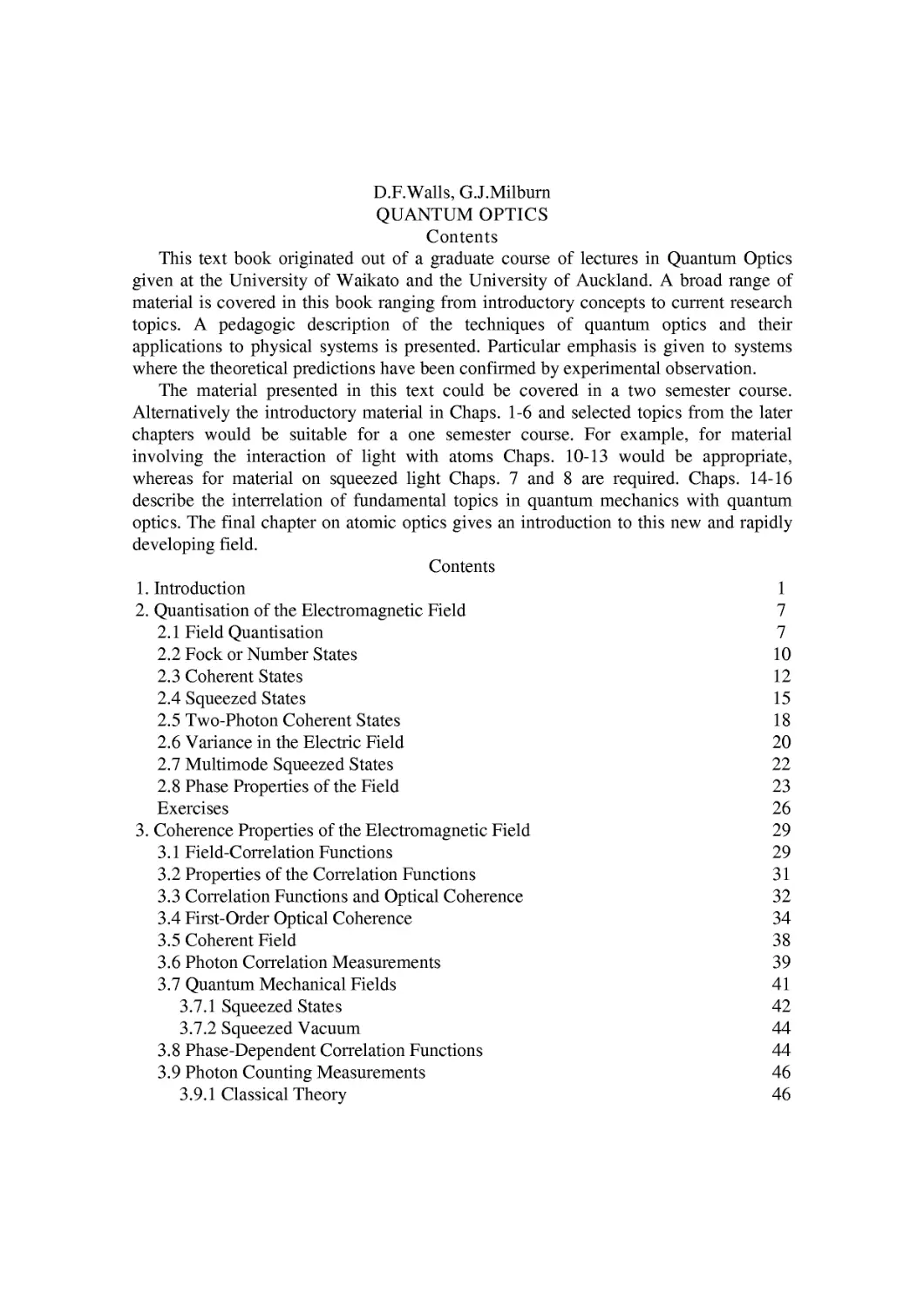
                    D.F.Walls, GJ.Milburn
QUANTUM OPTICS
Contents
This text book originated out of a graduate course of lectures in Quantum Optics
given at the University of Waikato and the University of Auckland. A broad range of
material is covered in this book ranging from introductory concepts to current research
topics. A pedagogic description of the techniques of quantum optics and their
applications to physical systems is presented. Particular emphasis is given to systems
where the theoretical predictions have been confirmed by experimental observation.
The material presented in this text could be covered in a two semester course.
Alternatively the introductory material in Chaps. 1-6 and selected topics from the later
chapters would be suitable for a one semester course. For example, for material
involving the interaction of light with atoms Chaps. 10-13 would be appropriate,
whereas for material on squeezed light Chaps. 7 and 8 are required. Chaps. 14-16
describe the interrelation of fundamental topics in quantum mechanics with quantum
optics. The final chapter on atomic optics gives an introduction to this new and rapidly
developing field.
Contents
1. Introduction 1
2. Quantisation of the Electromagnetic Field 7
2.1 Field Quantisation 7
2.2 Fock or Number States 10
2.3 Coherent States 12
2.4 Squeezed States 15
2.5 Two-Photon Coherent States 18
2.6 Variance in the Electric Field 20
2.7 Multimode Squeezed States 22
2.8 Phase Properties of the Field 23
Exercises 26
3. Coherence Properties of the Electromagnetic Field 29
3.1 Field-Correlation Functions 29
3.2 Properties of the Correlation Functions 31
3.3 Correlation Functions and Optical Coherence 32
3.4 First-Order Optical Coherence 34
3.5 Coherent Field 38
3.6 Photon Correlation Measurements 39
3.7 Quantum Mechanical Fields 41
3.7.1 Squeezed States 42
3.7.2 Squeezed Vacuum 44
3.8 Phase-Dependent Correlation Functions 44
3.9 Photon Counting Measurements 46
3.9.1 Classical Theory 46

3.9.2 Constant Intensity 48
3.9.3 Fluctuating Intensity - Short-Time Limit 48
3.10 Quantum Mechanical Photon Count Distribution 51
3.10.1 Coherent Light 52
3.10.2 Chaotic Light 52
3.10.3 Photo-Electron Current Fluctuations 53
Exercises 55
4. Representations of the Electromagnetic Field 57
4.1 Expansion in Number States 57
4.2 Expansion in Coherent States 58
4.2.1 P Representation 58
a) Correlation Functions 60
b) Covariance Matrix 61
c) Characteristic Function 62
4.2.2 Wigner's Phase-Space Density 63
a) Coherent State 64
b) Squeezed State 64
c) Number State 64
4.2.3 Q Function 65
4.2.4 P Representation 66
4.2.5 Generalized P Representations 68
a) Number State 71
b) Squeezed State 71
4.2.6 Positive P Representation 71
Exercises 72
5. Quantum Phenomena in Simple Systems in Nonlinear Optics 73
5.1 Single-Mode Quantum Statistics 73
5.1.1 Degenerate Parametric Amplifier 73
5.1.2 Photon Statistics 75
5.1.3 Wigner Function 75
5.2 Two-Mode Quantum Correlations 77
5.2.1 Non-degenerate Parametric Amplifier 77
5.2.2 Squeezing 80
5.2.3 Quadrature Correlations and the Einstein- Podolsky-Rosen Paradox 81
5.2.4 Wigner Function 82
5.2.5 Reduced Density Operator 83
5.3 Quantum Limits to Amplification 85
5.4 Amplitude Squeezed State with Poisson Photon Number Statistics 86
Problems 89
6. Stochastic Methods 91
6.1 Master Equation 91
6.2 Equivalent c-Number Equations 98

6.2.1 Photon Number Representation 98
6.2.2 P Representation 99
6.2.3 Properties of Fokker-Planck Equations 101
6.2.4 Steady State Solutions - Potential Conditions 101
6.2.5 Time Dependent Solution 103
6.2.6 Q Representation 104
6.2.7 Wigner Function 106
6.2.8 Generalized P Represention 108
a) Complex P Representation 109
b) Positive P Representation 110
6.3 Stochastic Differential Equations 111
6.3.1 Use of the Positive P Representation 115
6.4 Linear Processes with Constant Diffusion 115
6.5 Two Time Correlation Functions in Quantum Markov Processes 117
6.5.1 Quantum Regression Theorem 118
6.6 Application to Systems with a P Representation 118
Exercises 119
7. Input-Output Formulation of Optical Cavities 121
7.1 Cavity Modes 121
7.2 Linear Systems 124
7.3 Two-Sided Cavity 126
7.4 Two Time Correlation Functions 127
7.5 Spectrum of Squeezing 129
7.6 Parametric Oscillator 129
7.7 Squeezing in the Total Field 132
7.8 Fokker-Planck Equation 132
Exercises 135
8. Generation and Applications of Squeezed Light 137
8.1 Parametric Oscillation and Second Harmonic Generation 137
8.1.1 Semi-classical Steady States and Stability Analysis 139
8.1.2 Parametric Oscillation 139
8.1.3 Second Harmonic Generation 140
8.1.4 Squeezing Spectrum 141
8.1.5 Parametric Oscillation 142
8.1.6 Experiments 143
8.2 Twin Beam Generation and Intensity Correlations 146
8.2.1 Second Harmonic Generation 150
8.2.2 Experiments 152
8.2.3 Dispersive Optical Bistability 153
8.3 Applications of Squeezed Light 158
8.3.1 Interferometric Detection of Gravitational Radiation 158
8.3.2 Sub-Shot-Noise Phase Measurements 172

Exercises 174
9. Nonlinear Quantum Dissipative Systems 177
9.1 Optical Parametric Oscillator: Complex P Function 177
9.2 Optical Parametric Oscillator: Positive P Function 182
9.3 Quantum Tunnelling Time 186
9.4 Dispersive Optical Bistability 191
9.5 Comment on the Use of the Q and Wigner Representations 193
Exercises 193
9. A Appendix 194
9.A.I Evaluation of Moments for the Complex P function for Parametric 194
Oscillation (9.17)
9.A.2 Evaluation of the Moments for the Complex P Function for Optical 195
Bistability (9.48)
10. Interaction of Radiation with Atoms 197
10.1 Quantization of the Electron Wave Field 197
10.2 Interaction Between the Radiation Field and the Electron Wave Field 199
10.3 Interaction of a Two-Level Atom with a Single Mode Field 204
10.4 Quantum Collapses and Revivals 205
10.5 Spontaneous Decay of a Two-Level Atom 206
10.6 Decay of a Two-Level Atom in a Squeezed Vacuum 208
10.7 Phase Decay in a Two-Level System 210
Exercises 211
11. Resonance Fluorescence 213
11.1 Master Equation 213
11.2 Spectrum of the Fluorescent Light 217
11.3 Photon Correlations 221
11.4 Squeezing Spectrum 225
Exercises 228
12. Quantum Theory of the Laser 229
12.1 Master Equation 229
12.2 Photon Statistics 232
12.2.1 Spectrum of Intensity Fluctuations 233
12.3 Laser Linewidth 235
12.4 Regularly Pumped Laser 236
12.A Appendix: Derivation of the Single-Atom Increment 240
Exercises 244
13. Intracavity Atomic Systems 245
13.1 Optical Bistability 245
13.2 Nondegenerate Four Wave Mixing 252
13.3 Experimental Results 25 8
Exercises 259
14. Bells Inequalities in- Quantum Optics 261

14.1 The Einstein-Podolsky-Rosen (EPR) Argument 261
14.2 Bell Inequalities and the Aspect Experiment 262
14.3 Violations of Bell's Inequalities Using a Parametric Amplifier Source 268
14.4 One-Photon Interference 273
Exercises 279
15. Quantum Nondemolition Measurements 281
15.1 Concept of a QND measurement 282
15.2 Back Action Evasion 284
15.3 Criteria for a QND Measurement 284
15.4 The Beam Splitter 287
15.5 Ideal Quadrature QND Measurements 290
15.6 Experimental Realisation 291
15.7 A Photon Number QND Scheme 294
Exercises 296
16. Quantum Coherence and Measurement Theory 297
16.1 Quantum Coherence 297
16.2 The Effect of Fluctuations 303
16.3 Quantum Measurement Theory 306
16.4 Examples of Pointer Observables 310
16.5 Model of a Measurement 311
Exercises 313
17. Atomic Optics 315
17.1 Young's Interference with Path Detectors 316
17.1.1 The Feynman Light Micro scope 319
17.2 Atomic Diffraction by a Standing Light Wave 321
17.3 Optical Stern-Gerlach Effect 325
17.4 Quantum Non-Demolition Measurement of the Photon Number by Atomic 330
Beam Deflection
17.5 Measurement of Atomic Position 334
17.5.1 Atomic Focussing and Contractive States 337
Exercises 339
17.A Appendix 339
References 341
Subject Index 347
Subject Index
adiabatic elimination 179, 249, 254 atomic decay rate, transverse 246
antibunching, photon 2 atomic operators, collective 247
laser 3 atomic optics 5
resonance fluorescence 221 back action evasion 284
second-order correlation function 42 Bargmann state 99
sub-Poissonian statistics 42 beam splitter 287

Bell inequality 4, 265
CHSH form 266
parametric down conversion 268
bistability, dispersive (linear) 153
squeezing spectrum 156
bistability, dispersive (nonlinear) 191
Fokker-Planck equation 191
bistability, optical 245
atomic model 245
noise correlation 249
Brownian motion 112
bunching, photon 2
second-order correlation function 40,
42
sub-Poissonian statistics 42
Cauchy-Schwarz inequality 32, 78
cavity, boundary condition 121
cavity, laser 229
cavity, two-sided 126
chaotic field, see thermal field
characteristic function 62
optical bistability 247
P representation 62
Q representation 65
quantum coherence 303
Wigner representation 63, 106
CHSH inequality 266
Clauser-Horne inequality 269
coherence, first order optical 34
Young's interference experiment 35
coherence function 298
coherence, optical 29
coherence, quantum 303
visibility 303
coherent field 38
coherent state 12, 108
completeness 14
displacement operator 12
number state expansion 12
Poissonian statistics 13, 58
second-order correlation function 42,
58
coherent state, two photon 18
coincidence probability 275
collisional broadening limit 246
complementarity 5, 261, 316
contractive state 282, 337
correlated state 261
correlated state, polarization 263
correlation function 31
general inequalities 31
phase information 44
correlation function, first order 30
correlation function, higher order 30
correlation function, phase dependent
44
correlation function, photon number 222
correlation function, QND 285
correlation function, second-order 39
antibunching 42
bunching 40
coherent state 42
number state 42
resonance fluorescence 222
thermal field 58
correlation function, two-time 53
Brownian motion 113
input-output formalism 127
master equation 91
Ornstein-Uhlenbeck process 116
parametric oscillator 133
phase diffusion 236
photon counting 53
regularly pumped laser 237
resonance fluorescence 217, 225
two-level atom 207
correlation, intensity 39
Hanbury-Brown Twiss experiment 1,
30,39
parametric amplifier 75
covariance matrix 61
covariance matrix, stationary 116
density operator, reduced 92
detailed balance 98

harmonic oscillator 98
laser 232
duality, wave-particle 315
efficiency, quantum 52
Einstein-Podolsky-Rosen paradox, see
EPR paradox
electric dipole approximation 200,
245
electromagnetic field 7
commutation relations 10
Hamiltonian 10
quantisation 7
vacuum state 10
entangled state 275,318
EPR paradox 4, 261
parametric amplifier 81
error ellipse 16
coherent state 16
Wigner function 63
Fock state, see number state
Fokker-Planck equation 101
degenerate parametric oscillator 178
dispersive bistability 155, 191
Green's function 103
potential condition 101
stochastic differential equation 111
four-wave mixing 3, 245, 252
degenerate operation 257
noise correlation 254
phase matching 253
QND 294
side-band modes 253
squeezing spectrum 256
gain, QND 290, 295
gravitational radiation 281
Hanbury-Brown Twiss experiment 1,
30,37
harmonic oscillator 11
electromagnetic field 11
harmonic oscillator, damped 115
harmonic oscillator, master equation 93
Fokker-Planck equation 100, 110
transition probabilities 98
heat bath, see reservoir
hidden variable theory 264
homodyne detection 45
four-wave mixing 255
parametric oscillator 132
input-output formalism 121
boundary condition 124
laser fluctuations 233
parametric oscillator 129
photon counting distribution 51
squeezing spectrum 129
two-time correlation function 127
intensity fluctuations, laser 234, 239
interaction picture 201
interferometer, gravity wave 158
semiclassical behaviour 162
signal variance 166
total noise 167
interferometer, Mach-Zehnder 172
interferometer, polarization 174
interferometry, matter 5, 315, 327
interferometry, optical 1
squeezed light 3
Jaynes Cummings model 204
Kapitza-Dirac regime 323
Kerr effect 87, 191
KTP crystal 291
Langevin equation 112
Brownian motion 112
constant diffusion process 115
damped harmonic oscillator 113
four-wave mixing 254
input-output formalism 124
laser 2, 229
diode 229
gain 232
phase diffusion 235
Scully-Lamb form 231
sub-Poissonian statistics 3
threshold 232
laser cooling 5, 315

laser, fluctuations 229
intensity 234
photon number 233, 238
pump 236
sub-shot noise 229
laser, quantum theory 229
laser, regularly pumped 239
laser, semiconductor 236, 240
lens, atomic 337
linewidth, laser 236
Liouvillian operator 117
Markov approximation, first 95, 123
master equation 91
gravitational wave interferometer
161, 165
optical bistability 155, 246
parametric oscillator 138
resonance fluorescence 213
Scully-Lamb laser 231
two-level atom 206
two-time correlation function 117
Maxwell's equations 8
measurement limit, strong 313
measurement theory, quantum 306
micro-cavity 210
microscope, Feynman light 315
minimum uncertainty state 16
parametric oscillator 145
squeezed state 15
mixture, classical 297
noise spectrum 116
normal ordering 51, 54
P representation 118
number state 10, 57
observable, QND 282
optical Bloch equations 215
oscillation threshold 216
optical tap 284, 294
Ornstein-Uhlenbeek process 112
Brownian motion 112
constant diffusion process 116
damped harmonic oscillator 115
P representation 58, 61
Bell inequality 266
chaotic state 59
coherent state 59
harmonic oscillator 99
normal ordering 118
quadrature variance 61
P representation, complex 68
coherent state 69
dispersive bistability 192, 195
harmonic oscillator 109
number state 69
parametric oscillator 132, 180, 194
squeezed state 70
P representation, generalised 68,138
bistability 155
harmonic oscillator 108
parametric oscillator 138, 178
P representation, positive 71, 115
Fokker-Planck equation 72
harmonic oscillator 110
optical bistability 247
parametric oscillator 182
twin beams 146
parametric amplifier, QND 291
parametric amplifier, degenerate 73
parametric amplifier, nondegenerate 77
selected state 84
thermal reduced state 83
two-mode squeezing 80
parametric down conversion 3, 73
Bell inequality 268
parametric oscillator (linear) 3, 129, 137
critical fluctuations 131
Fokker-Planck equation 132, 134
linearistation 129, 132, 139
minimum uncertainty state 145
output correlation matrix 133
squeezing spectrum 129, 142
threshold 129, 131
parametric oscillator (nonlinear) 177
quadrature variance 183

semiclassical solution 180
threshold distribution 184
Paul trap 225
Pauli spin operators 202
phase decay, collisionally induced 210,
246
phase diffusion, laser 235
linewidth 236
two-time correlation function 236
phase instability 147
phase matching 253
phase operator, Pegg-Barnett 25
phase operator, Susskind-Glogower 23
photo-detection 29, 39, 233
photon counting 299
photon counting, classical 46
depletion effects 50
ergodic hypothesis 49
generating function 48
photon counting, conditional 84
parametric amplifier 84
photon counting distribution 52
photon counting, nonclassical 70
number state 71
squeezed state 71
photon counting, quantum mechanical
51
photon number, QND 294
Planck distribution 58
pointer basis 308
Poissonian pumping 230
polarization rotator 291
projection postulate, von Neumann 84
pump depletion 180
Q function 65
coherent state 66
harmonic oscillator 104
number state 66
squeezed state 66
QND measurement 4,315,329,330
pointer basis 310
sub-Poissonian statistics 295
two photon transition 294
QND measurement, ideal 290
Q parameter 239
quadrature phase measurement 44
quadrature phase operator 16
quantisation, electromagnetic field 7
quantisation, electron field 197
quantum nondemolition measurement,
see QND measurement
quantum recurrance phenomena 205
Kerr effect 89
quantum regression theorem 118
resonance fluorescence 221
R representation 66
Rabi frequency 204
radiation pressure 159
Raman-Nath regime 322, 334
recoil energy 322
refractive index, nonlinear 153
relative states 309
reservoir 91
collisional process 210
spectrum 96
spontaneous emission 214
two-level atom 206
reservoir, squeezed 94, 208
correlation function 208
two-level atom 208
reservoir, thermal 96
resonance fluorescence 2, 213
elastic scattering 219
inelastic scattering 219
quantum features 221
spectrum 217
rotating wave approximation 121,
202, 245
Rydberg atom 205, 327
Schrodinger cat 297
second harmonic generation 137
critical behaviour 140, 150
self pulsing 141
squeezing spectrum 151

steady-state solution 140
shot-noise limit 54
laser 235, 239
signal-to-noise ratio 291, 295
spectroscopy, photon correlation 40
spontaneous emission 206
master equation 206
Wigner-Weisskopf theory 207
squeezed state 15
photon number distribution 21
super-Poissonian statistics 43
squeezed state, multimode 22
squeezed state, two-mode 22
parametric amplifier 80
squeezing generator 23
squeezing 3, 137
four-wave mixing 255
input-output formalism 129
nonlinear susceptibility 154
parametric oscillator 129
squeezing, generator 16
parametric amplifier 74, 80
squeezing spectrum 129
dispersive bistability 156
parametric oscillator 129, 142
resonance fluorescence 225
second harmonic generation 151
twin beams 148
stability analysis 139
standard quantum limit 169
gravity wave 281
state preparation 285, 329
statistics, photon 41
laser 232
micromaser cavity 327
regularly pumped laser 238
statistics, photon counting 53
statistics, Poissonian 2, 13
coherent state 13, 58
Kerr effect 86
laser 232
statistics, sub-Poissonian 3
antibunching 42
bunching 42
laser 3, 236
QND 295
resonance fluorescence 225
statistics, super-Poissonian 42
squeezed state 43
Stern-Gerlach effect, optical 32, 315
stochastic differential equation 111
Fokker-Planck equation 111
gravity wave interferometer 161, 165
Ito equation 111
Langevin equation 111
optical bistability 248
parametric oscillator 138
superposition, coherent 297
superposition, macroscopic 4, 297
superposition principle 297
superposition state 177, 186
susceptibility, nonlinear 154
switching time 179
thermal field 58
laser 232
second-order correlation function 58
transition probability 98
tunnelling time 177, 186
twin beams 146
critical behaviour 146
pulsed 150
semiclassical steady-state 146
squeezing spectrum 148
two-level atom 202
master equation 206
uncertainty principle 16, 288, 313
gravity waves 281
vector potential 8, 199
visibility 32, 34, 318, 320
Bell inequality 271
one-photon interference 276
quantum coherence 303
wavelength, de Broglie 315
Wigner function 63

coherent state 64
covariance matrix 63
harmonic oscillator 106
number state 64
parametric amplifier 75, 82
squeezed state 64
Wigner-Weisskopf theory 207
resonance fluorescence 213, 219
Young's interference experiment 1, 32
coherent superposition 297
correlation function 34
experiments 37
quantum explanation of 37
visibility 34
with atoms 315

Professor D.F. WALLS, F.R.S.
University of Auckland
Private Bag 92019
Auckland
New Zealand
Dr. G.J. MlLBURN
Physics Department
University of Queensland
St. Lucia QLD 4067
Australia

Preface
This text book originated out of a graduate course of lectures in
Quantum Optics given at the University of Waikato and the Univer-
sity of Auckland. A broad range of material is covered in this book
ranging from introductory concepts to current research topics. A
pedagogic description of the techniques of quantum optics and their
applications to physical systems is presented. Particular emphasis is
given to systems where the theoretical predictions have been con-
firmed by experimental observation.
The material presented in this text could be covered in a two
semester course. Alternatively the introductory material in Chaps.
1-6 and selected topics from the later chapters would be suitable for
a one semester course. For example, for material involving the
interaction of light with atoms Chaps. 10-13 would be appropriate,
whereas for material on squeezed light Chaps. 7 and 8 are required.
Chaps. 14-16 describe the interrelation of fundamental topics in
quantum mechanics with quantum optics. The final chapter on
atomic optics gives an introduction to this new and rapidly develop-
ing field.
One of us (D.F. Walls) would like to thank Roy Glauber and
Hermann Haken for the wonderful introduction they gave me to this
exciting field. We would also like to thank our students and colleag-
ues at the Universities of Waikato, Auckland and Queensland who
have contributed so much to the material in this book. In particular,
Crispin Gardiner, Ken McNeil, Howard Carmichael, Peter Drum-
mond, Margaret Reid, Shoukry Hassan, Matthew Collett, Sze Tan,
Alistair Lane, Briari Kennedy, Craig Savage, Monika Marte, Mur-
ray Holland and Pippa Storey. Finally, we would like to thank all
our friends and colleagues in Quantum Optics too numerous to
name with whom we have shared in the excitement of the develop-
ment of this field.
The completion of this book would not have been possible
without the excellent work of Susanna van der Meer who performed
the word processing through many iterations.
Auckland, New Zealand D.F. Walls
St. Lucia, Australia G.J. Milburn
January 1994

1. Introduction
The first indication of the quantum nature of light came in 1900 when M. Planck
discovered he could account for the spectral distribution of thermal light by
postulating that the energy of a harmonic oscillator is quantized. Further
evidence was added by A. Einstein who showed in 1905 that the photoelectric
effect could be explained by the hypothesis that the energy of a light beam was
distributed in discrete bundles later known as photons.
Einstein also contributed to the understanding of the absorption and emis-
sion of light from atoms with his development of a phenomenological theory in
1917. This theory was later shown to be a natural consequence of the quantum
theory of electromagnetic radiation.
Despite this early connection with quantum theory physical optics has
developed more or less independently of quantum theory. The vast majority of
physical-optics experiments can adequately be explained using classical theory
of electromagnetic radiation based on Maxwell's equations. An early attempt to
find quantum effects in an optical interference experiment by G.I. Taylor in 1909
gave a negative result. Taylor's experiment was an attempt to repeat T. Young's
famous two slit experiment with one photon incident on the slits. The classical
explanation based on the interference of electric field amplitudes and the
quantum explanation based on the interference of the probability amplitudes for
the photon to pass through either slit coincide in this experiment. Interference
experiments of Young's type do not distinguish between the predictions of
classical theory and quantum theory. It is only in higher-order interference
experiments involving the interference of intensities that differences between the
predictions of classical and quantum theory appear. In such an experiment two
electric fields are detected on a photomultiplier and their intensities are allowed
to interfere. Whereas classical theory treats the interference of intensities, in
quantum theory the interference is still at the level of probability amplitudes.
This is one of the most important differences between quantum theory and
classical theory.
The first experiment in intensity interferometry was the famous experiment
of R. Hanbury Brown and R.Q. Twiss. This experiment studied the correlation
in the photo-current fluctuations from two detectors. Later experiments were
photon counting experiments, and the correlations between photon numbers
were studied.
The Hanbury-Brown-Twiss experiment observed an enhancement in the
two-time intensity correlation function of short time delays for a thermal light

2 1. Introduction
source known as photon bunching. This was a consequence of the large intensity
fluctuations in the thermal source. Such photon bunching phenomena may be
adequately explained using a classical theory with a fluctuating electric field
amplitude. For a perfectly amplitude stabilized light field such as an ideal laser
operating well above threshold there is no photon bunching. A photon counting
experiment where the number of photons arriving in an interval T are counted,
shows that there is still a randomness in the photon arrivals. The photon-
number distribution for an ideal laser is Poissonian. For thermal light a super-
Poissonian photocount distribution results.
While the above results may be derived from both classical and quantum
theory, the quantum theory makes additional unique predictions. This was first
elucidated by R.J. Glauber in his quantum formulation of optical coherence
theory in 1963. One such prediction is photon antibunching where the initial
slope of the two-time correlation function is positive. This corresponds to
greater than average separations between the photon arrivals or photon anti-
bunching. The photocount statistics may also be sub-Poissonian. A classical
theory of fluctuating field amplitudes would require negative probabilities in
order to give photon antibunching. In the quantum picture it is easy to visualize
photon arrivals more regular than Poissonian.
It was not, however, until 1975 when H.J. Carmichael and D.F. Walls
predicted that light generated in resonance fluorescence from a two-level atom
would exhibit photon antibunching that a physically accessible system exhibit-
ing nonclassical behaviour was identified. Photon antibunching was observed
during the next year in this system in an experiment by H.J. Kimble,
M. Dagenais and L. Mandel. This was the first nonclassical effect observed in
optics and ushered in a new era in quantum optics.
The experiments of Kimble et al. used an atomic beam and hence the photon
antibunching was convolved with the atomic number fluctuations in the beam.
With developments in ion-trap technology it is now possible to trap a single ion
for several minutes. H. Walther and coworkers in Munich have studied reson-
ance fluorescence from a single atom in a trap. They have observed both photon
antibunching and sub-Poissonian statistics in this system.
In the 1960's improvements in photon counting techniques proceeded in
tandem with the development of new laser light sources. Light from incoherent
(thermal) and coherent (laser) sources could now be distinguished by their
photon counting properties. The groups of F.T. Arecchi in Milan, L. Mandel in
Rochester and R.E. Pike in Malvern measured the photocount statistics of the
laser. They showed that the photocount statistics went from super-Poissonian
below threshold to Poissonian far above threshold. Concurrently, the quantum
theory of the laser was being developed by H. Haken in Stuttgart, M.O. Scully
and W. Lamb at Yale, and M. Lax and W.H. Louisell in New Jersey. In these
theories both the atomic variables and the electromagnetic field were quantized.
The result of these calculations were that the laser functioned as an essentially
classical device. In fact H. Risken showed that it could be modelled by a van der
Pol oscillator.

1. Introduction 3
It is only quite recently that the role the noise in the pumping process plays
in obscuring the quantum aspects of the laser has been understood. If the noise
in the pumping process can be suppressed the output of the laser may exhibit
sub-Poissonian statistics. In other words, the intensity fluctuations may
be reduced below the shot-noise level characteristic of normal lasers.
Y. Yamamoto in Tokyo has pioneered experimental developments in the area of
semiconductor lasers with suppressed pump noise. In a high impedance con-
stant current driven semiconductor laser the fluctuations in the pumping elec-
trons are reduced below Poissonian. This results in the photon statistics of the
emitted photons being sub-Poissonian.
It took another nine years after the observation of photon antibunching for
another prediction of the quantum theory of light to be observed - squeezing of
quantum fluctuations. The electric field for a nearly monochromatic plane wave
may be decomposed into two quadrature components with the time dependence
cos cot and sin cot, respectively. In a coherent state, the closest quantum counter-
part to a classical field, the fluctuations in the two quadratures are equal and
minimize the uncertainty product given by Heisenberg's uncertainty relation.
The quantum fluctuations in a coherent state are equal to the zero-point
vacuum fluctuations and are randomly distributed in phase. In a squeezed state
the quantum fluctuations are no longer independent of phase. One quadrature
phase may have reduced quantum fluctuations at the expense of increased
quantum fluctuations in the other quadrature phase such that the product of the
fluctuations still obeys Heisenberg's uncertainty relation.
Squeezed states offer the possibility of beating the quantum limit in optical
measurements by making phase-sensitive measurements which utilize only the
quadrature with reduced quantum fluctuations. The generation of squeezed
states requires a nonlinear phase-dependent interaction. The first observation of
squeezed states was achieved by R.E. Slusher in 1985 at the AT&T Bell
Laboratories in four-wave mixing in atomic sodium. This was soon followed by
demonstrations of squeezing in an optical parametric oscillator by H.J. Kimble
and by four-wave mixing in optical fibres by M.D. Levenson.
Squeezing-like photon antibunching is a consequence of the quantization of
the light field. The usefulness of squeezed light was demonstrated in experiments
in optical interferometry by Kimble and Slusher. Following the original sugges-
tion of CM. Caves at Caltech they injected squeezed light into the empty port of
an interferometer. By choosing the phase of the squeezed light so that the
quantum fluctuations entering the empty port were reduced below the vacuum
level they observed an enhanced visibility of the interference fringes.
In the nonlinear process of parametric down conversion a high frequency
photon splits into two photons with frequencies such that their sum equals that
of the high-energy photon. The two photons (photon twins) produced in this
process possess quantum correlations and have identical intensity fluctuations.
This may be exploited in experiments where the intensity fluctuations in the
difference photocurrent for the two beams is measured. The intensity difference
fluctuations in the twin beams have been shown to be considerably below the

4 1. Introduction
shot-noise level in experiments by E. Giacobino in Paris and P. Kumar in
Evanston.
The twin beams may also be used in absorption measurements where the
sample is placed in one of the beams and the other beam is used as a reference.
The driving laser is tuned so that the frequency of the twin beams matches the
frequency at which the sample absorbs. When the twin beams are detected and
the photocurrents are subtracted, the presence of even very weak absorption can
be seen because of the small quantum noise in the difference current.
The photon pairs generated in parametric down conversion also carry
quantum correlations of the Einstein-Podolsky-Rosen type. Intensity correla-
tion experiments to test Bell inequalities were designed using a correlated pair of
photons. The initial experiments by A. Aspect in Paris utilized a two photon
cascade to generate the correlated photons, however, recent experiments have
used parametric down conversion. These experiments have consistently given
results in agreement with the predictions of quantum theory and in violation of
classical predictions. At the basis of the difference between the two theories is the
interference of probability amplitudes which is characteristic of quantum mech-
anics. In these intensity interference experiments as opposed to interference
experiments of the Young's type the two theories yield different predictions. This
was strikingly demonstrated in an intensity interference experiment which has
only one incident photon but has phase-sensitive detection. In this experiment
proposed by S.M. Tan, D.F. Walls and M.J. Collett a single photon may take
either path to two homodyne detectors. Nonlocal quantum correlations be-
tween the two detectors occur, which are a consequence of the interference of the
probability amplitudes for the photon to take either path.
The major advances made in quantum optics, in particular the ability to
generate and detect light with less quantum fluctuations than the vacuum,
makes optics a fertile testing ground for quantum measurement theory. The idea
of quantum non-demolition measurements arose in the context of how to detect
the change in position of a free mass acted on by a force such as a gravitational
wave. However, the concept is general. Basically one wishes to measure the
value of an observable without disturbing it so that subsequent measurements
can be made with equal accuracy as the first. Demonstrations of quantum
non-demolition measurements have been achieved in optics. In experiments by
M.D. Levenson and P. Grangier two electromagnetic-field modes have been
coupled via a nonlinear interaction. A measurement of the amplitude quadrat-
ure of one mode (the probe) allows one to infer the value of the amplitude
quadrature of the other mode (the signal) without disturbing it. This quantum
non-demolition measurement allows one to evade the back action noise of
the measurement by shunting the noise into the phase quadrature which is
undetected.
The techniques developed in quantum optics include quantum treatments of
dissipation. Dissipation has been shown to play a crucial role in the destruction
of quantum coherence, which has profound implications for quantum measure-
ment theory. The difficulties in generating a macroscopic superposition of

1. Introduction 5
quantum states (Schrodingers cat) is due to the fragility of such states to the
presence of even small dissipation. Several schemes to generate these superposi-
tion states in optics have been proposed but to date there has been no experi-
mental manifestation.
Matter-wave interferometry is a well established field, for example, electron
and neutron interferometry. More recently, however, such effects have been
demonstrated with atoms. Interferometry with atoms offers the advantage of
greater mass and therefore greater sensitivity for measurements of changes of
gravitational potentials. Using techniques of laser cooling the de Broglie
wavelength of atoms may be increased. With slow atoms the passage time in the
interferometer is increased thus leading to an increase in sensitivity. Atoms also
have internal degrees of freedom which may be used to tag which path an atom
took. Thus demonstrations of the principle of complementary using a double-
slit interference experiment with which path detectors may be realized with
atoms.
Atoms may be diffracted from the periodic potential structure of a standing
light wave. A new field of atomic optics is rapidly emerging. In atomic optics the
role of the light and atoms are reversed. Optical elements such as mirrors and
beam splitters consist of light fields which reflect and split atomic beams. The
transmission of an atom by a standing light wave may be state selective (the
optical Stern-Gerlach effect) and this property may be used as a beam splitter.
The scattering of an atom by a standing light wave may depend on the photon
statistics of the light. Hence, measuring the final momentum distribution of the
atoms may give information on the photon statistics of the light field. Thus
atomic optics may extend the range of quantum measurements possible with
quantum optical techniques. For example, the position an atom passes through
a standing light wave may be determined by measuring the phase shift it imparts
to the light.
The field of quantum optics now occupies a central position involving the
interaction of atoms with the electromagnetic field. It covers a wide range of
topics ranging from fundamental tests of quantum theory to the development
of new laser-light sources. In this text we introduce the analytic techniques of
quantum optics. These techniques are applied to a number of illustrative
examples. While the main emphasis of the book is theoretical, descriptions of
the experiments which have played a central role in the development of
quantum optics are included.
A summary of the topics included in this text book is given as follows:
A familiarity with non-relativistic quantum mechanics is assumed. As we will
be concerned with the quantum properties of light and its interaction with
atoms, the electromagnetic field is quantised in the second chapter. Commonly
used basis states for the field, the number states, the coherent states, and the
squeezed state are introduced and their properties discussed. A definition of
optical coherence is given via a set of field correlation functions in Chap. 3.
Various representations for the electromagnetic field are introduced in Chap. 4
using the number states and the coherent states as a basis.

6 1. Introduction
In Chap. 5 we present a number of simple models which illustrate some of
the quantum correlation phenomena we discuss in later chapters. In Chap. 6
a rather lengthy description is given of the quantum theory of damping and the
stochastic methods which may be employed to treat problems with damping. In
Chap. 7 we present the input-output formulation of interactions in optical
cavities. This theory plays a central role in the study of squeezed light genera-
tion. In Chap. 8 the input-output theory is applied to several systems in
nonlinear optics, which produce squeezed light. Comparison with experiments is
included. Applications of squeezed light in the field of optical interferometry are
given. Potential use of squeezed light in gravitational wave interferometry is
discussed.
In Chap. 9 two examples are given where the steady state quantum statistics
of a field generated via a nonlinear optical interaction may be found exactly. In
the case of parametric subharmonic generation the quantum tunnelling time
between two states of a superposition is calculated.
In Chap. 10 we introduce atoms for the first time. The atomic energy levels
are quantised and the interaction Hamiltonian between a two-level atom and
the electromagnetic field derived. The spontaneous decay of an excited atom
into a vacuum is treated. The modification of the atomic decay when the
vacuum is squeezed, is also studied. In Chap. 11 we treat the classic problem of
resonance fluorescence from a coherently driven atom. The resonance fluor-
escence spectrum is derived as is the photon antibunching of the emitted light.
A comparison of theory with experimental results is given.
In Chap. 12 the quantum theory of the laser is developed including the
theory of pump-noise-suppressed lasers, which give a sub-Poissonian output. In
Chap. 13 a full quantum treatment is presented of optical bistability and four-
wave mixing. Both systems involve the interaction of an ensemble of two-level
atoms with a cavity field. The generation of squeezed light from these systems is
analysed. Fundamental questions in quantum mechanics are addressed in
Chap. 14. Experimental tests of the Bell inequalities in optics are described. In
Chap. 15 quantum non-demolition measurements in optical systems are ana-
lysed. Further fundamentals of quantum coherence and the quantum measure-
ment theory are discussed in Chap. 16.
In Chap. 17 an introduction to the newly emerging field of atomic optics is
given.

2. Quantisation of the Electromagnetic Field
The study of the quantum features of light requires the quantisation of the
electromagnetic field. In this chapter we quantise the field and introduce three
possible sets of basis states, namely, the Fock or number states, the coherent
states and the squeezed states. The properties of these states are discussed. The
phase operator and the associated phase states are also introduced.
2.1 Field Quantisation
The major emphasis of this text is concerned with the uniquely quantum-
mechanical properties of the electromagnetic field, which are not present in
a classical treatment. As such we shall begin immediately by quantizing the
electromagnetic field. We shall make use of an expansion of the vector potential
for the electromagnetic field in terms of cavity modes. The problem then reduces
to the quantization of the harmonic oscillator corresponding to each individual
cavity mode.
We shall also introduce states of the electromagnetic field appropriate to the
description of optical fields. The first set of states we introduce are the number
states corresponding to having a definite number of photons in the field. It turns
out that it is extremely difficult to create experimentally a number state of the
field, though fields containing a very small number of photons have been
generated. A more typical optical field will involve a superposition of number
states. One such field is the coherent state of the field which has the minimum
uncertainty in amplitude and phase allowed by the uncertainty principle, and
hence is the closest possible quantum mechanical state to a classical field. It also
possesses a high degree of optical coherence as will be discussed in Chap. 3,
hence the name coherent state. The coherent state plays a fundamental role in
quantum optics and has a practical significance in that a highly stabilized laser
operating well above threshold generates a coherent state.
A rather more exotic set of states of the electromagnetic field are the
squeezed states. These are also minimum-uncertainty states but unlike the
coherent states the quantum noise is not uniformly distributed in phase.
Squeezed states may have less noise in one quadrature than the vacuum. As
a consequence the noise in the other quadrature is increased. We introduce the

8 2. Quantisation of the Electromagnetic Field
basic properties of squeezed states in this chapter. In Chap. 8 we describe ways
to generate squeezed states and their applications.
While states of definite photon number are readily defined as eigenstates of
the number operator a corresponding description of states of definite phase is
more difficult. This is due to the problems involved in constructing a Hermitian
phase operator to describe a bounded physical quantity like phase. How this
problem may be resolved together with the properties of phase states is dis-
cussed in the final section of this chapter.
A convenient starting point for the quantisation of the electromagnetic field
is the classical field equations. The free electromagnetic field obeys the source
free Maxwell equations.
VB=0 , B.1a)
cB
\xE = , B.1b)
dt
V/> = 0 , B.1c)
Vxff=- , B.Id)
ct
where B = n0H, D = b0E, fi0 and e0 being the magnetic permeability and
electric permittivity of free space, and ftoEo = c~ 2- Maxwell's equations are
gauge invariant when no sources are present. A convenient choice of gauge for
problems in quantum optics is the Coulomb gauge. In the Coulomb gauge both
B and E may be determined from a vector potential A(r, f) as follows
B=\xA , B.2a)
with the Coulomb gauge condition
\A = 0 . B.3)
Substituting B.2a) into B.Id) we find that A(r, t) satisfies the wave equation
\2A(r, t) = -j —^— . B.4)
We separate the vector potential into two complex terms
A(r, t) = Al + ){r, t) + A{~](r, t) , B.5)
where Al- + )(r, t) contains all amplitudes which vary as e~"°' for w > 0 and
A{~](r, t) contains all amplitudes which vary as elto( and A{~) = (^< + ))*.
It is more convenient to deal with a discrete set of variables rather than the
whole continuum. We shall therefore describe the field restricted to a certain

2.1 Field Quantisation 9
volume of space and expand the vector potential in terms of a discrete set of
orthogonal mode functions:
A( + \r, t) = X ckuk(r)e'imk' , B.6)
k
where the Fourier coefficients ck are constant for a free field. The set of vector
mode functions uk{r) which correspond to the frequency cok will satisfy the wave
equation
pW 0 B.7)
provided the volume contains no refracting material. The mode functions are
also required to satisfy the transversality condition,
V-«*(r) = 0 . B.8)
The mode functions form a complete orthonormal set
uk*(r)uk.(r)dr = Skk. . B.9)
The mode functions depend on the boundary conditions of the physical
volume under consideration, e.g., periodic boundary conditions corresponding
to travelling-wave modes or conditions appropriate to reflecting walls which
lead to standing waves. E.g., the plane wave mode functions appropriate to
a cubical volume of side L may be written as
uk(r)= L-32eU)exp(ik-r) B.10)
where <?(/) is the unit polarization vector. The mode index k describes several
discrete variables, the polarisation index (/, = 1,2) and the three Cartesian
components of the propagation vector k. Each component of the wave vector
k takes the values
2nnx , 2nnr , 2tt«z
kx = -, ky = >-, k2 = -, nx, ny, n, = 0, + 1, + 2, . . .
B.11)
The polarization vector e(/) is required to be perpendicular to k by the transver-
sality condition B.8).
The vector potential may now be written in the form
The corresponding form for the electric field is
fc(] • B.13)

10 2. Quantisation of the Electromagnetic Field
The normalization factors have been chosen such that the amplitudes ak and
a\ are dimensionless.
In classical electromagnetic theory these Fourier amplitudes are complex
numbers. Quantisation of the electromagnetic field is accomplished by choosing
ak and a\ to be mutually adjoint operators. Since photons are bosons the
appropriate commutation relations to choose for the operators ak and a\ are the
boson commutation relations
r ~\ r 1* ^ ~\ c\ r 1" ~\ ^\ /o 1 a\
The dynamical behaviour of the electric-field amplitudes may then be described
by an ensemble of independent harmonic oscillators obeying the above commu-
tation relations. The quantum states of each mode may now be discussed
independently of one another. The state in each mode may be described by
a state vector | f}k of the Hilbert space appropriate to that mode. The states of
the entire field are then defined in the tensor product space of the Hilbert spaces
for all of the modes.
The Hamiltonian for the electromagnetic field is given by
di- . B.15)
Substituting B.13) for ?and the equivalent expression for //and making use of
the conditions B.8) and B.9), the Hamiltonian may be reduced to the form
H = ^ hu>k(alak + \) . B.16)
k
This represents the sum of the number of photons in each mode multiplied by
the energy of a photon in that mode, plus \h.wk representing the energy of the
vacuum fluctuations in each mode. We shall now consider three possible
representations of the electromagnetic field.
2.2 Fock or Number States
The Hamiltonian B.15) has the eigenvalues ha)k(nk + \) where nk is an integer
(nk = 0, 1,2, ...,x). The eigenstates are written as \nky and are known as
number or Fock states. They are eigenstates of the number operator Nk = a\ak
akak\nky = nk\nk} . B.17)
The ground state of the oscillator (or vacuum state of the field mode) is defined
by
ak\0} = 0 . B.18)

2.2 Fock or Number States 11
From B.16 and 18) we see that the energy of the ground state is given by
<0|//|0> = -J hcok . B.19)
2 t
Since there is no upper bound to the frequencies in the sum over electromagnetic
field modes, the energy of the ground state is infinite, a conceptual difficulty of
quantized radiation field theory. However, since practical experiments measure
a change in the total energy of the electromagnetic field the infinite zero-^oint
energy does not lead to any divergence in practice. Further discussions on this
point may be found in [2.1]. ak and a\ are raising and lowering operators
for the harmonic oscillator ladder of eigenstates. In terms of photons they
represent the annihilation and creation of a photon with the wave vector k and
a polarisation ek. Hence the terminology, annihilation and creation operators.
Application of the creation and annihilation operators to the number states
yield
a k\nky = n\2\nk - 1>, a\ I nky = (nk + II 21 nk + 1> . B.20)
The state vectors for the higher excited states may be obtained from the vacuum
by successive application of the creation operator
>, nt = 0, 1, 2 ... . B.21)
The number states are orthogonal
(nk\mky = bmn , B.22)
and complete
Z |nfc><«fc| = 1 • B-23)
nk=0
Since the norm of these eigenvectors is finite, they form a complete set of basis
vectors for a Hilbert space.
While the number states form a useful representation for high-energy
photons, e.g. y rays where the number of photons is very small, they are not the
most suitable representation for optical fields where the total number of photons
is large. Experimental difficulties have prevented the generation of photon
number states with more than a small number of photons. Most optical fields
are either a superposition of number states (pure state) or a mixture of number
states (mixed state). Despite this the number states of the electromagnetic field
have been used as a basis for several problems in quantum optics including some
laser theories.

12 2. Quantisation of the Electromagnetic Field
2.3 Coherent States
A more appropriate basis for many optical fields are the coherent states [2.2].
The coherent states have an indefinite number of photons which allows them to
have a more precisely defined phase than a number state where the phase is
completely random. The product of the uncertainty in amplitude and phase for
a coherent state is the minimum allowed by the uncertainty principle. In this
sense they are the closest quantum mechanical states to a classical description of
the Held. We shall outline the basic properties of the coherent states below.
These states are most easily generated using the unitary displacement operator
D(y.) = exp(aa+ - y.* a) , B.24)
where y. is an arbitrary complex number.
Using the operator theorem [2.2]
which holds when
[A, [/1,B]] = [B,[/
we can write D(y.) as
D(y) = e W2 2eaaVa*a . B.26)
The displacement operator D(y.) has the following properties
Df{y.) = D l(y.) = D( - a). D\y.)aD{y.) = a + a ,
Dfh.)a*D(y.) = af + a* . B.27)
The coherent state |a> is generated by operating with D(a) on the vacuum state
B.28)
The coherent states are eigenstates of the annihilation operator a. This may be
proved as follows:
Df(y)a\y.} = DUy.)aD(y.)\0} = {a + y.)\0} = y.\0} . B.29)
Multiplying both sides by D(y.) we arrive at the eigenvalue equation
a\y.} = y.\y.y . B.30)
Since a is a non-Hermitian operator its eigenvalues y. are complex.
Another useful property which follows using B.25) is
D(y. + fl) = D(y.)D(P)exp(- ilm{a/?*]) . B.31)
The coherent states contain an indefinite number of photons. This may be made
apparent by considering an expansion of the coherent states in the number-
states basis.

2.3 Coherent States 13
Taking the scalar product of both sides of B.30) with (ji | we find the
recursion relation
It follows that
B.32)
B.33)
We may expand | a> in terms of the number states |n> with expansion coeffic-
ients <m|x> as follows
B.34)
The squared length of the vector |a> is thus
B.35)
It is easily seen that
<0|a> = <0|D(a
B.36)
Thus |<a|x>|2 = 1 and the coherent states are normalized.
The coherent state may then be expanded in terms of the number states as
a> = e I*''
'(/?!
Ml 2
2.37)
We note that the probability distribution of photons in a coherent state is
a Poisson distribution
P(n)=\(n\y.y\2 =
n\
where |a|2 is the mean number of photons (n = (cc\ata\x} = |a|2)
The scalar product of two coherent states is
B.38)
B.39)
B.40)
\(P\a}\2 = e-la~"l2 . B.41)
Thus the coherent states are not orthogonal although two states |a> and |/?>
become approximately orthogonal in the limit \i - fi\ ^ 1. The coherent states
Using B.26) this becomes
<^|oc> = expC -i(|a|2 + |^|2) + ocy5*] .
The absolute magnitude of the scalar product is

14 2. Quantisation of the Electromagnetic Field
form a two-dimensional continuum of states and are, in fact, overcomplete. The
completeness relation
1
a><a|d2a= 1 ,
may be proved as follows.
We use the expansion B.37) to give
-II1
! m\
Changing to polar coordinates this becomes
d2a -
271
dOe'
Using
we have
d2a
|
n\
dce"ce" ,
where we let c = r2. The integral equals n !. Hence we have
B.42)
B.43)
B.44)
B.45)
B.46)
B.47)
following from the completeness relation for the number states.
An alternative proof of the completeness of the coherent states may be given
as follows. Using the relation [2.3]
B.48)
B.49)
it is easy to see that all the operators A such that
Dr{tx)AD(tx) = A
are proportional to the identity.

2.4 Squeezed States 15
We consider
A = Jd2a|a><aj
then
Then using the above result we conclude that
Jd2aja><a| x / . B.51)
The constant of proportionality is easily seen to be n.
The coherent states have a physical significance in that the field generated by
a highly stabilized laser operating well above threshold is a coherent state. They
form a useful basis for expanding the optical field in problems in laser physics
and nonlinear optics. The coherence properties of light fields and the signi-
ficance of the coherent states will be discussed in Chap. 3.
2.4 Squeezed States
A general class of minimum-uncertainty states are known as squeezed states. In
general, a squeezed state may have less noise in one quadrature than a coherent
state. To satisfy the requirements of a minimum-uncertainty state the noise in
the other quadrature is greater than that of a coherent state. The coherent states
are a particular member of this more general class of minimum uncertainty
states with equal noise in both quadratures. We shall begin our discussion by
defining a family of minimum-uncertainty states. Let us calculate the variances
for the position and momentum operators for the harmonic oscillator
q= l±(a + ai), p = i h{a-a^). B.52)
\j 2o) \j 2
The variances are defined by
V(A) = (A/1J = (A2} - (A}2 . B.53)
In a coherent state we obtain
(AqJoh = —, (ApJoh = ~ . B.54)
2oj 2
Thus the product of the uncertainties is a minimum
(Ap Aq)coh = - . B.55)
Thus, there exists a sense in which the description of the state of an oscillator by
a coherent state represents as close an approach to classical localisation as

16 2. Quantisation of the Electromagnetic Field
possible. We shall consider the properties of a single-mode field. We may write
the annihilation operator a as a linear combination of two Hermitian operators
a = . B.56)
I, and X2, the real and imaginary parts of the complex amplitude, give
dimensionless amplitudes for the modes' two quadrature phases. They obey the
following commutation relation
[XlJX2~\ = 2i. B.57)
The corresponding uncertainty principle is
AXtAX2> 1 . B.58)
This relation with the equals sign defines a family of minimum-uncertainty
states. The coherent states are a particular minimum-uncertainty state with
A*, =AX2= 1 . B.59)
The coherent state \y,} has the mean complex amplitude a and it is a minimum-
uncertainty state for I, and X2, with equal uncertainties in the two quadrature
phases. A coherent state may be represented by an "error circle" in a complex
amplitude plane whose axes are Xx and X2 (Fig. 2.1a). The centre of the error
circle lies at j(X 1 + iX2} = a and the radius AX t = AX2 = 1 accounts for the
uncertainties in Xx and X2.
There is obviously a whole family of minimum-uncertainty states defined by
AXj AX 2 = I- If we plot AX\ against AX2 the minimum-uncertainty states lie
on a hyperbola (Fig. 2.2). Only points lying to the right of this hyperbola
correspond to physical states. The coherent state with AX, = AX2 is a special
case of a more general class of states which may have reduced uncertainty in one
quadrature at the expense of increased uncertainty in the other
(AX { < 1 < AX2). These states correspond to the shaded region in Fig. 2.2.
Such states we shall call squeezed states [2.4]. They may be generated by using
the unitary squeeze operator [2.5]
S(s) = exp(l/2f;*a2 - 1/2™+2) , B.60)
where r, = re2"*.
Note the squeeze operator obeys the relations
St(?) = S(E) = S(-?) , B.61)
and has the following useful transformation properties
SUs)aS(e) = acoshr - a+ei^sinhr ,
Sf(c)atS(E) = afcoshr-ae2i't'smhr , B.62)
S^e^y, +iy2)S(e)= YtC'"- + iY2er ,

(a)
2.4 Squeezed States 17
(b)
Fig. 2.1. Phase-space plot showing the uncertainty in (a) a coherent state |x), and (b) a squeezed
state x, r)
12 3 4
AX,
Fig. 2.2. Plot of AA", versus AX2 for the minimum-uncertainty states. The dot marks a coherent
state while the shaded region corresponds to the squeezed states
where
Y1+\Y2 =
B.63)
is a rotated complex amplitude. The squeeze operator attenuates one compon-
ent of the (rotated) complex amplitude, and it amplifies the other component.
The degree of attenuation and amplification is determined by r = |e|, which will
be called the squeeze factor. The squeezed state |a, e> is obtained by first
squeezing the vacuum and then displacing it
B.64)

18 2. Quantisation of the Electromagnetic Field
A squeezed state has the following expectation values and variances
(I, + L\'2> = <y1 + iF2>ei* = 2a ,
AKj =e-\ AY2 =er ,
(N} = \y.\2 + sinh2 r ,
(ANJ = |acoshr- x*e2i(#1 sinhr|2 + 2cosh2rsinh2r . B.65)
Thus the squeezed state has unequal uncertainties for Y1 and Y2 as seen in the
error ellipse shown in Fig. 2.1b. The principal axes of the ellipse lie along the
Y1 and Y2 axes, and the principal radii are AFX and AY2. A more rigorous
definition of these error ellipses as contours of the Wigner function is given in
Chap. 3.
2.5 Two-Photon Coherent States
We may define squeezed states in an alternative but equivalent way [2.6]. As this
definition is sometimes used in the literature we include it for completeness.
Consider the operator
B.66)
b =
where
Then b
lb,
Ha + vaf
obeys
^+]=1
We may write
b =
UaU*
the commutation relation
B.66) as
B.67)
B.68)
where U is a unitary operator. The eigenstates of b have been called two-photon
coherent states and are closely related to the squeezed states.
The eigenvalue equation may be written as
B.69)
From B.68) it follows that
\pyg = u\py B.70)
where |/?> are the eigenstates of a.
The properties of |/?>g may be p"roved to parallel those of the coherent states.
The state |/?>g may be obtained by operating on the vacuum
B.71)

2.5 Two-Photon Coherent States 19
with the displacement operator
Dg([i) = ellbt-Il*b B.72)
and 0>g = U | 0>. The two-photon coherent states are complete
^=1 B.73)
and their scalar product is
?'-i|/?|2-i|/n2) ¦ B.74)
We now consider the relation between the two-photon coherent states and the
squeezed states as previously denned. We first note that
U = S(r.)
with f.i = cosh r and v = e2"* sinh r. Thus
|0>g = |0,K> B.75)
with the above relations between (fi, v) and (r, 0). Using this result in B.71) and
rewriting the displacement operator, Dg(P\ in terms of a and af we find
E} B.76)
where
a = n/3 - vp* .
Thus we have found the equivalent squeezed state for the given two-photon
coherent state.
Finally, we note that the two-photon coherent state |/i>g may be written as
Thus the two-photon coherent state is generated by first displacing the vacuum
state, then squeezing. This is the opposite procedure to that which defines the
squeezed state |a, e>. The two procedures yield the same state if the displace-
ment parameters a and P are related as discussed above.
The completeness relation for the two-photon coherent states may be em-
ployed to derive the completeness relation for the squeezed states. Using the
above results we have
d2P
—- \P cosh r - P*e2i<t> sinh r, ?>< p cosh r - P*c2i<l> sinh r, e| = 1 . B.77)
The change of variable
a = Pcoshr - p*e2i<l1 sinhr B.78)

20 2. Quantisation of the Electromagnetic Field
leaves the measure invariant, that is d2a = d2/?. Thus
2a
— |a, ?><a, e| = 1 . B.79)
2.6 Variance in the Electric Field
The electric field for a single mode may be written in terms of the operators
X1 and X2 as
{ \XiSm(u)t-k-r)-X2cos{wt-k-r)~\ . B.80)
The variance in the electric field is given by
V(E(r, f)) = K{ K(JY1)sin2(wr — k-r) + V{X 2)cos2(cot — k-r)
- sin[2((ur - k-r)~] V(XUX2)} B.81)
where
'2ftwN
For a minimum-uncertainty state
V(Xl,X2) = 0 . B.82)
Hence B.81) reduces to
V(E(r,t)) = K[V{Xl)sin2(a)t - k-i-)+ V{X2)cos2((ot-k-r)^\ . B.83)
The mean and uncertainty of the electric field is exhibited in Figs. 2.3a-c where
the line is thickened about a mean sinusoidal curve to represent the uncertainty
in the electric field.
The variance of the electric field for a coherent state is a constant with time
(Fig. 2.3a). This is due to the fact that while the coherent-state-error circle
rotates about the origin at frequency co, it has a constant projection on the axis
defining the electric field. Whereas for a squeezed state the rotation of the error
ellipse leads to a variance that oscillates with frequency 2co. In Fig. 2.3b the
coherent excitation appears in. the quadrature that has reduced noise. In
Fig. 2.3c the coherent excitation appears in the quadrature with increased noise.
This situation corresponds to the phase states discussed in [2.7] and in the final
section of this chapter.

2.6 Variance in the Electric Field
Eft)
Eft)
Eft)
-1
-2
(b)
(c)
Fig. 2.3. Plot of the electric field versus time showing schematically the uncertainty in phase and
amplitude for (a) a coherent state, (b) a squeezed state with reduced amplitude fluctuations, and (c)
a squeezed state with reduced phase fluctuations
The squeezed state |a, r> has the photon number distribution [2.6]
2 . _ „ * .1,2
v
/2/zv
B.84)
where
v = sinhre2"*, \i = coshr, fi = jia. + va* .
Hn(x) are Hermite polynomials.
The photon number distribution for a squeezed state may be broader or
narrower than a Poissonian depending on whether the reduced fluctuations
occur in the phase (X2) or amplitude (ZJ component of the field. This is
illustrated in Fig. 2.4a where we plot P(n) for r = 0, r > 0, and r < 0. Note,
a squeezed vacuum (a = 0) contains only even numbers of photons since
Hn(Q) = 0 for n odd.

2. Quantisation of the Electromagnetic Field
(a)
P(n)
0.2
0.1
5 10 15 20
n
P(n)
0.2
0.1
(b)
5 10 15 20 25 30
n
Fig. 2.4. Photon number distribution for a squeezed state |x, r>: (a) x = 3, r = 0, 0.5, —0.5,
(b) y. = 3, /- = 1.0
For larger values of the squeeze parameter r, the photon number distribution
exhibits oscillations, as depicted in Fig. 2.4b. These oscillations have been
interpreted as interference in phase space [2.8].
2.7 Multimode Squeezed States
Multimode squeezed states are important since several devices produce light
which is correlated at the two frequencies w+ and co_. Usually these frequencies
are symmetrically placed either side of a carrier frequency. The squeezing exists
not in the single modes but in the correlated state formed by the two modes.
A two-mode squeezed state may be denned by [2.9]
B.85)
where the displacement operator is
= exp(aa+ — i*a±) ,
B.86)

2.8 Phase Properties of the Field 23
and the unitary two-mode squeeze operator is
S(G) = exp(G*a+a_ -Ga\al) . B.87)
The squeezing operator transforms the annihilation operators as
S\G)a± S(G) = a± coshr - a~ eiesinhr , B.88)
where G = rew.
This gives for the following expectation values
a > |a |2 + sinh2r, {a\ % > = a*
<+ a± > = |a± |2 + sinh2r, {a\ % > = a* T ,
<a± a± > = a2 , <a+ a_ > = <a_ a+ > = a+ a_ — e'esinhrcoshr .
B.89)
The quadrature operator X is generalized in the two-mode case to
X = -7=(a+ +a*+ +a- +al) . B.90)
As will be seen in Chap. 5, this definition is a particular case of a more general
definition. It corresponds to the degenerate situation in which the frequencies of
the two modes are equal.
The mean and variance of X in a two-mode squeezed state is
V(X) = (V2rcos2- + e2rsin2-j . B.91)
These results for two-mode squeezed states will be used in the analyses of
nondegenerate parametric oscillation given in Chaps. 4 and 6.
2.8 Phase Properties of the Field
The definition of an Hermitian phase operator corresponding to the physical
phase of the field has long been a problem. Initial attempts by P. Dirac led to
a non-Hermitian operator with incorrect commutation relations. Many of these
difficulties were made quite explicit in the work oiSusskind and Glogower [2.10].
Recently, Pegg and Barnett [2.11] showed how to construct an Hermitian phase
operator, the eigenstates of which, in an appropriate limit, generate the correct
phase statistics for arbitrary states. We will first discuss the Susskind-Glogower
(SG) phase operator.

24 2. Quantisation of the Electromagnetic Field
Let a be the annihilation operator for a harmonic oscillator, representing
a single field mode. In analogy with the classical polar decomposition of
a complex amplitude we define the SG phase operator,
eill> = (aaf)-12a . B.92)
The operator e"* has the number state expansion
e^= ? \n}(n+ 1| B.93)
h = 0
and eigenstates |e"*> like
X
|e!*> = X ein*|n> for - n< 4> < n . B.94)
n = 0
It is easy to see from B.93) that e1* is not unitary,
[ei0 (ei*)t] = |0><0| . B.95)
An equivalent statement is that the SG phase operator is not Hermitian. As an
immediate consequence the eigenstates |ei<#>> are not orthogonal. In many ways
this is similar to the non-orthogonal eigenstates of the annihilation operator a,
i.e. the coherent states. None-the-less these states do provide a resolution of
identity
^l = 2tt . B.96)
The phase distribution over the window — n < <f> < n for any state \ij/ > is then
defined by
ln ¦ B.97)
The normalisation integral is
P(<t>)d<t) = 1 . B.98)
The question arises; does this distribution correspond to the statistics of any
physical phase measurement? At the present time there does not appear to be an
answer. However, there are theoretical grounds [2.12] for believing that PD>) is
the correct distribution for optimal phase measurements. If this is accepted then
the fact that the SG phase operator is not Hermitian is nothing to be concerned
about. However, as we now show, one can define an Hermitian phase operator.

2.8 Phase Properties of the Field 25
the measurement statistics of which converge, in an appropriate limit, to the
phase distribution of B.97) [2.13].
Consider the state |0O> defined on a finite subspace of the oscillator Hilbert
space by
|0o> = (s+ir1/2 t eiB*°|n> • B.99)
n = 0
It is easy to demonstrate that the states |</>> with the values of 4> differing from
0O by integer multiples of 2ni(s + 1) are orthogonal. Explicitly, these states are
|0m> = expfi^^W>; m = O,l,...,s, B.100)
with
2nm
s + 1
Thus (jH < (j)m < (jH + 2k. In fact, these states form a complete orthonormal set
on the truncated (s + 1) dimensional Hilbert space. We now construct the
Pegg-Barnett (PB) Hermitian phase operator
2-101)
For states restricted to the truncated Hilbert space the measurement statistics of
4> are given by the discrete distribution
Pm = \<^M}s\2 B.102)
where |i^>s is any vector of the truncated space.
It would seem natural now to take the limit s —> oc and recover an Hermitian
phase operator on the full Hilbert space. However, in this limit the PB phase
operator does not converge to an Hermitian phase operator, but the distribu-
tion in B.102) does converge to the SG phase distribution in B.97). To see this,
choose 0O = 0.
Then
Pm = (s + I)"
where \\in =
I exp -
. nm2K\
B.103)

26 2. Quantisation of the Electromagnetic Field
As (f>m are uniformly distributed over 2tt we define the probability density by
2jt ^ - r- B-104)
where
0 = lim — , B.105)
s- x s + 1
and [{/„ is the number state coefficient for any Hilbert space state. This conver-
gence in distribution ensures that the moments of the PB Hermitian phase
operator converge, as s -> oc , to the moments of the phase probability density.
The phase distribution provides a useful insight into the structure of fluctu-
ations in quantum states. For example, in the number state |n>, the mean and
variance of the phase distribution are given by
<0> = 0o + 7i , B.106)
and
V((j)) =\n , B.107)
respectively. These results are characteristic of a state with random phase. In the
case of a coherent state \rei4>} with r |> 1, we find
<0> = 4> , B.108)
V(cj)) = — , B.109)
An
where n = (afa} = r2 is the mean photon number. Not surprisingly a coherent
state has well defined phase in the limit of large amplitude.
Exercises
2.1 If j.X'i) is an eigenstate for the operator Ij find <A'1|i/'> in the cases
(a) |«A> = |a>; (b) |.//> = |a,r> .
2.2 Prove that if | ip > is a minimum-uncertainty state for the operators X l and
X2, then V(XuX2) = 0.
2.3 Show that the squeeze operator
r
S(r, 0) = exp| -(e'2i't'a2 -e2i<t>ai2)
may be put in the normally ordered form

Exercises 27
/ r \ i' r*
S(r, </>) = (cosh r) 1/2exp — — an exp [ — ln(coshr)ata] exp I— a2
where r = e2ilp tanhr.
2.4 Evaluate the mean and variance for the phase operator in the squeezed
state |a, r> with a real. Show that for |r| > \%\ this state has either enhanced or
diminished phase uncertainty compared to a coherent state.

3. Coherence Properties of the Electromagnetic Field
In this chapter correlation functions for the electromagnetic field are introduced
from which a definition of optical coherence may be formulated. It is shown that
the coherent states possess nth-order optical coherence. Photon-correlation
measurements and the phenomena of photon bunching and antibunching are
described. Phase-dependent correlation functions which are accessible via
homodyne measurements are introduced. The theory of photon counting
measurements is given.
3.1 Field-Correlation Functions
We shall now consider the detection of an electromagnetic field. A large-scale
macroscopic device is complicated, hence, we shall study a simple device, an
ideal photon counter. The most common devices in practice involve a transition
where a photon is absorbed. This has important consequences since this type of
counter is insensitive to spontaneous emission. A complete theory of detection
of light requires a knowledge of the interaction of light with atoms. We shall
postpone this until a study of the interaction of light with atoms is made in
Chap. 10. At this stage we shall assume we have an ideal detector working on an
absorption mechanism which is sensitive to the field E{ + > (r, t) at the space-time
point (r, r). We follow the treatment of Glauber [3.1].
The transition probability of the detector for absorbing a photon at position
y and time t is proportional to
7V=l</|?< + )(',0l»>l2 C-1)
if |j> and |/> are the initial and final states of the field. We do not, in fact,
measure the final state of the field but only the total counting rate. To obtain the
total count rate we must sum over all states of the field which may be reached
from the initial state by an absorption process. We can extend the sum over
a complete set of final states since the states which cannot be reached (e.g., states
|/> which differ from |i> by two or more photons) will not contribute to the
result since they are orthogonal to E( + )(r,t)\i}. The total counting rate or

30 3. Coherence Properties of the Electromagnetic Field
average field intensity is
)(»-,t)|i> , C.2)
where we have used the completeness relation
C3)
The above result assumes that the field is in a pure state j />. The result may
be easily generalized to a statistical mixture state by averaging over initial states
with the probability P,, i.e.,
I(r,t) = Y,Pl<i\Ei-)(r,t)Ei + ){r,t)\i} . C.4)
i
This may be written as
t)} , C.5)
where p is the density operator defined by
P = ZP,|i><«l • C.6)
If the field is initially in the vacuum state
P = |0><0|, C.7)
then the intensity is
I{r,t)= <0|?("»?( + )|0> = 0 . C.8)
The normal ordering of the operators (that is, all annihilation operators are to
the right of all creation operators) yields zero intensity for the vacuum. This is
a consequence of our choice of an absorption mechanism for the detector. Had
we chosen a detector working on a stimulated emission principle, problems
would arise with vacuum fluctuations. More generally the correlation between
the field at the space-time point x = (r,t) and the field at the space-time point
x' = (r,t') may be written as the correlation function
GA)(x,x') = Tr{p?(-)(x)?( + )(x')} . C.9)
The first-order correlation function of the radiation field is sufficient to account
for classical interference experiments. To describe experiments involving inten-
sity correlations such as the Hanbury-Brown and Twiss experiment, it is
necessary to define higher-order correlation functions. We define the n'h-order
correlation function of the electromagnetic field as
G<"»(X! ...xn,xn + ] ...x2B)=Tr{p?(-»(x1)... ^"'(x,,)
x?< + »(xn + 1) ... ?< + >(x2B)} . C.10)

3.2 Properties of the Correlation Functions 31
Such an expression follows from a consideration of an n-atom photon detector
[3.1]. The n-fold delayed coincidence rate is
W{n\tx ... tn) = s"Gw(rifi ••• rnta,rntn ... r1tl) , C.11)
where s is the sensitivity of the detector.
3.2 Properties of the Correlation Functions
A number of interesting inequalities can be derived from the general expression
Tr{pAfA] >0 , C.12)
which follows from the non-negative character of AfA for any linear operator A.
Thus choosing A = E{ + )(x) gives
GA)(x,x)>0 • C.13)
In general, taking
/l = ?( + »(xn)...?( + )(x,) C.14)
yields
G<">(x, ...xn,x,,...x,)>0 C.15)
Choosing
A = ? ?.jEi + \xj) , C.16)
where A,- are an arbitrary set of complex numbers gives
X/.*AjG<1»(x,,xJ.)>0 . C.17)
Thus the set of correlation functions G<1)(x;,xJ) forms a matrix of coefficients for
a positive definite quadratic form. Such a matrix has a positive determinant, i.e.,
0 . C.18)
For n = 1, this is simply C.13). For n = 2 we find
2,x2) > |GA)(x1,x2)|2 C.19)
which is a simple generalisation of the Schwarz inequality.
Choosing
A = mE^\Xi) ... ?( + >(xn) + A2E( + \xn+i) ... ?( + >(x2J , C.20)

32 3. Coherence Properties of the Electromagnetic Field
we find the general relation
G(">(.Xi •¦¦ xa,xH ... .xJG'-'Cx.fi ... x2n,x2n ••• x.+ i)
> \G^(Xl ...xH,xa + 1 ...x2n)\2 . C.21)
For two beams we may take
A = ).lE\?)(x)E\+){x') + A2E2+\x)E2'\x') . C.22)
with x = (j-,0) and x' = (r, f). The Cauchy-Schwartz inequality then becomes
GW@)G22m > LG\22\t)Y , C.23)
where
\f \\x')E)+)(X')E(j+)(x)} ; C.24)
we have noted explicitly that G-f is time independent.
An inequality closely related to C.23) may be derived by choosing
A = }.1E\-\x)E\+\x) + ?.2E2-\x)E2+)(x) . C.25)
This gives
+)(x)]2). C.26)
This inequality will be used in Chap. 5.
3.3 Correlation Functions and Optical Coherence
Classical optical interference experiments correspond to a measurement of the
first-order correlation function. We shall consider Young's interference experi-
ment as a measurement of the first-order correlation function of the field and
show how a definition of first-order optical coherence arises from considerations
of the fringe visibility.
A schematic sketch of Young's interference experiment is depicted in Fig. 3.1.
The field incident on the screen at position r and time t is the superposition of
the fields at the two pin holes
t) = E\+)(r,t) + EB+}(r,t) C.27)
where E\ + )(r, f) is the field produced by pinhole i at the screen with
F( + )( i. t \ — F< + 'l v t Si I I I p'(k~^)s' H9S1
-C/j ^r7 t ) — XLj- I Tj, I — — II — 1 e \j.Z.o)
where st = \rt — r

3.3 Correlation Functions and Optical Coherence 33
Fig. 3.1. Schematic representation of Young's interference experiment
and E\ + > (rt, t — 5,/c) is the field at the ;lh pinhole and for a spherical wave
Therefore C.27) becomes
For Si « .s'2 * /?, we have
where
¦S 2
The intensity observed on the screen is proportional to
Using C.27) we find
/ = G<1)(x1)x1)+GA>(x2,x2)+2Re{GA>(x,,x2)}
C.29)
C.30)
C.31)
C.32)
where the R 2 factor is absorbed into a normalisation constant.
The first two terms on the right-hand side are the intensities from each
pinhole in the absence of the other. The third term is the interference term. The

34 3. Coherence Properties of the Electromagnetic Field
correlation function for xt ^ x2, in general takes on complex values. Writing
this as
,,x2)\emxi-x2) , C.33)
we find
/= GA)(x1,x,)+GA)(x2,x2)+2|GA)(x1,x2)|cos?(x1,x2) . C.34)
The interference fringes arise from the oscillations of the cosine term. The
envelope of the fringes is described by the correlation function GA)(x!,x2).
3.4 First-Order Optical Coherence
The idea of coherence in optics was first associated with the possibility of
producing interference fringes when two fields are superposed. The highest
degree of optical coherence was associated with a field which exhibits fringes
with maximum visibility. If GA)(xi,x2) was zero there would be no fringes and
the fields are then described as incoherent. Thus the larger GA)(x1,x2) the more
coherent the field. The magnitude of |GA)(xi,x2)| is limited by the relation
The best possible fringe contrast is given by the equality sign. Thus the necessary
condition for full coherence is
>,x2)]12 ¦ C.36)
Introducing the normalized correlation function
x~n^ ' C37)
the condition C.36) becomes
\9 lxi>-x2J! — l (i.io)
or
giU(xl,x2) = e1*'*1-*2' .
The visibility of the fringes is given by
v — 'max ~ 'min ,^ 39)
'max 1 'min

3.4 First-Order Optical Coherence 35
Using C.27 and 3.31) for the intensity we may write v as
11/2
V =
-l^'l^p. C.40,
If the fields incident on each pinhole have equal intensities the fringe visibility is
equal to \gA)\. Thus the condition for first-order optical coherence \g(l}\ = 1
corresponds to the condition for maximum fringe visibility.
A more general definition of first-order coherence of the field E(x) is that the
first-order correlation function factorizes
,x2) = c<-)(x,)k( + )(x2) . C.41)
It is readily seen that this is equivalent to the condition for first-order optical
coherence given by C.38). It is clear that for a field in a left eigenstate of the
operator ?( + )(x) this factorization holds. The coherent states are an example of
such a field. It is precisely this coherence property of the coherent states which
led to their names.
We may generalize C.41) to give the condition for nth optical coherence. This
requires that the nth order correlation function factorizes:
C.42)
Again the coherent states possess nth-order optical coherence.
Photon interference experiments of the kind typified by Young's interference
experiment and Michelson's interferometer played a central role in early dis-
cussions of the dual wave and corpuscular nature of light. These experiments
basically detect the interference pattern resulting from the superposition of two
components of a light beam. Classical theory based on the wave nature of light
readily explained the observed interference pattern. The quantum-mechanical
explanation is based on the interference of the probability amplitudes for the
photon to take either of two paths. We shall demonstrate how interference
occurs even for a one photon field. For full details of the classical theory and
experimental arrangements the reader is referred to the classic text of Born and
Wolf [3.2].
We consider an interference experiment of the type performed by Young
which consists of light from a monochromatic point source S incident on
a screen possessing two pinholes Pj and P2 which are equidistant from S (see
Fig. 3.1).
The pinholes act as secondary monochromatic point sources which are in
phase and the beams from them are superimposed on a screen at position r and
time t. In this region an interference pattern is formed.
To avoid calculating the diffraction pattern for the pinhole, we assume their
dimensions are of the order of the wavelength of light in which case they

36 3. Coherence Properties of the Electromagnetic Field
effectively act as sources for single modes of spherical radiation in keeping with
Huygen's principle. The appropriate mode functions for spherical radiation are
ik-r
-*• C43)
where L is the radius of the normalization volume, and ek is the unit polarization
vector.
The field detected on the screen at position r and time t is then the sum of the
two spherical modes emitted by the two pinholes
?< + >(r, t) =/(r, f)(a1eikri + a2eikS2) , C.44)
with
112 ek 1
where sj and s2 are the distances of the pinholes P! and P2 to the point on the
screen, and we have set sx % s2 = R in the denominator of the mode functions.
Substituting C.43) into C.2) for the intensity we find
I(r,t) = nlTripaWf + lv{pa\a2} + 2|Tr{pa}a2}jcosd)] . C.45)
where
<D = k(sx - s2) + 4> .
This expression exhibits the typical interference fringes with the maximum of
intensity occurring at
k(si - s2) + (p = n2n , C.46)
with n an integer.
The maximum intensity of the fringes falls off as one moves the point of
observation further from the central line by the R 2 factor in |/(r, t)\2.
We shall evaluate the intensity for fields which may be generated by a single-
mode excitation and hence have first-order coherence. A general representation
of such a field is
|<A>=/(^)|0> , C.47)
where |0> denotes the vacuum state of the radiation field and ?>f is the creation
operator for a single mode of the radiation field. The operator b1 may be
expressed as a linear combination of a\ and a\ as follows
tf =-j=(a\ +a\) , C.48)

3.4 First-Order Optical Coherence 37
where we have assumed equal intensities through each slit. We shall now
consider as a special case the field with only one photon incident on the
pinholes, i.e.,
photon) = ftt|0> = -^F(|l,0> + 10,1 >) , C.49)
where the notation used for the eigenkets \nl,n2} implies that there are nx
photons present in mode kl and n2 photons present in mode k2- This state of the
field reflects the fact that we don't know which pinhole the photon goes through.
From C.45) this yields the following expression for the mean intensity on the
screen
I(r,t) = r](\ + cosO>) . C.50)
It is clear from this equation that an interference pattern may be built up from
a succession of one-photon interference fringes.
The quantum explanation for the interference pattern was first put forward
by Dirac [3.3] in his classic text on quantum mechanics. There he argued that
the observed intensity pattern results from interference between the probability
amplitudes of a single photon to take either of two possible paths. The crux of
the quantum mechanical explanation is that the wavefunction gives information
about the probability of one photon being in a particular place and not the
probable number of photons in that place. Dirac pointed out that the interfer-
ence between the two beams does not arise because photons of one beam
sometimes annihilate photons from the other, and sometimes combine to
produce four photons. "This would contradict the conservation of energy. The
new theory which connects the wave functions with probabilities for one photon
gets over the difficulty by making each photon go partly into each of two
components. Each photon then interferes only with itself. Interference between
two different photons never occurs". We stress that the above-quoted statement
of Dirac was only intended to apply to experiments of the Young's type where
the interference pattern is revealed by detecting single photons. It was not
intended to apply to experiments of the type where correlations between
different photons are measured.
A very early experiment to test if interference would result from a single
photon was performed by Taylor [3.4] in 1905. In this experiment the intensity
of the source was so low that on average only one photon was incident on the
slits at a time. The photons were detected on a photographic plate so that the
detection time was very large. Interference fringes were observed in this experi-
ment. This experiment did not definitively show that the interference fringes
resulted from a single photon since the statistical distribution of photons meant
that sometimes two photons could be incident on the slits. A definitive experi-
ment was conducted by Grangier et al. [3.5] using a two-photon cascade as

38 3. Coherence Properties of the Electromagnetic Field
a source. A coincidence technique which detected one photon of the pair enabled
them to prepare a one photon source.
We now consider the interference patterns produced by other choices of
a field.
3.5 Coherent Field
We consider a coherent field as generated by an ideal laser incident on the
pinholes. The wavefunction for this coherent field is
|coherent field) = |aj,a2> = |a!>|a2> . C.51)
Since this wavefunction is a product state, it may well represent two independent
light beams. This particular product may, however, be generated by a single-
mode excitation in the following manner:
ai>|a2> = exp(a/?f - a*i>)|0>
= exp—Waal — a*a!)exp—Waal — a*a2)|0>
/ / / /
h
V
The intensity pattern produced by this coherent field is
I(r,t) = ;?(|a|2 + |a|2cos</>) . C.53)
The above example demonstrates the possibility of obtaining interference
between independent light beams. Experimentally, this requires that the phase
relation between the two beams be slowly varying or else the fringe pattern will
be washed out. Such experiments have been performed by Pfleegor and Mandel
[3.6]. Interference between independent light beams is, however, only possible for
certain states of the radiation field, for example, the coherent states as demon-
strated above. Interference is not generally obtained from independent light
beams, as we shall demonstrate in the following example. We consider the two
independent light beams to be Fock states, that is, described by the wavefunction
l<A> = !«i>l«2> • . C.54)
This yields a zero correlation function and consequently no fringes are obtained.
The analysis we performed leading to C.50) bears out Dirac's argument that
the interference fringes may be produced by a series of one photon experiments.
However, Young's interference fringes may perfectly well be explained by the
interference of classical waves. Experiments of this kind which measure the first-
order correlation functions of the electromagnetic field do not distinguish
between the quantum and classical theories of light.

3.6 Photon Correlation Measurements 39
3.6 Photon Correlation Measurements
The first experiment performed outside the domain of one photon optics was the
intensity correlation experiment of Hanbury-Brown and Twiss [3.7].
Although the original experiment involved the analogue correlation of photo-
currents, later experiments used photon counters and digital correlations and
were truly photon correlation measurements. In essence these experiments
measure the joint photocount probability of detecting the arrival of a photon at
time t and another photon at time t + i. This may be written as an intensity or
photon-number correlation function. Using the quantum detection theory de-
veloped by Glauber, the measured quantity is the normally ordered correlation
function
( + )
GB)(t) =
t):> C.55)
where : : indicates normal ordering, I(t) is the intensity for analogue measure-
ments and n(t) is the photon number in photon counting experiments. It is
useful to introduce the normalized second-order correlation function defined by
We shall evaluate gB\i) for certain classes of field. For a field which possesses
second-order coherence
GB)(t) = K(-)(r)fi(-)(f + T)c( + )(t + T)c( + )(r) = [GA)@)]2 . C.57)
Hence g{2)(x) = 1.
For a fluctuating classical field we may introduce a probability distribution
P(c) describing the probability of the field E( + }(b, t) having the amplitude c. where
For a multimode field we have a multivariate probability distribution
The second-order correlation function GB)(x) may be written as
GB»(t) =J{}( ) {
C.58)
For zero time delay z = 0 we may write for a single-mode field

40 3. Coherence Properties of the Electromagnetic Field
For classical fields the probability distribution P(c) is positive, hence gi2)@) > 1.
For a field obeying Gaussian statistics with zero mean amplitude
?, f + t)?( + )(M)E( + )(
f)> • C-60)
For fields with no phase-dependent fluctuations the first term may be neglected.
Then
GB)(t)= GA)@J + |GA)(t)|2 . C.61)
Hence the normalized second-order correlation function is
g^(T)=l+\g{1)(T)\2 . C.62)
Now GA)(t) is the Fourier transform of the spectrum of the field
S{co)= dxe~'az G0)(t) . C.63)
— X
Hence for a field with a Lorentzian spectrum
l+e-vt C.64)
and for a field with a Gaussian spectrum
0B)(t)= 1 +e~r2t2 , C.65)
where 7 is the spectral linewidth.
For a values of x > tc the correlation time of the light, the correlation
function factorizes and #<2)(t)-> 1. The increased value of #B)(j) for t < tc for
chaotic light over coherent light [#<2)@)chao,ic = 2gB)@)coh] is due to the in-
creased intensity fluctuations in the chaotic light field. There is a high probabil-
ity that the photon which triggers the counter occurs during a high intensity
fluctuation and hence a high probability that a second photon will be detected
arbitrarily soon. This effect known as photon bunching was first detected by
Hanbury-Brown and Twiss. Later experiments [3.8] showed excellent agreement
with the theoretical predictions for chaotic and coherent light (Fig. 3.2). We note
that the above analysis does not rely on any quantisation of the electromagnetic
field but may be deduced from a purely classical analysis of the electromagnetic
field with fluctuating amplitudes for the modes.
Measurement of the second-order correlation function of light with
Gaussian statistics has formed the basis of photon correlation spectroscopy
[3.10]. Photon correlation spectroscopy may be used to measure very narrow
linewidths A-108 Hz) which are outside the range of conventional spectro-
meters. The second-order correlation function g2(x) is measured using electronic

3.7 Quantum Mechanical Fields
41
10'*2°
G - gaussian Light
L- laser light
S - superposed light
L, - laser light, single mode,
amplitude stable
L2 — laser light, single mode
near threshold
Total counts number
-Q
E
3
O
O
0 12 3 4 5 6 7
9 10 1112 13 1415
0 12 3 4 5 6 7
9 10 11 12 13 14 15 16 17 18
(a)
Number of photoelectrons
(b)
Number of photoelectrons
Fig. 3.2. Measured photo-count statistics for (a) Gaussian, laser and superposed fields. Measuring
time of a single sample: 10 us. Coherence time of the Gaussian field; 40 us. (b) Two laser fields.
Measuring time of a single sample: 10 us
correlators and the linewidth extracted using C.64 or 3.65). This has found
application, for example, in the measurement of the diffusion coefficient of
macromolecules where the scattered light has Gaussian statistics. The line-
width of the scattered light contains information on the diffusion coefficient
of the macromolecule. This technique has been applied to determine the
size of biological molecules such as viruses as well as in studying turbulent
flows.
3.7 Quantum Mechanical Fields
We shall now evaluate the second-order correlation function for some quantum-
mechanical fields. We shall restrict our attention to a single-mode field and
calculate gB)(Q) and the variance in the photon number V(n)
(flVflfl) _ V{n) - n
C.66)
where V(n) = {(afaJ) - (a1 a}2 .

42 3. Coherence Properties of the Electromagnetic Field
Coherent State
For a coherent state
p = | a> <a|, gf<2)@)= 1 C.67)
and V(n) = n for a Poisson distribution in photon number.
Number state
p = \n}(n\, g<2l@)=l--, n>2. C.68)
n
A number state has zero variance in the photon number (V(n) = 0). If
g{2)(i) < g{2)@) there is a tendency for photons to arrive in pairs. This situation
is referred to as photon bunching. The converse situation, gB\z) > gi2>@) is
called antibunching. As noted above, however, #B)(z)-> 1 on a sufficiently long
time scale. Thus a field for which gB\0) < 1 will always exhibit antibunching on
some time scale. A value of g{2)@) less than unity could not have been predicted
by a classical analysis. Eq. C.59) always predicts gB)@) > 1. To obtain
a g<2)@) < 1 would require the field to have elements of negative probability,
which is forbidden for a true probability distribution. This effect known as
photon antibunching is a feature peculiar to the quantum mechanical nature of
the electromagnetic field.
A distinction should be maintained between photon antibunching and
sub-Poissonian statistics, although the two phenomena are closely related. For
Poisson statistics the variance of the photon number is equal to the mean. Thus
a measure of sub-Poissonian statistics is provided by the quantity V(N) — <N >.
For a stationary field one may show that [3.14].
T
- </V>2 f B)
~ T2 ) X X g X
-T
where T is the counting time interval. If g{2){z) = 1 the field exhibits Poisson
statistics. Certainly a field for which gB)(T) < 1 for all x will exhibit sub-
Poissonian statistics. However, it is possible to specify fields for which
gB\x) > 3B>@) but which exhibit super-Poissonian statistics over some time
interval.
3.7.1 Squeezed State
We consider a squeezed state | a, r> with r defined as positive (Fig. 3.3). We align
our axes such that the AT] direction is parallel to the minor axis of the error
ellipse. The direction G) is referred to as the direction of squeezing and the
direction B) as the direction of coherent excitation. We then define a by

3.7 Quantum Mechanical Fields 43
I- >>
Fig. 3.3. A phase convention for squeezed states. Direction 1 is the direction of squeezing, direction
2 is the direction of coherent excitation. The error ellipse is aligned so that the squeezing direction is
parallel to the X, direction.
2y.= <Z,> + i(X2} with 6 = tan
number for this squeezed state is
>)• The variance in the photon
V(n) — n |a|2(cosh 2r — sinh 2r cos 20 — 1) + sinh2rcosh2r
C.70)
n2 (| a |2 + sinh2;-J
When 9 = n/2, that is the squeezing is out of phase with the complex amplitude
V(n)= |a|2e2r + 2 sinh2 r cosh2 r .
C.71)
Thus this state with increased amplitude fluctuations has super-Poissonian
statistics as expected.
When 9 = 0, that is the squeezing is in phase with the complex amplitude
V{n)= |a|2e
2sinh2rcosh2r .
C.72)
The first term corresponds to the reduction in number fluctuations in the
original Poisson distribution. The second term is due to the fluctuations of the
additional photons in the squeezed vacuum.
When |a|2 > 2 sinh2 r cosh2 r this is an amplitude squeezed state with sub-
Poissonian photon statistics. The maximum reduction in photon number fluctu-
ations one can get in an amplitude squeezed state may be estimated as follows:
For r > 1
V(n)
1
C.73)
The minimum value of V{n) occurs for e6l' = 4|a|2 which corresponds to
Knin(i) * 0.94|a|4'3. Diagrams depicting squeezed states with reduced ampli-
tude and reduced phase fluctuations are shown in Fig. 3.4.
In Chap. 5 we will discuss a nonlinear interaction which produces a state
with Poisson distribution in photon number, but can also exhibit amplitude
squeezing.

44 3. Coherence Properties of the Electromagnetic Field
(a)
(b)
Fig. 3.4. Phase-space of amplitude and phase squeezed states, (a) The quadrature carrying the
coherent excitation is squeezed @ = 0). (b) The quadrature out of phase with the coherent excitation
is squeezed {() = jt/2)
3.7.2 Squeezed Vacuum
For a squeezed vacuum a = 0
V{n) = n{\ + cosh2r) .
C.74)
Hence a squeezed vacuum always exhibits super-Poissonian statistics.
We may compare the characteristics of a squeezed state with that of a num-
ber state. A number state has reduced photon number fluctuations but has
complete uncertainty in phase. Thus a number state will not show any squeez-
ing. For a number state
AX\ = AX\ =
C.75)
A number state may be represented in an (Xl,X2) phase space plot as an
annul us with radius v'ji and width = 1.
3.8 Phase-Dependent Correlation Functions
The even-ordered correlation functions such as the second-order correlation
function G("'n)(x) contain no phase information and are a measure of the
fluctuations in the photon number. The odd-ordered correlation functions
Q(n,m) ^ xn,xn+1 ... xn + m) with n i= m will contain information about
the phase fluctuations of the electromagnetic field. The variances in the
quadrature phases AX\ and AX2, are given by measurements of this type.

3.8 Phase-Dependent Correlation Functions 45
A number of schemes to make quadrature phase measurements have been
discussed by Yuen and Shapiro [3.12].
These schemes involve homodyning the signal field with a reference signal
known as the local oscillator before photodetection. Homodyning with a refer-
ence signal of fixed phase gives the phase sensitivity necessary to yield the
quadrature variances.
Consider two fields ?i(»', r) and E2(r, t) of the same frequency, combined on
a beam splitter with transmittivity r\, as shown in Fig. 3.5. This configuration is
essentially identical to the single field quadrature homodyne detection scheme
discussed by Yuen and Shapiro.
We expand the two incident fields into the usual positive and negative
frequency components
EAr,t) = i(^Y'2 («"*¦'-"" - aVi(*-'-""') , C.76)
C.77)
where a,b are boson operators which characterise the two modes Ex and E2,
respectively. Both fields are taken to have the same sense of polarization, and are
phase locked.
The total field after combination is given by
ET{r,t)=i(-—)' (ce^-'-""-^-'1*"'--"") , C.78)
VVcJ
where
c = v/^a + i^/l - i]b . C.79)
We have included a 90 phase shift between the reflected and transmitted beams
at the beam splitter.
The photon detector, of course, responds to the moments of ctc. We thus
define the number operator N = cfc.
D
photodetector
E2(r,t)
Fig. 3.5. Schematic representation of homodyne detection of squeezed states

46 3. Coherence Properties of the Electromagnetic Field
The mean photo-electron current in the detector is proportional to <ftc>
which is given by
J C.80)
Let us take the field E2 to be the local oscillator and assume it to be in a coherent
state of large amplitude /?. Then we may neglect the first term in C.80) and write
(crc} in the form
(eh-} * A - ri)\P\2 + \P\y/ri(l-riKXe + «2> , C.81)
where
Xe=ae-iO + af^e , C.82)
and 6 is the phase of [1. We see that when the contribution from the reflected
local-oscillator intensity level is subtracted, the mean photo-current in the
detector is proportional to the mean quadrature phase amplitude of the signal
field defined with respect to the local oscillator phase. If we change 0 through
ti/2 we can determine the mean amplitude of the two canonically conjugate
quadrature phase operators.
We now turn to a consideration of the fluctuations in the photo-current. The
rms fluctuation current is determined by the variance of c^c. For an intense local
oscillator in a coherent state this variance is
V{nc) * A - nf\p\2 + \p\2>!(\ - n) V(Xe + nl2) . C.83)
The first term here represents reflected local oscillator intensity fluctuations. If
this term is subtracted out, the photo-current fluctuations are determined by the
variances in Xe + K/2, the measured quadrature phase operator. To subtract out
the contribution of the reflected local oscillator field balanced homodyne detec-
tion may be used. In this scheme the output from both ports of the beam splitter
is directed to a photodetector and the resulting currents combined with appro-
priate phase shifts before subsequent analysis. Balanced homodyne detection
realises a direct measurement of the signal field quadrature phase operators
[3.12]. Alternatively, the contribution from the local oscillator intensity fluctu-
ations may be reduced by making the transmittivity r\ % 1, in which case the
dominant contribution to V(nc) comes from the second term in C.83).
3.9 Photon Counting Measurements
3.9.1 Classical Theory
Consider radiation of intensity I(t) falling on a photo-electric counter. The
probability that a count occurs in a time dt is given by
Ap(t) = al{t)dt . C.84)

3.9 Photon Counting Measurements 47
The parameter a is a measure of the sensitivity of the detector, and depends on
the area of the detector and the spectral range of the incident light. Suppose
initially there are no random fluctuations in the intensity I(t). Now 1 — Ap(r')
represents the probability that no counts occur in the time interval At' at t'.
Then assuming the independence of photocounts in different time intervals the
joint probability that no counts occur in an entire interval t to t + Tis given by
the product
t + T
= exp| - X ^P(t')
t + T
= expf - f dp(r')l • C.85)
Thus the probability for no counts in the interval t to t + T is
t+ T
P0(T+t,t) = exp\ -a /(f')df' . C.86)
L J J
The probability Pt(T + t,t) that one count occurs between t and t + Tis
t+T t + T
•") 11[1 - Ap(f')]-> dp(r")exp - dp(t') . C.87)
Hence
t i T t+T
P1(T+t,t) = \x I /(f')df' exp -a /(f')df' . C.88)
Following this reasoning the probability for n counts in the interval ttot+Tis
Pn(t, T) = l[ar/(r, T)J exp [ - a77(f, T)] , C.89)
where
t+T
is the mean intensity during the counting interval.

48 3. Coherence Properties of the Electromagnetic Field
Now since I{t, T) may vary from one counting interval to the next, Pn(T) is
a time average of Pn(t, T) over a large number of different starting times
Pn(T)=(Pn(t,T)}
exp[- x/(r, r)T] ) . C.90)
This formula was first derived by Mandel [3.13].
We note a useful generating function for the photon-counting distribution is
Q(/.,T)= t a~y.)nPn(T) . C.91)
The factorial moments of the photon counting distribution may be obtained as
follows:
n(n - 1) ... (n~k)= ? n(n - 1) ... (n - k)Pn(T)
C.92)
We shall now consider some important cases of the photon counting formula
C.89).
3.9.2 Constant Intensity
In the simplest case of a constant intensity I(t, T) is independent of t and T,
hence
J(t, T) = I . C.93)
In this case the averaging over a fluctuating intensity I(t) is unnecessary and
PB(r) = ^exp(-n) , C.94)
where
n = xIT .
This is a Poisson distribution for which the variance V(n) = h.
3.9.3 Fluctuating Intensity-Short-Time Limit
When the intensity is fluctuating, Eq. C.89) can be simplified in the limit where
the counting time T is short compared to the coherence time ic over which the

3.9 Photon Counting Measurements 49
intensity changes. If, during the interval T, /(f) remains reasonably constant
then
l(t, T) = 7(f) . C.95)
With ergodic hypothesis for a stationary light source we may convert the
time average in C.90) into an ensemble average over the distribution p(T(t)).
The photon counting formula may then be written
Pn(T) = f [g/(f}r]Y*'<'>rpG(f)) dl(t) . C.96)
0
In the following we replace I{t) by the stochastic variable / for ease of
notation. The mean photon count is
11 = 0 n-
0
n=
= \aTIp(I)dI = «r</> . C.97)
o
Defining moments of intensity as
</">= \I"p(I)dI , C.98)
o
we find for the mean square count
C.99)
Thus the variance is
V(n) = ~n2 - n2 = aT</> + a2T2(</2> - </>2) . C.100)
We note that this is always greater than the mean unless p(I) is a Dirac delta
function S(I — Io). This is true for classical fields. For certain quantum mechan-
ical fields we shall see that it is possible to obtain V(n) < n.

50 3. Coherence Properties of the Electromagnetic Field
A thermal light field has the following probability distribution for its in-
tensity
p(/) = fexp(^y C.101)
'0 V '0 /
with moments
The mean and variance of the photocount distribution are
n = y.TI0, V(n) = n(\ + h) . C.102)
The photon-counting distribution is
(y.T)n ( 1 V ,
Ion\ V Io
(t^--) ¦ C-103)
A +n)\\ + il
This power-law distribution for thermal light has been verified in photon-
counting experiments. Experiments have also shown that the photon count
distribution of highly stabilized lasers is approximated by a Poisson distribution
[3.8, 9].
We conclude with a comment on the form assumed by I(t, T) if the depletion
of the signal field by the detection process is taken into account. Then
/(r) = /oe~A' , C.104)
where / is the rate of photon absorption. Then
t+T
/"(t,n = y [ e-;'dt' , C.105)
Thus
/~(t, T) = -—- A -e~AT) . C.106)
We note that for short counting times this has the same form as C.95).

3.10 Quantum Mechanical Photon Count Distribution 51
3.10 Quantum Mechanical Photon Count Distribution
The photon count distribution for a quantum mechanical field may be written in
a formally similar way to the classical expression [3.15]
^ C.107)
where
= l- ( /(r)dr
0
T
= - E{-\r,t)E{ + )(r,t)dt C.108)
o
and : : denotes normal ordering of the operators. We shall demonstrate the use
of this formula for a single-mode field, in which case C.107) may be written as
Pn(T) = Tr(p:MT)^ay exp [ - aV(T')]:) C-109)
where fi(T) is the probability for detecting one photon in time T from a one
photon field. The explicit form of f-i(T) depends on the physical situation, e.g.,
fi(T) = /.7"for an open system and ji{T) = A — e~xT) for a closed system.
The photon count distribution may be related to the diagonal matrix
elements Pn = (n\p\n) of p by
This gives
y
C.110)
The / summation is equivalent to a binomial expansion and we may write [3.16]
Pm(T)= ? Pn ( " ) [/iG)]m[l - fi(T)-\"-m C.112)
where
'n \ n\
\mj m\{n — m)\
This distribution is known as the Bernoulli distribution.

52 3. Coherence Properties of the Electromagnetic Field
The photo-count distribution Pn(T) is only the same as Pn in the case of unit
quantum efficiency
PJT)=Pm, fi(T)=\ . C.113)
In practice, quantum efficiencies are less than unity and the photon-count
distribution is only indirectly related to Pn.
The following results may be proved:
3.10.1 Coherent Light
}^-n) , C.114)
nl
C-115)
3.10.2 Chaotic Light
These results agree with those obtained by semiclassical methods, see C.94
and 3.103). In these cases Pn and Pm(T) have the same mathematical form
with the mean number m of counted photons related to the mean number n
of photons in the mode by m = ji{T)n. No such simple relation holds in
general.
For example, for a photon number state, Pn is a delta function 5nno but the
photo-count distribution Pm(T) is non zero for all m < n0. However the nor-
malized second order factorial moments are the same in all cases.
For a single-mode field
X m(m - 1) -^ = X n(n - 1) _| = g^@) . C.118)
Thus the second-order correlation function gB)@) is directly obtainable from
the photo-count distribution without any dependence on the quantum efficiency
For a multimode field a more complicated relation holds.

3.10 Quantum Mechanical Photon Count Distribution 53
3.10.3 Photo-Electron Current Fluctuations
We now consider how the photon number statistics determines the statistics of
the observed photo-electron current. Each individual photon detection pro-
duces a small current pulse, the observed current over a counting interval from
t — Ttotis then due to the accumulated electrical pulses over this interval. Thus
we write
T
i(t)= F(t')dn(tr) . C.119)
t-T
Here F(t') is a response function which determines the current resulting from
each photon detection event. We assume F(t') is flat, i.e. independent of;,
F(f') = y, C.120)
where e is the electronic charge and G is a gain factor. Then the photo-electron
current is given by
where n is the total number of photon detection events over the counting
interval. The mean current is then given by
W) = %t nPn(T;t) , C.122)
' H = O
where Pn(T,t) is given by C.89) with
j f'?(-»(t')?( + )(t') • C.123)
t-T
Thus
W) = (otGe){: T(t,ry.y . C.124)
The current power spectrum is directly related to the statistical properties of
the current by
1
S(co) = ~Y dxcos(wt)i{0)i(z) . C.125)
71 0
The two-time correlation function is determined by joint emission probabilities
for photo-electrons which are generalisations of the single photon result in

54 3. Coherence Properties of the Electromagnetic Field
C.84). Explicit expressions were given by Carmichael [3.17]. The result is, with
the definitions of C.120).
):> + 8{T- t)<:/(t- T, 0):>] C.126)
where 0(x) is zero for x < 0 and unity otherwise. For multiple time correlations
:: also signifies time ordering (time arguments increasing to the left in products
of annihilation operators). In the case of constant intensity
/(O)i(t) = (<x?GeJ [W ((V(T)a(T)a@)>]
tj C.127)
where ? is a scale factor that converts the intensity operator into a photon-flux
operator. For plane waves it is given by
C.128)
where A is the transverse area of the field over which the field is measured, and
coc the frequency of the field. Using the following result for the delta function
df'/(t')<5(t') = -/(O) , C.129)
2
o
one may show that
0(T- t')
lim ——-.—-(T- t) = 8(t) . C.130)
r^o T
Then in the limit of broad-band detector response (T-+0)
The last term in this expression is the shot noise contribution to the current.
It is more convenient to write this expression directly in terms of the
normally-ordered correlation function
<:/@),/(T):>sC2[<at@)at(T)a(T)a@)>-<at@)a@)>2] . C.132)
Then
. C.133)
The first term is a dc term and does not contribute to the spectrum. The second
term is the shot-noise contribution. The final term represents intensity fluctu-
ations, which for a coherent field is zero.

Exercises 55
Exercises
3.1 Calculate the mean intensity at the screen when the two slits of a Young's
interference experiment are illuminated by the two photon state (VJ! 0O^/2
where b = {a1 + a2)/^/2 and a,- is the annihilation operator for the mode
radiated by slit i.
3.2 Consider a single-mode field prepared in a linear superposition of two
coherent states |/> = JVdoq) + |a2>) where N is the normalisation constant
and \al\ — |a21. Show that #<2)@)for such a state is zero when al and a2 are n/2
out of phase, and diverges when %{ and a2 are n out of phase.
3.3 In balanced homodyne detection the measured photocurrent is determined
by the moments of the photon number difference at the two output ports of the
beam splitter. Show that the variance of the photon-number difference for
a 50/50 beam splitter is
where \[i\2 is the intensity of the local oscillator. Thus the local oscillator
intensity fluctuations do not contribute.
3.4 Show that the probability to detect m photons with unit quantum effici-
ency in a field which has been transmitted by a beam splitter of transmitivity /<, is
given by
where Pn is the photon number distribution for the field before passing through
the beam splitter.
3.5 A beam splitter transforms incoming mode operators ah bt to the outgoing
operators ao,bo where
a0 = y-V,- + i^/1 - rjbi, b0 = Jr\bi - i^/ 1 - r\ax .
(a) Show that such a transformation may be generated by the unitary operator
T= exp[ - i0(atfc + aftf)], n = cos2 © .
(b) Thus show that if the incoming state is a coherent state | a,->® !/?,->, the
outgoing state is also a coherent state with

4. Representations of the Electromagnetic Field
A full description of the electromagnetic field requires a quantum statistical
treatment. The electromagnetic field has an infinite number of modes and each
mode requires a statistical description in terms of its allowed quantum states.
However, as the modes are described by independent Hilbert spaces, we may
form the statistical description of the entire field as the product of the distribu-
tion function for each mode. This enables us to confine our description to
a single mode without loss of generality.
In this chapter we introduce a number of possible representations for the
density operator of the electromagnetic field. One representation is to expand
the density operator in terms of the number states. Alternatively the coherent
states allow a number of possible representations via the P function, the Wigner
function and the Q function.
4.1 Expansion in Number States
The number or Fock states form a complete set, hence a general expansion of
pis
P = TlCnm\nXm\ . D.1)
The expansion coefficients Cnm are complex and there is an infinite number
of them. This makes the general expansion rather less useful, particularly
for problems where the phase-dependent properties of the electromagnetic field
are important and hence the full expansion is necessary. However, in certain
cases where only the photon number distribution is of interest the reduced
expansion
D.2)
may be used. Here Pn is a probability distribution giving the probability of
having n photons in the mode. This is not a general representation for all fields
but may prove useful for certain fields. For example, a chaotic field, which has

58 4. Representations of the Electromagnetic Field
no phase information, has the distribution
- l4-3)
where n is the mean number of photons. This is derived by maximising the
entropy
S= -Trfplnp} , D.4)
subject to the constraint Tr {pa''a) = n, and is just the usual Planck distribution
for black-body radiation with
e — 1
The second-order correlation function g2{0) may be written according to C.66)
, V(n) - n
n2
where V(n) is the variance of the distribution function Pn. Hence, for the
power-law distribution V(n) = h2 + h we find _/B)@) = 2. For a field with
a Poisson distribution of photons
e"
Pn = ^ «" D.7)
n\
the variance V(n) = n, hence t/B)@) = 1.
A coherent state has a Poisson distribution of photons. However, a measure-
ment of g<2>@) would not distinguish between a coherent state and a field
prepared from an incoherent mixture with a Poisson distribution. In order to
distinguish between these two fields a phase-dependent measurement such as
a measurement of AXU AX2 would need to be made.
4.2 Expansion in Coherent States
4.2.1 P Representation
The coherent states |a> form a complete set of states, in fact, an overcomplete set
of states. They may therefore be used as a basis set despite the fact that they are
non-orthogonal. The following diagonal representation in terms of coherent
states was introduced independently by Glauber [4.1] and Sudarshan [4.2]
p = {P(a)|a><a|d2a , D.8)
where d2a = d(Re{a})d(Im{a]). It has found wide-spread application in
quantum optics.

4.2 Expansion in Coherent Slates 59
Now it might be imagined that the function P(a) is analogous to a probabil-
ity distribution for the values of a. However, in general this is not the case since
the projection operator |a><a| is on to non-orthogonal states, and hence P(x)
cannot be interpreted as a genuine probability distribution. We may note that
the coherent states Ja> and |a'> are approximately orthogonal for |a — a'| P 1,
see B.41). Hence, if P(a) is slowly varying over such large ranges of the
parameter there is an approximate sense in which P(i) may be interpreted with
a classical description. There are, however, certain quantum states of the
radiation field where P(y.) may take on negative values or become highly
singular. For these fields there is no classical description and P(y.) clearly cannot
be interpreted as a classical probability distribution. Let us now consider
examples of fields which may be described by the P representation:
(i) Coherent state
If
p = |ao><ao| , D.9)
then
= Si2)(y. ~ a0) . D.10)
(ii) Chaotic state
For a chaotic state it follows from the central limit theorem that P(y) is
a Gaussian
P(a) = -1-eHa|2" . D.11)
nn
That this is equivalent to the result for Pn is clear if we take matrix elements
a 2"
—--e~w2d2a . D.12)
\
Using the identity
n~l(l\m\yx 2jexp(-C!a|2)a'(a*)md2a = ^mC"(m+1) , D.13)
which holds for C > 0 and choosing
n
we find

60 4. Representations of the Electromagnetic Field
For a mixture of a coherent and a chaotic state the P function is
P(a) = — e~|a~*°|2 " , D.15)
nn
which may be derived using the following convolution property of P(a). Con-
sider a field produced by two independent sources. The first source acting
constructs the field
Pl =JP1(a1)|a1><a1|d2ai . D.16)
Acting alone the second source would produce the field
p2 = jP2(a2)|a2><a2|d2a2 = jP2(a2)D(a2)|0><0|D-1(a2)d2a2 . D.17)
The second source acting after the first field generates the field
| id2a2 . D.18)
The weight function P(a) for the superposed excitations is therefore
P(a) = j 82{a - a, - a2)P1(a1)P2(a2)d2a1 d2a2
= {P,(a- a')P2(a')d2a' . D.19)
We see that the distribution function for the superposition of two fields is the
convolution of the distribution functions for each field.
a) Correlation Functions
The P(a) representation is convenient for evaluating normally-ordered products
of operators, for example
(auamy = JP(a)a*Vd2a . D.20)
This reduces the taking of quantum mechanical expectation values to a form
similar to classical averaging.
Let us express the second-order correlation function in terms of P(a)
9
[jP(a)|a|2d2a]2
This looks functionally identical to the expression for classical fields. However,
the argument that gr<2)@) must be greater than or equal to unity no longer holds
since for certain fields as we have mentioned P(a) may take on negative values
and allow for a gB)@) < 1, that is, photon antibunching.

4.2 Expansion in Coherent States 61
A similar result may be derived for the squeezing. We may write the
variances in X^ and X2 as
AX\ = {1 -
d2a^ . D.22)
The condition for squeezing AX2 < 1, requires that .P(a) takes on a negative
value along either the real or imaginary axis in the complex plane, but not both
simultaneously. Thus squeezing and antibunching are phenomena which are the
exclusive property of quantum fields and may not be generated by classical
fields. Some ambiguity may arise in the case of squeezing which only has
significance for quantum fields. If a classical field is assumed from the outset
arbitrary squeezing may occur in either quadrature or both simultaneously.
Quantised fields for which P(a) is a positive function do not exhibit quantum
properties such as photon antibunching and squeezing. Such fields may be
simulated by a classical description which treats the complex field amplitude ? as
a stochastic random variable with the probability distribution P(e) and hence
may be considered as quasiclassical. Coherent and chaotic fields are familiar
examples of fields with a positive P representation. Quantum fields exhibiting
antibunching and/or squeezing cannot be described in classical terms. For such
fields the P representation may be negative and highly singular. The coherent
state has a P representation which is a delta function, denning the boundary
between quantum and classical behaviour. For fields exhibiting quantum behav-
iour such as a number state |n> or squeezed state |a,e> no representation for
P(a) in terms of tempered distributions exists. Though representations in terms
of generalised functions do exist [4.3], such representations are highly singular,
for example, derivatives of delta functions. We shall therefore look for alterna-
tive representations to describe such quantum fields.
b) Covariance Matrix
Gaussian processes which arise, for example, in linearized fluctuation theory
may be characterized by a covariance matrix. A covariance matrix may be
defined by
a*a) - <flT><a>\
) ' ' '
One may also introduce a correlation matrix C(X1,X2) for the quadrature
phase operators Xx and X2:
pXq + XqXp)~(Xpy<:Xq) (p,q= 1,2). D.24)
These two correlation matrices are related by
rf)(lT D.25)

62 4. Representations of the Electromagnetic Field
where
The covariance matrix Cp(x, a*) defined by the moments of a and a* over
P{ol, a*) is related to the covariance matrix C(a, ar) by
C(a,a+) =Cp(a, a*) + Y° M . D.26)
The distribution can be written in terms of the real variables
Xi = y. + a*, x2 = t (y. — a*)
for which the covariance matrix relation is
C(X1,X2)=Cp(xux2) + I . D.27)
c) Characteristic Function
In practice, it proves useful to evaluate the P function through a characteristic
function.
The density operator p is uniquely determined by its characteristic function
We may also define normally and antinormally ordered characteristic functions
ZNfa) = Trlpe^e-"*"} , D.28)
XA(n) = 7r{pe->t"ei"'} . D.29)
Using the relation B.25) the characteristic functions are related by
xO7)=ZN(>7)exp(-j|>/|2) . D.30)
If the density operator p has a P representation, then yM(ri) is given by
d2a = { e"a*~"**P(a)d2a . D.31)
Writing n and a in terms of their real and imaginary parts we find that D.31)
expresses XnM as a two-dimensional Fourier transform of P(c). The solution for
P(a) is the inverse Fourier transform
K J
Thus the criterion for the existence of a P representation is the existence of
a Fourier transform for the normally-ordered characteristic function xMn).

4.2 Expansion in Coherent Slates
63
4.2.2 Wigner's Phase-Space Density
The first quasi-probability distribution was introduced into quantum mechanics
by Wigner [4.4]. The Wigner function may be defined as the Fourier transform
of the symmetrically ordered characteristic function
1
D.33)
The Wigner distribution always exists but is not necessarily positive.
The relationship between the Wigner distribution and the P(x) distribution
may be obtained via the characteristic functions. Using D.30) we may express
the Wigner function as
W(y.) =
2|"|2d2
= ~2 | P(P)cxpin((i* - y*\-
Substituting t: = i]/\/2 leads to
W(y.) = -^
71
The integral may be evaluated using the identity
- d2;?exp( -
;?|2]d2f7d2/? . D.34)
- a) -
v>f) = jexp(y
which holds for Re {/] > 0 and arbitrary /<, v. This gives
= 2 \P([J)exp( - 2|j8 -
71 J
D.35)
D-36)
D.37)
That is, the Wigner function is a Gaussian convolution of the P function.
The covariance matrix Cw(a, a*) defined by the moments of a and a* over
W{x, a*) is related to the covariance matrix C(a, af) defined by D.23) by
C(a, ar) = Cw(a, a*) .
D.38)
The error areas discussed in Chap. 2 may rigorously be derived as contours
of the Wigner function. We shall now study the Wigner functions for several
states of this radiation field and their corresponding contours.

64 4. Representations of the Electromagnetic Field
For certain states of the radiation field the Wigner function may be written
in the Gaussian form
\Q) D.39)
where Q is the quadratic form
Q = (x-ajTA~i(x-a) D.40)
and N is the normalization. A contour of the Wigner function is the curve 8=1.
We choose to work in the phase space where x1 and x2 are the c-number
variables corresponding to the quadrature phase amplitudes Xi and X2.
a) Coherent State
For a coherent state |a> = \j(X1 + iX2)} the Wigner function is
W(x\, x'2) = 1 expl" - i (xf + x'22)] D.41)
where x[ = xt — Xt. The contour of the Wigner function given by Q = 1 is
x\2 + X'i = 1 . D.42)
Thus the error area is a circle with radius 1 centred on the point (Xl7 X2)
(Fig. 2.1a).
b) Squeezed State
The Wigner function for a squeezed state is
2
exp\ (x1e'2r + x'22e2r) \. D.43)
71 [ 2 J
The contour of the Wigner function given by Q = 1 is
which is an ellipse with the length of the major and minor axes given by er and
e~r, respectively (Fig. 2.1b).
c) Number State
The Wigner function for a number state |n> is
W(Xl,x2) = -(- lfLnDr2)c-2r2 D.45)
71
where r2 = x\ + xj, and Ln(x) is the Laguerre polynomial. This Wigner func-
tion is clearly negative.

4.2 Expansion in Coherent States 65
The Wigner function gives direct symmetrically-ordered moments such as
those arising in the calculation of the variances of quadrature phases.
4.2.3 Q Function
An alternative function is the diagonal matrix elements of the density operator
in a pure coherent state
= <o^> ^ Q D46)
n
This is clearly a non-negative function since the density operator is a positive
operator. It is also a bounded function
- ¦
n
Writing the distribution in terms of the real variables
Xj = a + a*, x2 = — i (a — a*)
the covariance matrix relation is
The Q function may be expressed as the Fourier transform of the anti-
normally-ordered characteristic function %\(rj)
_ . . fd2a , _ . f ._ .
v Ivi\ — Tr< dp f &p*iQ \ — I /r/1p^a zip " 'V > ^= I p i /1o'^m *y
J * J
D.47)
Thus Q (a) is the inverse Fourier transform
, . D.48)
The relation between the P(a) and the Q(a) follows from
Q(a) = <^Rl^> = i [P(p)\<a\p>fd2p = - \p(P)e-l'-Wd2p . D.49)
71 71 I 71
That is, the Q function like the Wigner function is a Gaussian convolution of the
P function. However, it is convoluted with a Gaussian which has yjl times the
width of the Wigner function which accounts for the rather more well-behaved
properties.
The Q function is convenient for evaluating anti-normally-ordered moments
<aV"> = Ja"a*mQ(a, a*)d2a . D.50)

66 4. Representations of the Electromagnetic Field
The covariance matrix Cq(x, a*) defined by the moments of a and a* over
g(a, a*) is related to the covariance matrix C(a, a1) defined by D.23) by
C(a,at)=CQ(a,a*)-l-(°] M . D.51)
The Q function has the advantage of existing for states where no P function
exists and unlike the Wigner or P function is always positive. The Q functions
for a coherent state and a number state are easily obtained.
For a coherent state \fiy the Q function is
D.52)
n n
For a number state |«> the Q function is
The Q function for a squeezed state a, r> is defined as
D.53)
\<P\()()\)\ . D.54)
71
This is a multivariate Gaussian distribution and may be written in terms of the
quadrature phase variables xt and x2 as
Q(*i, x2) = ^2^7 exP[ " i(* ~ xo)JC'l(x - jto)] D.55)
where
x = (xux2) ,
2r+l 0
C ~ V 0 e2' + 1
The Q function for a squeezed state is shown in Fig. 4.1.
4.2.4 R Representation
Any density operator p may be represented in a unique way by means of
a function of two complex variables R(tx*, fi) which is analytic throughout the
finite a* and /? planes. The function R is given explicitly as
D.56)

-10
4.2 Expansion in Coherent States
10
67
-5
-10
Fig. 4.1 Q function for a squeezed state with coherent amplitude x = 2.0, r = 1.0
We may express the density operator in terms of R(a.*, /?)
The normalization condition
Tr{p} = 1
implies
d2ad2/id2-/
k n n
D.57)
D.58)
Interchanging the scalar products and performing the integrations over /? and
y we arrive at the result
which gives the normalization condition on R
- \R(ot*,
n
D.59)
D.60)
The function R(x*, C) is analytic in a* and fi (and therefore non-singular) and
is by definition non-positive. It has a normalization that includes a Gaussian
weight factor. For these reasons it cannot have a Fokker-Planck equation or
any direct interpretation as a quasiprobability. Nevertheless, the existence of
this representation does demonstrate that a calculation of normally-ordered
observables for any p is possible with a non-singular representation.

68 4. Representations of the Electromagnetic Field
4.2.5 Generalized P Representations
Another representation which like the R representation uses an expansion in
non-diagonal coherent state projection operators was suggested by Drummond
and Gardiner [4.5], The representation is defined as follows
p= \A(y,fi)P(y,[t)dn(y,(i) D.61)
u
where
Ah.m-liX'1*
and d/j.(x, fi) is the integration measure which may be chosen to define different
classes of possible representations and D is the domain of integration. The
projection operator A(a, ft) is analytic in a and fi. It is clear that the normal-
ization condition on p leads to the following normalization condition on P(a, fi)
P(a, [i)dfi(y, fi)=\ . D.62)
i)
Thus, the P(a, ft) is normalisable and we shall see in Chap. 6 that it gives rise to
Fokker- Planck equations. The definition given by D.61) leads to different
representations depending on the integration measure.
Useful choices of integration measure are
1. Glauber-Sudarshan P Representation
dfi(x, fi) = S2(y* - fi)d2y.d2fi . D.63)
This measure corresponds to the diagonal Glauber-Sudarshan P representation
defined in D.8).
2. Complex P Representation
d/4a, /?) = dydfi . D.64)
Here (a, fi) are treated as complex variables which are to be integrated on
individual contours C, C". The conditions for the existence of this representation
are discussed in the appendix. This particular representation may take on
complex values so in no sense can it have any physical interpretation as
a probability distribution. However, as we shall see it is an extremely useful
representation giving exact results for certain problems and physical observ-
ables such as all the single time correlation functions.
We shall now give some examples of the complex P representation.

4.2 Expansion in Coherent States 69
(a) Coherent State \y0)
Consider a density operator with an expansion in coherent states as
rr
p = p(a,/?)|a></?*|d ad /? . D.65)
JJ
DD'
Using the residue theorem
1
,;:;K7->)J"'<'- i4M>
DD' CC
Exchanging the order of integration we see the complex P function is
DD'
Thus for a coherent state |yo>
47i2(a - -/0)(/? - yj)
Examples of complex P functions for nonclassical fields where the Glauber-
Sudarshan P function would be highly singular are given below.
(b) Number State |n>
T • D-69)
This may be proved as follows. Using
(aljS) = e**/M*|22~l/i|2 2 D.70)
and
* ' ~ '"N , D.71)
n!1/2
we may write p as
p = jP(x, /?)?(^Iji^Jipe-^/ndad)S . D.72)
Substituting D.69) for P(a, )
Z
1 (nlJ

70 4. Representations of the Electromagnetic Field
Choosing any contour of integration encircling the origin and using Cauchy's
theorem
1 f
— ftidzz" = 0 if n> 0 ,
2m J
= 1 if n = - 1 ,
= 0 if n < - 1 . D.74)
We find
P = I«>OI ¦
(c) Squeezed State jy, r>
The complex P representation for a squeezed state is
P(a, P) = Nexp((a-y)(?-y*) + cothr[(a^7J + (/?-7*J]} . D.75)
This may be normalized by integrating along the imaginary axis for r real.
The resulting normalization for this choice of contour is
27isinhr
As an example of the use of the complex P representation we shall consider the
photon counting formula given by C.107). Using the diagonal coherent-state
representation for p we may write the photon counting probability P,,,{T) as
- \z\2MT)] . D.76)
An appealing feature of this equation is that Pm(T) is given by an averaged
Poisson distribution with P{z) in the role of a probability distribution over
the complex field amplitude. It is a close analogue of the classical expression
C.96). We know however that P(z) is not a true probability distribution and
may take on negative values, and this may cause some anxiety over the
validity of D.76). Jn such cases we may consider a simple generalization of D.76)
by using the complex P representation for p. The photocount probability is then
given by
PJT)= f dzdz'P(z,2')^(^exp[-zz>G")] . D.77)
ml
We shall demonstrate the use of this formula to calculate Pm(T) for states for
which no well behaved diagonal P distribution exists.

4.2 Expansion in Coherent States 71
a) Number State
For a number state with density operator p = |o><«| we have
p(- z') = - ^2 exp(zz')n!(zz')-"- ' D.78)
and the contours C and C enclose the origin. Substituting D.77) for m > n the
integrand contains no poles and Pm(T) = 0, while for m < n poles of order
n — m + 1 contribute in each integration and we obtain the result of C.112)
m ¦ D.79)
b) Squeezed State
For a squeezed state with density operator p = \y, c><y, r\ where y and r are
taken to be real, we have
1 2
P(z,z')= — — (sinhc) exp ((z —-;)(z'— ¦;) + cothrL(z — ";)
2 71
+ (z'-yJVl D.80)
and the contours C and C are along the imaginary axes in z and z space,
respectively. Performing the integration in D.77) gives the formula, see C.112),
Pm(T)= Y I ][/<G~)]'"D ~ H(T)T~mPn D.81)
with
Pn = («! coshc)" 'exp[ - yV(l + tanhc)](tanhr)"//2l /
\v'sinh2c
where the Hn(x) are Hermite polynomials. This agrees with the result of a de-
rivation using the number state representation C.109) when we recognise that
4.2.6 Positive P Representation
The integration measure is chosen as
dfi(oi, P) = d2ad2p . D.82)
This representation allows a, p to vary independently over the whole complex
plane. It was proved in [4.5] that P(a, P) always exists for a physical density
operator and can always be chosen positive. For this reason we call it the

72 4. Representations of the Electromagnetic Field
positive P representation. P(a, (i) has all the mathematical properties of a genu-
ine probability. It may also have an interpretation as a probability distribution
[4.6]. It proves a most useful representation, in particular, for problems where
the Fokker-Planck equation in other representations may have a non-positive
definite diffusion matrix. It may be shown that provided any Fokker-Planck
equation exists for the time development in the Glauber-Sudarshan representa-
tion, a corresponding Fokker-Planck equation exists with a positive semi-
definite diffusion coefficient for the positive P representation.
Exercises
4.1 Show that if a field with the P representation P,(a) is incident on a 50/50
i—
beam splitter the output field has a P representation given by Po(») = 2P,(v/2a).
4.2 Show that the Wigner function may be written, in terms of the matrix
elements of p in the eigenstates of Xu as
^ , d.x, exp( -^— )O, + .x, Iplxj - x
where y.x = a + a* and a2 = — i(a — a*).
4.3 The complex P representation for a number state \n) is
An
Show that
<afa> = |dad^a^P(a,/^) = « .
4.4 Use the complex P representation for a squeezed state jy, r> with y and
/• both real, to show that the photon number distribution for such a state is
Pn — (n\ coshr) exp[ - y2e2r(l + tanhr)]
v/sinh2r/

5. Quantum Phenomena in Simple Systems
in Nonlinear Optics
In this chapter we will analyse some simple processes in nonlinear optics where
analytic solutions are possible. This will serve to illustrate how the formalism
developed in the preceding chapters may be applied. In addition, the simple
examples chosen illustrate many of the quantum phenomena studied in more
complex systems in later chapters.
This chapter will serve as an introduction to how quantum phenomena such
as photon antibunching, squeezing and violation of certain classical inequalities
may occur in nonlinear optical systems. In addition, we include an introduction
to quantum limits to amplification.
5.1 Single-Mode Quantum Statistics
A single-mode field is the simplest example of a quantum field. However,
a number of quantum features such as photon antibunching and squeezing may
occur in a single-mode field. To illustrate these phenomena we consider the
degenerate parametric amplifier which displays interesting quantum behaviour.
5.1.1 Degenerate Parametric Amplifier
One of the simplest interactions in nonlinear optics is where a photon of
frequency 2w splits into two photons each with frequency a>. This process
known as parametric down conversion may occur in a medium with a second-
order nonlinear susceptibility %B). A detailed discussion on nonlinear optical
interactions is left until Chap. 9.
We shall make use of the process of parametric down conversion to describe
a parametric amplifier. In a parametric amplifier a signal at frequency co is
amplified by pumping a crystal with a y}Z) nonlinearity at frequency 2u>. We
consider a simple model where the pump mode at frequency 2m is classical and
the signal mode at frequency co is described by the annihilation operator a. The
Hamiltonian describing the interaction is
- \hha2QTuDt - a+V2k0') , E.1)

74 5. Quantum Phenomena in Simple Systems in Nonlinear Optics
where ^ is a constant proportional to the second-order nonlinear susceptibility
and the amplitude of the pump. If we work in the interaction picture we have the
time-independent Hamiltonian
jT, = -ifi|(fl2 -at2) . E.2)
The Heisenberg equations of motion are
| = i[^,] = ^, % = ^.*U = xa. E.3)
The interaction picture can be viewed equivalently as transforming to a frame
rotating at frequency to.
These equations have the solution
a(t) = a@) cosh yt + af@) sinh yt , E.4)
which has the form of a generator of the squeezing transformation, see B.60). As
such we expect the light produced by parametric amplification to be squeezed. This
can immediately be seen by introducing the two quadrature phase amplitudes
a — a*
Xx=a + a\ X2 = —;— E.5,6)
i
which diagonalize equations E.2 and 5.3)
*? <? E.7,8)
These equations demonstrate that the parametric amplifier is a phase-sensitive
amplifier which amplifies one quadrature and attenuates the other:
Xl(t) = cxtXt@) , E.9)
X2(r) = e-"X2@) . E.10)
The parametric amplifier also reduces the noise in the X2 quadrature and
increases the noise in the X1 quadrature. The variances V(Xht) satisfy the
relations
0) , E.11)
V(X2,t) = C2/'V(X2,0) . E.12)
For initial vacuum or coherent states V{Xh 0) = 1, hence
V{X2,t) = Q-2'-' , E.13)
and the product of the variances satisfies the minimum uncertainty relation
V(Xi) V(X2) = 1. Thus the deamplified quadrature has less quantum noise than

5.1 Single-Mode Quantum Statistics 75
the vacuum level. The amount of squeezing or noise reduction is proportional to
the strength of the nonlinearity, the amplitude of the pump and the interaction time.
5.1.2 Photon Statistics
We shall next consider the photon statistics of the light produced by the
parametric amplifier. First we analyse the light produced from an initial vacuum
state. The intensity correlation function gB)@) in this case is
B),m <af(t)af(t)a(t)a(t)}
g (°)= <aHt)a(t)y -
= i+cosh_2xf
sinh yt
This indicates that the squeezed light generated from an initial vacuum exhibits
photon bunching (gB}@) > 1). This is expected for a squeezed vacuum which
must contain correlated pairs of photons.
For an initial coherent state |a> we find the mean photon number
<af(f)a(f)> = ja|2(cosh2yt + cos20sinh2yt) + sinh2yt , E.15)
where we have used a = |a|eiff, and the intensity correlation function
A E.16)
where ja[2 is large compared with sinh2^f and sinh yt cosh yt.
Thus under these conditions the photon statistics of the output light is
antibunched. We see that a parametric amplifier evolving from an initial
coherent state |i|a|> evolves towards an amplitude squeezed state with a coher-
ent amplitude of |a|e~*'. This reduction in amplitude is due to the dynamic
contraction in the X2 direction described by E.10) (Fig. 5.1).
5.1.3 Wigner Function
The full photon statistics of the light generated in parametric amplification may
be calculated via a quasi-probability distribution. While we could choose to
calculate the P function we would find that it would become singular due to the
quantum correlations which build up during the amplification process. There-
fore we shall calculate the Wigner distribution which is a nonsingular positive
function for this problem.
The Wigner function describing the state of the parametric oscillator at any
time t may now be calculated via the symmetrically ordered characteristic
function,
a'")-"*a("} . E.17)

76 5. Quantum Phenomena in Simple Systems in Nonlinear Optics
Fig. 5.1. Schematic representation of the evolution of an initial coherent state undergoing para-
metric amplification
where
a0 (r) = a0 cosh 2yj + a* sinh 2/t .
This may be written as
and
Let us take the initial state to be the coherent state p@) = |ao><ao|. Then
substituting E.4) into E.17) we find
r *,, * ,* M2 , 1,2 *2, ¦ , , 1
yiti, t) = exp noin(t) — w aom cosh2yf + %\n + n )sinh 2yt \ ,
L 2 'J
E.18)
E.19)
E.20)
E.21)
E.22)
l/sinh2^t cosh2^A
2 \cosh 2%t sinh 2%t )
The Wigner function is then given by the Fourier transform of x(*l, i), see
D.33). Using D.36) the result is
W(oc, t) = ^
E.24)
where aT = (a, a*). This is a two variable Gaussian with mean ao(t) and
covariance matrix Ca = A. In terms of the real variables Xj = a + a*.

5.2 Two-Mode Quantum Correlations 77
-\'2 = — i(a — a*) (corresponding to the quadrature phase operators), the Wigner
function becomes
^|^| E.25)
where
2/t
Thus the Wigner function is a two-dimensional Gaussian with the variance in
fluctuations in the quadratures X t and X 2 given by the major and minor axes of
the elliptic contours.
5.2 Two-Mode Quantum Correlations
In two-mode systems there are a richer variety of quantum phenomena since
there exists the possibility of quantum correlations between the modes. These
correlations may give rise to two mode squeezing such, as described by B.85).
There may also exist intensity and phase correlations between the modes.
A simple system which displays many of the above features is the non-degener-
ate parametric amplifier [5.1].
5.2.1 Non-degenerate Parametric Amplifier
The non-degenerate parametric amplifier is a simple generalization of the
degenerate parametric amplifier considered in the previous section. In this case
the classical pump mode at frequency 2oj interacts in a nonlinear optical
medium with two modes at frequency «, and co2. These frequencies sum to the
pump frequency, 2co = aij + io2. It is conventional to designate one mode as the
signal and the other as the idler.
The Hamiltonian describing this system is
J? = ftcojflifl! + huj2a\a2 + ihyia\a\s~2i"" - a^e21'0') , E.27)
where ax{a2) is the annihilation operator for the signal (idler) mode. The
coupling constant x is proportional to the second-order susceptibility of the
medium and to the amplitude of the pump.
The Heisenberg equations of motion in the interaction picture are
xal , E.28)
da2
E-29)

78 5. Quantum Phenomena in Simple Systems in Nonlinear Optics
The solutions to these equations are
a1(t) = ax cosh/f + a2 sinh^f , E.30)
a2(t) = a2coshyj + a\sinhxt . E.31)
If the system starts in an initial coherent state |ax>, |a2>, the mean photon
number in mode one after time t is
= |ai cosher + a* sinh/f|2 + sinh2/t . E.32)
The last term in this equation represents the amplification of vacuum fluc-
tuations since if the system initially starts in the vacuum (at = a2 = 0) a number
of photons given by sinh2 yt will be generated after a time t.
The intensity correlation functions of this system exhibit interesting
quantum features. With a two-mode system we may consider cross correlations
between the two modes. We shall show that quantum correlations may exist
which violate classical inequalities.
Consider the moment {a\a1a2a2}. We may express this moment in terms of
the Glauber-Sudarshan P function as follows:
<flia14a2> = jd2a1jd2a2|a1|2|a2|2P(a1,a2) . E.33)
If a positive P function exists the right-hand side of this equation is the classical
intensity correlation function for two fields with the fluctuating complex ampli-
tudes a. i and a2. It follows from the Holder inequality that
jd2a1d2a2|a,|2|a2|2P(a1,a2)< [jd2^ d2a2|a1|4P(a1, a,)]1'2
x[jd2a,d2a2|a2|4P(a1,a2)]1/2 . E.34)
Re-expressed in terms of operators this inequality implies
<atlflla2a2><[<(alJa2><DJa22>]1'2 , E.35)
a result known as the Cauchy-Schwarz inequality. If the two modes are sym-
metric as for the non-degenerate parametric amplifier this inequality implies
(a\aiala2y<{(a\Jaiy . E.36)
Because we have assumed a positive P function this is a weak inequality and
there exists certain quantum fields which will violate it.
It is more usual to express the Cauchy-Schwarz inequality in terms of the
second-order intensity correlation functions defined for a single-mode field in
C.63). The two-mode intensity correlation function is defined by
E-37)

5.2 Two-Mode Quantum Correlations 79
This definition together with
<a,a;>
enables one to write the Cauchy-Schwarz inequality as
^' < g\2)(Q)g?}@) . E.39)
A stronger inequality may be derived for quantum fields when a Glauber-
Sudarshan P representation does not exist. The appropriate inequality for two
non-commuting operators is, see C.26),
(a\tha\a2y < ((alarfydalarfy . E.40)
For symmetrical systems this implies
<a>1at2a2><<(a|Ja2> + <a>1> E.41)
or
. E.42)
We now show that the non-degenerate parametric amplifier if initially in the
ground state leads to a maximum violation of the Cauchy-Schwarz inequality
E.39), as is consistent with the inequality E.42). That is, the correlations built up
in the parametric amplifier are the maximum allowed by quantum mechanics.
In this system the following conservation law is easily seen to hold,
«1(r)-n2(r) = n,@)-«2@) , E.43)
where n,-(f) = a}{t)ai{t). This conservation law has been exploited to give squeez-
ing in the photon number difference in a parametric amplifier as will be
described in Chap. 8. Using this relation the intensity correlation function may
be written
. E.44)
If the system is in the vacuum state the last term is zero, thus
which corresponds to the maximum violation of the Cauchy-Schwarz inequal-
ity allowed by quantum mechanics.
Thus the non-degenerate parametric amplifier exhibits quantum mechanical
correlations which violate certain classical inequalities. These quantum correla-
tions may be further exploited to give squeezing and states similar to those
discussed in the EPR paradox, as will be described in the following subsections.

80 5. Quantum Phenomena in Simple Systems in Nonlinear Optics
5.2.2 Squeezing
In the interaction picture the unitary operator for time evolution of the non-
degenerate parametric amplifier is
U(t) = exp[/_r(a\al -axaz)~\ . E.46)
Comparison with B.87) shows that U(t) is the unitary two mode squeeze
operator S(G) where G = — yt.
The squeezing will be defined with respect to quadrature phase amplitudes of
the oscillation at the local-oscillator frequency and a phase 0 [5.2]. In an
experiment the signal and idler beams are mixed with a local oscillator in
a homodyne detection scheme.
Ignoring the local oscillator field the total field consists of two modes with
frequencies to + c symmetrically displaced from the local oscillator frequency to:
E(t) = -^=
E.47)
The factor l/v'2 has been inserted to give a convenient definition of the vacuum
level. This may be written as
E(t) = Xe(t)cos(iot + ()) + X0 + Jl2{t)sm{«n + 0) E.48)
and the quadrature phase amplitudes are given by
Xe = -!p[MOe110*"> + al(()c-i{B-':t) + h.c] ,
V "
[()iiB+a' l()-^-c')-h.c.^ . E.49)
It is clear from the form of E.48 and 5.49) that the squeezing signal will be found
at frequency c after mixing with a local oscillator at the frequency <x>.
If the system starts in the vacuum state, the variance in A^f) is expressed by
V(Xe) = cosh 2yj + cos 20 sinh 2yj . E.50)
Thus, if 0 = 0,
V(X0(t)) = e2'' E.51)
while, if 0 = ji/2,
V(Xn2(t)) = e-2" . E.52)

5.2 Two-Mode Quantum Correlations 81
Changing the phase of the local oscillator, 9, by n/2 enables one to move from
enhanced to diminished, i.e. squeezed, quadrature phase fluctuations. We note
that the squeezing in the non-degenerate parametric amplifier is due to the
quantum correlations which build up in the signal and idler modes. The
individual signal and idler modes are not squeezed.
5.2.3 Quadrature Correlations and the Einstein-Podolsky-Rosen Paradox
The non-degenerate parametric amplifier can also be used to prepare states
similar to those discussed in the Einstein-Podolsky-Rosen (EPR) paradox
[5.3]. In the original treatment two systems are prepared in a correlated state.
One of two canonically conjugate variables is measured on one system and the
correlation is such that the value for a physical variable in the second system
may be inferred with certainty.
To see how this behaviour is manifested in the non-degenerate parametric
amplifier we first define two sets, one for each mode, of canonically conjugate
variables, i.e.,
Xi = a,-ei9 + aje~io (f=l,2). E.53)
The variables X" and X""k2 obey the commutation relation
[X'!,X'! + K2-\ = -2i E.54)
and are thus directly analogous to the position and momentum operators
discussed in the original EPR paper.
To measure the degree of correlation between the two modes in terms of
these operators, we consider the quantity
K@» = k(*8i-*!J> ¦ E-55)
If V(9, (j>) = 0 then X\ is perfectly correlated with X\. This means a measure-
ment of X\ can be used to infer a value of X\ with certainty. To appreciate why
such a correlation should occur in the non-degenerate parametric amplifier, we
can write the interaction Hamiltonian directly in terms of the defined canonical
variables,
Jf, = - 2hxsin@
- 2hzcosF + <p)(X'{ + 7l2Xi + X'iXi + n2) . E.56)
The Heisenberg equation of motion for X\ is then
X\ = - 4x IXt cos (9 + 4>) - X\ + n 2 sin (9 + </>)] E.57)
and we see that X\ is coupled solely to X\ when 9 + </> = 0.
Direct calculation of V@, </>) using the solutions in E.30, 31) gives
V@, </>) = cosh 2/j - sinh 2yt cos (9 + $) . E.58)

82 5. Quantum Phenomena in Simple Systems in Nonlinear Optics
When 0 + 4> = 0, V(9, </>) = e~2*' and, for long times, V@, </>) becomes increas-
ingly small reflecting the build up of correlation between the two variables for
this case. Initially, of course, the two systems are uncorrelated and VF, <f>) = 1.
As VF, (j>) tends to zero the system becomes correlated in the sense of the EPR
paradox. As time proceeds a measurement of X\ yields an increasingly certain
value of Xf- However one could equally have measured X\~ni2. Thus certain
values for two noncommuting observables X$, Xf + 1 may be obtained without
in anyway disturbing system 2. This outcome constitutes the centre of the EPR
argument.
Of course, in reality no measurement enables a perfect inference to be made.
To quantify the extent of the apparent paradox, we can define the variances
Vinf(Xf) and Vinf(X$ + *12) which determine the error in inferring X$ and
Xf+ 7r/2 from direct measurements on X\ and X\~K!1. In the case of direct
measurements made on (Xf, Xf+ n/2) quantum mechanics would suggest
However the variances in the inferred values are not constrained. Thus when-
ever Via{(X$) Vinf{X$ + *12) < 4, we can claim an EPR correlation paradoxically
less than expected by direct measurement on the same state. This result seems to
contradict the uncertainty principle. That this is not the case is seen as follows.
In the standard uncertainty principle the variances are calculated with respect to
the same state. However in the inference uncertainty product the variances are
not calculated in the same state. That is to say Vinf (Xf + nl2) is calculated on the
conditional state given a result for a measurement of Xf + "'2, however Vin{(X$)
is calculated on the different conditional state given a result for the measurement
of X$.
Recently Ou et al. [5.4] performed an experimental test of these for the
parametric amplifier. Using their quadrature normalization, the inferred vari-
ances indicate a paradoxical result if
*inf l^ 1 ) linf(A 1 )ii ¦
The experimental result for the lowest value of the product was 0.7 + 0.01.
5.2.4 Wigner Function
The full quantum correlations present in the parametric amplifier may be
represented using a quasi-probability distribution. If both modes of the ampli-
fier are initially in the vacuum state no Glauber P function for the total system
exists at any time. However, a Wigner function may be obtained. We shall
proceed to derive the Wigner function for the parametric amplifier.
We may define a two mode characteristic function by a simple generalization
of the single-mode definition. For both modes initially in the vacuum state this
may be expressed as
E.59)

5.2 Two-Mode Quantum Correlations 83
where
r\l (f) = r\1 cosh ft — rj* sinh ft ,
r]2{t) = t}2 cosh ft - rjf sinh ft .
The Wigner function is then given by
J J
4 ., , * • , l2
= —r exp(— 2|ai cosh^t — aj sinh^q
K
-af sinh^f|2) . E.60)
This distribution may be written in terms of the uncoupled c-number variables
y2 = ai - a*
In these new variables the Wigner function is
1 f 1
|2
|2
E.61)
in which form it is particularly easy to see that squeezing occurs in a linear
combination of the two modes. The variances in the two quadratures being
given by e~2x' and e2*', respectively. It is interesting to note that even though
the state produced contains non-classical correlations the Wigner function
always remains positive.
5.2.5 Reduced Density Operator
When a two component system is in a pure state the reduced state of each
component system, determined by a partial trace operation, will be a mixed
state. An interesting feature of the non-degenerate parametric amplifier is that
the reduced state of each mode is a thermal state, if each mode starts from the
vacuum.
To demonstrate this result we first show the high degree of correlation
between the photon number in each mode. The state of the total system at time
t is
|«AW> = explxt(a\al - flla2)]|0> . E.62)
We now make use of the disentangling theorem [5.5]
where
T = tanh 0 ,
g = In (cosh 6) .

84 5. Quantum Phenomena in Simple Systems in Nonlinear Optics
Thus
X
|i/>(f)> = e-'"erfl;fl'2|0> = (cosh/() Z (tanh xf)"|«, «> , E.64)
where \n, «> = \nyt <8>|«>2- As photons are created in pairs there is perfect
correlation between the photon number in each mode. The reduced state of
either mode is then easily seen to be
= (cosher2 X (tanh#J»<n| . E.65)
» = 0
This is a thermal state with mean n = sinh2 yt, having strong analogies with the
Hawking effect associated with the thermal evaporation of black holes.
Suppose, however, that a photodetector with quantum efficiency // has
counted m photons in mode b. What is the state of mode a conditioned on this
result? Such a conditional state for mode a is referred to as the selected state as it
is selected from an ensemble of systems each with different values for the number
of photons counted in mode h. We shall now describe how the conditional state
of mode a may be calculated.
In Chap. 3 we saw that the probability to detect m photons from a field with
the photon-number distribution P(n) and detector efficiency jj. is
PM)= 1 ("Jo -/i)"~m/imPi(n) , E-66)
where P\(n) is the photon number distribution for the field. This equation may
be written as
E.67)
and the operator Ton mode b is defined by
' E.68)
Note that when jx -> 1 this operator approaches the projection operator
|0)(,<m|. This is quite different to the projection operator \m)b(m\ that a naive
application of the von Neumann projection postulate would indicate for photon
counting measurements, and reflects the fact that real photon-counting
measurements are destructive, i.e. photons are absorbed upon detection. The
conditional state of mode a is then given by
p(m) = (P,(m)y ' Jrb{X,(m)p\l(m)} . E.69)
This equation is a generalisation of the usual projection postulate. In the case of
the correlated two mode state in E.65), the conditional state of mode a becomes
f (n\nm{\ -Li)n-m\n)(n\ , E.70)

5.3 Quantum Limits to Amplification 85
08
06
PE'(n) 04
02
1 2
(a)
34 56789 10
n
0.25
0 20
0 15
P'5'(n)
0 10
0 05
0 00
1 2
3 4 5 6
n
(b)
1.
li
7 8 9 10
Fig. 5.2. Photon number distribution for mode a given that 5 photons are counted in mode b of
a parametric amplifier, (a) /( = 0.9. (b) jx = 0.6
with
P^m) = A + n)-l(A^m[_\ - ;.A - /i)]-(m+1) , E.71)
where k = tanh2#f, h = sinh2/r. Equation E.70) represents a state with at least
m quanta. In Fig. 5.2 we show the photon number distribution P(m}(n) for this
conditional state. As one would expect, when n -» 1, this approaches a number
state |w>. It should be noted, however, that the conditional state computed
above refers to a situation in which the counting is done after the interaction
which produces the correlated state, is turned off. In a cavity configuration,
however, it is likely that photon counting is proceeding simultaneously with the
process of parametric amplification. In that case one must proceed a little
differently, however the overall result is much the same, i.e. mode a is left with at
least m quanta. The details of this more complicated calculation will be found in
the paper by Holmes et al. [5.6].
5.3 Quantum Limits to Amplification
The non-degenerate parametric amplifier exemplifies many features of general
linear amplification. One such feature is the limit placed on the amplifier gain if
the output is to be squeezed. To see how this limit arises, and to see how it might
be overcome, we write the solutions E.30, 31) in the form
v9 /"l/2yl i ir 111
A l.OUT — <J' A 1IN + (Cj — I)
¦ 2, IN
E.72)
where G = cosh2 yt and the quadrature phase operators are defined in E.53).
The subscript IN denotes operators denned at t = 0 and the subscripts 1 and
2 refer to the signal and idler modes, respectively. In E.72) the first term

86 5. Quantum Phenomena in Simple Systems in Nonlinear Optics
describes the amplification of the quadrature and the second term the noise
added by the amplifier. The variances obey the equation
V(Xeuom) = GV{X9lfW) + (G-\) V(Xe2,m) . E.73)
The maximum gain consistent with any squeezing at the output is
If the idler mode is in the vacuum state, V(X°2,m) = 1 then
= , , J,ve ^ • E-75)
1 + ' (A 1, IN )
which gives a maximum gain of 2 for a highly squeezed state at the signal input.
For higher values of the gain the squeezing at the signal output is lost due to
contamination from the amplification of vacuum fluctuation in the idler input.
Greater gains may be achieved while still retaining the squeezing in the
output signal if the input to the idler mode, is squeezed (V(XeltW) < 1).
If we define the total noise in the signal as the sum of the noise in the two
quadratures
N = Var{A-?} + V'dr{X"^K2} E.76)
then
NOVT = G(NM + A) , E.77)
where
A = U - ^
E.78)
This is in agreement with a general theorem for the noise added by a linear
amplifier [5.7]. The minimum added noise A = 2 A — 1/G) occurs when
Var(X2_IN) = Var(Ar2,+IN2) = 1, that is, when the idler is in a coherent or
vacuum state.
5.4 Amplitude Squeezed State with Poisson
Photon Number Statistics
Finally we consider a simple nonlinear optical model which produces an
amplitude squeezed state which has Poissonian photon number statistics
[5.8, 9]. The model describes a quantised field undergoing a self-interaction via

5.4 Amplitude Squeezed State with Poisson Photon Number Statistics 87
the Kerr effect. The Kerr effect is a nonlinear process involving the third-order
nonlinear polarisability of a nonlinear medium. The field undergoes an intensity
dependent phase shift, and thus we regard the medium as having a refractive
index proportional to the intensity of the field.
Quantum mechanically the Kerr effect may be described by the effective
Hamiltonian
,W = hharJa2 , E.79)
where / is proportional to the third-order nonlinear susceptibility. The Heisen-
berg equation of motion for the annihilation operator is
-°= - iy_afaa . E.80)
df
As afa, the photon number operator, is a constant of motion the photon
number statistics is time invariant. The solution is then
a(t) = e-'/J"'"a(Q) . E.81)
Assume the initial state is a coherent state with real amplitude a. The mean
amplitude at a later time is then
= aexp[-a2(l - cos fl) - ia2 sin 0] , E.82)
where we have defined 0 = yt. Typically 0 <4 1 and then
y.e-''x20-l2°22 . E.83)
This result displays two effects. Firstly, there is a rotation of the mean amplitude
by y.20; the expected nonlinear phase shift. Secondly, there is a decay of the
amplitude which goes quadratically with time. This decay is due to the fact that
the Kerr effect transforms intensity fluctuations in the initial coherent state into
phase fluctuations (Fig. 5.3). In effect, the initial coherent state error circle
undergoes a rotational shearing while the area remains constant.
Inspection of Fig. 5.3 suggests that, at least for short times, this system is
likely to produce a squeezed state with reduced amplitude fluctuations. This is
indeed the case. For short times @ <^ 1) and large intensities (a2 J> 1) one finds
the minimum variance of the in-phase quadrature approaches the value
K(A'1)inin = 0.4 . E.84)
This occurs at the value
0min * ± ~ . E.85)
i
This short time behaviour is evident in Fig. 5.4a. Thus even though the photon
statistics is at all times Poissonian, for short times the field is amplitude
squeezed.

88
5. Quantum Phenomena in Simple Systems in Nonlinear Optics
Fig. 5.3. Contour of the Q-function (at height of 0.3) for the state of a single mode field in a Kcrr
nonlinearity. The initial state was a coherent state with amplitude equal to 2.0. The state shown is at
time 0 = 0.25
v<xl>
(a)
2
1.5
1
0.5
0
0.02 0.04 0.06
e
(b)
50
40
V(X1) 30
20
10
'
Fig. 5.4. A plot of the variance in the in-phase quadrature for the Kerr interaction, versus the
dimensionless interaction time 0, with an initial coherent state of amplitude a = 4.0. (a) Short time
behaviour, (b) Long time behaviour

5.4 Amplitude Squeezed State with Poisson Photon Number Statistics 89
We now consider mixing the output of the nonlinear process with a coherent
field on a beam splitter of low reflectivity. The output field is now given by
a0 = v/7e-'»"'«a + ^/r/3 , E.86)
where ji is the coherent amplitude of the mixing field, and T and R are,
respectively, the transmitivity and reflectivity of the beam splitter. We assume
T-+ 1 with V/'K/? -> c, that is the mixing field is very strong. In this limit we have
ao = e "'"'"«+ c . E.87)
We now can choose c, so as to minimise the photon number noise at the output.
This requires c, to be — tt/2 out-of-phase with the coherent excitation of the
input. As 0 increases, the ratio of the number variance to number mean
decreases to a minimum at 9 = l/2<no>~2'3 (for optimal c), and then increases.
The minimum photon number variance is [5.10]
V(no)= <no>13 , E.88)
where <«0> = </i> + |c|2. This is smaller than the similar result for a squeezed
state, which has a minimum value of <w>2 3.
Were the rotational shearing to continue (as one might expect from a clas-
sical model) the variance in the in-phase and out-of-phase quadratures would
saturate at the value 2a2 + 1. This would be the variance for a number state with
the photon number equal to y2. That this does not happen is evident in Fig. 5.4b.
Indeed, from E.82) it is clear that for 0 = 2k the mean amplitude returns to the
initial value. A similar result holds for the variances (Exercise 5.6). This is an
example of a quantum recurrence and arises from the discrete nature of the
photon number distribution for a quantised field. The details are left for
Exercise 5.6. In fact at 0 = k the system evolves to a coherent superposition of
coherent states:
^(
V'2
E.89)
This phenomenon would be very difficult to observe experimentally as typical
values of y would require absurdly large interaction times, which in practice
means extremely large interaction lengths. In Chap. 16 we will show that
dissipation also makes the observation of such a coherent superposition state
unlikely in a Kerr medium.
Problems
5.1 Derive the Wigner and P functions for the reduced density operator of the
signal mode for the non-degenerate parametric amplifier.

90 5. Quantum Phenomena in Simple Systems in Nonlinear Optics
5.2 Show that, nx — rc2, the difference in the number of photons in the signal
and idler mode is a constant for the parametric amplifier.
5.3 The Hamiltonian for the frequency up-converter is
Jf = hu)la\ai + iico2a2a2 + fiK{e""'a\a2 + e^
where w = a>2 ~ Wt- Show that nt + n2, the sum of the number of photons in
the signal and idler modes, is a constant.
5.4 Show that the process of parametric frquency upconversion is noiseless,
that is a coherent state remains coherent.
5.5 Take the initial state for the frequency upconverter to be | AT, iV >. Express
the density operator at time f as the tensor product of number states. Hint: Use
the disentangling theorem, see E.63). What is the reduced density operator for
a single mode?
5.6 (a) If the initial state for the Kerr-effect model is a coherent state with real
mean amplitude, calculate the variances for the in-phase and out-of-phase
quadratures. Show that at yt = n the field exhibits amplitude squeezing for small
values of the amplitude.
(b) Show that at yt = n the state may be written in the form

6. Stochastic Methods
In all physical processes there is an associated loss mechanism. In this chapter
we shall consider how losses may be included in the quantum mechanical
equations of motion. There are several ways in which a quantum theory of
damping may be developed. We shall adopt the following approach: We con-
sider the system of interest coupled to a heat bath or reservoir. We first derive
an operator master equation for the density operator of the system in the
Schrodinger or interaction picture. Equations of motion for the expectation
values of system operators may directly be derived from the operator master
equation. Using the quasi-probability representations for the density operator
discussed in Chap. 4, the operator master equation may be converted to
a c-number Fokker-Planck equation. For linear problems a time-dependent
solution to the Fokker-Planck equation may be found. In certain nonlinear
problems with an appropriate choice of representation the steady-state solution
for the quasi-probability distribution may be found from which moments may
be calculated.
Using methods familiar in stochastic processes the Fokker-Planck equation
may be converted into an equivalent set of stochastic differential equations.
These stochastic differential equations of which the Langevin equations are one
example are convenient when linearization is necessary. We begin then with
a derivation of the master equation. We follow the method of Haake [6.1].
6.1 Master Equation
We consider a system described by the Hamiltonian Jfs coupled to a reservoir
described by the Hamiltonian JfR. The reservoir may be considered to be a large
number of harmonic oscillators as, for example, the modes of the free electro-
magnetic field or phonon modes in a solid. In some cases the reservoir may be
more appropriately modelled as a set of atomic energy levels. The derivation of
the master equation is not dependent on the specific reservoir model. There is
a weak interaction between the system and the reservoir given by the Hamil-
tonian V. Thus the total Hamiltonian is
,w = jes + jfR + v F.i)

92 6. Stochastic Methods
Let w(t) be the total density operator of the system plus reservoir in the
interaction picture. The equation of motion in the interaction picture is
F.2)
The reduced density operator for the system is defined by
= TrR{w(r)} F.3)
where TrR indicates a trace over reservoir variables. We assume that initially the
system and reservoir are uncorrelated so that
w@) = p@) <g> pR F.4)
where pR is the density operator for the reservoir.
Integrating F.2) we obtain
F.5)
Iterating this solution we find
Idr, I dr2-
t,,- 1
dtn[V(ti), [V(t2l ... [K(/J, w@)]]] . F.6)
o
Performing the trace over reservoir variables
0 0 0
x TrR { [K(r,), [F(t2), ... [K(fJ, pR ®
= A + t/,@+ t/2(r)+ •••)p@) F.7)
= L/(f)p(O)

6.1 Master Equation 93
where
o o
1
dtntV(til\_V(t2),...tV(tnlPR® (•)]]•••] • F.8)
0
Thus
= /(f)p(f) F.9)
where the generator of time development is
l(t)=[U1(t)+U2(t)+ ¦¦¦]U(t)-1 . F.10)
We now assume that V(t) is such that
TrR(F(t)pR) = 0 . F.11)
This ensures that L/j (f) = 0. If the perturbation is weak we may drop terms from
/(f) of order higher than two. Thus
/(O= U2(t)
= -~2 df,TrR[K(r), [F(fl),pR®(-)]] • F.12)
o
Thus to second order in the perturbation
= - -2 | dt, TrR[K(t), IV(U), pR ® p(tm ¦ F-13)
dp 1
h
o
The next-order correction is at least quartic in the coupling and thus we expect
F.13) to be a good approximation.
Let us now consider the case of a damped simple harmonic oscillator. In this
case
V(t) = h(afr(t)e[<"°' + flrt(f)e"ia"'') F.14)
where
YuQjbje-im't , F.15)

94 6. Stochastic Methods
and
\_bj,bt~\ = 6jk . F.16)
Substituting F.14) into F.13) we find that the following integrals are required
/, = |dr1<r(f)r(f1)>eirao<' + ") , F.17)
o
r
I2= df1<rt(t)rt(f1)>e"i'!)o(t + 'l) , F.18)
0
I
f
I3= dt1<r(t)rt(t1)>ei"H(("") , F.19)
0
U= dt1<rt(f)r(t1)>e'"oo('"tl) F.20)
0
which we now evaluate.
Using the definition of V(t) we have
/) = dt[ ^ 3;0j{/i,fcj)Re i(o)i' + <"j'i>e"ijo(' + 'i) F.21)
o
Converting the sum over modes to a frequency-space integral
dco
0 0 0
xe-i(.ll+.!.,) + i»oA+11| F_22)
where p(oj) is the density of states function.
For a thermal bath the phase dependent correlation function
<fc(a>i)fo(a>2)>R = 0. However, certain specially prepared reservoirs such as
squeezed reservoirs may have phase-dependent correlations.
In order to include these we now assume that
(b(a)l)b(a>2)y = 27tM(oj1)^Bcyo -co, — a>2) F.23)
which corresponds to a multimode squeezed vacuum state with the carrier
frequency equal to the cavity resonance frequency. Thus
I dco
h= \at1 — p(a>)pBa>o - oj)g(oj)gBio0 - a»)M(a»)e1('00 M)(t (l) . F.24)
1 \ In
o o

6.1 Master Equation 95
Note that the time integral depends only on t — tu This suggests the change of
variable z = t — t, and thus
h = Ut
- o))g((o)gBco0 - co)M((u)ei@'
F.25)
0 0
We now make the first Markov approximation by assuming p(tx>), g{to) and
M(co) are slowly varying functions around to = too, where to0 is very large. Thus
it is convenient to make the change of variable e = to — a>0 and write
h
~p2(
F.26)
assuming a symmetry around co0. Since the integral over frequency is assumed
to be a rapidly decaying function of time we have extended the upper limit of the
time integration to infinity. Interchanging the order of the time and frequency
integral this term becomes
-/,
h * ~ P2(c + oio)g2(e + uH)M(b + w0) tz8(c) - i PV (j J F.27)
where we have used
0
with PV being the Cauchy principal value part defined by
b I -c b \
dco
PV m = Urn
to
to
to
If we now define the damping rate y by
7 = P2(oH)g2(w0)
and a term
F.28)
F.29)
F.30)
A = PV I ~-
2n e
g2(E + a>0)M(e,+ co0)
F.31)
then
A = I MK) + iA .
F.32)

96 6. Stochastic Methods
Proceeding in a similar way we find
¦ iA , F.33)
1) - iA , F.34)
2-.v--u, -A' , F.35)
where the function N(u>) is defined by
(bf(to)b(to')} = 2nN(io)S(oi — to')
and is thus proportional to the intensity spectrum of the reservoir. The term A is
defined by
f dc 1
A = PV — -p2(vH + r.)g2(coQ + r,)(N(oj0 + c) + 1) . F.36)
J 2;t «
This term represents a small shift in the frequency of the oscillator. In the case
where the system is a two-level atom, this term contributes to the Lamb shift
which we discuss in Chap. 10. In what follows we ignore the effects of A and A.
Substituting the above results into F.13) we find that the evolution of the
system's density operator in the interaction picture is described by the master
equation
— = _ in + l)Bapa+ - a^ap - pafa) + L NBd*pa - aa*p - pact*)
at 2 2
+ '- MBdxpa{ - aVp - paV) + ~ M*Bapa - aap - paa) . F.37)
(For convenience, we have suppressed the functional dependence of N(w0) and
If the bath is in thermal equilibrium at temperature T, M = 0 and
N(coo) = (et"oolkT - 1)~1 F.38)
which is just the mean number of bath quanta at frequency w0. In this case the
master equation considerably simplifies. If the bath temperature is zero, N = 0,
and the master equation simplifies further. In general the positivity of the
density operator requires, \M\2 < N{N + 1).
Equations of motion for the expectation values of system operators may be
directly derived from the master equation, F.37). For example, the mean

6.1 Master Equation 97
amplitude of the simple harmonic oscillator is given by
which has the solution
->'2 . F.40)
(Note in the Schrodinger picture the mean amplitude evolves as
<a(f)> = <fl@)>e"lo"e~v'2). Thus the mean amplitude decays at a rate y/2. The
mean number of quanta <n> = <afa> obeys the equation
di^_f>= -y^ay + yN . F.41)
at
The solution to this equation is
e"'1) . F.42)
In the steady state <n(t)> -> N and the mean number of quanta in the oscillator
is equal to the mean number of quanta in the reservoir at that temperature. The
role of the terms multiplied by M can be seen by evaluating the equation of
motion for <a2),
^<fl2)=--;<a2>+;M. F.43)
df
Thus these terms lead to a driving force on the second-order phase dependent
moments.
The master equation F.37) applies to a free damped harmonic oscillator in
the interaction picture. If the harmonic oscillator is perturbed by an additional
interaction J^fu the master equation in the Schrodinger picture becomes
-f = - j [^o + #i, P] + I (N + l)Bflpflf - afap - pa'a)
at n 2
+ ~ NBafpa - aa^p - pad1) - ^ MBa*paf - {afJp - p{avJ)
- *_ M*Bapa - a2p - pa2) . F.44)
In general, the equations of motion for the mean amplitude, mean quantum
number etc. are not as easily obtained from F.44), as they were for the free
damped harmonic oscillator. To proceed in such situations, it is desirable to
convert the master equation to an equivalent c-number partial differential
equation. We now discuss various ways this may be done.

98 6. Stochastic Methods
6.2 Equivalent c-Number Equations
6.2.1 Photon Number Representation
The operator master equation may be converted into an equation for the matrix
elements of p in the number state basis:
= 7N\_(nmI 2Pm-1,n-l - i(m + n + 2)pmn\
+ y(N+ !){[(»?+ l)(n+ l)]pm+i.,,+ i ~~ {{m + n)pmn]
)(n + 2)pm,n + 2
-yjm(m- lK-2.n} -^M*{2[«(m+ I)]1 V«+i.-.-i
2)pm + 2,n - y/n(n - l)pm,n-2\ F.45)
where pm „ = <m|p|n>. This gives an infinite hierarchy of coupled equations for
the off-diagonal matrix elements. When M = 0 the diagonal elements pm m are
coupled only amongst themselves and not coupled to the off-diagonal elements.
In this case the diagonal elements satisfy
dP(n)
-~ = t+(n- \)P(n - 1) + t-(n + \)P{n + 1) - [t+(n) + f_(n)]P(n)
F.46)
where we have set P(n) = <n|p|«> and denned the transition probabilities
t+{n) = yN{n+ 1) , F.47)
t-(n) = y(N + \)n . F.48)
In the steady state the detailed balance condition holds:
t-(n)P(n) = t + {n-\)P(n-\) F.49)
and the steady state solution is found by iteration
PJn) = P@) ft ^fe^ ¦ F-50)
k=\ t-\K)
Thus the steady state solution for the ordinary damped harmonic oscillator
(M = 0) is

6.2 Equivalent c-Number Equations 99
An optical cavity damped into a reservoir with phase-independent correlation
functions has a power law photon number distribution of thermal light.
In the more general case M / 0, or when there are additional terms
in the master equation such as linear driving with the Hamiltonian
Jto = h\_c,(t)af + e*(f)a], the coupling of diagonal and off-diagonal matrix
elements makes the photon number representation less convenient for
determining p(t).
6.2.2 P Representation
An operator master equation may be transformed to a c-number equation using
the Glauber-Sudarshan representation for p. It is necessary to first establish the
rules for converting operators to an equivalent c-number form. We know the
relations
a\y.y = a|a> , F.52)
(x\rf = a*<a| . F.53)
To derive other relations it is convenient to use the Bargmann state || a) defined
by
|| 3c> = e12|a|2|*> F.54)
so that
a"
I
= y ||a> . F.55)
Similarly
<a|l« = A<*ll . F.56)
ca*
Hence, given the P representation
p = |d2a||a><a||e'|at2P(a) F.57)
we find
r ^
fltp = d2a^(||a><a||)e"aa*P(a) F.58)
J
and integrating by parts
aV = d2a!|a><a||e-l*!2(a*-^ ) P(a) . F.59)

100 6. Stochastic Methods
We can thus make an operator correspondence between af and a* — d/doc.
A similar formula holds for a. Summarizing we have the following operator
correspondences:
d
—
oo.
F.60)
Consider the correspondences for operator products
/ ° \
(Jap -> ( a* - —)<xP , F.61a)
V da)
F.61b)
c'oc* ¦
Notice that the order of the operators in F.61b) reverses, since acting on p, they
operate from the right, whereas on P, they operate from the left.
Note that a and a* are not independent variables. In terms of real variables
we may write
oc = x + \y ,
oc* = x — iy ,
d _ \(d
doc 2\dx dy
d 1 (d . d\
doc* 2 \dx dy)
To obtain a c-number equation we substitute the P representation for p into
the master equation and use the operator correspondences. This leads to the
equation
dt |_2 \doc doc* ) \ ) J
F.63)
When M > N this equation has non-positive, definite diffusion, hence the
P representation is unable to describe the system in terms of a classical stochas-
tic process. Alternative representations will be discussed later in this chapter.
When M < NF.63) has the form of a Fokker-Planck equation. We shall discuss
some useful properties of Fokker-Planck equations below.

6.2 Equivalent c-Number Equations 101
6.2.3 Properties of Fokker-Planck Equations
A general Fokker-Planck equation in n variables may be written in the form
TtP(x) = \~7^Aj(x) + \-k~kDij(x)]P{x) ¦ F'64)
The first derivative term determines the mean or deterministic motion and is
called the drift term, while the second derivative term, provided its coefficient is
positive definite, will cause a broadening or diffusion of P(x, t) and is called the
diffusion term. A = (Aj) is the drift vector and D = (D;j) is the diffusion matrix.
The different role of the two terms may be seen in the equations of motion for
<xk> and <xkx,>.
<^>, F.65)
^ X-(Dkl + Dlky . F.66)
We see that Ak determines the motion of the mean amplitude whereas Dlk enters
into the equation for correlations.
Thus, for the damped harmonic oscillator described by F.63)
^^-2<=<>p, F.67)
df
= --/<a*a>P + yN , F.68)
which are equivalent to F.39 and 41) derived directly from the master equation
F.37). Note that the expectation values <>P are defined by integrals over P(a, t).
6.2.4 Steady State Solutions - Potential Conditions
For many problems in nonlinear optics it is sufficient to know the steady state
solution. That is the solution after all transients have died out. We shall
therefore seek a steady state solution to F.64).
In the steady state we set the time derivatives to zero which gives
d f 1 ? 1
— -^-(jc)^) + - — Dy(jc)P(jc) = 0 . F.69)
CX[ |_ I CXj J
As a first attempt consider
A,(x)P(x) = ^~ Wij(x)P(x)~\ F.70)
Z CXj

102 6. Stochastic Methods
which implies
Dijd^P = 2AM-ep(X). F.71)
dxj cxj
Denoting P(x) = exp[— 0(jc)] we wish to solve
-^ = 2(r')(/L(x)-;^lSF1(x). F.72)
6A; |_ Z (.A/, J
If we consider Fy(jc) as a generalized force, 0(x) corresponds to a potential. The
system of equations F.72) can be solved by integration if the so called potential
conditions are satisfied
-c20 dFj dFt -<?20
^—— = ^— = t~ = ^—— • F.73)
cxCX cx rx cXCX
These conditions say that the function cj> is well behaved and that the multivari-
able integral is independent of the path of integration. The potential conditions
are always satisfied in the one dimensional case.
Provided the potential conditions are satisfied a steady state solution of the
form
0(x)] F.74)
exists where
dxt .
Z LXk
The turning points of the potential 4> correspond to the values x such that for
each j = 1, ... ,n
-O. F.75,
In systems where the diffusion matrix is diagonal and constant (Dtj = W5ij)
equations F.72) become
dx{ W '
Hence the turning points of the potential <\> correspond exactly to the
deterministic steady state solutions, that is the steady state solutions to the
first-order moment equations.

6.2 Equivalent c-Number Equations 103
6.2.5 Time Dependent Solution
In the case where the drift term is linear in the variable (x) and the diffusion
coefficient is a constant, a solution to the Fokker-Planck equation may be
found using the method of Wang and Uhlenbeck [6.2]. We consider the Fokker-
Planck equation
FJ7)
The Greens function solution to this equation given by the initial condition
t"f2[deta@]1/2 6XP ( ~? aii{ty {[X; " X?
-"""-' Tt-'^detffyU)]1-
x [xy - x°exp(ajt)]} ) F.78)
where
, , ~2d'J fi r/ m
<Tj,-(Z) = 1 — expl (a,- + a,)fj
fl, + Oj
The solution for a damped harmonic oscillator initially in a coherent state
with P(a, 0) = t52(a - a0) is
F.79)
This represents an initial coherent state undergoing relaxation with a heat bath.
Its coherent amplitude decays away and fluctuations from the heat bath cause
its P function to assume a Gaussian form characteristic of thermal noise. The
width of the distribution grows with time until the oscillator reaches equilibrium
with the heat bath.
From the above solution we may construct solutions for all initial conditions
which have a non-singular P representation. It is not, however, possible to
construct the solution for the oscillator initially in a squeezed state since no
non-singular P function exists for such states. Nor can we find the solution for
an oscillator damped into a squeezed bath.
We now consider alternative methods of converting the operator master
equation to a c-number equation, which can be used for initial squeezed states
or a squeezed bath.

104 6. Stochastic Methods
6.2.6 Q Representation
A c-number representation for the Q function is obtained by first normally
ordering all operator products. We shall make use of the following theorem
[6.3],
Iff (a, a<) is a function which may be expanded in a power series in a and a\
then
[fl,/(fl,flt)] = ^, F.80a)
[a\f(a,afJ = ~~ ¦ F.80b)
c a
The proof of these relations is as follows: We assume that we may expand /'in
antinormal order f(a)
[fltJ]=ZX!")[«t,«V)s] ¦ F.81)
Using the following result for the commutators
[/I, BC] = [/4,B]C+ Bf_A,C] F.82)
where A, B and C are noncommuting operators, we may write
la\fl = I/r!?{ la\ «r]«ts + ar[af, ats]}
= -I/r!a>ar«ts F.83)
= - ~ . F.84)
ca
The proof of F.80a) follows in a similar way.
We consider as an example the term
pa1 a = a1 pa — \a\ p\a . F.85)
Using the result above
paia = afpa-\ a . F.86)
ca

6.2 Equivalent c-Number Equations 105
Taking matrix elements in coherent states yields
= a ( a
da
F.87)
Following this procedure we may convert the master equation for the damped
harmonic oscillator into a c-number equation for the Q function
c\L __ lie o
dt 2\da da.*
\ ! I
F.88)
This differs from the corresponding equation of motion for the P function only
through the phase independent diffusion coefficient which is N + 1 rather than
N. This is sufficient to give a positive definite diffusion matrix when the bath is in
an ideal squeezed state.
To illustrate the use of the Q function consider a damped oscillator which is
initially in the squeezed state |a0, r>. Using the Wang and Uhlenbeck solution
for an initial <5-function and convoluting this with the Gaussian Q function for
an initial squeezed state we arrive at the result
1 t _,
<2(a, t) = — exp[ - ju(t) a (t)u(t)j F.89)
where
\a* — age ''
— sinh2r cosh2r+l\e yt ( M N + . , _t
+ 1 M* l(
The variances for the quadrature phase operators Xt for the oscillator are then
easily found to be
V{XX) = |[(e-2r - \)t-" + 2(N + Re{M})(l - e~n) + 1] , F.90a)
V{X2) = i[(e2r + {)&-¦" + 2(JV - Re{M})(l - e"yl) + 1] . F.90b)
In Fig. 6.1 we depict the evolution of an initial squeezed state coupled to
a zero temperature reservoir (N = M = 0). The amplitude of the squeezed state
damps to zero and the variances in Xl and X2 become equal at the value one
corresponding to the vacuum.

106
6. Stochastic Methods
/\ t = 0
t>0
i steady '
\ state /
Fig. 6.1. Evolution of the error contour of an initial squeezed state of a simple harmonic oscillator
damped into a zero temperature heat bath
6.2.7 Wigner Function
Alternatively one may convert the operator master equation into a c-number
equation via the Wigner function. This is best accomplished by deriving an
equation for the characteristic function
= Tr{Dp] F.91)
where
An equation of motion for ~/(fi) may be derived as follows
ct
ct
F.92)
To illustrate the technique we shall derive the equation of motion for the Wigner
function of a damped harmonic oscillator.
We require some operator rules to convert to differential operators. Writing
D in normal order
D =
F.93)
F.94)
or
F.95)

6.2 Equivalent c-Number Equations 107
Similarly we may show
F.96)
Writing D in antinormal order
D = ^^e^V . F.97)
Thus
fpD = TD + Daf F'98)
or
/P]-^)D F-99)
and similarly
F.100)
Then using these rules the master equation F.37) yields the following equation
for the characteristic function
dt 2
yM
F-101)
The equation for the Wigner function is obtained by taking the Fourier trans-
form of this equation since
W(a) = | ef**-i**x(P)d2P ¦ F-102)
Thus

108 6. Stochastic Methods
and
Z(P)d2P = ~
PC d » ,
_(e/> *-. ^)d2/i F_104)
F.105)
CX
Using these results we may write the equation for the Wigner function as
tf 2 \ra ta:
1
- I -- - *2 ¦ -- - 2 ' - I • ¦ ¦-,!-, ^ * I •¦ ¦ F.106)
A comparison of the three equations F.63, 88 and 106) for the P, Q and Wigner
functions show that they differ only in the coefficient of the diffusion term being
¦;N,y(N + 1) and y(N + 1/2), respectively. However, the additional +y and
+ 7/2 in the equations for the Q and Wigner function are sufficient to ensure
that these equations have positive definite diffusion.
6.2.8 Generalized P Representation
In our study of nonlinear problems we shall find systems which either do not
give Fokker-Planck equations in the Q and Wigner representations or no
steady state solution may readily be found. For some systems a steady state
solution in terms of a Glauber-Sudarshan P representation does not exist. For
such systems the complex P representation is sometimes useful in deriving
a steady state solution to Fokker-Planck equations. The positive P representa-
tion is useful when it is desirable to have a Fokker-Planck equation with
a positive definite diffusion term, as is necessary in order to deduce the corres-
ponding stochastic differential equations.
Master equations may be converted to a c-number representation using the
complex P representation by an analogous set of operator rules used for the
diagonal P representation.
The nondiagonal coherent state projection operator is defined as

6.2 Equivalent c-Number Equations 109
where (a) denotes (a, /?). The following identities hold
a A (a) = aA(a), afA(a) = ( ji + ^- ) A (a) ,
^
"¦
A(a)af = A(«)j8, A(«)a = (^ + a j A(«) . F.108)
By substituting the above identities into D.61) defining the generalized
P representation, and using partial integration (providing the boundary terms
vanish) these identities can be used to generate operations on the P function
depending on the representation.
a) Complex P representation
) P(a) . F.109)
This procedure yields a very similar equation to that for the Glauber-Sudarshan
P function. We assume that, by appropriate reordering of the differential
operators, we can reduce an operator master equation to the form [where
F.110)
We now integrate by parts and if we can neglect boundary terms, which may be
made possible by an appropriate choice of contours, c and c', at least one
solution is obtained by equating the coefficients of A (a)
5P(a) f c 1 c c v/ 1 /?1ii.
--—-= ~ —^ A"((x) + - — — ?>"v(a) P(a) . F.111)
ct \_ cy? 2 caM fa J
This equation is sufficient to imply F.110) but is not a unique equation because
the A (a) are not linearly independent. The Fokker-Planck equation has the
same form as that derived using the diagonal P representation with a* replaced
by/?.
It should be noted that for the complex P representation, /4"(a) and D"v(a)
are always analytic in (a), hence if P(a) is initially analytic F.111) preserves this
analyticity as time develops.

110 6. Stochastic Methods
b) Positive P Representation
The operator identities for the positive P representation are the same as F.109)
for the complex P representation. In addition, using the analyticity of A(a, /?)
and noting that if
a = y.x + iccy, ji = jix + ij3}, ,
then
^ A(«) = — A(«) = - i /- A(«)
cot cot cot
and
^ A(a)=iA(a).
Thus in addition to F.109) we also have
The positive P representation may be used to give a Fokker-Planck equation
with a positive definite diffusion matrix. We shall demonstrate this in the
following.
We assume that the same equation F.64) is being considered but with
a positive P representation. The symmetric diffusion matrix can always be
factorized in the form
We now write
A{a) = Ax{*)+ \Ay(a) , F.114)
B(<x) = Bx{*) + iBy{a) , F.115)
where Ax, Ay, Bx, By are real. We then find that the master equation yields
= ff P(«)[>15(«JJ + A»{a.)dl + UBxaBlnd*exv + BfBydffi
+ 2BX"B;adldX)~]A(a)d2ad2^S . F.116)
Here we have, for notational simplicity, written d/dax = d* etc., and have used
the analyticity of A (a) to make either of the replacements
d^-idl F.117)

6.3 Stochastic Differential Equations 111
in such a way as to yield F.116). Now, provided partial integration is permiss-
ible, we deduce the Fokker-Planck equation:
F.118)
Again, this is not a unique time-development equation but F.116) is a con-
sequence of F.118).
However, the Fokker-Planck equation F.118) now possesses a positive
semidefinite diffusion matrix in a four-dimensional space whose vectors are
(yd) ™B) n/d) «B)\ _ / O O \ C6 119i
\XX , XX , Xy , Xy J \XXi [>X, Xy, jj y f . ^VJ.l 17 f
We find the drift vector is
and the diffusion matrix is
(a) = ^(a).^T(a) F.121)
v'here
q)(«) F-122)
and 2? is thus explicitly positive semidefinite.
6.3 Stochastic Differential Equations
A Fokker-Planck equation of the form
~ = - 1^-Mx, 0P+\l^~ [*(*, t)BT(x,t)^jP F.123)
cf i cXf 2 ~^ exi oxj
may be written in a completely equivalent form as
dx
— = A(x,t)+ B(x)E(t) F.124)
df
where E(t) are fluctuating forces with zero mean and 5 correlated in time
')} = 5ij5{t-t') . F.125)
We have written F.124) in the form of a Langevin equation. The relationship
between F.123 and 124) may be derived more rigorously in terms of stochastic
differential equations where Ito's rules are used. However, the relation quoted in
F.123 and 124) is sufficient for our use. The reader is referred to the texts of

112 6. Stochastic Methods
C.W. Gardiner for a complete discourse on stochastic differential equations and
their applications to quantum noise problems.
We shall illustrate the use of the stochastic differential equation for a particle
undergoing damping and diffusion in one dimension. This motion is described
by the Fokker-Planck equation
(t ex 2 ex
ex
P(x) F.126)
where k is the damping coefficient and D is the diffusion coefficient. This
equation describes an Ornstein-Uhlenbeck process. It may, for example, de-
scribe the Brownian motion of a particle under the random influence of col-
lisions from many particles in thermal motion where the variable x represents
the particle's velocity.
The Langevin equation equivalent to the Fokker-Planck Equation F.126) is
x = -kx + y/DEit) F.127)
where
The solution to this equation is
r
x(f) = x@)e~Kt + V/D e~K('~()?(r')dt' . F.128)
o
If the initial condition is deterministic or Gaussian distributed, then x(t) is
clearly Gaussian, with mean and variance
-K' , F.129)
t
Var[x(?)] = /|[x@)- <A-@)>]e-K1 + ^/B f e-K('-''>E(t')dr'1' \ . F.130)
o
Assuming the initial condition is independent of E(t), we may write
Var{x(f)} = Var{x@)}eK' + D
o
r d~\ , d
= Var x@) e 2k'+ — . F.131)
|_ 2/c J 2k
In the steady state
Var{x(f)}=^. F.132)

6.3 Stochastic Differential Equations 113
The two time correlation function may be calculated directly, as follows
<x(f),x(s)> = (x(t)x(s)) - <x(f)><x(s)>
— v.jr/wnHff-k'(' + s>
= Var{x@)}e
+ D
E(t')df e-Ms-s">E(s')ds'
o
min(r. s)
= Var{x@)}e~K(t + s)
D
2k
= Var{x@)j -
e K<t + S 2l')df'
-K(( + S) | g-K |l-.s|
In the stationary state
D
- k | i - .s |
<x(r),x(s)>= — e-Kl'
2k
F.133)
F.134)
We shall now consider the equivalent Langevin equation for the Fok-
ker-Planck equation for the damped harmonic oscillator. The Fokker-Planck
equation for the P representation is
4U
ct 2 \ r;
P .
F.135)
Note that we have set M = 0, as the P representation cannot be used with
squeezed baths since the diffusion matrix is nonpositive definite. In such cases
the Q-function could be used.
Equation F.135) is an example of an Ornstein-Uhlenbeck process. The
diffusion matrix is
D = yJV
0 1
1 0,
which may be factored as
D - BBT
where
F.136)
F.137)
Thus the stochastic differential equations become
d f y.
dtU*
yN f i
T -i
F.138)

114 6. Stochastic Methods
where ^(f) and t]2(t) are independent stochastic forces which satisfy
Equations F.138) may be written
da
df~
da*
df
where
Yl( t\ ~
1 \ /
y
~2
1
^
is a complex stochastic force term which satisfies
Oi(t)r]*(t')) = d(t - t') .
An alternative factorisation is
F.140)
In this case
where
q = ^7=(jl2eim + r]^-^) . F.143)
V'2
One easily verifies that (r\r]*} = <5(t — t').
The solutions derived from F.140) are
<a(r)>= <a@)>expf-|A , F.144)
= <a*@)a@)>e'
<aa* >ss = <a*a>ss = N , F.145)
where ss denotes steady state.

6.4 Linear Processes with Constant Diffusion 115
6.3.1 Use of the Positive P Representation
The relationship F.123 and 124) between the Fokker-Planck equation and the
stochastic differential equation only holds if the diffusion matrix
®(x, t) = 3S(x, tJf{x, t)
is positive semidefinite. In some cases use of the Glauber-Sudarshan P repres-
entation will result in Fokker-Planck equations with a non-positive semi-
definite diffusion matrix, for example, if the bath is squeezed. In such cases use of
the positive P representation will give a Fokker-Planck equation with a positive
semi definite diffusion matrix
®{n) = J?(a)J?T(a) F.146)
where
Bx 0
B>- °
and a = (a, ft).
The corresponding stochastic differential equations may be written
*y) \Ay(a)J \By(*)E(t)J
on recombining real and imaginary parts
da
— = A(a) + B(a)E(t) . F.148)
Apart from the substitution a* -> /?, F.148) is just the stochastic differential
equation which would be obtained by using the Glauber-Sudarshan P repres-
entation, and naively converting the Fokker-Planck equation with a non-
positive definite diffusion matrix into a stochastic differential equation. In the
above derivation the two formal variables (a, a*) have been replaced by vari-
ables in the complex plane (a, /?) that are allowed to fluctuate independently.
The use of the positive P representation justifies this procedure.
6.4 Linear Processes with Constant Diffusion
For linear processes with constant diffusion coefficients a number of useful
results may be proven. These may be derived from the Fokker-Planck equation
using the solution F.78) or the equivalent Langevin equation. We shall quote
the results here. The Langevin equations are a useful starting point since for

116 6. Stochastic Methods
nonlinear processes approximate results may be obtained by a linearization
procedure. We consider a process described by the Langevin equation
-~ = - Ax(t) + BE(t) F.149)
where A and B are constant matrices. This describes a multivariate
Ornstein-Uhlenbeck process. Suppose AAJ = AJA, then we can find an ortho-
gonal matrix S such that
SST = 1
SAST = SATST = Diag{AuA2 ... kn} . F.150)
The two time correlation function is given by
O(f ),*¦»> = STG(t, s)S
where
[G(t, s)-],j = (SBB SJil(e->-'\>-*\ - e-*-'-^') . F.151)
'a + '¦}
In the stationary state the second term in the parentheses is zero and the
correlation is only a function of the difference, z = t — s.
Let us define the stationary covariance matrix a by
F.152)
Then by setting dx(t)/dt = 0 in F.149) we find that a obeys the equation
Aa+ cjAj = BBT . F.153)
In the case of a two dimensional problem it may be shown that
(Det A)BBJ + [A - (Tr AI~\BBT[A - (Tr/4)/]T
2(Tr/4)(Det/4)
F.154)
The two time correlation function in the steady state may be shown to obey
the same time development equation as the mean. That is
-[Gss(t)]=-4Gm(t). F.155)
The computation of Gss(t), therefore requires the knowledge of G5s@) = a and
the time development equation of the mean.
It is often of more interest to view the noise in the frequency domain. We are
thus lead to define the noise spectrum by,
S()

6.5 Two-Time Correlation Functions in Quantum Markov Processes 117
Using F.155 and 153) we find
S() (A )
(A + uo)BB{A -iu>rl . F.157)
271
6.5 Two Time Correlation Functions
in Quantum Markov Processes
We shall now demonstrate how two time correlation functions for operators
may be derived from the master equation or the equivalent Fokker-Planck
equation.
Consider a system coupled to a reservoir. W(t) is the total density operator
in the Schrodinger picture and Jf is the Hamiltonian, A and B are operators for
variables to be measured, then
(A(t)} = Tr{Al?(t)} F.158)
and
(A(t + x)B(t)} = Tr{elJft hAei*lihBW{t)} F.159)
while this is exact it is not particularly useful. For a system interacting with
a heat bath in the Markov approximation we wish to express everything in
terms of the Liouvillian for the reduced system in which heat bath variables have
been traced out.
Supposing A and B are operators in the system space, then
(A(t + r)B(f)> = Trs(/4TrR[e~iJfr''BB/@ei>frft]} . F.160)
The equation of motion for the term
X(x, t) = e~ije'T'hBlV(t)ei-*'zlf' F.161)
in terms of t is
ih~X{T, r)= |>f, X(x, f)] ¦ F.162)
C'T
Proceeding in exactly the same way as for the derivation of the Markoffian
master equation F.21) which may be written in the form
~p(t) = Lp{t) F.163)
ct
where L is a Liouvillian operator, where p = TrR {W} is the reduced density
operator for the system, we may derive the equation
- [TrR{X(T, f)}] = L{TrRX(r, t)} F.164)

118 6. Stochastic Methods
so that the two time correlation function may be expressed as
u . F.165)
6.5.1 Quantum Regression Theorem
In cases where the master equation gives linear equations for the mean, we can
develop a quantum regression theorem, similar to that for ordinary Markov
processes. This result was first derived by Lax [6.4].
Suppose for a certain set of operators Yi? the master equation can be shown
to yield, for any initial p
F.166)
Then we assert that
< Y
< i(t + t) y,(r)> = X Gij(zKYj(t + t) Y,(t)y . F.167)
For
(YM + T)K,(r)> = Trs{y,eLty,p(r)] F.168)
the right-hand side is an average of Yt at time t + t, with the choice of initial
density matrix
Pirn. = Y,p{t) . F.169)
Since by hypothesis, any initial p is permitted and the equation is linear, we may
generate any initial condition whatsoever. Hence, choosing pinil as defined in
F.170) the hypothesis F.166) yields the result F.167) which is the quantum
regression theorem.
6.6 Application to Systems with a P Representation
For systems where a P representation exists the following results for normally
ordered time correlation functions may be proved
f, t) = <a+(r + T)a(f)> = <a*(t + r)x(f)> , F.170)
GB)(f, t) = (a\t)a\t + z)a(t + z)a(f)> ,
= <|a(r + T)|2|a(f)|2> . F.171)
In these cases the measured correlation functions correspond to the same
correlation function for the variables in the P representation. For non-normally
ordered correlation functions the result is not as simple.

Exercises 119
Exercises
6.1 The photon number distribution for a laser may be shown to obey the
master equation
(fl) -ynP{n)+y{n
where A is related to the gain, ns is the saturation photon number and y is the
cavity loss rate.
Use detailed balance to show that the steady state solution is
Pn(n) = N
An,
y
ns)\
where N is a normalisation constant.
6.2 The interaction picture master equation for a damped harmonic oscillator
driven by a resonant linear force is
— = ie[a + a\ p] H—Bapa+ — a^ap — pa'*a) .
at 2
Show that the steady state solution is the coherent state |2i?/y>.
6.3 A model for phase diffusion of a simple harmonic oscillator is provided by
the master equation
Show that the Q function obeys the Fokker-Planck equation.
8t 2 \da da*
Thus show that while the mean amplitude decays the energy remains constant.
Using intensity and phase variables a = 71/2e's show that the model is simply
a diffusion process for the phase.
6.4 Show that in terms of the quadrature operators Xx = a + a\
X2 = — i(a — a+), the master equation F.37) may be written
¦ = if[*2,{*i,p}]-i?[*i,{*2,(
- U2rlXlt lXt, p]] - le~2r\_X2, [X2, p]]

120 6. Stochastic Methods
where {, } is an anticommutator and we have taken N = sinh 2r,
M = sinh r cosh r for an ideal squeezed bath. Show that the first and second
terms describe damping in X\ and X2 respectively, while the third and fourth
terms describe diffusion in X2 and Xl7 respectively.

7. Input-Output Formulation of Optical Cavities
In preceding chapters we have used a master-equation treatment to calculate the
photon statistics inside an optical cavity when the internal field is damped. This
approach is based on treating the field external to the cavity, to which the system
is coupled, as a heat bath. The heat bath is simply a passive system with which
the system gradually comes into equilibrium. In this chapter we will explicitly
treat the heat bath as the external cavity field, our object being to determine the
effect of the intracavity dynamics on the quantum statistics of the output field.
Within this perspective we will also treat the field input to the cavity explicitly.
This approach is necessary in the case of squeezed state generation due to
interference effects at the interface between the intracavity field and the output
field.
An input-output formulation is also required if the input field state is
specified as other than simply a vacuum or thermal state. In particular, we will
want to discuss the case of an input squeezed state.
7.1 Cavity Modes
We will consider a single cavity mode interacting with an external field. The
frequency of the external modes most strongly interacting with the system is
very large compared to the strength of the interaction (measured in frequency
units) for quantum optical systems. This permits us to use the Rotating Wave
Approximation (RWA) coupling which excludes counter rotating terms from
the equations of motion. We will also treat the external field as essentially one
dimensional, for simplicity. We follow closely the treatment of Collett and
Gardiner [7.1]. The Hamiltonian is given by
2t? = .^SYS + ^BATH + '^INT > G-1)
where Jf SYs is the free Hamiltonian for the intracavity field mode, Jf bath, is the
free Hamiltonian for the external field modes and =3^iNT is the interaction
Hamiltonian given by
G.2)

122 7. Input Output Formulation of Optical Cavities
where a is the annihilation operator for the intracavity field, and b(co) are the
annihilation operators for the external field which satisfy the commutation
relations
= 1 , G.3)
{(o)~\ = S(co - of) , G.4)
and k(w) is coupling constant. In actual fact the physical frequency limits are
@, x ). However, for high frequency optical systems we may shift the integration
to a frequency Q characteristic of the system (for example, the cavity resonance
frequency), and the integration limits are ( — Q, oc ). As Q is so large, extending
the lower limit to — oc is a good approximation.
The Heisenberg equation of motion for b(<o) is
b(a>) = — 'uob(a>) + K{<j))a . G.5)
The solution to this equation may be written in two ways depending on whether
we choose to solve in terms of initial conditions at time t0 < t (the input) or in
terms of the final conditions at times f i > f (the output). The two solutions are,
respectively,
b{u)) = e~1M(' to)b0(co) + k(co) e i<0{'~'')a{t')dt' , G.6)
J
to
where t0 < t and ho{eo) is the value of b(co) at t = f0, and
e~io>{t''">a(t')dt' , G.7)
where t < t1; and />((w) is the value of b(io) at t = tx. In physical terms bo(aj) and
fti(w) are usually specified at — oc and + x , respectively, however G.6, 7) hold
for any t0 and ft such that t0 < t < tu
The system operator obeys the equation
d= -ka, ^sys] - | d(OK(<x>)b(m) . G.8)

7.1 Cavity Modes 123
In terms of the solution with initial conditions G.6) this equation becomes
G.9)
We now assume that k(<x>) is independent of frequency over a band of frequencies
about the characteristic frequency fi. This introduces the first approximation
necessary to obtain a Markov process but it is not sufficient in itself to obtain
such a result. Thus we set
K(coJ = y/2n .
We also define an input field operator by
G.10)
- 1
1<0(' to)bo{(») ,
G.11)
where we have used the convention that the leftward propagating field is
negative and the rightward propagating field is positive in Fig. 7.1.
Using the relation
- f
the input field may be shown to satisfy
iN(t)] = <Hf- f') .
G.12)
G.13)
a .
aout --^
Fig. 7.1. A schematic representation of the cavity field and the input and output fields for a single-
sided cavity

124 7. Input Output Formulation of Optical Cavities
Whenever G.12) is achieved as the limit of an integral over a function which goes
smoothly to zero at + x (for example, a Gaussian) the following result also
holds:
t t\
f(f)S(t-f)df = \f(t')S(t-t')dt' = -f(t) (to<t<t1). G.14)
J
t
Interchanging the order of time and frequency integration in the last term of
G.9) and using G.14)
¦^SYS] - -«@ + x/'"/flIN(f) • G-15)
Equation G.15) is a Langevin equation for the damped amplitude a(t) in which
the noise term appears explicitly as the input field.
In a similar manner we may substitute the solution in terms of final
conditions, G.7) into G.9), to obtain the time reversed Langevin equation
G.16)
u/ n z ¦
where the output field is
G.17)
v'2
'27l
A relation between the external fields and the intracavity field may be obtained
by subtracting G.16) from G.15)
«ou-r(r) + «iN(f) = Jya(t) . G.18)
Equation G.18) is a boundary condition relating each of the far-field amplitudes
outside the cavity to the internal cavity field. It is easy to see that interference
terms between the input and the cavity field may contribute to the observed
output field moments.
7.2 Linear Systems
For many systems of interest the Heisenberg equations of motion are linear and
may be written in the form
--a(t) = Aa(t) - ^a(t) + ^;alN(t) , G.19)

7.2 Linear Systems 125
where
/ r,lt\ \
G.20)
G-21)
Define the Fourier components of the intracavity field by
-Uoil-'o>a(oj)d0 G.22)
V2k^
and a frequency component vector
G'23)
where at(w) is the Fourier transform of «*(?)•
The equations of motion become
A + (uo - M/ \a((o) = - V>in(w) • G-24)
However, we may use G.18) to eliminate the internal modes to obtain
«outM = - \a + (ho + | j/ \\a + (ho - M/ a1N(w) . G.25)
To illustrate the use of this result we shall apply it to the case of an empty
one-sided cavity. In this case the only source of loss in the cavity is through the
mirror which couples the input and output fields. The system Hamiltonian is
Thus
A = (-™° °). G.26)
Equation G.25) then gives
+ i(w w0)
«outM = «inM • G.27)
'- — i(oj - cy0)

126 7. Input-Output Formulation of Optical Cavities
Thus there is a frequency dependent phase shift between the output and input.
The relationship between the input and the internal field is
a(w) = ^ aIN(co) , G.28)
which leads to a Lorentzian of width y/2 for the intensity transmission function.
7.3 Two-Sided Cavity
A two-sided cavity has two partially transparent mirrors with associated loss
coefficients y{ and ;>2, as shown in Fig. 7.2. In this case there are two input ports
and two output ports. The equation of motion for the internal field is then given
by an obvious generalisation as
^p = - iaHa(t) ~ ^(y, + y2)a(t) + y/y^a^t) + y/y2bm(t) . G.29)
The relationship between the internal and input field frequency components for
an empty cavity is then
a(a» = VJ
^
The relationship between the input and output modes may be found using the
boundary conditions at each mirror, see G.18),
«out@ + aIN(t) = y/yia(t) , G.31a)
hovAt) + bw(t) = V^a(f) • G.31b)
ain
< a ^
bin
bout
—
Fig. 7.2. A schematic representation of the cavity field and the input and output fields for
a double-sided cavity

7.4 Two Time Correlation Functions 127
We find
~~ 72 ,
, .,.o - @0) «iN(co) + V717;
«outM = J • G.32)
— — — i(w — f«0)
For equally reflecting mirrors y1 = y2 = y this expression simplifies to
i(w «o)«in(«j) + 7*inM
«out(«) = z ; • G-33)
}' - l(tU - 0J0)
Near to resonance this is approximately a through pass Lorentzian filter
_i^_ , G.34)
( )
This is only an approximate result, the neglected terms are needed to preserve
the commutation relations. Away from resonance there is an increasing amount
of backscatter. In the limit \a> — a>0\ > y the field is completely reflected
«outM = - «inM • G-35)
Before going on to consider interactions within the cavity we shall derive some
general relations connecting the two time correlation functions inside and
outside the cavity.
7.4 Two Time Correlation Functions
Integrating G.6) over u>, and using G.12) gives
A l
ra(t)j dmb(co,t) . G.36)
2 /2 J
Let c(t) be any system operator. Then
^| G-37)
Now since c(t) can only be a function of aIN(t') for earlier times t' < t and the
input field operators must commute at different times we have
)>x/7fl1N(t')]=O, t'>t. G.38)
Similarly
lc(t),^aOVT(t')] = 0, f<t. G.39)

128 7. Input-Output Formulation of Optical Cavities
From G.39 and 18) we may show that
[f(f),v/ra,N(f')] = r[c(f),fl(f)], t'<t. G.40)
Combining G.37-40) we then have
[e(r), V'v«in(O] = yO(t - f')[c(t),fl(f')] , G.41)
where 0(t) is the step function
' 1 t >0,
0(r) = <! i r = 0, G.42)
0 t< 0 .
The commutator for the output field may now be calculated to be
[flouT@,flouT(O] = OinCWnC')] G-43)
as required.
For the case of a coherent or vacuum input it is now possible to express
variances of the output field entirely in terms of those of the internal system. For
an input field of this type all moments of the form <aI1N(t)arN(r')>, (a{t)aiyi(t')y,
<flt(f)aIN(r')>, <aItN(f)fl(t')>, and <flItN(r)at(f')> will factorise. Using G.18) we find
= r<af(f),fl(f')> , G.44)
where
<t/,K> = <W> - <t/><K> . G.45)
In this case there is a direct relationship between the two time correlation of the
output field and the internal field. Consider now the phase dependent two time
correlation function
- y/ya(t'))
= 7<a(t),a(t')) - ^/X
= v<fl@,fl(O> + yO(t' -
= 7<a(max(f,t')),«(min(t,t'))> . G.46)
In this case the two time correlation functions of the output field are related to
the time ordered two time correlation functions of the cavity field.
These results mean that the usual spectrum of the output field, as given by
the Fourier transform of G.44), will be identical to the spectrum of the cavity
field. The photon statistics of the output field will also be the same as the
intracavity field. Where a difference will arise, is in phase-sensitive spectrum
such as in squeezing experiments.

7.6 Parametric Oscillator 129
7.5 Spectrum of Squeezing
The output field from a cavity is a continuum of frequencies. Just as one can
define the intensity of such a field as the Fourier transform of the phase
independent moment in G.44), so we can define the squeezing spectrum as the
Fourier transform of an appropriate phase dependent moment. The squeezing
spectrum will give the squeezing in the frequency components of an appropriate
quadrature phase operator. In an experiment this squeezing is measured by
beating the field output from the cavity with a local oscillator field of the
reference frequency Q and the reference phase 6. In effect, Q is the cavity
resonance frequency. We are thus led to define the output quadrature phase
operators by
flour(f) = ~[*?UT(f) + iATV9-"" . G-47)
that is
VT ^" ;i(°n G.48a)
-nt)] , G.48b)
The squeezing spectrum is then defined by the Fourier transform of the norm-
ally-ordered two time correlation function < :X°UT (t),X°VT @):},
:S°UV): = j <:Z°L'T(t),Z°UT@):>e-ira'dt . G.49)
Using G.46 and 48) this becomes
:SfuV): = y j 7-<:Z,.(r),^,.@):>e-i<o'df , G.50)
where T denotes time ordering and X(t) is the intracavity quadrature phase
operators defined in an interaction picture at frequency Q
9 + at(f)ei0 , G.51a)
X2(t)= -i[fl(t)e"i9-flt(t)ei0] . G.51b)
(We have not designated explicitly that a(t) is denned in an interaction picture at
frequency Q but this should be kept in mind in the remainder of this chapter.)
7.6 Parametric Oscillator
We shall now proceed to calculate the squeezing spectrum from the output of
a parametric oscillator. Below threshold the equations for the parametric
oscillator are linear and hence we can directly apply the linear operator tech-
niques. When the equations are nonlinear such as for the parametric oscillator
above threshold, then linearization procedures must be used. One procedure

130
7. Input-Output Formulation of Optical Cavities
using the Fokker-Planck equation is described in Chap. 8.
Below threshold the pump mode of the parametric oscillator may be treated
classically. It can then be described by the Hamiltonian
= hwa'a + l-(
G.52)
where i: = t:v~/ and cp is the amplitude of the pump, and % is proportional to the
nonlinear susceptibility of the medium. F is the reservoir operator representing
cavity losses. We consider here the case of a single ended cavity with loss rate 7).
The Heisenberg equations of motion for a(t) are linear and given by G.19)
where
A =
G.53)
We can obtain an expression for the Fourier components of the output field
from G.25)
1
¦— - uo I - \r.
^ I + a>2 + el2
-;,aItN( - to) > .
Defining the quadrature phase operators by
-l W'2ivOVJ ¦ vOUT\
2aOUT = ew*(Xi + iX2 ) ,
where 0 is the phase of the pump, we find the following correlations:
G.54)
G.55)
VOUT, x VOUT,
* (oj)I (
(:X2 {co),X2 (m):> =
- 27i
¦ d(a>
d(u) + w') ,
G.56)
G.57)
where the input field aIN has been taken to be in the vacuum.
The S function in G.56,57) may be removed by integrating over to' to give the
normally ordered spectrum :SOUT(w):. The final result for the squeezing spectra

7.6 Parametric Oscillator 131
of the quadrature is
S°UT(to) = 1 + :S"U1(«): = 1 +
0OUT. . 0OUT, . ,
S2 (to) = \ + :S2 (to): = I -
2y 11
11
c +
G.58)
G.59)
These spectra are defined in a frame of frequency Q so that co = 0 is on cavity
resonance.
The maximum squeezing occurs at the threshold for parametric oscillation
c\ = yJ2 where
COUT,
S (
COUT,
S (
CO
G.60)
G.61)
Thus the squeezing occurs in the X2 quadrature which is k/2 out of phase with
the pump. The light generated in parametric oscillation is therefore said to be
phase squeezed.
In Fig. 7.3 we plot S°m(co) at threshold. We see that at o> = 0, that is the
cavity resonance, the fluctuations in the X2 quadrature tend to zero. The
fluctuations in the Xi quadrature on the other hand diverge at to = 0. This is
characteristic of critical fluctuations which diverge at a critical point. In this case
however the critical flucuations are phase dependent. As the fluctuations in one
phase are reduced to zero the fluctuations in the other phase necessarily
diverge. This characteristic of good squeezing near critical points is found in
other phase dependent nonlinear optical systems [7.2]. This behaviour is in
contrast to the threshold for laser oscillation where the critical fluctuations are
random in phase.
-4 -2
CO
Fig. 7.3. A plot of the spectrum of the squeezed quadrature for a cavity containing a parametric
amplifier with a classical pump. Solid: single-sided cavity with 7, = y2, dashed: double-sided cavity

132 7. Input-Output Formulation of Optical Cavities
7.7 Squeezing in the Total Field
The squeezing in the total field may be found by integrating G.61) over a>. At
threshold we find
G'621
The squeezing in the total field is given by the equal time correlation functions
<fl,fl>ouT = }'i<a,a> ,
G-63)
Hence, the squeezing in the internal field is
V{X2)=1-. G.64)
Thus the internal field mode is 50% squeezed, in agreement with the calcu-
lations of Milburn and Walls [7.3]. This can be surpassed in the individual
frequency components of the output field which have 100% squeezing for a> = 0.
It is the squeezing in the individual frequency components of the output field
which may be measured by a spectrum analyser following a homodyne detection
scheme.
7.8 Fokker-Planck Equation
We shall now give an alternative method for evaluating the squeezing spectrum.
This converts the operator master equation to a c-number Fokker-Planck
equation. This is a useful technique when the operator equations are nonlinear.
Standard linearization techniques for the fluctuations may be made in the
Fokker-Planck equation. We shall consider applications of this technique to
nonlinear systems in Chap. 8.
We shall first demonstrate how time and normally-ordered moments may be
calculated directly using the P representation. We consider the following time-
and normally-ordered moment
e<fl(r)a@)> + e2"V@K(t)>
<fl+@)a(t)> . G.65)
The two-time correlation functions may be evaluated using the P representation
which determines normally-ordered moments. Thus equal time moments of the

7.8 Fokker-Planck Equation 133
c-number variables give the required normally-ordered operator moments. The
two time moments imply precisely the time ordering of the internal operators
that are required to compute the output moments. This can be seen by noting
that the evolution of the system will in general mix af and a. Hence a(t + t)
contains both a(t) and flt(f), t > 0. In a normally-ordered two time product
a(t + t) must therefore stand to the left of a(t\ similarly a+(t + t) must stand to
the right of af(t). Thus
T)a(t))p = <fl(f + T)o(r)> , G.66)
(y*(t + T)a*(f)>p = <flt(t)flr(f + t)> , G.67)
where the left-hand side of these equations represent averages of c-number
variables over the P representation. The normally-ordered output correlation
matrix defined by
.cout(t). = f<aovT(t + T),flOuT(f)> Wom(tlaOUT(t + t)>\
\WoUT(t + T),aOUT(t)) <fli(t + T)fli(t)>/
is given by
¦ Covi(z).
ovi(z). = J <*(f + T)'a(f)> <a(r
\ T),a*(t)>/
= yCp(x) . G.69)
The two time correlation functions for the output field may be calculated
directly from the correlation functions of the stochastic variables describing the
internal field using the P representation.
For nonlinear optical processes the Fokker-Planck equation for the P func-
tion may have nonlinear drift terms and nonconstant diffusion. In such circum-
stances we first linearise the equation about the deterministic steady states, to
obtain a linear Fokker-Planck equation of the form
cP t d 1 c \
() [A D P(«) , G.70)
cP t d 1 c
—(a) = [—Ap, + --^-^
dt \doL, 2d%idoLj
where A is the drift matrix, and D is the diffusion matrix. The linearised
description is expected to give the correct descriptions away from instabilities
in the deterministic equations of motion. For fields exhibiting quantum
behaviour, such as squeezing, D is non-positive definite and a Fokker-Planck
equation is not defined for the Glauber-Sudarshan P function. In these
cases a Fokker-Planck equation is defined for the positive P representation,
where a* is replaced by ot.f an independent complex variable as described in
Chap. 6.

134 7. Input Output Formulation of Optical Cavities
The spectral matrix S(u>) is defined as the Fourier transform of Cp(t). In
a linearised analysis it is given by
S(co) = y(A +ia)I)~1D(AT-iml)'1 . G.71)
The squeezing spectrum for each quadrature phase is then given by
:S?«uJi: = y[ei"SnN + e2WS22(co) + S12(co) + S21(a>)] , G.72)
:S?S: = }'[ - e-2i9SnM - e2i8S22(a>) + S12(co) + S21(«)] . G.73)
These spectra are defined in a frame of frequency Q (the cavity-resonance
frequency) so that <x> = 0 corresponds to the cavity resonance.
It should be noted that in the above derivation there is only one input field
and one output field, that is, there is only one source of cavity loss. Thus the
above results only apply to a single-ended cavity; one in which losses accrue
only at one mirror.
If there are other significant losses from the cavity the y appearing in G.59,
60) is not the total loss but only the loss from the mirror through which the
output field of interest is transmitted.
The above procedure enables one to calculate the squeezing in the output
field from an optical cavity, provided the internal field may be described by the
linear Fokker-Planck equation G.70).
Alternatively the squeezing spectrum for the parametric oscillator may be
calculated using the Fokker-Planck equation. The Fokker-Planck equation for
the distribution P(cc) for the system described by the Hamiltonian G.52) may be
derived using the techniques of Chap. 6.
8
8t
The drift and diffusion matrices are
I 7i
° ' G.75)
e*
\
Direct application of G.71-73) yields the squeezing spectra given by G.58,59).

Exercises 135
Exercises
7.1 Calculate the squeezing spectrum for a degenerate parametric oscillator
with losses yy and y2 at the end mirrors.
7.2 Calculate the squeezing spectrum for a non-degenerate parametric oscil-
lator. [Hint: Use the quadratures for a two mode system described in E.49)].

8. Generation and Applications of Squeezed Light
In this chapter we shall describe how the squeezing spectrum may be calculated
for intracavity nonlinear optical processes. We shall confine our examples to
processes described by an effective Hamiltonian where the medium is treated
classically. Thus we are able to extend the treatment of squeezing in
the parametric oscillator to the above-threshold regime. In addition, we cal-
culate the squeezing spectrum for second harmonic generation and dispersive
bistability. In Chap. 13 we shall consider the effects of spontaneous emission on
the generation of squeezed light in four-wave mixing. This requires the medium
to be quantised and the treatment is consequently more involved. We shall also
consider the case of nondegenerate parametric oscillation where it is possible to
achieve intensity fluctuations below the shot-noise level in the difference of the
signal and idler intensities.
Two applications will be discussed: squeezed states in the interferometric
detection of gravitational radiation and sub-shot-noise phase measurements.
8.1 Parametric Oscillation and Second Harmonic Generation
We consider the interaction of a light mode at frequency ©j with its second
harmonic at frequency 2<x>,. The nonlinear medium is placed within
a Fabry-Perot cavity driven coherently either at frequency Ica^ (parametric
oscillation or frequency coj (second harmonic generation)). We shall begin by
including driving fields both at frequency wx and 2uix so that both situations
may be described within the one formalism. We write the Hamiltonian as [8.1]
c7t -— c7t \ -j- c7t 2 ,
tlK
Jf, = huna\ax + 2hojiaf2a2 + \—{a\2a2 - a\a2) +
- EUieiwit) + \h(E2a\ c~2Uoit - E*2a2 e2if0") ,
jf2 = air\ + air, + a2r\ + a\r2 ,
where ax and a2 are the Boson operators for modes of frequency iol and 2oj1?
respectively, k is the coupling constant for the interaction between the two
modes and the spatial mode functions are chosen so that k is real, F,, F2 are heat

138
8. Generation and Applications of Squeezed Light
bath operators which represent cavity losses for the two modes and El and E2
are proportional to the coherent driving field amplitudes.
The master equation for the density operator of the two cavity modes after
tracing out over the reservoirs is
8.2)
dP l
dt \h
where
Up = y;{2aiPa] - a\a{p - pa\ad ,
and }>,- are the cavity damping rates of the modes.
This master equation may be converted to a c-number Fokker-Planck
equation in the generalised P representation. The generalised P representation
must be used since the c-number equation would have a non-positive definite
diffusion matrix if the Glauber-Sudarshan P representation were used. The
result is
da,
-El - Ktt\tt2)
d
,t Z7* _
72 « 2
K
2
\\ d2 , ^ d2 tl
o ir^(KX2) + T~tT(K'a2)
2\j)<x\ da\ J
8.3)
where a = [a1; cc\, a2, a2], and we have made the following transformation to
the rotating frames of the driving fields
«! -> at exp( — icojf), a2 -» a2exp( — 2ia>lt) .
In the generalized P representation a and af are independent complex variables
and the Fokker-Planck equation has a positive semi-definite diffusion matrix in
an eight-dimensional space. This allows us to define equivalent stochastic
differential equations using the Ito rules
1/2
flt \ ..t / I r* , T .. ..T I ' 1 rv _...t / I ..t/.\ I ' (°-4)
dt
EX-
T7 K 2
?¦2 ~ ^al ~
E*2-^\2~y20il
(8.5)
where rj^t), r\\(t) are delta correlated stochastic forces with zero mean, namely
(8.6)
<rii(t)ril(t')y = 5^A-1') .

8.1 Parametric Oscillation and Second Harmonic Generation
8.1.1 Semi-classical Steady States and Stability Analysis
139
The semi-classical or mean value equations follow directly from (8.4 and 5) with
the replacement of a\ by a*.
|«i = ?i +
d*2
dt
-at -72a2
(8.7)
(8.8)
We shall investigate the steady states of these equations and their stability. The
stability of the steady states may be determined by a linearized analysis for small
perturbations around the steady state
= a?
a2 = a2
(8.9)
where a?, a2 are the steady-state solutions of (8.7 and 8). The linearized equa-
tions for the fluctuations are
dt
5a2
0
0
ii
0
0
\
\ 0 -Kaf 0
The four eigenvalues of these equations are
- yi +y2)±iC(- |Ka§|
,+72) + -
\
Ea?
(8.10)
- y2J -
11/2
(8.11)
We shall consider the cases of parametric oscillation and second harmonic
generation separately.
8.1.2 Parametric Oscillation
For parametric oscillation only the mode at frequency 2a)! is pumped so we set
E1 = 0. The stable steady state solutions for the mode amplitudes are
below threshold E7 < E%
?2
72
(8.12)

140
8. Generation and Applications of Squeezed Light
above threshold E2> E\
K
(8.13)
where E\ = 7i72/k, and we have taken E2 to be positive. Thus the system
exhibits behaviour analogous to a second-order phase transition at E2 = E\
where the below-threshold solution a? = 0 becomes unstable and the system
moves onto a new stable branch. Above threshold there exist two solutions with
equal amplitude and opposite phase. In Fig. 8.1 we plot the amplitude a? versus
E2.
8.1.3 Second Harmonic Generation
For second harmonic generation only the cavity mode at frequency w is pumped
so we set E2 = 0. Equations (8.7,8) then yield the following equation for the
steady state amplitude of the second harmonic
kE,\
(8.14)
- 2y2(Ka°2K + 4yiy2(m02) -
This gives a solution for a° which is negative and the intensity |a2|2 >s a mono-
tonically increasing, single valued function of |?i|2.
However from the stability analysis we find that the eigenvalues
AUA2 -» 0 ±1@ ,
where w = [72B71 + y2)]1/2 when the driving field
1
K
(8.15)
it reaches the critical value
(8.16)
Thus the light modes in the cavity undergo a hard mode transition, where the
steady state given by (8.14) becomes unstable and is replaced by periodic limit
cycle behaviour. This behaviour is illustrated in Fig. 8.2 which shows the time
development of the mode intensities above the instability point.
Fig. 8.1. Steady state amplitude of the fundamental mode versus pump field amplitude for paramet-
ric oscillation, k = 1.0, E" = 4.0

8.1 Parametric Oscillation and Second Harmonic Generation
141
Fig. 8.2. Self pulsing in second harmonic generation: | a 112 (light), | a212 (heavy) as functions of time.
Numerical solutions of (8.7,8) with k = 10.0, -/i = y2 = 3.4, st = 20.0, e2 = 0.0 and initial conditions
a, =0.1 +0.1i, a2 =0.0
8.1.4 Squeezing Spectrum
We shall calculate the squeezing spectrum using a linearized fluctuation analysis
about the steady state solutions [8.2,3]. The linearized drift and diffusion
matrices for the Fokker-Planck equation (8.3) are
A =
D =
I
1
{
7i
-e
?1
0
?2
0
0
0
*
0
p*
?2
0
0
— ?
7i
0
*T
0
0
0
0
2
0
0
0
0
\
/
„*
~~fcl
0
72
0
0
0
72
\
/
(8.17)
(8.18)
where e2 = kcc®, ?1 = kch°, and we have replaced a2 in the diffusion matrix by its
steady state value. We may then use G.50) to calculate the spectral matrix S(a>).
The results for the squeezing in the amplitude and phase quadratures follow
from (8.17 and 18). The squeezing in the low frequency mode ((«,) is
out ,, = 1 H
[72Gi

142 8. Generation and Applications of Squeezed Light
where the + and — refer to the unsqueezed and squeezed quadratures,
respectively. The squeezing in the high frequency mode B@^ is
S2U± M = i ±
4y2|?2||?i
+72J
(8.20)
The above results are general for two driving field ?1 and e2. We now consider
the special cases of parametric oscillation and second harmonic generation.
8.1.5 Parametric Oscillation
For parametric oscillation ?1 = 0 and below threshold the expression for the
squeezing spectrum simplifies considerably. The phase quadrature is squeezed
with
ST- (a>) = 1 -
|?2|J
(8.21)
This is a Lorentzian dip below the vacuum level which as threshold is ap-
proached |?2| =7 gives S°u_!@) = 0. This is the same result as obtained in
Chap. 7 where the pump mode was treated classically. However, this treatment
also allows us to investigate the above-threshold regime. The squeezing spec-
trum above threshold becomes double peaked for
|?i|2 > 72{[7l + G2
- (y2 + 27l)}
(8.22)
The double-peaked squeezing spectrum is plotted in Fig. 8.3. If the high-
frequency losses from the cavity are insignificant (y2 < yi), this splitting occurs
immediately above threshold, with the greatest squeezing being at co = ±\el\.
The value of S°ui (|?11) remains close to zero even far above threshold. In Fig. 8.4
we plot the maximum squeezing obtained as a function of | e11 for different values
of the ratio of the cavity losses y2/yi- Below threshold the squeezing is indepen-
dent of this ratio but above threshold the squeezing depends crucially on this
1.0
0.0
Fig. 8.3. The squeezing spectrum for parametric oscillation with y, = 2y2- Solid line: on threshold
with e2 = 7i- Dashed line: above threshold with ?[ = y2

8.1 Parametric Oscillation and Second Harmonic Generation 143
0.4
i 0.2
0.1
0.2 0.4 0.6 0.8 1
Fig. 8.4. Maximum squeezing above threshold as a function of the amplitude of the fundamental
mode |e,|, for different values of the cavity losses y2/y,; (a) 0.02, (b) 0.1, (c) 1.0
ratio. Above threshold the pump is depleted, and noise from the pump enters the
signal field. If the cavity losses at the pump frequency are significant, then
uncorrelated vacuum fluctuations will feed through into the signal and degrade
the squeezing. Thus a low cavity loss at the pump frequency by comparison with
the signal loss is needed to obtain good squeezing above threshold in the
parametric oscillator.
We may also consider the squeezing in the pump mode. Below threshold this
mode is not squeezed. Above threshold the peak squeezing (at <x> = 0) increases
to a maximum value of 50% at |cx| = ly-fix- When \e11 = 2yf + \y\, we again
find a splitting into a double peak.
8.1.6 Experiments
An experiment demonstrating the generation of squeezed light in an optical
parametric oscillator below threshold has been performed by Wu et al. [4].
A schematic diagram of the principal elements of the apparatus is shown in
Fig. 8.5. The central element is an optical parametric oscillator containing
a MgOLiNbO3 crystal. The oscillator is pumped at 0.53 um with the frequency
doubled output of a Nd: YAG laser. Squeezed light is generated at 1.06 um and
passes through the end cavity mirror which is perfectly reflecting at 0.53 um. In
order to provide a local oscillator at 1.06 urn part of the output of the original
Nd: YAG laser is incident on one port of a balanced homodyne detector. The
squeezed light is incident on the other port. The phase of the local oscillator is
adjusted to correspond to the maximally squeezed quadrature. The vacuum
noise level is determined by blocking the squeezed light so that only the vacuum
field is incident on the input port of the homodyne detector.
The phase dependence of the rms noise voltage V(9) from the balanced
homodyne receiver as a function of local-oscillator phase 0 at fixed analysis
frequency Q is exhibited in Fig. 8.6. The flat line gives the vacuum noise level.
The maximum dips below this level represent a 61% reduction in noise power
relative to the vacuum level. The maximum squeezing at a given pump power is

144 8. Generation and Applications of Squeezed Light
, Ring Laser
Ba2NaNb50,5
Optical Parametric
Oscillator
1.06/jm
Signal "^
Filter
106'"" Photodiode 1
Polarizer
Photodiode 2 C7
Spectrum
Analyzer
Fig. 8.5. Schematic representation of the experiment of Wu et al. [8.4] to produce squeezed light in
parametric oscillation.
2.0-
V(9)
Fig. 8.6. The phase dependence of the squeezed quadrature phase fluctuations as measured by the
rms noise voltage from the balanced homodyne detection scheme, as a function of local oscillator
phase 0 at fixed frequency Q. The flat line (i) gives the vacuum noise level. Curve (iii) is the amplifer
noise level. Curve (iv) gives the level of dc photocurrent
plotted in Fig. 8.7. The experimental data has been adjusted to compensate for
linear losses in the cavity and detector inefficiencies. A comparison is made with
the theoretical predictions given by (8.21). The best experimental data obtained
by the group of Kimble allows one to infer that a field emitted from the cavity

8.1 Parametric Oscillation and Second Harmonic Generation 145
Fig. 8.7. Maximum squeezing at a given pump power for the experiment of Wu et al. [8.4] at fixed
frequency. The solid line represents the theory
!0.0
Fig. 8.8. A plot of the squeezed quadrature fluctuations versus the unsqueezed quadrature fluctu-
ations. The hyperbola is the minimum uncertainty state line
has a tenfold squeezing. Detector inefficiencies reduce the amount of squeezing
observed to threefold. A plot of the variance in the squeezed quadrature versus
the variance in the unsqueezed quadrature is given in Fig. 8.8. A comparison is
made with the hyperbola determining the minimum uncertainty state. A re-
markable agreement is obtained demonstrating that the light field generated in
the optical parametric oscillator is a minimum uncertainty squeezed state.

146 8. Generation and Applications of Squeezed Light
8.2 Twin Beam Generation and Intensity Correlations
Another second-order process which can produce non-classical states is non-
degenerate down conversion. A pump photon with frequency 2<x> creates a signal
and an idler photon each with frequency (o but different polarisations. Altern-
atively the signal and idler may be distinguished by having different frequencies
(«! and a>2, respectively, such that wl + co2 = 2a>. Such a process ensures that
the photon numbers in the signal and idler beams are highly correlated.
Although the intensity of each beam may fluctuate, the fluctuations on the two
beams are identical. This suggests that the intensity difference of the two beams
will carry no fluctuations at all. That is to say, the variance of 11 —- I2 can be
zero. If the process occurs inside a cavity the correlation between the two
photons may be lost as photons escape the cavity. This is true for times short
compared to the cavity lifetime. For long times, however, the correlation is
restored; if one waits long enough all photons will exit the cavity. Consequently
the spectrum of fluctuations in the difference of the intensities in the two beams
reduces to zero at zero frequency.
The Hamiltonian describing this process may be written as
je, = [hyiaoa\a\ - aJ)a1?/2) , (8.23)
where a0 describes the pump field, while ax and a2 describe the signal and idler
fields. The pump field is driven by a coherent field external to the cavity with
amplitude c. The damping rates for the three cavity modes a0, a, and a2 are k0,
/v"i and k2, respectively.
Following from the Fokker-Planck equation for the positive P representa-
tion we establish the c-number stochastic differential equations [8.5]
i0 = - Koy.o + c- ^a,a2 ,
a, = - k^Xi + z»oa2 + RM ,
a2 = - k2j.2 + xcco"i\ + R2(r) . (8.24)
In our treatment we will assume for simplicity that kx = k2 = k, where the only
non-zero noise correlation functions are
t') . (8.25)
The semi-classical steady state solutions depend on whether the driving field
e is above or below a critical "threshold" value given by
Chr = — • (8-26)

8.2 Twin Beam Generation and Intensity Correlations 147
Above threshold one of the eigenvalues of the drift matrix is zero. This is
associated with a phase instability. To see this we use an amplitude and phase
representation:
*At) = rjV- +^-W]e"il*J + *j(m (8-27)
where rj, 4>j are the steady state solutions, and //y(f) and t/^(r) represent small
fluctuations around the steady state. Solving for the steady state below thresh-
old we have
ri=r2 = 0, r0 = ^, fa = fa ,
(8.28)
where we have used e = |e|ei<'"', with 4>p denoting the phase of the coherent
pump. Above threshold
K
7'
= fa ,
(8.29)
with
? =
8.30)
Note that in the above threshold solution only the sum of the signal and idler
phases is defined. No steady state exists for the phase difference. It is the phase
difference variable which is associated with the zero eigenvalue.
We now turn to an analysis of the intensity fluctuations above threshold.
The nonlinear dynamics of (8.24) is approximated by a linear dynamics for
intensity fluctuations about the steady states above threshold. Define the new
variables by
AIj = ol)zj-I? , (8.31)
where 7}s is the steady state intensity above threshold for each of the three
modes. It is more convenient to work with scaled "intensity-sum" and 'intensity-
difference' variables defined by
A/s = k(A7, + A/2), A/D = k(A7, - A/2) ,
The linear stochastic differential equations are then given by
A/o = - k0M0 - A/, ,
A/'s = 2kko(E - 1)A/O + Fs(t) ,
A/D = - 2kA/d + FD(t) ,
(8.32)
(8.33)
(8.34)
(8.35)

148 8. Generation and Applications of Squeezed Light
where the non zero noise correlations are
<Fs(t)Fs(f')> = - <FD(t)FD(t')> = 4^-(E - l)S(t-t') . (8.36)
We are now in a position to calculate the spectrum of fluctuations in the
intensity difference in the signal and idler modes outside the cavity. The
equation for the intensity difference fluctuations may be solved immediately to
give
A/0(f) = A/D(O)e-2Kr + dr'e-2K('~'»FD(f) . (8.37)
o
Thus the steady state two-time correlation function is found to be
</d(t), /d@)> = <A/d(t)A/d@)> = -\- (E - l)e~2Kt (8.38)
X
with <A,B} = (AB} - {A}
The spectrum of fluctuations in the intensity difference field outside the
cavity is defined by
SD(co) = Jdte-'0" </, (t) - /2(t), /, @) - /2@)>M , (8.39)
where Ij(t) are the external intensity operators. However, from Chap. 7, we can
relate this operator average to the c-number averages for zj(t) inside the cavity.
The result is
</>), /t@)> = 28JkK8(zKIj@)y + 4k2</j(t), /t@)> , (8.40)
where /,- = oi.](t)ij{t). Finally, we write the result directly in terms of the
valuables A/D(t),
(8.41)
where
Ak k3
So = 2k«/, >ss + </2>,J = -ty-(E ~ 1) . (8.42)
The frequency independent term So represents the contribution of the shot-
noise from each beam. Thus to quantify the degree of reduction below the
shot-noise level we define the 'normalised' intensity difference spectrum
SD(o)) == -^ . (8.43)
Jo
Substituting (8.38 and 42) into (8.41), and integrating we obtain
^ (8.44)

8.2 Twin Beam Generation and Intensity Correlations
149
This is a simple inverted Lorentzian with a width 2k. As expected, at zero
frequency there is perfect noise suppression in the intensity difference between
the signal and idler. This result was first obtained by Reynaud et al. [8.6].
The above results assume no additional cavity losses beyond those corres-
ponding to the (equal) transmitivities at the output mirror. When additional
losses are included the correlation between the signal and idler is no longer
perfect as one of the pair of photons may be lost otherwise than through the
output mirror. In that case there is no longer perfect suppression of quantum
noise at zero frequency [8.7]. The result is shown in Fig. 8.9a. Furthermore, the
spectrum of intensity difference fluctuations is very sensitive to any asymmetry
in the loss for each mode [8.7]. In Fig. 8.9b we depict the effect of introducing
different intracavity absorption rates for each mode. This phenomenon could
form the basis of a sub-shot-noise absorption spectrometer.
The prediction of noise suppression in the differenced intensity has been
confirmed in the experiment of Heidmann et al. [8.8]. They used a type II
phase-matched potassium triphosphate, known as KTP, crystal placed inside an
optical cavity, thus forming an Optical Parametric Oscillator (OPO).
The damping constant at the pump frequency was much greater than for the
signal and idler. Above threshold the OPO emits two cross polarised twin
beams at approximately the same frequency. The twin beams are separated by
polarising beam splitters and then focussed on two photodiodes which have
quantum efficiencies of 90%. The two photo-currents are amplified and then
subtracted with a 180 power combiner. The noise on the resulting difference
current is then monitored by a spectrum analyser.
A maximum noise reduction of 30% + 5% is observed at a frequency of
8 MHz. The noise reduction is better than 15% from 3 to 13 MHz. The noise
reduction is limited due to other losses inside the OPO and various detector
inefficiencies.
o.o
-to
Fig. 8.9. The effect of intracavity absorption on the intensity difference spectrum, (a) A plot of the
normalized spectrum when the total cavity losses for each mode are equal to the total loss from the
pump mode, and greater than the output loss rate k (solid line). The dashed line shows the perfect
case when the only losses are through the output mirrors, (b) The effect of asymmetrical intracavity
absorption. The total loss for the idler is equal to the idler damping rate but the damping rate for the
signal is only 80% of the total loss for that mode. E — 1.05 solid line, E — 2.0, dashed line. [8.7]

150
8. Generation and Applications of Squeezed Light
In a refinement of this experiment Debuisschert et al. [8.9] have reported an
improved quantum noise reduction of 69% on the intensity difference.
The bandwidth of squeezing in cavity experiments is restricted to the cavity
bandwidth. Single-pass experiments are feasible using the higher intensity pos-
sible with pulsed light. Pulsed twin beams of light have been generated by means
of an optical parametric amplifier that is pumped by the second harmonic of
a mode-locked and g-switched Nd: YAG laser [8.10]. While the noise levels of
the individual signal and idler beams exceed their coherent state limits by about
11 dB the correlation is so strong that the noise in the difference current falls
below the quantum limit by more than 6 dB G5%).
8.2.1 Second Harmonic Generation
We now consider second harmonic generation setting E2 = 0. For both the
second harmonic and fundamental modes the squeezing increases monotonic-
ally as [c21 increases from zero to the critical value |c21 = }'i + li- The squeezing
spectrum splits into two peaks first for the fundamental and then provided
72 > i >'i for the second harmonic.
Above the critical point the system exhibits self-sustained oscillations. We
plot the maximum squeezing as a function of the driving field Ex for both the
fundamental and second harmonic in Fig. 8.10 [8.3].
In both the cases considered the maximum squeezing occurs as an instability
point is approached. This is an example of critical quantum fluctuations which
are asymmetric in the two quadrature phases. It is clear that in order to
approach zero fluctuations in one quadrature the fluctuations in the other must
diverge. At the critical point itself, with the critical frequency being
= 72 G:
271!
(which is, in fact, the initial frequency of the hard mode
1.0
0.8
0.6
0.4
0.2
0.0
3
Fig. 8.10. A plot of the maximum squeezing versus driving field amplitude for second harmonic
generation. The solid line is the fundamental, the dashed line is the second-harmonic. ;\ = y2 = 1.0

8.2 Twin Beam Generation and Intensity Correlations 151
oscillations) we have for the amplitude quadrature of the fundamental.
7t
i1+ (u)c) = 1 -
7i + 72
3.45)
which gives perfect squeezing for y^ > y2 at co = +N/2y1y2, and for the ampli-
tude quadrature of the second harmonic
/2
7i
(8.46)
72
this gives perfect squeezing for y2 > 7i at co = y2. The squeezing spectra for the
two modes at the critical point is shown in Fig. 8.11. The fluctuations in the
phase quadrature must tend to infinity, a characteristic of critical fluctuations.
We note that the linearization procedure we have used will break down in the
vicinity of the critical point and in practice the systems will operate some
distance from the critical point.
-4-3-2-1 12 3 4
a)/y1
-40-30-20-10 10 20 30 40
Fig. 8.11. The squeezing spectrum for the fundamental and the second harmonic at the critical point
for oscillation. y1 = 1.0, (a) y2 = 0.1, (b) = y2 = 10.0

152 8. Generation and Applications of Squeezed Light
8.2.2 Experiments
There have been two experiments which demonstrated amplitude squeezing in
second harmonic generation. Pereira et al. [8.11] used an optical cavity contain-
ing a crystal of lithium niobate doped with magnesium oxide (MgO:LiNbO3)
and driven by the field from a frequency stabilized Nd:YAG laser. Since in
second harmonic generation the squeezing occurs in the amplitude quadrature
a direct detection scheme may be employed. They looked for squeezing at the
fundamental frequency. Sensitivity to phase noise both from the pump laser and
from scattering processes in the crystal limited the amount of squeezing ob-
served in this experiment to a 13% reduction relative to the vacuum level.
Sizman et al. [8.12] have reported a 40% reduction in the intensity fluctu-
ations of the second harmonic light generated in a MgO:LiNbO3 monolithic
cavity pumped by a Nd:YAG laser. The end faces of the crystal have dielectric
mirror coatings with a high reflectivity for both fundamental and second
harmonic modes. The experimental arrangement is displayed in Fig. 8.12. The
second harmonic light is split by a beam splitter and detected by two photo-
diodes. The noise amplitudes of the sum and difference photocurrents
i+ = f'i + i2 and ;_ = ^ - i2 are recorded by spectrum analysers. The spatial
densities O + (v) = 20 log 101 ~— I of the photocurrent fluctuations of i+ and
V 'o /
i_ are compared. The reference current i0 is chosen to give O± in dBm units. In
the difference current i_ the intensity fluctuations coming from the second
harmonic (SH) mode cancel out, and only the Poissonian fluctuations intro-
duced by the beam splitter are left. In the sum current i+ the original SH photon
statistics are reproduced. Hence <D+ is proportional to the spectral density of the
intensity fluctuations in the SH mode, whereas O_ is proportional to the
corresponding Poissonian level. If the SH mode has a sub-Poissonian character,
then <J>+ is smaller than $_. Experimental results are shown in Fig. 8.13 where
the cavity detuning is swept. Close to resonance the fluctuations O+ abruptly
drop below the shot-noise level <J>_. The large amounts of excess noise on both
Fig. 8.12. Schematic representation of the experiment of Sizman et al. to produce squeezed light in
the second harmonic and the fundamental modes. (Fl: Faraday isolator; BS: beam splitter; SA:
spectrum analyzer; D: photodiodes; HV; high voltage function generator)

8.2 Twin Beam Generation and Intensity Correlations
153
0>(d8m)
-22-
-24-
-26-
-28-
-30-
ilfil 1
1
I 1
<t>. J 1 1
r 1
\ Awl <t>. kJfmjK film.
<t>e
CAVITY TUNING
Fig. 8.13. Spectra] densities of the differenced photocurrent as a function of detuning. The bottom
line cj>c indicates the electronic noise level. The displayed full tuning range is 300 MHz
sides of the resonance are phase fluctuations which are transformed into inten-
sity fluctuations due to the slope of the cavity transmission curve.
Second harmonic generation is a convenient way of extending squeezing to
shorter wavelengths.
8.2.3 Dispersive Optical Bistability
We shall consider a model for dispersive bistability for a single mode in a cavity.
An optical cavity containing a medium with a third-order nonlinear susceptibil-
ity is coherently driven. Initially the frequency of the coherent driving field does
not match the cavity resonance and the cavity transmission is low. However,
since the medium has an intensity dependent refractive index, as the intensity of
the coherent driving field is increased the cavity resonance changes until it
matches the frequency of the coherent driving field and a high cavity transmis-
sion results. The full behaviour may be shown to be bistable.
We shall follow the approach of Drummond and Walls [8.13] who gave
a simple quantum mechanical treatment of this phenomena. The medium is
assumed to have a third-order optical nonlinearity which gives rise to a quartic
term in the electric field in the Hamiltonian. In the single mode and rotating
wave approximations the Hamiltonian is

154 8. Generation and Applications of Squeezed Light
^'a1 - E*eio"-'a) ,
= hXa
(8.47)
where coc is the cavity resonance frequency, E is the amplitude, and coL the
frequency of the coherent driving field. Fc denotes the bath operator for the
cavity damping, x is the nonlinear susceptibility. In a reference frame rotating at
frequency coL, the master equation for the density operator of the cavity field
mode is
p = h Li\p) >
i= 1
Ljp = — iE[afa, p], L2p = — ix[_a^2a2, p] ,
= [?af — E*a, p], L4p = yBapa* — pa^a — a^ap) ,
(8.48)
where y is the cavity damping rate into the external vacuum field and
S = coc — coL is the detuning between the coherent driving field and the cavity.
The semiclassical behaviour for the mean field amplitude a = <a> may be
deduced from the master equation by assuming that all correlation functions
factorize:
Jt\a
E - (y + id)a -
E* -(y-id)tx*
(8.49)
The steady state solution showing the bistable behaviour of a as a function of the
driving field E is presented in Fig. 8.14.
10
Fig. 8.14. A plot of the scaled output intensity, Y = |?|2/y2, versus scaled input intensity, X = |a|2,
with x/7 = 0.5, S/y = -3.0 (solid), = -2.0 (dash), = -1.0 (dot)

8.2 Twin Beam Generation and Intensity Correlations 155
To analyse the quantum fluctuations we transform the master equation
(8.48) into a Fokker-Planck equation in the generalized P representation
2oc - ?*]
(8.50)
where a = (a, a1').
The equivalent stochastic differential equations in the Ito calculus are
E - (y + i<5
E* -(y-i
0
(8.51)
where et, e2 are delta correlated random Gaussian functions so that a, af are
complex conjugate in the mean. We now linearize these equations about the
solutions for the mean amplitude <a> = a0, a = a0 + a^t). To first order in the
fluctuations ax (t) obeys the equation
|a1@ = -^-«1(t) + O1/2(a0)-e@ , (8.52)
where A is the linearized drift and D is the diffusion array evaluated at a = a0
(853)
?»=
0
0
(8.54)
where e = 2i^|a|2. e1* is the phase of the steady-state solution and is of no
material consequence in our considerations. The spectral matrix may be ob-
tained directly using F.157). This gives
where
2|e|2(y + e + e*)
2|e|2(y + e
= (y + 2e* —
ica)(y
ico)
(8.55)
The spectrum of squeezing may then be calculated from G.72) with the phase e'e
chosen to maximise the squeezing. The situation is complicated by the fact that
the best choice of phase varies with co, while in any practical situation, only one

156 8. Generation and Applications of Squeezed Light
choice of phase can be made at a time. If we want to optimize the squeezing at
some particular frequency w0, the appropriate choice of phase in G.48, 51) is
* 2e* - i<5J + a^ + |g|2]
@.30)
|e|2]
The squeezing spectrum in the output field where the phase 9 has been chosen to
give maximum squeezing at frequency co0 is
5?UTM =
_{y2 + QJ2_ A2)(y2 + W2 _ ^ + ^2^2
^-7l?l + VI..2 , ,..2 a2i2 , /I..2/A2 i I_l2\n
+ cd2 - A2J + 4y2A2
(8.57)
where
A2 = C|e| + 8)(\e\ + 3) = B|e| + 5J - |?|2 . (8.58)
To find any points of perfect squeezing we can utilize the fact that perfect
squeezing in one quadrature must be associated with an infinite uncertainty in
the other, and hence can only occur at a critical point. At a critical point the
fluctuations diverge to infinity, resulting in divergence in the fluctuation spec-
trum for some frequency a>. It is readily seen from (8.57) that the critical points
occur at
y + iA + ico = 0 . (8.59)
The accessible ones are with <±> = 0 and
y2 = -A2 = — C1e| + <5)(|e| + 5) . (8.60)
These values of the driving field |e| correspond to the turning points of disper-
sive optical bistability.
Setting co0 = 0 (to optimize the squeezing for <x> = 0) and taking a critical
combination of the driving and detuning, as given by (8.60), gives
which reaches zero, (perfect squeezing) at u> = 0. The spectrum of the squeezed
quadrature at the critical point is thus a simple Lorentzian of width 2y. The
spectrum of the other quadrature is
)i f ^
Ay + co or
which diverges at to = 0. Thus, again, we have a case of critical quantum
fluctuations which are asymmetric in the two quadratures.

8.2 Twin Beam Generation and Intensity Correlations
157
To gain an overview of the general behaviour of the output squeezing, it is
convenient to choose the phase of the quadrature operators so that the peak of
the squeezing spectrum is maximized. Three regions of operation can be distin-
guished. For A2 < — y2, there is no stable solution, and the linearized analysis
used here cannot be applied. For — y2 < 82 < y2, the output squeezing spec-
trum has a single peak at u> = 0, of height
S°UT@) = , _
e|2±[(}'
4y2\a\2r2 '
3.63)
Finally, for A2 > y2, the spectrum splits into two peaks at io2 = A2 — y2 with
the height
8.64)
The squeezing spectra for several values of the parameters are plotted in
Fig. 8.15. The squeezing of the internal cavity mode may be calculated from the
integration of the squeezing spectrum over all co
In
d(co)<S +
S.65)
The integral of the right-hand side is a maximum for m2, = A2 + y2 which
corresponds to the optimum choice of phase 0 for the integral quadratures. Then
the best internal squeezing is
(X±,X±)=
3.66)
Even at the critical points the maximum internal squeezing is only 50%.
—i—
-4 -2
co/y
Fig. 8.15. Output squeezing spectrum
d2 = - 1.0, Dot: S2 = 4 Dash: S2 = 1
for dispersive optical bistability. y = e=1.0, Solid:

158 8. Generation and Applications of Squeezed Light
8.3 Applications of Squeezed Light
8.3.1 Interferometric Detection of Gravitational Radiation
Interest in the practical generation of squeezed states of light became significant
when Caves [8.14] suggested in 1981 that such light might be used to achieve
better sensitivity in the interferometric detection of gravitational radiation. The
result of Caves indicated that while squeezed light would not increase the
maximum sensitivity of the device, it would enable maximum sensitivity to be
achieved at lower laser power. Later analyses [8.15-18] demonstrated that by
an optimum choice of the phase of the squeezing it is possible to increase the
maximum sensitivity of the interferometer. This result was established by a full
nonlinear quantum theory of the entire interferometer, including the action of
the light pressure on the end mirrors. We shall demonstrate this following the
treatment of Pace et al. [8.18].
A schematic illustration of a laser interferometer for the detection of gravita-
tional radiation is shown in Fig. 8.16. To understand how the device works we
need to recall some properties of gravitational radiation. A gravitational wave
induces weak tidal forces, in a plane perpendicular to the direction of propaga-
tion. A gravitational wave passing normal to a circular arrangement of masses
would periodically force the circle into an ellipse [8.19]. In the case of
the interferometer depicted in Fig. 8.16, the end mirrors of the two cavities
are constrained by a weak harmonic potential, and lie on a circular arc
separated by 90°. Thus, when a gravitational wave passes orthogonal to the
plane of the interferometer, one cavity will be shortened as the other cavity
is lengthened. If the intensity difference of the light leaving each arm
movable mirrors
Fig. 8.16. Schematic representation of a laser interferometer for the detection of gravitational
radiation

8.3 Applications of Squeezed Light 159
of the interferometer is monitored, the asymmetric detuning of each cavity
caused by the moving end mirrors causes this intensity to be modulated at the
frequency of the gravitational wave.
While this scheme sounds very promising it suffers from a big problem. Even
though gravitational radiation reaching terrestrial detectors is highly classical
(many quanta of excitation) it interacts very weakly with the end mirrors. The
relative change in the length of each cavity is then so small that it is easily lost
amid a multitude of noise sources, which must somehow be reduced if any
systematic effect is to be observed. To begin with, it is necessary to isolate the
end mirrors from external vibrations and seismic forces. Then one must ensure
that the random thermal motion of the end mirrors is negligible. Ultimately as
each end mirror is essentially an oscillator, there is the zero-point motion to take
account of. Quite apart from the intrinsic noise in the motion of the end mirrors,
noise due to the light also limits the sensitivity of the device. The light noise can
be separated into two contributions. Firstly the measurement we ultimately
perform is an intensity measurement which is limited by shot-noise. In the case
of shot-noise, however, the signal-to-noise ratio scales as the square root of the
input power, thus one might attempt to avoid this noise source by simply raising
the input power. Unfortunately, increasing the input power increases the contri-
bution from another source - radiation pressure. Individual photons reflecting
from the end mirrors cause a random force large enough to mask the very small
movements due to gravitational radiation.
In the light of the above discussion it would seem that trying to detect
gravitational radiation in this manner will be hopeless. However, as we now
show, a careful study reveals that while the task is difficult it is achievable and
made more so by the careful use of squeezed light. In this calculation we treat
each end mirror as a damped simple harmonic oscillator subject to zero-point
fluctuations and the classical driving force of the gravitational wave. Thus we
assume the thermal motion has been eliminated. We also include the radiation
pressure force and associated fluctuations in the cavity fields.
To begin we first determine how the intracavity fields determine the intensity
difference signal. Denote the intracavities fields by the annihilation operators a,
((' =1,2) and the input and output fields for each cavity are represented by
a|n and a°M, respectively. Let bjn and b°M denote the input and output fields for
each arm of the interferometer. The central beam-splitter (BS in Fig. 8.16)
connects the cavity inputs and outputs to the interferometer inputs and outputs
by
(8.67)
a!2n = -^=(bin - ib'f) (8.68)
x/2

160 8. Generation and Applications of Squeezed Light
bTl = -4=(aim + ia°2ulei<p) , (8.69)
V2
ft°2ut = ^=(a°iut - iafe10) , (8.70)
v
where 0 is a controlled phase shift inserted in arm 2 of the interferometer to
enable the dc contribution to the output intensity difference to be eliminated.
The measured signal is then represented by the operator
/_ @ = {bTV b?1 ~ {bTY bfl
= -i[(a°2m)tflil"eM0-h.c] . (8.71)
Now the relationship between the cavity fields and the respective input and
output fields is given by
a?" = ^fya-x - a? (/ = 1, 2), (8.72)
where we assume the damping rate for each cavity, y, is the same.
We now assume that arm one of the interferometer is driven by a classical
coherent source with amplitude E/^/y in units such that the intensity of the
input is measured in photons/second. The scaling y~1'2 is introduced, for
convenience. Then from (8.67 and 68), each cavity is driven with the same
r— I—
amplitude r./^/y, where c = ?/v/2. That is
<a>"> = <a'2n> = ^ . (8.73)
v y
As we show below, it is possible to operate the device in such a way that in the
absence of gravitational radiation, a stable deterministic steady state amplitude
a0 is established in each cavity. This steady state is then randomly modulated by
fluctuations in the cavity fields and deterministically modulated by the moving
end mirrors of each cavity. Both these effects are of similar magnitude. It thus
becomes possible to linearise the output fields around the stationary states. With
this in mind we now define the fluctuation operators ba-t and daf for each cavity
(' = 1, 2)
3at = a, - a0 , (8.74)
da? = af - ~ . (8.75)
v y
Using these definitions, together with (8.67-70), in (8.71), the output signal is
then described by the operator
r
^ p(f) - <5>'2"(t)] , (8.76)

8.3 Applications of Squeezed Light 161
where
W) = -i(&,-W), (8-77)
<5yiin(t)=-i[<5fl1in-(<5fliiIir] . (8.78)
We have chosen the arbitrary phase reference so that the input amplitude, and
thus the steady state amplitude a0, is real.
Equation (8.76) indicates that the signal is carried by the phase quadrature
not the amplitude quadrature. Thus we must determine yt(t).
We turn now to a description of the intracavity dynamics. The end mirror is
treated as a quantised simple harmonic oscillator with position and momentum
operators (Q, P). The radiation pressure force is proportional to the intracavity
photon number. The total Hamiltonian for the system may then be written
[8.18]
jf = hActa + ^- + ^Q2 - h°^aUQ + F(t)Q , (8.79)
2M 2 L
where M is the mass of the end mirror, Q is the oscillator frequency of the end
mirror, L is the cavity length, A is the cavity detuning, and F(t) is the driving
force on the end mirror due to the gravitational wave. If we assume the
acceleration produced by the gravitational wave is
g{t) = gcos(cost) , (8.80)
the force F(t) may be written as
F(t)= -MhLwlS{t) (8.81)
where h is denned to be the maximum fractional change in the cavity length, L,
produced by the gravitational wave in the absence of all other forces, and
s{t) = co(cagt).
It is convenient to define the dimensionless position q and the momentum
variables p for the mirror, which are the analogue of the quadrature phase
operators for the field,
(8-82)
p = {2hMnyll2P . (8.83)
The commutation relations for these new variables is [q, p] = i/2. Thus in the
ground state, the variance in q and p are both equal to 1/4.
The quantum stochastic differential equations for this system may now be
written
^^a + ^yain , (8.84)
n , (8.85)

162 8. Generation and Applications of Squeezed Light
^=-Qq- Ka'a - ks(t) - ^p + ^/fpin , (8.86)
where
L \J
V2
)
2hQ
(8.88)
and y/2 is the damping rate for the intracavity field, while F/2 is the damping
rate for the end mirrors. Note that the form of the stochastic equation for the
mirror is that for a zero-temperature, under-damped oscillator and will thus
only be valid provided F <4 Q.
Let us first consider the corresponding deterministic semi-classical equations
a = e-i(A + 2Kq)«-^oc , (8.89)
q = Qp-^q, (8.90)
p= -Clq- K\a\2 -ks(t)-~p . (8.91)
These equations represent a pair of nonlinearly coupled harmonically driven
oscillators, and as such are candidates for unstable, chaotic behaviour. However,
the amplitude of the driving, k, is so small that one expects the system to remain
very close to the steady state in the absence of driving. The first step is thus to
determine the steady state values, a0, q0 and p0. If we choose A such that
A = —2Kq0 (so the cavity is always on resonance), then
«o = - ¦ (8-92)
Of course, this steady state itself may be unstable. To check this we linearise the
undriven dynamics around the steady state. Define the variables
a0} , (8.93)
«„} , (8-94)
Sq(t) = q(t) - q0 , (8.95)
Sp(t) = p(t) - Po . (8.96)

8.3 Applications of Squeezxd Light
163
Then
d
dt
r
3y
3q
W/
/ --
0
0
0
~2
0
0
0
-n
Y
~2
-ft
o
0
ft
--J
3x
5y
3q
\8p
(8.97)
where \i = 4koc0 and we have assumed r. and thus oc0 are real. The eigenvalues of
the linear dynamics are then found to be ( — y/2, — y/2, — F/2 + iQ,
— F/2 — iQ), so clearly the steady state is stable in the absence of the gravi-
tational wave.
We shall point out the interesting features of (8.97). First we note that the
quadrature carrying the coherent excitation Cx) is totally isolated from all other
variables. Thus 3x(t) = dx(Q)e~yt'2. However, as fluctuations evolve from the
steady state 3x@) = 0, one can completely neglect the variables 3x(t) for the
deterministic part of the motion. Secondly we note the mirror position fluctu-
ations 3q feed directly into the field variable 3y(t) and thus directly determine
the output intensity difference signal by (8.76). Finally, we note the fluctuations
of the in-phase field variable 3x drive the fluctuating momentum of the mirror.
This is, of course, the radiation pressure contribution. However, for the deter-
ministic part of the dynamics 3x(t) = 0, as discussed above, so the mirror
dynamics is especially simple - a damped harmonic oscillator. In the presence of
the gravitational wave the deterministic dynamics for the end mirrors is then
-^ ft
ft
F
0
ks(t)
3.98)
with the initial conditions 8q(Q) = 8p@) the solution for 3q(i) is
6q(t) = Rcos(cogt + (ft) ,
with
R =
/eft
(8.99)
8.100)
-ft)
ft)
= arctan
F2
ft2-
(8.101)

164 8. Generation and Applications of Squeezed Light
Substituting this solution into the equation for Sy(t) and solving, again with
Sy@) = 0, we find
— 4koi0R
cos((ugt + 9
(8.102)
where
0 = arctan —-
(8.103)
We have neglected an initial decaying transient. Apart from the phase shifts
0 and (j>, the out-of-phase field quadrature follows the displacements of the end
mirror induced by the gravitational wave.
Due to the tidal nature of the gravitational wave if one cavity end mirror
experiences a force F(t), the other experiences — F(t). Thus dy^t) = — 3y2(t)
and the mean signal is
</-(')>= "
\6KlRcos(cogt
0)
B.I 04)
where the output intensity / is defined by
7«o
/=
(8.105)
Using the definitions in (8.100, 87 and 88) we find
— 8 hiloo(a>1 cos (u>gt + 0 + <p)
- Q)
r
3.106)
and the signal is directly proportional to the mirror displacement h.
Before we consider a noise analysis of the interferometer it is instructive to
look at the frequency components of variable 3y(t) by
= dteia"Sy(t) .
(8.107)
As dy(t) is real we have that Sy(t) = dy*
write
— to). This relationship enables us to
dy(t)=
3.108)

8.3 Applications of Squeezed Light
165
thus distinguishing positive and negative frequency components. Inspection of
(8.104) immediately gives that
Sy(co) =
-5 (oj —
(8.109)
Thus
where
= hS(a)gK(oj- u)g) ,
/ •
2 + Wg
r
2 n(°g
r
- + i(cog + ?2)
(8.110)
(8.111)
We now analyse the noise response of the interferometer. As the gravitational
wave provides an entirely classical driving of the mirrors it can only effect the
deterministic part of the dynamics, which we have already described above. To
analyse the noise component we must consider the fluctuation operators
Sx, 5y, Sq and dp defined by dx = x(f) — xs(f), where xs is the semi-classical
solution. In this way the deterministic contribution is removed.
The quantum stochastic differential equations are then
(8.112)
(8.113)
(8.114)
(8.115)
(8.116)
(8.117)
(8.118)
(8.119)
d .
df
d>(t) =
dV(t)=-
d
with the only
(Sxln (t)dx
(dxln(t)Sy
2C'
r
r
non-zero
:'n(f')> =
'in(r')> =
- fiSq(t) + y/ySyin(t) ,
cip(t) + ^/rVn(r) ,
fiq(t) — fix(t) + yjYpin(t) ,
noise correlations being
<C>''n(r)E3;in(f')> = S(t — t') ,
<<5y'n(r)<5xln(f')>* = i<5(f — t') ,

166 8. Generation and Applications of Squeezed Light
From an experimental perspective the noise response in the frequency domain is
more useful. Thus we define
Sy(co)= dtei0"dy(t) (8.120)
and similar expressions for the other variables. As dy(t) is Hermitian we have
5y(co) = 3y( — cof. The two time correlation functions for the variables are then
determined by
Ey(t)Sy@)) = dcue~iw><Sy(oj) Sy* (co)} (8.121)
and similar expressions for the other quantities. Thus our objective is to
calculate the signal variance
V,(a))= </_(co)/_Ht> . (8.122)
In order to reproduce the ^-correlated noise terms of (8.116-119), the correlation
function in the frequency domain must be
Exin(co)Sxin(m'y) = <<VnM<5yinK)> = S(co - co') , (8.123)
<<5xin(w)<5yin(co')t> = <<5yin(co)<Sxin(w')t>* = id (to - w') , (8.124)
(co')t> = </7in(cu)pin(cu')t> = S((o - co') , (8.125)
(w')t> = <pin(to)9in(w')t>* = iS(co - co') , (8.126)
We now directy transform the equations of motion and solve the resulting
algebraic equations for the frequency components. The result for the crucial field
variable is
dy(co) = A5xin((o) + BSyin(co) + Cq'n(co) + Dpin(oj) , (8.127)
where
A =
B =
. 2
A(co){ ^-ioi
Vv

8.3 Applications of Squeezed Light 167
c =
--10,
r V
--ico 1 +Q2
(8.128)
S.129)
Thus
+ c.c.)
c.c.) .
B.I 30)
It is now constructive to consider the physical interpretation of each term. The
first term proportional to the in-phase field amplitude is the error in the output
intensity due to radiation pressure fluctuations. The second term is the error due
to the out-of-phase amplitude of the field, i.e. the intrinsic phase fluctuations.
The second and third terms are the fluctuations in mirror position and mo-
mentum due to intrinsic mirror fluctuations and radiation pressure. The fourth
term represents correlations between the amplitude and the phase of the field
due to radiation pressure modulating the length of the cavity. In a similar way
the final term is the correlation between the position and momentum of the
mirror as the radiation pressure changes the momentum which is coupled back
to the position under free evolution.
Define the normalised variance by
NH = ~f- ,
(8.131)
where / is the output intensity from each cavity. This quantity is given by
Q2 + a
N(oj) =
r2
T
A6k2/JQ2
I-io,
(8.132)

168
Generation and Applications of Squeezed Light
•¦n4
10
102
101
10°
3 1CT1
a io
10
10
10
m
r
r ^y
r
¦ b /
r
r
r
r
r
- , ,|
A
;'\
"V
d ^
,i i , ,
:

.;
X c -i
II,V.I I I I 1 I-V.7
0.01 0.1 1 10 100 1000
u/fi
Fig. 8.17. The normalized variance for the fluctuations in the intensity difference versus frequency.
The solid line (a) represents the total noise, (b) represents the photon counting noise, (c) represents
the mirror noise and (d) represents the radiation pressure noise. The interferometer parameters used
are given in Table 8.1
Table 8.1. The values of the experimental parameters used in the
graphs
Quantity
Mass of mirror
Mirror characteristic angular
frequency
Mirror damping
Length of cavity
Reflectivity
Laser power
Laser angular frequency
Gravity-wave-angular frequency
Symbol
M
a
L
R
P
"Jo
ws
Value
10 kg
2O7trads-'
2ti rad s~'
4 m
0.98
10W
3.66 x 10⁵ rad s '
2000t: rad s"'
The first term in (8.132) is the shot-noise of the incident light on the detector,
the second term arises from the intrinsic (zero-point) fluctuations in the posi-
tions of the end mirrors, while the last term represents the radiation pressure
noise.
In Fig. 8.17 we display the total noise N(a>) as a function of frequency (a)
(solid line) together with the contributions to the noise from: (b) photon-
counting noise (dashed line); (c) mirror noise (dash-dot line); (d) radiation-
pressure noise (dotted line). Typical interferometer parameters, summarised in
Table 8.1 were used.

8.3 Applications of Squeezed Light
169
From signal processing theory, a measurement at frequency <x>g of duration
t entails an error Ah in the displacement h given by
Ah2 =
2S(ojg)
rV,_(ojg)
B.I 33)
We may now substitute the expressions for the signal frequency components
S(a)g) and the noise at this frequency to obtain an error which depends on the
input intensity / (or equivalently the input power P = 2hco0I). The error may
then be minimised with respect to / to give minimum detectable displacement
hmin. In the limit co2 J> T2 + Q2, the appropriate limit for practical inter-
ferometers we find
h
32Mw2L2tQ
BQ + F)
B.I 34)
The first term in this expression is due to the light fluctuations whereas the
second term is due to the intrinsic quantum noise in the end mirrors. If we
neglect the mirror-noise contribution we find the 'standard quantum limit'
/ _ -i h
3.135)
In Fig. 8.18 we plot the Ah as a function of input power (8.133), for a measure-
ment time of 1 s, and typical values for the other parameters. Clearly the
optimum sensitivity is achieved at rather high input powers.
100F
Power (W)
10"
10'
Fig. 8.18. The error in the fractional length change versus input power for a measurement time of
one second. Parameters are as in Table 8.1

170
8. Generation and Applications of Squeezed Light
Can one do better than this, either in achieving the standard quantum limit
at lower powers or perhaps even beating the standard quantum limit? As we
now show both these results can be achieved by a careful use of squeezed states.
To see now how this might work return to (8.130) and the physical inter-
pretation of each term. Firstly, we note that one might reduce radiation pressure
fluctuations (the first term) by using input squeezed light with reduced am-
plitude fluctuations. Unfortunately, this would increase the overall intensity
fluctuations at the detector, i.e. it would increase the photon counting noise.
However, as these two terms scale differently with intensity it is possible to apply
such a scheme to enable the standard quantum limit to be achieved at lower
input power. This is indeed the conclusion of Caves [8.14] in a calculation which
focussed entirely on these terms. However, one can actually do better by using
squeezed states to induce correlations between the in-phase and out-of-phase
quadratures of the field. In fact, if one chooses the phase of the squeezing (with
respect to the input laser) carefully the fifth term in (8.130) can be made negative
with a consequent improvement in the overall sensitivity of the device.
We will not present the details of this calculation [8.18], but summarise the
results with reference to Fig. 8.19. Firstly, if we simply squeeze the fluctuations in
xin without changing the vacuum correlations between x'n and y'n, the standard
quantum limit (8.135) is the optimum sensitivity regardless of the degree of
squeezing and it is achieved for the input power
,-2i-
5.136)
where r is the squeeze parameter, and Po is the optimum laser power for the
system with no squeezing.
100F
0.1
Tmrp
11L
10u
10
02 ~~ 103
Power (W)
10'
10"
Fig. 8.19. The minimum possible detectable gravitational wave amplitude h as a function of power
using amplitude squeezed light at the input and for three different squeeze parameters; (a) r = 0; (b)
r = 1; (c) r = 2

8.3 Applications of Squeezed Light
171
However, if one now optimises the phase of the squeezing thereby introduc-
ing correlations between <5xin and <5yin we find the optimum sensitivity is
achieved with the same input power Po as the unsqueezed state, but the optimum
sensitivity in the appropriate limit is
:Be
-2 |r
Q+T)
3.137)
Clearly this may be made much smaller than the standard quantum limit. For
highly squeezed input light the sensitivity is ultimately limited by the intrinsic
quantum fluctuations in the positions of the end mirrors. The optimum phase of
squeezing is n/4 which is the angle at which maximum correlation between x
and ym occurs, i.e., the error ellipse has the same projection onto the in-phase
and out-of-phase directions. The exact results are shown in Fig. 8.20 for the
same parameters, as employed in Fig. 8.19. Shown is the minimum-possible
value of h detectable as a function of power at the optimum phase of squeezing,
for three different values of the squeeze parameter. Also exhibited is the noise
floor due to the intrinsic quantum fluctuations of the mirror positions.
In summary, the experimentalist can apply a squeezed input to a grav-
itational wave interferometer in two ways. Either the maximum sensitivity of the
device can be greatly increased but achieved at a rather high input power, or the
standard quantum limit can be achieved at input powers less threatening to the
life of the optical components of the interferometer.
1OOF
0.1
nii.i
10u
10
10 10
Power (W)
10°
10°
Fig. 8.20. The minimum possible detectable amplitude h as a function of input power when the
phase of the input squeezed light is optimized, for three different values of the squeeze parameter
(a) r = 0; (b) r = 1; (c) r = 2. Also shown is the mirror noise contribution (d)

172 8. Generation and Applications of Squeezed Light
Fig. 8.21. Schematic representation of an experiment designed to measure a phase shift below the
shot-noise limit
8.3.2 Sub-Shot-Noise Phase Measurements
The second major application of squeezed light is to the detection of very small
phase shifts. A Mach-Zehnder interferometer (Fig. 8.21) can be used to deter-
mine a phase shift introduced in one arm.
Assuming 50:50 beam splitters the relationship between the input and
output field operators is
an = e I cos-fl,-
(8.138)
sin-a;
(8.139)
where 9 is the phase difference between the two arms. The two output fields are
directed onto two photo-detectors and the resulting currents combined with
a 180° power combiner. This realises a measurement of the photon number

8.3 Applications of Squeezed Light
173
difference
clco = afoao~ blb0
= cos0(a-a; - b}bi) - is\nO(ajbl - ajbt) .
(8.140)
In standard interferometry the input a, is a stabilised cw laser while bt is the
vacuum state. However, as we shall show, smaller phase changes may be
detected if bt is prepared in a squeezed vacuum state.
Assuming at is in the coherent state | y. > while bt is in the squeezed state 10, r >,
the mean and variance of the photon number difference at the output is
<cf c-> = cosfl(|a!2-sinh2r) (8.141)
F(clr_) = cos2ft(|x|2 + sinh2rcosh2r) + sin2«[|a|2(l - 2sinh2r)
] . (8.142)
*(dB)
0.05 0 0.05
Time (s)
Fig. 8.22. A comparison of the level of fluctuations in the differenced-photocurrent for
a Mach -Zehnder interferometer versus time as the phase difference is varied at a frequency of
1.6 MHz. Curve in (a) is for the case of vacuum state input, curve (b) uses squeezed state input. The
dashed line gives the vacuum level with no phase modulation [8.20]

174 8. Generation and Applications of Squeezed Light
If we now set 0 = n/2 + SO, then when phase shift SO is zero, the mean signal is
zero. That is we operate on a null fringe. The Signal-to-Noise Ratio (SNR) is
defined by
<ctc_>
SNR = —^= — . (8.143)
JV(d)
In the standard scheme r = 0 and
SNR = n1'2 sin 56 (8.144)
where n = |a|2. The smallest detectable phase shift is denned to be that phase for
which SNR = 1. Thus the minimum detectable phase shift for coherent state
interferometry is
Semin = fi-V2 . (8.145)
However, if bt is prepared in a squeezed vacuum state with squeezing in phase
with the amplitude a we find for moderate squeezing (|a|2 J> sinh2r)
(8.146)
and thus the minimum detectable phase change is
<50min = »"V . (8.147)
The minimum detectable phase change may thus be much smaller than for
coherent state interferometry, provided we choose r < 0 i.e. phase squeezing.
Such an enhancement has been reported by Xiao et al. [8.20] in an experi-
ment on the measurement of phase modulation in a Mach Zehnder inter-
ferometer. They reported on an increase in the signal-to-noise ratio of 3 dB
relative to the shot-noise limit when squeezed light from an optical parametric
oscillator is injected into a port of the interferometer. A comparison of the
fluctuations in the difference current for the cases of squeezed and a vacuum
input is shown in Fig. 8.22. A similar experiment was performed by Grangier
et al. [8.21] employing a polarization interferometer which is equivalent to
a Mach-Zehnder scheme. In their experiment an enhancement factor of 2 dB
was achieved.
Exercises
8.1 Calculate the squeezing spectrum for parametric oscillation in a cavity
with losses y\ at the other mirror at frequency oju in addition to the output
losses y,.

Exercises 175
8.2 Calculate the spectrum of fluctuations in the difference current /t — /2 if an
intracavity loss is present at the idler frequency.
8.3 Analyse the problem of two-photon absorption inside an optical cavity.
Take as an effective Hamiltonian
where T is a reservoir operator. Determine the squeezing spectrum.

9. Nonlinear Quantum Dissipative Systems
In the preceding chapter we derived linearised solutions to the quantum fluctu-
ations occurring in some nonlinear systems in optical cavities. In these solutions
the quantum noise has been treated as a small perturbation to the solutions of
the corresponding nonlinear classical problem. It is not possible, in general, to
find exact solutions to the nonlinear quantum equations which arise in nonlin-
ear optical interactions. It has, however, been possible to find solutions to some
specific systems. These solutions provide a test of the region of validity of the
linearised solutions especially in the region of an instability. Furthermore they
allow us to consider the situation where the quantum noise is large and may no
longer be treated as a perturbation. In this case, manifestly quantum mechanical
states may be produced in a nonlinear dissipative system.
We shall give solutions to the nonlinear quantum equations for two of the
problems considered in Chap. 8, namely, the parametric oscillator and disper-
sive optical bistability.
9.1 Optical Parametric Oscillator: Complex P Function
We shall first solve for the steady state of the parametric oscillator using the
complex P function. Then, we show, using the positive P function, that the
steady state subharmonic field is in a superposition state. We go on to calculate
the tunnelling time between the two states in the superposition.
We consider the degenerate parametric oscillator described in Chap. 8,
following the treatment of Drummond et al. [9.1]. The Hamiltonian is
#=Y,*i (9-1)
; = o
where
Jf0 = hwa\ ax + 2hwa2a2 , (9.2)
Jf, = ih^(a\2a2-a\a\) , (9.3)

178 9. Nonlinear Quantum Dissipative Systems
Jf2 = ih(e2aU~2im< ~ e!a2e2i<o() , (9.4)
^3 = fll H+a2n+ h.c. (9.5)
where al and a2 are the boson operators for two cavity modes of frequency
a; and 2w, respectively, k is the coupling constant for the nonlinear coupling
between the modes. The cavity is driven externally by a coherent driving field
with frequency 2<x> and amplitude e2. r,,r2 are the bath operators describing
the cavity damping of the two modes.
We recall from Chap. 8 that there are two stable steady state solutions
depending on whether the driving field amplitude is above or below the thresh-
old amplitude e2 = 7i "lit*- In particular, the steady states for the low frequency
mode «! are
a° = 0, e,2< e2 ,
' , ?2>e2 • (9.6)
The master equation for the density operator of the two modes is
ft P = fot-^o + -^x + W2,p\ + ydlcixpaX -a\axp- pala^
+ y2Ba2pa2- a\a2 p - pa\a2) (9.7)
where the irreversible part of the master equation follows from F.44) for a zero-
temperature bath. >• 1,72 are the cavity damping rates.
This equation may be converted to a c-number Fokker-Planck equation
using the generalized P representation discussed in Chap. 6. Using the operator-
algebra rules described in Chap. 6, we arrive at the Fokker-Planck equation
^P(a) = i^-Gl ai - KjSi a2) + 4-
where (a) = [a,, Pi, a2, j82].
An attempt to find the steady state solution of this equation by means of
a potential solution fails since the potential conditions F.73) are not satisfied.

9.1 Optical Parametric Oscillator: Complex P Function 179
We proceed by adiabatically eliminating the high-frequency mode. This may be
accomplished best in the Langevin equations equivalent to (9.8).
dAPi
/fi2 - 2al ~72«2
(9.9)
\
,* %2 a
?2 — -zp2 — I2P2
where rfi(t), rji(t) are delta correlated stochastic forces with zero mean
t')y = o , (9.10)
(9.11)
Under the conditions y2 > yt we can adiabatically eliminate a2 and f}2 which
gives the resultant Langevin equation for c^ and Pi
dAp
K K
Vv2~r
?2\ l
/
K
\
I
72
\bi
1/2
1/2
\
(9.12)
The Fokker-Planck equation corresponding to these equations is
k n2
2
(9.13)
We set — P(al5/?i) = 0 and attempt to find a potential solution as given by
at
F.72). It is found as
-> { K
272 7i -^—
V 27
= -2 «!-¦
2»ce* -
(9.14)
(9.15)

180 9. Nonlinear Quantum Dissipative Systems
It follows that the potential conditions
(9.16)
are satisfied.
The potential is obtained on integrating (9.14, 15)
P(a) = JVexp 2x
k2z\)
2 ™ ln(c*2-K2/?2;
(9.17)
where
_
C —
It is clear that this function diverges for the usual integration domain of the
complex plane with p1 = af. The observable moments may, however, be ob-
tained by use of the complex P representation. The calculations are described in
Appendix 9.A.
The semi-classical solution for the intensity exhibits a threshold behaviour at
e2 = ?| = -¦, y2/K. This is compared in Fig. 9.1 with the mean intensity
/ = </J, Xj) calculated from the solution (9.17), as shown in the Appendix 9.A.
For comparison, the mean intensity when thermal fluctuations are dominant
(Exercise 9.4) is also plotted. The mean intensity with thermal fluctuations
displays the rounding of the transition familiar from classical fluctuation theory.
The quantum calculation shows a feature never observed in a classical system
where the mean intensity actually drops below the semi-classical intensity. This
deviation from the semi-classical behaviour is most significant for small thresh-
old photon numbers. As the parameter yiy2/K2 is increased the quantum mean
approaches the semi-classical value.
The variance of fluctuations in the quadratures
i = («i — a\)/i is given by
AX22= -
X, = a1
and
(9.18)
(9.19)
The variance in the quadratures is plotted in Fig. 9.2a versus the scaled
driving field /.. The variance in the phase quadrature X2 reaches a minimum
at threshold. This minimum approaches \ as the threshold intensity is
increased. The value of one half in the variance of the intracavity field corres-
ponds to zero fluctuations found at the resonance frequency in the external
field. The fluctuations in the amplitude quadrature Xx increase dramatically
as the threshold is approached. However, unlike the calculation where the
pump is treated classically the fluctuations do not diverge. This is because
(9.17) is an exact solution to the nonlinear interaction including pump depletion.

9.1 Optical Parametric Oscillator: Complex P Function
181
80
70
60
50
40
30
20
10
(b)
1.0
X
2.0
Fig. 9.1. A plot of the mean intensity for the degenerate parametric oscillator versus the scaled
driving field /.. (a) The case of zero thermal fluctuations. The dashed curve represents the semi-
classical intensity, the solid curve is the exact quantum result. In both cases ;r = 2r.\;k = 5.0.
Note that above threshold the exact quantum result is less than the semi-classical prediction,
(b) The case of dominant thermal fluctuations. The mean thermal photon number is 10.0 and
/r = 2rf ;k = 100.0
3
2.5
2
JJ 1.5
> 1
* 0.5
-0.5
Fig. 9.2. The log variance of the squeezed (solid) and unsqueezed (dashed) quadrature in a degener-
ate parametric amplifier versus the scaled driving field with /i2 = 2b2,;i- = 5.0

182 9. Nonlinear Quantum Dissipativc Systems
As the threshold value increases and therefore the number of pump photons
required to reach threshold increases, the fluctuations become larger. In the
limit ;'i~/2/k2 —*¦ ^ the fluctuations diverge, as this corresponds to the classical
pump (infinite energy). The variance in the amplitude quadrature above thre-
shold continues to increase as the distribution is then double-peaked at the two
stable output amplitudes.
The above solution demonstrates the usefulness of the complex P repres-
entation. Although the solution obtained for the steady state distribution has no
interpretation in terms of a probability distribution, the moments calculated by
integrating the distribution on a suitable manifold correspond to the physical
moments. We have demonstrated how exact moments of a quantized intracavity
field undergoing a nonlinear interaction may be calculated. To calculate the
moments of the external field however, we must resort to linearization tech-
niques.
9.2 Optical Parametric Oscillator: Positive P Function
As an alternative to the foregoing description we may consider the use of the
positive P representation, following the treatment of Wolinsky and Carmichael
[9.3]. We can obtain an analytic solution for the steady state positive P function.
This solution is a function of two phase space variables; one variable is the
classical field amplitude, the other is a non-classical variable needed to represent
superpositions of coherent states. A three-dimensional plot of the positive
P function allows one to distinguish between the limiting regions of essentially
classical behaviour and predominantly quantum behaviour.
We begin with the Langevin equations for the low frequency mode
da
= —a - /?(/. - a2) + »(•. - a2) 17, , (9.20)
dr
(9.21)
where t is measured in cavity lifetimes (^ '),
k 1
0 = n ^1 = - ' (9-22)
B/1 i 2) L1
and / is a dimensionless measure of the pump field amplitude scaled to give the
threshold condition / = 1, and we have scaled the c-number variables by
a = gax, P = gPi ¦ (9.23)

9.2 Optical Parametric Oscillator: Positive P Function 183
Equations (9.20, 21) describe trajectories in a four-dimensional phase space. The
region of phase space satisfying the conjugacy condition p = a* is called the
classical subspace. Two extra non-classical dimensions are required by the
quantum noise. If we neglect the fluctuating forces ^ and r\2 (9-20, 21) have the
stable steady state solution a = [j = 0 below threshold (/ < 1), and
% = P = + (/. — II'2 above threshold (/ > 1). In the full phase space there are
additional steady states which do not satisfy the conjugacy condition: two
steady states x = /? = + i(l — AI'2 below threshold and two steady states
a = — P = + (a + II 2 both below and above threshold.
The variables y. and P are restricted to a bounded manifold a = x, [i = y with
x and y both real and |x|, |>-| <y//.. We denote this manifold by A(x, >¦).
Trajectories are confined within this manifold by reflecting boundary condi-
tions. If a trajectory starts within this manifold, then it is clear from (9.20 and 21)
that the drift and noise terms remain real, so a trajectory will remain on the real
plane. Furthermore, at the boundary, the trajectory must follow the determinis-
tic flow inwards, as the transverse noise component vanishes. If the initial
quantum state is the vacuum state, the entire subsequent evolution will be
confined to this manifold.
The manifold A(x, y) is alternatively denoted by A(m, v) with u = \(x + y),
v = j(x — y). The line v = 0 is a one-dimensional classical subspace, the sub-
space preserving y. = \i. The variable v denotes a transverse, non-classical
dimension used by the noise to construct manifestly non-classical states.
We may now construct a pictorial representation of these states which
dramatically distinguishes between the quantum and classical regimes.
With a = x, [i = v both real, the solution to the Fokker-Planck equation
(9.13) is of the form given by (9.17). With |x[, |y| < J~k
Pss(x,^) = N[(^-x2)(/->'2)]1'92 'e2^2 . (9.24)
For weak noise (g <| 1), Pss(x,y) is illustrated in Fig. 9.3. Below threshold {I < 1)
Pss(m, v) may be written
A - /-2I''2.
nkg/2
-exp
- A - /)m2 + A + a)v2
(9.25)
The normally-ordered field quadrature variances are determined by the
quantities
^ (9.26)
<:AX|:> = v(^-l I (9.27)

184 9. Nonlinear Quantum Dissipative Systems
0.5
-0.5
(b)
0.
Fig. 9.3. A plot of the complex P representation of the steady state of the degenerate parametric
amplifier, below and above threshold: (a) /. = 0.8 (b) /. = 1.5. In both cases g = QAiKf' 2 = 0.25
where V(z) refers to the variance over the stationary distribution function. As
u = (a + fi)/2 and v = i(x — /?)/2, on the manifold A(w, v), the quadrature vari-
ances are given by
<:AX2:> = V(u)/g2 ,
{¦AX2,:} = - V(v)jg2
(9.28)
(9.29)
The variances g 2<A«2> and — g 2<Ar2> correspond to the normally ordered
variances of the unsqueezed and squeezed quadratures, respectively, of the
subharmonic field.
The threshold distribution (g <^ 1, / = 1) is given by
4'16
(9.30)
Above threshold the distribution splits into two peaks. We note that in the
low-noise regime Pss(x, y) is a slightly broadened version of the classical steady
state with only a small excursion into the nonclassical space.
Figure 9.4 shows P$s(x, y) for the same values of/ as Fig. 9.3 but for the noise
strength g = I. The quantum noise has become sufficiently strong to explore

9.2 Optical Parametric Oscillator: Positive P Function 185
0.5
0.5
-0.5
Fig. 9.4. As in Fig. 9.3 but with quantum noise parameter y = 1.0. (a) /. = 0.8 (b) /. = 1.5
thoroughly the non-classical dimension of the phase space. Pss(x, )') is strongly
influenced by the boundary A(x. y).
As the noise strength g is increased beyond 1, the characteristic threshold
behaviour of the parametric oscillator disappears and squeezing is significantly
reduced (Fig. 9.5). In the large-g limit the stochastic trajectories are all driven to
the boundary of A(x, y), and then along this boundary to the corners, where
both noise terms in (9.20, 21) vanish. Pss(.x, y) approaches a sum of S functions
x, y) = i
+ S(x + y/
x [d(x - J~?) S(y
S(y
S(x
) S(y -
(9.31)
The two 5 functions that set x = — y = + ^J/. represent off-diagonal or inter-
ference terms e ~2^ '• ('\^/A/gX — Jkjg\. Figure 9.6a-c illustrates the behaviour
of Pss(x, y) as a function of /. in the strong-noise limit. When Ak/g2 <? 1 all

186 9. Nonlinear Quanlum Dissipative Systems
Fig. 9.5. As in Fig. 9.3 but with /. = 1.5 and q= 10.0
6 functions carry equal weight and the state of the subharmonic field is the
coherent state superposition 2 (| >///#> + | — ,/!/#>). As / increases, this super-
position state is replaced by a classical mixture of coherent states \s//»/g} and
— yJ/Jgy f°r 4A/32 J> 1. This is a consequence of the competition between the
creation of quantum coherence by the parametric process and the destruction of
this coherence by dissipation. It will be shown in Chap. 16, that the decay of
quantum coherence in a damped superposition state proceeds at a rate propor-
tional to the phase space separation of the states.
This example has illustrated how quantum dissipative systems can exhibit
manifestly quantum behaviour in the limit of large quantum noise. This is
outside the realm of linear noise theory where classical states are only slightly
perturbed.
9.3 Quantum Tunnelling Time
We proceed to calculate the quantum tunnelling time between the two stable
states. We shall follow the procedure of Drummond and Kinsler [9.4]. In order to
calculate the quantum tunnelling rate, we shall transform the variables a and
/? to give constant diffusion, or additive stochastic noise.
(9.32)
$-*•-(%)¦

-1
-0.5
(a)
9.3 Quantum Tunnelling Time 187
-2
(c)
Fig. 9.6. As in Fig. 9.3 but demonstrating the dependence on /. with q = 5.0. (a) /. = 1.0 (b) /. = 5.0
(c) ;. = 10.0

188 9. Nonlinear Quantum Dissipativc Systems
These new variables are constrained to have a range such that |u| + |r| < n.
Referring back to the variables a and /?, it can be seen that the u axis represents
the classical subspace of the phase space where a = fi. Thus the variable r is
a non-classical dimension which allows for the creation of quantum features.
The stochastic equations corresponding to these variables are
dw = <J/.sin(u) - o\ tan( "-^ ) + tan(- -) \> di + v/'2 g d Wu , (9.34)
dr = { - ;.sin(r) - a\ tan ( "-^ ) - tan ( "-^-) Idr + Jig AW r . (9.35)
Here a = 1 — g2/2, dWu, dWr are Wiener processes.
These Ito equations have a corresponding Fokker-Planck equation and
a probability distribution in the limit as x —> x of
P(u,v) = Nexp\_ - V(u,v)/g2] (9.36)
where the potential V(u, v) is
V{u,v)= — 2oin|cosw + cos;;| + Acosm — Acosr . (9.37)
Above threshold the potential has two minima corresponding to the stable
states of the oscillator. These minima have equal intensities and amplitudes of
opposite sign, and are at classical locations with a = a*
("o. i-0) = ( + 2sin ' [(/ - aI 7^1,0) (9.38)
or
0*o = ± U - 1 + g2I'2 . (9.39)
There is also a saddle point at (us,vs) = @,0).
Along the u axis the second derivative of the potential in the v direction is
always positive. The classical subspace (i; = 0) is therefore at a minimum of the
potential with respect to variations in the non-classical variable v. This valley
along the u axis between the two potential wells is the most probable path for
a stochastic trajectory in switching from one well to the other. The switching
rate between them will be dominated by the rate due to trajectories along this
route. Using an extension of Kramer's method, developed by Landauer and
Swanson [9.5], the mean time taken for the oscillator to switch from one state to
the other in the limit of g2 <^ 1 is
The switching time is increased as the pump amplitude /. is increased or the
nonlinearity g2 is reduced.

9.3 Quantum Tunnelling Time 189
Previous attempts to compute the tunnelling time for this problem have used
the Wigner function [9.6]. Unfortunately the time-evolution equation for the
Wigner function contains third-order derivative terms and is thus not a Fokker-
Planck equation. In the case of linear fluctuations around a steady state
truncating the evolution equation at second-order derivatives is often a good
approximation. However, it is not clear that this procedure will give quantum
tunnelling times correctly.
In the limit of large damping in the fundamental mode the truncated Wigner
function of the sub-harmonic mode obeys with t = ;\t
(9.41)
This truncated Wigner function equation does not have potential solutions,
however an approximate potential solution can be obtained that is valid near
threshold. Here, the noise contribution 2g2 fifi* is small and is neglected leaving
only subharmonic noise. Writing ft = x + ip, the solution in the near threshold
approximation is
(9.42)
where
KNT(x,
/VNTexp[-
g
Vyj(x, p)\
+ g2P2 +
Hg2
A-
+ g2
p2J
'Ag2
x2
2
- g
p2
)]
(9.43)
and /VNT is the normalisation constant.
Above threshold this potential has two minima, at gx = + (/ — II'2. In the
limit of large-threshold photon numbers, these minima are very close to those
obtained in (9.39). The tunneling time has been calculated from the Wigner
distribution by Graham [9.7], with the result
(9.44)
This result is compared with the expression derived using the P function in
Fig. 9.7 which shows the variation in the logarithm of the tunnelling rate with
the pump amplitude k. The Wigner function result predicts a slower switching
time above threshold. The difference in the two predictions can be many orders
of magnitude. The calculations from the exact positive P Fokker-Planck equa-
tion represent a true quantum tunnelling rate. Whereas the truncation of the
Wigner function equation involves dropping higher order derivatives dependent
on the interaction strength g. Thus nonlinear terms in the quantum noise are
neglected and the only quantum noise terms included are due to the vacuum
fluctuations from the cavity losses. These give a diffusion term in the truncated

190
9. Nonlinear Quantum Dissipative Systems
Wigner Fokker-Planck equation which is identical to classical thermal noise,
with an occupation number of half a photon per mode. Also indicated in Fig. 9.7
are the tunnelling times computed by direct numerical simulation of the stochas-
tic differential equations resulting from either the positive P representation
(a)
10
PB Approximation
Simulations z
_ Number state
g = 0.25 .
1 1.2 1.4 1.6 1.8 2
Pump strength X.
(b)
PB Approximation
Simulations i I i
Number state
= 2.00
0
0.4 0.6 0.8 1
Noise strength g
10
PB Approximation
Simulations i x i
.Number state
0.25 .
1 1.2 1.4 1.6 1.8 2
Pump strength X
(d) 6
PB Approximation
Simulations III
\ Number . state
2.00
0
0.4 0.6 0.8
Noise strength g
Fig. 9.7. A plot of the log of the tunnelling time for the degenerate parametric amplifier above
threshold, versus pump strength or noise strength. In (a) and (b) we show the results computed by the
positive P Representation (PB approximation) while in (c) and (d) we give the results for the
truncated Wigner function model. In all cases we contrast the results obtained by potential methods
with the results obtained by direct simulation of the corresponding stochastic differential equations
and number state solution of the master equation (dashed line) [9.4]

9.4 Dispersive Optical Bistability 191
(Fig. 9.7a, b) or the Wigner representation (Fig. 9.7c, d) and by directly solving
the master equation in the number basis.
The differences between the two rates obtained reflect the difference between
classical thermal activation and true quantum tunnelling. Classical thermal-
activation rates are slower than quantum tunnelling rates far above threshold
where the former are large since the thermal trajectory must go over the barrier.
A quantum process, on the other hand, can short cut this by tunnelling.
9.4 Dispersive Optical Bistability
We consider a single mode model for dispersive optical bistability. An optical
cavity is driven off resonance with a coherent field. The intracavity medium has
an intensity dependent refractive index. As the intensity of the driving field is
increased the cavity is tuned to resonance and becomes highly transmissive.
We shall model the intracavity medium as a Kerr type xC) nonlinear
susceptibility treated in the rotating wave approximation. The Hamiltonian and
Fokker-Planck equation are given by (8.47 and 50), respectively. The Fokker-
Planck equation is
dP Y d , d2 ,
^r = ^r(KIX + 2i#a /> — Eo) — i# —-^a
ct \_da da
d , d2 ,1
+ j-Ak*p - 2ixp2« - Eo) + hjp-2P2 \P{*,P) (9-45)
where we choose the phase of the driving field such that Eo is real and
k = }' + id We shall seek a steady state solution using the potential conditions
F.72). The calculation of F gives
Fl = -(L)(« + 2XB-^\ F2 = [-\[--2I*p-^\, (9.46)
where we have defined k = k — 2i#. The cross derivatives
daF2 = dlsF1=2 (9.47)
so that the potential conditions are satisfied.
The steady state distribution is given by
Pss(a, p) = exp ff>w]

192
9. Nonlinear Quantum Dissipative Systems
= ac-2Pd-2exp\ t^ - + t +4ajS (9.48)
, K j K
where c = —, a = —
It can be seen immediately that the usual integration domain of the complex
plane with a* = ft is not possible since the potential diverges for a/?-> oo.
However, the moments may be calculated using the complex P representation.
The calculations are described in Appendix 9.A. The results for the mean
amplitude <a> and correlation function gB)@) are plotted in Fig. 9.8 where they
are compared with the semi-classical value for the amplitude aSs-
It is seen that, whereas the semi-classical equation predicts a bistability or
hysteresis, the exact steady state equation which includes quantum fluctuations
does not exhibit bistability or hysteresis. The extent to which bistability is
observed in practice will depend on the fluctuations, which in turn determine the
time for random switching from one branch to the other. The driving field must
be ramped in time intervals shorter than this random switching time in order for
bistability to be observed.
The variance of the fluctuations as displayed by fif<2>@) show an increase as
the fluctuations are enhanced near the transition point. The dip in the steady
state mean at the transition point is due to out-of-phase fluctuations between
the upper and lower branches.
Fig. 9.8. The steady state amplitude, and second-order correlation function for optical bistability
versus the pump amplitude. The chain curve gives the semi-classical steady state amplitude. The full
curve gives the exact steady state amplitude. The broken curve presents the second-order correlation
function gB)@). The detuning is chosen so that Aco x < 0 with Aco = —10 and x — 0-5

Exercises 193
9.5 Comment on the Use of the Q and Wigner Representations
We will compare the above solution we have obtained with the generalised
P representation with the equation obtained using the Q and Wigner representa-
tions. With the Q representation we obtain the following equation
^(a*,a) = \~(-B + ka + 2iyy2a*) + i/^x2 + k^— + c.c Q(a*,a)
ct \_cx ex excci* J
(9.49)
where k = k — 4i/ + iA«.
This equation has a non-positive definite diffusion matrix. Furthermore, it
does not satisfy the potential conditions, hence its steady-state solution is not
readily obtained.
The equation for the Wigner function may be shown to be as in,
eW(a*,x) ( c 8 k d2 8 . 1 d2
+ 2iy ~ a* y2 + c.c. W(x*, a) . (9.50)
" ex J
This equation is not of a Fokker-Planck form since it contains third-order
derivatives. Again a steady-state solution is not readily obtainable. It is clear
that for this problem the use of the complex P representation is preferable to the
other two representations.
Exercises
9.1 Derive the Fokker-Planck equation for P(a1,x2,t) for the non-degenerate
parametric oscillation after adiabatically eliminating the pump mode. Solve for
the potential solution and derive the moments.
9.2 Derive the evolution equations for the Q and Wigner functions for the
degenerate parametric oscillator described by (9.1).
9.3 Derive the equation of motion for the Q function for optical bistability.
Show that with zero detuning and zero driving the solution for an initial
coherent state is
U{t)
id)

194 9. Nonlinear Quantum Dissiputive Systems
where
S = (p- q)/x, f(t) = exp [ - kv - iv(p - q)~\, v = 2/zf, k = ~ .
9.4 Calculate the steady state distribution P(ct) and the mean intensity <a*3!>
for the parametric oscillator for the case where the thermal fluctuations domin-
ate the quantum fluctuations.
9.A Appendix
9.A.1 Evaluation of Moments for the Complex P function
for Parametric Oscillation (9.17)
It is necessary to integrate on a suitable manifold, chosen so that the distribution
(9.17) and all its derivatives vanish at the boundary of integration. If we expand
the term expBa1/J1) in (9.17) in a power series, the expression for the moment
/„,, = ff/?"*"'P(a) da djS . (9.A.1)
can be written as
x i»f2 / \ m + «- 1 /
xJJz^'-'O - zl)J2-j'-l(\ -2z1)m + "(l -2z2)m""'
xzi'-'(l -z2)j2dz,dz2 (9.A.2)
where
~2
These integrals are identical to those defining the Gauss' hypergeometric func-
tions. The integration path encircles each pole and traverses the Riemann sheets
so that the initial and final values of the integrand are equal, allowing partial
integration operations to be defined. The result is [9.8].
x2F1(-(m + n),j1 J2,2) 2Ft {-(m + n),j\ J2,2) (9.A.3)
where 2f i are hypergeometric functions.

9.A Appendix 195
9.A.2 Evaluation of the Moments for the Complex P Function
for Optical Bistability (9.48)
The normalization integral is
I(c,d) = \Y~x-c-"y-d-"exp\ — (x + y) \dxdy (9.A.4)
where we have made the variable change x = I/a, )• = 1/A, and C is the
integration path, y* = [5 since the potential diverges for \%\2 -> oc . This means
no Glauber-Sudarshan P function exists in the steady state (except as a general-
ised function). Hence, we shall use the complex P function where the paths of
integration for a and [i are line integrals on the individual (a, /?) complex planes.
The integrand is now in a recognisable form as corresponding to a sum of
gamma function integrals. It is therefore appropriate to define each path of
integration to be a Hankel path of integration, from ( — oc ) on the real axis
around the origin in an anticlockwise direction and back to ( - x). With this
definition of the integration domain, the following gamma function identity
holds [9.9]:
(9.A.5)
Hence, applying this result to both x and y integrations, one obtains with / = i/
I(c,d) = - 4k2 X 4?7Tir,/ ^ ' (9A6)
The series is a transcendental function which can be written in terms of the
generalised Gauss hypergeometric series. That is, there is a hypergeometric
series called 0F2 which is defined as [9.10]
*-
From now on, for simplicity, we will write just F(), instead of 0F2( )• Now the
normalisation integral can therefore be rewritten in the form
/ _ 4 2 r- l~,c + d-2\
I(c,d)=( r,Z*l )F(c,d,2\E0/2\2) . (9.A.8)
The moments of the distribution function divided by the normalisation factor
give all the observable one-time correlation functions. Luckily the moments
have exactly the same function form as the normalisation factor [with the

196 9. Nonlinear Quantum Dissipativc Systems
replacement of (c,d) by (c + i, d + j)~\ so that no new integrals need to be
calculated. The /th-order correlation function is
c,d,2\E0/x\ )
This is the general expression for the (th-order correlation function of a non-
linear dispersive cavity with a coherent driving field and zero-temperature heat
baths.
The results for the mean amplitude <a> and correlation function g2@) are
c F(c,d,2\E0/x\2)
fcdF(c,d,2\E0/x\2)F(c + 2,d + 2,2\E0/x\2

10. Interaction of Radiation with Atoms
The preceding chapters have been concerned with the properties of the free
radiation field. We shall now consider the interaction of the radiation field with
atoms. In order to give a quantized theory of the interaction it will first be
necessary to quantize the electron wave field of the atoms. We shall follow the
approach of Haken who quantizes the electron wave field in an analogous
fashion to the light field [10.1]. For a more rigorous derivation the reader is
referred to the book by Power [10.2],
10.1 Quantization of the Electron Wave Field
A general wave function ^(x) for the electron field may be expanded in terms of
a complete set of wave functions obeying the Schrodinger equation
V2 + V Wj(.x) = EjH'jix) , A0.1)
where V is the Coulomb potential due to the nucleus and inner core electrons.
The interaction between the electrons is neglected. Thus
*V(x) = Y,ajxVj{x) . A0.2)
i
By analogy with the quantization of the light field the expansion coefficients
Qj will become operators in the quantized electron field, and V(x) becomes
a field operator. The Hermitian conjugate of ^(x) is
yiJi(x) = Y,a}xi'f(x) . A0.3)
j
The functions ??(x) obey the orthonormality relations
= 5ij . A0.4)
The energy in this representation is
d3x . A0.5)

198 10. Interaction of Radiation with Atoms
From A0.2) and using the orthogonality of the eigenfunotions
^o = ^Eja]aj. A0.6)
j
We see that a)cij may be interpreted as the number operator for the occupation
number of electrons in energy level j. We may introduce a vacuum state denned
by
a,-|0> = 0 . A0.7)
A state with one electron in the /th energy level is described by a) |0>. Since the
Pauli exclusion principle excludes the possibility of two or more electrons in the
same state, the state formed by two applications of the creation operator on the
vacuum cannot exist. Thus
a]fl)|0> = 0 . A0.8)
In fact, (a]afj)\cj>y = 0 for any arbitrary state \<fi). This may be expressed as
a requirement on the operator
(a)J = 0 . A0.9)
The electron operators obey a different set of commutation relations than the
photon operators. A consistent formalism results from the following set of (anti)
commutation relations.
a)ak + aka) = 5jk, a)a\ + a\a) = 0, a-3ak + aka} = 0 . A0.10)
These give the following anti-commutation relations for the electron field
operators
= S(x - x') ,
= 0 . A0.11)
This formalism is eminently suitable for the treatment of many body problems.
For example, an atomic system with n electrons occupying the quantum states
ji ¦ . . jn is described by
|({;})> = aI4...flTj0> . A0.12)
In quantum optics we shall mainly be concerned with single-electron states.
One particle expectation values of an operator O, can be represented by
A0.13)

10.2 Interaction Between the Radiation Field and the Electron Wave Field 199
10.2 Interaction Between the Radiation Field
and the Electron Wave Field
The Hamiltonian describing the interaction between the electromagnetic field
and an electron (neglecting the electron spin) is
2t = —{p-eAJ + eV(x) + Jffield A0.14)
2m
where V{x) is the Coulomb potential, p is the momentum of the electron, and
A is the vector potential of the electromagnetic field. Jf field is the Hamiltonian of
the free field. When the electron wave field is quantized the representation of the
Hamiltonian is
JC — Jt. el + JC\ + Jt fieid , (^lU.Jj;
where
refers to the free motion of the electrons, and 3*F\ describes the interaction of the
electrons with the light field. This may be written in two parts as
tfi,2 = \V\x)\ A2 WV)d3.x . A0.16)
The A2 term makes a negligible contribution to one photon processes. Even for
two photon processes the contribution from the A2 term is small and we shall
neglect it. Expanding the electron field operators ^(x) as a superpositions of the
unperturbed wave functions (f>j{x)
*?{x) = Y^aj(j)j{x) A0.17)
j
and using B.6) for the vector potential A(x, t) of the radiation field we may
express the Hamiltonian as
j^ _ y F at
c| ~ Zi cj uj uj
j '
.?,., = h X a)ak{g,jkb, + g*jkb\) . A0.18)
j, k, A
where b, is the annihilation operator for the field mode I.

200 10. Interaction of Radiation with Atoms
The coefficients g are given by
f(x)LuA(x)p~\(t>k(x)d3x
where m; is a field mode function and the sum over /. is a sum over all field wave
vectors and polarizations.
We may simplify this expression for g by making the electric dipole approx-
imation. The spatial behaviour of the vector mode function uA (x) is assumed to
vary more slowly than the electronic wave functions, hence we may take uk (x)
outside the integral and replace it by uk (x0) where x0 is the position of the atom.
That this approximation is justified in the optical region may be seen as follows.
For a plane wave mode function
uk(x) = —.= &*¦" . A0.19)
In the optical region the wavelength of the photon is much greater than
the linear dimension of the atom /.pholon = l/\k\ > ratom, since Iphoton ~ 103
Angstroms and ralom ~ 1 Angstrom.
Thus, to a first approximation, we may replace
%e'*-v» . A0.20)
The matrix element <?j (frjP<fii d3x may be written as the dipole matrix element
\m \'jj j (j>* sx(f)t d3x
where in denotes the mass and
_ 1
1 h J
This may be shown as follows:
= j(EJ-El)L*xct>ld3x
= imvJl$(t>*X(f)ld3x . A0.21)
The total Hamiltonian is therefore given by
=^TOT = ^el + M"-\ + Afield , A0.22)

10.2 Interaction Between the Radiation Field and the Electron Wave Field 201
where
•Afield = Y.flCOkbkbk ,
j
and
jkA
where the phase of u;_{x0) is chosen so that gAjk is real.
The total Hamiltonian refers to a single atom but may be easily generalized
to N atoms by summing over N atoms, for example Y.^=i(a}ai)i'- The wave
function for the total system obeys the Schrodinger equation
dO
(Jto + .5fi)O = \h— , A0.23)
df
where Jf 0 refers to the free Hamiltonian of the light field and the electrons. It is
often convenient to transform out this free part of the Hamiltonian. We there-
fore make the following transformation to the interaction picture:
O = IK&i , A0.24)
where
l/ = e " .
Then O[ obeys the equation
^O, = i^ A0.25)
where
Transforming the Hamiltonian A0.22) into the interaction picture we use the
relation between the operators in the Schrodinger and interaction picture
dj=aje->E-l» , bk = bke-'«"', A0.26)
we obtain
&i = h I gijk(bW"J + b,e-"»-t)aiie'E>l/hake-lE>"h . A0.27)
j, k, A

202 10. Interaction of Radiation with Atoms
We see that terms of the form
V]k)t
and
occur. When iox ~ vjk the first of these terms is rapidly oscillating in time as
e2u"J. We may neglect these terms with respect to the near resonant terms. This
is known as the rotating wave approximation. The terms which are rapidly
oscillating correspond to highly non-energy-conserving processes such as the
excitation of the atom along with the emission of a photon.
Thus for a two-level atom the interaction Hamiltonian in the interaction
representation is
jfI = hY^ala2bgxc-xU"'-x")t + h.c. , A0.28)
A
where
Qx= -i hi v21MA
\l 2h?0cox
with
is the dipole moment for the transition 1 -> 2, and x0 is the coordinate of the
centre of the atom.
It is often convenient to use the analogy between a two-level atom and a spin
j particle in a magnetic field and apply the Pauli spin operators instead of the
Fermi operators for the atomic levels.
The Pauli spin operators (multiplied by one-half for convenience) are
1/0 1\ 1/0 -i\ 1/1 0
0 ' ff> = 2 i 0 ' '' = 2 0 -I
We may define raising and lowering operators
cr+ = ax + iay, a~ = ax — \Oy . A0.30)
These have the following properties
[O- + ,(T~] = 2ffz, [ff*,^] = +a±, (T + (T~ +(T-(T+ = 1 . A0.31)

10.2 Interaction Between the Radiation Field and the Electron Wave Field 203
We may show that the two-level atomic system described by the Fermi
operators ax,a2 may be described by pseudo-spin operators with the corres-
pondence
pseudo-spin operators electron operators
a a\a2
<yz \{a\a2 - a\ax) .
The pseudo-spin operators obey the same commutation relations as the electron
operators. (Use the commutation relations for the electron operators and the
fact that
= 1 A0.32)
in the two-level system). We note that this analogy is only formal.
Thus the Hamiltonian for a two-level atom may be written as
jf0 = h(aoa, . A0.33)
Denoting the lower and upper levels as |1> and |2>, respectively, we see that
> = -^U>, ^o|2> = +ftf°|2>. A0.34)
The action of the raising and lowering operators on the energy states is
(j+|l> = |2>, ff-|2> = |l> . A0.35)
The probability of being in the upper state is
p22 = <(T + (T-> . A0.36)
The probability of being in the lower state is
Pn = <ff~O • A0.37)
The atomic inversion is given by
P22-Pu = 2<<7z> , A0.38)
while the atomic coherences are given by
P2i = <<O, Pi2 = <<t+>. A0.39)
In terms of the pseudo-spin operators the Hamiltonian describing the
interaction of the radiation field with a two-level atom in the electric dipole and
rotating wave approximation is
A0.40)

204 10. Interaction of Radiation with Atoms
10.3 Interaction of a Two-Level Atom with a Single Mode Field
In the case of a single field mode on resonance with the atomic transition we
may write the Hamiltonian as
3^ = 3^0 + 3^i, M?o = fiajbfb + htoa:, 2tfx = hg(bo + + ftV") A0.41)
where we have taken the coupling constant g to be real. This is the simplest form
of the atom-field interaction and is known as the Jaynes-Cummings [10.3]
model. We shall demonstrate how the Schrodinger equation for this system may
readily be solved in a special case. It is seen that ^f0 and 3tf'I commute
pfo,^i] =0 . A0.42)
This indicates that the eigenstates of M' may be written as linear combinations
of the degenerate eigenstates of 3tf0. The eigenstates of the free Hamiltonian are
n, 2>, | n + 1,1 > where | n > are field states and 12 > and 11 > are atomic states. For
the interaction Hamiltonian in the rotating wave approximation A0.40) these
two states are sufficient to form a basis. We shall then express the eigenstates of
2/fx as a linear combination of these basis states.
The Schrodinger equation in the interaction picture is
where Q = gvIn + 1. The eigenvalues of this system are + Qh, with corres-
ponding eigenstates
10" > = —M\n, 2> - \n+ 1,1» . A0.44)
Given that the atom is initially in the excited state and the field has exactly
n photons we may calculate the probability for finding the atom in the excited
state and the field with n photons at time t
P2(t)=\(n,2\e~t*<"'\n,2y\2 . A0.45)
We may evaluate this expression exactly with the eigenstates given by A0.44)
and the orthonormality properties of the eigenstates. This yields
P2(t)= cos2 fir . A0.46)
This is the well known Rabi nutation of the atom with fi being the Rabi
frequency. We now consider the interaction of a two-level atom with a light field
in a coherent state. This leads to some interesting quantum recurrence
phenomena.

10.4 Quantum Collapses and Revivals 205
10.4 Quantum Collapses and Revivals
The behaviour of a two-level atom interacting with a coherent field may be
derived from A0.46) with B.37), which expands a coherent state in terms of the
number states. Thus, if the atom is initially in the excited state, the probability
for the atom to be found in the excited state at time f regardless of the state of the
field is given by the following Poissonian weighted sum
A0.47)
Due to the Poisson distribution of the photon number there is a spread in the
Rabi frequencies Ah ~ n1 2. As a result the Rabi nutation will collapse after
some oscillations due to the destructive interference between the various co-
sine functions. An approximate evaluation of the sum valid for times f < nll2/g
yields [10.4]
+cos2,4(K-+lI2rexpf- g_2f2" )] . A0.48)
Thus the Rabi oscillations occur under a Gaussian envelope. The character-
istic time for the oscillation collapse for n P 1 is
fcoUapsc - - , A0.49)
and the number of observed oscillations before the collapse occurs is ~ n1'2.
A more accurate evaluation shows a partial revival of the initial oscillations after
a time
frevival--"'2 • A0.50)
g
Thus a quasi periodic burst of Rabi oscillations occurs after approximately
n Rabi periods.
The existence of periodic revivals is due to the discreteness of the sum
over number states. This discrete character ensures that after some finite time all
the oscillating terms almost come back in phase with each other, and restore
the coherent oscillations. The rephasing is not perfect as the frequencies are
irrational and thus incommensurate. Thus the revivals may be considered as
a pure quantum effect resulting from the discreteness of the harmonic oscillator
spectrum.
Evidence for the collapses and revivals has been seen by Rempe et al. [10.5]
in experiments on micromasers where the conditions for the interaction of
a single mode of a microwave field with two Rydberg levels of an atom has been
achieved.

206 10. Interaction of Radiation with Atoms
10.5 Spontaneous Decay of a Two-Level Atom
The Hamiltonian A0.40) describes the interaction of a two-level atom with all
modes of the radiation field in the electric dipole and rotating wave approxima-
tion. We may write this Hamiltonian in the form
+ Jfbalh + h{o+Y + ff-H) A0.51)
where F, F + are both operators defined by F = Yjdjbj and ^bath
The master equation technique developed in Chap. 6 is immediately applicable
to this problem. The modes of the radiation field may be considered as a reser-
voir since the continuum of field modes will be little affected by the emission of
a single photon into them.
The master equation for the reduced density operator of the atom in the
interaction picture is
= f 0 + n)Ba-pla+ - a+ a~pl
+ BffVff~ t~tV P
A0.52)
We have neglected the term which gives rise to a small frequency shift Aw. This
term gives a contribution to the Lamb shift. The above equation describes an
atom interacting with a thermal field at temperature T. For spontaneous
emission n = 0. We shall derive equations for the expectation values of atomic
operators in the case n = 0. In the Schrodinger picture
^i«o[Tz,p] • A0.53)
The atomic coherence p12 = <c > obeys the equation
-|W"> , A0.54)
which has the solution
|Vl A0.55)
The probability of the atom being in the upper state P2(t) = P22W is
<cr + (f)cr_(f)>. This obeys the equation
^P2(t)=-yP2(t) , A0.56)
which has the solution
P2(t) = e-"P2@) . A0.57)

10.5 Spontaneous Decay of a Two-Level Atom 207
That is, the probability of an initially excited atom remaining in the excited state
decays exponentially, as predicted by Wigner-Weisskopf exponential decay
theory. For purely radiative decay the decay time, 7\, of the inversion and the
decay time, T2, of the polarization obey the simple relation T2 = 2Ty.
The two-time correlation function <cr+(j)cr~(r')> may be calculated using
A0.54 and 56) and the quantum regression theorem
- f)
= exp\imo(t-t')-Ut + t') <<t + (O)<t~(O)> . A0.58)
This two-time correlation function may be used to find the spectrum of the
emitted light. The spectrum is defined in terms of the probability for photo-
detection by a monochromatic detector a distance r from the source during an
interval T. For an optical frequency field and an ideal detector (photoefficiency
being one) we have the result [10.6].
T + r;c T + ric
1 f f
S(oi,r,T) = — dli df2 eicHl2~li)Gil)(rtl,rt2) , A0.59)
2* J J
r/c r/c
where
Ga)(rturt2) = <^E(~)(r,t1)E( + \r,t2)} .
The spectrum is expressed in terms of the correlation functions of the electric
field operators, whereas the solutions of the master equation yielded the correla-
tion functions of the atomic operators. Fortunately a connection may be made
between the two. The outwardly propagating field at position r and time t is
given for times t > l/co0 by [10.7].
x-a-lt--) , A0.60)
?(M) = 4V,t)rTUx \xatt
Anv,oclr\ rjr \ c
where E\^\r,t) is the inwardly propagating field. This is the retarded field
generated by a point dipole with the classical dipole moment replaced by the
atomic lowering operator cr_. It is another example of the relation between
input, output and source previously discussed in Chap. 7.
Using A0.60) the first-order correlation functions for the field may be written
in terms of the first-order correlation function for the atoms as
Gw(rt,rt')= <?<->(r,0?( + W)> = /o(r)<ff+(*>_(?')> , A0-61)
where i = t — r/c and
=( n x x
4kboc r\ r r
r\ r
x x -

208 10. Interaction of Radiation with Atoms
Then using A0.58) we have
GA)(j-f, rf) = I0(r) exp itoo(f - f') - ^(f + t') \ . A0.62)
The spectrum from A0.59) is
S(co, /-, T) = -^ | df | dr' exp I - i(aj - co0)(t - t') - L(t + t') \ , A0.63)
where we have neglected r/c with respect to t and T. This gives for the spectrum
after counting the time T
S(co, r, T) =
- w0J
In the limit T-> cc (counting times long compared to atomic decay rate) this
reduces to
2nS(a),r, oc) = Io^' . .2 A0.65)
(to -<y0J + ( x
which is the familiar Lorentzian lineshape of the Wigner-Weisskopf theory with
the half width equal to y/2.
10.6 Decay of a Two-Level Atom in a Squeezed Vacuum
It is instructive to consider how the atomic decay is modified if the vacuum is
squeezed. Of course, the atom is no longer interacting with a vacuum but with
a field having phase sensitive correlation functions.
We shall assume that the atom is interacting with a broad band squeezed
vacuum, the squeezing being centred about the resonance frequency of the atom.
The bandwidth of the squeezing is assumed to be broad compared with the
natural linewidth of the atom, so that the squeezed vacuum appears as
E-correlated squeezed white noise to the atom. We follow the description given
by Gardiner [10.8] and begin with the Hamiltonian A0.51), where the correla-
tion functions for the bath operators are
> = y(N + [M(t - t') , A0.66)
> = 7Me-2i'"ld((-o ,
<rt(r)rt(t')> = 7M*e2i"vc5(r - t') . A0.67)

10.6 Decay of a Two-Level Atom in a Squeezed Vacuum 209
This generalizes the correlation functions for interaction with a thermal field
(M = 0) to include phase dependent correlation functions. JV and M are para-
meters that describe the squeezing and obey the relationship
\M\2 <N(N + 1) , A0.68)
with the equality holding for a minimum uncertainty squeezed state. We define
the variances in the quadrature phases of the squeezed field at the site of the
atom are
V(Xg)= <Zfl2>-<Z0>2 = 2[Ar + |M|cosB0-tf>)+ i] A0.69)
where M = \M\e"t>, where (p is the phase of the squeezed field. We choose this
phase to be equal to zero. For a highly squeezed minimum uncertainty state
from A0.68) we find
\M\ = N + i-^v+ ... . A0.70)
The variances in the inphase quadrature 0 = 0 and out of phase quadrature
9 = + tt/2 are
V(X0) = 2(N
\M\ + {)*jfi . A0.71)
The master equation for the atom interacting with a squeezed vacuum may be
derived in the same manner as F.37) for a harmonic oscillator was derived.
In a frame rotating at the atomic frequency the master equation for the
atomic density operator is
P = 7~/(N + X){2o-po+ ~ o+G-p - pa+a-)
-yM*a-pa- . A0.72)
This may be compared with the master-equation A0.52) describing the interac-
tion of a two-level atom with a thermal field. We see that we have additional
phase-dependent terms with the coefficient M. The expectation values of the
atomic operators are
>
A0.73)
with
yx = y(N +\M\+ \), yy = y(N - | M | + 1), yz = yx + >¦„ ,
where x and y polarization quadratures have been defined with
<ffx> = (<>_>+ <>+», <<ry>= -i«ff->-<<j+» . A0.74)
The polarization (ay> and <a\,> are in phase with the maximally squeezed
quadrature and corresponding out-of-phase quadrature of the squeezed

210 10. Interaction of Radiation with Atoms
vacuum, respectively. The damping rates yx and yy for the polarization quad-
ratures are proportional to the variances of the maximally squeezed and maxi-
mally unsqueezed quadrature phases of the squeezed vacuum field.
These two components of the atomic dipole now decay with different rates.
The atomic decay is now a phased rather than a phase-independent process. For
large squeezing the decay rates yx and yz will be large while yy will be small.
(Thus the < ax > and < az > components of the Bloch vector may come to a steady
state on a time scale short compared with \/yy. This will result in a narrow
component in the spectrum resulting from the <<xx> decay and a broad compon-
ent from the <cr,. > decay.)
Experimentally, the task of providing an environment for the atom consist-
ing only of squeezed vacuum modes presents some difficulty. The best prospect
appears by situating the atom inside a micro cavity, which supports only a few
modes of the electromagnetic field. It is only then necessary to squeeze these
modes of the field with which the atom is coupled.
10.7 Phase Decay in a Two-Level System
When a two-level atom decays into a broad band squeezed state the population
and polarisation decay at different rates as we showed above. Another physical
process which leads to a similar result is phase decay induced by atomic
collisions. The collisions between a single two-level atom and other atoms or
molecules does not change the population of the two-level atom but does cause
a phase randomisation of the atomic dipole. We model this process by consider-
ing the inversion <jz to be coupled to a high temperature heat bath. This is
described by the Hamiltonian
(io.75)
where Fp is the bath operator describing the collisions.
The master equation in the interaction picture now becomes
? ^ A0.76)
The expectation values for ax, ay and <jz obey
A0.77)

Exercises 211
The equation of motion for the inversion is unchanged, however, the polariza-
tion decay rate is increased above the spontaneous emission result. In the
presence of collisions the decay time of the polarization T2 is less than 27\.
Exercises
10.1 Derive A0.47).
10.2 Derive A0.48).
Hint: Expand (n + II'2 around n
10.3 The Hamiltonian for a single two-level atom interacting with a single-
mode field at a different frequency from the atomic frequency in the interaction
picture is
Jf! = hAo: + hg(ba+ + iV") ,
see A0.41), where A = a>A — wf is the frequency difference between the field and
the atom. Find the generalisation of A0.44) for the eigenstate of this system.
10.4 Show that the transformation ozpoz changes the phase of the off-diagonal
(coherence) terms by n. See A0.75).

11. Resonance Fluorescence
In the present chapter we shall study resonance fluorescence from a two-level
atom. It represents a classic problem in quantum optics as many of the quantum
mechanical features we have discussed, for example, photon antibunching and
squeezing are present in this system. This problem was considered as early as the
1930's by E. Wigner and V. Weisskopf who treat the light scattering by
perturbation techniques, including only elastic scattering. With the advent of the
laser, higher incident intensities were possible, which gave rise to nonlinear
interactions and inelastic scattering.
In Fig. 11.1 we show a schematic picture of the interaction of the light field
with a two-level atom. For low incident light intensities (Fig. 11.1a) the inter-
action is linear and the scattering is clearly elastic a>s = cdl. For higher incident
light intensities nonlinear interactions may play a role as in Fig. 11.1b where two
laser photons are involved with 2wL = <x>s + ws', however, cos, o>l are not neces-
sarily equal to ojl. The master equation formalism we have developed in
Chaps. 6 and 7 is ideally suited to treat this problem.
11.1 Master Equation
We consider a two-level atom driven with a single coherent mode of the
radiation field. We shall treat this coherent driving field classically. The atom
may decay by spontaneous emission into all the vacuum modes of the electro-
magnetic field.
The system may be described by the Hamiltonian
•™ = "^0 + ^Driving + ^Damping ,
= h Ig y a- etot + g* | <x+ e"
•^Damping = ftZ@*fcIff-+0*fc*ff + ) , (H.l)
k
where c is the amplitude of the coherent driving field, cr + , a-, <x. are the pseudo
spin operators for the atom. bk, bk are the photon creation and annihilation

214 11. Resonance Fluorescence
(a)
(b)
<*>„
Fig. 11.1. Schematic representation of elastic (a) and inelastic (b) scattering of laser light with
frequency toL. The length of the arrows is proportional to the frequency of the light
operators for all modes of the radiation field for the highly populated mode, g is
the dipole matrix element of the atomic transition. We have allowed for
a detuning, Aw = w0 — to, between the incident field and the atomic transition.
As in the case of pure spontaneous emission the modes of the radiation field may
be treated as a reservoir at zero temperature. The master equation for the
reduced density operator of the atom is identical to that for spontaneous
emission plus a coherent part corresponding to the coherent driving term:
(,1.2)
In the interaction picture this becomes
— = - iAco[(Tz,j0] - i- [(T+ + <T_,p] + ;rB(
A1.3)
where y is the natural linewidth of the atom, and we have chosen the phase of
e such that the Rabi frequency Q = ?g*/h is real.
From the master equation we may derive the equations of motion for the
expectation values <<r + (t)>,<rr_(f)> and <irz(f)>. These are
d
It
A1.4)
A1.5)
A1.6)

11.1 Master Equation
215
These equations have the same form as those derived using semi-classical
radiation theory where the atoms are quantized with phenomenological damp-
ing constants introduced to simulate atomic decay and the radiation field is
treated classically. They are known as the optical Bloch equations and play
a central role in the interaction of radiation with atoms. The inhomogeneous
equations A1.4-6) may be written as a set of homogeneous equations:
where
= A((a(t) -
A =
0
iQ
The steady state solutions are
2 1 +<52 + Z
52 + Z2
iQ
T
A1.7)
;o\
-iQ
iQ
A1.8)
where we have defined
A1.9)
A1.10)
Equations A1.7-9) represent the steady state solutions in the interaction picture.
In the Schrodinger picture the solutions are crs+hr(t) = a + e ±'"". We shall derive
the time-dependent solutions for the special case of resonance E = 0). For the
atom initially in the ground state we have
1 _ e') coshK? + 7^sinhKt ) |-- , A1.11)
1 - e
~3yI/4
cosh
k 5y
y 16k
sinh
A1.12)
A1.13)

216 11. Resonance Fluorescence
where
In these solutions we see the dynamics separating into an initial transient regime
followed by a saturation steady state.
There is a threshold at Q = y/4 below which the solutions are monotonic
functions of time and above which they exhibit oscillations. The solutions for
Q ^> y/4 are
<<xz(t)> = -i
=-e''l4sinnt .
A1.14)
A1.15)
The probability for the atom to be in the excited state P+{t) = <crz(t)> + 1/2 is
(Fig. 11.2)
-e
~37
cosQr) .
A1.16)
The steady state probability for the atom to be in the excited state for an
arbitrary strength driving field is
Q2
2Q2
A1.17)
For weak coupling the atom settles close to its lower level, and we expect the
behaviour of a classical electron oscillator. For very intense illumination the
atom becomes saturated with equal probability of being found in the upper and
lower levels, respectively,
lim
A1.18)
P+(t)
12 3 4 5
t
Fig. 11.2. Probability to find a damped, driven two-level atom in the excited state as a function of
time, see A1.16). The atomic damping rate is y = 1.0 and the Rabi frequency is Q = 5.0

11.2 Spectrum of the Fluorescent Light 217
Thus the atom spends one half of its time in the upper state where spontaneous
emission plays a significant role. Quantum fluctuations may therefore be ex-
pected to become important with intense illumination, while remaining of no
consequence for weak scattering.
To illustrate the role that fluctuations play, we shall calculate the mean of the
scattered field. The correlation properties of the scattered field may be cal-
culated using the relation A0.60) connecting the scattered field with the atomic
operator
E( + )(v, t) = E\^{r, t)-^(r)a-{t) , A1.19)
where i = t — r/c, and ?( + ) is the outward propagating part of the field. Thus in
the Schrodinger picture
~toot . A1.20)
Substituting A1.12) for <<j~(f)> we find for strong driving fields (Q > y/4)
<? V,0> ^(r) 2?L {e lete
+ e-i(Wo + n)?j) _ A1.21)
Thus in the transient regime the mean field oscillates with frequency compon-
ents at to0 and ioo + Q, whereas in the steady state the only oscillation frequency
is to0. We shall see, however, that the steady state spectrum contains compo-
nents at w0, and w0 ± Q- This is because the spectrum is calculated from the
two-time correlation function which does not factorize for resonance fluor-
escence
<E(-'(i-, t)E{ + \r, r')> + <?(-»(r, f)><?( + )(r, r')>- A1.22)
This correlation function factorizes for a coherent field, for example, in a laser
well above threshold. It does not factorize in resonance fluorescence because of
the strong fluctuations present.
11.2 Spectrum of the Fluorescent Light
The definition of the spectrum used in Chap. 10 cannot be directly applied to the
case of steady state resonance fluorescence. This is because such a field persists
indefinitely into the past and future. However, averaging over a finite observa-
tion time T and taking the limit T->cc a sensible result is obtained. The
expression is
A1.23)

218 11. Resonance Fluorescence
Using A1.19) relating ?< + )(f) and o~(i) we may write the steady-state spectrum
as
S(co) =
Io(r)
2k
+T)>ssdi ,
A1.24)
where /0(r) = ^(r).
We shall consider only the stationary, two-time correlation functions for the
atomic operator
/ <ff+(T),ff-@)>ss <<X+(t),(Xz@)>ss
G(t)=
where
<ctz(t), <x + @)>ss <<xz(T),r7-@)>ss <<xz(t), <xz@)>s
, A1.25)
From the quantum regression theorem G(z) obeys the same equation as
«<t(t)> - <<t>ss):
dG(T)
df
= AG{z) ,
A1.26)
where A is defined in A1.7)
This matrix equation can be integrated and the complete solution derived.
The initial condition is simplified using the algebra of the a matrices
<cr + c7->ss = <crz>ss + 1, {ff2ff-)ss = -2((T-)ss, <<x2 >ss = 0 , A 1.27)
where the stationary values have been given by A1.8-10).
We shall present the result for the case of resonance (Aw = 0). The first-order
correlation function for the radiation field is (in the Schrodinger picture)
V2
ss'(t)= /„(»•)-
3y
/+exp j-| ^--k) + ioj0 |T
A-exp< -\l-j-+K
A1.28)
where
2Q2

11.2 Spectrum of the Fluorescent Light 219
Remembering that the steady state spectrum is given by the Fourier transform
of this expression we can identify four separate contributions to the spectrum.
The first term corresponds to elastic scattering, whereas the second term
corresponds to inelastic scattering described by a Lorentzian peaked about
(o0 with the linewidth y/2. The last two terms contribute to this central peak for
Q < }'/4. However, for Q > y/4 they give rise to two sidebands with width 3y/4.
We shall consider the spectrum resulting from this expression for GA)(t). For
low intensities of the incident light only the first term in A1.28) remains, and this
gives rise to the ^-function spectrum
S(oj, r) = I0(r) -2 7 d(o) - <o0) . A1.29)
It corresponds to the elastic scattering considered by E. Wigner and V.
Weisskopf.
As the intensity of the incident light is increased but with Q < yjA the
E-function spectrum broadens. For Q > 7/4 the spectrum splits into three peaks.
We consider the case of a strong driving field Q |> 7/4, in which the correlation
function A1.28) reduces to
J A1.30)
The corresponding spectrum is
0()f y \y
2tu \-
1
_L
rcy2
?2 + 2Q
2
b
1
>o) + 2
A1.31)
For intense driving fields Q > 7/4 the contribution from the elastic scattering is
negligible and we have a spectrum consisting of three Lorentzians, a central
peak at a> = coo with width 7/2, and two sidebands at a> = (o0 + Q with width
37/2.
This spectrum was first predicted theoretically by Mollow [11.1] and has
since been derived by a number of different methods. It has been verified by
the experiments of Ezekiel et al [11.2] and Walther [11.3]. These experiments
used a beam of Na atoms optically pumped to give a two-level system.
The atomic beam was irradiated at right angles by a highly stabilized dye
laser. The fluorescent radiation was detected in a direction at right angles to

220
11. Resonance Fluorescence
the plane formed by the laser and atomic beams. This minimized any Doppler
broadening. A comparison of the experimentally observed spectrum with the
theoretical predictions is shown in Fig. 11.3.
The total fluorescent intensity is given by
/ = /IN x (probability of being in the upper state) ,
where /IN is the incident intensity.
On resonance
A1.32)
/ = 7,N«ff.-> + i) = /,nO+ a- > = /,
where Z = —
'21
A1.33)
The total fluorescent intensity may be separated into coherent and incoherent
parts
/ = /C°H , rINCOH
= /
IN
2\l+Z:
1
21 1
Z2
A1.34)
It is clear that the coherent component dominates at low intensities, Z <^ 1, but
the coherent component dominates at high intensities, Z > 1.
a
Al
scene
uluore
!
x
A
f,
?¦
•
\
a\
I
r
/
Fig. 11.3. A comparison of the theoret-
ical and experimental spectra from
a strongly-driven hyperfine transition
of Na, as reported by Grove et al.
[11.2]. [Reproduced in: Cresser et al.
1982, in "Dissipative Systems in Quan-
tum Optics", ed. R. Bonaficio (Springer
1982).]
50 100
FrequencylMHzl

11.3 Photon Correlations 221
11.3 Photon Correlations
The measurement of the spectrum of the fluorescent light gives information on
the first-order correlation function of the light. Photon correlation or measure-
ments of the second-order correlation function will provide further information
on the statistics of the light field. The second-order correlation function is
defined by
Gi2\rt, rt + r)= <?(~V, t)E{-](i\ t + t)?( + )(»', f + z)El + )(r, t)> . A1.35)
This may be expressed in terms of atomic operators using A1.19):
Gi2}(rt\ri + t) = /02(r)O + (r> + (t + t)(X-(? + T)<r_(f)> . A1.36)
With the operator relation
<r + r7_ = <xz + i A1.37)
we may write the steady-state two-time correlation function
A1-38)
which may be calculated using the quantum regression theorem from the
equation for <cr,(f)>.
The solution for the steady-state correlation function is
n2 Vf / 3- M
j _e-3,T4 cosh kt +-^ sinh kt . A1.39)
The normalized second-order correlation function is
B)(t) = Gss (t) = _ 37t,4 / 3y s.nh k \
This has the value g<2)@) = 0 at t = 0. That is, the fluorescent light exhibits
photon antibunching - a result first predicted by Carmichael and Walls [11.4].
For low incident light intensities (Q. < y/4) g{2){x) is a monotonic function of
time. In the weak field limit (Q <^ y/4) it becomes
0B)(T) = (l-e-'t'2J A1.41)
whereas for Q ^> 1/4 it becomes
0<2>(t) = 1 - e-3rt/4cosQr . A1.42)

222
11. Resonance Fluorescence
This behaviour is shown in Fig. 11.4. Now gB)(r) may be expressed as a photon
number correlation function
A1.43)
Thus, it is a correlation of the photon number at time t with the photon number
at a time t later. For chaotic light gB)@) = 2, that is, the correlation at t = 0
is twice the random background correlation indicating the tendency of the
photons to bunch together (Chap. 3). In resonance fluorescence we find
gB)@) = 0, indicating a tendency of the photons to be separated, or an anti-
bunching effect.
The interpretation of this result is simple. It is due to the quantum nature of
the scattering. The detection of the first photon serves to prepare the atom in its
ground state. Knowing that any subsequent emission must begin with an excited
atom, a delay corresponding to the time taken for the atom to be re-excited is
naturally expected. We ask therefore what is the probability for finding an
initially unexcited atom in its upper state? The answer is given by A1.11)
y2 + 2Q2
+?
A1.44)
which is just the expression for Gs2)(t).
These theoretical predictions show that a light field which exhibits photon
anti-bunching may be produced in resonance fluorescence from a single two-
level atom. Such a light field cannot be explained by a classical treatment of the
radiation field. The observation of photon anti-bunching would be direct
evidence for the quantum nature of the electromagnetic field. Note, however,
that the source of this field is a single two-level atom - clearly a quantum
mechanical source. If one had an ensemble of N atoms the antibunching would
disappear for N large. In fact, for a large number of atoms as the source
Fig. 11.4. A plot of the second-order intensity correlation function gm(z) A1.39) versus time t. The
solid line corresponds to the Rabi frequency Cl - 5.0, while the dashed line corresponds to Cl - 0.5. In
both cases y = 1.0

11.3 Photon Correlations 223
we would observe fluorescent light from a large number of independent scatter-
ing centres and hence from the central limit theorem we have the result for
Gaussian statistics
<7B»(t)=1+||<7A)(t)!2 . A1.45)
Since gA){0) = 1, we find in the limit of many atoms gB){0) -* 2. Thus, in devising
an experiment to look for photon anti-bunching in resonance fluorescence, one
must attempt to observe the fluorescence light from a single atom. The first
experiments were performed by Kimble et al. [11.5] and Leuchs et al. [11.6],
with an atomic beam. The experimental set up was similar to that used to
measure the spectrum. The intensity of the atomic beam was, however, main-
tained very low so that on average only one atom is in the scattering volume
(defined by the detector) at a time. We shall give an order-of-magnitude estimate
of the number of fluorescent photons. In a typical experiment each atom
remains in the laser beam 10 s (atomic velocity: x 103 m/s, diameter of laser
beam: 10 m). If there is to be only one atom in the beam at a time, we can have
at most 106 atoms/s. The lifetime of the excited state (Na atoms) is x 10"8 s.
Since the saturated atom spends one half of its time in the excited state the
average number of emissions per atom is x 50. It gives 5x 10⁷ fluorescent
photons/s (in 4n solid angles). This order of photon flux was sufficient to perform
the experiment using photon counting techniques. Since the lifetime of the
excited state for Na atoms is 17 nanoseconds, correlators working with a cor-
relation time of x 2 nanoseconds were necessary. This was accomplished using
time-to-amplitude convertors.
The experimental results obtained showed a g{2){i) with a positive slope at
t = 0, thus clearly indicating the presence of photon antibunching. A further
modification to the theory was necessary before an accurate fit to the experi-
mental data could be made. While it was possible to get the mean number of
atoms in the scattering volume to equal unity, there would be number fluctu-
ations about this value due to the thermal nature of the atomic beam.
The experimentally observed gm(i) may thus be obtained from the single
atom 3a*(t) by averaging over the number fluctuations of the atoms (assumed
Poissonian). This gives [11.7]
ffB)(T)=l+i^2>(T). A1.46)
The formula is valid for the case where a large number of coherence areas
are observed, and the background noise has been neglected. We see that
the contribution of the single atom correlation function 0a'(t) >s reduced by
l/N. This reflects the Poissonian statistics of the scattering atoms. Hence,
the g{l\z) may only be inferred from the fluorescent light observed. In
Figs. 11.5 we show the experimental data obtained by Kimble et al.
[11.5]. The data is fitted to the theoretical calculations which have com-
pensated for the effect of atomic number fluctuations. From these results

224
11. Resonance Fluorescence
20 30 40 50 60 70 80 90 i00
T;me interval r [ns]
Fig. 11.5. Experimental indication of photon anti-bunching in resonance fluorescence, as obtained
by Kimble et al. [11.5]. The quantity «(t) is the expected number of pulse pairs with time separation
t, for N atoms. The solid line represents the theoretical prediction. The Rabi frequency to line width
ratio is 1.75
-20
20 40
TIME (ns )
Fig. 11.6. Experimental results for the second-order intensity correlation function of a single ion in
a trap, as obtained by Diedrich and Wahher [11.8]. The solid line represents the theoretical
prediction. From Dr. H. Walther Phy. Rev. Letts. 58 203 A987)

11.4 Squeezing Spectrum 225
one may deduce that the light emitted from a coherently driven two-level atom
is anti-bunched.
More recently the modern technology of radio-frequency ion traps has made
it possible to trap a single ion for periods of several minutes. Diedrich and
Walther [11.8] used a Paul radio-frequency trap to store a single atomic ion for
periods of about ten minutes. This single ion was excited by coherent radiation
and the photon correlations of the fluorescent light were measured. The meas-
ured values of cjB)(t) taken in this experiment are displayed in Fig. 11.6. The
experimental results are fitted with the theoretical prediction given by A1.40). In
this experiment with a single atom source there are not atomic number fluctu-
ations and a value of #B)@) close to zero was obtained. Thus, in addition to
photon antibunching, the photon statistics of the fluorescent light is sub-
Poissonian.
The theoretical prediction and experimental observation of photon anti-
bunching in resonance fluorescence is one of the major triumphs of quantum
optics providing, as it does, direct evidence for the quantum nature of light. It
was the precursor for much of the present work on non-classical radiation.
11.4 Squeezing Spectrum
The squeezing spectrum of the fluorescent light may be calculated from A1.26)
for the two-time atomic correlation function [11.9].
We define a slowly varying electric field operator with phase 0:
Ee(x,t) = i[?( + )(A:, f)exp(- iojL? + iO) + E^](x, f)exp(iwLt - i0)]
= ?,(*, f)cos0 + E2(x, r)sin0 , A1.47)
where E^x, t) = ?( + ) + E{~} and E2(x, t) = - i(?( + ) - ?(~>) are the quadra-
ture phases of the fluorescent field in-phase and out-of-phase with the coherent
driving field.
The normally-ordered squeezing spectrum of the fluorescent field is defined
by
A1.48)
Using A1.19) the two-time field correlation function may be written in terms of
atomic correlation functions, i.e.
E0(t + t):> = y[e-2i\o-(x\ <
A1.49)

226 11. Resonance Fluorescence
O.Of
-4 -2
2 4
-10 -5
5 10
S2(CO)
-4 -2
2 4
-10 -5
10
-10 -5
10
Fig. 11.7. The normally-ordered quad-
rature phase noise spectrum for the in-
phase, S, and out-of-phase S2, quadra-
tures. In all cases -/ = 1.0. (a) Q = 0.09,
(b) n = 2.0, (c) Q = 5.0

11.4 Squeezing Spectrum 227
where we have renormalised the correlation functions to the total outgoing flux.
y is the radiative decay rate of the two-level atom. The steady state solutions for
these atomic correlation functions are found from A1.26):
1 2Q2
v ioQ2-r
--yt) cosh Kt I . A1.50)
Substituting into A1.48) for the squeezing spectrum we find for the in-phase
quadrature
which does not show any squeezing. For the out-of-phase quadrature
2Q2
V2 + 2Q2 [(y/2J + Q2 - oj2]2 + Cr/2Jco2
¦S2{(O): = y ..2 , -,,-,2 r,../->\2 , z-,2 ,.2n2 , / -).. /I ^ 2 ,., 2 A1.52)
which may exhibit squeezing for Q2 < \-;2. The squeezing spectrum is plotted
for several parameter values in Fig. 11.7. Maximum squeezing of approximately
28% occurs near co = 0 for Q % 0.09 y. With the onset of saturation the max-
imum squeezing shifts from the frequency component at to = 0 to the wings of
the spectrum.
Well above saturation :Sl(a)): gives rise to the central component and
:S2((o): to the sidebands of the Mollow fluorescent triplet, as is seen in the plots
in Fig. 11.7 for Q2 = 4y2.
To date there has been no experimental measurement of the squeezing
spectrum in resonance fluorescence.

228 11. Resonance Fluorescence
Exercises
11.1 The effect of collisional dephasing of the dipole may be modelled by
adding the term — rp[a:, \_az, p]] to the atomic master equator. What is the
corresponding effect on
(a) gfB)(T), and
(b) the fluorescent spectrum.
11.2 Derive the optical Bloch equations for a coherently driven two-level atom
damped by a squeezed vacuum, see A0.73). Find the steady-state solutions for
<O, <>>•> and <O.
11.3 Derive the spectrum of resonance fluorescence for a two-level atom
interacting with a squeezed bath. [Hint: use the optical Bloch equations derived
in exercise 11.2 and the quantum regression theorem.]

12. Quantum Theory of the Laser
The quantum theory of the laser was developed in the 1960s principally by the
schools associated with H. Haken, W. E. Lamb and M. Lax. see [12.1-4]. Haken
and Lax independently developed sophisticated techniques to convert operator
master equations into c-number Fokker-Planck equations or equivalent Lan-
gevin equations. We shall describe and use these techniques in Chap. 13, where
we study the effect of spontaneous emission on the quantum noise properties of
four wave mixing.
In this chapter we shall follow the approach of Scully and Lamb [12.3] to
compute photon statistics and the linewidth of the laser. In the Scully-Lamb
treatment the pumping is modelled by the injection of a sequence of inverted
atoms into the laser cavity. In a usual laser, with a thermal pumping mechanism,
a Poisson distributed sequence of inverted atoms is assumed. Introduction of
a Bernoulli distribution enables a more general class of pumping mechanisms to
be considered, including the case of the regularly pumped laser. Diode lasers
with more regular pumping than usual lasers have recently been shown to give
rise to sub-shot-noise photocurrent fluctuations.
12.1 Master Equation
A single mode cavity field is excited by a sequence of atoms injected into the
cavity. Let tt be the arrival time of the atom i in the cavity and t the time spent by
each atom in the cavity. The change in the density operator for the field due to
the interaction with the /th atom may be represented by
p(ti + x) = SP(T)p(ti) . A2.1)
The explicit form of 3P(x) depends on the particular atomic system used in the
excitation process. The model we will employ is indicated in Fig. 12.1.
Of the four levels, only levels 11> and |2> are coupled to the intracavity field,
which thus are referred to as the lasing levels. Each of these levels may then
decay. Level 11> decays to level |3> at a rate yx while level |2> decays to level |4>
at a rate y2. We will assume that these decay rates are very much greater than
the spontaneous decay rate of level |2> to level |1>, and thus we neglect
spontaneous emission in the lasing levels. Each atom is prepared in the excited

230 12. Quantum Theory of the Laser
Fig. 12.1. Schematic representation of the four-level atomic model of a laser. Only levels 1 and 2 are
coupled to the laser field
state |2> prior to interaction with the cavity field. In the usual laser system the
lifetimes yf' and 72 1 are much shorter than the time t spent by each atom in the
cavity. This means that each atom rapidly attains a steady state in passing
through the cavity and the pump operation 3P{x) is effectively independent of the
time t. The effect of a single atom on the state of the field may then be written as
P = 3Pp , A2.2)
where we have dropped the time dependence in p for simplicity, the prime
serving to indicate the state of the field after the passage of a single atom through
the cavity. We may represent the initial state of the field quite generally as
P= 1 pn,J0)\n}(m\ . A2.3)
n,m-0
In appendix [12.A] we solve the master equation for the system over the time
t under the assumptions discussed above. The result is
P= Z Pn,n,@)(Anm\n}(m\ + Bnm\n+ l><m + 1|) , A2.4)
n,m ~ 0
where the explicit expressions for Anm, Bnm are given in the appendix.
We now assume that each atom contributes independently to the field. (This
assumption remains valid even if there is more than one atom in the cavity at
any time, provided that they are sufficiently dilute.) Thus, if k atoms are passed
through the cavity from time 0 to time t the field density operator at time t is
given by
p(t) = 0* p@) . A2.5)
More generally, however, not all atoms entering the cavity are prepared in the
excited state. Let the probability for an excited atom to enter the cavity between
f and t + At be rAt, r being the average injection rate. This defines a Poisson
excitation process. Thus the field at time t + At is made up of a mixture of states

12.1 Master Equation 231
corresponding to atomic excitation and no atomic excitation, thus
p(t + At) = rte&>p(t) + A - rAf)p(f) . A2.6)
In the limit At -> 0 we have
^ A2.7)
where
W = g> - 1 . A2.8)
We must now include the decay of the cavity field through the end mirrors.
This is modelled in the usual way by coupling the field to a zero temperature
heat bath. Thus the total master equation for the field density operator is
-?- = rfyp + % Bapaf - rfap - prfa) , A2.9)
df 2
where k is the cavity decay rate. This is the usual Scully-Lamb laser master
equation.
In the special case that yx = y2 = y the matrix elements of rJk in the number
basis are greatly simplified. In this case the master equation in the number basis
may be written as
-"^ = G
~ Pi,- 1 . m- 1
df \ 1 + (n + m)/2>%
(m + n + 2I2 + (m - «J/8ns
1 + (n + m + 2)/2ns
+ - [2^/\n + l)(m + l)pn+i.m+i - (n + m)pnm] , A2.10)
where
G = ^- A2.11)
2«s
and
2
ns = ~j . A2.12)
We have neglected terms oc ns in the denominators of the first two coefficients.

232 12. Quantum Theory of the Laser
12.2 Photon Statistics
The photon number distribution obeys the equation
^"= cl n + l n
df \l+(n+l)/nsP" 1 +(«/«.)
+ k(h + \)pn+l - Knpn . A2.13)
The gain coefficient G is defined by
^i A2.14)
2)'
where y+ =(y1 + y2)/2.
If we expand the denominators in A2.13) to first-order an approximate
equation for the mean photon number may be obtained, namely
^ = (G-k)m--(/? +2n + 1) + G . A2.15)
dt rcs
If G > k there will be an initial exponential increase in the mean photon number.
Thus G = k is the threshold condition for the laser.
The steady state photon number distribution may be deduced directly from
A2.13), using the condition of detailed balance. It may be written in the form
(n + ns)!
where Jf is a normalisation constant. Below threshold (G < k) this distribution
may be approximated by a chaotic (thermal) distribution with the mean
n = G/(k — G) (Exercise 12.1). Above threshold (G > k) the mean and variance
are given, to a good approximation, by (Exercise 12.2),
n = nA -- 1 I , A2.17)
V(n) = n + ns . A2.18)
Well above threshold n^> ns and thus V(n) x it, indicating an approach to
Poisson statistics. In Fig. 12.2 we show the exact photon number distribution for
below and above threshold. The transition from power law to the Poisson
distribution is quite evident.
Photon counting experiments by Arecchi [12.5], Johnson et al. [12.6], and
Morgan and Mandel [12.7], demonstrated that the photon statistics of a laser
well above threshold, approaches a Poisson distribution. In Fig. 12.3 we present
the results of photon counting measurements by Arecchi on both thermal and
laser light. A comparison of the experimental data with the thermal and Poisson
distributions is also shown.

12.2 Photon Statistics
233
12.2.1 Spectrum of Intensity Fluctuations
Equations A2.17, 18) give the photon number fluctuations for the internal cavity
mode. This quantity, however, is not directly observable. We must now deter-
mine how the photon number fluctuations inside the cavity determine the
intensity fluctuations in the many mode field to which it is coupled through the
output mirrors. This is an application of the general input/output theory
described in Chap. 7.
A single photoelectron detector placed at the output of the cavity measures
a photocurrent given by
W) = ecAbUt)boul(t)} , A2.19)
where e is the electronic charge, and c = 2socA/ha) with A the area of the
detector surface. (We will assume unit quantum efficiency and unit amplifica-
tion, for simplicity.) The output field bout(t) is related to the internal field and the
input field by
A2.20)
P(n)
P(n)
0.2
0.15
0.1
0.05
1
0.8
0.6
0.4
0.2
/
5
\
\
V
(a)
\
10 15 20
n
(b)
Fig. 12.2. The steady state photon number distribution of a laser operating above and below
threshold. In (a) G,'k = 5.0, in (b) G/k = 0.25. In both cases n, = 2

234 12. Quantum Theory of the Laser
number of counts
G - gaussian light
L — laser light
2 4 6 8 10 12 14 16 18 20 22 24 26 28 30 32 34 36 38
Fig. 12.3. Experimental results for the steady state photon number distribution for a thermal (i.e.
Gaussian) light source and a laser operator above threshold. The laser exhibits Poissoman photon
number statistics [12.5]
We will assume the input field to be in the vacuum state. In that case
A2.21)
where n is the mean photon number inside the cavity.
To determine the noise properties of the output field, the appropriate
detector quantity is /@)/(t). The theory of photo-electron detection (Chap. 3)
enables this to be related to the intensity fluctuations by
<botut@)boul@)> + e2Z
where : : denotes normal and time ordering and
A2.22)
A2.23)
The first two terms in A2.22) represent a dc term and a ^-correlated shot-noise
term. The last term carries information on a possible reduction in intensity
fluctuations. We now define the normalised power spectrum
P((O) =
dTCOS(ftJT)l@)/(T) .
A2.24)

12.3 Laser Linewidth 235
Using A2.20) one may show that
<:/@), /(t):> = K2«at@)flt(T)fl(T)fl@)> - W@)a@)}2) . A2.25)
Thus
~ = Kh{\ - Kn) + Knd{x) + K2g(r) A2.26)
where
0(T)=<flt(O)at(T)a(T)fl(O)> . A2.27)
We are only interested in the steady state fluctuations of the output field. In
which case we can show that g{i) = n2 and thus
P(oj) = Kn . A2.28)
This flat photocurrent spectrum is the shot-noise limit of the laser.
12.3 Laser Linewidth
Well above threshold the laser produces Poisson photon statistics. A coherent
state has the same photon statistics, and this suggests that well above threshold
the laser might be producing a coherent state. This is not the case. While the
intensity of the laser is stabilised with a Poissonian distribution the phase of the
laser undergoes a diffusion process. The effect of this phase diffusion is to cause
a decay in the mean amplitude of the laser field, as the phase becomes uniformly
distributed over In. The rate of amplitude decay F is thus a direct measure of the
phase diffusion rate.
We will only discuss the case yx = y2 = }'• The mean amplitude is defined by
A2.29)
Using A2.10) we find
d<«> G -
Assuming the laser operates well above threshold we can replace n by n in the
denominator of each coefficient. Then as n P ns
d<a) G

236 12. Quantum Theory of the Laser
Thus the phase diffusion rate is inversely proportional to the intensity of the
laser. All second-order phase dependent correlation functions will decay at
a similar rate. In particular, the two-time correlation function
= <flt(T)a@)> A2.32)
will decay at the rate F = G/8n, i.e.
F(T) = ne Vl . A2.33)
The Fourier transform of this function defines the laser spectrum
and thus the laser linewidth is simply
r = ^4 . A2.35)
It must be emphasised, however, that these results only apply well above
threshold.
12.4 Regularly Pumped Laser
The Poissonian photon statistics of a laser reflect the contributions from the
random pumping mechanism and spontaneous emission, which lead to an
irregular photo-emission sequence. By suppressing the pump fluctuations, sub-
Poissonian photon statistics and thus sub-shot-noise photo-current fluctu-
ations, are possible. This has been demonstrated in recent experiments by
Machida et al. [12.8] and also Richardson and Shelby [12.9] with semiconductor
lasers. The pump amplitude fluctuations were reduced by high impedance
suppression of the electron injection rate.
We shall demonstrate how the Scully-Lamb laser theory can readily be
modified to incorporate regular pumping. Regular pumped lasers have been
considered theoretically by a number of researchers [12.10-14]. We shall follow
the approach of Golubov and Sokolov [12.10], with some modifications.
Consider a time interval At short compared to the time scale on which the
field is changing due to damping through the end mirrors. However, the time At
is very long compared to the time interval between successive pumping atoms
entering the cavity. Divide the interval At into N steps of length x. The
probability for an excited atom to enter the cavity at time t, = jx is defined to be
p. The fundamental probabilities of interest are then the probability of r excited

12.4 Regularly Pumped Laser 237
atoms to enter the cavity at any of the N time steps, over the interval Af. These
probabilities are
P (Af) =
x'r\ \1-P
[At I
xexp — ln(l -p) . A2.36)
To first order in At this is
'Af. A2.37)
- p
Between each atom entering the cavity the field evolves freely according to
!r(T) = e-i'UaM*Ve + iMata*" . A2.38)
The change in the state of the field due to the passage of a single atom is given by
A2.4). It is a simple matter to prove that the operation describing the effect of the
pump atoms 2P commutes with the free evolution operator 3~ (if this is not the
case a simple master equation for the field state cannot be obtained in general).
Thus the change in the state of the field over a time Ar is
p(t + At) = ,r(At)\ ? Pn(AtH>np(t)\ A2.39)
L« = o J
(i.e., we can factor out the free evolution between each time step). We henceforth
assume we are working in the interaction picture and drop the free evolution
term. As we assume i <| At we extend the upper limit on the sum to oc , then
p(t + At) = p(t) H ln(l - p)p{t)
T
p U v \2 , 1
r~p^'-2\\~p) ^ + '" \p(t) ¦ AZ40)
From which we obtain
1 / n \
A2.41)
= Kln(l + p%)p(t) , A2.42)
where R = t is the pumping rate for a perfectly regular process (p = 1) and
°U = SP - 1 . A2.43)

238 12. Quantum Theory of the Laser
We can define an average injection rate r = pR, then
~ = -\n(l+p^)p(t). A2.44)
df p
In this form we can take the Poisson limit defined by p -> 0, R -> oc , such that
pR = constant = r. In this limit the equation reduces to that for a normal laser.
The difficulty in discussing the regularly pumped laser is the logarithm term
in A2.42). As ^represents the change in the state of the field due to a single atom
we might expect °U to be in some sense small. With this in mind we expand the
logarithm to second order. Unfortunately this leads to a rather pathological
master equation. However, the procedure does give accurate results for the first-
and second-order moments of the photon number.
The photon number distribution now obeys the equation
-~ = k\_ - npn + (n + l)pn+i] + r( - an+1Pn + anpn_x)
+ y t - "»+i Pr, + "»("» + "r.4 i)p»-i - «A-i P»-2] , A2.45)
where
(ll46)
To obtain the stationary state variances is a rather more difficult process than
for the Poisson pumped case. The mean photon number above threshold is not
changed, however the variance is given by
V(n) = nil - P71 ) + ns . A2.47)
\ A}'i + li) J
We consider some special cases of this result for regular pumping, p = 1. Far
above threshold n ^> ns so we may neglect the last term in A2.47). When the
decay rates are equal, the photon number variance is
V(n) = ~ (yi=y2) . A2.48)
In this case spontaneous emission from level |2> is contributing to the noise.
This effect may be reduced by increasing the decay rate of the lower level with
respect to the upper level, yx > y2. In this case
V(n) = ^ (>'! >y2) • A2-49)

12.4 Regularly Pumped Laser 239
Thus the width of the photon number distribution inside the cavity is reduced by
half.
We now consider intensity fluctuations of the light emerging from the cavity.
We may obtain a solution for the normally ordered two-time correlation
function g(x\ from the master equation A2.45) assuming a Gaussian steady state
distribution. The result is
g(x) = n2 + \_V(n) - n\e~dT , A2.50)
where
^ A2.51)
5 K^.
1 + (n/ns)
Substituting A2.47 and 50) into A2.26) the spectrum of the photocurrent
fluctuations is given by
where
2^ A2.53)
Pyi ¦ "< A2.54)
2G1 + 72) n
The Q parameter measures the deviation of the intracavity field from Poisson
statistics. In the limit of regular pumping (p = 1) and far above threshold
A2.55)
P(w)
Thus at
P@)
— Knl
cavity
= Kh(\
= Kit —
i
i —
resonance (
+ 20
7i
-UK2
2)(K2 +
w = 0),
CO2)
A2.56)
7i "I" 72
The first term in the first equation represents the shot-noise contribution.
A negative value of Q leads to a reduction below the shot-noise limit. If the decay
rates are equal (yl = y2), spontaneous emission is not suppressed and
P@) = K^, A2.57)

240 12. Quantum Theory of the Laser
with pump noise
3>i\ shot noise level
without pump noise
3 10
Pump rate I/I In -1
30
Fig. 12.4. The normalised amplitude noise level versus the pump rate for a laser with pump noise
(dashed) and with pump noise suppressed (solid) [12.11]
which represents a 50% reduction below the shot-noise level. However, in the
limit yx P y2, Q approaches — 0.5 far above threshold and
P{w) = Kn[ 1 -
k + ar
A2.58)
Then at cavity resonance, the fluctuation spectrum is zero. This may be com-
pared with the light inside the cavity where the photon number fluctuations
were only reduced by one half. This result has the same interpretation as the
limit to the intracavity squeezing in a parametric oscillator; there is a destructive
interference from the vacuum fluctuations reflected from the cavity mirror and
the reduced noise light emerging from the cavity. This results in no fluctuations
in the output light on resonance.
In Fig. 12.4 we show the results of the experiment by Machida et al. [12.8] for
a regularly pumped semiconductor laser.
12.A Appendix: Derivation of the Single-Atom Increment
Consider a single multilevel atom (Fig. 12.1) prepared in the state |2>. Level 11>
is damped at the rate yx to level |3> and level |2> is damped at the rate y2 to level
|4>. Only levels A> and |2> interact with the cavity field. The master equation

12.A Appendix 241
describing the dynamics of this system is
dt
^ Ba13
l3 p -
A2.59)
(we ignore spontaneous emission on the lasing levels 11>, |2>). We will present
a complete operator solution to the master equation over the time t and then
consider the limit y,x ^> 1.
Define the operation
and the rate operator
The solution to the master equation may then be written formally
t
p(t) = <f(t)p(Q) + fdf,
+
where
with
For
= exp[ - ig(afal2 + aa\2) - yxt\ 1><11 - r2r|2><2|]
= |2><2|(x)pF@)
I pnm@)|n,2><m,2|,
n, m = 0
A2.60)
A2.61)
A2.62)
A2.63)
A2.64)
A2.65)
A2.66)
A2.67)

242 12. Quantum Theory of the Laser
with
Note that after the action of/ the atom is in a mixture of the states |3> and |4>
and is then decoupled from the field. All further action of if{f) is just the identity,
and / destroys the state. The series thus truncates at first order.
Now one may use the eigenstates of the free Hamiltonian (Chap. 10)
I", + >=—(|n,2>+ \n+ 1,1» ,
ii
\n, ->=
to show that
5^(t)(|n,2
where
—
V2
U»
i,21) = (c + @1«,
x(<m, +
-iexpl - —
2v/2Afi(/i)
+ ifi(n)(l + A)- ''
i
and
-iexpl -
where
'2
- \c~(t)*)
- A)
iAn(B)'
A) + ^ |elA"(n
lA"(n)t
A2.71)
A2.72)
A2.73)
A2.74)
Q(n) = gjn + 1 .
A2.76)

12.A Appendix 243
We now assume y1_2f > 1- The first term in A2.63) may be ignored as it simply
decays to zero.
We are interested in the state of the field alone which is obtained by tracing
out over the atomic states. We use
)|n,2><m,2|) = ~\n}(m\ [cn+(t) + c--(f)] [cJUO* + cm(r)*]
x[cm+(t)*~cm(f)*] . A2.77)
Thus we obtain in the steady state, the single atom increment
P'= X pnmmAnm\n}(m\ + Bnm\n+\y(m+\\), A2.78)
n, m — 0
where
X
I f[rn+(f) + c;(O][c + (t)* + cm(t)*] , A2.79)
A2.80)
Note that Tr(p) = 1 requires that Ann + Bnn = 1. We quote only the results for
the diagonal matrix elements,
and
Bm=l- Ann = \^—j —wJ + ^ . (iz.oz,
To compute the change in the state we write
p' = (l + au)p = gpp A2.83)
The diagonal matrix elements of °Up are then found to be
<n|^p|n>= - an+lPn + anPn + l , A2.84)
where
an+i = Ann- 1 . A2.85)

244 12. Quantum Theory of the Laser
Exercises
12.1 Show that below threshold (G < ic) the master equation may be approx-
imated by
— = — Bafpa — aafp — paa*) + KBapaf — afap — pafa) .
Thus demonstrate that the steady state density operator is
Pss = fl-") t f-Tl«X«l A2-86)
V K J n = 0 V K /
which is equivalent to a chaotic state.
12.2 Show that well above threshold the laser master equation may be approx-
imated by
— = GnsBn~' 2afpan~1'2 — an~ 1a^p — pan~ xar)
+ ;cBapflf — o? pa — pa* a)
where n = a'a. Show that the steady-state solution is
|n><B|. A2.87)
12.3 Show that the contours of the Q-function for the laser steady states in
Exercises 12.1, 2 are: (a) Circles centred on the origin for below threshold, (b)
annulli centered at the radius r = (GhJkI 2, for the above threshold state. Thus
in both cases the phase of the field is random.

13. Intracavity Atomic Systems
In Chap. 9 we discussed the interaction of light with various nonlinear media.
There we used a nonlinear polarizability model in which the underlying atomic
dynamics did not appear explicitly. In this chapter we consider the light/atom
interaction explicitly and consider two examples; optical bistability and
squeezed light generation in four wave mixing. The main objective is to
determine the dependence of the nonlinear coupling and noise terms on the
atomic parameters.
We begin with a discussion of optical bistability, in which a single mode
intracavity field interacts with a collection of two-level atoms. We will make
extensive use of the generalised P representation, extended to take account of
atomic variables. This technique is very powerful and may be used for a wide
range of light/atom systems. We will describe the technique in the context of
optical bistability. With the techniques in hand we go on to describe the more
complicated process of four wave mixing.
13.1 Optical Bistability
We shall follow the treatment of Dmmmond and Walls [13.1] who adopted the
method of Haken [13.2], developed for the laser, to treat the problem of optical
bistability. In the electric dipole and rotating wave approximation the
Hamiltonian describing the interaction of an ensemble of N two-level atoms
with a single mode of the radiation field is
5
W = Z -&j , A3.1)
j= i
1 ""'
hoH ? a;
2
a; , A3.2)
= ih X (jfl^e-1' - h.c.) , A3.3)
M=l
= ih(af?e'Uo'' - h.c.) , A3.4)

246 13. Intracavity Atomic Systems
/v
A3.5)
, A3.6)
where h.c. means the Hermitian conjugate. The term Jfj is the free Hamiltonian
for the field and the atoms, .^2 describes the field/atom interaction, .^fi
represents the driving of the cavity mode at frequency a>c by a classical laser field
at frequency ojl. The terms Jf4 and Jf5 represent damping. In J*f4 the dipole and
inversion are coupled to reservoir operators to model dipole decay due to
spontaneous emission and dephasing due to collisions. The term #P5 models
damping of the intracavity field. The atomic transition frequency is cw0-
The master equation for the density operator, p of the atom/field system
follows in the usual way by projecting out reservoir operators and using the
Markov and Born approximation. The result is
~ = ^ LJTi + -^2 + MT3,p-] + le^p] + i?5[p] , A3.7)
where the nonunitary terms are
A3.8
i?5[p] = K([_ap,a^ + [a,pafl + 2«[[a,p],flt]) . A3.9)
The cavity damping rate is k and n is the mean thermal photon number in the
external field. The spontaneous emission rate is >'n and yp is the rate of collision
induced dipole decay. The atomic reservoirs are assumed to be at low
temperature so that we can define the transverse atomic decay rate y± as
l
It is convenient to define a ratio which gives the relative degree of radiative and
collisional decay
f=~ ¦ A3.11)
Collisional broadening corresponds to the limit /-> 0 while /-> 1 gives the
natural linewidth limit.

13.1 Optical Bistability 247
We begin by converting A3.7) to a c-number equivalent Fokker-Planck
equation. Define the collective atomic operators by
S= ? ^-e-'*-" , A3.12)
S*= ? <e!*-'" , A3.13)
D= Y, < ¦ A3-14)
M= 1
We next define the normally order characteristic function by
Tr{p3(k)} , A3.15)
where
E(k) = ei'-5S'eix4«eiA3sei;.2a'ei;.ia ^ A3.16)
with I = (/-i,/.2> ^3, /-4, ^5)- The positive P representation for the atom/field state
is then defined as the Fourier transform of the characteristic function
where a = (a, //, r. D, m).
To obtain an equation of motion for P(a) we first derive an equation of
motion for the characteristic function. The details will be left as an exercise,
however it is instructive to work through one term in some detail. Consider the
term arising from the atom/field interaction, denoted with a subscript I. Then
'A f7<[HfltS]>ff<[HflSt]> A3.18)
To proceed we make use of the commutation relations for the atomic variables
[S\S] = D , A3.19)
[D.S*] = 2Sf . A3.20)
[D,S] = -2S . A3.21)
(A word of caution: These are not the same as the atomic operator commutation
relations used in Chap. 10, but are derived with the atomic operators mapped to
the corresponding Pauli matrix). For example, we find
e? ,.. d2
J^UV A3-22)
C/.2OA5,

248 13. Intracavity Atomic Systems
Using this result in equation A3.17) and integrating by parts the contribution to
the equation for P is
where c.c. stands for the complex conjugate.
A problem is immediately apparent; this term contains infinite order
derivatives and thus the resulting equation of motion for P is not
a Fokker-Planck equation. However a careful analysis shows that the
exponential term may be truncated to second order in an asymptotic expansion
in N~ \ As N ^> 1 this is a reasonable approximation. The result after truncating
is
dP
— = { - dx[?(t) - ica + gv] - dJgxD - yv)
ct
- idol ~ 7||CD + N)- 2g(uoi + vPf]
+ l2d?.2gxv + ^d?,u(D + N)yp
+ ^d2D[2yn(D + N)~ 4g(ua + t-j8)] + Knc2^ + c.c] P , A3.24)
where we have abbreviated the derivatives as
c, = ±- , A3.25)
ca.
and so on, and
k = k + hoc , A3.26)
7 = 7l + iWo , A3.27)
S(t) = Se~il0'-' . A3.28)
The corresponding stochastic differential equations in a frame rotating at
frequency wL are
i = ? - koc + gv + Ta , A3.29)
P = ?* - kp + gu + Fp , A3.30)
v= -y1v + gcnD + rv , A3.31)
u=-ytu + gPD+ru, A3.32)
D = - yu(D + N)- 2g{au + 0v) + TD , A3.33)

13.1 Optical Instability 249
where
k = kA +ict>) , A3.34)
4> = ^ ~ Ml , A3.35)
¦/! = 7±A + iA.) , A3.36)
A1=^l^. A3.37)
The noise correlation functions are
<r,.(f)rt,(f')> = 2gavd{t - t') , A3.38)
<ru(t)ru(t')> = 2gj8M^(t - t') , A3.39)
<ru(t)rfl(r')> = [2vN(D + N) - 4^(Ma + i;j8)]<5(t - r') , A3.40)
<rt.(f)ru(t')> = yP(D + NK(t - t) , A3.41)
<ra(f)r/)(f')> = 2K«<5(f - t') . A3.42)
To proceed we assume y± ^> k, that is the atoms are assumed to decay much
faster than the field variables. This enables the atomic variables to be
adiabatically eliminated. It involves finding the steady states for the atomic
variables, with the field variables occuring in the atomic equations held
constant. The next step is to approximate the correlation functions of the atomic
variables by substituting the deterministic steady state of the atomic variables.
This means we are using a first-order approximation for the atomic variables to
evaluate the diffusion coefficients in the atomic variable equations. Once again
the validity of this approximation rests on the condition N P I. Effectively we
are ignoring quantum fluctuations which are of order 1/JV or smaller. The
resulting solutions for the atomic variables are then substituted into the field
equations to give
a2y.N
? n) A3.43)
and a similar equation for /? with complex conjugation and the replacement
i —> p. The correlation functions are
<r(t)r(r')> = - dd(t - t') , A3.44)
<rf(t)r(r')> = rs(t-t') , A3.45)

250 13. Intracavity Atomic Systems
where
2Cx2k
d =
A + X + AjK
2Cx2k
A + X + AjK
X[2 + A2(l-^
and
n(poc) = l +
A + Af)n0
-f)(\ -
*1^.,
2ku
x^~
2
n0 =
C =
g2N
2k7i
The corresponding drift vector and diffusion matrices are
2CA -iA,)\ „ \
/ .
KrA 1 + K
\
1 + X + Aj
2CA +\Ai)
T+Y^Ajj " /
D(x,P) =
-d(xj)
A3.52)
A3.53)
A3.54)
where ss means that this variable is evaluated in the steady state. The input
intensity and the cavity intensity are thus related by
The semiclassical steady state equation for the field is
^ /^* A
']¦
A3.55)

13.1 Optical Bistability 251
100
20 60 100 140
20 60 100 140
Fig. 13.1. The bistable output intensity as a function of the input intensity for various values of
detuning (a) A = 0, (b) A = 2, (c) A = 3. In all cases C = 9 and <j> = 0
where the scaled pump intensity 7P is given by
, Kl2
2
K2n0
A3.56)
and
n(/) = i +
1 + A?
A3.57)

252 13. Intracavity Atomic Systems
The phase 0o of the steady state cavity field is shifted from the phase of the
external driving field S (which, for convenience, we take as real)
0-2A,C/(l+A?)n(J)
tan0 A158)
Equation A3.55) is the bistable state equation. In general, for a given value of the
driving field, the intracavity intensity (and thus the transmitted intensity), can
have three solutions. In Fig. 13.1 we demonstrate this bistable behaviour for
various parameters. It can be shown that for a high-g cavity, all the positive
slope branches are stable while the negative slope regions are unstable. Thus, the
turning points of the state equation are the boundaries of stability, which
enables the condition for two stable branches to coexist to be easily determined.
This is left as an exercise for the reader.
In Chap. 9 we presented a phenomenological model for dispersive bistability.
We may obtain this limit directly from A3.52). Expanding the nonlinear drift
equation to first order in ja|2, including nonlinear dispersion, but neglecting
nonlinear absorption, we find
where
( 2C \
k = k 1 + \4> + - — , A3.60)
V 1 + iAj/
/ 1 \
l = TT , .2,2
A + AfJn0
The drift vector is identical to that obtained for the nonlinear polarizability
model in Chap. 9. The diffusion matrix in this limit is
In the limit n = 0, / = 1 this is the same as that obtained for the bistability model
of Chap. 9.
13.2 Nondegenerate Four Wave Mixing
We now consider the quantum theory of four wave mixing, in which three cavity
field modes interact with a system of N two-level atoms. The theory is an
extension of the theory of optical bistability discussed in the previous section.
We shall follow the treatment of Reid and Walls [13.3].

13.2 Nondegenerate Four Wave Mixing 253
The Hamiltonian is
5
¦^ = X ^i ' A3.63)
j= i
3 j JV
je! = ft X WcflJa,- + zftftJo X < ' A3-64)
1=1 2 ^ =!
A.1 3
jif2 = ih X ff,7 X <jaU~ikrr" - h.c , A3.65)
fi=l i = 1
^f3 = ih(a\Se-i0^ - h.c.) , A3.66)
,v
=^4 = X (F< + rV + FP^) ' A3-67)
jf5 = rcaf + Tla . A3.68)
The operator a, is the annihilation operator for the pump mode at frequency
«!, while a2 and a3 are annihilation operators for cavity modes at frequencies
Wj and to2 which represent the side-band cavity modes, either side of the pump
frequency, coupled by the nonlinearity. That is to say, 2aj! = a>2 + «3 (and
kx = k2 + k3). We write the two side band frequencies as
10 2 = («!-? , A3.69)
co3 = tot + c. , A3.70)
Note that the cavity field at frequency cuj is driven by a coherent input at
frequency wL. We will assume that the cavity detuning ojj — coL is much smaller
than the frequency separation of adjacent cavity modes, e, so that only the mode
at frequency w, is effectively pumped.
We now proceed in a way similar to the previous treatment of optical
bistability in the last section. The problem is simplified by assuming that the
pump mode a^ will be much stronger than the modes a2,a3. We are thus
interested in a limit where the strong pump mode is treated correctly to all
orders, describing the saturation of the medium, while weak fields are retained
to first order only. One may derive an equation of motion for the distribution
function P(a) neglecting terms involving summations such as exp(iAA:-fM) over
all the atoms. These terms are small compared to the phase or frequency
matched terms for which Ak = 2kl — k2 — k2 = 0.
The atomic polarisation v may be expected to oscillate at the three dominant
frequencies ojl,ojl + e. Thus we expand the polarisation and total field as
% = s^e-'^' + a2e-i«°L-?>t + a3e-i(», +<* ^ A3.71)
v = v1e-ia'-< + V2Q-^^ot + ^g-iu^ + Dr ^ A3.72)

254 13. Intracavity Atomic Systems
Inspection of the equation for the inversion (equation [13.33]) shows that D will
oscillate at the frequencies 0, + r. thus,
?> = ?>!+ D2e~ia + ?>3eio . A3.73)
The c-number Langevin equations for the nine variables ((a,), (r,), (D,)) are then
readily obtained by substituting A3.71,72) into A3.29-33), for the single mode
case and matching terms of the same frequency, retaining terms in
x2,^3,^2^v3^D2,Di to first order only. Finally we assume the high-<2 limit
K ^ 7±>V|| and adiabatically eliminate the atomic variables. The resulting field
equations are
a2 = - K7(<5)a2 + KxE)p3e2iBo + FXl{t) , A3.75)
i3 = - k?( - d)a3 + kx( - S)P2e2Wo + Fai(t) , A3.76)
and similar equations for the daggered variables. The parameter n is defined by
I A3.77)
l+I,
1 + Af
with / = \ccf\2/n0, which is the steady state intracavity pump intensity in units of
n0. The phase 60 is given by A3.58). Other parameters are
, A3.78)
7j = 7i(l + iA,-) , A3.79)
V = Vl,(l -W) , A3.80)
A, = (Wo - ftjL)/7i , A3.81)
A2 = A, + 23/ , A3.82)
A3 = Ai-2t5/, A3.83)
S = r./7\\ ¦ A3.84)
A schematic representation of the various frequency parameters is given in
Fig. 13.2. The nonzero noise correlation functions are
<F*2(t)Ft3(t')> = KRe2ie°S(t - f) , A3.85)
<Fj2W^(f)> = KR*e-2i0oS(t - f) , A3.86)
<FXl(t)Ff2(f)> = <Fa3{t)Ff3(t')> = KA3(t - f) . A3.87)
The explicit expressions for the coupling constants y(d),%(d),R,A are quite
complicated and we do not give them here. They may be found in the original
paper by Reid and Walls.

13.2 Nondegenerate Four Wave Mixing
255
CO,
CO,
CO,
¦ Yn8 ¦
AiTi
Fig. 13.2. A schematic representation of the frequency parameters for four wave mixing
To discuss the physical content of these equations we write
A3.88)
A3-89)
The function yR(8) is the loss/gain coefficient of the mode a2, while yAS)
represents the dispersive response of this mode. The function yC) is the
semiclassical coupling constant, giving rise to the generation of the field a2 in the
presence of the pump mode a^ and a weak field a3. What we are especially
interested in here is the squeezing spectrum of the transmitted field.
Squeezing is observed by homodyne detection of a linear superposition of
the output fields at frequencies coL ± e.. These output side-band modes are
represented by the field operators a2,out>fl3.ouf The homodyne detection is
performed with a local oscillator with a complex amplitude SL0 = Sel0'° where
0LO is the phase-shift of the local oscillator with respect to the external driving
field at frequency wL. The spectral components of the output fields are
determined by the linearised drift and diffusion matrices for the internal field
amplitudes (Chap. 7). The linearisation is defined with respect to the steady state
solutions of the deterministic part of the stochastic differential equations for
these fields. The steady state solution for the pump mode is given by the optical
bistability state equation A3.54). The steady state solution for the side-band
fields are
= o
A3.90)
The stability of these solutions may be determined in the usual way, by
calculating the eigenvalues of the linearised drift matrix. For the degenerate
situation 3 = 0, the stability criteria reduce to yR@) > 0 and |y@)| > \%(Q)\. The

256 13. lntracavity Atomic Systems
first of these conditions is always satisfied, indicating that the medium is
absorbing at the pump frequency. However, the second condition indicates that
as the degenerate coupling coefficient increases unstable regions become
possible.
The spectral matrix for the field is defined by
SijfaS) = eira'</?,(f)/?J(O)>df , (i,j= 1, ... ,4) A3.91)
— x
where/? = (<x2,*2 ,%3,*3 )• For simplicity, we only give the results for co = 0, i.e.,
at the local oscillator frequency,
(R7*{-S)X*F) + c.C.) A392)
Si3C) =
K\yC)y*(-3)- xC)x*(-3)\
= S21F), A3.93)
= S12(-E) = S43C) , A3.94)
= e2l9oS13 = S31(S), A3.95)
y*(~3)x(-3) + ]
Ry(S)yC) + RxC)x(S)
K\yC)y*(-d)-x(d)X*(-S)\2 '
The elements S12(<5) and S34(<5) determine the intensity fluctuations in the
detected field, while Si3E) determines the phase dependent properties (i.e.,
squeezing) of the detected field.
The quadrature phase fluctuation spectrum of the observed field at co = 0 is
V@) = 2k[S12(<5) + S34C) + e'2WSl3C) + e2iOSf3(E)] + 1 , A3.97)
where 6 = 0hO — 90, and we have assumed the optimal situation of single-port
cavity. Squeezing occurs if V@) < 1.
It is now possible to give a physical interpretation of the function A.
Consider decoupling the side-bands so that /(<5) = R = 0. The observed
quadrature phase fluctuations contain an incoherent component Si2{3), which
we shall refer to as the transmitted intensity. When the side-bands are decoupled
we find for C sufficiently small,
S21(«5)a- , A3.98)
K
thus A may be interpreted as the transmitted fluorescent spectrum for the atoms
when the side-bands are not coupled into the dynamics. In this limit V(9) is
independent of 0. In order to observe squeezing we must find a parameter
regime where the nonlinear phase-sensitive coupling /(()) and R dominate the
absorption term yRC) and the fluoresence term A. The problem, however, is that

13.2 Nondegeneratc Four Wave Mixing 257
(a) o
(c)
Fig. 13.3. The variance V for the minimum noise quadrature at resonance (o> = 0), versus the
normalised pump intensity, (a) C = 1000, A = - 300, <5 = 0 (degenerate case), <5 = 60. (b) A = - 250,
<:> = 60, (c) A = - 600, <5 = 60. From JOSA B 4 1453 A987)
attempts to increase y(S) and R will also increase A as the atomic system
becomes saturated. This problem is particularly acute in the degenerate case
where 5 = 0 and squeezing can only be obtained for high atomic detunings
(Aj > 103) and thus high values for CBC > A,) and high intensities (/ > A,), to
attain sufficient y@).
Nondegenerate operation, however, offers the possibility of moving away
from the fluoresence peak of A. What really matters then is the relative size of
A and /. Thus one may hope to totally saturate the atoms, achieving a high y, yet
avoid the dephasing associated with spontaneous emission by increasing 3. As
a consequence squeezing becomes possible at much more reasonable detunings
and a wider range of parameters generally.
In Figs 13.3a-c we show the squeezing function V@) plotted versus the
pump intensity normalised to the saturation intensity, Is = A + A?)/,o where /so

258
13. Intracavity Atomic Systems
is the line-center saturation intensity for different values of atomic detuning,
side-band detuning 3, and atomic cooperativity C. The results shown are, in fact,
for a ring cavity. In Fig. 13.3a the major advantage of non-degenerate operation
is clearly evident.
Values of A greater than 400 result in squeezing that increases with
increasing values of C (Fig. 13.3c). In this region the reduced variance is simply
limited by the nonlinear gain, and the absorptive loss is negligible because of the
large detuning. The variance flattens at 7//s > 0.2 because the nonlinear gain
begins to saturate. This region thus represents the best squeezing, but it is
difficult to achieve due to pump intensity limitations.
13.3 Experimental Results
The first [13.4] observation of squeezed states of light was made by Slusher and
coworkers in 1985, using the atomic system described in the previous section.
Fig. 13.4. The measured quadrature phase noise level compared with the theoretical prediction, as
a function of local oscillator phase 0LO, A = - 400, 6 = 60, C = 1000, ///, = 0.056. The solid curve is
the theoretical prediction for these parameters. The dashed curve represents the theoretical prediction
when account is taken of the detection inefficiencies and amplifier noise. From JOSA B 4 1453 A987)

Exercises 259
The atomic system was a beam of sodium atoms. The pump frequency was
choosen at 1.5 GHz to the high frequency side of the D2 Na resonance. In fact,
the pump field did not drive a cavity mode, but was passed directly through the
atomic beam at a slight angle to the cavity defining the side-band modes and
reflected back through the atomic beam in the opposite direction. However, it
was tuned to a frequency that is exactly centred between the two cavity
side-band modes. This modification does not significatly alter the theoretical
treatment given in the previous section. The side-band modes were at
+ 595 MHz from the pump laser frequency. The squeezed light was detected
using balanced homodyne detection, with the local oscillator being a 3 mW
portion of the pump field.
A comparison of the experimental results and the theory is presented in
Fig. 13.4 [13.5]. The dashed line is the average signal produced with the
squeezing cavity blocked, and thus forms the shot-noise limit. The smooth solid
curve in Fig. 13.4 is the predicted result for the parameters of this experiment.
When the measured efficiency and amplifier noise are included to convert the
theoretical predictions to the expected observed signal, the dashed curve, there is
reasonable agreement between theory and experiment. The noise minima reach
0.7dB or 15% below vacuum level, instead of the predicted 1.05dB. Thus
experimentally the results at small I/Is( < 0.1) and large A ( > 300) agree well
with the predictions of the theory.
Exercises
13.1 A laser may be modelled by the master equation in A3.7) by setting S = 0
and replacing the atomic damping term by
w'2 r + -i +
+ y (OjL/^l + [<P,<]) , A3.99)
where a>12 is the incoherent atomic pump rate.

260 13. Intracavity Atomic Systems
(a) Using the characteristic function method derive the following
Fokker-Planck equation for the P representation,
cP
-^ = ({ - dx{ -kx + gv) - dv(g<xD - y±v)
1<
I -
c.c
~D) +
¦)P ,
H N))yp
)) - 2g(ux
A3.100)
where
Do = N^—^- A3.101)
(b) By considering the deterministic equations of motion show that Do is the
steady state atomic inversion and thus laser action requires Do > 0.
(c) Show that the steady state field amplitude obeys the equation
0, A3.102)
where x = OL/y/no and Cj = 2g2D0/Ky±.
(d) Define / = \x\2 as the cavity intensity. Show that the stable stationary
solutions are

14. Bells Inequalities in Quantum Optics
The early days of quantum mechanics were characterised by debates over the
applicability of established classical concepts, such as position and momentum,
to the new formulation of mechanics. The issues became quite distinct in the
protracted exchange between A. Einstein and N. Bohr, culminating in the paper
of Einstein, Podolsky and Rosen (EPR) in 1935 [14.1]. Bohr, in his response to
this paper, [14.2] expanded upon his concept of complementarity and showed
that the EPR argument did not establish the incompleteness of quantum
mechanics, as EPR had claimed, but rather highlighted the inapplicability of
classical modes of description in the quantum domain. A. Einstein, however, did
not accept this position and the two sides of the debate remained unreconciled,
while most physicists generally believed that N. Bohr's argument carried the
day.
Thus the matter rested until 1964 when J.S. Bell opened up the possibility of
directly testing the consequences of the EPR premises. We will discuss the EPR
argument and the analysis of Bell in the context of correlated photon states.
14.1 The Einstein-Podolsky-Rosen (EPR) Argument
The essential step in the EPR argument is to introduce correlated pure states of
two particles (or photons) of the form
A4-1)
where {|an>x} and {\bn}2} are ortho-normal eigenstates for some operators
A1 and B2 of particles 1 and 2, respectively. The correlations between the
particles persist even if in the course of the experiment the particles become
spatially separated after the interaction responsible for the correlated state.
Now suppose one were to measure the operator Ax on particle one long after
the interaction between the particles has ended, and the two particles are far
apart. If the result is some eigenvalue an, particle 1 must thence-forth be
considered to be in the state \an)u while particle 2 must be in the state \bn}2. As
the state of particle 2 is now an eigenstate of B2 we can predict with probability

262 14. Bells Inequalities in Quantum Optics
one that the physical quantity represented by B2 if measured will give the result
bn. Thus we can predict the value of this physical quantity for particle 2 without
in any way interacting with it.
Suppose, however, that instead of measuring At on particle 1 we measured
some other quantity, Cu with eigenstates IOi- We then rewrite the state in
A4.1) as
IvP> = IIOi®I^>2 , A4.2)
where \dn}2 is an eigenstate of some other operator D2 for particle 2. If the result
cn is obtained for the measurement on particle 1, particle 2 must be in the state
l^nJ f°r which a measurement of D2 must give the result dn. Thus depending on
what we choose to measure on particle 1 the state of particle 2 after the
measurement, can be an eigenstate of two quite different operators. This is
another example of the measurement ambiguity discussed in the previous
chapter. However, the EPR argument now raises one very important question.
Is it possible that the two operators on particle 2, B2 and D2, do not commute? If
this were the case the EPR argument establishes that, depending on what is
measured on particle 1, we can predict with certainty the values of physical
quantities, represented by noncommuting operators without in anyway inter-
acting with this particle. By explicit construction Einstein, Podolsky and Rosen
showed that this is indeed possible.
EPR claimed that "if without in anyway disturbing a system, we can predict
with certainty (i.e., with probability equal to unity), the value of a physical
quantity, then there exists an element of physical reality corresponding to that
quantity".
Assuming that the wave function does contain a complete description of the
two-particle system it would seem that the argument of EPR establishes that it is
possible to assign two different states (\bnJ and \dn)>2) to the same reality.
However, in the language of EPR, two physical quantities represented by
operators which do not commute cannot have simultaneous reality. The con-
clusion of EPR was that the quantum mechanical description of physical reality
given by the wave function is not complete.
14.2 Bell Inequalities and the Aspect Experiment
Were one to adopt the conclusion of EPR it would seem necessary to search for
a more complete physical theory than quantum mechanics. To obtain such
a theory, quantum mechanics should be supplemented by additional, perhaps
inaccessible, variables. As Bell [14.3] showed, attempting to complete the theory
in this way and maintain the locality condition (that measurements on particle
1 carried out when the particles are spatially separated should have no effect on

14.2 Bell Inequalities and the Aspect Experiment 263
Fig. 14.1. Schematic representation of the experiment of Aspect et al. [14.5] to test quantum
mechanics against the Bell inequality. S is a source of two polarised photons. 1 and 2 label
polarisation analysers, with orthogonal output channels labelled + and — . The polarisation
analysers are set at angles Oi,02
particle 2) leads to statistical predictions which differ from those of standard
quantum theory.
To elucidate Bell's argument we consider a system in which correlated
photon polarisation states are produced. Such a system is the (J = 0) -»•
(J = l)-> (J = 0) cascade two-photon transition in calcium-40 (Fig. 14.1). The
two photons are emitted in opposite directions (by conservation of momentum)
with correlated polarisation states. Each photon passes through separate
polarisation analysers, emerging in either the horizontal ( + ) channel, or the
vertical channel ( —) of each analyser. Initially let us assume that the horizontal
polarisation is chosen to be orthogonal to the plane of the experiment and that
both analysers are so aligned. However, we are free to rotate the polarisers in the
plane orthogonal to the propagation direction of the photons. We follow the
treatment of Reid and Walls [14.4].
Let a±(b±) be the annihilation operator for the horizontally (+) or vertically
(-) polarised mode for the field travelling to analyser 1 (labelled 1) or analyser 2
(labelled 2). The state of the two photons may be written as
W)=-^(a\b\+albl)\0) , A4.3)
V'2
where |0> is the vacuum state. Using the notation \nl,n2,ni,n4.} to denote
nx photons in mode a + ,n2 photons in mode a_,«3 photons in mode b+ and
n4 photons in mode ?>_, the state may be expressed as
A4.4)
n
V z
If the photon in analyser 1 is detected in the ( + ) channel, the state of the
photon directed towards 2 must be polarised in the horizontal direction.
This correlation is thus precisely of the kind required for the EPR experi-
ment.
We are free to measure the polarisation in any direction by rotating
the analysers through the angles 0x and 62 for detector 1 and 2, respectively.
The detected modes in this case are orthogonal transformations of the modes

264 14. Bells Inequalities in Quantum Optics
a+ and b + ;
c + = a+ cos 0l + a_ sin 0l , A4.5a)
c_ = — a+sin0, + a_cos0! , A4.5b)
d+ = b+ cos02 + b_ sin02 , A4.5c)
d.= -i+sin02+ i_sin#2 . A4.5d)
The detectors placed after the polarisers measure the intensities </*> and
</*>, while the correlators measure (If /^), etc. In fact, for the two-photon
state </*) = Pf, is the probability for one count in the + or — channel of
detector i. Of course, these moments depend on 0X and 02. Let us further suppose
that in a complete theory these functions also depend on the variable a which
remains hidden from direct determination and for which only a statistical
description is available. This variable is distributed according to some density
p(/). In general, we may then write
<lU}>Ble2 = SpV-)It(lOl,02)Ii(A,6l,62)dA , A4.6)
where 7j+ denotes the expected intensity at detector 1 given a value for /, namely
It(l8l,02) = Sltp(n\A,6l,62)dn . A4.7)
It is reasonable to assume, as in EPR, that for a given value of a the results at
1 cannot depend on the angle 02 chosen at 2, (and conversely). This is the
"locality assumption", it is formally represented by
/f(x,0,,02) = /f(A,01) , A4.8a)
Il(l0u02)=li(A,e2) . A4.8b)
Consider the following correlation functions:
In terms of the detected mode operators this may be written in the form
= «c}c+-c;c-)^d+-d:d-):> A4.10)
2> <:(dc+ctc)(dW+dtd)> V ;
where : : denotes normal ordering.
Assuming a local hidden variable theory we may write
?@,,02)= N-1Sf(A)Si(/.,Ol)S2(/.,e2)dA. , A4.11)

14.2 Bell Inequalities and the Aspect Experiment 265
where
«^l), A4.12)
hi'-)
A)/2B) A4.14)
with
/,(/.) =/,+(A,0,) + Jr(;.,02) , A4.15a)
hi*) = h+iKO2) + 12^,62) ¦ A4.15b)
The latter equations correspond to the intensity of light measured at 1 or 2 with
the polarisers removed. The normalisation N is
N = }/(/.) d/ . A4.16)
The functions \Sl().,0^)\ and \S2i/.,62)\ are bounded by unity:
|S,(/,0i)|< 1 , A4.17a)
|S2(A,02)|< 1 . A4.17b)
To obtain a testable statistical quantity we need to consider how E@u02)
changes as the orientation of the polarisers are changed. With this in mind,
consider E@,,02) — E{0u0'2). This quantity may be expressed as
E@,, 02) - E(9U 0'2) = N-' Jdx/WS^A, 0,)S2(/, 02) [1 ± S,(;., 0\)S2{a, 0'2)]
- N-l\dkfi/)Slik,el)S2i*.,0'2)
xV.±Sx{).,6ll)S2(k,02)-\ . A4.18)
Then using A4.17a and b)
|?@,,02) - ?@,,02)| < N J
Finally, we obtain the Bell inequality
|B|<2, A4.19)
where
B = ?@,,02) - ?@,,02) + ?@1,0i) + ?@',,02) .

266
14. Bells Inequalities in Quantum Optics
This particular Bell inequality is known as the Clauser-Horne-Shimony-Holt
(CHSH) inequality.
As we shall see, there are states of the field which violate the inequality
equation A4.19) [for example, the state given in A4.4)]. We note firstly, however,
that if the state of the field can be represented by a positive, normalisable
Glauber-Sudarshan P-representation no violation of this inequality is possible.
Let a = (a + ,a_,/?+,/?_) be the c-number corresponding to the modes a±,b + . If
we define the following 'transformation' variables for the modes c±,d + ,
A4.20)
a_ sin01; 5+ = f}+ cos02 + P- sin62 ,
-/- = — a+sintfj + a_ cosOj, <3_ = — /?+ sin02 + P- cos02 ,
the correlation function E@,,02) becomes
y-\2)(\8 + \2 - |«5_|2)d2a
E@u62) = N'1
with
N =
Recalling that the transformations in A4.20) are orthogonal we note that
A4.21)
and
the normalisation may be written
N = jP(a)(ja + |2 + \o
\P-\2)d2a ,
where the integrand does not depend on 0x or 62. Then
E@u02) =
where
\p_\2)S(y)SF)
SG) =
7+2-
* + |2 +
7-
a_
2
2
and
SE) =
-\8-\
\!K
A4.22)
A4.23)
A4.24)
A4.25)
As S(v)is a function of 6Y and not 02 while S(S) is a function of 62 and not 0,, the
Glauber-Sudarshan representation is local. It then follows immediately that
provided P(a) is positive and normalisable, the Bell inequality in A4.19) must
hold.
The correlation function ?@^02) may be evaluated directly for the state in
A4.4) using the normally-ordered moment in A4.9). One finds
02) = cos2i// , A4.26)

14.2 Bell Inequalities and the Aspect Experiment
267
where
i/, = 6, - 02 .
If we choose
,/, = e2 - ex = e\ -e2 = e\ -&2 =
one finds
B = 3 cos 2[j/ — cos 6\j/ .
~ o2)
A4.27)
When \j/ = 22.5", B = 2^/2 showing a clear violation of the Bell inequality \B\ < 2.
This violation has convincingly been demonstrated in the experiment of
Aspect [14.5]. In this experiment the polarisation analysers were essentially
beam splitters with polarisation-dependent transmittivity. Ideally, one would
like to have the transmittivity (T+) for the modes a+ and b+ equal to one, and
the reflectivity (R~) for the modes a_ and i_ also equal to one. However, in the
experiment the measured values were 77" = .Rf = 0.950, 77 = ^i+ = 0.007 and
T+ = Tl = 0.930, Tl = R2+ = 0.007.
The expression for EF1,62) is then modified:
EFu02) =
.G7 -
G7
T2)
A4.28)
where F is a geometrical factor accounting for finite solid angles of detection. In
this experiment F = 0.984, and quantum mechanics would give for \jj = 22.5°,
B = 2.7.
The observed value was 2.697 + 0.015, in quite good agreement with quan-
tum theory and a clear violation of the Bell inequality. In Fig. 14.2 is shown
-l
1
.5
0
.5
I
E
30
• 60
V
'a.
e
90
Fig. 14.2. Correlation of polarisations as a function of the relative angle of the polarisation
analysers. The indicated errors are + 2 standard deviations. The dotted curve is the quantum-
mechanical prediction for the experiment. For ideal polarisers the curves woudl reach the values
+ 1. (From Aspect et al. Phys. Rev. Letts. 49, 92 A982))

268
14. Bells Inequalities in Quantum Optics
a plot of the theoretical and experimental results as a function of \\i. The
agreement with quantum mechanics is better than 1 %. It would appear in the
light of this experiment that realistic local theories for completing quantum
mechanics are untenable.
14.3 Violations of Bell's Inequalities Using a
Parametric Amplifier Source
The Bell inequality presented in A4.19) is only one of a large class of inequalities
violated by quantum mechanics. Another inequality has recently been tested by
Ou and Mandel [14.6] based on an experiment first suggested by Reid and Walls
[14.4]. It has now been realised in a number of configurations [14.7,8]. We shall
discuss the Ou and Mandel experiment presented schematically in Fig. 14.3.
A parametric down converter produces two beams of linearly polarized signal
and idler photons. Phase matching conditions give a relative angle of 4G between
the propagation direction of the two beams. The idler photons pass through
a 90 polarization rotator. The signal and idler beams are then incident from
opposite sides onto a beam splitter. After the beam splitter, the two beams now
consisting of mixed signal and idler photons pass through linear polarizers set at
adjustable angles 9X and 02 before falling on two photodetectors. The coincid-
ence counting rate of the two detectors is then measured with a time-to-digital
Detector
Parametric
Down
Converter
Coincidence
Detector
Detector
Fig. 14.3. Schematic representation of the experiment of Ou and Mandel to test the CHSH inequal-
ity using parametric down conversion [14.9]

14.3 Violations of Bell's Inequalities Using a Parametric Amplifier Source 269
converter. This provides a measure of the joint probability of detecting two
photons for various settings 0x and 02 of the two polarizers.
In this experiment the polarisation analysers used have only a single output
channel. However, we can still derive a Bell inequality violated by quantum
mechanics. If we define the correlation function P{9\, 02) by
P(f91,(92)=</1/2>»1(J A4.29)
the following Bell inequality may be derived as
S = P(9l,92) - P@x,9'2) + P@\,0'2) + PF[,62)
- P@u -)- P(-,02)<O , A4.30)
where
P(8U -)=</,/2>0l , A4.31)
P(-,02)=(IlI2%2 A4.32)
are the intensity correlation functions with one or the other polariser removed.
The inequality in A4.30) is known as the Clauser-Horne inequality. Just as in
the case of the CHSH inequality A4.19) this inequality is satisfied for states of
the field which can be represented by a positive, normalisable Glauber-
Sudarshan P-representation [14.4]. It may, however, be violated for certain
quantum fields.
We follow closely the treatment given by Tan and Walls [14.9]. We now
proceed to calculate P@l,02) and S for the experiment of Ou and Mandel [14.6].
We include the possibility of placing an attenuator in the idler beam. Let a+ and
a_ denote the annihilation operators for the x and y polarized modes in the idler
beam, and let b+ and b- denote the operators for the corresponding modes in
the signal beam. The outgoing modes from the beam splitter are described by
the operators c± and d±, and obey the following relationships:
c+ = yjT+b+ + i^/R + a+ ,
d+ = jT\a+ + is/R^b+ ,
d. = JYla. -\jR~_b- , A4.33)
where 7"+ and R± are the intensity transmission and reflection coefficients for
the x and y polarizations. The phase relationships arise from the Fresnel
formula. Since the signal beam is polarized in the x direction, and the idler beam
is polarized in the y direction, the modes associated with the operators a+ and
b+ are the annihilation operators for the output modes of the parametric

270 14. Bells Inequalities in Quantum Optics
down converter. When an attenuator with the intensity transmission coeffi-
cient t] is placed in the idler beam, the operators a_ in the above equations is
replaced by
yj/a- + v7^"^ ' A4-34)
where the vacuum mode operator v is included to give the correct level of
fluctuations in the attenuated beam. Photodetectors 1 and 2 respond to the
fields ?(!+) and EB+\ respectively, where
E[+) = c + cos^i + c_ sinO, ,
E{2+) = d+ cos 62 + d^ sin 62 , A4.35)
The joint two-photon detection probability (for perfect detector efficiency) is
)E2-)E2+)E[+^) . A4.36)
For low conversion efficiencies the output of the parametric down converter is
a pair of photons, one in each of the signal and idler modes a_ and b + . Thus
ji//> = |1,1>, this yields
P@i,02) = 1WR + R- sin 0! cos 02 + VT+
Taking a 50/50 beam splitter (R+ = R- = T+
P{0\,02) = 4»?sin2@, + 92) .
Removing one polarizer, we must calculate
P(-,02)=(W+c++clc^)EVE2^:m
where : : represents normal ordering. For the
P{-,02) = tr, ,
and similarly
1 V 1 5 ~~) 4.1/ 5
r_cos0i sin02J
= T.= i),
>
input state 1,1>
A4.37)
A4.38)
A4.39)
we find
A4.40)
A4.41)
for a 50/50 beam splitter.
Substituting A4.38,14.40 and 14.41) into the Clauser-Horne-Bell inequality
A4.2) gives
S = it] [sin2 @j + 02) - sin2 @, + 92) + sin2 @; + 0'2) + sin2 @1 + 02) - 2] .
Choosing the angles such that 0t = tc/8, 92 = n/4, 9[ = 3n/8 and 9'2 = 0,
S = \niJ2 - 1) > 0 , A4.42)
which violates the inequality.

14.3 Violations of Bell's Inequalities Using a Parametric Amplifier Source 271
In a classical wave analysis of the parametric down converter, we represent
the signal and idler fields incident on the beam splitter by the complex numbers
Es and E{. The beam splitter combines these fields to produce EY and E2 at the
detectors, where
x = cosrJ
E2 = icos02^/r^Es + sm92y/rlE{ . A4.43)
The joint detection probability P(9U 92) is proportional to the intensity correla-
tion <|?i|2?2|2>- Using the above forms for Ex and E2, and assuming that the
difference in the phases of the signal and idler fields is random, we find that for
a 50/50 beam splitter
P@,,02)oc </,/>> sin2 (^ + 02)
+ </s2> cos2 9i cos2 92 + (If) sin2 (^ sin2 92 , A4.44)
where we have written /s for |?s|2 and for /> for |?i|2. With the attenuator in the
idler beam, /; = t]IS7 and if we assume that the intensity fluctuations are such
that </2> x </>2 and </;/„> oc </>> </s>, then
P@,, 02) oc n sin2@! + 92) + cos2 0: cos2 92 + rj2 sin2 9^ sin2 02 . A4.45)
In order to compare the quantum and classical result we consider P(9, n/4) with
R+ = R = T+ = T = i Then
P(9,7t/4) = ^A + sin 26) , A4.46)
8
which exhibits a sinusoidal modulation with respect to the angle 20. The
visibility of the resulting modulation is unity. However, the classical result gives
P@,7t/4)oc-(l + sin2fl) + -cos2r) + ysin2tf , A4.47)
which in the absence of the absorber {r\ = 1) gives
P@,7t/4) x A + isin20) . A4.48)
In the classical case the modulation is not 100%, in fact the visibility is only one
half.
In the experiment of Ou and Mandel the value of S was found to be positive
with an accuracy of six standard deviations, in clear violation of the Bell
inequality A4.30). The experiment also distinguished between the different
quantum and classical predictions for the phase dependence of P@, n/4). These
results are shown in Fig. 14.4. The solid and dashed-dotted lines correspond to
the quantum and classical wave predictions, respectively, with constants of

272
14. Bells Inequalities in Quantum Optics
Fig. 14.4. The coincidence counting rate as a function of polariser angle 0t with 82 fixed at 45 . The
solid curve is the quantum prediction based on A4.46), and the dash-dot curve is the classical
prediction based on A4.48). The dashed and dotted curves are the quantum and classical predictions,
respectively, including a detector inefficiency of 0.76.
proportionality adjusted to fit. Clearly, P@, n/4) does exhibit the phase depend-
ence predicted by quantum mechanics. The observed visibility obtained from
a best fit was 0.76; greater than the classical prediction of 0.5.
Instead of the correlated two-photon state discussed above we can also use
the output state of a parametric down converter. We assume that the pump field
in this device may be treated classically. The solutions for the output modes of
the device are
a_ = a0 cosh k + bl sinh k ,
b + = b0 cosh k + Oq sinh k ,
A4.49)
A4.50)
where k is proportional to the second-order nonlinear susceptibility of the
crystal, and a0, b0 are the input modes. We assume that the input state is
a vacuum. With a 50:50 beam splitter r\=\ and with 0'2 = 0, 0! = i//, 82 = 2i//,
0\ = 3i// the quantity S which occurs in the Bell inequality A4.30) is given by
(Exercise 14.2)
S = i sinh2 k {F(\j/) + 2 sinh2 k [F(i^) + 2G(i//)]} ,
where
F(i/>) = 2 sin2 3i// - sin2 \jj + sin2 5i// - 2 ,
G(\jj) = sin2 \j/ sin2 2^ + sin2 3i// sin2 2\j/ — sin2 3^ — sin2 2i// .
A4.51)

14.4 One-Photon Interference
273
-1
-2
-3
-4
-5
-6
-7
Fig. 14.5. The correlation function in A4.51) normalised by sinh2 k, versus \ji for various values of k.
The violation of the classical inequality is evident for small k.
When k < 1 this may be approximated by
A4.52)
For purposes of comparison the two-photon state, with the same choice of
angles would give
S = k
A4.53)
Up to a scale constant in this limit the parametric down converter gives the same
result as for a correlated photon pair.
In the limit k > 1 we find
S x
- 2G(i/0 .
A4.54)
As the function on the right-hand side is always nonpositive no violation of the
Clauser-Horne inequality is possible. In Fig. 14.5 we plot S normalised by the
intensity / = sinh2 k versus \j/ for various values of k. We see that the maximum
violation for k -4 1 occurs when 0 = n/8 (solid curve).
We note that the form of the intensity correlation function for the parametric
down-converter in the limit of k > 1 coincides with that of the classical analysis
A4.44).
14.4 One-Photon Interference
In all the schemes discussed above the states which lead to a violation of the Bell
inequalities are correlated two-photon states. We now consider a scheme which
demonstrates the non-local nature of quantum mechanics, which does not rely
on two-photon states. This experiment illustrates on the nonlocal behaviour of
a single photon.

274 14. Bells Inequalities in Quantum Optics
ia2>
S 3
¦a
detector
BS 2
detector
detector
detector
Fig. 14.6. Schematic representation of an experiment with a single photon state to demonstrate
non-locality [14.10]
The scheme is illustrated in Fig. 14.6. A field is split at a 50:50 beam
splitter, and each of the two output fields directed to homodyne detectors.
Each of the homodyne detectors mix the output field from the first beam
splitter with a coherent local oscillator of amplitude rxk = ae'"\ and the final
intensities at the two output channels of each of the homodyne detectors are
measured using photodetectors. We follow closely the treatment of Tan et al.
[14.10].
Referring to Fig. 14.6 we see that the homodyne detector k may be regarded
as making a measurement of bk with a local parameter 8k. This parameter is
analogous to the angle of the polarisation analysers in the two-photon schemes.
We wish to determine the probabilities with which the individual photodetec-
tors respond, and the coincidence probabilities for pairs of photodetectors, one
in each homodyne detector.
The transformation between the mode operators shown in Fig. 6 are
given by
v
/2\i
A4.55)

14.4 One-Photon Interference
275
Thus the modes input into the detectors may be expressed in terms of the input
mode operators by
/M
d2
1
v'2
•n
0
0
i
i
2
1
2
i
2
0
0
1
v'2
. / T
_I
i
2
1
v
a2
u
A4.56)
This enables us to calculate the coincidence probabilities between the detectors
directly in terms of the input field.
We begin by considering vacuum inputs to the modes u and v. The local
oscillators are assumed to be in coherent states |aelBl>, |ael92>. The intensities at
all detectors are found to be equal
<7c > = </c > = </d > = </d > = |a2 . A4-57)
The two-photon coincidence rates due to rare chance coincidences between the
local oscillators are also equal between the pairs of detectors
</c,/C2> = (IdlId2} =
A4.58)
We now consider the input of a single photon in mode u while the mode v is the
vacuum. The state of the two-mode field (bx and b2) after the first beam-splitter
is then an entangled state of a one-photon state and the vacuum
A4.59)
which is precisely the same state as one gets (except for a phase factor) for
a one-photon state incident on the two slits in Young's interference experiment.
The photon count probabilities at the individual detectors are now
</Cl> = </C2> = </„,> = </d2> = W + k
A4.60)
Thus the intensities at each detector are increased by \, being the probability
that the one-photon input is detected by any given detector. The coincidence
count probabilities between the pairs of detectors differ, now depending on
which is considered. We find
and
sin@,
a2[l - sin@! - 02)]} .
A4.61)
A4.62)
The coincidence probabilities depend on the phase difference between the local
oscillators 6y — 62- If this is set to — n/2, we get the minimum possible

276 14. Bells Inequalities in Quantum Optics
coincidence probability of \y.A between detector pairs (Ci,c2) and (di,d2) and the
maximum coincidence probability of \i^ + \%2 between the pairs (c1,d2) and
(du d2). We shall be most interested in the situation where a is small compared to
one.
Let us first try to interpret these results from a naive particle viewpoint. The
great enhancement of the single count probability over that with vacuum inputs
is easily understood by the above argument. On the other hand, a coincidence
between two detectors is expected to be a rare event since there is only one
incident photon, and a coincidence can only occur if an additional photon is
generated by the (weak) local oscillator of the homodyne detector which the
photon does not reach. Since these two photons are detected at two spatially
separated detectors and have apparently arisen from independent sources, we
would not expect any correlation between the paths of these photons within
each homodyne detector. Nevertheless, the quantum mechanical analysis re-
veals that such a correlation is present. In fact, this correlation is so great that for
the choice of phases given above, no additional coincidence (above the vacuum
level) occur for particular detector pairs, whereas there is a relatively large
coincidence probability (proportional to the local oscillator intensity) for the
other pairs.
Non-local intensity correlation and their dependence on the local oscillator
phases are not unexpected from a classical wave description of light. A classical
analogue to the single photon input is a wave of low amplitude and unspecified
phase. We may formally obtain the results for the classical wave theory from the
quantum-mechanical calculation by substituting the wave amplitude Pe±ut) for
b and b*, respectively, and averaging over the random phase (f>. It is easy
to check that the predicted average intensities and intensity correlations are
given by
</„> = </C2> = </,,> = </d2> = W + ip2 , A4.63)
(Icjc2> = <M<B> =il^ + z2P2\\ + sin@! - 02)] + iP*} , A4.64)
</Cl/j2> = </dl/C2> = 5 (a4 + x2p2 [1 — sin@t — 02)] + IP*} . A4.65)
If we consider the coincidence probabilities as a function of @! — 02), we see that
they can vary between |(a4 + |jS4) to |(a4 + 2a2/;2 + ffi). This corresponds to
a "visibility" of
v = —7—- r A4.66)
P2 + P + 4
where p = (x/PJ. The visibility attains a maximum value of j when p = j. By
contrast, the visibility as calculated from the quantum-mechanical result is
v = -r^-r. A4.67)

14.4 One-Photon Interference 277
100 200 300
Local oscillator phase difference \_ ^J
Fig. 14.7. Coincidence probability for the single photon non-locality experiment. The solid line is
the quantum mechanical model, the dashed line is the prediction for a classical wave model [14.10]
This can be made arbitrarily close to unity by choosing a sufficiently small value
of x Figure 14.7 shows the coincidence probabilities <Jfl/C2> = </dl/</2> as
a function of the local oscillator phase difference for the quantum mechanical
and classical results with fi = 1 and a = Xj-Jl. This gives the same single count
probability of \ in each detector, and the local oscillator amplitudes are opti-
mized for maximum visibility in the classical result. However, the quantum
mechanical visibility is considerably larger than that expected classically. This is
clearly seen in Fig. 14.8 where the visibility v is plotted as a function of the
coherent local oscillator amplitude a for the quantum mechanical single state
and the classical wave mode with /J = 1.
We thus see that by measuring the coincidence probability in a pair of
detectors, it is possible to distinguish between the classical and quantum
mechanical models. If the detector efficiencies are less than unity, coincidences
will be missed, but this does not affect the measurement of the visibility of the
effect.
Preparation of a single photon state may be achieved experimentally by
using the signal beam of a parametric amplifier while monitoring photons in the
idler beam [14.11]. Hong and Mandel [14.12] described an experiment in which
a nearly pure single photon state was produced using this method. If the pump
for the parametric amplifier is derived by frequency doubling a coherent beam,
this provides a convenient source for the local oscillator required in the experi-
ment under discussion.
In order to rigorously rule out classical explanations for the quantum
mechanical result, it is necessary to show that Bell's inequality may be violated.

278 14. Bells Inequalities in Quantum Optics
1.0r
0.0
0.5 1.0 1.5
Local oscillator amplitude
Fig. 14.8 Variation of visibility with the amplitude of the local oscillator for the quantum model
(solid line) and a classical wave model (dashed line) [14.10]
An intensity correlation coefficient is used which involves all four photo-
detectors
l - 92) =
<(/„, - ICl)(Id2 - /„))
<(/,, + ICl)(Id2 + IJ)
A4.68)
Evaluating this in terms of the statistics of the input mode u, where v is the
vacuum yields
-62)= -
a2{<ufu)sinF2 - 0J + |Q2)[sin@2 + 9l - c)}
A4.69)
where <m2> = Kexp(ic). When a single photon input is considered for u, this
reduces to
E@U02) =
1
! - 92) ¦
A4.70)
If th coefficient of sin(^! — 62) is greater than l/v'2 it is well-known that this
functional form for the correlation allows a violation of Bell's inequalities. This
is clearly possible if a is made sufficiently small. It has been shown [14.13] that
such a violation of Bell's inequalities is not possible if u is in a coherent state, no
matter how small the input amplitude may be.
In conclusion, some of the most striking features of non-locality in quantum
mechanics may be demonstrated using phase-sensitive measurements on the
field produced by a single photon. These effects may not be explained classically
using a particle, wave or hidden-variable theory involving local causality.

Exercises 279
Exercises
14.1 Derive A4.26) for the correlation function E@u02). Show that with the
choice \j/ = 02 - 6l = 0\ ~02 = 6\ - 0'2 = i@i - 0'2) one obtains A4.27) for B.
14.2 Derive A4.51) for the Bell parameter S for the parametric amplifier.
14.3 The state going from the beam splitter in the one-photon interference
experiment is the linear superposition state
V2
Compute the intensity correlations were this state replaced by the mixed state
and show that no violation of the Bell inequality can occur.

15. Quantum Nondemolition Measurements
Current attempts to detect gravitational radiation have to take into account the
quantum uncertainties in the measurement process. Considering that the de-
tectors are macroscopic objects in some cases as large as a 10-ton bar, the fact
that quantum fluctuations in the detector must be taken into account seems
surprising. However, as discussed in Chap. 8, gravitational waves interact so
weakly with terrestrial detectors that a displacement of the order of 10~19 cm is
expected. To illustrate how the measurement process may introduce uncertain-
ties which obscure the signal we consider the simple example of a free mass.
A measurement of the position of a free mass with a precision Ax,- % 109 cm
will disturb the momentum by an amount given by the uncertainty principles as
Ap > hBAxi)~ \ The period of the gravitational waves is expected to be about
10 ~3 s, hence a second measurement of the position should be made after this
time. During this period, however, the position uncertainty will grow under free
evolution by an amount Ax2(t) = Ax2@) + [Ap2@)i2/m2]. The following in-
equality then holds
Ax2(t)>2Ax@)Ap@)- . A5.1)
m
Using the uncertainty principle we then find Ax2(t) > hx/m. Taking the detector
mass equal to 10 tons, we find Ax > 5 x 109 cm. That is, the uncertainty
introduced by the first measurement has made it impossible for a second
measurement to determine with certainty whether a gravitational wave has
acted or not. This is the standard quantum limit.
It is instructive to consider measurements of momentum instead of position.
The first measurement of momentum causes an uncertainty in position. This
however does not feed back to disturb the momentum as the momentum is
a constant of motion for a free mass. Hence, subsequent determination of the
momentum may be made with great predictability. The momentum of a free
mass is an example of a quantum nondemolition (QND) variable. The concept
of quantum nondemolition measurements has been introduced over the past few
years to allow the detection, in principle, of very weak forces below the level of
quantum noise in the detector. In the next section we will give a brief review of
the concept of a quantum nondemolition measurement.
We mention here another way in which the standard quantum limit might be
overcome. Quantum nondemolition measurements generally presume that

282 15. Quantum Nondemolition Measurements
nothing at all is known about the state of the system to be measured. The
standard quantum limit for a free mass, for example, was derived by assuming
no correlation between position and momentum. If however we are permitted to
prepare the state of the system to be measured, the accuracy of a measurement
can be improved without resort to a QND scheme. For example, in the case of
a free particle the position variance at time t is given by
Ax2(t) = Ax2@) + AlML + < Ax@)Ap@) + Ap@)Ax@)> - A5.2)
m m
where the possibility of nonzero correlation between position and momentum
has been included. In fact, this correlation may be negative if the initial state of
the particle is chosen to be a 'contractive state'. If this is the case it is clear that at
a later time t it is possible that Ax2(x) < Pn/m, thus allowing a greater accuracy
than the standard quantum limit.
15.1 Concept of a QND Measurement
The basic requirement of a QND measurement is the availability of a variable
which may be measured repeatedly giving predictable results in the absence of
a gravitational wave [15.1]. Clearly this requires that the act of measurement
itself does not degrade the predictability of subsequent measurements. Then in
a sufficiently long sequence of measurements the output becomes predictable.
This requirement is satisfied if for an observable Ax{t) (in the interaction
picture)
[_A1(t),A1(t')]=0 . A5.3)
The condition ensures that if the system is in an eigenstate of A1 (t0) it remains in
this eigenstate for all subsequent times although the eigenvalues may change.
Such observables are called QND observables. Clearly constants of motion will
be QND observables. Thus for a free particle, energy and momentum are QND
observables while the position is not as
x{t + z) = x(t) + p - A5.4)
m
and
:(' + t)]=— . A5.5)

15.1 Concept of a QND measurement 283
For a harmonic oscillator of unit mass
[x(r),.x(r +t)] =-sinwT . A5.6)
CO
and
[p(t),p(t + t)] = ihcosinwT , A5.7)
thus position and momentum are not QND observables for the harmonic
oscillator.
There are, however, QND observables for the harmonic oscillator. We define
the explicitly time dependent quadrature phase amplitudes for the oscillator as
follows.
X1(r) = aeim' + aVio< A5.8)
and
X2(t)= -i(aeiraI- aViml) . A5.9)
In the Heisenberg picture the quadrature phase operators are given by
Xx =a + a' , A5.10)
X2 = -i(a-af) , A5.11)
which clearly shows that the quadrature phase operators are constants of the
motion. In terms of the position and momentum the quadrature phase operators
are
f^nw?] A5.12)
and
\_x(t)sincot + — cos cat] . A5.13)
co
Thus the Xt and X2 axes rotate with respect to the position and momentum
axes of phase space, at frequency to.
The behaviour of XY and X2 are most easily discussed with reference to an
amplitude and phase diagram. In such a diagram the state of the system is
represented by a set of points centred on the mean and contained within an error
ellipse determined by the variance of the quadrature phases. Alternatively the
error box may be regarded as a contour of the Wigner function. In Fig. 15.1 an
error ellipse for the oscillator is shown. The error ellipse is stationary with
respect to the X, and X2 axes but rotates with respect to the x and p axes. This
clearly illustrates how uncertainties in momentum feed back into position.

284 15. Quantum Nondemolition Measurements
p/co
,X2
Fig. 15.1. Error box in the phase plane for a harmonic oscillator. The error box rotates with respect
to the x and p/io axes but is stationary with to the Xt, X2 axes
15.2 Back Action Evasion
Having first determined the QND variables of the detector it is necessary to
couple the detector to a readout system or meter. It is essential that the coupling
to the meter does not feed back fluctuations into the QND variable of the
detector. In order to avoid this it is sufficient if the QND variable A commutes
with the Hamiltonian coupling the detector and the meter, HDM, that is
[/4,WDM] = 0 A5.14)
This is known as the back action evasion criterion.
In this chapter we are primarily concerned with QND measurements on
optical systems. This requires a slight change in nomenclature. We will refer to
the field with respect to which the QND variable is defined as the 'signal' rather
than the detector, and the field upon which measurements are ultimately made
as the 'probe' rather than the meter.
15.3 Criteria for a QND Measurement
We need to clearly define the objectives of a quantum nondemolition measure-
ment in an optical context. These objectives may differ depending on the
situation of the measurement. For example, in a transmission with a series of
receivers, the goal may be to tap information from the signal, without degrading

15.3 Criteria for a QND Measurement 285
Fig. 15.2. General scheme for a QND measurement in an optical context
the signal transmitted to the next receiver. In a system used to measure the
magnitude of an external force the goal of the measurement may be state
preparation. That is an initial measurement prepares the system in a known
quantum state. The presence of the perturbing force will be detected by a sub-
sequent measurement on the system. In order to evaluate the merits of
a measurement scheme we shall define a set of criteria which we would like to be
satisfied in a good measurement. We begin by considering the general measure-
ment scheme depicted in Fig. 15.2 where an observable Xin of the input signal is
determined by a measurement of an observable 7out of the output probe. The
measurement may be characterised by the following criteria [15.2]:
1. How good is the measurement scheme? This is determined by the level of
correlation between the probe field measured by a detector and the signal field
incident on the apparatus. The appropriate correlation function is
A5.15)
where V(A) = (A2} — (A}2 is the variance in a measurement of A and
(ABys = (AB + BA>/2. For a perfect measurement device the phase quadra-
ture of the probe output is equal to the amplitude quadrature of the signal input
multiplied by the QND gain, plus the input probe phase quadrature. In this case
the correlation coefficient defined above is unity, for large gain.
2. How much does the scheme degrade the signal? The quantity of interest
here is the correlation between the signal input field and the signal output field:
C
A5.16)
This is a measure of the back action evasion, that is the ability of the scheme to
isolate quantum noise introduced by the measurement process from the observ-
able of interest. For an ideal QND scheme we require this correlation to be
unity. Thus, for a perfect QND scheme we have C|,.r... + C\*x™ = 2.
3. How good is the scheme as a state preparation device? If we have a perfect
measurement device that does not degrade the signal at all, we satisfy the two

286
15. Quantum Nondemolition Measurements
Circle of unit
quantum
variance shown
for reference
Measured V
Value p
Fig. 15.3. Illustration of a situation in which a value of the probe output has been measured, but
when mapped onto the error ellipse, does not permit an inference of the signal to better than the
quantum limit
previous criteria exactly, then we must be able to completely predict the state of
the signal output. However, once we leave this ideal case the predictability of the
signal output is no longer fully determined by correlations with the signal input.
The extreme example is that of a destructive measurement: independently of
how well the input is measured the output is always the vacuum. On the other
hand, the correlation between the signal and probe output fields is not a good
indicator of the quality of state preparation. Figure 15.3 shows a situation in
which both output fields are well correlated, but a probe measurement does not
allow inference of the signal output field to be better than the quantum limit.
This situation arises when the interaction within the QND medium introduces
significant correlated noise to both output fields.
Given that we have made a perfect measurement of some physical quantity
X with the result x, what is the state of the system after such a measurement
conditioned on the result x? In standard quantum mechanics the conditional
state is generally assumed to be an eigenstate of X with an eigenvalue equal to
the measured result, at least for perfect measurements. In the case of the QND
measurement scheme above we then expect the state of the signal mode condi-
tioned on the results of the probe measurements should in some limit be an
eigenstate of X°M. Of course, the variance of Xoai in such a state is zero. Thus as
a measure of how well the scheme prepares eigenstates at the output we need to
consider the conditional variance V(X°U'\ Yout). This quantity is calculated as
follows:
The probability to obtain the result youl for a probe measurement is given by
P(Yout) = Tr{pou(|yout><yout|}
15.17)

15.4 The Beam Splitter 287
(assuming perfect readout of the probe state). The conditional state of the signal
mode based on this result is
Tr I ~out| vout\/Voutl\
out = irprobetP \r ){I I)
P( You')
Using this result we see that the conditional distribution for Xout is
r[A Y )~ irsignal|psignaljA ){A )
pi Vout vout\
P(yout)
where
P(xmi, yout) = Tr{poul|Zout><zoul|(x)|yout><yout|} . A5.19)
In many cases of interest P(A'out, Y°ul) is a bivariate Gaussian. In that case one
may show
V(Xoui\ YouV) = V(X°U<)(\ - C|,,,.T«) . A5.20)
Thus, the condition for a perfect state reduction in the conditional state is
Ci»T~. = 1 . A5.21)
We shall now analyse some possible measurement schemes and see how well
they approach the conditions for an ideal measurement.
15.4 The Beam Splitter
We consider first a beam splitter deflecting part of the incident signal field onto
a homodyne detector, as shown in Fig. 15.4. This will serve as a standard of
comparison for other measurement schemes. There is obviously little point in
constructing complicated schemes involving cavities containing nonlinear me-
dia if they cannot improve on the performance of a beam splitter. We consider
the case where the signal and probe fields are single mode with annihilation
operators a and b, respectively. The amplitude and phase quadratures of the
signal and probe fields are defined as
Xa = a + af , A5.22)
X4>= -i(a-a+) , A5.23)
Y, = b + bf , A5.24)
Y4>= -i(b + br) . A5.25)

288 15. Quantum Nondemolition Measurements
probe
signal.
homodyne detector
Fig. 15.4. An optical measurement scheme for the quadrature phase based on a beam splitter
(This notation assumes that the coherent amplitude of each field is real). Note
that according to the uncertainty principle
AXaAX0>l A5.26)
where AXA and AX^ are the square root of the variances. A precise measurement
of the amplitude quadrature must therefore be at the expense of uncertainty in
the phase. A good back action evading scheme must be able to feed all the
quantum noise induced by the act of measurement into the phase quadrature of
the signal.
In the beam splitter the phase change on reflection gives a coupling between
the amplitude quadrature of the signal and the phase quadrature of the probe.
We consider making a measurement on the phase quadrature of the probe in
order to determine the amplitude quadrature of the signal. The input quadrature
fields can be related to the output quadrature fields using the transformation at
the beam splitter:
; 15.27)
where y\ is real and represents the mirror amplitude reflectivity, and there is a tc/2
phase change upon reflection.
The first criterion for a good QND measurement scheme is that it must be
a good back action evading device. In other words, it must be able to isolate the
signal field from quantum noise introduced by the measurement. How well the

15.4 The Beam Splitter 289
beam splitter achieves this is represented by the correlation between the input
and the output signal fields,
(i - n ) Vxt + n vy:
where Vx>* denotes the variance of the signal input, and VT° is the corresponding
variance for the probe. These quantities are a measure of the quantum or
classical noise present in the input fields at the appropriate qudrature phase. For
a beam splitter with 50% reflectivity, the correlation between the signal input
and output is given by the ratio of the signal noise to the total noise introduced
to the system through both input ports.
The second criterion reflects how well the scheme acts as a measurement
device. The readout measurement is made on the probe output field, so the level
of correlation between this quantity and the signal field incident on the device
determines how well a measurement can be made. The appropriate correlation
function is
Again, for a 50% beam splitter, the correlation is given by the ratio of the
incident signal noise to the total noise introduced.
The third criteria is that the measurement must prepare the output observ-
able in a well known state. This is given by the variance in the output state after
the measurement has been performed. Using
VY:)
: tx? + 0 - >?2)^] l ;
and
Vxr = (\-n2)Vx,: + n2VT, , A5.31)
and the linearity predictor for the beam splitter, the conditional variance is given
by
Jf- A5-32)
We would like this variance to be zero. If both signal and probe inputs are in the
vacuum or coherent states with unit quantum variance in both quadratures,
then
n2
C2T,y7, = 0
V(XT\Y%M)=

290 15. Quantum Nondemolition Measurements
As expected, the correlation between the signal input field and the signal output
field is the intensity transmission coefficient of the mirror. To reduce the amount
of noise added to the signal variable we would like to split off only a small
portion of the light field. However, this reduces the correlation between the
signal input field and the probe field upon which the readout is made, which is
given by the intensity reflection coefficient. It is not possible therefore to
simultaneously satisfy the first two criteria for a good QND scheme. Since the
signal and probe fields are completely uncorrelated, a measurement of the probe
does not reduce the signal output variable at all. The result is that you cannot
use a beam splitter to prepare the state of the output signal with probe
fluctuations at the vacuum level. Clearly the performance of the beam splitter
improves if the input probe has squeezed fluctuations (Exercise 15.5).
Note that for the beam splitter Cx^y™ + CX7Y^ = 1, a typical result for
a non-back-action evasion scheme, and significantly less than the maximum
result of 2 for this quantity achieved in an ideal scheme. The quality of a QND
scheme can thus be measured by the extent to which this quantity exceeds unity
and approaches the upper limit of 2.
15.5 Ideal Quadrature QND Measurements
We now consider another scheme to make perfect QND measurements of the
quadrature phase of a single mode field. We shall assume that the amplitude
quadratures of each mode are coupled. That is, the interaction Hamiltonian has
the form
J^ = hxXaYn A5.33)
where ¦/ is the coupling strength and Xa, Ya are defined by A5.22,24). Clearly Xa
is a QND variable of the signal which satisfies the back action evading condition
A5.12). The input and output quadratures are related by
XT = Xl" ,
where G = yt is known as the QND gain (t being the interaction time).
A measurement on the phase quadrature of the probe will be used to
determine the amplitude quadrature of the input signal. To begin we calculate
the correlation coefficients which define the measurement. Clearly CXi»x™. = 1,
the signal is completely unaffected by the measurement. The correlation between

15.6 Experimental Relation 291
the input signal and the phase of the output probe is
where we have taken <( Y'? ) = 0. For a large QND gain G2 P 1,
C*-yr -*1 . A5.35)
The conditional variance V(X° Y™1) which determines the value of the
scheme as a state preparation device is given by
-hi
~ G2
-> 0 for G2 > 1 .
Again in the limit of high QND gain this device operates as a good state
preparation device.
Another measure of the performance of the measurement is the signal-to-
noise ratio of the probe output
signal OT")
out \2
noise VY™
Vxr
Vy;
for G2 ^> 1 .
In the limit of large QND gain the signal-to-noise ratio of the output probe is
equal to that of the signal input.
15.6 Experimental Realisation
It is possible to achieve a QND coupling of the form in A5.33) by considering
two degenerate modes a and b with frequency co and orthogonal polarisation,
which undergo parametric amplification [15.3]. The two polarisation modes
initially undergo a mixing interaction using polarisation rotators, after which
a mixture of the signal and probe fields will propagate along each of the
ordinary and orthogonal extrordinary axis of a KTP crystal pumped by a pul-
sed intense classical field. After this amplification step the fields then pass

292 15. Quantum Nondemolition Measurements
signal ¦
probe -
e
sig.
det.
1
(±
probe
det.
Fig. 15.5. Schematic representation of a perfect QND scheme based on a parametric interaction
through a second polarisation rotator adjusted to give the same mixing angle as
the first. In order to ensure that the device operates as an ideal QND scheme the
mixing angle of the rotators must be carefully adjusted. The situation is depicted
in Fig. 15.5.
The transformation performed by the polarisation rotators is given by
a(9) = a cos 6 + ibsinfj ,
b{0) = bcosO + iasinO ,
A5.36)
A5.37)
with 9 being the mixing angle. The transformation in the parametric amplifica-
tion process is
a{r) = a cosh r + ifefsinhr ,
b(r)= bcoshr + ia+ sinh r ,
A5.38)
A5.39)
where r is related to the parametric gain Gr by Gf = €. Using these transforma-
tions for the system in Fig. 15.5, we find that the transformations for the signal
and probe quadratures are
x^out \s in
A a — A a ,
YT= Y?-(G(-G(-l)Xi" ,
yout yin
<t> ~ <t> '
where we have taken the polarisation mixing angle to be
Gf + 1
= arc cos —
\J2{Gf + 1),
A5.40)
A5.41)
A5.42)
A5.43)
A5.44)
Clearly this represents an ideal QND scheme.
In the experiment of La Porta et al. [15.3], the incident signal was in
a coherent state while the probe was in the vacuum state at input. The measured
gain was Gf = 1.33 thus giving 0 = 8°. The output quadratures are measured by

15.6 Experimental Realisation
293
phase sensitive homodyne detection using polarisation beam splitters. To
demonstrate that the experiment is operating as a back action evading measure-
ment, three quantities were measured. Firstly the variances of each quadrature
of the signal and probe were measured, with the gain both on and off. The probe
shows a large noise in only one quadrature when the paramp was on. This is
a reflection of the gain term appearing in the amplitude quadrature of the probe.
The phase quadrature noise was at the shot-noise level. Secondly, the signal
variances alone were measured showing a similar effect. Finally the variance of
the quantities
X± =(Gf-Gf1)XT± YT
was measured. For the choosen input states one easily verifies that
V(X+)=l ,
;i5.45)
A5.46)
^r1J • A5.47)
These quantities were measured by adjusting the relative gain of the photo-
current amplifiers to weight the X°T quadrature as indicated. This ensures that
any correlation between XT and Y°T will give maximum cancellation of the
noise from each quadrature seperately in the variances for X ± . The results of
this experiment are shown in Fig. 15.6. The results of all experiments taken
together clearly indicate that the scheme is operating as a back action evasion
device.
0.2
TIME (sec)
0 4 0.6
0.8
1 0
- 74 0 •
m -74.5
UJ
5-750
O
Q.
UJ
g-755
2
¦76 0 -
I t I
f\ ¦
TT/Z
TT 3777 2
OPTICAL PHASE
27T 57T/2
Fig. 15.6. The combination of the amplified signal and probe quadrature at output versus the phase
of the local oscillator. The variance of X - occurs at integer multiples of n. The dotted line
corresponds to the case of the paramp off, and is identical to randomly added shot-noise levels of the
signal and probe. The noise reduction is 0.6dB below the combined shot-noise level. From Arthur
La Porta: Phys. Rev. Lett. 62, 28 A989)

294 15. Quantum Nondemolition Measurements
Recently, QND experiments have been performed [15.5] with two-photon
transitions in three-level atoms, where the signal amplitude is strongly corre-
lated with the probe phase. The measurement correlation between the signal in
and the probe out is C^-y;-' =0.45 and the back action evasion correlation
between signal in and signal out is C2x^y^ =0.9. The overall performance
measure of this device as a QND optical tap is then determined by
C\'°Y;-' + Cxrx?' = 1-35, which exceeds the beam splitter limit of one, but is
still well below the optimal value of 2.
15.7 A Photon Number QND Scheme
We turn now to a scheme to measure the photon number in the signal field.
Conventional photon counting techniques absorb quanta. The scheme con-
sidered is a true nondemolition measurement of photons in that no photons are
absorbed from the signal field [15.4].
Consider the coupled signal/probe system described by the interaction
Hamiltonian
Jf! = hxa^atfb A5.48)
where a refers to the signal mode, and b to the probe. Such a coupling can occur
in a four wave mixing process in which case x is proportional to the third-order
nonlinear susceptibility.
Clearly, a1 a is a constant of the motion and is thus a QND variable for the
signal. The solution of the Heisenberg equations of motion gives
o@ = e-i^'i"a@) , A5.49)
b(t) = e-'lxa'<"b(Q>) . A5.50)
These equations describe a mutual intensity-dependent phase shift for the signal
and probe fields. If we can measure this phase shift on the probe, information on
the signal photon number may be obtained. The probe phase shift may, in fact,
be determined by homodyne detection of a probe quadrature.
Using A5.24 and 25) the phase quadrature for the probe field becomes
Yl = cos^a) >7 - sinf/c^a) Y[n A5.51)
where k = %t. It would appear from this equation that the signal operator that
we actually measure is not simply a^a but a nonlinear function of a1 a. However
in any practical scheme k is so small that we may approximate the trignometric
functions by the lowest order in k. Thus, we use
. A5.52)

15.7 A Photon Number QND Scheme 295
What quantity plays the role of the QND gain in this scheme? To
answer this question we need to evaluate the correlation functions which
provide criteria for the quality of the QND measurement. The first of these
functions is
V(afa)V(Y°»l)
where
F2 = V(afa)(Yip2 + V(Y[n)( V(afa) + (afa}2)
and the symmetrised correlation function is defined by
C4,5>s = X-(AB + BA} - </!><B> . A5.53)
If we now assume < Y'"}2 > V{ Y[n), V{ Y™) (that is the coherent amplitude of the
probe is much greater than the fluctuations in either quadrature), we find,
C2,aYT^\ A5.54)
when <Kan> is large. It would thus appear that the coherent amplitude
of the probe plays the role of the QND gain. This result is easily understood
in terms of a complex amplitude diagram for the probe. If the vector represent-
ing the input state of the probe is very long a small rotation due to the
signal makes a large change in the projection of the coherence vector onto
the phase quadrature direction. In a similar way the signal-to-noise ratio
of the output quadrature reduces to the signal-to-noise ratio for a a in the
limit of (Y™} ^ 1. One easily verifies that the conditional variance of afa
at the output approaches zero in the same limit. This last result indicates
that the conditional state of the signal output will have sub-Poisonnian
statistics.
If k is not small, we cannot simply approximate the coupling between
the signal and probe as being linear in the signal photon number. A measure-
ment of the probe quadrature phase still provides information on the signal
photon number, however, due to the multivalued nature of the trignometric
functions, the signal is reduced to a superposition of number states in the
case that the initial photon number distribution of the signal is sufficiently
broad [15.4].

296 15. Quantum Nondemolition Measurements
Exercises
15.1 Consider a signal beam and a probe beam coupled via a four wave mixing
interaction;
,^i = hxafabfb A5.55)
Calculate the QND correlation coefficients between the amplitude quadrature
of the signal Xa = af + a and the phase quadrature of the probe,
Y+= - \{b - tf).
15.2 Consider a QND measurement in an optical cavity. Generalise the QND
correlations to the frequency domain. For example, the stationary spectral
covariance between signal X and probe Y is denned as
(t + t) + Y(t + T)X(t)} A5.56)
Using the input/output formulation developed in Chap. 7, calculate the spectral
QND correlations between the signal amplitude and the probe phase in the
input and output fields for the intracavity interaction
^. = ftf*aV A5.57)
15.3 Consider the four wave mixing process with the Hamiltonian
je^hyyab'b A5.58)
taking place inside a cavity. Calculate the QND spectral correlations between
the amplitude quadrature XA of the signal and the phase quadrature Y^ of the
probe, in the input and output fields.
15.4 Consider a degenerate parametric amplifier inside a resonant two-sided
optical cavity with mirrors with loss rates yt, y2. Treat the left-hand input as the
signal and the right-hand input as the probe. Calculate the QND spectral
correlations between the phase quadratures of the signal and the probe.
15.5 Calculate the QND correlations for a beam splitter with a squeezed input
probe.

16. Quantum Coherence and Measurement Theory
The feature of quantum mechanics which most distinguishes it from classical
mechanics is the coherent superposition of distinct physical states. Many of the
less intuitive aspects of the quantum theory can be traced to this feature. Does
the superposition principle operate on macroscopic scales? The famous
Schrodinger cat argument highlights problems of interpretation where macro-
scopic superposition states is allowed. In this chapter we discuss schemes to
produce and detect superposition states in an optical context. As we shall show
such states are very fragile in the presence of dissipation and rapidly collapse to
a classical mixture exhibiting no unusual interference features.
The superposition principle is also the source of the 'problem of measure-
ment' in quantum mechanics. We do not seek to present a solution to this
problem here. Rather we show how the effect of the environment on superposi-
tion states enables a consistent description of the measurement process to be
given, which avoids some of the problems inherent in previous approaches.
16.1 Quantum Coherence
The well known two slit experiment demonstrates the observational conse-
quences of the coherent superposition of states, namely the possibility of inter-
ference patterns. In analogy with the classical theory of wave interference the
visibility of the interference pattern in the probability distributions for various
measurements can be used as a measure of quantum coherence. (There is
a possibility of confusion here which should be cleared up. In the interference of
waves we are usually concerned with the interference of two or more field modes.
In this chapter, however, we are concerned with the superposition of different
states of a single mode.)
The essential point in understanding quantum coherence is the physical
distinction between the coherent superposition state
W> = ZC;|^> A6.1)
j
and the classical mixture
Pm = Zk'j|2|(/>j><(/>J.| . A6.2)

298 16. Quantum Coherence and Measurement Theory
The density operator corresponding to the pure state in A3.1) is
tf A6.3)
How is one to distinguish these states in practice? Let X be the operator
corresponding to some physical quantity with eigenvalues x. The probability
distribution for X in the state |i^> is given by
Pp(x) = PJx) + X ciC;<x|0,-><^|x> , A6.4)
where Pm{x) is the probability distribution for the state pm given by
Pm(x) = X N2K*|</>;>|2 = ? \ct\2P^x) . A6.5)
i i
Measurements of X will distinguish the states pm and pp provided the second
term in A6.4) is nonzero. We are thus led to define the quantum coherence with
respect to the measurement of X by the coherence function
tf(x) = ? CfC^xl&X^lx) . A6.6)
How does one choose an operator X such that the resulting probability
distribution will exhibit interference fringes? Clearly one cannot choose oper-
ators which are diagonal in the basis {| </>;>} as then the coherence function
vanishes. The simplest example of an operator which distinguishes these states is
the projector
with eigenvalues pe{0, 1}. Then
while
Ik/ ifp=l
Pm(p) = i ' A6.9)
/ ifp = 0 .
The coherence function is
/-lV A6.10)
In practice, however, there may be no way to measure the operator P.

16.1 Quantum Coherence 299
In quantum optics one either measures photon number (by photon count-
ing) or quadrature phase (by balanced homodyne detection). As an example
consider the superposition of two number states
4 » . A6.11)
4=
V2
and the corresponding mixed state
l) ¦ A6.12)
A measurement of the photon number will not distinguish these states.
However, as the quadrature phase does not commute with the number operator,
quadrature phase measurements should distinguish the states.
Define the quadrature operator
*9 = (ae-w + fltew) A6.13)
with the eigenstates |x8). Using the result
<xfl|«> = B7t)-1/4BBn!)-1/2HI1f-yzje-*?1'*-9 A6.14)
one finds
Pm(xe) = i[PAW + P<2)(xe)] A6.15)
and
V(xe) = BTr)^1/2e^.2/2B+n1!n2!)-1/2h(x9) A6.16)
V2
where
P(')(xe)=B7i)-1/2B?nf!)-1HII/^=>) e"*»2'2 . A6.18)
VV2/
Thus a superposition of number states will exhibit interference fringes for some
quadrature phase angle 9. In Fig. 16.1 we plot Pp{xe) versus xe for 6 = 0. It is
surprising that, depending on whether nx — n2 is even or odd, certain phase
angles do not give interference. However, it is quite clear that the superposition
of two number states will exhibit phase dependent noise despite the fact that
number states themselves have phase independent noise.
As a second example consider the superposition of two coherent states
A6.19)

300 16. Quantum Coherence and Measurement Theory
0.5
0.4
0.3
y\
-6 -4 -2 Xq 2 4 6
Fig. 16.1. A plot of the probability density for the quadrature phase with phase angle at zero, for
a superposition of two number states with rii = 0, n2 = 5.0
where
Jf = -U 1 + Ie-(l^l2 + l«f2)/2(eaT*2 + eV*) A6.20)
v 2L 2 J
and
A6.21)
In this case measurements of either quadrature phase or photon number should
exhibit interference fringes as neither of the corresponding operators commutes
with a coherent state projector. However, as we shall see there is an optimal
quadrature phase angle which leads to maximum interference.
In the case of photon number one finds
Pp(n) = jV2[PA){n) + PB)(n) + #(n)] A6.22)
where
= ^ expF - ~(\Xi\2 + |a2|2)![(*!*!)" + (*?a2)"] A6.23)
and
A6.24)
If we write a,- = |aj|e'* then
= 2[PA)(n)P<2)(«)]1/2cos«((/>! - 02) A6.25)

16.1 Quantum Coherence 301
and we see that the degree of interference depends on the phase angle between
the amplitudes of the superposed states. For simplicity, let us take
l*il = \^\ = |a|. Then
Pp(n) = 2^2^|a|2"e-|*|2[l + cc-sn^ - </>2)] . A6.26)
^
When </>i — 02 = t, PP{n) is zero for n odd. Thus a superposition of coherent
states n out of phase but of equal amplitude will contain only even photon
number; a similar situation to that of a squeezed vacuum state.
In the case of quadrature phase measurements one finds
(
exp -
(xe-
«*
2
eie
)
A6
A6
.27)
.28)
and thus
tf(x9) = 2[i>1(.xe)JP2(xe)]1'2cos<D(ai,a2,xfl)
where
m^ | A6.29)
To gain some insight into these equations we take |ax| = |a2| = |a| and
choose
0= 0+ =(«/,! + 02)/2 . A6.30)
This phase angle bisects the angle between the two coherent states (Fig. 16.2).
We then have
= Brr)/2exp[- (x - 2|a|cosc/>-J/2] A6.31)
and
<€{x)= 2PA)(x)cos[2|a|sin0_(x- |a| cos</>_)] A6.32)
with <p _ =(cjI — (p2 )/2 and we have put x = x^+. Thus
Pp(x) = 2^P(i)(x){l+cos[2|oc|sin(/)_(x-|a|cosc/)_)]} . A6.33)
This is a gaussian centred at 2\oc\ cos </>_ modulated by an interference envelope
(Fig. 16.3)
The above result has a simple geometric interpretation. Referring to Fig. 16.2
we see that projecting the two coherent states onto the x4>+ axis gives a max-
imum overlap centred on the mean value (,Xlj>+ > = 2|a|cos</>_. We conclude
that whenever the coherent states are projected onto a quadrature such that
they overlap exactly, the inteference will be maximum. Conversely, we expect
that if we project the coherent states onto a quadrature with 9 = cp+ ± n/2,

302
16. Quantum Coherence and Measurement Theory
Fig. 16.2. Phase-space representation of the superposition of two coherent states. The dashed line
represents the direction of the quadrature phase angle which exhibits maximum interference
0.8,
P(x)
-4
Fig. 16.3. The probability density for the quadrature phase at phase angle 8 = cj>+ = re/2 for
a superposition of two coherent states with tj>_ = re/2. This is the quadrature direction that bisects
the angle between the two coherent amplitudes, and which exhibits maximum interference (a = 4.0)
there will be minimum overlap and thus the least interference. (Exercise 16.1) In
the next section we consider schemes to generate such coherent superpositions
of coherent states in nonlinear optics.
We now need to analyse the effect of dissipation on the interference features
discussed above. With this is mind we write the coherence function in terms of
the complex valued functions C(x)
= C(x) + C{x)*
A6.34)

16.2 The Effect of Fluctuations 303
where for a general superposition state
C(x)= X c,c?<x|^><^|x> . A6.35)
A convenient measure for the degree of quantum coherence is the quantum
visibility defined by
In all the cases investigated above ~V{x) is unity for all values of x and the states
considered thus have maximum quantum coherence. However, when dissipa-
tion is present this is no longer the case.
16.2 The Effect of Fluctuations
In this section we show that quantum coherence associated with superposition
states is extremely fragile in the presence of nonunitary effects such as damping.
Such effects cause a decay of quantum coherence at a rate which is proportional
to a parameter which measures the separation of the superposed states. For
macroscopic separations this decay can be very rapid. Early work on this subject
was done by Joos and Zeh [16.1] and Calderia and Leggett [16.2]. We follow
the treatment of Milhurn and Walls [16.3].
We first consider the effects of dissipation. The master equation for a dam-
ped harmonic oscillator in the interaction picture is
^ = - Bapa* - tfap - pa^a) A6.37)
df 2
where y is the damping constant and the reservoir is taken to be at zero
temperature. We will solve this equation for an initial superposition of coherent
states using the normally ordered characteristic function,
) = Tr[p(i)eAaVA*a} . A6.38)
Using A6.36) the equation of motion for X(X, t) is
where c.c. means complex conjugate. The solution to this equation is
X0(te-y,A*e--<«2) A6.40)

304 16. Quantum Coherence and Measurement Theory
where
Xo(/.) = X(a,0) . A6.41)
For the initial state given in A6.19), a superposition of coherent states, we
find
A6.42)
"'1'2] . A6.43)
i.J=l
Thus
The corresponding solution for the density operator is
2
A6.44)
Due to the coefficient with i # j in this expansion the contribution of the
off-diagonal terms to the coherence function will be small. Thus the superposi-
tion is reduced to a near mixture of coherent states.
The visibility for any measurement is easily found to be
^(x) = |<a1|a2>|A-^t) A6.45)
where x = xg for quadrature phase or x = n for number measurements. For
short times this is given approximately by
|o=3!|2j A6.46)
Thus the rate at which coherence decays is proportional to the square of the
distance between the superposed coherent amplitudes. In the last section we
considered the case a.1 = — a2 which gave good interference fringes centered on
the origin for the appropriate quadrature. However, we now see that such
fringes must decay rapidly causing the quadrature phase statistics to be indistin-
guishable from a classical mixture of coherent states. A word of caution is
required here. Even though the visibility decays in the same way for all measure-
ments in this case, for certain measurements there may be no interference in the
first place. For example, if we take a superposition of two coherent states with
amplitudes a and — a (with a real), the measurements of the real quadrature
X = a* + a, will not show interference. In this case there is no decay of the cross
term in the probability density as it merely represents the overlap of two distinct
gaussians, not interference.

16.2 The Effect of Fluctuations 305
This result is not confined to amplitude damping. For example, for the phase
diffusion model discussed in Exercise 6.3 the master equation is
— = \\la'ap^a - (afaJp - p(afaJ~\ . A6.47)
df 2
The solution for the matrix elements in the number basis is
- y(n - mJ <n|p@)|m> . A6.48)
If p@) is a superposition of number states |ni> and |n2) the visibility of the
quadrature phase statistics is given by
r(x) = exp| - y («i - n2f 1 A6.49)
which shows a rapid decay when nx — n2 is large.
These examples are special; the visibility in each case decays in the same way
for all measurements which give interference fringes. This is because the super-
posed states are eigenstates or near eigenstates of the operator appearing in the
irreversible part of the evolution equation. This is an important point to which
we shall return in the next section. In other cases the visibility is more com-
plicated. For example, consider the effect of phase diffusion on the quadrature
phase statistics of a superposition of two coherent states with a, = — a2 = q0
where q0 is real. If we choose 6 = n/2 (that is, we project onto the imaginary axis
in the complex amplitude diagram) we find that for short times
r(xn,2) * 1 - ytBqoxn;2J . A6.50)
As expected, the coherence decays from unity at a rate which is proportional to
the square of the separation of the superposed states. In Fig. 16.4 we plot the
exact visibility for the quadrature phase with a superposition of coherent states
subject to phase difussion at yt = 0.1.
A similar result may be derived for quadrature-phase measurements on
a superposition of number states undergoing damping. To show this we use the
complex P-representation for the projector |w,-><m,-|
jy ^j^ A6.51)
C\ C2
where
Ptj(x,P)= -^<?>s{ni\nj\)V2y.-{ni + l)p-^+t) A6.52)

306 16. Quantum Coherence and Measurement Theory
V(x)
1
0.8
0.6
0.4
0.2
0.5 1 1.5 2 2.5 3
X
Fig. 16.4. A plot of the visibility for quadrature phase measurements on an oscillator prepared in
a coherent superposition of coherent states which is subject to phase diffusion
and c1; c2 are contours encircling the origin. Thus under time evolution | «;><«,
evolves to
|
x
A6.53)
Using this result one may show
,2
-n2N
A6.54)
The dominant term in the sum occurs for p = min(«i,«2)- For example, if
«! > n2 the time dependence of the dominant term is proportional to
exp [— yt(ni — n2)/2~\. The coherence decays at a rate which is proportional to
the separation of the states.
16.3 Quantum Measurement Theory
The object of any physical theory is to provide an explanation for the results of
measurements. It is usually the case that measurements are made by coupling
a macroscopic device to the system of interest which may be of any size. If the
system is very small then some element of amplification is required. Can this

16.3 Quantum Measurement Theory 307
process, considered purely as a physical interaction between systems, be
described entirely within the framework of quantum mechanics? Would such
a description, if given, accord with our intuitive understanding of real measuring
devices? How is the measured system effected by the measurement? These are
questions which are generally included under the heading of the measurement
problem.
To understand why there might be a problem we will consider a simple
model for the interaction between a measured system S and a measuring device
M. Let us first ignore the macroscopic nature of M and simply treat it as a single
quantum system with one degree of freedom. As we shall see such an assumption
does not lead to an adequate description of the measurement process. The
macroscopic nature of M is essential for a complete description.
Let {|m,->} denote a set of eigenstates of some meter quantity and let {\st}}
denote the eigenstates which diagonalise the system operator we are seeking to
measure. Suppose the initial state of the system is |mo>(x) |s;>, and further
suppose that under unitary evolution this state evolves to
= \mi}®\si} . A6.55)
Then, for a general system state
A6.56)
the state at time t will be
i>®|s,> . A6.57)
We regard m,- as the value read-out from the meter scale. If an observer
finds the meter in a state {ntj} (with probability |c,|2) the system is
subsequently (i.e., conditionally) described by the state \sj}. It is clear that in
effect we have measured some physical quantity S, which is diagonal in the
basis {|s;>},
S = X«.'k-><5;l . A6.58)
i
Suppose one only knows that a measurement has taken place but we do not
select a particular result. The state of the system must then be described by the
reduced density operator obtained by tracing out over the meter states
P. = Zlc,-|2|si><si| . A6.59)
i
Thus as a result of the measurement the density operator of the system is
diagonal in the basis which diagonalises the measured operator. Alternatively
the basis in which ps is diagonal determines the system operator which has been
measured. This is the standard description of the measurement process. Unfor-
tunately, it is inadequate as we now explain.

308 16. Quantum Coherence and Measurement Theory
The description given above assumed we read out a meter quantity which is
diagonal in the basis {|m,>}. Suppose, however, we decide to read out another
meter quantity diagonal in the basis {|m,->}. We can then express the meter
states |m,-> in the alternative basis {|m,->}, i.e.,
A6-60)
J
The state of the combined system after the interaction is then
X> A6.61)
j
where
dj\rJ) = Xci(mj\mi)\Si) . A6.62)
Although the system meter coupling has not altered there is now some ambi-
guity as to what system operator has been measured; is it
S = XaikX*l A6.63)
i
or
* = IX'-.-X'-il ? A6.64)
i
This ambiguity can only be removed if we say that the meter is so constructed
that the only physical property that we readout is the one which is diagonal in
the basis {|m,->}. What is the property of the meter which determines such
a preferred or pointer basis?
We can answer this question by admitting that a true measuring device must
be macroscopic and thus contain many degrees of freedom. Hence, in addition
to the read-out variable, we must consider the meter as composed of many other
degrees of freedom possibly coupled to the read-out variable. These other
degrees of freedom cannot be determined in any realistic scheme and thus may
be treated as a reservoir. In order to model this situation we now divide the
measurement scheme into system + meter + reservoir. The system and meter
are directly coupled and the meter is coupled to the reservoir (Fig. 16.5). As
Zurek has shown [16.4], it is the coupling between the meter and the reservoir
which determines the pointer basis.
In order that the special correlation between the system and the meter given
by A6.54) be preserved in the presence of the coupling to the reservoir, described

16.3 Quantum Measurement Theory 309
system
meter
environment
Fig. 16.5. Schematic representation of the subdivision of a generic measurement scheme
by some Hamiltonian JfME, we require that the pointer basis {[m,->} be a com-
plete set of eigenstates for a pointer quantity M which commutes with JfME. This
ensures that fluctuations from the reservoir do not find there way back to the
measured system quantity S. In many situations it may not be possible to find an
operator which satisfies this condition exactly. However, an approximate
pointer basis may exist in as much as the diagonal elements of the density
operator in such a basis relax on a very long time scale while the off-diagonal
elements decay on a much shorter time scale.
Thus it is the meter-reservoir interaction which determines the pointer
observable M and thus the corresponding pointer basis appropriate to the
measurement. The to-be-measured quantity is only defined in the course of the
meter-reservoir interaction; a situation consistent with Bohr's general descrip-
tion of measurement in quantum mechanics.
The meter cannot be observed in a superposition of pointer-basis states as its
state vector is being continually collapsed. It is the monitoring of the meter by
the reservoir which results in the apparent state reduction of the system and the
meter is so constructed to ensure that this occurs. The correlations between the
corresponding system and pointer-basis states are preserved in the final mixed
state density operator
A6.65)
where {\rf >} are the system states determined by the pointer basis, referred to as
the relative states.

310 16. Quantum Coherence and Measurement Theory
There is a close connection between the concept of a quantum nondemoli-
tion measurement and the concept of a pointer basis. The condition that an
operator Q(t) be a QND variable is that (in the interaction picture)
LQ(t), Q(?n = 0 • A6.66)
Applying this idea to the measurement description above it is clear that the
pointer observable P, which determines the pointer basis, must be a QND
variable of the meter. This ensures that an initial eigenstate of P exolves entirely
within the pointer basis set.
In the theory of QND measurements we also require the variable Q to
maintain its QND property in the presence of couplings to other systems, the
reservoir in our example, which represent further stages of the meter device. This
will be true provided the back action evasion criterion is satisfied
LQ(t), ^me] = 0 A6.67)
where JfME represents the interaction Hamiltonian between the system of the
QND variable and other systems to which it is coupled (the reservoir in our
case). This property is precisely the property that the pointer observable must
satisfy. We may thus view the pointer observable as a QND variable of the
meter which is coupled to the environment by a back action evasion coupling.
16.4 Examples of Pointer Observables
In Sect. 16.2 we considered a number of models which lead to the density
operator becoming diagonal in a preferred basis. For example, if the meter is
a harmonic oscillator coupled to the bath by
JfME = aatrE , A6.68)
so that it evolves according to the master equation A3.46), the state of the meter
becomes diagonal in the number basis. The pointer observable is afa and A6.67)
represents an ideal back action evasion coupling.
As another example suppose that the amplitude of an oscillator is coupled to
the environment by
J^ME = arf + arr . A6.69)
This is not a back-action evasion coupling. However, the meter state tends to
become diagonal in the coherent state basis which are eigenstates of the
operator a. Unfortunately the diagonal elements of the density operator in this
basis are also changed. However, as we saw in A6.43) for short times the
diagonal elements do not change much, yet coherence between states separated
by large coherent amplitudes decays quite rapidly. In this case we can say that
the coherent states are an approximate pointer basis.

16.5 Model of a Measurement 311
16.5 Model of a Measurement
We are now able to consider a full model of a quantum limited measure-
ment including the interaction of the meter with the environment. The
model we discuss was first given by Walls et al. [16.5]. The quantum system
and meter are taken to be harmonic oscillators with annihilation operators
a and b, respectively. The coupling between the system and the meter is
taken to be quadratic in the system amplitude and the interaction Hamiltonian
is
A6.70)
Such a system may represent a four wave mixing interaction in quantum optics,
where one field is taken as classical of amplitude E. The measured system
operator is, as we shall see, ci'a (or some function thereof).
We assume that mode b is coupled to the environment by amplitude
coupling
^ME = bV + tfr . A6.71)
This will determine a particular pointer basis. There are good physical
reasons why this is a suitable choice for J^ME- First, if the oscillators
are realised as field modes this coupling represents the usual system-bath
interaction of a linear loss mechanism. In particular it could represent the
interaction of a field mode with a photo-electron counter. Perhaps the most
important reason for choosing jfME in this form, however, is that it leads
to the coherent state pointer basis. As coherent states have a well defined semi-
classical limit this is a desirable basis for a real (i.e., classical) measuring
device. We now solve for the complete dynamics of the system and meter
coupled to the bath.
The density operator for the system and meter after tracing out the reservoir
obeys the master equation
~ = - \ UEbf + E*b)a*a, p] + I (Ibptf + bfbp - ptfb) . A6.72)
We have assumed that the environment is at zero temperature. Initially the state
of the system is arbitrary while the meter is in the ground state
P@)= I (p«m|«><m|)s(8)(|0><0|)M A6.73)
n, m ~ 0
where we have expanded the system state in energy eigenstates and
Pnm = <«|ps@)|m>. Equation A6.72) may be solved by the characteristic function.

312 16. Quantum Coherence and Measurement Theory
The solution is
ri?i
p(t) = X exP Ti-(" -
L '
«><m|)s(g) - A6.74)
V<a(t)|a(t)>/
where |an(r)> is a meter coherent state with
En
aI)(f) = — A -e-''2) A6.75)
7
In the long-time limit we have
A>-EP(«)(|n><n|)s®(|a,><a»|)M A6.76)
n
where P(n) is the initial number distribution for the system. This is a mixture of
number states in the system, perfectly correlated with a mixture of coherent
states in the meter. It is thus of the general form of A6.65). The coherent states
«„> are the pointer basis states and the number states the corresponding
relative states. The amplitude of the coherent states can be made arbitrarily
large by increasing the strength of the system meter coupling E. Hence this
model includes amplification in a natural way. The large-? limit is the appropri-
ate limit for an accurate measurement [16.5]. In fact, the states |a,?> for different
values of n become approximately orthogonal as the coupling strength is
increased.
We have assumed in this analysis that the environment is at zero temper-
ature. For photoelectric detection this is a good assumption at optical frequen-
cies. Were the environment not taken at zero temperature there would be an
additional thermal spread in the diagonal part of the meter states.
This model contains all the features of the measurement process discussed in
Sect. 16.3. The correlations between the system and the meter are created by
unitary evolution. The (almost complete) reduction of the meter states to the
pointer basis (the coherent states) occurs as a result of nonunitary dissipative
evolution, which causes the off-diagonal elements of the meter state in the
pointer basis to decay. It is clear that the model represents the measurement of
some function of the system number operator afa. To determine what this
function is, we must reconsider the interpretation of the environment as a photo-
electron counter. If we assume that every meter quanta lost to the environment
is actually counted in the detector, a full analysis shows that, in fact, the model
describes the measurement of the square of the number operator. This analysis
may be found in the paper by Walls et al. [16.5].
From A6.74) we can calculate the reduced state of the system by tracing
out over the meter states. The resulting state has an exponential decay of

Exercises 313
off-diagonal elements in the number basis which goes as t2 for short times. Such
a dependence indicates that for short times a Markovian evolution equation
does not describe the evolution of the system state. However, if the rate of
photon counting, 7, is very large, then this short time behaviour is rapidly
superceded by an exponential linear dependence. If we differentiate the resulting
long time solution with respect to time we find the effective master equation for
the system state is
A6.77)
This equation may also be obtained by writing down the master equation for
both modes a and b, and adiabatically eliminating mode b. In this strong
measurement limit we see that as far as the system is concerned the effect of the
measurement of photon number is to induce a diffusion in the oscillator phase.
In some sense the phase is the conjugate variable to the photon number so this
result is consistent with the uncertainty principle.
Exercises
16.1. Consider the superposition of two coherent states
A6.78)
where a0 is real. Show that the probability distribution for Xx = a + af is
a double peaked Gaussian (a0 > 1), while the distribution for X2 = — \{a — af)
exhibits interference fringes.
16.2. The superposition of two squeezed vacuum states with orthogonal
squeezing is given by
j^> = ^(|0, r> + |0, -r» . A6.79)
Calculate the photon number distribution and show that only even photon
numbers occur. Demonstrate also that the quadrature phase distributions
exhibit interference fringes.
16.3. Consider the Hamiltonian
Jf = hioda + h'/XdaJ . A6.80)
Show that this Hamiltonian can generate a superposition of two coherent states
or two squeezed states of the type discussed in the preceeding questions.

314 16. Quantum Coherence and Measurement Theory
16.4. The spin coherent states are defined by
\j;y> = expl -^(J + e-» - J-e»)\\j,j> A6.81)
where y = e1* tan F/2) and | j, j > is a Jz eigenstate with eigenvalue j. Consider the
superposition state
I<A> = >1Ij;}'o> + Ij; -vo» A6.82)
with }'o real. Calculate the probability distributions for Jx, Jy, Jz and show that
the Jy distribution exhibits interference effects. Give a geometrical interpretation
of this result.
16.5. Consider the two-mode squeezed vacuum state
X
|i/>> =(coshr) X (tanhr)"|n>, (g) \nJ A6.83)
n = 0
and the mixed state with the same diagonal distribution
GC
p = (coshr) X (tanhrJ"|n>1<«|(g)|n>2<«| . A6.84)
n = 0
Show that these states may be distinguished by the probability distributions for
the two mode operators a\a± where
a± =—-(fli ± a2) . A6.85)

17. Atomic Optics
The wave-particle duality of matter is a well established consequence of quan-
tum theory. Interferometers with de Broglie waves have been demonstrated for
electrons and neutrons. More recently such interference experiments have been
demonstrated for atoms. Interferometric effects of neutral atoms were first
observed in diffraction from optical standing waves [17.1]. This was followed by
demonstrations of optical interferometers which explicitly used beam splitting
and recombining mechanisms. The simplest configuration is a Young's double
slit experiment shown in Fig. 17.1 which was demonstrated by Carnal and
Mlynek [17.2]. The source of atoms in this experiment was a thermal beam of
metastable helium atoms. The temperature of the source could be set to
T = 295 K corresponding to a mean de Broglie wavelength of /.DB = 0.56 A or
to T = 83 K corresponding to iDB = 1.03 A. The interference pattern of the
detected atoms is shown in Fig. 17.2. Other experiments have separated the
atomic paths using gratings [17.3] or a splitting due to a coherent transition
between two internal states [17.4-6]. Laser cooling of the atoms may be
employed to increase the de Broglie wavelength of the atoms [17.4,7]. In a cold
atom interferometer the passage time of the atom is long. This greatly increases
the phase sensitivity to a perturbation of potential energy.
Atomic interferometers have the advantage of a greater mass than electron
or neutron interferometers and hence a greater sensitivity to changes in the
gravitational potential. Atoms also have internal degrees of freedom which may
be probed with light fields giving, for example, position information. This may
be used to demonstrate certain quantum mechanical phenomena such as loss of
interference when which path information is available. We shall give a descrip-
tion of a Feynman light microscope which gives path information in a Young's
double slit experiment with atoms. Experiments and theory on atomic diffrac-
tion by a classical standing wave are discusssed. We then consider the optical
Stern-Gerlach effect where an atomic beam passed through a standing light
wave is split into two beams depending on the atomic state. This phenomenon
may be used to obtain a QND measurement of the atomic inversion.
We next consider atoms interacting with a quantum standing light wave.
The momentum distribution of the scattered atoms is shown to be dependent on
the photon statistics of the light field. This may be used to give a QND
measurement of the photon number in a cavity field mode.
The interaction of the atom with the light field imparts a phase shift to the
light field depending on the position of the standing wave which the atom passes

316 17. Atomic- Optics
Path 1___- --__
Path 2
Double
Source slit Detector
Fig. 17.1. Sketch of a double slit interferometer
Scanning Slit Position
Fig. 17.2. Measured atomic intensity profiles in the detector plane as a function of the lateral
detector position x. The profile is probed with a 2 |im wide single slit [17.2]. Atomic wavelength
(a) ;.DB = 0.56 A, (b) /.DB = 1.03 A
through. Thus, a phase-sensitive measurement of the field will give atomic
position information.
17.1 Young's Interference with Path Detectors
Young's double slit experiment perhaps provides the simplest example in which
the coherent addition of quantum-mechanical amplitudes leads to interference.
When a path detector is introduced in order to monitor which slit the particle
passes through, the principle of complementarity states that the interference is

17.1 Young's Interference with Path Detectors 317
— X
f, =d/2
k=27v/X
Path
detector
\\VVV\
I Do)—|Di>
|D0>—|D2>
Double
slit
-W/7
Screen
Fig. 17.3. Young's interference experiment with path detectors
necessarily destroyed. Detection of path information necessarily involves
an interaction which couples the particles to the detectors. A path detector
may be realised in atomic interferometry using the interaction with a light
field.
Consider a Young's interference experiment for atoms of mass m together
with a path detector (Fig. 17.3). We suppose that the atoms are propagating
along the z direction with a well defined longitudinal momentum p, = hk which
is large compared to the transverse momentum changes during the course of the
experiment. This allows us to work in the paraxial approximation throughout.
The screen with the double slit is taken to be in the plane z = 0 with the narrow
slits spaced d apart at the positions x = ^ =\d and x = c2 = — \d. Starting
with a plane atomic wave and assuming infinitesimally wide slits, the state
immediately after passing through the double slit (at time tj) is a coherent
superposition of eigenstates
A7.1)
If we first suppose that no path detector is present, the atom propagates freely to
the screen (located in the plane z = L) under the unitary time evolution U(t2, h)
for free motion with the Hamiltonian jf = p2/2m. Thus when the atom hits the
screen
V2
A7.2)

318 17. Atomic Optics
where
x expfi
_|
is the probability amplitude for detecting the atom at x on the screen given that
the atom passed through slit /. We shall not be concerned with the normalisation
constant in this discussion.
Under the assumption that the longitudinal momentum remains approxim-
ately constant at pz throughout the interaction, the time of passage between
double slit and screen is mL/pz. We can then write
i/>,(x) x exp — . A7.3)
From A7.2), the probability density for detecting an atom at the position x on
the screen is
M<A(f2)>|2 = i[|<AiM!2 + \Mx)\2 + 2M(^?(x)iMx))] • A7.4)
Substituting the expression for i/^ and \f/2 for the situation of infinitesimally wide
slits, yields
(^ A7.5)
which is the familiar two-slit interference pattern with unit visibility.
We now include the effect of the path detector. We shall treat the path
detector also as a quantum mechanical system which is initially in a pure state
\D0 >. As a result of the interaction between the atom and the path detector, by
the time the atom hits the screen, the detector has evolved either into state \D1 >
or into state |D2> depending on the path taken by the atom. The joint state of
the system and the path detector at time t2 is thus given by
TO
I<A('2)>=4= I [<M*)|0i> + ^2(x)|Z>2>]|x>dx . A7.6)
This is an entangled state of the system and the path detector. If we again ask for
the probability density that the atom be found at position x on the screen, we
need to compute
D2>]} . A7.7)
The interference term has the additional factor ^D1\D2) which causes the
visibility to be reduced by |<D1|D2>|. If the detector states |Z)i> and |D2> are

17.1 Young's Interference with Path Detectors 319
orthogonal, it becomes possible to distinguish them with certainty and the
interference disappears. On the other hand, if the detection process is less
efficient, the overlap between \Dty and \D2} is larger and partial interference
remains.
As an example of a path detector we shall consider the Feynman light
microscope.
17.1.1 The Feynman Light Microscope
In the Young's double slit experiment in Fig. 17.4 a light field travelling along
the x direction is used to indicate the path by scattering off the atom. We shall
consider only elastic scattering and use the S-matrix approach for the problem.
Following Cohen-Tannoudji et al. [17.8], we denote by S(K{, A"f, k) the ampli-
tude of the elementary process where a photon of initial momentum hK, scatters
off an atom of momentum hk to yield a final photon momentum of hK{ and an
atomic momentum of h(k — K( + K{). If we neglect the Doppler effect, this
amplitude is independent of the atomic momentum hk and we may write
S(Ki, K{). The magnitude |S(A"i; Kf)\ depends on the projection of the polarisa-
tion vector of the outgoing photon on the polarisation vector of the incoming
photon if the atomic dipole moment is aligned with the incoming polarisation. If
we denote the polar and azimuthal angles of A"f relative to Kv by F, </>), the
angular dependence of this amplitude is
\S(Ki, iff)| oz^/l + cos2eS(\Ki\ - |iff |) for circular polarization ,
A7.8)
\S(Ki, K[)\cc^/\ + sin26cos2 4>d{\Ki\-\Kf\) for linear polarization ,
A7.9)
where the delta-function restricts our attention to elastic scattering. In order to
assign the phase to the scattering amplitude, we consider scattering off an atom
in a position eigenstate
\x)oz fd3feexp(-i/c-jc)|fc> . A7.10)
For an initial joint state |x>|X,> of atom and photon, the outgoing state is
proportional to
. (i7.1i)
Thus, if we choose S(Ki, iff) as purely real, this corresponds to the assumption
that all the plane wave components of the scattered field are in phase at the
location of the atom.

320 17. Atomic Optics
Atom
Double I
slit
Fig. 17.4. Path detectors using the Feynman light microscope
Screen
In this configuration, the state of the outgoing photon plays the role of the
path detector. If the two slits are located at x = ^ = d/2 and x = c2 = — d/2,
the state \D,) of the outgoing photon which couples with the path though the
slit at q is
D,} ocexp(iK<;,)
i, Kf)exp(-iKciCo$0)K2sin6\Kf') A7.12)
where K = \K{\ = \K( |. The inner product of these two states, for either circular
or linear polarisation, is
= V(Kd)sxp(-iKd)
A7.13)
where
3/cosw sin u sinu
v{u) = 2\^F + ~u IF
The modulus of this quantity v = \ V(kd)\ gives the visibility of the interference
pattern, in agreement with the result of Sleator et al. [17.9]. A graph of V(u) is
shown in Fig. 17.5. The total interference pattern is given by A7.7)
P(x) x
A7.14)
For small slit separation d of much less than A/2 the visibility is close to unity
since the atomic position cannot be localised by the optical probe to better than
about a wavelength. As the slit separation is increased, localisation becomes
possible and the visibility is reduced. Physically, this arises from the convolution
of the interference pattern with the momentum transferred to the atom by the
photon. This can be seen from the following simple argument. The spacing
between the fringe maxima corresponds to a transverse momentum change of

17.2 Atomic Diffraction by a Standing Light Wave 321
23456789
Normolized slit seporotion Kd
Fig. 17.5. Fringe visibility versus slit separation
the atom of h/d. If the momentum kick(p = h/k) imparted by the photon is
greater than the fringe spacing (h/k > h/d), that is d > )., then the fringes will be
washed out.
17.2 Atomic Diffraction by a Standing Light Wave
We shall consider the deflection of a beam of two-level atoms by a classical
standing wave light field in a cavity. The atomic beam is normally incident on
the standing wave and experiences an exchange of momentum with the photons
in the light wave. We shall assume that the frequency of the light field is well
detuned from the atomic resonance so that we may neglect spontaneous emis-
sion.
The Hamiltonian describing the interaction is
2
2m
-ial + a+eio")coskx
A7.15)
where p is the centre of mass momentum of the atom along the transverse
(x direction), m is the atomic mass, az and a + are the pseudo spin operators for
the atom, co0 and co are the atomic and field frequencies, k = co/c is the wave
number of the standing wave, and Q = fi?0/h the Rabi frequency with \i being
the dipole moment and e0 the maximum field amplitude. We shall assume that
the interaction time is sufficiently small that the transverse kinetic energy
absorbed by the atom during the interaction can be neglected. This is known as

322 17. Atomic Optics
the Raman-Nath regime and requires t < 2n/cor, where the recoil energy is
hwr = BrhkJ/2m where r is an integer. This is equivalent to neglecting the term
p2/2m in the Hamiltonian.
Transforming to the interaction picture with jf0 = hwa. the Hamiltonian
may be written in the form
Jf = hdcoa, + 2hQ<jx cos kx . A7.16)
where dto = coa — to and 2ax = a+ + a_. This Hamiltonian may be diagonal-
ised and written in the form
jf = V{x)\_cosO{x)(jz + sin0(x)ffx] A7.17)
where
V(x) = hj{dioJ + Bficos/cxJ ,
dco
cos 0(x) = . _
. ., , 2ficos/cx
sin 0(x) =
In the limit of large detuning (dco > 2Q cos kx),
cos 9 % 1, and sin0 x 0 ,
so that
/ 2O2cos2/cx\
V(x) ^ hdcol \ + = . A7.18)
V dvj1 )
This leads to the effective Hamiltonian
/2Mlcosfoc\
Jfeff = hdioo, + I — \az . A7.19)
The atomic state vector in the coordinate representation may be written as
= a(x, t)|a> + b(x, t)\b} , A7.20)
where |a> and \b} are the upper and lower atomic states, and a(x, t) (b(x, t)) are
the probability amplitudes for the atom to be in the upper (lower) state at the
transverse coordinate x at time t.
We assume that the atoms are initially in their ground state with a Gaussian
wavefunction
?,0) = (TuffT1/4exp( - ~\ , A7.21)

17.2 Atomic Diffraction by a Standing Light Wave 323
where c, = kx and a is proportional to the r.m.s. transverse position spread of the
input beam. This may be written as
A7.22)
where an is the r.m.s. transverse momentum spread of the input beam scaled to
the photon momentum hk {r\ = p/hk). The Schrodinger equation in the large
detuning limit is
d fa
-iA-
1COS
2A
\
iA
icos2c
2A
A7.23)
where z = Qt and A = Sco/2Q. We shall assume that the atom interacts
with a field of constant amplitude for a time %. The Rabi frequency is O.
The solution for b(e, x) may be written in the form [17.10]
,T) = exp| i| A + — |t
0) .
A7.24)
in
c
(U
o
O
-15
-10 -5 0 5 10
Momentum (units of hk)
15
Fig. 17.6. Output momentum distribution for atoms scattered from a standing optical wave in the
Kapitza-Dirac regime in the large detuning limit. Initial RMS momentum uncertainty is <r, = 0.1
(units of hk) and the normalised interaction time t/A = 10

324
-20 -15 -10 -5 0 5 10 15
Momentum (units of hk)
20
-20 -15 -10 -5 0 5 10 15
Momentum (units of fik)
20
(c)
U. ID
0.14
0.12
^0.10
¦§0.08
2 0.06
0.04
0.02
n nn I
| I |
1 1
Jvvlmfw '
y v ¦
-20 -15 -10 -5 0 5 10 15
Momentum (units of fik)
20
Fig. 17.7. Output momentum distribution for atoms scattered from a standing optical wave.
Comparison of experimental data [17.9] (-) and theoretical predictions [17.12] ( ) for
(a) A = 0, (b) A = 0.6, (c) A = 1.2

17.3 Optical Stern-Gerlach Effect 325
Taking the Fourier transform of this relationship shows the effect in momentum
space is a convolution
"(^)^ " 2"' 0)
where b denotes the Fourier transform of b.
The scattered ground state wavefunction is a superposition of Gaussian
modulated plane waves with momenta p = 2nhk. The momentum transferred
from the field to the atom is in even multiplies of hk corresponding to the
absorption of a photon from the (+ k) component, followed by induced emis-
sion into the (— k) component of the standing wave. The final output
momentum probability distribution is composed of a comb of images of the
initial momentum distribution. In order to resolve these peaks it is necessary to
have a narrow initial momentum spread such that Ap <^ 2hk or ov<^ 1. The
output momentum distribution is shown in Fig. 17.6 for an = 0.1, where the
propagation time after the interaction is assumed short so that further spreading
has been neglected. The above result holds for large atomic detuning. For
smaller atomic detunings spontaneous emission becomes important. Since the
recoil imparted to an atom by a spontaneously emitted photon occurs in
a random direction, exchanges of momentum in non-integral multiplies of hk
may occur and the diffractive peaks will be smeared out. That is, as the laser is
tuned closer to the atomic resonance one moves from the diffractive to the
diffusive regime. The transition from the diffractive to the diffusive regime has
been demonstrated in an experiment by Gould et al. [17.11]. A fit to their data
using a calculation which includes spontaneous emission has been given by Tan
and Walls [17.12] and is shown in Fig. 17.7.
17.3 Optical Stern-Gerlach Effect
In the previous section, we discussed the diffraction of atoms in their ground
state from a standing wave light field. In order to resolve the diffraction peaks in
the momentum distribution it was necessary that the initial atomic spatial wave
packet be larger than a wavelength. In this regime, the momentum transfer is
symmetrical about Ap = 0 and is the same for input atoms in either the ground
or excited states. As the spatial extent of the input wave packet is reduced to
a fraction of the optical wavelength, the momentum transfer becomes asymmet-
rical and dependent upon the initial atomic state. Figure 17.8 shows the out-
going probability density of the atomic momentum for an initial atomic beam
width a = 0.3. The solid curve is for atoms in the ground state while the dotted
curve is for the excited state.

326
17. Atomic Optics
u. 10
0.14
in
^0.10
i^O.08
Probabil
o o
0.02
n nn
I
[
j\
t
j\
' I
• 1
\
\
\
1 \
1 \
0.00
-40 -30 -20 -10 0 10 20 30 40
Momentum (units of hk)
Fig. 17.8. Output momentum distribution for atoms scattered from a standing optical wave in the
Stern-Gerlach regime. Initial rms momentum uncertainty is an = 2.4 (units of hk). The atomic beam
is incident midway between a node and an antinode and the normalised interaction time t/A = 20.
(a) solid curve, ground state atoms, (b) dotted curve, excited state atoms
¦o
o
en
c
c
o
Hi
300
-300
-100 0 200^ T
\ / \
0 5 10
Position in Standing Wave
Fig. 17.9. Deflection of an atomic beam by a standing wave as a function of the atomic beam
position in the standing wave. The detuning from resonance was A/2k =160 MHz. Position 0 on the
horizontal scale was arbitrarily chosen to be at a node. Inset: Atomic intensity profile at the detector
for the atomic beam at a position of — 11 nm in the standing wave. The peak at zero angle is due to
undeflected atoms [17.13]
In the limit when the spatial extent of the input wave packet is very small
compared to the optical wavelength, an input beam is split into two beams
depending on its atomic state. This is called the optical Stern-Gerlach limit in
which the atom interacts with only a small part of the light wave (Ax1N -4 1/fe)
and the individual photon exchanges are not resolvable (Ap > hk). In the
large-detuning limit the momentum transfer, which can be many times the
photon momentum, depends on the intensity gradient of the optical field. An
experimental demonstration of the optical Stern-Gerlach effect has been given
by Sleator et al. [17.13] using a beam of metastable He atoms (Fig. 17.9).

17.3 Optical Stcrn-Gerlach EITect 327
We shall demonstrate how the standing wave optical field encodes informa-
tion about the atomic state in the centre of mass momenta of the outgoing
atoms. A non-destructive determination of the atomic state may be useful in
conjunction with micromaser experiments in which the photon statistics within
the micromaser cavities are indirectly measured via their effects on the states of
the Rydberg atoms which pass through them. The ability to spatially separate
atoms according to their state without destroying them also makes it possible to
consider their subsequent coherent recombination in an atomic interferometer.
In order to measure their atomic state we shall require that the momentum
transfer be well correlated with the initial atomic state and that the process of
splitting the input beam should not cause this atomic state to change. We shall
demonstrate how one may make a QND measurement of the atomic inversion.
We consider the case where the standing wave field is far detuned from the
atomic resonance. In this case we may use the effective Hamiltonian given by
A7.19).
The inversion of the atom, a,, we take as the signal observable and the centre
of mass momentum p of the atom as the probe. It is evident that the Hamil-
tonian is back action evading for az which is a constant of the motion. We shall
follow the treatment given by Tan and Walls [17.14].
Consider a beam of atoms in a mixture of excited and ground states. The
interaction with the standing light wave will impart some momentum to these
atoms causing a deflection. The mean momentum transfer will have opposite
signs for the two states. The mean momentum transfer compared to the stand-
ard deviation of the momentum transfer will determine how well the atomic
beam can be separated into two beams of either excited or ground state atoms.
The probability amplitudes a(c, t) and fc(?, t) for the atom to be in the
excited and ground states at time t are given in the large detuning limit by the
solution of A7.23).
After passage through the field, the mean momentum transfer to this beam is
given by
A7.26)
where rj = p/hk is a normalised momentum. Similarly the mean squared mo-
mentum transfer is
A7.27)

328
17. Atomic Optics
In the large detuning limit we find for a Gaussian beam with width a centred
at Co
T 2 .
2Ae"Sn
A7.28)
la
A7.29)
where the + sign is for initial state |e> and the — sign for initial state \g}. In
Fig. 7.10 we plot these quantities as a function of the width of the atomic beam
a for t/A = 20. The mean momentum transfer depends on the gradient of the
intensity of the light field where the atom crosses and so the atomic beam must
be narrow in order for the momentum transfer to be well denned. As the width of
the atomic beam increases, different portions of the beam are deflected different-
ly, reducing the mean momentum transfer. The variance of the output mo-
mentum arises from two effects: The term involving Bo2yx represents the
original momentum uncertainty of the input beam, which increases rapidly as
a is reduced. If, however, a is increased so that it covers a significant portion of
an optical wavelength, the variation in momentum imparted to different parts of
the beam again increases the variance. Consequently there is a minimum in the
standard deviation, as seen in Fig. 17.10. The condition for a good measurement
14
?
O
E
1
12 ¦
| 10
0.0 0.2 0.4 0.6 0.8 1.0 1.2 1.4 1.6 1.8 2.0
Normolized width of otomic beom a
Fig. 17.10. Mean (solid curve) and standard deviation (dashed curve) of the atomic momentum
plotted against the normalised width of the atomic beam. The atomic beam is incident midway
between a node and an antinode and the normalised interaction time t/A = 20

17.3 Optical Stern-Gerlach Effect 329
is that the mean momentum transfer to the beam prepared in an eigenstate
is larger than the spread of the outgoing momentum. From Fig. 17.10 it is
clear that there is an optimal width of the input beam which gives the
best quality of measurement. This optimum width depends on the interaction
time since the mean momentum transfer rises with t/A, and for larger interaction
times this will exceed the intrinsic momentum uncertainty for a narrower
initial beam. We may use the QND correlation coefficient introduced in
Chap. 15 to evaluate the quality of the measurement. In this case the signal
is the atomic inversion az and the probe is the centre-of-mass momentum t] of
the atom.
These correlation coefficients depend on expectation values which have to be
taken over some initial state. We choose the state which is a statistical mixture of
ground and excited states with equal probability. In the large detuning limit the
measurement correlation may be written as
A7.30)
from A7.28 and 29) this may be written as
4IN.4OUT =
4A2 + f72T2[l -e~4
The state preparation correlation C^in^out has an identical expression. In the
large detuning limit an atom prepared "in an eigenstate of az remains in an
eigenstate of az. Consequently, the non-demolition correlation
C2,in4out= 1 . A7.32)
In Fig. 17.11 we plot C^in^out as a function of the width of the atomic beam
a for a range of different interaction times t/A = 2, 5, 10, 20, 50.
The position of the beam centre is <;0 = ji/4 corresponding to the point
midway between a node and antinode where the intensity gradient is greatest.
We see that for sufficiently large interaction times and an atomic beam of
optimal width the measurement correlation may approach unity. Thus the
deflection of an atomic beam by a standing wave field may be used to give
a good QND measurement of the atomic inversion az in the detuning limit. For
smaller detuning a QND measurement of an operator dx <tx + dy <ry + dz <tz can
be made. For example, for zero detuning the appropriate QND observable is the
atomic polarisation ax.

330
7.
c
o
o
-rel
o
U
s
E
<u
i_
CO
o
<u
"o
<u
o
O"
Atomic Optics
0.9 •
0.8 ¦
0.7 ¦
0.6 ¦
0.5
0.4
0.2 U
1
0.1 p
i
\ J'—
it \
1 V
I (
1
/
i ;
••/ /
/ /
;' /
•! /
ooo.o
(b)
0.2 0.4 0.6 0.8 1.0 1.2 1.4 1.6 1.8
Normalized width of atomic beam a
2.0
Fig. 17.11. Measurement correlation coefficient squared plotted against the normalised width of the
atomic beam for t/A = (a) 2, (b) 5, (c) 10, (d) 20, (e) 50
17.4 Quantum Non-Demolition Measurement
of the Photon Number by Atomic Beam Deflection
If we consider atoms passing through a quantised standing wave field the
outgoing momentum distribution of the atoms is sensitive to the photon
statistics for a small photon number. We shall show that by measuring the
momentum distribution of a sequence of atoms passing through a cavity field
a quantum non-demolition (QND) measurement of the photon number can be
made.
With a quantised single mode cavity field the Hamiltonian A7.15) describing
the interaction is modified to
F = hcoa^a + hco0az
g*a+a)coskx
A7.33)
where the field is described by the boson annihilation operator a, and g
is the dipole coupling constant. We shall once again consider the case of
large detuning where spontaneous emission can be neglected and the upper
atomic level adiabatically eliminated. The effective Hamiltonian A7.19) is
modified to
It 2
H czatacos2 kx
A7.34)

17.4 QND Measurement of the Photon Number by Atomic Beam Deflection
331
where we have replaced Q.2 by \g\2a*a. A derivation of this effective Hamiltonian
is given in Appendix 17.A.
We see from this Hamiltonian that the photon number a]a is a QND
observable. It may be determined by either measuring the atomic phase [17.15]
or the outgoing momentum [17.16]. We shall calculate the outgoing momentum
distribution which is the probe observable in this QND measurement.
Consider the atom to be in the ground state with an initial Gaussian position
distribution given by A7.21). Then, if the field has n photons initially the state of
the atom after the interaction is given by A7.24) with Q. = \g\y/n. In terms of the
original variables
or in the momentum representation,
A7.35)
<"¦*>
Since the photon number of the field is unchanged by the interaction, the joint
state of atom and field is j bn{r\, t)\n)\r\y &\-\.
Now let us suppose that the initial state of the field is given by the
superposition of number states ?cjn>. The final joint state is then presented by
\<P> =
A7.37)
We now wish to measure the probability that the final atomic momentum is
p = rjhk without regard for the field state. This involves calculating the following
trace
nt\~
b(t}-2r,0)
A7.38)
If the original momentum uncertainty is so small that b{rf) is non-zero only when
\n\< i,
Pin)= I I \cn
Jr
\g\2nt
25oj
A7.39)
which consists of copies of the input beam shifted in momentum by even
multiples of hk. The amplitudes of these copies are related to the photon number
statistics of the light field P{n) = \cn\2.

332
17. Atomic Optics
(a) Momentum
Time
Time
Momentum
Time
Fig. 17.12. Output momentum distribution for atoms scattered from a standing wave field in (a) a
number state N = 10, (b) a coherent state h = 10, (c) a thermal state ii = 10. The interaction time
ranges from t = 0 to \g\2tlB8(o) = 2. The successive points along the momentum axis are separated
by twice the photon momentum
The output momentum distribution P{rj) is plotted in Fig. 17.12 for the
cavity field in (a) a number state JV = 10, (b) a coherent state n = 10, (c) a thermal
state h = 10. We see that for a number state the momentum distribution consists
of a series of peaks corresponding to exchanges ol2nhk units of momentum. For
a coherent state the distribution is split into two principle peaks. For a thermal
state the spread of momentum is much smaller. For a more intense coherent

17.4 QND Measurement of the Photon Number by Atomic Beam Deflection 333
field An/fi ~ l/^/ii is small and the momentum distribution corresponds closely
to that derived for a classical field in Sect. 17.2.
We see from A7.39) that the momentum distribution depends on the photon
statistics P{ri) of the cavity field. This may be exploited to obtain a quantum
non-demolition (QND) measurement of the photon number by measuring the
momentum distribution of the scattered atoms. This is equivalent to the position
distribution in the far field. Each atomic position measurement gives some
information about the field photon statistics and reduces the density operator of
the field. If the cavity lifetime is long compared to the time between atomic
injections, A7.39) can be inverted and sufficiently repeated measurements will
eventually completely determine the photon statistics. If the cavity is not
significantly coupled to any external reservoir, continual probing of the cavity
by successive atoms will eventually result in the complete collapse of the field
state to that of a number state. We shall illustrate this phenomenon by simula-
ting repeated atomic measurements and examining the residual density of states.
For simplicity, we consider a monokinetic atomic beam in which the longit-
udinal velocity spread is small compared to the mean velocity. The first atom
which passes through the cavity acquires an output momentum p0 which gives
us some information on the field statistics. The diagonal elements of the field
density matrix P(n) are then altered by the back projection of the measurement
P(n\po)= MP(Po\n)P(n)
A7.40)
Number of
Fig. 17.13. Simulation of the collapse of the field density of the states to a single photon number after
measuring five atoms. The interaction is chosen so that \g\2t/BSoj) = 1. The momentum of the five
atoms leaving the standing wave were \2hk, %hk, — \6hk, Hhk, \6hk

334 17. Atomic Optics
where M is a normalisation constant. The next atom passing through acquires
a momentum p± and the field density matrix is further reduced. A simulation of
a sequence of five atoms and their effect on the field photon distribution P(n)
is shown in Fig. 17.13. The number of times that each value of the exit
momentum is chosen is completely determined by the initial photon statistics.
Note the photon measurement of each individual atom extracts partial informa-
tion from the field, and it is only the cumulative information contained in
the full measurement sequence which contracts the field to a well defined
number state.
17.5 Measurement of Atomic Position
We shall describe a technique for localising the atom's position better than the
wavelength of light. The atom is passed through a standing wave in an optical
cavity. We consider the situation where the standing wave is far off the atomic
resonance. Via its interaction with the standing wave the atom imparts a phase
shift to the field. The magnitude of the phase shift depends on the atom's
position relative to the nodes and antinodes of the standing wave. By making
a phase sensitive measurement of the optical field, position information on the
atom is obtained. The initial atomic wave packet needs to be localised better
than the wavelength of the light or else one is not able to determine which
portion of the periodic standing wave the atom passes through, unless the atom
is passed through a second cavity containing light of a non-commensurate
wavelength.
The atom is modelled as an ideal two level system interacting with a
single mode of the cavity field. The system is similar to that described in
Sect. 17.4. The atomic transition frequency is highly detuned from the cavity
frequency hence spontaneous emission can be neglected. The transverse motion
of the atom during its passage through the standing wave is assumed to be
negligible (the Raman-Nath approximation). We follow the treatment of Storey
et al. [17.17].
In a frame rotating at the cavity frequency a>, the potential experienced by
the atom as it passes through the standing wave is given by the effective
potential A7.34) valid for large detuning. Before the interaction with the atom,
the field is assumed to be in a coherent state |a>. The atom is assumed to enter
the cavity in its ground state with a transverse spread in position given by k(x).
In order to observe diffraction and interference effects, the atomic distribution
must be phase coherent across its width. The atom must therefore enter the
cavity in a pure state
3> , A7-41)
where the ket specifies the position and internal state of the atom.

17.5 Measurement of Atomic Position 335
The initial state of the system is just the direct product of the initial field and
atomic states
^@)=|a>(x)|1A@)>atom . A7.42)
After an interaction time f, the combined atom-field state (in a frame rotating
at frequency w) is calculated by operating on the initial state with the evolution
operator U(t) = exp( — iVt/h)
|iA(r)> = jd.xK(x)e-iI/t/'"!a>(x) \x,g> . A7.43)
The evolution operator includes the factor exp[i>/(x)flta] where
r\(x) = (\g\2t/5co)cos2(kx) when evaluated over the atomic ket \x, g}. This oper-
ator changes the phase of the field by the amount r\(x) which depends on the
position of the atom
ei"a'a|a> = lae'") . A7.44)
If the atom passes through a node of the standing wave, no interaction occurs
and the field is unchanged. However, if the atom passes through an antinode of
the standing wave, the phase of the field is altered by the amount \g\2t/5a>. Thus,
information about the position of the atom is recorded in the field, leaving the
system in an entangled state of the atom and field, i.e.,
j|ae[i|9|2"a'olcos2('"c)>(x)|x,#> . A7.45)
The position of the atom relative to the nodes and antinodes of the standing
wave can be deduced by measuring a phase sensitive quantity such as the
quadrature phase Xg = ae~l9 + a^elB. A quadrature phase measurement is dir-
ectly realised using balanced homodyne detection described in Chap. 8.
If the atom is in a pure state before the interaction, determining the phase of
the field does not simply provide an indirect classical measurement of the atom's
position, the field measurement collapses the atomic wave function, producing
a quantum localisation. A quantum mechanical treatment of the measurement
process allows us to calculate the wave function of the atom after the field
measurement. The measurement determines not only the probability of finding
the atom at position x, but also the phase across the atomic wavefront.
Suppose the field quadrature operator Xe is measured, giving the result %g.
The state of the atom after the field measurement is found by projecting the
system onto the eigenstate |/9> of the quadrature operator Xe
= NJdxK(x)<Xe|ae[i|9|2t/^]cos2(^>|x,g> , A7.46)
where JV is a normalisation factor. The probability amplitude distribution of the
atom after the measurement is simply
*, t) = NK{x)(xe\aeliM2"s°'lcosHkx)> ¦ A7.47)

336 17. Atomic Optics
The position probability distribution P(x\xe) of the atom given that the value
Xe — Xe has been measured for the field is then
P(x\xl)) = \x-dtom(x,t)\2 . A7.48)
P(x\xe) satisfies the classical relation for conditional probabilities
P(x\xe) = \N\2P(x)P(xe\x) , A7.49)
where
P(x)=\k(x)\2
is the overall probability of finding the atom at position x regardless of the field
measurement, and
P(Ze\x)=\<Xe\«ew']1"io]aa2lkx)>\2 , A7.50)
is the probability of measuring the value Xe for the field quadrature Xe given that
the atom is at position x. If the atom's position distribution is not phase
coherent as it enters the cavity, the classical relation can still be used to obtain
information about the position of the atom from the field measurement. In this
case the process may be described as an indirect classical position measurement
rather than a quantum localisation. The atom leaves the cavity with a statistical
position distribution and no interference effect may be observed. Evaluation of
A7.50) requires an expression for a quadrature phase eigenstate. |^e> may be
defined as a squeezed state in the limit in infinite squeezing.
A7.51)
which satisfies the normalisation condition
<Xe\Xe> = S(Xe ~ Xe) • A7.52)
Using A7.51) in A7.46) gives for the state of the atom after the field measurement
Xe = Xe
IM)>.«om = JV fdxKM-Le-P1^-<•¦-»>]|x,0> , A7.53)
J ^271
where
ai + ia2 = aexp
and N is a normalisation factor.
The localisation scheme depends on measuring the phase of the field. The
phase change induced by the atom depends on the vacuum light shift
(h | g |2 t/dw) cos2 kx of the atomic ground state, and is independent of the number
of photons in the cavity. However, the resolution with which a phase change can
be detected depends on the amplitude of the field. The position resolution of the
scheme is found to be proportional to l/|a| (Exercise 17.3).

17.5 Measurement of Atomic Position
17.5.1 Atomic Focussing and Contractive States
337
The measurement of the position of an atom described above may be used to
prepare an atom in a contractive state discussed in Chap. 16.
A standing light wave acts as an atomic lens which focuses an atom passing
close to an antinode. Unless a field measurement is made, the atom leaves the
cavity in a mixed state. A field measurement projects the atom into a (pure)
contractive state. If the field measurement is such that the atom is localised near
an antinode, the phase induced across the atomic wavefront is approximately
parabolic and the atom is focused. In Fig. 17.14 we show the time evolution of
the probability distribution of an atom prepared in a contractive state using the
position localisation scheme. The distribution contracts until it reaches a waist
beyond which it spreads out again. In Fig. 17.15 we depict the time evolution of
the position uncertainty of the atom. This is compared with the theoretical
maximum focussing achieved using Yuens twisted coherent state (Chap. 16) with
the same momentum uncertainty and initial position uncertainty. The deviation
from the maximally focussed state is seen to be small. In Fig. 17.16 we plot the
Wigner function for the contractive state produced by the position localisation
scheme. The focal length of the atomic lens produced by the standing wave
field may be shown (Exercise 17.4) to be inversely proportional to the intensity
of the field.
-40 ¦
-0.10 -0,05 0,00 0.05
X (in units of A )
0,10
Fig. 17.14. Time evolution of the probability of an atom prepared in a contractive state using the
position localisation scheme. The contour levels are spaced logarithmically

338 17. Atomic Optics
0.10
0.00
'OTOOO 0.004 0.008 0.012 0.016
t (in units of 2m/1*ik2)
0.020
Fig. 17.15. Time evolution of the position uncertainty of an atom (solid line). This is compared with
the theoretical maximum focussing (dashed line) achievable with the same momentum uncertainty
and initial position uncertainty
0.000
-0.15 -0.10 -0.05 0.00 0.05
X (in units of X)
0.10
0.15
Fig. 17.16. The Wigner distribution for the atomic state after the field measurement which prepares
it in a contractive state
Both focussing and deflection of atomic beams by standing light waves have
been observed. However, a field measurement is required if the atom is to be
prepared in a pure contractive state.

17.A Appendix 339
Exercises
17.1 Derive A7.28 and 17.29) for <^> and a2n.
17.2 Derive A7.31) for C^out
17.3 Show that the resolution of the position measurement described in
Sect. 17.5 is
5x J
x\nk
where |a| is the amplitude and k the wave number of the light field.
17.4 Show that the focal length of the lens created by a standing wave of
intensity / and wave number k is
2nlk
17.A Appendix
Derivation of the Hamiltonian A7.34)
#? = hojafa + hwoaz + hcoskx(g*a^at + ga+a)
write |i/>> = a\e}\n — 1> + b\g~)\n) .
In the Schrodinger picture we have
da r
\h — = [ha>(n — 1) + |/k«0]a + hg^/n cos kxb ,
\h — = (ham — \hwo)b + hg*yjncoskxa .
Transforming to the interaction picture with Jf0 = hwa'a + hmoa,
a2 = ae + i[("-1)<o + 1/2'oolt A7.57)
b2 = beH"a'-ll'2o}o)t A7.58)
these equations become
db2
8t

340 17. Atomic Optics
In order to remove the time dependence in A7.59) we need the component of
a2 ~ e'<a>0~K')'. This may be derived by the following adiabatic elimination
procedure.
Integrating A7.59)
a2(t) = -igcoskxcHao~a)xJnb2(x)<ix . A7.61)
— co
Integrating by parts
dr J\ i{aH - co)
A7.62)
Now db2/dT is very small in the large detuning limit and hence we may neglect
the second term, thus
kx „„.
a2(t) a
Hence
dt
a
in\g\2
(co0
H — CO
cos2 kx
-co)
u
which is consistent with the effective Hamiltonian A7.34).

References
Chapter 2
2.1 E.A. Power: Introductory Quantum Electrodynamics (Longmans, London 1964)
2.2 R.J. Glauber: Phys. Rev. B 1, 2766 A963)
2.3 W.H. Louisell: Statistical Properties of Radiation (Wiley, New York 1973)
2.4 D.F. Walls: Nature 324. 210 A986)
2.5 CM. Caves: Phys. Rev. D 23, 1693 A981)
2.6 H.P. Yuen: Phys. Rev. A 13, 2226 A976)
2.7 R. Loudon: Quantum Theory of Light (Oxford Univ. Press, Oxford 1973)
2.8 W. Schleich, J.A. Wheeler: Nature 326, 574 A987)
2.9 CM. Caves, B.L. Schumaker: Phys. Rev. A 31, 3068 A985)
2.10 L. Susskind, J. Glogower: Physics 1, 49 A964).
2.11 D.T. Pegg, S.M. Barnett: Phys. Rev. A 39, 1665 A989)
2.12 J.H. Shapiro, S.R. Shepard: Phys. Rev. A 43, 3795 A990)
2.13 M.J.W. Hall: Quantum Optics 3, 7 A991)
Further Reading
Glauber, R.J.: In Quantum Optics and Electronics, ed. by C. de Witt, C. Blandin. C. Cohen Tannoudji
Gordon and Breach, New York 1965)
Klauder, J.R., Sudarshan, E.C.G.: Fundamentals of Quantum Optics (Benjamin. New York 1968)
Loudon. R.: Quantum Theory of Light (Oxford Univ. Press, Oxford 197.3)
Louisell, W.H.: Quantum Statistical Properties of Radiation (Wiley, New York 1973)
Meystre, P., M. Sargent, III: Elements of Quantum Optics, 2nd edn. (Springer, Berlin, Heidelberg
1991)
Nussenveig, H.M.: Introduction to Quantum Optics (Gordon and Breach, New York 1974)
Chapter 3
3.1 R.J. Glauber: Phys. Rev. 130, 2529 A963)
3.2 M. Born, E. Wolf: Principles of Optics, 3rd edn. (Pergamon, London 1965)
3.3 P.A.M. Dirac: The Principles of Quantum Mechanics, 3rd edn. (Clarendon, London 1947)
3.4 G.I. Taylor: Proc. Cam. Phil. Soc. Math. Phys. Sci. 15, 114 A909)
3.5 P. Grangier, G. Roger, A. Aspect: Europhys. Lett. 1, 173 A986)
3.6 R.F. Pfleegor, L. Mandel: Phys. Rev. 159, 1084 A967)
3.7 R. Hanbury-Brown, R.W. Twiss: Nature 177, 27 A956)
3.8 F.T. Arecchi, E. Gatti, A. Sona: Phys. Rev. Lett. 20, 27 A966); F.T. Arecchi, Phys. Lett. 16, 32
A966)
3.9 E.R. Pike: In Quantum Optics, ed. by R.J. Glauber (Academic, New York 1970)
3.10 W. Demtroeder: Laser Spectroscopy, 2nd edn. (Springer, Berlin, Heidelberg 1993)
3.11 D. Mettzer, L. Mandel: IEEE J. QE-6, 661 A970)
3.12 H.P. Yuen, J.H. Shapiro: IEEE Trans. IT 26, 78 A980)

342 References
3.13 L. Mandel: Progress in Optics 2. 183 (North-Holland. Amsterdam 1963)
3.14 L. Mandel: Phys. Rev. Lett. 49, 136 A982)
3.15 P.L. Kelley. W.H. Kleiner: Phys. Rev. 136, 316 A964)
3.16 M.O. Scully, W.E. Lamb: Phys. Rev. 179, 368 A969)
3.17 H.J. Carmichael: J. Opt. Soc. Am. B 4, 1588 A987)
Further Reading
Meystre, P.. M. Sargent III: Elements of Quantum Optics. 2nd edn. (Springer, Berlin, Heidelberg
1991)
Perina, J.: Coherence of Light (van Nostrand Reinhold, London 1972).
Chapter 4
4.1 R.J. Glauber: Phys. Rev. 131, 2766 A963)
4.2 E.C.G. Sudarshan: Phys. Rev. Lett. 10, 277 A963)
4.3 J.R. Klauder, E.C.G. Sudarshan; Fundamentals of Quantum Optics (Benjamin, New York 1968)
4.4 E.P. Wigner: Phys. Rev. 40, 749 A932)
4.5 P.D. Drummond, C.W. Gardiner: J. Phys. A13, 2353 A980)
4.6 S.L. Braunstein, CM. Caves and GJ. Milburn: Phys. Rev. A 43, 1153 A991)
Chapter 5
5.1 B.R. Mollow, R.J. Glauber: Phys. Rev. 160, 1097 A967); ibid. 162, 1256 A967)
5.2 B.L. Schumaker, CM. Caves: Phys. Rev. A 31, 3093 A985)
5.3 M.D. Reid, P.D. Drummond: Phys. Rev. Lett. A 41, 3930 A990)
5.4 Z.Y. Ou, L. Mandel: Phys. Rev. Lett. 61, 50 A988)
5.5 M.J. Collett: Phys. Rev. A 38. 2233 A988)
5.6 C.A. Holmes, GJ. Milburn. D.F. Walls: Phys. Rev. A 39. 2493 A989)
5.7 CM. Caves: Phys. Rev. D 26, 1817 A982)
5.8 G.J. Milburn: Phys. Rev. A 33. 674 A985)
5.9 B. Yurke, D. Stoler: Phys. Rev. Lett. 57, 13 A985)
5.10 M. Kitagawa, Y. Yamamoto: Phys. Rev. A 34, 345 A986)
Chapter 6
6.1 F. Haake: (private communication)
6.2 W.H. Louisell: Quantum Statistical Properties of Radiation (Wiley, New York 1973)
6.3 M.C Wang, G.E. Uhlenbeck: Rev. Mod. Phys. 17, 323 A945)
6.4 M. Lax: In Brandeis University Summer Institute Lectures, ed. by M. Chretien, E.P. Gross,
S. Deser (Gordon and Breach, New York 1966) Vol. 2
Further Reading
Agarwal, G.S.: Quantum Statistical Theories of Spontaneous Emission and their Relation to Other
Approaches, Springer Tracts Mod. Phys., Vol. 70 (Springer, Berlin, Heidelberg 1974).
Gardiner, C.W.: Handbook of Stochastic Processes (Springer, Berlin, Heidelberg 1985).
Gardiner, C.W.: Quantum Noise (Springer, Berlin, Heidelberg 1991).
Risken, H.: The Fokker Planck Equation (Springer, Berlin, Heidelberg 1984).

References 343
Chapter 7
7.1 M.J. Collett, C.W. Gardiner: Phys. Rev. A 30, 1386 A984)
7.2 M.J. Collett, D.F. Walls: Phys. Rev A 32 2887 A985)
7.3 G.J. Milburn. D.F. Walls: Optics Commun. 39, 401 A981)
Further Reading
Gardiner, C.W.: Quantum Noise (Springer, Berlin, Heidelberg 1991)
Reynaud, S.: A. Heidman: Optics Comm. 71, 209 A989)
Yurke, B.: Phys. Rev. A 32, 300 A985)
Chapter 8
8.1 P.D. Drummond, K.J. McNeil, D.F. Walls: Optica Acta 28, 211 A981)
8.2 M.J. Collett, C.W. Gardiner: Phys. Rev. 30, 1386 A984)
8.3 M.J. Collett, D.F. Walls: Phys. Rev. A 32, 2887 A985)
8.4 L.A. Wu, M. Xiao. H.J. Kimble: J. Opt. Soc. Am. B 4, 1465 A987)
8.5 A.S. Lane, M.D. Reid, D.F. Walls: Phys. Rev. A 38, 788 A988)
8.6 S. Reynaud, C. Fabre, E. Giacobino: J. Opt. Soc. Am. B 4, 1520 A987)
8.7 A.S. Labne, M.O. Reid, D.F. Walls: Phys. Rev. Lett. 60, 1940 A988)
8.8 A. Heidmann, R.J. Horowicz, S. Reynaud, E. Giacobino, C. Fabre: Phys. Rev. Lett. 59, 2555
A987)
8.9 T. Debuisschert. S. Reynaud, A. Heidman, E. Giacobino, C. Fabre: Quantum Optics 1.
3 A989)
8.10 O. Aytur, P. Kumar: Phys. Rev. Lett. 65, 1551 A990)
8.11 S.F. Pereira, M. Xiao, H.J. Kimble, J.L. Hall: Phys. Rev. A 38, 4931 A989)
8.12 A. Sizman, R.J. Horowicz, G. Wagner. G. Leuchs: Opt. Commun. 80, 138 A990)
8.13 P.D. Drummond, D.F. Walls: J. Phys. A 13, 725 A980)
8.14 CM. Caves: Phys. Rev. Lett. 45, 75 A980)
8.15 W.G. Unruh: In Quantum Optics, Experimental Gravitation and Measurement Theory, ed. by P.
Meystre, M.O. Scully (Plenum, New York 1983) p. 647
8.16 R.S. Bondurant, J.H. Shapiro: Phys. Rev. D 30, 2548 A984)
8.17 M.T. Jaekel, S. Reynaud: Europhys. Lett. 13, 301 A990)
8.18 A.F. Pace, M.J. Collett, D.F. Walls: Phys. Rev. A 47, 3173 A993)
8.20 C.W. Misner, K.S. Thorne, J.A. Wheeler: Gravitation (Freeman, San Francisco 1973)
8.21 M. Xiao, L.A. Wu, H.J. Kimble: Phys. Rev. Lett. 59, 278 A987)
8.22 P. Grangier, R.E. Slusher, B. Yurke, A. La Porta: Phys. Rev. Lett. 59, 2153 A987)
Further Reading
Giacobino, E., C. Fabre (guest eds.): Quantum Noise Reduction in Optical Systems - Experiments.
Appl. Phys. B 55, No. 3 A992).
Kimble, H.J., D.F. Walls (guest eds.): Special Issue on Squeezed States of the Electromagnetic Field.
J. Opt. Soc. Am. B 4, No. 10 A987).
Loudon, R., P.L. Knight (guest eds.): Speical Issue on Squeezed Light. J. Mod. Opt. 34, No. 6/7
A987).
Chapter 9
9.1 P.D. Drummond, K.J. McNeil, D.F. Walls: Optica Acta 28, 211 A981)
9.2 G.J. Milburn, D.F. Walls: Optics Commun. 39, 401 A981)

344 References
9.3 M. Wolinsky. H.J. Carmichael: Phys. Rev. Lett. 60, 1836 A988)
9.4 P. Kinsler, P.D. Drummond: Phys. Rev. A 43, 6194 A991)
9.5 R. Landauer, S. Swanson: Phys. Rev. 121, 1668 A961)
9.6 P.D. Drummond, D.F. Walls: J. Phys. A13 725 A980)
9.7 R. Graham: Quantum Statistics in Optics and Solid State Physics, Springer Tracts Mod. Phy.,
Vol. 66 (Springer, Berlin, Heidelberg 1973)
9.8 T.M. MacRobert: Function of a Complex Variable (Macmillan. London 1938)
9.9 M. Abramowitz, LA. Stegun: Handbook of Mathematical Function (Dover, New York 1965)
9.10 l.S. Gradsteyn, I.M. Ryzhik: Tables of Series, Products and Integrals, (Deutsch, Frankfurt/M
1981).
Further Reading
Gibbs, H.: Optical instability. Academic Press A985).
Lugiato, L.A. in Progress in Optics, p. 69, Ed. E. Wolf, North-Holland A984).
Chapter 10
10.1 H. Haken: Waves, Photons and Atoms (North-Holland, Amsterdam 1981) Vols. 1 and 2
10.2 E.A. Power: Introductory Quantum Electrodynamics (Longmans, London 1964)
10.3 E.T. Jaynes, F.W. Cummings: Proc IEEE 51, 89 A963)
10.4 S. Haroche: In New Trends in Atomic Physics, ed. by G. Grynberg, R. Stora, Les Houches
Session XXXVIII (Elsevier, Amsterdam 1984)
10.5 G. Rempe, H. Walther, N. Klein: Phys. Rev. Lett. 58, 353 A987)
10.6 R.J. Glauber: Phys. Rev. 131, 2766 A963)
10.7 G.S. Agarwal: Quantum Statistical Theories of Spontaneous Emission and their Relation to
Other Approaches, Springer Tracts Mod. Phys., Vol. 70 (Springer, Berlin, Heidelberg 1974)
10.8 C.W. Gardiner: Phys. Rev. Lett. 56, 1917 A986)
Further Reading
Allen, L., J.H. Eberly: Optical Resonance and Two-Level Atoms (Wiley, New York 1975).
Cohen Tannoudji, C, J. Dupont Roc, G. Grynberg: Photon and Atoms, Introduction to Quantum
Electrodynamics, (Wiley, New York 1989).
Chapter 11
11.1 B.R. Mollow: Phys. Rev. 188, 1969 A969)
11.2 R.E. Grove, F.Y. Wu, S. Ezekiel: Phys. Rev. Lett. 35, 1426 A975)
11.3 W. Hartig, W. Rasmussen, R. Schieder, H. Walther: Z. Physik. A 278 205 A976)
11.4 H.J. Carmichael, D.F. Walls: J. Phys. B 9, L43 A976), J. Phys. B 9, 1199 A976)
11.5 H.J. Kimble, M. Dagenais, L. Mandel: Phys. Rev. Lett. 39, 691 A977); Phys. Rev. A 18, 201
A978)
11.6 F.M. Rateike, G. Leuchs, H. Walther: See results in J.D. Cresser, J. Hager, G. Leuchs, F.M.
Rateike and H. Walther in Dissipative Systems in Quantum Optics, edited by R. Bonifacio,
Springer 1982
11.7 H.J. Carmichael, P. Drummond, P. Meystre, D.F. Walls: J. Phys. A 11, L121 A978)
11.8 F. Diedrich, H. Walther: Phys. Rev. Lett. 58, 203 A987)
11.9 M.J. Collett, D.F. Walls, P. Zoller: Optics Commun. 52, 145 A984)

References 345
Further Reading
Cohen-Tannoudji, C: In Frontiers in Laser Spectroscopy, ed. by R. Balcan, S. Haroche, S. Liberman
(North-Holland, Amsterdam 1977)
Mollow, B.R.: Progress in Optics 19, (North-Holland, Amsterdam 1987)
Chapter 12
12.1 H. Haken: Laser Theory, Reproduction from Handbuch der Physik (Springer, Berlin. Heidel-
berg 1984)
12.2 M. Sargent III, M.O. Scully, W.E. Lamb: Laser Physics (Addison Wesley 1974)
12.3 M.O. Scully, W.E. Lamb: Phys. Rev. 159, 208 A967)
12.4 M. Lax, W.H. Louisell: Phys. Rev. 185, 568 A969)
12.5 F.T. Arecchi: Phys. Rev. Lett. 15, 912 A965)
12.6 E.A. Johnson. R. Jones, T.P. McLean. E.R. Pike: Phys. Rev. Lett. 16, 589 A966)
12.7 B.L. Morgan, L. Mandel: Phys. Rev. Lett. 16, 1012 A966)
12.8 S. Machida, Y. Yamamoto, Y. Itaya: Phys. Rev. Lett. 58, 1000 A987)
12.9 W. Richardson, R.E. Shelby: Phys. Rev. Lett. 64, 400 A990)
12.10 Y.M. Golubov, I.V. Sokolov: Sov. Phys. JETP 60, 234 A984)
12.11 Y. Yamamoto, S, Machida, O. Nilsson: Phys. Rev. A 34, 4025 A986)
12.12 F. Haake, S.M. Tan, D.F. Walls: Phys. Rev. A 40, 7121 A989)
12.13 J. Bergou, L. Davidovich, M. Orszag, C. Berkert, M. Hillery, M.O. Scully: Opts. Commun.
72, 82 A989)
12.14 M. Marte, P. Zoller: Quantum Optics 2, 229 A990)
Chapter 13
13.1 P.D. Drummond, D.F. Walls: Phys. Rev. A 23, 2563 A981)
13.2 H. Haken: Encyclopedia of Physics, Vol. XXV/2c (Springer, Berlin, Heidelberg 1970); and
Laser Theory (Springer, Berlin, Heidelberg 1984)
13.3 M.D. Reid, D.F. Walls, Phys. Rev. A 34, 4929 A986)
13.4 R.E. Slusher, L.W. Hollberg, B. Yurke, J.C. Mertz, J.F. Valley: Phys. Rev. Lett. 55, 2409 A985)
13.5 R.E. Slusher, B. Yurke, P. Grangier, A. LaPorta, D.F. Walls, M. Reid: J. Opt. Soc. Am. B 4,
1453 A987)
Chapter 14
14.1 A. Einstein, B. Podolsky, N. Rosen: Phys. Rev. 47, 777 A935)
14.2 N. Bohr: Phys. Rev. 48, 696 A935)
14.3 J.S. Bell: Physics 1, 105 A964); Rev. Mod. Phys. 38, 447 A966)
14.4 M.D. Reid, D.F. Walls: Phys. Rev. A 34, 1260 A986)
14.5 A. Aspect, P. Grangier, G Roger: Phys. Rev. Lett. 49, 91 A982). A. Aspect, J. Dalibard,
G. Roger: Phys. Rev. Lett. 49, 1804 A982)
14.6 Z.Y. Ou, L. Mandel: Phys. Rev. Lett. 61. 50 A988)
14.7 Y.H. Shih, C. Alley: Phys. Rev. Lett. 61, 2921 A988)
14.8 P.G. Kwiat, W.A. Vareka, C.K. Hong, H. Nathel, R.Y. Chiao: Phys. Rev. A 41, 2910 A990)
14.9 S.M. Tan, D.F. Walls: Optics Commun. 71, 235 A989)
14.10 S.M. Tan, D.F. Walls, M.J. Collet: Phys. Rev. Lett. 66, 252 A991)
14.11 C.A. Holmes, G.J. Milburn, D.F. Walls: Phys. Rev. Lett. A 39, 2493 A989)
14.12 C.K. Hong, L. Mandel: Phys. Rev. Lett. 56, 58 A986)
14.13 S.M. Tan, M.J. Holland, D.F. Walls: Opt. Commun. 77, 285 A990)

346 References
Chapter 15
15.1 CM. Caves. K.S. Thorne, R.W.P. Drever. V.P. Sandberg, M. Zimmerman: Rev. Mod. Phys.
52, 341 A980)
15.2 M.J. Holland, M.J. Collett, D.F. Walls, M.D. Levenson: Phys. Rev. A 42, 2995 A990)
15.3 A. La Porta, R.E. Slusher, B. Yurke: Phys. Rev. Lett. 62, 28 A989)
15.4 G.J. Milburn, D.F. Walls: Phys. Rev A28, 2065 A983)
15.5 J. Ph. Poizat, P. Grangier: Phys. Rev. Lett. A992)
Chapter 16
16.1 E. Joos, H.D. Zeh: Z. Physik B 59, 223 A985)
16.2 A. Caldeira, A.J. leggett: Physica A 121, 587 A983)
16.3 D.F. Walls, G.J. Milburn: Phys. Rev. A 31, 2403 A985)
16.4 W.H. Zurek: Phys. Rev. D 24, 1516 A981); ibid D 26, 1862 A982); Physics Today 44, 36
(October 1 1991)
16.5 D.F. Walls, M.J. Collett, G.J. Milburn: Phys. Rev. D 32, 3208 A985)
Chapter 17
17.1 P.L. Gould, G.A. Ruff, D.E. Pritchard: Phys. Rev. Lett. 56, 827 A986)
17.2 O. Carnal, J. Mlynek: Phys. Rev. Lett. 66, 2689 A991)
17.3 D.W. Keith, C.R. Ekstrom, Q.A. Turchette, D.E. Pritchard: Phys. Rev. Lett. 66, 2693 A991)
17.4 M. Kasevich, S. Chu: Phys. Rev. Lett. 67, 181 A991)
17.5 F. Riehle, Th. Kisters, A. Witte, J. Helmcke, Ch. J. Borde: Phys. Rev. Lett. 67, 177 A991)
17.6 Ch. Miniatura, F. Perales, G. Vassilev, J. Reinhardt, J. Robert, J. Baudon: J. Physique 1, 425
A991)
17.7 F. Shimizu, K. Shimizu, H. Takuma: Phys. Rev. A 46, 17 A992)
17.8 C. Cohen Tannoudji, F. Bardou, A. Aspect: In Laser Spectroscopy, ed. by M. Ducloy et al.
(World Scientific, Singapore 1992)
17.9 T. Sleator, O. Carnal, A. Faulstich, J. Mlynek: In Quantum Measurement in Optics, ed. by P.
Tombesi, D.F. Walls (Plenum, New York 1992)
17.10 E.M. Wright, P. Meystre: Optics. Commun. 75, 388 A990)
17.11 P.L. Gould, P.J. Martin, G.A. Ruff, R.E. Stoner, J.L. Picque, D.E. Pritchard: Phys. Rev. A 43,
585 A991)
17.12 S.M. Tan, D.F. Walls: Appl. Phys B 54, 434 A992)
17.13 T. Sleator, T. Pfau, V. Balykin, O. Carnal, J. Mlynek: Phys. Rev. Lett. 68, 1996 A992)
17.14 S.M. Tan, D.F. Walls: Phys. Rev. A
17.15 M. Brune, S. Haroche, V. Lefevre, J.M. Raimond, N. Zagury: Phys. Rev. Lett. 65, 976 A990)
17.16 M.J. Holland, D.F. Walls, P. Zoller: Phys. Rev. Lett. 67, 1716 A991)
17.17 E.P. Storey, M.J. Collett, D.F. Walls: Phys. Rev. Lett. 68, 472 A992)

Subject Index
adiabatic elimination 179, 249, 254
antibunching, photon 2
laser 3
resonance fluorescence 221
second-order correlation function 42
sub-Poissonian statistics 42
atomic decay rate, transverse 246
atomic operators, collective 247
atomic optics 5
back action evasion 284
Bargmann state 99
beam splitter 287
Bell inequality 4, 265
CHSH form 266
parametric down conversion 268
bistability, dispersive (linear) 153
squeezing spectrum 156
bistability, dispersive (nonlinear) 191
Fokker-Planck equation 191
bistability, optical 245
atomic model 245
noise correlation 249
Brownian motion 112
bunching, photon 2
second-order correlation function 40, 42
sub-Poissonian statistics 42
Cauchy-Schwarz inequality 32, 78
cavity, boundary condition 121
cavity, laser 229
cavity, two-sided 126
chaotic field, see thermal field
characteristic function 62
optical bistability 247
P representation 62
Q representation 65
quantum coherence 303
Wigner representation 63, 106
CHSH inequality 266
Clauser-Horne inequality 269
coherence, first order optical 34
Young's interference experiment 35
coherence function 298
coherence, optical 29
coherence, quantum 303
visibility 303
coherent field 38
coherent state 12, 108
completeness 14
displacement operator 12
number state expansion 12
Poissonian statistics 13, 58
second-order correlation function 42, 58
coherent state, two photon 18
coincidence probability 275
collisional broadening limit 246
complementarity 5, 261, 316
contractive state 282, 337
correlated state 261
correlated state, polarization 263
correlation function 31
general inequalities 31
phase information 44
correlation function, first order 30
correlation function, higher order 30
correlation function, phase dependent 44
correlation function, photon number 222
correlation function, QND 285
correlation function, second-order 39
antibunching 42
bunching 40
coherent state 42
number state 42
resonance fluorescence 222
thermal field 58
correlation function, two-time 53
Brownian motion 113
input-output formalism 127
master equation 91
Ornstein-Uhlenbeck process 116
parametric oscillator 133
phase diffusion 236
photon counting 53
regularly pumped laser 237
resonance fluorescence 217, 225
two-level atom 207

348 Subject Index
correlation, intensity 39
Hanbury-Brown Twiss experiment 1, 30, 39
parametric amplifier 75
covariance matrix 61
covariance matrix, stationary 116
density operator, reduced 92
detailed balance 98
harmonic oscillator 98
laser 232
duality, wave-particle 315
efficiency, quantum 52
Einstein-Podolsky-Rosen paradox, see EPR
paradox
electric dipole approximation 200, 245
electromagnetic field 7
commutation relations 10
Hamiltonian 10
quantisation 7
vacuum state 10
entangled state 275, 318
EPR paradox 4, 261
parametric amplifier 81
error ellipse 16
coherent state 16
Wigner function 63
Fock state, see number state
Fokker-Planck equation 101
degenerate parametric oscillator
dispersive bistability 155, 191
Green's function 103
potential condition 101
stochastic differential equation
four-wave mixing 3, 245, 252
degenerate operation 257
noise correlation 254
phase matching 253
QND 294
side-band modes 253
squeezing spectrum 256
178
111
gain, QND 290, 295
gravitational radiation
281
Hanbury-Brown Twiss experiment 1, 30, 37
harmonic oscillator 11
electromagnetic field 11
harmonic oscillator, damped 115
harmonic oscillator, master equation 93
Fokker-Planck equation 100, 110
transition probabilities 98
heat bath, see reservoir
hidden variable theory 264
homodyne detection 45
four-wave mixing 255
parametric oscillator 132
input-output formalism 121
boundary condition 124
laser fluctuations 233
parametric oscillator 129
photon counting distribution 51
squeezing spectrum 129
two-time correlation function 127
intensity fluctuations, laser 234, 239
interaction picture 201
interferometer, gravity wave 158
semiclassical behaviour 162
signal variance 166
total noise 167
interferometer, Mach-Zehnder 172
interferometer, polarization 174
interferometry, matter 5, 315, 327
interferometry, optical 1
squeezed light 3
Jaynes Cummings model 204
Kapitza-Dirac regime
Kerr effect 87, 191
KTP crystal 291
323
Langevin equation 112
Brownian motion 112
constant diffusion process 115
damped harmonic oscillator 113
four-wave mixing 254
input-output formalism 124
laser 2, 229
diode 229
gain 232
phase diffusion 235
Scully-Lamb form 231
sub-Poissonian statistics 3
threshold 232
laser cooling 5, 315
laser, fluctuations 229
intensity 234
photon number 233, 238
pump 236
sub-shot noise 229
laser, quantum theory 229
laser, regularly pumped 239
laser, semiconductor 236, 240
lens, atomic 337

Subject Index 349
linewidth, laser 236
Liouvillian operator 117
Markov approximation, first 95, 123
master equation 91
gravitational wave interferometer 161, 165
optical bistability 155, 246
parametric oscillator 138
resonance fluorescence 213
Scully-Lamb laser 231
two-level atom 206
two-time correlation function 117
Maxwell's equations 8
measurement limit, strong 313
measurement theory, quantum 306
micro-cavity 210
microscope, Feynman light 315
minimum uncertainty state 16
parametric oscillator 145
squeezed state 15
mixture, classical 297
noise spectrum 116
normal ordering 51, 54
P representation 118
number state 10, 57
observable, QND 282
optical Bloch equations 215
oscillation threshold 216
optical tap 284, 294
Ornstein-Uhlenbeck process 112
Brownian motion 112
constant diffusion process 116
damped harmonic oscillator 115
P representation 58, 61
Bell inequality 266
chaotic state 59
coherent state 59
harmonic oscillator 99
normal ordering 118
quadrature variance 61
P representation, complex 68
coherent state 69
dispersive bistability 192, 195
harmonic oscillator 109
number state 69
parametric oscillator 132, 180, 194
squeezed state 70
P representation, generalised 68, 138
bistability 155
harmonic oscillator 108
parametric oscillator 138, 178
P representation, positive 71, 115
Fokker-Planck equation 72
harmonic oscillator 110
optical bistability 247
parametric oscillator 182
twin beams 146
parametric amplifier, QND 291
parametric amplifier, degenerate 73
parametric amplifier, nondegenerate 77
selected state 84
thermal reduced state 83
two-mode squeezing 80
parametric down conversion 3, 73
Bell inequality 268
parametric oscillator (linear) 3, 129, 137
critical fluctuations 131
Fokker-Planck equation 132, 134
linearistation 129, 132, 139
minimum uncertainty state 145
output correlation matrix 133
squeezing spectrum 129, 142
threshold 129, 131
parametric oscillator (nonlinear) 177
quadrature variance 183
semiclassical solution 180
threshold distribution 184
Paul trap 225
Pauli spin operators 202
phase decay, collisionally induced 210, 246
phase diffusion, laser 235
linewidth 236
two-time correlation function 236
phase instability 147
phase matching 253
phase operator, Pegg-Barnett 25
phase operator, Susskind-Glogower 23
photo-detection 29, 39, 233
photon counting 299
photon counting, classical 46
depletion effects 50
ergodic hypothesis 49
generating function 48
photon counting, conditional 84
parametric amplifier 84
photon counting distribution 52
photon counting, nonclassical 70
number state 71
squeezed state 71
photon counting, quantum mechanical 51
photon number, QND 294
Planck distribution 58
pointer basis 308
Poissonian pumping 230
polarization rotator 291

350 Subject Index
projection postulate, von Neumann 84
pump depletion 180
Q function 65
coherent state 66
harmonic oscillator 104
number state 66
squeezed state 66
QND measurement 4,315,329,330
pointer basis 310
sub-Poissonian statistics 295
two photon transition 294
QND measurement, ideal 290
Q parameter 239
quadrature phase measurement 44
quadrature phase operator 16
quantisation, electromagnetic field 7
quantisation, electron field 197
quantum nondemolition measurement, see
QND measurement
quantum recurrance phenomena 205
Kerr effect 89
quantum regression theorem 118
resonance fluorescence 221
R representation 66
Rabi frequency 204
radiation pressure 159
Raman-Nath regime 322, 334
recoil energy 322
refractive index, nonlinear 153
relative states 309
reservoir 91
collisional process 210
spectrum 96
spontaneous emission 214
two-level atom 206
reservoir, squeezed 94, 208
correlation function 208
two-level atom 208
reservoir, thermal 96
resonance fluorescence 2, 213
elastic scattering 219
inelastic scattering 219
quantum features 221
spectrum 217
rotating wave approximation 121, 202, 245
Rydberg atom 205, 327
Schrodinger cat 297
second harmonic generation 137
critical behaviour 140, 150
self pulsing 141
squeezing spectrum 151
steady-state solution 140
shot-noise limit 54
laser 235, 239
signal-to-noise ratio 291, 295
spectroscopy, photon correlation 40
spontaneous emission 206
master equation 206
Wigner-Weisskopf theory 207
squeezed state 15
photon number distribution 21
super-Poissonian statistics 43
squeezed state, multimode 22
squeezed state, two-mode 22
parametric amplifier 80
squeezing generator 23
squeezing 3, 137
four-wave mixing 255
input-output formalism 129
nonlinear susceptibility 154
parametric oscillator 129
squeezing, generator 16
parametric amplifier 74, 80
squeezing spectrum 129
dispersive bistability 156
parametric oscillator 129, 142
resonance fluorescence 225
second harmonic generation 151
twin beams 148
stability analysis 139
standard quantum limit 169
gravity wave 281
state preparation 285, 329
statistics, photon 41
laser 232
micromaser cavity 327
regularly pumped laser 238
statistics, photon counting 53
statistics, Poissonian 2, 13
coherent state 13, 58
Kerr effect 86
laser 232
statistics, sub-Poissonian 3
antibunching 42
bunching 42
laser 3, 236
QND 295
resonance fluorescence 225
statistics, super-Poissonian 42
squeezed state 43
Stern-Gerlach effect, optical 32, 315
stochastic differential equation 111
Fokker-Planck equation 111
gravity wave interferometer 161, 165

Subject Index 351
Ito equation 111
Langevin equation 111
optical bistability 248
parametric oscillator 138
superposition, coherent 297
superposition, macroscopic 4, 297
superposition principle 297
superposition state 177, 186
susceptibility, nonlinear 154
switching time 179
thermal field 58
laser 232
second-order correlation function 58
transition probability 98
tunnelling time 177, 186
twin beams 146
critical behaviour 146
pulsed 150
semiclassical steady-state 146
squeezing spectrum 148
two-level atom 202
master equation 206
uncertainty principle 16, 288, 313
gravity waves 281
vector potential 8, 199
visibility 32, 34, 318, 320
Bell inequality 271
one-photon interference 276
quantum coherence 303
wavelength, de Broglie 315
Wigner function 63
coherent state 64
covariance matrix 63
harmonic oscillator 106
number state 64
parametric amplifier 75, 82
squeezed state 64
Wigner-Weisskopf theory 207
resonance fluorescence 213, 219
Young's interference experiment 1, 32
coherent superposition 297
correlation function 34
experiments 37
quantum explanation of 37
visibility 34
with atoms 315

Contents
1. Introduction 1
2. Quantisation of the Electromagnetic Field 7
2.1 Field Quantisation 7
2.2 Fock or Number States 10
2.3 Coherent States 12
2.4 Squeezed States 15
2.5 Two-Photon Coherent States 18
2.6 Variance in the Electric Field 20
2.7 Multimode Squeezed States 22
2.8 Phase Properties of the Field 23
Exercises 26
3. Coherence Properties of the Electromagnetic Field 29
3.1 Field-Correlation Functions 29
3.2 Properties of the Correlation Functions 31
3.3 Correlation Functions and Optical Coherence 32
3.4 First-Order Optical Coherence 34
3.5 Coherent Field 38
3.6 Photon Correlation Measurements 39
3.7 Quantum Mechanical Fields 41
3.7.1 Squeezed States 42
3.7.2 Squeezed Vacuum 44
3.8 Phase-Dependent Correlation Functions 44
3.9 Photon Counting Measurements 46
3.9.1 Classical Theory 46
3.9.2 Constant Intensity 48
3.9.3 Fluctuating Intensity - Short-Time Limit 48
3.10 Quantum Mechanical Photon Count Distribution ... 51
3.10.1 Coherent Light 52
3.10.2 Chaotic Light 52
3.10.3 Photo-Electron Current Fluctuations 53
Exercises 55

4. Representations of the Electromagnetic Field 57
4.1 Expansion in Number States 57
4.2 Expansion in Coherent States 58
4.2.1 P Representation 58
a) Correlation Functions 60
b) Covariance Matrix 61
c) Characteristic Function 62
4.2.2 Wigner's Phase-Space Density 63
a) Coherent State 64
b) Squeezed State 64
c) Number State 64
4.2.3 Q Function 65
4.2.4 R Representation 66
4.2.5 Generalized P Representations 68
a) Number State 71
b) Squeezed State 71
4.2.6 Positive P Representation 71
Exercises 72
5. Quantum Phenomena in Simple Systems
in Nonlinear Optics 73
5.1 Single-Mode Quantum Statistics 73
5.1.1 Degenerate Parametric Amplifier 73
5.1.2 Photon Statistics 75
5.1.3 Wigner Function 75
5.2 Two-Mode Quantum Correlations 77
5.2.1 Non-degenerate Parametric Amplifier 77
5.2.2 Squeezing 80
5.2.3 Quadrature Correlations and the
Einstein- Podolsky-Rosen Paradox 81
5.2.4 Wigner Function 82
5.2.5 Reduced Density Operator 83
5.3 Quantum Limits to Amplification 85
5.4 Amplitude Squeezed State with Poisson
Photon Number Statistics 86
Problems 89
6. Stochastic Methods 91
6.1 Master Equation 91
6.2 Equivalent c-Number Equations 98
6.2.1 Photon Number Representation 98
6.2.2 P Representation 99
6.2.3 Properties of Fokker-Planck Equations 101

6.2.4 Steady State Solutions - Potential Conditions . . 101
6.2.5 Time Dependent Solution 103
6.2.6 Q Representation 104
6.2.7 Wigner Function 106
6.2.8 Generalized P Represention 108
a) Complex P Representation 109
b) Positive P Representation 110
6.3 Stochastic Differential Equations Ill
6.3.1 Use of the Positive P Representation 115
6.4 Linear Processes with Constant Diffusion 115
6.5 Two Time Correlation Functions in Quantum
Markov Processes 117
6.5.1 Quantum Regression Theorem 118
6.6 Application to Systems with a P Representation 118
Exercises 119
7. Input-Output Formulation of Optical Cavities 121
7.1 Cavity Modes 121
7.2 Linear Systems 124
7.3 Two-Sided Cavity 126
7.4 Two Time Correlation Functions 127
7.5 Spectrum of Squeezing 129
7.6 Parametric Oscillator 129
7.7 Squeezing in the Total Field 132
7.8 Fokker-Planck Equation 132
Exercises 135
8. Generation and Applications of Squeezed Light 137
8.1 Parametric Oscillation and Second Harmonic
Generation 137
8.1.1 Semi-classical Steady States and Stability
Analysis 139
8.1.2 Parametric Oscillation 139
8.1.3 Second Harmonic Generation 140
8.1.4 Squeezing Spectrum 141
8.1.5 Parametric Oscillation 142
8.1.6 Experiments 143
8.2 Twin Beam Generation and Intensity Correlations. . . 146
8.2.1 Second Harmonic Generation 150
8.2.2 Experiments 152
8.2.3 Dispersive Optical Bistability 153
8.3 Applications of Squeezed Light 158
8.3.1 Interferometric Detection of Gravitational
Radiation 158

8.3.2 Sub-Shot-Noise Phase Measurements 172
Exercises 174
9. Nonlinear Quantum Dissipative Systems 177
9.1 Optical Parametric Oscillator: Complex P Function. . 177
9.2 Optical Parametric Oscillator: Positive P Function . . 182
9.3 Quantum Tunnelling Time 186
9.4 Dispersive Optical Bistability 191
9.5 Comment on the Use of the Q and Wigner
Representations 193
Exercises 193
9.A Appendix 194
9.A.1 Evaluation of Moments for the Complex
P function for Parametric Oscillation (9.17). . . . 194
9.A.2 Evaluation of the Moments for the Complex
P Function for Optical Bistability (9.48) 195
10. Interaction of Radiation with Atoms 197
10.1 Quantization of the Electron Wave Field 197
10.2 Interaction Between the Radiation Field and the
Electron Wave Field 199
10.3 Interaction of a Two-Level Atom with
a Single Mode Field 204
10.4 Quantum Collapses and Revivals 205
10.5 Spontaneous Decay of a Two-Level Atom 206
10.6 Decay of a Two-Level Atom in a Squeezed
Vacuum 208
10.7 Phase Decay in a Two-Level System 210
Exercises 211
11. Resonance Fluorescence 213
11.1 Master Equation 213
11.2 Spectrum of the Fluorescent Light 217
11.3 Photon Correlations 221
11.4 Squeezing Spectrum 225
Exercises 228
12. Quantum Theory of the Laser 229
12.1 Master Equation 229
12.2 Photon Statistics 232
12.2.1 Spectrum of Intensity Fluctuations 233
12.3 Laser Linewidth 235
12.4 Regularly Pumped Laser 236

12.A Appendix: Derivation of the Single-Atom
Increment 240
Exercises 244
13. Intracavity Atomic Systems 245
13.1 Optical Bistability 245
13.2 Nondegenerate Four Wave Mixing 252
13.3 Experimental Results 258
Exercises 259
14. Bells Inequalities in-Quantum Optics 261
14.1 The Einstein-Podolsky-Rosen (EPR) Argument. . . 261
14.2 Bell Inequalities and the Aspect Experiment 262
14.3 Violations of Bell's Inequalities Using a Parametric
Amplifier Source 268
14.4 One-Photon Interference 273
Exercises 279
15. Quantum Nondemolition Measurements 281
15.1 Concept of a QND measurement 282
15.2 Back Action Evasion 284
15.3 Criteria for a QND Measurement 284
15.4 The Beam Splitter 287
15.5 Ideal Quadrature QND Measurements 290
15.6 Experimental Realisation 291
15.7 A Photon Number QND Scheme 294
Exercises 296
16. Quantum Coherence and Measurement Theory 297
16.1 Quantum Coherence 297
16.2 The Effect of Fluctuations 303
16.3 Quantum Measurement Theory 306
16.4 Examples of Pointer Observables 310
16.5 Model of a Measurement 311
Exercises 313
17. Atomic Optics 315
17.1 Young's Interference with Path Detectors 316
17.1.1 The Feynman Light Microscope 319
17.2 Atomic Diffraction by a Standing Light Wave .... 321
17.3 Optical Stern-Gerlach Effect 325
17.4 Quantum Non-Demolition Measurement of the
Photon Number by Atomic Beam Deflection 330

17.5 Measurement of Atomic Position 334
17.5.1 Atomic Focussing and Contractive States. . . 337
Exercises 339
17.A Appendix 339
References 341
Subject Index 347