/




Text
                    Grundlehren der mathenutischen Wissenschaften
A Series of Comprehensive Studies in Mathematics
A Selection
¦1 ¦
190.
191.
192.
193.
194.
195.
196.
197.
198.
199.
200.
201.
202.
203.
204.
205.
206.
207.
208.
209.
210.
211,
212.
213.
214.
215.
Faith: Algebra: Rings, Modules, and Categories I
Faith: Algebra II, Ring Theory
Mal'cev; Algebraic Systems
Polya/Szego: Problems and Theorems in Analysis 1
Igusa: Theta Functions
Berberian: Baer'-Rings
Athreya/Ney: Branching Processes
Benz: Vorlesungen fiber Geometric der Algebren
Gaal: Linear Analysis and Representation Theory
Nitsche: Vorlesungen uber Minimalflachen
Dold: Lectures on Algebraic Topology
Beck: Continuous Flows in the Plane
Schmenercn Introduction to Mathematical Statistics
Schoeneberg: Elliptic Modular Functions
Popov: HyperstabUity of Control Systems 4
Nikol'skii: Approximation of Functions of Several Variables and Imbedding Theorems
Andre': Homologie des Algebres Commuutives
Doooghue: Monotone Matrix Functions and Analytic Continuation
Lacey: The Isometric Theory of Classical Banach Spaces
Ringel: Map Color Theorem
Gihman/Skoronod: The Theory of Stochastic Processes 1
Comfort/Negrepontis: The Theory of Ultrafilters
Switzen Algebraic Topology—Homotopy and Homology
Shafarevkh: Basic Algebraic Geometry
van der Waerdea: Group Theory and Quantum Mechanics
Schacfen Banach Lattices and Positive Operators
Klya/Szego: Problems and Theorems in Analysis II
Stenstrom: Rings of Quotients
Gihman/Skorobod: The Theory of Stochastic Process 11
Ouvant/Uons: Inequalities in Mechanics and Physics
Kirillov: Elements of the Theory of Representations
Mumford: Algebraic Geometry 1: Complex Projective Varieties
Ling: Introduction to Modular Forms
Strom: Interpolation Spaces. An Introduction
linger Elliptic Partial Differential Equations of Second Order
: Proof Theory
KrTheory, An Introduction
t/Remmert: Theorie der Steinschen Raume
Integrals and Operators
Number Theory
Lectures on Closed Geodesies
Curves: Oiophantine Analysis
1: The Theory of Stochastic Processes 111
'andhan: Multi-dimensional Diffusion Processes
Theory
Continued after Index
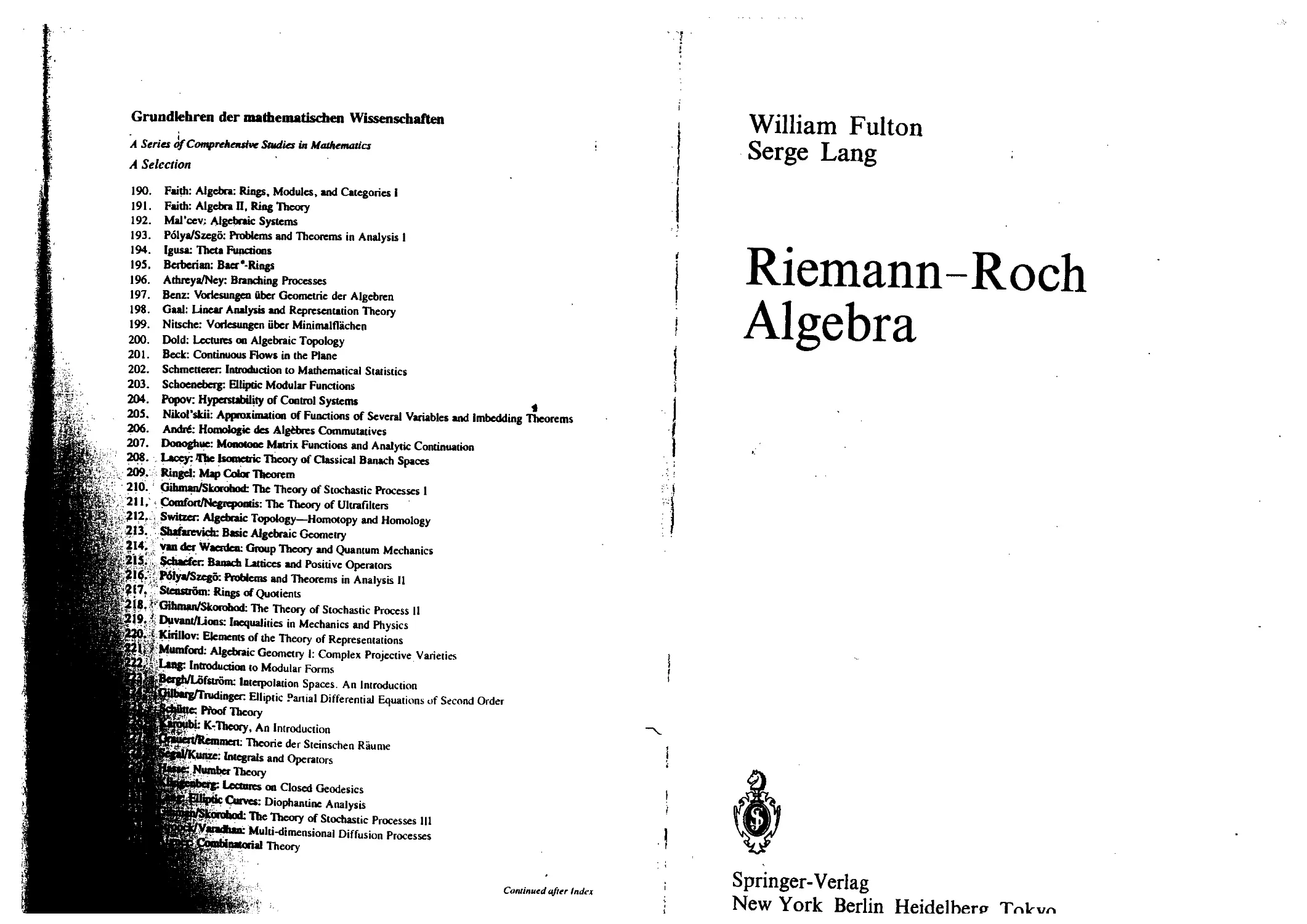
William Fulton
Serge Lang
Riemann-Roch
Algebra
Springer-Verlag
New York Berlin Heidelbera

William Fulton
Department of Mathematics
Brown University
Providence, RI 02912
U.S.A.
Serge Lang
Department of Mathematics
Yale University
New Haven, CT 06520
U.S.A.
Contents
Introduction
vn
AMS Subject Classification: 14C40
Library of Congress Cataloging in Publication Data
Fulton, William
Riemann-Roch algebra.
(Grundlehren der mathematischen Wissenschaften; 277)
Bibliography: p.
Includes index.
1. Geometry, Algebraic. 2. Riemann Roch theorems.
I. Lang, Serge, 1927- . II Title. III. Series.
QA564.F85 1985 512.33 84-26842
© 1985 by Springer-Verlag New York Inc.
All rights reserved. No part of this book may be translated or reproduced in
any form without written permission from Springer-Verlag, 175 Fifth Avenue,
New York, New York 10010, USA
Typeset by Composition House Ltd., Salisbury, England.
Printed and bound by R. R. Donnelley & Sons, Harrisonburg. Virginia.
Printed in the United States of America.
9 8 7 6 5 4 3 2 1
ISBN 0-387-96086-4 Springer-Verlag New York Berlin Heidelberg Tokyo
ISBN 3S4nQ*ne? a c: ...
CHAPTER r
A-Rings and Chern Classes l
§1. ^.-Rings with Positive Structure 3
§2. An Elementary Extension of A-Rings 7
§3. Chern Classes and the Splitting Principle 11
§4. Chern Character and Todd Classes 17
§5. Involutions 20
§6. Adams Operations 23
CHAPTER II
Riemann-Roch Formalism 26
§1. Riemann-Roch Functors 27
§2. Grothendieck-Riemann-Roch for Elementary Imbeddings and
Projections 32
§3. Adams Riemann-Roch for Elemeniary Imbeddings and Projections . . 37
§4. An Integral Riemann-Roch Formula 43
CHAPTER III
Grothendieck Filtration and Graded K 47
Jjl. The '/-Filtration .47
§2. Graded K and Cliern Classes 54
§3. Adams Operalions and the Filtration ^
§4. An Equivalence Between Adams and Grothendieck Riemann Roch
Theorems . @
CHAPTER IV
Local Complete Intersections 66
§1. Vector Bundles and Projective Bundles 66
§2. The Koszul Complex and Regular Imbeddings 70
§3. Regular Imbeddings and Morphisms 77
§4. Blowing Up oi

VI
CONTENTS
CHAPTER V
The X-functor in Algebraic Geometry 100
§1. The ^-Ring K(X) . . '. 102
§2. Sheaves on Projective Bundles 104
§3. Grothendieck and Topologjcal Filtrations 118
§4. Resolutions and Regular Imbeddings 126
§5. The X-Functor of Regular Morphisms 134
§6. Adams Riemann-Roch for Imbeddings 141
§7. The Riemann-Roch Theorems 144
Appendix. Non-connected Schemes 149
CHAPTER VI
An Intersection Formula. Variations and Generalizations 151
§1. The Intersection Formula 152
§2. Proof of the Intersection Formula 157
§3. Upper and Lower K 164
§4. JC of a Blow Up 169
J5. Upper and Lower Filtrations 178
{6. The Contravariant Maps /* and f° 184
¦ $7. Singular Riemann-Roch 188
§8. The Complex Case 190
||gJ9. Le&chsfz Riemann-Roch 192
™SyRflerciiccs 197
luidex of Notations 199
Introduction
In various contexts of topology, algebraic geometry, and algebra (e.g.
group representations), one meets the following situation. One has two
contravariant functors K and A from a certain category to the category
of rings, and a natural transformation
p.K^A
of contravariant functors. The Chern character being the central exam-
example, we call the homomorphisms
characters. Given /: X -» Y, we denote the pull-back homomorphisms by
f*:K(Y)^K(X) and fA:A(Y)-*A(X).
As functors to abelian groups, K and A may also be covariant, with
push-forward homomorphisms
fK:K(X)->KlY) and fA: A(X)-*A(Y).
Usually these maps do not commute with the character, but there is
an element xfeA(X) such that the following diagram is commutative:
The map in the top line is px multiplied by xf.
When such commutativity holds, we say that Riemann-Roch holds for
/. This type of formulation was first given by Grothendieck, extending
the work of Hirzebmch to such a relative, functorial setting. Since then

INTRODUCTION
INTRODUCTION
several other theorems of this Riemann-Roch type have appeared. Un-
Underlying most of these there is a basic structure having to do only with
elementary algebra, independent of the geometry. One purpose of this
monograph is to describe this algebra independently of any context, so
that it can serve axiomatically as the need arises.
A common feature of these Riemann-Roch theorems is that a given
morphism / is factored into p°i:
where i is a closed imbedding and p is a bundle projection. One con-
constructs a deformation from / to the zero-section imbedding of X in the
normal bundle to X in P, suitably completed at infinity. General proce-
procedures, which we axiomatize here, allow one to deduce a general
Riemann-Roch theorem from the elementary cases of imbeddings in and
projections from bundles; these cases are usually handled by direct calcu-
calculation.
We illustrate the formalism by giving a complete elementary account
of Grothendieck's Riemann-Roch theorem in the context of schemes and
local complete intersection morphisms, as first presented in [SGA 6].
Here K(X) is the Grothendieck ring of locally free sheaves on X, and
A(X) is an associated graded group of K(X), with rational coefficients.
To prepare for this we include self-contained discussions of several im-
important subjects from algebra and algebraic geometry, such as: A-rings,
Adams operations, 'y-filtrations, Chern classes, algebraic /C-theory, regular
Imbeddings and Koszul complexes, sheaves on projective bundles, and
local complete intersections.
pggfgManin's very useful notes [Man] were also written to give an accessi-
MMblfl account of parts of [SGA 6], for the case of imbeddings of non-
varieties. Several developments since then allow us to give both
|e elementary and more complete treatment, including a complete
0$..^ ma*n theorem, as well as some conjectures left open in
IJPgMost important among these developments are: (a) an under-
"l^delonnation to the normal bundle (cf [J], [BFM 1], [V],
Q; (b) the use of Castelnuovo-Mumford "regular" sheaves
bundles (cf. [Q]). Among the resulting improvements we
Ill^s*6 y-filtration on K{X) is finer than the topological
theorem for the Adams operations il>J without
(V, §6).
construction of the push-forward fK for a projec-
iplete intersection morphism / (V, §4).
it
Of these, A) and B) were conjectured in [SGA 6]. Other features
included are:
D) An Intersection Formula for K-theory (VI, §1).
E) A direct proof, using a power-series calculation of R. Howe, for
Grothendieck Riemann-Roch for bundle projections (II, §2).
F) An equivalence between forms of Riemann-Roch for the Chern
character and Adams operators (III, §4).
Chapter I contains an elementary treatment of A-rings and Chern
classes; the excellent exposition of Atiyah and Tall [AT] can be referred
to for more On A-rings. We include a proof of a splitting principle for
abstract Chern classes; in our application in Chapter V, however, this
splitting principle will be evident, so the reader can skip this proof.
In Chapter II we develop the abstract Riemann-Roch formalism. The
main new feature here is an axiomatic formulation of the deformation to
the normal bundle: to prove a Riemann-Roch theorem for a given im-
imbedding, it suffices to "deform" it to an "elementary imbedding" for
which one knows the theorem. We also axiomatize the dual case of an
"elementary projection".
Chapter HI describes the y-filtration of Grothendieck, and constructs
Chern classes in the associated graded ring.
Chapter IV is a chapter of "intermediate algebraic geometry", which
could supplement a text such as Hartshorne's [H]. We establish the
basic category of algebraic geometry for which we shall prove the
Riemann-Roch formula, namely the category of regular morphisms. By
this we mean morphisms which can be factored into a local complete
intersection imbedding, and a projection from a projective bundle. We
include a short proof of Micali's theorem on regular sequences, and basic
facts about regular imbeddings, conormal sheaves, and blowing up.
Theorem 4.5 on the residual structure of a proper transform is, we be-
believe, new. The culmination of this chapter is a simple construction of
the deformation to the normal bundle. Many of the results of Chapter
IV are not needed for the proof of Riemann-Roch proper, but are in-
included for completeness.
All these ideas come together in Chapter V, where the /.-ring K(X) is
shown to satisfy the abstract properties of the first three chapters. The
Grothendieck Riemann-Roch theorem (including the version without
denominators), and analogous theorems for the Adams operators, follow
quickly.
Chapter VI contains an Intersection Formula in the context of K-
theory which seems to be new in this generality, and which is analogous
to the "excess intersection formula" of [FM], see also [F2], Theorem
6.3. The formula is proved by using the general formalism of basic de-
deformations, together with the geometric construction of the deformation
to the normal bundle. This follows a pattern similar to the proof for

INTRODUCTION
Riemann-Roch itself, and provides another striking application of the
formalism of Chapter II.
In Chapter VI, we also discuss the relation of the Grothendieck group
of locally free sheaves with the Grothendieck group of all coherent
sheaves. We give an application to the calculation of an exact sequence
for K of a blow up of a regularly imbedded subscheme, relying on the
Intersection Formula. Finally, we discuss briefly and incompletely how
Riemann-Roch can be extended beyond the ease of local complete inter-
intersections. In addition, we sketch several other contexts where the formal-
formalism developed here can be applied. It would take another book to give
a systematic treatment of these topics, including the relations between K-
theory, the Chow group and etale cohomology in a more schemy and
sheafy context than [F 2].
We have made our exposition self-contained from [H] for algebraic
geometry, [L] for general algebra, and the simpler parts of [Mat] for a
little more commutative algebra. Thus we have included proofs of ele-
elementary facts whenever necessary to achieve this.
At least in first reading, the reader interested only in a fast proof of
Riemann-Roch is advised to skim Chapters I, IV, and the first half of
Chapter V. More is included in these chapters than is strictly needed for
Riemann-Roch, with the hope that this important material will be more
accessible than its previous position in SGA and EGA permit. Those
interested primarily in the Riemann-Roch theorem should concentrate on
Chapters II, III, and V.
We have not discussed applications to the theory of group representa-
representations. For these, we refer especially to the articles by Atiyah-Tall, Evens,
Kahn, Knopfmacher, Thomas, as well as Grothendieck's general discus-
discussion as listed in the Bibliography. On the other hand, the applications
to group representations are not independent of those to algebraic ge-
geometry. Even though the K-groups can be denned in terms of modules,
one can analyze them via considerations of topology, classifying spaces,
and algebraic geometry, so there is a considerable amount of feedback.
We also do not discuss applications to topology. We refer to the
lectures by Atiyah [At] and Bott [Bo] for some X-theory like that of
Chapters I and III in a topological context, stopping short of Riemann-
Roch theorems, however.
We hope that the simpler logical structure of the proofs which
emerges in this treatise will make it easier to understand these results,
and to find new situations to which this "Riemann-Roch algebra"
applies.
CHAPTER I
i-Rings and Chern Classes
This chapter describes first the basic ring structure of the objects to be
encountered later in a more geometric context. The algebra involved is
elementary and self-contained. We have axiomatized certain notions
which originally arose in the theory of vector bundles. Actually we work
with two rings, one of them usually graded. We also develop the formal-
formalism of Hirzebruch polynomials, which belongs to the basic theory of
symmetric functions. We have preserved original names like Chern
classes, Todd character, etc., although the algebra involved here deals
only with a pair of rings and some elementary formal manipulation of
power series, independently of the geometry from which they came.
We now make additional comments concerning the way these notions
arise in applications to algebraic geometry and group representations.
These are not necessary for a logical understanding of the chapter. How-
However, we may have at least two categories of readers: those who know
some Riemann-Roch theory previously and are principally interested in a
quick proof of Grothendieck Riemann-Roch; and those who have more
limited knowledge in this direction and are thus directly interested in the
more elementary material. Our additional comments are addressed to
this second category.
A fundamental aim of algebraic geometry is to study divisor classes,
or equivalently isomorphism classes of line bundles. More generally, one
wishes to study vector bundles, with certain equivalence relations. The
Grothendieck relations are those which to each short exact sequence
gives the relation
0 -+?'-?-?"-» 0
[?] = [?'] + [?"].
The group of isomorphism classes of vector bundles over a space X
modulo these relations is called the Grothendieck group K(X). It has
both covariant and contravariant functorial properties, although the co-
variant ones are much more subtle.

INTRODUCTION
Riemann-Roch itself, and provides another striking application of the
formalism of Chapter II.
In Chapter VI, we also discuss the relation of the Grothendieck group
of locally free sheaves with the Grothendieck group of all coherent
sheaves. We give an application to the calculation of an exact sequence
for K of a blow up of a regularly imbedded subscheme, relying on the
Intersection Formula. Finally, we discuss briefly and incompletely how
Riemann-Roch can be extended beyond the ease of local complete inter-
intersections. In addition, we sketch several other contexts where the formal-
formalism developed here can be applied. It would take another book to give
a systematic treatment of these topics, including the relations between K-
theory, the Chow group and etale cohomology in a more schemy and
sheafy context than [F 2].
We have made our exposition self-contained from [H] for algebraic
geometry, [L] for general algebra, and the simpler parts of [Mat] for a
little more commutative algebra. Thus we have included proofs of ele-
elementary facts whenever necessary to achieve this.
At least in first reading, the reader interested only in a fast proof of
Riemann-Roch is advised to skim Chapters I, IV, and the first half of
Chapter V. More is included in these chapters than is strictly needed for
Riemann-Roch, with the hope that this important material will be more
accessible than its previous position in SGA and EGA permit. Those
interested primarily in the Riemann-Roch theorem should concentrate on
Chapters II, III, and V.
We have not discussed applications to the theory of group representa-
representations. For these, we refer especially to the articles by Atiyah-Tall, Evens,
Kahn, Knopfmacher, Thomas, as well as Grothendieck's general discus-
discussion as listed in the Bibliography. On the other hand, the applications
to group representations are not independent of those to algebraic ge-
geometry. Even though the K-groups can be denned in terms of modules,
one can analyze them via considerations of topology, classifying spaces,
and algebraic geometry, so there is a considerable amount of feedback.
We also do not discuss applications to topology. We refer to the
lectures by Atiyah [At] and Bott [Bo] for some X-theory like that of
Chapters I and III in a topological context, stopping short of Riemann-
Roch theorems, however.
We hope that the simpler logical structure of the proofs which
emerges in this treatise will make it easier to understand these results,
and to find new situations to which this "Riemann-Roch algebra"
applies.
CHAPTER I
i-Rings and Chern Classes
This chapter describes first the basic ring structure of the objects to be
encountered later in a more geometric context. The algebra involved is
elementary and self-contained. We have axiomatized certain notions
which originally arose in the theory of vector bundles. Actually we work
with two rings, one of them usually graded. We also develop the formal-
formalism of Hirzebruch polynomials, which belongs to the basic theory of
symmetric functions. We have preserved original names like Chern
classes, Todd character, etc., although the algebra involved here deals
only with a pair of rings and some elementary formal manipulation of
power series, independently of the geometry from which they came.
We now make additional comments concerning the way these notions
arise in applications to algebraic geometry and group representations.
These are not necessary for a logical understanding of the chapter. How-
However, we may have at least two categories of readers: those who know
some Riemann-Roch theory previously and are principally interested in a
quick proof of Grothendieck Riemann-Roch; and those who have more
limited knowledge in this direction and are thus directly interested in the
more elementary material. Our additional comments are addressed to
this second category.
A fundamental aim of algebraic geometry is to study divisor classes,
or equivalently isomorphism classes of line bundles. More generally, one
wishes to study vector bundles, with certain equivalence relations. The
Grothendieck relations are those which to each short exact sequence
gives the relation
0 -+E'-> E-* E"-> 0
[?] = [?'] + [?"].
The group of isomorphism classes of vector bundles over a space X
modulo these relations is called the Grothendieck group K(X). It has
both covariant and contravariant functorial properties, although the co-
variant ones are much more subtle.

/-RINGS AND CHERN CLASSES
P. 51]
MUNOS WITH POSITIVE STRUCTURE
¦ , I
The addition is induced by the direct sum, and there is also a multi-
multiplication induced by the tensor product, so that K(X) is in fact a ring.
The class of the trivial line bundle is the unit element.
This ring has various structures. First, it has an augmentation, which
to E associates its rank e(E). Then e extends to an augmentation on
K(X) (algebra homomorphism into Z). The vector bundles themselves
generate a semigroup under addition. In §1, we axiomatize this structure
by defining "positive elements" whose properties are modelled on those
of vector bundles. The elements /of augmentation 1 correspond to line
bundles, and are thus called line elements.
Second, the ring K(X) has another operation induced by the alternat-
alternating product. To each integer i i 0 we have A'E, and therefore its class
[A'E] denoted by X'(E). A standard elementary formula for the direct
sum E — E' @ E" of free modules reads
A"(?) « © (A'F ® A" ""'?").
/=o
Passing to the classes in the K-gwup, we get the relation
But this relation amounts to saying that the map
t' = X,(x) by definition
is a homomorphism from the additive group of K(X) to the multiplica-
multiplicative group of power series with constant term equal to 1. This gives rise
to the notion of -i-ring. A great deal of the formalism of Riemann-Roch
algebra can be developed for the general 2-rings. The reader should read
simultaneously the beginning of Chapter I and the beginning of Chapter
V to see the parallelism between the abstract algebra and the geometric
construction giving rise to this algebra.
In the theory of group representations, one may start with the cate-
category of finite-dimensional vector spaces over a field k, and a representa-
representation of a (finite) group G on the space. Then again we have direct sums,
tensor products of (G, k)-apaces and the analogous definition of /-ring.
formed by the isomorphism classes of such spaces modulo the relations
in the Grothendieck group. The positive elements are just the classes of
such spaces as distinguished from the group generated by them in the
Grothendieck group.
In §2 we shall discuss a particular extension of a A-ring, which gives
an axiomatization for the extension obtained from a projective bundle.
The corresponding geometric case is discussed in Chapter V, Theorem
2.3 and Corollary 2.4. Since the existence of the extension is proved in a
self-contained way by geometric means in Chapter V, the reader inter-
interested only in the geometric application can omit the existence proof of
Theorem 2.1 in this chapter. The corresponding graded extension will be
constructed in §3.
I §1. X-Rings with Positive Structure
Let A: be a commutative ring. For each integer i ? 0 suppose given a
mapping
X': K-*K
such that X°(x) = 1, Xl(x) = x for all xeK, and if we put
then the map
xt-*X,(x)
is a homomorphism. This condition is equivalent with the conditions
(M)
(-0
for all positive integers k. A ring with such a family of maps X' is called
a 2-ring.
In addition, we suppose that the >*-ring has what we shall call a posf-
tive structure. By this we mean:
A surjective ring homomorphism
e:K-*Z
called the augmentation.
A subset E of the additive group of K called the set of positive ele-
elements such that E together with 0 form a semigroup, satisfying the con-
conditions
Z+cE, EE = E, K = E-E
so every element of K is the difference of two elements of E; furthermore
for e e E we have e(e) >~0, and if e(e) = r then
X\e) = 0 for / > r and X'{e) is a unit in K.

.(-RINGS AND CHERN CLASSES
We define L to be the subset of elements ueE such that e(u) = I.
Since Xlu = «, it follows that L is a subgroup of the units K*. Elements
of L will be called line elements.
An extension K' of a yt-ring K is a A-ring K7 containing AT, with X' and
augmentation extending that of K, and with positive elements E' contain-
containing E.
We shall be concerned with a class R of A-rings satisfying, in addition
to the preceding conditions, the
Splitting Property. For any K e ft and positive element e in K, there is
an extension K' of K in ft such that e splits in K\ i.e.
e = h, + •.. + Um,
with ut line elements in K'.
It follows by induction that any finite set of positive elements can be
simultaneously split in a suitable extension. The splitting property will
allow us to deduce general formulas from the simple case of line ele-
elements. For example, the property that X'(e) = 0 for e positive and
i> r = e(e) follows from the fact that X\u) = 0 for all line elements u and
/> 1.
More generally, for ueL we have directly from the assumptions
X,(u) = l+ut,
and hence if e is split as above, then
X,(e) = 17A + u,t)
r
= 1 + ? «,(«„ ...,ur)t\
where s,~ is the i-th symmetric function. Since the coefficients X'(e) are
given a priori as elements of the A-ring K, we see that the value of the
symmetric function S/(h,, ... ,ur) is independent of the splitting of e as a
sum of line elements in K'.
For example, one sees from this formula that
A-2)
E(X'e) =
e(ej
In other words, if Z is given a >l-ring structure by X'(n) = ( ), then the
augmentation e is a homomorphism of A-rings.
Formulas for Xk(x ¦ y) and Xk(XJ(x)) can best be expressed in terms of
certain universal polynomials Pk and PkJ as follows. Take independent
variables Uu...,Um and Vlt...,V,. Let X, be the i-th elementary sym-
symmetric polynomial in Ut,...,Um, and Y, the i-th elementary symmetric
polynomial in Vt VH. For m ? k, n?k, let
Pk(*i Xk, Ylt... ,Yk) e Z?Xt,... ,Xk, Yt,... ,rj
be the polynomial of weight k in the variables X, and in the variables Y,
(where X, and Y, are assigned weight i), determined by the identity
(A)
Pk(Xu... ,Xk, Yt,..., Yk)T" = f] A + U, Vj T).
By setting some of the variables U, or V} equal to zero for i, J > k, one
sees that the Pk are independent of the choice of m, ng k. Similarly
define
Pk,j(Xl,...,XkJ)eZiXt,...,XtJ]
of weight kj, by the identity for m 2: kj:
(B) y P (X X )Tk = FT A + U • • • U T)
m h
Now if x = ? «„ y= ? vJt with u,, tj line elements, then
From (A) this can be written
A.3) Xk(x ¦ y) - Pk(X\x),... ,X\x), X\y) X\y))
For example, if x is a line element, then
X\x ¦y) = xk- Xky, or X,(xy) - X«(y).
Similarly, if x « J] a,, then XJ(x)
«/,-•• «/y, so
i
By (B) this can be written
A.4) Xk(X\x))
... ,XkJ(x)).

The identities (I.1)-(J.4) say that our -i-rings are what Grothendieck
calls special brings ([SGA 6], Exp. 0). This may be reinterpreted as
follows. Given a commutative ring A, define A[[T~\]* = TA[[Ty), and
let
For e e E we define the series
be the set of power series in A with constant term I. Define an addition
in A(A) by the multiplication of power series; a product • in A(A) by the
formula
0 + ? «,*') • (
and /l-operations by
„... ,ak, b, bk)tk;
't.j("i ak))tk.
One verifies easily that these definitions make A(A) into a special
zt-ring (cf. [AT] for a readable account). For any A-ring K,
is an additive homomorphism; K is special precisely when X, is a homo-
morphisnf of A-rings. Note that identities (I.I)-A.4) hold for all elements
of K, not only positive elements.
Remark. An element x in a /l-ring K is said to have A-dimension = n
if X\x) = 0 for all / > n, and X"(x) # 0. The ring K is called A-finite-
dimensional if every element is a difference of two elements of finite X-
dimension. Since positive elements have finite dimension, our axioms
imply that our brings are all finite dimensional. Conversely, given a X-
finite-dimensional special /l-ring K, one can define E to be the elements
of /l-finite dimension. If one assumes that all one-dimensional elements
are units, then B defines a positive structure in our sense.
Let ?a,<' be a power series in
the inverse series
Wlth "o = '• The coefficients of
can be determined recursively from the coefficients a, by the relation
<?,/>*_,-= 0 for k > 0.
f c\e)tl.
Then for each i we get a map a': K -* K.
If h is a homomorphism of K into some ring and <p(t) e K[[t]l is a
power series, then we let h(<p(t)) be the power series obtained by apply-
applying h to all the coefficients of <p(t). In particular, we have
Lemma 1.1. Let e(e) = r + 1. Then
e(/L,(<?)) = A - f)'+1 <*nd e(er,(e)) ¦
So explicitly in terms of the coefficients,
Proof. Splitting e into ? «<» with e(u,) = 1,
170+«<0>
from which the formula for e(X.,(e)) is clear. Since a, is the inverse of
X.,, the formula for fi(er,(c)) follows. The last formula follows from the
identity
1
(l-ty+l "'
I §2. An Elementary Extension of X-Rings
Given a /l-ring K and a positive element e in tf we construct a ring
extension Ke of K as follows. Set e(^) = /• + !,
r+l
and let
1 = 0
K[T]/(pe(T)) =

8
/.-RINGS AND CHERN CLASSES
[I, §2]
AN ELEMENTARY EXTENSrON OF BRINGS
?
where ? is the image of T mod. pe(T)\ we call / the canonical genera (or
We have the defining relation
In particular, for k ? r + 1, multiplying by powers of/ and using Xm(e) = 0
if m> r + I, we get the relations
These relations translate into the single power series relation
Theorem 2.1. There is a unique X-ring structure on Ke, extending that
on K, and satisfying
Proof. First define a A-ring structure on the polynomial ring K[T],
such that e(T) = 1 and X\T) = T, X'(T) = 0 for / > I. From the fact
that K is a special -4-ring it follows readily that K[T] is also a special X-
ring. To show that this determines a -4-ring structure on Ke, it must be
verified that the ideal / = (/?,,G")) is preserved by the A-operations. Set
j = r + I. Then
(-!)'#) = ;*- n
Using the identity A.3) for products, one sees that it suffices to verify
that
X"XJ(e -T)el = (XJ(e - T))
for all k S 1. From the identity
X,(e - T) = A + X\e)t + ¦¦¦ + XJ(e)tJ)-(\ + Tty'
it follows that
X\e- T)= ± T"-JXJ(e- T)e 1
for all k?j. Since Xk{X'(x)) = PKJ(Xl(x),... ,XkJ(x)\ it suffices to verify
that each monomial appearing in the polynomial Pkj(Xt, ...,XkJ) con-
contains some Xj with i<*j. To see this, simply note that
Pk.j(Xt Xj.lt0,...,0)
is identically zero, as follows from the definition (B) of PkJ in §1.
As seen from the proof, K, is a special /l-ring. One may define a
positive structure E, on K, generated by E, t, and e - /, i.e.
E« = (I at/'(e - f)'\ U ? 0, atj e E).
The elements of E, with augmentation 1 are of the form aC\e — /)J, with
a a unit in E and j = 0 if r > 1. The equation pt(/) = 0 shows that / is
a unit for all r, and that e — ? is a unit if r = 1. Thus Ee defines a
positive structure on Ke, called the canonical positive structure.
Theorem 2.1 may be used to construct an extension K' of K in which
e splits. Let K<1) = Ke, «, = <T, e,=c-<!'. Let /C<2) = ^»' - ^("[<r,],
and set u2 - /t, e2 = et - (C,, and so on inductively. Then K' = K(r\
with c = m, + ••• + ur+l.
Proposition 12. Let /, = /: A^e -¦ K be the K-linear functional such
that
Then:
/(/') = Ae) for OSiSr.
/(<;") = ff'(e) for all integers
f{r*) = 0 for Ign^r.
In fact, for n^ I we have the general relation
and (-iyrXr* \eff{r») is the coefficient off in the power series
Proof. We apply / to the power series relation and use ^-linearity to
get
(
*-0\/»0

10
A-RINGS AND CHERN CLASSES
[I. «2]
so /(/') ~ al(e) f°r j ^ 0. This gives the values of / on positive powers
of e.
Next we look at negative powers of t. For t " with n — I the stated
relation is the equation for /, namely
(-iyr+\e)r' =
The general relation follows by induction, directly from the definition of
a /l-ring. We apply / to the values obtained in the first part of the
proposition. Then we find that
(-1)"M'+ \e)"f(r")
is the coefficient of t"r in the power series
Since A'(e) - 0 for i > r + 1, the coefficient of t" in this power series is 0 if
nr > (n - !)(/¦ + I),
which gives precisely n < r + I, or n ? r. This concludes the proof.
Remark. The factor (— l)"r>lr+l(e)" is a unit in K, so the second part
of the proposition gives the values of / at negative powers of {.
The functional
such that /,(/') = ff'O) will be called the functional associated with the
extension Ke of K. As we did above, if e is fixed throughout a discus-
discussion, we omit the subscript e and write simply /. Although we have no
immediate use for it, we give immediately the following application.
Corollary 2.3. Let q = e / Thru
[I, §3] CHERN CLASSES AND THE SPLITTING PRINCIPLE
Proof. We have
II
/-o
= 1,
as was to be shown.
Remark. For a ^-finite-dimensional A-ring K, the considerations of the
preceding sections show that the following are equivalent:
(i) K is a special A-ring.
(ii) Every e in K with finite -t-dimension splits in some /l-ring exten-
extension of K.
(iii) Every e in K with finite A-dimension splits in some special A-ring
extension of K.
(iv) For every e in K with finite /Udimension Ke = K[f\ is a special
-l-ring, with -1,@ = 1 + tt.
If a class ft of -t-finite-dimensional A-rings contains Ke for each K eft
and each eeK of finite -t-dimension, then the splitting principle holds for
all K in ft, and all K in ft are special.
I §3. Chern Classes and the Splitting Principle
The formalism of symmetric functions, Chern class homomorphisms,
and the splitting principle (for instance as in this section) were used and
developed for the first time by Hirzebruch [Hi] for the proof of the
Hirzebruch-Riemann-Roch theorem.
Let A be a graded (commutative) ring,
and
where A' is the /-th graded component of A. Let
A%4)={1 +att + a2t2 + ¦¦¦}

12
-l-RINOS AND C1II-KN ('LASSES
[I. §3]
[I, §3]
CHERN CLASSES AND THE SPLITTING PRINCIPLE
.i.t
T
r> •
> H
be the group of formal power series with leading term 1 and a,eA'. Let
X be a -t-ring, and let
c,:K-*A°(A)
be a homomorphism of abelian groups. We write
c,(x) = I c'(x)t'
with c'(x)eAl. The fact that c, is a homomorphism can be written:
C.1) c"(x + y)= ? c'OcVOO.
We call c, a Chern class homomorphism with values in A, if in addition,
it satisfies properties CC 1, CC 2, CC 3 below, and the splitting principle
which follows.
We require the following conditions for line elements L:
CC 1. For u e L, c'(«) = 0 for / > I, that is
c,(u) = I + c'(u)t.
CC2. For u, veL we have
c'(uv) - c'(«) + c'(u).
In other words, c1: L -» A' is a homomorphism.
The i-th graded component c'(.x) is called the i-th Chern class. The
third condition mentioned above is then:
CC3. For all eeE and all /& I, c'(e) is nilpotent.
Remark. The formal theory of Chern classes actually does not require
the nilpotence until Chapter III, §3 and §4, where an even stronger con-
condition will be imposed. If we do not require nilpotence, then instead of
the graded ring A we should take the ring
A =f[A' -
1=0
which is the completion of A, and consists of ;ill formal scries ?«,, with
a, 6/4'.
Under CC 3, given x e K it will follow that all c'(x) vanish for large i,
and then
c,(x) = ? c<{x)t<
is called the Chern polynomial of x. The class
c(x) = ? c'(x)
in A is called the total Chern class of x If we did not assume CC 3,
then c(x) would lie in A. We then have a homomorphism
c:K-*l +A\ c(x) = 1 + ? c'(x).
We often write simply
c:K-*A .. .
for this homomorphism from the additive group of K to the multiplica-
multiplicative group of units of A. The variable t is convenient in order to keep
track of the grading. Furthermore, representing the Chern class homo-
homomorphism as a polynomial c, exhibits better the formal analogy with
/l-rings and the power series X,. Treating t as a variable also allows us to
substitute special values, like t = - 1, so that for instance we get
Both notations, with and without the variable t, are useful for applica-
applications.
We shall also require a
Splitting Principle. Given a finite set {e,} of positive elements of K,
there is a X-ring extension K' of K in which each e, splits, such that c
extends to a homomorphism
c\K'~*A'
for some graded extension A' of A.
Let us note some consequences of this splitting principle. If e splits
into
let a, = c'(«,). Then we get a factorization
c,(e)= n(l+fl

$:¦
14
J-RtNOS AND CHERN CLASSES
[I. §3]
[I, §3]
CHERN CLASSES AND THE SPLITTING PRINCIPLE
15
of the Chern polynomial into linear factors. In particular
c'(e) = 0 for i > m.
In addition,
c\e) = sk(al aj = .st(c'(«i) c'(«J)
is the fc-th elementary symmetric function of the first Chern classes of
«j um. The a, are called Chern roots for e. The equation shows that
any symmetric polynomial in the Chern roots can be written as a poly-
polynomial in the Chern classes of e, and that the resulting expression is
independent of the splitting of e.
n
If also / = ? v}, with bs = c'(v}) Chern roots for /, then
C.2)
i.i
In other words, the Chern roots for a product are pairwise sums of
Chern roots for the factors. In particular, if / = v is a line element, one
lias the useful explicit formula
this complication, we shall consider the restriction of c, to R. = Ker(e),
the elements of augmentation zero.
In §1 we used universal polynomials to construct a A-ring A(A). One
sees from the definition that the product and A' take A°(A) into itself, so
A°(A) becomes a -t-ring, but without unit. The identities C.1)-C.3) imply
that
c,:R-*A°(A)
is a homomorphism of -t-rings without unit.* We say that c, is a A-
hornomorphism in this case.
Formulas C.2) and C.3) were deduced from the splitting principle. We
shall see that, conversely, these identities imply the splitting principle, in
an explicit form that will be useful later.
We shall now construct a graded ring extension of A in a way similar
to the construction of K, from K in §2. First note that the polynomial
ring A[W] (where W is a variable) has a unique grading extending that
of A such that W has degree 1.
Given an element c= 1 + ?c/i'eA°(A) and an integer m such that
c, = 0 for i > m, let pt(W) be the polynomial
pc(W)=Wm-clWm-i + --±cm
c,(ev)=
or
If m = e.(e) we call
K ~J
\e) = c-(e) =[\"i
the top Chern class of e; it is often convenient to omit the value e.(e) = m
from the notation.
There are similar formulas for Chern classes of AJe, since
C.3)
= n
As in §1, these formulas may be expressed in terms of universal poly-
polynomials. Note, however, that the formulas for c\e-f) and c\Xje) depend
on the ranks e(e) and «(/) as well as on their Chern classes. To avoid
Then pc(W) is homogeneous, and the factor ring
Ac
defines a graded ring extension of A. The element »v = W mod(pc(W)) is
called the canonical generator of Ac.
For later use, we define the associated functional
ge:Ac-*A
to be the /(-linear homomorphism such that
fo
* One can also construct a yl-ring structure on Z x A°(A), so that
is a homomorphism of brings with unit (cf. [SOA 6], p. 30 ff.).

16
-i-RlNGS AND CHERN CLASSES
[I, §4]
[I. §4]
CHERN CHARACTER AND TODD CLASSES
17
'-1 Q
Theorem 3.1. Suppose c,: K -> A°A is a A-homomorphism, and e is a
positive element in K such that e{e) = m and c'(e) = 0 for i > m. Then
c, extends uniquely to a A-homomorphi.sm
c,:Ke-+A°(AcU!)),
such that if ? and w are the canonical generators for Ke and AcM,
respectively, then
<•,(/) = I + »'/.
Proof. Let K[T] be the /.-ring extension defined in the proof of
Theorem 2.1, and extend c, to a homomorphism
by setting c,(T) = 1 + WT. It is straightforward to verify that this exten-
extension is also a A-homomorphism.
To conclude the proof, we must show that for k ^ 1, c\pe{T))e J,
where J is the ideal in A[W~\ generated by pcW(W). Equivalently, we
must show that
c\3C"{e - T)) e J.
Since c, is a A-homomorphism, we get
c,{ne - T)) = r(c,(e - T)) = Xm{a),
where a = c,(e)/(l + ^t). Therefore fl=l+^a,i', with
a* = (- W)*-"W) - cm-\e)W +¦¦¦ + (- l)mH"")
for all k ^ m. Therefore ak e./ for all k g m. Since
and, as we saw in the proof of Theorem 2.1, each monomial in Pkm(a) is
divisible by some a, for / ^ m, it follows that Pk m(a)eJ, as required.
I §4. Chcrn Character and Todd Classes
The splitting principle allows us lo go further, by using systematically the
factorization of the Chern polynomial c,(e) in linear factors I + a,t. Let
<K0eZ[[0] or
be a power series with integer coefficients, or rational coefficients if A is
also a Q-algebra. To each such power series we can associate an.addi-
an.additive homomorphism
ch,:K-*A
as follows. We first define ch, on E, by setting
Since we assume that the first Chern classes a, are nilpotent, the evalua-
evaluation of the power series <p(a,) is defined, and is a polynomial in a, for
each i. Furthermore, the value on the right-hand side is independent of
the choice of the splitting. To see this, note that if Wt Wm are new
independent variables, then
where Hj is a polynomial of weight; with rational coefficients, and Sj is
the >th elementary function of Wx ,Wm. We call Hj the associated
Hirzebrnch polynomials. Then
It follows immediately that for e, ef s E we have
ch,(e + O = ch,(c) + ch,(e'),
so ch,, is a homomorphism on the semigroup of elements of E. For any
element x = e - e' of K we define
ch,(x) = ch,(O - ch,(c').
It is trivially verified that this is well defined, i.e. independent of the
- representation of x as a difference of elements in E, and that ch, is a
homomorphism of K into A. Explicitly,
The most important example is the Chern character written without
subscript
ch:K-*A

18
A-RINGS AND flll:RN CLASSES
[I, §4]
CHERN CHARACTER AND TODD CLASSES
19
such that ch = chf, where q> is the exponential power series
„ t"
<p(t) = exp(t) = I ^7 •
In this case, A must be a Q-algebra, or we tensor A with Q. Then by
definition, if e = ? ut and a, = c'(«,), we have
ch(,)=I I*.
/= l t = 0 "•
Proposition 4.1. T/ie Chern character ch: K -» A is a ring homomor-
homomorphism.
Proof. It suffices to verify this for products of elements in E. Say
— X «i and e' = ? u,. Then ee' = ? m,o;, and
Chern classes in the Hirzebruch polynomials, because we have to take
ordinary powers. Hence in practice, one may revert to the lower num-
numbering and write for instance
ch(e) = t{e) + ct + i(cj - 2c2) + ....
We can perform a similar construction multiplicatively. Let
V(t) e 1 + tZ[[fl] or <pit) e 1 + tQ[[t]]
be a power series with constant term 1 and integer coefficients, or ra-
rational coefficients if A is a Q-algebra. Then we define the corresponding
Todd homomorphism on positive elements by
if'
P
= ch(e) ch(e')
as desired.
Of course, we also have ch( I) = 1, as follows directly from the defini-
definition of c'(l) = 0.
For the Chern character ch, the first few Hirzebruch polynomials Hj
as mentioned above can be calculated to be:
4s,s3 + 2s| - 4s4).
Remark on notation. The Chern classes are usually denoted by r,
instead of cj. To lay down the general formalism we thought it better to
preserve the upper numbering, in order not to break the notational anal-
analogy, say of the power series c, with /,. However, we now sec that this
upper numbering is extremely disagreeable if we wish to substitute the
If Wi Wm are independent variables, then we can write
J-0
where Qjislt...jj) is a polynomial of weight ; with integer (resp. ra-
rational) coefficients in the elementary symmetric functions s,,... ?sm of
Wlt...,Wm. Again we call Qj the associated Hirzebruch polynomials.
Then
l-o
is independent of the splitting of e. Thus
+A +
is a homomorphism from the additive group of K into the multiplicative
group of units of A, and in fact those units which are of the form 1 + b
with b nilpotent.
If q> = p is the power series
re'
where e'=exp(t).

20
-l-RINOS AND CHERN CLASSES
[1. §5]
[I. §5]
INVOLUTIONS
21
then we write td(«) instead of td^e), and call this simply "the" Todd
homomorphism, determined by the original data of a Chern class homo-
morphism. In this case, A must be a Q-algebra, or we tensor A with Q.
The first few Hirzebruch polynomials Qj can be calculated to be:
I
~ 3i| - 5,53 + S4).
Generalizations; 1. Even without the assumption that the c'(.t) are
nilpotent, one can define a homomorphism
by ch, ,{x) = ? Hj(cl(x),... ,cJ(x))tl. For the ordinary Chern character,
ch,: K —> /4f[/]J
is a ring homomorphism, as is
r- ch:K-*A,
where A is the completion of A.
2. For Todd classes of positive elements e it is not necessary to as-
assume that the constant term of q> is 1. One may define
This tdT-/ will take sums of positive elements to products. If q> is a
polynomial, or if the c'{e) are nilpotent, then td,(c) e A. If <p@) is a unit
in A, then td,, extends to a homomorphism on all of K.
3. With a systematic use of symmetric functions and Hirzebruch poly-
polynomials, one may avoid any explicit use of a splitting principle.
We assume also that any positive element can be split in some extension
K' to which the involution extends.
Lemma 5.1. Let e e E and e(e) = m. Then for all i with 0 g i g m we
have
Proof. By definition, using a splitting, we get
l
n
/-I
-n«r'" no+«/"'¦')
(-1
-n «/•
A
(=0
which concludes the proof.
Conversely, if the formula of Lemma 5.1 is valid for e, then the invo-
involution v extends to an involution of Kf, with C =^~i. This follows
from the equation
If c,: K -»A°(A) is a Chern class homomorphism, then
I §5. Involutions
We shall be concerned with /l-rings K which have an Involution, by
which we mean a homomorphism jmjc" from the ring K to itself, sat-
satisfying
xv"=x, c(x") = f.(x), and u" = «"' for ue L.
for a line element. From the splitting principle it follows that
E.1) c,(av) = (-1)'c,(x)
for all xeK.
It follows that
E.2)
ch(xv)= -ch(x).
J' 1

22
/•RINGS AND C11ERN CLASSES
Another simple formula which follows easily from the splitting princi-
principle is
Proposition 5.2. For a positive element e,
td(e") = td(c)exp(-c1(c)).
Our main interest, however, lies in the next formula, which embodies
a Riemann-Roch relation as will be seen in Chapter II, Theorem 2.1.
Proposition 5.3. For a positive element e we have
where ch(A-,(ev)) = ?(-l)'ch-l'(ev). Or in other words,
m
Proof. By definition, splitting e = ? «,, with a, = c'(«/), we have
Also,
whence
and therefore
ch A_l(
Multiplying, we get
This proves the proposition.
[I, §6]
ADAMS OPERATIONS
23
I §6. Adams Operations
We return to a single A-ring X. We define the Adams power series and
the Adams operations i//J:K-*K by the formula
= fi(x)-I^lOg>l.1(
Proposition 6.1.
(i) IfueL, then \//J(u) = uJ for all j.
(ii) For all j, the map ip1 is a ring homomorphism.
(iii)
or allxsK and all i, j.
Proof. The first assertion is immediate. For the second, it suffices to
prove the homomorphic property for elements of E. The fact that ty> is
additive is immediate, and that it is also a multiplicative homomorphism
follows by splitting an element of E as usual, and by using the first
assertion. The third statement is then clear since the desired relation is
true on elements x = u in L. This concludes the proof.
Since ty1 's a ring homomorphism like the Chern character, we may
call it an Adams character rather than Adams operation. We can also
write:
Jmi
If e e E is a positive element, and e = J] u, is a splitting, then
n (i + u,
so
Therefore, if N} is the (Hirzebrnch-Newton) polynomial with integer coef-
coefficients such that
W{+-..+ Wl = Nj(s1 sm),
where sl,...,sm are the elementary symmetric functions of Wit...,Wm,
then

24
A-R1N0S AND CHERN CLASSES
[I, §6]
if j
't
Let <p(t) be a polynomial, say with integer coefficients, and constant
term equal to 1. In the present context there is a Todd homomorphism
tdw: E-» K
from the additive monoid of positive elements to the multiplicative
monoid of elements of K, by the same method as before. From a split-
splitting of e we let
The value is independent of the splitting, and is a universal polynomial
in Al(e),...,Ar(e), determined by <p alone. If <p(u) is a unit for each line
element u, then td, extends to a homomorphism from the additive group
K to the multiplicative group K* (see Generalization 2 of §4).
Let j be an integer 2; 1. We let 6' - tdw where <Pj(t) is the polyno-
polynomial
1 - tJ
{) 1 +( J'1
1 -t
,Thus by definition,
e'(e)= n (i+ «, +
The classes 9J(e) are known as "Bott's cannibalistic classes". If it hap-
happens that j is a unit in K, then O'(e) is a unit, and 0J extends to all of K.
The next result is an analogue of Proposition 5.3, and will be interpreted
as a Riemann-Roch theorem in Chapter II, Theorem 3.1.
Proposition 6.2. For a positive element e we have
[I, §6] ADAMS OPERATIONS 25
The following proposition also follows immediately from the defini-
tions.
Proposition 6.3. Let c:K-* A be a Chern class homomorphism. Then
for all integers 7^1 and k ^ 1 we have
where ch* is the k-th graded component of ch.
On may also define ^ for j < 0 by the formula
so that Proposition 6.1 continues to hold for this extended family of
operations. We shall not need ip1 for negative j, however.
For a discussion of Adams operations on representation rings of finite
groups, see [Ke] and [Kr].
Proof. Using the splitting, we get
-m) = */n(i - «•)) = n
as was to be shown.

CHAPTER II
Riemann-Roch Formalism
This chapter deals with ihe axiomati/.ation of the functorial properties of
the Grothendieck group K(X).
The covariant and contravariant functorial properties of the K-functor,
and another related graded ring functor A(X), are such that to prove the
Riemann-Roch formula it suffices to do so for morphisms which gener-
generate the category. In geometry, there are two types of morphisms to
which one reduces the proof:
regular imbeddings;
projections from a projective bundle P(?).
In Chapter IV we describe the geometry of these morphisms. The regu-
regular imbeddings are local complete intersections. Among these are the
elementary imbeddings which are the zero sections of a vector bundle. It
turns out that any regular imbedding has a deformation to an elemen-
elementary imbedding into the normal bundle. In Chapter V, we derive basic
functorial properties of such morphisms on the K-group. They have sim-
simple algebraic formulations, and it turns out that these simple algebraic
properties suffice to give a proof of the Riemann-Roch formula. For
example, in Chapter V, Proposition 4.3, we show that for a regular sec-
section / of a vector bundle /;, if we Icl c = [?] be its class in (he K-group,
then
where ev is the class of the dual bundle. We take this, and the analo-
analogous formula on the graded ring functor A, as the abstract definition of
an elementary imbedding in the present Chapter II, $2. The essential
part of the proof of Riemann-Roch for such a morphism, depending only
on this property, was given in Proposition 5.3 of Chapter I.
Similarly, Chapter V, Theorem 2.3 and Corollary 2.4 give the basic
structure of the K-algebra for a projective bundle. This structure was
axiomatized in Chapter 1, §2, and the Riemann-Roch formula using only
these axioms is then proved in the present Chapter II, Theorem 2.2.
HI. SI]
RIEMANN-ROCH FUNCTORS
27
Therefore readers may profitably read simultaneously Chapter V and
Chapters I and II.
For a projective variety X, the ring A(X) can be taken to be the
Chow ring of cycles modulo rational equivalence, tensored with Q. This
requires more algebraic ' geometry, for which we refer to [F 2]. In
[SGA 6], Grothendieck showed how one could define a filtration in
K(X) and how the associated graded algebra (tensored with Q) could be
used instead of the Chow ring. We have taken this graded ring for A(X)
for the main statement of the Grothendieck Riemann-Roch theorem
given in Chapter V, Theorem 4.3, complemented by the more geometric
comments of Chapter VI, §5, especially Propositions 5.4 and 5.5 which
relate the Grothendieck filtration to filtration by codimension. However,
the axiomatization of Chapter II, §1 and §2, provides the algebraic for-
formalism for other situations. Again, readers should compare immediately
these two parts of the book, and the discussions of Chapter VI (giving
other geometric contexts) to get a better feeling both for the underlying
algebra, and the geometric applications which motivated it.
Despite the fact that the algebraic formalism of the first three chapters
originated in the theory of vector bundles, it exists independently of that
theory, and is applicable to the theory of group representations. An
algebraist who wishes to disregard topology or vector bundles may
therefore still understand the first three chapters without having to go
through the algebraic geometry of Chapters IV and V. The fundamental
reason why the general algebra was placed first was to exhibit clearly its
independence from any of the multiple contexts in which it may be ap-
applied. For the context of group representations, we refer the reader to
various papers of the Bibliography by Atiyah-Hirzebruch, Evens-Kahn,
Grothendieck, Knopfmacher, Thomas.
II §1. Riemann-Roch Functors
It is now convenient to view the objects we have defined so far in a
functorial setting. We start with a category ff. We shall be concerned
with functors on Q, which are simultaneously contravariant and covar-
covariant. Such a functor H assigns to each object X in (E a ring H(X), and
to each morphism /: X -» Y in (E homomorphisms*
f":H(Y)-*H(X) and /„: H(X) -> H(Y)
•Homomorphisms like /" and /„ are usually denoted /* and /,. The more explicit
notation is useful for Riemann-Roch, where several such functors are considered simulta-
simultaneously.

it
I
28 RIEMANN-ROCH FORMALISM ['I. §1]
satisfying the following conditions:
F 1. Xi~* H(X) is a contravariant functor fom (? to rings via /".
F 2. X h» H(X) is a covariant functor from (? to abelian groups via fH.
F3. The projection formula holds, that is for all morphisms f: X -* Y,
and all x e H(X), yeH(Y) we have
fH(xf(y)) = fH(x)y.
An important special case of the projection formula is the formula
(l.i) Mf"(y)) = /«(!)>-•
By a Riemann-Roch functor we mean a triple (K, p, A), where K and
A are functors satisfying F 1 to F 3, and
[".SO
RIEMANN-ROCH FUNCTORS
p:K->A
is a morphism of contravariant functors, i.e. for each X, px: K(X)
is a ring homomorphism, and
A(X)
for all f:X-*Y, yeK(Y).
We shall call p the Riemann-Roch character. In special cases it may
bear other names such as Chern character or Adams character, to em-
emphasize the special features as they arise. These special cases will be
dealt with in subsequent sections.
We shall say that Riemann-Roch holds for a morphism / if, for some
element xf e A(X),
for all x e K(X). That is, the diagram
K(X) -^- A(X)
K(Y) —'—¦• A(Y)
is commutative. As we have done, it is customary to omit the subscripts,
writing p in place of px or pr.
The factor xf measures the extent to which p fails to be covariantly
functorial. We call xf the Riemann-Roch multiplier, or simply the multi-
multiplier. When precision is necessary we say that Riemann-Roch holds for /
29
with respect to (K, p, A) with multiplier rf, if the preceding diagram is
commutative.
Next we give some general criteria for Riemann-Roch to hold. '
i
Theorem 1.1. Let f:X-*Y and g:Y-*Z be morphisms. Assume that
Riemann-Roch holds for f and g with multipliers xf and t,. Then
Riemann-Roch holds for go f with multiplier
Proof. The routine is as follows:
Pz@kA(x)) = gA(x, ¦ prMx)) by R-R for g
= 9/fi. ¦ f&t ¦ P^))) by R-R for /
= 9a fA(fA(*,) ¦ *r ¦ Px(x)) by projection formula,
thus proving the theorem.
The next criterion will apply to certain types of imbeddings, first in
the abstract context of Chapter II, Theorem 2.1, and then to geometric
situations like Chapter V, Proposition 4.3.
Theorem 1.2. Iff': K(Y)-*K(X) is surjective, and there is an element
x in A{Y) such that
then Riemann-Roch holds for f with multiplier
Proof. Given x e K(X\ let x = f*(y) with y e K(Y). Then
by projection formula
by assumption
by projection formula
as required.

30
rii;mann -rocii formalism
[".SO
[II, §1]
RIEMANN-ROCH FUNCTORS
31
The next notion is an abstract version of the main properties of defor-
deformations which will be constructed in Chapter IV, §5. Let
f:X-*Y
be a morphism. We shall say that / admits a basic deformation to a
morphism f':X-* Y' with respect to (K, p, A) if there exist morphisms as
shown in the following diagram:
r
f/
M
and a finite number of morphisms /iv:Cv-»M with integers mveZ sat-
satisfying the following conditions:
BD 1. For each x e K(X) there exists some z e K(M) such that
fK(x) = gK(z) and f'K(x) = g'K(z).
BD2. 9;)(l) = ^(l) + ImvUI).
BD 3. For each z e K{M) as in BD 1 and all v, /if (z) = 0.
BD 4. g is a section of n, and n ° g' ° /' = /.
Theorem 1.3. Let f: X -> Y be a morphism which admits a basic defor-
deformation to a morphism f for which Riemann-Roch holds. Then Rie-
Riemann-Roch holds for f with multiplier xf = xf..
Proof. Given x e K(X), choose z in K(M) as in BD 1. Then
ti-ff
= 9aP9 (z)
= QAifttA
= ^(I)P(^)
= g'A(l)p(z) + ? m,h.A(l)p(.
- 9a9'Ap(z) + Y*m*h*AnAP\
=*g'APg'K(z) + L»hh,ApW
= 9'a pg'K(z)
= y'pfUx)
byBDl
by contravariance of p
by projection formula
z) by BD 2
[z) by projection formula
z) by contravariance of p
byBD3
by BD 1.
We now apply nA. Since g is a section of n,
Pfic(x) = nAgApfg(x)
= ^ff^P/iM by the preceding steps
= KA^f'Aypi.*)) by R-R for /'
= L(T/(P(*))) by BD 4.
This concludes the proof.
The reader may easily verify the following proposition.
Proposition 1.4. // {K, p, L) and (L, a. A) are Riemann-Roch functors,
then (K,ap,A) is also a Riemann-Roch functor. If Riemann-Roch holds
for f with respect to (K, p, L) (resp. (L, a, A)) with multiplier x{ (resp.
Vf), then Riemann-Roch holds for (K,ap,A) with multiplier vIa(tI).
A Riemann-Roch functor can be obtained in the context of Chern
classes as follows. A Chern clnss functor on I is a triple (K, c, A), with
K, A functors satisfying F1 to F 3 and for each X in <? a Chern class
homomorphism
satisfying the following conditions:
CCF 1. Each K{X) is a k-ring with involution, and fK is a homo-
homomorphism of X-rings with involution.
CCF 2. Each A(X) is a graded ring, and f* is a graded ring homo-
homomorphism of degree 0.
CCF3. For f:X->Y, yeK(Y), we have
fAc(y) = cU\y)l
Since fA and /* are ring homomorphisms, when A is a Q-algebra it
follows that we also have the functorial rules
fA ch(>0 = ch(/*(>0) and fA td(jr) = td(
We conclude:
lfXt->(K(X),cx,A(X)) is a Chern class functor, then
X*->(K(X\chx,QA(X))
is a Riemann-Roch functor.

RIEMANN ROCII FORMAL/SM
[II, §2]
On the other hand, we get a Riemann-Roch functor in a somewhat
simpler situation as follows.
Let K be a functor from (? to X-rings, satisfying F I, F 2, F3 and
CCF 1. Then for each /SO the Adams character
commutes with fK, and therefore
(K, \)/', K) is a Riemann-Roch functor.
Such functors K will be called A-ring functors and will be studied in §3.
II §2. Grothendieck-Riemann-Roch for Elementary
Imbeddings and Projections
We say that a morphism /: X -» Y is an elementary imbedding with re-
respect to the Chern class functor (K, c, A) if
fK:K(Y)-K(X)
is surjective, and there is a positive element q in K(Y) such that
A(l) = ;-,(<?) and U^-C^q").
Note that /* is surjective whenever / is a section, i.e. there is a morph-
morphism n from Y to X with n° f — \dx. The element q is called a principal
element for the imbedding.
Consider the associated Riemann-Roch functor (K, ch, A), assuming A
is a Q-algebra.
Theorem 2.1. Riemann-Roch holds for elementary imbeddings, with mul-
multiplier
Proof. This follows immediately from Theorem 1.2, and Proposition
5.3 of Chapter I.
Next we shall consider a "dual" situation. A morphism /: X -* Y will
be called an elementary projection with respect to (K, c, A) if the corre-
corresponding map
fK:K(X)-*K(Y)
. §2]
GROTHEND1ECK-R1EMANN-ROCH
33
is isomorphic to the functional
associated with some positive element e of K = K(Y), and furthermore,
letting c = c(e), if
fA:A(X)-A(TT)
is isomorphic to the functional
gc:Ac-*A.
These functionals were defined in §1 and §3 of Chapter I, respectively. By
this we mean that there are two commutative diagrams
K(X)
K(Y)
A(X)
\ /*'
A(Y)
and that the top arrows are K(Y) (resp. A(Yy) isomorphisms, viewing
K(X) as a /C(l>algebra via /*, A{X) as an -4(r)-algebra via fA.
Furthermore, under the identifications given by these isomorphisms, we
require that c,((f) = w
where t and w are the canonical generators of Kt and Ae.
Theorem 2.2, Riemann-Roch holds for elementary projections f, with
multiplier
x{ = td(<fev).
Proof. Let e(c) = r 4- 1. Since Kt is generated as a .K-algebra by the
elements fk, — r <, k <, 0, and ft and ge are linear over K and A, it
suffices to show that
On the left, we have
<*/,(/')
-{; *-"*.<*
On the right, we have

ff ~-
a«Rj3.d itw- 9 T-iftfl-'S r? ..'.i^T « V '
34
K1EMANN-KOCH FORMALISM
[II. §2.|
[I I, §2]
(fROTHENDlECK-RIEMANN-ROCH
35
The formula to be proved is therefore a formal identity. Let X[ xf+I
be Chern roots for e. Then w — x, are Chern roots for <fev, so
where the coefficients o,-(.F) lie in R and depend linearly on F. Suppose
that the equation has d roots and that there is a factorization
1-1
where fl is the defining power series for the Todd class. The assertion
therefore follows from the following purely algebraic lemma.
Lemma2.3. Let x{,...^cr+1 be independent variables, and consider the
ring
r+l
T/ie c/ass o/ f/ie power series
in this ring is represented by a uniquely determined polynomial in T of
degree, ^ r with coefficients in Q[[xlt ...,xr+l]]. Then the coefficient
of V in this polynomial is 0 for -r g k < 0 and is 1 for k = 0.
Proof The following proof is due to Roger Howe. We first begin by
standard considerations concerning polynomials.
Let A be a ring without divisor of 0. Let
g(T)=T'-ad-lT'-1 a0
by a polynomial in R[T"], and consider the equation
T* = fl0 + aj + ¦¦• + a^.tT'.
Let x be a root of g(T). Then by using the Euclidean algorithm or
induction, we see that for any integer n^d there is a relation
Substituting x( for x with i = l i and using Cramer's rule on the
resulting system of linear equations yields
where A is the Vandennonde determinant, and &j(F) is obtained by
replacing they-th column by t(F(xl),...^F(x^)), so
1 x, ... Fix,) ...
1 x2 ... F(x2) ...
!
i if
A
then
A/F) =
1 X,
Fix,)
•A/JT/A.
If F(T) is a power series in A[[T]] and if R is a complete local ring,
with xu...^cd in the maximal ideal, and x = x, for some i, then we can
evaluate F(x) because the series converges. The above formula for the
coefficients a,(F) remains valid.
Let xu...jcd be independent variables, and let A be the ring
QQxt,...,xJ]LT]/ri(T-xl).
Substituting some x, for T induces a natural homomorphism <pt of A
onto
and the map <p*-*(q>iiz),...,q>4iz)) gives an imbedding of A into the pro-
product of R with itself d times.
Now we let F(T) be the power series of Lemma 13, that is
with coefficients at]eR. If F(T)eK[T] is a polynomial, then we can
write
ao(F)
Under the substitution of some Xj for T it becomes a power series in
and xj — xh and thus converges in

rt!
36 RIEMANN-ROCH FORMALISM [H, §2]
Then we obtain
d
F(T) = ao{F) + ¦ • ¦ + ad_ X(F)T4~ ' mod f] (T - x,),
with ao(F),...,al?F)eQ[_[xl xj], and these coefficients are given by
the formula with the determinants as above.
This follows for the power series simply by taking limits of polyno-
polynomials formally converging to the power series.
We now come to the heart of the proof which computes the last
coefficient using the expression in terms of the determinants. Let A =
u'*\ x4) where V denotes Vandermonde. We have
V(xt,...,xJ)aJ_l(F) =
I x, ... x\-2 F(x,)
1 x2 ... x'-T2 F(x2)
1 x, ... xdd~2 F{xd)
Furthermore,
We use the inductive relation of the Vandermonde determinants
We expand the determinant for a^^(F) according to the last column lo
get
fl,_,(F)vXc<-<-^ne L-
We use the inductive relation, and replace x, by e", which we denote by
v, for typographical reasons. We then get
yx
¦¦¦ /a'2 A*''1
If k # 0 then two columns on the right are the same, so the determinant
is equal to 0. If k = 0 then we get the Vandermonde determinant on the
right, so 0,,-,^) = 1. This concludes the proof of the lemma.
[II, §3]
ADAMS RIEMANN-ROCH
37
Summary. The results of this and the preceding section imply that, to
prove Riemann-Roch for a morphism / with respect to (K, ch, A) it
suffices to factor / into a composite p° i, where p is an elementary
projection, and i admits a basic deformation to an elementary imbedding.
II §3. Adams Riemann-Roch for
Elementary Imbeddings and Projections
In certain contexts of a Riemann-Roch theorem, the rings K and A are
the same. Or we may start with a functor K and obtain from it in a
natural way various Riemann-Roch functors as we shall see in Chapter
III, §4 involving both cases when K = A and K / A affecting each other.
Thus we have to make an appropriate definition. We shall say that a
functor K horn a category ? to A-rings with involutions is a X-ring
functor if it satisfies axioms F IF 3 and CCF1, that is to each morph-
morphism f: X -* Y in C there are homomorphisms of abelian groups
fK:K(Y)-+K(X) and f,r:K(X)-*K(Y)
such that;
Xh+K(X) is a contravariant functor of A-rings with involution via /*;
X>-*K(X) is a covariant functor of abelian groups via fK;
the projection formula holds, that is for all morphisms /: X -> Y,
MxfK(y)) = A(x)y, all x e K(X), y e K{ Y).
Except in Chapter VI, in this book our functors are both covariant
and contravariant. In a context where singly variant functors occur as
well, one might add the qualification that the above three properties
define a doubly variant A-ring functor.
Throughout this section we let K be a k-ring functor as above, so that
we have Riemann-Roch functors (K, $', K) with integers j^O as men-
mentioned at the end of §1. In all X-rings arising in the sequel (K(X),
K(X)e, etc.,) if u is a line element we assume that 1 - u is nilpotent.
A morphism /: X
to K if
Y is called an elementary imbedding with respect

38 RIEMANN-ROCH FORMALISM [".§3]
is surjective, and there is a positive element eeK(Y) such that
[H, §3]
ADAMS RIEMANN-ROCH
39
is invertible, because we can write- u = (u — 1) + 1 and use the nilpotence
of u — 1 and the geometric series to do the inversion. Let
Remark. The surjectivity in practice comes from the fact that / is a
section of a morphism Y -* X. The additional property of a section
plays no role here, but will play a role in Chapter VI, §1 and §2.
Theorem 3.1. Riemann-Roch holds for elementary imbeddings, with re-
respect to (K, ipJ, K), with multiplier
Proof. This follows from Theorem 1.2, and Chapter I, Proposition 6.2.
A morphism /: X -» Y is called an elementary projection with respect
to K if the corresponding map
is jsomorphic to the functional
associated with some positive element e in K = K(Y).
Theorem 3.2. Let f be an elementary projection. If j is invertible in
K = K(Y) then 0J'(e<fv) is invertible in Ke = K(X), and Riemann-Roch
holds for f with respect to (K, if/', K), with multiplier
1-1
Proof. We shall reduce the theorem to a formal identity of power
series, similar to that of Theorem 2.2, over any ring where ; is invertible.
However, there is an alternative proof as follows. Since the identity
is formal, one can verify it when K is replaced by Q <g) K. In this case,
we shall prove in Theorem 4.3 of Chapter III (applied to the element
q= — e/v + 1) thai Theorem 3.2 is actually a consequence of Theorem
2.2.
As to the power series proof, lei us begin with the invertibility of 8J.
If u is a line element then
I +!/
+ UJ
be a splitting of e. We have by definition
so 0\e) is invertible, and also 0J(e<?v) is invertible. Recall
^i\u) = u1 for any line element u.
We must show that the following diagram commutes:
i.e. show that
for xeKt.
But ft is K-linear, and fj/J is a ring homomorphism, so it suffices to
prove this commutativity relation for the elements x = T", 01 n 5 d - 1,
which form a basis of K, over K. Recall that
0 it
The desired commutativity amounts to proving
At this point it is useful to adopt a notation which is used in the theory
of formal groups, but the reader does not need to know any part of this
theory. We begin with some general comments.
Let A be a commutative ring and / an ideal such that every element
of / is nilpotent, or A is complete in the /-adic topology. We also

KIEMANN ROril PORMAUSM
!" assume that j is invertible in A. If ae I then I + a is invertible in A. For
be I we define
and
The law of addition [ + ] is associative and commutative, and makes /
' into a group, where 0 is the additive zero element. This group is called
the formal multiplicative group. For our purposes, we don't need to
know anything besides the definition of [ + ] and [-]. We also use the
notation of "variables", so if we denote by Z the "variable" of this
group, then we can write
For any positive integer j we have the operator [;] which is defined by
iteration:
-[+]Z taken/times.
Then [;]Z =;Zmod Z2.
We let rtf = m, — 1, and for n = 0 r/ — I we let
Fn(Z) = (i +
Then Fn(Z) is symmetric in the af, and is in fact a power series with
coefficients in K[[Z]] since we assumed j invertible in K. Furthermore
yi/-"i = Fj<rl - i).
The formula for F, is of course motivated by the formal expression
which does not make sense, but which is useful nevertheless. The Rie-
mann-Roch formula is being reduced to the following result on formal
power series.
Lemma 3.3. Let R he a i-ommuiniive riny in which j is iiwenible. Lei
a, ,a4. Z he iiulepi-wU'iu rariahlcs. Let Fn(Z) be defined by ihe
above product, so thai
hn(Z) e
[II, §3]
ADAMS RIEMANN-ROCH
41
T/iere exist unique elements b%\... fij" e R[[s,, ...,sj] (w/iere 5,,
are t/ie elementary symmetric functions of alt...,aj) such that
Fn(Z) = /><,"'
and we have
mod
/y ifn=0'
Indeed, the leading coefficient of \\ Z[+]fl( is \\ A + a,) and is there-
therefore invertible in R[?ai,..: aH]- The division algorithm applies to give
the desired congruence and the uniqueness of the coefficients ^n),...,b?-i-
We specialize to the case when a, = u, - 1 in K. We view ?~l - I as
the generic root of f]Z[ + ]a, in
Since fe(t~l) = 0, substituting i'x - 1 for Z, and then - 1 for t~* - 1
amounts to substituting - 1 for Z in the polynomial
fcj,"'+ •••+&?!,Z'.
This accomplishes the desired reduction to the formal power series rela-
relation of Lemma 3,3.
Furthermore, it suffices to prove the relation of Lemma 3.3 when R =
Z[l//] because in fact the coefficients bj,"',... MS-1 He in the image of
Z[l//][[fli,....aj] and are determined by universal formulas, which we
shall make explicit with the Vandermonde determinants, as in Lemma
2.3. So we let R = Z[l//].
The polynomial f]zC+Jfli nas ^ roots
Let
2, = [-!>, in R[talt...,aJ].
A = V(zlt ...,id) — Vandermonde determinant;
/\V(FB) = determinant obtained by replacing the v-th column in the
Vandermonde determinant by '(FBB,),...,Fn(zrf)), so
1

42
Then
and
RIEMANN-ROCH FORMALISM
[II, §3]
, §4]
AN INTEQRAL RIEMANN ROCH FORMULA
43
We now use the recursive product for Vandermonde:
V{Tu...,Ti)=V{Tl,...X TJ(-l)"-*n
v=0
d- I d
I z4\
where Mkv(zlt ...,zt) is obtained by deleting the Jk-th row and v-th col-
column from Vandermonde, that is the /cv-minor of the Vandermonde deter-
determinant. We invert the order of summation and use the next lemma.
Lemma 3.4.
Proof. This is a special case of the Jacobi-Trudy identities, cf. [F 2],
Lemma A.9.3, p. 422 which contains a short proof of the general identi-
identities. One can evaluate each term in the sum, namely
= V(zu...,4..
4 ¦
where ^-i-^ is the elementary symmetric function. The index /i is used
to index consecutively the variables with zk omitted, so n = \,...,d— 1.
The general identities give the value of a perturbation of the Vander-
Vandermonde determinant, whereby the powers of the variables are increased by
certain amounts, denoted by X, in the above reference. Here the amount
is 1 for all the powers from the v-th column onward. This shows how
the lemma is a special case of the Jacobi-Trudy identities.
Going on with the proof, since [y]2 =jZ mod Z2 we find
where u, = 1 + a,. But 1 + z, = ur\ so by Lemma 3.4:
d-i
"(-«»
On the one hand, we have zt — z, = (u, — uk)/ukult so that
V(zit...A,...^) = (- l/-*F(z1,...,z,)
On the other hand,
- «*
Therefore
If n = \,...,d— 1 then this last expression is 0 because it is the expan-
expansion of a determinant with two equal columns. If n = 0, then the sum on
the right is the expansion of V(^ u^ according to the last column, so
we find the value
thereby proving Lemma 3.3 and also Theorem 3.2.
II §4. An Integral Riemann-Roch Formula
Although the formalism developed in §1 and §2 was based on having a
ring homomorphism p from K to A, some of the same ideas can be used
in other contexts. We illustrate this by a "Grothendieck-Riemann-Roch
theorem without denominators", which can be used to compute Chern
classes, and not just the Chern character (which requires denominators).
Such a formula was first given by Grothendieck, and proved more gener-
generally by Jouanolou [J], cf. [BFM 1], [F 2].
First we establish systematically another general formula for the
Chern classes. If
'ih

is a splitting of a positive element e, and a, = c'(u(), then
r
c,{e)
is a splitting of the Chern polynomial c,. We shall be concerned with
the Chern polynomials of various combinations of positive elements. As
we saw in §1,
*,<••¦<*;
We wish to compute the Chern class of a combination
instead of ch(A_1(qv)e) which would introduce denominators.
For the moment, let a,,...,a, and bu...,bd be independent variables.
We define the power series
F
RIEMANN-ROCH FORMALISM
[H, §4]
r~ . Qr,d(au...,at;b1,...,bd)
to be the power series with integer coefficients given by the formula
= n n n
(=1 J=0 k, < <
**,—
This power series depends only on the integers d and r and has constant
term equal to 1. It is symmetric in a, ar and also in bu...,bd. There-
Therefore it can be expressed uniquely as a power series with integral coeffi-
coefficients in the symmetric functions
In addition
si(a),--,sr(a) and s t(b),... ,sd(b).
Q(a, b) — 1 is divisible by the product bt ¦ ¦ ¦ b{.
Proof. It suffices to show that Q - 1 is divisible by blt since Q - I is
symmetric in bx,...,b4. If we set bl=0 then each term in the product
with a given value of; and fe, > 1 cancels a term with k, = 1 and j
replaced by j + 1. This proves our assertion.
[II, §4]
AN INTEGRAL RIEMANN-ROCH FORMULA
45
a,b)
In light of the divisibility, there exists a unique power series
("sp" for "split") with integral coefficients, such that
Again, P^/a, b) is symmetric in a,,... ,ar and also in i,,... ,bd. Therefore
there exists a unique power series Ptd with integer coefficients such that
In the context of A-rings and a Chern class homomorphism c, we can
now substitute first Chern classes for the variables a, b. If e, q are
positive elements of augmentation r, d, respectively, we shall use the
notation
, q)
; c\q),...
where c' are the Chern classes.
We recall that in the context of Chern classes, if bj = c1(t>/), then
The definition of Pr<t has been made in such a way that by applying the
formula for c,(A'e) we immediately find:
Proposition 4.1. Let c be a Chern class homomorphism. For positive
elements e, q of augmentations r, d respectively, we have
This formula now looks formally similar to the formula in Proposition
5.3, which led to a Riemann-Roch theorem for elementary imbeddings.
Hence we are led to make the appropriate definitions in the present
context. Let (K,c,A) be a Chern class functor. Let f:X-*Y be a
morphism. We shall say that Integral Riemann-Roch holds for / if there
exists a positive element q e K(X) such that for any positive element e in
K(X) we have
where d = e(q) and r = e(e). We call q a Riemann-Roch element for /.
Theorem 4,2. Integral Riemann-Roch holds if f is an elementary im-
imbedding.

46
RIEMANN-ROCH FORMALISM
[II, §4]
Proof. This follows from Proposition 4.1, exactly as Theorem 2.1 fol-
followed from Proposition 5.2 of Chapter I.
Theorem 43. Let f be a morphism which admits a basic deformation to
a morphism f for which Integral Riemann-Roch holds. Then Integral
Riemann-Roch holds for f with the same Riemann-Roch element q.
Proof. Identical with the proof of Theorem 1.3, replacing p by c; that
proof did not require p to be a ring homomorphism.
CHAPTER III
Grothendieck Filtration and Graded K
The object of the first two sections is to construct from a A-ring K a
graded ring GrK, with a Chern class homomorphism satisfying the
properties of Chapter I, §3.
Ill §1. The y-Filtration
We let AT be a A-ring as in Chapter I, §1. Define the operations
by the series
W^J Z A**1.
Since t/(l - t) = s is another parameter generating the power series ring
we see that the / also define a A-ring structure on K: that is, for all
positive integers k we have y°(x) = 1, y'(*) = x and
1-0
In addition, it follows immediately from the definition that if u e L,
then
y,(u - 1) •= 1 + (u- l)f and so y'(u - 1) = 0 for i>\;
y,{\ — u) = ? A — u)'f' and so /(I — u) = A — u)' for / ^ 0.

'¦¦¦¦ ¦•¦¦$%
46
R1EMANN-R0CH FORMALISM
, §4]
Proof. This follows from Proposition 4.1, exactly as Theorem 2.1 fol-
followed from Proposition 5.2 of Chapter I.
Theorem 43. Let f be a morphism which admits a basic deformation to
a morphism f for which Integral Riemann-Roch holds. Then Integral
Riemann-Roch holds for f with the same Riemann-Roch element q.
Proof. Identical with the proof of Theorem 1.3, replacing p by c; that
proof did not require p to be a ring homomorphism.
CHAPTER III
Grothendieck Filtration and Graded K
The object of the first two sections is to construct from a A-ring K a
graded ring GtK, with a Chern class homomorphism satisfying the
properties of Chapter I, §3.
r~
III §1. The -/-Filtration
We let K be a A-ring as in Chapter I, §1. Define the operations
y':K->K
by the series
-„(*)
Since t/(l - t) = s is another parameter generating the power series
ring
we see that the y' also define a A-ring structure on K: that is, for all
positive integers k we have y°(x) = 1, yl(x) = x and
1-0
then
In addition, it follows immediately from the definition that if ueL,
•n
y,(u-
(„_
ands0
for .
-") = 1A -u)'t' and so y'(l - u) = A - „)< for i* 0.

48
GROTHENDIECK FILTRATION AND GRADED
[HI, §1]
Proposition 1.1. Let e be a
m
(a)
positive element of K with e(e) = m. Then
f y'(«-m)f--'= ? l\e)(t - iy~>.
1 = 0 --"
(b)
Proof. From the definition of y.
', using a new variable u, we get
[HI. §1]
THE r-FILTRATION
49
Since the augmentation gives a homomorphism of K onto Z, we have
natural isomorphism
We note that in case K is generated by line elements, then F' is
generated over Z by elements u — 1 with u e L, and
f = (F1)'
for all i § 1. Indeed
Setting y = t~' and multiplying by tm yields (a).
For (b), set t = 0 in (a) and use Lemma 5.1 of Chapter I:
-m) = ? ;.'(e)(- 1)-"'
1=0
This proves the proposition.
Next we introduce the Grothendieck y-filtration. We let
F' = F'K = KerE
Then for n 5 1 we let
',- F" = F"K = Z-module generated by the elements y"(xl)---y'k{xk) with
xlt...,xk e F1 and ?r, ?/i.
It is immediately verified that this defines a filtration, and F" is an
ideal for each n, because
*/'(*,)¦ ¦ • f*(xk) = (a- - /;(A-))-/r'(.v,)• ¦ ¦ yr-(xk) + i:(xK-¦ •).
and the first term on the right-hand side belongs to f"+).
It is convenient to have the filtration defined for all integers, so we let
F" = K for n S 0.
S
1-
I
so (F1)" c F". Conversely, it suffices to prove that y\x) e (F1I for all
igl, and xeK. From the values y\u - 1) and y;(l — «) which we de-
derived previously, the desired inclusion follows at once.
We turn next to proving a
Graded Splitting Property. Given a positive element eeK, there exists
a X-ring extension K' (with involution if relevant) such that
F'K' nK = F"K
for all integers ngO.
As in Chapter I, §2, we consider the extension
Ke = Kia
where t is the generic root of the equation
Z(
1-0
From Proposition l.l(a), setting t=\—f, we see that t— 1 is the
generic root of the equation
For present purposes it is convenient to let
e(e) = r+l.

50
GROTHENDIECK FILTRATION AND GRADED K
[HI. §1].
By Chapter I, Theorem 2.1, Ke is a >l-ring extension of K, so K, has a
y-filtration F"Ke. We write F" = F"K. Recall that F" = K, if /i § 0.
Theorem 1.2. For a// integers k^O we have
FkKe =
Let x = / - 1. Define
Note first that the Rk form a ring filtration of Ke, i.e.,
We need the following
(*) U y> ze K-e> and k is a positive integer such that y'(y) e Rs and
r~ y'(z) e R, for all 1 S i g it, then y\y z)e Rk.
The statement follows from the existence of universal polynomials Pk
of weight k such that
= 'Pk{yi(y),...,yk{y\y\z),...,yk(z)).
Next we claim that
A.1)
Rk = FkKe.
That Rk is contained in FkKe follows from the fact that /x = x and
v'x = 0 for / > 1. For the reverse inclusion it suffices to show that if
y e FlKe, then yky e Rk. Writing y = ? a,x'', a, e K, then e(a0) = «0') = 0,
so it suffices to show that for a e K, i > 0, we have
Rk.
This follows, by induction on /, from (*).
From the equation for v we have
/flEfrtl + Fr ¦ x + ¦ ¦ ¦ + F' xr.
[HI, §1]
THE r-FILTRATION
It follows by induction on j that
(**) xJeFi + F*-lx + - ¦+Fi-'xr
for all ;' > r. For if this holds for ;, then
xJ+leFJ-x + F'-'x2 + ¦¦¦ + FJ~r-x'+l
and FJ~rxr+1 <=FJ-'(F*1 +F-x+-+Fl-xr), so
F'x + ¦¦¦ + FJ-'+i-xr.
Finally we have the equalities
k+r+l
A.2)
1-0
i-0
51
The first equality follows from the equation Kt = ? F° • xK The second
follows from (•¦), since for i > r,
The theorem follows from A.1) and A.2).
Corollary L3. Let ft:K,->K be the functional such that
/or a// i ^ 0. Then for all k,
ft{F*Kt) cz f*"'.
Proo/ Immediate from Theorem 1.2 and the K-linearity of /
It follows from Theorem 1.2 that
V Fk = F*(iC,) n iC.
cx'(e)
The graded splitting principle then follows as in the argument in Chapter
I, §2 by constructing a chain of elementary extensions
so that e splits in K', and F^K' n K = Kk.

GROTHENDIECK FILTRATION AND GRADED K
[HI, §1]
In the applications, the elements of F' will be nilpotent. In fact,
ithing much stronger will be proved in Chapter V, Corollary 3.10,
gamely that F' = 0 for i sufficiently large. Here we give another proof of
[potency, but the rest of this section will not be used any further in the
T.ok.
'I A line element u e L will be called ample for K if, given x e K there is
an integer «(.x) such that for ;ill n S n(\\
u"x = e — m
for some positive e and some integer m. (To see where this terminology
comes from, see Chapter V, Lemma 3.1.)
Lemma 1.4. // u is ample for K, then for any v e L, v - 1 is nilpotent.
Proof For n S n{ — v~') we may write
— u~'u" = e — m
t.
for ee E, m > 0. Let w = vu~". Then
mw — 1 = (e + v~' un°)w — 1 — ew
lies in E, so for a suitable positive integer k we have
0
-\)= ?(- ])
; = o
= (-!)"/_, (m w)
Thus 1 - w is nilpotent. The same argument, with v = 1, w = u~" shows
that 1 -u~" is nilpotent for sufficiently large n. Therefore
VV) — l<t -U'")
is also nilpotent.
' Proposition 1.5. Assume thai for each positive e in K there is an exten-
extension K' satisfying the graded splitting property for e, and having an
ample line element. Then every element of F*K is nilpotent.
Proof. Immediate from Lemma 1.4 and the splitting property.
We give an application of the splitting property.
[HI, §1]
THE y-FlLTRATlON
53
Lemma 1.6. Given an element x e F'K, there exists an extension K' of
K such that x can be written as a linear combination with integer
coefficients
with line elements ut and positive integers m, such that
Z mi = "•
Proof, This is a version for one element of a fact we have already
noticed that F' = (F1I if K is generated by line elements. One could
also apply Zorn's lemma to splitting extensions to get a huge extension
K which satisfies this property.
Theorem 1.7. Let L be the multiplicative group of line elements. Then
the map ui-*u — I induces an isomorphism
Gr'(K)
Proof. The map is obviously a homomorphism into Gr'(K> We shall
construct an inverse. As usual, let E be the set of positive elements. Let
det:E-»L
be the map such that
det(<?)
if «(<?) = r.
If e = e' + e" then det^ + e") = det(e') det(e") from the addition formula
for X'(e' + e"), combined with the fact that A'(e') = 0 if i > e(e') and simi-
similarly for e". Hence det is a homomorphism of E into L which extends to
a homomorphism of K into L.
This map det is trivial on F2K. To see this, let xeF2K. By the
splitting principle, in some extension of K we can write x as a linear
combination with integer coefficients of elements
(«,-l)--(«*-0"*
with line elements u, and positive integers m, such that ? m, ^ 2. Such
an element contains some factor
(« - l)(w - 1) = uv - v - u + 1,
and for any line element w, it is immediate that
w(u — l)(w — 1) = wuv — wv — wu + w

54 GROTHENDIECK FILTRATION AND GRADED K [III, §2]
lies in the kernel of det, so F2K c Kerdet as asserted. Thus det induces
a homomorphism
det: K/F2K - L.
Let g.L -> Gr'(K) be the homomorphism ut-»u — I mod F2K. Since
det(u — 1) = det u = u, it follows that det» q = id.
Conversely, to show that y <> det = id on Gr'(K), we use the splitting
principle. Let xeF^K so e(x) = 0. We can write
with n{ e Z and line elements »,¦ in an extension of K. Then
det(.v) = f] «?'
and # o det(x) = x mod F2K. This concludes the proof.
For the interpretation in the geometric context, see the end of Chapter
V,§3.
[I", §2]
GRADED K AND CHERN CLASSES
Ill §2. Graded K and Chern Classes
Associated with the filtration F" on K, we have
ring
the associated graded
When no confusion is likely we write G for Gr(/C), and C* = Gr* K for
the k-th graded piece Fk/Fk+i. For a positive element e in K define the
i'-th Chern Class to be
c\e) = y\e - e.
so c'(e) e G'. If ?(e) = w, and
with u, e L, then we put a,- = c'(«,) = i/,- — 1 mod F2, Therefore
55
With the present definition of Chern classes, we see that the isomorphism
L -¦ Gr'(/C) of Theorem 1.7 is given by the first Chern class
ui-»c'(«) = u — 1 modi72.
The fact that y, defines a A-ring structure on K implies that the map
defined on E by
and extended by additivity to K is a Chern class homomorphism in the
sense of Chapter I, §3, provided c\e) is nilpotent for i > 0. The splitting
principle follows from the graded splitting principle of §1. Proposition
1.5 (using an ample element) or better Corollary 3.10 of Chapter V can
be used to verify the axiom that the c'(e) are nilpotent. If we had not
assumed CC 3 and had taken values of Chern classes in A in Chapter I,
§3 we would not need nilpotency. As it is:
For the rest of this section, we assume that all elements of Gr* are
nilpotent for k ^ 1. The same assumption is also made for Grk_K(X)
when K is a k-ring functor below.
A homomorphism f*:K-*K' of A-rings maps FkK to FkK', so in-
induces a homomorphism
of graded rings. This satisfies
fa(c\x))=c'(fK(x)) for xeK.
Suppose fK: K' -»K is a K-linear homomorphism via /*. We say that
fK has graded degree d for some integer d if
fK(FkK') c Fk+'K
for all integers k. Then fK induces a graded homomorphism
fa = GT(fK): Gt K'-* Gt K
of degree d. Note that d may be negative. This map is Gr(/C)-linear, i.e.
we have the projection formula
fa(f°(y)x) = yfa(x).

f
.. ».M-
56 GROTHENDIECK FILTRATION AND GRADED K [III, §2]
The above discussion tells us how we shall obtain Riemann-Roch
functors in practice:
Let K be a X-ring functor satisfying the above nilpotency condition.
Then with respect to all morphisms which have a graded degree,
(K,c,GrK) is a Chern class functor and (K, ch, QGr K) is a
Riemann-Roch functor as in Chapter II, §1.
Here QGr K denotes Q®zGr/C.
With these considerations, we may apply the Riemann-Roch formal-
formalism of Chapter II, taking the graded ring A to be Gr K. We consider
first elementary imbeddings, then elementary projections.
Proposition 2.1.
(i) Let K be a X-ring and qeK a positive element. Let d = e.
Then
(q).
c'op(<n = /-,(?) modf+I.
(ii) Let K be a X-ring functor and let f: X -> Y be a morphism such
that f*: K{Y) -> K(X) is surjective and
e(q). Then f has
for some positive element qsK(Y). Let d =
graded degree d, and
Proof. By Proposition l.l(b) we have
Since Xd(qv) is a line element, it follows that /</(<?v) = I mod F\
so
This proves the first assertion. Since fK: K{Y)-* K(X) is .surjective and
commutes with i: and y1, it follows from the definition of y-filtration that
fK maps FmK(Y) onto F'"K{X) for all m. Given xeF"K(X). write
yeFmK(Y),
[HI, §2]
Then
GRADED K AND CHERN CLASSES
= MfKy) =
57
is in Fm*'K(Y), so / has graded degree d. The value /o(l) comes from
the first part of the proposition.
The conditions of Chapter II, §2 are therefore satisfied, and we have
the
Corollary 2.2. With the assumptions of the proposition, f is an elemen-
elementary imbedding with respect to the Chern class functor (K, c, Gr K).
In particular, Riemann-Roch holds for / with respect to
(K, ch, QGr K), with multiplier
For a positive element e in an arbitrary A-ring K, consider the exten-
extension Kt of K. In Theorem 1.2, let /*: K -* Kt be the natural inclusion.
(In the applications, /* will arise from a A-ring functor.) In light of
Theorem 1.2, /* induces an injecttve homomorphism on the graded
rings, which we denote
On the other hand, by Corollary 1.3, the functional fe:Kt-* K -maps
FkKe to Fk~'K, where e(c) = r+l. Therefore ft induces a homomor-
homomorphism on the graded rings, which we denote
lowering degrees by r. Let:
weGr1 Kt denote the class of t - 1 mod F2Ke;
1 = 0
If e splits into ?«„ then pc(W) = \\{W- a,), with a, = c\ut).
Proposition 2.3. Let c = c(e). There is a canonical isomorphism
Gr Kt a (Gr K)c = (Gr K) [WMp/W))
such that w corresponds to W mod(pc(W)). The homomorphism
fa;Gr{Ke)-*Gr{K)

58
GROTHEND1ECK FILTRATION AND GRADED K
has the property that
[in, §3]
[I i(j = r.
In other words fa is the functional gc discussed in Chapter I, §3.
Proof. Proposition 1.1 shows that w is a root of pc(W). The
isomorphism is then a consequence of Theorem 1.2.
By Corollary 1.3 the K-linear map fe maps F"K, into Fk'rK, so
For j = r,
/c(V) = 0 if j
-0'))
i \i)
by Lemma 1.1 of Chapter I.
But this expression is the coefficient of t' in the expansion of 1/A — i), so
is~equal to 1, as one sees from the expressions
(-ir ¦/:>
and
,41 j
f+J
This concludes the proof.
Corollary 2.4. Let K be a X-ring functor. Let f: X -> Y be a morphism
for which there exists a positive element eeK(Y) such that K(X) is
isomorphic to K(Y)e as a K{Y)-algebra via fK, and such that fK corre-
corresponds to fe. Then f is an elementary projection with respect to the
them class functor (K, c, Gr K).
From Chapter II, Theorem 2.2 it follows that Riemann-Roch holds
for / with respect to (K, ch, QGr K), with multiplier
III §3. Adams Operations and the Filtration
Let K be a /l-ring. We want to see the effect of the Adams operations
i//' on the graded ring Gr(/C). Our goal is Theorem 3.5, which will
combine properties of Adams and Chern characters.
[Ill, §3] ADAMS OPERATIONS AND THE FILTRATION
Recall Proposition 6.3 of Chapter 1:
59
This tells us that if the Chern character is to give an isomorphism be-
between QK and QGr K, then, if ]? 2, the eigenspace of \//J corresponding
to eigenvalue J* should map isomorphically onto QGr* K.
The y-filtration F* of K induces a filtration
of
Proposition 3.1. Letj^l. Let n be an integer g 0. IfxeF" then
^(x)=;"x modF"+I.
Hence Gr" K is an eigenspace for Gr \//J with eigenvalue j".
Conversely, let j?2, and let x e QK. If
ij"x modQF"+1
then xeQF".
Proof. For n = 0 the first assertion is immediate. Using the addition
formula for the y's, one sees easily that it suffices to prove this first
assertion for elements of the form x = y"(e) where e is positive. Using
the assumption that there exists a -t-ring extension K' of K which splits e
and such that
F'K' nK = FK,
we see that we may assume e split. Again using the addition formula for
the y's, it suffices to prove the first assertion for elements of the form
where u,,...,un are line elements. But then
^W = f\(u{ - 1) = fl (u, - 1) fl A + «, + ••¦ + u{-')

GROTHENDIECK FILTRATION AND GRADED K
[in. §3]
and 1 + «, + •¦• + u{~1 = ;modF\ so the first part of the proposition
follows.
As to the second, suppose \j/>(x) = j"x mod Qfn + 1. Let m be the
largest integer such that xeQFm, and suppose m < n. We have
modQF"
and
modQF" + 1.
(j"-jm)xeQFm + 1
which contradicts the definition of m. This concludes the proof of the
proposition.
V = Q/C = Q ®z K,
so V is a vector space over Q. For each ;S2 and each integer m § 0
we let:
^(m) = eigenspace for the operator \j/' with eigenvalue j".
-Proposition 3.2. Assume that Fd*1 = 0 for some integer d. Then the
space Vj{m) is independent of j, and so can be denoted V(m), and
Q/C = © V{m).
m- 0
Proof. By Proposition 3.1 we liavc for any integer k g 2 and m ? 0:
and in the product, we actually have a finite product since we can take
n g d. Hence P}(ra) c Vk{m), so we have equality by symmetry.
Again by Proposition 3.1,
fI(^-y") = O on/C,
n = 0
and hence the left-hand side is also the 0 operator on V. Therefore there
is a decomposition of the identity
id= i PI (<i'J-n/u"-n
n = 0 m «¦ >i
The image of the m-lh projection is V(m). This concludes the proof.
["I. §3]
ADAMS OPERATIONS AND THE FILTRATION
61
Remark. Since \j/[{x) = x for all x, that is ^' is the identity, it follows
that the eigenspace V{m) is also an eigenspace for \pl with eigenvalue 1.
The following corollary merely gives a convenient reformulation of
Proposition 3.2.
Corollary 3.3. For m ^ 0 we have a direct sum decomposition
QFm= K(mHQF" + I.
We shall use this decomposition to get an isomorphism
ch:QK-»QGrK.
Assume that F'K = 0 for i sufficiently large. Define a map
g.QGtK-^QK
by defining it separately on each component, and for x e QGr™, let
g(x) = unique element x in V(m) such that x = g(x) mod QFm+l.
The existence and uniqueness of g(x) follows at once from the decompo-
decomposition of Corollary 3.3. Since g is well defined, it follows easily that g is
a ring homomorphism.
Proposition 3.4. // x = u - 1 mod F2 with u e L, then
g(x) = log(l + (« - 1)) -1 (-1)""' ^^.
Proof. It is immediate that the right-hand side mod F2 is equal to
m — 1 in Fi/F2 = Gr'. Since \j/J is a ring homomorphism, we can apply
ty1 term by term to get the eigenspace property for the expression on the
right-hand side, as desired.
Theorem 3.5. Assume that F'K = 0 for i sufficiently large. Then the
maps
ch:QK-*QGrK and g:QOTK->QK
are inverse ring isomorphisms. In fact, for each integer m ^ 0, ch in-
induces a Q-vector space isomorphism
ch: v(m) " > QGr" K.

62
UROTHENOIECK MLTRATION AND GRADED
[HI, $4]
Proof. We may pass to an extension which splits a given clement. In
that case, it suffices to prove that the two maps are inverse to each other
on line elements u and 1/ — 1 mod F2, In this case the assertion is ob-
obvious from the definitions of ch and a.
For x e QK write
ch(x) = ? crT(x)
with ch"(x) e QGr K. For example, ch°(x) = «(*)•
Proposition 3.6. // ch'(jr) = 0 for all i < m, then
Proof. Let x be the image of x in QGr* K. Then g{x) - x e QFm * \
and
ch'@(jc) - x) = 0 for 1 g m,
so x = ch™ #(x) = ch™(.'c), as was to be proved.
In a geometric context, the condition that F'K = 0 for 1 sufficiently
large will be proved in Chapter V, Corollary 3,10.
Ill §4. An Equivalence Between Adams and
Grothendieck Riemann-Roch Theorems
In this section we let K be a X-ring functor. We suppose that for each
X, there exists an integer d such thai F''K(X) = 0 for i > d. Since we
work with rational coefficients, we write K(X) for QK(X) and G(X) for
QGr K{X).
It will be convenient to introduce the characters
q>': G(X) -* G(X),
which are multiplication by / on the k-th graded piece GkX. Each q>J is
a ring homomorphism, and q>' o cpJ = <p{+J. If /: X -* Y is a morphism,
then /V = (pjfa, while if /c: G(X) -* G(Y) raises degrees by d, then
[III, §4] ADAMS AND GROTHENDIECK RIEMANN-ROCH THEOREMS
63
for x e G{X). (This trivial formula may be regarded as a Riemann-Roch
formula for / with respect to (G, <p>, G), with multiplier j*.) Proposition
6.3 of Chapter I reads
for x e K(X). Similarly <pJ td(x) = td i//J(x).
Theorem 4.1. Fix j g 2. Let f:X -* Y be a morphism, let
tel + G+(X),
and let d be a fixed integer. Then the following are equivalent:
A) fK has degree d, and Riemann-Roch holds for f with respect to
(K,ch, G), with multiplier x.
B) Riemann-Roch holds for f with respect to (K,i//J,K), with multi-
multiplier 6eK(X) defined by
ch@)=/t-V(T).
Proof. Note that ch is an isomorphism, so the equation in B) defines
6. Similarly let zeK(X) be defined by
We shall use Theorem 3.5 as a matter of course, without further explicit
reference.
Step 1. Suppose B) holds. Then f^z- V(m)) <= V(m + d). where V(m)
denotes the eigenspace of ^ with eigenvalue jm. To see this, if x e V{m),
then
by B)
• i//J ch
as required.
Step 2. B) => A). By Step 1, since
FkK(X) =
V(m),

64
GROTHENDIECK FILTRATION AND GRADED K
[HI, §4]
it follows that fK(FkK(X))<= Fki-"K(Y). To finish, we must verify that,
for any yeK(X),
Let x- :~'y, with z as above. The required formula is equivalent to
showing
It suffices to verify this for x e V(m), since K(X) is a sum of such spaces.
Then fK(z-x) is in V(m + d) by Step 1. But then ch(x)eGmX is rep-
represented by xmodFm + 1K(X), and ch/x(zx) is represented by
fK(z-x) mod Fm+d+1K(Y) (cf. Proposition 3.6). And
xsz-x mod Fm+'K(X)
since e(z) = 1. Hence /K(x) = fK(z ¦ x) mod Fm+d+lK(Y), and ch/K(zx) is
represented by fK(x). Since x represents ch(x), /c(ch(x)) is also repre-
represented by fK{x) mod Fm+d+1K(Y), which completes the proof that B)=>
@-
Step 3. A)=*B). Since ch is an isomorphism, B) is equivalent to
showing that
for all xeK(X). Now
ch fKF ¦ ^x) = /c(t • ch@ ¦ px)
= /o(t-y't-V@
= ./o0VJ(tch(x)))
by A)
by(l)
as required. This concludes the proof of Theorem 4.1.
To apply this theorem we will need elements t and 0 related as in B).
Such are provided by the following lemma.
Lemma 4.2. Let K be a X-ring. Let qeK, with e(q) = deZ. Then for
any j g 2, we have
where x - td(gv)~'.
[III, §4] ADAMS AND GROTHENDIECK RIEMANN-ROCH THEOREMS
65
Proof. Since both sides are homomorphic in q; by splitting it suffices
to verify the formula when q is a line element. In that case, let a = cl(q).
Then
ch@J(q))= l+ea + --- + ei>-i»,
1-e"
-la
and the lemma follows immediately.
From Lemma 4.2 and Theorem 4.1, we obtain:
Theorem 43. Let f.X -*Y be a morphism, let q e K(X), and d =
The following are equivalent.
A) / has graded degree d and Riemann-Roch holds for f with respect
to (K,ch,G) with multiplier td(qy)~l.
B) For some j SI 2, Riemann-Roch holds for f with respect to
(K,tJ,K) with multiplier 0>fa).
C) Same as B), for all j ? 1.
Remark. We shall use Adams Riemann-Roch in Chapter V, §6 to
show that certain morphisms have graded degree.

CHAPTER IV
Local Complete Intersections
We now switch from abstract algebra to algebraic geometry.
This chapter describes in detail the basic category with which we shall
deal in the context of algebraic geometry, namely regular morphisms. By
this we mean morphisms which can be factored into a local complete
intersection imbedding, and the projection from a projective bundle. Of
course, it must be proved that such morphisms form a category. We
study the basic geometric objects associated with such morphisms,
namely the normal and tangent sheaves. Such sheaves are related by
exact sequences, which will be interpreted in JC-theory in Chapter V.
It is also natural to consider blow ups as part of the theory of projec-
projective J)Undles, and we give a concrete realization of the deformation of a
regular imbedding to the normal bundle satisfying the axioms of Chapter
II, §1 concerning basic deformations.
In this chapter, we use Koszul complexes in connection with regular
sequences and regular imbeddings. In the next chapter, we shall use
Koszul complexes to calculate K-groups explicitly.
IV §1. Vector Bundles and Projective Bundles
We first recall the basic notion Proj(y), where y is a sheaf of graded
C^-algebras on a scheme X (cf. [H], II). Assume
yl is a coherent sheaf of <*v-modules, and y is locally generated by y'
as an algebra over 6X. Then
P = Proj (.'/'), p:P-+X
is a scheme over X, equipped wiih ;i Ciinoniciil invcrtiblc slicuf f>(l) on
P. Locally X is Spec(/1), and ,'/' corresponds to a finitely generated
[IV, §1]
VECTOR BUNDLES AND PROJECTIVE BUNDLES
67
graded A-algebra S. Taking independent variables T0,...,Tr correspond-
corresponding to generators for Sl, we have
0 Tryi
with some homogeneous ideal /. In this case P is the subscheme of PrA
defined by the ideal /, and 0A) is the restriction of the canonical inver-
tible sheaf on P^. In general P can be patched together from such local
descriptions.
A graded sheaf M of .^-modules determines a sheaf of <PP-modules on
P, denoted Jf~. For example
where ?f(d) is the translated module whose fc-th graded piece is S/'k+i.
A surjection & -*9" of graded (^algebras determines a closed im-
imbedding
i:P =
P,
with i*<PP(l) = Or{\), and p°i = p'.
By a locally free sheaf / on X we shall always mean that S has finite
rank in addition to being locally free. For such S, we let
= Proj(Sym *), p:P(*)-*X
be the associated projective bundle. The natural action
corresponds to a surjection of p*f onto <Pp(l). Letting JV be the kernel,
this gives the universal, or tantological, exact sequence
on P. If rank(/) = r + 1, then Jf is locally free of rank r, and we call
jf the universal hyperplane sheaf on P(/). For another description of
Jf, see Proposition 3.13.
The above sequence is universal in the following sense. If /: Z -»X is
a morphism and i? is an invertible sheaf on Z, and

LOCAL COMPLETE INTERSECTIONS
[IV. §1]
is a surjection, then there is a unique morphism g:Z-*P(g) with
peg - f, and an isomorphism of g*&r(\) with .5?, so that the diagram
f*g > <e
commutes. In particular, any surjection of g onto an invertible sheaf .S?
on X determines a section X -» P of p.
Given g, the above considerations apply to the locally free sheaf
g®Gx. We shall now globalize to P(i ®&x) the simple concept of a
hyperplane and its complement in projective space. Let
be the corresponding projective bundle, and let
0 -> 1 -> \ji*(g © 0X) -* 0A) -* 0
be the universal exact sequence on P{g®0x). We call 3. the universal
hyperplane sheaf on P{g ® <5X).
The projection g ® Gx -> <3X on the second factor determines a canon-
canonical section
f:X-+ P(g © 0X)
of i//, called the zero section. This imbedding / will be our main example
of the axiomatic notion of elementary imbedding introduced in Chapter
II. Since g is the kernel of the projection from g®0x to <9X, we have
fl = g.
The other projection g®&x^>g determines a closed imbedding
P(g © Gx)
called the hyperplane at infinity.
The vector bundle associated with <f is defined to be
n:V(g) -. X where \(g) = Spec(Sym <S).
The surjection Sym(g)-»OX sending <f to 0 determines the zero section
<r.x
Of 7t.
[IV. §1]
VECTOR BUNDLES AND PROJECTIVE BUNDLES
69
it should be remarked that g is the sheaf of sections of the dual of the
bundle V(g).
The natural open imbedding
gives a decomposition of P(g ® 0x) mi0 a disjoint union
P(g ® 0X) = \(g) u P(g),
after we identify \(g) and P{g) with their images under j and I respec-
respectively.
Locally, we describe the natural imbedding j as follows. Suppose
X = Spec(/O, g = E~,
where ? is a free A-module. Then
P(g ® <SS) = Proj(Sym(? ® A)) = Proj(S[r]),
where S = Sym(E), and T is an indeterminate. Now i(P(g)) is the sub-
scheme defined by T = 0, and the complement is one of the basic affine
open sets covering P(g®Ox\ namely Spec(S[71(T)), where S\_T]lT) is the
subalgebra of S[71r consisting of quotients of degree 0. Since
S[71
,r,
Sym(?),
this proves the first assertion locally. The compatibility of the morph-
isms then follows from the definitions.
We may summarize this in the diagram
j
V(/)e
>P(g®<9x)<
with the following commuting properties:
\l/°j = n, j°g=f, ^°i = p.
We may call P(g ® <9X) the projective completion of \(g).

70
I.OCAI COMPI.PTR INTRRSRCTIONS
k
[IV, §2]
IV §2. The Koszul Complex and Regular Imbeddings
We start fhis section wiih ^r-n-^ral Cam sib<>ul Koszul complexes in com-
commutative algebra. Such complexes give explicit resolutions, and lie at the
base of what follows. We then translate this commutative algebra in the
context of sheaves and give the applications to regular imbeddings.
Let /I be a ring and E a finitely generated free module over A, of
rank n. Let
be a homomorphism. Let / be the image of dlt so / is an ideal of A,
and A/I is the cokernel of d,. Then we may form the Koszul complex
0
where dp is defined by the formula
> A'?-
dp(tl
= Y.(-l)J~ld,(tj)tt A ...
j- 1
Al,
We shall determine conditions under which the Koszul complex is exact
(except for the last term), and so gives a resolution of A/I. Note that we
have not excluded the possibility that I is the unit ideal.
Suppose that / is generated by n elements, I = (au...,an) such that if
e en is a basis of E then
In terms of this basis, we let
Kp — AT = free module with basis ,'<?,,
Then the boundary
i, <¦¦¦ < /„.
is given by the formula
a e,, a ••• a e,.
J=l
Note that Ko = ,4. In terms of the choice of a basis, or of the sequence
fl|,...,an, the Koszul complex is denoted by
K{a) or K{at «„).
[IV, §2] THE KOSZUL COMPLEX AND REGULAR IMBEDDINGS
One may also construct K(a) inductively:
71
We say that (a) = (a„...,<!„) is a regular sequence if / =fc A, if a, is not
a divisor of 0 in A, and if the image of a, in /C/(fl,,...,<j,_i) is not a
divisor of zero.
By the augmented Koszul complex, we shall mean the complex
0.
where we stick A/I at the end.
Proposition 2.1.
(a) // a{,...,ax is a regular sequence, then the augmented Koszul com-
complex is exact, and so gives a resolution of A/I.
(b) // A is local and Noetherian, and alt...,an are in the maximal
ideal of A, and the augmented Koszul complex is exact, then
o,,...,a, is a regular sequence.
(c) If I = (a!,...,<!„) is the unit ideal, then the Koszul complex K(a) is
exact.
For a proof of (a), cf. [L], XVI, 10.4. Since that reference does not
include a proof of (b) and (c), we do it here. We go back to the nota-
notation of [L], XVI, proof of Lemma 10.3. If C is a complex, and x an
element of A, then there is an exact sequence for p ^ 0:
- Hp+ t(C) - Hp+ t(C)-+Hp+l(C® Kj
Hp(C)
Hp(C ®
This exact sequence exists independently of any further assumptions on
C. The map from H^Q to Hp[C) is multiplication by (-l)"x, Then (a)
is proved immediately from this sequence and induction.
We now prove (b). Assume that A is local Noetherian, and that
a,,...,an lie in the maximal ideal. Let
and
x = an.
We use the end of the exact sequence
Hl(C®K{x))-+H0(C)->H0(C)t
so the right arrow is multiplication by x. Since tf,(C (g> K(x)) is as-
assumed to be 0, it follows that multiplication by x is injective on H0(C\

72
I.OCAI. COMIM.I-TP. INTERSECTIONS
[IV, §2]
which is A/(al ",,-i). Hence «„ is not divisor of 0 in that factor ring.
Furthermore, under the assumption that
= Hp(C®
= 0
for p S 1, the exact sequence implies that multiplication by x is an
isomorphism on Hp(C). Since jc lies in the maximal ideal of a Noether-
ian ring, it follows that HP(C) = 0 by Nakayama's lemma. The proof of
(b) then follows by induction.
As to (c), we use the same type of technique. To prove (hat the
Koszul complex is exact, it suffices to do so when we localize at each
prime ideal of A, so we may assume that A is local. Under the assump-
assumption that / is the unit ideal, some element in the sequence is a unit. After
reordering the sequence, say x = an is a unit. In the long exact sequence,
the map H,(C)-»Hp(C) is (— \fan, which is an isomorphism. Therefore
Hp+\(C® K(x)) = 0, thus proving that the Koszul complex is exact.
This concludes the proof of Proposition 2.1.
The next theorem belongs to commutative algebra and will be applied
to the geometric study of regular imbeddings and blow ups.
Let ,4[X] =AtXl,...,Xnl and let Q be the ideal of A[X~\ generated
by
Consider the canonical homoniorphisms of graded /(-algebras:
?— © /",
,) = a, e / = Symi(/).
where
Theorem 2.2 (IVlicali). // «, «„ i.s a regular sequence then i// and
<p are isomorphisms.
Proof. By construction i// and <p are surjective maps of graded alge-
algebras. It therefore suffices to show that if / is a homogeneous polynomial
in A[X] such that
then feQ. The proof will use the following lemma.
73
[IV, §2] THE KOSZUL COMPLEX AND REGULAR IMBEDDINGS
it it
Lemma 2.3. I//,,...,/.6A[_X\ and ^aJ^Q, then ?
Proof. Let Ak = Al(au...,ak). By assumption there are fueA[X~\,
i <j, with
?>»/*=?/.>,*;-";*/).
or
(¦) X>A = o,
k-1
where
We show by descending induction on k that there are g,^eA{_X2, i <
with
and
Ml
K
i-i
For k = n, since a, is a non-zero-divisor on An_i[X], from (*) we find
g,..eA[xi, i<n, with
and
Inductively, if (¦)»+, and (*)i hold, since ai+l is a non-zero-divisor in
At[X], there are j,,,ei[AG, > < k, with
(¦)*

74
and
LOCAL COMPLETE INTERSECTIONS
[IV, §2]
lik
This completes the inductive step.
Now using the definition of hk, and then (*)k:
*-• * k<J |<»
which is in Q, as desired.
Now we conclude the proof of the theorem. Let / be homogeneous of
degree m in A\X\ with f(al,...,all) = 0. We may write
(¦¦)
for some f,eA[Xl deg/j g m - 1. Write
/.-
where bj, is homogeneous of degree/ Equating homogeneous terms of
degree 0, l,...,m in (*¦), we obtain
(¦¦)o
<**>¦
[IV, §2] THE KOSZUL COMPLEX AND REGULAR IMBEDD1NOS
75
Now by the lemma, from (*«)o it follows that ^,X,bo^eQ. Applying
the lemma and (¦¦)» inductively, we have ?Jf|fc4,ieQ for k =
1, 2, ...,m - 1. Then by (¦¦)„,, feQ, as required.
Corollary 2.4. If a, a, is a regular sequence, then the canonical
homomorphisms
AfltXt
are isomorphisms.
Corollary 2.5. The canonical homomorphism
T1-a1 ajn-an)-+A[a1lal,...,ajal]
which sends T, to ajalt is an isomorphism.
The first corollary follows from the theorem by tensoring with A/1.
The second follows from the theorem by inverting the image of Xl and
setting T,
For later use we insert the following lemma.
Lemma 2.6. Let 1 be a proper ideal in a Noetherian local ring A which
is generated by a regular sequence. Then any minimal set of generators
for I forms a regular sequence.
Proof. If fl,,...,an is a regular sequence generating /, any minimal
sequence of generators of / must have the form bu...,bn, with
X,j e A, and A = (A(J) an invertible matrix. Then A determines an
isomorphism of K(a) with K(b), which, by Proposition 2.1(b), concludes
the proof.
The Koszul complex globalizes as follows. Let S be a locally free
sheaf on X of rank n, and let

76
LOCAL COMPLETE INTERSECTIONS
[IV, §2]
be a homomorphism of & to the structure sheaf of X. We can form the
Koszul complex
0 >AV l-^.-y > >
where d, is defined by "contraction", namely
dP(tt A...A t,)= f.(-i)J-*d,(tM. a
If
I
<<.
• A (, A
¦0,
<J
'',
¦ 0
is exact, then the Koszul complex is exact, because locally on X, it is
just the same as the one constructed with a free module and we can
apply Proposition 2.1(c). Hence we may say that the Koszul complex is
the Koszul resolution of <SX determined by dv
On the other hand, let 5 be a section of S. Then s determines a
homomorphism
d,=sv:f -0X.
The image of sv is a sheaf of ideals, which defines a closed subscheme of
X denoted by Z(s) and called the zero scheme of s. We then obtain the
Koszul complex K(s):
in which dp is now defined by
rfpOt A • • •
*G>.
A t.
For xeX the stalk &x is a free module over the local ring Ox x of X
at x. Talcing a basis for Sx, we can represent 5 by a sequence au...,an
of elements of Ox x. Then the stalk of K(x) at x is isomorphic to K(a).
If x$Z(s\ then the Koszul complex is exact at .x by Proposition 2.l(c);
and by Proposition 2.!(a) and (b) for xeZ(s), it follows that the follow-
following conditions are equivalent, and define what we mean by a regular
section s:
The Koszul complex K(s) is a resolution of <3ZW.
In the above local representation, the sequence (a^
a point of Z(x).
,an) is regular at
[IV, §3]
REGULAR IMBEDDINGS AND MORP1I1SMS
77
In this case, we call the following exact sequence the Koszul resolution of
0Z(s) determined by 5:
> o.
Next we give an important example of a regular section.
Given A locally free sheaf & on X, consider the projective bundle
: P(<? ® <9X) -> X with its universal exact sequence
> 0.
The dual of the first map gives a homomorphism from 0r = Of to 21",
which is a section 5 of 3.". We call s the canonical section of 1".
Proposition 2.7. The canonical section s of Jv is regular, and its zero-
scheme Z(s) is f(X), where f is the zero section imbedding of X in
Proof. The assertions are local on X, so we may assume X =
Spec(/4), and & is free with basis T, Tn, so
PC/00,) «Proj(/l|T0 TJ).
The zero-scheme Z{s) is disjoint from the hyperplane V{?) = Z(T0) at
infinity. On the complement
V(/)-Specy<[T1,...,T,],
n = ^|V(<?), 1 restricts to nV, and s is the tautological section of n*?,
whose local equations are the regular sequence T, Tn, which define
the zero section of V(<?), as required.
IV §3. Regular Imbeddings and Morphisms
In this section all schemes are Noetherian. Let f: X ~* Y be a closed im-
imbedding, and let J be the ideal sheaf defining X in Y. The conormal
sheaf Wx/y to X in Y is the coherent sheaf of <Px-modules defined by
»xiy
¦¦ J/J1.
We say that 1 is a regular imbedding if every point of X has an affine
neighborhood Spec(/4) in Y such that the ideal of X in A is generated by
a regular sequence.

I.(K,\I roviri.MI INK USITTIONS
I IV. ss.l
Proposition 3.1. Let i: X — )' be a closed imbedding. The loHowntg are
equivalent:
(i) / is a regular imbedding.
(ii) Each point of X has a neighborhood U in Y such thin there is a
regular section of a locally free sheaf on U whose zero-scheme is
X nU.
(iii) For each xeX the ideal Jx of X in 0xY is generated by a regu-
regular sequence.
(iv) For each xeX the ideal JXSX Y in the completion Cxr is gener-
generated by a regular sequence.
Proof. The implications (i)-»(ii) =>(iii) are immediate from the defini-
definitions. For (iii)=>(i), choose an affinc neighborhood U = Sptc(A) of v
such that there are elemenls u, an in the ideal / of X in A which s>ivc
a regular sequence of generators for ,fx. Shrinking U, one may assume
a, «„ generate /. Consider the Koszul complex
0 -¦ K,,(a)
Kn(a)-*A/I
Since this complex is exact al v. it is exacl in a neighborhood of v. for
example since the support of the homology is closed and does nol con-
contain x.
The equivalence (iii)o(iv) follows from the fact that, for 0 = Cx ,., C'
is flat over (9. Therefore if a,, an is a minimal set of generators for Js,
K(a) is a resolution of C'/.i1^ if and only if
is a resolution. The proof concludes by Lemma 2.6, noting thai a mini-
minimal set of generators for /v is also a minimal set of generators for J^f.
Proposition 3.2.
(a) If i: X -» Y is a regular imbedding, then the conormal sheaf %xn is
locally free.
(b) // X is the zero scheme of a regular section of a locally free sheaf
? on Y, then
Proof, (a) follows from Corollary 2.4 which implies ihat / /¦'
over A/I. For i'b). consider lhc Koszul complex
is I ret-
. AV,
REGULAR 1MBEDDINGS AND MORPHISMS
Since the image of d2 is contained in .?&", tensoring by 0r/J gives lhc
required isomorphism
>J®Or/J =J/J2.
Corollary 3.3. // & is a locally free sheaf on a scheme X, then the zero
section
is a regular imbedding, with conormal sheaf $.
Proof. This follows from Proposition 2.7, and the fact that f*<? = S.
Proposition 3.4. If i:X-> Y and j: Y'-+Z are regular imbeddings, then
j°i: X -» Z is a regular imbedding, and there is an exact sequence
0-n*
> 0.
Proof. If a ,flm is a regular sequence generating an ideal / in a
ring A, and bh...,b, are elements in A whose images in A/I form a
regular sequence, it follows immediately from the definition that
a,, ...,flm, b,, ...,bn is a regular sequence. This proves that the composite
of regular imbeddings is regular. For any closed imbeddings Xcfc2
one has an exact sequence of sheaves
on X. With regular sequences locally generating the ideals as above, one
checks easily that this sequence is also exact on the left.
Remark. Given closed imbeddings i: X -* Y,j: Y-> Z, there are also par-
partial converses to this proposition:
(i) If )"i and j are regular, and
0
°XIZ~^V X/Y
is exact and locally split, then i is regular.
(ii) Ifjo't and i are regular, then there is a neighborhood U of X in Z
such that the imbedding of Y n U in U is regular.
For proofs the reader may consult [EGA], IV.19.1, or [SGA 6], VII.I.

80
I OC\I ( (IMI'I Ml |M| ksi:( TIONS
[IV. §31
[IV, §3]
REGULAR IMBEDD1NGS AND MORPHISMS
81
i
f -
I,
Proposition 3.5. Let i: X ¦ • V he <i closed imbedding, inul let /. )" -» Y
he a flat morphism. l-'orm ihc lihre square:
A" —-'—¦.
i
X . Y
i
(a) // i1 is a regular imbedding, then \ is a regular imbedding, and
'(, v..,.. = g*%'XIY.
(b) // / is surjective, and i' is a regular imbedding, then i is a regular
imbedding.
Proof Recall that / is flat if, for all y' e Y'. letting y = /(>•')- (" = <\.i-.
and C = C'y,y, C' is a flat C -module. This means that if .if', is an exact
complex of C-moduIcs, then .X~.®,,C' is also exact; in fact, since (' -> C-'
is a local homomorphism, (he converse is also true, i.e. (¦' is faithfully
flat over C:. Applying this when .%'. is a Koszul complex yields the
proposition.
Let X and Y be schemes which arc regularly imbedded in a scheme
Z. We say that X and V mccl regularly if at each xe X n >', whenever
a,, am (resp. />, bn) is a regular sequence defining X (resp. Y) in Z
near x, then
»i a,,,. /) | hn
is a regular sequence defining X n Y in Z near x. Equivalently. if .s and
l are regular sections of locally free sheaves S and .? whose zero-
schemes are X and Y near .x. then s®t is a regular section of cf © :?
whose zero-scheme is A" n, Y.
Proposition 3.6. // X and Y meet regularly in Z, then the inclusions i. j.
k of X n Y in X. Y, Z me regular imbeddings, and
'<>x „ m = K\, . a © 'f> v r, y:v = '*« m ©;*« r« •
Proof. This is essentially ihe same us Ihc proof of Proposition 3.4. so
will be omitted.
Recall that a morphism /: X -> Y is itale if it is flat, and for all xe X,
y = f{x), the induced homomorphism
¦ &
y.r
of completions is an isomorphism. A morphism f:X-*Y is smooth
if, for each xeX there are neighborhoods U of x, V of /(x), with
/([/) e K, so that the restriction of / to t/ factors:
U-
with g etale and p the projection of a trivial vector bundle. We refer to
[AK], VII for a readable account of basic properties of smooth morph-
isms.
A simple example of a smooth morphism is the projection morphism
for a protective bundle or vector bundle. Such a morphism is locally
isomorphic to a projection A^. -* V. In fact, these bundle projections are
the only smooth morphisms that are necessary for our treatment of
Riemann-Roch, but we include general statements for completeness.
Recall also that for a morphism /: X -> Y, the cotangent sheaf Qi/y is
the conormal sheaf to the diagonal imbedding of A' in A" xYX.
Proposition 3.7.
(a) // /: X -> Y is smooth, then n'xlY is a locally free sheaf on X.
(b) // /: X -» Y and g: Y -» Z are smooth, then g°f:X->Z is smooth,
and there is an exact sequence
(c) // /: X -> Y is smooth, and g: Y' -» Y is any morphism, form the
fibre square
A"——<¦ r
Then /' is smooth, and n|7r = g'*Q}XlY.
Proof. We note only that the assertions are evident for the case of
bundle projections, and refer to [AK] for the general case.

82
KXAI. C •(JMI'l.i: 1 I- IMTKSK TIONS
[IV. $3]
Lemma 3.8. // /: A' -• Y is smooth, and i: Y -> A' is a section of /. i.e.
.1 •/ = id,-, then i is a tegular imbedding, and
Proof. When / is a projection
a;. = spcc(,irr,
-. spcc(/i)= r
a section ; is determined by the choice of a ,ane A, mapping 7] (o </,.
Then the ideal of Y in X is generated by T, - au...,Tn - a,,, which form
a regular sequence in A[Tt,...,TJ. One sees directly in this case that
the canonical homomorphism from (iY,x to i*Q'xlt is an isomorphism.
When / is etale, a section i of / must be a local isomorphism, so the
lemma holds in this case. The general case follows easily from these two
cases, for locally / is a composite
X
of an etale g and a projection p. Form the fibre square
We have seen that y-i is n regular imbedding. The section i determines
a morphism j: Y -> Z with It j — i, (// = id,. Since q is elale, / is a local
isomorphism. Since </ is flat. It is a regular imbedding (Proposition 3.5).
Therefore the composite i = h >j is a regular imbedding. To check that
the canonical map from '6\,lX to i*n|,,- is an isomorphism, one may
localize and complete, so one is reduced to the first case.
Remark. In our applications, we shall deal with projectivc bundles,
and only the lust case will be relevant. This is the reason why we gave
it first, with explicit coordiiuilcs. However, il is worth pointing oiil lluil
once the section / lias been proved to be regular as above, Ihen die
isomorphism
[IV. §3]
REGULAR 1MBEDDINGS AND MORPHISMS
83
can be seen directly as follows. We work locally, with X = Spec(A),
Y = Spec(fl), A = B/I where / is the ideal of X in B and / is generated
by a regular sequence. Then we have a map
such that
mod
The rule for the derivative of a product shows that I2 is contained in the
kernel. Given b e B there exists as A such that b = a mod / and db =
d(b — a). Hence our map is surjective, and is a homomorphism of B/I-
modules, that is /4-modules. Both of these modules are free of the same
rank, and hence the map is an isomorphism
as desired.
Proposition 3.9. Consider a commutative triangle
with f a smooth morphism, and i and j closed imbeddings. Then i is a
regular imbedding if and only if j is a regular imbedding, in which case
there is an exact sequence
0
Proof. Form the fibre square
«0.
e—I—*p

84
UK/AI. COMIM.LTI INTERSECTIONS
and let h: X ~>Q be the secnon of y determined by / Then y is smooth
(Proposition 3,7(c)), so h is a regular imbedding by the lemma, with
Suppose i is a regular imbedding. Then / is regular by Proposition
3.5. with
Therefore
'Q.'P — fl »xir-
n t,Qlp - n g ex/r - t>X/r-
By Proposition 3.4 the composite _/ = i'»/i is then regular, with the se-
sequence
0
0
exact. Combining this with (i) and (ii) gives the exact sequence asserted
in the proposition.
Now assume that j is a regular imbedding. It remains to show that i
must be regular. Factoring / locally as usual, it suffices to prove this
when / is etale or a projection A"Y -> Y. When / is etale, h is a local
isomorphism, so /' is regular, and Proposition 3.5(b) implies i is regular.
For a projection Ay -• Y, we may assume Y = Spec(/4), with A local, so
that h is the restriction of a section Y -> AJ of /, given by Tt -* a, as in
the proof of Lemma 3.8. If bl,...,bm is a minimal set of generators for
the ideal of X in A, then
(fc, />,„. T, -a, Tn- a,)
is a minimal set of generators for the ideal of X in A[7], ..,"/„]. Since
this sequence is regular in .4 ['/*,,. ...7rt,]. it follows that />,,...,/>„, is a
regular sequence in A, as required.
Corollary 3.10. Le\ J: X ~> .)' be a morphism which admits two factor-
factorizations
X — '-~r r-+Y, x—L-Q-0-.Y
with i and j closed imbedding^, and p and q smooth. Then i is regular if
and only if j is regular.
Proof. Compare the two factorizations with the diagonal:
.Q
Y.
Since p' and q' are smooth, the proposition implies that the regularity of
/ or j is equivalent to the regularity of 5.
Proposition 3,11. Consider a commutative triangle
with f and g smooth, and i a closed imbedding. Then i is a regular
imbedding, and there is an exact sequence
Proof. Form the fibre square
W—l—Y
/ I
J /i #
and let j be the section of p corresponding to i. Since p is smooth, j is
regular (Lemma 3.8). Since q is smooth, it follows from the preceding
proposition that / is regular, and

86
I ()( \l ( OMI'I I I I IMI.USU
[IV.
is exact. Since
and
j*iltV.y -j*p*Q'xlx = Q'x//_,
the proposition follows.
Remark. Related to the last result is the general fact: ///: A' -> V is a
closed imbedding of regular schemes, then i is a regular imbedding.
This follows from the fact I hat if A is a regular local ring, and / is
ideal in A such that A/I is regular, Ihen / is generated by a rcmilar
sequence (cf. [Ma], I7.F).
We shall say that a morphism /: X -> Y is a regular morphism if /
factors inlo p i:
P(<f)
where S is a locally free sheaf on Y, p is the projection, and i is a
regular imbedding. It is a consequence of Corollary 3.10 that if / is
factored into any closed imbedding j followed by any smooth morphism
q then j must be a regular imbedding, but we do not need this fact Our
regular morphisms are what are often called projecfive local complete
intersection morphisms.
In case A1 is a scheme over a field k, X is called a local complete
intersection if the structure morphism from X to Spec(A) is regular in the
above sense. Note that such ,V need not be a regular scheme, although
we shall see thai local complete intersections do share several properties
of non-singular varieties. Note also that librcs of a regular morphism
need nol be regular, or even local complete intersections.
In order lo see thai regular morphisms form a category, we need an
additional assumption, which will be valid for all schemes .V considered
in the next chapter:
(*)A Any coherent slwal mi X is I lie image of a locally free slieal.
[IV, §3]
REGULAR IMBEDDINGS AND MORPHISMS
87
Proposition 3.12. If f: X -* Y and g:Y-*Z are regular morphisms, and
(*)e holds for all projective bundles Q over Z, then g°f is also a regular
morphism.
Proof. Let f:X-*Y be a regular morphism and j: Y-* Q a closed
imbedding. We claim first that granting (*)e> there is a locally free sheaf
S on Q such that / factors into a regular imbedding
followed by the bundle projection from P(/V) to Y. To verify this, let
f — Pi °it be any factorization of/ into a regular imbedding i, of X in
f(<?,) for some locally free sheaf ii on Y, with p, the projection.
Choose a surjection
for some locally free sheaf & on Q. This surjection determines a closed
imbedding of P(<?() in P(}*?) which is regular by Proposition 3.11. By
Proposition 3.4, the composite imbedding of X in P(j*?) is regular,
which proves the claim.
Now if / and g are regular morphisms, by the claim just proved we
may find a commutative diagram (which one might call the staircase
decomposition of g°f)
where the vertical maps are bundle projections and the horizontal maps
are regular imbeddings. Then g°f\s the composite of j'°i and q°p'- To
conclude the proof, it suffices to show that q°p' can be factored as a
regular imbedding followed by a projective bundle projection.
In other words, we must show that-if & is locally free on Z, Y = Ps,
S is locally free on Y, then the composite of the two projective bundle
projections
f:X = PS-*Y and g: Y = P& -> Z

88
I.OC'At lOMI'liri INII KSI-CTIONS
[IV. S3.]
is a regular morphism. Indeed, for n sufficiently large, a*(A' ® (< n f(>]))
locally free on Z, and
r(n))
&fF(n)
is surjective. This is a standard fact, but we shall reproduce a proof in
Chapter V, §2, R4 and Proposition 2.2. This determines a closed imbed-
imbedding
as required.
Proposition 3.13. Let <? be a locally free sheaf on a scheme Y, P
the associated projective bundle, /: P -> Y the projection, and
0-
(/ie universal exact sequence. Then f is smooth, and
Froo/i We have seen that / is smooth. Consider the diagonal
P
P —^—. Px,P
Note that f°p, = f°pt. The composite
is a section of the locally 1'ri.v slie;if
- n*:
= /'T ^ ' ® p*(°(i )
r
[IV, §3]
RUGULAR IMBEDDINGS AND MORPHISMS
89
Looking locally, one sees that this section is a regular section, whose
zero-scheme is precisely <5(P). It follows from Proposition 3.2 that
or equivalently
which proves the proposition.
Remark. As D. Laksov has pointed out, the same argument applies to
general Grassmann bundles. If
G = Grass,,^)
is the Grassmann bundle of rank d quotients of ?, /: G -> Y the projec-
projection, and
the universal exact sequence on G, then / is smooth, and
Indeed, as above, G is the zero-scheme of a regular section of
on Gx,G.
A regular imbedding i: X-* Y has coditnension d at xsX if A" is
locally defined by a regular sequence of d elements near x; equivalently,
Wx/y 's locally free of rank d is a neighborhood of x. Since the rank of
^xiy is constant on connected components of X, the codimension is con-
constant when A" is connected.
A smooth morphism f.X-fY has relative dimension n at x e X if /
factors locally near x into an etale morphism followed by a projection
\"y -» V; equivalently, (lX/r 's locally free of rank n in a neighborhood of
x. When X is connected, the relative dimension is constant.
A regular morphism f:X-*Y has coditnension d if / factors into
where p is smooth (proper) morphism of some relative dimension r, and

90
local
i'i i-ti: inti-:rsi-:<tions
[IV, §3]
i is a regular imbedding of codiinension d + r. It follows from the proof
of Corollary 3.10 that d is independent of the choice of factorization.
We mention another general fact, which has important applications
for residues and duality but will not be used in this text.
Proposition 3.14. Given a commutative trianyle
X
assume that p is smooth of relative dimension n, that i is a closed
imbedding, with X locally defined in Y by n equations, and thai f is
finite. Then i is a regular imbedding, and f is flat, so /»fPv is locally
free on Z.
Proof. Let x e X, and let A, B, C be the local rings of X, Y, Z at x,
'M> /(*)• Let bl,...,bn be a sequence of elements generating the ideal of
X in B. Let A, = B/F„...,&,-), so A0 = B and An = A. Let k be the
residue field of C. Since p is smooth, B®ck is a regular ring, in particu-
particular Cohen-Macaulay. Since
dim(A ®ck) = dim(fl ©<¦•/;) - n
it follows that the images of /), /)„ in B®ck form a regular sequence.
Consider the exact sequences
'¦i ~ ~i + i
'0,
where tp: is multiplication by bi+]. By the local criterion for flatness
([Mat], 20.E), from the injectivity of </>,®c-/c follows the injectivity of </>,
and the flatness of its cokernel /1,M. This implies that />,,. . ,/>„ is a
regular sequence, and A = An is flat over C.
Corollary 3.15. In the situation of Proposition 3.14, for any base change
Z' -* Z the induced imbedding
X Xy Z' -> Y Xy Z'
is a regular imbedding. In particular, a base change of a finite flat
regular morphism is finite flat regular.
[IV, §4] BLOWING UP 91
IV §4. Blowing Up
Let /: X -» Y be a closed imbedding, and let J be the ideal sheaf of X in
Y. The blow up of Y along X, denoted Bl^ or B, is the projective
scheme over Y constructed from the graded sheaf of Cr-algebra ©./"*:
BIXY = Proj
miO
Let cp: f±\xY -» Y be the structure morphism, and let ? be the exceptional
divisor, i.e the inverse image of the scheme X:
The fibre square
B\yY
will be called the blow up diagram of the imbedding i. Let 0A) be the
canonical invertible sheaf on BIXY (§1).
Lemma 4.1.
(a) As a scheme over X via ty,
E = Proj( ffij^/J1"*1 ).
Wo /
The imbedding j of E in QIXY is determined by the surjection
of graded algebras.
(b) ? is a Carder divisor on B1*K, with ideal sheaf
(c) ///: Z->Y is a morphism such that f~\X) is a Cartier divisor on
Z, then there is a unique g: Z -» Bl^y so that f = (p°g.
Proof. For any q>: Proj(y)-> Y, and X a Y,

I OCM COMI'IITI INrFRSFCTIONS
Since .fm®fe-x = .fm®ver'.f = ./"V./"", this proves (a). For (b), the
ideal sheaf of E in B is defined by ihc graded sheaf of ideals
in ,y, which defines P{\).
To prove (c), we may assume )' = Spec D), X is defined by an ideal
I = (ah...,an). Then we gci a surjection
-4 IT. TJ-.0/--.O
by 7]i—rt,, inducing a closed imbedding of Bl^y in P"/'1. By the uni-
universal property of projeciive bundles, /' factors uniquely through
g:Z-fP"r~', by Ti^f*(al). One checks easily that this g factors
through BIAK
We shall require (he case when i is a regular imbedding, so that we
may take ai,...,an to be a regular sequence. By Theorem 2.2, Q\XY is
the subscheme of P^ defined by the equations.
a-, 7} - a,- 7; = 0, 1 S i < ] ^ n.
The lemma is particularly evident in this case.
A consequence of (c) is the
Lemma 4.2. If i imbeds X <<v a Cartier divisor on Y, then
w: mxv - y
is an isomorphism.
Proposition 4.3.
(a) // i: X -» )' is a regular imbedding, with conormal sheaf C6yy. then
(b) If X is the zei-o-scliL'iiiL' of a section of a locally free sheaf /;.
there is a canonical imbedilim/ of Blv)' into P(ifv) over Y. which is
a regular imbedding if i is a regular imbedding.
(c) Let i: X -> Y be a regular imbedding. If the ideal sheaf is the
image of a locally free iheaf (in particular, if condition (*)v at the
end of §3 /.<; satisfied) liwn the inorphism Blv()')-> Y is a regular
morphism.
Proof. If 1 is regular, Corollary 2.4 yields
m20
which proves (a). A section s of S determines a homomorphism s" from
$v to &Y whose image is the ideal sheaf of the zero-scheme A". This
induces a surjection of graded algebras
which determines the imbedding of BIXY in P(<?v).
If i is a regular imbedding, locally on Y we may write X as the zero-
scheme of a regular section t of a locally free sheaf !F. Localizing further
if necessary, we may assume sv factors into
for some surjective homomorphism u. This gives
The first of these inclusions is a regular imbedding by Corollary 2.5, the
second is clearly regular (Proposition 3.11), so the composite is regular
(Proposition 3.4). This proves (b). Since a surjective homomorphism
gv -»J -»0 is equivalent to a section of i whose zero scheme is X, (c)
follows from (b).
Let ? be closed subscheme of a scheme B. Assume ? is a Cartier
divisor on B. Let V be a closed subscheme of B which contains ? as a
subscheme:
E c V c B.
The residual scheme to ? in V on B is defined to be the subscheme R of
B whose ideal sheaf J(R) is related to the ideal sheaves J(E) and ./(V)
of ? and V by the equation
or (
Since ./(?) is invertible, this determines J(R) uniquely. Note that R is a
subscheme of V; local equations for R in B are obtained by dividing
local equations for V by a local equation for ?.
Let A"t-y and V<—Z be closed imbeddings. Let B= B1,.Z be the
blow up of Z along X, with exceptional divisor ?, and let Y = BIXV be

the blow up of Y along A', with exceptional divisor A". We have the
blow up diagrams:
A'
y
, )
)/
and
E
z
Lemma 4.4. There is <i unique closed imheddina of Y — \UX) in
B = B|VZ such that the diagram
Y * B
commutes, and X = E n Y.
Proof. If ./ is the ideal sheaf of X on Z, then JG'V is the ideal sheaf
of X on Y, so there is a surjection of graded 0ralgebras
This corresponds to an imbedding of V in <p~l(Y). The other assertions
are special cases of Lemma 4.1(c).
One calls Y = B\XY the proper transform of V in B = BIXZ. It is a
closed subscheme of the total transform tp~'(Y). Note that
/¦; c <p- '()') c B.
Theorem 4.5. If X -> Y and Y -» Z are regular imhccldiiif/s. iheii Y is
the residual scheme to li in w ' '( V") on B. In addition the imheddtna of
Y in B is regular, with continual sheaf
''¦.-¦, = '/*'<¦. /® <"f(-U
Proof. Assume that /. - Spec(.<t), anil )' is dclincd by a regular se-
sequence (/, </,, in A, and A by a regular sequence «, a,,, u > il. As
we saw in the proof of Lemma 4.1, B is Hie sub.schcmc of PJ ' defined
by the equations
a,T. '- ii. I,.
I g / < 7 g /I.
BLOWING UP 95
Similarly, F is the subscheme of P"r~' defined by equations
a,Tj = a}Ti, d<i<j, and Tt = 0, 1 ^ i g d,
where a, is the image of a, in A/(au...,a,,). Therefore the proper trans-
transform ? is the subscheme of B defined by equations
The total tranform <p~'(Y) is defined by equations
a, = ••• = ad = 0.
Let Uk a B be the affine open set where Tk # 0, so
Uk = Spec(A{_t1,...,rk,...,tM{aktl -a,\t + k))),
where t, = TJTk, by Corollary 2.5. On Uk the exceptional divisor ? is
defined by one equation ak = 0. We must show that the ideals defining
<p~'(y), f, and E, on Uk are related by the equation
I(<P~HY)) = /(?)•/(?)•
If k g d, then V is disjoint from Uk, and
since a, = fjfl^. Similarly, if k > d,
Since tt,...,id form a regular sequence in the coordinate ring of Uk.
k > d, it follows that the imbedding of Y in B is regular.
It remains to verify the asserted relation between conormal sheaves.
Starting with the residual relation
one deduces a surjection of sheaves on ?:
® g*J(E\

96
LOCAL COMPLETE INTERSECTIONS
[IV, §5]
where g is the inclusion of Y in B. Since both sides are locally free of
the same rank, this surjection is an isomorphism. Since E n Y = X,
as required.
IV §5. Deformation to the Normal Bundle
Let f:X-*Y be a regular imbedding of codimension d, with conormal
sheaf
Let
E.1)
be the zero section (see §1). We shall describe a deformation of / to /'.
This "linearization" of / will be a concrete realization of the basic defor-
deformation considered in Chapter II, §1; we will construct a diagram
Y'
E.2)
Af
Y
'with n»g = idr and icg''<¦/' = f.
First consider the projective line over Y:
p:Pr = PToj@YlT0,Tl2)^Y.
There are two canonical sections of p:
E.3) so:Y-+PY and Sa0:Y-*PY,
determined by Toh-»1, T, i—»0 and Toi->0, T, i-» 1 respectively. These sec-
sections each imbed Y as a Cartier divisor on Pj., with trivial conormal
sheaf (Corollary 3.3). Let Y@) = so(Y), Y(co) = sm(Y\ and
AXoo);
[IV, §5]
DEFORMATION TO THE NORMAL BUNDLE
97
Define Af to be the blow up of PT along X(oo), that is
E.4) Af = B1,(.,(P}).
and let <p:M-*Py be the canonical morphism. Since
it follows from Proposition 3.6 that the conormal sheaf to X a X(ta) in
P} is given by
Therefore Y' = P(V®QX) is the exceptional divisor for the blow up
M-*PY, which determines an imbedding
E.5) 'j:r-M
making Y' a Cartier divisor on Af. We get the blow up diagram:
We define «:Af-» Y to be the composite
E.6)
Af-
Y.
From the definition, icg1 ?/' = /. Since <p is an isomorphism over the
complement of s^X), and so(Y) is disjoint from sm(Y\ the section s0
determines a section
E.7)
g:Y-*M
of n, which makes Y a Cartier divisor on M. This completes the con-
construction' of the basic diagram.
From the composite
X—L-fr-is— P}
we obtain a closed imbedding of Y = BljT in B1X(P{.), i.e.
E.8) h:?=B!xY-+M.

98
I.OCAI COMH.FII INTERSECTIONS
[IV, §5]
By Theorem 4.5, /i is a regular imbedding of codimension 1, i.e. Y is a
Carticr divisor on M; and Y is the residual scheme to Y' in <p '(V(co)),
Since these are ideal sheaves of Cartier divisors, the equality of ideal
sheaves implies the equality
E.9) </>*(>-( oo))= f + V
of Cartier divisors on M. Since
imbedded in M by 3, and <P(y(O)) « 6"(y(oo)) * q>*0(\\ we deduce;
E.11)
It also follows from Theorem 4.5 thai the exceptional divisor
#©0x) intersects Blvr regularly in the scheme P(<#):
E.12)
l"nf=
Note that P(<?) is imbedded in f= Bl VV as the exceptional divisor, and
in y = PC&(B(9x) as tne hyperplane at infinity.
The imbedding of A' in Y induces an imbedding of P} in P}. From
the composite
X-^-+P>x >P>r
we obtain an imbedding of BIAP| in DI^Pj, (Lemma 4.4). Since X is a
Cartier divisor on P|, BIVP} is just P^ (Lemma 4.2), so we have a
closed imbedding
E.13) F:P\--+M
which is regular by Proposition 4.5.
[IV, §5]
DEFORMATION TO THE NORMAL BUNDLE
99
We may summarize the results of this section in the deformation
diagram
Y' + Y
~*Y
Each square in this diagram is a fibre square; the vertical maps are
imbeddings of Cartier divisors. Note that f'(X) is contained in Y' and is
disjoint from Y.
Remark. If /: X -» Y is a closed imbedding which is not necessarily
regular, the same constructions yield a deformation diagram with exactly
the same properties. The only difference is that Y' — P(# © &x) must be
replaced by the projective completion of the normal cone to X in Y, i.e.
r = Proj(y[T]),
where Sf = @JmIJm*\ J the ideal sheaf of X in Y, and T is a vari-
mJO
able of degree 1. In this case /' and F are closed imbeddings which may
also not be regular. There are no essential changes in the proof, al-
although Theorem 4.5 as stated does not apply in this situation. In fact, if
Y = Spec(/4), / is the ideal of X, and one identifies the complement of
y@) in P} with
AJ = Spec A\T\
then the complement of cp~l(Y(Q)) in M is
Projf
\«-o
from which it is easy to verify E.9) and E.12) (cf. [F 2], 5.1).

The K-Functor in
Algebraic Geometry
THE X-FUNCTOR IN ALGEBRAIC GEOMETRY
101
In the previous chapter we described the geometry of regular morphisms.
Here we describe one part of their homology, namely the K-functor on
the category of locally free sheaves (which are always assumed to be of
finite rank). An arbitrary locally free sheaf does not behave well under
the direct image. Fortunately, the K-group generated by the locally free
sheaves is also generated by a subfamily of sheaves which do behave
well, and which we call regular sheaves. We use a cohomological charac-
characterization for these, due to Mumford.
These regular sheaves allow us first to determine K(P(<?)) for a pro-
jective bundle as an algebra over K of (he base. Then we use them to
analyze the filtration. Finally they are used to prove certain properties
of the push-forward maps on the K-groups. Among other things, we are
in a position to prove that for regular morphisms /, the push-forward
map fK satisfies
(.</
as well as the projection formula. All the work has then been done to
obtain the Grothendieck Riemann-Roch theorem in a few lines.
In this chapter, all schemes are assumed to be Noetherian, and con-
connected (cf. Appendix). In particular, the rank of a locally free sheaf is
constant.
Locally Free Resolutions
For the convenience of the reader, we shall now recall some facts about
locally free resolutions. The proofs are obtained by replacing script let-
letters for sheaves by latin letters for modules, in which case they are
proved in [L], IV, §3, §8, and XVI, Theorem 3.8. The proofs for mod-
modules use a fact which we formulate here for sheaves:
A coherent sheaf is locally free if and onlv if it is flat.
Concerning resolutions, we have the following statements.
Let
0 -+ ?'
S" -* 0
be an exact sequence of coherent sheaves, and i, i" locally free. Then
S' is locally free.
In the reduction to the statement about modules, one merely has to look
at the stalk at each point, which is a module over a local ring, and use
the statement: // J* is a coherent sheaf, !FX the stalk at a point, and 9-x is
free, then J* is free in a neighborhood of x.
From the above property of short exact sequences, we conclude:
A long exact sequence
of locally free sheaves can always be decomposed into short exact se-
sequences
where JC? and JC?-\ are the kernel and cokernel respectively, and are
locally free.
The above property of short exact sequences has a generalization to
longer sequences:
Let & be a coherent sheaf on X which admits a resolution of length
fin by locally free sheaves
<)-/„
»o.
Let
0
be a resolution where 3FQ,....J*,., are locally free. Then 2L is locally
free.
Basically, the proof for modules comes from "dimension shifting", where-
whereby & has "dimension" g n implies 3. has "dimension" 0.
In practice, the category of locally free sheaves also satisfies the prop-
property that given a coherent sheaf & on X, there exists a locally free sheaf
S and a surjection
? _> 9 _> 0.

102
THE K-FUNCTOR IN ALGEBRAIC GEOMETRY
[V, §1]
*¦«
This is true for instance when there exists an ample sheaf on X, so when
X is quasi-projective over an affine scheme. Since the category of locally
free sheaves is closed under direct sums, it satisfies the three conditions
under which one can do the basic K-theory, and is called a K-family in
[L], IV, §3, where some general facts of ^.'-theory arc proved using only
the above three conditions. In this chapter we shall see how they apply
in the geometric context.
V §1. The X-Ring K(X)
Let X be a scheme. We let:
SBX = category of locally free sheaves on X;
K(X) = Grothendieck group of %x.
Thus K(X) is the free abelian group on isomorphism classes {&} of
locally free sheaves «f, modulo the subgroup generated by
- {/¦} - {/"}
for each exact sequence
A.1)
0-»<?'
• i" -> o
of locally free sheaves on A\ We shall write [<?] for the class in K(X)
defined by S. Warning: The map from isomorphism classes of locally
free sheaves into K(X) is not necessarily injective.
In Proposition 4.1 we shall see thai K(X) can also be described as the
Grothendieck group of a category of certain coherent sheaves.
Tensor product induces a ring structure on K(X) by the formula
[V, §1]
THE i-RINO K(X)
103
Exterior powers induce /.-operations:
/.'[rf] = [A1*].
The rank function gives the augmentation e:
e([<*]) = rank(<?).
The positive elements E are the classes [<S] of locally free sheaves.
To see that K(X) is a A-ring, we must verify that for an exact se-
sequence A.1), we have
[A\f] =
To see this, let J*' be the image of the canonical homomorphism
A'<f ®A*~'<
This gives a filtration A\? = &° =>
locally free subsheaves, with
= 0 of hkS by
Note that the multiplicative group of line elements L is precisely the
image of the natural map
Pic (*) -»K(X),
where Pic(X) is the multiplicative group of isomorphism classes of in-
vertible sheaves on X. In fact, we have an isomorphism
Pic(JT) w L.
Indeed, the natural map is injective because the det map S t-» Alop<? as in
the proof of Theorem 1.7 of Chapter III is now seen to induce a homo-
homomorphism of K into Pic(A") rather than of K into L, and the composite
map
Pic(AT)-
>K(X)
det
>Pic(Jf)
is the identity. Thus the isomorphism classes of invertible sheaves behave
better in this respect than isomorphism classes of locally free sheaves,
which do not map injectively in K(X) because the Grothendieck rela-
relations identify different extensions. There is no room for extensions when
dealing with invertible sheaves.
There is also an involution on K(X), defined by
where $" = J^omex(S,Ox) is the dual sheaf.
The association Xy-*K(X) is a contra variant functor. For any morph-
ism f:Y -* X we have the pull-back f*& which is a locally free

104
THE K-riJNCToR IN ,\l III I1RAIC (iKOMlTRY
[V. §2]
0rmodule of the same rank as S. This pull-back preserves a short exuet
sequence, and hence there is a unique additive homomorphism
such that /*[<?] = [/*<?]. Since /* commutes with the tensor and alter-
alternating products up to isomorphism, we see that fK is also a homo-
homomorphism of A-rings with involution, and behaves functorially.
The 1-rings K(X) satisfy all the properties stipulated in Chapter I.
Only the (graded) splitting property and facts about the -/-filtration
F"K(X) are not evident from the definitions; these will be verified in the
next two sections.
Principally, we have to develop the covariant functorial properties of
X\-»K(X). In §2 we do what is necessary for the case of projections
from a projective bundle, and in §4 we do what is necessary for regular
embeddings. The combination of §2 and §4 in §5 will then show that our
functor is a A-ring functor on the category of regular morphisms under
one other mild assumption that every coherent sheaf is the image of a
locally free sheaf.
V §2. Sheaves on Projective Bundles
Throughout this section, we let if he a locally free sheaf of rank r +
on a scheme X. We let
P = p(#) = proj(Sym ?) —!~> X
be the associated projective bundle, and we let
be the tautological invenihle sheaf (Chapter IV, §1). For any sheaf ¦*
of (9 f-modules, ami n e 7. we lei
where for n < 0, one delines (' (II*" = ((< (\)v)®{~"\ We lei Wv he the
category of locally free slwurcs on .V.
The main point of this section is to determine K(P) as an algebra
over K(X), and to show that K(P) is isomorphic to the extension K(X),
described in Chapter II. with <¦ = [fi~\. To determine the additive struc-
structure of K(P) over K(X) we follow Quillen's method, which is not only
[V, §2]
SHEAVES ON PROJECTIVE BUNDLES
105
simpler for K = Ko, but also works for higher K groups, see [Q], §8,
Theorem 3.1. The splitting property will be a consequence of the struc-
structure of K(P) over K(X). We begin by recalling some facts about direct
images. Then we construct the canonical Koszul complex on P. Koszul
complexes, in various forms, give relations in the X-groups. For exam-
example, the first relation for [0PA)] >s precisely the relation satisfied by ( in
K(X)e as in Chapter II.
Direct Images
For any coherent sheaf J* on P we have the direct image /* J*, which is
coherent on X. We also have the higher direct image sheaves R%&,
which are coherent ©^-modules. They may be defined to be the sheaves
associated to the presheaves
In particular,
= U&. If X = Spec(/1) is affine, then
We record the following properties.
R 1. For any exact sequence
there is a (functorial) long exact sequence
0 _/, jr' -»/„ f -,/* f» -» R % & '->¦¦¦,
R 2. The cohomology functor has dimension g r, that is
R%{&) = 0 for i > r.
R 3. (Projection Formula for R%). For ^eSjwe have
R%(F®f*y) = R%{F)®y, all iZO.
R 4. (Serre's Theorem). For all ? there is n0 such that
(n)) = 0 for i > 0 and n § n0.

106
THE K-FIINCTOR IN AI.CiCIIRAK' Cil-OMETRY
[V, S2J
R 5. For m g 0 and .// coherent on X, we have
/*((' 00 ® ./'*¦ '0 = Sym V) ® •*¦
R 6. R%@(n) ® f*. It) = 0 for 0 < / < r, all n e Z;
for / = r, /i ^ — r;
and all.// coherent on X.
The proofs can be found in [H], III, except for R 2, R 5, R6 which
are easy consequences of [H], III. The properties are local on X, so we
may assume X = Spec(/1) where A is Noetherian.
For R 2 we note that P = PrA is covered by r + 1 affine open sets. By
Leray's theorem [H], III, 4.5 the Cech cohomology with respect to this
covering is the same as the ordinary cohomology for any coherent sheaf,
and so vanishes in dimension > r.
As for R5 and R6, they are special cases of the fact that the projec-
projection formula R 3 is valid for any coherent J( on X when :? = C(n), that
is
R 7. R%((P(n) ® f*Jt) = R'f*e(») ®.// for i ^ 0, n e Z.
The values of R'ft(9(n) arc given locally as the cohomology of ?'(«)• The
explicit computation of [H], III, 5.1 for the cohomology on projective
space over an affine base without the extra .-U works just as well with an
Jl to give the statements listed above.
Remark. R 5 is valid for all neZ if it is understood that Sym"(<?) = 0
for n < 0. Then /T/»(f(/i)) is determined for all neZ by the existence of
a duality
R'UWn) x Roft(!(-r - I - n)-> Ar+1<?
for all n 6 Z; and R 6 follows from R 5 and (his duality. We do not need
these further results, however.
The Koszul Complex on P
We are going to construct a canonical resolution of &r. From the canon-
canonical surjection of f*S onto d(l). we get a surjection
/*<? ® C ( - 1 ) —
0.
The sheaf f*('\ — I) is locally free, and we can therefore construct lhe
Koszul complex as in Chapter IV. §2. Since for any invcrtiblc sheaf -.0
and any locally free sheaf '?¦ we have an isomorphism
A"O
(S)'-?®",
[V, §2]
SHEAVES ON PROJECTIVE BUNDLES
107
and since /* commutes with Ap, we obtain the exact sequence which will
be called the Koszul complex on P, or Koszul resolution
r+'<
B.1) 0->/*A
For any coherent sheaf & on P we tensor the dual of the Koszul com-
complex with J* to obtain an exact sequence
B.2)
which we denote by Kosv(iF). Then
is exact on the category S3P of locally free sheaves on P.
Regular Sheaves
We shall now analyze K(P) by considering a subcategory of 93P which
generates X(P) and behaves particularly well under direct images.
Following Castelnuovo and Mumford, we say that a coherent sheaf &
on P is regular if
R%&(-i) = Q for f>0.
Note that by R 6, if M is coherent on X, then f*Jt is regular, and more
generally, O(n) ® f*M is regular for n ^ 0. If
0
0
is a short exact sequence of coherent sheaves, and #"', &" are regular, it
follows from the long exact sequence of R 1 that & is regular. We let:
SRP = category of regular locally free sheaves on P;
= Grothendieck group of 9?P.
Proposition 2.1. The inclusion of 5RP in the category of all locally free
sheaves 23 P induces an isomorphism

108
TUP. K-niNCTOR IN AI.CPHRAIC OEOMHTRY
rv. §
Proof. We consider an auxiliary category. Let n be an integer g 0
We let:
9?n = category of elements & e $)P such that
R'f*(&(])) = ° for all / > 0 and jgn- /.
In a short exact sequence of coherent sheaves as above, if &', &" are in
9?n then & is in 9?n. We have 9lnc9?n+1. In Proposition 2.2A) we
shall see that 9?B = 9?P for all n. Here we prove:
The inclusion of 9?B in 9ln +, induces an isomorphism
Proof. Let &eWn+l. Then by the definitions and R4, it follows that
/*A"(fv ®F(p) is in 9?n for p ^ 1. Then
is an additive map from K(MB+1) to K(sJtB) because J5" h- Kosv(^) is
exact on 2}P, and this map gives the inverse of the natural homomor-
phism induced by the inclusion. By R 4, any locally free sheaf is in
5Rn for sufficiently large n, whence we obtain the isomorphism
for all n. Since 9?0 is contained in 9?P, the proposition follows.
Remark. For future use, we define another category:
9Jn = category of elements F e 93P such that
R%($r{n + j)) = 0 for all / > 0 and j g 0.
Then we have the same statement as for li\n:
The inclusion 9?'n -» 3?P induces an isomorphism
The proof is the same as for \H,,.
[V, §2]
Proposition 2.2.
SHEAVES ON PROJECT1VE BUNDLES
109
A) If & is regular, then &(n) is regular for all n ^ 0. In particular,
R%(&) = 0 for i > 0.
B) // !F is regular, then the canonical homomorphism
is surjective, and if Z is its kernel, then Z(\) is regular.
C) .// F is regular and in 93P then fM& is in 93*.
Quillen [Q], §8 has given an elegant proof of this proposition. We
include his proof, since we shall need some of the concepts later.
Decompose the Koszul resolution into short exact sequences
B.3)
of locally free sheaves, with
o = Or
and
fr = /*Ar+ l
- 1).
We prove A). Let & be regular in 33P. Tensoring the short exact
sequence with &{p) gives the short exact sequence
B.4)
0
0.
It suffices to prove that ^A) is regular. We shall now prove by de-
descending induction on p that Xp®P{p + 1) is regular for all p. Let first
p = r + 1 so Jfr+i=0. For p = r, by the projection formula R3, we
have
ix-0) = R%{f*K+l
we
= 0 for i > 0.
This proves that X, ® &{r + 1) is regular. For the inductive step,
use the long exact sequence
-0)
- 0)
~ 0).
The term, on the far right is 0 by induction. The term on the left is 0 by
projection formula R3 and the hypothesis that & is regular. This

m
in
110
THE AC-FUNCTOR IN ALGEBRAIC GEOMETRY
Lv, S2]
proves thai Jf,,., ®.f{p) is regular. For p = 0 (his shows that
is regular, thus proving (I).
We prove B). We tensor the first short exact sequence of the Koszul
resolution of C)r with ^"(/i) to get the exact sequence
0 -> Jt,
/*<? ® .^(n - I) ¦
(«) - 0.
In the proof of (I), we have just seen that Jf, ® #"B) is regular. By A)
and the definition of regularity, it follows that R\f*(jTx ®.^{n)) = 0 for
n ^ 1, and therefore
- I)) -» /* &(n) -» 0
is surjective for n ^ I. We have a commutative diagram
i ® Sym"
I).
By induction, the left vertical arrow can be assumed to be surjective, and
the bottom arrow is surjective so the right arrow is surjective. Taking
direct sums, we get a surjcctioii
Sym((f) ® US - 0 ft-?(n) - 0.
The assertion of B) is local on the base, so without loss of generality we
may assume that X is affine. A' = Spcc(/1), and P = P'A. Then the direct
sum on the right is usually denoted by
Cf. [H], II. §5, especially 5.15. Now we use a general fact which we state
as follows.
Let R be a graded ring. We suppose that RQ is Noethcrian, Rt is a
finitely generated K0-module. and R is finitely generated as Kn-algcbra
by K,. We let
X = Spec (liu) and P = Proj(K).
[V, §2]
SHEAVES ON PROJECT!VE BUNDLES
111
We let /: P -» X be the structural morphism. Let M be a graded R-
module. Then we have M~ (projective tilde), which is a quasi-coherent
sheaf on P. We define two graded modules M, M' to be quasi equal if
Mn - M'n for all n sufficiently large. We say that M is quasi-finitely
generated over R if M is quasi equal to a finitely generated graded
module over R. The result we have in mind is then as follows.
The association M\->M~ is an equivalence of categories between the
quasi-finitely generated graded modules over R (modulo quasi-equality)
and the category of coherent 0r-modules. Furthermore the functors
M\-*M~
and
are inverse to each other (up to isomorphism). Finally, if N is a finitely
generated R0-module, and N~ its corresponding coherent sheaf on X =
Spec(R0) (affine tilde in this case), then there is a natural isomorphism
Note that the tilde on the left is the projective tilde, and the tilde on the
right is the affine tilde.
It is really not the place here to reproduce a complete proof of the
above elementary theorem. Cf. [H], II, Proposition 5.15 and Exercise 5.9
(where a reference to a field k is unnecessary), stemming from Serre's
original Faisceaux Algebriques CoMrents.
We then apply the theorem to the case when R = Sym(?), & = ?~, to
conclude the proof of the first assertion in B), that
is exact.
As to the second assertion, let 2[ be the kernel. We look at the
beginning of the long cohomology sequence:
The term on the far right is 0 by R6. The term on the far left is
just /,i^ by R 5, and the arrow on the left is the identity. Hence
R%B) = 0. For i ^ 2, we consider the short exact sequence

giving rise to the long exact sequence
o
THE K-RINlTOK IN Al (il IIRAU' GKOMKTR'l
I V.
- i)).
The term on the left is 0 because :? is regular. The term on I he right is
0 by R 6. This concludes the proof that S(\) is regular, and thus con-
concludes the proof of B).
Finally we prove C). We lei .'? be regular locally free, lly (I) each
term to the right of :f in llic Koszul complex Kosv(.^) has vanishing
higher direct images. Therefore applying /» to Kosv(.>) yields an exact
sequence
./*,/"(!)-
By the remarks in the introduction to this chapter, to show (+& locally
free, it sufTices to show that U?(i) is locally free for / «= I r + I. By
(I), #¦(/) is regular for i ^ I. Moving to the right it suffices to show that
f*&{n) is locally free for sufficiently large n. But this is a general fact:
Let & be a locally free sheaf on P. Then f*&(n) is locally free for
sufficiently large n.
Proof. The statement is local in A", so we may assume that X is
affine, and the statement is equivalent to the fact that /«Jr(ii) is a flat
C^-module for large n. The scheme P is just projective space over the
affine X. Then &(m) is generated by global sections for m large, so for
m large there is a surjection from a finite sum of (9r onto jF(m). Twist-
Twisting back by — m, we obtain an exact sequence
0 ... ? ¦ .._ >,;
... Q_
where '/J is a direct sum of sheaves of lype C(—m). Twisting by // > n>
and tensoring with /'*¦// where // is coherent of X, we get a short exact
sequence
0 - .-F'(n) ® /'*. // - ''/(»i) ® ./'* // -* -?(n) ® ./¦*. H -> 0.
whence the exact cohomology sequence
K%('^(«)®/*.//)- R'.IA / (ii)®./*.//)-»/?'¦' './¦(./r'(ii)® /*-//).
Let i > r. Then the term on ihe right is 0 because the cohomology
functor has dimension g r by R 2. The term on the left is 0 for n > nn
[V, §2]
SHEAVES ON PROJECTIVE BUNDLES
113
by R 6, so the term in the middle is 0. Then we can do a descending
induction to prove that given & there exists nx such that
R%(P{n) ® f*Jf) = 0 for i > 0, n > nt
and all coherent M on X.
Taking n > nx we obtain a commutative diagram with exact rows:
0
'(n) ® f*JT)
But R 5 implies that v is an isomorphism. It follows that w is surjective
for n > nv Then u is surjective for n> n2 by applying this result to &'
instead of #! The snake lemma implies that w is injective, so w is an
isomorphism. Therefore the functor
is an exact functor, so /¦#"(«) is flat. This concludes the proof of C),
and also the proof of Proposition 2.2.
Remark. This final general fact is an elementary result of algebraic
geometry which is proved in the course of proving [H], III, 9.9, (i)
implies (ii). No hypothesis about A being without divisors of zero is
used in that part of the proof, which uses the Cech complex directly. We
included another proof for the convenience of the reader, because it fitted
the techniques used in this section.
The next result can be viewed as a sheaf version of the fact that
K(9?P) is generated as a module over K(X) by 1, f~\.../~'. We use
the preceding proposition to show:
Any regular sheaf & on P has a canonical resolution
B.5)
where
are sheaves on X, and the functors
are exact.

THE K-R'NCTOR IN ALGEBRAIC GEOMETRY
114
This is constructed inductively as follows. Let
S'g be the kernel of the canonical map from f*9'a& to
is regular by B), so we may define ^(P) and ^, by
[V. §2]
/¦^ and let
Then ^0(l)
and the exact sequence
0 - Zx(\)
This gives an exact sequence
0.
(-I)
with Jl xB) regular. Inductively define Jp(:7\ ?p by
B-6) .^) = /•(*¦„-.00),
B.7) 0 - %p{p) - f*3Tp(.f) - -2V ,(p) -» 0.
One sees by induction that 2C p(p + I) is regular, and that .Tp and
exact functors of regular sheaves !F. In addition,
are
for all i g 0, p g 0. For / = 0 this follows by applying/* to the sequence
denning 2C p(p). For I > 0 it follows by induction on / and the exact
sequence
In particular, 3fr(r) is regular because #'/* = 0 for i > r. Since
f,Zt(r) = Q, we get JTr(r) = 0 by B) of the proposition, so Z, = 0 as
desired.
Remark. As shown easily in Quillcn [Q]. §8. the sheaves ¦?p{/?') arc
uniquely determined by the following property. Let '¦?,, be coherent
sheaves on X such that there i* ;i resolution
-0.
Then cSp^3Tp^) for p = 0 ;•. We won't need this property, which
can be viewed as a sheaf-thcorelic version of the fact proved in Theorem
2.3 that I, /"' f' form a basis of K(P(<?)) over K(X).
[V, §2]
SHEAVES ON PROJECTIVE BUNDLES
115
We state two other properties of the canonical resolution.
// !? is locally free as well as regular, then each STJ^) is locally free
on X and Sp is locally free on P.
This follows from C) of Proposition 2.2 and induction on p.
// we denote the canonical resolution by #(#"), and
0 -> &' -> & -> J^" -» 0
is an exact sequence of regular sheaves, then the sequence of canonical
resolutions
0
0
is also exact.
This follows from the construction and is left to the reader.
Theorem 2.3. Let e = [(?] in K(X). Then we have an isomorphism of
K(X)-algebras
which sends the canonical generator t on [<PA)].
Here K(X)e is the A-ring extension of K(X) described in Chapter I §2,
with generator ( and relation
Proof Let f0 = [0A)]. The Koszul resolution shows that <?0 satisfies
the same relation as /. Hence there is a unique homomorphism
mapping f on /0. If #" is a regular locally free sheaf, then the sheaves
are locally free, and the canonical resolution B.5) shows that
p-0
By Proposition 2.1 such [^] generate K(P), so <p is surjective.

116 IMP A.-II NCIOII IN M (iriIRAIC GF.OMETRV | V. t}2]
Let *)?' be the category of locally free sheaves !F on P such that
R'f*(.F(j)) for / > 0, ;'g 0.
By the remark after Proposition 2.1, K(9T) = K(P). The map
:*(«')- @K(X)
given by
is well defined because the functor
is exact on 9T for n § 0, and then i/< is a homomorphism. Consider the
composite
K(X) 4 K(X\, ^
K(X),
' T
where the first isomorphism takes 0an to ? a,/"". The composite is
given by a triangular matrix with l's on the diagonal, since for a locally
free sheaf .a^ on A".
/*(/*¦< ®((~i)® ?(./)) =
j^j if / = /,
@ if / < /.
Hence cp is injective us well as surjective. This proves Theorem 2.1
We identify K(P(E)) with K(!HP) by Proposition 2.1. There exists a
unique homomorphism
such that
for any regular locally free .sheaf .'? on IV;). Indeed note by Proposition
2.2 thai I'+.F is ;> locally five sheaf on A. and that IVf*-'? = 0 for / > 0.
so /„ is exact on v.li.
, §2]
SHEAVES ON PROJECTIVK BUNDLES
117
Corollary 2.4 Under the isomorphism /C(P(<?)) s* X(A')(,, /"K corresponds
to the functional fe of Chapter I, §2.
Proof. By construction of/K, and R 5, R 6, we have
/*["(")] = [Sym" (f ] for ngO.
To complete the proof we must verify that [Sym" (?] = a"e, i.e. that
f ? [Sym" /]t"Y X (- l)"[An^]t") = 1.
We give two proofs for this. On the one hand, there is a complex
0-»Ar+1(?<g>Sym(/)-*
which is the Koszul complex over the symmetric algebra Sym^), with
respect to the map which sends hlS naturally in Sym((f):
Sym(^) = Sy
Locally, if T0,...,Tr is a basis of the free module E over the ring R, then
Sym(?) = R[T0,...,T,], and d, maps a basis for a free module of rank
r+ 1 over Sym(?) to the elements T0,...,Tr. Thus locally, the above
complex is the Koszul complex of a regular sequence (namely the se-
sequence of variables ro,...,rr in the ring R[ro,...,Tr]). Hence the Koszul
complex is exact. Since dp maps /\"S ® Syirr*(<?) into
we can decompose this complex into a direct sum corresponding to
graded component, and hence we have an exact sequence
0-*Ar+1(f<g>Sym"
Sym"(/) - 0
for integers nil, it being understood that Sym-'Of) = 0 if j < 0. This
last exact sequence gives precisely the desired relation in the /C-group.
Alternatively, we would use the splitting property which will be proved
below, and which reduces the assertion to the case when $ has rank I,
when it is obvious.
Corollary 2.5. F"K(Ptf)) n K(X) = F"K(X).
Proof. Apply Theorem 1.2 of Chapter III.

118
THE AC-FUNCTOR IN AI.GF.BRA1C GEOMETRY
V. §3]
'PI
Remark. The set of positive elements in /C(P((f)), i.e. the classes of
locally free sheaves, may be larger than the set Ee described formally in
Chapter I, §2.
Lemma 2.6 (Projection Formula). If xeK(V?\ y e K(X), then
Proof. By Proposition 2.1 and linearity we may take x = [J^] with F
regular and locally free on PS, and y = [#], 0 locally free on X. Then
& <g> f*9 is regular by R 6, and
which is the required formula.
Theorem 2.7 (Splitting Property). Given a locally free sheaf S on X,
there is a morphism f: X' -» X such that
is injective,
for all n, and
fK:K(X)-+K(X')
FnK(X') n K(X) = F"K(X)
for some invertible sheaves !?\ on A".
Proof. First let / be a bundle projection P(?) -> X. Then we have the
tautological exact sequence
0
/¦<?
0
so [/*<f] = pT] + [0A)], and the rank of J? is one less than the rank
of S. By induction, we take a sequence of such bundle projections to
conclude the proof.
V §3. Grothendieck and Topological Filtrations
In this section we assume X is a connected, Noetherian scheme with an
ample invertible sheaf S?. Recall that this means that for any coherent
sheaf !F on X there is an integer n0 = /io(#") such that for all n S n0,
^¦<g)^®" is generated by its global sections. For example, if X is quasi-
projective over an affine Noetherian base scheme S, then X has an ample
[V, §3]
GROTHENDIECK AND TOPOLOGICAL FILTRATIONS
invertible sheaf; for any ample if on X, and sufficiently large n, there is
a locally closed imbedding i of X in some P? such that if®" = i*0(l)
(cf. [H], II, 7.6). We now connect ample sheaves with ample elements as
denned in Chapter III before Lemma 1.4.
Lemma 3.1. // & is ample on X, then u = [if] is an ample line ele-
element for K(X).
Proof. Given xeK(X), we must show that
u"x = e — m
for some positive integers n, m, and a positive e in K(X) (Chapter 111,
§1). Choose locally free sheaves $„ S2 with
x = [/J - [/J.
For large rt there is an m > 0 and a surjection
If 8' is the kernel of «, then
unx = [S! <g> if®"] +
as required.
- [0f"] = e - m
As in Chapter III, §1 let F"K(X) denote the y-flltration on the A-ring
K(X). We modify slightly a definition of H. Bass (also used in SOA 6
and Manin), and introduce another filtration, denoted F"OfK(X). For
this some notation will be useful.
In this section a complex S' on X will be a bounded complex of
locally free sheaves
We say that S' represents an element xeK(X) if
x=?(-l)OT.
The support of S\ denoted \f\, will be the set of points xeX at which
the induced complex of vector spaces S\x):
0 -¦ g\x) -» »& b(x) -»0

iF
120 Illl K-H.M IOK IN M.C/I.HIIAIC GEOMETm [V, t}3]
over the residue field h(x) = ('x v/.//v v is not exact; |<?"| is the union of
the supports of the homology sheaves .W'(A"\ so is a closed subset of X.
If Z is an irreducible closed Subset of a Noethcrian scheme Y. recall
that the codimension of Z in V. denoted codim(Z. Y) is the greatest
length of a chain of irreducible closed subsets.
y- - I i, SF I , 9 ¦ ¦ ¦ S K <= Y.
For an arbitrary closed Z <~ Y. codinKZ, )') i.s defined to be the smallest
of the codimen.sions of ihe irreducible components of Z in Y. With this
definition, if Z a Y a A. ihcn
C.1) codim(Z. V) + codim( Y, X) ^ codim(Z, A').
If Z = 0, codim(Z, Y) = + x. The dimension of Y, dim(K), is the maxi-
maximum codimension of any non-empty closed subset. We define:
F"apK(X) = set of elements ve K{X) such that for any finite family of
closed subsets {Y2) of X, x can be represented by a com-
complex <f on X such that for any finite family of closed
subsets {>'J of A", v can be represented by a complex d
on X such that
3, Ya) S n
for all a. We say thai such 6' represents x with respect
fK,} and n.
lo
We may write F°itpX, or simply F',\,r, for F"[O?K(X), and call it the lopo-
logical filtration
Proposition 3.2.
(a) The F"opK(.\) ilc/wc n nut/ /ilironon cm K(X).
(b) // (lim(A') <</. ihni /¦;'„;, 'K(.V) -- 0
i/'. We show first that /•'"„,, is an additive subgroup of K(X).
Given x, yeF"op, to show .v - _i'eF"lp. suppose closed subsets )', are
specified. Choose complexes :''> (rcsp. /? ) representing x (resp. i) with
respect to ,'KJ and n. Then
,'. (-T. /"I I |
represents x — y with respjet to [}',,' mid n. where rF'[-\] denotes the
shift of .<?:.? i-\~\k = ./"' :.
To finish the proof (if la). »e must show that if a e l'"'ap. .re/•'"„,,. then
.v-I'g Z7;"*". Given closed snivels ),. eluise A representing x with re-
respect to {)',} and m. Then choose f representing y with respect to
[V, §3]
GROTHENDIECK AND TOPOLOGICAL FILTRATIONS
121
}|<f | r\ Ya} and n. It follows that S' ®#" represents x-y with respect to
{Y,} and m + n. The point here is that $' <g> #"' is exact where eit/ier (f'
or SF' is exact, so
the condition on codimension follows from C.1).
For (b), take Y = X; if xeFf*flX, x is represented by a complex
exact on all of X, so
by definition of K(X).
For <? ample on X, and !F any coherent sheaf on X, write as usual
&(n) for & <g> if®", and write F(x) for the fiber of F over the residue
field k(x).
Lemma 3.3. Given a surjection 3? -* <8 of coherent sheaves on X, and a
finite set S of points in X such that #(x) ^ 0 for all xeS, then for all
sufficiently large n there is a section of 2?in) whose image in 5?(n)(x) is
not zero for any xeS.
Proof. For large n0 there is a section / of if® such that the com-
complement Xr of its zero-scheme is affine, and S a X{ (cf. [H], pp. 154-155,
or [EGA], II, 4.5.4). On Xs, ^-*9 corresponds to a surjection of mod-
modules, from which one sees that there is a t in Y{Xf, #") whose image in
'3{x) is non-zero for xeS. For large m, fmt extends to a section of
:F(mn0). For all large p there are sections g of if®1" that are not zero at
x e S. Then gfmt is a section of #"(/)) as required, with n = mn0 + p.
Lemma 3.4. Let 8v...,it be locally free sheaves of the same rank r on
X, and S a finite set of points of X. Then there are integers m,,...,mr,
and homomorphisms
C.2) JSf®"'©---©^®"'^/,
for i = I p, whose fibres at each xeS are isomorphisms.
Proof. We do this for one 8 = 8x, noting that the integers m, which
arise can be chosen uniformly for any finite collection of 8t's. By the
preceding lemma, take a large nl and a section s{ of $(n\) that is not
zero at any x e S. Define ^ by

122
Till: K-l UNCTOR IN ALGEBRAIC GEOMETRY
By Lemma 3.3 there is, if /¦ > I, for large ;i2 a section s, of <J
whose image in ^,(/i2) is not zero at any x e S. Define V2 by
+n2
and take, if r > 2, sy in S(n{ + n2 + «.,) whose image in rS
zero at any xeS. Continuing in this way one arrives at
[V. §3]
+ n2)
's no1
such that the induced niiip on fibres at xeS has rank ;•, so is an
isomorphism. Tensoring this by J2"®"', hi = — ? ";> yields C.2).
Proposition 3.5. Foe o/?v A' iv/i/i an ample inverlihle shciif.
. Proof.. If ,x 6 frtpKCA"),,taking K = X, we see that x is represented by
a complex ? which is generieally exact Therefore
so jce
Conversely if xeFlK(X), write .v = [«?,] - [«f2], with <f,, <^2 locally
free of the same rank r. Given closed subsets Ya of A", let S be the set of
generic points of the irreducible components of the Y,. Construct homo-
morphisms as in C.2) of Lemma 3.4, for <?, and S2'< each defines a
complex i\ with non-zero terms in degrees — I and 0, whose support
meets each Yt in codimension at least one. Then
^,® <*,[-!]
represents .v, with respect to ] )\] and n = I, so v e F'opK(X). as required.
Lemma 3.6. Lei t he h'cully free mi .V o/' rank r + I, /: V(fi ) -<• .V ihe
associated prajeilire hniulle. Then ihvre is tin element z in Frlk,t,K(P(S))
such that
/J.-)- I in K(X).
Proof. By Proposition 3.5. if / = [C,.(I)], I -/"' is in /-',',pP. so
.- ¦ (I -/"')re/•¦[„„P.
Since /k(I) — I, and /k(/ ') 0 for I ¦;; / "$_ r (Corollary 2.A). llic lemma
follows.
1
[V, §3]
GROTHENDIECK AND TOPOI.OOICAL FILTRATIONS
123
Let /:P-»Ar be a projective bundle. We shall say that a (bounded)
complex &' of locally free sheaves on P is regular if each &', each Ker(d').
each Im(d'), and each homology sheaf #f'(&) is regular in the sense of
§2. Since the push-forward of a short exact sequence of regular sheaves
is exact, and each fMgl is locally free, it follows that /¦(?) is a bounded
complex of locally free sheaves on X, with
If a regular complex S' represents an element x 6 K(P), it follows from
the definition of the push-forward fK that f,&' represents fK(x).
Lemma 3.7. Let x 6 X(P) be represented by a complex &' which is
exact on an open subset U of P. Then there is a regular complex <?,
exact on U, which represents x.
Proof. As in Proposition 2.1, using the canonical exact sequences
B.3), itifollowsFthatfpr any locallysfree sheaf*^ on P and any n0, there
are locally free sheaves P°,... ,&H on P with
(¦)
#¦' ? f"9l <g> 0(m(), <Sl locally free on X, and m, S n0. Indeed, B.3) gives
such J5 J5^' for J5" and n0 = 1; given (*) for some #" and ;i0,
applying B.3) to each J^' gives (¦) for #" and n0 + 1.
Now given /" representing x, choose n0 so that for each of the
sheaves s/ = ?', Ker(d'). Im(d'), and Jf'((f)» the sheaf st(n0) is regular.
Then choose F°,...,PN so that (¦) holds for F = 0P, and this n0. By
the projection formula R 3 of §2, each of the complexes $' <g> #"' is regu-
regular; by (*), x is represented by the regular complex
which is exact wherever i' is exact; as in Proposition 3.2, [/] denotes a
shift of the preceding complex.
Remark. Using the same canonical resolutions B.3), one sees in fact
that any complex &' on P admits a homomorphism
to a regular complex <?' which induces an isomorphism on homology
sheaves.

w
m
¦am
Mm
124
THK K-I1:N( IOR IN Al <;i I1RAIC GITOMETRY
rv, S3
Lemma 3.8. Let f:V->X be a protective bundle, and lei xeK(X). If
fK(x) is in F^pK(P), then x i.s in F^Ktf).
Proof. Choose z e Fr,opK(P) satisfying the conditions of Lemma 3.6.
Then /"'(x)-z is in F??K(P), with
Let {Ya} be a finite set of closed subsets of X. By Lemma 3.7 we may
represent fK(x)z by a regular complex <f such that
for all a. Then /+<f is a complex representing x, with
l/*<n = /(Kl) and codim(|/,^| n Y,, K,) g ;i.
(The last inequality follows from the fact that for any closed Y c A", and
codim(/(Z), Y) g codim(Z, f'Y)- r.
Indeed, letting A be the local ring of Y at an irreducible component of
/(Z), this follows from the fact that
dim A[TU ... ,Tr] = dim(A) + r
(cf. [Mat], 14.A).)
Theorem 3.9. For any X with an ample invertible sheaf, and all ;i,
F"K(X) <= F"lot,K(X).
Proof. Given xeF"K(X), we may assume
-v = /'(¦*,) yk-(xJ
with .v,6 F1 K(X), Y, kj S n. By the splitting principle there is a morph-
ism
/ : A" - .V
which is a composile of projcctive bundle projections, such that each
fK{xt) can be written as a sum of differences » - v of classes of invertible
sheaves. For such line elements u. re K(X'),
y,(w - i>) = 7,A/ - I )/;¦,(' - I) = (I + (i/ - DO/C + (" - ' >0
[V, §3]
Therefore
OROTHEND1ECK AND TOPOLOGICA1. FILTRATlONS
125
(-1)*~1(U-U)(U- I)*
Now by Proposition 3.5, u — v and v — 1 are in FllopK(X'). Since F|op is
a ring filtration, it follows that fK(x) is in F"lopK(X'). By Lemma 3.8, .v
must be in F"opK(X), as required.
Remark. In [SGA 6] a filtration K(JOn was defined by the condition
that an element x is in K(X)n if for any one closed Y <= X, x is repre-
represented by a complex /" whose support meets Y in codimension at least
n. Hence clearly
K(X)m.
In particular, Theorem 3.9 answers a question left open in [SGA 6], IV,
6.10: the y-filtration F"K(X) is finer than the topological filtration
All the statements and proofs of this section work equally well for the
filtration K(X)n. We prefer the filtration F"op because it is functorial:
///: Y -> X is a morphism, then
f'(Fl,K{X)) c F?otK(Y).
To see this, let x e fJopK(Jf), and let {V.} be a collection of closed sub-
subsets of Y. To show that fKx is represented by a complex with respect to
{y.} and n, we may assume each Ya is irreducible, by replacing each K,
by all its irreducible components. Then stratify X by locally closed sub-
subsets Xp so that each
is equidimensional (e.g. fiat). Then if t' represents x with respect to
{X/,} and n, f*S' represents fKx with respect to {V,} and n.
Corollary 3.10. //dim X ^ d, then Fd+ [K(X) = 0.
Proof. Proposition 3.2(b) with Theorem 3.9.
Corollary 3.11. The Chern character ch induces an isomorphism of
QK(X) with QGtK(X).
Proof. Corollary 3.10 and Chapter III, Theorem 3.5.

126 TUP K-l I'NCTOll IN Ml.NIRAIC OF.OMPTRY fV. i}4 ]
Remark 1. The first Chcrn class c, determines an isomorphism
c,: Pic(A') - r'K(X)!l:2K(X) = Gr1
where Pic(A") is the multiplicative group of isomorphisms classes of in-
vertible sheaves. This comes from Theorem 1.7 of Chapter III, giving an
isomorphism of L with Gr1 K(X). and the isomorphism of Pic(A") with L
as observed in §1.
Remark 2. More information relating the Grothendieck filtration with
geometric filtrations will be given in Chapter VI, §5.
V §4. Resolutions and Regular Imbeddings
In this section we assume that all schemes X under consideration satisfy
the following axiom:
(*) Any coherent sheaf of Cx-moclnles is the image of a locally free
sheaf.
Any scheme with an ample invcrtiblc sheaf, e.g. any scheme quasi-
projective over an affinc scheme, satisfies this axiom (cf. [H], III), which
suffices for most applications. In fact, any scheme which is quasi-projec-
tive over a divisorial (e.g. a locally factorial or regular) base scheme
satisfies (*) ([B]).
We let:
SA. = category of coherent sheaves on X which admit a finite locally
free resolution, i.e. there exists a finite resolution
D.1)
<?„
<?,
with S; locally free for all <'.
Since locally free sheaves arc in Sv, there is a canonical homomorphism
K(X)-K(SX).
Proposition 4.1. 77ii.v liomomorplusm is an isomorphism
M.\ ) == M5V)-
[V, §4]
RESOLUTIONS AND REGULAR IMBEDDINGS
127
Its inverse is given by mapping a class [&"\ on the alternating sum
¦ go
where S. is a finite locally free resolution of !f.
Proof. It is a standard lemma in the theory of Grothendieck groups
(cf. [L], IV, 3.7) that the above alternating sum gives a well-defined
inverse isomorphism, because the following property is satisfied: if &
admits a finite resolution of length n by locally free sheaves St and
is an exact sequence with S', a locally free sheaf for 0 :?« < n, then Jf is
also locally free; cf. the remarks in the introduction to this chapter.
If /: X -» Y is a (closed) regular imbedding, then Koszul complexes
(Chapter IV, §3) give, locally on Y, a resolution of f*(9x of length r by
locally free sheaves on Y, where r is the codimension of X in Y. Let !F
be locally free on X. By (*) we can find an exact sequence
with Si locally free on Y for / = 0 r - 1. Let Sr be the kernel of the
arrow furthest to the left. By the above remarks, it follows that St is
also locally free, and we obtain a locally free resolution
Thus we have shown that for any locally free sheaf #" on X the direct
image f%IF admits a finite resolution by locally free sheaves on Y. Since
/»#¦ is just the extension of F by zero outside X, the functor/, is an
exact functor from the category 33* of locally free sheaves on X to the
category <By of finitely resolvable sheaves on Y. This induces a homo-
homomorphism
fK: K(X)
Explicitly, if 0-»(?„-» >?0-+ft
locally free sheaves St on V, then
0 is a resolution of
by

THE K-FUNCTOR IN ALGEBRAIC GEOMETRV
[V, $4]
Lemma 4.2 (Projection Formula). //' /: X -» V is a regular imbedding,
then
/or x e K(X), y e K( V).
Prop/: Let x = [i^], j< = [#], with J^,
Y. If <?. is a resolution of/»J', then '
# locally free sheaves on X and
. is a resolution of
from which the formula follows.
Proposition 4.3. Let ? be a locally free sheaf of rank d on a scheme Y, s
a regular section of i, X = Z(s) the zero scheme of s, f the imbedding
of X in Y. Then f is a regular imbedding of codimension d. Let e =
[<f] in K(Y). Then:
(a)
(b)
inGrK(Y).
Proof. We have seen that / is regular, and that there is an exact
Koszul resolution
0-A'
&,
as in Chapter IV, §2. This proves (;i), and (b) then follows from Chapter
III, Proposition 2.1.
To make use of the deformation to the normal bundle, we shall also
need the following two propositions.
Proposition 4.4. Let A, B, C be effective Cartier divisors on a scheme
M. Assume:
(i) O(A)^(9{B+ C):
(ii) B and C meet regularly in M.
Let D = B nC, and let a, b, c, d he the imbeddings of A, B, C, D in M.
Then
(a)
(b)
aK(\) = bK(\) + cK(\) - dK{\) in K(M);
GrK(\) = h(i!l<(\) + cc,rK(l) inGr'K(M).
[V, §4]
RESOLUTIONS AND REGULAR IMBEDDINOS
129
Proof. By (ii), D is the zero-scheme of a regular section of
<9(B) 0 0(C).
Using the preceding proposition and (i), we get
1 - W-Bj] + 1 - [0(-Q] - A - LO(-
This proves (a). Formula (b) follows from (i) and Proposition 4.3, since
= cl(O(B + C)) = c,(
Proposition 4.5. Let F:P -»M be a regular embedding, and let
be a morphism. Form the fiber square:
r
M
Assume that f is a regular imbedding of the same codimension as F.
(This is true for instance if q> is a regular imbedding and P, Y meet
regularly in M, in which case X = P r\Y.) Then:
(a)
If Z is a subscheme of Y which is disjoint from f{X), and h: Z -* M is
the morphism induced by <p, then
(b)
hKFr = 0.

130
THE K-KUNlTOR IN Al.dl HRAK GEOMETRY
|'V. tj4
Proof. Let p e K(P). We may assume that p = [.^] with some locally
free sheaf & on P. Let
¦'?„-
be a locally free resolution. We have t/)*F*(ir) = /*i/'*(^) since f» and
/* are the extension by 0 because F, / urc closed imbedding*. Hence to
prove the proposition, it suffices to show ihat the sequence
<p*<S. -><p*F,(.*)-><)
is exact. Taking q>* locally amounts to taking ihe tensor product, and
by abstract nonsense of basic homological algebra, the homology of the
complex
0
is independent of the choice of locally free resolution of Ft(f). Hence
the desired assertion is local on M, and we may assume that M =
Spec(^) and X is defined by an ideal
/ = («„...,«,) = (a),
where (a) is a regular sequence. Also since & is locally free, we may
assume that & = (9P, and f, is the Koszul complex
0 -» Kr(o) -¦¦•¦-» K,,(d) -» A/I -> 0.
Taking q>* amounts to tensoring with the structure sheaf of V, and
locally on Y we obtain the Koszul complex
0 ~> K,(a) -- ¦¦¦ - Kn(ii) - BIT-* 0,
where, say, V = Spec(fl), T = III = A/I ® B. and a: is the natural image
of a, in B. But the assumption that /': X -* Y is a regular imbedding of
the same codimension as /• implies that (a) is a minimal set of genera-
generators for the ideal of X in Y locally. By Lemma 2.6 of Chapter IV it
follows that (a) is a regular sequence, thereby proving (a) of the proposi-
proposition.
Assertion (b) follows from (a), or from the observation that, with t' as
above, h*S. is an exact complex on /. This concludes the proof.
[V, §4]
RESOLUTIONS AND REGULAR IMBEDDINGS
131
Remark. Proposition 4.5 will be substantially generalized later in
Chapter VI, Proposition 1.1 and Theorem 1.3.
Classically, geometers work with an intersection product of classes of
cycles on a scheme (or variety). The K-groups can be viewed as a sub-
substitute for cycle classes, and the product in K(X) can be viewed as a
substitute for the intersection product. In SGA 6 and [Man], global
intersection formulas are proved using resolutions and Tor (see also [L],
Chapter XVI, Theorem 10.11 and Proposition 11.1), after Serre's local
theory (Springer Lecture Notes 11, 1965). Here we shall give such a
formula as an application of Proposition 4.5, illustrating the special case
already mentioned in its statement.
Corollary 4.6. Let Y, Z be closed subschemes of X, regularly imbedded
and meeting regularly in X. Then
Proof. Let i: Y-+X and j:Z->X be the regular imbeddings of sub-
schemes, and form the fibre square as shown:
YnZ
\
Y
Then we have:
by projection formula
by Proposition 4.5
because /)*(!)= 1
This proves the corollary.
The rest of this section is devoted to the proof of two lemmas, which
are needed to construct a more general push-forward map in the next
section, and to verify compatibilities of push-forward homomorphisms for
imbeddings and projections.

132
THE K-FUNCTOR IN ALGEBRAIC GEOMETRY
[V, §4
Lemma 4.7. Let ? be a locally free sheaf of rank r + I on X with
associated projective bundle
f:
X.
Let si X -> P(<f) be a section of /, i.e., /».s = \dx. Then s is a regular
imbedding of codimension r, and
Proof. We saw in Chapter IV, Lemma 3.8 that any section of a
smooth morphism is regular, the preseni case of a bundle being particu-
particularly simple. To prove the last assertion, let .V be a locally free sheaf on
X. Then s*^ is a regular coherent sheaf on P(<f). To see this, note that
*G{k)).
Since the restriction of/to s(X) is an isomorphism,
fo.
/ > 0,
/ = 0,
from which it follows that st.f is regular.
By the construction of §2, .s*.?5" has a canonical resolution
We claim the each ^"p = ,^p(.s*Jz') is a locally free sheaf on X. We prove
this by induction on p, together with the assertion that if 3Cp is the sheaf
defined by B.7), then
ftCCp(m)) is locally free for m > p.
Since Zp(m) is regular for m > p. B.7) determines exact sequences
D.2) 0-./,(^/,(p + /)) "v/*(/^(i))-\/;(^,-i(p + '))-0
for i > 0. Note to start that Tit =/*.s*(.^) = .V is locally free, and
0 -/»Ei(i)) - f*<r.f(i)) - Ms,*(i)) - 0.
[V, §4]
RESOLUTIONS AND REGULAR IMBEDDINGS
133
Since /¦/*Jr@ = J5" <8> Sym' / and /¦s»ir(i) = ^(i)®**^') are locally
free, so is the kernel, which completes the proof for p = 0. Assuming the
result for p — 1, then
is locally free by induction. And f+f*&"p(i) = &"p® Sym' <? is locally free,
so U(Zf{p + 0) is locally free for <> 0 by D.2).
From this canonical resolution we have
p'O
with <f = [0A)], and ^ = &",&*&) locally free sheaves on AT. By
Theorem 2.3 and Chapter I, Proposition 2.2, fK(t~") = 0 for p = l,...,r,
and
which concludes the proof.
Lemma 4.8. Let f: ?(g) -> Y be a projective bundle, and let i:X -> Y
be a regular imbedding. Form the fibre square
Then j is a regular imbedding, and
Proof. The regularity of / follows from Chapter IV, Proposition 3.5.
From the definitions we have immediately
D.3)
hgK(x) = /*«¦«<*)
for all xeK(X). Also, if (= [0A)] is the canonical generator of
), then
jK(O = 0*0A)]

4t4
i
A
134
TIIF K-IUNCTOR IN AI.CiHBKAlC OKOMETRV
[V, $5]
is the canonical generator of P(i*<?). By Theorem 2.3, K(P(i*?)) is gen-
generated by elements gK(x)-jK(D for n ^ 0; to prove the formula of the
lemma it suffices to see that both sides agree on such elements. Note
also that
D.4) i%(r) = i«[Sym« /] = [Sym" iV] = gKjK(r)-
Using the projection formula together with D.3) and D.4) we have
as required.
V §5. The Ar-Functor of Regular Morphisms
All scheme,1; considered in this section will be Noetherian, connected
schemes satisfying the condition (*) o/§4.
Recall from Chapter IV, §3 that a regular morphism /: X -> Y is one
which can be factored into a regular imbedding and a projection from a
projective bundle, / = p ° i. The purpose of this section is to show how
Xt-*K(X) is a A-ring functor (as defined in Chapter II, §3) on the cate-
category of regular morphisms. The contravariant property is trivially sat-
satisfied, and we have (o deal with the covariance and the projection
formula. For a regular morphism as above, we shall define the push-
forward
fK:K(X)-+K(Y).
Let pK and iK be the homomorphisms defined in §2 and §4, and define
Jk — Pk - >K ¦
Proposition 5,1.
A) The homomorphi.Mii i>K'iK is independent of the factorization off.
B) If f: X -* Y ami a: Y-* Z are regular morphisms, then f/«f is a
regular morpliisiii. and ((/' f)h = gK ¦ fK.
Proof. In Chaplcr IV, I'roposilion 3.12 sve proved lhat </¦¦/' is ;i regu-
regular morphism. We now consider several cases.
[V, §5]
THE AC-FUNCTOR OF REGULAR MORPHISMS
135
Case 1. If f:X-+Y and #: y-» Z are regular imbeddings, then g°f is
a regular imbedding, and
(g°f)K = 0k°/k-
That 0°/ is a regular imbedding was seen in Chapter IV, Proposition
3.4. If & is a locally free sheaf on X, and S. is a resolution of f*F by
locally free sheaves on Y, construct a double complex &.. of locally free
sheaves on Z:
0
0
0
so that the columns resolve the sheaves gt?,. By Lemma 5.4 of the
appendix to this section, applied to the homomorphism from &.. to
g*g., the associated total complex of 2.. resolves (gf)*&, so
1,1

136
TUB Av-RJNCIOR IN AUililiRAIC GEOMETRY
[V, §5]
Case 2. Let <f, <f' be locally free sheaves on Y, P = P(<f), P' = P(,T), p
and p' the projections. Form the fibre square
P x,- P
Then q and q' axe. projective bundle projections, and
To see this, let / and C be the canonical generators of K(P) and
K(P'). Note that
By Theorem 2.3 ihc classes qK(fa)-q'K{f'1') generate K(Pxrlv) over
K(Y), so it suffices to show that p'K°q'K and pK°qK agree on such classes.
Using the preceding equation, with the projection formula,
By symmetry, this equals pK • qK{qK(C) ¦ q'K{f'b)), which concludes the
proof in this case.
Case 3. Suppose /: X ~> Y is a regular imbedding which factors
through a projective bundle
A'
Then / is a regular imbedding, and
[V, §5]
THE K-FUNCTOR OF REGULAR MORPH1SMS
137
For the proof, let q: P(/*(?)-» X be the induced projective bundle,
and let s be the section induced by i:
T
X
By Chapter IV, Propositions 3.5 and 3.9, j, s, and i are regular imbed-
dings. By Case 1,
By Lemmas 4.7 and 4.8,
and fK o qK = pK °jK.
Therefore,
as asserted.
Pk"'1k
We can now prove A) of the theorem. Let f = p°i = p'°i' be two
such factorizations of / through projective bundles P and P'. Form the
commutative diagram
E.1)
where j = (i,f) is the diagonal imbedding. Since q and q' are projective
bundle projections, Case 3 implies that j is a regular imbedding, with
By Case 2,
as required.
and
Pk ° >k = Pk°1k °Jk = P'k ° 1'k "Jk = P'k ° ik>

138
rnii
in Ai.(iiiiRAic c»I?C)mi;trv
Next we prove the second part of the theorem. Let
be a factorization of yof into a closed imbedding followed by a bundle
projection. This determines a commutative diagram:
with i = g' oj. Then
9K°fK = 9k°P'k°Jk by A)
= Pk ° 9k °)k by Lemma 4.8
= Pk ° >k by Case 3
~(9°f)K by definition,
which concludes the proof.
Remark. A more conceptual but less elementary proof of the proposi-
proposition can be given along the following lines. If f:: X -> Y is a proper
regular morphism, and S is a bounded complex of locally free sheaves
on X, one can show that the complex Rf*(?) in the derived category is
homologically isomorphic ui a bounded complex &' of locally free
sheaves on Y, and that the Filler characteristic
mK(Y)
is independent of choice of .?'. Then
This description is independent of factorization; the functoriality follows
from the equation
in the derived category. This approach also generalizes to "perfect"
morphisms; for details, sec [SGA 6].
[V, §5]
THE K-FUNCTOR OF REGULAR MORPHISMS
Proposition 5.2 (Projection Formula). For a regular morphism f:X—> Y,
l yeK(Y),
y.
Proof. This follows from Lemmas 2.6 and 4.2 which proved the projec-
projection formula for each one of the cases of a projection from a projective
bundle and a regular imbedding respectively.
We can now summarize our results in the following theorem.
Theorem 5,3. On the category of regular morphisms, X t-+ K(X) is a
k-ring functor.
Remark. When Y has an ample invertible sheaf &, a projective
morphism /: X -* Y admits a factorization into
>PJ-
i a closed imbedding, p the projection. To see this, factor / through P(<?)
as usual, and take n and m so there is a surjection
This induces a closed imbedding
as required.
= P"r,
With this remark, it is only necessary to study trivial projections
P"r -* Y. For several Riemann-Roch theorems, this simplifies the compu-
computations considerably.
Homological Appendix
We have used a basic lemma from homological algebra, which is usually
proved using spectral sequences. For convenience of the reader, we in-
include an elementary treatment here, following the general principle that
double complexes can be used directly.

140
THE K-RJNCTOR IN ALOUBRA1C GEOMETRY
4. i
[V. §5]
By a double complex in some abelian category we mean a commuta-
commutative diagram
whose columns and rows are all complexes, denoted ?,. and E.j respec-
respectively. We assume the complexes are bounded below, i.e. Eti = 0 for
i<N,j<N, some N. The associated total complex Tot(?.) is the
complex whose n-th term is
Tot(?..).= ©?,,
and whose n-ih boundary dn is the sum of homomorphisms
A homomorphism <p..: L ->!¦'.. of double complexes induces a homo-
morphism of complexes
)-Tot(F..),
as well as homomorphisms of column complexes
V,.:E,.-F,,.
and similarly for the raws.
Recall that a homomorphism <p.:li.->F. of complexes is called a
homology isomorphism (or quasi-isomorphism) if the induced homo-
homomorphisms
are all isomorphisms.
[V, §6]
ADAMS RIEMANN-ROCH FOR IMBEDDINGS
141
Lemma 5.4. Let q>..: ?.. -»F.. be a homomorphism of double complexes
such that each homomorphism q>,. is a homology isomorphism. Then
Tot(9>..) is a homology isomorphism.
Proof. For a double complex ?.., let E..(r) denote the truncation of
?.. obtained by omitting all columns ?,. of ?.. with i > r. Then E..(r) is
a subcomplex of ?.., with quotient double complex denoted E..(r). From
a homomorphism (p.. one has a commutative diagram
0
0
E..
V-XO
0
0
of double complexes, with exact rows.
Since, for a given n, Tot(?..) and Tot(E..(r)) have the same n-th
homology, for r sufficiently large, it suffices to prove the lemma in case
?.. and F.. have only a finite number of non-zero columns. We prove
this by induction on the number of columns / for which ?,-. or Ft. is
non-zero. If this number is one, the assertion is trivial, since the total
complex is the same as the non-zero column. Otherwise one may choose
an integer r so that the complexes ?..(/•) and F..(r), as well as the quo-
quotients E..(r) and F..(r), have fewer non-zero columns.. By induction
Tot(<p..(r)) and Tot(<p..(r)) are homology isomorphisms. From the above
diagram of double complexes one has a corresponding diagram of total
complexes, also with exact rows. From the long exact homology se-
sequences, and the Five Lemma, it follows that each //n(Tot(<p..)) is an
isomorphism, as required.
For the next two sections §6, §7, we work under the following conditions.
We fix an affine Noetherian base scheme S. Let <? be the category
whose objects are connected schemes X which are quasi-projective over
S, and whose morphisms are regular morphisms, i.e. projective local com-
complete intersection morphisms. Any X in <? satisfies (*) of V, §4, namely
a coherent sheaf on X is the image of a locally free sheaf.
V §6. Adams Riemann-Roch for Imbeddings
Under the stated conditions, by Theorem 5.3, and referring back to
Chapter II, §3 we have the Riemann-Roch functors
(K, \j/', K) with integers j S 0,
where ij/1 is the Adams character.

142
THI; K-RJNCTOK IN Al.t.l HKAIC Ci!:OMETRY
[V. §fi
1
Lemma 6.1. Let f: X -» Y be a regular imbedding. Let Y' =
P(#x/r © ®x)> and let f be tne zero section of X in Y'. Then the
deformation to the normal bundle constructed in Chapter IV, §5 makes
f a basic deformation of f with respect to the Riemann-Roch functor
(K, i//j, K) (J ^ 0), in the sense of Chapter IF, §1.
Proof. We have to verify the four BD properties. Property BD 4 of
the definition of a basic deformation is valid by construction; BD 2 fol-
follows from Proposition 4.4(;i). To prove BD I and BD3, given xeK(X),
let
v = pr*(x) e K(P'xl
where pr:P|-»X is the projeciion. Lei
y = FK(x) in K(M).
Then BD I and BD 3 follow from Proposition 4.5. This proves the
lemma.
Lemma 6.2. Let $ be a locally free sheaf on X and let
j: x -> P(<r e ax)
be the zero section imbedding. Then f is an elementary imbedding with
respect to the k-ring functor K in the sense of Chapter II, §3. Let 3, be
the universal hyperplane sheaf on P(<f © &x) {Chapter IV, §1) and let
q = [J]. Then
Ad) = ;• -,(</) and /*(J) = <f.
Proof. By Proposition 2.7 of Chapter IV we know that X is the zero-
scheme of a regular section of the locally free sheaf &". The first formu-
formula giving fK(\) follows from Proposition 4.3(a), and the second giving
f*C.) follows from Proposiiion 3.2(b) of Chapter IV. This concludes the
proof.
Theorem 6.3. If f:X -> Y is a regular imbedding, then Rienuum-Roch
holds for f with respect to (K, i//J, K), with multiplier Q'(C6\:Y). In other
words, the diagram
K(X) --{'--°--*K{X)
K{ Y)
commutes.
[V, §6]
ADAMS RIEMANN-ROCH FOR IMBEDDINGS
143
Proof Since / admits a basic deformation to an elementary imbed-
imbedding, Theorem 1.3 of Chapter II tells us that it suffices to prove Rie-
Riemann-Roch for the deformation /'. But Lemma 6.2 shows that the
abstract conditions of Riemann-Roch in Chapter II, Theorem 3.1 are
satisfied here, and an application of this previous theorem concludes the
proof.
Application to the Graded Degree
In Chapter III, we related the Adams Riemann-Roch theorem with the
graded degree of fK. Using the results of Chapter HI, we can now prove
that if /: X -> Y is a morphism in <?, then
fK:QK(X)-*QK(Y)
has a graded degree in the sense of Chapter HI, §2, thus completing the
last preparations for the Riemann-Roch theorems of the next section,
Proposition 6,4.
(a) // /: X -» Y is a regular imbedding of codimension d, then for all n,
fK(QF"K(X)) c QF"+dK(Y).
(b) If S" is a locally free sheaf of 'rank r + 1 on a scheme Y, X =
and f:X-*Y is the projection, then for all n,
Proof, (a) follows from the preceding Theorem 6.3, and the implication
B) =>(l) of Chapter III, Theorem 4.1; (b) follows from Corollary 2.4 and
Chapter III, Corollary 1.3.
Warning, Although part (b) shows that fK has a graded degree on the
filtration for K, part (a) gives this result only after tensoring with Q.
This is apparently essential, cf. [SGA 6], XIV. This implies that the
Riemann-Roch theorem in K-theory will have denominators.
Proposition 6.5. If f: X -* Y is a regular morphism of codimension d,
then
fK(QF"K(X)) c= QFn+dK( Y) for alt n e Z.
Proof. The proposition follows from Proposition 6.4 by factoring /
into a closed imbedding followed by a projection.

144
THF. ^-FUNCTOR IN AKrl HRAIC GF.OMF.TRV
[V. S7]
From Proposition 6.5 we conclude ihat fK induces homomorphisms
yc:QGr"
It is convenient here to put G = QGr K.
r"+" K(Y).
Theorem 6.6. The association Xt-> G(X) = QGr K(X) is a covariant
functor from our catenary ff to graded groups. Furthermore,
(K,c,QGrK) is a Chcvn class functor, and (K, ch, QGr K) is a Rie-
mann-Roch functor in the sense of Chapter II, §1.
Proof. Proposition 6.5 shows thai all morphisms in our category have
a graded degree in the sense of Chapter III, §2, and that our present
situation fits the axiomati/.cd considerations therein, including the state-
statement of the present theorem. Of course, the nilpotency is guaranteed by
the much stronger condition of Corollary 3.10, that for each A' there is
an integer d such that F'f 'K(X) = 0.
We are now in a position to repeat Lemma 6.1 for the graded functor.
Lemma 6.7. Let J: X -» Y be a regular imbedding. Let Y' =
P(*jr/i- © ®x\ and let /' he the zero section of X in Y'. Then the
deformation to the normal bundle constructed in Chapter IV, §5 makes
f a basic deformation of f with respect to the Riemann Roch functor
(K, ch, QGr K) in the sense of Chapter II, §1.
Proof. Same as for Lemma 6.1, using Proposition 4.4(b) instead of
4.4(a).
V §7. The Riemann-Roch Theorems
We continue with the xenne category described before §6.
Let f: X -> Y be a morphism in (? and let
be a factoring of / into a regular imbedding i followed by a smooth
morphism p. Define the lunjjeni elemeni
t, = [<¦*(«;..,) 11 iirlu.ii] = [/(/w]-[.i:v,,].
where .7~r,r is the rchitiw langem sheaf and . l'v,,. the normal sheaf
Often Tf is called the viruinl tangent bundle of /. But it is not a bundle,
it is an element of the /\'-uioup K(X). Also sec Remark 1 below.
[V, §7]
THE RIEMANN-ROCH THEOREMS
145
Proposition 7.1.
(i) The element 7} in K(X) is independent of the factorization of f.
(») V 9' f are regular morphisms such that g of is defined, then
Proof. Given another factorization
X - P' -* Y,
form a diagonal diagram as in the proof of Theorem 5.1:
where Q = PxYF. By Chapter IV, Proposition 3.9 there is an exact
sequence
" XI? ~* v XIQ
- V*nM-
Since Q}QIP = <?'*flj>7>-, this yields
By symmetry,
Comparing these two equations and applying the involution v gives the
required equality in K(X). This proves the first part of the proposition.
The second assertion of the proposition is an immediate consequence
of the first assertion, together with the relations in the K-groups ob-
obtained from the short exact sequences of Chapter IV, Propositions 3.4,
3.7, 3.9. Each one of these exact sequences gives an additive relation of
the desired type for the tangent element in special cases of composites,
which when put together give the general relation as stated here.

146
THE k-F I INC TOR IN AICHIRAIC CiF.OMF.TRV
Remark I. If/ is an imbedding ihen 7} is the negative of the class of
the normal sheaf. If / is a smooth morphism, then 7} is the class of the
relative tangent sheaf in the ordinary sense. Thus in general, 7} unifies
these two notions in the K-group.
Remark 2. Since the Todd map is a homomorphism, the additivity of
Proposition 7,l(ii) implies the muliiplicativity of xf = tdG/) in towers,
namely
where G = QGrK.
We now give for the Grothendieck Riemann-Roch theorem the state-
statement corresponding to Lemma 6.2 for Adams Riemann-Roch.
Lemma 7.2. Let S be a locally free sheaf on X and let
f: X - P(«f © (9X)
be the zero section imbedding. Lei G = QGr K. Then f is an elemen-
elementary imbedding with respect to the Chern class functor (K, c\ G) in
the sense of Chapter II, §2. If & is the universal hyperplane sheaf on
P(<? © @x) »nd q = (X), then
fK(\) = <<_,(</) and /«A) = c'°p(qv).
Proof. This is an immediate consequence of Proposition 4.3 and
Lemma 6.2.
Theorem 7.3 (Grotlicndicck Riemann-Roch). For any f: X -. )' in (?,
Riemann Roch holds far f with rcsptxi to (K, ch, QGr K), wiih multi-
multiplier
xf = tdG».
In other words, the following diagram is commutative:
)ch
I
A;
ch
JQGrK
QGr K(Y)
Proof. Factor / into /> /. ssith i ;i regular imbedding and /) ;i projec-
tive bundle projection. In Chapter II. Theorem 1.1 we showed that ihe
Riemann-Roch theorem for two morphisms implies Riemann-Roch for
their composite with a multiplier which is obtained precisely satisfying
the formalism of the tangent element of Proposition 7.1(ii). Therefore it
suffices to prove the Riemann-Roch theorem in the present context for a
regular imbedding and a projection separately.
For an imbedding, we can use Lemma 7.2 and Lemma 6.7. They
allow us to apply Theorem 2.1 of Chapter II, which says that Riemann-
Roch is valid for elementary imbedding and Theorem 1.3 of Chapter II
which says that if a morphism admits a basic deformation to an elemen-
elementary imbedding, then Riemann-Roch holds for this morphism. Note that
if / and /' are as in Lemma 6.7 or 7.2, then
where q = [J] and J is the universal hyperplane sheaf on ?{S © Ox).
This concludes the proof for regular imbeddings.
For the case of a projection /: P(<?) -> Y, it follows from §2 that / is
an elementary projection in the sense of Chapter II, §2, so Riemann-
Roch holds with multiplier td(/ev). By Chapter IV, Proposition 3.13,
there is an exact sequence
0
0,
so that
as required. This concludes the proof of the Grothendieck Riemann-
Roch theorem.
We make no attempt to list applications of Riemann-Roch here, but
include the following famous special case. Suppose that X is a local
complete intersection of dimension n over a field k. Let y=Spec(/c).
Then
can be identified with the Euler characteristic Xx = X.(X> ~)> where
X(X,g)= X!(-l)'dimt
/ = o
On the graded side,
is called the top graded degree, and then fG is often denoted by Jx. For
;i further description of fG in this case, see Chapter VI, the example

148
THI /v-l liNcroR IN Al <il;BRAIC CiEOMI;TRY
[V. §7]
?.v] = " where n = dim X (for instance if X is
is trivial), then for any invertible sheaf W we
following Corollary 5.4. Finally the tangent clement denoted by [,/vJ
is the class in the K-gioup of the tangent sheaf if X is smooth, other-
otherwise is defined as we did previously using a regular embedding of X
into a smooth variety, or into a projective space over k. Therefore the
Grothendieck Riemann Roch theorem implies:
Corollary 7.4 (Hirzclirudi Riemann-Roch). Let X be a local complete
intersection of dimension n over a field k. Then for any locally free
sheaf S on X, we have
As an application, if
an abelian variety so :?
get
which is the usual formulation of Riemann-Roch on abelian varieties.
We refer to Hartshorne [H], Appendix A4, to see how the Htrzebruch
Riemann-Roch theorem implies the more classical Riemann-Roch
theorem on curves and surfaces, except that Hartshorne's references to
the Chow ring should be replaced by references to QGr K.
Theorem 7.5. Let /: V ¦» }' he a regular imbedding of codimension d, 4'
a locally free sheaf ol rank r on X. Let e = [<?] and q = [Vx,rl "'
K(X). Then
c(Me)) ¦ I + /(,(/J,,,,(c, f/)) in QCrK(Y).
Here Pr d is the universal polynomial defined in Chapter II, $4.
Proof. This follows from Theorem 4.3 of Chapter II and the deforma-
deformation to the normal bundle, us in Lemma 6.1, 6.2, and 7.2.
Remark. Since ihe covariant map fG is defined only for G = QGr K,
after tensonng with Q. the preceding theorem is not a Riemann-Roch
theorem "without denominators". In other theories, when Gr K is re-
replaced by the Chow ring, then the same type of proof does give a
Riemann-Roch without denominator. For relations among K, Gr K, and
rational equivalence, we refer to [SGA 6], [BFM I], or [F 2],
The Adams Riemann Roch theorem for imbeddings in §6 required no
denominators. The next theorem gives the general version for i//J. valid
[Appendix]
NON-CONNECTED SCHEMES
149
after inverting j. By precisely the same reasoning as for Grothendieck
Riemann-Roch (Theorem 7.3), we have:
Theorem 7.6 (Adams Riemann-Roch). For any f:X->Y in (?,
Riemann-Roch holds for f with respect to
with multiplier
Appendix. Non-connected Schemes
For a Noetherian scheme X which may not be connected, to specify a
locally free sheaf S on X is the same as giving a locally free sheaf S% on
each connected component X, of X; each S, has constant rank, but
these ranks may differ from component to component. When one defines
K(X) as in §1, one has a canonical isomorphism of rings giving a prod-
product decomposition
Each K(Xa) is a A-ring, but K(X) is not a A-ring as we have defined it in
Chapter I. The augmentation (i.e. rank homomorphism) is a sum of the
augmentation on each K(Xa);
e: K(X) - Z"°iX\
where no(X) is the set of connected components of X.
Rather than develop a theory of A-rings with such augmentations, we
have preferred to concentrate on the connected case. At any rate, any
assertions for general X follow readily from the product decomposition.
For example, the operations X\ y', and ij/' operate on K(X) via their
action on each K{Xa). For the y-filtration,
FnK{X) = fl F"K(Xa).
Hence, if dim X ^ d, then F<+lK(X) = 0, and
ch:QK(X)-+QGrK(X)

150
THE K-FUNCTOR IN Al CJITHRAIC GEOMETRY [Appendix]
is an isomorphism. For a morphism /: X - Y, f maps each connected
component Xa of X to some component Ym of K The puii-back /*
and push-forward fK are defined by
a r
f
n
The Grothendieck and Adams Ricmann-Roch theorems of the preced-
preceding two sections are valid without change for schemes which may not be
connected; indeed, they follow immediately from the connected cases and
the product decomposition.
CHAPTER VI
An Intersection Formula.
Variations and Generalizations
The first point of this chapter is to develop a commutative diagram
similar to that of the Riemann-Roch theorems, and called the Intersec-
Intersection Formula for the K-functor. In particular, this will show how the
product in the ring K(X) relates to the geometric intersection of
subschemes of X. From this intersection formula for K we deduce a
corresponding formula for Gr K, which is analogous to the "excess inter-
intersection formula" of [FM], cf. [F 2], Theorem 6.3. Special cases of the
intersection formula are contained in [SGA 6] and [Man], but the gen-
general version given here for K-theory seems to be new. Our proof elimin-
eliminates the use of Tor, and gives another striking illustration of the
deformation formalism of Chapter II.
We then introduce the Grothendieck group of coherent sheaves on a
scheme, and show how this group relates with the X-groups studied in
Chapter V. In particular, this involves looking at two separate functors,
K' and K. which are contra variant and covariant respectively. The func-
functor K' is the Grothendieck group of locally free sheaves as before, but K.
is the Grothendieck group of coherent sheaves. Our discussion sheds
further light on the Grothendieck filtration by relating it to more geo-
geometric properties.
We shall apply special cases of the Intersection Formula (known pre-
previously) to determine the structure of K of a blow up. This is both a
complement to the K-theory of blow ups, and also illustrates geometric
techniques. We follow [SGA 6] and [Man], §15, with some simplifica-
simplifications. We thought it would be useful for the reader to see how this
material follows directly from what we have already done. Note that in
both [SGA 6] and [Man] the calculation of K of a blow up played an
important role in the proof of Riemann-Roch theorem, while our proofs
required no such calculation.
Next we discuss a filtration for K. and relate it to the filtration for
K' when comparable. This gives more geometric insight into the
Grothendieck filtration and topological filtration.
The groups K' and K. and their graded groups are also basic for an
extension of Riemann-Roch to schemes with arbitrary singularities. We
state this singular Riemann-Roch without proof. Similarly, in the rest of

component Aa 01 a to some comr
and push-forward fK are defined by
K, / maps each connected
of Y. The pull-back /*
A( n
The Grothendieck and Adams Ricmann-Roch theorems of the preced-
preceding two sections are valid without change for schemes which may not be
connected; indeed, they follow immediately from the connected cases and
the product decomposition.
CHAPTER VI
An Intersection Formula.
Variations and Generalizations
The first point of this chapter is to develop a commutative diagram
similar to that of the Riemann-Roch theorems, and called the Intersec-
Intersection Formula for the K-functor. In particular, this will show how the
product in the ring K(X) relates to the geometric intersection of
subschemes of X. From this intersection formula for K we deduce a
corresponding formula for Gr K, which is analogous to the "excess inter-
intersection formula" of [FM], cf. [F 2], Theorem 6.3. Special cases of the
intersection formula are contained in [SGA 6] and [Man], but the gen-
general version given here for K-theory seems to be new. Our proof elimin-
eliminates the use of Tor, and gives another striking illustration of the
deformation formalism of Chapter II.
We then introduce the Grothendieck group of coherent sheaves on a
scheme, and show how this group relates with the X-groups studied in
Chapter V. In particular, this involves looking at two separate functors,
K and K. which are contravarjant and covariant respectively. The func-
functor K' is the Grothendieck group of locally free sheaves as before, but K.
is the Grothendieck group of coherent sheaves. Our discussion sheds
further light on the Grothendieck filtration by relating it to more geo-
geometric properties.
We shall apply special cases of the Intersection Formula (known pre-
previously) to determine the structure of K of a blow up. This is both a
complement to the K-theory of blow ups, and also illustrates geometric
techniques. We follow [SGA 6] and [Man], §15, with some simplifica-
simplifications. We thought it would be useful for the reader to see how this
material follows directly from what we have already done. Note that in
both [SGA 6] and [Man] the calculation of K of a blow up played an
important role in the proof of Riemann-Roch theorem, while our proofs
required no such calculation.
Next we discuss a filtration for K. and relate it to the filtration for
K' when comparable. This gives more geometric insight into the
Grothendieck filtration and topological filtration.
The groups K and K. and their graded groups are also basic for an
extension of Riemann-Roch to schemes with arbitrary singularities. We
state this singular Riemann-Roch without proof. Similarly, in the rest of

AN INIFRSt'CTION FORMULA | VI, i) I J
the chapter, we indicate other related results of a "Riemann Roch"
nature, especially in the context of schemes, where one can use some of
the formalism or results of Chapters I-V. We make no attempt to sur-
survey the extensive literature in this active area, however. In particular we
ignore recent Riemann-Rocii theorems for analytic spaces, for arithmetic
surfaces, or involving higher K-theory, as well as relations with rational
equivalence and intersection theory going beyond what we did in §3. We
refer to the literature for most of the proofs. The reader may also find a
more general and powerful formalism in [FM].
VI §1. The Intersection Formula
Throughout this section, we work with the same objects as in the cate-
category ? of Chapter VI, §6, §7 namely connected schemes quasi-projective
over an affine Noetherinn base. Not all morphisms are subject to the
same restrictions, however, and the context will make the restrictions
precise.
We shall be concerned with a fibre square
FS 1.
X
f
Unless otherwise specified, ilw vertical morphisms \j/, cp are morphisms of
schemes, but the horizontal morphisms f, ft are assumed to be reflular
morphisms. We let d, <7, be their respective codimensions.
Remarks. Since a regular morphism is one which can be factored into
a local complete intersection imbedding, and a projective bundle projec-
projection, it follows that a regular morphism is proper.
Even though we make no restrictive assumptions on cp, \\i we note
that the contravariant maps ipK and ijiK are defined on the K-groups. We
needed restrictions only to define the covariant maps.
If we factor / into a regular imbedding i: X -* P followed by a projec-
projective bundle projection p: I' -> V. we obtain a fibre diagram
FS2.
[VI, §1]
THE INTERSECTION FORMULA
153
with p, of, =/, and i, a regular imbedding. Since the ideal sheaf of X
in P generates the ideal sheaf of X, in Pu the left square yields a
surjection
We let & be the kernel, which is a locally free sheaf on Xt, so we have
the exact sequence
A.1)
0
•0.
Arguing as in the proof of Proposition 7.1, Chapter V, one verifies easily
that S is independent of the factorization of /. We may call S the excess
conormal sheaf for the diagram FS 1. We let e = [<?] be its class in
K(Xj), so we have
The rank m of i is called the excess dimension
m = d — dt.
If/, ip are regular imbeddings, then Xx is the intersection of Yl and X in
Y. Classically, this Intersection is called proper if the excess dimension is
equal to 0.
Proposition 1.1. // the excess dimension is 0, that is, f, /, have the same
codimension, then the following diagram commutes:
K(X)
K(Y)
Proof. Factoring / as above, it suffices to prove the proposition when
/ is a closed imbedding or a projective bundle projection. The imbed-
imbedding case was proved in Chapter V, Proposition 4.5. For the projection
case, suppose X = P(«?) with <S locally free on Y, and /: P(S?) -» Y is the
projection. Then
= P(q>*9) and /,:
is the projection.

154
AN INTI RSr.CTION rORMULA
[VLSI]
To prove the assertion, it will suffice to prove:
>/*<p*.r0
Lemma 1.2. Let X = P(^) and let /': X -> Y he the projection. Let
be a regular locally free sheaf on X. Then 4i*!? is regular on X,, and
Proof. By Chapter V, B.5) there is a canonical resolution of :?:
0 -»iffX-r) -*•¦¦-> (/* r2)(- 1) -»/*.r0 -» SF -» 0.
with locally free sheaves 9~{ = 3?~i(.9r) on 1' .^ = U.'F. Since these sheaves
are locally free, the pull-back of this sequence by \ji* is exact on A',.
Since
!//*/'* =./>* and i//VP.,(D = C eiv..()(\).
we get an exact sequence on .V,:
0 '(/}>•¦*",)(-r)-^-
The lemma follows readily from this resolution, namely let
4-, = Ker J,,
so there are short exact sequences for / > 0:
(A) 0 - 21,. - ( n<p*.r,)(-l) -. r,_ , - 0
and for i = 0,
(B) 0-*3'0-/rv*^'o-^*-*r-'0.
Starting with 3Cr = 0 one uses the long exact cohomology sequence of (A)
to show by descending induction that d^(l) is regular, and /,.~J?] = 0 for
all / ^ 0. From (B) one deduces that i//*.^ is regular, and that
is an isomorphism. Since .#"„ — („.? it follows that
cp*f,.f = /,*/*(</)*/* -^) = l\*(fVl>*!?n).
which proves thai (p*f*F * I,,.*!'*?. This proves the lemma.
[VI, §1]
THE INTERSECTION FORMULA
155
Theorem 1.3 (Intersection Formula). G/uen a fiber square FS1 wit/i
excess conormal sheaf S, let e be the class of S in K(Xt). Then the
following diagram is commutative:
K(X)-
K(Y)
Before presenting the proof, we record some special cases.
1.3.1. Excess Dimension 0 (Proper Intersection). In this case, 8 = 0,
/i_,(e) = 1, and the formula reduces to that of Proposition 1.1.
1.3.2. Self Intersection Formula. This is the other extreme, when
and / is a regular imbedding. Then Xx = X, E = Vxir is the conormal
sheaf, and the formula reads
where c = [Vxlt].
1.3.3. Blow Up or Key Formula. In this case, / is a regular imbedding,
and q>: Yt -> Y is the blow up of a regular imbedding /: X -> Y, so
K, = hlx(Y). Then
and the exact sequence A.1) is the universal exact sequence
We usually let / =
,/y,]> and then
where c = t<ifx,r].
We may now pass to the graded case.

156
AN INTFRSI (TION FORMULA
Corollary 1.4. Let G be the junctor G = QGr K. With assumptions as
in Theorem 1.3, we have a commutative diagram
G(X)—^ G(Y)
Proo/ Given xeGkX choose a representative x for x in QFkKX. By
Proposition 2.1(i) of Chapter 111, i-ife) is a representative for tm(e") in
FmKX,. By Theorem 1.3,
/ix(>--i(tf)'/''rx) = cpKfK(x)
in QF*+I'^(y|), and this represents the required equation in Gk*iYl, thus
proving the corollary.
As in the non-graded result, we have the three special cases:
1.4.1. Excess Dimension 0. The formula reads
X.A.I. Self Intersection Formula. If ip =/ is a regular imbedding, then
r%(x) = cm(e")x,
with m = d. In this case, fi v is the normal sheaf.
1.4.3. Blow Up or Key Formula. Here / is a regular imbedding,
y> = BiA(r),
and ? is the universal subsheaf on X, = PC^x/r). Then
Remark. The proof we .shall give for the theorem can be modified
slightly to prove the corollary directly: one replaces K by G, /-,(e) by
cm(ev), and Proposition 4.4f;i) by Proposition 4.4(b). This proof has the
advantage that it works in other contexts, such as rational equivalence
theory or other cohomolou\ ihcories where it is not necessary to tensor
with Q.
[VI, §2]
PROOF OF THE INTERSECTION FORMULA
157
VI §2. Proof of the Intersection Formula
Factoring / into a regular imbedding followed by a projection, it suffices
as usual to prove the formula in each case. The projection case is
covered by Proposition 1.1, so we may assume that / is an imbedding.
As in Chapter II, we meet a situation which splits in two parts, one
formal the other not. This involves deforming an imbedding to an "ele-
"elementary imbedding" (suitably defined for the present application), prov-
proving the formula formally for "elementary imbeddings", and showing that
if the formula is true for a morphism, then it is true for a "deformation",
suitably axiomatized.
So we start with the axiomatization. Let ? be a category. We have
already observed the need for two kinds of morphisms, so we have to
build this into the axioms. Hence we suppose given for each two objects
a subset of their morphisms, called restricted morphisms, such that the
restricted morphisms form a subcategory.
By a X-ring functor K we now mean that the association Xt-+K(X) is
contravariant for all morphisms, also covariant for restricted morphisms,
and satisfies the projection formula for restricted morphisms. Let K be
such a functor.
In Chapter II, §3 we defined an elementary imbedding with respect to
K. Given a morphism /: X -> Y the surjectivity of /*: K(Y) -> K(X) will
here come from the fact that / is a section of a morphism p: Y~* X, The
other condition was that fK(l) = A_ j(<j) for some element q e K(Y). Both
these conditions are going to play a role.
In addition, let
be a commutative square in ? with f, /, restricted. We shall say that the
intersection formula holds for this square with multiplier A_,(e) for some
element ee K(Xt) if the following diagram commutes:

158
AN IN'I liRSICTION FORMULA
We shall say that a commutative square in (? as above is elementary if
the following properties arc satisfied:
ES 1. The morphisms /, /, are sections of morphisms
p: y- X and Pl:Y,->X,
such that p»<p = ij/ ••¦ pv
ES 2. There exists elements q e K(Y) and q, e K(Y,) such that
,) such that
ES 3. There exists an element
Proposition 2.1. Assume that the commutative square is elementary.
Then the intersection formula holds with multiplier /i_,(e).
Proof. For xeK(X) we have:
= fikU'ip'i('l/Kx) ¦ "'• ¦
ESl,po/= id
projection formula
ES2
ES 1, p " (p = W p |
ES3
ES2
projection formula
ES 1,/>,<¦/, = id
This proves the proposition.
Geometric Construction of an Elementary Square
We shall now construct a situation in (he geometric category which sat-
satisfies the axioms of an elementary square.
We suppose given:
a morphism \ji:Xx-*X\
locally free sheaves & on V and -F, on Xt and a surjection
a: ip*.F -» ?v
[VI, §2]
PROOF OF THE INTERSECTION FORMULA
159
With such data, we let
Y = P( jr 0 Ox) and Yt =
together with their projections
p: Y-+ X and p,: y,
Finally, we let
f:X->Y and /,:Jf,
be the zero section imbeddings.
The homomorphism a induces a morphism
, e oX
giving a jifcre square as in FS 1. In this case, 3F and ^ are the conor-
mal sheaves to / and ft respectively, so the excess sheaf S is the kernel
of a. We let e = [*].
Moreover, if J and J, are the universal hyperplane sheaves on Y
and K, as in Chapter IV, §1, and q, qx are their respective classes in
K(Y) and K(Yt), then ES 1 is trivially satisfied, and Proposition 4.3(a) of
Chapter V shows that ES 2 is satisfied.
We shall now prove ES 3. We have a commutative diagram with
exact rows and columns on K,:
0
¦cp*3-
0
-®ox)
0 0
From the top row, we deduce ES 3 as desired.

160
AN INIIiKSKTION lORMUI.A
We return lo the proof of Theorem 1.3 when f is a regular imbedding.
The idea is to use a deformation diagram as in Chapter II, §1. Again,
since there is only one ring K here, we restate ail hypothesis oh ovo, and
we first describe the axiomatizntion. in part this amounts to repeating
the HD conditions in the special ease when A = K and p = id. The addi-
additional feature amounts lo saying thai the deformation diagram is func-
torial. On the other hand, we do noi need ail the BD axioms excepl for
certain maps, so we Iisi .iusi I lie properiics that we need.
So again we let (I be an arbitrary category with restricted morphisms,
and we let K be a /-rini; hmctor on (?. Suppose given a commutative
square in (i with//, rcsiricied:
V ¦*' y
I
X
We shall say that this square admits a basic deformation
to a square
Jj-^V
if there exist morphisms as shown on the following diagram called
deformation cube
the
'>¦.
' ,"^- M,
-A-/
such that ail the horizontal morphisms are restricted, and there exists a
finite number of restricted in.npliisms
//,,:(% - A/,
[VI, §2]
PROOF OF THE INTERSECTION FORMULA
161
with integers m,6Z, satisfying the following conditions:
SBD 1. For each xeK(X) there exists zeK(M) such that
/*(*) = 9K(z) and f'K(x) = g'\z).
SBD 2.
SBD 3. For each z 6 K(M) as in SBD 1, and all v, we have
hKu<t>K(z) = 0.
SBD 4. The four vertical faces going around the cube are
commutative;
gl is a section of nl and nl °g\ »f\ = /,.
Proposition 2.2. Suppose given a commutative square with restricted
horizontal morphisms, and that this square admits a basic deformation as
above. If the intersection formula holds for the square of a basic defor-
deformation
'I
X
then the intersection formula holds for the given square with the same
multiplier.
Proof. The proof consists in following the same pattern as the analo-
analogous statement of the Riemann-Roch formula, Theorem 1.3 of Chapter
II. We just go around the cube as follows. Given x e K(X) choose
zeK(M) as in SBD 1. Then:
= g,K(cpKgKz)
reasons
SBD I
SBD 4
projection formula
SBD 2
) + ?mv/i,v/f(/ifv(<J>*z)) projection formula
= 9'iK<P'Kg'Kz + 0 SBD 4 and SBD 3
= 9\K<p'Kf'K(x) SBD 1
= 9\ k/'i k(^ - i (e){l/K(x)) intersection formula

162
AN INTERSECTION FORMULA
[VI,
We now apply nlK. Since gl is a section of n,, we have
nIK0lK = 'd,
so we find:
by SBD 4.
This concludes the proof.
Aii that remains to be done to finish the proof of Theorem 1.3 (the
Intersection Formula in the geometric context) is to prove:
Proposition 2.3. Given a fibre square FS 1, with f f{ assumed to be
regular imbeddings. There exists a basic deformation of this square to
an elementary square.
Proof. We already know that regular imbeddings /: X -> Y and
/, : Xt -> Kj can be deformed to their normal bundles. We now note
that the construction of this deformation is functorial. In Chapter IV, §5
we constructed from / a diagram
M
Given the morphism cp: Y{ -> Y and fibre square FS 1, we obtain a simi-
similar square for /,: Xt -> Yl and induced vertical morphisms giving rise to
the deformation cube:
[VI, §2]
PROOF OF THE INTERSECTION FORMULA
163
The morphism
is the morphism of blow ups
induced by
q> x id: Yi x P1 -. Y x P1.
Conditions SBD 4 (the commutativity properties) are then automatically
satisfied, and of course we have some others not listed in SBD, like
7t - g = idr and n ° g' ¦>/' = /,
which had not been necessary in the proof of Proposition 2.2.
The left back vertical square is then an "elementary square" satisfying
ES 1, ES2, ES3, as constructed previously:
/¦
and the Intersection Formula holds by Proposition 2.1.
From the deformation to the normal bundle of Chapter IV, §5 we also
have the residual schemes Y and Y, with their imbeddings in M, and M
respectively, and an induced morphism between them as shown on the
following commutative diagram:
We shall also need the imbedding

1*'
164
AN INFFRSKCTION FORMULA
[VI.
I
and the corresponding commutative square
Y;nYt-^M,
V n Y —
M
The top deformation together with Proposition 4.4(a) of Chapter V gives
the equation
The construction of the basic deformation for / being the same as in the
part of this book dealing with the Riemann-Roch theorem, we know
from Lemma 6.i of Chapter V that given xeK(X), there exists ze K(M)
such that
Then
and similarly
hK(z) = 0. KK(z) = 0.
h^l>K(z) = CpKhK(z) = 0,
/r,*cl)*(z) = ip'KhtK(z) = 0.
This proves SBD 2 and Slil) 3, and concludes the proof of all the SBD
conditions. It also concludes the proof of Proposition 2.3 and of
Theorem 1.3.
VI §3. Upper and Loner K
In this section, (E denotes a category of Noetherian schemes, each of
which has an ample iavertible sheaf. For example, ? may be the cate-
category of quasi-projective schemes over a fixed qffine Noetherian base
scheme. Morphisms an' arbitrary scheme morphisms.
The purpose of this section is to introduce two different K-functors.
Among other things, these iwo functors make it possible to deal with
more general singularities ih;in have been considered up to now For A'
in (? we let
K'(X) = Grothcndieck yi.mp of locally free sheaves on -V:
K.(X) = Grothendicck yroup of coherent sheaves on ,Y.
[VI, §3]
UPPER AND LOWER K
165
We denoted K(X) by K(X) before, but now shall view K(X) as a
contravariant functor with respect to all scheme morphisms. We let
6:KX->K.X
be the homomorphism induced by the inclusion of 3ix in the category of
coherent sheaves on X. This homomorphism is called the Poincare-
homomorphism.
Proposition 3.1. // X is regular, then 5 is an isomorphism.
Proof Over a regular local ring, every finitely generated module has
finite homological dimension ([Mat], I8C, Theorem 45, Serre's Theorem);
so if X is regular then every coherent sheaf on X has a finite locally free
resolution using the basic condition (*) of Chapter V, §4 and the intro-
introductory remarks of that chapter. Hence 5 is an isomorphism by Propo-
Proposition 4.1 of Chapter V.
For a regular scheme X, we may use 5 to identify K'X with K.X, and
we write
K(X) = KX = K.X.
Next we consider a useful exact sequence which shows the advantage
of dealing with K. in certain contexts. Let
be a closed imbedding. If & is a coherent sheaf on X, then i» J5" is the
sheaf on Y obtained by extending !F to 0 outside X. Then i» is an exact
functor, and therefore induces a homomorphism
iK:K.X-*K.Y
by
On the other hand, let j: U -> Y be the inclusion of an open sub-
scheme U of a scheme Y. There is a restriction homomorphism
which takes the class [JH of a coherent sheaf & on Y to the class
of the restriction of & to U.

166
AN INTERSECTION FORMULA
[VI. 8-1]
Proposition 3.2. Let i: X -* Y be the inclusion of a closed subschenw, let
U be the complement of X in Y, and let j: U -» Y be the inclusion. Then
the sequence
¦K.(U)
•0
is exact.
Proof. It is obvious from the definitions that the composite is zero, so
there is a homomorphism
To prove that his homomorphism is an isomorphism, we use Appendix
3.5 and 3.6 that a coherent sheaf & on U is the restriction of some
coherent sheaf P on Y, and any short exact sequence of coherent
sheaves on I! is the restriction of an exact sequence on Y. Assigning
[.F] to [.F] then determines a homomorphism
which is inverse to the above homomorphism; all we have to prove is
that [.F] mod Im(iK) is well defined. By Lemma 3.7 it suffices to prove
that if .F,, .F2 are two extensions of ^ to Y with a homomorphism
J*| ->/j on Y which is an isomorphism on II, then
[¦FJ = |\F2] modlm*.
But the kernel and cokernel of .F, -> J* have support in the complement
of U, thus proving the assertion and concluding the proof of Proposition
3.2.
The definition of iK for a closed imbedding i was given ad hoc. We
now study the covariant functoriality of K. more systematically.
Let f:X-*Y be a proper morphism. We define the push-forward
fK:K.(X)->K.(Y)
by the formula
The long exact cohomology sequence shows that fK is well defined on
K.(X), and the spectral sequence for a composite shows that
(/ A)k =.(k ''Ok >
[VI, §3]
UPPER AND LOWER K
so K. is covariant for proper morphisms. For a proof, see for instance
[L], Chapter IV, Theorem 9.8.
We note that if /: X -» Y is a closed imbedding, then
Rxf%& = 0 for all / > 0,
and consequently the above definition coincides with the ad hoc defini-
definition given for closed imbeddings in the preceding section. Indeed, /* is
an exact functor (extension by 0 outside X), and hence R% =» 0 for
The definition of fK above is compatible with the previous definition
of fK whenever it is possible to compare them. More precisely:
Proposition 3.3. The following diagram is commutative:
S
'-
K(Y)-
It suffices to prove this when / is a closed imbedding or When / is a
protective bundle projection. We have just made the relevant remark for
a closed imbedding. For a projection, fK was defined on regular sheaves
& by
and here again this is the same as the new definition because for regular
sheaves, R%& = 0 for i > 0.
Tensor product makes K.X a module over K'X
KX®K.X->K.X by [/] ¦ [.F] = [f <g> .F].
For example, the Poincare homomorphism
takes an element x in KX to the element x •[<!>,] in K.X.
From R3 of Chapter V, §2 one deduces the Projection Formula:
Proposition 3.4. For f: X -> Y proper, xeK.X, yeKY, we have
/*(/rG0-*)->-•?.<*)¦
We shall meet still another projection formula in Proposition 6.2.

1
168
AN INTFRSRCTION FORMULA
Appendix. Basic Lemmas
Throughout this appendix, we let U be an open subsclieine of a
Noeiherian scheme X.
Lemma 3.5. Let f6'v he a colierent sheaf on U. Then there exists a
coherent sheaf r.O on X such that
If $• is a quasi-coherent sheaf an X and '.$v is given as a subsheaf of
& | U, then <S can he taken as a subsheaf of &.
Proof. We give the proof in the case of the given 3F and &v subsheaf
of 9>. The proof in the absolute case without & is obtained by deleting
all references to J5".
Consider all pairs (#, W) consisting of an open subscheme W of X
and a coherent subsheaf % of !F\ W extending (#u, U). Such pairs are
partially ordered by inclusion of W's, and are in fact inductively ordered
because the notion of a coherent sheaf is local, so the usual union over a
totally ordered subfamily gives a pair dominating every element of the
family. By Zorn's lemma, there exists a maximal element of the family,
say (9, W). We reduce the proposition to the affine case as follows. If
W ^ X then there is an affine open subscheme V = Spec(A) in X such
that V (ft W. Then W r\V is an open subscheme of V, and if we have the
proposition in the affine case, then we extend 9 from W n V lo K thus
extending '/I 10 a larger subscheme than W, contradicting the niaximality.
We now prove the lemma when X is affine. In that case, note that
the coherent snbsheaves of '.Vu satisfy the ascending chain condition. We
let #| be a maximal coherent subsheaf of '4U which admits a cohereni
extension '8 which is a suhsheaf of .?. We want to prove that tf, = '/!,..
If <8x =t '#v (nen there exists an alline open Xs <= U and a secnon
SB'S(Xf) such that s$'#x(Xf). By [H], II, Lemma 5.3, there exists n
such that f's extends to a section s' e.?(X), and the restriction of .v' to
U is in &(U). By the same reference, there exists a still higher power/1"
such that
Then rSx + fms'&x is a coherent subsheaf of & which is bigger than #,,
contradiction. This concludes Ihe proof of Lemma 3.5.
Lemma 3.6. A short exact sequence of coherent sheaves on U is the
restriction of an exact sequence of coherent sheaves on X
[VI, §4]
Proof. Let
OF A BLOW UP
169
be an exact sequence of coherent sheaves on U. By Lemma 3.5 there is
a coherent extension <S of <SV to X, and there is an extension <S' to <3'v
to a coherent subsheaf of 'S on X. We let 9" = 9/9' to conclude the
proof.
Lemma 3.7. Let & be coherent on U and let &u &t be coherent on X
such that their restrictions to U are isomorphic to &. Then there exists
a coherent sheaf 9 on X and homomorphisms
which are isomorphism on U.
U
Proof. Let 9V be the graph of an isomorphism on U between
and &21 U. By Lemma 3.6 there exists a coherent subsheaf <$ of &t 2
whose restriction to U is <8V. This subsheaf <S has the required property,
the homomorphisms to ^ and ^ being the projections.
VI §4. K of a Blow Up
In the first part of this section, we let f: X -> Y be a regular imbedding
in the category C of Chapter V, §6, §7. We let
v -'I \t
S
X
be the blow up diagram of X in Y. We let K = K' unless otherwise
specified. Note that q>, i// are regular morphlsms.
The next proposition gives one more geometric result about blow ups.
Proposition 4.1. In the blow up diagram, the map
(pK<pK:K(Y)->K(Y)
is the identity map, so <pK(l) = 1.

170
INTI-RSI (TION FORMULA
[VI. §4]
Proof. The special case <pK(\) = I is equivalent to the general formula
by the projection formula. So we prove the special case. In fact, we shall
prove it only under the assumption that X and Y are regular (so A',, V,
are also regular). The general case requires the Remark following Propo-
Proposition 5.1 of Chapter V, see [SGA 6], VII, Proposition 3.6. Under the
regularity assumption, we have K = K. and we can use the definition
'M')=
Thus it suffices to prove:
C ,. if i = 0,
0 if i > 0.
Let J*j be the ideal sheaf of X, in CYl. By Lemma 4.1 of Chapter IV,
we know that c/,«tf'y,(l) ar>d is invertible. Tensoring with &Yl(n) the
exact sequence
yields the exact sequence
0 -> C\,(» + 1) - <Pti(n) -*fl
0.
We apply the functor </>*. We note that <p*/,* =/»i/'*. Furthermore//,
are closed imbeddings, so R'f* = 0 and R'f,* = 0 for i § I. Then we get:
= «'(/* i/>*)(C1.v,("))
/*(Sym" <t:XIY) if i = 0,
0 if / > I
by the fundamental propcrlics R 5 and R 6 of the cohomology. Chapter
V, §2. The long cohomology sequence then yields an isomorphism
0 - R'(PtfC,,()!+!) —*—> R'<pt(?Vi(h) -• 0
for i g I and all » Z 0. Uy K 4 (Scrre's theorem), R'cp+e,.,(n) = 0 for »
sufficiently large, so = 0 for all n g 0. Thus
R'(p*C , = 0
for i g I.
[VI, §4]
K OF A BLOW UP
171
Now let i = 0 and n ^ 0. We get an exact sequence
0 - (p,0Yt(n + 1) - (p»Cn(") ->/¦ Sym'W - 0.
Since 7, = Projl ©./" I there exist canonical homomorphisms of
sheaves
giving rise to the commutative diagram
0 > J" *' > ./"
•0.
The left vertical arrow is an isomorphism for all sufficiently large n by
Serre's theorem. The right vertical arrow is an isomorphism by Corol-
Corollary 2.4 of Chapter IV. By descending induction on n it follows that the
center arrow is an isomorphism for all n ^ 0. This concludes the proof
of Proposition 4.1.
Proposition 4.1 was the last geomeric fact needed to determine most
of the structure of K of a blow up, and all of it in the case when the
schemes are regular. We shall now enter into formal considerations, so
we make a precise list of what we use.
Let K be a A-ring functor. Let /: X -> Y be a morphism. We say that
/ satisfies the self intersection formula with multiplier X_t(c) for some
c 6 K(X) if
/*AM = A.i(c)x for all x e K(X).
Consider a commutative diagram:

172
AN INI IIRSICTION IORMUI.A
We say that this diagram is a blow up diagram with respect to K if the
following conditions are satisfied:
Bl 1. \j/ is an elementary projection with respect to K, in the sense of
Chapter II, §2.
We recall what this means: K(A',) as K(X)-a\gebra via 4/K is isomor-
phic with the extension K(X)t of K(X) for some positive element
ceK(X) (cf. Chapter I, §2), and i//K corresponds to the associated func-
functional i/v We let
where / is the canonical generator.
Bl 2. (pK(l)= 1 and therefore cpK<pK: K( Y) -» K(Y) is the identity (by
the projection formula).
Bl 3. / and ft satisfy the self intersection formula with multipliers
/_,(c) and /_,(/) respectively.
Bl 4. Let e = c — /?, or more precisely e = ij/K(c) — f. Then the dia-
diagram satisfies the Intersection Formula
for all xeK(X).
We have proved that the blow up diagram arising from blowing up a
regular imbedding in the category of schemes satisfies the Bl properties:
Bl 1 comes from Chapter IV, Lemma 4.1; Bl 2 is Proposition 4.1; Bl 3
comes from Theorem 1.3, special case 1.3.2; and Bl 4 is once more the
Intersection Formula of Theorem 1.3, special case 1.3.3. We now work
only with these properties, unless otherwise specified.
Lemma 4.2. Let i// be as in Bl 1, and let /, satisfy the self intersection
formula with multiplier /. ,(f) as in Bl 3. Let e = i//*(r) — /. //'
\'i 6 Kcr /", K, then
Proof. By the self intersection formula Cor /, we have
[VI, §4]
K OF A BLOW UP
173
Hence the lemma results from the next lemma on A-rings, cf. [SGA 6],
VI, Proposition 5.10.
Lemma 4.3. Let K be X-ring. Let c be a positive element in K and let
Kc = K[/] be the extension of Chapter I, §2 with associated functional
ijic: Kc-+ K. Let z e Kc and assume that z(l - /) = 0. Then
Proof. Let e(c) = r -f 1. Write z as a linear combination
z= ?>,(/- 1)' with a,eK.
1 = 0
From z{C - I) = 0 we get
0= ?>,_,(/-II.
On the other hand, by Proposition 1.1 (a) of Chapter III, with r = I - /,
we know that the equation for ( over K can also be written
Multiplying this equation by ar and comparing coefficients show that
flr(-')r+1"V+1"i(c-r-l) = af_, for i = l,...,r + 1.
Hence
z = 't'a,-,^ - I)'"' = a/Z(- lX + |-y + 1-'(c - r - 1)(^ - 1)'-'
= ar( — l)r/(c — r — f) because y is a ^.-operation
= ar/_,(c-0
by putting t = 0 in Proposition l.l(a) of Chapter III. Applying \j/c and
using Corollary 2.3 of Chapter I with r = -I yields
This concludes the proof of Lemma 4.3, and hence of Lemma 4.2.

174
AN INTKRSl-C TION FORMULA
[VI,SS4]
We come to the desired exact sequence for K of a blow up. The
following theorem axiomatizcs [SGA 6], VII, Theorem 3.7.
Theorem 4.4. Let
X-^^Y
be a blow up diagram, and let e = \pK(c) - (. Then the following se-
sequence is exact:
q tK(X) " ' K(X \ (T) KlY) " i K(Y )
where it, v are the homomorphisms defined by:
"(xi,y) = /i *(-*,) + <pK{y)-
The sequence splits with the left inverse u' for u given by
h'(-vi. '') = ~1Ak(xi)>
that is u'u = idjqj).
Proof. We proceed stepwise.
u is injective, split by u'. Indeed, by the projection formula
u'u(x) = i/^-(A_ ,(<J)i/'*:(x)) = \jjx(X_ x(e))x — x
by Corollary 2.3 of Chapter I, with t = -I.
y°u = 0 is just the Intersection Formula Bl 4, because
v(u(x)) = <pl-lK(x) - /, *.(/-,(«#*¦'*)•
Ker vclm u. Since u' splits u we have a direct sum decomposition
A'(A' i) Ct) M V) = Im ii © Ker i/'.
[VI, §4]
K OF A BLOW UP
175
where directly from the definition,
Let (xlty)e Keru' so that il>K(xi)*=0> and suppose v(xl,y) = 0, that is
Applying <pK and using Bl 2 yields
Thus >> = 0. Then/1/C(x,) = 0 and x, = 0 by assumption and Lemma 4.2.
This concludes the proof that the sequence is exact.
Remark. If, as in the next result, v is surjective, then v gives an addi-
additive isomorphism
v: Ker \jiK @ K( Y) —^—> K( 7,).
The result depends on more than the formal Bl conditions.
Theorem 4.5. In the blow up diagram as at the beginning of the section,
suppose that X and Y are regular schemes, so X,, y, are also regular.
Then v is surjective, and hence we have the exact sequence
0-
Proof. Under the regularity assumption and Proposition 3.1 we can
identify K' = K = K. so we can use the exact sequence of Proposition
3.2, which yields in the present instance exactly
where ;,;. Yl — Xx -» Yx is the inclusion, and similarly
K(Y) J" >K(Y-X) >O.
Furthermore, q> induces an isomorphism <Py-x- Yi — Xl -> Y — X. Hence
given yl e K(YX) there exists yeK(Y) such that

176
AN INJTRSIC TION 1ORMIJI.A
fVI. S4]
Hence ;f(i', - <pKy) = 0 so there exists a, e K(X,) such Hint
.i1, - v>\r = ,/1K.V|.
This proves that u is surjective, and concludes the proof of the theorem.
The rest of the section goes bjick lo ihe formal Bl conditions.
Proposition 4.6. Let f: X -> Y be a morphism satisfying the self intersec-
intersection formula with multiplier /_,(<¦). Then
Proof. The self intersection formula reads
Then
by the projection formula. This proves the proposition.
The above proposition suggests redefining a product in K(X) in such
a way that fK becomes a multiplicative homomorphism, namely we define
v + v' = / ,(c).x.v'.
This product is associative and commutative, and makes K(X) into an
algebra (Z-algebra), even into a K( K)-algebra via J'K as one immediately
verifies using the projection formula. Note however, lhat this siar mul-
multiplication does not necessarily have a unit clement.
Similarly, we redefine the multiplication in K(X)) by
x, * a-', = /... ,(/).v,.v', = (I - O-v,a',.
Then fiK is a multiplicative homomorphism for this star multiplication.
Warning. Even though we arc used to imbedding K(X) in K'fA',) via
\jiK, the multiplication we have just defined in K(X,) does not induce the
star multiplication in K(X). Indeed if we identify K(X) in K(X,) then
we have
,- = c -/.
[VI, §4]
K OF A BLOW UP
177
and since /i_, is a homomorphism, we get
The star multiplication in K(Xt) could be denoted more accurately by
x, *,*',
but for simplicity of notation, we shall omit the index on this star.
The groups K{X) and K(XX) with the star multiplication will be de-
denoted by
K{X), and X(Jf,),
respectively.
We introduce a star multiplication on the direct sum K{XX\ © K(Y)
by defining
where
This makes the direct sum into a commutative algebra. Note that the
summands K(Xt)r and K(Y) have the star and ordinary multiplications
in their natural imbedding in the direct sum.
Theorem 4.7. With the star multiplications in K(X)* and X(X,)» and
the above multiplication on the direct sum:
(i) u and v are multiplicative homomorphisms, and u is a homomorphism
of K(Y)-algebras.
(ii) Im u is an ideal in K(Xi), ® K(Y), and in fact
(x,, y)u(x) = u(JK(y)x).
(iii)Imu and K(X,), are orthogonal with respect to the multiplication
Proof. That u is a homomorphism follows at once from the definitions
and Proposition 4.6, using

178
AN INTl'RSrCTION IORMUI.A
I. §5]
T
There is also no difficulty in verifying thai u is a homomorphism of
K( K)-algcbras. Similarly one verifies that i> is a homomorphism. We
write out in full the proof of (ii). We have:
(.*,,.I')h(.v) = (.v,, r)(-/. Ae)il/Kx,fKx) = (z^yUx)).
where
By the self intersection formula fKfKx = /._ ,(c).v of Bl 3, and the projec-
projection formula we gel
(x,, y)u(x) = u(fK(y)x).
This shows both that the image of u is an ideal, and also that the image
of u is orthogonal to K(X()« (when y = 0), thereby concluding the proof
of the theorem.
VI §5. Upper and Lower Filtrations
In this section we work with the same category (E as in §3, that is a
category of Noetherian schemes each of which has an ample invertible
sheaf. The morphisms are arbitrary scheme morphisms.
We discuss a filtration on K.X compatible with the filtration of K'X
defined in Chapter V, §1. We define the lower filtration:
FmK.X = set of elements xeK.X such that there exist coherent
sheaves J^,, -F2 satisfying
and
dim Supp(,^) S m, / = I, 2.
Proposition 5.1. The Subgroup i'mK.X is generated by the classes [CV],
where V runs through the integral closed subschemes of X of dimension
at most m.
Proof. It suffices to prove that for a coherent sheaf !? with
dim Supp(.^) S m,
we have
E.1)
mod
[VI, §5]
UPPER AND LOWER FILTRATIONS
179
where the sum is over the m-dimensional irreducible components V of
SuppO^), and ^y(^) denotes the length of the stalk of & at the generic
point of V. For sheaves & with support contained in a given closed
subset Z of dimension at most m, both sides of E.1) are exact, so one
may induct on tv(!F). If J is the ideal sheaf of a component V of Z,
the exact sequence
0
0
and the fact that J*!F = 0 for n large shows that we may assume V = Z
and & is a coherent sheaf of ©^-modules. If r = (Y{^\ there is a
non-empty open set V of V and an isomorphism of @®r with !F\U. By
Lemma 3.7 there is a coherent sheaf ^ on K and homomorphism
<S - Of and <S -> P
which are isomorphisms over U. Since the kernel and cokernels of these
homorphisms define classes in Fm-iK.X, it follows that
[.F] =
mod Fm.lK.X,
as required.
Proposition 5.2. Under the product K'X ® K.X -> K.X, we have the
inclusion
F"K(X)FmK.XczFa.l,K.X.
Proof. We show in fact that
F'upK-X-FmK.X<=Fm.mK.X.
which is stronger by Chapter V, Theorem 3.9. Given x 6 F"opK'X,
y e FmK.X, we may assume y = [^"] for a coherent sheaf & whose sup-
support Y has dimension at most m. Then x is represented by a complex ?'
of locally free sheaves which is exact off a closed subset Z of X with
codim(Zn Y,Y)^n;
therefore dim(Z n Y) ^ m — n. Then
x ¦ y = ? (-1)'[/ ® ^] = I (-1 )•[.*"(*¦ ® •**¦)].
and Supp(.?f'(<?' ® F)) c Supp(^"^) n Supp^) c: Z n K, which proves
that x-y as in Fm_nK.X, and concludes the proof of the proposition.

180
AN [NTIiRSrCTION FORMULA
[VI. $5]
We recall that 5:K'X->K.X was the natural homomorphism induced
by the inclusion of the category of locally free sheaves into the category
of coherent sheaves.
Proposition 5.3. Let d be the dimension of X. Then
d(F"KX)a Fd.nK.X.
Proof. This follows immediately from Proposition 5.2.
Let G"X = Gr"KX = F-KX/F^'KX be the associated graded
group studied in Chapters III and V, and set
GX =
Gr" KX
n20
Define the lower graded component
GmX = Grm K.X = FmK.X/Fm_,K.X,
and set
GvmK.X.
2 0 m g 0
By Proposition 5.2, tensor product induces a "cap" product
making GX into a graded G A'-modulc. {The notation "n" is to suggest
the cap product of topology.)
By Proposition 5.3 we conclude that S induces a homomorphism on
the graded groups
So: Gr K'(X) - Gr K.(X)
such that SG(x) = x n [C'JX]. Actually we have an induced map on each
graded component
5a:Gr"K-(X)->Gr,-,,K.(X).
[VI, §5]
UPPER AND LOWER FILTRATIONS
181
The commutativity relation of Proposition 3.3 for S now gives the corre-
corresponding relation in the graded context:
Corollary 5.4. Let G = QGr K. For any regular morphism f:X-*Y,
the following diagram commutes.
> G.(X)
I"
GXX)-

G(Y)-
Example. Let k be a field and Y = Spec(fc). Let/: X -» Y be a regular
morphism and let d = A\mX. By Proposition 5.1, QGr0 K.(X) = G0(X)
is generated by the classes [0,], where P ranges over the closed points.
In this case, using the functoriality on the composite P-> X -» Y, one sees
at once that
where we identify G.{Y) with Q via the basis element
With this identification the commutative diagram of Corollary 5.4 on
the component of top degree reads:
QGr10" K(X)
> QGr0 K.(X)
This gives the promised geometric interpretation of fa in top graded
degree, relevant for the complete interpretation of the Hirzebruch Rie-
mann-Roch theorem of Chapter V, Corollary 7.4. Indeed, fG is the or-
ordinary "degree" of 0-cycles, in which case we have a preconceived
geometric notion of "number of points".
In the preceding chapter, we compared the y-filtration F"K(X) with a
topological filtration F"opK(X). There is another natural filtration of
K(X) when X is regular. We let:
'F1avK(X) = subgroup of K(X) generated by classes
of
coherent sheaves !F whose supports have codimension
at least n in X.

[VI, §5]
As in Proposition 5.1, 'F"opK(X) is generaled by the classes [fiV], where
V runs through the integral closed subschemes of X of codimension ai
least n. Note that in case X has dimension d, and
for all such V (for example, if X is a variety over a field), then
On a general scheme, however, one must distinguish these notions.
Proposition 5.5. // X is regular, then
F"K(X) c FlpK(X) c 'FlfK(X),
and
QF"K(X) = QiTopKW = Q'FTop/C(JO
in QK(X).
Proof. The first inclusion was proved in Chapter V, Theorem 3.9. The
second follows from the fact that if <?' is any bounded complex of locally
free (or coherent) sheaves, with homology sheaves Jf', then
in K(X).
To show thai all three agree after tensoring with Q, we must show
that if V is an integral closed subscheme of X, and n = codim(K-JO, then
By Noetherian induction, we may assume this has been proved for all
proper closed integral subschemes of V.
There is a proper closed subscheme S of V such that the inclusion
j: V - S -. X - i'
is a regular imbedding of codimension n. One sees this by taking n
equations which generate the ideal of I in the local ring of X at the
generic poinl of V\ such a sequence is regular on some open set U, and
one may choose S sn that its complement in V is V n U.
[VI, §5]
UPPER AND t-OWER FILTRAT1ONS
183
Since j is a regular imbedding, we have seen that
jK(FkK(V - S)) <z QF""K(X - S)
(Chapter V, Proposition 6.4). In particular,
Consider the exact sequence of Proposition 3.2.
QK(S) -> QK(X) - QK(X - S) - 0.
Since the restriction map K(X) -> K(X - S) is a surjection of A-rings, it
maps F"K(X) onto F"K(X - S). Therefore there is an x in QF"K(X)
such that
y - [«V] - x 6 lm(QK(S) - QKQQ).
Expressing y as a rational combination of classes [0W], for W integral
closed subschemes of S, and applying Noetherian induction to these W,
gives
as required.
Finally we deal with the functoriality of fK with respect to the filtra-
filtration.
Proposition 5.6. // f:X -» Y is proper then
fK(FmK.X)c:FmK.Y.
Proof. It suffices to note that
SuppiR'ftP) c/(Supp &\
and dim/(Z) g dimZ for any Z closed in X.
The lemma tells us that fK is compatible with the lower filtration.
Therefore we have an induced functorial homomorphism
fa:G.(X)->G.(Y)
for a proper morphism /

184
AN INTERSECTION FORMULA
[VI. &
By the projection formula of §3 for K and K. and Proposition 5.6 we
deduce the projection formula for the graded functors
Jcr(f':(r)nx) = ynfo(x)
for f: X -* Y proper, xeG.X and ye G'Y
VI §6. The Contravariant Maps /*¦ and fG.
From here on, we only give indications of proofs, if at all.
We have defined K. as a covariant functor for proper morphisms. We
now wish to define K. as a contravariant functor. In order to take care
of the open subschemes as in §3, we let:
d = category whose objects are the same as in §3 and whose morph-
morphisms are those which can be factored as p°i, where p is smooth
and i is a regular imbedding.
Note here that the only difference with our previous regular morphisms
is that p is not assumed proper. We assume now that morphisms are in
this category.
Suppose first that /: X -> Y is flat. Then the obvious desideratum
gives us the contravariant map. muricly for '/! coherent on Y,
This does give a homomorphism K.(Y)-> K.(X) since/* is exact. If / is
smooth, then / is flat, and this definition applies.
If/ is not flat, there is a technical complication, and we have to go
through the same rigamarole as before, which we summarize. Let us
begin by a sheaf-theoretic remark. Let X be a closed subscheme of Y.
Let 3f be a coherent sheaf on Y, supported by X. Let ./ be the ideal
sheaf defining X in <?,. Then there is some power ,/" such that
.'/"':// = ().
[VI, §6]
THE CONTRAVARIANT MAPS /' AND f"
185
such that each factor sheaf ./'Jf/./'+iJt is a coherent sheaf over Ox.
We define
where the subscript X indicates the class in K.(X), which is defined for
each term on the right-hand side, and thus defines the left-hand side.
Lemma 6.1. Let i: X-> Y be a closed imbedding. Let K.(Y,X) be the
Grothendieck group of coherent sheaves on Y supported by X. The
homomorphism
iK:K.(X)->K.(Y,X)
induced by i* is an isomorphism, whose inverse is given by
as defined above.
Proof. This is an easy consequence of the Jordan-Holder theorem,
which we leave to the reader.
Note. For clarity we indexed the class of a sheaf by Y and X respec-
respectively. In practice, we may also drop the indices by making the identifi-
identification via the isomorphism of the lemma, or we may just write the X as
an index to make the distinction clear.
Suppose that i: X-* Y is a regular imbedding. There is a finite resolu-
resolution
by locally free sheaves on Y (e.g. the Koszul complex). For any coherent
sheaf ^ on Y we then obtain a complex S. ® 9. We define
Therefore there is a filtration
where Jf k{S. ® %) is the /c-th homology of S. ® %, and is supported by
X. By basic abstract nonsense of homological algebra (sheaf Tor), the
sheaf homology is independent of the resolution. Since in addition S^i—>
if. ® & is exact, we obtain a well-defined map
iK:K.(Y)-*K.(X).

186
AN INIIKSIX 1ION FORMULA
[VI, $6]
<¦*¦ ¦/¦
is independent of ihe factorization, and defines /* functorially. ll can
also be verified that for flat/ the map/* obtained from a factorization
is the pull-back that we mentioned first.
Having defined K. as contravariant functor, it is then natural lo ob-
obtain the corresponding Projection Formula:
Proposition 6.2. Let f: X -» Y be a regular morphism. For x e K'(X)
and y e K.( Y) we have
Proof, By factoring / into a regular imbedding and a projection, it
suffices to prove the formula in each case. In the case of a projection,
the formula follows from R 7 of Chapter V, §2 just as the first projection
formula of Proposition 3.4 followed from R 3 after we use the fact that
the classes of sheaves [$(«)] generate K'P over the base for a projective
bundle P.
In the case of a regular imbedding, the formula involves two resolu-
resolutions, and a proof can be given by constructing a double complex, in the
style of general homological algebra.
The next results have to do with the graded properties of/*, and so
involve dimension as well as coclinicnsion. This means that one has to
be careful about the schemes involved. Therefore we assume in addition,
for the rest of this section, that
all schemes are over ci field.
Schemes of finite type over a regular base would suffice, provided that an
appropriate notion of dimension is used. See [F2], Chapter 20.
Next we pass to the grading properties of/*-.
Proposition 6.3. Let f: X -» Y he a morphism in (?, of codimension d.
Then
so /* induces a /tinctorial homomorphism
/'¦' :<'¦„,<> )-Om_,,(A).
[VI. §6]
THE CONTRAVARIANT MAPS /" AND I"
187
Proof, It suffices to prove the proposition when/is smooth and when
/ is a regular imbedding. In the first case, one uses Proposition 5.1, and
Ihe assertion is immediate by applying /*¦ to [<Sy] where V has dimen-
dimension m. In the case of a regular imbedding, a proof can be given by
deformation to the normal bundle. Note that the proof of Chapter V,
Proposition 6.4 that fK has a graded degree also went through deforma-
deformation to the normal bundle, via Adams Riemann-Roch.
Then we have the projection formula for the graded map:
Proposition 6.4. Let f: X -» Y be a regular morphism. Let G = QGr K.
For x e G{X) and yeG.(Y) we have
Proof. This is an immediate consequence of the non-graded Proposi-
Proposition 6.2 together with the compatibility with filtrations and the induced
graded maps which has been proved in all cases.
In the next section, we shall state a Riemann-Roch theorem involving
the contravariant maps introduced above.
A particular case of Proposition 6.3 occurs for the restriction
fK:K.Y-*K.U
to an open subscheme of Y, and the induced map
fG:Gm(Y)-+Gn(V).
Proposition 6.5. // U is the complement of a closed subscheme X of Y,
then we have an exact sequence
Although this proposition looks innocuous, and is the graded ana-
analogue of Proposition 3.2, we don't know any proof which does not in-
involve using the Singular Riemann-Roch theorem with values in the
Chow group, of [BFM 1], which we discuss in the next section.

188
AN INTERSECTION FORMULA
[VI, §7]
VI §7. Singular Riemann-Roch
This section uses only §3, §5, and §6.
We continue with the same category and with the same notation.
The Riemann-Roch theorem of Chapter V, §6 yields a formula for the
Euler characteristic x(X, &) of a locally free sheaf ? on a projective
scheme X over a field k only if A" is a local complete intersection, i.e. the
morphism from X to Spec(/c) is regular in the sense of Chapter V, §5.
We next give a statement of a Riemann-Roch theorem for more
singular schemes. For simplicity we restrict our attention to schemes which
are quasi-projective over a field k. Much of the theorem is valid without
this assumption. The main use of a ground field is to have dimensions
and codimensions of closed and open subschemes behave nicely. For
more general versions see [F 2], 20. We set S = Spec(/c).
The singular Riemann-Roch theorem constructs a homomorphism
t = tx: K.X-> QG.X
satisfying the following properties:
SRR 1. (Covariance). If f: X -* Y is proper, then the following dia-
diagram commutes.
K.X
QG.X
k
K.Y—1—>QG. Y
SRR 2. (Module). For any X, the following diagram commutes.
KX®K.X ~h^
K.X - —' >QG.X
For any X one ihen defines (he Todd class Td(X) in QG.X by
G.1) Td(,Y) = r([^]).
[VI, §7]
SINGULAR RIEMANN-ROCH
189
One deduces from SRR 1 and SRR 2 a Hirzebruch Riemann-Roch
formula
G.2)
n Td(X).
Here \x is the push-forward fG. for the morphism from X to S.
If A" is a local complete intersection over S, then
G.3)
= idGi/5) n [0J.
This formula G.3) is a special case of a Riemann-Roch theorem which is
dual to the Grothendieck Riemann-Roch theorem.
SRR 3. (Verdier Riemann-Roch). If f: X -> Y is a regular morphism,
then the following diagram is commutative:
K.Y-
/'¦
K.X
-»QG.y
m(T/'ni
>QG.A"
Applying SRR 3 to Y = S, [0S] 6 K.S, yields G.3).
The construction of x may be sketched as follows. Given a coherent
sheaf & on X, one imbeds A" in a scheme P which is smooth over S,
and one resolves & by a complex §' of locally free sheaves on P. Since
8' is exact on P — X, the class
restricts to zero on P — X. Proposition 6.5 motivates the existence of a
class in QG.X whose image in QG.P is this class. An essential step is to
construct a canonical such class
Its construction is based on MacPherson's graph construction, which is a
generalization of the deformation to the normal bundle. Then one de-
defines
= tdG>,s) n chft/.).

190
AN
IOKMU1.A
[VI. §81
We refer to [BFM II rvi ,n,i rn r j ¦,
construction, and the proof , ^," ** I °", MacPhcrS0"'s eraph
SRR 2, SRR 3, as weE k for Jn ^ Snd Salisfics SRR «•
schemes over a field app.,M|ions ,„ ,he case of algebraic
There is an entirely paraHe, discuss.on for the Adams operators
One constructs
satisfying the analogues of SRR I, SRR 2, SRR 3. As in Chapter V, §7,
d'(Tjy{ replaces the Todd classes tdG}). The construction of iA,([,;^])
is also analogous to that of r, by imbedding X in a smooth P and
resolving & by a complex of locally free sheaves; it would be interesting
to find a more direct description of ipjl-F]- For an extension to higher
K-theory, which follows the same pattern, see Soule [S].
Remark. It follows easily from Proposition 5.1 that there is a functor-
ial surjective homomorphism
AJX) - GJX)
from the group of m-cycles module rational equivalence to the associated
graded group to K.(X). fn fact, the Riemann-Roch theorem is proved
with values in QAm(X), from which it follows that the above homo-
homomorphism becomes an isomorphism after tensoring with Q. For details
and more on rational equivalence, see [F 2].
VI §8. The Complex Case
For schemes over S = Spcc(C). one has topological functors, the
(singular, even) cohomology
//(A ) .-= 0//:'(.\';Z)
and
[VI, §8]
THE COMPLEX CASE
191
the Grothendieck group of topological vector bundles on X. These are
contravariant, ring-valued functors. Since vector bundles on X have
Chern classes in H'X, there is a Chern character, which we denote
as in Chapter II, which is a natural transformation of contravariant func-
functors; here QH' denotes H'( ;Q).
If/: X-* Y is a projective local complete intersection morphism, there
are push-forward homomorphisms
/„•: HX -+HY and /*,op: K[opX -» Klop Y,
so that the diagram
k:
tdG»-ch
'tOp
QHX
K
ch'
top
QH Y
commutes, i.e. Riemann-Roch holds for/with respect to (K,op,ch',QH),
with multiplier tdG}). For the constructions, see [BFM 1] and [BFM 2].
There is a homomorphism
a = KX -KlopX
which takes S to V(<?v), where \{S") is the vector bundle whose sheaf
of sections is S (Chapter IV, §1). This a' gives a natural transformation
of contravariant functors. If/:X-* Y is a projective local complete in-
intersection morphism then the diagram
KX-
'¦
KY-
commutes, i.e. Riemann-Roch holds for / with respect to (K',a, Klofl)
(with multiplier 1!). It follows (Chapter II, Proposition 1.4) that Rie-
Riemann-Roch holds for the composite functor, i.e.,
KX 'dG>)Ch°g.Q//^
k
ICY-
QH"Y
commutes.

192
AN INTI KSn IION I OKMULA
Once Ihc push-forward Iiomomorpliisms arc consirucicd for Ku,r and
H , ihcse Riemann -Koch theorems m;iy be proved by exactly Ihc same
procedure as in this treatise: by deformation to Ihe normal bundle, the
general case is reduced to Ihc case of elementary imbeddings and projec-
projections.
In topology cohomology theories // and Klop are dual to homology
theories H. and K'op, ch' corresponds to a natural transformation
ch,: Kw" -. H.
satisfying analogues of SRR 1, SRR2. With K. as in §3, one can con-
construct
¦x.: K. -> K'.""
"dual" to oi\ satisfying analogues of SRR I, SRR 2, SRR 3. The proof
follows the same pattern (cf. [BFM 2]).
A more intrinsic construction of a., valid for arbitrary complex ana-
analytic spaces, and extending to higher K-theory, has recently been given
by R. Levy.
VI §9. Lefschetz Riemann-Roch
The formalism developed here can also be used in another situation, to
study equivariant sheaves.
Let k be an algebraically closed field, S = Spec(A), and let n be a
positive integer not divisible by the characteristic of k. Let (T be the
category whose objects are pairs (X,hx), where X is a smooth projective
scheme over S, and
i/A : A' - X
is an endomorphism such that li'x = idv. A morphism
is a morphism /: A' -» V such ilul /i, / - / hx. The hypotheses imply
that the fixed point scheme of lix on .V. denoted V'. is also smooth over
S, A morphism / as above induces a morphism
¦' \*_. y-
of Ihc lixed point schemes.
[VI. §9]
LEFSCHETZ RIEMANN-ROCH
193
An equivariant (locally free) sheaf on (X, hs) is a (locally free) sheaf 6
on X together with a homomorphism
(Note that it is not required that q>E have finite order.) Homomorphisms
and exact sequences of equivariant sheaves are defined in an evident
way, so that one has a Grothendieck group K(X, hx) of equivariant lo-
locally free sheaves.
If hx acts trivially on X, then
where Z[/c] is the free abelian group on the elements of k, a ring with
multiplication induced by multiplication in k. This is because any equi-
equivariant S is a finite sum of sheaves 8,, for eigenvalues a e k, on which
<p0 — a is nilpotent.
Fix a Z[fc]-algebra A such that for every «-th root of unity a in k,
a # 1, the image of [1] — [a] in A is invertible. (Note that such A can
have characteristic zero, even if k has positive characteristic; e.g. A may
be a Witt ring.)
For any (X, hx) in (?, the conormal sheaf tf = VXk/X to Xh in X is an
equivariant sheaf on Xh, all of whose eigenvalues are non-trivial roots of
unity. It follows that the element
is invertible.
The functor (A", hx) i-» K(X, hx) is both contra variant and covariant on
<?, just as in the absolute case. For this one needs to know that any
equivariant coherent sheaf is the image of an equivariant locally free
sheaf; this follows from the fact that any (X, hx) admits a closed imbed-
imbedding into (P, hP) where P is a projective space over k, and hP is a linear
endomorphism.
An equivariant locally, free sheaf on (X, hx) restricts to an equivariant
locally free sheaf on (A"*, id), giving rise to a homomorphism
p:K(X,hx)-*K(Xk)<g)A
Thus if one defines L(X,hx)= K(XH)®A, then (K,p,L) is a Riemann-
Roch functor in the sense of Chapter II, §1.

194
AN INTERSECTION FORMULA
[VI,
The Lcfschetz Riemann-Roch theorem asserts that for a morphism
/: (X, hx) -* (Y, hr), the diagram
K(Y,hr)
¦K(Y")<E)\
commutes, where
The reader should find the proof a pleasant exercise: One factors /
into a closed imbedding followed by a projection. The case of an imbed-
imbedding is handled by deforming to the normal bundle, and calculating
directly for an elementary imbedding. For a projection one proves equi-
variant analogues of the results of Chapter V, §2; the calculations for a
projection are easiest for one of the form
(Y,hr) xs(P.hP)^(Y.hy),
with (P, hP) as above. For details, as well as generalizations to the
singular case, see [BFQJ.
As a special case, one has a fixed-point formula. If the fixed point set
Xh is finite, then
(- 1)'
Here for an equivariant vector space V over k, U(V) is its image in A
under the canonical homomorphism
K(S, id) = Z[/c] - A,
S(P) is the fibre (restriction) of ? at P, and
tP: Tf.X -» T*PX
is the map on the cotangent spaa: Tf.X -¦ Y,,. v induced by /iv.
[VI, §9]
LEFSCHETZ RIEMANN-ROCH
195
By Proposition 1.4 of Chapter II, this Lefschetz Riemann-Roch
theorem can be composed with Grothendieck Riemann-Roch, yielding a
commutative diagram
where
QGr K(Xh) ®A
fh
J Q
QGr K(Yh) ® A
K(Y, hr)
Or one may compose with Adams Riemann-Roch
As a final exercise, the reader may work out the analogous theorem
when <E is replaced by the category of smooth projective schemes X over
a finite field k = F,, and Xh is the set of F,-valued points of X (the fixed
points of the Frobenius on A"). Let K'(X) be the Grothendieck group of
locally free sheaves S on X together with ^-linear endomorphism,
(ft: S
(i.e. q>t is additive, and q>J&s) =
over an open set of X). When X
space with a linear map, and
K'(Spec(F,))-
for a and s sections of Ox and S
Spec(F,), such S is just a vector
Therefore for any X, K'(X*) is a vector space over F, with basis the
points in Xh. Restriction gives a Riemann-Roch functor
For f: X -> Y, one has a Frobenius Riemann-Roch theorem: the diagram
K'X —P—> K\X")
K'Y
/t-
K'(YH)

'^6 AN INTRRSFCTION KORMULA [VI. §9
commutes. In particular, given f> on X, we have ihe formula
?(- I)'lr(//'(.V,,!))= I lr(<S(P)).
For example, if H'(X, ('x) = 0 for / > 0, and X is geometrically con-
connected, then
#X(F,)=I modp,
where q is a power of the prime p, a Chevalley-Warning formula. For
details and a generalization to the singular case, see [F I].
References
[EGA]
[SGA 6]
[AK]
[At]
[At-Hi]
[AT]
[BFM I]
[BFM 2]
[BFQ]
[BS]
[B]
[Bo]
[Ev]
[Ev-K]
[F 1]
[F2]
A. Grothendieck, with J. Dieudonne, Elements de geometrie alge-
brique, Publ. Math. I.H.E.S. 4, 8, 11, 17, 20, 24, 28, 32 A961-1967)
P. BertheloT, A. Grothendieck, L. IllusiE, et al., Theorie des in-
intersections et theorime de Riemann-Roch, Springer Lecture Notes
225, 1971
A. AltmaN, S. Kleiman, Introduction to Grothendieck duality theory,
Springer Lecture Notes 146, 1970
M. Atiyah, K-Theory, Benjamin, 1967
M. ATIYAH and F. HiRZEBRUCH, Cohomologie-Operationen und charak-
teristische Klassen, Math. Z. 77 A961) pp. 149-187
M. F. ATIYAH, D. O. Tall, Group representations, X-rings and the J-
homomorphism, Topology 8 A969) pp. 253-297
P. Baum, W. FULTON, R. MACPHERSON, Riemann-Roch for singular
varieties, Publ. Math. I.H.E.S. 45 A975) pp. 101-145
, Riemann-Roch and topological K-theory for singular varieties,
Acta. Math. 143 A979) pp. 155-192
P. Baum, W. Fulton, G. Quart, Lefschetz-Riemann-Roch for
singular varieties, Acta. Math. 143 A979) pp. 193-211
A. Borel, J.-P. Serre, Le theoreme de Riemann-Roch (daprcs
Grothendieck), Bull. Soc. Math. France 86 A958) pp. 97-136
M. BORELLl, Some results on ampleness and divisorial schemes, Pacific
J. Math. 23 A967) pp. 217-227
R. Bott, Lectures on K(X), Benjamin, 1969
L. Evens, On the Chern classes of representations of finite groups,
Trans. Amer. Math. Soc. 115 A965) pp, 180-193
L. EVENS and D. S. KAHN, An integral Riemann-Roch formula for
induced representations for finite groups, Trans. Am. Math. Soc. 245
A978) pp. 809-330
W. FULTON, A fixed point formula for varieties over finite fields, Malh.
Scand. 42 A978) pp. 189-196
W. Fulton, Intersection Theory, Springer-Verlag, 1984

'^6 AN INTERSFCT10N KORMULA
commutes. In particular, given 6 on X, we have the formula
?(-- i )'
[VI, §9
For example, if H'(X, ('x) = 0 for / > 0. and X is geometrically con-
connected, then
#*(F,)=I modp,
where q is a power of the prime p, a Chevalley-Warning formula. For
details and a generalization to the singular case, see [F I].
1
References
[EGA]
[SGA 6]
[AK]
[At]
[At-Hi]
[AT]
[BFM 1]
[BFM 2]
[BFQ]
[BS]
[B]
[Bo]
[Ev]
[Ev-K]
[F 1]
[F2]
A. Grothendieck, with J. Dieudonne, Elements de giometrie alge-
brique. Pub). Math. I.H.E.S. 4, 8, 11, 17, 20, 24, 28, 32 A961-1967)
P. BERTHELOT, A. Grothendieck, L. Illusie, et al., Theorie cles in-
intersections et theorime de Riemann-Roch, Springer Lecture Notes
225, 1971
A. ALTMAN, S. KLEIman, Introduction to Grothendieck duality theory,
Springer Lecture Notes 146, 1970
M. Atiyah, K-Theory, Benjamin, 1967
M. ATiyah and F. HlRZEBRUCH, Cohomologie-Operationen und charak-
teristische Klassen, Math. Z. 77 A961) pp. 149-187
M. F. ATIYAH, D. O. Tall, Group representations, X-rings and the J-
homomorphism, Topology 8 A969) pp. 253-297
P. Baum, W. FULTON, R. MacPhERSON, Riemann-Roch for singular
varieties, Publ. Math. I.H.E.S. 45 A975) pp. 101-145
-, Riemann-Roch and topological K-theory for singular varieties.
Acta. Math. 143 A979) pp. 155-192
P. BAUM, W. FULTON, G. QUART, Lefschetz-Riemann-Roch for
singular varieties, Acta. Math. 143 A979) pp. 193-211
A. BOREL, J.-P. SERRE, Le theorime de Riemann-Roch (dapres
Grothendieck), Bull. Soc. Math. France 86 A958) pp. 97-136
M. BORELLl, Some results on ampleness and divisorial schemes. Pacific
J. Math. 23 A967) pp. 217-227
R. Bott, Lectures on K(X), Benjamin, 1969
L. Evens, On the Chern classes of representations of finite groups,
Trans. Amer. Math. Soc. 115 A965) pp, 180-193
L. Evens and D. S. Kahn, An integral Riemann-Roch formula for
induced representations for finite groups, Trans. Am. Math. Soc. 245
A978) pp. 809-330
W. FULTON, A fixed point formula for varieties over finite fields, Malh.
Scand. 42 A978) pp. 189-196
W. Fulton, Intersection Theory, Springer-Verlag, 1984

198
REFERENCES
[FM] W. Fulton, R. MacPherson, Categorical framework for the study of
singular spaces, Mem. Amer. Math. Soc. 243, 1981
[Gr] A. GROTHENDIECK, Classes de Chern et representations lineaires des
groupes discrets, Dix exposes sur la cohomologie etale des schemas,
North-Holland, Amsterdam, 1968
[H] R. HARTSHORNE, Algebraic geometry, Springer-Verlag, 1977
[HI] F. HlRZEBRUCH, Neue lopologische Methoden in der algebraischen Geo-
meirie, Ergebnisse der Math'ematik, Springer-Verlag, 1956; Trans-
Translated and expanded io the English ediiion, Topohgical Methods in
Algebraic Geometry, Grundlehren der Mathematik, Springer-Verlag,
1966
[J] J. P. Joimnolou, Riemann-Roch sans denominateurs. Inv. Malh. 11,
A970) pp. 15-26
[Ke] M. KERVAIRE, Operations dAdams en thiorie des representations
lineares des groupes finis, 1'Ens. Math. 22 A976) pp. 1-28
[Kn] J. KNOPFMACHER, Chern classes of representations of finite groups, J.
London Math. Soc. 41 A965) pp. 535-541
[Kn] D. KnUTSON, k-rings and the representation theory of the symmetric
group. Springer Lecture Notes 308, 1973
[Kr] Ch. KRATZER, Operations a"Adams et representations de groupes, I'Ens.
Malh. 26 A980) pp. 141-154
[L] S. Lang, Algebra, second edition, Addison-Wesley, 1984
[Man] Y. I. MANIN, Lectures on the K-functor in algebraic geometry, Russ.
Math. Surveys 24, No. 5 A969) pp. 1-89
[Mat] H. MATSUMURA, Commutative algebra, second edition, Benjamin/
Cummings, 1980
[Mi] A. MICaLI, Sur tes algebres universelles, Ann. Inst. Fourier, Grenoble
14 A964) pp. 33-88
[Q] D. QUILLEN, Higher algebraic K-thcnrv: I, Springer Lecture Notes
341, 1973 pp. 85-147
[S] C. SOULE, Operations en K-iheorie alyebrique, CNRS preprint, 1983
[Th 1] C. B. THOMAS, Riemann-Roch formulae for group representations,
Mathematika 20 A973) pp. 253-262
[Th 2] C. B. THOMAS, An integral Riemann-Roch formula for flat line bundles,
Proc. London Math. Soc. XXXIV A977) pp. 87-101
[V] J.-L. VERD1ER, Le theoreme de Riemann-Roch pour les intersections
completes, Asterisque 36-37 A976) pp. 189-228
Index of Notations
A the other ring in Riemann-Roch, 11, 28
Ac extension of A determined by c, 15
A(X) receives values of Chern character, 17, 28
B\X(Y) blow up of A" in Y, 91
c, c, Chern class and power series, 12, 54
ch Chern character, 17, 125
ch,, Chern character associated with power series <p, 17
m conormal sheaf, 77
/, v, Grothendieck operations and power series, 47
ev involution of e, 20
E positive elements in K, 3
Ee positive elements in extension K,, 9
e augmentation, 3
fA, fA homomorphisms induced by / in A, 28
/*, fK homomorphisms induced by / in K, 28
fG, fa homomorphisms induced by / in G, 28, 144
F" Grothendieck y-filtration, 48
Fm lower filtration, 178
F"op topological filtration, 120
ft canonical functional from K, to K, 10
G in practice, Gr K or QGr K, 61
gc canonical functional from Ac to A, 15
Gr' Grothendieck graded component, 54
Gt(K) Grothendieck associated graded ring, 54
K A-ring and /C-functor, 3
Ke extension of K determined by e, 7
K(X) Grothendieck group of X, 102
K(a) Koszul complex, 70, 106
K\ K. upper and lower K-groups, 164
(, canonical generator of Kt, 8, 15
L line elements in K, 4, 53
X as in A-ring, 3
A' lambda operations, 3
A, lambda power series, 3

200
INDCX ()l- NOTATIONS
pc polynomial equation defining Ar, 15
pe polynomial equation defining Ke, 7
P(<?) Projective bundle Proj Sym(<f), 67
Pk, Pkj certain universal polynomials, 9
Pic(X) isomorphism classes of invertible sheaves, 103
J universal hyperplane bundle, 67
R% higher direct images, 105
9{P Regular sheaves, 107
ij/, ij/, Adams operations, 23
<3X coherent sheaves on X having finite locally free resolutions, 126
a', a, related to the classes of Sym', 7, 117
canonical sheaves in canonical resolution of &, 113
tangent elemenl, 144
Riemann-Roch multiplier, 28
Todd homomorphism, 19
Todd power series, 20
Adams multiplier, 24
m-th eigenspace for Adams operations, 60
vector bundle of S, 68
23 x category of locally free sheaves on X, 102
xv involution of x, 20
Tf
Id
td,_,
0'
V(m)
Index
Adams character 23, 60
Adams multiplier 24
Adams operations 23, 58
Adams Riemann-Roch 37, 63, 119,
142, 146, 149, 190
Ample 52, 118
Associated functional 10, 15, 117
Associated Hirzebruch polynomial 17,
19
Augmentation 3
Augmented Koszul complex 71
B
Basic deformation 30, 142, 144, 160
Blow up 91, 97, 169, 172,' 177
Blow up diagram 91, 172
Blow up formula 155, 156
Bott's cannibalistic classes 24
Canonical generator 8, 15, 115
Canonical positive structure 9
Canonical resolution 413
Canonical section 77
Cap product 180
Chern character 17, 125
Chern class 12, 54
Chern class functor 31, 142, 144, 146
Chern class homomorphism 12
Chern polynomial 13
Chern root 14
Chevalley-Warning formula 196
Codimension 86, 89, 120
Complex 119
Conormal sheaf 77, 153
Contravariance for lower K 184
Cotangent sheaf 81
Covariance 28, 37, 116, 127, 134, 144,
166
D
Deformation cube 160
Deformation diagram 30, 99
Deformation to normal bundle 96,
142, 144, 160
Dimension 6
Direct images 105
Double complex 140
Doubly variant functor 37
Eigenspace decomposition for Adams
character 60
Elementary imbedding 32, 37, 57, 68,
142, 146
Elementary projection 32, 38, 57, 115,
117, 147
Elementary square 158
Exceptional divisor 91
Excess conormal sheaf 153
Excess dimension 153
Extension of-I-ring K 4, 7, 115
Filtration 48, 61, 117, 120, 124, 178,
182, 186
Finite-dimensional A-ring 6
Fixed point formula 194
Formal group 40
Frobenius Riemann-Roch 195
Functional of extension 10, 15, 117
V-filtration 48, 122, 124, 179, 182
Graded degree 55, 65, 143, 183
Graded filtration 48
Graded K 54, 61
Graded splitting 49

202
Grolhendieck filtration 48
Grothendieck group 102
Grothendieck operaiions 47
Grothendieck Riemann-Roch 146
Newton polynomial
Nilpotencc 52, 125
23
H
Hirzebruch-Newton polynomials 23
Hirzebruch polynomials 17
Hirzebruch Riemann-Roch 148
Homology isomorphism 140
Howe's proof 34
Hyperplane at infinity 68
I
Imbedding 68
Integral Riemann-Roch 43, 46, 148
Iniersection formula 131, 155, 157
Involution 20
K
K-functor 134
K of blow up 169
K of projective bundle 115
K(X) 103
Key formula 155, 156
Koszul complex 70, 76, 106
Koszul resolution 76, 107
I,
/-dimension 6
/-operations 3
/.-ring 3, 103
/-ring functor 37, 139, 157
Lefschetz Riemann-Roch 194
Line elements 4, 53, 103
Local complete intersection 86
Locally free sheaf 67, 100
Locally free resolution 100, \'J>
Lower filtration 178
Lower grading 180
Lower K 164
Pic 53, 103
Poincare homomorphism 165, 181
Positive element 3
Positive structure 3, 9
Principal element 32
Projection formula 28, 118. 128, 139,
167, 184, 186
Protective bundle 67, 104, 115
Projective completion 69
Proper intersection 153, 155
Proper transform 94
Push forward 116, 127, 134, 144, 166
Quasi-equal 111
QiKisi-finilely generated I 11
Quillen's proof 114
R
Regular complex 123
Regular imbedding 77, 126
Regular intersection 131
Regular morphism 86, 134
Regular section 76
Regular sequence 71
Regular sheaf 107
Relative dimension 89
Represented by a complex 119
Residual scheme 93
Resolution 76. 100, 113, 126
Restricted morphism 157
Riemann-Roch, Adams and
Grolhendieck 63. 142. 146, 149
Riemann-Roch character 28
Riemann-Roch functor 28
Riemann-Roch for imbeddings 32
Riemann-Roch multiplier 28
Kicniunn-Koch for projections 33
M
Meet regularly SO, I2X. 1.11
Micali'.s theorem 73
Multiplier 24. 28. 157. 171
Sell inuTM-ction 155. I 71
SintuiUi Kicmann Koch INN
Slllmilll XI
INDEX
203
Special A-ring 6
Splitting principle 13
Splitting property 4, 49, 118
Staircase decomposition 87
Star multiplication 177
Support 119
Symmetric functions 4
Symmetric powers 7, 117
Tangent bundle 144
Tangent element 144
Tautological exact sequence 67
Todd class 20, 188
Todd homomorphism 19, 20, 24
Top Chern class 14
Top graded degree 147, 181
Topological filtration 120, 122, 125,
179, 181
Total Chern class 13
Total complex 140
U
Universal exact sequence 67
Universal hyperplane sheaf 67, 68
Universal polynomials 5
Upper K 164
Upper and lower filtration 178
Vector bundle 68
Verdier Riemann-Roch 189
Virtual tangent bundle 144
Zero scheme
Zero section
76, 128
68

Grundlehren der mathematischen Wissenschaften
Conlifiuftlfrom ptijic ii
235. Dynkin/Yushkcvich: Markov Control Processes and Their Applications
236. Grauert/Remmert: Theory of Stein Spaces
237. Kiiihe: Topological Vector-Spaces il
238. Grahain/McGehce: Essays in Commutative Harmonic Analysis
239. Elliott: Probabilistic Number Theory I
240. Elliott: probabilistic Number Theory Ii
241. Rudin: Function Theory in the Unil Ball of C"
242. Huppert/Blackburn: Finite Groups I
243 Huppert/Blackbum: Finite Groups II
244 Kubert/Lang: Modular Units
245. Cornl'eld/hiniin/Sinai: Brgodic Theor)
246. Naimark/Stcm: Theory of Group Representations
247. Suzuki: Group Theory I
249. Chung: Leciures from Markov Processes In Brownian Motion
250. Arnold: Geometrical Methods in the Theory of Ordinary Differential Equations
251. Chow/Hale: Methods of Bifurcation Theory
252. Aubin: Nonlinear Analysis on Manifolds. Monge-Amperc Equations
253. Dwork: Lectures onp-adic Differenlial Equations
254. Frcilag: Sicgelsche Modulfunkiionen
255. Lang: Complex Multiplication
256. Htirmander: The Analysis of Linear Partial Differenlial Operators I
257. Hiinnandcr: The Analysis of Linear Partial Differential Operators II
258. Smoller: Shock Waves and Reaction Diffusion Equations
259. Duren: Univalent Functions
260. Frcidlin/Wcnizcli: Random Perturbulions of Dynamical Systems
261. Remmert/Boscb/Gunl7.cr: Non Archimedian Analysis—A Systematic Approach to Rigid
Analytic Geometry
262. Doob Classical Potential Theory & Its Probabilistic Counterpart
263 Krasnoscl'skil/Zabreiko: Geometrical Methods of Nonlinear Analysis
264. Aubin/Cellina: Differenlial Inclusions
265. Graucri/Remmerr Coherent Analytic Sheaves
266. de Rhani. Differentiate Manifolds
267 Arbarcllo/Comalba/Gril'liihs/Harris: Geometry of Algebraic Curves, Vol. I
268. Arbarello/Cornalba/Griffiths/Harris: Geometry of Algebraic Curves, Vol. II
269. Schapira: Microdifferenlial Systems in Ihe Complex Domain
270. Scharlau: Quadralic and Hermitian Forms
271 I-Nis: Emrupy. Larjic Deviations, and Slalislical Mechanics
272 Ellioll: Arithnielic Functions and Integer Products
273 Nikolskij: Treatise on Shift Operators
274 Hormander: The Analysis of Linear Partial Differenlial Opcralors III
275 Honmandcr: The Analysis of Linear Partial Differenlial Operators IV
276. l-iggcli: Interacting Panicle Systems
277 Fulton/Lang: Riemann-Roch Algebra
278. Barr/Wells: Toposcs. Triples, and Theories
279 Bishop/Bridges: Constructive Analysis