/











































Text
                    Research Report
C O R P O R AT I O N

NATHAN BEAUCHAMP-MUSTAFAGA

Chinese Next-Generation
Psychological Warfare
The Military Applications of Emerging Technologies and
Implications for the United States

For more information on this publication, visit www.rand.org/t/RRA853-1.
About RAND

The RAND Corporation is a research organization that develops solutions to public policy challenges to help make communities
throughout the world safer and more secure, healthier and more prosperous. RAND is nonprofit, nonpartisan, and committed to the
public interest. To learn more about RAND, visit www.rand.org.
Research Integrity

Our mission to help improve policy and decisionmaking through research and analysis is enabled through our core values of quality
and objectivity and our unwavering commitment to the highest level of integrity and ethical behavior. To help ensure our research
and analysis are rigorous, objective, and nonpartisan, we subject our research publications to a robust and exacting quality-assurance
process; avoid both the appearance and reality of financial and other conflicts of interest through staff training, project screening,
and a policy of mandatory disclosure; and pursue transparency in our research engagements through our commitment to the open
publication of our research findings and recommendations, disclosure of the source of funding of published research, and policies to
ensure intellectual independence. For more information, visit www.rand.org/about/principles.
RAND’s publications do not necessarily reflect the opinions of its research clients and sponsors.
Published by the RAND Corporation, Santa Monica, Calif.
© 2023 RAND Corporation
is a registered trademark.
Library of Congress Cataloging-in-Publication Data is available for this publication.
ISBN: 978-1-9774-1106-8
Cover: Natalia Darmoroz/iStock/Getty Images Plus.
Limited Print and Electronic Distribution Rights

This publication and trademark(s) contained herein are protected by law. This representation of RAND intellectual property is
provided for noncommercial use only. Unauthorized posting of this publication online is prohibited; linking directly to its webpage
on rand.org is encouraged. Permission is required from RAND to reproduce, or reuse in another form, any of its research products for
commercial purposes. For information on reprint and reuse permissions, please visit www.rand.org/pubs/permissions.

About This Report

This report explores Chinese military thinking about next-generation psychological warfare,
with a special focus on the applications of emerging technologies and implications for the United
States. As the U.S. military increases its focus on China and better prepares for a potential U.S.China conflict, it is important to understand how Chinese psychological warfare capabilities may
evolve and what this would mean for Chinese strategic behavior in a crisis or conflict. This
report provides an overview of Chinese thinking on psychological warfare, examines key
capabilities and related operational concepts the Chinese military is pursuing, and presents a
hypothetical case study to illustrate how these new capabilities, if realized, may be applied to a
future U.S.-China contingency. The analysis is based on a wide array of Chinese-language
primary source materials, including Chinese military books, academic research journal articles,
media reporting, and patent filings. This report should be of interest to the U.S. Department of
Defense, U.S. Special Operations Command, and U.S. intelligence community, and, broadly,
those who seek to better understand Chinese psychological warfare and how the Chinese military
is leveraging emerging technology. This research was completed in December 2021.

RAND National Security Research Division
This research was sponsored by Office of Net Assessment in the Office of the Secretary of
Defense and conducted within the International Security and Defense Policy Program of the
RAND National Security Research Division (NSRD), which operates the National Defense
Research Institute (NDRI), a federally funded research and development program sponsored by
the Office of the Secretary of Defense, the Joint Staff, the Unified Combatant Commands, the
Navy, the Marine Corps, the defense agencies, and the defense intelligence enterprise.
For more information on the RAND International Security and Defense Policy Program, see
www.rand.org/nsrd/isdp or contact the director (contact information is provided on the
webpage).

Acknowledgments
I would like to thank Dr. Andrew May and Denise Der, Office of Net Assessment in the
Office of the Secretary of Defense, for their support of this project. At RAND, I would like to
thank Michael Spirtas, Michael McNerney, and Jim Mitre for their leadership and Derek
Grossman, Tristan Finazzo, Lev Navarre Chao, and Alexis Dale-Huang for their research
support. Rebecca Fowler provided excellent editorial assistance. Lastly, I benefited greatly from
Kristen Gunness’s mentorship and expertise for the report and thoughtful feedback from Ed
Burke and Joe McReynolds for peer review.
iii

Summary

This report explores Chinese military thinking about next-generation psychological warfare,
with a special focus on the applications of emerging technologies. It provides an overview of
Chinese military thinking on psychological warfare, examines key capabilities and related
operational concepts the Chinese military is pursuing, and presents a hypothetical case study to
illustrate how these new capabilities, if realized, may be applied to a future U.S.-China
contingency. This report leverages a wide array of Chinese-language primary source materials,
including Chinese military books, academic research journal articles, media reporting, and patent
filings. None of the sources utilized is singularly authoritative, but taken together they represent
the broad contours of Chinese military thinking on these issues, including areas of internal
consensus (e.g., psychological warfare objectives) and where there is a diversity of competing
ideas (e.g., psychological warfare operational concepts).
As the U.S. military increases its focus on China and better prepares for a potential U.S.China conflict, it is important to understand how Chinese psychological warfare capabilities may
evolve and what this would mean for Chinese strategic behavior in a crisis or conflict. Overall,
this report finds that the People’s Liberation Army (PLA) is interested in both advanced
computing, such as big data, and brain science, such as brain imaging. The PLA is also interested
in combining these into such capabilities as cognitive modeling, for its potential ability to better
understand, or even predict, adversary leadership decisionmaking. However, most of the nextgeneration psychological warfare capabilities surveyed here, if realized by China, are unlikely to
fundamentally change Chinese strategic behavior or have major implications for the United
States.
One high-risk future scenario is if the Chinese military and broader leadership believes that
these emerging technologies enable Beijing to predict or otherwise influence adversary
decisionmaking. Some PLA psychological warfare researchers write very ambitiously about the
potential for emerging technologies to fundamentally transform the effectiveness of
psychological warfare and achieve this at scale. The realization of the PLA’s broader vision for
artificial intelligence–enabled intelligentized warfare would have immense implications for
Chinese psychological warfare. The most dangerous potential outcome is misplaced
overconfidence by Beijing in its ability to deter (or coerce) an adversary to not fight at all or,
failing that, conduct “perfectly” tailored operations to appropriately manage escalation.
However, it is difficult to determine from the existing body of literature whether these
researchers represent the mainstream of PLA thought or whether they are outliers competing for
resources.
In brief, China views psychological warfare, centered on the manipulation of information to
influence adversary decisionmaking and behavior, as one of several key components of modern
iv

warfare. Chinese psychological warfare has evolved, driven in part by technological progress
that brought new opportunities and in part by lessons learned from other militaries, but the core
principles and objectives have remained relatively constant. The importance placed on
psychological warfare is increasingly linked to Chinese military assessments that the cognitive
domain will be a key domain of future warfare. PLA researchers often frame activities in the
cognitive domain around four categories: better understanding the brain, externally controlling
the brain, improving one’s own cognitive performance, and leveraging the brain for better
machines. Although PLA researchers believe that warfighting will become increasingly
automated under artificial intelligence–driven intelligentization and thus removed from human
involvement, they expect that the human decisionmaking element of warfare will be increasingly
decisive when managing the growing complexity of future warfare. This suggests that
psychological warfare may become more important to the PLA in the future as a key way to
influence adversary leadership and thus have an outsized impact on conflict.
The PLA psychological warfare community has discussed a range of technologies that it
envisions leveraging for future operations, including three broad categories of technologies:
advanced computing, especially big data and information processing; brain science, especially
brain imaging; and a raft of legacy proposals that remain of interest, including sonic weapons,
laser weapons, subliminal messaging, and holograms. These technologies can also be combined,
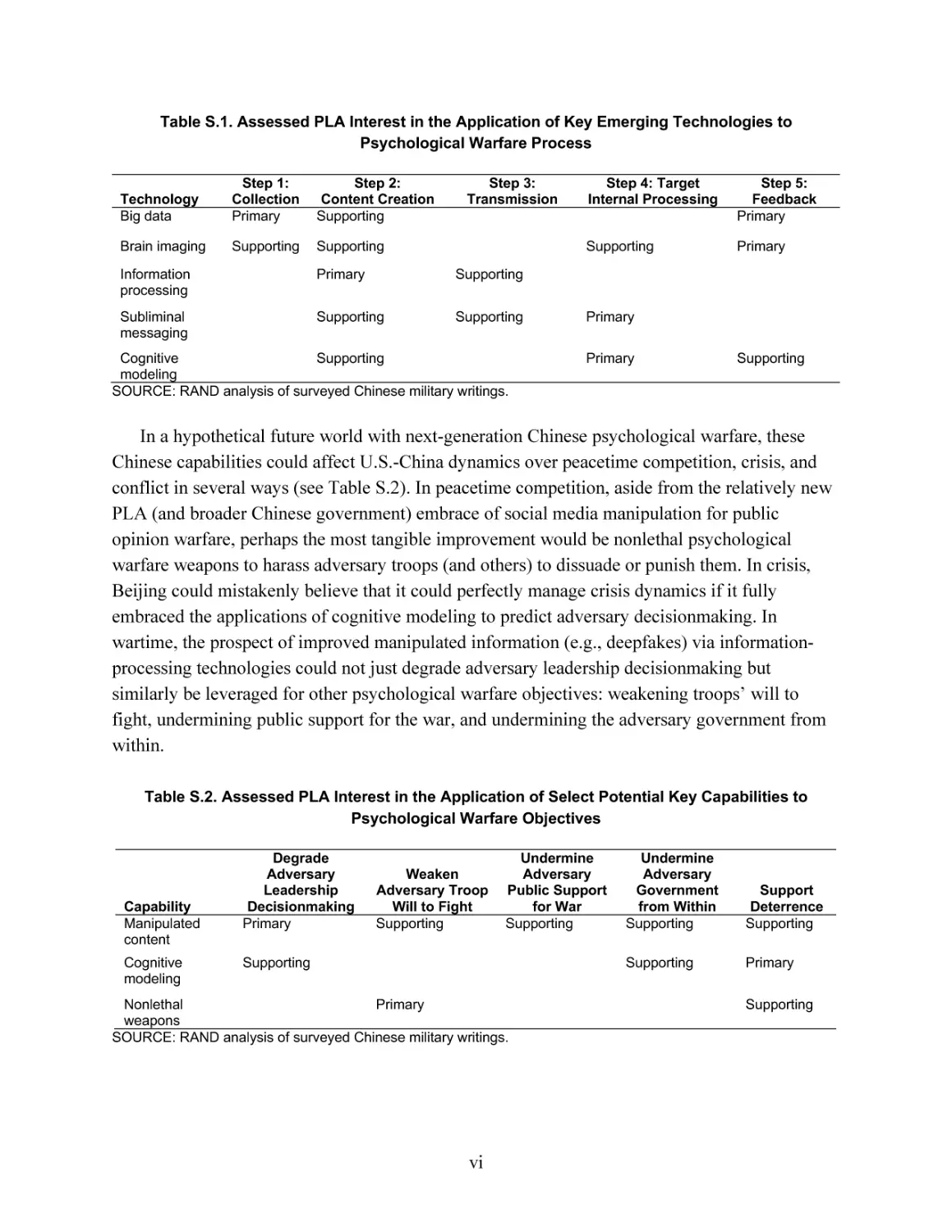
such as for cognitive modeling, which appears to be of growing interest. Table S.1 highlights
how these technologies would support PLA psychological warfare, broken down by the five-step
process PLA researchers identify: collecting information on the target, creating psychological
warfare content, transmitting the content, processing the content internally by the target, and
providing feedback on the effects to the attacker. Much of this PLA research is framed as a
defensive response to foreign (U.S.) military initiatives, but it is unclear how much innovating is
being done.
There is evidence the PLA seeks to develop and deploy some, but not all, of these
capabilities and it will likely face several challenges moving forward. For example, there is
strong evidence the PLA has developed and employed information manipulation capabilities and
laser weapons already, although it is unclear whether these have been specifically intended as
psychological warfare. PLA researchers also discuss a range of other challenges, including
developing high-quality personnel, accurate modeling and simulation, and foreign-language
capabilities. Bureaucratic dynamics that will also influence adoption include the ability to
integrate into the PLA’s overarching system-of-systems approach to warfare, along with securing
sufficient funding and carving out bureaucratic space within the PLA Strategic Support Force.

v

Table S.1. Assessed PLA Interest in the Application of Key Emerging Technologies to
Psychological Warfare Process

Technology
Big data

Step 1:
Collection
Primary

Step 2:
Content Creation
Supporting

Brain imaging

Supporting

Supporting

Step 3:
Transmission

Information
processing

Primary

Supporting

Subliminal
messaging

Supporting

Supporting

Cognitive
Supporting
modeling
SOURCE: RAND analysis of surveyed Chinese military writings.

Step 4: Target
Internal Processing

Step 5:
Feedback
Primary

Supporting

Primary

Primary
Primary

Supporting

In a hypothetical future world with next-generation Chinese psychological warfare, these
Chinese capabilities could affect U.S.-China dynamics over peacetime competition, crisis, and
conflict in several ways (see Table S.2). In peacetime competition, aside from the relatively new
PLA (and broader Chinese government) embrace of social media manipulation for public
opinion warfare, perhaps the most tangible improvement would be nonlethal psychological
warfare weapons to harass adversary troops (and others) to dissuade or punish them. In crisis,
Beijing could mistakenly believe that it could perfectly manage crisis dynamics if it fully
embraced the applications of cognitive modeling to predict adversary decisionmaking. In
wartime, the prospect of improved manipulated information (e.g., deepfakes) via informationprocessing technologies could not just degrade adversary leadership decisionmaking but
similarly be leveraged for other psychological warfare objectives: weakening troops’ will to
fight, undermining public support for the war, and undermining the adversary government from
within.
Table S.2. Assessed PLA Interest in the Application of Select Potential Key Capabilities to
Psychological Warfare Objectives

Capability
Manipulated
content
Cognitive
modeling

Degrade
Adversary
Leadership
Decisionmaking
Primary

Weaken
Adversary Troop
Will to Fight
Supporting

Undermine
Adversary
Public Support
for War
Supporting

Supporting

Nonlethal
Primary
weapons
SOURCE: RAND analysis of surveyed Chinese military writings.

vi

Undermine
Adversary
Government
from Within
Supporting

Support
Deterrence
Supporting

Supporting

Primary
Supporting

This report identifies several key insights. First, Chinese military thinking on psychological
warfare is much more diverse than previously understood. Although there are areas of general
agreement (the objectives of psychological warfare), there is clearly debate over various
operational concepts. Second, because psychological warfare is fundamentally information
warfare (specifically about manipulating information and thus perceptions), the Chinese
military’s growing emphasis on data—that is, the current informatization (information-driven)
and future intelligentization (artificial intelligence–driven) views of warfare—dovetails well with
psychological warfare. China’s whole-of-government strategy and long-standing efforts for
global data collection may benefit future Chinese psychological warfare operations, even if this
data collection is not currently intended for such purposes. However, it is unclear how well this
opportunity will be turned into reality in light of apparent challenges for actually getting access
to these data and making them usable. Third, the real-world impact of next-generation
psychological warfare capabilities may be even less important than Beijing’s assumption about
whether they will work as intended, or, once it begins employment, even its perception that they
are working as intended. This raises the risk that once China realizes that its psychological
warfare efforts are not having the intended effect, such as the adversary taking a different course
of action, Beijing might respond in unpredictable ways.
Three alternative futures—(1) an embrace of information manipulation as a leading edge of
national power, (2) a bold new direction for warfare, and (3) a failure of imagination
(continuation of the status quo)—illustrate potential trends and the long-term outlook for Chinese
psychological warfare. The first alternative future, centered on information manipulation, would
likely represent a marginal increase in the threat of Chinese psychological warfare capabilities to
the United States, because the United States can likely mitigate the threat by any number of
steps. The second alternative future, centered on a Chinese embrace of emerging technology for
predicting or otherwise shaping adversary decisionmaking, would present a challenge to U.S.
military operations (and broader government national security policies) by removing the element
of unpredictability from U.S. decisionmaking. This future would entail China leveraging big
data, combined with machine learning, to process the vast amounts of information China has
collected on adversary decisionmakers and society, and China would couple this information
with cognitive modeling to better tailor psychological warfare content. Although this may seem
impossible to U.S. analysts, the only question that matters is whether Chinese analysts and the
Chinese leadership believe that it is possible. The third alternative future, a failure of imagination
causing a continuation of the status quo, would represent a limited Chinese psychological
warfare capability largely constrained to the battlefield and certainly its near abroad and would
be unlikely to significantly affect U.S. operations in the Indo-Pacific.

vii

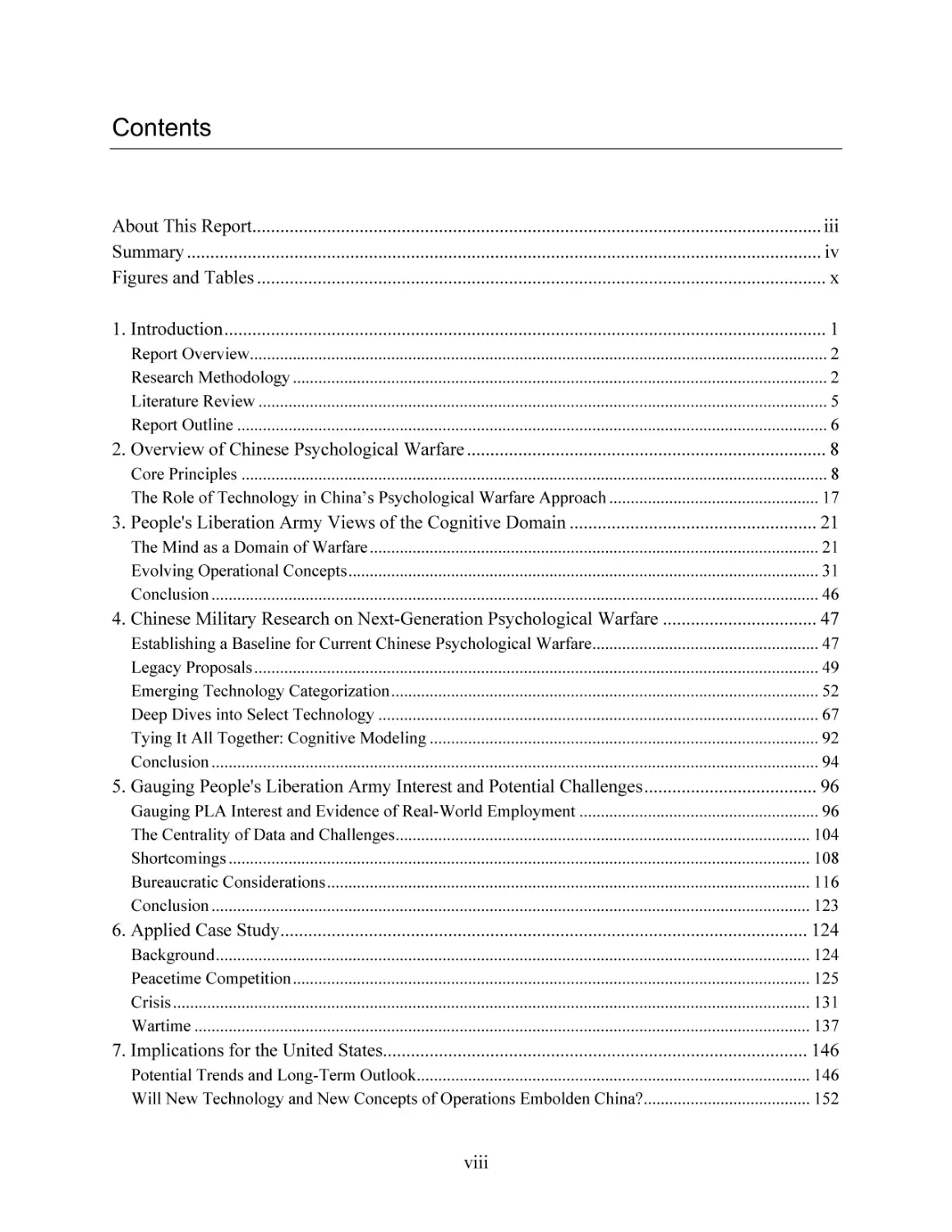
Contents

About This Report.......................................................................................................................... iii
Summary ........................................................................................................................................ iv
Figures and Tables .......................................................................................................................... x
1. Introduction ................................................................................................................................. 1
Report Overview....................................................................................................................................... 2
Research Methodology ............................................................................................................................. 2
Literature Review ..................................................................................................................................... 5
Report Outline .......................................................................................................................................... 6

2. Overview of Chinese Psychological Warfare ............................................................................. 8
Core Principles ......................................................................................................................................... 8
The Role of Technology in China’s Psychological Warfare Approach ................................................. 17

3. People's Liberation Army Views of the Cognitive Domain ..................................................... 21
The Mind as a Domain of Warfare ......................................................................................................... 21
Evolving Operational Concepts .............................................................................................................. 31
Conclusion .............................................................................................................................................. 46

4. Chinese Military Research on Next-Generation Psychological Warfare ................................. 47
Establishing a Baseline for Current Chinese Psychological Warfare..................................................... 47
Legacy Proposals .................................................................................................................................... 49
Emerging Technology Categorization .................................................................................................... 52
Deep Dives into Select Technology ....................................................................................................... 67
Tying It All Together: Cognitive Modeling ........................................................................................... 92
Conclusion .............................................................................................................................................. 94

5. Gauging People's Liberation Army Interest and Potential Challenges ..................................... 96
Gauging PLA Interest and Evidence of Real-World Employment ........................................................ 96
The Centrality of Data and Challenges................................................................................................. 104
Shortcomings ........................................................................................................................................ 108
Bureaucratic Considerations ................................................................................................................. 116
Conclusion ............................................................................................................................................ 123

6. Applied Case Study................................................................................................................. 124
Background ........................................................................................................................................... 124
Peacetime Competition ......................................................................................................................... 125
Crisis ..................................................................................................................................................... 131
Wartime ................................................................................................................................................ 137

7. Implications for the United States........................................................................................... 146
Potential Trends and Long-Term Outlook............................................................................................ 146
Will New Technology and New Concepts of Operations Embolden China?....................................... 152

viii

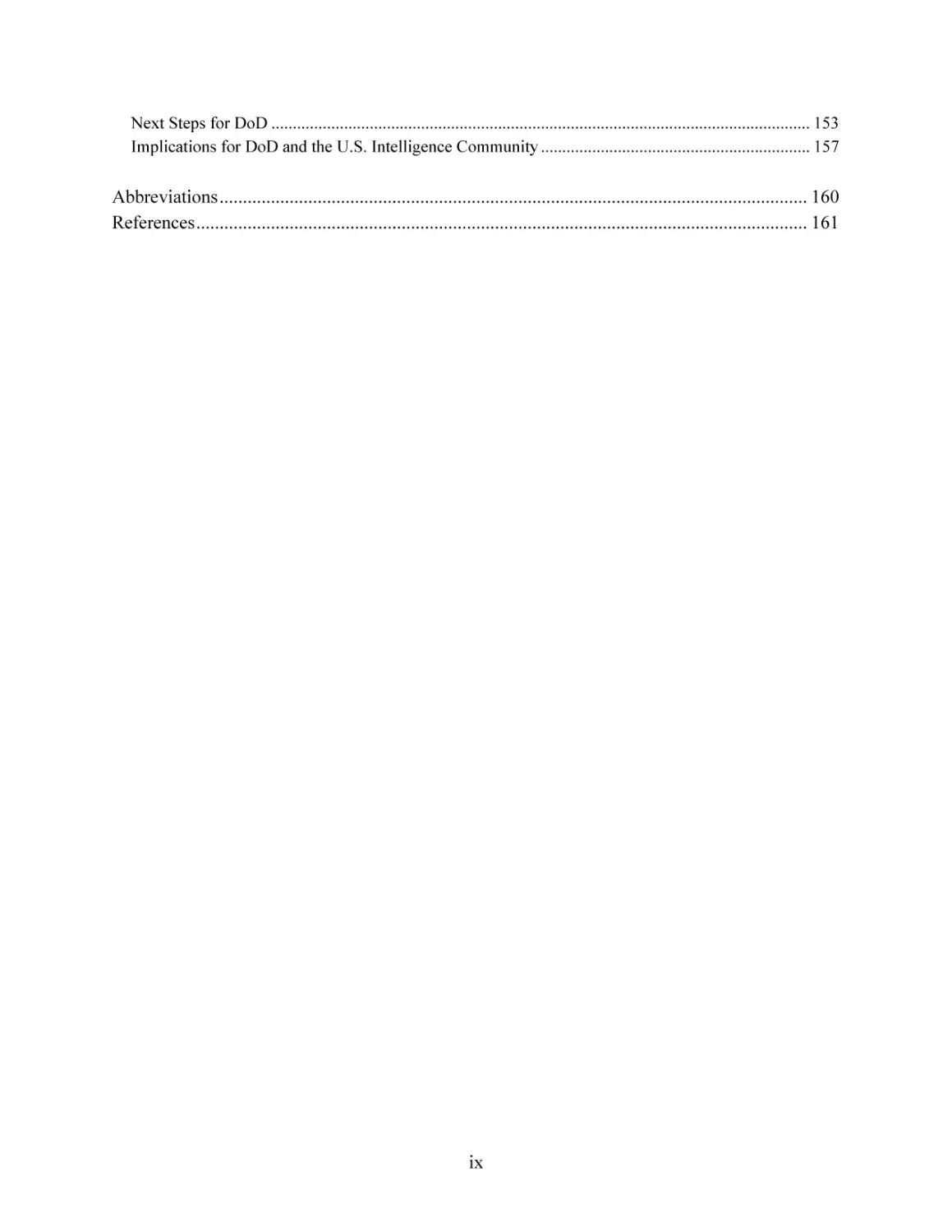
Next Steps for DoD .............................................................................................................................. 153
Implications for DoD and the U.S. Intelligence Community ............................................................... 157

Abbreviations .............................................................................................................................. 160
References ................................................................................................................................... 161

ix

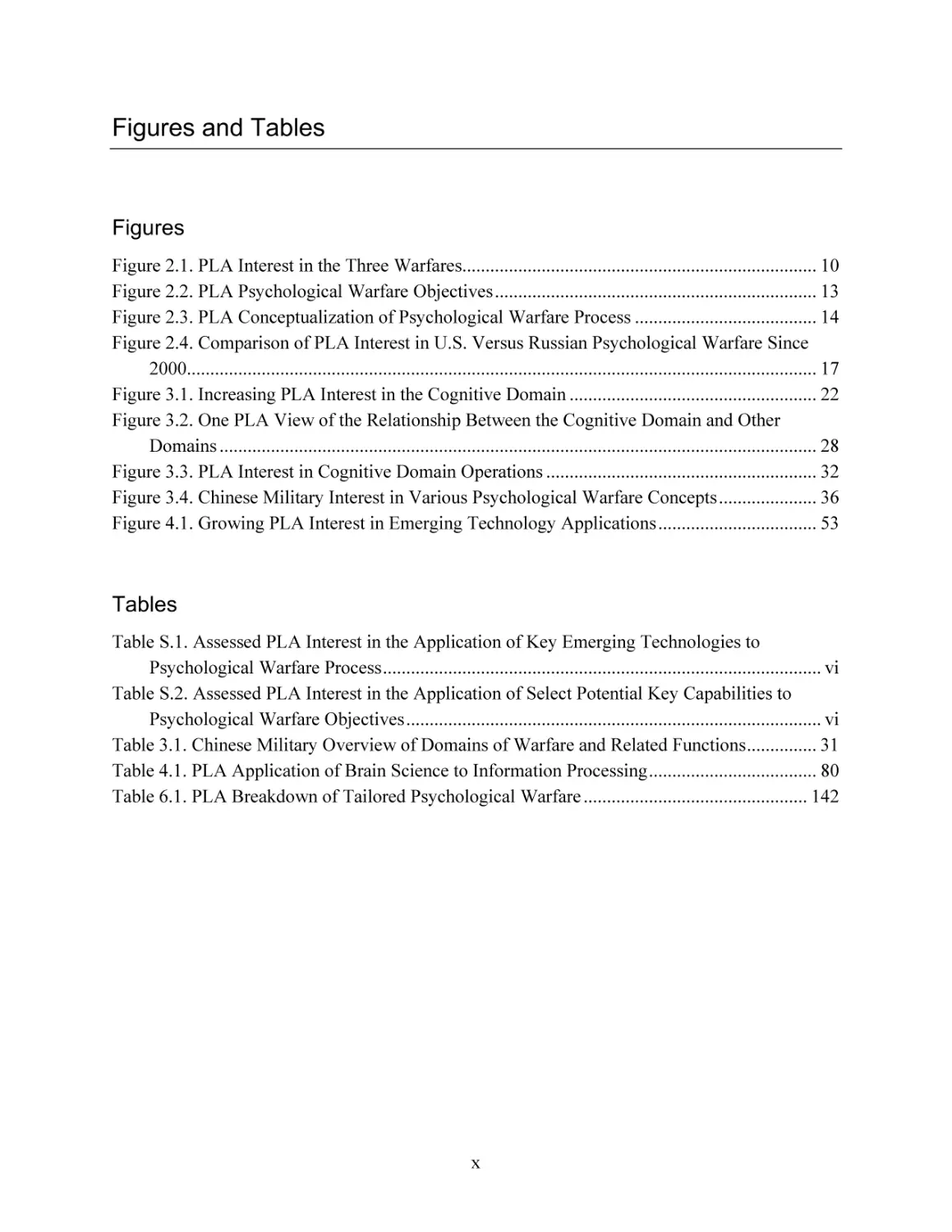
Figures and Tables

Figures
Figure 2.1. PLA Interest in the Three Warfares............................................................................ 10
Figure 2.2. PLA Psychological Warfare Objectives ..................................................................... 13
Figure 2.3. PLA Conceptualization of Psychological Warfare Process ....................................... 14
Figure 2.4. Comparison of PLA Interest in U.S. Versus Russian Psychological Warfare Since
2000....................................................................................................................................... 17
Figure 3.1. Increasing PLA Interest in the Cognitive Domain ..................................................... 22
Figure 3.2. One PLA View of the Relationship Between the Cognitive Domain and Other
Domains ................................................................................................................................ 28
Figure 3.3. PLA Interest in Cognitive Domain Operations .......................................................... 32
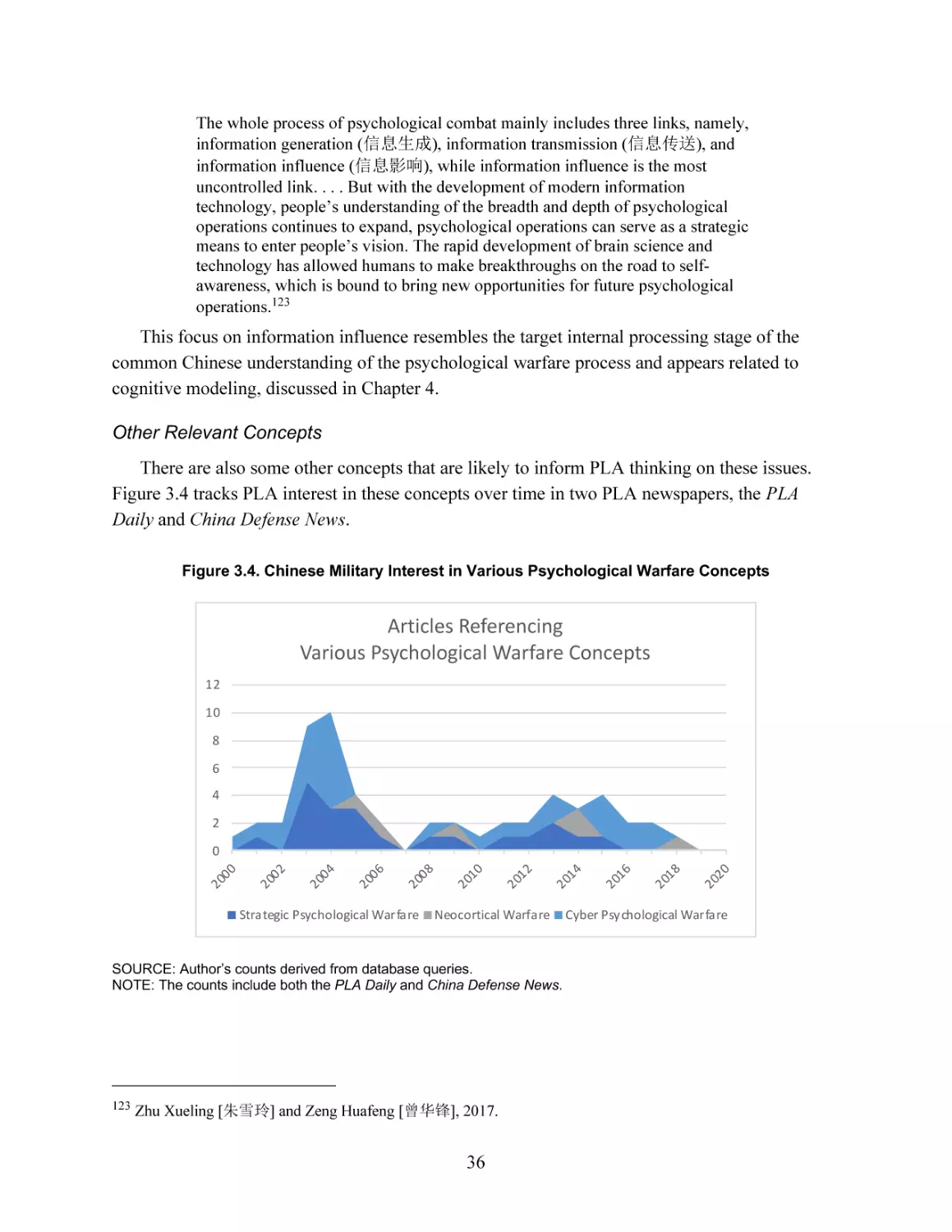
Figure 3.4. Chinese Military Interest in Various Psychological Warfare Concepts ..................... 36
Figure 4.1. Growing PLA Interest in Emerging Technology Applications .................................. 53

Tables
Table S.1. Assessed PLA Interest in the Application of Key Emerging Technologies to
Psychological Warfare Process .............................................................................................. vi
Table S.2. Assessed PLA Interest in the Application of Select Potential Key Capabilities to
Psychological Warfare Objectives ......................................................................................... vi
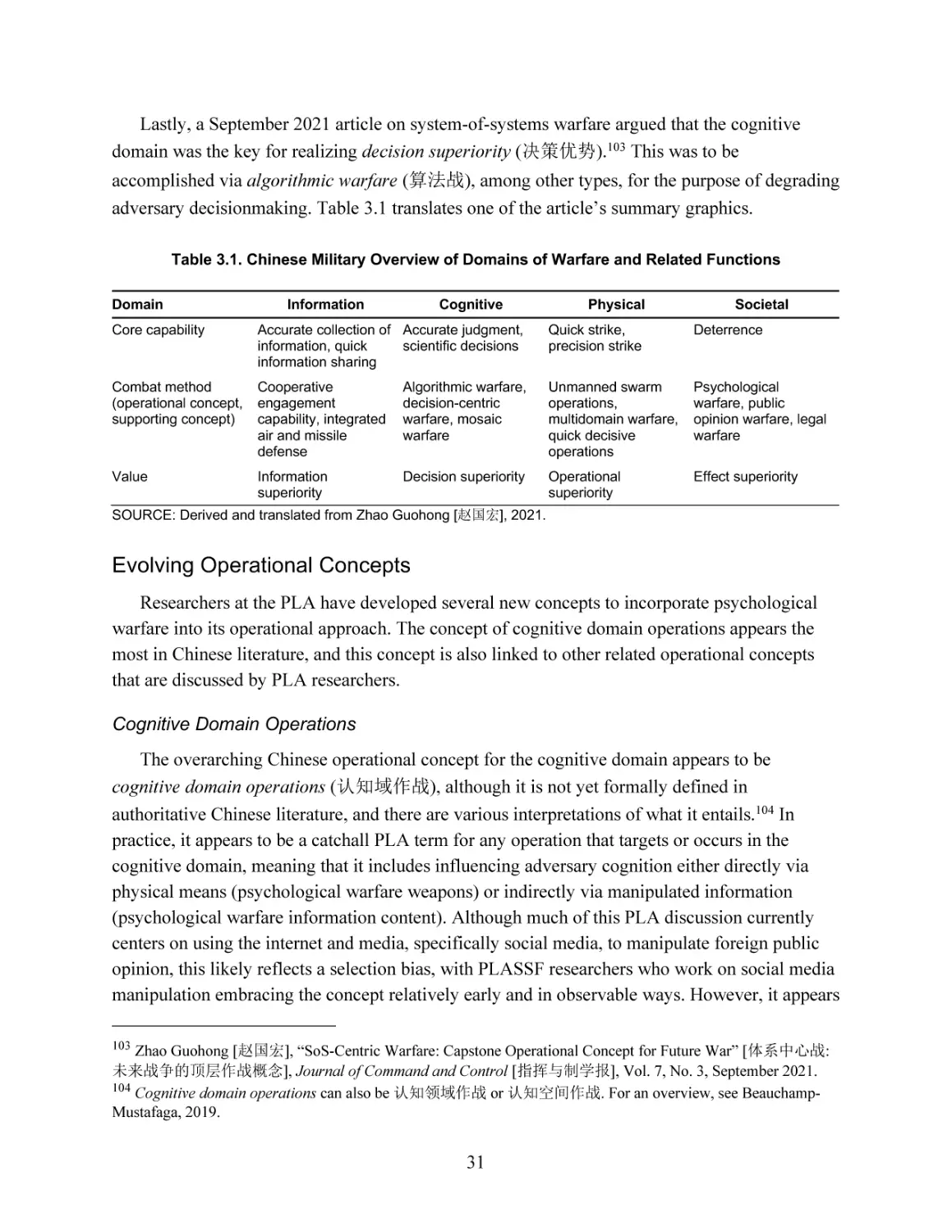
Table 3.1. Chinese Military Overview of Domains of Warfare and Related Functions ............... 31
Table 4.1. PLA Application of Brain Science to Information Processing .................................... 80
Table 6.1. PLA Breakdown of Tailored Psychological Warfare ................................................ 142

x

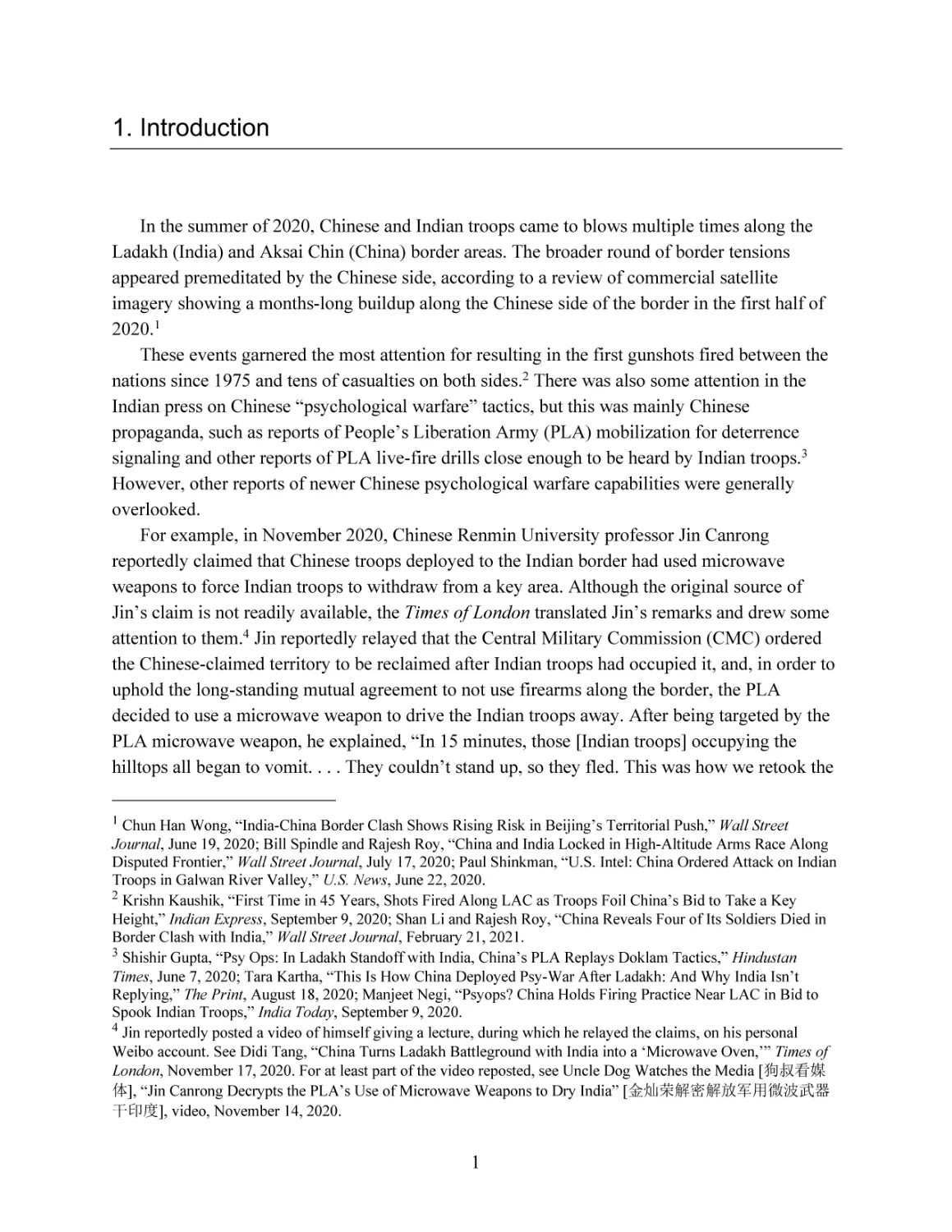
1. Introduction

In the summer of 2020, Chinese and Indian troops came to blows multiple times along the
Ladakh (India) and Aksai Chin (China) border areas. The broader round of border tensions
appeared premeditated by the Chinese side, according to a review of commercial satellite
imagery showing a months-long buildup along the Chinese side of the border in the first half of
2020.1
These events garnered the most attention for resulting in the first gunshots fired between the
nations since 1975 and tens of casualties on both sides.2 There was also some attention in the
Indian press on Chinese “psychological warfare” tactics, but this was mainly Chinese
propaganda, such as reports of People’s Liberation Army (PLA) mobilization for deterrence
signaling and other reports of PLA live-fire drills close enough to be heard by Indian troops.3
However, other reports of newer Chinese psychological warfare capabilities were generally
overlooked.
For example, in November 2020, Chinese Renmin University professor Jin Canrong
reportedly claimed that Chinese troops deployed to the Indian border had used microwave
weapons to force Indian troops to withdraw from a key area. Although the original source of
Jin’s claim is not readily available, the Times of London translated Jin’s remarks and drew some
attention to them.4 Jin reportedly relayed that the Central Military Commission (CMC) ordered
the Chinese-claimed territory to be reclaimed after Indian troops had occupied it, and, in order to
uphold the long-standing mutual agreement to not use firearms along the border, the PLA
decided to use a microwave weapon to drive the Indian troops away. After being targeted by the
PLA microwave weapon, he explained, “In 15 minutes, those [Indian troops] occupying the
hilltops all began to vomit. . . . They couldn’t stand up, so they fled. This was how we retook the
1

Chun Han Wong, “India-China Border Clash Shows Rising Risk in Beijing’s Territorial Push,” Wall Street
Journal, June 19, 2020; Bill Spindle and Rajesh Roy, “China and India Locked in High-Altitude Arms Race Along
Disputed Frontier,” Wall Street Journal, July 17, 2020; Paul Shinkman, “U.S. Intel: China Ordered Attack on Indian
Troops in Galwan River Valley,” U.S. News, June 22, 2020.
2
Krishn Kaushik, “First Time in 45 Years, Shots Fired Along LAC as Troops Foil China’s Bid to Take a Key
Height,” Indian Express, September 9, 2020; Shan Li and Rajesh Roy, “China Reveals Four of Its Soldiers Died in
Border Clash with India,” Wall Street Journal, February 21, 2021.
3
Shishir Gupta, “Psy Ops: In Ladakh Standoff with India, China’s PLA Replays Doklam Tactics,” Hindustan
Times, June 7, 2020; Tara Kartha, “This Is How China Deployed Psy-War After Ladakh: And Why India Isn’t
Replying,” The Print, August 18, 2020; Manjeet Negi, “Psyops? China Holds Firing Practice Near LAC in Bid to
Spook Indian Troops,” India Today, September 9, 2020.
4
Jin reportedly posted a video of himself giving a lecture, during which he relayed the claims, on his personal
Weibo account. See Didi Tang, “China Turns Ladakh Battleground with India into a ‘Microwave Oven,’” Times of
London, November 17, 2020. For at least part of the video reposted, see Uncle Dog Watches the Media [狗叔看媒
体], “Jin Canrong Decrypts the PLA’s Use of Microwave Weapons to Dry India” [金灿荣解密解放军用微波武器
干印度], video, November 14, 2020.

1

ground.”5 Jin added that neither side had publicly discussed the incident because China was
pleased with the results and India was humiliated. However, the Indian military has disputed
Jin’s claims of a microwave weapon, calling them “baseless,” and an Indian military official
described the notion as “a fake, ludicrous claim, part of the continuing psychological operations
from across the border.”6 Further substantiation has been difficult, and it is likely the full details
will never be known.7
What should we make of this episode? Is China developing new psychological warfare–
related capabilities for the battlefield? If so, how does China think about these capabilities, what
specific capabilities might it develop, and how might it use these capabilities? This report
explores these questions.

Report Overview
This report explores Chinese military thinking about next-generation psychological warfare
and potential implications for the United States. The report leverages extensive Chineselanguage primary-source materials, mostly written by PLA researchers, to understand how China
views the future of psychological warfare and specifically the application of emerging
technologies. It expands the existing literature on Chinese military theory, planning, and realworld employment of psychological warfare through this assessment of the implications of
emerging technologies.

Research Methodology
This project leveraged a range of publicly available Chinese-language sources to explore
current and potential trends in Chinese psychological warfare. The Chinese-language sources
utilized for this project were all evaluated for authoritativeness and their likelihood of shaping
future Chinese psychological warfare based on a number of factors, including the author’s
affiliation, publication venue, government funding, and demonstrated expertise. None of the
sources used in this report is singularly authoritative, but taken together they reflect the broad
contours of Chinese military thinking. I also conducted an English-language literature review
(described briefly below).

5

Tang, 2020.
“Microwave Arms Used by China at LAC? Fake News, Asserts Army,” Times of India, November 18, 2020. For
denial, see ADG PI—INDIAN ARMY [@adgpi], “Media articles on employment of microwave weapons in Eastern
Ladakh are baseless. The news is FAKE,” Twitter post, November 17, 2020.
7
For a basic overview of the potential technologies that Jin may have been referencing, including Chinese
capabilities, see David Hambling, “India Disputes Claim That China Routed Their Troops with Microwave Blaster,”
Forbes, November 20, 2020. Jin’s credibility as a source for nascent military capabilities is not perfect, however,
since he also referenced “weather weapons” (气象武器) following the July 2021 flooding in Henan, China. See
Aadil Brar, “Foreign Journalists in China Targeted Again, This Time over Henan Floods,” The Print, July 28, 2021.
6

2

To understand Chinese psychological warfare theory, I utilize the most-authoritative sources
available, including the 2013 Academy of Military Science’s (AMS’s) Science of Military
Strategy and two PLA instructional materials, a 2013 AMS book on information operations
(electronic warfare, cyber warfare, and psychological warfare), and a 2014 National Defense
University (NDU) book on the Three Warfares.8 I also explore Chinese writings from PLA
research institutions that focus on psychological warfare theory, including the Nanjing Political
Academy (南京政治学院) and Xi’an Political Academy (西安政治学院), both now under NDU
as its Political Institute (国防大学政治学院) as part of the post-2015 military reforms.
To understand Chinese applied research for psychological warfare, I explore Chinese
writings by key PLA researchers at such institutions as the National University of Defense
Technology (NUDT, 国防科学技术大学) and the PLA Strategic Support Force’s (PLASSF’s)
Information Engineering University (IEU, 信息工程大学). IEU is now the affiliated research
organization for the PLASSF Network Systems Department (NSD), which oversees Base 311,
the PLA’s only known operational unit dedicated to psychological warfare. These researchers
publish in a variety of Chinese academic journals, but those of most interest are China Military
Science (中国军事科学), National Defense (国防), and National Defense Technology (国防科
技). To understand how psychological warfare fits into broader Chinese military strategy and
might be employed in a crisis or conflict, I draw on authoritative Chinese texts, such as the 2006
Science of Campaigns and 2013 AMS Science of Military Strategy.9
To understand Chinese military training for psychological warfare, I reviewed PLA reporting
that references psychological warfare, mainly from PLA Daily but also from the CCTV-7
military channel’s reporting. I paid special attention to research that was funded by Chinese
military and government grants, which suggests a level of government support, and avoided
Chinese writings that were perhaps interesting but had no markers for authoritativeness.10

8

People’s Liberation Army, Academy of Military Science, Military Strategy Department [军事学学院战略研究部
], Science of Military Strategy [战略学], 3rd ed., Beijing: Military Science Press [军事科学出版社], 2013; Ye
Zheng [叶征], ed., Lectures on the Science of Information Operations [信息作战学教程], Beijing: Military Science
Press [军事科学出版社], 2013; Wu Jieming [吴杰明] and Liu Zhifu [刘志富], An Introduction to Public Opinion
Warfare, Psychological Warfare, and Legal Warfare [舆论战心理战法律战概论], Beijing: National Defense
University Press, 2014. For an overview of the Three Warfares, see Chapter 2.
9
Zhang Yuliang [张玉良], ed., The Science of Campaigns [战役学], Beijing: National Defense University Press,
2006; People’s Liberation Army, Academy of Military Science, Military Strategy Department [军事科学院战略研
究部], Science of Military Strategy [战略学], 2nd ed., Beijing: Military Science Press [军事科学出版社], 2001.
10
For example, a 2020 article on the application of artificial intelligence (AI) for psychological warfare might be
interesting reading, but the author is from Beijing Forestry University’s College of Humanities, the article was not
published in a Chinese military or defense journal, the author has no previous work on psychological warfare, and
there is no government funding acknowledged for this research. See Zhu Jianjun [朱建军], “AI Psychological
Warfare and Countermeasures: Thinking Based on the Unique Advantages of Chinese Traditional Cultural
Resources” [人工智能心理战及其应对策略: 基于中国传统文化资源独特优势的思考], Frontiers [人民论坛·学
术前沿], March 2020.

3

The main goal of this report is an initial exploratory look at Chinese military thinking on the
development and use of next-generation psychological warfare capabilities. Much of the
discussion on this topic in the Chinese literature is conceptual, and as a result there are some
limitations to the analysis I provide. For example, this research does not verify how any of the
technologies or concepts discussed by Chinese researchers may be achievable and practical in
the real world. It also does not compare People’s Republic of China (PRC) thinking with that of
the United States.11 Because I focused on the potential offensive use of psychological warfare
capabilities, the report does not address Chinese military thinking or efforts for domestic
psychological defense or psychological self-strengthening. These topics would be of value for
the U.S. Department of Defense (DoD) but fell outside the scope of this study.
This report’s reliance on open-source information inherently presents some challenges and
limitations to the information and analysis herein. Documenting Chinese military psychological
warfare research and activities using publicly available information leaves open the possibility
that the PLA is pursuing additional efforts that are not being publicly disclosed. This report
attempts to mitigate this constraint by cross-validating across multiple types of open-source
information and leveraging foreign-government publications and media reporting. Nevertheless,
this is an important limitation to this report.
11

For one recent U.S. look at the future of information warfare, with an emphasis on technological building blocks,
see Nicholas D. Wright, The Future Character of Information in Strategy: Forged by Cognition and Technology,
report for the Pentagon Joint Staff Strategic Multilayer Assessment Group, August 2021. For a recent article by U.S.
military personnel expressing similar interest to some of the Chinese research explored here, see Shannon Houck,
John Crisafulli, Joshua Gramm, and Brian Branagan, “Changing Hearts and Brains: SOF Must Prepare Now for
Neurowarfare,” Small Wars Journal, December 12, 2021.
For Chinese comparisons between U.S. and Chinese psychological warfare research, see Deng Guilin [邓贵
林], “The Fundamental Research on the Expert Knowledge Base and Inference Mechanism of Psychological
Operations” [心理战专家知识库与推理机理论研究], master’s thesis, Changsha, China: National University of
Defense Technology [国防科学技术大学], 2009; Xin Wei [辛伟], Lei Erqing [雷二庆], Chang Xiao [常晓], Song
Yunyun [宋芸芸], and Miao Danmin [苗丹民], “The Application of Knowledge Mapping in Military Psychology:
Citespace Analysis Based on Data from ISI Web of Science Database” [知识图谱在军事心理学研究中的应用: 基
于 ISI Web of Science 数据库的 Citespace 分析], Advances in Psychological Science [心理科学进展], Vol. 22,
No. 2, February 2014; Zhao Yanli [赵颜利], Gao Lingjun [高岭军], and Xu Tingting [许亭亭], “The Scientific
Knowledge Atlas in the Research of Psychological Warfare” [心理战领域研究的科学知识图谱], National Defense
Technology [国防科技], Vol. 41, No. 3, June 2020; Li Hui [李徽], Zhou Jian [周健], and Li Zhitong [李志彤],
“Bibliometric Analysis of the Literature on Psychological Warfare and Suggestions for the Development of
Countermeasures” [心理战研究文献计量分析及发展对策建议], National Defense Technology [国防科技], Vol.
43, No. 3, June 2022. For a broader comparison between U.S. and Chinese military research, see Bu Fanbiao [卜凡
彪], “Bibliometric Analysis of Military System Science Field” [军事系统科学领域文献计量分析], Modern
Information Technology [现代信息科技], Vol. 5, No. 8, April 2021; Liu Weichao [刘伟超] and Zhou Jun [周军],
“Research Progress of Cognitive Information Science” [认知情报学研究进展], Information and Documentation
Services [情报资料工作], Vol. 41, No. 6, November 2020. For a PLA bibliometric analysis of Chinese writings
about psychological training, see Xu Ke [许珂], Wang Jia [王佳], Feng Zhengzhi [冯正直], and Ren Hui [任辉], “A
Knowledge-Mapping Analysis of China Research on Military Psychological Training” [我军军事心理训练研究热
点—基于中国知网的知识图谱分析], Psychology: Techniques and Applications [心理技术与应用], Vol. 8, No. 1,
2020.

4

Literature Review
Despite Chinese psychological warfare being an occasional, if not frequent, topic of
discussion for understanding Chinese military thinking about information warfare, there is
relatively little (publicly available) research on Chinese psychological warfare theory and even
less available on potential future trajectories of Chinese psychological warfare.
Dean Cheng has long observed Chinese psychological warfare theory. A key series of reports
for the Heritage Foundation over 2012–2013 provided detailed analyses into the theory of each
of the Three Warfares.12 Cheng covered the basic principles and tactics, addressed lessons
learned from foreign conflicts, and provided comparisons with Western concepts. However,
Cheng did not address the specific capabilities that would be used to apply these ideas.
Mark Stokes has focused more on the organizational aspects and real-world applications of
Chinese psychological warfare.13 Stokes’s research has explored Base 311, as well as the PLA’s
broader foreign-focused information efforts, under the framework of political warfare. Stokes
identified the basic organizational structure of Base 311, with specific subunits and related
commercial affiliations, and other key foreign-facing PLA organizations supporting the
military’s influence operations.
Elsa Kania has explored the PLA’s interest in emerging technologies, including advanced
computing and biotechnology.14 Most relevant is a 2020 article on how the Chinese military is
seeking advantages in the cognitive domain through biotechnology.15 Although the article does

12

Dean Cheng, Winning Without Fighting: Chinese Legal Warfare, Washington, D.C.: Heritage Foundation, May
21, 2012a; Dean Cheng, Winning Without Fighting: Chinese Public Opinion Warfare and the Need for a Robust
American Response, Washington, D.C.: Heritage Foundation, November 26, 2012b; Dean Cheng, Winning Without
Fighting: The Chinese Psychological Warfare Challenge, Washington, D.C.: Heritage Foundation, July 12, 2013.
For more on lessons learned, see Dean Cheng, “Chinese Lessons from the Gulf Wars,” in Andrew Scobell, David
Lai, and Roy Kamphausen, eds., Chinese Lessons from Other Peoples’ Wars, Carlisle, Pa.: Strategic Studies
Institute, 2011.
13
Mark Stokes and Russell Hsiao, The People’s Liberation Army General Political Department: Political Warfare
with Chinese Characteristics, Arlington, Va.: Project 2049 Institute, October 14, 2013.
14
For example, see Elsa B. Kania, Battlefield Singularity: Artificial Intelligence, Military Revolution, and China’s
Future Military Power, Washington, D.C.: Center for a New American Security, November 2017; Elsa B. Kania,
“AI Weapons” in China’s Military Innovation, Washington, D.C.: Brookings Institution, April 2020c; Elsa B.
Kania, “Artificial Intelligence in China’s Revolution in Military Affairs,” Journal of Strategic Studies, Vol. 44, No.
4, May 2021.
15
Elsa B. Kania, “Minds at War: China’s Pursuit of Military Advantage Through Cognitive Science and
Biotechnology,” PRISM, Vol. 8, No. 3, January 2020b. For other recent work on the PLASSF, see Elsa B. Kania and
John Costello, “Seizing the Commanding Heights: The PLA Strategic Support Force in Chinese Military
Power,” Journal of Strategic Studies, Vol. 44, No. 2, 2021. For other work on PLA psychological warfare, see Elsa
B. Kania, “The Ideological Battlefield: China’s Approach to Political Warfare and Propaganda in an Age of Cyber
Conflict,” in Christopher Whyte, A. Trevor Thrall, and Brian M. Mazanec, eds., Information Warfare in the Age of
Cyber Conflict, London: Routledge, 2020a; Elsa B. Kania and Peter Wood, “Sharp Swords of the Future Battlefield:
The Chinese Military’s Special Forces and Psychological Operations,” in Zachary S. Davis, Frank Gac, Christopher
Rager, Philip Reiner, and Jennifer Snow, eds., Strategic Latency Unleashed: The Role of Technology in a Revisionist
Global Order and the Implications for Special Operations Forces, Livermore, Calif.: Center for Global Security
Research at Lawrence Livermore National Laboratory, January 2021.

5

cover some specific research and applications for psychological warfare, that is not the focus, as
Kania does not connect it with the broader Chinese theory of psychological warfare. Others have
also covered Chinese views of the implications of AI for warfare, although they generally do not
cover the psychological warfare component.16
Other research has of course also covered China’s thinking on psychological warfare over the
years.17 Joe McReynolds and others have also researched the emergence of the PLASSF and
some of its implications for Chinese psychological warfare.18 Devin Thorne has explored how
other Chinese actors beyond the PLA are leveraging AI and bulk data collection for
propaganda.19 Kristen Gunness has explored how China might employ future technology for
psychological warfare for gray zone warfare.20 DoD’s Annual Report to Congress on the Chinese
military has also addressed Chinese psychological warfare, although never in great depth.21 This
report expands on this existing literature by looking specifically at China’s concepts, capabilities,
and future trends for psychological warfare.

Report Outline
This report begins with a brief overview of Chinese psychological warfare theory in Chapter
2, covering both its current theory and the role of new technology. Chapter 3 explores how the
Chinese military is thinking about the cognitive domain, including evolving psychological
warfare operational concepts. Chapter 4 explores recent Chinese military research into nextgeneration psychological warfare, with a focus on the applications of advanced computing and
brain science. Chapter 5 attempts to gauge the actual level of PLA interest in leveraging these
technologies for psychological warfare. It also considers the role of data in psychological
warfare, as well as some acknowledged shortcomings and bureaucratic factors that might affect

16

Ryan Fedasiuk, Jennifer Melot, and Ben Murphy, Harnessed Lightning: How the Chinese Military Is Adopting
Artificial Intelligence, Washington, D.C.: Georgetown University Center for Security and Emerging Technology,
October 2021; Kevin Pollpeter and Amanda Kerrigan, The PLA and Intelligent Warfare: A Preliminary Analysis,
Alexandria, Va.: CNA, October 2021.
17
See, for example, Timothy Walton, China’s Three Warfares, Herndon, Va.: Delex Systems, January 2012; Stefan
Halper, China: The Three Warfares, report for the U.S. Department of Defense, Office of Net Assessment, May
2013; Peter Mattis, “China’s ‘Three Warfares’ on Perspective,” War on the Rocks, January 30, 2018.
18
Joe McReynolds and John Costello, China’s Strategic Support Force: A Force for a New Era, Washington, D.C.:
National Defense University, 2018; Kania and Costello, 2021.
19
Devin Thorne, “AI-Powered Propaganda and the CCP’s Plans for Next-Generation ‘Thought Management,’”
China Brief, May 15, 2020a; Devin Thorne, “Evaluating the Utility of Global Data Collection by Chinese Firms for
Targeted Propaganda,” China Brief, October 30, 2020b.
20

Kristen Gunness, China’s Gray-Zone Capabilities in the East China Sea, Seattle, Wash.: National Bureau of
Asian Research, May 2021.

21

For example, the Three Warfares concept was explicitly mentioned only in the 2008–2011 editions before 2019;
2019–2022 editions have had a special section on Chinese influence operations. See Office of the Secretary of
Defense, Annual Report to Congress: Military and Security Developments Involving the People’s Republic of China,
Washington, D.C.: Department of Defense, 2008–2011, 2019–2022.

6

PLA adoption of these technologies. Chapter 6 explores what these emerging psychological
warfare concepts and capabilities might mean in practice for a future U.S.-China crisis or conflict
by positing a hypothetical case study. Lastly, Chapter 7 explores the implications for the United
States through three alternative futures.

7

2. Overview of Chinese Psychological Warfare

This chapter provides a summary of Chinese military thinking on psychological warfare,
including core principles, main operational concepts and objectives, and capability typology and
process. It also explores the role of new technology in advancing psychological warfare.
China views psychological warfare, centered on the manipulation of information to influence
adversary decisionmaking and behavior, as one of several key components of modern warfare.
Chinese psychological warfare has evolved, driven in part by technological progress bringing
new opportunities and by lessons learned from other militaries, but the core principles and
objectives have remained relatively constant.

Core Principles
China’s approach to psychological warfare is fundamentally driven by its view that modern
warfare is defined by information and is thus described as informationized warfare (信息化战
争). This emphasis on information’s central role in warfare also places a premium on the ability
to manipulate information, broadly defined as information warfare (信息战), including the
ability to manipulate how adversaries receive and process that information (psychological
warfare).
Informationized Warfare and Information Operations
China views modern warfare as centered on the struggle for information dominance (制信息
权). Information dominance is one of the traditional “three dominances,” along with air
dominance (制空权) and sea dominance (制海权), and is the most important of the three.22 As
the 2013 AMS Science of Military Strategy explains, “information dominance is the foundation
for seizing battlefield initiative; without information dominance it will be difficult to effectively
organize the friendly forces to seize command of the air and command of the sea.”23
Information dominance is to be achieved through information operations (信息作战).24 As
the 2006 Science of Campaigns states, “To seize and maintain battlefield information dominance,
one must: unify the planning and use of the strengths of various information operations of each

22

For more on modern Chinese operational concepts, see Edmund J. Burke, Kristen Gunness, Cortez A. Cooper III,
and Mark Cozad, People’s Liberation Army Operational Concepts, Santa Monica, Calif.: RAND Corporation, RRA394-1, 2020, Santa Monica, Calif.: RAND Corporation, RR-A394-1, 2020.
23
People’s Liberation Army, Academy of Military Science, Military Strategy Department [军事学学院战略研究部
], 2013, p. 130.
24
PLA texts also refer to information warfare (信息战争) almost interchangeably.

8

service . . . and smash the enemy’s important information systems, such as their command and
control systems, and seize information dominance.”25 Information dominance is achieved
through both kinetic and nonkinetic attacks. Information is critical because it is now interwoven
into every domain, and both kinetic and nonkinetic information operations are likely in the
earliest phase of any conflict.26
Psychological warfare is a key part of information operations. As the 2006 Science of
Campaigns further explains, “inclusion of psychological attack in the scope of information
warfare further elevates the direct effectiveness of information operations.”27 The Science of
Campaigns identifies psychological warfare as one of eight parts of a PLA campaign plan and
one of five “important campaign activities.”28
Three Warfares
For China, psychological warfare is one part of the broader Three Warfares concept (三种战
法 or 三战). Developed over the early to mid 2000s, the Three Warfares are psychological
warfare (心理战), public opinion warfare (舆论战), and legal warfare (法律战). In essence,
psychological warfare targets adversary decisionmakers and military troops, public opinion
warfare targets the broader adversary population and international community, and legal warfare
seeks to use legal frameworks to justify Chinese actions and to degrade and denigrate adversary
actions. Psychological warfare has long been a part of Chinese strategy, but the Three Warfares
represented a new theoretical framing and a structured delineation between the other two
otherwise overlapping concepts.
According to the 2011 PLA dictionary, psychological warfare is conducted “in accordance
with the strategic intent and operational task,” with the goal of “promoting the achievement of
the objectives of political and military struggle” through “operations that use specific
information and media to influence the psychology and behavior of the target.”29 This dictionary
defines public opinion warfare as conducted “in accordance with the strategic intent and
operational task,” with the goal of “creating a favorable public opinion environment to seize
political initiative and military victory” through “comprehensively using all types of media

25

Zhang Yuliang [张玉良], 2006, p. 94.
Zhang Yuliang [张玉良], 2006, p. 156.
27
Zhang Yuliang [张玉良], 2006, p. 207.
28
The other parts of a PLA campaign plan are antireconnaissance, seizing of air and sea dominance, main-direction
operational activities, antiair raid (air defense), firepower, special operations, and rear-area defense. The other
important campaign activities are campaign information warfare, campaign firepower assault, campaign maneuver,
and campaign special operations. See Zhang Yuliang [张玉良], 2006, pp. 107, 155.
29
All Army Military Terminology Management Committee [全军军语管理委员会], Military Terminology of the
Chinese People’s Liberation Army [中国人民解放军军语], Beijing: Military Science Press, 2011, p. 456
(translation from Nathan Beauchamp-Mustafaga, “Chinese Psychological Warfare: Theory and Practice,” in Joe
McReynolds, ed., Chinese Information Warfare, Washington, D.C.: Jamestown Foundation, forthcoming).
26

9

means and information resources to struggle against the enemy.”30 Additionally, it defines legal
warfare as conducted “in accordance with the strategic intent and operational task,” with the goal
of “seizing a favorable legal position to win political initiative and military victory” through
“using the law as a weapon to struggle against the enemy.”31
Figure 2.1 illustrates one indicator of PLA interest in the Three Warfares and its individual
components over time, using references in PLA Daily articles. The peak in the early 2000s very
likely reflects the PLA’s efforts to develop the Three Warfares concept at that time.
Psychological warfare is the dominant concept of the three, likely at least in part because some
PLA authors still use it as a shorthand for actions that otherwise would now officially be better
described as one of the other two concepts.
Figure 2.1. PLA Interest in the Three Warfares

PLA Daily Articles
Referencing the Three Warfares Components
140
120
100
80
60
40
20

20
00
20
01
20
02
20
03
20
04
20
05
20
06
20
07
20
08
20
09
20
10
20
11
20
12
20
13
20
14
20
15
20
16
20
17
20
18
20
19
20
20

0

Three Warfares

Psychological Warfare

Public Opinion Warfare

Legal Warfare

SOURCE: Author’s counts derived from database queries.
NOTE: Three Warfares was defined as 三种战法 or 三战 or references to all three components in one article.
Psychological warfare was defined as 心理战. Public opinion warfare was defined as 舆论战. Legal warfare was
defined as 法律战. Article counts for three components are mutually exclusive, so psychological warfare articles did
not mention public opinion warfare or legal warfare.

30

All Army Military Terminology Management Committee, 2011, p. 456 (translation from Beauchamp-Mustafaga,
forthcoming).
31
All Army Military Terminology Management Committee, 2011, p. 456 (translation from Beauchamp-Mustafaga,
forthcoming).

10

Psychological Warfare Operational Concepts and Objectives
The Chinese concept of psychological warfare is divided into offensive and defensive
psychological warfare and can also be divided into strategic, operational (campaign), and tactical
levels.32 Most Chinese psychological warfare theory focuses on the operational (campaign) level,
with a whole section on campaign psychological warfare (战役心理战) in the 2006 Science of
Campaigns.33 However, Chinese researchers also discuss strategic psychological warfare (战略
心理战)—specifically, psychological warfare that is conducted for strategic purposes, and I
discuss this more in Chapter 3.34 There is also tactical psychological warfare (战术心理战).35 A
full historical review of PLA psychological warfare concepts is beyond the scope of this report
but may be useful for better understanding the history of psychological warfare in China.36
Campaign psychological warfare, according to the 2006 Science of Campaigns, includes both
psychological attack and psychological defense.37 Psychological attack’s “goal is to weaken the
enemy’s combat power through controlling the enemy’s awareness and spirit so as to create
favorable conditions for campaign operations.” There are two core actions: “attacking the
enemy’s psychology of understanding,” which entails deceiving the adversary commanders to
“make mistakes in decisionmaking and adopt erroneous activities,” and “attacking the enemy’s
psychology of conviction,” which means targeting adversary troops with various types of
propaganda to collapse “the enemy military’s will to fight and morale and [weaken] the enemy
military’s combat power.” These operations are described as having four key requirements:
seizing the initiative, developing specialized command and personnel, employing realistic
(tailored) propaganda, and achieving surprise.
PLA discussions of psychological warfare are not always framed under specific operational
concepts and sometimes blur the line with psychological warfare combat methods.38 At a basic
level, popular (i.e., widely mentioned) PLA operational concepts for psychological warfare have
changed over time, likely reflecting how China has evolved its thinking. The predominate
32

For some explicit discussions, see Yuan Wenxian [袁文先], ed., Lectures on Joint Campaign Information
Operations [联合战役信息作战教程], Beijing: National Defense University Press [国防大学出版社], 2009, pp.
405–406; Liao Dongsheng [廖东升], Research on Evaluation Method and Application of Effects of Psychology
Operation Based on Multi-Agent [基于多智能体的心理战效果评估方法], Beijing: Military Science Press [军事科
学出版社], 2016.
33
Zhang Yuliang [张玉良], 2006.
34
People’s Liberation Army, Academy of Military Science, Military Strategy Department [军事科学院战略研究部
], 2001.
35
There are few Chinese writings on the topic in detail; see Yuan Wenxian [袁文先], 2009, pp. 14–16; Liao
Dongsheng [廖东升], 2016.
36
For one PLA version of this history for 1911–1950, see Bu Jiang [卜江], Zheng Bin [郑彬], and Wen Pei [文旆],
“Research on Historical Evolution of Psychological War in Modern China” [中国近现代心理战历史沿革研究],
National Defense Technology [国防科技], Vol. 35, No. 1, February 2014, pp. 85–87, 95.
37
Zhang Yuliang [张玉良], 2006, pp. 203–210.
38
For combat methods, see Ye Zheng [叶征], 2013; Wu Jieming [吴杰明] and Liu Zhifu [刘志富], 2014.

11

operational concept of the 2000s and early 2010s appears to be psychological warfare under
informatized conditions (信息化条件下心理战), which seems to have been an early overarching
concept to update China’s approach to psychological warfare with the advent of informatized
warfare.39 Further psychological warfare concepts are discussed in Chapter 3. Separately,
modern psychological warfare (现代心理战) generally refers to contemporary psychological
warfare and is not an actual operational concept.40 Emerging concepts for next-generation
psychological warfare are similarly likely to continue advancing Chinese psychological warfare
that is based at least in part on new capabilities.
The Chinese military’s broader goal of shaping adversary decisionmaking and behavior
through information manipulation can be broken down into several related objectives and combat
methods or tactics. As a forthcoming book chapter I wrote separately summarizes, “the main
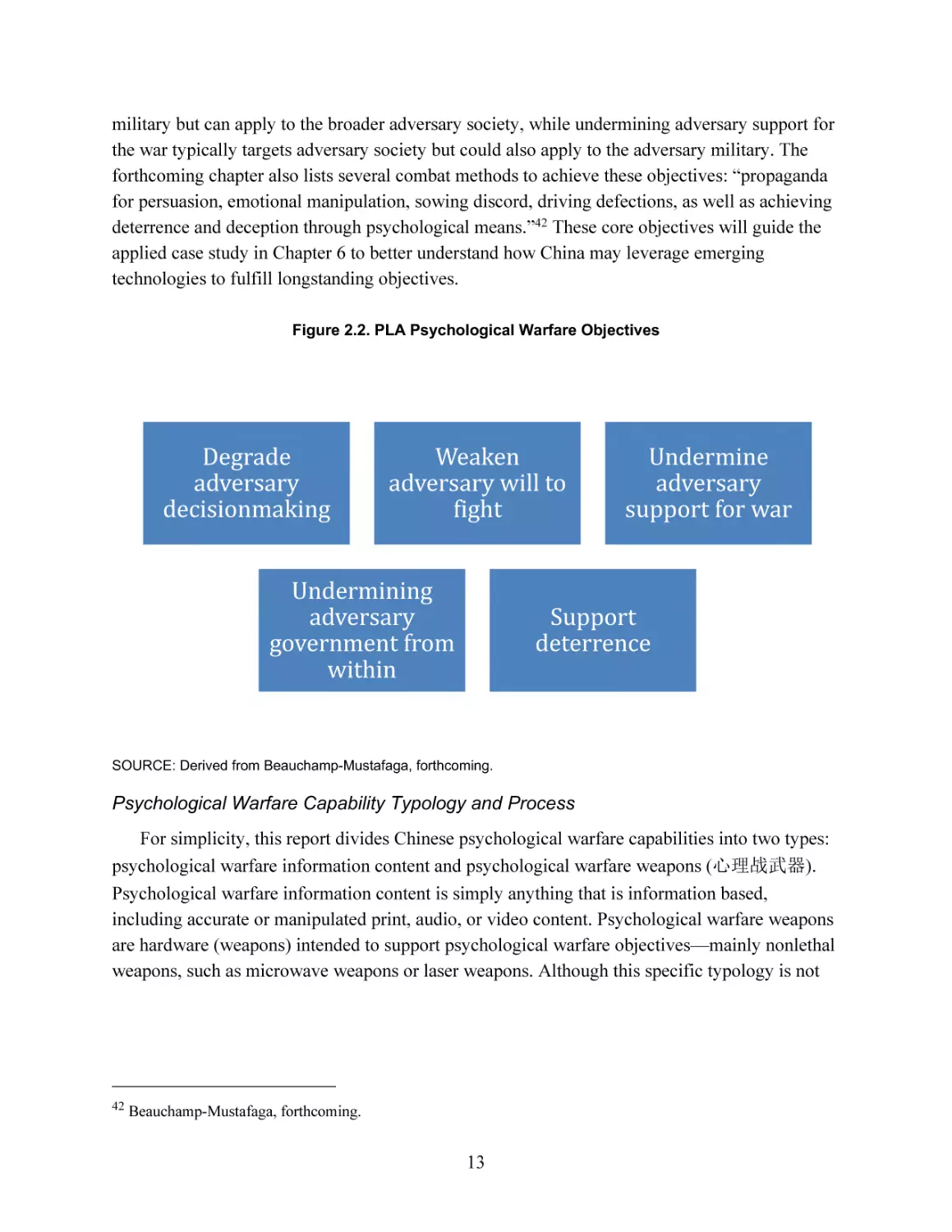
objectives [for Chinese psychological warfare] are degrading adversary decisionmaking,
weakening adversary will to fight, undermining adversary support for war, undermining
adversary government from within, along with supporting deterrence.”41 Figure 2.2 summarizes
these PLA objectives. Weakening adversary will to fight is typically targeted at the adversary

39

See, for example, Wang Yuping [王宇平], “Strengthen the Research of Psychological Warfare Under
Informatized Conditions” [加强信息化条件下心理战研究], PLA Daily [ 解放军报], May 18, 2004; Huang Haihui
[黄海辉], “Research on the Countermeasures of Psychological Warfare Under Informationized Conditions” [信息化
条件下心理战对策研究] PLA Daily [ 解放军报], July 13, 2004; Wu Juncang [武军仓] and Ji Chengfei [纪程飞],
“Summary of the Research on Psychological Warfare Under Informationized Conditions” [信息化条件下心理战研
究综述], Journal of Xi’an Politics Institute [西安政治学院学报], June 2006; Gao Mingfeng [高明峰], “On the
Development Trend of Psychological Warfare Under Informationized Conditions” [论信息化条件下心理战的发展
走向], Journal of PLA Nanjing Institute of Politics [南京政治学院学报], January 2007; Dai Quansheng [戴全生],
Kuang Yujun [旷毓君], and Li Xiangqian [李湘黔], “The Particularity of Psychological Warfare Equipment
Requirements Under Informatized Conditions” [信息化条件下心理战装备需求的特殊性], National Defense
Technology [国防科技], July 2007; Li Benxian [李本先], Ku Xishu [库锡树], and Sun Zhaolin [孙兆林], “Our
Army Psychological Warfare Weapons the Problems and Countermeasures of Equipment” [我军心理战武器装备
存在的问题及对策], Science and Technology Information (Academic Research) [科技信息(学术研究)], 2007;
Kuang Yujun [旷毓君], Zhang Lin [张霖], and Li Xiangqian [李湘黔], “Economics of Psychological Warfare
Equipment Demand Under the Condition of Information Technology Analysis” [信息化条件下心理战装备需求的
经济学分析], Contemporary Economics [当代经济], March 2008; Hao Liqun [郝立群], “The Influence of
Psychological Warfare on Soldiers’ Psychology Under the Conditions of Informationization” [信息化条件下心理
战对军人心理的影响], Journal of Xi’an Politics Institute [西安政治学院学报], May 2008.
For one explicit application of this concept, see Bu Jiang [卜江], Lao Songyang [老松杨], Bai Liang [白亮],
and Liu Haitao [刘海涛], “Research on the Mechanism of Video-Based Implied Psychological Operation” [基于视
频的心理暗示作战机理研究], Journal of the Academy of Equipment Command and Technology [装备指挥技术学
院学报], Vol. 22, No. 4, August 2011.
40
See, for example, Liao Dongsheng [廖东升] and Guo Qing [郭勤], “The Characteristics, Role, and Winning
Mechanism of Modern Psychological Warfare” [现代战争心理战特点、作用和制胜机理], National Defense
Technology [国防科技], Vol. 36, No. 1, 2015; Liao Dongsheng [廖东升], Mei Shunliang [梅顺量], Zhou Chuyun [
周楚韵], and Fu Yang [付阳], “The Application of Advanced Technologies for Psychological Warfare in Modern
Warfare” [现代战争心理战高科技运用探析], National Defense Technology [国防科技], Vol. 42, No. 1, 2021.
41
Beauchamp-Mustafaga, forthcoming.

12

military but can apply to the broader adversary society, while undermining adversary support for
the war typically targets adversary society but could also apply to the adversary military. The
forthcoming chapter also lists several combat methods to achieve these objectives: “propaganda
for persuasion, emotional manipulation, sowing discord, driving defections, as well as achieving
deterrence and deception through psychological means.”42 These core objectives will guide the
applied case study in Chapter 6 to better understand how China may leverage emerging
technologies to fulfill longstanding objectives.
Figure 2.2. PLA Psychological Warfare Objectives

Degrade
adversary
decisionmaking

Weaken
adversary will to
fight

Undermining
adversary
government from
within

Undermine
adversary
support for war

Support
deterrence

SOURCE: Derived from Beauchamp-Mustafaga, forthcoming.

Psychological Warfare Capability Typology and Process
For simplicity, this report divides Chinese psychological warfare capabilities into two types:
psychological warfare information content and psychological warfare weapons (心理战武器).
Psychological warfare information content is simply anything that is information based,
including accurate or manipulated print, audio, or video content. Psychological warfare weapons
are hardware (weapons) intended to support psychological warfare objectives—mainly nonlethal
weapons, such as microwave weapons or laser weapons. Although this specific typology is not

42

Beauchamp-Mustafaga, forthcoming.

13

common in PLA texts, it is drawn from the 2009 Lectures on Joint Campaign Information
Operations.43
Although there is no publicly available formal doctrine for Chinese psychological warfare,
especially for the operational details of planning and execution, it is possible to draw a basic
picture of how the Chinese military conceives of the psychological warfare process for
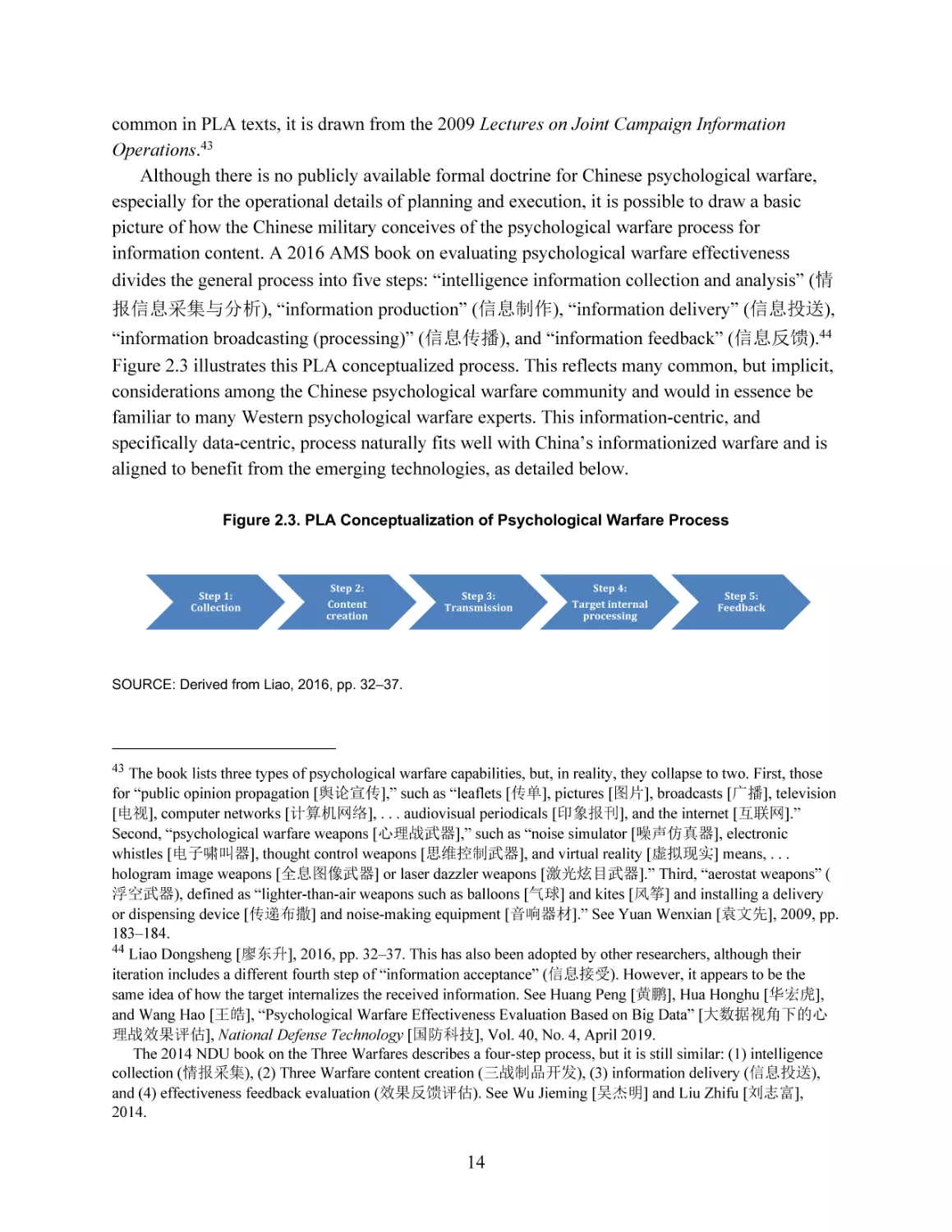
information content. A 2016 AMS book on evaluating psychological warfare effectiveness
divides the general process into five steps: “intelligence information collection and analysis” (情
报信息采集与分析), “information production” (信息制作), “information delivery” (信息投送),
“information broadcasting (processing)” (信息传播), and “information feedback” (信息反馈).44
Figure 2.3 illustrates this PLA conceptualized process. This reflects many common, but implicit,
considerations among the Chinese psychological warfare community and would in essence be
familiar to many Western psychological warfare experts. This information-centric, and
specifically data-centric, process naturally fits well with China’s informationized warfare and is
aligned to benefit from the emerging technologies, as detailed below.
Figure 2.3. PLA Conceptualization of Psychological Warfare Process

Step 1:
Collection

Step 2:
Content
creation

Step 3:
Transmission

Step 4:
Target internal
processing

Step 5:
Feedback

SOURCE: Derived from Liao, 2016, pp. 32–37.

43

The book lists three types of psychological warfare capabilities, but, in reality, they collapse to two. First, those
for “public opinion propagation [舆论宣传],” such as “leaflets [传单], pictures [图片], broadcasts [广播], television
[电视], computer networks [计算机网络], . . . audiovisual periodicals [印象报刊], and the internet [互联网].”
Second, “psychological warfare weapons [心理战武器],” such as “noise simulator [噪声仿真器], electronic
whistles [电子啸叫器], thought control weapons [思维控制武器], and virtual reality [虚拟现实] means, . . .
hologram image weapons [全息图像武器] or laser dazzler weapons [激光炫目武器].” Third, “aerostat weapons” (
浮空武器), defined as “lighter-than-air weapons such as balloons [气球] and kites [风筝] and installing a delivery
or dispensing device [传递布撒] and noise-making equipment [音响器材].” See Yuan Wenxian [袁文先], 2009, pp.
183–184.
44
Liao Dongsheng [廖东升], 2016, pp. 32–37. This has also been adopted by other researchers, although their
iteration includes a different fourth step of “information acceptance” (信息接受). However, it appears to be the
same idea of how the target internalizes the received information. See Huang Peng [黄鹏], Hua Honghu [华宏虎],
and Wang Hao [王皓], “Psychological Warfare Effectiveness Evaluation Based on Big Data” [大数据视角下的心
理战效果评估], National Defense Technology [国防科技], Vol. 40, No. 4, April 2019.
The 2014 NDU book on the Three Warfares describes a four-step process, but it is still similar: (1) intelligence
collection (情报采集), (2) Three Warfare content creation (三战制品开发), (3) information delivery (信息投送),
and (4) effectiveness feedback evaluation (效果反馈评估). See Wu Jieming [吴杰明] and Liu Zhifu [刘志富],
2014.

14

First, information must be collected on the target and target environment and analyzed to
make it useful. This aligns with the reference to “psychological reconnaissance” (心理侦察) in
peacetime in the 2013 AMS book on psychological warfare.45 Second, the information must be
tailored to be most effective against the target, given a variety of factors. This aligns with a broad
body of PLA propaganda and related literature on how to craft an effective message for a target
audience.46 Third, the information must be transmitted to the target through a variety of potential
methods. Fourth, once the information reaches the target, that person must process the
information. Fifth, the sender should observe the target, compare against the intended effects,
and continue to refine the information, and repeat the process, until the desired effect is achieved.
This fifth step is often referred to as “effectiveness evaluation” (效果评估), in line with broader
PLA interest in measuring the outcome of its operations.47
Chinese Lessons Learned from Foreign Psychological Warfare
The PLA psychological warfare community, like the rest of the PLA, pays close attention to
foreign military developments, especially from the United States and Russia.48 PLA researchers
generally ascribe high psychological warfare capabilities to both countries but clearly focus more
on the United States, reflected in Figure 2.4, on a wide range of topics. This suggests the PLA
believes that it has more to learn from the United States or that it perceives U.S. psychological
warfare as a greater threat—likely both. Common PLA case studies of Russia include the 1990s

45

Ye Zheng [叶征], 2013, pp. 159, 169.
For one overview, see Nathan Beauchamp-Mustafaga and Michael S. Chase, Borrowing a Boat Out to Sea: The
Chinese Military’s Use of Social Media for Influence Operations, Washington, D.C.: John Hopkins University,
School of Advanced International Studies, Foreign Policy Institute, 2019. For more on PLA thinking about
psychological warfare targeting, see Hu Xiaolin [胡小琳], “Psychological Factors in the Design of Psychological
Warfare Propaganda Products” [心理战宣传制品设计中的心理学因素], Military Correspondent [军事记者],
April 2009; Tan Wenfang [谭文芳], “A Psychological Analysis of the Target Audience of the Psywar Information
Transmission” [心理战信息传送的受众心理分析], National Defense Technology [国防科技], Vol. 31, No. 1,
2010; Li Hongyu [李宏宇], “Analysis of Target Groups for U.S. Military Psychological Operations” [美军心理作
战目标群体分析], Theoretical Studies on PLA Political Work [军队政工理论研究], Vol. 15, No. 6, 2014; Huang
Lu [黄璐] and She Shuanghao [佘双好], “From Tradition to Network: An Analysis of the Target Audience of
Psychological Attacks and Defense” [从传统到网络:心理攻防目标受众分析], National Defense [国防], March
2018; Xie Jun [谢军], Han Wei [韩韦], and Tan Haifeng [谭海峰], “Research on Target Selection and Sequencing
Based on Psychological Warfare” [基于心理战的目标选择及排序研究], Command Control and Simulation [指挥
控制与仿真], Vol. 44, No. 3, June 2022.

46

47

Liao, 2016; Liao Dongsheng [廖东升], Agent-Based Psychological Warfare Effectiveness Evaluation Methods
[基于 Agent 的心理战效果评估方法], Beijing: Military Science Press [军事科学出版社], 2011.
48

Andrew Scobell, David Lai, and Roy Kamphausen, Chinese Lessons from Other Peoples’ Wars, Carlisle, Pa.:
U.S. Army War College, Strategic Studies Institute, November 2011.

15

Chechen Wars and the 2008 Georgia War.49 Of note, the PLA also studies other countries’
psychological warfare, such as the United Kingdom, Germany, and Israel, as well as the North
Atlantic Treaty Organization.50

49

Wang Xiangjiang [王湘江], “The Russian Army’s Psychological Warfare in the Chechen War” [俄军在车臣战
争中的心理战], in Wang Xiangjiang [王湘江], ed., World Military Yearbook [世界军事年鉴], Beijing: PLA Press
[解放军出版社], 2001, p. 303; Qingfeng [清风], “Further Deepening of Research on Future War Theory” [对未来
战争理论的研究进一步深化], in Wang Xiangjiang [王湘江], ed., World Military Yearbook [世界军事年鉴],
Beijing: PLA Press [解放军出版社], 2004; Shao Junwu [邵俊武], “The Political and Psychological Attack of the
Russian Army in the Chechen War” [车臣战争中俄军的政治攻心战], Political Work [政工学刊], July 2008;
Wang Benliang [王本亮] and Li Chengtao [李成韬], “A Study on the Characteristics of Quick Counter-Attack of
Russian Army to Georgian Army” [俄军快速反击格军的作战特点分析], National Defense Technology [国防科技
], Vol. 30, No. 1, February 2009; Ling Yan [凌龑] and Wei Changchun [魏长春], “Probe into Intelligence Activities
of the Russian Military in the 2nd War of Chechnya” [第二次车臣战争中俄军情报活动探析], Military History [军
事历史], September 2021.
50

Wang Xinyuan [王鑫元], “Using Psychological Warfare Within the NATO Crisis Management System” [北约危
机管理体系中的心理战运用], Theoretical Studies on PLA Political Work [军队政工理论研究], 2016.
For a 1991 PLA review of global psychological warfare, see various chapters in a 1991 yearbook: “Military
Psychological Research: British Psychological Operations Research” [军事心理学研究: 英国的心理战研究],
“Military Psychological Research: Federal Republic of Germany” [军事心理学研究: 联邦德国的心理战研究], and
“Military Psychological Research: NATO Psychological Operations Research” [军事心理学研究: 北约的心理战研
究], in Wang Xiangjiang [王湘江], ed., World Military Yearbook [世界军事年鉴], 1991. For a similar 2007 review,
see Wang Xiangjiang [王湘江], “Research on Japanese Self-Defense Force’s Operational Issues: The Development
Trend of Japanese Self-Defense Force’s Psychological Operations” [日本自卫队作战问题研究; 日本自卫队心理
战的发展趋], in Wang Xiangjiang [王湘江], ed., World Military Yearbook [世界军事年鉴], Beijing: PLA Press [
解放军出版社], 2007.
Researchers at Base 311 also did a review of foreign psychological warfare over 2013–2014: Li Wei [李蔚],
“The Characteristics of the British Psychological Operation Force” [英军心理战部队特点], National Defense
Technology [国防科技], Vol. 34, No. 2, 2013; Li Wei [李蔚], “Overview of German Psychological Warfare Force”
[透视德军心理战部队], National Defense Technology [国防科技], Vol. 35, No. 2, 2014; Li Wei [李蔚], Deng
Erong [邓娥荣], and Zong Meng [宗萌], “Canadian Army Psychological Warfare Strength and Development
Trend” [加拿大军队心理战力量及发展趋势], Theoretical Research on Military Political Work [军队政工理论研
究], Vol. 16, No. 5, 2015.
See also Zhang Miao [张苗] and Li Yongcheng [李泳呈], “The Myth of Israel’s Modern ‘Blitzkrieg’:
Psychological Warfare in ‘Operation Cast Lead’” [以色列现代“闪电战”神话—“铸铅行动”中的心理战],
Military Digest [军事文摘], 2019.

16

Figure 2.4. Comparison of PLA Interest in U.S. Versus Russian Psychological Warfare Since 2000

Number of Articles Referencing the United States and Russia in
PLA-Affiliated Research on Psychological Warfare
70
60
50
40
30
20
10

20
00
20
01
20
02
20
03
20
04
20
05
20
06
20
07
20
08
20
09
20
10
20
11
20
12
20
13
20
14
20
15
20
16
20
17
20
18
20
19
20
20
20
21

0

United States

Russia

SOURCE: Author’s counts derived from database queries.
NOTE: Relevant articles are defined as those that mention psychological warfare in titles, abstracts, or keywords; are
either authored by those affiliated with the PLA or published in PLA-run journals; and mention either the United States
or Russia in the full-article text. Articles may be double counted if they mention both countries.

The Role of Technology in China’s Psychological Warfare Approach
Technology has been a key driver of Chinese military capabilities; in turn, strategy, as well
as psychological warfare, is often no different.51 The 2013 AMS Science of Military Strategy
explains, “When revolutionary advancement appears in science and technology, a revolutionary
change in the war form-state follows.”52 Chairman Xi Jinping made a similar point of
technological progress leading to military change during his May 2018 visit to the AMS.53 At the
51

For a broader discussion of how technology shapes Chinese military strategy, see Taylor Fravel, Active Defense:
China’s Military Strategy Since 1949, Princeton, N.J.: Princeton University Press, 2019. For historical perspective,
see Harlan W. Jencks, From Muskets to Missiles: Politics and Professionalism in the Chinese Army, 1945–1981,
Boulder, Colo.: Westview Press, 1982; Ellis Joffé, The Chinese Army After Mao, London: Weidenfeld and Nicolson,
1987; David Shambaugh, Modernizing China’s Military: Progress, Problems, and Prospects, Berkeley: University
of California Press, 2002.
52
People’s Liberation Army, Academy of Military Science, Military Strategy Department [军事学学院战略研究部
], 2013, p. 91.
53
Zhang Zhihao, “President Calls for Stronger Military Science Studies,” China Daily, May 17, 2018. For analysis
of how AMS is embracing science and technology (S&T) research and development (R&D), see Joel Wuthnow,
“China’s ‘New’ Academy of Military Science: A Revolution in Theoretical Affairs?” China Brief, January 18, 2019.

17

same time, the 2013 AMS Science of Military Strategy warns against a myopic and overzealous
adoption of technology as a solely war-winning strategy: “it is also necessary to prevent ‘blind
faith in science and technology’ and ‘the theory of the unique importance of weapons,’ and [to
avoid] exaggerating the impact that the key factor of science and technology has on military
strategy and to regard this impact as absolute.”54 In recent decades, according to the 2013 AMS
Science of Military Strategy, the defining advancement of technology has been the advent of
information technology, which led to what the PLA describes as informatized warfare (信息化
战争).55
PLA authoritative strategy texts have further drawn this connection between technological
progress, especially for information systems, and psychological warfare. The 2001 AMS Science
of Military Strategy explains that psychological warfare’s importance is growing because of
improved technology: “Due to the immaturity of its theory and limitations posed by scientific
and technological conditions, psychological warfare had been restricted. . . . With the extensive
application of modern science and technologies in the military realm represented by information
technology, psychological warfare has revealed even greater importance.”56 It further adds, “The
development of modern science and technology has now provided a solid foundation for the
expansion of the means and methods of psychological warfare.”57 The 2006 Science of
Campaigns makes explicit this link between modern information technology and psychological
warfare, stating, “The development of informationized war has decided the inevitable enlarged
role of psychological warfare and that objectively requires placing psychological warfare in a
more important position.”58 This aligns with the 2013 AMS Science of Military Strategy, which
heralds the internet as a key technology for information operations—and thus also psychological
warfare: “The rapid development of new media as represented by the internet has made the right
of speech become yet another form of expression of seizing and holding the initiative in local
war under informationized conditions.”59

54

People’s Liberation Army, Academy of Military Science, Military Strategy Department [军事学学院战略研究部
], 2013, p. 17 (quoting popular phrases).
55
People’s Liberation Army, Academy of Military Science, Military Strategy Department [军事学学院战略研究部
], 2013, p. 4. Other modern technologies specifically referenced by the 2013 AMS Science of Military Strategy
include “microelectronics technology, electro-optical technology, computer technology, nuclear technology, space
technology, new materials technology, new energy technology, bioengineering technology, among others” (p. 91).
56
People’s Liberation Army, Academy of Military Science, Military Strategy Department [军事科学院战略研究部
], 2001, p. 371 (translation via Peng Guangqian [彭光谦] and Yao Youzhi [姚有志], Science of Military Strategy,
Beijing: Military Science Publishing House [军事科学出版社], 2005).
57
People’s Liberation Army, Academy of Military Science, Military Strategy Department [军事科学院战略研究部
], 2001, p. 373 (translation via Peng Guangqian [彭光谦] and Yao Youzhi [姚有志], 2005).
58
Zhang Yuliang [张玉良], 2006, p. 203.
59
People’s Liberation Army, Academy of Military Science, Military Strategy Department [军事学学院战略研究部
], 2013, pp. 131, 189.

18

This link is also found in PLA psychological warfare teaching materials. The 2014 NDU
book on the Three Warfares states, “Under informationized conditions, the time and space for the
‘Three Warfares’ is becoming broader, its professionalization is becoming higher, and its
technology is becoming more advanced.”60 It adds, “Equipment is the material and technical
basis for ‘Three Warfares’ operations. Under informationized conditions, ‘Three Warfares’
equipment shows strong technical warfare performance, wide variety, distant projection, and
high utilization rate,” and the “‘Three Warfares’ equipment and warfare platforms with their own
characteristics are urgently needed for the future military struggle,” although the PLA still (as of
2014) needed to construct a “systematized equipment and material platform based on
information systems” (基于信息系统体系化装备器材平台).61 The 2013 AMS information
operations book similarly repeats the oft-cited idea that any new technological development, if
applicable to the military domain, will inevitably be adopted for warfare.62 It makes the further
argument, however, that weapons and operations in the physical domain—for example, kinetic
weapons, such as precision-guided missiles—are reaching their limits, driving a requirement
toward embracing future progress in the information domain.63
Looking forward, the coming age of intelligentized warfare (智能化战争) should herald a
similarly new era of psychological warfare. However, several questions remain. First, the PLA
has not yet publicly and formally embraced the idea that intelligentized warfare is the current
form of warfare, nor has it publicly and formally updated its military strategic guidelines to
reflect its own evolution to this form of warfare—although this could well come soon with the
next defense white paper.64 The 2020 NDU Science of Military Strategy suggests that the PLA is
already making this shift privately, as it updated much of the text to reference intelligentization
(智能化), and this was specifically applied to wartime political work, which is intimately related
to psychological warfare.65 Second, it is unclear what specifically will change in practice as the
PLA broadly embraces intelligentization, since many of its tenets are already being applied, or at
least considered, for psychological warfare. One likely possibility is that not much will change
immediately, but, over the long term, psychological warfare will simply keep pace with the
Chinese military’s broader embrace of AI-driven warfare. Third, so far there have been no
observed references to what would logically be the overarching updated concept of
psychological warfare under intelligentized conditions (智能化条件下心理战) and limited
60

Wu Jieming [吴杰明] and Liu Zhifu [刘志富], 2014, p. 212.
Wu Jieming [吴杰明] and Liu Zhifu [刘志富], 2014, pp. 217, 220.
62
For combat methods, see Ye Zheng [叶征], 2013, p. 62.
63
Ye Zheng [叶征], 2013, p. 59.
64
For current PLA thinking on intelligentization, see Michael Dahm, “Chinese Debates on the Military Utility of
Artificial Intelligence,” War on the Rocks, June 5, 2020.
65
Xiao Tianliang [肖天亮], ed., Science of Military Strategy [战略学], Beijing: National Defense University Press [
国防大学出版社], 2020. For analysis, see Joel Wuthnow, “What I Learned from the PLA’s Latest Strategy
Textbook,” China Brief, May 25, 2021.
61

19

references to perhaps a more colloquial version, intelligentized psychological warfare (智能化心
理战).66 Any evidence of such changes should be watched carefully.
The question, then, is not whether emerging technologies will change China’s approach to
psychological warfare, but which capabilities China will pursue and how it may employ them.
The next chapter explores how China’s evolving views of the cognitive domain are affecting
its thinking on current and future psychological warfare.

66

Liang Xiaobo [梁晓波], “Cognitive Intelligence Language Weapon” [认知智能语言武器], PLA Daily,
December 20, 2019.
For a more recent article about the implications of AI for psychological warfare, which was published after my
research was completed, see Zhang Yue [张悦], Zhu Li [朱利], Lian Qianqian [练倩倩], Han Leng [韩冷], Liu Li [
刘丽], and Zhang Lixiao [张立肖], “Artificial Intelligence Is About to Accelerate and Provide Insights for
Psychological Warfare Reform” [人工智能即将催生的心理战变革及启示], National Defense Technology [国防科
技], Vol. 43, No. 2, April 2022.

20

3. People’s Liberation Army Views of the Cognitive Domain

This chapter explores how the PLA conceives of the cognitive domain, provides a brief
history of how its views have evolved, explains how the cognitive domain relates to current and
future warfare, and then broadly surveys evolving PLA operational concepts for the cognitive
domain and psychological warfare.
The PLA views the cognitive domain as increasingly central for future warfare, especially
because the human decisionmaking element of warfare will be increasingly decisive as the actual
warfighting becomes more automated and removed from human involvement. Although the PLA
was originally slow, in its own telling, to realize the cognitive domain’s importance, there is now
much more theoretical and practical research being done. This extends to how to operate in the
cognitive domain and thus requires developing operational concepts that seek to seize command
of the cognitive domain, mostly by targeting adversary cognitive functions (and by improving
one’s own). Although one operational concept, cognitive domain operations (认知域作战)
appears to be gaining traction, there is much debate about what this means in both theory and
practice, and many questions are left unresolved. This is certainly a space to watch for how the
PLA understands the future of warfare.

The Mind as a Domain of Warfare
The Chinese military is increasingly recognizing the cognitive domain (认知域) as a domain
of warfare.67 Although the PLA, adopting a Western lens, historically focused on the core
domains of land, sea, and air—and then added cyber and space over the 1990s and 2000s—an
increasingly common overarching framing for the PLA uses the physical domain (物理域),
information domain (信息域), and cognitive domain.68 Figure 3.1 illustrates the prevalence of
the cognitive domain and related terms in the PLA Daily as one benchmark for broader PLA
interest and awareness over time.

67

This is also sometimes rendered as 认知领域 or 认知空间.
For some discussion of PLA interest in the cognitive domain, see P. K. Mallick, Defining China’s
Intelligentized Warfare and Role of Artificial Intelligence, New Delhi: Vivekananda International Foundation,
March 2021; Pollpeter and Kerrigan, 2021.
68
Li Yi [李义], “Cognitive Confrontation: A New Domain for Future Warfare” [认知对抗: 未来战争新领域], PLA
Daily, January 28, 2020.

21

Figure 3.1. Increasing PLA Interest in the Cognitive Domain

PLA Daily Articles
Referencing Cognitive Domain and Related Terms
50
40
30
20
10

Cognitive Domain

Cognitive Domain Confrontation

20
20

20
18

20
16

20
14

20
12

20
10

20
08

20
06

20
04

20
02

20
00

0

Command of the Mind

SOURCE: Author’s counts derived from database queries.
NOTE: Cognitive domain can be translated as 认知域, 认知空间, or 认知领域. Cognitive domain confrontation can be
translated as 认知领域对抗, 认知域对抗, 认知空间对抗, or 认知对抗. Command of the mind can be translated as 制脑
权.

Understanding the Cognitive Domain
The cognitive space (认知空间) is defined as “the area in which feelings, perception,
understanding, beliefs, and values exist, and is the field of decision-making through reasoning,”
according to a 2017 PLA Daily article coauthored by Zeng Huafeng, a leading PLA theorist at
NUDT who coauthored a 2014 PLA Press book that helped popularize the idea.69 Zeng adds that
it has “intangible factors,” such as “leadership, morale, cohesion; training level and experience;
situational awareness and public opinion.” Zeng also explains that the “cognitive space is the
scope and field involved in human cognitive activity, reflecting the intangible space of human
emotions, will, beliefs, and values, which exists in the minds of the participants in the
struggle.”70 Similarly, a 2020 PLA Daily article noted that the idea of the cognitive space is
based on the concept in psychology referring to the process of subjective understanding of
objective things and defined it as “the space of sensation, perception, memory, and thinking
activities. It is also the world of perception, judgment, as well as command and control in combat
69

Zhu Xueling [朱雪玲] and Zeng Huafeng [曾华锋], “Command of the Mind Operations: New Model of Future
Wars” [制脑作战:未来战争竞争新模式], PLA Daily, October 17, 2017 (translation drawn from Nathan
Beauchamp-Mustafaga, “Cognitive Domain Operations: The PLA’s New Holistic Concept for Influence
Operations,” China Brief, Vol. 19, No. 16, September 6, 2019); Zeng Huafeng [曾华锋] and Shi Haiming [石海明
], Command of the Mind: The Rules of War and National Security Strategy in the Global Media Age [制脑权: 全球
媒体时代的战争法则与国家安全战略], Beijing: PLA Press [解放军出版社], 2014.
70
Zhu Xueling [朱雪玲] and Zeng Huafeng [曾华锋], 2017 (translation drawn from Beauchamp-Mustafaga, 2019).

22

activities. It is a category composed of perception, understanding, beliefs, and values.” The
article adds that the cognitive space “reflects people’s knowledge, beliefs, and abilities” and is
usually apparent in the “cohesion of troops, combat experience, training level, and the degree of
battlefield situation awareness.”71
Zeng and his coauthor, Shi Haiming of NUDT, make the argument in their 2014 book that
although the cognitive domain has been previously overlooked, it has indeed always been
around. They argue that the cognitive domain is both young and old: old because it has always
been around, since psychological warfare has always occurred in the cognitive domain, and
young because major militaries are now getting interested in the domain and related concepts.
Zeng and Shi frame such U.S concepts as strategic communication (战略传播), public
diplomacy (公共外交), ideological warfare (思想战), and cognitive warfare (认知战), along
with the Russian concepts of ideological warfare (思想战), strategic psychological warfare (战
略心理战), strategic information warfare (战略信息战), and media warfare (媒体战), within
the context of an emerging contest over the cognitive domain.72
This retrospective look extends to recasting the cognitive domain as important to
understanding the collapse of the Soviet Union, a key turning point in history for Zeng and Shi,
reflecting broader Chinese Communist Party (CCP) concern—especially in the early 2010s
under Xi Jinping.73 The authors specifically attribute this to a “quiet war” and “special war” that
was “carefully planned, arranged, and launched by the United States,” with an “imperceptible
ideological attack on the Soviet Union’s cognitive space” and “long-term manipulation of
ideology,” which resulted in “the meanings of the concepts of country, nation, and politics
[being] dismembered or subverted, and the people’s ideology gradually fell into chaos” and
caused “deep nihilism.” They conclude, “The battlefield of this war is very different from the
battlefields of all other wars in history. The main implication of the difference here is that the
cognitive space is a brand-new battlefield, in which the competition is different from the war
between natural space and technological space.”74
Passing References in Older Authoritative Texts
The 2006 Science of Campaigns mentions the cognitive domain once:
71

Li Yi [李义], 2020.
Zeng Huafeng [曾华锋] and Shi Haiming [石海明], 2014, p. 1.
73
David Shambaugh, China’s Communist Party: Atrophy and Adaptation, Berkeley: University of California Press,
2008; Chris Buckley, “Vows of Change in China Belie Private Warning,” New York Times, February 14, 2013. For a
PLA view of this linking to the cognitive domain, see Lan Zhouda [兰舟达] and Ma Jianguang [马建光], “New
Cyber Warfare from the Perspective of Mind Superiority: Taking the Color Revolutions as an Example” [制脑权视
野下的新型网络战: 以颜色革命为例], National Defense Technology [国防科技], April 2015. For PLA views on
the U.S. ideological role in the Soviet Union’s collapse, see the 2013 PLA NDU Silent Contest; (较量无声) movie;
a partial transcript is available in “Silent Contest,” China Scope, March 5, 2014.
74
Zeng Huafeng [曾华锋] and Shi Haiming [石海明], 2014, pp. 2–3.
72

23

The scope of the confrontation between the enemy and us is no longer limited in
the physical domain, such as force strength and weaponry. It has expanded to the
information domain and the cognitive domain [认知领域], so the importance of
information has increased daily. Centering on these two domains, information
warfare and psychological warfare are unfolded. They will become the important
content of a campaign under informationized conditions, requiring one to
accomplish knowing the opponent and knowing yourself in all areas of land, sea,
air, space, electromagnetic, and psychological [心理], and further increasing
requirements.75

The 2011 PLA dictionary frames the cognitive domain as an overarching place of conflict,
although it does not explicitly include it as one of the five domains of warfare: “In contemporary
times, the land, sea, air, space, and cyber-electromagnetic spaces [domains], along with the
cognitive domain, are multidimensional in nature.”76 The 2011 PLA dictionary includes the
cognitive domain alongside these five main domains when discussing informationized warfare,
integrated joint operations, full-dimension operations (全维作战), and the details of the cyberelectromagnetic space.77
The 2013 AMS Science of Military Strategy frames the cognitive domain in relation to the
network or cyber domain (网络空间). It describes the cyber domain as “[possessing]
unprecedented openness, transparency, and fusion natures [and] is deeply interwoven with the
physical domain [物理域], information domain [信息域], and cognitive domain [认知域]; can
break through the constraints of geographical and time factors; and realize unprecedented broad
linkage, connectivity, and operations within a global scope at the speed of light.”78 However,
none of these older authoritative texts expands on the cognitive domain’s importance in current
or future warfare and military operations.
Popularizing the Cognitive Domain
Although there was some PLA research done on operations in the cognitive domain (认知域
的作战) as early as 2005, deeper theoretical research was not conducted until in the mid-2010s,
as the PLA became more focused on first defending against, and then offensively employing,
information-manipulation strategies by other countries.79
The first popular theoretical research appears to have been conducted by two NUDT
professors, Zeng Huafeng and Shi Haiming, in the early 2010s. Most notably, they published a
75

Zhang Yuliang [张玉良], 2006, p. 93.
All Army Military Terminology Management Committee, 2011, p. 45.
77
All Army Military Terminology Management Committee, 2011, pp. 48, 68, 72, 288.
78
People’s Liberation Army, Academy of Military Science, Military Strategy Department [军事学学院战略研究部
], 2013, p. 243. The standard translation is knowledge realm, but I have revised for consistency.
79
For one overview, see Beauchamp-Mustafaga, 2019. For early PLA IEU interest in the topic, see Ju Naiqi [巨乃
岐], “On the New Cognition-Fighting View in Information Age” [试论信息时代的新知战观], Oriental Forum [东
方论坛], October 2011.
76

24

book by PLA Press in 2014 entitled Command of the Mind: The Rules of War and National
Security Strategy in the Global Media Age (制脑权: 全球媒体时代的战争法则与国家安全战
略).80 However, it appears that Lu Jixuan, a PLA researcher at the Nanjing Political Institute,
was the first to actually coin the concept and that Zeng and others subsequently borrowed from
Lu.81
Another round of popular interest was spurred by Wu Mingxi, a Chinese military futurist at
the Chinese Academy of Ordnance Science. Wu published a 2020 book entitled Intelligentized
Warfare: AI Military Imagination that included some discussion of the cognitive domain.82 In
Wu’s telling, the era of intelligentized warfare means that all conflict is cognitive conflict.
Moreover, Wu launched a wide-ranging book tour across Chinese defense industry–affiliated
media.83
Growing Recognition Within the PLA
Although this new domain has not been addressed in depth in any authoritative texts, it
appears to be gaining acceptance within the PLA. The 2020 NDU edition of Science of Military
Strategy noted that the “basic operational form” (基本作战形式) has evolved from “integrated
joint operations” (一体化联合作战) to “multidomain integrated joint operations” (多域一体化
联合作战), which includes coordination across the “land, sea, air, space, cyber, the

80

Zeng Huafeng [曾华锋] and Shi Haiming [石海明], 2014. Earlier relevant research by Zeng and Shi includes Shi
Haiming [石海明] and Zeng Huafeng [曾华锋], “The Communication of Military Technology: Visual Image,
Cognition and War” [军事科技传播: 视像、认知与战争], Journal of Changsha University of Science and
Technology (Social Science) [长沙理工大学学报 (社会科学版)], July 2011; Zeng Huafeng [曾华锋] and Shi
Haiming [石海明], “On National Cognitive Space Security Strategy” [论国家认知空间安全战略], Theoretical
Studies on PLA Political Work [军队政工理论研究], May 2013.
81
Lu Jixuan [逯记选], The Radiating Summit of Psychological Warfare: Research on Cognitive Domain
Operations in Modern Warfare [心战之巅的光芒:现代战争中的认知域作战研究], Shenyang, China: Baishan
Press [白山出版社], 2012.
82

Wu Mingxi [吴明曦], Intelligentized Warfare: AI Military Imagination [智能化战争: AI 军事畅想], Beijing:
National Defense Industry Press [国防工业出版社], 2020a.
83

Various articles were published in Ordnance Knowledge (兵器知识) and other similar outlets. For recent articles
by Wu, see Wu Mingxi [吴明曦], “Virtual Space Technology: The Way [Dao] Is Invisible but Tangible” [虚拟空间
技术; 道是无形却有形], PLA Daily [解放军报], May 15, 2020b; Wu Mingxi [吴明曦] and Ma Bole [马伯乐],
“Using Intelligence to Drive Capability and Use Algorithms to Win Wars” [以智驭能 算法制胜], PLA Daily [解放
军报], August 7, 2020; Wu Mingxi [吴明曦] and Zhu Dan [朱丹], “The Influence of Artificial Intelligence on the
Military Domain” [人工智能对军事领域的影响], Dual Use Technologies and Products [军民两用技术与产品],
November 2020, pp. 9–11; Wu Mingxi [吴明曦], “The Era of Intelligent War Is Coming Rapidly” [智能化战争时
代正在加速到来], Frontiers [人民论坛: 学术前沿], June 2021. For earlier relevant work, see Yang Jian [杨建],
Liu Jin [刘进], Wu Mingxi [吴明曦], and Tao Huacheng [陶化成], “Brain-Computer Technology Development and
Its Impact on the Military” [脑机技术发展及其对军事领域的影响], National Defense Technology [国防科技],
Vol. 34, No. 6, 2013.

25

electromagnetic spectrum, and the knowledge/cognitive (智) domains.”84 The lack of mention of
the information domain is interesting but can be explained by the inclusion of its common
consistent parts: cyber and electromagnetic. Although earlier editions of the NDU Science of
Military Strategy referenced the cognitive domain, the reference to multidomain operations and
the inclusion of the cognitive domain suggest greater interest. A 2020 PLA Daily article
explained the importance of the cognitive domain, describing it as the “strategic commanding
heights of future wars” (未来战争的战略制高点).85
Future references in authoritative PLA texts to the importance of operating in and seizing the
initiative in the cognitive domain (such as in a new defense white paper or new edition of the
AMS or NDU Science of Military Strategy) would suggest that the concept of the cognitive
domain has been accepted at higher levels of Chinese military leadership. This would likely also
spur further development and publication of new theories and capabilities targeted at this “new”
domain of warfare.
Drivers of PLA Interest in the Cognitive Domain
This PLA interest in the cognitive domain appears to have been in large part driven by the
United States’ operational concepts in this area.86 U.S. doctrine has included the cognitive
domain as a domain of warfare since the advent of network centric warfare, most notably the
2006 Joint Publication 13-3, Information Warfare.87 The publication defined the cognitive
dimension as “encompass[ing] the mind of the decision maker and the target audience (TA).” It
adds,
This is the dimension in which people think, perceive, visualize, and decide. It is
the most important of the three dimensions. This dimension is also affected by a
commander’s orders, training, and other personal motivations. Battles and
campaigns can be lost in the cognitive dimension. Factors such as leadership,
morale, unit cohesion, emotion, state of mind, level of training, experience,
situational awareness, as well as public opinion, perceptions, media, public
information, and rumors influence this dimension.88

Further, Joint Publication 13-3 clearly states that “psychological operations” can target the
cognitive domain to “influence” the adversary, and “military deception” can similarly target the
cognitive domain to “mislead” the adversary, along with “civil military operations,” “public
84

智 appears so far to be fairly interchangeable with 认知 so far. See Xiao Tianliang [肖天亮], 2020, p. 265. For
analysis, see Wuthnow, 2021. The only PLA Daily article to use 智域 is Li Minghai [李明海], “Where Has the
Winning Mechanism of Intelligentized Warfare Changed?” [智能化战争的制胜机理变在哪里], PLA Daily,
January 15, 2019.
85
Li Yi [李义], 2020.
86
Beauchamp-Mustafaga, 2019.
87
See U.S. Department of Defense, Network Centric Warfare, Washington, D.C., July 27, 2001; Joint Publication
3-13, Information Operations, Washington, D.C.: Joint Chiefs of Staff, February 2006.
88
Joint Publication 3-13, 2006, p. I-2.

26

affairs,” and “public diplomacy” to “influence” and “inform” via the cognitive domain.89 All of
this is to be done by a mix of private companies, governments, and militaries.
In addition, the PLA—and broader Chinese government—perceived this U.S. doctrine in
action over the 2000s and 2010s with color revolutions in former Soviet republics and unrest in
the Middle East.90 As the 2015 NDU Science of Military Strategy states, “Since the beginning of
the 21st century, cyberspace has been used by some countries to launch ‘color revolutions’
against other countries . . . [through] behind-the-scenes operations using social networking sites
such as Twitter and Facebook as the engine, from manufacturing network public opinion to
inciting social unrest.”91 The key moment appears to have been the 2009 Iranian protests,
specifically linked to social media, although each new eruption of resistance to authoritarian
regimes around the world, always driven by the internet, reaffirms Beijing’s belief that the
United States and others are a threat to CCP regime security.
Another likely driver of PLA interest is the PLA concept of all-domain operations (全域作
战), which Xi embraced at the end of 2015 as he announced the major PLA reforms.92 Although
the PLA has not formalized which domains are included, the cognitive domain is included by at
least some PLA researchers.93 For example, a 2018 article by an AMS researcher on the topic
included the cognitive domain as one of four main domains (physical, information, cognitive,
and societal).94 The author links the cognitive domain with the cyber, electrical, land, and space
domains. The visual representation is translated in Figure 3.2.

89

Joint Publication 3-13, 2006, p. I-7.
For some PLA articles framing political revolutions in terms of command of the mind, see Lan Zhouda [兰舟达]
and Ma Jianguang [马建光], 2015; Li Donghang [李东航], “We’re Already in a War for Command of the Mind” [
我们已然身处一场制脑权战争中], PLA Daily, May 22, 2015. For further research, see Beauchamp-Mustafaga,
2019.
91
Xiao Tianliang [肖天亮], ed., Science of Military Strategy [战略学], Beijing: National Defense University Press [
北京国防大学出版社], 2015 (translation via Beauchamp-Mustafaga and Chase, 2019).
92
“Xi Jinping Confers Service Flags and Delivers Instructions to the Army, Rocket Force, and Strategic Support
Force of the Chinese People’s Liberation Army” [习近平向中国人民解放军陆军火箭军战略支援部队授予军旗
并致训词], Database of Xi Jinping’s Series of Important Speeches [习近平系列重要讲话数据库], January 2, 2016.
The concept was also included in Xi’s 2017 19th CCP National Congress report: Xi Jinping, “Secure a Decisive
Victory in Building a Moderately Prosperous Society in All Respects and Strive for the Great Success of Socialism
with Chinese Characteristics for a New Era,” speech at the 19th National Congress of the Communist Party of
China, October 18, 2017.
93
For more on all-domain operations, see Derek Solen, “Chinese Views of All-Domain Operation,” China
Aerospace Studies Institute, August 2020.
94
Li Ming [李明], “A Study on Related Problems of Whole Domain Operational Capability Evaluation” [全域作战
能力评估相关问题研究], Military Operations Research and Systems Engineering [军事运筹与系统工程], January
2018.
90

27

Figure 3.2. One PLA View of the Relationship Between the Cognitive Domain and Other Domains

SOURCE: Li Ming [李明], 2018; translation overlay reprinted from Beauchamp-Mustafaga, 2019.

The establishment of the PLASSF in 2015 was likely one early, related outcome of these
drivers and related research. The PLASSF’s mission to better integrate psychological warfare
into broader PLA operations—specifically, the PLASSF’s other key mission areas of cyber,
space, and electronic warfare (EW)—reflected ongoing PLA research and concept development
around information for current and future warfare.
Key Theoretical Frameworks
The identification of a new domain of warfare thus also translates to a related objective to
achieve control over that domain, which PLA strategists refer to most commonly as mind
dominance (制脑权)—better translated as command of the mind.95 As noted above, the PLA has
long framed its military theory around the desire to control each domain of warfare, and an
identification of a new domain would naturally generate a new objective to control that domain,
in this case the mind. Zeng, in his 2017 PLA Daily article, makes this link clear.96 He argues,
“With the development of brain science and technology, a new form of warfare with the brain as
95

Zeng Huafeng [曾华锋] and Shi Haiming [石海明], 2014. This may be different than from command of
knowledge (制智权), but it is currently unclear. For articles referencing both, see, among others, Qi Jianguo [戚建
国], “Seize the Commanding Heights of Artificial Intelligence Technology Development” [抢占人工智能技术发展
制高点], PLA Daily, July 25, 2019; Liang Xiaobo [梁晓波], 2019.
96
Zhu Xueling [朱雪玲] and Zeng Huafeng [曾华锋], 2017.

28

the carrier and the cognitive space as the battlespace is quietly taking place. The struggle for
‘command of the mind’ has become a new strategic high point for the military powers in the
world to compete with each other.” Zeng further argues that “effectively influencing the
opponent’s cognition and achieving ‘victory without fighting’ has always been the highest level
of war instruction.” However, PLA military theory suggests the more appropriate concept would
be command of cognition (制认知权), which some PLA researchers have begun to use.97
Relatedly, each domain of warfare has its own unique attributes of “confrontation,” thus
leading to the idea of cognitive confrontation (认知对抗).98 Future warfare will occur across the
physical, information, and cognitive domains, and thus cognitive confrontation will be one key
part of future warfare (alongside firepower confrontation [火力对抗] and information
confrontation [信息对抗], for example). As one 2020 PLA Daily article explains:
Brain-controlled warfare [脑控战] is the development trend of military
confrontation in cognitive space. This mainly uses cultural dissemination [文化
传播], public opinion guidance [舆论引导], biological weapons [生物武器], and
other means to destroy the opponent’s cognitive ability [认知能力] and protect
one’s own cognitive ability. Gaining combat momentum in cognitive
confrontation, along with the command of control [控制权] and discourse power
[话语权], in turn affect the information acquisition and decisionmaking behavior
for the control mode of combat command, so as to achieve the purpose of
determining the victory and defeat of the war situation [战局].99

Finally, since each domain has its own unique attributes of deterrence, there is even cognitive
deterrence.100
Role of the Cognitive Domain in Warfare
Overall, because the PLA believes that the advent of AI and other macro trends will make
warfare faster paced and more complicated, this change places a premium on human
decisionmaking. As the medium for decisionmaking, the human mind is a critical place of
conflict—being able to degrade the adversary’s collective and individual ability to process
information and make informed decisions at the speed of relevance would provide an immense

97

Chen Dongheng [陈东恒], “Command of Cognition: An Important Support for Winning a War” [制认知权: 战
争制胜重要支撑], PLA Daily, April 19, 2022.
98

For the PLA at a basic level, war (争) revolves around different types of confrontation (对抗, such as mechanized
or systems confrontation), which employ various types of operations (作战, such as landing operations) to carry out
larger campaigns (战役) and can involve different types of warfare (战) based on the battlespace. I thank Jeff
Engstrom for this point.
99
This use of “brain-controlled warfare” appears to be inconsistent with or conflate the more common PLA
conceptual framework. Li Yi [李义], 2020.
100
Xie Kai [谢恺], Sun Hongwei [孙宏伟], and Li Wenqing [李文清], “Pay Attention to New Features of Strategic
Deterrence” [关注战略威慑新特点], PLA Daily, November 30, 2021.

29

advantage. This conception of future warfare reflects perhaps an even greater focus on the
human element as the decisive factor for winning or losing, even as the actual fighting is
increasingly removed from human operations. As one 2019 article on the implications of AI for
PLA political work remarked:
The reality of “zero casualties” in intelligentized operations is possible. [In this
era] the competition in the cognitive domain is more intense, and political work
must focus on psychological victory and strengthen the fighting spirit. War
inevitably leads to bloodshed, disability, and death. However, in intelligentized
operations unmanned combat platforms have become the main body of combat
forces, and humans and weapons have achieved a certain degree of physical
separation. The main loss on the battlefield will change from [human] casualties
to machine damage, and combat personnel casualties will be greatly reduced and
eventually enter the “zero casualties” era. Since the amount of damage to the
enemy is no longer an important criterion for evaluating the results of the war,
decisionmakers will inevitably not pursue “hard destruction.” Operational attacks
will gradually shift to the enemy’s decisionmaking level and military and civilian
psychology. [This means that the] influence of “soft kill” and competition in the
cognitive domain has suddenly increased. Both sides of the war will do their best
to reduce the casualties of their own combatants and enemy civilians, reduce the
collateral damage on nonmilitary targets, and strive to achieve “a soldier who
fails to fight without fighting.”101

An August 2021 PLA Daily article highlighted the importance of strategic decisionmaking
psychological confrontation (战略决策心理对抗).102 Reflecting this apparent PLA focus on the
human factor in future intelligentized warfare, it argues:
With the emergence of intelligentized warfare and the accelerated development
of informationized warfare with intelligent features, the role of human
decisionmaking in warfare has become more prominent. Strategic confrontation
is more manifested in the decisionmaking psychological confrontation between
commanders, and the human brain has become a new high ground for military
contests. Therefore, through the psychological confrontation in the process of
strategic decisionmaking, the shaping of psychological advantages and
decisionmaking advantages has become an unprecedented commanding height
for major powers in strategic wrestling and dealing with the risks of new types of
military conflicts.

However, it is unclear whether this article’s and the PLA’s broader emphasis on human
decisionmaking in warfare is because PLA researchers believe that human decisionmaking itself
is becoming more important or because technological advancements offer the prospect of an
enhanced ability to affect human decisionmaking.

101

Sun Wei [孙伟], “A Preliminary Study on the Winning Mechanism of Political Work in Intelligent Combat” [智
能化作战政治工作制胜机理初探], Journal of Political Work [政工学刊], August 2019.
102
Li Tianxia [李天霞] and Li Zonghui [李宗徽], “Pay Attention to Strategic Decisionmaking Psychological
Confrontation” [关注战略决策心理对抗], PLA Daily, September 28, 2021.

30

Lastly, a September 2021 article on system-of-systems warfare argued that the cognitive
domain was the key for realizing decision superiority (决策优势).103 This was to be
accomplished via algorithmic warfare (算法战), among other types, for the purpose of degrading
adversary decisionmaking. Table 3.1 translates one of the article’s summary graphics.
Table 3.1. Chinese Military Overview of Domains of Warfare and Related Functions
Domain

Information

Cognitive

Physical

Societal

Core capability

Accurate collection of Accurate judgment,
scientific decisions
information, quick
information sharing

Quick strike,
precision strike

Deterrence

Combat method
(operational concept,
supporting concept)

Cooperative
engagement
capability, integrated
air and missile
defense

Algorithmic warfare,
decision-centric
warfare, mosaic
warfare

Unmanned swarm
operations,
multidomain warfare,
quick decisive
operations

Psychological
warfare, public
opinion warfare, legal
warfare

Value

Information
superiority

Decision superiority

Operational
superiority

Effect superiority

SOURCE: Derived and translated from Zhao Guohong [赵国宏], 2021.

Evolving Operational Concepts
Researchers at the PLA have developed several new concepts to incorporate psychological
warfare into its operational approach. The concept of cognitive domain operations appears the
most in Chinese literature, and this concept is also linked to other related operational concepts
that are discussed by PLA researchers.
Cognitive Domain Operations
The overarching Chinese operational concept for the cognitive domain appears to be
cognitive domain operations (认知域作战), although it is not yet formally defined in
authoritative Chinese literature, and there are various interpretations of what it entails.104 In
practice, it appears to be a catchall PLA term for any operation that targets or occurs in the
cognitive domain, meaning that it includes influencing adversary cognition either directly via
physical means (psychological warfare weapons) or indirectly via manipulated information
(psychological warfare information content). Although much of this PLA discussion currently
centers on using the internet and media, specifically social media, to manipulate foreign public
opinion, this likely reflects a selection bias, with PLASSF researchers who work on social media
manipulation embracing the concept relatively early and in observable ways. However, it appears
103

Zhao Guohong [赵国宏], “SoS-Centric Warfare: Capstone Operational Concept for Future War” [体系中心战:
未来战争的顶层作战概念], Journal of Command and Control [指挥与制学报], Vol. 7, No. 3, September 2021.
104
Cognitive domain operations can also be 认知领域作战 or 认知空间作战. For an overview, see BeauchampMustafaga, 2019.

31

that, as a broad operational concept, cognitive domain operations extend beyond social media
manipulation to broader operations that would generally fall under psychological warfare. Figure
3.3 illustrates PLA interest in the concept as captured in references in PLA Daily articles.
Figure 3.3. PLA Interest in Cognitive Domain Operations

PLA Daily Articles Referencing
Cognitive Domain Operations
12
10
8
6
4
2

20
20

20
18

20
16

20
14

20
12

20
10

20
08

20
06

20
04

20
02

20
00

0

SOURCE: Author’s counts derived from database queries.
NOTE: The search included cognitive domain operations (认知领域作战, 认知域作战, 认知空间作战) and cognitive
operations (认知作战).

A 2020 PLA Daily article provides the most recent comprehensive overview for cognitive
domain operations.105 Written by Guo Yunfei, the president of the PLASSF’s IEU, the article
states that “the cognitive domain has become the ultimate domain of great power games and
military confrontations” and emphasizes that “cognitive domain operations act directly on the
brain’s cognition through special means to influence its emotions, motivation, judgment, and
behavior, and even to achieve the purpose of controlling the brain. As the carrier for cognition,
the brain may become the main battlefield for future wars, and command of the mind will
become the key to cognitive domain operations, as the highest level of warfare to dominate.”
Given Guo’s position, this article should be considered the dominant framing, if short of
consensus, for at least PLASSF views of cognitive domain operations.
Cognitive domain operations, at least in Guo’s view, are a continuation of psychological
warfare. Much like Zeng, Guo frames cognitive domain operations as one and the same as
psychological warfare, casting the earliest historical cases of psychological warfare—using the
sound of drums and soldiers marching to motivate one’s own morale and intimidate the enemy—
105

Guo Yunfei [郭云飞], “Cognitive Domain Operations Enter the Era of Seizing Command of the Mind” [认知域
作战进入制脑权争夺时代], PLA Daily, June 2, 2020.

32

as the prototype for cognitive domain operations. The article further frames cognitive domain
operations as the ultimate form of information operations, since “the weapon of cognitive
domain operations is information, and wherever information can spread, that can become a
battlefield.” And informationized warfare means that all the information driving operations can
be leveraged to make cognitive domain operations more effective.106
Varying Schools of Thought

One way to distinguish different visions for cognitive domain operations in the available
literature is the level at which these operations are applied. Zeng appears to focus on the strategic
level, thus resembling strategic psychological warfare.107 This is evident in his focus on
countries, the national level, and whole societies. A 2018 article by NUDT researchers on
cognitive domain operations spans both the strategic and operational/campaign levels, defining
the concept broadly but in practice the technology applications are tailored for individuals.108
The 2020 PLA Daily article by Guo focuses on the operational or even tactical level, with the
technologies focused on individuals.109
The strategic lens also raises issues of ideological security and the PLA’s foremost
responsibility for upholding CCP rule in China. Zeng and the 2018 NUDT authors both frame
cognitive domain operations in ideological terms, while the 2020 article by Guo does not include
this angle.110 The 2018 NUDT authors argue, “Cognitive domain operations have already
become the main battlefield for other countries conducting ideological penetration and [are] an
important domain for both sides in a war to fight for or destroy troop morale and cohesion, as
well as forming or deconstructing operational capabilities.”111
Continuity and Change from Traditional Psychological Warfare

According to available Chinese military research, cognitive domain operations differ from
traditional psychological warfare approaches in several ways, with some researchers arguing that
the concept heralds a revolutionary advancement: first, its ambitions to influence adversary
perceptions; second, the scope of the targets; third, the combat methods discussed; and fourth, its
embrace of emerging technologies. However, there are no authoritative texts specifically
106

Guo Yunfei [郭云飞], 2020.

107

Zhu Xueling [朱雪玲] and Zeng Huafeng [曾华锋], 2017; Zeng Huafeng [曾华锋] and Shi Haiming [石海明],
2014.

108

Luo Yuzhen [罗语嫣], Li Wei [李璜], Wang Ruifa [王瑞发], Lei Wei [雷潇], Liao Dongsheng [廖东升], and
Zhu Yingying [朱莹莹], “Characteristics and Key Technologies of the Common Domain for the Cognitive Domain”
[认知域的公域特性及其关键技术], National Defense Technology [国防科技], April 2018.

109

Guo Yunfei [郭云飞], 2020.

110

Zhu Xueling [朱雪玲] and Zeng Huafeng [曾华锋], 2017; Guo Yunfei [郭云飞], 2020; Luo Yuzhen [罗语嫣] et
al., 2018.

111

Luo Yuzhen [罗语嫣] et al., 2018 (translation via Beauchamp-Mustafaga, 2019).

33

explaining the relationship between cognitive domain operations and better-known Chinese
psychological warfare operational concepts, especially the Three Warfares.
First, Zeng paints immense ambitions for cognitive domain operations. As summarized by
one article I wrote, cognitive domain operations in Zeng’s view include “information and
popular spiritual and cultural products as weapons to influence people’s psychology, will,
attitude, behavior and even change the ideology, values, cultural traditions and social systems,”
and “target individuals, groups, countries, and even people around the world.”112 Zeng also says,
The control of cognitive space is to influence and even dominate the cognition,
emotion, and consciousness of the public and national elites, and eventually
influence a country’s values, national spirit, ideology, cultural traditions, and
historical beliefs, etc., prompting it to abandon its own exploration of theoretical
cognition, social system, and development path, and achieve the strategic goal of
winning without fighting.

This would appear to surpass the objectives of traditional Chinese psychological warfare texts
and more closely mirror strategic psychological warfare, although perhaps Zeng is just more
explicit and perhaps somewhat bombastic.113
Second, at least in Zeng’s view, cognitive domain operations encompass an expansive scope
of warfare. Zeng remarks, “The object of cognitive space operations [认知空间作战] is people,
and the battlefield is the whole human society.”114 This is not a new idea for the PLA but a
greater point of emphasis based on the inherent logic for this concept. The 2006 Science of
Campaigns already explained the scope of psychological warfare: “From the perspective of the
object [target] of operations, psychological warfare activities are not restricted by personnel and
departments, but [psychological warfare activities] can psychologically influence any
organization and individual, including political heads, military leaders, ordinary soldiers and
even the people and masses in the rear. The objects [targets] of psychological warfare can even
refer to the countries and regions participating or not participating in fighting, as well as the
friendly countries, international organizations and even the entire international society.”115 Liao
Dongsheng, a top PLA psychological warfare researcher now at AMS, has also been explicit that
Chinese psychological warfare targets third-party masses (第三方群众).116
Third, the tactics are different. As I previously summarized, “Zeng identified four tactics to
win ‘command of the mind’ in the cognitive space: (1) ‘perception manipulation’ through
propaganda narratives; (2) ‘cutting off historical memory’ so that targets will be open to new
values; (3) ‘changing the paradigm of thinking’ by targeting elites to change their ideology; and

112

Beauchamp-Mustafaga, 2019, citing Zhu Xueling [朱雪玲] and Zeng Huafeng [曾华锋], 2017.
Ye Zheng [叶征], 2013; Wu Jieming [吴杰明] and Liu Zhifu [刘志富], 2014.
114
Zhu Xueling [朱雪玲] and Zeng Huafeng [曾华锋], 2017.
115
Zhang Yuliang [张玉良], 2006, pp. 204–207.
116
Liao Dongsheng [廖东升], Mei Shunqiang [梅顺量], et al., 2021.
113

34

(4) ‘deconstructing symbols’ to challenge national identity.”117 Again, some of this draws from
traditional psychological warfare texts but appears to have a much broader focus toward society
and thus seeks to create strategic effects.118
Fourth, cognitive domain operations, or at least PLA researchers advocating the concept,
appear to more proactively embrace emerging technology. The 2020 PLA Daily article by the
PLASSF IEU president, Guo, argues that cognitive domain operations have progressed with each
epoch of warfare.119 Citing Friedrich Engel’s adage that any technology with military
applications will change how war is fought, the article states, “through the continuous
advancement of technology, from only text and voice to radio, video, and the internet—more and
more [types of] media can be used to influence the enemy’s thinking, judgment, and cognition
(perception), constantly bringing new modes of cognitive domain operations.”120 The second
S&T revolution brought the radio, and the third S&T revolution expanded cognitive domain
operations from speech and text to images, video, virtual reality (虚拟现实) and even “cognitive
control” (认知控制).121
The 2020 article by Guo argues that recent advances in brain sciences and AI are on the
verge of creating what amounts to a new revolution in military affairs: “With the support of AI
technology, the infinite potential of the human brain will be developed, and the development of
brain science technology is expected to give rise to new modes of cognitive domain operations
with the brain as the direct target.” Guo adds,
The use of brain science and technology for cognitive domain operations can
achieve warfare objectives more directly. Therefore, the status and application
value of brain science and technology in the military field is increasingly
prominent. The rapid development and integration of brain science and related
sciences have brought significant opportunities for the change of cognitive
domain warfare theory and weapons and equipment development, and the
competition for brain power has become a new area of competition among
military powers, and cognitive domain warfare has entered the era of competition
for brain power.122

Now with the coming fourth S&T revolution, AI and other technologies can make deception
more effective, among other benefits.
Zeng argues that emerging technologies can improve the PLA’s psychological warfare
process. He writes:

117

Beauchamp-Mustafaga, 2019.
Zeng Huafeng [曾华锋] and Shi Haiming [石海明], 2014.
119
Guo Yunfei [郭云飞], 2020.
120
Guo Yunfei [郭云飞], 2020.
118

121

The BBC was given as an example of psychological warfare.

122

Guo Yunfei [郭云飞], 2020.

35

The whole process of psychological combat mainly includes three links, namely,
information generation (信息生成), information transmission (信息传送), and
information influence (信息影响), while information influence is the most
uncontrolled link. . . . But with the development of modern information
technology, people’s understanding of the breadth and depth of psychological
operations continues to expand, psychological operations can serve as a strategic
means to enter people’s vision. The rapid development of brain science and
technology has allowed humans to make breakthroughs on the road to selfawareness, which is bound to bring new opportunities for future psychological
operations.123

This focus on information influence resembles the target internal processing stage of the
common Chinese understanding of the psychological warfare process and appears related to
cognitive modeling, discussed in Chapter 4.
Other Relevant Concepts
There are also some other concepts that are likely to inform PLA thinking on these issues.
Figure 3.4 tracks PLA interest in these concepts over time in two PLA newspapers, the PLA
Daily and China Defense News.
Figure 3.4. Chinese Military Interest in Various Psychological Warfare Concepts

Articles Referencing
Various Psychological Warfare Concepts
12
10
8
6
4
2

Strategic Psychological Warfare

Neocortical Warfare

SOURCE: Author’s counts derived from database queries.
NOTE: The counts include both the PLA Daily and China Defense News.

123

Zhu Xueling [朱雪玲] and Zeng Huafeng [曾华锋], 2017.

36

20
20

20
18

20
16

20
14

20
12

20
10

20
08

20
06

20
04

20
02

20
00

0

Cyber Psy chological Warfare

Strategic Psychological Warfare

Strategic psychological warfare (战略心理战) reflects the Chinese military recognition that
some psychological warfare operations can have strategic-level effects.124 There is little existing
Western analysis of this Chinese idea, and its specific influence on Chinese military thinking is
unclear. It is important to note that, although this term is likely not an actual operational concept,
the (limited) available PLA discussions of strategic psychological warfare treat it as a distinct
idea. It has remained a niche part of PLA psychological warfare discussions and would appear to
be related to newer PLA concepts—such as the Three Warfares, especially public opinion
warfare—but much remains to be explored about this idea.125 PLA texts state that the idea of
strategic psychological warfare was developed by Chinese researchers in the 1990s as a way to
describe what they were seeing happen with the collapse of the Soviet Union and political
changes in Eastern Europe, plus the 1991 Gulf War.126
The term was first addressed in an authoritative publication in the 2001 AMS Science of
Military Strategy.127 The book defines strategic psychological warfare as “the strategic
confrontational activities in which psychological offensives are launched according to the
principles of psychology in order to undermine the morale of both the enemy troops and civilians
or to eliminate the consequences of the enemy’s deceptive propaganda.”128 This is part of the
PLA’s broader wartime political work, which both seeks to protect the PLA’s own troops in
wartime (ensuring political loyalty to the CCP, among others) and “may magnify the political
and spiritual factors in the enemy that are to [China’s] advantage, disintegrate and sap the
124

For a PLA book on the topic, see Jiang Jie [蒋杰], The Planning and Implementation of Strategic Psychological
Warfare Under the Condition of Informatization [信息化条件下战略心理战策划与实施], Beijing: Military
Science Press [军事科学出版社], 2009. The idea is also discussed in Zeng Huafeng [曾华锋] and Shi Haiming [石
海明], 2014. China Military Science also published a series of articles on the topic in 2005. See Chang Yan’e [常艳
娥] and Ou Lishou [欧立寿], “Important Issues Concerning Strategic Psychological Warfare in lnformationalized
Conditions” [信息化条件下战略心理战应关注的几个问题], China Military Science [中国军事科学], May 2005;
Jiang Jie [蒋杰] and Wu Juncang [武军仓], “Concept and Characteristics of Strategic Psychological Warfare” [战略
心理战的概念及特征], China Military Science [中国军事科学], July 2005; Wang Lianshui [王连水], Zhou Jianxin
[周建新], and Dong Jiangmin [董建敏], “Characteristic and Trends of U.S. Strategic Psychologic Warfare” [美国战
略心理战的特点及趋向], China Military Science [中国军事科学], July 2005; Hao Yinglu [郝应禄] and Zhao
Xiaomin [赵效民], “An Outline of the Guiding Principles of Strategic Psychological Warfare” [试论战略心理战指
导原则], China Military Science [中国军事科学], November 2005.
125
The below discussion is simply a brief overview of two available PLA writings on the topic and should not be
construed to be comprehensive or even necessarily representative of PLA thinking on the topic, although at least the
Science of Military Strategy was authoritative when it was published in 2001 (and thus may be outdated today).
126

Jiang Jie [蒋杰], 2009; Zeng Huafeng [曾华锋] and Shi Haiming [石海明], 2014.

127

The earliest-known reference to the concept comes in a 1994 PLA article, Li Jincheng [李金城] and Zhang
Nengkuan [张能宽], “The Characteristics and Countermeasures of Psychological Warfare in Local Wars Under
High-Tech Conditions” [高技术条件下局部战争心理战的特点及对策], Political Workers [政工导刊], October
1994.
128
People’s Liberation Army, Academy of Military Science, Military Strategy Department [军事科学院战略研究
部], 2001, p. 362 (translation via Peng Guangqian [彭光谦] and Yao Youzhi [姚有志], 2005).

37

enemy’s fighting will, thus serving indirectly to strengthen and improve the combat effectiveness
of [the PLA] army.”129 The 2001 AMS Science of Military Strategy notes that “psychological
warfare has begun playing its role on the strategic level since” World War II, and this is very
much related to improved technology: “with the extensive application of modern science and
technologies in the military realm represented by information technology, psychological warfare
has revealed even greater importance.”
The key difference between strategic psychological warfare and traditional psychological
warfare is scope—in three ways: domains of contestation, time of implementation, and targets.130
As the 2001 AMS Science of Military Strategy explains, “traditional psychological warfare is
usually carried out in the military realm, while modern psychological warfare has gone beyond
the limits of military struggle and become a full-dimensional strategic action involving various
fields such as politics, economy, military affairs, diplomacy, culture and religion, etc.” This also
applies in its role across phases of conflict:
traditional psychological warfare is mostly exercised in wartime, while modern
psychological warfare has become routine strategic operations without making a
distinction between wartime and peacetime. . . . Modern psychological warfare
has now become an all-time-and-space struggle form and is in progress at all
fronts in peacetime with wartime psychological warfare as its concentrated
expression.

This further applies to its targets: “Traditional psychological warfare is directed chiefly at the
servicemen, while modern psychological warfare takes aim not only at enemy troops, but also at
enemy civilians, even the servicemen and civilians of allied countries and one’s own country. It
is an all-around strategic action.” Lastly, strategic psychological warfare is “more obscure and
more concealed,” injecting psychological warfare content into adversary societies in four ways:
into the media via daily news reports, into culture via cultural and art exchanges, into academic
activities via international academic exchanges, and into broader society via people-to-people
exchanges.131
The scope of strategic psychological warfare is broad, both for targets and in time. The 2001
AMS Science of Military Strategy asserts that “modern psychological warfare is not only
directed at the enemy troops, [but] it also aims at the whole population of the hostile nation. . . .
129

People’s Liberation Army, Academy of Military Science, Military Strategy Department [军事科学院战略研究
部], 2001, pp. 362–363 (translation via Peng Guangqian [彭光谦] and Yao Youzhi [姚有志], 2005).
130
It is unclear if this marks expanded ambitions. The 2001 AMS Strategy of Military Science says, “the US
doctrine for Psychological Operations stipulates that the whole purpose of psychological operations it to induce
emotions in foreign groups and to influence their attitudes and behavior so as to support the achievement of US
objectives.” There, “psychological operations are aimed at influencing foreign country in its policy formulation,
decision-making, capabilities of control and command, will to fight, will to obey and determination of support.”
People’s Liberation Army, Academy of Military Science, Military Strategy Department [军事科
学院战略研究部], 2001, p. 373 (translation via Peng Guangqian [彭光谦] and Yao Youzhi [姚有志], 2005).
131
People’s Liberation Army, Academy of Military Science, Military Strategy Department [军事科
学院战略研究部], 2001, p. 374 (translation via Peng Guangqian [彭光谦] and Yao Youzhi [姚有志], 2005).

38

However, its chief target is the enemy strategic decision-making staff,” with the intention “to
influence by all means of thinking, faith, will, emotion and cognition system of the enemy
strategic decision-makers, so as to induce them to make mistakes in perception, judgement and
decision making, shake their ideology, conviction and the will to resist, and to achieve the
purpose of subduing the enemy without a fight.”132 Moreover, psychological warfare “is
exercised not only in war but also in peacetime largely and incessantly.” Although these efforts
are taken at the operational and tactical levels, they are a planned part of the broader overall
strategy.
A 2017 National Defense article by NUDT researchers provides an updated context for
strategic psychological warfare. It defines strategic psychological warfare as “psychological
operations [心理作战] conducted at the national level against other countries or regions mainly
to sway societal cognition [社会认知] in order to implement the national will and safeguard
national interests.” The authors argue this is not just an abstract idea but a key for future warfare:
“Due to the development and application of information and network technology, winning
strategic psychological warfare has become an important national issue that concerns the future
fate of the country.”133
The authors similarly portray an expansive definition. In their view, many currently popular
concepts—such as language warfare (语言战), diplomatic warfare (外交战), public opinion
warfare (舆论战), legal warfare (法律战), and ideological political work (思想政治工作)—are
all psychological warfare.134 Moreover, all psychological warfare—strategic or tactical—is part
of information warfare (信息战), which, in its current form, includes three types: physical
information warfare (物理信息战), such as electronic warfare and cyber warfare; physiological
information warfare (生理信息战), such as genetic warfare (基因战) and virus warfare (病毒
战); and psychological information warfare (心理信息战), such as psychological warfare and
public opinion warfare. They even argue that strategic psychological warfare includes nuclear
blackmail and nuclear deterrence.
A continuous line of PLA thinking is that the United States is a frequent practitioner of
strategic psychological warfare for the purpose of overthrowing foreign (socialist, authoritarian)
governments. The 2001 AMS Science of Military Strategy asserts that, “during the Cold War, the
United States used psychological warfare as a strategic means against the former Soviet bloc. . . .
During the Cold War, the United States planned and coordinated among Western capitalist
countries the international psychological warfare against the socialist countries for many
132

People’s Liberation Army, Academy of Military Science, Military Strategy Department [军事科
学院战略研究部], 2001, p. 372 (translation via Peng Guangqian [彭光谦] and Yao Youzhi [姚有志], 2005).
133
Liu Jifeng [刘戟锋], Lu Xiao [卢潇], and Liu Yangyue [刘杨钺], “Technological Support for Strategic
Psychological Warfare” [战略心理战的技术支撑], National Defense [国防], February 2017.
134

Liu Jifeng [刘戟锋], Lu Xiao [卢潇], and Liu Yangyue [刘杨钺], 2017.

39

times.”135 It continues, “The Western countries have been conducting full-dimensional
psychological warfare against socialist countries for dozens of years. In the field of politics, they
have been promoting Western political system and life style; in the field of economy, they, by
using economic aid as bait, have been seeking economic infiltration and control to force their
opponents to give in; in ideology and culture, they have been promoting the western values such
as the so-called freedom, democracy and human rights by radio, TV, movie, newspapers and
journals, audio and video products, and especially by Internet.”136
Similarly, the authors of the 2017 National Defense article emphasize the importance and
prevalence of strategic psychological warfare. They argue that the advent of nuclear weapons
meant the cost of conflict was too great for actual war to break out, and thus ideological
competition (意识形态较量)—which includes the Three Warfares and is represented by the
United States’ “peaceful evolution” (和平演变) strategy as a form of information brainwashing
(信息洗脑)—now shapes the fate of nations.137 This has been proven with the color revolutions,
which show that the nature of interstate competition has changed and that “brains have become
the new commanding heights of military competition.”138 The authors argue that strategic
psychological warfare was pioneered by the United States and that peaceful evolution is a
national political strategy, adding that it is “similar to the political warfare [政治作战] [strategy]
put out by our military.”139 This also mirrors discussions by Zeng and other NUDT researchers,
and even the 2013 PLA NDU internal movie Silent Contest, despite the fact they do not use the
specific strategic psychological warfare term.140
Although the 2017 National Defense article may appear at first glance to be merely
cataloguing foreign efforts, its authors occasionally belie their belief that China should (or
already is) conducting similar operations. Although the authors warn that “we must be alert to
the influence of external information and foreign concepts,” since “infiltration, differentiation,
and disintegration of the ideological field all begin with a concept,” they also propose that China
engage in similar behavior by immediately arguing that “we must also pay attention to our own
concept design and concept dissemination.”141

135

People’s Liberation Army, Academy of Military Science, Military Strategy Department [军事科
学院战略研究部], 2001, pp. 371–372 (translation via Peng Guangqian [彭光谦] and Yao Youzhi [姚有志], 2005).
136
People’s Liberation Army, Academy of Military Science, Military Strategy Department [军事科
学院战略研究部], 2001, p. 372 (translation via Peng Guangqian [彭光谦] and Yao Youzhi [姚有志], 2005).
137
Liu Jifeng [刘戟锋], Lu Xiao [卢潇], and Liu Yangyue [刘杨钺], 2017.
138
Liu Jifeng [刘戟锋], Lu Xiao [卢潇], and Liu Yangyue [刘杨钺], 2017.
139

Liu Jifeng [刘戟锋], Lu Xiao [卢潇], and Liu Yangyue [刘杨钺], 2017.

140

Zeng Huafeng [曾华锋] and Shi Haiming [石海明], 2014; Lan Zhouda [兰舟达] and Ma Jianguang [马建光],
2015; Luo Yuzhen [罗语嫣] et al., 2018. For PLA views on the U.S. ideological role in the Soviet Union’s collapse,
see the 2013 PLA NDU Silent Contest (较量无声) movie. A partial transcript is available in “Silent Contest,” 2014.
141
Liu Jifeng [刘戟锋], Lu Xiao [卢潇], and Liu Yangyue [刘杨钺], 2017.

40

Societal cognitive warfare (社会认知战) applies this strategic-level intent to the cognitive
domain at a societal level and reflects an updated version of strategic psychological warfare.
Proposed in a June 2021 article by a mix of Chinese military and government researchers, this
operational concept envisions using manipulated information on social media to fundamentally
reshape an adversary society’s “emotions, motivations, judgments, and behavior.”142 Specific
technologies cited as enabling this include open-source data, social computing, reinforcement
learning, and knowledge graphs, coupled with an understanding of psychology. Again, this in
practice would fall into the category of public opinion warfare, but it is also consistent with the
broader long-standing concept of strategic psychological warfare.
Neocortical Warfare

Neocortical warfare (新脑皮层战 or 新皮层战争) has been a niche but persistent idea
among some PLA psychological warfare researchers that often touches on leveraging cognitive
sciences and related technology to influence adversary brain function. The concept originated in
the United States in the 1990s, centered on the argument that “military power resides in the
domain of the mind and the will[,] . . . and air and space operations help establish the essential
preconditions for meeting national security political objectives without force, or what [the
original author called] neocortical warfare.”143 PLA psychological warfare researchers have at
various times embraced the concept with some variety of interpretations. As one recent PLA
article summarized, one PLA school of thought on the concept, embodied by a 2013 article by
Feng Zhengzhi of the PLA’s Third Military Medical University, views it as “using modern
technology to directly and strongly interfere with the enemy’s neocortex,” while another PLA
school of thought, dating to earlier research, views it as a broader concept of stratagem warfare
(谋略战) and control warfare (控制战) for the cognitive domain.144

142

Li Qiang [李强], Yang Dongsheng [阳东升], Sun Jiangsheng [孙江生], Liu Jianjun [刘建军], Fei Aiguo [费爱
国], and Wang Feiyue [王飞跃], “Societal Cognitive Warfare: Backgrounds, Concepts, Mechanisms and Leading
Technologies” [社会认知战:时代背景、概念机理及引领性技术], Journal of Command and Control [指挥与控制
学报], June 2021.
143

For the original article, see Richard Szafranski, “Neocortical Warfare? The Acme of Skill,” Military Review,
Vol. 74, No. 11, 1994. This article was reprinted in John Arquilla and David Ronfeldt, eds., In Athena’s Camp:
Preparing for Conflict in the Information Age, Santa Monica, Calif.: RAND Corporation, MR-880-OSD/RC, 1997.
For other Western research, as listed by PLA scholars, see Jeffrey Branch, “Keats, Coleridge and the Reflective
Imagination,” The Keats-Shelley Review, Vol. 11, No. 1, 1997; Scott E. McIntosh, Thumping the Hive Russian
Neocortical Warfare in Chechnya, thesis, Monterey, Calif.: Naval Postgraduate School, 2004; Jovan Byford,
“Anchoring and Objectifying ‘Neocortical Warfare’: Re-Presentation of a Biological Metaphor in Serbian
Conspiracy Literature,” Papers on Social Representations, Vol. 11, No. 3, 2002.
144
Huang Shiliang [黄世亮], Lei Erqing [雷二庆], and Xu Tianhao [徐天昊], “Concept Research of Neocortical
Warfare” [新脑皮层战 概念研究], Military Medical Science [军事医学], Vol. 43, No. 2, February 2019. For the
first school of thought, see Feng Zhengzhi [冯正直] and Zhang Rui [张睿], “Advances in Military Cognitive
Neuroscience Research” [军事认知神经科学研究进展], Journal of Third Military Medical University [第三军 医

41

Despite this occasional interest in the concept by various PLA experts over the years, it
appears that there has been some notable recent pushback within the PLA against the concept. A
February 2019 article by PLA Academy of Military Medical Science (AMMS) researchers
specifically criticized PLA enthusiasm for the neocortical warfare concept, arguing that it neither
was an innovative concept at its inception in the United States nor evolved with technological
progress, and most importantly that “the failure of the neocortical warfare concept reminds us
that we should be rational and self-confident enough to innovate military theories in a scientific
and practical way.”145 By comparing foreign and Chinese domestic research on the concept, the
2019 article authors find that, although the concept was proposed by foreign researchers, it was
largely abandoned by 2004, whereas Chinese researchers began researching the topic in 2005
and were still working on it as recently as 2016. The authors criticize the PLA literature for using
the concept “as an argument, rather than a target of research,” and specifically criticize Feng’s
2013 article for claiming that rapid advances in brain and cognitive sciences will enable technical
methods for interfering with the enemies’ brain functions, thereby realizing “neocortical
warfare,” without actually researching the concept.146 Of note, the article was funded by several
grants under the PLA CMC S&T Commission Strategic Pilot Program Research Funding Project
(军委科技委战略先导计划研究资助项目). This suggests the possibility that there is some
effort by senior PLA officials to better regulate PLA psychological warfare research to be more
realistic. Yet the authors appear to believe that other emerging PLA concepts for future
operations are sound, as they conclude by saying the PLA should have confidence to pursue the
concepts of command of biology (制生权), command of the mind (制脑权), and command of
knowledge (制智权).

大学报], Vol. 35, No. 20, 2013. For the second school of thought, see Li Bingyan [李炳彦], “Revolution in the
Cognitive Domain” [认知领域里的革命], China Defense News [中国国防报], May 18, 2006.
For related research, see Wang Haoran [王昊然] and Tian Rongbin [田荣彬], “Some Thoughts on the Innovation
of Military Theory” [关于军事理论创新的几点思考], Journal of the Army Aviation Academy [陆军航空兵学院学
报], 2009; Fu Zhong [符钟], “The Application of Intelligence in the ‘Soldiers Without Fighting’ in the Information
Age” [信息时代情报在“不战而屈人之兵”中的运用], Science and Technology Information [科技信息], 2010; Xia
Zhixiong [夏志雄], “Pay Attention to the New Development of Brain-Controlled Weapons: Starting from the
Development of the ‘Mind-Reading Helmet’ Developed by the United States” [关注脑控武器新发展: 从美国研制
“读心头盔”说 起], China Defense News [中国国防报], October 28, 2014.
145
Huang Shiliang [黄世亮], Lei Erqing [雷二庆], and Xu Tianhao [徐天昊], 2019.
146
Huang Shiliang [黄世亮], Lei Erqing [雷二庆], and Xu Tianhao [徐天昊], 2019 (citing Feng Zhengzhi [冯正直]
and Zhang Rui [张睿], 2013).

42

Cyber Psychological Warfare

A related but distinct operational concept is cyber psychological warfare (网络心理战),
which refers to internet-based psychological warfare.147 The obvious component is using the
internet to execute the core psychological warfare combat methods for propaganda, deterrence,
and deception—for example, shaping global public opinion via internet propaganda or directly
emailing adversary senior leadership with tailored psychological warfare content.148 Another
component is using the internet to attack the adversary for psychological impact, such as
executing an information blockade, control, or deception—for example by injecting false
information into the adversary’s intelligence process to degrade adversary decisionmaking.149
This concept has been embraced in PLASSF literature, specifically early research after the
organization was created to explore cyber warfare command and control issues.150

147

See, for example, Ji Chengfei [纪程飞], Sun Chao [孙超], and Yu Defang [于德芳], “A Preliminary Study of
Cyber Psychological Warfare in Informationized Warfare” [信息化战争中的网络心理战初探], Vol. 26, No. 6,
November 2005; Liu Lei [刘蕾], “Inheritance and Innovation of Research on Cyber Psychological Warfare” [网络
心理战研究的继承与创新], Journal of Anhui Vocational College of Electronics and Information Technology [安徽
电子信息职业技术学院学报], April 2005; Xu Youfa [许友法] and Xu Xinzhao [徐新照], “Discussion on
Psychological Attack Based on Information Network” [基于信息网络的心理攻击探讨], National Defense
Technology [国防科技], 2007; Chen Baozhu [陈宝柱], Xu Youfa [许友法], and Gao Changjian [高常见],
“Analysis on the Evaluation of the Effects of Cyber Psychological Attacks” [网络心理攻击效应评估探析],
National Defense Technology [国防科技], February 2008; Jia Xiaojie [贾晓杰] and Zhang Xianji [张宪霁],
“Analysis for Strengthening Countermeasures to the Mechanism of Cyber Psychological Attacks” [加强网络心理攻
击作用机理的对策分析], Modern Business [现代商业], November 2011; Wang Hui [王辉], “Research on PanPsychological Warfare in the ‘Internet+’ Era” [互联网+”时代下的泛心理战研究], Information and Computer
(Theoretical Edition) [信息与电脑(理论版)], September 2016; Lu Jixuan [逯记选], “A Glimpse of the Mechanism
of Cyber Psychological Warfare” [网络心理战作用机理管窥], Chinese Journal of Social Sciences [中国社会科学
报], July 2020.
Another rendering of this is 网心战. See Chu Zhenjiang [褚振江], “Dai Xu: Listening to the Door Knocking
Sound of Future Warfare” [戴旭: 倾听未来战争的叩门声], China Military Online [中国军网], January 24, 2017.
Another rendering by the China Electronics Technology Group Corporation (CETC) is 网电空间心理战; see Tang
Lin [唐林] and Liu Shanglin [刘尚麟], “Development of Cyberspace Psychological Warfare Equipment” [网电空间
心理战装备发展研究], Information Security and Communications Privacy [信息安全与通信保密], December
2012.
For two recent PLA articles reflecting continuing concerns over U.S. cyber psychological warfare targeted at
China, see “The Exploration of Thoughts and Methods of the Psychological Warfare on the Internet in US Army
Under the Condition Of New Information Technology Revolution” [新信息技术革命条件下美军网络心理战思想
及方法探析], paper presented at the Chinese Psychological Association’s [中国心理学会] 22nd National
Conference on Psychology [第二十二届全国心理学学术会议], 2019; Zhou Yuan [周媛], “How to Improve the
Network Psychological Warfare Capability of the Brigade and Troops” [如何提升旅团部队网络心理战能力],
Culture in Barracks [军营文化天地], August 2018.
148
Liao Dongsheng [廖东升], Mei Shunqiang [梅顺量], et al., 2021.
149
Liao Dongsheng [廖东升], Mei Shunqiang [梅顺量], et al., 2021.
150
Fan Yongtao [樊永涛], Wang Jinsong [王劲松], and Li Shikai [李世楷], “Problems and Solutions to the
Cyberspace Operational Command Pattern” [网络空间作战指挥方式面临的问题及对策], Journal of Academy of
Armored Force Engineering [装甲兵工程学院学报], Vol. 31, No. 5, October 2017.

43

Psycho-Virus

A 2019 article by two researchers at the PLA’s Third Military Medical University proposed
the concept of psycho-virus (心灵病毒), which argues that military adoption of brain-computer
interfaces (BCIs) provides an opportunity for (and risk of) hacking or otherwise using the
computer to influence, or even control, the user’s brain.151 It is difficult to determine whether this
is a mainstream concept, since it was proposed by the same researcher who advocated (and was
criticized) for neocortical warfare, Feng Zhengzhi. This operational concept would appear to
leverage brain sciences to update the older PLA concept of cyber psychological warfare
(discussed above) for the advent of BCI. The article focuses on Western research and is largely
couched in defensive terms, although it explicitly highlights the offensive potential in its
discussion and argues that China is falling behind.152 The authors state: “Our military needs to
attach great importance to neurological warfare, especially the development of offense and
defense for cognitive neurological weapons [认知神经武器] that can be used for mental control
[精神控制], in order to realize the transformation from ‘reading the mind’ [读心] to ‘controlling
the mind’ [控心] and ‘shaping the mind’ [塑心].” This capability can be applied by the military
to create super soldiers (defined as loyal, courageous and cunning) and undermine the enemy’s
ability and will to fight, described by the authors as “to control the adversary’s cognition [操控
敌人认知], destroy the enemy’s will [损毁敌人意志], interfere with the enemy’s emotions [干
扰敌人情绪], and force the enemy to obey our will [迫使敌方服从我方意志].”153
The authors argue that the future of warfare will center on neurological warfare (神经战),
defined as “control of consciousness [控制意识] through external influence [外部影响].” In the
authors’ view, this reflects the fundamental change in the character of warfare, changing from
“hard power” physical destruction via kinetic attacks to “soft power” control of the adversary
through information (psychological) attacks: “The purpose of combat is no longer to destroy the
enemy and seize territory but to shape people’s perceptions and beliefs and make the enemy’s
society the main battlefield.” This is a common argument in PLA psychological warfare circles,
although it is unclear how much buy-in there is in the broader PLA, and clearly the PLA is still
pursuing kinetic capabilities. The authors have high ambitions for this type of future warfare: “In
future wars, people can manipulate [others’] thoughts very precisely, so that other societies can
be subverted and assimilated through complex attacks on collective consciousness.” The authors
list a series of capabilities that will support neurological warfare and the related cognitive

151

Feng Zhengzhi [冯正直] and Xu Ke [许珂], “Research Status and Prospects of Psycho-Virus” [心灵病毒研究现
状与展望], Journal of Third Military Medical University [第三军医大学学报], Vol. 41, No. 19, 2019.
152
For two examples of Western research the authors cite, see Chloe Diggins and Clint Arizmendi, “Hacking the
Human Brain: The Next Domain of Warfare,” Wired, December 11, 2012; Armin Krishnan, Military Neuroscience
and the Coming Age of Neurowarfare, Abingdon, UK: Taylor & Francis, 2016.
153

Feng Zhengzhi [冯正直] and Xu Ke [许珂], 2019.

44

neurological attack (认知神经攻击), such as neurological weapons (神经武器), mental
electronic weapons (精神电子武器), neurological dust (神经尘埃), mental viruses (精神病毒),
and biological neurological weapons (生物神经武器), without further explanation.154
The specific effect mechanism of psycho-virus concept is attacking an adversary’s BCI
system to influence cognitive functions. The authors state, “The brain-computer interface can be
attacked by hackers and used to counter the wearer of the brain-computer interface, such as
stimulating specific brain areas in a malicious way.” Specifically, the authors envision “a
paragraph of text, a sentence, an expression, a behavior, etc., [and,] after being implanted in the
human brain, it quickly replicates itself and destroys the normal cognition of the human brain by
manipulating its behavior, will, and beliefs.” The authors argue the concept combines the
characteristics of computer and biological viruses: It is infectious, concealed, parasitic,
transmissive, latent, irritability, self-reproducing, regenerative, variable, and of similar
performance and destructiveness.155
Lastly, the authors argue there are key shortcomings and key areas of future research to
conduct. They list four shortcomings: Current theoretical research is weak, it is difficult to detect
and manipulate the psycho-virus, how the actual damage mechanism (损伤机制) works is
unclear, and how to defend against it is also not clear. The authors also list four topics for future
research: general understanding of psycho-virus, better understanding and technology to create a
psycho-virus, development of technology to detect a psycho-virus, and better protection against
adversary attacks.156 For the PLA, this formulation of research shortcomings typically signals
that a capability is far from being realized.
The research was funded by the PLA CMC S&T Commission Innovation Project (中央军委
科技委员会创新课题), suggesting that at least some in PLA bureaucracy, outside the
psychological warfare community, see value in future psychological warfare capabilities.
However, the lead author, Feng, has previously touted other concepts (neocortical warfare,
discussed above) that were later criticized by others within the PLA for not being realistic,
scientifically grounded research that blindly followed outdated U.S. concepts that U.S.
researchers had already abandoned. Coincidentally or not, the criticism of Feng’s earlier work on
neocortical warfare was also funded by the PLA CMC S&T Commission, although through a
different research grant program. This makes it difficult to assess how the PLA CMC S&T
Commission views psychological warfare overall but does suggest that there is an interest in
better understanding contemporary psychological warfare.

154

Feng Zhengzhi [冯正直] and Xu Ke [许珂], 2019.

155

Feng Zhengzhi [冯正直] and Xu Ke [许珂], 2019.

156

Feng Zhengzhi [冯正直] and Xu Ke [许珂], 2019.

45

Conclusion
It is clear that the PLA is increasingly interested in the cognitive domain. Although this
interest was initially driven by observations of U.S. military strategy (and reported operations), it
appears that the PLA is now developing at least some of its own thinking on the topic. The above
survey of proposed operational concepts reveals there is a greater diversity of views within the
PLA psychological warfare community than generally understood. All of these concepts reflect a
heavy emphasis on leveraging emerging technology, and some of them have immense ambitions
for shaping adversary behavior through psychological warfare, suggesting broad strategic-level
goals. However, it is unclear how innovative this research actually is, since it still largely claims
to be responding to foreign (U.S.) research.
More importantly, the increased emphasis on the cognitive domain and human element in
future intelligentized warfare suggests that psychological warfare may become more important to
the PLA in the future. Indeed, this is a long-standing claim of PLA texts, but it is beyond the
scope of this study to verify. For example, the 2006 Science of Campaigns says, “In future
informationized warfare . . . psychological warfare will be extensively implemented at the
strategic and campaign levels” and frames this in terms of the evolution of warfare:
“psychological warfare has become an indispensable operational form in a modern campaign. . . .
The development of informationized war has decided the inevitable enlarged role of
psychological warfare and that objectively requires placing psychological warfare in a more
important position.”157 The 2009 Lectures on Joint Campaign Information Operations further
adds, “Following the constantly increasing level of military information, psychological warfare’s
position is heightened constantly on the joint campaign battlefield, and its effectiveness is getting
more and more important.”158 As new authoritative PLA sources come out in the coming years,
such as new editions of the AMS or NDU Science of Military Strategy, references to the role of
psychological warfare should be watched closely.
The next chapter addresses some of these technologies of interest in more detail.

157
158

Zhang Yuliang [张玉良], 2006, pp. 63–86, 203.
Yuan Wenxian [袁文先], 2009, pp. 14–16.

46

4. Chinese Military Research on Next-Generation Psychological
Warfare

This chapter explores PLA research into next-generation psychological warfare. It provides a
basic overview of current PLA approaches to psychological warfare found in publicly available
information on PLA force structure, training, and PLA textbooks, as well as a review of previous
PLA proposals for future psychological warfare. The chapter then explores popular PLA
categories of applications for emerging technologies and does deep dives into some specific
technologies. It concludes by highlighting one capability currently of interest to the PLA that
leverage multiple technologies together: cognitive modeling. This analysis is certainly not
comprehensive and is also not a scientific assessment of their real-world feasibility.

Establishing a Baseline for Current Chinese Psychological Warfare
To explore next-generation Chinese psychological warfare, it is first necessary to identify
China’s current approach. I do this by looking at three sources: core PLA psychological warfare
texts, known operational PLA psychological warfare units and equipment, and PLA public
reporting of psychological warfare-related exercises. Of note, I include older concepts and
technologies as “next generation” if there is evidence that they are embraced in the current
mainstream PLA approach to psychological warfare but no evidence that they have been
developed yet, such as subliminal messaging (discussed below).
PLA psychological warfare texts reveal a Chinese approach to psychological warfare that has
not dramatically changed from what the United States was observed doing in Iraq in 2003 or
even what the PLA envisioned in 2001. The 2013 AMS book on information operations
discusses delivering psychological warfare effects using interpersonal communication (人际传
播), shouting on the battlefield (喊话), print propaganda (including propaganda leaflets [传单]
delivered via air balloon [空飘] or sea [海飘]), radio broadcasts (广播), telecommunications (电
讯直达), TV, psychological warfare planes (心理战飞机), and the internet, as well as fostering
newer capabilities (as of the early 2010s), such as text messages and unmanned aerial vehicles
(UAVs).159 The 2014 NDU book on the Three Warfares relays a roughly similar categorization
of information delivery technologies: interpersonal communication, print, radio, TV, and the

159

Ye Zheng [叶征], 2013, pp. 179, 195.

47

internet.160 A 2019 NDU book titled New Technology for Psychological Warfare and Its
Applications may suggest some updated thinking, but is not publicly available.161
For known current capabilities, the PLA has reportedly produced and deployed some
modified platforms for psychological warfare missions. In the early 2010s, the PLAAF
reportedly developed the Gaoxin 7 (高新七号), also known as Y-8GX7 or Y-8XZ, psychological
warfare airplane based on its Y-8G special mission aircraft.162 The aircraft was first reported in
2013 and first photographed in 2016, and there are reportedly at least three.163 The PLAAF
quickly produced a second-generation aircraft, named either the Gaoxin 9 or Gaoxin 10 (Y9XZ), reportedly by 2014, though less is known.164 The PLA Army also has a psychological
warfare vehicle, the ZFB05G, which is a wheeled armored vehicle with mounted broadcasting
speakers.165 These are very common psychological warfare capabilities for any major military
and reflect the state of the relevant PLA literature in the 2010s. Illustrating that the PLA is not
shy when talking about some of these capabilities, a psychological warfare aircraft reportedly
flew in the 2019 military parade.166
Organizationally, the PLA has one known psychological warfare unit, Base 311 (Unit
61716), located in Fujian, across from Taiwan. While previously under the General Political
Department, it is now under the PLASSF Network Systems Department.167 Base 311 historically
focused on propaganda targeted at Taiwan and is generally understood to focus on radio, TV,
and now internet-based information warfare.168 Other operational units in the PLA support
broader psychological warfare in a number of other ways, most commonly political work units
for propaganda.

160

Wu Jieming [吴杰明] and Liu Zhifu [刘志富], 2014, pp. 158–162, 220.
New Technology for Psychological Warfare and Its Applications [心理战新技术及其应用], Beijing: National
Defense University Press [国防大学出版社], 2019.
162
David Axe, “China Now Has a Flying Propaganda Machine,” Daily Beast, June 14, 2016; Jiang Haofeng [姜浩
峰], “Psychological Warplane, Sing into the Hearts of the Enemy” [心理战飞机,唱到敌人心里], Xinmin Weekly
[新民周刊], February 15, 2015; “Key Systems on Gaoxin-7” [高新七号的主要系统], Xinmin Weekly [新民周刊],
February 15, 2015.
163
Axe, 2016; “Key Systems on Gaoxin-7” [高新七号的主要系统], 2015.
164
“SAC Y-9 (Special Mission Versions),” Janes, July 8, 2022.
165
“ZFB05G Broadcasting Wheeled Armoured Vehicle Technical Data Sheet,” Army Recognition, January 9, 2010.
166
Zhao Diyu [赵第宇] and Li Jianwen [李建文], “Support and Safeguard the Echelon of Electromagnetic Pioneers
in the Space and Air” [支援保障机梯队电磁尖兵海空砺刃], PLA Daily [解放军报], October 2, 2019.
167
Stokes and Hsiao, 2013; John Costello and Joe McReynolds, China’s Strategic Support Force: A Force for a
New Era, Washington, D.C.: National Defense University Press, 2018.
168
Nathan Beauchamp-Mustafaga and Jessica Drun, “Exploring Chinese Military Thinking on Social Media
Manipulation Against Taiwan,” China Brief, Vol. 21, No. 7, April 12, 2021.
161

48

PLA training and exercises that involved psychological warfare reflect a similarly dated
approach, according to publicly available information.169 For example, a rare report by China
Central Television (CCTV) in October 2018 on the PLA’s likely only psychological warfare
experimentation unit, part of the Central Theater Command’s 83rd Group Army, relayed that the
unit’s repertoire included “air-dropping propaganda leaflets from drones, firing propaganda
leaflets from homemade launchers, and using vehicles to broadcast folk songs as well as
propaganda in local dialects.”170 Similarly, as part of urban warfare training in October 2020, a
PLA Army combined arms brigade, part of the Eastern Theater Command’s 71st Group Army,
used a small UAV to distribute propaganda leaflets to weaken adversary troop morale before the
PLA unit seized the building.171 These recent examples of PLA psychological warfare training
do not suggest widespread adoption of any of the findings of this study—yet.

Legacy Proposals
The PLA fascination with leveraging new technologies for psychological warfare is longstanding. For example, the 2001 AMS Science of Military Strategy already foresaw that “the
equipment and instruments for psychological warfare are becoming more and more smart, for
instance, the conduction of battlefield propaganda by smart UAVs. . . . The leaflets in future
psychological warfare, for example, will have both audio and visual functions.”172
Earlier PLA books do provide some insights into technologies that have been under
consideration at certain points in time. Many early references to future psychological warfare

169

A 2010 Shenyang Military Region training mentioned a wartime psychological warfare capability to “cut into” (
切入) local (adversary) cable TV and wireless broadcasting to employ the Three Warfares, as well as to send mass
text messages (短信群发); see Xue Ren [薛仁], Sun Zhaoqiu [孙兆秋], Wang Shaobo [王绍波], and Liu Jianwei [
刘建伟], “The One That Takes Advantage of Changes Is Victorious—a Group Army of the Shenyang Military
Region Explores the ‘Four Basics’ Under Dynamic Conditions” [顺势而变者胜: 沈阳军区某集团军探索动态条件
下“四个基本], PLA Daily [解放军报], June 28, 2010. PLA discussions of mass text messaging in wartime are more
often focused on domestic mobilization, not foreign populations; see Xu Zhenzhu [徐真柱] and Wang Yiran [王颐
然], “Putting Effort into Improving Political Mobilization Capabilities Based on Information Systems” [着力提升基
于信息系统政治动员能力], China National Defense News [中国国防报], July 2, 2012; Liang Dongchun [梁冬春],
“Thoughts on Strengthening the Construction of Political Mobilization Capabilities Based on Information Systems”
[对加强基于信息系统政治动员能力建设的思考], National Defense [国防], October 2010.
170
“Drones with Folk Song in Dialect, the PLA Reveals a Rare Glimpse into a Variety of Psychological Warfare
Methods” [民歌方言无人机,解放军罕见透露多种心理战方式], CCTV-7, October 8, 2018.
171
“Directly on the Front Line of a Training Exercise: A Combined Arms Brigade of the 71st Army Group
Offensive and Defensive Combat in Cities and Towns to Refine the Ability to Win in Small Spaces” [直击演训一线
·第 71 集团军某合成旅 城镇攻防实兵对抗 淬炼小空间打赢能力], CCTV-7, October 24, 2020.
172
People’s Liberation Army, Academy of Military Science, Military Strategy Department [军事科
学院战略研究部], 2001, pp. 373–374.

49

capabilities come under the rubric of new concept weapons (新概念武器).173 New concept
weapons represent a range of capabilities, including energy weapons, information weapons, and
biological and chemical weapons, with some applications explicitly for psychological warfare.
These capabilities are sometimes referred to as new-type psychological warfare weapons (新型
心理战武器) or new-type psychological warfare equipment (新型心理战装备), which would
support new-type psychological operations (新型心理作战).174
The 2006 Science of Campaigns lists several new concept weapons, such as directed energy
weapons (定向能武器), kinetic energy weapons (动能武器), nonlethal weapons (非致命武器),
micro and miniaturized weapons (微小型化武器), infrasonic weapons (次声武器 and 次声波武
器), meteorological weapons (气象武器), genetic weapons (基因武器), and military robots (军
用机器人).175 Turning to psychological warfare, it comments, “the microwave weapon [微博武
器], the hypersonic weapon [超声波武器], and the infrasonic weapon [are] currently being vied
for by the countries of the world,” and “there are major differences between their ways and
means of killing and that of conventional weapons, but what must be paid attention to is not the
human flesh and body to be destroyed but the human will. Thus it may be said that the means
used by psychological warfare themselves are both soft and hard.”176
The 2013 AMS book on information operations does address new concept weapons, but
mainly in the context of EW, and it does not have a dedicated section on future psychological
warfare technology, despite one on EW and cyber.177 It lists three broad categories of new
concept weapons, by which it means new concept weapons for information operations: directed
energy weapons, kinetic energy weapons, and electromagnetic pulse weapons (电磁脉冲武器).
As one example, directed energy weapons include including high-energy laser weapons (高能激
173

Marcus Clay, “New Concept Weapons: China Explores New Mechanisms to Win War,” China Brief, Vol. 21,
No. 8, April 23, 2021. Also see “New Concept Weapons Will Reconstruct Future Wars” [新概念武器将重塑未来
战争], PLA Daily, September 28, 2017.
174
See, for example, Li Changgeng [李长庚], “Thinking on Several Issues for Psychological Warfare” [关于心理
战几个问题的思考], Soldier News [战士报], September 13, 2004; Bu Jiang [卜江], “Research on the Theory and
Information Generation Technique of Soccer Video–Based Psychological War” [以足球视频为媒介的心理战及其
信息生成技术研究], dissertation, Changsha, China: National University of Defense Technology [国防科学技术大
学], 2011; Wen Rui [温睿], “‘Mysterious Weapons’ for Psychological Warfare Equipment in the Spiritual Field” [
心理战装备精神领域的“神秘武器], Journal of Chinese Social Sciences [中国社会科学报], October 27, 2011;
Wang Fengchun [王凤春], “Clearly Understand the Strengths and Weaknesses of Tactical Deception” [洞悉战术欺
骗之强弱变幻], PLA Daily [解放军报], July 27, 2021.
For the most-recent PLA writing available on psychological warfare equipment available at time of publication,
see Hou Jianqiang [侯建强] and Liu Jiang [刘江], “The Development Demand for Equipment Psychological
Warfare Technology” [基于心理战专业化的装备心理战技术 : 以雷达装备心理战技术为例], National Defense
Technology [国防科技], Vol. 43, No. 2, April 2022.
175
Zhang Yuliang [张玉良], 2006, p. 75.
176
Zhang Yuliang [张玉良], 2006, p. 205. A discussion of other new concept weapons is on p. 75.
177
Ye Zheng [叶征], 2013, pp. 77–83.

50

光武器), high-energy particle beam weapons (高能粒子束武器), and high-power microwave
weapons (高功率微波武器), also known as concentrated energy weapons (聚能武器).178
Despite not directly tying these to psychological warfare, the 2013 AMS book does note that
microwave weapons can be targeted at both electronic equipment and people, specifically that
these weapons can “inflict casualties on combatants” via “nerve disruption [神经混乱] or
incapacitation [丧失战斗能力].”179 It also notes in passing that laser weapons can destroy a
person’s vision.180 This reaffirms there is at least a recognition among some in the PLA that
information operations, broadly defined, can have physiological effects on people, along the
lines of the 2009 book on campaign information operations identifying two broad categories of
information content capabilities and psychological warfare weapons.181 Although there is little
known about the organizational side of this R&D, if coherent at all, the 2013 AMS information
operations book does suggest that a new concept weapon group (新概念武器组) could be part of
an information operations department (信息作战部门).182
The 2014 NDU book on the Three Warfares also lists some new concept psychological
warfare weapons (新概念心理战武器).183 These include unmanned psychological warfare
aircraft (无人驾驶心理战飞机), “battlefield intelligentized radio and television equipment,” and
“satellite information reverse control and conversion devices.”184 It also notes that the United
States is developing acoustic weapons for battlefield use and that Russia is developing “ultrahigh frequency weapons [超高频武器] that can impair the human mind,” as well as satellites
that will be able to project images (holograms) onto clouds from space, with the intent that
“various images with psychological warfare messages can be depicted in the sky, which can have
a huge psychological impact on people in a state of harshness.”185 This list of new concept
psychological warfare weapons is a relatively linear advancement of existing capabilities—
taking an airborne psychological warfare platform and making it unmanned—and there is no
indication in the book that China is actually pursuing the capabilities ascribed to United States

178

Ye Zheng [叶征], 2013, p. 59.
Ye Zheng [叶征], 2013, p. 181.
180
Ye Zheng [叶征], 2013, p. 198.
181
Yuan Wenxian [袁文先], 2009.
182
Ye Zheng [叶征], 2013, p. 135.
183
The book also lists some other relevant technologies for the Three Warfares more broadly: satellite
communications technology (卫星通信技术), computer network technology (计算机网络技术), multimedia
technology (多媒体技术), virtual simulation technology and computer simulation systems (虚拟仿真技术以及计
算机模拟系统), and drones (无人机). See Wu Jieming [吴杰明] and Liu Zhifu [刘志富], 2014, p. 218.
184
Wu Jieming [吴杰明] and Liu Zhifu [刘志富], 2014, p. 220.
185
Wu Jieming [吴杰明] and Liu Zhifu [刘志富], 2014, p. 221.
179

51

and Russia. While some PLA researchers have moved beyond these ideas, as explored below,
others remain stuck in these rather linear improvements.186

Emerging Technology Categorization
As various parts of the PLA psychological warfare community explore the potential
applications of emerging technologies, there are different categorization schema and different
levels of ambition. To date, there are at least two different (though related) categorizations of
how emerging technologies will support future psychological warfare. The apparently
predominate framing identifies four categories of activities the PLA can seek to execute in the
cognitive domain: reading the brain (读脑), controlling the brain (控脑), strengthening the brain
(强脑), and resembling the brain (类脑).187 Although the framing is not explicitly applied to
psychological warfare, the conceptual underpinning and objectives are all very similar, and thus
it is a useful framework. This is found in articles by both NUDT and PLASSF IEU researchers
over 2017–2020, including the 2020 PLA Daily article by PLASSF IEU President Guo,
suggesting some amount of cross-institutional agreement on these applications. Figure 4.1 charts
PLA interest in these categories of activities.

186

For a recent example of older thinking, see Liao Dongsheng [廖东升], Mei Shunqiang [梅顺量], et al., 2021.
Guo Yunfei [郭云飞], 2020. Other articles with similar categorization include Zhu Xueling [朱雪玲] and Zeng
Huafeng [曾华锋], 2017; Wang Shizhong [王世忠] and Hao Zhengjiang [郝政疆], “Brain Confrontation: A High
Degree of Integration Between Humans and Weapons” [脑对抗: 人与武器实现高度融合], PLA Daily [解放军报],
January 25, 2019a.

187

52

Figure 4.1. Growing PLA Interest in Emerging Technology Applications

PLA Affiliated Articles
Mentioning Various Categories
of Emerging Technology Applications
150
100
50

Brain Reading

Controlling the Brain

Strengthening the Brain

Resembling the Brain

2021

2020

2019

2018

2017

2016

2015

2014

2013

2012

2011

2010

2009

2008

2007

2006

2005

2004

2003

2002

2001

2000

0

SOURCE: Author’s counts derived from database queries.
NOTE: Articles may be double counted if multiple categories were referenced. Articles included were published either
by PLA-affiliated researchers or in PLA-affiliated journals.

Another proposed conceptual framing centers on either targeting a person’s cognition (阈上
认知) (influencing their ability to think and function) or targeting their subliminal cognition (阈
下认知), which includes their underlying emotions, knowledge, willpower, and beliefs.188 This is
found in a 2018 article by a different group of NUDT researchers (including Liao Dongsheng).189
In practice, much of this overlaps with the 2017 NUDT and 2020 PLASSF IEU framing, so it
will be integrated together below.
There are similar and overlapping schemes from other researchers. A somewhat similar fourpart framing appears in a 2013 article on military cognitive neuroscience by Feng Zhengzhi of
PLA Third Military Medical University and a coauthor but has different ambitions, so it is
included as one reference point for how at least some parts of PLA research have evolved.190 The
2017 National Defense article on strategic psychological warfare proposed five activities, with

188

This is drawn from Beauchamp-Mustafaga, 2019.

189

Luo Yuzhen [罗语嫣] et al., 2018.

190

The article lists “monitoring the brain [监测脑], regulating the brain [调控脑], damaging the brain [损害脑], and
boosting the brain [促进脑].” See Feng Zhengzhi [冯正直] and Zhang Rui [张睿], 2013.

53

supporting technological requirements, and these are included because they overlap.191 None of
these is comprehensive but rather illustrates how at least some within the community view these
issues.
It is important to note that at least some in the PLA psychological warfare community have
embraced ambitious visions of what emerging technologies can do for psychological warfare, far
earlier than the PLA’s broader embrace of cognitive domain operations. For example, although
the 2013 Third Military Medical University article was criticized for being overzealous about
futuristic concepts (neocortical warfare) without grounding them in actual research, it has
nevertheless been overtaken in ambition in some ways by more-recent articles, as detailed below.
This reflects both the increase in ambition and the potential that the research presented in the
next sections is simply hyperbolic and sensational, even if broad in scope.
Better Understanding the Brain—and Thus the Person
One key application of emerging technology is the ability to better understand the human
mind. PLA researchers most often reference brain imaging for this application but also
biofeedback and psychometric assessment, and even neuroendocrine markers. It appears that
although the PLA psychological warfare community initially considered using this technology
on its own troops, it has since broadened its horizons to envision reading the minds of others.
Although unstated, this capability would very likely support the first step in the PLA process for
psychological warfare operations: intelligence collection. This would also thus naturally support
more-tailored psychological warfare content creation (step two) and feedback (step five).
However, one key challenge is that most of the technologies referenced in this chapter are neither
covert nor remote, although at least they are not invasive or painful. Unsurprisingly, the actual
prospects for employment remain unaddressed in PLA literature.
Writing in PLA Daily in 2020, PLASSF IEU President Guo described this as “reading the
brain” (读脑), defined as “extracting information from the human brain, such as pictures, text,
voice, and video stored in the brain,” which can be used to obtain intelligence on the enemy.192
This is possible because
modern cognitive neuroscience and functional magnetic resonance technology
have made it possible to interpret information about neuronal activity in the brain
in real time without side effects. By reading this information, quantitative

191

The article lists five technical requirements for strategic psychological warfare, some of which overlap with this
broader categorization: (1) content creation technology, or, as they describe it, “ammunition processing technology”
(弹药加工技术); (2) “information transmission technology” (信息传输技术); (3) neural or neurological control
technology (神经控制技术); (4) intelligence strengthening technology (智能增强技术); and (5) measurement and
evaluation or assessment technology (测量评估技术). See Liu Jifeng [刘戟锋], Lu Xiao [卢潇], and Liu Yangyue [
刘杨钺], 2017.
192
Guo Yunfei [郭云飞], 2020.

54

analysis of brain activity is carried out, and ultimately the purpose of parsing and
reading the thinking activity of the human brain is achieved.

In his 2017 PLA Daily article, Zeng Huafeng describes this as “brain reading technology” (脑阅
读技术) and similarly argues, “modern brain imaging technology provides a method and means
to read human brain activity through the skull in a noninvasive, repeatable and dynamic manner.
By reading these pulses, it is possible to quantify brain activity and ultimately to parse and read
the activity of the human brain.”193 Zeng cites a “smart headband” invented in Australia that can
monitor the wearer’s “attention, concentration, engagement, excitement and stress level.” The
2020 PLA Daily article by Guo assesses that, “currently, functional MRI-based visual parsing
technologies have been shown to recover images seen by the brain. A 2019 study showed that
artificial voice synthesis technology [人工语音合成技术] using brainwave signals can extract
signals from the brain and synthesize speech that humans can directly understand.” The 2020
article argues that further research for this should focus on “brain networks” (脑网络), “neural
circuit analysis,” “visual perception,” and “advanced cognitive analysis.”
This relates to the cognitive survey technology (认知测量技术) concept proposed by the
2018 group of NUDT researchers.194 The objective is to
use brain imaging technology, biofeedback technology, and psychometric [心理
测评] technology to measure the brain and psychological functions of both the
ourself [China] and the adversary, and to display them in a visual way, so that the
cognitive and psychological abilities of people can be examined and assessed.

Specifically, brain imaging can be used to assess “perception, memory, speech, and thinking” but
can also be used for “higher-level psychological issues, such as motivation, emotion, and needs.”
Biofeedback technology refers to the use of technology to transform somatic biological signals
into perceptible signals (namely, visual and auditory signals) and provide timely feedback. This
can be accomplished, for example, via electromyography (EMG) or electroencephalogram
(EEG) or measuring skin temperature, heart rate, or blood pressure. Psychometric technology
allows one to “measure certain psychological qualities using a set of prestandardized questions,”
including intelligence tests, achievement tests, attitude tests, and personality tests. The
technology can be delivered either via text-based or non-text-based formats and by an individual
or groups.
This marks an evolution from earlier PLA musings about what the potential applications of
related technologies might be, as judged against at least one earlier article. The 2013 PLA Third
Military Medical University article argues that “monitoring the brain” (监测脑) could be used to
determine which occupations and career fields incoming military recruits are best suited for,

193
194

Zhu Xueling [朱雪玲] and Zeng Huafeng [曾华锋], 2017.
Luo Yuzhen [罗语嫣] et al., 2018.

55

including by using neuroendocrine markers and brain imaging.195 The 2017 National Defense
article on strategic psychological warfare similarly argues that these technologies can help select
and train special operations forces.196 This suggests that PLA ambition has evolved from
employing this on its own troops—assigning troops to their ideal jobs—to actually employing
this against adversaries. However, it is unclear whether the technology has sufficiently
progressed, or ever will, to enable this to be done remotely, assumedly a key requirement.
Better understanding the brain would support the feedback part of the psychological warfare
process. The 2017 National Defense article on strategic psychological warfare highlights
“measurement and assessment” (测量评估) technology as necessary to support both offensive
strategic psychological warfare and defense efforts.197 Large-scale assessment requires
technologies such as knowledge graphs, big data, and cloud computing, which will support
“selecting psychological warfare techniques in a targeted manner, evaluating the effects, and
predicting the future.” So far, experimental technique, such as brain imaging technology,
biofeedback technology, and psychological measurement (心理测量) technology, have been
used to assess the cognitive state (认知状态) of troops.
External Control of the Brain—and Thus the Body
Another key ambition for future PLA psychological warfare is to be able to externally
influence or even control adversary cognitive function, via (often electrical) stimuli and thus
decisionmaking and even physical actions. Although this is not a new idea within the PLA, it
appears to have gained prominence under the cognitive domain operations concept. Variously
referred to as brain control (控制大脑, 控脑, or 制脑), consciousness intervention (意识干预),
psychological intervention (心理干预), cognitive control (认知控制 or 控制认知), thought
control (意念控制), neurological control (神经控制), cognitive manipulation (认知操控 or 认
195

Feng Zhengzhi [冯正直] and Zhang Rui [张睿], 2013. The authors argue that, since “different military
professions and environments require different psychological traits, and each psychological trait has a corresponding
neural structure and functional expression,” it is possible to use cognitive neuroscience to match people to their
careers. Although, “in the past, for the selection of officers and soldiers, standardized psychometric questionnaires
were used for screening, which had the advantage of being fast, time-saving, and labor-saving,” and “the
disadvantage was that it was somewhat subjective.” Instead, “with the development of cognitive neuroscience,
military powers now mainly tend to use psychoneurological biomarkers [精神神经生物标志物].” One example is
using “neuroendocrine markers” (神经内分泌标志物), such as glucocorticoid levels (糖皮质激素水平), which can
predict fatigue and posttraumatic stress disorder; 5-hydroxytryptamine levels, which can mark aggression; and
catecholamine levels (茶酚胺水平), which can predict military operational performance. Another example is brain
imaging (脑成像), including electroencephalography (脑电描记法), functional magnetic resonance imaging (fMRI;
功能磁共振成像), and transcranial ultrasonography (经颅超声波检查法), as well as brain network indicators (脑
网络指标), as indicators for psychological assessment.
The authors cite a 2009 National Academy of Science report; see National Research Council, Opportunities in
Neuroscience for Future Army Applications, Washington, D.C.: National Academies Press, 2009.
196
Liu Jifeng [刘戟锋], Lu Xiao [卢潇], and Liu Yangyue [刘杨钺], 2017.
197
Liu Jifeng [刘戟锋], Lu Xiao [卢潇], and Liu Yangyue [刘杨钺], 2017.

56

知操纵), cognitive interference (认知干扰), and psychological manipulation (心理操控), the
objective is to neutralize the enemy (specific soldiers) via (usually) nonlethal attacks.198
Common objectives include forcing others to change orders, lay down weapons, surrender, and
even commit suicide. Common tactics include causing psychological damage, confusion,
hallucinations, seizures, and incapacitation. Specific technologies cited for this application
include lasers, electromagnetic weapons, microwaves, drugs, sonic weapons, and holograms. All
of these are old ideas within PLA psychological warfare circles but appear to be gaining renewed
interest.
This ambition is popular enough within PLA circles that it merited inclusion in the 2017 and
2020 editions of PLA NDU’s Science of Military Strategy.199 In the book’s section on
biotechnology, it states, “brain-controlled weapons [脑控武器] that can control target
behaviors . . . and biotechnology weapons focusing on cognitive and neural weapons . . . may
appear in the future.”200 The use of brain-controlled (脑控), usually defined by PLA researchers
as using the human brain to control other things, instead of brain-control (控脑) in the text is
noteworthy, since it flips the more prevalent usage within the PLA, but ultimately the meaning is
the same: externally controlling adversary behavior. This suggests that there is yet to be an
internal formal definition for the concept.
At its core, this desire to “control the mind” relates to long-standing PLA interest in nonlethal
weapons (非致命武器), also sometimes referred to as incapacitation weapons (失能武器 or 失
能性武器).201 In Western terminology, these weapons could be described as nonkinetic body-

198

This is not a complete list, and sometimes these concepts mean different things to different PLA researchers. All
of these terms should also have corresponding operational terms, such as brain control with brain control operations
(控脑作战) and brain control attacks (控脑攻击).

For more on cognitive manipulation, see Chang Yan’e [常艳娥], “On the Cognitive Manipulation in the
Psychological Warfare of Information Warfare” [论信息化战争心理战中的认知操纵法], Hunan Social Sciences [
湖南社会科学], November 2006; Li Shouqi [李寿其] and Peng Bixin [彭碧鑫], “Analysis of NATO Coalition
Forces Psychological Warfare in Libyan War” [北约联军利比亚战争心理战分析], Theoretical Studies on PLA
Political Work [军队政工理论研究], Vol. 13, No. 1, February 2012; Luo Jun [罗俊], “The Core Issue of Network
Information Dissemination Security: Cognitive Manipulation and Coping Strategies in the Internet Era” [网络信息
传播安全的核心议题: 互联网时代的认知操纵及应对策略], Academic Forum [学术论坛], Vol. 44, No. 2, April
2021.
For more on psychological intervention and specifically psychological intervention weapons (心理干预武器),
see “New Concept Weapons Will Shape Future Wars” [新概念武器将重塑未来战争], 2017.
199

Xiao Tianliang [肖天亮], ed., Science of Military Strategy [战略学], Beijing: National Defense University Press
[国防大学出版社], 2017, p. 167; Xiao Tianliang [肖天亮], 2020, p. 169.
200

Xiao Tianliang [肖天亮], 2020, p. 167.

201

They can also be described as incapacitation operations (失能作战), among other terms. For recent overview
articles, see “Nonlethal Weapons: The Age of Magical Warfare Is Here!” [非致命武器: 魔法战争时代来临!], PLA
Daily, March 17, 2017; Jiang Bin [姜斌] and Liang Min [梁敏], “Research on Incapacitation Warfare Issues Based

57

targeted weapons.202 This further relates to the PLA’s even broader interest in soft kill (软杀
伤)—specifically, nondestructive disabling attacks—and just applies the concept to attacks
against people (instead of using lasers to dazzle a satellite).
PLA literature touts a range of capabilities as part of this vision. One article categorized these
capabilities as “acoustic weapons, laser weapons, radio frequency directed disabling weapons
[射频定向失能武器], and chemical disabling weapons [化学失能性武器].”203 Microwave
weapons are also mentioned. For example, one 2015 China Military Science article argues that
“biological effects research” (生物效应研究) will greatly improve nonlethal new concept
weapons (非致命新概念武器), perhaps making war more moral.204 Such capabilities, as listed
by the author, include millimeter-wave active denial weapons (毫米波主动拒止武器), sonic
weapons, laser blinding weapons (激光致僵武器), and brain control weapons (控脑武器), some
of which the author claims have already been used by the U.S. military or are otherwise under
development.205 The goal is that these capabilities will create the ability to “effectively control
the adversary, avoiding the moral issues of large-scale casualties.” Similarly, a 2014 China
Military Science on “war control” argued in part that precision strikes can help control escalation
risks, and part of this is to embrace nonviolent soft-kill capabilities that make the enemy “lose

on the Form of Future War” [基于未来战争形态的失能作战问题研究], Aerodynamic Missile [飞航导弹], March
2019; Jiang Bin [姜斌], Liang Min [梁敏], and Hou Bei [霍贝], “Research on the Development of Nonlethal
Incapacitation Weapons” [非致命失能武器发展问题研究], Ship Electronic Engineering [舰船电子工程], Vol. 40,
No. 7, July 2020. For older research, see Sun Qiangyin [孙强银], “Incapacitation Warfare: An Important Strategy
for Future Warfare” [失能战: 未来作战的一种重要战法], Conmilit [现代军事], August 1996; Geng Haijun [耿海
军], “Top Ten Super Weapons of the 21st Century” [21 世纪的十大超级武器], National Defense Technology [国防
科技], June 2001; Tang Baodong [唐保东], “Incapacitation Weapon Warfare” [失能武器战], National Defense [国
防], June 2001; Che Hua [车华] and Geng Haijun [耿海军], “The Development of Super-Conventional Weapons
Attracts Attention” [超常规武器发展引人注目], PLA Daily [解放军报], August 27, 2003.
They can also be called nonfire strike weapons [非火力打击武器]; see “Research on the Development of NonFire Strike Weapons” [非火力打击武器发展研究], Sohu, September 13, 2016.
202

I thank Joe McReynolds for this point.

203

Peng Ling [彭凌], Chen Meiqiong [陈妹琼], and Zhang Yunxinn [张韵歆], “Pathophysiological Characteristics
and Emergency Treatment of Disabling Weapon Injuries” [失能性武器伤害的病理生理学特征及紧急救治],
People’s Military Surgeon [人民军医], December 2012.
204
He Fuchu [贺福初], “Biotechnology and the Next Round of Revolution in Military Affairs” [生物科技与下一
轮军事 革命], China Military Science [中国军事科学], October 2015. For a non-PLA treatment of this issue, see
Gan Chunlin [甘春霖], “Ethical Considerations in the Development and Use of Nonlethal Chemical Weapons” [非
致命化学武器研发与使用的伦理考量], master’s thesis, Beijing: Beijing University of Chemical Technology,
2019.
205
He is probably referring to the U.S. Active Denial System.

58

the ability to fight,” such as EW, cyber warfare, laser weapons, and “brain-control warfare,”
among others.206
This has been described in different ways by different PLA researchers, but the intent is
clearly the same. The 2020 PLA Daily article by PLASSF IEU President Guo defines controlling
the brain (控脑) as using “external stimuli, such as electricity, magnetism, and other ways to
interfere with, destroy, or even control the neural activity of the brain and thus change a person’s
cognitive function.”207 The article explains, “In principle, this means influencing the nervous
system of enemy soldiers through technical means so that they are guided by external signals to
take actions that are detrimental to their own interests, such as changing orders and dropping
their weapons.” A June 2019 China Military Science article on the implications of “intelligent
technology” for future warfare addressed “brain control warfare” (控脑战), explaining that it
“mainly uses physical, chemical, and other means to affect the human brain to achieve the
purpose of influencing human thinking and controlling brain activity. It can use unmanned
platforms equipped with miniature brain control weapons to control the mind of the enemy
commander, which could completely change the combat style of precision decapitation [精确斩
首], and achieve the combat objective of ‘winning without fighting.’”208
A June 2019 China Military Science article by CETC researchers on the implications of
integrating AI and brain science for future warfare addressed brain control operations (控脑作
战).209 The article describes brain control technology (控脑技术) as “the use of external
intervention technology [外界干预技术] to achieve interference or even control over human
neural activity and thinking ability, leading to hallucinations, mental confusion, and even actions
that violate one’s own interests. The key is to develop the ability to monitor and intervene in the
brain’s information system for thinking activities.” The authors further explain that, “in
principle, brain control technology is actually a hallucinogenic effect, allowing the controlled
party’s brain to make decisions and actions according to the other party’s intentions after
receiving the signal.” This occurs by “directly implanting information into the brains of enemy
combatants to change their memory, thinking, and even beliefs, thereby controlling their
behavior . . . so that the enemies on the battlefield can automatically give up under the guidance
206

This term (脑控战) directly translates into brain-controlled warfare and thus nominally fits better in the
harnessing the human brain category, according to the context, the author appears to mean controlling the brain.
See Wang Xixin [王西欣], “Further Discussion on War Control” [再论控制战], China Military Science [中国军事
科学], April 2014.
207
Guo Yunfei [郭云飞], 2020.
208
Zhang Yuantao [张元涛], Li Xiangang [李宪港], and Wang Wei [王巍], “Influence of Intelligent Technologies
on Future Military Operations” [智能技术对未来作战的影响], China Military Science [中国军事科学], June
2019.
209
Wang Shizhong [王世忠] and Hao Zhengjiang [郝政疆], “Integrated Development of Brain Science and Al
Technologies and Its Influence on War” [脑科学与人工智能技术融合发展及对战争的影响], China Military
Science [中国军事科学], June 2019b.

59

of signals such as ‘suicide,’ ‘escape,’ and ‘surrender.’” The authors note that, although brain
control technology “violates human morals and ethics,” many countries are still pursuing it,
including the United States and Russia. The authors appear to include some existing
technologies, such as sonic weapons, under the concept of brain control, although they note that
new brain control operations “are mainly carried out by implanting information and controlling
[someone’s] will.” Looking to the future, they imagine that “brain hackers” (大脑黑客) will be
able to “control the brains of enemy leaders from inside and outside, and issue orders to make
their own military and civilians give up resistance.”
This is mirrored in other key PLA articles reviewed for this report. Zeng, in his 2017 PLA
Daily article, uses the same term, controlling the brain, and explains that it entails using “various
technical means to directly interfere with or even control the brain activity of combat objects,
unknowingly or unexpectedly to achieve ‘control of the mind’ [制脑]” and that
brain control weapons [控脑武器] can directly interfere [干扰] with or control
[控制] the enemy’s brain, causing psychological damage [心理损伤], confusion,
or even hallucinations, and eventually prompting the enemy to unknowingly act
against their own interests, such as laying down their weapons, surrendering, or
committing suicide.210

The 2018 NUDT article describes this as cognitive interference technology (认知干扰技术).211
The objective is similarly to use “light waves, electromagnetic waves, microwaves, and other
means to strongly stimulate the opponent’s brain, causing psychological damage, confusion, or
even hallucinations; change the opponent’s cognition; and ultimately make the enemy to act
against their interests.” Of note, these can be both lethal and nonlethal attacks. Similarly, the
2017 National Defense strategic psychological warfare article refers to neurological control (神
经控制) technology, which the authors define as “technology that directly targets the human
brain.”212 They argue that such technologies “will open up a whole new world for the
technological support of strategic psychological warfare.”
This idea has also received attention in some more-popular publications by Chinese defense
researchers. Wu Mingxi’s 2020 book on future intelligentized warfare addressed consciousness
intervention (意识干预) as part of a broader discussion of psychological warfare of cognitive
conflict.213 Wu identifies several categories of targets—specifically, the general population,
military officers and troops, elite groups, and “important people” (leadership). In Wu’s telling,
the goal is to “interfere” with the targeted individuals and groups’ “cognition, emotions, and
consciousness (behavior)” so that they flee, obey you, or otherwise behave in ways beneficial to

210

Zhu Xueling [朱雪玲] and Zeng Huafeng [曾华锋], 2017.
Luo Yuzhen [罗语嫣] et al., 2018.
212
Liu Jifeng [刘戟锋], Lu Xiao [卢潇], and Liu Yangyue [刘杨钺], 2017.
211

213

Wu Mingxi [吴明曦], 2020a, pp. 347–348.

60

you. This can be accomplished via advances in the fields of new media, cross-integrated big data,
and the social and human sciences. Wu claims that, already, “brain-computer technology can
monitor the psychological, physical, and mental states of [target groups, such as adversary
leadership], and by analyzing their facial expressions, voices, and behaviors, their health and
mental states can be accurately judged.” Looking to the future, Wu argues that it will be possible
to “implement indirect or direct conscious intervention and cognitive influence [认知影响]” of
targets via their “vision, hearing, touch, taste, smell, language, emotion, thinking, subconscious,”
and dreams by “psychological, physical, chemical, biological, and other means.” At the same
time, Wu calls for defensive actions for “accurately monitoring” and intervening on one’s own
troops.
The earlier 2013 PLA Third Military Medical University article provides more details on
what technology this might actually leverage.214 Raising the ideas of “damaging the brain” (损害
脑) and “neocortical warfare,” Feng and his coauthor define these as “strongly stimulating the
neocortical system of enemy soldiers through various technological means, causing them to lose
their consciousness, lose their ability to fight, or voluntarily lay down their weapons, surrender,
or even commit suicide.” One specific application is using “cognitive neurological drugs” (认知
神经类药物) to cause mental and physical incapacitation (discussed more below). Other
applications are “brain interference” (脑干扰) and “information damage” (信息损害). Brain
interference here is defined as “controlling [someone’s] thoughts and behavior . . . [via]
collecting the brain waves of a specific target; analyzing their frequency, amplitude, and other
characteristics; and then transmitting specific electrical waves . . . to influence and change the
brain waves of a specific target.”
PLA researchers believe that the United States is already working on, and has even already
employed, these brain control weapons. Zeng argues in his 2017 PLA Daily article that the
applicability to warfare has been identified and already developed by the United States and other
countries. He points to a 2012 Royal Society report arguing that cognitive neuroscience can be
weaponized to develop weapons that directly target the nervous system. He also says that a
purported DoD document, “Defense Science and Technology Development Plan 2013–2017,”
“suggests that a disruptive application of cognitive neuroscience (including brain science) holds
the promise of neurobiological warfare [神经生物战] for thought disruption and control [思维干
扰与控制]” and that the United States has even used such brain control weapons (控脑武器) in
the Iraq War.215 Zeng adds that the U.S. military is currently developing “consciousness
intervention weapons [意识干预武器], phantom vision weapons [幻视武器], and phantom

214

Feng Zhengzhi [冯正直] and Zhang Rui [张睿], 2013.

215

Zhu Xueling [朱雪玲] and Zeng Huafeng [曾华锋], 2017; Royal Society, Brain Waves Module 3: Neuroscience,
Conflict and Security, London, 2012. I was unable to identify the specific DoD report referenced here.

61

hearing weapons [幻听武器].”216 Zeng predicts that future development of these systems will be
even more nonlethal and more precise. Wu cites a 2018 U.S. Army–affiliated study on automatic
information operations as evidence the United States is already working on shaping adversary
behavior.217 Another research track being pursued by researchers in other countries, according to
the 2020 PLA Daily article by PLASSF IEU President Guo, is “trying to implant electrode chips
in the brains of certain animals to control their behavior, thus turning them into undetectable
spies for tasks such as reconnaissance, tracking, surveillance, and attack.” The author argues that
future research for this should focus on “the development of information systems that can
monitor and intervene [干预] in the brain’s thinking activities,” with the goal of creating “a new
type of ‘thought control’ equipment [意念控制新型装备].”218
Similarly, the 2017 National Defense article authors cite a litany of U.S. (and European and
Russian) government and military efforts.219 These date back to unspecified 2003 DoD planning;
work on BCI since 2010; President Barack Obama’s 2013 comments about the importance of the
“human brain project” and a DoD 2013–2017 national defense science and technology
development plan that includes cognitive neuroscience, nanoscience, synthetic biology, and
computer modeling of human behavior; and the “Strong Brain Project,” which focuses on
simulating the cerebral cortex for controlling their willpower.220 The 2013 PLA Third Military
Medical University article states the U.S. Marine Corps has a nonlethal electromagnetic weapon
(非杀伤性电磁武器) that uses “very low frequency electromagnetic radiation to cause the
release of certain chemicals in the brain that alter synaptic connections and functions to control
the behavior of enemy noncommissioned officers, while also causing the same symptoms as
influenza, accompanied by nausea, and can even put a person in a coma” and that other related

216

For one example of Western research on related topics (although not what Zeng is referring to), see John J.
Heslen, “Neurocognitive Hacking: A New Capability in Cyber Conflict?” Politics and the Life Sciences, Vol. 39,
No. 1, Spring 2020. Also see Joel L. Davis, Gregory Seese, Rafael E. Linera Rivera, and Peter Lejeune, “Induced
Negative Subliminal Reactions to Radical Media and Propaganda: Countering Recruiting Efforts in a Congested
Media Environment,” Small Wars Journal, August 7, 2016.

217

Wu cites Christopher Telley, The Influence Machine: Automated Information Operations as a Strategic Defeat
Mechanism, Arlington, Va.: Association of the United States Army, Institute of Land Warfare, October 2018. See
Wu Mingxi [吴明曦], 2020a, pp. 347–348.
218

Guo Yunfei [郭云飞], 2020. Guo appears to be inverting the common PLA usage of this term, which is
generally along the line of brain-controlled weapons—using a human’s ideas to control computer systems or
equipment. See Jin Zhao [金超] and Fang Xiaopeng [方潇澎], “‘Thought Control’ Heading Towards Application?”
[“意念控制”走向应用?], PLA Daily [解放军报], December 20, 2019.
219

Liu Jifeng [刘戟锋], Lu Xiao [卢潇], and Liu Yangyue [刘杨钺], 2017.

220

The comments attributed to Obama’s appear related to his administration’s BRAIN Initiative. See White House,
“Fact Sheet: BRAIN Initiative,” press release, April 2, 2013. The referenced 2013–2017 DoD plan is unclear. The
Strong Brain Project may refer to Melissa Myers, “Improving Military Resilience Through Mindfulness Training,”
U.S. Army, June 1, 2015.

62

infrasonic weapons can “cause nervous disorders and seizures.”221 Information damage here is
defined as “the use of carefully designed information to cause psychological damage [心理损伤]
to the enemy, reduce their combat effectiveness, and gain a psychological advantage [心理优势]
for their own side.”
Improving One’s Own Cognitive Performance
If emerging technology can degrade adversary brain function, then it should be able to also
improve your own, just as psychological warfare has offense and defense. All the core articles
surveyed here identified the prospects for improving troop performance, and most addressed
improving military training. The goal is to externally modify the brain, through electrical or other
signals, or use information from the brain to better tailor military training for troops and thus
indirectly improve troop performance. These two pathways in a sense combine the underlying
ideas for reading the brain and controlling the brain, just applied for a different purpose, and this
is reflected in the fact that the technologies are largely the same. Specific technologies cited
include neurofeedback and brain stimulation via electrical, magnetic, ultrasound, and drugs.
The 2020 PLA Daily article by PLASSF IEU President Guo focused on troop performance
and training. The articles concept of strengthening the brain (强脑) aims to achieve the
“enhancement of human cognitive functions through neurofeedback technology or
electromagnetic stimulation.”222 One application, according to the article, is to “improve the
effectiveness of military training of personnel and enhance combat effectiveness.” “Real-time
neurofeedback technology” can be used to “train and reshape” the brain to “improve its cognitive
function,” and an Israeli company, the article explains, has already demonstrated that such
technology can increase soldiers’ stress tolerance. The 2017 National Defense article authors
describe this as “intelligence enhancement” (智能增强) technology.223 They argue that, as
military competition shifts to prizing soldiers’ intelligence over physical fitness, then enhancing
their intelligence will be important. The 2013 PLA Third Military Medical University article
terms this military neurocognitive training (军事神经认知训练).224 Another application is
simulating specific parts of the brain (brain target simulation [脑靶点刺激]) for improved
military training. This includes using transcranial magnetic stimulation for pilot training and
officer decisionmaking training, among other applications. Another is better regulating and

221

Feng Zhengzhi [冯正直] and Zhang Rui [张睿], 2013.

222

Guo Yunfei [郭云飞], 2020. For other related PLA research, see Ning Yalei [宁亚蕾], Tian Huake [田华科],
and Zhou Yuanguo [周元国], “Research Progress in Cognitive Enhancing Pharmacological Products in the Army” [
认知增强药物和补充剂的军事应用研究进展], Military Medical Sciences [军事医学], May 2019.
223
Liu Jifeng [刘戟锋], Lu Xiao [卢潇], and Liu Yangyue [刘杨钺], 2017. They also mention neurobiological
warfare (神经生物战) without further details.
224

Feng Zhengzhi [冯正直] and Zhang Rui [张睿], 2013.

63

monitoring neurocircuitry plasticity for enhanced military neurocognitive training—namely,
better tailoring training based on an individual’s neurocognitive feedback. Future research for
this, according to Guo’s 2020 article, should focus on “portable integrated brain information
acquisition equipment” (便携式一体化脑信息采集设备) and “noninvasive neurofeedback
technology” (无损伤神经反馈技术).225 No further details are provided.
Most PLA researchers focus on improving troop performance but do not address the training
aspect. Zeng argues that “brain stimulation technology” (脑刺激技术) can “enhance specific
functions in the human brain.”226 This can be achieved by “applying specific brain stimulation
techniques to these brain regions [to] help improve or enhance brain function. The
implementation of noninvasive brain stimulation techniques in normal individuals can
significantly improve sleep, enhance attention, memory, alertness, and decisionmaking.” The
2018 NUDT article similarly references “cognitive strengthening technology” (认知强化技
术).227 The objective is to “enhance one’s cognitive abilities, such as perception, memory,
attention, and decisionmaking, and thus put people in the best cognitive state” via “adjusting the
brain’s function by affecting the neural activity of neurons in the brain.” Zeng states that
“strengthening the brain” is achieved “mainly through electricity, magnetism, ultrasound, laser,
and other ways to stimulate specific areas of the brain, to promote and enhance the brain's
perception, attention, alertness, memory, and judgment, so as to enhance the human brain
function to maintain efficient military activities.”228 The 2018 NUDT article explains that “brain
function modulation” (脑功能调节) can be accomplished by directly stimulating the brain via
electrical stimulation, magnetic stimulation, or ultrasound stimulation.229 The 2013 article
discusses “improving the brain” (促进脑) and “regulating the brain”; the latter includes the use
of “military psychoneuro-pharmaceuticals” (军事精神神经药物) to improve the brain’s military
cognition level (脑军事认知水平).230
PLA researchers believe that the United States and other countries are already using these
technologies.231 Zeng claims that the U.S. military is researching how to “create a more
intelligent, fearless ‘super soldier.’”232 The 2013 article argues that, although the U.S. military is
already using some drugs (not just natural chemicals like caffeine via coffee but also prescription
225

Guo Yunfei [郭云飞], 2020.

226
227

Zhu Xueling [朱雪玲] and Zeng Huafeng [曾华锋], 2017.
Luo Yuzhen [罗语嫣] et al., 2018.

228

Zhu Xueling [朱雪玲] and Zeng Huafeng [曾华锋], 2017.

229

Luo Yuzhen [罗语嫣] et al., 2018.

230

Feng Zhengzhi [冯正直] and Zhang Rui [张睿], 2013.

231

For more on the United States, see Hao Jiying [郝继英] and Wei Junfeng [魏俊峰], “Accelerate the
Development of Cognitive Neuroscience” [加速推进认知神经科学发展], PLA Daily [解放军报], July 13, 2018.

232

Zhu Xueling [朱雪玲] and Zeng Huafeng [曾华锋], 2017.

64

drugs such as Ritalin, Adderall, and Modafinil) to improve soldier cognitive performance (e.g.,
alertness and attention levels), there are “broad prospects” for further future enhanced
effectiveness.233 Citing U.S. DoD efforts on this, the 2017 National Defense article notes that a
purported U.S. “super soldier” program seeks to “stimulate soldiers’ brains through
neurotechnology rather than general drugs to enhance soldiers’ brain capabilities when
performing tasks, including perception, memory, concentration, and decisionmaking
capabilities.”234 This applies not just to combat effectiveness (such as “perception of the
battlefield situation, the alertness and attention when performing flight missions, the
concentration during the analysis of massive intelligence data, the training of military skills, and
learning speed”) but also to psychological defense (such as “reducing the occurrence of mental
and psychological disorders and stress reactions on the battlefield, such as phobia, depression,
and posttraumatic stress disorder”).
One perhaps related but understated point is the ability and motivation to shape the PLA’s
own troops’ combat performance, for operational competency, mental fortitude, and political
loyalty, especially when the PLA is so concerned about troops’ reliability. This inclusion of
military training is relevant because training is a constant concern for PLA leadership and also
offers the opportunity to improve PLA warfighting (troop performance) before a war begins. As
one 2019 article on the implications of AI for PLA political work relays:
The object of cognitive domain confrontation is human, and human is the biggest
variable in war. Soldiers bear an extremely heavy psychological load in battle,
and their emotions, will, temperament, and abilities will all show different
characteristics and states during the battle. Political work should encircle the
“solid heart, protect the heart, and stabilize the heart” to ensure that the
combatants are firm in their will and engage in combat operations with a
tenacious fighting spirit. The first [step] is to carry out in-depth education on
Marxist views on war, so that combatants have a scientific and correct
understanding of the root cause, nature, factors of victory, and criteria for victory
and strengthen political consciousness. The second [step] is to attach importance
to information management and control. The source control and design of the
perceptual information that the cognitive subject relies on enable the cognitive
thinking of the combatants to run along a healthy and normal trajectory. The third
[step] is to strengthen will penetration. Activities such as killing the enemy and
making meritorious service and joining the party in the line of fire were carried
out to cultivate ideology and will, so that the combatants can always insist on the
correct choice no matter what temptation they face.235

233

Feng Zhengzhi [冯正直] and Zhang Rui [张睿], 2013.

234

Liu Jifeng [刘戟锋], Lu Xiao [卢潇], and Liu Yangyue [刘杨钺], 2017.
Sun Wei [孙伟], 2019.

235

65

This aligns with broader PLA concerns over troop reliability and suggests perhaps rather
extreme measures for indoctrination.236 Other articles also suggest that subliminal messaging
could support indoctrination.
Harnessing the Human Brain for Controlling Machines—or as Inspiration for Better
Machines
Lastly, emerging technology can seek to harness the human brain as either an interface
through which to control machines or as an inspiration for better machines. The former intent to
control machines relates to broader PLA efforts to achieve human-machine integration, and the
latter would support improved computing, another key priority. Although these ideas are paired
with discussions of psychological warfare, they are broader conceptions of how the human
mind—and cognitive domain—can be better leveraged and do not relate to psychological
warfare, so this report provides only a brief summary.
In his 2017 PLA Daily article, Zeng focuses on the prospects for using the brain to control
actual objects. Zeng argues that “brain-controlled technology” (脑控技术) achieves “thought
control” (意念控制)237 and “human-machine integration” (人机合一)238 to let humans control
machines.239 This has military applications to create “proxy warriors” (代理战士) and “robot
corps” (机器兵团) as the new capability for unmanned combat. Zeng notes that the U.S. military
has invested in research at U.S. universities, among other organizations, for developing “thoughtcontrolled robots” (思维控制机器人) and that a specific U.S. university has developed a
noninvasive BCI to allow normal people to use only their mind to control an aircraft.
In contrast, the 2020 PLA Daily article by PLASSF IEU President Guo focuses on
“resembling the brain” (类脑), defined as making “machines more intelligent by mimicking the
way neurons in the human brain process information.”240 The idea is to have machines mimic the
brain to “process a huge amount of information and complete independent learning, like the
human brain, to enhance the level of self-intelligence,” with such key technologies as brain-like
neural chips (类脑神经芯片), processors with active-learning capability, and intelligent robots
(智能化机器人). Future military applications include using this brain-like chip to “achieve realtime target monitoring, tracking, voice control, obstacle avoidance, and other combat functions”
for a variety of capabilities, including antiriot robots, emergency-rescue robots, reconnaissance
236

Ryan Martinson, “The Courage to Fight and Win: The PLA Cultivates Xuexing for the Wars of the Future,”
China Brief, June 1, 2016.

237

Zhu Xueling [朱雪玲] and Zeng Huafeng [曾华锋], 2017. Unlike the PLASSF IEU president’s 2020 article
(Guo Yunfei [郭云飞], 2020), Zeng’s meaning here is in line with broader PLA usage. See Jin Zhao [金超] and
Fang Xiaopeng [方潇澎], 2019.
238
This is also called human-machine integration (人机融合). See, for example, Kania, 2020c, p. 6.
239
Zhu Xueling [朱雪玲] and Zeng Huafeng [曾华锋], 2017.
240
Guo Yunfei [郭云飞], 2020.

66

robots, drones, combat robots, and battlefield transport robots.241 Future research for this should
focus on “new neuron-like semiconductor devices” and “high-performance military brain-like
electronic information systems.”242

Deep Dives into Select Technology
Big Data
PLA researchers have been interested in the application of big data (大数据) for
psychological warfare since at least 2014.243 The basic application is to process massive amounts
of data collected on foreign (and domestic) individuals (step one in the PLA’s psychological
warfare process). The goal is to improve either (1) the psychological warfare content creation
(step two) by creating more-tailored psychological warfare content or (2) the feedback phase
(step five) by providing feedback on what is working. Although this PLA interest is more recent
than some other technologies covered in this report, the PLA has quickly embraced it, and its
high applicability likely makes it a top priority.
A 2016 China Military Science article by two Nanjing Political Institute (now under NDU)
researchers addresses the value of big data for PLA political work.244 The article describes big
data as “the main factor in the new round of informatization” and frames the question as how
PLA political work will leverage big data for innovation. The article asserts that big data has the
characteristics of volume, variety, value, velocity, and veracity but emphasizes that the crux of
big data is making it useful, since the data sets are often unstructured. The authors argue that
before big data, PLA political work had failed to live up to Marx’s dictum that a true “science”

241

Guo Yunfei [郭云飞], 2020; Zhu Xueling [朱雪玲] and Zeng Huafeng [曾华锋], 2017.
Guo Yunfei [郭云飞], 2020.
243
For some early articles, see Li Liuying [李留英], “Research on the Technical Support for the Integrated
Construction of Political Information Resources” [关于政治作战信息资源一体化建设技术保障研究], Theoretical
Studies on PLA Political Work [军队政工理论研究], Vol. 15, No. 4, August 2014; Shi Chang [施畅], “Challenges
and Opportunities of Network Propaganda Under the Big Data Era” [大数据时代下网络舆论宣传的挑战与机遇],
Guide of Science and Education [科教导刊], January 2015; General Political Department Organization Department
[总政治部组织部], “In-Depth Exploration of the Mechanism of Political Work in Information Warfare” [深入探究
信息化作战政治工作作用机理], PLA Daily [解放军报], November 13, 2015; Liu Quanzhan [刘全展] and Li Bo [
李波], “Big Data: The Magic Weapon for Information Warfare” [大数据:信息化作战的制胜法宝], PLA Daily
[解放军报], October 15, 2015.
For one review of PLA interest in big data for public opinion warfare, see Beauchamp-Mustafaga and Chase,
2019. For a broader review of Chinese thinking on big data analytics, see Derek Grossman, Christian Curriden,
Logan Ma, Lindsey Polley, J.D. Williams, and Cortez A. Cooper III, Chinese Views of Big Data Analytics, Santa
Monica, Calif.: RAND Corporation, RR-A176-1, 2020.
244
Of note, one of the authors is the director of the Nanjing Political Institute’s All-Army Political Work
Informatization Research Center (全军政治工作信息化研发中心). See Liu Yongdan [刘永丹] and Zhang Yu [张
煜], “On Innovation of Military Political Work from the Perspective of Big Data” [论大数据视域下的军队政治工
作创新], China Military Science [中国军事科学], 2016.
242

67

should incorporate math, since PLA political work had previously been more theory and not
quantified. However, big data enables the quantification of the “human” sciences, including by
exploiting the information collected from social networks through the application of network
science and social network analysis. Ultimately, this quantification of human behavior will
enable researchers to “grasp the laws of the human intellect, thinking, and social activity” and
“predict the future.” Of course, the authors also note that this big data analysis would be
improved if integrated with AI—specifically, deep learning—so that the analysis can move
beyond human-derived “qualitative” to machine-driven “quantitative” analysis of these complex
trends. The authors also note that the development of big data needs to be improved.245
Most of the tangible applications the authors envision for big data are internally focused,
reflecting the weight of emphasis of broader PLA political work—it is first and foremost about
internal PLA cohesion and ensuring loyalty to the CCP. The authors suggest that big data can
improve political indoctrination (thought work) by personalizing political education and
strengthening online public opinion analysis and also improve organizational work by improving
human resources management and better identifying and addressing internal contradictions
(disagreements with PLA or CCP policy).
Big Data for Data Collection

Most relevant for psychological warfare, the 2016 China Military Science article asserts that
big data can increase the PLA’s “political warfare” (政治作战) capability.246 In wartime, the
authors argue, big data supports accurate and rapid command decisionmaking on all aspects of
the war. Big data’s “comprehensive, analytical, sharing and predictive features” aim to break
“the ‘fog of war’ to a certain extent and ensure that commanders effectively control the
battlefield situation and make correct and rapid decisions.”247 This includes for political work—
specifically, to “discover the main nodes and weaknesses of the enemy’s combat system in the
political, economic, military, psychological and cultural fields” and to identify links that are
imperceptible to the human mind for “random, discrete, nonlinear political work.” As the article
later argues, “although in political work it is difficult to accurately grasp the heart of each
individual, through big data and other technologies, it is possible to on the whole grasp social hot
spots, public opinion trends, as well as military and public sentiment.” This also reflects a
Marxist perspective of bringing math and science to bear on all issues, including those seemingly
intangible issues, such as social phenomena.

245

Liu Yongdan [刘永丹] and Zhang Yu [张煜], 2016.

246

Liu Yongdan [刘永丹] and Zhang Yu [张煜], 2016.

247

For a PLASSF IEU perspective on the role of big data in information warfare command decisionmaking, see Lei
Kun [雷锟], Wang Jinsong [王劲松], Yang Mingxi [阳名喜], “The Use of Big Data in the Field of Information
Warfare Command Decision” [大数据在信息作战指挥决策中的运用], Command Control and Simulation [指挥控
制与仿真], Vol. 38, No. 3, June 2016.

68

The PLA’s biggest problem for political warfare is understanding the adversary, and this is
where big data excels. Big data can help make sense of complex data and thus “predict the
future.” In practice, political warfare is defined as the Three Warfares. The 2016 China Military
Science article says, “in the implementation of public opinion and psychological warfare against
the enemy, the greatest difficulty is often the lack of understanding of the opponent’s thoughts
and psychological characteristics, not knowing what the enemy is thinking, what their concerns
and worries are, which will affect ‘attacking the heart and seizing morale.’”248 This challenge can
be addressed using data collected in peacetime to understand both how the adversary will think
about war and how the adversary will behave during the war. The authors assert,
If we focus in peacetime on collecting and storing massive data and information
on the enemy’s political, economic, military, and psychological aspects and use
big data to analyze the enemy’s situation, we can accurately predict the enemy’s
government and public attitude toward the war, their understanding of the nature
of the war, their psychological tolerance of the scale of the war, what factors
influence their thinking, and their expectations of the government’s war decisions
before the war.

In wartime, the authors continue, “we will be able to proactively and purposefully launch public
opinion offensives, psychological guidance, and legal struggles against the enemy, attacking ‘the
key points where the enemy is weakest and our strikes are most likely to have a decisive effect,’
and effectively seize the initiative in public opinion warfare, psychological warfare, and legal
warfare.” This suggestion of peacetime data collection will be explored further in Chapter 5, but
in general it aligns with observed PRC and specifically PLA cyberattacks to collect personal
information on U.S. residents.
The tactics envisioned by the authors for monitoring the PLA’s own troops may shed some
light on how the PLA might approach psychological warfare data collection (step one). The
authors argue, “Currently, technologies such as web crawling and analysis, log analysis, special
clients, and monitoring have been developed for big data mining and application, which provide
powerful technological support for cheap, fast, and accurate analysis of internet big data and
understanding the ideological dynamics of political work targets.”249 Furthermore, big data–
related technologies will make it “easier for political cadres to obtain and grasp personalized data
such as web browsing habits, preferred content, and geographic location of the target group,
which will make it possible to more finely perceive the ideological characteristics, psychological
state, and acceptance habits of the target group; to finely classify the educational target group;
and to more precisely tailor the education to the material and to their needs.” This emphasis on
using big data to better tailor information for target audiences has a natural crossover to
psychological warfare.

248

Liu Yongdan [刘永丹] and Zhang Yu [张煜], 2016.

249

Liu Yongdan [刘永丹] and Zhang Yu [张煜], 2016.

69

Although China has begun this type of research belatedly, the authors claim that the U.S.
military has long been employing such tools as the “psychological warfare effectiveness analysis
system” (心理战效果分析系统) and “psychological warfare operations evaluation format” (心
理战作战评估格式), which “collect, store, and process data from a sample of information
recipients” to determine whether psychological warfare is succeeding.250
Big Data for Feedback (Effectiveness Evaluation)

An August 2019 article by NUDT researchers on the application of big data for evaluating
psychological warfare effectiveness shows the potential value of large-scale data collection—
namely, support step five in the psychological warfare process.251 The NUDT authors (two
graduate students working on military psychology and an engineer working on big data
analytics) argue that psychological warfare always requires constant refinement to ensure its
success, and thus “a rapid, accurate, and comprehensive assessment of psychological warfare
effectiveness is essential to achieving strategic, operational, and tactical psychological warfare
objectives.” Summarizing other PLA research, the authors relay that “effectiveness evaluation is
the process of understanding the psychological and behavioral changes and trends in the
development of psychological warfare targets and adjusting or changing psychological warfare
strategies, approaches, methods, and specific measures accordingly.” The authors assert that the
core of evaluating psychological warfare effectiveness is “the collection, analysis, and synthesis
of information and data on each performance indicator.” As they note, “The purpose of
evaluating the effectiveness of psychological warfare is to analyze the information feedback in
order to predict the enemy’s decisionmaking state [决策状态] and psychological level [心理水
平] so that the next action can be taken to ensure the maximum effectiveness of psychological
warfare, provide strong support for armed means, and even achieve results that cannot be
achieved by kinetic warfare.” Big data should be combined with the “psychological warfare
command model” (心理战指挥模型).
The NUDT authors identify three common challenges for psychological warfare. First,
because psychological warfare is a wartime operation that integrates with kinetic operations, it is
difficult to directly collect and analyze information on the adversary in real time, complicating
250

Liu Yongdan [刘永丹] and Zhang Yu [张煜], 2016. For more, see Liao Dongsheng [廖东升], “Characteristics
and Methods of the U.S. Military’s Psychological Warfare Effectiveness Evaluation” [美军心理战效果评估方法与
特点], National Defense Technology [国防科技], April 2006.

It is unclear what specific U.S. capabilities or programs the article is referring to, but other Chinese analysts
have pointed to more-recent U.S. psychological warfare programs under development, such as Joint Artificial
Intelligence Center’s Entropy. See Mike Pomerleau, “Pentagon’s AI Center to Field New Psychological Operations
Tool,” C4ISRNET, September 11, 2020; “Research on the Development Situation of Related Equipment for U.S.
Cyberspace Operations” [美军网络空间作战相关装备发展情况研究], Security Reference [安全内参], May 21,
2021.
251
Huang Peng [黄鹏], Hua Honghu [华宏虎], and Wang Hao [王皓], 2019. For an early reference to the value of
data collection, see Gao Mingfeng [高明峰], 2007. This also relates to knowledge mapping.

70

accurate assessments of whether the intended psychological and behavioral changes are indeed
occurring.252 This is due mainly to the “limitations of the combat environment and the
interference of the enemy’s psychological protection methods.” Second, there is a high volume
of relevant information, especially because some psychological warfare operations can take a
long time to create the intended effect and thus require continuous monitoring that must be
stored over a long period, creating a lot of data. Third, the psychological warfare feedback
(effectiveness evaluation) process, as designed by other researchers, is very complicated and has
a lot of moving parts.253 The authors note, “The entire index system contains a large amount of
information and data, and a large number of individual samples is required for a comprehensive
and accurate assessment of the effect, and then the data are analyzed in a comprehensive manner
to form an overall assessment of the effect of psychological warfare.” This means that “strong
data analysis and processing capabilities, as well as data mining capabilities,” were required to
ensure that one can “find valuable information in the huge amount of data.”254
The authors argue that big data can help solve these issues, especially by following (or
perhaps leveraging) the advances of Chinese civilian companies. Overall, big data has the key
attributes of “volume, diversity, speed, and value”—namely, being able to quickly store, process,
and analyze a high-volume of data in real time and thus finding value by mining and analyzing
this high volume of seemingly unrelated data. Big data is on the cusp of its promise, with the
availability of data, reduction of data cost, and cloud computing technology breakthroughs.
Moreover, Chinese domestic internet companies—specifically, Taobao, Sina, Tencent, and
Baidu—are already employing big data to analyze user behavior (用户行为) based on the
browsing, clicks, and transaction data generated every day and in turn are tailoring the
information presented to each individual user. Lastly, Xi Jinping’s December 2017 Politburo
study session on big data demonstrates that “big data has risen to the level of national
strategy.”255 Although the authors do not specifically say that the PLA should leverage Chinese
civilian technology companies, this would not be a surprise given the ever-growing emphasis on
military-civil fusion. The authors argue that the key is using big data to overcome the data

252

Huang Peng [黄鹏], Hua Honghu [华宏虎], and Wang Hao [王皓], 2019.

253

See Wang Furong [王芙蓉], Ou Lishou [欧立寿], Liao Dayan [廖达炎], and Liao Dongsheng [廖东升], “On the
Evaluation Index System of Psychological Warfare Effectiveness” [心理战效能评估指标体系初探], National
Defense Technology [国防科技], May 2007. Identified indicators include the “Psychological Warfare Command
and Control Effectiveness Index” (心理战指控效能指标), “Psychological Warfare Attack Effectiveness Index” (心
理战攻击效能指标), “Psychological Warfare Defense Effectiveness Index” (心理战防御效能指标), and
“Psychological Warfare Support Effectiveness Index” (心理战保障效能指标). These indicators have never been
referenced again in PLA journals.
254

Huang Peng [黄鹏], Hua Honghu [华宏虎], and Wang Hao [王皓], 2019.

255

“Xi Jinping: Implementing the National Big Data Strategy and Accelerating the Construction of Digital China” [
习近平:实施国家大数据战略加快建设数字中国], Xinhua [新华网], December 9, 2017. For analysis, see “Xi
Makes Big Data a Priority, Doesn’t Present Overall Plan,” Policy CN, December 9, 2017.

71

challenges for evaluation of the psychological warfare effectiveness of the high-volume and
complex data, the requirements for real-time processing, and direct access to the desired data.
The authors identify three ways big data can improve psychological warfare effectiveness
evaluation: better collection of adversary society information, better processing, and better
analytic systems to support command decisionmaking. First, big data can “expand the concealed,
real-time, and comprehensive” “data acquisition network” for “psychological warfare
effectiveness evaluation information” (心理战效果评估信息). Step one is:
Use various sensors to automatically collect information. Before launching a
psychological offensive, use data network technology to monitor the enemy's
internet, mobile communication media, and public service platforms. When
psychological attack and defense are underway, various network sensor terminals
can be used to collect information on [a population’s] traffic and travel, entry and
exit records, communication records, financial status, and even information on
military movement. In addition, internet technology [can be used] to conduct
monitoring and feedback on official speeches, military statements, and public
opinion trends for enemy psychological warfare protection.256

Step two is:
Use information network technology to proactively obtain information.
Combining survey and psychometric methods [心理测量法] with big data
technology, we use covert methods, such as public opinion surveys
and prizes, to deliver prepared survey questionnaires and measurements to the
opponent’s network [internet] platforms while transmitting the completed
information to the rear database in real time to provide a direct information basis
for psychological warfare assessment.257

This is similar to a 2016 article that makes the case that big data can be used to quantitatively
evaluate changes in an adversary’s public opinion, including that of different social groups,
which allows China to conduct targeted public opinion campaigns.258
The second promising aspect of big data analytics is the ability to improve data processing
via a “fast, accurate, and complete” data-processing platform.259 The fast pace of modern
warfare, coupled with the high volume of information expected to be generated, means that data
mining is crucial for extracting valuable information. One key part is the ability to do “big data
information retrieval” (大数据信息检索)—specifically, identifying desired information from the
big data set.260 The NUDT authors list example “keywords such as ‘deterrence,’ ‘rumors,’ and
‘psychological protection’; verbal and textual information; and abnormal movement of people in
256

Huang Peng [黄鹏], Hua Honghu [华宏虎], and Wang Hao [王皓], 2019.
Huang Peng [黄鹏], Hua Honghu [华宏虎], and Wang Hao [王皓], 2019.
258
Zhang Yu [张煜], “On the Winning Mechanism of Political Work in System Operations” [论体系作战中政治工
作制胜机理], Journal of PLA Nanjing Institute of Politics [南京政治学院学报], Vol. 32, No. 1, January 2016. The
author is affiliated with the Nanjing Political Institute.
257

259

Huang Peng [黄鹏], Hua Honghu [华宏虎], and Wang Hao [王皓], 2019.

260

This is done via a programming model called MapReduce.

72

video information.” This suggests not just collection of text data (perhaps via social media or
hacked emails) but also collection of bulk video. This also reflects the basic psychological
warfare objectives for China: to support deterrence and perhaps generate some rumors to
undermine adversary will to fight. Another key part is “big data information analysis
technology” (大数据信息分析技术)—namely, achieving real-time analysis of the collected data
via stream computing and rapid analysis of historical, stored data via distributed storage
technology and distributed computing.
The third benefit is the ability to build an “information system” that is accurate,
comprehensive, and efficient.261 Big data can be used to “build an information system module”
(信息系统模块) for each stage of psychological warfare operations and thus create an overall
“command system data module network [指挥系统数据模块网络] for commanders to access
relevant information at any time and provide data support for commanders’ decisionmaking.”
The second part is to combine “information system models” (信息系统模型) by incorporating
training and real-world data to “continuously expand the database” that supports psychological
warfare effectiveness evaluation at a large scale.
Brain Science
PLA researchers has been interested in the applications of brain science (脑科学) for
psychological warfare since at least 2011, although the earliest reference dates to 2007.262 As
noted above, there is an interest in both reading the brain and controlling the brain.
A 2015 China Military Science article on the implications of biotechnology for military
affairs provides key insights into how the PLA may incorporate new advances in brain science
into psychological warfare.263 Of note, the article was written by He Fuchu, who was then dean
of the PLA’s AMMS and later promoted to vice president at AMS, suggesting that at least some
of the article’s arguments resonate within the PLA.264 The article’s overarching argument is that
the coming biotechnology revolution will be a new revolution in military affairs, affecting
everything from weapons, to combat domains to combat theories, to concepts of operation, and
to the nature of war.265 He argues that, “currently, biotechnology is rapidly advancing in all fields
and already has massive military value, and will be a core technological driver of the next round

261

Huang Peng [黄鹏], Hua Honghu [华宏虎], and Wang Hao [王皓], 2019.

262

Fan Ming [范明], “An Overview and Strategies of Military Cognition” [军事认知研究的概述与思考], Military
Medical Sciences [军事医学], 2011; Gao Mingfeng [高明峰], 2007.
263
He Fuchu [贺福初], 2015.
264
This is not to say all of He’s ideas seem reasonable. He also mentions “asymmetrical ecological weapons” (非对
称生态武器) that would be able to unbalance the adversary’s ecological system and thus “destroy the adversary’s
war resource foundation” (He Fuchu [贺福初], 2015).
265
The article is similar to one Elsa Kania covered in Kania, 2020b.

73

of the revolution in military affairs.” He addresses the prospects for brain sciences, bionics,
biological computing, and biosynthetic manufacturing.
He argues that the coming biotechnology revolution will also drive new theories of warfare,
such as “command of the mind” (制脑权) and “command of the biological domain” (制生权).266
He implicitly argues that the future deluge of information for commanders will make the
cognitive domain a key battlespace for future warfare, and that psychological cognitive ability
will become the core combat power of the cognitive domain.267 Biotechnology will make it
possible to “understand the brain, exploit the brain, and control the brain,” so that both “braincontrolled” (脑控) and “brain-control” (控脑) technologies will force the operational domains to
expand beyond the physical and information domains and into the cognitive domain, making the
brain become the “peak battlefield” (巅峰战场).268 For brain sciences, He points to a global
competition to unlock the human brain and sees two applications: using the brain to control
hardware and using hardware to control the brain. This generally aligns with the prevailing PLA
classification outlined above.
Psychological warfare is one of the key applications He foresees for biotechnology in future
warfare. He argues that new-type psychological warfare (新型心理战) is being enabled by
advances in social neuroscience and cognitive and behavior sciences, with the ability to
“influence and even directly dictate the thoughts, collective identity, and emotion, as well as
willpower of the military.” He argues that “new combat styles” (新作战样式) are emerging,
such as “consciousness intervention” (意识干预). For psychological defense and cognitive
strengthening, He points to “transcranial magnetic stimulation helmets” (经颅磁刺激头盔) to
“enhance the cognitive ability” of troops.269 He points to “subversion induction weapons” (催生
颠覆性武器)—for example, new types of “brain-control weapons” (控脑武器), for “subversion
operations” (颠覆作战) that include “interfering and precisely controlling people’s
consciousness” (干扰和精确控制人意识). He cites a July 2014 U.S. experiment in which there
was a breakthrough for “artificial intervention and control of consciousness” (人工干预与控制

266

He Fuchu [贺福初], 2015.

267

However, He takes a different view from Liu and Zhang; He claims that the informationization of warfare means
that “‘the fog of war’ will increase rather than decrease,” suggesting a lack of consensus among PLA thinkers on
this issue. The author’s explanation may be counterintuitive, however, since He argues that the U.S. military’s
experiences in Iraq and Afghanistan show the importance of the cognitive domain: Although the actual casualty rate
was very low, posttraumatic stress disorder was much more common (20 percent), and thus “mental injury has
become the signature injury of modern warfare, known as ‘mental cancer’” (He Fuchu [贺福初], 2015).
268

He Fuchu [贺福初], 2015.

269

He references an August 2014 MIT study on mice that “used optogenetic technology to successfully erase,
rewrite, or restore the memory of mice, which is expected to develop new means to cure or manipulate the fear of
posttraumatic psychological disorder” (He Fuchu [贺福初], 2015). See Andrea Timpano, “Researchers Reverse
Emotional Associations of Memories in Mice,” Boston Magazine, August 29, 2014.

74

意识), thus creating a foundation for future research on “new types of consciousness
intervention/control methods and equipment” (新型意识干预/控制手段和装备).270
Separately, He argues that “consciousness-controlled weapons” (意识操控武器), for an
optimal observe, orient, decide, and act loop, are a real technological possibility due to “humanmachine integration.” A related technology is the ability to link commanders’ brains together as
a “brain network” (脑联网) for rapid communication and thus group decisionmaking.271
Brain Imaging

Brain imaging (脑成像) is a common technology underpinning the PLA desire to better
understand the human brain, for both offensive and defensive purposes. This would likely
support several steps of the PLA psychological warfare process, including perhaps collection
(step one), content creation (step two), target processing (step four), and feedback (step five).
The earliest known reference comes in a 2010 article calling for improved feedback, referred to
by the article as “effectiveness evaluation,” via several kinds of biofeedback.272 The most
popular type of brain imaging technology is the EEG. One key challenge none of this PLA
research addresses is how to conduct EEGs on foreign targets, which would presumably require
a covert or remote capability.
A 2013 article by NUDT researchers exploring how subliminal messages—specifically,
subliminal visual images—affect the brain addresses how emerging technologies could support
this research.273 The authors argue that one key aspect is the development of “brain function
neuroimaging technology” or “functional brain imaging technology,” which is “an indispensable
basis for any complete brain and cognitive science theory” and the “basic experimental method
of brain and cognitive science.” They divide this technology into three categories. First,
physiological imaging technology, including electrical and magnetic. Examples are EEG and
magnetoencephalography (MEG): “EEG and ERP [event-related potential, also known as evoked
response potential] directly record the energy generated by neuronal activity in the cerebral
cortex. MEG captures the weak induction magnetic field on the outer surface of the head
generated by the electric current formed when the brain is working, to reflect the neural activity
inside the brain.” Second is “optical imaging technology,” which mainly refers to “near-infrared
spectroscopy imaging technology” (NIRS). NIRS measures cerebral blood flow activity by the
light entering the tissue and the change in the optical density that is not absorbed by the tissue,
270

This is how the experiment is described by He.

271

He Fuchu [贺福初], 2015.

272

Chen Leiming [陈雷鸣], Zhang Haifeng [张海丰], and Ren Xuefeng [任雪锋], “Actively Explore Wartime
Political Work Training Simulation” [积极探索战时政治工作训练模拟], Theoretical Studies on PLA Political
Work [军队政工理论研究], Vol. 11, No. 1, February 2010.
273
Zhu Xueling [朱雪玲], Lei Xiao [雷潇], and Wen Pei [文旆], “Subliminal Emotional Face and Its Brain
Mechanism” [阈下情绪面孔及其脑机制], National Defense Technology [国防科技], Vol. 34, No. 4, August 2013.

75

reflecting the oxygenation degree of the tissue. Third is “functional magnetic resonance imaging
technology” (fMRI), which mainly refers to blood oxygenation–level dependent fMRI (BOLDfMRI). BOLD-fMRI reflects changes in brain activity by measuring changes in oxidized
hemoglobin indicators in the blood. The authors tout fMRI as a popular brain imaging
technology.
A 2016 PLASSF IEU article on EEGs provides more details and relays that they can be used
to assess one’s emotional state (情绪评估 or 情绪识别), with three broad applications:
medicine, business, and the military.274 The basic idea is that, when one experiences a specific
emotional state, it is linked to specific electrical activity in the brain, and if this electrical activity
can be observed, and this observed activity can be cross-referenced against the known electrical
activity of reference emotional states, then the target’s emotional state can be identified. The
authors assert that because military commanders’ decisionmaking is affected by their emotional
state, the ability to monitor their emotions in real time on the battlefield will make for “smoother
battlefield command and communication.” Additionally, the authors argue that emotional
recognition technology can support psychological warfare to see whether propaganda products
(宣传品) are having their intended affects. Lastly, the business applications also bear mentioning
in light of the PLASSF’s social media manipulation efforts: The authors assert that the
technology can be used to evaluate advertising effectiveness (广告宣传效能评估) and to
improve the “intelligence” of “smart” AI-enabled commercial products. This would appear to
apply best to the evaluation of psychological warfare effectiveness for feedback (step five).
A 2015 article by Chinese researchers suggests that EEG analysis could improve data
collection for psychological warfare through better understanding people’s thinking.275 The
authors are not from the PLA, but one is from the Chinese defense conglomerate Norinco, and
another is from the Key Laboratory of Shanghai Education Commission for Intelligent
Interaction and Cognitive Engineering (上海市教委智能交互与认知工程实验室). The article
was funded by the Shanghai Science and Technology Commission’s Key Science and
Technology Project (上海市科委科技攻关重点项目). Overall, the article maintains that recent
(as of 2015) improvements to EEG readings, or an “EEG signal acquisition system” (脑电采集
系统), positions EEG for military applications. Improvements include greater portability via
lower power consumption and smaller devices. The authors argue:

274

Jiang Jingfang [蒋静芳], Zeng Ying [曾颖], Lin Zhimin [林志敏], Tong Li [童莉], and Yan Bin [闫镔],
“Review on EEG-Based Emotion Assessment” [基于脑电信号的情绪评估研究综述], Journal of Information
Engineering University [信息工程大学学报], 2016.
275
Cao Yang [曹洋], Tang Hongwei [唐宏伟], Ma Yanni [马艳妮], Lv Baoliang [吕宝粮], and Wang Guoxing [王
国兴], “The Development and Modern Application of the EEG Signal Acquisition System” [脑电采集系统的发展
及其现代化应用], New Technology and New Process [新技术新工艺], November 2015. For other relevant
writings, see Wu Qin [吴勤], “Brain Science: A Series on Cutting-Edge Technologies That Will Subvert the Future
of Warfare” [颠覆未来作战的前沿技术系列之脑科学], Military Digest [军事文摘], October 2015.

76

EEG signals contain a wealth of brain information, reflecting a person’s mental
state, emotional state, and alertness. In recent years, the rapid development of
EEG acquisition technology, EEG signal processing technology, and machine
learning has also allowed the application of EEG to gradually develop. . . . With
the continuous accumulation of knowledge in neuroscience, psychology, and
cognitive science, the extraction and analysis of EEG also provides new insights
and directions for future military applications, which is very likely to bring a new
round of military opportunities.276

The article argues that EEGs could be applied to the military in multiple areas.277 These
include helping prioritize which wounded soldiers to treat based on their vital signs, assessed via
EEG; determining the mental state (alertness) of combat troops, assessed via EEG, and then
determining how to improve their brain functions (as described earlier in this chapter for
cognitive strengthening); monitoring troops’ mental health, assessed via changes in EEGs over
time, so as to avoid stress-related issues, such as violent attacks; enabling brain-controlled
weapons via brain-machine interface; and improving intelligence and communication speed (and
safety for special operations forces) via “consciousness helmets” (意识头盔) that read thoughts
via EEG and share them with others. For psychological warfare, the article argues that, “through
the analysis of EEG as well as auxiliary neuroimaging and brain imaging technology, it is
possible to ‘monitor people’s thinking,’ help understand people’s behavior and motivations, and
analyze people’s mental state.” However, the example given in the article is “enhancing an
intelligence analyst’s memory for intelligence acquisition” for interrogating prisoners of war.
The article cites a May 2009 U.S. National Research Council report as evidence that other
countries are already working on the issue.278
Information Processing
The PLA has long recognized the value of information manipulation, indeed as the core
intent of psychological warfare, and thus the specific requirement of a wide range of
information-processing technologies to generate this manipulated content. Recent interest has
transitioned to leveraging emerging technologies, such as AI, for new capabilities, such as
deepfakes (深度伪造), but the overall intent has been consistent. Most Chinese research so far
has been for defending against deepfakes, but some articles acknowledge the offensive potential.
For the PLA psychological warfare process, this would support creating psychological warfare
content (step two) and information transmission (step three).
Specific technological requirements for the PLA’s information manipulation are found in
three recent key articles for PLA information operations. Most importantly, a 2018 article by

276

Cao Yang [曹洋] et al., 2015.

277

Cao Yang [曹洋] et al., 2015.

278

National Research Council, 2009.

77

PLASSF Base 311 researchers explicitly frames operations for social media manipulation under
the operational concept of cognitive domain operations and provides some insights into the
technology required for these types of operations.279 It argues that the PLA should “speed up the
research for cyber propaganda technology targeted toward the real-time release on social
platforms, voice information synthesis technology [语音信息合成] using deep learning and
other technology, as well as online netizen sentiment trend analysis using big data analytics.” It
also references subliminal messaging.
Second, the 2017 National Defense article on strategic psychological warfare also details
specific technologies for creating psychological warfare content, what the authors refer to as
“‘ammunition’ processing technology” (“弹药”加工技术).280 This technology includes concept
processing (概念加工), information creation (信息制作), and topic planning (主题策划).
Examples of specific technologies that support this content creation are corpus technologies, data
mining technologies, open-source intelligence information technologies, and subliminal
information technologies. The authors are especially enthusiastic about subliminal messaging
and mention U.S. research on neocortical warfare.
Third, the 2020 PLA Daily article by PLASSF IEU President Guo on cognitive domain
operations also heralds specific technologies for information manipulation.281 The article argues
that with the coming fourth S&T revolution—AI, specifically the maturation of computerenabled voice synthesis (语音合成) and image processing (图像处理) technology—it is possible
to create deepfakes, or otherwise create manipulated content, by swapping audio and changing
faces. This is explicitly stated to have military applications for making deception more effective.
Other key technologies for achieving “command of the mind” include “brain science,
psychological impact, and information dissemination.”
One of the key technologies is creating manipulated videos. This is referenced in multiple
ways, including sound and image synthesis (声像合成技术) and voice information synthesis (语
音信息合成). PLA interest in manipulated videos dates to at least 2007 and is highlighted by the
2011 NUDT article calling for creating manipulated videos to imitate adversary leadership,
among other purposes.282 Similarly, a 2021 article by Liao and coauthors recounts that the United
279

Liu Huiyan [刘惠燕], Xiong Wu [熊武], Wu Xianliang [吴显亮], and Mei Shunliang [梅顺量], “Several
Thoughts on Promoting the Construction of Cognitive Domain Operations Equipment for the Omni-Media
Environment” [全媒体环境下推进认知域作战装备发展的几点思考], National Defense Technology [国防科技],
Vol. 39, No. 5, October 2018. For analysis, see Beauchamp-Mustafaga and Drun, 2021.
280
Liu Jifeng [刘戟锋], Lu Xiao [卢潇], and Liu Yangyue [刘杨钺], 2017.
281
Guo Yunfei [郭云飞], 2020.
282
Yang Chengping [杨成平] and He Yang [何秧], “The Main Contradictions and Countermeasures in Wartime
Political Work” [战时政治工作面临的主要矛盾及对策], Journal of Political Work [政工学刊], November 2007;
Bu Jiang [卜江], Lao Songyang [老松杨], Bai Liang [白亮], Guo Xiaoyi [郭小一], and Liu Haitao [刘海涛], “The
Research on Video-Based Psychological Warfare and Its Key Technology” [基于视频的心理战及其关键技术],

78

States used “sound and image editing technology” (声像编辑技术) for “sound and image
synthesis” (声像合成) and injected this manipulated content into a Haitian leader’s speech
(presumedly on TV) in 1995 to simulate a scene with an overwhelming number of warplanes for
a psychological deterrent effect.283
This interest in manipulated videos benefits from recent advances that now provide the PLA,
and the Chinese government more generally, with the ability to generate deepfake videos: videos
that artificially combine audio and video to deceive the target audience that such content is
authentic.284 Two China Military Science articles in 2020 address the technological requirements
of deepfakes, including face swapping (人脸替换 or 潜换人脸 or 换脸) or face changing (e.g.,
changing facial expressions [变脸 or 人脸再现]), new face generation (人脸合成), and voice
synthesis or voice swapping (语音合成 or 换声).285 The benefits of deepfakes compared with
previous capabilities include the low cost, low operating threshold, and short time required, plus
the availability of open-source technology. An August 2020 article states that machine learning,
such as generative adversarial networks (生成式对抗网络) and neural networks (神经网络),
was the main supporting technology.286 Although the China Military Science articles generally
suggests that deepfakes have actual potential, several remaining challenges are noted, such as
generating new (artificial) faces and integrating synthetic speech into existing videos. However,
future developments will improve the ability to make deepfakes of the whole body, instead of
just a face, and “virtual person synthesis” (虚拟人合成).287
Some PLA researchers have sought to merge brain science with information processing for
improved information manipulation. A February 2019 article analyzes online public opinion
from the perspective of cognitive psychology and seeks to understand what types of information
Fire Control and Command Control [火力与指挥控制], Vol. 36, No. 12, December 2011. See also Jia Qingshuai [
贾庆帅], Yu Guohe [于国荷], Li Lang [李浪], and Jing Yanhua [井彦华], “Talking About the Methods of Using
Psychological Warfare Under the Conditions of Informationized Warfare” [浅谈信息化战争条件下心理战运用手
段], presented at the China Medical Education Association [中国医药教育协会] China Adult Medicine Education
Forum [中国成人医药教育论坛], August 2012.
283
Liao Dongsheng [廖东升], Mei Shunqiang [梅顺量], et al., 2021.
284
For an early explanation of this, see Craig Silverman, “How to Spot a Deepfake Like the Barack Obama–Jordan
Peele Video,” Buzzfeed, April 17, 2018. For a recent report on the topic, see Tim Hwang, Deepfakes: A Grounded
Threat Assessment, Washington, D.C.: Georgetown University, Center for Security and Emerging Technology, July
2020.
285
Wang Yunlong [王云龙] and Zhang Zhiwei [张智伟], “Emerging Communication Technology Revolution and
Developmental Trends in Military Struggle for Public Opinion” [新兴传播技术革命与军事舆论斗争发展趋势],
China Military Science [中国军事科学], August 2020; Zhang Guangsheng [张广胜], Meng Xianmin [孟宪民], and
Li Xiaokang [李晓康], “Features and Emergency Management of Military-Related Cyberspace Emergencies in the
5G Era” [5G 时代涉军网络突发事件特征及应急管理], China Military Science [中国军事科学], October 2020.
For one overview of these categorizations, see “Deepfakes, Where Do They Come From?” [深度伪造, 如何而来?],
OfWeek, September 12, 2021.
286
Wang Yunlong [王云龙] and Zhang Zhiwei [张智伟], 2020.
287
Wang Yunlong [王云龙] and Zhang Zhiwei [张智伟], 2020.

79

stimulate what types of responses at the cognitive level.288 Although this is framed as public
opinion warfare, in practice this could also be used for psychological warfare. Table 4.1 is
translated and adapted from that article.
Table 4.1. PLA Application of Brain Science to Information Processing
Region of the Brain
Cerebral cortex

Function
Visual information

Cognitive Influence
Pictures, alphanumerics

Visual cortex—fusiform gyrus Auditory information

Sounds, alphanumerics

Auditory cortex—anterior
superior temporal sulcus

Sensory information (cognition,
attention)

Pictures, alphanumerics

Anterior cingulate cortex

Emotion, cognition, monitoring

Not applicable

Insular cortex

Aversion, addiction

Not applicable

Amygdala (left, right)

Emotions (anger, fear, aggression)

Pictures

Hippocampus (left, right)

Emotion, memory storage and
retention

Pictures

Thalamus

Sensory information transmission

Pictures

SOURCE: Drawn from Wang Chunshi [王春诗], Research on the Cognitive Model of Online Public Opinion of
Emergencies Based on Brain Psychological Mechanism [基于脑心理机制的突发事件网络舆情认知模式硏究],
Shanghai: Fudan University, 2011, via Li Bicheng [李弼程] and Guo Lei [郭磊], 2019.

Subliminal Messaging
Subliminal messaging (usually referred to as subliminal information, 阈下信息) has long
been a topic of interest, albeit niche, by the PLA psychological warfare community.289 PLA
researchers appear interested in subliminal messaging as a way to circumvent the target
audience’s consciousness and resistance to receiving undesired information. The objective,
according to one article, is to “change the role and effect of one’s cognition, attitude, and
behavior through ‘subtle influence’ [潜移默化].”290 Similarly, a January 2021 PLA Daily article

288

Li Bicheng [李弼程] and Guo Lei [郭磊], “Cognitive Mechanism Analysis of Network Public Opinion” [网络舆
情认知机理分析], National Defense Technology [国防科技], Vol. 40, No. 1, February 2019.
289

For some recent articles, see Liao Dongsheng [廖东升] and Liu Jifeng [刘戟锋], “A Review of Subliminal IT
Research” [阈下信息技术研究现状], National Defense Technology [国防科技], No. 4, 2013; Liu Fujun [刘付军],
“Theoretical Analysis of the Influence of Subliminal Information” [阈下信息影响理论探析], National Defense
Technology [国防科技], No. 6, 2016; Yang Fei [仰斐] and Liao Dongsheng [廖东升], “Subliminal Auditory
Technology and Its Application” [阈下听觉技术研究及其应用], National Defense Technology [国防科技], No. 1,
February 2017; Lu Hongwei [路红卫], “Revisiting the Essential Feature of Modern War” [再谈现代战争的本质特
征], National Defense [国防], No. 5, May 2019; Wang Jinxia [王金霞] and Chen Xizhuo [陈希琢], “The Hidden
Power of Subliminal Information Technology” [潜藏威力的阈下信息技术], PLA Daily [解放军报], January 29,
2021.
For personnel requirements, see Liu Fujun [刘付军], “Building Psychological Warfare Power Based on Subliminal
Information” [基于阈下信息的心理战力量建设], Political Workers [政工导刊], 2016.
290
Luo Yuzhen [罗语嫣] et al., 2018.

80

argues that subliminal messaging can “use information as a carrier to transmit visual, auditory,
and other information that people are not aware of but can cause subliminal reactions, so as to
realize the intervention and control of human cognition, emotion, and will.”291 This would apply
mostly to the target’s internal processing (step four) but also applies to content creation (step
two) and transmission (step three). It is possible that subliminal messaging may now be bucketed
under the “controlling the mind” category of cognitive domain activities, as discussed above,
since some PLA researchers argue that subliminal messaging not only can inject information into
the target’s mind but also can influence behavior. This research has been led mostly by Liao
Dongsheng and Bu Jiang at NUDT and saw a spurt of public research activity in 2013. As noted
above, subliminal messaging is sometimes included as part of information processing and
information manipulation. It also appears related to “video superimposing” (视频叠加) for
“psychological suggestion” (心理暗示) a topic of NUDT research in the early 2010s.292
PLA texts explain these applications. A 2013 article argues, “subliminal information can
bypass human consciousness. Acting directly on the unconscious, it fully realizes covert
psychological operations [隐性心理作战] and perfectly meets the requirements of the
concealment of psychological warfare.”293 The article further adds that the PLA should “pay
close attention to the research progress of hidden psychological warfare operations in the field of
unconscious control [无意识控制领域隐性心理战作战] in foreign countries, innovate
development ideas, increase research efforts, independently master the core information
technology of subliminal information for psychological warfare [心理战阈下信息核心技术],
and explore new methods of psychological warfare operations.” Similarly, the 2017 National
Defense article on strategic psychological warfare argues that one of the key technologies for
creating psychological warfare content is subliminal messaging, because it enables “evoking the
subconscious mind [潜意识] and allowing people to change their behavior without even
realizing it.”294 Most recently, the 2021 PLA Daily article argues that subliminal messaging can
be applied in the military field to “personnel screening, polygraph detection, combat spirit
stimulation, and battlefield psychological attacks.”295 This would appear to reflect poor selfconfidence that others would willingly accept and believe Chinese propaganda and related

291

Wang Jinxia [王金霞] and Chen Xizhuo [陈希琢], 2021.

292

Guo Xiaoyi [郭小一], Lao Songyang [老松杨], and Qin Zhen [秦振], “Research on Effect Process of
Psychology Suggestion Based on Video Superimposing in Psywar” [心理战中基于视频叠加的心理暗示效应过程
研究], Computer Engineering and Applications [计算机工程与应用], Vol. 46, No. 15, May 2010.

293

Zhu Xeiling [朱雪玲], Lei Xiao [雷潇], and Wen Pei [文旆], 2013.
Liu Jifeng [刘戟锋], Lu Xiao [卢潇], and Liu Yangyue [刘杨钺], 2017.
295
Wang Jinxia [王金霞] and Chen Xizhuo [陈希琢], 2021.
294

81

psychological warfare content. This is especially true because some of the discussed applications
include the PLA’s own troops for political indoctrination.296
The 2018 NUDT article outlines three types of technology for subliminal messaging.297 First,
“subliminal cognitive information-processing technology” (阈下认知信息加工技术)—the
required preparatory work before one can generate subliminal message—entails “subliminal
cognitive information collection and preprocessing” (阈下认知信息收集和预处理), which can
be subdivided into two technologies. “Natural information collection technology” (自然信息采
集技术) collects “natural information,” which is “nonelectrical or electrical signals automatically
collected from analog and digital units under measurement, such as traditional sensors and other
devices that can be measured.” “Network information collection technology” (网络信息采集技
术) collects “network information,” which is the “information released, transmitted, and stored
through computer networks.”
The second type, “subliminal cognitive-information implantation technology” (阈下认知信
息植入技术), is the crucial, specific process that actually creates subliminal messages, in the
NUDT article called “synthetic information” (合成信息), by “implanting the [subliminal]
information into the background information to create synthetic information based on
psychological principles and using certain technologies.”298 This involves what the authors refer
to as “subliminal cognitive-information-implantation location automatic-detection technology”
(阈下认知信息植入位置自动探测技术) and “subliminal cognitive-information-implantation
synthesis information-generation technology” (阈下认知信息合成信息生成技术). In essence,
this appears to be technologies that automatically assist with identifying how best to place the
subliminal message in the selected host media, and then technologies actually create the
subliminal message.299
The 2021 PLA Daily article adds further details, categorizing this subliminal messaging
content into video, audio, and “information initiation technology” (信息启动技术).300 For video,
296

Zhu Xeiling [朱雪玲], Lei Xiao [雷潇], and Wen Pei [文旆], 2013; Lei Xiao [雷潇], Zhu Xueling [朱雪玲], and
Chen Lin [陈林], “Subliminal Message: A New Way of Improving the Effect of Ideological and Political
Education” [阈下信息:一种提高思想政治教育效果的新方式], National Defense Technology [国防科技], Vol. 34.
No. 4, August 2013; Li Shouqi [李寿其], Lan Jun [兰军], and Xiao Xunlong [肖勋龙], “Using the Technology of
Subliminal Message Based on Net Enhancing the Effectiveness of Ideology Education in University” [基于网络阈
下信息技术的高校思想政治教育有效性研究], National Defense Technology [国防科技], Vol. 34, No. 4, August
2013.
297
Luo Yuzhen [罗语嫣] et al., 2018.
298

Luo Yuzhen [罗语嫣] et al., 2018.

299

Luo Yuzhen [罗语嫣] et al., 2018.
Video is referred to as “subliminal visual information implantation technology” (阈下视觉信息植入技术), and
audio is referred to as “subliminal auditory information implantation technology” (阈下听觉信息植入技术) or
“creating auditory subliminal information” (制作听觉阈下信息). See Wang Jinxia [王金霞] and Chen Xizhuo [陈
希琢], 2021.
300

82

the article claims that, with 5G’s “transmission speed and algorithm technology, producers can
insert subliminal information into a large number of video files in a very short time and upload
them to major video platforms, making it hard to guard against.” For audio, the article lists two
approaches. One approach is a “silent subconscious communication system” (无声潜意识交流
系统) that transforms normally recorded audio into audio that cannot be noticed consciously,
such as by making the loudness or frequency beyond the normal threshold of human hearing.
The other approach uses “auditory signal masking technology” (听觉信号掩蔽技术) to mix the
desired audio with other sounds, such as songs or noise. Additionally, “information initiation
technology” is mainly used to make people more favorable to various forms of “cultural
consciousness” (文化意识), such as collectivism or individualism, by viewing pictures and texts
that reflect different cultures. This is claimed to be especially effective against young people who
spend lots of time on the internet, since they have already been exposed to many different
cultures, and thus “inserting relevant cultural subliminal information frequently into certain
popular videos may affect viewers’ attitudes and other social cognitions, making them more
inclined to make things that conform to certain social values.” This last application would appear
more relevant for public opinion warfare.
The 2021 PLA Daily article also explains how the subliminal audio technology can be
employed.301 The authors claim that the subliminal audio messaging “can be used for
psychological attacks on the enemy on the battlefield,” such as “psychoacoustic influence
equipment” (心理声学影响设备), which “psychologically interferes with the enemy” and can
make them deaf. Another application is a “subliminal emotional response indicator” (阈下情绪
反应指示器), which “uses the human body’s ability to easily produce physiological and
psychological responses to specific resonant sound frequencies, and uses subliminal auditory
information to resonate the brain’s nerve oscillations with auditory signals, thereby achieving the
induction of enemy behavior, or making them temporarily incapable of action.”
As always, if there is something to attack there must be something to defend, and thus the
third type is “subliminal cognitive information detection technology” (阈下认知信息检测技术).
According to the 2018 NUDT article, the technology uses image processing and video analysis
to identify and catch visual and auditory subliminal messages, presumedly from the adversary.
This approach includes “visual subliminal cognitive information monitoring technology” (视觉
阈下认知信息监控技术) and “audio subliminal cognitive information monitoring technology”
(听觉阈下认知信息监控技术).302

301

Wang Jinxia [王金霞] and Chen Xizhuo [陈希琢], 2021.
Luo Yuzhen [罗语嫣] et al., 2018. The January 2021 article has a separate but related defense taxonomy, see
Wang Jinxia [王金霞] and Chen Xizhuo [陈希琢], 2021.

302

83

Electromagnetic Weapons
Electromagnetic weapons (电磁波武器 or 电磁武器) have long been understood by the PLA
to have applications for psychological warfare, dating back to at least 1993 and including the
2006 Science of Campaigns.303 The 2018 NUDT article categorizes electromagnetic weapons
into two types, on the basis of their wavelength and related effects.304 First, medium-frequency
and above electromagnetic waves (电磁波) “are powerful, capable, and lethal” and can create a
“new type of lethal weapon” (新型杀伤性武器). Second, low- and ultra-low-frequency waves
can be used to deliver nonlethal effects, such as “causing the brain to release chemicals that
control behavior and produce the same symptoms as the flu, causing nausea, headaches, and
even a coma.”305 The authors relay that lethal (high-frequency) electromagnetic weapons are of
interest to the EW community, and nonlethal (low-frequency) electromagnetic weapons are
currently a popular research topic for psychological warfare weapons (心理战武器).306 The
article by Liao Dongsheng and coauthors similarly argues that electronic weapons (电子武器)
can create electromagnetic waves to “directly influence the target’s nervous system, making
them feel agitated and put them in a trance,” blunting the adversary’s combat power.307 The

303

Zhang Yuliang [张玉良], 2006. For some relevant articles, see Liao Dongsheng [廖东升], Mei Shunqiang [梅顺
量], et al., 2021; He Yongqiang [何勇强] and Ding Wubin [丁吴斌], “A Preliminary Study of High-Power
Microwave Weapons and Their Application in Psychological Warfare” [高功率微波武器及其在心理战中的应用
初探], Heilongjiang Science and Technology Information [黑龙江科技信息], 2012; Tan Wenfang [谭文芳], “The
Impact of Information Technology on Modern Psychological Warfare” [信息技术对现代心理战的影响], National
Defense Technology [国防科技], 2009; Chang Yan’e [常艳娥] and Ou Lishou [欧立寿], “Characteristics and
Trends of the Development of U.S. Military Psychological Warfare Equipment in the Information Era” [信息时代
美军心理战装备发展的特点及趋势], National Defense Technology [国防科技], June 2007; Zhao Jianmei [赵剑
眉], “Scientific and Technological Progress and the Historical Status of Psychological Warfare” [科学技术进步与
心理战的历史地位], Length and Breadth of Technological Achievement [科技成果纵横], November 2006; Wu
Guohua [吴国华], “Information Deterrence Is Coming to You” [信息威慑正向你走来], PLA Daily, June 9, 2004;
Li Daguang [李大光], “Mass Media: The Protagonist of Information Psychological Warfare in the Iraq War” [大众
传媒:伊拉克战争信息心理战的主角], China Notary [中国公证], 2003; Pan Xinmao [潘新毛], “On Other Combat
Issues, Four Characteristics of Psychological Warfare Under High-Tech Conditions” [关于其他作战问题 浅议高技
术条件下心理战的 4 个特点], World Military Yearbook [世界军事年鉴], 2000; Deng Liyan [邓立岩],
“Microwave Weapons—the Harsh Killer of the Future Battlefield” [微波武器: 未来战场的冷面杀手], National
Defense [国防], 1993.
304
Luo Yuzhen [罗语嫣] et al., 2018.
305
The article explains, “Electromagnetic waves can be divided into ultra-long wave, long wave, medium wave,
short and medium wave, microwave, etc.; the corresponding electromagnetic wave technology is divided into ultralow-frequency, low-frequency, medium-frequency, high-frequency, ultra-high-frequency electromagnetic wave
technology.” Luo Yuzhen [罗语嫣] et al., 2018.
306
It is unclear whether the authors are specifically referring to the Chinese psychological warfare community or
foreign researchers. The rest of the article is generally focused on foreign efforts.
307
Liao Dongsheng [廖东升], Mei Shunliang [梅顺量], et al., 2021.

84

authors claim that the U.S. and UK militaries used high-frequency microwave weapons (高功率
微波武器) in the 2003 Iraq War to attack the Iraqi forces protecting Baghdad.308
Sonic Weapons
Sonic weapons (声波武器) have similarly been of interest to PLA psychological warfare
community, since at least 2006 and including the 2006 Science of Campaigns.309 The 2018
NUDT article identifies two types of sonic weapons.310 Infrasonic weapons (次声武器 or 次声
波武器) are another popular, nonlethal weapon, because they “have a strong concealment, fast
propagation speed, propagation distance, penetration, nonpolluting environment, nondestructive
facilities, and other characteristics.”311 Neural infrasonic weapons (神经型次声波武器) can be
used to make people lose control of their minds by matching the frequency of oscillation to the
resonance of the human brain’s rhythm, and it is possible to interfere with someone’s psychology
(干扰人心理) by artificially creating or altering their auditory feedback and thus “influencing
and controlling their hearing.”312 The 2021 Liao Dongsheng article similarly states that
infrasonic weapons can be used to affect the brain by having the soundwave frequency match the
resonance of the brain or organs, causing neurological disorders and making people “disoriented,
vomit, and even pass out within seconds.”313 The article also adds that sound emulators (声音仿
真器) can be used for deception, such as broadcasting fake sounds to make it seem as if planes

308

Liao Dongsheng [廖东升], Mei Shunliang [梅顺量], et al., 2021.
Zhang Yuliang [张玉良], 2006. Sonic weapons are sometimes described as strong sonic weapons (强声波武器)
or acoustic weapons (声学武器). For some relevant articles, see Liao Dongsheng [廖东升], Fu Yang [付阳], Mei
Shunqiang [梅顺量], and Zhou Chuyun [周楚韵], “Infrasound Technology and Its Application to Psychological
Warfare” [次声波技术与心理战应用], National Defense Technology [国防科技], Vol. 42, No. 5, October 2021;
Liao Dongsheng [廖东升], Mei Shunliang [梅顺量], et al., 2021; Chang Yan’e [常艳娥] and Ou Lishou [欧立寿],
2007; Zhou Shouzhen [周守珍], “Reflections on Psychological Warfare Training of the Masses” [民众心理战教育
训练的若干思考], Journal of Yangtze University (Social Sciences) [长江大学学报(社会科学版)], No. 4, 2006;
Song Hua [宋华], Huang Zhengdong [黄正东], Zhao Yuxin [赵育新], and Chen Wenmin [陈文敏], “The Theory
and Practice of Injuries from Psychological Warfare” [现代心理战致伤理论与实践], Medical Journal of National
Defending Forces in Southwest China [西南国防医药], February 2005; Wu Guohua [吴国华], 2004; Li Quanchao [
李权超] and He Yingqiang [何英强], “The Influence of Psychological Warfare on the National Spirit and
Countermeasures” [心理战对国民精神心理的影响及对策], Military Medical Journal of South China [华南国防
医学杂志], 2002; Mao Yunjie [毛允杰], Li Qingfeng [李青锋], and Zhu Bing [朱兵], “The Classification of
Psychological Warfare Injuries Under Conditions of High-Tech Warfare” [高技术战争条件下心理战杀伤的分类],
People’s Military Surgeon [人民军医], 2000; Pan Xinmao [潘新毛], 2000.
310
Luo Yuzhen [罗语嫣] et al., 2018.
311
The article explains that “sound waves are divided into infrasound, normal sound waves, [and] ultrasound waves,
and the corresponding sound wave technology is divided into infrasound technology, normal sound wave
technology, [and] ultrasound technology.” Luo Yuzhen [罗语嫣] et al., 2018.
312
This may be a reference to Sharon Weinberger, “The Voice of God Weapon Returns,” Wired, December 21,
2007.
313
Liao Dongsheng [廖东升], Mei Shunqiang [梅顺量], et al., 2021.
309

85

are coming to force troops to surrender. A separate 2021 article by Liao Dongsheng and
coauthors, specifically on infrasonic weapons, noted many challenges to realizing this capability
for technical and ethical reasons, stating, “existing infrasonic weapons still have a long way to go
before they become effective and practical weapons.”314 However, the article is ultimately
optimistic about their prospects: “it is believed that with the maturity and improvement of
infrasound technology in the future, infrasound technology will play a more important role in the
field of psychological warfare. Infrasonic weapons will also become the new favorite weapon on
the battlefield in the new century and will open up more space for the implementation of future
military psychological warfare.”
Laser Weapons
Laser weapons (激光武器) are another psychological warfare capability of long-standing
interest to the PLA, dating to at least 1996.315 The 2018 NUDT article relays that laser-based
weapons are “currently being developed at a rapid pace” and identifies two categories applicable
for psychological warfare.316 Laser-blinding weapons (激光致盲武器) “use laser beams to
irradiate the human eye (or the meta-components such as optoelectronic sensors in weaponry) to
disrupt, disable, or cause some damage. These weapons can burn an enemy’s retina, temporarily
or even permanently blind[ing] him or her, creating a strong psychological threat and deterrent.”
More severe are laser-shotgun weapons (激光散弹武器), which “can cause pain, paralysis, chest
tightness, fainting, and other phenomena by stimulating the nerves around the skin and nerves
around the point of impact as well as the central nervous system.”317 The 2021 Liao Dongsheng
article similarly describes “laser-dazzling weapons” (激光炫目武器) as an “optical weapon that
uses a low-energy beam of intense light to dazzle or blind a target object, quickly without
causing permanent damage.” It states that the weapons “can be used against aircraft pilots,
314

Liao Dongsheng [廖东升], Fu Yang [付阳], et al., 2021.
Wang Xuqin [王绪勤], “Development Trends of Psychological Warfare Under High-Tech Conditions” [高技术
条件下心理战发展趋势], Political Science Journal [政工学刊], July 1996.
316
Luo Yuzhen [罗语嫣] et al., 2018. Another article has a slightly different categorization: high-powered laser
weapons (高能激光武器) and low-powered laser weapons (低能激光武器). See Xu Hai [徐海], Liu Minghui [刘明
辉], and Shi Jian [石健], “Building Maritime Rights Protection System of Civil-Military Integration” [打造军民融
合的海上维权体系], Journal of China Academy of Electronics and Information Technology [中国电子科学研究院
学报], Vol. 13, No. 2, April 2018.
For some other articles, see Yang Zaifu [杨在富], Wang Jiarui [王嘉睿], and Qian Huanwen [钱焕文],
“Biological Foundation and Technical Development of Disabling Laser Weapons” [激光失能生物学原理与激光失
能武器技术], Military Medical Sciences [军事医学], Vol. 38, No. 3, March 2014. This 2014 article by Yang,
Wang, and Qian was funded by the PLA’s Equipment Early Research Fund (装备预研基金资助项目); Li Cai [李
彩] and Hong Chaoyang [虹巢阳], “Research Progress of Nonlethal Laser Weapons on Retinal Damage” [非致命激
光武器对视网膜损伤的研究进展], Medical Journal of National Defending Forces in Southwest China [西南国防
医药], Vol. 25, No. 7, July 2015.
315

317

Luo Yuzhen [罗语嫣] et al., 2018.

86

drivers, and snipers,” among others, to “cause temporary dizziness and blindness to the irradiated
[targeted] person, thus creating panic and confusion, disrupting their normal mental functions”
and can also affect their “cognitive decisionmaking.” It concludes that “future-laser dazzling
weapons will be more powerful with longer duration and more precision.”318 The use of laser
weapons for permanent blinding is illegal under international law, specifically Protocol IV on
Blinding Laser Weapons under the Convention on Certain Conventional Weapons, which China
join in 1998.319
Virtual Reality
Some PLA researchers argue that virtual reality (虚拟现实) can improve psychological
warfare, and PLA researchers have been interested in, or at least aware of, virtual reality for its
psychological warfare potential since at least 2003—and perhaps 1996.320 Virtual reality is
mentioned as supporting psychological warfare by the 2009 PLA textbook Lectures on Joint
Campaign Information Operations—specifically, to “attack and intimidate the enemy, cause the
enemy’s military and people to create psychological fear or various delusions, and thus shake
their will for war and lower their operational capabilities,” along with several other “special
psychological warfare weapons.”321
A 2018 Defense Technology article by NUDT and Base 311 researchers envisions
applications via training, simulating operations, and effectiveness evaluation.322 The authors
318

Liao Dongsheng [廖东升], Mei Shunqiang [梅顺量], et al., 2021.

319

The Protocol on Blinding Laser Weapons (Protocol IV) to the 1980 Convention on Prohibitions or Restrictions
on the Use of Certain Conventional Weapons Which May Be Deemed to Be Excessively Injurious or to Have
Indiscriminate Effects. October 13, 1995.
320

Li Xiangde [李湘德] and Zhao Jian [赵俭], “Research on the Military Applications of VR Technology” [VR 技
术的军事应用研究], Science and Technology Progress and Policy [科技进步与对策], Vol. 20, No. 14, October
2003. The 1996 article contains references to psychological warfare but is not accessible, and the affiliation of its
authors is not available. See “Virtual Reality Warfare and Precision Weapon Warfare” [虚拟现实战与精确武器战],
Electro-Optics and Passive Countermeasures [光电对抗与无源干扰], June 1996.
For other early articles, see Wang Ya [王亚], Tang Wanggang [汤万刚], Luo Daisheng [罗代升], and He
Xiaohai [何小海], “Application and Influence of the Virtual Reality on the War in the Future” [虚拟现实技术在军
事领域的应用及对未来战争的影响], Modern Defense Technology [现代防御技术], August 2006; Li Quanchao
[李权超] and Yu Zhongyuan [于中原], “The Enlightenment of Psychological Warfare by Foreign Army on the
Development of Psychological Protection Work” [外军实施心理战对开展心理防护工作的启示], Journal of
Preventive Medicine of Chinese People’s Liberation Army [解放军预防医学杂志], Vol. 2, 2007; Deng Lingbo [邓
灵博], Yang Zhenyu [杨振宇], and Fu Guoyu [付国玉], “The Virtual Reality Technique and Its Application in the
Military Affairs” [虚拟现实技术及其在军事上的应用], Computer Knowledge and Technology (Academic
Exchange) [电脑知识与技术(学术交流)], June 2007.
321

Yuan Wenxian [袁文先], 2009, pp. 70, 183.

322

Wang Ruifa [王瑞发], Tao Ningwei [陶宁薇], Peng Xu [彭旭], Luo Yuyuan [罗语嫣], and Liao Dongsheng [廖
东升], “The Application and Prospect of VR in Psychological Warfare” [虚拟现实在心理战中的应用及展望],
National Defense Technology [国防科技], Vol. 39, No. 6, December 2018. For other recent articles on broader

87

argue for two applications via training. First, virtual reality can help better assess the
psychological state—namely, the mental health—of psychological warfare personnel for both
offensive and defensive operations. By simulating psychological warfare operations in an
immersive world constructed via virtual reality, and then leveraging information collected by
sensors that is processed and analyzed using big data and cloud computing, individuals’ personal
psychological data (心理数据) can be stored to create personnel files (档案), with the goal of
improving their mental health and thus combat performance. Second, virtual reality can be used
to better train personnel to conduct defensive psychological warfare (e.g., delivering
psychological treatment to affected troops) by providing a more realistic environment and via
biofeedback. The authors also envision two ways to improve psychological warfare via virtual
reality simulations. First, virtual reality can model interactions between both sides’ psychological
warfare operations, including by incorporating collected personal information via sensors to
improve future operations. Second, virtual reality can be used for psychological defense to treat
posttraumatic stress disorder via exposure therapy by recreating the trigger scenes, supplemented
with external stimuli (e.g., smells), and having these tailored according to participants’
physiological signals. Lastly, virtual reality can also be used to improve psychological warfare
effectiveness evaluation, the most difficult part of the psychological warfare process, by
immersing participants in high-stress situations that often reduce combat effectiveness and test
how they are affected by various psychological warfare operations.
These envisioned applications of virtual reality technology would appear constrained for
several reasons, some of which are noted by the article’s authors.323 The authors do note that this
type of virtual reality would require high fidelity, and thus a lot of data, and it would be difficult
to isolate inputs. The authors appear to question whether virtual reality as currently constituted
would be sufficiently accurate to draw lessons from, especially when modeling effects based on
questionable data. Equally important is the feasibility of related sensors, especially biological
sensors for biofeedback, and whether they are accurate enough to provide useful inputs to virtual
reality.
Holograms
The PLA has long been interested in hologram (全息投影, 虚拟成像, or 全息图像)
technology for psychological warfare, dating to at least 2002.324 A 2018 National Defense
military applications outside psychological warfare, see Wang Xiuqi [王修齐], Zhang Lei [张磊], and Shen Chen
[沈忱], “Research on the Military Application for Virtual Reality Technology” [虚拟现实新技术军事应用初探],
Computer Knowledge and Technology [电脑知识与技术], Vol. 14, No. 29, October 2018; Sun Bolin [孙柏林], “5G
Enabled Modern Military” [5G 赋能现代军事], Computer Simulation [计算机仿真], January 2020.
323

Wang Ruifa [王瑞发] et al., 2018.

324

Gao Qiang [高强], “Modern High Technology and Psychological Warfare (Part B)” [现代高科技与心理战
(下)], Modern Navy [当代海军], 2002. Holograms are also sometimes called illusion weapons (幻觉武器). See
Wang Fengchun [王凤春], 2021. They are also sometimes called hologram weapons (全息图像武器).

88

Technology article by an NUDT graduate student makes the most recent comprehensive case,
arguing that holograms can be used for propaganda and deception, among other goals.325
Claiming that holograms are more effective, cheaper, and more tailored than traditional
psychological warfare, the author suggests that holograms for propaganda can be projected from
vehicles or aircraft with images, words, or even videos onto the sky, clouds, sand, waterfalls, or
tall buildings.326 The content to be projected would be antiwar messages but also could entail
“faking the image of an authoritative leader to confuse and shake the adversary military.”
Holograms can be used for deception by projecting fake targets—such as projecting fake aircraft,
ships, tanks, and troops—accompanied by appropriate sounds, to make an invasion look very
large to disrupt the enemy deployment, consume combat resources, and reduce enemy morale.
Some suggestions seem quite disingenuous but perhaps relay a dim view of potential adversaries:
Holograms can also be used for defense not just by projecting fake command headquarters and
airports but by projecting beautiful women to deceive enemy troops (though it is unclear to what
end). Even further, holograms can be inserted as Trojan horse programs into adversary troops’
cell phones to project images for deterrence. The article concludes by arguing that holograms can
support a wide range of PLA missions, such as counterterrorism and deep-sea escort, perhaps
suggesting that the technology is best suited to lesser adversary. Overall, this article does appear
fairly simplistic, since it generally walks through common PLA psychological warfare combat
methods found across PLA teaching materials.
Holograms appear to be a popular musing among PLA researchers, but it is unclear whether
any tangible R&D effort has been made for relevant capabilities. This interest is not just from
graduate students, since Liao Dongsheng’s 2021 article similarly relayed that virtual simulations,
a category that includes holograms, “realistically simulate various characters and even scenarios,
such as using clouds, fog, and other carriers to project laser simulated patterns and text, or by
creating a psychological illusion through computer modeling simulations and projections.” This
can include projecting images onto clouds (holograms) or convincing the adversary that you
have run computer combat simulations showing they will lose.327 Similarly, Wu Mingxi’s 2020
book includes holograms as a future capability.328
The 2013 PLA Third Military Medical University article argues that the technology can
include “holographic projection technology” (全息投影技术), which “projects images, posters,
and slogans from a space station [空间站] into the clouds or a specific space on the battlefield to

325

Lu Jianhui [鲁剑辉], “Holographic Projection Technology and Its Application in Future Psychological Warfare”
[全息投影技术及其在未来心理战中的应用], National Defense Technology [国防科技], Vol. 39, No. 3, June
2018. For another recent article, see Wang Xiuqi [王修齐], Zhang Lei [张磊], and Shen Chen [沈忱], 2018.
326

Lu Jianhui [鲁剑辉], 2018.

327

Liao Dongsheng [廖东升], Mei Shunqiang [梅顺量], et al., 2021.

328

Wu Mingxi [吴明曦], 2020, pp. 336–337.

89

psychologically harass, intimidate, and disintegrate enemy forces, making them fearful and warweary [恐惧厌战], and then give up their weapons and flee the battlefield.”329
Hologram technology is a good example of long-standing PLA beliefs about U.S.
psychological warfare efforts. Multiple PLA articles, including the above-mentioned PLA Third
Military Medical University article, recount that the United States projected an image of Jesus
into a sandstorm in Somalia and successfully caused Somalis to surrender.330 Basic database
searches of Chinese publications (not just PLA writings) find 28 articles that contain the words
Jesus, Somalia, and hologram from 1997 to as recently as a July 2021 PLA Daily article.331
Although this report will not adjudicate the veracity of such claims, it is important to note that
some in the PLA appear to believe that the United States has at least tried these things before.332
Incapacitants
Some in the PLA have expressed interest in the prospects of using medical substances, such
as fentanyl, to incapacitate people. The earliest Chinese defense industry interest dates to at least
1995, and perhaps the early 1980s. But it appears that the 2002 Moscow Theater hostage crisis,
in which Chechen terrorists held more than 800 people hostage for four days and the Russian
attempt to end the crisis contributed to killing more than 150 people, is the most tangible realworld example that sparked recent interest, as interest peaked in the early to mid-2000s.333 This

329

Feng Zhengzhi [冯正直] and Zhang Rui [张睿], 2013.

330

Feng Zhengzhi [冯正直] and Zhang Rui [张睿], 2013.

331

For the July 2021 article, see Wang Fengchun [王凤春], 2021.
Hologram technology has been pursued by the U.S. military at various times. See John A. Tirpak, “Air Force
2025,” Air Force Magazine, December 1, 1996; “Fighting Shadows: Military Holograms,” Military.com, November
24, 2006; Sharon Weinberger, “The Face of Allah Weapon Returns,” Wired, May 13, 2008; David Axe, “Military
One Step Closer to Battlefield Holograms,” Wired, December 6, 2010.
333
For broader PLA or security-focused writings on chemical incapacitants, see Yang Jimin [杨济民], “Brief
Introduction of Foreign Research on Bitz Disabling Agents” [国外研究毕兹类失能剂简况], People’s Military
Surgeon [人民军医], April 1981; Yang Jimin [杨济民], “The Status of the US Military’s Chemical Weapons and
Their Protection Research Programs” [美军化学武器及其防护研究计划的情况], People’s Military Surgeon [人民
军医], March 1982; Sun Yusuo [孙玉锁], “Discussing Non-Fatal Disability Technology” [非致命性失能技术纵
谈], Modern Weaponry [现代兵器], July 1994; Du Gongyu [杜功玉], Sun Xiaohong [孙晓红], Wang Wenzhu [王
文珠], and Su Junfeng [苏俊峰], “Study on the Toxicological Characteristics of the New Disability Agent Analogue
9206” [新失能剂类模拟剂 9206 的毒理特点研究], Medical Information of the People’s Liberation Army [解放军
医学情报], October 1994; Sun Yusuo [孙玉锁], “Non-Fatal Chemical Disability Technology” [非致命性化学失能
技术], Conmilit [现代军事], June 1995; Hu Jinsong [胡劲松], Feng Wei [冯伟], Qin Zhiyuan [秦致远], and Bie
Yixun [别义勋], “New Concept Weapons in the 21st Century” [21 世纪的新概念武器], PLA Daily [解放军报],
January 1, 2001; Wang Dewen [王德文] and Peng Ruiyun [彭瑞云], “Current Status of Research on High-Tech
Weapons and Their Damage Effects” [高新技术武器及其损伤效应研究现状], conference paper presented at the
Fifth National Conference on Biomedical Stereology, the Eighth Military Pathology Academic Conference, and the
Fourth Military Quantitative Pathology Academic Conference Paper Collection [第五届全国生物医学体视学学术
会议、第八届全军军事病理学学术会议、第四届全军定量病理学学术会议论文汇编], August 2002; He Yin
332

90

would support the PLA psychological warfare objective to degrade adversary tactical
decisionmaking and degrade adversary troop morale or otherwise disintegrate the adversary
military by making it unable to fight. This is often discussed as one of the many nonlethal
weapons or incapacitating (disabling) weapons (失能武器), sometimes specifically called a
chemical incapacitation weapon (化学失能性武器). Incapacitants are illegal for wartime use in
most cases under international law, specifically the Chemical Weapons Convention, which China
joined in 1993.334
The 2013 Third Military Medical University article on military cognitive neuroscience refers
to “cognitive neurological drugs” (认知神经类药物) to cause mental and physical
incapacitation.335 These incapacitants (失能剂) are split into mental incapacitants (精神性失能
剂) and somatic incapacitants (躯体性失能剂), the former of which cause “abnormalities in
perception, emotion, and thinking activities,” and the latter of which cause “dysmotility and
paralysis of the body, as well as vomiting, blindness, deafness, thermoregulation, and
hypotension.” The article claims that the U.S. military has deployed these capabilities since the
1960s but that Russia demonstrated this capability in the 2002 Moscow Theater hostage rescue
using fentanyl.336 Most recently, the 2020 book Intelligentized Warfare mentions—in a section
on “consciousness intervention” (意识干预)—that fentanyl may have been the incapacitating
agent used for Russia’s failed effort to rescue hostages in the Moscow Theater in 2002 but that
too much was used.337 However, it appears that the 2013 article authors did not believe that the
drugs held much prospects: Despite global research and development efforts, then-current
research was “immature,” the actual biological mechanism is not well understood, and the
dosage delivered is difficult to control, among other problems.338

[何因], “The Mysterious ‘Gas’ in the Moscow Hostage Crisis” [莫斯科人质危机中的神秘 ‘气体’], Conmilit [现代
军事], December 2002; Gao Qingji [高庆吉], “U.S. and UK Develop Nonlethal Weapons for Espionage” [美英研
制间谍用非致命性武器], National Security Newsletter [国家安全通讯], June 2003; Ren Lijun [任丽君], Xiang
Yulian [向玉联], Fan Qiping [樊启平], and Tian Xingtao [田兴涛], “Feasibility Analysis of Fentanyl Compounds
Used as Disability Agents in Anti-Terrorism Operations” [芬太尼类化合物作为失能剂用于反恐行动可行性分析
], Chinese Chemical Society, abstracts of papers of the 25th Annual Conference of Chinese Chemical Society
Collection, Vol. 2 [中国化学会第二十五届学术年会论文摘要集 (下册)], 2006; Peng Ling [彭凌], Chen
Meiqiong [陈妹琼], and Zhang Yunxinn [张韵歆], 2012; Wang Xianwang [王显望], “Research Progress of
Chemical Disabling Agents” [化学失能剂的研究进展], Modern Health [现代养生], May 2015; Zhang Tian [张
天], “Study on In Vivo Detection of Fentanyl Incapacitating Agents” [芬太尼类失能剂的体内检测研究], master’s
thesis, Xi’an, China: PLA Navy Medical University [中国人民解放军海军军医大学], 2019.
334

Convention on the Prohibition of the Development, Production, Stockpiling and Use of Chemical Weapons and
on Their Destruction, January 13, 1993.

335

Feng Zhengzhi [冯正直] and Zhang Rui [张睿], 2013.
The article does not specifically say that the U.S. military has employed these capabilities.
337
Wu Mingxi [吴明曦], 2020, p. 348.
338
Feng Zhengzhi [冯正直] and Zhang Rui [张睿], 2013.
336

91

Tying It All Together: Cognitive Modeling
Cognitive modeling (认知建模) offers the tantalizing potential to demystify the hardest step
in the psychological warfare process: understanding how the target processes the psychological
warfare content it has received (step four). PLA interest in this capability dates to at least 2013
but has increased in recent years.339
An April 2018 article by NUDT researchers addresses the implications of cognitive modeling
for psychological warfare.340 The article heralds the marriage of cognitive sciences (cognitive
psychology and cognitive neuroscience) and advanced computing—specifically, computer
modeling, AI, and “artificial neural network systems”—to create “cognitive neuroscience
modeling” (认知神经科学模型). This modeling enables a better way to “research, understand,
and influence people.” The authors define cognitive modeling as “a technology that establishes
cognitive process models, including perception and attention, memory and learning, problem
solving, and motor control based on methods such as conception and implementation.”341 The
article notes that although cognitive modeling, as currently developed, is not advanced enough to
provide “complete insight,” it can sufficiently model certain cognitive processes and cognitive
functions, all of which have discernible natural “laws.”342 Overall, the benefits are that cognitive
modeling can better illuminate human cognition, better understand information processing, and
perhaps even predict results: “With the continuous deepening of cognitive science and the
continuous development of computer technology, cognitive modeling will surely provide
operable scientific methods and methods for the exploration of the mechanism of psychological
warfare, as well as the theoretical acting, practical training, and effectiveness evaluation of
psychological warfare.”
The authors argue that cognitive modeling can help predict and evaluate psychological
warfare. They define psychological warfare as “to lead [or shape] the audience’s ‘knowledge’
[知] and use its cognitive characteristics to influence the cognitive process of its perception [感
觉], cognition [知觉], memory, thinking, etc., and then promote changes in its attitude and
339

Sun Huiming [孙慧明] and Fu Xiaolan [傅小兰], “Application of Intuition to Military Decision Making” [直觉
在军事决策中的应用], Advances in Psychological Science [心理科学进展], Vol. 21, No. 5, 2013. These authors
are affiliated with the Nanjing Political Institute and Institute of Psychology at the Chinese Academy of Science (中
国科学院心理研究所). Related conferences include the 2012 Symposium on Cognitive Computable Models [认知
可计算模型学术研讨会] and the 2015 First National Academic Conference on Cognitive Modeling and
Application [全国首届认知建模及应用学术研讨会].
340
Wang Ruifa [王瑞发], Luo Yuyan [罗语嫣], and Liao Dongsheng [廖东升], “Cognitive Modeling and Its
Implication for Psychological Warfare” [认知建模及其心理战], National Defense Technology [国防科技], April
2018.
341
The authors’ source for this appears rather outdated: D. W. Molnar and J. T. Shope, “Improving Older Driver
Knowledge and Self-Awareness Through Self-Assessment: The Driving Decisions Workbook,” Journal of Safety
Research, Vol. 34, No. 4, 2003.
342

Wang Ruifa [王瑞发], Luo Yuyan [罗语嫣], and Liao Dongsheng [廖东升], 2018.

92

psychology,” and “the ultimate goal of psychological warfare operations is to achieve a change
in the attitude of the target audience.”343 This is a slightly different focus from other
psychological warfare researchers, who emphasize the ambition to actually shape people’s
physical behavior, although they would likely all agree that shaping adversary perceptions can
indirectly lead to the desired adversary actions.344
The first envisioned benefit is the ability to improve psychological warfare theories by
modeling through cognitive abstraction (认知抽象) the impact of experimental approaches,
implicitly at a higher strategic level. The article argues that, since psychological warfare has now
risen to “national strategic level” (国家战略层次), this cognitive modeling can help
psychological warfare transcend its traditional focus on combatants and implicitly shift to
broader societies, thus integrating with “the country’s major policies and strategic needs”
through improved planning, overall considerations, and comprehensive implementation.345
The second envisioned benefit is to improve psychological warfare training, and implicitly
refine tactics, by better modeling the actual mechanism for how psychological warfare affects the
target. Since the psychological warfare process includes the “body [主体], target [对象],
information [信息], carrier [载体], effect feedback [效果反馈], and psychological warfare
environment [心理战环境],” cognitive modeling can model all of these if necessary.346 It can
“model the psychology and cognition of the body and target of psychological warfare operations
and observe the changes in emotion, will, attitude, and behavior of the cognitive subject,” and
cognitive modeling can be used to create a “simulation platform” (模拟仿真平台) to model the
broader information environment to better understand the information transmission (传输) and
effect feedback. The results of these simulations can provide methods (tactics) and data to
support actual operations, including “cognitive laws” (认知规律) for both sides.
The third envisioned benefit is to improve the ability to conduct effectiveness evaluations,
implicitly to better tailor psychological warfare approaches. Evaluating the impact of
psychological warfare is very important but also very difficult. Cognitive modeling offers the
ability to create an AI system for psychological warfare evaluation (心理战评估 or 心理战综合
评估), and the authors (including Liao Dongsheng) note that Liao has already proposed a
multiagent-based method for integrating multiple assessment inputs. Cognitive modeling could

343

Wang Ruifa [王瑞发], Luo Yuyan [罗语嫣], and Liao Dongsheng [廖东升], 2018.

344

For an earlier article that also focuses on changing attitudes, see Tan Wenfang [谭文芳] and Hu Lu [胡璐], “A
Study on the Attitude Change in the Info-Psycho Operations” [信息心理战行动中态度改变研究], National
Defense Technology [国防科技], Vol. 32, No. 3, 2011.
345

Wang Ruifa [王瑞发], Luo Yuyan [罗语嫣], and Liao Dongsheng [廖东升], 2018.

346

Wang Ruifa [王瑞发], Luo Yuyan [罗语嫣], and Liao Dongsheng [廖东升], 2018.

93

be further improved by integrating relevant physiological assessment methods, such as brain
imaging technology and brain-function-measurement technology.347
As always, just as cognitive modeling applies to offensive psychological warfare, it can also
be used for defensive psychological warfare. The authors argue that the advantage of the
defender is that it is easier to “collect cognitive process samples and actual measurement of
cognitive behavior changes” on one’s own troops. The article recommends “cognitive
monitoring” (认知监控) of one’s own troops and “censoring and defending” against information
via “radio, film and television, holographic projection, and the internet.”348
One challenge, unstated by the authors, is whether the PLA will be able to obtain sufficient
information on adversary targets to successfully run this cognitive modeling. However, the
authors do note:
Compared with cognitive modeling for psychological warfare offense, the
advantage of cognitive modeling for defense is that it can use the power available
to oneself, such as one’s own soldiers, to collect cognitive process samples and
actual measurement of cognitive behavior changes, thereby improving the
reliability and effectiveness of the modeling, thus laying a quantitative
foundation for the evaluation of the defensive effect of psychological warfare.349

Although PLA discussions of “reading the brain” suggest a desire to actually “read” adversary
brain function, there may be some awareness within the PLA that this may not be possible.
Additionally, a potential risk, unaddressed in the reviewed PLA literature, is that applying
cognitive modeling based on PLA troops to adversary decisionmakers may lead to incorrect
analysis.

Conclusion
This chapter demonstrates that the Chinese psychological warfare community is interested in
three broad categories of technologies: advanced computing, especially big data; brain science,
especially brain imaging; and psychological warfare weapons, generally nonlethal capabilities,
such as microwave weapons. This finding is consistent with general PLA interest in emerging
technologies and illustrates how these can be applied to psychological warfare. Some of this
interest is long-standing, with little evidence (to be covered more in the next chapter) that the
PLA has pursued these capabilities for psychological warfare purposes. One highlighted
convergent application perhaps bears watching most closely: cognitive modeling. Much of this
interest is framed as a defensive reaction to foreign-military initiatives, especially the United
States. It is unclear how much of this research is truly defensive, although China has in the past

347

Wang Ruifa [王瑞发], Luo Yuyan [罗语嫣], and Liao Dongsheng [廖东升], 2018.

348

Wang Ruifa [王瑞发], Luo Yuyan [罗语嫣], and Liao Dongsheng [廖东升], 2018.

349

Wang Ruifa [王瑞发], Luo Yuyan [罗语嫣], and Liao Dongsheng [廖东升], 2018.

94

researched military capabilities only to understand their technical nature and not necessarily to
deploy them.350 Moreover, it is unclear how much of this interest may translate to tangible, realworld results.
The next chapter explores some of the factors that will shape whether China is able to turn
these technologies into actual capabilities.

350

Jonathan Ray, Red China’s “Capitalist Bomb”: Inside the Chinese Neutron Bomb Program, Washington, D.C.:
National Defense University, Institute for National Strategic Studies, January 2015.

95

5. Gauging People's Liberation Army Interest and Potential
Challenges

This chapter seeks to provide a basic reality check on some of the PLA considerations for
next-generation psychological warfare covered in Chapter 4. This chapter assesses how
interested the PLA as a broader organization is in some of these capabilities and reviews
evidence of any real-world employment. It also addresses a key aspect of these PLA writings, the
desire for data, and some opportunities and challenges for China. Lastly, it summarizes some
PLA discussions of psychological warfare shortcomings, specifically related to future
capabilities, and also explores potential bureaucratic motivations for some of these PLA efforts.
Overall, the PLA appears most interested in information manipulation and some nonlethal
capabilities, such as laser weapons and sonic weapons, and perhaps had at least passing interest
in subliminal messaging and virtual reality. There is strong evidence that the PLA has actually
already developed and employed information manipulation and laser weapons, although it is
unclear whether these have been specifically intended as psychological warfare. China’s wideranging efforts for global data collection are indeed an opportunity for the PLA’s increasingly
data-centric approach to psychological warfare, but it is unclear how well this opportunity will
be turned into reality in light of apparent challenges for actually getting access to these data and
making them usable. PLA researchers also discuss a range of other challenges, including getting
high-quality personnel, modeling and simulation, and foreign-language capabilities. Bureaucratic
dynamics that will also influence adoption include the ability to integrate into the PLA’s
overarching system-of-systems approach to warfare, securing sufficient funding resources, and
carving out sufficient bureaucratic space within the PLASSF.

Gauging PLA Interest and Evidence of Real-World Employment
Stepping into the real world, the incomplete available evidence suggests that the PLA is
interested in developing and even deploying some of these psychological warfare capabilities
and not pursuing others at this point. Reports suggest that the PLA is employing lasers against
U.S. and Australian pilots (although the psychological warfare intent is not entirely clear), and
the PLA appears at least interested in subliminal messaging, sonic weapons, and virtual reality.
Despite this body of PLA psychological warfare research, there is so far little concrete evidence
(in the publicly available information) that the PLA is investing in and deploying the majority of
the potential capabilities outlined above. Indeed, as described below, much of this Chinese
literature reads as much as internal marketing pitch as serious research.
To better understand PLA interest and decisions in various capabilities, there are several
indicators we can explore based on currently available information and monitor for the future.
96

First, the ideal confirmation would be either PLA acknowledgments of deploying such
capabilities or, more likely, foreign reports of PLA employment of such capabilities. Second,
credible evidence of deployment or at least interest toward deployment could be found if the
PLA’s psychological warfare unit, Base 311, conducts research on these capabilities. Third,
substantive intellectual work could be claimed if PLA researchers file public patents for any of
these capabilities. Fourth, PLA or broader Chinese government interest could be claimed if any
of this research receives funding from grant programs that are high level or focused on
operational capabilities. Lastly, inclusion in any PLA training or exercises could reflect either
progress toward or deployment of these capabilities. However, the review of publicly
acknowledged Chinese psychological warfare training in Chapter 4 is not helpful on this issue
and is thus not covered further below.
According to reports of real-world activities, the PLA has used lasers against foreign aircraft
pilots and conducted social media manipulation. Since social media manipulation fits largely
under public opinion warfare, I will not dwell much on it in this report. Suffice to say, there is
immense evidence that the PLA (and specifically Base 311) is leading Chinese efforts in this
area.351 More relevant are U.S. DoD accusations that the Chinese military has used high-powered
lasers to dazzle U.S. pilots flying near its base in Djibouti and in the East China Sea since
2018.352 Australia has similarly accused the PLA of dazzling its troops in the South China Sea on
several occasions.353 Although I was not able to find any PLA articles recounting these incidents,
this approach would fit under the broad umbrella of nonlethal psychological warfare weapons
that the PLA has mused about for years. Moreover, the PLA is known to have powerful lasers for
counterspace antisatellite dazzling, so the technical capability appears highly possible.354 If
employed under the framework of psychological warfare, this tactic is one way to degrade
adversary will to fight and achieve a “soft kill” approach to adversary troops, without actually
causing permanent harm that would merit a U.S. response. The interesting part is the PLA’s
decision to deploy these capabilities before a conflict. Of course, one answer is that the PLA
might not consider current conditions as peacetime competition and even then may adhere to a
different set of normative rules of behavior. This suggests that PLA musing about some of these
capabilities, while perhaps seemingly fantastical, may actually be deployed when they are
realistically achievable.
351

Beauchamp-Mustafaga and Chase, 2019; Beauchamp-Mustafaga and Drun, 2021.
Jesse Johnson, “U.S. Military Pilots in East China Sea Targeted in Laser Attacks,” Japan Times, June 22, 2018;
Ryan Browne, “US Says Chinese Warship Fired Military Laser at US Aircraft,” CNN, February 28, 2020; “US
Accuses China of Pointing Lasers at Its Pilots from Djibouti Base,” BBC News, May 4, 2018; Patrick M. Cronin
and Ryan D. Neuhard, “Countering China’s Laser Offensive,” The Diplomat, April 2, 2020.
352

353

Daniel Hurst, “Laser Incident Involving Chinese Warship Most Serious in Growing Trend, ADF Says,” The
Guardian, February 21, 2022.

354

Defense Intelligence Agency, Challenges to Security in Space, Washington, D.C., February 2019, pp. 13–22;
Office of the Secretary of Defense, 2021; Brian Weeden, Current and Future Trends in Chinese Counterspace
Capabilities, Paris: French Institute of International Relations, November 2020.

97

Beyond what has been reported, what else can be identified as in the works with some level
of confidence? In theory, writings by Base 311 personnel would suggest a transition from basic
theory (such as the former Nanjing and Xi’an Political Institutes, now under NDU) through
applied research and perhaps capability development (such as NUDT and CETC), as well as
progress toward actual deployment with the only known operational unit. Beyond social media
manipulation, a review of Base 311 writings reveals interest in a range of the emerging
technologies discussed in Chapter 4. Perhaps most noteworthy is an article about employing
virtual reality for psychological warfare.355 This suggests that the PLA’s use of virtual reality for
psychological warfare should not be dismissed completely out of hand, although the practical
benefits appear limited and may be more geared toward internal training than external
employment. Additionally, Base 311 researchers have published in recent years on big data and
social media open-source data collection, with obvious applications for Three Warfares
missions.356 One Base 311 researcher also published at least three profiles of foreign senior
government officials from 2017 to 2018, which could support targeted psychological warfare and
even predicting adversary behavior.357 However, this report’s reliance on open-source
information reflects an inherent constraint; thus, there is always the possibility the PLA is
pursuing additional psychological warfare activities that are not being publicly documented.
There are some indications in PLA patent filings of PLA research developing into something
substantial enough to justify a patent for several of these technologies. PLA patents explicitly
citing “psychological warfare” are either mostly focused on defense or for supporting existing
psychological warfare force structure, often PLAAF aircraft.358 This includes older patents, such
355

Wang Ruifa [王瑞发] et al., 2018.

356

Wu Gang [吴刚], “An Analysis of the Use of Big Data in the American Army” [大数据在美军的运用探析],
Theoretical Studies on PLA Political Work [军队政工理论研究], Vol. 18, No. 2, 2017; Wang Yingjie [王英杰],
“Research on Program Design of Data Crawler Based on Python” [基于 Python 的微博数据爬虫程序设计研究],
China Computer and Communication [信息与电脑(理论版)], 2018.
357

Hu Xiaojian [胡晓剑], “India’s Minister of Defense Sitharaman” [印度国防部长西塔拉曼], International Study
Reference [国际研究参考], November 2017; Hu Xiaojian [胡晓剑], “Vijay Keshav Gokhale: India’s New Foreign
Secretary” [印度外交国务秘书顾凯杰], International Study Reference [国际研究参考], July 2018; Hu Xiaojian
[胡晓剑], “Jeremy Hunt: UK Secretary of State for Foreign and Commonwealth Affairs” [英国外交大臣杰里
米·亨特], International Study Reference [国际研究参考], September 2018.

358

For patents supporting psychological defense, see Lou Zhenshan [娄振山] and Liao Yinong [廖贻农],
“Battlefield Psychological Consultation and Treatment Vehicle” [野战心理咨询治疗车], Chinese patent
CN201067475Y, granted June 4, 2008, active; Gao Cunyou [高存友], Gan Jingli [甘景梨], He Xiangwu [贺向无],
and Zhang Huagang [张华刚], “Battlefield Psychological Protection Shelter Management Platform System” [野战
心理防护方舱管理平台系统], Chinese patent CN103530727A, filed October 10, 2013, pending. For patents
relating to PLAAF psychological warfare aircraft, see Zhao Hui [赵辉], Niu Qiangjun [牛强军], Zhao Liangliang [
赵亮亮], Jiang Siyuan [蒋思远], Ding Yongqiang [丁永强], Huang Jinjin [黄进进], Li Wenhua [李文华], and Chen
Minchao [陈敏潮], “A Type of Management and Decisionmaking Method for Aeronautical Materials and Spare
Parts for Special-Purpose Aircraft” [一种特殊用途机的航材备件管理决策方法], Chinese patent CN113205297A,

98

as a 2010 filing for UAV capable of psychological warfare,359 a 2013 filing for a UAV that can
deploy propaganda leaflets,360 and designs over 2000–2012 for aerial leaflets.361 There are some
indications that at least parts of the PLA psychological warfare community are still focused on
these older capabilities, such as more-recent patents filed by civilian Chinese companies in 2020
for air-delivered propaganda.362 Similarly, while a 2003 patent was for an armored vehicle for
psychological warfare, now a known part of existing PLA force structure, a 2018 patent was only
for a battlefield propaganda loudspeaker, though this might be also for the People’s Armed
Police.363 Despite these older ideas found in recent patents, there are newer proposals as well,
such as a NUDT patent filed in 2017 for including the cognitive domain and behavior in
modeling.364 This is only an initial look at PLA patent filings, but it does provide more evidence
of some concrete interest in the capabilities discussed in Chapter 4.

filed April 30, 2021, pending; Cheng Yufeng [程钰锋], Xia Aiguo [夏爱国], Zheng Xiaomei [郑小梅], Zhang
Shengliang [张生良], He Jun [何峻] Tuo Wei [脱伟], Lv Yongzhao [吕永召], He Xiuran [何秀然], Zhou Lei [周磊
], and Sun Yantao [孙燕涛], “A Type of Turboprop Engine Exhaust Gas Power Generation System and Method” [
一种涡轴涡桨发动机尾气发电系统和方法], Chinese patent CN113446094A, filed May 21, 2021, pending; Chen
Haibao [陈海波] and Gao Yang [高阳], “Aircraft Control Methods, Installation, Aviation Devices, and Computer
Readable Storage Medium” [飞行器的控制方法、装置、飞行器及计算机可读存储介质], Chinese patent
CN112668485A, filed December 30, 2020, pending; Ni Ting [倪亭] and Hu Jianzhou [胡建洲], “Test Systems for
Testing the Human-Computer Interaction Interface of Flight Mission Planning Computer Software” [测试飞行任务
计划软件人机交互界面的测试系统], Chinese patent CN107908563A, filed November 23, 2017, pending.
359
Chen Wengui [陈文贵], “Psychological Warfare Aerial Robots” [心理战空中机器人], Chinese patent
CN201694390U, January 5, 2011, granted January 5, 2011, expired.
360
Guo Haijun [郭海军], Xue Fuli [薛富利], Wang Lei [王磊], Chen Yong [陈勇], and He Yingping [贺应平], “A
Type of Remote Control-Powered Umbrellas for Spreading Leaflets” [一种播撒传单用遥控动力伞], Chinese
patent CN203246589U, granted October 23, 2013, expired.
361
Lin Wei [林炜], “A Type of Missile and Its Launching System” [一种导弹及其发射系统], Chinese patent
CN1310331A, filed December 25, 2000, pending; Ge Shengmin [葛升民 ], “Propaganda Bullets” [宣传弹], Chinese
patent CN2842643Y, granted November 29, 2006, expired; Luo Jinliang [罗金亮], “A Type of Propaganda Bullet” [
一种宣传弹], Chinese patent CN203313400U, granted November 27, 2013, expired.
362
Lin Qing [林清] and Lin Shen [林深], “A Type of Modular Self-Rotating Rotor Wing High-Precision Airdrop
System and Its Airdrop Methods” [一种模块化自转旋翼高精度空投系统及其空投方法], Chinese patent
CN111483595A, granted February 22, 2022, active; Xu Xiaohui [徐晓辉], “A Type of Transmitting Mechanism” [
一种发送机构], Chinese patent CN212047892U, granted December 1, 2020, active.
363
Li Xiangui [李显贵], “Amphibious Motor Armored Vehicles” [水陆两用摩托装甲车 ], Chinese patent
CN2641578Y, granted September 15, 2004, expired; Liao Fulin [廖福林], “Dual Constant Strong Sound Horn” [二
元恒定强声号角], Chinese patent CN209030430U, granted June 25, 2019, expired; Wang Rui [王锐], Cai Yonglu [
蔡永录], Zhang Guangjun [张广军], Shi Huijuan [石慧娟], Jin Yonggang [靳永刚], Wang Zhenghui [王争辉], Wei
Xiaoxuan [魏晓轩], Yin Xinyuan [尹新元], Feng Lei [冯磊], and Zhang Yuzhu [张玉柱], “Riot Propaganda
Vehicle” [防暴宣传车], Chinese patent CN207456291U, granted June 5, 2018, active; Huang Yu [黄宇], “Tracked
Unmanned Vehicle” [履带式无人车], Chinese patent CN201707607U, granted January 12, 2011, expired.
364
Lei Yonglin [雷永林], Li Qun [李群], Yang Feng [杨峰], Li Xiaobo [李小波], Zhu Fan [朱凡], Zhu Yifan [朱
一凡], and Wang Weiping [王维平], “A Type of New Modeling Method of Combat Effectiveness Simulations” [一
种新型作战效能仿真建模方法], Chinese patent CN107967134A, granted May 5, 2020, active.

99

Research by PLA AMMS graduate students reveals sufficient interest in sonic weapons to
merit animal testing to better understand the potential effects on humans. Two AMMS master’s
theses from 2015 and 2017 describe experiments testing the effects of sonic weapons on pigs’
neurological functions and brains.365 Additionally, a 2011 National Natural Science Fund
(NNSF, 国家自然基金项目) grant to the PLA’s Northwestern Polytechnical University and a
2013 NNSF grant to the People’s Armed Police Force Engineering University supported research
into effectiveness evaluation for sonic weapons.366 It is difficult to determine whether this
research is specifically focused on supporting psychological warfare against foreign targets, but
it certainly could be useful for that purpose. There is also some evidence of actual development
of psychological warfare (nonlethal) weapons, because CETC worked on sonic weapons in 2009,

365

Zhao Xiaoyu [赵晓雨], “Effect of Strong Noise Acute Exposure on the Body and Cognitive Function of Guinea
Pig” [强噪声急性暴露对豚鼠机体和神经认知功能作用效应的研究], master’s thesis, Beijing: Academy of
Military Medical Sciences [中国人民解放军军事医学科学院], 2015; Zhang Yiyao [张艺耀], “Study on the
Biological Effect of Medium- and Low-Frequency Pure Tone and Strong Sound on Miniature Pigs” [中低频纯音强
声对小型猪生物效应的研究], master’s thesis, Beijing: Academy of Military Medical Sciences [中国人民解放军
军事医学科学院], 2017. For non-PLA graduate research on the topic, see Zhou Chang [周畅], “Research on Sonic
Nonlethal Weapon Orientation Technology and Injury Assessment Technology” [声波非致命武器定向技术与致伤
评估技术研究], master’s thesis, Nanjing, China: Nanjing University of Science and Technology, 2019.
366

The 2011 NNSF grant is 11074202; see Chen Kean [陈克安] and Zhu Yan [朱岩], “The Subjective Description
and Quantitative Evaluation of Strong Sound” [强声效应的主观描述与定量评价], Technical Acoustics [声学技
术], Vol. 33, No. 5, October 2014. The 2013 NNSF grant is 13GJ003-242; see Jiang Xianpei [蒋贤沛] and Guo
Sanxue [郭三学], “Research on Effectiveness Evaluation of Nonlethal Sonic Weapons” [非致命声波武器综合效能
评估研究], Journal of Applied Acoustics [应用声学], Vol. 35, No. 2, March 2016; Jiang Xianpei [蒋贤沛], Guo
Sanxue [郭 三学], Liu Xiaohua [刘小华], and Zhu Ting [朱挺], “Research on Effectiveness Evaluation of Loud
Sonic Nonlethal Weapons” [基于直觉模糊的强声: 非致命武器作战效能评估研究], Journal of Ordnance
Engineering College [军械工程学院学报], Vol. 28, No. 5, October 2016.

100

as did the Chinese Academy of Science in 2017 and others in 2019.367 The Chinese Academy of
Science reportedly developed the sonic capability for riot control.368
Lastly, the complex world of PLA research funding points to another, perhaps surprising,
area of actual interest for the PLA: subliminal messaging. As noted in Chapter 4, NUDT over
2012–2014 clearly undertook a concerted research effort into subliminal messaging. This
research was generally funded by the National Social Science Fund (NSSF, 国家社会科学基
金), a Chinese government fund run by the PRC State Council’s National Office for Philosophy
and Social Sciences and modeled on the U.S. National Science Foundation.369 This research
grant appears to have been a relatively large amount, since it funded 13 NUDT researchers to
produce at least nine articles, including six articles in a single issue of National Defense
Technology in August 2013.370 This research effort was tied into other PLA research with a range
367

For CETC, see Li Zhaoli [李兆利], Cheng Su [程甦], Zhang Huansheng [张焕胜], Zhou Yu [周瑜], Wang Yong
[王勇], Wei Xiaoling [魏晓玲], and Liu Zhenhua [刘振华], “A Type of High-Intensity Signal-Emitting Device and
Method and Its Application in Long-Distance Directional Propaganda” [一种高强度声信号发射装置和方法及其
在远距离定向传播中的应用], Chinese patent CN101699211A, filed June 29, 2009, pending; Li Zhaoli [李兆利],
Cheng Su [程甦], Zhang Huansheng [张焕胜], Zhou Yu [周瑜], Wang Yong [王勇], Wei Xiaoling [魏晓玲], and
Liu Zhenhua [刘振华], “High-Intensity Signal-Emitting Device” [一种高强度声信号发射装置], Chinese patent
CN201426157Y, granted March 17, 2010, expired. For CAS, see Hu Jianying [胡剑英], Luo Ercang [罗二仓],
Chen Yanyan [陈燕燕], and Zhang Limin [张丽敏], “A Type of Sound Wave Launching Device and System” [一种
声波发射装置及系统], Chinese patent CN109470086B, granted April 6, 2021, active. For others, see Zhou
Changdong [周常东], Zheng Dianyong [郑典勇], Guo Yu [郭宇], Zhu Xu [朱旭], Yan Shaobao [燕少博], and Sun
Lin [孙琳], “A Type of Strong Sound-Driving Device” [一种强声驱动装置], Chinese patent CN208691559U,
granted April 2, 2019, active. For a broader related patent, see Li Xiaoxia [李晓霞], Qiu Jinlong [邱金龙], Chen
Jing [陈菁], Kang Jianyi [康建毅], Fan Zhuangqing [樊壮卿], Chen Kuijun [陈魁君], Zhang Dongdong [张东冬],
Li Guanhua [李冠桦], Zhang Liangchao [张良潮], Zhan Kun [战坤], Gan Huifang [甘惠方], Zhou Shuai [周帅],
and Wang Jianmin [王建民], “Pain Classification Assessment Methods and Variable Initial Control Application
Methods Applied to Alert Experiments on Nonlethal Kinetic Bombs” [应用于非致命动能弹警用实验的疼痛分级
判定方法以及变初速控制应用方法], Chinese patent CN113446896A, filed June 28, 2021, pending.
368

Stephen Chen, “Chinese Scientists Develop Handheld Sonic Weapon for Crowd Control,” South China Morning
Post, September 19, 2019.

369

The specific grant was 12GJ003-180, titled “Research on the Cultivation Method of the Core Values of
Contemporary Revolutionary Soldiers Based on Subliminal Information Technology” [基于阈下信息技术的当代
革命军人核心价值观培育方法研究]. For a basic overview of the NSSF, see Cary Huang, “Studies of Xi Jinping
Thought or Ideology Grab Lion’s Share of Funding for Research,” South China Morning Post, October 5, 2014.
370
The articles are Zhang Jingxuan [张晶轩] and Liu Fujun [刘付军], “Three Levels of the Research in Subliminal
Perception” [阈下知觉研究的三个层面], National Defense Technology [国防科技], Vol. 34, No. 4, August 2013;
Yang Fang [杨芳], Liao Dongsheng [廖东升], and Zhang Jingxuan [张晶轩], “Research on Subliminal Perception
and Its Application” [阈下知觉及其应用初探], National Defense Technology [国防科技], Vol. 34, No. 4, August
2013; Zhu Xeiling [朱雪玲], Lei Xiao [雷潇], and Wen Pei [文旆], 2013; Bu Jiang [卜江], Zheng Bin [郑彬], and
Liu Fujun [刘付军], “Research on Subliminal Message Technology and Its Application in Psychological War” [阈
下信息技术及其在心理战中的应用研究], National Defense Technology [国防科技], Vol. 34, No. 4, August 2013;
Chen Lin [陈林], Chen Lingli [陈玲丽], and Bu Jiang [卜江], “The Potential Value of Subliminal Information
Technology for Military Applications” [阈下信息技术在军事应用中的潜在价值], National Defense Technology [

101

of other notable funding, including NUDT research funding (国防科学技术大学科研计划项
目), the PLA General Armaments Department Early Research Fund (总装装备预先研究项目),
and other NSSF grants.371 This 2012–2014 research effort appears to have actually been focused
on using psychological warfare on the PLA’s own troops to improve their loyalty, given the
grant’s title, “Research on the Cultivation Method of the Core Values of Contemporary
Revolutionary Soldiers Based on Subliminal Information Technology.” However, the offensive
potential of this research is quite clear. A review of PLA-affiliated research finds that the number
of articles about subliminal messaging peaked in 2013 and has decreased steadily since 2016,
although PLA Daily wrote on the topic in 2021.372 Moreover, the key PLASSF NSD Base 311
2018 article laying out the PLA’s approach to social media manipulation under the concept of
cognitive domain operations included subliminal messaging as part of the technology
requirements, suggesting that operationally focused personnel are interested in it.373 Similarly
suggesting that the PLA’s interest in subliminal messaging has not faded completely, NUDT and
AMS expert Liao Dongsheng registered a 2018 patent on subliminal messaging.374
Beyond subliminal messaging, there has been some recent notable funding for PLA
psychological warfare research but no similar publicly available research output to explore in
depth. The PLA CMC’s S&T Commission has funded several research topics through various
grant programs. As noted in Chapter 3, the S&T Commission funded Feng Zhengzhi’s 2019
research on the psycho-virus concept via its Innovation Project (中央军委科技委员会创新课
题). However, the S&T Commission also funded the 2019 article that criticized Feng’s earlier
work on neocortical warfare for being of poor research quality (funding was via the
commission’s Pilot Program Research Funding Project [军委科技委战略先导计划研究资助项

国防科技], Vol. 34, No. 4, August 2013; Chen Lingli [陈玲丽] Gong Bo [龚波], and Liu Wen [刘文], “The
Cultivation of Core Values of Contemporary Revolutionary Soldiers Based on Subliminal Priming Technology” [基
于阈下启动技术的当代革命军人核心价值观培育], National Defense Technology [国防科技], Vol. 34, No. 4,
August 2013.
Much of the above research was funded via the 2012 NSSF grant. Other NUDT publications produced under
this grant are Bu Jiang [卜江], Zheng Bin [郑彬], and Wen Pei [文旆], 2014; Liao Dongsheng [廖东升], Yang Fang
[杨芳], and Guo Qin [郭勤], “Analysis on the Application of Subliminal Information Technology in Network
Ideological and Political Education” [阈下信息技术在网络思想政治教育中的应用探析], Theoretical Studies on
PLA Political Work [军队政工理论研究], Vol. 15, No. 1, February 2014.
371
The NUDT Scientific Research Project [国防科学技术大学科研计划项目] encompasses grant numbers JZ1208-23 and JZ12-08-08 and JZ12-08-01. Other acknowledged funding is from NSSF grant number 12GJ003-180, the
NNSF, and the 2013 Provincial Education Reform Project [2013 年省教改课题].
372
This is according to my count of database queries. See “The Hidden Formidable Power of Subliminal
Information Technology” [潜藏威力的阈下信息技术], PLA Daily [解放军报], January 29, 2021.
373
Liu Huiyan [刘惠燕] et al., 2018.
374
Liao Dongsheng [廖东升], “Subliminal Information Processing Methods, Devices, and Subconscious Health
Physiotherapy Cabin” [阈下信息处理方法、装置及潜意识健康理疗舱], Chinese patent CN108776688A, filed
June 5, 2018, withdrawn.

102

目]).375 This makes it difficult to assess how the PLA CMC S&T Committee views
psychological warfare overall but does suggest that there is at least an interest at high levels
within the PLA to better understand contemporary psychological warfare. Indeed, this may
represent skepticism of psychological warfare. Outside the S&T Commission, the PLA General
Armaments Department has also funded several projects, including some on nonlethal
weapons.376 Earlier, in 2006, PLA funding related to the 11th Five-Year Plan supported research
by Liao Dongsheng and others on how to select psychological warfare combat methods.377
Overall, most PLA psychological warfare research, if it acknowledges funding, is conducted
via grants by the NSSF, not directly from the PLA. A 2016 NSSF grant that appears intended to
support the PLASSF’s development of psychological warfare (judging from its title, “Research
on the Development and Enlightenment of the U.S. Army’s Psychological Warfare from the
Perspective of Strategic Support”) is also run by NUDT researchers.378 In 2016, an NSSF grant
also went to Zhang Qiancheng at the former Xi’an Political Institute, titled “Research on the
Influence and Countermeasures of Big Data on the Dissemination of Psychological Warfare
Information.”379 Reflecting limitations of this report’s open-source approach, no research was
ever published acknowledging this funding, and Zhang has not published publicly since before
he received the grant, so it is unclear what came of this funding. In 2012, Liao Dongsheng
received an NSSF grant for psychological warfare effectiveness evaluation, which resulted in a
stream of research and his 2016 book on the topic.380 The earlier NSSF funding is a 2004 grant to
Du Rubo of the PLA’s General Political Department Liaison Department for a grant titled
“Research on Strategic Psychological Warfare.”381

375

Huang Shiliang [黄世亮], Lei Erqing [雷二庆], and Xu Tianhao [徐天昊], 2019. Other related research funding
is from the National Defense Science and Technology Strategic Pilot Project [国防科技战略先导计划项目]. It is
unclear whether it is the same as the Program Research Funding Project.
376

“Research on the Development of Non-Fire Strike Weapons” [非火力打击武器发展研究], 2016; Yang Zaifu
[杨在富], Wang Jiarui [王嘉睿], and Qian Huanwen [钱焕文], 2014.
377

This funding is from the All-Army Military Research 11th Five-Year Plan (全军军事科研“十一五”计划课题)
grant number 06QJ642-161. See Liao Dongsheng [廖东升], Shen Yongping [沈永平], Chen Yinwu [陈英武],
Huang Chaofeng [黄朝峰], and Guo Qin [郭勤], “Psychological Operation Methods Evaluation Based on Fuzzy
DEA” [基于模糊 DEA 的心理战战法评估], Systems Engineering [系统工程], 2007.

378

See the National Social Science Military Youth Project [国家社科基金军事学青年项目], grant title “Research
on the Development and Enlightenment of the U.S. Military’s Psychological Warfare from the View of Strategic
Support” [战略支援视域下的美军心理战发展及其启示研究], grant number 16GJ004-288. For the one article
published using this grant, see Bu Jiang [卜江] and Chen Haiyang [陈海洋], “On the Evolution of U.S. Military
Concepts of Psychological Warfare” [论美军心理战的概念演进], Military History [军事历史], January 2019.
379

This is NSSF grant number 16BXW047.

380

Liao Dongsheng [廖东升], 2016.

381

This is NSSF grant number 04BGJ018.

103

The Centrality of Data and Challenges
Much of this focus on emerging technologies is centered on the potential for generating and
then analyzing massive amounts of data. As the 2009 Lectures on Joint Campaign Information
Operations states, “The requirements of the cyber warfare and psychological warfare strengths
for geographic environmental information support are relatively low, but their requirements for
socio-humanistic [社会人文] information support then are fairly stringent.”382 There are many
ways to do this, and China is already pursuing several obvious pathways, from translating brain
activity into digital data to scrapping bulk social media data. Moreover, even if the current intent
of such data collection is not to enable improved psychological warfare in the future, any
collected data could rather easily be repurposed if the CCP and PLA’s intent changes in the
future.
Opportunity: Data Collection
In many ways, China’s cyberattacks against U.S. government and civilian companies since
2014 could be a treasure trove for this type of information, beyond the specific data the PLA may
collect for psychological warfare purposes (or at least data with the ability to be used for
psychological warfare).383 In the United States alone, the hacks of the U.S. Office of Personnel
Management (2015), Anthem (2015), Equifax (2017), Marriott (2018), and Microsoft Exchange
(2021), among others, have provided an unfathomable amount of individual-level personal
information for Beijing.384 At least the Equifax attack was publicly attributed to the PLA’s 54th
Research Institute, nominally under CETC but likely under the PLASSF NSD, by the FBI in
February 2020.385 This again reinforces the likely synergies for psychological warfare enabled by
the creation of the PLASSF—in this case, potential access to better data.386
The CCP under Xi Jinping is also moving to increasingly control, or at least substantially
influence decisionmaking, for private technology companies, such as Alibaba, Tencent, and Didi.
Although there are many drivers for this regulatory shift, one is the CCP’s desire to acquire their
data and the companies’ previous refusal to comply. For example, Alibaba and Tencent
reportedly refused in 2019 to provide customer financial data to the Chinese government to
382

Yuan Wenxian [袁文先], 2009, p. 224.
For one exploration of China and data for AI, see Ryan Sullivan, The U.S., China, and Artificial Intelligence
Competition Factors, Washington, D.C.: China Aerospace Studies Institute, October 2021; Thorne, 2020b.
384
Kevin Collier, “China Spent Years Collecting Americans’ Personal Information: The U.S. Just Called It Out,”
NBC News, February 10, 2020; Garrett M. Graff, “China’s Hacking Spree Will Have a Decades-Long Fallout,”
Wired, February 11, 2020; Dina Temple-Raston, “China’s Microsoft Hack May Have Had a Bigger Purpose Than
Just Spying,” NPR, August 26, 2021.
385
Federal Bureau of Investigation, “Chinese Military Hackers Charged in Equifax Breach,” February 10, 2020;
Federal Bureau of Investigation, “Chinese PLA Members, 54th Research Institute,” webpage, undated. For
affiliation, see McReynolds and Costello, 2018.
386
For one article on how China’s global, large-scale collection of social media data can be leveraged for
propaganda, see Thorne, 2020b.
383

104

support a nationwide credit scoring system.387 This and other examples of data collection are
focused on Chinese citizens, but they will likely include data on foreign citizens and can help
improve Chinese government and PLA algorithms simply by increasing the quantity of data
available for analysis. Indeed, reports in November 2021 revealed that Henan province had
contracted a Chinese private company to develop a surveillance system that in part would
monitor foreign students.388 One risk is that if China is unable to collect sufficient data on
foreigners, and specifically the intended targets of its psychological warfare, it may have biased
training data. Then, for example, its cognitive modeling may be incorrect.
There are many other ways Beijing can collect, and already is collecting, foreign data. One
way is through open-source collection, such as scraping social media.389 The 2020 data leak of
the PRC technology company Shenzhen Zhenhua Data Information Technology suggests that at
least some in the Chinese government are already embracing this approach, including under
military-civil fusion.390 Instead of stealing or coercing data, data can simply be purchased from
commercial bulk sellers. While PLA texts were not observed to mention this, it would be very
easy to do.391
PLA researchers are clearly interested in applying personal data for future warfare. Wu
Mingxi’s 2020 book on intelligentized warfare provides a good example of this.392 Wu argues
that in future warfare, military-produced data will be insufficient, and thus countries will have to
incorporate civilian data—including internet, internet of things, commercial satellite, social
media data. The specific types of open-source information Wu seeks for “all major countries and
regions” in the world includes “political, economic, military, scientific and technological,
cultural, and other comprehensive information,” as well as “ethnic composition, religious
customs, societal public opinion, and ideology.” These data can be collected during peacetime
through web crawlers and exploited through big data. An October 2017 PLASSF IEU article
exploring cyber operations command and control listed some of the personal data that would be
leveraged: common, perhaps publicly available information (name, date of birth, home address,
phone number, email address), but then also private information (common passwords, favorite

387

Yuan Yang and Nian Liu, “Alibaba and Tencent Refuse to Hand Loans Data to Beijing,” Financial Times,
September 18, 2019.
388
“Chinese Province Targets Journalists, Foreign Students with Planned New Surveillance System,” Reuters,
November 29, 2021.
389
Samantha Hoffman, Engineering Global Consent: The Chinese Communist Party’s Data-Driven Power
Expansion, Canberra: Australia Strategic Policy Institute, October 2019; Mara Hvistendahl, “How China Surveils
the World,” MIT Technology Review, August 19, 2020.
390
Adrianna Zhang, “China Data Leak Points to Massive Global Collection Effort,” Voice of America, September
17, 2020.
391
Steven Melendez and Alex Pasternack, “Here Are the Data Brokers Quietly Buying and Selling Your Personal
Information,” Fast Company, March 2, 2019.
392

Wu Mingxi [吴明曦], 2020a, p. 337.

105

websites, bank account numbers, key logging, video recordings, location tracking and
recording).393 Information for psychological warfare would likely be even more personal.
Challenge: Data Sharing
One key challenge beyond generating (or hacking or buying) these data is then leveraging
them, including actually accessing the data even when they are all held by the Chinese
government and military. Chinese government researchers of all types have long complained
about data silos, which are often called information islands (信息孤岛). Dahlia Peterson
explained this as “[referring] to isolated data pools that are not adequately shared within
government bureaucracies.”394 Although Peterson was not writing specifically about the PLA, it
appears to face this issue as well.
PLA psychological warfare researchers have also complained about this information island
problem. A 2016 China Military Science article about leveraging big data analytics for political
warfare noted that a major challenge is not just collecting all these data but actually making them
useful.395 It complains that,
since data collection and analysis require cross-department operations [跨部门运
作], it is easy to encounter interference for reasons of interests or security, so
[we] must emphasize top-level design, break down barriers that hinder data
sharing from the top down, and establish an operational mechanism for the
construction of big data for data sharing and result sharing.

The article notes that victory in informationized warfare depends on quick decisionmaking—
specifically, a quick observe, orient, decide, and act loop. However, the authors state that, “in
peacetime, the resources that support political warfare are mostly scattered in different regions,
different departments, and different specialized information systems,” so the data can “flow” and
“come alive” only when these resources are physically networked together and truly become big
data. The goal is “so that commanders at all levels can effectively share information resources in
wartime, improve the decisionmaking efficiency and command effectiveness of political warfare,
and transform information and knowledge advantages into decisionmaking and operational
advantages.” Other noted challenges include standardizing the big data approach for political
work, making data collection a top-down process, actually creating and capturing relevant data,
and fixing the organizational culture to focus more on data.
These issues with data sharing for psychological warfare were foreseen by at least 2005 and
already causing complaints by 2010. A 2005 article by a Xi’an Political Institute researcher
calling for the creation of a “command automation system” (指挥自动化系统) for wartime

393

Fan Yongtao [樊永涛], Wang Jinsong [王劲松], and Li Shikai [李世楷], 2017.
Dahlia Peterson, “How China Harnesses Data Fusion to Make Sense of Surveillance Data,” Brookings
Institution, September 23, 2021.
395
Liu Yongdan [刘永丹] and Zhang Yu [张煜], 2016.
394

106

political work (which includes psychological warfare) made the case for top-level design by the
PLA’s All-Military Political Work Informatization Construction Leading Small Group (全军政
治工作信息化建设领导小组) by arguing, “past experience has shown that abandoning
scientific top-level design will surely lead to the wartime political work command automation
system to be ‘information islands’ that are ‘self-isolating’ [自我封闭] and ‘self-service’ [自我服
务], thereby creating massive obstacles for the system improving.”396 These complaints date
back to at least 2010, when a PLA Daily article by AMS researchers called for “eliminating
information islands” as part of improving the informatization of PLA political work.397 This
raises the prospect that despite the PLA’s efforts to improve its ability to generate data, the full
potential will be unrealized. Any further PLA research on data integration, data visualization, or
related efforts should be watched closely.
There are some efforts within the PLA to improve its data management for psychological
warfare. One 2014 article addressed integrating the PLA’s “political warfare information
resources” called for using the internet of things, cloud, and big data, stating that “it is necessary
to use cloud computing, the internet of things, big data, and mass storage technologies to build
an integrated platform for our military’s political warfare information resources.”398 And there is
at least some anecdotal evidence that related systems have been developed: A 2012 Shenyang
military region exercise, “Joint-2012,” features references to a “psychological warfare database”
that contains “even the psychological weaknesses of [the unstated adversary’s] commanders.”399

396

Mu Qingsheng [穆庆生], “Actively Promote the Construction of Command Automation System for Political
Work in Wartime” [积极推进战时政治工作指挥自动化系统建设], Theoretical Studies on PLA Political Work [军
队政工理论研究], Vol. 6, No. 4, August 2005.
397
Wu Zhizhong [吴志忠], Wang Zhengdong [王正东], and Huo Qicheng [霍其成], “System-of-Systems
Operations and Innovating in Ideological and Political Work” [体系作战与思想政治工作创新], PLA Daily, July
27, 2010; “System Warfare and the Innovation of Ideological and Political Work, Research Center of Army Political
Work, Academy of Military Sciences” [系作战与思想政治工作创新 军事科学院军队政治工作研究中心], Sina
Military [新浪军事], July 27, 2010. For similar complaints, see Wang Qiang [王强], “Adapt to the Operational
Requirements Based on the Information System to Improve Integrated Operational Effectiveness of Public Opinion
Warfare, Psychological Warfare, and Legal Warfare” [适应基于信息系统体系作战要求 提升舆论战、心理战、
法律战一体化作战效能], Journal of Xi’an Politics Institute [西安政治学院学报], Vol. 24, No. 3, June 2011.
398
Li Liuying [李留英], 2014. The author is affiliated with PLA’s Nanjing Political Institute. For related research,
see Wang Qiang [王强], “Strengthen the Focus of Political Warfare Information Resources Construction” [加强政
治作战信息资源建设的着力点], Journal of Xi’an Politics Institute of PLA [西安政治学院学报], Vol. 25, No. 3,
June 2012; Mu Qingsheng [穆庆生], “On the Data Construction of Political Work Based on the Information System
Operations” [论基于信息系统体系作战政治工作数据建设], Theoretical Studies on PLA Political Work [军队政
工理论研究], Vol. 13, No. 4, August 2012, pp. 91–93; Li Liuying [李留英], “Research on the Model and
Framework of the Technical Support Capability of Political Work Information Resources” [关于政治工作信息资源
技术保障能力模型及框架的研究], Theoretical Studies on PLA Political Work [军队政工理论研究], Vol. 15, No.
5, October 2014.
399
Liu Yi, Qang Renfei, and Zhang Xuhang, “Conducting a ‘Soft Kill’ in Psychological Battle—Eyewitness
Account #6 of the Military Region’s ‘Joint-2012’ Actual Troop Exercise,” Qianjin Bao, October 1, 2012, p. 1.

107

A 2019 article on AI and political work suggests that the solution was to better integrate into the
rest of the PLA’s information flows: “political work should interact with other elements of
information in real time. Political work should simultaneously participate in the collection of
intelligence and information, and establish specific information customization relationships with
other elements, so as to unblock the source of political work information and achieve seamless
connection with military command.”400

Shortcomings
Chinese psychological warfare is evolving, and there are naturally many shortcomings to
address, some of which are carryovers from broader PLA psychological warfare efforts. A 2021
overview article on PLA psychological warfare by Liao Dongsheng, a top PLA psychological
warfare researcher now at AMS, provides several key areas for improvement.401 The article
argues that PLA psychological warfare needs better planning (optimized top-level design),
especially to ensure that psychological warfare is better integrated into overall joint operations,
claiming that psychological warfare can support and improves all types of operations.402 It adds
that the PLA needs better talent, including for language (translation) skills, big data, and new
media, as well as better war-winning mechanisms (制胜机理) and strategies and tactics (谋略战
法). It also argues that the PLA needs better technology for psychological warfare, including
better coordination, to support long-term military struggle. In short, this article appears to be
describing a dire state for PLA psychological warfare, although such internal criticism could be
partly sensational.403 Furthermore, other PLA researchers, including the PLASSF IEU president,
have identified the PLA’s theoretical understanding of the cognitive domain and related
operational concepts as weak and in need of improvement.404

For one possible example of Chinese psychological profiling of North Korean military commanders, see Tian
Hongyu, “The ‘Five Tiger Colonel Generals’ of the Korean People’s Army,” Tank and Armored Vehicle, September
2007.
400
Sun Wei [孙伟], 2019.
401
Liao Dongsheng [廖东升], Mei Shunliang [梅顺量], et al., 2021. Also see Guo Yunfei [郭云飞], 2020.
402
Liao Dongsheng [廖东升], Mei Shunqiang [梅顺量], et al., 2021.
403
Michael S. Chase, Jeffrey Engstrom, Tai Ming Cheung, Kristen Gunness, Scott W. Harold, Susan Puska, and
Samuel K. Berkowitz, China’s Incomplete Military Transformation: Assessing the Weaknesses of the People’s
Liberation Army, Santa Monica, Calif.: RAND Corporation, RR-893-USCC, 2015.
404
Guo Yunfei [郭云飞], 2020. Also see Li Ming [季明], “Research on Related Issues of All-Domain Combat
Capability Evaluation” [全域作战能力评估相关问题研究], Military Operations Research and Systems
Engineering [军事运筹与系统工程], Vol. 32, No. 1, March 2018.

108

Personnel
One key challenge is talent management—specifically, recruiting and training high-quality
psychological warfare personnel who can leverage these emerging technologies.405 This has been
a common refrain across all PLA writings, including the psychological warfare community, but
at times comes out in relation to adopting and employing new technologies. A 2010 article
laments, “At present, our political work has very few talents [personnel] with modern
psychology and systems engineering research capabilities, and we must make great efforts to
introduce them.”406 A 2019 article on AI and political work similarly relays,
Political work should put the improvement of the relevant abilities and qualities
of combatants in a prominent position, and through various methods, such as
training, education, exercises, etc., enable them to master, flexibly use, and
continuously innovate military theories, decisionmaking rules, methods, and
techniques and focus on the needs of the battlefield. It is urgent to do a good job
in the calculation and reserve of human resources in key departments and key
links to ensure that urgently needed and special-needed personnel can be quickly
recruited and supplemented at any time.407

Modeling and Simulation
There is the challenge of representing the complexities of the human mind—one individual,
multiple adversary commanders, or even an entire foreign society—in computer modeling and
simulations.408 Modeling and simulations are a fixture of the PLA’s research, in part because it
lacks battlefield combat experience but also because of the organizational culture of scientifically
405

For other PLA writings, see Li Hechen [李和臣], “Enhancing Training High-Quality Military Psywar Talent”
[加强高素质心理战军事人才的培养], Journal of Xi’an Political Academy [西安政治学院学报], 2001; Wang
Peizhi [王培志], “The Quality and Ability of Psychological Warfare Talents and Its Cultivation” [心理战人才的素
质能力及其培养], Journal of Xi’an Politics Institute [西安政治学院学报], April 2005; Liang Shehui [梁社会] and
Bai Xiaolong [白小龙], “Attach Importance to the Construction of the ‘Three Warfares’ Talent Team” [重视抓好“
三战”人才队伍建设], Chinese Militia [中国民兵], 2010; Xie Songfeng [谢松峰], “Attach Great Importance to the
Cultivation of the Ability and Quality of Psychological Warfare Personnel in the Army” [高度重视部队心理战人
才能力素质培养], Theoretical Studies on PLA Political Work [军队政工理论研究], June 2011; Liu Gongxi [刘共
希], “Adapt to the Requirements of Systematic Combat Based on Information Systems, Improve the Actual Combat
Capabilities of Psychological Warfare, Public Opinion Warfare, and Legal Warfare” [适应基于信息系统的体系作
战要求 提高心理战舆论战法律战实战能力], Theoretical Studies on PLA Political Work [军队政工理论研究],
2011; Ding Cheng [丁成], Li Xiaoyan [ 李晓燕], and Cao Guanping [曹冠平], “How to Take Advantage of
Military-Civil Integration Development Opportunities to Do a Good Job in the Construction of Psychological
Warfare in Reserve Forces” [如何利用军民融合式发展机遇抓好预备役部队心理战建设], Intelligence [才智],
2015; Liu Fujun [刘付军], 2016.
406
Chen Leiming [陈雷鸣], Zhang Haifeng [张海丰], and Ren Xuefeng [任雪锋], 2010.
407
Sun Wei [孙伟], 2019.
408
There are also challenging of modeling nonlethal weapons, although the PLA has benefited from drawing from
U.S. efforts; see Sun Xiaofang [孙小放], “Modeling Sound as a Nonlethal Weapon in the Combat X XI Simulation
Model” [在 COMBATⅩ Ⅺ模拟软件模型中模拟声学非致命武器], Mine Warfare and Ship Self-Defence [水雷战
与舰船防护], December 2008.

109

designing warfare. The PLA’s embrace of system-of-systems operations has only driven this
further, including with efforts to quantify the “system-of-systems contribution rate” (体系贡献
率) of each part of the PLA into an overall capability score and to calculate the “effectiveness
index system” (效能指标体系) to understand how different component systems support
operational success.409
There is PLA guidance that psychological warfare should be a part of this broader joint
perspective, but this appears to be unfulfilled and to worry the PLA psychological warfare
community. The 2009 book Lectures on Joint Campaign Information Operations calls for “joint
campaign [information operations] models” to include models for the operational environment,
the command and control process, electronic warfare, network warfare, and psychological
warfare.410 This psychological warfare model should include, naturally, both psychological
offense and defense. Offensive psychological warfare modeling “mainly is to conduct an
analysis of various psychological warfare means adopted when attacking the enemy’s
psychology, such as utilizing television, broadcasts, leaflets, and electronic mail, as well as
information beneficial to oneself that can be distributed in large volumes with indexes such as to
cause the enemy commander difficulty to correctly make decisions, to bring down morale, [and]
to create nervousness, worry, fear, weariness, and other unsatisfactory of war-weariness levels.”
However, there are very few comprehensive PLA articles that include any attempt to integrate
the cognitive domain or psychological warfare, and even references are sparse.411 It is possible
that this makes the PLA psychological warfare community feel marginalized from broader PLA
modeling and training, evident in research arguing to better integrate the Three Warfares training
with broader PLA efforts.412
PLA articles over the mid to late 2010s reveal that the PLA’s modeling and simulation
systems could not represent the cognitive domain as a domain of warfare (and perhaps the

409

For example, see Chen Lixin [陈立新], “Some Thoughts About Research on Equipment System-of-Systems
Contribution Rate” [关于装备体系贡献率研究的几点思考], Military Operations Research and Systems
Engineering [军事运筹与系统工程], Vol. 32, No. 3, September 2018; You Yaqian [游雅倩], Jiang Jiang [姜江],
Sun Jianbin [孙建彬], Zhao Danling [赵丹玲], and Yang Kewei [杨克巍], “Evidential Network-Based Evaluation
Method of Contribution to Weapon System-of-Systems” [基于证据网络的装备体系贡献率评估方法研究],
Systems Engineering and Electronics [系统工程与电子技术], Vol. 41, No. 8, August 2019; Chen Lei [陈磊], Cao
Zongjie [曹宗杰], and Li Songjiang [李松江], “Operational Effectiveness Evaluation Index System of a Certain
Bomber” [某型轰炸机作战行动效能评估指标体系分析], Command Control and Simulation [指挥控制与仿真],
Vol. 41, No. 6, December 2019.
410

Yuan Wenxian [袁文先], 2009, p. 339.

411

For one passing reference, see Lu Huiwen [吕惠文], Zhang Wei [张炜], Lu Yaoping [吕耀平], and Zhao Tian [
赵田], “Establishment of Multi-Perspective Assessment Index System of Weaponry System Contribution Rate” [基
于多视角的武器装备体系贡献率评估指标体系构建], Journal of Equipment Academy [装备学院学报], Vol. 28,
No. 3, June 2017.
412
Chen Leiming [陈雷鸣], Zhang Haifeng [张海丰], and Ren Xuefeng [任雪锋], 2010.

110

information domain too).413 A March 2018 article by an AMS researcher on all domain
operations complains:
At present, there is still a lack of clear understanding of the cognitive domain and
societal domain actions in global combat in theory, and conceptual description
and modeling are not yet possible. In terms of methods, it is also difficult to
model and evaluate various actions such as war mobilization and social security,
in the societal domain, and public opinion warfare and media warfare in the
cognitive domain. Especially in the actions of the societal domain and the
cognitive domain, the cognitive actions of “people” play an important role, and it
is also extremely difficult to describe and evaluate people’s cognitive behaviors.
All of these deficiencies have brought many difficulties to the assessment of
global combat capability.414

This is explained well in a September 2019 article about weapon simulations by researchers
at the PLA’s Northwestern Polytechnical University.415 The authors relay that “the data in the
information space is no longer limited to the electromagnetic characteristics of the physical
world, but also covers the cognitive domain, decisionmaking domain, and societal domain,”
thanks in part to new technologies, such as sensors, AI, big data, and brain-like neural networks.
However, one of the key remaining challenges is modeling “intelligent cognition” (智能认知),
which “completes the perception of combat environment and combat situation by simulating
human thinking activities.” This is difficult because it is “a complex intelligent cognition activity
involving multiple disciplines,” and “evaluation involves multiple subject areas, such as artificial
intelligence, brain cognition, information processing, and mathematics, and requires deep
integration of knowledge in various fields and collective research.” This also applies to modeling
“new-type information countermeasures” (新型的信息对抗). As the authors state, “at present,
information confrontation presents a variety of new combat modes, including
photoelectromagnetic confrontation in the physical domain, network confrontation in the
information domain, and decisionmaking confrontation in the cognitive domain. Because of the
transformative impact, due to the particularity of information confrontation, it is almost
impossible for researchers to carry out corresponding test activities for all actual systems and

413

Deng Zhihong [邓志宏] and Lao Songyang [老松杨], “Research on the Conceptual Framework of Cyberspace
and the Mechanism of Cyberspace Operations” [赛博空间概念框架及赛博空间作战机理研究], Military
Operations Research and System Engineering [军事运筹与系统工程], 2013; Zhang Chi [张弛] and Zhao
Zhonghua [赵中华], “Battlefield Firepower Algorithm and Its Application in Ground Battle Assistant Decision” [战
场火力势算法及在地面战斗辅助决策中的应用], Military Operations Research and Systems Engineering [军事运
筹与系统工程], Vol. 29, No. 2, June 2015; Zhang Qing-jun [张庆军], Zhang Mingzhi [张明智], and Wu Xi [吴曦],
“Review of Research of Modeling About Space Warfare SoS and CSW” [空间作战体系建模和体系贡献度评估研
究综述], Computer Simulation [计 算 机 仿 真], Vol. 35, No. 1, January 2018.
414
Li Ming [季明], 2018.
415
Yan Jie [闫杰], Fu Wenxing [符文星], Zhang Kai [张凯], Chen Kang [陈康], Chang Xiaofei [常晓飞], Zhang
Tong [张通], Fu Bin [付斌], and Wu Sijie [吴思捷], “Review of the Weapon System Simulation Technology” [武
器系统仿真技术发展综述], Journal of System Simulation [系统仿真学报], Vol. 31, No. 9, September 2019.

111

information. It is necessary to build an information confrontation simulation environment to
support the test and analysis of information confrontation.” While a 2020 article suggests that
some progress was being made, this will likely be both a bureaucratic and practical constraint on
PLA psychological warfare capabilities going forward.416
Language and Culture
Some Chinese military researchers identify the PLA’s limited foreign-language capabilities
as another shortcoming for its psychological warfare capabilities.417 This is sometimes framed
under broader advocacy for a “national defense language strategy” (国防语言战略).418 Liang
Xiaobo, a professor at NUDT, is the most outspoken PLA researcher on the issue of foreignlanguage capabilities, publishing at least ten articles since 2013, and explicitly links this to

416

Fu Changjun [付长军], Zheng Weiming [郑伟明], Ge Lei [葛蕾], and Liu Haijuan [刘海娟], “Application of
Artificial Intelligence in Combat Simulation” [人工智能在作战仿真中的应用研究], Radio Engineering [无线电工
程], Vol. 50, No. 4, 2020. For a 2017 patent by Chinese non-PLA researchers interested in wargaming psychological
warfare with big data, see Cai Zhengying [蔡政英], “A Type of War Game Deduction System Based on Big Data
Visualization” [一种基于大数据可视化的兵棋推演系统], Chinese patent CN107451195A, filed July 3, 2017,
pending.
417

For an early article on the importance of foreign language for psychological warfare, see Zhang Yong [张勇] and
Liu Kuining [刘奎宁], “The Art of Language in Propaganda Psychological Warfare” [宣传心理战中的语言艺术],
Political Workers [政工导刊], 2003. For a more recent article, see Zhou Dajun [周大军], “The Role of Foreign
Language Competence in Combat Effectiveness for Military Purpose” [军事领域外语能力的战斗力作用], Chinese
Journal of Language Policy and Planning [语言战略研究], 2020.
418

Some of Liang’s research has been funded by NSSF grant number 6ZDA210, “Research on the Construction of
National Defense Language Ability from the Perspective of National Defense and Military Reform” [国防与军队改
革视野下的国防语言能力建设研究]. For some relevant articles, see Wen Qiufang [文秋芳] and Su Jing [苏静],
“The Formation of the Foreign-Language Capacity of Military Forces: Enlightenment from the ‘Defense Language
Transformation Roadmap’ of the U.S. DoD” [军队外语能力及其形成—来自美国《国防语言变革路线图》的启
示], Foreign Languages Research [外语研究], August 2011; Li Mingfu [李明富], “Research on the Development
of U.S. Defense Language Strategy: On Command of Language in War” [美国国防语言战略演进探析—兼论 “制
语权” 战争], National Defense Technology [国防科技], October 2012; Fu Yansong [傅岩松] and Peng Tianyang [
彭天洋], “On Strengthening China’s Defense Language Capability in the New Era: Demands and Solutions” [新形
势下我国国防语言能力建设的思考与对策], Journal of Yunnan Normal University (Humanities and Social
Sciences) [云南师范大学学报(哲学社会科学版)], Vol. 46, No. 3, May 2014; Li Hongqian [李洪乾] and Tang
Xianqing [唐贤清], “Strengthening National Defense Language Strategy Research and Improving National Soft
Power” [加强国防语言战略研究,提升国家软实力], Social Sciences in Hunan [湖南社会科学], 2014.
For early conferences on this, see reference to “International Symposium on Language, Culture and Military” [
语言文化与军事国际学术研讨会] as reported in “Focus on Language and Culture to Enhance Military Soft
Power” [聚焦语言与文化 提升军事软实力], Xinhua, December 29, 2015, and reference to “National Security and
Defense Language Development Strategy Seminar” [国家安全与国防语言发展战略研讨会] as reported in
“Secretary Li Yuming Attends National Security and Defense Language Development Strategy Seminar” [李宇明书
记出席国家安全与国防语言发展战略研讨会], Beijing Language and Culture University, January 16, 2014.

112

psychological warfare.419 In one 2018 coauthored article, Liang argues, “China’s defense
language education has seriously lagged behind the PLA’s international military operations.”420
He cited such problems as “a lack of the awareness for [the value of] languages for national
defense, unbalanced foreign-language education, and the absence of [a] corresponding
administrative [system].” Despite how vocal Liang is on this issue, it is unclear how widely his
viewpoint is shared by the rest of the PLA, as continued identification of this problem without
apparent corresponding solutions suggests that there is little broader PLA institutional
momentum to address this issue.421

419

For some of Liang’s writings on the topic, see Liang Xiaobo [梁晓波], 2019; Liang Xiaobo [梁晓波] and Wu
Xiaojian [武啸剑], “Language Intelligence Empowers National Defense Language Capacity Building” [语言智能
赋能国防语言能力建设], Chinese Social Sciences Today [中国社会科学报], November 4, 2021; Xiao Rong [肖
蓉] and Liang Xiaobo [梁晓波], “Construction of Military Language Proficiency Scales: Experiences and
Inspirations from the US and NATO” [军事语言能力指标体系建设研究:美国和北约的经验与启示], Foreign
Language and Literature [外国语文], Vol. 37, No. 4, 2021; Liang Xiaobo [梁晓波], “On the Structure and
Configuration of Defense Language Capability” [论国防语言能力的构成与配置], Journal of Yunmeng [云梦学刊
], Vol. 42, No. 3, 2021b; Liang Xiaobo [梁晓波], Xiao Rong [肖蓉], and Wu Xiaojian [武啸剑], “On the Structural
System Features and Structuring Principles of the National Defense Language Capacity” [论国防语言能力结构体
系特征与配置原则], Foreign Languages and Translation [外语与翻译], Vol. 27, No. 2, 2020; Liang Xiaobo [梁晓
波] and Wu Xiaojian [武啸剑], “Analysis of Requirements for Foreign Language Capability Cultivation of the
World-Class Military Academy Cadets: A Case Study of West Point” [世界一流军校人才培养中外语能力培养:以
西点军校为例], Foreign Languages Research [外语研究], Vol. 36, No. 2, 2019; Liang Xiaobo [梁晓波],
“Research on Building World-Class National Defense Language Capabilities” [世界一流军队国防语言能力建设
研究], Journal of PLA University of Foreign Languages [解放军外国语学院学报], Vol. 41, No. 6, 2018; Zhou
Dajun [周大军] and Liang Xiaobo [梁晓波], “An Outline of the Study of the History of Foreign Language
Education in the PLA” [人民军队外语教育发展史研究论纲], Journal of Foreign Languages [外国语(上海外国语
大学学报)], Vol. 41, No. 6, 2018.
For understanding Liang’s view of the purpose of developing foreign language capabilities, see Jiao Xinping [
焦新平] and Liang Xiaobo [梁晓波], “Measures on Improving the International Influence of PLA Discourse” [提升
我军话语国际影响力需要过好四关], National Defense Technology [国防科技], Vol. 39, No. 3, 2018; Liang
Xiaobo [梁晓波], Wu Xiaojian [武啸剑], and Zeng Guang [曾广], “Discourse System and National Security” [话语
体系与国家安全], National Defense Technology [国防科技], Vol. 39, No. 3, 2018; Liang Xiaobo [梁晓波], Ao
Feng [敖锋], and Tan Juling [谭桔玲], “A Perspective on the Development Strategies and Measures of Language
and Culture in the U.S. Armed Forces” [美军语言文化发展战略与举措透视], National Defense Technology [国防
科技], Vol. 34. No. 1, 2013; Liang Xiaobo [梁晓波] and Tan Juling [谭桔玲], “An Overview of Overseas Studies of
Language as Related to the Military” [国外军事语言研究现状], Journal of PLA University of Foreign Languages [
解放军外国语学院学报], Vol. 34, No. 6, 2011.
420

Li Hongqian [李洪乾] and Liang Xiaobo [梁晓波], “The Problems of China’s Defense Language Education
Program and Their Countermeasures” [语言战略化背景下的我国国防语言教育现状及策略研究], Journal of
Yunmeng [云梦学刊], Vol. 39, No. 2, 2018.

421

I thank Joe McReynolds for this point.

113

Moreover, much less attention is paid by PLA researchers to the importance of developing
cross-cultural competencies.422 Although there is some lip service paid to this issue, there is little
tangible research evident to support this work and little acknowledgment by PLA researchers
that this is an issue.423 Even with improved foreign-language capabilities, a lack of expertise on
foreign culture and politics will limit the effects of Chinese psychological warfare.
Liang, at least, is optimistic that future intelligentized warfare may solve these issues for the
PLA. In one forward-looking 2019 PLA Daily article, Liang argues that the advent of advanced
computing could be leveraged to solve the problem of foreign-language capabilities and crosscultural competency.424 “In human history, language has always been inseparable from war,”
Liang writes, claiming that various aspects of advanced computing would improve intelligence
analysis, cultural modeling, psychological warfare, ideological manipulation (public opinion
warfare), and multidomain warfare (warfare in the economic and diplomatic domains, among
others). He argues that psychological warfare will become more effective because it will be
better tailored and more targeted: “Big data analysis can accurately grasp the psychological and
cognitive characteristics of enemy personnel, especially high-value target groups, and can also
achieve dynamic real-time updates.” He adds that a future ability to “simulate the tone, voice,
speech mode, narrative mode, and emotional mode of real people, coupled with deceptive voice
synthesis [欺骗式的语音合成] and intelligent body simulation [智能形体仿真],” would “make
it difficult for ordinary people to resist.”
The PLA’s foreign-language capabilities and cross-cultural competency will have potentially
significant bearing on its ability to realize these envisioned next-generation psychological
warfare capabilities.425 Successful psychological warfare goes beyond simple translation, evident
in the generally poor effects of Chinese covert propaganda and disinformation during the 2019
Hong Kong protests.426 Although it may be possible to successfully target some adversary
troops, manipulating large groups of foreign people requires deep understanding of their
potential vulnerabilities. Russia’s interference in the 2016 U.S. presidential election leveraged a
significant number of people with near-native English-language capability; by contrast, the PLA
(nor the Ministry of State Security) simply does not appear to have this same potential talent pool
422

Wang Shanshan [王杉杉] and Zhang Qiancheng [张前承], “On the Basic Principles and Implementation
Strategies of Cross-Cultural Communication of Psychological Warfare Information” [论心理战信息跨文化传播的
基本原则及实施策略], Journal of Xi’an Politics Institute [西安政治学院学报], Vol. 26, No. 1, 2013.

423

Beauchamp-Mustafaga and Chase, 2019.

424

Liang Xiaobo [梁晓波], 2019. For similar article, Liang Xiaobo [梁晓波], “The Building of the American
National Defense Language Capacity: A Perspective from Artificial Intelligence” [美国国防语言能力人工智能建
设], Journal of Shanghai Normal University (Philosophy and Social Sciences Edition) [上海师范大学学报(哲学社
会科学版)], Vol. 50, No. 2, 2021a.

425

I thank Joe McReynolds for this point.

426

Kate Conger, “Facebook and Twitter Say China Is Spreading Disinformation in Hong Kong,” New York Times,
August 19, 2019.

114

to draw on. Moreover, the PLA’s relatively limited foreign-language capabilities appear much
more oriented toward offensive cyber and reconnaissance operations.
There are potential indicators suggesting that the PLA is moving to address this issue. One
key indicator is the fate of PLA Foreign Languages University, which was merged under
PLASSF IEU in 2017 as part of the organizational side of the PLA’s reforms that started in 2015.
This suggests that, as of 2017, this issue was not prioritized organizationally.427 Collaboration
with Base 311 or research focused on psychological warfare would indicate that at least some of
the PLA’s foreign-language skills are actually being put toward this stated objective at sufficient
scale to matter. This relatively low priority may also explain Liang’s optimism about AI solving
these problems for Base 311, since perhaps he believes that Base 311 will not receive needed
personnel.
Generational Gap
One unstated challenge for the PLA’s development of future psychological warfare
capabilities is an apparent generational gap within the community. It is important to note that not
all within China’s broader psychological warfare community appear to embrace leveraging
emerging technologies for improved operations. One example is a February 2021 article by Liao
Dongsheng on the application of “advanced technologies” for “modern” psychological
warfare.428 Despite what might be assumed to be a forward-looking prospectus, in reality the vast
majority of the article is dedicated to the ways radio, print, and TV propaganda can be
marginally updated for the future battlefield and still centers on older PLA operational concepts,
such as “high-technology” conflicts (instead of informationized or intelligentized) and “joint
operations” (instead of integrated joint operations or multidomain integrated joint operations).
For example, propaganda leaflets can be printed faster and in midair (on psychological warfare
planes) and have audio added to make them more effective. Liao similarly proposed improving
radio propaganda in a 2019 article.429
For forward-looking technology, Liao offers a litany of old ideas that have been proposed
and discussed by various PLA researchers for years: sonic weapons, laser weapons, and virtual
simulations. In its conclusion, the article does list virtual reality, holograms, subliminal
messaging, biotechnology, and brain science, among others, but provides no in-depth analysis.430
This pales in comparison to the detailed applications of emerging technologies proposed by other
PLA psychological warfare researchers (discussed in Chapter 4).
427

I thank Joe McReynolds for this point.

428

Liao Dongsheng [廖东升], Mei Shunqiang [梅顺量], et al., 2021.
Zhou Chuyun [周楚韵], Liao Dongsheng [廖东升], and Wang Ruifa [王瑞发], “The Application of New
Technology of Radio in Psychological Warfare” [广播新技术在心理战中的应用], National Defense Technology [
国防科技], October 2019.
429

430

Liao Dongsheng [廖东升], Mei Shunqiang [梅顺量], et al., 2021.

115

This may reflect a generational gap among different parts of the psychological warfare
community. It is unclear how much direct impact Liao Dongsheng has on the PLA’s actual
adoption of new technologies and employment of new operational concepts for psychological
warfare, but his senior position at AMS would imply that he is influential. If so, this suggests that
regardless of the basic research, applied research, and theory developed by newer members of
the community, a changing of the guard for such ideas might be required to actually gain support
for broader employment by senior members of the PLA.

Bureaucratic Considerations
Beyond the Chinese national security reasons for identifying and developing capabilities
tailored for this new cognitive domain of warfare, it is important to acknowledge that there are
also likely bureaucratic motivations driving at least some of this PLA research. This section
addresses three such motivations for the PLA psychological warfare community, although there
are certainly more.
First, as noted in the modeling and simulation discussion, despite psychological warfare’s
information-centric nature, it (and now the cognitive domain) has proven difficult to represent on
the computer and thus risks becoming increasingly divorced from the PLA’s AI-driven warfare,
even at the basic level of integrating with PLA command systems. If the commander does not
have an option to execute psychological warfare, does psychological warfare count as a
warfighting capability?
Second, there is always competition for resources within organizations. However, as the
Chinese economy continues to slow and the PLA’s budget likely follows with slower growth,
PLA senior leadership may have to make some difficult decisions about key priorities, and thus
funding levels, across the military, and this extends beyond the number of aircraft carriers and to
psychological warfare S&T R&D.
Third, the establishment of the PLASSF meant that it had to carve out new bureaucratic
space within the PLA, not just for missions and funding but also for senior-leader interest.
Marketing new capabilities—preferably ones that can win a war at little or even no monetary and
human cost and can do so quickly and even quietly—is one way to secure one’s organizational
interests in a time of bureaucratic flux.
Catching Up with PLA System-of-Systems Warfare
The PLA psychological warfare community’s interest in next-generation capabilities,
encapsulated by the cognitive domain operations operational concept, appears at least in part to
be an effort to better incorporate psychological warfare into the PLA’s broader system-of-

116

systems operations.431 The challenge for psychological warfare, both operationally and
bureaucratically, is that it has historically been difficult, if not impossible, to quantify along the
same lines as kinetic operations in the physical domain. As the authors of the 2018 article on
cognitive modeling argue, “the confrontation in the realm of consciousness [意识领域] is
invisible, and it is difficult for such a combat style to perform field surveys and process
measurements like physical warfare during the entire process of engagement, and it is difficult
for traditional quantification methods to get appropriate points [recognition] in the process of
psychological warfare.”432 Although unspoken, this reads like a concern by the PLA
psychological warfare community that the military’s broader embrace of system-of-systems
warfare, and specifically data-driven decisionmaking under nascent intelligentization and
contributions to system-of-systems planning, is leaving the PLA psychological warfare
community behind.
PLA researchers have previously acknowledged that political work (which includes
psychological warfare) is an awkward fit for the PLA’s system-of-systems approach to warfare.
For example, a 2016 PLA Daily article by an AMS Military Political Work Research Center
researcher argues that “informationized warfare is a system-of-systems confrontation, so all
operational elements must be aggregated via a platform of intelligent networks, and the political
work element must be organically integrated into this platform,” but “judging from the training
situation in recent years, some political work cannot be effectively integrated into the operational
process and system.”433 This poses a potentially existential challenge for the political work
bureaucracy within the PLA: “Otherwise, political work will not only face the question of
whether it has ‘war position’ [a role in warfare, 战位] but whether there is a form and carrier for
realizing [its potential].” Perhaps reinforcing this concern, a 2016 PLA NDU book on the
problems of system-of-systems warfare does not even address psychological warfare.434 As early
as 2008, one article coauthored by Liao Dongsheng said, “due to the late start of systematic
research on psychological warfare, comparative research on the effectiveness of different
psychological warfare tactics from a quantitative perspective is rare.”435 A 2019 article on the
implications of AI for PLA political work similarly argues:
431

For similar arguments, see Liao Dongsheng [廖东升], Mei Shunqiang [梅顺量], et al., 2021. Also see Yang
Zhiqiang [杨志强], “On Psychological Warfare in Operations Based on Information Systems” [刍议基于信息系统
体系作战中的心理战], Seeking Truth [求实], November 2013a.
432

Wang Ruifa [王瑞发], Luo Yuyan [罗语嫣], and Liao Dongsheng [廖东升], 2018.

433

Wu Zhizhong [吴志忠], “Actively Explore the Mechanism of Political Work in Information Warfare” [积极探
索信息化战争政治工作作用机理], PLA Daily [解放军报], May 16, 2016.
434
Yang Manxi [杨满喜], Main Problem of System-of-Systems Combat Capability Evaluation Research [体系作战
能力评估基本问题研究], Beijing: National Defense University Press [国防大学出版社], 2016.
435

Huang Chaofeng [黄朝峰], Xin Jinqiang [辛金强], and Liao Dongsheng [廖东升], “Research on Psychological
Operation Method Evaluation Based on Fuzzy DEA” [心理战战法模糊 DEA 评估选择研究], Operations Research
and Management Science [运筹与管理], Vol. 17, No. 3, June 2008.

117

Political work must focus on quick victory and integrate into the combat
system. . . . There is no independent task for political work. In intelligentized
operations, the extent to which the political work [supports operations] depends
on the degree of coupling with other modules. Only when political work is
internalized as an integral part of the combat system and penetrates into all links
of the combat process can the direction of combat effectiveness and the
maximum combat capability be ensured in the confrontation of the system.436

This desire for better integration into broader PLA joint operations is also reflected in lessons
learned from the United States. For example, a 2019 article by NUDT researchers draws lessons
from U.S. psychological warfare and calls for integrated command: “From the strategic,
operational, and tactical levels, further strengthen the combination of psychological offense and
defense, establish a unified leadership and command organization at the national level, and carry
out operations under the conditions of integrated joint operations.”437
The bureaucratic solution to this mismatch, according to some PLA researchers, is to adopt a
newer, more quantitatively driven approach to psychological warfare. This is borne out in
arguments in favor of cognitive domain operations as a new operational concept. For example,
the 2016 AMS article argued for embracing new technology and new theories, specifically
mentioning cognitive domain operations, which emphasize guiding international public opinion
based on voluminous data, in this case societal information (社会性信息).438 Similarly, the 2020
PLA Daily article by PLASSF IEU President Guo framed cognitive domain operations as part of
integrated joint operations: “The dominant role of information on integrated joint operations
command is increasingly prominent, from understanding intentions, analyzing and researching,
making determination, command and control, [and] firepower strikes to all aspects of combat
evaluation, all of which cannot be supported by information networks.”439
Emerging technologies are appealing for PLA researchers seeking to develop morequantitative approaches to psychological warfare. One tangible solution is big data, which offers
a path toward turning the wealth of information into actionable insights. A 2019 article on big
data applications, like many other articles, does not explicitly frame this push toward a
quantifiable approach to psychological warfare as part of the PLA’s broader system-of-systems
approach, but there are some hints.440 The article recommends in part to “build an information
system module” (信息系统模块) for each stage of psychological warfare operations and thus
create an overall “command system data module network [指挥系统数据模块网络] for
commanders to access relevant information at any time and provide data support for
commanders’ decisionmaking,” suggesting that the module would integrate with a larger system.

436

Sun Wei [孙伟], 2019.
Bu Jiang [卜江] and Chen Haiyang [陈海洋], 2019.
438
Wu Zhizhong [吴志忠], 2016.
439
Guo Yunfei [郭云飞], 2020.
440
Huang Peng [黄鹏], Hua Honghu [华宏虎], and Wang Hao [王皓], 2019.
437

118

The authors also discuss the value of big data for evaluating effectiveness at a large scale, which
would help validate psychological warfare’s contribution to broader PLA joint operations. As
Jeffrey Engstrom notes, psychological warfare is intended, at least by some PLA researchers, to
be part of the “information confrontation system” for both offense and defense.441 An earlier
round of work on this topic was led by Yang Zhiqiang of the Nanjing Political Institute in 2013,
apparently without much success, since the issue remains a topic of discussion.442
A second related solution is cognitive modeling. The answer for these researchers, writing in
2018, is that cognitive modeling can fill this analytic shortcoming by providing technical
support, in conjunction with big data processing and other advancing computing technologies, to
create detailed models for effectiveness evaluation, as well as for reasoning and deduction.443 For
example, the phase of information processing (信息加工)—namely, developing the content—
should be tailored to the targeted individual because their attitude (psychological disposition)
will directly shape whether they will accept the psychological warfare information and thus
change their attitude. Cognitive modeling can improve this process by “effectively estimating
and judging the degree, type, and level of information reception based on the comprehensive
manifestation of the individual's cognition, emotion, and behavior.” This can thus be used to
improve “information preparation” (信息准备) and “plan formulation” (方案制定).
An Argument for Funding
Identifying and promoting a new domain and a new struggle in which the PLA is behind
provides another way to justify funding—ideally a lot and quickly—for the PLA psychological
warfare community and related research organizations.
The bureaucratic angle underlying He Fuchu’s 2015 arguments for embracing biotechnology
for future warfare should not be overlooked, making it difficult in the end to determine how
much of He’s ideas are realistic or simply ambitions.444 The article certainly reads like an
internal marketing pitch. It argues that PLA investment in biotechnology offers the best return
because warfare in the physical domain is quickly reaching its natural limits, making it too

441

Jeffrey Engstrom, Systems Confrontation and System Destruction Warfare: How the Chinese People's Liberation
Army Seeks to Wage Modern Warfare, Santa Monica, Calif.: RAND Corporation, RR-1708-OSD, 2018.
442
Yang Zhiqiang [杨志强], 2013; Yang Zhiqiang [杨志强] and Cheng Jia [程佳], “Based on the ‘Four Points of
View’ in the Construction of Combat Psychological Warfare Capabilities Based on the Information System” [基于
信息系统体系作战心理战能力建设的“四个着眼点”], Seeking Truth [求实], June 2013; Yang Zhiqiang [杨志强],
“Vigorously Strengthen the Construction of Combat Psychological Warfare Capabilities Based on the Information
System” [大力加强基于信息系统体系作战心理战能力建设], Seeking Truth [求实], November 2013b; Yang
Zhiqiang [杨志强] and Gan Quan [甘泉], “Analysis on the Generation Mechanism of Psychological Warfare
Capabilities Based on the Information System” [基于信息系统体系作战心理战能力生成机理分析], Seeking
Truth [求实], June 2013.
443

Wang Ruifa [王瑞发], Luo Yuyan [罗语嫣], and Liao Dongsheng [廖东升], 2018.

444

He Fuchu [贺福初], 2015.

119

difficult and too expensive for further breakthroughs. He argues that intercontinental ballistic
missile (ICBM) range and missile speed have maxed out, but indeed the PLA Rocket Force was
developing an improved ICBM (the DF-41) when He wrote his article. Therefore, He is either
uninformed about other PLA areas of effort or intentionally downplaying their significance. He’s
closing argument is that the rise of world powers depends on seizing technological revolutions
and that biotechnology is now at the critical moment for investment. He frames his argument for
biotechnology as the next of the greatest hits of PRC national defense R&D: Mao’s “two bombs
and one satellite” construction of China’s nuclear program and China’s civilian space program,
among others. He argues that the time is ripe (as of 2015) to move forward by centering China’s
strategy on biotechnology: “At present, the biological military revolution is in a critical period of
gestation and formation, and it is an excellent opportunity to plan the layout, throw chess pieces,
and seize the commanding heights.” He adds further nationalistic bombast by claiming that the
great rejuvenation of the Chinese nation can be accomplished by “turning the tide of the new
round of scientific and technological revolution, implementing the strategy of strengthening the
army by biotechnology, and elevating national defense biotechnology to a national security
strategy.”
The 2017 National Defense article on strategic psychological warfare similarly follows this
line of argument for more resources.445 The authors frame their calls for investing in technology
for psychological warfare as necessary to keep up with its peers and as merely seeking to fulfill
Chairman Xi’s guidance for becoming a leader in S&T. They argue that strategic psychological
warfare is a necessary and achievable prospect. It is necessary because “cognitive control [认知
控制] is the highest state of war in the true sense.” And it is possible because “the use of
physical, physiological, and psychological means to uncover the mystery of human cognition . . .
is undoubtedly the most incredible and exciting frontier of the modern science and technology
field.” Additionally, “since the second half of the 20th century, the overall progress of
information technology in the fields of acquisition, processing, and transmission has pushed
psychological warfare to an unprecedented strategic frontier.” To make this a reality, the authors
propose two paths forward—“leapfrog development” and “asymmetric development”—and note
that any and all emerging technologies represent risky investments but can make great returns.
Leapfrog development would be investing in subliminal messaging, a linear improvement over
normal propaganda, and requires decisionmakers to be aware of the future developmental path of
technology and take initiative. Asymmetric development would be investing in laser weapons to
directly interfere with people’s brain waves to degrade their cognitive ability and requires
decisionmakers to “have foresight and dare to be the first in the world to achieve unexpected
results.” Such internal arguments suggest that the PLA psychological warfare community seeks
more funding than it currently receives.

445

Liu Jifeng [刘戟锋], Lu Xiao [卢潇], and Liu Yangyue [刘杨钺], 2017.

120

Proactively Empowering New Organizations
Seizing new ideas and new missions provides new organizations immediate relevance and
gravitas amidst larger organizational flux. The PLASSF NSD’s embrace of internet-enabled
Three Warfares is a good example. Most relevant is that the organization appears to be leading
the way in translating cognitive domain operations into real-world applications for foreign
political interference using published research.446 One high-profile advocacy publication in this
vein was a December 2017 article by two researchers from the PLASSF NSD’s IEU touting the
concept of strategic cyber warfare (战略网络战) in China Military Science.447 Although the idea
has been considered previously in various PLA texts, this was the highest-profile known
advocacy of such a concept, and it aligns quite closely with the reported political interference
against Taiwan since at least 2018.448 The authors state that “strategic cyber warfare” is “the use
of cyberattacks to shake or destroy the center of gravity and pillars of the adversary country’s
society and government; undermine its political legitimacy, authority, management control
ability, and public trust; and force it to submit to external will.” The article is generally couched
in defensive terms of defending against U.S. actions, but it also notes that the concept has a
political nature and specifically documents how Russia interfered with the U.S. 2016 election.
Making clear that this is intended to be specifically developed by the PLASSF (and likely Base
311), the authors state, “In the composition of cyber warfare forces, the proportion of
professional ‘Three Warfares’ personnel will continue to increase and will conduct in-depth
coordination and integration with cyber technical personnel during operations.” They conclude
by recommending “strengthening research on the winning mechanism of strategic cyber warfare
and formulating guidelines, principles, and plans for strategic cyber warfare offensive and
defensive strategies as early as possible.”
Another good example of an embrace of the cognitive domain operations catchphrase as a
bureaucratic argument for additional missions (and funding) comes in a 2016 PLA Daily article
focused on how the PLAAF Airborne Corps could embrace cognitive domain operations to
improve its strategic deterrence role via psychological warfare and political work capabilities.449
The article argues that the PLAAF Airborne Corps’ current view of psychological warfare as
radio, battlefield propaganda, and leaflets is outdated and that instead the corps should embrace
cognitive domain operations as a more high-tech concept. Specific shortcomings include a lack
446

Liu Huiyan [刘惠燕] et al., 2018; Guo Yunfei [郭云飞], 2020.
Li Jidong [李继东] and Chen Zhou [陈舟], “On Strategic Cyber Warfare” [试论战略网络战], China Military
Science [中国军事科学], December 2017. For analysis of this article, see John Chen, testimony before the U.S.China Economic and Security Review Commission hearing, “China’s Cyber Capabilities: Warfare, Espionage, and
Implications for the United States,” February 17, 2022.
448
However, PLASSF Base 311 uses the cognitive domain operations concept to describe these operations.
449
Chen Guoqiang [陈国强], “Promoting the Construction of Airborne Cognitive Domain Operations Capabilities”
[推进空降兵认知域作战能力建设], PLA Daily [解放军报], November 15, 2016. This article was published in
2016, even though the PLA Daily website lists it as 2018.
447

121

of theory and combat methods, a lack of personnel, a lack of relevant hardware, and a lack of
training for how psychological warfare can be applied to the Airborne Corps—meaning that it
has an overall weak psychological warfare capability. The article says that the Airborne Corps
serves as the leading edge of the PLA in war by landing in the enemy rear and can support
strategic deterrence in peacetime; therefore, to be more effective at both, it should put more
emphasis on psychological warfare. For comparison, the article points out that the U.S. military
uses airborne forces for psychological warfare.
Despite this ambitious call to embrace new approaches to psychological warfare, the 2016
PLA Daily article is actually quite shallow and unoriginal.450 The article contends that cognitive
domain operations should be tailored to the Airborne Corps’ requirements—but then emphasizes
ensuring that troops are psychologically healthy, defending against adversary psychological
warfare, embracing the merging of peace and war, and improving personnel talent. These are all
things the PLA psychological warfare community has been emphasizing for years, if not
decades. The article similarly advocates for the status quo when discussing the specifics of
psychological warfare:
Produce and disseminate cognitive information [认知信息], implement
propaganda deep behind enemy lines, carry out activities supporting adversary
surrender, sowing discord and inciting defections, divide the enemy camp,
weaken the enemy’s will to fight, destroy the enemy’s psychological defenses,
and disintegrate the enemy forces to the maximum extent.

Other referenced capabilities include “the ability to create propaganda to guide public opinion,
and to show the national and military resolve and will and manifest our strong military power.”
The 2016 PLA Daily article does envision specific activities that would be under cognitive
domain operations.451 However, these are from the author’s perspective and are thus not
authoritative. The author argues the Airborne Corps should develop specific skills for these
cognitive domain operations forces, including “psychology, foreign language, broadcasting,
news media, the internet, history, and culture.” The author also writes that the United States and
Russian militaries have already “used information technology to develop a series of products,
such as subconscious voice manipulators for the nervous system [神经系统潜意识声音操纵器],
and already successfully applied them to the wars in Iraq and Chechnya, which produced
incredible effects.” The article recommends that the Airborne Corps “actively use new media,
big data, subconscious demands [潜意识诉求], cyber training ranges, virtual simulation, and
other high-tech achievements to accelerate overall innovation.” Another requirement is to
acquire relevant intelligence and data to support these future operations, such as “in-depth
analysis and study of the adversary environment [and] understanding of the [adversary] people’s
and social conditions” (民情社情), and to use these data to conduct “targeted simulation and
450
451

Chen Guoqiang [陈国强], 2016.
Chen Guoqiang [陈国强], 2016.

122

construction of airborne operations cognitive battlefields [空降作战认知战场]” to “explore
operational training models, improve operational training and combat methods, and revise [PLA]
plans” to maximize effectiveness.
Lastly, some Chinese researchers are also arguing for better integrating psychological
warfare into the broader PLA command structure. The 2016 PLA Daily article references an “allmilitary cognitive domain operations professional forces system” (全军认知域作战专业力量体
系) and a “theater command cognitive domain operations system” (战区认知域作战体系) and
suggests creating a “cognitive domain operations leading small group” (认知域作战领导小
组).452 These suggested new PLA-wide organizational structures can be monitored to see
whether they are eventually created.

Conclusion
The PLA’s adoption of next-generation psychological warfare will depend on many factors,
and the opportunities and challenges outlined in this chapter illustrate only some of these. The
fundamental enabler of future Chinese psychological warfare information content is data—as
much personal data as China can acquire, by any means necessary—and there are reasons to
assess that China will have immense opportunities, given its massive data collection efforts for a
wide variety of purposes. However, even data held by the Chinese government and military do
not appear to be not equally shared and accessible to all within the PLA, so it is unclear how
easily the PLA psychological warfare community will be able to leverage these data. Beyond
data management, key shortcomings will also shape the PLA’s ability to turn this potential into
results: personnel who can exploit the data and broader capabilities, an ability to model these
future operations, and an ability to generate consensus within the research community.
Ultimately, there are several factors that are likely to drive the PLA psychological warfare
community toward this data-driven approach, including a desire to maintain relevance by
keeping pace with broader PLA planning trends, a need to compete for resources by offering new
war-winning capabilities, and a need to carve out yet another unique operational role for the
PLASSF.

452

Chen Guoqiang [陈国强], 2016.

123

6. Applied Case Study

How might China employ these next-generation psychological warfare capabilities in the
future? This chapter seeks to begin answering this key question by exploring a generic,
hypothetical case study of U.S.-China interactions over peacetime, crisis, and conflict.
Overall, a hypothetical future world with next-generation Chinese psychological warfare
capabilities could affect U.S.-China dynamics over peacetime competition, crisis, and conflict. In
peacetime competition, outside the relatively new PLA (and Chinese government) embrace of
social media manipulation for public opinion warfare, perhaps the most tangible improvement
would be the prospect of nonkinetic body-targeted (nonlethal) weapons to harass adversary
troops and other populations Beijing seeks to dissuade. In crisis, Beijing could decide it can
perfectly manage crisis dynamics if it fully embraces the applications of cognitive modeling to
predict adversary decisionmaking. In wartime, the prospect of improved manipulated
information (e.g., deepfakes) via information-processing technologies could not just degrade
adversary leadership decisionmaking but similarly be leveraged for other psychological warfare
objectives, such as weakening troops’ will to fight and undermining public support for the war.
One key takeaway is that the real-world impact of next-generation psychological warfare
capabilities is perhaps even less important than Beijing’s assumption about whether they will
work as intended—or, once employment begins, even its perception that they are working as
intended. This raises the risk that once China realizes that its psychological warfare efforts are
not having the intended effect, such as the adversary taking a different-from-expected course of
action, Beijing might respond in unpredictable ways.

Background
This case study scenario includes three phases: peacetime, crisis, and wartime. Since
psychological warfare, in the PLA’s view, is focused mostly on crisis and wartime, this case
study will similarly focus on those phases. A separate look at PLA public opinion warfare,
another aspect of the PLA’s Three Warfares that is relatively more focused on peacetime shaping
of foreign (and domestic) public opinion, would be useful but is beyond the scope of this study.
As covered in Chapter 2, China’s main objectives for psychological warfare include
degrading adversary leadership decisionmaking, weakening adversary troop will to fight,
undermining adversary public support for the war, undermining the adversary government from
within, and supporting deterrence.453 For Beijing, these objectives are ultimately intended to

453

Beauchamp-Mustafaga, forthcoming.

124

support China seizing information dominance (holding the information advantage)—defined
extremely broadly to include decisionmaking ability—over the adversary.
Lastly, it is important to note that there are few, if any, authoritative PLA texts that speak
directly to the scenario-specific employment of psychological warfare capabilities.454 Instead,
PLA strategy texts provide guidance on basic psychological warfare operational principles.
Therefore, this case study is largely hypothetical and is buttressed by PLA research, as available,
that aligns with the hypothetical actions.455

Peacetime Competition
In this case study, the United States and China increasingly realize the potential for a future
conflict and thus spend the competition phase preparing for conflict and jockeying for position
across all domains. Although the psychological warfare aspect of this competition may be quiet
and largely imperceptible to outside audiences, there would be much happening that would be
both known and unknown to both governments.
For PLA psychological warfare, peacetime is primarily a time of preparation for conflict—
specifically, data collection. As the 2013 AMS book on information operations relays, modern
wars happen suddenly, meaning that the PLA should fully use peacetime to prepare for wartime
psychological warfare, and this includes “especially strengthening tracking and research [跟踪研
究] on the [intended] target objects [目标对象], and accurately grasping their political situation
and public opinion [政情民意], social contradictions [社会矛盾], policy trends [政策走向], the
military’s psychological characteristics [军心特点], and psychological warfare strategies.”456
This information can be used to identify the adversary’s psychological weaknesses (心理弱点)

454

For two authoritative texts’ general guidance, see Zhang Yuliang [张玉良], 2006, pp. 312–316; Yuan Wenxian [
袁文先], 2009, pp. 299, 301.
455
It appears that most of the PLA literature addressing psychological warfare and island landing operations
(Taiwan) reflect concerns over PLA troop anxiety, including fears of U.S. intervention and thus attacks; see Yang
Jun [杨骏], Lin Jian [林健], Guo Caiyun [郭彩云], Li Cuiqing [李翠晴], and Yi Meishuang [伊美双],
“Psychological Characteristics and Intervention Strategy of Military Officers and Soldiers During Simulated SeaCrossing Landing Training” [模拟渡海登陆训练官兵心理调查及干预对策], Journal of Nursing [护理学报],
April 2007; Zhang Yong [张勇] and Li Shuqiang [李书强], “The Main Points of Ideological Work in Actual
Voyage” [实装远航中的思想工作要点], Political Work Journal [政工学刊], October 2012; Dou Chao [窦超],
“Difficult Operations: Thinking upon Future Landing Operation of Our Army” [艰巨的作战: 谈谈我军未来登陆作
战面临的问题], Shipborne Weapons [舰载武器], September 2008. There is also some concern about U.S.
psychological warfare against China: Zhang Chengfu [张成富], “Analyzing the New Characteristics and
Requirements of Political Work in Joint Operations” [解析联合作战政治工作新特点新要求], Journal of Xi’an
Politics Institute [西安政治学院学报], Vol. 28, No. 2, April 2015; Gao Lei [高磊] and Su Xiaodong [苏小冬],
“Exploration and Analysis of the Cultivation of the Fighting Spirit of Officers and Soldiers Under the Background
of Strong Enemy Intervention” [强敌介入背景下官兵战斗精神培育探析], Political Work Journal [政工学刊
], March 2021.
456
Ye Zheng [叶征], 2013, p. 106.

125

and then be applied “ahead of time to formulate all types of possible psychological warfare plans
[心理战方案预案].”
Beyond data collection, there are several potential activities the PLA may undertake to
achieve psychological warfare objectives in peacetime. The 2013 AMS book on information
operations outlines several “peacetime psychological warfare special operations” (平时心理战特
殊行动), with the goals of “deterring and weakening the will of the hostile forces and curbing
the intentions of potential opponents for provocations and launching a war,” among others.457
These operations include actions supporting the “political and diplomatic struggle for
safeguarding the country’s security and interests, sowing discord, inciting defections to
disintegrate the enemy camp, and special operations coordinating with covert struggle [隐蔽战线
斗争].”458 The primary operation would be tailored messaging to adversary decisionmakers to
shape their perceptions in peacetime for deterrence. This is separate from public opinion warfare
targeted at an adversary general public, which in recent years has come in the additional form of
social media manipulation, although other public opinion warfare activities (including internetenabled ones) were already long running before the PLA’s embrace of social media. The second
would be testing, or degrading, an adversary’s will to fight. The third would be undermining the
adversary government from within, presumably to distract adversary leadership attention and
turn some disaffected adversary officials toward China’s side.
Data Collection
In the past, such data collection appears to have revolved around basic, small-scale, humanderived intelligence collection. The 2013 AMS book describes “psychological reconnaissance”
(心理侦察) as including “reading methods” (阅读法), “observation methods” (观察法), and
“inquiry methods” (询问法).459 Reading methods draw information from literally reading books,
magazines, documents, and other materials, while observation methods draw information via
“analyzing and judging the information sources of the psychological warfare scene with the help
of human vision, hearing, and feeling,” and inquiry methods use “information collectors [信息搜
集人员] who conceal their true intentions with the help of a publicly stated intention, and thus
obtain the understanding and support of the survey object [target], who thus provides
information.” Since this type of intelligence collection relies on human sources, “the collected
information shall be categorized, verified, and screened in a timely manner to sort out the
information we need,” and those involved should take care to “ensure the reliability and security
of intelligence.” The book also notes that such channels can include “relevant government
departments and agencies, national public media, military intelligence systems, [and] battlefield
457

Ye Zheng [叶征], 2013, pp. 105–106. For a general summary, see Engstrom, 2018, p. 89.
Ye Zheng [叶征], 2013, p. 105.
459
Ye Zheng [叶征], 2013, p. 159.
458

126

information channels, as well as prisoners, insiders [内线], and third-country friendly personnel
[第三国友好人员].” The book does not mention any specific technologies that would be useful
for this, although it generally highlights the importance of integrating electronic and cyber
reconnaissance (as the other two aspects of information operations the book covers).460 In
peacetime, this can all support data collection (step one is collection in the PLA’s standard
psychological warfare process); in crisis or wartime, this would support effectiveness evaluation
for feedback (step five, as well as helping to predict the effects beforehand).
If these next-generation psychological warfare capabilities come to fruition, the biggest gain
will likely be for the last stage of the process: feedback (effectiveness evaluation). As noted in
Chapter 5, the Chinese government’s immense data collection efforts through multiple means
potentially provides detailed individual-level information. Wu Mingxi’s 2020 book on future
intelligentized warfare emphasizes the importance of peacetime data collection.461 Although not
talking specifically about psychological warfare, Wu argues that databases of collected historical
peacetime data could supplement wartime data via modeling. Although this would certainly
improve the ability to collect, process, and then likely utilize this information to create better
psychological warfare content on the front end, large-scale and rapid data collection most
critically would provide the opportunity for improved effectiveness evaluation. This in turn
would shorten the psychological warfare cycle, leading to quicker improvements of PLA
messaging, instead of, perhaps, the traditional method of disseminating psychological warfare
content but having a very difficult time assessing whether it is having the intended effect at mass
scale.
Shaping Adversary Perceptions
The PLA seeks to shape the perceptions of individuals or broader decisionmaking groups
during peacetime. There are many ways Beijing attempts to do this, and many are well-known,
traditional tools of Chinese deterrence signaling or otherwise basic propaganda.
One newer capability would be to leverage some of the capabilities the PLA has developed
for public opinion warfare (social media manipulation) but instead focus them on a smaller
number of people. The basic practicalities of this are not difficult—tailored marketing via social
media advertising, for example—but the actual feasibility of executing this is unclear.
Beyond straightforward social media manipulation, one specific technology that might be
appealing to the PLA, judging from this report’s review of Chinese writings, is subliminal
messaging. It is once again important to note that the actual scientific validation of subliminal
messaging as a concept—and then Beijing’s ability to achieve such a capability—is highly
uncertain. Yet if we assume that Beijing in this future hypothetical world would be enamored

460

Ye Zheng [叶征], 2013, p. 159.

461

Wu Mingxi [吴明曦], 2020, p. 337.

127

with the capability, it might in peacetime favor this as a more discrete, and theoretically more
effective, approach to shaping adversary thinking. The challenge in this case is again not just the
actual feasibility of creating such content but also successfully delivering it to the intended
target.
Perhaps just as important as whether either of these approaches would work in reality is the
question of the PLA’s perception of how successful they might be. If the PLA believes that it has
been able to successfully target specific key individuals or small groups of people, with highly
effective psychological warfare content, this peacetime activity could influence how the PLA
approaches a future crisis or conflict. For example, if the PLA believes that it has successfully
influenced U.S. policymakers to be concerned about U.S. access in Japan (because the PLA
promoted news stories about Tokyo’s hesitancy toward deeper cooperation with Washington or
delivered content with subliminal messages to this effect), then Beijing might believe that early
threats during a crisis or strikes at the outset of a conflict against Japan would cause the United
States to back off for fear that Japan would deny critical access and thus undermine U.S. power
projection.
Degrading Adversary Will to Fight and Undermining from Within
The PLA desire to degrade adversary will to fight could be achieved with next-generation
psychological warfare in three ways. First, the PLA could use psychological warfare weapons
(i.e., nonlethal weapons) against adversary troops that are engaged in military operations China
does not like, such as freedom of navigation operations (FONOPs) or military exercises close to
China. To actually employ these nonlethal weapons, Chinese forces would assumedly have to be
within line of sight. This seems reasonably likely for FONOPs, judging from current PLA
shadowing tactics for foreign military transits of the South China Sea, but may be more difficult
for military exercises.
Second, this could be extended to target any foreigners operating within China’s claimed
territory. This could evolve into a new form of gray zone operations, in which the PLA, China
Coast Guard, or People’s Armed Forces Maritime Militia uses nonlethal weapons to more
aggressively deter those who challenge China’s claims. This application may already be of
interest to some in China. For example, a 2020 article coauthored by PLA Navy Research
Academy researchers on the role of unmanned systems in maritime rights protection (海洋维权
or 海上维权), which the PLA often uses to describe what others consider gray zone operations,
argues that China “urgently needs new-type countermeasures that are nonlethal and have
deterrence power,” since China currently has only water cannons and sonic weapons.462 It calls
462

Meng Xiangyao [孟祥尧], Ma Yan [马焱], Cao Yuan [曹渊], and Cui Donghua [崔东华], “Development of
Unmanned Equipment in Marine Rights Protection” [海洋维权无人装备发展研究], Strategic Study of CAE [中国
工程科学], Vol. 22, No. 6, 2020.

128

for China to develop new unmanned systems (UAVs, unmanned surface vehicles, and unmanned
underwater vehicles) that can both do reconnaissance and “carry nonlethal weapons for attacks.”
A 2016 article on the application of optoelectronic hardware for maritime rights protection by a
researcher at the PLA-affiliated Huazhong Institute of Optoelectronics Technology frames this as
part of the “struggle for the command of information.”463 This article suggests that any number
of capabilities could be employed for the purpose of “nonlethal damage” (非致命伤害) against
adversary bodies: “acousto-optic composite weapons [声光复合武器], acousto-optic denial
equipment [声光拒止设备], laser dazzlers [激光眩目器], directed energy acoustic wave
dispersal equipment [定向能声波驱散设备], and antipiracy series launchers [反海盗系列发射
器],” among others. Similarly, a 2018 article by CETC-affiliated researchers argues that China
Coast Guard vessels could improve their ability to conduct maritime rights protection by
leveraging nonlethal weapons from the military, such as laser weapons for laser blinding (激光
致盲), microwave weapons for microwave denial (微波拒止), and acoustic weapons for acoustic
denial (强声拒止).464
Third, China could employ these nonlethal capabilities against foreign troops and perhaps
even broader government personnel. One hypothetical example would be targeting U.S.
personnel in Taiwan or U.S. military troops in Japan, with the purpose of making their presence
in those places unbearable and thus undermining U.S. relationships in the region. Another use
case would be targeting Taiwan’s troops, especially those on outlying islands, to undermine
morale. This would resemble the “Havana Syndrome” incidents that have occurred in Cuba and
China, which public reporting suggests may be a deliberate campaign targeting U.S. diplomats
and intelligence officers using Cold War–era microwave weapons.465
The ability to undermine an adversary from within during peacetime competition could be
improved with enhanced information manipulation capabilities. Authoritative PLA texts on the
Three Warfares call for criticizing adversary views and making those adversaries realize the

For PLA discussions of operations below the threshold of armed conflict, see, for example, Tang Fuquan [唐复
全], Ye Xinrong [叶信荣], and Wang Dawei [王道伟], “On the Strategy of Defending Chinese Sea Rights” [中国海
洋维权战略初探], China Military Science [中国军事科学], December 2006; Yang Shengli [杨胜利] and Geng
Yueling [耿跃亭], “Thoughts on Strengthening the National Defense Mobilization for Maritime Rights Protection” [
对加强抵强度海上维权国防动员的战略思考], National Defense [国防], 2017.
463

Li Haibo [李海波], “Overview and Development Strategy of Electro-Optical Equipment in Coast Guard” [海洋
维权执法光电装备概况与发展思路初探], Optics and Optoelectronic Technology [光学与光电技术], Vol. 14, No.
2, April 2016.
464
Xu Hai [徐海], Liu Minghui [刘明辉], and Shi Jian [石健], 2018.
465
William J. Broad, “Microwave Weapons Are Prime Suspect in Ills of U.S. Embassy Workers,” New
York Times, September 1, 2018; National Academies of Sciences, Engineering, and Medicine, An Assessment of
Illness in U.S. Government Employees and Their Families at Overseas Embassies, Washington, D.C.: National
Academies Press, 2020.

129

error of their ways to shake their will, including targeting troops in peacetime.466 Although these
texts were published before the rise of social media, this approach would be a natural application
of the PLA’s social media manipulation for public opinion warfare (generally targeted at
adversary populations) toward adversary military (psychological warfare).467 For example,
targeted campaigns on social media could amplify, or artificially generate, local discontent about
Taiwan’s military treatment of its troops to make military service less appealing. This could also
be targeted at individuals to drive defections.
There is already early evidence that some such activities have already begun, especially the
use of lasers against U.S. pilots since 2018 (discussed in Chapter 4), which most closely
resembles the first hypothetical use case.468 Similarly, the Australian military has reportedly been
subject to similar laser employment by China (military or maritime militia) since at least 2019.469
From the PLA’s perspective, such actions are likely justified as responding to hostile actions
with sufficient gravity while staying below the threshold of further foreign (U.S.) action: tit for
tat, with low risk of escalation, enough to send a message but hopefully not enough to warrant a
message back. Viewed this way, of all the nonlethal capabilities discussed by PLA psychological
warfare researchers, lasers are perhaps the ideal capability because they likely have the longest
range and are perhaps the most mature technology. However, other technologies could perhaps
be made more applicable through deployment via UAV or via special operations forces. A 2013
AMS instructional manual for special operations forces argued that AI and nonlethal
technologies, defined as “lasers, microwaves, soundwaves, electromagnetic pulse, and chemical
compounds,” are some of the key new capabilities for special operations forces in the future.470

466

Wu Jieming [吴杰明] and Liu Zhifu [刘志富], 2014.

467

Scott W. Harold, Nathan Beauchamp-Mustafaga, and Jeffrey W. Hornung, Chinese Disinformation Efforts on
Social Media, Santa Monica, Calif.: RAND Corporation, RR-4373/3-AF, 2021.
468
Cronin and Neuhard, 2020.
469

Hurst, 2022.

470

Dun Ming [敦明], Lectures on the Science of Special Operations [特种作战学教程], Beijing: Military Science
Press [军事科学出版社], 2013, pp. 46, 49. For other PLA writings on special operations forces’ employment of
nonlethal weapons, see Zhang Bihua [张泌华], Zhang Quanli [张全礼], and Ma Chuangang [马传刚], “Several
Thoughts on Enhancing the Special Force’s Capability to Accomplish Diverse Military Tasks” [提升特种部队完成
多样化军事任务能力的几点思考], National Defense Technology [国防科技], Vol. 30, No. 5, October 2009; Li
Daguang [李大光], “Research on the Construction of New Weapons and Equipment System for Army Special
Operations” [陆军特种作战新型武器装备体系建设研究], paper presented at the Knowfar Institute for Strategic
and Defence Studies [知远战略与防务研究所] Knowfar Defense Forum [知远防务论坛], “The Transformation of
the US Army under the Asia-Pacific Rebalancing Strategy” [亚太再平衡战略下美国陆军的转型], November
2013.

130

Crisis
As a crisis develops, the PLA focus for psychological warfare will most likely be on
supporting crisis management—that is, deterrence. As a RAND report notes, “The focus on
dissuading adversary decisionmakers from a specific undesirable course of action places a heavy
emphasis on the psychological aspect of deterrence. This includes using information to
manipulate adversary perceptions, and thus adversary behavior, through psychological warfare
and other means.”471 This link between psychological warfare and deterrence is a key part of
PLA thinking, although not always clearly acknowledged.472 Beyond crisis management, the
PLA would likely also attempt to degrade adversary will to fight in more-aggressive ways and
undermine adversary public support for the potential conflict.
Supporting Deterrence
One aspect of supporting deterrence is that simply the existence of the PLA’s improved
hardware can contribute to the psychological impact. As the 2006 Science of Campaigns states,
“Along with the rapid development of scientific technology and continuous innovation of
weapons and equipment, the psychological warfare built on the foundation of strong military and
real economic strength will have more deterrence power and cohesive strength than at any time
of the past.”473 The 2017 National Defense article on strategic psychological warfare similarly
notes that the development of new strategic capabilities, will “in the future . . . have very obvious
psychological warfare functions when they are used for actual combat threats.”474 However, this
is less about the actual employment of psychological warfare than leveraging advanced
capabilities to deter an adversary psychologically—and thus is not explored in depth here.
Perhaps the most consequential implication of PLA next-generation psychological warfare, if
successfully developed, could be the PLA’s belief that it can predict adversary decisionmaking in
a crisis. Multiple PLA writings discussed in this report refer to “predicting the future” (预测未
来). For example, the 2016 China Military Science article on the application of big data for PLA
political work argues that, by leveraging the peacetime collection of bulk data, “we can
accurately predict the enemy’s government and public attitude toward the war, their
understanding of the nature of the war, their psychological tolerance of the scale of the war, what
factors influence their thinking, and their expectations of the government’s war decisions before

471

Nathan Beauchamp-Mustafaga, Derek Grossman, Kristen Gunness, Michael S. Chase, Marigold Black, and
Natalia Simmons-Thomas, Deciphering Chinese Deterrence Signalling in the New Era: An Analytic Framework and
Seven Case Studies, Santa Monica, Calif.: RAND Corporation, RR-A1074-1, 2021, p. 35. For more on this, see
Dean Cheng, Evolving Chinese Thinking About Deterrence: What the United States Must Understand About China
and Space, Washington, D.C.: Heritage Foundation, March 29, 2018.
472
For a Chinese perspective by a PLASSF NSD Base 311 researcher, see Wang Xinyuan [王鑫元], 2016.
473
Zhang Yuliang [张玉良], 2006, p. 203.
474
Liu Jifeng [刘戟锋], Lu Xiao [卢潇], and Liu Yangyue [刘杨钺], 2017.

131

the war.”475 This belief aligns with a Marxist-Leninist embrace of scientific determinism and is
perhaps not too distinct from U.S. enthusiasm in the early 2000s with the prospects of
overcoming the “fog of war” with dominant knowledge.476 Prediction technology would also
dovetail with domestic security efforts to predict criminal or otherwise undesirable behavior
before it happens.477
The risk of this potential PLA embrace of emerging technology for predicting adversary
behavior for a future U.S.-China crisis is twofold. First, if the capability works, then the United
States faces the potentially insurmountable obstacle of being outsmarted. This is the futuristic
world envisioned by the recent fiction book, 2034: A Novel of the Next World War, in which
China has planned an intricate series of interlocking actions, including multiple planned crises,
that are intended to catch the United States off guard and then win the war without (much of) a
fight.478 However, this would appear highly improbable. Much more likely, though far from
certain, is that the PLA may eventually convince itself that it can predict future adversary
behavior and enter a crisis—planned or accidental—believing that it has the upper hand for
understanding how an adversary may react to various deterrence actions. In this case, the PLA
would potentially feel emboldened to engage in more-ambitious brinkmanship with the intent of
pushing the adversary to its assessed limit and thus forcing the adversary to back down.
The key question, however, is how the PLA—and, more importantly, CCP leadership being
advised by the PLA—might react if the adversary’s behavior does not accord with PLA
predictions. If the PLA has advised the CCP political leadership that the United States would
back down during a crisis if China, for example, suddenly takes out a U.S. aircraft carrier in a
high-profile antiship ballistic missile strike or renders the aircraft carrier inoperable through a
crippling cyberattack, how would China respond when the United States instead sends two more
carrier strike groups to the Pacific?
This type of predictive modeling of crises and related deterrence behavior is already being
done by at least some parts of the PLA. A 2017 article by NDU researchers explores applying
deep learning to deterrence decisionmaking, with the apparent intent of modeling crisis
dynamics.479 The authors claim to have created a database with 20 strategic deterrence actions,
plus rules of behavior. Of note, part of the “deterrence decision process” the article depicts is the

475

Liu Yongdan [刘永丹] and Zhang Yu [张煜], 2016. For a similar reference, see Liu Jifeng [刘戟锋], Lu Xiao [
卢潇], and Liu Yangyue [刘杨钺], 2017.
476
Herbert R. McMaster, Crack in the Foundation: Defense Transformation and the Underlying Assumption of
Dominant Knowledge in Future War, Carlisle Barracks, Pa.: U.S. Army War College, 2003.
477

See, for example, Paul Mozur, Muyi Xiao, and John Liu, “‘An Invisible Cage’: How China Is Policing the
Future,” New York Times, June 25, 2022.

478

Elliot Ackerman and James Stavridis, 2034: A Novel of the Next World War, New York: Penguin Press, 2021.
Rong Ming [荣明] and Yang Jingyu [杨镜宇], “Strategic Deterrence Decision Model Based on Deep
Learning” [基于深度学习的战略威慑决策模型研究], Journal of Command and Control [指挥与控制学报],
Vol. 3, No. 1, March 2017.
479

132

“cognitive decision” component of adversary leadership processing the available information and
making a decision. This would appear well suited to be coupled with PLA research into cognitive
modeling, discussed below.
Even without a belief that Beijing can predict adversary behavior, another slightly less
ambitious belief would be that Beijing can shape adversary behavior based on certain deterrence
actions. The 2013 AMS Science of Military Strategy states that deterrence must be tailored for
the intended audience to be successful:
Nuclear deterrence and deterrent tactics must change with variation in the object
and in accord with the circumstances, and strictly avoid always following the
same pattern. On the basis of fully considering many factors and conditions—the
character, psychology, and degree of rationality of the decision-makers on the
deterred side; the adversary’s political system, decision-making mechanisms,
value system, and tradition of social change and the influence of the masses on
decision-making, plus the informationized levels of society, and the degree of
national integrated-whole prosperity—[we should] select the corresponding
deterrence mode, deterrent intensity, and deterrence tactics, and strive to have a
tactic for each nation, a tactic for each event, and a tactic for each
circumstance.480

A related idea is strategic deception (战略欺骗), with the goal being to manipulate adversary
perception and thus behavior via deception for strategic effects.481 A 2019 article coauthored by
the top Chinese thinker on strategic deception, Gao Jinhu, applies cognitive science, and
specifically cognitive intervention (认知干预), to this approach.482 The article explains the
difference between strategic deception and psychological warfare. Strategic deception is “a
cognitive intervention process [targeted at] individuals, an indirect route that can reverse the
overall situation, and its main targets are the opponent’s decisionmakers and intelligence
agencies,” whereas psychological warfare, in the authors’ telling (a narrow definition), is “the
cognitive manipulation and influence of groups or organizations to carry out psychological
deterrence.” However, there can be overlap between individual strategic deception targets and
broader psychological warfare targets.
The authors argue that since strategic deception is really just “one method of changing
cognition,” cognitive intervention can support this in a variety of ways, including “perception
control” (知觉控制), “constructing reality” (构造现实), “attracting attention” (吸引注意),
“psychological cues” (心理暗示), “adapting to one’s psychology” (顺应心理), and “subtle

480

People’s Liberation Army, Academy of Military Science, Military Strategy Department [军事学学院战略研究
部], 2013, p. 174.

481

Gao Jinhu [高金虎] and Zhang Jiayu [张佳瑜], Strategic Deception [战略欺骗], Beijing: Gold Wall Press [进程
出版社], 2015.
482

Xu Chang [许畅] and Gao Jinhu [高金虎], “Cognitive Intervention: A New Perspective of Strategic Deception”
[认知干预: 战略欺骗的新视角], Journal of Intelligence [情报杂志], Vol. 38, No. 7, July 2019.

133

influence” (潜移默化).483 Perception control entails controlling how the target perceives the
current situation by preventing them from obtaining accurate intelligence. Constructing reality
entails actively providing false or one-sided intelligence to make the target form a skewed
perception of reality by simulating scenarios and other means. Attracting attention, also called
diverting attention (转移注意), entails overloading the target with information to trigger
cognitive bias. Psychological cues entail influencing the target by external emotions, ideas,
desires, and so on. Adapting to one’s psychology entails conforming to the psychological
expectations of the target to solidify incorrect assumptions. Subtle influence adopts a longer time
horizon to present deceptive information piece by piece so that the target is more likely to
believe it. All of these can be improved by leveraging cognitive science.
Wu Mingxi’s 2020 book hails the coming era of intelligentization as ripe for strategic
deception.484 Wu claims that it will be possible to “model and analyze the winning mechanism of
deception, through a large number of simulation confrontation games and calculations, to verify,
evaluate, and analyze different objects, means, and approaches, and form a systematic set of
strategic deception implementation strategies, combining what is true and false, to effectively
weaken and interfere with the adversary’s decisionmaking ability.”
This is where PLA research into cognitive modeling may be employed, and recent PLA
publications suggest that this may be an emerging PLA interest. As multiple PLA articles point
out, cognitive modeling is difficult, and at least some PLA researchers have acknowledged that
producing credible results is a current shortcoming.485 Nevertheless, there is a body of recent
PLA literature on incorporating cognitive modeling into PLA planning and wargaming. A June
2020 article on the key technologies required to support intelligentized, AI-driven operational
mission planning states:
Combining deep learning technology with human-computer interaction
technology, based on the military expertise of commanders, by changing the
number of network layers and nodes in the deep neural network, strengthen the
level of awareness of sensitive situations, and then achieve the goal of simulating
and learning the behavioral cognition of commanders, in order to realize the
efficient assessment and prediction of the situation in the joint combat
environment.486

483

Xu Chang [许畅] and Gao Jinhu [高金虎], 2019.

484

Wu Mingxi [吴明曦], 2020, pp. 339–340.

485

Yin Xiaojing [殷小静], Hu Xiaofeng [胡晓峰], Rong Ming [荣明], Liu Haiyang [刘海洋], and Yang Yongli [杨
永利], “Review of Evaluation Methods of Contribution Rate to System of Systems” [体系贡献率评估方法研究综
述与展望], Journal of System Simulation [系统仿真学报], June 2019.
486
Cao Lei [曹雷], Sun Yu [孙彧], Chen Xiliang [陈希亮], and Wu Yijia [吴宜珈], “The Key Technology in
Intelligent Planning for Joint Operations and Its Application” [联合作战任务智能规划关键技术及其应用思考
], National Defense Technology [国防科技], March 2020.

134

This extends to PLA modeling, among other applications, as highlighted in a February 2020
article on incorporating the cognitive domain and command decisionmaking into modeling
submarine operations.487
PLA wargaming is also moving to incorporate cognitive modeling to make wargaming more
realistic. However, the intent appears to be less about acknowledging that the human mind is
difficult to predict and thus limiting the lessons drawn from such games. Instead, as one
September 2021 article argues, “With the rapid development of AI technology, the cognitive and
decisionmaking advantages of the human brain are no longer the forbidden area of modeling.
The future wargame model engine may break the traditional ‘human-machine boundary.’”488 It
adds,
AI technology can simulate human decisionmaking and cognitive abilities,
approaching or even surpassing humans in some areas, but agents are currently
mainly involved in deduction from outside the modeling engine. Although it can
reduce the dependence on the number of deduction personnel, the problem of
immersion still exists. The next-generation wargame model engine should adopt
new human-machine fusion deduction scheduling and information interaction
mechanisms to build a parallel world that supports digital twins, and
fundamentally eliminate the gap between virtual and reality.

A minimum level of ambition for future applications of next-generation psychological
warfare capabilities for deterrence and crisis management is to simply better understand if one’s
487

Zhang Dongjun [张东俊], Wang Weiping [王维平], Li Xiao [黎潇], Zhang Lei [张磊], Li Xiaobo [李小波], and
Liu Guojie [刘国杰], “Situation Cognition and Decision Modeling Method for Submarine Operation Based on
Discriminant Matrix” [基于判别矩阵的潜艇作战态势认知决策建模方法], Journal of System Simulation [系统仿
真学报], February 2020. For example, PLA NUDT received a Chinese NNSF grant in 2014, valued at roughly
$125,000 over 2015–2018, to explore cognitive modeling applications—specifically for how spatial perception
relates to decisionmaking. So far, the grant has supported three articles, all published in 2021: Xu Kai [许凯], Zeng
Junjie [曾俊杰], Yang Weilong [杨伟龙], Qin Long [秦龙], and Yin Quanjun [尹全军], “Overview of CGFOriented Cognitive Architecture” [面向计算机生成兵力的认知行为模型架构研究综述], Journal of System
Simulation [系统仿真学报], Vol. 33, No. 2, February 2021; Hu Yue [胡越], Xu Kai [许凯], Qin Long [秦龙], Yin
Quanjun [尹全军], and Zha Yabing [查亚兵], “Spatio-Temporal Memory Models in Spatial Cognitive Behavioral
Modeling” [时空记忆模型在空间认知行为建模中的应用分析], Journal of System Simulation [系统仿真学报],
Vol. 33, No. 2, February 2021; Yang Weilong [杨伟龙], Xu Kai [许凯], Xie Xu [谢旭], and Sun Lin [孙林],
“Research on CGF-Oriented Virtual Human Perceptual Attention Model” [面向计算机生成兵力的虚拟人感知注
意力模型研究], Journal of System Simulation [系统仿真学报], Vol. 33, No. 2, February 2021.
For tangentially related research on how to apply cognitive simulation (mirroring the brain) to solve
complexities of system-of-systems operations, see Tao Jiuyang [陶九阳], Wu Lin [吴琳], Hu Xiaofeng [胡晓峰],
and He Xiaoyuan [贺筱媛], “Cognitive Simulation for Complex System Understanding and Management” [面向复
杂系统理解与管控的认知仿真方法], Science and Technology Review [科技导报], June 2018.
488
Tang Yubo [唐宇波], Shen Bilong [沈弼龙], Shi Lei [师磊], and Yi Xing [易星], “Research on the Issues of
Next-Generation Wargame System Model Engine” [下一代兵棋系统模型引擎设计问题研究], Journal of System
Simulation [系统仿真学报], September 2021. For a similar article, see He Xiaoyuan [贺筱媛], Guo Shengming [郭
圣明], Wu Lin [吴琳], Li Dong [李东], Xu Xiao [许霄], and Li Li [李丽], “Modeling Research of Cognition
Behavior for Intelligent Wargaming” [面向智能化兵棋的认知行为建模方法研究], Journal of System Simulation
[系统仿真学报], September 2021.

135

signaling is being received correctly—that is, psychological warfare feedback (step five). The
2001 AMS Science of Military Strategy states that deterrence signaling fails “if the other side
does not receive this information, or if the information they receive is unclear, or if the side
being deterred believes it is a bluff.”489 One example of this reflected in recent PLA writings is a
2019 article on the role of big data, which specifically notes that deterrence could be one of
many words that would be monitored among collected adversary data to quickly understand the
adversary’s psychological response.490
Lastly, deepfakes may support deterrence as well. As a 2021 RAND report explains,
“Looking forward, the advent of ‘deepfakes’ and related manipulated information online,
enabled by advanced processing software, is very likely to facilitate further PLA use of
disinformation for deterrence.”491 Some PLA psychological warfare research has addressed the
value of manipulated video even before the advent of deepfakes and is discussed below.
Degrading Adversary Will to Fight
All peacetime psychological warfare activities, not just deterrence, would likely be enhanced
during a crisis. To help weaken adversary troops’ will to fight, the employment of nonkinetic
body-targeted (nonlethal) weapons could be strengthened from what could be described as
annoyance activities—targeting lasers at pilots and microwave weapons at adversary
personnel—to debilitating activities. As discussed in Chapter 4, this could include using
nonlethal weapons to cause acute pain or even render troops unconscious, such as incapacitating
drugs. The purpose would be to cause troops to lose their will to fight or otherwise be
incapacitated.
The PLA’s broader embrace of unmanned aircraft systems (UASs) could support this effort
to degrade adversary troop will to fight. If the PLA seeks to target a broad swath of adversary
personnel, that would likely require more forward deployments, which would benefit from the
use of UAS. For example, a 2019 article on UAV swarm operations describes psychological
warfare as one mission.492 Specific missions could perhaps include employing nonlethal weapons
against adversary troops or simply just propaganda targeted at adversary populations.
Undermining Adversary Public Support for War and Undermining from Within
Another peacetime activity that would likely dramatically increase is Chinese efforts to
dissuade adversary society from supporting the coming war. Although propaganda and other
489

People’s Liberation Army, Academy of Military Science, Military Strategy Department [军事科学院战略研究
部], 2001, p. 232 (translation via Peng Guangqian [彭光谦] and Yao Youzhi [姚有志], 2005).
490
Huang Peng [黄鹏], Hua Honghu [华宏虎], and Wang Hao [王皓], 2019.
491
Beauchamp-Mustafaga et al., 2021, p. 39.
492
Yang Zhongying [杨中英], Wang Yulong [王毓龙], and Lai Chuanlong [赖传龙], “A Study on the Current
Situation and Trends of Drone Swarm Combat Development” [无人机蜂群作战发展现状及趋势研究],
Aerodynamic Missile Journal [飞航导弹], May 2019.

136

traditional tactics would likely be continued (and updated to embrace social media, for example),
the major new capability would be the advent of “deepfakes” and generally more convincing
disinformation. This content could touch on multiple themes, including delegitimizing the war,
warning of great military and civilian casualties, and claiming that China will inevitably win so
fighting is futile.493 Additionally, the disinformation could seek to undermine the general
popularity of adversary decisionmakers so they lose popular support and thus their chosen course
of war loses support. Relatedly, disinformation could seek to sow discord, whether through
fomenting or amplifying disagreement over which policies to take. This content’s success would
likely be enhanced by distribution via deniable channels, such as fake social media accounts.
Tailored messaging could also support individual-level targeting to drive defections.
To this point, a 2019 China Military Science article addresses the political risks of AI,
presumably to China, including “intelligent deepfakes” (智能深度伪造).494 According to the
article, although deepfakes had not yet been used in a military context, the technology for
convincing deepfakes certainly existed and had been demonstrated through deepfakes of Donald
Trump and Vladimir Putin. It argues that deepfakes could have an “abominable political impact”
by embarrassing a country’s political leadership with “political rumors [政治谣言], political
slander [政治诽谤], and political incitement [政治煽动],” among other uses.

Wartime
After deterrence has failed and a conflict has begun, PLA psychological warfare will
transition to focus on the other PLA objectives for psychological warfare: degrading adversary
leadership decisionmaking, weakening adversary troop will to fight, undermining adversary
public support for the war, and undermining the adversary government from within. Of these,
emerging technologies probably offer the highest impact for degrading adversary leadership
decisionmaking via information manipulation, followed by undermining adversary public
support for the war and undermining from within.495 Much of this will overlap with and perhaps
even be indistinguishable from public opinion warfare, including the technology foundations
underpinning such activities. It is also possible, though unclear if technically feasible, that China
might decide to use its psychological warfare weapons, such as microwave weapons, in moreaggressive manners that may include lethal effects.
493

Wu Jieming [吴杰明] and Liu Zhifu [刘志富], 2014.
Chen Ting [陈廷], “Political Security Risks of Artificial Intelligence and Our Prevention and Control
Countermeasures” [人工智能的政治安全风险及其放空对策], China Military Science [中国军事科学], October
2019.
495
For recent relevant reports, see Chris Dougherty, More Than Half the Battle: Information and Command in a
New American Way of War, Washington, D.C.: Center for a New American Security, May 2021; Rebecca Hersman,
Eric Brewer, Lindsey Sheppard, and Maxwell Simon, Influence and Escalation: Implications of Russian and
Chinese Influence Operations for Crisis Management, Washington, D.C.: Center for Strategic and International
Studies, November 2021.
494

137

China’s traditional approach to wartime psychological warfare (战时心理战), often
subsumed more broadly under wartime political work (战时政治工作), is poorly understood, in
part because China has not fought a war since 1979 so there is no recent historical record. PLA
training and other common indicators as discussed in Chapter 4 are also difficult to discern
confidently. Drawing on the relevant PLA force structure and publicly reported training, the
PLA’s current approach to wartime psychological warfare likely would look much like the U.S.
approach to Iraq in 2003 with minor updates: psychological warfare planes to broadcast
messages to adversary society and battlefield propaganda broadcasts against foreign troops.
Given the practical ranges, these activities appear much more likely to be intended for Taiwan or
perhaps regional territorial rivals and would be unlikely to be significantly targeted at the United
States. The biggest potential change for future Chinese wartime psychological warfare is the use
of the internet for “cyber psychological warfare” to dramatically expand its potential reach, as
well as make its content for tailored and delivery more targeted for the intended audiences.496
Degrading Adversary Leadership Decisionmaking
To support degrading adversary leadership decisionmaking, the PLA is likely to continue its
use of intelligence deception (情报欺骗) to cause the adversary to make incorrect decisions, and
this could be further improved by leveraging emerging technologies.497 As the 2013 AMS book
on information operations relays, this can include “implanting disinformation and erroneous
information into the enemy’s information system and causing the enemy’s command to make the
wrong decisions and commands” for the purpose of “creating information chaos.”498 As
discussed in Chapter 4, the PLA appears quite interested in harnessing emerging technologies for
this purpose. One April 2020 article by PLASSF IEU researchers on the role of AI in U.S.
intelligence ostensibly addresses the risk to China but reflects the general applicability of this
technology:499

496

Lu Jixuan [逯记选], 2020.
For a recent Chinese book on this, see Gao Jinhu [高金虎] and Zhang Jiayu [张佳瑜], 2015, pp. 138–141. Other
Chinese terms related to intelligence deception include 情报虚假, 情报欺诈, 虚拟情报, and 假情报. Intelligence
deception can be tied to psychological warfare and deterrence, as evident in one PLA article looking at the 2003
U.S. invasion of Iraq: Zhang Xiao [张骁], “The Influence and Significance of Intelligence Activities on US-Iraq
Psychological Warfare” [情报活动对美伊心理战的影响与启示], Journal of Jiangnan Social University [江南社
会学院学报], February 2013.
498
Ye Zheng [叶征], 2013, p. 105.
499
Hu Hui [胡荟] and Wu Zhenqi [吴振齐], “Research on the Current Application and Development Trend of
Artificial Intelligence Technology in U.S. Military Intelligence Work” [人工智能技术在美国军事情报工作中的当
前应用及发展趋势探析], National Defense Technology [国防科技], Vol. 41, No. 2, April 2020. For more on
cyber-enabled intelligence deception, see Li Liuying [李留英], “Research on the Application of Content Security
Technology in Military Network Intelligence” [内容安全技术在军事网络情报中的应用研究], Network Security
Technology and Application [网络安全技术与应用], December 2016. The author is from the PLA’s Nanjing
Political Institute.
497

138

Under informationized conditions, the nature of intelligence deception has not
changed, but the mode has already experienced a major change. In recent years,
“deepfakes” have begun to emerge, making the production and creation of false
intelligence quite simple. This software mimics people’s facial expressions,
habits, and voices by providing algorithms to the computer, combining fake
videos with fake audio, spreading disinformation, and making them say anything
you want. Similarly, the ability to generate synthetic images, text, and audio can
be used to impersonate others online, or distribute content generated by AI
technology through social media channels to influence public opinion.

Other recent PLA articles have made similar warnings.500 A June 2020 PLA Daily article
about the dangers of deepfakes for Chinese national security also references challenges for
intelligence: “With the help of deepfake technology, criminals can spread false videos, intensify
social conflicts, [and] instigate violence and terrorist actions, and can also be used to interfere
with intelligence agencies of competing countries and even set conditions that limit their scope
of action.”501 A June 2021 NUDT article on the dangers of AI-enabled intelligence in the United
States for U.S.-China crisis stability argues, in part: “Intelligence agencies can use [AI] to
achieve the purpose of intelligence deception through deepfakes of lies and confusion.”502
Beyond intelligence deception, one of the common applications for information manipulation
is imitating adversary national leadership to deceive adversary troops into following incorrect
orders, discredit adversary leadership, or cause general chaos in society. More details for what
this might include come in a 2005 article on cyber psychological warfare by researchers at the
Xi’an Political Institute.503 The article touts the value for “psychological shock” (心理震撼性),
including “releasing online distorted [篡改] images and speeches of the country’s
decisionmakers, or explosive political news closely related to the war, terrifying war scenes, and
news of family expectations.” The article claims that this type of release will “cause widespread
social chaos and a huge psychological shock,” because it is difficult to tell what is true or false.
The article also notes that “hacker deception” (黑客欺骗) can be used to inject false or
manipulated information (intelligence) into the adversary’s computer systems, including false
orders to enemy commanders and soldiers, to disrupt adversary military command and control.
500

I did not have access to two articles: Liu Zongyi [刘宗毅], Xie Shanshan [谢珊珊], Mo Zhongqiu [莫中秋], and
Sun Bijiao [孙碧娇], “Research on the Transformation and Development of Defense Scientific and Technical
Information for a New Era in Response to the Game Between Big Powers” [大国博弈背景下的新时代国防科技情
报转型发展研究], Information Studies: Theory and Application [情报理论与实践], Vol. 44, No. 4, April 2021;
Xie Qibin [谢琪彬], “Analysis on the Necessity and Feasibility of the Fusion of Open Source Intelligence and Other
Sources of Intelligence” [开源情报与其他来源情报融合的必要性及可行性分析], Journal of Intelligence [情报杂
志], Vol. 40, No. 1, January 2021.
501
Yang Baosheng [杨宝升], “Be Wary of Deep Fake Technology” [警惕深度伪造技术], PLA Daily [解放军报],
June 19, 2020.
502
Chen Xi [陈曦], Ge Tengfei [葛腾飞], and Song Daoqing [宋道青], “An Assessment of the Impact of Intelligent
Intelligence Means on the Strategic Stability of Great Powers” [智能化情报手段对大国战略稳定的影响评估],
Journal of Intelligence [情报杂志], Vol. 40, No. 6, June 2021.
503
Ji Chengfei [纪程飞], Sun Chao [孙超], and Yu Defang [于德芳], 2005.

139

Another related use is to delegitimize adversary leadership so it is unable to exercise
command. One concept discussed by some PLA researchers is “public opinion decapitation” (舆
论斩首), which a 2006 PLA article explains as “dealing effective attacks on the leader of the
enemy side by means of mass media.”504 The authors add that this entails “propaganda for
‘demonizing’ the leader of the enemy side, and by means of disseminating information that sows
discord or produces deterring effects . . . cripples the enemy leader’s command authority and
weakens his command and control ability.” The authors point to U.S. efforts to discredit Saddam
Hussein in the 2003 Iraq War as one example of this.505 A later PLA article argues that the U.S.
military similarly did so against Muammar Gaddafi in Libya in 2011, claiming that the United
States sought to “destroy the morale of the opponent’s army and shake its will to resist” by
“spreading all kinds of information about the death of his family members, cronies, or fleeing
overseas” and labeling Gaddafi a dictator.506 Another 2013 PLA article further discusses “using
public scandal or revelation of personal secrets to defame the enemy leaders and weakening their
leadership ability.”507
Wu’s 2020 book also describes a desire to “interfere with and control” adversary
decisionmakers themselves.508 In a future era in which human decisionmaking is even more
important, the national leadership and military commanders will themselves become targets
during a conflict. This could be decapitation strikes or even high-precision interference and
control, which Wu does not detail but might be aligned with Chapter 4’s discussion of cognitive

504

Sheng Peilin [盛沛林] and Li Xue [李雪], “On ‘Public Opinion Decapitation’” [论 ‘舆论斩首’], Journal of the
PLA Nanjing Institute of Politics [南京政治学院学报], No. 5, 2006. For other PLA articles on the topic, see Kong
Yanzi [孔燕子] and Sheng Peilin [盛沛林], “Some Basic Questions on Public Opinion Warfare” [论舆论战的几个
基本问题], Journal of PLA Nanjing Institute of Politics [南京政治学院学报], December 2005; Sun Wenguang [孙
文广], “An Analysis of American Wartime Public Opinion Propaganda” [美国战时舆论宣传论析], Journal of PLA
Nanjing Institute of Politics [南京政治学院学报], September 2007; Jin Miao [金苗], “The U.S. Military’s Press
Release Strategy Under a Public Relations Framework” [公关框架下的美军新闻发布策略], International
Communications [对外传播], August 2009; Ma Baimei [马白美], “A Brief Discussion of Public Opinion Strategies
in Unfavorable Situations” [浅谈不利局势下的舆论策略], Military Correspondent [军事记者], October 2009; Li
Xiao [李啸], “An Analysis of Mao Zedong’s Public Opinion Warfare Thought” [浅析毛泽东的舆论战思想], News
World [新闻世界], 2010; Jia Weiwei [贾薇薇], Gong Xiaowei [龚晓伟], and Yang Haifeng [杨海峰], “Battlefield
Application of Public Opinion Propaganda in Informationized Warfare” [信息化战争中舆论宣传的战场应用],
Bridge of Century [世纪桥], July 2012; Zhang Chengfu [张成富], 2015; Sun Yixiang [孙亦祥] and Dong Tao [董涛
], “The Characteristics and Insights from U.S. Military on Online Public Opinion Control” [美军网络舆论操控的特
点及启示], Military Correspondent [军事记者], May 2017. For one Western analysis, see Beauchamp-Mustafaga
and Chase, 2019.
505

Sheng Peilin [盛沛林] and Li Xue [李雪], 2006.

506

Sun Yixiang [孙亦祥] and Dong Tao [董涛], 2017.

507

Wu Rui [吴瑞], “Be on Guard Against Other Kinds of Soft Warfare” [警惕另类软战争], Military
Correspondent [军事记者], November 2013.

508

Wu Mingxi [吴明曦], 2020, pp. 340–341.

140

domain operations. Indeed, Wu’s book addresses consciousness intervention (意识干预) shortly
after this section and explicitly says that this approach can target adversary troops, elites, and
important people (leadership). Wu details the sources of data that could be used to track these
leaders: the internet, the internet of things, social media, ISR systems, and human intelligence.
This information can be combined into a database to understand not just individual’s social
networks and finances but also their personal characteristics, such as their values, worldview,
and likes and dislikes. Wu describes this in the context of tracking adversary leadership for
decapitation strikes—such as the U.S. strikes on Osama bin Laden and Qasem Soleimani—but
these data could also easily be used for very tailored psychological warfare.
This application remains consistent in the new era of deepfakes. An August 2020 China
Military Science article argues that the technology “is very likely to be abused to produce various
public opinion attack products” (舆论攻击产品) for “public opinion interference and deception”
(舆论干扰欺骗).509 Such tactics and related objectives include “forging the other party’s highlevel politician’s speech,” with the goal of “undermining the other party’s internal unity;
“releasing the fog of [muddying] public opinion” to create confusion or a “cognitive black hole”
(制造认知黑洞); and spreading disinformation of “false scenes” (虚假场景). Although this
appears to naturally fall under public opinion warfare, the objectives also align with
psychological warfare, since they would be to “affect the other party’s perception and judgment
and hinder the other party’s decisionmaking.” A separate October 2020 China Military Science
article further notes that deepfakes can be used to impersonate military personnel, spread rumors
to confuse people or undermine military morale, and incite public anger to cause mass incidents,
again blurring psychological warfare with public opinion warfare.510
Some specifics about the approach to information manipulation and its role in psychological
warfare to degrade adversary leadership decisionmaking are available via a research program in
the early 2010s at NUDT’s key national defense lab on command, control, communications,
computers, intelligence, surveillance, and reconnaissance (C4ISR) and funded by the State HighTech Development Plan (863 Program).511 The research specifically looked at the inner workings
509

Wang Yunlong [王云龙] and Zhang Zhiwei [张智伟], 2020.
Zhang Guangsheng [张广胜], Meng Xianmin [孟宪民], and Li Xiaokang [李晓康], 2020.
511
Guo Xiaoyi [郭小一], Lao Songyang [老松杨], and Qin Zhen [秦振], 2010; Guo Xiaoyi [郭小一], Lao
Songyang [老松杨], and Wu Xiaoxi [吴晓曦], “Research on Psychological Warfare Video Information Product
Development Systems” [心理战视频信息产品开发系统研究], Military Operations and Systems Engineering [军
事运筹与系统工程], Vol. 24, No. 2, June 2010; Guo Xiaoyi [郭小一], Lao Songyang [老松杨], and Zhang Guohua
[张国华], “Discussion of Producing and Influencing Mechanism of Psychological Suggestion Information Based on
Video Superimposing” [基于视频叠加的心理暗示信息生成和影响机制研究], Journal of National University of
Defense Technology [国防科技大学学报], Vol. 32, No. 5, October 2010; Bu Jiang [卜江], Lao Songyang [老松杨],
Bai Liang [白亮], and Liu Haitao [刘海涛], 2011; Guo Xiaoyi [郭小一], Lao Songyang [老松杨], and Qin Zhen [秦
振], “Summary of Visual Suggestion Method Based on Video and Its Application to Psychological Warfare” [视频
载体的视觉暗示方法], Fire Control and Command Control [火力与指挥控制], Vol. 36, No. 11, November 2011;
510

141

of video manipulation, especially imposing subliminal messages onto videos, but preceded the
main NUDT subliminal research effort in 2013.512 Table 6.1 illustrates one PLA perspective of
how manipulated information could be selectively employed across peacetime and wartime.513
Table 6.1. PLA Breakdown of Tailored Psychological Warfare
Operational
Phase
Peacetime

Operational
Target
Domestic masses

Tactics
National
Programming
Plan

Information
Type

Vector

Operational Goal

Truthful

—

Strengthen
domestic
confidence

International
society
Wartime

Build international
public opinion
support

Adversary elites

Edit video content

Truthful plus
disinformation

EW interference

Oppose war

Battlefield troops

Selectively
broadcast true
information

Truthful

Internet
penetration

Pressure wartime
psychology

Masses

Pure
disinformation

Disinformation

Induce
commanders to
make incorrect
decisions
SOURCE: Reproduction of a table in Bu Jiang et al., 2011; translation done for Beauchamp-Mustafaga, 2019.

As part of this NUDT research effort into manipulated videos in the early 2010s, a December
2011 article argues that psychological warfare is intended to “change cognition” through
disinformation.514 The authors relay that “video deception” could be used in peacetime to trick
Bu Jiang [卜江] et al., 2011; Guo Xiaoyi [郭小一], Lao Songyang [老松杨], and Zhang Guohua [张国华],
“Information Producing of Psychological Suggestion Based on Video Superimposing” [基于视频叠加的心理暗示
], Systems Engineering—Theory and Practice [系统工程理论与实践], Vol. 32, No. 2, February 2012; Guo Xiaoyi
[郭小一], Lao Songyang [老松杨], Zhang Guohua [张国华], and Chen Linli [陈玲丽], “Effectiveness Evaluation
Method of Suggestive Information Based on Video Superimposing” [视频叠加暗示信息的有效性评估方法
], Systems Engineering—Theory and Practice [系统工程理论与实践], Vol. 32, No. 7, July 2012.
This appears to overlap at least in part from Bu Jiang’s Ph.D. dissertation; see Bu Jiang [卜江], 2011.
512
Some of this research was also presented to international conferences inside China; see Guo Xiaoyi [郭小一],
Lao Songyang [老松杨], Zhang Guohua [张国华], and Chen Lingli [陈玲丽], “Modeling and Analyzing on
Psychological Effect of Suggestive Information Based on Video Superimposing” [视频叠加暗示信息的心理效果
建模和分析], Proceedings of 2010 International Conference on Broadcast Technology and
Multimedia Communication, Vol. 2, December 2010; Guo Xiaoyi [郭小一], Lao Songyang [老松杨], Zhang
Guohua [张国华], and Chen Lingli [陈玲丽], “Modeling and Analyzing on Psychological Effect of Suggestive
Information Based on Video Superimposing” [视频叠加暗示信息的心理效果建模和分析], Proceedings of 2011
International Conference on Software Engineering and Multimedia Communication, July 2011.
513
For more, see Bu Jiang [卜江], Zheng Bin [郑彬], and Liu Fujun [刘付军], 2013; Chen Lin [陈林], Chen Lingli
[陈玲丽], and Bu Jiang [卜江], 2013.
514
Bu Jiang [卜江] et al., 2011.

142

people into thinking that they are friends through “distorted videos” (篡改视频) that make slight
alterations to real enemy videos. During wartime, the authors claim, one can make “fake videos”
(虚拟视频) or, combining the two approaches from the 2005 article, one can use “audio-visual
technology to imitate the voice of the national leadership and battlefield commanders to mislead
the adversary’s decisionmakers into wrong decisions.”515 Fake videos can also be used in
peacetime and wartime for “video deterrence” (视频威慑), which uses fake videos of military
exercises and weapon developments to create psychological pressure on the target. The authors
note that psychological warfare could be differentiated between peacetime and wartime by
targeting enemy elites with both disinformation and truthful information, targeting the general
population with disinformation, and targeting enemy troops with truthful information. This
psychological warfare could be targeted according to people’s “war beliefs, cognitive
orientation, emotional systems, will to fight, and behavioral tendencies.”
Degrading Adversary Will to Fight
The PLA is acutely aware of the importance of ordinary soldiers’ willingness to fight in a
conflict. Indeed, the PLA has long been concerned about its own soldiers’ resilience in the face
of modern war.516 The PLA is likely interested in understanding how well the Taiwanese
military, among others, may hold up under a Chinese invasion.517 The PLA could similarly
employ cyber-enabled information manipulation, or it could employ nonkinetic body-targeted
weapons discussed earlier in a more aggressive manner. The same capabilities and techniques
that would be used for intelligence deception against adversary leadership and to deceive
adversary publics could also be targeted specifically at adversary troops.518
The PLA has long been enamored by reports of U.S. psychological warfare during the early
part of the 2003 invasion of Iraq that targeted Iraqi military leadership and troops personally via
email and text messages.519 As one 2016 PLA article relays, “The Iraqi military officers also
admitted that the real effect of the U.S. military’s psychological warfare was not the tens of
millions of flyers and special broadcasts, but the texts and emails sent by the U.S. military to the

515

Ji Chengfei [纪程飞], Sun Chao [孙超], and Yu Defang [于德芳], 2005.

516

Martinson, 2016.
For example, see Zhu Jiang [朱江], Li Sanping [李三平], Chen Wei [陈巍], and Chen Jun [陈俊], “Hybrid
Simulation of Morale in Combat” [作战士气的混合仿真], Electronics Optics and Control [电光与控制], Vol. 20,
No. 11, 2013; Feng Zhengzhi [冯正直], Wang Jia [王佳], and Zhang Jingxuan [张晶轩], “Advances and
Implications in Combat Stress Reaction Research” [战斗应激反应的研究进展及启示], paper presented at the
Chinese Psychological Association [中国心理学会] 21st National Conference on Psychology [第二十一届全国心
理学学术会议], November 2018; Zhang Yongsheng [张永胜] and Xiong Zhengxiang [熊正祥], “Exploration of
Soldier Morale Using Multi-Mode Simulation Approach” [基于多模式仿真方法的士兵士气研究], Journal of
System Simulation [系统仿真学报], Vol. 31, No. 12, 2019.
518
Harold, Beauchamp-Mustafaga, and Hornung, 2021.
519
Sheng Peilin [盛沛林] and Li Xue [李雪], 2006.
517

143

Iraqi commanders,” and notes that these types of “stealth attacks” (隐蔽攻击) are much more
effective than public mass psychological warfare.520 Such updated efforts could target troops in
any number of ways, including based on their location as listed on social media, their preferred
sources of news, or even via personal networks, such as targeting troops indirectly via families
back home. Potential psychological warfare content themes could perhaps include discrediting
the justification for the war, arguing that the adversary will certainly lose, reports of fellow
troops defecting or otherwise abandoning their posts, and hyping concerns over the high
mortality rates from Chinese attacks.
Lastly, if the PLA were to ever use psychological warfare weapons for lethal effects, it is
likely to be in wartime. As noted in Chapter 4, PLA writings do claim that several types of
nonkinetic body-targeted (nonlethal) weapons can indeed have lethal effects if so desired.521
Although the practicalities of such attacks are not considered in-depth here and deserve further
consideration, forward-deployed U.S. troops or broader government personnel, especially those
operating in dispersed locations with less physical security around their bases, could be targeted
by Chinese forward forces, such as special operations forces or UAVs. The number of adversary
personnel affected would not have to be significant to achieve the intended effect if the incidents
are widely reported, accurately or not, and cause general panic. Perhaps one potential target may
be a Chinese attack on U.S. Air Force fighters operating in a distributed manner in a third-party
country with weak security that are directly supporting Taiwan operations.
Undermining Adversary Public Support for the War and Undermining from Within
For undermining adversary public support for the war, deepfakes and other forms of cyberenabled information manipulation and deception can also play a role. The basic technology and
approaches that would support intelligence deception and psychological decapitation, as
described above, would be very applicable for these objectives as well.
One real-world example of what this might look like would be Chinese Ministry of Foreign
Affairs spokesperson Zhao Lijian’s November 2020 tweet of an image of an Australian soldier
killing an Afghani child.522 The image was fake—and fairly obviously so—but still caused
headlines and controversary in Australia and elsewhere, as it was timed to play on a long-awaited
Australian government report investigating potential Australian war crimes in Afghanistan.523
Moreover, research suggests that Zhao’s tweet was amplified on social media by Chinese bots,

520

Zhang Yu [张煜], 2016.
For example, see Luo Yuzhen [罗语嫣] et al., 2018.
522
Zhao Lijian [赵立坚] [@zlj517], “Shocked by murder of Afghan civilians & prisoners by Australian soldiers,
We strongly condemn such acts, &call for holding them accountable.,” Twitter post, November 29, 2020.
523
Matthew Doran, “Doctored Image of Australian Soldier Described as China’s Attempt to Win over Conspiracy
Theorists, Other Beijing Bureaucrats,” ABC News (Australia), November 30, 2020.
521

144

boosting its reach to global audiences.524 During a future conflict, or crisis, a more deftly created
manipulated image along similar themes—war crimes against China or others—and released in
either the same official or perhaps even semideniable manner, could be a much more credible
piece of disinformation that would have the potential to undermine adversary public support for
the conflict. For the PLA, this would potentially fall under both psychological warfare and public
opinion warfare, but the intent would be the same. For example, a 2019 article by AMS
researchers notes that deepfakes can be used for psychological warfare in the context of military
operations in smart cities, as part of what appears to be growing PLA interest in using
psychological warfare in urban operations.525
This disinformation campaign could also easily be calibrated to sow discord and drive
defections by playing to partisan divisions within adversary leadership, among other factors.
Perhaps competing pieces of disinformation could be created to match each group’s fears in a
self-fulfilling prophecy. However, this level of tailored messaging requires a fairly high degree
of understanding of adversary society to accurately identify and navigate cultural, political, or
religious beliefs that would be ripe for manipulation. Although PLA texts recognize the
importance of this in theory, Chinese real-world activities to date suggest that China lags Russia
in its ability to realize this approach.526
The final chapter addresses the implications of these scenarios and broader Chinese interest
in next-generation psychological warfare capabilities.

524

Kirsty Needham, “China Tweet That Enraged Australia Propelled by ‘Unusual’ Accounts, Say Experts,”
Reuters, December 4, 2020.
525
Li Hengrui [李恒锐], Wang Haiyuan [王海元], Fan Ming [樊明], and Jia Lili [贾理理], “Study on the Future
Smart City Joint Operations” [未来智慧城市联合作战], National Defense Technology [国防科技], Vol. 40, No. 5,
October 2019. For other recent PLA AMS articles about psychological warfare and urban operations, see Li Xiaojun
[李晓军], Zhang Dongdong [张东栋], Yang Yi [杨益], and Zhang Huixian [张惠贤], “Simple Analysis on Main
Features and Future Development of Urban Operations” [浅析城市作战主要特点及未来发展], Protective
Engineering [防护工程], Vol. 41, No. 6, December 2019; Li Xiaojun [李晓军], Zhang Dongdong [张东栋], Yang
Yi [杨益], and Zhang Huixian [张惠贤], “Analysis on Experienced Lessons and Core Capabilities of Urban
Operations” [城市作战的经验教训与核心能力探析], Protective Engineering [防护工程], Vol. 42, No. 1, February
2020.
526
For an overview on PLA theory, see Beauchamp-Mustafaga and Chase, 2019. For analysis of observed realworld effects, see Jordan Schneider, “China’s Hopeless Twitter Influence Operations,” ChinaTalk, October 29,
2020; Sarah Cook, “Beijing Is Getting Better at Disinformation on Global Social Media,” The Diplomat, March 30,
2021.

145

7. Implications for the United States

This chapter presents the report’s conclusions and implications for the United States.
Overall, the PLA’s approach to psychological warfare may be at a turning point. The PLA’s
prevailing approach to psychological warfare, inspired in large part by U.S. psychological
warfare in the 1990s and 2000s, has been slowly evolving since the mid-2000s to incorporate, at
least in theory, more-modern technology, especially the internet. However, some parts of the
PLA psychological warfare community are looking to embrace emerging technologies, such as
advanced computing (especially big data) and brain science, for improved psychological warfare
capabilities. There is also consistent, long-running interest in psychological warfare weapons,
otherwise known as nonkinetic body-targeted weapons or nonlethal weapons, such as laser
weapons, sonic weapons, and microwave weapons. The prospects for Chinese adoption of
advanced computing and brain science are likely to be driven by a mix of broader national
capabilities (leveraging military-civil fusion as possible), PLA leadership interest, and
bureaucratic considerations. The prospects for adoption of nonlethal weapons are unclear,
although the recent employment of laser weapons against U.S. and Australian pilots suggests that
this may be a new gray zone tactic that overlaps with psychological warfare.
The most important implication for the United States is that China may be heading down a
high-risk path in which Beijing believes that it can predict adversary decisionmaking during a
crisis or conflict. Although it is difficult to determine how mainstream this belief may become
within the Chinese leadership, what matters most is Beijing’s perception of its own capabilities,
not the ground truth of its performance. This would dovetail well with Beijing’s Marxist-inspired
push for scientific determinism in warfare and present both risks and opportunities for the United
States. The opportunity is that the United States could act differently from Chinese predictions
and thus introduce surprise. The risk is how China would react when its predictions or
expectations are proven wrong.

Potential Trends and Long-Term Outlook
To explore potential trends and the long-term outlook for Chinese psychological warfare, this
section charts three alternative futures: an embrace of information manipulation as a leading
edge of national power, a bold new direction for warfare, and a failure of imagination
(continuation of the status quo). The discussion of each alternative future includes a description
of what that future might look like, what drivers might lead to this future, specific indicators that
might suggest that this future is emerging, and the implications for the United States if this future
is realized.

146

None of these futures directly addresses psychological warfare weapons (usually nonlethal
weapons, such as lasers or microwaves), because they could be developed and employed across
any future. They are likely to be appealing to China if it pursues a more aggressive approach to
gray zone warfare, designed to physically affect adversary troops without causing casualties,
thereby staying below the threshold for a response, much like the reported use of microwave
weapons against U.S. personnel abroad. Due to the limited range, these weapons are perhaps
more likely to be used against India and Taiwan, although, as noted above, lasers have indeed
already been reportedly employed against U.S. and other forces that were operating near China
and Chinese military bases abroad.
Alternative Future 1: An Embrace of Information Manipulation
The first alternative future extrapolates an increased embrace of information manipulation as
a new leading edge of Chinese national power. This future would mean a realization of longstanding PLA writings and research on the importance of seizing S&T advances, in this case the
advent of the internet and information-processing technology, likely under the concept of
internet-enabled cyber psychological warfare. This future would perhaps most prominently
consist of targeted social media manipulation but also extend to all forms of internet-delivered
content and broader information manipulation, including manipulated audio and videos. These
capabilities could also be employed for deterrence, in the form of manipulating information
during a crisis, or for deception, to influence adversary decisionmaking. All of these applications
would leverage broader efforts that are most prominently being applied by the PLA toward social
media operations for public opinion warfare, along with perhaps other Chinese government
actors (e.g., the Ministry of State Security and Propaganda Department) that run social media
manipulation campaigns, as well as private civilian Chinese companies.527 The prevalence of
open-source deepfake technology, coupled with long-standing PLA interest in the topic, suggests
that this would be quite possible, and the Chinese government, including the PLA, has indeed
experimented with releasing poorly created manipulated information in recent years. Improving
natural language processing for content generation and translation would also better enable the
PLA to conduct this at scale.
This future would likely occur for two reasons. Fundamentally, the broader foundational
capability is likely if the PLA chooses to apply it to psychological warfare operations. Thus,
adoption will be an operational and bureaucratic decision. First, PLA leadership could direct
PLASSF Base 311 to broaden the employment of capabilities for social media manipulation that
it has already developed for public opinion warfare.528 Perhaps the biggest hurdle for this
transition would be acquiring the necessary information to effectively tailor content and target
messaging to either adversary decisionmakers (and thus likely adversary intelligence
527
528

Harold, Beauchamp-Mustafaga, and Hornung, 2021.
Beauchamp-Mustafaga, 2019; Beauchamp-Mustafaga and Drun, 2021.

147

organizations) or adversary military personnel. Second, the PLASSF or broader PLA leadership
could decide that information manipulation is a key for both deterrence (crisis management) and
warfighting with minimal cost. Such a decision would be in line with PLA overarching interest
in system-destruction warfare by paralyzing adversary capabilities with the least amount of force
possible.529
This may be appealing to PLA and broader Chinese leadership regardless of whether they are
in either a superior or inferior position. If they believe that they are in the superior military and
intelligence position already, such as against Taiwan or Vietnam, they could attempt to
manipulate perceptions, falling back on confidence in their actual warfighting capabilities. For
Taiwan especially, the PLA may desire to limit casualties for both international opinion and ease
of postvictory stabilization, meaning that the prospect of either convincing the Taiwanese
leadership to surrender without fighting or targeting military personnel via the internet for
psychological warfare might be a more effective approach to the broader secondary objective of
PLA psychological warfare to disintegrate the enemy. Alternatively, PLA writings emphasize the
importance of information manipulation to overcome stronger adversaries (i.e., the United
States), so there would also be an incentive to attempt to influence U.S. decisionmaking and
disintegrate U.S. troops before a conflict begins to keep China from the risk of losing a war.
There could be several potential publicly available indicators of this alternative future. These
include an increase in PLA writings on broader information manipulation, greater funding for
related research, senior-leadership statements about the opportunities presented by social media,
and open-source attribution of disinformation (including deepfakes) to the Chinese military.
Additional indicators could include increased hiring for foreign-language skills at Base 311 and
greater PLA cooperation with civilian Chinse companies under military-civil fusion.
Ultimately, this alternative future would likely represent a marginal increase in the threat of
Chinese psychological warfare capabilities to the United States and its allies and partners. There
are two key variables for this impact: (1) the quality and volume of Chinese psychological
warfare content creation and delivery methods and (2) the broader question of whether external
information would actually influence the intended targets. Influencing adversary decisionmaking
for deterrence and deception would put the onus on the U.S. and allied intelligence communities
to apply extra scrutiny to the intelligence they process. The actual effectiveness of these
capabilities for the PLA objective of degrading adversary troops’ will to fight is debatable, but
the PLA’s embrace of the internet would dramatically increase its reach and thus potential
targets. Previous RAND research has found that the overall impact is likely to be limited.530 If
the PLA is able to actually realize subliminal messaging and tailored messaging, the first
529

Engstrom, 2018.
Raphael S. Cohen, Nathan Beauchamp-Mustafaga, Joe Cheravitch, Alyssa Demus, Scott W. Harold, Jeffrey W.
Hornung, Jenny Jun, Michael Schwille, Elina Treyger, and Nathan Vest, Combating Foreign Disinformation
on Social Media: Study Overview and Conclusions, Santa Monica, Calif.: RAND Corporation, RR-4373/1-AF,
2021.

530

148

variable of Chinese efforts might change, but the second variable is solely in the control of the
U.S. and allied military and intelligence communities and can be mitigated by any number of
steps.
Alternative Future 2: A Bold New Approach to Warfare
The second alternative future is a complete embrace of emerging technologies for predicting
or otherwise shaping adversary decisionmaking. In this alternative future, the Chinese leadership
believes that Beijing has these capabilities and thus adopts a more aggressive foreign policy to
advance Chinese interests. It is clear from the above research that at least some in China believe
in the ability to predict adversary decisionmaking, although it is uncertain at this point whether
this is a mainstream view shared by Chinese military and civilian leadership or simply
aspirational academic discussion.
This alterative future may represent a realization of a future intelligentized psychological
warfare concept to position Beijing for decision advantage. The approach would leverage big
data, combined with machine learning, to process the vast amounts of information China has
collected on adversary decisionmakers and society. That information would be coupled with
cognitive modeling to better tailor psychological warfare content to maximize the impact on
adversary decisionmakers. Improved information manipulation capabilities (e.g., deepfakes)
could also be employed as a major part of alternative future 1 above. The ambition would be to
understand adversary thinking so well that Beijing could either completely predict how the
adversary would act in response to a given set of actions or be able to shape adversary
decisionmaking during a crisis or conflict given the proper psychological warfare content
(information or actions).
This future would likely occur because of a confluence of unique circumstances. First, the
PLA would have to develop these capabilities, demonstrate some amount of accuracy, and then
operationalize them. This step would require bureaucratic buy-in initially within PLASSF
leadership and then likely the CMC. This could be driven by bureaucratic imperatives for the
psychological warfare community to “keep up with” the broader PLA embrace of AI-driven
intelligentization, especially within the PLASSF. The PLASSF’s favoring of psychological
warfare as a winning mechanism in future warfare would likely represent a shift from current
institutional thinking that likely favors cyber (and perhaps space) capabilities for that initial
success to achieve information dominance. Second and most important, the Chinese military and
broader CCP leadership would have to believe that it is indeed possible to understand an
adversary so well that it is even possible to make such predictions or otherwise execute actions in
such a way as to perfectly shape adversary decisionmaking. Although this belief may accord
with the CCP’s Marxist-Leninist scientific determinism mindset, its feasibility is far from
certain.
There could be several potential publicly available indicators of this alternative future. These
include increased PLA research into predicting behavior (including building database on past
149

adversary behavior) and cognitive modeling, dedicated funding for this specific topic, seniorleadership statements about the opportunities of intelligentization for better understanding
adversary decisionmaking, and relevant PRC press reporting on incorporation into PLA tabletop
or other exercises.
One interpretation of the PLASSF’s raison d’étre is to drive the realization of this alternative
future. The creation of the PLASSF in 2015, which certainly required approval from senior
Chinese military and civilian (Xi Jinping) leadership, reflected a desire to better leverage the
synergies across the four mission areas, including cyber and psychological capabilities, for
strategic effects.531 In this alternative future, an ideal fusion of PLASSF missions would be
employing PLA cyber capabilities to achieve information dominance and then generating such
psychological effects that adversary leadership decides not to fight. The first step would be using
cyber capabilities to control, deny, degrade, or otherwise manipulate adversary access to
information (military C4ISR and intelligence community). After Beijing had seized information
dominance and “blinded” the adversary, the second step would be for PLA to execute a series of
preplanned actions that would be allegedly perfectly calibrated for intended psychological effect
on adversary leadership, with the adversary seeing just enough to understand that it will certainly
lose the war. The goal would be for the adversary leadership to surrender without fighting.
Ultimately, if successful, this future would present a challenge to U.S. and allied military
operations (and broader government national security policies) by removing the element of
unpredictability from U.S. decisionmaking. The approach would go beyond operational
unpredictability, as championed in the U.S. 2018 National Defense Strategy, and instead in
theory enable China to predict or otherwise shape how a U.S. President would respond to a
certain situation.532 Although all countries seek to predict foreign leader decisions (e.g., Beijing
seeks to understand if any given U.S. President and broader administration would favor U.S.
intervention on Taiwan’s behalf if China invades), this future PRC prediction capability would
turn what is currently a qualitative exercise into a data-driven quantitative equation. Although
this future may seem impossible to U.S. analysts, what matters is whether Chinese analysts and
the Chinese leadership believe that it is possible.
This alternative future, however, would present opportunities for the United States to disrupt
Chinese planning and surprise Chinese decisionmaking during a crisis or conflict. The question
is, how would Beijing react if the contingencies deviate from expectation?

531

McReynolds and Costello, 2018.

532

U.S. Department of Defense, Summary of the 2018 National Defense Strategy of the United States of America,
Washington, D.C., 2018; Miranda Priebe, Angela O’Mahony, Bryan Frederick, Alyssa Demus, Bonny Lin, Michelle
Grisé, Derek Eaton, and Abby Doll, Operational Unpredictability and Deterrence: Evaluating Options for
Complicating Adversary Decisionmaking, Santa Monica, Calif.: RAND Corporation, RR-A448-1, 2021.

150

Alternative Future 3: A Failure of Imagination
This alternative future posits that the Chinese military fails to live up to its potential and that
Chinese psychological warfare continues on a linear projection of recent trends updating
otherwise staid operational concepts. This status quo approach would likely remain under the
concept of psychological warfare under informationized conditions and include the current PLA
psychological warfare force structure of special mission aircraft and other vehicles, and the
approach would leverage broader PLA advances in UAVs to use them for either longer-range or
closer-in battlefield propaganda. China could also introduce tactics, such as text messages to
adversary troops, as Russia has done and China has employed against the U.S. public.533
Compared with the first two alternative futures, this one would mark a failure to either
adequately envision the potential offered by the establishment of the PLASSF or to execute this
vision.
This failure would likely occur for one of two reasons. One possibility is that the senior
members of the PLA psychological warfare community remain committed to relatively
antiquated approaches, sidelining innovative thinking due to the generational gap shortcoming
identified in Chapter 5. Another possibility is that broader PLA leadership decides to not invest
more in psychological warfare, perhaps as part of adjusting to tighter budgets, likely under the
belief that psychological warfare is not an important part of future warfare. Potential publicly
available indicators of this alternative future are unchanged tactics in reported military exercises,
a reduction of PLASSF Base 311 hiring from current levels, and (even) less PRC government
funding going toward psychological warfare research.
Ultimately, this status quo future would represent a limited Chinese psychological warfare
capability largely constrained to the battlefield and certainly China’s near abroad. With the future
of warfare increasingly featuring standoff, over-the-horizon, and cross-domain strikes, the value
of battlefield psychological warfare would appear limited. This approach would perhaps be most
relevant for a border skirmish with India or during a Chinese invasion of Taiwan. It could also be
targeted at U.S. forward forces, especially those closer to China. Yet the approach would be
unlikely to significantly affect U.S. operations in the Indo-Pacific.
Weighing Alternative Futures
It is difficult to say which alternative future is most likely. By all available indicators, PLA
psychological warfare has remained largely on a status quo trajectory since the mid-2000s, and
there are few, if any, concrete indicators that suggest a dramatic shift in China’s approach
anytime soon. However, as the Chinese military further embraces AI-enabled intelligentization,
coupled with continued collection of immense amounts of data on foreign decisionmakers and
533

Raphael Satter and Dmytro Vlasov, “Ukraine Soldiers Bombarded by ‘Pinpoint Propaganda’ Texts,” Associated
Press, May 11, 2017; Edward Wong, Matthew Rosenberg, and Julian E. Barnes, “Chinese Agents Helped Spread
Messages That Sowed Virus Panic in U.S., Officials Say,” New York Times, April 22, 2020.

151

society, this bold new direction for warfare may be an irresistible proposal, if for nothing less
than the bureaucratic politics of keeping up with the rest of the PLA. Each of these alternative
futures is a possible outcome, judging from the available literature and the broader direction of
China’s trajectory.

Will New Technology and New Concepts of Operations Embolden China?
It is possible, though far from certain, that these envisioned new psychological warfare
capabilities would drive a shift in Chinese strategic behavior. The most important factor for this
shift would likely be the perception of Chinese leadership that these capabilities can work,
regardless of their real-world effectiveness.
Of the three envisioned alternative futures, the most consequential for potential changes to
Chinese behavior would be a bold new direction (alternative future 2) toward attempting to better
understand, predict, and otherwise shape adversary decisionmaking. This new capability, if
adopted, would likely be especially appealing for a Taiwan scenario. Since Beijing would
assumedly have the first mover advantage, Beijing would be able to pick the time and location of
its choosing and thus would be able to preplan its actions to achieve the desired adversary
response. If Beijing goes down this path, perhaps a Chinese seizure of the Pratas Islands would
be a sufficient real-world test of this new capability, with relatively low risk if it fails.534 A
similar seizure of a disputed Spratly Islands feature in the South China Sea would help test the
capability against other countries, perhaps Vietnam or the Philippines, although the risk is higher
with the latter due to the U.S. alliance. However, this approach is less likely to be used in
unexpected crisis or conflicts, since there would be less time to adequately prepare.
A Chinese adoption of grander information manipulation capabilities, described in alternative
future 1, might make Beijing more confident in its ability to initiate a conflict or limit its attacks
on adversary troops. An ability to manipulate adversary decisionmaking with false intelligence
(e.g., fake “intercepted” videos of Chinese commanders ordering an invasion to Taiwan’s north,
when it is really going south) may make Beijing believe that it can achieve surprise. A perceived
ability to degrade adversary troops’ morale and broader will to fight might have two potential
impacts. First, Beijing would be emboldened to threaten a war, and even initiate strikes, because
it expects the adversary military to collapse early on and thus win easily. More probable, Beijing
might tailor its operational plans to take extra care in avoiding most adversary troops and hit only
key nodes. This would be especially appealing for a Taiwan scenario, in which China would
have to plan for postconflict stabilization and limiting casualties would be beneficial for looking
like a relatively benevolent conqueror.

534

Sarah Wu, “China Has Debated Attacking Taiwan-Controlled Islands, Taiwan Official Says,” Reuters,
November 4, 2021.

152

The adoption of psychological warfare weapons (usually nonlethal weapons) is unlikely to
embolden China. This is because, assuming the capability is already available, its employment
during peacetime competition is more likely to reflect a Chinese decision to take moreaggressive actions than to drive such a decision. The only thing that might change is if the
Chinese military believes that employing such weapons will further degrade adversary will to
fight, which is reflected in at least one PLA textbook.535 Such a belief could drive Beijing to
employ those weapons in crisis or conflict with the expectation that adversary troops would stop
fighting to avoid these attacks, which would reflect a low opinion of adversary troop morale.

Next Steps for DoD
DoD Should Pay Special Attention to Indications That the Chinese Military Is Becoming
More Interested in Predicting or Influencing Adversary Decisionmaking
The PLA’s deepening of AI-driven intelligentization will have massive implications for all
aspects of the Chinese way of war, but the implications for Chinese psychological warfare, if
implemented and realized, would be profound. A future Chinese leadership belief that it has the
capability to predict adversary decisionmaking in a crisis or conflict could make Beijing much
more confident in pursuing its key national objectives, especially if they can now be
accomplished without (or with limited) use of force. Although the prediction capability will
presumably have to be demonstrated to a certain degree to convince leadership that it can work,
the belief in such a capability is enough to shape Chinese behavior, regardless of the actual
success of such tools.
DoD should monitor Chinese resource commitments to such a capability as a sign of both
potential leadership interest and actual capability development. This includes Chinese military,
and broader government, research but also tabletop and other exercises. DoD should ensure
open-source intelligence collection on Chinese research about cognitive modeling, past
adversary behavior, and related efforts to build quantitative databases to support these predictive
assessments. DoD should also pay attention to related PLA discussions about whether
technological advances offer the possibility to overcome the “fog of war” and achieve perfect
situational awareness during a future conflict.
DoD Should Continue to Improve Its Understanding of Chinese Psychological Warfare
Theory (Doctrine) and Development of New Capabilities Across the R&D Process
This report has highlighted the diversity of ideas within the PLA psychological warfare
community but is certainly far from comprehensive. There is much more to understand about
how the Chinese military—and broader Chinese government—thinks about psychological

535

Yuan Wenxian [袁文先], 2009.

153

warfare and its role in future warfare. For example, are these observed PLA researcher
discussions of strategic psychological warfare really merely describing perceived U.S. activities,
or are they articulating a road map for Chinese actions? Is there any buy-in for Feng Zhengzhi’s
concept of “psycho-virus” attacks?536 There is also much more to understand about how the PLA
realizes this psychological warfare research. How involved is military leadership in deciding
which ideas receive funding to become reality?
A 2019 NDU book on the applications of new technology for psychological warfare offers an
opportunity to better understand current Chinese military thinking.537 Although this book is not
publicly available because it is categorized as “internal” (内部资料), any public references to the
book in newspaper articles, journal articles, or other sources should be carefully monitored for
insights into what the PLA is thinking about the implications of new technologies and teaching
its students.
DoD Should Better Understand China’s Psychological Warfare Workforce
Any capability or operational concept is worthless without the personnel to research,
develop, and employ it. Further research could explore the Chinese military’s psychological
warfare workforce for personnel, technological development, and approach to military-civil
fusion, among other topics. PLA researchers write on this topic: Both the 2013 AMS and 2014
NDU books on psychological warfare contain brief sections on the development of a
psychological warfare workforce, providing sufficient open-source material for exploration.538
DoD Should Better Understand Chinese Psychological Warfare Operations and Training
Although this report explored Chinese military thinking about current and psychological
warfare, it did not explore in-depth the role of Chinese psychological warfare in broader Chinese

536

Feng Zhengzhi [冯正直] and Xu Ke [许珂], 2019.

537

New Technology for Psychological Warfare and Its Applications [心理战新技术及其应用], Beijing: National
Defense University Press [国防大学出版社], 2019. It is unclear who the author of this 2019 book is, but there has
also been a reference to a new book by Liao Dongsheng, published in 2018, with an almost identical title [心理战新
技术及应用] from the same publisher, so it may be him, and these may be the same book. Regardless, the book (or
books) is not publicly available.
538
Ye Zheng [叶征], 2013; Wu Jieming [吴杰明] and Liu Zhifu [刘志富], 2014. There are also occasional
references to psychological warfare reserve and militia units. For reserve forces, see Yang Guoping [杨国平], Luo
Anmao [罗安茂], and Yin Yanxin [尹延欣], “The Psychological Warfare Reserve Forces Should Be Studying” [预
备役部队要研究的心理战], Southwest Militia [西南民兵], February 2007; Li Xiaoguang [李小光] and Zhou
Shaozhen [周守珍], “Analysis on the Operational Mechanism of Psychological Warfare in Reserve Forces” [预备役
部队心理战运行机制探析], South China National Defense Medical Journal [华南国防医学杂志], Vol. 28, No. 5,
2014. For militia units, see Devin Thorne, Inside China’s National Defense Mobilization Reform: Capacity Surveys,
Mobilization Resources, and “New-Type” Militias, Somerville, Mass.: Recorded Future, Insikt Group, March 2022.

154

military planning and operations.539 Future research on the role of psychological warfare in
China—across the past, present, and future—would further elucidate whether and how these
potential future capabilities might be understood and employed by Chinese military and broader
leadership. The report also did not explore how Beijing might employ psychological warfare in
different scenarios and against different adversaries. Understanding how the PLA might leverage
these next-generation capabilities in different situations would better prepare not only the United
States but also allies and partners for a future conflict.
The creation of a psychological warfare experimentation unit sometime before 2018 provides
another opportunity to better understand how the Chinese military may evolve its psychological
warfare, for both real-world applications and organizationally.540 So far, the limited publicly
known training detailed in Chapter 4 suggests that the unit is not actually breaking new ground
for Chinese psychological warfare. However, the PLA often creates experimentation units to
explore new combat methods before formalizing best practices and rolling them out to the rest of
the military, implying the PLA may establish more-formalized psychological warfare units under
all group armies, or at least theater commands, in the future.541 In one sense, the creation of an
experimentation unit in the 2010s (2018 or earlier) reflects an immense lag from the initiation of
the Three Warfares in the early 2000s (2003–2005). However, the PLASSF’s creation and its
adoption of the Three Warfares mission indicates the PLA views this as an important capability
for future warfare that benefits from cross-domain synergies. Thus, the advent of an
experimental unit outside PLASSF Base 311 suggests high-level PLA support for improving
psychological warfare capabilities across the PLA.542 Monitoring this new unit, especially its
training and inclusion in larger exercises but also any reference materials developed, would
539

For example, see Jiang Yibin [蒋一斌] and Wu Juncang [武军仓], “What Is the Status and Function of
Psychological Warfare?” [心理战的地位和作用是什么], PLA Daily, August 12, 2004; Wang Peng [王鹏] and Ou
Lishou [欧立寿], “On the Status and Function of Psychological Warfare” [试论心理战的地位及作用], National
Defense Technology [国防科技], March 2006; Yang Zhiqiang [杨志强], 2013a; Yang Zhiqiang [杨志强], 2013b; Li
Jia [李佳], “Analysis on the Characteristics and Enlightenment of Information Psychological Warfare Under the
Condition of Informationization” [探析信息化条件下信息心理战的特点及启示], Public Communication of
Science and Technology [科技传播], Vol. 12, No. 15, August 2020.
For one view by a former PLASSF researcher of the related question of public opinion warfare, see Li Bicheng
[李弼程], “Brief Introduction to Integrated Joint Operation of Network Consensus Warfare in Whole Domain” [网
络舆论斗争的全域一体化联合作战], National Defense Technology [国防科技], Vol. 38, No. 2, February 2017.
540
“Drones with Folk Song in Dialect, the PLA Reveals a Rare Glimpse into a Variety of Psychological Warfare
Methods” [民歌方言无人机,解放军罕见透露多种心理战方式], 2018.
541
For examples of other PLA experimentation efforts for PLAAF integrated joint operations and target centric
warfare, respectively, see Mark R. Cozad and Astrid Stuth Cevallos, “Trends in PLA Air Force Joint Training:
Assessing Progress in Integrated Joint Operations,” in Edmund Burke, Astrid Stuth Cevallos, Mark Cozad, and
Timothy R. Heath, Assessing the Training and Operational Proficiency of China's Aerospace Forces: Selections
from the Inaugural Conference of the China Aerospace Studies Institute (CASI), Santa Monica, Calif.: RAND
Corporation, CF-340-AF, 2016; Burke et al., 2020, pp. 16–17.
542
The PLASSF Network Systems Department may be creating units for each theater command, although the
experimentation unit’s affiliation with a PLA Army group army suggests it is still separate from the PLA Strategic
Support Force. See Kania and Costello, 2021, p. 256.

155

likely improve the DoD’s understanding of current and future trends in Chinese psychological
warfare.
DoD Should Pay Special Attention to How Beijing Is Applying Military-Civil Fusion
Toward Psychological Warfare
The growing emphasis under Xi Jinping on military-civil fusion (leveraging the civilian
economy for military applications, especially technology advances) very likely extends to the
PLA’s development of its psychological warfare capabilities. Although there have been
relatively few Chinese military articles on this specific topic, there have certainly been Chinese
civilian companies supporting broader efforts for the Three Warfares—most notably, public
opinion warfare.543 Furthermore, Beijing’s military-civil fusion strategy has already incorporated
existing Chinese government support for research on brain science and advanced computing,
among other topics, making them ripe for application to psychological warfare.544 Lastly, the
personal data collected by civilian Chinese companies would certainly benefit PLA
psychological warfare.
DoD Should Better Understand Chinese Concerns About Adversary Psychological
Warfare for Defense
Although this report has focused on offensive Chinese psychological warfare, the PLA also
spends significant time and resources on psychological warfare defense. All authoritative
Chinese strategy texts include discussions of psychological defense, and recent indications
suggest that the PLA may be increasingly worried about this. As Joel Wuthnow recounts of the
2020 edition of NDU’s Science of Military Strategy, “the changing character of warfare itself
influenced this discussion. For instance, the authors suggest that enemy activities along the
‘hidden [covert] front,’ including psychological warfare and ‘inciting defections,’ have become
‘increasingly intense’ under conditions of ‘informationized and intelligentized’ wars.”545
Wuthnow summarizes, “Maintaining the party’s grip on information in the PLA during wartime,
as well as its ability to influence foreign perceptions, is thus a top priority.” This merits further
exploration.

543

For some PLA articles on the nexus of military-civil fusion and psychological warfare, see Yang Yunxue [杨运
学] and Wei Yukuan [魏玉宽], “Take a New Path of Military-Civil Integration for Psychological Warfare” [走开心
理战军民融合式发展的新路子], Journal of Xi’an Politics Institute of PLA [西安政治学院学报], Vol. 27, No. 3,
June 2014; Ding Cheng [丁成], Li Xiaoyan [ 李晓燕], and Cao Guanping [曹冠平], 2015.
For a Base 311 article addressing civilian support for public opinion warfare, see Liu Huiyan [刘惠燕] et al.,
2018. For analysis, see Beauchamp-Mustafaga and Drun, 2021.

544

For an overview of military-civil fusion, see Alex Stone and Peter Wood, China’s Military-Civil Fusion
Strategy: A View from Chinese Strategists, Washington, D.C.: China Aerospace Studies Institute, 2020. For early
research into PLA military-civil fusion for brain science, see Kania, 2020b.
545

Wuthnow, 2021; Xiao Tianliang [肖天亮], 2020.

156

Implications for DoD and the U.S. Intelligence Community
DoD Should Consider How to Protect Its Troops from Chinese Psychological Warfare
(Nonlethal) Weapons
The recent experience of the mysterious Havana Syndrome, reportedly caused by the use of
decades-old microwave weapon technology, suggests that U.S. adversaries continue to find ways
to conduct gray zone warfare. This specific type of gray zone warfare is not intended to gain
control of territory or establish a new status quo of de facto control over disputed territorial
claims by denying other states’ ability to enforce their own claims. Instead, this type of gray zone
warfare is intended to impose costs on the United States by harassing U.S. personnel, in the
apparent hope of forcing the United States to either end or limit its foreign presence and
otherwise punishing the United States through hurting its personnel.
U.S.-China relations continue to deteriorate, and Beijing believes that Washington is
attempting not just to contain China’s rise but undermine CCP rule; therefore, Beijing may see a
similar appeal in these psychological warfare weapons. Since the technology largely already
exists, it is likely quite possible for China to develop and deploy such capabilities. Beijing may
view these capabilities as a new level of asymmetrical response to U.S. activities.
The U.S. military is embracing distributed operations and operating in more countries closer
to China; Beijing may therefore believe that employing such psychological warfare weapons are
an easy next step in countering U.S. military activity in the region. For example, a U.S. military
presence in Taiwan, as reported in recent news reports, may present the type of challenge to
China that justifies such use. China is highly unlikely to start a war over U.S. troops in Taiwan,
but such a China-perceived provocation and crossing of an implicit red line certainly justifies, in
Beijing’s perspective, a response. Following Russia’s model, China might employ microwave
weapons with the intent of punishing the United States for violating one of China’s implicit red
lines and the goal of making future deployments to Taiwan undesirable for U.S. military
personnel for fear of brain damage. Deniability would be accepted, but unnecessary, in this case,
since Beijing would not expect a U.S. response. In wartime, future U.S. deployments to austere
locations could be relatively easy to target during crisis, conflict, or even peacetime training to
affect U.S. operations.
DoD should monitor Chinese military responses to its growing peacetime presence in the
Indo-Pacific for indications that such nonlethal weapons may be part of this response. DoD
should also consider how to protect troops from these attacks. Lastly, DoD should develop
response options before such Chinese attacks occur. These responses do not have to be
symmetrical and do not even have to be in the military domain—perhaps by releasing
information about the attacks, if they can be attributed, and sanctioning the companies that
developed the weapons.

157

DoD Should Consider How to Protect Its Troops from Chinese Information Collection
and Information Manipulation
Because so much of current and especially future Chinese psychological warfare relies on the
collection of adversary personal data for targeted information manipulation, DoD should
consider how it can protect these data. The two key initiatives are to increase education and thus
awareness about these risks.546
DoD Should Consider Dialogue with China, Specifically the Chinese Military, on the
Implications of New Technology for Warfare and the Acceptable Scope of Conflict
As DoD considers the value of dialogue with the Chinese military, emerging technologies
and the future of warfare should be a key topic for discussion. Important questions include the
implications of emerging technologies for strategic stability and ethical norms for future warfare.
Because some of the PLA psychological warfare concepts focus on targeting adversary society—
not just adversary governments or militaries—DoD should also address the acceptable scope of
conflict.
There are some indications that at least some researchers in the PLA believe that such
dialogue is important. The 2020 PLA Daily article by PLASSF IEU President Guo on cognitive
domain operations argues:
There is an urgent need to regulate the ethical rules of brain science. The rapid
development of brain science has brought risks to human ethics and morality. In
experimental research with human subjects, if the emphasis is on the scientific
nature of the research, sometimes it will cause harm to human beings. Therefore,
research on the ethics of brain science should be strengthened and the framework
of brain science experiments should be regulated. For some countries and
institutions that go against humanitarianism and secretly develop brain control
technology, ethical norms can be reasonably applied to counteract them.547

The U.S. Intelligence Community Should Pay Special Attention to an Increase in
Intelligence Deception from China
Although China is already working to counter adversary intelligence efforts, the U.S.
intelligence community should pay special attention to an increase in information manipulation
as a form of intelligence deception by China. Chinese recognition of and interest in the potential
of deepfakes and related advanced manipulated control suggest that Beijing may adopt and
employ such capabilities in the future. This content could be distributed publicly as deceptive
open-source intelligence or targeted at U.S. intelligence collection in any number of ways. Of
most concern is the danger that the Chinese leadership comes to view the combination of
manipulated content and predicting adversary decisionmaking as a war-winning capability: If
546
547

Cohen et al., 2021.
Guo Yunfei [郭云飞], 2020.

158

only we can convince the adversary through this deception that we are doing X, they will decide
not to intervene.

159

Abbreviations

AI
AMMS
AMS
BCI
C4ISR
CCP
CETC
CMC
DoD
EEG
EW
IEU
NDU
NNSF
NSD
NSSF
NUDT
PLA
PLASSF
PRC
R&D
S&T
UAV

artificial intelligence
Academy of Military Medical Science
Academy of Military Science
brain-computer interface
command, control, communications, computers, intelligence,
surveillance, and reconnaissance
Chinese Communist Party
China Electronics Technology Group Corporation
Central Military Commission
U.S. Department of Defense
electroencephalogram
electronic warfare
Information Engineering University
National Defense University
National Natural Science Fund
Network Systems Department
National Social Science Fund
National University of Defense Technology
People’s Liberation Army
People’s Liberation Army Strategic Support Force
People’s Republic of China
research and development
science and technology
unmanned aerial vehicle

160

References

The author of this report provided or reviewed and lightly edited the translations of
bibliographic details for the non-English sources included in this report. To support
conventions for alphabetizing, sources in Chinese are introduced with and organized
according to their English translations. The original rendering in Chinese appears in
brackets after the English translation.
Ackerman, Elliot, and James Stavridis, 2034: A Novel of the Next World War, New York:
Penguin Press, 2021.
ADG PI—INDIAN ARMY [@adgpi], “Media articles on employment of microwave weapons in
Eastern Ladakh are baseless. The news is FAKE,” Twitter post, November 17, 2020. As of
December 29, 2021:
https://twitter.com/adgpi/status/1328732069598437376
All Army Military Terminology Management Committee [全军军语管理委员会], Military
Terminology of the Chinese People’s Liberation Army [中国人民解放军军语], Beijing:
Military Science Press, 2011.
Arquilla, John, and David Ronfeldt, eds., In Athena’s Camp: Preparing for Conflict in the
Information Age, Santa Monica, Calif.: RAND Corporation, MR-880-OSD/RC, 1997. As of
October 4, 2022:
https://www.rand.org/pubs/monograph_reports/MR880.html
Axe, David, “Military One Step Closer to Battlefield Holograms,” Wired, December 6, 2010. As
of December 28, 2021:
https://www.wired.com/2010/12/military-one-step-closer-to-battlefield-holograms/
Axe, David, “China Now Has a Flying Propaganda Machine,” Daily Beast, June 14, 2016. As of
December 28, 2021:
https://www.thedailybeast.com/china-now-has-a-flying-propaganda-machine
Beauchamp-Mustafaga, Nathan, “Chinese Psychological Warfare: Theory and Practice,” in Joe
McReynolds, ed., China’s Information Warfare, Washington, D.C.: Jamestown Foundation,
forthcoming.
Beauchamp-Mustafaga, Nathan, “Cognitive Domain Operations: The PLA’s New Holistic
Concept for Influence Operations,” China Brief, Vol. 19, No. 16, September 6, 2019. As of
September 22, 2022:
https://jamestown.org/program/cognitive-domain-operations-the-plas-new-holistic-conceptfor-influence-operations/
161

Beauchamp-Mustafaga, Nathan, and Michael S. Chase, Borrowing a Boat Out to Sea: The
Chinese Military’s Use of Social Media for Influence Operations, Washington, D.C.: John
Hopkins University, School of Advanced International Studies, Foreign Policy
Institute, 2019.
Beauchamp-Mustafaga, Nathan, and Jessica Drun, “Exploring Chinese Military Thinking on
Social Media Manipulation Against Taiwan,” China Brief, Vol. 21, No. 7, April 12, 2021.
Beauchamp-Mustafaga, Nathan, Derek Grossman, Kristen Gunness, Michael S. Chase, Marigold
Black, and Natalia Simmons-Thomas, Deciphering Chinese Deterrence Signalling in the
New Era: An Analytic Framework and Seven Case Studies, Santa Monica, Calif.: RAND
Corporation, RR-A1074-1, 2021. As of December 29, 2021:
https://www.rand.org/pubs/research_reports/RRA1074-1.html
Branch, Jeffrey, “Keats, Coleridge and the Reflective Imagination,” Keats-Shelley Review, Vol.
11, No. 1, 1997, pp. 183–185.
Brar, Aadil, “Foreign Journalists in China Targeted Again, This Time over Henan Floods,” The
Print, July 28, 2021. As of December 28, 2021:
https://theprint.in/opinion/eye-on-china/foreign-journalists-in-china-targeted-again-this-timeover-henan-floods/704522/
Broad, William J., “Microwave Weapons Are Prime Suspect in Ills of U.S. Embassy
Workers,” New York Times, September 1, 2018.
Browne, Ryan, “US Says Chinese Warship Fired Military Laser at US Aircraft,” CNN, February
28, 2020.
Bu Fanbiao [卜凡彪], “Bibliometric Analysis of Military System Science Field” [军事系统科学
领域文献计量分析], Modern Information Technology [现代信息科技], Vol. 5, No. 8, April
2021, pp. 133–137.
Bu Jiang [卜江], “Research on the Theory and Information Generation Technique of Soccer
Video–Based Psychological War” [以足球视频为媒介的心理战及其信息生成技术研究],
dissertation, Changsha, China: National University of Defense Technology [国防科学技术
大学], 2011.
Bu Jiang [卜江] and Chen Haiyang [陈海洋], “On the Evolution of U.S. Military Concepts of
Psychological Warfare” [论美军心理战的概念演进], Military History [军事历史], January
2019, pp. 85–93.

162

Bu Jiang [卜江], Lao Songyang [老松杨], Bai Liang [白亮], Guo Xiaoyi [郭小一], and Liu
Haitao [刘海涛], “The Research on Video-Based Psychological Warfare and Its Key
Technology” [基于视频的心理战及其关键技术], Fire Control and Command Control [火
力与指挥控制], Vol. 36, No. 12, December 2011, pp. 99–102, 106.
Bu Jiang [卜江], Lao Songyang [老松杨], Bai Liang [白亮], and Liu Haitao [刘海涛],
“Research on the Mechanism of Video-Based Implied Psychological Operation” [基于视频
的心理暗示作战机理研究], Journal of the Academy of Equipment Command and
Technology [装备指挥技术学院学报], Vol. 22, No. 4, August 2011, pp. 119–123.
Bu Jiang [卜江], Zheng Bin [郑彬], and Liu Fujun [刘付军], “Research on Subliminal Message
Technology and Its Application in Psychological War” [阈下信息技术及其在心理战中的
应用研究], National Defense Technology [国防科技], Vol. 34, No. 4, August 2013.
Bu Jiang [卜江], Zheng Bin [郑彬], and Wen Pei [文旆], “Research on Historical Evolution of
Psychological War in Modern China” [中国近现代心理战历史沿革研究], National Defense
Technology [国防科技], Vol. 35, No. 1, February 2014.
Buckley, Chris, “Vows of Change in China Belie Private Warning,” New York Times, February
14, 2013.
Burke, Edmund J., Kristen Gunness, Cortez A. Cooper III, and Mark Cozad, People’s Liberation
Army Operational Concepts, Santa Monica, Calif.: RAND Corporation, RR-A394-1, 2020.
As of September 23, 2020:
https://www.rand.org/pubs/research_reports/RRA394-1.html
Byford, Jovan, “Anchoring and Objectifying ‘Neocortical Warfare’: Re-Presentation of a
Biological Metaphor in Serbian Conspiracy Literature,” Papers on Social Representations,
Vol. 11, No. 3, 2002.
Cai Zhengying [蔡政英], “A Type of War Game Deduction System Based on Big Data
Visualization” [一种基于大数据可视化的兵棋推演系统], Chinese patent CN107451195A,
filed July 3, 2017, pending. As of September 25, 2022:
https://patents.google.com/patent/CN107451195A
Cao Lei [曹雷], Sun Yu [孙彧], Chen Xiliang [陈希亮], and Wu Yijia [吴宜珈], “The Key
Technology in Intelligent Planning for Joint Operations and Its Application” [联合作战任务
智能规划关键技术及其应用思考], National Defense Technology [国防科技], March 2020.

163

Cao Yang [曹洋], Tang Hongwei [唐宏伟], Ma Yanni [马艳妮], Lv Baoliang [吕宝粮], and
Wang Guoxing [王国兴], “The Development and Modern Application of the EEG Signal
Acquisition System” [脑电采集系统的发展及其现代化应用], New Technology and New
Process [新技术新工艺], November 2015.
Chang Yan’e [常艳娥], “On the Cognitive Manipulation in the Psychological Warfare of
Information Warfare” [论信息化战争心理战中的认知操纵法], Hunan Social Sciences [湖
南社会科学], November 2006.
Chang Yan'e [常艳娥] and Ou Lishou [欧立寿], “Important Issues Concerning Strategic
Psychological Warfare in lnformationalized Conditions” [信息化条件下战略心理战应关注
的几个问题], China Military Science [中国军事科学], May 2005.
Chang Yan’e [常艳娥] and Ou Lishou [欧立寿], “Characteristics and Trends of the
Development of U.S. Military Psychological Warfare Equipment in the Information Era” [信
息时代美军心理战装备发展的特点及趋势], National Defense Technology [国防科技],
June 2007.
Chase, Michael S., Jeffrey Engstrom, Tai Ming Cheung, Kristen Gunness, Scott W. Harold,
Susan Puska, and Samuel K. Berkowitz, China’s Incomplete Military Transformation:
Assessing the Weaknesses of the People’s Liberation Army, Santa Monica, Calif.: RAND
Corporation, RR-893-USCC, 2015. As of September 25, 2022:
https://www.rand.org/pubs/research_reports/RR893.html
Che Hua [车华] and Geng Haijun [耿海军], “The Development of Super-Conventional Weapons
Attracts Attention” [超常规武器发展引人注目], PLA Daily [解放军报], August 27, 2003.
Chen Baozhu [陈宝柱], Xu Youfa [许友法], and Gao Changjian [高常见], “Analysis on the
Evaluation of the Effects of Cyber Psychological Attacks” [网络心理攻击效应评估探析],
National Defense Technology [国防科技], February 2008.
Chen Dongheng [陈东恒], “Command of Cognition: An Important Support for Winning a War”
[制认知权: 战争制胜重要支撑], PLA Daily, April 19, 2022. As of May 1, 2023:
http://www.81.cn/jfjbmap/content/2022-04/19/content_313951.htm
Chen Guoqiang [陈国强], “Promoting the Construction of Airborne Cognitive Domain
Operations Capabilities” [推进空降兵认知域作战能力建设], PLA Daily [解放军报],
November 15, 2016.

164

Chen Haibao [陈海波] and Gao Yang [高阳], “Aircraft Control Methods, Installation, Aviation
Devices, and Computer Readable Storage Medium” [飞行器的控制方法、装置、飞行器及
计算机可读存储介质], Chinese patent CN112668485A, filed December 30, 2020, pending.
As of December 28, 2021:
https://patents.google.com/patent/CN112668485A/
Chen, John, testimony before the U.S.-China Economic and Security Review Commission
hearing, “China’s Cyber Capabilities: Warfare, Espionage, and Implications for the United
States,” February 17, 2022.
Chen Kean [陈克安] and Zhu Yan [朱岩], “The Subjective Description and Quantitative
Evaluation of Strong Sound” [强声效应的主观描述与定量评价], Technical Acoustics [声
学技术], Vol. 33, No. 5, October 2014, pp. 454–459.
Chen Lei [陈磊], Cao Zongjie [曹宗杰], and Li Songjiang [李松江], “Operational Effectiveness
Evaluation Index System of a Certain Bomber” [某型轰炸机作战行动效能评估指标体系
分析], Command Control and Simulation [指挥控制与仿真], Vol. 41, No. 6, December
2019.
Chen Leiming [陈雷鸣], Zhang Haifeng [张海丰], and Ren Xuefeng [任雪锋], “Actively
Explore Wartime Political Work Training Simulation” [积极探索战时政治工作训练模拟],
Theoretical Studies on PLA Political Work [军队政工理论研究], Vol. 11, No. 1, February
2010.
Chen Lin [陈林], Chen Lingli [陈玲丽], and Bu Jiang [卜江], “The Potential Value of
Subliminal Information Technology for Military Applications” [阈下信息技术在军事应用
中的潜在价值], National Defense Technology [国防科技], Vol. 34, No. 4, August 2013.
Chen Lingli [陈玲丽], Gong Bo [龚波], and Liu Wen [刘文], “The Cultivation of Core Values
of Contemporary Revolutionary Soldiers Based on Subliminal Priming Technology” [基于阈
下启动技术的当代革命军人核心价值观培育], National Defense Technology [国防科技],
Vol. 34, No. 4, August 2013.
Chen Lixin [陈立新], “Some Thoughts About Research on Equipment System-of-Systems
Contribution Rate” [关于装备体系贡献率研究的几点思考], Military Operations Research
and Systems Engineering [军事运筹与系统工程], Vol. 32, No. 3, September 2018.
Chen, Stephen, “Chinese Scientists Develop Handheld Sonic Weapon for Crowd Control,” South
China Morning Post, September 19, 2019.

165

Chen Ting [陈廷], “Political Security Risks of Artificial Intelligence and Our Prevention and
Control Countermeasures” [人工智能的政治安全风险及其放空对策], China Military
Science [中国军事科学], October 2019.
Chen Wengui [陈文贵], “Psychological Warfare Aerial Robots” [心理战空中机器人], Chinese
patent CN201694390U, January 5, 2011, granted January 5, 2011, expired. As of December
28, 2021:
https://patents.google.com/patent/CN201694390U/
Chen Xi [陈曦], Ge Tengfei [葛腾飞], and Song Daoqing [宋道青], “An Assessment of the
Impact of Intelligent Intelligence Means on the Strategic Stability of Great Powers” [智能化
情报手段对大国战略稳定的影响评估], Journal of Intelligence [情报杂志], Vol. 40, No. 6,
June 2021.
Cheng, Dean, “Chinese Lessons from the Gulf Wars,” in Andrew Scobell, David Lai, and
Roy Kamphausen, eds., Chinese Lessons from Other Peoples’ Wars, Carlisle, Pa.: Strategic
Studies Institute, 2011.
Cheng, Dean, Winning Without Fighting: Chinese Legal Warfare, Washington, D.C.: Heritage
Foundation, May 21, 2012a.
Cheng, Dean, Winning Without Fighting: Chinese Public Opinion Warfare and the Need for a
Robust American Response, Washington, D.C.: Heritage Foundation, November 26, 2012b.
Cheng, Dean, Winning Without Fighting: The Chinese Psychological Warfare Challenge,
Washington, D.C.: Heritage Foundation, July 12, 2013.
Cheng, Dean, Evolving Chinese Thinking About Deterrence: What the United States Must
Understand About China and Space, Washington, D.C.: Heritage Foundation, March 29,
2018.
Cheng Yufeng [程钰锋], Xia Aiguo [夏爱国], Zheng Xiaomei [郑小梅], Zhang Shengliang [张
生良], He Jun [何峻] Tuo Wei [脱伟], Lv Yongzhao [吕永召], He Xiuran [何秀然], Zhou
Lei [周磊], and Sun Yantao [孙燕涛], “A Type of Turboprop Engine Exhaust Gas Power
Generation System and Method” [一种涡轴涡桨发动机尾气发电系统和方法], Chinese
patent CN113446094A, filed May 21, 2021, pending. As of December 28, 2021:
https://patents.google.com/patent/CN113446094A/
“Chinese Province Targets Journalists, Foreign Students with Planned New Surveillance
System,” Reuters, November 29, 2021.

166

Chu Zhenjiang [褚振江], “Dai Xu: Listening to the Door Knocking Sound of Future Warfare” [
戴旭: 倾听未来战争的叩门声], China Military Online [中国军网], January 24, 2017. As of
December 28, 2021:
http://www.81.cn/mjjt/2017-01/24/content_7465121.htm
Clay, Marcus, “New Concept Weapons: China Explores New Mechanisms to Win War,” China
Brief, Vol. 21, No. 8, April 23, 2021.
Cohen, Raphael S., Nathan Beauchamp-Mustafaga, Joe Cheravitch, Alyssa Demus, Scott W.
Harold, Jeffrey W. Hornung, Jenny Jun, Michael Schwille, Elina Treyger, and Nathan
Vest, Combating Foreign Disinformation on Social Media: Study Overview and Conclusions,
Santa Monica, Calif.: RAND Corporation, RR-4373/1-AF, 2021. As of September 25, 2022:
https://www.rand.org/pubs/research_reports/RR4373z1.html
Collier, Kevin, “China Spent Years Collecting Americans’ Personal Information: The U.S. Just
Called It Out,” NBC News, February 10, 2020.
Conger, Kate, “Facebook and Twitter Say China Is Spreading Disinformation in Hong Kong,”
New York Times, August 19, 2019.
Convention on the Prohibition of the Development, Production, Stockpiling and Use of Chemical
Weapons and on Their Destruction, January 13, 1993.
Cook, Sarah, “Beijing Is Getting Better at Disinformation on Global Social Media,” The
Diplomat, March 30, 2021.
Costello, John, and Joe McReynolds, China’s Strategic Support Force: A Force for a New Era,
Washington, D.C.: National Defense University Press, 2018.
Cozad, Mark R., and Astrid Stuth Cevallos, “Trends in PLA Air Force Joint Training: Assessing
Progress in Integrated Joint Operations,” in Edmund Burke, Astrid Stuth Cevallos, Mark
Cozad, and Timothy R. Heath, Assessing the Training and Operational Proficiency of
China's Aerospace Forces: Selections from the Inaugural Conference of the China
Aerospace Studies Institute (CASI), Santa Monica, Calif.: RAND Corporation, CF-340-AF,
2016, pp. 31–62. As of September 19, 2022:
https://www.rand.org/pubs/conf_proceedings/CF340.html
Cronin, Patrick M., and Ryan D. Neuhard, “Countering China’s Laser Offensive,” The Diplomat,
April 2, 2020.
Dahm, Michael, “Chinese Debates on the Military Utility of Artificial Intelligence,” War on the
Rocks, June 5, 2020. As of December 28, 2021:
https://warontherocks.com/2020/06/chinese-debates-on-the-military-utility-of-artificialintelligence/

167

Dai Quansheng [戴全生], Kuang Yujun [旷毓君], and Li Xiangqian [李湘黔],
“The Particularity of Psychological Warfare Equipment Requirements Under
Informationized Conditions” [信息化条件下心理战装备需求的特殊性], National Defense
Technology [国防科技], July 2007.
Davis, Joel L., Gregory Seese, Rafael E. Linera Rivera, and Peter Lejeune, “Induced Negative
Subliminal Reactions to Radical Media and Propaganda: Countering Recruiting Efforts in a
Congested Media Environment,” Small Wars Journal, August 7, 2016.
“Deepfakes, Where Do They Come From?” [深度伪造, 如何而来?], OfWeek, September 12,
2021.
Defense Intelligence Agency, Challenges to Security in Space, Washington, D.C., February
2019.
Deng Guilin [邓贵林], “The Fundamental Research on the Expert Knowledge Base and
Inference Mechanism of Psychological Operations” [心理战专家知识库与推理机理论研究
], master’s thesis, Changsha, China: National University of Defense Technology [国防科学
技术大学], 2009.
Deng Lingbo [邓灵博], Yang Zhenyu [杨振宇], and Fu Guoyu [付国玉], “The Virtual Reality
Technique and Its Application in the Military Affairs” [虚拟现实技术及其在军事上的应
用], Computer Knowledge and Technology (Academic Exchange) [电脑知识与技术(学术交
流)], June 2007.
Deng Liyan [邓立岩], “Microwave Weapons—the Harsh Killer of the Future Battlefield” [微波
武器—未来战场的冷面杀手], National Defense [国防], 1993.
Deng Zhihong [邓志宏] and Lao Songyang [老松杨], “Research on the Conceptual Framework
of Cyberspace and the Mechanism of Cyberspace Operations” [赛博空间概念框架及赛博空
间作战机理研究], Military Operations Research and System Engineering [军事运筹与系统
工程], 2013.
Diggins, Chloe, and Clint Arizmendi, “Hacking the Human Brain: The Next Domain of
Warfare,” Wired, December 11, 2012.
Ding Cheng [丁成], Li Xiaoyan [ 李晓燕], and Cao Guanping [曹冠平], “How to Take
Advantage of Military-Civil Integration Development Opportunities to Do a Good Job in the
Construction of Psychological Warfare in Reserve Forces” [如何利用军民融合式发展机遇
抓好预备役部队心理战建设], Intelligence [才智], 2015.

168

“Directly on the Front Line of a Training Exercise: A Combined Arms Brigade of the 71st Army
Group Offensive and Defensive Combat in Cities and Towns to Refine the Ability to Win in
Small Spaces” [直击演训一线·第 71 集团军某合成旅 城镇攻防实兵对抗 淬炼小空间打
赢能力], CCTV-7, October 24, 2020.
Dougherty, Chris, More Than Half the Battle: Information and Command in a New American
Way of War, Washington, D.C.: Center for a New American Security, May 2021.
Doran, Matthew, “Doctored Image of Australian Soldier Described as China’s Attempt to Win
over Conspiracy Theorists, Other Beijing Bureaucrats,” ABC News (Australia), November
30, 2020.
Dou Chao [窦超], “Difficult Operations: Thinking upon Future Landing Operation of Our
Army” [艰巨的作战: 谈谈我军未来登陆作战面临的问题], Shipborne Weapons [舰载武
器], September 2008.
“Drones with Folk Song in Dialect, the PLA Reveals a Rare Glimpse into a Variety of
Psychological Warfare Methods” [民歌方言无人机,解放军罕见透露多种心理战方式],
CCTV-7, October 8, 2018.
Du Gongyu [杜功玉], Sun Xiaohong [孙晓红], Wang Wenzhu [王文珠], and Su Junfeng
[苏俊峰], “Study on the Toxicological Characteristics of the New Disability Agent Analogue
9206” [新失能剂类模拟剂 9206 的毒理特点研究], Medical Information of the People’s
Liberation Army [解放军医学情报], October 1994.
Dun Ming [敦明], Lectures on the Science of Special Operations [特种作战学教程], Beijing:
Military Science Press [军事科学出版社], 2013.
Engstrom, Jeffrey, Systems Confrontation and System Destruction Warfare: How the Chinese
People’s Liberation Army Seeks to Wage Modern Warfare, Santa Monica, Calif.: RAND
Corporation, RR-1708-OSD, 2018. As of December 28, 2021:
https://www.rand.org/pubs/research_reports/RR1708.html
Fan Ming [范明], “An Overview and Strategies of Military Cognition” [军事认知研究的概述与
思考], Military Medical Sciences [军事医学], 2011.
Fan Yongtao [樊永涛], Wang Jinsong [王劲松], and Li Shikai [李世楷], “Problems and
Solutions to the Cyberspace Operational Command Pattern” [网络空间作战指挥方式面临
的问题及对策], Journal of Academy of Armored Force Engineering [装甲兵工程学院学
报], Vol. 31, No. 5, October 2017.

169

Fedasiuk, Ryan, Jennifer Melot, and Ben Murphy, Harnessed Lightning: How the Chinese
Military Is Adopting Artificial Intelligence, Washington, D.C.: Georgetown University,
Center for Security and Emerging Technology, October 2021.
Federal Bureau of Investigation, “Chinese PLA Members, 54th Research Institute,” webpage,
undated. As of December 28, 2021:
https://www.fbi.gov/wanted/cyber/chinese-pla-members-54th-research-institute
Federal Bureau of Investigation, “Chinese Military Hackers Charged in Equifax Breach,”
February 10, 2020. As of December 28, 2021:
https://www.fbi.gov/news/stories/chinese-hackers-charged-in-equifax-breach-021020
Feng Zhengzhi [冯正直], Wang Jia [王佳], and Zhang Jingxuan [张晶轩], “Advances and
Implications in Combat Stress Reaction Research” [战斗应激反应的研究进展及启示],
paper presented at the Chinese Psychological Association [中国心理学会] 21st National
Conference on Psychology [第二十一届全国心理学学术会议], November 2018.
Feng Zhengzhi [冯正直] and Xu Ke [许珂], “Research Status and Prospects of Psycho-Virus”
[心灵病毒研究现状与展望], Journal of Third Military Medical University [第三军医大学
学报], Vol. 41, No. 19, 2019.
Feng Zhengzhi [冯正直] and Zhang Rui [张睿], “Advances in Military Cognitive Neuroscience
Research” [军事认知神经科学研究进展], Journal of Third Military Medical University [第
三军 医大学报], Vol. 35, No. 20, 2013, pp. 2129–2133.
“Fighting Shadows: Military Holograms,” Military.com, November 24, 2006. As of December
28, 2021:
https://www.military.com/defensetech/2006/11/24/fighting-shadows-military-holograms
“Focus on Language and Culture to Enhance Military Soft Power” [聚焦语言与文化 提升军事
软实力], Xinhua, December 29, 2015.
Fravel, M. Taylor, Active Defense: China’s Military Strategy Since 1949, Princeton, N.J.:
Princeton University Press, 2019.
Fu Changjun [付长军], Zheng Weiming [郑伟明], Ge Lei [葛蕾], and Liu Haijuan [刘海娟],
“Application of Artificial Intelligence in Combat Simulation” [人工智能在作战仿真中的应
用研究], Radio Engineering [无线电工程], Vol. 50, No. 4, 2020, pp. 257–261.
Fu Yansong [傅岩松] and Peng Tianyang [彭天洋], “On Strengthening China’s Defense
Language Capability in the New Era: Demands and Solutions” [新形势下我国国防语言能
力建设的思考与对策], Journal of Yunnan Normal University (Humanities and Social
Sciences) [云南师范大学学报(哲学社会科学版)], Vol. 46, No. 3, May 2014, pp. 18–22.
170

Fu Zhong [符钟], “The Application of Intelligence in the ‘Soldiers Without Fighting’ in the
Information Age” [信息时代情报在“不战而屈人之兵”中的运用], Science and Technology
Information [科技信息], 2010.
Gan Chunlin [甘春霖], “Ethical Considerations in the Development and Use of Nonlethal
Chemical Weapons” [非致命化学武器研发与使用的伦理考量], master’s thesis, Beijing:
Beijing University of Chemical Technology [北京化工大学], 2019.
Gao Cunyou [高存友], Gan Jingli [甘景梨], He Xiangwu [贺向无], and Zhang Huagang [张华
刚], “Battlefield Psychological Protection Shelter Management Platform System” [野战心理
防护方舱管理平台系统], Chinese patent CN103530727A, filed October 10, 2013, pending.
As of December 28, 2021:
https://patents.google.com/patent/CN103530727A
Gao Jinhu [高金虎] and Zhang Jiayu [张佳瑜], Strategic Deception [战略欺骗], Beijing: Gold
Wall Press [进程出版社], 2015.
Gao Lei [高磊] and Su Xiaodong [苏小冬], “Exploration and Analysis of the Cultivation of the
Fighting Spirit of Officers and Soldiers Under the Background of Strong Enemy
Intervention” [强敌介入背景下官兵战斗精神培育探析], Political Work Journal [政工学
刊], March 2021.
Gao Mingfeng [高明峰], “On the Development Trend of Psychological Warfare Under
Informationized Conditions” [论信息化条件下心理战的发展走向], Journal of PLA
Nanjing Institute of Politics [南京政治学院学报], January 2007.
Gao Qiang [高强], “Modern High Technology and Psychological Warfare (Part B)” [现代高科
技与心理战(下)], Modern Navy [当代海军], 2002.
Gao Qingji [高庆吉], “U.S. and UK Develop Nonlethal Weapons for Espionage” [美英研制间
谍用非致命性武器], National Security Newsletter [国家安全通讯], June 2003.
Ge Shengmin [葛升民 ], “Propaganda Bullets” [宣传弹], Chinese patent CN2842643Y, granted
November 29, 2006, expired. As of December 28, 2021:
https://patents.google.com/patent/CN2842643Y
General Political Department Organization Department [总政治部组织部], “In-Depth
Exploration of the Mechanism of Political Work in Information Warfare” [深入探究信息化
作战政治工作作用机理], PLA Daily [解放军报], November 13, 2015.
Geng Haijun [耿海军], “Top Ten Super Weapons of the 21st Century” [21 世纪的十大超级武
器], National Defense Technology [国防科技], June 2001.
171

Graff, Garrett M., “China’s Hacking Spree Will Have a Decades-Long Fallout,” Wired, February
11, 2020.
Grossman, Derek, Christian Curriden, Logan Ma, Lindsey Polley, J.D. Williams, and Cortez A.
Cooper III, Chinese Views of Big Data Analytics, Santa Monica, Calif.: RAND Corporation,
RR-A176-1, 2020. As of December 29, 2021:
https://www.rand.org/pubs/research_reports/RRA176-1.html
Gunness, Kristen, China’s Gray-Zone Capabilities in the East China Sea, Seattle, Wash.:
National Bureau of Asian Research, May 2021.
Guo Haijun [郭海军], Xue Fuli [薛富利], Wang Lei [王磊], Chen Yong [陈勇], and He
Yingping [贺应平], “A Type of Remote Control-Powered Umbrellas for Spreading Leaflets”
[一种播撒传单用遥控动力伞], Chinese patent CN203246589U, granted October 23, 2013,
expired. As of December 29, 2021:
https://patents.google.com/patent/CN203246589U/
Guo Xiaoyi [郭小一], Lao Songyang [老松杨], and Qin Zhen [秦振], “Research on Effect
Process of Psychology Suggestion Based on Video Superimposing in Psywar” [心理战中基
于视频叠加的心理暗示效应过程研究], Computer Engineering and Applications [计算机
工程与应用], Vol. 46, No. 15, May 2010.
Guo Xiaoyi [郭小一], Lao Songyang [老松杨], and Qin Zhen [秦振], “Summary of Visual
Suggestion Method Based on Video and Its Application to Psychological Warfare” [视频载
体的视觉暗示方法], Fire Control and Command Control [火力与指挥控制], Vol. 36, No.
11, November 2011.
Guo Xiaoyi [郭小一], Lao Songyang [老松杨], and Wu Xiaoxi [吴晓曦], “Research on
Psychological Warfare Video Information Product Development Systems” [心理战视频信息
产品开发系统研究], Military Operations and Systems Engineering [军事运筹与系统工程],
Vol. 24, No. 2, June 2010.
Guo Xiaoyi [郭小一], Lao Songyang [老松杨], and Zhang Guohua [张国华], “Discussion of
Producing and Influencing Mechanism of Psychological Suggestion Information Based on
Video Superimposing” [基于视频叠加的心理暗示信息生成和影响机制研究], Journal of
National University of Defense Technology [国防科技大学学报], Vol. 32, No. 5, October
2010.

172

Guo Xiaoyi [郭小一], Lao Songyang [老松杨], and Zhang Guohua [张国华], “Information
Producing of Psychological Suggestion Based on Video Superimposing” [基于视频叠加的
心理暗示], Systems Engineering—Theory and Practice [系统工程理论与实践], Vol. 32,
No. 2, February 2012.
Guo Xiaoyi [郭小一], Lao Songyang [老松杨], Zhang Guohua [张国华], and Chen Lingli [陈玲
丽], “Modeling and Analyzing on Psychological Effect of Suggestive Information Based on
Video Superimposing” [视频叠加暗示信息的心理效果建模和分析], Proceedings of 2010
International Conference on Broadcast Technology and Multimedia Communication, Vol. 2,
December 2010.
Guo Xiaoyi [郭小一], Lao Songyang [老松杨], Zhang Guohua [张国华], and Chen Lingli [陈玲
丽], “Modeling and Analyzing on Psychological Effect of Suggestive Information Based on
Video Superimposing” [视频叠加暗示信息的心理效果建模和分析], Proceedings of 2011
International Conference on Software Engineering and Multimedia Communication, July
2011.
Guo Xiaoyi [郭小一], Lao Songyang [老松杨], Zhang Guohua [张国华], and Chen Linli [陈玲
丽], “Effectiveness Evaluation Method of Suggestive Information Based on Video
Superimposing” [视频叠加暗示信息的有效性评估方法], Systems Engineering—Theory
and Practice [系统工程理论与实践], Vol. 32, No. 7, July 2012.
Guo Yunfei [郭云飞], “Cognitive Domain Operations Enter the Era of Seizing Command of the
Mind” [认知域作战进入制脑权争夺时代], PLA Daily, June 2, 2020.
Gupta, Shishir, “Psy Ops: In Ladakh Standoff with India, China’s PLA Replays Doklam
Tactics,” Hindustan Times, June 7, 2020.
Halper, Stefan, China: The Three Warfares, report for the U.S. Department of Defense, Office of
Net Assessment, May 2013.
Hambling, David, “India Disputes Claim That China Routed Their Troops with Microwave
Blaster,” Forbes, November 20, 2020.
Harold, Scott W., Nathan Beauchamp-Mustafaga, and Jeffrey W. Hornung, Chinese
Disinformation Efforts on Social Media, Santa Monica, Calif.: RAND Corporation, RR4373/3-AF, 2021. As of September 26, 2022:
https://www.rand.org/pubs/research_reports/RR4373z3.html
Hao Jiying [郝继英] and Wei Junfeng [魏俊峰], “Accelerate the Development of Cognitive
Neuroscience” [加速推进认知神经科学发展], PLA Daily [解放军报], July 13, 2018.

173

Hao Liqun [郝立群], “The Influence of Psychological Warfare on Soldiers’ Psychology Under
the Conditions of Informationization” [信息化条件下心理战对军人心理的影响], Journal
of Xi’an Politics Institute [西安政治学院学报], May 2008.
Hao Yinglu [郝应禄] and Zhao Xiaomin [赵效民], “An Outline of the Guiding Principles of
Strategic Psychological Warfare” [试论战略心理战指导原则], China Military Science [中
国军事科学], November 2005.
He Fuchu [贺福初], “Biotechnology and the Next Round of Revolution in Military Affairs” [生
物科技与下一轮军事 革命], China Military Science [中国军事科学], October 2015.
He Xiaoyuan [贺筱媛], Guo Shengming [郭圣明], Wu Lin [吴琳], Li Dong [李东], Xu Xiao [许
霄], and Li Li [李丽], “Modeling Research of Cognition Behavior for Intelligent
Wargaming” [面向智能化兵棋的认知行为建模方法研究], Journal of System Simulation
[系统仿真学报], September 2021.
He Yin [何因], “The Mysterious ‘Gas’ in the Moscow Hostage Crisis” [莫斯科人质危机中的神
秘 ‘气体’], Conmilit [现代军事], December 2002.
He Yongqiang [何勇强] and Ding Wubin [丁吴斌], “A Preliminary Study of High-Power
Microwave Weapons and Their Application in Psychological Warfare” [高功率微波武器及
其在心理战中的应用初探], Heilongjiang Science and Technology Information [黑龙江科
技信息], 2012, pp. 30, 211.
Hersman, Rebecca, Eric Brewer, Lindsey Sheppard, and Maxwell Simon, Influence and
Escalation: Implications of Russian and Chinese Influence Operations for Crisis
Management, Washington, D.C.: Center for Strategic and International Studies,
November 2021.
Heslen, John J., “Neurocognitive Hacking: A New Capability in Cyber Conflict?” Politics and
the Life Sciences, Vol. 39, No. 1, Spring 2020.
“The Hidden Formidable Power of Subliminal Information Technology” [潜藏威力的阈下信息
技术], PLA Daily [解放军报], January 29, 2021.
Hoffman, Samantha, Engineering Global Consent: The Chinese Communist Party’s Data-Driven
Power Expansion, Canberra: Australia Strategic Policy Institute, October 2019.
Hou Jianqiang [侯建强] and Liu Jiang [刘江], “The Development Demand for Equipment
Psychological Warfare Technology” [基于心理战专业化的装备心理战技术 : 以雷达装备
心理战技术为例], National Defense Technology [国防科技], Vol. 43, No. 2, April 2022, pp.
9–14.

174

Houck, Shannon, John Crisafulli, Joshua Gramm, and Brian Branagan, “Changing Hearts and
Brains: SOF Must Prepare Now for Neurowarfare,” Small Wars Journal, December 12,
2021.
Hu Hui [胡荟] and Wu Zhenqi [吴振齐], “Research on the Current Application and
Development Trend of Artificial Intelligence Technology in U.S. Military Intelligence
Work” [人工智能技术在美国军事情报工作中的当前应用及发展趋势探析], National
Defense Technology [国防科技], Vol. 41, No. 2, April 2020.
Hu Jianying [胡剑英], Luo Ercang [罗二仓], Chen Yanyan [陈燕燕], and Zhang Limin [张丽
敏], “A Type of Sound Wave Launching Device and System” [一种声波发射装置及系统],
Chinese patent CN109470086B, granted April 6, 2021, active. As of December 29, 2021:
https://patents.google.com/patent/CN109470086B
Hu Jinsong [胡劲松], Feng Wei [冯伟], Qin Zhiyuan [秦致远], and Bie Yixun [别义勋], “New
Concept Weapons in the 21st Century” [21 世纪的新概念武器], PLA Daily [解放军报],
January 1, 2001.
Hu Xiaolin [胡小琳], “Psychological Factors in the Design of Psychological Warfare
Propaganda Products” [心理战宣传制品设计中的心理学因素], Military Correspondent [军
事记者], April 2009.
Hu Xiaojian [胡晓剑], “India’s Minister of Defense Sitharaman” [印度国防部长西塔拉曼],
International Study Reference [国际研究参考], November 2017, pp. 54–57.
Hu Xiaojian [胡晓剑], “Jeremy Hunt: UK Secretary of State for Foreign and Commonwealth
Affairs” [英国外交大臣杰里米·亨特], International Study Reference [国际研究参考],
September 2018, pp. 46–50.
Hu Xiaojian [胡晓剑], “Vijay Keshav Gokhale: India’s New Foreign Secretary” [印度外交国务
秘书顾凯杰], International Study Reference [国际研究参考], July 2018, pp. 52–57.
Hu Yue [胡越], Xu Kai [许凯], Qin Long [秦龙], Yin Quanjun [尹全军], and Zha Yabing [查亚
兵], “Spatio-Temporal Memory Models in Spatial Cognitive Behavioral Modeling” [时空记
忆模型在空间认知行为建模中的应用分析], Journal of System Simulation [系统仿真学
报], Vol. 33, No. 2, February 2021.
Huang, Cary, “Studies of Xi Jinping Thought or Ideology Grab Lion’s Share of Funding for
Research,” South China Morning Post, October 5, 2014.

175

Huang Chaofeng [黄朝峰], Xin Jinqiang [辛金强], and Liao Dongsheng [廖东升], “Research on
Psychological Operation Method Evaluation Based on Fuzzy DEA” [心理战战法模糊 DEA
评估选择研究], Operations Research and Management Science [运筹与管理], Vol. 17, No.
3, June 2008.
Huang Haihui [黄海辉], “Research on the Countermeasures of Psychological Warfare Under
Informationized Conditions” [信息化条件下心理战对策研究], PLA Daily [ 解放军报],
July 13, 2004.
Huang Lu [黄璐] and She Shuanghao [佘双好], “From Tradition to Network: An Analysis of the
Target Audience of Psychological Attacks and Defense” [从传统到网络:心理攻防目标受众
分析], National Defense [国防], March 2018.
Huang Peng [黄鹏], Hua Honghu [华宏虎], and Wang Hao [王皓], “Psychological Warfare
Effectiveness Evaluation Based on Big Data” [大数据视角下的心理战效果评估], National
Defense Technology [国防科技], Vol. 40, No. 4, April 2019.
Huang Shiliang [黄世亮], Lei Erqing [雷二庆], and Xu Tianhao [徐天昊], “Concept Research
of Neocortical Warfare” [新脑皮层战 概念研究], Military Medical Science [军事医学],
Vol. 43, No. 2, February 2019.
Huang Yu [黄宇], “Tracked Unmanned Vehicle” [履带式无人车], Chinese patent
CN201707607U, granted January 12, 2011, expired. As of December 29, 2021:
https://patents.google.com/patent/CN201707607U/
Hurst, Daniel, “Laser Incident Involving Chinese Warship Most Serious in Growing Trend, ADF
Says,” The Guardian, February 21, 2022.
Hvistendahl, Mara, “How China Surveils the World,” MIT Technology Review, August 19, 2020.
Hwang, Tim, Deepfakes: A Grounded Threat Assessment, Washington, D.C.: Georgetown
University, Center for Security and Emerging Technology, July 2020.
Jencks, Harlan W., From Muskets to Missiles: Politics and Professionalism in the Chinese Army,
1945–1981, Boulder, Colo.: Westview Press, 1982.
Ji Chengfei [纪程飞], Sun Chao [孙超], and Yu Defang [于德芳], “A Preliminary Study of
Cyber Psychological Warfare in Informationized Warfare” [信息化战争中的网络心理战初
探], Vol. 26, No. 6, November 2005.

176

Jia Qingshuai [贾庆帅], Yu Guohe [于国荷], Li Lang [李浪], and Jing Yanhua [井彦华],
“Talking About the Methods of Using Psychological Warfare Under the Conditions of
Informationized Warfare” [浅谈信息化战争条件下心理战运用手段], presented at the
China Medical Education Association [中国医药教育协会] China Adult Medicine
Education Forum [中国成人医药教育论坛], August 2012.
Jia Weiwei [贾薇薇], Gong Xiaowei [龚晓伟], and Yang Haifeng [杨海峰], “Battlefield
Application of Public Opinion Propaganda in Informationized Warfare” [信息化战争中舆论
宣传的战场应用], Bridge of Century [世纪桥], July 2012, pp. 71–73.
Jia Xiaojie [贾晓杰] and Zhang Xianji [张宪霁], “Analysis for Strengthening Countermeasures
to the Mechanism of Cyber Psychological Attacks” [加强网络心理攻击作用机理的对策分
析], Modern Business [现代商业], November 2011.
Jiang Bin [姜斌] and Liang Min [梁敏], “Research on Incapacitation Warfare Issues Based on
the Form of Future War” [基于未来战争形态的失能作战问题研究], Aerodynamic Missile
[飞航导弹], March 2019.
Jiang Bin [姜斌], Liang Min [梁敏], and Huo Bei [霍贝], “Research on the Development of
Nonlethal Incapacitation Weapons” [非致命失能武器发展问题研究], Ship Electronic
Engineering [舰船电子工程], Vol. 40, No. 7, July 2020.
Jiang Haofeng [姜浩峰], “Psychological Warplane, Sing into the Hearts of the Enemy” [心理战
飞机,唱到敌人心里], Xinmin Weekly [新民周刊], February 15, 2015.
Jiang Jie [蒋杰], The Planning and Implementation of Strategic Psychological Warfare Under
the Condition of Informatization [信息化条件下战略心理战策划与实施], Beijing: Military
Science Press [军事科学出版社], 2009.
Jiang Jie [蒋杰] and Wu Juncang [武军仓], “Concept and Characteristics of Strategic
Psychological Warfare” [战略心理战的概念及特征], China Military Science [中国军事科
学], July 2005.
Jiang Jingfang [蒋静芳], Zeng Ying [曾颖], Lin Zhimin [林志敏], Tong Li [童莉], and Yan Bin
[闫镔], “Review on EEG-Based Emotion Assessment” [基于脑电信号的情绪评估研究综
述], Journal of Information Engineering University [信息工程大学学报], 2016.
Jiang Xianpei [蒋贤沛] and Guo Sanxue [郭三学], “Research on Effectiveness Evaluation of
Nonlethal Sonic Weapons” [非致命声波武器综合效能评估研究], Journal of Applied
Acoustics [应用声学], Vol. 35, No. 2, March 2016, pp. 122–127.

177

Jiang Xianpei [蒋贤沛], Guo Sanxue [郭 三学], Liu Xiaohua [刘小华], and Zhu Ting [朱挺],
“Research on Effectiveness Evaluation of Loud Sonic Nonlethal Weapons” [基于直觉模糊
的强声: 非致命武器作战效能评估研究], Journal of Ordnance Engineering College [军械
工程学院学报], Vol. 28, No. 5, October 2016, pp. 5–9.
Jiang Yibin [蒋一斌] and Wu Juncang [武军仓], “What Is the Status and Function of
Psychological Warfare?” [心理战的地位和作用是什么], PLA Daily, August 12, 2004.
Jiao Xinping [焦新平] and Liang Xiaobo [梁晓波], “Measures on Improving the International
Influence of PLA Discourse” [提升我军话语国际影响力需要过好四关], National Defense
Technology [国防科技], Vol. 39, No. 3, 2018, pp. 27–31.
Jin Miao [金苗], “The U.S. Military’s Press Release Strategy Under a Public Relations
Framework” [公关框架下的美军新闻发布策略], International Communications [对外传
播], August 2009, pp. 50–51.
Jin Zhao [金超] and Fang Xiaopeng [方潇澎], “‘Thought Control’ Heading Towards
Application?” [“意念控制”走向应用?], PLA Daily [解放军报], December 20, 2019.
Joffé, Ellis, The Chinese Army After Mao, London: Weidenfeld and Nicolson, 1987.
Johnson, Jesse, “U.S. Military Pilots in East China Sea Targeted in Laser Attacks,” Japan Times,
June 22, 2018.
Joint Publication 3-13, Information Operations, Washington, D.C.: Joint Chiefs of Staff,
February 2006.
Ju Naiqi [巨乃岐], “On the New Cognition-Fighting View in Information Age” [试论信息时代
的新知战观], Oriental Forum [东方论坛], October 2011.
Kania, Elsa B., Battlefield Singularity: Artificial Intelligence, Military Revolution, and China’s
Future Military Power, Washington, D.C.: Center for a New American Security, November
2017.
Kania, Elsa B., “The Ideological Battlefield: China’s Approach to Political Warfare and
Propaganda in an Age of Cyber Conflict,” in Christopher Whyte, A. Trevor Thrall, and Brian
M. Mazanec, eds., Information Warfare in the Age of Cyber Conflict, London: Routledge,
2020a.
Kania, Elsa B., “Minds at War: China’s Pursuit of Military Advantage Through Cognitive
Science and Biotechnology,” PRISM, Vol. 8, No. 3, January 2020b.
Kania, Elsa B., “AI Weapons” in China’s Military Innovation, Washington, D.C.: Brookings
Institution, April 2020c.

178

Kania, Elsa B., “Artificial Intelligence in China’s Revolution in Military Affairs,” Journal of
Strategic Studies, Vol. 44, No. 4, May 2021.
Kania, Elsa B., and John Costello, “Seizing the Commanding Heights: The PLA Strategic
Support Force in Chinese Military Power,” Journal of Strategic Studies, Vol. 44, No. 2,
2021.
Kania, Elsa B., and Peter Wood, “Sharp Swords of the Future Battlefield: The Chinese Military’s
Special Forces and Psychological Operations,” in Zachary S. Davis, Frank Gac, Christopher
Rager, Philip Reiner, and Jennifer Snow, eds., Strategic Latency Unleashed: The Role of
Technology in a Revisionist Global Order and the Implications for Special Operations
Forces, Livermore, Calif.: Center for Global Security Research at Lawrence Livermore
National Laboratory, January 2021, pp. 94–107.
Kartha, Tara, “This Is How China Deployed Psy-War After Ladakh: And Why India Isn’t
Replying,” The Print, August 18, 2020.
Kaushik, Krishn, “First Time in 45 Years, Shots Fired Along LAC as Troops Foil China’s Bid to
Take a Key Height,” Indian Express, September 9, 2020.
“Key Systems on Gaoxin-7” [高新七号的主要系统], Xinmin Weekly [新民周刊], February 15,
2015.
Kong Yanzi [孔燕子] and Sheng Peilin [盛沛林], “Some Basic Questions on Public Opinion
Warfare” [论舆论战的几个基本问题], Journal of PLA Nanjing Institute of Politics [南京政
治学院学报], December 2005, pp. 115–119.
Krishnan, Armin, Military Neuroscience and the Coming Age of Neurowarfare, Abingdon, UK:
Taylor & Francis, 2016.
Kuang Yujun [旷毓君], Zhang Lin [张霖], and Li Xiangqian [李湘黔], “Economics of
Psychological Warfare Equipment Demand Under the Condition of Information Technology
Analysis” [信息化条件下心理战装备需求的经济学分析], Contemporary Economics [当代
经济], March 2008.
Lan Zhouda [兰舟达] and Ma Jianguang [马建光], “New Cyber Warfare from the Perspective of
Mind Superiority: Taking the Color Revolutions as an Example” [制脑权视野下的新型网络
战: 以颜色革命为例], National Defense Technology [国防科技], April 2015.
Lei Kun [雷锟], Wang Jinsong [王劲松], and Yang Mingxi [阳名喜], “The Use of Big Data in
the Field of Information Warfare Command Decision” [大数据在信息作战指挥决策中的运
用], Command Control and Simulation [指挥控制与仿真], Vol. 38, No. 3, June 2016.

179

Lei Xiao [雷潇], Zhu Xueling [朱雪玲], and Chen Lin [陈林], “Subliminal Message: A New
Way of Improving the Effect of Ideological and Political Education” [阈下信息:一种提高思
想政治教育效果的新方式], National Defense Technology [国防科技], Vol. 34. No. 4,
August 2013.
Lei Yonglin [雷永林], Li Qun [李群], Yang Feng [杨峰], Li Xiaobo [李小波], Zhu Fan [朱凡],
Zhu Yifan [朱一凡], and Wang Weiping [王维平], “A Type of New Modeling Method of
Combat Effectiveness Simulations” [一种新型作战效能仿真建模方法], Chinese patent
CN107967134A, granted May 5, 2020, active. As of December 29, 2021:
https://patents.google.com/patent/CN107967134A/
Li Benxian [李本先], Ku Xishu [库锡树], and Sun Zhaolin [孙兆林], “Our Army Psychological
Warfare Weapons the Problems and Countermeasures of Equipment” [我军心理战武器装备
存在的问题及对策], Science and Technology Information (Academic Research) [科技信息(
学术研究)], 2007.
Li Bicheng [李弼程], “Brief Introduction to Integrated Joint Operation of Network Consensus
Warfare in Whole Domain” [网络舆论斗争的全域一体化联合作战], National Defense
Technology [国防科技], Vol. 38, No. 2, February 2017, pp. 85–88.
Li Bicheng [李弼程] and Guo Lei [郭磊], “Cognitive Mechanism Analysis of Network Public
Opinion” [网络舆情认知机理分析], National Defense Technology [国防科技], Vol. 40, No.
1, February 2019, pp. 94–98.
Li Bingyan [李炳彦], “Revolution in the Cognitive Domain” [认知领域里的革命], China
Defense News [中国国防报], May 18, 2006.
Li Cai [李彩] and Hong Chaoyang [虹巢阳], “Research Progress of Nonlethal Laser Weapons
on Retinal Damage” [非致命激光武器对视网膜损伤的研究进展], Medical Journal of
National Defending Forces in Southwest China [西南国防医药], Vol. 25, No. 7, July 2015,
pp. 803–804.
Li Changgeng [李长庚], “Thinking on Several Issues for Psychological Warfare” [关于心理战
几个问题的思考], Soldier News [战士报], September 13, 2004.
Li Daguang [李大光], “Mass Media: The Protagonist of Information Psychological Warfare in
the Iraq War” [大众传媒:伊拉克战争信息心理战的主角], China Notary [中国公证], 2003,
pp. 6–15.

180

Li Daguang [李大光], “Research on the Construction of New Weapons and Equipment System
for Army Special Operations” [陆军特种作战新型武器装备体系建设研究], paper
presented at the Knowfar Institute for Strategic and Defence Studies [知远战略与防务研究
所] Knowfar Defense Forum [知远防务论坛], “The Transformation of the US Army under
the Asia-Pacific Rebalancing Strategy” [亚太再平衡战略下美国陆军的转型], November
2013.
Li Donghang [李东航], “We’re Already in a War for Command of the Mind” [我们已然身处一
场制脑权战争中], PLA Daily, May 22, 2015.
Li Haibo [李海波], “Overview and Development Strategy of Electro-Optical Equipment in Coast
Guard” [海洋维权执法光电装备概况与发展思路初探], Optics and Optoelectronic
Technology [光学与光电技术], Vol. 14, No. 2, April 2016, pp. 92–96.
Li Hechen [李和臣], “Enhancing Training High-Quality Military Psywar Talent” [加强高素质
心理战军事人才的培养], Journal of Xi’an Political Academy [西安政治学院学报], 2001.
Li Hengrui [李恒锐], Wang Haiyuan [王海元], Fan Ming [樊明], and Jia Lili [贾理理], “Study
on the Future Smart City Joint Operations” [未来智慧城市联合作战], National Defense
Technology [国防科技], Vol. 40, No. 5, October 2019.
Li Hongqian [李洪乾] and Liang Xiaobo [梁晓波], “The Problems of China’s Defense
Language Education Program and Their Countermeasures” [语言战略化背景下的我国国防
语言教育现状及策略研究], Journal of Yunmeng [云梦学刊], Vol. 39, No. 2, 2018, pp. 1–6.
Li Hongqian [李洪乾] and Tang Xianqing [唐贤清], “Strengthening National Defense Language
Strategy Research and Improving National Soft Power” [加强国防语言战略研究,提升国家
软实力], Social Sciences in Hunan [湖南社会科学], 2014, pp. 253–255.
Li Hongyu [李宏宇], “Analysis of Target Groups for U.S. Military Psychological Operations” [
美军心理作战目标群体分析], Theoretical Studies on PLA Political Work [军队政工理论
研究], Vol. 15, No. 6, 2014.
Li Hui [李徽], Zhou Jian [周健], and Li Zhitong [李志彤], “Bibliometric Analysis of the
Literature on Psychological Warfare and Suggestions for the Development of
Countermeasures” [心理战研究文献计量分析及发展对策建议], National Defense
Technology [国防科技], Vol. 43, No. 3, June 2022.

181

Li Jia [李佳], “Analysis on the Characteristics and Enlightenment of Information Psychological
Warfare Under the Condition of Informationization” [探析信息化条件下信息心理战的特
点及启示], Public Communication of Science and Technology [科技传播], Vol. 12, No. 15,
August 2020, pp. 142–144.
Li Jidong [李继东] and Chen Zhou [陈舟], “On Strategic Cyber Warfare” [试论战略网络战],
China Military Science [中国军事科学], December 2017.
Li Jincheng [李金城] and Zhang Nengkuan [张能宽], “The Characteristics and Countermeasures
of Psychological Warfare in Local Wars Under High-Tech Conditions” [高技术条件下局部
战争心理战的特点及对策], Political Workers [政工导刊], October 1994.
Li Liuying [李留英], “Research on the Technical Support for the Integrated Construction of
Political Information Resources” [关于政治作战信息资源一体化建设技术保障研究],
Theoretical Studies on PLA Political Work [军队政工理论研究], Vol. 15, No. 4, August
2014.
Li Liuying [李留英], “Research on the Model and Framework of the Technical Support
Capability of Political Work Information Resources” [关于政治工作信息资源技术保障能
力模型及框架的研究], Theoretical Studies on PLA Political Work [军队政工理论研究],
Vol. 15, No. 5, October 2014, pp. 104–107.
Li Liuying [李留英], “Research on the Application of Content Security Technology in Military
Network Intelligence” [内容安全技术在军事网络情报中的应用研究], Network Security
Technology and Application [网络安全技术与应用], December 2016, pp. 147–149.
Li Ming [李明], “A Study on Related Problems of Whole Domain Operational Capability
Evaluation” [全域作战能力评估相关问题研究], Military Operations Research and Systems
Engineering [军事运筹与系统工程], January 2018.
Li Ming [季明], “Research on Related Issues of All-Domain Combat Capability Evaluation” [全
域作战能力评估相关问题研究], Military Operations Research and Systems Engineering [
军事运筹与系统工程], Vol. 32, No. 1, March 2018.
Li Mingfu [李明富], “Research on the Development of U.S. Defense Language Strategy: On
Command of Language in War” [美国国防语言战略演进探析—兼论 “制语权” 战争],
National Defense Technology [国防科技], October 2012.
Li Minghai [李明海], “Where Has the Winning Mechanism of Intelligentized Warfare
Changed?” [智能化战争的制胜机理变在哪里], PLA Daily, January 15, 2019.

182

Li Qiang [李强], Yang Dongsheng [阳东升], Sun Jiangsheng [孙江生], Liu Jianjun [刘建军],
Fei Aiguo [费爱国], and Wang Feiyue [王飞跃], “Societal Cognitive Warfare: Backgrounds,
Concepts, Mechanisms and Leading Technologies” [社会认知战:时代背景、概念机理及引
领性技术], Journal of Command and Control [指挥与控制学报], June 2021.
Li Quanchao [李权超] and He Yingqiang [何英强], “The Influence of Psychological Warfare on
the National Spirit and Countermeasures” [心理战对国民精神心理的影响及对策], Military
Medical Journal of South China [华南国防医学杂志], 2002, pp. 2–28.
Li Quanchao [李权超] and Yu Zhongyuan [于中原], “The Enlightenment of Psychological
Warfare by Foreign Army on the Development of Psychological Protection Work” [外军实
施心理战对开展心理防护工作的启示], Journal of Preventive Medicine of Chinese
People’s Liberation Army [解放军预防医学杂志], Vol. 2, 2007.
Li, Shan, and Rajesh Roy, “China Reveals Four of Its Soldiers Died in Border Clash with
India,” Wall Street Journal, February 21, 2021.
Li Shouqi [李寿其], Lan Jun [兰军], and Xiao Xunlong [肖勋龙], “Using the Technology of
Subliminal Message Based on Net Enhancing the Effectiveness of Ideology Education in
University” [基于网络阈下信息技术的高校思想政治教育有效性研究], National Defense
Technology [国防科技], Vol. 34, No. 4, August 2013.
Li Shouqi [李寿其] and Peng Bixin [彭碧鑫], “Analysis of NATO Coalition Forces
Psychological Warfare in Libyan War” [北约联军利比亚战争心理战分析], Theoretical
Studies on PLA Political Work [军队政工理论研究], Vol. 13, No. 1, February 2012.
Li Tianxia [李天霞] and Li Zonghui [李宗徽], “Pay Attention to Strategic Decisionmaking
Psychological Confrontation” [关注战略决策心理对抗], PLA Daily, September 28, 2021.
Li Xiao [李啸], “An Analysis of Mao Zedong's Public Opinion Warfare Thought” [浅析毛泽东
的舆论战思想], News World [新闻世界], 2010, pp. 192–193.
Li Xiaojun [李晓军], Zhang Dongdong [张东栋], Yang Yi [杨益], and Zhang Huixian [张惠贤],
“Simple Analysis on Main Features and Future Development of Urban Operation” [浅析城
市作战主要特点及未来发展], Protective Engineering [防护工程], Vol. 41, No. 6,
December 2019, pp. 64–68.
Li Xiaojun [李晓军], Zhang Dongdong [张东栋], Yang Yi [杨益], and Zhang Huixian [张惠贤],
“Analysis on Experienced Lessons and Core Capabilities of Urban Operations” [城市作战的
经验教训与核心能力探析], Protective Engineering [防护工程], Vol. 42, No. 1, February
2020, pp. 64–69.
183

Li Wei [李蔚], “The Characteristics of the British Psychological Operation Force” [英军心理战
部队特点], National Defense Technology [国防科技], Vol. 34, No. 2, 2013, pp. 91–93.
Li Wei [李蔚], “Overview of German Psychological Warfare Force” [透视德军心理战部队],
National Defense Technology [国防科技], Vol. 35, No. 2, 2014, pp. 87–93.
Li Wei [李蔚], Deng Erong [邓娥荣], and Zong Meng [宗萌], “Canadian Army Psychological
Warfare Strength and Development Trend” [加拿大军队心理战力量及发展趋势],
Theoretical Research on Military Political Work [军队政工理论研究], Vol. 16, No. 5, 2015,
pp. 124–126.
Li Xiangde [李湘德] and Zhao Jian [赵俭], “Research on the Military Applications of VR
Technology” [VR 技术的军事应用研究], Science and Technology Progress and Policy [科
技进步与对策], Vol. 20, No. 14, October 2003.
Li Xiangui [李显贵], “Amphibious Motor Armored Vehicles” [水陆两用摩托装甲车 ], Chinese
patent CN2641578Y, granted September 15, 2004, expired. As of December 29, 2021:
https://patents.google.com/patent/CN2641578Y/
Li Xiaoguang [李小光] and Zhou Shaozhen [周守珍], “Analysis on the Operational Mechanism
of Psychological Warfare in Reserve Forces” [预备役部队心理战运行机制探析], South
China National Defense Medical Journal [华南国防医学杂志], Vol. 28, No. 5, 2014.
Li Xiaoxia [李晓霞], Qiu Jinlong [邱金龙], Chen Jing [陈菁], Kang Jianyi [康建毅], Fan
Zhuangqing [樊壮卿], Chen Kuijun [陈魁君], Zhang Dongdong [张东冬], Li Guanhua [李
冠桦], Zhang Liangchao [张良潮], Zhan Kun [战坤], Gan Huifang [甘惠方], Zhou Shuai
[周帅], and Wang Jianmin [王建民], “Pain Classification Assessment Methods and Variable
Initial Control Application Methods Applied to Alert Experiments on Nonlethal Kinetic
Bombs” [应用于非致命动能弹警用实验的疼痛分级判定方法以及变初速控制应用方法],
Chinese patent CN113446896A, filed June 28, 2021, pending. As of December 29, 2021:
https://patents.google.com/patent/CN113446896A/
Li Yi [李义], “Cognitive Confrontation: A New Domain for Future Warfare” [认知对抗: 未来
战争新领域], PLA Daily, January 28, 2020.
Li Zhaoli [李兆利], Cheng Su [程甦], Zhang Huansheng [张焕胜], Zhou Yu [周瑜], Wang
Yong [王勇], Wei Xiaoling [魏晓玲], and Liu Zhenhua [刘振华], “A Type of High-Intensity
Signal-Emitting Device and Method and Its Application in Long-Distance Directional
Propaganda” [一种高强度声信号发射装置和方法及其在远距离定向传播中的应用],
Chinese patent CN101699211A, filed June 29, 2009, pending. As of December 29, 2021:
https://patents.google.com/patent/CN101699211A
184

Li Zhaoli [李兆利], Cheng Su [程甦], Zhang Huansheng [张焕胜], Zhou Yu [周瑜], Wang
Yong [王勇], Wei Xiaoling [魏晓玲], and Liu Zhenhua [刘振华], “High-Intensity SignalEmitting Device” [一种高强度声信号发射装置], Chinese patent CN201426157Y, granted
March 17, 2010, expired. As of December 29, 2021:
https://patents.google.com/patent/CN201426157Y
Liang Dongchun [梁冬春], “Thoughts on Strengthening the Construction of Political
Mobilization Capabilities Based on Information Systems” [对加强基于信息系统政治动员
能力建设的思考], National Defense [国防], October 2010.
Liang Shehui [梁社会] and Bai Xiaolong [白小龙], “Attach Importance to the Construction of
the ‘Three Warfares’ Talent Team” [重视抓好“三战”人才队伍建设], Chinese Militia [中国
民兵], 2010.
Liang Xiaobo [梁晓波], “Research on Building World-Class National Defense Language
Capabilities” [世界一流军队国防语言能力建设研究], Journal of PLA University of
Foreign Languages [解放军外国语学院学报], Vol. 41, No. 6, 2018, pp. 10–18, 157.
Liang Xiaobo [梁晓波], “Cognitive Intelligence Language Weapon” [认知智能语言武器], PLA
Daily, December 20, 2019.
Liang Xiaobo [梁晓波], “The Building of the American National Defense Language Capacity: A
Perspective from Artificial Intelligence” [美国国防语言能力人工智能建设], Journal of
Shanghai Normal University (Philosophy and Social Sciences Edition) [上海师范大学学报(
哲学社会科学版)], Vol. 50, No. 2, 2021a, pp. 123–134.
Liang Xiaobo [梁晓波], “On the Structure and Configuration of Defense Language Capability” [
论国防语言能力的构成与配置], Journal of Yunmeng [云梦学刊], Vol. 42, No. 3, 2021b,
pp. 83–93.
Liang Xiaobo [梁晓波], Ao Feng [敖锋], and Tan Juling [谭桔玲], “A Perspective on the
Development Strategies and Measures of Language and Culture in the U.S. Armed Forces”
[美军语言文化发展战略与举措透视], National Defense Technology [国防科技], Vol. 34,
No. 1, 2013, pp. 44–50.
Liang Xiaobo [梁晓波] and Tan Juling [谭桔玲], “An Overview of Overseas Studies of
Language as Related to the Military” [国外军事语言研究现状], Journal of PLA University
of Foreign Languages [解放军外国语学院学报], Vol. 34, No. 6, 2011, pp. 17–20, 127.

185

Liang Xiaobo [梁晓波] and Wu Xiaojian [武啸剑], “Analysis of Requirements for Foreign
Language Capability Cultivation of the World-Class Military Academy Cadets: A Case
Study of West Point” [世界一流军校人才培养中外语能力培养:以西点军校为例], Foreign
Languages Research [外语研究], Vol. 36, No. 2, 2019, pp. 23–29, 112.
Liang Xiaobo [梁晓波] and Wu Xiaojian [武啸剑], “Language Intelligence Empowers National
Defense Language Capacity Building” [语言智能赋能国防语言能力建设], Chinese Social
Sciences Today [中国社会科学报], November 4, 2021.
Liang Xiaobo [梁晓波], Wu Xiaojian [武啸剑], and Zeng Guang [曾广], “Discourse System and
National Security” [话语体系与国家安全], National Defense Technology [国防科技], Vol.
39, No. 3, 2018, pp. 17–26.
Liang Xiaobo [梁晓波], Xiao Rong [肖蓉], and Wu Xiaojian [武啸剑], “On the Structural
System Features and Structuring Principles of the National Defense Language Capacity” [论
国防语言能力结构体系特征与配置原则], Foreign Languages and Translation [外语与翻
译], Vol. 27, No. 2, 2020, pp. 38–45.
Liao Dongsheng [廖东升], Agent-Based Psychological Warfare Effectiveness Evaluation
Methods [基于 Agent 的心理战效果评估方法], Beijing: Military Science Press [军事科学
出版社], 2011.
Liao Dongsheng [廖东升], “Characteristics and Methods of the U.S. Military’s Psychological
Warfare Effectiveness Evaluation” [美军心理战效果评估方法与特点], National Defense
Technology [国防科技], April 2006.
Liao Dongsheng [廖东升], Research on Evaluation Method and Application of Effects of
Psychology Operation Based on Multi-Agent [基于多智能体的心理战效果评估方
法], Beijing: Military Science Press [军事科学出版社], 2016.
Liao Dongsheng [廖东升], “Subliminal Information Processing Methods, Devices, and
Subconscious Health Physiotherapy Cabin” [阈下信息处理方法、装置及潜意识健康理疗
舱], Chinese patent CN108776688A, filed June 5, 2018, withdrawn. As of December 29,
2021:
https://patents.google.com/patent/CN108776688A
Liao Dongsheng [廖东升], Fu Yang [付阳], Mei Shunqiang [梅顺量], and Zhou Chuyun [周楚
韵], “Infrasound Technology and Its Application to Psychological Warfare” [次声波技术与
心理战应用], National Defense Technology [国防科技], Vol. 42, No. 5, October 2021, pp.
58–62.

186

Liao Dongsheng [廖东升] and Guo Qing [郭勤], “The Characteristics, Role, and Winning
Mechanism of Modern Psychological Warfare” [现代战争心理战特点、作用和制胜机
理], National Defense Technology [国防科技], Vol. 36, No. 1, 2015.
Liao Dongsheng [廖东升] and Liu Jifeng [刘戟锋], “A Review of Subliminal IT Research” [阈
下信息技术研究现状], National Defense Technology [国防科技], No. 4, 2013.
Liao Dongsheng [廖东升], Mei Shunliang [梅顺量], Zhou Chuyun [周楚韵], and Fu Yang [付
阳], “The Application of Advanced Technologies for Psychological Warfare in Modern
Warfare” [现代战争心理战高科技运用探析], National Defense Technology [国防科技],
Vol. 42, No. 1, 2021.
Liao Dongsheng [廖东升], Shen Yongping [沈永平], Chen Yinwu [陈英武], Huang Chaofeng
[黄朝峰], and Guo Qin [郭勤], “Psychological Operation Methods Evaluation Based on
Fuzzy DEA” [基于模糊 DEA 的心理战战法评估], Systems Engineering [系统工程], 2007,
pp. 113–116.
Liao Dongsheng [廖东升], Yang Fang [杨芳], and Guo Qin [郭勤], “Analysis on the
Application of Subliminal Information Technology in Network Ideological and Political
Education” [阈下信息技术在网络思想政治教育中的应用探析], Theoretical Studies on
PLA Political Work [军队政工理论研究], Vol. 15, No. 1, February 2014.
Liao Fulin [廖福林], “Dual Constant Strong Sound Horn” [二元恒定强声号角], Chinese patent
CN209030430U, granted June 25, 2019, expired. As of December 29, 2021:
https://patents.google.com/patent/CN209030430U/
Lin Qing [林清] and Lin Shen [林深], “A Type of Modular Self-Rotating Rotor Wing HighPrecision Airdrop System and Its Airdrop Methods” [一种模块化自转旋翼高精度空投系统
及其空投方法], Chinese patent CN111483595A, granted February 22, 2022, active. As of
December 29, 2021:
https://patents.google.com/patent/CN111483595A/
Lin Wei [林炜], “A Type of Missile and Its Launching System” [一种导弹及其发射系统],
Chinese patent CN1310331A, filed December 25, 2000, pending. As of December 29, 2021:
https://patents.google.com/patent/CN1310331A
Ling Yan [凌龑] and Wei Changchun [魏长春], “Probe into Intelligence Activities of the
Russian Military in the 2nd War of Chechnya” [第二次车臣战争中俄军情报活动探析],
Military History [军事历史], September 2021, pp. 112–117.

187

Liu Fujun [刘付军], “Building Psychological Warfare Power Based on Subliminal Information”
[基于阈下信息的心理战力量建设], Political Workers [政工导刊], 2016.
Liu Fujun [刘付军], “Theoretical Analysis of the Influence of Subliminal Information” [阈下信
息影响理论探析], National Defense Technology [国防科技], No. 6, 2016.
Liu Gongxi [刘共希], “Adapt to the Requirements of Systematic Combat Based on Information
Systems, Improve the Actual Combat Capabilities of Psychological Warfare, Public Opinion
Warfare, and Legal Warfare” [适应基于信息系统的体系作战要求 提高心理战舆论战法
律战实战能力], Theoretical Studies on PLA Political Work [军队政工理论研究], 2011.
Liu Huiyan [刘惠燕], Xiong Wu [熊武], Wu Xianliang [吴显亮], and Mei Shunliang [梅顺量],
“Several Thoughts on Promoting the Construction of Cognitive Domain Operations
Equipment for the Omni-Media Environment” [全媒体环境下推进认知域作战装备发展的
几点思考], National Defense Technology [国防科技], Vol. 39, No. 5, October 2018.
Liu Jifeng [刘戟锋], Lu Xiao [卢潇], and Liu Yangyue [刘杨钺], “Technological Support for
Strategic Psychological Warfare” [战略心理战的技术支撑], National Defense [国防],
February 2017.
Liu Lei [刘蕾], “Inheritance and Innovation of Research on Cyber Psychological Warfare” [网络
心理战研究的继承与创新], Journal of Anhui Vocational College of Electronics and
Information Technology [安徽电子信息职业技术学院学报], April 2005.
Liu Quanzhan [刘全展] and Li Bo [李波], “Big Data: The Magic Weapon for Information
Warfare” [大数据:信息化作战的制胜法宝], PLA Daily [解放军报], October 15, 2015.
Liu Weichao [刘伟超] and Zhou Jun [周军], “Research Progress of Cognitive Information
Science” [认知情报学研究进展], Information and Documentation Services [情报资料工
作], Vol. 41, No. 6, November 2020.
Liu Yi, Qang Renfei, and Zhang Xuhang, “Conducting a ‘Soft Kill’ in Psychological Battle—
Eyewitness Account #6 of the Military Region’s ‘Joint-2012’ Actual Troop Exercise,”
Qianjin Bao, October 1, 2012.
Liu Yongdan [刘永丹] and Zhang Yu [张煜], “On Innovation of Military Political Work from
the Perspective of Big Data” [论大数据视域下的军队政治工作创新], China Military
Science [中国军事科学], 2016.

188

Liu Zongyi [刘宗毅], Xie Shanshan [谢珊珊], Mo Zhongqiu [莫中秋], and Sun Bijiao [孙碧娇],
“Research on the Transformation and Development of Defense Scientific and Technical
Information for a New Era in Response to the Game Between Big Powers” [大国博弈背景
下的新时代国防科技情报转型发展研究], Information Studies: Theory and Application [情
报理论与实践], Vol. 44, No. 4, April 2021, pp. 1–7.
Lou Zhenshan [娄振山] and Liao Yinong [廖贻农], “Battlefield Psychological Consultation and
Treatment Vehicle” [野战心理咨询治疗车], Chinese patent CN201067475Y, granted June
4, 2008, active. As of December 29, 2021:
https://patents.google.com/patent/CN201067475Y/
Lu Hongwei [路红卫], “Revisiting the Essential Feature of Modern War” [再谈现代战争的本
质特征], National Defense [国防], No. 5, May 2019.
Lu Huiwen [吕惠文], Zhang Wei [张炜], Lu Yaoping [吕耀平], and Zhao Tian [赵田],
“Establishment of Multi-Perspective Assessment Index System of Weaponry System
Contribution Rate” [基于多视角的武器装备体系贡献率评估指标体系构建], Journal of
Equipment Academy [装备学院学报], Vol. 28, No. 3, June 2017.
Lu Jianhui [鲁剑辉], “Holographic Projection Technology and Its Application in Future
Psychological Warfare” [全息投影技术及其在未来心理战中的应用], National Defense
Technology [国防科技], Vol. 39, No. 3, June 2018.
Lu Jixuan [逯记选], The Radiating Summit of Psychological Warfare: Research on Cognitive
Domain Operations in Modern Warfare [心战之巅的光芒:现代战争中的认知域作战研究],
Shenyang, China: Baishan Press [白山出版社], 2012.
Lu Jixuan [逯记选], “A Glimpse of the Mechanism of Cyber Psychological Warfare” [网络心理
战作用机理管窥], Chinese Journal of Social Sciences [中国社会科学报], July 2020.
Luo Jinliang [罗金亮], “A Type of Propaganda Bullet” [一种宣传弹], Chinese patent
CN203313400U, granted November 27, 2013, expired. As of December 29, 2021:
https://patents.google.com/patent/CN203313400U/
Luo Jun [罗俊], “The Core Issue of Network Information Dissemination Security: Cognitive
Manipulation and Coping Strategies in the Internet Era” [网络信息传播安全的核心议题:
互联网时代的认知操纵及应对策略], Academic Forum [学术论坛], Vol. 44, No. 2, April
2021.

189

Luo Yuzhen [罗语嫣], Li Wei [李璜], Wang Ruifa [王瑞发], Lei Wei [雷潇], Liao Dongsheng
[廖东升], and Zhu Yingying [朱莹莹], “Characteristics and Key Technologies of the
Common Domain for the Cognitive Domain” [认知域的公域特性及其关键技术], National
Defense Technology [国防科技], April 2018.
Ma Baimei [马白美], “A Brief Discussion of Public Opinion Strategies in Unfavorable
Situations” [浅谈不利局势下的舆论策略], Military Correspondent [军事记者], October
2009.
Mallick, P. K., Defining China’s Intelligentized Warfare and Role of Artificial Intelligence, New
Delhi: Vivekananda International Foundation, March 2021.
Mao Yunjie [毛允杰], Li Qingfeng [李青锋], and Zhu Bing [朱兵], “The Classification of
Psychological Warfare Injuries Under Conditions of High-Tech Warfare” [高技术战争条件
下心理战杀伤的分类], People’s Military Surgeon [人民军医], 2000.
Martinson, Ryan, “The Courage to Fight and Win: The PLA Cultivates Xuexing for the Wars of
the Future,” China Brief, June 1, 2016.
Mattis, Peter, “China’s ‘Three Warfares’ in Perspective,” War on the Rocks, January 30, 2018.
As of December 29, 2021:
https://warontherocks.com/2018/01/chinas-three-warfares-perspective/
McIntosh, Scott E., Thumping the Hive Russian Neocortical Warfare in Chechnya, thesis,
Monterey, Calif.: Naval Postgraduate School, 2004.
McMaster, Herbert R., Crack in the Foundation: Defense Transformation and the Underlying
Assumption of Dominant Knowledge in Future War, Carlisle Barracks, Pa.: U.S. Army War
College, 2003.
McReynolds, Joe, and John Costello, China’s Strategic Support Force: A Force for a New Era,
Washington, D.C.: National Defense University, 2018.
Melendez, Steven, and Alex Pasternack, “Here Are the Data Brokers Quietly Buying and Selling
Your Personal Information,” Fast Company, March 2, 2019.
Meng Xiangyao [孟祥尧], Ma Yan [马焱], Cao Yuan [曹渊], and Cui Donghua [崔东华],
“Development of Unmanned Equipment in Marine Rights Protection” [海洋维权无人装备
发展研究], Strategic Study of CAE [中国工程科学], Vol. 22, No. 6, 2020, pp. 49–55.
“Microwave Arms Used by China at LAC? Fake News, Asserts Army,” Times of India,
November 18, 2020.

190

“Military Psychological Research: British Psychological Operations Research” [军事心理学研
究: 英国的心理战研究], in Wang Xiangjiang [王湘江], ed., World Military Yearbook [世界
军事年鉴], 1991.
“Military Psychological Research: Federal Republic of Germany” [军事心理学研究: 联邦德国
的心理战研究], in Wang Xiangjiang [王湘江], ed., World Military Yearbook [世界军事年
鉴], 1991.
“Military Psychological Research: NATO Psychological Operations Research” [军事心理学研
究: 北约的心理战研究], in Wang Xiangjiang [王湘江], ed., World Military Yearbook [世界
军事年鉴], 1991.
Molnar, D. W., and J. T. Shope, “Improving Older Driver Knowledge and Self-Awareness
Through Self-Assessment: The Driving Decisions Workbook,” Journal of Safety Research,
Vol. 34, No. 4, 2003.
Mozur, Paul, Muyi Xiao, and John Liu, “‘An Invisible Cage’: How China Is Policing the
Future,” New York Times, June 25, 2022.
Mu Qingsheng [穆庆生], “Actively Promote the Construction of Command Automation System
for Political Work in Wartime” [积极推进战时政治工作指挥自动化系统建设],
Theoretical Studies on PLA Political Work [军队政工理论研究], Vol. 6, No. 4, August
2005.
Mu Qingsheng [穆庆生], “On the Data Construction of Political Work Based on the Information
System Operations” [论基于信息系统体系作战政治工作数据建设], Theoretical Studies on
PLA Political Work [军队政工理论研究], Vol. 13, No. 4, August 2012.
Myers, Melissa, “Improving Military Resilience Through Mindfulness Training,” U.S. Army,
June 1, 2015. As of December 29, 2021:
https://www.army.mil/article/149615/improving_military_resilience_through_mindfulness_tr
aining
National Academies of Sciences, Engineering, and Medicine, An Assessment of Illness in U.S.
Government Employees and Their Families at Overseas Embassies, Washington, D.C.:
National Academies Press, 2020.
National Research Council, Opportunities in Neuroscience for Future Army Applications,
Washington, D.C.: National Academies Press, 2009.
Needham, Kristy, “China Tweet That Enraged Australia Propelled by ‘Unusual’ Accounts, Say
Experts,” Reuters, December 4, 2020.

191

Negi, Manjeet, “Psyops? China Holds Firing Practice Near LAC in Bid to Spook Indian Troops,”
India Today, September 9, 2020.
“New Concept Weapons Will Reconstruct Future Wars” [新概念武器将重塑未来战争], PLA
Daily, September 28, 2017.
New Technology for Psychological Warfare and Its Applications [心理战新技术及其应用],
Beijing: National Defense University Press [国防大学出版社], 2019.
Ni Ting [倪亭] and Hu Jianzhou [胡建洲], “Test Systems for Testing the Human-Computer
Interaction Interface of Flight Mission Planning Computer Software” [测试飞行任务计划软
件人机交互界面的测试系统], Chinese patent CN107908563A, filed November 23, 2017,
pending. As of December 29, 2021:
https://patents.google.com/patent/CN107908563A
Ning Yalei [宁亚蕾], Tian Huake [田华科], and Zhou Yuanguo [周元国], “Research Progress in
Cognitive Enhancing Pharmacological Products in the Army” [认知增强药物和补充剂的军
事应用研究进展], Military Medical Sciences [军事医学], May 2019, pp. 380–385.
“Nonlethal Weapons: The Age of Magical Warfare Is Here!” [非致命武器:魔法战争时代来
临!], PLA Daily, March 17, 2017.
Office of the Secretary of Defense, Annual Report to Congress: Military and Security
Developments Involving the People’s Republic of China, Washington, D.C.: Department of
Defense, 2008–2011, 2019–2021.
Pan Xinmao [潘新毛], “On Other Combat Issues, Four Characteristics of Psychological Warfare
Under High-Tech Conditions” [关于其他作战问题 浅议高技术条件下心理战的 4 个特点
], World Military Yearbook [世界军事年鉴], 2000, pp. 307–308.
Peng Guangqian [彭光谦] and Yao Youzhi [姚有志], Science of Military Strategy, Beijing:
Military Science Publishing House [军事科学出版社], 2005.
Peng Ling [彭凌], Chen Meiqiong [陈妹琼], and Zhang Yunxinn [张韵歆], “Pathophysiological
Characteristics and Emergency Treatment of Disabling Weapon Injuries” [失能性武器伤害
的病理生理学特征及紧急救治], People’s Military Surgeon [人民军医], December 2012.
People’s Liberation Army, Academy of Military Science, Military Strategy Department [军事科
学院战略研究部], Science of Military Strategy [战略学], 2nd ed., Beijing: Military Science
Press [军事科学出版社], 2001.

192

People’s Liberation Army, Academy of Military Science, Military Strategy Department [军事学
学院战略研究部], Science of Military Strategy [战略学], 3rd ed., Beijing: Military Science
Press [军事科学出版社], 2013.
Peterson, Dahlia, “How China Harnesses Data Fusion to Make Sense of Surveillance Data,”
Brookings Institution, September 23, 2021. As of December 29, 2021:
https://www.brookings.edu/techstream/how-china-harnesses-data-fusion-to-make-sense-ofsurveillance-data/
Pollpeter, Kevin, and Amanda Kerrigan, The PLA and Intelligent Warfare: A Preliminary
Analysis, Alexandria, Va.: CNA, October 2021.
Pomerleau, Mike, “Pentagon’s AI Center to Field New Psychological Operations Tool,”
C4ISRNET, September 11, 2020. As of December 29, 2021:
https://www.c4isrnet.com/artificial-intelligence/2020/09/11/pentagons-ai-center-to-fieldnew-psychological-operations-tool/
Priebe, Miranda, Angela O’Mahony, Bryan Frederick, Alyssa Demus, Bonny Lin, Michelle
Grisé, Derek Eaton, and Abby Doll, Operational Unpredictability and Deterrence:
Evaluating Options for Complicating Adversary Decisionmaking, Santa Monica, Calif.:
RAND Corporation, RR-A448-1, 2021. As of December 29, 2021:
https://www.rand.org/pubs/research_reports/RRA448-1.html
The Protocol on Blinding Laser Weapons (Protocol IV) to the 1980 Convention on Prohibitions
or Restrictions on the Use of Certain Conventional Weapons Which May Be Deemed to Be
Excessively Injurious or to Have Indiscriminate Effects. October 13, 1995.
Qi Jianguo [戚建国], “Seize the Commanding Heights of Artificial Intelligence Technology
Development” [抢占人工智能技术发展制高点], PLA Daily, July 25, 2019.
Qingfeng [清风], “Further Deepening of Research on Future War Theory” [对未来战争理论的
研究进一步深化], in Wang Xiangjiang [王湘江], ed., World Military Yearbook [世界军事
年鉴], Beijing: PLA Press [解放军出版社], 2004, p. 289.
Ray, Jonathan, Red China’s “Capitalist Bomb”: Inside the Chinese Neutron Bomb Program,
Washington, D.C.: National Defense University, Institute for National Strategic Studies,
January 2015.
Ren Lijun [任丽君], Xiang Yulian [向玉联], Fan Qiping [樊启平], and Tian Xingtao [田兴涛],
“Feasibility Analysis of Fentanyl Compounds Used as Disability Agents in Anti-Terrorism
Operations” [芬太尼类化合物作为失能剂用于反恐行动可行性分析], Chinese Chemical
Society, abstracts of papers of the 25th Annual Conference of Chinese Chemical Society
Collection, Vol. 2 [中国化学会第二十五届学术年会论文摘要集 (下册)], 2006.

193

“Research on the Development of Non-Fire Strike Weapons” [非火力打击武器发展研究],
Sohu, September 13, 2016.
“Research on the Development Situation of Related Equipment for U.S. Cyberspace Operations”
[美军网络空间作战相关装备发展情况研究], Security Reference [安全内参], May 21,
2021.
Rong Ming [荣明] and Yang Jingyu [杨镜宇], “Strategic Deterrence Decision Model Based on
Deep Learning” [基于深度学习的战略威慑决策模型研究], Journal of Command and
Control [指挥与控制学报], Vol. 3, No. 1, March 2017, pp. 44–47.
Royal Society, Brain Waves Module 3: Neuroscience, Conflict and Security, London, 2012.
“SAC Y-9 (Special Mission Versions),” Janes, July 8, 2022. As of September 27, 2022:
https://customer.janes.com/dJanes/Display/jawaa259-jawa
Satter, Raphael, and Dmytro Vlasov, “Ukraine Soldiers Bombarded by ‘Pinpoint Propaganda’
Texts,” Associated Press, May 11, 2017.
Schneider, Jordan, “China’s Hopeless Twitter Influence Operations,” ChinaTalk, October 29,
2020. As of December 29, 2021:
https://chinatalk.substack.com/p/chinas-hopeless-twitter-influence
Scobell, Andrew, David Lai, and Roy Kamphausen, Chinese Lessons from Other Peoples’ Wars,
Carlisle, Pa.: U.S. Army War College, Strategic Studies Institute, November 2011.
“Secretary Li Yuming Attends National Security and Defense Language Development Strategy
Seminar” [李宇明书记出席国家安全与国防语言发展战略研讨会], Beijing Language and
Culture University, January 16, 2014.
Shambaugh, David, Modernizing China’s Military: Progress, Problems, and Prospects,
Berkeley: University of California Press, 2002.
Shambaugh, David, China’s Communist Party: Atrophy and Adaptation, Berkeley: University of
California Press, 2008.
Shao Junwu [邵俊武], “The Political and Psychological Attack of the Russian Army in the
Chechen War” [车臣战争中俄军的政治攻心战], Political Work [政工学刊], July 2008.
Sheng Peilin [盛沛林] and Li Xue [李雪], “On ‘Public Opinion Decapitation’” [论 ‘舆论斩首’],
Journal of the PLA Nanjing Institute of Politics [南京政治学院学报], No. 5, 2006.
Shi Chang [施畅], “Challenges and Opportunities of Network Propaganda Under the Big Data
Era” [大数据时代下网络舆论宣传的挑战与机遇], Guide of Science and Education [科教
导刊], January 2015, pp. 30–32.

194

Shi Haiming [石海明] and Zeng Huafeng [曾华锋], “The Communication of Military
Technology: Visual Image, Cognition and War” [军事科技传播: 视像、认知与战争],
Journal of Changsha University of Science and Technology (Social Science) [长沙理工大学
学报 (社会科学版)], July 2011, pp. 45–48.
Shinkman, Paul, “U.S. Intel: China Ordered Attack on Indian Troops in Galwan River Valley,”
U.S. News, June 22, 2020.
“Silent Contest,” China Scope, March 5, 2014. As of December 29, 2021:
http://chinascope.org/archives/6447
Silverman, Craig, “How to Spot a Deepfake Like the Barack Obama–Jordan Peele Video,”
Buzzfeed, April 17, 2018. As of December 29, 2021:
https://www.buzzfeed.com/craigsilverman/obama-jordan-peele-deepfake-video-debunkbuzzfeed
Solen, Derek, “Chinese Views of All-Domain Operation,” China Aerospace Studies Institute,
August 31, 2020.
Song Hua [宋华], Huang Zhengdong [黄正东], Zhao Yuxin [赵育新], and Chen Wenmin [陈文
敏], “The Theory and Practice of Injuries from Psychological Warfare” [现代心理战致伤理
论与实践], Medical Journal of National Defending Forces in Southwest China [西南国防医
药], February 2005, pp. 90–91.
Spindle, Bill, and Rajesh Roy, “China and India Locked in High-Altitude Arms Race Along
Disputed Frontier,” Wall Street Journal, July 17, 2020.
Stokes, Mark, and Russell Hsiao, The People’s Liberation Army General Political Department:
Political Warfare with Chinese Characteristics, Arlington, Va.: Project 2049 Institute,
October 14, 2013.
Stone, Alex, and Peter Wood, China’s Military-Civil Fusion Strategy: A View from Chinese
Strategists, Washington, D.C.: China Aerospace Studies Institute, 2020.
Sullivan, Ryan, The U.S., China, and Artificial Intelligence Competition Factors, Washington,
D.C.: China Aerospace Studies Institute, October 2021.
Sun Bolin [孙柏林], “5G Enabled Modern Military” [5G 赋能现代军事], Computer Simulation
[计算机仿真], January 2020, pp. 1–6, 81.
Sun Huiming [孙慧明] and Fu Xiaolan [傅小兰], “Application of Intuition to Military Decision
Making” [直觉在军事决策中的应用], Advances in Psychological Science [心理科学进展],
Vol. 21, No. 5, May 2013, pp. 893–904.

195

Sun Qiangyin [孙强银], “Incapacitation Warfare: An Important Strategy for Future Warfare” [失
能战: 未来作战的一种重要战法], Conmilit [现代军事], August 1996, pp. 38–39.
Sun Wei [孙伟], “A Preliminary Study on the Winning Mechanism of Political Work in
Intelligent Combat” [智能化作战政治工作制胜机理初探], Journal of Political Work [政工
学刊], August 2019, pp. 63–65.
Sun Wenguang [孙文广], “An Analysis of American Wartime Public Opinion Propaganda” [美
国战时舆论宣传论析], Journal of PLA Nanjing Institute of Politics [南京政治学院学报],
September 2007, pp. 115–118.
Sun Xiaofang [孙小放], “Modeling Sound as a Nonlethal Weapon in the Combat X XI
Simulation Model” [在 COMBATⅩ Ⅺ模拟软件模型中模拟声学非致命武器], Mine
Warfare and Ship Self-Defence [水雷战与舰船防护], December 2008, pp. 69–72.
Sun Yixiang [孙亦祥] and Dong Tao [董涛], “The Characteristics and Insights from U.S.
Military on Online Public Opinion Control” [美军网络舆论操控的特点及启示], Military
Correspondent [军事记者], May 2017.
Sun Yusuo [孙玉锁], “Discussing Non-Fatal Disability Technology” [非致命性失能技术纵谈],
Modern Weaponry [现代兵器], July 1994.
Sun Yusuo [孙玉锁], “Non-Fatal Chemical Disability Technology” [非致命性化学失能技术],
Conmilit [现代军事], June 1995.
“System Warfare and the Innovation of Ideological and Political Work, Research Center of
Army Political Work, Academy of Military Sciences” [系作战与思想政治工作创新 军事科
学院军队政治工作研究中心], Sina Military [新浪军事], July 27, 2010.
Szafranski, Richard, “Neocortical Warfare? The Acme of Skill,” Military Review, Vol. 74, No.
11, 1994, pp. 41–55.
Tan Wenfang [谭文芳], “The Impact of Information Technology on Modern Psychological
Warfare” [信息技术对现代心理战的影响], National Defense Technology [国防科技],
2009, pp. 10–20.
Tan Wenfang [谭文芳], “A Psychological Analysis of the Target Audience of the Psywar
Information Transmission” [心理战信息传送的受众心理分析], National Defense
Technology [国防科技], Vol. 31, No. 1, 2010, pp. 63–66.

196

Tan Wenfang [谭文芳] and Hu Lu [胡璐], “A Study on the Attitude Change in the Info-Psycho
Operations” [信息心理战行动中态度改变研究], National Defense Technology [国防科技],
Vol. 32, No. 3, 2011, pp. 74–76, 80.
Tang Baodong [唐保东], “Incapacitation Weapon Warfare” [失能武器战], National Defense [国
防], June 2001, pp. 10–12.
Tang, Didi, “China Turns Ladakh Battleground with India into a ‘Microwave Oven,’” Times of
London, November 17, 2020.
Tang Fuquan [唐复全], Ye Xinrong [叶信荣], and Wang Dawei [王道伟], “On the Strategy of
Defending Chinese Sea Rights” [中国海洋维权战略初探], China Military Science [中国军
事科学], December 2006, pp. 56–67.
Tang Lin [唐林] and Liu Shanglin [刘尚麟], “Development of Cyberspace Psychological
Warfare Equipment” [网电空间心理战装备发展研究], Information Security and
Communications Privacy [信息安全与通信保密], December 2012, pp. 65–67, 73.
Tang Yubo [唐宇波], Shen Bilong [沈弼龙], Shi Lei [师磊], and Yi Xing [易星], “Research on
the Issues of Next-Generation Wargame System Model Engine” [下一代兵棋系统模型引擎
设计问题研究], Journal of System Simulation [系统仿真学报], September 2021.
Tao Jiuyang [陶九阳], Wu Lin [吴琳], Hu Xiaofeng [胡晓峰], and He Xiaoyuan [贺筱媛],
“Cognitive Simulation for Complex System Understanding and Management” [面向复杂系
统理解与管控的认知仿真方法], Science and Technology Review [科技导报], June 2018.
Telley, Christopher, The Influence Machine: Automated Information Operations as a Strategic
Defeat Mechanism, Arlington, Va.: Association of the United States Army, Institute of Land
Warfare, October 2018.
Temple-Raston, Dina, “China’s Microsoft Hack May Have Had a Bigger Purpose Than Just
Spying,” NPR, August 26, 2021.
“The Exploration of Thoughts and Methods of the Psychological Warfare on the Internet in US
Army Under the Condition Of New Information Technology Revolution” [新信息技术革命
条件下美军网络心理战思想及方法探析], paper presented at the Chinese Psychological
Association’s [中国心理学会] 22nd National Conference on Psychology [第二十二届全国
心理学学术会议], 2019.
Thorne, Devin, “AI-Powered Propaganda and the CCP’s Plans for Next-Generation ‘Thought
Management,’” China Brief, May 15, 2020a.

197

Thorne, Devin, “Evaluating the Utility of Global Data Collection by Chinese Firms for Targeted
Propaganda,” China Brief, October 30, 2020b.
Thorne, Devin, Inside China’s National Defense Mobilization Reform: Capacity Surveys,
Mobilization Resources, and “New-Type” Militias, Somerville, Mass.: Recorded Future,
Insikt Group, March 2022.
Tian Hongyu, “The ‘Five Tiger Colonel Generals’ of the Korean People’s Army,” Tank and
Armored Vehicle, September 2007.
Timpano, Andrea, “Researchers Reverse Emotional Associations of Memories in Mice,” Boston
Magazine, August 29, 2014.
Tirpak, John A., “Air Force 2025,” Air Force Magazine, December 1, 1996.
Uncle Dog Watches the Media [狗叔看媒体], “Jin Canrong Decrypts the PLA’s Use of
Microwave Weapons to Dry India” [金灿荣解密解放军用微波武器干印度], video,
November 14, 2020. As of December 29, 2021:
https://www.youtube.com/watch?v=ru2ry5cAEiQ
“US Accuses China of Pointing Lasers at Its Pilots from Djibouti Base,” BBC News, May 4,
2018.
U.S. Department of Defense, Network Centric Warfare, Washington, D.C., July 27, 2001.
U.S. Department of Defense, Summary of the 2018 National Defense Strategy of the United
States of America, Washington, D.C., 2018.
“Virtual Reality Warfare and Precision Weapon Warfare” [虚拟现实战与精确武器战], ElectroOptics and Passive Countermeasures [光电对抗与无源干扰], June 1996.
Walton, Timothy, China’s Three Warfares, Herndon, Va.: Delex Systems, January 2012.
Wang Benliang [王本亮] and Li Chengtao [李成韬], “A Study on the Characteristics of Quick
Counter-Attack of Russian Army to Georgian Army” [俄军快速反击格军的作战特点分析],
National Defense Technology [国防科技], Vol. 30, No. 1, February 2009, pp. 84–86.
Wang Chunshi [王春诗], Research on the Cognitive Model of Online Public Opinion of
Emergencies Based on Brain Psychological Mechanism [基于脑心理机制的突发事件网络
舆情认知模式硏究], Shanghai: Fudan University, 2011.

198

Wang Dewen [王德文] and Peng Ruiyun [彭瑞云], “Current Status of Research on High-Tech
Weapons and Their Damage Effects” [高新技术武器及其损伤效应研究现状], conference
paper presented at the Fifth National Conference on Biomedical Stereology, the Eighth
Military Pathology Academic Conference, and the Fourth Military Quantitative Pathology
Academic Conference Paper Collection [第五届全国生物医学体视学学术会议、第八届全
军军事病理学学术会议、第四届全军定量病理学学术会议论文汇编], August 2002.
Wang Fengchun [王凤春], “Clearly Understand the Strengths and Weaknesses of Tactical
Deception” [洞悉战术欺骗之强弱变幻], PLA Daily [解放军报], July 27, 2021.
Wang Furong [王芙蓉], Ou Lishou [欧立寿], Liao Dayan [廖达炎], and Liao Dongsheng [廖东
升], “On the Evaluation Index System of Psychological Warfare Effectiveness” [心理战效能
评估指标体系初探], National Defense Technology [国防科技], May 2007, pp. 72–74.
Wang Haoran [王昊然] and Tian Rongbin [田荣彬], “Some Thoughts on the Innovation of
Military Theory” [关于军事理论创新的几点思考], Journal of the Army Aviation Academy
[陆军航 空兵学院学报], 2009, pp. 9–11.
Wang Hui [王辉], “Research on Pan-Psychological Warfare in the ‘Internet+’ Era” [互联网+”时
代下的泛心理战研究], Information and Computer (Theoretical Edition) [信息与电脑(理论
版)], September 2016, pp. 141–142.
Wang Jinxia [王金霞] and Chen Xizhuo [陈希琢], “The Hidden Power of Subliminal
Information Technology” [潜藏威力的阈下信息技术], PLA Daily [解放军报], January 29,
2021.
Wang Lianshui [王连水], Zhou Jianxin [周建新], and Dong Jiangmin [董建敏], “Characteristic
and Trends of U.S. Strategic Psychologic Warfare” [美国战略心理战的特点及趋向], China
Military Science [中国军事科学], July 2005, pp. 144–150.
Wang Peizhi [王培志], “The Quality and Ability of Psychological Warfare Talents and Its
Cultivation” [心理战人才的素质能力及其培养], Journal of Xi’an Politics Institute [西安政
治学院学报], April 2005.
Wang Peng [王鹏] and Ou Lishou [欧立寿], “On the Status and Function of Psychological
Warfare” [试论心理战的地位及作用], National Defense Technology [国防科技], March
2006.

199

Wang Qiang [王强], “Adapt to the Operational Requirements Based on the Information System
to Improve Integrated Operational Effectiveness of Public Opinion Warfare, Psychological
Warfare, and Legal Warfare” [适应基于信息系统体系作战要求 提升舆论战、心理战、
法律战一体化作战效能], Journal of Xi’an Politics Institute [西安政治学院学报], Vol. 24,
No. 3, June 2011, pp. 63–65.
Wang Qiang [王强], “Strengthen the Focus of Political Warfare Information Resources
Construction” [加强政治作战信息资源建设的着力点], Journal of Xi’an Politics Institute of
PLA [西安政治学院学报], Vol. 25, No. 3, June 2012, pp. 49–51.
Wang Rui [王锐], Cai Yonglu [蔡永录], Zhang Guangjun [张广军], Shi Huijuan [石慧娟], Jin
Yonggang [靳永刚], Wang Zhenghui [王争辉], Wei Xiaoxuan [魏晓轩], Yin Xinyuan [尹新
元], Feng Lei [冯磊], and Zhang Yuzhu [张玉柱], “Riot Propaganda Vehicle” [防暴宣传车
], Chinese patent CN207456291U, granted June 5, 2018, active. As of December 29, 2021:
https://patents.google.com/patent/CN207456291U/
Wang Ruifa [王瑞发], Luo Yuyan [罗语嫣], and Liao Dongsheng [廖东升], “Cognitive
Modeling and Its Implication for Psychological Warfare” [认知建模及其心理战], National
Defense Technology [国防科技], April 2018, pp. 103–107.
Wang Ruifa [王瑞发], Tao Ningwei [陶宁薇], Peng Xu [彭旭], Luo Yuyuan [罗语嫣], and Liao
Dongsheng [廖东升], “The Application and Prospect of VR in Psychological Warfare” [虚拟
现实在心理战中的应用及展望], National Defense Technology [国防科技], Vol. 39, No. 6,
December 2018, pp. 32–36.
Wang Shanshan [王杉杉] and Zhang Qiancheng [张前承], “On the Basic Principles and
Implementation Strategies of Cross-Cultural Communication of Psychological Warfare
Information” [论心理战信息跨文化传播的基本原则及实施策略], Journal of Xi’an
Politics Institute [西安政治学院学报], Vol. 26, No. 1, 2013, pp. 51–54.
Wang Shizhong [王世忠] and Hao Zhengjiang [郝政疆], “Brain Confrontation: A High Degree
of Integration Between Humans and Weapons” [脑对抗: 人与武器实现高度融合], PLA
Daily [解放军报], January 25, 2019a.
Wang Shizhong [王世忠] and Hao Zhengjiang [郝政疆], “Integrated Development of Brain
Science and Al Technologies and Its Influence on War” [脑科学与人工智能技术融合发展
及对战争的影响], China Military Science [中国军事科学], June 2019b, pp. 22–25.

200

Wang Xinyuan [王鑫元], “Using Psychological Warfare Within the NATO Crisis Management
System” [北约危机管理体系中的心理战运用], Theoretical Studies on PLA Political Work
[军队政工理论研究], 2016.
Wang Xiangjiang [王湘江], “The Russian Army’s Psychological Warfare in the Chechen War”
[俄军在车臣战争中的心理战], in Wang Xiangjiang [王湘江], ed., World Military Yearbook
[世界军事年鉴], Beijing: PLA Press [解放军出版社], 2001.
Wang Xiangjiang [王湘江], “Research on Japanese Self-Defense Force’s Operational Issues:
The Development Trend of Japanese Self-Defense Force’s Psychological Operations” [日本
自卫队作战问题研究; 日本自卫队心理战的发展趋], in Wang Xiangjiang [王湘江], ed.,
World Military Yearbook [世界军事年鉴], Beijing: PLA Press [解放军出版社], 2007, pp.
330–331.
Wang Xianwang [王显望], “Research Progress of Chemical Disabling Agents” [化学失能剂的
研究进展], Modern Health [现代养生], May 2015.
Wang Xinyuan [王鑫元], “Using Psychological Warfare Within the NATO Crisis Management
System” [北约危机管理体系中的心理战运用], Theoretical Studies on PLA Political Work
[军队政工理论研究], 2016.
Wang Xiuqi [王修齐], Zhang Lei [张磊], and Shen Chen [沈忱], “Research on the Military
Application for Virtual Reality Technology” [虚拟现实新技术军事应用初探], Computer
Knowledge and Technology [电脑知识与技术], Vol. 14, No. 29, October 2018, pp. 251–
253.
Wang Xixin [王西欣], “Further Discussion on War Control” [再论控制战], China Military
Science [中国军事科学], April 2014, pp. 58–66.
Wang Xuqin [王绪勤], “Development Trends of Psychological Warfare Under High-Tech
Conditions” [高技术条件下心理战发展趋势], Political Science Journal [政工学刊], July
1996.
Wang Ya [王亚], Tang Wangang [汤万刚], Luo Daisheng [罗代升], and He Xiaohai [何小海],
“Application and Influence of the Virtual Reality on the War in the Future” [虚拟现实技术
在军事领域的应用及对未来战争的影响], Modern Defense Technology [现代防御技术],
August 2006, pp. 68–72.
Wang Yingjie [王英杰], “Research on Program Design of Data Crawler Based on Python” [基于
Python 的微博数据爬虫程序设计研究], China Computer and Communication [信息与电
脑(理论版)], 2018, pp. 93–94.
201

Wang Yunlong [王云龙] and Zhang Zhiwei [张智伟], “Emerging Communication Technology
Revolution and Developmental Trends in Military Struggle for Public Opinion” [新兴传播技
术革命与军事舆论斗争发展趋势], China Military Science [中国军事科学], August 2020,
pp. 101–108.
Wang Yuping [王宇平], “Strengthen the Research of Psychological Warfare Under
Informationized Conditions” [加强信息化条件下心理战研究], PLA Daily [解放军报], May
18, 2004.
Weeden, Brian, Current and Future Trends in Chinese Counterspace Capabilities, Paris: French
Institute of International Relations, November 2020.
Weinberger, Sharon, “The Voice of God Weapon Returns,” Wired, December 21, 2007.
Weinberger, Sharon, “The Face of Allah Weapon Returns,” Wired, May 13, 2008.
Wen Qiufang [文秋芳] and Su Jing [苏静], “The Formation of the Foreign-Language Capacity
of Military Forces: Enlightenment from the ‘Defense Language Transformation Roadmap’ of
the U.S. DoD” [军队外语能力及其形成—来自美国《国防语言变革路线图》的启示],
Foreign Languages Research [外语研究], August 2011, pp. 1–7, 112.
Wen Rui [温睿], “‘Mysterious Weapons’ for Psychological Warfare Equipment in the Spiritual
Field” [心理战装备精神领域的“神秘武器], Journal of Chinese Social Sciences [中国社会
科学报], October 27, 2011.
White House, “Fact Sheet: BRAIN Initiative,” press release, April 2, 2013. As of December 29,
2021:
https://obamawhitehouse.archives.gov/the-press-office/2013/04/02/fact-sheet-brain-initiative
Wong, Chun Han, “India-China Border Clash Shows Rising Risk in Beijing’s Territorial Push,”
Wall Street Journal, June 19, 2020.
Wong, Edward, Matthew Rosenberg, and Julian E. Barnes, “Chinese Agents Helped Spread
Messages That Sowed Virus Panic in U.S., Officials Say,” New York Times, April 22, 2020.
Wright, Nicholas D., The Future Character of Information in Strategy: Forged by Cognition and
Technology, report for the Pentagon Joint Staff Strategic Multilayer Assessment Group,
August 2021.
Wu Gang [吴刚], “An Analysis of the Use of Big Data in the American Army” [大数据在美军
的运用探析], Theoretical Studies on PLA Political Work [军队政工理论研究], Vol. 18, No.
2, 2017.
Wu Guohua [吴国华], “Information Deterrence Is Coming to You” [信息威慑正向你走来],
PLA Daily, June 9, 2004.
202

Wu Jieming [吴杰明] and Liu Zhifu [刘志富], An Introduction to Public Opinion Warfare,
Psychological Warfare, and Legal Warfare [舆论战心理战法律战概论], Beijing: National
Defense University Press, 2014.
Wu Juncang [武军仓] and Ji Chengfei [纪程飞], “Summary of the Research on Psychological
Warfare Under Informationized Conditions” [信息化条件下心理战研究综述], Journal of
Xi’an Politics Institute [西安政治学院学报], June 2006, pp. 38–41.
Wu Mingxi [吴明曦], Intelligentized Warfare: AI Military Imagination [智能化战争: AI 军事畅
想], Beijing: National Defense Industry Press [国防工业出版社], 2020a.
Wu Mingxi [吴明曦], “Virtual Space Technology: The Way [Dao] Is Invisible but Tangible” [虚
拟空间技术; 道是无形却有形], PLA Daily [解放军报], May 15, 2020b.
Wu Mingxi [吴明曦], “The Era of Intelligent War Is Coming Rapidly” [智能化战争时代正在加
速到来], Frontiers [人民论坛: 学术前沿], June 2021, pp. 35–55.
Wu Mingxi [吴明曦] and Ma Bole [马伯乐], “Using Intelligence to Drive Capability and Use
Algorithms to Win Wars” [以智驭能算法制胜], PLA Daily [解放军报], August 7, 2020.
Wu Mingxi [吴明曦] and Zhu Dan [朱丹], “The Influence of Artificial Intelligence on the
Military Domain” [人工智能对军事领域的影响], Dual Use Technologies and Products [军
民两用技术与产品], November 2020, pp. 9–11.
Wu Qin [吴勤], “Brain Science: A Series on Cutting-Edge Technologies That Will Subvert the
Future of Warfare” [颠覆未来作战的前沿技术系列之脑科学], Military Digest [军事文摘],
October 2015, pp. 37–40.
Wu Rui [吴瑞], “Be on Guard Against Other Kinds of Soft Warfare” [警惕另类软战争],
Military Correspondent [军事记者], November 2013, pp. 53–54.
Wu, Sarah, “China Has Debated Attacking Taiwan-Controlled Islands, Taiwan Official Says,”
Reuters, November 4, 2021.
Wu Zhizhong [吴志忠], “Actively Explore the Mechanism of Political Work in Information
Warfare” [积极探索信息化战争政治工作作用机理], PLA Daily [解放军报], May 16,
2016.
Wu Zhizhong [吴志忠], Wang Zhengdong [王正东], and Huo Qicheng [霍其成], “System-ofSystems Operations and Innovating in Ideological and Political Work” [体系作战与思想政
治工作创新], PLA Daily, July 27, 2010.

203

Wuthnow, Joel, “China’s ‘New’ Academy of Military Science: A Revolution in Theoretical
Affairs?” China Brief, January 18, 2019.
Wuthnow, Joel, “What I Learned from the PLA’s Latest Strategy Textbook,” China Brief, May
25, 2021.
Xi Jinping, “Secure a Decisive Victory in Building a Moderately Prosperous Society in All
Respects and Strive for the Great Success of Socialism with Chinese Characteristics for a
New Era,” speech at the 19th National Congress of the Communist Party of China, October
18, 2017. As of December 29, 2021:
https://www.chinadaily.com.cn/china/19thcpcnationalcongress/201711/04/content_34115212.htm
“Xi Jinping Confers Service Flags and Delivers Instructions to the Army, Rocket Force, and
Strategic Support Force of the Chinese People’s Liberation Army” [习近平向中国人民解放
军陆军火箭军战略支援部队授予军旗并致训词], Database of Xi Jinping’s Series of
Important Speeches [习近平系列重要讲话数据库], January 2, 2016. As of December 29,
2021:
http://jhsjk.people.cn/article/28003839
“Xi Jinping: Implementing the National Big Data Strategy and Accelerating the Construction of
Digital China” [习近平:实施国家大数据战略加快建设数字中国], Xinhua [新华网],
December 9, 2017.
“Xi Makes Big Data a Priority, Doesn’t Present Overall Plan,” Policy CN, December 9, 2017.
Xia Zhixiong [夏志雄], “Pay Attention to the New Development of Brain-Controlled Weapons:
Starting from the Development of the ‘Mind-Reading Helmet’ Developed by the United
States” [关注脑控武器新发展: 从美国研制“读心头盔”说 起], China Defense News [中国
国防报], October 28, 2014.
Xiao Rong [肖蓉] and Liang Xiaobo [梁晓波], “Construction of Military Language Proficiency
Scales: Experiences and Inspirations from the US and NATO” [军事语言能力指标体系建
设研究:美国和北约的经验与启示], Foreign Language and Literature [外国语文], Vol. 37,
No. 4, 2021, pp. 9–18.
Xiao Tianliang [肖天亮], ed., Science of Military Strategy [战略学], Beijing: National Defense
University Press [北京国防大学出版社], 2015.
Xiao Tianliang [肖天亮], ed., Science of Military Strategy [战略学], Beijing: National Defense
University Press [国防大学出版社], 2017.

204

Xiao Tianliang [肖天亮], ed., Science of Military Strategy [战略学], Beijing: National Defense
University Press [国防大学出版社], 2020.
Xie Jun [谢军], Han Wei [韩韦], and Tan Haifeng [谭海峰], “Research on Target Selection and
Sequencing Based on Psychological Warfare” [基于心理战的目标选择及排序研究],
Command Control and Simulation [指挥控制与仿真], Vol. 44, No. 3, June 2022, pp. 61–63.
Xie Kai [谢恺], Sun Hongwei [孙宏伟], and Li Wenqing [李文清], “Pay Attention to New
Features of Strategic Deterrence” [关注战略威慑新特点], PLA Daily [解放军报],
November 30, 2021.
Xie Qibin [谢琪彬], “Analysis on the Necessity and Feasibility of the Fusion of Open Source
Intelligence and Other Sources of Intelligence” [开源情报与其他来源情报融合的必要性及
可行性分析], Journal of Intelligence [情报杂志], Vol. 40, No. 1, January 2021, pp. 12–18.
Xie Songfeng [谢松峰], “Attach Great Importance to the Cultivation of the Ability and Quality
of Psychological Warfare Personnel in the Army” [高度重视部队心理战人才能力素质培
养], Theoretical Studies on PLA Political Work [军队政工理论研究], June 2011, pp. 121–
122.
Xin Wei [辛伟], Lei Erqing [雷二庆], Chang Xiao [常晓], Song Yunyun [宋芸芸], and Miao
Danmin [苗丹民], “The Application of Knowledge Mapping in Military Psychology:
Citespace Analysis Based on Data from ISI Web of Science Database” [知识图谱在军事心
理学研究中的应用: 基于 ISI Web of Science 数据库的 Citespace 分析], Advances in
Psychological Science [心理科学进展], Vol. 22, No. 2, February 2014, pp. 334–347.
Xu Chang [许畅] and Gao Jinhu [高金虎], “Cognitive Intervention: A New Perspective of
Strategic Deception” [认知干预: 战略欺骗的新视角], Journal of Intelligence [情报杂志],
Vol. 38, No. 7, July 2019, pp. 23–27.
Xu Hai [徐海], Liu Minghui [刘明辉], and Shi Jian [石健], “Building Maritime Rights
Protection System of Civil-Military Integration” [打造军民融合的海上维权体系], Journal
of China Academy of Electronics and Information Technology [中国电子科学研究院学报],
Vol. 13, No. 2, April 2018, pp. 214–217, 226.
Xu Kai [许凯], Zeng Junjie [曾俊杰], Yang Weilong [杨伟龙], Qin Long [秦龙], and Yin
Quanjun [尹全军], “Overview of CGF-Oriented Cognitive Architecture” [面向计算机生成
兵力的认知行为模型架构研究综述], Journal of System Simulation [系统仿真学报], Vol.
33, No. 2, February 2021, pp. 239–248.

205

Xu Ke [许珂], Wang Jia [王佳], Feng Zhengzhi [冯正直], and Ren Hui [任辉], “A KnowledgeMapping Analysis of China Research on Military Psychological Training” [我军军事心理训
练研究热点—基于中国知网的知识图谱分析], Psychology: Techniques and Applications [
心理技术与应用], Vol. 8, No. 1, 2020, pp. 41–50.
Xu Xiaohui [徐晓辉], “A Type of Transmitting Mechanism” [一种发送机构], Chinese patent
CN212047892U, granted December 1, 2020, active. As of December 29, 2021:
https://patents.google.com/patent/CN212047892U
Xu Youfa [许友法] and Xu Xinzhao [徐新照], “Discussion on Psychological Attack Based on
Information Network” [基于信息网络的心理攻击探讨], National Defense Technology [国
防科技], 2007, pp. 73–76.
Xu Zhenzhu [徐真柱] and Wang Yiran [王颐然], “Putting Effort into Improving Political
Mobilization Capabilities Based on Information Systems” [着力提升基于信息系统政治动
员能力], China National Defense News [中国国防报], July 2, 2012.
Xue Ren [薛仁], Sun Zhaoqiu [孙兆秋], Wang Shaobo [王绍波], and Liu Jianwei [刘建伟],
“The One That Takes Advantage of Changes Is Victorious—a Group Army of the Shenyang
Military Region Explores the ‘Four Basics’ Under Dynamic Conditions” [顺势而变者胜: 沈
阳军区某集团军探索动态条件下“四个基本], PLA Daily [解放军报], June 28, 2010.
Yan Jie [闫杰], Fu Wenxing [符文星], Zhang Kai [张凯], Chen Kang [陈康], Chang Xiaofei [常
晓飞], Zhang Tong [张通], Fu Bin [付斌], and Wu Sijie [吴思捷], “Review of the Weapon
System Simulation Technology” [武器系统仿真技术发展综述], Journal of System
Simulation [系统仿真学报], Vol. 31, No. 9, September 2019, pp. 1775–1789.
Yang Baosheng [杨宝升], “Be Wary of Deep Fake Technology” [警惕深度伪造技术], PLA
Daily [解放军报], June 19, 2020.
Yang Chengping [杨成平] and He Yang [何秧], “The Main Contradictions and
Countermeasures in Wartime Political Work” [战时政治工作面临的主要矛盾及对策],
Journal of Political Work [政工学刊], November 2007.
Yang Fang [杨芳], Liao Dongsheng [廖东升], and Zhang Jingxuan [张晶轩], “Research on
Subliminal Perception and Its Application” [阈下知觉及其应用初探], National Defense
Technology [国防科技], Vol. 34, No. 4, August 2013, pp. 10–15.
Yang Fei [仰斐] and Liao Dongsheng [廖东升], “Subliminal Auditory Technology and Its
Application” [阈下听觉技术研究及其应用], National Defense Technology [国防科技], No.
1, February 2017.
206

Yang Guoping [杨国平], Luo Anmao [罗安茂], and Yin Yanxin [尹延欣], “The Psychological
Warfare Reserve Forces Should Be Studying” [预备役部队要研究的心理战], Southwest
Militia [西南民兵], February 2007, p. 29.
Yang Jian [杨建], Liu Jin [刘进], Wu Mingxi [吴明曦], and Tao Huacheng [陶化成], “BrainComputer Technology Development and Its Impact on the Military” [脑机技术发展及其对
军事领域的影响], National Defense Technology [国防科技], Vol. 34, No. 6, December
2013, pp. 19–23.
Yang Jimin [杨济民], “Brief Introduction of Foreign Research on Bitz Disabling Agents” [国外
研究毕兹类失能剂简况], People’s Military Surgeon [人民军医], April 1981.
Yang Jimin [杨济民], “The Status of the US Military’s Chemical Weapons and Their Protection
Research Programs” [美军化学武器及其防护研究计划的情况], People’s Military Surgeon
[人民军医], March 1982.
Yang Jun [杨骏], Lin Jian [林健], Guo Caiyun [郭彩云], Li Cuiqing [李翠晴], and Yi
Meishuang [伊美双], “Psychological Characteristics and Intervention Strategy of Military
Officers and Soldiers During Simulated Sea-Crossing Landing Training” [模拟渡海登陆训
练官兵心理调查及干预对策], Journal of Nursing [护理学报], April 2007, pp. 85–87.
Yang Manxi [杨满喜], Main Problem of System-of-Systems Combat Capability Evaluation
Research [体系作战能力评估基本问题研究], Beijing: National Defense University Press
[国防大学出版社], 2016.
Yang Shengli [杨胜利] and Geng Yueling [耿跃亭], “Thoughts on Strengthening the National
Defense Mobilization for Maritime Rights Protection” [对加强抵强度海上维权国防动员的
战略思考], National Defense [国防], 2017, pp. 29–32.
Yang Weilong [杨伟龙], Xu Kai [许凯], Xie Xu [谢旭], and Sun Lin [孙林], “Research on
CGF-Oriented Virtual Human Perceptual Attention Model” [面向计算机生成兵力的虚拟人
感知注意力模型研究], Journal of System Simulation [系统仿真学报], Vol. 33, No. 2,
February 2021, pp. 262–270.
Yang, Yuan, and Nian Liu, “Alibaba and Tencent Refuse to Hand Loans Data to Beijing,”
Financial Times, September 18, 2019.
Yang Yunxue [杨运学] and Wei Yukuan [魏玉宽], “Take a New Path of Military-Civil
Integration for Psychological Warfare” [走开心理战军民融合式发展的新路子], Journal of
Xi’an Politics Institute of PLA [西安政治学院学报], Vol. 27, No. 3, June 2014, pp. 53–57.

207

Yang Zaifu [杨在富], Wang Jiarui [王嘉睿], and Qian Huanwen [钱焕文], “Biological
Foundation and Technical Development of Disabling Laser Weapons” [激光失能生物学原
理与激光失能武器技术], Military Medical Sciences [军事医学], Vol. 38, No. 3, March
2014, pp. 220–223.
Yang Zhiqiang [杨志强], “On Psychological Warfare in Operations Based on Information
Systems” [刍议基于信息系统体系作战中的心理战], Seeking Truth [求实], November
2013a, pp. 107–109.
Yang Zhiqiang [杨志强], “Vigorously Strengthen the Construction of Combat Psychological
Warfare Capabilities Based on the Information System” [大力加强基于信息系统体系作战
心理战能力建设], Seeking Truth [求实], November 2013b, pp. 114–115.
Yang Zhiqiang [杨志强] and Cheng Jia [程佳], “Based on the ‘Four Points of View’ in the
Construction of Combat Psychological Warfare Capabilities Based on the Information
System” [基于信息系统体系作战心理战能力建设的“四个着眼点”], Seeking Truth [求实],
June 2013, pp. 31–32.
Yang Zhiqiang [ 杨志强] and Gan Quan [甘泉], “Analysis on the Generation Mechanism of
Psychological Warfare Capabilities Based on the Information System” [基于信息系统体系
作战心理战能力生成机理分析], Seeking Truth [求实], June 2013, pp. 104–105.
Yang Zhongying [杨中英], Wang Yulong [王毓龙], and Lai Chuanlong [赖传龙], “A Study
on the Current Situation and Trends of Drone Swarm Combat Development” [无人机蜂群作
战发展现状及趋势研究], Aerodynamic Missile Journal [飞航导弹], May 2019, pp. 34–38.
Ye Zheng [叶征], ed., Lectures on the Science of Information Operations [信息作战学教程],
Beijing: Military Science Press [军事科学出版社], 2013.
Yin Xiaojing [殷小静], Hu Xiaofeng [胡晓峰], Rong Ming [荣明], Liu Haiyang [刘海洋], and
Yang Yongli [杨永利], “Review of Evaluation Methods of Contribution Rate to System of
Systems” [体系贡献率评估方法研究综述与展望], Journal of System Simulation [系统仿
真学报], June 2019.
You Yaqian [游雅倩], Jiang Jiang [姜江], Sun Jianbin [孙建彬], Zhao Danling [赵丹玲], and
Yang Kewei [杨克巍], “Evidential Network-Based Evaluation Method of Contribution to
Weapon System-of-Systems” [基于证据网络的装备体系贡献率评估方法研究], Systems
Engineering and Electronics [系统工程与电子技术], Vol. 41, No. 8, August 2019, pp.
1780–1788.

208

Yuan Wenxian [袁文先], ed., Lectures on Joint Campaign Information Operations [联合战役信
息作战教程], Beijing: National Defense University Press [国防大学出版社], 2009.
Zeng Huafeng [曾华锋] and Shi Haiming [石海明], Command of the Mind: The Rules of War
and National Security Strategy in the Global Media Age [制脑权: 全球媒体时代的战争法
则与国家安全战略], Beijing: PLA Press [解放军出版社], 2014.
Zeng Huafeng [曾华锋] and Shi Haiming [石海明], “On National Cognitive Space Security
Strategy” [论国家认知空间安全战略], Theoretical Studies on PLA Political Work [军队政
工理论研究], May 2013, pp. 130–138.
“ZFB05G Broadcasting Wheeled Armoured Vehicle Technical Data Sheet,” Army Recognition,
January 9, 2010. As of December 29, 2021:
https://www.armyrecognition.com/chinese_china_army_wheeled_armoured_vehicle_uk/zfb0
5g_broadcasting_wheeled_armoured_vehicle_technical_data_sheet_specifications_pictures_
video_uk.html
Zhang, Adrianna, “China Data Leak Points to Massive Global Collection Effort,” Voice of
America, September 17, 2020.
Zhang Bihua [张泌华], Zhang Quanli [张全礼], and Ma Chuangang [马传刚], “Several
Thoughts on Enhancing the Special Force’s Capability to Accomplish Diverse Military
Tasks” [提升特种部队完成多样化军事任务能力的几点思考], National Defense
Technology [国防科技], Vol. 30, No. 5, October 2009, pp. 47–49, 58.
Zhang Chengfu [张成富], “Analyzing the New Characteristics and Requirements of Political
Work in Joint Operations” [解析联合作战政治工作新特点新要求], Journal of Xi’an
Politics Institute [西安政治学院学报], Vol. 28, No. 2, April 2015, pp. 42–45.
Zhang Chi [张弛] and Zhao Zhonghua [赵中华], “Battlefield Firepower Algorithm and Its
Application in Ground Battle Assistant Decision” [战场火力势算法及在地面战斗辅助决策
中的应用], Military Operations Research and Systems Engineering [军事运筹与系统工程],
Vol. 29, No. 2, June 2015, pp. 28–32.
Zhang Dongjun [张东俊], Wang Weiping [王维平], Li Xiao [黎潇], Zhang Lei [张磊], Li
Xiaobo [李小波], and Liu Guojie [刘国杰], “Situation Cognition and Decision Modeling
Method for Submarine Operation Based on Discriminant Matrix” [基于判别矩阵的潜艇作
战态势认知决策建模方法], Journal of System Simulation [系统仿真学报], February 2020.

209

Zhang Guangsheng [张广胜], Meng Xianmin [孟宪民], and Li Xiaokang [李晓康], “Features
and Emergency Management of Military-Related Cyberspace Emergencies in the 5G Era”
[5G 时代涉军网络突发事件特征及应急管理], China Military Science [中国军事科学],
October 2020, pp. 73–78.
Zhang Jingxuan [张晶轩] and Liu Fujun [刘付军], “Three Levels of the Research in Subliminal
Perception” [阈下知觉研究的三个层面], National Defense Technology [国防科技], Vol.
34, No. 4, August 2013, pp. 4–9.
Zhang Miao [张苗] and Li Yongcheng [李泳呈], “The Myth of Israel’s Modern ‘Blitzkrieg’:
Psychological Warfare in ‘Operation Cast Lead’” [以色列现代“闪电战”神话—“铸铅行
动”中的心理战], Military Digest [军事文摘], 2019, pp. 66–69.
Zhang Qing-jun [张庆军], Zhang Mingzhi [张明智], and Wu Xi [吴曦], “Review of Research of
Modeling About Space Warfare SoS and CSW” [空间作战体系建模和体系贡献度评估研
究综述], Computer Simulation [计 算 机 仿 真], Vol. 35, No. 1, January 2018, pp. 8–12, 17.
Zhang Tian [张天], “Study on In Vivo Detection of Fentanyl Incapacitating Agents” [芬太尼类
失能剂的体内检测研究], master’s thesis, Xi’an, China: PLA Navy Medical University [中
国人民解放军海军军医大学], 2019.
Zhang Xiao [张骁], “The Influence and Significance of Intelligence Activities on US-Iraq
Psychological Warfare” [情报活动对美伊心理战的影响与启示], Journal of Jiangnan
Social University [江南社会学院学报], February 2013.
Zhao Xiaoyu [赵晓雨], “Effect of Strong Noise Acute Exposure on the Body and Cognitive
Function of Guinea Pig” [强噪声急性暴露对豚鼠机体和神经认知功能作用效应的研究],
master’s thesis, Beijing: Academy of Military Medical Sciences [中国人民解放军军事医学
科学院], 2015.
Zhang Yiyao [张艺耀], “Study on the Biological Effect of Medium- and Low-Frequency Pure
Tone and Strong Sound on Miniature Pigs” [中低频纯音强声对小型猪生物效应的研究],
master’s thesis, Beijing: Academy of Military Medical Sciences [中国人民解放军军事医学
科学院], 2017.
Zhang Yong [张勇] and Li Shuqiang [李书强], “The Main Points of Ideological Work in Actual
Voyage” [实装远航中的思想工作要点], Political Work Journal [政工学刊], October 2012,
p. 56.

210

Zhang Yong [张勇] and Liu Kuining [刘奎宁], “The Art of Language in Propaganda
Psychological Warfare” [宣传心理战中的语言艺术], Political Workers [政工导刊], 2003,
pp. 11–12.
Zhang Yongsheng [张永胜] and Xiong Zhengxiang [熊正祥], “Exploration of Soldier Morale
Using Multi-Mode Simulation Approach” [基于多模式仿真方法的士兵士气研究], Journal
of System Simulation [系统仿真学报], Vol. 31, No. 12, 2019, pp. 2740–2749.
Zhang Yu [张煜], “On the Winning Mechanism of Political Work in System Operations” [论体
系作战中政治工作制胜机理], Journal of PLA Nanjing Institute of Politics [南京政治学院
学报], Vol. 32, No. 1, January 2016, pp. 122–127.
Zhang Yuantao [张元涛], Li Xiangang [李宪港], and Wang Wei [王巍], “Influence of
Intelligent Technologies on Future Military Operations” [智能技术对未来作战的影响],
China Military Science [中国军事科学], June 2019, pp. 8–11.
Zhang Yue [张悦], Zhu Li [朱利], Lian Qianqian [练倩倩], Han Leng [韩冷], Liu Li [刘丽], and
Zhang Lixiao [张立肖], “Artificial Intelligence Is About to Accelerate and Provide Insights
for Psychological Warfare Reform” [人工智能即将催生的心理战变革及启示], National
Defense Technology [国防科技], Vol. 43, No. 2, April 2022, pp. 111–117.
Zhang Yuliang [张玉良], ed., The Science of Campaigns [战役学], Beijing: National Defense
University Press, 2006.
Zhang Zhihao, “President Calls for Stronger Military Science Studies,” China Daily, May 17,
2018.
Zhao Diyu [赵第宇] and Li Jianwen [李建文], “Support and Safeguard the Echelon of
Electromagnetic Pioneers in the Space and Air” [支援保障机梯队电磁尖兵海空砺刃], PLA
Daily [解放军报], October 2, 2019.
Zhao Guohong [赵国宏], “SoS-Centric Warfare: Capstone Operational Concept for Future War”
[体系中心战: 未来战争的顶层作战概念], Journal of Command and Control [指挥与制学
报], Vol. 7, No. 3, September 2021, pp. 225–240.
Zhao Hui [赵辉], Niu Qiangjun [牛强军], Zhao Liangliang [赵亮亮], Jiang Siyuan [蒋思远],
Ding Yongqiang [丁永强], Huang Jinjin [黄进进], Li Wenhua [李文华], and Chen Minchao
[陈敏潮], “A Type of Management and Decisionmaking Method for Aeronautical Materials
and Spare Parts for Special-Purpose Aircraft” [一种特殊用途机的航材备件管理决策方法],
Chinese patent CN113205297A, filed April 30, 2021, pending. As of December 29, 2021:
https://patents.google.com/patent/CN113205297A

211

Zhao Jianmei [赵剑眉], “Scientific and Technological Progress and the Historical Status of
Psychological Warfare” [科学技术进步与心理战的历史地位], Length and Breadth of
Technological Achievement [科技成果纵横], November 2006, pp. 69–70.
Zhao Lijian [赵立坚] [@zlj517], “Shocked by murder of Afghan civilians & prisoners by
Australian soldiers, We strongly condemn such acts, &call for holding them accountable,”
Twitter post, November 29, 2020. As of September 29, 2022:
https://twitter.com/zlj517/status/1333214766806888448
Zhao Yanli [赵颜利], Gao Lingjun [高岭军], and Xu Tingting [许亭亭], “The Scientific
Knowledge Atlas in the Research of Psychological Warfare” [心理战领域研究的科学知识
图谱], National Defense Technology [国防科技], Vol. 41, No. 3, June 2020, pp. 109–115.
Zhou Chang [周畅], “Research on Sonic Nonlethal Weapon Orientation Technology and Injury
Assessment Technology” [声波非致命武器定向技术与致伤评估技术研究], master’s
thesis, Nanjing, China: Nanjing University of Science and Technology, 2019.
Zhou Changdong [周常东], Zheng Dianyong [郑典勇], Guo Yu [郭宇], Zhu Xu [朱旭], Yan
Shaobao [燕少博], and Sun Lin [孙琳], “A Type of Strong Sound-Driving Device” [一种强
声驱动装置], Chinese patent CN208691559U, granted April 2, 2019, active. As of
December 29, 2021:
https://patents.google.com/patent/CN208691559U
Zhou Chuyun [周楚韵], Liao Dongsheng [廖东升], and Wang Ruifa [王瑞发], “The Application
of New Technology of Radio in Psychological Warfare” [广播新技术在心理战中的应用],
National Defense Technology [国防科技], October 2019.
Zhou Dajun [周大军], “The Role of Foreign Language Competence in Combat Effectiveness for
Military Purpose” [军事领域外语能力的战斗力作用], Chinese Journal of Language Policy
and Planning [语言战略研究], 2020.
Zhou Dajun [周大军] and Liang Xiaobo [梁晓波], “An Outline of the Study of the History of
Foreign Language Education in the PLA” [人民军队外语教育发展史研究论纲], Journal of
Foreign Languages [外国语(上海外国语大学学报)], Vol. 41, No. 6, 2018, pp. 72–78.
Zhou Shouzhen [周守珍], “Reflections on Psychological Warfare Training of the Masses” [民众
心理战教育训练的若干思考], Journal of Yangtze University (Social Sciences) [长江大学学
报(社会科学版)], No. 4, 2006.

212

Zhou Yuan [周媛], “How to Improve the Network Psychological Warfare Capability of the
Brigade and Troops” [如何提升旅团部队网络心理战能力], Culture in Barracks [军营文化
天地], August 2018, pp. 30–31.
Zhu Jianjun [朱建军], “AI Psychological Warfare and Countermeasures: Thinking Based on the
Unique Advantages of Chinese Traditional Cultural Resources” [人工智能心理战及其应对
策略: 基于中国传统文化资源独特优势的思考], Frontiers [人民论坛·学术前沿], January
2020, pp. 52–59.
Zhu Jiang [朱江], Li Sanping [李三平], Chen Wei [陈巍], and Chen Jun [陈俊], “Hybrid
Simulation of Morale in Combat” [作战士气的混合仿真], Electronics Optics and Control
[电光与控制], Vol. 20, No. 11, 2013, pp. 56–60.
Zhu Xueling [朱雪玲], Lei Xiao [雷潇], and Wen Pei [文旆], “Subliminal Emotional Face and
Its Brain Mechanism” [阈下情绪面孔及其脑机制], National Defense Technology [国防科
技], Vol. 34, No. 4, August 2013, pp. 16–20.
Zhu Xueling [朱雪玲] and Zeng Huafeng [曾华锋], “Command of the Mind Operations: New
Model of Future Wars” [制脑作战:未来战争竞争新模式], PLA Daily, October 17, 2017.

213

NATI ONA L DE FENS E RES EARCH INSTITUTE

C

hina views psychological warfare, centered on the manipulation of
information to influence adversary decisionmaking and behavior, as
one of several key components of modern warfare. The U.S. military’s
increased focus on China and preparations for a potential U.S.China conflict mean that it is important to understand how Chinese

psychological warfare capabilities may evolve and what they would mean for Chinese
strategic behavior in a crisis or conflict. The author explores Chinese military thinking
about next-generation psychological warfare. China is interested in both advanced
computing, such as big data, and brain science for their potential military applications to
improve future psychological warfare capabilities.
Leveraging a wide array of Chinese-language primary-source materials, the author
provides an overview of Chinese thinking on psychological warfare, key capabilities,
and related operational concepts that the Chinese military is pursuing and presents a
hypothetical case study to illustrate how these capabilities, if realized, may be applied to
a future U.S.-China contingency. One high-risk future scenario is if the Chinese military
and broader leadership believes that these emerging technologies enable Beijing to
predict or otherwise influence adversary decisionmaking. This could lead Beijing to have
misplaced confidence in its ability to deter adversaries from fighting or coerce them to
not fight at all.

$49.95
ISBN-10 1-9774-1106-1
ISBN-13 978-1-9774-1106-8
54995

www.rand.org
RR-A853-1

9

781977 411068