/
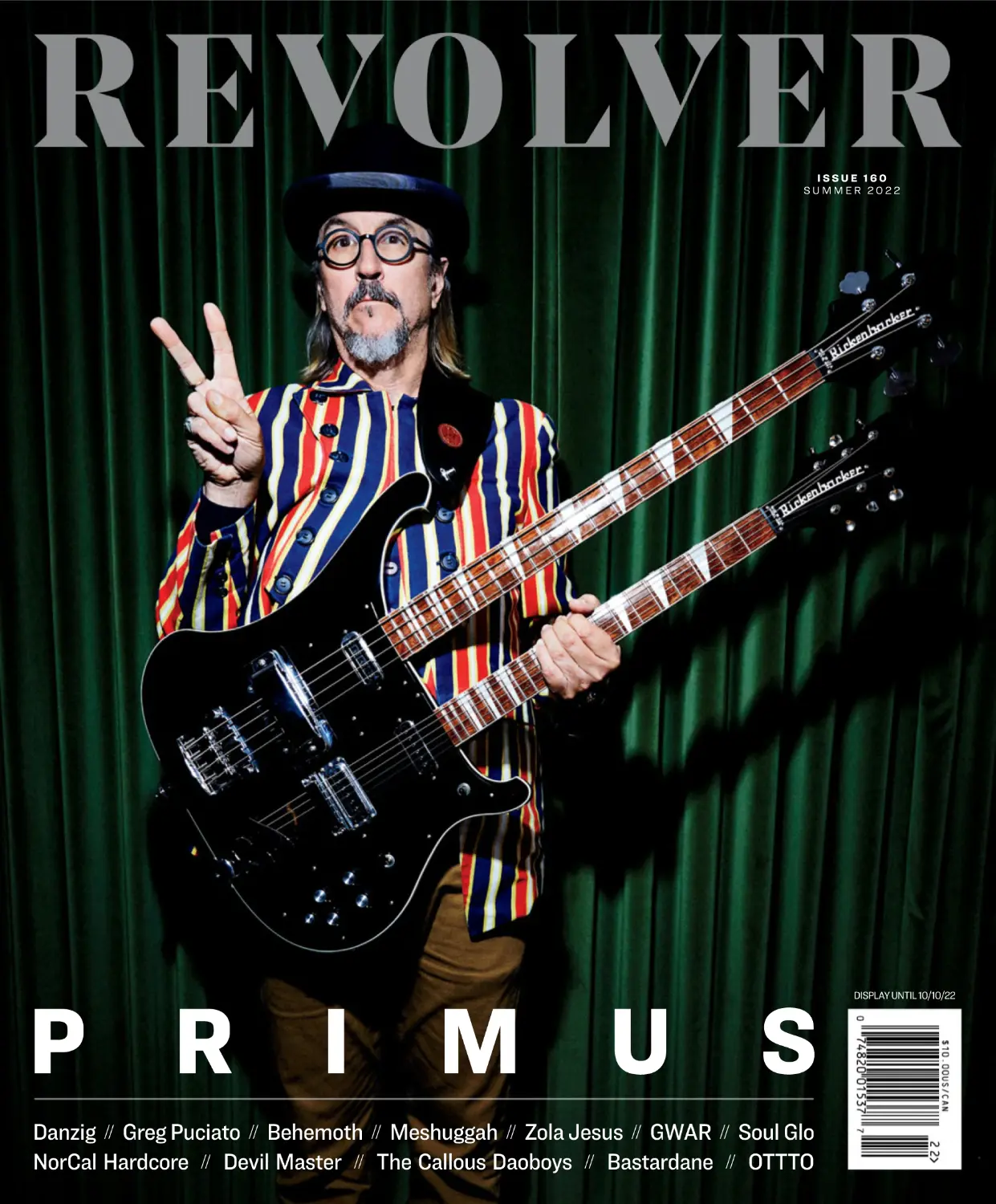


Tags: magazine magazine revolver
Year: 2022




Text
                    ISSUE 160
SUMMER 2022

P R I M U S
Danzig // Greg Puciato // Behemoth // Meshuggah // Zola Jesus // GWAR // Soul Glo
NorCal Hardcore // Devil Master // The Callous Daoboys // Bastardane // OTTTO

DISPLAY UNTIL 10/10/22

ISSUE 160
SUMMER 2022

D A N Z I G
H O W T H E G O D S K I L L AT 3 0

DISPLAY UNTIL 10/10/22

ISSUE 160
SUMMER 2022

GREG

P U C I AT O

INTERVIEW BY BILLY HOWERDEL

ISSUE 160
SUMMER 2022

B E H E M O T H

ISSUE 160
SUMMER 2022

S

C

O

W

L

+ THE NORCAL HARDCORE REVOLUTION


CONTENTS
42

MARK LEIALOHA

Glenn Danzig takes us back to the
dirty black summer that birthed
Danzig III: How the Gods Kill

4

R E V O LV E R M A G . C O M

CONTENTS

78

11

30

50

58

64

72

88

Five Artists You
Need to Know

Primus

Greg Puciato

Meshuggah

Zola Jesus

GWAR

Behemoth

How Les Claypool’s
madcap trio became
renowned cult heroes
who won’t stop until
the fun stops

The former Dillinger
Escape Plan singer
talks to Billy Howerdel
about the fear and
freedom in going solo

Sweden’s djent
godfathers tell
the album-by-album
story of their
creative evolution

Nika Roza Danilova
weathered a
cataclysm and then
rebuilt herself one
song at a time

Blöthar the Berserker
reflects on raunchy
origins, replacing
Oderus and hating
his stepfather

Adam Nergal Darski
fights for personal
freedoms with his
new call to arms,
Opvs Contra Natvram

Soul Glo, the Callous
Daoboys, Devil
Master, OTTTO
and Bastardane

6

R E V O LV E R M A G . C O M

ADAM DEGROSS

THE NORCAL
HARDCORE
REVOLUTION
“THIS IS REAL BAY
SHIT. IF YOU KNOW,
YOU KNOW. GOT TO
SEE IT TO BELIEVE IT.”
— KAT MOSS, SCOWL

LETTER FROM THE EDITOR

PUBLISHER
Enrique Abeyta
EDITORIAL
EDITORIAL DIRECTOR/CHIEF CONTENT OFFICER
Brandon Geist
CONTENT DIRECTOR Brad Angle
MANAGING EDITOR Sammi Chichester
EDITOR Eli Enis
CONTRIBUTING WRITERS
Gregory Adams, Steve Appleford, J. Bennett, Dan Epstein,
Billy Howerdel, Mia Hughes, Emma Madden, Kat Moss and
Christopher R. Weingarten
Trevor Strnad
1981 - 2022

IN EARLY 2020, THE WORLD SHUT DOWN BY COVID’S FIRST WAVE, REVOLVER LAUNCHED

a short-lived video series called “Best Shirt Ever.” We asked some of our favorite artists to
show off their favorite band shirt in little videos that they filmed themselves while quarantined at home. Trevor from Black Dahlia Murder quickly sent in his submission — because,
as many metal journalists, influencers, content creators, whatever you wanna call us, have
noted since his death, he was always game for our stupid ideas.
In his video, Trevor showed off his “sacred, holy grail” band tee: a 20-year-old, flea-market-purchased Cannibal Corpse Butchered at Birth shirt that he wore on the first day of high
school. “Definitely one of those nerve-racking experiences,” he says in the video, reflecting
on that day. “I look at a good metal shirt as kind of like a security blanket. It makes me feel
good, makes me feel like I’m flying my flag and repping the scene that I love so much.”
Flying the metal flag and repping the scene were two things that Trevor did better than
just about anyone during his all-too-brief time on earth. For many fans, Black Dahlia was the
gateway band to extreme metal. Their catchy songs and sense of humor had a lot to do with it.
But Trevor had the most to do with it. His contagious enthusiasm. His down-to-earthiness. His
encyclopedic knowledge. His sweet, fun-loving nature. His open arms to anyone — regardless
of race, gender, sexual orientation, class, creed, whatever — who was interested.
For many fans, a Black Dahlia shirt is now their go-to security blanket — a security blanket
needed even more in the wake of Trevor’s tragic death. Wear yours proudly. Fly your flag.
I hope it makes you feel good.
It should.

ART AND VIDEO
CREATIVE DIRECTOR Jimmy Hubbard
DESIGN DIRECTOR, PRINT Todd Weinberger
VIDEO PRODUCER/EDITOR Rob Menzer
DIGITAL IMAGING SPECIALIST Evan Trusewicz
CONTRIBUTING PHOTOGRAPHERS
Brendan Baldwin, Gabe Becerra, Grant Butler,
Kristin Callahan/Everett Collection, A.F. Cortés,
Adam DeGross, Jason Goodrich, Edvard Hansson,
Mark Leialoha, Jim Louvau, Eddie Malluk/AtlasIcons.com,
Joseph Cultice, Justin Mohlman, Angela Owens,
Shawn Stanley and Cecil Shang Whaley
CONTRIBUTING ILLUSTRATOR
Paul Romano
BUSINESS AND SALES
CHIEF EXECUTIVE OFFICER Enrique Abeyta
CHIEF FINANCIAL OFFICER Edmund Sullivan
CHIEF OPERATING OFFICER James Welch
HEAD OF DIGITAL Alvaro Gomez
BRAND PARTNERSHIP DIRECTOR Chris Enriquez,
contact: chris@revolvermag.com

Trevor, rest in peace.

HEAD OF MUSIC COMMERCE Tony Bruno
ECOMMERCE MANAGER Ryan Morano
MERCHANDISE PRODUCT MANAGER Matt Geyer
VINYL PRODUCT MANAGER Tyler Howell

REVOLVER (ISSN No: 1527-408x) USPS #025443 is published Quarterly (4 issues per year) by Project M Group LLC, 150 West 22nd St., New York, NY 10011. Periodicals Postage Paid at New York, NY and at additional mailing offices.
POSTMASTER: Send address changes to Revolver, PO Box 3000, Denville, NJ 07834-3000. Entire contents copyright 2022, Project M L.L.C. All rights reserved. Reproduction in whole or in part is prohibited. Project M L.L.C. is not affiliated with the companies or products covered in Revolver. Reproduction on the Internet of the articles and pictures in this magazine is illegal without the prior written consent of Revolver. Products named in the pages of Revolver are
trademarks of their respective companies. PRODUCED IN THE UNITED STATES OF AMERICA. SUBSCRIBER CUSTOMER SERVICE: Revolver, PO Box 3000, Denville, NJ 07834-3000. Online: https://www.ezsubscription.com/rvl/mysubscription. Phone: 1-800-266-3312. Email: custsvc_revolver@fulcoinc.com.

8

R E V O LV E R M A G . C O M

GABE BECERRA

Brandon Geist
Editorial Director/Chief Content Officer

UPRISING
ARTISTS YOU NEED TO KNOW NOW

ANGELA OWENS

Soul Glo

R E V O LV E R

SUMMER

//

2022

11

01
TEXT Mia Hughes
PHOTOGRAPHY Angela Owens

Soul Glo
Philly mavericks tackle
“hard conversations”
through genre-bending
hardcore
“I WON’T LIE, TALKING TO REVOLVER IS DEFINITELY SOMETHING I IMAGINED

when I was supposed to be paying attention in algebra,” Pierce Jordan says, laughing. At 29, Jordan is quite a few years beyond his classroom zone outs. But he
feels compelled to highlight this full-circle moment — confessing that much of his
heavy-music knowledge can be traced back to devouring the pages of Revolver, after
he spotted his heroes System of a Down on the front cover in the grocery store.
Jordan is here now because he fronts Philadelphia-based Soul Glo, one of the
most invigorating bands tearing up today’s heavy-music scene. The trio, in which
Jordan is joined by bassist GG Guerra and drummer TJ Stevenson, could be described
as hardcore, screamo, powerviolence, punk-rap or noise-rap — whatever you call
it, they shred. They’re prolific, too: In addition to their prior LPs, 2016’s UNTITLED
LP and 2019’s The Nigga in Me Is Me, they released an awesome EP, Songs to Yeet at
the Sun, in 2020, and two volumes of the DisNigga EP in 2021. Earlier this year, they
released their best album yet, Diaspora Problems. Jordan was recently named one
of the best frontpeople in modern rock by the AV Club, and it’s obvious why. His
lyrics — whether they’re delivering explosive radical politics, calling out white punk
hypocrisy, or exploring his path to recovery from trauma — are unforgettable, and
they’re delivered with speed, potency and personality that few can emulate.

12

R E V O LV E R M A G . C O M

Soul Glo’s
Pierce Jordan

R E V O LV E R

SUMMER

//

2022

13

01

Diaspora Problems, 2022;
DisNigga, Vol. 2 EP, 2021;
DisNigga, Vol. 1 EP, 2021; Songs
to Yeet at the Sun EP, 2020;
The Nigga in Me Is Me, 2019;
UNTITLED LP, 2016

14

R E V O LV E R M A G . C O M

Jordan was raised on funk and jazz fusion thanks
to his father. To this he attributes a natural affinity
for intense, hectic music. “It [spoke] to my anxiety,
maybe,” he suggests. He and his older sister discovered metal together through System of a Down, and
from there he developed a love for post-hardcore,
especially screamo innovators Circle Takes the Square.
This link between genres is core to Soul Glo’s philosophy, as they meld hardcore with hip-hop uncompromisingly and seamlessly — allowing them to fit
on a bill alongside Armand Hammer as easily as with
Touché Amoré. As Jordan explains, this is a natural
combination to him, because the genres come from
a common root of Black music that has been lost
over the years of assimilation. “As Black art becomes
more accepted and standardized, it gets colonized,”
he says. “Rap is on its way. It happened to rock and
jazz. We’re the No. 1 content creators of the Western
music market, but we do not have any control over the
production or the profit. As long as capitalism and our
white supremacist worldwide society exists, it’s gonna
happen with everything that Black people created.”
He continues, “What’s funny to me is that we are
considered and count ourselves lucky to be able to
[play alongside various artists], but simultaneously,
not to sound arrogant, but we should be able to do
whatever we want, because all of these forms are the
traditions that we come from already. It feels like
something that shouldn’t be counted as special. All
this shit is just the way that I wanna go through life,
but then suddenly I’m [considered] a groundbreaking
artist, just because I have the same tastes that so many
people around me have.”
When Soul Glo began, Jordan’s only intention was to
“go hard emotionally,” he says. “I was like, I just wanna
write about my shit, in a way that only I can. And just to
talk about Black shit, basically. I find that the band has
really been shaped around just putting into our music
what we’ve been through as people.” He takes pride in
workshopping his lyrics, including at a poetry group run
by a friend in Philadelphia. On Diaspora Problems, we
hear him delivering some truly rousing condemnations
of the United States on “Fucked Up If True” and “We
Wants Revenge.” Meanwhile, he also digs deeper than
ever into his personal past and present, exploring his
attempts to regain self-love in the wake of a traumatic
relationship on “(Five Years and) My Family” and “The
Thangs I Carry.”
“That process of finding new ways to live through
trauma and heal from it, I just feel like is any adult person’s responsibility to do, so that they don’t become a
danger to people around them,” he says. “Music and
writing as my outlet is just what I feel like I’m supposed to do. I feel like the reason why people harm

each other and themselves is because they don’t have
a place or a way to express themselves, and feel heard.
I’ve had that issue in a lot of relationships in my life,
where I’ve come away feeling unheard or misunderstood. So that definitely plays a part in my writing.”
Learning to self-express has been a long and crucial
journey, Jordan goes on to explain. “I have memories
as a teen of wanting to talk to my parents about certain
things that I was going through, and physically feeling
my throat close. I remember one time, my friend had
just died, and my dad was just trying to get me to say
anything. But I didn’t feel like I could just be like, ‘I
feel insane, and I feel so angry and confused.’ I felt
like I’d just swallowed a piece of charcoal.”
He continues, “I had a lot of friendships growing
up that helped me with practicing that vulnerability,
especially after my friend died. People I was playing
music with in high school, just through the intimacy
of playing music together, and doing some of our first
drugs together and things like that. And then just the
older I got, seeing some of the choices that I could
make as a young man based off how I’m seeing other
people act, and people around me talking about how
they wanna see specifically men change so that the
world cannot be such a shit place. I was just thinking
about, What kind of person do I wanna be? And it’s
only through continually having the hard conversations when they need to be had, that’s what keeps us
on the path of emotional reconstruction. It might be
hard, but I still have to do it.”
On a personal level, it’s been gratifying for Jordan to
see support from his family, particularly his dad. “He
has specifically encouraged other members of my family to read my writing in this band, and that is deeply
meaningful,” he says. On a much wider level, too, it’s
clear that Soul Glo have spoken to something visceral
in people, even outside of DIY punk circles. Diaspora
Problems has been praised by Pitchfork and The Guardian,
and they’ve been announced as support for a North
Carolina arena show with My Chemical Romance. “As
far as I’m concerned, that show is just a figment of my
imagination,” says Jordan, “and everybody around me
is apparently joining in on it.” He laughs.
Even as they get in front of more people, though,
Jordan has no fear of sacrificing authenticity. “When
Beyoncé put out Lemonade, the conversation that that
created socially, everybody was participating in when
it came out. And she is the most famous artist in the
world,” he says. “So I don’t think it really matters
what kind of music [important messages] are coming
from, it matters who’s saying what and when. As Kurt
Cobain was famously quoted as having said: As long
as it’s good and it has passion. Like, I feel like it’s as
simple as that. Is it real or not?”

02

Devil Master, (from left) Festering
Terror in Cursed Catacomb,
Disembody Through Unparalleled
Pleasure, Infernal Moonlight
Apparition and Darkest Prince

Devil
Master
The occult black-metal punks
thought they would go insane
during the first, apocalyptic
COVID wave. Instead, they found
magical rebirth in its chaos.

THE DEVIL’S WORK CAN SOMETIMES TAKE EVEN THE

TEXT Steve Appleford
PHOTOGRAPHY Cecil Shang Whaley

16

R E V O LV E R M A G . C O M

most dedicated satanists by surprise. Early in 2020,
the theatrical, hardcore-fueled, black-metal band
Devil Master had just finished three solid months of
touring, and things were getting tense. Three band
members would soon leave for good.
Then, in March, the COVID-19 pandemic landed
hard in the U.S., freezing much of the music world
in place. By year’s end the coronavirus would kill
nearly 2,500 people just in the band’s hometown of
Philadelphia (as reported by The Philadelphia Inquirer).
And like other cities across the country, Philly became
a hotbed for protests after the on-camera death of
George Floyd, an unarmed Black man, by Minneapolis
police. Then came riots, looting, rubber bullets, vigilantes and the National Guard.
“Everything felt totally apocalyptic, and I was going
personally insane at the time. The fact that the world
around me also reflected that was kind of comforting,”
says guitarist Francis Kano, a.k.a. Darkest Prince, a
dedicated occultist who says all that chaos can now
be heard within Devil Master’s new and second
album, Ecstasies of Never Ending Night.
His band of playful devil’s advocates in capes and
corpse paint bounced back in the face of adversity,
with a 10-track collection of shimmery guitar twang

and lyrics of eternal darkness, as if bringing to life the
words of the French poet Baudelaire: “The Devil pulls
the strings which make us dance/We find delight in
the most loathsome things.” Ecstasies of Never Ending
Night is their most potent incantation yet; so strong,
in fact, that it caught the attention of emo icons My
Chemical Romance, who handpicked Devil Master
to open select dates on their tour later this summer.
But before that record could happen, Kano had
to escape the city, and the “soul-sucking and brainnumbing” atmosphere he felt around him. He weathered the first two months of the pandemic back in
Northern Ireland, where he’d spent much of his childhood and maintained strong family connections. It’s
where he was an altar boy in the Catholic church and
where he first embraced satanism at age 10.
“I went to Ireland to do lockdown and it was the
most magical time of my life,” says Kano, who keeps
a satanic altar there in the woods behind his family’s
house. “I felt like the whole world was just being
reborn and I got to spend more time in nature than I
ever had, which I’m really grateful for. I can go through
bouts of depression and not even believe in magick.
And that was a period of my life where magick started
happening all over again.”
With his senses and attitude recharged, Kano
returned to Philadelphia and Devil Master, ready to
create. In the band, he still had two key collaborators:
the singer called Disembody Through Unparalleled
Pleasure, who has now added bass to his duties; and
the rhythm guitarist Infernal Moonlight Apparition.
On drums and keyboards, the band recruited a gifted
new player, Chris Ulsh from Power Trip — who chose
the alter ego of Festering Terror in Cursed Catacomb,
a name he lifted from an Effigy song.
“We had a rebirth as a band,” says Kano, who
writes most of their material. “I love writing chaos,
so it was all good. I think that reflects in how weird
our album sounds.”
Early on, the plan was to rehearse for two months
and then enter a recording studio. As the pandemic
dragged on, Devil Master ended up rehearsing a full
year, which added depth to their playing and shows

02

“We’re literally just punks who
only listen to bands from the
Eighties and watch VHS.
There’s not much modern
nowadays that interests us.”
— Darkest Prince

Ecstasies of
Never Ending
Night, 2022;
Satan Spits
on Children of
Light, 2019

18

R E V O LV E R M A G . C O M

itself in the final product. “COVID really made us slow
down and, if anything, that was good,” says Kano. “It
just refined our sound and it doesn’t feel rushed at all.
I feel like it’s a pretty competent record — for a metalpunk record, and a progressive death-metal record.”
The album was recorded analog with producer Pete
DeBoer. Kano says the band excitedly embraced the
challenge of tracking live to tape. “Everyone’s playing at
the same time,” he says. “No one can fuck up. I loved it.”
Ecstasies of Never Ending Night is 40 minutes of
fantastic terrors and shivering guitar lines, with
shades of Venom, classic goth and Devil Master’s
ongoing obsession with Japanese hardcore. The
album title came after searching for something that
evoked “very decadent themes and poetic phrasing,”
starting with Disembody jokingly offering the phrase:
“laughing at the teat of luxury.”
The death-metal jams include the instrumental
opening track “Ecstasies...,” with its spooky swirling
riff, and the psychedelic “Acid Black Mass,” the last
song Kano wrote while wasted on K2 synthetic marijuana. (He won’t be doing that again and definitely
doesn’t recommend it.)
“Enamoured in the Throes of Death” collides goth
riffs with a galloping punk-rock beat and Disembody’s
haunted, growled vocal. “Precious Blood of Christ
Rebuked” rushes and slows, shifting multiple times
in a track Kano described on Apple Music as an “adventurous vampiric orgiastic climax before the end.” The
mostly instrumental “Never Ending Night” closes
the album with danceable goth-metal flavor and a
Eurodisco beat. These are songs of death that take
surprising journeys, filled with energy and life.
Once COVID restrictions lifted, and live performing
opened up in 2021, Kano got busy touring with a
variety of bands, including his longtime solo project
Cape of Bats. Devil Master played only a few shows,
in Philadelphia, Los Angeles and New York, but Kano
says they provided him with some valuable insight.

After Devil Master’s first show back in action,
on Halloween Eve last year at the St. Vitus Bar in
Brooklyn, New York, Kano listened to a recording and
didn’t love what he heard. “I was way too drunk,” he
says with a laugh. “Also, we have a higher standard for
the band and our playing now, so I was like, ‘Damn, I
can’t get blackout drunk before I play anymore.’”
Ahead of the album release, the band dropped a
pair of music videos for “The Vigour of Evil” and “Acid
Black Mass” — both featuring a vintage DIY look, partly
inspired by the example of underground filmmaker
Kenneth Anger. The attraction, says Kano, was the raw
aesthetic, not an obsession with the lo-fi past.
“We’re literally just punks who only listen to bands
from the Eighties and watch VHS. There’s not much
modern nowadays that interests us,” Kano explains,
noting how Devil Master’s theatrical, mischievous
approach isn’t always embraced by certain over-serious corners of the black-metal world.
“When people call anyone ‘false black metal,’ I’m
like, nothing should ever be judged or put in a box,
because that isn’t the vibe of the people who invented
it,” says Kano, who counts among his influences Dead,
the doomed singer from Mayhem. He also notes
that many of the Japanese hardcore bands he loves
(G.I.S.M., Zouo, Mobs) reflected a satanic aesthetic in
the early Eighties. “People think that black metal owns
the occult and these aesthetics, which just isn’t true.”
At a time when politicians looking for attention
can refer even to pop artists Billie Eilish and Cardi B
as tools of Satan, things can get confused — even for
heavy-music fans and artists just starting out.
“I can appreciate the zealotry of youth because it
brings about the best, most genuine and almost innocent music and art,” says Kano, who also cites early
punk singer Darby Crash of the Germs as a cultural
hero. “I take their art seriously ... But the people I don’t
take seriously are 30-something-year-old neck beards
who are telling me my band is corny.”

.
The latest release from Cleveland’s ritual doom metal duo Frayle,
“Skin & Sorrow” is devastating. It’s full of heartbreak and pain.
Otherworldly vocals slightly ease the sting and curiously court the
demon that is emerging, the themes of loss and grief grab the
listener’s heart with a full force like a hand emerging from a
freshly dug grave, grasping to whatever life might be there.
OUT JULY 8TH

LAMACCHIA

REBREATHER

THUNDERHEADS

THE LINE, ITS WIDTH, & THE WARDRONE

PRISONER’S CINEMA

Enigmatic layered & moody Rock. RIYL: Liars,
Doves, Autolux, Radiohead. Debut by
guitarist & vocalist John LaMacchia from Candiria.

Doom, Sludge, Metal, Prog. RIYL: Part Chimp,
Unsane, Melvins. Rebreather creates punishing,
and teneacious music that seethes and breathes.

Blackened Metal, Hardcore, Punk. RIYL: Craft
to Dwid Hellion to G.I.S.M. Crushing nihilism
that nod to the shadowy side of hardcore punk.

@AqualambRecords

BURNING TONGUE

03

The Callous Daoboys, 2022

TEXT Gregory Adams
PHOTOGRAPHY Grant Butler

The
Callous
Daoboys
Armed with catchy, spazzy,
kaleidoscopic mathcore,
this Atlanta, Georgia,
crew are out to confront
the “brainwashed” masses

CARSON PACE IS A TALKER; IT’S ALWAYS BEEN

that way. When Revolver hears from the Callous
Daoboys vocalist after their most recent show in
South Carolina, he’s playfully detailing a night of
stand-up-influenced banter, jovial crowd conversations and a flubbed attempt at convincing the club
to join him in the Macarena. This is all on top of Pace
having howled himself hoarse while the rest of the
Atlanta, Georgia, metalcore hybridists plunged into
a torrential storm of mathcore complexity, soft-jazz
Muzak, bossa nova, alternative radio rock and effectswarped violin bowing.
Between an off-the-charts onstage energy level, a
rising profile amidst a studio collab with Pupil Slicer
and a tour with Greyhaven — as well as the band’s
new highly anticipated sophomore album, Celebrity
Therapist — playing with the Callous Daoboys has
given Pace plenty of opportunities to get a dialogue
going. On the other hand, he knows some of what he’s
screaming about could be conversation killers with
the people he loves.

20

R E V O LV E R M A G . C O M

Take Celebrity Therapist’s opening “Violent Astrology,”
a panicked stomp where the singer ponders the relationship between action movies and the military-industrial complex, while also questioning flat-earthers
and why a certain brand of politic is attracted to slapping the Punisher skull on their Facebook wall.
“It was me reflecting on how many people I had
lost to some kind of cult,” he says of the album, writ
large, “whether that cult be buying into the military,
Blue Lives Matter and America First, or the alt-right or
QAnon, or even the people who are ‘Vote Blue No Matter
Who’ — even those people I see as a little brainwashed.”
He continues: “There are people I can’t talk to about
certain things … [like] the military, or America, or vaccines.”
There is, then, palpable frustration to be felt throughout the album as Pace works out his thoughts on complex issues. That said, while he may rail against conservative talking points, he’s ultimately hoping to find
understanding and common ground. “It’s me being
very angry about it, but in a way that I’d like to think is

still pretty empathetic,” he says, adding, “I don’t want
to other them, because … talking down, being a dick
and saying they’re wrong — it almost reassures them
that they’re right.”
Pace’s inquisitive, earnest nature has been a key
aspect of his personality for as long as he can remember. Born and raised in Atlanta, some of his fondest
memories are of him and his father, a hobbyist pilot,
driving to a private airport on the outskirts of the
city — cassettes from Sting and the Cure blaring
through the stereo — to watch planes take off and
land for hours. There was even a time when the future
metal singer thought he might pick up piloting, too.

“I was very talkative when I was younger” Pace
recalls. “It makes sense for how I am now — I can’t
shut the fuck up. So, I was talking to adults … about
airplanes when I was very little. I could tell you about
every airplane that was landing there. Of course, at
that age you have no idea how any of that works — you
don’t know shit about Bernoulli’s Principle — [but] it
was something I got to share with my dad.”
Despite an often-cryptic lyrical approach, Pace has
held onto that innate sense of storytelling with the
Callous Daoboys. Tonally, his voice dramatically runs
from powerhouse screaming towards a sinewy croon
à la Mike Patton or Greg Puciato. Pace’s lyrics across

the band’s new Celebrity Therapist album, meanwhile,
attempt to connect the dots between blind patriotism,
conspiracy theories, alcohol relapses and the cult of
celebrity — arguing that we all spiral into one vice or
another. On “Title Track,” for instance, he gazes inward
on the absurdity of lead singers that “stalk and talk
famous, with a pompous throat,” though he’s aware
that said introspection is paradoxically self-serious.
“The cult that I bought into [is the] narcissism of
being a frontman. I’ve had to face a lot of the repercussions of me thinking I was hot shit — just getting
tossed on my ass and reminded that I’m not. Our
band’s doing well, but we’re not the fucking Foo

Fighters. It’s tough to write about that ego.”
That Pace questions his role in the band might have
something to do with becoming a frontperson accidentally. He was initially a guitar player, picking up the
instrument at age 10. Later, he played alongside future
Daoboys six-stringer Maddie Caffrey in a “middling”
Sunny Day Real Estate–influenced indie-rock outfit
called Sunnycide. Growing frustrated with Sunnycide’s
stagnation, he began writing a set of aggressively
off-kilter pieces that played to his love of eccentric
outfits like the Dillinger Escape Plan and Sleepytime
Gorilla Museum. After assembling an early lineup in
2016, the newly minted Callous Daoboys got through

R E V O LV E R

SUMMER

//

2022

21

03

tk

Celebrity
Therapist, 2022;
Die on Mars, 2019;
Animal Tetris EP,
2017

22

R E V O LV E R M A G . C O M

their first practice without a singer. Not long after,
Pace pragmatically dropped his guitar to grab the mic.
The Callous Daoboys started making their name
through various CD-R releases and a live show where
Pace alternated between screaming, doing push-ups
and walking on top of the crowd. By 2019, a cult
following had coagulated around the fabulously
fractured art-metal of debut full-length Die on Mars —
this extending to likeminded U.K. noisemakers Pupil
Slicer, who invited Pace onto their panic-stricken
“L’Appel du Vide” single in 2020.
Through the songs of Celebrity Therapist, the band —
whose current lineup includes Pace, Caffrey, guitarist
Dan Hodsdon, bassist Jack Buckalew, violinist Amber
Christman and drummer Sam Williamson — deliver
an even more prismatic, and punishing, set of tunes.
Without pause, they’ll vault from roiling thrash with
heavenly elevator-music motifs (“The Elephant Man in
the Room”) to erudite Psycho-like violin comingled with
pop-and-lock funk bass (“Beautiful Dude Missile”) to
grotesque death moshes mixed with saxophone-blaring sophisti-pop (“What Is Delicious Who Swarms”).
A similar fluidity exists through the perspectiveshifting vocals of Celebrity Therapist. While Pace is
technically the group’s lead singer, the fever-dream

midsection of “A Brief Article Regarding Time Loops”
finds the vocalist and the rest of the outfit kaleidoscopically trading off, word-for-word, details of a
young girl’s first experience with déjà vu. This disorientating, hive-mind blurring is employed throughout the album, too. Pace even passes off the central
thesis line of “exorcise the celebrity therapist,” on
“Title Track,” to his friend Hayden Rodriguez, vocalist of For Your Health. (“That was cute, to give it to
another frontperson,” Pace chuckles.)
That the Callous Daoboys pass the mic amorphously
perhaps speaks to the desire to foster an open-ended
community dialogue. One could also speculate that
Pace’s approach developed in part because of the
tough talks he’s evaded with his family thus far, or
the ones he anticipates could go badly after they hear
the record. “I’m prepared for people to never talk to me
again because of the lyrics,” he says. “And that’s OK.”
Speaking truth to power, it’s not for nothing that he
hollers, “Every line is an albatross,” on “Title Track.”
But with Callous Daoboys rising through the ranks of
mathcore, more people are hearing his words than ever
before. Some folks sing along, others talk up the band
at the merch booth. The conversation, you’d hope, has
only just begun.

04

TEXT Eli Enis
PHOTOGRAPHY Justin Mohlman

Bastardane
Their dads are in Metallica, but Castor Hetfield and Tye Trujillo aren’t
WHILE THE WHOLE WORLD CALLS HIM PAPA HET,

Castor just calls him “dad.” The 21-year-old son of
Metallica’s James Hetfield is all grown up now and,
unsurprisingly, music is his calling. That said, despite
being raised under the roof of a world-renowned rock
star, a privilege that could theoretically skyrocket him
into the mainstream consciousness if he so pleased,
Castor is intent on living out his garage days. No cushy
label, high-profile manager or even a publicist have
been handed to him.
“We’re doing this ourselves,” he repeats emphatically throughout our conversation. The “we” is
Bastardane, the metal-inflected psych-rock band that
features Castor Hetfield behind the kit. Despite their
drummer’s namesake, the trio — who self-released
their debut album, Is This Rage?, in March 2022 — are
like any other scrappy, enterprising college rock band.
The three musicians — Hetfield, vocalist-bassist Jake
Benn and guitarist Ethan Sirotzki — met in 2019 during
an impromptu jam session at Savannah College of Art
and Design in Georgia. Weekly meetups to casually
bang out covers eventually morphed into more consistent songwriting sessions, and soon they started
playing out around town. Their name, which sounds
like how it’s spelled, was borrowed from a chemical that
Benn and Sirotzki learned about in a chemistry class.
Hetfield, a creative writing major at the time, had never
even considered a career in music until the excitement
of Bastardane’s burgeoning years started to kick in.
“It never hit me until I went to college and I met the
guys I’m in the band with now,” he says. “We started
jamming and making our own stuff and I really thought,
Oh, I can actually do this and maybe make money.”
Then, their momentum was temporarily halted
when Hetfield, unfulfilled by his courses, dropped out
of school and returned home to Colorado at the beginning of the pandemic. It was a time of soul-searching
and figuring shit out for Hetfield, who spent his childhood leapfrogging between activities at a dizzying
rate. He admits he first reached for drums instead of
guitar, his father’s instrument, because he “just didn’t
have the patience” to master all six strings. The drums
offered a more immediately gratifying result.
“From what my parents told me, I was almost a

24

R E V O LV E R M A G . C O M

Bastardane,
(from left) Castor
Hetfield, Jake Benn
and Ethan Sirotzki

05

OTTTO
chasing that legacy. Instead, they’re living out their own garage days.
ROBERT TRUJILLO’S BIG BREAK CAME WHEN HE

OTTTO, (from left)
Tye Trujillo, Patrick
“Triko” Chavez and
Bryan Noah Ferretti

joined Metallica at age 38. His son Tye’s came when
he was only 12, pulling full-show bass duties on tour
with Korn at the age when most kids are fumbling
through power chords. Then, in 2021, the 17-year-old
prodigy did multiple runs with Venice Beach crossover
thrash legends Suicidal Tendencies, filling the spot
his father once stood in when he played in the same
band in the early Nineties.
Throughout the coming summer that coincides
with his 18th birthday, Trujillo will be playing a few
more shows with Suicidal while also putting as much
time as he can into OTTTO, the metal group he formed
five years ago (when his classmates were still on the
playground) and is now finally ready to turn into a
full-time project. All of this, plus homework.
“Last December I had a finals week, and around that
same time I had a Suicidal show,” he says with his
cheery, teenage affect. “I had traveled out to Texas
and it was only for a couple days … but I had a lot of
work to do on the computer. So literally, the times I
wasn’t performing or doing sound check or anything
like that, I was literally in my hotel room doing work.”
He expects to have to do the same thing later this
spring. “I know it’s going to be hard, but I know I’m
going to push through it,” he says with the casual
confidence of a seasoned pro.
Born and raised in Venice Beach, Trujillo first picked
up the drums when he was two years old. Being, you
know, a toddler, the interest didn’t last long. By the
time he was seven he decided he wanted to try the
instrument his dad made a living with. “I related to
the bass a little more,” he says. “Seeing my dad play
it around the house and then just digging the bass,
digging the frequencies of the instrument.”
His dad started him on Nineties staples like “Enter
Sandman” and “Smells Like Teen Spirit,” and within
a year or so he was playing with several other little
kids in a covers band called the Helmets. Eventually,
Trujillo and vocalist-guitarist Bryan Noah Ferretti
decided to start writing their own material and
co-founded OTTTO. Being exposed to, and interested in, a wide variety of music is something he comes
back to frequently.

R E V O LV E R

SUMMER

//

2022

25

04
BASTARDANE

problem child when I was younger,” he says sheepishly. “The drum set was a good outlet for me just to,
instead of destroying things by hitting them, create
something by hitting [them].”
While his dad raised him on classic punk and metal
acts like Tygers of Pan Tang, Fear and the Ramones,
the younger Hetfield developed an ear for proggier bands in his mid-teens, naming the Mars Volta
and Opeth among his favorites. At the same time,
he became consumed by the challenge of teaching
himself increasingly complex music on the drums.
He didn’t give Metallica much mind as a kid (“I’d
definitely heard enough of my dad’s voice”), but now
views his father’s catalog as inspiring.
“Hearing anyone play guitar, or any instrument,
who’s better than me is going to be inspiring in some
way,” he says.
After a year-and-a-half away from his bandmates, he
missed them enough to return to Savannah, this time
without the distraction of school. When asked what
it’s been like to break into the city’s live music scene,
he doesn’t emit a shred of ego or entitlement. Rather,
he’s thrilled to see people coming out to Bastardane
shows, and humbled when fans don his band’s shirts.
“Coming from nobody coming to our shows to people wearing our shirts on their way to our shows has
been a really awesome feeling,” he says.

UNITED BY THE BOND THEY SHARE THROUGH THEIR

Is This Rage?, 2022

26

R E V O LV E R M A G . C O M

dads’ band — but empowered by their own musical
differences and youthful drive to carve their own
paths — Bastardane and OTTTO linked up to tour
California together this spring. The idea came when
they, along with Taipei Houston, the band comprised
of Lars Ulrich’s sons, played a joint show together last
December during the Metallica 40th anniversary weekend in San Francisco.
“We had so much fun that night because we’re all
kind of around the same age, all have so much energy and passion [for] the music we’re playing and we
loved it,” Hetfield enthuses. Despite knowing Trujillo
his whole life, it was the first time the two Metallica
sons shared a stage, and they both knew they needed
to do it again.
“I mean, nothing against playing with older bands,

but just the energy that we had, just the youth and the
connection we had both musically and just backstage,
just hanging out, having a really fun time… It spurred
something and we just totally wanted to play with
them again.”
Growing up, Hetfield and Trujillo spent the most
time together when their families would travel together for Metallica’s grand European tours. “All the kids
would be backstage during the show just hanging out,
messing around, probably getting in the way of all the
crew guys,” Hetfield says. Trujillo adds, “We were all
little kids, so we were running around having Nerf
wars or whatever. Playing hide and seek.”
Now, they’re able to come together independently.
In addition to having both played BottleRock 2022, the
extra six-date run arrived at the end of Bastardane’s
seven-week tour, which the band and their friends

05
OTTTO

“Obviously, Metallica influenced me, being around
my dad and stuff, seeing them play had an influence,”
he says. “But my dad would play a bunch of different
stuff in the car. He’d play old-school funk, Alice in
Chains, TOOL, Public Enemy, just a bunch of stuff.”
While OTTTO’s self-titled debut sits squarely in the
thrash and heavy-metal lane, Trujillo’s taste runs the
gamut from hardcore groups like Vein.fm and Madball,
psych-rock acts like Tame Impala and Fuzz, and even
the emo-rap of $uicideboy$. He says their next album
has heavy songs that get “cool and spacey in the middle,” inspired by the likes of TOOL and Mastodon.
He’s thrilled to play more shows with Suicidal,
describing the crowds as some of “the craziest I’ve
ever seen.” Plus, he digs connecting with “their history
with Venice Beach, the place I love. I watch videos of
them playing back with my dad, and their energy was
insane. ... Playing with them now, their energy’s still
there, and it just feels good to relate to that energy.”
It’s an opportunity he’s extremely grateful for, but
OTTTO is where he wants to make his own individual
mark on the world.
“I’m more there to play my role as a bass player,” he
says of his time in Suicidal. “So I’m there to support
the band and I’m there to provide the best I got. And
in OTTTO I’m with my brothers and we’re just all jamming our own music. … It’s more my personal thing.”

booked entirely themselves. Of course, both Trujillo
and Hetfield recognize that they’re following a similar DIY route that their dads’ band Metallica took
to become one of the biggest rock acts of all time.
But something these kids share is a surprising lack
of pressure to live up to a family legacy or meet any
unrealistic expectations.
“I just think I’m here to write songs, enjoy life and
just play,” Trujillo says coolly. “I just love playing
music. No pressure, none of that.”
“Obviously, we’ve had quite a few people that listen
to us because they listen to my dad’s music,” Hetfield
says. “Which I don’t hate. Anyone who’s open to listening to music and showing love and spreading cool
vibes and music around, it’s awesome. I appreciate it.
But we’re also making our own fan base and doing it
ourselves. We’re on our own path.”

“I just think I’m here to write
songs, enjoy life and just play.
I just love playing music.
No pressure, none of that.”
— Tye Trujillo
OTTTO, 2020

R E V O LV E R

SUMMER

//

2022

27

VANGUARD
REBELS, INNOVATORS AND ICONOCLASTS

JASON GOODRICH

Primus’ Les Claypool, Nashville, Tennessee, 2022

R E V O LV E R

SUMMER

//

2022

29

How Les Claypool’s
madcap trio of “lazy
bastards” became
world-renown,
multiplatinum-selling
cult heroes who
won’t stop until the
fun stops

TEXT
Christopher R.
Weingarten
PHOTOGRAPHY
Jason Goodrich

“WE’RE LAZY BASTARDS. WE NEVER REHEARSE,

never have,” says Les Claypool, leader of alt-metal
titans Primus. The laissez-faire attitude belies a
38-year legacy built on staggering feats of technical
prowess and a devotion to a decidedly offbeat vision.
“When we write an album, we’ll get together and learn
the songs. But for the most part, we play for a couple
hours and then we go drink wine and eat steaks.”
However, as any musician will tell you, Rush can
do funny things to a band.
Primus had planned to spend 2021 realizing an
idea they’d been mulling for years: paying tribute
to Rush — a formative influence on all three members — by playing the 1977 arena-prog classic A Farewell
to Kings in its entirety. Primus didn’t even rehearse to
play their South Stage–stealing Woodstock ’94 mud
hurricane. “But with the Rush thing, we had to practice,” says Claypool. “We had to really buckle down
and rehearse because you got to do it justice.”
“I think at first we kind of felt like, Well, let’s just
do it and we’ll make it our own,” says drummer Tim
“Herb” Alexander. “But as we started playing, I realized that I don’t have a choice. I have to play it notefor-note as best I can.”
For months, Alexander “brainwashed” himself by
playing through the album almost every day. Claypool
had to wrestle the 11-minute “Xanadu,” which has him
playing keyboards and bass, clicking through pedals
and trying to sing in Geddy Lee’s famously cloud-busting register. “‘Madrigal,’ [is] the least Rush-like song,”
says Claypool. “In fact, I asked Geddy — ’cause I have
the big book of Rush set lists and all that whatnot.
And it’s not in any of those set lists from the day. And
I asked him, ‘Did you guys ever even play that song
live?’ And he’s like, ‘Nope.’”
As it turns out, the days spent shredding through

32

R E V O LV E R M A G . C O M

Rush songs not only honored the Canadian band, but
energized Primus, as well. In April, the band released
“Conspiranoia,” an 11-minute, 30-second space-metal
opus of their own that sounds like a 1975 tour bus collision between Pink Floyd and Funkadelic. The lyrics
had been gestating in Claypool’s phone after postCOVID suspicions started gripping some of his friends.
“He had this idea for a superlong prog song, which
sounded awesome. We just went in, started working
on it, and banged it out,” says guitarist Larry “Ler”
LaLonde. “I literally got halfway home driving back
down to L.A., and I got a call saying, ‘Yeah, that worked
out pretty good. Can you come back and let’s do some
more songs?’”
Primus had reunited their classic lineup — Claypool,
LaLonde and Alexander — in 2013. The same whose mix
of dissonant art-metal, rubbery grooves and Tim Burton–esque tales of suburban darkness wreaked unlikely multiplatinum havoc in the Nineties. The same that
conquered college radio, tickled Beavis and Butt-Head
and got Grammy voters to nominate a song called
“Wynona’s Big Brown Beaver.” In the last decade,
they’ve been touring relentlessly, following their
off-kilter muses: playing an entire Rush album every
night, covering the soundtrack to Willy Wonka & the
Chocolate Factory and writing a progtastic concept opera
based on a hallucinogenic Italian children’s book. The
three songs on the Conspiranoid EP — all loosely based
on symptoms of contemporary derangement — mark
some of their sharpest material in decades.
“We just keep doing what we do, and try and keep it
interesting for us,” says Claypool. “Because if we’re not
interested, we’re gonna be bored and we’re gonna look
bored and it’s gonna translate as bored. You know, you
have one time on the marble. If you’re not having fun,
then you need to change it up.”

“I don’t know if I’ve
ever appreciated it as
much as I have these
past handful of years:
I’ve got to play with
people that are
superheroes.”
— Les Claypool

PRIMUS WAS FORMED IN 1984, BUT IT MIGHT BE

more prudent to trace its origins back to mid-Sixties California. Claypool was raised in El Sobrante, a
working-class NorCal suburb, where mingled about
the cast of tweakers, fishermen, parking-lot loiterers,
high-school chums and general eccentrics that would
one-day populate Primus songs like a Federico Fellini
film with a nasal twang. Famously, Claypool shared
an algebra class with eventual Metallica guitarist Kirk
Hammett, eyeing his guitar magazines and occasionally scoring some weed off the future guitar hero.
“I think a lot of people didn’t even realize they went
to school with the guitar player from Metallica, ’cause
he was a very unassuming person,” says Claypool.
“He’s like, [affects stoner lilt] ‘Man, I know the three key
elements to success, man. Sex, drugs and rock & roll.’ He was
like Tommy Chong.”
Hammett gave Claypool a Jimi Hendrix cassette
and invited him to sing for his band, thrash pioneers
Exodus. Claypool was too shy to sing at the time, but
did buy a bass guitar and absorbed Hammett’s rhythmic advice, which became part of Claypool’s signature
stage presence. “He’s like, ‘Yeah. Claypool, man. I know
the secret, man. You gotta tap your foot. You gotta tap your

foot’,” says Claypool doing his best Hammett. “And I
always thought of that. And to this day I continue to do
that. … I feel like I have a pretty good sense of rhythm
and pocket and groove because I incorporate a portion
of my body all the time when I’m playing. … Plus, I
was second best dancer in my high school yearbook.”
In the years after high school, Claypool would find
himself filling in for progressive metal band Blind Illusion and laying down funky low end for a local R&B
cover band. He formed the embryonic version of Primus — then called “Primate” — in 1984, after moving
to Berkeley, California. Having no awareness of the
thrash-metal revolution ripping through the Bay Area,
and not fitting in with the thriving polyglot grooves
of the local “worldbeat” scene, Primus was a darkly
funky post-punk outlier haunting the local alternative clubs after the death of New Wave, inspired by
Peter Gabriel, Public Image Ltd and maverick guitarist
Fred Frith. “The edgy stuff,” Claypool says of the metal
crunch that turned Primus into the weirdest kids at
the Headbangers Ball, “didn’t really come along until
basically after I auditioned for Metallica.”
In 1986, Claypool heard that Hammett’s new band
was doing pretty well for themselves but had just lost

bass player Cliff Burton in a bus accident. Hammett gave
Claypool a tape of Ride the Lightning, which he would
dutifully listen to in the shower as a wake-up before his
day job as a carpenter. How soon into that audition did
Claypool realize he was not going to be in Metallica?
“Oh, I knew right away,” Claypool says with a light
cackle. “It’s like going on a date, the girl’s not into you,
you just kind of get that vibe. They were friendly as
hell. But I did not fit. I didn’t even slightly fit. I showed
up, I had this skater, Mohawk thing. I had two different
colored tennis shoes on. I was wearing a hat just like
this actually,” he says, tugging on his newsboy cap.
By 1989, Primus had built up a sizable following
through hard gigging, some local radio play, the
in-demand Sausage demo and momentum provided
by similarly funk-inspired heavy bands like the Red
Hot Chili Peppers and Fishbone. Primus guitarist Todd
Huth had a son and drummer Jay Lane had a major
label contract, so Claypool rebooted the band into the
iconic version that ended up as the alternative nation’s
quirky sore thumb.
Five years Claypool’s younger, guitarist Ler LaLonde
had already earned a place in extreme-music history:
His high school band was Possessed, the Bay Area
blasphemists whose hunger for speed, shock, growls
and grind produced 1985’s Seven Churches, widely
regarded as the first death-metal album.
“Yeah, I think, in general, the idea was a new thing
that hasn’t been done and cram it down people’s
throats,” LaLonde says of Possessed. “The people
around me, a lot of the bands that were trying to get
big were sort of going down the glam route. In the
metal scene in the Bay Area, everyone was just like,
‘No, we’re going to do this thing. We’re going to force
people to be into it. We’re going to make the craziest
shit we can.’ It helps when you’re 15.
“The satanic thing pissed people off,” LaLonde
continues. “I didn’t know shit about Satan. Even Jeff
[Becerra, Possessed vocalist-bassist] who was writing the
lyrics, he’s like, ‘I don’t know, I’m writing the craziest
shit and it makes people mad.’ Even at school, the
jocks that want to beat you up, and you show up with
an upside-down cross on, all of a sudden now they
sidestep around you in the hallway.”
LaLonde drifted away from extreme metal once
it started taking itself too seriously and sounding
like “a garbage truck going down the street.” Friends
hipped him to Frank Zappa and the Grateful Dead.
Like Claypool, he filled in for Blind Illusion and his
bandmates got him into King Crimson. Claypool got
him into legendary San Francisco eyeball-oddballs the
Residents and the cantankerous clatter of Tom Waits.
By 1989, he was a natural fit for Primus.
The pair auditioned drummers, though eventual
choice Tim Alexander would not have skated by on

R E V O LV E R

SUMMER

//

2022

35

first impressions.
“We thought he was a weirdo. He showed up with
pirate pants on and fingerless gloves and a bandana
around his head and a trench coat. We were like, Who
the hell is this guy?” Claypool recalls with a laugh.
“He had this little fanny pack on. And I remember
my stomach was bothering me one day and he’s like,
‘Here, try some of these.’ And he dips into his pouch
and pulls out these things and pours these little —
they fuckin’ look like rabbit turds — into my hand. I
swallowed ’em down. It made my stomach feel better,
but I was burping up this horrible nasty shit all day
long. And Ler started calling him ‘Herb,’ because he
had all these herbs in his pouch.
“Me and Ler had our thing. And then Herb was this
weird pirate guy with MC Hammer pants on,” continues Claypool, “but he could fucking play. And to be
honest with you, I don’t know if I’ve ever appreciated
it as much as I have these past handful of years. I’ve
got to play with people that are superheroes. I’m in a
band with Stewart Copeland [of the Police]. I’m gonna
play with him next week. And Herb is of that caliber.”
The new trio found their common ground jamming
out pieces of Rush songs. Claypool and LaLonde’s first
concerts were Rush shows. Alexander had his life
changed when he heard Neil Peart’s tumbling drum
intro to 1980’s “The Spirit of Radio.” The fledgling
band’s first recording together, 1989’s self-funded,
self-released live album Suck on This, begins with Primus tearing through a few bars of the Canadian band’s
morse-tappy “YYZ.”
With the wild success of their debut album, 1990’s
Frizzle Fry, Primus became the second band to sign
to Jimmy Iovine and Ted Field’s new major label
Interscope (the first: Gerardo of “Rico Suave” fame).
Their doggedly unique presentation — squid-fingered
fretless bass slap-and-pop, discordant sheets of distortion, proggy drum fireworks, homespun tales of
suburgatory, and an ability to work a mosh pit into
a froth — made Primus an early signal of alternative
rock’s incoming takeover. Their platinum 1991 album
was called Sailing the Seas of Cheese — an arch term they
used to describe any corny thing a band does in hopes
of gaining wider acceptance — and Primus mostly
found success without deviating too far from their
idiosyncrasies. However, they did, somehow, end up
on Daytona Beach playing MTV’s Spring Break the same
year as Mr. Big, Right Said Fred and Marky Mark.
“My manager said, ‘Look, you guys keep passing on
all this stuff. The label’s going to stop supporting you.’
We never did in-stores, hated doing in-stores, never
went to in-stores and signed shit,” says Claypool. “On
the way down there, I just got pissed. So me and Larry
ate acid. And so when you were watching us on that
thing, everything I saw was just orange. It was just

R E V O LV E R

SUMMER

//

2022

37

bright orange. And I remember talking to Pauly Shore,
and he’s all, ‘Hey, buddy.’ And I was like, ‘What the
hell is going on here?’”
“I wasn’t [on acid]. Thank God,” laughs LaLonde.
“We done that on the beach there in the sun, and then
had to fly back to Poughkeepsie [New York, in a blizzard] … three aborted landings with the plane flying
sideways. [If] I was on acid … probably my brain would
have exploded, it was so terrifying.”
When the alternative-rock explosion happened in
earnest, Primus was on the front lines, landing on the
Top 10 of the Billboard album charts with 1993’s Pork Soda,
headlining the third Lollapalooza and becoming the
bane of network censors with 1995 smash “Wynona’s Big
Brown Beaver.” MTV loved the expensive human-cartoon video, but one person at standards gummed up
the works, relegating it to late-night airplay.
“I remember talking to this lady on the phone and it
was a very disturbing conversation,” says Claypool. “I
said, ‘Look, we’ve downplayed the whole beaver thing.
And obviously there’s a little bit of a double entendre,

38

R E V O LV E R M A G . C O M

but when all is said and done, it’s about a pet beaver
and you can see it in the video.’ And she literally said
to me, ‘I would be as equally uncomfortable watching
this video with my parents as I would watching the
scene from Silence of the Lambs where he says, “I can
smell your cunt from here.”’ What do you say to that?”
Alexander left Primus in 1996 and the band soldiered on with industrial-strength drummer Bryan
“Brain” Mantia, later of auteur-Axl-era Guns N’ Roses.
By 1999, Primus played weird uncle to a generation
of nu-metal bands including Korn, Limp Bizkit and
Deftones. “A lot of these bands ended up touring with
us,” says Claypool. “I always joke that we were the
leapfrog band because you open for Primus and you
become huge. I remember Interscope really wanting
us to do Family Values and Ozzfest. And I was just not
super comfortable in those worlds. I mean, we did
them, and we made a lot of great friends from them,
but it just didn’t feel like we fit.”
By 2000, Claypool had no desire to play Primus
songs. “And then I wasn’t going to play it unless

Herb came back,” he says. “And that was a big thing
with Ozzfest. I remember sitting there one night and
watching Sabbath with Bill Ward on drums. And I’ve
seen those guys play with all these different drummers over the years that were amazing, but there’s
something about Bill Ward’s feel that you just couldn’t
deny it. And I’m watching this and I just went, ‘Holy
shit, this is unbelievable. We need to get Herb back
at some point in time.’”
In 2003, Alexander re-enlisted for about 90 shows,
but old tensions revealed themselves anew.
“It’s tough to describe. It’s just having emotions
of, What am I doing? Thinking maybe I want more, or
maybe I want to do something else,” says Alexander.
“I went through a period where I didn’t want to play
drums. Just thinking there’s more out there. Primus
had gotten to a certain level. And I think sometimes
I would see other bands that we had played with, and
seeing them grow and grow. And I was feeling like we
were maybe going the other way. I think I was striving
for bigger and better, you know? Which I still do. But

LEFT: JASON SQUIRES/WIREIMAGE/GETTY IMAGES; RIGHT: STEVE EICHNER/WIREIMAGE/GETTY IMAGES

(left) Claypool
and Tim “Herb”
Alexander, 2004;
(below) Larry “Ler”
LaLonde, 1993

now I appreciate what we have now. It took a long
time to grow up.”
Alexander’s restlessness led him to a prog-metal
solo opus as Fata Morgana and work with Maynard
James Keenan’s Puscifer. “I had a lot of time away from
playing and then I just got depressed,” the drummer
reflects, “and I was living up in Northern Washington,
and trying to figure out life.”
After Primus wound down a three-year stint with
Jay Lane, Alexander rejoined the fold for a third time.
“I just was like, Oh yeah, my body still remembers all
this stuff,” he says. “It just felt like home.”
However, shortly after rejoining, “Herb the Ginseng Drummer,” renown for his healthy living, got
the shock of a lifetime, suffering the first of two heart
attacks in 2014.
“I was actually playing some golf and I was getting
pains in my chest. And I thought I was pulling a muscle or something or hitting a nerve in my back,” says
Alexander. “I had a triple bypass … My doctor, he was
a drummer in college. What they do is they take an

40

R E V O LV E R M A G . C O M

artery out of your leg that flows down the leg from
your groin to your knee. … And then they cut it into
pieces and they make little bridges out of that. … And
my doctor was like, ‘No, no, that’s his kick drum leg.
Do the left leg.’”
“I had August and September to heal, and then we
had a tour,” Alexander continues. “So he double-wired
my chest and he said, ‘So that when you’re playing
and you turn, you don’t rip your chest open.’ And I
was like, ‘Oh my God, are you kidding me?’”
Primus was in good hands during Alexander’s
recovery: TOOL’s Danny Carey was kind enough to
fill in for a few months. (Says Claypool, “He’s got a
little bit more of a minimalist feel than Herb does. …
But when he throws in one of his flurries, it’s fucking
Danny Carey just slapping you across the face with it.”)
However, Primus was, is and will likely always be at
their best when it’s Les, Ler and Herb, the same three
guys that jammed Rush songs in 1989.
“Even on the tour right now, I can’t see this band
being any better or anybody else being better in this

band,” says LaLonde. “To be honest, when this band
started, the goal for me was to be as big as the Dead
Kennedys. I don’t even know if we reached that. So,
the fact that we’re still going and people like the
music … I think there’s no way you can look at that
and not be so happy about that.”
Claypool says he expects another Primus full-length
at some point, but it’s “not on the horizon now.” The
band is still making their way around North America
playing the second round of the Rush tour; his filmmaker son Cage Claypool is poring through footage for
a documentary; and there’s enough Claypool projects
to keep anyone busy: his psych-pop band with Sean
Lennon, his jammy Bastard Jazz with Galactic drummer Stanton Moore, some recording with bluegrass
guitarist Billy Strings. Does he at least know if Classic
Primus ver 3.0 is going to stick this time?
“I mean, you never really do know that,” says Claypool. “People would ask back in the old days, ‘How
long’s Primus going to go?’ And I would say, ‘Well, it’s
going to go until it’s not fun anymore.’”

PAUL NATKIN/WIREIMAGE/GETTY IMAGES

Primus, 1991

D

A

N

Z

I

On the 30th anniversary of Danzig III: How the Gods Kill,
Glenn Danzig takes us back to the dirty black summer that birthed his dark-horse hit

TEXT Steve Appleford

G

GLENN DANZIG SPENT DECADES WALKING THE

to go and I’m trying to add different elements in, so
it’s not the same old record over and over, you know?”
His band was growing with him. On bass was Eerie
Von, a Danzig collaborator since his previous band,
Samhain. Drumming was Chuck Biscuits, who shared
Danzig’s deep roots in punk rock as a former member
of Black Flag. “In my opinion he’s the best drummer
playing today,” Danzig noted in an MTV interview
that year. And back on guitar was John Christ, whose
playing was only getting heavier.
“He was going through lots of different amps. He
didn’t like this, didn’t like that,” Danzig recalls of
Christ, adding that pushing him “to be a little bluesier
and less music school was the key. John did a really
good job on the record.”
There was one major shift in the lineup: While
the first two Danzig albums were produced by Rick
Rubin, on Danzig III the singer took control. Change
was inevitable.

OPENING SPREAD: EDDIE MALLUK/ATLASICONS.COM; THIS PAGE: KRISTIN CALLAHAN/EVERETT COLLECTION

darker corners of rock & roll, passing through phases
of blues, punk, goth and metal, and by the early Nineties he was on a hard-rock winning streak. With his
namesake band, Danzig, the singer had established
a powerful, feverish sound of his own over the quartet’s first two albums, grappling with sex, religion,
Armageddon and the demon world. What came next
caught even him by surprise.
Danzig is not one for self-doubt, but the Evil Elvis
was unprepared for the aftermath of Danzig III: How the
Gods Kill. When the album was released in the summer
of 1992, he recognized it as a creative step forward, and
a further refinement of the band’s sound. Then his
agent informed the group their next Southern California gig would be at the 16,000-capacity Irvine Meadows Amphitheatre in Orange County — a big step up
from their last local show at the 3,000-capacity Santa
Monica Civic Auditorium.

“At that time, Irvine Meadows was relegated to
bands like Bon Jovi and Whitesnake and big pop
bands,” Danzig tells Revolver. “For a band like Danzig, an underground metal band, it was unheard of
going in and headlining the show. But we sold it out.”
His growing audience was in response to Danzig III,
which reached No. 24 on the Billboard album chart, landing at the meeting place for metal, classic hard rock and
an alternative state of mind. Praised by Rolling Stone
(“an originality that transcends genres”), dismissed by
Spin magazine (“too goofy to be taken seriously”), the
album reached into some unexpected places. “When
we were on tour for the record, we’d be in a mall and
you’d see your record at one of those mall record shops,
which was unheard of,” says Danzig. “Normally, you’d
see a Danzig record at a record shop that catered to
metalheads, punkers, alternative music.”
“That was our biggest album,” he says. “I was realizing as an artist what I really wanted to do, where I wanted

44

R E V O LV E R M A G . C O M

“I kept some of the stuff that Rick did because he
did a lot of cool stuff on the first record. On the second
record, he was kind of MIA,” he notes, leading Danzig
to take on producing Danzig III himself. “Rick executive produced it, but he was not really at the sessions.
I had a certain sound in my head that I wanted it to
sound like, and that’s what I went for.”
With experience producing Misfits and Samhain
records, the role wasn’t new to him. Basic tracks
were recorded in Los Angeles at the Record Plant,
then overdubs and vocals at Hollywood Sound. With
Rubin no longer leading the production, Danzig began
reintroducing elements to the band’s sound that were
stripped away on the first two albums.
“Rick has a kind of very stripped-out, clean
approach. Some of the stripped-down stuff I like, but
I like it a little noisier,” he says. “It’s probably a little
more atmospheric because of stuff I added back in that
maybe Rick would tend to take out. Sometimes Rick

wants it very dry and in your face. We added some of
the more atmospheric stuff — like timpani and things
like that — on the record. ‘How the Gods Kill’ has got a
guitar line that I wrote that’s very hypnotizing.”
The album opens with “Godless,” a seven-minute
epic and a message he calls “self-explanatory,” with an
unsurprising philosophy Danzig now describes as: “No
god. No god whatsoever. No worshiping a god.” After a
tumbling drum intro from Biscuits and a slicing guitar
riff from Christ, the song slows to an ominous Sabbath
crawl, and Danzig wails of a “godless feeling in me night
after night,” as the song shifts in sound and tempo.
The message is more pointed in the album’s title
song, “How the Gods Kill,” moving from delicate passages to eruptions of supercharged guitar and Danzig’s
bluesy growl: “If you feel alive/If you got no fear/Do
you know the name/Of the one you seek?”
“It’s really about coming to the realization that you
can be your own god and you don’t need other gods,”

he explains, “and how so many different gods end
up making people kill. A lot of people don’t want to
think about how many different gods there are in the
world that people worship, and how many of them
force people to be destructive and murderous.”
There’s a real swing to his vocals, a looseness and
expressiveness more in the tradition of his heroes Elvis
or Roy Orbison than his metal contemporaries. “I don’t
really come from the metal world. I come from the
punk world or bluesy world, but it’s also kind of metallic at the same time,” says Danzig now of the rawness
and feeling within his vocals, which transcended genre
and gave his music soul. “I have a deeper voice. I don’t
have that high, screechy metal voice.”
What he did with that bluesy growl set Danzig and
his band apart, established on the first two albums by
Rubin’s insistence that even the heaviest songs swing.
“You’d literally sit in the studio and if he couldn’t rock
back and forth to it in a swing kind of manner he’d say,

LEFT: EDDIE MALLUK/ATLASICONS.COM; RIGHT: MARK LEIALOHA

(opposite page) John Christ,
Chuck Biscuits, Glenn Danzig and
Eerie Von, City Gardens, Trenton,
New Jersey, 1988; (below) Glenn
Danzig, 1994; (right) Danzig,
Irvine Meadows Amphitheatre,
Irvine, California, 1992

R E V O LV E R

SUMMER

//

2022

45

‘Do it over, do it over,’” recalls the singer. “You’ve got
to be able to move to it. It’s got to rock you back and
forth. That’s something I carried on.”
Also carried on from the previous record was Danzig showing his range as a singer, from quiet to loud,
vulnerable to enraged, from the wailing, bashing rock
of “Bodies” to the delicate vocal on “Sistinas,” a song
he’s described in the past as being about “depression,
isolation, loneliness.” On MTV’s Headbangers Ball in
1992, he told host Riki Rachtman, “I like to take personal emotions and mix them with things I see around
from other people.”
On Danzig II, he’d shown a surprisingly tender side
with “Blood and Tears,” and on the follow-up, the
singer did the same. “When you’re doing a record, you
try to show different sides,” he says. “Maybe that was
just a little more noticeable this time around.”
The first single from the album was “Dirty Black
Summer,” which struts across a meaty riff, with
accents of jittery guitar lines that echo classic Fifties

rock & roll. The song was inspired by memories of his
own adolescent summers, back when he was a teenage
longhair from Lodi, New Jersey, and before the arrival
of punk rock.
As he sings of “no holding back the summer night,”
Danzig recaptures the feelings of his early days when
“you’re out of school, having a great time, getting in
trouble, drinking, not having to worry about going to
school, hanging with your friends.” He goes on, “By
that time, I’m probably in and out of Manhattan all
the time and hanging out there also. There’s a lot of
trouble to get in when you’re young and you’re stupid.
“It’s not just about getting in trouble,” he says, “but
it’s about summertime.”
The track “Heart of the Devil” came from a different
place, reaching back even further to his earliest inspirations in the blues, to the masters and originators
who predated him by decades. So it’s fitting that the
song opens with Danzig shouting the lyrics without
accompaniment, like a man alone at the devil’s cross-

roads, looking to trade his soul or yours.
The song is equal parts warning and boasting, crafted from a tombstone hand and a graveyard mind. As
growling creep-show guitars erupt, Danzig roars: “I can
make a man freeze in his tracks/I can make a man fall
to his death/I can make a girl so eager to please/I can
make a young girl lay down for me/because I’m evil!”
“A lot of the stuff that I used to sing when I was a
kid in bands was very bluesy,” the singer says. “Sometimes it was blues. That’s where I come from.”
The first album he ever bought was by Howlin’ Wolf,
and he learned the names of the other great artists
on Chess Records, including Willie Dixon, who was
all over the Chess catalog as songwriter, bassist, producer, arranger, performer. Dixon and Muddy Waters
were monumental figures in the Chicago blues that
influenced the music of the Rolling Stones, Led Zeppelin, Cream and other hard rockers of the Sixties and
Seventies. And in 1992, Danzig decided he wanted to
write a song for Dixon and himself to record.

LEFT: JOSEPH CULTICE

(left) Glenn Danzig, Los
Angeles, 1994; (below) H.R.
Giger’s album art for Danzig
III: How the Gods Kill; (opposite page) Danzig, 1988

46

R E V O LV E R M A G . C O M

Danzig during sessions for the next album in Los
Angeles. Danzig was going on tour, and would record
the song when he returned. “While I was on the road,
Marc called me and said, ‘I’ve got bad news for you.
He just passed away.’”
Dixon died of heart failure on January 29th, 1992.
Danzig would record “Heart of the Devil” without him,
and put the fiery track on Danzig III as a lasting tribute.
The album was mixed at the Hollywood studios of
A&M Records, a top recording facility where decades
of major rock acts congregated to create or finish their
albums. When Danzig was finishing Danzig III: How
the Gods Kill, Aerosmith was in the studio across the
hall. “I got John [Christ] a stripper for his birthday,”
says Danzig, “and Steven Tyler came in to hang out
and watch the stripper.”
Strippers aside, it was at A&M, working with mixer
Jason Corsaro, that the music Danzig and the band had
created finally came into focus. “I remember listening
back to How the Gods Kill with Jason and going, ‘Wow,

this is pretty cool,’” he says of his mixing sessions
with Corsaro, who had worked on records for Motörhead, the Ramones and Madonna. “Usually with every
record it’s 20/20 — you go back and say, ‘Oh, I could
have fixed this. I could change that.’ With How the Gods
Kill there was a lot less of that than with some of the
other records.”
For the album cover, Danzig was drawn to the surrealist work of H.R. Giger and a 1976 painting titled
Meister und Margeritha (translation: Master and Margarita). Like most of the world, Danzig first became
fully aware of Giger through his bleak otherworldly
designs for 1979’s sci-fi horror classic Alien. He got even
deeper into the Swiss artist’s biomechanical renderings through a copy of Giger’s oversized Necronomicon
book that he saw at the comics and collectibles store
Forbidden Planet in Manhattan.
“I was a big Giger fan, and somebody knew how to
get in touch with him. I’m flipping through the books
and I was like, ‘This would be great,’” he recalls of

EDDIE MALLUK/ATLASICONS.COM

Danzig was comfortable collaborating with his cultural heroes. In 1987, he’d written and recorded “Life
Fades Away” with Roy Orbison, and in 1994 he would
write “Thirteen” for Johnny Cash. (More recently, he
released an album of covers, Danzig Sings Elvis.)
“I thought about him when I was writing that song,”
Danzig says of the bluesman. “Usually when you hear
me screaming and howl in a song, it’s got a lot to do
with Willie Dixon.”
Danzig’s agent, Marc Geiger, knew Dixon personally
and made the connection. Dixon lived in the nearby city of Glendale, a quiet suburb of Los Angeles,
and Danzig met Dixon there in the studio he had in
his garage. “He was the coolest guy,” recalls Danzig,
who told Dixon about “Heart of the Devil.” “He said,
‘I would love to do it.’ I’m a big blues fan, of course.
Willie Dixon is somebody that I think doesn’t get
enough credit. Willie Dixon was the go-to guy. His
phrasing when he’s singing is amazing.”
The plan was for Dixon to record the song with

R E V O LV E R

SUMMER

//

2022

47

landing on Meister und Margeritha as the final choice.
Rubin agreed.
The airbrush painting Danzig chose depicts two
alien creatures in an unsettling romantic embrace:
teeth bared, tentacles flowing, skin translucent,
tongues flicking. “I liked his subject matter. I liked
the monochrome feel to it. It fit perfectly with Danzig
III,” Danzig says. For the album, he asked the artist
to cover an erect penis depicted in the original with a
long dagger and the band’s horned skull logo.
Even with that appendage hidden, the album got
assigned a “Parental Advisory/Explicit Content” sticker on its release, despite the absence of any profanity
in the lyrics or in the artwork. The sticker hardly mattered. Danzig III: How the Gods Kill was released on July
14th, 1992, and the timing couldn’t have been better.
In 1992, mainstream rock was going through a major
shift — veering away from the hair-metal sound that
had dominated MTV in the late Eighties, and embracing a darker, grungier sound led by Nirvana and Alice
in Chains. Grittier superstars Guns N’ Roses were still

going strong, but something new was in the air. And
the next wave was rooted in the punk and alternative world that for years had largely been dismissed
as a niche by mainstream rock radio. It represented a
fast-growing audience that was revealed by the first
Lollapalooza tour in 1991. Nirvana’s Nevermind landed
later that year, and a new sound quickly dominated.
Few artists were better positioned to play a role in
the changing environment than Danzig, whose bona
fides as a punk-rock originator with the Misfits were
undeniable. And his place in the metal world was
long established, too. Danzig III straddled multiple
hard-rock sounds and attitudes, so the band could
easily share stages with the likes of Metallica, Black
Sabbath, Soundgarden or Page and Plant, all touring
partners in that era.
For the new album, Danzig exercised his lifelong
interest in filmmaking by directing three music videos
himself: for “Sistinas,” the title song, and what he calls
“a throwaway” video for “Bodies.” The budgets were low.
“Rick would never give me a real budget to do music

videos,” Danzig says. “I don’t think Rick wanted me
to direct. He wanted me to just focus on doing the
music. It wasn’t going to deter me at all.”
Danzig also had a documentary crew filming the
making of Danzig III, and at the eye-opening Irvine
Meadows concert, plus another week of shows across
Europe. It amounts to an unfinished document of
Danzig at a creative and popular peak, but he’s never
done anything with the footage and has no plans for it.
“Nah, YouTube killed home video,” he says dismissively.
It sounds like a goldmine of material, but seems
likely to remain in his vaults indefinitely. Even back in
1992 — despite all the success and notoriety from How
the Gods Kill — he knew he’d be moving on to something else with Danzig 4 in two years.
“After that, I’m off going in another direction,”
Danzig says now. “That’s where my mind is at: How
do I make it different? How can I do this so that it’s not
exactly the same record, and people aren’t just buying a
regurgitated version of Danzig III? That’s my mindset.”

MARK LEIALOHA

Danzig, Irvine Meadows
Amphitheatre, Irvine,
California, 1992

48

R E V O LV E R M A G . C O M

The former
Dillinger Escape
Plan wild man
opens up to
A Perfect Circle’s
Billy Howerdel
about the fear
and freedom
in going solo
INTERVIEW Billy Howerdel
TEXT Sammi Chichester
PHOTOGRAPHY Jim Louvau

PUCIATO
REG

IF YOU KNOW GREG PUCIATO, THEN YOU KNOW THE VOCALIST IS A FULL-

fledged night owl. The former Dillinger Escape Plan frontman has long
structured his life around the dark: playing shows, writing music, cooking
up new business ideas and generally getting weird in the nocturnal hours.
He doesn’t get up before noon, like, ever. So, when Puciato accepts Revolver’s invitation to join his friend Billy Howerdel, of A Perfect Circle, on
Zoom at exactly noon, well, we are extremely curious to see if he shows
up — and in what state.
But, if you know Greg Puciato, then you also know that when he sets
his sights on a goal, he’s damn-near unstoppable. Proving that point,
when the clock strikes 12, Puciato appears. He’s running on three hours
of sleep (he was up late watching Netflix’s Metal Lords), but explains that
he’s willed himself awake at this obscene hour, in part, to help reset his
clock after the run of tour dates he just wrapped as a member of Jerry
Cantrell’s solo band. He’s also not about to miss the opportunity to discuss
his new sophomore solo record, Mirrorcell, with Howerdel.
At nine songs, Mirrorcell is a concise yet richly textured statement that
takes the Trent Reznor–channeling vibes of Puciato’s 2020 solo debut,
Child Soldier: Creator of God, to a different, moodier alt-rock level. He performed and recorded all vocals and music on Mirrorcell — except for drums,
for which he enlisted Chris Hornbrook (Poison the Well), and a killer guest
vocal spot from Code Orange’s Reba Meyers (on the emphatic “Lowered”).
Billy Howerdel is the founder, songwriter and guitarist of A Perfect Circle and primary musician
for Ashes Divide. His latest release is the 2022 solo album What Normal Was.

52

R E V O LV E R M A G . C O M

At this point in his career, DEP is far in the rearview mirror, but the
dynamic musician is busier than ever. Beyond Puciato’s solo work and
shows with Cantrell, there’s metal supergroup Killer Be Killed (with Max
Cavalera, Troy Sanders and Ben Koller), electronic outfit the Black Queen
and his record label, Federal Prisoner, with visual artist Jesse Draxler. All
this is what keeps him up at night, but also what revitalizes him.
“The more you have going on,” says Puciato, “and the more you can
self-dictate your schedule, the more you can bring it back to just the purity
of being like, I’m psyched to be doing this.”
The singer is sharing this personal insight with Howerdel. The two have
been friends for a decade, and both are intimately familiar with the challenges — and rewards — of juggling multiple artistic projects. The A Perfect Circle guitarist is also readying a new solo album, What Normal Was.
It’s his most personal creation yet, thanks to his APC bandmate Maynard
James Keenan, who, he says, “encouraged me to use my voice front and
center” to better tell the story of “who I am.” The new album — his first
solo release since 2008’s Keep Telling Myself It’s Alright (which was issued
under the moniker Ashes Divide) — is a collection of atmospheric modern
goth-rock songs that evoke the synth-pop of Depeche Mode and the dirtier
side of the Smiths. Howerdel brings guests Danny Lohner, Josh Freese,
Matt McJunkins, Marissa Nadler and more along for the ride.
In this interview — which has been edited for length and clarity — the two
musicians discuss a wide range of topics, from record-shopping fails and
inspiring collabs to cultivating the “chaos element” and shedding punkrock teenage fears.

BILLY HOWERDEL It’s funny. You could know someone for a long time — didn’t

know you played guitar really. Then I hear your records and you’re awesome, dude.
The guitar riffage ... Anyone who bites a little My Bloody Valentine kind of vibe
always gets a smile out of me.
GREG PUCIATO We definitely have a lot of mutual seeds, musical seeds, for sure.
I was listening to, not just your new record, but going back, I started with the
first Perfect Circle record [Mer de Noms]. I hear you say that from a guitar-playing
perspective. Having now recorded a couple albums with the guitar, it changes the
way you listen. You’re listening with the other ear now.
HOWERDEL Right. But the purity of riffs and the song, though, right? That’s where
I always try and go back to … You’ve got some amazing movements on this record.
There’s a whole other layer with the piece, your vocals are like a reaction. Only thing
I can think is that feeling in the Nineties... I’m old enough to remember that wiping
out of hair metal. It sounds like you’re wiping out something that was too clean and
smearing sludge all over it, but with power. It’s dangerous and alive. It’s awesome.
PUCIATO That’s cool to hear. I feel like I’ve become protective of not sawing edges
off too much. You can’t just shine things down to the point where they’re antiseptic.
You have to develop the ability to keep things messy enough to allow for everything.
When I was a kid, I was really into thrash. And hair metal was … just something I
had to sit through on MTV to get to either thrash or alternative. There was no loud
guitar that was alternative really. … Not in a way that someone my age could’ve
found out about. If you lived somewhere where there was a scene or you could go
to shows, then, yeah. I always would try to steal the metal magazines from the
fucking convenience stores. If there were articles about bands that I liked, I would
rip them out and stuff them in my pocket because I couldn’t afford the magazines.

That was the only way I could find out about things unless they were in front of me.
There was such an explosion of stuff happening [from] ’89 to ’93 — just a relentless washing away of the old with some new exciting thing. I think of myself as an
alternative artist primarily because of that. If you were listening to alternative music
at that time on the radio, alternative just meant a catchall for things that weren’t
easily identifiable — and that wasn’t a pejorative. There was no real crusade to put
[bands] in the smallest micro category possible like there is today — and [alternative] might mean Primus, but it also might mean Rage Against the Machine, Nine
Inch Nails, Sonic Youth, R.E.M. … and none of those bands sound anything alike.
HOWERDEL Exactly.
PUCIATO You never thought that was weird because when you’re a kid … it’s unnatural for you to be anything other than free and wildly expressive. … It’s only later
that people try to break things down, like, No, you can’t play Sega and Nintendo.
You got to pick one. Or you can’t have Reebok and Nike. Even in school, the whole
point of school is to funnel you into picking [a profession], not finding something
you’re passionate about. … That’s so warping to your brain, to your natural development, and it’s the antithesis of creativity.
HOWERDEL I agree. Back then there was a fight that was within all of us because
you weren’t overly nurtured. … I think that’s what pre-internet kids like us value,
that curation and finding your peer group. Though I probably wasted too many
hours on records that weren’t good just because it was all I had. [Laughs]
PUCIATO There’s definitely times where you try to force yourself to like something
just because you accidentally spent your money on it. You had 20 bucks worth of
allowances saved up … like, “I’m going to get this cassette tape. It better be fucking
good. The album cover looks awesome.”

R E V O LV E R

SUMMER

//

2022

53

HOWERDEL Yeah … the album-cover shopping. Not to throw a band under the

bus, but I remember seeing Alien Sex Fiend or some cover that I thought was cool.
Then I bought the record and I was like, I don’t like this.
PUCIATO Molly Hatchet.
HOWERDEL Exactly. Molly Hatchet. I wanted to hear when’s the fucking dragon
being slayed?
PUCIATO When I saw those covers in my dad’s record collection, those were some
of the covers that stood out to me the most, like, Oh shit, this record’s going to
beat me up. This is going to be some dark shit I shouldn’t be listening to. Then it
was... Wait, this isn’t what it looks like.
HOWERDEL OK, back to Mirrorcell … “Never Wanted That” has such a great chorus.
The lift is awesome! Enough so that … I already started doing a remake of that song.
So, I’ve illegally torn your song apart.
PUCIATO Dude, if you want, I’ll send you the a capella. If you wanted to make a
remix of that, I’m not going to stop you, man. That would be amazing.
HOWERDEL Yeah! I was really compelled by it. Take it as a compliment — not that
I want to change the song. I was just like, Oh, I want to fuck around with this even
more. I don’t know about you, but I keep working on music until nothing bothers
me anymore. … When you’re in that phase and you’ve done everything to make
the song what it needs to be — to see it turned over on its head is unique. Now that

54

R E V O LV E R M A G . C O M

I’ve said it, I’m in the middle of the crush of artwork for the record, merch and then
tour prep and putting the band together … but I like that distraction. Anything to
make you not have to finish your work, right? [Laughs]
PUCIATO I think if you have a lot of things going on it keeps you from burning
out. People are always [telling] me, “You’re doing so many different things you’re
going to burn out!” I’m like, no, honestly, I feel more energy than I’ve ever had.
The thing that burns you out is doing one thing that you have to do that you are just
ground to dust on, and that you just don’t have a relief from.
HOWERDEL How old are some of these Mirrorcell tracks? It’s kind of a dreaded
question. I always get weird answering it, but I figure I’ll ask it anyway.
PUCIATO They’re all new on this one. Every other record there’s been things that
I can trace back to really far away. All of these ideas were written together like a
cluster. I think I had the first two heavy ones, “No More Lives to Go” was written
out of “Reality Spiral” as if they were a duo. I didn’t think I was writing at that point.
I just picked up a guitar and they came out and it wasn’t really planned. The first
solo record wasn’t that old yet.
But when I wrote it, I was like, “Hey Steve [Evetts, producer], do you have time to
do just maybe two songs?” We’ll do a 7-inch and I’ll put it on Spotify as a single,
a double A-side EP. Then it started getting close to the recording time and I was
like, “Shit, I want to cram another.” I get the three, then midway through recording

I was like, “Let’s do an intro track.” I just wrote “In This Hell You Find Yourself”
deliberately. Now we’re at four and then, “Fuck, I’m really excited now. I think I
got more shit coming.” He’s like, “Dude, can you please just commit to this being a
full-length? We can set everything back up and then let’s just commit to a month.”
So the whole record was written really quickly. It’s more cohesive than the first one,
which was really all over and rambling — I don’t think in a bad way.
HOWERDEL No, this one’s focused, for sure. What was the thing that took you
down the most on this record? What was the one you couldn’t crack and finally
came through?
PUCIATO Oh, dude, I couldn’t get “Lowered.” I was stuck. I almost had to leave it
off. I didn’t know what to do.
HOWERDEL I can totally relate to that because it’s hooky and it’s like, you want it
to be as good as it can be. Like, how am I going to honor the rest of the song with
more good parts, right?
PUCIATO Yeah. I’m like you. I’m not a shredder guy. I write guitars the way I write
vocals. They’re just melody to me. They’re a voice. I hear the guitar as a singer. I
already wrote that guitar line — it’s a melody [and then] I couldn’t come up with a
vocal for it. I was like, “I have to try something that is going to nudge me out of this.”
So, I was listening to some pop duet not even in our realm. Might have been
something as dumb as [Barbra Streisand and Neil Diamond’s] “You Don’t Bring

Me Flowers Anymore.” … I remember hearing a guy/girl vocal and being like, “Fuck!
Maybe a girl voice would be the key to unlocking this.” It would be cool to have a
female voice because the song has a feminine energy to it, too. It’s not just like a
big, blunt-force hammer. … I had a week left, so I’m thinking about people that live
around here that are in our circles, like Chelsea Wolfe and Emma Ruth Rundle … I
had recently — after eight years of being off — decided to rejoin social media. So I
opened this Instagram page and it randomly starts recommending you people …
and there was this video of Reba [Meyers] just thrashing way hard.
Her band Code Orange had opened one of the final Dillinger shows in late 2017. I
didn’t have a lot of time to watch them, but I remember being completely captivated
by her as a performer and her energy and her voice.
We hadn’t spoken since, but the way that she was performing was like, Oh, shit,
we have the same type of energy. I was thinking it would be super cool to take
someone unexpected and put them in a different frame … Like if someone were
to hear a guy from Dillinger and a girl from Code Orange, they would think it’s
going to be some heavy song.
So I DM’d her and was like, “Hey, I’ve got a part on my record that I think might
be for you if you’re interested.” She was like, “I’m going to be in L.A. We’re finishing
Knotfest and then I’m staying out here for three days. So, if you need me to come
to the studio ...”

R E V O LV E R

SUMMER

//

2022

55

She came in fearlessly — and to her credit because later she said she was nervous
and … had to overcome it. But she came in straight-up bold, into the booth with
me, put on a separate pair of headphones and was like, “Oh, when you did that, it
was better. Hmm, I don’t know about that. I don’t know if I like that.” In my head
I’m like, Who the fuck are you? But it was impressive, and just completely energized
the song. Like, you’re trying to find the bone that lets you know you’ve got a full
skeleton, and then the second you find that bone, then you’re frantically trying
to fucking uncover the dinosaur, you know? But I didn’t find that moment until
she showed up.
HOWERDEL It’s like muscle development, right? You got to shock your muscles
into not seeing the repetition or they’re never going to grow. Same with creativity.
PUCIATO Chaos element. Something that allows you to not fully dictate — that
allows it to still feel like you’re being pushed and that you’re having fun. That’s
what we’re talking about with burning out. I had lost the joy for that song because
I tried so hard.
When she hits the gas at the end of her verse and really fucking lets it rip, I was
like, “Whoa!” It’s another cool element that the girl is bringing the anger element,
like the fire, to the song and I’m not.
HOWERDEL She definitely does. It was a great complement because, even if you
were in the same range to the listener, to me, I was like, “Oh, she’s going up above
and ...” But yeah, it’s a good one.
PUCIATO I’ve become more interested in that pure collaboration thing now that
I don’t get it as much. People are always like, “What do you like more?” I don’t
like either more. They satisfy different things. You have ultimate freedom with
the solo thing and it’s insanely gratifying to be able to go down little wormholes.
HOWERDEL You and I talked about the name thing … It was a year ago we went
out for my birthday, and I was going to put out my record as Ashes Divide. It’s just
different enough where it was bugging me. I just thought, I don’t think this is the
same project, but Ashes Divide is my solo record … You were pushing me towards
like, “Yeah, use your name because you have the flexibility.”
PUCIATO As an artist, I feel like your go-to initially is to feel apologetic for even
doing it. You’re just like, Ah, I don’t know. It’s kind of ridiculous that I make stuff,
put it out, how audacious, how obnoxious to think anyone cares.
HOWERDEL There was a time, I’d say in my twenties, when I felt like, How dare I
be proud of anything I do? I was talking you out of my music before I even played
the first thing.
PUCIATO Right! I felt powerful in a band. The idea of putting out solo music felt
intensely vulnerable and raw. I didn’t feel comfortable with the idea that the name
that the music was going to come out under was going to be the same as the guy
who gets the electric bill. It just seemed too real, but I knew that’s why I had to do
it. People do this in every other genre. It’s only weird in rock and metal. Nick Cave
doesn’t put music out if it’s not called Nick Cave. Peter Gabriel’s not embarrassed
to be Peter Gabriel. And Jerry Cantrell, when he and I started becoming really good
friends, there was never a moment when he was working on his record that it wasn’t
going to be called Jerry Cantrell.
He knew that I was working on my first record while he was working on Brighten.
I was like, “Do you ever feel weird about putting this record out and calling it
Jerry Cantrell?” He was like, “Nahhh. Look, own your thing. You’re a badass. This
is what you’re writing. You feel passionate about it. You might bring in people to
help collaborate, but it is just you and don’t feel weird about it, man.” I was just
like, “Fucking-A, you’re right!”
I’m just not used to it. I’d gotten so guilty feeling. I started to feel really bad
in Dillinger because I was such a focal point that it was almost problematic that
anytime there would be a review of the band there would be: Here’s a picture of
Greg jumping off a balcony or bleeding from the face. … A singer already gets an

56

R E V O LV E R M A G . C O M

“I felt powerful in a band. The idea of
putting out solo music felt intensely vulnerable
and raw. I didn’t feel comfortable with the
idea that the name that the music was going
to come out under was going to be the same
as the guy who gets the electric bill.”
— Greg Puciato

unfair amount of attention.
HOWERDEL I wonder if you feel like the East Coast thing has something to do
with it. Because I grew up in New Jersey. You grew up in Baltimore. You come up
around people going like, “How fucking dare you?”
PUCIATO I grew up in a neighborhood where if you were to drive a Lexus it would’ve
gotten the windows bashed in because it would’ve been seen as insulting to everyone else. It would’ve been like, “Who the fuck is this douchebag driving around in
a fucking nice car? That’s not acceptable. You’re a regular-ass motherfucker. Keep
it real.” But that never leaves you — and then you get doubled down on that when
you come from a punk-rock scene. You get punk-rock guilt, where you have [people]
constantly telling you that you should feel almost guilty for striving.
I just had to let it go. And the first single that came out on the first record, the
day it came out, I was filled with a pride that I didn’t anticipate.
HOWERDEL Oh my god, dude. Right? I mean, the same.
PUCIATO I thought I was going to be ashamed. When I had that feeling, that was
around the time that you were asking me, “Should I call this Ashes? Should I give
it a name? Should I call it Billy Howerdel?” And I was like, “Dude, please do not
not call this your name.” Because I wanted you to feel that feeling.
HOWERDEL And I did. The first day ... you see your name on Apple Music, on
Spotify, whatever, it is different. I had that butterfly feeling.
PUCIATO It did this cool thing for me where it merged my personal view of myself
and my creative. Because you separate them a little bit. But it merged them in a
way that I was no longer scared of. That’s the pinnacle to me of artistic ownership
now. Now you can take that and that can be the through line from now through the
rest of your life. You could make fucking field recordings of birds, spoken words,
ambient piano records, a death-metal album, as long as they’re all called Billy
Howerdel. If you collaborate with people, you don’t even need to give it a fucking
name. “Now we come up with a moniker for it.” Fuck it, dude.
HOWERDEL It’s easy to hide behind for sure. Anyway, we’re just yapping away.
This is an interview.
PUCIATO That really felt like what we would just be talking about if we were sitting
at a bar or something.
HOWERDEL Yeah, exactly. But noon on a Tuesday.
PUCIATO It’s super cool because I feel like we’ve gone through a similar kind of
trajectory of coming to terms with putting out solo stuff and then having to deal
with it. You have to have similar feelings and worries and issues. I’m so stoked to
see your stuff come out and your tour. I’m going to groupie along. I’m going to
drive alongside the bus in a little sidecar.
HOWERDEL Awesome. You’re going to the junk bunk.

track record

Meshuggah
The Swedish djent godfathers are one of the most singular and influential bands in metal history.
Drummer-lyricist Tomas Haake tells the album-by-album story of their creative evolution. TEXT J. Bennett

MANY INFLUENTIAL BANDS EMERGED OUT OF METAL’S TRANSITIONAL ERA IN THE LATE EIGHTIES AND EARLY NINETIES, BUT

there might be only one that single-handedly created their own style of music. Formed in Umeå, Sweden, in 1987,
Meshuggah started as young thrash enthusiasts with a mild jazz-fusion streak, but by the mid-Nineties they were
pioneering the staccato, polyrhythmic subgenre that would eventually become known as djent.
Like just about any musical genre you’d care to name, djent didn’t just burst into existence fully formed. Instead,
Meshuggah slowly developed it over the course of their 30-plus-year career. There was at least one big stylistic
leap — from their 1991 debut, Contradictions Collapse, to 1995’s Destroy Erase Improve — but after that, Meshuggah
became progenitors in gradual increments. By experimenting with 8-string guitars, cutting-edge drum software and
new programming techniques, core members Jens Kidman (vocals), Fredrik Thordendal (guitars), Mårten Hagström
(guitars) and Tomas Haake (drums) — along with “new guy” Dick Lövgren (bass) — honed their signature sound.
Meshuggah’s ninth and latest album, Immutable, is proof positive that the veteran Swedes are still pushing metal’s
boundaries forward while remaining totally committed to their singular musical vision. As ever, walloping tracks like
“The Abysmal Eye,” “Light the Shortening Fuse” and “I Am That Thirst” deliver jackhammer riffs, inhuman drumming
and subtle sci-fi melodies alongside astute social and technological commentary.
Haake recently took Revolver on a stroll down memory lane to discuss each album in Meshuggah’s musical journey.

58

R E V O LV E R M A G . C O M

Meshuggah (from left),
Jens Kidman, Fredrik
Thordendal, Mårten
Hagström, Tomas Haake
and Dick Lövgren

CONTRADICTIONS COLLAPSE

EDVARD HANSSON AND BRENDAN BALDWIN

BACK IN THE LATE EIGHTIES AND EARLY NINETIES,

Meshuggah were a much different band than the one
we know today. Exhibit A? Their 1991 full-length
debut, Contradictions Collapse. At this point, vocalist Jens Kidman was still playing guitar, drummer
Tomas Haake was a relatively new addition, and guitarist Mårten Hagström had yet to join. More to the
point, the music they were making was much closer
to traditional thrash than the groundbreaking djent
style they would eventually create. “It was very much
a mix of thrash with a kind of Allan Holdsworth–
style fusion,” Haake says. “You can definitely hear
the Metallica and the Anthrax in the guitars. That’s
what we were into at the time.”

Shortly after joining Meshuggah, Haake had to
begin his compulsory stint in Sweden’s military —
far away from the rest of the band. Because this made
rehearsing almost impossible, Nuclear Blast founder
Markus Staiger wrote a series of letters to the Swedish military asking that the drummer be moved to a
base closer to the band’s Umeå headquarters. They
relented, and Haake found himself stationed at the
same facility where guitarist Fredrik Thordendal
was completing his service. “We rehearsed 14 hours
straight for Contradictions Collapse before we went into
the studio, eating nothing but candy,” Haake recalls
with a laugh. “But we were 20 years old back then, so
we could do that sort of thing.”

R E V O LV E R

SUMMER

//

2022

59

CHAOSPHERE
“I THINK OF THIS ALBUM AS ONE OF OUR COOL-

DESTROY
ERASE
IMPROVE

est efforts,” Haake says of Meshuggah’s third fulllength. Released in 1998, Chaosphere catapulted the
band to the next level on the strength of the dizzying track “New Millennium Cyanide Christ” and
its humorous video, which featured Meshuggah
on their tour bus, air guitaring — and air-drumming — to the song. “Even though that video is
pretty silly, this is actually when we started getting
a little more serious-minded as a band,” Haake
points out. “That had to do with musical growth,
obviously, but also personal maturity.”
By now, Haake was writing the vast majority
of Meshuggah’s lyrics, a role that had slowly expanded over the course of three albums.
“When we started, my English was terrible — but
it was better than the other guys’,” he says with a

laugh. “None of them wanted to touch lyrics,
anyway. So I took on more and more of that
with Chaosphere for sure.” Meanwhile, a European tour with Slayer and Sick of It All gave
Meshuggah a huge boost in exposure. “That
tour really put us on the map,” Haake says. “It
was the starting point for us having an impact.”

BY 1995, MESHUGGAH HAD SHED MOST OF

60

R E V O LV E R M A G . C O M

Hagström and
Thordendal,
backstage at
House of Blues,
Los Angeles, 2012

JIMMY HUBBARD

their thrash trappings and were beginning
to solidify the sound that would make them
famous. Destroy Erase Improve marked this dramatic shift and gave the metal underground a
much-needed jolt. “Besides Pantera and a few
other bands, metal felt kind of dead for a few
years between ’90 and ’95,” Haake says. “Grunge had taken over everything. But by the end
of that period, you had new bands like Fear
Factory and Machine Head getting big. It felt
like that kind of shift made the timing right
for Destroy Erase Improve. And our first big tour
was opening for Machine Head for 10 weeks in
Europe, which really helped expose us to fans.”
After Contradictions, Kidman put aside
his guitar and decided to focus on vocals.
With Hagström now onboard, Destroy Erase
Improve marked the beginning of a new era for
Meshuggah. “When we went into the studio
to record it, half of the songs weren’t even
done,” Haake recalls. “We ended up putting
them together quickly. Some of them, like,
‘Future Breed Machine,’ worked out really
well for us — we still play that one now. But
it was still pretty early in our career so I can
hear the immaturity when I listen back. Most
of that stuff isn’t comfortable for me to play
now because the songs have so many tempo
shifts that weren’t designed for a click track.
But it was a big step for us.”

Haake,
2022

C AT C H
THIRTYTHREE
DIE-HARD MESHUGGAH FANS KNOW THIS

NOTHING

EDVARD HANSSON

MESHUGGAH’S FIRST ALBUM OF THE NEW MIL-

lennium was much more groove-oriented than
any of their previous efforts. “I don’t know if that
was a conscious decision or if it’s just what we
wanted to hear in ourselves at the time,” Haake
ventures of their 2002 release. “But it’s definitely
heavier and way slower than Chaosphere.” Either
way, Nothing laid the template for future Meshuggah releases with Thordendal and Hagström’s use
of 8-string guitars. “This is a majorly important
album to us as far as the band we were gonna
become and the signature sound of Meshuggah nowadays, and that’s mainly because of the
introduction of 8-string guitars,” Haake confirms.
“They were just prototypes at the time and would
go out of tune every 10 seconds. It was a nightmare for Fredrik and Mårten to record the guitars
for that album. But we loved how it sounded.”

Partly because of the intonation problems
and partly because of issues with the production, Meshuggah re-recorded parts of Nothing
years later and re-released it in 2006 as Nothing
MMVI. But it was the original Nothing sessions
that produced “Rational Gaze,” a song that
remains one of their most popular. “I still love
that song to bits,” Haake enthuses. “I love playing it. It swings, and it’s just a well-written tune,
man. Sometimes you just get lucky, I guess!”

as the Drumkit From Hell album. Instead
of Haake playing live in the studio, all the
drums on the Swedish band’s fifth fulllength were programmed using software
that had been customized with his specific drum sounds. “The combination of the
Drumkit From Hell and the 8-string guitars allowed us to make our music more
advanced,” Haake explains. “We simply
would not be the band we are today without these tools.”
Released in 2005, Catch Thirtythree is
essentially one long, intoxicating song
broken into 13 parts over 45-plus minutes.
Meshuggah had already experimented
with long-form composition on the previous year’s I EP, which featured a single
21-minute track.
“The initial idea was to do a spoofy
one-song album to get out of our contract
with the label,” Haake says of the impetus
behind Catch Thirtythree. “But when we all
got together at the computer to write, we
got really inspired. The only reason it has
13 song titles on it is because if you have
just one track it can’t be considered a fulllength.
“But it turned out pretty cool,” he continues of the progressive, head-spinning
final product. “And the drummer doesn’t
make any mistakes because it’s a machine!”

R E V O LV E R

SUMMER

//

2022

61

Meshuggah
performing at
The Showbox,
Seattle, 2012

KOLOSS

OBZEN
WHEN MESHUGGAH BEGAN WORKING ON MATE-

rial for their sixth album, they knew they had to
do something different. “Catch Thirtythree didn’t
necessarily feel like a ‘real’ album because of the
programmed drums and the experimentation,”
Haake says. “We knew we had to go back to real
drums and normal song lengths, but we also
wanted to make an impact.”
obZen made that impact by becoming the band’s
biggest record at the time, thanks in no small part
to the dizzying track “Bleed,” the video for which
has nearly 30 million views on YouTube as of this
writing. “It’s one of the brainiest tracks we’ve ever
written,” Haake says. “And I think it might be the
most popular song with our fans. But it’s so physically demanding for me to play that I send up a
silent prayer every time we do it live.”
Released in 2008, it also features the studio

62

R E V O LV E R M A G . C O M

debut of Meshuggah bassist Dick Lövgren,
who had joined just prior to Catch Thirtythree.
All told, Haake says he has a love/hate relationship with the album. “I like about half of the
material on this one,” he explains. “A lot of it
is really technical and cold. But ‘Bleed’ really
took us up a peg.”

turned toward his distrust of organized
religion as he and his bandmates found
themselves collaborating more than they
had on its predecessor. “obZen was written
by all of us, but it was more like whoever
wrote the song completed it and no one
else was involved,” Haake explains. “Koloss
was definitely more of an all-hands-on-deck
situation.”
Though the band released videos for three
Koloss songs — “I Am Colossus,” “Demiurge”
and “Break Those Bones Whose Sinews Gave
It Motion” — Haake points to the insectile
“Swarm” as his personal favorite from the
album. It’s a track he co-wrote with Thordendal and Hagström. “We played that one
live for years, but the other guys don’t feel
as strongly about it, so we’ve kind of paused
it for now,” he says. “The band is very much
a democracy, so if three out of five say no,
we’re not gonna do it. The only track we play
off Koloss at this point is ‘Demiurge.’”
Notably, Kidman — who hadn’t received
a Meshuggah songwriting credit in years —
wrote all of the music for “Behind the Sun.”
“The credits can be a little misleading,”
Haake clarifies. “Jens plays a lot of guitar
when we are in songwriting mode, and he’s
definitely contributed many riffs over the
years, but if a song has six riffs written by
five people, not everyone gets a credit. We
have equal sharing of royalties anyway, so
we don’t really care much about that stuff.”

JIMMY HUBBARD

FOR THE LYRICS OF 2012’S KOLOSS, HAAKE

I M M U TA B L E
THE TITLE OF MESHUGGAH’S 2022 ALBUM HAS

THE VIOLENT
SLEEP OF
REASON

a dual meaning. First and foremost, Immutable
refers to humanity’s inability to learn from its
mistakes — particularly its violent ones. “The
cover art tells the story,” Haake points out. “The
man is burning, but he’s still going for the knife.”
(Indeed, our wars rage on even as we ignore climate change.) And then there’re songs like the
roiling “Light the Shortening Fuse.” “Mårten
wrote some great lyrics for that one,” Haake says.
“It’s about how social media has become a tool
for idiocy and political manipulation.”
The title’s other meaning has to do with Meshuggah’s unflagging determination — and, one might
add, remarkable consistency. Sure, you may like
some of their albums better than others — Haake
and his bandmates certainly do — but they’ve yet
to release anything deeply disappointing or out

of character, which is more than can be said
for most bands that’ve been around for 30-plus
years. If you ask Haake, Immutable is peak
Meshuggah. “On every other album, there’s
always at least one song that you feel turned
into filler,” he says. “With Immutable, I don’t
think anyone in the band has this feeling. Every
song is strong, and we’re very happy with how
it turned out.”

COURTESY OF MESHUGGAH

WITH 2016’S THE VIOLENT SLEEP OF REA-

son, Haake continued the anti-religious
themes of Koloss, but focused them within
the context of people ignoring, or sleeping
through, their problems. “I was really viewing religion as the reason for all the ill will
and misery in the world,” he explains. “Both
of those albums have a few songs that reflect
that, but with The Violent Sleep of Reason I was
looking at humanity on a bigger scale.”
The album’s title was inspired by an
18th-century etching by Spanish artist Francisco Goya. “It was called The Sleep of Reason
Produces Monsters, so I just blatantly stole it ...
and revamped it a little,” Haake says.
The Violent Sleep of Reason is unlike any other
Meshuggah album in that the basic rhythm
tracks, and vocals, were all recorded live. “We’d
never done that before,” Haake confirms. “We
just wanted to push ourselves to see if we
could do it. Obviously, that meant way more
rehearsing before we went into the studio.”
It’s also the first time they ventured out of
Sweden to record. The album was tracked at
Denmark’s now-defunct Puk Studios. “It was
the top European studio in the Eighties and
early Nineties, when Judas Priest and Depeche
Mode recorded there,” says Haake. “When we
were there it was kind of dilapidated. ... We
were one of the last bands to ever record there,
because it burned down a few years ago.”

Meshuggah in the
studio during the
making of Immutable

R E V O LV E R

SUMMER

//

2022

63

Nika Roza Danilova’s world collapsed in a cataclysmic moment. So, she embarked on a quest to find the

“divine nature of music” and rebuild herself one song at a time.

TEXT Emma Madden PHOTOGRAPHY A.F. Cortés

IN A WORLD THAT FEELS INCREASINGLY LAWLESS,

loveless, godless — there are very few who actively
choose to spend their lifetime in pursuit of magic.
And then there’s Nika Roza Danilova, a.k.a. Zola Jesus.
Last year, right after a brutal snowstorm battered the
east and west coasts of Turkey, the classical-turned-industrial musician boarded a plane to Cappadocia, an
ancient psychedelic landscape in the middle of the
country made up of cave-like fairy chimneys that were
once home to Bronze Age troglodytes.
Traveling alongside director Mu Tunç, Danilova spent
long days filming in oppressively cold conditions, burrowing herself in the caves at twilight. “It felt like time
didn’t exist,” she tells Revolver. “These caves have been
used throughout time for so many different purposes
that you just start to feel like time is stacked on top of
itself. It doesn’t go anywhere.”
Like the early Christians who fled to Cappadocia
centuries before her, Danilova made the expedition

66

R E V O LV E R M A G . C O M

in search of devotion and divinity; to reconnect with
the magic and mysticism of music itself. “We just can’t
lose the divine nature of music,” says Danilova. “For
me, it was all about that experience. Going to Cappadocia felt like this physical experience of putting
myself in a magical place — the magical present.”
She trapped the spark of that “magical present”
within her new and sixth album: Arkhon, meaning
“ruler” or “power” in Ancient Greek. In Gnosticism,
“arkhons” are depicted as wardens who imprison the
divinity of the human soul in the inharmonious and
chaotic material universe that we find ourselves in.
Danilova believes we are living in arkhonic times;
lost, dispirited, atomized. We are custodians of the
planet, but the planet is on fire. “We’re being asked to
think about everything but the real problems at hand,
and we’re not really allowed to have any solutions
because of these nefarious forces that keep trying to
push us further away from life,” she says.

Arkhon also seems to mirror the internal state from
which these propulsive songs were born. It was a “cataclysmic moment,” in Danilova’s life. “Many relationships ended, and I went through this major transformation. It was incredibly difficult, I didn’t know if I
would get through it,” she says. “Through the process
of making this record, I rebuilt myself one song at
a time. Arkhon is the end result of my own healing
process over these past five years.”
Danilova shaped that ruinous emotional landscape
into sound alongside drummer and percussionist Matt
Chamberlain — whose previous work can be heard with
Fiona Apple, Bob Dylan, David Bowie — and who lends
Arkhon a ritualistic, galvanizing and foreboding backbone. Danilova sent the demos to Sunn O))) producer
Randall Dunn, who helped sculpt Arkhon into a cavernous world that feels as cosmic as it does subterranean,
as immediate as it does ancient.
Danilova’s propensity for maximalism and torrential

sound palettes like these have made her a recognizable
figure within the metal and extreme-music spheres.
She’s no stranger to performing on heavy bills (including 2018’s Roadburn Festival at the request of curator
and Converge singer Jacob Bannon), and each of her
band members have played in metal groups. She also
mostly mixes with noise musicians in her personal
life. Though in the past, she admits, she felt a kind
of stigma towards metal. “I felt it was a very closed
world and could only be specific things,” she says.
That was until she discovered black metal, thrash
metal, powerviolence — branches of the genre that
appeared to cause a rupture in the metal world, opening it up to more catholic interpretations.
Danilova — whose music now typically features
industrial, electronic and operatic elements rubbing
up against pop tonalities and experimental, abrasive
noise — seems to have always been drawn to these
musical ruptures.

Danilova was raised in Merrill, Wisconsin, on over
100 acres of forest. The geography granted her enough
boredom and space to dream up entire galaxies from
her own imagination, and she began experimenting
with her voice from early on. At seven years old, she
was reading opera sheet music, and by the time she
turned 10, she was receiving intensive classical vocal
training from a coach.
With dreams of becoming a professional opera
singer, Danilova entered into a masochistic relationship with her own voice. She castigated herself over
any imperfections. A flat note would shatter her selfesteem, turning music and her own instrument into a
mulish enemy that needed to be controlled at all times.
It wasn’t until her teens, when she discovered Meredith Monk and Diamanda Galás — two classically
trained singers who ripped the rulebook to shreds.
There Danilova began devising her own rapturous
sound, then committing it to tape with her operatic

influences still intact.
From then until now, Danilova has sought to create
an ideal version of herself through her art. “My music
is about always reaching for an ideal and it’s also a concentrated version of myself,” she says. Prior to Arkhon,
a desire to control the unknown has emerged both as
a theme and an artistic practice across her albums.
But Arkhon — a project born from great devastation — was a sundering from total self-discipline and
a surrender to the unknown, a spontaneous lunge
towards the magical present. “I realized it was easier
to let go than to try and find a deeper grip on things.
That allowed me to let go of everything, especially creatively,” she explains. The songs on Arkhon are so “raw
and personal,” she says, that she found it impossible
to think about them on any kind of objective level.
“Even the idea of people reviewing these songs, to me,
I’m like… It can’t even be reviewed. It’s a deeply personal album … it’s not about whether it’s good or bad.

R E V O LV E R

SUMMER

//

2022

67

It just needed to happen, and it happened as it did.”
That sense of freedom — allowing the songs their
own will — opened Danilova’s voice up to new dynamics. With a tendency to manifest whatever she’s feeling internally through her voice, the singer says that
during the recording of the album she “wasn’t holding
onto so much tension because I’d let go of so much.”
Her singing became a kind of birthing.
While trying to rebuild and rebirth herself, bit by
bit, song by song, Danilova found herself obsessing
over pre-historical artifacts and “the beginning of
time … truly, fundamentally creative moments, when
life is given birth to.” She was inspired by Egyptian
mythology and magic, in particular. “A lot of the
images that were inspiring to me were mummies,
mummified wolves. Things that are so much older
and deeper than we’ll ever understand just as temporal human beings.”
During our short time here, Danilova is someone
trying to grasp the whole scape and scope of life. A
descendent of German, Slovenian and Russian ancestry (alongside family who immigrated to America from

68

R E V O LV E R M A G . C O M

Ukraine), she has also felt very pulled towards her own
roots. “I feel like I have a lot of karma to work through
there,” she says. “This album was about getting deeper
into that and healing, thinking about roots and what
they mean.” In the album’s lead song “Lost” (the video
for which features the footage shot at Cappadocia), she
uses a sample from a Slovenian folk choir, singing a
song from the region where her ancestors lived. “I’m
always so curious to learn about where I come from,
to get deeper, to piece things together.”
The recent conflict in the Ukraine has, unsurprisingly, been on her heart and mind. “It’s such an act of
terror on people who just don’t deserve it,” she says,
“but their resilience is so inspiring. I’m desperate to
play a show in Kyiv.”
For now, though, Danilova’s mind is far from the
release of Arkhon. While usually based in Wisconsin,
she’s spent the past several months in Toronto. “A
loved one of mine is terminally ill and I’m helping
out with hospice for the time being,” she explains.
The experience of tending to someone during their
final days has clarified many things for her, mainly

where she puts her focus and energy. “I think being an
artist and musician can be such a self-centered process
that encourages one to over-identify with themselves
as an artist,” she says. “Being in this situation where
I’m trying to provide care for someone else, not think
about myself at all, or putting a record out, it really
puts things into perspective and the place of art — not
only how important it is, but how integrating it into
life is the most important thing one can do.”
Together, Danilova and her friends in the hospice
have been forced to come together for the sake of love.
“Experiencing someone else going through the process of dying … has been so incredibly instructive,” she
says. “Before this, I was so afraid of death. But now
I’m having to kind of die secondhand. That experience
is making me realize that death is just a part of life …
Even though it’s not something we really prepare ourselves for, it’s such a natural and beautiful experience
in its own way.”
From the magical present, Danilova is learning to
find the magic in the unknown — a place where time
is simply stacked on itself, going nowhere.

6/,375,&.

RECORDS
Proudly serving the metal music industry
since 2007, always striving to provide the
most intense and innovative bands from
all the countries of the world

EMERGENCY SERVICE
Feel free to reach out if you believe you got what it takes to
be part of our roster of out standing artists

VACCINE
Fully active through two straight years of Pandemic and still
going strong with a staff of dedicated individuals

ONLINE SHOP
Yes, beside being globally distributed we
also run our own flagship online store at:

DEADPULSE.COM

CONTACT US
+371 251 45 447
sliptrickrecords.com
Liepaja, LATVIA

MY LIFE
STORY
Blöthar the
Berserker
TEXT Dan Epstein

GWAR’s leader reflects on
raunchy origins, replacing
Oderus and hating his
stepfather Dwayne

BLÖTHAR THE BERSERKER WAS UNLEASHED UPON AN UNSUSPECTING PLANET

TELL US ABOUT THE WORLD OF MIST, THEN. Well, it’s really just a void that has

in 2014, when the antler-wearing, udder-waving warrior made his debut
performance with GWAR at Chicago’s Riot Fest, having taken over the
lead vocal duties from the dearly departed Oderus Urungus. His fearsome roar graced the mythic band’s 2017 comeback album The Blood of
Gods, and can be heard all over their vicious new magnum opus The New
Dark Ages, which will be released along with GWAR in the Duoverse of
Absurdity, a companion graphic novel that expands on the album’s apocalyptic themes.
But who is Blöthar, really? To find out, we sat down with him for a riotous
and raunchy discussion of his interstellar origins and the unusual path he
took to musical greatness. “You may hear a child crying in the background,”
he cautions as we begin our conversation. “Please ignore its plaintive cries —
that’s my lunch!”

existed since before the dawn of time, a land that’s full of mist and fog, a planet
that’s covered in a thick blanket of what really just looks like a fart cloud.

IT IS SAID THAT YOU HAIL FROM SCUMDOGGIA. FOR THOSE OF US WHO HAV-

AND SMELLS LIKE IT, I ASSUME? Yeah, exactly. It’s just a reeking world of shit,

really. I mean, you couldn’t call it World of Shit — nobody would’ve come there if
they’d called it that. And Fartland didn’t work for the same reason, so World of
Mist it was! The Vikings talk about it in their mythology. It’s just a place that borders the World of Fire and the World of Ice. And that’s where Blöthar is from. He
is the OG Viking, but he is also a creature that is between — not male, not female,
not god, not human.
WHAT WAS YOUR CHILDHOOD LIKE? Well, my mother was a cow giant. She got

fucked by, like, 500 dudes, and then she started licking a block of salt and she licked
me out of it, and that’s how I came into being. And then she breastfed me with her
big old cow titties.

BLÖTHAR THE BERSERKER Well, I actually haven’t spent a lot of time on Scum-

WHICH YOU HAVE CLEARLY INHERITED. Oh, yes! As I said, I’m between — I’ve

doggia. In human terms, it would be like going to Marine boot camp. It’s like Camp
Lejeune — there’s nothing around it but a bunch of massage parlors and fast-food
restaurants. [Laughs] Scumdoggia is really just a military planet. It’s the home base
of the Master’s Army of elite fighting forces. It’s where GWAR met and came together
as a troop of misfits, one that eventually committed the cosmic crimes which got
us banished to Planet Earth. But I am actually from the World of Mist. Those are
Blöthar’s origins. And, you know, I like to speak about myself in the third person,
to mark myself as cool as Kanye! [Laughs]

got four udders-slash-wieners, and one sideways vagina with teeth. And, you know,
my childhood was normal. I hated Dwayne, my stepfather. He made me join the
Cub Scouts and go to church all the time. So I started smoking weed, playing rock
music, hanging around in the attic with my friends, burning candles and listening
to Judas Priest.

72

R E V O LV E R M A G . C O M

WAS PRIEST YOUR ENTRYWAY TO METAL? I would say so. I mean, they defi-

nitely were my entrée into the world of gay biker leather culture!

SHAWN STANLEY

EN’T BEEN THERE, CAN YOU DESCRIBE WHAT IT’S LIKE?

I’M GUESSING THAT DWAYNE WAS NOT SUPPORTIVE OF YOUR INTEREST IN
MUSIC? No, he wasn’t. And neither was mommy. They both wanted me to be a

preacher. I showed some talent early on as a spiritual leader, and that’s really what
I am today in GWAR.
WHEN DID YOU BECOME KNOWN AS BLÖTHAR THE BERSERKER? Well, it

became clear that I had an issue with anger pretty early on. You know, you’re at
nursery school, they ask you to put away your blocks, and suddenly you turn into
a 15-foot-tall raving, drooling maniac. [Laughs] And once I got into drugs … I started smoking weed, of course, but it wasn’t long before I started doing the psychedelic mushrooms that would put me in a state of absolute battle fury. I learned
how to transform myself, and that’s what I am — I am a Berserker, and the father
of all Berserkers that would become a race of Nordic people on the planet Earth.

“I’ve got four udders-slashwieners, and one sideways
vagina with teeth. And, you
know, my childhood was normal."
— Blöthar the Berserker

WERE YOU SENT TO SCUMDOGGIA TO BECOME A WARRIOR? As I said, I showed

a lot of talent as a spiritual leader, so I was gonna be a chaplain in the Master’s
Army, but it didn’t work out, because I wanted to be a musician. So I joined the
Scumdoggia Marine Corps band, where I played French horn, which really is the
best horn. And that’s when I met the other dudes from GWAR. It’s a funny story,
actually: We were all on leave together in the very early days of boot camp, and we
were all at a massage parlor that was populated by octopi. Octopi are actually space
creatures. They are the only sort of aliens that are out in the open here on Earth,
and in space they’re well known for their massage parlors. So we were all getting
massaged by the same octopus when we met!
AND YOU CLEARLY STAYED IN TOUCH WITH THEM AFTER THEY WENT OFF
TO FORM GWAR. Yeah. I mean, there are a lot of Scumdogs who are here on Earth.

They’re all frozen like pot pies in the Antarctican fortress of GWAR, and we just
sort of thaw them out when necessary. Most of us stayed in the deep freeze, but
the fellows went out and partied and formed their little ridiculous rock band.
Meanwhile, I was just dreaming and relaxing in the Antarctican fortress. But then,
the minute that Oderus died I suddenly found myself onstage at Riot Fest. It was
insane! I don’t even remember how I got there. I just showed up with a microphone
in my hand. So that’s how it all started.
WERE YOU AWARE OF WHAT GWAR WAS DOING WHILE YOU WERE IN THE

great rock & roll frontman. And he was absolutely out of his mind. He would pretend
to be the Terminator for two months and not break character. A lot of the things
that made him so great onstage were just amplifications of his everyday personality. I remember one of Oderus’ great stories about getting started in “this business
they call show” was of running away with the circus, where he ended up cleaning
shit out of dick slits with Q-tips. [Laughs] That was his job as an understudy.

DEEP FREEZE? Absolutely. I was able to stay in touch with them telekinetically.

I mean, the multiverse is real, so my dreaming state is simply another reality on
this mudball of a planet.
WHAT WERE YOUR THOUGHTS ABOUT GWAR AS YOU OBSERVED THEM

DID YOU MAKE ANY SIMILAR STOPS ON YOUR OWN MUSICAL JOURNEY? Oh,

I’ve done some things that I am not proud of, to get to where I am. You can’t have
this level of success without making some serious spiritual and emotional compromises. So yes, I’ve been compromised. And I suppose you want the details! [Laughs]

THROUGH YOUR DREAMS? I felt sorry for them, honestly. “Look at them, out
OF COURSE. Well, for a while, just to make ends meet, so to speak, I worked as a

JOAN RIVERS OR JERRY SPRINGER? I thought they were very well-spoken! [Laughs]

dancer in a porno booth in Times Square. People would put giant tokens in the
slot and watch while I was getting sucked off by a catfish on a giant Lazy Susan.
The place was like a Chuck E. Cheese of sex. It was horrible! But that’s the whole
thing with showbiz — you take the compromise an inch at a time, and the next
thing you know, you’re fucked! [Laughs] But yeah, getting back to Oderus — he was
a friend, and a cherished and honored member of GWAR. But he still owes me a
lot of yams, which is the currency that we use. I loaned him, like, 5,000 yams and
the next thing I know, he disappeared with some prostitute, and we haven’t seen
him since. [Laughs]

WHAT WAS ODERUS LIKE? He was an engaging, extremely talented individual,

HAD YOU EVER THOUGHT THAT THE DAY WOULD COME WHERE YOU’D

a born performer. He was a clown — he went to clown college — but he was also a

REPLACE HIM IN GWAR? That was a huge surprise. But I thought, What better

WHAT DID YOU THINK WHEN YOU SAW THEIR TV APPEARANCES, LIKE WITH

74

R E V O LV E R M A G . C O M

MAT HAYWARD/GETTY IMAGES

there trying to appeal to humans. Who gives a shit what humans think?” [Laughs]
But I could understand what they were doing and why they were doing it — they
were tempted by the pleasures of the flesh. Who wouldn’t come to this planet, you
know? I mean, we don’t have crack in outer space, but here there’s crack cocaine
and rock & roll and professional wrestling and comic books and horror movies, all
the things they love. So I watched them immerse themselves in that culture and
become GWAR.

way to pay tribute to my friend? And it’s been a lot of fun. Learning the old songs
has been a great meditation on the god that was Oderus.

together, and science and magic and all the tensions between those things, just like
we saw in the Middle Ages. Science is contested, truth is contested. … And as immortal beings, we have seen humanity fuck up in this same way, time and time again.

COURTESY OF MIKE BISHOP A.K.A. THE HUMAN THRALL OF THE BERSERKER BLÓTHAR

THE BLOOD OF GODS WAS THE FIRST GWAR ALBUM YOU SANG LEAD ON. WHAT
DO YOU REMEMBER ABOUT THAT? Well, I remember not really knowing what

GWAR HAS DISPLAYED DISDAIN TOWARDS HUMANITY FOR YEARS. BUT

the hell we were gonna do, because we had to make a GWAR record and there was
no Oderus. [Laughs] But I’m very proud of that record. It was really a return to GWAR
as an ensemble, because everyone was sort of pitching in like they did on the older
records, where there would be four singers on a GWAR record. It was really going
back to that style and approach in some ways.

YOU'RE SHOWING CONCERN HERE, AT LEAST ENOUGH TO OFFER THE ALBUM

AND THEN YOU RODE THE MOMENTUM FROM THAT RECORD INTO THE NEW

AS A WARNING. That’s always been the tension with GWAR — while we hate

humans, without them we’d be nothing! [Laughs] We have to pay attention to
what they’re doing, and we have to make art, and ... you make art out of what
you see. You’re absolutely right, though — one of the big challenges has always
been, how do you write songs that humans can relate to when you can’t relate
to humans?

ONE, THE NEW DARK AGES. We did — once we figured out that we still had a career,

then it was time to do it all over again. “Here’s your reward: Do it again!” [Laughs]
And it was a blast. This record was easier to make, for sure. I mean, making The
Blood of Gods was a tribute to Oderus in a lot of ways, and he is on that record in his
absence. But this record really is the new GWAR moving forward and doing something different, and it feels really good.
SO HOW WOULD YOU CHARACTERIZE THE ALBUM’S MESSAGE? If, on The Blood

of Gods, it was really sort of a race to find a way to even keep up with the depravity of
humans, this record’s more about looking at the way things have shaped up in the
past few years. It’s about recognizing a pattern that we, as immortal creatures, have
seen before, which is a pattern of deep spiritual darkness that seems to have come
over the world. What we’re seeing now is a mixture of reality and unreality mixing

YOU'RE TOURING THROUGHOUT THE SUMMER AND FALL. ANY SPECIAL
ADDITIONS TO THE STAGE SHOW THAT WE CAN EXPECT? Absolutely ... when

we go out in the fall, that’s when we’ll be touring for the new album. This release
is really different for GWAR, because we have a graphic novel coming out with it
which really tells a lot of the story of The New Dark Ages, and when the album
comes out, people will see how these things are very closely related. We also have
a documentary that’s coming out soon, I think in the summertime, so there will
be a big convergence! And we’ll have all the characters from this album onstage,
and all the narratives will come together. But for the [first run of tour] dates, we’ll
be setting up a wrestling ring, and we’re going to parade some of the most hated
human beings in the world out there and kill them — all while playing a full rock
& roll concert, of course!

R E V O LV E R

SUMMER

//

2022

75

Scowl, 2022

NorCal
Hardcore
TEXT Kat Moss
PHOTOGRAPHY Gabe Becerra and Adam DeGross

The identity of the Northern California scene is unity. But if you take it a step
deeper, it’s based on the really close-knit friendships and massive amounts of
support flowing from one band to another. It’s created this amazing culture in
the Bay, as a scene.
There’s a lot of new people coming around because they’re just tapping into
everything and getting to know about this cool thing called hardcore. I’ve said it
before, but it’s crazy to go to shows now that are selling out. I don’t recognize most
of the faces, whereas the same lineups two or three years ago, we could fill out a
small room of all of our best friends. So, it’s really exploded.
What’s special about the Bay, though, is we’ve really worked so hard to put ourselves on the map. I think some people who haven’t been around the Bay or never
came and played a show, don’t realize how hard we worked for a lot of the success
and attention we get now. Even the biggest bands, like Gulch, Drain, Sunami, are
such down-to-earth people, and willing to spend time with anyone who wants to
talk to them at a show and willing to share their wisdom.
We all go to each other’s houses and barbecues and birthday parties. When we’re
home, we go out and get coffee and bagels every Saturday. I get to talk to Sammy
[Ciaramitaro of Drain and Gulch] all the time and ask for advice and share my experiences from the road, because he’s my friend. These relationships are such quality
friendships, and it’s just cool that we’ve been able to celebrate each other’s successes.
I mean that in the least pretentious way possible. Because when I was a teenager, I
didn’t think anyone existed who liked the weird shit I did. So, it’s awesome.
It’s crazy to think that Scowl could be a touchstone for our scene right now,
because in my head I still keep thinking we’re just starting out, this is my first band,
and we’re just playing SubRosa — this tiny little anarchist library [in Santa Cruz]
that we used to book hardcore shows in. I don’t always like to bring this angle up,
but especially as a woman, sometimes I can feel a little alienated or kind of nervous
stepping into spaces. But I know that all the people in the scene, regardless of how
they identify, they really have my back.
So I want to see more young people starting bands and stepping up to the plate,
because that’s the only way to keep NorCal hardcore alive. We need the youth to be
able to express themselves — that’s the point of hardcore. Get off your ass, write
a demo and play your first show. I know it’s scary. I know it feels impossible. But
it’s the best decision you’ll ever make.
This is Real Bay Shit, or RBS. If you know, you know. Got to see it to believe it.

Kat Moss is the singer of Scowl. Their debut album, How Flowers Grow, was released in 2021.

R E V O LV E R

SUMMER

//

2022

79

Gulch performing
at the Real Bay Shit
event, San José,
California, 2021

OPENING SPREAD: ADAM DEGROSS; PREVIOUS AND THIS SPREAD: GABE BECERRA

(this page)
Scowl, 2021

(this page)
Drain, 2021

PREVIOUS SPREAD: ADAM DEGROSS; THIS SPREAD: GABE BECERRA

(this page)
Sunami, 2021

Q&A:

Adam
Nergal Darski
Behemoth’s leader on his latest
extreme-metal call to arms,
throwing fists for personal
freedoms, and why he wants
the world to “fuck my brain”

BEHEMOTH’S ADAM NERGAL DARSKI IS IN HIGH SPIRITS WHEN REVOLVER

catches him in his hotel room in Denver. It’s a day off from the Polish extreme-metal group’s tour with Arch Enemy and Napalm Death and the
vocalist-guitarist is still riding the endorphin rush of his morning gym
routine. He’s also psyched to see the Cult play in town later that night.
But the biggest reason for Nergal’s cheery mood is that he’s just won another blasphemy-related legal battle against his home country of Poland.
Over the years, Nergal has been drawn into nonstop court cases for anything from tearing up a bible onstage to stepping on a painting of the Virgin
Mary in an Instagram post. This time, it was over an eagle-and-upsidedown-cross-emblazoned Behemoth T-shirt conservative groups claimed
was a touch too close to Poland’s own feathered-and-clawed coat of arms.
Frustratingly for Nergal, it’s not the first time he’d beaten the bad rap.
“My antagonists tried to prove that [the design] was sacrilege of the
Polish national emblem. We were found innocent twice already, and this
was the third time,” he explains, adding of the most recent ruling in which
his conviction was overturned. “Of course, they already said they’re going
to reapply [for another court case]. How many times do you want to do
that: five, 10, 15 times?”
What’s clear is that if Nergal’s adversaries are going to be coming at
him for the foreseeable future, he’s not about to back down from the fight.
Enter Opvs Contra Natvram, Behemoth’s 12th full-length album since forming in the early Nineties. Blasphemous? Naturally. But Behemoth’s latest
blast-riddled foray into blackened-death brutality is Nergal’s broader revolt
against those “trying to control and infect our lives.”
Musically, Nergal was aiming to make a more “aggressive and attack-y”

88

R E V O LV E R M A G . C O M

album than 2018’s I Loved You at Your Darkest. Thematically, Opvs Contra Natvram targets Christianity through songs like “Malaria Vulgata” (in
part about vomiting “upon the book of hatred”) and its cover art of four
gold-plated skeletal Jesuses nailed to an inverted cross. It’s also an album
where Nergal positions himself as “the negative of the values and morals
and ethics” he stands against — whether that’s restrictive abortion laws,
or his perceptions of cancel culture. Though Behemoth are pumped to be
playing to their legion for the first time since the dawn of the pandemic,
Nergal still contemplates the seriousness of it all while onstage.
“Even when I’m performing, I’m not getting lost in being high from the
adrenaline of the show,” he says. “I stay sane. I always find a moment
during the [concert] to remind myself what’s happening on the other side
of the globe.” His thoughts, of late, are often of his support for the people
of Ukraine through the ongoing invasion from Russian armed forces, something he’s likewise been vocal about on Instagram: “When I see freedom’s
been taken in such a violent way, I just can’t stay indifferent to that.”
He continues, “I get a lot of shit from people accusing me of ignorance:
‘You are not so vocal about Syria or Afghanistan.’ It’s because the shirt is
closer to my body than the jacket, that’s why. These are the things that
happen right by my border.” With all of that in mind, it’s telling that Behemoth’s frontman hollers a determined, guttural “this war cry could never
be silenced” on Opvs Contra Natvram’s liberty-seeking first single, “Ov
My Herculean Exile.”
Here, Nergal discusses why Behemoth had to evolve beyond just “an
anti-religious band,” defends being a provocateur in the cancel culture era
and explains why he needs haters “to feel that I’m alive.”

PHOTOGRAPHY ASSISTANT: SAMMI CHICHESTER

TEXT Gregory Adams
PHOTOGRAPHY Jimmy Hubbard

Behemoth’s Adam Nergal
Darski; (right) Inferno

SINCE OPVS CONTRA NATVRAM OFTEN CIRCLES AROUND THEMES OF LIBERTY

CAN WE GET INTO THE ALBUM COVER? ITS USE OF A SNAKE COILING AROUND

AND FREEDOM, CAN YOU GET INTO WHY YOU IDENTIFY WITH THE FIGURE OF

THE INVERTED CROSS FEELS LIKE A SUBVERSION OF THE CADUCEUS: THE

SPARTACUS ON THE RECORD’S “NEO-SPARTACUS”?

SNAKES WRAPPING AROUND THE STAFF, STANDING AS A SYMBOL OF HEALTH

ADAM NERGAL DARSKI I use mythological figures as metaphors to express the

AND MEDICINE. LAST YEAR YOU CRITIQUED THE POLISH GOVERNMENT FOR

sense of freedom that’s rooted deeply in my nature. Spartacus, as you know, was
one of the biggest rebellious figures — a big Roman rebel that [united the] slaves
to raise a big fucking raid against their oppressors. It’s a symbol, you can use it
freely — I’ll go to the [current] geopolitical situation: Ukraine, you must be like
Spartacus. You have my support. Sometimes a small group of people can do serious
damage and decimate a way bigger army.
That song could be a call to arms to all those people who have doubts. They want
to free themselves from the shackles of agendas, systems, or any kind of slavery.
It can be political, it could be religious. Behemoth has always been connected to
religion, yes, but now it’s broadening out.
It all comes down to the album title, Opvs Contra Natvram [which translates to
“work against nature”]. If this is the nature of things these days — Russian invaders,
political correctness, cancel culture, [restrictive] abortion laws — I’m not just talking
about religion anymore. I’m talking about broader aspects trying to control and
infect our lives. Art should be a middle finger to those agendas that try to enslave us.

FURTHER RESTRICTING ABORTION. THERE’S ALSO THE LINE ABOUT “SHEDDING

90

R E V O LV E R M A G . C O M

THE BONDAGE OF VULVIC SLAVERY” ON THE ALBUM’S OPENING “POST-GOD
NIRVANA.” ARE ALL OF THESE CONNECTED? Absolutely, yeah, the pharmacy

symbol with the snake coiling around the staff. You know, the snake is a symbol of
evil and betrayal, in biblical code, but I’m converting those meanings. I’m playing
with them. Let’s invert the poles and use our brains [to] put our own definitions
to those things. Of course, a snake can kill you if it bites you — but so can a dog.
I think [the cover is] a beautiful metaphor. You can see a snake just sucking the
venom of religion out of the skeleton Christs that you see [on the artwork]. Usually
it injects the venom, but you see the Christs are skeletal. They’re lifeless. It’s sucked
out the venom of the true evil of this world.
Then again … I really tried to make it broader. I don’t just want to be an anti-religion band. Behemoth is anti-establishment. It has a lot of anarchistic approaches,
a lot of punk attitude. It’s all about liberating yourself. So, yes, LGBTQ, abortion
laws, cancel culture, all those things — when I talk about them, I start trembling

Behemoth’s Orion;
(right) Seth

because I’m so emotional about it. I’m ready for a fist fight with anyone who’s
willing to [assert] their rights against mine.
YOU’VE BROUGHT UP CANCEL CULTURE, WHICH COULD IN PART TIE TO YOUR
COURT BATTLES — CONSERVATIVE AND RELIGIOUS GROUPS TROLLING YOUR
INSTAGRAM FEED TO FIND THE VIRGIN MARY POST. WHAT’S YOUR GENERAL
STANDPOINT ON SOCIAL MEDIA? It’s a double-edged sword. I’m a social media

whore, but at the same time I’m withdrawing from it, as well. I try to find those
tools that are useful, cool and intuitive— so far Instagram is the best one. With
Facebook, I’m not present there anymore. My profile is there, but I deleted the app
on my phone. I’m not scrolling.
I think I have this dysfunction: Sometimes I go to social media and I just troll
my own account. Lately I’ve stopped doing that, but every now and then … I’ll
go there and deliberately do something to provoke discussion. I say things I
don’t really feel, to see how people would react. But lately, I’d rather read a book,
workout, go for a walk or pet a dog. There are billions of better alternatives to
sitting on social media.
When I scroll Instagram or see music videos from other bands, this is my question
to the world out there: Where’s the substance? Music videos are about the guys
banging their heads and playing guitars. Boring! Drop that, not relevant … cringey

92

R E V O LV E R M A G . C O M

stuff. I don’t want to listen to music or watch videos of bands that have nothing
to say. I don’t want to watch movies that are just about bombs and fast cars. Feed
me with something that’s going to stay with me, and that I can learn from. Maybe
I can be a better person afterwards. Or a smarter person. Or maybe it’ll disturb
me … maybe I’ll revisit my views or change them. But fuck my brain! That’s what
I’m asking the world: Fuck my brain. When I read a book, I want it to stimulate me.
I need a boner, and not just because it’s Fifty Shades of Grey.
I really hope what Behemoth delivers is true substance. You may not like it. It
may eat at you. It will probably disturb you. Maybe it’s too aggressive for you, that’s
quite possible. But there’s substance there, there’s craftsmanship. That’s something
you cannot take away from Behemoth’s new record.
YOU’RE SPEAKING OF HUMAN RIGHTS — YOUR SUPPORT FOR THE PEOPLE
OF UKRAINE, REPRODUCTIVE RIGHTS, THE LGBTQIA2S COMMUNITY. BUT
YOU’RE ALSO TROLLING YOUR OWN SOCIAL MEDIA ACCOUNTS TO PROVOKE
PEOPLE, SOME OF WHOM HAVE BEEN CRITICAL OF WHAT YOU POST. YOU
SHARED A “FUCK ANTIFA” SHIRT ON INSTAGRAM. A FACEBOOK POST HAD
YOU CHALLENGING ALGORITHM CENSORSHIP OVER A PHOTO OF YOUR
BURZUM SHIRT. SOME PEOPLE QUESTION THE NATURE OF THOSE, FIND
CONCERN IN THEM — SOME ARE PISSED OFF ABOUT IT. AS SOMEONE WHO

LISTEN TO NAPALM‘S LATEST RELEASES NOW: OPEN SPOTIFY, SEARCH AND SCAN!

3-CD EARRBOOK | 2-CD MEDIAABOOK | 1--LP GATEFOLD | 1-CD JEWELCAASE | MCC | DIGITAL

LTD. DELUXE BOX & DELUXE 2-LP GATEFOLD AVAILABLE EXCLUSIVELY VIA WWW.NAPALMRECORDSAMERICA.COM

Bow down and hail CONAN –
England’s doom metal masters
strike back!

DIGISSLEEVEE | 2-LP GATEFFOLD | DIGITTAL

LTD. EDITIONS AVIALABLE EXCLUSIVELY VIA WWW.NAPALMRECORDSAMERICA.COM

Heavy hypnotic rock masters MY SLEEPING KARMA return with their deepest and most emotional record to date!

DIGISSLEEVEE | 1-LP GATEFOOLD | DIGITTAL

LTD. EDITIONS AVIALABLE EXCLUSIVELY VIA WWW.NAPALMRECORDSAMERICA.COM

A CINEMATIC LIVE EVENT OF BLOCKBUSTER DIMENSIONS!

BLU-RAY + DVD + 2-CD EARBOOK | BLU-RRAY + DVD MEEDIABOOK | 2-CD JEWEELCCASE | 2-LP GATEEFOLD VINYL | MC | DIGITAL

LTD. 4-LP VINYL DELUXE BOX AVAILABLE EXCLUSIVELY VIA WWW.NAPALMRECORDSAMERICA.COM
/NAPALMRECORDS

/NAPALMRECORDSOFFICIAL

visit our online store with music and merch

/NAPALMRECORDS

/NAPALMRECORDS

WWW.NAPALMRECORDS.COM

“Art should be a middle
finger to those agendas
that try to enslave us.”
— Nergal
IS OBVIOUSLY COGNIZANT OF SYMBOLISM WITHIN YOUR ART, HOW ARE

SPEAKING OF COUNTRY MUSIC, HOW HAS THE DIRECTION OF YOUR BLUES-

PEOPLE SUPPOSED TO INTERPRET THE POLITICS YOU’RE SIGNALING IN

INSPIRED ME AND THAT MAN PROJECT IMPACTED HOW YOU WANT TO PRES-

THOSE POSTS? That’s good. It’s healthy to question it. Please do. My message

ENT THE METAL SIDE OF YOURSELF THROUGH BEHEMOTH? One of my friends

is: Be critical of whatever you see. Don’t treat me as I’m some sort of oracle, god
or role model. I’m quite the opposite. I make mistakes. I admit my mistakes if
I know that I made one. But what I’m struggling with — and what I hate about
today’s world — is that you make a mistake and there’s a bunch of anonymous
nobodies who say, “Oh, there we go … let’s go after that guy. Cancel him.” That
is what’s happening. A bunch of stupid, mindless kids throwing accusations
without getting deeper into topics. Do something positive, because throwing
judgmental comments about something [online] is not bringing any good to
this world. That’s it. Amen.

told me, “You made so many catchy, sing-along tracks with Me and That Man that
you reapproached Behemoth in a more radical way.” This is what Behemoth is
supposed to be: relentless, dangerous and extremely radical.

HOW DOES STIRRING UP THEMES IN YOUR WORK WITH BEHEMOTH ADVANCE
THE DIALOGUE BETTER THAN SOCIAL MEDIA, THEN? DO YOU FEEL IT BRINGS
ISSUES TO LIGHT IN A MORE CONSTRUCTIVE WAY? I always say that I come across

Catholics and Christians that are part of our legion — people that are open and vocal
about their beliefs, like, “I’m Catholic, but somehow what you do resonates with
me.” That’s amazing! Like, how is that possible? I do have massive respect for that
because I can be stubborn with my views [too]. I could be a little more relaxed, but
I’m not. But this proves that the art that I make is metaphysical. It goes beyond
who’s right and who’s wrong. There’s something more — atoms and energy that
connect people beyond boundaries. To me, that is revolutionary. So why should I
question their liking of Behemoth?
With the things I enjoy, they’re not 99 percent satanic, dangerous and evil. I shed
a tear when I listen to Johnny Cash singing about Jesus. Many times, I’ve cried to
his songs — it resonates with me, even though it doesn’t represent who I am. That’s
the beauty of art and music, that it’s [its own] language. Our minds are limited at
the end of the day. There are things bigger than our intelligence.

94

R E V O LV E R M A G . C O M

ON “OV MY HERCULEAN EXILE,” YOU GROWL THE LINE: “I DO NOT POSSESS
THE PROWESS OV MIGHTY BARDS AND POETS … /YET THERE’S POETRY IN MY
BLASFEMIA TO BE FREED.” CAN YOU SPEAK TO WHERE YOU THINK YOU’RE
AT WITH CONVEYING THE THEMES OF BEHEMOTH, 30 YEARS IN? I’m just a

bard with a guitar, you know. I’m not the smartest person on earth … I’m aware
of that. I know where I stand. As much as I can be an arrogant fucking dickhead,
I know where my place is. I’m far from being the greatest, but I’m still struggling
to … come through with my message. I’m just trying to say, “hear me, see me,”
because I have something I hope is very important to say. That’s what this verse
means to me. I hope that’s how it’ll be perceived by people.
BEHEMOTH HAS A DEDICATED FAN BASE, BUT ALSO PLENTY OF CRITICS
ON MULTIPLE PLANES OF THE POLITICAL OR RELIGIOUS SPECTRUMS. IS IT
IMPORTANT TO YOU THAT THOSE PEOPLE UNDERSTAND WHERE YOU’RE COMING FROM? I don’t think I care anymore. Plus, you know, there’s always haters.

You need them. Just imagine if everyone loved you. That’d be the most fucking
suspicious thing. That would mean you’re full of shit.
If you’re a public persona, you go out there and you create some content that
expresses who you are, and you must count in all the love and all the hate. The
more of both, the better. So, please, all the Behemoth lovers and all the Nergal
haters: Never cease in your fight. Never cease in your agenda. Go for it! I need both
sides to feel that I’m alive.

THE END

OIL ON PAPER, 15” X 20”

Paul Romano

Inspired by the music of Danzig III: How the Gods Kill and H.R. Giger’s cover art, which “created
a small explosion in my brain [and] further pushed me into the life’s path that I am still on.”

96