/



Text
= I. . _,. ../ ''''. ,
j i..' it
. 'i;:,.., o:,
<,:;,
{
..
;
,
. .j
]J *,%'.
.
.;:; «. ....
. -,,' '.- . - ......;,.. . . . .,.. . .. - . . r. . .} ; <
. . : ,. ' . . :../;..- ' .. " , : , .. . ( .
: . , . . /. : . . - :. " 'j : . ... . - , :-; . :i
... ".-t.. .....'='-
-#l.... . .. _. . , . . . : ' . .: , ..:--;.: . .t: .
_ .: . : . " :
' . f "5"':'"
-- ",;.. ;;:;",
.".. ,
en '''', "'-
;;i. "
I ."/ c.
\.. = ,. ." e,..,,,
. . - "';;, '..
"'. 'f.. .. _
. .";' .
.. --' ......, ... _ . ' . > . _ : .. :_
' . ' .
; : . .
: . _
. . . .. .::; . ;.
: .?V . . . .. .
. ' . _: . . . .
: . ) . .
' .. , :: .. . :, . : ... f " J .
. .. . v' . . ,. ' . .. . . , . , :. .
.. ::i;\ \;
;
f
i;i'
:;
,
: <:
'{?'"*i;Y ,</. "i' .
CI. i
..
. '" ., .., " , \. .. :if- j ,
'A
- '.
...i,::
;'.... I .;;.. ..... . 1 ::::
;
: :;:.,
-:< ,,
1 --:';
:f::..
t1k
-..:.:.
1;
:- ::-:
;
)'-'::::::.>
-.
:.
. 'i:
_........:.
.;...
.':;:':"." .;<}.
.- ......::.
t
.
"t
!:'=-'..
'i "
c'
1Jtr
.....
. --
.-Q
=
...
t...::'
"'. a,,;;;o..
""'y':P
=
c';.""
.=
,....
cu
.-C
=.
"
---;:1:-\4.
..-:.
. ':;"""":..0.:-
'. -
"''l" :-j. '''. --;. a;.
.<. ;':;
. . "\<'::",::,';'
>
. .: ," i
'." . <'.'
. g >-: ;
'<!.
-' ": :- - :-:'
-:. j :.i. .....
'9
:?"':
:':.:.:...:..........y:>:....:-:..."
'.;.-:
.'L'
by H
n
iangrock
:'. . : Q,,;»
.
E-ii-
,.
Games/Chess
$26.95
A Dynamic Weapon Versus
The Dreaded Sicilian!
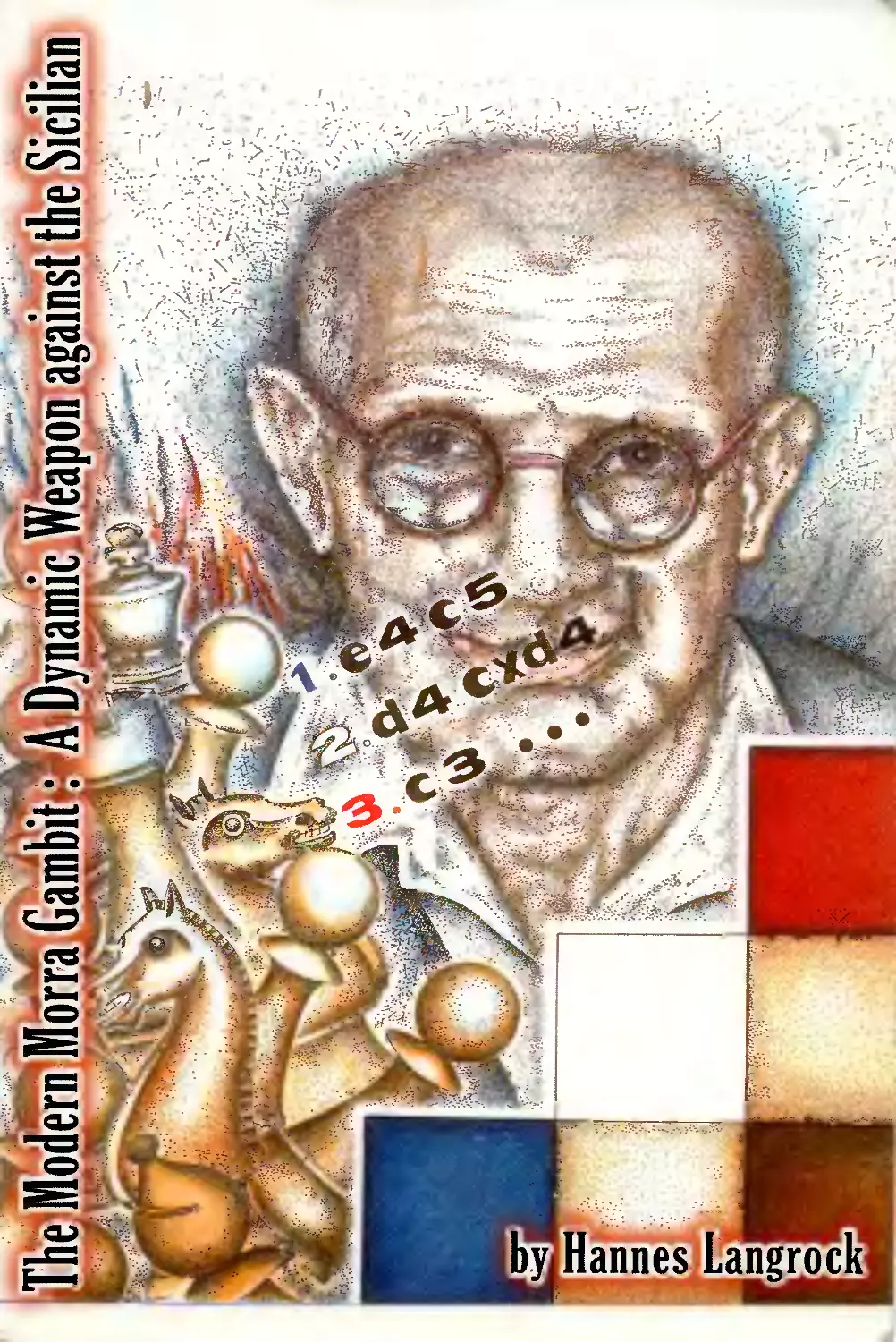
Attack the Sicilian Defense aggressively with the Morra Gambit.
Starting with L e4 c5 2 d4 cxd4 3 c3, it is well suited for players
striving for tactical and uncompromising play, as White's better
development often leads to a dangerous initiative. Furthermore,
traditional Sicilian players may be taken by surprise and removed
from their main-line repertoire.
If you take the time to study the Morra Gambit, you will achieve
excellent practical results. The positions that arise are extremely
difficult to play especially if the defender is not familiar with
them. One mistake by Black frequently means the end of the game.
About the Author:
Hannes Langrock is a German FIDE Master living in
Hamburg. He has played the Morra Gambit successfully
against both grandmasters and international
masters. Rated over 2400 he was the < "'..
winner of the German Individual
I ' , ...
;":.;
Russell . .
Enterprises, Inc. 'co."
Cup 2002.
$26.95
:: :".'- . :: 'f: . .
I H
'-1
""
--695>
II
:- ': ;; :;(:: :: ': . :'::_' :.3 ..
9 781888 11 '69032'3 11
The Modern
Morra
Gambit
A Dynamic Weapon
against the Sicilian
Hannes Langrock
..
2006
Russell Enterpnses, Inc
Milford, CT USA
The Modern Morra Gambit: A Dynamic Weapon agamst the Sicilian
Copyright 2006
Hannes Langrock
All Rights Reserved
ISBN: 1-888690-32-1
Published by:
Russell Enterprises, Inc
P.O. Box 5460
Milford, CT 06460 USA
http://www.chesscafe.com
mfo@chesscafe.com
Cover design by Zygmunt NaslOlkowskl and Janel Lowrance
Prmted m the United States of America
..
Table of Contents
Foreword 4
Acknowledgements 5
Bibliography 5
Introduction 6
Chapter I The ..: c7-System 22
Chapter 2 The ...Jld7-System 61
Chapter 3 An Early ...d6 and ... f6 80
Chapter 4 The Classical Main Line 97
Chapter 5 The ...tL\ge7-System 110
Chapter 6 The Early Development of Black's Dark-Squared Bishop 158
Chapter 7 The Fianchetto Variation 183
Chapter 8 The Siberian Variation 201
Chapter 9 The Chicago Defense 219
Chapter 10 Sidelines 246
Chapter II The Morra Gambit Declined 300
Appendix A The Delayed Morra Gambit 325
Appendix B Solutions 327
I ndex of Variations 329
Foreword
Hannes Langrock has regularly played the Morra Gambit against the Sicilian
Defense since 1999; with very good results. We have analyzed many lines to-
gether in our training sessions and he has incorporated our findings In his analy-
SIS. He has also included many new ideas and analyzed them in depth. I draw
your attention especially to ll.tLJdS, instead of the old ll.tLJd4, in the critical
...4::Jge7-system (see p.11 0).
I am convinced that everyone In need ofa weapon versus the dreaded Sicilian can
consider taking up the Morra Gambit. Those who will obtain particular benefit
from this work are:
I) Dedicated Morra players that will find plenty of original analysIs to refresh
their theoretical knowledge and find new inspiration for their own endeavors.
2) Young improving players who want to enhance their handling of the initiative
and make their play more aggressive and dynamIc. I suggest first reading the
introduction carefully and playing through the main lines (printed in bold). Then
after gaining some experience with the gambit, they should commence digging
deeper using Langrock's extensive analysis.
3) Players of the 2.c3 Sicilian, who want a second surprise weapon, which is akin
to their current repertoire.
4) Correspondence gambit players who need fresh Ideas and qUick access to the
latest Information.
5) And last but not least, Sicilian players in need of a method of meeting the
Morra Gambit will find the analysis is very obJective, which is not always the
case in books on gambits. I guess that this is illustrative of my influence on the
author after five years of training together.
In summary, the Morra Gambit is well-suited for players striving for tactical and
uncompromising play, as White's better development often leads to a dangerous
initiative. Furthermore, tradItional SIcilian players may be taken by surprise and
removed from their main line repertoire. I do not understand why so few players
choose the Morra Gambit and I hope that this book increases its popularity and
that you will enjoy It as much as I have.
GM Dr. Karsten MUlier
Hamburg, August 2006
4
Acknowledgements
I'd like to thank:
Hanon W. Russell for his confidence in this project.
1M JozsefPalkt>vi for his excellent book, Morra Gambll. which truly inspircd me.
Burt Hochberg for the linguistic and stylistic editing, and Mark Donlan for his
editing and layout work.
Frank Palm and Hendrik Schaffer for making their material about the Morra Gambit
available to me.
My whole family for their support, especially my parents and my grandparents.
fhe greatest thanks goes to my trainer GM Karsten MUlier, who encouraged me
and offered his advice and support throughout this project; without him this book
definitely would not exist.
Bibliography
Books:
Burgess,G.: Wmnmg wl1h the Smllh-Morra Gambit, (Bats ford 1994)
('Iaffone, B.; Finegold, 8.: Sml1h-Morra Gambl1, Fmegold Defeme (Gameplayer
Inc., USA, 2000)
Kalinlchenko, N.; Gufeld, E.: Handbook of Chess Opening. (Modern Chess Book,
Warsaw, 1998)
Palkovl, G.: Morra Gambl1 (Calssa Chess Books, Kecskemet, 1998)
Rogozenko, D.: Ant,-Sictliam;: A GUidefor Black (Gambit, London, 2003)
I aylor, T.: How to Defeat the Sml1h-Morra Gambl1' 6...a6 (Chess Enterprises,
Moon Township, Pennsylvania,1993)
I}atabases:
Me (/ Ba.\e 2005 (Chessbase)
M(' (/ Corr 3 (Chess Mail)
5
Introduction
When I began writing this book, after
having played the Morra Gambit for
some years, I was of the opinion that I
knew "my opening." It has been my
main weapon against the Sicilian De-
fense and my sympathies are clearly on
the white side, but during my detailed
study of it, I had to correct many of my
assessments concerning the majority of
Black's defensive systems. I attached
great importance to remaining appro-
priately objective, which may sound
natural, but remaining objective has
been an elusive goal for many authors
when writing about gambits.
The theoretical material IS divided Into
eleven chapters. Chapters' 1-10 deal
with the Morra Gambit accepted and
all begin with the starting position af-
ter 1.e4 c5 2.d4 cxd4 3.c3 dxc3
4.tLJxe3 Chapter II investigates the
Morra Gambit declined, and an appen-
dix discusses the pros and cons of de-
laying the pawn sacrifice. Every stem
game IS introduced by a heading, which
should serve to orientate the reader
while navigating the chapters. In some
cases I adapted the move-orders to
achieve maximum clarity within
each particular system. My criteria for
choosing the stem games followed four
parameters:
I. Quality (which was the critical move
or variation)
2. Quantity (which move or variation
was played most often)
3. The strength of the players
4. The course of the game (a spectacu-
lar attacking game IS more Instructional
than a qUick draw)
The Morra Gambit IS an exciting open-
Ing that IS very attractive to the attack-
ing player. Let's start with a game that
Illustrates many of ItS basic elements.
A detailed analysis of the variation
played in this game can be found in the
appropriate theoretical section of the
book, and the same holds true for all
the games In this introductory chapter.
F. Roselli - N. Tere...hchenko
corr 1972
l.e4 cS 2.d4 cxd4 3.c3 dxc3
4. xc3
S B
t - t r t r t
.P P
'...
ft.
rv
4:> r _ r 4:> r$'
.!l p . p .!l pB;
:' :r. rv
d g d
This is the startmg position of the
Morra Gambit accepted. What compen-
sation does White have for the pawn?
A rule of thumb says that the gain of
three tempi justifies a pawn sacrifice
in the opening. Obviously this IS not
the case here, as White is only one de-
veloping move ahead. Yet there are
other factors that playa meaningful
role.
For instance, White has a very free po-
sition and he will be able to move all
of his pieces to active squares. Further-
more, his strong e-pawn and his con-
trol over the d5-square give him supe-
6
riorlty In the center. Looking at the po-
sition from Black's side, It quickly be-
comes clear that It won't be easy for
him to develop activc play. In the Open
Sicilian, Black usually plays on the
queenside using the semi-open c-file.
In the Morra Gambit the c-file is open,
which makes It much harder for Black
to create counterplay. Of course the
open c-file plays an important role, but
In most cases It'S White who manages
to occupy and make use of it.
4... c6 S. f3 d6 6.11.c4 e6 7.0-0
a6
Black chooses a tYPical Sicilian setup,
while White has moved his pieces to
the most natural and active squares.
Fast and natural development is a
basic principle of the Morra Gambit,
and of gambit openings in general.
White's next move IS very Important as
11 Introduces the standard Morra setup.
8. e21
'I!f .., .%'I!f,
a ' f ;.: ra
t...t t
t ..r t .
""'W.a;
d,A"
% R 0. .
4:> r 4:> r
.u. p . g p .u. .u:
.
t::!1 1 ;g-
fhl!. IS a key move. White plans to con-
l1nue wllh 9.E!d1 followed by develop-
II1g his dark-squared bishop (mostly to
l't, otten to g5, but also sometimes to
cl). This piece configuration IS often
c1Tectlve as It puts pressure on Black's
weakest pOint - the d6-pawn, and
InuouuClIOII
brings some tactical motifs mto the
game. However, there are many lines
against which this setup IS Inaccurate
or even Just bad. The most drastic ex-
ample is the so-called "Siberian Trap,"
which you will get to know in a later
chapter.
8...11.e79.Eldl
Now Black has to deal with a main tac-
tical motif of the Morra Gambit - the
e4-e5 break.
9... c7
S " 0.,,/- B
t ti t
' 'r. ., .
t. f1t.
.J,A"
. .
., - ., . ""
ft .gi fti
. rt-)
t::!1
Black moves the queen off of the d-file
In order to avoid e4-e5 for thc tlmc be-
ing. Another pomt is that on c7 the
queen controls the Important e5-square.
The ...\¥rc7-system is playable for
Black, but he must be extremely care-
ful. This variation contains the three
most characteristic tactical motifs of the
Morra Gambit: the e4-e5 break, the
knight sacrifice on d5, and the piece
sacrifice on b5. For this reason, I rec-
ommend the reader begin studying the
Morra Gambit with the ..:0e7-system.
10.11.f41
This IS the most dangerous move. White
puts pressure on d6 and threatens to
open the position with e4-e5.
7
10... eS?t
I he Modern Morra lJamblt
And this IS a typical mistake. Black
feared the e4-e5 advance, so he decided
to close the h2-b8 diagonal. Yet, this
move is a loss of time, as Black didn't
develop a piece and, secondly, the
kmght did an excelIentJob on c6. It kept
both the c-file and the a4-e8 diagonal
closed. lO...tLJf6! was called for.
11.11.xeSt
Exchanging the strong defensive knight
and continuing the attack with tempo.
The latter is especially important as the
time factor plays a major role in the
Morra Gambit.
11...dxeS l2.11.bS+t?
S r . . ' )B t
t t
l_ .t.' '
r .
. .'ft'. '
R r-..
, "2-J .
9:;; ., , _ 4:> r$'
ft W }.u:
.
This is the most aggressive way to im-
tiate an attack on the king White sacri-
fices his bishop in order to get at the
black king immediately. The piece sac-
rifice is very promising because of
Black's poor state of development,
which was a consequence oflO...tLJe5?!.
The natural l2.E!ac1 is also strong.
12... f8
12.. .axb5 IS analyzed in the theoretical
section. White's attack more than com-
pensates for the piece. Here is one il-
lustrative line: l3.4::Jxb5 \¥ra5 l4.E!ac1
tLJf6 l5.4::Je7+ 'ittf8 l6.4::Jxa8 \¥rxa8 and
now White WinS by means of a tactical
motif that is typical of the ...\¥re7-sys-
tem: l7:&c4 Ad7l8.E!xd7 1 +-.
13.Elac1
For many Morra theoreticians, the
move E!ac1 is a natural part of White's
standard setup, which has now been
completed.
13...axbS
Black finalIy decides to accept the sac-
rifice. He has nothing better; for ex-
ample, l3..:0b8 finds a very strong an-
swer in l4.4::Ja4! with a winnll1g attack.
l4. xbS aS lS.Elc71
x
Threatening l6.\¥re4 (or16.E!dc1), win-
ning a piece.
IS...b6
Meeting the direct threat and Intending
16...Aa6, but after l6. xeS this re-
mains a dream. Now Black collapsed
under the pressure and played...
16...f6?
Allowing a nice fimsh. Still, his posi-
tion was beyond salvation. For ex-
ample, the deSIrable l6...Aa6 fails to
17J;i'h5 g6 l8.E!xe7! 4::Jxe7 19.\¥rh6+
"l1g8 20.tLJd7 f6 21.tLJxf6+ 'ittf7 22.4::Jh5!
and Black resigned in T.Jansen-
G Hadley, Email 1998.
l7.Eld8+1
s ,.IJ S
. r t
r - t r '
P .
{). .
. _ft.
" .0 .,
ft lB .' lB ft l]
. ' . ' .
17...11.xd8l8.Elf7+ e8l9. d6#
1-0
The Morra Gambit has not yet estab-
Itc;hed itself on the grandmaster tour-
nament circuit, but it IS occasionally
lIsed as a surprise weapon. I believe that
one reason for this is that most grand-
ma!.ters shy away from taking risks
when plaYing the white side of an open-
II1g The majority of strong players are
c.,at,!.ficd to obtain a <;mall but solid edge
Introduction
as White. This aim cannot be achieved
with the Morra Gambit, as Black has
many ways to meet it, and most of them
are playable from a theoretical point of
view. If Black accepts the gambit, then
it leads to sharp positions in which
White has an attack, as compensation
for the sacrificed pawn, but no forced
advantage.
The following quote from
Kalinichenko's and Gufeld's Hand-
book ofChe:;:; Openmg:. reveals that the
Morra Gambit IS respected among mas-
ters as well:
"What openings should be chosen?
EVidently, those which are character-
ized by the rapid mobilization of forces,
when the two armies get Into close com-
bat in the early stage of the game... It
would be Interesting to test the validity
of military laws in such semi-open and
double-edged systems as Morra's Gam-
bit... Morra's Gambit (named after an
unknown French chess player who pro-
posed l.e4 e5 2.d4 cd 3.c3) gives
White a chancc of aggrcssive play...
If Black accepts the sacrifice, White
concentrates his forces in the centre
gaining superiority In development..."
The most significant features of the
Morra Gambit are the subject of the
following pages. To a great extent these
features reflect the Morra Gambit ac-
cepted and are illustrated by selected
miniatures.
The Practical Point of View
The practical aspect of the Morra Gam-
bit plays an important role, as it IS a
typical over-the-board openmg. As the
theoretical sections demonstrate, moc;t
9
I he Modem Morra (jamblt
of Black's defensive systems obJec-
tively offer acceptable prospects in a
complicated battle. Nevertheless, I can
promise that every talented attackmg
player who studies the Morra Gambit
will achieve excellent practical results.
The positions that arise are extremely
difficult to play, especially If the de-
fender is not familiar with them. I'm
not claiming that the defender falls
more often in these positions than the
attacker, but one mistake by Black fre-
quently means the end of the game,
while White more often gets a second
chance.
Perhaps this is why Dorian Rogozenko
advised the readers of Ant,-Sictl,am
A Guide for Black not to accept the
pawn sacrifice:
"3.c3 White offers the Morra Gambit.
Black has a chOice: either to accept the
pawn, giving White the initiative, or to
decline it by transposing into a 2 e3 Si-
cilian. I am convinced that in the 2 e3
Sicilian White has no advantage at all,
while the Morra Gambit IS less explored
at high level and there are several un-
clear positions In which White enjoys
the initiative for the pawn. I have failed
to find a very clear way of accepting
the pawn sacrifice and then completely
neutralizing White's initiative."
Another practical advantage for the
Morra enthusiast is that he's "at home"
In his opening, and he will have memo-
rized the main tricks and motifs. Fur-
thermore, it's not so easy to prepare
against the Morra Gambit. In databases
such as Mega Database 2005 there are
hardly any helpful commentcd games
to be found. Whercas in cncyclopcdlc
opening books, the Morra Gambit IS
usually discussed in an incomplete and
superficial way. In order to study this
opening properly, you must use special-
Ized literature, but my guess IS that less
than 5% of SicIlian players possess
such literature about the Morra Gam-
bit. The consequence is that the Morra
practitioner, who has studied the open-
Ing sensibly, will usually know more
than his opponents.
However, your opponent will prepare
against the Morra Gambit if he knows
that you use It regularly. He will most
probably choose a certain defensive
system and play nine or ten moves
quickly. Yet when his preparation has
ended he will find himself in a highly
complicated position swarming m tac-
tical motIfs. It IS at this exact moment
that it becomes meaningful that you
play the Morra Gambit regularly, and
your opponent meets it only once ev-
ery few years. He IS likely to lose con-
trol qUickly, and after one tactical mis-
take the game is over. For such reasons,
many Morra games resemble a sense-
less slaughter of innocents rather than
a game of chess. Here are a few briefly
annotated examples:
J. Freyre (2225) -
A. Rittiphunyawong (2290)
Thessalonlki 01 (Men) 1984
l.e4 cS 2.d4 cxd4 3.c3 dxc3
4..£} xc3 .£)c6 S..£)f3 g6 6.11.c4
11.g7 7.eSI aSI? 8.0-01 .£}xeS
9.'£} xeS xeS? 10.Elell aS
l1..£}dS -+ f8 l2.11.d2 d8
l3..£} xe71 .£} xe7 l4.11.gS f6
1 S. d61 fxgS l6.Ele3 <t>e8
17.Elae1 11.f8 l8.Elf3 b6
10
S nr s
t.t. .t
' z U t
1ifi g
. '..
.;' .m -.
., . . ,/.
fti fti:lli
'H "'.
_ ? L'i
19.Elxf8+t 1-0
JY. Fuchs - JY. Merkel
corr I 964
l.e4 cS 2.d4 cxd4 3.c3 dxc3
4. xc3 c6 S. f3 d6 6.11.c4 e6
7.0-0 f6 8:l!1te2 a6 9.Eldl 'IPIc7
10.11.f4 eS?t 11. dSt xdS?t (Q
11...'i:J'd8) l2.exdS-' e713. xeSI
f6 l4. f3 bS lS.11.b3 f7
16.Elacl 'IPId8 l7.11.xd6t 'IPIxd6
18.Elc6 'IPId8 19.d6+ e8 20.dxe7
tJxe7 2l.Elc7t
s S
}. )ifif.f , .
t
fa 'R ' . '
. '
..u
wA'4 .,/.
ft gi ft i:lli
. '
and 1-0 because of21... 'i:J'xe2 22.W #
G Evans - J. Gardener
BCF -ch Sunderland 1966
This game saw the same variation,
when Black vainly tried to improve
with l2....£)d8. The game continued:
muoaucuon
l3. xeSt 11.e7 l4.Elacl 'IPIb8
ls. g6t?
=' 'f ,=,:
a 1if " a
't. OOt t
t . r : J
. ;r .
a.'ft'. '.
.'
%
" wA ., '/.
ft gi ft i:lli
. ' 'H 'H' ' ffi
lS...hxg6 l6.Elel 1-0
C. Oliver - J. Bennett
corr 1984
l.e4 cS 2.d4 cxd4 3.c3 dxc3
4. xc3 c6 S. f3 e6 6.11.c4 d6
7.0-0 11.e7 8. 'IPIe2 a6 9.Eldl bS
10.11.b3 11.b7?t (l0...E!a7 1 ?) 11.11.f4t
'IPIc7 12.Elacl t eS? (12... d8!?)
13. dS 'IPId8 l4.11.e3 Elc8 lS.a41
b4 l6.'lPlc4 d4 l7. c7+t d7
l8. xeS+ Now white mates by force.
The finish given In MegaCord is defi-
nitely faulty, but a possible mating fin-
Ish IS: 18...dxeS 19.'lPle6+t
s ,, S
£4J t t
f., "a
ez. % .
Itfti.
BZ .
- . $'
. t .u.
' 'H . "'-
l:::!f. -:;
19...fxe6 20.11.xe6+ d6
2l.Elxd4+t exd4 22.11.f4 # 1-0
II
The Modern Morra Gambit
O. K/ew;n - Lau
Hamburg 2002
1.e4 cS 2. f3 c6 3.d4 cxd4 4.c3
dxc3 S. xc3 e6 6.11.c4 i!1/c7
7.i!1/e2 a6 8.0-0 bS?IIn combmatlon
with ..:i e7 this often proves too risky.
9.11.b3 Ab7 10.Eldl d6 11.11.f4
eS?I12.Elac1-' 11.c6 (12...tLJxf3+
l3. rxf3 , b8 l4. irg3 e5?! l5..Q.g5 f6
l6.-'l.xg8 fxg5 (16... xg8l7...Q.xf6+-)
l7.-'l.d5 +- [Klewm]) 13. d41?
.£)e7? 14.11. x eS dxeS lS..£)dxbSI
axbS 16..£)xbS+- 11.xbS 17.i!1/xbS+
.£)c6 18.Elxc6 Elb8I?
a S
. t j7 t
<1ifi .
. .t. =
.
. .ft. .
B ...
4:> 4:> $'
.u. f .u. .,@
----- .
19.Elxe6# 1-0
T. Ima; - T. Stall"li...
DetrOit 1992
l.e4 cS 2.d4 cxd4 3.c3 dxc3
4..£)xc3 e6 S..£)f3 Ab4?1 6.11.c4?1
(6.-{ rd'i!) 6...'O'xc3+?1 7.bxc3 .£)c6
8.0-0 .£)ge7 9.11.a3?1 (9. 'ii1d6!)
9... i!1/aS?1 (9...d5!) 10.Ad6 i!1/xc3
l1.Elcl t i!1/aS 12..£)d4 xd4
13.i!1/xd4 i!1/b6 14.11.cS i!1/c6
lS.11.xe7 xe7 16.i!1/xg7 Elf8
17.i!1/xh7 bS 18.11.dSI+- i!1/xc1
19.Elxcl cxdS 20.exdS 11.b7
21. h4+ d6 22. i!1/b4+ eS
23.Elel+ f6 24.i!1/f4+ g7
2S. gS+ 1-0
S
t t
i,&;
. . .
_t.ft.
luuu. . .
! ....
4:> r 4:> f< .
.u. .u.
. .
Tara'iOv - S. She\takov
corr 1970
1.e4 cS 2.d4 cxd4 3.c3 dxc3
4..£) xc3 .£)c6 S..£)f3 d6 6.Ac4 e6
7.0-0 .£)ge7 8.AgS a6 9.i!1/d2 h6
10.Af4 gS 11..Q.g3 .£)g6 12.Elfdl
eS 13..£)dS 11.g4 14.Ae2 11.xf3?1
(14. ..Ilg7) lS.11.xf3t .£)d416.11.hS
.£)f4 17.11.xf4 gxf4 18. i!1/b4:t bS?
I .; . ' i . i. .
t . r . r
. .a; . .a;
.t.{) .
F ft
r < . · '.
4:> 4:> $'
.u. .u.
.
19.Elxd41 exd4 20. xd4 1-0
Psychological Aspects
In the Morra Gambit accepted, lines of
attack are cleared from the very begin-
ning; White has sacrificed a pawn for
an attack and the initiative, while Black
has to defend This Ituation can be
viewed 111 different way!. A staunch
defender would likely say' "1'111 a pawn
up; you have to show that YOli havc
12
compensatIOn for it. The burden of
proof lies with you!" The opposite ar-
gument goes: "I have the Initiative and
I set the threats. If you only make one
"'lngle mistake, you will lose!"
Both arguments have merit. However,
plaYing Black against the Morra Gam-
It can be very unpleasant, especially
lor a higher rated opponent. He may be
favored In this Davld-versus-Goliath
con n Ict, yet It soon becomes clear that
lust one mistake may decide the game.
Even a 300-polnt rating difference can
have the defender wishing he had cho-
scn a quieter opening. The rating favor-
ItC oftcn cannot withstand the pressure;
and so, In practice, a surprISingly high
number of upsets occur with this sys-
tcm. I am sure upsets occur more fre-
quently than with other openings; I of-
Icr rour examples:
E. Arruda - C. Martinez (2370)
Rio de Janeiro 1991
l.e4 cS 2.d4 cxd4 3.c3 dxc3
4..£)xc3 c6 S.11.c4 e6 6..£)f3 d6
7.0-0 .£)f6 8. i!1/e2 11.e7 9.Eldl i!1/c7
1O.11.f4 eS?1( c> 1 0...a6) 11.AgS a6
12.Elac1 t 11.g4 13.h3 d4?1
14.Elxd41 11.xf3 lS.i!1/xf3 exd4
16..£)bS i!1/d8 l7. c7+ 'i!lf8
(17..:&xL7 l8.Jlxf7+:!:) l8. xa8
xa8 19.11.b3 i!1/b8
I .
I t. OO't' 't
t %t1 . ' '
/3
...
. r 4:>.
R p .u.. %%
. ft
ft i ,. ft1 ft
*
Introduction
20.11.xf61 11.xf6 21.i!1/hS g6
22.i!1/dS+- i!1/e8 23.Elc8 1-0
R. Staub - M. lIoffmalln (2460)
Zell 1993
1.e4 cS 2. f3 d6 3.d4 cxd4 4.c3
dxc3 S. xc3 h6?1 6.11.c4 f6?1
7.eSI:!:
7 ... g4?1 8.e6?1 (8.h3' was even
stronger; for example; 8..."0e7'? 9:0b3
tLJxe5 1O.tLJxe5 dxe5 11 Jlxf7+ '1ffd8
12.0-0+-) 8...fxe6 9. gS eS
10.11.xe6 11.xe6 l1. xe6 i!1/c8
l2. dS i!1/c4 l3..£)ec7+ d8
l4.i!1/e2+- i!1/c6 lS.11.e3 bd7
l6.Elc1
S . .
t ?ry..r r
. . . '
R 1if p . ..&:
.{) .
. . .
. .
4:> r I $'
.u. p g .u. .u:
.
l6... cS l7.11. x cS dxcS l8.i!1/xes
e6 19. xe6+ d7 20..£)xf8+
Elhxf8 21. i!1/e7+ 1-0
13
The Modern Morra Gambit
J. Murta - H. Camara (2330)
BRA-ch Goiania 1982
1.e4 cS 2.d4 cxd4 3. f3 eS 4.c3
dxc3 S. xc3 c6 6..Q.c4 Ae7?
(6...d6') 7.i!1/dS+-
s £ ., s
t U t t r t
'. . .. '
% '1< .
t;i'f
. . . . " . i. ;
' .4J.
4:> R 4:> $'
.u. .u. .u:
. ' . ' . '
OOpSI 7... i!1/aS 8. i!1/xf7+ d8
9. i!1/xg7 .Q.f6 10.AgS 1-0
L Milman (2356) - J. Ehlve...t (2587)
New York Masters 53rd 2003
l.e4 cS 2.d4 cxd4 3.c3 dxc3
4. xc3 c6 S..£)f3 e6 6.Ac4 i!1/c7
7.0-0 f61? 8. bS b8 9.eSI
g4 10. d6+?1 (0 10...Ilf4)
10...Axd6 11.exd6 bS l2..Q.b3 0-0
13.h3 .£)f6 l4.Ele1 as lS..Q.gS a4
l6..Q.xf6 gxf6 l7.Ac2 .£)b4
l8..Q.bl .£)dS 19..£)h4 i!1/xd6
20.i!1/g4+ h8 21..£)fSll-O
= IS ..
. . t . .t.t
. t r
<1ifi p.a;
I . % . ' t . .4J.
t.%.%
.ft
4:> U 4:>
.u. .u.
.CH Jl. CH
t::!1 __ _
Strategies
Since White IS a pawn down he should
play aggressive chess. Slow and over-
cautious play usually gives Black the
opportunity to gradually consohdate his
material advantage, so moves like a2-
a3 and h2-h3 are Inappropnate in most
cases. Of course, there are exceptions;
one is the partially fixed pawn struc-
ture of the Classical Main Line, when
White's compensation is of a more po-
sitIOnal nature.
Theoretical knowledge plays a very
Important role; knowing the proper
methods of meeting the different Black
defensive systems IS much more impor-
tant In the Morra Gambit than in other
Anti-Sicilians, such as the c3-Slcllian
or thc .Q..b5-hncs. In most cases, there's
only one promising concept against
each particular Black defense. If the
Morra player IS aware of the correct
counter plans, then positive practical
results are as good as guaranteed. Un-
fortunately, many Morra practitioners
play the openlllg mechanically, and
don't know anything beyond the stan-
dard setup. It IS such laziness that leads
to the unsatisfactory score of the Morra
Gambit. For instance, In Mega Dala-
hme 2005 after 3.d clxc3 4.tLJxc3,
White only scores 49%. While In my
big database, which also contains cor-
respondence games, wherc industrious-
ness is an important Issue, White scores
51 % of the points, and I'm convinced
that White can do even better.
As with most other gambits, the Morra
GambIt IS charactenzed by very con-
crete play. The ability to calculate vana-
tlons deeply and accurately I" or para-
mount Importance compared to othcr
14
openings. I am often completely ex-
hausted after many of my Morra games,
which IS qUite natural after "training"
111 tactics for four hours non-stop!
The Target Group
Naturally, this sharp and aggressive
opening IS made for uncompromising
,'!lacking players, although even cau-
lious players, who fear and avoid tac-
IIC'i, can profit from It by perfecting
Ihclr attacking skills. After only ten
Morra Games the expo!.ure to the newly
Icarned tactical motifs will allow one
10 cnter Into complications with greater
clf-confidence and a much higher
l hance of success. Young talented play-
L'I should also learn the Morra Gam-
hll At this stage of develO"pment, It is
I11l1ch wiser to teach a pupil the Morra
( "lInbit than making him learn all the
Iheory of the Open Sicilian. The Morra
(,ambit IS easy to explain and rapidly
.Ih orbed by young players. Moreover,
11\ fun to play, which is significant In
lelalnlng a young and talented players
1111 crest
1IIIIIIs context I would like to relate my
OWII experience connected with the
Morra Gambit, which was a decIsive
IlIIlIlng pOint in my chess life. In 1998,
I was 15 years old, and I was partlcl-
p:lIl11g In a German Youth Team cham-
plOIl llIp as a member of the Hamburg
le;lIn In those days I was justly known
.I all overcautious draw maker. We fin-
I hcd the tournament In third place,
which was a very good result, and at
Ihc prcsentation ceremony every mem-
her or the best three teams received a
hook prl/e. Destiny placed Joszef
l'alkljvl's Morra Gamba into my hands
IIl1d, al fir<.!. I didn't care mueh about
Introduction
the book. Yet, about a month later I be-
gan to leaf through it, and page by page
Morra's magic began to enchant me.
Six months later I dared to try the Morra
Gambit in a tournament game, and I
won. My results were excellent from
the beginning, and I played many games
before I finally lost one. I had fun play-
Ing chess again and I completely
changed my style. I only wanted to at-
tack my opponents; to attack and check-
mate them. While today I have a more
universal style, my intensive Morra
years 1999-200 I were the most Impor-
tant for my chess development. So, If
you are an attacking player, or If you
want to become one, the solution is the
same: play the Morra Gambit!
Typical Tactical Motifs
When White offers the c-pawn with
3.d, Black has no weaknesses at all. It
IS on Iy during the further course of the
game that White can jeopardize Black's
defenses through tactical means, mostly
sacrifices. While the Morra GambltJust
swarms with tactical motifs, from the
double bishop sacrifice to the suffo-
cated mate, there are three main motifs
that occur most regularly and are there-
fore characteristic of the opening:
The Pawn Advance e4-e5
This motif can be found In many lines
of the Morra Gambit. With a black
pawn on d6, this break gives Black the
choice between closing the position
(d6-d5). open ing the position (d x e5) or
allowing White to do so (exd6) The
former IS generally the most desirable,
but often black jumps out of the frying
pan and Into the fire, as a sacrifice on
d5 ean follow (o:2lxd5, .Q..xd5 or even
15
Thc Modern Morra Gambit
xd5), which definitely opens the po-
sition. If the black d-pawn is placed on
d7, White sometimes plays e4-e5 In or-
der to restrict the opponent, followed
by an attack that IS based on his space
advantage. Such an adaptation of the
e4-e5 advance can be seen in the Sibe-
rian Variation and in the .....Q.e5-system.
Here are two straight-forward examples
of an effective e4-e5 break:
Z. Rambeloson (1930)-
J. Le Meur(1780)
Paris 2002
l.e4 cS 2.d4 cxd4 3.c3 dxc3
4. xc3 a6 S.11.c4 e6 6. f3 bS
7.11.b3 11.b7 8. e2?1 d6?1 9.0-0
f6 10.eSI?
=' ,=,:
a" _ . , 1."/ a
i.t< :t
t. t.
. ' '1<' .
t i
...
{1 .4:).
4:> R..M.r 4:> $
.u. g .u.
''H' "'"
'
10...d xeS n..£) xeS 11.e7??
12..£)xf71 xf7 13. xe6+ e8
l4. f7+ d7 lS.Eld1++- c8
l6.Elxd8+ xd8 l7..£)dS Ele8
l8.11.f4 11.xdS 19.AxdS Ela7
20.11.xb8l-0
A. Rosing - JY. Schonherr
corr 1987
l.e4 cS 2.d4 cxd4 3.c3 dxc3
4. xc3 c6 S..£)f3 d6 6.11.c4 e6
7.0-0 f6 8. e2 11.d7 9.Eldl a6
10.11.f41? b8?1 n.eSI .£)hS
(11...d x e5 1 V:2IxeS xeS 1.3...Q.xe5 t)
l2.11.e3 dxeS?1
S . S
.t.Dt t
. .t.
. r ..
. p.a; .
'. .
R t"'\
.
4:> r R..M.r 4:> r$
.u. i? 9 p .u. p
.
(Q 12...d5 1 ) l3.Elxd71 xd7
14. gS .£)f6 lS. xf7 Elg8
l6.Eldl+ e7 l7..£)gS .£)d8
l8.11.b6+- 1-0
The Knight Sacrifice on d5
This motif also occurs In many varia-
tions of the Morra Gambit, often it's
the only way to keep the initiative and
continue the attack. Usually the move
tLJe3-d5 IS connected with a direct
threat; giVing Black no choice, but to
accept the sacrifice. The open e-file
(after ...exd5, exd5) can then give
White's attack decIsive powcr; further-
more, the white d-pawn can playa
dominating role and condemn Black to
complete passivity. Frequently, the sec-
ond white kmght causes a great deal of
trouble at c6 or f5 via d4
A tYPical defense for Black IS to return
the extra piece Immediately In order to
castle and equalize. In the Morra Gam-
bit declined (3...d3), the knight sacri-
fice on d5 frequently occurs as a tem-
porary sacrifice with the aim ofachiev-
Ing a positIOnal advantage. Again. I give
two examples. The first IS rather ea y,
leI
.1'" White WinS back the piece Immedl-
.llely; the second IS slightly more com-
plicated:
G Ruchk,,'h;o (2188)-
A. Dam;a (1888)
ITA 2002
l.c4 cS 2. f3 d6 3.d4 cxd4 4.c3?t
dxc3?t (4...tLJf6') S. xc3 c6
6..Q.c4 e6 7.0-0 .Q.e7 8. i!1/e2 a6
9.Eldl i!1/C7 10..Q.f4 bS?t 1l..Q.b3
.O.b712.Elacl f6 13. dSt
S .. S
.. ... t f. . t
1ifi
t t .
r.{). .
. .ft
BD {)B
I 4:> 4:> $'
jJ!. g J!. .u;
. ;'HI 'HI
.t:S< l:::::,.
1.i...exdS 14.exdS 0-0 IS.dxc6:t
.Q.c8 (15 -'l.xe6? 16 tLJcl4 +- ) 16.Elel
4)hS 17.11.gS AxgS 18. xgS g6
19..£)xf7t f4 (19 .E!xf7 20. re8+
.....g7 21.-'l.xf7 -(T'tXf7 22 J.; e7 +-)
.lO..£)xd6+ 1-0
li. Ligoure (2240) - L. Mile..; (2030)
Cannes 1990
l.c4 cS 2.d4 cxd4 3.c3 dxc3
4..£)xc3 .£)c6 S..Q.c4 e6 6. f3 i!1/c7
7.0--0 f6 8.Elc1?t (The critical theo-
Icllcal line IS 8 tLJb5 \¥rb8 9.e5') 8...d6
9..11f4 eS?t (9. .a6 was preferable.)
10..Q.bS+ fd7?t (0 10 IiId7)
I1.Elcl i!1/b8 12..£)dSt (diagram)
12...exdS 13..£)xeS?t (Even more
powcrful was 13 -'l.xe5 1 dxe5
1 'I n xd{+' "Yxd{ 1 S tLJxe5 ..o.b4
Introduction
S . S
t. .t t
B tB
.A.r-. .
! _ .ft
%
. .{) . '-
4:> _ 4:> $'
J!. J!. .u;
'HI 'HId
g ..
Ligourc-Milcsi after 12..£}d5
16.-'l.xd7 + xd7 17.tLJxd7 .o.xe 1
18." e5 +-) 13...dxeS 14..Q.xeSI
i!1/xeS IS.exdS d8 16.ElxeS
xeS 17.f4 .Q.g4 18.i!1/el .£)d7
19.h3 a6?t (I9.....IlfS 20. c3 tLJe5
21.b4:!:) 2O..Q.xd7 .Q.xd7 21. i!1/aS+ +-
e7 22.Elel + f6 23. i!1/b6+ fS
24.Ele5+ 1-0
The Piece Sacrifice on b5
This radical attacking method IS fre-
quently seen In the Chicago Variation
and in the .. ;i'c7-system In these sys-
tems, the black king often stays In the
center for a long time, and White in-
tends to open the a4-e8 diagonal, there-
by clearing the way to the black king
I. Starck (2040) - K. Timme
Nordhausen 1986
t.e4 cS 2.d4 cxd4 3.c3 dxc3
4..£)xc3 e6 S. f3 c6 6..Q.c4 d6
7.0-0 a6 8.i!1/e2 .£)f6 9.Eldl i!1/c7
10..Q.f4 .£)eS?t 11..Q.xeSt dxeS
12.Elacl Ae7? 13. bSt+- (next
diagram) In this case the sacnfice de-
cides Immediately, since white
achieves meaningful material gains.
13...i!1/b8 (13. axb5 14 -'l.xb5++-)
14. c7+ 1-0
17
The Modern Morra Gambit
IS gAY' . B
! t t t
t .t
,/-"
.4:). ti .
luuu. %ft.%
. _4:).
4:> 4:> $'
.u. g .u. P.u;A
. I
Starck-Timme aftcr 13..£)b5
A. Me.\ - Elm;
corr 1994
l.e4 c5 2.d4 cxd4 3.c3 dxc3
4..£)xc3 .£)c6 5..£)f3 e6 6.Ac4 d6
7.0-0 .£)f6 8.i!1/e2 Ad71? 9.Eldl
i!1/b8 10.Af4 (I O...Q g5') 10....£)e5
1l.Axe5 (Il.Jlb5!?) 1l...dxe5
12.Ab5 a6 l3.Axd7+ .£)xd7
l4.Elacl Ae7? (14...b5' would have
promIsed Black reasonable chances to
defend his positIon, keeping the extra
pawn.) l5..£)b51
' uu.u B.
t. t il
l- U- .
.45. .v/////l
. _ft. _
. . .4:).
4:> r .JMV 4:> r$'
.u. '@ .u. p.u;
. (+)
!' l::::!:.iW4
White IS raisIng a terrible storm.
l5...axb5 l6.Elxd7! xd7
l7. xb5+ 'i!ld8 l8..£)xe5+-
i!1/xe5l9.i!1/xe5 Af6 20. c7+ <i!)le8
21.i!1/xb7 Eld8 22.Elc81-0
D. He...... - L. Nelllne;er
Bonn 1999
l.e4 c5 2.d4 cxd4 3.c3 dxc3
4..£)xc3 .£)c6 5..£)f3 d6 6.Ac4 e6
7.0-0 a6 8. i!1/e2 Ae7 9.Eld 1 c7
10.Af4 .£)e5?1 1l.AxeSI dxe5
l2.Elacll? i!1/b8 13.Ab5+1
rwr4WK." i '
la 1if, a
.t. t t
,. .t.
iD .
. .ft .
! fa1 N ,,
4:> 4:> ::r$'
.u. '@ .u. p.u;
;g
l3... f8 (13...axb'5 14.4:Jxb'5-)
l4..£)a41 A fter this nice move, White's
attack breaks through. l4...b6
(14...a x b5 15. l)b6+-) l5.Elxc8+
i!1/xc8 l6..£)xb6 b7 l7..£)d7+
e8l8.Aa4 (18."Df6+'?<;';>f819..\1e6'
';Yxc6 20JDxe'5 +-) 18... i!1/b4 19.b3
f6 20..£)fxe5 fxe5 21.'(;}'h5+ 1-0
T. Loc:!,le (2227) -
W" Shaob;n (2496)
Shenyang 1999
This game !.aw the same variatIOn as
the prevIous one, when black tried
l4...i!1/a7, keeping an eye on b6 How-
ever, It didn't change the outcome'
l5..£)xe5 g6 (For 1'5 .axb5 see the
theoretIcal section) l6..£)b61 (dIa-
gram) WhIte WIl1S by force. l6...axb5
(I6...i{Yxb6 17. xe8+ E1xc8
18.tLJd7++-) l7..£)xc8 xa2
18. i!1/f3 f5 19..£)d7+ f7 20. i!1/c3
Elxc82l.i!1/xh8l-0
IH
"
t. t.t
t .t t
'l. ..,<;
.
. .ft.
%. %. %.
4:> 4:> $'
.u. '161 .u. .u:
. ' . 'ffi"
7
Lochte-Shaobin after 16..£)b6
1 astly, here are eight exercises to serve
,I a preview to this fascinating and
unique opening. They are divided Into
Ihree categories:
Simple.
.. Slightly harder.
*.. Somewhat difficult.
(I) I. Kaarne - E. Nakkila *
FIN 1999
l.e4 c5 2.d4 cxd4 3.c3 dxc3
4..£)xc3 d6 5..Q.c4 c6 6. f3 now
Black played the active 6...Jlg4, pin-
aung White's knight.
S "
t t . t
..a.<!i ..a.<!i
'D r 'D' '
W..&;
.14+
.4J.
4:> 4:>
.u. .u. .u:
'H ' ' ffi' ' ''H
l::::!f. -,
Introduction
What is the best way for White to meet
this vanatlon?
(2) JY. Holthui.\ - S. HolJdorf **
corr 1992
l.e4 c5 2.d4 cxd4 3.c3 dxc3
4. xc3 c6 5. f3 e6 6..Q.c4 d6
7.0-0 f6 8:l!1te2 a6 9.Eldl 'lPJc7
10..Q.f4 Ae7 l1.Elacl 'lPJb8
12..Q.d3 0-0 13.e5 dxe5 l4. xe5
xe5l5..Q.xe5 'lPJa716. e4 .£)d7
l7.Elc7 xe5 l8.Elxe7
S S..
7;t. t t
t . .t:.
.
. .4J.
,/. ,/. "
fti 'I61i ft
E!:
Black played l8... c6, questioning
the future of White's rook. Was this a
good Idea?
(3) K. Winkle - K. Rottbrand **
Griesheim 1997
l.e4 c5 2.d4 cxd4 3.c3 dxc3
4. xc3 a6 5..Q.c4 c6 6. f3 d6
7.0-0 .Q.d7 8. 'lPJe2 g6 9..Q.e3 .Q.g7
10.Elacl .£)f6 l1.Elfdl g4
12..Q.f4 h5 13.h3 ge5 l4.Ab3
xf3+ l5.'lPJxf3 (next diagram)
19
The Modern Morra Gambit
S % .:/. }S
t.Mtit
t. .t
. . .t
4:>
,, rf
fS . ft
4:> r . 4:> ' ,
.u. .u.1 . .u.
&t1
Black continued with IS... d4, in-
tending to halve the opponent's bishop-
pair. How do you assess the posItion?
(4) E. Walqui.'it - S. Rydberg *
USA 1994
t.e4 cS 2.d4 cxd4 3.c3 dxc3
4..£)xc3 d6 S.11.c4 f6
=' . & :,=,:
a. '.iW_ 1S' ?a
/ t .' 'r t r ' t
. . .
////h % :r. '% 'l. % .Y////h
. . .
.Bft.
////h' .,,",:; ./////h
.
4:> 4:> $'
.u. .u. .u:
''Hd N N 'H
t:5 g
White continued with 6.eS, but could
he really prove sufficient compensation
for two pawns after 6...dxeS?
(5) G Compagnone (2121)-
R. HaJl (1138) **
Emal12001
t.e4 cS 2.d4 cxd4 3.c3 dxc3
4. xc3 .£)c6 S. f3 d6 6.11.c4 a6
7.0-0 f6 8.11.gS e6 9.fie2 11.e7
10.Elfdl i!1tc7 It.Elac1 0-0 12.a3
s . S..
I - t t t
. 1ifi
t .r t
"""W..a;
...
.Bft.
Y- N f:"'\
L : .;ZJ "Z..J
r .M.r 4:> r$'
g .u. p.u:
m
Which IS the better chOice the devel-
oping move 12...11.d7 or the active
12...bS Intending to gain space be-
fore developing the bishop (possibly
to b7)?
(6) J. Bednar (2180) - M. Ma.'iiik **
SVK-ch Topolcianky 1994
t.e4 cS 2.d4 cxd4 3.c3 dxc3
4..£)xc3 .£)c6 S. f3 e6 6.11.c4 i!1tc7
7 .0-0 f6 8.h3 d6 9. i!1te2 a6
10.11.f4 11.e711.Elacl 0-0 12.Elfdl
Eld8 13.a3 11.d7 14.b4 eS IS.11.gS
bS 16.11.b3
Again you may choose between two
continuations for Black. Which IS
stronger, the move 16... a7, or
16...11.e6 with the Idea of parrying
the dangerous-looking 17..£)dS with
17... b7 ?
JO
(7) A. Mueller - H. Escher ...
Germany 1993
l.e4 c5 2.d4 cxd4 3.c3 dxc3
4.4)xc3 a6 S.Ac4 e6 6.4)f3 4)c6
7.0-0 .£)ge7 8.AgS h6 9.Ae3 4)g6
10.4)d4 Ab4ll.f4 0-0
/' ''I!I'(-
. I
. :
t.t.t
t _._ t _.r..r-
P..&1
E B · · ..<w "
OOJl N 4:> r
. .J.1
N' . '.
OO .
4:> r _ .4:> r$'
.u. p.u: . . .u. .u:
-
Inlhis posItion, White had the creative
Idea to sacrifice a piece in order to start
,\ mating attack. He played l2.fS
ge5 13.f6. Does this idea work?
(8) F. Alberton; - R. Eckenfels ...
corr 1977
l.e4 cS 2.d4 cxd4 3.c3 dxc3
4..£)xc3 4)c6 S.4)f3 eS 6.Ac4 d6
Introduction
7.0-0 Ae7 8.4)dS 4)f6 9.4)gS 0-0
10.4)xf6+ Axf6 1l. hS Axgs
12.AxgS e8 13.f4 Ae6
Both sides aImed for this position, and
It seems that Black has solved his prob-
lems, but WhIte uncorked the spectacu-
lar double piece sacrifice: l4.f5Axc4
lS.Af6 Does the attack break through,
or can Black defend successfully?
I wish you much fun and enjoyment
!.tudying and winning with the Morra
Gambit!
Hanne<; Langrock
March 2006
21
Chapter 1
The... t'Yc7-system
The ...,i1c7-system IS frequently played
In tournaments. Black moves the queen
01T the dangerous d-file and strength-
ens control of the Important e5-square
with the intcntlon of meeting the e4-
eS break. Yet by dOing this Black often
moves out of the frylllg-pan and into
the fire. If White plays .Q..f4 then the
threat of e4-e5 IS strengthened because
of the placement of the white bishop
and the black queen.
After 1.e4 c5 2.d4 cxd4 3.c3 dxc3
4.4)xc3 4)c6 5.4)f3 e6 6.Ac4 d6
7.0-0 a6 8. e2 we can divide the
...toJe7-system Into two variations:
I. 8...Ae7 9.Eldl c7
Now the cntlcal 10.Af41leads to the
following posItion:
rr ,gA\Y. 4) S
t '?1Ii. t t
iiiJi.
t.4) ilt.
. . '.
.Bft
R . '
..k.J
4:> r _ 4:> r$'
.u. g p .u. .u:
v- ' . '
Here Black can play 10...4)e5?1,
which is often a good move in similar
positions In the Open SIcIlian, but
there'!. one significant dllTerence in the
Morra GambIt - the open c-file! Af-
ter H.Axe51 dxe5 White can choose
between two promising all.lcklng con-
tinuations:
The bishop sacrifice l2.AbS+I? is the
subject of Torres-Tasic, while
l2.Elacl IS discussed In Baum-
Woyciechowski.
Black will also have problems along the
c-file after 10...b511.Ab3. as the c6-
square IS no longer protected by a pawn.
This position IS rife with tactical mo-
tifs; such as the knight sacrifice on d5
that appears In the stem game Morvay-
Bauer.
Black should answer 10.Af4 with
10...4)f61, which transposes to the
second variatIOn.
II. 8...4)f6 9.Eldl c7
Again, 10.Af41 I!. critical, aiming at
Black's queen and Intending to open the
position with e4-eS.
s Rr S"
t . t t
1ifi
t .r t '
(7..a;
; . . . .
. .4:>'?
.u. j
R /.""'\
. ci.J
4:> r _ 4:> r$'
.u. g .u. p.u:"
. . £ti ,
Once more Black should not move the
Important defensive kmght from the c-
file: 10...4)e5? 1l.Axe51 dxe5
12.Elacll with threats that Black did
not manage to parry In Hedke-
Kupreichik.
.) }
The ..:t1c7-system
1\ seemingly elegant positional solu-
lion, to reinforce control of the e5-
'quare, is 10...4)d7, but there's a hole
111 Black's concept. After 11.Elacl
fib8 (White threatened 12.tLJd5') the
,urpnsing l2.b41 IS very strong. Tak-
IIIg the pawn IS dangerous because of
12....£)xb413.eSI. All other defenses
have their drawbacks, as shown In the
game Limbos-Logie.
rhe best defense IS simple development
with 10...Ae71
S .. S
t IM '1<
1ifi t t
t.4) t
...
D D4:>?
.u.OO
; - . .
4:> _ 4:> r::; .
.u. . g .u. .L!t
. .
Now the premature 11.eS?1 should not
hc met with l1...dxeS?1 l2.4)xeS
xeS l3.AxeS, which gave White
promising compensation in Mayblom-
"ilavotinek. The correct reply IS
11....£)hSI, when thc cnsulng compli-
l:atlOns favor Black, as In the game
Belenko-Rivlin.
White should complete the standard
,ctup with 11.Elacl, when Black has
10 watch out for the kmght sacrifice on
d5. Black can then play the prophylac-
IIC 11... b8, but l2.eSlls more dan-
gcrous than one move earlier, as the
Inclusion of 11.E!ac1 t:'rb8 favors
While. Thc games Becker-
lIeinemann and Schmidt-Gabriel
dcal with thl!. line.
Once again, Black should continue to
develop and play 11...0-0.
Thc move l2.Ad3? has been tried a
couple of times. The idea of plaYing e4-
e5 IS somewhat too obvious and Black
has the strong reply l2...eSI The game
Ullrich-Schwarze shows that Black
can achieve an advantage.
After l2.Ab31 we reach a critical po-
sition of the whole ... ¥Ye7-complex.
Black has to watch out for both tLJd5
and e4-e5. He could play l2...eSI?,
heading for the pawn structure of the
Morra Main Line This, as well as the
moves l2...Eld81? and 12...Ad7?1.
are discussed In Topalovic-Vasilev.
White gets mce play for the pawn In all
of these vanations.
The safest defense is the prophylactic
l2... b81, which takes thc sting out
of both of White's attacking Ideas.
Another point IS that l3.4)a41Is met
with 13...bSI Black rcturns the pawn
to free his positIOn. The game Erben-
Migl shows that chances are about
equal.
A less dangerous plan for White in the
..:0e7-system IS 10.JlgS?1. The draw-
back is that White doesn't really create
23
The Modem Morra GambIt
any threats. After 10..Q..f4 Black has
to be wary of the e4-e5 break; while
10 .Q..gS IS only a developing move
Thc game Fischer-Korchnoi dem-
onstrates that Black has few prob-
lems In obtaining equality against this
move.
lO...l2)e5? - A Typical and
Fatal Mistake
L. Torre.'i - B. Ta.'i;c
Nice 01 1974
1.e4 cS 2.d4 cxd4 3.c3 dxc3
4..£)xc3 .£)c6 S..£)f3 d6 6.Ac4 e6
7.0-0 Ae7 8. e2 a6 9.Eldl c7
10.Jlf4 4)eS?
This IS a typical mistake Black intends
to prevent the ('4-('5 break by blocking
the h2-b8 diagonal. but It Increases the
significance of the open c-file and ne-
glects development. White IS able to get
a dangerous attack by playing aggres-
sively and not shYing away from sacri-
fices.
11.AxeSI
Don't lose any time when plaYing the
Morra Gambit! Not ll..Q..b3 tLJf6
l2.E!ac1 yb8 and Black can defend as
In C Chase-G Alikakos, USA 2005.
l1...dxeS 12.AbS+I?
The most aggressive continuatIOn.
Black will eventually have to capture
the bishop, and then the whIte knight
IS going to complicate matters. The
main move 12.E!ac1 is analyzed In the
next game.
l2...axbS
After this White penetrates on the c-
file and gets a strong attack. No better
is 12 .'i!tf8l3 Bad and then.
A) l3..:' yb8 14." a4' transpo!.es to
12 E!ac1 t'rb8 l3..Q..bS+ 'it'f8 14 tLJa4.
B) 13. . Ya5 14.tLJxeS axb5 1 S.tLJxb5
gives White a great advantage; one line
is: 15.. b6 (so as to develop the bishop)
l6.E!e7' f6?? (16.. .Q..a6 leads to
13 axbS 14.tLJxbS ;;'ra 5 l5.E!e 7 b6
16.tLJ x eS .Q..a6) 17.E!d8+.Q xd8l8 E!f7+
'it'e8 19. tLJd6 # .
C) 13 axhS 14." xhS -?:YaS 1 S.i"k 7' b6
16 . xeS:
. . S
:' 'rIM t t
c=J
r t .
IP
; ' t"'\ R
!"Z.J
. .ft. . .
...
4:> _..MZ 4:> $'
.u. \B' .u. .u:
. B;gB
The compensation for the !.acrificed
piece is that all of Whltc's picces oc-
cupy good squares, while Black has
hardly begun to develop Indeed Lhe
attack IS decisive; the first threat is
E!d8+! leading to mate.
CI) 16 g617.tl)e6' (on the premature
17.E!d8+? Black finds salvation with
17...'i!fg7 18.E!dxe8 E!xc8 19.E!xe8
\¥rxa2) 17... Y)(a2 18. f3'. The last two
moves are quite typical Before crush-
ing the opponent's defense; White puts
his pieces on the moSL effective squares.
18 ...Q..a6 (18 .. Yxh2 19.tLJd6+-)
19.tLJxe7 " xe7 20. Yf6+-.
C2) l6...f6? 17.E!d8+ ..G1.xd8 l8.E!f7+
'it'e8 19. tLJd6 # .
C3) 16 ...Qa6 17 yh5 g6 (also losing
IS 17 ." h6 18 E!xe7 'it'xe7 19 tLJe6+,
20.1
The ...ii1c7-system
\\ hen White wins at least the queen)
IH r(xe7!:
s. 4) B
. t.t
.t.t
'\r.-. R ,
"Z.J J'Z.J
. .ft.
...
4:> _ 4:> $'
.u. .u. .u:
.
1 he linal blow: l8...tLJxe7 19., h6+
.\ H 20.tLJd7 (now it's over) 20...f6
'I )xf6+ f7 22.tLJh5!, 1-0, T.Jansen-
( , II.ldley, Email 1998. Black resigned
hccause of 22...gxhS 23. d6+ g8
! I ,"Yxe6+ g7 25:' 'rf7+ h6 26.'l¥rf6+
\g() 27.;)f7#.
1I,lck to the game after 12.. .axb5:
U. xbS b8
1 ..t,'ra5 loses; for example, l4.E!ad
)I) (14...tLJf6 l5.tLJc7+ f8 l6.tLJxa8
\ .x.lH (diagram) 17:&e4. This motif
(lLCUrS rather often in this line. White
\\ 11\'> a piece after l7...Jld7l8.E!xd7! +- )
% i? i\:;,}B
t. t t
. .t.
% .,«" %
. .
. . ft.
.
4:> r ...M£ 4:> r$
.u. . g' .u. .u:
After 16...'l!'txa8 (analysis)
winning the bishop on c8. l5..."0a4
l6.i;-'rd3 b6 l7.b3! <not 17.tfd8+? f7
l8.tLJd6+ g6 and the black queen con-
trols e8) 17..."0b4 18.a3 "0a5 19:0d8+!
Jlxd8 (l9... f7 20.tLJd6+ g6
21. Ye8++-) 20.tLJd6+ f8 21.E!f7#.
l4.Elac1 f6
. , 4) B
t - & r t
. . t f
p..a;
. .
.%.Jt.%
I . . .
4:> _ 4:> $'
.u. 'G1 .u. .u:
'HI 'HI .
If14...'it>fHboth 15..Ek7!?and 15.tLJc7"
are promising.
Now we have reached another critical
position. White ha!. to ehoo!.e which
piece to put on c7. In such sharp posi-
tions, where one side ha!. sacrificed
material, it's seldom correct to base
one's decIsion solely on general con-
siderations. To make the proper deci-
sIOn you shou Id calcu late concrete
variatIOns or know the theoreticallll1e.
If it's impossible to calculate all the
variations, or if you are short on time,
you should trust your instinct. In this
position, both choices are qUite strong.
lS.4)c7+1?
In contrast to Palkovi, I think this move
leads to a large advantage for White.
Plus It'S much easier to play in a prac-
tical game than the alternative.
l5.E!c7!? This move might objectively
I <;.1\l7. and White threatens l6."0e4, be the strongest, but It leads to great
25
The Modem Morra Gambit
complications In which one mistake can
be fatal, while l5.lLJc7+!? IS just a clearly
better endgame. Now, after l5. c7!?:
A) 15...b6'? IS a good practical try, as
White's most obvious reply IS unfa-
vorable:
AI) l6.tLJxe5? fxe5 l7. hS+ g6
l8."0xeS tLJf60 (18.. Jlf6? 19.W6+ +-)
19.tLJd6+ .Q..xd6 20."0xd6 .Q..d7, and
Black had to find a series of forced
moves, but now only he can claim an
advantage since there's no way for
White to break through Black's de-
fense. 21.e5 (21. xd7 "0xd6 22. 7xd6
0-0 23.f3 xa2 +) 21...{yxe7! 22.\¥rxe7
tLJd5:j: . Black's strong knight holds ev-
erything together, which gives him the
advantage.
A2) The correct move IS l6."0d3!,
which IS difficult to find over the board.
White threatens i,; d8+! and wins after
l6....Q..a6 17 tfd7+ 'i!i>f8 l8.tLJd6+-.
B) l5...E!a6l6 tLJxe5! fxe5 l7.t'ih5+ g6
l8.\¥rxe5.Q..f60 (I8... 19. xe7++- )
19.tLJd6+ xd6 20:f xd6 "0a8, and now
I like 21."0d3! (the position after
21.E!dc1?! tLJe7 22.E!xc8+ tLJxe8
23.'0xe6+ tLJe7 24.' rxf6 E!f8 is not
clear) 21...b6 (what else?) 22.e5!? .Q..e7
23.gxe7+ 'i!i>xe7 24.{Yd8+ 'i!i>f7
25. d7+ .Q..xd7 26."0xa8:!:
We have reached a positIOn wherc
Black needs timc to orgmlllc Ills piecc!>
and will likely have to sacrifice one of
them to prevent White from gaining
another queen.
The game continued after l5.tLJe7!?
lS... f7 l6.4)xa8 xa8 l7.Elc7
b6D
Not 17...tLJh6? l8.tLJxe5+' fxe5
19."0115+ 'i!i>f8 20.E!dd and White is
winning
l8.Eld81 Aa6 19.4)xeS+1 fxeS
20. hS+
20."0f3+ tLJf6 21.E!xa8 E!xa8 22."0a3
also led to an advantage for White In J
Balada Moreno-F. Valero Perez,
Valencia 1998, but the main line is more
convincing.
20...g6 2t.Elxa81? gxhS 22.Elxa6
.£)f6 23.Elaa7:t
S
, (. , ! &' t
d d 15'
f t
p..a;
. r.., .
t
. .ft.
....
4:> R 4:>
.u. . .u. .u:
""-'
Material IS somewhat even, but unfor-
tunately Black's pawn structure is com-
pletely destroyed and he needs time to
free his pieces. White IS close to win-
ning and Black doesn't otTer any fur-
thcr reslstancc.
23...Ele8 24.f3 4)g8 2S. fl g6
26. e2 Acs 27.Elg7+ h6
2(1
The ...'&'c7-system
.lH.Elxh7+ g6 29.Elag7+ f6
W.g4 hxg4 3l.fxg4, 1-0
12.Elacll? Is Also Powerful
Ballm - Woyciechowski
Germany 1989
l.c4 cS 2.d4 cxd4 3.c3 dxc3
1.1z)xc3 c6 S. f3 d6 6.Ac4 e6
7.()-0 Ae7 8. e2 a6 9.Eldl c7
IO..Q.f4 .£)eS? l1.AxeSI dxeS
Il.Elac1l?
I hl\ continuation IS Just as strong as
12 W b5+!? White completes his devel-
Ilpmcnt before starting the attack, and
I Icates the threat of 13.(jb5.
Il... b8
Nol 12...tLJf6? 13.tLJb5! "0b8 14.tLJe7+
.'.IH(14...ti'xe715.Jlb5++-) 15.tLJxa8
,1 .IH 16.tLJxe5 +-; nor 12...Jld7?
I t";")b5' \¥rb6 03...axb5 14. xd7+-
11'.llkovl]) 14.E!xd7! 'i!i>xd7 15. ¥rd3+
iJd() 16.tLJxe5+ 'i!i>e7 17. ¥rxd6+ 1xd6
IH )xd6 'i!i>xd6 19.tLJxf7+ 'i!i>e7
.'().:,')xh8+- E.Fnedman-G.Gratz, USA
I ')X2
I hc only real alternative IS 12...\¥raS.
S .. 4) S
t - lf t "
. [al i t
t. .t.
. .
i. i.
R .t'\.
.;Z.J _c.z.J_
_ 4:>
.u. .'@ .u. .u:
. " 0 '" "_
While can continue the attack by sacn-
liclIIg Ihe bishop or the knight on b5.
According to Palkovl, both contmua-
tlons offer a promismg position, but I
disagree.
A) l3.tLJb5? axb5 14.Jlxb5+ 'i'ltf8
15.tLJxe5. Black has to be careful, but
ifhe finds a couple of "only" moves he
has reasons to be optimistic: 15...f6
05... f6? 16.E!d4! with the threats of
E!a4 and E!e4.) 16.b4!? (on l6J d4?
fxe5! 17.E! a4 "0xa4 18.Jlxa4 tLJf6,
Black ha!. a rook and two pieces for the
queen) 16..."0xb40 (Everything else
loses, e.g.: 16..."0b6?? 17.E!xe8+ gxe8
18.tLJd7+. 16...\¥ra3? 17.tLJe4 \¥ra7
18.tLJd6 .Q..xd6 19.E! xd6 'i'lte7 20.E!d8!
'i'ltxd8 2UE'Yd3+ 'i'lte7 22.gc7+ +-
[Flesch]; 16...Jlxb4? 17."0h5 g6
18.tLJxg6+ hxg6 19."0xh8 "=txb5
20.E!d8++- [Palkovi]) 17.E!e4 (dia-
gram) Again, Black can easily go wrong:
S 4) S
t. 'I]' ' t
t r
P..&1
.D .
4:>
1ifi .u.
f"d ii:
After 17. c4 (analysis)
AI) After 17... 1xb5?! 18.E!xc8+ E!xe8
19. 'G'xb5 fxe5 Black has a material
advantage, but after 20."lo:1xb7!
White's strong a-pawn will probably
cost Black a piece. (Paikovi also sug-
gests 20.t:=i'xe5 1 ?, but taking on b7 IS
best) 20... d8 21.E!xd8+ Jlxd8
22."0e8 'i!i>e7 23.a4 tLJf6 24.a5 E!f8
25. c5+ (not 25.a6? Jlb6) 25...'i!i>e8
(perhaps 25... 'i!i>f7 1 ? 26. a6 o d 7
27."=td6 tLJb6 28.a7 tLJa8) 26."0e6+
'i!i>e7 (26...tLJd7 27."0xe6+ Jle7 28.a6
27
The Modem Morra Gambit
E!f6 29."0a2+- [Palkovl]) 27.a6 tLJd7
28.a7+- [Palkovl].
A2) 17...\¥ra3?1 18."0h5 g6 19 tLJ x g6+
hxg6 20.t'rxh8 e5 21.ge6!? bxe6
22..Q..e4 .Q..d6 23. xg8+ e7
24.t!rxg6- [Nunn].
A3) 17..."0a5! saves the game for
Black The queen continues its attack
on White's bishop, which is en prl.\e in
some lines. 18.E!a4 C18.tfh5? g6
19.tLJ x g6+ hxg6 20 lxh8 "l'iYxb5 is one
idea of 17..:{,;a5) 21 e7 \¥re8-+)
18..."0xa4 19 .Q..xa4 f x e5 20..Q..b3
tLJf6 + .
I S
- t - IM r t
. P
.t.
r.''''z
.
. .ft.
.
" A ., .,/.
ft. .'g ft J]
Black has plenty of compensation for
the queen, while White's attack has dis-
sipated.
B) Correct is 13..Q..b5+! axb5 14.tLJxb5,
which transposes to a position dis-
cussed In the prevIous game (after
12..Q..b5+!? axb5 13 tLJxb5 "(¥)'a5
14.E!ac1). Here the knight is more
troublesome than the bishop and IS
clearly better for White.
13.AbS+1 f8
For 13...axb514.tLJxb5: see 12..Q..b5!?+.
l4.4)a41 (diagram)
After 14..£}a4 (game)
l4... a7
Alternatives are: 14...b6 15.E!xe8+
"0xe8 16.tLJxb6 tib7 17.4::Jd7+ e8
18.J.1a4 (1 like Fritz's line 18.tLJf6+'?
f8 19..Q..c6' -( 1xe6 20.4::Jxe5 +-)
18..."0b4 19.b3 f6 20.tLJf x e5 fxe5
21:0h5+, 1-0, D.Hess-L.Neumeier,
Germany 1999, and 14 ..axb5
15.tLJb6+- .
lS.4)xeS axbS l6.4)b61 f6
16...'0xb6 17.E!xe8++- [Palkovi].
l7.4)xc8 xa2 l8..£)d7+ f7
19. xbS
s G£) S
_!:""\ t
t .'i.J 15"
t
,
-rd"
. . .
0' , «
ft
White has regained material without
This knight always finds a way to join relinquishing his positIOnal ad van-
the attack' (age. Black. as In most 10...tLJeS lines.
2K
The ...'&e7-system
lIlrcrs from a terrible lack of devel-
opment.
19...t"1a6 20. b3 e2 2l. xb7+-
na5 22. d6+ g6 23. f8+ Axf8
H.fif7+ h6 2S. xf8 xb2
l(,. f7+ hS 27. xg7 Ela2
lH.ElcS+ eS 29.ElxeS+, 1-0
lO...b5?! Gives White Too
Many Tactical Possibilities
M. Morvay - P. Bauer
Hungary 1995
l.c4 cS 2.d4 cxd4 3.c3 dxc3
...{) xc3 .£)c6 s..£)f3 d6 6.Ac4 e6
7.0-0 Ae7 8. e2 a6 9.Eldl c7
IO..Q.f4 bS?1
.. .
OOt t
t 4) t
% r.,
t. . R
' 4:>
.u.OO
; N t'\
;zJ "Z.J
r r$'
.u. p .B'. .u. p.u:
I hi... I!> a very nsky move that causes
III.u:k problems along the c-file.
t )Ihcr doubtful moves include:
I (I .cS?' ll.tLJd5 t .
I (I . Q d7 J 11.e5 d5 12..Q..xd5!:!: exdS:>1
I i.."")xdS ¥1e8 (13...\¥rd8 14.e6 fxe6
1'1.'';'")( 7+ '.!;f7 16.tLJxa8+- ) 14.tLJb6+-.
11..Q.b3
I hc sacnlice 11..Q..xb5? axbS 12.tLJxb5
doc...n't brcak through after 12... "0b6:
A) I .:".Jxd6+'? .Q..xcl6 14..Q..xd6 and
IIlack ...hollid have superior chances:
AI) 14..." ge7 15.b4 O-O?? (much
better IS lS...J.1a6, but after 16. b2
0-0 17.a4 White has compensation
for the piece) l6.1>5:!:. White regained
the piece and kept the extra pawn In
W.Krlpp-H.Schmldt, Bergen Enkhelm
1997.
A2) 14. .J.1a6'15. ¥rcl2 tLJge7 and White
doesn't have enough compensation.
B) 13..Q..xd6 .I1a6' 14.tLJc7+ -(tcrxe7
I S. rxa6 gxa6 16..Q..xe7 " f6 l7.e5
tLJdS 18..Q..d6 J.1 xd6 19.e x d6 'it>d7-+
A.Thomann-C.Gelhaar, Germany
1997
11... eS
Other moves are no better:
11...JJ.b7 12.E1.ac1 and " dS IS
th reatened:
A) l2...tLJf6 l3.tLJdS' exdS (13..:0a5
was Y.Hamltevlcl-f Blndnch, Oropesa
del Mar 2000, whcn White could have
regained the pawn with a clear advan-
tage by 14.tLJxe7 tLJxe7 lS.fhd6:!:)
14 exdS 0-0 lS.d x c6:t:. Black IS In
trouble; he can't capture on c6 because
of 16." d4 +-. The game G.Buchlcclo-
A.Damm, Bratto 2002 fimshed qUickly
after lS....Q..e8 16.E1.e1 tLJh5 17.J.1gS
.Q..xgS 18.tLJxgS g6 19.. xf7 f4
(I 9...3xf7 20. re8+ 'it>g7 21..Q..xf7
¥rxf722.E1.e7+-) 20.tLJxd6+. 1-0.
B) 12. . d8!? IS a good try. Black's Idea
IS to meet 13.tLJdS with 13... ¥rb8.
BI) Surprisingly, even 14.tLJxe7. which
helps Black finish his development, IS
rather dangerous. 14...tLJgxe7. Black IS
only one move away from castling, but
the bishop pair gives White good com-
pensatIOn for the pawn. The only prac-
tical example went 15.eS'J (less dan-
gerous IS 15.'Ii'rd2 eS' 16..Q..e3 0-0
17." gS!? \.l.e8' and now 18..Q..xf7+!?
only leads to equality: 18...E!.xf7
29
The Modem Morra Gambit
19.tLJxf7 xf7 20. xe6 tLJxe6 21.\¥rd5+
f8 22.\¥rxe6 Ab7 23.\¥re2 "0e8=)
l5...tLJg6 l6.Ag5:
Bla) On l6...tLJee7!? Whitc continues
the attack wIth l7..£Jh4 1 (17. xd6?!
f!xd6l8.exd6 \¥rxd6l9.f!dl \¥re5, and
Black will castle with an advantage).
Then after l7...tLJxe5, even though
Black is two central pawns up, White's
attacking chances should not be under-
estimated. For instance, l8.\¥rh5! tLJ5e6
19.Axe6 g6 20.tLJxg6! .£Jxg6! (20...fxg6
2l.\¥rh6 threatening \¥rg7 is dangerous.)
21.Jld5 -.
BIb) l6...tLJexe5l7..£Jxe5 tLJ x e5l8.f4!
(After l8.Axd8? \¥rxd8 19.f!c3 0-0
20.\¥rd2 d5 00 Black had no reason to
complain in H.Wleder-O.Nazarenus,
Herxheim 1993. He has managed to
consolidate and the strong central
pawns secure him equal play.)
l8....£Jg6 19.f5 .£Je7 20.Axe7 xe7
21.fxe6:!: .
B2) The most powerful is l4.e5! dxe5
(14...exd5 l5.exd6 xd6l6.Jlxd5 +-)
l5..£Jxe7! tLJgxe7 l6..£Jxe5, when
White's attack is irrepressible; for in-
stance, l6...tLJd4 l7: g4 g5, and now
White has a pleasant choice:
B2a) 18. "0xg5 .£Je2+ 19. f1 .£Jxc1
(19...f!g8 20."0f6+-) 20.tLJc6! tLJxe6
21.Axb8 .£Jxb3 22.f!xd8+ .£Jxd8
23.\¥rg7 +-.
B2b) l8.Ag3 h5 19.\¥r x g5 tLJe2+
20. fl tLJxc1 21.tLJc6! tLJxe6 22.Axb8
xdl + 23.Axdl .£Jxb8 24."0xel +-.
11...b4? l2..£Jd5! and after l2...exd5
White has two strong continuations:
A) l3.Axd5 Jlb7 l4.f!ac1 E!e8
04..."0d7 l5.e5-) l5.e5! dxe5
l6.Axe5.£Jd4 l7.tLJxd4 tt'xc1l8.Jlxb7
f!c5 19.Axg7+- N.Panagopoulos-A.
Patsourakls, Chania 1998.
B) 13. ac1 d4 l4.Aa4 (Another draw-
back of l2...b4. The whIte bishop got
a nice diagonal.) l4...Ad7 l5..Q..xc6
Axe6 l6.tLJxd4 +- M.Morvay-A.
Arutyunyan, Budapest 1991.
Another bad move is 11... a.s?12.e5!
d5 and now:
A) l3.Axd5!? exd5 l4.tLJxd5 \¥rb7
l5. ac1 Ae6 (15...tLJe6 l6.e6 Axe6
l7.tLJe7+ f8 l8..£Jxa8 '0xa8 19.'0e4
Ac4 20.tLJe5 +-) l6.tLJe7+ f8
l7.tLJxa8 tfxa8 l8.tLJd4:!: Kopylov-
Nevednychy, USSR 1983.
B) l3.tLJxd5! is the clearest contlnua-
tion.13...exd5l4.Axd5Ab7(14... a7
l5.E!ac1 \¥rb8l6.e6+-) l5.e6 "0xf4
l6.exf7+ 'i!i>f8 l7.fxg8\¥r+ g xg8
l8.Jlxb7 tLJxb7 19.E!c17+-. After Win-
ning back the pIece, White will be a
pawn up In a better position.
11... f6?IBlack's development is too
late. l2.f!ac1 0-0 l3.tLJd5 1 exd5
l4.exd5 Ag4 (14...Ab7 l5.d x e6:!:)
l5.dxe6! Of course, thIs pawn wIll be
very irritating for Black.
A) l5...f!ac8 l6.'0d3!. This clever
move prevents Black from developing
the kmg's rook. l6...f!fcl8? (16...f!fe8?
l7.Axf7+ xf7 l8.tLJg5+ 'i!i>g8
19."0b3+ +-, l6...\¥rb6 is strongly met
with l7.f!el) l7.Axf7+ xf7l8.tLJg5+
f8 19.\¥rb3+-.
B) l5...tLJh5?! 16.Ae3 f!ad8l7.h3 Ae8
l8.tLJd4 g6 19..Q..h6 f!fe8 20.\¥rf3:!: F.
Fiszman-E.Miana, Cordoba 1967.
C) l5...Ah5 l6.\¥rd3 f!fd8 l7.E!el
Jlg6 18. \¥rd4:!:.
l2.Elac1 b8 (diagram)
l2...t:rb7? l3.tLJxe5 dxe5 l4..Q..xc5:!:.
13.a41?
30
The ..,' e7-system
I ., A)) S
. / . . t r t
. P
.... f t . .
.&. p.&;
. . t
-
. .4:>
.u.OO
N /."'\
"Z.J "Z.J
' . ;v ..M.f' 4:> $'
,1.1. 'gf .u. f.u:
.
.. C::!1l:::!:.
After 12.... b8 (game)
While mtends a knight sacrifice, which
1IIIIIIIIunately does not lead to an ad-
\ ,1I11.lge II" Black defends well.
1ll>ll'lIlvely strongel IS 13.tLJcl4!. White
"'lIlpolarily aVOids exchanging pieces
111111 pl,lI1<; to play itg3 followed by f2-
1I.IIIiliatlllgaklngsldeattack.13....Q..d7
I I ;', \ ) :l)f6 l5.f4:
AI I') ':l)g6 16.e5 dxe5 (16...tLJg8
1'1')1 :1.JXe; 18.fxe6 fxe6 19.tLJxe6:!:)
I . I Xl'') tl)g8:
I ., A)) S
.& t r t
. .,.a. p
t. .t.
. 0 . t . f .
p.u:
N
m;zJ
i" . . N . ."'"'"
r 4:> f. .
..u. R 'g. .!1 .u:
""',
l:::!:. '
IIC)t!S! yet another hammer blow.
IH o.dH08...exd519.e6) 19.tLJf5!+-
III'alkovlj).
II) I S...t..:Je6:
III) 16.eS'? White embarks on an ex-
l lI.mge sacrifice, although It Isn't nec-
l"',IIY 16...tLJxd4 17.gxd4 dxe5
I H Ixl'S 'h S 19. 'H2 \lxd4 20.itxd4
tLJd5 21.'iEtg4!?oo I.Novak-\.Jankovec,
CSR 1972 (21.tLJxd5 exd5 22...Q.xd5
0-0 23. 1f3 .Q..e6 24..Q..xa8 '(¥1xa8=).
B2) l6.tLJcxb5! White WinS back the
pawn and keeps the better position. If
you must choose between a better
positIOn and Incalculable complica-
tions, you should usually choose the
better position. l6...axb5 (16... xd4
l7.tLJxd4 0-0 18.e5 dxe; 19.fxe5 tLJd5
20.itxd5 exd5 21.e6:!:) 17.tLJxe6 itxe6
18.E!xe60-0 19.9dc1:!:.
13...b4
Dangerolls is 13...itd7?! 14.axb5:
A) l4...itxb5 l5.tLJxb5 'iEYxb5
(15...axh516.tl)d4:!:) 16.ii'txb5+ axb5
17.tLJxe; dxe5 18..Q..xe5 itf6 19..Q..xf6
tLJxf6 20.f3:!:
B) 14...axb5 15..Q xe5 dxe; 16. xd71
'ittxd7 17.tLJxb5....:
I A)) I
t i":::.'1: t
. .t.
/."'\. .
'i.J f
. .ft. .
. ,/.
'g ft
""'.
l7....Q..d80 (17...tLJf6 18.'(¥td3+ c;t>e8
19.tLJe7+ c;t>f8 20.tLJxa8 -?Jxa8
21.tLJxe;+-) 18. ;i'c4!? 'it>e7 19."0e5+
'it>f6 20.tLJd6 with good attacking
chances.
l4..£)dS
This sacrifice is generally more danger-
ous In the Morra Gambit than In the
Open Sicilian because of the open c-file.
l4...exdS?
The Modem Morra Gambit
Black makes the decisive mistake,
which shows once again how hard it is
to withstand the "Morra pressure" in a
practical game.
The criticaI14...tLJxf3+! leads to unclear
play after 15.tyxf3 exd5, when White
has two interesting possibilities:
A) l6.e5!?:
AI) 16...dxe5l7.tjxd5 ite6l8.'i¥re6+
c;t>f8 19.itxe6 fxe6 20.itxe5 and then.
Ala) 20...\¥re8?' 21.'if/xe6 itf6
(21...tLJf6 loses to 22.Ek 7! threatening
23.E! x e7 +-.) 22.itd6+ tLJe7 23.E!e1
tff7 24.E!e8+ E! xe8 25: xe8+ 'if/e8
26.t,;i-xa6! b3 27.\¥rb7'if/d8 28.E!e6c;t>f7
29."0xb3 t .
Alb) 20...'?jxe5! 21.tfxa8+ 'it>f7 leads
to 16. ..ite6.
A2) 16....Q..e6:
A2a) 17.exd6 itxd6 18.itxd6 \¥rxd6
19. xd5 'if/e7 (19...itxd5 20.itxd;:!:)
20.ge5 E!d8 21..Q..xe6 fxe6 22. e6 'if/f7
23.gexe6+ c;t>f8 and Black can defend.
A2b) 17.itxd5 dxe5 18.itxe6 fxe6
19.it x e5 'if/xe5 20: xa8+ c;t>f7
21.b3'?oo (21.tfxa6? .£Jf6 22.E!e1 'if/d;
23.g(,6 tLJe4:j:) .
B) 16.itxd5!? tLJf6' (not 16...E!a7?
17.itxf7+ or 16....Q..b7? 17.itxd6+-;
16.. .ite6 17.ite6+ c;t>f8 18.itxa8 xa8
19.itxd6 is better for White.) l7.itxa8
'if/xa8:
n S
_ lf P.'/'<
. t t
t . r . '''
p.&;
....
4:> r 4:> lf
.u. ..u.OO
' . '.
. 4:> $'
J0 . J0 .u. .u:
rwa ' . '" ".'
18.e5! itb7! (exchanging queens loses
material: 18...'if/xf3 19.9 x f3 ite6
20.exf6) 19. e2 dxe5 20. xe5 itc8!
The bishop belongs on e6 to limit
White's pressure on the e-file. 21.E!e7
ite6 22.E!xe7+ c;t>xe7 23.tfd6+ c;t>e8
24.'if/xb4 with at least practical com-
pensation.
lS.4)xeS dxeS l6.exdS exf4
16...itd6 l7.itxe5 itxe5 l8.d6 .Q..e6
19..Qxe6 fxe6 20.d7++- [Palkovl).
l7.d6 Ela7 l8. eSI Elb7
18...tLJf6 19.d7+ tLJxd7 20:0xb8ll)xb8
21.E!xe8+ +- [Palkbvi).
19. xg7 Af6 20.d7+ Elxd7
21.Elel+ .£)e7 22.11.xf7+ d8
23. xf6 Elf8 24. g7 Ele8
2S.11.xe8 xe8 26. g8#
I ,
! -=' - t
a
t. . .
...
P.' P. .
ft
.. . .
r _ r 4:>r$
. .u. p.u:
rwa /
That's how we all want to win our
games, Isn't it?
Another version of 10... e5?
F. Hedke (2370) - V. Kupreichik (2525)
Groningen 1995
A strong but badly prepared grandmas-
ter makes a lucky save In this game.
n
The ...'I e7-system
l.e4 cS 2.d4 cxd4 3.c3 dxc3
4..£)xc3 .£)c6 S.4)f3 d6 6.11.c4 e6
7.0-0 .£)f6 8. e2 a6 9.Eldl c7
10.11.f4 .£)eS?
As in the 7....Q..e7 vanatlOn, this loss of
lIme leads to a clear advantage for
White.
1l.11.xeSI
Of coursel This capture gets Black into
enous trouble before he can finish
developing.
Worse is the slower ll.tLJxe5?' dxe5
12..Q..g5 (12..Q..e3 .Q..d7 13.E!ac1 .Q..e7
14..Q..b3 .Q..e6 l5.tl)cl5 exd5 l6.e x d5
;.'\xd5 17..Q..xd5 0-0 l8.'!i1e2 E!ae8:j:
when White was fighting for a draw In
A Mulhu-S Nasir Ali, IND 2004)
Black does well If he plays correctly
12....Q..e7' (12....Q..d7?'13.E!ac1 e8°o,
.Iccording to Burgess, but I disagree:
1 i..Q..b3 .Q..e6 15.tLJd5' e x d5 16.exdS
')xd5 17..Q..xd5 .Q..e7 l8..Q..xe6+ bxe6
19..Q..xe7 'iitxe7 20. 'rxa6 0-0 2l.E!xe6,
,l11d White should win the endgame)
l.t ac1 .Q..d7 (Not l3...0-0?! l4..Q..xe6'
(1116 15..Q..xe8 gaxe8 16 .Q..xf6 .Q..xf6
17.tLJd5 and White IS better.
Inleresting IS 13...\¥rb8!? when White
did not have enough compensatIOn af-
lei 14..Q..xf6 .Q..xf6 15..Q..b5+ axb5
I (d:'yxb5+ f8l7.tLla4 g6l8.tLJb6 'it'g7
1().o xa8 \¥rxa8 but still won In J.
VOlava-Sakozy, Bratlslava 1991.)
I 'I..Q xf6 (14..Q..xe6? .Q..xe6 15.tLJd 5
)xdS 16.gxe7 tLJxe7 17..Q..xe7 r:tJxe7
and Black has too much material for
Ihe queen.) 14....Q..xf6 l5.tLJb5 axb5'
(hul nol l5...'if/b6? l6.tLJd6+ r:t1e7
17.4:Jxt7:!: A.Tosonl-M.Corvi, Italy
1998 ) 16.[!xd7 06..Q..xb5? .Q..(6)
1()..."'lxd7 17..Q..xb5+ 'it>e8 18.E!xe7+
r:tJxe7 with unclear play, although Black
is not at all worse.
11...dxeS 12.Elac1
A blunder is l2..Q..b5+? axb5 l3..£Jxb5
b6 14.E!ac1 when Black has
14....Q..e5!. In the 7....Q..e7 variation,
Black doesn't have this reply because
the knight is still on g8 and White can
then play l5.'!i1c13 wIth the threat of
16.E!xe5 '!i1xe5 l7.'!i1d8+ mate. Yet here
Black IS only one move away from cas-
tling, and so wins easily. One example
IS 15.E! x e5 'if/xe5 l6.b4 'if/b6
(16...E!xa2 also wins.) l7.E!d6 xa2!
18.ti'f1 'io'rxf2+ 19.'!i1xf2 E!xf2 20.r:tJxf2
tLJxe4+ 21.r:tJe3 tLlxd6 22.tLJxd6+
r:tJe7, 0-1, J.Lecoq-M Voloaca, Creon
2002.
l2...11.d7?1
This IS not the toughest move, but per-
haps Black Judged that there would be
some drawing chances in the resulting
endgame
Cntlcal is 12...t'rb8 l3..Q..b5+!:
A) 13....Q..d7 14..Q..xd7+ tLJxd7 15.tLJg5!:
,..
} 'I.
w .
t .... t r t
. !7.L
t. . f..
r j.:y
!7
. .'ft'."
. %B B
'9." 1W '9. '/.
ft ft
u
15.. .tLJe5 (15.. ..Q..e7 16.tLJxf7 E! f8
17.tLJg5 .Q..xg5 18.'if/h5+ g619.iit x g5:!:
W.Knpp-A.Jugow, Bad Wlessee 1999)
33
The Modern Morra Gambit
l6.b4 .Q..e7 l7.\¥re3 h6 l8.tLJxf7 xf7
19.bxe5:J: Moore-M.Jujis, corr 1983.
B) l3...a x b5 l4.4::Jxb5 .Q..e7 l5.tLJe7+
f8 l6.tLJxa8 rxa8 (J.Kohl-E.Jahic,
CZE 2004) l7.i re4 itd7 l8. xd7' (a
familiar motif.) l8...tLJxd7l9.iite8++-.
C) l3...tLJd7':
Cl) The old move l4. d2?! doesn't
lead to an advantage: l4...axb5
l5.tLJxb5 f6 05....Q..e5? l6.gxe5:!:)
l6.tLJe7+ f7 l7.tl)xa8 'if/xa8 l8.gxe8
'!i1xe8 19.'if/xd7+ .Q..e7= with equality,
Sukhopljuev-Ivliev, RUS 1963.
C2) l4:&d3' (diagram) This IS an Im-
portant improvement.
S .
t. .t t
r. .r.. '
. .
. .ft.
% M .
,@ "Z.J
4:> ' _ 4:> $
.!1 .!1 .u:
Aftcr 14.{!Jd3 (analysis)
14...axb5 l5.4::Jxb5 f6 16 tLJe7+ f7
l7.'!i1bS! (the point of l4:0d3, as the
active queen is troublesome.) 17 ...Q..e7
(17...ga6? l8.tLJxa6bxa6l9. xd7++-
[Palk6vi); l7...E!xa2 l8.\¥re4!?-)
l8.tLJxe6' -
After the elimination of the e6-pawn,
Black's king IS in serious danger. Yet
Black IS able to survive:
C2a) 18...ga6?! 19.tLJe7 e6 20.E!xe6
(20.\¥rb3+ f8 21.-Z\e6+ E!xe6
22.'ii/xe6 tLJe5 23. b6 -Z\d7 24.'(;re7:!:
Lal ic) 20... bxe6 21 re4 + c;t>f8
(21... g6 22. v Z\h4+ h5 23.\¥rf7+ g6
24.tLJe6 itd6 25.tLJf5 +- Palkovl)
22.tLJe6+ e8 23.tLJxg7+ c;t>f8 24.tLJe6+
c;t>e8 25.ii1xe6:!: [Palkovl).
C2b) l8... xe6?? 19. e4#.
C2c) Black's best defense IS l8...tLJf8 1
19.-Z\d8+ 171 xd8 20 E! xd8 tLJg6
2U d5+ (21.'(;-'rb3+ c;t>e7 22.E!exe8
E!xd8 23.E!xb8 E!a x b8=) 21...ite6
22.gxb8 .Q..xd5 23.E!xh8 tLJxh8!
(23...E!xh8 24.exd5:!:) 24.exdS gxa2,
when he can still fight for a draw.
l2...ite7? 1 3.tLJb5 +- .
13.11.xe61
.. S
t M . t r t
8
r.. .JAj' '
r.'//.z
.if1.
. .ft.
.4J.
, ! . ' $'
.!1 g .!1 .u:
13...f xe6
Even worse IS l3....Q xe614.tLJd5 <Z\xd5
l5.exd5! (of course not l5.E!xe7?'
tLJxe7, when Black has a rook and two
pieces for the queen, while White has
no threats) 1 S...'(;rb6 l6:0xe5 ite5
17.'{}xg7 0-0-0 18.dxe6 fxe6
19.E!xd8+ xd8 20. xh7 c;t>b8
2l. 're2 +- F.Hedke-A.Korotylev,
Groningen 1994
14
14..£)d54)xd5
The ..: e7-system
IIlack sacrifices the queen, since there's
lIolhing better.
1 I ¥ta5 l5.tLJe7+ 'it>f7 16.tLJxa8 (I also
like 16. e4'? e8 17.E!xd7+ xd7
IH.:l)g5+, when White won convlnc-
IlIgly after 18...'it>g6 19.tLJxe8 'it>xg5
I(U:'txe6 'iiid2 21.h4+ 'it>xh4 22 E!c3
,d1+ 23.'it>h2 tLJf6 24.E!h3+, 1-0,
1 lilnkle-GaJ IC, New York 1981)
1 () Ilc5 17. tLJxe5+ 'it>e7 18. xd7
) d7 19. lg4, 1-0, R.Simonella-M
Vrla!.i, corr 1998
1 l...o': tb81 S. e7+ 'it>e716.tLJxa8 "0xa8
1- j'(c7 'it>e8l8.tLJxeS .Ile619. c4,
1 O. Cossu-Bottaro, corr 1979.
1 I .\ txc1l5.tLJxf6+ gxf616.gxc1 .Q..e6
I"" ;'jd2'? (heading for a5) 17....Ild6
1 s.. :Jh3 '3ie7 19.tLJa5+ S.Ravot-F.Sae7,
Vrlleurbanne 2002.
I S.Elxc7 4)xc7 l6..£)xe5 0-0-0
17.fid2
(II 17. :;'i'd3!?:
A) 17...i1.d6 18.tLJxcl7 (not 18.'!¥txd6?
;1\ ()) 18...E!xd7 19.e5 tLJd5 20.exd6
H d6 21.'!¥tg3 E!d7 22.:2c1+ tLJc7
.' )":6 'it>h8 24.h4:!:.
II) 17 .Ilc5 18.tLJxcl7 hf8 19.tLJxc5
\ I d. 20.gxd3:!: J.Bednar-T.Llgart,
Ih.llislava 1999.
17....Q.d6 l8..£)xd7 Elxd7 19.e5
l,)d5 20.exd6 Elxd6:t (diagram)
11I.Il:k .,eems to have drawing chances,
hili Ilcdke proves that it's possible to
hlcak Ihrough, although he loses the
I"rcad In probable lime trouble.
ll.fiK5 Eld7 22.g3 Elf8 23.,*e5
rtc.-H 24.h4 g6 25.a3 <it;ld8 26.Elel
i . S
t r t
r-,
It. St.
; . . .
.% .% .%
...
4:> r r 4:> r$'
J1 g J1
. ' ' ' .,
Arter 20...f{xd6 (game)
.£)c7 27.'*c5 .£)d5 28.h4 Elc7
29. ,*d6+ Eld 7 30. ,*b8+ <it;le7
3l.Elxe6+ +-
Now White should Win, but he goes
astray and It'S a draw by move 56.
3 l...<it;Ixe6 32.,*xe8+ Ele7
33. ,*g8+ <it;ld6 34. <it;lg2 4) f6
35.,*c4 Eld7 36.g4 <it;le7 37.f3 <it;lf8
38. <it;lg3 Elf7 39. ,*d4 <it;lg8 40. ,*e5
<it;lf8 41. ,*e6 (41 h5!? gxh5141...'1ftg8
42.h6+-] 42.g5 tLJg8 43.'3i>h4 +- )
4l...<it;lg7 42.h5 gxh5 43.g5 .£)g8
44. ,*e5+ <it;lg6 45.f4 e7 46. ,*d6+
<it;lg7 47. ,*d4+ <it;lg8 48. ,*d8+ <it;lg7
49.<it;lh4 4)g6+ 50.<it;lxh5 4) xf4+
51.<it;lg4 .£)g6 52.,*d4+ <it;lg8
53.<it;lh5 .£)f8 54.<it;lh6 Ele7
55. ,*d5+ Elf7 56.a4 .£)g6 57. ,*d8+
.£)f8 58.g6 hxg6 59.,*d5 .£)h7
60.<it;lxg6 .£)f8+ 61.<it;lh6 4)h7
62.,*c4 .£)f8 63.,*c8 Elh7+
64. <it;lg5 Elf7, Yz-Yz
The Positional lO....£1d7?! Fails
Li",bo - Logie
corr 1987
1.e4 c5 2.d4 cxd4 3.c3 dxc3
4.4)xc3 4)c6 5.4)f3 d6 6.Ac4 e6
lS
The Modem Morra Gambit
7.0-0 f6 8. e2 a6 9.Eldl c7
10.11.f4 d7?1
S , .z. )S
t .t tit
t. t.
.. '. .
.'
.
'r A r$'
.u. m g;rpm .u. .u:
' g ' ' .
Black reinforces control over the e5-
square without opening the c-file as in
the 10...tLJe5 variation. The drawback
is that this move doesn't hinder White's
other attacking ideas.
Other rare continuations for Black in-
clude:
The careless lO...b511 is just as risky
as it looks: 11..Q..b3 .Q..b7 12.E!ac1 E!e8
A) Even the slow l3.h3 is playable,
which indicates the quality of Black's
previous play, and the game T.Lozano
de Prado-J.Garcia, Norena 2001, con-
tinued 13... 'if/b8 (perhaps l3....Q..e7!?)
l4.e5! dxe5 l5.tLJxe5 Zlxe5 l6..Q..xe5
a8, when White could have won with
the simple 17..Q..xf6 1 gxf618..Q..xe6 fxe6
19:0 x e6+ .Q..e7 20.E!d7 +- .
B) 13.tLJd5 1 is the most convincing.
s S
r-' . "1<
. t t
t ..r t
P 0
t.4J. .%%
. .4:>?
0 0.u. 00 0
.£4 '/.
ft ft j]
This standard tactic has not been played
in this position, but It appears quite
strong.
81) 13...'if/d8!? and now:
Bla) l4.e5?'.£Jxe;15.tLJxf6+ (15.E!xe8
.£Jxf3+ 1 6. '!i1x f3 .Q..xe8l7.tLJxf6+ gxf6:j:)
15...gxf6 (15... 'if/xf6? l6.E!xe8+ .Q..xe8
l7..Q..xe5 dxe; l8.tfe2 +-) 16.tLJd4
.Q..e7!:j: (not l6....Q..g7?! 17.itxe6!-).
White doesn't have enough compensa-
tion for the two pawns: 17. h5'
07.tLJxe6? fxe6 18..Q..xe6 xc1
19.E!xc1 h5+; 17..Q..xe6?fxe6l8.tLJxe6
ii/d7-+) 17...E!g8 18.f3 C18.tLJxe6
E!xg2+ 19.'i!lf1 'if/d7:j:) 18...f!xc1
19..Q..xc1 'i!ld7 20..Q..f4 E!g7:j: and
Black's king is safe enough.
BIb) l4.tLJxf6+! ii/xf6 (After l4...gxf6
l5.a4!? tLJe5 l6.tLJd4 White has the Ini-
tiative. He plans to play .Q..g3, followed
by f2-f4-f5 with an attack.) 15 d2'
White's ideas include itg;, e4-e5, or
simply taking on d6 at the right mo-
ment; Black is in trouble. (not
15..Q..xd6?' .Q..xd6 16.E!xd6 0-0
17.E!edl tLJe5 with a slight advantage
for Black.) 15....Q..e7' (best IS 15... rg6
16..Q..xd6 gd8 17."0f4t; 15...h6
16.e5!:!:) l6..Q..g5! '@'g6l7..Q..xe7tLJ x e7
18.ii/xd6+- The threat ofE!xe8+ with
mate wms at least a piece.
B2) l3...exd5 l4.exd;+ itJe7:
s S
. t r t
1if! .&;
, . ' ""{ '
t. if1 A)
J. 'ft.,/ .
.
OO
B .4J.
4:> r _ 4:> r$'
.!1 p B'p .u. p.u:
15.dxe6' This IS the pomt of I i.ad5!.
36
The ..,' e7-system
" 11111: doc!.n't care that the queen is en
"'", 1.,... xe2 (15...E!xc6 l6:{oci'd3
,.1 17 xc1-+) l6.exb7 E!d8
Ilr. 'hH?? l7.E!e8++-, l6...'!i1xdl+
I .I.d I )jd818. e8tLJd7l9.Ae3! .Q..e7
'II .Ih():t) l7. e1 'if/xel+ l8.E!xel+
'd 1().'; gS (Even without queens
" 11111: ha more than enough compen-
',11111111 ror the sacrificed exchange.)
I" ihH 20.tLJxf7 E!g8 21.E!dl:!:.
I lilt Il....tlllg is 10...4)h5t?wlth the Idea
I.. IlIhlhrt the e4-e5 advance. 11..Q..e3
.I. 12 )]ae 1 and now Black has:
1\ I I ) .0 d7 13..Q..b3 0-0 l4.tLJd5! exd5
I , , .d., . A fter capturing on c6,
" IlIll' \\ III have positional compensa-
111111 101 the pawn in a supenor pawn
.dlllllllrc and more active pieces.
I I ,"1l6?' (better is l5...4::Jf6 l6.dxe6
I I.. II 17 Q d4! ) l6.dxe6 bxe617.tLJg5
pll IX g'1 :;Jg7, as in V Jensen-M.Moe,
t "I'l'nhagen 1982, when White could
hllll' playcd 19.tLJe4! Qe7 20.'t;.;f3 with
11111' l(unpensation.
III 12 .'; f6!'
( I 12 0-0 seems playable for Black:
( II Vel y bad is l3.b4? tLJxb4 l4..Q..xe6?
I.d. I" -dd5 tLJxd5 l6.E!xe 7 tLJxc7-+
1111.1 111..ck was winning wIth two pieces,
II 111111- ,lIId a pawn for the queen in M.
I \ I RCJ. AUS 2004.
( 21 I '\ U b3 tLJf6! The knight has done
I... loh on hS, preventing the e4-e5
""'ak, and now returns to f6 to take the
_IIII out of tLJd5. (13....Q..d7 14.tLJd5!
I .11') 1.,.exd5 tLJf6 l6.dxe6 bxe6
I ' w d II Ild8 l8.wd3 wIth pleasant
I "lIIpcn atlon.)
( 2111 1/1 '; dS?! is ineffective since af-
1\'1 I I . l'xdS l5.cxd5 Black can play
I', . ) d.,1 because of the knight on f6.
1\ IIl'l I () CJ xd5 Q e6 (diagram) Black is
I" l'lI ...lrghtly better:
lS "' " )st::/.
- t ?JK t r.... t
8
f_ R '
. R .
. . .
. l2).
, - $'
.u. g} .u. .u:
.. ''HI.
. .
After 16....1le6 (analysis)
l7..Q..f4 .Q..xd5 l8.E!xd5 E!ad8 19:f..jd2
fe8 20. 4 g6 2l.h3 (better IS 2l.b4!'
'if/d7 22.a3 tLJxd4 23.i'1xd4 'if/e6
24. iYd3 and White should draw easily.)
21....Q..f8 22.Ah6 Axh6 23.'if/xh6 E!e5
24.E!xe5 dxe5 25.tLJxe6 bxe6+ L.
Torres - H.Olafsson, 01 1988.
C2h) After l4..Q..f4 tLJh5!? it's possible
that White has nothing better than re-
peating moves. (14..."0b8 leads to the
"0e7 main line and IS also OK.) l5..Q..e3
(15..Q..g5? .Q.. xg5 16. tLJxg5 tl)f6:j:)
15...tLJf6 l6..Q..f4 tLJh5=.
C3) l3.tLJa4!? is Palk6vi's Idea. l3...b5?
(Black should play l3...tLJf6' l4.4::Jb6
E!b8, which is why 10...tLJhS!? deserves
some practIcal tests.) l4.tLJb6 E!b8
(14...bxe4 l5.4::Jxa8 yb7 l6.4::Jb6+-
[Palk6vi]) l5.Ad5! Now the tactics fa-
vor White. l5....Q..b7 (15...e x d5
16.tLJxd5 b7 l7.E!xc6+- Palkovi)
16..ilxe6 (16.tLJd1 tLJxd117.Axd4 'lk'td8
l8. ¥yxh5 exd5 19.exd5:!: [Palk6vi])
l6....Q..xc6 l7.tLJd5 exd5 l8.exd5 tLJf6
19.E!xc6:!: [Palk6vi].
11.Elac1
Completing the standard setup and
threatening tLJd5.
11... b8
37
The Modem Morra GambIt
Bad IS l1....Q..e7? l2.tLJd5' exd5
l3.exd5:!:, when every move of the c6-
knight IS Inadequate
A) l3...tLJa5:
AI) l4. el!? tLJe5 (after 14...0-0
l5..Q..d3:!: White has a big advantage.)
l5.b4 tLJxe4 l6.E!xe4 b6 l7.bxe5 bxe5
l8.E!e4 ga7 19.'if/b2'+- .
A2) l4..Q..b5 'if/b6 (14...'if/d8 l5..Q..xd6
axb5 l6..Q..e7 +-) l5.E!el 0-0 l6..Q..xd7
.Q..h4 l7..Q..xc8 .Q..xf2+ l8.'if/xf2 '0xf2+
19.'it>xf2+- H.Zimmer-A Jopplen, St
Ingbert 1989.
B) l3...tLJeb8l4..Q..b5 "0d8 l5..Q..xd6
axb5 16. xe8 +-.
C) 13...tLJa7 l4.E!el tLJb8 15 .Q..b5+
tLJbe6 l6..Q..d3 White WinS back the
pIece, while Black still can't castle.
l6....Q..g4 (16...0-0? l7.dxe6 tLJxe6
l8.B x e6'+-) l7.d x e6tLJ x e6l8.h3 .Q..e6
(18....Q..xf3 19.'if/xf3:!:) 19..Q..e4! .Q..xe4
20.E!xe4 E!d8 2l.tLJd4!:!:. The Win is at
hand, for Instance 21...tLJxd422.E!xd4
E!d7 23.E!c1!? (on 23.ge4 d8
24..Q..xd6 E!xd6 25.E!e8 0-0 26.E!xd8
.Q..xd8:!: and I'm not sure White can
win.) 23...'0d8 24.E!xd6 0-0 25.E!xd7
'if/xd7 26 E!c7 '0f5 27 i,1'e5 'if/xe5
28..Q..xe5:!: and White IS a pawn up in
the ending.
D) l3...tLJce5l4..Q..xe5 dxe5 (14...tLJ x e5
l5.tLJxe5 dxe5'? l6..Q..b5+ +-) l5.d6
'if/d8 05....Q..xd6? l6..Q..xf7+ +-)
l6.tLJxe5 tLJxe5 l7.'if/xe5 'it>f8 l8.'if/h5
g6 19.'if/h6+ 'it>g8 20.dxe7 '0xe7 and
now in I.Rubach-K.Krotofil, Pinneberg
2000, WhIte could have finished the
game immediately: 21..Q..xf7+! 'it>xf7
22.'if/f4+ 'it>g8 23.ge7 +-.
l2.b41 (diagram)
This IS an Important move and most
likely the only promising continuatIOn.
White Intends to open the posItIOn by
S ,j]. B
t. .t i1t
., . '
t. t.
r.!$ M .
pm .!1 00
R ./."'\.
W@ ;Z-.J .'"Z-.J.
r.' ft 11
. . ''''
. ? &t1_
After 12.M (game)
playing b4-b5 and Black has dIfficulty
mounting a defense.
12...bS?1
This IS a natural reaction, but White has
a strong answer.
12....J1e7 l3.b5 tLJee5 03...a x bS
14.tLJxb5 e5 1 S..Q..g5 tLJf6 The moves
15...f6 and l5....Q..f8 are also unattrac-
tIve for Black. l6..Q..xf6 gxf6l7.tLJh4 t )
l4.tLJxe5! White opens the position.
A) 14 dxe5 l5..Q..e3 0-0 (Better IS
l5....Q..e5!? l6. xd7!? Q.. x e3 l7. d8+'
'i!1xd8l8. 'rxe3gg) l6.b6!. Just compare
how many squares are available to each
side. l6...E!d8 l7:l'o'rd3 'it>f8 (After
l7...tLJf8 18.""'rxd8 .Q..xd8 19. xd8+-
Black couldn't ever free himself.)
18..Q..b3 tl)f6 (18...'it>e8 falls to 19.tLJd5'
exd5 20.'!i1xd5 wIth mate) 19.'if/xd8+
.Q..xd8 20.f!.xd8+ 'it>e7 21.E!cdl tLJd7
22.E!h8 and Black resIgned because of
the unstoppable threat of 23..Q..a4 +- in
A.Donatlnl-S Calella, corr 1987.
B) 14...tLJxe5 15..Q..xe5 dxe5 l6.tLJa4'
This motlfregularly occurs when Black
has played... '!i1b8, dIsregarding the b6-
square. In this case, It helps WhIte to
entIrely restrict the opponent.
BI) After l6...th7 l7.b6 "0b8 White
has to make an Important decision.
1X
The ..:&'e7-system
n III) He can sacrifice with 18.itb5+?'
10 prevent Black from castling, which
oilers White excellent compensation.
'el ii's very complicated and I dislike
.Illivaling Black's a8-rook. 18...axb5 (not
I H...<,t;>f8? 19.itd7 itxd7 20.E!xd7 +-)
I 'U:YxbS+ \t>ffi 20.!'.k7 h6' (in case of
'I) t6? 21.tLJc5 White has the powerful
1111 eal of 22.E!xe7! 'it>xe7 23.E!d7+ +- )
I I ':'.JcS!? (21.E!dct f6 22.E!xe7 'it>xe7
I ne7+ '!i1xe7 24.bxe7 a6oo)
I I . Ilf6 22.E!xb7!? itxb7! 23.4::Jd7+
,T,gH 24. xb8 E!xb8 25.f3 'it>h7 26.a4.
.
,j,R . t .-
r - t r
p . p.&;
.. .
1ft. .ft.
. .ft.
ft ft
B I
While's connected passed pawns on the
lilleenside are strong, but Black should
hl" ..ble to sacrifice a piece for both of
Ihem Then White won't be able to win.
nlh) 18.itb3!:
S fW Af''- S
- " '
t. t tit
t r t '
p.,!J;
r
p.&;
. .ft.
,d . .
ft. ft 1f
.
t::!1:
While calmly prepares to penetrate
Black's position. He dominates; while
Black's queenside pieces can't even
make a sensible move.
18...0-0 08...itd7 19.E!xd7! 'it>xd7
20.E!c7+ 'it>e8 21.'!i1e4!?t) 19.'if/d3 g6
20.E!e7 ge8?? Black can't withstand the
pressure. (20...itg5:!:) 21.E!xe7!, 1-0,
S.Persson-S.Culk, Email 1998.
B2) 16...0-0 17. b6 E!a7 18.'!i1e3!:!:,
and Black nearly suffocated in Marco-
Fonseca, corr 1990. The game contin-
ued 18...h6!? and now I like the tempo-
rary exchange sacrifice 19.itb3! (In the
game, Black held on with 19.E!b1 axb5
20.E!xb5 E!a3) 19...itg5 20.'if/e5 .Q..xc1
21.E!xe1, when White dominates after
21...E!a80 22.a4; for example,
22..J:J:d8 23.L2'Ixa8 xa8 24.#lc7 f8
25.b6 as 26.E!e3+-.
After 12...4)ce5?113.it x e5 one can
expeci a fast and painful end for Black:
A) 13... xe5 14. xe5 dxe515.itb5+!
axb505...'it>e716.'if/d3+-) 16.tLJxb5:!:.
B) 13...d x e5 l4.tLJg5!:
Bl) 14...ite7 15. xf7! 'it>xf7
16.itxe6++- Karlsson-Hodosz, USSR
195816...'it> x e606...'it>e817.tLJd5+- )
17.'if/e4+ 'M618.lLJd5+ 'it>b>519.4::J x e7 +-
and male is imminent.
B2) 14... f6 15.tLJb5 1 and White has a
crushing attack:
B2a) 15...itd7 16.itxe6 06. e7+!?;
16. xd7!?) 16...itxb5 17.itxf7+ 'it>e7
18.'!i1d2 tLJxe1 08...h6 19.Be8!+-)
19.tLJ x e4 'it>xf7 20.'f d5+ +-.
B2b) 15...a x b5 16.itxb5+ itd7
17.E!xd7! xd7 18.'if/h5 g6 19.'if/f3 f5
20.exf5 'it>e7 (20...g x f5? 21.'!i1h5++-;
20...exf5 21:{oJ'd5+-) 21.'if/b3 'if/d6
(21...'it>f6 22. e4+ 'it>g7 23.'if/xe6+- )
22.E!dl and White IS winning; one pos-
sible line IS 22...ga3!? 23.f6+!? 'it>e8
24.E!xd6 E!xb3 25.E!xd7 gb1+:
39
The Modem Morra Gambit
After 25... bl+ (analysis)
26.E!d1 #.
12....f)xb4?lprevents one idea, but re-
activates another: 13.e5'
A) 1.3...d x e514.tLJxe5 tLJxe5 04....Qd6
15.tLJxf7 +-) 15..Q xe5 fl/a7 16..Q..b5+!
tLJe6 17.tLJd5! a x b5 18.tLJe7+ r:t1e7
19..Q..d6+ wf6 20:0f3+ 'i!1g6 21.'i,=rg4+
r:t1f6 22.tLJe8# [Flesch].
B) 13...d5 (Black keeps the position
closed, but not for long) 14..Q..xd5' exd5
04....Q..e7 15..Q..e4 0-0 16..Q..g5 .Q..xg5
17..Q..xh7+' r:t1xh7 18.tLJxg5+ r:t1g6
19.tLJf3+- [Palk6vl]) 15 e6' i:-J"xf4
16.exd7+ 'i!1xd7 17.{)xd5 tLJxd5
18.E!xd5+ .Q..d619.tLJe5+ 'it>e6 20.{)C13+
r:t1xd5 21.tLJxf4+ .Q..xf4 22. ;;'e4+ 'it>e5
23.E!e1 + r:t1f6 24.'&'1xf4+ r:t1g6 25. 'I'='1g3+
r:t1h6 26.E!e4 g6 27. ;;'e5 .Q..f5 28.E!h4+
r:t1g5 29.'if1e7+ and Black resigned in
N Regan-M.Jones, corr 1995.
13.11.d51 exd5
After 13...Jlh7 14.tLJxb5 White WinS back
the pawn with a positional advantage.
l4.4)xd5 11.b7
Nor does 14...'if1b7 help: 15.e5! r:t1d8
(15...dxe5 16..Q..xe5 tLJd x e5 17.cZ\xe5
tLJxe5 18. J'xe5+ +- ) 16.exd6 +- .
lS.eSI dxeS l6..£)xe5 dxe5
l7.Elxc61 11.xc6 l8.11.xe5 b7
19..£)c7+ e7 20.11.xg7+, 1-0
This was quite a tYPical Morra game;
one blow followed the other.
1l.e5?! dxe5?! White gets
Compensation but no Advantage
L. Mayblom - A. Siavotinek
Melbourne 1982
l.e4 c5 2.d4 cxd4 3.c3 dxc3
4..£)xc3 .£)c6 5..£)f3 d6 6.11.c4 e6
7.0-0 .£)f6 8. e2 a6 9.Eldl c7
10.11.f4 11.e7 11.e5?1
S , , ,: /. w}
t ?lM t /.t:1 t
%8
f_ t ' '
.. ' .
, r. i
,d
N /."'\.
,
4:>' 4:> r$'
.u. '@ .u. .u:
. . "".
Opening the position seems logical con-
sidering Black's lack of development,
but unfortunately It IS Incorrcc .
40
II...dxeS?1
The ..:i!1'c7-system
II ..-:-jhS! is the correct move and the
.lIhicct of the next game.
Il.4)xeS 4)xeS 13.AxeSgg
\\ IlIlc'<; compensation IS obvIous. In
IIII open position, the lead in develop-
1I1l'1I1 "lid the activity of the pieces guar-
UIIIl'C Ihe Initiative. Furthermore, White
h.l c\cellent chances to control the two
"pl'" liles. This position is of minor
Ihl'olctical Interest because of the
',lIl'lIg.th of ll...tLJh5!, but I decided to
,h'l\ e 1I1tO It as studying such positions
111"11" (0 absorb the underlYing themes
"I rhc Morra Gambit.
I L.t}'aSI
W('.I cr IS l3..."0e6?!:
!\ I I I -:-"jb5?! This IS dangerous, but it
1'I'II1 Ihat Black can defend: 14...0-00
I , . \1 7 Ba7' (Not 1 S....! !b8? 16..Q b3
I,', 17 r(ae1 .Q..e5, when White WinS the
I'\l h,llIge after l8.tLJxe6! .Q xe6
1'1 i:j hH xb8 20..Q..xe6 fxe6 21.b4:!:)
II, i:jd (16. ac1?1 e4 17.ild4 b6
III / h6 b7 and Black is OK.)
I II h() 17. ac1 "\;'ra4 l8. e4 "0xa2:
"
't=I' , R 1 t r t
.tzJ
t r " t . . '
.&:
.%..r .
..
. .
, .B .
y _ !f.; .
?; &g .u. .u:
, ",";
NIIW (he downside of White's play
II.j . )11');>1) hecomes clear. Without the
knight as an attacking piece the Initia-
tive Isn't strong enough.
AI) 19. h4 g6 1 and Black defends.
A2) If 19. e2, Black does well after
19..:&aS (not 19....Q..b7?? 20.Ba4 +- )
20..Q..xf6 .Q..xf6 21..Q..xh7+ 'it>h8.
A3) 19.m4:
A3a) In the game F.Andersen-E.
Nicolaisen, Politiken Cup 2000, Black
couldn't withstand the pre!.sure and
gave White a nice chance to win:
19....Q..d8? 20. xf6! gxf6 (20....Q..xf6
2U ye4 g6 22..Q..xf6 xc7 23:f yf4 +- )
21. Yg4+ 'it>h8 22..Q..xf6+.Q xf6 23.i<i'h5
g7 24."(¥/xh7#, 1-0.
A3b) 19...ilb7 1 Is called for, when It'S
possible that White has nothing hetter
than to force a draw
A3bl) 20..Q..L2!? .Q..e6 2U d3 This is
the winning attempt, but Black has
enough defensive resources: 21...g6'
22.gxf6 xc7 and again we see a draw-
back of the 14AJbS variation, the c7-
knight IS not only lIsele!.s - It'S even
en prt.\e! 23. xg6+ hxg6 24.x yh3 f6
and Black IS at least equal.
A3b2) 20..Q..xf6 .ilxf6 21.f!xf6 (forcing
a draw) 21...gxf6 22.t'Yg4+ '<'7h8
2,;.x i'h4 fS 24.x ;H6+=.
B) 14. ac1! This simple and strong
developing move emphasizes the mis-
placement of the black queen on c6.
14...0-0 15..Q..d3' Now Black has to
watch out for nasty knight moves:
l5...ti'fb6 (Inferior is 15...Bd8? when
White's attack comes easily: 16..Q..xf6
.Q..xf6 17.tLJe4 t'Ye8 18.tLJxf6+ gxf6
19.x¥yh5 f5 20..Q..xfS! xd1+ 21. xd1
exf5 22. wgS+ 'it>h8 23. c18 +-,
B.LlIly-M.Pedram,Chlcago 1993;
15...t:ii'e8 16.vZ)e4 -, F.Sanchez-E.
Sanchez, Buenos Aires 1998) 16:?-H3
(also strong IS 16. o Z)e4!;> with an attack.)
16....Q..d7 17 .Q..d4 -t.faS 18..Qxf6 !ilxf6
41
The Modem Morra Gambit
19..Q..xh7+ 'it>xh7 20. xd7;; H.
Weisenburger-J.Spurga, corr 1970.
l4.a31?
S .. S
t - t t
.
t'. .t.
:- {,
.
.B.
R . .
:.n.J . .
r 4:> r$'
.'S? .u. p.u:
A strong move; White intends to play
b2-b4, gaining space and limiting the
scope of Black's queen.
PraxIs has also seen the second pawn
sacrifice 14.b411:
A) If l4....Q..xb4? l5.tLJd5 4::Jxd5
l6. xd5 White has more than enough
play for the sacrificed pawns. Black IS
undeveloped, he has problems with the
queen, and g7 is under attack. The game
Oechstein-Blackstock, South port 1969,
went l6...'if/a4 06...b5 l7.a4!?-)
17..Q..xg7 g8 l8..Q..f6 .Q..e7 19..Q..xe7
'it>xe7 20. adl with a strong attack.
B) l4...tfxb4! is called for, when I don't
see the point of the pawn sacrifice:
l5.tLJe4 (The continuations l5..Q..xf6
gxf6 and 15.Bab1 \¥ra5 16..Q..xf6 .Q..xf6
l7.tLJd5 .Q..d8 are both good for Black.)
l5...tLJxe4 l6.'if/xe4 0-0117.'if/g4 g6 and
Black IS doing well.
Another plan IS to activate the rook
immedIately: 14.J3d311 0-0 l5. g3
(diagram) This position looks danger-
ous, but Black is able to defend.
15...tLJe8!? (The game G.Bojovic-S.
Wong, Keres mem 1999, went l5...b5?,
S S..
t. tr t
r . i J 1
. .
:- _ ifM .
:.00.
".B.
R . :, t
.
4:> r 4:> r$'
.u. p . g p .u. p.u:
, ..
:
After lS. g3 (analysis)
when White missed the strong
zWlschenzug 16.tLJe4' winning the ex-
change after l6...bxe4D 17..Q..xf6.Q..xf6
l8.tLJxf6+ 'it>h8 19.tLJxh7 'it>xh7
20.\¥re4u) .
A) After l6.tLJd5'? exdS 17 ..Q..xg7,
things are unclear: l7...tLJxg7 l8."0e5
f6 19..Q..xd5+ i!xd5 09 'it>h8'
20.\¥rxe7 +-) 20.\¥rxd5+ 'it>h8, when
Black is still passive and possibly
worse, but three pieces can be tenacious
against the queen.
B) The game saw l6..Q..d3 f5! Black
wisely returns the extra pawn. l7..Q..e4
Jlf6 18.Jlxf6 4::Jxf6! 19..Q..xe6+ .Q..xe6
20.\¥rxe6+ f7 Black managed to dis-
pose of the bad light-squared bishop
and to free himself. The game IS equal.
21. dl e8 22.'if/c4 'if/c7 23.'if/ x e7
xe7 24. gd3 Y2-YZ, A.Cupldo-
J.Groenewold, Hengelo 1999.
l4...0-0I?
This is the most ambitious move.
With l4...b5 Black sacrifices the ex-
change to relieve White's pressure.
However, this is an admission of de-
feat In the opening duel. l5.'if/f3 a7
16.b4 \¥rb6 (16....Q..b7?? l7."0e3 +-)
17..Q..d4 \¥rb7 18..Q..xa7 Yxa7 19. \1e2
42
The ..:i!1'c7-system
II II 20.nad .Q..b7 2U rg3!;; (21."0e3?!
...H' x I-I.Ragaa-R.Fyllingen, Gausdal
I".q) 21...t'rb6 (21...\¥ra8!? 22.E!d3
,K 2i.Q..f3;;) 22. 're3'? \¥rxe3
, ) I Xl'):!: and White went on to Win the
'lIdlllg In S.Bnem-E.Gudmundsson,
HI' kjavlk 1982.
I ,h4 t;lJb6 l6.Elac1 Eld8?
IIII I already the losing move; Black
h.l 10 devclop thc queens Ide.
llIdl bctter IS 16..: ra7! l::. b7-b5.
I 115 (17 .tLJe41 could be an Improve-
111(111) 17...b5 18.E!g3'? and now, In A.
".IIIIO folch-J.Domlnguez Piris,
\ 11I11a 1996, Black should take the
hl hllp with a draw: 18...bx<..4'
1'1 " i xg7+! 09.tLJe4? {Je8 20..Q.xg7
1.\ 7 21.t'rg4 t.1d4-+) 19...'<t'xg7
'1I.:',gH 'it>h8 21.fi'fh4 gg8 22. ilxf6+
I ' , 'k4? E!g7 23.tLJxf6 .Q..b7 -+)
" .J xf6 23. 'irxf6+ E!g7=.
17.l£)a4 a7 l8.Elxd8+ Axd8
11).F!dl Ab6
s_ ..
t . . t r t
1ifi p
t .t
;I. .
"f: . ' D D
'-'LJ d
D D D
; d d d
Wffi . 4:> r$
gp .u.
.
.. ,
While has the choice betwecn several
\\'lIlIlIlIg continUations, and Black has
110 convincing dcfcnsc: 19...tLJd7
!II W Kl'6! txe6 21.fi'fg4 tl)xe5 22. xd8+
,'.17 25. ':'rf4++-; 19....Q..e7 20..Q..d4
\,'yIIH 21 -:'jh6+-; 19...!ild7 20..Q..xf6+-.
20..£) x b6
I like 20."0e3! +-.
20... xb6 2l.Eld6
Or again 21. re31 re6D 22..Q..xf6 gxf6
23.,gd8+ 'it>g7 24.ir'rg3+ 'it>h6 25.gg8
with mate.
2l... c7 22.Elxa6 xe5
23. xe5+- bxa6 24. d6 Ab7
25. b6 Ad5 26.Axa6 g6 27.a4
Ab3 28.'&c6 Eld8 29.h3 4)d5
30.Ab5 .£)f4 31. c7 Eldl+
32. h2 .£)d5 33. b8+ g7
34.Ae8 Eld2 35. a7 4)c7
36. xc7 Elxf2 37. c3+ f8
38. c5+, 1-0
1l... h5! Should Bury 1l.e5?!
Bele"ko - R;vli"
corr 1990
l.e4 c5 2.d4 cxd4 3.c3 dxc3
4.'£)xc3 4)c6 5..£)(3 d6 6.Ac4 e6
7.0-0 .£)f6 8. e2 a6 9.Eldl c7
10.Af4 Ae7 11.e5?1 .£)h51
S E
t . 'tlM t f. . t
1if<
i.< Wt. '
% . '1<
. m .
D D 't
d
R ./.""\.
.
4:> r 4:> r
.u. p 'Q" .u. p
Now Wilite has to sacnfice a second
pawn.
l2.J1,g5
43
The Modern Morra Gambit
White's idea IS to develop an attack by
keeping the black king In the center and
utilizing the unfavorable placement of
the h5-knighl. However, with prccisc
play Black can castle and retain an ad-
vantage. l2.exd6?' is not very ambi-
tious After 12....£Jxf4 l3.dxc7 tLJxe2+
l4..Q..xe2 .Q..d7 Black will win the c7-
pawn and be ahead In the endgame.
l2...AxgSI
Not 12...d5? l3..Q..xd5:!:; also inferior
IS 12...d x e5?! 13..Q..xe7:
A) l3...'it> x e7 14.'fite3:
S S
t t t
t. .t.
. .
'..
7. }
, 4J.
4:> . 4:> $'
.u. f f .u. f
f&i
White has achieved his opening goals,
and the black king faces serious diffi-
culties. White's queen will penetrate via
c5, and activating the knight with tLJe4-
d6 IS a POSSibility However, Black IS
two center pawns up and that should
allow him to hold the position.
AI) 14...tLJf6 15."0c5+ 'it>e8 16.Bd6
717."0a3 *a518."0b3 tLJe519.i-r'rc2
"0e7 20.E!ad1 tLJd4 and Black WinS the
exchange, but after 21.tLJxd4 \¥rxd6
22.tLJf5 he's In trouble:
Ala) 22..."0e7 23.tLJb5! '0b8
(23 .a x b5 24..Q..xb5+ 'it>f8 25. ';i'xc5+1
with mate.) 24:I':i'd2 .Q..d7 25.tLJ x g7+
'it>f8 26. 'fith6 +- .
Alb) In the game Schulz-Kuspiel,
DDR 1988, Black sacrificed the queen
with 22...\¥rxd1+ 23."0xdl exf5
24.'0c16::1: and White achieved further
material gains.
A2) 14...f6 15. k5+ 'it>f7 16. d6gg
E!d8?! (Black can try 16...tLJf4!?
17 E!acll E!e8l8.g3 tLJg619.tLJd5!? with
complicated play.) 17.f!ad1 f!xd6
18. xd6 'it>g8 19.tLJd5'
A2a) Black had to capture the kmght:
19...exd5' 20..Q..xcl5+!? (20."0xd5+
.Q..e6D 21.'if1xe6+ 'it>h8 seems OK for
Black) 20....Q..e6 (not 20...'it>h8?
21. xf6'+-) 21..Q..xe6+ 'it>h8 22.f!d7t
A2b) 19... Ya5? 20 'f.'yxa5 tLJ x a5 21.tLJb6
E!b8 22. d8+ 'it>f7 and now, in G.
Neuberger-B.DlmltnJeski, Germany
1997, White could have won by sim-
ply retreating the attacked bishop:
23 .Q..f1 +-
B) 13...tLJf4 14."0e4' (But not 14."0e3?
\¥rxe7, as in I. Mohacsl- V. Vamos,
Hungary 1999, when White could not
play 15.tLJxe5?' because of
15.."i¥rg5-+) After 14.i re4' Black
has four continuations'
BI) 14... rxe7?' 15.tLJxe5 tLJxe5
16. ¥rxe5 H6 06... o Z)g6 17 'ioi'xg7:!:)
17.\¥rcl6 t
B2) 14...'it>xe7 gives White play against
the black king In the center, but a re-
cent game mdlcates that Black i!. OK:
15.g3 4::Jg6 16.h4!? (with the Intention
of weakemng the opponent's pawn
structure) 16.. d8 (The novelty
16... f5!? left White without sufficient
compensation after 17.\¥re3 e4
18:iirc5+ 'it>e8 19.tLJd4 "0e5 20. "0b6
oZ)ge7 21.tLJee2 'it>f7 in B.Hague-J
Plaskett, Nottingham 2005. Yet, White
stili managed to Win the game) 17.h5
tLJf8 18.h6 g6 19:I';rh4+ f6 20.tLJe4 g5
21.tLJfxg5! E!xd1 + (Black can't accept
the gift: 21...fxg5? 22."0 x g5+ 'it>e8
23.tLJf6+ 'it>e7 24. g7 *) 22.1 xd 1 tLJd4
44
The ..:(i'fe7-system
, \ , IllS +- and White won in Matinez-
lUll/ ('alavla, corr 1994.
II') I he move 14.. .f5!? is playable and
, 1I1I1,lIn a small trap: 15."0e1! tLJxe7
I I. ....'rxe7 16.tLJxe5 "0g5 17.g3 t;
I I ,¥,"c7 l6. e3 'it>f7 17.E!ac1 l gg)
1(, ,1)(l,')1 (The natural 16 xe5' loses
III I() .tLJfg6 17.tLJxg6 hxg6-+)
", \"{"e'; (16... \¥rxe4 17.E!d4 tLJfg6
I Ii )«'4 tLJxe5 19 .tLJxe5 gg) l7.tLJxe5
" l:fJ 18.tLJxg6 hxg6 19.tLJe2 tLJxe2+
'11:J)(c2gg.
II.') I I .cZ)xe7 15..£Jxe5 tLJeg6' (Black
,1111 ,.y... has to be alert for tactics:
I. '1Ig6?! 16..Q..b5+!?a x b517.tLJxb5t)
1(, ')(g6 hxg6 (dangerous is
1(, 'l"g6?' 17.tLJd5 'ffi'e6 18."0e3' 0-0
1'1 \1>6 b8 20.E!aLl and Black is un-
I 1I1II100Iable.) l7.E!ad Jld7 (17...0-0
Iii \l"2 Z)xe2+ 19.Jlxe2 gg) 18.h3'gg
I iii'" I'" an Important prophylactic move.
\'. hlle has enough play for the pawn:
III'::/.( 6 08...E!h4!? 19.tLJd5 "0e6
.'11 , .l'') f6 21."0e1 tLJxg2 22. f1 tLJf4
.'\ '),,14 E!xf4 24..Q..d3°o; 18...0-0-0
1'1 'k2 tLJxe2+ 20.Jlxe2 Jle6
" I ,I )«(\8+ E!xd8 22."0e3 'it>b8 23.b4 gg)
1'1 ')d')tLJxd520..Q..xd5.Q..xd521."0xd5
\.'1..7 22. ':Ye5gg.
, '.t,;)xgS
I \ ')lI') \,Y(\8 14.tLJxg5 tLJf4! also favors
11I,llk (Flesch gives 14... xg5
I', 'Il 7 + 'it>f8 16.tLJxa8 tLJf4 17."0f1
: \Ol'') -+, but Black is the one who has
10 he careful after 18.tLJb6) 15:0f3
I I 'I ' I"t4 i,Yxg5 16. d3 dxe5 -+)
I 'J {Y"g5 16.tLJe7+ 'it>d8! 17.tLJxa8
:\ol'') 18.i Yg3 'l,;Yxg3 19.hxg3 'it>e7:j:,
whenlwo cenlral pawns are worth more
Ihun Ihe exchange.
U....£)f4
13...tLJ x e5 14.Jlb5+! +- [Palkovi].
l4. f3 dxeSI
l4...tLJ x e5 l5."0xf4 "0xe4 (G.Celis-J.
Seminara, Buenos Aires 1992)
16.4::Jge4!? 0-0 17.E! "d6 gg .
lS.4)ce4
S r" " S
t .t i1t
t. .t.
r R
p
.t'\ .
'"Z....J
,-% .. ,
ft m . mft j]
. .
The critical position.
lS....£)d4?
Now White gets a strong attack.
Correct IS 15...0-0 1 , when after 16.g3
the simple 16...tLJd4! most likely buries
the 11.e5 variation. (Paikovi only ana-
lyzed 16... t l)g6 17.tl)xh7 'it>xh7
l8.\¥rh5+ 'it>g8 19.tLJg5 d8 20.\¥rh7+
'it>f8 21.h4 E!xdl+ 22.E!xd1 tLJd4
23.Jld3'gg. But this sacrificing line
looks highly suspicious. The game S.
Trandafir-M.Massimini Gerbino, corr
2004, saw the logical sequence
21.. tfe7 1 ? 22..Q..d3 \¥rf6 23."0h5 'it>e7
24.tLJh7 tLJf4 25.gxf4 '0xf4 26.tLJg5 E!d4
27.Jle2 Jld7 -+ and Black was clearly
winning.) Anyway, after 16...tLJd4!
Black's material advantage can't be
overcome: 17. xd4' The only chance.
45
The Modern Morra Gambit
(17:0e3 '0xc4 l8.gxf4 tLJe2+ 19.'it>h1
tLJxf4 -+ ) l7...exd4 l8.gxf4:
A) Not 18...i Yxe4? 19.tLJxh7' 'it>xh7
20:?jhS+ 'it>g8 when White can force
a perpetual check with 21.tLJf6+'
(21.tLJg5?? \¥re2 -+ ) 21...gxf6 22. \¥rg4+=.
B) 18...h6! +:
s S.,
t (W . t
i.1ifi .
t- .t. f
"!'
. .
. r t'\
'"Z....J
.
4:> .
.u. . .u:
The position is still complicated, but
with precise play OIack can convert his
matenal advantage: 19..Q..d3 (I 9. Yh5
"i;.jxf4! 20..Q..d3 f5-+; 19.\¥rd3 hxg5
20.tLJ x g5 gd8 2U yh7+ 'it>f8-+)
19...hxg5 20.tLJxg5 (20.fxg5 d8
21.tLJg3 .Q..d7 22.'f1h5 e5! -+ ) 20...g6
21.'E'o1h3 f6-+. Since White's whole
Idea I!> ba!>ed on play against the black
king in the center, It'S no surprise that
Black refutes this line by castling.
l6. a3
Again White can be satisfied as Black's
king is uncomfortable. Despite the two
strong-looking knights, Black is going
to be crushed in only a few moves.
l6...f6
l6..."0e6l7..Q..f1!?gg.
l7. d6+ d7 l8. ge4 .£)dS
19.ElacU: c6 20. g3 g6
2l. xf6+1
White destroys the pawn center and
Black's positIOn falls apart.
21... xf6 22. xeS+- e7
23. xd4 d7 24.Axe6, 1-0
After 11... b8 12.eS! White
Has Compensation
M. Becker - T. Heinemann
Germany 1988
l.e4 cS 2.d4 cxd4 3.c3 dxc3
4. xc3 .£)c6 S..£)(3 d6 6.Ac4 e6
7.0-0 f6 8. e2 a6 9.Eldl c7
10.Af4 Ae7 11.Elac1 b8
The idea of this move IS to prevent
dS.
l2.eSI
46
The ..:i!1'e7-system
II, 'II ever, this IS very dangerous. Com-
1"lIl'd with the 11.e5 variation, the in-
, 11I lI)n of 11.E!ac1 'E'o1b8 favors White.
IiiI' ,dternatives are inferior:
, l..tJ.cl3?1Is best met by 12...e5! when
1111 II hlte bishop is misplaced on d3.
II' 0-0 13.e5 was White's intention,
1\lIIdl transposes to 11...0-0 12..Q..d3)
111.'1 has no problems after 13..Q..e3
II I,ll 11. ile4 .Q..e6 and now If 15..Q..d5
,.j -.IS 16.tLJxd5 oZ)xd5 17.exd5 tLJa7
III ,\ 2 nc8, White doesn't control the
I IiiI' ,lIld Black IS slightly better:
I" . ,\' I 0:;)b5 20.a4 tLJc7 21..Q..g5 .Q..f8:j:.
1.l.I,Jcl5?1 exd5 13.e x d5 tLJa5
I, 1"1 0-0 15.ir'rxe7 tLJxe4 16.E!xe4
. ,.01'1 17:fJxd6 tLJxf4 18.,;;'xf4 .Q..e6:j:
11'1I1 iivIJ.
"""Iher alternative IS 12..Q.b3 tLJe5!?
II I o-() leads to 11...0-0 12..Q..b3 i'-rb8)
1\ \t! I Ild7 14..Q..g3 0-0 15.f4 tLJe6:
S S..
. t & 'rIM t r t
,.a. p
t ..f t
"':AW..&:
' . . .
. N4:>f
;u .u. p.u:
4J .
. / _ . ¥ . . ,) Jif
."
I hl pO!>ltion is similar to the
\\ heven1l1gen Sicilian. The most im-
1'''lIanl dilTcrcnces are that Black has
11111 developed any counterplay on the
1I1Il'l'IIside and White is a pawn down.
While I don't recommend this line for
WllIte, pH1Xis Indicates that he seems
III hnve reasonable compensation.
A) I () 012 tLJxd4 (16...e5!?) 17..Q..xd4
,'''I' (J Beaty-A. Dilworth, Hastings
1965, continued 17...b5?' 18.e5 tLJe8
19.tLJe4 b4 20.tiyg4 dxe5 2Uxe5 'it>h8
22.E!d3' with an attack.) 18.tLJd5 tLJxc15
19.exd5 .Q..f6 20.fxe5 and now both re-
captures are playable: 20....Q..xe5
(20...dxe5!? 21..Q..e5 ge8 22.d6 \¥rd8
2,;..Q..c3 .Q..e6 24..Q..c15 .Q..xc15
25.gxd5gg) 21..Q..xe5 E!e8 22..Q..xd6
'? Yxd6 23. yf2 E!ae8=.
B) Inaccurate IS 16.tLJf3" tLJh5 and
White had to give away the bishop-pair
without compensation In F.Sanchez-S.
Dlaz Chevalier, Buenos Aires 1997.
C) 16s!i)h1 Thi!. prophylactic move IS
the most logical:
CI) After l6...tLJxd4 l7.E!xd4 White IS
rather active:
Cia) 17...e5'? 18.fxe5 dxe5 19.tLJd5
tLJxd5 20.E!xd5 .Q.e6 21.E!xe5' .Qd6
22.Eixe6' fxe6 (22...Qxg3 23.f!e7t)
23..Q..xe6+ 't'th8 24.e5 gg .
Clb) l7....Q..e618.e5 dxe519.fxe5 tLJe8
20.tLJe4.Q xe4 21.t.{Yxe4 .Q..g5 22.E!d g6
23.f!d7 (Jg7 24 h4 t i'e8 25 f!("("7 t ,
and White had the initiative in S.
Neldlg-P.Swoboda, Germany 1996.
C2) 16...e5' 17.tLJf5'! (17. o z)f3 could be
an Improvement.) 17....Q..xt5 18.ext5
and now, In H.Hannus-O.Hautamaki,
corr 1979, 18... o z)d4' + would have left
White without compensation for the
pawn. (The game continued 18...exf4?
19.1lxf4 fcre7 20. o z)d5 tLJxd5 21..Q xd5
E!ae8 22.ti'h5 t;,i'b6 2,;.E!c3 Wllh a de-
cisive attack for White.)
12....£)hS
But not 12...dxe5? 1 ,;.tLJxe5 .Q..d6
14.gxd6 Yxd6 15.tLJg6:!:.
13.AgS dxeS
13....Q..xg5!? IS examined In the next
game.
47
l4.Axe7 4)f4
The Modem Morra Gambit
On 14...'it>xe7 15.\¥re3! (diagram) the
black king is uncomfortable in the
center:
S S
t . t ar."/'<
U. t
t. .t.'
. r ..
. r ."':AI
8
4J.
e; " _' ' ' $'
.u. .u. .u:
' H' 'ffi'
After 15.t'/e3 (analysis)
A) l5...h6 l6."0e5+ 'it>f6 17.E!d6 g5
18 .£Jd5+ 'it>g7 19.tLJb6 e4 20.tLJe5 E!a7
21.E!cd 1 tLJf6 22.tLJxf7! 'it>xf7 23..£Jxe8
E! xe8 (23... "0xe8 24..Q..xe6+ \¥rxe6
25.E!xe6 <;!txe6 26.E!d6+ 'it>f7
27. "0f5 +-) 24..Q..xe6+ 'it>g7 25.E!d7+
'it>h8 (T.Schwab-D.Puth, Nickenich
1996) 26.\¥rf5' E!f8 27.'f1g6 +- and mate.
B) 15...f6 16.tLJa4! (16.\¥re5+?' 'it>f7
17.tLJe4 g6 18.E!d6 \¥ra7 and Black
was dOing well in Roeder-Orlowski,
Germany 1988) 16...b5 (16...'it>f7
l7..£Jb6 E!a7 l8..£Jxe8 xc8 19.E!d7+
'it>g8 20..Q..xe6+ 'it>h8 21.!H7 E!d8
22.g3+-) 17.tLJb6 bxe4 l8."0c5+ 'it>f7
19."0xe6:!:
1 S. fle3
This allows Black to castle and thereby
solve his biggest problem.
15.'li'fd2! is more in the spirit of the
variation and IS ba!.ed on play against
the black king In the center l5...'it>xe7
(diagram) (15...tLJ x e7'? l6.\¥rd8*)
16.g3 tLJg6 17.h4!? (also possible IS
S S
t . . ar.'
U. t
t ... t r '
"':AI p.a;
. r .4:>
. . ..u.
.B4J.
,, '// , ,,.,, R4J
4:>r$ r
cf1. g
' ' '
After 15... xe7 (analysis)
l7."0g5+ f6 l8.'ffi'hSGG) 17...f6 l8.h5
tLJf8 19.tLJe4 GG White is very active and
he has long-term attacking chances
against the black king
lS...4)xe7 l6.4)xeS 4)fg6
l7.4)xg6
Or 17. "0b6 0-0 18.tLJd7 .Q..xd7 19. xd7
with sufficient active play for the pawn.
l7...hxg6 l8.h3 bS 19.Ab3 0-0
20.4)e4 as?1
20...\¥re5 was acceptable.
21. figS Ela7 22.ElcS Aa6 23. flh4
The threat of tLJg5 leaves Black In
trouble.
23...Eld8 24.Elxd8+ flxd8 2S.4)gS
4)fS 26.flh7+ f8 27.h4?
What a pity; White missed the winning
exchange sacnfice 27.E!xf5! (diagram)
27...gxf5 (27. .exf5 28.\¥rh8+ 'it>e7
29.'f1xg7 and Black can't defend.)
28.tLJxe6+' fxe6 29 t'rh8+ 'it>e7
30.\¥rxg7+ 'it>e8 31."0xa7 and White has
the initiative plus an extra pawn.
48
The ..:i!1'c7-system
I (W r..Qt
1if <
! .t i,
.t.t
tt . N
c=:.,
..
d . .ft
.".r r 4:>
.1\, / . .u.
J. - -
\fler 27.gxf5 (analysis)
.l7...thI428.ElxfSI?(28:0h8+!?'it>e7
."/llt(» 28...gxfS 29. h8+ e7
\U.I,)h7? (better was 30."0g8!)
UI...\'ld7 3l.4)f8+ c6 32. hS
t'ttc. j -+ 33. h7 b6 34. g8
n, 7 .i5.g3 Ab7 36..£)xe6, 0-1
I3...Axg5!? Is Unclear
w.: Schmidt - H. Geberl
Germany 1994
1,('4 c5 2.d4 cxd4 3.c3 dxc3
".I,)xcj c6 S. f3 d6 6.Ac4 e6
7.0-0 f6 8. e2 a6 9.Eldl c7
1O..o.f4 Ae7 11.Elac1 b8 l2.eSI
'h" 13.AgS AxgSI?
I he advantage of this continuation IS
Ihnl Black manages to castle.
l4. xgS f4 lS. f3 dxeS
l6. ce4 0-0 l7.g3
This i!. po!.!.ibly the critical position of
the 11...'E'o1b8 variation. Black must re-
spond to the attack on the knight.
l7... dS?1
This allows a nice tactical shot; the con-
sequences of which were not easy to
foresee.
Also good for White is 17...tLJg6?!
18."0h5 h6 19.tLJxf7 -+ [Palkovi).
The best defense IS l7...tLJd4! l8. xd4
exd4 19.9xf4 h6 20.tLJf6+?! After this
sacrifice White can hope for no more
than a draw. The position after the criti-
cal 20.tLJh3 oo is quite interesting'
After 20..£)h3 (analysis)
White has two pieces for a rook and
two pawns, and with the inferior pawn
structure he should try to initiate a
kingside attack. White can use the seml-
open g-file and his bishop will be well-
placed on d3, although the h3-knight IS
problematic. But Black's defensive
chances should not be underestimated,
even though he lacks development.
We return to the line after 20.tLJf6+?!:
20...gxf6 21.tLJe4 fJe7 (Black can try
49
The Modern Morra Gambit
for more with 21...f5!? or 21...b5!?)
22:{ g3+ wh8 23.\¥rh4 gg8+ 24.whl
Eig6 25.E!gl E!xgl+ 26.'it>xgl Wg7
27.\¥rxf6+ wf8 28."0h8+ We7 29."0f6+
wf8 30.tfh8+, Yz-Y2, Jepson-Merten,
Email I 996
l8. h5 h6 19.Elxd51 exd5
20.Axd5
Black can't defend against all the
threats.
20....£)e7
20.. ..Q..e6 21.tLJf6+! wh8 (21.. .gxf6
2HJxe6 fxe6 23:@g6+ wh8 24. xh6+
<rt>g8 25..Q..xe6+ gf7 26.tfg6+ +-)
22..Q..xe6 fxe6 23.\ g6+-.
2l..£)f6+1?
White continues In true gambit style,
which pays offill the game. The obJec-
tively preferable 21..Q..xf7+ wh8
22..Q b3 .Q..f5 23." f7+ E! xf7 24:iri'xf7
.Q..xe4 25. rxe7 .Q..e6 gives White a
slight advantage.
2l...gxf6 22.4)xf7 Af5?
As is often secn in this opemng, thc
defender collapses under pressure.
Black had to play 22...bSD. prevent-
Ing E!e4, when it's not clear If White
has more than the draw after 23. e6
'lri'b7!! 24.tLJd6+ " xcl5 25.tLJxb7 Jlxb7
26.\¥rg6+=.
23.4)xh6+ g7 24.4)xf5+ 4)xf5
25. g4+ h8 26..g.xf5+- b5
27.Axa8 xa8 28.Elc7, 1-0
12.Ad3? Is Clumsy and Bad
Ullrich - Schwarze
corr 1988
l.e4 c5 2.d4 cxd4 3.c3 dxc3
4.4)xc3 4)c6 5.4)(3 d6 6.Ac4 e6
7.0-0 4)f6 8. e2 a6 9.Eldl c7
10.Af4 Ae7 11.Elacl 0-0
l2.Ad3?
The Idea IS to open the position by play-
ing e4-e5, when the d3-bishop IS ex-
cellently placed for a kingside attack.
Unfortunately, It'S much too obvious,
and Black's safest and possibly best
reply suggests itself:
l2...e51
Black adopts the pawn structure that IS
characteristIc of the Morra Main Line.
This is a good choicc as the d3-bishop
now stands poorly and Black gets an
advantage
50
The ..:&'c7-system
I h, .llIl'l nalives show that Black didn't
1'1, II h,l\ C 10 prevent the e4-e5 break,
\I hlo h underlines the inferiority of
I ' ,1.1,
I' I>H') 13.e5 hSI (Not l3...dxe5?
II ,.(''i :!Jxe5 l5..Q..xe5 \¥ra7 l6..Q..d4
nl,l( 17 Q.e5 \¥ra7 l8..Q..d4 \¥rb8
I" ,'I -:'Jd5. This IS the game H
1111111"'1- r Burkhard, St. Ingbert 1988,
\I h, I' While missed a very beautiful
\\111 '"und by Palk6vi: 20. b6 xb6
) I ,/ (''i" 'tEta7 22..Q..xh7+ 'ittxh7
) \ "I,'i+ 'it>g8 24..Q..xg7 'it>xg7
'., II, ,I [Palk6vl» l4..Q..xh7+?! This
"l'I'IIIIlIgly attractive sacrifice does not
\I III k (I I. Q.g5 is adequately met with
II .I.,''; l5..Q..xe7 xe7 l6. xe5
'd I I) IIJ...'it>xh7 (Not l4...'it>h8?
I', ,,):'i 'itlxh7 l6..Q..xe7 tLJxe7
I ','.d():t, Morvay-Horvath, Hungary
I'll< 'jl';.odg5+ and now:
1\, Alici IS....Q..xg5? l6. xh5+ .Q..h6
I' \to I' reinforces the attack convlnc-
1III,h 17 ..tLJxe5 (17...dxe5 l8. f6+
II-II, 1 () 'hh6+ 'it>g8 20. d3 +-)
III III)! gxf6l9. xh6+ 'it>g8 20..Q..xe5
01-, ') 21.11c3 e4 22. h3, 1-0, H.
1IIIIIIIcl-W.Sonnhalter, St. Ingbert
1'1'111
", I he ImlVe l5...'it>h6! was necessary:
I {W' ',t=t!
.1ifi
. . ! t - t f
. . P
... .r t "
.L .....w a
ii . R.
/:11 ;z.J "31
.
.
} N..
" ;z.J a a
,", ;/ 4:> $'
.l\. g .u. .u:
% . 1
While ha... no convincing continuation
"" Ihl' 14-hl...hop is attacked. l6. xf7+
,"HI, 17 YgIJ+ <"lxf7 18. Yxh5+ 'itlg8
19.exd6 .Q..f6 20..Q..g3 (20. e4 .Q..d7
21.E!e3 \¥re8 also leaves White with-
out enough compensation.) 20....Q..d7+
and White didn't have much for the
sacrificed piece In G. Wilms-G.
Becker, corr 1998. Also possible IS
l2... a5!? l3.e5 dxe5 l4. xe5 xe5
l5..Q..xe5 d8 l6.a3 .Q..d7:j: H.
Plasman-O.Brandenburg, Oieren op
2002.
13. dSI?
l3.Jlc3 .Q..c6 l4. d5 tLJxd5 l5.e x d5
.Q..xd5 l6..Q..xh7+ 'it>xh7 l7.E!xd5 'it>g8
l8. d3 e8 19. b3 e6 20.gedl
b5:j: Sireta-Bertrand, corr 1995.
13... d81
Inaccurate is l3...4::Jxd5?! l4.exd5 exf4
l5.dxe6 bxe6 l6. el!gg Klausen-
Baumgartner, corr 1994.
l4.Ad2
White could have tried l4..Q..e3. but
after l4... xd5l5.exd5 tLJb8 Black has
good prospecls to mobilize the klngslde
majority, while it's difficult for White
to make use of the c-file: l6.\kYe2
(16..Q..g5? .Q..xg5 l7. xe8 xc8
l8. xg5 h6l9. h5 'iE'le7-+. O.Groth-
T.Scholbach, EmaJi 1998.) l6...f5
l7..Q..e2 Jlf6:j:; l4.tl)xf6+ .Q..xf6l5..Q..e3
.Q..e6l6..Q..e4 e8:j:.
l4...Ae6
l4... xd5!? l5.exd5 b8 16.E!c3 fS
l7. dc1 .Q..d7:j:.
lS. xe7+?1
This exchange is no problem for Black.
51
lS... xe7 l6.b3 h6+
The Modern Morra Gambit
Black IS simply a pawn up. There's no
advantage to the white bishop-pair as
Black's center pawns are well placed
to restrict White's dark-squared bishop.
l7.Ac3 Elac8l8. e3 Elfd8l9.h3
dS?
I don't understand this move, as return-
mg the pawn is unwarranted. Better IS
19..."dh5 +.
20..£) xeS xeS 2l.AxeS dxe4
22.Axf6 xf6 23.Axe4= Elxcl
24. xcl Elxdl+ 2S. xdl e7,
YZ-YZ
12... t'1b81 Isn't Necessary
Z. Topalovk' (2272) - M. Va. ilev (2442)
CRO 2002
1.e4 cS 2.d4 cxd4 3.c3 dxc3
4.'£)xc3 c6 S. f3 d6 6.Ac4 e6
7.0-0 .£)f6 8. e2 a6 9.Eldl c7
10.Af4 Ae7 11.Elacl 0-0 12.Ab3
Eld81?
Black protects the d-pawn and has an-
other idea In mind.
Alternatives. 12....Q.d7?1 This typIcal
developing move doesn't parry any of
White's threats.
A) Playable is l3.tLJcl5 1 ? exd5 l4.e x d5:
AI) l4...tLJxd5 l5.Jlxd5 E!ae8
(15...Jlg4 l6.h3 Jlxf3 l7.\¥rxf3 E!ae8
18.'&a3gg [Shipman]) l6. d3 tra5
l7.a3 tLJe5 l8.tLJ x e5 c1xe5 19..Q..xe5 t
Stefl-Zavodny, Brno 1971.
A2) l4....Q..g4 15.dxe6 bxe6 l6.h3
Jlxf3 17."0xf3gg P.Koenigova-A.
Brazda, Klatovy 1995. WhIte's blshop-
pair and the pressure against Black's
hangIng pawns otTcr compcnsatlon.
B) White can obtaIn an advantage with
l3.e5! dxe5 (13...tLJhS IS met wIth
14..Q..g5:!:) 14.tLJxe5:
BI) l4...Jld6! IS the most testing move,
after whIch White has to play precIsely:
Bla) Harmless is l5.tLJxd7" Jlxf4
l6.tLJxf8 E!xf8 (16...Jlxd? l7.tLJxe6:!:)
l7.E!e2 Jlxh2+ l8.'it>hl .Q..f4, when
Black has a solid positIon and nothing
to fear.
Bib) Only the tactical l5.tLJb5' (dIa-
gram) retains an advantage:
After 15..£Ib5 (analysis)
l5...a x b5 16.tLJxe6 .Q..xf4 l7.tLJe7+ 'it>h8
18.)':'(xe7 .Q..xe7 It seems that the e7-
knight is in trouble, but White has
19.E!xd7! tLJxd7 20.\¥rxb5 tLJf6 21.'Oxb7
52
The ...ii1e7-system
.1.,') 22.tLJe6;!; with an advantage be-
I .1Ii'e of the strong a-pawn, which can
h.. ,upported by White's pieces.
n2) PraxIs only saw the weaker
I, .:( xe5'! 15..Q..xe5! (In B. Velikov-D.
\ .I,hnev, Rybmsk 2000, White ob-
1.IIIICd the bishop-pair with l5.tLJd5?!
,ldH 16.tLJxe7+ \¥rxe7l7..Q..xe5, but this
111'11 exchanged another set of pieces
111111 Black can equalize with l7....Q..b5!
Ih \"'15 .Q..c6 19."0g3 E!fd8 20..Q..d6
,.,,'H 21..Q..e5 e7=) l5...\¥rd8l6..Q..e2
/:1111 17.t'tf3 White achieves a large
Ild\ ,Intage by playing simple and strong
IIllIves. 17... tLJd 5 18..£Jxd 5 exd 5
1'1 W b3 E!e8 20..Q..xd5:!: Ros-Ausan,
I ",12000.
'l...e51? (diagram) IS a solid con-
11II1I,1tion:
. . .
t t r t
1ifi
t ..'f 1&0 '
..-..JP.&:
. .
. .4:>
. ..u.
4J . .
4:> r . _ 4:> r$'
.u. .gp .u. .u:
. ' 'H ' ' .
7 l::::. Si
After 12...e5 (analysis)
,\) I a g5?' In general, this setup is
1IIIIIlIIe!>,> against the Main Line struc-
hill' By capturing on f6 White can oc-
!'lIflY Ihe d5-square with the knight. but
0.. the other hand he can't get an ad-
\ Itlliage without the dark-squared
hl,hop Play could continue:
A I) I L..ile6 IS adequate for equality:
AlII) 11.tl)dS!?'ti'rd8l5..Q..xf6.Q..xf6and
110'" 16.h5 gives White compensation
hll Ihe pawn, but no more than that.
(16.tLJxf6+ xf6l7.E!xd6 \¥re7leads to
14..Q..xf6.)
Alb) l4..Q..xf6 .Q..xf6 l5.tLJd5 \¥rd8
l6.tLJxf6+ xf6! l7.E!xd6 e7 l8.E!d3
.Q..g4!:j: and the possession of the d4-
square gave Black an edge in S.
Holtmannspoetter-G. Von Heusmger,
H Iddenhausen 1997.
A2) 13....Q..g4!? is the most ambitious:
A2a) 14.'if1e3" is best met with the pro-
phylactic l4...ii'td8! and Black is doing
well. (After 14....Q..xf3 l5.gxf3 White
had some chances to Initiate an attack
In A.Fernandez Egea-R.Foerster,
Frankfurt 2000.)
A2b) l4..Q..xf6 .Q..xf6l5."0d3 tLJd4
16.tLJd5 t'rd8 l7.E! el (17 .h3 .Q..xf3
18.gxf3 E!e8 19.E!xe8 Yxe8 20.tLJxf6+
gxf6 2l.'it>h2 'it>h8 22.E!gl E!g8 23.E!g3
E!xg3 24.fxg3 \¥rd + T.Molnar-K.
Szabo, Budapest 2000.) 17....Q..xf3
l8.g x f3 .Q..g5. Black is clearly better.
Both sides possess strong centralized
knights, while Black has the superior
pawn structure plus an extra pawn.
However, the open g-file and the op-
posite-colored bishops stili give White
reasonable practical chances. 1 n the
game, White soon reaches a winning
position' 19.E!ed1.Q..h6(1 like 19... e8
20.'it>h1 'it>h8, when Black can meet
21.E!gl with 21...f5+) 20.f4 \¥rh4
21.E!e3 .Q..xf4 22J;h3 g5+ 23.'it>hl
gae8 24.E!gl \¥rd8 25.tLJxf4 tLJxb3
26.tLJh5 +- Garcia Claros-Aguiar
Garcia, ESP 1984.
B) There's no need for White to com-
plicate matters with l3." d5?! tLJxd5
(not 13..."0d8? 14.tLJxe5:!:) 14.exd5
exf4 15.dxe6 bxc6 (diagram) Smce
White IS two pawns down in such a
relatively calm position, he cannot ob-
jectively hope for an advantage. Nev-
ertheless, White has practical chances.
51
The Modern Morra GambIt
After 15...bxc6 (analysis)
BI) l6. e4 .Q..b7l7. xf4 (D.Flores de
Paco-R. Villa Izquierdo, Sant Boi 1997)
l7...e5'? l8..Q..d5 .Q..xd5 19.E!xd5
b7:j:.
B2) l6.tLJd4 e5 l7..Q..d5 E!b8! (Flesch
gives only l7....Q..b7 l8.tLJf5 .Q..f6
19. v tJxd6:!:) l8.tLJe6 E!b7 19.b4 .Q..f6
20.bxe5 dxe5 21.E!xe5 E!b2:j:.
B3) The best continuation is l6..Q..d5',
but White doesn't get an advantage:
l6....Q..b7 l7.tLJd4 (17..Q..xe6?! .Q..xe6
l8.tLJd4 f3 19.9 x f3 E!fe8:j:) l7...e5
(17....Q..f6 l8.tLJxe6 E!ae8 19. d2
'0d7 20..Q..f3gg) l8.tLJf5 .Q..f6l9.tLJxd6
09..Q..xb7?' \¥rxb7 20.tLJxd6 f3
21. xf3 tfxf3 22.gxf3 .Q..xb2 23.E!xe5
f!fd8:j:) 19...ihcI5 20.Fi.xdS E!fd8
21.E!cxc5 \¥re7 22. xe7 .Q..xe7 23.E!e6
.Q..f6°o Novak-Szabo, Stary Smokovec
1972.
C) l3..Q..e3! I like this natural move the
most. Compared with the Morra Main
Line, White has lost a tempo with .Q..f4-
e3, but the unfavorable placement of
the black queen gives White pleasant
positional compensation for the pawn:
CI) l3..:&'d8:
Cia) l4..Q..d5 IS playable, but after
l4...tLJxd5 (on the Inferior l4....Q..e6?!
White can Win back the pawn with a
slight advantage: 1 S..Q..xe6 bxe6
l6..£Jxe5;t) l5.tLJxd5 .Q..e6! (but not
l5...f5? l6..Q..b6 d7 l7..£Jxe5!:!:)
l6."0d2 E!e8 White has nothing better
than repeating moves: 17 .tLJb6 e7
l8.tLJd5 E!e8=.
Clb) l4.h3 (diagram). As the structure
is fixed and Black has lost time with
the maneuver \¥rd8-e7-d8, White can
afford playing this useful move that
guards the g4-square and creates an
escape square for the king:
S £ S.
t. tr t
f.: . 11
.. r .
. .Pi.
R r.-... 4:>
OO'"Z..J .u.
4:> 4:>
J1 m fg_ m J1
. \'H ' '
After 14.h3 (analysis)
l4....Q..d7 l5..Q..d5!? White Intends to
gain space on the queenslde with a3 and
b4. (15.tLJa4?! b5 l6.tl)b6 E!b8 l7.tLJxd7
"0xd7 only made Black's defensive task
easier in G.Mathe-G.Gauglitz, Dresden
1984.) l5...E!e816.a3gg with pleasant
compensation In M.Negele-K.Buerkle,
Wittlich 1980.
C2) l3....Q..g4 l4.tLJd5 \¥rd8
(14....£Jxd5?? l5.exd5 e4, as In
Kokkoris-Kristinsson, Tel Aviv 1964,
fails to 1 6. ! 'if1e4 e8 l7. xe4+-)
15..Q..b6 'Ik'td7l6..Q..a4 E!ae8l7.h3 .Q..xf3
(not l7....Q..h5? l8.g4 .Q..g6 19.tLJ x e5!:!:)
l8."0xf3 t Black's position is under
enormous pressure and White has the
long-term trump of the bishop-pair.
l8...\¥re6 19..Q..b3. Unfortunately,
White repeated moves to draw. (I like
19.E!c2'?t with thc idca or doubling
54
The ... ii'fe7-system
"",", on the c-file.) 19..."0d7 20..Q..a4
,...(, 21..Q..b3 d7 22..Q..a4, Y2-Y2, M.
\.lIllo -R Fernandez, Jundlal 1998.
I \J d51
I hc IIIfcrJor 13.e5?! dxe514.tLJxe5 runs
11I10 I 1..." d4! with a good game.
I L.cxd5 l4.exd5gg Af8
\ I'ood alternative is 14....Q..g4 1 ?, which
!.-.llb 10 an endgame after 15.dxe6 bxe6
1(, \'rd .Q..e6! 17. xe6 xe6 18. xe6
;,.Id 19.a x b3.
! S ..
. - t r t
i'.! . '
. .
..
ft. .4J.
- $'
.u. .u:
iI
1111' position looks rather easy for
1I1.1 k He'!. passive, but White's b-
1"1\' II' are weak. Still, it's tricky for
111.11" 10 achieve full equality. White
hll' ,corcd 100% (2/2) in this position,
\\ hll"h IIIdlcates that he has the simpler
pllll"licallask.
1\ I II) .dS'? looks active, but the draw-
hil(" " Ihat Black can't atlack the b-
pil\\'IIS <;mce White controls the b8-
qllllrc 20.E!a1 tLJe4 21.E!cxa6 xa6
.'.' 11,)(.16 Qe5 (22...d4!? is met with
.' I 1 r ,11 with a slight advantage.)
.' w d Q xe3 24.fxe3 e8 25.E!a1 'ittf8
.'11: \(III;!;.
III 11)...f-1<.lb8 20..Q..xd6 .Q..xd6
.' I 111 xd();!;.
( I II). .n de8 20.tLJd4!? (20.E!dc1 xe6
" I 1 r)« 6 ';':Jl'8 22.tLJd2?! d5 2,..Q..e5,
J.Gors-M.Bank, Schleswlg Holstein
1989, 23....Q..f6=) 20...d5 21.'ittfl g6
22.E!a 1 tLJh5 23..Q..e3 xe6 24.tLJxe6
.Q..f6 25. a2 tLJg7 26.b4 e8 27.E!xa6
tLJe6 28.b5:t: Vries-Kaczorowski,
Email 1999, but Black didn't play
accurately.
l5.dxc6 bxc6 l6. g5 Eld7
17. f3
Perhaps 17.E!e3!? [Palk6vi).
l7...Ab7l8.Ae51?
A beautiful attacking Idea that unfor-
tunately only leads to a draw.
l8...dxe5
Or 18...c5 19.\¥rh3 dxe5 20. xd7
'iJlxd7 21..Q..xf7+? (21.'i!fxd7 tLJxcl7
22..£Jxf7 tLJf6 23..£Jh6+=) 21... 'itth8?'
(21... xf7! 22.tLJxf7 'it>xf7 and Black
stands better with three pieces for the
queen!) 22..Q..e6 "0d2 23.\¥rxh7+!:
S
2 . 'I; .,
> '-
f.l
!. .I;J
.!J
. ' .
" r._ ' ''<
ft ift1 i ft :m
. '
t::Sf
23...tLJxh7 24.tLJf7+ 'ittg8 25.tLJxe5+
'itth8 26..£Jg6 #, 1-0, M.Matulovich-
Panatopoulos, YUG 1956.
19.Elxd7 xd7 20.Axf7+ h8
21.Ae6 e7 22. f7+ g8
23. h6+ h8 24. f7+ g8
25. h6+ h8. Y:-YZ
55
The Modem Morra Gambit
12...t\'b8!-the Last Word in the
..: c7-System
J¥. Erben - D. Migl (2255)
Germany 1996
l.e4 cS 2.d4 cxd4 3.c3 dxc3
4..£) xc3 .£)c6 S..£)f3 d6 6.Ac4 e6
7.0-0 .£)f6 8. e2 a6 9.Eldl c7
10.Af4 Ae7 11.Elac1 0-0 12.Ab3
b81
This IS the safest continuation and the
main line.
13..£)a41
. i .
t R t "-1<
. f1t
t .r t .
.....W.&:
' -' .
'"Z..J .u.OO
. .
4:> _ 4:> $'
.u. 'g .u. .u:
"".
Heading for the weakened b6-square.
Alternatives are worse:
The knight sacnfice 13.tLJd5? doesn't
work: 13...exd5 14.exd5 tLJe515.4::Jxe5
dxe5 16..Q..xe5 .Q..d6 17..Q..xf6 gxf6
18.-{{th5 08.E!d4 .Q..xh2+ 19.'it>h1 .Q..f4
20. ee4 b5-+) l8...Af419.E!xc8 'if/xc8
20.d6 .Q..xd6 21. xd6 tfc1+ 22.E!dl
ii: g5-+ A.Young-I.Zalys, Golden
Knights 1973. The idea 13.e5?! tLJh5
14..Q..g5 IS harmless, as Black has al-
ready castled. 14...dxe5 15.Jlxe7 tLJxe7
16.tLJxe5 tLJf4 17.t1e4 tLJfg6 ; l3.h3?!
is rather slow; for example, Black can
play 13...tLJd7!?:j:, when White cannot
play b2-b4 as in the 10....£Jd7 variation.
13...bSI
This IS the pOint; Black returns the ex-
tra pawn to achieve equality.
After 13...4::Jd7?' White has:
A) 14.Jlg5?! After this Inaccuracy
Black can play for the advantage:
AI) Safe IS 14...h6 l5..Q..xe7 tLJxe7
16."0d2 b5 17.tLJd when Black
achieves equality after 17...tLJe5 or
17....Q..b7.
A2) More ambitious IS 14....Q..xg5!?
15.tLJxg5 tLJa5. Because of the threats
of ...b5 and ...(jxb3 White has to act:
16..Q..xe6!? fxe6 17.tLJxe6 E!f6 l8.tLJe7
bS 19.tLJxa8 #txa8 20.tLJc3 00 according
to Shipman, but Black's two pieces are
stronger than White's rook and pawn
after 20...Jlb7:j:.
B) 14. "0d2' This IS the strongest con-
tinuation; White attacks the weak d6-
pawn. Black has:
BI) 14...e5 1'5..Q..g5!? The most direct
approach. (15..Q..e3 4::Jf6 16Ajb6 tLJxe4
17.'litL2 Jlf5 18.tLJxa8 "0xa8 was S.
Swanson-F.Oney, Gronlngen 1973,
when 19.'G1e2!?;!; would have kept an
edge.) 15....Q..xg5 l6"& xg5 tLJd8?' This
move is too passive. 17.-{{ye7 b518.tLJe3
tl)e5 19J xd6 tLJde6 20..Q..xe6 .Q..xe6
21.!;ddl tLJb7 22.tLJd5 .Q..g4 23.E!e7t
V. Mari m n- A. Solozhentseva, Gatchi na
200 I.
B2) After 14... de5? 15.tLJb6 E!a7
16..Q..e3:!: White wins the exchange.
B3) 14...b5 15.!; xe6 bxa4 16.Jlxa4
tLJf6 (Fuster-Nedobora, Zaragoza 1993)
17.e5' tLJe4 18. d4 d5 19.E!<..c1;!; and
Black is worse because of the passive
light-squared bishop.
l4.Elxc6 bxa4 lS.Axa4 (diagram)
1 S...Ab7
56
The .. .' c7 -system
S Sn
. lM t r t
. P
t _ r t ?
p.&; /
. '.' .
. M
.u.
. . .
r . r$'
.u. p B g .u. p.u:
:g
After 15.J1.xa4 (game)
I \dJ.lngmg light-squared bishops is
ill o OK: l5....Q..d7 16.E!e4 .Q..b5
I . u xb5 axb5'
\) i\lter l8.E!b4" ,Eha2 19.E!xb5 'iJla8
111.lck IS slightly superior as his pieces
illl' more active and better coordmated.
'0 l' " (Best is 20..Q..g5! E!b8 21.tLJd4
, ,I IS 22.tLJxb5 E! a 1 23..Q..xf6 .Q..xf6
. I ''\xd6 .Q..xb2 when Black has the
'.1 I' Inger minor piece, but because ofthe
I,'dllced matenal this should only be a
'.\ IIIholic advantage.) 20... 5 21..Q..d2
I.' I u g3?? tLJe3 -+ D.Bombln Pinera-
I{ i\lvarez Peon, Asturias 1986.)
.' 1...r(bS 22.exd6 .Q..xd6 23.E!bl h6:j:
I IIIIvclra-E.Ticianeli, Vacarla 1978.
II) ( I ilicalls l8.E'k6!:
S S"
lM t r t
p
_ r t ?
p.&; t3)
t. . .
. . M
.u.
. . .
ft ft
. '- . ,
. . ;.g',
III) i\ner 18...i.:jb7l9.E!dc1 Black can
NUl'lIliee a piece for three pawns, but
Ihl"l"nd1l1g alter 19..J:ha2!? (I 9...E!fe8
20..£Jd4 1 favors White.) 20.E!e7 "0xe4
21. xe4 .£Jxe4 22.E!xe7 E!xb2 is noth-
ing for White to fear.
82) The most accurate move is
l8...E!xa2! 19..Q..xd6 .Q..xd6 (19...\¥ra8?!
20..Q..xe7 \¥rxe6 21..Q..xf8 'ittxf8 22.e5
tLJd5 23. \¥re4 favors White)
20.E!exd6=.
l6.Elc4 Elc8 l7.Elxc8+?1
White goes astray. Preferable is
l7.E!dc1 E!xe4 l8.E!xe4 tLJh5' 19..Q..g5
.Q..xg5 20.tLJxg5 tLJf6 21..Q..c6 .Q..xe6
22.E! xe6 with equality.
l7... xc8 l8.Elcl d8l9.Ac6
19...Elc81
White probably missed this excellent
positional pawn sacnfice.
20.Axb7 Elxcl+ 2l.Axcl c7
22.Axa6 xcl+ 23..£)el dS
24.exdS .£) xdS 66
Black's activity and White's lack of
coordination give Black pleasant com-
pensation for the pawn. White can eas-
ily make mistakes in this position.
2S.a3 (preventing ....Q..b4) 2S...Af6
26.Ac4 g6 27.g3?
57
The Modern Morra Gambit
a 27..Q..xd5 exd5 28.b4 "0xa3 29.b5
.Q..c3 30.tLJf3"('{ya 1 + 31.'if/f1 \¥rb2 32.g3
.Q..a5 1 33.'it>g2 .Q..b6 and White has
problems.
27...Axb2 28.Axd5 exd5
29. e8+ g7 30. g2 Ac3
3l..£)d3 xa3+ 32..£)f4 d6
33. b5 d4 34..£)e2 h5 35..£)f4
Ad2 36..£)d3 Ac3 37. f1 h4
38. g2 e6 39. b7 f5
40..£)f4, 0-1
.Q.g5 Doesn't Offer an Advantage
R. Fischer - V. Korchnoi
Buenos Aires 1960
l.e4 c5 2.d4 cxd4 3.c3 dxc3
4..£)xc3 .£)c6 5..£)(3 d6 6.Ac4 e6
7.0-0.£)f6
The line 7....Qe7 8.ij-e2 a6 9. dl "iYe7
prevents the .Q..g5-setup, when 10..Q..f4!
leads to variatIOns discussed above.
8. e2 a6 9.Eldl c7l0.Ag5?1
S ..
t . t t
1ifi .a.1
t. tit
.. .' M
.,dft.
*R ,,
k.J' c.z.J
4:> r 4:> r$'
.u. p 'g .u. p.u:
:g
Against the ....Q..d7-system this setup is
rather dangerous as the placement of
Black's d7-blshop gives White some
tactical possibilities. Here this move
causes Black fewer practical difficul-
ties than the aggressive 10..Q..f4!.
10...Ae7 11.Elac1 0-0
We can already predict that White will
havc dlfficultics crcating any rcal
threats and maintaining the Initiative.
12.Ab31
As usual, White has to play purpose-
fully in the Morra Gambit. Black now
ha'i to be on guard for t.2Icl5 The slow
12.a3?' can be met with 12... 'if/b8'?
13..Q..a2 (diagram) and now:
S Sn
t - t t
.
t. t
. .
. .ft.
*N ,,
i c.z...J
r _ 4:> r
'gp lJ.}ll1
:g.
Aftcr 13.J1,a2 (analysis)
A) 13.. d8 l4.tLJa4' (14.h3?! .Q..d7
15..Q..f4 tLJe5:j:, c.Gels-S.Kahmtschew,
Porz 199\.) 14...\¥re7 l5..Q..e3 tLJd7
16.b4 bS 17.tLJd 'if/b8 (17....Q..b7
18.tLJd5!t) 18..£Jg5'? tLJf6 19.f4 h6
20.h4"t, [Palk()VI], Y.Smolensky-
Tcligovskl, corr 1973
B) 13...b5!?:j: looks promising. Then
14.e5 (White sacrifices another pawn,
but it doesn't work. Nor does 14.tLJxb5
'0xb5 15.\¥rxb5 axbS l6. xe6 h6!:j:
when he has to give up the bishop-pair.)
l4...dxe5 15.tLJe4 .Q..b716.tLJxf6+ .Q..xf6
(16...gxf6 1 ?) 17..Q..xf6 gxf6l8..Q..b1 tLJe7
19. d7 tLJg6 20..Q..xg6 hxg6 21.E!ee7
.Q..d5 22.'&'fd3 and now In M.Conroy-
S.Goubmtsky, corr 1984, Black could
have played 22...e4!? 23.'if/d4 exf3
24. Yxf6 xc7' 25J;xc7 fxg2 t
5H
The... \¥rc7 -system
C I I .."de5!? l4.tLJxe5 dxe5:j: R.
1IIIIIIH:rmann-K.Beckmann, Germany
I'I ')
HI I ..h6 l4..Q..e3 (14..Q..h4 tLJe5!?
I , . I.d?' tLJxf3+ 16. xf3 b5 l7.tLJe3
.) I,'j P Haase-M.Boehnke, Germany
1'1'1'11 14...b5!?:j: (Not l4...tLJc5?!
I, \xl'S dxe5 16.tLJa4 t Y.Rouxel-O.
1I11I,Hld, corr 1993) l5.tLJxb5? "0xb5
1/, ,(x!JS axb5 l7.E!xe6 .£Jxe4+ F.
I 11.1\\ Ig-S.Gazmaga,Germany 1996.
Il...h6
I . S..
. Vh t t r
1if<
t _... t . '
"3I . .a;
DDr
fI .ft.
N D/."'\D
"Z..J "Z..J
. 4:> $'
.11 g .u. .J..!,;
.
.. ;g'
IIII . not the only way to reach an
"'111111 game for Black:
I hi' ,"cst move is l2... b8; e.g.,
1\ .:\;11' h5 l4.E!xc6 bxa4 l5..Q..xa4
oI' If) eS!? (16.E!e4 .Q..b5 l7..Q..xb5
,..1,', IH Db4 .!ha2 19.f!xbS a8
,'II II 116 21..Q..xf6 .Q..xf6 22.f!xd6
It.b.'. '/! Y2, E.Stefanovlc-1.Bondar,
I lid 1 1 )1)(,) 16.. ..Q..xe6 l7..Q..xe6 dxe5
III ij x,IH YYxa8 19.tLJxe5 f!d8= A.
It. II IIII- V Kormlovich, Moravia 1996.
1\111\ " rail also allow tLJd5 and continue
111111 12 Pe8!? 13..£Jd5 exd5 l4.exd5
III 1'1 (Yd tLJxd5 16..Q..xd5 .Q..e6,
Whl'lI al\cr 17..Q..f4 .Q..xd5 18.E!xd5 h6
II) i.h 12 n.ld8 20.h3 '!i1b6 21.a3 f!d7
J J. nl \ 1l'6 2:S.f!ed3 White's compen-
"1111111 wa ufficlent for a draw in M.
/,.111 ('1111./, Solin 1996
13.Af4
We know this position from the 10..Q..f4
variation with the difference that Black
has played h7-h6, which is certainly not
unfavorable for him. (13..Q..h4!?
[Palk6vi).)
13...eS (13...\¥rb8!?) l4.Ae3 d8
lS..£)dS .£)xdS l6.AxdS Ad7
l7..£)d25E
White has sufficient positional compen-
sation for the pawn and threatens
l8.tLJc4.
17 ....£) b41?
Korchnol Intends to return the extra
pawn to relieve White's pressure K
Wenger-1.Christov, corr 1989, contin-
ued l7...f!e8 l8.tLJe4 .
l8.Ab3
l8..Q..xb7?' .Q..b5 favors Black: 19.\¥rf3
xa2 20.E!a1 (20..Q..xa8? tLJxc1 21.E!xc1
tfxa8+ [Palk6vi» 20...gb8 21..Q..d5?!
(Better IS 21..Q..xa6, but after 21....Q..xa6
22.E!xa2 .Q..b7 Black's bishop-pair
promises better chances.) 21...tLJb4:j:
[Palk6vl). Perhaps it's even +.
l8...AgS
59
l8..Jde8 19.tLJe4 .
The Modem Morra Gambit
19.AxgS xgS 20. f3 Ag41
[Palk6vl]. After 20..."0f6? 21.'!¥fd2
White regains the pawn with an ad-
vantage.
2l.Elc7 d8 22.Elxb7
Taylor claims that the tactical blow
22..Q..xf7 leads to a clear advantage for
White, but 22...'it>h8 1 23. xb7 tLJe6 1
looks more dangerou!. for White than
for Black.
22...Elb8 23.Elxb8 xb8 24.h3
Axf3 2S. xf3 c6=
Black's strong centralized kmght will
compensate for the pawn weaknesses,
so the position IS equal.
26. d3 .£)d4 27.Ac4
According to Taylor 27.'&lxa6= would
have been mOre accurate
27...aS 28.b3 b4 29.f4 h7,
Yz-Yz
Conclusion
In the ...'if1e7-system, Black has to aVOid
many pItfalls. Tactical motifs abound;
and White has won many beautiful
games in this line. However, if Black
plays the opening carefully (12..:{oi'b8!
13.tLJa4' b5!) he can reach a balanced
position. So, the ...'{oi'e7-system IS fully
playable for Black.
60
Chapter 2
The ...Jld7-system
1111 :J d7-system is played less fre-
'I"' 1111\ Ihan other variations. Still, I
h,lI <' 1.Il:ed It three times in more than
III IIIlIrnament games In which the
1"".1 (,ambit accepted occurred.
" ,I II \1 d7 B lack decreases the pres-
"111. .dong the d-file and has the option
III 1Il1'l:ling .Q f4 with ...e6-e5. In addl-
111111 Ill: l:an play ..."0b8, strengthening
Ih,' ,." qllare and moving the queen off
IIII' .1 lile Black also gains control of
III, 01.1 eX diagonal, which is often an
11111''''1.1111 line for White's attack. How-
'" I 1I1,lek's position has several draw-
10," \ .1', well. By plaYing maneuvers
II ' :Jd7 and ..."0b8 Black neglects
II If'\ IIle development. Consequently,
II" hlad. king is sometimes stuck in the
,,'111,'1. where he can easily become the
, II 111110 r an attack. A Iso, the d7 -bishop
I', '.II...l:eplible to tactics. After opening
1111 .1 lile, Ihe exchange sacrifice E!xd7
I IIlkll wilh the black queen on b8) IS a
1I""lTmg motif, as is doubling the rooks
IOn Ih.. II-lile and threatening e4-e5. Fur-
Ih"lIlIOI e, Black's d-pawn IS tempo-
111111\ 1101 defended by the queen, so
lilli' ,.... like tLJb; and .Q..f4 can be
IIII"lok...lI111e for Black.
IIII h depends on concrete move-or-
dl'I' mlhe ..Q..d7-system. First, White
11I11..., dcclde whether to place the dark-
-'I"IIIl'd Im.hop on f4 or g5
"'h'1 l.c4 cS 2.d4 cxd4 3.c3 dxc3
... )«(.'.i .£)c6 S.4)f3 d6 6.11.c4 e6
., ,0 0, IVe have a starting position of
IIII' Morra Gambit that can lead to any
01 Ih,' lour lines of the ....Q..d7-system
1IIIl"lIg.lIed below.
A)7...11.e78. e211.d79.Eldl b8:
S .. .
;£it .,lill 7t
. t.' '
.L' ..
.lLJ.
r.!$/ A, '/-
.u. p gi ft i
. '
Now 10.11.f4t, with the threat of e4-
e5, is quite promising for White. The
diagonal opposition of the white bishop
and the black queen reinforces the ef-
fect of this standard motif. Black can
prevent e4-e5 only by making conces-
sions; for example, 10...eS 11.11.gS,
when the black queen Isn't well-placed
at b8. In Novak-Solonari, Black did
not prevent White's threat and faced a
dlfficull defen!.ive lask aller 10...4)f6
11.eSt.
B) 7....£)f6 8. e2 11.e7 9.Eldl Ad7:
In this line, White doesn't really have
a choice as to where to place the dark-
61
The Modern Morra Gambit
squared bishop. If 1l.11.f4?1 eS
l2.Ae3 a positIOn from the Morra
Main Llnc anses, with the Important
d1fTerence that White ha!. lo!.t a tempo
by plaYing .Q..f4-e3, and Black has made
the developing move ....Q..d7 for free.
Hcnce, the continuation 11.11.gSI is
critical. WhIte's main plan IS to double
rooks on the d-file. Thcn Black's posi-
tion comes under enormous pressure.
White threatens to play .Q..xf6 and If
Black recaptures with the bishop he
loses the d-pawn, Ifhe recaptures with
the g-pawn it damages the pawn struc-
ture. Furthermore, after doubling rooks
White threatens to opcn the posItIOn
with e4-e5, when the bIshop on d7 can
be a tactical weakness. Of course Black
has different defensive options, but
White has a strong Initiative. This line
IS very promising for White as IS shown
by the beautiful victory In the stem
game Cibulka-Zajic.
C) 7...a6 8. e2 .£)f6 9.Eldl 11.d7:
S i
t.,dt t
t .r t
.,:.W.&;
.d,A"
R /.""\
. 'i.J
4:> .M7 4:> $'
.J.1 P ,@P .J.1 P.JJ:
"".
'"
Here 10.Af4 as well as 10.11.gS
comes Into consideration. The latter
often transposes into line!. that are
investigated In Cibulka-Zajic.
10.11.f4 IS most commonly played;
again White threatens to open the POSI-
tlon by advancing the e-pawn. In praxIs,
most Black players have allowed this
and consequently faced a strong attack.
They probably shied away from
10...eS because of the seemingly dan-
gerous reply l1.4)gS. Although the
complications after 11..£)gS?1 exf41
favor Black rather than White. How-
cver, 1l.11.e31? and especially
11.11.gSI? promise White sufficient
compensatIOn for the sacrificed pawn.
In the stem game Simonella-Buono,
Black continued with 10...bS 11.11.b3
b4?1 almost forcing the knight sacri-
fice l2.4)dSI, which gave White a
strong attack.
D) 7...a6 8. e2 11.e7 9.Eldl 11.d71?:
S ,. .
t Ij, 'r t t
,..B.. P
t. . t.
. . .
. ft.
. N ./.""\.
. '"Z....J
4:> r . r 4:> rs
.J.1 p 9 p .J.1 P.JJ:
This could be Black's most clever
move-order, as he aVOids the danger-
ous .Q..gS-setup without making sigmfi-
cant concessIOns. After the plausIble
10.11.f4 eSI11.11.e3 we again reach
the Main Line structure. White has lost
a tempo, while Black has played ...a6
and ....Q..d7, two movcs which are rea-
sonable, but do not pcrfectly fit In. As
the game Regan-Holm demonstrates,
chance!. are about equal. As In the Clas-
sical Main Line. White's positIonal ad-
vantage compensates the slight mate-
rial deficIt.
62
10.Af4! Takes Control
The ...Ad7-system
I. Vm.ak (2280) - I. Solonar;
Bratislava 1993
I ,c' I (.'5 2.d4 cxd4 3.c3 dxc3
., I, ) '('.. .£}c6 5.4)f3 d6 6.11.c4 e6
7 II () .Q.e7 8. e2 11.d7 9.Eldl
(:If hH
I", 'I ,16 see the game N.Regan-
111,)II11, below
11I..0"'41
I - '
,1if; . . .
t / t R ... .... . t r t
; D,.J;L.
.r t .'
":.W.a;
. . .
0 '.'
.u.
1 .lLJ.
.o,"rs! _ , .
.IL '8'. .!1 .JJ;
)"1' .
1111' 1110,t logical move, as the opposi-
11011 01 White's bishop and Black's
11"1'1"" I rather dangerous.
III oj g ')?! IS weaker:
,,) II) lt6?! 11.E!cl2 1 is promising for
Wlllll' and discussed In V.Cibulka-
1/1I1Il. below.
II) I I) 'll'S?! is Illogical, as It opens the
I"IKIIII'" before completing develop-
11I1'111 Ilowever, it's difficult to refute;
Whllc can get only a slight but solid
11111, 11.l.2I x e5 dxe5 01....1l x g5?
I J ',\.d7 ,'i'xd7 l3."0h5+-) l2.Axe7
\'1'7 alld now:
III) I n .d7 1 ? 'it>xd7 14.E!d 1 + 'it>e8
I '\ . \1,') 'lg6' and White does not have
PIli I "I.d! attacking pieces to achieve
IIUIIC Ihan a draw: l6. d6+ (16.&f3
.'''1.7 17 o{'y,d+ <;t,>f6 18:{J'f3+ e7=)
l6...'it>e7 l7.'i 'f3 E!f8' l8:i 'a3 'it>f6
19.'i 'f3+=.
82) l3. g4? b5! is good for Black. (Not
l3...4::Jg6? l4.4::Jb5 Axb5 l5.Axb5+
'it>f8 l6.E!d7 a6 17.Afl:!: and after
E!c1-e7 the white rooks will be trouble-
some on the seventh rank.) 14.E!xd7
(14.Ab3 g6:j:) l4...bxe4:j:.
83) l3. b5! Only this way! l3...Axb5
l4..Q..xb5+ 4::Je6 (14. .'it>f8 is met by
l5. f3'''''; for example, l5...a6
l6.Ad7 'it>g8 l7.E!ac1 b5 l8..Q..e8!:!:)
l5.E!ac1 0-0(15..."0c7l6.Axe6+ bxe6
l7."0a6 E!e8 l8.E!d6! e5 19.'0a4+....)
l6.Axe6 bxe6 l7.E!xe6;!;.
C) 10...Axg5 1 is the most logical con-
tinuation, as exchanging piece!. gener-
ally eases Black's task. After ll. xg5
Black has one strong continuation
(1l...h6 1 ). Others are doubtful:
CI) ll... f6?! l2. b5, [Palk6vi), and
White wins back the pawn with an ad-
vantage.
C2) l1... e5?' l2. b5! xe4
(12...Axb; l3.Axb5+ 'it>f8 l4.f4....)
l3."0xe4 Axb5 l4."0xb5+ 'it>e7 l5.e5
d5 l6.Exd5! e x d5 l7.t'rxd5 tLJh6
l8. e5+ 'it>e8 19.e6! fxe6 09...f6
20. b5+ 'it>f8 2l.e7+ 'it>xe7 22.E!e 1 + +- ,
[Palk6vi» 20.E!el +-, [Flesch).
C3) l1...a6?! l2."0h; e5 02...g6
l3."0h4:!:, [Palk6vi» l3.Axe6!? Axe6
l4. xe6 g6 l5.&h3 fxe6 l6.\¥rxe6+
'it>f8l7.E!xd6.....
C4) ll... ge7?! l2. b5 e8 l3."0h5
e5 (13...g6l4.&h6'it>e7l5."0g7 E!f8
1 6..Q..xe6+- ,[Palk6vi» l4. xe6Axe6
l5.Axe6 g6 l6."0h3 fxe6 l7."0xe6+
'it>f8 18. "0f6+ 'it>g8 19.E!xd6 xd6
20. xd6+- .
CS) ll...h6! (diagram) Black has a
good position. White has the option of
two interesting piece sacrifices, but
neither is enlirely convincing:
63
The Modern Morra Gambit
S .. .
t .&. t r
. p..a;
t. :f
. ' "",,'
. .
. ft.
% %. %.
7:;' ' 7:; '"
ft ft iJ]
After 1l...h6 (analysis)
CSa) l2. xf7!? '!)xf7 l3. b5 e5
l4. xd6+ 'it>g6'i'; for example, l5.f4
(15.Ab5 Axb5 16. tfxb5 4::Je6 l7.e5
'it>h7 l8.4::Jf7 ge7 'i'; l5.Ab3 "0f8
l6.tfe3 'it>h7'i') l5... xe4 l6."0xc4
e717.e5 'it>h718. f7 gf8l9."0d3+
'it>g8! 09...g6?! 20. g5+! hxg5
21. h3+ g7 22.Exd7 Bf7
23. xe6 ) 20. xh6+ gxh6 21. g3+
'it>h8 22.E!xd7 e8 23.E!xb7 "0e6 ,
and Black's attack IS dangerous because
the knight has no counterpart.
CSb) l2.tLJxe6 .Q..xe6 l3.Axe6 fxe6
l4. b5 doesn't break through either:
l4...e5!? l5. xd6+ 'it>ffi l6."0h5 e7'i'.
CSc) Palkovi gives l2. h5 with an
Initiative, but Black can simply play
l2...4::Je5 and then develop the other
knight with tempo: l3.Ab5 03.Ae2
f6l4. h3 g6+) l3... f6'i'.
CSd) l2. f3 This may be best, but
Black has no worne!. after l2...a6
l3.E!d2!? 03.e5 b5 l4..Q..b3 d5 1 'i')
l3... ge7! l4.E!adl e8 l5.e5 b5
l6.Ab3 d5'i', when the piece sacrifice
17. xd5!? doesn't break through:
17...exd5 l8.Axd5 08.e6 Axe6
19.Axd5 Me7 20.Axe6 fxe6 21."0xe6
'if/f4 'i') 18... 8e7! C18...0-0? 19.e6 )
19.Axf7+ 'it>xf7 20.E!xd7 E!d8'i'.
10... f6
10....f)e'?1ll. xe5 dxe5 l2.E!xd7!
exf4 02...'it>xd7 l3.Ab5+ 'it>e8
l4."0e4+ tfe7 15."0xe7+ 'it> x e7
l6.A x e5+:!:) l3..Q..b5 'it>f8 l4.e5 a6
l5.Aa4 (15.Ad3 1 ? t is interesting, D.
Ae4) l5...b5 l6.Ab3 E!a7 l7.E!adl
E!xd7 l8. xd7 "0e8 19."0d3t
Neumaerker-K.Kollowa, corr 1983.
10...eS, intending to prevent the 0&-
break, is strongly met by 11.Ag5!
(11.Ae3gg gives White good positional
compensation. Compared with the
Morra Main line, White has lost a
tempo (.Q..f4-e3), but by plaYing ... b8
Black surely hasn't made use of it.)
11.. .4::Jf6 01.. .Axg5 l2.4::Jxg5 h6
13. b5 0-0 l4.tLJxd6!? d4 l5.gxd4
exd4 l6.e5t) l2. d5!:
S .. .
t .& t r t
.,..a. p
..r
.....
_'t"'-\ M
"Z.J
. ft.
. .4J. ,
4:> r . 4:> r$'
.J.1 p g p .J.1 p.u:
Now Black has to make concessions:
A) l2...Ag4 l3.Axf6 gxf6 l4.h3t
tLJd4? l5.E!xd4 Axf3 l6.Ab5+ 'it>d8
(16...'it>f8 l7.'if/e3 .Q..d8 l8. d3 Ah5
19.\,;:'rh6++-, [Palkovi]) 17."0xf3exd4
l8.E!c1 a6 19.'if/f5 a x b5 20. b6 'if/e7
2l.E!xe7 'it>xe7 22. 'if/xb5! +- , [Palkovi].
B) l2...Ae6 l3.Axf6 Axf6 l4. xf6+
gxf6 l5. h4 gg. Two characteristic lines
are 15...0-0 l6.tfh5! Axe4?? l7. f5
Wh8l8. h6+- IFlesch];and l5....£Jd4
l6.tfd3 b5 l7.Ad5 Axd5l8.e x d5 0-0
19. f5 xf5 20."0xf5:!: [Palkovi].
C) l2... xdS? 13.exdS:
64
The ...Ad7-system
. II I L d8 l4..Q..b5 .Q..xb5 (14...f6?
I, .I d7+ 'it>xd7 l6. b;++-
1I',d oVI]) l5.&xb5+ 'it>f8 l6. d7
. f"i 17. xg; +- [Palkbvi).
. 11 I .. a5 l4..Q..b5:!: b6 (14...f6
I , .I d7 + 'it>xd7 16. &b5+ 'it>d8
I ' ,( "S+ b6 l8.&d2 +- Palkovi;
II ,",dS l5..Q..xe7 xe7 l6.b4+-,
11'1I1 ovl D l5.b4 b7 l6..Q..xd7+ 'it>xd7
I ' ,'.11 )-)+ 'it>d8l8.E!ac1 Axg5l9. xg5
".. . ().. xf7 +-.
IHI.' '("rd8'? Black strengthens the f6-
_'I",lIl'. but leaves the d6-square vul-
III 'lIhle. l3. xf6+ gxf6 (13....Q..xf6
I I 11 d6 .Q..xg5 l5.E!ad h) l4.Ah6!
II I :,eY! allows l4...f5) l4...E!g8
I I I IS? l5.exf5 .Q..xf5 l6..Q..g7 E!g8
I :, 'eS:!:) l5..Q..d5!?GG:
While ha active play for the pawn; one
1lIIllIlld a IS to bring the kmght to f5. If
11111I k Ihcn decides to exchange it,
Whlll''., .,trong light-squared bishop
will play 11 dominating role because it
I- IIlIopposed. l5...'f1e8 (15...f5'!
1'1 '{.rl I Q e6 l7..Q..xe6 fxe6 l8.exf5 d5
(I) '(;rh e<\ 20. d4 xd4 21.E!xd4-)
Itl :\11 II, [(g4 l7. f5 .Q..xf5 l8.exf5
o .I') (I)f(ac1-.
(h'Kldl''' 10...f)f6, sensible i!. 10...a6!?
III l'lI II II 01 thc b5-square. After ll.e5!?
"..., IlIIlIIc<!latc sacrifices don't break
111I1I1Ij.th
A) l2..Q..xd5? exd5 l3.e6 &xf4
l4.exd7+ 'it>f8! l5. xd5 &f5+ fol-
lowed by E!d8, 4::Jf6.
B) l2.gxd5?exd5l3.e6 xf4l4. xd5
d6l5.exf7+ 'it>f8l6.E!dl (16.fxg8&+
gxg8 l7. b6 E!d8 l8.E!dl e7-+)
l6...4::Jf6 l7.4::Jb6 xdl+! l8:{;J'xdl
d8 19. xd7+ xd7 -+.
C) On the criticaI12..Q..b3! it's difficult
for Black to complete development.
Play could continue:
CI) l2... h6?! l3.\¥rd2' White attacks
the h6-knight and, more important, cov-
ers the f4-bishop. l3... f5?! (13...0-0!
l4.4::Jxd5!? exd5 l5.e6 .Q..d6 l6.Axd6
&xd6 l7.exd7 \¥rxd7 l8..Q..xd5;!;)
l4. xd5! exd5 l5.e6 \¥re8 l6.exd7+
&xd7l7.Axd5:!:.
C2) l2... aS?! l3..Q..xd5! The apho-
rism: "a knight on the rim is dim" is
correct here, the bishop sacnflce
works with the black knight on a5
Instead of at c6. l3...exd5l4.e6 &xf4
l5.exd7+ 'it>f8 l6. xd5 &d6 <now
l6...&f5?? fads to l7. xe7 4::Jxe7
l8.d8&+) l7. e2 The unfavorable
placement of Black's knight allows
White to continue the attack with
tempo. l7...E!d8 (17... e6 l8. b6:!:)
l8. xe7 &xe7 19.gel &d6 20.&e8
'fyxd721.'fye5+:!:.
11.eSI
S .. B
t -"' t r t
.,..a. p
. t .
'.. .
.L
.4).
4 %' ,/.
ft i ft ift
.
65
The Modern Morra Gambit
Logical and strong; White opens the
position before Black has completed
development.
ll. b5?! e5! (11...e5?1 l2..Q..g5 a6
l3..Q..xf6 gxf6l4.4::Jc3 b5l5..Q..d5 E!a7:
f .. .
S .A t.t
t.
t ( 'r ' 'D
. .£;
. ' '
.., ,
.4:).
4:> r 4:> r$
.u. !7 'GJ'} .u. p.u:
.
l6..Q..xe6':!: A strong strategic decisIOn
that is worth remembering as this type
of po<;ltion can occur in several lines
of the Morra Gambit. After this ex-
change the black bishop-pair is no
match for the white knights, which
have wonderful squares on d5 and f5.
The game J. Votava-R.Nicevski (2395),
Warsaw op 1989 continued only a few
more moves: l6....Q..xc6 l7.4::Jh4 0-0
18.'Oh5 'it>h8 19.E!d3 .Q..d7 20.4::Jd5
J1.e6 21. xe7, 1-0, if 21...E!xe7
22."0h6+- ).
Back to ll... e5!:
A) l2..Q..xe;? dxe5 l3.E!ac1 a6l4. c3
(14..Q..xe6? .Q..xb5-+) 14...0-0+ (R.
Beecht-H.Ewin, Giessen 1991.
B) l2..Q..g5? xe4 13. xe4 0-0 l4..Q..xf6
.Q..xb5 1 S."0xb5 .Q..xf6 l6.E!ac1 E!e8
l7.g3 E!e7 l8. d2 "0c8 + (L.Kunkel-
1. Wege, Germany 1994).
C) l2. xe5 dxe; l3..Q..g5 a6 l4..Q..xf6
gxf6 l5. c3. White doesn't have full
compensation, although the position is
very hard to play in practice. l5...h5
l6.a4 .Q..e5 l7.E!d3 'it>e7 l8.E!h3 h4
19.E!f1 tfe7 20.'it>hl E!ag8 21.b3
.Q..d4:j: N.Karaklajic-T.Gravseth, corr
1957.
11....£)hS?t
Best may be 11 ..cl5 1 , when White can
go for complications with l2.exf6!?
"0xf4 l3.fxg7 g814..Q..xd5! exd5?! It's
risky to accept the sacrifice. (14...E!xg7!
l5..Q..b3 favors White only slightly.
15...0-0-0 l6.E!ac1 E!dg8 l7.g3;!; /=)
l5. xd5 tfd6 l6. b6:
A) l6..:&xdl+ l7.E!xdl axb6l8.4::Je5
xe5 (18...J1.e6l9. xe6 bxe6 20. e4
E!e8 21.tfxh7 f6 22.E!e1 t) 19."0xe5
E!e8 20.b4 t followed by f2-f4.
B) l6... d4 l7.E!xd4 xb6 l8.E!xd7!
'it>xd7l9.4::Je5+, and Black is in trouble
despite the big material advantage:
19...'it>e7 09...'it>e8? 20. e4+-)
20.E!c1 + .Q..e5 21.b4! E!ad8!? 'it>b8
(21... xb4? fails to 22. d3+-)
22.4::Jxf7' E!cle8 23. c4 E!xg7 24.i"H4+!
'it>e8 25.bxe5 e7 26. d6+ 'it>b8
27.E!bl 'it>a8 28."0f3 E!b8 29."0d5:!:
(diagram) with a large and probably
decisive advantage:
After 29. d5 (analysis)
While Black's pieces are tied to the b-
pawn, White's f-pawn will become a
very powerful weapon.
66
The ...Ad7-system
II dxe5?! 12. xe5 xe5 l3.Axe5
'" 'i I 1.tl)b5 0-0 l5.E!ac1:!:.
1.l..O.J;5 dxe5
I ''-Jxg5? l3. xg5 f4 doesn't work:
II \ 1l'1t dxe5 (14...d5 l5. xf4+-)
I, )x17 'ittxf7 l6.E!xd7+ +-
t\IIt'1 12...d5 1 ? White has the choice
h. 11\ ccn two promising piece sacri-
II' l'
1\11 Qxd5!?exd514.4::Jxd5andnow:
1\11 I 1....Q..xg5? l5. xg5 g6:
I .. ,
' t '- & , ,a
.at .
.Il ..'"
. .lLJ '
. .. '.'
,,/..,. '.
. . 4:>' $'
.u. f.ill '@'p .u. .u:
. 'r;j
11.\'txh5 1 gxh5 l7. f6+ 'it>d8
11-' ,.(f8 18. xd7++-) 18.E!xd7+
.,.. H 19. xf7 +-.
1\2) 11....Q..e5l5..£Jd2!?Ae605..:&xe5
II, \lxe5+ xe5 17. e7+ 'it>f8
Iii ')x,I8:!:) l6. b3t.
1\ ,) II. ."0e815. xe7 xe7 l6.Axe7
.f. .("7 17.E!ac1 Ae6 l8.4::Jd4 t .
II) I .';' xd5!? exd5 l4..Q..xd5:
III) 11...f6 l5.exf6 4::Jxf6 (15...g x f6
1/. . )d41 4::Jxd4 l7.&xh5+ 'it>d8
Iii Hxd4 &e5 19.E!adl +-) l6.Axf6
, .I() 17J e1 &d6 (17... d8 18.E!adl
Ih 7 19.!he6 .Q..xe6 20. d4:!:)
llin,adlt.
112) lit. .!le6? l5..Q..xe6+ bxe6l6.Axe7
.'.xl'7 17.tl)d4 f4l8. f3+- and White
II'J.(llIn"'lhe piece with a winning position.
11.\) 14...0-0?! l5.Axe6 Axe6
Ih (ht'7:!:.
84) l4... e8l5.E!ac1 h616.Axe7 f4
(16...'it>xe7 l7. e4 -+ ) l7.Axf7+ 'it>xf7
18. e4+ 'it>xe7 19. xf4 -+ .
13.11.xe7 xe7
Of course not l3... xe7?? 14.E!xd7
'it>xd7 l5. xe5+ +- .
l4. e31:t
S ,
t . &tMit 0 ., .:a
, t t
. .t.' '
r '_
. '.'.
N /.""\ R
g,"Z.J
4:> r ' ' ':r. ., 0 '/-
.u. . 4:> [
' 1( ' %% f.u: .u. f.u:
t=f .
A key move; the black king now has
trouble along the a3-f8 diagonal.
l4...4)f6
l4...b6? was H.Langrock-H.Bartels,
Ha burg 2000, when Black could have
resigned after 15.E!xd7+! 'it>xd7 l6..Q..b5
'it>e7 (16...f6 fails to 17.E!dl+ 'it>e7
l8..Q..xe6 'it>xe6 19."0e4+ with mate in
three.) l7.Axe6 'it>xe6 l8. xe5+ 'it>b7
19. e4+ 'it>a6 20.b4 b5 21.a4 +-.
14... f4 l5.&e5+ 'it>e8 l6.4::Je4 b6
l7. d6+ 'it>e7 l8.\¥ra3-+ and Black
cannot survive.
lS.4)bS?1
l5. e5+! keeps the black king in the
center: l5...'it>e8 l6. b5:!:, when Black
won't withstand the attack.
lS... f8 l6.4)d6 h6 l7.4)xeS
4) xeS l8. xeS d8l9.Eld3 b6
67
The Modem Morra Gambit
20.h3 Eld8 21.Elb3 c6
22. xb7:t Ele8 23..£)d6 Eld8
24.11.bS dS 2S. xdS exdS
26.Axd7 xd7 27.Elb7 e7
28..£)fS+ f6 29..£)d4 cS
30.Elxa7
White is simply a pawn up and should
be winning, but he commits some in-
accuracies that allowed Black to draw
the ending.
30... e6 3l.Ela6 Elc8 32.f4 Ela8
33.Elc6 Elhc8 34.Elacl Elxc6
3S.Elxc6 g6 36.a3 Ela4 37. xe6
fxe6 38.g3 gS 39.fxgS+ hxgS
40. f2 fS 4l. f3 eS 42. e3
Ele4+ 43. d3 Eld4+ 44. c2 Ele4
4S.b4 Ele2+ 46. b3 Ele3+ 47. b2
Elxg3 48.bS Elxh3 49.b6 Elh2+
SO. b3 Elhl S1. b2 Elh2+
S2. b3 Elhl, Yt-Yz
The Dangerous Ag5
V. Cibulka - J. Zajic
Prague 1966
l.e4 cS 2.d4 cxd4 3.c3 dxc3
4..£) xc3 .£)c6 S. f3 d6 6.Ac4 e6
7.0-0 .£)f6 8. e2 11.e7
8....Q..d7'! 9. d1 ;i'b8 (diagram) (For
9...a6 see R.Simonella-C.Buono):
S . .
t .&. t r t
:.L U .a;
. t .
.. A"
R /."'\
. 'i.J
4:> r 4:> $'
.J.1 '8' .J.1 .u:
'H'/ ' M ' ' .
t::!1: ;g'
This line was given In ECO as unclear,
and so occurs Infrequently.
A) White can play 1 O..Q f4'? when
10...a611.e5' and 10....Q..e7'! 11.e5' are
investigated in I.Novak-I.Solonari.
10...tLJe5 1 preventing e4-e5 IS known
to be Black's best answer. I give only a
short summary of the current theory
because 10..Q..g5! simply transposes to
a promising line.
AI) 11.axe5" dxe5 12..CI.e3 .Q..e7
13.gac1 a6:j: Ziatoustov-E.
Obukhovskl, Urozal 1975.
A2) 11..Q..b5!? a6' (11. ..Q..e7?' 12. xe5
dxe5 13..Q..g5 a6 14..Q..xd7+ axd7
1 S..Q..xe7 'ittxe7 16."0c4 t R Wolfram-
J Roscher, corr 1989) 12..Q..xd7+
tLJfxd7! (12..." exd7'! 13.e5....)
13..Q..xe5 axes 14.axe5 dxe5°o.
A3) 11..Q..xe5 dxe5 12..Q..b5 a6
13..Q..xd7+ tLJxd7 14.'i¥rd2 (14.gae1 b5!,
Nunn, and In E.Glbney-L.Patterson,
corr 1996 Black had good chances to
defend successfully and keep the extra
pawn) 14 ..tLJf6 15. yg5 h6" 16.'!i1xe5
(16.'I'i'1g3 g6 17.'I'i'1xe5 ¥YxeS 18.axe5
.Q..b4 19.E!ae1 '1!i>e7= [Palkovl],T.Duran-
P.Vozka,C.lechla 1995) 16...Yxe5
17. L l)xe5 .Q..e7= Horvath-A. Wallner,
Zalaegerszeg 1992.
B) I recommend 10..Q..g5!, when
10 ..Q..e7 leads to 8. .Qe7 9. d1 .Q..d7
10..Q..g5! ¥Yb8.
9.Eldl Ad7 10.11.gSI
i"
t ." lM t r t
U,.a. p
.r t liii*- .
.....p.a;
lfM
. ft.
R /."'\
. 'i.J
4:> r 4:> r$'
.J.1 p g p .J.1 p.u:
'H' J
.
6R
The ...Ad7-system
\\ IlIle \ main plan IS to double rooks
"" Ihe d-file, followed by .Q..xf6 or
"""IL'lImes e4-e5 (if Black is matten-
11Il' )
I, ,111'1 recommend 10.Af4" e5! ll..Q..e3
I II ,lg5 .Q..g4= /=+ is easy for Black),
II', l'ompared with the Classical Main
I III ' (<J...e5 10..Q..e3), Black has played
Ihl' '\Ira move ....Q..d7. It's not clear if
II,,, leads to an advantage for Black,
10111 Ihe bishop is better placed on d7
111.11I on c8. And wIth the bishop on
Ii I II ..0-0 12.b4? doesn't work:
I' ::Jxb4 l3.E!abl e6 11.Bxb7
. \,I)T.
1O...0-0?1
I II ' kmg Isn't safe, as WhIte IS able
I" \\ eaken Black's kings ide pawn
',IIIIL"lurc.
I 1t1l '1 possIbilitIes: 10... b8
") 11.E!ac1? This thematic move is
1111\\ I',e with the black queen on b8.
I I ,16 12.a3 e5!? 13. xe5 dxe5
I I :J xf6 see 10...a6.
II) Remarkable is 11. b5!?a6! 12..Q..xf6
H.I() I :S.tLJbd4:
I .. I
t RA t.t
t ..r t r
..,:.W p
...
. 4Jft.
11 . .lLJ.
4:> 4:> $'
.J.1 g .u. .u:
-
I II" pawn structure IS similar to the line
.1 )Xl "Jl6 S. f3 d6 6..Q..e4 a6 7..Q..g5'
, \I() H.lht6 gxf6 9.0-0 e6 10. d4,
willeh "dlscllssed in chapter I O. There
it's relatively easy for White to initiate
an attack by advancing the f-pawn, as
the rook is better placed on f1 than on
d I. Here it's obviously more dIfficult
to advance the f-pawn, but as tourna-
ment praxis has shown Black still faces
some difficulties:
BI) 13...0-0 (F.Fiszman-R.Szmukler,
San Fernando 1992) l4.4::Jxe6!? bxe6
(14....Q..xe6 l5. d4t followed by f2-
f4-f5.) 15..Q..xa6 b6 16..Q..e4 fb8
l7..Q..b3°o.
B2) l3... xd4?! l4. xd4 Now WhIte
is ready to advance the f-pawn, yet thIs
IS not the only way to mitiate the at-
tack: l4...b5 l5..Q..b3 .Q..d8 l6."0h5':!:
'it>e7?? This loses immediately, but the
black position was perilous: (16...0-0
l7.E!d3 +-; l6...d5 l7.exd5 "0e5
l8."0f3+-) l7.4::Jf5+ 'it>f8 (17...exf5
18."0xf7..) 18. h6+ 'it>e8 19. xd6+
'it>e7 20. g7 E!f8 21. xf7, 1-0, R.Tan-
S. Vanwersch, Nijmegen 200 I.
B3) l3... e5'? 14..Q..b3 E!g8
l5. h41? l5...f5? l6.exf5! .Q..xh4
l7.fxe6.Q..xe6 l8..Q..xe6 fxe6 19.'io1"h5+
g6 20. xh7 .Q..xf2+ 21.C;!;>xf2 fR+
22.'it>gh.
B4) l3...b5 l4..Q..b3 "0b6 l5. xe6
.Q..xe6 l6. d4 .Q..d7 (P.Parcerias-F.
Benavides, Maringa 1991) l7.'it>hl
E!e8l8.f4GG.
C) The strongest plan is 11.E!d2!:
CI) ll...h6?! and now:
Cia) Inconsistent is l2..Q..h4?! g5
13..Q..g3 h5 14..Q..xd6 (14.E!adl xg3
l5.hxg3 a6:j:) l4....Q..xd6 l5. dl:
CIa.I) 15....Q..xh2+!? l6. xh2 4::Jf6
17.4::Jb5 O-O! l8.E!xd7 (18. d6 is well
met with e5) l8... xd7 19.i...hd7
E!d8 20."0e7 e5 21.&xb8 (21. e7
xe4 22.4::Jg4 e5 23.4::Jxh6+ 'it>g7
24.4::Jg4 xg4 25. xg5+ 'it>h7 26. xg4
e5+) 21...E!axb8
69
The Modem Morra Gambit
Cla.2) l5...Af4l6.gxd7 g417.E!xf7!?
'it>xf7 l8.'i4'd7+ 'it>f8 19.' Yxe6 "0e8
20."0f5+ 'it>g7 21."0xg4+oo White has
three pawns for the rook and the initia-
tive. 21...'it>h7 22.Ae6 E!f8 23. d5
'it>h8 24.Ad7 tff7 25.Ae6 Y'2-Y'2,
B.Boschma-G.Haak, corr 1999.
CI b) 12.Axf6! Logical, since Black has
to weaken the pawn structure by recap-
turing: l2...g x f6 02...Axf6? l3. b5
Ae7 l4.E!adl [Palk6vi], and White
WinS back the pawn with an advantage.)
l3. b5! 03.E!ad1 a6°o [Palk6vi])
13...a6 14. xd6+ Axd6 15.E!adl
Axh2+ l6. xh2 e5 17. g4:!:.
C2) Opening the position with
l1... e5?! 12. xe5 dxe5 as in
W.Kripp-K.Kleln, Weilburg 1998 only
causes trouble for Black: 13.Axf6!:
C2a) 13...Axf6l4: Yh5 e815.E!xd7!
g6! (I S...'it>xd7? l6."i=Yxf7+ 'iti'c6
l7.Axe6 E!f8l8.Ad7+! &xd719."0c4+
'it>b6 20. d5+ +-) l6. dl xe4
17.E!xb7 .
C2b) White's attack IS very dangerous
after l3...gxf6 l4.E!xd7 1 'it>xcl7
15.E!dl +:
S .
t t.t
'. .t
% ,«. '%
. .
.,dft.
..
. ,« '/.
ft im m ft J]
C2b.l) l5...'it>e8 16."0h5-.
C2b.2) l5...'it>c7 l6..Q..xe6' fxe6
(16..:( e8 l7.E!d7+ "0xd7 18.Axd7
'it>xd7 19. b5+:!:) 17. c4+ 'it>b6
l8. b5+ 'it>c7 19.E!d7+ 'it>c8
20.E!xe7 +-.
C2b.3) l5...'it>c8 16.4::Jb5! b6 l7."0e2
Ac5 18.b4 Axb4 19.Axe6+ 'it>b7
20..Q..d5+ 'it>a6 21.\¥ra4+.!la5 22."0c4+-.
C3) 11...0-0 is possible, but it leads
to a passive position: l2.e5 e8
13..Q..xe7 4::Jxe7 14.exd6 xd6
15.E!ad 1 gg A.Jaumandreu Llopis-L.
Garcia Olasagasti, corr 1984.
C4) ll...a6 l2.12ad1 Now e4-e5 is
threatened. l2...e5 (12...0-0? l3.e5:!:
dxe5?? l4..Q..xf6 .Q..xf6 15.1:;!xd7 +-)
13. d5! tLJxd5 l4.exd5:
C4a) l4...4::Ja5?! l5..Q..d3 b5 (15...Axg5
16. xg5 "0d8 l7."0hS g6 18."0h6 and
Black cannot prevent both, b2-b4 and
\¥rg7.) 16.Axe7 'it>xe7 l7.b4 b7
l8. d4 D. e6 :!: [Palk6vi].
C4b) 14... d4? 15.E!xd4 f6 16.E!e4!
fxg5 17 . xe5! dxe5 18.E! xe5 "0d6
19.gel 0-0 20.gxe7 E!ae8 21."0e5+-
[Koszorus]
C4c) Critical is 14... d8! when the
knight sacrifice 15. xe5!? gives White
a dangerous attack against Black's cen-
tralized king. 15...dxe5 16.d6:
'I!I' 'I!I':
. 1ifi . , . .
t -J. t r t
a
t . r . '
p.u:
.
.' 1.
., & ., 'h
fti '@ ft J]
;g
C4c.l) After 16.. ..Q..f6? l7.Axf6 gxf6
18. f3 White's attack breaks through:
C4c.la) l8...E!f8l9.&xf6 e6 20.E!e1
"0d8 21.E!xe5+ tLJxe5 22."0xe5+ Ae6
23.A x e6+- .
C4c.lb) 18...0-0 19."0xf6 e8
09...4::Je6 20.Axe6 fxe6 21."0g5+ 'it>h8
22. xe5+ 'it>g8 23.E!d3+-)' 20.E!d3
70
The ...Ad7-system
:11') 21. g3+ Ag6 22. xg6+ hxg6
. Uhg6+ 'i!1h8 24. 'if/f6+ 'i!1g8
")';-ld3+- .
( ktc) 18...f5 19.t=Yg3 Ae6 20.\¥rg7
1'1 H 21. \¥rf6, 1-0, Kadar-Koszorus,
Iingarn 1979.
("c.2) Correct was 16...Axg5!
I' {Yxe5+ e6 C17...'i!1f8 l8.'if/xg5-,
11'.llkovi]) 18.Jlxe6 Axd2 19.Axd7+
I I () lld5+? Ae6 20.Axe6 0-0 -+ )
I') .'.';>xd7 20.'if/e7+ 'i!1e6 21.'if/e4+:
S 0 0).1
t. .t t
t .
'. . .
. 0
. . .w"
4> r r 4:> r '
J1 n.
. ' . ' .
While can take the perpetual or he can
I'I.IY lor a Win by capturing on d2 at the
Ilghl moment. Then he will temporarily
Ill' OJ rook down, but Black's pieces are
WI Y passive and the strong White d-
1'11\\ n causes difficulties for Black.
('4c.2a) 21...'i!1b5 22. xd2! gg
( ,12 tYd5+ 'i!1b6 23. \¥rd4+ 'i!1e6
.' I {Ye4+=) White keeps good attack-
II1g chances against Black's exposed
llIg'
( 4c.2at) 22...a5 23. d5+ and now:
( 4c.2al.a) 23...'i!1b6 24.b4!? e8
.,.) hxaS+ 'i!1a7 26.\¥rd4+ b6 27.axb6+
.'.h7 (27...\¥rxb6? 28. a5+ 'i!1b7
.") tYdS+ tJe6 30. b5+ +- ) 28.h3 \¥re8
.").,1!( S t;,ye6 30.E!e7+ 'i!1b8 31.d7 d8
\.!.t:YI'i t'txb6 33. e6++-.
('4c.2al.b) 23...'i!1a6 24.\¥rd3+ b5
.'') d7 )]d8 (25...'i!1a7 26. d6+-)
.'11 rr d6+ tioYxd6 27. 'if/xd6+ 'i!1b7
1.HliH.
C4c.2a2) 22... e8 23.a4+ 'i!1b6
24.'if/d4+ 'i!1e6 25.\¥rd5+ 'i!1d7
26:tJtxf7+ 'i!1d8 27. d1 b5 28.d7 e4
29.h4!?+- :
S
' .'ft t
r. . 0.' /
%
,. . . "h
ft. .I. i
, ,
; . ; ft
' g ' '
A remarkable position; Black is totally
helpless becau!.e he cannot move the
queenside pieces. The strong White d-
pawn more than compensates for a
whole rook!
C4c.2b) 21...'i!1xd6? 22. xcl2+ and
Fritz finds mate in nine.
C4c.2c) 21... d7 22. xd21(22.'if/e7+=)
22... e8 23.'if/f5+ 'i!1d8 24. d1 Black
can hardly move, play could continue
24...f6 (24...b5 25.\¥rxf7 a7??
26.d7+-) 25.'if/xh7 'i!1d7 26.'if/xg7+
'i!1e6 27. \¥rxf6 t .
10...a6:
A) 11.E!ac1? is inadequate because of
11...\¥rb8!'i' (or 11...b5 12.Ab3 'if/b8!
l3.h3 a7 l4.Af4 e5 l5..£Jd4 O-O'i',
E.Enneper-M.Schuette, Germany
1996) 12.a3 e5 13. xe5 dxe5
14.Axf6 Axf6 l5. b5 axb5 16.Axb5
Ac6 17. xe6 bxe6 18.Axc6+ 'i!1f8
19.A x a8 \¥rxa8 20. 'if/f3 'i!1e7-+
[Palkovi], F.Hedke-R.Rablega,
Germany 1990.
B) The immediate ll.Axt6 is also play-
able, according to PalkoVl.
C) 11. d2! Again this standard plan is
the most dangerous continuation.
71
The Modem Morra Gambit
CI) After l1...\¥rc7 l2. adl E!d8
13. d5' (diagram) (13.Af4?', R.Hrzica-
A.Chirita, Saint Lo 2003, l3... e5
l4. xc5 d x c5 l5.Ag5 O-O:j:):
S.. S
t " t r t
1if
i_ t ' '
.{).
. J1.%
..{).
4:> r 4:> r$'
n. t:!1:'@ n.
. . ' .
After 13.-tJd5 (analysis)
The knight sacrifice is rather strong as
Black's pieces are too compact:
l3...exd5 l4.exd5gg a5 (14... e5
l5. xe5 dxe5 l6.d6:!:, [Palkovl);
l4... b8 l5.Jlxf6 gxf6l6. d4. White
has a strong attack; Palkovi gives the
following line: 16...0-0 l7. d3 Bfe8
l8. g3+ 'i!1h8 19.Ad3 f5 20.\¥rh5 +-)
15.Jlxf6 gxf6 and we have reached a
further critical positIOn.
Cia) The slow l6.Ad3?! b5 is uncon-
vincing:
Cla.l) 17. d4 .£Jc4 l8.Axc4 bxc4
19. el O-O! 20.\¥rxe7? E!fe8-+.
CIa.2) l7. el Ag4 l8.h3 Ah5!
(18...Axf3?! 19.'if/xf3 'i!1f8 20.\¥re3....)
19.94 Ag6 20. 4 \¥rb7 21.b4 Axd3
22.E!xd3 e4 23. f5 E!d7+.
CIa.3) l7. e2 \¥rb7 l8. el Ag4
19.b4 e4 20.Axc4 bxc4 21.E!xc4 E!g8
22. e4 d7+.
Clb) l6. e2! IS obligatory. White ac-
tIvates the rook and establishes Imme-
diate threats.
Clb.l) After l6... xe4 17. xc4 White
wins back the piece with an advantage:
l7...Ab5 (17...\¥ra5 l8. e4:!:) l8. xc7
Axe2 19. el d7 20.E!e8+ E!d8
21.E!xd8+ 'i!1xd8 22. xe2:!:.
Clb.2) l6...E!e8l7.Ad3 \¥rd8l8. xc8
Axc8l9.b4:!:.
Clb.3) l6...'i!1f8 l7.Ad3 'if/b6
18. \¥rd2.... threatening b2-b4 and 'if/h6+.
C2) ll...b5l2.Ab3 \¥rc7l3. adl Ac8
looks strange, but White threatened
e4-e5.
C2a) l4.Axf6 gxf6°o.
C2b) l4. d5" turned out badly, be-
cause Black managed to exchange
pieces. l4...exd5 15.exd5 (15.Axf6" is
critical.) l5... a5 l6.Axf6 gxf6
17. el xb3 l8.axb3 Ag4+ and
White didn't have enough compensa-
tion for the piece in L. Torres- T.
Nainapalert, Thessaloniki 1984, al-
though he still achieved a draw.
C2c) I like l4. c1'? 'if/b7 (14...Ab7
l5. 5 t) l5.Axf6 gxf6 l6. 5 exd5
l7.J:!xc6'if/x(."(5 l8.Axd5\¥rc1 + 19. dl:!:.
11.Axf61 gxf6
ll...Axt6 12. xd6 IS also in White's
favor: l2...A x c3 02...Jle7 13. d2
't£rc7 l4. adl Ae8 l5.e5 d8
16. b5 t) l3. adl! [Palkovl] l3...Jlf6
l4.E!xd7 "0b6l5.e5 Ae7l6.Ab5 Ac5
17.Axc6 bxe6l8. g5 h6l9. 4:!: a5?
20.'if/c2, 1-0, K.HJortstam-R.Galeme,
corr 1994.
l2.4)bS b813.Eld31
S S"
t.,A t.t
..r t r
..,.,.
--,
.. .{).
4:> r 4:> r$'
.u. p . gp .u. p.u:
.
72
\\ IlIle o;hows aggressive ambitions.
The ...Jld7-system
I L..a6
I \ ':.)a5? leads to Immediate disaster
II. .lIler the beautiful 14.tLJe5! fxe5
I . \ ,115 White's attack IS unstoppable.
I. we6 (15...Jlh4 16."0xh4 f6
I )xd6+-, C.Smith-H.Dias, corr
1'1'17. 15... c8 16. g3+ Jlg5
I . .xg5+ ;f;>f8 18. f6 Axb5 19.E!g7
,(, - 20. xh7 +-, R.Stoltefuss-L.
""IIIIJcnovlc, Muenster 1989.) and
1111\\
1\' 1().. xd6? 'if/xd6! 06. .Axd6?
I . \ fgS+ +-, [Palk6viD 17. xd6 Jlxd6
Iii. :g5+ h819.\¥rf6+=.
", Ie) e1! 'if/d8 (16... d8 17.E!g3+
.'.IH IH. f3+-; 16... c8 l7. f3 Af6
Iii I xf6 f8 19. f3+-) 17. h3 Ah4
IH 'li. x h4 <(Jtxh4 19.\¥rxh4 tLJxc4
'II ':'tg5+ h8 21.'if/f6+ g8 22.b3,
I I) 1 .Hill Wood-G Wagner, corr
l'I'lh
H.I.21xd61 Eld8
I I Q xd6 15. ad1 t
1 .1=(..dl c7l6.eS Ae8l7.4)xe8
rt xl'H l8.Eld7 b6
s.- .S."
t. OOt.t
t .t t1
tI D D
f.u::
.,d .
. .{).
/,» r 4:> r$'
1J. . 9 p .u. p.u:
. . H'
;g
1').1!xc71
Illilial1llg the final kingslde attack.
19....£)xe7 20.exf6 .£)g6 21.4)gS
c6
There was no defense: 21...h6 22. xf7!
xf7 23.!;d7+ tLJe7 (23.. xf6
24.'if/f3+ 'i!1e5 25 'if/c3+ +-, [Palk6vi»
24 fxe7 xe7 25.'if/hS+ f8 26.'if/xh6+
e8 27. d3 +- (27. xe7+ 'i!1xe7
28. "0g7+ d6 29. \¥rf7, [Flesch]);
21... ad8!' 22.<{i'th5' xdl+ 23.Af1'
xfl + 24 'it'xfl 't'J'b5+ 25. gl 'if/xg50
26.'if/xg5+- .
22.g3
But not 22 \¥rh5? 'if/xg2+ 23 xg2 tLJf4+
[Palk6vi].
22...Elad8 23.Elel EldS 24. hS
ElxgS 2S. h6, 1-0
/\ nice achievement by Clbulka.
The Underestimated IO...eSt?
R. Simonella - C. Buono
corr I 999
l.e4 cS 2.d4 cxd4 3.c3 dxc3
4.4)xc3 .£)c6 S.4)f3 d6 6.Ac4 e6
7.0-0 a6 8. e2 4)f6 9.Eldl Ad7
10.Af41?
S .. 1 B
.... t
t t .a.1
t. t1t
...
.,dft
.., m
[),
4:> r . 4:> r$'
.u. p g .u. p.u:
This move is most commonly played
and is very dangerous in practice.
73
The Modern Morra Gambit
Also possible IS 10.Ag5 h6!?(1O...Ae7
was discussed in Y.C1bulka - J.ZaJlc,
above.) ll.Ah4, [Palkovi), followed by
doubling rooks on the d-file.
10...bS
Most players shy away from lO...e51?
but this move is quite remarkable.
S . S
t.Bt 't
t. .
9:::' z
. .
4:>W
.u.
I N ./."'\.
. . 'i.J
4:> r ..M..r 4:> r$'
.u. r 'g'p .u. p.u:
Arter lO...e5 (analysis)
A) ll.Ag5!' deserves attention:
11 ..Ae7 (I 1. .Ag4!?) 12 Jlxf6 t
B) ll.Ae3!? Ae7 leads to the game N.
Regan-M.Holm, below.
C) 11 {Jg5?! must be why most players
with Black shy away from 1O...e5!' ,
but Black doesn't have to fear the fol-
lowing complications
CI) Inconsistent IS ll...Ac6?! and now:
CIa) l2.Axe6'? fxe6 l3. xe6 '?je8
03 'if/e7? l4. c15 xcl5 l5.exd5 exf4
l6.c1 x e6+-) l4. c15 exf4 l5. xf6+'?
gxf6 l6."0h5+ e7 17. xf4 Ag7
l8.'if/h4!?t.
CI b) l2. xe6 fxe6 l3.Ae3 \¥re7
l4. ac1 titf7 l5.f4 (Acers-Jenkins,
USA 1968) 15. .exf4 l6.Axf4 e5
l7.A x e5 d x e5 l8.Ab5+! axb5:
Clb.l) 19. xh5? d8 and Black holds
because of the reduced material:
20.\¥re4 (20. xcl8+ xcl8 21.E!c1l+
e7 22.\¥re2 h5D) 20... xcll+
21. xcll 'tJ'h5 22."0xe6+ (22. c7+?
f7 23.\¥rxe6+ g6-+ ) 22...Ae7 and
now the main line runs 23. 6+ f8
24. c8+ tLJe8 25. f1 + Af6 26.g4 '!i1g6
27. xe8 "0xe8 28 \¥re5+ tfe7 29."0e8+
'if/e8=
Clb.2) 19.'if/xb5+! d7 20. a4 d8
21. e7 (21. b6? Ae5+ 22.E!xe5 0-000 )
21 .Ae7 22 cxd7:!: .
C2) Black must accept the challenge
and play ll...cxf4':
C2a) Palkovi recommends l2.Axf7+
e7 l3.e5 (Otherwise Black plays 5
and keeps the e-file closed.) 13.. xe5
03...c1xe5 l4."0c4 t, [Palkovi»:
C2a.l) l4. xd6' xd6 l5. c1l + e7
l6."0xe5+ (16.4::Je6+ Axe6 l7.E!xcl8
'it>xd8 18 ..Qxe6 .Q..d6-+) l6... c8
17 e6 t'Yb6 18 e1 Q.c6 19. a4 +-
[Palk6vi), but 19...i£'txf2+! -+.
C2a.2) 14 Jlb3:
S S
.& 9:::' t
t .1<,ei
t . . . Jiii::< .. j)
f.&;! .
. Jiii::< N
.;Z.J
r
.&;
I {) ...
4:> r _ 4:> r$'
.u. p 'g' .u. p.u:
White has sacrificed a knight and a
pawn with the idea of opening the e-
file or winning material by playing 4::Jf7.
However, the unpleasant 14. "0b6 1 +
leaves White without much compensa-
tion. Black threatens Ag4 and has the
option of answering f7 with... "0xb3,
gaining three pieces for the queen.
1 '5. f7?1 f3'? (15...Jlg4? is not neces-
sary 16 \¥re 1 Axd 1 17 tLJxe500 with
complications, 15. .tfxb3!? 16 axb3
xf7+) l6.gxf3 \¥rxb3 l7.axb3 'it,1xf7'I'.
74
The ...Ad7-system
('2h) Also l2. xf7 (O.Ravazzoli-R.
( c..pa, Martinez Valle 1993) is un-
lonvlncing for White after l2..."0e7!
I .';'jd5 (13.tLJxd6+ \¥rxd6, [Palkbvl];
I ,':'Jxh8 tLJe5:j: and after capturing the
night (...g6, ...Ag7) Black will be bet-
11'1 with two pieces for the rook.)
I L Yxf7l4.tLJe7+ 'it>d8l5.Axf7'it>xe7
I() nac1 Ae7+ [Palkovi].
W... b8?/ls most ofien played, but
" Irongly met with the direct ll.e5!
\11) 01...dxe5 l2. tLJ xe5 4::Jxe5
I Q xe5 t) l2.Ae3 (diagram). As usual
III Ihe Morra Gambit, Black's lack of
tkvclopment causes serious problems:
S J] . S
t.,dt t
t. t.
. , )' %
. t .
.JtIj .
R
. OO
4:> r 4:> r
.u. P g P .u. p.u:
Arter 12.J1,e3 (analysis)
A) 12...b5?! l3.Ab3 dxe5 l4. xd7!
.T. xd7 l5'tLJg5 tLJf6 16. xf7 Bg8
17 rldl+ 'it>e7 l8. g5 (1-0, A.
Iloogcndoorn-C. Ventimiglia, Email
.)002) 18.. .4::Jd8 19.Af4! exf4
.'o/'Jxe6+- .
II) 12 ..d5! is the toughest defense,
I i.';Jg)! and then:
III) 1.1 g6" l4.tLJxd5! exd5 15.Axd5
u ('() (I )...tLJxe5 l6.Ad4:!:) l6.tLJxe6
Ixd) 17...Qxe6, Black's chances of sur-
\Ival are slim: l7...Ae7 (17...0xe5
IH..ihI7+ <;fj>t7 19.'t o I'c4+ 'it>g7 20.Axe6
hxc() 21.Ild4+-; 17...4::Jxe5 l8.f4:!:)
IH Cld7+ 'it>f7 (18...'it>f8l9.Ah6+ 4::Jg7
.'0 '(','y1.1+ ''>g8 2l:(.;,'yd5+ '(1';>f8 22.Axc6
bxe623."0e6+- and Black can't meet
both White threats: Axg7 and d3.)
19.\¥re4+ 'it>g7 20.Axe6 bxe6 21. d7
e8 22.0e5+-.
82) l3... tLJ xe5 l4.\¥rxh5:
82a) l4...g6 l5."0e2 dxc4 (15...tLJ x c4
16 tLJxd5 1 exd5 l7.Af4+ +- ) l6.Af4 f6
l7. xd71 'it>xd7 l8.tLJf7 t .
82b) l4...dxe4!? l5.tLJxf7 4::Jxf7
l6.E!xd7 g6l7.\¥rf3 tLJe5 l8."0f6 tLJxd7
19."0xh8 "0e5 20.\¥rxh7 0-0-0
21. h4 .
C) l2...dxe5?! l3. xd7! (diagram) A
standard motif in this line.
S S
t. .t f1t
t. .t.
..
_ f.&:i .,.,.
... .
r.:.y. M
. OO
4:> r 4:> r$'
.u. .lli g P.lli .u. .u:
{ ' 0 . '
Arter 13.gxd7 (analysis)
l3...'it>xd7l4.tLJg5:!: [Palkovi] 14...tLJf6
l5.tLJxf7 g8 l6. dl + 'it>e7 l7'tLJg5
tLJd8 18.Ab6+-, 1-0, A.Rosing-W.
Schonherr, corr 1987.
11.Ab3 b4?1
This move Invites White to playa prom-
ising knight sacrifice.
Alternatives are:
11..."0b8 is again strongly met with
l2.e5! t .
Playable is 11...e5!?:
A) l2.Ag5!? and now:
AI) l2...Ae7 l3.Axf6 Axf6
03...gxf6?! 14.Ad5! E!e8 15.Axe6!
E! x c6l6.4::Jh4:!:) 14. xd6 "0e715. d3
tLJb4 l6.tLJd5 tLJxd5 17.Axd5 .
75
The Modem Morra Gambit
A2) 12...Ag4!? 13.Axf6 "0xf6 C13...g x f6
14.'if/e3gg) 14. d5 \¥rd815.4::Je3gg.
B) l2.Ae3gg.
C) After Black has played ...b7-b5,
12. g5!? deserves attention: l2...exf4
13. xf7 C13.Axf7+?! e714.e5 xe5
l5.Ab3 Ag4 16.f3 "0b6+ 17. h1
\¥re3!? and Black is slightly better.)
CI) l3...\¥rb6 14. d5 (14. xh8!? 6-
14... e5 15. d5 xd5 16.Axd5 E!b8
17.\¥rh5+ +-) 14... xd5 15.cxd5+ 5
16. xe5 dxe5 17.\¥rxe5+ d8 18.d6
h6 19.\¥rxf4gg M.Airando-C.Schuster,
ARG 1999.
C2) 13..."0e7!? 14. xh8 e5 15.Ad5
E!b8 l6.a4oo:
' S '
::'. '" I. z:::; " . .
:::::
. . r. . 9::'
.£ t
t r
p.&: .
t . .
ft. . ft
R . '.
.
r .M,.f 4:> r
p 'gj p .u. p.u:
Another critical position that could be
investigated further; the question is
how much can White achieve on the
queenside while Black goes about cap-
turing the h8-knight.
l2. dSI
S \?V . B
.Ut i1t
t .r t.
% .%
.4:.). .
r 4:> ?'M
.u.OO
% 0. . '/.
ft i ft j]
Of course! This sacrifice gives White a
strong attack, but, as the game shows,
exact play is demanded.
l2... hSI?
Taking the knight IS dangerous:
12...exd5 13.exd5+- e7 (13..."0e7
14."0c2 e5 15.Axe5 dxe5 16.d6
'if/xd6 l7. xcl6 Axd6 18."0d2+-)
14.Axd6AbS l5:?o're5 d7 16."0e1
4::Jf6?! 17.Axb4 a5 18.d6 axb4 19. g5
irJb6 20. ac1, 1-0, G.Legemaat-M.
Waal, corr 1995.
13.Elacl?1
It's easy to go astray In such a compli-
cated position!
The piece sacrifice 13.Ag5?! f6l4..£Jd4
doesn't break through: 14...f x g5
l5. xc6 Axe6 16. '=Yxh5+ g6 l7.\¥re2
Ab5 18."0c12 e x d5 19.\¥rcl4 E!g8
20.Axd5 E!g7:j: .
White had to open the position imme-
diately with 13.e5!:
A) 13.. .e x cl5 14.exd6+ Ae6 l5.Axd5
;i'd7 16.Axe6 "0xe6 17 .d7+ d8
18.Ag5+ f6 C18...Ae7? 19. e5+-)
19. ac1 b6 20. e5 +-.
B) 13... xf4 14.4::Jxf4 d5 (14...d x e5
l5. xe5 xe5 16."0xe5-) 15. xd5!
exd5 16.Axd5:!: "0b6 17.e6 fxe6
18.Axe6 0-0-0 19.Jlxd7+ E!xd7
20.\¥re6 \¥rc7 21.E!ac1 +-.
13... xf4
13...exd5? 14.exd5+-; for example,
14..."0e7 (14... e5 l5.Axe5 "0e7
16.E!el dxe5 17."0xe5:!:; 14... e7
15.Axd6-) 15.\¥rd2 xf4 (15... eS
16.Axe5 dxe5 17.d6 tJ'xd6 18."0e1
tJre7 19..E(xd7' T'yxd7 20.tLJ eS+-)
76
The ...Ad7-system
I', .1'1 6-::Je2+ l7.'it>hl tLJxc1l8.exd7+
"..1" 1l). xc1t.
11.I,.)xf4 Ae7?1
1IIIIIIng the tables again; Black had to
," h;lnge White's other bishop with
I I };\')I, leavmg the opponent strug-
..II I ng ("or sufficient compensation:
I " ) 'lxb3 l6.axb3 d5 'i'.
I .(.s.... dS
i .. !
.AOO t r t
. . 1 p
t. .t. .
- t r;w -
. ;
r N
f ; . ;z.J
.{).
/,» 4> $'
.!1. . 'G1 .u. .u:
. 'HI 'HI .
... l:::S':l:::::::. g,
I', IIKCS l6. xd7' 'if/xd7 17.Aa4:!:;
1','IKc5 l6."::JxeS dxeS 17."::Jh5 t:
1(l.I,2}xdSI exdS l7.AxdS:t
1111Id.. can't prevent serious material
1" l'S
17...{}a7 l8.Axa8 xa8
1'). xd71 xd7 20. d2+ e8
ll.r!c7 «i!i'f8 22. d7 d8
H.t'rxd8+ Axd8 24.Elxa7+- g6
n. xa6 g7 26.Ela8, 1-0
lIIuck's Safest and Shrewdest
System
N. Rega" (2115) - M. Holm (2240)
London 1994
1.(,4 cS 2.d4 cxd4 3.c3 dxc3
".{\xc3 .£)c6 S..£)f3 d6 6.Ac4 e6
'.O-Oa68. e2 Ae79.Eldl Ad71?
This clever move-order prevents the
dangerous Ag5 setup.
10.Af4
The most consistent and the best. White
has also tried lO.a3?! with the mtention
of answering 10...tLJf6 with ll.Ag5.
Moves such as a2-a3 and h2-h3, be-
fore the pawn structure is fixed, are
generally too slow in the Morra Gam-
bit. This case is no exception, as Black
can play 10...t'rc7', aiming for the
... 1L7-system with the moves a3 and
Ild7 Included. Of course, this differ-
ence clearly favors Black: 11.Af4 "::Je5"
l2.AxeS dxeS l3. ad tLJf6 l4.Aa2
04.Qb') .Qe6l')...Q..xc6+ bx(616.tYc4
0-0 17.tLJa4 fe8'i'; l4...Q..xe6 fxe6
1 ').tLJdS tLJxd5 16.gxe7 tLJxe 7 17.tLJxe5
O-O-O'i') l4...i{rb8'i'/+ A.Jaumandreu
Llopls-Dopmo, corr ] 986.
10...eSI
10...tYb8?! ll.e') t.
11.Ae3
i ,, . !
I t -& t r t
e,..a. p
t ,_% .
. . ti .
. ft.
R M t"'\
;z.J Mc.z.J.
4> r 4> r$'
.u. & . g p .u. p.u:
@
The pawn structure IS similar to the
Classical Main Line of the Morra Gam-
bit, but White has lost a tempo with
Af4-e3. Conversely, Black has made
two slight concessions. He has played
...a7-a6, which IS not a bad move in the
main line but It also gives White the
77
The Modem Morra Gambit
b6-square as an attacking pOint.
Furthermore, the bishop on d7 is not
Ideally placed, and moving it a second
time (to e6 or g4) will lose a tempo.
So White has Just enough positional
compensation.
l1...4)f6 12.Eld2
White wants to double on the d-file,
possibly followed by Ag5 with some
pressure. While this plan is sound,
Black has enough resources to achieve
comfortable equality.
White could also choose 12.Jaac1 0-0
l3.a3!? or the immediate l2.a3!? 0-0
l3.b4gg, as in O.Buergl-M.Riesen,
Meiringen 1999. Both continuations
follow the spirit of my recommenda-
tion against the Morra Main Lme. Af-
ter the former, Black has:
A) l3...b5'? l4.itd5 E!e8 and now:
AI) l5.h3 can be met with l5... a5!?
6. l6.b4? (Better is l6..£Jd2 ite6
l7.b4 gg B.Parma-E.Eliskases, Mar
del Plata 1962) l6... xd5 17 . xd5
c4'i' C.Durig-M.Nicoara, Cannes
1996.
A2) 15.b4 transposes to Line B.
B) l3...E!e8 l4.b4:
BI) 14... g4 l5..£Jcl5 xe3 (A.
Krist jansson-F. Seres, corr 1997)
l6.'if/ x e3gg.
B2) l4...b5 1 ? can lead to a draw:
15.itd5 xd5 l6. xd5:
B2a) l6...f5 doesn't change anything
l7.cxf5 itxf5 (17... xf5?! 18.'t'J'd3t)
l8. b6 E!e7 19." d5=.
B2b) l6...ite6 l7.tLJb6 e7 l8..£Jd5
E!e8, \12-\12, A.Sime-J.Vivante Sowter,
corr 1998.
B3) l4...ite6 (J.Blckford-Swain, corr
1997) 15. d5!? gg; for example,
l5...Axd5 16.Axd5 tLJxd5 l7.e x d5
b8 l8.E!xe8 1xe8 19.E!el 'l'!i'd8
20.\¥re4t.
Of course 12.h3 IS also playable, al-
though it's not compellingly necessary.
A) After 12...0-0, I once played l3.a4!?
to block Black's counterplay:
AI) l3...ite6'? l4. ae1 E!e8 l5.b3!
with compensation: 15...itxc4
(1S... a51?) 16.hxc4 a5 l7.tLJh4
tLJxe4 18. xe4 itxh4 19. xd6 E!c7
(19...E!b8 20."0g4 Af6 21. e4t)
20.E!bl 'if/xa4 21. xb7 tLJe7 22..£Je5
'if/c6 23.E!a 1 .
A2) The game H.Langrock-H.Porth,
Hamburg 2000 continued 13...E!e8
14.f!ac1 a5 (14...Ae6 1 ? see above.)
l5.Ad5 E! x e3" (15...tLJxd5 16. xdS
E!xel 17.E!xc1 e6 l8.itb6 'if/eH
19.b4 t; l5... c6 16.b4 t) l6.E! x d
itxa4 and Black was nearly equal.
B) 12...b5 l3.itb3 0-0 (13... aS
l4.itd5 gg J. Bednar-A.Szamos, Siovakill
1997.) J.1.itg5?! Ae6 l5.Axf6 Axf6
l6. d5 itxd5 17.Axd5 E!c8 l8.a4
\¥rb6 19.axb5 axb5 20.itxe6 E!xc6
21.E!d5gg/'i' E.Senador-Dang Till
Thang, Bandar Serl Begawan 200 I.
As we know, White should generally
aVOid exchanging pieces if he doesll'l
get anything special in return:
12..f}d5?1 xd513.Qxd5 0-0 l4.b4?!
xb4 l5.itxb7 AbS 16:/;.'rd2 BhH
7X
The ...Ad7-system
I' "III nb7 18.a4 a5 19.'if1b3 Ae6
)11 , , I 0 d7 21.Acl2 "0a8! + was M.
11'1., (, Patakl, CRO 2004.
1.1, 0-0
Illh., possibilities are: 12...h6"
1\ 1111 1c7 (N.Regan-C.Duncon,
I "".1,," 1994) 14. h4! t [palkovi];
I' 'g" 13." c15 xe3 14."0xe3gg
1I'111 ,,\"i I
I '-'"tadl h6
I" I'll'vcnt Ag5.
I \ :J wi?' 14.h3 Ah5 15.g4! Ag6
II, IIIII
" I',,"d continuatIOn is 13...b5'?
I I ,j I d ( 14.Acl5?! b4! t) and now:
I\111...hi(?! l5. d5 xe116..a.b6 fa-
\ III', White, for instance 16.. . xcl2
I' ,i.IIH tLJxf3+ 18."0xf3 f!axd8
1111 ,j xd8 19. xb4 1) 19.4::Jxe7+
l,., '20.r!xcl6 t .
III I I .':'')<l5! IS warranted, with good
I""',pn:'" for Black. 15.Ag5 (I5.Acl5
II, II.) I '5... xh3 16.axb3 e8!
III. "III 17.Axf6 bxc3 18.Axe7 "0xe7
I" 1'0. H, H Langrock-W.Homuth,
"1\'1 2(J() I) 17.Ae3 (I7.Axe7?! "0xe7
III' \II') ".'yd8:j:) 17...Ag4 18 h3 Axf3
I" i'1.U Dg5 20. d5 Axe3 21. xe3
111111 White'!. activity keeps the balance;
1111 1I1 1.l11ee, 21..:&g5 22."0f5 "0xf5
J\ \.I')g624. xcl6=
I-t,I,)h41? (diagram) l4...4)aS
111,1\ I.. could also choose the tactical
II I,')! IS.Qb3 h4 16.tLJa4 xe4!?,
Wln'lIlhe complications seemingly lead
10 ,'quality. The long main line runs
II 0 h(J ';'')xd2 18.Axd8 xb3!
II) 00.'7 ?')hd4 20.f! xd4' xd4
Arter 14.-tJh4 (game)
21 d1 E!ae8 22. b6 Ag4 23.f3 f!c1
24.'if1xc1 e2+ 25.'it>f1 tLJxc1 26.Axf8
Ae6 27.Axcl6 g5=.
lS.4)g6 4)xc4 l6. xc4 Ae6
l7.4)xe7+ xe7l8. b4 Elac81
Black wisely returns the pawn.
(18... e8 19.f4gg)
19.Elxd6
Or 19.\¥rxcl6 "0xcl6 20 f!xcl6 E!xd l :>
(20...E!e4 21 f3;t, [Palkovd 21.bxc3
tLJxc4 gg .
19...Elc4 20. b6 Elfc8 21.f3
El4c6, Yz-Yl
Conclusion
Black's most exact move-order is
shown in the game Regan-Holm,
which leads to balanced chances. Al-
lowing While to play the dangerous
Ag5 setup gives him a strong Initiative
that compensates for the sacrificed
material. Then Black has to be alert for
several tactical motifs; the e4-e5 break
can be especially dangerous afier dou-
bling rooks on the d-file, as the Ad7
can be a tactical weakness
79
Chapter 3
An Early ...d6 and ...4)f6
This chapter deals with two of Black's
defensive systems that Involve an carly
...d6 and ...tLJf6, and both are known to
be rather rISky. According to theory,
White easily develops an Initiative and
thereby achieves an opening advantage.
Although, as often happcns, things
prove to be far from trivial upon deeper
examination.
The first variation we investigate arises
afier l.e4 cS 2.d4 cxd4 3.c3 dxc3
4..£) xc3 d6 s.Ac4 .£)f6:
'I!f? &' :'I!f,
a . &
! t ' - ' t ' t
' 0 '.' '
% % '" %
. ..
. ft
N
4:> 4:> $'
.u. .u. .u:
C;:::? ;?N RH Nc;:::?
g,
6.eSI gives such a strong Initiative that
I am recommending only this move
(6.tLJf3 usually transposes to other
lines). It scores excellcntly In practice,
76% In 47 games from my database,
and leads to great complicatIOns In
which one mistake can be fatal. Admit-
tedly, Black's defensive resources
should not bc underestimated and It can
be deadly to presume a qUick victOry
when facing this system. It's even chal-
lenging to prove that White has an ad-
vantage from a theoretical pOint of
view. For more details, see the game
Lorenz-Winter.
The second system IS a much tougher
variation to overcome Afier 4...4)c6
s..£)f3 d6 6.Ac4 4)f61? we have
reached the starting position of this line.
The move-order of the first several
moves ofien vanes In the Morra Gam-
bit, but now the standard 7.0-0?' would
be inaccuratc as Black can play 7...a6!
transposing to a favorable line dis-
cussed In Chapter 10. White has to act
Immediately, so the aggressive 7.eSI is
necessary.
Then the ending after 7...dxeS
8. xd8+ promiscs Whitc a strong ini-
tiative for the sacrificed material. As the
gamc!. Torres-Pazos (8... xd81?)
and Torres-Hakki (8....£)xd8) dem-
onstrate. This ending is playable for
Black, but not enough to achieve equal-
Ity. If White knows the position well,
he will be able to gall! a material ad-
vantage or develop a strong Initiative.
Black's best move IS 7...4)g41, then
8.e611s more or less forced
. . > 'I!f,
1ifi 1 r..
t t t
.r 4:>
.,.,.p.&; .u.
...
.. :
N t"'\
4:> . 4:> $'
.u. .u. .u:
' ' . ':g
Black now has the choice between thc
solid 8...Axe6 and the sharpcr
8...fxe61? Both continuations lead to
interesting posItions with chances for
both sides, which arc analY7ed In thc
HO
An Early ...d6 and ...lL!f6
l'illlI I>ror-Femmel. The latter leads
'" \ omplicated play after 9. gS
I, \ 1(l'51 10. xe6 aS l1.Ab3
O. .c.'6 12.Axe6 a61.
'i...c£Jf6 6.e5! and Black has
to be Vigilant
O. Lorenz - A. Winter (2135)
GER-ch (Women) 2001
I,d cS 2.d4 cxd4 3.c3 dxc3
'1,1,)(c3 d6 S.Ac4 f6 6.eSI
=' 1Iiif ... ',=,
a TiiJi1it a
y. . t - r t r t
.P
r .
r.a: _
. .
- , -
.
N
tL.J
4:> _ 4:> s
.u. . .u. .u:
:' N r+) R
e::f, 'g .
I hl move has proved to be very dan-
11\'1 Oll , although Black has defensive
1\"Olirces. Of course, 6...dxe5??
, .:/.)(17+ WinS Immediately.
(,,,, fd71
I hl I most often played and IS Black's
IOIl hcst defense. But Black has some
Hlll'l natives here:
I hc counterattack 6... i!tc7l loses to
I W hS+ fd7 8. d5 tfd8 9.\¥re2+- as
"' (" Gordon-P Butterworth, ENG
,'004
(,...f)g4 7.e6 e5 8.exf7+ xf7
I) w )(17+?! This can be dangerous, but
II I n 'tthe strongest way to handle the
position.
t \lIIcct IS 9 .;.)t. , <.'6,
A) 10.ii'e2?! is inaccurate, because It'S
better to attack the e6-square with the
rook and allow the queen more flex-
ibility. 10..."0d7 1 I.tl)d4 tLJd8 12.0-0
Ae7 (12....£Jbe6!? should also be OK
for Black.) l3.E!el and now Black
should return the pawn with l3... bc6!
(The game L.Zlmmerman-P.Heaven,
Gronmgen 1978 went l3...d5?
l4..Q..xd5 exd5l5.lL!xd5 be6l6. xe6
tLJxe6 l7.tLJxe7 xe7 l8..Q..g5 0-0
19..Q..xe7:!:) l4. xe6 (14. xe6 bxc6
15.ii'h5+ g6l6.ii'e2 0-0 l7..Q..h6 E!f7
18.E!ad1 \¥rb7 and Black has good
chances because of the strong center.)
l4..." xe6 1 S..Q..xe6 ii'xe6 l6.ii'xe6
.Q..xe6 l7.E!)(e6 'it>d7=.
B) 1O.0-0!:
BI) 10...tLJe6 11.gel t with a strong
initiative: 11...tLJfe5? 12.tLJxe5 tLJxe5
02...d x e5 l3.ii'h5+ g6 14.ii'g4 -)
l3.gxe5! dxe5 l4..Q..b5+ .Q..d7
l5.ii'h5+ g6l6."0xe5:!:.
B2) 10....Q..e7 ll. d4 t .
B3) 10...d5 (diagram) (P.Roberts-
C.NJotea, Dublin 1993):
=' . ... ,,=,
a. Tii Ci( a
r <O t .' '_..r ; t
. ..,...W
. .t.
.dJ
R /."'..
"Z.J
4:> r _ r 4:> r$'
.u. p . p .u. p.u:
'M'r+)
-
ll..Q..xd5 1 exd5 l2.E!el + .Q..e7l3..£Jxd5
e6l4..Q..g5 xg5 l5..£Jxg5- (Black
has no satisfactory defense. The first
threat IS l6.'!i1h5+ g6 l7. t6+ with
mate.) l5...E!f8 1 ? 05....Q..g4 l6.ii'xg4
ii'xd5 l7.tLJe6+- and Black's defense
collapses; 15...0-0 l6. xe7+ xe7
81
The Modem Morra Gambit
l7.ii'xd8E!xd818.E!xe7:!:) 16.E!c1 E!f5
17.'0'h5+ 'it>f8 (17...g618.'0'xh7 '0'xd5
19.E!edl!:!:) 18. xe7 xe7 19.E!c5!!
E!xg5 20.1:hg5 g8 21.E!d5 .Q..d7
22.\¥rf3+ f6 23.ged1 'it>e724.E!xd7+
xd7 25.iitf4!+- .
Now we return to 9..Q..xf7?!:
9...'it>xf7 10. f3 :
=' ... ?lK ='
a TiiJ a
"' t . . ' ' t
1ii"
' 'f ' . '
7.a:
. .
...
N %
&i "Z.J
4:> 4:> $
.u. .u. .u:
.'M' 'M'
t::Sf: 00 9
The position is dynamically balanced.
White has a lead In development and
attacking chances against Black's ex-
posed king. Black is a pawn up, has the
bishop-pair, and the unopposed Iight-
squared bishop lessens the importance
of the light-squared weaknesses.
A) Thc strange-looking 10...h6!? is not
easy to refute. 11. e5+ 'it>g8 l2..£Jg6
E!h7 13.0-0 (13.h4?! .Q..f5 14.hS '0'd7
l5.'0'f3 e6l6..Q..e3 '0'e617. f4 \¥rf7
l8.E!d1 e6l9.\¥re2 e5 20..£Jfd5 .Q..e6:j:
F.Fiszman-F.Marchetti, Cordoba 1967)
l3... c6 l4.'f1b3+" forcing e7-e6,
when White gets new focal points to
attack. (I 4.f4 .Q..f5 15. h4 \¥rd7 OO ;
l4.E!e1 '0'e8 6. ,'{ff7 is acceptable for
Black.) 14...e6 15.E!d1 "0f6 l6..£Jxf8
'0'xf8 17 ..£Jb5 d5 l8..Q..e3 gg).
B) 10...e6 11.0-0 .Q..e7 l2. e4 h6
Black has to control the g5-square.
(12...E!f8?! 13. eg5+ Wg8 l4.E!el
.Q..xg5 l5. xg5 ,'{fa 5 (15...\¥rf6
l6. e4 t) l6..£Jxe6 .Q..xe6 l7.E!xe6;!;)
13..Q..f4 eS 14..Q..xt'S' This leads only to
a draw, but White has nothing better;
e.g., (14.'0'd5+? .Q..e6 l5.t'1xb7 d7+
and suddenly Black's pieces coordinate
well.) 14...dxe5 15. xe5+ 'it>g8 (not
l5...'it>e6? 16.'0'h5 and the attack be-
comes too strong.) 16."0b3+ 'it>h7:
s.£ B
' t - r
"
> <. f
p.a:
. .
. - .
. 0. .
.'? '/'
ft ft ;lli
f!
And now in G.Lambert - J.Welch
17.'0'e2!? 'it>g8! would have been sen-
sible, when White has nothing bcttcr
than a draw by repetition, which is not
surprising as the e4-knight is rather
useless: 18.'0'b3+ 'it>h7 19.'0'e2= (or
l7...g6? 18. g5++-, [Palkovi); and
l7....Q..f5? 18. gS+ .Q..xg5 19. io'rxf5+
'it>g8 20.'0'f7+ 'it>h7 21.iitxb7+-,
[Palk6vl».
6....f}g8?1lt's always dangerous to
waste time In the opening - especially
against gambits! 7. f3 e6 and then:
A) 8.0-0?! is illogical because of8....£Jc6
(8...d5'?) 9:0e2 d5 when keeping the
position closed, as In I.Mitlasovszki-
D.Lawless, Budapest 1998, is a good
strategy for Black, who suffers from a
huge lack of development.
B) 8.exd6 .Q..xcl6 9.0-0 IS quite sen-
sible. In A.Shchupatev-A.\lJn, Kazan
1997, White had compensation with
three tempi for the pawn.
C) 8..Q..g5!? is the most direct attempt
to refute Black's dubious opening play.
Cl) 8..:i':rc7 is met with 9 ('ta4+' .Q..cl7
82
An Early ...d6 and ... f6
1'1 ,7.:\e6 1 0. b5 b8 ll.exd6 .Q..xd6
I '. 1xd6+ xd6 l3.E!dl '0e7
I I n c18+ +-) 1 0. b5 b6 ll..Q..e3
\ I, () 12.E!c1 :!: .
« 2) H....Q..e7 9..Q..xe7 xe7 10.'0xd6
\ I -d6 11.exd6 t .
« 1) H...f6 9.exf6:
« 111) 9... xf6!? 10.0-0 .Q..e7ll.E!el d5
1 I 1 0-0 12..Q..xe6+ .Q..xe6 13.E! xe6:!:
I..Uowed by b3; ll...e5:!: and Black,
II hc ",urvlves, will have to walt a long
tllHC for the opportunity to castle.)
I ' .hf6'? gxf6 (12....Q..xf6 l3..Q..xd5:!:)
IIlId IIOW the bishop sacrifice 13.Jlxd5!
nil., 14. xd5 gives White excellent
I h,lIlces' 14... e6 l5.E!c1 'it>f7
III nxe6! bxe6 l7.E!xe7+ 'it>f8
11 7 .' xe7 l8. xe7 'it>xe7:!:) l8. d4
\ (II() 19. g5! exd5 20.E!f7+ 'it>g8
.' 1 't'{ xf6 '0d7 22.E!f7 +-.
C 111) 9...gxf6 10.4::Jd4 (diagram)
I \hlpman-Schwartzmann, USA 1989):
S}l)A; S
t. . .t
. r t r
p
.. '. ' /////'
. ry. .
ry.
,
4:> r R r 4:> r4J
.u. p p .u. p,m.
. &ti . ,
I'ulkiivi stops here and states that White
1,,1' a clear advantage. His Judgment
1'l'l1I<; to be correct: 10...fxg5ll.'if/h5+
"'('7 I2.Jlxe6! .Q..xe6 13.iJte2 White's
lI!luck more than compensates the sac-
IIliccd material. 13...'0e8 (13... d7
l'I., )dS+ 'l,1f715.'0h5+ 'it>g716.'0xg5+
.','17 17.t'thS+ 'it>g7 l8. e7 .Q..e4
II) )I'H+ " 'txe8+ 20.'if/xe8t; 13...'if/a5
I.j ",'1><1'6+ 'ifld8 15.0-0 - e5?!
I II H Il'I "''txc6 17. xe6+:!:) 14. xe6
'it>d7 l5. e5+ 'it>d8 (I5...dxe5?
16.E!d1+ .Q..d6 17.E!xd6+ 'it>xd6
18.\¥rxe8+-) l6. xb7+ 'it>d7l7. e5+
'it>d8 18..£Je6+ d7 19. xf8+ 'if/xf8
20.'0b5+ 'it>d8 21.0-0-.
Another possibility is 6... c7'
. . ?A] %=':
. (a
t r t r t
[ 1if!
'.' 'r . ' . "'{ '
p.a;
.. .
. .
f'Y
.
4:> . 4:> $
.u. f f J,1 f.u:
, ?'M..M.
g 'g'
A) 7..Q..xf7+?! 'it>xf7 8.exf6 (C.Marek-
A.Labat, France 2002) 8...gxf6oo and
Black's bishop pair gives him defen-
sive resources.
B) 7.'if/b3?1 d5 8..Q..b5+ fd7 9. xd5
(9.i:jxd5?! e6:j: 10.'0e4 a6 ll..Q..a4?
b5 l2. 'txa8 .Q..b7 -+) 9... ;i'xe5+ 00
M.Haenggi-J.Ramseier, Bern 1999.
C) 7.'0a4+' fd7 (After 7....Q..d7 8. b5
.Q..xb5 9.'!i1xb5+ fd7 10.e6 fxe6
ll..Q..xe6- White dominates on the
light squares.) 8. b5 "0d8 9.e6 fxe6:
Cl) After 10. d4 Black holds with
precise play: 10... e6! 11. xe6 e5!
l2. xe5!? (I 2.tLJxd8 xa4 13. f7
d4" is unclear.) 12...dxe5 l3. f3
a5+!? Black is happy to exchange
queens. l4.tha5 tLJxa5 15..Q..b5+ .Q..d7
l6..Q..xd7+ 'it>xd7 l7..Q..f4 White's
compensation is obvious, but Black's
position remains defendable. 17.. . e6
18.0-0-0+ 'it>e8 19.E!he1 g6 20. e5
d4 21.ll)e4 'it>f7 22. e5+ 'it>e8
23. e4=.
C2) 10..Q..g5! IS the most dangerous con-
tinuation.
83
The Modem Morra Gambit
C2a) 10...d5!? l1. d6+ (11..Q..xd5?
exd5 l2. d6+ exd6 l3..Q..xd8 'it>xd8
and the three pieces are stronger than
the queen) l1...exd6 l2..Q..xd8 dxe4
l3..Q..e7 a6l4.'i!j'xe4!/:!:.
C2b) 10..:0b6ll..Q..e3 \¥re6 with a last
branch:
C2b.l) l2..Q..xe6?! allows Black to free
himself: l2...4::Ja6 l3.E!c1 (13. f3?
de5 +) 13...4::Jae50 03... de5?
14..Q..xe5 dxe5l S..Q..d5 '0'd7l6. f3+-
leaves Black totally helpless) l4..Q..xe5
dxe5 and Black has managed to ease
his task.
C2b.2) l2..Q..e2!?t should be considered.
C2b.3) l2.E!c1 a6 13. f3 ae5
l4.'0'a3 a6 l5. bd4 \¥re4 16.0-0 t .
After 6...d5? White can hope for a
quick victory: 7..Q..b5+ fd7 8.e6! fxe6
9.'0'h5+ g6 10:i;j'e5:!: E!g8 ll. x 6
E!g7 (11.. E!h8 l2.4::Jf3 a6 13.lLJe5, 1-0,
N.Begin-L.Delorme, Paris 1999)
l2. xd5 gf7 l3.4::Jf3 a6 l4. gS, 1-0,
T Lochte-F.Tacchi, Budapest op 1991,
as 14. .E!g7 allows l5.tLJf6..
=' lIii.* ... aE . 7 "' .
A ' ..ifiiJ .1it
t. 1i ' t
t. p R t
_g m
.
. . -'
% % %
. . '/.
ft :ff1 :ff1 ft i:lli
,'HI ffi ''HI
t:::1: 7,
Now we return to the main game after
6 tLJfd7 1 :
7.e61 (diagram)
The critical move.
=' lIii.* ... IlI' ',=,:
A af TiiJi1it a
t .. t t
. f f
. r 4:>.
. p .u..
d, "
R..
k.J'
4:> 4:> $'
.u. f , f .u. f.u:
'HI:' a? ffi R 'HI
t::l '@' k.J'
7 f3?! can be met by 7...dxe5! (7... -6
transposes to 4...tLJe6 5. f3 d6 6..Q..e4
tLJf6 7.e5 tLJd7) 8.Jlxf7+'? Otherwise
White won't have compensation for the
two pawns. 8...'it>xf7 9. g5+
(9.4::Jxe5+' 'it>e8 10.'Ii'rh5+ g6 ll.4::Jxg6
f6 l2.\¥rh4 E!g8 13 tLJxf8 'it>xf8+)
9...'it>e8 10.tLJe6 '0'a5 ll.b4 1 The only
way to justify the piece sacrifice, bul
White cannot hopc for more than 1\
draw (11 O-O? tLJf6 12. b4 '0'b6-+
A Sofrigin-C.Suter, Winterthur op
2001.) l1...'0'xb40 l2. e7+ 'it>dH
l3. e6+ 03.'0'd2 '0'd6 l4. xaH
\¥rxd2+ l5..Q..xd2 b6+) l3...'it>cH
14 e7+. Now Black can take the per-
pctual check or play for a Win. l4...'it>dH
(14...'it>f7!? IS the winning attempt.)
l5.tLJe6+=
Also unconvincing is 7 .Q..xf7+?! 'it>x17
8.e6+ 'it>g8!. When, as In a similar po.
sitlon of the Fianchetto line, it's Black
who plays for the advantage (8...'it>eHfI
9.exd7+ .Q..xd7 10.4::Jf3 gives White
practical compensatIOn, as the black
king at e8 IS a long-term weakness.)
9.e x d7 .Q..xd7 (I like 9...'0'xd7!?:j:, kecl"
Ing the extra pawn and intending III
activate the queen.) 10.'0'b3+ l'lI
11 '0'xb7 .Q..e6!? (11 .£Je6 l2. f3 .Q..l"
13.0-0, Y2-Y2, L Jorner-A.Got!ti, EU-ch
UI8 Girls 1994) l2. b4 \¥rf6 and tho
bishop pair gives Black the be Iter
chances.
., "I c6 8.Axe6 f6 9.Ab3
An Early ...d6 and ... f6
1111' natural move keeps more pIeces
1111 Illc board and promises WhIte at-
1111 "llIg chances for the pawn.
".11 Interesting IS the alternatIve
'I ".( HI) tjxc8 10. ge2' t (diagram).
"ll', 10.tLJf3 Black could try
II' ....tl 4!? to prevent WhIte from cas-
I hilI' ,Ind it's difficult to dispatch the
IlInlllY"lg black queen; for example,
II :, g') . bd7 l2.f!c1 I tLJc5; 10..Q..g5?
II 1111 It! bc a mistake because 10 '?-o'rg4 1
111\ 1I1,lbly forces the exchange of
11"('('11\, as Black has a matenal ad-
\ 1I1I1,Ij!C
! S
t . t
..
. rti
0, WM
. . .
. . .
R . .
;z.J
, /."'\ 4:> $'
,II,. ."Z..J .u. .u:
J] f ]
After 10. ge2 (analysis)
WIIlIC.... compen!.atlon for the pawn IS
'I 111'\ dopment advantage and play on
Ih(' (' lilt: as well as against the weak-
11I' "'('''' 111 Black's camp
III ('() (After 10...g6 l1..Q..g5 .Qg7
I.' (lid -:-.:'\e613.0-0 Black has dim-
1'!llIy completing development. 13...e6
I I III') ) 11..Q..g5 .Q..e7 01...tLJbd7
I.' II( I ih4 13.0-0 tLJe4 14.tLJxe4
' .c'l IS.tLJd4:1:) l2..Q..xf6" .Q..xf6
II.' g 16 U.tLJf4 t) l3.'0'xd6 \¥rc6
1'10 () ();!;
U",('() 10..£)f3 Ae7 11.0-0 0-0
I "' K5 d5 13.Ele1 Ac5?
After the preferable l3... Yd6 WhIte
has l4."0e2! E!e8 04...tLJc6 15.tLJ x e6
.Q..xe6 16. xe6+ '0'xe6 l7.E! xe6 f7
l8.ge1 t) l5..Q..e2!? intending \¥rd3.
05.tLJxe6? doesn't work because of
l5....Q..f8'+)
l4. xe6 Axf2+? lS. hl?
WhIte returns the favor. She could
have obtained a decIsive advantage
wIth l5. xf2 tLJe4+ 16. gl .Q..xe6
l7.tLJxe4 +-.
IS... Axe6 l6.Elxe6 bd7?1
l6...tLJc6! 17.tLJxd5 < xd5 18..Q..xd5
h8 looks OK for Black.
l7.AgS aS?118..£)xdSt
Now White has a strong initiative.
l8... h8 19.Ad2 d8 20.Ab4
AcS 21.Ac3 Elc8 22.Ac2 h6
23. d3 g8 24. g6 Elc6
2S. f4 b6 26.Ab3 h8
27.Elxc6 xc6 28. e6 Elb8??
(28... g8 29.tLJxeS+-), 1-0
7...dxe5?! Does not Equalize
L. Torre... (2255) - P. Pazo... (2200)
Buenos Aires 1978
l.e4 cS 2.d4 cxd4 3.c3 dxc3
4. xc3 c6 S..£)f3 d6 6.Ac4
f61?
This vanatlOn IS much stronger than
Its reputation White's only critical re-
ply IS
7.eSI
7.0-0?! is Inaccurate because of7...a6!,
tran!.poslng to 6...a6" 7 O-O I t.,jf6, as
85
The Modem Morra Gambit
discussed In the game R.Lendwai-
C.Lutz In Chapter 10
7...dxeS?1
The following endgame IS playable, but
slightly worse for Black. 7...tLJg4! is
stronger and much more ambitIOus as
in A.Dror-D Femmel analyzed below.
8. xd8+ xd81?
S i . 00 B
t t t
.:. i "y i
% ?:;;;" %
.. .
. .
R ./."'...
. B'i,JB
4:> r r 4:> r$'
.u. p p .u. p.u:
.'HI 'HI
My friend Oliver Frackowlak prepared
this line against me at the Hamburg-ch
2002 and said that Black has no prob-
lems achieving a draw. After 9. g5
a5! 10..Q..xf7?! I agree with him, but
the game continuation 00..Q..b5') gives
White a nice advantage. By the way, I
avoided his preparatIOn by plaYing
7.0-0?!, not knowing at the time that It
was inaccurate.
9. gS aSI
The only move.
Obviously bad IS 9...'it>e7? 10. xf7 E!g8
ll. b5+:
A) ll...'it>d7 12. g5 d4 02 ..gh8
l3..Q..e6+ 'it>e8 l4. e7++-) 13. xd4
exd4 1 4..Q..xg8+- , W.Schmidt-J.Bla.ll,
Ansbach 1985.
B) 11...'it>b812. xe5! Black's position
is completely lost: 12....Q..f5 (I2...g5
U. xc6+ bxc6 14..Q..xg8 exb5
1 5..Q..b3 +- , G.Spain- T.Hare, Hamilton
1998; 12... xe5 13..Q..f4 +-, A.Caldera-
D.Cifuente!., Barranqullla 1999.)
l3.Af4 'it>c8 14..Q..xg8 xg8 1 5.E!c1 +-
A.Quadrio-P.Costa, Portugal 1993.
10.AbSI
According to my database this move
has only been played once, but it of-
fers better prospects for an advantage
than the alternatives:
lO..f)xf7+?1'it>e8 ll. xe5 01. xh8?
xc4 and the h8-kmght will eventually
be captured.) 11... xc4 12. xe4 .Q..f5
Black's bishop-pair compensates for
the weak e-pawn and he can equalize
easily.13..Q..e303..Q..f4E!c8l4. e3e6
15.0-0 .Q..e7 l6.E!fdl 'it>f7 17. b5 a6
18. d4 .Q..e4 19.f3 .Q..d5=, M.Kraemer-
H.Halldorsson, Budapest 2002.)
13...e6l4.a3 E!e81 5. e5 .Q..d616..£Jf3
a6 17.0-0 'it>e7 18.E!fe1 E!hd8 19.h:i
.Q..c5, Y2-Y2, F.Adell Corts-J.lbanez
Aullana, Autonomico op 1995.
lO.JJ.xf7?lls the main line, but Whitc
cannot achieve an advantage. 10...e6
11..Q..xe6:
A) On 11....Q..b4?! 12.0-0 1 02..Q..d2?!
'it>e7 13..Q..xc8 axc8 14.0-0 c4
l5..Q..c1 );hd8 t N.Kholtygina-
E.Ubiennykh, Russia 2000; 12.a3!?
.Q..xe6' l3. xe6+ 'it>e7 14..£Jxg7
E!hg8 +:Z) White keeps a minimal edge:
12...'it>e7 (12....Q..xc3 13.bxc3;1;)
l3. d5+ xcl5 14..Q..xd5 E!d8 1 5.E!d I
o 5..Q..e4?! h6 16. f3 e4 +:Z) 15...116
l6.a3! .Q..c5 17 . f7 E!f8 (I7...E!xd5!?
l8.E!xcl5 b3 works tactically for
White: 19. xe5 b6 20.E!b1 c6
2U;'xc5 bxe5 22.f4:!:) 18. xeS )Jxt.l
19. 'it>h I;!; and White has the mitiatlvc
86
An Early ...d6 and ... f6
hl'Cause of the better king position.
Ie) 11.....Ilxe6! l2. xe6+ 'it>e7l3. g5:
S S
t. t
..
.
f"..J .t;j
_ N
.
4:> 4:> $
.u. p . p .u. p.u:
.'HI ?/@ 'HI
t:::}
I'.dkovi gl ves White a slight advantage,
hllllllls is debatable. Black can develop
"lIlIugh activity to compensate for the
,Ii ht structural disadvantages and the
'11 cak" e5-pawn also gains space and
(1Il1lrols the important d4-square.
I .h6 l4. f3 (I4. ge4 'it>e6=)
I I . :6 1 S.o-O OS..Q..e3 'it>e6 16.0-0-0
lih" 17. hel E!a(.8 ) l5...'it>f7
( I') .'it>e6!? 16..Q..e3 ..Ilb4 ) l6.E!el
:'1') 17...Ile3..Qb418.E!ac1 gad819.a3
;, Xl -$ 20.gxL3 dS 21.'it>f1 hd8= and
,I draw was soon agreed in A.
I krtagnolli-A.Everet, Salsomaggiore
II" me 2000.
1O....Q.e6D 11.Ae3
11.:":.)xe6+ fxe6 l2.0-0gg [Palk6vi].
11....£)c6 l2..£) xe6+ fxe6
'a IK 'a:
.a < , Q;
t t
? .P P
. t
.....
_ f1 .
...
WJ& R ?
, OO
4:> . 4:> $'
.u. . p .u. .u:
In thIs strange position, Black IS tem-
porarily ahead two pawns, but the e-
pawns are tripled and he has some dif-
ficulties developing. White will have
the superior chances once he wins back
material because of the positional ad-
vantages.
13.0-011
The first step in the wrong direction;
White now makes several slight mis-
takes that worsen his position. The di-
rect l3..Q..e4'? gives White an advan-
tage: l3... c14 l4.E!dl 'it>e8 l5..Q..xd4
exd4 l6. b5 E!e8 17..Q..xe6 );eS
18 xcl4 t .
13... e8 l4.Elac1
Now l4..Q..e4 can be met with
14...'it>f7.
l4... f7 lS.Axc6 bxc6 l6. a4
Elc8 l7.b3 g6 l8.Axa7 Ah6
19.Elcdl?
White can play 19..Q..e3'? ..Q xe3
20.fxe3, when he IS definitely OK.
19...Elhd8 20.Elfe1 EldS 2l.g3?
21..Q..b6 is necessary to prevent Black
from doubling on thc d-filc.
21...Elcd8t
Now Black IS on top.
22.ElxdS exdS 23.ElxeS e4+
24.f3 Ag7 2s.Ab6 Eld7 26.Elxe4
dxe4 27.fxe4 Eldl+ 28. g2 Eld2+
29. f3 Elxa2-+ 30.h4 Ela3
3l. cS Ad4, 0-1
87
The Modern Morra Gambit
After 8...4)xd8, 1l.4)xa7!
Saves the Advantage
L. Torre... (2255) - I. Hakk; (2200)
Buenos Aires 1978
l.e4 cS 2.d4 cxd4 3.c3 dxc3
4. xc3 .£)c6 S. f3 d6 6.Ac4
f61?7.eSI dxeS?18. xd8+ xd8
9. bSI
But not 9.tLJ x e5? e6l0.tLJb5 (or 10.0-0
a6:j: and Black is dOing well.)
10....Q..b4+:j: and Black manages to
castle.
9...Elb8D
9....Q..e6?? 10.tLJe7+ 'it>d7 11.tLJxa8
.Q..xe4 12." xe5+ 'it>e8 13.tLJxe4+-
D.Krzywickl-L.Bakalarz, Polamca
ZdroJ 1994.
10. xeS e6
Again, the only move for Black.
1O...tLJe6?? 11..Q..xe6 fxe6 (I1....Q..xe6
12.tLJe 7+ 'it>d8 13.tLJxe6+ fxe6
14.00++-) 12.li7+'i!1c1813.OO+, 1-0,
C.Horvath-A.Lazar, Hungary 2002.
11. c7+?1
as the main game here. WhIte keeps suf-
ficient compensation for the pawn, but
after the exchange of queens Black's
chances are even ifhe defends well.
White should go for the highly logical,
and only once played, alternatIve
11.tLJxa7', which wins back the pawn
and keeps a solid advantage.
A) l1....Q..b4+ 12..Q..d2 02.'it>e2 0-0
13.E!d1 [Palk6vl]) 12....Q..xd2+
13.'it>xd2 0-0 14.f!hc1 [Matulovic].
B) 11.. ..Q..e5 1 ? 12." b5' (I2.tLJxe8?!
E! x e8=) 12...0-0 13.Jlf4 E!a8
03....Q..b4+ 14.'it>e2 a8 15.E!hdU)
14.'it>e2 b615.E!hd1 .Q..b7 16..Q..g5 tLJe4
17..Q..e3 .Q..xe3 18. 'it>xe3 .
C) 11.. ..Q..d6:
Cl) 12.tLJd3?! .Q..d7 13.tLJb5 .Q..xb5
14..Q..xb5+ tLJe6 15..Q..xe6+ (White can
try 15..Q..e3, but Black has no problems
because of his control of the center.
15...'it>e7 16.E!d ghe8=) 15...bxc6-
D.Sebastianelli-W.Helmers, Porto San
Giorgo op 2003.
C2) 12..Q..f4!:
''a '" ''a,
? " ?8
' Rt t t
0,
. OOt
R'
.
.
,_ . _ 'h
fti . ftij]
.
White's advantage is based on the
strong centralized knight, so It has to
be supported. 12...tLJh5 (I2...tLJdS
13..Q..xd5 e x d5 14.tLJb5 .Q..b4+
15.'it>c11 t; 12...0-0 13.0-0-0t) 13.0-0-0
tLJxf4 14.2:xd6
This move is played In nearly 90% of
the games, which Ie; why It is featured ll... e7
HH
An Early ...d6 and ... f6
III 1111\ position, the stronger the play-
1'1', tile better the score for Black!
Il..O,e3
,'"oiller idea is l2.b3!? but Black is able
10 ddcnd successfully:
1\1 NoI12...'it>d6? 13..Q..f4 'it>e7 Admit-
Illig Ihe mistake. 03...'it>xe7
II . )><17++-) 14.E!d1 h5 S.Holzschuh
I I\ll1cha, Oberhof 1998 and now af-
It'l I'). o.c1!? Black couldn't prevent
''''1 lOllS material losses: 15... c6
t I', <;ftf6 16. g4+ 'it>g6 17.flxd8
III+ l8..Q..d2 E!xd8 19..Q..xb4:!:)
1(. ')><e6+ bxe6 17.g4 E!b7 18..Q..a3+
,f. III 19. e8+ 'it>g5 20.h4+ 'it>xg4
'I ,je2++-.
1IIIIIIeresting is 12... (.6!?, when after
I \ ').16 03..Q..a3+ is adequately met by
I \ ,' d8 14. a6 .Q..xa3 15.E!d1+ 'it>e7
II. ')><e6+ bxe6 17 . xb8 .Q..b7 t)
I \ )xe5 l4. xb8 xe4 15.bxe4 'it>e8
III :J.<.'3 .Q..b4+ l7.'it>e2 a6 Black has a
1'1111 n for the exchange and may profit
I'tllllihe misplaced b8-knight.
( ) 12... d7 13..Q..a3+ 03. g4 f6!
I I 0-0, Y2-Y2, C.Keller-C.Schild,
Iks en 1994; l3. f3 f6(0) 13...'it>f6
I 1.,:.jg4+ 'it>g5 15.h4+!? A brave move,
hili ohJectively I don't have faith in it.
t I') Qxf8 E!xf8:j:) l5...'it>xg4+ l6.f3+
(I I homas-L.De Bock, SCO 2004 con-
IlIIlIed 16..Q..e2+, when 16...'it>f5 looks
I(ood. e.g., 17..Q..d3+ (I7.g4+ We4
IH fH 'it>e5 19..Q..b2 'it>d6 IS similar)
17 \';e5 18..Q..b2+ 'it>d619.tLJb5+ 'it>e7
!O Qa3+ ;t>f6 21..Q..b2+ e5-+)
III ,',';fS 17.g4+ 'it>f6 (Fntz correctly
lilvor\ 17... 'it>f4!? l8..Q..c1 + 'it>xf3, e.g.,
II) CJe2+ 'it>e4 20.E!h3 .Q..b4+ 21.'it>fl
.T'l'') 22. o.b2+ 'it>d6 23..£JbS+ 'it>e7 -+ )
I H,' 1l'H+ 'it>g6 19.h5+ 'it>h6 20.g5+!?
,T,><gS 21..Q..c1+ 'it>f5 22..Q..d3+ 'it>e5
1. t Ilh2+.
Cl) 23...'it>f4? 24.E!h4+ 'it>g5
(24...'it>g3 25.E!g4+ 'it>h2 26. c1 +-)
25.1;g4+ 'it>h6 (25...'it>xh5 (diagram)
26.0-0-0 +- ) 26. xg7 +- :
'= { . < . r-.?Il\ . . '=:
. "'2-J a
t. .t t
. .t.'
. . ...
. . .
£.
ft . .
'
C2) 23. .o;t>dS 24.o;t>e2 <:6 (24 ..e5 1
probably still wins, but it's easier to
judge such a position afterward us-
ing Fritz than it IS over the board.)
25.E!ae 1 d4+ 26..Q..xd4 'it>xd4
27.E!e4+ 'it>d5 28.E!d1 Now It'S mate
in seven accordmg to Fntz. 28... e5
29..Q..e4+ 'it>e5 30..Q..b1 g5 31.hxg6,
1-0, A.KrnJovsek-M .Guid, Slovakia
1993.
l2....£)d71
''= .. U1ii;f ?.... . ;'=:
la t -: t la t
,
'. .t'.' '
% %
tz.J
-J-. '-m
.. .
4:> _ 4:> $'
.u. .u. .u:
Black's safest plan IS to seek exchanges
giving him comfortable play, although,
the alternatives also deserve to be taken
seriously:
H9
The Modem Morra Gambit
12...b6 l3.E!dl (13.0-0-0!? may be
stronger according to Palkovi.):
A) After l3...tLJd7 l4.Af4 4::Jxe5
l5.Axe5 Black has to be careful.
l5...tLJb7? 05...tLJe6? l6.Ad6+ 'it>f6
l7.tLJe8+ 'it>g6 l8..Q..xb8:!: F.Costa-
J . Perez Garcia, Spain 1997; The only
defense is 15.. .f6, which has yet to be
refuted.) l6..Q..b5 f6 l7.tLJd5+ exd5
l8.Axb8:!: H.Bergmann-R.Wlegand,
Darrnstadt 1997.
B) l3...E!b7! l4.tLJb5 tLJd5 15.0-0:
Bl) l5...tLJxe3?' 16.fxe3 f6 17.tLJxa7?'
(White had to play l7.tLJd6 E!e7
18.4::Jxe8+ E!xe8 19.E!d7+ 'it>e8
20.Ab5 t with an initiative, although
Black can probably hold: 20...E!e5
21.E!fdl E!xe5 22.E!xd8+ f7 23..Q..e8+
g8 24.E!ld7 h5 25..Q..g6 E!d5;!;)
l7... xa7 l8.E!xd8 E!e7 Now White
loses a piece 19 E!fdl fxe5 20..Q..b5
g6-+ I.Maat-P.PIlgrim, Groningen 2000
B2) 15...f6 1 is called for, when Black IS
no worse: 16..Q..xd5!? 06.tLJf3 4::Jxe3
l7.fxe3 tLJf7!?:j: and Black has good
chances to consolidate and keep the
extra pawn.) l6...exd5 17. xd5 i.te6
l8.E!d2 fxe5 19..Q..g5+ f7 20.E!xd8 h6
21..Q..h4 E!g8 oo .
The risky 12....f}c6l1Is strongly met
by 13.0-0-0' giving White a dangerous
initiative However, even here Black
can defend: 13.. .4::Je4 0 (13....Q..d7?
(A.Teloudls-K.Soultatis, Mitlini op
1996) l4.tLJxe6+ 1 ? bxe6 l5..Q..xa7:!:;
l3...tLJd7? 14.tLJxf7 'it>xf7 l5..Q..xe6+
'it>g6 l6..Q..xd7 .Q..xd7 l7.E!xd7:!:
T.Tsereteli-M.Sebag, EU-ch U 14 Girls
1999.) l4.tLJxe6+ bxe6 l5.f3
(15..Q..xa7" obviously fails to
l5...E!b7-+) l5...E!b7' The pOlnt-
offense is the best defense. 05...4::Jd6?1
l6..Q..xa7 E!b4 l7..Q..e2 t) l6.fxe4 E!xe7
and Black can probably hold.
l3.Af4?
Now Black easily gains the advantage
13.f4 tLJe6 14.1;d1 (L.Tegzes-T
BotragYI, Debrecen 1992)14...tLJd x c';
15.fxe5 b6 (the nskler l5...tLJxe5 1 ? also
comes into consideratIOn.) l6.AgS
06..Q..f4 h6 1 17.0-0 g5 l8.Ag3 Ag7 + )
l6...f6 l7.exf6+ gxf6 l8..Q..f4 4::Je5!
19.Axe5 f x e5 and aftcr... E!g8, Black
has nothing to fear.
Correct is 13.tLJxd7 1 , wisely going for
equality: 13....Q..xd7 14..Q..xa7 E!eH
15.Ab6 tLJe6 l6.f4 g6 l7.E!dl Ag7
18.0-0 .Q..d4+ 19..Q..xd4 tLJxd4 20.E!xd4
E!xe7= J.Prokop-A.SnaJder, Czech ill
1999.
13... xeS l4.AxeS c6 lS.Jlgj
Ad7=i= l6.Eldl Eld8l7.0-0 f6
A good move; as it makes way for the
bishop. White has lost the fight for com-
pensation after missing his chance to
get an advantage at move II.
l8. bS eS 19.Ae2
19..Q..h4+ g5 20..Q..xg5+ 'it>xg5 21.f4+
'it>g6 22.fxe5 .Q..xb5 23..Q..xb5 .Q..eS+
24.'it>h1.Q..d4+.
19...AcS 20. d6 Axd6 2l.Elxd6
Ac622.Elfdl
22..Q..h4+? g5 23..Q..xg5+ 'i!txg5 24.f4+
'it>f6 25.fxe5+ 'it>xe5 26.E!xd8 E!xdH
27.E!xf7 E!d2+.
22...Elxd6 23.Elxd6 AdS:+:
White finally managed to draw an op-
posite colored bishop ending.
24.f4 g6 2S.Eld7 Elclf 26.Ad3
90
An Early ...d6 and ...Of6
n, 1+ 27. f2 .Q.c6 28.Eld6 e7
l'I.t S exfS 30..Q.xfS ElcS 3l..Q.xg6
h'1(6 32.Eld2 ElaS 33.a3 gS
'1,):{c2+ f6 3S.h3 EldS 36..Q.b8
lie. .n..Q.a7 Eld3 38..Q.e3 g6
"I.):(d2 Elb3 40..Q.d4 ElbS 4l..Q.c3
nt S+ 42. g3 Elfl 43.h4 gxh4+
'11.\'/xh4 Elhl+ 4s. g3 f646.Ele2
nlls 47.Eld2 ElgS+ 48. h2 hS
'l'I.\'7h3 .Q.e4 SO.Elf2 .Q.c6 Sl.Eld2
o hS S2.Elf2 .Q.c4 S3.Elf4 .Q.e6+
\'I.\'/h2 .Q.dS SS.g3 Ac6 S6. h3
0.d7+ S7. g2 g6 S8. f2 .Q.c6
\".F(d4 fS 60.Ad2 ElhS 6l.Elh4
O.t'4 62.ElxhS xhS 63..Q.c3 gS
M..O.f6 g4 6S..Q.d8 .Q.c6 66..Q.e7
Oy4 67..Q.d8 .Q.c2 68..Q.e7 f4
(1'''Kxf4 xf4 70..Q.d6+ e4
71..0.e7 g4 72. g3 .Q.dl 73..Q.f6
\'/dJ 74. f4 bS 7S..Q.g7 c4
7(,..O.f6 b3 77..Q.g7 as 78..Q..f6,
" Y 1
The Critical 7....£ig4!
I. Oror (1837) - D. Femmel (2008)
Emall 1999
1."4 cS 2.d4 cxd4 3.c3 dxc3
.I.I.)xc3 .£)c6 S..£)(3 d6 6..Q.c4
l,)f61? 7.eSI .£)g41
I hI: trongcst continuation. Alterna-
IIII: arc:
'7...-D)(e.5??H.tl)xeS dxe5 9..Q..xf7+ +-.
'7...-Dd71? IS notable:
") H 0 xf7+'! xf7 9 e6+ We know this
IYIIl' of position from the previous game,
IIlId whcre to retreat the black king.
"I) () .'IfleH?' 10.excl7+ .Q..xcl7 11.0-0 t .
A alll, White has excellent practical
I ha1ll.:I:!> hecause of the long-term liabJl-
Ily of the black klng's position:
I I 'ya':; (II. .e6 12.tLJbS ciS 13. e 1
.Q..e5? l4. ¥I'xcl5:!: A.T Lermladlanos-
G.Dlmltrlou, Athens 1987; 11....Q..g4
12.E;el 'it>d7?' l3.b4!? ..\hf3? l4.'i Yxf3
iEtb6 1'5.iJf5+ 'it>d8 16.a3:!: A.C1aldca-
A.de BlaslO, Italy 1996.) l2. e1 Jlg4
(M.Manno Bravo-C.MunJL Giron,
Asturias 1992) 13.h3' .Q..h5 03....Q..xf3
14. ¥I'xf3t) l4.g4 .Q..f7l5:0xcl6:!:;
A2) Correct IS 9...'it>g8' 10.exd7 iEtxd7 1
11.0-0 h6 0 1...e6 l2..Q..f4 h6 l3.()b5
eS 14..Q..g.3 a6 15. c3 'iM7 F.Mueller-
C.Buhr, Germany 1995.) 12. ",'ye2 e5
13.E!d1 ¥I'f7 14..Q..e3 .Q..e6 15. iYcl2 d5
16. xdS e4 1 -+ R.Kcssel-K.Sandehn.
corr 200 I .
B) 8.e6! fxe6 (Not 8..." de5' 9." xe5
tLJxe5 10.iEta4+ tLJe6 l1.exf7+ 'it>d7
12.0-0:!: when White won back the
pawn with an endunng attack In
P.Simpson-J.Robertston. corr 1981 )
9.tLJg5' (9.Q..xe6' tLJd6 10 "7'\g':; h6
11..Q..xe8 ofJxe8 l2.0ge4 'if/f5 Black can
be satisfied herc. He sutlers some IIght-
squared weaknesses, but because of the
extra pawn and the relatively active
pieces he should be close to an advan-
tage. 13.0-00-0-0 14:&b3 e6 l5...IiLe3
(F.Costa-P.Ferreira. Boavlsta Challenge
1998) and now l5...clS 16. g3 ¥I'g6
would have left White with little com-
pensatIOn.) 9...tLJe'5 (9...tLJde5 and
9...tLJf6 transposes to 7... g4.) 1O..Q..e3:
r&' K S
t t
.a.1 .a.1 .a.1
r . t.
_ 1ii{0 . N
;ZJ
,d U .
rY .
;ZJ
4:> 4:> $'
.u. .u.1.i .u.1.i .u. .u:
. ' '
This IS a critical position of the 7... 7-
91
The Modem Morra Gambit
vanation. Black faces serious dIfficul-
ties. His development is awful, and
White will probably win the important
e6-pawn; gaining back matenal while
retaining the initiative.
Black has several possibilities, but none
promise him comfort:
Bl) 1O...lLJe5 ll.Axe5 tLJxe4 01...dxe5
l2.Jlb5+ Jld7 l3.4::Jxe6t) l2. a4+
'0d7 13.'0xe4 '0c6 03...dxc5?
l4.'f1f4 +- ) l4.0-0-0!? Jld7 04...dxe5?
l5.tff4 +-) l5.tLJxe6 dxe5 l6..!;heh.
B2) 10...g6ll.Jlxc'; dxc'; l2.'0f3 tLJe5
l3.Jlb5+ Jld7 l4.'0xb7 '0b8 l5.'0e4
Jlg7 l6.Jlxd7+ tLJxd7 l7.tLJxe6:!:.
B3) 1O...Jld7 ll.Jlxe5 d x e5 l2.Jlxe6
tLJe5 (12...Jlxe6!? l3.tLJxe6 '0xdl+
l4.E!xdl E!e8l5.tLJxc5;!;) 13.0-0 Jlxe6
l4.tLJxe6'0xdl15.E!axdl E!e8l6.E!fel
tLJe4 l7.b3 tLJd6 l8.tLJd5:!: White will
regain the pawn and retain the initia-
tive.
B4) 10..."0a5 ll.a3!? '0e7 l2.b4 d5
l3.Jlb5 '0e5 l4.E!c1 tLJd7 1 ';.0-0:
S S
t1t. t
'.:.'t'.' '
dt
.< '.'l
;.u:! 0
.
. . ft
. '" ',,'
, ;rg
White's immense lead in development
gives him a strong initiative: l5...a6
l6.Jlxe6 bxe6 l7.tLJe2' t and the white
knight will cause chaos on d4.
B5) 1O...tfe7 11.0-0 tLJd8 l2.E!d!just
by improving the position with natural
moves, White can often cause the col-
lapse of Black's position. l2...a5
l3.a3:!: Renewing the threat of b2-b4.
Black is totally helpless as l3...a4 fails
to the simple l4.tLJxa4 tLJxa4 l5.Ab5+
tLJe6 l6.Jlxa4 +- followcd by Ab3.
once again attacking the e6-square.
Playable IS 7...d5, which leads to 0
slightly worse but solid position:
A) 8.tLJxd5 tLJxd5 9.Jlxd5 (9: xd5
'0xd5 10.Jlxc15 Jld7 11.0-0 e6
l2.Jle4;!; [Palkovi], O.Voller- W,Neto.
Bratislava 1993.) 9..."0a5+!? (9...Ag4
10.\¥rb3 e6 (K.Olm Milligan-D.
Bourmlstrov. AUS 2000) ll. xb7
Jlb4+ l2.Jlcl2 Jlxd2+ l3.tLJxc12 tLJxe5
l4.'0xa8:!:; 9...e6!? 10.Jlxe6+! bxe6
ll.'0xd8+ 'it>xd8 l2.Jlg5+ and White
IS sl ightly better.) 10. tfc12 tfxd2+
11.Jlxd2 Jlg4 l2.e6!;!; .
B) 8.Jlb5!?:
Bl) 8 ..tLJe4" [Palkovi] 9 i:1xdS Oxc3
10.Jlxe6+ bxe6 ll.'0xe6+ d7
01...Jld7 12. xe3:!:) 12. ii1xd7+ Jlxd7
l3.bxe3:!: [Palkovi]; Schullen-Bay,
USA 1979.
B2) 8...tLJc17 9.tLJxc15:
B2a) 9...e6 10.tLJc3! [palkoviJ
OO..Q..g';?' ii1a5+! (G.Salnt-B.Stokes,
Australia 1973) ll.Jld2 tLJb4
l2.Jlxc17+ Jlxc17 l3.tLJxb4 Jlxb4l4.a3
Jlxcl2+ l5.\¥rxc12 =lxd2+ l6.tLJxd2
.Q..e6=) 10...Jle7 00...a6 ll.Jlxe6!
bxe6 12.0-0;!;) 11.0-00-0 12. '0e2 a6
13.Jla4 03.Jlcl3?' tLJclxe5 l4.tLJxe5
tLJxc5 l5.Jlxh7+ 'it>xh7 l6.'0xe5 Jlf6-
[palkovi]) l3...b'; l4..Q..eU [palkoviJ.
B2b) 9...tLJb6'? 10.tLJxb6 00.Ob4
'0xd 1 + 11. 'it>xd 1 Jld7 l2.e6!? also
gives White a slight edge.) lO... xb6
ll.tLJd4'? (1l.Jlxc6+, Y2-Y2, D.Simic-
P.Vlgny, Email 1998 ll...'0xe6-)
l1...e6 01...Jld7 l2.e6 '0xd4
13. '\¥i'xd4 tLJxd4 l4.Jlxcl7+ 'it>c18
l5.0-0;!;) 12.0-0 .Q..c17 13. \lxc6 Jlxe6
l4.tLJxe6 i'1xc6l S.JldC.
92
H,d.1 fxe61?
An Early ...d6 and ...Of6
I h" leads to complicated play with
, h,IIICC" for both sidcs.
IllIhllHI!> IS 8...f6?! 9.Jlf4! t .
I he main continuatIOn IS 8.. .Jlxe6
I) oJ I'6 fxe6 lO.tLJg5:
"I Bad IS 1O...4::Jee5? as Black loses
1II,IIcriai after 11.f4 'if/b60:
J\ I) 12.tLJge4 tLJe3 13. \¥re2 tLJ5e4
t I \ :,.:\5g4 l4.h3+- [Palk6vl» l4.b3
01, I S.bxe4 tLJxe4 l6.gbl tfe6
I ' 'lg5+- [Palk6vi).
1\2) 12.'0'e2 \¥rf2+ l3.'if/xf2 tLJd3+
II !ie2 tLJgxf2 l5.gfl tLJxc1+
t I) ,';>d7 l6.Jle3 tLJxb2 l7.Jlxf2:!:)
11J',raxd tLJg4 l7.tLJb5t [Palkl>vi).
II) Also nsky is 10...tLJge5:
II I) Il.tLJxe6?! \¥rd7 l2.tLJd5 E!e8
I \:'ldf4 and Alack can fight for the
Important e6-square with l3...tLJd8!
II .g6 14.0-0 Jlh6 l5."0b3 tLJd8
I (1.'I d8 Jlxf4 17 .Jlxf4:!: W.Stahle-
(, B,ICIC, corr 1997) l4.tLJxd8 E;xd8
I', {'ydS 'if/e6:j:.
112) 11.f4! tLJf7 l2.tLJxe6 'if/d7 l3.'if/e2
. \ldH l4.f5 The idea behind 11.f4 1 ,
White keeps control of the important
('/I-..quare. 14.. .tLJxe6 l5.fxe6 ;i'c8
II> ()-():
S B
: t . t
?
. ft.
.. ..
R..
&i
4:> . 4:> .
.u. g. .u. .u: J
. &t5,
I vcn If Black managed to remove the
II11110Yll1g e6-pawn, it would be dlsad-
vantageous to open the e-flle for
White's attack. l6....£Jd8l7.Jle3 'if/xe6
l8.tLJb5C In this position, from the
game A.Hoogendoom-M.Betts, Email
2000, White has dangerous compensa-
tion for the sacrificed pawns. It will be
very hard for Black's king to find safety.
C) Critical is 1O...4::Jf6!:
Cl) l1.0-0? 'if/d7 l2.gel e5 l3.\¥rb3
d5! (Palk6vi analyses only l3...tLJd8
14.f4' ...) l4.Jlc3 e6-+ and the black
center IS too Impressive.
C2) ll.tLJxe6:
C2a) ll...'if/a5? 12.0-0 tLJd8 l3.'{}e2
tLJxe6 l4.tfxe6 '0e7 l5.E!el:!:
[Palk6vi) l5...\¥rd7 l6.'0b3 0-0-0 This
may not work. 06.. .e5 17 .Jlg5 t )
l7.Jle3 'it>b8 l8.tLJb5 a6 19.tLJd4 e5
20.4::Je6 E!e8 21.'if/b6+- L.Schmikli-
L.Relter, Hungary 1994.
C2b) ll...\¥rd7!.
S B
t t
< .1if
. t"'\
% ;p . %
...
R . .
&i
4:> r r 4:> r$'
.u. p . .u. p.u:
','HI r. 'HI
g
This IS the best place for the queen, as
the fight revolves around the e6-square.
After the natural 12. ¥i'e2, Black has:
C2b.l) l2...h6?!:
C2b.la) The game H.Guthell-
K.Wolter, Germany 2002 went 1.3.0-0?'
'it>f7l4.E!ellLJe5 l5.tLJf4 05.tLJc14 \¥rg4!
l6.\¥re3 tLJe4 l7.'if/d3 tLJe5 l8.\¥re3
tLJc1=) 15...g5 l6.tLJd3 and now the
simple 16. ..tLJxd3 17. 'if/xd3 Jlg7:j:
would have left White without suffi-
cient compensation.
93
The Modem Morra Gambit
C2b.lb) l3.f4! tLJd8 l4.f5 Controlling
the e6-square gives White a firm grip:
14...tLJxe6 (I4...'it>f7 is strongly met by
15.tLJb5!:!:; 14...g6'? 15.tLJxf8 'it>xf8
16.fxg6 '0g4 17.g7+ '0 x g7 18.0-00
15.fxe6'0e616.0-0gg.
C2b.2) 12...<M7 13.tLJg5+ 'it'g8 140-0"
(I prefer 14.f4' eS 1 S.fxe5 tLJxe5 16.0-0gg
with good compensation) l4...e5 15.f4
White has to attack the black center
before It becomes too powerful
15...e x f4!? (K.Schulz-M.Albemy, corr
1993 went l5...tLJd4", when 16.'0d3,
.6. .Q..e3 would have given White the
mitiative.)16..Q..xf4 d5 17.'it>h1 E!e8
looks good for Black.
C2b.3) 12...tLJe5 is met by 13.tLJb5gg.
C2b.4) 12... 8! Eyeing the e6-square.
't=!' ?IK ''t=!'
-H .. a
t t
.&
'. r r;? . '''{ '
_ p..a; "Z.J
......
' %
4:> r _ 4:> r$'
.u. .u.'!i . g p.u.'!i .u. .u:
'H' ' ' . ' ''H'
t::!1
C2b.4a) 13.tLJf4?! e5 (Also strong IS
13...g614.0-0 .Q..g715.tLJfd5 M.Negele-
E.Weyrauch, Dortmund 2003, when
Black could have played 15...tLJxd5
16.tLJxd5 e617.tLJf4 0-0+) Now Black
simply plans to contmue with ....Q..e7
and ...0-0 =+ and there's no convincing
way to prevent this: 14.0-0 (I 4.<£\fdS .Q..e7
15.f4 0-0 16.tLJxe7+ i1xe7 17.0-0 tLJe6
18.E!e1 (A.Caldelan-M.Kull, Baden
1997) l8...E!ae8+) 14....Q..e7 15.tLJfd5
0-0 16.tLJxe7+ '0xe7 17..Q..g5 "&'re6'i'
P.Balaz- V.Sadikova, CSR-ch 1990.
C2b.4b) 13.tLJd4?! e6 03...e5!? also
comes mto con'iideration' 14 f4 .Q..e7
l5.fxe5 dxe5 16.'0xe5 O-O'i') 14.0-0
.Q..e7 15.E!e1 e5 16..Q..g5 0-0 17.tLJf3 h6
l8..Q..d2 tLJe6'i' R.Zadow-H.Van der
Veen, Dortmund 1989.
C2b.4c) 13.{)xd8 1 In general, Whitc
should not exchange too many pieces
in the Morra Gambit, but here this is
correct, as the d8-knlght is an impor-
tant defensive piece. 13...E!xd814.0-0!18
While Black finishes development.
White will manage to regam the gam-
bit pawn or develop the initiative:
't=!';' ?IK 't=!'
I. a
t t
_1if
.r .
% % '> %
.. ..
tzJ
4:> r 4:> r
.u. .u.'!i _gp.u.'!i.u. .u:
'H'd' ' . ''H'' '
t::1 " 1
C2b.4cl) 14...c6 15..Q..c3 a6 05...b6
16.a4 .Q..e7 17.a5 gb8 18.axb6 axb6
19.E!a6gg) 16.f4 .Q..e7 17..Q..d4 0-0
18.E!ae 1 'it>f7 19.E!f3 gg .
C2b.4c2) l4...g6 1 ? lS..Q..e3 a616.Ad4
.Q..g7 17.E!fe1 e5 18.E!ad1 White has
enough activity for the pawn: 18..: e6
08..."&H5 19. :;YL4gg) 19.f4 tLJd7
20.fxe5 tLJxe5 21..Q..xe5 .Q..xe5 22.'if1f3 t.
C2b.4c3) 14...e5 15.f4 .Q..e7 l6..Q..dl
(l6.fxe5? dxe5 17.'0xe5 O-O
A.Eberle-C.Merten, corr 1996.)
l6...a6!? (l6...b6 17.f x e5 dxcS
l8.E!ad1gg; 16...0-0 l7..Q..xa7°O)
17.fxe5 dxe5 18..liLb6 E'k8 19.'if1xeS
0-0 20.1;ad1 '0e6=.
9. gS .£)geSI
9...tLJf6? 10.tLJxe6 '0a5 (lO....Q..x<.'(,
ll..Q..xe6:!: [Palk6vl]) 11.0-0 .Q..x<.'(,
12..Q..xe6:!::
94
An Early ...d6 and ... f6
C ,In you expect more from an open-
IIIg) White has an unopposed mon-
'IIl'l of a bishop on e6, causing Black
I" 'lifTer on the Itght squares. In the
"nly practical example, Black man-
",'nl to resist a further five moves:
! . ,,'Jd7 13. Jd5 \¥rd8 14.b4 f6
1 ) .J b2 g6 05...tLJxd5 16:0h5+ g6
! :'{xd5+-) 16.bS tLJb8 17.E!c1+-
! II. B.Damljanovic-D.Leskur, Novi
....111 1989.
"1'0 dubious IS 9...d5? 10.\¥rxg4 dxe4
11.':':t4 "0d3! Still the best lry; now
While cannOI castle and Black might
Initiate counterplay with ...tLJb4 or
. \d4. Furthermore, with ..:{;',f5 lhe
hl.l(k queen can help defend the
lng'lde. (Worse is 11...4::Jd4' 12.iif7+
.'.11 7 13.0-0 "0b6 (K.Heck-R.Ballew,
1111.1111996) 14.E!d1 e515:{fyf5+ I )fj>e8
!1,.\"{><e5 tLJe6 17. d5 'i;jod618.\¥rxd6
I,.II() 19.E!e1 +- ). But one good move
(II . ';'Yd31) cannot reverse Black's for-
1111I(<,; after 12. \¥rf7 + )fj>d8 13..Q..e3
While clearly has the initiative:
AI I .. e5 14."0h5! (But not 14. oi'f4?
'i' '1 +I 15.bxc3 4::Jd3+ when Black
lIlv(<, lhe biggesl part of hIs problems
hy ('(changing queens.) 14..."0f5 15.0-0
.r,",7 16.b3!? ,,'rg4 17."0e8-.
III 1 L b4 14.E!c1 .Q..d7 04... e2+
I') \'lX( 2 o{{Yxc2 16.0-0-) 15."0h5!?
.'.1 H 16 :Jf7 f!g8 17.i{re5+ 618 <De5
b6!? 19. Jxd3 bxe5 20. xe5 .
10..£1xe6 aS 1l..Q.b3 .Q.xe6
l2..Q.xe6
The strong bIshop on e6 seems to prom-
Ise White superior chances, but Black
has a surpnsing shot for counterplay.
12... a61
S S
t r r t
'.' d' '
...
N
4:> 4:>
.u. .u. .u:
d lfN ffi
OOg
After this strong move, the whIte king
is not safe either, and matters are far
from clear. 12... d8" 13..Q..b3 gives
WhIte the initIative. 13...e6 (I3... e6
14.0-0 0-0-0 (L.Oldenhuis-J.Kalb,
Hengelo 1998) 15.-'1e6+ 'it>b816 tLJcl5 t)
14.0-0 .Q..e7 (T.Hernandez-Z.Frometa,
Cienfuegos 1991) 15.f4! tLJe4!?
(I5... g6 16.f5 exf5 17. d5:!:)
16.)fj>h1! E!e8 17..Q..a4+ 'it>f7 (I7... e6
18.i.'Ye2:!: and While wins the e6-
pawn.) 18.f5:!: Black's defense IS close
to collapsing: 18...exf5 19.tLJd5 g6
20.b4 i.'Ya6 21..Q..d7 E!b8 22.E!xf5+!
gxf5 23.iih5+ )fj>g8 24.-'1h6+-.
13..Q.e3
The alternative is 13. d5!?, when after
13...tLJd3+ 14.'!J'd2 Black has the
choice between two complicated end-
ings. l4...)fj>d8 1 ? is the safe choice.
(More amhltlouS IS 14... xf2 1 S. e7+
95
The Modem Morra Gambit
'i!fd8 l6.tLJxa6 4::Jxdl l7.'i!fxdl bxa6
l8.Ae3, but It gives White good
chances to outplay the opponent, de-
spite Black's two extra pawns: l8...g6
19.E!c1 tLJe5 20.Axa7 Ag7 21..Q..b6+
'i!fe8 22.E!c7 gg I and White IS very ac-
ttve.) l5.'if1e2 tLJd4 l6.\¥rxd3 \¥rxd3+
l7.'i!fxd3 tLJxe6 l8..Q..e3gg.
't=I' ?& 't=I':
a a
t - t
.
. '
% '% %
..r..
i<'
.
4:> . 4:> $'
.J.1 . .J.1 .u,;
White's actIve pieces are still compen-
satIOn for the pawn, but Black has no
problems achieving a draw because of
the reduced material: l8...g6!?
08..tLJe7 19.tLJxe7 'i!fxe7 20.Bac1+
'i!fd7 21.E!e2 e5 22.E! hc1 gg) 19.E!he 1
'i!fd7 20.E!e2 .Q..g7 21.E!ael E!he8
22.b4!? tLJe7!? 23.4::Jxe7 'i!fxe7 24.E!e2+
'i!fd7 25.E!ec1 E!ee8 26.E!xe8 E!xe8
27.E! xe8 'i!fxe8 28.Axa7=.
13....£1d3+ l4. d2 .£1xb21S. b3
Another attempt is 15. \¥re2!? \¥rxe2+
l6.'i!fxe2, when the b2-kntght seems
threatcncd, but Black has l6...g6 1
l7.E!abl Ag7 l8.E!xb2 (18.E!hc1
.Q..xe3 19.E!xe3 tLJa4 20.E!e2 4::Je5
21.Ad5 O-O-O:j:) l8....Q..xe3 19.E!xb7
tLJd4+ 20.Axd4 .Q..xd4 21.E!hbl=.
lS....£1d8 l6..Q.dS e6Il7..Q.xe6
l7.'i!fc2 exd5 l8.'i!fxb2 tLJc6 19.tLJxd5
0-0-0 20.E!ac1 'i!fb8 21.E!hel g6
22.'i!fbl Ag7 .
l7....Q.e7 l8..Q.dS d3+
S .. B
t ?It:\ r t
. P
.r .
% p
.,d .
.....
ft4JiV .
4:> ? . .., r 'r$
.:!.1 . ;r .:!.1
' ' ' .
The threat of...M6 forces Whitc to play
precisely.
19. el?
19.'i!fc1! .Q..f6 20.'it>xb2 Axe3+ 21.'if1 x c:\
\¥rxd5 22. \¥r x g7 E!g8 23. \¥rxh7 and
Black ha!. nothing better than the draw
23... \¥rb5+ 24.'i!fa3 '0a5+=.
19...Af6 20..£)bS «!}f8 21.Elcl
xb3 22.axb3 .£1d3+ 23. d2
.£1 xcI =+= 24.Elxc1 .£)c6 2S..Q.xc6
bxc6 26.Elxc6 e7 27..Q.xa7
.Q.eS 28.g3 gS 29.b4 Elhc8
30.Elxc8 Elxc8 31..Q.e3 g4
32..£1a7 Elc4 33.bS dS 34..£1c6+
d6 3S..Q.a7 .Q.f6 36..Q.b6 h,
37..Q.a7 d4, 0-1
Conclusion
The 4...d6 S..Q.c4 .£)f6-system iN
qUIte risky for Black. After 6.eSt While
develops a strong Inttiatlve. Black
should tnclude the moves 4....£1c6
S..£1f3. Then after 7.eSI Black should
choose 7....£1g4t with complicated pillY
and chances for both sides, rather thlill
the unfavorable endIng after
7...dxeS?I.
96
Chapter 4
The Classical Main Line
I h. (,Irtmg position of the Classical
11101111 Ime arises after 1.e4 cS 2.d4
,.,1.. 3.c3 dxc3 4. .£)xc3 .£1c6
\ l,)fJ e6 6..Q.c4 d6 7.0-0 .£1f6
" th'2 .Q.e7 9.Eldl eS:
l i.£ . B
t . t r t
. P
..r ?
P.&: ,
_ r _
f.&:i
.,dft.
N _t"'\_
. "Z.J
/,» r 4:> r
,f.!,. p gp .u. p.u:
IJ
IIII olid system, like any other de-
"'1I l", has its pluses and minuses. Black
1111 Icases his control of the center (the
II I q"are), stops the e4-e5 break, and
111Il'! l'a!.tlmg short, the black king will
III' 1I111l'h safer than in any other sys-
"'111 Alternatively, Black's move has
1'" lIi()nal drawbacks. He gives away
Ihl' d"- quare, and the backward d6-
1'1'" II will be a long-term weakness.
I II III \ poslllon IS rather passive, but If
III' l,lIl ncutralize White's initiative In
Ihl' IIIlddlcgame, the extra pawn will be
III plcatll11portance. Meanwhile, White
\I III cek long-term compensatIOn with
pillY on the queenslde and in the cen-
"'I III the last decade, the Classical
11111111 Irne has become somewhat out-
IInlcd. a!. many players with the black
I'n'l'C havc switched to more double-
l'II cd y tems such as the Siberian
VIII IHllon or thc Chicago Defensc.
Theory
After 9...eS, Black can play 10....Q..g4
to gain further control over the impor-
tant d4-square. That's why 10.h3 has
become White's main reply, but the
loss of time that this prophylactic mea-
sure causes IS critical. Therefore, I am
recommending 10..Q.e3 as the stron-
gest solution, an assessment that IS also
supported by the statistics. In my data-
base, which includes many correspon-
dence games, 10.h3 only scores 49%
in 457 games, while 10..Q..e3 IS much
more Impressive with 58% in 273
games. After 10..Q..e3 Black usually
plays either 10....Q..g4 or, like most
players, continues developing with
10...0-0.
10....Q.g4 11.h31
i " B
t - t r t
.
..r ?
. p.&: .
. .
.,dft.D
. 4J.ft
4:> r 4:>
.u. Dgp .u.
. ' g ' '
Now after 11....Ilxf3 l2. xf3 Whitc
can be content. The bishop-pair and the
other positional advantages promise
him excellent compensation for the
pawn, as In the game Roos-Clcmcnt.
A better chOice for Black IS l1....Q.hS,
on which I recommend an active plan
97
The Modem Morra Gambit
with g2-g4. This can be played Imme-
diately or after 1"!ac1 Once the bishop
retreats (....Q..g6) White plays tLJh4 .6.
tLJf5 This Ime I!. discussed In
Kclgiorgis-Rodrigucs.
After 10...0-0, I like the aggressive
11.b41?:
.. /.
1ifi ' .
t 'tlM t r t
!7
.r .
"""W..a;
.
.a.1 .
r dft.
! ry. r f.""\
, OO"ZJ
ft ft
p &ti
White's idea is to gam space on the
queens Ide, making It all the more diffi-
cult for Black to create counterplay.
Black has several po<;<;lbllltles'
11....£) x b41?, although rarely played,
certainly comes Into consideration.
Then l2..£) xeS removes an important
central pawn, but things are far from
clear as the game Vrics-Rcolofszcn
demonstrates.
Black'!. mam continuatIOn IS 11....Q.g4
a!. In Gouw-Simchcn, when It IS best
for White to play 12.a3:
S "
t 'tlM t r t
. !7
.r .
"':.W..a; .
- r
..a;
r 4:> "
7.u: .u.
r . 'l1
ft
,
The sound alternative 11...a6 IS inves-
tigated in Rochrich-Krciman; where
l2.a3 is also the correct reply.
In general, White shouldn't rush for-
ward on the queenside as the pawn
wedge at a3 and b4 has some advan-
tages: it limits Black's counterplay by
controlling the Important squares a
and c5, and It preserves White's option
of pushing his queens ide pawns by
playmg a3-a4 and b4-b5, or b4-b5 at
the right moment.
As the games show, Black gets nice
squares for the pieces when White plays
b4-b5 too early
lO....Q.g4 11.h3 Axf3 Gives
White Compensation
P. Roo.'i - P. Clement
corr 1976
l.e4 cS 2.d4 cxd4 3.c3 dxc3
4..£1xc3 .£)c6 S..£)f3 d6 6..Q.c4 e6
7.0-0 .£1f6 8. e2 .Q.e7 9.Eldl e'
10.Ae3 Ag4
The most principled move If White
aVOids 10.h3.
11.h3 Axf3 12. xf3
i-' B
t . 'tlM t r t
w .. p
.r
.,...W..a;
. '« .
. .
.,dft.
R rM 4:>
'g .u.
4:> r _ r 4:>
.u.!7 . p .u.
H' H'
t=:;, . ;G'i
9H
The Classical Main Line
Wllllc", compensation IS obvious. The
"I..hop-palr wiIl playa dominating role
III" ,II"C of the unopposed strong light-
"!lI,lIcd bishop.
I L.O-O 13.a31
1111 . makes the a2-square available for
II.. ""hop.
I L.J:(c8 l4.Elac1
I hi', ,tllows Black to exchange one of
II.. ""hops after l4...tLJa5. Palkovi sug-
1I1",b 1 i."0e2!? to prevent this, when
II 'j,IS'! is senseless because of
I', ,i,I2 a6l6.Jlg5;!; [Matulovic].
1.....a6?1
1\1111 has to grab the bishop: l4...4::Ja5!
I', ;'.12 . e4 l6..Q..xe4 gxe4 l7.Jlg5!:
S..
t - t r t
. P
.r ?
m p..a:
_r
.P
S.ft.
N P M 4:>
11, ;ZJ '@". .u.
' - , ,
&: . .u.
' H' ' 'ffi
> t=:.
Whllc goes for a good knight versus bad
hl.hop <;cenario, which is definitely the
""HI dUlIce.
I' 1IlH'1 l8.Jlxf6 Jlxf6 19.tLJd5;!;
11 1-1" 20.[!c3 xc3 21 :&xc3 f5'!
J.' \';111 Ixe4 23.tLJf6+ 'i!fh8 24.4::Jxe4 b6
)"1 tl M d6 '(:'te7 26."0dl:!: Taylor-
Ii: 111I11111ans, corr 1979.
17." \''tt HI IS Black's best attempt to
kl'l'p thing'i unclear:
A I I H ' 1hS is Interesting, when the po-
.IIIlIn ancr IH...E!xc1 19.E!xc1 \';I(d7
20.tLJxa7 E!a8 is complicated with
chances for both sides: 2l.Jle3 d5
22.exd5 \¥rxd5:
AI) 23.\¥rxd5 tLJxd5 24.!;k8+ E!xe8
25.tLJxe8 Jlf8 26.4::Jb6 tLJ x e3
(26...tLJxb6?! 27.Jlxb6;!;) 27.fxe3 f5=
A2) 23.'i<1f5" g6 24.tLJc8 gxf5
25.4::Jxe7+ 'i!fg7 26.tLJxd5 tLJxd5 27.E!dl
tLJxe3 28.fxe3 E!e8 and the rook
endgame looks drawish.
B) Best IS l8.Jlxf6! Jlxf6! 19.E!xd6 E!d8
and now White has to play precisely to
keep a slight advantage: 20.E!xd8+! (In
Y.Rouxel-P.Theon, corr 1993, White
decided to force a draw with 20.E!xf6?'
gxf6 21.\¥rxf6 E!e8 22."0g5+ 'i!fh8
23."0f6+ 'i!fg8 24.'if1g5+, Y2-Y2)
20. ..Jlxd8 The most logical move as the
bishop belongs on the a7-fl diagonal.
(20..."0xd8?! 21.E!dl E!d4 22.tLJd5
E!xdl+ 23."0xdU) 21.[!dl E!d4!?
(21....Q..b6 22.tLJd5;!;) 22.tLJd5!
(22.E!xd4? exd4 23.tLJe2 "0e4 t;
22.tLJb5?! E!xdl+ 23.\¥rxdl Jlb6=)
22..."0e2 (22...E!xdl+ 23."0xdl;!;)
23.E!xd4 exd4 24.'t H5;!;, (diagram) and
White is better because the strong
knight coordinates well with thc queen.
..
t . . t r t
:a: . . p..a:
...
' .
. i.
. i ft.
. . .ft
r r 4:>
&. p .u.
After 24.t'tf5 (analysis)
We return to l4...a6?!, with White keep-
ing the bishop-pair and the advantage:
lS..Q.a21 bS
99
The Modem Morra Gambit
Alternatives are:
l5...tLJa5?! IS pointless: 16 "0e2 b5
l7..Q..g5' .£\e4 l8..Q..xf6 .Q..xf6 19..Q..xe4
!he4 20.tLJd5it e5 21.b4 f!xd
22.E! xc1 Jlg5 23.f!e6 {ra8 24. "0e2:!: .
l5...\¥ra5 l6.g4 1 ? tLJd4 l7..Q..xd4 exd4
l8.tLJd5 tLJxd5 19J xe8 f!xe8 20 .Q..xd5
E!f8 (20....Q..f6?? 21.g5 +-) 21.E;xd4 it
and White is much more active
(O.Zenker-W.Nagornl, corr 1986).
l5...h6?! l6.\¥rf5' This strong move IS
very unpleasant for Black
A) The naturaI16....G'd7 is surprisingly
met by l7:0g6 1
And White gets a large advantage
17...dS 07. .tLJe8l8.tLJd5 'it>h8l9:0h5
tLJf6 20 tLJxf6 .Q..xf6 21..Q..xh6:!:)
l8.tLJxdS 08.\¥rg3'?) 18.. 'it>h819.tLJxe7
\¥rxe7 20.'0f5 g6 21.\¥rf3 tLJd4
22.E;xd4!? exd4 23.gxe8 f!xc8
24..Q..xd4 with a promising position
B) 16. .'it>h8 17 tLJd5 tLJxd5 18.E!xd5
.Q..f6l9.t4h5 'it>h7 20.E!d3 '&Ie7 21..Q..d5
tLJd4 22.E!xe8 xe8 23.Q..xf7:!:
D.Slmlc-D.Savlc, corr 1998
l6.b41
This prevents any counterplay.
l6...g6?1
This IS the beginning ofa dubious plan.
Black wants to bring the knight to e6
to neutralize White's Initiative on the
a2-g8 diagonal, but this idea IS rather
slow. After l6..: d7l7.g4!? White was
better In J Ask-A.Eriksson, Ronneby
1998.
l7.g4 .£1e8 l8..£)dS .£1g7 19.Elc3
.£1e6 20. g21
This refutes Black's plan. Not
20. del?tLJcd4 21.'&Idl f!xc3 22.f! x c3
.Q..f6 and Black's idea comes to fruition.
20....£1004 2l.f41
s S"
. t.t
t. . t
r-,
t .{) f1 .
. . . "" 4:> 4:>
: . l!. l!.
. . ft
'.'. d
21....Q.f 6?1
Better was 21 tLJa7
22.gS .Q.g7 23.fS gxfS 24.Eldc11
fxe4 2S..£1f6+1 'it'h8 26. xe4,
1-0
Black resigned as 26. ..Q..xf6 fails to
27..Q..bl +- White played the attack
with plenty of creativity.
White Keeps the Initiative
After 11....Q.h5
D. Kelgiorgis - E. Rodrigues
Emall 1999
l.e4 cS 2.d4 cxd4 3.c3 dxc3
4..£1xc3 .£1c6 S..£1f3 d6 6..Q.c4 e6
100
The Classical Main Line
.., .41-0 .£)f6 8. e2 Ae7 9.Eldl eS
1CI..Q.e3 Ag4 1l.h3 AhS
% .. B
t. . t t
..r ? .
. P
.r .
. .
.B'ft.
4J.ft
r . ,
.u. _gp .u.
.
NIIII White's most promising plan IS
H . I I followed by lLJh4-f5. It's only a
"1I\' li()n of doing so Immediately or
\I.lIllng until Black has castled.
Il.K4!?
1 hl" ,Ihernatlve 12.E!ac1 0-0 l3.g4' also
I'ltllnl'ieS sufficient compensation:
1\ Qg6 (The sacrifice 13...tLJ x g4'
dlll"11 't work because of 14.hxg4 .Q..xg4
I , .t, g2 d7 16.E! hI:!: Blessler-
1lllIlIdel, corr 1997.) l4.lLJh4 1 (14.Jle5?!
h wcaker.)
t\) 1i..:0b8 15.tLJf5 a6 C15....Q..xf5
Ih.gxfS....) was D.Weis-M.Hoenninger,
"-l.hl 1989, when I like White's posi-
111111 ,Iller l6.lLJxe7+!? lLJxe7 17.f3 t . The
dllsquare has lost its most important
tll'lcnder and the g6-bishop is confined
hll Ihe moment.
II) l'I...a615.lLJf5 .Q..xf5 16.exf5 (I like
I II gxfS' to develop an attack along the
V. file while controlling the d5-square
II Ilh a pawn.) l6...tLJd7 17.lLJe4 lLJb6
IILQ< S {Jxe419. xe4lLJa5 20.'0e2 d5
('\ Ilolzschuh-J.Abraham, Germany
,'0(0) 21..Q..xe7 '0xe7 22.gxd5;!;.
C') 1'1 .J k815.lLJf5 E!e816.a3 (Again
I plclcr 16.tLJxc7+!;> xe717 f3t. when
Black has a bad bishop and White can
play against the weak d6-pawn.)
16....Q..f8 17.b4 .Q..xf5 18.exf5 (Once
more I recommend 18.gxf5!?) 18... d4
19.'0a2 d5 20.lLJxd5 b5 21.lLJxf6+ t'rxf6
22..Q..d5 .Q..d6 23. d2 h6 24.'tfj>g2 13xc1
25.E!xc1 E!d8 26.\¥ra2 a6 27..Q..e4
e7 28.f3 .Q..b8 29."0f2 .Q..a7
M.Wllls-J.Merilo, Bartolome Marcussl
Memonal 1996.
12...Ag6 13..£)h41 a6
Black chooses not to castle: 13...0-0
14.lLJf5!' .Q..xf5 15.gxf5 , but not
13...lLJxe4? l4.4Jxg6 lLJxc3 15 .Q..xf7+
'it'd7 16.lLJxe5+ lLJxe5 17.bxe3 tLJxf7
18."0b5+ 'it'e7 19.'tite4+ 'it'b8
20. '0xf7:!: .
l4. fS
101
l4...AxfS lS.gxfSI
The Modem Morra Gambit
b8 24. xa6 hS 2S. d7
After l5.exf5 h6 l6.a3 E!e8 l7.E!ac1
(17.E!d2 0-0 l8.E!adl gIves White
compensation, according to Palkbvi.)
17. 0-0 l8.b4 .£Jh7! 19lLJe4 lLJg5
20 .Q..xg5 .Q..xg5 21.E!xd6 e7 22Jkdl
4 23.'0d3 e7 24..Q..d5 .Q..e7 25.E!g6
'it'h8 26 E! xh6+ gxh6 27 e3 .Q..gS
28lLJxg5 hxg5 29.h4 f6-+, and Black
eventually won in M Morvay-
P.Horvath, Hungary 1992.
lS...Elc8 l6.Elacl aS l7.AdS
xdS
17...0-0 l8.'it'hl b5l9.a3lLJe4 20.E!gl
lLJxe3 2l:{J'xe3 .
l8. xdS Elxcl 19.Elxcl c6
20. g4:t
,, B
t lM t "
. t
t ..r .
p.a; . WM
.4Jr ft.
. .ft d
. 'f .4:>
. .u.
4:>r r 0
.u. .
. ' 0 . 'rt-)
c=f
20... f8 21.f6?1
Unnecessary, as after 21. 'it'h I!, i ntend-
rng E!gl, It is dIfficult for Black to de-
fend. 21....Q..f6 (21...E!g8 22.E!gl +-;
The best try is 21 h5 1 22.'0g2 E!h7:!:)
22. gl 'it'e8 23 .Q..b6 '0e8 24 E!dl l 'it'f8
25.lLJxf6 gxf6 26.E!xd6 E!g8 27. h4
E!g7 28.'0xf6+-.
2l...Axf6 22.Ab6 e8 23. c7
25.lLJxb8!? hxg4 26.lLJxe6 .Q..g5 27.E!e4
bxe6 28.hxg4 E!h4 29.f3 e5 30.b4 i
better for White.
2S... e8 26. xb7 d8 27. a8
(27. d5!?:!:) 27...g6 28.Elc8?
28..£Je7 d7 29.lLJd5:!:
28... g7 29.Axd8 Axd8 30. b4
e7
, . B
. t
. r ' . '.' t ' '
p.a; WM
. .t
rY .ft.
WM
".".,,/.. .ft
4:> $1
.u.
3l. c6??
WhIte does sometimes have to defend
when playing the Morra Gambit l The
white king is terribly exposed, so it wa
necessary to play 31.'it'h2 '0g5 32.lLJ<H
with complicatIons after 32...f5 1 .
3l... gS+ 32. f1 cl+ 33. e:z
c2+ 34. f1 Ah4, 0-1
Black Plays 11... x b41?
G Vries - T. Roelofszen
Emall 1998
l.e4 cS 2.d4 cxd4 3.c3 dxc3
4. xc3 c6 S. f3 d6 6.Ac4 e6
7.0-0 f6 8. e2 Ae7 9.Eldl e5
10.Ae3 0-0 11.b41? xb4l?
102
The Classical Main Line
! £ s..
t . t r t
.aj . p
f.t.1 J&r:<
p.a: .
. . f .
. P.a.1
.ft.
t'aJ
R /."'\.
" "Z.J.
/,» . p 4:> r$'
.I1. . _ g P .u. p.u:
)
Il,{) xeS aS
I In doping with l2....Q..e6! is better,
II h"11 White has l3.a3 1 ?, l3.E!abl, or
lilt elegant: 13. b2!? .
! S.
t . t r t
.aj . p
. f.t.1.. . "'
p.a:
. B RB
; - , -
.ft.
t'aJ
Rr .
. , .
J.:> . r 4:>r$'
l1. ,g p .u. p.u:
,\ \";('7 (On l3...a5 l4..Q..b3 1 White
hll plendld positional compensalion
h,', ,Ill'e of Black's catastrophic pawn
_11I1I:lllre; l3...'0a5 l4..Q..xe6 dxe5
", 'hiS lLJbxd5 l6..Q..xd5 lLJxd5
, I 11 dS , l3...lLJe6!? l4.lLJxe6 bxe6
I', {rhi l E!b8 l6. a4 ) l4..Q..xe6
d.,'') 1 S.tLJd5 .£Jfxd5 l6..Q..xd5 lLJxd5
I ' 11 dS E!fd8 l8.E!c1 E!xd5 19.exd5
i. hH 20.frb5 .
U. f3 .Q.g4 l4.Elac11
1111.. good move stabilizes the position.
14... xe4
Or l4..J='!ae8!? l5.a3 lLJe6 l6.lLJd5
lLJxd5 l7..Q..xd5 xa3 l8.E!bl E!e7
19.h3 .
lS.J1,d41
This move emphasizes the disharmony
of Black's pieces. Worse IS l5.lLJd5?!
lLJxd5 l6.E!xd5 e7 17.E!d4 .Q..xf3
18.'0xf3.£Je5 19.E!f4 and now:
A) White won nicely after 19....Q..f6?
20.E!xf6! '0d7 (20...gxf6 21..Q..h6+- )
2l.E!f5 +- D.Cummmg-M.Cravatte,
corr 1994.
B) 19....Q..g5! was necessary, when af-
ter 20.E!xf7 E!xf7 21..Q..xg5 ge8 White
doesn't have enough compen!.alion.
lS... gS?1
This gives White a clear advantage, but
the black position was already difficult.
If15....£Jxe3, then l6..Q..xe3.....
l6. xe7 J1,)(f3 l7. bS d8
17 ..cl5 18..Q..xg7 1 h3+ 19.9xh3 'i!txg7
20. g5+ 'it'h8 2l.\¥rf6+ 'it'g8 22.'0xf3 +-
l8. )(d8 Elf)(d8 19.9)(f3 a6
20. c7 Elac8 21.J1,b6 )(f3+
22. g2 eS 23.J1,dS:t bd3
24.J1,xb7 )(c1 2S.J1,)(c8 El)(c8
26.El)(cl d7 27.J1,aS, 1-0
103
The Modem Morra Gambit
11...a6 12.a3! Gives White
Positional Compensation
S. Roehrich (2195) - B. Kreiman (2487)
Dubai 200 I
l.e4 cS 2.d4 cxd4 3.c3 dxc3
4. xc3 .£)c6 S. f3 d6 6.J1,c4 e6
7.0-0 f6 8. e2 J1,e7 9.Eldl eS
10.J1,e3 0-0 11.b41? a6
S ,.!J . .
t lf t t
t ..r .
""'w.a.1
r .
. p.a.; a
r 4:>
PJ1f .u.
. 4J.
4:> . pM,f 'r$'
.u.. _gp .u. p.u:
. . rt-)
'VC::S( C::!::.. g,
Black prevents b4-b5.
11.. ..Q..e6" is risky because of l2..Q..xe6!
fxe6 l3:{ L4 ;1e8 03..:{,,'rd7 l4.b5
a5 l5.,;i'a4 t T Jansen-D.Proctor,
Emall 1999.) 14:0b3! tLJd8 l5.E!ac1
'0b8 16. tLJg5 h6 l7.tLJxe6 lLJxe6
l8.'0xe6+ E!f7 19.tLJb5:!: H.Pusch-H.
Tenschert, Germany 1999
12.a4?
This move has had a good reputation
slllce Kharlov used It to defeat
Dolmatov, but the novelty on move 18
refutes It; so White should play more
modestly. After l2.a3 1 White has good
compensation:
16..Q..d5 '0e8 17. ac1 ) l4...lLJf6
l5.h3 (M.Mossekel-M.Lambert, corr
1994.) 15....Q..e6 1 l6..Q..g5 06.lLJd5
.Q..xd5l7.exd5lLJb8l8.a4 bxa4l9..Q..e4
'fitd7 and Black is better; l6..Q..xe6?! is
senseless, because after l6...fxe6
l7.'0a2 Black can cover the e6-square:
l7...'0d7 l8.lLJg5 lLJd8 followed by
...h6.) 16....Q..xa2 l7.E!xa2 lLJe8 and
Black IS OK.
C) l2....Q..d7 13.tLJd5 tLJxd5 14..Q..xd5
E!e8l5.lLJd2! (diagram) 6. 16. tLJc4 and
good compensation for the pawn.
't!t aH 't!t(.
a 1ifi ="
t lf t
.,.iL t
t 4)
% ,
. .,M .
.ft.
. lf U
.OO.
. ?N 4:> r$'
gp .u.p.u:
z
After 15. d2 (analysi )
D) 12....Q..g4 transposes to l1...Q..g4
l2.a3 a6.
E) Interesting is l2...tLJg4'? l3.lLJd5
lLJxe3 l4.tLJxe3 and now'
EI) l4....Q..e6 l5. ac1 E!e8 l6..Q..d5!
\¥re8 l7:1 'rd3:
A) Not l2....Q..e6? l3..Q..xe6 fxe6l4.'0a2
'';!c8 15.tLJa4' tLJd7 16.'!i1xe6+ 'it'h8
l7..Q..g5:!: S.Ruthen-P.Hasson, corr 1994.
B) 12...b5 13..Q..a2 lLJg4 l4..Q..c1?1 (I
prefer l4.tLJd5!? tLJxe3 l5.tLJxe3 .Q..e6 White has good compensation:
104
The Classical Main Line
17...'tt'h8 (17...b5 l8.tLJf5!? .Q..xf5
1()exf5 ) l8.tLJe4 .Q..xd5 19: hd5
''''d8 20.tLJe3 g6 21.b5! axb5 22.'4'fxb5
':',d7 23.E!bl f!b8 24.tl)xe5 4Jxe5
2S. ':1xe5+ dxe5 26.E!xd7;t.
10:2) 14....Q..d7l S.'f1d3 f!e8l6.f!ac1 b5
17 .Q..clS i.1'b6l8 .Q..xe6 White trades the
Irong bishop to win back the pawn.
1K....Q..xe6l9.tLJf5 '\=ib7 20.tLJxd6Axd6
21. '1xd6 Compagnone-Baviera, ITA
OO1. After 21....Q..xe4!?, Black should
he OK: 22.E!xe8 xe8 23.tLJxe5 f!e8
21 f3= (24.tLJd7!? 6. tLJe5 is unclear.).
12...Ag41 13.bS
i\ller l3.h3.Q..xf3l4.'f1xf3tLJxb4 White
"!.Imply down lwo pawns.
13...axbSI
I L.tLJa5 l4..Q..d5 E!e8 l5.f!ac1
I Palk6vl].
14.axbS04..Q..xbS-(;.jaS'i') l4...Elxal
IS.Elxal d41
I his weakens Black's pawn-structure,
hut 111 return he gel!. lhe bi!.hop-pair and
exchanges pieces, which makes sense
when possessing a material advantage.
I S...tLJa5 l6..Q..d5 c7 l7.f!c1 .
16.Axd4 exd4 l7. dS xdS
18.AxdS b61
% )S;.:/.
t. t t
.
. , . '
ft.B .
. ft.D
. '
% . .;4_ '6
. ftiJ]
"".
ThiS important novelty is a strong, mul-
tipurpose move. The queen protects
three weak pawns and prevents the pen-
etration of the white rook.
l8....Q..f6? 19.f!a7 .Q..e6 20..Q..xe6 fxe6
21.E!xb7:!: Kharlov-Dolmatov, Moscow
1992.
19.h3 (19. d3 Af6:j:) 19...Ad71
20. d3
20.'f1e4 .Q..xb5 21. xd4 xd4 22.tLJxd4
.Q..f6 transposes to the game.
20.f!bl Af6 21.'f1e4 g6! 22J b4 c8
23..Q..xf7 + 'tt'g7 24. '\=id5 E!e5 t .
20...AxbS 2l. xd4 xd4
22. xd4 Af6 23.Elbl
23.E!a5!? .Q..xcl4 24.E!xh5 b6'i' promises
good drawing chances, but who
would want to play such a position
as White?
23...Ad3 =i=
Although lhe b7-pawn seems weak
It'S difficult for White to regain the
pawn.
24.Eldl
24.E!b4 b6 25.tLJf5 b5 26.lLJxd6'?
(26.E!b3.Q..e4 27.E!bl .Q..e5:j:) 26....Q..e3
27. xb5 .Q..xb5 28.tLJxb5 .Q..e5 29.tLJa3
E!d8 30.lLJe4 .Q..d4 31.g3 E!b8 32.'tt'g2
<;!tf8:j: .
24...Aa6 2S. fS AeS 26.Elbl
g6+ 27. e3 Elc8 28. g4 Ag7
29.g3 hS 30. e3 bS 3l. g2 f8
32.f4 Ad4 33. f3 Elc3 34.Elb3 b4
3S.fS gS 36.g4 h4 37.Elxc3 bxc3
38. c2 AeS 39.Ab3 An, 0-1
105
The Modem Morra Gambit
After 11....1lg4, 12.a311s the
Correct Choice
C. Gouw - L. Simchen
corr 1984
l.e4 cS 2.d4 cxd4 3.c3 dxc3
4..£)xc3 c6 S.,£)O d6 6.Ac4 e6
7.0-0 f6 8. e2 Ae7 9.Eldl eS
10.Ae31? 0-0 11.b41? Ag4
A logical move; developing the last
minor piece and pinning White's
kmght.
l2.a31
S S..
t . t r t
.
' r . ' '
""'W.L
. .
ft.
4J.
. 4:> r
gp .u. .u:
White calmly protects the b4-pawn,
knowing that the space advantage will
guarantee him enough compensation
for the pawn.
After the hasty l2.b5'! tLJeJ41 is very
strong 13..Q..xd4 exd4 14.E!xd4 d7!:j:'
't!t . aE" 't!t(.
au. 1ifi =.,
t .. t r t
.
'. r .. '
p.L .
Jt. .
. ft.D
R /."'\
td <i.J
4:> B 4:> r$'
.u. . _ g p .u. p.u:
r .. l
Black has the bishop pair, good pros-
pects, and the initiative. White lacks
coordination and is weak on the dark
squares:
A) l5. e3 .Q..xf3! 16. xf3 .Q..f6
17.E!xd6 'if/e7+.
B) 15.h3 .Q..xf3! 16.\¥rxf3 Af6 and White
is in trouble.
C) 15.E!c1 tLJe5! 16.tLJd5Ag517.E!ed1
E!c8 18..Q..b3 'it'h8' 19.tLJe3 09.h3
xf3+ 20.gxf3 .Q..xh3:j:) 19.. ..Q..xf3
20.g x f3 .Q..f4:j: .
D) 15.tLJd5 .Q..f6 16.e5? tLJxe5 l7.E!xg4
" xg4 -+ S. Weber-J .Sells, Germany
2002.
l2...a6
Alternatives are:
12... 'if/d7 13.h3 .Q.h 5 14.flac1 E!ac8
l5. h2 OS h5!? ) l5....Q..xf3 l6.gxf3
'it'h8 17.f4 a6 l8.E!d2 tLJe8 19.tLJd5
.Q..c18 20.E!dL2 f5 21..Q..xa6 t Roos-
Kollowa, corr 1977.
12...E!c813.E!ad:
A) Now after 13.. ..Q..xf3!? White can
only retain the Initiative by sacrificing
another pawn: 14.gxf3! 04. xfj?1
tLJxb4! is unfavorable for White.)
14...tLJh5 and now:
At) 15.tLJd5? .Q..g5 16. d2 tLJcl4
17.'it'h 1 lLJe6' (The game Jong-
Dlkkenberg went 17....Q..xey l8.fxd
106
The Classical Main Line
'k6 19..Q..b3 J;!xc1 20.E!xc1 '0h4
! 1. ¥Yg2 when control of the c-file gave
White plenty of compensation.) l8.E!gl
(IH..Q..xg5 tLJxg5+; l8..Q..b3 E!xc1
I () E!xc1 tLJhf4 also favors Black.)
IH..." hf4 19.E!g3 'it'h8:j: with a nice
hlockading position.
\2) 15. d2! is much better as it pre-
\ cnts . ...Q..g5:
A2a) l5...tLJf4 l6..£Jd5:
\2a.l) 16...tLJxd5 l7..Q..xd5 .
\2a.2) l6...lLJe6 l7.f4! .£Jcd4 18. 'it'h 1 t.
\2a.3) 16....Q..g5 l7.tLJxf4 exf4 l8..Q..xf4
Il'S 19..Q..e2 .Q..xf4 20.'0xf4 flxel
'I JJxc1 f5 22. g3 '0e7 23.'it'hl f4
, 1.":Yg2 00.
A2b) l5...tLJd4 1 ? l6..Q..xd4 .Q..g5
(J() .E!xe4 l7..Q..e3 ) l7..Q..e3 .Q..xe3
I H.{Yxe3 E!xe4 19.tLJd5 E!xc1 20.E!xc1
\1621. '0g5 1 .
A2e) 15...tLJxh-1l6.axb4 E!xe4 l7..£Jd5
Wlule's positional advantage compen-
',Itc the lwo pawns: l7...b5 07...E!c6
IH bS E!xcl19.E!xcl ) l8.E!xc4 bxc4
I') ':Yc1 tLJf6 20.'0xc4 tLJxd5
.'1.{Yxd5 .
II) rhe main continuation is l3...a6
1 I 11 b3':
II I) 14...h6 1 S.h3 .Q..e6 (Down-
I(ohcson, corr 1995) l6.tLJd5!? .Q..xd5
1 7 l'xd5 tLJb8 l8.E!xc8 '0xc8 19.E!cl
(,d7 20:0e2 E!e8 21. c7t.
112) 14...'it'h8 l5.h3:
11211) I S....Q..e6 l6..£Jd5 1 IS promising
101 White.
11211.1) l6...b5 l7.'if1d3t.
n211.2) l6....£Jb8 l7.!;xc8 .Q..xe8
I H iJ 1>6 '0e8 19.tl)xf6 .Q..xf6 20..Q..c7
w d) 21..Q..xe6 '0xe6 22.E! xd6 '0c8
! \ iJ xh8 t;lxb8 24.E!d7 e8 25. d2 t.
n211.3) 16...tLJd7 l7. d2 f5 l8.exf5
w xtiS (18...E!xf5 19.tLJxe7 xe7
!t) iJ xc6 t Yxe6 21. '0xd6 t) 19..Q..xd5
P.I') 20. a e6 !;f8 21.tLJg5 t .
11211.4) 16. .JlxdS l7.exdS tLJb8
l8.E!xc8 '0xc8 19.E!c1 and White's
control of the c-file IS ample compen-
satIOn for the pawn.
B2b) l5....Q..hS l6.g4! tLJxg4? (diagram)
06....Q..g6 l7..£Jh4 ):
s <
t - t t
. r
t.4) .
.. ' tf .
r J::_!
p.u: .u. .
J J 4J. ft
.. rf
, B" . '" ",
rlH
After 16... xg4 (analysis)
In most cases, this sacrifice IS unsuc-
cessful because Black is too inactive
to follow it up properly.
l7.hxg4 .Q..xg4 l8.'it'g2 f5 19..Q..e6
.Q..xf3+ 20.'0xf3 f4 21.1=1.hl Jlh4
22..Q..b6! '0gS+ (22... xb6 23.E!xh4 +- )
23.'it'fl +- E!ee8 24..Q..d7 e7 25..Q..g4
g6 26.t:=i'h3 .Q..g3 27.E!dl tLJd4 28.E!xd4
exd4 29..Q..xd4+, l-(), I.Reeman-A.
MacMillen, SCCA 1999.
B3) l4...'0d7 1 ? l5.tLJa4 1 :
[ . S . S
I - t - t r t
.1if p
t . .r Jii{& .
.&; .
. .
'0 . i '
4Ji .ftB
4J.
_ #M' 4:> r$'
. B"P .u. p.u:
This is a recurring motif when Black
has weakened the b6-square with ...a7-
a6. The gamc could continue:
107
The Modem Morra Gambit
B3a) l5...tl)d4 l6.Jlxd4 E!xc1l7.E!xc1
exd4 l8.tl)b6 e8 19.tLJd5:
B3a.l) 19...Jld8 20.h3 Jlxf3 21. xf3
tLJxe4 (21...'0e5 22.tLJxf6+ Jlxf6
23.Jld5 b5 24.E!e7 ) 22.E!el tLJg5
23. dl tLJe624.tLJf4t.
B3a.2) 19...tLJxd5 20.Jlxd5 d7 21.h3
Axf3 22.'if/xt3 Jlf6 23. g41;!;.
B3b) l5...tLJxe4!? l6.tLJb6 f5 l7.h3
Jlxf3 l8.\¥rxf3 xf3 19.9xf3°o.
B3c) l5... e8l6.tLJb6 E!e7l7.h3 Jle6
l8.tLJd5 E!e8 19.'if/d3 Jlxd5 20.Jlxd5
tLJxd5 2l.exd5!:
Another recurring motif; WhIte's con-
trol of the c-file compensates for the
loss of control in the center: 2l...tLJb8
22.E! xe8 xe8 23.E!c1 '\=id8 24. 'if/e4 b5
25.'if/e7t.
13.h3t?
White has more in mind than just re-
moving the pin.
l3.E!ac1 b5 l4.Jld5 .£Jxd5 l5.tLJxd5
E!e8 l6.h3 Jlh5 l7.g4 .Q..g6 l8.Ab6
d7 19.E!e2 E!fe8 20.E!del Jlf8
2l..£Jh4 also gave White sufficIent
compensation in W. Walker-D. Wu,
CAN 1997.
13...J1,xf3
l3...Jle6 l4. ac1 E!e8 l5.tLJd5 Jlxd5
l6.Jlxd5lLJxd5 l7.exd5 tLJb8 l8.E!xc8
xe8 19.E!c1 'if/d8 20. e4 t.
l4.gxf3t
This IS the point; White intends to ini-
tiate a kingside attack using the semi-
open g-file. l4. xf3? E!e8 favors Black:
l5.Jld5 05.'if/e2 b5 l6.Jla2 tLJxb4 and
Black is better.) l5...tLJxb4 l6.axb4
E!xc3 l7.Jlxb7 b8 l8.Jlxa6 'if/xb4 .
l4... c8 lS. h2 d4l6.Elxd4t
l6...exd4l7.Axd4-+
It is diffIcult to defend against the
attack.
l7... c7
Nor does l7...'it'h8 solve Black's prob-
lems: l8.E!gl 'if/d8 19.\¥rd2!:
A) 19...tLJh5 20.tLJd5 t.
B) 19...h6 20. f4! b5 21.'t,;Yg3 g6
22..Q..xf7! E!xf7 23. xg6 '\=if8 24.tLJd5
Jld8 25.E!g4! +- .
l8.Ab3 d7 19. dS d8
20.Elgl Af6 21. xf6+ xf6
22. e3
Aiming at the h6-square.
22...g6 (22...'it'h8 23.E!xg7' +-)
108
l .Elxg6+1
The Classical Main Line
Conclusion
I he pectacular finish of an Imagina-
Il\e game!
H...hxg6 24. h6, 1-0
The Classical main line IS a solid but
passive way for Black to meet the
Morra Gambit. After 10.Ae3 Black
has two principal continuations:
10...Jlg4 11.h3 gives White pleasant
compensation for the pawn. And after
the more popular 10...0-0, I recom-
mend 11.b41? to develop activity on
the queenside. l1... xb4l? leads to a
complicated battle after l2. xeS
Ae61. I f Black declines capturing on
b4 then the pawn wedge a3-b4 prom-
ises White good compensatIOn and an
easier position to play.
109
Chapter 5
The ....£1ge7-System
The ..." ge7-system IS currently the
most popular way of countering the
Morra Gambit. Black transfers the
knight to g6, where It controls the e5-
square and prevents .Q..f4 by White.
Black's position IS very stable and
White has to play decIsively to obtain
the initiative. An obvIous drawback of
the maneuver IS that it's slower than the
usual ...tLJg8-f6, and Black often loses
another tempo when White plays f2-f4-
f5 to attack the g6-knlght. Also, the
knight does not control the squares d5
or h5 and, consequently, these squares
play an Important role in White's attack;
the knight sacrifice on d5 and "0hS are
rccurring motifs.
White should always answer ...41ge7
with .Q.gS', pinning Black's knight; if
Black chases the bishop with ...f7-f6 or
...h7-h6 this weakens the kingslde. Oth-
erwisc Black must move the queen to
unpin the knight, which loses time and
IS usually risky, as the black queen can
easily become a target; for cxample, at
c7.
Moreovcr, White should aVOid the stan-
dard Morra sctup of 'l'ite2, gfdl. The
game Mohacsi-Hajnal discusses ItS
faults after 4...e6 S..£)(3 .£)c6 6.J1,c4
a6 7.0-0 .£)ge7. It also demonstrates
that White can't evcn hope for cquality
I f he aVOids .Q.g5'. In most cases, the
queen does not belong on the e2-square,
it should stay at d I or move to h5, and
thc rook should stay at f1 to support
the advance or the f-pawn.
Black can use a variety of move-order !I
In the ...tLJge7-system and delaying
...tLJc6 has proven to be a very tricky
approach. The games Frankle-
Quinteros and Garcia Ramos-Barrla
explore this method. The position after
4...e6 S. f3 a6 6.J1,c4 bS 7.J1,b3
.£)e7 8.J1,gSI Ab71? rcveals one of
Black's ideas.
, a
' ifNi,
t. .
. .ft.
.4J.
4:> 4:> $'
.u. M .u. .u:
.
After 8...Jl.b7 (analysis)
Black threatens to Win the important
e4-pawn with 9...b4, and If White
plays 9. e2?! Black simply play!!
...tLJbe6 and reaches a good version
of the ...tLJge7-system. White has to
play uncompromising chess without
making concessIOns. From the dill-
gram he continues 9.0-01, when af-
ter 9...b41? the knight sacrifice
10..£)dSI gives dangerous attackll1jJ
chances.
Black usually plays ...tLJe6 berore
...tLJge7. An Important positIOn arisc!!.
with pawns at d6 and h6, aftcr 4...e6
S. f3 .£)c6 6.J1,c4 a6 7.0-0 d6
8.,*e2 .£)ge7 9.J1,g51 h6 10..th3:
110
The ...<£Ige7-System
= '" :,,=,
I Q : i .. . a
t. t
I t .r- . t - f"""
I "'aJ ..a; . ..a;
. . .
I ,dft.
I 4J.
,,,> r' 4:> $'
.li .g .u:
l.ry
Nil" Ihal Black has played ..d7-d6 It
IIIIII.l'\ scnse for White to put pressure
111'11" ilh ad1, then to play4::Jf3-d4 and
,.,11 ,!IICC Ihe f-pawn. In some lines, the
I,I, I.llIght can become a tactical weak-
II. ',\ for Black because of ...h7-h6
1U...h5 and 10....£)g6 11.Eladl bS
,"" I Ill' \ubJects of the game Langrock-
ICI'lllIlIIann, while Rodriguez
C 1"lll'dc<i-Wostin discusses 10...4)g6
II.J1adl Ae7 and 11...Ad7.
II". g.lIllC Kuntz-Suba investigates
,,",'1\ played ninth-move possibilities
1111 1I1.lek, as well as the variation
11,..h6 10.Ah4?1. The famous game
IIIIIIIII-Kasparov debates whether
hllill \Idco., can deviate from the main
plllll IlIlhc black setup with tLJe6 and
.II. IIlaek's choice of move-order
pi", \.111 Important role, and Kasparov
\\ '1\ 10\1 al move 19, So it's possible to
hl',11 Ihe world champion with the
I"",t-<iambit! The game Adams-
\\ IIholi cxamlnes what happens If
111.11" IIHcgoes controlling the b5-
_""1" l' ,11I<1 delays ...a7-a6 or doesn't
1'\ I'll pl,IY II al all This game also con-
111111\ ,lIIolhcr Important variation: 6...a6
'.0-0 .£)Ke7 8.AgS h61?, which IS
1II1I'ly playcd, but is no worse than the
1II'"l' COllllllon InterpretatIOns of
111111" '\ \CluP
Now let's look at the most popular ver-
sion of the ...4::Jge7-system: 4...e6
S.4)f3 4)c6 6.Ac4 a6 7.0-0 4)ge7
8.AgSI f6. And after the correct
9.Ae3 (diagram) Black has scored an
impressive 60%!
S £ .
t.t. t
'> .
t...t
"'aJ % '%
...
_D . ft . . j
_ N ? t"'\.
"LI
4:> _ 4:> $'
.u. . .u. .u:
, ,
After 9.Ae3 (analysis)
The reason for White's poor score In
this line is his misinterpretatIOn of the
ensuing play, The main continuatIOn IS
9...bS 10.Ab3 .£)g6, when 11..£)d4
4)xd4 l2.Axd4 was prevIOusly
thought to be the strongest plan. White
Intends to continue with h5, t2-f4-f5
and gf3-h3, attackmg Black's king. But
this plan IS Just bad against the black
setup with. .f7-f6!. While White slowly
builds up an attack, Black merely has
to play two moves to defend all the
threats With ..J f7 and ...tLJf8, Black
defends g7 and h7, then goes for
counterplay on the queenslde and
against the weak e4-pawn Therefore
after 9...bS 10.Ab3 .£)g6 11..£)d41?
White has to answer 11....£)xd4 with
12. xd41. White IS very aClive and the
centralized queen preserves the option
of plaYing across the entire board. This
variation IS analyzcd In the game Zclic-
Bertok. White's minor II th-move pos-
sibilities, along with the brilliant kmght
sacrifice 11.4)dSI?, are discussed In
Zakharov-Gusev Accepting It IS
III
The Modern Morra Gambit
dangerous for Black and brought him
two defeats In two games.
The move 9...4)g6 IS a reasonable at-
tempt to avoid the knight sacri fice.
White can choose between two prom-
ISing continuatIOns: 10.4)d4t?, which
can transpose to 9...bS 10.Ab3 4)g6
11.4)d41? or follow independent paths
if White chooses 10.Ab31?, as in our
stem game Roeder-Pesch The latter is
rather pOinted and otTers White suffi-
cient compensation for the pawn.
How Not to Fight the
... ge7-System
I. Mohac. ; (2165) - Z. Hajnal (2361)
Hungary 2002
l.e4 cS 2.d4 cxd4 3.c3 dxc3
4.4) xc3 e6 S..£)f3 4)c6 6.Ac4 a6
7.0-0 4)ge7
In this game, we investigate White's in-
ferior continuatIOns.
8.. e2?
8.Jlf4" :
't=r Ii1I r.&.t? : 't=r
a .1ifi'O' a
t t ?fiff:- t r t
. P..L
t.4).t.
%. %. %.
U _4:> M
.u.
R t"'\
."LJ.
4:> _ ' 4$'
.u. . .u. .u:
This is stronger than 8.'?1e2? and olTers
some practical chances; however, Black
IS able to get an advantage with exact
play.
8...4::Jg69.Jlg3:
A) 9...Jle7?!:
AI) Not 1O."0e2?' 0-0, when Black
will comfortably fimsh development:
l1.E! fd 1 (11.Bad 1 d6 l2.E! d2 \¥re7
l3.a3 b5 l4.Jla2 .Ilb7 l5.E!fdl E!fdH
l6.E!e2 b6 l7.b4 E!ae8+
H.Klemhenz-H.Stefansson, Kissimmee
1997.) 11... b5 l2..Ilb3 tLJa 5 13 .Jle2 b4
l4.tLJa4 Jlb7 l5.tLJd4 d5 l6.f4 E!eH
l7.f5 cxf5l8.exf5 Jlf6l9.\¥rh5 tLJf8+
G.KOCSIC-P.KISS, Sarospatak 1995.
A2) lO.e5! and White's space advan-
tage has potential: 10...0-0 ll.E!el fS
l2.exf6 .Ilxf6 l3..Ild6 Jle7 l4.4::Je4
.Ilxd6 l5.tLJxd6 E!b8 l6."0d2gg
Gligoric-Hall, London slm 1960.
B) 9...b5 10..Ilb3 Jle7" IS again best
met wIth ll.e5! 0-0 (M.Mlhaljcsin-
A.Merdmjan, Ruse 1978) l2.tLJe4 .
C) 9...d6! (diagram) The most exact
move; It prevents e4-e5 and makes the
positional ...e6-e5 possible.
s ,.t;, . S
t. .t t
t.4) t.4)
...
. ft.
N t"'\
. ."LI
4:> r . r 4:> r$'
.u. p p .u. p.u:
f
After 9...d6 (analysis)
10.'if1e2:
CI) 10...tLJge5?1 (T.Lochte-I.Efimov.
Porto San Giorgio 1996) ll.gadl! is
not clear:
Cia) l1...tLJxe4 l2.'if1xe4 Jle7
13.Jlxd6' .Q xd6 l4.e5 tLJxe5 l5.tLJxeS
0-0 05...'if1e7? l6. a4+ b5 l7.tLJxhS
axb5 l8.t1'xa8 0-0 19.E!d +-)
l6.tLJe4 .
112
The ...<£Ige7-System
C Ih) ll..."0f6 l2.4::Jxe5 dxe5 l3. 4
I" t 13..J b8!? l4.\¥re2!? l4...Jle7?
I, wxa6t) l4.tLJb6 E!b8 15.tLJxe8
'I H 16..Q..xb5! axb5 17 :?lfxb5 gg.
C 2) 10...Jle7! 11 E!fdl 01 E!adl
,II 7 J.Costa Fernando-M.Santo
U timan, Loures 1997.):
C 2a) 11.. "0e7?! l2.E!ac1 is similar to
Ihl' "l:k7-system and promises White
'."Iliclent compensation: 12...0-0 (For
I' trb8 l3.Jlb3 0-0 see 12 ..0-0
I \ J b3 "0b8.) 13.Jlb3 E!d8 03...\¥rb8
I I '),\4' gg 4::Ja5? 15 ?Jb6 tLJxb316 axb3
I .17 17."0e2, 1-0, M.Lazarevic-
U (iramignanl, Roosendaal 1976.)
I I :,}dS' exdS 15 exd5 gg Bartsch-
I hilma, corr 1985
« 2h) I like ll...0-0!? 12.E!ac1 'it>h8!?
1\ l\d2 e5 1 14.E!ed1 Jlg4 and Black
h.HI a clear positional advantage be-
1.I\I..e of White's bad dark-squared
hl.,hop In L.Knstensen-G.Iskov, Vejle
1'174.
H...?Jg6
s ,.t;, B
r.t .t'-Wt
f.:.f.'4)
0.. .
..?
?R /."'\
"LI
'r ' 4:> rs
.u. ' F .u. .u:
.'HX ' 0 ''H'Rh
t:::1
BI.lck has reached the desired setup
\\ ithollt making any concessions. Com-
pm cd with the critical 8.Jlg5 1 (instead
111 H..Qf4), Black would have had to
wcakcn the kingside pawn structure or
IIIlIve his queen to relieve the unpleas-
Iml pill of the e7-knlght.
". dl
Or:
9.Jle3 b5 1O.Jlb3 Jld6!? The bishop
develops nice activity on the dark
squares. (For 1O...Jle7 ll.E!fd 1 see
9 E!dl Jle7 10 Jle3 b5 ll.Jlb3.)
ll.E!fd 1 \¥re7 01. . "0e7 l2.g3 0-0
l3.J"{ae1 *hR 14 E!d2 tLJa5' 15.E!ed1
Jlb4+ B Van Oudvorst-A.Blees, Gent
1996.) l2.E!ac1 0-0 13. "0d2 Jlb4 l4.a3
Jla5 l5.Jla2 b4 l6.axb4 Jlxb4 l7:ii'te2
a5 18 Jle4 Jlb7 + M.Miller-H.Dobosz,
Wuerzburg 1991.
9.a4 Jle7 10.E!dl 0-0 ll.Jle3 d6
12. ac1 Jld7 This positIOn resembles
the Sicilian Schevenlngen, except that
the black knight is on g6 Instead of f6
and White has no c-pawn - so he IS just
a pawn down. 13.h3 03 Jla2 E!e8
14. \¥rd2 tLJge5 15 tLJxe5 tLJxe5 +
J. Rosen berg- P. Petersen, Copenhagen
1999.) l3... e8 l4.Jla2 i,'ra5 15.tLJcl2
tLJee5 l6.Jlb3 Jle6 17.f4 tLJd7 +
G.Chrobak-J.Krejcl, Frydek Mistek
1995.
9 .Q..g5 Too late! 9.. Jle7 1 0.Jlxe7 "0xe7
11 E!ad1 0-012 Jlb3 b5 l3."0e3 Jlb7
l4.e5 tLJa5 1 15.tLJe4 tLJxb3 16.axb3
Jld5+ S.Midoux-G.HernandeL, An-
dorra 200 I.
9...Ae7 10.Ae3 bS 11.Ab3 0-0=+=
n£ S..
m' .t t t
f.:.t.4)
-'..
-
4J 4J.
, , 4:> $'
.u. .'Q'. .u. .u:
.
White doesn't have anything to show
for the pawn apart from some slight
113
The Modem Morra Gambit
pressure on the d-file, and he can for-
get about advancing the f-pawn. Black
has a solid position and IS close to com-
pleting his development He will ini-
tiate counterplay on the queens Ide
(...tLJa5, ...Ek8, ...tLJxb3/xe4) and so
has a clear advantage, which is also
confirmed in tournament praxis.
12.Elacl
12.a3 This secures the a2-square for the
biShop, but weakens the b3-square.
12.. .Jlb7:
A) 13J::rac1 Ek8 14.Jla2 d6 Black has
a clear advantage, but must stili be care-
ful: 15.tLJd2 e8?! 05...Jlg5! +)
16.tLJb3 "0e7?1 17.ad5' exd5 18.exd5
Ob8 19.dxe6 E!xcG 20.E!xe6 Jlxe6
21.tLJd4 Jla8 22.tLJf5 and suddenly
White's pieces were active and he even-
tually won In F.Hedke-A.Kogan,
Pardublce 1995.
B) 13.gd2 d6 14.Bad1 \¥re7:
B1) 15.tLJg5 tLJa5 l6.Jla2 and now in
T.Krnan-D.Cummings, Guelph 2002,
16...h6!+ would have given Black a
clear advantage as neither piece sacri-
fice IS convincing: 17.tLJxf7? (I7.tLJxe6?
fxe6 18.Jlxe6+ <;;>h8 -+; 17.tLJf3
tLJe4 +) 17...<;;>xf7 18.' H3+ <;;>g8
19.Jlxe6+ <;;>h8 20.'{}g3 E!f6 21.tLJd5
Jlxd5 22.Jlxd5 E!af8-+.
B2) 15.E!e2 b816. ec1 -( e8l7.Jla2
Be8 18.h3 h6 19.tLJd2 Jlf6 20.tLJb3
\¥re7 21.\¥rd2 E!fd8+ F.Hedke-F.Levin,
Germany 200 I.
l2...4)aSI
Attacking one of the bishops is the most
convincing continuatIOn. Although
12...Jlb7 also gives a clear advantage:
13.tLJe1 C13."fJ'd2 d6 14.tLJg5 tLJee5
l5.f4 tLJe4 16.Jlxe4 bxe4 17.tLJf3 E!e8
18.tfe2 tfa5 19.E!d4 d5+ H.Joller-
I.Farago, Luzern 1999.) 13...tLJa5
l4.Jle2 tLJe4 + I. Thomas-S.Conquest,
Southampton 1986.
13.4)d4
13.Jle2 tLJe4+ I.Priborsky-P.Simek,
Most 1999.
13...4)xb3 l4.4)xb3 Ab7 lS.4)c5
Ac6 l6.b4
16.f4? blunders a pawn to 16...tLJxf4-+
S.Schless- T. Wyrwich, Reckl inghausen
2002.
l6... e81? l7. hS fS l8.f3 a5
19.a3 4)eS 20. xe8 Elfxe8
21.Elal 4)c4 22.Ad4 fxe4
23.4)3xe4 eS 24.Af2 dS-+
S % ;.:«
. t
-..
t N . . ' t r
tLJ ;7
' .
,..... "LI
. .ft.
'. . ?' 'r$'
. . 00 .u. P.ill
@
Black has all the trumps: the bishop-
pair, an extra pawn, and central
superlorty.
25. d2 xd2 26.Etxd2 axb4
27.Etda2 bxa3 28.Etxa3 Etxa3
29.Etxa3 d4 30.Eta6 Ad'
31. d3 Af6 32. c5 Etc8
33. d3 e4 34. el e3 35.Ag3
Etcl,O-1
114
Black Delays ... b8-c6
The ...t ge7-System
J. Frankie - Quinteros
Los Angeles 1984
l.c4 cS 2.d4 cxd4 3.c3 dxc3
'1.I';)xc3 e6 S..£)(3 a6 6.Ac4
I kl.IYlng ...tLJb8-e6 can be rather tncky,
1111I1 White has to be ready for an un-
I IIlupromislng fight.
h...?Je7
(, d6 usually transposes: 7.0-() tLJe7
II ,-J gS! h6 (For 8...tLJbc6 see 5...tLJe6.)
" :J d: while 6...b5 IS the subject of
IlIl' next game
7..0.KSI
. I) 0)' ?Jg6'i' 8.Jlg5 Jle7 9..I1xe7
\ l'l'7 10.tLJa4 tLJe6 11.tLJb6 E!b8
I! U b3 0-0 13.tLJd2 4::Jge5 l4.\¥rh5
"II I 1 'I' M.Zelic-S. Vldeki, CRO 2004.
i\ ,lIn, 7.Jlf4" is inaccurate against
IIlack'5 setup: 7...tLJg6 8..I1g3 and now:
't=I' "' . .. r.&..?""" 't=I',
a r..a.riiJit1t a
Ift.'t'.t t
t. .t.4)
d.'''
. N v'V
.' "LI
6r _ r 4:>rs
.!1. p .u. p.u:
'@ ,
After 8.jlg3 (analysis)
A) H ..;,..:It 6 9.h4?! (9.0-0 is discussed
III I MohaCM-Z HaJnal.) 9...d6:
AI) 10.0-0 .Q.e7 00..."0f61?) 11.h5
';'H('') 12.tl)xeS dxe5 (12...tLJ x e5
1\ uh.i O-O'i') H.t;Yg4 JlgS 14.E!ad1
\¥re7 15.4::Ja4 b5 16.<Db6 E!b8 17.4::Jxe8
E!xe8+ .
A2) 10.h5 4::Jge5 11.4::Jxe5 tLJxe5
(11. ..dxe5!? 12. \¥rxd8+ <;;>xd8'i')
l2..I1xe5' dxe5 l3. g4 f6 14.E!h3
.I1e7 15.E!g3 00+/-+ I.Horvath-
T.Ro7snyai, Budapest 1996.
B) 8...b5 9..I1b3 <De6 10.E!c1?! (10.0-0
transposes to I.Mohacsl-Z.Hajnal)
10....I1b7 ll.\¥re2 .I1e7 12.0-0 0-0
13.E!td1 d6 14.a3 \¥rb6!? Black trades
the extra pawn for a positional advan-
tage: 15..I1xd6 4::Jcl4 16.tLJxd4 .I1xd6'i'
and the bishop-pair gave Black a solid
plus in D.Levacic-R.Welll, Montpellier
1989.
7... c71?
S . S
t . t t r t
1if . p..a;
t. .t.
%. %. %
.' .
.4J.
4:> _ 4:> $'
.u. .!W .!W .u. .u:
. ' , ' . ' .
This line IS a specialty of Quinteros.
Black unpins the knight without mak-
Ing structural concessIOns and tries to
reach a favorable version of the Larsen
VanatlOn after ...4::Jg6, ...tLJe6 and
....I1d6. But White is able to get the ini-
tiative by means of the knight sacrifice
on d5.
7...b5 8..I1b3 .I1b7 9.0-0 1 is discussed
in the game J.Garcia Ramos-D.Barna.
7...d6 8.0-0 h6 9..I1e3 Now two tacti-
cal tricks worth remembering emerge:
A) 9...b5 10..I1b3 tLJg6? 11..I1d5!
(11.tLJd4" gg J .Corradine-J. Renteria
115
The Modem Morra GambIt
Becerra, Bogota 1992.) l1...exd5
12."0xd5 tLJe6 13."io'txe6+ Jld7
14. "0dS:!: White has regained the pawn
and keeps a large positional advantage.
B) 9...tLJg6 1O.tLJd4 Jle7? 11.tLJxe6!:
. i" S
t - lf t
.
t . 4J.4) :f
.L'.
R lfM .
. .
4:> r _ r 4:> r$'
.u. . .u. p.u:
. , . ""-
11....Q..xe6 l2.Jlxe6 fxe6 13. \¥rh5 0-0
03...'it>f7 14.f4:!:) l4."0xg6 E!f6
15."io'tg4 t J.Gutierrez-J.Corral Blanco,
Ponferrada 1992.
8.Ab31
The point of this move soon becomes
clear.
The natural 8."0e2" IS inaccurate:
A) 8...d6?! is incorrect because it weak-
ens the c6-square: 9.0-0 tLJbc6
1O.E!ac1':
. S
t t r t
1if . . p..a;
t.4) t1t.
..
. ft.
% R .t"\.
4:> r . 4:> r
.u. p gp .u. p.u:
o 0...tLJg6 11.lLJ<:15! exd5 l2.exd5+ Ae7
13.dxc6 bxc6 14.E!fe1 E!a7 (H.Baum-
H. Wild, Kehl 1989) l5.Jld5!? e5
16..Ilxe7 tLJxe7 l7.tLJg5 0-0 18."0h5t)
11.Jle3 :
AI) 11...g6:
Ala) Possible IS 12.tLJd5!? exdS
13.exd5 Jlg7 14.dxe6 bxe6 (I4...tLJxc6?
fails to l5.Jlxh6+:!:) 15.\¥rd2;g with
good compensation: 15...tLJf5 16.4::Jd4
tLJxd4 17..Ilxd4 and now: l7...0-()
(I7...Jlxd4?! 18."io'txd4 0-0 19.E!fdl
E!d8 20.\¥rf6' Jlf5 21..Q..d5:!:) l8.Jlxg7
'it>xg7 19.E!fd1 E!d8 20..Q..dS Jlb7
21.Jlxc6 .Ilxe6 22. "0<:3+ 'it>f8 23.'if1xe6
"0xe6 24.E!xe6 with a slight endgamc
advantage.
Alb) 12JHdi .Q..g7 13."0d2 \¥raS
14. "0xd6 t W.Shipman-R.Satterlee,
Boston 1988.
A2) 11...b5 12 .Q..b3 \¥rb8 13.4::Jd4!?
tLJxd4 14..Q..xcl4 tLJc6 15.Jle3 Jld7
16.f4 t A typical Morra win ensues:
16...Jle7 17.f5 Jlf6 18.fxe6 fxe6
19."0h5+ 'it>e7 20.e5!? tLJxe5 21.4::Je4
"0e8 22."0h3 "0g6 23.tLJxd6! 'it>xd6?
(It's better to exchange queens and try
to survive the endgame: 23...\¥rWt
24.\¥rxg4 tLJxg4 25.Jle5 tLJe5 26.tLJxbS+
'it>d8 27.tLJcl4:!:) 24.E!fd1 + 'it>e7:
25.E!xd7+! tLJxd7 26.\¥rxe6+ dH
Now it's difficult for Black to satisfac- 27.Jlb6+ tLJxb6 28.\¥rxb6+ 'it'cH
tOrlly meet the threat of tLJd5: 1O...h6 29."0e6+ 'it>f8 30. ¥rd6+. 1-0, M.Zelic-
116
The ...<Dge7-System
\ I lubas, Zadar 1999.
\.') 11...tLJg6 l2.tLJd5! exd5 l3.e x d5
"("7 l4.dxe6 bxe6 l5.Jld5 Jlb7
I (, ('ompagnone-C.Liew, Emall 1999)
III. Q xe6+! Jlxe6 l7.4::Jd4f.
II) Irong IS 8...tLJbc6' 9.0-0 tLJg6, try-
lug 10 reach a good version of the
I .11 ..en Variation OO.E!ac1 Jld6!:j:),
II hen the white bishop would be better
pl.leed on e3 instead of g5. Now
II) 'IdS! IS a bit too much: 10...exd5
II ("xd5+:
S ..:t B
t t.t t
r. . .
%.l. %
. .
. .fJ.
4:> r . 4:> r$'
.u. pJ!.'li 'Q'pJ!.'li .u. p.u:
:'.'
II I) 11... tLJce5? 12. tLJxe5 tLJxe5
112 . ';:Yxe5? l3.E!fel xe2 l4.E!xe2+
ij (,7 15.Jlxe7 tLJxe7l6.d6+-) l3.f4.....
112) 11...tLJee7! and White's compensa-
lion I!> quite vague, although Black sull
h." 10 be careful: l2.E! ad \¥rd6
1\ :.'\d4' e5 l4. d2 f6 l5.Jle3 b5
11101 IS...tLJxd5? l6.tLJf3GG) l6.Jlb3
h717.E!fel E!c807...Jlxd5?18.E!e5
.II, 19.9xd5 tLJxd5 20.tLJf3 f5
.' I W xd5 f) l8.E!xe8+ Jlxe819.f4 b8
.'0/'11'; d6+.
H....£)g6 9.0-0
i\ all1. 9.E!c1?' 4::Jc6 10.0-0 Jld6!:j: is
1111 IInproved version of the Larsen
Vllllal10n: ll.\¥rd2 (I1.4::Jd5 exd5
I.' ('xd'; O-O:j:; ll.E!e 1 0-0 l2.tLJd5
c'.d') l.texd5 'ii'tb8 l4.dxe6 dxe6 =+
M /chc-T.Polak. HUN 2004) 11....Q..f4
l2.Jlxf4 "0xf4 l3. e2 b5 l4.E!fdl 0-0
l5.\¥rel tLJge5 l6.tLJxe5 tLJxe5 l7.f3
Jlb7 l8.\¥rd2 xd2 19.E!xd2 g5!+
F.Vega-M.Quinteros, Buenos Aires
1999.
9...4)c6 to.4)dSI
B
%%7. . I '- r. .,f
t t.ti t
. ' .
t. . .,"
_fJ.
. ft.
% . - ,
ft i . i ft :ili
" ' '
This is the pOint of8.Jlb3!, as this sac-
rI fice is much stronger here than In the
9.\¥re2-line. The move \¥re2 is unnec-
essary, as the king's rook will occupy
the e-file. Furthermore, the bishop is
better placed on b3 than on c4, as Black
can't win a tempo with b7-b5. and
White can quickly get play along the c-
file. (For 1O. c1?! Jld6!:j:, see 9.E!d?!)
10...exdS 11.exdS 4)ceS
White keeps the imtiative even if Black
returns the piece: ll...Jle7 l2.dxe6
dxc6 l3.Jlxe7 xe7 03...tLJxe7
l4.tLJg5:!: [Palkl>vi]) l4.f!el Jle6
l5.tLJd4 0-0-0 l6.Jlxe6+ fxe6l7.\¥rg4 f
(17. a4??gg [Palkovl], but 17..."0h4-+
works.); 11.. ..Q..d6 l2.dxe6 c1xe6
13.E!e 1 + <;;>f8 14. \¥rd4 GG .
l2.Elc1 d6
l2...4::Jxf3+ l3. xf3 d6 l4.E!fel+
Jle7 l5.E!xe7+' tLJxe7 l6.E!el 0-0
06. .f6' l7..Q..f4 b6 18.d6+-
117
The Modem Morra Gambit
[Palk()VI]) 17.Jlxe7 e8 l8.t:1e4 g6
19.c16 xe4 09... b8 20. xg6 hxg6
21.E!e3 b5 22.);f3 +- [Palk6vi])
20.E!xe4 h5 21.E!f4 ..Ilb7 22.Jlxf7+
'it>h8 23..Ilxe8 E!xe8 24.h4:!: [Palk6vl].
13. d41 gg
White IS a piece down, but his position
IS much easier to play. White's attack-
Ing potential is based on the open files
and the strong knight. Black has diffi-
culties completing his development and
he always has to watch out for tactical
blows. Black's resignatIOn in Just a
dozen more moves Illustrates how dif-
ficult the poc;itlOn is to play in practice.
13...h6 l4.Ae3 e7 lS.f4 Sg6
l6.fS eS l7.Af4 f6 l8. hS+ g6
Perhaps l8...'it>d8!? 19.E!fdl gg.
19.fxg6-+ Ag7 20. hll
This IS a good prophylactic move that
prevents counterplay.
20...b6 21.Elfel Ab7 22. f3
d8?
This allows thc dccisive tactical blow.
23.ElxeSI fxeS 24. xeS AxeS
2S.g7 1-0
Black IS totally lost, for example
25. .f!g8 26.Jlxe5 t'rg6 27.i xg6 tLJxg6
28.Jlf6+ 'it>e8 29.d6+-.
Uncompromising Chess!
J. Garcia Ramo.. (2318)-
D. Barr;a (2387)
Valencia 2003
l.e4 cS 2.d4 cxd4 3.c3 dxc3
4. xc3 e6 S. f3 a6 6.Ac4 b5
7.Ab3Ab7
7...tLJe78.Jlg5':
A) 8...f6 9..Ile3 Jlb7'? (For 9...4::Jbe6
10.0-0 see 5...{Je6.) 10.0-0 and after
10...h4 l1.tLJa4 Jlxe4 l2."Zlb6 White
WinS the exchange.
B) 8...Jlb7!? (R.Kapferer-C.Kondrak,
Austria 2002) Black wants to provoke
t're2 by threatening to win the Impor-
tant e4-pawn with ...b5-b4. 9.0-0'
White has to play uncompromisingly.
(9. ¥1e2" transposes to the game.) 9...b4
1 0.tLJd5 1 :
Bl) Risky is 10...f6, as ll..Ilxf6! (dia-
gram) opens the position, when the
black king will get Into trouble.
I 't=f ;'t=f,
ar: .1if' t i r.a::la t
p..a;
t. .t
. .4J. . w
r _4:>.
p..a; . .u.
% . . ,
Ift . ft j]
,
After 1l.Axf6 (analysis)
Bla) ll...excl5:
Bla.l) l2.tLJeS?! doesn't break through:
IIX
The ...<£Ige7-System
12...gxf6l3.\¥rh5+ tLJg6l4.4::Jxg6 hxg6
I '). xh8 05.\¥rxg6+? 'it>e7 l6.exd5
;J.h6 l7.\¥re4+ 'it>f7 l8.d6+ 'it>g7
I(} "0xb7 tLJe6-+) l5...dxe4 l6."0h7
\'te7 17.\¥rxg6+ 'it>d8:j: and the position
I' !.lIlI complicated, but Black has good
l hances to consolidate and acquire a
1.lrge advantage.
1113.2) l2.Jlh4!? with an attack, then
12...dxe4? fails to 13.4::Je5 d5
I I.Jla4+ +- .
IIlb) After 11...Jlxd5 l2.exd5 gxf6
I tdxe6...., White's attacking chances
.Igalnst the weak black king in the cen-
Icr more than compensate for the sacri-
liced material; l3...dxe6 03...tLJbe6
II exd7+ "0xd7 15.Jlf7+ 'it>d8
I (J. b3 t ) l4.Jla4+ 7 15. \¥rd6! tLJg6
I (J. ;i'xe6+ Jle7 17.gfe1:!: and the pins
will prove deadly: l7...tLJgf8? loses to
I H.'I'i1"f6+-.
IIle) l1...gxf6 l2.4::Jxf6+ 'it>f7
I ) tLJxh7!:
't=r 'f aE' ?IM 't=r:
A' & a
wd.. .< t ' 'f:'..
.."LJ
t. .t.
..
f.' %
; .ft.
' . ' $'
.u. . .u. .u:
. ' %% . '" ",,'
> ,
IIle.l) 13...Jlh6?! 14.4::Jfg5+ Jlxg5
( 14...'it>g6 l5."0g4....) l5.tLJxg5+ 'it>f6
I(J.'{x'rd4+ 'it>g6 (16 .. xg5" l7.\¥rg7+
"g6 l8.f4+ +- ) l7.f4.....
IlIe.2) l3...tLJbe6? l4.4::Jfg5+ 'it>g6
I ';.'l Yg4 tLJe5 l6.\¥rg3 'it>h6l7.tLJf6! with
.1 decIsive attack: l7...Jlg7 l8.4::Jg4+
.T,g60H...tLJxg4? 19.tLJf7++-) 19.4::Jxe6
,I: + 20.gxf3 dxe6 21.E!ad1 +-.
IlIe.3) Best is l3...E!xh7! l4.4::Jg5+
'it>g8 and now White can go for a per-
petual check with l5.Jlxe6+
05.4::Jxe6!? strives for more.) l5...'it>g7
l6.tLJxh7'it>xh7l7."0h5+ Jlh6l8. f7+
.Q..g7 19."0h5+=.
B2) lO...tLJbe6'? ll.E!el gg.
B3) 10...exd5 11.exd5gg:
S ' . % ' s
; ... '""1. Z
B<t t< tit
t D Dz D' '
.ft.
r.'
iD
. '/.
ft :im :im ft j]
White has the "usual" compensation for
this kind of position. The strong d-pawn
constrains Black and hinders his devel-
opment. For Instance, 11...f6?! 01...d6
l2.tLJd4 gg; 11...h6?! l2.d6....) l2.d6
and the white attack is very dangerous:
l2...fxg5 l3.tLJxg5 \¥rb6l4.E!el tLJbe6?
l5.tLJf7 E!g8l6.dxe7 Jlxe7 06...tLJxe7
17.L.<Jc16+ 'it>d8 l8.Jlxg8 tLJxg8 19.E!e8+
'it>e7 20.E!c1++-) l7.4::Jd6+ 'it>d8
18.Jlxg8+- .
8. e2?1
S '
' . . ... ,, z
WA " t i. t <r i t
. ..a;
r."@.J.."
t. . .
. "'_ ft.
Jt:4J .4J.
4:> r . 4:> r$'
.u. p . g p .u. p.u:
.'H 'H
t::1: , !
Thc position after 7...Jlb7 appeared
119
The Modem Morra Gambit
181 times In my database. In roughly
70% of the cases, White fearfully re-
acted to Black's "threat" of...b5-b4 and
played 8.\¥re2?!.
But 8.0-0! was called for: 8...4::Je7!?
(8...b4!? IS assayed in chapter 10.) 9.Jlg5!:
A) 9...f6 10.Jle3 tLJg6 11.tLJd4 b4
12.tLJd5' This is somewhat forced. (If
12.tLJa4? Jlxe4 + White doesn't have
enough compensatIOn for the two cen-
tral pawns.) l2...exd5 l3.exd5gg and
White's compensation is sufficient,
even though Black manages to castle:
13...Jle5! 03...Jld6? l4.tLJf5....)
14.E!c1 :
AI) 14...Jlb6l5. g4 Jlxd4 05...0-0!?
16.tLJe6! gg) l6.Jlxd4 0-0 Now it seems
that Black can continue with ...d6,
... 7, and finish his development with
a decisive material advantage, but the
tactical shot 17.E!e7! (diagram) forces
Black into total passivity.
't=r o't=r/.
a }1if % ;.:
,.!J t. t
t %. . r '
. p..a; .....
.ft. .w w
r M
p 00 g
_ . , 'h
ft i:& . i:& ft ij]
After 17.!3c7 (analysis)
One potential line IS 17...Jle8 l8.E!fel
a5 19.d6+ 'itth8 20.E!xe8 \¥rxe8
21.E!xe8 E!xe8 22.h4 t .
A2) 14...Jlxd4 15..Ilxd4 0-0 and again
White has l6.Ek7' Jle8 l7.Jlb6 a5
18.d6+ 'i!th8 19. d1 gg .
B) 9...h6:
BI) 10.Jle3 is of course possible.
1O...tLJg6 00...b4?IIS pointless because
of 11.4::Ja4 .Ilxe4 l2.tLJb6 E!a7 l3..£Jc4
winning the exchange.) 11.4::Jd4 b4!?
l2.tLJd5 Forced. l2...exd5 13.exd5ii
The motif of the tLJd5 sacrifice i!. found
in many variations! Black's position is
passive and castling doesn't solve his
problems. 13...Jld6 03...Jle7 14.4::JfS
O-O? l5.\¥rd4 Jlf6 l6.\¥rxb4 AeH
l7.Jlb6 \¥re8 l8.E!ael! .Ile5 19.f4 d6
20.fxe5 +- The point of l8.E!ael be-
comes clear, upon 18JHel the knight
on f5 would have been unprotected.)
l4.tLJf5 f6 l5.tLJxd6+ xd6 l6.E!d
0-0 17.Jle5 '{.je5 18.E!el t White re-
gains some of the sacrificed material
and retains the initiative. Play could
continue l8... f608...\¥rxb2? 19.AxfH
tLJxf8 20.E!O +- ) 19..Ilxf8 tLJxtB 20.E!c7
b6 21.d6 4::Jc6 (21...4::Je6 22.Jlxe6
fxe6 23.E!xe6!....) 22.\¥rf3! and White is
on top: 22 ..tLJe6 (22 ..tLJd8 23.E!xb7!
"0xb7 24.Jlxf7+ 'itth8 25.Jld5+-)
23.Jlxe6 fxe6 24.E!xd7 E!f8 25. H.i
E!f7 26.E!xf7 <;;>xf7 27. f3+ 'it>HH
2RE! xe6:!: .
B2) 1O.Jlh4!? This IS one of those rare
cases In which this bishop retreat de-
serves serious attention. Black's knight
remains pinned, and White doesn'l
block the e-file as he would after
10.Jle3:
B2a) 10...tLJbe6!? is met by ll.tLJdSI
exd5 (Possibly better is l1...tLJaW
l2.tLJe5':
S tf . S
.t t
. ' 'h
t. .t. if
1ii.0 t .f."'\? .
."Z..J;z.J .
_ft_ h
>
. . 'h
ft i:& . i:& ft j]
, .
120
The ... ge7-System
I hcn l2... ae60 l3..£Jf3 .£Ja5
I I e5= with a repetition would be a
III lcal and incredible finish.)
I . .l'xd5 t .
112b) 10...b4!? ll. e5!? (or ll. d5!?)
II ,:!Jbe6? Now White's attack breaks
IllIough. (11...bxe3? loses to l2.tff3
\ (.15 13:(!I'xf7+ 'ittd8l4. g6+-; the ad-
Icnlurous l1...g5!? l2."0h5 h7
I :' dS'? (diagram) leads to a total
IIICS , which the reader may Investigate
III" lumself. l1..."0e7 l2.Jlg3t):
1 1Jii{{ avr.Eb?&'
a l g tit
Dt' t.S
t . t r
.p.a;
i . M ,
. '"Z.JiZ.J r-!
r U4:>U /.
..u..
_ . :- 'h
fti i fti
.
After 13. d5 (analysis)
12.:' c4 d50 l3.exd5 bxe3 l4.dxe6
(()(d1 Black possibly overlooked
15 (xb7! +- In his calculations in
I I ochte-R.Knechtel, Bavaria 2002.
.t.. e71
't!f "?1Jii{{ . avr.Eb?&' !'t!f
a. g tit a
".". t ' t r t
.a;
t .t
% %
i .'.
tLJ .lLJ.
4:> r 4:> r$'
.u. g p .u. p.u:
.IM' . . ffi 1M'
t:::f ;;
IlansposlIlg 10 the ... ge7-system is an
cxccllcnt decIsion with the white queen
on e2, which also causes White's next
move to lose some of its power.
9..Q.gS
9.0-0?! .£Jg6 allows Black to finish his
development harmoniously: 10.E!dl
00.Jle3 Jld6!? ll.!=!fd1 Jlf4 12.Jle5
e7l3.Jld4 0-0 l4.g3 Jlh615. e1
d6 l6.f4 ac6 l7.J1e3 aa5+ J.Sylvan-
A.Bykhovsky, Copenhagen 1992;
10.a3 Jle7 ll.Jle3 e6 l2.E!fdl 0-0
13.E!d2 d6 l4.E!adl 'if/e7 l5.Jlg5 E!fd8
16. e3 .£Jge5l7. xe5 Jlxg5 l8:&xg5
dxe5+ O.Ravazzoli-M.Quinteros, Villa
Ballester 1994.) 10...Jle7 ll.Jle3 0-0
12.E!ad ae6l3.tfd2 d6l4.4::Je2 aa5!
l5.ag3 d5 l6.exd5 xb3 l7.axb3
Jlxd5-+ Huber-G.Fahnenschmldt,
Baden-Baden 1987.
I once tried 9.Jlf4, but It is not worth
repeating: 9... g6 10.Jlg3:
A) 10.....Ilb4!? ll.!=!c1?' This is too
slow. (11.0-0 IS critical.) 11...0-0
12.0-0 e6 l3.E!fdl aa5 l4. xb5
xb3 l5.axb3 axb5 l6.'if/xb5 Jlxe4
l7.'if/xb4Jlxf3l8.gxf3d5+ K.Wlnkle-
R.Bledekoepper, Bad Zwesten 2002.
B) 1O... e6ll.h4 d612.E!dl:
BI) 12...'if/e7?' The wrong directIOn:
13.0-0 Jle7 l4.tLJg5!gg a5 l5. xf7'?
This probably draws with exact play.
(15.axe6!? fxe6 l6.Jlxe6gg is the Win-
ning attempt.) l5...'ittxf7 16. f3+ Jlf6!
17 .Jlxe6+ 0 'ittxe6 18.E! xd6+ xd6
19.'if/f5+! 'itte7 20.Jlxd6+ 'ittxd6
21.E!dl + 'itte7! (21...'itte7?! IS nsky be-
cause of 22.E!d7+ followed by d5
with an Initiative.) 22.'if/e5+ 'ittb8
23."0d6+ 'itta7 24."t¥le5+, \12-\12,
H.Langrock-G.Schebler, Goch 2003.
B2) Unfortunately Black has l2...tH6!,
which thwarts White's plans. The queen
controls the Important central dark
121
The Modem Morra Gambit
squares and protects the klngside:
13.0-0 03.'if/e3 ge5'i'; l3.Jlxd6?
Jlxd6 l4.E!xd6 .£Jf4 l5. f1 e5-+)
l3...Jle7 l4.Jlxd6 Jlxd6 l5..\3xd6
xh4 l6. xh4 xh4 17.gfdl 0-0+.
9...f6
9...h6!? also questions White's faulty
opening play. After 10.Jle3 g6
11.0-0:
A) l1... e6?! allows l2. d5' exd5
l3.exd5 Jle7 l4.dxe6 Jlxe6 l5.E!adl
0-0 l6. d4 Jlb7 l7..£Jf5- E Fnedman
-R.Akesson, Gausdal 1987.
B) ll...Jle7 makes a good impression:
BI) Not l2..£Jd4? b4! l3..£Ja4 (13. d5?
This sacrifice is less dangerous after
White has played 'if/e2, as the rook IS
much more effective on the e-file.
Black now defends easily: l3...exd5
l4.exd5 0-0 l5. f5 E!e8 l6.\¥rh5 d6
17.E:ael .£Jd7 l8.Jld4 JlfH-+)
l3...Jlxe4 + "Lateralus"- "DaveM",
www.playchess.de 2002.
B2) l2.E!adl 0-0 l3. d4 'if/e7
03...b4?! l4. a4 Jlxe4 l5. xe6! 00 IS
nsky.) l4.'if/h5 (Harmless is l4.a3 ,;)c6
l5. ghS xd4 l6.Jlxd4 E!ac8 l7.E!d3
Jld6! 18.E!fdl Jle5 19.Jlxe5 xe5
20:(!I'xe5 xe5+ J.Frankle-G Serper,
Los Angeles 2001) l4...h4 l5. ee2
Jlxe4 + White doesn't have compensa-
tion for the two pawns; however, he
went on to Win after 16 g3Jlb7l7.f4!
in P.Tkaczyk-M.JedrzeJowskl, corr
1996.
C) ll...Jlb4!? is interesting l2.a4!?
02. d2?! .£Je6 l3.f4 e7 l4.E!adl
a5 l5.f5 e5 l6.fxe6 dxe6+
I. Novak-A Lanc, Prague 1990.)
l2...Jl x e3 l3.bxc3 Jlxe4 11.Jld4
04.axb5 axb5 l5.E!xa8 Jlxa8 l6. d4
O-O'i'/+) l4...f5 1 l5.axb5 axb5
l6.Jlxg7 E!g8l7.E!xa8 Jlxa8l8.Jlxh6
h4 and Black is on the attack: 19..£Jel
'if/f6 20.'if/h5+ 'it>e7 21.g3 E!hH
22.\¥rxh4 \¥rxh4 23.gxh4 E!xh6+.
10..Q.e3 bc6
Black has achieved his aim of provok.
ing e2, and makes this move with
pleasure. O.Van Veen-Y.lkonnikov.
Netherlands 2001 went 10... g6
11.0-0 Jld6!? l2.E!fdl!? This IS unusual.
but It works quite well. l2..:i!i'e7
l3.E!ac1 e6 03...0-0 l4. d2 Jlb4
15. 'if/d4 gg L:I. .£Jd5) l4:(!I'd2 Jle7 l5.a4
a5l6. xb5100.
11.0-0
ll.E!dl'? e7 l2. d4 02.0-0 a5! )
12. ..tLJxd4 l3.Jlxd4 e6 l4.Jle3 Jlh4
15.0-0 0-0 l6. dS exdS 17 .exd5 hH
l8.dxe6 Jlxe6'i'.
l1... aSI l2. d4
After the passive l2.Jle2 e4 l3.Ac1
E!e8'i' Black's pieces could deploy
nicely on the queenslde In R.Gueci.
S.Martinovlc, Chlanclano 1989.
12... ec6 13.f4 xd4 l4..Q.xd4
xb3 lS.axb3 .Q.e7=i=
S .. 1!
'& t t
t - _ t r
p.a;
t. . .
WA ' . , .
?/@ 4:> r
.u.
' rY'.' '.
ft&.i
r rt!$f
p n 9'. .u. p.u:
Black can be satisfied: he has ex.
122
The ... ge7-System
dtanged two pairs of pieces, Including
White's light-squared biShop, he pos-
'I:,>ses the bishop-pair, and he has the
hetter pawn-structure. But White has
,ome initiative and the position IS still
ditlicult.
16. hS+ g6l7. h6 Af8l8. h3
.O.g7 19..Q.cS f7 20.fS c7
l1.b4 exfS 22.Eladl.Q.f8 23..Q.xf8
F!axf8 24.exfS .Q.c6 2S. dS a7+
l6.\!»hl g7 27..£}e7 Elf7
l8.Elfel f2 29. xc6 dxc6
. 0. c3 xfS 31. xc6 c8
H.Eld6 xc6 33.Elxc6 Eld8
H.Elxa6 Eld4 3S. gl Elxb4
. 6.Ele2 hS 37.Eld2 gS 38.Elb6 Ele7
. 9.h3 Elel+ 40. h2 EleS 4l.Elf2
F!f4 42.Elxf4 gxf4 43. gl g6
14. f2 EldS 4S.b4 fS 46. f3
J:ld3+ 47. f2 EldS 48. f3, Y'z-Yz
Early ...b7-b5 Ideas
H. Langrock (2249) -
H. Reddmann (2349)
Hamburg 200 I
l.e4 cS 2.d4 cxd4 3.c3 dxc3
4. xc3 e6 S. f3 .£}c6 6..Q.c4 a6
7.0-0 d6 8. e2 ge7 9..Q.gSI h6
10.Ae3.£}g6
10.. b5 11.Jlb3 vZ\a5'? IS interesting:
A) 12..Q..e2?! L4! This simple but im-
portant Improvement makes White's
d,Irk-squared bishop and the a I-rook
pa!.slve. (Previous praxIs saw the Infe-
Ilor 12... ee6?'13.E!ad1Jle714. d4
W d7 15.f4 as In J .Dubois-D.Sellos,
1 lance 1993.) 13.Jlc1 t'1e7!Again, this
" the correct continuation. White does
not have sufficient compensation for
Ihe pawn. (13.. Jlb7? allows 14.a4 'lira5
I') Ra2 1 -+).
AI) 14.Jld3, with the idea ofa2-a4, IS
simply met by 14... Z\e5:j:.
A2) After 14.a4 b4 15. a2 (15.Jld3
a516. a2 b3:j: IS unconvincing for
White) Black can return the pawn:
15...c15!? 16. xb4 E!b8 17. d3 dxe4
18:&xc4.Q..b7 19.t'1e2 d5:j:.
A3) Exchanging Black's most active
piece with 14. Z\d2 xd2 15.Jlxd2 has
the drawback that White also has to
exchange bishops after 15...b4
16..Q..a4+ Jld7 17..Q..xd7+ i-Etxd7
18. Z\d1 lb7:j:/+.
A4) 14. d1 Jld7 15.b4 (to play a2-a4
without permitting ...b5-b4.) 15... v Z\e6!
05...E!e8? allows 16.a4 bxa4 17..Q..xa4
Jlxa4 18. xa4gg) 16. b1 Jle7 17.a4
6e5 + .
AS) 14. d4 Jld7 15.E!d1 e8:j: But
the game ended favorably for White:
16.Jld3 '@'b6 06... g6!? ) 17.Jlc2
e 7 18.Jld3 \¥rb6 19.Jlc2, Y2-Y2,
H Langrock-I.Rosmann, Hamburg
2003.
B) 12. c14!:
S ..
Jii{{< t f
. p.a;
t r t r+",
p .a;
Jii{{< t
[
M4:>
, .u.
! 4J .
4:> r 4:> r. .
.u. . 9 p .u. .u:
{ J
White allows the bishop to be ex-
changed to facilitate an Immediate
klngside attack; meanwhile, the maneu-
ver a5-tl)xb3 has cost Black a tempo.
12... xb3 (12...Jld7 [N.Regan-
H.Gnffiths,corr 1995] 13.f4gg) 13.axb3
.Q..b7 14.f4!:
B I) 14...b4 IS risky: 15.tLJa4 .Q..xe4?!
123
The Modem Morra Gambit
05... g6 l6.f5 exf5 17. xf5t)
l6. xe6' fxe6 17..Q..b6 tfd7
l8. rxe4"" with an attack: 18... e6
19.Bael 'it>f7 20.f5 and Black is in
trouble.
82) l4...4::Jc6l5.E!adl gg 05.f5? is pre-
mature because of l5... xd4 l6..Q..xd4
e5! l7..Q..e3 .Q..eH) Black still lacks
development and the threat of f4-f5 IS
difficult to meet. l5...Jle7 05... xd4
l6..Q..xd4 E!e8 l7.f5 "0g5! This IS a
strong defensive move, covering the
h5-square. l8. jf2! gg; for example,
l8...e5 19.Jle3 f6 20.E!c1! .Q..e7?!
21.tLJd5 h4 0 22.E!xe8+ .Q..xe8
23.tfe2 t) l6.f5 and now after l6...e5'?
White has three choices:
82a) The positional attempt is 17. f3
a5!? 07...0-0 l8. d5gg) l8. d5
.Q..xdS 19.E!xd5 'yb8 20.\¥rel l gg .
82b) One can analyze the c;pectacular
l7. e6!? fxe6 l8.fxe6gg:
S .. B
.._ iflM
.
t ."f 4:>_ f.t.'"
..';.W.a.: .u. . p.a.:
t. .
. .ft.
4:> r
.u.,
r 4:> r$'
p 'e'. .u. p.u:
The e6-pawn and the white knight, once
it reaches the wonderful d5-square, are
rather annoying, but Black's defensive
resources are adequate. For instance,
l8...h5 19. d5 d4 20.E!xd4 1 ? exd4
21.0f3 .Q..f6 22.e7 a5 23.e5! Jlxd5
24.\¥rxd5 dxe5 25. xa8+ 'it>xe7
26.tfb7+ with perpetual check.
82e) The third possibility l7. xe6 can
lead to an Interesting distribution of
material: l7....Q..xe6 l8.tfg4 .Q..g5!?
08....Q..f6 19..Q..e5 dxeS 20.E!xd8+
E!xd8 2l. d5 .Q..xd5 22.exd5 E!xd5
23:fo'ye4 00) 19..Q..e5 dxe5!? 20.E!xd8+
E!xd8 And Black ha!. enough material
for the queen. 21.E!a 1 Jlb7 22..£Jd5
0-0 23.h4 .Q..d2 24.f6oo.
We now return to 10... g6:
11.Etadl bS l2.Ab3 11.d713. d4
b4
Now White can win back the pawn with
a slight edge or c;acrifice a piece with
unforeseeable consequences. Today I
would take the edge, but I was more
reckless in those days.
l4.f4?1
S B
.,dt
t ..t) t ..t) :f
...
r. . N . . " 4:> .
t-z...J cf1
WA ' M '
.
4:> r 4:> r$'
.u. 'e' .u. p.u:
White ignores the attacked knight and
immediately advances the f-pawn. In
praxIs, Black's defensive task IS quite
difficult, but the sacrifice IS not entirely
correct. However, this was over-the-
board play and no correspondence
game where everything can be analyzed
in detail. As the great Mikhail Tal said:
" ., years of analysis and minutes of
play are not qUite the same thing."
However, Tal surely wouldn't have
overlooked as much as I did.
Objectively it was better to win back
the pawn with l4. xe61 Q.xc61 S.'izk4,
124
The ... ge7-System
(diagram), which gives White an edge
II' Black still has to solve his develop-
IIll'nl problems.
S .
' . .,,,
. .t ti
t.»i1t.
...
f. .
i g'.ft.
R ?
.
4:> 4:> $
.u. . .u. .u:
. ' ' . ':''''
After 15. c4 (analysis)
I) .":'1c7 05...E!e8 16."0xb4 .Q..e7
I . \'ra3t) 16..Q..a4 (Or 16.'if/xb4 d5
I . J l'; E!b8 18. 'if/a3 dxe4 19..Q..xf8
II -IH 20.tfxa6;!;) 16...tLJe5 (16...E!e8
I' \'txb4 Jle7 l8J;J.el t) l7..Q..xe6+
\(-\ () 18.'if/xb4 Jle7 19.Jld4 a5
.'o.\:'rhS;!;.
......bxc3 lS.fS exfS?
111Il'C Black opens the position, White's
1I1I.ICk becomes very dangerous. Ex-
,h.lIIglng knights with 15....f)xd4 de-
I'I wd attention. After 16..Q..xd4:
S S
.M\. t r
p
t - r t -"r
. .£; ......p.£;
. .ft.
4:>_
.u..
. r
,
ft ft
. "",
.
Wl' Icach a position that IS oftheoreti-
1'lIllIIlcrc!.t, as It can be reached via the
II . Ild7-vanation (I1...Jld7 12.tLJd4
tLJxd4 13..Q..xd4 b5 14..Q..b3 b4! 15.f4I
bxe316.f5, as discussed in A.Rodriguez
Cespedes - R. Wostin). White has dan-
gerous compensation for the piece.
Black has a chOice of moves:
A) The natural 16...t,;)e5' IS wrong as
after 17.fxe6 Black can't recapture:
17...fxe6 (I7....Q..b5 is probably the best
try, but after 18.tfh5- White's attack
IS very strong; 17.. .Jlxe6 18..Q..xe6 txe6
19..Q..xe5+-) 18..Q..xe5 tfg5 19..Q..xc3
.Q..b5 20.tff3 .Q..xf1 21.E!xf1 '€'i'e5+
22.'it>h 1 0-0-0 23..Q..xe6+ 'ittb8
24..Q..d4' +- .
B) 16....Q..b5?! IS very risky: l7.'if/f2':
BI) The attack is decisive after
17...tLJe7 18.fxe6 f6 19.e5':
s c&f S
.? r
.. . p.£;
t 4:>
. .u. .£;
M\. r .
.
{ '
. .
fi . .
4:> r . 00 4:> r$'
.!1. U. &£1< .!1. .lli
' g "
19...tLJg8!? 09....Q..xf1? 20.exf6+-;
19...dxe5 20..Q..xe5' 'if/c8 21..Q..xf6 gxf6
22. 'fitxf6 +-) 20. 'if/g3' 'if/e7 21.exf6
.Q..xf1 22.fxg7 .Q..xg7 23..Q..xg7 +- .
B2) 17...Jlxf1l8.E!xfl'?- with a strong
attack: 18... 'fite7 19.fxg6 fxg6 20..Q..a4+
'ittd8 21.E!c1! E!b8 22..Q..xe3 'if/e7
23..Q..d2 +- .
C) 16...tLJf4'? 17. xf4 e5 seems to re-
fute White's concept, but after 18.tfh5
'if/e719..Q..f2! t Black can't take the rook
because of 19...exf4? 20.Jlh4:!:.
D) 16...exf5 17.E!xf5! -.
E) 16...tLJe7'? IS possibly Black's best
option, then 17 fxe6 is the most forc-
125
The Modem Morra Gambit
mg continuation, and after l7...Jlxe6
White has the choice between taking
the draw or continuing the fight.
07...f x e6? fails to l8.'t1!th5+ g6
19.tff3+-) 18.Jla4+ (18.Jlxe6!? fxe6
19.Jlxc3gg (diagram) is an interestmg
attempt to continue the fight. Notwith-
standing his extra piece, thmgs are dIf-
ficult for Black because of his develop-
ment problems and exposed king.):
i<'t!f:
a
After 19..I1.xc3 (analysis)
After 18.Jla4+, the line goes: l8...Jld7
19..Q..b3 .Q..e6' (Black can hardly devI-
ate: 19...d5'! 20.'if/f3 f6 21..Q..xf6! \¥rb6+
22.Jld4 'if/g6 23.e x d5....; 19...f6?
20.'F.'rh5+ g6 21. xf6! +- ) 20..Q..a4+-.
15....f)ge51:
s c&f a
.Bt
t ."f t - f-lo'"
..,;.W.&; . ..a.:
4:>
.u._
ry.ft
r M _
ft ft
ObJectively, this should refute White's
sacrifice: the strong centralized knight
defends many important squares. Yet,
the real point IS revealed after l6.fxe6:
A) I only anticipated 16...fxe6?!, when
the sensible l7.bxc3 destroys Black's
counterplay and aVOids !.Implilications.
as ...tLJc6xd4 is well met by exd4. Whitc
has sufficient practical compensation
for the piece, as Black has long-term
problems: l7...Jle7 07... xd4?
18.exd4 f7 19.'if/h5 \¥re7 20. f2 g5.
and now 21. \¥rg6' +- prevents h 7 and
thereby regains the piece with a win-
ningadvantage; 17..."0e818.'if/h5+ g6
19.\¥rh3 d8 20.Jlg5 1 ?gg) 18. xe6
Jlxe6 19.Jlxe6 Jlf6 20.e4! gg.
B) The correct move is 16...Jlxe6!,
which exchanges a pair of pieces.
17 . xe6 07.Jlxe6? fxe6 18. xc6
xc6 19.'if/h5+ 'it'd7-+) 17...fxe6
l8.bxc3 + (diagram) 08.Jlxe6? exb2
19. \¥rxb2 Jle7 + / -+ is worse as there's
no way to break Black's defense with-
out the c-pawn.):
s .t] a
m..
r
t ..t) t. :f
m ' .
> -
. .'ft.
r % M %
.
ft. ft
!
After 18.bxc3 (analysis)
Black has kept the e6-pawn, and the
centralized knight is a strong defender.
Nevertheless, the position IS still ex-
tremely difficult to play and Black
could easily go wrong as the following
lInes demonstrate: 18...\¥rd7 08... 'r("H
19.'if/h;+ g6 20:i,,'fh3 .£Jd8 21..Q..a4+
d7 22.'if/g4' g8 23. xf8+! 'iftxfH
24.'if/f4+ .£Jf7 25. f1 t) 19.Jld4 17
09... xd4 20.cxd4 f7 21 i 'rhS nbH
126
The ... ge7-System
".,":g6+-) 20.Jla4 E!e8 21."0h5 E!g8
,. ,':g6+-.
1(). xc6 .Q.xc6 l7.EtxfS-+
__ J] 1!
. .t i1
t - W _.r
. :r> ...... .a;
. . .
. .ft.
. f M _
00 .
ft ft
%I.
17...dS
II 1 7 e5' then l8.E!xe5+ dxe5
1'1 11 "d8+ E!xd8 20.'(!I'e4 'it>d7
.' 1 ,":"t7+ 'it>e8 22.Jlh6+-
III 17 e7 l8.Jlxt7+ 'it>d7 19.E!f2-+
\I 1111 a strong attack: 19...exb2?
.'llli"d6+!
s I] 1!
. . ;w< r
ift
t - H' _ r
,..aj . .a;
I...
. .ft.
.r .
. OO
r ,H'!- 4:> $'
.Il. 9 c1: .u. .u:
.
.
)II .'.( 7 (20 ..'it>xd6? 21.Jlf4+ 'it>e5
J.' (f(' h 'iYd4 23.E!e2+ 'it>b5 24.a4+ +- )
JI W II and now: 21...'(!I'xd6
1.'1 !tl'l''y+ 22.E!dl+ 'it>e823.E!xbl +-;
J I .'.'!t7 22.'I' xb2+ 'if/b6 23.tfxb6+
',b!tl) 21i.E!b2+ <;ftc5 25J d1 +-)
J.' w"d6+ <;ftxd6 23. '&'d2+! 'it>c7
J-I (y,I';+ +-.
IH. dxd5?
White chooses the wrong rook, and
misses the chance to achieve a nice win.
l8.E!fxd5' was correct because It pro-
hibits l8...Jld6. Then the White attack
breaks through in all lines 18... '&'e7
08. .'if/e7 19.'if/e4 tfe6 20.Jla4 .£Je7
21.'if/xa6! E!e8 22.E!d6+-; l8...Jlxd5?
19.Jla4+ 'it>e7 20.Jle5+ 'it>e6 21.'&'g4+
'it>f6 22.'if/f5#) 19.E!f5 e5 09...e2
20.'if/xe2 f6 21.'&'e4+-) 20.'if/h5 Jld6
21 E!xd6 O-O? (21...'&'xd6 22.E!xe5+
'it>d8 23.bxc3 -+ /:!:) 22.E!xh6' +- .
l8....Q.xdS?
s caf 1!
%% ( ' ' .
. .ti
t .r
.....p.a;
..fti.
' . r M .
00
4:> r 4:> r$'
.u. _9. .u. .u:
Reddmann had more than halfan hour
on the clock and thought for several
minutes before playing this inexpli-
cable blunder. Now Black must lose the
queen or be mated. His last chance was
18. .Jld6!, preparing to castle, when
Black triumphs in every line 19.E!xd6!?
09.E!dl 0-0-+; 19.E!c5 O-O! 20.E!xe6
e7+) 19...'(;)'xd6 20.Jlxt7+ (20.Jle5
"0d2 21. k4 O-O-O! -+ ) 20...'it>d8 21.e5
xe51 22.E!xe5 (22.Jlb6+ 'it>e8
23.E!xe5 exb2! 24.'if/xb2 {ydl + 25.'it>f2
E!f8 26.ge7 'if/d6 27.'if/e2 'if/f6+
28.'it>gl E!xt7 29.'if/g4+ 'if/f5 30 E!e7+
'it>b8 31."0xf5 E!xf5-+) 22...E!b8!
23.Jlb3 exb2 24:&xb2 "E'Ydl +! 25.'ittf2
E!f8+ 26.'it>g3 E!f3+! 27.gxf3 'if/xf3+
28.'it>h4 E!b4+- +.
19..Q.a4+ e7 20..Q.cS++- e6
127
The Modern Morra Gambit
21.exdS+ xfS 22.11.c2+ gS
23. e3+ f4 24. g3+ hS
2S.11.dl +, 1-0
The Prophylactic 17.a3!: the
Last Word in this Critical Line
A. Rodriguez Cespede.'i (2450) -
R. Wo.'itin (2265)
Nice 01 (Men) 1974
l.e4 cS 2.d4 cxd4 3.c3 dxc3
4. xc3 e6 S. f3 c6 6.11.c4 a6
7.0-0 d6 8. e2 ge7
S .;-
. , "z z
: i '" .
- t t r t
. p.a;
t.4) t.
. '
.L'.
N /."'\
.' '"Z..J.
4:> r 4:> r$
.u. p g p .u. p.u:
.
The advantage of this move-order is
that White has already pla)'ed ge2, and
so can't deviate from the main plan In
any promising way, which makes
Black's pre-game preparation easier
More Information about this theme can
be found in the game K.Landa-
G. Kasparov.
9.11.gSI h6 10.11.e3 g6 11.Etadl
11.e7
ll....Q..d7 l2. d4:
A) l2... a5?1 runs Into 13..Q..xe6' fxc6
l4. h5 'it>f7 l5.f4 c4 l6..Q..f2'
AI) 16...E!e8 17.f5 'it'g8 18 iJ'xg6'
(18.fxg6' 1g5 19. ¥1h3 'fitxg6:j:
I.Zaltsev- Y.Sakharov, Alma-Ata 1968.)
18... e5 19. g3:!: [Palkbvl]
A2) 16...tLJxb2 17.E!bl ;i'e8 l8.f5!
\>1xe3 and In G.Goff-Manne, corr 1993,
19.fxe6+ would have won easily:
19 ..<;t>g8 09....Q..xe6?? 20..Q..el++-)
20.exd7 'it>h7 2l. e6 .Q..e7 22..Q..d4 +-.
B) l2....Q..e7 l3.f4gg (But not
13. xe6? fxe6 l4."(¥1h5 (Neumaerker-
R.Schwibbe, corr 1988) l4...0-0!
15. '!i1xg6 4::Je5 16..Q xe6+ 'it>h8 -+ ).
C) 12... Z\xd4 13..Q..xd4:
CI) 13. e5".
,1_ caf . 1!
t.,dt
t r "f. .
p ..... .a;
. .
M4:>
. .u.
! N ......
,
4:> r _..M.f' 4:> .
.u. . '@ .u. .u:
----. .;g
This move IS very risky because Black
hasn't finished developing. He aban-
dons the d5-square and White's light-
squared bishop becomes dangerously
strong 14 Qe3 .Q..e6 (14....Q..e6?
l5..Q..xe6 fxc6 16. 1h 5 'if/f6 17.f4 exf4
18. xf4 i}g5 19.!3xf8++- [palkovij)
15.f4 exf4 16 .Q..xf4 xf4 l7.E!xf4
i1b6+ l8.'it>hl:!: P.Schulze-G.Berry,
corr 1990.
C2) 13... e5 l4..Q..b3 e6 l5..Q..d
.Q e7 (E Pedersen-A Ros, corr 1988)
16.\¥rg4' [Palkovl] 16 Z\e5 06...g6
17.f4 L:l.f5-+ [Palkovl]) 17.t'txg7 g6
18."(¥1d4:!: [Flesch].
C3) Critical IS l3...b5! l4..Q..b3 b4:
C3a) l5. a4?! .Q..bS l6. d2 .Q..xtl
17.);xfl and now Black should return
the exchange while keeping an extrn
pawn' 17....Q..e7 1 (After 17...E!b8?' 18.f4
e7 19.f5 gg White's attacking chanccs
were compensation 111 N TWitchell-
128
The ... ge7-System
K Kitson, corr 1994.) l8. b6 0-0
I I) .:!:\xa8 'if/xa8:j: Black's king IS rather
sarc, so White doesn't have sufficient
(ompensation for the pawn
Db) l5.tLJbl?! f4 16.'f1f3 e5 l7..Q..e3
''':r6:j:.
('3c) l5. t\d5? exd5 l6.exdS+ .Q..e7 1
17 (lxg7 E!g8 -+ .
('3d) Forthe correct l5.f4! bxe3 16.f5
"cc the 15... xd4-variation in the game
II l.angrock-H.Reddmann.
Il..£)d41
S \Y ¥S
ft - t
t .4) t .4) :f
....
.Jt ft.
Rr .
;zJOO
4:> 4:> $'
.u. Q' .u. .u:
I'lcpanng for the standard f-pawn ad-
\ ,IIICC is White's best option. Inconsis-
1('111 IS 12 .:!:\a4 1. With the rooks on d I
ilild fI White should play on the
IIIgside and In the center. Furthermore,
1I1.ll"k has the strong reply l2...b5!
1 \j h6 -&d7 l4. eS dxe5 15.E!xd7
-d7 16..Q..d3 b8 l7..Q..e 7 E!b7
1/\ ilg.i e4 19..Q..bl e5:j: with a solid
IIdv.Ultage in Shabovitsch-Shibut, corr
I'/X(, Black has a positional advantage,
IIlollg with enough material for the
(I"l'cn White's pieces are very passive,
('spcclally the dark-squared bishop.
I \ l'nlually, Black's plan to create a
pllsscd pawn on the queenslde will be
IIl1pleasant for White.
Il...O-O
L! . )xd4 13 xd4 cS!? (In contrast to
ll....Q..d7 l2.tLJd4 xd4 l3..Q..xd4 e5?!,
this idea is quite remarkable here, as
Black is ready to castle.) l4..Q..e3 0-0
04....Q..g5 l5. d5 .Q..xe3 l6:€fY x e3gg)
15..£Jd5 .Q..e6 16. b6 .Q..xe4 17:€!'txe4
E!b8 (Liadors,A-Harmlin, corr 1980)
18 i.i"b3 I GG White's pressure compen-
sates for the pawn. He has prospects
to play on the c-file and against the
d6-weakness.
13.f4.£)xd41
In general, Black, who has a material
advantage, should exchange pieces.
T.lmai-R.Stone, DetrOit 1991 went
13... a5 l4..Q..d3gg.
l4.11.xd4 bS
Playable IS l4...e5!? (diagram), which
returns the pawn and leads to normal
Sicilian structures.
' .-
a ' " 7...
! % . 'z '/.' . .,/.
t. t
t. .4)
. .
.A ft
N..
ft ft
After 14...e5 (analysis)
l5.fxe5 d x e5
A) If White continues in gambit style
with l6..ile3'! he cannot expect suffi-
cient compensation for the pawn.
l6..:€!'te8! l7:€!'th5 (Or l7. d5 .Q..e6
l8. e7 .Q..xe4 19 xe4 e8:j:)
17.. ..Q..e6 l8..Q..xe6 08..Q..d 5 '\!'1e8:j:)
l8...fxe6 19.E!xf8+ .Q..xf8:j:.
B) l6..Q..xe5 .Q..e5+ (16...t'1b6+?'
17..Q..d1 .aeS 18.-&f2 .Q..xd4 19.E!xd4
129
The Modern Morra Gambit
.Q..e6 20. d5;!;) 17. 'it>h 1 'if/g5' with in-
teresting play: l8..Q..d4 08.E!xf7? fails
to l8...E!xf7 19.Jlxf7+ 'it>xf7 20.\¥re4+
Jlc6! 21.E!f1 + and now Black has
21... f4! 22.E!xf4+ 'if/xf4 -+; l8..Q..d6!?
comes into consideration.) l8....Q..g4!?
08....Q..xd4 19.E!xd4 e5 20..Q..d5 oo )
19.\¥rf2 .Q..xd4 (Not 19...Jlxdl?
20..Q..xf7+ 'it>h8 2l..Q..xe5:!: when White
has an extra pawn.) 20.E!xd4 .£Je5°o
Black has a healthier pawn structure
and a strong centralized knight, but the
e4-pawn gives White a slight advantage
in space, as well as outposts on d5 and
f5. In general, White should aVOid ex-
changing pieces, as then the structural
weakness on e4 gains significance.
14...\¥re7 15..Q..b3 b5 should transpose
to 14...b5 l5..Q..b3 \¥re7. Instead pre-
mature is 15.f5? e5 l6..Q..b3 .Q..f6
17 . a4 .Q..d7 l8..Q..b6 'if/c6 19.E!c1
'if/b5+ P.Vachtfeidl-D.Baramidze, LIE
2004.
lS.11.b3 c7
15...e5!? l6.fxe5 dxe5 17..Q..e3'? With
the insertIOn of the moves l4...b5
l5..Q..b3 this ambitious continuation is
qUite remarkable. (17..Q..xe5 .Q..e5+
18.'it>hl 'if/g5! 19..Q..d4°o IS similar to
l4...e5" l5.fxe5 dxe5 l6.Jlxe5.)
17... '{,;re8 18. d51 gives White a strong
initiative for the pawn. (18.'if/h5' could
have been strongly met with
l8....Q..e6!:j: In K.HJortstam-N.NlIsson,
corr 1989.) 18...E!b8 08....Q..e6? simply
loses the exchange to 19. e7:!:)
19. h5 'it'h7 (The queen sacrifice
19....Q..e6!? 20. e7 Jlxb3 deserves at-
tentIOn 21. xe8.Q..xd122.E!xd1 E!fxe8
with a difficult position to assess, but I
would rather play with the queen.)
20.E!c1 t .
16. hSI
White has to activate his forces before
opening the position with f4-f5. After
the premature l6.f5?, Black can easily
defend: l6... e5 l7.'if/h5 .Q..f6:
A) 18.'it>hl?! tfe7 19.E!f2 .Q..b7+
G.McDonald-A.Jaumandreu, corr
1994.
B) 18.fxe6 fxe6 19. e21 IS more
troublesome, but after 19...'if/e7 20. f4
e4' Black secures a clear advantage:
21..Q..xf6 (21..Q..xe4 Jlxd4+ 22.E!xd4
bxe4 +) 21...E!xf6 22. g6 \¥ra7+!
23.'it>h1 \¥rf7 24.Jlxe4 bxe4 25.E!xf6
'if/xf6 26.e5 'if/f7 27.exd6 'it>h7 +.
l6... h71
A very strong defensive move, and per-
haps the only playable continuation:
Black protects the h6-pawn and creates
the possibility of evacuating the king
in an emergency with ...E!h8 and
...'<!tg8. (See the position at move 22.)
l6...b4? falls to l7. d5 exdS
l8..Q..xd5:!: with the threats of .Q..xa8 and
'if/xg6.
The line l6....Q..d7? demonstrates that
17.f5 was truly a threat: l7.f5 eS
l8.f6! Jlxf6 19.E!xf6 gxf6 09...b4?
20.E!xh6! gxh6 21. 'if/xh6 bxe3 22..Q xeS
dxe5 23.E!d3 +- ) 20:(:'yxh6 and White's
attack is very dangerous: 20...11'1
(20...<i'lg4' 21. h4 eS 22.lLJdS tYh7
130
The ...tzJge7-System
2 .h3 +- ) 2l.Axe5 "0e5+ 0 (21.. .dxe5?
22 gfl! +-) 22.Ad4 g5 23. xg5+
I xgS 24..£Ja4:!:.
I7.Etd3?
I vcn in the Morra Gambit it's some-
IlIlles advisable to defend against an
IIpponent's threat! Philipowski later
...lIggested the prophylactic l7.a3! (dia-
, ram) with sufficient attacking chances
1o, the pawn.
After 17.a3 (analy i )
II.... bctter to prevent b5-h4 before con-
1IIIIIing the attack with E!d3 and f5, as
II " Important to keep the kmght on c3
1o, .1<; long as possible, where it pro-
h', h the e4-pawn and hinders.. .e6-e5
hn all<;e of the unpleasant reply tLJe3-
II') Play could continue l7...Jld7
IIi II' d,i d5'? 19.E!g3GG with compensa-
1'011 19 ..Jle5 20.Axe5 "0'xe5+ 21. 'it>h 1
I,!"II 22.axb4 "i;'rxh4 23.f5.... tLJe5 24.f6
H"I 2') '{'Yxe5 tfxb3 26.E!h3! +- .
17...h41=i=
NIIW White has to make serious con-
't'M"'"n!-.. Moving the knight not only
It'lIvc"lhc e4-pawn undefended but also
IIlIlIw.. Black to play ...e6-e5, as White
1'11111101 answer with tLJe3-d5. There is
1111 '-Ilu..rying continuation for White.
The inferior l7...d5?! IS met by l8.E!g3!
Ad6'? 19.e5 Jle5 20,Jlxe5 xe5+
21.'it>hl, when the threat of 22.Ae2
give!. White attacking chance!. for the
pawn: 21...'it>h8?! (21...Ad7!? 22.Ae2
Ae8 IS unconvincing because of 23.f5
exf5 24.Axf5 t with the unpleasant
threat ofe5-e6; or 21...b4 22.Ae2 I GG)
22.E!xg6! fxg6 23. xg6"",
l8..£)a4
The uncompromising l8.f5 is clearly
better for Alack, as my opponent con-
vincingly demonstrated:
A) l8...bxe3? leads to a draw if both
sides play precisely: 19.E!xc3 "0'b7
20 E!g3!:
A I) 20... "0'xe4?! IS nsky because of
21.E!g4 (21.Axg7? IS only a draw:
21...'it>xg7 22.E!xg6+ fxg6 23. 'yxg6+=)
21..."0d3 22.Ae4 "0'e2 23.E!xg6!.....
A2) 20...tLJe5! 21.Jlxe5 dxe5 22.f6!
Ae5+0 23.'it>hl g6!:
24:0xh6+! 'it'xh6 25.E!h3+ 'it>g5
26.E!g3+ with perpetual check.
B) l8...tLJe5! 19.Axe5 dxe5 20.f6!
.Q.xf6! Black correctly plays for a win.
(20...Jle5+? 21.'it>hl g6 22."0xh6+!
'it>xh6 23.f!h3+=) 2U!xf6 tiJe7! After
this strong move, White is in a dilemma.
(I calculated variations like 21...b x e3'
22.E!h3+- ):
131
The Modem Morra Gambit
Bl) The cold-blooded 22.E!df3!?
doesn't help: 22...b x e3 23.bxe3 E!a7!
(23..:(; xf6? 24.E!xf6 gxf6 25. h4 Ab7
26 \¥rxf6 Axe4 27.tfxe5 Ag6 28.c4 is
only slightly better for Black.) 24.g40
and only now 24...tfxf6! 25.E!xf6
gxf6 -+ , when it's fatal for White that
the pawn IS on g4 instead of g2.
B2) 22.E!fl bxe3 23.E!xe3 f6 24.E!fc1
Ad7+ Black consolidated and eventu-
ally won In H.Langrock-R.Phllipowski,
NeumUnster 2000.
The retreat l8.tLJe2 is strongly met by
l8...e5!:j:/+(But not l8...Ab7?
19.E!h3! with immense complications
such as 19...e5' 20.fxe5 dxe5 21.E!c1!
'&d6 22.Ae3 Ae8!? 23.[!xe8! E!fxe8
24.Axh6 oc ); Or l8.E!h3 bxe3 19.Axg7
e5+ 20."0xe5 dxc5 21.Axf8 tLJxf8
22.E! xc3 Ab 7:j: .
l8...Etb8?
This mIstake lets White back into the
game. The correct l8...Ab7! gives
Black a clear advantage: 19.f5?09.E!e3
e5! 20.fxe5 d x e5+; 19.E!h3 e5! 20.fxe5
dxe5 21.Ae3 tLJf4 22.Axf4 exf4+)
19...Axe41 20.fxg6+ fxg6+/-+.
19.fS?1
19.E!g3!, with the threat of f4-f5 and
reasonable attacking chances, is called
for.
19... eS 20.Eth3
Perhaps WhIte originally planned
20.A x e5? dxe5 2l.f6, but 21...Axf6
22.E!xf6 gxf6 23.E!h3 tfc1 +- + proves
yet again that the white knight belongs
on c3!
20...Af6 2l.Ae3 exfS 22.exfS
22.Axh6? g6 23:0dl Ag7+.
22...Eth81 23. c2?
This move amounts to resIgnation; af-
ter 23.E!c1! ",Ye7 24.tLJb6 White still has
some compensatIon for the pawn, al-
though not entirely enough.
23...Ad7+ 24. d2 g4, 0-1
Remarkable Sidelines
P. Kuntz (22]0) - M. Suba (2532)
Burgas op 200 I
l.e4 cS 2.d4 cxd4 3.c3 dxc3
4. xc3 e6 S. f3 c6 6.Ac4 a6
7.0-0 d6 8. e2 ge7 9.AgSI h6
9... e7 10.E!ac1 was discussed in the
game J.Frankle-Quinteros.
9...Ad7 10.);!adl b8 ll.tLJd4 tLJe8?!
is too passIve. l2.tLJxc6 Axe6
02...bxe6 l3.Axa6t) and now in
A.Sauvetre-H.Plrozzl, COrr 1999
l3. 5!? would have given White good
attacking chances: l3...b5l4.Ab3tLJb6
04...Ab7 l5.e5'''''') l5.e5!? AxdS
l6.Axd5 tLJxd5 l7.E!xd5 h6 18..11114-
cxd5? 19.exd6+ 'it'd7 20. tfg4+ 'it'd)
21.E!c1 + 'it'b7 22:tld7+ 'it'h6
23.Ag3! +- and Black has no defense
against b2-b4.
132
I} . Ja5!?:
The ...tzJge7-System
't=I' ,.z .
a . "'.
I t . t t
f..&;,
t. t.
,:;t; . . tl<i
I . ft.
' R .t"'\.
4:> r 4:> r$'
J.1p gp J.1PJ..!,;
\ I ,Ilher remarkable Idea; Black unpins
Ihe e7-kmght and activates the queen,
II Illch IS placed well at h5 In some lines.
I It- also threatens 1O...<t:Id4!, halving
\\Ihlle's bishop-pair. However, moving
Ihl' queen in the opening, Instead of
II", cloping pieces, can be risky and
\\Ihlle IS able to kccp thc initiative.
A) IO.a3? as m P.Corbm-\.Mousa,
I )lIhm 1986 runs Into Black's most ob-
I lOll.. Idea: 10...tLJd4! 11.<t:Ixd4 xg5 +
IIlId without the important dark-squared
hl..hop White's attack will fail.
II) 10 L!ad 1?! This standard move is
11I.llcurate, as after 10...tLJg6 White's
darl-.-..quared bishop is a tactical weak-
II\'SS. Black now threatens 11...tLJge5!
111\ 01 ably exchanging pieces.
III) II a3?! tLJge5!:j: .
112) White can try 11..Q.e3!? .Q.e7
I II (YhS?! IS pointless after 12. "0'd2 t
\\ lIh lhe threat of l3.tLJg5 and the op-
!lOll 10 play .Q.e2 at the appropriate
IIlolllCIlI.) 12. d4 oc /=+ with the stan-
dard plan to advance the f-pawn This
I ol1ll11Uallon would have caused Black
Ihl' mosl difficult problems in praxis,
IIllhollgh White doesn't have sufficient
1IIIIIpcnsatIOn for the pawn.
11.\) II.Qh3 h6 l2..Q.d "0'h5!:j:
( I! I1S/' I j. 4 t [Flesch]) The black
!jUl'CIII.. well-placed on h5 and it's dif-
ficult for White to develop active play.
13. "0'd2 (Or 1.3.tLJa4!? tLJh4 l4.tLJd4
xe2 l5.tLJxe2 b5 16.tLJb6 E!b8:j: with
Insufficient compensation for the pawn,
but White remains active with reason-
able drawing chances.) l3.....Ile7
14.<t:Id4 tLJge5 15.h3 tLJxd4 16..Q.xd4
0-0 l7.f4 tLJc6 l8..Q.e3 ge8 19. f3?1
tLJa5 20.g4 <t:Ixb3 21.a x b3 '0a5 22.tLJd5
"0'xd2 23.tLJxe7+ E!xe7 24.E!xd2 .Q.d7
25.E!xd6 .Q.c6 26.E!d4 f5 + Moore-
A.Zapata, Las Vegas 1991.
C) The most promising move IS
10..Q.c3!:
z
.. '"
t . t . r t
. . p..&;
t. t.
. . . .
.hr.
R t"'\.
.' OO'"?-)
4:> r 4:> r$'
J.1 p gp J.1 pJ..!,;
The bishop gave Black tactical possi-
bilities when it was on g5, so It makes
sense to retreat It. 10...tLJe5?1 This ex-
changes knights, but trades an impor-
tant defender. (The preferahle 1 0... g6
can be met by 11.tLJd2!? gg, preventing
..."I':th5 and preparing to advance the f-
pawn. Furthermore, White has the op-
tion to play ..Ilb3 followed by tLJe4.)
ll..Q.b3 (11.tLJxe5? dxe51eads to a very
favorable pawn structure for Black,
who controls all the central squares.)
11...tLJxf3+ 12."0xf3 tLJc6 13.tLJa4 and
the black queen is unfavorably placed
on a5. Play could continue 13....Q.e7
14.tLJb6 gb8 15.tLJe4'? wd8 16..Q..b6
t-Yd7 l7.L!fdh.
We now return to 9...h6:
133
10.Ah4?1
The Modem Morra Gambit
s .£ 2"
t . . t r
. p..a;
t _.r t - r
. ..a; . ..a;
.. '.
.,dft. f' /.
?R ./.""'\.
&i
4:> 4:> $'
.u. . 9 .u. .u:
The preferable 10..Q..e3 was discussed
in the two previous games. This move
keeps the black knight pinned, but
Black can play ...g7-g5 followed by a
latcr ...e6-e5, temporarily wailing In
White's dark-squared bishop. The game
continuatIOn also looks good for Black.
10...Ad71?
10... b5 11..Q..b3 i-jb6 12..Q..g3 tLJg6
13J fdl tLJee5 14.tLJ x e5 dxe5 15.a4 gg
M.Prelatl-\.Efimov, Italy 1999,
10...g5!? This is the most direct attempt
to refute White's Idea. 11..Q..g3 tLJg6
12.E!fd1 C12.E!ad1 e5 13.h3 g4+
[Flesch]) 12...e5!?:
S £ S
.t...t.
t _.r _.r
. ..a; . ..a;
. r::;' r::;"
.
.,dft.
R ./.""'\
. "Z.,JOO
4:> 4:> $'
.u. .g .u. .u:
. :'.,,.
Black's concept IS risky, as the light
squares have been seriously weakened,
but there are positive pOints. Black has
gained sigmficant space, hc controls the
dark squares, and White's dark-squared
bishop is temporanly a bad piece. The
only practical example favored Black:
13..Q.d5 t'tf6 l4.tLJa4 .Q..g4 15.tLJb6 E!d8
16.E!ac1 .Q.xf3 17. ioi'xf3 "0'xf3 l8.gxf3
tLJge719.b4 .Q..g7 20.a4 0-0 21.bS axb5
22.axb5 tLJd4 23. xd4 exd4 24..Q..xb7
f5 25.E!e7 tLJg6 26..Q..d5+ 'it>h8 27.tLJd7
)3 xd7 28.E! xcl7 f4 + V. Ham itevici-
M.Matlakov, Chaldlkl 2003.
1O..."0'a5 11.a3!? tLJg6 12.b4 "0'e7
13..Q..g3 .Q..e714. ac1 0-0 15..Q.a2"0'b8
16.tLJd2 (Usually White has 16 tLJa4 in
such pOSItIOnS, but Black simply replies
16...\¥ra7 followed by ....Q..d7 and ...b5.
This shows that White's bishop IS bet-
ter on e3 than on g3 [Palkovi].)
16....Q..d7 17.f4 .Q..f618.tfhS bS 19.e5!
dxe5 20. ee4 .Q..d8 (A. Minasian-
J Ehlvest, Yerevan 1996) 21.f5!-
[Horvath].
10..:i¥re711.f:.ad tLJg612..Q..g3 "0'b8
[Palkovl], but after 13..Q..b3 .Q.e7
14.tLJa4! White has compensation:
14... ¥ra7 15.E!fd1 tLJge5?! 16..Qf4!t.
11.Etfdl b8 l2.Etd2 bS l3.Ab3
g6 l4.Ag3 Eta7 lS.Etadl geS
l6. d4 (l:::. f4-f5) l6... aSI
(W . , ? 'I:!f:
8 a
'I:!f _Ill _ t f. .
a<
t - r t - r
. ..a; . ..a;
t. '.
,
. R4:>.
.u.
N .
00
4:> i 4:> $'
£ g £
- ' - . ' .
An improvement on J.Voller-J.Trapl.
CZE 1994 which went 16....Q..e7?1
17.tLJxe6 .Q..xe618..Q Xl'S!? dxeS 19.'l' /014
114
The ...tzJge7-System
0-0 09...Jlg5!? 20.E!d6 Jla8 21.Jlxe6
l><e6 22."0xe6+ E!e7 23.E!d8+! "0'xd8
24. ;i'g6+ E!f7 25.\¥re6+=) 20.Jlxe6;!;.
17..Q.xe6t?
;\ brave sacrifice, but also the only way
10 cause Black practical problems, since
17 f4 tLJec4 clearly favors Black.
17....Q.xe6?
17...fxe6! refutes White's idea:
I H.Jlxe5 08.f4 tLJee4 19."0'h5+ 'it'd8 +)
I H...dxe5 19: rh5+ 'it'e7 20.tLJf3 tLJe4 +
,lIld White can create complications, but
110 more than that.
IS.AxeS .Q.c4 19. hS b4?
1 he grandmaster errs in a sharp posi-
lion, showing that the gambit is play-
.Ihle at this level. On the correct
19...d x e5 1 , Suba likely feared
20 " dxb5', which leads to equality af-
Il'l some complications: 20...Jlxb5 1 ?
(20...axb5 21.E!d8+ 'if/xd8 22."0'xe5+
" il'7 23. xd8+ 'it'xd8 24."0'b8+ 'it'd7
'-). 'h7+ 'it'e6 26. xa5 with com-
pCllsatlOn: 26...E!b7 27."0a8 'it'e7
'H "Zld5+ .Q..xd5 29.exd5 l:::. 30.d6+,
,llId Black has nothing better than
H) J b6 30.'(';;1a7+ E!b7 31."0'a8Bb6=)
I I1d8+ "0'xd8 22."0'xe5+ E!e7
\ n xd8+ 'it'xd8 24. "0'b8+ 'it'd7
).":':Jxb5 axb5 26."0'a7+ 'it'e6 27."0'xa5:
Black has a material advantage, but he
is still undeveloped and the white queen
is very active. White can kecp the bal-
ance relatively easily: 27...E!e7
28."0'a8+ 'it'd7 29.'it'f1 E!c1+ 30.'it'e2
E!e2+ 31. 'it'd 1!= and the rook has to
retreat.
20..Q.xd6t .Q.xd6 21. xaS 0-0
22..£)dS?
White missed his chance: 22.tLJe6!
Jlxh2+ 23. 'it'h 1 *c7 24. '(,re5 E!aa8
25."0xe4 bxe3 26.E!d7 f4
27.tfxd+- .
22....Q.xh2+ 23.<if?hl .Q.xdS
24. xdS
White enjoys a solid plus, but he lo!.e!.
after a couple of Inaccuracies.
24....Q.f4 2s. c6 b6 26. xa7?1
Now Black will soon be nearly equal.
Better is 26.E!e2 E!L7 27.E:.d4! with a
comfortable edge for White.
26....Q.xd2 27.Etxd2 xa7
28.Etc2?t (28.'(';;1e6 '&e7 29.'it'gl=)
28...Ete8 29.f3 e7 30.g3 Etd8
3l. fS g6 32. f4 <if?g7 33.Etd2
Etc8 34.Eth2?1 hS 3S.Etd2 Etcl+
36.<if?h2 cS t 37.Etg2 Etel
38. d2 Etfl 39.f4 as 40.b3 c3
4l.Etf2 Etel 42.eS al 43. d6?
(43.0d5'-) 43...Ethl+ 44.<if?g2 h4t
4S.gxh4 (45. "0'f6+ 'it'g8 46. tfd8+
'it'h7 47.gxh4 gl + 48.'it'f3 E!h3+
49.'it'e2 bl-+) 4S... gl+ 46.<if?f3
Eth3+ 47.<if?e2 c1, 0-1
Because of 48. f6+ ;t>g8 49."0'd8+
Wh7 SO."0d2 iok6!-+.
135
Garry in Trouble
The Modem Morra Gambit
K. Landa - G Kasparov
USSR-ch 1988
l.e4 cS 2.d4 cxd4 3.c3 dxc3
4. xc3 e6 S. f3 c6 6..Q.c4
Early deviations In the ...tLJe6, . .e6,
...d6 setup are discussed In this game.
Can White favorably deviate from the
main plan, considering Black's particu-
lar move-orders?
6...a6
6. .d6 7.0-0 ge7 8 Jlg5 1 (diagram)
(8..Q..f4?' tLJg6 9.Jlg3 a6 IS discussed In
I.Mohacsi-Z.HaJnal.).
S £ . S
t - ? . "' .t r t
.
'.' t.' '
' ><
..
.,dft.
R t"'\
-
.u. .u. .u:
. , 1
After 8.J1.g5 (analysis)
A) 8 ..a6! transposes to the game.
B)8. .h6?9.tLJb5d5D 10.e x d500.Jlf4
" g6 11..zJe7+ e7 IS not entirely clear.)
10...hxg5 (l0...exd5? loses to 11 Jlf4
dxe4 12.tLJc7+ [Palk6vl].) ll.dxe6! (Af-
ter 11.dxe6? tLJxe6 12. "0'xcl8+ xd8 00
Black had good saving chances and the
advantage of the bishop-pair In K.Olm
Milligan - D.Patterson, Churchill 2000.)
11 ..tLJf5 01.. .Jlxe6 12 Jlxe6 +- ;
11.. "0'xd1 (Rizzltano-I.1vanov, New
York 1983) l2.exf7+ d8 13 E!fxcl1+
Jld7 14 .Q..e6 tLJh8 15 .Q..xcl7 tLJxcl7
l6.tLJe5+-) l2.exf7+ e7 and now, in
Nel-Koblenz, Tallinn 1956, 13:{,;i'c1!+-
was the easiest way to Win.
C) 8...f6?1 This move should be forbid-
den for aesthetic reasons.
CI) 9.tLJb5!' tLJg6 10 Jle3 Jle7' After
this mistake, from J.SeknadJe-
R.Nizard, Paris 1992, Black's weak-
ened pawn structure comes under pres-
sure. (Correct IS 10. .a6' with accept-
able prospects: 11 tLJhd4 d5 12.exd5
exd5 13..Q..b3 Jle7 and Black IS OK,
although White still has play for the
pawn after l4.E!cl gg) 11 t,jfcl4! 4::Jxd4
(I1...d5 12.exd5 exd5 13 .Q..xd5:!:
[Palk6vi); 11...a6 l2.tLJxe6 bxe6
13.tLJd4:!: [Palkovl» l2. xd4 d5
13.Jlb5+ 'it>f7l4 f4t [Palk6vl).
C2) 9..Q..e3' is probably the best reac-
tion. After 9...tLJg6, as In J.Cabot
Muntane-L.Gomez Jurado, Mataro
1996, the standard 10.tLJcl4, Intending
to advance the f-pawn, would have
given White excellent compensation.
D) 8 . d7?':
't!f %%..z z
A -':<
t . . ''' t r t
1if p..&:
. t.
..
.,dft.
R t"'\
r _ r r$
.u. p p .u. .u:
The Idca of this move IS to unpin the
e7-knlght without weakening the pawn-
structure by playing h7-h6, but obvi-
ously the black queen stands poorly
here 9 'i:!e2 tLJg6 and now:
DI) 10.E!fcll?! h6 l1..Q..e. Jle7 12.f:!a< 1
02.E!d2!' 0-0 l3.E!acll a6 14 tLJa4 O{,h 7
1 S tLJh6 E!h8 16.a5 and Paikovi chllm!!
116
The ...4)ge7-System
.\ clear advantage for White, but after
I() ..Ad7 there's no forced solution In
ight.) 12...0-0 13.h4 (P.SchuI7e-
J{ Schwibbe, corr 1987) 13. ..tLJxh4
I I xh4 Axh4 l5. g4 Af6 l6. g3
tl() Q..xh6??tLJe5-+ [Palkovi» l6...tLJe5
17 Ilb3 ;t>h8 and White still must prove
I ompensation for the two pawns: 18.f4
. \g6 19.e5 Ah4 20. g4 d5 'i'.
1)2) 10.E!adl l is the best move, again
II IIh the intentIOn of tLJd4 and f4-f5.
10 . a6 ll..£Jd4 h6?1 Rendering
H .fYd7!! pointless, as Black has nev-
l"Ilheless played h7-h6. l2.Ae3 Ae7
I f4 t (13.tLJxe6? (diagram) doesn't
II 01 k because of l3...fxe6 14. h 5 0-0
l'i {hg6 e5 -+ L Santos-L. Weber,
kcslde 1973.):
IS .. S
- t . ?lM t r
f&i p
t. f). :f
. '. ..
.'.'.
.u.
R ?/@ .
.
4:> r 4:> r
.u. p gp .u. p.!!tA
. . ,
After 13..tJxe6 (analysis)
7.()-O.£)ge7
. d6 This move-order limits White's
"J1110n to deviate. 8."0'e2 (8.tLJd4 has
1\01 bccn meaningfully tested: 8...Ad7
') ud ge8 (M.Milano-M.Munoz
AI.lIla.lntemet Blitz 2003.) 10.f4 tLJxd4
II 'lYxd4 gg.
IlIlcrior is 8.Af4?', which allows
H Ql'7' 9.-w-e2 e5, when Black has a
11\11111 line structure with an extra
Il'lIlpO.) H...tLJge7 9.E!dl?' This allows
1I11I k 10 get the advantage, 9.Ag5! IS
l 011 c 1
A) 9...b5 10.Ab3 tLJg6 ll.Ag5 (For
ll.Ae3?! Ae7 see 9....£Jg6 10.Ae3 bS'
11..Q..b3 .Q..e7.) 11....Q.e7 12..Q..xe7
xe7 l3.'ioYd2 (R.Musalov-G.Tunik,
Russia 1999) l3...tLJee5!? l4.\¥rxd6
4::Jxf3+ 15.gxf3 \¥rxd6 l6.E!xd6 ;t>e7
l7.E!adl E!a7 l8.tLJe2 E!d7'i'.
B) 9...tLJg6:
B1) 10.Ae3?! b5' Removing any tLJa4-
ideas. ll.Ab3 Ac7'i':
S " i S
- ?lM t t
t. t.
, , .
R ?/@t""\.
'"?-)
4:> r 4:> r$'
.u. p 9 p .u. p.u:
f . . ,
White has none of the usual Morra im-
tiative. By maneuvering the knight to
g6, Black has driven back White's dark-
squared bishop and buried White's e4-
e5 threat. l2.F1.acl .Q..d7 (After
l2...Ab7 1 ? l3.tLJd4 tLJxcl4 14.Axd4
O-O'i'/+ White didn't have much to
show for the pawn in S.Popescu-
V.Szabo, 1 apolca 1998.) l3.tLJd4 tLJxd4
14.E!xd4 0-0 l5.gedl "0'e7 l6.f4 This
is the only promising plan, but obvl-
ollsly the white rook should have stayed
at fI to support the advance. l6...E!ad8
l7.;t>hl Ae6'i' and Black was better in
M.Godena-A.Dragasevlc Georgieva,
Caorle 1981, as l8.f5 is unconvincing:
18...exf5 19.exf5 4::Je5 20.tLJd5 Axd5
21..Qxd5.Qf6'i'/+ when Black's strong
kmght easily holds things togcthcr.
B2) 10.Ag:;:
B2a) 10...f6?! This ugly move is asking
for a defeat rather than playing for a
win. The grandmaster probably wished
137
The Modem Morra Gambit
to aVOid the draw ish endgame of the
10...Ae7-variation. ll.Ae3 Ad7
l2.tLJd4 tLJxd4 l3.Etxd4 tLJe5 l4...Q.b3
4::Je6 l5.Etd2 4::Ja5 l6...Q.e2 Ete8 l7.e5!
f5 (17...d x e5?? l8.E!adl E!e7
19.Ab6+-; 17...fxe5?? 18. h5+ g6
19. tyxg6+ h xg6 20.Axg6+ 'tte7
21...Q.g5 # [Palkbvl]) l8.exd6 t
A.Dunne-A.Zapata, Philadelphia 1993.
B2b) 10..:i;rc7?1 ll.Etac1 h6 l2.Ae3
Ae7 (W.Shlpman-P.Carter, Chicago
1988) l3...Q.b3!?GG.
B2e) 10...Ae7 1 The safest solution;
heading for a slight but solid edge in
the endgame. ll.Axe7 xe7 l2. d2
White regains the pawn, but Black will
have an endgame advantage because of
his bctter coordinated picces. l2...b5
l3..ile2 (13. xd6 "0xd6 l4.E!xd6
Ab7:j:) l3...Ab7 l4. xd6 "0xd6
l5.E!xd6 'tte7l6.Etadl Etad817.Etxd8
E!xd8 l8.E!xd8 tLJxd8'i' Black is more
active, but the most likely result is a
draw.
8.AgSI d6
This move-order gives White extra
possibilities because the queen is still
on dl.
9. d2
White's idea IS to maximize the pres-
sure on the d6-pawn. Even though this
worked out well against Kasparov, I
dislike It. The main move 9.t1'e2 IS the
subject of the three previous games.
The unusual 9.tLJd4?' is unconvincing:
9...h6 10...Q.e3 tLJxd4 11 :0xd4 tLJe6:
A) 12. d2 b5 l3...Q.b3 and now in
N.Regan-C.Holland, L10yds Bank op
1994 l3...4::Ja5! would have cast seri-
ous doubts on White's concept: l4.f4
tLJxb3 l5.a x b3 ..Q.e7!? l6.tLJxb5 o-o
with a positional advantage for Black.
B) l2. dl'? IS more logical as after
advancing the f-pawn the queen be-
longs on g4 or h5. But Black still gets
the advantage: l2...b5 l3.Ab3 4::Ja5
l4.f4 4::Jxb3 l5.axb3 ..Q.e7! Black retums
the pawn for a freer position and re-
tains a positional advantage with the
bishop-pair and the superior pawn-
structure after 16. tLJxb5 06 f5 0-0 )
l6...0-0'i'.
The original 9.Etel!' deserves more
practical tests: 9...h6 10...Q.h4! The only
consistent move as 10.Ae3? is nonsen-
sical after E!el. Following 10.Ah4!:
A) 10...b5?! is strongly met by ll.AxbS!
axb5 l2.4::Jxb5 d50 l3...Q.g3 dxe4
03...e5?! l4.tLJxe5 tLJa7 l5.tLJe6 1 ?-+ is
dangerous for Black.) l4.tLJd6+ xd6
l5.Axd6 exf3 l6.'&xf3 :
S RIt a
.:t<m
. t.' '
. .
'r4({ rffF r$
.u. m . p .u. p.u:
.,
Black has three plecc l'or thc queen and
13M
The ...tzJge7-System
p"wn, but White has the better chances
hecause of the strong queenside passed
p,lwns and his supenor development.
H) Of course 10...g5'? comes into con-
'>ldcratlOn. After ll..Q..g3 tLJg6 White
\ ,111 try 12.E!e2!? .t:!. :9d2 and a compli-
\ ,lIed position.
(') 1O..:{-;rc7 11.:9<.1 tLJg6 12..Q..g3:
('1) 12...Ae7 l3..Q..b3 gives White
\'nough play for the pawn: 13...0-0
(I L.t-;rb8 l4.tLJa4gg) 14.tLJd5 exd5
I 'i l'><d 5 gg .
( 2) l2...tLJge5 13..Q..b3:
( 2a) 13..:0b8 doesn't solve Black's
prohlems either:
( 2a.l) 14.tLJ><e5!? d><e5 04...tLJ><e5
l'i 14 t) 15 tLJd5! White threatens tLJb6
,lIId 15...e><d5?! l6.e><d5 .Q..c16 l7.d><c6
o () 18:0d3!:!: gives White a dominat-
Ing posItion.
( 2:1.2) l4.tLJa4 Ya7 (diagram) (I4...bS
"dangerous: l5.tLJ><e5 tLJ><e5 16.:9 ><e8+
\/)«( H 17 tLJb6 \'i:Yb7 l8.tLJxa8 ><a8
1'1 II " e6 20.fS -+):
r . S
t . . t r
. p..a;
t. t. :f
.? .
/ -
{). .'ft.
A. .t"'\r
'"?-.)
r _ r r$'
.u. p p .u. p.u:
/0 . . . ;0 . ' ' ' ."
:;w /.: z
r .7. -
After 14... a7 (analysis)
1'1 i1H' An Important motif; White re-
dl'ploy... Ihe bishop to continue the at-
hilI-. IS ..tLJxf3+ 05...tLJg4'? l6.:ge2 e5
I' 0112 Oe6 l8.h3t) l6.g><f3! tLJd4
I , Q deS l8..Q..><c14!? exd4 19.e5 -+.
('2h) I ...Q..e7 l4.tLJd5! e><d5 l5.tLJxe5
do('') 16.exclS:!: .Q..f6 17 d><e6 b5?
117 11>«6 18.E!><e6:i:) 1H.f4 0-0
19.fxe5 .Q..g5 20.e6, 1-0, J.Espinosa-
D.Orrego, Medellin 1999.
9...h6 10.Af4
As after 9.\¥re2 h6 10..Q..h4?! I dislike
Black's ability to entomb the dark-
squared bishop with ...g7-g5 and
...e6-e5.
10...gS 11..Q.g3 .£)g6 12.Etadl
More logical is 12.gfcl1, as the f-file IS
less important: 12...e5 l3.tLJd5 .Q..g4
l4..Q..e2.
A) l4....Q..><f3?! 15..Q..><f3 tLJd4 l6..Q..h5
tLJf4? l7..Q..><f4 g><f4 l8. b4 b5'
08....Q..g7 19:0'><b7 O-O:!:) 19.E!><d4!
e><d4 20. ><d4, 1-0, Tarasov-
Shestakov, corr 1970.
B) l4....Q..g7 l5.tLJe3 .Q..><f3 l6..Q ><f3
tLJd4 [Flesch].
l2....Q.e7
According to Palkovl, l2...e5 comes
Into consideration.
13..Q.b31?
The most ambitious try; the endgame
after l3..Q..><d6 .Q..><c16 l4:0'><d6 t ><d6
l5.B><d6 gl l6.tLJel 'it>e7 IS probably
slightly better for Black.
13....£)geS?1
139
The Modern Morra Gambit
This inconspicuous mistake allows
White to develop a dangerous initiative.
Black had good prospects after
l3... a5'.
l4. xeS dxeS
Black can be satisfied from a positional
stance, as he controls all the center
squares, but In sharp openings struc-
tural factors can playa minor role.
l4...tLJ x e5 can be met by 15.i 1d4!?t.
lS. e3 a5l6. dSI
l6...Ad8
16...exd5 17.exd5 -+ with a strong at-
tack according to Palkovi. Here are
some possibilities: l7...Ae 5 l8. 1e2
tLJe719..Q..xe5 0-0 20.d6' tLJg6 21..Q..d:
A) 21....Q..b4 22..Q..xb4 (22. e4 ..Qx3
23:{T'1Xg6+ .Q..g7 24.d7 :;rd8 25.dxe8'(y
"0'xc8 26.Bd6t) 22...trxb4 23.d7:!:.
B) 21...\¥rd8 22.iJ'e4 1 'it>h7 23. 1d5
Q.g4 24. ¥1xe5 .Qxd1 25.:gxdl:t:.
l7.Etc11 Ad7
17...exd5 l8.exd5 -+.
l8.EtcS bS 19. f3?
Landa misses his chance to beat
Kasparov! 19Jdxe6! .Q..xe6 20.Axe5
(diagram) would have given White a
decIsive attack:
I S S
. . .t.
t t r+<
p.a;
t -/."'\ r
i ."Z..J
. .ft.
. (MJ .
g U.
4:> _ 4:> $'
J.1 r . r J.1 rJ.!,;
H'ffi
f::j, 29",
After 20..Q.,xe5 (analysis)
20 . F1.gH (20.. exd5 21 .Q..c3 1 "0e7
22.exd5+ 1e7 23. d4' +-; 20...0-0
21..Q..c3 b4 22.£lxb4 +- [NunnJ>
21. 1e 5 De8 22..Qd .Q..d7 23.tfxeH
..ilxe8 24..Q..xa5 exd5 25.Jlxd8 'it'xdH
26..Q..xd5:to with a technically won
positIOn.
19...exdS 20.AxdS 0-0 21. hS
h7 22.Axf7 .£)e7 23.Et xeS b6
24.EtxgS f6 2S.AdS xgS
26. xgS hxgS 27.Axa8 Ab6=i=
Now Black has the better chances with
a piece against three pawns, but the
gamc ends In a draw
28.Ab7 Ac8 29.Aa8 Ad,
30.Ab7 as 31.b3 Ac8 32.AaH
Aa6 33.Ad6 Etxa8 34.Axe7 g4
3S.Etdl Etc8 36.Ah4 Etc2 37.hJ
gxh3 38.gxh3 Ac8 39.EtdS b4
40.EtbS Ac7 4l.Ae7 g6 42.h4
Etc1+ 43. g2 Etc3 44.hS+ f7
4S.AgS Ah3+ 46. gl Ag4
47.Ae3 Ah3 48.Etb7 Ad7 49.h6
g6 SO.Eta7 Etc2 S l.Eta6+ Ac6
S2. g2 h7 S3. f3 Etc3 S4. a7
g6 SS.Eta6 h7 S6.Eta7, Yz-Yz
140
Is ...a7-a6 a Basic Necessity?
The ...tLlge7-System
M. Adam... (2555) - JY. Watson (2470)
BCF-ch 77th Eastbourne 1990
l.c4 cS 2.d4 cxd4 3.c3 dxc3
I. xc3 e6 S. f3 .£)c6 6..Q.c4
1I11111s game, we Investigate rare Black
IrI1C of the ...tLJc6, ...e6 setup, in which
11I.lck delays ...a7-a6, and alternatives
10 H...f6 after 6...a6 7.0-0 tLJge7 8.Jlg5! .
(,... ge7
(, .167.0-0 tLJge7 8.Jlg5! and now:
\) H...b5?! IS inaccurate because of
'I ,j ><h5!:
1\ I) After 9...f6?! Black has an Inferior
pO'lllon: 10.Jlxe6 tLJxc6 11.Jlf4 Jle7
I '.':'ldS! The most powerful solution.
I '\1'0 possible IS 12.Jld6 0-0 13.E!c1 ;!;
II IIh pressure on the dark squares.)
I' d6 (12...exd5 13.exd5 0-0
II d6t) 13.tLJxe7:!: F.Sanchez-J.
Mal 11110, Buenos Aires 1999.
1\2) ('ritlcalls 9...axb5! 10.tLJxbS d50
II ;J 14' (Paikovi gives Il.exd5', but
UI.ld has the strong zWlschenzug
II CJ a6 1 12.dxc6 .Q..xb5 13. xd8+
11..11'1 14.!;fc1 f6+; 11.e5' IS uncon-
\ IIIlIl1g because of 11...E!g8! 12. d6+
.',.17 13.4::Jxf7 'fitb6+) 1l...dxe4
(II l'S ' 12.tLJxe5 -+ IS very dangerous
1111 Black.) l2. d6+ '0xd6 13.Jlxd6
1'.1 \ II {'yxf3;!; This position was dis-
I'I1"cd 111 K.Landa-G.Kasparov (In the
\ 1111.111011 9.f!e1!? h6 10.Jlh4 b5?!). The
dlnclcilce IS that the white rook is
I'lul'cd 011 fI Instead of e I, but this
dlll,,"'1 change the assessment. White
-1111 ha !.l1ghtly better chances because
IIllhc Irong connected queenside
11I1 'cd pawns.
..) H 116!?:
S £ S
t. t t r
f.£::
t. .t.
i · · .
_D . . ft.
ry. .t"'\
. '"ZJ.
r _ ' $'
.u. p .u. .u:
.
This continuation appears less often
than 8...f6, but deserves serious atten-
tion. Now the e6-polnt is reliably sup-
ported, but the g6-square can become
weak and Black has less control over
e5. There follows 9.Jle3 tLJg6 (9...cl6
10.tfe2 tLJg6 11.!;adl IS investigated
In the games A.Rodriguez Cespedes-R.
Wostln and H.Langrock-H.Reddmann;
and 9...b5 10.Jlb3 " g6 was I.Novak-
F.Trois, Stary Smokovec 1980, when
11.tLJd4 gg would have been similar to
the lines discussed under 9...tLJg6.)
10.tLJd4! Advancing the f-pawn IS of-
ten the most promising plan for White
In thc ... ge7-system
BI) After 10...Jlb4!? 11.f4 0-0, I like
12.Jlb3 ' ?gg with the Idea to play f5-f6
with tempo. (For 12.f5?' see exercise
seven A.Mueller-H.Escher In the Intro-
ductIOn; 12.i h5? blunders a pawn:
12...tLJxd4 13.Jlxd4 e7 +) 12...tLJa5?!
13.f5 tLJe5 14.f6! xb3 15.axb3 gxf6
16.Jlxh6 e817. 'yh5-+ with an attack.
B2) After 10...'0c7 11.!;c1?! is tempt-
Ing, but the rook belongs on d I. (Agarn
the prophylactic 11.Jlb3 was called for
11...Jld6 12.g3gg followed by f2-f4.)
11....Q..d612.g3 Jle713.f4 Jlc5 14.f!e1
0-0 15.a4?! tLJxd4 16.Jlxd4 '0b6
17.tLJe2 d6 18.Jlxe5 dxe5 19. '0b3 tfe6
20.tLJc3 b6 21.f!ed1 Jlb7+ I.Necula-
A.Alvim, [mail 2000.
141
The Modern Morra Gambit
83) 10...Jle7l1.f4 (11.tLJf5?! (diagram)
White removes the strong dark-squared
bishop, but the drawbacks outweigh the
advantages.
S £ '''h )
t.tOOti
t. .t. :f
d,A
R f .
t2.J .
4:> _ 4:> $'
Jl Jl .u:
. ,
After 11..£If5 (analysis)
Black can now develop comfortably
and IS happy to exchange pieces be-
cause of his lack of space. 11...b5
Black can also accept the sacri fice,
but this move is good. l2.tLJxe7 \¥rxe7
l3.Jlb3 Jlb7 l4.f4 tLJa5 l5.f5 4::Je5
and White did not have enough com-
pensatIOn in M.Morvay-J.Tompa,
Hungary 1992.) 11...0-0 l2.Jlb3'
(12.'0h5? IS a mistake: l2...tLJxd4
l3.Jlxd4 t-ile7 l4.Jlb3 tLJxf4 15.\¥rg4
tLJg6+ E.Boulard-R.Grizou, France
1989.) l2...b5 l3."0h5 tLJxd4
03...Jlb7'? [Palkovi» l4..Q..xd4 "0e7
(diagram) IS a critical position of the
8...h6-variatlOn.
S , , , )S<,::/.
t 'fll\ t :V....-
1iJ
t f ' t ' r
.,.,.p.&:
t. .w".
. ft ffi
R .. '.
it:'"Z.J
4:> . . 4:> r$'
Jl m . .Jl .u:
. ' 0 '
B3a) l5.f5? is weak as it allows
l5...Jle5:j: .
B3b) l5.tLJd5?' is a brave sacrifice, but
with exact play Black obtains an advan-
tage: l5...exd5 l6.Jlxd5 'if/d6
06...E!b8? fails to l7.'I4'xg6 [Palkovi»
17.E!adl E!h8 l8.f5 Jlb7 08...tLJh8?
19.f6 Jlxf6 20.Jlxf6 gxf6 21.Jlxf7+
tLJxf7 22. 'fitg6+ 'it>h8 23.E! xd6 tLJxd6
24.'fitxh6+ 'it>g8 2S.\¥rg6+ 'it>h8
26.E!f3+- [Palkdvl]; l8...tLJe5!? IS the
safest option, when the complications
lead to a slight endgame advantage for
Black: 19.f6' Jlxf6 20.E!xf6 'fitxf6!
21.Jlxe5 g6 1 22.Jlxf6 gxh5 and now:
23.e5 Jlh7 24.Jlb3 .Q.e6 25.E!d3 'it>h7
26.E!g3 E!g8 27.Jle2+ E!g6:j: and Black
can continue the fight with the extra
pawn although the endgame with op-
posite-colored bishops should be
drawn.; l8...tLJf4? 19:0g4 Jlg5 20.h4
tLJxd5 21.hxg5-+) 19.f6! 09.Jlxb7?
E!xb7 20.fxg6 "0xg6+):
B3b.l) 19...tLJf4?? It's tYPical for Black
to collapse under pressure in the Morra
gambit, although his position is objec-
tively OK. 20.E!xf4 tfxf4 21.fxe7+-
Now White decisively wins material.
21...JlxdS 22.exf8\¥r+ E!xf8 23.\¥rxd5
E!e8 24.E!f1, 1-0, M.Zelic-M.Cebalo,
POrtOro7 1995.
B3b.2) 19...Jlxd5! was called for, when
the complications still favor Black:
20.fxg7 (20.fxe7 xe7 21.exd5 f6+)
20...Jlxe4 21.\¥rxh6 f6 22.gxf8'i!Y+
E!xf8+ .
B3c) l5.E!ac1! Much more convincing,
as the knight is absent from the c-file.
Black seems to be In serious trouble:
B3c.l) l5...\¥rd6 l6. e2 Jlb7 l7.f5 -+.
B3c.2) l5...'fitb816.f5 f4 06...tLJe5??
l7.fxe6+-) l7.'fitg4 e5l8.Jle3t.
B3c.3) l5...Jlb7 l6.tLJd5 t.
B3c.4) l5...tLJxf4 l6. dS i4xd!?
(16...exdS 17'"{;'Yg1:!:: 16... xhS??
142
The ...tLlge7-System
17.4::Jxe7+ +-; l6...tLJxd5 l7.E!xe7
')(e7 l8.Jlxg7! 'it>xg7 19.'if/e5+ 'it>h7
2o.\¥rxe7:!:) 17.tLJxe7+ 'it>h7 l8.tfg4
')h3+ 19.tfxh3 tfg5 20.tLJxe8t.
q After 8...tfa5, the most logical re-
ply IS 9.a3; for example, 9...b5 (9...h6
10. ilc3 , but not 1O.b4? 'if/c7 as in
I Vasta-A.Charity, Dos Hermanas
2004, when Black has ll...tLJxb4 after
Ihe bishop moves) 10.b4 'if/b6 (J.
Rodriguez Melgar-M.Esain Manresa,
laragoza 1990) ll.Jla2 t [Carr].
I)) On 8..tfe7, White can consider
I) Q b31? clearing the c-flle when
I) g6 10.tLJd5! leads to the game
(Hinkle-Quinteros, while 9...tLJa5
(() [ILl looks dangerous for Black
( (O...tLJxb3? ll.tLJb5 +- ).
7.,o.gSI f6
, . h6!? was thought to be a mistake
Ill'cause of 8.tLJb5, but Black is doing
\\cll. (8.Jle3gg) 8...d50 and now:
A) 9.Jlf4? tLJg6 10.tLJe7+ 'it>e7 is in
1I1.lck's favor: ll.Jlg3 (1l.exd5 tLJxf4
12 ';,J)(a8exdS+) 11...dxe4l2.axaRe5
I t \':Yxd8+ 'it>xd8 14.0-0-0+ Jld7 + ,
II) If9.exd5, then 9...hxg5! is good for
11I,lck (But not 9...exd5? 10.Jlf4 +-
11',llkoVI]; C. Wustefeld-A.Helfrich,
Nl'lherlands 1996.):
II I) 10.dxe6 Jlxe6! (l0...tLJg6?!
II t')(f7+ 'it'c7 l2. c1!?-') ll.Jlxe6
( I I ?Jd6+? 'fitxd6 12. 'if/xd6 Jlxc4 + IS
, (c,lrly better for Black.) 11...tLJg6! and
IIlack I!. at least equal.
112) IO.dxe6 tLJxe6 ll.'if/xd8+ 'it>xd8
I1l1d Black should be able to neutralize
While's initiative, leaving him with a
!losillOnal advantage because of the
hl'hop-palr and extra center pawn.
H..Q.e3 .£)g6 9.0-0 11.e7
s £ " &
t . t r t
.P
. .t
d,A"
R Mt"'\.
. '"Z.J
r r r4$"
.u. p p .u. [if.u:
,
Black should play 9...a6, transposing
to more common lines.
10.'lte21?
This move is often too slow In the
...tLJge7-system, but here it IS an excep-
tion. White can calmly improve the
position as Black has no counterplay
on the queens ide, which IS the main
drawback of delaying ..,a7-a6. Of
course, the standard plan 10."?Jd4 de-
serves attention. After 10 ..0-0 ll.f4
.£Jxd4 12. tfxd4 Black can try to make
use of having delayed ...a7-a6 by play-
ing l2...b6!?:
Now Black controls the c5-square, al-
though the a6-b5 pawn wedge IS more
active and gains space. The game
V.Stradej-J.Mudrak, CZE 2000, went
l3.E!ad 1 Jlc5 14. 'if/d3 'if/e 7 15.Jlxe5
xe5+ l6.'it>h1 'it>h8l7.a3 a618.Jlb3
143
The Modem Morra Gambit
b5 19.tfd6 tfxd6 20.E!xd6 when
White's activity compensated for the
slight material deficit. Consequently,
the game ended In a draw.
10...a6
Black wants to develop the queenside
and finally plays ...a7-a6, but not at the
most favorable moment. 10...0-0
ll.E!fd 1 !?:
A) 11...'!i1c7!? 12.E!ac1 (Palkovi recom-
mends l2. b5!? 'if/b8 13.tfd2 t::.
l3...a6 14. d6 ) l2...'it>h8 13.Jlb3
a6. Now in H.Stelzer-G.Kiefer,
Viemheim 1984 White could have con-
tinued with 14. a4!? (I4. d5?! isn't
very effective: 15...exd5 15.e x d5
Jld6:j:) l4...b5 l5.tLJc5 .
B) 11... tfa5:
Bl) 12. d5 'it>h8 13. xe7 exe7
14.a3 (If 14.E!d6?! 'li1e7 15.E!adl then
15... d5! 16.Jlxd5 "0xd6 l7..Q..xb7
'if/xdl + l8.tfxd1 Jlxb7:j:) l4...d5!?
15.b4 'if/c7 16.exd5, Y2-Y2, B.Steln-
L.Schneider, Hamburg 1981. Bernd
Stein could have tested his opponent
further, as after 16...4::Jxcl5 17..Q..xd5
exd5 l8.E!xd5;!; White keeps a slight
Initiative.
B2) l2.a3!?:
B2a) 12...a6? (GSilveira-R.Munlz, Sao
Paulo 1999) 13. d51 and Black is in
trouble:
82a.l) 13...tLJce5 l4.4::Jxe5 fxe5
l5.tLJb6 E!b8 (I 5... f4 l6.tfe2 E!b8
l7.b4 Jlxb4 l8.axb4 tfxb4 19.Jlf1! d5
20.tfc7+- [Melao]) 16.b4 Jlxb4
17.axb4 \¥rxb4 l8. xd7 +- [Melao].
B2a.2) l3...exd514.E!xd5+- [Melao].
82b) 12...'li1h5 l3.tLJd5! 'it>h8 14. e7
(14. xe7!' tLJcxe7 l5..E!d6 ) l4...E!b8
l5.b4 b6 C15...Jld8 l6. b5 a6
l7. d6 [Palkovi]) 16.E!ac1
[Palkovi].
11.4)a4t
S £ . .. r.)S
t.t i t
t. .t
. '.
_L'.
%. % t"'\.
'i.J
r _ r$'
.u. . g .u. .u:
. ' ' .
White heads for the b6-square; with thiH
maneuver It'S favorable that While
hasn't played E!ad1, because the rookH
belong on c I and d I in such position!!
11... c7 C11...b5?? l2.Jlb6+-)
12.4)b6 Etb8 13.Etacl 0-0
l4.Etfdl gg
Black's position IS very difficult to play
l4...fS?
Black opens the position to gain som"
space, but given his undeveloped
queenslde this IS doomed to fall. Oth '1
possibilities: 14...d6 15.tLJd4! hh(,
05...tLJxd4 16.Jlxd4 tfd8 l7.'if/g4 '.f/IlH
18 Jlxe6 .Q..xe619.'if/xe6+- [Palkl)vlp
16.4::Jxe6 tra5 1 7.tLJg5 + 'it>h8 18.l2\xI171
ce5 19. xf8 tLJxf8 20.tfh5+ ?1117
21. 'if/e8+ Jlf8 22.Jlb3 tLJe6 23. t'rt7"
[Palkovi]; After Palkovl's 14...'.TlIIH
White still has to prove whether he hlll1
more than just compensation.
lS.exfS EtxfS l6. d3 h8
l6...d5? 17.'0xf5' exfS 18.tLJxdS (.. -)
[Palkovl]; 16....E!xf;!? 17.g x t3 {)Kl' "
was Black's best try.
l7..£)xd7 11.xd7 l8.ttxd7 thd'7
144
1".Etxd7:t
The ...{Jge7-System
I n
7a
- t - r t
. .t::!:, p
It. .t.
1 .d, P
! . 4J.
4:> _ 4:> $'
l.1 r .u. r.u:
. f+)
I "fC:;S'
\\ IIh the bishop-pair, superior pawn-
',IIIU.:lure, and a more active position -
Ihl' rcst is easy for a technician like
III hacl Adams.
!l)....£)f8 20.Etd2 11.b4 21.Ete2
rtdS 22.a3 11.cS 23.11.xa6 11.xe3
.H.ftxe3 bxa6 2S.Et x c6+- EtbS
l(t.I)4 as 27.bxaS EtxaS 28.g3
rtdd5 29.Etc8 g8 30.Etb3 f7
'1.J:!b7+ 4)d7 32.4)eS+I, 1-0
Interpreting 11.4)d4!?
,\t. /.eJic (2283) - M. Ber/ok (2297)
CRO-ch Rabac 2003
1,(,4 cS 2.d4 cxd4 3.c3 dxc3
",I,)xc3 e6 S.4)f3 4)c6 6.11.c4 a6
7,CI-() .£)ge7 8.11.gSI f6 9.11.e3 bS
ICI..a.h34)g6
I Ill' l\Io...l natural and main move. AI-
h'III,IIIVC1t are:
A I I () . Q b7 when Palk6vi's ll.?)h4'
1_ lIIadvlsable. 11...tLJa5 12.f4 tLJxb3
1\ ,1.1>1 b4 03...g6!?+) 14.f5 h5'+
Ie I\nplcrcr-S.Bllsel, Emall 1999. In-
_II'lid While can consider the strange-
IlIlI llIg bUl clever ll.tLJd2'? White
\\nlll... lo push his f-pawn, but on
II ;\d'l /l Alack can simply exchange
one pair of knights and effectively de-
velop the remaining knight; for ex-
ample, 11.. .tLJxd4 12. "0xd4 tLJc6
l3.'0d3 tLJa5 14.Jle2 tLJc4 =+
[Konikowski). 11...4::Ja5 01...tLJg6
l2.f40 12.Jle2 Now 12...tLJg6 13.f4
again looks unpleasant for Black, whilc
after 12.. .tLJe4 Wh ite has l3.4::J x c4
(which is one obvious point of ll. 2)
13...b x e4 14.tfh5+ g6 15.'if!e2 E!c8
16.E!fd1 gg).
B) 1O...tLJa5 11.Jlxe6 This only leads
to an equal endgame. Burgess' sugges-
tion of 11.tLJd4'? is more ambitious.
ll...dxe6 12.'if!xd8+ 'it>xd8 l3.Jlb6+
'it>e8 14.Jlxa5 tLJc6 15.Jlb6 and In
G Marinelli-S.Farago, Budapest 1999,
White used his activity to halve Black's
bishop-pair: 15...Jld6 16.E!fd 1 'it>e7
17.E!ac1 Jld7 l8.tLJe2 E!ae8 19.Jle5
Jl x e520..E! x e5=.
11.4)d41?
S_£ \Y S
.t.. t
t. .t
t 0. . .
- . - -w
. Rft.
- , -
4J .
4:> _ 4:> $
.u. .u. .u:
11...4)xd4
The main continuation. ll...Jle7 is dis-
cussed In F.Roeder-W.Pesch.
Other moves Include: 11....Q.b7
12.tLJxe6!? (For the Inferior 12.tfh5"
tLJxd4 13.Jlxd4 Jld6 see 11...tLJxd4
12.Jlxd4? Jld6 l3.'if!h5 .Q..b7?!.)
l2...Jl x e613.f4:
145
The Modem Morra Gambit
A) l3...b4?! forces 14.tLJd5!-+ with a
strong attack: 14...E!b8 (14...\¥ra5
15.E!c1!? (preventing l5...Jlc5)
l5...cxd5 16.exd5 Jlb7 l7.E!el Jle7
l8.d6 E!c8 19.E!xe8+ .Q..xc8 20..Q..f2
Jlb7 21.'l,r'rg4!+- 622.E!xe7+! tLJxe7
23.'if/xg7+-; 21...f5 22.'if/g5 'it>d8
23.dxe7+ 'it>e8 24.E!e5 d5 25.E!e6, 1-0,
T.Powers-G.Signorile, Email 1999;
14...e x d5? 15.exd5 Jlb7 16.E!e1 Jle7
l7.c16:!:) l5.Bel 'if/c8 l6.f5 tLJe5
17.'0h5+ tLJf7 18. ac1 \¥rb7 19.f x e6
dxe6 20.E!xc6' 'if/xc6 21.E!c1 +-
'fitxd + 22.Jlxc1 exd5 23. \¥rxd5, 1-0,
R.Mueller- Y.Kamaluddin, Emai11998.
B) 13...Jlb4 14.f5 tLJe5 l5:@'h5+ g6
16.f x g6 " xg617.E!adl 'if/e7 18.Jld4
0-0 19. d5! .olxd5 20.exd5 'it>h8
(20...Jle 5 21.dxe6 Jlxd4+ 22.E! xd4
dxe6 23.E!fd1 tLJe5 24.E!d6:!:) and now
in M.Zelic-C.Horvath, Pula 2000 White
could have played 21.Jle2!? with dan-
gerous compensation for the pawn.
1l....f)a511 allows 12.4::Jxe6! (Or
12.f4 gg with sufficient attacking
chances for the pawn as In J .Jenal-
K.Krantz, corr 1986.) l2...dxe6
13.to'rxd8+ 'it>xd8 l4.Jlb6+ 'it>e8
l5.Jlxa5 and White has a solid ad-
vantage because of his better develop-
ment: l5...Jld6:
S ,, S
· · t
.
t. t i1
1t. . .
. .., .jt.%
r Jt4J . .
4:>r H $'
Jl . .u. .u:
p .
A) l6.a4 'it>e7? (0 l6...Jld7 l7.E!fdl
'it>e7 l8. d2'? ) l7.axb5 axb5?
l8.Jld8+ E!xd8l9.E!xa8+- G.Van der
Hoeven-R.Backelin, Amsterdam 2000.
B) After 16.E!fdl 'it>e7, as in
H.Huenerkopf-O.Weiner, Bundesliga
1980, Palk6vi's suggestion of17.E!ac1!
looks good: l7...Jlb7 l8.E!e2! Jlc6
To cover the d7-square. 19.E!ed2 Jlf4
20.Jlb4+ 'ittf7 21.E!d6! Jlxd6 22.E!xd6:!:
and White wins material.
12. xd4t
S £ S
.t. t
. ' . '
t. .tf
t. . .
. 4:>.
giJl
R ? .
"7-J
4:>r H r r$'
Jl P . P .u. P.lli
This move has been played infre-
quently, but It'S the only way to Justify
ll." d4". White's centralized queen
gives him prospects across the entire
board, depending on Black's reply. The
standard l2.Jlxd4? is clearly inferior.
White intends to play on the kingside
with t'rh5 and push the f-pawn. How-
ever, Black can ward otTWhite's attack
and get counterplay on the queenside
and In the center with 12...Jld6!:
s £ .. S
.t. t
t. t
t. . .
. ? 4:>.
. Jl.
Jt4J ...
4:> r H r 4:> r$'
Jl P . Jl p.u:
, -
146
The ...<£Jge7-System
1 hc bishop IS much more active here
,Imllt saves the e7-square for the queen,
\\ hlch protects the kingslde, enables a
I.ltcr ...Jlc5, and IS safer than It would
k on c7. Moreover, White has to spend
I Icmpo to prepare f2-f4.
\) 13.i!tg4 0-0 14.f4 'it>h8 l5.f5 4::Je5
1(J.\)xe5 (16.'0h4 tLJc6 17.Jle3 tfe7
I H.'lf3 Jlc5 19. e1 Jlb7 20.'it>h 1 .!lxe3
'l.nf x e3 tLJd4 + D.Fauth-R.Goetz,
('L'rmany 1985.) 16...Jlxe5 l7.E!f3
rd{ l8.E!h3 h6 19.E!dl d5' 20.E!h5
( '0 cxd5 exf5+) 20... a7' 21.tLJe2
l'7 22.exd5 exf5 23:0h1 .Q..d6-+
I( Messa-A.Kuligowski, Graz 1981.
II) I . h5 0-0' 03...Jlb7?' gives Black
oilly a slight advantage: 14.f4 0-0 15.f5
. \11 16. ;i'g4 'it>h8 17.E!adl '0e7
IH .le3 exf5 19.'0xf5 tLJe6 20.4::Jcl5
:, xliS 21.E!xcl5 g6:j: J.Palkovi-
/ IIracek, CZE 1997.) l4.Jle3 trans-
jlO'C!> to line C.
(') U Jle3 '0e7! Moving the bishop is
IIlInccessary. 14. 'if/h5 Jlb7 15.f4 0-0:
S B"
A. t . r t
i,1if .a;
t t t1
-'r
. ..u. p.u:
R M .
00 .
4:>r . . r
.J.1. p.u: . . .u. .u:
! . .
('1) 16.E!f3?' Palkovi gives White an
IIlIlIalive here, but White is nearly lost.
1£1 h'i 17.E!h3 07.f5? tLJe5 18.E!h3
h . 17.tLJe2 Jlxe4 l8.E!h3 tLJh8'
It) 1')'1 g6-+) l7...Jlxf4' 18.Jlxf4?
IIH O( S+ keeps things complicated.)
IH ...:,jxt4 19.i!txh7+ 'it>f7-+ 20.E!g3
11 H 2U yh4? g5, 0-1, H.Langrock-
M Wyrwlch. Essen 2002.
C2) l6.E!ad1:
C2a) 16...E!ae8 l7.f5 07.m3 Jle5
18.Jlxe5 1; x c5 19.f5 5 20.E!h3 h6+)
17...tLJe5 +.
C2b) l6...b4? 17.tLJd5 gives White
counterplay.
C2c) Most convincing is l6... fe8!
which prepares ...Jlc5 and allows the
knight to retreat to f8. l7.1;f3 tLJf8 18.f5
(I8.4::Jd5 exd5 19.Jlxd5+ .Q..xd5
20.'0xd5+ 'it>h8 21.'0xd6 '0xe4+)
18...Jlc5 19.Jlxe5 E!xc5 20.md3:
The f8-knight defends all of Black's
weaknesses: h7, d7 and e6. 20...'it>h8+
21.'if/g4 e5 22.fxe6 dxe6 23. d4
E!c5 24.E!d6 b4! Black has managed to
ward off the attack and seizes the ini-
tiative. The isolated e4-pawn becomes
the main target. 25.tLJe2 f5 26.' "Yh5
.Q..xe4 -+ M.Zelic-A.Shariyazdanov,
Pula 1999.
l2...11.b7
After 12...Jle7!? l3.f4 0-0 14.tLJd5!,
White captures Black's Important dark-
squared bishop, and his space advan-
tage plus the pressure on the dark
squares promises good compensation.
14...'it>h8 (14...E!b8 l5.tLJxe7+ xe7
l6.E!fd1 ) 15.4::Jxe7 (15.tLJb6 E!b8
l6.f5 [Palkovi], Y2-Y2, R.Junge-
R.Goetz, Bundesliga 1987.) l5...'0xe7
147
The Modern Morra Gambit
(I.Priborsky-P.Slmek, Frymburk 2002.)
16.E!fd1GG; 12...tLJe5?! 13.f4 tLJe6
14.'if/d1 tLJa5. Maneuvering the knight
from g6 to a5 takes too much time, es-
pecially since Black can't even ex-
change it for White's bishop! 15.f5 'if/e7
05...4::Jxb3?! l6.ii'th5+-) 16.Jld5!
Jlb7 06...exd5 17.tLJxd5- \¥rxe4?
18.'if/h5+ g6 19.fxg6+-) 17.Jlxb7
4::Jxb7 l8.e5' fxe5 19.\¥rf3-.
13.f4t
13.E!ael? loses time: 11...tLJe5! 14.f4
tLJe6 15.\¥rd1 tLJa5 1 This IS much stron-
ger than in the 12....£Je5-variation, as the
d5-square IS also covered by the pawn.
l6.f5 'if/e7 17.e5 tLJxb3 l8.axb3 fxe5
19.'if/h5+ i-i1f7 20.'if/h3 Jle7+ [Palk6vi);
M.Morvay-E.Anka, Hungary 1995.
13...Etc8 l4. a71
S \Y . S
" ' t - r t
. . p
t. .t f1
i--'r
.u. p.u: _
.
r _ _ r$'
.u. p . . .u. p.u:
White fights for the initiative by tacti-
cal means. Palk6vl's suggestion l4.f5
(?!) Jle5 15.'if/xe5 (?) .E!xe5 16.Jlxe5 IS
too optimistic because of 16...'if/e7
17.Jld4 4::Jf4 +.
14... c7 1 S.Etac1 11.cS
The latest developments indicate that
this move gives Black good chances to
equalize.
On 15...\¥rb8, Black comes under huge
pressure after 16.'f1xb8 E!xb8l7.f5:
'I!I' &' 'I!I':
ia;. '=' rA
t'. . t
t. .t
,..'i.
N M .
"7-J 00 .
ft . ft
%% " .,,'
A) 17...exf5 18.exf5t [Palk6vl); After
l8...tLJe5 19.tLJd5GG, White has nice ac-
tivity for the pawn, but Black's strong
centralized knight keeps his defensive
chances intact: 19....Q.d6 09...tLJd3?
20.E!c3 Jlxcl5? 21.Jlxd5 tLJxb2 22.Jla7
d8 23.E!e1 + .Q..e7 24..E!ee3 +-)
20.E!fd1 Jlxd5 (20...tLJg4? 21.4::Jxf6+!
gxf6 22..E!xd6 tLJxe3 23..E!e1 '1Je7
24.E!b6:!:) 21.E!xd5 'it>e7 22.E!ed1 .
B) l7...b4 (G.Good-D.HoetTer, Email
2002) l8.tLJa4! White's dangerous ini-
tiative compensates for the pawn:
18...exf5 08...tLJe5?! 19.fxc6 dxe6
20.Jlxe6 Jlxe4 21.E!c7 - ) 19.exf5.£Je';
20..E! fe 1 Jle6 21.tLJe5 a 5 22.Jld4 I
b.. tLJd3.
l6.4)xbSt 11.xa7 l7.4)xc7+ Et x c7
l8.11.xa7 Etxc1 19.Etxc1 11.xe4
20.Etc7
White's piece activity compensates for
the slight material deficit.
20...0-0
Konikowski suggests 20....Q..e6!?, wilh
the Idea to cover the d7-pawn belc)ro
moving the king, which seems to equul.
Ize: 21..Q..e 5 (but not 21..Q..xe6? 'it>e 7 untl
14H
The ...tLlge7-System
IIlack wins material) 21...'it>f7! 22.f5
\1 i 23.g3 tLJd5 24.E!a7 E!a8 (24...E!e8
,') txe6+ 'it>xe6 26.E!xa6oo) 25.Jlxd5
x,I7 (25...exd5 26.E!xaH Jlxa8
'7 o'd4=) 26.fxe6+ dxe6 27.Jlxe6
'. xe6 28.Jlxa 7=.
1.1...Q.cS
,",onikowski gives 21. xd7!? tLJxf4
, g3 tLJd5 23.E!d6 'it>f7 24.E!xa6 E!e8
.1\ cqual. After 25.E!a4, the position
IIIo"s unclear and difficult to play for
""Ih "ides.
ll...Ela8?
III M.Morvay-T.Ruck, Hungary 2005,
11I.lck Improved with 21... d8!. Then,
IIlkr 22.Jld6, KOnlkowskl gives the
IIIlIg variation: 22...'it>f7 23.Jle4 a5
/1..' (a7 tLJe7 25. xa5 tLJf5 26.Jle7 E!e8
" qa7 Jlxg2 28.a4 E!a8 29.E!xa8
.j -.11{ 30.Jld3 'it>e7 with unclear play.
1l..o.d6 .£)f8 23.Axf8 xf8
l'l. xd7
S ";
. . t
t. .t
...
. -»
. .
4:> f _ . 4:> f$
..!1.P..lli . ...!1.p.u:
WhlIC's plan is to create a queenside
111I"cd pawn, which will eventually
1I,'rule Ihe game.
""....Q.fS 2S..11,c4 as 26. f2 Elc8
"7.b3 a4 28. e3 axb3 29.axb3 h5
30. d2 h4 3l. c3 .11,e4 32. d4
.11,xg2 33..11,xe6 Elc2 34.Elf7+ e8
3S.Elxg7 h3 36.Elh7 Elf2 37..11,xh3
Elxf4+ 38. cS Ae4 39.Elh8+ e7
40..11,c8 Elf2 4l. d4 .11,h142..11,a6
d6 43..11,c4 Elf4+ 44. e3 Elf3+
4S. e2 Elf4 46.h4 ElfS 47..11,d3
EleS+ 48. f2 .11,dS 49.hS .11,xb3
SO.h6 ElhS Sl.h7, 1-0
Zakharov's Brilliant Idea
V. Zakharov (2376) - A. GU!.ev (2383)
Tula 200 I
l.e4 cS 2.d4 cxd4 3.c3 dxc3
4. xc3 e6 S. f3 c6 6.11.c4 a6
7.0-0 ge7 8.AgSI f6 9..11,e3 bS
10..11,b3 g6 11. dSI?
;
.t. i1t
t. .t i1
"i!"
4J.
4:> r r 4:> r$'
..!1.p . P ..!1.p.u:
This dangerous and spectacular knight
sacrifice is theoretically Important.
11.E!e1 '! This move reveals White's
plan to continue with tLJdS. 11...Jlb4!?
12.tLJd5? exd5 13.\¥rxd5 '0e7 14.tLJd4
tLJxd4 15..o..xd4 f!b8 -+ T.Lochte-
H.Hunt, Bcrlin 1998.
The standard move l1.0e2? IS too slow,
and Black IS ablc to get an advantage:
A) 11...Jld6 gives White more
counterchances: 12.E!fd 1 Oe7
(12...'0e7 1 ? 13.E!ae1 'if/b8:j:
E.Rodriguez-T.Horvath, BEL 2005)
149
The Modem Morra Gambit
l3.!;ac1 4::Ja5 03....Q..b7 is discussed in
J.Garcia Ramos-D.Barria, in the vana-
tlon 10... tLJg6 11. 0-0 Jld6!? 12. E! fd 1 !?
'flte7 13.E!ac1 <. e6); l3....Q..f4 14..Q..xf4
tLJxf4 l5.'if/d2 4::Jg6 16.tLJd5!
M.Ragger-c. Wurm, Austria 200 I.)
14..Q..d5! .Q..b7 l5..Q..xb7 tLJxb7 16. tfd2
0-0 l7.4::Jd5 tff? l8.tLJe7 E!ac8
19.tLJxa6°o D.Boulet-K.Pytel, Bethune
1992.
B) ll...tLJa5! Now White must allow the
bishop to be exchanged or retreat to a
passive position. l2.tLJd4 02..Q..c2
tLJe4:j: P.Parcenas-F.Silva, Portugal
1992; l2.E! fdl tLJxb3 l3.axb3 .Q..b7
l4.tLJd4 tfb8! + V.Chikovani-A.
Shariyazdanov, Tula 1999) After
12.tLJd4, Black has good options:
Bl) 12....Q..b4 l3.f4 tLJxb3' (Inaccurate
is l3...i¥1e7?! as in H.Langrock-
O. Wegener, Hamburg 200 I, when
14.tLJd5! exd5 l5..Q..xd5 would have
led to an exciting position.) l4.axb3
O-O!? l5.4::Jexb5 .Q..b7:j:.
B2) 12...tLJxb3 13.4::Jxb3?' (13.axb3 is
more to the point. The white knight IS
better on d4 than on b3 and the loss of
tempo is more harmful than the slightly
unfavorable change of pawn structure.
Nevertheless, Black has the advantage:
l3....Q..b7 l4.E!adl t'tb8!+) l3....Q..e7
l4:&'h5 White has lost a tempo by play-
ing tfe2-h5. 14...tfc7 15.f4 b4 Black
obtains counterplay and targets the e4-
pawn l6.tLJa4 '0e6 17.tLJae5 d6 l8.f5
dxc5 19.fxg6 'if/xe4 20.gxh7+ g6 + /-+
F Kalnrath- V.Babula, Graz 200 I.
11...exdSI?
Taking the knight IS dangerous, but
playable for Black.
More cautious is ll...E!b8!? l2.E!el!,
when Black has several choices:
A) l2...tLJa5 l3.e5! 4::Jxb3 03...fxe5?
l4..Q..g5 tLJe7l5.tLJxe5! e x d5l6.tfh5+
g6l7.tLJ x g6+-) l4.a x b3 fxe5 l5..Q..g5
.ile7l6.4::Jxe7 tLJxe7 l7.tLJxe5-+.
B) l2...tLJee7 l3.4::Jd4!? exd5
03....Q..b7?1 l4.tLJxe6! dxe6 l5..Q..b6
exd5 l6..Q..xd8 .6.xd8 17.exd5-)
l4.exd5 .
C) 12...e x d5!? 13.e x d5 tLJee5 l4.d6
.Q..b7 15.tLJ x e5 f x e5 05...tLJ x e5?
16.f4:!:) l6.f4 and White's attacking
chances compensate for the piece.
l2.exdS ceS
l2...tLJa5? 13.E!el .Q..e7 l4.d6 tLJxb3
l5.'if/xb3:!: and Black is In trouble as
he can't castle.
13.d61
The only move! l3.tLJxe5? fxe5 14.d6
allows l4...tff6!+ with a clear advan-
tage for Black, although the position is
still very complicated.
13....Q.b7 l4. xeS fxeS
l4...tLJxe5?! l5.E!el '0b8 l6.Jle5....
with a strong attack: 16...g6? l7.f4 .Q..g7
l8.fxe5 fxe5 19.E!xe5+' .Q..xcS
20.'if/e2+-.
lS.f4 exf41
S S
&.t. t
r-') ' '
t. im .
"r.t:
_ _ P.a.;
B .
4:> r . . 4:> r$'
JlP _ _JlP.u:
. , tt
150
The ....£Jge7-System
NoI15..."0f6? l6.fxe5 \¥rxe5l7.Af7+
.', d8 l8.Ab6+ 'ittc8 19.E! e 1 +-, 1-0,
I I. Langrock-R.Stellwagen, Cuxhaven
'003.
16.Etelll
rhis quiet move is the point of White 's
pl,IY; there is no other promising con-
III1UatlOn. I wonder If Zakharov fore-
',IW it five moves ago.
16...fxe3 l7.Etxe3+ 11.e7
17 tLJe7? 18. ifd4! +- threatening
I') fif1 IS hopeless for Black.
I H. d41 b8?
I he first mistake of the game and the
dl:l:l IVe one. 18...gf8? 19.dxe7 xe7
.'0 nael E!f6 21."0e5! d6 22.E!xe7+
\"/ l'7 23.g xe7+ 'ittxe7 24.\¥rc7+ +-;
IH .,:;'fc8! (diagram) was called for:
1I1,Il:k threatens ..."0e6 and can prob-
nilly draw' 19.E!ael'?09. xe7+? xe7
.'1I.ne I falls to 20...\¥re6' 21.Ad5 0-0-0 1
.'2 WXl6 xe6+; 19.\¥r x g7" \¥re5 1
.'11 W 17+ 'it>d8 21.dxe7+ 'itte7 22.E!ae1
; \ l'7 23.b413hg8 and Black is slightly
heller, 19.E!fl \¥re6! 20.13ff3 \¥reI +
.. I 1 If I (YL6=) 19... "0c6 20. f3 'ittd8!
110 ()-()-Oi 21.dxe7 xe7 22.Ek3:!:)
21.dxe7+ 4::Jxe7 22.E!xe7 'ittxe7
23.\¥rxg7+ 'ittd6 24.\¥rg3+ 'ittc5= and
White has nothing better than the draw.
19.dxe7 a7
Or 19...d5 20.Axcl5 Axd5 21. \¥rxcl5
f4 22.\¥re6+ 'ittf7 23.E!fl g5 24.g3+-.
20.11.f7+1
S .. S
.. %% %% '1< !f:;;'-i
t t
t. . .
%
'.r _
.% %
. .
4:>r _ _4:>r
.u. .@ . . .u. p.u:
.,
2O... xf72l.e8'lit+ Ethxe8 22.Etf1+
g8 23. xa7 Etxe3 24. xe3+-
White easily converts the material ad-
vantage.
24...11.dS 2S.Etdl 11.e6 26.b3 e7
27.Etd6 h6 28. b6 f7 29. b7
Etc8 30. xa6 Etc1+ 3l. f2 Etc2+
32. f3 11.dS+ 33.EtxdSI xdS
34. xbS Etc3+ 3S. e2 f6
36. dl e6 37.a4 e4 38. b6+
d6 39.aS Etd3+ 40. e2 cS
4l. xcS dxcS 42. xd3 dS
43.a6 c6 44. c4, 1-0
The Crafty 9... g61?
F. Roeder (2325) - J¥. Pesch
Bundesliga 1986
l.e4 cS 2.d4 cxd4 3.c3 dxc3
4. xc3 e6 S. f3 c6 6.11.c4 a6
7.0-0 ge7 8.AgSI f6 9.11.e3
151
The Modem Morra Gambit
s ,.L .A] .
!t t ri1t
. r.,
f. .t '
. . .
_Dft.
.
, , R 4:> $'
.u. . .u. .u:
{' iW ' . E! "
./'i!::!/ , ,"
t::!:; , '
9.Ah4? is worse; Black can develop
with tempo and White's bishop will be
lnetTective on g3. 9... g6 1O.Ag3 Ae7:
A) ll.tLJd4 0-0 12."Z\f5 Ab4 l3.tLJcl6
C13.a3 Axc3l4.bx<..3 d;!?'i') l3...tLJge5
l4.Ab3 'ir't("7 15.tLJe4 'it>h8 l6.E!c1 b5
l7.tLJe3 'if/b6 l8.'it>hl Ab7 + P.Corbin-
G.Rechlis, Thessaloniki 1988.
B) 11.a3!? This frees the a2-square for
the bishop. l1...b5 l2.Aa2 "0b6
l3.'itthl b4' It's illogical for Black to
open the positIOn before finishing de-
velopment. (13...0-0'i' IS Palk6vl'scau-
tious suggestion) l4.axb4 tLJxb4
l5.Ac4 0-0 l6.tLJa4 -(.,j<..6 l7.E!c1 White
clearly has play for the pawn. l7..."0b7
18.tLJd4 'itth8 19.Ae2 tLJe5 20.f4 tLJec6
2Ujb3 E!b8 22.tLJbc5 \¥r<..7 23.f5 e5
24..Q..e4gg [Palk6vl], B.Grbac-1.Novikov,
Portor07 1996.
C) 1 U e2?! doesn't cause Black any
difficulties. 11...b5 l2.Ab3 tLJa5!
13.ih2 03.E!fdl tLJxb3 l4.axb3 Ab7
15.h4 0-0 l6.h5 tLJh8 The kmght gets
back into the game easily. 17.E!d2 b4
l8. adl d5! + J.Costa Fernando-
H.Stefansson, Las Palmas 1999)
13...0-0 White has next to nothing for
the pawn: l4.E!fdl "0b6 Black has this
actlvc square for the queen because the
white bishop placed IS on g3 Instead of
e3. l5.b3 cl6 l6.tLJcl4 tLJc6 l7.tLJxe6
¥rx<..6 l8.);ac1 b6 19.h4 Ab7 20.h5
tLJe5 21.'itthl E!ac8+ P.OvidlU-A.
KovacevIc, Dos Hermanas 2003.
9... g61?
This IS a clever attempt to aVOid the
dangerous kmght sacrifice after 9...b5
IO.Ab3 tLJg6 11.tLJdS!?
10.11.b31?
A useful waiting move that preempts
...b7-b5. White can continue with 4,
followed by advancing the f-pawn, or,
with the bishop on b3, he has the in-
teresting option of tLJa4-b6. Another
idea is to provoke 1O...b5, which trans-
poses to 9...b5 1O..Q..b3 tLJg6
1O. 4!? also comes into consideration:
A) 10...Ae7 ll.f1 0-0 l2.f5 tLJgeS
l3.Ab3 4::Ja5 transposes to IO.Ab3!? .
B) 1O...tLJxd4 ll."0xd4! Ae7!? has been
played in two recent games. Now after
l2.Ab3, the answer l2...b5 would
transpose to a positIOn that is discussed
in M.Zelic - M.Bertok. Instead the
sctup l2.f4 0-0 l3.E!adl 'it>h8! l4.Ab:\
b5 looks inaccurate. The problem is thaI
now, after Black has found time for the
move ...'it>h8, he can accept the knight
sacrifice on d5 without running into II
check: l5.E!f3 05.tLJd5 exd5 l6.AxdS
E!b8 l7."0a7 Ad6 l8.e5 fxe5 19.fxl'S
E!xf1+ 20.E!xfl Axe5 21.gf7 \¥re7-i
M.Zelic-Y.Nevedmchy, UNG 2004)
l5..:0e7 l6.E!c1 "0d6 l7.tLJd5 exd
l8.Axd5 tfb8 19.f5 tLJe5 20.E!h3 .Q..h7
2l.Ab3 1d6 22."0c3"0b4 -+ M.Zelie-
T.Polak, Split 2004.
C) 1O...Ab4!? (diagram) This is an in.
dependent way for Black to handlc the
position.
C I) ll.E!<..l?! This move IS rather slow
and unneces<;ary a.. 11 . Q. xcj IS nIl
152
The ....£Jge7-System
After lO...,ilb4 (analysis)
IllIcat. 1l... a5 12.Jlb3 02.Jld3 0-0
I 1'-'1 b5 l4."0h 5 Jlb7 15.E!f3 Now
1I1.lrk executes the typical defensive
',1'111(1 that frequently takes the poison
11111 or the "0h5-plan in the lines with
r-' 1'6. 15...E!f7'16.E!h3 tLJf8l7.f5 e5
11\ ')1'3 e8 19.tLJh4 d5-+ M.Zelic-
t\1 ('cbalo, Bled 1997.) 12...0-0 l3.f4
.'. hH 14.f5 tLJe5! l5.fxe6 dxe6l6.4::Jxe6
.) '1,6 l7.Jlxe6 tLJae4 l8.Jlf2? White
1111' lo,>t the opening duel and tries to
"111 Illice another pawn for active play.
I I H iJxL4 tLJxc4 19. re2 tLJxe3 20. \¥rxe3
I only slightly better for Black.)
IH .:.)xb2 19.\¥rb3 bd3+ [PalkovIJ;
t\l/clic-I.Stohl, OpatlJa [995.
( 2) rhc rather ambivalent ll.Jlb3?!
lillo\\', two good answers:
( '211) 1 1...0-0'? l2.f4 'itth8:
( 2n.1) After l3."0h 5?!, Black has
I \ (laS', grabbing a second pawn or
.'\changlng queens: l4.f5 Jl x e3
I', IIxl ) rxc3 l6.E!ael and now:
( 2n.1 a) The spectacular piece ex-
. h!lllge 16...tLJf4? IS risky because of
I . w.xl-'l "0xcl4+ l8.Ae3 \¥rc3
t I H f/xe4?? 19.Jle5 +-) 19..Q..f2' fol-
111\\ I'd hy )]e3 with a promising attack
II 1I1.lrk... king lacks defenders.
( 2n.1 h) Prcferable is l6...tLJge5! +.
C '2n.2) I) fS tLJge5 l4.fxe6 Jle5!
I', ('xd7 a xd7:j: with the supenor
pawn-structure and slight but solid ad-
vantage for Black in L.Del Dotto-
G.Grasso, ASlgc 1998.
C2b) ll...tLJa5 1 ? l2.f4 tLJxb3 13.axb3
0-0 l4.\¥rh5:
S £ S,.
t.t. t
., . !
t. ti
. ...
N4:>r
tz..J J1
4:> Nz . '
.u.;zJ
r a a4:>r$'
p . ..u. p.u:
@ '
C2b.l) Natural is l4...\¥re7l5.E!f3 E!f7!
l6.f5 4::Jf8!:j: 06...tLJe5?! appears strong,
but the knight is needed to defend h7.
17J!h3 h6 l8.E!g3 'itth8 19.tLJce2!-
with good attacking chances for White.
Black's kings ide is seriously weakened
and he will have difficulties defending
because of his lack of development:
19...Ac5 20.tLJf4 b6 21.'itthl! .Q..b7
22.tLJg6+ tLJxg6 23.fxg6 Jlxd4 24..Q..xh6
The point of 21.'itthl! 24...g x h6
25.g x f7 +- ).
C2b.2) 14...tLJe7!? is an Interesting idea
intending an exchange sacrifice: l5.E!f3
"0e8' l6."0xe8 E!xe8 l7.tLJdb5 E!f8!
l8.tLJc7 ); b8 19.Aa7 4::Je6 20.Jlxb8
tLJxb8 White's knight is in serious
trouble and he only managed to save it
by giving up the center: 21.'ittfl b5
22.f5 Ad6 23.tLJa8 Jlb7 24.E!d3 Jle5
25.ll)b6 b4 26.tLJea4 Jlxe4 + M.Zelic-
I.Farago, Bled 1994.
C3) 11.a3! IS clearly the best answer.
White questions the dark-squared
bishop and frees the a2-square so as to
meet ...tLJa5 with Jla2. l1...Jlxc3
l2.bxc3 0-0 l3.f4! 03.tLJf5? loses to
13...clS l4.exd5 tLJce5! +) Palk{lvi gives
153
The Modem Morra Gambit
White compensation. Let's investigate
It further: 13...d5 14.Aa2:
'I!f 1 'I!f/. . .
a fiiJ1
' ' . . .",
t. . i t
t...t .
. '
.? . .
. &J ftiiiL
r t@. _
00
. '. .i
: .
White intends to open the position with
f4-f5, after which the bishop-pair will
become very powerful:
C3a) 14... ge7 15.f5 .
C3b) 14...\¥ra5!? 15.f5':
C3b.l) Risky is 15..."0xc3?! 16.E!e1 t;
for example, l6... ge7 17.exd5 e x d5?
18. xe6 t=Yxe6 08...b x e6 19.Ad4 +- )
19.E!e1 \¥rd7 20.Ae5 E!e8 21.Axe7
E!xe7 22.E!xe7 'if/xe7 23.\¥rxd5+ +-.
C3b.2) 15...4::Jge7 16.E!e1 e x f5?
17.exd5 4::Jxd518. b3 ee719.Af2!:!:
and White WinS material.
C3c) 14...dxe4 15. xe6 .ilxe6
16..Qxe6+ 'itth8 17.Jlf5 '( xd1
18.E!fxd1 and the strong bishop-pair
IS compensation.
Inferior is 1O.'if/e2?! Ad6!? 00...b5
11.Ab3 IS discussed In V.Zakharov-
A.Gusev; 1O...Ae7' 11. a4' transposes
to M.Adams-W.Watson) 11.);fd1 'if/e7
12.a4 0-0 13.E!ae1 'itth8 14.g3 Ae5
15.Ek2 b6 16.E!ed2 ge5 l7.Jla2
Axe3 18. xe3 \¥re5 19. d4 Ab7+
N.Carr-P.Thlpsay, Southampton 1986.
10...Jl,e71? (diagram)
A further possibility IS the untested
10... a51?, when the endgame after
11.Axe6 01. a4!? and ll. d4!? de-
serve attention.) 11.. .dxe6 12. \¥rxd8+
'ittxd8 13.Ab6+ 'itte8 14 .Axa 500 IS
unclear. White is more active and has
the initiative, but Black's bishop-pair
promises him good chances.
S Ii 0'''/. )S
t.t i t
t. .t .
. .. '.
. .ft.
?R t@.t"'\.
"Z..J OO"Z..Jm
4:> 4:>
.u. t t .u. t.u:
. ' %% '" ,,'
, , E!
After lO...Ae7 (game)
11. d4
As the e7-blshop IS rather passive,
White can continue his standard-plan.
An alternative is 11. a4!? 0-0 12.4::Jb6
);b8 l3.\¥re2 'itth8 14. fd1 as in
H.Langrock-G.Sarakauskas, Hamburg
2003 with a similar position as
M .Adams- W. Watson.
11...bS
Black understandably wants to develop
the queenside, but this IS very danger-
ous as White's attack develops quickly.
11...0-0' promises Black morc
counterplay: 12.f4 (12."0h5? "0a5!'i!):
A) Black can play l2....Q..e5 intending
to exchange material: 13.'itth 1 xd4
14.Axd4 Axcl4 (14...b6 15.Jlxc5 bxcS
16. d61? iiJe7 17."0xe7 xc7
18. a4;!; and White wins back thc
pawn with a positional advantage.)
15:c}xd4 :
154
The ...{)ge7-System
S £ S..
t.t. t
t. .t
.r. _ , %
. fti
. 4J . .
r f . . r ff
{ ' . . %fi
@ .---- ,
White has pleasant compensation for
Ihc pawn and can play across the entire
hoard: on the queenside with tLJa4-b6,
1111 the c-file, in the center, or on the
ingslde with f4-f5.
II) 12...4::Ja5! 13.f5 4::Je514.fxe6'itth8:
S £ S
t t lf ' '
i t
t 4:>r
.u. p.a;
. D
N4:>
, .u.
4J .
4:>r . .'r
.u. p . . .u. .u:
? ,
I h." IS a critical posItion of the 10.Jlb3-
lari,lllon
II I) I S.exd7? gives Black free play and
1 he ,Idvantage: 15.. ,Jlxd7 16. tLJe6 Jlxe6
I' w xc6 tLJae4 18.Jlf2 Wh ite sacri fices
II p,lwn, but the tactic!. work well for
111,lck. (If WhIte keeps the pawn he
11111,,1 fight to draw: 18."0e2 tLJxe3
l'I.\fxd '(,yd3 20."0b6 \¥rd6 21."0xd6
\.1.d()'i' L.Tinture-J.Goncalves, corr
1'/117. IH..Qxe4 tLJxe4 19.tfe2 tLJxe3
.'0 ,"(xd gc8'i') l8...tLJxb2 19:?Jte2
:\lld 2(U ad1 tLJf4 21."0e3 "0e7
.'.' \"Yx11 '('yxd 23.Jld5 E!ab8 24.E!c1
'1. .1 T I PakovI) 25."0d2 Jlb4 26."0e2
:\11 27.f(t 2 tLJxf2 28.\¥rxf2 b6+
R.Tlbensky-S.Kindermann, Stary
Smokovec 1986.
82) Palkovi's l5.Jlf2! is best. White
keeps the tension and avoids a later
tempo gaining ...tLJac4.
82a) 15...tLJac4?! 16."0e2 b517.E!adl t
rPalkovi).
82b) 15...dxe6?! 16.tLJxe6 'Y'xdl
17.E!axdl with the inttiative: 17...tLJxb3
(17...Jl x e6 18.Jl x e6t) 18.4::Jxf8 tLJe5?
(18...Jlg4' was better, although not
enough compensation for the ex-
change.) 19.tLJd5 1 Jlxf8 20.tLJb6 E!b8
21.gd8+- [Palkovi)
82e) 15...tLJxb3 l6.\¥rxb3 4::Jg4!
17.gad1 tLJxf2 18.E!xf2 dxe6!
(18...Jle5? 19.tLJa4 Jla7 20.4::Jf5! Jlxf2+
21.'ittxf2 "0e8 22.e7+- [Palkovi»
19.tLJxe6 Jlxe6 20.\¥rxe6 "0e8
21."0b6 [Palkovi).
12. xc61?
S ,Ai. in s
t lf ' t
i
t.4J.t
-'-
N r
,.;a,., .
4:> r . r 4:> r
.u. p p .u. p.u:
@ ,
An unusual and remarkable solution.
l2.f4? Jle5! eases Black's task, while
12."0h5! [Palkovi) is the standard con-
tinuation, which scores excellently In
praxis (3/3).
A) After 12...0-0, WhIte can choose to
gain a slight edge or try to Win the game
in Ihe attack.
AI) l3.Jlxe6+ dxe6 14.tLJxe6 \¥re8
15.4::J x e7 + tLJxe7 (15... "0xe7??
16.Jlc5 +- ) 16. YeS;!; .
155
The Modem Morra Gambit
A2) l3.f4!? tLJa5 l4.E!f3 E!f7 l5.f5
tLJf8 16.E!dl "0e8 l7.E!h3 tLJxb3
l8.axb3Ab7? 19.tLJxe6! dxe6 20.fxe6
g6 (20...4::Jxe6?? 2l.\¥rxh7+ 'ittf8
22."0h8.) 21.exf7+ \¥rxf7 22.\¥re2
"l'f1xb3 23.tLJd5 +- [Palkovi], Messa-
Santolini, Castelvecchio 1977.
B) l2...tLJxd4 l3.Axd4 0-0:
BI) l4.E!adl 'itth8l5.f4 Now Black
committed suicide by opening the po-
sitIOn with l5...f5?:
S <
t lf t
t.% .%t.
t. .t.,
_ !i'M . 4:>r
. .u.
4J . .
f t . .f
' ! ! .
l6.E!d3! 06.Ae2-) 16...fxe4 l7.E!h3
tLJh4 l8.4::Jxe4 e5 08...Ab7 fails to
19..£Jd6! Axd6 20.E!xh4 Ae4 21.f5 +- )
19.Ac2 1 +- h6 09...exd4 20.\¥rxh7+!
S :
. t !i' p,; '
i£,
t. 0 .0 .0 '
.p,; . ., "
. i 4Ji
'?JtL-d'i
! .
20...'ittxh7 21.tLJf6+ 'itth8 22.E!xh4.)
20.Jlxe5 \¥rb6+ 21.'itthl d5 22.4::Jd6
'ittg8 23.E!g3, 1-0, P.Kuntz-J.Centgraf,
Kecskemet op 1990.
B2) l4.f4:
B2a) l4...E!f7 l5.E!adl \¥re8 l6J5t
[Palkovi].
B2b) l4...\¥re7? is met by l5. 51 \¥rd6
05...exd5 l6.Axd5+:!:) l6.e5 "0e6
(16...fxe5 l7.fxe5 \¥re6 l8.tLJxe7+
4::Jxe7 19.E!xf8+ 'ittxf8 20.E!f1+ 4::Jf5
21.E!xf5+ exf5 22.\¥rf7.) l7.E!ac1 \¥rb7
l8.f5! exd5 19.fxg6+- h x g620.\¥r x g6
E!b8 21.'itthl f5 22.E!xf5 E!xf5 23."0xf5
b4 24.E!f1 \¥rb5 25."0f7+ 'itth8 26.\¥re8+
'itth7 27.Ac2+ g6 28.'if1xg6+, 1-0,
D.Fauth-A.Kraeussling, Bavaria 1995.
B2e) l4...'itth8 l5.E!f3:
B2e.l) Black's only chance was
15...\¥re8!, when things are still unclear:
16.4::Jd5'? exd5 l7.Axd5 tLJxf4!
07...E!b8? l8.\¥rxh7+! 'ittxh7 19.E!h3+
tLJh4 20.E!xh4+ 'it>g6 21.f5+ 'ittg5
22.g3+- [Carr]) l8."0xe8 tLJe2+!
19.'ittf2 E!xe8 20.'ittxe2 E!b8 21.Aa7
E!b7 22.Axb7 Jlxb7 .
B2e.2) l5...f5? l6.E!h3 Ah4 l7.g3 fxe4
l8.tLJxe4 Ab7 19.tLJg5, 1-0, Carr-Webb,
England 1984.
l2...dxc6 13. g4 e5?t
This is too dangerous, Black should try
l3...Ad6! and White can regain the
pawn or continue in gambit style:
A) 14.Axe6 Axe6 1 04...Axh2+?1
l5.'itthl Ae5l6.E!fd1 "0e7l7.E!ac1 t)
l5."0xe6+ "0e7=.
B) l4.f4!?\¥re7l5.\¥rh50-0 l6.E!f3 ,
l4. h5t
White has a strong initiative as Black
can't castle kingslde.
l4...Jl,d6
14...\¥rd7 6 15...'if1g4 IS simply met
by l5,h3 t .
l5. e2t c7 l6.f4
156
The ...{)ge7-System
s v.' 7 .,}S
. t
rt.t
.r. .'
. .fti 0
% J' '%
,d .
4:> r . t"\. 4:> r$'
.u. p "Z..J .u. .u:
16...exf4 l7. xf4 11.xf4 l8.11.xf4
tI1b6+ 19. hl 11.d7 20.e5 0-0-00
ll.e6 11.e8 22.e7 xe7
22... d7 23.Jle6 tLJxf4 24.Jlxd7+
:J xd7 (24 ..'it>xd7? 25."0g4+ tLJe6
26 adl+ 'ittxe7 27.E!fel Jlf7
2H.E!xe6+' Jlxe6 29."0xg7++-)
SE!xf4 "0e3 26."0f3 'i xe7 27. e4:!:.
l3. g4+ 11.d7 24. xg7 fS
ls.'litxf6 Ethf8 26. c3:t
Matenalls equal, while White's initia-
live is stili very strong.
l6...Etde8 27.a4 b4 28. d3 e3
29.11.xe3 Etxfl+ 30.Etxfl Etxe3
3l. xh7 d4 32.h3 d2
32...\¥rxb2!? 33.E!d1' Jlxh3! 34.g x h3
\¥rf6! 35. \¥rd7 + 'ittb8 36. 'Y'g4 \¥rf3 +
37. "0xf3 E! xf3 38.Jle6:!: and the h-
pawn should decide
33.11.c4 as? 34. hS+- Etg3?
35.11.a6+ c7, 1-0
Conclusion
The ...tLJge7-system is currently the
most popular way to meet the Morra
Gambit; some believe it's even the refu-
tatIOn. But Black's remarkable scoring
percentage IS a result of White's incor-
rect interpretation of the opening If
White is aware of the system's nuances,
he will certainly get promising compen-
satIOn for the pawn. White must remain
flexible depending on how Black plays.
There IS plenty of room for improve-
ment In the critical lines, as there are
only a few games that feature White's
best continuations 11. d41? xd4
l2. xd41 (Zelic-Bertok) and
11. dSI? (Zakharov-Gusev).
157
Chapter 6
The Early Development of Black's Dark-Squared Bishop
In thIs chapter, we discuss three of
Black's defensive systems that all fea-
ture the early development of Black's
dark-squarcd bishop: The ...Jlb4-sys-
tem, the Larsen-VariatIOn, and the
...Jle5-system. The latter IS the most
popular line and will be the starting
pOint of our investigation.
The ...AcS-System
In 1982, Jan Tlmman popularized this
system by employing It successfully
against Murray Chandler. One charac-
teristic of this variation is the multitude
of move-orders and transpositions. For
example after 1.e4 c5 2.d4 cxd4 3.c3
d x c3 4..£) xc3 e6 5. f3 Black can
continue with 5...a6, 5...11.c5 or
5... c6 and stili arrive at the same
positIOn a few moves later. Therefore,
It'S difficult to investigate this line me-
thodically, so I divided the three stem
games Into the basIc plans for both
sides.
The ...Jle S-systcm otTers two different
strategic approaches for Black. The
least common of them, but neverthe-
Ics!. a quite remarkable one, IS the.. Jle 5,
...c16 setup. An Important feature of this
line IS Black's long-term plan to orga-
nl7e positional play on the dark squares.
Optimally Black plays. tLJe6, ...e6-e5,
and ...Jlg4 with complete domination
on the dark squares and a strategically
winning position. White's best plan
against Black's concept is to drive the
black bishop away from the defense of
the d-pawn by plaYing b2-b4 and then
continuing with J1f1 to provoke ...e6-
e5. Although ...e6-e5 IS part of Black's
plan It also gives White attacking
pOints The d5-square becomes weak
and White can try to initiate a promis-
Ing klngside attack, since Black's Impor-
tant dark-squared bishop is cut otTfrom
the defense. All In all, this line offers
exciting play, the details of which can
be found In Walker-Schiller.
The most popular interpretation of the
.. Jle5-system structurally resembles
the ... ge7-system. Black arranges his
pieces roughly according to the follow-
Ing scheme: ...e7-e6. ...JlCS, ... e7,
...a7-a6, ...tLJbe6, ...b7-b5, and ...Jlb7.
The move-order is highly important and
stereotypical play IS Inappropriate to
cope with Black's concept. If White
schematically plays Je2-E!dl, he gets
no real attacking chances, while Black
gets a pleasant version of the ...tLJge7-
system with an active bishop on c5. Al-
though the move 'irJe2 IS playable; it just
bypasses some better options. Our sec-
ond stem game, Chandler- Timman,
rcached the position that can arise af-
ter l.e4 c5 2.d4 cxd4 3.c3 dxc3
4. xc3 e6 5.'£)f3 11.c5 6.11.c4 e7
7.0-0 0-0:
. .
'.I:/ t ' t i fJi{f. . a t ' t
:
'. _t.' '
IM . .
_Bft.
R t"\
ci.J
4:> 'iV 4:> r:;: .
.u. .u. .u:
. r
t::::1: 7,g iGi
151<
The Early Development of Black's Dark-Squared Bishop
I he Englishman played 8.11.g5, but
I Ill!. plan proved harmless, as Black ob-
\ lously has no problems developing the
kingside. Within this game, we investi-
g,lte three relatively harmless methods
lor White: the "0e2-plan, the Ag5-plan
,11I<1 an early e4-e5. PraxIs has shown
Ihat an early .Q..f4 IS the critical test of
IIlack's setup.
I he positIOn after 1.e4 c5 2.d4 cxd4
.c3 dxc3 4. xc3 e6 5. f3 c6
6..o.c4 Ac5 7.0-0 a6 8.11.f 41 ge7
".c51 wcll demonstrates White's ideas
s " S
I t t t r t
. p..a;
t. . .
.
U U t@
. N .r.-..
. B"Z.JB
4:> r _ r 4:> .
.u. p p .u. .u:
r
I he ...trong e-pawn restricts Black and
I' ,"pported by the dark-squared bishop
IIlong the h2-b8 diagonal, which pre-
\l'n.... ..d7-c15 by controlling the d6-
'ljlhlre I f Black castles, White contin-
Ill" With tLJe4 attacking the bishop and
III c,'ntlng one of the drawbacks of the
h....hop's placement on c5. If It retreats,
IIV. 10 a7, then White continues with
I:! g'). when a dcadly knight sacrifice on
I" hecomes a possibility.
Ilnl'lI Black decides to play tLJg6, when
While'<; o;tandard reply IS .Q..g3 followed
h, ,Idvanclng the h-pawn with an at-
IlIck 01 course Black has different
1I1l'lhod... of defense, but White's attack-
1111-( chanccs certainly compensate the
_hf1hll1latcrial deficit Thcrc are move-
orders in which Black can take the sting
out of White's e4-e5 plan and In such
cases White's best option is to play the
"usual" 't,;'te2 with sufficient compen-
sation for the pawn. The nice attacking
game Burgess-Jacobsen shows the
various possibilities for both sides.
The ...AM-System
This line IS less popular, but It has been
played by several strong masters and
appears regularly In tournament praxIs.
After 4...e6 5. f3 c6 6.11.c4
11.b4I? 7.0-0 ge71 we see an im-
portant position of the ....Q..b4-system:
s ,.!S " S
t1t.t t i1t
. .i.%
...
i]dft.
N r.-.
.
4:> r . r 4:> r$'
.u. p .u. .u:
.'HI . 'HI
t::!1: y 'g.l:::!:. ,:g',
Black pressures the c3-knight and con-
sequently White's center. One idea IS
to exchange on c3 followed by ...d7-
d5. The main drawback of this plan is
that the position will have a more open
character, when White's bishop-pair,
especially in combination with a lead
In development, can become a very
powerful weapon. As the stem game
demonstratcs, White's compensation IS
obvIous In this kind of positIOn. An in-
teresting approach for Black IS to keep
the dark-squared bishop by playing (af-
ter 9.e5 1 in the main line) 9... g61? or
9...a61? But White still has sufficient
compensation for the pawn, not least
because of Black's retarded queenslde
159
The Modem Morra Gambit
development Details can be found In
the game Fuster Garcia - Ruiz.
The Larsen Variation
After 4...e6 S. f3 c6 6.11.c4 a6
7 .0-0 c7 8. e2 11.d61? we have
reached the starting position of a highly
original system:
S n S
t t . t 7:: .,/,<
ei . i t
t. t.
. . .
_D . r.
Ij .4J.
, ! ' $'
.u. '@ .u. .u:
r- .HI .
;/
Thi!t setup was recommended by grand-
master Bent Larsen. After the maneu-
ver ...tLJge7-g6 Black will control the
important e5- and f4-squares. More-
over, the position is solid and without
weaknesses. The drawbacks of Black's
setup are the lack of space and, as so
often, the retarded queenside develop-
ment.
White should generally avoid exchang-
Ing too many pieces because of his
space advantage. Therefore, he has to
be careful of Black's attempts to do so
with ...Ad6-f4 and ...tLJg6-e5. As the
analysis In Hernandez-Wojtkiewicz
shows, White is able to develop enough
pressure for the pawn if he plays pre-
cisely. Then things can become very un-
pleasant for Black because of the
cramped and passive position. Never-
theless, the Larsen VanatlOn is a re-
markable system that can be recom-
mended to those who enJoy defending
and counter attacking.
The Demanding ...J1,c5,
...d6 Setup
J¥. Walker - E. Schiller
Thematic corr 1999
l.e4 cS 2.d4 cxd4 3.c3 dxc3
4. xc3 e6 S. f3 AcS
Black can also try the following move-
orders:
5...tLJe6 6.Ac4 Ac5 7.0-0:
s £ ., s
t.t.t t
. .t.
..
_Dr.
_ R .t"'\.
;z.J 'i.J
4:> . r 4:> $'
.u. . .u. .u:
HI HI
T2:J
A) 7... t :Jge7 8.At4 d61? and White can
try to exploit Black's omission of ...a7-
a6 by continuing 9.tLJb5'? (9.a3!? also
deserves attentIOn.) 9...e5 (C. Roberts-
P.Rodnguez, Emall 1995) 1O.tLJg5!?
exf4! 11.tLJxf7 '€Yd7 12.tLJbxd6+!?
(I2.tLJxh8 4::Je5 oc IS typically unclear
because of the uncertain future of the
h8-kmght.) 12...Axd6 13.tLJxd6+ 'ittf8
l4.,( h5 tLJg6 15.tLJf7 "0xf7! 16.Axf7
'ittxf7 17 .g3! oc with a very Intercsting
position. If Black can consolidate with-
out making serious concessions he will
get the advantage with three pieces for
the queen, but if White can mobilize
the klngside majority the initiative will
be very dangerous.
B) 7...a6 8.Af4 d6!? 9.a3!? Provoking
Black's next move: 9.. .e5 10.-'1.gS
tLJge7 11.b4 Aa7 12.tLJd5 h6 13..11114
b5 03...g5'?oc Moore-J.Patty, corr
160
The Early Development of Black's Dark-Squared Bishop
1989.) 14.Aa2 "0d7 04...0-0? 15.E!e 1 Alternatives are: 7... c6 8. "0e2:
gS 0 16.tLJxg5:!:) 1 5.Axe 7! tLJxe 7
(6.E!d 606...tLJxd5? l7..Q..xd5 .Q..b7
(8..Q..xb7 'if/xb7 19.'!i1xd6+-) 17.tLJh4
a.b7 18.tLJf5 t W.Schmidt- W.Zahn,
Germany 1995.
6..Q.c4 d6 7.0-0
S..J: ' . B
t . . t r. . t
1 . .
. f t .
p..a;
_00..
- i.
' .4J.
4:> r _ r 4:> r. .
.u. p p .u. .u:
. . rtR
T;EJ l::::!::, 1
(Ius IS the starting position of the most
popular versIOn of the ...Ae5, ...d6
'I.:lup. In contrast to other lines of the
Morra Gambit, Black's dark-squared
hl...hop is a very active piece. It con-
lIols the gl-a7 diagonal and protects
Black's only weakness on d6. Typically
BI,lck pursues a dark-square slrategy,
deeply connected with controlling the
d"-square with ...e6-e5, ...tLJe6 and
o g4. Of course, Black's plan has
dl,lwbacks as well. The c5-bishop is
",ol11ewhat exposed and can be driven
.Iway easily after a3 and b4, which IS
White's most dangerous plan against
lIu... setup The character of the POSI-
lion IS defined by Black's positional
pl,IY on the dark squares and White's
IIIl.Jckmg chances against the black
king
7...a6
A ...el1slble move, protecting the b5-
Hl(lIare and preparing . b7-b5.
This standard move is too !.Iow as It
allows Black to safely fimsh develop-
ing. Indeed, Black may already have the
advantage. (8.a3! IS necessary here:
8...tLJge7 9.1:>4 Ab6 1O.Af4 t) 8...tLJge7
(8...tLJf6!? 9.E!d1?' (I.Mitlasovski-
V.Schneider, Budapest 1999)
9...tLJg4 ):
A) After 9.a3 0-0 10.b4?' tLJd4:j:
White's lack of control over the d4-
square IS another disadvantage ofto'te2
B) 9. c11!? 0-0 1O.a3 and then:
Bl) Interesting is 1O...e5!? 6. 11.b4?!
01.Ag5 1 is critical.) ll...Ad4:j:.
B2) 1O...tLJg6 11.b4 .Q..b6 12.tLJb5 .Q..e7
13..Q..g5'GG (13."0d2?! WinS back the
pawn, but Black has a positional ad-
vantage after 13...tLJge5l4..Q..e2 tLJxf3+
l5..Q..xf3 .Q..b6 16.tLJxcl6 e5! l7.tLJxc8
'if/xe8:j:).
C) 9.Ag5 a6 10.E!fd1 '!i1e7 11.E!ad
[l)g612.a3 h6l3.Ae3 0-0 l4.b4 A x e3
15."0xe3 b5? 05...E!d8!? 16..Q..b3 tLJge5
IS OK for Black, although White retains
counterplay after 17.tLJa4 4::Jxf3 +
l8.gxf3'? with some pressure for the
pawn.) l6.tLJxb5 axb5 17.Axb5:!:
I.Mitlasovszki-N.Fogarasi, Budapest
1999.
7... e7:
A) Again 8.'!i1c2 is somewhat slow, but
161
The Modem Morra Gambit
should not be underestimated:
AI) 8...0-0 9.E!dl tLJg6l0.a3 a6ll.b4
.Q..a 7 12. b5? A serious positional mis-
lake; While irrationally sacrifices the
c5-square. (12..Q..g5! is the only chance
to fight for sufficient compensation.)
l2..:I f613..Q..d2 tLJd7+ Black's abso-
lute control over the dark squares gave
him a clear advantage in D.Fauth-
W.Zahn, Bayem 1995.
A2) 8...tLJbe6 9.1;dl a6 10.a3 tLJg6
11..Q..g5 f6 01..."0e7!?) 12..Q..e3 '!i1e7
13. ad gg T.Sorensen-H.EI Kher,
Herlev 1997.
B) 8.a3 1 IS the most promising move.
8...a5 This stubborn move is doubtful
from a positional point of view. It pre-
vents b4 for now, but seriously weak-
ens the b5-square. (8...0-0 9.b4 .Q..b6
10..Q..f4 e5 ll..Q..g5gg; 8...tLJg6 9.b4
..ilb6 10.tLJb5 .Q..e7ll..Q..g5 t) 9.tLJa4!?
(9.E!bl?! is well met by 9...tLJbe6:j:)
9...0-0 (9....Q..a7 10..Q..f4 e5 ll..Q..g5gg)
10.tLJ x e5 d x e5 11. '!i1xd8!? Generally,
White should not exchange queens
since he's a pawn down. But the
endgame after ll...E!xd8 12..Q..f4 t is
qUite pleasant. White still has a devel-
opment advantage and the strong dark-
squared bishop has no rival. Further-
more, Black's queens ide is seriously
weakened.
8.a31
S .J; ' . B
t. .t t
r r . ;
,,' " 0
..
0_ ft.
N t'\
; "'LJ
4:> $'
.u. .u:
. ' . . ' .
On 8.'!i1e2?! tLJe7 9..Q..f4? (Better is
9.E!dl, as in M.Krzyaniak-H.Hamann,
corr 1995, followed by a2-a3 or .Q..g5
with chances to prove sufficient com-
pensation for the pawn.) 9...tLJg6
10..Q..g3 4::Jc6 ll.E!fd 1 e5' ( diagram), we
see a good example of the perfect real-
ization of Black's opening concept.
After 11...e5 (analysis)
Black entirely dominates the dark
squares and his c5-blshop outclasses its
rival Praxis confirms that White has
no active ptay: l2.a3 02.h3 0-0 13.a3
.Q..e614.E!ac1 E!e8 l5.b4 tLJd4 16.tLJxd4
.Q..xd4+ F.Absmaier-H.Gergen, Bavaria
1997.) 12...0-0 13.b4 .Q..a7 l4:€'1d2
C14.h3 tLJd4 l5.tLJxd4 .Q..xd4 l6.E!ac1
" g5 + F.Absmaler- W.Zahn, Bavaria
1994) 14....Q..g4' l5.Hxd6 .Q..xf.
16.gxf3 'if/g5+ N.Down-M.Chandler,
Walsall 1992.
8... e7
Or 8...b5 9..Q..a2 (Of course not 9..Q..b,i?,
when White can't play b2-b4 anymore.)
9.....ilb7 10.b4 .Q..b6 ll..Q..f4:
A) ll...tLJf6 IS risky: l2..Q..xd6:
AI) l2....Q..xe4 13.E!e1!? with pleasant
compensation, l3....Q..b7 03....Q..xf3
l4."0xf3t; after l3....Q..e6 l4.4::JgSf
Black has to be alert for piece sacri.
fices on e6.) 14.tLJ<.>S tLJ( 6 1 S.4Jx('()
162
The Early Development of Black's Dark-Squared Bishop
.he6 l6.tLJa4! .Q..d5 17.tLJxb6 \¥rxb6
1H..Q..e5 "0b7 19..Q..xd5 'if/xd5 20.'if/e2 t
,md Black has problems finishing de-
\ clopment.
"2) 12...tLJxe4 13..£Jxe4 .Q..xe4 14.E!el
,-J h7 15..Q..xe6! fxe6 16. xe6+ 'i!1d7
17 e7+ 'if/xe7 18..Q..xe7+ '1;xe7
I () ¥re2 + 'i!1f7 20.E!e 1 +- .
II) 11....Q..e7 Black's dark-squared
Iw,hop has lost much of its strength.
12:iire2gg M.Conroy-A.Barnsley, corr
1998.
().M .Q.a7?1
'\11 ,"accuracy. Now White's initiative
hecomes very dangerous. Black has to
pl,ty 9....Qb6, so as to meet 10..Q..f4gg
\\ Ilh 10....Q..e7.
lo..Q.f4 eS?
I he lesser evil IS 10...'if/e7 11.'if/d3 e5
12.Qg5t.
11.4)gSI
, ' B
fi t . .' i' t r t
,;':
t - r .
. p..a; .
r R
p..a;
'r '. 4:>?'
.& .u. 00
.?R
. a r 4:>r$'
m _ p .!1. p.u:
,
11...cxf4
II () (P 12.'if/h5+- [Palk6vi).
Il, xf7l?
1 \ l'l1 Ironger IS 12..Q..xf7+! 'i!1f8
I I.' .T/d7 1 13.tLJe6'if/b614.'if/g4 (1-0,
I 111I111I c-F.llalwick jr, Email 1999)
14...g5 15.tLJd5 tLJxd5 l6.tLJxf4+ 'i!1d8
17.'!i1xg5+ tLJe7 18..£Jd5 tLJbe6
19."€'1f6+- [Tinture» 13..Q..a2 with a de-
cisive attack: 13...'if/e8 l4..£Jf7 d5
l5.tLJxd5 "0xf7 16.tLJe 7 517.E!e1 +-
[Tlnture).
12... 'ltc7 13.Etcl?
This mistake allows Black to castle with
excellent chances of defending.
Correct IS l3.tLJxd6+ 'i!1f8 14.E!e1 1 :!:,
when Black is totally dominated. It's
even difficult for him to make a sen-
sible move: l4...tLJbc604...g615.'!i1d2
g5 (diagram) 16..£Jcb5! axb5 17. 'if/b2 +- :
s. B
t ' M i' t
1if
t - R _
..
. "0' '
:dft D
. '?R %
. .
. r 4:>r$'
9i p .u. p.u:
After 15...g5 (analysis)
14...b5 15.tLJexb5' a x b5 16.'!i1h5 tl)g6
l7..Q..d5 .Q..xf2+ 18.'it>h 1 '!i1xd6
19. xe8+ 'i!1e7 20. xh8 tLJxh8
21..Q..xa8 +- and b5 falls with a win-
ning position for White.) 15.'!i1h5 tLJg6
16..£Jf7 'if/xf7 06...tLJee5 17.tLJxh8
"€'1xe4 18.tLJxg6+ tLJxg6 19.'!i1xh7 "€'1f7
20.tLJd5:!:) l7..Q..xf7 'i!1xt7 18..£Jd5D
E!e8 19.tLJxf4 e5 20. '!i1f3 .£Jd4
21.'!i1e3+- and White's kingside ma-
jority will decide in the long run.
13...0-0 l4. gS+ 'ltxc4
Not 14...'it>h8? 15..£Jd5 tLJxd5 16..Q..xd5
163
The Modem Morra Gambit
tLJc6l7.tLJxh7!:!: and Black IS In seri-
ous trouble.
lS..£)dS xf1+?
Now WhIte wins by force. Black had
to play 15...'if/xd5' l6.exd5 tLJd7
l7.E!el tLJf51()(), wIth yet another ex-
ample of the fact that the queen has a
dIfficult time against three pieces.
l6. xf1 bc6 l7. xe7+ xe7
l8.Etc7+- f3 08...tLJg6l9.'if/h5+-)
19.Etxe7 fxg2+ 20. xg2 Etxf2+
2l. g3, 1-0
How Not to Meet the
...Ac5-System
M. Chandler (2470) -
J. Timman (2655)
Wijk aan Zee 1982
l.e4 cS 2.d4 cxd4 3.c3 dxc3
4. xc3 e6 S. f3 .Q.cS
5...tLJe6 6..Q.e4 .Q..e5 7.0-0 a6 (After
7...tLJge7 8.eS?! is again premature be-
cause of 8...d5!:j:) 8."0e2 probably
transposes to other lines dIscussed In
thIs game.
5...a6 6..Q..e4 .Q.e5 7.0-0:
A) After 7...tLJe7, 8.e5?! IS premature
because of 8...d5' (8...0-0?! 9.tLJe4 t
D. Tsomis-P. Metaxas, Thessalonikl
1996.) 9.e x cl6 (9..Q..d3 tLJbc6:j:)
9....Q..xd6! 10.tLJe4 (l0.'@)'e2 0-0
ll.E!dl 'if/e7 l2.tLJe4 iti4:j:) 10...tLJd5!,
now the game IS less dynamic and
White doesn't have enough compensa-
tion for the pawn: 11..Q..xd5 exd5
l2.tLJxd6+ 02..Q..g5 f6l3.tLJxd6+ 'if/xd6
l4.gel+ 'it>f7 l5..Q..e3 tLJc6:j:)
12 io'txd6 13 .J=te 1 + .Q..e6 14. iitd4
04..Q..e3 0-0 l5.E!c1 tLJd7:j:) 14...0-0
l5..Q..f4 'if/d7 l6.tLJeS "0e7 17Jhc1
E!e8 l8.E!e3 f6 19.tLJf3 tLJc6:j:.
B) 7...b5 8..Q..b3 .Q..b7'
BI) 9.a3?! loses time and allows Black
to get an easy game. WhIte cannot play
b2-b4 because the bishop blocks the b-
pawn, and ...b5-b4 is not a threat, as
after 9...b4 10.tLJa4 Black's dark-
squared bIshop has to retreat. If it
goes to a7, the d6-square IS weak-
ened; and if it goes to e7, the b6-square
IS weakened. 9...tLJf6t? (9...tLJe7 IS also
good for Black.) 1O. ::Ye2 00.e5 .£Je4
1 1. tLJx e4 .Q..xe4 l2.E!el .Q..b7 l3..Q..g5
'if/b6:j:) 10...d6 l1.e5 01..Q..f4 0-0
l2.E!adl 'if/b6:j:) ll...dxe5 l2.tLJxe5
0-0 l3..Q..g5 tLJbcl7 and there's no way
for White to make use of the tempo-
rary initiative: l4.E!fdl (14.4::Jxf7?! E!xt7
l5."0xe6 ¥Ye8+; l4.tLJxd7 '@)'xd7
l5..Q..xf6 gxf6+) l4...'if/e7 l5.4::Jxd7
tLJxd7 l6.t'tg4 'it>h8 l7.E!ac1 E!ae8
l8.tLJe2 " f6 19.ijh4 tJre5+ N.Jelic-
M.Knstovic, Zagreb 1998.
B2) 9.\¥re2:
B2a) 9...tLJe7 10..Q..g5?! (10..Q..f4! prom-
Ises White sufficient compensation for
the pawn; see the game Burgess-
Jacobsen.) The combination of e2
and .Q..g5?! favors Black, but he has to
play precIsely to prove the advantage,
as there are still many tactics in the
game 10...f6 ll..Q..h4 tLJg6 l2.E!fcl1!?
02..Q..g3 'if/e7 l3.114'! tLJe6 l4.E!all
.Q..d6:j: K.Pitzel-W.Egartner, AUT
1996.) l2...'if/e7l3.E!ac1 tLJxh4'(Cor-
rect IS 13...tLJc6 l4..Q..g3 4::Ja5! )
l4.tLJxh4 Now White has good play for
the pawn, wIth the Ideas of'if/hS+ and
tLJxb5. l4...0-0? 04...g6 1 5.tLJxb5 00 )
15." f5 'if/e816.tLJxb5 axb5 17.E!xeS:I:
K.Scheln-W.Egartner, Austna 1999.
B2b) 9...tLJc6:
B2b.l) lOJ dp' After thIs Inaccuracy
164
The Early Development of Black's Dark-Squared Bishop
Black gets the advantage. 10...tLJge7
( 10. ."0e7 ll..Q..g5 (L.Hvattum-A.Aure,
Varturnering 1999) 11...tLJge7!?
12 Qae1 d6:;:) ll..Q..g5 4::Ja5':
S .. B
&. t t r t
. p.&;
t. .t.
,"' .'. .
4J .4J.
4:> r . D 4:> r$
.u. .' .u. .u:
. ' . ' .
\ Iypical move that gives White the
I hOlce of allowing the strong bishop to
he cxchanged or retreating it to a pas-
\I\C position. l2..Q..c2 f6l3.Jlh4 4::Jg6+
( Moessle-M.Nold, Mengen 1994.
1I1.lck has a very good version of the
')ge7-system. The dark-squared
hi "hop IS much stronger than its rival
oilid It'S difficult to see any compensa-
11111\ White has for the pawn.
U2h.2) White has to play 10.Af4!, when
I () :l)d4 gives White good compensa-
IHIII after l1.4::Jxd4 .Q..xd4 l2. fdl
( 12 I':Yd2!?) because of the development
IIlh alltage: l2....Q..xe3 02....Q..b6 l3.e5
'\('7 14..Q..g5GG) l3.b x e3 tLJe7
I> Mayers-V.Ivanets, Rowy 2000 now
holh 14.e4" and l4.a4 1 ? give sufficient
( olllpclI!.atlOn.
h,.1lc4 4)e7 7.0-0
I he cntlcaI7..Q..f4! IS investigated in the
1I\'xl game.
7...0-0
-, 1g61 I'> the correct move, as it pre-
\\'111" Ihc dangerou<; .Q..f4-setup. The
game Unko-J.Horvath, Tbilisi 1986,
went 8.e5?! 0-0 9.4::Je4 .Q..e7 10..Q..g5
f6+.
8..Q.gS
8:b'te2'"
't=f "f & :'t=f?-
tli .ri t
. _%t.%
..
_,dft.
e4Je
'/.'l .", '
ft i ft ilf
i .
l::::!::,
This is a serious inaccuracy, as after
8...tLJg6 White can't play .Q..f4 anymore.
9.E!dl tLJe6 10..Q..g5 '0c7 1 00....Q..e7?'
ll..Q..xe7 'if/xe7 l2.tLJb5 d5!' l3.exd5
tLJf4 l4.'if/e4 tLJxd5 l5..Q..xd5 exdS
l6.'if/xe7 tLJxe7 l7.E!el tLJe6 l8.tLJL7
E!b8 19.tLJxd5 .Q..e6 only gave Black a
symbolic edge in L.Tegzes-Z.Medvegy,
Hungary 1997.) 1 L ac1 h6 (11...a6
l2.a3 tLJee5:j: L. K iss-S.Sergienko,
Nagykanizsa 1993.) l2..Q..e3 .Q..xe3
l3.'if/xe3 a6l4..Q..b3 b5l5.tLJd5 a7
l6.tLJb6 E!b8 l7.tLJxd7 '!i1xe3 l8.fxe3
.Q..xd7 19.E!xd7 E!fe8:j: F.Hedke-J.
Brenninkmeljer, Gronlngen 1992.
After 8.e5?! Black has two ways to get
an advantage:
A) The "standard" 8...dS I ? can be met
by 9..Q..d3" when Black has to play pre-
cisely: 9...fS! (9...tLJbc6' 10..Q..xh7+!
'it>xh7 ll.tLJg5+ 'it>g6 l2.tLJe2!....;
9...tLJg6'! 10.tl)g51) 10.exf6 gxf6!:j:
00...E!xf6?! ll..Q..g5 E!f8 l2.t'tc2GG)
and Black is better, as after ll.tLJd4
.Q..xd4 l2.t'tg4+ 'it>h8 l3:{:..'txd4 e5 the
165
The Modem Morra Gambit
central pawns become very powerful.
B) 8....£Jg6!? White's dark-squared
bishop now plays a minor role:
9.Be2 (9..Q..g5") 9...tLJc6 10..Q..g5'
tLJd4 11..£Jxd4 '{Jxg5 + P.Sowray-J.
Brenninkmeijer, Dieren 1989.
8...f6 9.Jlf4
Not 9..Q..h4" tLJbc6 1O.E!c1 a6 11.a3
tLJg6 12..Q..g3 tLJge5:j: P.Corbm-
A. Watanabe, Yerevan 1996.
9...4)g6 10.Jlg3?1
The only justification for White's plan
IS 1O..Q..d6! (diagram), trying to develop
some pressure based on the possession
of the d6-square and Black's lag In de-
velopment.
After lO..I1.d6 (analysis)
White will have to exchange queens to
maintain control over the d6-square,
and being a pawn down he can't really
fight for the advantage. But as praxis
has shown, the pressure is strong
enough to keep the balance: 1O....Q..xd6
11.'if/xd6 e6 (11...'!i1e7 12..£Jb5gg
W.Ahrens-d.Tarbuck, Email 1996;
11...a6 12..Q..b3 e6 13.!;fd1 -t:re7
(W.Holthuls-A.Klerk, corr 1985)
14.tLJa4!?gg) 12. fd1 a613.!;ac1 e7
14..£Ja4 E!b8 15.tLJb6 d8
(Z.Topalovic-D.Sermek, Ptuj 1995)
16.'if/xe7! tLJgxe7 17.E!d6gg.
10...4)c6=i=
S .,
t .' t . . r t
\&; . . p..a;
. .t
r .. '.
_Dft.
W:V .t'\?t'@
"'LJ .
4:> 4:> $'
.u. .u. .u:
This position resembles the ...tLJge7-
system structurally, but the finenesses
clearly favor Black. His dark-squared
bishop plays an active role and White
has no attack in sight. Overall, Black
has a good game with realistic chances
to consolidate the extra pawn; his only
problem is the retarded queens ide de-
velopment.
11.a3
Other move!. have been tried:
11.'?-i'e2 tLJge512.tLJ x e5 tLJxe5 13..Q..b3
a614. fd1?(I4.'it>h1l:.f4, f5 iscriti-
cal.) The rook was better placed on f1,
to support the pawn advance.
14...'if/e7 15. ac1 'it>h8! This is a
good prophylactic move that en-
feebles any tLJd5-ldeas. 16. 'if/h 5 bS
17.'it>h1 .Q..b7 18.f4 tLJe4 19..Q..xc4
bxe4 + O.Dieguez Lopez-R.Paramos
Dominguez, Mondarlz 1994.
11. 'it>h 1 a6 12. "0e2 tLJce5 13..Q..b3 b5
D. Weinstock-J.Braley, Seattle 1989.
1 U=!c1 a6 12..Q..b3 ge5 13.tLJxeS?!
fxe5 14.t'th5 d615.tLJe2 .Q..d7 16.'it>hl
t're717. cd1 f718..ilh4 'if/f819.*g4
e8+ P.Hrvacic-G.Kiss, Budapest
1999.
166
The Early Development of Black's Dark-Squared Bishop
11... geS 12.Jla2 a6 13.b4 Jla7
14.bS xf3+ lS. xf3 eS
16. e2 JlcS l7.a4 h8=i= [Palkovl]
18. hl axbS 19.4)xbS b6
lO.Jlb3 Jlb7 2l.Etadl e7
Black has consolidated and can think
.Ibout converting the extra pawn.
l2.f4 f7 23.Jlh4 Ac6 24.Etd3
51?
With this uncompromising move Black
lights for the e5-square and against
White's space advantage.
l5.Jlel gxf4 26.Etxf4 eS
l7.Eth3 Etf7 28.Jlc3 Etg8 29.4)d4
.O.b7 30. f3 4)g6 3l.Etg4 Etgg7
H. b2 g8 33. d2 d6
.H.4)d4 Axd41?
I !Inman gives up the bishop pair to cre-
.lle two passed pawns in the center.
I . e5 35Jhg7+ E!xg7 +.
.i5.fixd4
') \) xd4 e5 36.E!xg7+ xg7 +.
.i5... xd4 36.Jlxd4 fS 37.EtgS??
(h 7.exfS E!xf5+ and Black's center
pawn will decide In the long run.
37...fxe4-+ 38.Jlc4 dS 39.JlbS
Etc7 4O.Jlxb6 Etcl+ 4l.Jlgl d40-l
The Critical Af4
Burge...... - Jacob...en
G lalmbjerg 1992
l.e4 cS 2.d4 cxd4 3.c3 dxc3
4. xc3 e6 S. f3 c6
5...a66..Q..e4 .Q..cS:
A) 7..Q..f4'? usually transposes, but can
also follow Independent path!.: 7...b5
8..Q..b3 and now:
AI) 8....Q.b7 9.0-0 b4 (9...tLJge7 see
below.) 1 0.tLJa4 g;:.
A2) 8...tLJe6 9.0-0 tLJge7 1O.e5 trans-
poses to 5... c6.
A3) 8... 1b6'? 9.0-0 tLJe7 10.a4:
'I!f
a .. .
t t t
. , f..&;,
r .'t.
i,1ifi
_t . .
lJ ,. .ft
b R ./."'\.
"?-J "?-J
r . r 4:>r$
. p .u. p.u:
. . d
With the black queen on b6, this IS the
standard way to develop active play, as
...b5-b4 IS always well met by a4-a5.
10...tLJg611..Q..g3 .Q..b7! (After 11...b4?'
12.a5\¥rb713.tLJa4.Q..a7, 14. 2!send-
Ing the second knight to the queens ide
IS very strong: 14...0-0 15..Q..d6 E!e8
16.E!e1 tLJc6 17.tLJc4 1) 12.toi'd3!?:
A3a) 12... e6' leads to approximate
equality: 1.3.axb5 tLJb4 14.'&J'e2
(14.'&c4 axb5! 15.E!xa8+ .Q..xa8
16.tLJxb5 d5 17.excl5 .Q..xd5 18.tLJe7+
i:1xc7 19 .Q..xc7 .Q..xc4 20..Q..xe4 'it>e7=)
167
The Modem Morra Gambit
l4...axb5 l5.E!xa8+ .Q..xa8 16.tLJxb5
0-0 17.tLJe3=.
A3b) l2...b4?'13.a5 'if/d814.tLJa4 .Q..a7
15.E!fc1!? tLJe6 l6.4::Jc5 .Q..xe5 17.5 xe5
0-0 18..Q..d6 t .
A3c) 12...0-0 13.h4 b4 14.a5 'if/d8
l5.tLJa4 White has niee play for the
pawn and his position is mueh easier
to play. 15....Q..e7 (15....Q..a7l6.h5 4::Je7
17..Q..d6gg) 16.h5tLJh4l7.tLJxh4.Q..xh4
18..Q..d6.Q..e7 19.tLJb6 E!a7 (19....Q..xd6
20:{ Yxd6 .Q..xe4 21. 'if/xb4;t) 20.h6 t
H.Langrock-Hamann, German Team
Cup 2002.
B) 7.0-0 tLJe7 (7...b5 8..Q..b3 .Q..b7
9..Q..f4! usually transposes to the lines
dlseussed below.) 8..Q..f4!:
BI) 8...tLJg6 9..Q..g3:
Bla) After 9...f6?! (L.Falout-
A.Simunek, CZE 2001) the surprising
10.tLJh4! is very strong: 10...4::Jxh4
00...0-0 11.tLJ x g6 hxg6 12.tLJd5! b5
13..Q..b3 d6 14.tLJf4t; 10...'if/a5
11.4::J x g6 hxg6 12.a3 .Q..e7 13.b4 t)
11."€'1h5+ tLJg6 12."€'1xe5t.
Bib) 9...b5 10..Q..b3 0-0 11.h4!? f6
(I 1...d6 l2.h5 tLJe7 13.h6gg):
Blb.l) 12.hS!?tLJeS(12...tLJe713.h6g6
14.E!c1 gg) l3.tLJ x e5 f x e5 14..Q..xe5 "€'1h4
15..Q..d4 .Q..xd4 16."€'1xd4 '@'xh5
17.'if/d6gg White's attaeking chanees
compensate for the matenal defieit: one
possible line is 17...4::Je6 18.f4 tLJa5!?
19.f5 tLJxb3 20.a x b3 'if/h6 21.fxe6
'if/e3+ 22.'it>h1 'l'joh6+ 23.'it>gl 'if/e3+
with perpetual eheek.
Blb.2) l2.E!c1 d6?! 02...tLJe6oo)
13.tLJd4 E!e8 14.tLJxe6! E!xe6
04....Q..xe6? 15..Q..xe6+ E!xe6 16.'if/d5+-)
15.4::Jxb5 axb5 16.E!xe5 tLJa6
(G.Koesie-K.Csoke, Hungary 1999)
17.5e6 'it>h8 18.Jlxe6 .Q..xe6 19:€1'xd6
t'txd6 20.E!xd6t and only White can
Win this endgame.
B2) 8...0-0 9.e5 tLJbc'61 0.tLJe4 t P.Abend
-E.Ohlenschlaeger, Gennany 1994.
B3) 8...b5 9..Q..b3:
B3a) 9...0-0 has to be met by 10.'@1'e2!
as Blaek hasn't yet played tLJ(b)c6. (For
1 0.e5? tLJg6 ll..Q..g3 .Q..b7 see 9....Q..b7!?
to.e5? 4::Jg611..Q..g3 0-0 and for to....Q..b7
11.E!ac1 4::Jg6 12..Q..g3 see 9....Q..b7!?) .
B3b) 9...d6 10.'@1'e2 (The attempt to
Win baek the pawn immediately with
10. "€'1d3?! leads to a favorable endgame
for Blaek after 10...tLJbc6! l1.E!adl
4::Ja5 12..Q..xd6 'if/xd6 13.'if/xd6 .Q..xd6
14J;xd6 .Q..b7:j:) 10...tLJg6 11..Q..g3
'if/e7 (L. Tegzes-P.Szilagyi, Hungary
1995) l2.e5!? d5 (12...d x e5 13.tLJ x e5
0-0 14.tLJxg6 hxg6 15.tLJe4 t) 13.E!ac1
0-014.h4gg.
B3c) 9....Q..b7!?:
s. .. B
&. t t r t
. p..a;
t. .t.
lf . %.
t 8 8
. .4:>rM
..,.. .u.
4J .4J.
4:> 4:> $
.u. .u. .u:
.
It's clever of Black to delay the devel-
opment of the queen's knight, as e4-e5
is very bad for White in this position.
B3c.l) After to.e5? tLJg6 11..Q..g3 0-0
Blaek's option to exehange on f3
proves fatal for White and the e5-pawn
beeomes a target:
B3c.la) 12.\¥re2? .Q..xf3! 13."€'1xf3 tLJe6
14.tLJe4 (14.'if/h5 .Q..d4 + J.Cabot
Muntane-C.Salgado Allaria, Mataro
1996.) 14....Q..d4 15.'if/h5 tLJgxe5-+
F.Absmaier-F.Mlddendorf, eorr 1986.
B3c.lb) 12..Q..e2!? is still the best try.
12....Q..xf3! 13."€'1xf3 tLJe6 14."€'1hS
(M.Eibersberger-P.Detter. AUT 1996)
168
The Early Development of Black's Dark-Squared Bishop
14....Q..d4 l5.E!ael (15. fel b4!
16.tLJe4 tLJcxe5l7..Q..xe5 .Q..xe5l8.tLJg5
Oxh2+ 19.'it>xh2 h6+) 15....Q..xc3!
16.bxc3 "0a5+ and White won't have
enough compensation for two pawns.
R3c.2) Correct is 10. "0e2' 4::Jg6 ll..Q..g3
() 012.E!ac1:
113c.2a) Interesting play arises after
12...'if/b6!?(L.Tegzes-E.Kahn, Hungary
1998) 13.h4!?:
, S..
! ,dt.t t
t t '.
1if . .
t . .
' r$'
. ..u.. p.u:
_ R _/.""\ t'@
. "'LI ."Z.J
r 4:>
.u. _gp .u.
. ' ' '
7 ._ i
I Lf5 (13...tLJc6l4.h5 tLJge7 l5.h6f&)
II.h5 f4 l5..Q..h2 tLJe7 l6.h6 gxh6
17.t\eSf&.
113c.2b) l2...d6 l3.E!fdl e7 l4.e5!?
'!)(e5 l5.tLJxe5 dxe5 (T.Sutter-J.
(iersinska, Germany 1996) l6.4::Je4!
Jh6 (16...Jld4? l7. xd4! exd4
IX E!c7:!:) l7..Q..xe5f&.
s.....Q.c.5 6..Q..e4 tLJe7 7..Q..f4! (7.0-0?1 is
inaccurate because of7...tLJg6', prevent-
Ing .Q..f4, see the commentary to
M Chandler-J.Timman.) 7...0-0 8.0-0:
' . ,aE 't=f . .
! t .1if< t <?1iItf.. a t :r t
. .t.'
%if % %
. .
4:> t'@
.u.
R /.""\
<i.J
4:> _ 4:> $'
.u. . .u. .u:
-
A) After 8...tLJbc6!? we have another
situation where White has to tum to the
'if/e2 setup.
AI) 9.tLJb5?! IS strongly met by 9...d5 1 ,
when Black assumes the initiative
(9...a6 10..Q..c7 tie8 11.tLJd6 .Q..xd6
12."0xd6 b5 l3.Jlb3f& R.Wolfram-
H. Reichardt, corr 1990; 9.. .Jlb6?!
10.tLJd6 tLJg6 11..Q..g3 .Q..c7 12. tfd2
.Q..xd6?' l3.Jlxd6t A.Muzychuk-
L.Mamedova, Ukraine 2002.) 1O.exd5
(10.4::Jc7 dxe4 ll.tLJxa8 'if/xdl
l2. fxdl exf3l3.tLJe7e5:j:) 1O...exd5
(G. Holzberg- W. Klimek, G luecksburg
1988) 11..£1<:7 (1l.Jld3 a6+) 11...dxe4
l2.tLJ x a8.Q..g4 l3.tLJe7 .£Jd4 t.
A2) 9.tLJa4?! is not recommend because
ofd5!:j:.
A3) 9.e5? is bad because after 9...tLJg6
10..Q..g3 f6 ll.exf6 Black has the strong
zwischenzug 11...d5!, after which
White's position is unconvincing:
12..Q..b3 (12.f x g7? g xf3 +; l2.Jlb5 gxf6
l3. c1 .Q..d6 l4.Jlxd6 "0xd6 l5. el
.Q..d7 and Black's strong center gives
him a clear advantage.) l2...gxf6
l3. e 1 f5 with a substantial advantage
for Black in J.Sylvan-J.Adamskl,
Farum 1993.
A4) 9."0e2! gives White full compen-
sation for the pawn: 9...dS!? 1O. fdl
d4 11.e5' This isolates the d4-pawn and
secures the nice e4-square for the
knight. ll...tLJg6l2..Q..g3 a6l3.tLJe4f&
Z.Nemes-N.Slmon, Zemplen 1999.
B) 8...tLJg6 9.Jlg3:
BI) 9...tLJc6'? 10.a3!? (lO.eS? is bad
because of10. f611 exf6d5')10...\¥rf6
ll.E!c1 d6 l2.b4 .Q..b6l3.tLJa4f& The
game M. Wills-G. Toro Solis de Ovando,
corr 1996 went l3....Q..e7 l4..Q..b5 "0d8
(14...Jld7 l5.tLJe5 d x c5 l6..Q..xc7 t)
l5..Q..xc6 bxc6 l6.{)d4 tLJe7 l7.tLJxc6
tLJxe6l8. xe6.Q..d7l9.E!cl a5 20.tLJc3
axb4 21.axb4 "0b8 22."0dlj Be8
169
The Modem Morra Gambit
23.E!fdl e5 24.'if/c4:!;.
B2) 9...a6 10.e5! b5 ll.Jld3':
't=f ;f . ... 't=f;.
A' B I
.t .rt: f1t
t. .t.
t r .
. . .
R .t'\ t'@
"'LJOO
4:> _ 4:> $'
.!1. .!1. .lli
,
An important finesse; White prepares
tLJe4 and places the bishop on the b 1-
h7 diagonal to support the coming
kingslde attack. White's attacking
chances are at least worth the pawn.
(For ll.Jlb3? Jlb7 see 5...a6.)
B2a) ll...Jlb7 l2.E!c1 Jle7 l3.tLJe4
tLJe6 as in J.Posch-K.Keesman,
Haarlem 1990 03...f5 l4.exf6 gxf6
l5.Jlc7 'if/e8 l6.tLJd6 Jlxd6 l7.Jlxd6
gf7 l8.ge7t) and then 14.h4! would
have given good compensation: l4...f5
04...tLJxh4? l5.tLJxh4 Jlxh4 1 6. 'if/h 5 :!:)
1 S.exf6 Jlxf6 l6.tLJc5 t.
B2b) ll...f5 l2.exf6 gxf6 02...'if/xf6?
l3.tLJe4 'if/e7 l4.tLJxc5 "0xc5 l5.Jlxg6
hxg6 l6.Jld6+-) l3.Jlxg6 hxg6
l4. L l)h4 'it>g7 l5.tLJ x g6! 'it>xg6l6.'if/g4+
'it>f7 l7. Yh5+ 'it>e7?? (17...'it>g7
l8.'if/xe5t) l8.tLJd5+ 1-0, P.Adrian-
Y Gouat, corr 1991.
6..Q.c4 .Q.cS 7.0-0 a6
After 7...tLJge7 White has:
A) 8.o a4?1 as In R.Stevermueer-
A.Kemper, Muensterland 2003, allows
8...d5!:j: with an easy game for Black.
B) 8.a3 is an interesting Idea, but I don't
really trust it. Black has two ways to
get equality or better:
BI) 8...a5?':
Bla) 9.'if/e2 0-0 1O. dl o g6ll.Jlg5
f6?? 01...Jle7co [Palkovl]) l2.Jlxe6+
'it>h8 l3..a.e3:!: F.Hedke- T.Sleizl,
Budapest 1996.
Bib) 9.Jlf4 tLJg6l0.Jlg3 0-0 ll.E!c1
b6l2.tLJa4 Jle7l3.\¥rb3 e5 l4.E!fdl:!:
A.Hermes-G.Hidegh, Aggtelek 1999.
B2) 8...a6!? 9.b4 Jla7 (E.Haag-L.Abel,
Kecskemet 1989) 10.e5 tLJg6 ll.E!el
'if/c7 l2.Jlb3.
B2a) l2...tLJxb4?1 l3.tLJe4t [Palkovl).
B2b) 12...0-0" l3.Jlb2 b5
03...tLJgxe5? l4.tLJ x e5 tLJxe5 l5..£Jd5
exdS l6.E!xe5 d6 l7.E!xd5 Jle6
l8. g5 g6l9.'if/f3+- [Flesch]) l4.E!c1
Jlb7l5.tLJe4.... [Palkovl].
B2c) Black has to accept the challenge
with l2...tLJcxe51, when l3.tLJ x e5 has
becn analY7ed by Flesch and Palkovi
as good for White. But l3...'if/xc3! cast!.
serious doubts On White's concept, a!.
after l4.Jle3 .Q..xe3 1 S.E! x e3 'if/c7
l6.E!c1 'lo1d8, I don't see full compen-
sation for the two central pawns.
B3) Also remarkable IS 8...tLJg6!? 9.b4
Jlb6 (9...Jle7!?) 10 Jlb2 0-0 ll.Jlb.i
d6 12 tLJb5gg [Palk6vi] 12...tLJceS
l3.'it>hl tLJxf3 l4.\¥rxf3 a6 l5.4::Jd1
'(J'h4 l6.E!adl Jld7:j: R.Lendwai-11.
Wohlfahrt, ZUrich 1992.
C) 8..Q..f4!:
C I) 8.. .d6 transposes to Walker-
Schiller, corr 1999, which was investi-
gated in more detail on page 160. Whitc
has the choice between 9.a3 and
9.tLJb5!? with complications that may
favor White.
C2) 8...tLJg6 9.Jlg3 a6 lO.e5 'if/c7 (II'
10...b5, as in G.Spain-A.Kulashko,
Hamilton 1998, then 11.Jld3'? t ill
strongest, as the bishop IS well-placed lill
the coming kingside attack.) ll.tLJe4 Jll'7
l2.E!c1 '!i1a5l3.tLJd6+Jlxd6l4.t.jxd6
G.Lawltsch-J.De Jong, Sccfcld 199M.
170
K.J1,f41
The Early Development of Black's Dark-Squared Bishop
H a3!?:
[ S .£ S
. t . t . t t
f.&;,
t. _J.%
..
_.ft.
/:"Y . t"'\.
: "Z..J
r _ r 4:>r$
p p .u. p.u:
W /'
I Ills move has been successful in
praxIs: White can gain space by play-
Ing b2-b4 and trying the unusual Idea
or developing the dark-squared bishop
10 b2, but there are too few games to
lorln an assessment:
H ..b5 9..Q.a2 .Q..b7 (9...'if/e7 10.b4
;j e7 (M.Lmgott-F.Heckmann, Bad
Woerishofen 1991) 11.tLJd5!? exd5
12.'¥1xd5 ; 9...tLJge7 10.b4 .Q..a7
11..!lb2 E!g8?' (R.Kammel-A.Seebauer,
(icrmany 1998) l2.e5 tLJf5 13.tLJe4 t)
I () b4.Q..a7 ll..Q..g5 4::Jge7 l2.tLJd5!?:
A) 12.. .exd5 13.exd5 O-O? l4.dxe6
W c6 15.E!el +-.
II) 12...f6!? l3..Q..xf6! gxf6 (13...exd5
I ...0 xg7 E!g8 l5..Q..b2 ) l4.tLJxf6+
.','17 15.4::Jxd7 .
(') 12...0-0 l3.tLJf6+!:
('I) Aftcr 13...gxf6! 14..Q..xf6 h60, I
didn't find a win for White:
('I a) l5.tLJg5!? can be met with
I') .. o.d4'? (or 15...hxg5!? 16..0h5
. )g(».
('lh) l5.'if/d2!? wh7 l6.e5 'if/e7
I 7 CI h 1 + tLJf5 and White has no more
limn a draw: l8.tLJg5+ (18.g4? E!g8+)
IH ,"'lg60 (18...'it>g8? 19.t'rf4! tLJxe5
.!(). Cl.xeS d6 21..Q..f6+-) 19.tLJf3 wh7
m :")gS+=.
C2) l3...Wh8? l4.tLJxd7 E!e8 15.tLJfe5
tLJxe5 l6.tLJxe5 'if/xd 1 17 .E!axd 1 f6
18.4::Jf7+ Wg8 19.tLJd6+- K.Shirazi-
C.Ferrelra, St Quentin 2001.
8... ge7
Another vanation IS 8...b5 9..Q..b3 tLJge7
1O.e5! tLJg6 ll..Q..g3 0-0 l2.h4! t:
S £ S..
.t.t t
. !
t. .t.
t -
...
''' 0 0 '
j't4j .4J
ft . ft
.
The game D.Cantell Martlnez-
O.Martinez Rodnguez, Asturias 200 I,
shows White's typical attacking
scheme: l2...'0e7 l3. el bd8 14.h5
tLJf8 15.tLJe4 .Q..e7 l6.tLJf6+! wh8
(16...gxf6 l7.exf6 d6 18.fxe7 tfxe7
19..Q..h4 f6 20.tLJd4 tLJxd4 21. 'if/xcl4
wf7 22..Q..d5! b8 23.!'!e4! +-)
l7.tLJg5+- g6 l8.tLJxf7+ Wg7 19.'if/f3
.Q..b7 20.h6+, 1-0.
9.e51 0-0
9...4::Jg6l0..a..g3 0-0 ll.h4 [palkovi];
U.Kersten-D.Komsic, Hessen 1992.
10. e4 J1,a7?
White gains total control over the dark
squares on the kingside; according to
Burgess, the only chance was 1O...tLJg6
ll..Q..g3.Q..e7.
11.J1,g5
171
The Modem Morra Gambit
't!I' ,'t!I'(.
a 1if . .
]t.t t t
t .:.'t.'
. ?
- .%
'1;. . '
ftf a f ftfj]
. ;',';
Now the knight sacrifice on f6 IS a
threat.
11... c7
ll...tLJxe5 isn't the solution: l2.tLJxe5
f6 l3..Q..xf6! gxf6 l4..Q..xe6+:
A) l4...dxe6 l5. o Z\xf6+ Wg7 l6.tLJh5+
Wg8 06...wh6 l7.tfc1+ Wxh5
l8.g4++- [Palkovl]) l7."0g4+ tLJg6
l8.tLJxg6+- [Palkovi].
B) l4...Wg7 1;.'if/g4+ tLJg6 l6.4::J x g6
hxg6l7.Jli5 tfe8l8.tLJd6+- [Burgess].
12. f6+1 gxf6 13.J1,xf6
White's attack is irresistible.
13... f5
l3...h6 also loses. l4..Q..d3' tLJf5
04...tLJg6 l5.'if/e2 wh7 l6.h4 E!g8
17.h5+-) l5.0a4' tLJfd4 l6.tLJxd4
tLJxd4 06....Q..xd4 17.tfe2 !'!e8
18.'if/d2+-) l7.tfd1!+-; l3...tLJg6
l4.tLJg5 h6l5.'if/h;+-.
l4. d41 h6
l4...tLJxe5 l5.tLJxf5 exf5 l6.'if/d2 tfe6
l7.tfh6 tfxf6 l8.tfxf6 tLJxe4 19.b3
tLJb6 20.E!fel d6 21. e3 f4 22.tfxf4 f6
23.E!ael +-.
l5. xf5 xe5 16. g4+1
Leading to a nice fimsh!
l6... xg4l7. e7+ h7l8.J1,d3#,
1-0
The Remarkable ...Ab4-System
L. Fusler Garcia - J. Ru;z (2250)
Zaragoza 1994
l.e4 c5 2.d4 cxd4 3.c3 dxc3
4. xc3 e6 5. f3 .£)c6
The immediate ;....Q..b4 IS premature
because of6.tfd4!:
s £ .. s
t.t.t t
. .t.
%. . %. %.
? 4:>.
g .u.. %%
. .
, , '/.
fti a i ftfj]
IM'/ . 1M'
t::Sf ;:
A) 6...tLJe6?! 7.Yxg7 tff6 (7....Q..xe3+?
8.b x e3 ii'f6 loses to 9..Q..h6! +-
A.Hoogendoorn-B.Mchunu, Email
2000.) 8..Q..h6 .Q..e7 9. 'if/xf6 .Q..xf6
10..Q..f4 tLJge7 11.0-0-0 tLJg6 l2..Q..d6
a6l3.4Ja4:!: W. Erben-O. Weiner, Gennany
1988
172
The Early Development of Black's Dark-Squared Bishop
B) 6....Q..f8 1 ? deserves attention. Black
admits his mistake and Intends to win
back the tempo with ...tLJe6.
C) 6....Q..xe3+ 7."0xe3gg White's com-
pensation is obvious: he has excellent
prospects to develop strong pressure on
Ihe dark squares.
CI) 7...f6:
CIa) 8..Q..f4:
Cla.l) Risky IS 8. .e5?! 9..Q..e3 (Not
l).tLJxe5? fxe5 lO..Q..xe5 tLJf6 ll..Q..xb8
1-1 "b8 12. "0e5+ tfe7 13. 'if/xb8 tfb4+ t
R Slmonella-S.Dietrich, Email 1997.)
() tLJe7 1O..Q..c4 t .
Cla.2) 8...tLJe6 9..Q..d6 tLJh6!co
(1)...tLJge7?! 1O.b4 t R.Cenal Gutierrez-
I Diaz Cofino, Asturias 2000.).
CI b) 8.tLJd4 1 ? t .
(2) 7...tLJf6 8..Q..g5:
C2a) 8...0-0!? 9..Q..d3! is the most dan-
!(crous continuation. (9.e5!? forces an
cndgame where White has good com-
pcnsation for the pawn because of the
bishop-pair and his space advantage.
') . d5 1O..Q..xd8 tLJ x e3 ll..Q..c7 tLJd5
12 .Q..d6 !'!e8 l3..Q..c4gg):
C2a.l) 9...tLJe6? (B.Kamphuis-
I' !lamers, lIengelo 1996) 10.e5! tLJd5
( IO...h6 l1.exf6 hxg5 12.f x g7 !'!e8
I h4 g4 l4.tLJe5 t) ll.tfe2 t.
('2a.2) 9...d6! (B.Lankey-J.Burden,
I JSA 1989) Black's idea is to play ...e6-
('S. opening the e8-h3 diagonal for the
hl...hop and reducing the power of
While's dark-squared bishop. The logi-
l..,1 rcply is 10.e5!, when after 10...dxe5
11.: xe5, White has promising com-
pensation: ll...h6 l2.h4! t.
C2b) 8...tLJe6 9.!'!dl d5 10..Q..b5! t
( 10. Q. xf6?! xf6ll.tfxf6 gxf6 l2.exd5
('"dS 13.!'!xd5 .Q..e6 was pleasant for
IIlack m P.Aldenslo-A.Nicotera, Email
IlJlJX.).
('2c) 8...h6 9..Q..xf6! (9..Q..h4'! as in
A ("a<;lellanos Garcla-R Andreu,
Barcelona 200 I, can be met with
9...tLJxe4!, when 10.tfxg7 'if/a5+
ll.'it>d1 !'!f8 IS somewhat unclear, but
good for Black because of the strong
center.) 9...gxf6 and now I like
10.tLJd2!? 4::Jc611.G-0-Ot 6. tLJe4 and
strong pressure for the pawn.
6.J1,c4 J1,b4I?
A remarkable system that has been
employed by several strong grandmas-
ters: Pan no, Benjamin, and Wahls.
Black's main plan IS to obtain good
central control. After 7...tLJge7 he wants
to exchange on c3 followed by ...d7-
d5. The mam drawback of Black's idca
is that he relinquishes the dark-squared
bishop, one of his most important de-
fenders.
In many lines, the long-term trump of
the bishop-pair guarantees White very
good attacking chances.
7.0-0 ge71
Inaccurate is 7....Q..xe3?' 8.b x e3:
A) 8..."0a5?! 9.\¥rd6!:
AI) 9..."0xe3? 1O..Q..a3! o ge7 ll..Q..b5
'if/f6 01...tLJg6 l2.!'!ac1 tff6 l3.!'!xe6!
bxe6 14..Q..xe6 dxe6 15."0xe6+ .Q..d7
l6.tfxa8+ '0d817:0xa7+- [Palk6vi»
l2.e5 "0g6 13..Q..xe6 tLJxc6 14.!'!ac1 +-
[palk<:>vi).
173
The Modem Morra Gambit
A2) 9...tLJge7l0..Q..a3 0-0 ll..£Jd4! ge8
l2.4::Jb5 gb8l3..Q..b4! d8l4.tLJxa7!:!:
[Palkovi]; Hayes-Codron, Las Vegas
1987.
B) After 8...tLJge7 White has the strong
9. d6!:
s £ .. S
t.t t t1t
'.. t . .
"".AIf9'
.. .
- i'.
f.u: 1 "Z..J
. .",
ft. . i ftij]
, . I ' . , '
.'H' 'H'
t::5f
This move prevents Black's main idea
of ...d7-d5 and distinctly cramps his
position: 9...0-0 10.E!dl b6 ll.h4' f5
l2.e5 e8 l3..Q..a3 h6 l4.E!d3 E!f7
l5.h5t J.Nun-A.Ornstein, Eksjo 1982.
8. e21
The only promising way to fight for an
advantage.
8.Jli4'! allows Black to free hlmselfand
get a comfortable game: 8....Q..xe3
9.bxe3 d5l0.exd5 exd5ll..Q..d3 O-O'i'
and the white bishop-pair didn't com-
pensate for the pawn, as Black had a
rather free position in M.Roberts-
D.Dragicevic, Melbourne 2001.
8.tLJb5 IS playable, but it gives Black
the pleasant choice between returning
the pawn with an easy game or playing
a double-edged positIOn in which White
has sufficient compensation.
A) 8...a6 9.tLJd6+ .Q..xd6 1O.'{i xd6 b5
ll..Q..b3 .Q..b7 01...4::Jg6 l2.E!dl e7
l3.tfg3 0-0 l4.h4 c5 l5..Q..g5 4::Jee5
16.tLJd4 t M.Stefansky-A.Serov,
Ukraine 2001.) 12.t'rg3! 02.!'!dl?!
[Palkovi] l2...4::Ja5! l3..Q..g5 .Q..xe4
l4.4::Je5 tLJxb3 l5.a x b3 f6 l6..Q..xf6 gxf6
l7.tLJxd7 .Q..d5 l8.tLJxf6+ '31f7 19.tLJd7
tLJf5 20.tLJe5+ Wg7-+ H.Huenerkopf-
M.Wahls, Bundesliga 1987.) 12...0-0
l3..Q..f4 [Palkovi].
B) 8...0-0:
BI) After 9.Jli4?' (J.Shipman-J.Walton,
corr 1992) 9...d5'? looks good for
Black: 10.tLJc7 00.exd5 exd5 ll..Q..d3
a6n 10...dxe4 ll.tfxd8 !'!xd8
l2.4::Jxa8 tLJg6t and White has prob-
lems bringing the knight back into the
game.
B2) 9.a3!' looks promising as 9...d5!'
doesn't equalize fully: (9....Q..c5
(R Pohle-M.Gayer, Germany 1999)
10.tLJd6 ) 10.axb4! dxe4 ll.'if!xd8
E!xd8 l2.tLJe7 E!b8 l3.b5 tLJb4
14.E!xa7;!; and in R Dongre-
S. ViJayalakshml, Sangli 2000 White
threatened to play E!a4, winning the c-
pawn.
C) B...d5' This move easily solves
Black's problems: 9.exd5 exd5:
CI) 10..Q..f4?! as In J.Cattermole-
R.Kessel, corr 200 I IS bad, because
after 10...0-0' ll.tLJe7 01..Q..d3 a6;)
l1...dxe4 l2.tLJxa8 tLJg6t the white
knight is in trouble.
C2) 10..Q..xd5 tLJxd5 00...0-0 ll..Q..e4
.Q..f5 l2. e2 tfd5'? l3..Q..xf5 xfS
l4.tfxf5 tLJxf5= [Palkovi], I.Zaitsev-
S.Furman, Voronezh 1973.) ll.tfxdS
.Q..e6 01...0-0!? is a more ambitious try.
Black is slightly better with the bishop-
pair in an open position.) l2. xdH+
!'!xd8 l3.tLJe7+ wd7 l4.tLJxe6 Wxe6-
W.Jaworskl-B.Pyrka, corr 1992.
8...0-0
The immediate 8....Q..xe3 9.bxe3 dS, II!!
in J.Roca Escote-R.Kaeding, SltgCIi
174
The Early Development of Black's Dark-Squared Bishop
2002, is also playable but Black has to
castle anyway.
9.Eldl
9...Axc3
Ilus IS the most consistent contlnua-
lion, but Black also has other Interest-
IIIg possibilities:
9...a611 Black makes a useful move
,11I<1 waits for White to reveal his plans.
A) 10..Q..W! tLJg6 l1..Q..g3 b5 l2..Q..b3
\':h6?1 Here the queen is susceptible to
1,Icilcai motifs. 02...tLJa5!:j:) l3.E!ac1
II) 14.a3 .Q..e7 l5.tLJd5! exd5 l6.exd5 t
'\,I'P l7..Q..e7 Oxe7 l8.E!xe7 tLJxb3
II) d6 .Q..d8 20.tfe4+- G.Hjorth-
" Pytel, Manchester 1982.
II) 10.e5?' looks premature: 1O...'if/c7
II U f4 (11..Q..d3 could be a better try)
II J6 l2.E!ac1 tLJg6 l3..Q..d2 .Q..e7
11l'"f6.Q..xf6:j: l5.tLJg5 tLJf4 l6. ;i'g4
11><\ 17. xc3 d5 l8..Q..b3 h6 19..Q..xf4
,("Ii 20.'if/xf4 E!xf4 21.tLJf3 .Q..d7+
M SqUlres-F.Vldalina, corr 2004.
(') I O.a,' White remains noncommit-
1111 and focuses on halving Black's
hishop pair: 1O....Q..a5" OO....Q..xc3P
II hxd d5 12..Q..d3 gg IS similar to
I) a "d 10.bxc) d5ll..Q..d3. After a2-
.1 \, White doesn't have the option of
U.I \ anymore, but alternatively the b6-
qllarc 1<; weak after ...a7-a6.) ll..Q..f4
(After 11.e5?! tLJg6, the e5-pawn is
weak, as it still can be attacked by .Q..e7.
l2..Q..d3.Q..c7 l3..Q..xg6 fxg6!?:j:) ll...b5
l2..Q..a2.Q..b7l3..Q..d6gg.
9....f)g61?1 0..Q..g5!? 'if/a 5 ll.E!ac1:
A) 11...tLJee5!? leads to interesting play
where the chances are balanced:
12..Q..e3 02.tLJ x e5'! tLJ x e5 13..Q..b3 4::Jf3+
14.'if/xf3 'if/xg5:j:) 12...4::Jxf3+ l3.'if/xf3
4::Je5 l4.tfe2 tLJxe4 04...f5 l5.tLJd5!?
tLJxc4 16.'if/xe4 .Q..d6 l7.exfS E!xf5
18.tLJf6+ E!xf6 19.E!xd6gg) l5.'if/x<..4
b61? l6.a3 .Q..xe3 l7."0xe3 tf x c3
l8.E! x e3=.
B) ll...h6 l2.Jie3 gg White has placed
all his pieces on nice squares and IS
ready to take over the initiative.
(12..Q..d2?1 IS rather passive: l2...'if/h5
13.tLJb5 .Q..e7 l4..Q..e3 a6:j: [Palk6vl);
K.Terment.lOglou-E.Grlvas, Serres
1990.) 12...f5!? Black has kept the
bishop pair and understandably wants
to gain space, but it's risky to open the
position when he still hasn't finished
developing. 02...tLJee5 l3.tLJxe5 tLJxeS
l4..Q..b3 with compensation.) l3.e x f5
'if/xf5 l4.a3 04.tLJd5!?gg) l4....Q..e7
(I4....Q..xe3 l5.E!xe3 tLJf4 l6..Q..xf4 "0xf4
17..Q..b5gg) l5.4::Jcl5 .Q..d6 05...exd5?
l6.E!xclS+-) 16..Q..h3!?GG'
Black IS under huge pressure and has
to watch out for tactical tricks such as
175
The Modem Morra Gambit
16...Jib8? l7..Q..e2 "0h5 l8..Q..xg6 tf x g6
19.9xe6:!:.
10.bxc3 a5?t
Removing the queen from the pin and
attacking c3, although capturing on c3
IS always risky, as it opens files and di-
agonals for White's attack. I n my Opin-
Ion, 1O...d5' is safer and better.
10....00?' ll..Q..a3 t C.Zemella-
K.Nekrasova, Winterberg 2002.
The main line is 10...d5! ll..Q..d3 It's
more logical to place the bishop facing
the black king. (11..Q..b3?! tfa5 l2..Q.b2
dxe4 l3..0xe4 'iflf5 l4..0h4 tLJg6
l5.i{yg3 c5 was fine for Black in
R. Wismont-H.Erenska, Koszalln
1997.) ll...dxe4 l2..Q..xe4 tfa5
l3.E!bl g;::
White's bishop-pair and the lead In de-
velopment compensate for the slight
material deficit, while Black's chances
of defending remain Intact.
A) The greedy l3....0xe3? loses
straightaway: l4.!'!b3 'ifla5 l5..Q..xh7+'
Wxh7 l6.tLJg5+ Wg8 06...wg6
17J h3+-) l7.'iflh5 i f5l8J h3+-.
B) 13 .. d8 l4.g xd8+ Oxd8 l5..Q..a3
'ifla5 l6..Q..d6 4::Jf5 06...tLJd5?!
17.4::Je5-+ [Palkovi] 17...tLJxe5
l8..Q..xe5 f5 19. "0h5 .£Jf6 20..Q..xf6 gxf6
21.tfe8+ 'it>g7 22.'ifle7+ wg6 23..Q..f3
"0xe3 24.h4, 1-0, lPrevel-P.Debatileul,
corr 1993.) 17..Q..f4 e5! 07...h6 can be
met by l8.g4!?tLJfe7l9.g5g;:) l8..Q..xc6
bxe6l9.tLJxe5 (Gandini-B.Giaccherini,
corr 1987) 09. 'iflxe5 'iflxe5 20.tLJ x e5
tLJe7 followed by f6 IS equal.) 19....Q..e6
20.tLJxe6 "0xe3=.
11.Elb1t?
White doesn't shy away from sacrific-
ing a second pawn and makes a useful
move, preparing maneuvers such as
b5-h5 or gb3-h3 (if Black captures
on c3).
The passive ll.\¥re2?! should be met by
l1...dS' (11...tLJe5' 12.tLJxe5 tfxeS
l3..Q..a3 -+ I.Safoev-S. Yamamoto, Artek
1999.) 12.Jld3 dxe4 l3.Jixe4 fS
l4..Q..d3 tLJd5 with a good game for
Black.
II...a6
It's risky to take the pawn: ll...tf x e3?!
(T.Halmeenmaki- T.Peuraniemi, corr
1997) 12.e5!? with an initiative: l2...f6
02...tLJd5 l3..Q..xd5 exd5 l4. xd5 1)
l3.!'!b5 ( .Q..b2 +- ) l3...tLJa5 l4..Q..d:
'idle 7 15 ..Q..a 3 gf7 l6..Q..d6 'ii'fdH
17.tfe2:t: .
12.J1,f4 d5
176
The Early Development of Black's Dark-Squared Bishop
Alter l2....io'rxc3?! l3..Q.d6 Black can get
II1tO trouble easily: l3...b5 l4..Q..d3
W 117 (After l4...f6 White can play
I:; E!b3 'lita5 16.ga3 regaining one
pawn with a continuous initiative.)
1 :;.e5- (diagram) White's attack more
than compensates for the sacnficed
material:
S S..
_&. t t r t
rt. t.
. t . r .
. JW
. . '.
! FWd .
'.< I 'r$'
.u. . agp .u. p.u:
. . .
After 15.e5 (analysis)
I he first threat is 16.E!b3 "lira5
17 Q.xh7+! with a mating attack.
13.J1,d3 g6
I L."0xe3 14..Q..d6 dxe4 (14...E!d8
I:; e5-) 15..Q..xc4 tH6 l6.'lite2 h6
I 7 f:! l)(j t .
14.Ad6 Eld8 l5.e5t
I he white bishop is reliably ensconced
,lIul controls an Important escape square
III' Ihe black king.
I S...f5?1
Black tries to keep the position closed
10 Iil1lsh his development. l5...tLJf4!?
de...erved attention; l5...b5?116.tLJg5 -.
lIowever, all of White's pieces are ac-
lively placed, so It'S proper for him to
open the position.
I (,.c41 dxc4
l6...tLJf4 l7"t Ye2 tLJxd3 l8.E!xd3 dxe4
19.'if! x e4:!:.
l7.A x c4 b5 l8.J1,b3:t
l8...h6 19. c2 ge7 20. h4?1
Unfortunately, White begins to go
astray. Much stronger IS 20.tfe5' wf7
2l.tLJd14::Jxd4 22.E!xd4 E!d7 23.g4 with
a decisive attack: 23...g6 24.gxf5 gxf5
25.'if!c1 +-.
20... h7 2l. c5 Ele8 22. xf5?
White unnecessarily sacrifices material
In a strategically winning position.
After 22. bc1:!:/ +-, Black is totally
dominated and can hardly move.
22...exf5 23.J1,f7 J1,b7 24.e6 Elac8
25.J1,xe8 Elxe8 26.J1,xe7 xe7
27.Eld7, Yz-YI
The Modem Morra Gambit
Here the players agreed to a draw, al-
though the endgame after 27..:ir xa2
28.E!el .Q..e4! 29.f3 tfe2 30.iJ'xe2 .Q..xc2
31.E!c1 is stili very interesting.
Larsen's 8...Ad6!?
T. llernandez(2174)-
A. Wojtkiewicz (2573)
Merida 200 I
l.e4 c5 2.d4 cxd4 3.c3 dxc3
4. xc3 e6 5. f3 c6 6.J1,c4 a6
7.0-0 c7 8. e2 J1,d61?
ThIs system IS rare, but It enjoys some
popularity in Denmark because it was
played by Bent Larsen. Black's Idea is
to control the dark central squares af-
ter ...tLJge7-g6. Furthermore, he has two
standard methods of exchanging pieces
m thIs line: ....Q..d6-f4 and ...tLJg6-e5.
In view of White's sIgnificant space ad-
vantage, he should generally exchange
as few pieces as possible so as to de-
velop hIs initiative.
9.J1,e31
The critical move, this IS the best place
for the bishop.
Other moves are inaccurate:
9.E1dl?1Is problematic: 9...tLJge7
(9...tLJf6?? 10.E!xd6 tfxd6 ll.e5:!:
B Moore-M.Munllo, USA 199\.)
1O..Q..e3 (1O..Q..g5?' In the ...tLJge7-sys-
tem, White plays this move to compli-
cate Black's kingside development, but
here Black has already developed the
dark-squared bishop and therefore has
no problems developmg his kingside:
1O...f6 ll..Q..h4 0-0 l2.E!ac1 tLJg6
l3..Q..g3 .Q..f4 l4.tLJd5 exd5 l5.exd5
'ifth8:j: K. Vera-R.Gutierrez, Lima
2002.):
A) After 10...4::Jg6?! ll.g3! (On
ll.E!ac1, as m K.Forman-F.Rayner,
ENG 2005, Black can think about the
option ll....Q..f4!?) 11...tLJge5?1 (Black
should play 11...0-0 12.E!ac1, see
9..Q..e3' tLJge7 1O.E!ac1! tLJg6 ll.g3! 0-0
l2.!'!fd 1) l2.tLJxeS tLJxeS l3.llh3
White gets good attacking chances by
advancing the f-pawn: 13...0-0 l4.f4
tLJg6 l5.'/Jf2t .Q..e7 (o15...b5
[Palki)VI]) l6..Q..b6 'if1bH l7.!'!acl d6
l8.tLJa4.Q..d7 19..Q..e7 "0a7 20.tLJb6+-
[Palkovi); J.Sylvan-H.Mortensen,
Copenhagen 1994
B) 10...tLJe5 1 Black makes hay while the
sun shines. He advantageously ex-
changes pieces, which makes his defen-
sive task much easier: 11.tLJxe5 .Q..xe5:
BI) After l2.E!ael!?, Black should grab
the second pawn: l2....Q..xh2+!
(12...tLJc6? l3.g3 0 0 l4.f4 .Q..xc3
l5.E!xe3 gg and the bIshop pair plus the
development advantage gave White
excellent compensation In M Hanser-
K.Grosar, Bled 1996.) l3.'ifthl .Q..f4+
and White's InItiative cannot compen-
sate for the two pawns.
B2) l2.g3:
S .. S
t t t f t
1ifi .&;
t. .t.
. .
_ ft.
N lf
.
4:> r f$'
.u. p gp .u:
l2....Q..xe3!
This is why 9.!'!dl?1 is inaccurate. Black
surrenders the important dark-squared
bishop, but he exchanges material nnd.
more Importantly, c1o<;c\ the dangerOlIN
17X
The Early Development of Black's Dark-Squared Bishop
c-file: l3.bxc3 0-0 l4.a4 d6l5.a5 e5:j:
16:0d3 06.Jib6 tfc6 l7.f3 Jie6+
[Palkovi» l6...Jig4l7.Jib6"0e818.f3?
(lH.E!d2:j: [palkovi» 18...Jixf3
19.tfxf3 tfxe4 20.E!xd6 e8 21.E!d5
.Zlxb6 22.axb6 tfb3 + B. Warszawski-
K.Aseev, Porz 1991.
9.13el?1:
s " . s
t t.t t
t. i]t.
...
_,dft.
! R .t"'\.
. "Z.J
4:> 4:>
.u. . g .u. .u:
' 'l< : ' ' "
, %
.
White occupies the e-file and prepares
("I-e5. However, Black has a suitable
,eply.
A) 9... e5 1O. xe5 Jixe5 and now not
the slow ll.g3? e7:j:, as in H.Tan-
P Robertson, Guernsey op 2004, but
II .Zld5':
AI) ll...tfd8 l2.Jie3 exd5 13.exd5
',(.'7' 03...d6 14.f4 [Burgess];
I .. ;i'e7 14.d6! Jixd6 l5.tfd2-)
II 11b6! tfxb6 l5.tfxe5 0-0 l6.' xe7
d() 17.Jid3:!: [Palkovl]; Burgess-
M Ilansen, Gudbjerg 1993.
A2) 11...exd5 l2.exd5 d6 13.f4 f6
I I Jie3 e7 l5.E!ac1 and now
I ')... :'yd8'? looks playable. 05...0-0
I (, I xe5 fxe5 17 ..Q..xa6 tfa 5 l8.Jie4;t
I Palkovl], B.Chnstensen-F.Andersen,
(lilT 1984.) 16.fxe5 fxe5 17."0h5+! g6
IH. ':'yh4 when a sensible finish would
he I H...O-O 19..Q..g5 tfb6+ 20.Jie3 d8
1.1. a..gS= with a repetition.
II) 1)...bS 1O.Jib3 e5:
II I ) Black doesn't have to fear ll.Jid2
because of l1... xf3+! 0 1... f6?!
l2.E!ac1 tfb8 l3. xe5 .Q..xe5 l4.f4!
Jixf4 l5.e5 - .Q..xd2 16. "0xd2 g8
l7.tfg5 g6 1 8. 4::Je4 , 1-0, Hardicsay-
Sallay, Hungary 1972.) l2."0xf3 Jixh2+
13.'iti'hl .Q..e5 and now l4. d5!? is un-
convincing: (14.tfe3?"l:-"rd8l5.f4 tfh4+
l6.Wgl Jib8 17.g3 'fith3 18."0f3
Jib7-+ J.Marfia-N.Prasad, corr 2001.)
l4...'fitb8 C14...exd5? 15..Q..xd5 4::Jf6
16.Jixa8:!:) l5.E!ac1 e x d5! 05...Jib7
16.Jid+- [Flesch], but l6...Jie6 1
holds the position when White still has
to prove compensatIOn.) l6..Q..xd5 f6
17.Jixa8tfxa818.tff5D Jixb2l9.E!e2
0-0 20.E!xb2 d5 21."0f4 xe4:j:.
82) Better is 11. xe5 .Q..xe5 12. dS'
'fitd8 13.Jie3 exd5 l4.exd5, when
l4...wf8! 15.d6 Jib7 16.tfh5 "0f6
l7.Jig5 g6 seems OK for Black:
18. xg6! 08.Jie7+ 4::Jxe7 19.d x e7+
We8 20.tfxg6 Jixh2+ 21.Wxh2
hxg6+:j:; l8.E!xe;'? "0xh5 19.Jie7+
4::Jxe7 20.dxe7+ 'it>e8 21. xh5 Wxe7
22.E!e1 + Wf6 and Black IS slightly bet-
ter.) 18...hxg6 19.E!xe5!? f6 20.Jixg8
fxe5 21.Jib3co This is the most prom-
ising try for White, the better pawn
structure and greater activity offers
some compensation for the exchange.
C) 9...f6!:j: IS much safer and stronger
for Black. This move coolly counters
White's plan and questions the sense
of his last move. In the only two games
in which this position appeared, White
soon played E!ed1, admitting that
9.E!e1 was just a loss of time. 1O.whl
(to.Jid b5 11.Jib3 ge7 l2. ac1
"0b8l3. ed1 g6l4."0d2 Jie7 15.h4
0-0 l6.h5 f4 l7.h6 E!f718. d5 Jia5
19.tfe2 4::Jg6 20.h x g7 '31xg7 21. d4
xd4 22.Jixd4 exd5 23.Jixd5 Jib7
24.Jixf7 Wxf7 25.e5 tfe8 +
W.Schmidt- W.Hartmann, Bavaria
1997.) 1O... ge7 11.Jie3 b5 l2.Jib3
179
The Modem Morra Gambit
4::Ja5 13.E!edl tLJg6 l4.'if1d3 Af4
lS.E!ac1 tLJxb3 l6.a x b3 tfb8 17.E!e2
Axe3 lS.'if1xe3 0-0 19.'if1eS fS 20.E!d6
tfa7 21.tfxa7 E!xa7 and in
B.Christensen- V.Jensen, corr 1984,
White was only fighting for a draw.
9... ge7
9...4::JeS 10.tLJxeS AxeS 11.f4 A x e3
l2.bxe3 t IS favorable for White com-
pared with the line 9.E!dl?! .£Jge7
10.Ae3 tLJeS' as the rook is better
placed on f1 than on d I to support the
advance of the f-pawn. (For 9...bS
10.Ab3 tLJge7 ll.E!ac1 see 9...tLJge7
1O.E!ac1! bS'? 11.Ab3.)
10.Etacll
S r . r ": r.JB
t t.ti t
t. t.
...
ft.
N t"'\.
. "U
4:> r _ 4:> r$'
.u. .gp .u.p.u:
"".
This has proven to be the most danger-
ous continuation. White puts the rook
on the open c-fiJe and temporarily binds
the c6-knight, which can be of Impor-
tance later. The knight sacrifice tLJdS
can also become a threat, although this
motif IS often unconvincing in the
Larsen Variation.
For 1O.E!fdl?!, see 9.E!dl.
The untried 10.E!adl only looks prom-
ising at first sight. Akin to the ....£Jge7-
system WhIte puts the rooks on dl and
f1 with the plan to attack the black king
by advancing the f-pawn. However, the
text move is better, as after 1O...tLJg6
(lO...tLJeS?! Isn't the critical test:
ll.tLJxeS AxeS l2.f4 Axe3 l3.bxc3
with good attacking chances.) 11.g3
0-0 l2.tLJd2 bS 13.Ab3 Ab7 Black has
the option to play the unpleasant ...tLJaS
with the white rook on d I.
10.tLJa4?! is illogical as It only ex-
changes an undeveloped Black piece:
1O...bS ll.tLJb6 E!bS l2.tLJxeS E!xcS
l3.Ad3 Black has to play precisely to
prove an advantage because of the
threat of a2-a4: l3... bS' 03...0-0
l4.a4 fS!? lS.a x bS axbS 16.AgS +=t)
l4.a4 bxa4 lS.Axa6 OS.E!xa4 as:j:)
lS...E!b4 l6.AbS tfbS l7.Axa4 E!xb2
lS.tfd3 0-0:;:.
10... g6
10...0-0 ll.Ab3?' This move is too
slow. (Better IS 11.gfdl!? g6 l2.g3
see below.) l1...Af4 12.tLJdS exdS
l3.e x dS A x e3 l4.txe3 04.tfxe;
tLJg6:;:) l4...h6 lS.d x e6 dxe6 l6.tLJd4
'fites 17. 'if1d3 tLJd5 + M. Freckmann-
V.Hoffmann, Essen 1999; 1O...4::JeS
ll.tLJxeS AxeS l2.f4 Axe3 l3.E!xe3....
[palkovl).
lO...bS!? could be Black's best option.
as it gains space and prepares to dc-
ve lop the I igh t-sq uared bishop.
11.Ab3:
A) l1...tLJg6!? l2.g3 (12.tLJdS?! thi!j
knight sacrifice is generaIly less dan-
gerous in this variation because Black
is able to keep hIs king safe: l2...exdS
l3.exdS 0-0 l4.dxe6 c\xe6 lS.'ix d
tLJe7 l6.Ad4 AfS + T.Spanton-
S.Hansen, Isle of Man 1994.) 12...0 II
and now White can try the unu!.unl
l3.tLJd2!? avoiding exchanges with the:
Intention of advancing the f-pawn:
13...Ab7 l4.f4 Ae7 lS.' hS lJa<H
180
The Early Development of Black's Dark-Squared Bishop
l6.tLJf3 gg with attacking chances for the
pawn.
II) ll...Af4 12.4::Jd5!? exd5 l3.exd5
uxe3 14.'!i1xe3 0-0 15.'!i1xe7 '!i1xh2+
I 6. 'it> x h 2 tLJxe7 17.E!e7gg.
C) l1...'!i1bS 12.E!fdl (12.g3'?GG
I Palk6vi]) 12...Af4 13.tLJdS' A x e3
(13 .exd5?! 14.exd5t) 14.'!i1xe3 0-0
I') tLJxe7+ tLJxe7 16.E!d2 d5'? 17.exd5
( - , P.Korning-E.Pedersen, corr
1985) 17...tLJxd5 lS.Axd5 exd5
11).gxd5Ae6=
11..1lb3
"gain, this move is rather slow and al-
lows Black to get a comfortable game
11 he plays precIsely. Much more un-
pleasant for Black is 11.g3! (dIagram)
p,,:ventlng .. .Af4
S ,, S
t {W' t - t t
1ifi .
t."i]t."
...
_ ft.
. IN . " ? /.'""\
'iJ
i .m '
H' H'
;g,
After 11.g3 (analysis)
II () 0 (I1...tLJge5? 12.tLJxe5 tLJxe5
I \ iJ,h,i bS 14.f4 tLJg6 l5.tLJa4 Ae7
1().:,jh6 ,Q.,xb6 17.Axb6 0-0 lS.E!e7:!:
1I'.lIkiivl]) 12.E!fd 1 f5? 02...b5!?
I \ iJ "h"i!? axb5 14.tLJxb5 Aa6 lS.tLJxe 7
1:1.1'2 16 tLJxaS Axf3 17.E!xd6 E!xaS
IIi \ 1,,<17 Ihe4 19.E!e7 tLJee7 20. a3 00
I ylvan-S.Hansen, Copenhagen
1'1'12. l2...'it>hS (K.Klstner-R.Hoeck,
Wllcllourg 1987) 13.Ab3'? t tLJg5)
1\ ')g"i'? (Also strong is 13.exf5 E!xf5
14.Ad3 t; for example, 14...E!f8?
15.tLJg5+-) 13...f4 03...tLJge5 IS
strongly met by 14.tLJd5! exd5
15.,Q.,xd5+ 'it>hS l6.tLJxh7! and Black IS
In deep trouble; 13.. tLJge7!?; l3...h6
14.tLJd5! exd5 15.Axd5+ 'it>hS 16."0h5
tLJge7 17.tLJt7+ 5xt7 lS:i xt7 dS
19.A x e6 dxe6 20.e5 tLJd5 21.exd6
'!i1xd6 22.Ad4'+- [Palkovi]) 14.'!i1h5
h6 15."0 x g6 hxg5 16.tLJd5':
S S"
t (W' t .
<1ifi .
t."i]t
.4J.
.ft
"". ' w '
« i;:', '1<
.
4:> _. $'
.J.!. . .J.!;
H' H'
l:::j,
A) 16..."0bS17.gxf4 opening the g-file
is OK for White (17.,Q.,d4 tLJxd4
IS E!xd4 IS also strong. [Palkovl])
17..gxf4 lS,Q.,d4.... The Black
queens ide is still quiescent, while
White's auack breaks through
IS ..tLJxd4 OS.. .,Q.,e5 19.Ae5 b5
20.Ab3 E!f7 21.tLJb6....) 19.E!xd4 a7
09...b5 20.c5+-) 20.E!d2 E!f7 (20...b5
21.e5 +-) 21.Ad3' Ae5 22.E!de2+-.
B) 16...'!i1dS 17.Ab6 tLJe5 lS.AxdS
tLJxg6 19.tLJb6 fxg3 20.hxg3 E!bS
21.E!xd6 xdS 22.Axe6++- Lees-
1. Watson, Springfield 1970.
11...0-0 l2. fdl .1lf41 13..£)a41
Not 13.tLJd5? exd5 14.exd5 Axe3
lS.fxe3?! 0"i.wxe3:j:) 15 tLJgeS
16.dxe6 tLJxf3+ 17."0xf3 dxe6 lS.5d4
,Q.,e6+ A Rlzouk-D Bekker Jensen,
Duisburg 1992
181
The Modern Morra Gambit
H...bS l4. cS d6 lS. d3 Axe3 19...eS?
l6:l!txe3 Ad7
This loses, but the position IS already
very difficult for Black. 19...g6 20."0f4
f5 21.tLJg5 fxe4 22:€1xe4 d5 23.tLJxe6
dxe4 24 .tLJxe7 + 'it>hS 25.tLJe5 Af5
26.tLJ7e6 Axe6 27 .tLJxe6 E! xd 1 +
2S.gxdl :!:
20.'l!tgS g6 21. h4 gxh6
22. xh6 hS
22...tLJxh4 23.tLJb4' g6 24.tLJd5 +-.
Black can be rather satisfied. He has a 23..£)fS EtgS 24. b4+-, 1-0
solid position without serious weak-
nesses, but the position IS rather pas-
sive and he still has to makc a few pre-
cise moves to completely solve his
problems
l7.h41 EtadS?
After this mistake, White's attack gets
rolling Much better IS 17,..'!i1a7
lS."0g5 E!aeS19.h5 h6 20."0g3 tLJge5
21.tLJdxe5 tLJxe5 22.tLJxe5 dxe5
23:i;}'xe5 E!xc1 24.E!xc1 eS=
B.Riveiro-E.Gutierrez, Medellin 1996.
lS.hS .£)ge7 19.h6-+
Conclusion
The defensive systems In this chapter
all have one thing in common: the ac-
tive role of Black's dark-squared
bishop, which acts mainly as a defendcr
In most other variations of the Morrll
Gambit. The ...Ae5-system is strategi-
cally demanding and IS the most attrac-
tive of the three systems. The ...Ab4-
system and the Larsen Variation arc
entirely playable, but lead to passivc
positIOns for Black if White plays prc-
clsely.
IX2
Chapter 7
The Fianchetto Variation
fhe Fianchetto variation IS an under-
estimated defensive system against the
Morra Gambit. We reach the starting
position after 1.e4 cS 2.d4 cd4 3.c3
dxc3 4. xc3 c6 S. f3 g6:
S £ ff A)) B
t.t t.t
,.a;.A)). .t
....
. .., .i.
. . .
4:> r _ r 4:> r$'
.J.!. . P .J.!.p.u:
. . "".
.
Black intends to develop his bishop to
g7 and deploy his pieces in a way Slml-
1.11 to the Sicilian Dragon. However, he
l.1I1 only reali7e this plan If White plays
ir..tlessly.
i\ licr the logical 6.Ac4 Black can play
6...Ag7 or 6...d61? The latter has a
\ cry bad reputatIOn and IS rarely seen
III practice, but it's complctely playable
,1I1l11 the subject of the game Attanasi-
Meloni. The positIOn after 6...d6t?
7..O,gSI? is incorrectly thought to be
llearly better for White:
.. . :'a
a 1if(e" ..... a
/ t . r t - i
.P .
.A)) .t.
?
_ ft.
N /."'\
. "Z.J
4:> . _ 4:> $'
.J.!. . .J.!. .u:
@ ht L.
White has the unpleasant threat of
8:l;tb3 and moves such as 7...Ag7?
or 7... f6? are Just bad, yet after the
simple 7...Ae6t things are stili far
from clear. White keeps reasonable
compensation after 8.Axe6 fxe6
9. 'l;tb3, but Black is OK.
The other way to meet the 6...d6!?-
vanation IS with thc typical break
7.eSt?, Intending to open the position.
Again, Black has one acceptable con-
tinUation, after7...Ag71 8.exd6 Black
should wisely return the pawn In favor
offast development with 8... f6t (see
Attanasi-Meloni):
The main movc after 6.Ac4 IS
6...Ag7. As IS frequently the case, ste-
reotypical play doesn't promise White
the initiative. Indeed, after 7.0-0? d6
Black manages to fimsh his develop-
ment easily without making serious
conce!.sions, as IS shown In the game
Prokop-Navara. The proper way to
fight the main line of the Fianchetto
variation IS with 7.eSt: (diagram)
Now Black has three ways to handle
the positIOn.
181
The Modern Morra Gambit
After 7.e5 (analysi'i)
The greedy 7... 'l;taSI?, grabbing a sec-
ond pawn after 8.0-01 xeS 9. xeS
AxeSI IS discussed In the game
Belenko-Ermakov. This continuation
IS very risky, but It'S difficult to refute.
Much more solid IS 7... xeSI?, which
Initiates the exchange of two pairs of
pieces. The chances are balanced after
the more-or-Iess forced 8. xeS .Q.xeS
9..Q.xf7+ xf7l0.'l;tdS+ g71, as
In the game Walter-Kruse.
The third possibility 7... h61?, IS also
playable. Black II1tends to ca!.tle and
should return the gambit pawn. After
8..Q.f4 0-0 9.0-0 d61 he has excel-
Icnt chances to equalize. If Black
doesn't return the pawn, White has dan-
gerous compensation because of his
space advantage, as in the game Flesch-
Kadar.
Black secms to be able to equalize
against White's main continuation of
6..Q.c4, while Burgess and Paikovi sug-
gest 6.h4?1 (diagram) as an alternative:
White wants to play h4-h5 and perhaps
h5-h6, If Black dcvelops his bishop to
g7. I was hopeful that this interesting
idea would promise White nice com-
After 6.h4 (analysis)
pen!.atlOn for the pawn Indeed,
6...hS?1 7..Q.c4 Ag7 8. 'l;tb3.
6....Q.g7?1 7.hS (or 7...tLJf6 8.h6!)
7...d6 8..Q.c4 .Q.e6 9. dSI are all
rather promising for White. The prob-
lem IS that after 6... f61 White has to
sacrifice the exchange with 7.hS
xhS 8.ElxhS He has scored 100%
in praxIs after 8...gxhS 9. gS, but
deeper analysIs confirmed that White
doesn't have enough compensation.
The notes to the game Hjortstam-
Genestier show that Black IS probably
close to winning.
The Underestimated 6...d6!?
S. AlIano...; - M. Melon;
ITA-ch 1995
l.e4 cS 2.d4 cxd4 3.c3 dxc3
4..£) xc3 c6 S.'£) f3 g6 6..Q.c4 d611
The bad reputation of this move is nol
Justified, a'i Alack has excellent equul.
iLlng chances. Before developing Ills
dark-squared bishop, Black opens the
way for the other one Furthermore, he
tries to aVOid White's Idea of thc mUIl1
line (6 .tLJe6 7.e'5'). But nevcrtheless
7.e51?
IX4
The Fianchetto Variation
I ,.lj " S
t - t - t
.L1 . .L1
.r ' . t
- p .
. r '.
. B
-.. .
.r;
'r !- _ ' $
.u. . . .u. .u:
'H 'H
t::S: g
flus makes it most difficult for Black
10 rind the best defense.
Aller 7.,Q.,g5!? we have:
1\) 7...,Q.,g7? S:0b3 tLJa5 9.,Q.,xf7+ 'it>fS
10 i:fdS tLJf6ll.,Q.,xf6 ,Q.,xf6l2.0-0 ,Q.,d7
I) ,Q.,e6! The exchange of bishops
leaves Black with numerous light-
'lfuared weaknesses. l3...,Q.,xe6
Il.i rxe6 "0eS l5.tfd5 "0e5 l6."0d2
,f,g7 l7.E!ac1 E!he8 lS.4::Jd5 tLJe4
1()., e2 b5 20.tLJxf6 exf6 21.E!e2
\'lh1 22.tLJd1:!: B.Moore-D.Guy, corr
1995.
II) 7...tLJf6? S.'0b3 e6 9.E!dl h6
(() JiLd7 1 0.e5 +- ) 1 0.,Q.,h4 g5 11.,Q.,g3
')11 S l2.,Q.,e5! tLJxe5 l3.tLJxe5 ,Q.,g7
I I 0. b5+ 'it>fS l5.tLJe4 t [Palkovi).
( ') 7 ..,Q.,e6! More or less the only move.
H W ><e6 fxe6 9."0b3 d7.
S " S
t .t
... t'.r
. .0
...ft.
4J .4J.
!r " _ ' $'
.u. . .u. .u:
, .,
I hi' I!> the critical position of the
7 Q g';!?-varlatlOn White has a space
advantage and nice activity, but there
are no immediate threats and Black
is a pawn up In a rather solid position
with three central pawns against one.
The position is probably unclear, but I
am sure that White IS not objectively
better.
10.E!dl (10.h4 doesn't lead to much
as Black can create counterplay on th
queens ide: 10...,Q.,g7 ll.h5 E!eS
l2.hxg6 hxg6 l3.E!xhS ,Q.,xhS l4.,Q.,e3
4::Ja5 l5."0e2 ,Q.,xc3+ l6.bxe3 iJe6 and
Black can be satisfied).
Ct) In Moore-Nichols, corr 198f,
Black horribly weakened his kingside
(just look at g6!) with 10...h6? Now
l1.,Q.,e3 ,Q.,g7 12.0-0 ,Q.,xc3? (After
l2...tLJf6 l3.e5 tLJg4 14. "0e2 'it>f7
l5.e x d6 exd6 l6.4::Je4 d5 17.tLJe5 '!i1e7
Black's position still looks playable.)
l3.'!i1xe3 e5 l4.tLJd2 tLJf6 15.f4' exf4
l6.,Q.,xf4 g5 (16...0-0-0 17.b4-)
l7.,Q.,g3 h5 lS.E!xf6! exf6 19.,;i'xf6 E!fS
20."0xg5 "0g4 2l:0 x g4 hxg4 22.tLJe4
b6 23.tLJxd6+ 'it>e7 24.tLJf5+ 'it>eS
25.tLJh6 E!dS 26.E!xdS+ 'it>xdS
27 .tLJxg4:!: and White went on to win
the ending.
C2) Much better is 10...,Q.,g7:
C2a) 11.Jlf4!' IS interesting with the
idea of e4-eS or tLJgS, but Black can
defend: l1...E!e8 l2.eS o 2. tLJg 5? tLJd4
l3.E!xd4 ,Q.,xd4 l4.tLJb5 ,Q.,f6+)
l2...d5°o .
C2b) 11.0-0 E!cS (Not l1...tLJf6? l2.e5
4::Jg4 l3.e x d6 exd6l4.tLJe4 t) and now
a peaceful finish IS possible: l2.tLJb5'?
(12.,Q.,e3?' tLJaS l3.'€ib4 tLJe4:j:)
l2...tLJa5! 02...a6?' l3.tLJbd4 tLJxd4
l4.tLJxd4 ,Q.,xd4l5.E!xd4 e5l6.gd2 b5
l7.f4! exf4 lS.,Q.,xf4-) l3.'€ib4 tLJe6
l4.'if!b3=.
7.0-0? ,Q.,g7 transposes to 6...,Q.,g7
7.0-0? d6.
Now we return to 7.eS!?:
185
7...Ag71
The Modern Morra Gambit
7...dxe5? S.'ii11xdS+ tLJxdS (S...'it>xdS
9.,Q.,xf7 tLJf6 1O.,Q.,e3 t) 9.4::Jb5! (9.tLJ x e5
Ag70 10.,Q.,f4 tLJf6 ll.,Q.,b5+ 'it>fS
l2.0-0-04::Je6 l3.,Q.,e3 a6 l4.,Q.,e2:!:
[Palkovi]) 9,..4::Je6 10.,Q.,xe6 ,Q.,xe6
ll.4::Je7+ 'it>d7 l2.4::JxaS ,Q.,g7 13.0-0
'it'eS l4.4::Jg5 ,Q.,e4 l5.E!dl tLJh6
16.,Q.,e3. 1-0, T.Schwab-H.Buerger,
Heimbach Wels 1997.
Dubious is 7...e6?!, weakening too
many dark squares: S.,Q.,g5!? (S.exd6
'0xd6 9.0-0 also appears strong:
9,.. 'ii11e5 10.tLJb5 tLJb4 ll.,Q.,f4 tLJa6
12.E!c1 ,Q.,d7 l3.'!i1e2 'ii11b6 l4J Hdl
Ae5 l5.tLJd6+ 'it>e7 l6.4::Jxf7 +-
Y.Banusz-G.Adam,Hungary 1997.)
S...f6 (S...,Q.,e7 9.,Q.,xe7 tLJgxe7 1O.exd6
4Jf5 11.tLJe4 tLJh4 12.0-0 tLJxf3+
l3."0xf3 0-0 T.Lochte-P.Genov, Berlin
1996 l4.E!fdl':!: [Palkovi].) 9.exf6
tLJxf6 10. 'ii11e2 e5 11.0-0 h6 and now:
A) l2.,Q.,xf6 "0xf6 l3.tLJd5 gives White
sufficient compensatIOn. l3,..'!i1g7
14.E!ac1 :
AI) l4...,Q.,g4 l5.h3 ,Q.,xf3 05...tLJd4?
16.,Q.,b5+ +-) l6.'!i1xf3 tLJd4 l7.'t; g4:!:.
A2) l4....Q.e6!? l5."0e3 E!eS l6.4::Je7+
!'!xe7l7.,Q.,xe6 ,Q.,e7 lS.,Q.,d5 OS.b4?!
"0f6! 19.,Q.,d5 4::Jxb4!? 20.W+ 'it>dS! and
Black is better).
B) l2.,Q.,h4 g5l3.,Q.,g3 g4 l4.4::Jh4 tLJd4
l5.'!i1d3 "0e7 l6.4::Jb5 d5 l7.tLJxd4 dxe4
1fL xc4 'i;.\fe5 19.the5 ,Q.,xe5
20.,Q.,xe5:!: and White was a pawn up
In TJobe-S.Rego, Emall 1999.
After 7...,Q.,e6!? S.,Q.,xe6 fxe6
(RJakovljevski-D.Cherin, HUN 2004),
9."0b3! is the critical test: 9,..'ii11d7
10.exd6!? 00.0-0 gives Black the in-
teresting option oflO...d5!? keeping the
position closed and building a protected
passed pawn, which is a long-term
trump.) 1O...exd6 11.0-0 d5 01...,Q.,g7
l2.E!el t) l2.Af4 with unpleasant pres-
sure on the dark squares.
8.exd6 tl1 xd6?1
S ,. .. S
t. tOOt
'.: . '.t
. '. U
% .
. .
./."'\.
&.1' ."Z,J.
4:> r _ . 4:> r$'
.J.!.p . .J.!.P.J.!;
.
g;g'!
Best is S...4::Jf6!, returning the pawn to
consolidate. After 9.0-0 0-0, White can
try:
A) 10.,Q.,f4 ,Q.,g4 ll.dxe7 tLJxe7
l2.'ii11xdS axdS= W.Haase-R.Huss,
Germany 1990.
B) 10.dxe7 tLJxe7 00..."0xe7? ll.,Q.,g5
,Q.,e6 l2.E!eH) ll.'!i1b3!? (1l.,Q.,e3
'!i1xdl l2.E!axdl ,Q.,g4 l3.,Q.,e2 4::Jf5-)
ll...4::Je6 l2.E!dl '!i1e7:
BI) The game H.Langrock-
Nickelmann, Germany 1999 wen'
l3.tLJd5 tLJxd5 l4.,Q.,xd5, when Black
could have equalized with l4...'!i1b4!-
(Instead he blundered with l4...4::Jb4??
l5.,Q.,g5 '!i1e5 l6.E!ac1 '!i1a5l7.,Q.,e7 +-).
B2) l3.,Q.,g5!? 4::Ja5 l4.tLJd5 'ii11l"
l5.tLJxf6+ ,Q.,xf6 l6."0e2 'ii11xc4!
06...4::J x e4 l7.,Q.,xf6 "0e6 lS.'ii11e3' f)
l7.'!i1xe4 4::Jxe4 lS.,Q.,xf6 ,Q.,g4 19.E!d4
,Q.,xf3 20. xe4 ,Q.,e6=.
Insufficient for equality is S...exd6?1
9.4::Jb5! (9.0-0?! tLJge7 10.,Q.,f4 0 0
11. "0xd6 "0b6 l2.,Q.,b3 ,Q.,g4 l3.tLJJ.t
adS- M.Ali-M.Hussan, Abu Dhabi
2001):
A) 9...'!i1e7+? 1O.,Q.,e3 ,Q.,xb2 11.tLJxd6+
'it>fS l2.0-0! ,Q.,xal l3.'!i1xal 1'6
186
The Fianchetto Variation
<I3...tLJf6l4.Jlh6+ 'it>gS15.Jlxf7++-)
14.tLJf7:!: .
II) 9...d5 10:i xd5 "0e7+ ll.Jle3 Jle6
12. 6+ 'it>ts l3."0e5 ,Q.,xe4:
81) l4."0xe4?! Jlh6 15.0-0 (15:i e5
,j xe3 l6.fxe3 'it>g7 is also OK for
Black.) 1;...'O'xe3l6.fxc3 tLJh6l7.tH4
,fig7 lS.tLJd4 E!hclS 19.tLJxe6 bxc6
.W adl f6 21."0e4? (White had to go
lor equality: 21.e4 4::Jg4 22.&xg4 E!xd6
2 E!xd6 "0xd6 24.E!dl \¥re5+ 25.'it>hl
'eS=) 21..."0xe4 22.tLJxe4 tLJg4:j:
I Soggioro-W.Geiger,IECG 2001.
82) l4.tLJxe4' gives White a slight ad-
v,mtage because of the poor position
orBlack's king. l4... dS15.0-0\¥rxe5
16.\hc5+ tLJge7 17.E!adl [lxdl
IH gxdU.
9. xd6 .Q.xc3+1
IS " .. S
t - t - t
r ... .t
% ' '% %
....
Idd. .
I . .
4:> _ 4:> $'
.J.!. . .J.!. .J.!;
.'HI 'HI
t5
1111, devilish knight must be removed,
\"\ cn at the cost of Black's precIOus
d,1I "- qllared bishop.
I) l'xd6 10.tLJb; 'it>c17 ll.Jlf4 tLJe5
12.:')xd6 'it>xd6 l3.Jlxe;+ Jlxe5
1 I nd I + '{'tj>e715.tLJxe5 tLJh6 05...Jle6
1 h .w.xe6 <;!?xe6 l7.tLJd7 t ) 16.0-0 E!eS
17 n.k I:!: M.Portero Gamlca-F.Ferrer,
/11I ago/a 1992.
lO.bxc3 exd6 1l..Q.f4 .£}ge7
Perhaps 11...d5'? l2.Jlxd5 tLJge7.
l2.Axd6 0-0 13.0-0?1
This gives away the advantage.
l3.tLJg5?! h6l4.tLJc4 ,Q.,f5 l5." f6+ 'it>g7
l6.tLJd5 E!fdS l7.tLJxe7 tLJxe7=.
Correct is l3.0-0-0! , actIvating the
rook and bringing the king to the
queenside where it can protect the
weaknesses on a2 and c3. l3...,Q.,g4
03...E!dS? l4.tLJg5 and the rook has to
retreat to fR.) l4. d3' 04.E!hel?! Jlxf3
1 ;.gxf3 fifeS l6.Jlc7 E!aeS 17 . d7 )
l4...E!adS l5.ghdl E!d7 l6.h3 Jlf;
l7.E!3dU.
13...EtdS l4.Etadl
l4.Jlxe7 tLJxe7 l5.,me1 tLJf5=.
l4....Q.g4= lS..Q.e2 .£}fS l6..Q.f4
.£}h4 l7.EtxdS+ .£}xdS lS..£}xh4
.Q.xe2l9.Etel .£}e6 20.Etxe2 .£}xf4
21.Ete7 .£}dS 22.Etxb7 '£}xc3
23.Etb2 EtdS 24.g3 Etd7 2S. g2
Ete7 26.Etc2 .£}bS 27..£)f3 Etc7
2S.Etxc7 .£}xc7 29..£}d4 .£}dS
30. f3 fS 3l.a3 .£}b6 32.g4 h6
33.h4 .£}c4 34.a4 a6, !/z-!/z
Stereotypical Play is Unpromising
J. Prokop - D. Novara
Sazavou 1996
l.e4 cS 2.d4 cxd4 3.c3 dxc3
4..£} xc3 .£}c6 S.'£}f3 g6 6..Q.c4 .Q.g7
7.0-0?
This is another case where the standard
Morra setup IS unfavorable for White.
7...d6 S.'l!te2 (S."0b3 tLJa5!:j:) S....£}f6
187
The Modern Morra Gambit
Black IS a pawn up and has a nice POSI-
tion similar to the Sicilian Dragon.
9.eS
White opens the positIOn, but Black
doesn't have anything to fear because
he has no problems developing
9.h3 0-0 10.!;d1 tLJd7:j:; 9.E!d1 ,Q.,g4!
10.h3,it"f3 ll.tf"f3 0-0:;: also favors
Black: 12.tfe2 !;eS 13.f4 tLJd7 14.,Q.,e3
tLJb6 15.,Q.,b3 tLJa 5 16.'0b5 tLJae4
17.,Q.,,,b6 -{;;'y"b6+ 18."0"b6 "b6=+=
B.Lachausse-M.Georg, SUI 2004.
9... xeS 10. xeS dxeS ll.'l!txeS
Or 11.E!d1 tLJd7! 12.,Q.,b5 02.tLJd5
e6:j:) 12...a6! 13.,Q.,xd7+ ,Q.,,,d7 14.tLJd5
0-0 15.,Q.,e3 ,Q.,b5 16.we1 e4 17.tLJf6+
,Q.,,,f6 18. xdS gf"dS 19.'!i1b4 ,Q.,e6+
[Palkovl).
11...0-0 l2.Etdl Ad7 13.Ags
EtcSI
l3...tLJg4? 14."0"e7 tk7 15."0d6 '&J"e4
16. :;;Y"d7 h6 (R. Dongre- M ura Iidharan,
Calcutta 1997) 17 .,Q.,d2' 00 .
l4.AbS 'l;taS lS.a4
l5.'&e2 ,Q.,e616.,Q.,d2 a617.,Q.,d3 'ifJe7+
Masszl-Bodo, Hungary 1993.
lS...Ae6 l6.'l;tf4 a6 l7.Ae2
Ab3=+=
b:: } S.
t. i t t
t t
7..
, i 00
[ 4:>
.u. gi
b . 4J · ·
r ' _ r 4:> $'
.u. .u:
.
lS.Etel EtfdS 19.Af3 Etd7
20.Etacl Ae6 2l.h3 Etc4 22.'l;tb8+
EtdS 23.'l;txb7 'l;txgS 24.'l;txa6
Etb4 2S.Etbl Etd2 26. dl d7
27.Ac6 b8 2S.'l;taS Ad4 29.a5
'l;tcs 30.Af3 Axf2+ 31. xf2
'l;txf2+ 32. hl Axh3 33.a6
Axg2+ 34.Axg2 Eth4+, 0-1
The Hazardous but Viable
7... a5r?
Belenko - Ermakov
corr 1990
l.e4 cS 2.d4 cxd4 3.c3 dxd
4.'£)xc3 c6 S. f3 g6 6.Ac4 JlM7
7.eSI 'l;taSI?
A very risky attempt; Black grabs a sec-
ond pawn and opens the e-file for
White's attack. However, this move 1M
difficult to refute.
S.O-OI
Ofcoursc! Time and development pillY
a major role in the philosophy of Ihe:
Morra Gambit.
S....£)xeS 9..£)xeS AxeSI
IHH
The Fianchetto Variation
i\ller9..."0xe5? Black's queen becomes
.1 nice target.
A) 10.tLJd5!? is interesting.
AI) 10..:€'rd6?! misplaces the queen.
II. Q..f4 e5 (I1...,Q.,e5 l2.,Q.,xe5 "0xe5
1"\ el '€'rd6 l4."0d4 f6 15.E!xe7+!:!:)
12 Q..g5" (I 2.E!e1--; 12.E!c1 exf4
I ) . e7+ "0xe714.,Q.,xf7+ \I1c1S15.E!xe7
.'.xc7 l6."0e2+ \I1dS17.[!c1 t):
Ala) l2...\I1fS and now:
AIa.I) 13.,Q.,d2!? a5 l4.,Q.,e3 tLJf6
I ') . b6 '€'rxd1 l6.E!fxdl +-.
A 1a.2) 13.,Q.,dS'? f5 l4.,Q.,e7 "0e6
(II .."0e5 15.E!c1 tLJe7 16.,Q.,b3+-)
I') ';':Jb6+-.
A 1a.3) 13.'iJ'f3 f5 l4.E!fd1 '!i1bS
I') ';':Jb6 e4 16."0a3+ \I1eS17.,Q.,xgS.Q..f8
IH fYb3 E!xgS 19."0xgS axb6 20.,Q.,h6,
I o. J .Sage-R. Trautz, corr 1988.
A Ih) l2...'!i1b8 13."0f3'? 03.E!c1 f6
II Od--) l3...f5 03...f6 14.,Q.,xf6
':.\xI6 l5.tLJxf6+ ,Q.,xf6 16.'!i1xf6 ms
17 t'rg7:!:; 13...d614.E!ad f6l5.tLJe7+
ffxl7 l6.,Q.,b5+ +-) 14.E!ael e4
(11..116 15.,Q.,h4 e4 l6.E!fel! ,Q.,e5
17 rlxe4' \I1fS lS.E!ee1 d6 19.E!xe5
dXl'S 20.t'ra3+ \I1eS 21.tLJf6+ tLJxf6
1.2 Ilxf6 E!h7 23."0g3!+-) l5."0b3
( I s.me1 ,Q.,e5 l6.E!xe4 \I1fS 17.E!xe5
i.heS IS:{i'ra3+ \I1g7 19.,Q.,d2 Wf7
.'0 ';''\l 7+ +-) l5...,Q.,e5 (diagram)
1f).. 1t 7+ +- H.Langrock-C.Schlesinger,
IllImhurg 1999.
After 15...A,e5 (analysis)
A2) 10...'!i1b8 11.Jlf4 e5 12...Ilg5'?
(12.E!el may be inaccurate, as l2...d6
is useful anyway and it's not clear if
the rook is so effective on el. 13.E!c1
tLJe7 14.tLJe7+ '!i1xe7 15.,Q.,xf7+ \I1dS
16.E!xe7 \I1xe7 17. "0e2+ tLJe6 lS.,Q.,d5
,Q.,f5 19.'!i1e3;!; Uuhasz-F.Frink, Hun-
gary 1997.) 12...h6 l3.,Q.,e3 d6
03...tLJf6l4.tLJxf6+ ,Q.,xf615.'€'rd5 E!h7
l6.f4! '!i1e7 17.,Q.,b5!:!:; 13...tLJe7
l4.tLJxe7 \I1xe7 15.'!i1d5 E!fS 16.f4 d6
17.fxe5 +-) l4.E!c1 \I1fS l5.,Q.,b3 ,Q.,e6
16.4::Je7 ,Q.,xb3 l7.'€'rxb3 tLJe7 lS.tLJxaS
tyxaS19.E!e7:!:.
A3) 10...\I1f8 11.E!e1 "0d4:
A3a) 12."0b3'? ,Q.,e5 02...e6?
l3."0b4++-; l2...d6 13.tLJe7 E!bS
14.,Q.,xf7:!:) l3.E!b1 e6 14.,Q.,e3 "0h4
15.,Q.,e5+ d6 16.E!xe5 dxe5 17.tLJe7
gb81s.tLJa6 E!aS19.tLJxe5 tLJf6 20.,Q.,e2
\I1g7 21.E!d1 "0f4 22.'!i1e3t.
A3b) 12."0e2 d6l3.,Q.,g5 ,Q.,e5 14.,Q.,e3
"0xb2 15. "0xb2 ,Q.,xb2 16.E!ab 1 ,Q.,e5
17.f4 ,Q.,f5 (17...,Q.,g7 18.tLJe7 E!bS
19.,Q.,xa7 bS 20.,Q.,d5+-) lR.fxe5 1
OS.E!xb7,Q.,g7 19.,Q.,xa7 ,Q.,eS 20.E!e7
,Q.,e6 21.E!bl 4::Jf6 22.tLJb6 dS
23.,Q.,xe6 fxe6:j: P.Corbm-A.Mera
Cedeno, San Felipe 1999.) lS...,Q.,xbl
19.E!xbl eS 20.exd6 exd6 21.,Q.,d4 f6
22.,Q.,d3 b6 23.E!f1 \I1eS 24.,Q.,xf6 tLJxf6
25.E!xf6 E!c1 + 26.\I1f2 c;t>d7 27.,Q.,b5+
189
The Modem Morra Gambit
'it>eS 2S.E!xd6 E!e2+ 29.'it>g3 E!xa2
30.E!d7:!:.
B) 1O.ge I' looks even stronger.
BI) 10..."0h5 ll. b3 and now:
Bla) 11...'it>fS l2.tLJd5 d6 13.,Q.,e3 b6
14.tLJe7 E!bS15.,Q.,xf7:!:.
BIb) 11...e612.4::Jb5-+.
Ble) 11...tLJf6 12.,Q.,xf7+ 'it>fS 13.,Q.,d5
'!i1h4 14.,Q.,f3 e6 15.g3 "0h3 16.4::Jb5
tLJe8??(I6...'it>gS17. 6'?t) 17. b4+,
1-0, Morales Pecmo-Prufer, E-Mail
2001.
B2) 10... a5 ll.tLJd5 (Interesting is
11.,Q.,f4!? with the idea of meeting
11...tLJf6?! with 12.,Q.,d6':!: 0-013.,Q.,xe7
d5 l4.,Q.,xfS dxe4 15.,Q.,xg7 'it>xg7
l6."0d4 ,Q.,e6 17.E!ad1 E!eS lS.tLJe4
"0f5 19.tl)d6, 1-0, T.Ludwikow-
I.Wallace, Hallsberg 1993) l1...'it>fS
l2.,Q.,d2 dS 13.tLJxe7!:
, .n,
. < .
t.t t t
. .' .t
%. %. .
4:> lfM 4:> $"
J.1 J.1
. ' 'H' ' ' .
- ;g'
13...4::Jxe7 14.,Q.,gS f6 15."0d6! fxg5
16.E!e3 'it>eS (I6...,Q.,xb2 17.E!ae1 +- )
17. ae1 ,Q.,fS lS.E!f3 "0b6 19.E!xfS+,
1-0, from the game J.Freyre-A.
Riniphunyawong,Thessalonlkl 1984.
10.Etell
After 10.tLJd5?, Black has many ways
to get into trouble, but he achieves a
good position with 10...e6! 00...tLJf6?
11.E!el d6 12.E! x e5! d x e5 13.,Q.,b5+!
4::Jd714.,Q.,d2 dSl S.,Q.,b4 e6 16Jk1'
exd5, 1-0, Martin-Torres, corr 1989
17."0xdS+-; 10...d6'? ll.,Q.,d2 dS
12.E!c1 'it>fS! l3. f3 ) 11.E!el and
now:
A) l1...f6? l2.,Q.,b3 'it>t7 (12...tLJe7
l3.E!xe5! fxeS l4.tLJxe7+-) 13.E!xe5!
fxe'; 14.wf3+ <;t>g7l5.,Q.,g5 d616.,Q.,f6+
tLJxf6 17. "0xf6+ 'it>h6 IS. xhS exd5
19. f8+ 'it>g5 20.g3 +- .
B) ll...d6' (diagram) Black seems to
gain the upper hand after this multi-
functional move, which helps to defend
and to develop:
'1< '
t. .t.t
r t t
p.&;
fi'.f
"Z.J
. .
%. %. %. .-
4:> r _ r 4:> r$'
.u. p p .u. p.u:
'H' 'H' AA
t;!1: :? -
After 11...d6 (analysis)
l2.,Q.,d2 (12.f4 exd5 13.,Q.,b3 ,Q.,g4+;
12.,Q.,bS+? 'it>fS 13.E!xe5 d x e5 l4.tLJc.i
'it>g7l5.,Q.,g5 f6l6.,Q.,h4 tLJe7-+ Hanke-
Stiller, Massachusetts 1986) l2...'ii11d8:
BI) 13.f4? exdS 14.,Q.,b3 (14.,Q.,xd
tLJe7-+) 14...f615.fxe5 dxe5+.
B2) 13.,Q.,b4 Jld7 14. xe5 dxe
15.,Q.,d6 E!cS l6.,Q.,b3 h5 (I6...e x dS?
17:i 1xdS ,Q.,e6 lS.,Q.,a4+ E!c6 19.wxc
"0f6 20. e4 dS 21. eS=) l7.,Q.,xc
h71S.tLJe3 ,Q.,e619.\¥re2 e7 20J ldl
E!dS 21.E!xdS+ xdS 22.4::Je4 h4, 0-1,
lPannekoek-A.Ron,corr 1990. Black iN
probably better, but White should have:
continued the fight as after 23.'t';.'rt'jI?
Black still has to work for the Win.
10....1lxc3?
190
The Fianchetto Variation
It's usually too dangerous to trade off
this important bishop.
IO...Axh2+? ll.'it>xh2 \¥re7+ l2.'it>gl
\'Yxe4 l3. d5 d6 03...e6 l4.b3+-
I Burgess») l4Jhe7+ 'it>f8 04...4::Jxe7
I ".4::Jf6+ 'it>d8 l6.'@'xd6+ Ad7
17 '!i1xd7#) l5.E!e7 "0e4 l6.Af4 \¥re6
17.i:frd2 h5 l8.E!el, 1-0, I.Alonso
i\ranzabal-R.Altisen Palmada,San
<';cbastlan 2000.
Cntlcal is 10...d6!. Amazingly, this
move has never been played: 11.Ad2!
(not ll. d5? e6' +)
A) 11..."0dS l2.E!c1! (12.'if!b3? e6
1)-Z\e1 f6l4.Ac3 4::Jxc4 l5.E! x e4
:J ><e3l6."0xe3 0-0+) l2...4::Jf6 02...e6
I ttLJb5 ,Q.,d7l4.Ab4 t) l3.,Q.,b5+ ,Q.,d7
I I. Ilh6! :
S .. B
, . .,
t A t t
- .t /.
. .
i .. 'rl6f .
. '. .
..
. . .
4:> . 4:> $'
.u. , , ,, }.u:
%
g :;
IIlack has some d1fliculties here since
he can't castle: l4...a6 0'i...Axb5'
I') :"'j><b5 e8 l6.E!xe8 \¥rxe8 l7.Ag7
IlgH 18.,Q.,xf6+-; l4...E!g8l5.,Q.,g5 )
I') Og7 E!g8 l6.Axf6 Axb5 l7. xb5
,I><I>S lS.,Q.,xe5 dxe5 19."0e2 f6
.'0 i"r><bS+ "0d7 21.\¥rb3 'it>fS 22.E!edl
i.'rg-i 2j.'if!xb7t.
II) 1 I...tLJf6 l2. d5 \¥rdS 13.4::Jxf6+!
Ihl6 03...exf6? l4.f4+-) l4.Ah6
Again, this IS the key move because
Black can't castle! l4...e6 04...Af5?
l5."0b3) l5.\¥rb3! This position is very
hard for Black to play in practice.
l5...Ad705...a6l6.E!adl b5? l7.Ad5
E!a7 l8.Ae6+ Ad7 19.E!xd6+-)
l6."0xb7 E!b8l7."0e4 :
=' . . ="
.:11&. feJ .:11&
.,dt.t
- r t t /.
.
,
, , '/.
ft . ft :rn
.
vl:::!f
Now Black probably will never castle.
Play could continue: l7...Jlxb2
l8.E!adl,Q.,e5l9.f4 tJ'b6+ 20.'it>hl Ac6
21."0e2Ae3 22.Axe6! fxe6 23."0xe6+
'it>dS 24.E!xd6+ 'it>e7 25.i.Je7+ 'itteS
26.E!c1 - .
11.bxc3 xc3l2. e2 g7
l2..."0xal13.Ab2 \¥rxel+ l4."0xel f6
l5.AxgS E!xgS l6.Axf6 e6 l7.\¥rb4 +-
[Flesch].
13.,Slb2 f6l4.Etac1 gS
l4...e6' l5.Axc6 dxe6l6.E!xe8+ E!xeS
l7.tfxe6+ [Burgess]; l4... h6l5.Aa3
[Burgess).
lS.,Sla3 eS l6.f41 gxf4 l7. hS+
d8
17... "0g6 l8.E!xe5++-.
l8.,Sld6 4:}e7 19.EtxeSI
191
The Modem Morra Gambit
19...4:}c6
19...f x e; 20...Q.f7! Threatening Ae7
mate. 20... f5 21.\¥rxf5 E!e8 22.Axe8
'it>xe8 23.E!e1 +- [Burgess].
20.Eteel gS 21. f7 f3 22.Jlg3
hS 23.,SldS h4 24.Etxc6?
Correct is 24.Axe6 1 f2+ 25.Jlxf2 bxe6
26.E!xe6 f5 27.E!g6+- [Burgess].
24...f2+ 2S.,Slxf2 bxc6 26.,Slxc6
EtbS 27. e7+ c7 28.,Sle3 eS
29.,Slb6+ xb6 30.EtxeS fxeS
3l. xeS ,Sla6?
Black returns the favor. 31...Ab7
32.Axd7 a6 33.\¥rd6+ 'it>a7 34.\¥re5+
'it>a8 35.tfb6 E!hd8! 36.Ae6 E!d1+
37.'it>t2 E!d2+= [Nunn].
32.,Slxd7 Etbd8 33. d6+ b7
34. c6+ b8 3S. xa6 Etxd7
36. bS+ c8 37. c6+, 1-0
The Solid 7....£1 xe5!?
Walter - Kru.'Ie
corr 1986
l.e4 cS 2.d4 cxd4 3.c3 dxc3
4.4:}xc3 4:}c6 S.4:}f3 g6 6.,Slc4 Ag7
7.eSI 4:}xeSI?
This is Black's safest way to play the
Fianchetto vanatlOn.
8.4:}xeS ,SlxeS 9.,Slxf7+
9."0d5? A x e3+ 10.bxe3 e6 11."0d6
gives White compensation according to
Burgess, but I think that two center
pawns are too much here. And now
11...\¥re7:
A) l2."0e5 f6! 02... f6?? 13.Ag5+-
Delgado-Sanchez, Email 1995'>
13.\¥rb5 b6 14.a4 Jlb7 15.Jla3 "01'7
16.0-0Ae6 17."0b3 e7+.
B) 12. \¥rd4 f6 and Black IS safe.
C) l2."0d3 d513. d4 f614.Ab3 ,Q.,d7
15.0-0 Ae6 16.Ae3 e5 17. \¥rh4 J.I
18.\¥rg3 h5 19.E!fd1 "0f7 20.\¥rf3 Wi
21.tfg3 b6 22.Jld e7 23.a4 \¥rJ.l6
24."0e3 h4-+ both sides had attackin
chances, but Black was two pawns ahcml
In F.Floridl-R.Simonella, corr 1998.
9... xf7 10. dS+ g71
This accurate move leads to a balanced
position.
Bad IS 10...e6' weakening the dh.
square. After 11.'!i1xe5 \¥rf6 (11...';'_116
12.4::Jb5 h613. d6+ 'it>g814.b3!? f(li7
15.Ab2 d5 16.0-0 b6 17.\¥re4 'l' M'"
18.h4 tfe7 19."0xg6+ E!g7 20."0xh6 I
Grimm-Laursen, Baltic Sea 19Xh )
12."0e7!:
S . A)) B
t t t
'. '.f f
. '
.
N..
&-J
4:> r _ r 4:> r$'
.u. p p .u. J!."
,
1-
192
The Fianchetto Variation
White has splendid compensatIOn for
(he pawn and in many games Black's
positIOn became indefensible after only
,I few further moves.
A) l2...\¥rd4? With the queen on d4
White will develop his play with tempo:
I) 0-0 4::Je714.4::Jb5 b615."0e5 'it>g8
I() lle34::Jc6l7.Axb6 xe5l8.Ad4 +-
R Wolfram-D. Weiz, corr 1993.
II) l2..:t,fe7 13.0-0 d5 14. b5! (not
I I Ilf4? \¥rxe7 l5.Axe7 ,Q.,d7 l6.E!ac1
'\l'717,gfdl Ac6:j: B.Moore-D.Kerr,
l 01 r 1995.) l4...a6 04..."0xe715.4::Jxe7
hS16.,Q.,f4:!:) l5.\¥re5 'tij<f616. d6+,
I 0, B.Slreta-D.Kerr, corr 1995
I () .'itte7 l7.Ag5 +-.
(') 12...tHS!? One idea of this move is
10 prevent the white knight from get-
Illig 10 d6. 13.0-0 f6
( I) Now I like l4.b3!? with excellent
,'"acklng chances: 14...E!f8 04...b6
1'1 Hdl Aa6 l6.E!xd7+!? xd7
1-''{"Yxd7+ 'ittg8l8.,Q.,b2 t) l5.,Q.,a3 E!e8
II, nael 'ittg8 17.ge3! b6l8.E!f3:
('1;1) l8,.. d5' 19.\¥rd6! \¥rxf3
(II) tLJxc3 20.E!xf5 exf5 21."0d2:!:)
.'0 g><t3 tLJxc3 21.\¥re5 +-
('Ih) 18...'iflgS 19.E!dl 'ittg720.Ab2!
I'" 21.'dd5 xd5 22.E!xd5:!:.
( 2) 11.E!el?! is possibly a little too
IO\\ 14...'ittg7 l5.b3 E!f8 16.Ab2
II(, w,13 IS well met with l6...E!f7)
lit ,'igS 17.f3 b6, Y2-Y2, M.Ebeling-
II 10llsson,Groningen 1983.
It) 12..'tLJe7 13.0-0 (The game
N Nasikan-P.Lebed, UKR 2004, went
1\ ')"'1 tLJd5 l4.\¥rg3 \¥rd4 l5. g5+
,',g7 16 0-0 h6l7. f3 "0f6l8.b3 E!f8
1'1 w,t) )]f7 20.Ad6 t f4 21.E!ac1
,'.117 n.-deS E!g7? (22,.. h50)
.' \ ')g-i +-) l3,..t.H5 l4.Af4 4::Jd5
I') '\"d")-{'yxd5l6.gfdl \¥rb517.E!ac1
1t,'1i IH .a.e5!:!: The bishop belongs on
IIiIN IIlolgonal! 18..."0a6 19.Ae3 "0b5
20.a4 \¥rxa4 21."0e5 E!g8 22.E!d4, 1-0,
Schwertel-Zimprich, corr 1990.
11. xeS+ 4:}f6
..'t=I',
a
12.0-01
This is the best and most natural con-
tinuation.
l2.\¥re3:
A) l2...E!f8 and now:
AI) l3.h4?' d5 l4.h5' (0 l4.\¥re5)
14,..d4 15. 'tij<h6+ 'ittg8 l6.hxg6
(16.4::Je2 g4 l7."0d2 E!xf2+)
l6...d x e3 l7.gxh7+ 'itth8-+.
A2) 13.\¥rh6+ 'it>g8 14.0-0 b6 1 S.AgS
Ab7l6.E!adl \¥re7l7.E!d2 gae8 l8.f3
\¥re5+ 19.Ae3 "0f5 20.E!fdl Ae6:j:
S.Bach-N.Karker, corr 1995.
B) l2...h6 13.h4? d6 14.f3 e5 l5.g4
d5+ l6."0e5 d4 l7. b5 b6 18.\¥ra3
Ae6 19.Axh6+ E!xh6 20.g5 E!h7
21.gxf6+ c;!;>g8 22.E!c1 'iflxf6 23.E!e6
E!xh4 24.E!gl \¥rf5, 0-1, E.Gibney-
B.Shulman, corr 1999.
l2...d6
Now While must choose between sev-
eral queen moves.
13. e31
More or less forcing,. h7-h6, which
193
The Modem Morra Gambit
can't be so wrong for White. Further-
more, the queen keeps an eye on e7.
l3."0d4 e5 H:frh4 h6 l5.f4 "0b6+
l6.'itth1 '@'a6 (Remarkable is 16. .Af5'?
17.fxe5 dxe5 l8.'ifg3 \¥re6 and Black
can try to fight for an advantage.)
l7.Jle3 Af5 l8.fxe5 dxeS 19.'@'g3'@'e6
20 ael E!hd8 21.Jlc5 E!e8 22.Jld4
d7 23. b5 E!ae8 24.Axa7 '@'a6
25.fhf5 "0><b5 26.E!efl E!f8 27.E!xf8
gxf8 28.E!xf8 4::Jxf8 29.'@'a3 '@'d7
30."0c3 "0d5 31."0c7+ 'ittf6= T.Bertola-
L Houssais, corr 1995.
13 \¥rf4 h6 l4.E!dl Af5 l5.b3 a5
l6.Ab2 E!a6 l7.4::Jd5 e5 l8."0e3 g4
19 "0g3 ge8 20.f4 'itth7 21.h3 f6
22.tLJ><f6+ xf6 23.E!e1 E!e6 24.f><e5
g7 (24,..dxe5 25 E! ><e5 E! x e5
26.Axe5 "0e7=) 25.'itth2 dxe5
26.Jlxe5 "0f7 27.Ac3 b6 28.E!xe8
t'rxe8 29 gel "0d8 30."0e5 "0d6, YZ--Y2,
WDunwoody-T Doyle, corr 1998.
The inaccurate l3."0g5?! gives Black
the option to play ...h7-h6 with tempo:
l3...E!f8" 03...h6!) 14.h3? 04."0h6+!
leads to l3:t J'e3! E!f8?! 14."0h6+! )
14. .Jld7 l5.E!el E!f7 l6Ae3 Ac6
l7.E!adl "0d7 l8. e2 e4 19.t'rh4 e5
20 d4? (20.f3 4::Jf6 21. c3:j:)
20 exd4 21.Ah6+ 'ittg8 22.E!xe4
,Q.,xe4 23. :tr><e4 "0f5 24.'@'><d4 '@'f6
25.t'rd2 E!e8 26.Ae3 a6+ Z.Topalovlc-
M.Cebalo, PtuJ 1995.
13...h61
Inaccurate IS 13. .E!f8?1 14. "0h6+! 'ittg8
15.Jlg5 AfS (I5... g..j 16."0h4t)
16 E!fe1 e6 06...e5 17.\¥rh4 1) 17."0h4
followed by E!ad1 with strong pressure
In the center and on the kingside.
l4.Etel eSI
Black still has to be careful as l4...e6?!
IS strongly met by 15.tLJb5 t. For ex-
ample, 15...a616.\¥ra3! e8 l7.E!dl d
l8.Jlf4 with unpleasant pressure.
lS.h31
s ,.I.; S
t . .
i&; .
. .t :f
.. ' ..
. .. .
.
N _ft
{9i.
ft . ft
" 0?< ' " ' .,.
% %
@ -
Preparing f2-f4. Bad is 15.f4! g4.
lS...Ae6?1
More accurate IS l5...'ifb6! l6:i! x"(1
axb6 17.Ae3 Ae6 18.Axb6 E!lit H
19.f4 4::Jd7 20.Ae3=.
l6.f4 exf4 l7. d4 EteS ls.AM'"
b6
Black can't keep the pawn: l8...d
19.4::Jb5:!: .
19. xb6 axb6 20.Axd6 "
2l.Etadl?l (21.Ae7' ) 2l...Axd
22.EtxeS xeS 23. xa2 M.;I
24.Aa3 f6 2S.Etd6 Eta 1 +
26. h2 Etc1 27.Etxb6 Etc7, YJ-Yt
7....£1h6!? A Matter of
Interpretation
Fle..,,:/. - Kadar
Hungary 1979
l.e4 cS 2.d4 cxd4 3.c3 dM&:'
4. xc3 c6 S. f3 g6 6.Ac4 .a.a'
194
7.c.'514Jh61?
The Fianchetto Variation
11m IS entirely playable when Inter-
pll"led correctly.
H,.Q.f4
'''0 possible is 8.0-0 4::Jg4?! (8...0-0
'I :, f4-8.Af4) 9.Axf7+? (White had to
,,',isl temptation and play 9.Af4!, which
k..d, to 8.Af4 g4?! 9.0-0) 9...'it>xf7
III 'jg,+:
DK S
t.t * t
" .:.r. .t<
.f R
p.u:
. . .A))
% %. '.
'i' ., 'h
fti . ft j]
..'H' 'H'
t=} g
1\) Aller 1O...'it>e8? it's unclear where
1111' hlack king will find peace. White
IIl'h a long-term initiative after
II \'t g4 4::Jxe5:
1\ I) 12.'\'Cra4 and now:
1\ In) 12...'it>f8'? l3.E!dl d6l4."0b3 h6
11\ Boehme-H. Warzecha, corr 1995)
I', 'w6+ 1 ? Axe6 l6."0xe6 \¥rd7
I' \'tld ne8 l8.Ae3 .
1\ I h) 12.. tLJe6 l3.\¥rb3! A strong move,
1IIIIIIIg Black to weaken his dark
_'1ll1l1e 1j...e6 l4. b5 Ae5 l5.E!dl
lj 1'7 1(>.t4 Q.b8 l7.Ae3 d5 l8."0e3:!:
I 101l11lIlg-G.Ferkingstad, Gausdal
I "',e;
1\2) 12 rc" h6 l3.f4! hxg5 l4.fxe5
1 h(,1 I "dflh 1 "0e6 l6.E!el E!h4
I ' HI'2 h6 18. bS 'it>d8 19.Axg5!:!:
II" ('rf2!' i:lh7 20. d6!? Ad5 21.Ae3
111101 1/ 00 O.Sipek-J.Vitovec, Brno
I""h)
A3) l2.\¥re2 h6 l3. ge4 E!f8 l4.f4
4::Jc6?? 04... f7l5. d5 e6l6.Ad2:!:)
l5. 6#, 1-0, GGabolelro-A.Baptista,
Lisbon 200 I .
A4) l2."0g3!? e6? A typical mistake.
(Better was l2...d6 l3.Ae3 with good
compensation.) l3.Af4 f7 l4. ee4
(14.4::Jb5 'it>f8 l5. xf7 'it>xf7
l6. c7+-) l4...d5 l5.E!fdl xg5
l6.Axg5 \¥rb6 l7. d6+ 'it>d7 l8. c4
\¥re7 19."0a3 E!e8 20.E!ac1 b5 21. a5
\¥rb8 22.E!e6 Ae5 23.E!xd5+ e x d5
24."0h3+, 1-0, A.Lopez-A.Figuerola,
Palma de Mallorca 1991.
B) 10...'it>g8! Black's idea IS to play
,.. h7-h6 to free the h7-square for the
king, giving him good chances to get a
clear advantage. ll.tfxg4 4::J x e5:
BI) l2."0e4!? At least this forces
Black's next move. l2...e6 02...d6?
l3."0d5+:!:; l2,..h6? l3."0d5+ e6
l4.4::Jxe6+-) l3.Af4 and now:
Bla) l3... e6 gives Black an advan-
tage:
BIa.I) l4."0e3 h6 l5. f3 'it>h7
l6.Ad6 06. b5 'iff6 l7. e7 E!b8;
l6. e5 E!f8 l7, xe6 b x e6:j:) l6...b6
l7. e5 xe5l8.Axe5Axe5l9.\¥rxe5
Ab7 20.E!adl E!f8 21.f3 E!e8 22."0d6
E!f7 23.E!fel "0e7:j:.
Bla.2) l4.E!adl i;if8 l5.Ad6 '0f5
l6.\¥rxf5 gxf5 l7.f4 b6 l8.4::Jf3 Aa6
19.E!fel h5 20. e5 xe5 21.A x e5
E!h7 22.Axg7 E!xg7 23.E!d6 E!e8
24.E!edl gc7+ M.Correia-J.Morelra,
corr 1995.
BIb) l3...d5! is even better l4.E!adl
h6 l5.4::Jf3 \¥rf8 16. "0e3 tLJxf3+ l7.g x f3
Ad7l8.tLJe2 E!e8+ Tompa-Rlbli, Hun-
gary 1976.
B2) l2."0g3:
B2a) l2...e6?This mistake often occurs
in this line. Black weakens the dark
squares and leaves his light-squared
bishop passive. l3.E!dl (13.Af4 e6
195
The Modem Morra Gambit
l4.E!adl \¥ra5 l5.E!fel d4 l6.,Q.,e7
"0f5 l7.,Q.,e5 e6 lS.,Q.,xg7 'it>xg7
19.4::Jee4 h6 20. f3 d5 21. h4 \¥rf7
22. d6 "0f6 23.E!e3 t A.Ozsvath-
T.Filep, Debrecen 1970.) l3...d5
l4.,Q.,f4 f7 15.E!ac1 ,Q.,d7 l6. ee4
E!eS 17. xf7 E!xc1 lS.E!xc1 'it>xf7
19.4::Jg5+ 'it>gS 20.E!e7:!: F.Absmaier-
lStraub, Germany 1995.
B2b) l2...d6! gives Black an advantage.
B3) l2."0f4 h613.4::Jf3 4::Jxf3+ l4.\¥rxf3
'it>h7 l5.,Q.,e3 d6! The most accurate
move. (White got some compensation
after l5...e6?' l6.E!fd1 E!fS l7.\¥rg3 d5
lS.,Q.,d4 In the game V.Afromeev-
D.Markosian, Tula 2001, which even-
tually ended in a draw.) l6.E!ac1 E!fS
17."0g3,Q.,f5+.
B4) l2.\¥rdl e6l3.'it>hl h614. ge4
d6 l5.f4 'it>h7 l6.,Q.,e3 ,Q.,e6 17. d5
,Q.,xd5 lS.'if!xd5 'lifa5 19.'lifdl E!hfS+
P.Chrz-O.Chemikov, Decin 1998.
8...0-0
S...4::Jg4?!
A) Now 9.,Q.,xf7+!? is interesting, be-
cause the black king is not as safe on
g8 as in the S.O-O g4?' 9.,Q.,xf7?-varia-
tlon. 9...'it>xf7 10. g5+:
AI) 10...'it>eS?! Again, the king won't
find peace here. ll.\¥rxg4 t 4::Jxe5
l2.\¥re2 (12.,Q.,xe5'? ,Q.,xe5 13.0-0 d6
l4."0e4 ,Q.,xe3 l5.bxe3 e6 l6..£Jxe6
,Q.,xe6 l7.E!fel d5 lS.\¥rg4 \¥rd7
19.E! x e6+ 'it>dS 20.E!ael a5 21.'i!i'd4
E!fS 22.\¥re5, 1-0, A.Suarez Calvo-
V.Ortiz Fernandez, Asturia 1997.)
l2..."0a5? (12...d6 offers more resis-
tance.) 13.b4! "0e7 l4. dS \¥rd6
l5.E!dl h6 l6. e4 \¥rbS l7.,Q.,xeS
,Q.,xe5 lS.f4 ,Q.,d6 19."0b2 E!fH
20.\¥rg7+- ,Q.,xb4+ 21.'it>e2 a5 22.E!c1
E!f7 23. "0gS+ E!fS 24. "0xg6+, 1-D,
Ottenweller-Panicali, corr 200 I.
A2) I recommend the untried 10...'it>gH'
11. xg4 xe5, when Black seems to
hold the balance: l2.\¥re2!? (12.,Q.,xeS
,Q.,xe5 l3."0f3 ,Q.,f6 l4. ge4 ,Q.,eS
l5.4::Jg5 ,Q.,f6=) l2...d6l3.,Q.,xe5 ,Q.,xeS
l4.\¥re4+ 'it>g7 l5.f4 05. f7?? ,Q.,xc3+
16.b x e3 "0gS-+) 15...,Q.,f6!?
05...,Q.,xe3+ l6.\¥rxe3+ e5 17.0-0 ,Q.,tS
lS.E!ael \¥rb6+ 19.'it>hl L!aeS 20.'i!i'd2
E!e2 21."0d5 with an attack.) l6.'i!i'f7+
'it>h6 l7."0b3 'it>g7!? lS. f7 ,Q.,xc3-1
19.bxe3 \¥rfS 20. xhS "0xf4! with
counterplay: 21. xg6 "0e3+ 22.'it>d I
,Q.,g4+ 23.'it>e2 ,Q.,f5+ 24.'it>b2 'i!i'e2+
25.'it>a3 "0a6+ 26.\¥ra4 "0xa4+ 27.'it>xa4
'ittxg6 and the gamc should be a draw.
B) 9.0-0! gxe5 (For 9...0-0, see
S...o-o 9.0-0 g4?!) 1O. xe5 Xl'Cj
00...,Q.,xe5 11.,Q.,xf7+ 'it>xf7 l2.,Q.,xl'')
xe5 l3."0d5+ e6 l4.\¥rxe5 "i; 16
l5."0e7 (diagram) with good attackinlt
chances. )
S S
t t"' t
' . ' r. }
. .t t
'
...
1R
.
4:> _ 4:> $'
.f1. .u. .u:
.L-
The Fianchetto Variation
11.,Q.,xe5 ,Q.,xe5l2."0d5 "0e7l3.\¥rxf7+
,'ld8 l4.4::Jd5 \¥rd6 l5.E!adl:!:
I Palkovi].
9.0-0
I his IS the critical position. Black
nceds to show that he understands the
variation.
9... hS?1
I rying to keep the extra pawn is in-
correct.
') ..tLJg4?' 1O.E!e 1:
A) 10...tLJa5 11.,Q.,d5 e6:
At) 12.,Q.,e4 tLJe4 l3.E!c1 tLJexe5
( I.L.tLJg x e5!?) l4.h3 f5l5.,Q.,d5 4::Jxf3+
I ().,Q.,xf3 e5 l7.hxg4 exf4 l8.g x f5 d6
19. d5 ,Q.,xf5 20.tLJe7+ 'itth8 21.,Q.,xb7
iib8 22.4::Jc6 \¥rb6 23.tLJxb8 xb7
2 I tLJc6 \¥rxb2 25.\¥rxd6 f3 was unclear
111 I.Nei-I.Livshin, Kharkov 1956.
A2) 12.h3! gives White an advantage.
II) 10...'&b6 ll."0d2 e6 l2.h3 tfe5
I ii'te2! (13.hxg4 "0xe4 l4.E!e4 "0c5
I S.,Q.,h6 f6 was far from clear in
(, Compagnone-F.Panicali, corr 200 I.)
I LtLJexe5 l4.tLJxe5 4::Jxe5 l5.,Q.,xe5
Ihe5 16.'0xe5 \¥rxc4 17.tLJe4! This is
(he point of White's play. l7...f5
IH :L)f6+ E!xf6 19.\¥rxf6 "0b4 20.E!adl
I'dX 21.E!xe6 dxe6 22.E!d8 \¥rxd8
.! :(yxd8+ +- Jaumandreu-Panicali,
lo,r 2001.
') .';' a5?! 1O.,Q.,d5 e6 ll.,Q.,e4! (Black
Ilccd himself after 11.\¥rd2? tLJf5
I LQe4 d5 in Solinas,C-Rossl,
Umllo 2000.) 11...d5 Desperation?
( () l1...tLJf5) 12.exd6 f5 Torres-West,
(ircecc 1988 l3.,Q.,g5! "0b6 l4.tLJa4
iYI>4 IS...QL2:!: [Palkovi].
('orrcct IS 9...d6! (diagram) with the
\\%C Idea to return the pawn and alle-
vlaiC While's pressure.
S £ S.,
t - r t t
.
'.: . '. t.
fo 1fj "
.L' ;
.4J.
.,//. ,//. ''<
fti . ; ft;j]
., "".
After 9...d6 (analysis)
It looks like Black can reach equality
after 1O.exd6 exd6:
A) Palkovi suggests 11.,Q.,g5, but White
doesn't have any prospects of an ad-
vantage after 11...\¥rb6 (11..."0a5
l2..£Jd5t [Palkovi]):
AI) l2.,Q.,b3 and now:
Ala) 12...,Q.,e6!? is OK for Black.
Alb) l2...tLJf5l3.tLJd5 "0a5 and White
should take the draw by repetition.
l4.,Q.,d2 (14.,Q.,f6?! ,Q.,e6 l5.,Q.,xg7
'itt x g7:j:) 14..."0d8l5.Jlg5=.
A2) 12."0xd6 "0xb2 13.tLJd5 with an
initiative according to Palkovi, but
Black is doing well after 13...4::Jf5!
l4.tfe7 tLJe5.
B) ll.t1xd6!? .
C) 11.,Q.,xd6 E!e8 12'tLJb5 Jle6
13.,Q.,xe6 E!xe6l4.,Q.,f4 "tl1xdl15.E!axdl
E!e4 (Calistri-Pira, Cannes 1997)
l6.Jlxh6 Jlxh6 17 d7 h4 18.<t\d6
,Q.,f4 19.E!b1 ,Q.,xd6 20.E!xd6=.
10.Etell
This prevents any Black counterplay.
10."0d2?! " g4 ll.E!fe1 f6! l2.exf6
tLJxf6 l3.E!adl tLJh5 l4..Q.g5 E!xf3
l5.g x f3 "0f8 [Palkovi].
10...4)gS
The Modem Morra Gambit
10...b6 ll.'t':'rd2 tLJgS l2'tLJg5 tLJh6
13.E!adl d6 14.exd6 e5 l5.Ae3 tLJd4
16.tLJb5 xb5 17.Axb5 Ad7 lS.tLJe6
Axe6 19.Axh6:!: RJunge-M.Glienke,
Germany 1989.
11.4)gS 4)h6
Perhaps ll...e6 is better, but White has
more than enough for the pawn.
l2. d2 a613.Ete31
Initiating the final attack.
13...4)g4 l4.Eth3 4)gxeS lS.4) xh7
dS l6.Eth4 4)xc4 l7.4)f6+ Ah6
l8.AeSII, 1-0
S £ S ;"
,t. t.'
t... N . .'''"'< t ' /.
>
.t
'. .
, ..,/. .
" .. .
4:> 4:> $'
J1. g J1
' .
Flesch gave a nice demonstration of the
Morra Gambit in action!
An Unfulfilled Hope
K. HjoTtstam - T. GenestieT
corr 1994
l.e4 cS 2.d4 cxd4 3.c3 dxc3
4.4)xc3 4)c6 S.4)f3 g6 6.h4?1
An original attempt to deviate from the
main line, but unfortunately Black has
a strong answer.
6... 4) f61
S £ B
i1t.t t.t
.4).' r
" j"
.4J.'
lrt!$! _ ,
.u.p . .u.
' r+)'
,, g
6...h5?' weakens the gS-square and
leaves g6 susceptible. 7..Q.e4 Ag7
8. b3 tLJa5? (c.S...e6) 9.Jlxf7+ 'ittffi
1O.\¥rd5 tLJf6:
_ £ . B
t B t f
;&;
. .. t
"/. 0
rlTt..
.4J
l t!$! 0'_0
.u.. . ft
. r+)
'
11.'ifd3 'ittxf712.tLJg5+ 'it>g8l3.e5 tLJg4
03...tLJh7 14.'ifd5+ e6 15.4::Jxe6+-
[Flesch]; 13...d5!? 14."0 x g6 'if1fH
15.exf6 exf6 l6.tLJf3 and White has
much the better pawn structure.)
l4: ld5+ e6 15.4::J x e6 'fl1e7 16.tLJgS+
f8 l7.Ac3 and now Holthuis gives
the following variations: 17... 'ittcH
(17...Axe5 18.'if x a5+-; 17...tLJt6
18.Ae5 +-; 17... tLJ xe3 18.fxe3 Jlx('S
19.0-0+ +-.) 18.0-0 tLJxe3 08..: hccCj
19.'@'f7+'ittd8 20.Af4! +- ) 19.fxe3?:k 6
20.tLJb5 Axe5 21.E!f7 "0b4 22.1]<1 I
'@'g4 (22...d6 23.E!xb7' Axb7 24.t f7+
'ittd8 25.tLJe6+ 'itte8 26.t-rYc7..)
23.E!dfl, 1-0, HolthUis-Neibults, corr
1991 23 wb4 24.a3 +- .
198
The Fianchetto Variation
Dangerous is 6...Ag7?! 7.h5:
A) 7... f6 8.h6! (8.,Q.,e4? (J.Gogol-
L.Cherner, Email 1997) 8,..4::Jxh5!
<J.E!xh5 gxh5 1O. g5 E!f8, see 6... f6.)
H...,Q.,f8:
A I) I like 9.,Q.,e4! d6 1O.\¥rb3 t.
A2) 9.,Q.,g5?! 4::Jg4!? An interesting idea;
Black plans to establish a kmght on eS.
In the game, White failed to find an ef-
fective remedy against this: 1O.,Q.,e4 f6
11.,Q.,f4 e6 l2.4::Jb5 ge5 l3.4::J x e5
(13.,Q.,xe5 fxe5 l4.4::Jd6+ ,Q.,xd6
15."0xd6 \¥re7 and Black has nothing
10 fear.) 13...fxe5 14.,Q.,e3 d6 15.\¥rd2
,16 l6. c3 ,Q.,e7 17.0-0-0 O-O'i'
A.Quadrio-H.Candeias, POR 1997.
B) 7...d6 8.,Q.,e4 ,Q.,e6 9. d5' gxh5?
(9...4::Jf6 maintains defensive chances
according to Burgess, while Palkovi
continues: 10.h6 ,Q.,f8 ll. g5 t)
10..£Jg5 and the attack continues,
according to Flesch, as in Leonidov-
Ignatiev, 1962.
7.hS
fhis is somewhat forced, as there's no
other sensible way to justify White's
prevIOus move.
7.,Q.,c4 ,Q.,g7 8.e5 (For 8.h5 4::Jxh5
<J.E!xh5 gxh5 10. g5 E!t8 see 7.h5)
H....£Jg4 9.,Q.,xf7+ 'it>xf7 1 0. g5+ 'it>g8
11."0xg4 xe5 l2.\¥re4 e6 l3.h5 d5
14.\¥re2 \¥rb615.hxg6 (I 5.Af4 "0xb2!
+) 15...hxg6 16.E!xh8+ ,Q.,xh8+.
7.e5 4::Jg4 8.,Q.,f4 (8.h5 4::Jg x e5 9.hxg6
':-::I x g6+) 8...,Q.,g7 9.\¥re2 \¥ra5 1O.E!d1
':-::Ig x e5 ll. xe5 ,Q.,xe5 l2.,Q.,xe5 \¥rxe5
13. d5 "0xe2+ l4.Axe2 E!b8+.
7...4:}xhS 8.EtxhS gxhS 9.4:}gS
When I first saw this positIOn I couldn't
hclicve that White had enough compen-
..alum for his material Investment. In-
deed, Black is able to get a clear ad-
vantage if he defends correctly.
S £ S
t.t t.t
I.r.. I.
. t
. . -'
% '. 0.
'r$'/ _ r '
.u.p . p .u.
f "'.
9...h6?
This move loses time and is probably
bad enough to turn the tables.
9...e61 weakens the d6-square. White
has reasonable compensation after
10.\¥rxh5 \¥rf6! 00..."0e7? ll. b5 d6
l2.,Q.,f4 e5 l3. xf7 "0xf7 l4.4::Jc7++-)
1 1. 4::Jb 5 Ab4+ l2.'ittd1 "0xf2 13.Ae2
E!b8 03...\¥rg1 + l4.'it>c2 \¥re5+ l5.'it>bl
d8l6.a3',Q.,el17.b4t) l4.,Q.,e3 "0f6
04..."0xe3? l5.\¥rxf7+ 'it>d8 l6.\¥rf6+
e8 l7. c7#) l5.'it>e2 \¥rg6 l6."0h4
and now:
A) l6...0-0!? l7.E!hl h6 l8.\¥rxh6
\¥rxh6 19J xh6 and Black can play on
or take the draw:
A I) 19...d5 20. h7 E!d8 21. f6+ 'it>f8
(21...'it>g7 22. h5+ 'it>g8 23. f6+=)
22J !h8+ 'it>e7 23. g8+ E!xg8 24.E!xg8
dxe4 25.a3 ,Q.,d6 26.,Q.,g5+ 'it>d7 27.E!g7
e5 28.,Q.,f4 .
A2) 19...a6'? 20.<t\h7 f5'? and Black can
continue the fight. (20...axb5 21. f6+
'it>g7 22. h5+=).
B) 16,. .,Q.,e7'! 17 .,Q.,h 5 \¥rg7?!
(c, 17...\¥rf6 18.Axf7+ 'ittd8) l8.,Q.,xf7 +
\¥rxf7??08...'it>d819.E!d1--) 19..£Jd6+,
1-0, EJong-P.Heer, corr 1996.
Most accurate is 9...JJ.g71 avoiding
199
The Modem Morra Gambit
further weaknesses and preparing to
cover f7 with the rook.
A) 10.Ae4!?:
AI) After 10"'tLJe5' 1 U,fxh5! White is
in the game: ll...e6 01...E!f8!= see
10."0xh5) l2.Af4 tLJg6 13.tLJb5 'ifa5+
14.'ittfl b4 15.tLJd6+ 'ittf8 l6.Ag3
"0xb2l7.E!dl--+
A2) 1O...E!f8! Black has to preserve the
option to capture on c3. 1 1. 4::Jx h7 (For
11 'iflxh5 ,Q.,xd+' l2.bxe3 tLJe5 see
10.'ifxh5) l1...Axe3+ l2.bxe3 "0a5
l3.\¥rb3 4 14 "0b2 E!g8l5.tLJg5 E!g7
16.,Q.,e3 tLJe6-+.
B) 1O.'!i1xh5 gf8' And now:
Bl) ll."0xh7 Ad4:
Bla) 12.4::Jxf7 "0a5'-+ (12...E!xf7?
13 "l;1g8+ E!f8l4,'1'",'tg6+=).
Bib) l2.,Q.,e4 tLJe5 l3.tLJxf7 03.Ab3
'ifb6 l4.f4 Axe3+ l5.bxe3 \¥rgl +
l6.'itte2 "0 x g2+ l7.'ittdl d5!-+)
1.3...'ifa5 l4.tLJxe5 ,Q.,xe3+ l5.bxe3
xc3+ l6.'itte2 \¥rxe5 +.
B2) 11.Ae4:
S £
I1t.t tOOt
.:.. '.
_ R
.
..ft.
r: R
.
4:>r . r 4:>'
.u.p . p .u.
.
ll...,Q.,xe3+' That's the pOint. (After the
Incorrect ll...tLJe5?, White can draw.
l2.\¥rxh7 Jlf6l .tLJxf7! tLJxf7 l4.Jlxf7+
E!xf7 15.-&g8+ E!f8 l6."0g6+=)
l2.bxd tLJe5 Black has a decisive ma-
terial advantage: l3.,Q.,b3 03.Ae2 \¥re7
l4.Jld2 tLJe4-+) l3...\¥ra5 l4.Jld2 d6
l5. re2 h6-+.
10. xhS 4:}eS
1O...hxg5 11. "0xh8 tLJb4 l2.Axg5 b6
l3.E!c1 t .
11.AbSI a6
11. . g8 l2.tLJe6 and Black IS In seri-
ous trouble.
l2.4:}e6
HJ0rtstam called this a curious positIOn,
and I agree.
l2...4:}d3+ 13. dl 4:}xf2+
l3...\¥ra5 l4.Axd7+ Axd7l5.\¥rxa5 +-.
l4. c2 b6 lS.4:}dS xe6
15... "0a5 16.tLJde7+ [Hjortstam].
l6.4:}c7+ d8 l7.4:}xe6+ dxe6
l8. eS+- f6 19.Ae31? axb5
20.Ab6+ e8 2l. hS+, 1-0
Conclusion
The Fianchetto variation falsely has a
poor reputation as a rather nsky and
dubious Ime. After 1.e4 cS 2.d4 cxd4
3.c3 dxc3 4.4:}xc3 4:}c6 S.4:}f3 g6
6.Ac4 Black can play the relatively
unexplored 6...d61? or choose the ma1l1
line 6...Ag7. After the critical 7.e51
the greedy 7... aSI? wins a second
pawn, but White's attack becomes very
dangerous. Both 7...4:}h61? and
7...4:}xeSI? promise Black excellent
equalizing chances with precise play.
At the moment Black IS OK in the
Fianchetto variation and the onus is 011
White to fight for the Initiative. Unfor-
tunately 6.h4?1 doesn't really work. hul
perhaps you will find a way for While
to make progress'
200
Chapter 8
The Siberian Variation
I he Siberian variatIOn IS a relatively
new line. It first appeared In tournament
practice at the beginning of the 1980s
and its popularity has steadily in-
'leased. If White goes for the standard
dllp he may unsuspectingly fall for a
, lever trap that frequently occurs:
f.Muthu (2027) - M.Rao J. (2157)
India 2004
l.c4 cS 2..£)(3 e6 3.d4 cxd4 4.c3
dxc3 S..£\xc3 .£\c6 6.Ac4 .£\f6
7.0-0 c7 8. e2? .£\g41
f S ,, B
t t . t r t
1ifi p
.Ai t
...
_,dft.Ai
R ./.'"'\.
"i.J
, 4:> r 4:> r$
.J.1.p gp .J.1.P.JJ,;
. "."
').h.in .£\d4 -+
N.ltllrally, White does not have to play
') II ?? but after 8...tLJg4! he has diffi-
, ullle., deploYing his pieces harmonl-
ou..ly lIe would like to play 9.E!dl, but
1I1.I\:k can highlight the weakness of the
f.' "quare with 9 .AcS ' , which IS very
IlIIplca<;ant. Many ninth moves have
h"CII tried and the game Shibacv-
I.Ilkhar!>tov demonstrates that it's Im-
"ossible to develop the typical Morra
lIIiliatlve. If Black plays precisely, he
,'IUL'lgC., rrom the opening with a solid
,'''Ia pawn.
But It didn't take long for Morra ad-
herents to find an antidote to the Sibe-
rian vanatlOn. The above-mentioned
trap worked only because of Black's
control of the eS-square in combinatIOn
with threats along the h2-b8 diagonal.
Hence, the pawn thrust e4-eS suggests
Itself as a key move for White. In the
I 990s, White began to play 7. e2 (in-
stead of7.0-0) in order to meet 7....£\f6
with 8.eSI.
S B
t t . t r t
1ifi p
.Ai.t
% '-'/.'l %
. iffi .
_D". '
R ./.'"'\.
. "i.J
4:> 4:> $'
.J.1. g .J.1. .JJ,;
, I@ . .
t:::l 00 t:::.
After 8....£\g4 9.Af4, the strong e5-
pawn restricts the opponent's forces,
and the g4-knight is unfavorably
placed. Black's main move 9...f6 in-
tends to solve both problems by attack-
Ing the center Immediately. If White
plays the spectacular knight sacrifice
10..£\dS?I, then instead of accepting
the sacrifice Black should play
10... aS+I. After the more-or-Iess
forced sequence l1.Ad2 d8
l2.exf6 .£)xf6, Black has the better
chances because of his superiority in
the center, as In the game Hcdkc-Kolcv.
But White can Improve with 10..£\bSI
This IS much stronger and guarantees
White nice compensation for the pawn,
as In the game Kostin-Kislov. How-
201
The Modern Morra Gambit
ever, Black also has intercsting alter-
natives, which are discussed In the
game Votava-Milov. The moves 9...dS
and 9...d61? are both playable, and
8...dSI? IS a remarkable move that IS
rarely played. Black returns the gambit
pawn to reach a balanced position.
The latest way to combat this system
IS connected with a further pawn sacri-
fice. 7.0-0 .£)f6 8..£\bS 'l1'tbS 9.eSI'
S .. B
t.t.t t
'. t.
"z
4J
.,d' .
. .7,0 0. . .-
4:> r _ r 4:> r$'
.J.1.P . P .J.1.P.JJ,;
i
t:::1 'f6f ;g'1
Taking the pawn IS dangerous, as after
9....£)xeS?1 10.Af41, Black's poor
state of development becomes problem-
atic. The game Dcncsi-Ebcrth demon-
strates that White's attack IS worth more
than two pawlls.
However, Instead of taking on eS, Black
has two stronger continuations He can
play 9....£\g4, which leads to a tYPical
position after 10.Af4 a6 11..£\d6+
Axd6 12.exd6 bS 13.Ab3:
S .. B
; _ .t.t t
t. t.
t. . .
. . .
.,d .4J. 9
4:> r _ r 4:> rJ
.J.1.P . P .J.1.p.JJ,;
.
The strong d6-pawn restricts Black'!.
position and divides his forces into two
halves. White has a pleasant space ad-
vantage and good prospects of devel-
oping a kingslde initiative becausc
Black needs time to transfer his piece
to defend. Meanwhile, Black will try
to develop counterplay on thc
queenslde and on the light squares, bul
White's compensation IS Indlsputablc
A remarkable continuation IS 9...a611.
questioning the white knight. Then thc
consistent 10.exf6 axbS 11.fxg7
Axg7l2.AxbS leads to a very inter,
estlng position. Black possesses a long-
term advantage with two unopposcd
central pawns, while White has chancc!!
to make use of the weakened positIOn
of the black king. The resulting posi-
tion IS difficult to play and probably
dynamically equal. The game Zellc-
Milu looks at both 9...a61? and
9....£\g4.
Standard Deployment is
I nsu fficient
F.Shibaev(2309)-
V. Zakharstov (2429)
Russia 1999
l.e4 cS 2.d4 cxd4 3.c3 dxc.i
4..£\ xc3 .£\c6 S.Ac4 e6 6..£\0 'l1'tc7
7.0-0 .£\f6 8.'l1'te2? .£)g41
Now White IS In a dilemma beculI!lo
there is no promising way to meet Iho
threat of9...tLJd4-+.
9..£\bSI?
This IS one of the better trle!..
9.h3??tLJd4-+.1 was slartlcd to lind Ihlll
202
The Siberian Variation
pll'tltlOn 24 times In Mega Base 2005!
I) I-(d 1" AeS! 10.Ae3 tLJxe3 11.fxe3
II 0+ [Palkovl].
\ Hcr 9.tLJdS, the ea!.le!.t way lo achieve
.111 advantage is: 9...'if1b8! IO.Af4 Jld6
II .lxd6'if1xd6l2.eS tLJgxe513.tLJxeS
IXeS l4.gacll \'i1b8'+ [Burgess].
') .d JleS (or 9...cl6:j:) IO.Af4 d6ll.a3
Ige5 l2.b4 Ab6 l3.tLJb5 'if1e7
I l.!1fd 1 O-O! [Palkovl] lS.v xd6 tLJxf3+
I () :'r><f3 tLJd4 17 "t; d3 eS 18.tLJ><eS
;,><e8 19.Jle3 E!fdS+ M.Wach-
.\ (jrosar, Graz 1993.
I)... 'fi'bS 10.h3 hSI
I hc passive 10...tLJgeS?' gives White
,11I.ICklng chances: 11.tLJxeS tLJxeS l2.f4
,I< ')+ 13.'it>hl tLJe6 l4.fS 0-0 l5.f6-
I Illig Ylxln-D.Harika, Heraklto 2002.
I I.K3 a6 12..£\c3 .£)geS
ell 12 ...QeS13.Jlf4 tLJgeS 14.'it>g2 Ad6
I, ')XeS tLJxe5 l6.Jlb3 f6 17.flfd1 gS
IH wd b5+ C.Gil-N.Andreescu 1993
I" ,11, lava.
1.\.4jxeS .£)xeS l4.Ab3 bS lS.Af4
,Q.d6=i=
! .. B
.t.t
tR OOt.
;@ . . t - ? - t
D 'D4:> M '
.J.1.
. . N . ."" . r 4:>
. .J.1.
4:> r- . .
.J.1. .J.!; gp.J.!; _
1
Whllc has none of the usual Morra
1IIIIIIhll initiative, and Black IS clearly
III'IICI, although the position remains
IlIlIiclIll to play.
l6.Etadl h4 l7. g2 hxg3
l8.Axg3 Ac7=+= 19.'l1'td2 .£\g6
20.f4 0-0 2l. h2 Ab7 22.Ac2
Ac6 23.eS fS 24..£)e2 Ab6
2S..£\d4 Axd4 26.'l1'txd4 f7
27.'l1'td6 'l1'txd6 28.Etxd6 Eth8
29.Ab3 Etxh3+1 30. xh3 Eth8+
31.Ah4 Etxh4+ 32. g3 Etg4+
33. h2 .£)xf4-+ 34.Etxc6 dxc6
3S.Etcl Etg2+ 36. hl Etxb2
37.Etxc6 as 38.Etb6 gS 39.EtxbS g4
40.Axe6+ xe6 4l.Etxb2 .£\d3
42.Etb6+ xeS 43.EtbS+ e4
44.EtxaS f4 4S. g2 f3+ 46. g3 f2
47. g2 g3 48.EtbS e3, 0-1
10. d5?! - White Should Resist
the Temptation
F. Hedke (2345) - A. Ko/ev (2500)
Gronlngen op 1993
l.e4 cS 2.d4 cxd4 3.c3 dxc3
4..£\xc3 .£\c6 S..£\f3 e6 6.Ac4 'l1'tc7
7. 'l1'te2 .£\f6 8.eSI .£\g4 9.Af4 f6
10..£\dS?1
S B
t t . r- . t
<1if . ..&;
D.D t f
"3) p..&;
.4J .
- D M.
"3)
. .4J.
4:> 4:> $'
.J.1. .g .J.1. .J.!;
. .
This move is played most often, prob-
ably because It looks so spectacular, but
It gives Black the opportunity to fighl
for the advantage. If White wants to
play for a win he should choose
lO. hSI.
203
10... aS+1
The Modem Morra Gambit
Capturing the knight plays into White's
hands: 10...exdS? ll.exf6+ tLJee5
l2.tLJxe5 tLJxe5 13:t; h5+ g6 and now:
A) l4:t; xe5+?' 'iitxe5+ l5.Axe5 dxe4
16.f7+ 'it>xf7 17.Jlxh8 d5 gives Black
compensation for the exchange:
18.0-0 b5 (18...Jlf5 19.Jld4 b6
20. fel Jlb4 21.E!e3 d8 22.E!f3 h5
A.Uhlig-H.Reutel, corr 1998.) 19.Jld4
a5 20.E!fel Jlh6 21.E!e5 Jle6 22. ae1
a6 [Palkovi], H.Huenerkopf-
M.Stangl, Munich 1992.
B) l4.f7+! 'i!1xf7 04...tLJxt7 l5.'iite2+
tLJeS l6.Jlxe5 Jlb4+ 17.'i!1dl t/'xe4
18.Jlxh8+:!: [Palkovi]) l5.Jlxd5+ 'it>e8
16. i,he5+ '{;yxe5+ 17.Jlxe5 t
B.Boschma-E.Rodriguez Martin, corr
1994.
11.Ad2 d8 l2.exf6 .£\xf6
S . B
t.t. t
. .t
z .
.' .
.0
.,_ _t4_ 'h
ft i ft 1t
. "".
13.0-0
N ow the position IS just better for
Black.
l3.JlgS isn't much better, when Black
can repeat moves: 13.."t;ra5+ 14.Jld2
"tr)'d8l5.Jlg5 "tr)'a5+ 16.Jld2 'iitd8, Y.-Yl,
M.HolI-K.Hildner, corr 1995; or make
a slight concession with l3...Jle7!, and
allow the exchange of his important
dark-squared bishop, which is justified
because he's a pawn up. l4..£Jxe7 'i/1xe7
15.0-0 d5 l6.Jlb5 0-0 l7. ael Ad7
White's play on the dark squares
doesn't fully compensate for Black'!.
extra pawn. l8.Ae3 (18.Jlxe6!?, intend-
ing to play on the dark squares makcs
sense, but I doubt this otTers full com-
pensation.) 18... fe8 19. fe1 .£Jb4
20.Jle5 Jlxb5 21.'iitxb5 E!xe5 22.'i/1xco;
-;';i'xe5 23.E!xc5 tLJd3:j: D.Nlghtingalc-
J.Grau Ribas, Email 1997.
Dubious is l3...Jle5?! l4.0-0-0t 0-0
l5.tLJxf6+ gxf6 l6.Jlxe6+ 'it>g717.Ah4
'iite7 18.Jle4 'iitxe2 19.Jlxe2;1;
GSpindelboeck-D. Vombek, Gr81
1994.
13....£\ xdSI
Now l3...Jle7?! is weaker than in thc
previolls note because White hils
castled rather than played Jlg5. The
game S. Pucher-J .Szabolcsl, France
2002 went l4.tLJxe7 'iitxe7 l5. fel
l4.AxdS Ae7 lS.Ab3 0-0
l6.Etadl
S L S.
t.t t
,.I.t.' '
%. . .
.
&l4_ '/.
ft i tB ft 1t
- '
White has some pressure and prospectH
to play on the dark squares, while Blllck
has problem!. developing his queens ide.
Yet, Black's two unopposed centrul
pawns give his position long-term sc-
curity. I agree with Paikovi that White
204
The Siberian Variation
doesn't have enough compensation for
Ihe pawn.
16...dSI
"'Imply preparing queenside develop-
1J1cni IS best.
\cllvating the queen with 16....i!te8!?:j:
,11 o deserves attention as in D.Fauth-
I Kuraszkiewlcz, Bavaria 1995.
While managed to develop unpleasant
pre,>sure on the dark squares in
I lIedke-N.Tagnon, Groningen 1996
.alh:r 16...Jlf6 17.Ae3 (17.Af4 dS:j:
1I',llkovl]) 17...ti'te718. ;i'bS! a619.tfb6
,', I1H 20. d2 '0e8 21.Ae2 tfh S 22.Af4
:1 \'7) 23.Jld6 Jlxd6 24.E!xd6 t and
IIlack's queenslde rcmained inactive.
17.,Q,c3
" Q e2 Jld7 18.Bfe1 e8 19 a3 Af6
'O,O.e3 g6 21.Ab1 a6 22.Jlh6 E!e8
I 114 .Qe3 24.Bfl 'i!tf6 25.AgS "fJ/g7
'(, Q e3 tLJeS 27 .tLJxeS JlxeS +
i\ Barnsley- T. Thomson, corr 1998.
17...Af6lS..£)d4
It \ clear that White's fighting for a draw.
IH....£)xd4l9.,Q,xd4 Ad7 20.Etfel
.O.xd4 2l.Etxd4 'l1\'f6 22.Etd2 EtacS
U. fid3 Etcs 24.h3 g6 2S.Eted 1
tH4+
I Sn
tit.D .t
/- U, ;.0t.0t
t. .
1ifi
.ft
4:> i /. 4:>
J1 d J.1.
. '. . . ''',':
'
Black has a clear advantage, but It\ nol
easy to win this positIOn because I r
Black advances one of his central
pawns thc othcr will become weak.
Hence, Hedke eventually managed to
save the half point.
26.'l1\'e2 EtfcS 27.Etd4 'l1\'f6 2S.'l1\'e3
b6 29.h4 EtfS 30.'l1\'g3 hS 3l.f3
,Q,c6 32.Et4d2 'l1\'f4 33.'l1\'f2 ,Q,bS
34.Etd4 'l1\'f6 3S.t\'g3 ,Q,c6
36.Et4d2 EtdS 37.Ete2 ,Q,d7
3S.Eted2 EtdcS 39.'l1\'d6 'l1\'g7
40.Etd4 Etcl 41. h2 Etxdl
42.Etxdl Etc643.'l1\'f4'l1\'e744.Etel
'l1\'g7 4S.'l1\'bS+ EtcS 46. d6 Etc6
47.'l1\'b8+ EtcS 4S.'l1\'d6, Y!-Yz
lO.4)b5! Seizes the Initiative
A. Kost;n (2300) - S. K;slov (2365)
Harkany op 1996
l.e4 cS 2.d4 cxd4 3.c3 dxc3
4..£\xc3 .£\c6 S..£\f3 e6 6.,Q,c4 'l1\'c7
7.'l1\'e2 .£\f6 S.eSI .£\g4 9.,Q,f4 f6
10..£\bSI
S .*B
t t f. . t
1ifi ..
' . t :t1
r.,
4J. .
.. ' 4)
.. .4J., ,
4:> f 4:> f$'
.J.1. _'Q'P .u. .J.1:
.
This move IS much stronger than
10.tLJdS?'.
10... 'l1\' bS?1
This Inaccuracy allows White to get a
strong initiative.
20S
The Modem Morra Gambit
10..:(;'tb6? (L.Kuznetsov-O.Martinez)
fails to ll.exf6 Jlb4+ l2.'it>fl 0-0
l3.Ae7 reS l4.a3+- [Palkovl].
C"ntlcalls 10 ..wa5+' ll.Ad2:
S B
t.t t
.:. f :d
t"'\. r ' .
/'ZJ p.u:
. %.
., . . ,
ft m m ft j]
A) ll..:0dS12.exf6 (12.tLJd6+!? Axd6
l3.e x d6gg [Palk6vl]) 12. .tLJxf6 130-0
a6 l4.tLJbd4 Ae7 l5.gadl 0-0
l6.E!fel 'it>hS 17.Jlc3gg [Palk6vl],
V. F edoseev- E. Bel tugov, Ekateri nburg
1996.
B) On ll...Jlb4!? l2.exf6 Jlxd2+ 1 ?
02....£Jxf6 l3.tLJd6+ 'it>e7 l4.0-0-0t
[Palkovi]) White can Win back the
pawn with an advantage: 13:t; xd2! ex-
changing queens IS often difficult for
the Morra player, but one has to be flex-
Ible. (13.tLJxd2? tLJxf6 14.tl)d6+ 'it>e7
15.0-0-0 'iite5 l6.tLJf3 'iitxe2 17.Axe2
tLJeS lS.tLJb5 a6 19.tLJc3 tLJf6:j: J.Svab-
L.Cernousek, Plzen op 1997.)
Bl) l3...\¥rxd2+ l4.tLJxd2 0-0
C14...tLJxf6?? l5.tLJe7+ +-) l5.fxg7
'it>xg7 l6.Jle2 tLJge5 17. d6;!;.
B2) l3... xf6! minimizes White's edge:
l4. rxa5 tLJxaS15.tLJe7+ 'it>e7l6.tLJxa8
tLJxe4 l7.b3 tLJd6 lS.tLJe7 a6 Now It
looks sad for the knight, but White
has... 19.a4' ( a5, tLJaS-b6,) 19...b6
20.aS bxaS 21.E!xaS Jlb7 22.'it>eU/=
with a slight advantage.
l1..£\d6+ ,Q,xd6 l2.exd6 0-0
l4.d7+ +-) l4.Axf5 E!eS l5.Ae4 .£Jf6
l6.tLJg5 +- A.KmJavsek-O.simic, Bled
op 1993.
13.0-0t
; . .
t.t. t
' , , '
.4) m t f1
. . .
. . .
. %OO;;-
l4 ,
ft im . m ft j]
Palkbvi correctly gives White an InI'
tiatlve here. The strong d-pawn dividc!!
Black's forces into two halves and thc
placement of Black's pieces on thc
queenslde looks clumsy. White also got
an advantage after l3.h3!? .£Jge';
03....£Jh6P l4.Axh6 gxh6 l5.tfd2 t )
l4.tLJxe5 fxeS lS.Jlxe5 tLJxl'o;
l6."0xe5t f5?? l7.tfxf5+- in
A.Guennoun-R.Schott, Montpellicr
1999.
l3...bS?
Black loses his nerve and sacrifices II
pawn to free himself, but his position
remains bad and he doesn't even havc
a pawn as consolation. l3...f5 t::.
l4...tLJf6 looks preferable. Note thllt
White can prevent this with l3.h3!?
l4.,Q,xbS ,Q,b7 lS.,Q,xc6 ,Q,xc6
l6..£)d4 eS 17..£\ xc6 dxc6
l8.'l1'txg4 exf4 19.'l1'txf4 'l1\'xb1
20.'l1\'c4+ Etf7 21.Etabl 'l1\'e'
22.Etfdl f8 23.'l1\'xc6+-
Now White has the extra pawn and lin-
l2...f5?? l3.Axe6 'it>dS C13...dxe6 Ishes his work handily.
206
The Siberian Variation
,l3...EtdS 24.d7 Ete7 2S.h3 fS
.l6.Etb7 Ete2 27. d6+ ctJf7
.l8. 'l1'td4 Etxa2 29.Etel EtaS 30.EteS
r!dS 3t.'l1'te3 Etdl+ 32.ctJh2
J:(8xd7 33.Ete7+ ctJg6 34. g3+
\'7hS 3S.'l1'tg4+, 1-0
Alternatives to 8...4)g4
9.Af4 f6
./. Votava (2395) - V. Milov (2365)
Rishon Le Ziyyon 1991
l.c4 cS 2.d4 cxd4 3.c3 dxc3
'I.{) xc3 .£\c6 s..£\f3 e6 6.Ac4 c7
7. e2 .£\f6
11\ playing 7...tLJge7'?, Black can try to
I.ll..e advantage of White's early 'i!te2,
II h,,;h IS generally an infenor way to
I ighllhe ...tLJge7-system. Conversely, the
hl,ICk queen stands somewhat unfavor-
uhle on c7, which favors tactical mo-
III",; \lIch as the knight sacrifice on dS.
II', difficult to arrive at a conclusion
hnall!te of the small number of games,
hili one example from recent practice
\\ l'IIt RO-O :;Jg6 9. d 1 ,Q.,e7 10.,Q.,e3
,III II Ob30-0 12.E!ael 'if!a513.tLJa4
I M rlman-GShahade, New York 2002.
H.('SI .£)g4
I he larcly played 8...d5!? (diagram)
II ('lIIgly deserves altentlOn:
! .. B
. t . t r t
ei p
...t
..... .
t
/.u:
,d .
R . /.'"'\.
;zJ "ZJ
I.:> _ 4:> $'
.l1. . g .u. .u:
"1 . ffi 1M'
1:S
9.exf6 (9.,Q.,d3? tLJd7+) 9...dxe4 and
now:
A) 10.0-0? gxf6!? ll.'i!txe4 a5!?:j:
transposes to 10. t'Yxe4.
B) 10.'i!txe4? gxf6 11.0-0 (11.,Q.,f4,
Shipman gives White an initiative here,
but Black is Just a pawn up after
11...'O'a5 12.0-0 'i!tb4+) 11...wa5!?
(1l...,Q.,d7?1 l2.,Q.,f4 t'Ya5 l3.tLJe4 'i!tf5
l4.,Q.,d6 ,Q.,e7 15.,Q.,xe7 'ittxe7
16. adl"" S,Benzm-C.Koenlgs,
Dortmund 2001.) Black has an advan-
tage as the queen controls many of the
squares along the fifth rank. 12.0f4
02.E!el 'i!tb4:j:; 12.\¥rh4 t'Yf5 13.tLJe4
,Q.,e7 14.Jle3 g8:j:) 12....Q.e7 13.tLJe4
t'Yf5'? 14.'i!txf5 04.tLJd6+ Jlxd6
15.t'Yxd6 E!g8+) 14...exf5 15.tLJc3
,Q.,e6:j:.
C) A rather new attempt that deserves
further investigation is 1O.Jlg5!?, wlllch
tnes to make it more difficult for Black
to develop:
s.u B
t .t t
'- t r
..... p.u:
. .
.t. .
' R . .
"ZJ
4:> r . 4:> r<!$'
.u. p gp .u. p.u:
.
The game J.Qumones-M.Masslmmi
Gerbino, corr 2004 went 10...tLJb4
11 0-0 h6 12.Jlh4 tLJd3 l3.,Q.,g3 tJta5
14.tLJe5 tLJxe5 15.Jle5 and White had
compensation for Ihe pawn. The stron-
gest reply would have been 1 S.. .gxf6
16.,Q.,xf6 g8. But Black went wrong
with 15.. .g6?' 16.E!fdl e8 17.tLJd5
E!e8 18.tLJe7! t .
D) Critical is 10.fxg7!, achieving ma-
207
The Modem Morra Gambit
terial balance. After 1O...Axg711.tfxe4
Black has:
01) 11...Ad7? 12.ll)b5 'b1'b8l3.Af4 e5
14.£l)g5' with an attack: l4...EH8
04...0-0 15:i!te4:!:) 15.0-0-0! exf4
l6.tl)d6+ 'it>d8 06oo.'it>e7 17.E!hel+
'it>dS 1 8. lLJgxf7 + +-) 17.lLJgxf7+ 'it>e7
lS.4::Jb5+ 'it>eS 19.tfd5+-.
02) 11...a6 12.0-0 'iita5:
02a) l3.'iith4!? Axc3 (13...0-0
14.Ah6;!;) l4.bxc3'if1xL31S.AgS .
02b) l3.tLJe4 0-0 14.lLJeg5 lLJe5
15.tfe4 lLJxf3+ l6.'iitxf3 f5 (F.Entz-
C.Roos, Lahnstein 1999) 1 7.'iit xf5 exf5
l8. el Ad7 19.Ad2 Axb2 20. abl
Af6 21.E!xb7;!;/=.
03) ll...0-0! Black should safeguard
his king before finishing his queenside
development. 12.0-0:
S S..
t M - t t
1if .
.4).t.
. ..
rY %D D
. "ZJ
4:> r r 4:> r$'
.u. p p .u. p.u:
.M' M'
?a'1
An important position of the 8.oodS!?-
variation. Both sides have their trumps.
Black's kingside pawn structure is
slightly damaged, but his bishop-pair
and extra central-pawn are long-term
advantages. One of WhIte's main Ideas
IS to exchange dark-squared bIshops to
emphasIze Black's weaknesses on the
klngside. However, this exchange is
OK for Black If he puts hIs pawns on
f6 and eS. So the chances are about
equal.
03a) 12...Ad7?! l3.'iith4 tLJe5l4.lLJxe5
tfxe5 04...AxeS l5.Ae3;!; b. Ad4.)
l5.Ah6;!;.
03b) 12...e5! Freeing the c8-bishop
and preparing to put his pawns on f6.
eS. 13.E!dl!? White makes a useful
move, before committing hIs queen and
bIshop. l3...Ae6 14.'iith4 E!adH
15.Ah6 If White doesn't exchange
bIshops, he will be worse in the long
run because of Black's bishop-pair.
l5...f6 16.E!ac1 Axh6 17.'iitxh6 'iitg7
l8. e3=.
9.Af4
S B
t t . t r t
f 1ifi p
.4).t.
r .
.u:
' ' .-
.....
rY D/.""\D
. . "ZJ
4:> r 4:> r$'
.u. gp .u. .u:
. ' 0 ' .
9...dS
Interesting IS 9...d61? with the natural
Idea of getting rid of the eS-pawn:
10.tLJb5 (10.exd6? transposes 9...dS
1O.exd6?'.) 10... a5+ and then:
A) Palkovi recommends ll.b4?! 4::Jxb4
01... 'fitxb4+? l2.Ad2 'iitb2 13.0-0 t
[Burgess]) 12.0-0 d5l3.tLJd2, but the
cooI13...Ad7! seems to rcfutc this idca:
l4.tLJd6+ 04.'iitxg4 Axb5l5.lLJb3 tfa6
l6.Axb5+ 'iitxb5 +; l4.a4 h5 +)
14...Axd6 l5.'fitxg4 AfS l6.lLJb.1
'iita4+.
B) 11.Ad2 'if1dS l2.exd6 Axd6 and
now I like:
BI) l3.0-0-0!, activating the rook and
simultaneously aVOIding any unpleas-
ant checks on the e I-aS diagonal. A f..
ter the more or less forced sequence
208
The Siberian Variation
U...AbSO (13...Ae5? l4.Af4+-
..hows why the king is better placed on
cI Instead of el.) l4.Ae3 t'Yb6
I S.Axg7 E!gS16.Ad4 .£Jxd117..£Jbxd4
(lliagram), we reach an interesting po-
'iilion, which is difficult to evaluate.
After 17..£Jbxd4 (analysis)
White has regained the gambit pawn,
hul Black has the bishop-pair. Stili,
White can get the initiative with ener-
gelic play against the black king be-
l ause of his supenor kingside pawn-
'ilructure and development advantage.
ilia) 17...tLJf6 lS.Ab5+!? Ad7
( IH ..'ittfS I ?) 19.Axd7+ tLJxd7 20.g3
W (7 21.'\t>b1 0-0-0 and now White
I..eeps the initiative with 22.E!c1! 'ittbS
2 i:!L3t.
III b) l7...Ad7lS.'ittbl tLJf6C1S...Ad6?
larls to 19.tLJ x e6! fxe6 20.A x e6:!:)
II) .de5 Aa4 20.b3 E!xg2? 21.tLJxf71
,', xl7 22.tLJxe6:!: .
112) It's hard to believe that Black
..hould have serious difficulties after
I -:':Jxd6+ 'iitxd6 l4.Ae3 0-0 15.0-0
;'tH, when there are no direct threats
10 Ihe black king. Nevertheless, White
"Iil! has some compensation for the
IIIIWIl In the bishop-pair and a lead in
development.
113) Inaccurate is l3.E!d1?! Ae5!:
113a) l4.Ae3 t'Ye7 (14...Axf2+ 1 ?)
IS CJ xg7 r!gS l6.Ad4 .£Jxd4 l7.tLJbxd4
e5 lS.tLJb3?? (1S.h3 is critical.)
lS,..Axf2+ 19.'ittfl Ab6-+ J.Early-
P.Rohwer, USA op 1994.
B3b) 14.0-0:
B3b.l) 14...0-0' (J.Kvikstad-
A.ShkadlOuk, Vadso 1999) is strongly
met by 15.b4! Ab6 05...Ae7 16.Af4
t'Yb6l7.tLJe7 E!b8 lS.tLJxe6:!:) l6.Ag5
t'YeS17.tLJd6t.
B3b.2) l4...'iite7! leaves White without
enough for the pawn: 15.Ag5 05.h3
tLJf6 l6.Af4 0-0 l7.tLJe7 E!bS lS.tLJb5
a6:j:) l5,..f6! 05...tLJf6?! l6.tLJe5t)
16.Af4 e5:j:.
The bishop stands shakily after the risky
9...J1c5?110.0-0:
A) 10...a6 ll.h3' (1l.t.2le4 Ae7
l2..£Jd6+ Axd6l3.exd6 M.Gutierrez
-M.Suba, Hospitalet op 1994.)
11 ,.tLJh6 01....£Jf6' l2.exf6 'fitxf4
13.tLJd5 'iitbS14.fxg7+-) l2.tLJe4 Ae7
13.tLJd6+ 03.Axh6 gxh6 l4.E!ael1)
l3...Axd6l4.exd6 t'Ya5l5.Axh6 gxh6
l6.E!fel t.
B) 10...tLJa5 ll.Ad3 a6 l2.h3 tLJh6
l3.Axh6 gxh6 l4.E!ac1 tLJe6 l5.tLJd5
exd5 l6.E!xe5 E!g8 l7.flxd5+-
J.Skeels-R.Weggen, corr 2001.
C) 10...0-0 l1.h3:
CI) 11...tLJh6 (B.Osterman-G.
Andersson, Stockholm op 1994)
l2.Axh6 gxh6 l3.t'Ye4 f5 03...tLJe7
14.'iitf4-; l3...d5 l4.Axd5 1 exd5
l5.tLJxd5 f50 l6.t)'e4 .£Jxe5 l7..£Jxe5
'if1xe5 lS.'iitxe5:!:) 14.exf6 E!xf6
l5..£Jd5 exd5 16. t'Yxd5++- [Palkovi].
C2) ll...tLJf6l2.tLJb5!?(12.Ah2?! tLJeS
l3.Ad3 t'YdS l4.E!adl b6 l5.E!fel
Ab7 l6.Af4 f5 17.exf6 tLJxf6:j:
J.Madej-D.lwaniuk,Polanica Zdroj
1999.) l2...'if1bS13.E!fd1 and If Black
prevents tLJd6 with l3,..tLJeS, then
White has good attacking chances af-
ter l4.Ad3 ,Q.,e7l5.t'Ye2-; for ex-
209
The Modem Morra Gambit
ample, 15...g6 (15...h6 16.t'Yd2.... and
Black has to watch out for ..Ilxh6-ideas.)
16.h4 f6 17.,Q.,xg6! hxg6 lS.t'Y x g6+
tLJg719.h5 E!f7 20.h6+-.
9...a610.0-0 is discussed in the game
P.Garcla Castro-J.De la Riva Aguado
in Chapter 10, which is a transposition
from: 4,. . .:6 5..£Jf3 e6 6.Jle4 a6 7.0-0
t'Ye7 8. \¥re2 tLJf6!? 9.e5!? .£Jg4 10.Af4.
10.Ad31
This IS the strongest continuation.
White keeps the position closed, rely-
ing on his activity and the unfavorably
placed blaek knight on g4.
1O.exd6? I don't understand why this
move IS played so frequently: it dissi-
pates much of White's pressure and
eases Black's task. 10...Jlxd6:
A) ll.,Q.,xd6 'if1xd6 l2.E!dl t'Ye7
Black's position is solid and without
weaknesses. In the long run, he will be
able to consolidate his position and his
extra pawn. 13.0-0 (I3.tLJd4 tLJge5
14.tLJxe6 tLJxe6 15.0-0 O-O'i' M.Wills-
MJohnson, corr 1996.) 13...0-0 'i'
14. fe1 (B.Flnegold-S.Conley,
Plymouth 1984) (14.tLJe4 (R.Taylor-
T.Dougherty, Witley 2000) 14...tLJge5
15. tLJxe5 tLJxe5 16. tLJd6 .£Jxe4 17..£Jxe4
Jld7 18.tLJd6 Jle6+) 14...Jld7'i'.
B) 11.tLJb5 Jlb4+ 12.Jld2 t'Ye7
13.,Q.,xb4 tLJxb4 (diagram) (not
13...'if1xb4+? 14.tLJd2 0-0 15.t'Yxg4%
T.Lochte-R.Singer, Kaufbeuren 1998.):
.. S
t. t t
. . t .'
4J. . .
"" ,
d .4)WM
. .4J. ,
4:> r 4:> r$'
.u. ill "Q'Pill.u. .u:
{ ' 0" ',,' ' .
After 13....£IxM (analysis)
Black has no weaknesses, so It'S diffi-
cult for White to find attacking pOints,
I'm convinced that Black can neutral-
Ize White's slight initiative and keep the
extra pawn. Here are some examples
from practice:
Bl) 14.tLJfd4 eS lS.E!c1 0-0 16.0-0
tLJxh2 17.E!fe1 (I7.'it>xh2 "0h4+
l8.'it>gl exd4 +) 17...tLJg4 + O.Hartvig-
C.Spisak, Trier 1998.
B2) 14.0-0 a6 (I4...0-0' 'i') 15..£Je3
(I5.tLJbd4 tLJf6 16.E!fel 0-0 17.t'Ye5
"0dS 18.E!ad1 \¥rb6 19.tLJg5 Jld7
20.tLJe4 tLJxe4 21.E! xe4 tLJc6 22.tLJxe6
,Q.,xe6 23.E!g4 g6 24:;';i'f6 .BadS 25.f!bl
E!d6 26.Jlb3 E!fclS+ N.Down- Y.Hefka,
corr 1994.) 15...0-0 16.E!ad1 .£Jf6
17.tLJe5 b5 18.Jlb3 Jlb7 19.f4 .£Jbd5
20.f5 tLJxd 21.bxe3 Jld5 + A.Picardi-
R.Nicevski, Rome 1995.
10....£\b4
Black has also tried 10...a6 11.0-0 Jle7
12.h3 tLJh6 13.E!fe1 t'Ya5 14.,Q.,xh6
gxh6 15.a3 0-0 16. 'i!te3 'it>g7 17..£Je2 t
[Palkovi], J. Votava-GGrigore, Rishon
Le Ziyyon 1990.
210
The Siberian Variation
1O...f6?! (S.Roehrich-A. WojtkiewIcz,
FIDE.com 200 I) IS dubIous because of
the simple 11.tLJxd5! 'if1a5+ (I1...e x d5?
12.exf6+ +-; 11.. :{;fd8 l2.4::Je3 fxe5
13.,Q.,g5 t) 12.tLJe3 tLJg x e5 (I2...f x e5
13.,Q.,d2 t) 13.tLJxe5 tLJxe5 14.,Q.,b5+:!:.
Remarkable IS 10...,Q.,b4!?:
A) The "automatic" 11.0-0?! is in
Black's favor: 11...,Q.,xe3 l2.bxc3 f6!
1).E!ae1 03.tLJd4 tLJgxe5 l4.tLJxe6
hxe6 lS.E!fcl O-O:j:) l3.,.tLJgxe5
14.tLJxe5 fxe515.,Q.,xe5 tLJxeS16.tfxe5
....yxe5 17.E!xe5 ,Q.,d7:j: E Baan-
r Kopinski, Email 2000.
II) Much stronger is 11.E!c1! (diagram),
when White intends to recapture on c3
with the rook and make use of the open
c-file:
.. ).
t M - t r t
1if, .
'_ .t'.' '
x. .
.t .u.1 .
_ M.
. OO"".AI
RH /.'"'\
'iJ
- $'
.u. . 9 .u. .u:
'l l:::!;:;
After II.gel (analysis)
III) 11...d4?! is dubious because of the
111I"placed g4-knlght: l2.tLJxd4! tLJg x e5
(12...4::Jxd4 l3.'if1xg4:!:) 13.0-0 tLJxd4
1 1.-{. Yxe5 "0xe5 15.,Q.,xe5 tLJe6
1 (>..Ilxg7 t .
112) 11...0-0 12.h3! 02.,Q.,xh7+? 'ittxh7
I t-Z\g5+ 'ittgS 14. xg4 f6 lS.exf6 eS
1(>-{.,'yh5 gxf6-+) l2...4::Jf6 02...4::Jh6
1 .Qxh6 gxh6 14.a3 ,Q.,e7 15."0e3t)
U.aj .Q.xe3+ (I3...,Q.,a5? 14.b4 ,Q.,b6
11.hS:I:) 14.E!xe3t .£Jd7? 15.,Q.,xh7+
,'I"h7 16..£Jg5++-.
113) 11...f6 l2.0-0! 0-0 (12...f x e5
I t:":JbS gives White good attacking
chances: l3...tfbS? 14.4::Jxe5 tLJgxeS
l5.E!xe6! bxe616.,Q.,xe5 tfb717.tLJe7+
dS lS.tLJxaS \¥rxaS 19.,Q.,xg7+- and
White has won back the material, while
the attack continues.) 13.tLJb5 gg Now
White has enough play for the pawn:
83a) 13...tfe7 14.exf6:
83a.l) l4...tLJxf615.4::Je7 E!b816.4::Ja6
aS 06...bxa6 17.E!xe6:!:) 17.tLJxb4!?
(I7.tLJe7=) l7...'if1xb4 18.,Q.,e3gg.
83a.2) 14...tfxf6 15.,Q.,g3 ,Q.,d7 16.h3
tLJh6 17.tLJe5 gg.
83b) 13...tff7 l4.exf6 gxf6 (I4...e5!?)
lS. e7 E!b8 l6. xdS exd5 17.E!xe6
bxe6 l8.,Q.,xbS is a bIt better for White.
83c) 13,..tfbS 14.4::Jfd4! 4::Jgxe5
04,..tLJxd4 15.tfxg4t; 14,..fxe5
15.,Q.,g3 tLJxd4 16.tLJxd4 h5 l7.h3 h4
18.'if1xg4 hxg3 19. xe6:1:) l5.E!xe6!
bxe6 16.tLJxe6 tfb6 17.tLJxe5 fxe5
18.,Q.,xeS.... .
11.11.bl 11.cS 12.0-0 b6 13. bS
d7l4. fd4t
WhIte can be satisfied with the result
of the opening because it is difficult for
Black to coordinate his pIeces.
l4...hS lS.a3 c6l6. xc6 xc6
l7.b4 a6 l8.11.d3 11.d7 19.bxcS
axbS 20.cxb6
20.h3 1 ? also looks promising:
211
The Modem Morra Gambit
A) 20... a4!? 2U¥1f3 tLJh6 22.exb6
'&'x b6 23. tfg3 'ittf8 24.,Q.,e3 (or
24.,Q.,d2) 24...d4 25.,Q.,d2 t.
B) 20... h6 21.exb6 'ir xb6 22.Jld2 t
[Palkovl].
20... xb6 2l.11.d2 d4 22.Etfe1
0-0 23.Etadl f6 24.h3 xeS
2S.Ab4 f4 26.11.xfS xfS
27.AxbS 11.xbS 2S. xbS:t
The a-pawn should decide m the end.
28... gS 29. b6
Now WhIte loses control of the game,
probably because of time-trouble. Safer
was 29.gxd5 H5!? 30.gdxe5 fxe5
31.E! xe5:!: .
29... fS 30.Etal Eta4 3l. b3 Etf4
32.a4 d3 33.Etfl Etb4 34. c3
Etc4 3S. d2 f4 36.Eta3??
C36.'itth2 and White is by no means
worse) 36... g5-+ 37. xf4 xf4
3S.aS Eta4 39.Etf3 d4, 0-1
A Poisoned Meal
T. Denes; - Z. Eberth (2150)
Hungary 2000
l.e4 cS 2.d4 cxd4 3.c3 dxc3
4..£) xc3 .£)c6 S. f3 e6 6.11.c4 c7
7.0-0 .£)f6 S. bS bS 9.eSI
The second pawn sacrifice is very dan-
gerous because of Black's lack of de-
velopment.
9... xeS?1
It's not surprising that this greedy move
IS played most often, because those who
play the Siberian Variation are usually
not averse to taking nsks. The more
preferable and cautious alternatives
9... g4 and 9...a6'? are investigated in
the next game.
10.11.f41
S .. B
t.t.t t
. .r. '
",{'
. }IY .
. -
00
, . . "'6
fti . i fti
,
Palkbvl excellently analyzed this con-
tinuation in his book. The resulting
positions are full of beautiful tactics and
every attacking player wIll enJoy play-
Ing thIs line.
The alternative 10.tLJxe5'? has also
scored well In practice and should bc
mvestigated further If the main linc
turns out to be insufficient. Current
theory continues 10...\¥rxe5 ll.E!el:
A) Not ll...tfb8? l2:«rd4' (The alter-
native l2.g3 IS also dangerous. but it
doesn't attack the eS-square.) l2...d6
(12 .. hS (N.Krueger-D.CzaJka, Goch
212
The Siberian Variation
1997) 13. "0eS! +- ) l3.,Q.,f4 eS and now
we see the difference between l2.g3
and 12.'if1d4': l4.E!xeS+!+- [Palkovi);
M.Fridrich-L.Kacmarcik, Zlin 1999.
B) Better is ll...tfeS'12.,Q.,f1 and now:
BI) l2...tLJdS? [Palkovi):
B I a) l3.,Q.,gS!? is unpleasant for Black.
J> Hrvacic-A.Gara, Budapest 1999,
went l3...f6 l4.E!c1 tfe7 lS.,Q.,f4 4::Jxf4
( 15...a6 (A.Zitek-P.Mach, Svetla nad
"iazavou 1997) l6..£Jd6+ 'ittd8
17."0e2+-) l6.tLJe7+ 'ittd8 l7.tLJxa8
ftd6 18. "0a4 tfb8 19.tLJe7 ,Q.,d6
20 hS:!: and White went on to win.
IHb) l3.,Q.,e3! [Palkovi) l3...tLJ x e3
14. xe3 , b6 lS.E!c3 ,Q.,eS l6.tfe2 a6
17.gxeS 0-0 l8.tLJa3+- M.Klimes-
V VlId, Plzen 1995.
112) l2...a6 13.,Q.,e3 tfe6 14.tLJa7
(14. el?! axbS lS.E!xe6 bxe6+=t
IPalkovi) l6.a3 ,Q.,e7 l7.,Q.,d4 0 0
11-1 ge3 eS 19.,Q.,eS e4 20.E!g3 'itth8
21.,Q.,d6, Vz-Vz, J.Moses-F.Hemmer,
I mail 1994.) l4...E!xa70 [Palkovi)
(Iii ..tfe7? lS.E!c1 "0d8 l6:i:\'e2 ,Q.,b4
17.£Jxe8 ,Q.,xel l8.tLJd6+ 'ittf8
19 E!xel:!: /+- G.Vries-D.Leeuw,
I mail 2000; l4..:&d6? lS.E!c1 "0xdl
I () !;exdl ,Q.,b4 l7.tLJxe8 +- M.Klimes-
R Sluka,Plzen 1996.) lS.,Q.,xa7 bS
I (J.1 c1 "0a8:
B
.t.t t
t. t.
(
, , «
ft , _, f "l i
g l:::!f.
1111'. seems to be the critical position
01 the 10.tLJxeS'?-variation. Palkovi
evaluates it as unclear, which could be
correct. However, White still has the
initiative because of Black's poor de-
velopment. The only practical example
went l7.,Q.,d4 tLJd5 18.a4 b4 19.,Q.,e4
,Q.,b7 20.,Q.,xdS ,Q.,xdS 21.E!e7 ,Q.,d6
22J a7 'i4tc6 23.'i4tc1 Jlxg2 24.tfgS
,Q.,dS 2S.E!c1 ,Q.,e7 26.E!xe6 ,Q.,xgS
27.E!e8+ ,Q.,d8 28.,Q.,b6 'itte7 29.,Q.,eS+
'itte8 30.,Q.,xb4, 1-0, R.Simonella-
G.lnnorta, Email 1998.
10...d6
10...tLJxf3+? [Palkbvi) l1."0xf3 d6
12.E!adl eS l3.,Q.,gS ,Q.,e7 C13...,Q.,g4
14. tfb3 -+) l4.,Q.,xf6 gxf6 lS.tLJxd6+
,Q.,xd6 l6."0xf6 0-0 l7.E!xd6+-
[Palkovi).
11.Ete11
S . B
t. .t t
'. r ' '
/.'"'\. . .
"ZJ. . .
. . ?
%OO%
,- . - '/.
ft . ft
.
t::!1: .
This surprising move has proved to be
the only promising way to continue the
attack.
1l... xc4
Other moves can't blunt White's attack:
ll...tLJxf3+ l2.gxf3! (12."0xf3? is met
with l2...a6! [Palkovi]) White keeps an
eye on d6 and doesn't give the oppo-
nent time to free himself.
A) l2...eS13."0b3! [Palkbvi] l3...,Q.,e7
03. .a6 l4.J'hf7+ d8 lS.tLJc3! exf4
213
The Modem Morra Gambit
16.tLJdS ll)xdS 17.E!e8+ 'ittd7
l8."0xdS +- ) l4.,Q.,xf7+ 'ittf8 lS.,Q.,gS a6
l6.tLJe3:!: [Palk6vi).
B) l2...,Q.,e7 13.tLJxd6+ 'ittf8 l4:t;fd4!
.£Jh S IS .,Q.,eS f6 l6..£Jxe8 "0xe8
(16...fxeS l7. xeS "0xe8 l8.E!xhSt
Palk6vl) l7.,Q.,d6! eS (17,..tfd8
l8.E!xe6+-) l8.,Q.,xe7+'ittxe7l9.E!xeS+
fxeS 20.tfxeS+ 'ittf8 21.tfd6+ +-
[Palk6vl).
After ll...;)fd7 12.E!c1 a6 l3.,Q.,xe6!
White has a winning attack: l3...fxe6
03...axbS14.,Q.,xd7+,Q.,xd7lS..£JxeS+-
[Palk6vi); l3...tLJxf3+? l4.\¥rxf3 axbS
IS .,Q.,xf7 + 'ittxf7 16. tfdS + +- )
l4.tLJe7+ t [Palk6vi). White's attack is
now decisive: l4,..'itte7 04...'ittf7
lS.tLJg5+ 'ittg8 l6:i;'yb3 .£JeS l7.E!xcS
dxeS l8.,Q.,xeS +-) lS..£JxeS tLJxeS
OS...dxeS l6.\¥rb3 +- ) l6.tLJxa8 "0xa8
l7.,Q.,xeS dxeS l8.gc7+ 'itte8l9.tfhS+
g6 20."0xeS E!g8 21.,@"f6+-.
l2. a4 11.d713. xc4 11.xbS
l3..."0e8 l4.tLJe7+ 'ittd8 (14,..'itte7
lS.E!ac1 E!b8l6.,Q.,xd6++- [Palk6vi»
lS.E!ac1 E!b8l6.tLJgS,Q.,e8l7.tLJgxe6+
fxe6 l8..£Jxe6+ +- [Palkovi).
l3...,Q.,e7!? is also very good for White:
l4.tLJe7+ 'ittf8 lS.tLJxa8 tfxa8
l6.E!adl t With two central pawns for
the exchange, Black can be satisfied
from a materialistic pOint of view, but
because of the poor position of his king
he has serious problems complcting
development.
A) On l6...tLJdS, White is prepared to
sacrifice even more. l7.E!xdS! exdS
l8.,@"xdS ,Q.,e6 08...,Q.,e6 19:0d4:!:)
19.E!xe6!? fxe6 20.\¥rxe6t.
B) l6...,Q.,e6?1 Black decides to sacri-
fice a pawn to castle artificially, but hc
overlooks a simple tactical blow.
l7.,Q.,xd6 ,Q.,xd6l8. xd6 ,Q.,xf3 19.9xf3
g6 20.tfd4 'ittg7:
., " }B
t. .t t
. 'H t .t
.t=i.
...
,
. .
% 9'i% %
., .
fti i
'H (+)
7 ):9'
21.E!exe6' +- fxe6 22.E!d7+ 'itth6
23."0xf6 'itthS 24.f4 h6 2S.tfxe6 'itth4
26.E!d3, 1-0, H.Langrock-J.Gottschalk,
Eimsbilttel rapid 2003.
l4. xbS+ d7lS. gSI
S .", B
t t t
f. ., . '
. ; t.
. . R
g - ,
. . ,
% % 00%
., . ,
fti i ft
'H 'H
7 E
White's attack breaks through.
lS...11.e7
lS,..a6 l6.tffS' tLJeS l7.E!xeS+-
[Palkovi); or lS...tfe7? l6.!hc1 'yh6
l7.tLJxe6! tfxbS!? Black proves hiM
sense of humor. 07...fxe6 l8.E!xe6+
,Q.,e7 19."0gS+-) l8..£Je7+ 'it'dH
19.E!e8. O.Frackowlak-Kammcr.
Hamburg 2003.
l6..£)xe61 fxe6 l7.Etxe6 f7
17...0-0 l8.E!xe7 gxf4 19."0xd7+-
[Palkovi); or l7...'ittd8'! l8.f!ae I DeH
214
The Siberian Variation
19."0e2 +-, 1-0, D.Moulton-M.Manik,
San Mateo 1992.
lS.'ltxd7 'ltdS 19.Etxd6 'ltxd7
20.Etxd7+- White is winning easily.
20... e6 2l.Etxb7 Af6 22.g4 11.d4
23.Ete1 + f6 24.Etee7 gS 2S..11.e3
,Q.xb2 26.Etec7 11.al 27.Etc1, 1-0
Two Preferable Options for Black
M. Zelie (2286) - R. Milu (2475)
CRO-ch Pula 200 I
l.e4 cS 2.d4 cxd4 3.c3 dxc3
4..£) xc3 .£}c6 S..£)f3 e6 6.11.c4 'ltc7
7.0-0 .£}f6 S..£}bS 'ltbS 9.eSI .£}g4
With 9...a6!? Black can go for a pawn
IllaJOrlty in the center.
A) Illogical IS 1O.<£Id6+?! ,Q.,xd6
II exd6 bS 12.,Q.,b3:
S ,, B
.. .t.t t
, , . "'{ '
t. i t..
,.....
! D . .
$'
.u. .u. .u:
, r . .
.;:
( om pared with the 9... g4-varlatlOn,
Ihe white bishop IS on c I instead of f4,
IIlId Ihe black kmght IS on f6 Instead of
':I. hoth of whIch are In Black's favor
hecause the extra tempi can be used to
neale counterplay on the light squares
he lI1l1lng with.. .tLJe6-a 5. Tournament
I'IaW. ha!. shown that Black has good
I" o"'pccts of an advantage: 12.. .,Q.,b7
I ClJIj?! After this further inaccuracy,
"lack castly develops play on the light
squares and gains the upper hand. (The
critical l3.,Q.,gS! poses Black more
problems.) 13...0-0 (13...aS!? 14.E!el
0-0 lS.a3 a4 16.,Q.,e2 4::JdS17.tfd3 fS
l8.,Q.,g3 b4 19.E!adl,Q.,a6+ L.Preeker-
B.Lalic,Haariem 2002.) l4.a3 4::JaS
1 S.,Q.,c2 ):k8 16 tLJe5 tLJc4 l7.tLJg4
tLJd5 + T.Tseretel1-M.Gagunashvlli,
Tbllisl 2002.
B) CritIcal IS 10.exf6 axb5 11.fxg7
,Q.,xg7 12.,Q.,xbS:
BI) 12...dS (M.Arwamtakls-D.slmlc,
Graz 1999) 13.,Q.,d2!? IS Karsten
MUlier's suggestion, with the idca of
exchanging dark-squared bishops.
13...0-0 03...,Q.,xb2?? 14.E!b1 E!xa2
lS.'{,i'b3+-; 13...eS?' is risky: 14.,Q.,b4
,Q.,e6 lS.tLJgS 1) l4.,Q.,c3 Now If Black
prevcnts thc exchange with 14...f6
White can attack the black center:
lS.tLJd4 ,Q.,d7 16.&g4 'f;re8 l7.E!fel .
B2) Inaccurate is 12...gaS?', because
after 13.a4 , as in P.Novak-Y.Musil,
Klatovy 1996, White has the useful
option to play Q.d2-c3 with tempo.
B3) Most natural and best IS 12...0-000:
S ..
t.t.tOOt
.:. f.
i rJ .
,- . . '"
ft . i ft
r lfN
v
This Interesting position demands ac-
curate play from both sides. Black has
an important long-term advantage be-
cause of his clear superiority in the cen-
ter. However, his kingside is weakened
and he hasn't yet finished his queenside
development. White's main plan is to
21S
The Modem Morra Gambit
exchange dark-squared bishops to
emphasize Black's weaknesses and
remove an important defender. In gen-
eral, Whitc has to play encrgctically
before Black's strong center proves to
be decisive.
83a) l3.tLJg5?! h6 l4.tLJe4 '0e5! is
slightly better for Black.(14,..d5?!
l5.tLJg3 e5 (A.Claldea-GNovello,corr
2000) l6.tLJh5 t).
83b) Karsten Muller's 13.,Q.,d3!? de-
serves attention:
83b.l) l3...tLJb4? fails to l4.,Q.,xh7+!
'it>xh7 l5.tLJg5+ 'it'gS 05,..'ittg6
l6."0g4:!:) l6."0h5 E!dS17."0xf7+ 'itthS
lS.a4! +-.
83b.2) l3...f5!? is interesting.
83b.3) l3...d5 l4.tLJg5 h6 (14,..f5?
l5."0h5 h6 l6.tLJf3 t) and now White
has the option to force a draw with
15.tLJh7 E!dS 16."0g4 tLJt:5 l7.tLJf6+
'it>fs lS.tLJh7+ 'ittgS 19.4::Jf6+ 'ittfs
09...'itthS? 20.tfh4+-) 20.tLJh7+=.
83c) The strange l3.a4?! allows Black
to mobilize his center: l3...d5 l4.E!a3
tLJe7 l5.gel e5 l6.tLJh4 tfd6 l7."0h5
tLJg6lS.tLJf5 ,Q.,xf5 19.tfxf5 e4 20.E!dl
ac8 21.E!h3 "0e5 22.E!h5 tfxf5
23.E!xf5 d4 t H.Schmldt-B.Jobava,
Oldenburg 2001.
83d) l3...Q.e3 A logIcal movc; Whitc
Intends to continue with "0d2 and ,Q.,h6
exchanging dark-squared bishops.
l3...d5 (Black can hardly grab the
pawn: l3...,Q.,xb2' l4.E!bl ,Q.,g7l5...Q.e5
E!eS16.,Q.,d6tfa7l7.tLJg5- and he's
In deep trouble; for example, l7...h6
lS.tLJxt7 +- ) 14. "0d2 f6!? A good reac-
tion; Black wants to put his pawns on
the dark squares. (14...tLJe5 l5.tLJd4 00)
l5.,Q.,f1 (15.,Q.,h6?! ..Q.xh6 l6."0xh6 e5
IS fine for Black.) l5...tfa7 (D.Simic-
Y.Gouat, Email 1999) l6.a4 Jld7
l7.E!feloo.
10.11.f4
S 1i
t.t.t t
'.:.r. '
. .
'. :
,- . - ,
ft ffi . ft
. ' , '
White has had acceptable results with
10.tLJd6+?!, but it's illogical to play it
without being prompted by .,.a7-a6.
10...a61
Black cannot grab the pawn:
10...tLJgxe5? ll.tLJxe5 tLJ x e5 l2.E!c1 a6
(12...f6 13.,Q.,b3+- [Palkovi]) 13.Jl x e6!
axb5 l4.,Q.,xe5 "0xe5 l5.E!xcS+ E!xeH
l6.tfxd7- [Malpert].
10 .f6" ll.E!e1 b. l1...fxe5' l2.tLJxeS
tLJgxe5 l3.E!xe5 tLJ x e5 l4.tfh5+ g6
l5.tfxe5+- [Nunn].
11. d6+ 11.xd6 12.exd6
A tYPical position in the Siberian Varia-
tIOn; the far advanced White d-pawl1
separates Black's forces and guarantccs
a pleasant space advantage.
l2...bS 13.11.b3GG
In H.Langrock-E.Kouznetsova, Bad
Godesberg 1999, I tried the spectacu-
lar l3.,Q.,xe6? fxe6l4.tLJg5, but Karstcn
MUlier later indicated that Black could
have coolly replied l4...tLJf6! (Othcr-
wise, White gets a strong attack.)
15.tLJxe6 dxe6 l6.d7+ ,Q.,xd7 l7.,Q.,xhH
E!xb8+ when the three pieces are much
stronger than the queen.
216
13... b6
The Siberian Variation
Black intends to activate his queen; a
..trategy that works successfully in thIs
game.
l)...,Q.,b7 l4.E!el tLJf6 lS.t1td2 0-0
16.E!adl t [Palkuvi).
13...0-0 can be met by l4.tLJgS!? 4::Jf6'
( 14.. .fS?! weakens the e6-square and
can be answered by lS.E!c1 ,Q.,b7
16.,Q.,xe6+! dxe6 l7.tLJxe6 t) lSJ=!el
Jb7!?05...h6?' 16.tLJf3,Q.,b717."0d2-
6. ,Q.,xh6.) l6.tfd2 tfd8 l7.E!aclgg,
when the active placement of White's
pieces compensate for the pawn. A typi-
cal mistake would be l7...h6? 18.tLJf3
giving White a new attacking pOint.
IS...tLJaS 19.,Q.,xh6! gxh6 20.tfxh6
o xf3:
21. (tc2! ,Q.,hS 22.E!eS! ,Q.,g6 23.,Q.,xg6
1 x 6 24,' ixg6+ 'itth8 2S.E!d +-.
14.Etc1?t
1\ u!>eful move, but it is somewhat tame.
Much more powerful is 14.tLJgS! (dla-
glam) wIth good attacking chances:
II ..;.Jf6 04...f5 lS.h3 <£If6 16.,Q.,e3
{'ydH 17J=!d ,Q.,b7 l8.,Q.,xe6! t) lS.,Q.,e3
j';'tdH 16.f4 t.
S % ' ,}B
.t.ti t
t ..r t -
1if< .
. ' . ' ' R
t ,
- ? ..
. OO
B ., '/.
ft i . ifu ft iJ]
,
After 14. g5 (analysis)
l4...J1.b7 lS.h3 .£)f6 l6..£)eS?
ThIs is a serious mIstake. It is gener-
ally not in White's favor to exchange
knights because It removes much of the
dynamism from the game. In this case,
it's even worse because Black can force
the exchange of queens, which dispels
all of White's attackmg chances.
l6.E!e1 was necessary.
16... d4t
S . = E
Dt.t i1t
t. t
0 R
t. tz.i
. .
. .
' r '£
.!l . .u.
. '
Zelic probably overlooked this move.
The endgame is clearly better for Black
because of the extra pawn.
l7. f3 e4 l8. xe4 .£)xe4=i=
217
The Modern Morra GambIt
While has some drawing chances, but,
a!. ofien happens, the stronger player
eventually converts his advantage.
19.Etfel f6 20..£)d3 a5
21.Etc7 .£)xb3 22.axb3 11.c6
23. b4 d5 24. xd5 11.xd5
25.Etecl f6 26.b4 e5 27.11.e3 gS
2S.Etal 11.c6 29.11.a7 f7
30.Etxa6 e6 31.Etaxc6 dxc6
32.11.c5 EthdS 33.Etxc6 EtacS+
34.Eta6 EtaS 35.Etc6 EtdcS
36.Etb6 EtcbS 37.Etc6 Etb7 3S.d7+
f7 39.EtcS Etal+ 40. h2 Etxd7
41.EtbS f5 42.Etxb5 f4 43.Eta5
Etb144.g3 e6 45. g2 e4 46.h4
f3+ 47. h3 h5 4S.g4 Ethl+
49. g3 Etgl+, 0-1
Conclusion
The Siberian Variation IS an intriguing
and remarkable defensive system.
White has two respectable ways to fight
It: 7. e2 f6 S.e51 and 7.0-0 f6
S. b5 bS 9.e51. Both variations
offer full compensation for the pawn
and Intere!.ting positions with chances
for both sides
218
Chapter 9
The Chicago Defense
The Chicago Defense is a relatively
ncw system. Accordmg to my database,
the first game in which Black applied
the typical rook maneuver ...E!a7-d7 was
Roberto Messa - Alvlse ZlchlChi, Italy
1977. Then in the beginning of the 80s
American chcss players explored and
tested this original variation.
Black's idea is pi am and logical. The
rook maneuver ...E!a8-a7-d7 serves to
protect the weakness of the d-pawn,
which White ofien pressures by play-
Ing );d1, ,Q.,f4 and e4-cS. The mam
drawback of Black's concept is that he
rails further behind in development
because of the tempi spent moving the
rook In this variation, since Black first
dcvelops his queenslde pieces, his king
ofien gets stuck In the center - some-
tllnes until the end of thc game.
<';tereotYPlcal play IS unwarranted for
White, so the move ,Q.,f4 IS mostly use-
Ic<;s because Black has firmly protected
Ihc d6-point. For the same reason, the
move d1 can also be a loss of time or
IIIcfTectlve As Black IS behind In de-
\ clopment, White should aim to open
Ihc pQsition and attack the black kmg.
I hcrefore, White has to act vigorously
and not shy away from sacrifices One
mol1f IS the knight sacrifice tLJxbS m
oilicr to open the a4-e8 diagonal
Another tYPical attacking scheme IS
miliated by the move tLJf3-d4 This plan
pi cpares the advance of the f-pawn and
lor cc!> Black to be wary of a piece sac-
r rlicc on e6. In this case, White's rook
would bc rmsplaced on d I because It
nccd!> 10 be on fI to support the pawn
advance. The drawback of this plan is
that if Black has already played.. .tLJe6,
then he can ease his defensive task by
exchangmg a pair of knights In such
cases, Black IS mostly able to get a good
game.
Overall, the Chicago Defense is one of
the riskiest and most tactical systems
for Black Exact calculation is required
because crazy positions can result In
which strategic ideas can be msuffi-
cient. To successfully play the Chicago
Defense as Black one has to be a cold-
blooded defender and be prepared to
withstand the pressure of White's on-
slaught I f Black IS up to the task, then
his chances shouldn't be underesti-
mated because White ofien has to m-
vest material to initiate his attack. So
the chances are roughly balanced from
an objective pomt of view
Let's discuss concrete variations:
Afier 1.e4 cS 2.d4 cxd4 3.c3 dxc3
4. xc3 e6 S. f3 d6 6.11.c4 a6
7.0-0 bS 8.11.b3 we arrive at the start-
Ing position from which every Ime of
the Chicago Defcnse can develop.
S}IYA; B
. .t t
,. t
'.d...
_ R ."'.
"Z.J "Z.J
. $'
.u. .u. .u:
. N
t:=f _
219
The Modem Morra Gambit
The game Junge-Vatter investigates
lines in which Black plays.. .E!a7 with-
out first playing.. .tLJe6. It's not surpris-
Ing that White can make use of this
because Black lacks control over the
Important center squares d4 and eS.
Upon 8... f6 9. e2 Eta7?1, White
can play 10.eSI. And after 10....dxeS
11. xeS, the centralized knight plays
a dominating role. In fact, Black isn't
even able to complctc his rook maneu-
ver. Remarkable IS the immediate
8...Eta71?, when White's best answer
is probably 9.11.gSI? Now, 9...11.e7?
fails to 10. d41 and Black is In seri-
ous trouble. 8...11.e7 9. e2 Eta7 is
played in the stem game.
The most popular variation of the Chi-
cago Defense is 8... c6 9. e2 11.e7
10.Etdl Eta7:
.. B
=' . &' t r t
. P
t .r t
"".AIp.a;
t. . .
. " .0ft .0
. .
4:> r . ..M,f 4:> r$'
.u. . 'g .u. .u:
r (of-)
%
Morra adherents have tried many
moves in this position to cast doubts
on Black's concept, but most attempts
have proven to be harmless. The game
Eibersberger- Volkmann discusses
rare White continuatIOns; of these
11.eSI? deserves the most attention.
Black has already started to dcvclop his
klngside and theoretically only needs
two moves to complete it. Conse-
quently, White has to open the positIOn
as quickly as possible. Therefore, two
different knight sacrifices have
emerged as the main way for White to
procccd. After 11.11.e3 13d7, the ob-
vious 12. xbSI? attempts to immedi-
ately open the a4-e8 diagonal and seems
to give White good attacking chances.
White can safely play for the advan-
tage in praxIs because the continuation
that IS considered by most sources to
be Black'!. be!.t leads to a clear ad-
vantage for White. Yet, the comments
to the game Spain-Stuart show that
Black IS able to equalize by returning
material.
At the beginning of the 90s, Morra ad-
herent!. finally found the most aggres-
sive way to fight Black's concept: the
elegant and surprising knight sacrifice
12. a41. The pOint of White's play is
that he continuously sets direct threats:
l2...bxa4 13.11.xa4 11.b7 l4.Etac1.
Here, In contrast to White's other at-
tempts, Black doesn't have time to fin-
ish his development and is under im-
mense pressure. The game Boschma-
Grigoriev demonstrates this leads to an
advantage for White, even against
Black's best defense.
In the future, Black's main interpreta-
tion of the Chicago Defense may be
8....£)c6 9. e2 Eta71?:
A; B
. .t t1t
t .r t
"".AI .a;
, ,.
4J . .
4:> r 4:> r$'
.u. p 9 p .u. p.u:
.
t:=1 l::::!;:;
220
The Chicago Defense
As opposed to the line discussed pre-
viously, Black has the option of pro-
tecting the Important c6-square by play-
Ing ...tLJge7. Now 10.j},e3 Eld7
l1.Elac1 proves to be White's most
dangerous continuation. White threat-
ens to sacrifice on bS, but Black has
two Interesting ways to handle the po-
Itlon.
11... a5t? has only been played once,
but it is qUite remarkable. Black wards
off the direct threat while simulta-
neously attacking White's strong Iight-
quared bishop. The game Van de
Berkmortel-Honos demonstrates that
White gets enough compensation after
12.j},d5t exd51 13. xd5. In the
notes to this game, we investigate
l1. d41?, instead of ll.E!ac1, which
has been played seven times according
In my database and leads to Interesting
play with chances for both sides.
After l1.Elacl, the main move
11...j},b71? has a bad reputation be-
cause of the kmght sacrifice l2. xb51
axb5l3.*xb5, but in our stem game
Langrock-Reddmann Black uncorked
Ihc strong novelty l4... a71, which
,eems to make the whole thing play-
..hle. In the notes to this game, we in-
vestigate l2. d41?, which has only
hecn played once. White was success-
1111. but no precise conclusion can be
made as of yet.
Black Foregoes ... c6
R.Junge(2370)-Jl. Vauer(233S)
Bundesliga 1988
l.e4 c5 2.d4 cxd4 3.c3 dxc3
4..£)xc3 e6 5. f3 d6 6.j},c4 a6
7.0-0 b5 8.j},b3
This game investigates those lines
where Black does without ...tLJe6,
which IS a useful move as it strength-
ens control over the Important d4- and
eS-squares. Consequently, White has
some extra possibilities based upon
Black's lack of control over these cen-
tral squares.
8...j},e7
S}l)£ ' , B
- t r t
B
t _ r t ' '
. .&;
' d. .
. .{J.
4:> . e 4:> $'
.u. . .u. .u:
. W r+)
OOt3 ..
After 8...tLJf6 9.'iile2 E!a7?! White can
strongly play 10.eS"
A) 10...tLJg4:
A I) I naccurate IS ll.Jlg5?', because
it unnecessarily exchanges pieces:
11...Jle7 l2.Jlxe7 uxe7 13.exd6
"0xd6 l4.E!fdl b6' (14..."I',;ye7?
runs into a trap: l5.tLJxb5! axb5
16."I',;yxb5+ tLJd7 17.\¥rc4 0-0 l8.u x g4:!:
T.Hernandez-C.Rosas Garcia, Menda
2002.) l5.tLJe4 E!d7! and It's difficult
for White to show compensation: l6.h3
tLJt6 l7.tLJe5 07.tLJxf6+ gxf6 l8.E!xd7
tLJxd7 19.E!e1 Jlb7:j:) l7...E!xdl+
l8.E!xdl 4::Jxe4 19.'f1xe4 Jlb7:j:.
A2) 11.E!d l' Bd7 l2.Jlg5 Now this
works because afier 12.. .Jle 7 13 .Jlxe 7
tfxe7, White has l4.\¥re4' with the
double threat ofu x g4 and ua8. Black
IS in trouble: l4...tLJxe5 (14... h6
15.tYa8 E!b7 16.tLJe4 tLJf5l7.tLJd4 0-0
18.tLJxf5 exf5 19.tLJxd6:!:; 14...f5
l5.'iila8 0-0 l6.exd6 uf7 17.uxh8
221
The Modem Morra Gambit
Jlb7 lS.tl)gS E!xb8 19.Jlxe6 xe6
20.tLJxe6:!:) lS.tLJxeS Jlb7 05...dxeS
l6.tfxeS E!xd1+ l7.E!xd1 tLJd7
lS. 'txg7 f6l9. g3t) l6.\¥rg4 dxeS
l7.tf x g7 E!fS lS:i;fxeSt M.Morvay-
L.Nemety, Creteil1983.
B) 10...dxeS 11.tLJxeS:
.Jj . ' s
' ,; I.
/. ',,'" II'
at .. '.t t
t'. .r . '
.,,{(
t. , .
...
4J .
., , - ., '/.
ft .g ft l]
.
At this point Black must surely regret
not having played .,.4::Jc6. White's
strong centralized knight plays a domi-
natmg role and the move... E!a7 is ren-
dered useless since Black can't play
,. .E!d7.
BI) 11...Jle7 l2.,Q.,e3 E!b7 l3.E!fdl
'!itaS 03...,Q.,d7 l4.tff3 E!e7 lS.,Q.,f4t)
l4.a4!? b4 lS.tLJbS!?-+ axbS' l6.axbS
tfc7 17.E!ac1 +-.
B2) 11. ..JlcS 12.Jlg5! This pin is ex-
tremely unpleasant for Black, espe-
cially after he castles. (Exchanging
pieces only eases Black's defensive
task: 12.Jle3" Jlxe3 13 xe3 e7
l4.E!ac1 0-0 lS.E!fdl E!c7:j: [Palkovl]
M.Morvay-L.Gostisa, Budapest 1989.)
l2,..h6 02,..0-0 13.E!fd1 Jld7
(A.Otto- T.Fischer, Leipzig 1997)
l4.E!d3!?t) l3.Jlh4:
B2a) l3...0-0?! 14.E!fdl tl1e7
C14...Jld7 15.E!d3! Jle7 l6.Badl t
[Palkovi]) lS.tLJe4 and Black is In seri-
ous trouble, because lS...gS fails to
l6.4::JxgS! hxgS l7.JlxgS E!dS
lS.tLJg4 +- . Paikovi stili gives lS...Jld4
19.E!xd4 E!xd4 20.tLJxf6+ g7 21.tfeS
tLJc6 22.tLJeS+ +- .
B2b) l3...Jle7 11.Bfdl "0b6 l5.a4 b4
16.aS' [Palkovl] 16...'!itb7l7.tLJa4 4::Jd5
lS.,Q.,g30-0 19.E!ac1Jlg5 20.E!e4 tfb5
21.tfe2 ,Q.,b7 22.E!<.S '!iteS 23.tLJb6
White's pressure increases with every
move. 23...Jle7 24.,Q.,a4 \¥rdS 25.E!c4:!:
[Palkovi] P.Cripe-D.Gurevich, Chicago
1989, 1-0 in 38.
The Immediate S...E!a7!? could be the
strongest continuation In the lines with-
out,. .tLJc6:
A) 9.Jle3 E!d7 10.4::Jd4!? (diagram) is
an alternative for players who don't like
to play without their queen:
III "", ,
'..EJgi1ii" a
.S.t t
, .
t. t.
t . .
.,
. J"ft.
N. ?
"Z..J OO.
4:> r _ r 4:> r$'
.u. p .u. p.u:
' ,
After lO.4)d4 (analysis)
This plan Isn't as powerful as 111 Ilw
main game, because the bishop SlICII-
fice on e6 isn't as dangerous wilh Ih
black bishop still protecting g7.
AI) 1O...Jlb7ll.E!d tLJf6l2.f3!? WIIII
calmly waits for his chance to sacnlict'
on e6. l2...e5 But Black doesn'llIlIow
it. 02...Jle7 13.Jlxe6 fxe6 14.?:JlCdl
'!itaS lS.tLJ x g7+ f7 l6,lL)f<;!g\ I
12...tLJc6?! loses a pawn 10 l3.?:J("lCh )
13.4::JfS:
Ala) After 13...g6 14.tLJh6! the willi'
knight is surpnsmgly efTeclive: 11...11'
222
The Chicago Defense
(14...Jlg7 lS.tLJdS!? tLJxdS l6.JlxdS
Ilxd5 17. tfxdS t) l5.tLJxdS tLJxdS
16.exdS JlxdS l7.JlxdS E! xdS IS. b3
Q.xh6 OS...Jlg7? fails to 19.tLJxf7 Wxf7
2O. fd1 'it'e6 21.E!eS+-) 19.Jlxh6 E!d3
20.\¥re2t and Black stilI can't castle.
Atb) 13...h6 l4.Jlf2 t dS? Black al-
,cady faced difficulties, but opening
the position proves fatal because of
his poor state of development. 04...g6
I S.tLJd Jlg7 l6.4Jed5 tLJxdS
17.tLJxdS t) lS.tLJxd5 tLJxdS l6.exdS
.Jxd517.Ye2 Jlxb31S.axb3 f6l9.f4
\ () 20.fxe5 E!c12 (20...gxf5 21.tfh5+
.'ic7 22.exf6++-) 21."0g4 'it'f7 22.e6+
.t, xe6 23.tLJxh6+ f5 24. "0xg6+ "ioH6
2S.E!fe1+, 1-0, M.Freckmann-U.
Bokelbrlnk, GER 1991.
'\2) 10...tLJf6! Leaving the bishop on c8
'l'cms to be the most clever option here.
II W! This is in the spirit of Whitc's
,ctup, but It Just barely favors Black.
(White could have tried the calm ll.f3!?
1\ ,th similar motifs to the Freckmann-
Bokelbrink game. However, ll...E!c7 1 ?
looks like an interesting reply, as Black
,ntcnds to play ...Jle7, ...0-0, while
Ihc c8-bishop protccts against sacrifices
on c6.) 11...Jlb7:
. ' " ' s
' . . . 'IIi , 1.
US .> t' t( t
t - r t '
.&;
t. . .
_ M4:>r
, .u. p.u:
4J .
r _ _'r$'
..!1. p.u: . . .u. p.u:
i ,
A 211) 12.fS eS 13.tl)e6?' Desperation or
Opl imi-;m" Either way, this sacrifice
IIoc..n't work. (1.3.tLJf3 tLJxe4 14.tLJdS
\01.«') 1 S.,Q.,xdS t;)f6 and White defi-
nitely doesn't have enough compensa-
tion for the two central pawns.)
l3...fxe6 14.fxe6 E!e7 04...E!e7?
lS.E!xf6+-) lS.Jlb6 Jle7 l6.tLJd5
JlxdS 17.exdS 0-0 lS.tfe2 YeS
19.Jlxe7 Yxe7 20.E!ae1 Yb7 21.E!f3
as 22.a3 tLJa6 23.E!ef1 tLJe5 +
S. Weitzer-GLorenz, Germany 1995.
A2b) After 12.e5'?dxeS13.fxeS, Black
has the strong exchange sacri fice
13...E!xd4!, promising him an advan-
tage because of his powerful center:
14.Jlxd4 tLJe6 lS.exf6 OS.Jle3 Yxd 1
l6.E!axd1 tLJxe5:j:) lS...'0xd4+
16.'it'hl 06.tfxd4 tLJxd4 17.fxg7
Jlxg7t) 16...Yxd1 17.E!axd1 gxf6
lS.E!xf6 tLJaS!? 19.Jle2 Jlg7:j:.
B) Probably best IS 9.JlgS!? tLJt6 (The
"normal" 9...Jle7? fails to 1 0. 1d4. I've
learned that even strong players tend
to overlook this double threat in blitz
games. 10.. .tLJe6 11. \¥rxg7 JlxgS
12.tfxhS+- P.Sonder-lBroekmeulen,
Soest 2000.) 1O.eS dxeS and Black of-
fered a draw in D.Prochazka-
L. Voloshm, CZE 1996 because the
higher rated player was somewhat sus-
picious of his position.
And now 11. 'if1xdS+ 'it'xdS 12.axeS t
[Palkovl):
. r.eit . ?IK , :
Ct a
{ -- '- t r t
! ' . . .&;
t .t ' '
, ,
t. M fM
;Z-J
. ,, % .% .
4J . .
4:> _ 4:> $'
.u. . .u. m
Aftcr 12. xe5 (analysis)
White's huge lead In development is
full compensation for his matcrial dcfi-
The Modem Morra Gambit
Clt. However, the exchange of queens
plays an important role because Black's
defensIve chances are much higher in
the endgame. 12...Jld6:
BI) l3.E!fdl e7 14.tLJxf7 Jlxh2+
1 S. xh2 xf716.E!d6 E!eS 06...h6!?;
l6...b4!?) 17.E!e1 E!e7 lS.E!b6 E!b7
19.Jlxe6+ g6 20.E!xb7 Jlxb7 21.Jld2
Jle8 22.JlxeS E!xeS= D.Fanelsa- T.
Koch, Berlin 1989.
B2) 13.f4 1 ?GG.
9. e2 Ela7 10.Jle3 Eld7 11..£)d41
? d' . ..
i
_'t=rlflM t t
.a
t. t.
t'. . .
N4:>
;z.J.u. WM
R ?'M .
.
4:> _ 4:> $'
.u. .g .u. .lli
@
The most dangerous plan; WhIte in-
tends to advance his f-pawn and the
Jlxe6 sacrifice is a constant threat. In
contrast to the 8...tLJc6-lines, Black can-
not exchange knights.
ShIpman's idea 11.a4?' b4 12.a5? bxc3
l3.Jlb6 E!e7 l4. fc1 doesn't work:
14...Jld7 1 l5.tLJd4 (I5.E!xe3 E!xe3
16.JlxdS gxb3 17.Jlxe7 tLJxe7 +;
l5.Jlxe 7 tfxe7 l6.E!xe3 tfb7 17J1ac1
JldS+) 15,..YeS 16.Jlxe7 'i.-iJxe7
17. xe3 b7 lS.Jla4 tLJf6+.
11...Jlf61
After the doubtful ll.,.tLJf6?',
Shipman's l2.Jlxe6' is very strong:
l2,..fxe6 13.tLJ x e6 'i.i'ta5 14.a3!
(14.tLJxg7+?! f7 15.tLJf5 Jlb7°o)
l4...b4 Stopping White's threat of
trapping the black queen wIth b2-b4.
15.tfe4 t with a dangerous initiative.
12.f4 e71
Again, Black plays the best move.
12.. .Jlxd4?! l3.Jlxd4 tLJf6:
..iS " . B
.S.t i1t
t. r t.
r. . .
_ ?'M4:>r
. OO.u.P
. 4J . .
4:> r 4:> r$'
.u. P . g. .u. P.lli
14.Jlxf6 1 A remarkable decision. White
gIves away his strong bishop, and his
attack develops more quickly. This is a
further demonstration that time plays a
crucial role in attacking play, and that
positional factors can be of minor im-
portance in sharp and concrete posi-
tions. l4..:i-1xf6 (14. .gxf6 is also
strongly met by 15.f5 - [Palkovi» 15.fS
'if1e5 l6.'i.:#g4- E!e7 06...b4 17.fxe6
fxe6 lS. Zle2-) 17.E!ac1 Jlb7
(P.Kuntz-Gauglttz, Budapest 1988)
(17...0-0? 18.f6+- [Palkovl); 17...tLJe6
lS.fxe6 fxe6 19.tLJd5+-) ls.fxe6 0-0
OS...fxe6? 19.tLJd5+-) 19.exf7u.
l3.Jlxe61? (next diagram)
This tempting sacri fice guarantees
White good attacking chances. How-
ever, it's not the only promising con-
tinuation.
I also like 13.fS'?
A) An interesting response IS l3...extS!?
224
The Chicago Defense
and now:
AI) 14.exfS?!:
Ala) Not l4...0-0?' lS,lL)e4 lL\ee6
05...JleS?! 16.f6-+) 16.lL\xf6+ and
Black loses an Important defensive
piece. 16. .tfxf6 l7."0d2 h6 lS.E!f4 1 ?
bolS. ,Q.,b7l9 ,Q.,f2t followed by ,Q.,h4.
Alb) l4...Jlb7 1 gives Black control
over the center squares and lets him
keep his dark-squared bishop: lS."0g4
0-0 and now 16.E!ael 06.,Q.,gS
tLJee6:j:; 16.lL\e4 ,Q.,xe4 l7."0xe4 E!eS
IS.'&f3 lL\ec6+) IS strongly met with
16...E!c7 1 :j: followed by ...lL\d7.
A2) Correct IS l4.lL\xfSIlL\xfS lS.e x fS
Ilb7 (1S...0-0?! l6.lL\dSt) 16.,Q.,b6+
1:cYe717."0e2GG, when White's initiative
compensates the pawn.
B) 13...eS14.tfhSO-0 lS.lL\f3 White's
klngside play more than compensates
the pawn: lS...b4 (1S...Jlb7? l6.lL\gS
IlxgS 17."0xgS-+; lS...h6?1 l6.g4 b4
17.gS! -+) 16.lL\dSlL\xdS 17.JlxdS ,Q.,b7
18.,Q.,xb7 E!xb7 19.E!adl t bog4-gS.
1I)E " .
.S t ti
t - r Jl '
p i:<
.t. . ..%%
N4:>
;z.J .u. f.u:,
N?
,
4:> r 4:> f. '
.u. p 'S..u.
. . .
After 13.Jlxe6 (game)
13...fxe6 l4. xe6gg *as lS.eSI
Blow after blow l
lS...dxeS l6.fxeS AxeS l7.*f21?
This was a critical point of the game.
17.a3?!, Intending lS.b4 fails to
17...E!c7! bo1S.b4 ,Q.,xc3 19.bxaS
Jlxe6+, when Black has a clear advan-
tage with three pieces for the queen.
l7.,Q.,cS" was the only other serious way
to continue the fight, unfortunately
Black can defend by playing only
moves:
A) 17...Jlf6? lS.tfhS+ g6 (1S...lL\g6
19.9ael +-) 19.tfh6+-.
B) 17...,Q.,xc3? lS.bxc3-+ with a deci-
sive attack.
C) 17...lL\g6' lS.b4 ua3 19.1L\dS Now
Black can easily go astray:
CI) 19...E!f7?1 20.lL\de7+ E!xe7
21.lL\xc7+ 'i1idS 22.tLJaS I ? This looks
strange, but the knight wants to go to
b6 and by choosing this route Black
can't capture on a I (After 22.lL\dS
White would have to calculate the con-
sequences of 22.. .Jlxa 1 although I
don't believe this works for Black.)
22...,Q.,e6 (22...,Q.,xaP? 23.,Q.,b6+ 'i1id7
24.E!d 1 ++-; 22. ..lL\d7 23.E!ad 1 -+ )
23.E!ad1+ lL\d7 (23...'i1icS 24."0e4 -+)
24.4::Jb6 'i1ie7 2S.lL\xd7 Jlxd7 26.E!f7
gdS 27.ud2+-.
C2) 19...E!xdS?' 20.lL\c7+:
C2a) 20...'i1idS 21.4::JxdS Jlxa1 (Or
21...ge8 22."0d2-+) 22.Jle7+ d7
23.E! xa 1 -+.
C2b) 20...'i1id7 21.lL\xdS Jlxa 1
22.lL\b6+ 'i!tdS (22...'i1ic7 23.lL\aS+ 1
'ittb7 24.'{ le4+ 4::Jc6 2S.E!f7++-)
23."0d2+ CLJd7 24. xa1lL\geS 2S.4::Jxd7
lL\xd7 26. ifrd6 +- .
C3) 19...Jlb7 1 After this precise move
White has to take the perpetual.
20.lL\ec7 + (20.gf3? "0xf3 21.lL\ec7 +
E!xe7 22.lL\xe7+ 'i1idS 23.E!dl+ 'i1ixe7
24.gxf3 lL\e6+) 20...'i1idS 21.lL\e6+
'i1ieS 22.lL\ec7+=
225
17 ... g6 lS.j},b6I?
The Modem Morra Gambit
Equally strong from an objective point
of view, but less dangerous for Black
is l8. 5 ,Q.,b7l9.,Q.,b6Jlxd5 20.Jlxa5
,Q.,xe6 21.Jle3! Black has three pieces
for the queen, but he still lacks coordi-
nation and White is able to keep the
balance: 2l...tLJe6 (21...,Q.,xe3?! 22.bxe3
tLJe5 23.BJel 4::Jbe6 24.a4 t) 22.,Q.,xe5
tLJgxe5 23.'0b6 E!d2 and now play
could logically continue: 24.tfxa6 ,Q.,d5
25.E!f5 E!xg2+ 26 'it'fl E!xh2 27.E!xe5+!
tLJxe5 28."0xb5+ 'it'e7 29.tfxd5 E!f8+
30.'it'gl tLJf3+ 31.'it>fl E!hl+ 32.'it'e2
E!xal 33."0b7+= and Black can't es-
cape the checks.
lS...*b4l9. d5 *c41
Not 19...'(;-}'xbU 20.tLJde7+ E!xe7
21.tLJxe7+ 'it'd7 22.E!adl + with a crush-
ing attack: 22...'it'e6 23."0e5+! 'it'b7
24.JlaS' +- and Black has no defense
20.Elacl
l W . S
<c ,"iiJ .
.S. i1t
t .4J.
t.4JOO .
. .
...
4:> r . (M{ 4:> r$'
.u. p g .u. p.u:
20... *xd5?
Yet again, the defcnder buckles under
the Morra pressure and makes a deci-
sive mistake. UntIl now Vatter had de-
fended perfectly and a draw would have
been a justifiable result.
Black had to sacrifice his queen for 11
lot of material, when White would have
been happy that there was still a draw:
20..."0xel! 21.E!xc1 xdS 22.tLJg5!
(22.E!xe8+? 'it'e7 favors Black, who will
retain a material advantage.) 22....111'5
23.E!e8+! (23.g4?' 0-0 24.gxf5 E!x15
25.E!e8+ tLJrs (diagram) and Black IN
better. Such crazy posItIOns are typiclIl
in the Chicago Defense.):
::; ::;
U=H ..
. . 7::'
i t
t . .
t.SOOS
.% .% .
. , r. .«
Ift fu . i
After 25...4)f8 (analysis)
23...<;fj>e7 24.,Q.,e5+ <;fj>f6 25.lL'\e4+ h'(,
26.4::Jg5+=.
21.ElxcS+ e7 22.j},c5+ *xc'
23.*xc5+ xe6 24.*b6+ c7
25.ElxhS j},d4+ 26.*xd4 Elxd4
27.ElxbS+-
White has emerged from the compliclI-
tlOns an exchange ahead In th"
endgame, and manages to convert hili
advantage easIly.
27...Eld2 2S.Elb7+ e6 29.ElxN7
Elxb2 30.Elxh7 Elxa2? 31.Elh6 b4
32.Elxg6+ d5 33.Elb6 a5 34. cI
Ela3 35.h4 b3 36.h5, 1-0
226
Rare Lines
The Chicago Defense
M.Eibersberger (2125) -
F. Volkmann (2380)
Austna 1996
l.e4 c5 2.d4 cxd4 3.c3 dxc3
1. xc3 e6 5. f3 d6 6.Ac4 a6
7.0-0 b5 8.Ab3 c6 9. e2 Ae7
IO.Eldl Ela7 11.Ae3
Il..Q.f4?:
,.IJ. .. S
'a/. %% t t
,; < r-
t. t.
t. . .
. .ftr
"'''' 0 00 0
A: .{J.
4:> r . . 4:> r$'
.u. .!.!?1 . g p.!.!?1 .u. .u:
. ' g ' ' .
1111', move doesn't make sense because
I( plays into Black's plan; after
II gd7 the d6-pawn is reliably pro-
Il'l!cd.
A) 12.E!ac1 ,Q.,b7 (12...tLJa5!?'i'
I{ Mcssa-A.Zichichi, ITA 1977) 13.a3
II()II A good prophylactic move
( I . tLJf6?! l4.tLJg5! gives White play:
I I O-{J l5.tLJxe6 fxe6 l6.,Q.,xe6+ 'it>hS
17 0 xd7 tLJxd7 lS.,Q.,xd6 ,Q.,xd6
I'J.n xd6°o A.Flitney-G.Xie, Canberra
.1001 ) l4.h3 tLJf6 l5.E!d3 O-O'i'
1\ lallmandreu-J.Desmoitler, Email
I'I'IX
II) 12.i3d2 lLIa5 l3.E!adl tLJxb3
I I .lxh.3 't'jb6 04...e5 l5.,Q.,g3 tLJf6
III Dh" 0-0 l7.,Q.,xf6 ,Q.,xf6 lS.tLJd5
Q 117 19. 't'i're3 ,Q.,xd5 20.E!xd5 i:'Ye7 'i'
1I',dkliviJ M.Glienke-H.Krieger,
IIlIlIdc!lliga 1986.) 1 S.,Q.,e3 \¥rbS
16. 4::Je 1 4::Jf6 17.f3 0-0 IS. tLJd3 ,Q.,b 7 +
R.Urban-E.Schmittdiel, Seefeld
1997.
C) l2.e5!? ThIs IS the best try, but It'S
not surpnsing that Black still gets an
advantage. Compared with the 11.e5'?-
vanation Black can exchange more
material, which is clearly in his favor.
l2...dxe5 l3.tLJxe5 tLJxe5 l4.,Q.,xe5 tLJf6
l5.E!xd7:
CI) After l5...,Q.,xd7?116.E!dl White's
pressure IS quite annoying:
CIa) l6...ub6l7.tLJe4 tLJxe4lS."0xe4
"0e6l9."0g1gg.
Clb) l6...0-0!? leads to equality:
17.tLJe4! tLJd5! 07...tLJ x e4 lS.uxe4
i,'yeS 19. ug4 g6 20.,Q.,e3 t b. 'Grd4)
lS.,Q.,xd5 exd5 19.E!xd5 ueS=.
Clc) l6...ucS17.4::Je4tLJxe407...,Q.,e6
l8. 6+ ,Q.,xd6l9.,Q.,xd6t) lS.uxe4 f6
(lS...O-O is met with 19.ud4 t) 19.,Q.,c3
e5 20.tfd5gg R.Wolfram-H.Augustin,
corr 1993.
C2) More accurate IS l5...'t',.1'xd7!, the
black bishop will be well-placed on
b7. l6.E!dl o(;yc6 l7.ud3 07.,Q.,xf6
,Q.,xf6 lS.tLJd5 ,Q.,dS:j:) 17...,Q.,b7
lS.ug30-0'i'.
An interesting alternative to the main
line is 1l.e51? opening the position
to make use of Black's protracted ma-
neuver:
A) ll...d5? as in L.Holms-M.Hedrera,
corr 1993 fails to l2.tLJxd5 1 exd5
l3.,Q.,xd5 tLJbS (13...ue7 l4.,Q.,e3 ,Q.,b7
l5.E!ac1 E!aS l6.e6 fxe6 l7.,Q.,xe6+
,Q.,xe6 IS lLId4 +-; l3..."0d7 l4.,Q.,xf7+
'it>xf7 l5.E!xd7 ,Q.,xd7 l6.tfe4 tLJdS
17.4::Jg5+ ,Q.,xg5 lS.,Q.,xg5 tLJe6
19.,Q.,e3:!: and soonerorlater Black will
be overrun by White's kings ide pawns.)
l4.,Q.,xf7+ 'it>xf7 l5.E!xdS ,Q.,xdS
l6.,Q.,e3+- :
The Modem Morra Gambit
.. IM ... ', ,
..iL a
S . t
t'. . %.. '
% .« %
t. ft1 .
...
. {J
W@ . W@_ , W@ '.
ft g ft it
From a material point of view Black is
OK wIth a rook and two pieces for a
queen and two pawns, but he com-
pletely lacks coordination and White's
kingside pawns will soon become very
powerful.
B) 11...E!d7 12.exd6 ,Q.,xd6
02...E!xd6?! 13.,Q.,f4 E!xd1+ 14.E!xdl
"0b6 (or 14...,Q.,d7l5.a4 b4 16.tLJe4t
P.De Vries-J.Tejkal, CZE 200S.)
15.tLJe4 h6 16.tLJd6+ ,Q.,xd6 17.,Q.,xd6
tLJge7 lS.tLJe5 t tLJd4?? (Y.Garnier
Salvi-S.Dufrene, France 1994)
19.E!xd4! "0xd4 20.,Q.,xe7 +- ) 13.tLJe4:
BI) 13...,Q.,e7:
BIa) 14.,Q.,e3?! tLJf6 15.tLJe5 E!xd1 +
16.E!xd1 iPle717.E!c1:
Bla.l) 17...tLJg4?! lS.h3tLJ x e319.tf x e3
0-0 20.tLJxe6! ,Q.,xe6 (20...fxe6
21.,Q.,xe6+ 'i1ihS 22.,Q.,d5 ,Q.,b7 23.4::Jd4
E!t6 24.tfe4 tfdS 25.,Q.,xe6:!:
M.Morvay-A.Luft, Budapest 1991.)
21.,Q.,xe6 tfd6 22.tfe4 tLJbS 23.,Q.,b3;!;
[Palkovi] M.Morvay-J.Banas, Tapolca
1989.
BIa.2) 17...0-0! proves White hasn't
achieved much and his positIonal ad-
vantage doesn't compensate the pawn:
lS.a4!? (1S.tLJxe6? fxe6 19.tfe2 ,Q.,d7
20.tLJd4 tLJg4 1 21.g3 tLJ x e3 22.f x e3
"i't"e5 23.4::Jxe6 tfxe3+ 24. 'i1ih 1 ,Q.,c5
25. "0xe5 E!f1 + 26.'i1ig2 tfxc1-+
[palkovi]) lS...4::Jg4! 19.a x b5 axb5
20.tfxb5 tLJee5 t .
BIb) l4.E!xd7! This move IS logical
since d6 IS an Important key square.
14...,Q.,xd7 (14...tfxd7 15.,Q.,f4 tLJf6
16.E!d 1 "0b7 17.tLJd6+ ,Q.,xd6
lS.,Q.,xd6gg The bishop-pair and his
high amount of activIty promise White
nice compensation for the pawn:
lS...tLJe7 19.a4! 0-0 20.axb5 axb5
21.4::Jd4 t ) 15.,Q.,f4 tLJf6 16.tLJd6+ ,Q.,xd6
17.,Q.,xd6gg .
B2) 1.3.. .,Q.,bS!?:
B2a) 14.,Q.,g5 tLJge7 l5.E!xd7 ,Q.,xd7?!
(15..."0xel7! was necessary 16.E!d1
'0b7 17.tLJd6+ ltxd61S.E!xd6 0-0 and
Black has no problems.) 16.E!d1 tfb6
Now White has a nice tactical shot:
17.,Q.,f6! 'i1ifS (17...tLJf5 lS.,Q.,xg7 4::Jxg7
19.tLJf6++-) lS.E!xd7 gxf6 19.tLJxf6:!:
[Palkovi] J.Bednar-A.Zapolskls, Sala
1994.
B2b) I like 14.,Q.,e3!?gg White has a lead
in development with prospects to de-
velop pressure on the dark squares.
Additionally, a2-a4 IS a good option.
14...tLJge7 15. xd7 {Yxd7 16.E!dl
"0b7°o [Palkovi] 17.tLJe5!? tfe7:
?/M ,
.. a
t t
1ifi .
t. .t.
W@ .,<;W@ W@
t . .
.% . -%
{J.
4:> r p 4:> r
.u. p gp .u. p.u:
lS.a4! This is a key move in the II.cS!'!-
variation. ThIS lever is often the only
way for White to transform hIS initill-
tive into something real. lS...bxa1
OS...O-O!? 19.a x b5 axb5 20.iYxbS !")l''S
21.tLJxeS -t:Yxe5 22.g,i d6co) 19.,Q.,xa1
228
The Chicago Defense
0-0 20.4::Jxa6 Jlxa6 21. "0xa6 tLJeS
22.tLJxeS uxeS 23 g3 tLJfS 24.Jlb6 .
11...Eld7 l2. d4
Not a bad move, but it eases Black's
lask by inviting him to exchange pieces
Moreover, the rook's placement on dl
IS somewhat incompatible with this plan.
12 a4?1 b4 l.3.aS? (Shlpman-Schain,
New York 1987) l3...tLJxaS+ [Shipman].
12 ac1:
Ilus often transposes to the lines with
l2.tLJa4! or 12 tLJxbS'?, but Black also
has some extra possibilities:
A) l2...Jlb7 l3.tLJa4 (13.tLJxbS axb5
I dftxb5 transposes to l2.tLJxbS.) and
now 13...tLJf6!? (For 13 . bxa4 l4.Jlxa4
..cc the game B. Boschma- Y.Grigoriev.)
I I b6 E!e7 as in G. Van der Hoeven-
/ K'rnlc, Amsterdam 2000 deserves
.llIcntlon.
II) 12...tLJaS!' 13.Jla4 1 ? (Interesting is
I IldS!? with similar ideas to the game
1 Van de Berkmortel-A.Honos.)
1 . bxa4 03,..tLJf6? l4.tLJxbS:!:)
I I :l)xa4:
III) Risky is l4...E!b7?!
II I a) Then after IS. tfxa6 E!b8 16.E! xeH
,'y"lH 17.i{yxaS tLJf6 l8.tLJb6 tfe2
IIH i're6!?) 19."0bS+ 'it'fB 20.E!el
i'y"l'tJ we reach a typical position.
White is an exchange down, but Black
has problems consolidating. The ques-
tion is: "How much White can achieve
with his queens ide pawns, while
Black completes his development?"
In this case, the chances are balanced'
21.a4 iJ'fS! 22:fJ'xfS exfS 23.aS ,Q.,d8
24.Jlf4 'it'e7°o.
81b) Most promising is l5.tLJb6' xb6
l6.Jlxb6 tfxb6 l7.E!xe8+ Jld8
l8.E!a8t White wins the a6- and d6-
pawns, and will have a rook and two
pawns for two pieces with the better
chances because of his strong con-
nected queenside pawns
82) l4...Jlb7!:
., S
.. 'alf t t
A f
t - r t _
p.&; WM
11...
, -
.. .ft.
. {J.
4:> _ 4:>
.u. .!ili "Q'f.!ili .u. f.u:
,
Black wisely returns the piece. lS.,Q.,b6
ub8 l6.Jlxa S tLJf6 Black only needs
one more move to complete his devel-
opment, while White's Initiative IS neu-
trali7ed by Black's bishop-pair l7.tLJb6
(17.tLJel2 0-0 l8.b4 Jld8' 19.Jlxd8
fxd8=) l7...E!c7 18 tLJe4 d7 19.e5
dxeS 20.E!xd7 tLJxd7 21.4::JfxeS tLJxe5
22.tLJxeS with an Initiative according to
Palk6vi, but 22...0-0' works, with the
point 23.tLJd7?! e8 24.tLJxb8?! xc1 +
2 S Jle 1 Jlb4 t. Better IS 23.E! c7, but
Black IS OK afier 23 . Jld6 24.tLJd7
"0a8 2S.tLJxfB Jlxe7 26 Jlxe7 uxfB=.
12....£) xd4
229
The Modem Morra Gambit
12.. .Jlb7?! 1.3.Jlxe6! fxe6 l4,lL'\xe6
"0b8lS.LL'\xg7+ 'it>f7l6.LL'\fSt [Palkovl]
L.Schmlkli-Z.Darazs, Hungary 1996.
13.j},xd4 f61?
;. ..
. '0 I< .'"
.S tit1t
t. t
. ' '
,. .
. ft.
. .
"Z.J . .
4:> ' $'
..f1 p g ..f1 p..u;
;
13...Jlf6 is a safe route to equality.
l4.eS dxeS lS.JlxeS JlxeS 16. \¥rxe5
lL\f617.E!xd7 Jlxd7l8.tfd6 Here Bur-
gess gives White a clear advantage. I
think White's activity is compensation
for the material, but not more than that.
lS...JlcS' (1S...tfe7?! 19: xa6 b4
20.lL\e4! 0-0 21.tLJxf6+!? tfxf6 22.E!d1
JleS 23. \¥rc4 xb2 24. tfxb4 with a
small but solid plus for White.)
19."0c6+ (B.Slreta-P.Morltz, corr 1994)
19..:0d7!? 20."0cS Jlb7 21.a4 "0e7=.
l4.a41
This Imaginative idea is the only way
to prove sufficient compensation for the
pawn.
l4.f4?! is too slow (especially with the
rook on dl): 14...0-0 (14...Jlb7 lS.eS?!
dxeS l6.JlxeS 0-0 l7.Jle2 tfb6+
lS.'it>h 1 E!fdS+ A.Glawischnig-M.
Sadilek, Austria 2002.) lS.5 eS 16..1lf2
,Q.,b7 l7.lL\dS lL\xdS lS.JlxdS "0bS+
[Palkbvi] D.Fauth-A.Luft, Germany 1995.
l4...b4 l5.a51 bxc3 l6.j},b6 Elc7
l7.e5 d5 l8.j},xd5 exd5
19.Elacl gg
White threatens to decisively open the
c-file.
19...c2?
Black now begins to make one mistake
after the other; probably because of
time-trouble.
19...tfd7? 20.Jlxc7 \¥rxe7 21.E!xc3
"0d7 22.exd6 +- [Palkovi]
Correct was 19...d4!, intending to keep
the c-file closed for the moment. Then
the main line ends in a dead draw:
20.exd6 "0xd6 21.E!xd4 cxb2 22.E!el
tie6 23. "0xe6 Jlxe6 24.Jlxc7 0-0
25.Jld6 Jlf6 26.JlxfS Jlxd4 27.Jla3 h6
28.E!bl JlfS 29.E!xb2=.
20.Eld3 t d4?
20...JlfS 21. c3 E!xc3 22.JlxdS E!e4
23.exel6 E!e4 24."0xa6 t .
2l.Axc7 xc7 22.Elxc2+- j},g4
22... "0dS 2.3.exd6 +-.
23.exd61 d7
l - :
. " B
AM t r t
1if
t - r .. '
.P .
...
'. .'
% . ' r
. .
4:> $'
C:!:, g ..f1 ..u;
Allowing a nice finish...
24.Elc8+1 xc8 25. xe7#. 1-0
230
The Chicago Defense
12. xb51? Poses a Difficult
Defensive Task
GSpain (2240) - P.Stuart (2210)
New Zealand 1992
l.e4 cS 2.d4 cxd4 3.c3 dxc3
4..£) xc3 e6 S.'£)f3 d6 6.J1.c4 a6
7.0-0 bS 8.J1.b3 .£)c6 9.'ite2 J1.e7
10.Eldl Ela7 l1.J1.e3 Eld7
12..£)xbSI?
1 his IS the least dangerous of the two
knight sacrifice!. because Black is able
to free himself by returning material.
Ilowever, he has to play precisely to
I:qualize.
12...a x bS 13. 'it x bS J1.b7 l4.J1.a41?
.. . S
III _'t=r t t
a
..r t .
,""'P.£;
. . .
. 4J.
4:> _ 4:> $
.u. m m .u. .u:
. ' ! . ' .
1 Ills IS the cleverest attempt In practice
.I BI ck's main continuation favors
White.
!lad IS 14.Ab6? forcing Black to play
thl: useful 14..:\»"a8 15.Aa4 (See be-
low for 15J;ac1 f6 l6.Jh4.):
A) 1 S...,Q.,d8'? and Black is close to
winning: 16.Ad4 06Ajd4 ge7
17. o.xdS E!xd8 18.E!ad E!<.8 19. x<.6
W Kl6 2o.E!x<.6 xe6 21.E!xd6 (ECosta-
1\ Vnor. Honra 1994) 21...0-0 22.!;xc6
lIhH+) 16... f6 17.e5 d5 18. ac1
. )hH 19. i"k4 tLJf4 20.,Q.,xd7+ tLJxd7
21.exd6 xg2 22. e1 f4-+
H.Pereira-J.Peres, POR 1996.
B) 15... f6 16.E!ac1 O-O! (16... b8?
17.e5 d5 18.Ae7! was far from clear
In Lochte-Antlc, Budapest 1992.)
17. xe6 Axe6 l8:€1"xe6 E!b7 White
cannot prevcnt further material losses
because of the threat of.. .E!xb6. 19.e5
09.E!c1 E!xb6 20."0xb6 "€1"xa4-+)
19,..dxe5 20. xe5 E!e8-+ P.Gara-
Volkmann, Zalakaros 1994.
The main alternative is 14. ae1:
A) Playable but risky is 14,..'!i1a8
15.Aa4:
AI) 15... 6?! 16.E! x e60-006...A x e6?
17."€1"xe6 "0xe6 18.Axe6+-) 17.eS!
d x e5? (Better was 17... d5 18.E!xd5!
e x d5 19.E!c2!? E!fd8 20.Ab6 d4
21.Axd8 E!xd8 22.e6 t) l8.E!xd7 xd7
19.E!e7 Axf3 20.gxf3 4::Jf6 21.E!xe7
"0xf3 (M.Prelati-S.Lagrotteria, San
Marino 1998) 22."€1"e6! e4 23.Ad4!
"€1"g4+ 24.'it'f1 Vth3+ 25.'it'e1 xh2
26.Ab5! +- .
A2) 15...!;e7'? loses immediately to
16.<tJd4 'it'd7 17.E!xe6 Axc6 l8.<tJxe6
"€1"xe6 19."€1"xc6+ E!xc6 20.!;e1 +-
F.Trani-lMoeckcl, Email 1998.
A3) Critical IS 15...'it'f8! 16. xe6 Axc6
17 "0xc6 "0xe6 18.,Q.,xe6 E!e7 19.Bc1
This position appears very promising
for White because of his dangerous
queenside passed pawns, but the game
continuation IS qUite convincing and it
seems that Black can stop the pawns.
19...Af6 20.b4 e7 21.b5 Now Black
can split White's passed pawns and they
lose much of their power. (21.Aa4!?
could be a better try, keeping the passed
pawns connected.) 21... xc6 22.bxc6
'it'e7 23.Ab6 ec8 24.a4 a8 25.a5gg
White has sufficient compensation,
but not more than that. Accordingly,
the gamc J. Winkel-PJong, corr 1988
231
The Modern Morra Gambit
ended In a draw.
B) l4... f6' has proved to be a solid
way to equality: 15.E!x<.6 05.Aa4 0-0
l6.E! xe6 Axe6 l7."€1"xe6 - see
l5.E!xc6.) l5...Axe6 l6:€1"xe6 0-0:
Black has managed to free himself and
the chances are balanced. l7.,Q.,a4:
BI) l7...e5 could allow White a slight
edge: l8.b4 E!c7 (18..:\»"b8 19:€1"c4
E!e8 20.,Q.,e6 <tJg4 21.b5 xe3 22.f x e3
proved dangerous for Black in
K. Wlnkle-M.Cremers/Kohl, corr 1991:
22...:3a7 23:€1"b3 Ad8 24. d2 Ab6
25. c4 ,Q.,e5 26.Ad5 E!f8 27.a4 E!e7
28.a5:!:) 19.Ab6 E!x<.6 20.Axd8 E!a6
21.Axe7 E!xa4 22.Axf8'it>xf8 23.E!xd6
E!xb4 24.E!dl E!xe4 25. aH/=.
B2) Safest IS l7..."0b8 l8.e5'
B2a) l8...dxe5?! is inaccurate: 19.E!xd7
xd7 20."0xd7 "€1"xb2 21.Ab5!;!; and
the strong a-pawn enables White to play
for a win without any risk. (White
played 21.h3' in A.Bertagnol1i-
1. Wegerle, Austria 200 I; however, af-
ter 21..."0xa2 22."0xe7 "0xa4 23."0d6
"0b5 24. xe5 "0bl + 25.'it>h2 "0b8
26."0xb8 E!xb8= the position was a
dead drawn, but the players decided to
continue the fight for nearly 20 more
moves. ).
B2b) l8...E!c7! 19.exf6 E!xc6 20.fxe7
E!fe8 21.e8iir+ E!xe8 22.Axe6 E!e8=
Still winning the b2-pawn, Black has
solved his problems. 23.Aa4 (23.Ad7
!;d8 24.Aa4 "0xb2, \12-\12, Fiedler-
Lehmann, corr 1988.) 23,..ir1"xh2
24.Ab3 d5 25.h3 h6, \12-\12, J.Ask-
K.Olsson, Haninge 1997.
l4...eS?1
According to some sources this is
Black's best move, but I think it's just
a mistake.
Black should play l4... f6! l5.<tJd4!?
(For l5.E!ac1 0-0 l6.E!xe6 Axe6
l7."€1"xe6= see 14.E!ac1) l5...<tJxd4
l6."0xb7 e2 l7.Ab6 O-O! l8.Axd7
"0xd7 19."0xd7 xd7 20.!:!ac1 xb6
21.E!xc2 (diagram) Spain-Stuart, New
Zealand 1991:
S ..
- ? t r t
t.' i
. '. .
. . .
:_;. :_
ft ft j]
After 21. xc2 (analysis)
Palkovi Judges this Important position
as +=, but I think that Black's chances
are OK, as after 2l...E!b8 1 ?oo, White's
queens Ide pawns are not going to mo-
bilize rapidly and, more importantly.
Black IS able to develop counterplay
by creating a passed pawn on the
d-file.
lS.Elac1 .£)f6
232
The Chicago Defense
After 15... f6 (game)
16. c41
I Ills seems to give White a solid edge.
( Hiler chOices:
If) Ilb6?' "0b8 l7."0e4 0-0' [Palk6vl]
IX Ilxe6 !;eS 19.\11a4 Axe6 20.E!xe6
;)«(6 21."€1"xe6 E!b7 22.Ae3 gxb2
. 5 a4 "0b3 24.E!c1 a2 2S.aS=
11'.lIkdvi] R.Tlbensky-J.Plalanek, corr
19X8
I ().;]xe6 Axe6l7."0xe6 o-O-14.E!ac1
. ,1'6' lS..!he6 Axe6 16. 'fitxe6 0-0
17 lla4 eS.
16....£) bS?
IIII makes it easy for White to prove
11,\ advantage, but other moves don't
lIarantee Black an easy game either:
If) "ZlaS 1 7:ir'tb4 , "€1"aS 07,..0-0?!
IX Clh6:!:) lS.Axd7+ xd7 19.E!e7
(1,16 10.tJ'a4 Ae6 21.E!xe6 ¥1xe6
.' 2. ':'rxaS "€1"xe4 23.\¥re7 'if1aS 24. gS:!:
I () .tLJd4!? l7. xd4 exd4 l8.Axd4
(I 0 19.b4;!;.
17.fib3 0-0 lS.Axd7 xd7
19..£)xeS e6 20. xb7 dxeS?1
ll.a4+-
WllIlC's connected passed pawns gIve
hllll a winning advantage, so this
l'lIdgame is entirely hopeless for Black.
21...4)g4 22.Aa7 AgS 23.Elc3
a6 24. xa6 4)xa6 2S.Elc6 4)b4
26.Elc4 4)a6 27.b4 4)f6 2S.bS
4)bS 29.b6 4)fd7 30.b7 EleS
3l.ElcS fS 32.Eld3 Ae7 33.Eldc3
4)a6 34.ElxeS+ xeS 3S.ElcS+
AdS 36.bS 4)ax bS 37 .Ax bS
4)xbS 3S.ElxbS d7 39.ElbS Ac7
40. f1 c6 4l. e2 f6 42. d3
Ab6 43.f3 Agl 44.h3 Ab6
4S. 'ti'c4 Af2 46.ElbS Ae3 47.ElhS,
1-0
12. a41 is the Key
B.Boschma - V.Grigoriev
corr I 996
l.e4 cS 2.d4 cxd4 3.c3 dxc3
4.4)xc3 e6 S.4)f3 d6 6.Ac4 a6
7.0-0 bS S.Ab3 4)c6 9. e2 Ae7
10.Eldl Ela711.Ae3 Eld7l2..£)a41
The most dangerous and objectively the
strongest continuation; White emerges
from the immense complications with
an advantage, even against Black's best
defense.
l2...bxa4
Rejecting the sacnfice doesn't solve
Black's problems:
l2... b713. eS E!b8 Black's rook has
233
The Modern Morra Gambit
gone for a stroll ...E!a7-d7-b7-b8,
while White has Improved his positIon.
A) 14.a4?! (Matytchenko- Yakovich,
USSR 1985) 14..:G'c7! and it's dll'ficult
for White to advantageously open the
position: l5.4::Jd3 a5 16.E!del
(16.Aa2 bxa4 l7.E!ac1 00 [Palk6vi])
16..."I»"b7 l7.Ad1 b4 18.e5 d x e5
19.4::Jfxe5 f6oo.
B) l4.e5!:
s£ .. . S
- lf t % t
.
tB.WtB
."'{ ' .
t i .
...
0 0
,d {).
4:> r 4:> r$'
.u. p 'Q'P .u. r.u:
This thematIc break gIves White the
initIative. l4...d5 (14... "0e7 15.exd6
Axd6 16:61'd2 Ae7 17.E!ac1:!: f6?
18.Af4 e5 19. xe5 4::Jxe5 20. xa6+-)
15.E!ac1 a5 16. d2! White intends
to play "l»"g4. 16...4::Jxb3 (I6... h6
17.Axh6 gxh6 l8."I»"g4 A x e5 19.E!xe5
"0g5 20."I»"d4 E!g8 21.g3 "0g4 22.f4:!:;
16...Af8!? l7."I»"g4 e7 l8.Ag5 t)
l7. dxb3t .
13.A x a4 Ab7 l4.Elac1
This IS the first critical Junction of the
12. a4LvariatlOn Black has two
choices to look after the c6-knight.
l4....£)bS
The alternative is 14...\k'ra8:
A) After l5. d4 tl)bS1 l6.e5 d x e5!
(16...d5? 17.'iJ'g4 'it>f8 l8. xe6+! fxe6
19."I»"xe6:!: 4::Je6? 20.E! x e6, 1-0,
L.Devocelle-C Blondelle, corr 1987.)
Black seems to be on the brink of di-
saster, but he holds his own: l7. f3
(17. xe6? fails to 17...fxe6 18."0h5+
'ittf8l9.Axd7 4::Jf6' +) 17... f618.4::Jxe5
Ad8 f:>. Ad5 (18...0-0 19.Axd7 Axg2
20.Aa4 ) 19.!;d6!? ,Q.,e7! (I9...Ad5?
20.E!eS +- ) 20.Bd1 AdS and black de-
fends: 21.tfd3 d5 22.E!xd5!? AxdS
23.E!e8 "l»"b7 24.E!xb8 "l»"xb8 25. xd7
"l»"xb2 26. f6+ 'it>fS 27.Ae5+ Ae7
28.4::Jd7+=.
B) 15."0e4! IS the most powerful con-
tinuation:
BI) Not 15...E!e7? 16. z)d4 'it>d7 l7.e5!
d5 18. xc6 E!xe6 (18...A x e6?
19.E!xd5+! +- [Palk6vl]) 19.'61'g4:
Bla) 19... h6 20.Axh6 gxh6
2l.E!xd5+ 'it>e7 22.Axe6 Axe6 23.E!d !
E!b80 (23...'it>b8 24."I»"e4 E!eH
25.E!b3+ 'it>e7 26."0d4 E!b8 27.E!xe6+
"l»"xe6 2S.E!d+-) 24."0f3 E!b6
25.'61'xf7:!: [Negele].
BIb) 19...g6?:
234
The Chicago Defense
20.!;xd5+ 'it'eS 21.E!d6! Axd60
n.exd6 'it'd7 (22...'it'fS 23.Axe6 Axe6
24.d7 Axd70 25. d4 e50 26. xe5
16 27.'&d6+ 'it'f7 28.'if1xd7++-)
23."0d4 f6 24.\¥rb6'if1eSO 25. a7!+-,
\-0, M.Negele-A.HolI, corr 1994.
112) 15... b8ll6.e51 d5l7."0g4t AfS
covering g7 and preparing .. . e7.
Negele notes it's very difficult to break
Black's defense:
112a) lS.E!xd5 looks promising, but
Black holds his own after lS...exd5
(\fL e7?! 19.E!xd7 xd7 20. g5;t):
112a.l) 19.E!e7 is a draw: 19...h5
20.Jlxd7+ (20. h3 Ae6 21.E!eS+ E!dS
22.E!xdS+ 'it'xdS 23.Ab6+ 'it'e7
2 I Jle5+=) 20...'it'dS 21.E!eS+!' AxeS
22. Ilb6+ 'it'e7 23.Ae5+=.
112a.2) 19.e6!? f6! (Not 19...fxe6?
20."0xe6+ Ae7 21. e5+-) 20.exd7+
'j!J"d7 21.'I'J'f5 Ae7! (21...Ad6?!
22.:l)e5 AeS 23.Ad4! 0-00 24.<tJxd7
'j"d7 25.Axd7 Axd7 26. xd7 bS
!.7 g3;t) White wins back the piece, but
Black can free himself with excellent
l'qualizing chances: 22.<tJe5 0-0
.! '?)xd7 (23.Axd7!') 23... xd7
.! I ll"d7 Af6 25.Ae5 E!dS 26.b4
w(6 .
112b) lS.E!e7' is the correct way to lead
Ihc attack:
n2b.l) lS...<tJe7' 19.Axd7+ xd7
.!O Qdc1 and Black has no satisfying
W,IY of preventing a4: 20...d4
(20 .."?)f5' 21."0a4+-) 21. xd4 Ad5
U\ .ad5 22. xe6+-) 22. dl! 'if1dS
. .tf a4:!:.
n2b.2) lS... c61 19.E!xd7 'it>xd7
.'0 Q"d5+ 'it'e7! (20...'it'eS? 21.E!d1
1g('7 22 g5:!:) 21.E!dl ge7 and
IIOW
n2b.2a) 22. g5 can be met with
1.2 f,YeH.
IIlb.2b) After 22.'if1e4 Black's position
I l' II HI illS defensible: 22...<tJf5!? 23.Ad2
a5! (23...'it'bS? 24.E!c1 e7 25.4::Jg5 t)
24.E!c1 Ab4 25.Axb4 axb4 26.'if1xb4
h5! 27. g5 E!dS 2S.,Q.,xe6 Axe6
29.<tJxf7 E!d5oo.
B2b.2c) Critical IS 22.E!c1! with a
strong attack: 22... f5 (22...h5
23.\¥rc4 -+) 23. d4 tLJfxd4 24:itrxd4
Ae7 25.'if1b6+ 'it'd7 26.E!dl + 'it'eS:
27.E!d6! (27.E!eP! 'it'd7-) 27...AdS
(27...Axd6' 2S.exd6 b8 29.Axe6+- )
28. e5 Ae7 29.A x e6Axd6 30.Axb7+
'it'bS (30...'it'xb7' 31.e x d6+-)
31."0xd6+ 'it'xb7 32."0d7+ 'it>bS
33. "0xf7:!: .
lS.eSI
a. 't!I':
l 1if ' , ?a
MI 't!I' lM t t
a
t. t.
. ':r:; .,/.
. .
...
B
:r:; "1< . '1< :r:;"
ft ft
l5.Aa7 f6 l6.e5 d5 + [Palkt>vi]
Alvarez-Zapata, Manizales 1989.
lS...J1.xf3
15...d5'! doesn't otTer much resistance:
235
The Modern Morra Gambit
16.Aa7 <t!h6 (16...Ae617.E!xe6 <t!xe6
lS.Axe6 h6 19. "€1"xa6 0-0 20.Ab6 +-
M.Kraemer-F.Herrmann, Ueberlingen
2000.) l7.'61'c2' .£Je6 (17...0-0
lS.AxbS+-) lS.Axe6 Axe6 19:61'xe6
0-0 20.Ad4:!:.
The paradoxlcaI15...dxe5 brought me
close to desperation, but finally Fritz
discovered the nice refutation:
A) 16.Aa7?!:
AI) l6... f6? l7.Axb8 ij-xbS lS.E!xd7!
xd719. xe5:!:.
A2) 16...Ae6?' l7.E!xd7! ,Q.,xel7
lS.Axd7+ xd7 OS..."0xd7 19.AxbS
f620.\¥rxa6t) 19."€1"xa6:!:.
A3) The critical 16...'it>fS! is far from
clear: 17. xe5 <t!f6 18. xd7+ bxd7
19.Axd7 .£Jxd7 20.\¥rd3 'it>eS, when
21."0g3 seems to be White's best try,
but then Black has 21...f5 (21...Ah4!?
also deserves attention) 22.\¥rxg7 Af6
23.E!xd7 ,Q.,xg7 24.E!xdS+ 'it>xdS
25.Ab6+ 'it>eS 26.E!c7 Axg2 27.E!xg7
Ad5;!; with good drawing chances be-
cause of the opposite colored bishops.
B) 16. xe51 f6 17. xd7 (17.Af4?
Ad5 lS. xd7 bxd7 19. 't.'txa6 0-0
was better for Black in L.Teg7es-
M.Grablcs, Nagykanlzsa 1993.)
l7... bxd7:
BI) lS.Af4?! can be met by lS...0-0!?
19.Ae7 "0e8 (19...'t.'taS'? 20.Axd7
Axg2 also deserves attention.) 20.Ae5
Ad5 21.Axf6 Axf6 22.E!e7 "0aS'
23.,Q.,xd7 Axg2 with double-edged
play.
B2) lS.Ad4!:
B2a) 18... d5 19.Axg7 E!gS 20."€1"e5
Ad6 (20...Af6? 21.Axd7+ +-)
21.\¥rxd6 E!xg7 22.E!xd5' (1-0,
L.Morin-K.Linder, Poznan 1993)
22...Axd5 23.Axd7+ "0xd7 24."€1"bS+
'it>e7 25.E!e7:!:.
B2b) lS...0-0 19.Axf6:!:.
B2e) lS...Ad5 19.Axf6 gxf6:
.. S
..I]t.t
t D D t r
p
... .
..
. . .
4:> r . 4:> r$'
.u. .'Q'. .u. p.u:
'H': . 'H'.
.t=i. . i9i
20. xd5! (20."0xa6 0-000 [Palkovi])
20...exd5 21.E!c5':!: / +- This impres-
sive refutation is tough to find. White
wins the knight with a material and
positional advantage.
l6.'/txf3 dS l7.Aa71 JlgS?
Boschma: "Making room for the on
e7."
The tougher 17... h6 IS strongly met
with lS.Axb8 (lS."0b3?! 0 019.AxbS
\'J'xbS 20.Axd7 i,;rxe5 21.AeS was
somewhat better for White in
GCompagnone-D.Hamblin, corr 1999,
but It IS difficult to play.) lS...\¥rxbS
19.E!xd5! exd5 20.Axd7+ 'it>xd7
21."0xd5+ Ad6 22.\'J'e6+ 'it>e6
23.exd6 t and now the main line runs
23..."€1"b5 24. \'J'e3 E!eS 25.h3! f6
26.\¥re7 f7 27.E!e6! dS 2S.\¥re7+
'it>f5 29.E!e7 "0dS 30.i.'rxf7 i.hf7
31.E!xf7:!: .
l8.'/tb31
This IS an important improvement; af-
ter which White's position is just win-
ning. Paikovi deeply analyzed
lS.AxbS?! and concluded that White is
clearly better, but after IS. ..Axel!
19.Ad6Axb2' 20.E!xd5' he overlooked
236
The Chicago Defense
20...Axe5', when Black is near to
equalizing: 2l.E!xe5 (21.Axe5 exd5
22.,Q.,xg7 '&a5!00) 21..."?)e7 22.'( lb7
eH 2.3.Axd7+ \'J'xd7 24.\¥rxa6 O-O;!;j
= and the a-pawn only gives White a
symbolic edge.
lS...Axc1 19.Elxc1 .£)e7 20.Ab6
0-0 2l.AxdS EldxdS 22.g3+-
[ ' (. '
! a t i r t
. f.&;,
l. .t.
. .t .
r'. .m '.r.
.i
4:> $
.u. .u:
'H'
t:::f:
1\ 's relatively easy for White to convert
Ills material advantage into victory be-
I:ause, sooner or later, he will create a
queenside passed pawn that will decide
the game.
l2...ElcS 23.ElxcS ElxcS 24. b6
S 2S. g2 4)g6 26. b7 ElfS
l7. c7 g7 2S.b4 hS 29.bS axbS
JO.AxbS h4 3l.a4 hxg3 32.hxg3
4 33.Ae2 EleS 34.aS ElgS
H.Ax 4 4)a6 36. a7 4)b4
.n.Axe6 .£)xeS 3S.AxdS .£)xdS
J9. d4 4)f4+ 40. xf4, 1-0
1I... a5!? - A Chicago Dream?
T. Van de Berkmortel (2295) -
A.Honos (2300)
Budapest 1993
I.c4 cS 2.d4 cxd4 3.c3 dxc3
4..£)xc3 e6 S.4)f3 d6 6.Ac4 a6
7.0-0 bS S.Ab3 .£}c6 9. ti'e2 Ela71?
,.IJ . S
S .t t
t. r.. '
' . R . ". .
. {) .{).
4:> r 4:> r$'
.u. 'Q'} .u. .u:
'H'/ ' 0 .'H"
t:::1
This version of the Chicago Variation
seems extremely risky because Black
hasn't even begun to develop his
klngside. However, It otTers Black bet-
ter chances than the more common
9....a.e7 1O. dl a7.
10.Ae31
The !.tcreotyplcal lOJ;!dl?! is uncon-
vincing: 1O...E!d7 ll. g5!? (diagram)
(ll. (W! IS not In the spirit of the po-
sition with the rook on d I. 11...tLJxd4
l2.!;xd4 tde7 l3.Ag5 '&b6 l4.E!adl
c6 l5.g4d3 .?)a5' l6. g4 c4
l7.Axe4 bxc4 18.E!d4 E!c 719.e5 dS +
M.Becker-J.Kettner, Germany 1989.):
[ . .. ....- &.' (
1if .,. ..... a
I .'S.t t
t.. t.
t rf.
. .r.
. . .
. ,) '"
ft i . '@'i ft ili:
' 'H'
;;:
After 11. g5 (analysis)
This poses Black the most difficult
problems.
A) Dubious is l1...\'J'f6?! l2.a4 b4
(12...tLJd4 l3.E!xd4 \11xd4 l4.axb5 t)
237
The Modem Morra Gambit
13.tLJd5! exd5 14.exd5+ "0e7
(14...tLJee7 15.a5 t f:>. Aa4; l4...E!e7
15."0e4 tLJa7 16.a5 t) l5."0e4 {)a5 (Not
much better is l5...tLJa7 l6.a5 E!c7
l7.Aa4+ tLJb5 l8.Axb5+ axb5
19:i>1'xb5+ "0d7 20."0xb4, when Black
is in trouble: 20...Ae7 2l.a6 E!a7
22:I»"bS AdS 23.tLJe4 E!xa6 24.E!xa6
Axa6 25.tLJxd6+ 'M8 26.Ae3+- and the
threat of Ab6 is decisive.) l6."0xcs+
"l»"dS17."0e2 Ae7l8. B tl)f6l9. d4
E!e7 20."I»"d3 0-0 21."I»"xa6:!: J.Frankle-
N.de Flrmian, telephon corr 1980.
B) Shipman's suggestion ll...Ae7 is
best met with l2.Axe6! (12.tLJxe6? fxe6
l3.Axe6 E!b714.AxgS E!xgS15."0h5+
'it>fs l6."I»"xh7 doesn't give White
enough compensation.) 12. ..Axg5
(12...fxe6l3.tLJxe6"0a5l4.tLJxg7+ 'it>f7
l5.tLJf5t) l3.Axd7+ Axd7 l4.E!xd6
Ae7 l5.E!dl gg when Black's position
is difficult to play.
C) 11... tLJf6! l2.f4:
Ct) 12...b4?! only gives White attack-
ing points: l3.tLJa4:
Cta) l3...h6 l4.<tJf3 (14. xe6? fxe6
l5.Axe6 E!e7 l6.AxeS "0xcS l7. b6
f5' + [Palkt>vi]) 14...Ae7 l5.Ae3-
see l2...h6.
Ctb) l3...tLJa5 l4.Axe6 fxe6l5. xe6
"0e7 l6.f5 E!a7 l7.e5:!: [Palkt>vi]
l7...dxe5 (17...Axe6 lS.exf6 Ac4
19. xe7+ Axe7 20.fxe7 E!xe7
21.Af4:!:) l8.E!dS+ "0xdS 19. xdS
'it>xdS 20.Ae3 tLJe6 2l.Axa7 xa7
22.E!dl+ Ad7 23. xa6 tLJeS 24."I»"a5+
'it>eS 25. f;rxe5+ Ae7 26.tLJe5 +-
H.Robitsch-B.Bachler, Vienna 1990.
C2) l2...h6! l3.tLJf3 (13.tLJxe6? fxe6
l4.Axe6 E!e7 l5.Axes "0xcS+)
l3...Ab7' Black finishes his develop-
ment. (13...b4?! is too weakening:
l4. a4 Ae7 l5.Ae3gg and White had
enough play for the pawn In
A.Strohmann-J.Leder, Ruhrgebiet
1998.) l4.a3?! (14.f5 e5:j:; 14.Ae3 Ae7
l5.f5 exf5 l6.exf5 0-0 l7.a4 b4
lS.tLJd5 E!eS:j:) 14...Ae7 15.Ae3 <tJa5
l6.Ae2 tLJe4 + L.Ganbaldl-R.Novoa,
Email 2002.
10...Eld7 11.Elac1
Now White threatens tLJxbS.
Entirely playable is 11.tLJd4!?:
,.Ii " S
%.' . t t
.a.
t " i1t
. ' %
,. .
ry.
00
4:> r 4:> r$
.u. p .g p .u. .u:
.
This continuation prepares the advance
of the f-pawn, so the white rook stands
better on fI than on d I. The resulting
positions are similar to the Open Sicil-
ian, with the diITerence that Black is a
pawn ahead, but his counterplay and his
development are impeded. Therefore.
the chances are roughly balanced:
ll...tLJxd4 l2.Axd4 tLJf6 l3.f4:
A) l3...Ae7 l4.f5 e5 l5.Af2 Ab7
l6.E!fdl (16.E!adl!?) l6...d5!? (16...().....{)
is met by 17.a4! b4 lS. d5 AxdS
19.Axd5t) 17.exd5 (17. xd5 tLJxdS
lS.,Q.,xd5 Axd5 19.exd5 E!xdS
20.E!xdS 'rxd5 21.E!dl *b722.*xeS
0-0=) 17...0-0 lS."I»"xe5 g4 19.i;.t'gj
tLJxf2 20J;i'xf2;t and Black didn't have
full compensation in M.Zelic-B.
BOZInOVIC, Zadar 1997.
B) l3...Ab7 l4.E!aell Ae7 1 S.fS cxfS
(I5,..e5!? l6.Af2 0-0 17.a4!? h4
lS.tLJd5 tLJxdS 19.AxdSgg) 16J\xfS
238
The Chicago Defense
0-0 17.E!dfl b4 l8.E!xf6!? (The "nor-
mal" lS.4::Jd5 also deserved attention.)
18...Axf6' (1S...gxf6? 19.4::Jd5 Axd5
20.Axd5 'it>hS 21. d2 E!gS 22. xb4
)1g5 23."0d2 E!e5 24.E!f3:!: L.Kiss-
S.Peric, Hungary 1988.) 19.E!xf6! bxe3
20.b x e3 E!e7! (20...gxf6? 21.'t'J'g4+
,'ihS 22."0g5 ,Q.,xe4 23.Axf6+ "0xf6
24.ti'xf6+ 'it>gS 25.h4 t) 21."0g4 E!e5
22.,Q.,xe5 dxe5 23.E!f2 e7 Black has
.1 structural advantage, but White keeps
Ihe balance with 24. f3=, neither side
I:an make any real progress.
Il....£}aSI?
£ . s
. B t r t
a .&;
t. t'.' '
I1t. . B
, . .r.
ry. /.""'\B
OO"'LJ
4:> r . 4:> r$'
.u. Q'P .u. p.u:
I Ills move has only been played once,
hullt's a decent alternative to the main
move ll...Ab7, which is investigated
m Ihe next game
II .A 7? 12.4::Jxb5 [Palkovi].
Il..Q.dSI
Weaker is 12. xb5?! xb3 l3.axb3:
A) Takmg the kmght is risky, after
Ii ...lxb5?! l4. xb5gg White's attack
, worthy compensation for the sacri-
lil:cd piece because of Black's terrible
Ialc of development:
AI) 14...'it>e7?! looks suspicious as the
logical 1 S.eS! gives White a strong at-
IlIl:k' I S...f6 To clear an escape route
for the king. 16.<tJd4' (after l6.exd6+?
'it>f7 l7.Ab6 "0eS It'S difficult to see
how White can continue the attack.)
Now Black always has to watch out for
the knight sacrifice on e6: 16...Ab7?
l7.exd6+ 'it>f7 18. xe6! 'it>xe6l9.Ab6
"0aS 20.E!al "&'eS 21.E!fel+ 'it>f7
22.E!ac1 +- .
A2) l4...Ab7 l5.,Q.,b6 "0aS 16.E!a1!
(16.!;e7'! f6 17.e5 "0a6 lS.E!xb7
xb5 19.E!bS+ 'it>e7 20.exf6+ gxf6
21.AdS+ E!xdS 22.!;xb5 and Black IS
clearly better in the endgame because
of his centralized pawn mass)
l6..."0b8 and now White can at least
draw: l7.Aa7 ti'dS lS.Ab6 bS
(I8... e7?? 19Jh7 Axe4 20.E!c1 +-)
19.Aa7=.
B) 13...Ab7!:
B1) 14.Ag5 can be met by 14...Ae7'?
(14...f6 l5. bd4 IS more complicated,
but may also be good for Black.)
l5.Axe7 4::Jxe7 16. c3 0-0 with a
slight advantage for Black.
B2) 14.4::Je3 f6:j::
BS.t t
t B r t .
p.&;
"d"
ft {).
. _ 4:> '
Q' .u.
'H' 'H'
t:::f:
Black has reached a dream position. He
has reliably covered all of his weak-
nesses, as the d7-rook protects d6 and
reduces the impact of the e4-e5 ad-
vance. Once he finishes developing,
Black will keep a solid positional ad-
vantage because of his bishop-pair and
better pawn !.LrucLure.
239
12...exdSI
The Modern Morra Gambit
After this the next four moves are more
or less forced.
12....J1b7?1 doesn't solve Black's
problems and gives White the choice
between two good continuations:
A) Very complicated and promising is
l3.b4!? exd5 l4.bxa5 dxe4 l5. xe4
.Q..xe4 05...E!e7 16. g3gg) l6..Q..g5:
A I ) 16.. . E! e 7 l7..Q.. x e 7 .Q.. x f3
(17..."0xe7? loses to l8.E!e8+ 'it>d7
19.E!fc1 Ad) 20:€1"c2 +- ) 18. \'J'xf3 xe7
08....Q..xe7 19:I»"b7 "l»" x a5 20."I»"a8+
.Q..d8 21.\'J'e6+ 'it>f8 22."I»"xd6+ e7
23.E!fdl +-) 19.E!fel f6 20."I»"b7 'it>f7
21."I»"xa6 ij-d7 22.E!bl d5 23.E!xb5
4::Je7 24.E!b7 4::Jxa6 25.E!xd7+ 'it>g6
26.E!d8:!:.
A2) l6..."0a8?:
.ba
"7'. .,i
.S.ti t
t . r '. '
p
t. .
' .'
.%. %
% .% .;£)- «
ft. fti
; ,'Q'p.: ",,/, . '" ,,'
rf-)
t:::l
17. \'J'xe4+! \'J'xe4 l8.E!c8+ E!d8
19.E!xd8- Karsten Muller.
A3) 16....Q..e7 l7."I»"xe4 d5 l8."I»"d4
.Q..xg5 19.E!fel + 'it>f8 20. xg5 t .
B) Equally good IS l3,Axb7!? xb7
14.4::Jd4! 4::Jf6 l5.f4, when White's at-
tacking chances are at least worth the
pawn:
BI) l5... e5 16.e5!? d x e5 06... fe4
17.f5 t) l7.fxe5 E!xd4 l8.exf6 d3
19.E!cdl E!d7 20. e4t.
B2) l5...Ae7 l6.f5 e5 l7. e6t.
B3) l5...d5 l6.e5 e4 l7. xe4 dxe4
l8. c6 "l»"e7 19.Af2!:!: A simple move,
intending to Win back the pawn with II
huge positional advantage.
12... f6?113.b4 Retreating the knighl
loses the exchange, so Black doesn'l
have much choice. 13...e x d5 03....Q..b7
l4..Q..xb7 xb715.a4:!:) 14.bxa5t Thl!t
position is rather dangerous for Black,
as he's still far from consolidating:
A) 14...dxe4? l5..Q..b6 \'J'e7 16.tLJxe'l
.Q..b717. xf6+ gxf6l8.\'J'd3+-.
B) l4...\'J'xaS? l5. xd5 .Q..b7 l6,.Q..h(,
\'J'a4 l7. e7+ 'it>e7 07...E!xe7l8.E!x( 7
"0xe4 19.E!el +-) l8. d4! and Black
can't survive: 18...g6 19. 5+ tLJ)Cd
20.exd5+ 'it>f6 21. e6! +-.
C) l4....Q..b7 l5. xd5 xel5 l6.exd
.Q..xd5 06....Q..e7 17..Q..b6 .IH
1R. d4t) 17.Jlb6+ E!e7D l8.t d
\'J'd7 19."I»"e8+ \'J'xe8 20.E!xe8+ 'tJ;d7
21.!;d8+ 'it>e6 22.E!c1 + Ae4 23.a4!1
13..£)xdS Elb7 l4.j},b6 ElxbC,
lS.4)xb6 j},b7 l6.4)dSGG
cr . :s
B .t t
t. .. '
t.{). .
, . .r.
,- .;£)- .
fti fti
Black has a material advantage willi
two bishops for a rook, but he hmlll'l
even started to develop his klllgsld ,
Thus the question remainS, as II !to of.
ten does In the Morra gambit: "WIIIII
can White achieve, while Black Irlcl! hI
consolidate his position'!"
240
l6....Q.e71
The Chicago Defense
16...tLJe6?! is strongly met with l7.a4!
b x a4, when White controls the c4-
square for his queen. 18.E!fd1! Prepar-
mg e4-eS. 18,..4::Jf6 C18,..tLJge7
19.eS-) 19.e5! tLJxdS 20.E!xdS- with
a strong attack.
l7..£)d4?
This plan IS Ineffective and the game
now turns in Black's favor.
17.E!fd1! was necessary. After
17...,Q.,xdS! (17...4::Jf6" 18.4::Je7+ 'it>f8
19.e:;-) 18.exdS C18JhdS? f6
19J d4 0-0 20.eS tLJe8+) 18...tLJf6
19.tLJd4 "0d7 C19...0-0? 20.b4:!:)
20.2e1 'it>f8! (20...tLJxdS? 21."0f3 '!i1b7
22." f5 'ft'd8 23.E!ed1 +-; 20... e4?
21.tLJf5 " xdS 22."0f3:!:) 21.4::Jc6 ,Q.,d8!
(diagram) (21...tLJxe6? 22.dxe6 \¥rc7
lilils to 23."0xe7+! "0xe7 24.e7+-) we
have reached a critical position of the
II ... aS!?-Iine.
.oo S
I _ t . t
t .t"'\r ?
p .
I t.ft. .
...
. . .////M
4:> 4:> $'
.u. . 9 .u. .u:
_ , i , i
-
After 21...Ad8 (analysis)
Black has found a couple of only moves
.lIlll managed to parry the immediate
threats, although White still has suffi-
cIent compensation for the material dis-
advantage. All White's pieces are ac-
tive and Black still hasn't completed his
development. White can choose to take
a draw or continue the fight.
A) 22. b8 leads to a draw by repeti-
tion: 22...ti'b7 23. c6 '!i1d7= (Black
should consent to the draw because
2.3...Ab6? 24.'!i1c2 4 2S.b3 leads to
serious trouble.).
B) 22.b3!? is interesting. White calmly
prevents the nervy.. .tLJc4. Play could
continue: 22...4::Jxe6 23.E!xe61 (After
23.d x c6?! e7 WhIte cannot penetrate
into the opponent's position.) 23...hS!
24.a4 h4 2S.axbS axbS 26:&JxbS
E!hS .
l7... f81=i=
A strong prophylactic move. 17...t.2Jf6?
l8. 7+ 'it>d7 08...<M8?? 19.tLJce6+ +- )
19.a4!?- .
l8..£)f4
Perhaps White originally intended
18.tLJfS, but 18...,Q.,xdS 19.exdS ,Q.,f6
followed by .. .g7-g6 is clearly better
for Black.
l8... b6 19. e3 Ad8 20..£)d5
Axd5 2l.exd5 .£)c4 22. e4 .£)e7
23.b3 .£)e5 24.Elfdl h51
A typical method of developing the
rook In such positions; Black soon con-
solidates and keeps his material advan-
tage.
25..£)c6 Elh6 26..£)xe5 dxe5
27. xe5 d6+ 28. c3 .Q.b6
29.Elc2 Elf6 30. h3 g6 3l. c3
g7 32. b2 h7-+
241
The Modem Morra Gambit
,.
. . t ,,
t "" r. 'fr ' S ' t
.
;.:: : 7
i .i .. -P .'
ft. ..w,
4:> 'H' r 4:> r$'
.u. gi .u. .u:
. . ;g
33.Elcd2 .Q.c5 34.g3 Elf5 35. g2
.£)xd5 36.h3 .Q.xf2 37.Elxd5
xg3+, 0-1
This game was a nice demonstration of
Black's Ideas in the Chicago Variation.
Honos defended with cold-blooded pre-
cIsion and White failed to find the best
way to continue the attack.
A New Hope
H.Langrock (2249) -
H.Reddmann (2365)
German Cup, Cuxhaven 200 I
l.e4 c5 2.d4 cxd4 3.c3 dxc3
4..£) xc3 e6 5..£)f3 d6 6..Q.c4 a6
7.0-0 b5 8..Q.b3 .£)c6 9. e2 Ela7l?
10..Q.e31 Eld7 11.Elacl .Q.b7
This natural move occurred in more
than 90% of the games in my database.
l2..£) x b5t
The knight sacrifice gives White a
strong initiative, and it's extremely dif-
ficult for Black to defend his position,
especially if he Isn't prepared.
The stereotYPlcaI12.fHd1?! can be met
with 12...tLJa5'?:j: H.Martins-Zheng
Xuan Cheng, Oropesa del Mar 2000.
The only real alternative is l2.tLJd4!?,
but It hasn't been tested much and the
text move is much more dangerous
over-the-board. The only practical ex-
ample went l2...tLJaS?! (12...tLJxd4! is
critical.) 13.tLJxe6! fxe6 l4.,Q.,xe6t
E!e7?' lS.,Q.,gS 'fitb6? 16.tLJdS "0a7
l7.,Q.,xgS E!xgS lS.tLJxe7 ,Q.,xe7
19:t;yh5+ 'it>dS 20.,Q.,xe7+, l-O,J.Votava
-P.Poloch, CSR 1991.
12...axb5 13. xb5 .£)ge7
l.3...,Q.,e7? otTers no resistance: l4.E!xc6
,Q.,xe6 lS.'!i1xe6 tLJf6 l6.eS dxe5
l7.tLJxeS \¥rc7 l8:(,o'fbS 0-0 19.tLJxd7
'fo xd7 20.\'..5xd7 tLJxd7 21.E!d1 +- and
the endgame was a matter of simple
technique in H.Langrock-V.Seifert,
Hamburg 200 I.
l4..£)d4t
tiff S
- & 't=t t r t
a . p..&;
. t1t.
. B B
g ,,/. ,//.
N4:>
.u.
.
, ., .,,,
ft . ft 1]
;g
Inaccurate is 14.,Q.,a4' because or
14...eS!, preventing 4::Jd4.
l4....£)a71
A very important Improvement, found
over the board by Reddmann, which
changes the assessment of the 11...,Q.,b7.
variation from better for White to un-
clear.
242
The Chicago Defense
Previous attempts to defend Black's
positIon have proved to be much
weaker:
14..: aS?! Exchanging queens doesn't
help Black: lS.'!i1xaS 4::J x aS l6.Aa4
a.xe4 l7.b4 eS lS.bxaS exd4 19.Axd4
J..c6 20Jhc6 xc6 21.Axc6 Ae7
22.a6, 1-0, A.Aberbach-L.Gier, corr
2001.
14...'!i1aS?! lS.Aa4 c7 (lS...Aa6
16.\¥rb6 xd4 l7.Axd7+ 'it>xd7
IH.E!c7+ 'it>eS 19. a7:!: [Burgess))
16., b6!:
A) 16...ficS? makes It vcry casy for
White: 17. bS 'it>d7 (17,..'!i1b8
1H,\¥rxb7+- [Carr)) l8. xd6!:
IH ..'it>xd6 (1S..."0xa4 19. fdl +-)
I').nfdl+ 'it>eS 20."0cS+ Mate is un-
.1\ OIdable. 20... d5 21. xdS+ 'it>f6
.' 2 i'(fS+! exfS 23. xfS+ 'it>e7 24.AcS+
,',dH 25. d1 + Ad6 26. xd6+ 'it>c7
.'7 i 'd7+ 'it>b8 28. f4+ tLJeS 29."0xeS+
11,7 50."0xc7#, 1-0, H.Langrock-
... I'nxlng, Schonhagen 2000.
II) 16...i;c xa4 l7.'!i1xe7 dS lS. c4
,Yd7 I <) i- h8 t Black has to pay a big
PIIl:C f()r his slight material advantage.
I k ,Iill needs time to develop, while
Whllc's queenside passed pawns
IllIcalcn to become very powerful.
II)...,''') 20.Ec7 exd4 21. xd7 'it>xd7
.'2.n, I dxe,3 23. e7+ 'it>eS 24. xb7
4'2 .!") n ><1'7+ Axe7? After this mistake
Black doesn't manage to coordinate his
pieces before White's queenside pawns
become too strong. (Correct was
2S...'it>xe7! 26.\¥ra7+ 'it>f6 27:ii1e3 e6
28.'!i1xe2 g6 29.a4 Ag7 30.b4 E!b8 with
drawing chances.) 26.'!i1bS+ 'it>fS
27."0xe2+- [palkovi] Mantovani-
VUJOVIC, Milan 1985.
l5. h5D
Illogical is lS. a4?, when it's difficult
to see how White can increase the pres-
sure along the a4-e8 diagonal. Further-
more, after l5...tfaS!? (lS...'!i1bS also
deserves attention.) ...4::Ja7-c6 is un-
pleasant for White. l6. xe6 (Or
l6. e7 ac6 l7. xd7 'it>xd7 lS.E!c1
"0xa4l9.A x a4 g6+) l6...fxe617.Axe6
ac6l8.Axd7+ 'it>xd7+.
l5...g6 l6. h3gg
CSf S
A. .t t
a«.
. r t . t
p..&;
...
. Mft
:<i , , % :<i
,d .'
4:> r 4:> $
.u. .u. .u:
'HI 'HI ffi
Black is a piece ahead for only one
pawn, but still lacks coordination and
he needs to consolidate. Black also has
to be prepared for a piece sacrifice on
e6. The play on both sides is far from
perfect from this point forward.
l6... a5?
Black strengthens his control over the
fifth rank and frces the d8-square for
243
The Modem Morra Gambit
his king, but the queen wasn't badly
placed protecting the rook on her origi-
nal square.
Black had two stronger continuations:
16...tf)ac61? 17.tLJxe6! fxe6 lS."0xe6
(1S.A x e6? Ag7+) lS...dS 19.e x dS
(19.Ac5!?GG deserves attention.)
19...E!d6! (19...E!xd5? 20.E!fdl!:!:) and
now:
A) 20."0g4? tLJxdS 21.JlcS (21.A x dS
E!xdS 22.E!xc6 Axc6 23.'!i1e6+ Ae7
24.'!i1xc6+ '!i1d7+) 21...E!f6! Black de-
fends successfully: 22.E!fdl AxeS
23.E! x eS tLJce7 24.AxdS tLJxdS
2S.E!dxdS AxdS 26.E!cS 0-0 27.E!xdS
E! xd8-+.
B) White's best option is the queen sac-
rifice 20.dxc6 1 E!xe6 21.cxb7:
.i] S
ft. .t
.
. .S.%t
... ..
1(.
,d .
4:> r r 4:> r$
.u. . p .u. p.u:
;g
White has only four pawns for a whole
queen (!), but he wins back material.
The complications seem to lead to a
drawish ending:
21... e4 22.Aa7 b4 23.E!fdl Ah6
(23..."0xdl+ 24.E!xdl E!xb7 2S.Ad4
E!xb3 26.AxhS=) 24.E!xdS+ <;;>xdS
2S.E!d 1 + 'it>c7 26.Ad4 eS 27.Af7
E!xd4 2S.E! xd4 tLJc6 29.AxeS tLJxd4
30.Af7=.
16...iJ.xe41? l7.tLJxe6! fxe6 lS.'!i1xe6
d5 19.Ab6 and now: 19...AfS
(19...gd6!? 20.Aa4+ 4::Jac6 21.Axc6+
xc6 22.E!xc6 "0d7 23."0xd7+ <;;>xd7
24.E!c7+ <;;>d600) 20. "0f6 bS!
21.Axa7 "0xa7 22.'f1xhS <;;>f7
23."0xh7+ Ag7 24.gfcl 00.
l7. xe61
The second pIece sacrifice is obligatory
as there is no other way to attack the
black king.
l7....Q.xe41
l7...fxe6? lS.Axe6:!: and Black cannot
defend both threats, Jlxd7+ and Ad4.
l8. g5 .Q.d5 19. xf7?
Correct was 19.Ad4' Axb3 20:titxh.
'0xgS 21.AxhS:!:, when White's
queenside pawns will decide in the long
run.
19...Elg8?
Of course, Black couldn't take the
kntght 19...Axf7?? 20.Axf7+ <;;>xf7
21."0xd7+-, but 19...Axb3! was nec-
essary 20.axh3 (20.tLJxhS AgS keeps
the pawn structure intact, yet who wants
to play with (or without) such a knight'!)
20...E!gS 21. fdl tLJfS 22.4::JgS OO .
20.Elfdl
Also strong was 20.Axa7:!:, when
20...Axb3? loses to 21.'!i1xb3 'i.ha7
22:0e6 'iri'bS 23.E!fdl dS 24.tLJeS +-.
20....Q.xb3 21. xd6+1
An Important ZWlschenzug. Nut
21.axb.3? tLJfS 00.
2l...Elxd6 22.Elxd6 f5 23..Q.b(,
xa2 24.Eld8+ f7 25.Eld7+ .Q.c7
244
The Chicago Defense
l6..Q.xa7?
(\mect was the naturaI26. xa7! '!i1xb2
n.E!el Ae6 (27...E!g7? 2S.Ae5+-)
2H .Qe5 geS (2S...\¥rf6? 29.g4 +-)
2<). ¥rxh7+ "0g7 30.'if1 x g7+ tLJxg7 and
now the elegant 31.g4! +- WinS, when
Ihcre IS no defense to the threat of Ad4.
l6... xb2 27.Elel .Q.e6oo
I hc wings have calmed down and the
g,lIne soon ends with a Justifiable re-
,"11. Whltc only has to cnsure that the
hlack bishops don't become too strong.
28.Elc7 d2 29.Elecl h5 30. a3
Elc8 3l. al Elxc7 32.Elxc7 d6
33. c1 .£)d4 34..Q.xd4 xd4=i=
35.h3 f6 36.Elc3 .Q.d5 37.Elg3
f7 38. c7 al+ 39. h2 f6
40. gl al+ 4l. h2 f6, Yz-Yz
Conclusion
The Chicago Defensc is one of the
bravest, riskiest and most tactical de-
fensive systems against the Morra Gam-
bit. It requires exact calculation and
cold-bloodedness from both sides. The
most popular line 8....£)c6 9. e2
.Q.e7 10.Eldl Ela7 is currently under
fire because of l1..Q.e3 Eld7
l2..£)a41 and this won't change in the
near future. So Black should focus on
the 8....£)c6 9. e2 Ela71? variation,
which IS OK from a theoretical pOint
of view and promises extremely sharp
play with chances for both sides. A situ-
ation the Morra player can likewise be
satisfied with.
245
Chapter 10
Sidelines
This chapter deals with the defensive
systems that are less frequently encoun-
tered In praxIs. Yet,just because they're
played less often doesn't mean that
they're bad. Morra players should have
a powerful weapon In their arsenal
against each of these variations.
In the first game, Hedke-Kuprcichik,
In the ....£)bd7-system, Black goes for
a setup similar to the Sicilian
Scheveningen' ...e6, ...d6, ...tLJf6,
...Ae7, ...0-0, (...a6), (...b5), ...tLJbd7.
However, White's setup IS much dif-
ferent from the Open Sicilian and he
develops strong pressure on the d-file.
For example, in the line 4...e6 5..£)f3
d6 6.Ac4 f6 7.0-0 .Q.e7 S. e2
a69.e5Idxe5l0. xe50-0 11.Eldl
.£)bd7:
s £ ., . B
t ... t t
.....
t. .t?
3
. !fY .
&J
. .
!fY . .
.
4:> r . 4:> r$'
.u. p gp .u. p.u:
.'H' 'H'
White's position already looks promis-
ing. He's very active and he threatens
l2.tLJxf7!+-. If Black castles, as he
should, then White will initiate a
klngslde attack. Therefore, White's
light-squared bishop is most etTectlvely
placed on d3. Of course, there are fi-
nesses depending on Black's move-
order. Stili, an early e4-eS break IS gen-
erally the most dangerous way to fight
the ...tLJbd7-system
The starting position that arises after
4... c6 5. f3 e6 6.Ac4 d6 7.0-0
f6 S. e2 .Q.e7 9.Eldl plays an
Important role:
S " B
t - t r t
.
.... t?
% %
...
. ft
!fY . /.""\.
.&J "Z.J
4:> r . 4:> r$'
.u. p . g .u. p.u:
' 'H'
White threatens to take over the initia-
tive with 10.e51. Black has seveml
possibilities: 9...e5 IS the Morra main
line, 9... c7Is the ... ::'ye7-system, and
9....Q.d7 leads to the ...,Q.,d7-system.
However, another alternative IS to sun-
ply Ignore White's threat and play
9...0-0, with the Idea of answenng
10.e51 with 10....£)eS. Yet, White sull
develops long-term pressure after
11.exd6 Axd6 l2. b5 e7
13..Q.g51 f6 l4..Q.e3 with more than
enough compensation for the pawn.
The game Negele-Turcano demon-
strates that Black's passivity makes Ius
position very difficult to defend.
Black can also try to solve the problem
of the awkward pin on the d-filc with
4... c6 5. f3 e6 6..Q.c4 d6 7.0-0
a6 S. e2 .£)f6 9.Eldl a51?, as in
the nice stem game Flcsch-Sos. The a5-
246
square IS often a good place for the
black queen In the Open Sicilian, where
It controls the fifth rank and can sWing
ovcr to thc klngsldc; howcvcr, It IS of-
ten riskier In the Morra Gambit. White
first attacks the opponent's weakest
point and plays 10..Q.f41:
I S
t . . ;r."1<
t f1t
t .r t . .
......W..&:
,i...
4:>?
.u.
N /.""'\
. .<i..J.
4:> r 4:> r$
.u. g p .u. p.u;
. .
Now thc d6-pawn IS attacked twice. If
Black plays 10...e5 then White moves
Ius bishop to e3 followed by a3-b4 with
tcmpo, and White has reached a favor-
.Ible form of the Classical main line.
Critical therefore IS 10....£)e51? But It
hecomes clear that the black queen IS
lather exposed on as. After 11..£)xe51
dxe5 l2..Q.d2 the queen must move
,lIld White IS able to develop an attack.
rhe game Flesch-Sos discusses the
a5-system, which IS playable but
I ather risky.
I he game McMihan-Markin investi-
gates 4....£)c6 5..£)f3 e6 6..Q,c4
Iz)f61? Now White can't play 7.0-0?,
when 7....£)xe41 8..£)xe4 d5 IS in
Black's favor. So the correct 7. e21
lI\ually transposes to well-known lines.
I he game Garcia Castro-Dc la Riva
A uado Invcstlgatcs thc linc 4....£)c6
-;..£)f3 e6 6..Q.c4 a6 7.0-0 c7
H. fie2 .£)f61?, which looks like a Si-
Sidelines
berlan VariatIOn with ...a7-a6 included.
The two most natural moves 9.Eldll?
and 9.e51? promise White good com-
pensation for the pawn.
In the Classical main line, Black plays
...e7-e6 only to later advance the pawn
again with ...e6-eS to prevent White's
e4-eS break and to bUild a solid and
healthy position. But why doesn't Black
play ...e7-eS In one move? Wouldn't he
win a tempo? Let's take a look at the
position after 4....£)c6 5..£)f3 e5
6..Q.c4:
S £ .I) S
t.t.t t
'.=. . '
r
..&:
.Jl8ft'.
N /.""'\
.<i..J.
4:> 4:> $'
.u. .u. .u;
.'HI 't.M, 'HI
t:::1 . g
Black has to be careful because he IS
behind in development and there are
several ways for him to lose Immedi-
ately (6...h6?; 6....£)f6?; 6....Q.e7?;
6....Q.c5?). However, 6...d61 IS play-
able and leads to an unclear position.
One adequate continuation IS entirely
sufficient in any position. So the sys-
tem with an early ...e7-eS Isn't as bad
as ItS reputation, even though Black's
awful score of roughly 2S% Indicates
It'S very dangerous. Yet, interprcted
correctly, It'S absolutely playable: see
the game Kirilov-Fasciglione.
Finally, thcrc are two systcms that fall
somewhere between sideline and main
system: an early ...a6-b5 and 6...a61?
247
The Modem Morra Gambit
The starting position of the latter oc-
curs after 4....£)c6 5..£)(3 d6 6..Q.c4
a61? and gained populanty afier being
recommended In a number of books. It
IS similar to the Sibenan Vanatlon and
the Chicago Defense In that White has
to deviate from thematic play at the very
beginning of the game. The game
Lendwai-Lutz demonstrates that the
natural 7.0-0?1 is a mistake that leads
to a Black advantage aficr 7....£)f61. It
took some years until the remedy to
6...a6 was found and the surpnslng
7..Q.g51 was first played by Alan
Stewart In a correspondence game in
1978:
S £ .i] B
t - t t
t ..r .
.,;.W..&:
. . '
. ft.
R t"'\
"Z.J
4:> _ 4:> $'
.u. .u. .u:
White threatens 8. b31, but his main
Idea IS to meet 7....£)f6 with 8..Q.xf6
to damage the opponent's pawn-struc-
ture. In the re!.ultlng pOSitiOnS, Black's
bishop-pair plays a minor role. It's dif-
ficult for him to find an active plan and
his king IS a long-term problem. So
White's compensation is rather prom-
iSing. Moreover, Black's position IS
difficult to play In praxis, as IS demon-
!.trated In the game Skeels-Boettcher.
The final three games of this chapter
deal with an early ...b7-b5. After
4...e6 5..£)f3 a6 6..Q.c4 b5 7..Q.b3
.Q.b7 8.0-0! we reach an important
starting position of this line:
't=t . ','t=t:
a ViJiV' «aJPa
_Bt.t t
k1. .t.
; . . .,. .
4J .{J.
4:> . _ 4:> $'
.u. .u. .u:
, M
'@ ;g'
The game Zelic-Sermek investigates
the sharp 8...MI? as well as Black's
fourth and seventh move alternatives
and White's eighth move alternatives.
The main continuation 8...d6 is the
safest, when after 9.t'te2 Black can
choose between 9....£)d7 10.Eldl
MI? as In Rouxel- Tinture, and the
main line 9....£)d7 10.Eldl .£)gf6, as
In Langrock-Bangiev. In general, this
system IS characterized by Black's at-
tempt to develop queens Ide activity.
which results In a sharp battle when
typical tactical motifs such as the knight
sacrifice on dS and the e4-e5 break arc
on the agenda.
The Solid but Passive
... bd7-System
F. Hedke (2345) -
V. Kupreichik (2535)
Cuxhaven 1993
l.e4 c5 2.d4 cxd4 3.c3 dxc3
4..£) xc3 e6 5..£)(3 d6 6..Q.c4 .£)f6
7.0-0 Ae7 8. e2 0-0
8...a6 (diagram) is a very Importlllll
move and IS the starting position ortho
Claffone-Finegold Defense. IJoh
ClafTone and 1M Ben Finegold wrote n
whole book on this !.lngle vnrlauolIl
24K
Now White must choose between the
,>tandard move 9.E!dl, when 9...b5!?
10.Ab3 bd7 IS the main line of the
defense, and the rarely played 9.e5,
which IS probably more precise.
s £ ., B
t - t t
. .
t f t
% % %
. r.
.4).
4:> r 4:> r$'
.u. p 'Q'p .u. p.u:
.'HI t'@ 'HI
00
After 8...a6 (analysis)
A) 9. d1:
A I) 9...tLJbd7:
Ala) 1O.Af4?' and now:
Ala.l) 10...e5?! gIves White some po-
'll1onal compensation after 11.Ag5
( I U1.xe5? fails to 11...dxe5 12. xe5
')><e)! 13.E!xdS+ AxdS+, when Black
h.... too much material for the queen)
II b5 (11...0-0?! 12.Axf6! t is simi-
1.11 to 11.. .b5 12.Ab3 O-O?I) 12.Ab3:
Ala.la) l2...0-0?! 13.Axf6' gxf6?!Thls
move IS extremely risky. White's attack
\\ III be very dangerous because of
IIlack's light-squar weaknesses. It
\\lHlld have been wIser to return the
p.l\\' 11. 03...Axf6 l4Jhd6!) l4. h4
')1") 1 S.tLJf5 (I 5.Ad5!? E!b8 16."0h5....)
I') a xf5 16.exf5 b4 17. d5 E!bS (Af-
Il'l 17 ..tLJxb3? lS.axb3:!: and we have
II ood knIght versus bad bishop sce-
IIl1rio) 18. ac1 'it>hS 19. e3 E!eS
.'() n (1 as 2l.E!h4 gS 22."0h5 E!g7
,I \ a ><17:!: P.Arguelles Garcla-L. VIgIl
VI II. Asturias 1999.
A 111.1 b) 12....t Yb6 and now, in
«) Ka"Yl11ov-L.Shadrin, RUS 1998,
Sidelines
White could have played l3.a4 1 ? with
good compensatIon: 13...Ab7!
(13,..bxa4 l4.Axa4 0-0 15.Axd7
Axd7 16. xe5 dxe5 l7.Axf6 Axf6
l8.E!xd7! and White's knIght is stron-
ger than Black's bishop.) l4.axb5 axb5
15.Ae3 c5 l6.E!xaS+ AxaS 17.AdS
xd5 lS. xd5 Axd5 19. xdS "0a6
20.A x e5 dxe5 21.E! x e5 f6 22J !d5 and
White IS slightly better.
Ala.2) 1O...b5! ll.Ab3 '!i1b6! leads to
an advantage for Black, see 9...b5!?
1 0.Ab3 bd7 11.Af4?! "0b6.
Alb) Critical is 10.e5 1 , to immediately
open the positIon:
S 1l'Wi ' ,, }B
t. tif1t
t. t
. ' ' .
.1. .
R t"'\
4:> r ..M£ 4:> .
.u. gp .u. .u:
.'HI 'HI
1
10...dxe5 11. xe5:
Al b.l) 11..."0a 5? overlooks Wh Ite's
obvious threat: 12. xf7' 't!;>xf7
13:#r x e6+ 'it>eS l4. e1 "frc5 15. a4
e5 l6. xe5 Axe6 l7.Axe6 AxeS
(17... f3+ 18.g x f3 A x c5l9.Ad5+ +-)
lS. xe5+- E.Apancio Garcia-
M.Mollna Vinas, Gljon 1999.
Alb.2) 11...0-0 IS critical and leads to
9.e5 1 ? dxe5 10. xe5 0-0 11.E!d1
tLJbd7.
A2) 9...b5!? 10.Ab3 bd7 The inser-
tion of 9...b5 10.Ab3 has some posi-
tIve pOints for Black. For one, WhIte's
bishop IS already committed to the b3-
square. Compared with the line 9.e5!?
dxe5 10. xe5 0-0 ll. dl bd7,
where it is dangerously placed on d3.
249
The Modem Morra Gambit
Of course, White can still play Ac4-
b3-e2 Instead of Ae4-d3, but this
would lose a tempo. Consequently,
our standard answer against the
.. .tLJbd7-system, the e4-e5 plan, is
inappropriate here:
A2a) 11.e5?! dxe5 l2.tLJxe5 "0b6 and
White doesn't get sufficient compen-
sation for the pawn: l3.Ae3 tfb7
l4.Ad4 (The double piece sacrifice
l4.tLJxf7? 'it>xf7 l5.Axe6+ 'it>xe6
l6.Ac5+ tLJe5 -+ doesn't work as is
proved by C&F.) l4... xe5 l5.Axe5
Ad7 1 and Black keeps an extra pawn
since there are no tactical tricks for
White: l6.Axf6 Axf6 l7.Ad5
07.tLJe4 Ae7 lS. d6+ Axd6
19.E!xd6 0-0 20.E!adl Ae6+)
17...Ae6 lS.AxL6+ Oxc6 19. d5
AdS 20.E!ac1 \¥rb7 +.
A2b) Another point, which has already
been seen in the ll.e5?Hine, is that
after 9...b5 the black queen has quite a
good square on b6 where It avoids the
dangerous d- and c-files and protects
the d6-square. So, 11.Af4?! IS well met
by ll..."0b6 l2.E!ac1 This move IS
somewhat illogical as Black's clever
setup has diminished the Importance of
the open c-file. However, the alterna-
tives aren't entirely convincing either:
(12.a4 bxa4" l3.A x a4 O-O'i' [Palkovi);
l2.tLJd5? doesn't work because of
l2...exd5 l3.exd5 u5 14. el E!a7-+
followed by 15...0-0; 12.e5 dxe5
l3.tLJ x e5 tLJxe5 l4.Axe5 Ab7'i')
12...0-0 l3.e5 White has no better plan,
but now iCe; too late. l3...dxe5l4. xe5
Now Black can exchange White's
strong centralized knight. l4...tLJxe5
15.Axe5Ab7'i' [palkovi) l6.Ad4"0a5
l7.Axe6?fxe6lS."0xe6+ E!f7l9.Axf6
gxf6-+, T.Hernandez-J.Clavijo, CUB
1996.
A2e) If White wants to play 9.E!dl then
he should choose 11. d4!?:
s £ .. S
_... :r.'
...... t t
t. t
t., . . .
. ?N4:>
.u.
?..,,?
..
4:> r . 4:> r$'
.u. p g p .u. p.u:
H' H'
t:::f
ClafTone and Finegold write: "White
has two threats here. The first is to play
tLJL6, forking the 'l'i'fdS and Ae7, which
would result in White gaining thc
bishop-pair, preventing castling, and
weakening the d6-pawn. The second
threat is A x e6, as after Black's ...fxe6
White plays tLJ x e6, forking the \¥rdS and
g7-pawn. Then when the queen moves,
white captures the g7-pawn with check,
and has an attack" Now Black has:
A2e.l) 11.. .Ab7 l2.Axe6 fxc6
l3. xe6g:g.
A2e.2) 11...0-0 l2.tLJL6 eS13.Af4e';
l4.Ag5 g:g with good compensation.
A2e.3) 11...tfb6! is C&F's favorite and
also a very logical move. The black
queen covers the c6-square and won 'I
be attacked after tLJxe6. Nevertheless
White can play l2.Axe6!? fxe6
13.tl)xe6, when C&F give l3...\f;f7
"holding the g7-pawn and leavins
White with obviously inadequate com-
pensation for his sacrificcd bishop."
However, White's compensation i!' very
dangerous after l4.tLJd5!:
A2e.3a) l4...tfb7 1 ? A peaceful attcmpt.
l5. g5+ <;;>eS:
A2e.3al) White can repeat moves wilh
l6.tLJe6 'it>f7 (Dangerous If> l6...?.:\1>6
250
17.tLJde7+ f7lS.tLJg5+ gS 19.tLJ x aS
'': 1xaS 20.,Q.,f4t) l7.4::Jg5+=.
A2c.3a2) Or he can bravely play on
with l6.tLJxe7!? xe7 l7.,Q.,f4 tLJe5
18."0d2, when Black IS a piece ahead
but lacks coordination and has a weak
king. lS...\¥rb6 (1S..."0bS 19.,Q.,xe5
dxe5 20."0c3!? f::,. "0e5 and d6)
19.,Q.,xe5 dxe5 20. \¥rb4+ 'it>eS 21. "0c3!?
:.;)g4 (21...\¥rb7 22. ac1! h6 23.\¥rxe5+
,ire7 24."0xe7+ xe7 25.Ek7+ tLJd7
26..£Jf3 t) 22.h3! b4 (22..."0xf2+
2.3.'it>h1,Q.,d7 24. xd7! xd7 25. dl+
,'t)e7 26."0c6! and White wins) 23."0g3
,)f6 24.tLJf3 .£Jh6 25.tLJxe5 ,Q.,e6
26.E!ac1 gg.
A2c.3b) 14...4::Jxd5 l5.\¥rh5+! gS
16.\¥rxd5:
A2c.3bl) l6...,Q.,b7 17."0b3 d5
lH.exd5 gives White the initiative af-
Icr 18...4Jc5 19. xc5 ,Q.,xc5 20.,Q.,e3 or
18...,Q.,d6 19.,Q.,e3 \¥ra5 20.,Q.,d4.
A2c.3b2) 16...\¥rb7 l7."0b3 \¥rxe4'
(Not 17...d5? lS. xd5!+-) lS.,Q.,g5!?
( IS.tLJe7+ fS 19.tLJe6+=) IS.. .tLJf6!
19 tLJe7+ fS 20. e1 "0b7 Now tempt-
mg IS 21.,Q.,xf6'? gxf6 22. xe7 23.E!el +
,';dS, when after 24.tLJxaS E!e8 1
2'). xeS+ xeS the a8-knlght IS a
problem and White has nothing better
Ihan a perpetual. 26.'0gS+ d7
n."0xh7+ dS=. But stronger IS
21.\¥rf7' ,Q.,h3!! ,(Fritz) 25.g x h3
(2S."0xf6+ xe7 26.E!c1 b6=)
2S ..'0xc7 26.\¥rxf6+ eS 27.'if1xhS+
,'/b7 28.'0d4 and White is better.
I hc lines after 13... f7 l4.tLJd5' con-
lam some typical motifs and are dan-
gcrous for Black. And, in fact, I was
vcry happy with 11. 4! until I discov-
clcd the move 13...g6'. This also meets
Ihc threat of14.tLJxg7+, and Black plans
10 continue with l4...tLJe5. So White
..hould answer 13...g6 with 14.,Q.,g5
Sidelines
because now l4...4::Je5? IS met by
15.,Q.,xf6 ,Q.,xf6 16.tLJd5. This keeps
practical compensatIOn for the piece,
but I'm rathcr skeptical about the posi-
tion. White has fewer attacking chances
than after l3... f7 14.tLJd5!, and I
would be hesitant to play this In a tour-
nament game. However, White can
aVOId all this and try:
B) 9.e5! According to my database this
move has only been played once In 93
games! Yet, this seems to be the proper
way to proceed. The idea is simply to
transpose to favorable lines without
allowing 9. dl b5 1 ? 9...dxe5 10.tLJxe5
0-OOO..."0e7ll.Af4gg) 11 J;d1 tLJbel7
(diagram) (For 11... \¥reS 12.Af4 4::Jbd7,
see 11...tLJbd7 12.,Q.,f4 \¥reS):
Now we have reached one of the most
Important positions of the ...tLJ(b)d7-
system, which initially looks very at-
tractive for White. This position is usu-
ally reached via the move-order 9 J;d 1
tLJbd7 10.e5' dxe5 ll.tLJxe5 0-0.
White has a strong centralized knight,
pressure along the open d-file, and the
prospects of a kingslde attack. Further-
more, the knight sacrifice on f7 IS pos-
sible at some point. Still, Black's posi-
tIOn IS vcry solid and Whltc must play
precisely to retain the initiative.
BI) 12.,Q.,b3?' White shouldn't prema-
turely decide where to put his bishop
251
The Modem Morra Gambit
as It can also be effective on d3.
l2..."0eS! l3.,Q.,f4 tLJxe5 l4.,Q.,xe5 ,Q.,d7
l5.4::Je4 ,Q.,b5l6.\¥rel and now in O.Van
Veen-D.Hamelink, Netherlands 2000,
l6...E!dS!? 17.4::Jxf6+ ,Q.,xf6lS.,Q.,xf6 gxf6
would have given Black an advantage.
82) 12.tLJxf7? xf7 (A. Lenderman-
T. M irabi Ie, USA 200S) 13. "0xe6 \¥reS +
doesn't work as Black has ...tLJfS or
...4::Je5 at the proper moment.
83) l2.,Q.,g5?! is answered by l2..."0eS!
and now: l3.f4 (13.tLJxf7? E!xf7
l4.,Q.,xe6 tLJfS l5.,Q.,xf7+ \¥rxf7 l6.,Q.,xf6
,Q.,xf6 l7.tLJd5 ,Q.,e6 lS.tLJxf6+ \¥rxf6
19. d6 \¥rf7 + H.Seubert-H.Titz,
Dombim 1988.) l3...h6l4.,Q.,h4 tLJxe5
15.fxe5 tLJd7l6.,Q.,g3 b5l7.\¥re4 E!bS
lS.,Q.,d3 g6 19."0g4 4::Je5 20.,Q.,e2
(Grazhdantsev-Damsky, Moskau 1968)
20...b4!? 21.tLJe4 tLJxe4 22.,Q.,xe4 ,Q.,b7:j:
[palk6vi].
84) 12.4::Je4?! "0e7l3.4::Jxf7? In this po-
sition, from Shipman-Cassuto, Au Bon
Pain 1986, Palk6vi thinks White has a
promising attack. Unfortunately, the
analysis doesn't support this judgment
after l3...tLJxe4 and now:
84a) l4. Yxe4 tLJf6 15 tLJh6+ gxh6
16.\¥rh4 06.,Q.,xe6+ h8-+) l6... hSI?-+.
84b) l4.tLJh6+ gxh6 l5."0xe4 tLJf6 -
l4."0xe4.
84c) l4.,Q.,xe6 tLJdf6 l5.tLJg5+ hS
l6.tLJf7+ xf7 l7.,Q.,xf7 ,Q.,c5-+.
85) l2.,Q.,d3 is playable when Black has
two Interesting replies: l2...tLJd5!?
(12..."0a5 l3.,Q.,f4 tLJxe5 l4.,Q.,xe5 dS
and now a sensible line is l5.a3 ,Q.,d7
l6.b4 'I!c'Yb6 l7.,Q.,d4 \¥re7 lS.,Q.,e5 \¥rb6
19.,Q.,d4=):
85a) l3.tLJxd5 exd5 l4.tLJxd7 \¥rxd7!
(With l4...,Q.,xd7 Black sacrifices two
pawns to get the inltiativc, but after
l5.,Q.,xh7+ xh7 l6.E!xd5 gS
l7."0d1 \¥re7 l8. xd7 E!fdS19.E!xdS+
xdS 20.'f1e2;!; he still has to prove
sufficient compensation for the pawn.)
l5.,Q.,e4 \¥re6 l6.E!xd5 f5 l7. d4 E!/i
lS.,Q.,f3 "0xe2 19.,Q.,xe2=.
85b) l3.tLJxd7!? "0xd7 1 (13...,Q.,xd7
l4.tLJxd5 e x d5 transposes to l3.4::Jxd'i
exd5 l4.tLJxd7 ,Q.,xd7.) l4.,Q.,e4 tLJxc;\1
l5.,Q.,xh7+ xh7 l6.\¥re2+ J(H
l7.E!xd7 ,Q.,xd7 lS.bxe3 aeS IS di/li,
cult to assess, but Black probably hils
enough compensation.
86) Most attractive is l2.,Q.,f4!:
86a) Not l2..."0a5' l3.tLJxf7! 4::JII(,
(13... xf7l4."0xe6+-) l4.tLJd6:!:.
86b) l2..."0eS (R.Moran-T.Mirabile,
Long Island 1992) l3.,Q.,d3!?:
With the bishop on d3 the position III'
Black's queen on e8 makes less SCIIKO
than before. White's active pieces IInd
attacking chances give him good COI!1'
pensation for the pawn: l3...tL\xl'
(13,..tLJe5 l4.,Q.,<.2 t; l3...tLJd'il
l4.tLJxd5 exd5 l5. ac1!?gg) l4.,Q.,xl'
..Ild7 l5.tLJc4 tLJd5!? (15,..tL\ x l'1
l6.\¥rxe4 f5 l7.\¥rxb7 ,Q.,e6 l8.'l'iY1I6.1q
l5...,Q.,b5? 16.tLJxf6+ ,Q.,xf6 l7.,Q.,xh711
xh7 lS."0h5+ gS 19.,Q.,xf6 J(xfh
20.E!d4+-) l6.tLJd6 \¥rdS l7.tYh'iIll,
Now l7...g6 IS dangerous because III'
lS.tLJxf7! xf7 19.,Q.,xg6 t,Ye8 20J'1d,il
and after 20...,Q.,f6 21.,Q.,xf7+ tJ'xf7
22. g3+ f8 23. \¥rh6+ 1;e7 24.,Q.,x/6"
"0xf6 25. g7+ 'it'd6 26.t,Yxf6 ';')lCf()
27. dl + tLJdS 28.)] xh7 Jl( H 29.1111
252
\\ Ith good prospects to win the
cndgame.
\0. after S...a6 White can play the nor-
lIIal 9.E!dl, but this allows 9,..b5!?
10 Q.b3 .£Jbd7, when the piece sacri-
I,ce 11.tLJd4!? "0b6' l2.,Q.,xe6!? fxe6
I . xe6 seems to be White's best op-
lIOn, which is rather risky. Therefore,
much simpler is 9.e5' to limit Black's
options.
'J.Eldl 4)bd7 10.Af4
S £ S..
t _. t r t
...-..J
' 0[ t ' '
f.&;, .
.f,A
R .r-..
. kJ' .'i.J
4:> r 4:> f$'
.u.p g .u.p.J..!,;
White pressures the d-pawn and pro-
\ okes ...e6-e5, which IS entirely play-
.,hle, but 1\ IS not the most dangerous
pl,lI1.
10 Q g5' runs into 10...tLJeS!, when
111.lck adopts a hedgehog-like setup:
11..11 xe7 (11.,Q.,e3 a6 l2.a4 b6 l3.E!ac1
U I() 14.b4 ,Q.,b7 l5. 4 \¥re7l6.f4 g6:j:
" Aanes-E.Hatlebakk, Vettre 1992.)
II t:Yxe7 l2.E!d2 tLJe5 l3.E!adl
') I + l4.'fitxf3 ,Q.,d7:j: G.Biondi-
\ Nurklc, Bratto 1991.
10 , )bS? as in A.Satonen-A.Nokso
I\OIVI!.to, FIN 2000, allows lO...tLJxe4!
(1(1...';:)e8?'11.,Q.,f4! see 10.M4?! tLJeS!?
II ';''\IJ''!) Now Black can favorably
n:change pieces' ll."0xe4 d5 l2."0f4
( 12 Q xdS tLJf6+) 12...dxc4 l3.\¥rxe4
)I)()!?+ .
Sidelines
Agam, lO.e5! IS the most attractive and
promising way to handle the position:
10.,.dxe5 ll.tLJxe5 \¥ra5? (After
l1..:&b6 (J.Votava-M.Vokac, CSR
1991) l2.Af4!? tLJxe5 l3.,Q.,xe5 White's
lead in development promises him nice
compensation for the pawn; l1...a6
transposes to S...a6 9.e5' dxe5 10.tLJxe5
0-0 11.E!dl.£Jbd7.) l2.tLJxf7!:
l2... xf7?Thisjust loses. (12...tLJb60
l3.tLJd6 as in R.Hardarson-
B.Elnarsson, Arborg 1998, only gives
White a clear positional advantage.)
l3.\¥rxe6+ eS:
A) 14.E!e1 and now:
AI) l4..."0e5? l5.tLJa4 .£Jb6? (15...tLJe5
l6.\¥rxe5 \¥rxe5l7.E! x e5+-) l6.,Q.,b5+
dS l7.tLJxc5 ,Q.,xe5 lS.gd1+, 1-0,
T.Molnar-P.Suranyi, Budapest 2000.
A2) 14,..4::JgS 15.'!i1e2 tLJdf6:!:
l6.tLJb5 --+.
B) l4.4::Jb5! is the most convincing con-
tinuatIOn: l4...a6 (14... dS 15.,Q.,f4
tLJeS16.E!el! ,Q.,f617.E!adl+-) l5.b4
05.,Q.,d2'? \¥rb6 l6.,Q.,b4 "0xe6l7.tLJe7+
f7 lS.,Q.,xe6+ g6 19.,Q.,xe7 +- )
l5...axb5 16.bxa5 bxc4 l7.,Q.,a3 f7
lS.E!el E!a6l9."0xe4 E!c6 20."0b5 fS
and in D.Kernan-GEstevez Morales,
Teesside 1974, White could have won
easily with 21.E!xe7! xe7 22.E!el tLJgS
23.,Q.,xe7+ tLJxe7 24:iJ'e2+-.
lO...eS
253
The Modem Morra Gambit
This IS the main continuation, but not
necessarily the best one.
10...tLJh6 looks unappealing after
ll..Q.b3 since White has good play be-
cause of weakness of the d6-pawn:
ll...tLJh5?! (For ll...tLJeS l2.4::Jb5 see
10...tLJeS!? ll.tLJb5! tLJh6?1 l2.,Q.,b3;
ll...d5!? l2. ac1gg) l2.,Q.,xd6! ,Q.,xd6
l3.e5 tLJf4 (J. Voller-M.Stojnic, Plzen
1995) l4:€'re4 tLJfd5 l5.exd6 'fitxd6
l6.,Q.,xd5 tLJxd5 17.tLJxd5 exd5
l8. xd5;!; .
The flexible 10...tLJeS!? could be
Black's most clever option:
A) 11.eS?' d5 'i' Black's position is pas-
sive but solid. The only practical ex-
ample went l2.,Q.,b3 tLJe5 l3.,Q.,e2 b6
l4.tLJd4 ,Q.,b7 l5.b4 tLJd7 l6.,Q.,xh7+?
'it'xh7 17:&h5+ 'it'gS l8. d3 tLJef6!?
19.exf6 tLJxf6+ G.Bondiell1-
N.Friedrich, Arco 2003.
B) ll.E!d2?! a6 l2. adl b5 l3.,Q.,b3
t'rb6 l4.e5 The only way for White to
develop active play. l4...tLJ x e5l5.tLJ x e5
dxe5 l6.,Q.,xe5 ,Q.,b7 17. d3 ,Q.,f6'i'
Black has an advantage because of his
extra pawn and solid position. Al-
though, the game shows that White still
has tactical chances In such positions.
lS.,Q.,e2'? ,Q.,xe5 19.'fitxe5:
Bl) 19...b4 1 ? came into consideration:
BIa) 20. h3? f5 21.,Q.,h3 b x e3
22.,Q.,xe6+ 'itthS 23.,Q.,xf5 h6! (23....£Jf6 1
24.E!d7"+-) 24.bxc3 'fite6-+.
Bl b) 20. g3! dS! (20...b x eY
21.,Q.,xh7+ xh7 22.'fith5+ J(H
23. h3 f5 24. d7 +- ) 2l. xdS \¥rxdH
22.tLJe4 ,Q.,d5'i' and Black is better, bill
things are still far from clear.
B2) 19...'fite7 20."0g5 h6 21.\¥rh4 tLJ/l,
22.gg3 hS 23.E!dd3 gfdS? Ovcr,
looking or underestimating a relativcly
simple tactic. (With 23... gS! + Black
could parry all the threats and considcl
seeking counterplay.) 24. xg7!:
Now Mladen Zelic IS In his elemcnl
24... xg7 25. g3+ fS? One mislllko
often follows another. (A fler
25...'fitxg3! 26."0xg3+ 'ittfS oo , Black hllil
two rooks for the queen and nothing III
fear.) 26."0xf6.... eS (Or 26...""
27. g7!L:.27...bxe3? 2S. h7+ )
27. gS+ d7 2S.'fitxf7+ d6? (Tho
tougher 2S... eS 29."0xe6+ <JihH
30. xdS+ '!i1xdS 31.tJ'xh6 is also Will'
ning for White.) 29.'fitf4+ <Ji,'1
30.,Q.,e4 + 'ittb6 31. 'fitxe7 + <Jix1'7
32.gg7+ d6 33. xb7 +- M.l.cll '.
L.Mazi, Bled 1994.
C) 11.tLJb5' White has to force Blnck 'II
next move. ll...e5 (If ll...tLJh6?!. Iholl
l2.,Q.,b3 White WinS back the puwn wllh
an advantage: l2...a6 l3.tLJxd6 ';'')11''/\
l4.e5t) l2..Qe3 a6 13,tLll'j ';')('J'()
(13...bS? loses the exchangc 10 14.,Q.,"\
254
Sidelines
nb815.,Q.,a7:!:) 14.a4!gg and White has White wants to keep the material on the
...ufficlent positional compensation for board.
the pawn.
1l..Q.g5
n£ S.,
t . t t
.
'. 0f . ' '
B p.a; .
ifl@
00
. ft.
% N %.1"'\.
. . B'i.JB
4:> r . 4:> r$'
.u. p 9 p .u. p.u:
'
I'I,IXIS has shown that White has suffi-
llent positional compensation for the
pawn here.
II....£) b6?t
I he knight has no prospects on b6.
II . t.;ye7 12. ac1 gg J.Polasek-M.
Vokac, CSR 1982.
II a6?! was LMassle-Xu Jun,
....henyang 1999, when White missed
12 iJxf6 1 ,Q.,xf6 (I2....£Jxf6 13.tLJxe5;t;
12 gxf6?'13.tLJh4-) l3. xd6;t.
11...-:2Je8!? l2.,Q.,xe7" This only eases
IIlack's task. (12.,Q.,e gg was neces-
....lIy.) 12. ."0xe7l3.":2Jd5tird814. ac1
'''1161 S.tLJe3 tlJe7l6.h3 tLJc7 17.tLJh2
,Il) IH.tLJf1 b5 19.,Q.,b3 ,Q.,e6+
II (jrumme-N.Nilsson, Snekkersten
POX.
Il..Q.b3
C II course not 12.tLJxe5? ik7 when
While loses material.
Il....£)g4 13..a.c1
13...Ad7 l4.h3 f6l5.a4 a6?t
S S..
t t t
.,.!L.
t
. . . .
r. .0ft 0
4J .{J.ft
r . _ 4:>
p .gp .u.
, . rt-)
1
After this mistake Black's positIOn be-
comes too passive. 15...a5 IS necc!.sary.
l6.Ae3 cS l7.a5t h6 lS..£)d5
ElbS
18...tLJxe4 19.tLJb6 b8 20.tLJxe5:!:.
19.t1tc2 xd5 20.Axd5 Ag5
2l. xg5 hxg5 22.f3 h7 23.b4
f6 24.Elac1 e7 25.Ab6 t1teS
26.Ac7 Aa4 27.Ab3 Axb3
2S.t1txb3 ElcS
The last part of the game was likely
influenced by time-trouble as both sides
played inaccurately.
29.Axd6?t (29:{,,1e3':!:) 29...Elxc1
30.Elxc1 t1td7 3l.Axe7?t
31.,Q.,e5 IS still very good for White.
Now a draw is the most likely result.
although White IS still better.
31...t1txe7 32.b5 axb5 33. xb5
EldS 34. h2 Eld2 35.Elcs Ela2?1
35..."0a3! 36."0e8 ¥1xf3 37. h8+ 'it'g6
38. 't'r1e8+=
255
The Modem Morra Gambit
36. dS Elb2 37.Eld8 Elc2? 38.Eld7
e8 39. xb7 g6, 1-0
The Risky... ita5-System
J.Flesch - 50S
Blind simul Hungary 1959
l.e4 cS 2.d4 cxd4 3.c3 dxc3
4.4) xc3 4)c6 S.4)f3 e6 6.Ac4 d6
7.0-0 a6
7...tLJf6 S."I'oi'e2 ..\le7 9J;d1 "I'oi'a5?!:
Black hasn'l played ...a7-a6, so the b5-
square IS unprotected.
A) On 10.tLJb5, Black should return his
extra pawn with 10...d5! (After 10...0-0"
ll.tLJxd6!, B lack is al a clear disad-
vantage, C .Papapostolou-F.Sanchez,
Tel Aviv 1964.):
AI) 11...\ld2 "I'oi'dS12...\lf4 0-0 13.exd5
(13.tLJe7 tLJh5 is good for Black.)
B...exdS 14. ( 7 ah5 15.axel5 tLJxf4
16.tLJxf4 ,Q.,d6 17. \¥rd2 White's devel-
opment advantage gives him a tempo-
rary inmal1ve, but Black equalizes be-
cause of his bishop-pair: 17.....\lb4
lS."0c2 (On lS."I'oi'xelS E;xdS 19." g5?!
the surprising 19.....\ld2' gives Black an
advantage.) lS.....\ld6 19.,Q.,d.3!?
09.'l'Jd2 ..\lb4=) 19...g6 20...\le4
..\lg4 .
A2) 11.exd5 exd5 12...\lxd5 (For
12...\ld2 "0dS 13...\lf4 0-0 see ll...\ld2.)
12...tLJxd5 1.3.E!xd5 0-0 l4...\ld2 Whitc
has to play energetically as Black's
bishop-pair is a long-term trump, espe-
cially in open positIOns. (14...\lf4?! ,Q.,e6
was already slightly In Black's favor in
T.Boeuf-J.Nathan, Paris 1996.):
A2a) l4.....\lb4?! This gives away the
bishop-pair without neutralizing any of
White's advantages. Consequently,
While could havc achlcvcd an cdge in
T.Kehres-B.Sadeghl, Hofbleber 1996:
15...\lxb4 tLJxb4 16.E!g5'? wilh an ini-
tiative: 16...h6 l7.E!g3 ..\ld7? lS: d2'
'fitxb5 19. \¥rxh6 g6 20.tLJg5 +- .
A2b) 14...'fitb6! was necessary:
15...\le3 "0a5 05...ti'a6?! 16."0d1!)
16.tLJd"06...\ld2=) 16..."I'oi'e717.E!ddl
..\le6 lS.4::Jd5 ,Q.,xd5 19.E!xd5 E!ad8-.
B) Most dangerous IS 1O...\lf4! 4::JeS / I
This can't be recommended because of
the unprotected b5-square. (Aftel
10.. 6 ll...\le.3, we reach a main line
structure where While has lost a tempo
by playing ..\lf4-e3, but the black queen
stands awkwardly on a5 as While clln
play the promising a3-b4 with tempo
Then 11...0-0 12.a3! a6 13.b4 tran!!.
poses to 7...a6 S."I'oi'e2 tLJf6 9.)]d1 .h1Cj
10...\lf4 e5 11...\le3 ..\le7 12.<1.3 0 0
13.b4.) 11...\lb5+ ..\ld7 12...\lxeS dxeCj
l3.E!xd7 1 This looks like It WillS easily.
but things are not that trivial: 1.3...?)xd7
256
14..£Jxe50-00 l5.tLJxd7 fdS16. dl!
(16.tLJe5?! is nothing special: l6...a6
17."0h5 g6 lS.\¥rf3 fS 19..£Jd7 axb5
20.tLJxfS E!xf8=) 16...a6 17.,Q.,a4 b5 and
now, in J.Czypinski-J.Khedkar,
Winnipeg 1998, White missed
IS.,Q.,e2!:!: with the point that lS...tlle7?
19.e5! +- decides.
8. e2 4)f6
H...,Q.,e7 9. dl \¥ra5?! 10.,Q.,f4 tLJe5
11.tLJxe5! White has to make use of his
Icad in development. 11...dxe5:
A) 12.,Q.,d2?! This is rather logical as
the black queen has to move another
time, but Black seems to be doing
well In the cntlcal lines. 12...\¥re7
1.3.E!ael "0bS'? (13...,Q.,d7 also de-
'icrves attention.):
A I) Palkbvl's suggestion 14. "0g4!?
...hould be considered: 14...,Q.,fS
1 S.,Q.,g5'? wIth interestmg play.
A2) 14.tLJa4? b5 15.,Q.,xb5+ axb5
16. xeS+ \¥rxeS (Zaitsev-B. Vladimirov,
USSR 1968) 17."0xb5+ \¥rd7
( 17 ..\!IfS? lS.tLJb6 \¥ra6 19.4::Jd7+ eS
20.tLJf6+ f8 2l.\¥re8+ E!xeS 22..£Jd7 #
I Palk6vi]) 18 "0xd7+ 'it'xd7 19.tLJb6+
,t;e6 20.tLJxaS b7 21.,Q.,a5 xaS
WhIte is fighting for a draw: 22.E!d7
W t6 23.b4 .£Je7 24.b5 E!eS 25.,Q.,e7 is
unclear according to Flesch, but
2S.. b7 26.,Q.,dS+ bS+.
AJ) 14.,Q.,b5+ axb5 15.tLJ b5:
S D,. 4) S
t. OOt t
. .t.
t"\. r _
"Z..J_ .a; .
' .'ft'.
% % %
..
4:> r ffl<\ 4:> r$'
J1 J1
' 'ffi'
> '€t
Sidelines
Compared with some lines of the
..."0e7-system White has kept his dark-
squared bishop, which I thought would
be advantageous, but analysis doesn't
uphold this opimon. Furthermore, in
such sharp and tactical positions every-
thing depends on the specific circum-
stances. 15...,Q.,d7!? 16.tLJe7+ fS
17.tLJxaS "0xaS lS.,Q.,b4?! (After lS.,Q.,e3
,Q.,a4 19.b3 ,Q.,e6 20.,Q.,xe5 tLJf6 21.f3
gS followed by ...h6, ... h7 Black is
at least equal.) ls...,Q.,e6 19.\¥re4 \¥reS
20. d2 g6!+.
B) 12.,Q.,e3? tLJf6 13.a3 (13.,Q.,b3 ,Q.,d7
14.f3lfyou only want to play prophy-
lactic, posItional chess you shouldn't
choose the Morra Gambit! 14...0-0
15.\¥rf2 aeS+ T.Molnar-C.Horvath,
Hungary 1999.) l3...,Q.,d7 14.b4 '0e7
15.E!ac1 eS! l6.,Q.,b3 tfbS 17.,Q.,b6
O-O'i' [Palkovl) lS.tLJa4? ,Q.,b5l9.tiel
tLJd7 20.,Q.,e3 E!fdS+ [Palkovi],
J .Jilemnika-E. Virnik, Guarapuava
1995.
C) l2.\¥rh5!:
S ,. 4) S
t - t t
t. .t.
. .r ._
p.a; _
.A.4:> ffM
.u.
R..
kJ'
4:> _ 4:> $
.u. .u. .u:
.
Black has several continuations, but
none of them are convincing:
CI) 12..."0e7? 13.,Q.,xe5"0xc414.,Q.,xg7
,Q.,f6 15.,Q.,xhS ,Q.,xh8 16. \¥rxh7 +-
[Palkovi).
C2) The cautious l2...tLJf6 isn't very
ambitious: 13. \¥rxe5 t'txe5 14.,Q.,xe5;t
with a solid edge in Zaitsev-Estnn,
Moscow 1964.
257
The Modem Morra Gambit
C3) l2,..\¥rc5? 1.3.\¥rxe5 "0xc4?
(I 3... \¥rxe5 14 .,Q.,xe5;!;) 14. \¥rxg7 ,Q.,f6
l5.E!dS+! xdS 05...,Q.,xdS
l6. xh8+-) 16:lr}-fS+ d7 l7.E!dl +
,Q.,d4 07... c6 lS.\¥rd6#) lS.,Q.,e5+-.
C4) On l2...b5 l3.,Q.,d5! White gets a
strong initiative:
C4a) 13...tLJf6l4.,Q.,c6+ (I4.\¥rxe5 exd5
l5..£Jxd5, see l3...exd5.) l4...,Q.,d7
15. xd7! tLJxd7 l6.,Q.,xd7+ xd7
l7.\¥rxf7 exf4 l8. ell+ cS 19.-{"j-xe7
E!dS 20.\¥rxe6+ b7 21..£Jd5 t.
C4b) l3...exd5 l4.\¥rxe5 and Black is
in trouble: l4...,Q.,b7 04...d x e4 l5.tLJd5
fS 16.tLJxe7 .£Jxe7:
! . t ' ';r l'S t
. . p.a;
t. .
7 r.'.}
£ Wi t ' N
..
...
., . , 'h
ft i . i ft i:lli
8:
l7.\¥rc3! "0b6lS."0c5! "0a5 1 9.,Q.,c7+- ;
l4... fS l5..£Jxd5 with an attack:
l5...,Q.,g4 l6.b4 \¥rdS?! 17.tLJxe7 "0xe7
lS."0d5+-; l4...tLJf6 l5.tLJxd5 tLJxd5
l6.e x d5 f6 l7.\¥re2 dS lS.E!ac1 E!a7
19.d6 ,Q.,fS 20.E!e7 +- ) l5.tLJxd5 ,Q.,xd5
l6."0xdS E!dS l7."0e6+ fS lS.b4 1
,Q.,xb4 OS...\¥rxb4? 19.E!xdS+ ,Q.,xdS
20.,Q.,d6+ +-) 19.,Q.,e7 cS 20.,Q.,d6+
,Q.,xd6 21. xcS+ e7 22.E!xd6! +-.
C5) l2...,Q.,f6 l3.,Q.,d2 \¥re7 l4.,Q.,b3
tLJe7l5.E!ac1 tLJc6 (15...\¥rb8?! l6.tLJa4
b5 l7.,Q.,a5! 0-0 lS.,Q.,c7 \¥rb7 19.tLJb6
E!a7 20.,Q.,dS tLJc6 2l.,Q.,xf6 gxf6
22.E!d3+- [Flesch)) l6.tLJd5! exd5
l7.exd50 0 lS.dxc6 bxc6 19.,Q.,b4
,Q.,e7 (19...E!dS 20.E!xdS+ ,Q.,xdS
21.,Q.,a5! ,Q.,g40 22.,Q.,xc7 ,Q.,xh5
23.,Q.,xe5 E!eS 24.,Q.,d5:!: [Palkovi))
20.,Q.,xe7 \¥rxe7 21.E!xc6 with a solid
edge for White. Palkovi analyses this
position even further in his book.
9.Eldl a51?
S 'S
t .t t
, "'/.',. '
t. tat
. ..
.Lr.
N- .t"'\.
."U.
4:> _ 4:> $'
.u. . g .u. .u:
,'i'!1' 'i'!1'
t:=f 1
This IS the most remarkable variatiuJI
in the ..."0a5-system. White has to piny
imaginatively to get the initiative.
lO.Af41
Again, White's best plan is to attack 111,'
d6-weakness to force concessions.
Or 1O.,Q.,g5?! ,Q.,e7 ll.E!ac1:
A) Not l1...tLJe5? l2.tLJxe5 dxt'"
l3.,Q.,d2 ,Q.,c5 (13...0-0 l4..£JdS tjdH
l5.tLJxf6+ ,Q.,xf6 l6.,Q.,b4+- [Flesch II
l4. 5 \¥rdS15.tLJxf6+ \¥rxf6l6.,Q.,hlli II
axb5 l7."0xb5+ ,Q.,d7 l8."0xe5 The III-
lack with opposite-colored bishops d".
cides, the finish is rather nice: 18...1111,1
19.b3 ,Q.,e6 20.,Q.,b4 "0g5 21.f4 Jrl
22.fxe5 \¥rh4 23.g3 \¥rg5:
S .. a
t. .t t
.Bl.'
Mr
g p 1if
r D4:>D
00 .u.
ft. .
ft. . .
8:
258
24.'it>f1! and Black resigned because of
the unstoppable threat of 25.h4 +-,
F Lotti-L.Bruschetta, Italy 1992.
II) 11...0-0 1 12.,Q.,xf6 The main Idea of
II.,Q.,g5?!. 12...,Q.,xf6! (diagram) Black
Icturns his extra pawn and gets com-
I()rtable play thanks to his bishop-pair:
lS S'
t. .t i1t
t - r t
g
0.. '. .
r 1ifi
.,dft.
' N t"'\
'i.J
4:> . 4:> $'
.u. g .u. .JJ;
'i'!1' 'i'!1'
'}t:=l:
After 12....Ilxf6 (analysis)
I I hc materialistic 12.. .gxf6?' is risky as
1\ wcakens the king's position, as In E.
Aparicio Garcla-R.Alvarez Rodrigue?,
(iijon 1999. Palkovi suggests 13.tLJh4!?
I' vcry good for White.) 13.E!xd6
\ II 7'= (Inaccurate is 13...E!dS?' (Kadar-
,",oszorus. Hungary 1978), as after
I I "("d8+ ,Q.,xdS 15.e5 White's space
nd\ antage outweighs Black's inefTec-
11\ L' hlshop-palr: 15....Q e7 16.E!el ,Q.,d7
I 7 ,'Ye4 t'rb4 lS.tLJg5 -+).
IO....£)e51?
S-' j] S
t . .t t
r.,
t. t
,, Jiit. .
i .
4:>
.u.OO
; .{J.
?:> 7 4:> $'
1!. Q .u. .JJ;
'. g ' ' .
Sidelines
The critical continuatIOn from a theo-
retical point of view.
10...e5 11.,Q.,e3 ,Q.,e7 12.a3 0-0 13.b4
"0dS:
S £ S'
t. OOt t
:W .
. 'T'l .
r '.4!
.u.
. {J.
.. . 4:> r$'
QP .u. p.JJ;
8:
Compared with the Morra main Ime,
White has won a tempo, or lost one
fewer than Black. He has played ,Q.,f4-
e3, while Black has carried out the du-
bious maneuver ...\¥ra5-d8. Hence,
White has played the move ,Q.,e3 for
free, so l4.E!ac1 would have given
White at least sufficient compensation
for the pawn in F.Sanchez-A.Fuentes,
Argentine 1999.
11.4)xe51
ll.,Q.,b3? This move is just too slow.
l1...,Q.,e7 12." d4 O-O'i' N.Pantos-
S.Cabarkapa, Yugoslavia 1995.
ll.,Q.,xe5?' IS less direct and worse than
the main continuatIOn. 11...dxe5 12.a3
,Q.,e7l3.b4 tfe7l4.E!ac1 0-0 15.,Q.,xe6
(15.,Q.,b3"0b8 16.tLJa4 b517.tLJe5 was
W.Knpp-F.Niebling, Frankfurt 2000,
when 17...a5' 'i' would have given
B lack an advantage.):
A) 15...,Q.,xe6?! 16.tLJd5 tLJxd517.exd5,
Y2-Y2, R. Lendwai-K. Thorsteins,
Hungary 1991 (17.E!xe7? 4::Jxe7+
[Palkovi]) l7...\¥rb6 lS.dxe6 'fitxe6
19."0xe5 \¥rxe5 20..£JxeS= [Palkovi].
259
The Modem Morra Gambit
B) 15...fxe6! 16.tLJa4 (I6.tLJd5 tLJxd5
17.E!xe7 tLJ x c7+) l6,..\¥rbS 17.4::Jb6
'if1a7 lS.tLJxaS \¥rxaS19.tLJxe5 'fitbs and
Black possesses the kind of advantage
that can Increase rapidly.
11...dxe5 l2.Ad2 c7 13.Elac1
Ad7
s
t A. t . t
1:;
t t
. .
.Lft'.
..
'd' '/. 0'1< '/.
4:> z ; ? z ; 4:> z
J1 .ilti . .ilti J1
8:
A critical position of this line; White's
strongest continuation is somewhat sur-
prising.
Other moves: 13...,Q.,e7? l4. bS+-,
1-0, H.Vlnagre-Y.Masson, corr 1991.
l3...'fitbS!? and now:
A) Palkovi'<; 14.tLJb5' doesn't work, as
after l4...axb5 l5.,Q.,xb5+ ,Q.,d7! l6.,Q.,g5
Black has l6...,Q.,d6! (16...,Q.,e7?
17.,Q.,xf6 ,Q.,xf6 lS.,Q.,xd7+ '1ite7
19."0c12+- [Palkovi]) 17.,Q.,xf6 gxf6
lS.,Q.,xd7+ '1itxd7-+.
B) Correct is l4.tLJa4!:
Bl) 14...tLJd7 15.,Q.,a5 b5 16.,Q.,b3 ,Q.,e7
06,..b x a4 17.,Q.,xa4-) l7.'fite3 0-0
lS.tLJb6 tLJxb6 19.,Q.,xb6 ,Q.,g5 20."0xg5
'fitxb6 21."0xe5:!: M.Tkhelidze-
B.Gutkin, Beltsy 1972.
B2) 14,..b5 l5.,Q.,b3 \¥rb7 05,..b x a4
l6.E!xc8+ \¥rxeS 17.,Q.,xa4+ d7
lS.Ae3gg) l6.,Q.,a5 bxa4 17.,Q.,xa4+
,Q.,d7 lS. xd7! tLJxd7 19.E!c7 "0xe7
20.,Q.,xe7 E!es 21.'!i1c4 ,Q.,d6! 22.\¥rxa6
E!xc7 23:i,rxd6 and White's dangerous
queenside passed pawns give him a
clear advantage.
l4.Axa6t
Other moves are unconvincing:
After l4.,Q.,g5?! E!cs 15.,Q.,b3
(p.CiufToletti-H.Cetkovic, Italy 1986),
15...\¥rb8!? looks good for Black.
14.,Q.,xe6?! fxe6! 04...,Q.,xe6?! l5.4::Jd5
tLJxd5 16.exd5 'fitd7 l7.dxe6 \¥rxe6
IS. 'fite4 t) l5.tLJd5 \¥rdS (But not
l5...tLJxd5? l6. xe7 .£Jxe717.'fith5+ g6
lS.'fitxe5+-) l6..£Je7+ '1itf7 17.tLJxa8
"0xaS 18.,Q.,g5. Now, In P.Varley-
P.Giulian, Southampton 1986, Black's
best option was 18...,Q.,e6! achieving an
advantage by aVOiding the penetration
of White's rook.
Also l4.,Q.,b3?! \¥rbs l favors Black, al-
though he stili has to navigate somc
treacherous waters:
A) 15.,Q.,g5,Q.,e7l6.,Q.,xf6,Q.,xf617.\¥rh5
07.E!xd7?'1itxd7lS.tLJa4 'fita7! 19.\¥rh5
g6 20.i;;'rf3 E!hes' 21 tLJc3 '1ite7-+)
l7...,Q.,eS lS.4Ja4 b5 19.1LJc5 09.E!xeS+
'fitxeS 20.tLJb6 \¥re6 21.tLJxaS o-O! +)
19...0-0 20.tLJd7 ,Q.,xd7 21.E!xd7
E!a7 .
B) l5.tLJa4 ,Q.,xa4 l6.,Q.,xa4+ b5 l7.,Q.,bj
,Q.,e7 lS.,Q.,a5!? 'fitb7! (lS...O-O? 19.,Q.,e7
'fitb7 20.f3;1; and the eS-pawn falls.)
19.f3 eS'i'.
l4...Elxa6?t
l4...bxa6! is the critical continuation.
Then after 15.tLJd5 we have:
A) l5...'fitbS? 16.tLJe7+ '1ite7
17. 'fitd3! +- .6. ,Q.,gS.
B) l5...'fitb7? l6..£Je7+ '1ite7 17.tLJxaH
'fitxa8 Palkovi and Flesch analY7e thl!!
position via the 15...\¥rb8 move-order
18. e7 '1iteS (18... 'fitbS 19: k4 'ltY1)')
20.,Q.,b4+ '1itdS 21.E!eS# [Flesch!)
19.,Q.,g5! ,Q.,b5 20.\¥re2+- [Palkovil,
260
C) l5... xd5 l6.E!xe7 4::Jxe7 l7: h5:
S B
? &. t r t
P.L
t. .t.
%p,; .,/. 0
. i ..
.%.J.%
, . ., '/.
fti i fti
With a rook and two pieces for the
queen Black has excellent material
compensatIOn. The crucial question is
whether Black can consolidate his po-
ition. Whitc's queen will playa very
dominating role once It captures the eS-
pawn, and my conclusion is that
WhIte's chances are superior.
C I) 17. ....\ld6 l8...\le3 b5 19...\lxe5
Q xe5 (19...g6 20: g5 h6 21. f6..\lxe5
22:{,lxe5 E!fS 23.a4 a7 24. d4 ..\le6
2S.f3 g5 26.b3!t(dlagram) With his
clever pawn configuration White pre-
vents his opponent from developing any
piece activity.)
After 26.b3 (analysis)
20.'l,'t"eS f6 21. h5+ g6 22. f3 'lte7
2'\ a4 a7 24.e5! fxe5 25. b7 E!hdS
2().h4:!: [Flcsch).
('2) 17..J d8l8."W'xe5t.
Sidelines
C3) l7... b5!? lS. xe5:
C3a) lS...E!d8l9.a4 6 20...\lb4 e4
21. e3 ..\lxb4 22.\¥rxb4 E!e8 (22... e5
23. a5 and White Win!. the a6-pawn.)
23.h3 t .
C3b) lS...f6 19. h5+ g6 20:0f3 ..\lg7
21.'if1d3' (21.e5? allows Black to free
himself: 21...0-0! 22...\lb4 fxe5
23...\lxfS E!xfS 24. b7 ..\leS 25. e4
d4 'i') and White has a strong initia-
tive: 21.....\leS 22. e4! ..\ld7 (22...0-0
23...\lb4:!:) 23.a4 d6 24. d4 tLJf7
(24....£Jxe4 25...\lh6! ..\lxh6 26:{,lxd7+
'ltfS 27.i;fb7+-) 25.,Q.,b4 F(d8 26.,Q.,a5
0-0 27...\lxdS E!xdS 2S. t'Ya7 +- .
lS. bS-+ 'ltb6
l5.....\lxb5 l6:&'xb5+ E!e6l7...\la5 'if1e8
lS.E!xe6 bxc6 19.E!c1S+ I :
.t] B
. .t t
. r. t ! '
. .
r _
'g
. '.'ft'.
% % %
",.,. .
4:> _ 4:> $'
.u. r .u. r.lli
' .
19...'if1xdS 20. xe6+ d7 (20...\¥rd7
21. aS+ 'lte7 22...\lb4+ '&'d6
23...\lxd6+ 'ltxd6 24.b4:!:) 21...\lxd8
'ltxdS 22.a4 +- [Palk6vl], Graschdanzev
-Scharkov, USSR 1968.
l6.J1,e31 'lta5
l6.....\lxb5 l7.E!eS+ 'lte7 l8...\lxb6 ..\lxe2
19.,Q.,dS+ 'lteS 20...\lxf6- [Palk6vi).
l7. c7+ e7l8.b41
White's attack breaks through.
261
lS...'ltxa2 19.'ltd3 'lta4
The Modern Morra Gambit
19...gc6 20.E!xe6 bxc6 21...Ilg5+-
[Palkbvi); 19....{,}'a3 20.E!e3+- [Palkovl).
20. xa6 'ltxa6
21.ElcSI 'ltxd3 22.J1,cS+ 'ltd6
23.J1,xd6#,l-0
A Tricky Line
McMillan - Markin
corr 1985
l.e4 cS 2.d4 cxd4 3.c3 dxc3
4. xc3 c6 S. f3 e6 6.J1,c4
f61?
ThIS remarkable variation has some
tricky subtleties that are independent of
the main line transpositions.
7.0-0?
rhls move IS oHen played automati-
cally, but it gives Black a simple tacti-
cal opportunity to achieve an advan-
tage.
White should play 7. 'te2!, which usu-
ally transposes into well-known lines.
Remarkable then IS 7..."0c7!?, when
Black has avoided the 7.0-0 tLJf6 8.tLJb5
'f"j-bS 9.e5! line against the SIberian
Variation. For S.e;! see chapter 8.
7.e5" has been played qUIte often with
good practical results, but there's a
problem at move eIght:
A) Entirely playable is 7...d5!?:
: .
t - - t r t
. . p.&;
...t!
. ..
. 4W .
.t .
BB.
R . /."'\.
."2..J.
4:> R 4:> $'
.!1. . .!1. .ill
. ?'N
t:=f 'g t=:,
8.exf6 dxe4 9:{ 'txdS+ 'it'xd8!? An inter-
esting attempt to strive for more; the
complicated ending otTers chances for
both sides. (9...tLJxd8 IS the safe con-
tin uation: 10.tl)b5 Jlb4 + ll.Jld2
..Ilxd2+ l2.tLJxd2 0-0 13.fxg7 xg7
l4.tLJxe4 ..Ild7= K.Vera-C.Oblitas
Guerrero, Lima 2002.) 1O...Ilg5 't;c7
l1.0-0! White wants to play on the
queenside, so hIs king belongs on the
kingside. Furthermore, he doesn't have
to later waste a tempo covering g2.
(11.0-0-0? gxf6l2...Il x f6 !;!gS l3...Ilh4
't;b6l4...Ilg3 't;a6l5.ghel b6l6.tLJeS
xe5 17.E! x e5 ..Ilb7lS.E!d7 f619.EihS
h6 20.E!e7 E!eS 21.E!d7 ,Q.,e6 22.E!d4
b5 + G. Flttante-N .GaprmdashvIli,
Greece 1984.) After 11.0-0':
262
AI) 11...h6?' is risky as White can ini-
tiate the attack with tempo: l2...QJ4+
b6 13.tLJd2! t tLJa5 03...g x f6
l4.tLJxe4+ a6 l5.a4!-+ l::.16. b5)
l4.b4' exb3 l5.axb3 gxf6 l6.b4 ..Ilxb4
17.gfl)l 4::Je6 l8...Ild6 a5 19.tLJe4++-.
A2) ll...gxf6 l2...Ilxf6 E!g8 l3.tLJe4 gg
White Intends l4.E!fc1 attacking the c-
pawn, and to meet ...b7-b5 with a2-a4.
However, Black's defensive chances
are sufficient: 13...Jlg7!? (13...E!g4
l4.4::Jeg5°o) l4.E!fc1 b5 l5.a4 ..Ila6
l6...Ilxg7 xg7 and now a peaceful fin-
Ish makes sense: l7. e5 b6l8. 7+
e7 19.tLJe5=.
B) 7...tLJg4! 8...Ilf4:
BI) 8..:{,k7?! 9:&e2 transposes to the
Siberian Variation.
B2) 8..:&'a 5?! 9:&e2 Jlb4 1 O.O-O! Sac-
rificing a second pawn for the attack.
10...Jlxc3 (10...f6 ll.exf6 0-0
l2.4::Jb5t D.Rushton-K.Tritar, corr
2001.) ll.bxc3 '&xc3 l2.E!ac1 '&'a5
l3.h3 tLJh6 14...Ild2 '&d8 l5...Ilxh6!
(15.Jlg5 i.jb6 l6.Jle3, \12-\12,
M.Rlemer-A.Landenberger, Germany
1997.) l5...gxh6 16.'&d2t In this po-
sition, from the game L.SchmiklJ-
S.Kakuk, Hungary 1996, White wins
back one pawn and will have splendid
compensation for the other one because
of his activity and the weaknesses In
Black's camp.
B3) 8...f6!:
S £ ctft' . B
t.t. fit
'.: f ' '
,/- '
. ffi.
.
R t'\
'i.J
4:> . 4:> $'
.!1. .!1. .ill
i. .N."
Sidelines
This is the problem with 7.e5?!. Com-
pared with the Siberian Variation, this
possibility is much stronger as Black's
queen IS stili on d8 (instead of c7).
9.exf6 '0xf6 1O...Ilg5 '&g6! This gives
Black tactical chances because of the
insecure gS-bishop. White doesn't have
sufficient compensatIOn, even though
the positIOn is very complicated:
ll...Ild3 (11.0-0 tLJge5' favors Black.;
11. "0d2!? tLJge5 l2.tLJxe5 tLJxe5 l3.Jle2
.Q.e; l4.f4 tLJe6 l5..Q.d.3 '0f7 16.0-0-0
h6l7...Ilh4 O-O'i') l1..."0h5 'i' 12.tLJb5?1
..Ilb4+ l3.Jld2 Jlxd2+ l4.tfxd2 0-0
l5.h3 tLJge5 16.tLJ x e; '&'xe5+ +
J.Roman Lopez-A.Tapia Lorente,
Malaga 1997.
7... xe41
S ,.IJ ctft' . B
t t - t r t
. . P.a.1
. .i.%
..LJ"
% .,"" t'\
'i.J
4:> _ 4:>
.!1. . .!1. .ill
' rt;
'g l:::j,;g'
This continuatIOn is only played in
about one in ten games, but the result-
Ing endgame IS very good for Black.
S. xe4 dS 9.J1,bS dxe4l0. 'ltxdS+
Not 1O.tLJe5? ..Ild7 ll.tLJxd7 (1l...Ilg;
..Ile7 l2...Ilxe7 '&'xe7 l3...Ilxe6 ..Ilxe6
l4.4::Jxe6 bxe6+) l1...'&'xd7 l2.'0a4
..Ild6+ and White was simply a pawn
down In U.Kaden-T.Voelkel, Germany
1997.
10...Ci!i'xdS l1.Eldl+1
263
The Modern Morra Gambit
S ,.L .
t. .t t
'. .r. '
.%.
. .1.,, .
. .4J.
4:> _ 4:> $'
.u. . .u. .!1,;
' . "'-
}
This IS White's best chance, but obJec-
tively he can hope for no more than a
draw.
11.tLJg5?! e7!? (11... eS12.tLJxe4 e5?!
13.gd1 ..QJ5 14...Ilxe6+ bxe6 15.tLJd6+
..Ilxd6 16.E!xd6 and the endgame was
clearly drawn despite Black's extra
pawn in H.Langrock-Fntz6, Hamburg
2000.) 12.tLJxe4 e5 13...Ild f5 14.tl)g5
(14...Ilc5+ f7 15...Ile4+ g6 16.tLJd6
..Ilxd6 17...Ilxd6 E!eS+) 14... f6 and
White fell victim to a miscalculation:
15.E!aeP f4! 16.tLJe4+ f5 17...Ile5
xe4 lS...IlxfS gxfS 19.E!xc6 bxe6
20...Ilxe6+ f5 21...IlxaS ..Ila6-+
GCompagnone-A. VICO, corr 200 I.
11... c;t>c7l?
This is a safe way to prove an advan-
tage.
White's activity is very unpleasant for
Black after 11... e7 12...Ilxe6 bxe6
(12...e x f3 l3...Ilxf3g:) l3.tLJe5:
A) Upon 13,..'31eS" 14...Ile3 e5
15.E!ac1 f6 l6.tLJc4 White has excel-
lent drawing chances in an ending with
opposite-colored bishops: l6.....Ilb7
(16...E!bS 17.b3 b5!?'i') 17.tLJd6+
,Q.,xd6 lS. xd6 ..Ild5 19.E!xc5 e7
20.E!a6=.
B) 13...e5 14.b3'? f6 15.tLJe6+ f7
16.E!dSg:.
C) 13... f6 14...Ilf4 gS and now in
T.Schmelz-R.Pielnik, corr 1993, White
had to play 15...Ild2! with interesting
complications.
l2.j},f4+ c;t>b6 13.Axc6
riM ="
a
t. .t t
"'.;." ' '
t.
..-'
,-% . - ,
fti . i ft j]
13...exf3?
A cruel mistake that totally turns the
tables; White now gets a strong initia-
tive. Correct was 13...bxc6 14.tLJg5 f6!
15.tLJxe4 e5 l6...Ile3+ e 7 with an ex-
tra pawn, although a draw is still likely
after 17.tLJe5
l4.j},xf3:t j},cS 1 S.b4 j},e7
l6.Elacl c;t>bS l7.a4+ c;t>xb4
l8.Eld4+ b3 19.j},dl+ c;t>b2
20.Eld3 j},f6 21.Elc2+ c;t>al
22.Ela3+, 1-0
S S
tit. .t t
. . rOO'
...
ft. .
...
. _ r 4:>r$'
. e:=:.. 7.u: .u. p.!1,;
".
264
Black Mistakenly Allows 10.e5!
M.Negele - J. Turcano (2325)
corr 1985
l.e4 c5 2.d4 cxd4 3.c3 dxc3
4. xc3 c6 5. f3 e6 6.Jl.c4
d6 7.0-0 f6 8. e2 Jl.e7 9.Eldl
O-O?I
This is a provocative and risky vana-
tion. Black simply ignores the threat of
e4-e5.
10.e51
The only critical test of Black's play.
White will have long-term pressure.
10.Af4? can be strongly met with the
prophylactic 10...tLJe8'; for example,
11.E!ac1 (11.e5 d5 'i' T.Greul- WZelba,
Griesheim 2000 IS one obvIous pOint.)
11...Ad7 l2..£Jb5 c5 l3.Ae3 h8
14.t'yd2 Ag4 l5.Ad5 Axf3 l6.gxf3
{'yd7 l7: e3 a6 lB.tLJa3 ;i'h3 19.,Q.,b6
neB 20.E!d3 tLJf6-+ K.Galla-J.Foltys,
VIenna 1949.
10... e8 11.exd6
For ll.,Q.,f4?, see 1O.Af4?
ll...Jl.xd61
Sidelines
S £ . S"
t. .t f1t
.. t.
...
.,d.
1M /."'\
c.U
4:> r _ 4:> r$'
.u. p g 7 .u. p.u:
.'H' 'H' 1
;:; .
In light of the alternatives, the excla-
mation mark IS almost unnecessary.
Inconsistent is l1...Af6?! l2.tLJe4:!:
P. K uh I mann-E.Chat7i apostol id IS,
Mondariz 2003.
ll...tLJxd6? loses to l2.,Q.,f4! as White
wins material In all lines. (12.tLJb5? al-
lows l2...e5, when Black eventually
went on to win in FJanz- T.Haensel,
Binz 1994.) l2...e5 (12...a6l3.tLJe4+-
b5l4.Ab3 e5 l5.tLJxe5 tLJxe5 l6.A x eS.
1-0, A.Zentgraf- P.Bleber, Bayern 1999;
12...tLJa5 13.Axd6Axd614.tLJb5 tLJxe4
l5.\¥rxe4 +- H. Warzecha-Filzthum,
corr 1983.) l3.tLJ x e5, 1-0, WHosch-
K.Behrmann, Emall 1994, because of
l3...tLJxe5 l4.,Q.,xe5 tk7 l5.b3 &e6
l6.tLJel5 tLJf5 l7.tLJxe7+ (17.g4+-)
17...t;)xe7 lH.Ad6+-
12. b5
l2.Af4? loses time after l2...'I'ire7 be-
cause the bishop has to move again to
create weaknesses. l3.Ag5 f6 l4.Ae3
and now, In J.Suchomel-O.Gontcharova,
CZE 2000, Black could have played
l4...tLJe7'? with a good game.
l2.tLJe4 e7 l3.,Q.,e3?! (13.,Q.,g5 IS cer-
tainly critical.) l3...b6 l4.Ab5 Ab7
l5.E!ac1 and here Negele's suggestion
l5...tLJb4! leaves White without suffi-
cient compensation.
265
l2... e7 l3.Ag51
The Modern Morra Gambit
In order to break Black's defense,
White has to provoke weaknesses.
13...f6 l4.J1,e3 b61
S 4) S"
- f t
1if,
'f ':' Jl\i t 'r ' '
4i. .. '.
_JlB .
. 4J.
4:> r 4:> r$'
.!1. P g P .!1. P.lli
-
Currently, this looks likes Black'!. be!.t
defense. He reinforces control over the
cS-square and sensibly puts his pawns
on dark squares in case White captures
the d6-blshop. Furthermore, he pre-
pares to develop his light-squared
bishop to b7.
14...J1.b8 A logical move If Black is
unwilling to relinquish the bishop-pair.
However, after 15.E!ad he has serious
problems meeting the threat of 16.,Q.,e5.
A) 15...a6? 16.,Q.,c5 '0f7 17.tLJbd4 and
White wins material.
B) 15,..b6? fails to 16.-'1.b3 ,Q.,b7?
06...,Q.,d7' 17.,Q.,e5! bxe5 18.E!xd7 +-;
cd6...i Yb7:!:) 17...Ilc5!:
17...bxc5 lS.,Q.,xe6+ h8 19.E!d7, 1-0,
KifTmeyer-Sandmeler, Uelzen 1970.
C) Best IS 1 S... hS! 16.,Q.,b3 'if1f7
17.,Q.,e5 E!gS lS.tLJbd4" (lS.O'e4!?t
and White's pressure more than com-
pensates the slight material deficit.)
Now In A.Stachnik-H.Raabe,
Ruhrgebiet 1999, Black missed
IS.. .tLJxd4 19.tLJxd4 " e7 with good
chances to equalize by returning the
extra pawn: 20."0e1 (20.,Q.,d6 E!d8!
21...Ilxe7 ,Q.,xe7 22.tLJxe6 ..Ilxe6=)
20...tLJel5'? 21.tLJxe6 ,Q.,xe6 22...Ilxd5
,Q.,xd5 23:(;'Yxd5 O'xd5 24.E!xel5 ,Q.,e5=.
14...a6:
't=I' ..
a .
. %r.':- r.'
t i t
t.4)OOt
i' ."
.", %
. 4J.
4:> r 4:> f
.!1. P gp .!1. P.lli
This is the most frequently played
move, but relinquishing the dark-
squared biShop, and simultaneously
weakening the dark squares can't be
recommended. 15.tLJxd6 tLJxd6 16...Ile5
L!dS 17.gel2!? Simply reinforcing the
pressure down the d-fJle promises
White an advantage:
A) 17...tLJa5? A tactical mistake: lS...Ilb6
tLJaxe4 19.,Q.,xdS "0fS 09,..'if1xdS
20.'if1xe4 +-) 20.cidd1 e5 21...Ile7:!:
F.Romero-M.Dunn.Emall 1998.
B) 17...'if1e7 lS...Ilxe6+ wins back the
pawn with a solid advantage:
BI) 18.....Ilxe619.t'1xe6+ tLJf7 20.[(el!
tLJce5 (20...E!xel2?? 21.i 'yeS+ [{Xl'S
22.E!xeS.) 21.E!xdS+ ExdS 22.tLJxl'S
266
[xe5 23...Ilb4;!; and White can play for
a Win without risk.
B2) lS... h8 (E.Nilsson-S.Dzlergas,
corr 1990) 19. e1!? tLJe5 20...Ilxd6
E!xd6 21.gxd6 '0xd6 22...Ilb3 ..Ile6
(22.....Ilg4'? 23.tLJxe5+-) 23...Ilxe6
lxe6 24.tLJxe5 fxe5 25.b3 E!eS 26.'0e4
and Black IS fighting for a draw.
C) 17...b5 lS...Ilb3 'ff/c7 In the game
A.J aumandreu- F. Wlltenburg, corr
200 I, the easiest way to get an advan-
lage was just to take the pawn:
19...Ilxe6+ ..Ilxe6 20. '0xe6+ tLJf7
21.ge1';!; with a similar position to one
discussed in the 17. .'ff/c7-variation.
Black can also lose immediately with
14...ljf;h8? 15.E!xd6' tLJxd6 16...Ilc5
dS 17.E!d1 +- F.La Mar-E.Taylor,
USA 1993.
l5.Elac1
The most natural and probably the best
move; White avoids exchanges since
Black lack!. !.pace.
Negele recommends 15.tLJxd6 tLJxd6
16 Jlb3 with compensatIOn, but the
game move gives White more chances
10 fight for the advantage. 16... dSP
17...Ilf4 tLJf7 wilh a defendable position.
15... a51
I S.....Ilb8?! 16...Ilb3 tLJdS?:
?JM ... { .. , (.
A ..IL _ I.
-' . 'r4] t
. 1if,
i _' t i '
. .
. .
?' /."'\
OO"2-.J
, 4:> $'
.!1. . .'Q'. .!1. .JJ;
Sidelines
The arrangement of Black's pieces,
from the game J.Dodge-S.Frieslnger,
Emai 11996, is rather passive for Black.
17.E!xeS ..Ilxh2+ l8. xh2 E!xeS19.Af4
hS 20.tLJfd4 E!c5 21.tLJc3+- and
Black is nearly paralY7ed.
l6.J1,d3?1
This move gives away a large part of
White's activity.
16.tLJfd4! was necessary:
As we already know, the time factor
plays a major role In the Morra Gam-
bill 16...tLJxe4 17."0xe4 ..Ila6!
(17...,Q.,e5?! lS.tLJe6 '0f7 19.tLJb x a7t)
Black is close to equality, but White
keeps an edge with forceful play.
A) lS.tLJf5 '0d7 19.tLJfxd6 (Not
19.9xd6? tLJxd6 20. fxd6 acS
21.'0b3 E!xd+ 22...Ilxc1 E!dS-+)
19...tLJxd6 20.E!xd6 'if1xb5 21.'0xe6+
hS 22.b3;!;/= Whitc IS stili more ac-
tive, but it's not clear If he can make
anything of it.
B) 1 like lS.a4!? gcS (1S.....Ile5
19. '0xe6+ "0xe6 20. tLJxe6 E! f7
21.tLJdSt) 19.'if1 x e6+ \¥rxe6 20.tLJxe6
E!xc1 21...Ilxc1! when White wins the
exchange and has a solid endgame ad-
vantage: 21.. ...Ilxb5 22.tLJxfS ..Ilxa4
23.E!d4 ..Ilb3 24.tLJd7 ..Ile6 25.tLJbS
..IlxbS 26.gdS:!:.
267
l6...j},b7 l7. fd4 AdS lS.j},bl
The Modern Morra Gambit
A Remarkable Sideline
18.tLJc3 is still good enough for equal-
ity' 18...Jlb7 (I8... 719.tLJxd5 tLJxd5
20.Jld2 Jle5 21.'0e4gg) 19.tLJcbS
Jld5=.
lS...EldS 19.j},d2 j},eSI
Black IS on the verge of a slight ad-
vantage.
20.f4
20.Jlxa5 bxa5 21.tLJe6 Jlxe6 22. xe6
xd1 + 23:{,!/xd1 f5 24.' b3 E!f6'i'
[Negele].
20...j},xd4+ 21. xd4 b7
22.j},el Elf7 23. bS bd6
24.j},b4 'ltb7 2S. xd6 xd6
26.ElxdSI
,/. "
tf .S t
. .., . t
: r
. '.' .' '.
M.r
p
...
4:> r 4:> r$
.u. _g..u.p.u,;
Drawing combinations have their own
special charm.
26...exdS
26...\¥rxd5?? 27.E!d1 '0e6 28:{{yxe6+-.
27.j},xd6 Elxd6 2S.'lteS+ ElfS
29.j},xh7+ xh7 30.'ltxfS= Elc6
3l.Elfl Elcs 32. 'lta3, Yr-Yz
P. Garcia Ca.'itro (2170) -
J. De la Riva Agllado (2350)
Spain 1994
l.e4 cS 2.d4 cxd4 3.c3 dxc3
4..£) xc3 c6 S. f3 e6 6.j},c4 a6
7.0-0 'ltc7 S.'lte2 .£)f61?
S B
t . 7:;;'1<
<T.it t t
tD.D t .
...
_Bft. '
R ./."'\.
.&.i "2..J
4:> r 4:> $'
.u. . g .u. .u,;
'H'
7,
An interesting line; Black plays some-
thing like a Sibenan Vanatlon with
...a7-a6. White has several continua-
tions, but he should choose between
9. d1'? and 9.e5'?
9.Eldll?
The natural 9.e51? IS rather promising:
9...tLJg4 (9...d5 is met with 1 0.Jlxa6! t)
1 0.Jlf4:
S .. B
t . 7:;;"1<
T.it ti t
t...t.
Dr .
p.u:
Dl D M'
.4J.
, , ./ _A , .
.u. 'Q'J .u. .u,;
This position can also arise from the
268
Siberian Variation (Chapter 8): 4...tLJe6
5.4::Jf3 e6 6...Ile4 iPIe7 7.iPIe2 4::Jf6 8.e5!
.£Jg4 9...Ilf4 a6 10.0-0 By having
played ...a7-a6 Black has avoided any
tLJbS-ldeas, but at the cost of a tempo.
Analysis shows that White has pleas-
ant compensation for the pawn:
A) 10...d6ll.tLJd5 '0dS12.exd6 ..Ilxd6
l3...Ilxd6,&xd6l4.E!fdl iPIb815.tLJb6t
H.Pusch-C.Sleleckl, Germany 1991.
B) 10...b5 11...Ild3 X.Pinero
Femandez-L.Gachon, Barcelona 1996.
C) Several games continued with the
blunder 10 f6?', which loses to
ll.tLJd5!:
S .t] B
t au t . t
<1if .
t...t '
r- ' '
.4J;j] .
0 . '0 %%
.,d .
"1e. . . 'h
ft ffi ffi ft j]
{ ' I ' '
11...iPIbS (l1...exd; l2.exf6+ 4::Jce5
13.tLJ x e5 tLJxe5 l4...Ilxe5 '0xc4
1;.'0h5+ (1-0, J.Blaskowskl-V.
Achenbach, Germany 1995) 15.. g6
16.f7+ 'it>xf7 l7.iPIf3+ 'it>gS lS.tff6 d6
19.'0xhS+ 'it>f7 20.'0xh7+ 'it>e6
21...Ile3, 1-0, P.Zimmermann-P.Lyberg,
Hem I 99S.) l2.e><f6..1ld6l3...Ilxd6iP1xd6
14.E!adl '0bS l5.fxg7 E!gS l6.h3+-
D.Mayers-N.Rutter, London 1995.
(» 10...f5 1 ? Black wants to keep the
center closed to safely finish his devel-
opment. 11.h3 .£Jh6:
()() l2...Ilxh6?! White stili needs this
bIshop. l2...gxh6l3.tLJh4?! Sacrificing
Ihe center. (Better was l3.E!fel, when
Black has the choice between playing
. .b7-bS. .....Ilc8-b7 and castling
SIdelines
queens ide or .....Ilg7 and castling
kingside. Black has the better chances
because of his bishop-pair.) l3...'0xe5
l4.iPIh5+ 'it>dS l5.E!adl 'it>c7 l6J;rfel
iPIf4 + l7...Ilxe6 dxe6 lS.'0f7+ 'it>b8
19.iPIf6 ..Ilc5! 20.'I' xhS ..Ilxf2+ 21.'it>hl
..Ilxel 22.E!xel iPIxh4 23.E!xe6 '0d4
24 iPIfS 'it>a7-+ H.Wieder-A.Kovalev,
Germany 1994.
D2) The surprising l2.tLJh4' is very
strong:
S B
t t. t
. jo .,,/.
t...t.
. t.
. . r N
;2...1
N..
ft
4:> r 4:>
.!!. - g .!!.
. .
Black has to be careful, as White has
many tactical possibilities l2.....Ile7
(12...tLJf7l3.4::Jxf5! tLJf x e5 l4...Ild5!?-+,;
l2...b5 l3...Ild5'? exd5 l4.tLJxd5-+)
13."0h5+ tz:Jf7 14.tz:Jxf5! g6 l5.tLJd6+
tLJxd6 l6.exd6 ..Ilxd6 l7...Ilxd6 '0xd6
lS.\¥rh6t.
9.J1gS is a rare move. 9...tLJg4!? (9...d6
10.E!fdl ..Ile7 ll. ac1 is sufficient for
equality as in the game R.Fischer-
V KorchnOl from the first chapter)
10.tLJd5!? This tYPical Morra sacrifice
IS difficult to assess, but proves to be
very dangerous In praxIs. (We already
know the motif 10.h3?? d4 from the
Siberian Variation.) 10... '0bS!? (On
1O...exd5 ll.exd5+ .£Je7 then perhaps:
l2.E!ac1 '&d6 l3."0e4'? tLJf6 14. '&d4
with compensation: l4...tLJf5l5.E!fel +
..Ile7l6.'&d20-0 l7...Ild3t) ll.E!adl
b5 l2...Ilb3 ..IlcS 02.....Ild6'? l3.h3
269
The Modern Morra Gambit
tLJge5 14. l)xe5 Jl x e5 15.f4 Jld4+
16. hl ) 13.h3 tLJge514.4::J x e5lLJxe5
15. hl exd5 16.f4 h6! The best de-
fense. (It's very dangerous to retreat the
knight: 16...4::Je4?! l7.e x d5+ fS
lS.d6'..... Jlb7 19.Jlxc4 b x c4 20: e5
Jlb6? 21.Ah6! +-; l6...tLJg6'! l7.e x d5+
'it>fS lS.E!del Jlb7 19.f5 tLJe5 20.f6.....)
17.fxe5 hxg5 lS.Jlxd5 a7 19.Jlxf7+
e7' (Black had defended excellently
and could have achieved an advantage
with 19... dS' 20.E!d5 E!e7 21. d2
Jlb7 22. xg5+ cS 23. xg7 E!dS
24. f6! Jlxd5 25.e x d5 b7 26.d6
EeeS 27.'0e7 a7+ followed by
2S... bS.) 20.E!d5 '0b6 21. d2 dS
(D.Tebb- T.Gillani, Norwich 1994)
22. )(g5+ Jle7 23.'&'xg7 ii'rh6
24. g3t .
9..f)d511 has been played a few times:
S Rr B
t t t r t
1if,
( , .,, . '
t...t.
,- A'4- 'A
ft g ft
.'HI 'HI rt;
t=1: ? ;g'1
Unfortunately, Black doesn't have to
accept the knight sacrifice:
A) 9...exd5' 10.exd5+ 4::Je7 11.d6!
xd6 12.4::Jg5..... has proved to be very
dangerous for Black: 12... e6
13.,Q.,xf7+ dS 14.Jlb.3 (14.Jlf4"
tLJfd5? 15.Jlxd5 '0xd5 16.E!fdl f5
17.g4 f6 lS.E!d6+- M.Wortel-
M.Azadmanesh, Hengelo 1995.)
14... eS 15.tLJf7 gS 16.4::Je5 e4
l7.Jlf7+ dS 18. xe4!? (Or lS.Jle3
tLJed5 19.JlxgS tLJxe3 20. xe3 xe3
2Uxe.3 Jle5 22.-'1.b3 Jl x e3+ 23. h I:!:
H.Langrock-R.Luckow, Kiel 2000.)
lS...4::Jxe4 19.Jle3 'it>e7 20.E!ac1 + b8
21.E!xe8+! 4::JxeS (21...'it>xeS 22. c1+
4::Je6 23.JlxgS:!:) 22.Jl)(gS:!:.
B) 9...tLJxd5! Modest and good. 10.e x d5
b5 11.Jlb3 (11.,Q.,d3'! tLJb4 12.dxe6
dxe613.Jle4 (Y2-Y2, J.Prevel-K.Chorfi,
corr 1993) 13...,Q.,b7'i') 11....£Ja5
12.Jle2 Jlb7 13.Jle4 and now Black
has 13...,Q.,d6! 'i'.
9... g4
9...d6 transposes to the ... 'l'J'e7-system;
while 9...b5 10.Jlb3 Jle5?! F.Kainrath-
GPirker, Graz 2002 IS dubious because
of ll.e5' tLJg4 12..£Je4 t .
9...Jlc5!? looks unpleasant as It threat-
ens 10...4::Jg4, but White stili has a
trump:
A) 10.Jle3?' Exchanging only eases
Black's task. 10...Jlxe311.'0xe3 O-O'i'
Y.Hamltevicl-A.Truskavetsky, Kharkov
2004.
B) The untested 10.e5! IS critical:
S " B
t . t t
t V.i r
t...t
'
.
.,d .
.4).
,{' _ . "A
ft .g ft
.'HI ' . 'HI rt;
t=l
White sacrifices a second pawn to open
files and diagonals for the attack.
10...tLJg4 1 1. tLJe 4 tLJe x e5 l2.4::J x e5:
BI) l2...'0xe5? ignites tactical firc-
works: l3.'0xg'i f5 14.,Q.,f4! i,\fxc4
15. xg7 !;fS 16.Jlxe6' Jlxf2+
(16...d x e6 17.Jlg5 1 +-) l7.'ifi>f1! xc6
18. xf2+-.
270
B2) l2... xe5 l3.Jlf4 Jle7 l4.E!ac1
'0bS (14...'0a5!? prevents 15."0h5 be-
cause of l5... xe4. However, things
are difficult for Black after l5.Jlb3
0-0 16. d6 4::Jg6 l7.Jlg3 '0g5
l8.E!e7GG) l5.tfh5 d6 Now the pow-
erful l6.Jlg5! (diagram) rekindles the
attack, with more than adequate com-
pensation for the two pawns:
S .. S
< ' !I:: . .
t. ti t
t. t.
. r -
u.
.,d4J.
.... .-
4:> _ r 4:> $'
.u. .u. .u:
After 16.,4,g5 (analysis)
16...JlfS (16 ..Jlxg5 17. xd6+ '0xd6
IS E!xd6Jlxc1l9.\¥rxe5:!:) l7.Jlb3(
lS.E!xd6') l7...Jld7 lS.Jlf4! Jle6
(18...Jle7? 19.Jlxe5 dxe5 20.E!xd7!
'1!ixd7 21.'0xf7+-) 19.Jlxe5 Jlxe4
(19 ..dxe5 20.Jlxe6 g6 21.,Q.,d7+!
ilxd7 22. f6+ '1!ie7 23 '0h4 +- )
20.Jlxe6 Jlg6 21. \¥rh3:!: fxe6?
22.'0xe6+ Jle7 23.Jlxd6+-.
C) 1O.h3?! unless the pawn-structure IS
IIxed, White usual1 can't get away
wIth such slow moves in the Morra
GambIt. 1O...d6 ll.a3'? (11.Jlg5 4::Jd7
12.E!ac1 0-0 l3.Jlf4?! de5l4. xe5?
dxe5 + M.Szava-M.Gazi, Sarospatak
1994.) l1... e5?! This appears some-
what premature. (The more cautious
II...Jld7!? looks good: l2.b4 Jla7
1.i..ilg5 e5'i') l2.Jla2 0-0 l3.Jlg5
.Jfd7 l4.f!ac1 4::Jxf3+ l5.\¥rxf3 4::Je5
16:{"Yg3 f6 l7.Jlf4 '0e7 l8.b4 Jla7
19.tLJe2 'itth8 20. d4 GG X Penas
Ilcrnandez-L.Luna Cortes, ESP 1998
Sidelines
lO.h3
Here thIs move is justified; It doesn't
lose time because It attacks a piece.
lO... geS
S S
t t . t t
<1if .
t.4).t.
. .
.L'ft.
. .
. . ft
4:> r 4:>
.u.p gp .u.
.'H' 'H'
11.J1,f4?1
ll. xe5! is necessary. 11.. . xe5
l2.Jlb3 when WhIte's lead In develop-
ment gives him good compensation.
l2...Jld6'? l3.Jle3 b5 03...0-0
l4. a4t) l4J;ac1 e6l5.'0d2! Jle7
l6.Jlf4 t
11... xf3+?1
Not l1...Jld6' l2.!;xd6' 1xcl6
l3.4::J x e5 xe5 l4:0h5 tfe7 15 Jlxe5
\¥rxe4 l6.Jlxg7 E!gS l7:i'iYxh7 +-.
Black could have made use of White's
slight inaccuracy with 11...d6! holding
the strong centralized knight: 12.Jlb3
Jle7 l3.E!ael 0-0 14. d5 exd5
l5.exd5 xf3+ l6:0xf3 Jld7 l7.dxe6
Jlxe6'i' .
12.*xf3 eS
12 ..d6?' is unconvincing without the
strong kmght on eS after l3.E!ac1:
A) l3...Jle7 l4. d5!? (Or l4:IJg3:!:,
which regains the pawn wIth a clear
advantage.) White didn't have to spend
a tempo on Jlb3 compared with the
271
The Modem Morra Gambit
II...d6!-Iine. 14...exd5 15.exd5 0-0
(15... a7 16.Jlb5+ tLJxb5 17.E!xe7
xe718."0e3"") 16.dxc{j bxc{j 17.Jlcl5:!:.
B) 13...Jld7 14.Jlb3t Now 4'\dS IS a
threat and 14....Q.e7 is met by 15.t'rg3:!:.
13. *g3 d6
13... "0xe4? 14 .Jl x e5.... .
l4.J1,xeS dxeS ls.AbS+1
S S
_t .t t
.% .J-%
,d .
· .ft. . i
! R . 4:>
. . gi.u.
4:> r a r 4:>
.u. U p .u.
. . '"
The only way to keep the fire burning.
lS...axbS l6.4:)xbS aSI17. xeS
f6?
Black loses control. The only move was
17...Jlcl7!, when the main line runs
18.f!xd7 1 '1!ixcl7 19.f!d1 + '1!ie6D 20.a4'
'(';Jxa4 21.tfe7+ '1!ixb5 22."0xb7+= with
a draw by perpetual check.
IS. *c71 J1,e7 19.EldS+1
White wins decIsive matenal.
19... f7
19....Q xcl8? 20. d6+ '1!ifS 21. tf7.
20. d6+ g6 2l.*xaS Elxas
22.ElxhS J1,xd6 23.ElxcS+- J1,eS
24.Elc2 Ela4 2s.Ele2 hS 26.g3 h4
27.f4 J1,d4+ 2S. g2 hxg3
29. xg3 Elc4 30.Eldl J1,cs
3l.Eld7 b6 32. f3 h6 33.h4
Elcl 34.a3 Elfl+ 3S. g3 Elal
36.Eld3 eS 37.fS hS 3S.EldS
Elgl+ 39.Elg2 Elxg2+ 40. xg2
xh4 4l. f3 gs 42.ElgS h6
43.ElhS+ gs 44.b4 J1,d4
4S.Elh7,1-0
An Early ...e7-e5:
Black Plays with Fire
Kiri/ov - Fa!.ciglione
eorr 1971
l.e4 cS 2.d4 cxd4 3.c3 dxc3
4.4:) xc3 c6
4 ..6 5 f3 c16 (For 5... e6, see
4... e6.) 6.Jle4:
Black has many had chOices:
A) 6...Jle6? 7.Jlxe6 fxe6 8. g5 "0d7
9.'(';Jb3 '1!ie7? (9...d5 10.exdS exd5
11. 'l-£txd5 1 ? '!i1xd5 12.tl)xdS:!:)
1O. xe6!+- M.Plnter-J.Talaber, Hun-
gary 1996.
B) 6... f6? 7. g5 d5 8. xd5 xd5
9.,Q.,xd5 ,Q.,b4+ 10.'1!ifl ,Q.,e6 00...0-0
1l."0h5 +-) 11."0a4+ (I 1. xe6 fxe6
l2.\¥rh5++-) l1...4::Je6 l2.4::Jxe6 fxe6
13.,Q.,xc6+ bxc6 14."0xb4+- K.
Keesman-J. Van Egmond, Netherlands
1988.
C) 6...h6? 7.,Q.,xf7+! 'it>xf7 8. xe5+ 'it>f6
9.'I':'1f3+!? White is plaYing for mate
(9.'0d4 wins easily: 9...'it>e7 1O. g6+
'1!ieS 11. "0e4 f6 12.4::JxhS "0e17
13. g6+- T.Powers-S.Dalgle, Email
1997.)9...'1!ixe510."0f7!(Not 10.0f4+?
'1!ie6 ll."0f5+ 'it>e7 12. d5+ 'it>eS,
when White only has a perpetual,
13 tfg6+ '1!id7 14 t1f5+ 'ittc6
l5. b4+=) 1O... f611.,Q.,e3 d5l2.f4+
'1!id6 l3. b5+ 'it>c6 14. d4+ 'it>d6?
(Tougher is l4...'it>b6 l5. e6+ 'it>a6
l6.4::Jxd8 Jlb4+ l7.'1!ie2 E!xdS, but
White still wins after lS.e5 g4
19.,Q.,gl h5 20."0xg7+- 21.h3)
15 e5+ '1!ie5 16.?Je6+, 1-0,
Semirentschow-lBraskin, corr 1984.
D) 6...Jle7? 7."0b3 Jle6 8.Jlxe6 fxe6
9.t'rxe6 "0d7 (J.Kuip-P.Travnicek,
Elndhoven 2002) 1O.4::Jg5:!:.
E) Black has to play 6... e6! transpos-
Ing to 4... c6 5. f3 e5 6.Jlc4 d6!.
S..£1f3 eS 6.Ac4 Ab4?1
S .. S
t - t - t r t
..P
.4). .
.r .
. -
OOBft.
R
-
4:> 4:> $'
.u. . .u. .u:
,'H' 'H'
t:;g g
Thl!. is the move most often played, but
Sidelines
It'S not the best one. In most lines, Black
gives away his dark-squared bishop.
Either he captures on c3 or White plays
c3-dS, attacking the bishop. Tourna-
ment praxis has shown that this bishop
is essential for a successful defense in
this variatIOn.
6...h6? 7."0b3:!: R.Wach-C.Schut,
Wattens 1999.
6...Jle7? 7."0d5 +-.
6...Jle5? 7.Jlxf7+! (7."0d5? doesn't win
material because of7..."0e7) 7...'it>xf7
S."0d5+ 'it>eS 9."0xc5:!: J.Llbreros-
M.Castellanos, COL 1999.
6... f6? 7. g5 d5 S. xd5 xd5
9.Jlxd5:
A) 9...Jle6 1O. xe6 fxe6 ll."0h5+ g6
12.,Q.,xc6+ bxc6 13."0xe5 Jlb4+
(13...'it>f7 14.0-0+- D.Rosner-
Z.Saronja, Telechess 2001.) l4.'it>e2
'it>f7 15.E!d1 +- U.Nalr-Z.Saronja,
Telechess 200 I.
B) 9...Jlb4+ 10.'1!ifl (I0.Jld2??
"0 x g5-+) 10...0-0' (I0...Jle611. xe6
fxe6 l2.Jlxc6+ bxc6 l3.t1xdS+ gxdS
l4..Qe3:!: with a dreadful ending for
Black.) 11."0h5 +- J.Toohey-M.
Jovanovic, Canberra 1999.
6...d6!:
S £ 4) S
t . - t r t
..
.r . '
.,.,.p.a;
%% r .
-
. l.:.
.4J.
4:> 4:> $'
.u.. .u. .u:
'H' N 'H'
t:;g g
This IS the only way to play with an
early ...e7-eS. The position is very dan-
gerous for Black, but it's not easy to
prove that White has an advantage.
The Modem Morra Gambit
A) 7.0-0 and now:
AI) 7... f6? S. g5:!: Z.Eberth-
R.Szabo, Sarospatak 1999.
A2) Remarkable IS 7...Jle6!? 8...Ilxe6
fxe69. g5' (9."0b3?! "0d71O.E!dl4::Jf6
11.,Q.,e3 Jle7 12. g5 8 13. f3 4::Jf7
Black has consolidated his defense and
can count on his solid center. 14.E!ac1
0-0 15. b5 and here 15...JldS' would
have given Black an advantage in
G.Batista-S.Farhat, Brazil 2001.)
9..."0d7 10:«rg4 4 11. xh7! O-O-O'!
(Critical is 11... f6! 12."0g6+ "f1f7
13:I xf7+ xf7 14. g5+ g6!+z)
12.4::JxfS E!xfS 13.Jle3 White's attack-
ing chances on the queenside are much
more promising than Black's on the
kingside. 13... e7 (l3... c2 14.Jlxa7!
xal15.E!xa1""; 13... f614:«rdlt)
14.E!ac1 t ec6? (14...'1!ib8 was nec-
essary.) 15.b4! bS 16.b5 4::Jb4
17.'lr'rd1:!: E!xh2? lS. xh2 f3+
19.9 x f3 "0f7 20J lg1 +- H. Molvig-
L.Kristensen, Danmark 1996.
A3) 7...Jlg4' S.h3 Jlxf3 (S...Jlh5?
(K.Scheuermann- T.Zlegler, Lelmen
2001) 9.4::JxeS!:!: JlxdP 10.Jlxf7+ e7
11. dS.:
S ..
t -. r t
. 'fif(
'... '- . '
. ' ..,
- .
. .ft.
% % %
,- - .,-
ft m imft
,'H' 'H'
e:=:,
8...Jle6 and White has played the use-
ful h2-h3 for free.) 9."f1xf3 "0f61O."0e3
ge7 11.f4.... J.Pnborsky-S.Cifka,
CZE 1996.
A4) 7...h6!? This move prevents any
gS-ideas and contains some risk, but
seems playable. 8.b4!? Jle6 9.Jlxe6
fxe610.b5 (After 1O."f1b3 Black should
have played 10...\¥rd7! In M.Pfelfer-
lNovak, Klatovy 1994, when 1 1. Jle.i
f6 IS probably unclear, yet I wouldn't
want to be White.).
A4a) Not 10... a5? 11. xe5! dxeS
12."0h5+ d7 13.E!d1+ with a crush-
ing attack: 13...Jld6 14. "0f7+ 4::Je7
(14..."0e7 l5.E!xd6++-) l5.Jla3 c4
16.Jlxd6 xd6 17.E!xd6+! xd6
lS.E! d 1 + c7 19.fl xelS xdH
20."0xe6+-
A4b) 10... ce7! This position look!.
OK for Black. He intends to develop
with ... f6, ... g6, ...Jle7, and ...0-0.
The e6-square can be defended by thc
queen. It's also Important that ll. xeS?
doesn't break through' 11...dxeS
12."0h5+ g6 13.i 'rxe5 E!h7 14: xe6
Jlg7 +.
A5) 7...Jle7':
S .. .. S
t - t r t
.. p
_.r _
...... .£1 .
.r .
- .
..ft'.
.{).
' 'l ,
.u. . .u. .u:
,. ' %% . '" ',,'
'H' rlp;)
The safest continuation; Black protects
the gS-square and prepares to develop
with ...4::Jf6, and ...0-0. Now 8.'li'I'h3 IS
unconvincing for tactical reasons. So
White has:
A5a) S.Jle3 4::Jf6 9.h3 0-0 10:l:Yl'2
gives Black the Morra main line with
an extra tempo because he has playcd
...e7-eS In one move.
A5b) 8. dSI? 4::Jf6 (8....\.1 e6!? dcscrvcH
274
attention.) 9. g5 0-0 1O.4::Jxf6+ .Q..xf6
11.\¥rh5 .Q..xg5l2..Q..xg5 \¥reS13.f4 .Q..e6
14.f5!' Otherwise White is just worse.
14....Q..xe4 l5.Af6led to immense com-
plications in F.Albertoni-R.Eckenfels,
corr 1977. This position IS exercise
eight from the introduction.
A5c) S. \¥rb3' Isn't etTecti ve because of
H .. a5! 9."0a4+ (9..Q..xf7+? 'it>fS-+)
lJ....Q..d7 10..Q..b5, when 1O... e6'i' fol-
lowed by ... f6, and ...0-0 would have
left White without sufficient com pen-
\atlOn in R.Garcia Trapiello-D.Recuero
Guerra, Asturias 200 I.
A5d) S.b4!?GG M.Cajlc-R.Urosevic,
YUG 2000.
B) Cntical is the aggressIve 7.4::Jg5!
';')h6:
s ,.Ii . S
t. .t t
.r
""'W.a;
N
;
.,dft.
N
o , .
, , , '<
ft ifu . ifu ft ij]
.
-
III) S.O-O?' is less dangerous:
n I a) Not S....Q..g4? 9..Q..xf7+! Here's one
classical example with analysIs by
Ilacnlk: 9... xf7 10."0xg4 xg5
II. \lxg5:!: .Q..c7 (0 l1...t'rd7) l2..Q..xe7
ftxe7 l3. 5 \¥rd7 03..:0f7 l4.f4 0-0
I ').txe5 4::Jxe5 l6.gxf7 xg4
17.i-!xb7:!:) l4.\¥rh5+ g6l5.\¥rh4 \¥rg7
16.:L'lf6+ 'it>dS (16...'it>f7 l7.f4 -+ ) l7.f4
rld{ l8.4::Jd5+ 'it>eS 19."0h3! Now
White WinS by force. 19...4::Je7 20.E!ac1
11 xlI 21.E!xd e6 (21... xd5
a.exdS +- ) 22. \¥re6+ 'it>dS 23:0xd6+
.'/eH 24. e7+, 1-0, I.Bondarevsky-
(jKaspanan, TbllIsi 1937, since
SIdelines
24...'it>f7 25.\¥re6+ 'it>fS 26."0eS-.
BIb) S....Q..e7 9."0h5 0-0 (Again
9....Ilg4? fails to 1O..Q..xf7+ 1 'it>d7, when
Ftacnik gives the winning lIne
11..Q..e6+! .Q..xe6 l2. xe6 'it>xe6
l3..Q..xh6) 1O.h3:
In hIs comments to Bondarevsky-
Kaspanan, Ftacmk states that White has
the Ideas of11. f3 and 11.f4. However,
there are two problems. The first is that
11. f3 is no real threat SInce after
l2..Q..xh6 Black has l2...g6! trapping
the white queen. The second IS that
Black has a strong answer to 11.f4 af-
ter 1O... d41.
Blb.l) 1O...,Q.,d7?'11.f4! (11. f3? E!e8
l2..Q..xh6? g6!-+):
B Ib.la) After ll...exf4 l2..Q..xf4 \¥rb6+
l3.'it>hl White has good attackIng
chances: l3...E!aeS 03,.."0xb2
l4. xf71 xf7l5..Q..xf7+ gxf716."0xf7+'
'it>xf7 l7..Q..d+ .Q..f6 lS..Q..xb2:!:)
l4..Q..xd6! .Q..xd615. xf7 E!xf7l6.,Q.,xf7+
xf7 l7.t'rxf7+ 'it>hS lS:0xd7+-.
Blb.lb) ll....Q..e8 l2. d5 'it>hS and
now White should have played l3.,{}h4!
In H.Schwarz-M.Millstone, corr 1999,
wIth a very promising attacking posi-
tion. He simply threatens to WIn by
pushing his f-pawn and the natural at-
tempt to prevent this by l3,..exf4
l4..Q..xf4 4::Je5 doesn't solve Black's
problems because of l5. xe7 irhe7
275
The Modem Morra Gambit
(15...tLJ x e4 16.tLJf5 must be winning for
White.) 16.tLJxf7+! E!xf717.\¥rxe7 E!xe7
18..Q..xe5 .Q..c6 19..Q..xd6:!:.
8Ib.2) The active 1O...4:\d4! IS very
strong and possibly even In Black's fa-
vor: 11..Q..d2!? (11.f4 .Q..e6! 'i' IS one main
point of 10...tLJd4!; 11.tLJf3 .Q..e6
12..Q..d5 4::Jxf3+ 13. "0 x f.3 .Q..g5 IS at least
OK for Black, whose biggest problem
is his poorly placed knight.) 11....Q..d7'
(11....Q..e6?! 12.tLJxe6 fxe6 l3..Q..xh6
gxh614.4::Je2 and White has good play
for the pawn.) l2. 5 E!e8 13.b3 b5
14..Q..d3 f6 (14,..f5!?) l5.4:\f3 .Q..e8
16.\¥rh4 tLJxt3+ 17.gxf3 E!f7 18..Q..xh6
gxh6 19.'it>hl .Q..f8 20.E!gl+ 'it>h8
21. \¥rg4 E!g7 22. "0f5 \¥rd7 23.tLJxf6
"0xf5 24.exf5 .Q..e6'i' J.Van den Berg-
H Schmitz, corr 1990.
So, the natural 8.0-0 IS unconvincing,
but White has something better:
82) 8.\¥rh5"
This strong continuation forces Black
to significantly weaken his positIOn.
8...g6 9.\¥rf3 The most natural and ag-
gressive continuatIOn. (9."0dl?! as in
T.Lochte-A.Schlosser, Germany 1996,
should be met with 9....Q..g7 followed
by 10...0-0 and a good game) 9...f6
1O.4::Je6 .Q..xe6 11 .Q..xe6 4::Jcl4 12.\¥rh3
Now Black has to be modest.
82a) The greedy 12... e2+? 13.'it>dl
tLJxal is bad: 14.4::Jd5! .6. 15..Q..d7+.
82a.l) 14... t l)g4 15.0xg4 .Q..g7l6..Q..e3
.6. 'it>c1-bl +-.
82a.2) The line 14....Q..g7 15..Q..xh6+-
c1anfies the idea of 14...tLJg4 15:&xg4
.Q..g7.
82a.3) 14... g8 15..Q..xg8 '0e8
(15...E!xg8 16.\¥re6++-) 16:< Ye6+ (But
not 16..Q..e6?? "0c2+-+) 16 .\¥rxe6
l7..Q..xe6:!:.
82a.4) Best is 14...f5!, but White still
keeps the upper hand' 15 .Qxh6 tfa5
16."0h4! "0a4+ l7.b3 "0e6 18."0f6!
\¥re2+ 19.'it>e1 "0xe4+ 20..Qe3 "0bl+
21.'it>e2 'Grc2+ 22..Q..d2 ti'e4+
23.tLJe3 +-
82b) 12...f5! 13..Q.xh6 tLJxc6 and now
the critical 14.exf5! would have led to
a very exciting position (14 Q xf8? f4!
15."0h6 E!xf8 was better for Black in
VTipu-VRajlich, North Bay 1996.)
14...tLJd4 15..Q..xf8 E!xf8 C15...'it>xf8?!
16.0-0 gxf5 17.f4-) 16:i';rxh7 4::Je2+?
(16...gxf5 1 °o (diagram) was necessary
with a complicated position:
S
t. . .-
' r . _
.a; .
. t.
.
RDD
4:> _ 4:> $'
.u. .u. .u:
. ' . ' .
After 16...gxf5 (analysis)
White's plan is to open the position
and play against the black king in the
center. Black will try to consolidate
his position and exchange queens
since his central pawn mass would give
him an advantage in the endgame.)
17.'it>dl tLJxal 18.fxg6:!: White wins
back the sacnficed rook while Black
276
doesn't manage to solve the problem
with his knight: 18...\¥rg5 (lS...\¥rb6
19.97 0-0-0 20.g x f8\¥r E!xfS 21.'it>e1
flxf2 22. d1! No perpetual, Black is
lost after 22...E!e2+ 23.'it>b1 +-) 19.97
-(,;yxg2 (19,..0-0-0 20.gxfS'0 E!xfS
21.g3:!:) 20 gxfSi.'t+ 'i!;>xfS 21 E!el
'0xf2? 22. e2+- and White wins.
7.0-0 f6
7...Jl x c3 8.bxc3 \¥re7 (8... f6 9.Jla3-+
J.Bosch-J.Algra, Dieren 2001.) 9.a4!
b6 (Or 9...d6'? 10.Jla3 Jlg4, when
11.Jlxd6 1 ? "0f6 l2.Jla3 E!dS 13. '0e2
Jlxf3 14."0xf3 "0xf3 15.gxf3:!; would
have given White an edge because of
his powerful bishop-pair in J.
Simmelink-M.Rispens, Email 1999.)
10. "0d3 (10.Jla3 "0f6 11.Jld6 ge 7
l2.a5 bxa5 l3."0d2 0-0 14.E!fb1 t)
10...h6 11.Jld5 titf6 12.a5! gbS
13.axb6 E! xb6 14.Jle3 E!b7 l5.Jlxe6
dxc6 16.E!a5 e7 17. xe5 0-0
lS.E!fa1:!: J.Simmelink-R.Kerndl,
Emai11999.
8.4:)dSI Ae7
S...O-O 9.4::Jxb4 xb4 10. xe5 \¥re7
(10... \¥rc7 11.Jld2 t) 11.Jlf4!? (Also
good was ll.Jld2 c6 12. xe6 dxe6
13.E!el:!; with a solid advantage.)
11... xe4 12.E!e1 cl5 13.Jlxd5 xf2
14."0d4! Jle6l5.Jlc4 h3+ 16.g x h3
-tle2 l7.\¥rf2 xe1 lS.E!xe1 Jlxe4
19.4::Jxc4:!; "Caissa"-"Scylla," www.
playchess.de 2002.
L xd5 9.exd5 was clearly better for
White in R.Andreu dc Reus-Larsson,
corr 1990.
9.4:)gSI 0-0 10. xf6+ Axf6
1l.t;lthS Axgs l2.AxgS-+
Sidelines
White's attack is extremely dangerous
in praxis. From this position, White has
won five and lost one, and only two
games lasted more than 30 moves.
12... *e8?1
Tougher IS l2..:t.,rb613.gad1 a5 This
looks ugly, but the idea IS to transfer
the queen to the klngside. (13... '0e5
l4.Jld5 d4 15.E!d3 \¥rb5? was pun-
ished by 16.E!xd4!, when In C. Wians-
N.Tomorhuyag, Novi Sad 1990 Black
still played 16...exd4 and resigned
without waiting for 17 .Jle7 +-;
13...'if1b4 14.b3 e7 15.E!d3 d5
16.Jlxe7 'iitxe7 17.!;xd5:!: H.Kosmol-
L.Wermelin, Email 1998.) 14.Jld5
"0g6 15."0h4 c6 (H.Robltsch-D.
Mostowik, corr 1990) 16 f4 1 with an
attack: 16...h6 17.Jle7 xe7 18."0xe7
d6 19.f5 \¥rf6 20."0xf6 gxf6 21.E!c1 :!:.
13.Elad 1 h8?1
Black's idea is to free himself by play-
ing ...f7-f6, but he never gets the
chance.
l4.Eld61 b6
This loses spectacularly, yet Black's
position was hopeless anyway: 14...f5!?
15.\¥rh4 +- with the deadly threat of
277
The Modem Morra Gambit
16.gh6!; And 14...f6 loses beautifully
to 15.E!xf6! +-.
1 S.Elh61, 1-0
The Notorious 6...a6!?
R. Lendwai (2410) - C. Lutz (2550)
Gra.l 1993
l.e4 cS 2.d4 cxd4 3.c3 dxc3
4..£1 xc3 .£1c6 S..£1f3 d6 6.Ac4 a61?
S ,.I;, " S
t t t
t ..r .
.....p.&:
...
.,dft.
R .".
4:> r r 4:> r$
.u. p p .u. p.u:
:'H r.:; 'H
. g
This variatIOn has been played by GMs
Chnstopher Lutz, Nick de Flrmlan, and
Joseph Gallagher. The latter contrib-
uted to its popularity by recommend-
Ing It In Beatmg the Antt-SIC:t1lOm. In-
deed, White can't develop the initiative
by plaYing standard moves; as this game
demonstrates his most natural reply IS
incorrect
7.0-0?1
The critical 7.Jlg5' is discussed in the
next game
7....£1f61 8.AgSI?
This IS still one of the better tries.
Futile IS 8.e5?! dxc5 9:0xd8+ xd8
10. xe5, when the active 10...Jle6!, as
In GFriedl-A.Klss, AUT 1999, IS the
most convincing. White has little com-
pensation for the pawn in this ending.
8.h3 proves Inaccurate, as after 8...e6
Black can favorably transpose to the
..:Oe 7-system or the ...Jld7-system,
when White has played the harmless
move h2-h3.
One of Black's points IS that after the
standard 8. '0e2" he has 8.. .Jlg4! (dia-
gram) with a very active position:
S.R S
t t t
.
...
: r
.4J.
4:> r 4:> r$'
.u. gJ .u. .u:
'H ' M "" ''H' '
00 . l::::::. :g;
After 8...,4,g4 (analysis)
White lacks his usual powerful play
because of Black's excellent central
control. 9.E!dl e6l0.Jlf4 (10.h3Jlxl.i
lU¥Yxf3 .Qe7 l2.Jlf4 see below.)
10... '(',J;b8! A strong move, unpinning the
queen, while keeping d6 protected and
controlling the Important eS-square.
11.h3 Jlxf3 l2. xf.3 Jle7 The incred-
ible score of 12 Y2 out of 13 for Black
needs no comment. Nevertheless. here
27H
are three practical examples: l3.E!ac1
(13.a4 e5 14.Axe5 d x e515.g4 h6+
T.Zeleny-H.Rau, Balatonlelle 2002;
l3.\¥rd3 e5 14...Q..xe5 d x e515.a3 0-0
16.E!ac1 b5 17.Aa2 E!a7 lS:0e2"0b6
19.b4 E!c7+ J.Rodriguez Fonseca-
J .San Emeterio Cabanes, Madrid 2003.)
13...0-0 14.Ab3 E!eS 15."0e3 b5
16.Ag5 5 17.f4 h6 18.,Q.,h4 tLJg4+
R.Ackermann-D.Kmg, Bern 1992.
8...e6
But not 8...Ag4?, which runs Into
9."0b3 e6 1O.'0xb7 a5 11.if1b4 t
F.Costa-M.Morais, Honra 1999.
9. *e2 h61
Planning to control the dark squares; an
active and strong Idea. 9...Ae71O.E!fd1
i)jc7 transposes to the ..."0e7-system.
lO.Ah4
10..Q..e3 g4 11.Af4 tff6! l2.,Q.,g3 Ae7
13Jhd1 ge5 14. xe5 dxe5 l5.f4
.Q..c5+ 16. 'it>h 1 0-0' 17.fxe5 tfg6 gave
Black an advantage In Moore-
Andcrsson, Santa Monica 1989.
1 0.,Q.,f4 g5!? ll.Ae3 (11.Ag3 -1 0.Ah4
g5 11.Ag3.) 11... g4 l2.Ad2 ge5
13. xe5 dxe5'i' J.Blckford-F.Lach,
corr 1998.
lO...gSI11.Ag3 hS
S £ S
I ' t. '.t.
t _.r t - r
..,;.W .
i - - · r .
. . p .,...
.B . , .,r." .
.4J
4:> . 4:> $'
.u. g .u. .u:
. ' 0 . ,
Sidelines
Black has achieved a good deal in re-
turn for the slight weakening of his
kingside. He has gamed space and con-
trol over the dark squares, and will soon
capture the bishop-pair.
12.Elad 1
The less logicaI12.E!fd1 was played in
K.Smith-L.Evans, San Antonio 1972:
l2... xg3 13.hxg3 g4!? l4.4::Jcl 4::Jc5
15.Ab3 h5 16. d3 Ag7+.
12... xg3 13.hxg3 *f61
This is more active than 13...Ae7, as
played in M.Tommlska-K.Nieml, FIN
200S.
l4. h2
Understandably, White is lookmg for
an active plan; he wants to advance his
f-pawn. 14.e5? dxe5 15. e4 tfg7
16."0d2 f517. c3 (Or l7. d6+ ,Q.,xd6
18.\¥rxd6"0e7-+) 17...Ae5-+ F.Costa-
J.Gallagher, Lisbon 2000.
l4...Ae7 lS.f4 gxf4 l6.gxf4
*g7+
This position resembles an Open Sicil-
Ian except that White is Just a pawn
down. Black has nothmg to fear, he has
279
The Modem Morra Gambit
the bishop-pair and White IS suffering
on the dark squares.
l7. hl Ad7l8. e3 Elc8l9.Ae2
Elg8 20.g4 d8 2t.Af3 Ac6
22.Elfel eS 23.4:)dS e6 24.fS
.£1d4 2S.Elfl gS 26. c3 Ad7
27. b4 Elc2 28.Ag2 Ac6 29.f6
Af8 30. b6 h4 3l.Elxd4 exd4
32. c7 AxdS 33. xc2 Ac6
34. e2 gS 3S. f3 eS 36.Ele1
Elg6 37.Elfl d7 38.a3 c7
39. b3 Elxf6 40. f3 e6
4t. xe6 fxe6 42. xd4 Elxfl+
43.Axfl Axe4+ 44. h2 d7, 0-1
7.Ag5! - That's it!
J. Skeel... (2256) - F. Boettcher (1273)
IECG Thematic 2001
t.e4 cS 2.d4 cxd4 3.c3 dxc3
4. xc3 c6 S.4:)f3 d6 6.Ac4 a611
7.AgSI
The only promising way to fight this
variation; the threat of 8.\¥rb3 limits
Black's reasonable replies.
7... f6
(W .. % :
a iiJ1 y a
t - ' t t
r.: ' '
. ' ' "
._
.,dft.
% rv .f."'\.
4:> . 4:> $'
.u. a .u. .u:
""-
This natural move is played nearly
without exception.
7... a5'? [Palkovl].
7....Q..g4? runs Into White's threat:
S."0b3 .Q..h5 9. ¥ixh7 a5 10.tfd5 e6
(10... xc4? l1. ye6++- [Palk6vi»
11.,Q.,xd8 exd5 12..Q..xa 5 dxe4
l3. dS:!: [Palkovl].
Also dubious IS 7...h6?! 8. yb3:
A) S...4::Ja5? 9..Q..xf7+ '1!id7 10. a4+ b5
OO...tLJc6ll.tLJe5+! +-) l1.tLJe5+' dxeS
l2.E!d1+ '1!ie6 13..Q..d5++- [Palk6vi],
Immitl-Boudrcaux, Maryland 1981.
B) S....Q..e6 9..Qxe6 fxe6 10..Q..e3t
A.Stewart-C.Shephard, corr 1978.
8.Axf6
The main Idea behind 7..Q..g5!, Whitc
damages the opponent's pawn structure
and crcatcs a position that limits the
value of Black's bishop-pair. 8.0-0?! e6!
transposes to R.Lendwal-C.Lutz.
8...gxf6
Black captures toward the center and
builds up a firm pawn mass.
The inferIor 8...exf6?' causes serious
weaknesses, and White can grab the ini-
tiative immediately with 9."0b3! \¥rd7
(Palk6vi gives 9... a5? 1O..Q..xf7+ '1!ic7
ll."0d5 with a hopeless position for
Black) lO.tLJd5 b5 (10...tLJa5 11."0d
xe4 l2:0xc4:!: [palkovi]) 11..Q..c2
tfb7 12.0-0 .Q..e6 l3.a4 b4 14.E!ac1
[Palkovl] White's initiative more than
compensates the pawn: 14. ...Q..c7
15.'i"Yc4! .Q..d7 05....Q..xd5 l6.\¥rxdS t )
l6.E!fdl O-O? 17. d4 E!fcS l8. x(6
.Q..xe6 19..Q..g4 +- .
9.0-0
This is probably the best continuation
For 9. h4? e6 10.0-0, see 9.0-0 (.()
1O. h4?
2HO
Another possibility is 9. d4, when
after 9...e6 10.0-0 White had avoided
the 9.0-0 .Q..g4!? line in C.Smith-
K Heck, Emai11996. Although, if you
want to play 9. d4, you should first
Investigate alternatives for Black
such as 9...ii'tb6 1 ? or 9,..4::Jxd4
10."0xd4 gS!?
9 ...e6
The untrIed 9....Q..g4!? (diagram) leads
to Interesting play after 10."0b3 e6
ll.ii'txb7 tLJa5 l2."0b4:
After 9...Ag4 (analysis)
A) l2... xe4 l3: 'txe4 .Q..xf3 l4.ii'te6+
(Of course WhIte can also continue the
light and play l4.gxf3!?, which trans-
poses to l2....Q..xf3 l3.gxf31 xe4
14."0xe4) l4...'it>e7 l5. ¥tb7+ 'it>eS
16."0c6+= [Palkovl).
B) 12. .Q..xf3l3 gxf3 1 (13.\ita4+?1 loses
time, as l3...'it>e7 IS a useful move for
Black. HIS king is rather safe and his
rooks are connected: l4.gxf3 xe4
IS. ¥txe4 .Q..h6t [Palkovi] and Black
!>tands well after l6.'it>hl tfb6.)
'. ...tLJxe4 (The optimistic l3...d5
'.U 'ra4+ "0d7 l5."0xa5 dxe4 l6. hl
I!> unclear, but IS more dangerous for
Black than for WhIte.) l4."0xc4 and now
'ti....Qh6' (diagram) looks strongest:
Sidelines
After 14....Ilh6 (analysis)
Black counters the dangerous f4-f5 plan
and dreams of a blockade on the dark
squares. WhIte's most stubborn reply
is l5.tLJe2!?, which looks strange, but
the pawn advance IS the most promis-
Ing plan. The position IS dynamically
equal and I anticipate seeing practIcal
examples In the 9...,Q.,g4!?-varlatlon!
10. d41
This IS the only correct continuation for
White. He prepares to advance the f-
pawn, and even welcomes the exchange
of knights because Black's knight is a
very strong pIece and IS the most dy-
namic element of Black's positIOn.
Moreover, Black's compact central
pawn mass lacks dynamism and mov-
ing any of his pawns has negative con-
sequences for Black.
1 0.tLJh4? IS senseless because White has
no reason to avoid the exchange of
knights and the knight is misplaced on
h4. 10...f5 1 seems to be the refutation.
White has the unpleasant choice of
surrendering hIS center or sacrificmg
hIs kmght for vague compensation.
(Also possible IS 10 ...Q..e7ll."0h5 ii'ta5
l2. f5, when Palkovi gIves White an
Imtiative, but the following game indi-
cates otherwise: l2...tLJe5 l3.tLJg7+
281
The Modem Morra Gambit
<&>dS l4..Q..b.3 .Q..fS l5.f4 "0b6+ l6.'it>hl
g6 l7. a4 tfb5 lS.tfxb5 axb5
19. b6 a6 20.4::JxeS .Q..xg7 21. ac1
'it>d7 22.f5 4::Je5 23.fxe6+ fxe6-+
S.Christiani-U.Kersten, Oresden 2003.)
11. tfh5 (Worse is ll.4::Jxf5 exf5 l2.exf5
.Q..xf5 l3.E!el+ .Q..e7 l4.ii'tb3 0-0-+)
l1...fxe4 l2. xe4 d5 l3.4::Jg5 "0f6
l4..Q..d3 (O.Oouthwaite-H. Walsh,
Email 2002) l4....Q..e7'-+.
10... c7?1
The queen isn't well-placed on the open
c- file.
Alternatives:
10... b6 ll.tLJxe6 bxe6 l2..Q..b3 h5
13. 'it>h 1 .Q..e7 l4.f4 gg O.Hartvig-O.
Jakobsen,Copenhagen 1998.
10....f)xd4 ll.ii'txd4 b5 (l1....Q..e7
l2.'it>hl This IS a useful prophylactic
move. l2....Q..d7l3.f4 b5l4..Q..b3 E!bS
l5.f5 ii'tb6 l6.ii'tdl b4 l7.fxe6 fxe6
lS.\¥rh5+ dS 19.4::Je2t Black's posi-
tion is very unpleasant, but his next
move is positional suicidal. 19...e5?:
't=I' . 't=I'
. . a
.J. .t
r.'. :r.;' . :r.;'
t ; ;
ffiiJ ..&; f..&:
. 'r ._
p,a; _
.ft.
. '
.r. "
ft i _ _ ft l]
'.
20.ii'th6 'it>e7 21.ii'tg7 beS 22..Q..f7
E!efS and now 23..Q..e6! was necessary
In H.Langrock-J. Wegerle, Internet Blitz
2003: 23...'it>dS 24..Q..xd7'it>xd7 25.4::Jg3
with a strategically won position.)
l2..Q..b3 E!bS l3.'it>hl gg:
''t=I';,& ''t=I',
fJiJi1it a
. ' . !
t. i t
!." .. .
4:> R
g,J!._
'
'jl' '- ' $'
J!. J!. .u:
r % f _
White has excellent compensation for
the pawn. He has an obvIous and ef-
fective plan in pushing his f-pawn,
while it's difficult to see what Black
intends to do. l3....Q..e7 l4.f4 "0b6
l5.tfd3 .Q..d7 l6.E!fel h5 l7.f5 h4
lS.h3 ii'tf2 19.fxe6 fxe6 20.e5!?:
.. i
.,.l %.
t - r t r
p p
t. .
_ _ _ f"'"
:v,a;
lQJ R . .4:>
g _J!.
f.., r k
ft; . ft
" r,0 ; ,. 0' '
. %
t::5f ?
A typical method ofbreathl11g new life
into the attack; White opens lines and
vacates the e4-square for the knight.
20...fxe5 (Not 20...dxe5' 2l.E!adl b7
22."0g6+ 'it>fS 23.E!f1 iJ'g3 24.E!xf6+!
.Q..xf6 25. ii'txf6+ 'it>gS 26..Q..xe6+ and
White Wins.) 2l. e4 t'td4? (Tougher
is 21..."0b6) 22 4Jxd6+! .Q..xd6 (Or
22... ii'txd6 23. ii'tg6+ 'it>dS 24. ed 1
ii'tb6 25..Q..xe6 E!b7 26.E!el2!? E!f8
27.E!adl 'itte7 2S. xd7+ 'it>b8
29.E!xb7+ ii'txb7 30..Q..d5 -- ) 23:i::Yg6+
'it>dS 24.E!edl "0b4 25.JiJ.xe6 ge8
26..Q..f7 b6 27..Q..xe8 JiJ xe8 28. 'tc6!
282
.Q..d7 29. f6+ 'it>eS 30.E! f1 .Q..e6
31."0hS+ and Black resigned in
A.Stewart-K.Harman,corr 1979 be-
cause of 31...'it>e7 32."0f8+ 'it>d7
33.E!f7+ 'it>e6 34:0gS! +- A beautiful
performance by White!
10...JJ.d71? ll.'it>hl .Q..e7 l2.f4 "0e7
l3. xe6! (13.f5? would have been pre-
mature because the black queen be-
comes very active after l3...tLJxd4
l4. xd4 "0c5+):
S .. i
t.,.I. t.t
t - r t r
...P p
.ft.
< Ir, 7
. ft.
rY
4:>r _4:>r
.u. P.u.1 . . .u. p.u:
After 14... c5 (analysis)
In this sort of position, White should
generally prevent the black queen from
getting to eS, where it usually keeps
things together. My club mate Dirk
Sebastian once convinced me of thIs
fact during a midnight analysis of a
similar position.
Returning to l3.tLJxe6! we have:
A) l3....Q..xe6?! i!. dangerou!. for Black.
l4.E!c1 (14.f5? .Q..xe4 l5.,Q.,xe6 .Q..xg2+
gives Black unnecessary counter
chances. One meaningful advantage of
the Morra Gambit is that White rarely
has to worry about the safety of his own
king!) l4...f5!? 04...0-0-0? l5.tLJd5
e x d516.e x d5:!:) 15. h5t.
B) 13...bxe6! 14.f5 It's clear that the
black king will have a tempestuous fu-
ture 14 .d5"
Sidelines
S . ..
J. t . t
ei . ..
t.t.t
d}A'.
rY
ft . .ft
! '-
Black understandably seeks space and
freedom for his bishop-pair. But the
pawn advance loses tactically. (14...0-0?!
15. "0g4+ 'it>hS l6.fxe6 fxe6 17..Q..xe6
E!gS18.'io'th3 .Q..xe6l9."frxe6:!:; l4...h5!
is necessary, preventing the annoying
hS. However, White still keeps the
initiative: 15.E!c1 rb6 l6.fxe6 fxe6
17. d3' t with the threat of lS.e5'.)
l5.exd5 cxd5 l6..Q..xd5! E!a 7 l7.E!c 1
eS and now:
BI) White could Win beautifully wIth
lS. b31 exd5 19.E!xe7+1 'it>xe7
20. "0b4+! (I only calculated 20.tLJxdS+?
'it>d6', when there's no simple win in
sIght.) 20...'it>e8 (20...'it>dS 21."0b6++- )
21.tLJxd5 "0d8 22. \¥rd4' +- .
B2) lS.tfe2 e5 19."0h5 E!fS 20.tLJe4 +-
and, despite his extra pawn, Black ap-
propriately resigned in H.Langrock-
P.Mlchalowski, Apolda op 2003.
11.Elc1 b6
Admitting the mistake of his last move;
after 11....Q..h6" l2.E!c2 White has good
compensation since l2...tLJb4? fails to
l3.tLJd5' exd5 14..Q..h5+ tLJc6 l5. xc6!
bxc6 l6..Q..xe6+ :!: .
l2. fSI?
l2.tLJxc6 bxe6 l3..Q..b3 followed by
'it>h I and f4 would have been the stan-
dard approach.
283
The Modem Morra Gambit
l2...exfS 13. hS \tldS l4. xf7
d4 lS. dS Ad7 l6.eSII
S B
.£." £
t.4)i i
. t.
. .
, . ., '/.
fti . i ftifu
H' H'
t::!::.
The pawn moves to a square that IS pro-
tected no less than four tImes! Black
will soon be entirely helpless.
l6...Ae7
It's difficult to recommend anything
better, as Blac k can't take on e5:
16..., 'txe5? 17.gfel +-; 16...tLJxe5
17. ¥1xf6+;t>eSlS.;t>hl (Not lS.'t;orxhS??
tLJf3+-+) 18... <.:6 19. Yxd4 tLJxd4
20.tLJb6+ ;t>b8 21.tLJxd7+ ;t><.:7 22.tLJxfS
E!hxfS 23..Q..xa6+:!: and Black suffers
111 the ending with four Isolatcd pawns
against White's two pawn islands.
l7.e6 AcSlS.Elfdl eS 19..£)xe7
xe7 20.Elc21
20...bS 2l.Elcd21, 1-0
The Brave 8...b4!?
M. Zelie (2330) - D. Sermek (2515)
Makarska 1995
l.e4 cS 2.d4 cxd4 3.c3 dxc3
4. xc3
The next three games encompass lines
with an early ...a6-b5. Independent
varIations take center stage because
transpositions, such as the ... (g)e7-
system or the ...,Q.,CS-system, were cov-
ered elsewhere.
4...e6
After 4...a6, 5.,Q.,e4 IS the easiest solu-
tion. (On S. f3, White has to be pre-
pared for 5...b5'?, preventing ,Q.,c4. An
interesting example went 6..Q..g5!? .Q..b7
7.,Q.,d.3 h6 8...Ilh4 g5 9.,Q.,g3 .Q..g71 0.0-0
tLJe6 11.a4 b4 12. d5 d6 l3:0d2 a 5?!
14..IlbS t N.Rebaudo-D.Qulgley,
Morra Thematic 2000) '5...bS? (dia-
gram) (For 5...e6, see 4...e6.) L.Mezera
-P.Hrbolka, Plzen 1997:
S. 4) B
t t t
t. . .
-i!,A"
! R
4:> r r 4:> r$'
.u. p p .u. p.u:
H" Wv\, R H'
d g t::!::.
After 5...b5 (analysis)
6..Ilxf7+' This tactical blow IS easy to
see, but it's more difficult to calculate
that White can free his queen from a!!
without making material concessIons.
6...)ffxf7 7.i YdS+ e6 8. rxa8 and now:
284
A) 8....£Je6 9. f3 "0e7 10..Q..f4! d6
(10...e5 ll..Q..xe5 +- [Palkovl])
ll. dl f). 11....Q..b7 l2.\¥rxf8+ 'it>xf8
l3.,Q.,xel6+ +- [Palkovi].
B) 8..."0e7 9..Q..e3! (After 9.tLJf3? .Q..e5,
Black wins back material.) 9....Q..b7
10."0a7 tLJe6 11.\¥rb6+-.
S..£)f3 a6 6.Ac4 bS 7.Ab3 Ab7
Abo possible IS 7...b4!?, immediately
starting queenslde activity: 8.tLJa4
(8.tLJd5!? .Q..b7 9.0-0 transposes to the
main game.) 8....Q..b7 9."0e2 (9.0-0?!
transposes to 7....Q..b7 8.0-0 b4
9.tLJa4?1.) 9...tLJf6!? 10..Q..g5:
A) With 10...h6 Black can win the
bishop-pair, but It doesn't solve his
problems: l1..Q..xf6 "0xf6 01.. .gxf6
l2."0e3!?t) l2.tLJb6 E!a7 l3.E!el t.
8) 1O....Q..e7ll.eS tLJe4 l2..Q..xe7 \¥rxe7
and now:
81) l3.tLJb6 E!a7 l4.E!c1 0-0 l5.t.i'e3
cl5 and In I.Prlborsky-R.Vacek, Klatovy
2000, White uncorked 16. t .,jd7?, which
should have been punished by
l6...tLJxd7! l7.i xa7 tLJec5 l8.E!xe50
-Dxe5 + .
82) l3."0e3!? is better, but Black can
equalize' 13...0-0'
82a) l4.tLJb6?! a 7 l5..£Jd5 05.tLJe8?
gxe8 l6. xa7 tLJe5+) l5..."0c5'
l6.\¥rxe4 .Q..xd5 l7..Q..xd5 exd5+.
B2b) l4..Q..c2 d5 l5.tLJb6 E!a7 16.tLJxd5
.a xd5 17..ilxe1=.
8.0-01
Fast development IS the only way to go!
H. ¥1e2?! tLJe7! IS a pleasant version of
the ...tLJeg)e7-system for Black..
H.a3?! wastes a tempo. 8...d6 9.0-0 tLJf6
(Banglev's suggestion of 9. ..tLJd7!?
must be In Black's favor since White's
Sidelines
attack will be less effective than in the
main line because of the lost tempo.)
10.\¥re2 (White should try 10.e5!?
[Bangiev]) 10...tLJbd7 ll.E!dl .Q..e7
l2..Q..f4 (12.e5? ,Q.,xf3 + Banglev)
l2..:0b8! l3J;ac1 (After 13.E!d2 0-0
l4. adl tLJe5 White doesn't have much
to show for the pawn. Black's position
is solid but not passive.) 13...0-0 l4.h3
d8 15. 'it>h 1 White's play is an anath-
ema to the spirit of the Morra Gambit.
You don't sacrifice a pawn for the at-
tack and then play moves like 8.a3,
l4.h3 and l5.'it>hl. l5...tLJf8!?+ D.
Sched-A.Bangiev, corr 1990.
8...b41?
Black burns his bridges with this
double-edged move. The mam continu-
ation 8...d6 IS discussed In the next two
games.
9..£)dSI
9.tLJa4?! IS played the most, but I doubt
that White gets enough compensation
for two central pawns. 9....Q..xe4
10..Q..e3 00.tLJg5? .Q..g6! 11 :0f3 tLJc6
l2.E!ell (MJakubowski-S.Purc, Blala
Podlaska 1994) 12.. .tLJf6'-+):
A) There's no reason for Black to give
away his strong bishop with 10....Q..xf3?
ll."0xf3 tLJc6l2.E!fdl, when White has
285
The Modem Morra Gambit
a strong attack: l2...\¥rf6 02...d5?
13.E!xd5' e x d5 l4..Q..xd5 e5
15..Q..e6+ +-) l3."0g3 "0e5 03...4::Jge7
14.E!xd7!-+) 14..Q..f4 "0b5l5..Q..e7! f6
l6. b6 E!a7 l7..Q..a4 \¥re5 18. xd7!
xd7 19.E!ael +-.
B) After the more logical 10... e6,
White has tried four different moves,
but none of them are convincing:
BI) ll..Q..b6 (Z.Simon-V.Szabo, Hun-
gary 1997) 11... \¥rf6!? + .
B2) ll. g5? .Q..g6 l2.f4 (12.\¥rf3 h6
l3.tLJe4 d5+ [Palk6vi]) l2....Q..e7l3..Q..b6
(13."0f3 tLJf6 l4.E!adl? .Q..h5-+ O.Van
Veen - D.Stellwagen, Nijmegen 2001)
l3..:tJ'bS l4."0f3 f6 l5.E!ael h6-+
lBeltran Seguer-R.Nocci, Emai12001.
B3) ll.E!c1 f6 l2. b6 E!bS
l3.tLJxd7? \¥rxd7 l4..Q..a4 E!b5 l5. d4
xd4 l6.\¥rxd4 and now in G.Stoven-
T.Piceu, Condom 2003, Black could
have won easily with l6,..\¥rxd4
l7..Q..xd4 'it>d7-+.
84) ll. e5 4::Jf6!? (11....Q..xe5!? l2..Q..xe5
with compensation according to
Palk6vi, but l2..."0f6" looks like it
gives Black a clear advantage;
ll....Q..g6? l2..Q..a4 gives White serious
counterplay: l2... f6 l3. xd7! "0xd7
l4."0xd7+ 'it>xd7 l5.4::Je5+ 'it>e7
l6..Q..xc6t [Palk6vi]) 12. xe4 tLJxe4
l3.\¥re2 This position is assessed by
Palk6vi as unclear, but after l3... f6
Black only needs two moves to consoli-
date his position. I don't think that
White's initiative compensates two
pawns: l4.E!ael 04..Q..a4!? E!eS+)
l4....Q..e7l5..Q..a4 O-O! and Black has a
clear advantage after l6..Q..xe6 dxe6
l7. e5 .Q..d6 l8. xe6 tfd7 19.E!fdl
5'1'.
9...exdS 10.exdSgg
'I!I' . (Wr.&.!t?j.\ .. ,'I!I':
a fJiJ{at a
D't'.t t
r. . . '
% 4:>. .
r.tt '
p.a;
. -% '/.
fti . i fti
,'H' 'H'
t=1 '@
White's score of 4YJ7 from this posi-
tion indicates that his attack IS rather
dangerous.
10...Ad6
10...c16 weakens the c6-square:
ll.E!el+ .Q..e7 l2. d4gg .Q..eS l3..Q..g5
'it>fS l4..Q..d2 .Q..f6 l5..Q..xb4 e7
(C.Lalanne-E.Chery, corr 1996)
l6.4::Jc6! bxe6 l7.dxe6 f5 lS:tJ'd5--
with an attack: lS...ga7l9..Q..a5 .Q..e6!?
20..Q..xdS ,Q.,xd5 21.c7 ,Q.,b7 22.,Q.,a4
.Q..e5 23..Q..d7 g6 24..Q..xf5 gxf5 25.E!xe5!
dxe5 26..Q..f6 E!gS 27.gdl +-.
11.Elel + .£)e7 l2..£)gSI
'I!I' "..
a < i r
Dt t t
t - A"{ . '
.
.ft. R
,
r ..
p.a;
- .%-%"
fti i fti
' 0 ' ' ' .,.
% ,% % %
-r .
12...0-0
Risky is l2...f6 l3. e4 -{;'tc7 l4....,'tI1S+
286
'it>f8? l5. xf6! "0dS 05...gxf6l6.,Q.,h6+
'it>g8l7."0eS#) l6.,Q.,g5! gxf6l7.,Q.,h6+
'it>gS lSJ xe7 \¥rxe7 19.\¥rg4+ 'it>f7
20. "0g7+ +- W.Stephen-GJohnson,
corr 1989.
13. hS h6l4. e4 c7
This is a critical moment in the 8...b4!?-
variation as White can choose between
two piece sacrifices.
lS..Q,xh61
r' %%
. ..
t .t
1ifi .
t. 00 . 'f h
ft -
.
_ R
'PW r$ r$'
.u. p p .u. p.u:
'H' 'H'
l5.4::Jf6+" only leads to a draw:
l5...g x f6 l6.E!xe7' ,Q.,xe7 l7.,Q.,xh6!?
White tests his opponent a little further.
(17.d6 "0xd6 l8.tirg6+= was an imme-
diate draw.) l7...f5 lS.,Q.,xfS d6' (Not
lS...,Q.,xfS?? 19.d6+-; nor lS..."0d6?!
19.,Q.,xe7 "0xe7 20."0 x f5-+) 19.E!el
Q.xfS 20.\¥rg5+ 'it>hS 21."0f6+ 'it>gS
22. "0g5+, Y2-Y2, A.Jaumandreu- T.
Grabowski, Emall 2000
IS....Q,xh2+
Not l5...gxh6? l6:0xh6 f6 17.4::Jxd6
''yxd6 lS.E!xe7! \¥rxe7 19.d6+ \¥re6
20. "0g6+ 'it>hS 21.,Q.,xe6 dxe6
22.E!el +-.
16. hll?
Sidelines
keeps a strong initiative in the endgame:
l6..."0xh2+ l7.'it>xh2 gxh6 (17...,Q.,xd5
lS.,Q.,xd5 xd5 19Jhdlt) lS.tLJd6
,Q.,xd5 19.9xe7 ,Q.,xb3 09...,Q.,e6
20.,Q.,xe6 fxe6 21.'it>g3t) 20.axb3 t.
16... eS
l6...gxh6? l7."0xh6 Q.e5 l8. g5+-.
l7..Q,gS
For l7.\¥rxh2 \¥rxh2+ lS.'it>xh2, see
16. \¥rxh2.
l7... xdS l8..Q,xdS
Again, exchanging queens deserved
attention: IS. Y 'rxh2" "f-jxh2+
19.'it>xh2:!: :
S . S
t.t
".. . '
t. B -0 '/.
.4).
r ./.""'\.
P.al '"?-.I
p . ." ,
ft . . ft -
.
Even without the queens, Black's po-
sition is close to disaster because of
White's enormous activity.
18... xdS
lS...,Q.,xd5 19. f6+ gxf6 20J xe5
,Q.,xe5 21.,Q.,h6 -+ .
19. xh2 fS?
Preferable was 19...f6 20.,Q.,f4 tLJc6
16 Y,'rxh2 was also possible when White 21 tLJd6 t .
287
20.Ae7 Axe4 2l..Q,xfS .£)c6
The Modem Morra Gambit
21...'it>xf8? 22."0h8+ 'it>e7 23:tJ'h4++-.
22..Q,d6:!:
S % ::
.t.t
t ... t'@ -
..... .
r- . .J
.
...
4:> r r 4:> 7
.l1. p . p .l1. .
' .
It's a near-miracle that Black is going
to win from this positIOn; time-trouble
must have played a role because White
soon ruins the coordination of his
pieces with a few strange moves
22....Q,dS 23.Ele3
23.'it>gl'?:!: was very natural.
23...f6 24.Elh3?1 f7 2S.ElhS?1
e6 26.b3 EleS 27. g3 .£)d4
2S.Eld1??
28.,Q.,cS!' was still clearly In White's
favor. Now Black IS winning.
2S... e2 29.Elxd4 xhS+ 30.Elh4
Ele1+ 3l. h2 d132. g4 xg4
33.Elxg4 Ele2 34..Q,cS as 3S.Eld4
e6 36.a3 bxa3 37..Q,xa3 Elxf2-+
3S.Elg4 gS 39.Elg3 Ela2 40..Q,cS d6
41..Q,d4 fS 42..Q,b6 e6
43..Q,dS eS 44.Ele3+ .Q,e4
4S.J1,xf6+ fS 46..Q,dS Elxg2+
47. h3 g4+ 4S. h4 dS 49.Ele1
d4 SO..Q,xaS Elh2+ Sl. g3 Elh3+
S2. f2 g3+ S3. e2 Elh2+
S4. dl .Q,f3+ SS. c1 g2 S6..Q,b6
Elhl S7..Q,xd4 Elxe1+, 0-1
Other Important Lines
V. ROllxel - L. Tinture
corr 1993
l.e4 cS 2.d4 cxd4 3.c3 dxc3
4.'£)xc3 e6 S..£)f3 a6 6..Q,c4 bS
7..Q,b3 .Q,b7 S.O-OI d6 9. e2 .£)d7
9....£le7 (diagram) can transpose to
9...tLJd7. but there are also independent
lines.
After 9...Jl,e7 (analysis)
10.!;d1:
A) 10...b4 11.tLJa4 " d7 12 ..ilf4 "0bH
and now:
AI) 13.E!acP This loses time here.
l3...tLJgf6 l4.e5 .Qxf3 l5."0xf3 dxeS
16 h:6 exf4 17.tLJb6 0-0 l8.tLJxd7
tLJxd7 19.t.:hd7 ..ilf6 and Black's POSI-
tion was winning, although Black
agreed to a draw against his strongcr
opponent In W.Shlpman-P.Howe.
Massachusetts 1991.
A2) The immediate l3.eS' t was nec-
essary: 13.. ..0. x f.3? Exchangl ng the
light-squared bishop often proves fatal
In this system. 14.'¥1xf3 dxeS (14...dS
l5.E!xd5! -- ) 15. xd7' exf4 (1 S...)f;"d7
288
16..Q..xe5 "0xe5 l7."0b7+! e7
lS.tLJb6++-) l6. c6 'it>fS l7.tLJb6+-.
8) 10..."0c7?:
s. .. 4) i
.,.IS t r t
r. i ti i..f.
. !
i '
4J . .
4:> r . 4:> r$'
.u. p . gp .u. p.u:
H' 11H'
t::!f t::!::. {
A serious mistake, as the queen be-
comes a target here. ll..Q..f4 b4 l2.tLJa4
tLJd7 13J;!ac1:
81) 13..."0bS l4.tLJc5! tLJxc5 l5.E!xc5
tLJf6 16.e5' dxe5? 06...dxe5 l7..Q..a4+
'it>f8 lS.,Q.,xeS....) l7.exf6 xf4
l8.fxg7 +-.
B2) l3..."0dS14..Q..xd6.Q..xd6l5.E!xd6:
82a) l5...tLJgf6 16.e5 tLJe4 06...tLJd5
17.t.::\e5 +- ) l7.E!d4 +-.
82b) 15...E!e8 l6.E!edl +- "H.Paulus"
-"Salyajin,"Internet Blitz 2002.
C) 10...tLJd7 see 9...tLJd7 10.E!dl ,Q.,e7
9....f)f6 allows 10.e5!?, which is ex-
tremely dangerous for Black. White's
score of 5/5 speaks for itself. (For
10.E!dl 4::Jbd7, see 9... tLJd7 10.E!dl
tLJgf6. ):
't=I' 1Iii* (W ,
a "' _ 8 '" , 1
_ !.:t' tit
t - r t
.a; .
t r .
_ p.u: .
'
--
. 4J .
4:> r 4:> r$'
.u. gp .u.p.u:
H' 11 H'
t::!1: /j t::!::.
Sidelines
A) 1O...4::Jfd7 ll.E!dl .Q..xf3? (11...d5'
was necessary.) l2."0xf3 d5 l3.tLJxd5!
4::Jxe5 03...exd5 l4. xd5 +-;
l3...4Jc6!? l4.tLJf6+ gxf615."0xc6 c8
l6."0f3:!:) l4. f6+ xf6 l5."0xaS+-
N.Huschenbeth-D.Goelz, Willingen
2003.
8) 1O...dxe5 ll.tLJxe5 White's attack
IS very promising, Black now has to
meet the threat of 1 2. 4::Jxf7 , +- .
l1... b6 (11... c8? was played in
H.Plasman-H. Veneman, Hoogeveen
200 I, when White could have still bro-
ken through with l2.4::Jxf7! 'it>xf7
l3.E!e 1 .Q..d5 l4.4::Jxd5 exd5 l5..Q..xd5+!
tLJxd5 l6. h5+ g6 l7. xd5++-;
l1....Q..e7?? l2.tLJxf7' 'it>xf7 l3. xe6+
'it>e8 l4. f7+ 'it>d7 l5.E!dl++- Z.
Rambeloson-J.Le Meur, Paris 2002;
ll....Q..cS l2.E!dl "0c7 13..Q..f4:!: /....
O.Link-M.Glienke, Hamburg 2003.
Oliver Lmk from Hamburg once said:
"For me the Morra Gambit is not only
a chess opening, it's an attitude towards
life, an independent philosophy.")
l2..Q..e3 e7 (12....Q..e5 l3..Q..xe5 "0xc5
l4.tLJxf7!+- [palkovl]) l3..Q..f4 .Q..d6?
(13... b6 l4.a4! b1l5.a5! [Palkovi])
l4.tLJxf7! +- J.Dubois-G.Andruet,
France 1991.
Remarkable is 9...b41? 10.tLJa4 tLJf6!?
(For 10...4::Jd7 11.E!ell, see 9...tLJd7
10.E!dl b4!? ll.tLJa4.) 11.e5 Essentially
the only move, and more in the spirit
of the Morra Gambit than the passive
ll..Q..e2? l1...tLJe4 (After l1...tLJd5
l2.E!dl.Q..e7, as in A.Fedorko-lNovak,
EmaJl 1998, White could have played
l3.tLJd4!?GG f). 14.tLJf5.) l2.exd6 .Q..xd6
13.E!d1! (diagram) (13..Q..e3? tLJd7
l4.E!fdl "0e7 l5..Q..c2 0-0 l6.E!d4
tLJdf6 l7.tLJb6 E!adS l8.tLJe4 .Q..b8+
H .Bergmann-M.Bennedlk, Kassel
1999):
289
The Modern Morra Gambit
't=I' 1Iii.\- (W' ''t=I',
Ia % <1ifi ' a
,d .t t
t., OO,t.' '
r.'/'. · ·
4J .4).
.4J.
4:> . r . 4:> r$'
.u. p g .u. .u:
, ;. .
f ;
After 13.l;tdl (analysis)
White has promising compensation for
the pawn because of Black's lack of
development and poor coordination.
The following lines show that Black has
to be careful:
A) l3...0-0?! l4.Ae2' f6 04...f5
l5.Axe4 Axe4 l6.tLJc5:!:) l5.Ag5 Ad5
l6.,Q.,xf6' gxf6' (0 l6...\¥rxf6 17. b6
E!a7 lS. xd5 excl5 19.E!xd5t)
17.E!xd5 1 e x cl5lS:Q'd3 E!eS19.t1xh7+
'it>fS 20. hS+ 'it>e7 21.E!el + Ae5
22. "0h4 +-.
8) l3... d7? l4.E!d4 df6 l5.Ae2
0-0 05...Ac6 l6.Axe4 xe4 l7. e2!
E!cS lS.E! xe4:!:) l6.Jlxe1 xe4
l7.E!xe4 Axe4 IS. "0xe4:!:.
C) l3...t'te7?! l4. b6-.
D) Critical IS l3...tk7! Black has to
escape from the pin. l4.Ae3 d7
l5.E!ac1 \¥ra5 05..."0b8 l6:&d3 0-0
l7.E!e4 df6 lS. b6 E!dS 19.t:;j'c2
Ad5 20. xcl5 cxel5 21.gc6 ) l6. 2!
"0b5 (Or l6... xd2 l7.ti'xd2 Ad5
lS.AxdS "0xd5 19."0xd5 exd5
20.E!xd5 t) l7.t'txb5 axb5 lS. xe4
Axe4 19.Bxcl6 bxa4 20.Axe6! t .
10.Eldl
White intends to continue with 11.Af4
putting pressure on d6. The main tacti-
cal motifs in this line are the e4-eS ad-
vance and the kmght sacrl fice on dS.
Black has three different ways ofhan-
dling the position.
10...b41?
s ff 4) i
.,d4).t t
t. t.'
% '%
w.. . .
D4:>D
, . .u.
Jl: .4J.
r ' . r$
.u. p _gp .u. p.u:
.'H'
t::5f 1
1O...Ae7 ll.Af4:
A) l1...e5? IS a tactical blunder:
l2.Axe5! dxe5 l3. xd7! (13. xe5?
allows the "queen sacrifice"
l3...tLJxe50 l4. xdS+ xdS15. xb5
tLJf6 l6. e7+ 'it>fSoo B.Jehle-A.
Schwenk, Mengen 1994.) l3... xd7
l4. xe5 "0d4 l5. xf7 h6 l6. xh6
gxh6 l7."0h5+ (17. xb5?, from the
game Bingaman-Rao, USA 1981, fails
to 17... "0e5! + and the centralized
queen defends all the threats.) 17...'it>dS
lS.E!dl +-.
8) 11... c5? (L.Toth-P.Horvath, HUN
2000) l2.Axd6! Axd6 l3.e5:!: [Carr]
I'm not sure ifthlsjudgment IS correct,
but White definitely has a strong ini-
tiative: l3...b4!? l4.tLJa4 (But not
l4.E!xd6?? ti'a5 and Black WinS a
piece.) l4... xb3 l5.axb3 Ad5
l6.exd6! This is stronger than the ex-
travagant l6.E!xd5.
81) l6... f6l7.d7+' 'it>xd7 07..."0xd7
lS.tLJb6:!:) lS.ti'e3t.
82) l6..."0xd6 l7. xd5! 'AxelS
l8. b6:!: .
C) ll..: ;ybHI'
290
S " 4) S
"' . t t
r
t. t.
% ?: '% %
,. .
_._ft
.
4:> r . 4:> r$'
.u. p.w g p.w .u. p.u:
The best place for the queen; it moves
off the dangerous d-file and keeps the
d6-pawn protected. It's also obvious
that the queen is less exposed on b8
than on c7. 12.e5! (12J !ac1 tLJgf6 trans-
poses to H.Langrock-A.Bangiev.) At
the cost of a second pawn White tries
to make use of his development advan-
tage by opening the position.
l2...,Q.,xf3!? Black accepts the challenge.
(12...d5 (S.Brunello-I.Tomba, Italy
2003) 13.tLJd4g;) 13.\¥rxf3 and now:
CI) Dubious is 13. .dxe5?' 14J !xd7'
exf4 (14... xd7? loses to 15J !d1 + e8
16.,Q.,xe5'+-) 15J !b7 "0e8:
S " 4) S
'H' t ""'"
. t
t.% .J.%'
t.
..r
p..&':
4:> 4:>
.u. r . r .u. r.u:
16J !c7! By exchanging rooks, White
removes one of Black's important de-
fenders. In general, it's often good to
exchange matenal If you have more
pieces in play. The opponent's position
can then collapse rapidly if he lacks
enough defenders.
Sidelines
l6..."0xe7 (After 16..."0b8 l7.t'te6+
White's pieces become very active:
17... f8 18.a4 b4 19.tLJd5! "0e8
20.4::Jxe7 tLJxe7 21.'!i1e4 with a strong
initiative.) 17."0xa8+ ,Q.,d8 18."0xa6t
C2) 13...4::Jxe5 14.,Q.,xe5 dxe5 15.'!i1e6+
'1fj>f816. e4g;:
S " .
. t t
rd t.' !
. """, '.
t. .
., .
B ..
4:> 4:> $'
.u. . r .u. r.u:
.
Apart from the a I-rook, which will
soon enter the game, all of White's
pieces are very active. Black has to play
very precisely to prevent White from
penetrating into his position. 16...tLJf6
17.tLJd6 ,Q.,xd6 18.gxd6 and now, in
H.Langrock-G.Bouroutzakis, Kiel
2000, Black could have played
l8... e7!, when White has nothing bet-
ter than a draw after 19.E!xe6+' fxe6
20. \¥rxe6+ d8 21. d 1 + e7 22. e 1 +
b7 23."0e7+=.
11. a4
11.tLJd5?:
s tIf 4) S
B4).t t
t. t.
% ?:,
.. . .
r _4:>_
p..&': ..u.. _
B .y /. % . . . . . '
4:> r 4:> r$'
.u. p.w gp.w .u. p.u:
@
291
The Modem Morra Gambit
This IS inadvisable with the queen at
e2 and the rook on d I. The knight sac-
rifice on dS is optimally combined with
the rook on e I and the queen free for
any active operatIOn. Also, with the
black queen on d8, instead of on b8, as
in the line 10...tLJgf6 11.,Q.,f4 "0bS
12.tLJd5 1 , the important e7-square is
protected by the queen, which clearly
favors Black. The only practical ex-
ample went: ll...exd5 l2.exd5+ ,Q.,e7
13.tLJd4 tLJe5 14.,Q.,e4 fS 15.,Q.,f4 ,Q.,g5
16..ilg3 tLJe7 17.a3 b3 lS.tff3 geS
19J !e1 .Q..f6 20J !ad1 h5! 21.h4 tLJa4
22."0xb3 4::Jb6 23.,Q.,f1 ,Q.,xd5-+ J.Ask-
D.Bisby, Gausdal 2003.
11....£)gf6
For 11.. .,Q.,e 7 l2..Q..f4 'l'irbS, see 9.. .,Q.,e 7
10J !d1 b4 11.tLJa4 4::Jd7 12.,Q.,f4 "0bS.
ll...'if1c7? allows White to develop his
attack with tempo. 12.,Q.,f4 tLJe5?!
l3.tLJ x e5 dxe5 14J !ae1 "0a5 15.,Q.,e3
4::Jf6 16.tLJb6 bS 17.,Q.,a4+ +-
[Palk6vi] Moore-P.Saenz, corr 1985.
11...tfa5 1 ?:
s J]4) S
B4).t t
t - r t _
..a: WM
-
, - -
4J .ft.
B .4J.
4:> r . 4:> r$'
.u. p u."e'P .u. p.u:
d
t:S:
This interesting move was played
against me at the Hamburg-ch 200 I by
1M Mlhail Kopylov. The black queen
vacates the d-file onto an active square.
From as it controls the fifth rank and
threatens to make White's knight on a4
a tactical weakness in some lines. The
obvious drawback is that it neglects
development. During a group training
session led by Karsten MUlier, we found
a promising way to fight this line based
on White's development advantage:
A) In the game, I continued with 12.a3
tLJgf6 1 13."0e 1 (Not 13.,Q.,d2? '!i1b5! +)
13...,Q.,xe4 Black wins another pawn,
but opening the position IS risky be-
cause of his undeveloped kingside.
(13...,Q.,e7!? IS safer and should be OK
for Black: 14.axb4 "0h5 15.4::Je3 0-0
with a good game.) 14.axb4 h5
15.tLJd4 d5 16.,Q.,f4!:
AI) Black had to go for 16...e5 17.f3
exf4 lS.fxe4 dxe4 19.tLJc6 , when he's
two pawns ahead, but his king IS in se-
rious danger. White threatens 20. xd7!
with a strong attack. However, this po-
sition IS of no theoretical importance,
so I'll restrict myself to the main line:
19...f3! 20.g x f3 '!i1xf3 21.tLJb6! White's
threats eventually force Black to take
the perpetual. 21...'!i1g4+ (21...tLJxb6?
loses to 22.,Q.,xf7+' xf7 23.tLJe5+)
22. h1 ,Q.,d6" 23. xd6 "0f3+ 24. gl
tLJxb6 25.gxa6 1 tLJfd7 26.B.xd7 '!i1g4+
27. h1 "0f3+=.
A2) 16...g5? 17.,Q.,g3 ,Q.,e7 lS.f3 ,Q.,g6
19.tLJe6:!:j-+ and Black was in serious
trouble in H.Langrock-M.Kopylov,
Hamburg 200 I.
B) More promising is 12.,Q.,f4 1 White
eyes d6 and has the option of opening
the position with e4-eS:
BI) Dubious is l2...,Q.,e6?1 13.'!i1cZ
E!cS?1 (13...'!i1c7?1 l4.tLJd4 E!cH
15.gad :!:; it's better to admit the mis-
take and play 13....Q..b7 1 , when While
is only slightly better after 14.J7I.xd6
,Q.,xd6 l5. xd6 tLJgf6 16.tLJd2'? 0- 0
17.4::Jc4 tfg5 lS.f3!) l4. ac1:
Bla) 14...,Q.,e715.tLJd4 .Q..b7? (I 5...tLJhH
16.'!i1e2,Q.,b7 17.B.xe8+ .Q..xe81H.cS.... )
292
l6:irl'xcs+ ,Q.,xcS l7..1hcS+ ,Q.,dS
l8. c6+- .
Bib) l4... e5? l5..£Jxe5 dxe5
l6.,Q.,e3 +- .
Ble) l4... gf6 l5. d4 .£Jb8 l6:irJ'e2
,Q.,b7 l7.1hcS+ ,Q.,xeS lS.e5! dxe5
19.,Q.,xe5 with an attack: 19....£Jbd7
20:irJ'c4! ,Q.,b7 21.,Q.,xf6 gxf6
22. xe6! +- .
B2) l2..:irJ'b5 l3:irJ'e3 .£Jgf6 l4..£Jd4'
(14.,Q.,xd6?! is only good enough for a
draw: l4...,Q.,xd6 l5J !xd6 ,Q.,xe4!
l6.E!xd7 1 ,Q.,xf3l7.,Q.,xe6 xd7l8.ti'xf3
0-0 19.,Q.,xd7 ti'xd7 20..£Jb6 ti'a7
21. xaS "0xaS=) 14... ti'a 5 15. "0h3 t
and the threat of l6. xe6! gives White
good attacking chances.
B3) l2...ll)gf6!? 1.3.e5! Of course!
l3... h5!? l4.,Q.,c1! The critical move.
The bishop can't block the center files:
04.,Q.,d2? "i;ib5! l5."i;ie3 d x e5+;
l4.,Q.,e3? '!i1b5 l5."0d2 ,Q.,xf3-+)
l4... xe5 l5. g5 t White has a strong
initiative, and pIece sacnfices on e6 and
f7 play an important role m his attack-
mg concept.
Now we return to ll... gf6:
l2.Eld4
s tIf S
.t t
t. t
.. '.' .
f. .,
{); ft_
'P 1i r
.u. p .u. .u:
. ' 0 . ' .
t::f
This looks strange, but the e4-pawn has
to be protected; plus White attacks b4
and prepares to double hIs rooks on the
d-file.
Sldeltnes
l2.,Q.,e2? IS obviously too passive.
l2...,Q.,e7 l3.,Q.,f4 e5!? l4.,Q.,g5 E!cs
l5.E!ac1 "0a5 l6.b3 0-0+ GSpam-
P.Froehlich, Auckland 2003.
l2...aS
Black protects b4, but weakens the b5-
square.
l2...ti'a5 1 ? "WIth the Idea of ...d5." -
Bennedik. l3.,Q.,g5! ThIs makes ...d6-
d5 problematic for tactical reasons.
(The unsuspecting l3.'0el? plays into
Black's hands: l3...d5' l4.exd5 ,Q.,xd5
l5.,Q.,xd5 .£Jxd5 l6.b3 ,Q.,e7 l7.,Q.,g5
,Q.,xg5 lS..£Jxg5 0-0 19.a3 '0b5 20.axb4
7f6'i' [Bennedik], M.DellaValle-M.
Bennedlk, Emall 1999.) And now:
A) l3...d5?! is risky: l4.exd5 ,Q.,xd5
04... xd5 l5.E!adl tLJ7f6 l6..Q..xf6
xf6 l7.,Q.,xe6! -) l5.,Q.,xf6! xf6
l6.,Q.,xd5 xd5 l7. xd5!-.
B) l3...E!cS l4."0el d5'? 04....£Je5
l5.,Q.,d2;g) l5.exd5 .Q..xd5 l6..Q..xf6
Eltminating one Black defender.
l6....£Jxf6 l7.E!xd5! .£Jxd5 lS.,Q.,xd5
'!i1xa4! OS...tfxd5'! 19..£Jb6 tfb7
20. xcS "0xeS 21.E!el-) 19..Q..xe6!
fxe6 20.ti'xe6+ 'it>d8 21.tLJe5!? (dia-
gram) (White could also take the per-
petual with 21.ti'b6+ E!c7 22."0bS+=):
,
" ;' . a
. . t
f. d ' i
. .
. .
. . . .
' ' $'
ft iffi . i ft f.u:
.,
After 21. e5 (analysis)
293
The Modem Morra Gambit
The position looks very promising for
White, but Black found a way to main-
tain the balance by returning material.
21...,Q.,c5 1 n."i,id5+ e7' (Not
22... e7? 23J !el +-) 23. ixc5+ b8
24:&d6+ e7 25. d3 "0e6 26:0'xb4+
a8 27.h3 oo White's king is safer, but
the open and semi-open files favor the
black rooks. In A.Malvasio-S.Robblam,
Email 2000, Black played badly and
lost, but the chances were about equal.
13.AgSI Ae7 l4.Axf6
rhe pOint of l3.,Q.,g5'.
l4....£)xf6lS.eS
lS....£)dS
Probably better was 15 . d7" 16.exd6
.Q..f6 l7. dd1 00.
l6. bS+ d7 l7. xd7+ xd7
l8.AxdS AxdS 19..£)b6+ c6
20..£)xa8?1
This WinS the exchange, but Black will
have sufficient compensation. It's even
disputable that White has a material
advantage with rook and kmght against
two bishops and a pawn After the pref-
erable 20. xd5' exd5 21. ad1 ,
White WinS back the pawn with an ad-
vantage.
20...Elxa8 2l.Elcl+ d7 22.b3
Axf3 23.g x f3 dS 24.f4 a4gg
[Palk6vi] 2S.fS axb3 26.axb3 Ela3
27.Eld3 Ela2 28.f4 Ah4 29.fxe6+
fxe6 30.fS Ele2 3l.Elal exfS
32.ElxdS+ e6 33.ElbS Elel+
34.Elxel Axel 3S.Elb7, Yz-
The Main Line with an Early
...b7-b5
H. Langrock (2313)-
A. Bang;ev (2431)
GER-ch amateurs 2002
l.e4 cS 2.d4 cxd4 3.c3 dxc3
4.'£)xc3 e6 S..£)f3 a6 6.Ac4 bS
7.Ab3 Ab7 8.0-01 d6 9. e2 .£)d7
10.Eldl .£)gf6 11.Af4
lS . J} . B
-& . t r t
p
t. t
. ' '
t_ _ _
. .ft
4j .4:).
4:> _ . 4:> $'
.u. 'g .u. .u:
. . .
l1... b8
Covering d6 and strengthening the COn-
trol over the e5-square.
11...b4!? Forcing the knight sacrifice
l2.tLJd5 (next diagram). Considering the
comments I made to 10...b4 ll. d5!,
One could conclude that the kmght sac-
rifice IS bad here as well. However, the
additional moves 10.. .tl)gf6 11..Q t4
make for a meaningful change as the
d6-pawn IS now attacked. It's well-
known that general conSiderations have
294
limited value in chess, and that to a great
extent each specific position has to be
evaluated Independently.
S j} s
B4).t t
r. r ,y
. '
. - . -
r _4>
..u.oo
! . % .;4_
ft im m ft il]
After 12. d5 (analysis)
l2...exd5 l3.exd5+ and now:
A) 13 .."0e7'? Black holds onto Impor-
tant d6-pawn. In M.VuJadinovlc-K.
Sontges, Email 1998, White could have
continued with 14 'ffi'd2!? gg, when the
queen becomes active on the queenside
while the rook controls the e-file.
B) 13.. .Q..e7l4 .Q ><d6 This position was
played tWice In 2004. White can even
consider heading for an endgame in
which he only has one pawn for a piece;
that this IS even an option IS intriguing
and instructive:
B I) 14... 'it>fS (V.Hamltevlcl- W.
Spoelman, Heraklio 2004) 15 .Q..xe7+!'
the7 l6:irJ'xe7+ 'it>xe7 l7.d6+ The
strong d6-pawn and White's activity
promise enough compensation for the
piece Black has:
Bla) l7...'it>dSlS. g5g;.
BIb) l7...'it>eS lS.E!el+ 1 (But not
18. g5' c5' + and the black king will
settle comfortably on d7) IS... 'it>fS
19.ge7 ,Q.,xf3 20.g x f3 gg.
Ble) l7... fS lS. g5 h6 (1S... c5
19.,Q.,c4 tl)e6 20.tl)xe6+ fxe6
21..Q..xe6g;) 19. f7 h7 20.f4! geS
21.riac1 gg with an unclear position as
21. )\('2 fall.. to 22.tLJdS'
Sidelines
B2) l4... b6 l5.,Q.,xe7!? (15.,Q.,c7?
'irJ'xc7 l6.d6 ,Q.,xf3 l7.g x f3 'irJ'b7
l8. ac1 0-0 19. c7 'irJ'bS 20."0e7 "0eS
21. b7 fd7 -+ A.Iodo-D.Morozov,
RUS 2004) l5...'irJ'xe7 l6."0xe7+
'it>xe7 l7.d6+ 'it>fS lS.4::Je5 Again we
have an ending where White has a
strong d6-pawn and activity for the
piece. The a I-rook threatens to pen-
etrate on the c-file and f7 is hanging.
Yet, Black IS stili ahead a knight
B2a) lS...,Q.,d5 19.,Q.,xd5 bxd5
20. ac1 dS 21. c6 a5 22. a6gg
B2b) lS....£Jbd5 19. ac1 dS 20.tLJc6
,Q.,xe6 (Not 20... xd6? 21.tLJa5:!:)
21. c6 f4 22. xa6 and White has
already managed to net a second pawn.
B2e) lS....£Jfd5!? looks like a safe op-
tion. Then the logical sequence
19. ac1 dS 20. e5 d6 21..£Jc4
xc4 22.,Q.,><e4 'it>e7 23.,Q.,xd5 ,Q.,xd5
24. exd5 gxd5 25.gxd5 cS 26. f1 =
leads to a draw.
Now we return to ll..."0bS:
l2.Elacl?1
This thematic move is a slight but
meaningful loss of time.
The Immediate 12..f}d5Iis critical and
looks rather promising for White:
And now'
295
The Modem Morra Gambit
A) l2...tLJxd5 13.e x d5 e5 Black tries
to keep the position as closed as pos-
sible. 14.a4 .Q..e7 04,..tLJe5?
l5.4::J x c5':!:) 15.,Q.,e3 b4 16.a5gg O.
Frackowiak-C. Welchhold, Greifswald
2002.
B) The intent of Matthias Wahls's Idea
12....£Jg4 IS to take control of the e5-
square; however, it appears rather arti-
ficial, and after l3.tLJg5 Black is In dan-
ger. 13,..tLJge5 14.,Q.,xe5! tLJxe5
04...dxe5? l5."0f3+-) and both
1 S.tLJf4'? as well as 15.f4'? promise
White good attacking chances.
C) 12....Q..xd5? l3.e x d5 e5 14.tLJd4 6-
tLJc6:!: [Palkovi].
D) 12...exd5 l3.exd5+ .Q..e7 l4J !e1
This is best. (Palkovi's suggestion of
14.tLJd4?! is well met with 14...tLJe5
15..£Jf5 .Q..fS! 6- 16...g6.) 14...0-0'
Black returns the piece to consolidate.
(After 14...tLJgS?! 15.gac1 t, it will be
difficult for Black to free himself)
15."0xe7 eS16."0xd6 "0xd617..Q..xd6
.Q..xd5 lR.Q..xd5 tLJxd5 19. xeS+ xeS
20.E!d1;!; [Palkovi].
12.J3d2 is Mladen Zelic's favonte
chOice. White Intends to reinforce the
pressure on d6 by doubling his rooks:
A) 12...b4? 13.tLJd5 With the inclusIOn
of 12. d2 b4? the kmght sacrifice IS
even stronger, as Black has relinquished
control over a4 and c4. 13....Q..xd5 (Or
13...e x d5 14.exd5+ .Q..c7 15. e1 1)
14.exd5 e5 15..Q..a4 .Q..e7 and now, In
K.Emami Eghdam-K.Jachnowitsch,
Willingen 200 I, White missed the tac-
tical 16.tLJ x e5' d x e5 17..Q..xe5 +-.
B) 12...tLJc5'? deserves attention.
C) 12....Q..e7 l3. ad1:
CI) On 13...0-0?!, White regains the
pawn and keeps the Initiative: l4.,Q.,xd6
.Q..xd615. xd6 tLJc5 05...b4 16.lLJa4 t)
16.e5 tLJe8 17. 6d4 tLJxb3 lS.a x b3
tLJc7 19.tLJg5 -+ M.Zelic-H.Genser, Pula
1999.
C2) l3...b4!? 14. xd6 leads to im-
mense complications that you should
be prepared to deal with when playing
12. d2.
C3) 13...4::Je5! The safest continuation.
14.tLJxb5! White has to act before Black
completes his development and keeps
his extra pawn. 14...axb5 04...tLJxf3+
15 .gx f3 a xb5 16."0x b5 + 'ittf8
17. xd6-+) l5. xe5 O-O! (diagram)
(Not 15...dxe5? 16."0xb5+ 'ittfS
17..Q..xe5 -wa7 lS..Q..xf6! .Q..xf6 19.e5
.Q..e7 20. d7 bS 2Udxe7' +-):
S S"
'Il._ t t
. r t ?
..a;
t ' N'
_ tz.J
_ _ft
,d. .
4:> f. . 4:> r$'
.!1 l= :rg .!1
' . . . ' .
After 15...0-0 (analysis)
This seems to equalize for Black, so I'm
convinced that 12.tLJd5 1 is stronger than
12. d2. 16.tLJg4 xe4 17. d4 e5
l8. xd6! xb3 19.axb3 .Q..xd6 (Also
possible is 19..."0eS'? 20. d7 '!i1c6,
when 21.tLJh6+! gxh6 22."0g4+ leads
to a draw after 22....Q..g5 23..Q..xg5 hxg5
24."0xg5+ 'itthS 25."0f6+=) 20..Q..xd6
'!i1eS 21. tLJf6+ , 'itthS (21...g x f6?? loses:
22. '!i1g4+ 'itthS 23..Q..e7 +-) 22..Q..xfS
"0xf8 23:0xb5 .Q..a6 Now things end
peacefully. 24.'!i1e5 gxf6 25."0xf6+ "0g7
26. dS+ xdS 27:&xdS+, \12-\12,
M.Zelic-\.Armanda, Split 1998;
Sacrificing a second pawn with 12.e51
296
doesn't break through: 12...,Q.,xf3
l3.t'rxf3 dxe5 l4.,Q.,g5 ,Q.,e7 l5.E!acl
(After l5. e41? E!a7' 16.,Q.,xf6 4::Jxf6
l7.4::Jxf6+ ,Q.,xf6 18, "0c6+ f8, White's
initiative can't compensate two pawns.)
l5...E!a7 16.,Q.,c2 06.,Q.,xf6 ,Q.,xf6
17 tLJe4 (A Glawischnlg-R.slegmund,
Feffernltz 2001) 17...0-0+) 16...0-0
17:irJ'h3 Setting an obvious trap.
l7...E!eS lS.E!d3 OS.E!xd7? E!xd7
19.,Q.,xf6 ,Q.,xf6 20. "0xh7+ fS-+)
lS...b4 19. e2 fS+ E.Friedman-
D.Gogel, Chicago 1982.
l2...Ae7 13. dSI?
The knight sacrifice is forced from a
practical pOint of View, otherwise Black
would simply complete hIS develop-
ment and keep the extra pawn. 13.e5?
is met by 1 ...,Q.,xf3 14:{ 'txf3 dxe5'i'
13... xdS?1
Critical is l3...e x d5' l4.exd5, when
Black has some extra possibilities in
comparison to the 12.tLJd5-line.
14. 4::JfS!? (diagram) (14... fS (GGood
-R.Smith, corr 1999) l5. d4 gg
[Palk6vi]):
S .. S
B OOt t
r. ti .
. , '0
,.£
- -
.!4 % '/.
ft ft l]
U "."
After 14... f8 (analysis)
This looks promising for Black. The
knight transfers to g6 where It controls
Sidelines
some important squares and protects
the e7-bishop, which allows Black the
option to castle. 15 e6? This is either
desperation or over-optimism White
has to look for improvements or sim-
ply stIck with 12.4::Jd5! l5...,Q.,xe6
16 dxc6 tLJe6 17 ,Q.,xe6 fxe6 lS.E! xd6
4::Jd5 19.E!xd5 xf4 20."0xe6 "0c1+
21.tLJe1 E!a7 22.E!e5 E!e7 23."0d6 O-O!
24.E!xe7 (24. "0xe7 ,Q.,c5!-+) 24...E!xe7
25:€'yxe7 "0xe6-+ P.Llze-S Richter,
corr 1998.
l4.AxdSI
A good improvement; a previous game
saw l4.exd5?! e5 l5.,Q.,xe5?! Unfor-
tunately, this doe!.n't work (15.,Q.,e3
O-O'i' IS also unconvincing ) l5... xe5
16.4::Jxe5 dxe5 17.d6 ,Q.,xd6 lS.\¥rd3
E!a7l9.,Q.,xf7+?! (Preferable IS 19."0xd6
"0xd6 20.E!xd6 e7 21.E!cdl ,Q.,aS+,
when Black is a pawn ahead in the
endgame.) 19.. xf7 20:irJ'f5+ e7
2U g5+ Now, in R.Lendwai-J.Costa,
Gelsenklrchen 1991, Black could have
won with 21... e6' 22. g4+ (22.\¥rxg7
1gS-+) 22...'ifif6 23 -&'th4+ f7
24."0h5+ g6-+.
l4...eS?1
After this second inaccuracy Black's
position becomes difficult.
l4...exd5 l5.exd5gg IS unpleasant for
Black In praxis.
A good solution is l4...,Q.,xd5!? 15 e x d5
e5, when l6.,Q.,d2 0-0 17 tLJd4' exd4
lS."0xe7 tLJf6 19.,Q.,b4 leads to equal-
Ity: 19...tLJxd5 20.\¥rxd6 tLJf4'?
(20...\¥rxd6 21 ,Q.,xd6 E!fdS 22.,Q.,e5=;
20...E!dS 21 :irJ'xbS E!axbS 22.E!xd4
tLJxb4 23.E!xb4 E!d2 24.a4=) 21."0xf8+
"€l'xfB 22.,Q.,xfS tLJe2+ 23. f1 tLJxc1
24.E! xc1 gg.
297
lS..1lgS f6
The Modem Morra Gambit
2S. xf4 Elc8 26. h6
This move weakens Black's position,
but things are already difficult.
l5...,Q.,xg5 l6. xg5 ,Q.,xd5 17.exd5! t
and White's activity promises him ex-
cellent compensation. He can penetrate
on the open c-file via the c6-square.
l6.Ae3 AxdS l7.ElxdS b7
l8. h4 g6 19.Elcdl t
S .. S
4)OO .t
t - r r t
.P
t. ' '.
. .'ft .
. .
4:> r _ 4:> r$'
.u. . g p .u. p.u:
White's activity more than compensates
the slight matenal deficit, although en-
ergetic play is still required.
19...Elf8
19...f5? 20.exf5' ,Q.,xh4 21. xd6, dS
22:0g4 ,Q.,e7 23.fxg6+-.
20.f4 b6
This leads to a strong knight vs. bad
bishop scenariO, but at least Black ex-
changes a pair of pieces.
2l.Axb6 xb6+ 22.ciflhl exf4
22...f5' 23.cxf5! Jlxh4 24. xd6-+ and
Black won't survive the attack.
The prophylactic 26.h3!? was also good,
when 26... e2 27."0h6 gf7 tranposes
to 27... f7 in the game.
26...Elc2
26..."0g4!? is an interesting attempt to
seek counterplay, but 27."0xh7 E!e2
2S. 5d2 xd2 29. xd2 "0xe4
30. dl! t keeps the initiative.
27.h31 Elxb2?
This makes It rather easy for White,
his dominance on the light squares,
plus the superior minor piece, pro-
vides a winning advantage. 27... f7!
was tougher, especially as both play-
ers were already In time trouble: 28.e5!
,Q.,fS 29. "0h4 fxe5 (29... xb2?!
30.e x d6:!:) 30. xe5 \¥re7 31."0e4!
ff2! 32.Bxd6! "0xd6 33.tLJc4+ t;Yc7
34. d6+ dS 35. f5+ fd2
36. xd2+ xd2 37.tLJ x e7 ,Q.,xe7:!: and
Black stili has drawing chances In the
ending.
28. xh7 e6 29. xg6+ f7
30. fS
23. g4 c7 24. f3 d7 30... g7 3l.ElSd2 Elxd2 32.Elxd2
298
g3 33.Elc2 f7 34. dS+ g6
34... g7 35.tLJd4 +-.
3S.Elc7 Elf7 36. e6+-, 1-0
Afterthe game 1M Bangiev said: "I've
analyzed this variation deeply, but
home preparation and over the board
chess are just two different worlds."
To my mind this sentence encapsulates
the most meaningful attribute of the
Morra Gambit. It'S dangerousness In
praxis.
Sidelines
Conclusion
The lines in this chapter are played less
frequently, but that doesn't mean that
they're bad. The variation with
4....£)c6 S..£)f3 e6 6.11.c4 .£)f61?
(McMillan-Markin) IS quite remark-
able, and even the system with an early
...e7-eS (Kirilov- Fasciglione) de-
serves attention If Black plays correctly.
The systems with an early ...b7-bS
and the 6...a61? variation are estab-
lished lines that have proven them-
selves in praxis, although 7.AgSI IS
rather pleasant for White in the latter.
299
Chapter 11
The Morra Gambit Declined
There are many reasons why Black re-
frains from accepting the Morra Gam-
bit. Some players fear being On the de-
fensive for the entire game, while oth-
ers are trying to aVOid White's prepa-
ration or are pragmatically transposing
II1tO a c3-Slcllian. In over-the-board
games, Black declines the gambit
slightly more than half the time, so
studying these lines IS Just as impor-
tant as studying the Morra Gambit ac-
cepted.
After 1.e4 c5 2.d4 cxd4 3.c3 Black
has different ways to transpose into the
c3-Slcilian, not all of which are ben-
eficial to him. The most common meth-
ods are 3...d5 4.exd5 xd5 5.cxd4
and 3....£)f6 4.e5 .£)d5. The c3-Sicil-
Ian is an established opening that re-
qUires specialized literature all to Itself:
For this reason I recommend Play the
d-Slcllian by Rozentalis & Harley
(Gambit 2002) to readers who wish to
learn more.
The main subjects of this chapter are
the solid 3...d3 and the remarkable
3...e5, while the game Chandler-Van
der Wiel looks at rare continuations
and some possible transpositions to
other openings - including the c3-Si-
cllian.
The Solid 3...d3
Many players will choose 3...d3, even
Iflhey haven't done any specific prepa-
ration, because It has the reputation of
being a solid line. By offenng the pawn
sacrifice White has signaled his inten-
tlon for an aggressive and attacking
game, but by returning the pawn Black
creates a pawn structure that mainly
requires positional play:
.
t U t t r. . t
.
'. 0. '. '
. . .
.f.f.
...
4:> _ 4:> $
.u. .u. .u:
The c4- and e4-pawns give White a
space advantage and good control of
the center, but Black's position doesn't
have any weaknesses, so White
shouldn't be too hasty to attack.
Now the following structures can arise:
I. The Maroczy Bind Structure
s £ ., S
t . r t ? t
. .P
.4) t
...
.f.f.
N ./.""'\. 4:>
, "Z.J .u.
4:> . ,
.u. . .u.
.IM' 1M'
g
This posItion can be reached after the
moves 3...d3 4.,Q.,xd3 c6 S.tLJf3 g6
6.c4 ,Q.,g7 7.0-0 d6 8.h3 tLJf6 9.tLJd and
is similar to the Original Maroczy Bind:
300
The Morra Gambit Declined
l.e4 e5 2.tLJf3 tLJe6 3.d4 cxd4 4.tLJxd4
g6 5.c4. Black often tries to develop a
queenside initiative via the knight ma-
neuver ... f6-d7-e5 along with advanc-
Ing the a-pawn and putting pressure on
White's c-pawn. He can also choose a
flexible setup with a double-fianchetto,
although Black has difficulty achiev-
Ing full equality, as demonstrated In the
game Langner-Bendera.
2. The Hedgehog Structure
Here there are two different types of
pawn structure: the classical hedgehog
and the fianchetto hedgehog. Both are
investigated In the game Junge-
Griincnwald and White ha!. good pros-
pects of achieving a solid opening ad-
vantage.
The Classical Hedgehog
.. .t t
t r f. . t .
.
. . .
.ft.ft.
%. %. %.
4:> r r 4:> r$
.u. m .u. .u:
. ' . ' .
Black has less space, but his position
IS very flexible and dynamic. White has
to choose which side of the board to
play on, and patiently wait for his
chances, while staying alert for Black's
pawn breaks ...b6-b5 and ...d6-d5.
Following the !.chematlc Morra move-
order, after #e2, d1 and sometimes
,Q.,f4, with the plan to open the center
by e4-eS is quite acceptable.
The Fianchetto Hedgehog
, ,
11 _ t_t
r r . t
P P .
...
.r.r.
, %. %. .ft
4:>r r 4:>
.u. p .u.
The most important differencc in this
structure is that Black's dark-squared
bishop will be quite active on the a 1-
h8 diagonal, but the d5-square isn't
defended by a pawn, so a White kmght
on d5, together with a bishop on g5,
can be troublesome because Black can't
dnve away the kmght with ...e7-e6
without weakening the d6-pawn.
The game Tomescu-Moldovan inves-
tigates Black's less common ways of
handling the position.
The Maroczy Bind: Black
Fights for Equality
L.Langner(2403)-
S. Benderac(234S)
EUCup Rethymnon 2003
1.e4 cS 2.d4 cxd4 3.c3 d3 4.11.xd3
.£)c6 S..£)f3
5.c4 (For 5...e5!?, see Y.Tomescu-D.
Moldovan) 5...g6 6.tLJc3 ,Q.,g7 7.tLJf3 d6
Now In Z.Eyubov-Y.Gashimov, Baku
200 I, White should have played 8.h3',
but Instead chose the inaccurate 8.0-0?!,
which allowed the positional 8...,Q.,g4!
9.h3,Q.,xf310.'if1xf3 f6 with an easy
301
The Modem Morra Gambit
game for Black, who has good control
over the dark squares.
5...g6 6.c4 11.g7 7.0-0 d6 8.h31
White shouldn't allow ...,Q.,g4.
8....£)f6
8...b69.tLJe3:
s ., s
. . r t lM t
L .P
r .r - t
.
i . '. 1 1 .
. r.r.
d .ft
' $! - ,
.u. . .u.
, ' N 1 ' '
r Y;g
9...,Q.,xc3!? An ambitious plan, but It'S
extremely risky to leave the black king
In the center. 1O.bxe3 \¥re7 ll. 4 tLJf6
l2.,Q.,h6! Of course! 12... g8 and now:
A) 13. ¥Je2? This permits Black to elimi-
nate White's bishop-pair and thus get
an advantage because of his superior
pawn-structure. l3...tLJe5 l4.f4 tLJxd3
15. ¥fxd3, here Black should play
15...,Q.,a6'? l6.tLJb5 "0e5+ l7.'it>hl
c8'i'. The game T.Krnan-J.Bellon
Lopez, CMA Futurity 2003 went
l5...tLJc17?! 16.tLJb5 t=k5+ 17.\¥rc14°o,
when White eventually won.
B) Correct is l3.f4!, preventing ...tLJe5
and preparing the e4-e5 break.
l3...,Q.,b7 l4.\¥re2 with good attacking
chances for White: 14,..0-0-0
(14...tLJd7l5. fe1 tLJe516.,Q.,e2GG and
WhIte can consider e4-e5 next.) l5.a4
'it>b8 16. 'it>h II? A good prophylactic
move. (16.tLJb3?' is strongly met with
l6...tLJa5 l7. xa5 'if1c5+! l8.'it>h1
\¥rxa5) l6...Ek8 l7.tLJb3.... D. a4-a5.
8...;le6 9.tLJe3 ,Q.,xe3!? AgaIn this is
rIsky with the king in the center.
10.bxc3 c8 and now:
A) ll.,Q.,e3!?b601...'if1a5 1 ?) l2.gbl:
AI) 12,..tLJf6 is strongly met by
l3.,Q.,h6; for example, 13... g8l4.c5!?
bxc5 (I4...dxC<; 1 S:i-je2 t) 1 S.,Q.,a6 ,Ek7
16."0e2 t.
A2) l2...'if1c7 l3.'if1e2 and it's difficult
for Black to make a sensible move.
1.:LtLJa5?! 03...4::Jf6 l4.,Q.,h6....) l4.c5!
dxe5 l5.,Q.,a6 d8 l6. fdl t.
B) ll. bl! is probably the most accu-
rate. ll...b6l2.,Q.,e3 t with similar lines
to 11.,Q.,e3, except that Black can't play
...\¥ra5.
C) ll.tLJd4 Eyeing Black's bishop, but
White should generally avoid exchang-
Ing pIeces In these ...,Q.,xe3-lines.
11...tLJe5 (Dangerous IS ll...tLJxd4?!
l2.exc14 ,Q.,xc4 13.,Q.,xe4 x<.:4 14. 'if1b3
c8 15.,Q.,e3 tLJf6 l6. a<.:1 t) l2.tLJxe6
fxe6:
CI) 13.,Q.,e2! White has to keep the
bIshop-pair:
Cia) l3...tLJxe4? IS strongly met with
14:«Yd4 e5l5.'if1xa7:!:.
Clb) l3,..'if1a5!? l4. bl!? with a
slight advantage for WhIte In a highly
complicated position.(14. 'if1b3 \¥ra6
l5. bl b6 l6.f4 tLJxc4 l7.,Q.,g4 'it>f7
l8.f5 tLJf6 19.fxe6+ 'it>g7 is good for
Black.).
Clc) 13....m6 14:(:'1a4+ 04.f4? 'if1b6+
l5.'it>hl tLJxe4+) l4..."0d7 l5.\¥rxa7
tLJxe4 05...tLJxc4 l6. bh; for in-
stance, l6...b5 17.\¥rxd7+ 'it>xd7
l8. xb5 tLJxe4 19.9b7+ 'it>d8 20. b4
d5 21.,Q.,xc4 gx<.:4 22. xc4 dxc4
23. c1l+ wIth a clear advantage.)
l6.t:rd4 and I prefer White because of
the bishop-paIr.
C2) l3.f4'! is inaccurate and leaves
White wIth no chance for an opening
302
The Morra Gambit Declined
advantage. l3...tLJxd3 l4.'if1xd3 tLJf6=
A.Averjanov-P.Eljanov, Alushta 200 I.
8....f)h6?IBlack intends to play ...f7-
f5, but this plan IS seldom sufficient
for equality m the Morra-Maroczy
Bmd when White's bishop is on d3.
9.4::Jc3 0-0 10.,Q.,e3 f5 l1.'if1d2 fxe4
l2.,Q.,xe4 Now the e7-pawn and the
e6-square are weak. l2...tLJf5
l3.!'!adl iJra5 03...tLJ x e3l4.\¥rxe3;!;)
l4.,Q.,xf5 ,Q.,xf5 l5.tLJd4 ,Q.,d7 l6.tLJd5
\¥rd8 1 7.!'! fe 1 E!f7 l8.c5 tLJe5 19.c x d6
exd6 20.,Q.,g5 "l'J'f8 21.tLJc7:!: M.
Reides-D.Del Rey, Buenos AIres 1993.
9.4)c3 0-0
The clever 9...tLJd7!? deserves attentIOn
as well:
s £ .. S
t ..r t lM t
. P
.r . t
p .
. . .
.l.f.
d ft
4:>'r ' . r '
.u.p .. p .u.
d
t:=1 ;;; -
A) 10.,Q.,e3?' gives Black the opportu-
nity to play 1O...,Q.,xc3!, which guaran-
tees him good play because his king will
be safe: ll.bxc3 4::Je5 +=t [Flesch]
(11...0-0!?oo) l2.,Q.,e2 (12.,Q.,h6 allows
l2...tLJxd3 with at least equality.)
12...0-0 and Black IS OK. (In
M.Chandler-J.Sunye Neto, Wijk aan
Zee 1982, White kept a pleasant edge
after 1O...tl)c5 ll.E!c1 4::Jxd3 l2.'if1xd3
0-0 l3.'if1d2 b6l4.E!fdl ,Q.,b7 l5.,Q.,h6
E!c8l6.b3,Q.,xh6l7.'if1 x h6;!;).
B) 1O. :;hI2P .6. b3 and ,Q.,b2.
C) 10.4::Jd5!? 0-0 ll.E!bl 4::Jde5
l2.tLJxe5 tLJxe5 l3.,Q.,eU [Palkovi].
10.11.e3
We've reached a critical position ofthis
line. Black has to choose between a
flexible setup with ...b6 and ...,Q.,b7 or
play ambitiously on the queenside.
10.,Q.,g5 4::Jd7 l1.E!c1 tLJe5 l2.'if1d2
tLJxd3 l3.\¥rxd3 ,Q.,e6 l4.tLJd5 f6
l5.,Q.,c12 ,Q.,f7 l6.E!fdl E!e8 l7.b3 b6
l8.,Q.,L3 \¥rd7 19.a4 'it>h8 20.tLJd4
tLJxd4 21.,Q.,xd4 e5 22.,Q.,e3;!; R.
Lendwai-S.Beshukov, Oberwart op
1994.
1 0... 4) d7
A useful move; the kmght's destination
IS the c5-square (or sometimes e5).
Black intends to develop active play on
the queenside by advancing the a-pawn
and putting pressure on the c-pawn. The
disadvantage IS that it doesn't leave
enough pIeces on the kingside, so White
is able to defend the queenslde and
strike back in the center or on the
kingside with precise play.
I prefer the flexible 10...b6!?:
=' ":,=,,,
.a : i .= ..
r t t
' .: ' ' . "' t
;
. '.. '.z .
.r.f.
A {J.ft
4:>r r !
.u.p . p .u.
.-
Black retains the optIOn of adopting a
pure hedgehog setup, after a later
303
The Modem Morra Gambit
...4::Jb8-d7, and undoubtedly has
chances to equalize.
A) Interesting is 11.'if1e2!? ,Q.,b7
12.EHd 1 D. e4-e5 at the right moment.
12...4::Jd7 (12...E!e813.e5 tLJe814.,Q.,f4
looks good for White; 12....€fe7?!
13.tLJd5 \¥rb8 14.,Q.,g5 t) 13.!'!ae1 !'!c8
14.,Q.,b1 'if1e7 15.b3 'if1b816.4::Jd5 !'!fe8
17.,Q.,g5 e6l8. 3 h6 This move weak-
ens the position. (Perhaps 18...tLJce5!?
19.tLJxe5 tLJxe5, but White can try
20.f4!? 4::Jd7 21.e5 with a slight advan-
tage after 21...f6 22.exf6 4::Jxf6 23.tLJg4
tLJxg4 24.\¥rxg4;!;/=) 19.,Q.,f4 tLJde5
20 4::Jg4!;!; g5 (20...tLJxf3+ 21.'if1xf3 5
22.4::Jxe5 dxe5 23.,Q.,e3:!: Without a
black knight heading for d4, this POSI-
tion is clearly better for White because
of his queens ide majority: 20...'it>h7
21.4::Jgxe5 tLJxe5 22.tLJxe5:!:) 21.tLJgxe5
dxe5 22.,Q.,e3 E!ed8 23.tLJh2 E!xd1 +
24. xdl tLJd4 25.'if1h5 !'!e7 26.,Q.,xd4 1
exd4 27.tLJg4 t A.Kostin-R.Kalod,
Slovakia 1996.
B) 11.!'!cl is the normal move.
11...,Q.,b7:
BI) I once tned 12.a3 tLJd7 (or
12...tLJb8!? 13.b4 tLJbd7) 13.b4, but
Black's position proved stable.
13...tLJde5 l4.tLJ x e5 4::Jxe5 15.,Q.,e2 E!c8
16.\¥rb3 ,Q.,a8 17 fd1 \¥re7 18.4::Jd5
\¥rb719.f4 tLJc6 20.Af3 e6 21.tLJc3 \¥rb8
22.!'!d3 (22.tLJb5 is adequately met by
E!fd8 23.\¥rd3 ,Q.,f8) 22...!'! fd8 23 ed1
M8 +::!: H.Langrock- T.Stark, Hamburg
1999.
B2) A sensible option is 12.b3 e6
(12.. tLJd7 13.tfd2 4::Je5 14 ,Q.,b1 !'!e8
15.!'!fd 1 !'! e8 16.4::Jd5 a 5 17 .,Q.,h6;!;
A.Boloban-O Dykan, Kiev 2004.)
13.,Q.,b1 \¥re7 l4.\¥rd2 tLJe5? (14 .E!fd8
IS better.) 15.tLJxe5 dxe5 16.gfdl;!;
Again, White IS bctter because the
black knight doesn't get to d4
16...!'!fd8 17.\¥re2 tLJh5 l8.!'!xd8+
E!xcl819.E!dl:
..
&. t r&' . t
i,&; <1if
.t.t
. .
.ft.ft.
ft N .4:>
.u.
4:>. 4:>
.u. G1P .u.
. .
. :g
White intends to exchange as many
pieces as possible since his queens ide
majority olTers him a large endgame
advantage.
B2a) 19...tLJf4 20.E!xd8+ xd8 21.'if1d2
\¥rxd2 (21...\¥rg5 22.g !:!:) 22.,Q.,xd2:!:.
B2b) 19...E!c8!? 20 \¥rd2 ,Q.,e6 21 'it>h2
f5 22.f3!:!: (22.exf5? gxf5 +::!: H.
Langrock-L.Vogt, Leipzig rapid 2003).
B3) 12 'if1d2'
B3a) 12...E!c8 13.b3 tLJd7
B3a.l) I like 14.,Q.,h6!? tLJc5 04....£Jde5
15..£Jxe5 tLJxe5 16,Q.,xg7 'it>xg7
17.,Q.,b1;!; D. f2-f4.) 15.,Q.,xg7 'it>xg7
16.,Q.,b1 D. tLJd4 and then advancing the
f-pawn.
B3a.2) 14.!'!fd1?! The rook was OK on
fl. l4...\¥re7 15.,Q.,b1 'if1b8 16.,Q.,h6
gfd817.'if1g5 4::Jf818.tLJd5 f619.\¥re3
E!d7 20.h4 e6 21.4::Jc3 e5'? Black's plan
is to exchange dark-squared bishops
and then to play on the dark squares.
22.!'!d2 tLJe6 23.tLJe2 ,Q.,xh6 24 'if1xh6
!'!f8 25.!'!cd1 'if1d8oo/=+ V.Tomescu-
A.Istratescu, ROM-ch 1992.
B3b) 12. .!'!e813.,Q.,h6,Q.,h814.b3.£Jd7
15.h4 (15.tLJg5 1 ?, with the idea of ad-
vancing the f-pawn, seriously comes
Into consideration.) 15...tLJde5 16.tLJxe5
4::Jxe5! (16...dxe5?! 17.e5!;!; H.
Langrock-H.Leminskl, Germany
2001.) 17.,Q.,e2 07.h5 tLJxd3 18 'i>'1xd3
'if1d7 19.hxg6 hxg6 20.f3 'i> e6 21.,Q.,d
,Q.,e5 22.,Q.,d4=) 17...,Q.,eS'?+::!:
304
11.Elcl
The Morra Gambit Declined
This move allows the bishop to retreat
to b I, after a possible ...tLJc5, without
trapping the rook on a I and renders
...,Q.,xc3-ldeas pOintless.
11...4)cS
11...tLJde5?! 12.tLJxe5 tLJxe5 13.,Q.,eU
,Q.,d7 14.t'td2 ,Q.,e6 15.,Q.,g5 1 ? tLJd7
16. 5 ,Q.,xd5?! l7.exd5 and White was
clearly better In H.Langrock-
M.Stefkovic, Goch 2003.
11...b612.\¥rd2 ,Q.,b7 13.b3 tLJc5
14.,Q.,b1 tLJe515. 4 (15.tLJ x e5 dxe5 +z
D. tLJe6,cl4.) 15...tLJed7 16.,Q.,h6!? tLJf6
17.,Q.,xg7 'it>xg7 l8:(;'re.3 e5!?:
S S
.t t
\r.' " ..,{
; ; : . t
.
. '.' ' ti .
_'lddft.
' ..,<' r.'
ft _ft
ft. . ft
'H 'H
c=1
A logical Idea; Black intends to play on
the dark squares. However, White
keeps the superior chances because of
the pressure against d6 and the posses-
sion of the d5-square. 19.tLJdc2 '{Je7
20.ged1 tLJh5 21.E!d2 ,Q.,c6 22.f4! tLJxf4
(22...e x f4 23.\¥rd4+ \¥re5 24. xd6:!:)
23.tLJxf4 exf4 24.\¥rxf4 E!ad8 25.mdl
H.Langrock-B.Korsus, Hamburg 2001.
l2.Abll (diagram)
The most precise move because White
should keep the bishop-pair and the
placement of the bishop on the b l-h7
After 12.Abl (game)
diagonal has some advantages over the
original Maroczy Bind where it's usu-
ally on e2. It protects some Important
pOints on the queenslde, takes the sting
out of Black's ...t7-f5, and simply pro-
tects the e4-pawn.
12.\¥rd2" a5'! (12...tLJ x d3! 13:Ehd3 f5
would have guaranteed Black reason-
able counterchances with the bishop-
pair.) 13.,Q.,bl a4 03...E!e8!? with the
idea of meeting ,Q.,h6 by ...,Q.,h8.
14.E!fd1 ,Q.,e6 15.tLJd5 a4 l6.,Q.,h6
H.Volman-D.Tyomkin, ISR 2005 )
l4.,Q.,h6 1 .
Exchanging dark-squared bishops IS
usually the correct decIsion when Black
IS attacking on the queenside and White
has to develop counterplay on the
klngslde or in the center. It removes an
305
The Modem Morra Gambit
Important defender and allows White
more room to maneuver. l4...\¥ra5
l5.,Q.,xg7 'it>xg7 l6.4::Jd4 ,Q.,e6 l7.mdl
f6 A questionable move, as a knight on
d5 can neither be taken, nor driven
away by ..e7-e6, without seriously
weakening the position. l8. e2 ,Q.,f7
19.tLJd5 fe8 20.h4' Provoking Black
Into further weaknesses. 20...h5
21. c3':!: H.Langrock-M.lvanov, Kid
2001. The outcome of the opening IS
clearly in White's favor. The only
meaningful effect of Black's queenside
activity is a lack of defenders on the
kings ide where Black IS confronted
with a dangerous attack.
12... t1taS
l2...f5 l3.exf5 gxf5 l4.i'1d2;!;
R Tlbensky-I.Gazlk, Slovakia 19RR
12...,Q.,e6l3.b3 ,Q.,d7 Obviously one of
Black's bishop moves was pOintless.
14:0d2 c8 l5.4::Jd4 a5 (15...tLJxd4
16.,Q.,xd4 ,Q.,xd4 l7. xd4;!;) l6.tLJd5
d8 l7.f4 f5 l8.exf5 gxf5 19. f3'?
'it>h8 20.!'!g3 e6 21.4::Jxc6 ,Q.,xc6 22.,Q.,d4
e5 23 xg7 'it>xg7 24.fxe5 tLJe6
25.exd6+ tLJxd4 26. xd4+ 'it>f7
27: re5! +- H.Langrock-M.Schugal,
Greifswald 2002.
l2...a5 l3. d2 transposes to l2.\¥rd2?'
a 5'! 13.,Q.,b 1.
13.4)d4 4)xd4 l4.Axd4 Ae6
lS.4)dS AxdS l6.exdS;!;;
White has much more space and can
develop pressure against the e7-pawn.
l6...4)d7 l7.Axg7 c;flxg7 l8.Elel
Elfe8 19.a3 Elac8 20.Elc3 f6?1
This weakness proves fatal, but Black's
position was already difficult.
21.Elce3 t1td8 22. t1te2 4)eS
23.b3:t t1taS 24.f4 4)f7 2S.h41?
.s.s.
t . t
i.I! ?? i
. r ! r j t
.P P
i .ft. .
. _4:>_ . r r$'
.u. p p.u:
ft. .
. ft
t:=l
WhIte sacrifices a pawn for the attack,
but it probably wasn't necessary since
he had 25.a4:!:.
2S... xa3 26.hS t1tcS 27.hxg6
hxg6 28. g4 gS 29.fxgS 4)xgS
30. fl Elh8 31.Elxe7+ c;flf8
32.Elle3 Elhl+ 33.c;fle2 Eld8?
<33...gxbl 34. f5+-; 33...gc70)
34.t1tf4 Elh6 3S.Elh71+- Elxh7
36. xf6+ 4)f7 37.t1te7+ c;flg8
38.Elg3+, 1-0
The Morra Hedgehog also Gives
White Good Chances
R.Junge(2370)-
Gruenenwald(233S)
Bundesliga 1989
1.e4 cS 2.d4 cxd4 3.c3 d3 4.Axd3
d6 S.c4 4)f6 6.4)c3 e6
With 6...g6, Black can head for the
fianchetto-hedgehog: 7.h3 (7.tLJf3?! is
again answered by 7...,Q.,g4, D. ...tLJe6,
when Black will control Important cen-
ter square!..) 7...,Q.,g7 8.tLJf3 0-0 9.0-0
b6 (Or 9...tLJbd7 l0.,Q.,e3?! White has
to move his bishop to g5 to get an open-
ing advantage. 10...b6 11. ( 1 Ilb7
106
The Morra Gambit Declined
l2.,Q.,bl ge8 l3.b3 a6 l4.tLJd4 tLJe5
l5.f3 e6l6:t£Yd2 E!e8l7.EUdl \¥re7 +Z
V.Stradej- T.Polak, CZE 1999; 9...tLJe6
transposes to the Morra-Maroczy
Bind.) 1O.,Q.,g5!:
=,;f :='f
; r 1if r.t::la t Y t
., ., . .., . % :@i]
;"'0 ;"'0 filii:-, t
:V ':: :V i'
. '.' '.'
. . .
f':y /.'"'\ 4:>
"i..J .u.
4:>r . r 4:>
.u.p . p .u.
.
With the bishop on g5, a later tLJd5 can
be qUite unpleasant for Black.
A) 10.. .,Q.,b7 11. tfd2 4::Jbd7 l2.,Q.,h6
(12.E!adl !?) l2....£JeS'! l3.tLJ x e5 dxe5:
AI) l4.E!fcll" ,Q.,xh6 l5.tfxh6 c7
l6. e3' (16.b3 adS17.,Q.,c2 c5 +Z)
l6...E!fd8 17.bj;!; White's plan IS to
exchange as many pieces as possible
and then mobilize his queenside ma-
jOrity.
A2) 14. Q.e3 tLJh5 15 EUcll E!eS l6.Afl
f5 l7.\¥rd7! (17. xdS fxd8 l8.f3 tLJf6
19.exf5 gxf5 +z L.Torres-A.Groszpeter,
Thessalomki 1984.) 17...\¥rxd7
l8.E!xd7t.
B) 10...tLJbd7 Compared to the
10...b6!?-lme from L.Langner-S.
Benderac, the black kmght stands on
d7 instead of c6, which is preferable;
however, Black hasn't fully equalized
yet. ll.E!el ,Q.,b7:
BI) I recommend l2. d2!? a6
(12...tLJc5 l3.,Q.,cU) l3.b3 'if1e7
(13...e6?! l4.E!adl ge8 l5.,Q.,e2 ,Q.,fS
l6.,Q.,f41) l4.E!adl The rook is well-
placed on d I, and It'S more difficult for
Black to play ...e7-e6. l4...tLJc5l5. 5
and White has a slight advantage.
B2) l2.E!c1 a6 l3.b3 e6 l4.\¥rd2 \¥re7
l5..£Jd4 E!ae8 l6.,Q.,fl b8 l7.f3
E1fe8oo Black played a good hedgehog
in R.Tlbensky-J.Plachetka, Trlnec
1988.
7.4)f3 11.e7
7....f)bd78.0-0:
A) 8...,Q.,e7 9.b3?! This is solid but
harmless. (9.\¥re2! e7 10.E!dl a6
11.,Q.,f4 as in the main game; and
9.tLJd4!? D. 'itth I, f2-f4 are more ambi-
tiOUS tries.) 9...0-0 1O.,Q.,b2 a6 ll.E1c1
b6 l2.,Q.,bl ,Q.,b7 l3.tLJd4 \¥re7 +z 1.
Dubois-M.Illescas Cordoba, FRA 1989.
B) 8...a6 9.'tje2' (9.tLJd4!?; 9.h3?! ,Q.,e7
1O.,Q.,e3 0-0 1 U!cl b6 12. e2 ,Q.,b7
l3.E!fdl E1e8l4.,Q.,bl if'Ie7 +Z M.Moya
Soriano-J.Bellon Lopez Terrassa op
1995.) 9... e7 1O.,Q.,f4:
Now Black has to meet the e4-e5 break.
BI) 10...tLJh5 ll.,Q.,e3 ,Q.,e7 l2.tLJd4
tLJhf6 l3.f4 White has won a tempo
since he played ,Q.,f4-e3 while Black
played ...tLJf6-h5-f6. 13...0-0 l4.E!ael
g6 15. 'itth I;!; Tegzes- Tregu bov,
Budapest 1992.
B2) 1O...Jle7?! ll.e5:
B2a) l1...dxe5 l2.tLJxe5 .£Jxe5
l3.,Q.,xe5 ,Q.,d6 l4.,Q.,xf6 gxf6
(14...,Q.,xh2+? l5.'itth 1 gxf6 l6.f4 ,Q.,xf4
l7. 5 +- [Palkovi]) l5.f4:!: [Palk6vi].
307
The Modem Morra Gambit
B2b) ll...tLJh5 12.tLJd5! [Palkovi)
(12.exd6 tLJxf4 l3.dxe7 tLJxe2+
l4.,Q.,xe2 ,Q.,c16= [Palkovi]) l2...\¥rbS
(12...c x d5? l3.e x d6 "0dS l4.dxe7
xe7l5."0xe7+ '1;;xe7l6.!'!fd+ '1;;dS
17.,Q.,d6 h6 lS.exd5+- [Palkovi);
l2... dS 13.,Q.,d2 dxe5l4.tLJxe7 \¥rxe7
15.tLJxeS tLJhf6 l6.a3 a5 17.b4:!:
[Palkovl]) 13.,Q.,g5 exd5 03...,Q.,xg5
l4.tLJ x g5 tLJ x e5 l5."0xh5 exd5
16. fel:!:) 14.,Q.,xe7 tLJf4 (14...'it>xe7
l5.exd6+ 'it>xd6 l6.tLJg5-+) l5.\¥re3
dxe5 16.,Q.,b4 a5 l7.,Q.,a3 dxe4 l8.,Q.,f5
f619 E!fel t.
B3) 10...tLJe5 1 [Palkovl) ll.tLJxe5 dxe5
l2.,Q.,e3'?;!; I think that White has a
slight advantage because of his
queenside majonty. (12.,Q.,g3 ,Q.,c5!
l3.'1;;hl 0-0 l4.f4 ,Q.,d4 +z [Palkovi».
7...a6 S.O-O kc7 9.h3?1 This move is
somewhat pointless. (More ambitiouS
is 9.\¥re2! or 9.tLJd4 1 ? ,Q.,e7 10.'1;;hl
tLJbd7 ll.f4 00, (diagram) when we
have reached a balanced position,
which usually arises via the Sicilian
Kan, with chances for both sides.)
After II.f4 (analysis)
9...,Q.,c7 10.,Q.,c3 0-0 (l0...tLJbd7
11. c14 b6l2.E!c1,Q.,b7 l3. e2 E!cS
l4.b3 bS l5.,Q.,bl \¥raS l6.f3 0-0
17."0f2 g6 lS. de2 d5!= GKocsls-
C.Marosi, Hungary 1994.) 11.E!c1
4::Jbd7 l2.\¥re2 b6 l3.E!fdl ,Q.,b7
l4.,Q.,bl !'!acS l5.b3 bS+z Chances
are balanced, J. Votava- T. Tolnai,
Budapest 1992.
8.0-0 0-0 9. t1te21
Against the Morra-hedgehog, this ap-
pears to be the most dangerous plan.
White wants to play c1l, Jlf4 and open
the position with e4-e5.
9...4)bd7 10.Eldl 4)eS?1
10...a6 11.e5!? (or ll.,Q.,f4) ll...dxe5
l2.4::Jxe5 "0e7 l3.,Q.,f4 t looks good for
White, when l3...,Q.,d6?? fails to
14.tLJxd7 ,Q.,xf4 l5.tLJxfS +- .
An Improvement could be 10...\¥re 7 1 ?,
when 11.,Q.,f4 (D. e4-e5) can be met by
ll...tLJh5'? 12.,Q.,e3 a6 and on l3.4::Jd4
tLJhf6l4.f4 the rook is misplaced on d I.
11.4)xeS dxeS l2.11.e3 11.d7
l2...b6l3.a3 a5 14.,Q.,cU [Palkovi).
13.c5
n S..
t . t r t
. 1P
. .t
'1< '1<'
i i
. .ft.
N.ll
1 .
4:> r p 4:> r$'
.u. f G1P .u. p.u:
Now White has a comfortable advan-
tage. His long-term plan is to build a
passed pawn on the queens ide.
13...aS? l4.11.bS t1tc8 lS.4)a4
308
AxbS l6. xbS e8 l7. xe8
The Morra GambIt Declined
Generally, White welcomes the
endgame in such po!.itions. The rest IS
a matter of technique.
l7...Elfxe8 l8. b6 Elad8 19.f3:!:
Elxdl+ 20.Elxdl Ad8 21. c4
Ac7 22.a4 Elc8 23.Eld3 c;flf8
24.Elb3 Elb8 2s.c6 b6 26.Axb6
c;fle8 27.ElbS, 1-0
Uncommon Approaches and
S.c4 eSt?
V. Tomescu (2340) -
D. Moldovan (2405)
Bucharest 1994
1.e4 cS 2.d4 cxd4 3.c3 d3 4.Axd3
c6
Quiet strange IS 4...tLJa6!? 5.,Q.,e3 (5.tLJf3!
e6 6.0-0 tLJe5 7.c4 tLJxd3 8.'if1xd3;!; is
the easiest way to achieve an advan-
tage.) 5...e6 6.tLJf3 tLJf6 7.0--0!? (7.b4
,Q.,e7 8.0-0 0--0 9.a3 tLJe 7 10. \¥1e2 d6
11.c:4 ,Q.,d7 12.tLJc3 tLJg4 13.,Q.,f4 c5
14.,Q.,g3 !'!c:8l5.'if1b3 h5!? Imaginative
play from Black. 16.h3 h4 17.,Q.,h2
tLJxh2 l8.'it>xh2oo P.Mayerhofer-H.
Teske, Donau op 2002; 7.e4 IS well met
by 7...,Q.,b4+!) 7...tLJe5 8.,Q.,xe5 ,Q.,xc5
9.e5 tLJcl5 10." bd2 0-0 OO...d6?
11.tLJe4 0-0 12.exd6:!: ,Q.,xd6??
13.tLJxd6 'if1xd6 14.e4+-) 11.tLJe4;!;
This should be slightly better for White,
despite Black's bishop-pair.
S. f3
5.e4 might be slightly inaccurate be-
cause of5...e5!? (diagram) Black's plan
IS to play on the dark squares and it has
scored well in practice:
=' . . . ="
a iiJ " ;8
t.'t.t t
. . .
. .
. .'ft'.
. .,- '/-
fti . i ft
,; /:"'.7.: R
g
After 5...e5 (analysis)
A) 6.tLJc3 ,Q.,c5 7.tLJge2 (7.tLJf3 d6 8.h3
.£Jge7 9.0-0 0-0 lO.a3 a500) 7...d6
8.0--0 tLJge7 9.'it>h1 0-0 1O.tLJg3 tLJd4
11.f4 exf4 12.,Q.,xf4 tLJg6 13.tLJd5 tLJxf4
14.!'!xf4 tLJe6 15.EH5 ,Q.,d4 and Black
was at least equal in B.Hague-
M.Hennigan, Swansea 1995.
B) 6.a3 ,Q.,e5 7.b4 ,Q.,d4 8.!'!a2 d6 9.tLJf3
,Q.,g4 10.tLJbd2 tLJf6 11.0-0 ,Q.,b6
12.tLJb30-0 13.!'!d2 'if1e7l4.,Q.,b2 tLJh5
15..i e1 f4 and Black was doing well
In M.Zelic-Z.Mestrovlc, CRO 1995.
C) 6.,Q.,e3!? ThIs is said to be good for
White, but I'm skeptical: 6...,Q.,b4+
7.tLJe3 ,Q.,xc3+ (7...d6 8.tLJge2 ,Q.,e5
9.'if1d2:!: [Flesch» 8.bxc3 d6! (8...\¥1a5
9.tLJe2 d6 10.0-0 ,Q.,e6 11.f4:!:
[Palkovl» 9.tLJe2 (9.c5?! is bad:
9...d x c5 1 10.,Q.,xe5?! 'if1a5) 9...tLJf6
10.0-0 tLJd700 .
S...d6
5...e5 6.0-0 ,Q.,e7 7.e4 If Black now
plays ...,Q.,c5, he has lost a tempo in
comparison to 5.e4 e5!? 7...tLJf6 8.tLJe3
0-0 9.tLJcl5!? d6 10.tLJxe7+ 'if1xe7
11.tLJel tLJd712.tLJe2 tLJe513.tLJe3 ,Q.,e6
14.f3 gac815.b3 a616..Qe2 f6l7.,Q.,b2
!'!fd8 18.'it>h1 f7l9.'if1d2 a5 20.tLJd5
!'!a8 21.,Q.,e3;!; f5 22.exf5 ,Q.,xf5
23.,Q.,dl'? tLJe6 (23...,Q.,d3 24.!'!e1 bS
309
The Modem Morra Gambit
25.exb5 ,Q.,xb5 26.,Q.,c2 tLJd4 27.,Q.,e4;!;)
24.,Q.,e2 ,Q.,xc2 25:0xc2 and White had
a solid positional edge In H Langrock-
B.Leiber, Leipzig 2002.
6.h3 .£)f6
6,..h6 7.c4 e5 8.tLJc3 tLJf6 This
Kalashnlkov-Iike line doesn't promise
Black equality. 9.0-0 ,Q.,e7 1O.b3 0-0
11.tLJe 1 4::Je8 12.tLJd5 ,Q.,g5 13.,Q.,b2 tLJe7
14.tLJxe7+ i;txe7 15.tLJc2 tLJc7 16.E!el
\¥1f6 17.tLJe3 07.,Q.,f1!?;!;) 17...,Q.,xe3!?
(I7...'if1g6 18.4::Jf5;!;) 18. xe3 tLJe6:
A) 19.,Q.,f1!;!; White has to keep the
bishop-pair. 19...tLJf4 20.'it>h2 tLJxh3
(20...h5 21.'if1f3 h4 22 g3 tLJh5 23.'if1xf6
hxg3+ 24.fxg3 tLJxf6 25.1;!dl tLJe8
26.,Q.,a3:!:) 21.!'!xh3 ,Q.,xh3 22.'it>xh3
\¥1xf2 23:0eU .
B) 19.,Q.,e2" !'!d8 20,Q.,g4 tLJf4 and
Black had nearly equalized in
H.Langrock-N.Krug, Apolda op 2003.
7.c4 e6?1
S £ ff S
t. Bt t
, , "" . ' '
_ f1t.<
B B B
-,ft- 0 ft- 0
., - £
ft . ft
. /.""\ ,M,
c..zJ 7,g
Black is playing an inferior hedgehog
with a slightly misplaced knight on c6
8.0-0 Ae7 9..£)c3 0-0
IS in a dilemma because he can't suffi-
ciently prevent tLJd5. 12...0-0 (12...tLJe5
13.tLJ x e5 d x e5 l4.c5!:!:) 13.tLJd5:
i. ' .
;a-= . a
t t t
1ifi .
tB t.
. .
.'i'.
_Jl .ft
r _. r
. p .u.
t:=lTci
13...exd5 14.exd5 '0d7 15.dxc6 bxc6
16.b4:!: Fixing Black's weak pawns;
White's position IS strategically
winning 16,..Ee8 17.i¥c2 ,Q.,f8
18.gfd1 '0e7 19.tLJd4 ,Q.,d7 20.tLJxe6
,Q.,xc6 21. xc6+- H.Langrock-M.
Zimmermann, Germany 2000.
10.Af4
1O.,Q.,e3 '0c7 11.!'!c1 '0bS 12.a3 b6
13.b4 ,Q.,b7 14.tfb3;!;.
10....£)d711.Ae2?I.£)deS 12. d2
a6 13.Etacl b6 l4.Etfdl Ab7
lS..£)d4 b8 l6..£)a4 a7 l7.b3
Etab8 l8.Ae3 .£)d7 19.AgS
AxgS?
19,..tLJc5! 20.4::Jxc5 dxe5 21.tLJf3
gbd8=.
20. xgS;!;; bS?
20...tLJxd4 21. xd4 tLJf6 22..£Jc3 !'!fdS
23.!'!cd 1 \¥1a8 24.f3 t .
2l..£)xc6 Axc6 22.Etxd6 Axe4
9...a6 1O.a3 \¥1e7 ll.,Q.,e3;!; b8? (Bet-
ter is 11...b6;!;, when l2.!'!c1 could be 22...bxa4 23.!'!xe6 axb3 24.axb3 !'!xbj
met by 12...\¥1bS.) l2.!'!c1 Now Black 25.c5:!:.
310
The Morra Gambit Declined
23.cxb5 axb5 24.Axb5 .£)f6
25.Ad3 Axd3 26.Etxd3 d5
27. d2:t
That Black eventually won this POSI-
tion is something I don't understand.
27...h6 28. c3 f6 29. e3 a3
30.Etcdl Etbc8 3l.Et3d2 b4
32. e2 .£)d5 33. g3 e4 34. g4
e5 35. d4 g5 36.b4 Eta8
37.b5 Eta3 38.b6 Etb8 39.Etb2
Etxh3 40.b7 Eth4 41.f4 h5
42.Etd3 Ethl+ 43. f2 h4+
44.Etg3 f6 45. e3 Etel 46. d2
Etxe2+ 47. xe2 xg3 48. f1
a3 49. gl g4, 0-1
The Remarkable 3...e5
By plaYing 3...e5 Black strengthens his
control over the d4-square and prepares
to develop his dark-squared bishop to
fight for the center. After 4. f3 c6
we reach the first critical position,
which usually arises in the c3-Slcilian
after 1.e4 e5 2.d e5 3.tLJf3 tLJc6 4.d4
exd4. However, In that line, White usu-
ally opts for 4.,Q.,c4. Instead of 4.d4, and
the position that we will examine IS
under-represented In theoretical works
about the c3-Slcllan.
After 4...tLJc6 White has two entirely
dllTerent ways to handle the position.
First he can continue In true gambit
style with 5.Ac4, (diagram) which
leads to complicated positions with
chances for both sides.
White uc;ually must boldly attack on the
klngslde without being squeamish, so
strong tacticians and Imaginative at-
tacking players will enJoy this continu-
s £ s
t t . t f t
tf.&; . p.&;
l . ..
_.r .
.
_'! 'ft'. '
, . '
i _4:J_
4:> _ 4:> $'
.u. . .u. .u:
.'HI /:"\ ' (-f-) 'HI
r.z..J g l::;!::;
After 5..!lc4 (analysis)
ation. 5... c71? is investigated In
Hedke-Klundt, 5... f6?lls the sub-
Ject ofGaiba-Kluss, and Black's other
fifth moves are discussed In Bednar-
Kriz.
The second option is to simply regain
the pawn with 5.cxd4 exd4 6..£1 xd4:
S ff S
t.t.t t
. .%.%.
R' .
.u. WM
...
4:> r _ r 4:> r$'
.u. p . .u. .u:
'HI /:"\ (-f-) 'HI
r.z..J g ):g' l:::!;:;
Now we have a Scotch Opening (l.e4
e5 2.tLJf.3 t LJ e6 .3.d4 exd4 4.tLJxd4) with
the sign. ficant difference that both sides
are missing their c-pawns. Here Black's
c7- and d6-squares are weak
After 6... f6 most players automati-
cally answer 7. c3, which allows
7...Ab41 Fighting for the center IS
paramount to Black's strategy. 8. xc6
dxc6 9. xd8+ xd8:
311
The Modem Morra Gambit
S s
t - - t r t
..P
-t- ?
. . .
_4:>_
.u.
r.:v
4:> . 4:> $'
.u. . .u. .u:
.H' H'
t:=1 ! l:::!;:;
Now White has to spend a move pro-
tecting e4, giving Black time for
...,Q.,e6', when White's light-squared
bishop will playa passive role
Much better is the Immediate 7. xc61
dxc6 8. xd8+ xd8 9.f31:
?Jl{ :
. : . a
t - - t r t
.
.t- .
. . .
.% .J.%
. .ft.
4:> r . . 4:> f.'
.u.p . ..u.
H'U''''\ H'
t:=1:c.z..J ;g' l:::!;:;
Here White IS able to neutralize Black's
light-squared bishop with ,Q.,c4 and his
structural advantage guarantees him a
slight edge In the endgame. He has one
more central pawn and his majority is
easier to mobilize. Although the
endgame is objectively drawn, White
has much easier play and can strive for
the win without any real danger oflos-
ing, see the game Liss-Sakaev
It seems that the clever 6...AMI?+
solves Black's problems. After 7.Ad2
Axd2+ 8. xd2 f6 9. xc6 dxc6
10. xd8+ xd8 the endgame is
sImilar, but as the notes to Chlevistan-
Baier Illustrate, Black can equalize
with precise play by preventing the
optimal setup of White's forces uSing
tactical means.
The Sharp 5...t;'c7!?
F. Hedke (2376) - K. Klundt (2407)
German Bundesliga 2000
1.e4 cS 2.d4 cxd4 3.c3 eSI? 4. f3
c6 S.Ac41? c71?
S Df S
t t . t r t
1if . p
. . .
r _
- .&; .
_,! ft'. '
.4:J.
4:> r _ r 4:> f. .
.u. p p .u. .u:
r 4:J .
A good defensive move that allows
...tLJcl8 to cover f7.
6.0-0
This natural move IS best.
6... f6
The main move.
Another possibility is 6...d6, when af-
ter 7.tLJg5 tLJh6, White can choose be-
tween 8.f4!? and 8 cxcl4 excl4 9."f;fb3,
as in J.Blauert-L.Hansen, Luxembourg
1990, with compensation for the pawn
in both cases.
Black also has 6...,Q.,c5 7.cxd4 excl4:
A) 8.tLJg5!? comes Into consideration
and leads to sharp play after H...tLJd8
312
The Morra Gambit Declined
(8... e5?! IS strongly met with 9.Jlf4
h6 1O. xf7! lLJhxf7 1 Ulxf7+ 'it>xf7
12. 'if1h5+ 'it>f8 13..!lxe5;!; ) 9 'if1b3 e6
10 f4 tLJh6°o.
B) 8..!ld5 f6 (8 ge7 looks better)
9..!lg5 .!le7 10. xd4 xd4 ll.t1'xd4
0-0 l2.E!c1 i1fb8l3 c3:!: with a large
advantage for White In T.Manhardt-
M Arwanitakls, Austria 1999
7..£)g51?
I like this direct, aggressive continua-
tIOn the most White attacks the f7-
square and prepares to open the f-file
with f2-f4. In F.Del Rosario-P.Thiel,
San Mateo 2000, Black was just a pawn
up after 7. e2 Jlc5' 8..!lg5 d6 9.h3
d7 10 cxd4 4::Jxd4 11 4::Jxd4 .!lxd4
12 " L3 .!lxc3' 13 b x c3 b6+.
7... d8 8. b3 e6 9.f4t
S S
t M t . t r t
1if . p
. . '
r ' . R
R ,
0. r ' 4:>'r '
. .u.P
W ..
J '/.
ft . _ft j]
. 'H'
? /. l:::!;:;?€;1
9 cxd4? xd1! 10 .!lxf7+ (10 'if1d3 d5 1
ll.exd5..Qj5 l2.Jlb5+ d7 13 .!lxd7+
i1fxd7 l4. e4 "0xd5 + V Fedoseev-
A.Fihpenko, Ekaterinburg 1996)
10. .'it>e7 ll."0a3+ d6 l2 c3 h6
13 d5+ xd5 l4.Jlxd5 hxg5
15 .!lxg5+ 'it>e8l6 'it>hlJle7l7.E!ac1
'if1d7 18 Jle3 4::Jf3 1 -+ H.Elstner-
D Genocchio, San Marino 1998
9...exf4?
After this mistake Black loses control
of the center and gets Into trouble.
9. .d x c31O xf7!? Jlc5+ ll.'it>hl trans-
poses to 9....!lc5.
Correct IS 9 ...!le5', when 10." xf7!?
(diagram) leads to wild complications
S .. S
t t _t"'\r t
& .'Z...J
I. I.: ' I
f. z
; R
0. r '4:>I 0
. .u. m
. I.. I.
. .
. , ,, " ' , .
. f. 'H'ffi
? z l::;:!::;
After lO.4)xf7 (analysis)
Here are a few illustrative lines:
A) 10 ..dxc3+ 11 'it>hl 0-0 12 g5
cxb2 l3..!lxb2 exf4 l4.e5! (14. ;i'h3 h6
l5,c.wxe6 dxe6 l6.!lxe6+ ,Q.,xe6
l7.\¥1xe6+ 'it>h8+) 14. h5 l5. d2
i1fb6l6. 'if1d3 g6l7..!lb3 Jle7 18 de4
and White has good attacking chances
B) 10. 0-0 ll. g5
C) 10. .'it>xf7 ll.f5 i1fc6 12 cxd4
.!lxd4+ l3.'it>hl i1fxe4 l4. c3 'if1g4
l5. b5°o
10.Axe6?
The last two mistakes Indicate how
complicated this line IS and how diffi-
cult it is to play for both sides. White
should have played 10.cxd4! xd4
(Possibly Hedke overlooked 10...4::Jxg5
11 ,Q.,xf4 "0a5 l2.Jld2!:!:) 1l..!lxf7+
'it>d8 12. t'fd 1 'Grc5 13 xt'h 1 \¥1xg5
l4.i1fxd4 .!lc5 l5."0d3:!: with a large
advantage
In case of 1O. xe6?!:
313
The Modem Morra Gambit
A) 10...fxe6?! 11.cxd4! tLJxe4 12.tLJc3'
gives White good attackmg chances:
AI) 12...tLJd6 13.tLJb5:
Ala) 13 .-wb6 14..Qxf4 tLJxb5
15.,Q.,xb5 ,Q.,e7 (15...'W'xd4+ see
13...tLJxb5.) 16.,Q.,e5 ,Q.,f6 17.,Q.,xf6 gxf6
18.i1fb4 P -+ .
Alb) l3...tLJxb5 14.,Q.,xb5 '(¥rd6
15...ilxf4 -{Jxd4+ 16.'it>h1 t.
A2) 12...tLJxc3 l3.,Q.,xf4 ,Q.,d6 14.,Q.,xd6
-wxd6 C14...tLJe2+ 15...ilxe2 "0xd6
16.'if1e3-+) 15.bxc3 -+.
B) 10...dxe6' 11.,Q.,xf4 'if1c5 and Black
has sufficient defensive resources'
12.cxd4 'if1xd4+ 13.,Q.,e3 'lrJxe4l4.tLJd2
"0e5 15.tLJf3 '?J'a5! 16.,Q.,b5+ ,Q.,d7
17...ilxd7+ tLJxd7 18.tLJg5 b4' 19.tLJxf7
xb3 20.axb.3 g8:j:.
10...dxe6 11.cxd4 h6 12.Axf4
b6t
Black aims for an ending where he has
a solid advantage because of hIS bishop-
paIr and the better pawn-structure.
13. xb6 axb6 l4.. H3 .£1xe4
l5.Ac7 Ad6 l6.Axb6 Ela6
l7.Elc1 Ad7l8.Ac70-0 19.Axd6
Elxd6 20..£)c3 Ac6=i= 2l..£1e5
Elxd4 22..£1xc6 bxc6 23..£1xe4
Elxe4 24.Elc2 Ela8 25.a3 Ele3
26.Elxc6 Ele2 27.b4 Elb2 28.a4
Elxb4 29.a5 Ela7 30.Ela2 f8
3l. f2 e7 32.a6 d7 33.Elc3
Elb6 34.Elca3 Eld6 35. e3 f5
36.h3 e7 37.Ela5 f6 38.El2a3
e5 39.El3a4 e6 40.Ela3 f4+
4l. f3 f5 42.El5a4 g5 43.g4+
e6 44.Ela5 Eld4 45.El5a4 e4+
46. e2 Elxa4 47.Elxa4 d5
48. f2 e3+ 49. f3 c6 50.h4
b5 5l.Ele4 El x a6 52.hxg5 hxg5
53.Ele5+ c4 54.Elxg5 Ele6, 0-1
5....£)f6?! 6..£)g5! Gives White
the Advantage
P. Gaiba (2125) - K. Klu!i!i (2200)
Cesenatico op 1998
1.e4 c5 2.d4 cxd4 3.c3 e5 4..£1f3
.£1c6 5.Ac4 .£1f6?1 6..£1g51
As this move leads to an advantage for
White, It's not necessary to mvestigate
alternatIves.
6...d5D 7.exd5 .£1xd5
7...b5 8..Q.xb5 i1fxd5 IS strongly met
with 9.t-J'b3! .Q d7 (9...JiLb7'
10...ilc4+-) 10."0xd5tLJxd511.,Q.,c4 ,
when it's clear that White is better.
7...tLJa5'? 8.,Q.,b5+ ,Q.,d7 9.'0a4
(9:( e2' t):
A) 9... c8!? 10.0-0:
AI) 10...E!c4 11...ilxd7+ xd7!?
12:( xd7+ (12:("'rxa5' a4 +) 12...tLJxd7
13.tLJd2 gc5 14.tLJge4 .
A2) 10...h6 11.tLJf3 g<..4 l2.,Q.,xd7+
tLJxd7 13."0c2 dxc3 14.tLJxc3 ,Q.,b4
1,;.ge1 .
B) 9...b6 10.cxd4 exd4 11.0-0 ,Q.,e7
12.,Q.,xd7+ (P.Novak-P.Koenigova,
Plzen 1995) (12. (11'? would have been
a better way to tight for an advantage.)
12... xd7 13.'if1xd4 "0xd5 14. 'rf4 '(','rc4
l5."0f30-O=.
314
8. b31
The Morra Gambit Declined
10... b611. xb6 axb6l2.Aa6
The spectacular 8.tLJxf7'! 'it>xf7 9.\¥1f3+
'it>e6 10.0-0 , as In A.Lenoir-Y.
Regniers, Gent 2000, IS unnecessary as
the text move leads to a solid and clear
positional advantage for White.
8...Ae6
8...tLJce7 is Fritz's suggestion, but
Black has some development problems
after 9.cxd4 exd4 10.0-0 t .
9. xb7
9.tLJxe6 fxe6l0. Yxb7;!;.
9...Elc8
9 ..th:8!? 10:€lxc8+ gxc8ll.0-0 dc7
l2.tLJxe6 tLJxe6 l3.,Q.,xe6 fxe6 l4.tLJd2
,Q.,e7 l5.tLJe4 0-0 l6.,Q.,g5;!;.
10.0-0
S ff . S
W t t
. _B
.r K
.....W.&;
_ i1
. .
4:> R r 4:> 7::; .
.u. . .u. .u:
'HIU''''\ 'HI
t::!1-r.z..J l:::!;:; ):g"
White has a positional edge, as after
capturing on e6 he will have the blshop-
pair and the better pawn structure. Dur-
Ing the further course of the game
White made !.ome !.light inaccuracie!.
that brought Black close to equality, but
it's of no importance for the assessment
of this line.
l2.tLJxe6 fxe6 l3.E!el ,Q.,d603...dxc3
l4.tLJxd ,Q.,b4 l5..Q..dU) 14.tLJd2 0-0
l5.tLJe4;!; .
l2...Elc7 13..£)xe6 fxe6 l4.Ab5
Ad6 l5.cxd4 exd4 l6..£)d2 0-0
l7..£)e4 Ae7 l8.a3 h6 19.Ad2
.£)e5 20.Elfe1 .£)g4 2l.h3 .£)gf6
22..£)g3 Elc2 23.Acl f7 24.Ad3
Elc7 25..£)e2 e5 26..£)g3 .£)f4
27.Axf4 exf4 28..£)e2 g5 29.'£) xd4
Elfc8 30.b3 Elc3 3l.Ac4+ f8
32.Eladl Axa3 33..£)b5 Ab4
34.Ele6 g7 35..£)xc3 Axc3
36.Elxb6 Ela8 37.Ela6, 1-0
Black's 5th-move Alternatives
J. Bednar (2220) - O. Kriz (2250)
SVK-chT 1995
1.e4 c5 2.d4 cxd4 3.c3 e5 4..£)f3
.£)c6 5.Ac4 Ac5
5...h6?! 6.0-0 tLJf6 7.cxd4 exd4 8.tLJxd4
tLJe5 9..Ilb3 d6 (J.Saplenza-C.
Rodriguez, San Antonio de Padua
2001) lO.tLJd:!:.
5 . ,Q.,e7?! is somewhat passive:
A) 6.0-0 df6 7:{{Ye2?' (7.cxd4 exd4
8.E!el ;!;) 7...d6 8.h3 dxc3 9.tLJxc3 0-0
1O.gdl L.Marosl-J.Boros, Szckszard
1997, when we have reached the main
line of the Morra Gambit, with the Im-
portant difference that Black IS ahead
a tempo because he has played ...e7-
e5 instead of ...e7-e6-e5.
B) 6.cxd4 exd4 7.0-0 d6 (7...tLJf6
8.E!el;!;) 8.tLJxd4 tLJf6 9.tLJd 0-0
10.,Q.,b3;!; P.Petkovlc-J. Wendel,
Rodeby 1998.
5..:&b6 This targets the d4-pawn, but
neglects development. 6.0-0:
315
The Modem Morra Gambit
A) 6...,Q.,e7 7.cxd4 exd4 8.e5!?:
AI) 8...d6 9.exd6 ,Q.,xd6 10.E!el +
ge7 11..£Jg5 e5 01...0-0 l2.'if1h5
..ilf5 13. xf7 -) 12.f! xe5 .Q..xe5
13. xf7 '{yc7 14.'if1h5t.
A2) S...h6 9. bd2 ,Q.,c5 10..£Je4 .£Jge7
ll..£Jd6+ ,Q.,xd6 l2.exd6 .£Jg6 13. 'if1e2+
'it>fS 14.f!el dS 15.,Q.,d2:!: E.
Falkbeer-FJanssens, London 1856 (!).
B) 6...h6 7.'if1e2 (7.cxd4 exd4 8.e5
also gives good compensation for the
pawn.) 7... f6 S.f!dl d6 9.h3 ,Q.,d7
10.a3 a5 11.cxd4 exd4 l2.e5 dxe5
13. xe5 0-0-003....£Jxe514. xe5+
,Q.,e7 15.f!xd4 ) 14.,Q.,xf7 ,Q.,d6
15. xd7 xd7 16. d2 de5 l7. c4
xc4 lS.i1fxc4 t S.Behlert-A.Popov,
Bad Wiessee 1997.
6.b41?
This move WinS back the pawn, but
6.0-0 also comes into consideration.
6...Ab6
6...,Q.,d6 looks ugly:
A) 7.0-0 f6 S.cxd4 0-0 9.dxe5
(9.b5?! IS unconvincing because of
9... xd4 1O. xd4 exd4 11.'if1xd4 'if1c7
with the thrcats of ...,Q.,e5 and
...,Q.,xh2+.) 9....£Jxe5! (9...,Q.,xe5
1O. xe5 xe5 ll.,Q.,b3 "0b6 (S.Bezan-
I.Grgic,Opatija 1995) 12.a3t)
1O. xd6 xc4 11. d4 d5 12.e5 e4
13. bd2 .£Jexd2 14.,Q.,xd2 ,Q.,e6 looks
playable for Black.
B) 7.b5' .£Ja5 S.,Q.,e2 .£Jf6 9.cxd4 xe4
(9...,Q.,b4+ 1O.,Q.,d2 ,Q.,xd2+ 11. bxd2
d5 12.dxe5 xe4 13. xe4 dxe4
l4. xdS+ 'it>xdS l5. g5:!:) 1O.O-Ot.
7.b5 .£1a5 8..£1xe5 .£1xc4 9..£1xc4
d5 10..£1xb6 'ltxb611.exd5
White is ahead a pawn and Black
doesn't have sufficient compensation.
11....£1e7l2.'lte2?1
12.c4! 0-0 13.0-0 ,Q.,f5 14.,Q.,b2 d3
15.tLJd2:!: .
l2...d31? l3.'ltxd3 Af5 l4.'lte2
0-0 15.0-0
15.,Q.,a3 xd5 l6.,Q.,xfS f4 -.
l5....£1xd5 l6.'ltf3 'lte6 l7.c4
.£1b6
Black has active play for the pawn, al-
though White should still be better.
l8.c5 Ae4 19.'ltg3 .£1a4 20..£1c3
.£1xc3 21.'ltxc3 'ltg6 22.f3 Ad3
23.Eldl Elad8 24.a4 Elfe8
25. 'ltd2?
Overlooking a tactical trick, better was
25.f!a2!:!: .
25...Afll=+= 26.Elel?
26. 'it>xfl f! xd2 27.f! xd2 (27.,Q.,xd2
d3+ 2S.'it>gl d4+ 29.'it>hl xc5+)
27... h5+ .
26...Axg2 27.Elxe8+ Elxe8 28. f2
316
The Morra Gambit Declined
Axf3-+ 29. xf3 f6+ 30. f4
xal 3l.c6 bxc6 32.bxc6 c3+,
0-1
The Solid 5.cxd4 exd4 6.4) xd4
E. Liss (2300) - K. Sakaev (2370)
Wch UI6 Smgapore 1990
1.e4 c5 2.d4 cxd4 3.c3 e5 4..£)f3
.£)c6 5.cxd4 exd4 6..£) xd4 .£)f6
7..£)xc61
It's best to capture on c6 immediately.
The inferior main line runs 7. c3?!
,Q.,b4 s.4::Jxc6:
A) S...bxc6?! is Insufficient for equal-
ity: 9.,Q.,d3 0-010.0-0:
AI) 10...E!eS:
Ala) 1 1. i1fc 2 comes into consideration.
In C.Aldrovandi-R. Di Vincenzl, Italy
1998, White had an edge after l1...i1fa5
l2.,Q.,d2 'iflh5 02..."0e5!?) l3.,Q.,f4 d5
l4.e x d5 cxd5 l5.4::Jb5 ,Q.,a5 l6. c7
,Q.,x<..7l7.,Q.,xc7;!; because of the bishop-
pair.
Alb) 11.,Q.,g5 h6 l2...ilh4 and now
Black decided to grab the pawn with
l2...g5!? l3.,Q.,g3 ,Q.,xc3 l4.bxc3 xe4
l5.ii1h5 'it>g7l6.,Q.,xe4 E!xe4 l7.f4 f5
lS.fxg5 (lS.,Q.,f2!? with the idea of
activating the bishop looks like good
compensation.) lS...i1f x g5 and a draw
was agreed in H.Brodie-J.Silman, Chi-
cago 1991. After 19.i1fxg5+ hxg5
20.E!xf5;!;, the endgame would have
been slightly better for White, but likely
drawn because of the opposite-colored
bishops.
A2) 10...d5 ll.e x d5 c x d5 12.,Q.,g5 ,Q.,e6
l3.tLJb5! (diagram) The knight gets a
strong outpost at d4, so White's posi-
tion is preferable. l3.....ile7 (13...,Q.,c5?
l4.,Q.,xh7+ 'it>xh7 l5.'0c2+ 'it>gS
l6.t'Yxc5 tLJe4 l7.,Q.,xd8 xc5 lS.,Q.,e7
After 13.'£)b5 (analysis)
E!fc8 19.,Q.,xcS E!xcS 20.4::Jd4:!:
J.Mudrak-P.Vlsek, Bratlslava 1989.)
l4.E!c1 h6 l5.,Q.,f4 eS l6.,Q.,e5 ,Q.,f6
l7.'0e2 ,Q.,d7 lS.4::Jd4;!; W.Huebner-
K. Wolter, Germany 1990.
B) Correct is S...dxc6! 9.i1fxdS+ 'it>xdS
10.,Q.,g5 0 0.f3 ,Q.,e6 ll.,Q.,e3 d7 l2.a3
,Q.,d6l3.0-0-0'it>c7l4.f44::Jb6l5.,Q.,d3
c4 16.,Q.,xc4 ,Q.,xc4 was OK for Black
in H.Spangenberg-Krasenkow, Najdorf
Festivalop 1998.) 10...h6 11.0-0-0+
(11.,Q.,xf6+ gxf6 12.0-0-0+ 'it>e7
H.Rolletschek-G.Kaspret, Austria
1995.) l1...'it>e7 l2.,Q.,h4 g5 This is a
good move to fight for the dark squares
in the center if Black can play It with
tempo. l3.,Q.,g3 ,Q.,e6 White's passive
light-squared bishop makes the differ-
ence. l4.f3 hdS:j: and Black's pieces
were more active in T.Erker-
F.Mossakowski, Germany 1997.
7...dxc6
7...bxc6 S.,Q.,d3 ,Q.,b4+ 9.,Q.,d2!? (Also
good IS 9.4::Jc3 leading to 7. c3 ,Q.,b4
s.4::J x c6 bxc6?! 9.,Q.,d3, which is better
for White.) 9...,Q.,xd2+ 10. xd2 0-0
11.0-0 d6 (11...d5 12.i1fcU K.Palte-
M.Botan, Biel 1991.) l2.gcl c5
l3..£Jc4 ,Q.,b7l4...ilbl d515.exd5 'iflxd5
16.'0xd5 ,Q.,xd5l7. e3;!; T.Neumann-
K.Dimltrijeski. Berlin 1997.
317
8. xd8+ xd8 9.f31
The Modem Morra Gambit
S ,.L . S
t . . t r t
..P
.t.
. . .
,
rf %
. .
ftf _ _ftfj]
'HI t"'\ 'HI
r.z..J ;g'1 l:::!;:;
For 9..£Jc3?! ,Q.,b4, see 7..£Jc3?!.
9.,Q.,g5?1 h6 10.,Q.,xf6+ gxf6 was good for
Black in J.Kyrola-A.Holmsten,
Jyvaskyla op 2000.
9...11.e61
The most ambitious move.
9...,Q.,b4+ 10.,Q.,d2 ,Q.,xd2+ ll..£Jxd2
,Q.,e6 l2.,Q.,c4 e7 l3. e2 E!hd8
(H. Vatter-H. Teske, Blnz 1995)
l4.,Q.,xe6!? xe6l5.E!adl with a slight
edge for White: l5...b6 05... d7
l6. b3:!;) 16..£Jc4 c517.tLJe3g618.g4
h6 19.h4 b5 20.E!xdS E!xdS 21.E!c1 c4
22.b3 c x b3 23.axb3:!;.
10..£1c3?1
In order to fight for an advantage, White
has to exchange light-squared bishops
and play 10. d2! ,Q.,b4" OO...,Q.,c5
ll.,Q.,c4 d7 l2.,Q.,xe6+ xe6 13..£Jb3
..ilb6 14. e2 E!adS 15.,Q.,e3 ..ilxe3
l6.'it> x e3 e7l7.E!adU) ll.a3 ,Q.,a5
l2.b4 ,Q.,c7 1.3.,Q.,b2 e7 03...a5
l4.bS;&) l4.,Q.,c4 E!hd815.Jlxe6 'it>xe6
l6..£Jb3,Q.,b617. eU.
10...11.b4=
This position was already discussed In
the 7. c3?!-variatlOn. Black has no
problems because of the active place-
ment of his pieces.
11.11.d2 e7 l2.g41? h6 13.h4 a5
l3...E!adS!? l4.E!gl ..ilc5 l5.E!g2 E!d7
gives Black at least equal play.
14.Elgl.£1d7l5.f4 .£1b6l6.f5 11.c5
l7.Elg3 11.c4 18.0-0-0 11.xfl
19.Elxfl 11.d6 20.Elgf3 .£1d7
2l..£1e2 Elhe8 (21...,Q.,e5!?) 22.f6+
gxf6 23.11.xh6 11.e5 24.g5 e6
25..£1f4+ 11.xf4+ 26.Elxf4 Elh8
27.11.g7 fxg5 28.hxg5 Elh7
29.11.f6 Elg8 30.Eldl, Y:r-YZ
The Rare 6...Ab4!? Equalizes
by Tactical Means
J. Chlevistan (1970) - P. Baier (2210)
Komk op 1995
1.e4 c5 2.d4 cxd4 3.c3 e5 4..£1f3
.£1c6 5.cxd4 exd4
5...,Q.,b4+ 6.,Q.,d2! (For 6.tLJc3?' exd4
7. xd4 f6, see the notes to E.Liss-
K.Sakaev.):
A) Not 6...iflIe7? 7.d5 (Or 7.dxe5 .£Jxe5
S. xe5 ,Q.,xd2+ 9."0xd2 'if/xe5
10. c3:!:) 7... d8 8.,Q.,d3 ,Q.,xd2+
9. bxd2 d6 1O.E!c1:!: lCapablanca-
E.Delmonte, Havana 1901.
B) 6...,Q.,xd2+ 7.iflIxd2 exd4 8. xd4 d5?
(8... f6 transposes to the game.)
9.exd5 iflIxd5 10.tLJb5 'if/e5+
(M.Sibarevic-N.Navone, MendnslO
1989) OO...iflIe4+ ll.,Q.,e2 'if/xg2
l2.iflIe3+! dS l3...ilf3 i,ig6
l4..£Jl c3:!:) ll.,Q.,e2 -- .
6..£1 xd4
318
The Morra Gambit Declined
6...ilc4?! .£Jf6 7.0-0 ..ilc5 S.e5 d5 9.exf6
dxc4:
s £ .. B
t. .t t
. .
. '
R.
. f.' 1W
_ti _
. . , 4J."
4:> f R f 4:> f$'
.u. . m .u. .u:
" '0 " W . '" ".'
d''''\r. < rlFi
r r.z..J - l:::!;:; );6t
This position is similar to the Max
Lange Attack, except that the c2- and
c7-pawns are missing. I agree with
Gallagher and Rozentalis/Harley that
this favors Black because the advanced
d-pawn is a passed pawn. Here's some
supporting analysis:
A) 10.E!el+?! .!le6 l1. g5 i1fd5
12. c3 "0f5 13. ce4 0-0-0 In com-
parison with the Max Lange Attack, this
position is much better for Black. The
d-pawn is supported by the rook and
can soon become a dangerous weapon.
14.fxg7 E!hgS15..£Jxc5 Oxc5 16.E!xc6
06.4::Jxe6 fxe6 17..!lh6 "0f5 IS. "0e2 e5
19.i1fxc4 i1fg6 20..!ld2 E!xg7 21.g3
e4 + B.Andersson-I.Andreasson,
Gothenburg 1989.) 16...fxe6 17. xe6
i1fd5 lS. xdS E! xg7 19.f3 'it>xdS t
V.Vorotmkov-A.Filipenko, Leningrad
1987.
B) 1O.fxg7 1 The critical move. 10...E!gS
11..!lg5 (11. i1fc2!? is possi bly better. It
has been played on several occasions
with varying results.) 11...f6!
(I1....!le7?! l2..!lxe7 'it>xe7 13. bd2
E!xg7 l4. xc4 'it>fS 15.E!el "0d5
16. ce5 .!lh3 17.g3 eS IS. xc6
E!xel+ 19."0xel "0xc6 20.i1fb4+ 'it>gS
21:{-itxd4:!: H.Simonsen-J.Nilssen,
Klaksvlk 2002; 11..'{;rd5" l2. el+
.!le6 l3. c3 t) In the Max Lange At-
tack, this move leads to a draw by per-
petual. Here Black can take the draw
or play on: 12) el+ 'it>f7 13. e5+1
xe5 14.E!xe5 .!le7 (14,..fxg5?!
15.E!xc5 .!le6 16.i1ff3+ 'it>xg7
17.i1fxb7+ 'it>h61S.tLJd2 and if anyone
IS better it's White.) l5.i1fh5+ 'it>xg7
l6.i1fh6+ 'it>f7 l7.i1fxh7+ E!g7
IS.i1fh5+ 'it>gS!? OS...E!g6 19."0h7+
E!g7 20.i1fh5+=) 19..!lxf6 .!lg4!
20..!lxe7 i1fxe7 21.E! xe7 .!lxh 5
22.E!xg7+ 'it>xg7 23.tLJd2 Black is pawn
down, but he should have enough com-
pensation after 23...b5 t because his
queenslde pawns are dangerously far
advanced.
6...Ab4+t?
This brings Black very close to equality.
7.Ad2
For 7.4::Jc3 4::Jf6=, see the notes to E.
Liss-K.Sakaev.
7...Axd2+
The greedy 7...i1fe7?1 is difficult to re-
fute over the board. S. b5 d5
(S...i1fxe4+? 9..!le2 'fitxg2 1O..!lf3 i1fg5
11.4::Jc7+ 'it>dS 12. xaS:!:L.Papke-
G.Duben, Germany 1998.) 9..!lxb4
xb4:
A) 10.a3?' i1fxe4+! (10...4::Ja6? 11."0xd5
f6 l2. d6+ 'it>fS 13.i1fd4:!: O.Leon
Rodriguez-D.Barua, Andorra 1997.)
11..!le2 i1fxg2 12.E!f1 (12.M3 c2+0
13."0xc2 i1fxf3 is also unconvincing.)
12...4::Ja6 13.i1fd4 e7 14. lc3 0-0
should be OK for Black.
B) 10. lc3?! f6 11.a3 4::Jxe4 12..!le2
.£Jxc3 l3. xc3 d4 14.axb4 dxc3
15.hxc3 .!lg4 16.E!a2 0-017.0-0 E!fd8
319
The Modem Morra Gambit
l8.i1fc2 .Q..e6= W.Jordan-Tu Hoang
Thong, Melbourne 1994.
C) 10..Q..e2! Only this quiet developing
move secures the advantage: 1O...dxe4
l1. d6+ 'it>f8 12.0-0 t :
S ;"
t . t r t
\1if p
. .
- .
,,/. . , ,,/.
.t.
z
W'''- - - ,
4:> . r 4:> $'
.u. . .u. .u:
. -
White has more than enough compen-
satIOn for the pawn because of Black's
development problems: l2... f6
(12....Q..h3!? is Fritz's suggestion!
l3.i1fd2 gd8l4.i1fxb4 E!xd6l5.'if1a3 t)
l3. c3 .Q..e6 l4..£Jdxe4
CI) l4...E!d8 l5.i1fc1 <not l5.0a4?
.Q..d7, when the e4-knight is hanging.)
l5...4::Jxe4 l6. xe4 t.
C2) 14....£Jxe4 l5.tLJxe4 .Q..xa2 l6. d
.Q..e6l7..Q..f3t.
8. xd2 c£)f6 9.c£)xc61
The only way to fight for a slight ad-
vantage. 9. c3 0-0.... O.Teschke-S.
Straube, Germany 1997.
9...dxc6l0. xd8+ xd811.c£)c3
This allows Black to equalize by mak-
ing the f1-bishop passive. White should
try l1.f3!? .Q..e6 l2. 2, but Black has
l2..J e8!, (diagram) which essen-
tially forces White to castle queenside.
13.0-0-0 Tactical reasons prohibit
playing .Q..c4 while keeping the king on
the klngside: 13.'it>f2?! 'it>e7 l4.Ac4'
S ;" S
t. .t t
' "'{ '
.J. IlIJ%
. , .
., - .., £- '/.
fti , .ftij]
.'H' _ . Wffi
t=1.g,
After 12...)3e8 (analysis)
gacl8+ doesn't work; l3..Q..c4? is met
with l3... xe4' winning a pawn;
l3.E!dl? Axa2 l4.b3 d5! l5.'it>f2
b4+) l3...'it>c7' 03....Q..xa2?
l4.b3+-; l3...'it'e7 is possible, but
White keeps a minimal edge after
l4.Ac4 E!ad8 l5..Q..xe6 'it'xe6 l6. b3
tLJd7 l7.f4 'i!i'f6 l8.Bhel f8
19. d4 ) l4..Q..c4 E!acl8 l5..Q..xe6
E!xe6= because White's king is unfa-
vorably placed on c I.
11...Ele8
Also good is l1...Ae6 with equality:
l2.f4 E!e8 13.0-0-0+ 'it>c7 l4..Q..e2
.Q..g4= Black can exchange bishops,
because he gets counterplay after White
has played f2-f4.
l2.Ac41?
A good try; now Black has to play
boldly to equalize.
12 f3" .Qe6= l3.'it'f2 'it'e7 l4.g4 E!adS
l5.'it'e3 g5=.
12.0-0-0+ 'it'c7 l3.f3 Ae6= .
l2...Ae6?1
Capturing on e4 would have given
Black full equality:
320
The Morra Gambit Declined
l2...tLJxe4 1 13.Jlxf7!? 03.0-0-0+ Jld7
14.tLJxe4 gxe4 15...ilxf7 'it>e7
16.Jlb3= ):
A) 13...f!e5?! 14.0-0-0+:
AI) 14...'itte7l5. he1Jlf5 05...'it>xf7
16.4::Jxe4 t) 16.Jlc4 'it>f6 17.f4 eeS
lS.g4 +- .
A2) 14...'it><.:7 15.E!hel Jlf5 16.E!d4
E!fS 17.f4 gc5 18.Jlb3 tLJxc3 19.b x c3
E!xc3+ 20.'it>d2 E!c5 21.E!e7+ 'it>b6
22.g x g7;!;
B) 13...tLJxf2+? 14...ilxeS tLJxh1
15.Jlh5 +-.
C) 13... e7! solves all of Black's
problems: 14.0-0-0+ Jld7 15.tLJxe4
E! x e416.E!hel06.E!d6'it>e7l7.ghdl
..ilf5=) 16...E!xel17.Bxe1 'it>c71S.Jlc4
E!eS= .
13. ()......()-()+ ? I
I like 13 E!d1+!?:
White Intends to mobilize on the
klngside, whIch IS why his king needs
to be there. The fir!.t stage of his plan
IS to exchange bishops, then one pair
of rooks to prevent Black's counterplay
on the open d-file. Play could continue
13...'ittc7 14...ilxc6 '\t>><c6 15.f.3 E!adS
05...g5 16.h4 h617.tLJe2 c5 lS.tLJg3;!;)
16.'it>f2 g5!? 17.h4 g4 18.f4 b619.'it>e3
hS 20.tLJe2 c5 21.4::Jg3;!;.
l3... c7 l4.J1,xe6 Elxe6 lS.f3 g6
l6.Eld2
l6.g4!? D. 16...E!d8 17. ><dS 'it>xdS
lS.'it>d2 E!d6+ 19.'it>e3 4::Jd7 20.f4 f6
21.h4;!; .
l6...Eld8l7.Elxd8 xd8l8.Eldl+
OS.'it>d2!?) l8... e7 19. a4 EleS
09...tLJd7=) 20.b4 b6?1 (20...a5=)
21.Eld2 ElhS 22.h3 EleS 23. c3
hS 24.f4 Ele6 2S.eS e8 26. e4
26.tLJe2! c5 27.bxc5 bxc5 28. c2100ks
like a good try.
26...f6 27.exf6+ xf6 28. xf6
xf6 29.g4= h4 30.Eld3 e7
31. d2 Eld6 32. e3 Ele6+
33. d2 a6 34.Ele3 d6 3S.Elxe6+
xe6 36. d3 dS 37.a3 cS
38.bxcS bxcS 39.a4 as 40.fS gxfS
41.gxfS eS 42. c4 xfS
43. xcS f4 44. d41, YZ-YZ
Transpositions and
Rare Continuations
M. Chandler (2470) - J. Van der
Wiel (2470)
WiJk aan Zee, 1982
1.e4 cS 2.d4 cxd4
It's vcry rarc for Black not to capture
on d4, but there are two sensible POSSI-
bilities: 2...g6 and 2...e6. Let's look at
each one in turn.
2...g6 3.d (3.d5 IS also possible, while
3.tLJf3 transposes to l.e4 c5 2.tLJf3 g6
3.d4) 3...cxd4 (After 3...Jlg7?', White
can seriously consider capturing the
pawn with 4.dxc5!? because Black has
difficulty proving any compensation:
321
The Modem Morra Gambit
4...\¥1c7 5...ile3 tLJf6 (5...tLJa6 6...ilxa6!
bxa6 7.4::Je2 tLJf6 8.f3 ..ilb7 9.b4 d5
10.cxd6 exd6ll...ild4 0-0 12.0-0 'if/e7
13.tLJd2:!: N.MrkonJic-M.Kaposztas,
Harkany 2001.) 6.f3 0-0 7.4::Ja3 tLJa6
8.4::Jb5 "0b8 9.tLJe2 b6 10.cxb6 axb6
11.c4 4::Jc5 l2.4::Jec3 d6 13...ile2 ..ile6
l4,() :!: P.Buecker-L Jovic, Germany
1989.) 4.cxd4 d5 transposes to a c3-
Sicilian, when 5.exd5!? is more in the
spirit of the Morra Gambit than clos-
ing the position with 5.e5.
2...e6 3..fjf3 (3.dS exdS 4.exd5 d6
transposes to the so-called French
Benoni, which is occasIOnally used by
Edvins Kengis and was once played by
Kasparov In his early days. White
scores quite well and has good pros-
pects for an advantage, but the posi-
tIOnal Benoni structure may not SUit the
Morra temperament. Here are two ex-
amples: 5.tLJf3 tLJf6 6...ilb5+!? (6.tLJc3 is
the main move.) 6.....ild7 (6...4::Jbd7
7.a4'? prophylaxIs against any ...a6-b5
ideas. 7.....ile7 8.0-0 a6 9...ile2 b610.c4
0-0 l1.tLJd E!e8 l2.h3 Ar8 13...ild3 g6
l4..Q..g5 h6 15..Q..e3 tLJe5 16.tLJxe5 dxe5
l7.a5' bxa5 l8.E!el E!b819.E!a2 ..ild7
20. \¥1a 1 with a clear positional advan-
tage for White in B.Lahc-A.Wohl, ENG
2003.) 7.a4 ..ile7 8.0-0 0-0 9.E!el a6
(9...4::Ja6!? [Stohl» 10..Q..f1 E!e811.tLJc3
..ilf8 l2.E!xe8 tLJxe8 l3.tLJd2 ..ilf5
14.4::Jc4 tLJd7 15...ilf4 tffc7 16.h3 .Q..g6
l7.a5! White has more space and the
initiative, I.Sokolov-U.Andersson,
SWE 1995.) 3...cxd4 (3...d5?! 4.exd5
exd5 is the Marshall Variation, which
usually arises via a French or Sicilian
move-order. It's quite risky and no
grandma!.ter plays it regularly. Com-
pared with 1.e4 c5 2.c3 e6 3.d4 d5
4.exd5 exd5, White has even better
chances for an advantage because the
move tLJf3 is probably more useful than
c2-c3. 5.tLJc3!?:
S}l)£ ff S
t. .t t
...
l. .
% . , .,
_ im_
R .t'\.
."2.J.
4:> 4:> R 4:> $'
.u. .u. .u. .u:
" , %%" .,-' ' .
An ambitious attempt that immediately
puts pressure on Black's center. The
main move 5...ilb5+ often leads to po-
sitIOns with an Isolated black d-pawn
when White later captures on c5.
5,..tLJf6 (5...c x d4?! 6...ilb5+ ..ild7
7:i:5e2+ ..ile7 8.tLJxd5 .Q..c6 9.4::J x e7
tLJxe7 1O...ild3:!: M.Lupu-N.Skalkotas,
GRE 1990; 5...c4!? 6...ile2 tLJf6 7.0-0
..ile7 8.4::Je5 0-0 9...ilg5 h6 1O.Ah4 ..ile6
11.f4! t G.Kasparov-N.N., London sim
1993.) 6...ilg5 ..ile7 7...ilb5+ 4::Jc6 8.dxc5
0-0 9.0-0 ..ile6 1O. 4 \¥1c7 11...ilxc6
bxc6 (I.Flndlay-M.Shibut, Toronto
1995) l2.E!el:!:) 4.c3 and now:
4...d3 5...ilxd3 transposes to 2...cxd4
3.c3 d3.
4...tLJf6 5.e5 .£Jd5 IS a c3-Sicllian with
2...tLJf6.
4...4::Jc6?! is doubtful since 5.cxd4 d5
6.e5! IS good for White.
4...d5 5.exd5 \¥1xd5 6.cxd4 transposes
to the c3-Sicilian, where the exchange
on d4 is reputed to be premature.
3.c3 dS
3...d3 and 3...e5 are discussed sepa-
rately in this chapter.
For 3...g6 4.cxd4 d5, see 2...g6 3.d
cxd4 4.cxd4 dS.
322
The Morra Gambit Declined
3...d6?1 4.cxd4;!; IS a lesser version of
the c3-Slcilian for Black, as it transposes
to 1.e4 c5 2.c3 d6 3.d4 cxd4?! 4.cxd4.
3...tLJf6 4.e5 tLJd5 is the most common
transposition to a c3-Sicilian.
On 3...tLJc6, White can play 4.tLJf3,
when Black has 4.. 4::Jf6 5.e5 tLJd5 (c3-
Sicilan with 2...tLJf6); or 4...d5 5.e x d5
'fitxd5 6.cxd4 (c3-Sicilian with 2...d5);
and 4...d3 5...ilxd3 transposes to 3...d3.
Or White can immediately go for a c3-
Sicilian via 4.cxd4 d5 5.exd5 'fitxd5
and limit Black's options.
Inaccurate IS 3...e6?1 4.cxd4 d5 (4...tLJf6
5.tLJc3 1 d5 6.e5;!; Sveshnikov-Rejc,
SLO 1996.) 5.e5;!; with a favorable
French Advance for White similar to
2...e6 3.tLJf3 cxd4 4.c3 .£Jc6?! 5.cxd4 d5
6.e5;!;.
4.exdS f6?1
Black should transpose to a c3-Sicil-
ian with 4..:l,:rxd5 5.cxd4, although
theory states that White has good
chances for an opening advantage af-
ter 5...tLJc6 6.tLJf3 e5 7..£Jc3..ilb4 8...ild2
..ilxc3 9...ilxc3 e4 10.tLJe5 and so on.
S.J1,bS+1
't=jI ','t=jI,
a::'.lkeJ(iit a
t . t t
ft. .
f.'
- .,j % -%
! im . .
4:> . 4:> $'
.u. .u. .u:
t"'\ ffi R
'"'ZJ g:f .. e
This IS the pOint. Now White keeps the
d5-pawn, which will be quite strong
and gives White more space and much
freer play.
s...J1,d7 6.J1,c4 dxc3
Or 6...b5 7...ilb3 d x c3 (7...'fitb6 8.tLJf3
..ilg4 9.\¥1xd4 ..ilxf3 1O.'fitxb6 axb6
11.gxf3:!: D.Pavasovic-Z.Basagic, Bled
2003.) 8.tLJxc3 g6 9.tLJf3 ..ilg7 10.0-0
0-0 l1.E!e 1 a5 12.a3 4::Ja6 13.h3 tLJc5
l4...ile3 tLJxb3 15.'fitxb3 E!b8 16...ila7
E!b717...ilc5;!; L.Vajda-I.Nemet, Basel
2002.
7. xc3 a6
7,..g6 8.\¥1b3:!: H.Jonkman-Y.EI
Ghazali,Tanta 2002.
8. f3 aS?1
This IS risky. Black should develop with
8...g6, although White's advantage IS
unquestionable.
9. eSI:t bS 10. xd7 bxc4
11. eS
11.tLJxf6+!? gxf6 12.0-0:!: looks good
for White and bad for the black king.
11... b4 12.0-0 Eld813. f3 a6
l4.J1,gS
bE E
%. tit' it
. . ' .
.
4:> N f
.u.;z.J
Ajt. .
N .
' $;"Z.J_ Yi: $'
.u. .u. .u:
323
The Modem Morra Gambit
WhIte's development advantage is
probably decisIve.
l4...h6 ls.Axf6 gxf6 l6. c6
xc6 l7.dxc6 Eld3 lj;J. e4 Elg8
19.c7 d7 20. dS fS 2l. eSI?
The endgame 21. 'lJ'xf5 + \¥1e6
22. 'fit><e6+ f><e6 23.4::Jf4:!: / +- wasn't
enough for Chandler.
2l... c6 22.Elfdl ElgS 23.Elxd3
cxd3 24.h4 Elg7 2S.Eldl e6
26. f6 Elxg2+ 27. hll+-
Usually Black would resign at thIs
pOint, but Chandler must have been in
serious time trouble. This would also
explain how Black managed to turn the
tables later in the game.
27... a8 28. xg2?
28.tf><f7+ 'it>d6 29.'it>><g2 \¥1><d5+
30.'it>gl +- .
28... xdS+ 29. gl c830. xf7
,Q,d6 31. e8+ xc7 32.Elc1 + Acs
33. f7+? (33. 'fitf8!) 33... b6
34.b4? Axf2+1 3S. xf2 d4+
36. g2 b2+? (36...'lJ'g4+!-+)
37. f3?
37.'it>h3 and it's unclear If Black can
Win because the pawn ending after
37...'fit><c1 38.\¥1><e6+ 'it>b5 39:(.:'1><f5+
'itt><b4 40.'lJ'xd3 'l'£ta3 41.i;'y><a3+ 'ifj>><a3
42.'it>g4 is a draw.
37... ><cl 38. xe6+ c6+-+
39. xc6+ xc6 40. e3 bS
4l. xd3 xb4 0-1
Conclusion
The solid 3...d3 is frequently seen In
tournament praxis, but doesn't guaran-
tee Black full equality. White has good
chances to achieve a small but lasting
advantage. In the 3...eS-vanatlOn,
White can chose between two entirely
dlfTerent systems. After 4. f3 c6
he can play the sharp s.Ac4, whIch is
more in the spirit of the Morra Gambit
and promises complicated play with
sufficIent compensation for the sacn-
ficed pawn. MeanwhIle s. xd4 IS a
solid variation that can be used to aim
for a slight edge in the endgame. Black
can equalize with precIse play, but It'S
unlikely that your opponent will find
the exact moves overthe board! It's also
necessary to be prepared to transpose
Into certain lines of the c3-Slcllian, as
shown in the game Chandler-Van der
Wiel.
324
Appendix A
The Delayed Morra Gambit
The Morra Gambit frequently occurs
In praxIs via a delayed move order.
There are many sensible reasons why
one would play 2.tLJf3 and retain the
option of playing an Open Sicilian or
transposing to the Morra Gambit. For
instance, to avoid thc Sveshnikov Si-
cilian, one might answer 2...tLJc6 with
3.d4 cxd4 4.c3. Or to avoid the
Fianchetto Defense to the Morra Gam-
bit you can wait for 2..£Jf3 e6 before
plaYing the pawn sacnfice. Addition-
ally, If you play 3..Q.b5 against the Si-
cilian, you can use the Morra Gambit
as a weapon against 2. .e6. The follow-
Ing game discusses when It IS appro-
priate for White to transpose to the
Morra Gambit and when it IS not.
P. Stefanov (2305) - B. Hoenig (2295)
Emall1997
1.e4 cS 2. f3
Or 2.d4 cxd4 3.tLJf3 g6!?:
Upon 3...e6, 3...tLJc6, or 3...a6, WhIte
can play 4.c3 or transpose to the Open
SIcilian with 4.tLJxd4
For 3...e5 4.c3, see Chapter II.
3...tfa5+'? 4.c3 tLJf6 IS interesting.
3...d6 transposes to 2.tLJf3 d6 3.d4
cxd4.
4.c3!? (4.tLJxd4 IS an Open SIcilian,
while 4.'f1xd4 IS another possibility.)
4...d x c3 5.tLJxc3 ..ilg7 6...ilc4 d6
(6...tLJc6 transposes to the Fianchetto
Variation.) 7.e5! ..ile6" (7... \¥1c7?!
(F.Agullar-A. Traverso, Guaymallen
2001) 8.t'Yb3.....; For7...tLJc6, see Chap-
ter 7.) 8...ilxe6 fxe6 9.0-0t C.Von
Maffel-L.Poellner, Bavaria 2003.
2...d6
Now White shouldn't play the Morra
Gambit
For 2...tLJ<.6 and 2...e6 3.d4 c x d4, see
2.d4 cxd4 3.tLJf3.
After 2...a6, the best optIOn IS 3.c3! with
a favorable versIOn of the c3-Sicilian.
If you nevertheless want to play the
Morra Gambit wIth 3.d4 cxd4 4.c3 then
after 4.. .dxc,3 5.4Jxc3, you should be
prepared for 5... b5!?, whIch appears
risky, but It at least blocks the fI-blshop
from developing to the natural c4-
square.
Interesting is 2.. g6'1 3.d4 ..ilg7 1 ? with
a line that can also arise via the Plrc
Defense. (For 3.. .cxd4 4.c3, see 2.d4
cxd4 3.tLJf3 g6 4.c3)
In case of 2...tLJf6, White obviously
can't play the Morra Gambit, but has
the choice between the theoretIcal main
lines 3.e5 and 3.tLJc3.
3.d4 cxd4 4.c3?
This mistake is made much too often.
WhIte should choose between 4.tLJxd4
and 4. xd4.
4... f61
f . . . 7 ..'I!f;.:
'.I({/"" t .1ifi : t < ,f/{:a t
.
r . "' . '
. .a;
...
. f 4:>.
p .u..
. .4J.
4:> _ 4:> $'
.u..f . .u. .u:
'HI t"'\ . 'HI
'"'Z.J '@
325
Now white is fighting for equality.
S.eS
Possibly still the best try. Other POSSI-
bilities Include:
5.'fitxd4 tLJc6 6...ilb5 ..ild7 was slightly
better for Black In J.Scheldt-
A.Kovalev, MUnster 1990.
5...ilc4?! tLJxe4 6.t'rxd4 tLJf6 7...ilg5
tLJc6+ J.Alvarez Pablos-M.Nedobora
Naron 1993. '
5.cxd4?' tLJxe4 + N.Falrclough-S.Small,
Novi Sad 1990.
After 5...ild3 dxd 6.tLJxd, While's
bishop IS misplaced:
Now Black can play nearly anything,
but 6...g6!? looks qUite good: 7.0-0
.Q..g7 S.'fite2 0-0 (s...4::Jc6 9.E!dl ..ilg4
10.,Q.,b5 0-0 11 h 3 ..ilxf3 12 titxf3 tLJd7
l3...ilf4?' tLJd4 + M.Bescos Mambrona-
H.Hamdouchl, Malaga 1998.) 9.E!dl
tLJc6 1 0.h3 ..ild7 and White had next to
nothing to show for the pawn in
F.lglesias Leon-R.Molina Mansilla
San Feliu 2000. '
S...dxeS 6..£)xeS .£)bd7 7. xd4
7. '!i1a4 e6 (7.. :0c7!?) S.cxd4 ..ile7
9.tLJd O-O'i' O.Bustamante-C.
Desmarais, Budapest 200 I.
7...ilb5 a6 S.tLJxd7 ..ilxd7 9...ilxd7+
'fitxd7 10.\¥1xd4 \¥1xd4 l1.cxd4 e6 with
Appendix A
a clear endgame advantage for Black
In F.Mateos Martlnez-A.Mendoza
Garcia, Totana 2003.
7....£)xeS 8. xeS e6 9..Q.bS+ .Q.d7
10.0-0 .Q.d611. e2
1 U;i'xd6 ,Q.,xb5 12.t1xd8+ xdS'i'
P.Guyot-G.Vnes, Email 2000.
11... c7 l2.h3 O-O=i=
_ ,. S..
t '&. t t
<1if
. t' ' '
.,/.-
. iffi . ft
4:>'f ,_ , %
.u.p .g ft
4Jr] . '
Black is slightly better, but it's not easy
to capltali7e on It.
13..Q.gS
I rather like l3...ilxd7 tLJxd7 l4.,Q.,e3
followed by l5.tLJd2 with good equal-
iZing chances.
13....Q.xbS l4. xbS .£)e4 lS..Q.e3
Elfd8 l6. e2 .Q.cS l7..Q.xcS
.£)xcS l8..£)a3 a6 19.Eladl Elxdl
20.Elxdl EldS 2l..£)c4 h6 22. f3?1
(22.E!xdS+ i YxdS 23.4::Je5=/'i')
22...Elxdl+ 23. xdl bS
24. d6?1 (24.tLJe3'i') 24... xd6
2S..£)xd6 f81 26.b4 .£)a4 27.c4
.£)c3 28.cS e7 29.a3 .£)bl
30..£)c8+ d7 31..£)d6 f6+ 32.a4
bxa4 33..£)c4 a3 34..£)e3 a2
3S..£)c2 .£)c3 36. f1 .£)dS
37. e2 .£)xb4 0-1
326
Appendix B
Solutions
(I) The best continuation for White IS
7.Axf7+1 xf78..£)gS+:t, when he
regains the sacrificed material with a
clear advantage because of the weak-
nesses in Black's position.
(2) No, l8....£)c6 was a very bad idea
that allowed a nice winning combina-
tion: 19..£)f6+1 gxf6 20.Axh7+1
h8 (Or 20...'ittxh7 21.\¥1h5+ 'ittg7
22.'fitg4+ 'itth7 23.E!d3 with mate.)
21. hS 1-0
(3) White wa!. probably anxiou!.ly hop-
ing for lS....£)d4?, because he had the
clever tactical trick: l6.Etxd41 Axd4
l7.AeSI 1-0
(4) Yes, after 6...dxeS?? White WinS
the queen with 7.Axf7+1 (7...'ittxf7
8. xdS) 1-0
(5) l2...Ad7 is entirely playable,
whereas the game continuation 12 .b5'
was a typical tactical mistake. After
l3.tLJxb5! axb5?' (Preferable was
l3..:l{YbS, when White "only" would
have regained the gambit pawn with a
clear advantage.) 14..Q..xb5 .Q..b7
l5..Q..xc6 .Q..xc6 l6.tLJd4:!: White
emerged with an extra pawn and excel-
lent winning chances because of his
connected queenside pawns.
(6) l6... a7 IS better than the game
continuation. l6...,Q.,e6? loses to
l7.tLJd5 'yb7 l8. xc6! 1-0 By the way,
l6...nacS IS very dangerous for Black
because of l7.tLJd5 tLJxd5 lS.exd5!
.Q..xg5 19.tLJxg5 tLJd4' 20:&h5 'fitxc1
2U2xLl xc1 + 22.'itth2.
(7) In the game, White's spectacular
Idea worked out well, but Black over-
looked the refutation. l3....£)xc4
l4. g4 and now the queen sacrifice
l4... xf61 was called for. lS.Etxf6
.£) xe3 Black has defended all the
threats and still WinS further material,
for example, l6. h3 .£)xd4l7.Etf2
.£)dc2 l8.Etc1 Ac5-+. In the game,
Black played l4...g6? and after
l5..Q xh6! he was already lost: l5...geS:
A) l5....Q..c5 l6...ilg7' ..ilxd4+
06...tLJxd4 l7.'itthl +-) l7.'itthl \¥1a5
07....Q..xf6 lS..Q..xf6+-) lS.tLJd5! +-.
B) l5...tLJxd4l6...ilg7! 'fita5l7. 5'+-
l6.\¥1h4! 1-0 because of l6....Q..fS
l7...ilxfs E! xfS IS. 'fith6 +- .
C) l5...'fita5 The queen wants to help
along the fifth rank. l6.tLJd5' exd5
l7..Q..g7 dxe4 lS.tLJf5 +-.
(8) This IS definitely the toughest
puzzle. It's difficult to assess White's
spectacular sacrifice Black has two
playable ways to defend his position.
One leads to a forced draw, the other
to a highly complicated position In
which White IS two pawns down, but
keeps attacking chances against the
black king. I fyou found either of these
defenses you have solved the exercise
lS....£)e7
Of course not l5...g x f6? l6. f3+-.
l5...h6" leads to a draw: l6. f.3!
(16...ilxg7' f6 1 (not l6....Q..xfl?
17..Q..xh6+-; 16...'it>xg7? IS a draw:
17.f6+ 'itth7 lS.\¥1f5+ 'itthS 19.'fith5
'itth7 20.\¥1f5+=) l7.'fitxh6 .Q..xfl
lS. xf1 (lS.\¥1hS+ 'ittf7 19.'fith7 'itte7
327
20..Q..xfS+ 'it>xfS-+) lS...\¥1d7! + and
black keeps a material advantage.)
16....£Jd4 (16...tLJe7? is met by 17..Q..xg7!
with a decisive attack; possible IS
16.....ile2 17.!'!g3! ..ilxh5 lS.!'!xg7+=)
17.!'!g3' 07.\¥1g4? xf3+ lS.gxf3 g6
19.\¥1h4 'it>h 7 20..Q..g5 h5-+) 17...4::Je2+
lS.\¥1xe2! .Q..xe2 19.!'!xg7+ 'it>hS
20.!'!g6+ 'it>h7 21.gg7+=.
l6.Etf3
And now the surprising...
l6... bSIl
S S..
t. t t
' f.' . . { '
.i
RW' ft.-
_Bft.
%.,//. %.g.
4:> f . .4:> f$'
.u. p . . .u. p.u:
...works. Black'!, active queen saves
him in many lines by helpmg on the
kingside.
16...h6? 17..Q..xg7! 'it>xg7 lS.f6++-.
The actual game went 16... g6?
17..Q..xg7!:!: "0dS 07...'fitb5 lS.\¥1h6
'fitxb2 19.!'!el f4 20.!'!g3' e2+
21.!,!xe2 'fitb6+ 22.\¥1e3 \¥1xe3+
Appendix B
23.!'!exe3:!:) lS..Q..xfS \¥1h4 19. 'fitxh4
xh4 20.!'!c3 d5 21..Q..e7 1-0.
l7.Eth31
17..Q..xg7? fails to 17...\¥1xb2 lS.!'!el
\¥1d4+!? 19.'it>hl \¥1d2 20.!'!gl 'it>xg7
21.f6+ 'it>hS 22.!'!h3 h6-+.
l7...h6 l8.A xe71
lS..Q..xg7? allows Black to bring his
queen to the kingside. lS...\¥1xb2
19.!'!el \¥1d4+ 20.'it>hl \¥1d2 21.!'!dl
\¥1e2-+.
l8... xb2 19.Ete1°O
White is two pawns down, but he still
has dangerous attacking chances
against the black king. Play could con-
tinue as follows:
19... d4+ 20. hl Etfe8 21.Af61
d21
21...'fitf2?! 22.!'!gl .Q..e2? 23.\¥1xh6! +-.
22.Etdl e2 23. xe2 Axe2
24.Etg3 Axdl
Black can also play on with equal
chances: 21...g6!? 25.!'!xd6 !'!acS
26.h4 . Or 24...g5'? 25.!'!xd6 !'!acS
26.h4 g4 27.!'!d2 !'!c6 2S.!,!xe2 !,!xf6
29.!'!xg4+ 'it>h7 30.!'!d2=.
2S.Etxg7+ h8 26.Etg6+ =
328
Index of Variations
Chapter I The ...\¥1c7-system 22
4....£)c6 S..£)f3 e6 6.Ac4 d6 7.0-0 a6 8. e2 .£)f6
8.....ile7 9.!'!dl 'fitc710.Af4 1 tLJe5?
10. .. b5?! 29
10...tLJf6! - 8...tLJf6 9.!'!dl '0c7 lO...ilf4' ..ile7!
11...ilxe5' dxe5 12...ilb5'? 24
12.gac1 27
9.Etdl c7 10.Af4t
lO...ilg5?' 58
10...Ae7t
1O...tLJe5? 33
10.. .tLJd7?' 36
11.Etacl
11.e5?1 dxe5?' 4 I
11.. .tLJh5! 43
11...0-0
11... 'fitb8 12.e5' 4::Jh5 13...ilg5 dxe5 47
13.. ...ilxg5'? 49
12.Ab3
12...ild3? 50
12... b8t 56
12.. . Others 52
Chapter 2 The .....ild7-system 61
4....£)c6 S..£)f3 d6 6.Ac4 e6 7.0-0 a6
7 ....ile7 8.\¥1e2 ..ild7 9. dl 'Grb8 63
7...tLJf6 8.\¥1e2 ..ile7 9.!'!dl ..ilcl7 68
8.. . ..ild7!? 9 .!'!d 1 'fitb8 68
8. e2 Ae7
8.. . tLJf6 9 .gd 1 ..ild7 73
9.Etdl Ad71? 77
Chapter 3 An Early ...d6 and ...tLJf6 80
4....£)c6
4. ..d6 5...ilc4 tLJf6 6.e5! 81
S..£)f3 d6 6.Ac4 .£)f61? 7.eSt .£)g41 91
7...c1xe5?1 8.'fitxd8+ 'it>xd8!? 86
8...tLJxd8 88
Chapter 4 The Classical Main Line 97
4....£)c6 S..£)f3 e6 6.Ac4 d6 7.0-0 .£)f6 8. e2 Ae7 9.Etdl eS 10.Ae3
0-0
10.....ilg4 11.h3 ..ilh5 101
329
Index of Variations
11...Axf3 98
11.b4I? Jlg4 106
11....£Jxb4!? 102
11...Ae6?! /04
11...a6 /04
Chapter 5....£Jge7-system 110
4...e6 S..£)f3 .£)c6
5...a6 6.Ac4 b5
6.. ..£Je7 115
7.Ab3 Ab7
7....£Je78.Ag5! 118
8.0-0! 120
8. \¥1e2?! .£Je7! 121
6.Ac4 a6
6.. .d6 7.0-0 .£Jge7 8.Ag5 1 136
6....£Jge7 7.Ag5! h6!? 143
7...f6 8.Ae3 .£Jg6 9.0-0 Ae7 /43
6...\¥1c7 7.\¥1e2 ge7!? 207
7.0-0.£)ge7
7...d6 8.' e2
8..£Jd4 137
8.Af4?! 137
8... ge7 9.Ag5! h6
9...Ad7 /32
9...\¥1a5!? /33
10.Ae3
10.Ah4?! 134
10.. ..£Jg6
10.. .b5 11.Ab3 .£Ja5!? 123
11.!'!adl Ae7 128
11...b5 124
11.. .Ad7 128
8.JlgSI
8.\¥1e2? 112
8.Af4?! I I 2
8...f6
8...d6 138
8...h6!? 141
8...\¥1a5 143
8...\¥1c7 143
8...b5?! 9.Axb5! 141
9.Ae3
9.Ah4? 152
9...bS
330
Index of Variations
9... g6!? 152
10.11.b3 g6
1O...,Q.,b7 145
1O...tLJa5 145
11. d4
11.tLJd5!? 149
11.!'!e I?! 149
11.'if1e2? 149
11... xd4
11... Others 145
12. xd41 146
12.,Q.,xd4? 146
Chapter 6 The Early Development of Black's Dark-Squared Bishop 158
4.. .e6 S. f3 c6
5.. .,Q.,c5 6.,Q.,c4 e7
6...d67.0-0 161
7.Jlt4!
7.0-0?! 165
7...0-08.0-0 169
S.. .a6 6.,Q.,c4 ,Q.,c5 7.0-0
7.,Q.,f4!? 167
7... e7 164
7...b5 8.,Q.,b3 ,Q.,b7 9.'if1e2 164
9.a3?! 164
8.,Q.,f4! 168
8.e5?! 164
5...,Q.,b46.\¥1d4! 172
6.11.c4 11.cS
6.. .,Q.,b4!? 7.0-0 173
6. ..a6 7.0-0 \¥1c7 8.'if1e2 ,Q.,d6!? /78
7.0-0 a6
7.. . ge7 170
8.11.f4
8.a3!? 171
8... ge7
8...d6'? 160
8...b5 9.,Q.,b3 ge7! 1O.e5! 171
9.eSI /71
Chapter 7 The Fianchetto Variation 183
4... c6 S. f3 g6 6.11.c4
6.h4?! 198
6...11.g7
6...d6 1 ? 184
331
Index of Variations
7.eSI
7.0-0? 187
7....£)xeSI? 192
7... tfa5!? 188
7... h6!? 195
Chapter 8 Siberian Variation 201
4... c6 S. f3 e6 6.J1,c4 c7 7.0-0
7.'if/e2 tLJf6
7...4::Jge7!? 207
8.e5! g4
8...d5" 207
9..Q..f4 f6
9 d5 208
9...d6!? 208
1 0. b5! 205
1O.4::Jd5?! 203
7... f6 8. bS
8.'0e2? g4! 202
8... b8 9.eSI g4 215
9...4::Jxe5?! 212
9...a6!? 215
Chapter 9 Chicago Defense 219
4...e6 S. f3 d6 6.J1,c4 a6 7.0-0 bS 8.J1,b3 c6
8....Q..e7 9.\¥1e2 a7 224
8... f6 9.\¥1e2 !'!a7?! 10.e5! 221
8...!'!a7!? 222
9. e2 Eta71?
9....Q..e7 1O. dl !'!a7 11..Q..e3
11.e5!? 227
11..Q..f4? 227
11.. .!'!d7 12. a4! 233
12. xb5!? 231
12. 4 229
12.a4?! 229
12.!'!acl 229
10.J1,e3
1O. dP! 237
10...Etd7 11.Etacl
11. d4" 238
11...J1,b7 242
11... a5!? 239
332
Index of Van at IOns
Chapter 10 Sidelines 246
4...e6
4...a6 284
4...e5 272
4...4)c6 5.tl)f3 e6
5...d6 6..Q..c4 a6!? 7..Q..g5! 280
7.0-0?! 278
5...e5 273
6..Q..c4 d6
6.. .a6 7.0-0 'if/c7 8.tfe2 tLJf6!? 268
6...tLJf6'? 262
7.0-0 a6
7...tLJf6 8.'if/e2 .Q..e7 9J dl tfa5?! 256
9...0-0?! 265
8.tfe2 f6
8....Q..e7 9.gdl tfa5?' 257
9.!'!dl 'if/a5!? 258
S. f3 a6
5.. .d6 6..Q..c4 4)f6 7.0-0 .Q..e7 8.'if/e2 0-0
8...a69.!'!dl 249
9.e5' 251
9.!'!dl tLJbd7 253
6.J1,c4 bS 7.J1,b3 Ab7
7...b4!? 285
8.0-01
8.'if/e2?! 285
8.a3?! 285
8...d6
8...b4'? 285
9. e2 d7
9....Q..e7 288
9...4)f6 289
9...b4!? 289
10.Eldl gf6 294
1O...b4'? 290
1O....Q..e7 290
Chapter II The Morra Gambit Declined 300
1.e4 cS 2.d4 cxd4
2...g6 321
2...e6 322
3.c3 d3
3.. .d5 322
3...g6 322
333
Index of Variations
3...d6?! 323
3... f6 323
3... c6 323
3...e6?! 323
3...e5 4. f3 c6 5..Q..c4
5.cxd4 exd4
5....Q..b4+ 3/8
6. xd4
6..Q..c4?' 3/9
6...4)f6 3/7
6....Q..b4+!? 3/9
5...tfc7!? 3/2
5... f6?! 3/4
5.. .Others 3/5
4.Jlxd3 c6
4... a6 309
4...d6 5.c4 f6 6. c3 e6 306
6...g6 306
S. f3
5.c4 e5!? 309
5...g6 6. c3 .Q..g7 7.4)f3 d6 8.0-0?! 30/
S.. .g6
5.. .e5 309
5...d6 309
6.c4 Jlg7 7.0-0 d6 8.h31 302
334