/


Author: Блинова С.И. Синицкая Е.И. Чернышева Г.С.
Tags: языки мира английский язык сборник упражнений
ISBN: 5-289-02019-5
Year: 2002


Text
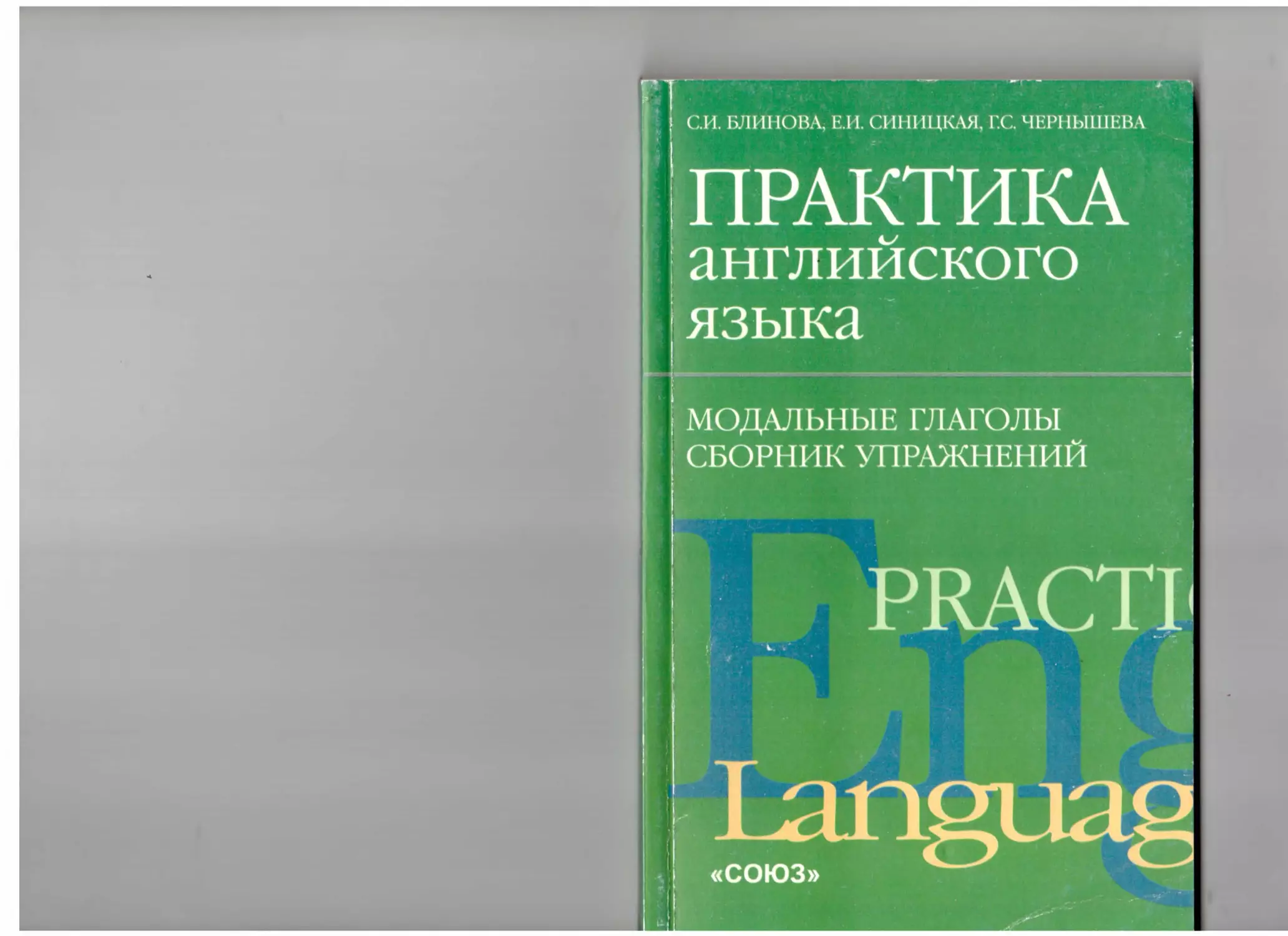
С.И. БЛИНОВА, Е.И. СИНИЦКАЯ, ЕС. ЧЕРНЫШЕВА
ПРАКТИКА
английского
языка
МОДАЛЬНЫЕ ГЛАГОЛЫ
СБОРНИК УПРАЖНЕНИЙ
PRACTP
к I
ББК 81.2.2.АНГЛ.
Б69
Рецензент: кандидат филологических наук,
доцент Е. П. Чарекова
Научный редактор: доктор педагогических наук,
профессор Н. В. Ваграмова
Блинова С. И., Синицкая Е. И., Чернышева Г. С.
Б69	Практика английского языка. Модальные глаголы:
Сборник упражнений. - СПб.: Лениздат; Издательство “Союз”,
2002. - 192 с. - (Изучаем иностранные языки).
ISBN 5-289-02019-5 (Лениздат)
ISBN 5-94033-113-0 (Изд-во "Союз”)
Методическое пособие содержит комплекс разнообразных
упражнений, от тренировочных до условно-речевых, способствующих
формированию автоматизированных грамматических навыков на
материале модальных глаголов в современном английском языке
Пособие предназначено для студентов языковых вузов,
изучающих английский язык, а также может быть рекомендовано
широкому кругу лиц, изучающих английский язык самостоятельно.
ББК 81.2.2.Англ.
ISBN 5-289-02019-5 (Лениздат)
ISBN 5-94033-113-0 (Изд-во "Союз”)
© Блинова С. И., Синицкая Е. И
Чернышева Г. С., 2002
© Издательство "Союз". 2002
СОДЕРЖАНИЕ
ВВЕДЕНИЕ ............................................ 5
PART I	Модальные глаголы. Modal Verbs.............. 7
§	1.	Глагол	can. The modal can ............ 11
§	2.	Глагол	may. The modal may ............ 21
§	3.	Глагол	must. The modal must........... 29
§	4.	Review	of ability, permission and obligation:
can, may, must and their equivalents ......... 39
PART II		 47
§ 5.	Ability: can, could, be able to ........... 49
§ 6.	Permission and prohibition: can, may, be
allowed to ...................................... 55
§ 7.	Obligation and necessity: must, have to..... 59
§ 8.	Obligation and necessity: mustn’t, don’t
have to, needn’t................................. 63
§ 9.	Obligation and advice: should, ought, had
better........................................... 71
§ 10.	Obligation, necessity as a result of arran-
gement: be to...................................  19
§ 11.	Possibility: can, could, may, be to ....... 87
§ 12.	Deduction, uncertainty: must, may ......... 91
§ 13.	Deduction, uncertainty: must, may, might .... 99
§ 14.	Doubt, astonishment: can, can’t ........   103
§ 15.	Probability: should, ought ............... Ill
§ 16.	Reproach: might........................... 113
3
§ 17.	Requests: can, could, may, will, would ......115
§ 18.	Offers: will, shall, can, could, would.......119
§ 19.	Offers: shall................................125
§ 20.	Habits: will, would, used to.................127
§21.	Refusals: won’t, wouldn’t....................131
§ 22.	Intention, promise, threat: shall, will......135
§ 23.	Courage, outrage, challenge: dare............141
§ 24.	Preference: would rather, would sooner.......145
§ 25.	Subjunctive Mood: would, may, might..........149
§ 26.	Subjunctive Mood: should.....................153
§ 27.	Modals in Reported Speech................... 157
REVISION EXERCISES ................................ 159
ВВЕДЕНИЕ
Пользуясь языком, говорящие (собеседники)
не только обмениваются информацией, но также
высказывают свое отношение к тому, о чем говорят.
Одним из средств, с помощью которых говорящий
выражает свое отношение к действию или состоя-
нию, являются модальные глаголы. Они обозначают
возможность, вероятность, предположение, не-
уверенность, пожелание, распоряжение и т. д. Эти
глаголы составляют особую, хотя и малочисленную
в семантико-синтаксическом отношении, группу. Мо-
дальные глаголы могут употребляться в различных
функциях, начиная от сильно выраженной модаль-
ной и кончая чисто вспомогательной.
Модальные глаголы не могут употребляться са-
мостоятельно, а только в сочетании со смысловыми
глаголами, при этом некоторые модальные глаголы
могут полностью или частично утратить модальное
значение (shall, will).
Сложность употребления модальных глаголов
состоит и в том, что одно и то же значение может
быть передано разными глаголами. Именно мно-
гофункциональность модальных глаголов и разно-
образие оттенков значений вызывают у обучаемых
значительные затруднения в приобретении практи-
ческих навыков в использовании этих глаголов в
речи.
5
Цель настоящего пособия - совершенствование
грамматического аспекта речевой деятельности обу-
чаемых на материале модальных глаголов современ-
ного английского языка.
Пособие включает лингвистическую информа-
цию об особенностях употребления модальных гла-
голов и комплекс разнообразных упражнений от тре-
нировочных до условно-речевых. Упражнения на-
правлены на формирование навыков корректного
владения модальными глаголами.
Материал пособия организован по этапам, со-
ответствующим программному обучению модальных
глаголов по семестрам: §§ 1-4 посвящены рассмотре-
нию основных значений (функций) глаголов с сильно
выраженной модальностью {can, may, musty, в §§ 5-26
описывается употребление разных модальных глаго-
лов в одной и той же функции, при этом особое внима-
ние уделяется сходству и различию глаголов.
Пособие содержит раздел Revision Exercises,
упражнения которого носят контролирующий харак-
тер и могут быть использованы на разных этапах в
качестве заданий для самостоятельной работы. Лек-
сической базой упражнений является нейтрально-
бытовая лексика, характерная для устной речи.
В целом пособие строится на принципах функ-
циональной грамматики, принятых в последние
десятилетия авторами различных пособий, издан-
ных зарубежом: R. Murphy, English Grammar in Use,
ELOD, Moscow, 1992; L. G. Alexander, Longman,
English Grammar Practice for intermediate students,
Longman, New-York, 1991 и др.
Пособие выполнено на кафедре второго ино-
странного языка РГПУ им. А. И. Герцена и являет-
ся частью грамматического комплекса, разрабаты-
ваемого кафедрой.
6
PART I
Модальные глаголы.	Modal Verbs.
Модальные глаголы являются одним из средств
выражения модальности в английском языке. Эти
глаголы обозначают не конкретные действия, а вы-
ражают лишь отношение говорящего к действию. С
помощью модальных глаголов говорящий показы-
вает, что он считает то или иное действие возмож-
ным, невозможным, вероятным, необходимым, же-
лательным и т. д. Поэтому модальные глаголы не
употребляются самостоятельно, а только в сочетании
с инфинитивом смыслового глагола.
Сравните: Не is swimming in the lake. - Он плавает
в озере сейчас.
Форма Present Continuous выражает кон-
кретное действие.
Не can swim. - Он умеет плавать.
Здесь говорящий сообщает об умении
кого-то плавать.
К модальным глаголам относятся can, could,
may, might, must, should, would, ought. Модальные зна-
чения могут быть выражены глаголами be to, have to,
shall и will. Глаголы shall и will, выражая модальное
значение намерения, обещания и т. д., выполняют
одновременно свою функцию вспомогательного
глагола для образования будущего времени. К мо-
дальным глаголам также можно отнести глаголы
7
need, dare и оборот used to. Эти глаголы, обладая
модальным значением, могут функционировать в
языке как смысловые, полнозначные глаголы, что
позволяет назвать их полумодальными глаголами
(seini-modals).
Модальные глаголы отличаются от других гла-
голов не только своим значением, но и системой грам-
матических форм. Модальные глаголы являются не-
достаточными, дефектными глаголами (Defective
Verbs). У них отсутствует ряд грамматических форм,
которые имеют другие глаголы:
1.	Модальные глаголы не имеют неличных форм
(инфинитива, причастия и герундия).
2.	Модальные глаголы, кроме сап и may, имеют фор-
му только настоящего времени, которая может
относить действие к настоящему или будущему
времени.
Dan can give you the book now. - Дэн может дать
тебе книгу сейчас.
Dan can give you the book tomorrow. - Дэн может
дать тебе книгу завтра.
Глаголы сап и may имеют форму прошедшего вре-
мени could и might.
Не could run well, when he was young. - Он хорошо
бегал, когда был молодым.
3.	Модальные глаголы не принимают окончания -5
в 3-ем лице единственного числа при образовании
настоящего времени.
Не
She
> may go
We
You
They
may go
8
4.	Инфинитив смыслового глагола, следующий за
модальными глаголами, употребляется без части-
цы to.
I can do it.
You needn ’t worry about that.
He may come tonight.
Инфинитив употребляется с частицей to после
be, have, ought.
The train is to arrive at 5 о ’clock.
He had to help us.
We ought to stay with him.
5.	Вопросительная и отрицательная формы предло-
жений с модальными глаголами образуются без
вспомогательного глагола.
5.1	При отрицании частица not ставится непосредст-
венно после модального глагола. В настоящем
времени сап пишется слитно с частицей not.
I cannot open the door.
He ought not to have done it.
В разговорной речи в отрицательной форме упо-
требляются следующие сокращения:
cannot	can’t		[ka: nt]
could not	—	couldn’t	[kudnt]
must not	-	mustn’t	[mAsnt]
ought not	-	oughtn’t	fo: tnt]
need not	-	needn’t	[ni:dnt]
might not	-	mightn’t	[ma i tnt]
shall not	-	shan 7	!Sa:nt]
will not	-	won’t	[wount]
should not	-	shouldn’t	[]udnt]
9
Глагол may с отрицанием сокращенной формы
не имеет: may not.
You may not smoke here.
5.2	В вопросе модальный глагол ставится перед под-
лежащим.
Could you give us an example ?
Why should I explain anything?
Модальные глаголы употребляются в раздели-
тельных вопросах (tag-questions).
We can be friends, can’t we?
He mustn’t take the books in your absence, must he?
Глагол ought to обычно не употребляется в раз-
делительном вопросе. Он заменяется глаголом
should или should not.
We ought to wait for John, shouldn’t we?
6.	Модальные глаголы могут употребляться с любой
формой инфинитива в действительном и страда-
тельном залоге.
People may be watching.
You must have heard of him.
В страдательном залоге за модальным глаголом
следует глагол be или have been и причастие про-
шедшего времени смыслового глагола.
They ought to be treated fairly.
He can’t have been sent away.
• ъ •	•	-»	4/’	.	’	>	S . I.•••• Ji
Л ОГ »
10
§ 1. Глагол сап.
The modal can.
1. Глагол can имеет значение умственной или фи-
зической способности, возможности или уме-
ния (physical или mental ability) совершить дей-
ствие, которое может относиться к настоящему
или будущему времени. В таких случаях сап
употребляется с формой неперфектного инфи-
нитива (Indefinite Infinitive).
She can play chess. Она умеет играть в шах-
маты.
Can he finish the work Сможет он закончить
next week?	работу на следующей не-
деле ?
Глагол сап имеет две формы: can (Present) и could
(Past). Could в сочетании с Indefinite Infinitive
выражает способность или возможность совер-
шить действие в прошлом.
/ could run very well	Я бегал (мог бегать) очень
when I was a boy.	хорошо, когда был ма-
леньким.
Наряду с сап и could употребляется сочетание
be able to “мочь, быть в состоянии, уметь”. Оно
употребляется как вместо недостающих форм
глагола can (shall / will be able to, have been able
to), так и вместо can и could.
I hope to be able to
help you.
He hasn’t been able to
do it.
I think I am able to
come.
Я надеюсь, что смогу по-
мочь вам.
Он не смог это сделать.
Я думаю, что смогу прид-
ти.
11
Следует помнить, что в настоящем и прошед-
шем времени более употребительны сап и could,
чем be able to. В настоящем времени эквивалент
be able to звучит более официально.
Сап и could, как правило, употребляются с гла-
голами чувственного восприятия (verbs of sense
perception) и умственной деятельности (verbs of
mental activity).
can see a -n (^a( (ree вижу птичку на дереве.
see
IFe с°иМ \ear а noise Мы слышали шум за дверью,
heard
outside the door.
В этих случаях сообщаются реальные факты,
модальные глаголы выражают только возмож-
ность (потенциальность) нашего зрения и слуха.
Exercise 1. Change the following sentences into the
interrogative and let your fellow-students
answer them in the affirmative (A) and
in the negative (B).
A.	Example: She can read English.
- Can she read English?
- Yes, she can read English.
1.	We can listen and hear with our ears.
2.	We can see with our eyes.
3.	I can write only with my right hand.
4.	The brother can kick a ball with his foot.
5.	The kitten can lick with its tongue.
6.	You can smell with your nose.
7.	We can bite with our teeth.
8.	We can touch things with our hands.
12
В.	Example: The girl can speak French.
-	Can you speak French?
-	No, 1 can’t speak French.
I.	My brother can draw simple pictures with his
left hand.
2.	She can wink with her right eye.
3.	I can write with my left hand very well.
4.	I can type twenty words a minute.
5.	He can do this work himself.
6.	I can swim underwater.
7.	Jack can run for two hours without stopping.
8.	Robert can play the piano.
9.	The boy can read Spanish.
10.	We can write the ABC.
Exercise 2. Ask your fellow students if he / she can ...
A.
1	 drive a car.
2	 read English books in the original.
3	speak German	fluently.
4	write the ABC	in English.
5	 stand the heat	well.
6	 make salads.
7	 cook dishes of	meat.
8	 tame wild animals.
9	 ride a horse.
10	count from one to a hundred in German.
11	 play tennis.
12	 do his homework.
13	 read and write French.
14	 translate the text without	dictionary.
13
в.
1......what she can do at home.
2......what kind of work the students can do in a
language laboratory.
3......where she can have a bite.
4......what books and newspapers she can get in
our library.
5......what games she can play.
6......what vegetables we can grow in our kitchen-
garden.
7......what fruits we can grow in our orchards.
8......what animals we can find at the Zoo.
9......where we can rest in summer.
10	what she can do at a post office.
11	what we can touch things with.
12.....where one can buy ready-made clothes.
Exercise 3. Here you can see false and right statements.
Tick the sentences which are false. Correct
them.
1.	Cats can’t see in the dark.
2.	Dogs can climb trees.
3.	Kangaroos can’t jump.
4.	Parrots can speak.
5.	Penguins can’t fly.
6.	Camels can walk for three months with no
water.
7.	Tortoises can run fast.
8.	Elephants can live for a hundred years.
9.	Ducks can swim underwater.
10.	Monkeys can jump from tree to tree.
11.	Crocodiles can live on land and in water.
12.	Cats can’t hunt mice and rats.
14
Exercise 4. Rewrite the sentences using can, can’t,
could, couldn’t, expressing physical or mental
ability.
Example:	Do you hear the music?
Can you hear the music?
1.	Close the door, please. I don’t hear anything.
2.	Do you see that girl over there?
3.	Did you get tickets yesterday?
4.	I don’t understand what you said.
5.	I looked up but didn’t see anything.
6.	We smell something burning.
7.	I heard someone coming upstairs
8.	He didn’t do it all by himself. He was practically
unprepared.
9.	She didn’t do it last week. She had no time.
10.	I did not buy that book yesterday.
Exercise 5. Tell the group what you can do now, you
couldn’t do some time ago.
Example:	/ couldn’t skate last winter, but now 1 can
skate well.
1.	repeat sentences after the recorded voice.
2.	read and speak two foreign languages.
3.	play the guitar.
4.	read foreign literature in the original.
5.	cook dishes of fish.
6.	draw and paint.
7.	swim underwater.
8.	play table tennis.
9.	drive a car.
10.	dance to music.
15
Exercise 6. Rewrite the sentences in the Future Inde-
finite tense.
Example:	I can see you later ... (when you return).
I ’ll be able to see you when you return.
1.	Ann can cook well ... (when she has had more
practice).
2.	She can’t believe you ... (unless you tell her the
truth).
3.	I can pass my driving test ... (after I have some
lessons).
4.	The people from the village can’t reach the house
... (until it stops raining).
5.	You can study medicine ... ( if you enter that
college).
6.	We can go skiing ... (when it gets colder).
7.	Jane can play the violin ... (when her arm is
better).
8.	She can call them ... (if she finds their telephone
number).
9.	They can work at school... (when they graduate
from the Institute).
10.	We can go to the park ... (if we have spare time
on Sunday).
Exercise 7. A. Respond to these statements according
to the example.
Example:	They won’t be able to come to see us tomorrow.
And when will they be able to come?
1.	She won’t be able to go to the theatre tomorrow.
2.	Jill won’t be able to answer all the letters today.
3.	The doctor won’t be able to see Mother tomorrow.
16
4.	He won’t be able to buy tickets for the 6 o’clock
show.
5.	They won’t be able to come back before dinner.
6.	Mr. Brown won’t be able to dine with you tonight.
7.	She won’t be able to buy a new coat this year.
8.	Mother won’t be able to clean the flat before
our arrival.
9.	He won’t be able to go to the South in summer.
10.	I won’t be able to go shopping to day.
B. Extend the sentences of the previous
exercise according to the example and
do the exercise as shown.
Example:	If she doesn 7 buy a ticket, she won’t be able
to go to the theatre tomorrow.
Exercise 8. Complete the sentences with can, be able
to in the correct tense-form.
1.	I ... get my degree next year.
2.	She ... visit us yesterday, because she was busy.
3.	1 ... finish this work today. I’m tired.
4.	We have no class on Tuesday, that’s why we ...
get ready for the next seminar.
5.	I’m afraid I ... translate this article tonight.
6.	Did you buy any fresh meat? - No, I ... get any.
7.	I think you ... play tennis better after a bit of
practice.
8.	She ... dance quite nicely when she was a girl.
9.	In the future people ... live on other planets.
10.	I was sure you ... not find your way in the
darkness.
11.	My sister ... talk when she was 15 months old.
12.	... you tell me your name?
17
Exercise 9. Extend the statements according to the
examples.
Example:	I'm very busy now. (go)
1 can’t go.
1.	Who is over there? (see)
2.	What language is he speaking? (understand)
3.	I’m too tired, (walk)
4.	My head is aching, (read)
5.	Don’t ask me to cook, (cook)
6.	No, I’m not going to the skating-rink, (skate)
7.	Speak louder, please, (hear)
8.	Help him to carry this box, please, (lift)
9.	Show her some more books, (choose)
10.	What are they talking about? (hear)
Exercise 10. Translate these sentences into English
according to the patterns:
(I)	can ...
Can (1) ... ?
(1)	can’t... .
1.	Я не могу помочь вам.
2.	Он не может проводить вас; он очень занят.
3.	Вы можете доказать, что это правда?
4.	Мы можем выполнить эту работу сами.
5.	Ты умеешь читать по-французски?
6.	Он не может здесь больше оставаться. Это
опасно.
7.	Она умеет ездить на велосипеде.
8.	Ты умеешь штопать чулки?
9.	Я умею водить машину.
18
Exercise 11. Complete the following sentences in the
proper tag-questions.
1.	Your friend can speak English, ... she?
2.	We can’t sleep with the window open, ... ?
3.	They can’t lodge in such a dirty room, ... ?
4.	She couldn’t buy a dictionary for me, ... ?
5.	They could hear nothing except wind, ... ?
6.	We can go away together, ... ?
7.	He could get the book he needed, ... ?
8.	The girl can help her mother about the house, ... ?
9.	She cannot come to day, ... ?
10.	He can tell us interesting things, ... ?
Exercise 12. Complete the sentences with can and a
suitable verb from the box. Then match
each question with an answer.
play make type speak drive program read see
Example:	... you ... the piano?
Can you play the piano?
1.	... you ... any foreign languages?
2.	... you ... a car?
3.	... you ... a pie?.
4.	... you ... the violin?
5.	... you ... a computer?
6.	... you ... the lake from your room?
7.	... you ... twenty five words a minute?
8.	... you ... Japaneese books?
19
1.	No, I can’t. I can ride a motorbike.
2.	Yes, I can. The view is wonderfull.
3.	No, I can’t. 1 study English.
4.	No, I can’t, but I can type.
5.	Yes, I can, English and Spanish.
6.	No, I can’t. I’m only learning typing.
7.	No, I can’t. I can play the guitar.
8.	Yes, I can. I like cooking.
Exercise 13. Translate the following sentences into
English.
1.	Мой брат не умеет водить машину.
2.	Он не смог запомнить мой адрес.
3.	Старые люди не могут забыть войну.
4.	Вы говорите по-французски? Сможете пере-
вести эту надпись?
5.	Я не смогу поверить вам, пока вы не покаже-
те мне это письмо.
6.	Ты не можешь петь, если у тебя нет слуха.
7.	Она сможет проводить тебя до вокзала.
8.	Вы сможете это сделать сейчас?
9.	Она не смогла написать диктант, он был до-
статочно трудным.
10.	Джейн хорошо рисует. Она умеет рисовать
с семи лет.
11.	Мальчик не может читать быстро.
12.	Они не смогут купить билеты на матч на завтра.
13.	Лена смогла выполнить задание, так как у
нее был словарь.
14.	Студенты нашей группы говорят, что смогут
принять участие в конференции.
15.	Она не умеет танцевать.
16.	Я уверен, он умеет играть в баскетбол.
20
§ 2. Глагол may.
The modal may.
1.2
2.
Глагол may употребляется для выражения раз-
решения выполнить действие (permission).
В этом значении глагол may соответствует рус-
скому “можно, могу, можете” и употребляется
с неперфектным инфинитивом (Indefinite Infi-
nitive) в утвердительных и вопросительных
предложениях.
You may use ту book.
May I smoke here?
Вы можете
взять мою
книгу. (Вам
разрешено)
Можно мне
курить здесь?
Отрицательный ответ на просьбу о разрешении
передается отрицательной формой may not, ко-
торая имеет значение запрещения, причем не
очень строгого. Категорический отказ в разре-
шении передается формой must not.
May 1 go there? No, you may not
No, you mustn’t.
Вам не разре-
шается.
Нет, нельзя,
запрещено.
Для выражения вежливого отказа употребля-
ется форма can’t.
Мау 1 go there? Гт afraid, not. или No, you can’t.
В значении разрешения глагол may имеет
форму прошедшего времени might, которая
употребляется только в косвенной речи.
Не said that I might use
his pen.
Он сказал, что я могу
взять его ручку.
21
3.
Для выражения разрешения выполнить дейст-
вие в прошедшем и будущем употребляется со-
четание be allowed to с эквивалентным значе-
нием, после которого инфинитив стоит с час-
тицей to.
Не was allowed to leave the room.
They will be allowed to attend the
party.
Ему разрешили
выйти из ком-
наты.
Им разрешат
присутство-
вать на вече-
ринке.
Exercise 14. Change these sentences into the interroga-
tive and ask your fellow-students to answer
them.
1.	You may take this pencil for a moment.
2.	You may clean the blackboard.
3.	You may change seats with Kate.
4.	You may take these books.
5.	You may speak now.
6.	You may turn on the light.
7.	You may open the window.
8.	You may have a glass of lemonade.
9.	You may go home now.
10.	You may sit here.
Exercise 15. Ask your teacher if you may...
1.	... come a bit late for the next class
2.	... fetch a piece of chalk
3.	... go to the lab and fetch some tapes
4.	... take tapes back to the lab
22
5.	... miss the lecture
6.	... open the window and air the room
7.	... leave the class before the bell goes
8.	... read a mystery for your homereading
9.	... shut the window if you are cold
10.	... change places with somebody
Exercise 16. Paraphrase these notices to give or refuse
permission. Begin each sentence with You ...
1.	Do not feed the animals.
2.	No smoking.
3.	Private. Keep out.
4.	Do not walk on the grass.
5.	Campers welcome.
6.	Leave your litter here.
7.	No parking on the square.
8.	Visitors welcome 24 hours a day.
Exercise 17. Change the sentences into the Past.
Example:	You may go for a walk now.
You were allowed to go for a walk yesterday.
1.	You may stay here for a couple of days.
2.	I may smoke in this room.
3.	May she have another piece of cake?
4.	You may keep the book till Monday.
5.	The girl may take these magazines home.
6.	I may let you sit for a few minutes in the arm-
chair in my sitting-room.
7.	You may put out the light if it disturbs you.
8.	Children, you may do this exercise orally.
9.	May I ask for another helping?
10.	I may keep his player till Saturday.
23
Exercise 18. Change the following sentences into the
future.
Example:	May the students leave the room in a few
	minutes? Will you allow the students to leave the room in a few minutes?
1. 2. 3. 4. 5. 6. 7. 8. 9. 10.	May I stay away from the classes? May she miss her classes tomorrow? May I look up words in the dictionary? May he not do his job now? May the child not eat his soup? May I play the piano in your room? May Kate read her essay at the next lesson? May I not come to the examination tonight? May she not go and see her doctor? May the children write the dictation at the next lesson?
Exercise 19. Make up short dialogues as shown, making
	use of the cue words.
Example:	Ann:	Mother, may I watch TV show (1)?
	Mother: No, you can't. Ann:	Why? Mother: Because Father is sleeping (2). 1	2
1.	listen to the radio	your little sister is sleeping
2. 3.	go for a walk	we have so much work invite my friends to Father is unwell our house
24
4.	read a book
5.	stay up as late as 11
o’clock
6.	switch off the light
7.	stay outdoors
8.	buy an ice-cream
9.	play chess with Father
10.	watch the film tonight
you haven’t finished
your work
it’s too late for you
it’s dark in the room
it’s rather cold to walk
you have a sore throat
it’s time to go to bed
it’s for adults
Exercise 20. Ask for permission to do something, using
may not / can’t and the cue words.
Example:	have an ice-cream - have a sore throat -
a glass of lemonade
-	May I have an ice-cream, Mother? I’m
very thirsty.
-	No, you may not / can’t. You had a sore
throat a week ago. I think you may have
a glass of lemonade. It won’t do you any
harm.
Cue words:
1.	have a cup of coffee - be too strong - a glass
of tea
2.	a mutton chop - be too heavy - a beefsteak
3.	have another helping of the pie - have enough -
a glass of juice
4.	write in pencil - be an official letter - write in ink
5. go to the beach - be too cold - go to the cinema
6. buy a car - be too expensive - buy a cycle
7.	invite my friends to our house - too noisy -
meet them in the Club
8.	take your blue dress - my favourite-the blue
blouse
25
Exercise 21. Complete the sentences with may, might,
be allowed to.
1.	"... I talk to your patient, sister?” he asked.
2.	The children ... go for a walk tonight.
3.	He said that they ... smoke here.
4.	Andrew ... leave school early yesterday because
he wasn’t feeling well.
5.	She told me that I ... stay a little longer that
night.
6.	You ... take the book home and keep it for a
week.
7.	They ... leave the seats and walk up and dowr
the class.
8.	She ... go home in a few days.
9.	... I ask you to repeat this rule again?
10.	Drivers ... go at 60 kilometres an hour here.
11.	Last night I ... stay up longer then usual.
12.	I never ... do things the way I wanted to do them
13.	He ... play chess after he finishes his homework
Exercise 22. Translate the sentences into English.
1.	Можно мне оставить вещи здесь? Да, по-
жалуйста.
2.	Боюсь, ей не разрешат купаться, она еще
слишком слаба.
3.	Они не могут курить в детской комнате.
4.	Наконец им разрешили покинуть здание.
5.	Мери разрешили выходить из дома через не-
сколько дней.
6.	Ученикам не разрешили играть в школе та*
поздно.
7.	Надеюсь, нам разрешат выполнить эту работу
8.	Студенты могут подождать в этой комнате.
9.	Он спросил меня, может ли он взять мой ве-
лосипед.
10.	Ты можешь взять мой зонтик.
11.	Можно включить телевизор? - Боюсь, что нет.
12.	Можно я воспользуюсь вашим телефоном? -
Нет, нельзя.
13.	Мне жаль, что вам разрешили прогуляться
так поздно.
Exercise 23. Make sentences of your own according to
the examples:
a)	May 1 smoke here ? - No, you mustn ’t.
b)	May I read the letter? - No, you can’t.
Exercise 24. Rewrite these sentences using may.
1.	Are little children allowed to play with matches?
2.	Do you allow me to invite my friend to our
discussion?
3.	Let me join you in your trip to Moscow?
4.	Allow me to use your dictionary. I’ve left mine
at home.
5.	Will you allow the children to go to the river
with us? The weather is fine.
6.	Let me take your umbrella. It is raining.
7.	Do you permit them to attend your lectures?
8.	Will you allow me to look through your notes?
9.	Let him speak to you in private.
10.	Will they allow us to lodge in this room?
26
27
Exercise 25. Complete the sentences with may, might,
can, could.
The child asked if he ... take another
apple.
1.	... you help me? - I am afraid not.
2.	You ... take my dictionary. I don’t need it now.
3.	... 1 see these gloves?
4.	Tom ... run 1500 metres in five minutes.
5.	I ... not stay more than a week this time.
6.	I jumped aside but ... not escope the blow.
7.	She asked if she ... make his pipe.
8.	It was dark there. He ... not see anything.
Exercise 26. Translate the sentences into English.
1.	Скажите ей, что я не могу ее сейчас при-
нять.
2.	Можно мне позвонить вам вечером?
3.	Я не могла придти к тебе вчера, так как
у меня было собрание.
4.	Нам разрешили провести эксперименты
в лаборатории института.
5.	Хотя было темно, он все же нашел (смог
найти) дорогу к хижине.
6.	Я надеюсь, что детям разрешат пойти в
зоопарк завтра.
7.	Вы можете открыть окно. В комнате очень
жарко.
8.	Я не могу придти сегодня в институт. Я
совсем больна.
28
§ 3. Глагол must.
The modal must.
Модальный глагол must употребляется главным
образом для выражения долженствования, не-
обходимости совершить действия (obligation,
necessity), не зависящие от воли говорящего.
Must переводится на русский язык словами
“должен, нужно, надо, приходится” и употреб-
ляется с неперфектным инфинитивом (Indefinite
Infinitive).
One must do one’s duty.
Каждый должен выпол-
нить свой долг.
Если подлежащее при глаголе must выражено
личным местоимением первого лица, то must
приобретает дополнительное значение необхо-
димости совершения действия в силу личной
убежденности выполнить его.
I must stay at home
tonight.
People must cross the
street with the green
light.
Я должен остаться
дома вечером.
(говорящий считает
это важным)
Улицу должны перехо-
дить при зеленом свете
светофора.
Отрицательная форма must not означает запре-
щение совершить действие (prohibition) или не-
обходимость его не совершать, т. е. является
противоположной по значению глаголу may.
Мау 1 open the window? No, you must not. Нельзя.
You must not miss classes. (Вам) нельзя пропускать
уроки.
29
Для выражения отсутствия необходимости
(по necessity) совершения действия употребля-
ется форма needn't.
Must I do it? No, you needn't. | Нет, не нужно.
Глагол must имеет только одну форму, которая
в сочетании с неперфектным инфинитивом
(Indefinite Infinitive) относит действие к настоя-
щему или будущему.
You must go there alone. | Вы должны пойти один.
Для выражения долженствования (obligation)
в прошедшем и будущем времени употребля-
ется глагол have в сочетании с неперфектным
инфинитивом с частицей to.
I had to work late yesterday. Я вынужден был
работать допоздна
вчера.
Не will have to work late Он должен будет
tomorrow.	работать завтра
поздно.
В прошедшем времени вопросительная и от-
рицательная формы образуются при помощи
вспомогательного глагола do.
Did you have to work late yesterday?
You did not have to work late yesterday.
Глагол must может выражать приказание (command}
в сочетании с местоимением you.
You must be at home by 10 Вы должны быть
о 'clock.	дома к 10 часам.
Модальный глагол need выражает необходи-
мость совершить действия (necessity) только в
отрицательных и вопросительных предложени-
ях, в то время как must употребляется только
30
в утвердительных и вопросительных предложе-
ниях. Need, как и must, употребляется только
с неперфектным инфинитивом, который отно-
сит действие к настоящему.
В вопросительных предложениях must и need
являются синонимами, передавая значение не-
обходимости.
Must 1 go there immediately? Мне нужно идти
Need 1 go there immediately? туда немедленно?
Отрицательная форма needn’t выражает отсут-
ствие необходимости совершить действие, т. е.
является противоположной по значению глаго-
лу must.
You needn’t come so early.
Вам не нужно при-
ходить так рано.
Следует помнить, что в утвердительном ответе
на вопрос с need употребляется must, в отрица-
тельном ответе на вопрос с must употребляется
needn’t.
Need we do the whole exercise? Yes, you must.
Must they come early?	No, they needn’t.
Exercise 27. A. Say what you must do in the morning.
I.	get up early
2.	wash yourself
3.	clean the teeth
4.	air the room
5.	do morning exercises
6.	make your bed
7.	have breakfast
8.	clear away the table
9.	go to the Institute
10.	come to the institute in time
31
В.	Say what you mustn't do being a student
1.	be late for classes
2.	miss classes
3.	talk at the lessons
4.	prompt each other
5.	leave the classroom during lessons
6.	interrupt your teacher
7.	change places at the lessons
8.	smoke in the class
9.	eat at the lessons
10.	speak Russian at the English lesson
Exercise 28. Complete the following sentences, use th<
modal must to express obligation.
1.	If you want to know English well, you ...
2.	If your spelling is poor, you ...
3.	If I want to cross the street and there is a rec
light, I ...
4.	If you are unwell, you ...
5.	If she wants to get to the Institute in time, she .
6.	If she makes a lot of grammar mistakes, she .
7.	If the students want to know grammar, they .,
8.	If the boys want to win the game, they ...
9.	If his English is not good, he ...
10.	If you want to be healthy, you ...
Exercise 29. Change the following sentences into the
Past and Future.
Example:	You must switch on the radio.
You had to switch on the radio.
You 'll have to switch on the radio.
1.	She must do the exercise again.
2.	While Mother is absent I must cook, our dinnei
32
3.	We must take the 8.30 train to arrive in time.
4.	You must always come in time to classes.
5.	He must revise all the rules before writing the
test.
6.	I must go to the laboratory after classes.
7.	We must discuss this question with the group
leader.
8.	He must write an account of his work.
9.	You must write a business letter on one side of
the paper only.
10.	Everyone must leave hats and coats in the cloak-
room.
Exercise 30. Rewrite the sentences in the interrogative
and negative form.
Example:	He has to revise the whole material.
Does he have to revise the whole material?
He doesn't have to revise the whole material.
1.	She has to do these exercises again.
2.	We had to work hard to learn how to solve such
problems.
3.	He’// have to answer her letter without any delay.
4.	You have to speak louder to make yourself heard.
5.	They had to repeat their experiment.
6.	17/ have to work from morning till night to earn
my living.
7.	She’// have to give a talk at the next seminar.
8.	We had to change the plan for the experiment.
9.	We’// have to put it off till next time.
2 Зак. № 854
33
Exercise 31. Answer these questions. Use the word
suggested.
Example:	- Why didn’t you stay longer? (go home)
- 1 had to go home.
1.	Why didn’t you come to see us? (write an essay
2.	Wiry didn’t John ride his bicycle? (repair it)
3.	Why didn’t she meet us? (look after Granny)
4.	Why didn’t the children play football? (stay al
home)
5.	Why didn’t Ann learn the poem? (translate the text
6.	Why didn’t she come back in time? (call on he
sick friend)
7.	Why didn’t she go to the cinema? (do a lot о
work about the house)
8.	Why didn’t he meet his friend? (go on a businei
trip)
Exercise 32. Complete each sentence using the mos
suitable word from the box.
to have to must having to had to
have to	mustn’t must had to
1.	It’s getting late. We ... go now.
2.	They only ... wait a few minutes before th
train came in.
3.	You’ll ... find out what is happening in the house
4.	I hate ... go to the dentist.
5.	I don’t like ... work at weekends.
6.	I ... say what I think about the matters.
7.	Heng convinced Fowler that he ... take sides
8.	You ... leave the car unlocked.
34
Exercise 33. Give the opposite of the following.
Example:	You must come at 9 o’clock, (the classes
begin at 10 о ’clock)
You needn’t come at 9 о ’clock as the classes
begin at 10.
1.	You must speak louder. (I hear you quite well)
2.	He must hurry if he wants to catch the train,
(he has plenty of time)
3.	I must stay at home tonight, (nobody is going
to call on me)
4.	You must buy this dictionary, (you can borrow
it from the library)
5.	You must wait for your friend, (you’ll ring him
up in the evening)
6.	You must help your brother, (he is old enough
to do it)
7.	You must ring up home at once. (I’ve just had
a talk with my family)
8.	You must speak to the Dean to arrange the matter,
(the group leader ... has already solved the prob-
lem)
9.	You must babysit tonight, (the parents are staying
at home)
10.	She must go to the clinic at once, (the doctor
is coming here)
11.	You must take a porter to help you with the
luggage, (your luggage isn’t heavy)
12.	You must post the letter at once. (I’m going
past the post office)
35
Exercise 34. Rewrite the questions, using the moda
need. Answer them expressing obligatior
or the absence of necessity.
Example:	Is it necessary for him to do it now?
- Need he do it? - Yes, he must.
or
No, he needn't.
1.	Is it necessary for us to read the text?
2.	Is it necessary for me to inform him about it?
3.	Is it necessary for him to visit you there?
4.	Is there any need for you to explain your choice?
5.	Is it necessary for me to go to the meeting?
6.	Is there any need for her to buy a new coat?
7.	Is it necessary for me to meet them?
8.	Is it necessary for me to leave at once?
9.	Is it necessary for you to see this show?
10.	Is it necessary for me to invite her tonight?
Exercise 35. Extend the statements expressing eithei
prohibition or absence of obligation to do
something.
Examples: Mother is asleep, (make a noise)
You mustn't make a noise.
It's Sunday tomorrow, (get up early)
You needn't get up early.
1.	You have plenty of time, (drive so quickly)
2.	It’s too late, (ring up your friend)
3.	The fish is not good, (eat it)
4.	The teacher is still speaking, (interrupt him)
5.	It’s cold outside, (go out in a light dress)
6.	It doesn’t look like raining, (take your umbrella)
36
7.	Our train leaves in two hours, (hurry to the
station)
8.	Your bag is quite new. (buy another bag)
9.	I’ve got a key. (ring the bell)
10.	It’s a lesson of English, (speak Russian)
Exercise 36. Complete the sentences with must, have
to, need in the required form, use not
where necessary.
1.	Pupils ... stand up when the teacher comes into
the classroom.
2.	I ... prepare my breakfast yesterday myself as my
mother was away.
3.	Tomorrow evening we ... meet our friend who
is coming to see us.
4.	We ... send for the doctor immediately.
5.	The car ... be parked on the pavement.
6.	The students ... bring their books. We can take
some from the library.
7.	He ... write. He was obliged to earn money.
8.	1 ... go shopping. We have enough food in the
house.
9.	... you see him tonight?
10.	... you be in a hurry? You have a lot of time left
before you leave.
11.	You ... leave at six to catch the train.
12.	The text isn’t interesting. ... we study it? - Yes,
you ...
13.	“You ... make such mistakes in future”, said
the teacher.
14.	He ... do it now. He ... do it later.
37
Exercise 37. Translate the sentences into English usij
must or its equivalents.
§ 4. Review of ability, permission and obligation:
can, may, must and their equivalents.
1.
2.
3.
4.
5.
6.
7.
8.
9.
10.
11.
12.
13.
14.
Вам нужно взять такси, если хотите успет
на поезд.
Дети не должны играть со спичками.
Мы должны поговорить об этом завтра.
В то утро я должен был зайти в банк и поэт< А.
му я опоздал на работу.
Ему не надо было вставать рано, у него был
каникулы.
Вы должны сойти на следующей остановк
Они обязаны помочь вам в этой ситуации.
Им пришлось долго ждать поезда?
Вы не должны говорить по-русски на урокг
английского языка.
Нам пришлось остаться дома вчера, так ка
шел сильный дождь.
Им не надо приходить сюда каждый день.
Студенты должны будут остаться после урока
Нам нужно подготовить доклады к следую
щему занятию? - Да.
Когда он должен будет ответить на все письм!
Exercise 38. Translate the following sentences into
Russian, pay attention to the Russian
equivalents of the modal verbs
1.	They like the work in the lab, but they cannot
handle the tape-recorder properly.
2.	The night was so black that little Hans could
hardly see, and the wind so strong that they
could hardly stand.
3.	He was not able to translate the article because
he did not know some special terms.
4.	I hope to be able to meet my fellow-students on
my way to the University.
5.	She will not be able to sleep well because it is hot.
6.	1 can use a typewriter perfectly now.
1.	I must leave you, but I will never forget you.
2.	The pupils don’t have to go to school on Sundays.
3.	But she’// have to buy a new coat next winter.
4.	Mum could not stay with the girl any longer,
she had to get dressed and go to work.
5.	This must be taken a table-spoonful every two
hours.
6.	You must follow this diet strictly.
C. 1. You may switch on the light, if you want to read.
2.	She was allowed to go home in a few minutes.
3.	You may watch TV late tonight as tomorrow you
have no lessons.
4.	You needn’t return the bike tomorrow, you may
keep it till Monday.
5.	The letter said that the materials might be used
by us.
6.	You may leave your bed now.
38
Exercise 39. Rewrite the following sentenses in the Pas
Indefinite and the Future Indefinite.
1.	I can do this work.
2.	He may go home at five.
3.	She must take a taxi.
4.	They may not smoke in this room.
5.	Can you speak German?
6.	1 do not have to go there every day.
7.	Do you have to get up early?
8.	Is she allowed to stay up late?
9.	I have to report the chief about it.
1 0. Are you able to understand that?
Exercise 40. Put questions to the following statements
1.	My sister can speak French, {alternative}
2.	You can see the doctor today, {special)
3.	We must write this exercise, {general)
4.	My fiend can read English now. (disjunctive)]
5.	You may come at six o’clock, (special)
6.	They must answer our questions, (general)
7.	He may bring the book tomorrow, (alternative
Exercise 41. Answer these questions.
1.	He can play hockey, can’t he?
2.	Lena cannot swim, can she?
3.	The students couldn’t get newspapers for th<
lesson, could they?
4.	You mustn’t give up your studies, must you?
5.	They have to put up with me, don’t they?
6.	We must play our best, mustn’t we?
7.	He had to complete the test very quickly, didn’t
he?
8.	You may not play here, may you?
9.	She may have your ball, may she not?
10.	She will be able to give you a piece of advice,
won’t she?
11.	I was allowed to make experiments in his lab,
wasn’t I?
12/	She won’t be allowed to stay up longer, will she?
Exercise 42. Tell what one will (not) be able to do in
the future making use of the phrases in the
margin.
1.	If the weather is nasty,
we ...
2.	If they have a dictionary,
they ...
3.	If the students work hard
at the language, they ...
4.	If she learns the words
by heart, she ...
5.	If John calls me tonight,
he ...
6.	If my friend cuts her hair
short, she ...
7.	If you hurry up, you ...
8.	If I enter the Institute,
I ...
9.	If she has little time, she ...
10.	If we leave the key at home,
we ...
11.	If he doesn’t save money
enough ...
not go for a walk
translate this article
speak English very
well
write a dictation
find me at home
look quite beautiful
meet them
study foreign
languages
not knit a new
jacket
not unlock the
door
not change his car
next summer
41
Exercise 43. Complete the sentences with mustn't 01
needn't.
I.	You ... buy tomatoes, we have plenty of them
at home.
2.	One ... cross the street with the red light.
3.	David is well. He ... take this medicine.
4.	You ...turn on the light. I can see quite well.
5.	Pupils ...talk during the lesson.
6.	She ... write the whole exercise. Ten sentence!
are enough.
7.	You ...take the books in my absence.
8.	We ...ring him up. He’ll be here tonight.
9.	We ...take notice of his strange behaviour.
10.	You ... worry, this matter isn’t risky at all.
11.	You ... stay in the rain without an overcoat.
Exercise 44. Give possible answers. Use the suggestion!
given as the explanation of the prohibition.
Example:	May 1 smoke here?... (The children are
here.)
No, you mustn't.
1.	May I open the window? ... (It’s very cold.)
2.	May she not do the job now?... (It’s very im-j
portant to do it in time.)
3.	May Kate play the piano? ... (Father is writing
his report.)
4.	May she switch off the light? ... (I’m going tc
work.)
5.	May the pupils leave the room? ... (The lessor
isn’t over yet.)
6.	May I look some words up in the dictionary? ..
(You are writing a test-paper.)
42
7.	May I stay away from the classes? ... (You are
not ill.)
8.	May I wash that sweater? ... (It has to be dry-
cleaned.)
9.	May I cross the river here? ... (It’s rather deep.)
10.	May we read the letter? ... (It’s personal.)
Exercise 45. Supply the modals or their equivalents.
1.	There were so many questions he ... not answer.
2.	... I ask a few minutes private conversation with
him?
3.	... anybody explain this rule?
4.	He said he ... manage the task by himself.
5.	“I am afraid I ... be going now,” he said.
6.	Her English is very poor, she ... study veiy hard.
7.	He ... speak neither German nor French.
8.	You ... take my book. I don’t need it now.
9.	They ... know how to divide their time between
studies and rest.
10.	I ... not write my test. It proved to be too
difficult.
11.	Soon he discovered how much faster he ...travel
now that he was alone.
12.	I don’t mind telling you what I know. - You ... .
I’m not asking you for it.
13.	We ... not leave class without permission.
14.	The students ... settle that question at the confe-
rence last week.
15.	He ... go away sometimes on business. Don’t
ask what it is.
16.	You ... hurry if you want to play football; the
game has already started.
43
Exercise 46. Choose the correct answer.
1.	How many languages ...
2.	Do you think that doctors ...
cancer in future?
3.	It was getting dark, so we ...
what was happening
4.	John ... very well when he
was younger.
5.	Mike ...the piano well.
6.	... you wait? We haven’t yet
had supper.
7.	Take this magazine. You ...
many interesting articles in it.
8.	She ... a telegram by telep-
hone now. She has no time.
9.	Which of you ... explain the
situation?
10.	They were whispering so I ...
what they were saying very
clearly.
can you speak? j
may you speak?
can you to speak?
must cure
will be able to cure,
can cure
could see
couldn’t see
couldn’t fo see
was able jump
can jump
could jump
doesn’t can play
can’t play
can’t to play
could
can
couldn’t
could find
will be able to find
don’t be able to find
couldn’t send
can’t send
doesn’t can send
may
can
must
could hear
couldn’t hear
couldn’t to hear
44
I'.xercise 47. Make up short dialogues as shown, making
use of the cue words.
Example:	Ann: Let’s go for a walk (1).
Jane: I can't.
Ann: Whycan’ryou?
Jane: Because I must help my mother (2).
2
I.	to the disco
2.	to the library
3.	to the shop
4.	to the cinema
5.	to the country
6.	to the party
7.	to the conference
8.	to the club
9.	to the footbal match
do homework
write a lot of exercises
visit my granny
learn the poem by heart
translate the article
do the flat
look after my sister
read up for the exam
help my mother about
the house
Exercise 48. Translate the sentences into English.
1.	Говорите громче. Ничего не слышно.
2.	Мне надо отремонтировать туфли.
3	. Мне надо было сначала перевести статью.
4	. Доктор, можно мне купаться в море?
5.	Детям не разрешили пойти в кино вечером.
6.	Он спросил меня, можно ли ему посмотреть
этот фильм по TV.
7.	Я ничего не вижу на доске, так как в комнате
темно.
8.	Ты должен много читать по-английски?
9.	Я не могла нигде купить книгу вчера.
10.	Сможет ли он перевести эту статью без сло-
варя.
11.	Он сможет скоро плавать.
45
12.
13.
14.
15.
16.
17.
18.
Питер был не в состоянии сделать эту работ
за две недели, поэтому Майкл должен бьи
ему помочь. Тогда они смогли закончить ра
боту вовремя.
Разбуди меня завтра! Дело в том, что мне
придется работать очень долго.
Всей группе нужно явиться на консультации*
- Нет, не надо.
Можно нам придти к вам на консультацию?
- Да, можно.
Мы сможем встретиться с вами на стадионе
Дети не должны играть со спичками.
Большое спасибо за книгу. Сколько времен!
можно мне держать ее ? - Можете держат!
сколько угодно.
PART II
В первых параграфах пособия были рассмот-
рены случаи употребления основных модальных гла-
юлов can, may, must и их эквивалентов в значениях,
которые закреплены за ними в словарях:
('an / could - способность, возможность совер-
шать действия (physical or mental
ability)
May / might - разрешение совершить действие
(permission)
Must	- долженствование, моральная обя-
занность (obligation, duty)
Сложность употребления модальных глаголов
состоит в том, что, как правило, модальные глаголы
наряду с первичными фунциями (primary uses) имеют
вторичные функции (secondary uses). Кроме того,
одно и то же значение может быть выражено разными
модальными глаголами. Выбор того или иного мо-
дального глагола зависит от того, какой эффект хо-
чет произвести говорящий на собеседника, а это
связано с тем, в каких отношениях находятся собе-
седники, является ли обстановка официальной или
неофициальной, насколько важным представляется
говорящему то, о чем он говорит.
Нгчример, форма Close the door! звучит не-
вежливо и допустима лишь при обращении к близ-
ким, ребенку или в экстренных случаях. Will you
close the door?, Would you close the door? и Could you
47
close the door? могут быть обращены как к знаков
мому, так и незнакомому человеку в данной после!
довательности в зависимости, насколько вежливый
хочет быть говорящий. Здесь глагол will, would
could употребляются для выражения просьбы.
Ко вторичным значениям относятся таки
функции как предположение, допускаемая возмож
ность, неуверенность, приказание, упрек, сове'
просьба, пожелание и т. д. {deduction, suggestion
possibility, uncertainty, command, reproach, advict
request, wish etc.). Для выражения этих значени
широко используются наряду с простыми сложны
модальные формы, эквиваленты которых полносты
отсутствуют в русском языке, в связи с чем следус
отметить, что система модальности в английско
языке очень отличается от системы модальности
русском, так как целый ряд модальных глаголе
передается в русском языке модальными словами (к
глаголами).
§ 5. Ability: can, could, be able to.
Can и could в сочетании с неперфектным инфи-
нитивом (Indefinite Infinitive) выражают физи-
ческую возможность или умение {physical или
mental ability) (см. § 1).
/ can’t read it. | Я не могу прочитать это.
Эквивалентное выражение be able to употребля-
ется, как правило, вместо недостающих форм
глагола сап.
I’ve been able to drive
since I was 15.
He’ll be able to finish
the work only in two
weeks.
I hope to be able to
meet you.
Я умею водить машину
с 15 лет.
Он сможет закончить
работу только через 2
недели.
Я надеюсь встретить
вас.
В форме прошедшего времени эквивалентом
could является was/were able to со значением
смог(ли), сумел(и).
Однако в утвердительных предложениях could
и was/were able to не всегда являются взаимо-
заменяемыми, а наблюдается некоторое раз-
личие в значении этих форм. Форма could вы-
ражает только способность выполнить действие
и может быть заменена формой was/were able
to.
Не could swim when
he was 4 years old.
He was able to swim >
when he was 4 years
old.
Он умел плавать уже
в 4 года.
49
2.2
Сочетание was/were able to предполагает успеш-
ное выполнение действия в конкретной ситуа-
ции, порою вопреки сложившимся условиям.
Even though I’d hurt ту Даже несмотря на то,
leg 1 was able to swim что я поранил ногу, я
back to the boat.	смог доплыть до лодки.
Здесь was able to можно заменить глаголами
manage, succeed.
Even though I’d hurt my
leg I managed to swim
back to the boat.
Даже несмотря на то,
что я поранил ногу, мне
удалось доплыть до
лодки.
В отрицательных предложениях употребляет-
ся, как правило, глагол could в значении вооб-
ще способности выполнить действие и способ-
ности выполнить действие в особой ситуации
The old man couldn’t
dance.
He tried hard but he
couldn*t swim back to
the boat.
Старик не мог танце-
вать.
Как он ни пытался, ot
не смог доплыть до лод
ки.
Глагол could является формой сослагательного
наклонения и употребляется в значении возмож-
ности, способности совершить действие (ability}
possibility).
If he tried, he could
do it.
If he’d tried, he could
have done it.
If she could pass her
exams!
Если бы он пытался,
он мог бы это сделать
Если бы он попытался
он бы смог это сделать
Если бы она смогла \
сдать экзамены!
I xcrcise 49. Complete the sentences with could, making
use of the suggested Russian phrases.
I xample: I can’t sing now but I ... (но я хорошо
пел, когда был ребенком).
I can’t sing now but I could sing very well,
when I was a child.
1.	He can’t play football now but he ... (хорошо
играл в футбол, когда учился в школе).
2.	Му sister сап 7 skate now but she ... (хорошо
каталась на коньках в детстве).
3.	Му father can't drive а саг now but he ...
(водил машину, когда его зрение было луч-
ше).
4.	I can’t hear their voices now, I ... (слышал
их, когда они были в соседней комнате).
5.	Му granny can’t work in the garden now, but
she ... (много работала, когда была здоро-
ва).
6.	Не can’t visit me today, but he ... (смог навес-
тить меня вчера по дороге в институт).
7.	Му Grandad can’t dance any longer but he ...
(мог танцевать, когда был моложе).
8.	I can’t run fast now but I ... (мог бежать два
часа без остановки, до болезни).
9.	I can’t wear high heels now, but I ... (носила
высокие каблуки, пока не сломала ногу).
10.	Му dad сап 7 manage such work now but he ...
(хорошо справлялся с ней еще год назад).
11.	Му friend сап 7 speak French fluently but he ...
(свободно говорил, пока жил во Франции).
50
51


Exercise 50. Answer these questions according to thi
example.
Example:	Can you give me this book now? (next
Monday)
No, I can't. I’ll be able to give it to yoi
next Monday.
1.
2.
3.
4.
5.
6.
7.
8.
9.
Exercise 51. Supply can or could. If can or could isn
possible use a form of be able to.
Can Ann translate the text today? (next Friday
Can we make an appointment for 3 o’clock today
(tomorrow, at 10.30)
Can you take the children to the Zoo today
(next Saturday).
Can you give a lecture on Hemingway to th
students today? (next Tuesday)
Can you buy your son a new bicycle? (nex
month)
Can they go to the theatre this week? (next weel
Can Jane climb high mountains? (if she train
more)
Can little Kate read and write? (next year)
Can Dan play the piano? (in some weeks)
1.	I can’t understand Michael. I have never ...I
understand him.
2.	We ... put out the fire before much damage wa
done.
3.	My mother lovec music. She ... play the pian
very well.
4.	I ... finish the work you wanted me to do yes
terday.
5.	I’d like ... to play the violin.
6.	He looked very carefully and he ... see a figure
in the distance,
7.	... you speak English before you entered this
college? - I ... (not) speak it very well.
8.	I’m sorry but I ... (not) come to the party on
Sunday.
9.	The letter was written in Saxon. The clerk and
the swineherd ... (not) read it.
10.	Did you buy any fresh fruit? - No, I ... (not)
get any.
II.	Mary ... save some money by a rigid economy.
H'rcise 52. Replace was / were able to by could where
possible.
1.	My grandfather was very clever. He was able to
speak four languages.
2.	The firemen were able to put the fire out in less
than ten minutes.
3.	The girl was able to make her clothes without
any help.
4.	She was just able to fly to the stairs before the
door opened.
5.	Even though I hurt my leg I was able to swim
back to the boat.
6.	She was able to enter the Teacher Training
Institute as she knew the material well enough.
7.	I wonder if you were able to shut the window.
There is a draught. I’ll catch a cold, if I sit in
a draught.
8.	Doreen didn’t eat anything. She was able hardly
to swallow some tea.
9.	He was able to do this, if he tried.
10.	We were able to start the work in time.
53
52
Exercise 53. Michael Hard is 60 years old. Sometime
he feels that he has wasted his life. Неи
is the story about Michael Hard, read!
and replace the words in italics with <
have as in the examples.
Example:	Michael Hard has an ability to go to Univ J
sity, but he didn’t want to.
Michael Hard could have gone to UnivJ
sity and he didn’t want to go.
1.	Michael had the intelligence to pass his final
exams at school but he didn’t take them.
2.	Many people thought he had the ability to b
professional boxer when he was younger but
didn’t try.
3.	When he was 25 he had the chance to get man
but he decided not to.
4.	He had the opportunity to start his own busin
once, but he didn’t want to.
5.	Being left some money he had the chance
travel but he didn’t like to.
6.	He had the chance to emigrate to Australh
few years ago but he decided not to.
7.	He had the chance to buy a house, but h
prefcned to have a flat.
8.	Being a sociable man it was easy for him
make friends but he didn’t want to get involv
54
) <». Permission and prohibition: can, may, be allowed
to.
Модальные глаголы can и may употребляются
для выражения просьбы разрешить выполнить
действие (asking for permission). В этом случае
инфинитив после may и сап стоит в форме не-
перфектного инфинитива (Indefinite Infinitive)
действительного или страдательного залога.
May I speak to the Dean ?
Можно поговорить с
деканом ?
Можно вашу ручку на
минуту?
Can I use your pen for
a moment?
Глагол may, как правило, употребляется в офи-
циальном стиле и носит достаточно формаль-
ный характер по сравнению с сап, который ха-
рактерен для разговорной речи и является наи-
более употребительным (хотя употребление may
в данном значении считается более коррект-
ным - подробнее см. § 2).
Для выражения вежливой просьбы разрешить
выполнить действие (request) употребляется
форма could.
Could I ask you a personal Можно задать личный
question ?
Разрешение выполнить действие (permission)
может быть выражено только глаголами сап и
may (но не could).
Мау 1 stay here?
Can he put his suitcase
in the hall?
Could I make a suggestion?
вопрос?
Yes, you may.
Yes, he can.
Of course, you may/can.
55
3.
Запрещение {prohibition) или отрицательный
ответ на просьбу о разрешении передается не-
сколькими формами - cannot (can’t), may not,
must not (mustn’t). При этом отрицательная
форма may not, выражающая запрещение упо'
требляется сравнительно редко. Более употре]
бительны формы can’t, выражающая вежливы<
отказ {refusal), и mustn’t, которая передает от;
каз в разрешении {prohibition).
May I speak to the Dean ?
May we take your car?
4.1
4.2
Вы не можете курип
в детской, (запрещен
курить в ней)
Гт afraid, you can’t
Боюсь, что нет.
No, you mustn’t.
Нет, нельзя.
В случае, когда речь идет о вещах, которые
разрешены или не разрешены с точки зренш
закона или правил, употребляются can (can’t,
и be (not) allowed to.
You can’t smoke in the
nursery.
You aren’t allowed to smoke
in the nursery.
Взаимозаменяемыми также являются could и
was/were allowed to, употребляемые для coot]
несения действия с прошлым.
When 1 was young I could take my father's car. I
или
When I was young I was allowed to take my father’s ca
Оба предложения передают одно и то же значение
т. е. мне разрешали пользоваться машиной отщ
4.3
Если речь идет о единичном случае разреше
ния (о получении разрешения в определенно!
ситуации в прошлом), употребляется только
сочетание was / were allowed to.
Last night I was allowed to stay up longer than //s//qZ.I
56
Acrcise 54. Read the following dialogue. Pay special
attention to the use of can and may.
tiling man: Can I smoke in your sitting room, Aunt?
(ilcl old lady: You can, Charles, but you may not.
Kircise 55. Answer the following questions.
1.	Who may become a member of a library?
2.	How many books may one borrow at a time?
3.	How long may one keep these books?
4.	Where may people sit and read?
5.	What literature may people work with in the
reading-hall?
6.	May people take reference-books home?
7.	May people talk aloud in the library?
8.	May people stay in the library as late as 11
o’clock?
9.	May people smoke in the library?
u’reise 56. Say what you are not allowed to.
rumple:	You may not take the book home from the
reading-hall.
I.	take more than three books in the library
2.	keep the book more than two weeks
3.	turn down the corners of the book
4.	write in books
5.	lose books
6.	soil books
7.	speak aloud in the library
8.	smoke in the library
9.	stay in the library after 10 o’clock
10.	bring pet animals to the library
57
Exercise 57. There are mistakes in some of the sentence
Find the mistakes and correct them.
1.	Can I use your car this evening? - Of cours
you could.
2.	You can have a look at my newspaper if you lil
3.	My son could stay up late and watch TV last nig
4.	The law says that you might not drive a cj
without a seat belt.
5.	When I was 18 I could borrow my parents’ c
whenever I wanted to.
6.	Can I borrow your camera? - Yes, of cour
you might.
7.	You could smoke here if you like.
8.	Could I use your phone?
Exercise 58. Translate the sentences into English.
1.	Здесь нельзя оставлять машину.
2.	Нам разрешили пойти на прогулку вечеро
3.	Можно здесь курить? - Нет, нельзя.
4.	В этом месте нельзя переплывать реку.
5.	Ты можешь позвонить мне, если тебе пой
добится моя помощь.
6.	Ей не разрешают приходить поздно.
7.	Она спросила, можно ли ей опоздать к o6ej
8.	Могу я попросить вас зайти ко мне вечеро
9.	Нельзя ли мне попросить вас сделать кое-ч
для меня?
10.	После занятий студенты могут пойти домо
так как у них не будет собрания.	।
11.	В этой церкви нельзя фотографировать.
12.	Вам запрещено выходить на улицу.
, 13. Можно мне взглянуть на ваши книги? 1
Конечно.
ft 7. Obligation and necessity: must, have to.
Модальный глагол must и его эквивалент have
to употребляются для выражения долженство-
вания (obligation), необходимости выполнить
действие (necessity). Как правило, have to упо-
требляется в значении должен, вынужден в про-
шедшем и будущем времени, т. е. вместо от-
сутствующих форм must (см. § 3).
I must go home.
Не had to be here by
six.
We’// have to work on
Saturday.
Хотя глаголы must и have to являются синони-
мами, можно проследить незначительное раз-
личие между ними в настоящем времени.
Must передает необходимость совершения дей-
ствия, зависящую от
You must walk more.
Я должен идти домой.
Он должен был быть
здесь к 6.
Мы должны будем рабо-
тать в субботу.
говорящего.
(говорящий настаивает
на выполнении действия)
(говорящий считает это
необходимым)
I must go and see the
doctor.
Форма have to передает необходимость совер-
шения действия, зависящую от внешних об-
стоятельств (necessity).
I have to be at home
at 10.
(кто-то, возможно мои
родители, настаивают
на этом)
Наряду с формой have to в разговорной речи
широко употребляется форма have got to, пере-
дающая то же значение. Однако надо помнить
о различии в употреблении этих форм. Have to
употребляется, когда речь идет о многократных
58
59
действиях, при этом возможно употребление
наречий частотности always, often и др.
1 often have to work on Я часто должен рабо-
Saturday.	тать в субботу.
Have to употребляется для выражения должен-
ствования как в настоящем, так и в прошедшем
времени, тогда как, have got to употребляется
для выражения долженствования только в на-
стоящем времени.
I have got to get up early
tomorrow.
HO
I had to get up early
yesterday.
Мне надо встать рано
завтра.
Мне пришлось вчера
встать рано.
Exercise 59. 1. Mr.Christie isn’t very well. Tire docto:
is speaking to him. Complete what th<
doctor says using must and the verb
drink, take, stay continue and follow.
Use each verb only once.
Doctor: Well, Mr.Christie, your temperature is a little
high, so you ... in bed for the next few days.
You can eat whatever you like, but you ..Л
plenty of liquids. And I’ll give you some medil
cine. You ... it three times a day after meal!
And you ... to take it for the next ten days
You ... my prescriptions to feel quite well.
2. Now Mr. Christie is explaining the!
doctor’s instructions to his wife. Com
plete what he says, using have to and|
the verbs take, follow, stay, continue, 1
drink. Use each verb only once.
60
>ii Christie: The doctor gave me some medicine. I
... it three times a day after meals. And
I ... it for the next ten days. I am not
allowed to get up at the moment and I
... in bed for the next few days. Oh, I
am allowed to eat whatever I like but I
... plenty of liquids. To recover I ... all
the doctor’s instructions.
trrcise 60. Make statements about things you’ll have
to do after classes.
I.	go to the library
2.	work in the reading hall
3.	read a lot of material on the subject
4.	exchange the book at the library
5.	write an essay on English poetry
6.	practise in the lab
7.	do the shopping on the way home
8.	help Mother to cook dinner
9.	wash up after dinner
10.	visit a sick friend of yours
11.	walk your dog in the evening
u-rcise 61. Complete the sentences using must or a
form of have to. Write two answers where-
ver possible.
I.	I couldn’t go to the party last night because I
... baby-sit.
2.	You ... get a visa to visit Great Britain.
3.	Mary ... do her homework tonight.
4.	It’s getting late. We ... go now.
5.	He ... stay in bed yesterday because he wasn’t
very well.
61
6.	My father ... wear glasses since he was a chi
7.	I ... get up early tomorrow morning.
8.	You ... do this important work here.
9.	I don’t like ... work at weekends.
10.	You ... stop smoking.
11.	I ... take the child to the dentist. He complai
of a toothache.
12.	They ... listen to you if they want to avoid a
trouble.
Exercise 62. Make questions with have to.
1.	Tom had to go to the police station
Why ...?
2.	Mary had to leave yesterday.
What time exactly ...?
3.	They will have to answer a lot of questions;
the examinations.
How many questions ...?
4.	We had to pay to get to the concert.
How much ...?
5.	Ann has to wear glasses.
Why ...?
6.	I had to get up early.
When ...?
7.	He had to look up a few words in the diction
What for ...?
8.	We had to send for the doctor last night.
What doctor ...?
9.	My aunt had to wait for her train yesterday,
How long ...?
10.	The girl had to take some books ftom the libn
What books ...?
11.	You’// have to get there as quickly as possible
Where ...?
62
H.	Obligation and necessity: mustn’t, don’t have
to, needn’t.
Значение необходимости не совершать дейст-
вие (по necessity) или запрещение (prohibition)
передают отрицательные формы глаголов: must -
mustn’t и have to - don’t have to - не должен, не
должны.
Однако, если утвердительные формы must и
have to синонимы, то mustn’t и don’t have to
не являются взаимозаменяемыми формами.
Сравните следующие предложения:
You mustn’t smoke here.
= Don't smoke here.
Mustn’t передает зна-
чение запрещения.
You don’t have to get up
early.
= It isn’t necessary for
you to get up early.
Don’t have to передает
значение отсутствия
необходимости.
Для выражения отсутствия необходимости так-
же употребляется needn’t - не нужно, незачем.
I needn’t get up early today.
Needn't может употребляться и в тех случаях,
когда говорящий разрешает не выполнять дей-
ствие.
You needn’t pay me the говорящий разрешает не
money back.	возвращать ему деньги
I Needn’t в сочетании с неперфектным инфини-
тивом (Indefinite Infinitive) выражает отсутствие
необходимости совершить действие в настоящем
или будущем.
You needn’t do this Вам не нужно делать
exercise.	это упражнение.
63
2.2
Needn’t в сочетании с перфектным инфинити-
вом (Perfect Infinitive) передает значение от-
сутствия необходимости совершить действие i
прошлом, которое кто-то совершил.
You needn 7 have gone
there.
Вам не надо было mydi
ходить (но вы сходили,
3.
to:
Мне не надо было туд
ходить (я и не ходил,
Глагол need может функционировать и как
Сравните c didn’t have
I didn’t have to go there.
4	Surely we ... leave home yet. It’s too early.
5	. I don’t want anyone to know. You ... tell any-
one what I said.
(i. You ... go to see him. He is well and comes to
the office today.
7	He ... go to the library. He has all necessary
. books at home.
К 1 ... get up early as I live not far from my office.
9	I'he baby is asleep. You ... shout.
10	1 can hear you well. You ... shout.
смысловой глагол в значении нуждаться, имет ц*гс1ве 64.
надобность. В этом случае он является пере
ходным глаголом и по формам не отличается “•••pie:
от других полнозначных глаголов.
Rewrite the sentences using needn’t.
It isn’t necessary to remind him of the date.
You needn’t remind him of the date.
I need this book.
Do you need the book?
I don’t need the book.
He doesn’t need to do it.
He didn’t need to write it.
The room needs repairing.
Мне нужна эта книга
Тебе нужна книга?
Мне не нужна книга
Ему не нужно это
делать.
Ему не надо было пи
сать это.
Комната нуждается
в ремонте.
I There was no need to send her a telegram.
2	, It’s no use to argue about that.
3	It’s useless to take umbrellas. The weather is
fine.
4	It wasn’t necessary to go to the office yesterday.
S It isn’t necessary to polish your shoes just now.
6 There was no need for him to go to the library.
7 It isn’t necessary for you to answer the question.
X It’s useless to discuss the problem with a clerk.
9.	It wasn’t necessary for the students to stay after
Exercise 63. Complete the sentences with mustn’t, do
have to, needn’t.
classes.
10.	There is no need for you to return me the article.
11	There is no need for us to stay late at the lab.
1.	They ... wear a uniform. It isn’t obligato;
2.	You ... clean the window today. You can do
tomorrow.
3.	Visitors ... enter the laboratories without pe
mission.
u’reise 65. Choose the correct form.
I You mustn’t / don’t have to park near a zebra
crossing.
2.	We mustn’t / don’t have to hurry, we’ve got
plenty of time.
64

65
3.	One mustn’t / needn’t drive without a seat I
4.	You mustn’t / needn’t tell Dan about the le
I’ve already told him.
5.	I mustn’t/ don’t have to write them lettersJ
often meet.
6.	You don’t have to / mustn’t work such long he
You won’t earn more.
7.	Whatever you do you mustn’t / don’t hav
touch this swicth. It’s dangerous.
8.	You mustn’t / needn’t carry your suitcase
yourself; there are porters at the railway stat
9.	We mustn’t / needn’t call her. She is con
tomorrow.
10.	I promised I’d be on time. I mustn’t / don’t h
to be late.
Exercise 66. Supply needn’t have ... or didn’t have
and the correct form of the verbs in brad
1.	I ... (phone) the mechanic. I learnt lateri
Michael had already phoned him.
2.	I ... (phone) the mechanic. I knew that Mic
had already phoned him.
3.	Kate ... (make) lunch when she came hoi
because her husband had already done it. I
4.	I ... (wake) her up because she was awj
before me.
5.	You ... (bring) your umbrella after all. It ha
rained.
6.	Mother ... (cook) a meal last night as we v
going out.
7.	I ... (cook) a meal last night because we vi
out and the food I prepared was uneaten. I
8.	You ... (pay) the man. He didn’t deserve!
66
') She ... (pay) the man, so she didn’t give him
any money.
10. Claire ... (bring) the tape. We didn’t plan to
listen to it.
11 Ann ... (buy) any eggs as on coming home she
found that she had plenty of eggs.
M’li isc 67. Match each notice with a statement in the
box.
I	Do not swim here.
2.	Non Members Welcome.
3.	Keep silence.
4	Overtaking forbidden.
5.	Leave your car here.
6.	Room for smokers.
7.	Do not bring pet animals.
X. Do not take photographs.
You	are allowed to aren’t allowed to	swim here. take photographs. overtake. smoke here. be a member to get in. park here. be quiet. bring pet animals
	have to don’t have to
67
Exercise 68. Choose the most suitable answer: A, В
1.	It isn’t cold. You ... wear	A.	mustn
	a coat.	B.	needn
		C.	can’t
2.	You ... fall asleep when you	A.	mustn
	drive a car.	B.	needn
		c.	must
3.	You ... drive a car without	A.	needn
	a license.	B.	can’t
		C.	mustn
4.	He ... get up early. It’s	A.	must
	Sunday today.	B.	mustn
		C.	needn
5.	You ... ring her up. She is	A.	mustn
	coming tomorrow.	B.	needn
		C.	must
6.	She is waiting for you.	A.	must
	You ... hurry.	B.	mustn
		C.	needn
7.	If you want to speak English	A.	mustn
	you ... be afraid of making	B.	must
	mistakes.	C.	needn
8.	The weather is fine today.	A.	must
	You ... close the window.	B.	needn
		C.	mustn
9.	You feel bad. You ... go	A.	need
	to see a doctor.	B.	must
		C.	can
10.	You ... have a passport to	A.	needn
	visit most foreign countries.	B.	can’t
		c.	mustn
68
II. I ... go to bed early on Satur-
day; we are going hiking on
Sunday.
A. can
B. needn’t
C. must
* • • else 69. Complete these sentences using the modal
verbs in the box. Sometimes two answers
are possible.
must mustn’t can can’t needn’t
temples: You needn’t wait any longer.
You can go now.
We mustn’t make a noise. We must be quiet.
You must move your car. You can’t / mustn’t
park here.
I.	You mustn’t leave the door unlocked. You ...
lock it.
2.	You can only smoke in the canteen. You ...
smoke in this room.
3.	We needn’t do the washing up now. We ... do
it tomorrow.
4.	We can stay a bit longer. We ... go now.
5.	You can’t keep on using my tennis shoes. You
... buy your own.
6.	You can keep those magazines. You ... give
them back to me.
7.	He must tell her this news. He ... keep silence.
8.	He needn’t go to the library. I ... give her the
book she needs.
9.	You can do your homework in the evening.
You ... do it now.
10.	You needn’t get up early. I ... cook my break-
fast myself.
II.	You mustn’t be late. We ... take a taxi.
69
Exercise 68. Choose the most suitable answer: A, B,
1.	It isn’t cold. You ... wear a coat.	A. mustn’ B. needn’
		C.	can’t I
2.	You ... fall asleep when you	A.	mustn’
	drive a car.	B. C.	needn’ must I
3.	You ... drive a car without	A.	needn’
	a license.	B. C.	can’t mustn’
4.	He ... get up early. It’s	A.	must 1
	Sunday today.	B. c.	mustn’ needn’!
5.	You ... ring her up. She is	A.	mustn’
	coming tomorrow.	B. c.	needn’ must
6.	She is waiting for you.	A.	must I
	You ... hurry.	B. C.	mustn’t needn’
7.	If you want to speak English	A.	mustn’
	you ... be afraid of making	B.	must
	mistakes.	c.	needn
8.	The weather is fine today.	A.	must I
	You ... close the window.	B. needn! C. mustn
9.	You feel bad. You ... go	A.	need
	to see a doctor.	B. C.	must I can
10.	You ... have a passport to	A.	needn! can’t I
	visit most foreign countries.	B.
		C.	mustn’
68
II I ... go to bed early on Satur-
day; we are going hiking on
Sunday.
A. can
B. needn’t
C. must
i else 69. Complete these sentences using the modal
verbs in the box. Sometimes two answers
are possible.
must mustn’t can can’t needn’t
tuples:	You needn’t wait any longer.
You can go now.
We mustn’t make a noise. We must be quiet.
You must move your car. You can’t/ mustn ’t
park here.
I You mustn’t leave the door unlocked. You ...
lock it.
2 You can only smoke in the canteen. You ...
smoke in this room.
J. We needn’t do the washing up now. We ... do
it tomorrow.
4	We can stay a bit longer. We ... go now.
5.	You can’t keep on using my tennis shoes. You
... buy your own.
6.	You can keep those magazines. You ... give
them back to me.
7.	He must tell her this news. He ... keep silence.
8,	He needn’t go to the library. I ... give her the
book she needs.
9.	You can do your homework in the evening.
You ... do it now.
10.	You needn’t get up early. I ... cook my break-
fast myself.
II.	You mustn’t be late. We ... take a taxi.
69
Exercise 70. Translate the sentences into English.
I.	У меня нет этих книг дома и я вынужд^
ходить в библиотеку.
2.	Мне не пришлось писать ей. Мне не на
было писать ей.
3.	Ей не надо спешить сейчас.
4.	Нам не нужно было оставаться там долге
5.	Уже поздно. Мы должны покинуть библ!
теку.
6.	Вы не должны курить. Вы должны болы
уделять внимания своему здоровью.
7.	Ей нельзя выходить. Она еще больна.
8.	Вы не должны говорить по-русски на уро
английского языка.
9.	Мне нужно идти туда? - Нет.
10.	Нам не нужно будет звонить им.
11.	Ему не нужно идти в столовую обедать,
может пообедать здесь.
12.	Вам не нужно было звать врача. Но Вы I
звали.
13.	Вам придется проводить их. Они не зн|
дороги.
70
'» Obligation and advice: should, ought, had better.
Модальные глаголы should и ought, подобно
жил/, выражают долженствование (obligation) -
I'lcdyem, следовало бы, надо бы. При этом should
имеет оттенок совета (advice) и выражает субъек-
timiioe мнение, которым можно и пренебречь,
и го время как ought выражает более сильное
понятие долга (obligation), как нечто отвечаю-
щее общепринятым взглядам. После глагола
ought обязательно следует инфинитив с Часта-
нг Й to.
You should learn to swim. Вам следует научить-
ся плавать.
You oughtn’t to tell lies. Вы не должны (вам не
следует) говорить не-
правду.
1нвчение долженствования передается соче-
i.iiincM глаголов should и ought с неперфектным
инфинитивом.
•качение долженствования (obligation), пере-
пиваемое глаголами should и ought, отличается
<н значения, передаваемого глаголом must,
Который выражает обязательность выполнения
действия, правила, в то время как should и
ought передают желательность выполнения дей-
i гвия.
You must go to the college
five days a week.
You should go to the college
today.
Вы должны посещать
колледж пять раз в не-
делю. (скорее приказ)
Вам следует сходить в
колледж сегодня (со-
вет).
71
Сочетание should и ought с перфектным инф
нитивом (Perfect Infinitive) передает порицан
(criticism) или упрек (reproach) по поводу де
ствия, которое было совершено или не сове
шено.
You shouldn ’t have
read the letter.
I ought to have told
him about it.
Вы не должны были чи-
тать письмо.
Мне следовало бы сказа/
ему об этом.
С вопросительными словами why и how глаго
should выражает недоумение, удивление (ast
nishment).
Why should 1 do it?
How should I know ?
Почему я должен это д
лать?
Откуда мне знать?
5.
Модальный оборот had better с инфинитива
без частицы to передает значение настоите;
кого совета (advice) выполнить действие в ко
кретной ситуации.
It’s dark. We had Темно. Нам следует вкл
better switch on the нить свет.
light.
Отрицательная форма had better had better not
Id betler not stay Я предпочел бы не оспц
here	ваться здесь.
Следует помнить, что модальный оборот hat
better включает оттенок угрозы или предупрс
дения (threat или warning).
You had better not
antagonize him.
Вам лучше его не злит/
72
• M'icisc 71. Comment on the meaning of should and
ought.
Translate the sentences into Russian.
I You shouldn’t stare at people like that. It is
impolite.
2.	Why should I always wait for you?
3	1 know 1 ought to help my sister about the house.
4.	We should have informed Dick about our plans.
5.	Bob ought to have returned me the book.
6.	He should be more careful about his health.
7	Why should he pay your debts?
К If the woman is a thief, the police should be
informed.
9.	You shouldn’t have missed that chance.
10.	You ought not to be late for the dinner. It’ll
distress Granma.
11.	Did you think him a gentleman? She ought never
to have married him.
12.	How should I know about such things?
13.	She knew that one should not hear these things
when one is only eleven.
14.	The child shouldn’t go to sleep so late, should
she?
Kkt'rcise 72. Give short affirmative or negative answers
to the following questions.
I.	Can you take this book for me from the library? —
No, ...
2.	Need I say anything to that? - No, ...
3.	May I take this piece of chalk? - Yes, ...
4.	Will you have to stay in bed if you are ill? -
Yes, ...
5.	Must you get up early in the morning? - Yes, ...
73
6.	Should children come home early? - Yes, ..
7.	Couldn’t Tom find his glasses? - No, ...
8.	Can Jack hear you? - Yes, ...
9.	May I keep the book more than two weeks?
No, ...
10.	Did they have to wait here long? - Yes, ...
11.	Need they see the doctor before they leave?
Yes, ...
Exercise 73. Tick the sentences that mean it is /
advisable or it is / was necessary.
advisable
necessa
1.
They should discuss the
problem now.
2.	You ought to find time
to finish the experiment.
3.	We should have done it
long ago.
4.	1 must get to the meeting
before 6:30.
5.	She had to complete the
test in 10 minutes.
6.	They should have taken
umbrellas with them.
7.	You should listen more
carefully.
8.	I have to pay my road
tax soon.
9.	We really must do some-
thing about having the
recorder repaired.
10.	You will have to do it at
once.
74
Weise 74. A. Express strong obligation in your answer
to the following questions.
multiple:	Why can’t you go to the library?
- 1 must go home at once.
I Why not stay to lunch with them?
Why can’t you wash dishes at once?
< What about doing the shopping?
<1 Why aren’t Ann’s friends helping her with this
work?
*» Why can’t he come to your party?
б Why can’t you have holidays?
7 Why not go for a walk?
К Why can’t they move to the new flat?
9 Why can’t we go to the theatre?
B. Change the following sentences so as
to use should.
iHiiiple:	/ don’t advise you to make any marks on
the books.
You shouldn ’t make any marks on the books.
I I don’t advise you to wear this dress for the
occasion.
.’ It’s a pity you don’t want to apologize to him.
I. I’ve advised you to speak to him frankly.
•I I don’t advise them to make a decision in a hurry.
5.	I think you must consider the matter carefully.
6.	It’s a pity Mr. Wilson doesn’t walk much.
7.	I think you need more rest after your work.
N. It’s a pity he is so inattentive.
9.	I don’t advise you to keep eggs in the refrigera-
tor.
10.	I don’t advise Dick to ride fast.
75
Exercise 75. Complete the sentences using had bette
and the verbs in the box.
not go, discuss, put, remain, meet,
hurry, be put, not stay, take.
1.	She ... to bed soon. She looks tired.
2.	We’re late. We ... .
3.	I ... long; it must be near eleven.
4.	You ... the matter with the other members о
the committee.
5.	You don’t look very well. You ... to work toda
6.	It might rain. We ... an umbrella.
7.	Tom has just cut himself. He ... a plaster о
the cut.
8.	I think you ... here till you hear from you
husband.
9.	He decided that we ... in a few days.
Exercise 76. Complete the advice, using should oi
ought to. Find the advice for the problen
Example:	I’ve got a terrible headache.
You should take some asperin.
Problem.
1.	lam always coughing
because I smoke too
much.
2.	I’m bored with my
job.
3.	I made many mistakes
in the last dictation.
4.	I’ve a bad toothache.
Advice.
Don’t you think you / pi
more attention to writirj
You / go to the dentis
Perhaps you / stop smc
ing.
I think you I report to t
police.
76
5.	I can’t wake up in
the morning.
6,	I’ve recently been
offered a new job.
7.	I’ve lost my bag.
К. I think I have a
cold. I’m sneezing
and coughing.
Perhaps you / accept it.
I think you / stay at home
for the next few days.
You / buy a new alarm-
clock.
Perhaps you / look for
another job.
• ««чеке 77. What would you advise a friend who ... ?
I cats too much and is overweight.
2.	is unhappy in her / his job.
3.	often has a sore throat.
4.	spends much time watching TV.
5.	is often late for work.
6.	has an old car which always breaks down.
7.	wants to know English.
N. is going on a journey around the world.
9. is going to marry the man you disapprove of.
I uuci.se 78. Criticize a past action.
I1 2 3 4 5 6 kninple: / had to pay the plumber in advance.
You shouldn’t have paid the plumber in
advance.
I. Kate left the door unlocked.
2. I sat in the sun all day.
3. Ann went to the country in that nasty weather.
4. Jack had to stop on the motorway.
5. I borrowed your car this morning.
6. You overslept that morning and were late for
work.
77
7.	My husband didn’t feel well yesterday but h
went to work.
8.	The secretary didn’t pass the letter to Mr.Gree
9.	The child’s feeling sick. She has eaten too mu(
chocolate.
10.	She called the doctor, but she didn’t not ne
him.
Exercise 79. Translate the sentences into English usi
should, ought or had better.
1.	Вам не следует так много курить.
2.	Ему нужно больше работать в лингафон»
лаборатории.
3.	Детям следует заботиться о своих родителе
4.	Ей следует писать диктанты каждый день.
5.	Нож очень острый. Вам надо бы быть акк
ратным.
6.	Уже поздно. Лучше бы вам его не будит^
7.	Вам не стоит разговаривать с матерью в т
ком тоне.
8.	Студентам следует прочесть эту книгу в ор
гинале.
9.	Вам следует больше читать.
10.	Думаю, тебе лучше заказать билеты зара»
11.	Тебе надо проверить сочинение прежде, 4i
ты его сдашь.
12.	Вам надо показываться зубному врачу ра:
месяц.
13.	Тебе лучше бы сходить к врачу сегодня.
14.	Не следует прерывать других людей в разг
воре.
15.	Вам следует писать диктанты два раза в н<
делю.
16.	Вам лучше рассказать обо всем своему босса
10 Obligation, necessity as a result of arrangement:
he to.
< hi ной из функций глагола be to является выра-
жение модальных значений.
I лагол be с инфинитивом смыслового глагола
t частицей to выражает необходимость совер-
ши гь действие согласно предварительной дого-
воренности или заранее намеченному плану
{agreement или arrangement). Глагол be to упо-
|рсбляется в форме Present и Past Indefinite.
Нс to в форме Present Indefinite выражает необ-
ходимость совершения действия в настоящем
или будущем.
Не is to come here	Он должен прибыть сюда
tomorrow.	завтра.
•Норма was/were to в сочетании с неперфект-
.... инфинитивом (Indefinite Infinitive) выра-
жает действие, которое должно было совершить-
i и в прошлом, но она не указывает, выполне-
но было действие или нет.
I'hey were to go to
Spain for their honey-
moon.
Они должны были провес-
ти в Испании свой медо-
вый месяц.
( очетание was / were to с перфектным инфини-
тном (Perfect Infinitive) выражает действие,
которое должно было совершиться в прошлом,
но не совершилось.
She was to have met
me at the station.
Она должна была встре-
тить меня на станции (но
не встретила).
78
79
2. Be to может также выражать приказание соверЛ
шить действие как результат определенной до-1
говоренности (order, command).
You are to stand here. Вы стойте здесь!
Do you understand? Понятно?
3. Значение необходимости совершения действий
глагол be to имеет в следующем предложении
однако значение необходимости отступает на;
второй план; первичным становится значение
неотвратимости, неизбежности действия (inevi
lability).
I went about brooding
over my lot wondering
what was to become
of me.
Сравните употребление глагола must в аналог
ном случае.
His experience of а
doctor tended to show
that his patient must
die.
Я постоянно размышля
о своей судьбе, думая,
что со мной станет.
Весь его опыт врача по
казывал, что больной
должен умереть.
Exercise 80. Translate the sentences into Russian, payi
a special attention to Russian equivalei^
of the modals.
You must not speak at the lesson.
She had to ask the way to the station.
1.
2.
3. Did they have to wait here long?
4. My tutor says I am to make a report at the
conference.
5. You should rest after work for some time.
<• I hey needn’t come here on Sunday.
I < liiklten don’t have to wear uniforms at school.
X ( hiklrcn ought to obey their parents.
4 I he meeting was to begin in fifteen minutes.
HI He shouldn’t work late in the evening.
11 "What am 1 to do?”, - shouted Mr.Winkler.
I ’ Were you to read “Oliver Twist” at school?
I 1 * 3 4 5 И you are to escape you must leave me and go
on alone.
I
I
П1м* 81. Imagine that you are planning a business
trip to Moscow. Answer the following
questions:
When are you to go to Moscow?
When is your train to arrive there?
Who is to meet you at the station?
Where are you to stay?
I low long are you to stay in Moscow?
What conference are you to take part in?
What report are you to make?
Who are you to get in touch with in Moscow?
What deals are you to conclude?
How many contracts are you to sign?
When are you to come back?
5.
6
/
И
9
К)
»itni|ilc:
Mrche 82. Rewrite the sentences using be to.
They told us to leave Moscow at 5.
We were to leave Moscow at 5.
I I Ic promised to come tonight.
2 1'hey plan to take their examinations in June.
I The teacher told us to hand in our exercise-
books next lesson.
80
81
4.	We agreed that the one who came first wd
reserve seats for the rest of us.
5.	We decided to go for an outing on Sunday
we couldn’t because of the rainy weather. ]
6.	We were told to finish our work in a week
we could not do it.
7.	He planned to get in touch with me but he fa
as his telephone was out of order.
8.	Nobody met me at the station. I promised
arrive a day later but could not warn any of i
friends.
9.	She said that she would make the dress next d.
10.	They asked us to leave on Monday but becaa
of two days delay with his visit we had to bd
tickets for Wednesday.
11.	The principal said it was my duty to arrange i
meeting.
Exercise 83. Complete the sentences with must, hav
or be to:
1.	My mother is ill and I ... (call) the doctor
2.	The teacher told the pupils that they ... (wti
harder.
3.	I ... (work) much now because I have got belli
the group.
4.	Roy ... (keep) in the public eye and strive!
satisfy the public taste to make his book sell!
5.	He ... (expect) little or nothing of his felli
men.	I
6.	The character, as the preface states, ..J (I
a composite portrait in which Maugham pl
a great deal of himself.
7.	The authors he wrote to ... (accept) his ind
tion to dinner.
82
H I hen the day came when I ... (go back) to
Nchool.
V When asked why he was late, he told me that
he had missed the train and ... (wait) for anot-
her one.
HI Roy ... (ask) his old friends to dinner, as he has
• no courage to drop them.
11 According to Roy one of the difficulties that a
man ... (cope) with as he goes through life is
what to do about persons whom he has once
been intimate with and whose interest for him
has subsided.
IhhIm* 84. Show that the planned action was not
carried out:
Minplr He was to leave that night.
He was to have left that night but he missed
the train.
I He was to make many friends in literary circles.
' He was to write a review to his fellow writer’s
book.
• He was not to criticize his friend’s book.
I lie was to get in touch with the editor.
’t I was to be given some fish for supper.
i' Wc were to meet at the entrance of the theatre.
I She was to be operated on heart.
N I was to take the medicine three times a day
before meals.
11 He was to stay in bed for a week.
Hl I he offensive was to begin in two days.
11 Mary and John were to marry in June.
I ' My secretary was to arrange everything for our
meeting.
83
Exercise 85. Insert the particle to where necessary.]
1.	If you don’t go at once you’ll have ... take a t
2.	You must ... tell me what I did.
3.	He was ... have come hours ago.
4.	She may ... do as she chooses with her life n
5.	We had ... find who had done it.
6.	She cannot ... marry without my consent. I
7.	The letter needn’t ... be too long.
8.	She knew she ought ... tell him about the ch
9.	You shouldn’t ... talk like that.
10.	They are ... arrive in London tonight.
11.	Oughtn’t we ... phone the police?
12.	I think I had better ... show this to my biot
Exercise 86. Respond to the situation using must, be
have to.
Example:	You are at a loss. (What am I to do?)}
1.	I had an accident the other day and hurt
leg.
2.	Your hat is quite shabby.
3.	Peter was to make a report today but he я
not ready.
4.	Your doctor prescribed you the medicine.!
5.	Your father is very busy at work.
6.	Your friend’s luggage is very heavy.
7.	There are plenty of historical places in о
city.
8.	The train leaves at 8:30. It is 8:15 now.
9.	Bob has a poor pronunciation.
10.	You are speaking German to someone w|
doesn’t speak German.
11.	I forgot to bring the photographs.
84
«<••« is«« 87. Choose the correct answer.
1 lane will ... do her homework	A	must
tomorrow.	В C	be to have to
) She inquired when the gardener	A	had to
. come and trim the borders.	В C	must was to
1 II was raining hard and we ...	A	were to
wait until it stopped.	В C	had to must
1 llic meeting ... begin at 5 o’clock.	A	is to
Don’t be late.	В C	must has to
' 1 ... help my friends with this	A	must
work now. So I can’t go with	В	have to
you.	C	am to
f< Ihe train is leaving at eleven.	A	have to
We ... hurry!	В C	must are to
1 1 ... tell you frankly that I think	A	am to
you were wrong.	В C	have to must
X I he time was fixed for his	A	had to
sailing. It ... take place almost	В	was to
immediately.	C	must
We’ll ... push through the	A	must
crowd to get to them.	В C	have to be to
85
Exercise 88. Translate the sentences into English.
1. Его рецензия должна быть получена ч<
два дня.
Ник должен был написать эту рецензию
он заболел.
Наше собрание будет на следующей нед
и вам надо сделать на нем доклад.
Он должен был написать отзыв об этой кн
Он должен был написать статью в газету
не успел.
Он должен был позвонить всем и сообш
об этом, но телефон не работал.
Мы должны лететь 5-часовым самолето»
8. Встреча должна была начаться в 7 часов
мы не пришли в назначенное время.
Мы должны закончить изучение модалы
глаголов в первом семестре.
Какое задание по грамматике вы должны}
ли приготовить на сегодня?
11. Девушки должны были встретиться у вх
в районную библиотеку.
2.
3.
4.
5.
6.
7.
9.
10.
Exercise 89. Convert the text into reported
the past tense). Begin with “The
said that...”
Here is your homework. You must read Text Tv
page 64. But you needn't write the text down. You
take it from the English study. Besides you are ft
exercise 1 Oin writing and translate a passage from ho
reading. Only you mustn't translate it word for w
You must give a literary translation. Now, the lessc
over. You may have a break.
86
I I'ossiliililу: can, could, may, be to.
M" । i tbiii.iii глагол can употребляется в значе-
нии реальной возможности (possibility) выпол-
ни 11< поистине, зависящее от объективных при-
чин Форма could относит действие к прошло-
MV < чп и could в данном значении употребля-
Ю11Н и сочетании с неперфектным инфинити-
нин (Indefinite Infinitive).
сип learn to
UtHe.
<4/йч the war one could
мм destroyed buildings
and damaged bridges
I <> Il'U'/lCrC,
Любой может научить-
ся кататься на коньках.
После войны повсюду
можно было видеть раз-
рушенные здания и по-
врежденные мосты.
М" 11 п.ный глагол may может также выражать
iioiMof ность совершения действия, зависящую
Hi iiHi.i । 1НВНЫХ обстоятельств.
Ьш w»«y see the city
fhmi the top of a bus.
Гэрод можно осмотреть
из автобуса (это реаль-
но).
I niiMi'i be to в сочетании с инфинитивом в стра-
на । г <п.ной залоге может выражать реальную воз-
мн*н<<< и. совершения действия.
МЛен h the coach to А где можно найти mpe-
bv found ’	нера?
Illu'ii пне возможности передает глагол be to c
ннфинн iином в действительном залоге в вопро-
IIIн hi.пом предложении с How...?
//«в ат / to know that Откуда мне знать, что
уни are telling the truth? вы говорите правду?
87
Exercise 90. Complete the sentences using can or ca
and the verbs in the box. Use each vei
only once.
grow make reach live be survive run cro
Example:	Cats can live for 20 years.
1.	Elephants ... for up to 70 years.
2.	Temperatures near the South Pole ... minus I
degrees centigrade.
3.	A hundred years ago ships ... the Atlantic in
days.
4.	Camels ... for up to 17 weeks in the desei
without water.
5.	Dinosaurs ... up to 5 metres long.
6.	Anyone ... mistakes.
7.	Tigers ... dangerous.
8.	Dogs ... for cats.
• xercise 92. Rewrite the sentences using can or may.
I xample: It's sometimes cold in England.
It can be cold in England.
1.	Perhaps I am wrong.
2.	It’s possible for anyone to be wrong.
3.	He’ll see us tonight perhaps.
4.	It’s possible for anyone to learn to swim.
5.	It’s often cold here in winter.
6.	Dogs sometimes live for 15 years.
7.	Your dog, perhaps, will live for years.
8.	Perhaps Dad will arrive on the midnight plane.
9.	The weather is sometimes very stormy in these
parts.
10.	Perhaps she knows the address. Ask her.
11.	My brother is sometimes very nice.
I xercise 93. Translate the sentences into English. Use
modals to express possibility.
Exercise 91. Translate the sentences into Russian. J
1.	I may get to the centre of the city by the unde
ground.
2.	She can buy a ticket at the railway station. I
3.	It may serve you as an example.
4.	You must know how milking is to be done. I
5.	He is nowhere to be found.
6.	The sea can be rough in the harbour.
7.	In a pub you can relax, talk, to people, ph
games.
8.	Nobody was to be seen at the platform.
9.	It can be cold in England.
10.	They can get this book in our library.
I.	До города можно доехать на автобусе.
2.	Возможно, мама разрешит мне пойти в кино.
3.	Деревья здесь могут быть довольно большими
благодаря влажному климату.
4.	Может ваш попугай и заговорит после неболь-
шой тренировки.
5.	Некоторые попугаи могут произносить слова
и даже целые фразы.
6.	Может быть, вечером пойдет дождь.
7.	Когда мы пришли на станцию, Тома нигде
не было видно.
8.	Возможно, отец найдет твой рассказ интерес-
ным, но не я.
88
89
9.	Повсюду можно было увидеть счастливые лиц!
детей.
10.	В нашей столице можно видеть много кра|
сивых зданий.
11.	Мы искали повсюду, но ключ не смогли
найти.
Exercise 94. Complete these sentences with modals
can, may, could, are, was, might.
1.	You ... not play football in the street.
2.	We ... see him every morning walking with th
child.
3.	1 ... not do that new job; it was too difficult.I
4.	If he had worked harder, he ... have finishet
his work in time.
5.	Seech books ... to be found in all libraries.
6.	You ... hear the voice of the speaker from an
corner of the room.
7.	” You ... be sister and brother by the look “j
the woman said.
8.	How ... they to know that you are married? 1
9.	For a long time neither ... to be seen in th
streets.
10.	I ... do it tomorrow if I were free.
11.	She told him that he ... go home.
(i 12. Deduction, uncertainty: must, may.
Модальные глаголы must и may употребляются
для выражения предположения, возможности
совершения действия с разной степенью его ве-
роятности (deduction, uncertainty).
Глагол must выражает предположение совер-
шения действия (deduction), в вероятности ко-
торого говорящий вполне уверен. В этих слу-
чаях must переводится на русский язык словами
должно быть, вероятно, конечно. В данном
значении must употребляется только в утвер-
дительных предложениях.
You must be very tired.
(Гт sure you are tired.)
Глагол may выражает допускаемую возмож-
ность совершения действия (uncertainty), в ко-
тором говорящий не совсем уверен. Мау пере-
водится на русский язык с помощью слов мо-
жет быть, возможно.
Wait a little, he may
come.
(Perhaps he will come.)
Вместо may возможно употребление формы
might, причем степень предположения совер-
шения действия уменьшается.
They might still come.
Вы, должно быть,
очень устали.
11
Подожди немного, он,
может быть, придет.
Они еще, может
быть, придут.
Но для выражения альтернативного предполо-
жения о возможности совершения действия
употребляется только may.
It may rain or it may
not.
Может пойдет дождь,
а может нет.
91
2.
2.1.
Глаголы may, might и must употребляются в
сочетании со всеми формами инфинитива.
Мау и might в сочетании с неперфектным ин-
финитивом (Indefinite Infinitive) употребляются
для выражения предположения, относящегося
к настоящему или будущему.
Не might be in England.
Может быть, он в
Англии сейчас.
Возможно, они при-I
едут в Москву осенью.!
They may come to Moscow
in autumn.
Глагол must в сочетании с неперфектным инфи-1
нитивом (Indefinite Infinitive) выражает пред-]
положение, относящееся к настоящему.
Mr. Brown must know
London well, as he has
lived here all his life.
М-р Браун, вероят-В
но, знает Лондон ло-1
рошо, так как лсм-1
вет в нем всю жизнь. I
2.2
Сочетание may, might и must с неперфектным
инфинитивом длительного вида (Continuous'
Infinitive) выражает предположение, что дей-|
ствие совершается в момет речи.
Не might be waiting for
you.
You must be feeling tired
after working all day.
2.3
Сочетание may, might
инфинитивом (Perfect Infinitive) употребляете^
для выражения предположения, относящегося^
к прошлому.
I may have lost your
address.
и
Может быть, он и I
ждет вас.
Вы, должно быть, I
чувствуете себя ус/иа-1
лым, проработав весь
день.
must с перфектным
Возможно, я потер;
твой адрес.
92
He must have gone
abroad.
Должно быть, он уехал
за границу.
3. Глагол must не употребляется, если предпо-
ложение относится к будущему. В таких слу-
чаях употребляются модальные слова evidently,
probably, или глагольное сочетание be (un)likely
в значении вероятно, очевидно.
It is likely to rain tonight.
Вечером, вероятно,
пойдет дождь.
Exercise 95. Define the meaning of may, might, must
in these sentences. Translate them into
Russian.
1.	Carol knows a lot about films. She must go to
the cinema a lot.
2.	He must leave early not to miss the train.
3.	They may find this book in our library.
4.	Jack must have been waiting for us since morn-
ing.
5.	She may have spoken to the teacher, but I’m not
sure.
6.	Don’t be upset. Your watch may still turn up.
7.	I think you might like to meet him.
8.	Ann didn’t answer the doorbell, she may have
been in the bath.
9.	May I make a choice myself?
10.	I can’d have found my scarf I must have lost
it.
11.	Grandpapa might have secretly married the
girl.
1	2. You mustn’t breathe a word of this to anyone.
93
Exercise 96. Complete these sentences with may or
might.
A.
Example:	- Do you know if Ann likes sweets?
-Гт not sure, she might like sweets.
1.	Do you know if they are married?
I’m not sure, they ....
2.	Do you know if she’s telling the truth?
I ...
3.	Do you know if he is at school?
I ...
4.	Do you know if it will rain tonight?
I ...
5.	Do you know if she likes poetry?
I ...
6.	Do you know if she is still asleep?
I ...
7.	Do you know if he speaks French fluently? j
I ...
8.	Do you know if they still live in the country?!
I ...
B.
Example:	- Do you know if he was rude towards the />o|
-I’m not sure. He may have been rude. I
1.	Do you know if they missed the train? I
I am not sure. They ..............
2.	Do you know if the man was serious?
I ...
94
3.	Do you know if they were ready to go?
I ...
4.	Do you know if she was listening to the music?
I ............
5.	Do you know if the car was damaged?
I ...
6.	Do you know if they left early?
I ...
7.	Do you know if Fred flew to Paris last year?
1 ...
8.	Do you know if Ann caught the early train?
I ...
9.	Do you know if Helen was ill?
I ...
Exercise 97. Write uncertain answers to the following
questions, using may or might.
Example:	Where is Sue going? (to the theatre)
She may be going to the theatre.
I.	Where are you going for your holidays? (Switze-
land)
2.	Why didn’t Ann answer the doorbell? (go to
bed early)
3.	Where is the meat I left on the table? (the cat,
steal it)
4.	Where is George? (play tennis)
5.	How did the fire start? (Someone, drop a
cigarette)
6.	Why is Peter late? (miss the train)
7.	Why didn’t Mary come to see us? (fall ill)
95
8.	Who was that man? (Smith)
9.	When do you expect them to come? (arrive next!
week)
10.	Whose book is this? (Nina’s or not)
11.	When did he finish his work? (a day or two ago)]
Exercise 98. Rewrite the sentences using may or might
to express uncertainty.
Example:	The day, perhaps, will be fine.
The day may be fine.
1.	It’s possible the child has gone to his friend. I
2.	Perhaps they hear it for the first time.
3.	Try this medicine, perhaps it’ll help you.
4.	Perhaps they were proud of their daughter, but
they never showed it.
5.	I’m not sure whether you are right.
6.	Perhaps the problem is too difficult for children.!
7.	Perhaps she will win the race.
8.	Perhaps you changed at the wrong station.
9.	It’s possible that Molly wrote to her bank.
10.	Perhaps they forgot about the meeting.
11.	Hurry up! Perhaps the shop is still open.
12.	Perhaps they did not receive our message.
13.	A Forsyte is still living in that house.
Exercise 99. Answer these questions expressing yourl
supposition, deduction. Use the words ini
brackets.
Example:	- Where is Mother? (in the kitchen)
- She must be in the kitchen.
1.	Who is this? (the new teacher)
2.	What’s the time? (3 o’clock now)
I
96
3.	What’s this? (a new text book)
4.	I wonder how much such a dress may cost?
(35 pounds)
5.	Whose copy-book is this, I wonder? (Mike’s)
6.	Where are my slippers? (in the bathroom)
7.	Why does Lena miss her classes? (catch cold)
8.	.Why is the tap leaking? (spoil)
9.	Why is he looking for the key? (lose it)
10.	Where is your text-book? (leave it at home)
Exercise 100. Rewrite the sentences using must.
Example:	It's probably a very complicated machine.
It must be a very complicated machine.
1.	1 feel sure there is something unpleasant in the
man.
2.	The town was probably founded about six hundred
years ago.
3.	You have probably heard the story before.
4.	We feel sure she likes her new job.
5.	He probably postponed his visit to the relatives.
6.	Probably the tower on the cliff is a lighthouse.
7.	I am sure you’ve seen the film.
8.	I’m certain they have changed the programme.
The singer is singing a new song.
9.	She was obviously upset by something.
10.	They probably have realized what they were
losing.
11.	No doubt, you are tired of my talking.
4 Зак. №854
97
Exercise 101. Supply the correct form of the infinitive
in brackets.
1.	She speaks English much better than she did !
last year. She must ... (practise) a lot.
2.	You make no progress in English. You must 1.1
(practise) it much more than you do.
3.	You look worn out. You must ... (have) a good!
rest in summer.
4.	The girl looks fine. She must ... (have) a good
rest this summer.
5.	What a shower! The water is streaming down
the street. It must ... (rain) for some hours.I
6.	Look! There’s not a single human being in the
street. It must ... (rain) fast.
7.	There’s light in the window. They must ... (be)
at home.
8.	The pianist is playing a piece that hasn’t been
announced. They must ... (change) the pro-1
gramme.
9.	He must ... (take) a lot of photos when he was
on the islands.
10.	You haven’t eaten for hours. You must ... (be)*
hungry.
II.	I shall get your things out of the hotel. You
must ... (stay) here tonight.
12.	The last people who lived here must ... (be),
dwarfs.
98
§	13. Deduction, uncertainty: must, may, might.
Глаголы may и might в значении предполагаемой
возможности совершения действия (uncertainty)
употребляются как в утвердительных, так и в
отрицательных предложениях.
Не may enter the University
or he may not.
2.
Может быть, он по-
ступит в университет,
а может и нет.
Глагол must в значении предположения, веро-
ятности совершения действия {deduction) не
употребляется в отрицательных предложениях.
Если нужно выразить предположение, содержа-
щее в себе отрицание, то глагол must употреб-
ляется только в сочетании с другим глаголом
или иной частью речи, лексическое значение
которых имеет в себе отрицание (например, гла-
голы fail, misunderstand, прилагательные unable,
unpleasant, местоимения nobody, nothing и т. д.).
Не must have failed to do
it.
I must have misunderstood
him.
Должно быть, он не
сделал это.
Вероятно, я не понял
вас (понял вас непра-
вильно).
В отрицательных предложениях также возмож-
но употребление модального слова probably,
после которого следует
рицательной форме.
Probably I didn’t under-
stand you.
смысловой глагол в от-
Должно быть, я не по-
нял вас.
99
Exercise 102. Translate the sentences into English,
avoiding the use of not.
1.	Вы, должно быть, не узнали меня.
2.	Ему, наверное, не сказали, когда начнется
собрание.
3.	Их, очевидно, неправильно информирова-
ли. Они должны были придти сегодня.
4.	Вы, должно быть, не сумели сразу уснуть
из-за шума на улице.
5.	Они, должно быть, не опоздали на поезд,
иначе они бы вернулись.
6.	Она, наверное, ничего не знает о нашей
встрече.
7.	Вероятно, они не попали на поезд, так как
вышли из дома поздно.
8.	Должно быть мы неправильно записали ад-4
рес. Такого дома нет здесь.
9.	Очевидно, она не купила билеты в театр. 1
10.	Они, наверное, тебя не видели.
Exercise 103. Comment on the use of must, have to.
Translate the sentences into Russian.
1.	Then you must leave my home at once.
2.	He’s had nothing to eat since morning. He must
be hungry.
3.	I can’t find the key. I must have left it in the bag.
4.	He had to write. He was obliged to earn money.
5.	You mustn’t miss your lessons.
6.	He must have known the truth if anyone did. I
7.	This is a hospital. You must be quiet.
8.	She gave Julia a broach which must have cost at
least two hundred pounds.
100
9.	Her English is rather good. She must be studying
hard.
10.	Tell her she will have to be here by ten tomorrow.
11.	The Garden has to be seen when the moon
directly overhead.
Exercise 104. Use the correct modal verb in the follow-
ing sentences.
1.	I must/may not have made a very distinguished
career, but I certainly have done nothing to be
ashamed of.
2.	We may/must meet again before all is over and
then again we must/may not.
3.	The waiter may/must have misunderstood the
foreigner and brought him a wrong dish.
4.	Any doubt 1 must/may have had as to whether
we really needed advice was swept away then.
5.	All I know that he must/may get paid a lot for
it because he buys such expensive things.
6.	I tried to get you twice last night, but you must/may
have been out.
7.	We must/may have run across one another in
the war, but I am not sure.
8.	I may/must have sounded more convincing than
I felt as they let me go.
9.	Good bye and thank you. Perhaps we may/must
see each other again some time.
10.	You may/must pack my bag to capacity. I am
strong enough to carry it.
101
Exercise 105. Translate the sentences into English, I
using must and its equivalents.
1.	Этот фильм, очевидно, пользуется большим
успехом у зрителей.
2.	В окнах нет света. Вероятно, они уже легли]
спать.
3.	“Где Вэл?” - “Наверное, во дворе играет в
футбол.”
4.	Вы должны много работать, чтобы успешно
сдать экзамены.
5.	Он не может найти билеты. Очевидно, он
оставил их дома.
6.	Должно быть, он не встретил ее.
7.	Ему нужно было выполнить упражнение в
письменном виде.
8.	Они, вероятно, жили на этой улице много
лет назад.
9.	Вероятно, завтра выпадет снег.
10.	Должно быть, он вернется поздно.
11.	Она, должно быть, очень скучный человек.]
12.	Может быть, они еще дома. Позвони ей. |
13.	Возможно, он оставил тебе записку, а может ’
быть, он еще позвонит.
14.	Возможно, дети не выполнили задание, так!
как оно достаточно сложное для них.
102
§ 14. Doubt, astonishment: can, can't.
I. В отрицательных и вопросительных предложе-
ниях для выражения невероятности, недопус-
тимости предполагаемого действия употребля-
ется глагол сап.
Отрицательная форма can't фактически заме-
няет глагол must в отрицательных предложе-
ниях, внося оттенок сомнения {doubt), и пере-
водится на русский язык словами не может
быть, чтобы’, вряд ли.
Сравните:
You are shivering, you
must be cold.
Вы дрожите, Вам,
должно быть, холодно.
It's very warm. You
can’t be cold.
Здесь очень тепло. He
может быть, чтобы
вам было холодно.
1.2
2.1
В вопросительных предложениях глагол сап
передает значение удивления, невероятности
предполагаемого действия (astonishment) и пе-
реводится на русский язык как неужели.
Can it be true?	| Неужели это правда?
Can/can't употребляется в сочетании с непер-
фектным инфинитивом (Indefinite Infinitive),
если предполагаемое действие относится к на-
стоящему.
Can he be mixed in this
affair?
He can't be mixed in this
affair
Неужели он замешан
в этом деле?
Не может быть, что-
бы он был замешан в
этом деле.
103
2.2
2.3
Форма инфинитива длительного вида (Conti-
nuous Infinitive) при can/can’t показывает, что
действие относится к моменту речи.
Не can’t be sleeping.
I’ve just seen him in
the garden.
He может быть, чтобы
он сейчас спал. Я только
что видела его в саду.
Не может быть, чтобы
он ушел, не повидав нас.
Форма перфектного инфинитива (Perfect Infi-
nitive) относит действие к прошлому.
Can she have done it? Неужели она сделала это?
Не can ’t have gone
without seeing us.
В подобных предложениях вместо глагола сап
возможно употребление формы could, которое
выражает невероятность совершения действия
в менее категорической форме.
Could she still be singing? Неужели она все еще
поет ?
Exercise 106. Analyse the meaning of may, must, can,
can't. Translate the sentences into Russian.
1.	Jane had a cold yesterday; she may still be sick
today.
2.	The woman must have been an actress once.
3.	Her name can’t be Dolittle.
4.	It must be raining as your coat is wet.
5.	He cannot have thought of this himself.
6.	Oh, dear I must have given you the wrong dial.
7.	Can he have found their shelter?
8.	It can’t be the same woman.
9.	Could she have come here last year?
10.	He couldn’t be still writing his composition.
104
11.	They may have lived here since the house was
built.
12.	How can you say anything so silly to your boss?
13.	1 must stop smoking.
14.	You may say whatever you want. It doesn’t
matter.
15.	You could have made quite a nice program out
of her, I suppose.
Exercise 107. Answer the questions in A using must or
can't, give a reason from B.
They can't be Italian. They’re speaking
Example:
French.
A
1.	Is it the right size?
2.	Is he ill?
3.	Is the heating on?
4.	Are they asleep?
5.	Is she happy?
6.	Is he a doctor?
7.	Is the performance
over?
8.	Are you hungry?
9.	Are we late?
10.	Is the theatre full?
11.	Is the town a plea-
sant place to live
in?
В
It’s very cold in here.
He’s too young.
She’s just passed her
driving test.
But the shirt doesn’t fit
at all.
Their bedroom lights are
off.
I can’t get tickets.
It’s an old dirty place.
Nobody is leaving the
theatre.
You’ve just had lunch.
He’s got a high tempera-
ture.
It’s only a quarter to se-
ven.
105
Exercise 108. There was a robbery at the Central Art
Gallery in London yesterday. A detective
is questioning Dick Brown about the
robbery. The detective knows that Brown
is lying to him. Look at what Brown says
on the left. Then look at the clues on the
right.
Dick Brown says: The detective knows that...
1. 1 stayed in bed all Someone called Brown’s
morning yesterday. flat at 9.00 at night and
there was no reply.
2. I had a chat with Big Max was not in town
Big Max in the
shopping centre
from 12 till 1 o’clock.
that day.
3.	I had lunch at Mario’s
restaurant.
4.	I went for a drive
in my car yesterday
afternoon.
5.	I stayed at home
last night.
6.	I’ve never been
inside the Central
Art Gallery.
Brown’s car was outside
his flat all yesterday after-
noon.
Brown’s fingerprints
were found in the gallery.
Someone saw Brown in
town at 10.00 yesterday
morning.
Mario’s restaurant was
closed all day yesterday.
Make deductions using must have ... or
can't I couldn't have ... Give the reason
for each deduction.
106
Exercise 109. Rewrite the sentences using can’t, couldn’t.
Example:	/ don’t believe it’s true.
It can’t be true.
I.	I don’t believe that you know so little of the
subject.
2.	It’s impossible that the house is still being built..
3.	It isn’t possible she should be good at languages.
She has no memory for words.
4.	1 don’t think the teacher’ll be satisfied with your
work.
5.	It’s hard to believe that she is staying in the
hotel.
6.	It’s unbelievable you’ve ever met Mr.Jones.
7.	1 don’t believe he is as old as that. He looks
younger.
8.	I doubt that you were at the library yesterday.
It was closed all day.
9.	Really, you didn’t mean it.
10.	I don’t think that the radio was stolen from his
car.
Exercise 110. Express your astonishment or doubt about
the statements in these sentences.
Example:	He is a good singer.
Can (could) he be a good singer?
*
1.	lam invited to the wedding.
2.	He has been missing school for a week now.
3.	They reached the island by foot.
4.	The swimming pool was closed all day yesterday.
5.	The girl is speaking the truth.
6.	He travelled a lot last year.
107
7.	My brother won the first prize in the state
lottery.
8.	It’s my bag.
9.	Alice was given an excellent mark for her English
test.
10.	The pump has broken down again.
Exercise 111. Complete the sentences using can, may
or must.
1.	I don’t believe her. She ... not have failed to
recognize me.
2.	He ... have understood us, for he nodded his
head.
3.	You ... not have seen him at the meeting. He
was ill.
4.	Perhaps in time I ... have learnt to act but I
married and left the stage.
5.	How ... the man be such a hypocrite?
6.	You ... pay more attention to your spelling.
It’s very faulty.
7.	The book ... be mine. My name is on it.
8.	They ... have taken all the necessary steps but I
am not quite sure.
9.	Look into the canteen. He ... be having a snack
there now.
10.	... you be at home tonight?
11.	... I use your books for a while?
12.	Buy this dictionary. You ... want it one day.
13.	It was a very popular song at the time. You ...
hear it everywhere.
14.	You ... get out of this place as soon as possible.
108
Exercise 112. Rewrite the sentences, using сел, may,
must.
1.	Probably you left your bag in the library.
2.	It’s possible you got into the wrong carriage.
3.	I don’t believe this medicine is a good cure for
a cough.
4.	It’s impossible he has solved the problem.
5.	You are sure to be out of your mind, child.
6.	It’s possible for you to think you are old, but
you strike me as extremely young.
7.	I suppose he was in low spirits when I saw him.
8.	Is it possible that they have already left?
9.	It’s likely his friends in the cabinet helped him.
10.	Most probably he didn’t see you.
11.	I can’t believe that the book has been sold out.
12.	Is it possible that they are still in the office?
Exercise 113. Translate the sentences into English, using
can and may (A) and may and must (B).
A.
1.	Возможно, он потерял ключ и не смог по-
пасть в квартиру.
2.	Погода может измениться завтра. На погоду
нельзя положиться.
3.	Не может быть, чтобы они уехали на юг.
Возможно, они еще на даче.
4.	- Где отец? - Возможно, он в саду. - Неуже-
ли он все еще работает там?
5.	Студенты могут быть сейчас на лекции.
6.	В Англии может быть холодно.
7.	Завтра может быть холодно.
109
8.	Может быть, он когда-то был хорошим пев-
цом.
9.	Неужели она еще не пришла из института?
10.	Возможно, отец и знал обо всем, но не по-
казывал вида.
11.	Не может быть, чтобы он был там вчера.
В
1.	Он, возможно вернулся из Англии вчера.
2.	Он, по всей вероятности, уехал в Париж
вчера.
3.	Должно быть, он сейчас пишет о своих при-
ключениях.
4.	Возможно, они уедут сегодня вечером.
5.	Возможно, Дик узнал об этом. Он выглядит
слегка расстроенным.
6.	Ему, должно быть, нравится здешняя жизнь.
Он хочет остаться здесь.
7.	- Я должен сделать это сегодня?
- Не обязательно.
8.	- Можно мне посмотреть эту работу?
- Да, пожалуйста.
9.	- Доктор, можно мне есть мороженое?
- Нет, нельзя. Вы можете снова заболеть.
10.	Я не встречаю его больше. Должно быть,
он живет в другом районе или уехал за гра-
ницу.
11.	Ты не должна включать телевизор, когда сы-
нишка делает уроки. Это будет отвлекать его.
§15	. Probability: should, ought.
Модальные глаголы should и ought to в сочетании
с неперфектным инфинитивом (Indefinite Infini-
tive) употребляются для выражения предполо-
жения или уверенности в действии (probability,
deduction), относящегося к настоящему или
будущему. Эта уверенность в совершении дей-
ствия основана на каких-то известных говорящему
или вытекающих из контекста фактов.
Не ought to pass his driving Он должен сдать на
test, as he is a good driver, права, так как он
хороший водитель.
Предположение может быть основано и на об
щеизвестных фактах.
If it is a story by Twain,
it should be amassing.
Если это рассказ
Твена, он должен
быть забавным.
Глаголы should и ought to в сочетании с перфект-
ным инфинитивом (Perfect Infinitive) выражают
предположение, относящееся к прошлому. Од-
нако говорящий не знает, имело место предпо-
лагаемое действие или нет.
They should have arrived
by now.
Они должны были
уже приехать, (но
говорящий не знает,
приехали ли они)
Exercise 114. Analyse the meaning of the modals in these
sentences. Translate them into Russian.
I.	We should meet too many of the people he knows
in any of the big hotels.
Ill
2.	He must be blind, not to recognize me.
3.	Girls ought to have men freinds.
4.	I can’t find the key. It must be in the car.
5.	They studied English for three years. They ought
to know such simple words.
6.	She must have been a beauty when she was young.
7.	Have we anything else we ought to talk about first?
8.	He should be at the office. He usually starts
working half an hour ago.
9.	I suppose I should retire from pubuc life.
10.	He must write. He must earn money.
11.	Prices ought to come down soon.
Exercise 115. Complete the sentences using should or
ought to and correct form of the verbs in
the box. Use each verb only once.
finish receive arrive win learn read pass buy not
take be
1. We are still waiting for the 8 o’clock bus. It ...
half an hour ago.
2. Lena ... in the office now. She’s normally there
at this time.
3. Jack ... his exam easily. He is good at maths.
4. I ... the book soon.
5. Maria ... the letter yesterday.
6. It’s surprising that our team lost the last match.
They ... easily.
7. Tom ... a new recorder. He has enough money.
8. How long will it take to go to the centre? - 1 2 3 4 5 6 7 8 9 10
Well, it ... long. It isn’t very far.
9. People ... newspapers every day.
10. You ... your lessons, Jack, and not talking
with Polly.
112
§16	. Reproach: might.
Сочетание might с инфинитивом смыслового глаго-
ла употребляется для выражения упрека {reproach}.
Для временной отнесенности используются формы
неперфектного (Indefinite) или перфектного
(Perfect) инфинитива. Форма Indefinite Infinitive
показывает, что нереализованное действие отно-
сится к плану настоящего или будущего.
You might help us. | Ты мог бы нам помочь.
Следует отметить, что сочетание might + Indefinite
Infinitive скорее носит оттенок просьбы, произне-
сенной в тоне упрека, так как действие может
быть реализовано.
Сочетание might с Perfect Infinitive относит
действие к прошлому и содержит упрек по поводу
нереализованного действия.
You might have called on Ты мог бы навестить
те last week. 1 was ill. меня на прошлой неделе.
Я был болен.
Exercise 116. Complete the sentences with the correct
forms of the verbs in brackets.
I.	You might ... (get) to know your mates better
by this time.
2.	You might at least ... (take) your younger
brother for a walk sometimes.
3.	Look! You might ... (help) me with this heavy
case.
4.	You might ... (tell) him of it before.
5.	You might ... (speak) to the man. He should
know the truth.
113
6.	You might ... (praise) him for doing it.
7.	It’s a shame you devote so little time to the
child. You might ... (give) him more attention.
8.	He really might ... (help) the girl. She needed
so much his assistance.
9.	Eliza is upstairs! - Upstairs? You might ... ]
(tell) this half an hour ago.
Exercise 117. Express reproach giving possible reasons.
Example:	Visit one's friend/be ill.
-	You might visit yourfriend as he is Hl.
-	You might have visited your friend
last week as he was ill.
1.	avoid the accident / be careful;
2.	be more polite to customers / not lose the job;
3.	carry a trunk for my sister / be heavy;
4.	not pay penalty / be fair;
5.	tell your arguments / come to a joint conclu-1
sion;
6.	consult with the experts / sign a contract;
7.	supply commodities in time / not lose money; I
8.	order a room in the hotel in advance / think of
my comfort;
9.	be frank with Father / get an assistance from
him
114
§ 17. Requests: can, could, may, will, would.
Модальные глаголы сап и could употребляются
в сочетании с местоимениями In we в вопро-
сительных предложениях для выражения прось-
бы (request) от имени говорящего.
Сап 1 have a glass of
water, please?
Could I have the bill,
please?
Можно попросить ста-
кан воды?
Пожалуйста, счет.
Употребление could придает просьбе более веж
ливый оттенок, чем сап.
2.
Модальные глаголы may и might также могут
употребляться для выражения просьбы. Счи-
талось, что в сочетании с / и we более правиль-
ным было употребление may и might, чем сап
и could, однако сап и could получили широкое
распространение в этом значении и постепенно
вытесняют may и might.
Мау 1 have a cigarette? Можно сигарету?
Might I ask you about it? Можно вас спросить об
этом ?
Мау вносит формальный оттенок, просьба с
might звучит необычно и считается устаревшей
формой (oldfashioned). Кроме того, употребле-
ние might говорит о том, что говорящий не
уверен в получении разрешения.
Глаголы can, could, will, would в сочетании с
местоимением you употребляются в вопроси-
тельных предложениях при обращении к собе-
седнику с просьбой что-либо сделать.
Can you switch on the Вы не включите свет,
light, please?	пожалуйста.
115
3.1 Сап употребляется для выражения просьбы о
помощи, когда говорящий не уверен, сможет
ли он получить эту помощь.
Can you help те? I’ve been trying to get a London
number. I can’t get through.
3.2 Will в вопросительных предложениях скорее вы-
ражает наставление, которое приобретает веж-
ливый оттенок по сравнению с предложением
в повелительном наклонении.
Will you, please, pack Пожалуйста, соберите
up and leave?	свои вещи и уходите. ]
Will может также передавать значение просьбы
в неформальной ситуации при обращении к
близким людям.
Митту, will you help Мама, ты мне поме-
те?	жешь?
Глаголы would и could употребляются для вы-
ражения просьбы, причем would имеет оттенок
более формальный, чем will, a could выражает
просьбу в более вежливой форме, чем would.
Will you switch on the light, please?
Would you post the letter for me, please?
Could you tell me the time, please?
Как правило, модальные глаголы сочетаются
со словом please для выражения просьбы.
Exercise 118. Make requests for the following things: a
sandwich, a slice of toast, an orange, some
fruit, some tea, a glass of juice, more butter,
a piece of bread, an ice-cream.
Example:
116
Can I have some coffee, please?
Exercise 119. Change these imperative sentences into
polite requests, using could.
Example:	Close the door!
Could you close the door, please?
1.	Tell me the way to the nearest Metro station!
2.	Book two seats for the evening performance!
3.	Fetcli some books from the library.
4.	Lend me your dictionary for a few days.
5.	Tell me the right time.
6.	Pass me the newspaper, please.
7.	Fetch a piece of chalk.
8.	Clean the board.
9.	Water the flowers.
10.	Show me your composition, please.
Exercise 120. Make requests for the following situations.
Example:	You want someone to fetch the book from
the library.
Will / would you fetch the book from the
library, please?
1. You want someone to hold the door open for you.
2................... dial a number for you.
3................... translate a letter for you.
4	 deliver some flowers for you.
5................... keep you company.
6................... recite the poem.
7................... take out the textbooks.
8................... open the books at page 57.
9................... call you back.
10	 lend you some money.
11	 get in touch with you.
117
Exercise 121. Think of the situations in which these
requests can be used.
Could you tell
Would you mind changing
Would you answer
May I have
Can I close
Will you switch on
Can you pass
Can I see
Could you help
me where the hospital
is, please?
places with me?
the phone, please?
the menu, please?
the window?
the TV for me, please?
me the cloth, please?
your pasport, please?
me with my luggage,
please?
Exercise 122. Translate these sentences into English,
use the modals in brackets.
1.	Будьте добры, скажите, который час. (could)
2.	Передайте, пожалуйста, газету, (would)
3.	Принесите, пожалуйста, книгу (would)
4.	Можно мне зайти к вам вечером? (сап)
5.	Можно мне использовать эту комнату для
занятий? (may)
6.	Телефон звонит. Ответьте, пожалуйста.!
(would)
7.	Можно мне обратиться к вам? (might)
8.	Не хотите ли поправить его? (would, mind)
9.	Можно мне подождать в той комнате? (may)
10.	Мама, можно я приду позже, чем обычно,
(сап)
11.	Подожди немного. Я уже заканчиваю, (will)
12.	Вы не дадите мне немного денег? ( could)
118
§18. Offers: will, shall, can, could, would.
Глаголы сап и could в сочетании с местоимением
/употребляются в вопросительных предложени-
ях для выражения просьбы разрешить что-либо
сделать. Фактически, спрашивая разрешение,
говорящий выражает желание сделать что-либо
для собеседника {offer). Could придает предло-
жению вежливый оттенок.
2.
Сап 1 make you some Могу я сделать вам чай ?
tea ?	)
Could 1 carry that hag Могу я помочь вам нести
for you ?	сумку.
В утвердительных предложениях сап / could
употребляются для выражения предложения что-
либо сделать, при этом форма could более упо-
требительна, чем сап. Действие может отно-
ситься к настоящему или будущему.
We can (could) watch Мы могли бы посмотреть
TV if you like.	телевизор, если хотите.
Глагол shall употребляется в вопросительных
предложениях при обращении к собеседнику за
распоряжением или советом {offer, suggestion).
Только местоимения /и we могут употребляться
с глаголом shall в этом значении.
Shall 1 open the door? Мне открыть дверь?
Shall we go for a swim? Пойдем, поплаваем?
В предложении с shall we? говорящий, предла-
гая сделать что-либо, включает и самого себя.
Глаголы will и would употребляются в вопроси-
тельных предложениях, когда говорящий, обра-
щаясь к собеседнику, либо предлагает ему что-
то {offer), либо приглашает его что-то сделать
(invitation).
119
Will you have a cup of
coffee ?
Will you come into my
parlour?
Would you like a drink?
Хотите чашку кофе?
He пройдете в гостиную?
Желаете что-нибудь вы-
пить ?
Would в сочетании с глаголами like и prefer упо-
требляется для выражения приглашения в более
вежливой форме.
Would you like to stay Хотите остаться с на-
with us?	ми? (предпочитаете)
Exercise 123. Make offers for the following things and
substances: a sandwich, some coffee, a
cup of tea, a slice of bread, some fruit,
an orange, a piece of pie, some chips,
a cigarette, a glass of juice, some toasts,
a drink.
Example:	Would you like a sandwich?
Exercise 124. Read the situations and write what you
would say. Use can or could so as to
express request or offer.
Example:	You want to offer your friend a drink. What
do you say to him ?
Can I offer you a drink?
1.	You have to go to the railway station but you 1
don’t know how to get there. You ask a passer-
by.
2.	Your friend’s camera is out of order. You don’t
need yours at the moment and you want to |
offer it to your friend. What do you say to him?j
120
3.	You have a car and you want to give somebody
a lift. What do you say?
4.	You are in the post-office. You want two stamps
for France. What do you say?
5.	You want to use your neighbour’s telephone,
as yours is out of order. What do you say?
6.	You have to carry some heavy boxes upstairs.
Ask someone to help you.
7.	You see an old lady carrying a heavy bag. Offer
her your help.
8.	Two friends are in a souvenir shop. The assis-
tant comes up to them. She wants to help. What
does she say?
9.	A friend has just come to see you in your flat.
Offer him something to drink.
Exercise 125. Complete the sentences, using shall I
and the most suitable verb from the box.
Example:	How much money shall I get from the bank?
wait tell invite paint put ask leave play talk
1.	Who ... to my party, do you think?
2.	Where ... for you?
3.	What colour ... my kitchen? Have you any ideas?
4.	What ... my parents about it?
5.	Who ... chess with?
6.	Where ... all these dirty glasses and plates?
7.	Where ... to him?
8.	Where ... all these bags?
9.	Who ... to help me?
121
Exercise 126. Make offers for these situations, begin]
sentences with Shall I... or Shall we ... ?
1.	The family are in the sitting-room. It’s very
hot but the window is closed.
2.	Your mother has written a letter which she
wants to post at once. -You are going out. So
you say ...
3.	You and your friend want to go for a walk and
suddenly it starts to rain. So you say ...
4.	You’re going out. It’s possible it will rain. You
are not sure whether to take an umbrella. You
ask for an advice.
5.	You meet your friend. You want to go some-
where. Make your suggestion.
6.	Your friend wants to know how to use a Xerox.
Make your offer.
7.	You and your friend are at a restaurant. It’s
late. The restaurant is closing. So you say ...I
8.	Your friend is too tired to walk home and he
has no car. Make your offer.
9.	You and your friend are walking in the park.
You feel you’d like to eat something. So you
suggest.
10.	There is a concert in the club tonight and you
would like to go there with your friends.
.дтнинп .	• >0
fiOO'l l.’dtGUR
‘jit oj !
122
Exercise 127. Make sentences with like or would like.
Example:	I’m thirsty......a cold beer.
rd like a cold beer.
Peter always has a winter holyday.
....... skiing.
He likes skiing.
1.	Henry has a very good library.
...... reading.
2.	My car is fifteen years old.
................ a new one.
3.	I’m very tired after my work.
................ have some rest.
4.	My	daughter has a dog,	two cats and two	birds.
...... animals.
5.	In summer we are going to London.
................ see some	places of interest	there.
6.	My	sister visited many	art galleries.
...... painting.
7.	My grandfather lives in a house near the sea.
................ sailing.
8.	I enjoy travelling by sea.
................visit distant lands
9.	My friend often goes sailing.
...... staying up on deck and sitting up
in the sun.
10.	I’ve got a complaint. I didn’t have any hot
water in my room this morning.
...... move to another room.
11.	It takes me hours to get to the office.
......a new job not far from my house.
123
Exercise 128. Invite actions for the following situations
(make suggestions).
Example:	You want your friends to have a holiday I
with you.
Would you like to have a holiday with me?
1.	You want to invite your friend to the cinema. I
2.	You want your friends to go on an excursion, j
3.	You want to offer your friend a cup of coffee. 1
4.	You want your friends to join you for a meal. |
5.	You want your friend to stay with you.
6.	You want your friend to come back to yout flat.
7.	You want your friend to have a game of chess. I
8.	You want your friend to go for a swim.
9.	You want your friend to go for a walk early in
the morning.
10.	You want your friend to make a long-distance
call from your flat.
11.	You want your friend to do shopping with you.
Exercise 129. Rewrite these sentences according to the I
example.
Example:	It’s a pity I couldn’t go to the concert. 1
I would like to have gone to the concert.
1.	It’s a pity I did not meet Ann.
2.	It’s a pity we did not visit Tom.
3.	It’s a pity I could not travel by train.
4.	It’s a pity I did not see the film.
5.	It’s a pity we had dinner so late.
6.	It’s a pity I did not watch the football match I
yesterday.
7.	It’s a pity I couldn’t take many photographs of
the place.
8.	It’s a pity I didn’t take you to a dance club.
124
§ 19. Offers: shall.
В ответе на вопросы с следующие варианты: Shall 1 post the letter for you? Утвердительный ответ: Отрицательный ответ: На вопрос-предложение также утвердительный и Shall we go for a swim ?	Shall I ... ? возможны Мне отправить ваше пись- мо? Сап / could you ? It’s kind of you. No, thank you. Shall we ... ? можно дать ли отрицательный ответ: Yes, let’s. / Yes, let’s, shall we? No, I’d rather not. We didn’t.
Exercise 130. Agree or give reluctant refusals to the
following suggestions.
1.	Shall I shut the door? It’s rather noisy.
2.	Shall I talk to your mother about the matter?
3.	Shall I switch off the light?
4.	Shall I make your pipe again?
5.	Shall we invite them to lunch?
6.	Shall we go and see a film?
7.	Shall we give her a call?
8.	Shall we have coffee together?
9.	Shalt we play chess in the library?
10.	Alice is in the kitchen. Shall I call her?
11.	It’s a lovely day. Shall we go for a drive?
12.	Shall we talk about something different now?
125
Exercise 131. Find a question in В to go with
sentence in A.
A
I’ll be going past the
post office.
Are you going to speak
with David?
I’ll be driving in to
town later on.
I won’t be using my
bike tonight.
We’ll be getting some
concert tickets.
Will you be using
your camera at the
weekend?
When will you be
visiting Madge again?
I’m going to do shopp-
ing in the centre today.
2.
3.
4.
5.
6.
7.
8.
В
Would you like to borrow
it?
Shall we get one for
you?
Can you give her some-
thing?
Would you like to go
with me?
Shall I accompany you?
Shall I post your lettei
Could I take it?
Can I give him a me
ssage?
Exercise 132. Make suggestions to a friend for the
following situations. Begin each sentenci
with Shall we ... ?
You feel like ...
1.	having a snack in the nearest cafe.
2.	going out this evening.
3.	having a holiday in Pushkin.
4.	going to a concert tonight.
5.	travelling first class.
6.	finishing the experiment sooner.
7.	visiting your friends in the country.
8.	having a ride to the country.
9.	inviting your friend to join you for a meal.
126
§ 20.	Habits: will, would, used to.
Модальные глаголы will и would употребляются
co всеми лицами единственного и множествен-
ного числа для выражения повторяющегося дей-
ствия или характерных привычек (habits).
Для выражения постоянно повторяющегося дей-
ствия в настоящем употребляется глагол will
со значением обычно.
Danny will sit and look
at the sea for hours. (He
has often done it and
I’m sure he ’ll go on
doing it.)
Денни обычно сидит и
часами смотрит на мо-
ре.
Глагол would показывает обычность, повторяе-
мость действия в прошлом и переводится на рус-
ский язык бывало, часто.
When I was a child ту
father would sometimes
take me fishing.
Когда я был ребенком,
отец, бывало, иногда
брал меня на рыбалку.
В подобных случаях глагол would часто сочета-
ется с наречием времени, частотности.
She would often hear
him grumbling.
Она часто слышала,
как он что-то бормо-
тал.
Для выражения повторяющихся действий в
прошлом, которые уже не происходят в настоя-
щее время, употребляется оборот used to со
значением бывало.
Не used to come to us Он, бывало, навещал
every Sunday.	нас каждое воскресенье.
127
Вопросительная и отрицательная формы обра-
зуются с помощью глагола did, но они упо-
требляются довольно редко.
I did not use to live in London.
Did you use to live in London ?
Формы Used you to live...? и I used not to live...
также возможны, но менее употребительны,
нежели формы со вспомогательным глаголом
did. Наряду с формой didn’t use to употребля-
ется отрицательное сочетание never used to.
You never used to Мне никогда не нрави-
like classical music. лась классическая му-
зыка.
Глагол would и оборот used to являются сино-
нимами для выражения повторного действия,
но used to характерно для разговорной речи, а
сочетание would с инфинитивом является нор-
мой письменной речи. Однако для выражения
состояния в прошлом употребляется только
оборот used to.
Once he used to be on officer, (но нс he would be)
Exercise 133. Complete the following sentences with
will or would.
1.	Now and then Gavin ... stop to point out silently
some rarity.
2.	When we were at the seaside we ... go bathing
every day.
3.	She ... walk to the station when the weather
was fine.
4.	He’s very good. He ... play with that toy for
hours on end.
128
5.	As she grew old she ... often talk about her
father.
6.	Kate is very generous. She ... lend you money
if you need it.
7.	When he needed extra money he ... work over-
time.
8.	Mrs. Selby is a real chatterbox. She ... carry
on- talking for hours and hours if you give her
a chance.
9.	When he went out Jack ... always take an umbrella
with him whether it was raining or not.
10.	He ... always say something which makes me
laugh.
11.	He ... slam the door when he comes in
Exercise 134. Supply the missing forms in the follow-
ing sentences.
Example:	He used to be an actor, didn’t he?
1.	He used to work here, ... he?
2.	We ... enjoy chemistry, did we? (not / used to)
3.	Did you use to smoke? Yes, I ...
4.	Where ... live? (you / used to)
5.	... get up early when you lived in the country?
(you / used to)
6.	He never used to have grey hair, ... he?
7.	She used to spend her holidays on a farm and
so ... I.
8.	He used to tell the truth, ... he?
9.	1 never used to enjoy Sundays, but I ... now.
10.	I didn’t use to live in London, ... I?
5 Зак. № 854
129
Exercise 135. Which of these sentences can be completed
with either used to or would! Which of
them can only be completed with used to?
1.	When Michael was a small boy he ... cry a lot.
2.	There ... be a lot of cinemas in the country but
there aren’t any.
3.	Every rnoning he ... get up early and go to the
beach.
4.	Years ago I ... have a motobike.
5.	This is the town I ... live in.
6.	Kate ... go dancing a lot before she was married.
7.	When we were children we ... visit our grand
mother every Sunday.
8.	This part of Moscow ... be a dirty place with
villages of small low houses here and there.
9.	In the evening they ... only discuss family matters
with the priest.
10.	Whenever Arthur was angry he ... just walk out
of the room.
Exercise 136. Complete the sentence with used to or
the Past Indefinite of the verbs in brackets.
1.	Yesterday morning I ... (have) some toasts foi
lunch.
2.	When I was young I ... (have) toasts for lunch.
3.	My brother ... (go out) a lot but now he stays
in more.
4.	Children ... (read) books but now they play
computer games.
5.	I ... (go) to jazz clubs when I was at college.
6.	He ... (go) to a rock concert last night.
7.	I ... (get up) very late yesterday.
8.	We ... (get up) very early last summer.
130
§21. Refusals: won’t, wouldn’t.
Модальные глаголы will и would употребляются
co всеми лицами единственного и множествен-
ного числа в отрицательных предложениях для
выражения нежелания (unwillingness), отказа
(refusal) выполнить действие в настоящем и
прошлом соответственно. Как правило, в раз-
говорной речи употребляются сокращенные
формы won’t и wouldn t.
Не won’t take his pineapple
juice.
I asked him to give up
smoking but he wouldn’t.
Он ни за что не хочет
пить ананасовый сок.
Я просил его бросить
курить, но он не хотел.
Оба глагола могут быть употреблены в отрица-
тельных предложениях и в отношении неоду-
шевленных предметов, выражая значение со-
противления (resistance).
Му pen won’t write. Моя ручка не пишет.
The door wouldn’t open. Дверь никак не откры-
валась.
Exercise 137. Define the meaning of will and would
in these sentences.
1.	I asked what the matter with him was, but she
wouldn’t answer.
2.	And then he would leave the lettle house where
he lived with his widowed mother.
3.	Then he tried the window but that wouldn’t
give in either.
4.	Will you hold the door open for me?
5.	But she remembered to behave as the queen
would in uech circumstances.
131
6.	I used to fetch her after I had had my dinner
and we would get on a bus and be off to the
music hall.
7.	I will have no one in my house about whom
there is any scandal.
8.	Would you keep an eye on the child?
9.	I will not listen to such foolish talk.
10.	Bid he would spend hours lying absolutely still.
11.	At the end and beginning of eack shift the quiet
streets would suddenly awake.
Exercise 138. Replace the words in italics with won’t
or wouldn’t.
Example:
I asked my father but he refused to lend
me the money.
I asked my father but he wouldn’t lend me
the money.
1.	I’ve asked John to help but he refuses.
2.	I’ve decided to take the job and I refuse to change
my mind.
3.	He tried to put his arm around her, but she
didn’t let him.
4.	He hates the radio, he refuses to listen to it.
5.	She switched on the machine but it refused to
work.
6.	He proposed to her but she refused to marry him.
7.	I pushed hard but the door refused to open.
8.	lam quite well and I refuse to go abroad.
9.	Tell him 1 refuse to discuss anything until I’ve
spoken with my wife.
10.	He wanted to make the boy his servant but the
boy’s father didn’t let him.
132
Exercise 139. Complete each sentence with won't or
wouldn't and a word in the box.
go leave eat let give do tell stop say have listen
1.	I ... you. You can’t make me.
2.	He ... her a divorce.
3.	My girl-friend ... to the concert with me, so I
went on my own.
4.	Our cat ... his food at the moment. I think he
must be ill.
5.	He ... me touch him when I tried.
6.	We tried to persuade him but he ... to our
arguments.
7.	We waited for two hours but the rain ...
8.	Annie ... her homework.
9.	“She knows,” thought Sarrie. “But she ... us
anything.”
10.	I’ve asked Tom three times now but he still ...
why he is angry with me.
11.	I ... anything more to do with you. Joe, and
that’s final.
Exercise 140. There are mistakes in some of these sen-
tences. Find the mistakes and correct
them.
1.	I use to go swimming a lot nowadays.
2.	My aunt would live in Boston when she was
younger.
3.	Our neighbours will keep playing loud music.
It’s very irritating.
4.	Leave me alone or I would call the police.
5.	When I was younger I would have a beard.
133
6.	Perhaps you would like history when you were
at school.
7.	She doesn’t use to tell the truth, I’m afraid.
8.	Where did you used to spend your holidays?
9.	There would be quite a lot of pubs in the town,
but now many of them are closed.
10.	We used to live in Leeds for two years.
11.	He never used to play Pomeo, used he?
Exercise 141. Translate the sentences into English.
1.	Я просила, я умоляла, но он так и не дал
мне денег.
2.	Не понимаю, почему окно не открывается.
3.	Я не смог съездить за город в прошлое вос-
кресенье, так как родители ни за что не раз-
решили взять их машину.
4.	Он сказал, что ему придется уехать через не-
сколько дней, но мы и слушать не хотели.
5.	Я лег и пытался заснуть, но сон не шел. ,
6.	Мы никому не скажем, что мы узнали. Не
беспокойтесь.
7.	Он часто видел, как она улыбалась чему-то.
8.	Бывало, по дороге домой они заходили в кафе.
9.	Обычно по вечерам он садился на веранде и
выкуривал сигару.
10.	Сестра ни за что не хотела взять меня на
пикник.
11.	По воскресениям она обычно садилась за
пианино и пела нам.
12.	Мы не можем мириться с тем, что он отстает
от группы.
13.	Друзья старались убедить меня, но я не хотел
их слушать.
134
§ 22. Intention, promise, threat: shall, will.
Модальный глагол will употребляется с i-м ли-
цом единственного и множественного числа для
выражения сильного желания (wish), намерения
(intention) или обещания (promise) совершить
действие.
/ will go with you, I
have no choice.
Don’t worry. We will
help him.
2.
Я поеду с вами, у меня
нет выбора.
Не беспокойтесь. Мы ему
поможем (мы обещаем).
Модальный глагол shall в сочетании с 1-м лицом
единственного и множественного числа может
выражать также твердое намерение, решимость
(intention, determination) выполнить действие.
-	Please, don’t go.
-	1 shall go if I want to.
3.
Пожалуйста, не ходите.
Я обязательно пойду, ес-
ли захочу.
этом значении считается
Употребление shall в
устаревшим, нежели I/ we will. Однако отрица-
тельная форма shan't придает высказыванию
большую эмоциональную окраску, чем won't.
/ shan't go back there. | Я ни за что не вернусь.
Модальный глагол shall в сочетании со 2-м и
3-м лицом единственного и множественного
числа употребляется для выражения обещания
(promise).
You shall have tea now.
Сейчас ты выпьешь
чай.
Скажи ему, что он
получит книги завтра.
Tell him he shall have the
books tomorrow.
В данном случае выполнение действия становит-
ся как бы личной ответственностью говорящего.
135
4.
Глаголы shall и will выражают угрозу {threat}
или предупреждение (warning} со стороны гово-
рящего. При сравнении употребления shall и
will в значении угрозы или обещания следует
отметить, что shall имеет ярко выраженное мо-
дальное значение (только употребляется со 2-м
и 3-м лицом, говорящий берет на себя ответст-
венность за выполнение действия), в то время,
как will фактически имеет значение сильного
желания, намерения (см. пункт 1).
Сравните:
You shall pay for it.
Вы заплатите за
это (я об этом по-
забочусь).
Stop making noise or I will
scream.
Прекратите шуметь, или
я закричу (я обещаю).
Shall употребляется со 2-м и 3-м лицом для вы-
ражения приказания (order} или запрещения
(prohibition), как правило, в юридических доку-
ментах.
Не shall go there now.
You shall not tell her.
1 fordid you.
On должен пойти туда
сейчас.
Вы ей не скажите. Я вам
запрещаю.
6.
Во всех случаях, описанных выше, shall и will
в сочетании с неперфектным инфинитивом
(Indefinite Infinitive), выполняя функцию мо-
дальных глаголов, одновременно служат для
образования форм будущего времени.
Следует помнить, что shall и will с ярко выра-
женным модальным значением не подлежат со-
кращению, кроме отрицательных форм - shan’t,
won’t.
I won’t be there until evening.
136
Exercise 142. Compare the use of shall and will in the
following sentences. Translate them into
Russian.
1.	I shall never see him as long as I live.
1 will never see him as long as I live.
2.	If you ask him he will tell you everything.
If you ask him he shall tell you everything.
3.	I shan’t leave you till she is back.
I will not leave you till she is back.
4.	She will answer the letter before she goes to bed.
She shall answer the letter before she goes to bed.
5.	He will thank you for it when he is a man.
He shall thank you for it when he is a man.
6.	I shall tell her my secret before I leave the house.
I will tell her my secret before I leave the house.
7.	I know he will never know the story.
I know he shall never know the story.
Exercise 143. Complete each sentence, using will or
won’t and a verb from the box. Then say
if the sentence is a promise or a threat.
call clean marry tell throw speak lend leave
Example:	Don 7 touch my camera or I’ll hit you.
1.	Don’t worry. I ... the windows this afternoon.
2.	If you don’t help me I ... to you ever again.
3.	I ... anyone what you said. Don’t worry.
4.	Get out of my room or I ... you out.
5.	Don’t worry. Г ... you the money tomorrow.
6.	Leave me alone or I ... the police.
7.	It’s getting late. If you don’t hurry I ... without
you.
8.	Until you are serious I ... you.
137
Exercise 144. Comment on the meaning of shall.
Translate the sentences into Russian.
1.	“How long shall you be away?” Sarah asked.
2.	“Shall I leave the candle for a little while?’, I
asked.
3.	I give you my word; the work shall be done in
time.
4.	Persons under 18 shan’t be employed in night-
work.
5.	I’ll have coffee with you and then you shall play
and sing for me.
6.	I must ask that what I tell you shall be under-
stood to be entirely confidential.
7.	Well, you shall have precisely the same mixture
as the remedy.
8.	He shall repent for this neglect of duty.
9.	1 shall surely do that and I shall send you news
when possible.
10.	Here is the letter. Your husband has never read
it and he shall never read it.
Exercise 145. Complete each sentence with will, would,
won’t, wouldn’t (habits, refusal, intention).
1.	If you ... tell me the truth I ... get your enemy
to tell me lies.
2.	I asked her several times to be careful but she
... listen to me.
3.	Don’t worry. I ... look after your garden.
4.	I had two Indian girls to teach. Their parents
were old-fashioned and ... send them to school.
5.	He ... sit for hours reading, paying no attention
to what was going in around him.
138
6.	I’m always tired these days. - Well, you ... go
to bed so late every night, it isn’t surprising.
7.	I ... be careful with the car, I promise.
8.	1 ... call you when I am ready.
9.	1 ... keep you any longer.
10.	I’ve asked him until I’m blue in the face. He
... tell me anything.
11.	But we ... win, we have to win.
12	. He thought I was a freak because I ... carry a
weapon.
Exercise 146. Complete these sentences with shall ox
will.
1.	1 want to run my own istablishment? - And so
you ... do one day.
2.	Mary, ... you marry me? - Yes, 1 ...
3.	He ... fall to smoking cigarette after cigarette
and the glowing stubs ... lie around like petals.
4.	The victory of peace can and ... be won. There
... be no war.
5.	My boy ... not be worried. I ... protect him.
6.	He ... always say something which makes us
laugh.
7.	... we have our classes from 4 till 6.
8.	... 1 stick a stamp on the post-card?
9.	Barbara ... marry not the man they like, but
the man 1 like.
10.	... you have rum in your tea?
11.	Promise not to be angry and you ... know the
very truth.
12.	We ... reduce unemployment.
139
Exercise 147. Translate the sentences into English using
shall, should, will, would in the positive or
negative form.
1.	Вы получите ваш заказ завтра, не сомне-
вайтесь.
2.	Я ни за что не поменяю свою профессию.
3.	Я прошу ее не курить, а она все равно про-
должает курить.
4.	Я бывало поздно ложился и поздно вставал.
5.	Зажечь свет? В комнате становится темно.
6.	Она пожалеет об этом, я уверен.
7.	Он обычно прогуливал собаку перед сном.
8.	Ребенок плохо себя ведет. Он будет наказан.
9.	Прежде чем я уйду, дайте мне попить или
я умру от жажды.
10.	Вы не покинете комнату, пока я вам не раз-
решу.
11.	Что бы ты делал, если бы меня не было рядом?
12.	С какой стати мне обманывать тебя?
13.	Я встречался с ней. Бывало, она покупала
мне чашку кофе. Мне надо было бы отка-
заться, но я был глуп.
14.	Не хотите ли вы снять пальто?
§ 23. Courage, outrage, challenge: dare.
Глагол dare в сочетании с инфинитивом упо-
требляется как полнозначный глагол и как мо-
дальный глагол в значении осмеливаться, иметь
мужество. Сфера употребления dare достаточно
ограничена в современном английском языке.
Модальный глагол dare употребляется, как пра
вило, в отрицательных предложениях для выра
жения отсутствия мужества или решимости
(absence of courage) совершить действие.
/ daren’t tell him the
truth.
I told him he daren’t
delay any longer.
Я не осмелюсь сказать
ему правду.
Я сказал ему, что он не
рискнет задержаться
дольше.
Модальный глагол dare употребляется для вы-
ражения возмущения, негодования относи-
тельно совершенного действия (outrage) в воп-
росительных предложениях.
How dare you read Как ты смеешь читать
ту diary?	мой дневник?
Модальный глагол dare имеет две формы - dare
(Present) и dared (Past) и употребляется только с
неперфектным инфинитивом (Indefinite Infinitive).
I daren’t ask for more
money.
I dared not say I didn’t
like the meal.
Я не осмеливаюсь
попросить еще денег.
Я не посмел сказать,
что мне не нравится
еда.
Для образования прошедшего времени могут
быть употреблены формы dare и dared', однако
форма dared делает высказывание менее фор-
мальным.
141
2.2
He dare not/dared not I Он не осмелился пока-
show he was pleased | зать, что доволен.
В некоторых случаях dare употребляется со вспо-
могательными глаголами do, does, did, но ин-
финитив следует за глаголом dare без частицы
to, что свидетельствует о том, что говорящий
не уверен в грамматической природе глагола
dare, обращаясь с ним частично как с полно-
значным, частично как с модальным глаголом.
Не didn't dare lie to Он не осмелился лгать
his father.	отцу.
Do we dare take that Мы пойдем на этот риск?
risk?
3.
Как полнозначный глагол dare имеет обычные
формы спряжения и употребляется для выраже-
ния вызова совершить действие {challenge) в
утвердительных предложениях.
/ dare you to jump Спорим, что не спрыгнешь
off that wall!	с этой стены!
Данное употребление dare характерно для речи
детей.
Как полнозначный глагол dare может также
употребляться в вопросительных и отрицатель-
ных предложениях. За ним всегда следует ин-
финитив с частицей to.
Не didn’t dare to meet Он не осмелился встре-
his uncle.	тить дядюшку.
Идиоматическое выражение “ I daresay" выра-
жающее “ / think it’s probably true", употребля-
ется перед другим предложением или как ввод-
ное предложение. Местоимение I является
единственным подлежацим в этом выражении.
После него никогда не употребляется союз that.
142
I daresay the climate
of the country is quite
warm.
Я думаю, климат в
стране довольно теп-
лый.
Exercise 148. Read the sentences. Say what they express:
courage, lack of courage, challenge, outrage.
1.	You dare raise your voice.
2.	I daren't tell them I’ve broken the vase.
3.	Jill’s friends dared her to ask for another piece
of cake.
4.	He lost his job because he dared speak out.
5.	I’m going to tell your mother what you’ve just
done. - Just dare you.
6.	Dare you ask for more money?
7.	I dare you to put a spider in her desk.
8.	1 dare not disobey the General’s order.
9.	He is the only person who’ll dare to stand up
to her!
10.	For 25 minutes they hardly dared breathe.
11.	Sometimes he dares to suggest that the women
stay at home.
Exercise 149. Complete the sentences with dare, daren 't,
dared, dared not.
1.	I ... tell them I’ve just broken their favourite
vase.
2.	I hardly ... mention this but you still haven’t
paid for those tickets.
3.	I knew I was right but I ... say so at the time.
4.	I’m going to tell your mother what you’ve
done! - Just you ...
5.	... we ask for more money after she has just
said it?
6.	How ... you speak to me in such a tone?
7.	I ... tell Mother that I had lost my favourite
gloves.
8.	But I never ... ask Mrs. Danvers what she did
about it.
9.	He ... take his eyes off his assailant.
10.	The teaches was very strict. Nobody ... talk
during his lessons.
11.	When it comes, she ... express her feelings.
Exercise 150. Rewrite these sentences using dare or
dared.
1.	lam not brave enough to speak to him about his
daughter.
2.	I challenge you to tell the teacher the truth.
3.	The boys hadn’t the courage to wake the father.
4.	How can you be so impudent as to go out by
yourself after the orders I gave you.
5.	I challenge you to fight him.
6.	I haven’t the courage to reproach her for it.
7.	How could he venture to strike me when I was
down?
8.	How can you be so impudent as to ask those
children into the courtyard?
9.	I wanted to ask for some time off but I hadn’t
the courage.
144
§ 24. Preference: would rather, would sooner.
Модальные обороты would rather, would sooner
выражают желание, склонность говорящего вы-
полнить действие {preference'). В разговорной
речи употребляются сокращенные формы W rather
и ’d sooner. Модальный оборот может сопрово-
ждаться наречием than.
/ would rather stay Я бы лучше остался дома,
at home.
I’d rather have coffee Я бы предпочла кофе чаю.
than tea.
2.
2.1
2.2
3.
В отрицательных предложениях отрицание not
следует за оборотом would rather/would sooner.
Id rather not come Я бы не хотел идти с
with you.	тобой.
Модальные обороты would rather и would sooner
употребляются с разными формами инфинитива.
Сочетание модального оборота с неперфект-
ным инфинитивом (Indefinite Infinitive) отно-
сит действие к настоящему или будущему.
I’d rather leave on Я бы предпочел уехать
an earlier train. ранним поездом.
Модальный оборот с перфектным инфинити-
вом (Perfect Infinitive) выражает нереализован-
ное желание говорящего совершить действие
в прошлом.
We would sooner Мы бы предпочли в тот
have stayed at home вечер остаться дома, но ...
that night, but...
Модальные обороты would rather и would sooner
также выражают желание говорящего о выпол-
нении действия кем-то.
145
После оборота d rather употребляется глагол
в форме Past Indefinite, если желаемое дейст-
вие относится к настоящему или будущему.
/’d rather Jack left Я бы предпочел, чтобы
on an earlier train. Джек уехал ранним поез-
дом.
После оборота rd rather употребляется глагол
в форме Past Perfect, если желаемое действие
относится к прошлому.
/'d rather you had Я бы предпочел, чтобы вы
been present.	присутствовали тогда.
Exercise 151. Supply the correct forms of the verbs in
backets.
1.	I’d rather ... (be) a teacher than a doctor.
2.	1 like my job. I’d rather ... (make) my living
as a pilot than anything else.
3.	I’d rather ... (live) in the nineteenth century.
4.	Would you rather ... (meet) on Tuesday or
Wednesday?
5.	I was so tired. I’d rather ... (not go out) that
evening.
6.	Would you sooner ... (go hiking) last summer?
7.	She would rather ... (carry) her baby herself.
8.	They would rather ... (swim) than ski.
9.	She’d rather you ... (not tell) anybody what
happened.
146
Exercise 152. Supply negative short answers with rd
rather / I’d sooner to these questions.
Example:	Are you coming with us?
No, I’d rather not.
1.	Shall we go out this evening?
2.	Would you rather have gone to Paris?
3.	Shall we leave now?
4.	Will you stay at home tonight?
5.	Would you rather have been a doctor?
6.	Would you rather have spoken to him before
leaving?
7.	Shall we have dinner in the hall?
8.	Shall we invite her for tea?
9.	Would you rather have lived in the last century?
Exercise 153. Express preferences about other people’s
actions.
1.	I’d rather catch an earlier train, (you)
2.	I’d rather not have done that job. (my friend)
3.	I’d rather have been present when we signed the
agreement, (w all)
4.	I’d rather not sit next to her. (she ... to me)
5.	I’d rather not lend her any money, (my father)
6.	I’d rather have cooked the dinner, (you)
7.	I’d sooner have stayed there, (my children)
8.	I’d sooner think about it for a while, (my friend)
9.	Would you rather spend your holidays at home
than in the country? (Ann)
10.	I’d rather swim than play tennis (my son)
147
Exercise 154. Translate the sentences into English.
1.	Он предпочел бы лучше быть переводчиком,
чем учителем.
2.	Я бы лучше осталась дома в такую погоду.
3.	Они предпочли бы лететь самолетом, чем
ехать на поезде.
4.	Мы скорее бы пошли в театр, чем в кино.
5.	Девушка предпочла бы купить красивую шубку.
6.	Я бы предпочел, чтобы мне не говорили об этом.
7.	Мама предпочла бы, чтобы мы не сидели так
долго перед телевизором.
8.	Мне бы хотелось, чтобы вы жили поблизости.
9.	Родители предпочли бы поехать в отпуск ле-
том, чем осенью.
10.	Я бы предпочла, чтобы мы не говорили на
эту тему.
11.	Я бы предпочла успеть на следующий поезд.
Exercise 155. Supply negative short answers or conti-
nuations to these sentences.
Example:	I’ve told everyone about if.
I’d rather/sooner you hadn't.
1.	Our neighbours keep a large dog.
2.	My friend often drives fast, but ...
3.	Susan takes sleeping pills.
4.	Tim had to break the bad news to her.
5.	My parents went to live in the country last year.
6.	They have cut down all the trees in the park.
7.	We stayed at home last night.
8.	Frank is going to buy a motorbike.
9.	Are you coming with us?
10.	Would you rather have stayed at home yesterday?
i_______________________________________
148
§ 25. Subjunctive Mood: would, may, might.
1.1
1.2
Глагол would служит для выражения нереальных
действий в случаях, когда он употребляется для
образования форм сослагательного наклонения
в условных предложениях.
Не would come to see I Он бы навестил вас, если
you if he had time. | бы у него было время.
Глагол would употребляется после I wish для
выражения вежливой просьбы в сочетании со
2-ми 3-м лицом. С 1-м лицом употребляется
только глагол could.
/ wish 1 could sing.
1 wish you wouldn *t
make so much noise.
Как бы мне хотелось петь.
Как бы мне хотелось, что-
бы вы прекратили шуметь.
2.
2.1
Обе формы may и might употребляются как
формы сослагательного наклонения:
— в придаточных предложениях цели с утверди-
тельной формой глагола-сказуемого, выра-
женного неперфектным инфинитивом.
I’ve brought you the
book so that you may
read it before the exa-
mination.
He sent me some
money that I might
buy a suitable dress
for the occasion.
Я принесла книгу, чтобы
ты прочитал ее перед эк-
заменом.
Он прислал мне немного
денег, чтобы я купила
подходящее платье к это-
му событию.
2.2
— в придаточных предложениях уступки.
However strange it may
seem, I’ll find the time
to speak to you.
Как бы странным это ни
казалось, я найду время
поговорить с вами.
149
2.3
— в дополнительных придаточных предложе-
ниях после глаголов, выражающих страх
(fear) и вводимых союзом that.
We all feared that the
dead woman might be
his wife.
He was afrait that the
child may have lost
the key.
Мы все боялись, что мерт-
вая женщина может ока-
заться его женой.
Он боялся, что ребенок
потерял ключ.
2.4
— в главном предложении условных предло-
жений. Здесь употребляется только форма might
в сочетании с неперфектным и перфектным
инфинитивом в значении предположения
(uncertainty).
If he were here he	Если бы он был здесь, он,
might help us.	возможно, помог бы нам.
2.5
— в простых предложениях для выражения по-
желания (wish).
May you be happy! | Будьте счастливы!*
Exercise 156. Read the following sentences. Define the
meaning of would. Translate the sentences
into Russian.
1.	I said I was sorry and hoped she would soon be
better.
2.	I wanted him to stop but he would go on.
3.	You would hate his company if you were like him.
4.	I wonder what old Uncle Matts would have said!
5.	I wish he would ask me to be his secretary.
* Подробнее см. С. И. Блинова и др. “Практика англий-
ского языка. Сборник упражнений по грамматике". СПб.,
Союз, 1998.
150
6.	She would sit before the open window watching
the busy life of the street.
7.	If he had had a gun he would have killed the
man.
8.	If you weren’t here, she would get rid of me in
no time.
9.	If England had a hot climate your attitude would
be different.
10.	I must have done something wrong or else they
wouldn’t have kept me here.
11.	We wish you wouldn’t drive so fast.
12.	We really wish she would change her mind and
come on holiday with us.
13.	They just wouldn’t believe what we told them.
Exercise 157. Complete the sentences with may or might.
1.	I want to make him relax so that one day he ...
make a mistake.
2.	If I frightened them they ... take off and I would
never see them again.
3.	If he knew the facts he ... tell us what to do.
4.	I wondered whether I ... ask for another helping.
5.	Whatever you ... say you are not qualified enough
to do this kind of work on you own.
6.	I bought six cows so that we ... have some milk
to sell.
7.	You have trodden on my flowerbed! Surely, you
... be more careful and see where you walk.
8.	I was afraid that I ... lose your love.
9.	Children ... not bring pet animals to class.
10.	We cancelled our plans to go out because it
looked as though it ... snow.
11.	You’d better bring the linen inside, it ... rain.
12.	You ... help me a little yourself if you will be
so kind.
151
Exercise 158. Work in pairs. Imagine yourselves in the
following situations and discuss what you
would do.
Example. - What would you do if you suddenly won
much money?
- I’d go to Spain. I’d have a rest at the sea.
I d swim and play games.
What would you do if...
—	a young man invited you to dinner but you did
not like him;
—	you came home and saw a burglar;
—	you were going to a very important meeting and
were delayed by a bad accident on the way.
you were caught in a storm and there were no
shelter at hand;
you came to a town and there were no vacancies
in the only hotel;
-	your flight were put back but two hours;
—	your friend at work looked very ill;
—	your pen-friend wanted to learn your language;
-	you were in love with the man who doesn’t pay
any attention to you.
—	you friend has moved her account to another bank.
§ 26. Subjunctive Mood: should.
Глагол should в сочетании с неперфектным и
перфектным инфинитивом употребляется для
образования форм сослагательного наклонения:
— в придаточных подлежащих, следующих за
оборотами с прилагательными типа essential,
important, vital, strange и т. д.
It’s very vital that he
should be informed.
It’s strange that he
should have ignored
the fact.
Очень важно, чтобы он был
информирован.
Странно, чтобы он проиг-
норировал этот факт тог-
да.
— в дополнительных придаточных предложени-
ях, зависящих от слов, выражающих побуж-
дение к действию, как suggest, propose, recom-
mend и т. д. Глагол should выражает совет
(advice) и употребляется только в сочетании
с неперфектным инфинитивом.
/ suggest you should Я предлагаю вам сходить
go to the meeting завтра на собрание,
tomorrow.
— в дополнительных придаточных, зависящих
от слов, выражающих опасение (fear) и вво-
димых отрицательным союзом lest.
Не feared lest his
wife should learn his
financial problems.
I was afraid lest he
should have learned
the truth.
Он боялся, как бы жена
не узнала о его финансовых
проблемах.
Я боялся, как бы он уже
не узнал правду.
152
153
4. — в придаточных предложениях цели, вводимых
отрицательным союзом lest.
We closed the window Мы закрыли окно, чтобы
lest it should be too в комнате не было слиш-
cold in the room. ком холодно.
5. — в главном предложении условных предложе-
ний глагол should служит для выражения не-
реальных действий и употребляется только
с 1-м лицом единственного и множественного
числа. Здесь should скорее употребляется в
качестве вспомогательного глагола для обра-
зования аналитической формы. В современ-
ном английском языке should, как правило,
заменяется глаголом would.
If I saw him tomorrow
I should speak to him.
If he had been present
I should have seen
him.
Если бы я увидела его завт-
ра, я поговорила бы с ним.
Если бы он был тогда там,
я увидела бы его.
Глагол should может употребляться со всеми ли-
цами единственного и множественного числа
для выражения долженствования (obligation).
If he knew all the Если бы он знал все фак-
facts he should tell ты, ему следовало бы
us what to do.	сказать нам что делать.
Exercise 159. Read the sentences. Define the meaning
of should. Translate into Russian.
1.	And I stupidly tried to impress him. Do the one
thing I shouldn't.
2.	I shouldn’t do it if I were in your place.
3.	It’s extraordinary that we should ever have met.
154
4.	He spoke in whisper lest the servants should
hear him.
5.	They built a statue of him lest people should
forget what he had done.
6.	It’s late. You should both really go home.
7.	It was cold standing about. He should have put
a coat on.
8.	It’s essential she should return home now.
9.	Marean proposed we should buy a gift for him.
10.	Who said that I should be glad to see him?
11.	Wiry should you dislike him so much?
12.	I was afraid lest she should disturb him.
13.	You shouldn’t live with a man, who doesn’t
smoke.
Exercise 160. Complete these sentences with may, might
and should.
1.	She gave parties so that the young actors ... get
to know managers.
2.	Mrs. Andrews insisted that their phone ... be
put in the kitehen so that she ... hear it.
3.	It seems funny that I ... never have heard of you.
4.	The tree is killing the grass; you ... cut it down.
5.	If I had had any sense I ... not have bought
such a car.
6.	If he had known the facts he ... have told us
what to do (it’s possible).
7.	Mr. Rain ... have gone. Why didn’t he go?
8.	And she hastily brushed the tears away fearing
lest Rock ... enter the room.
9.	He was very much afraid that I ... find out his
secret.
10.	She didn’t go out for some time lest people ...
know she was in town.
155
Exercise 161. Translate the sentences into English.
1.	Вы должны записать мой адрес, чтобы вы
могли сообщить мне, что происходит в доме.
2.	Если бы Джек выехал ранним поездом, он
был бы уже здесь.
3.	Удивительно, что Сью не сообщила ничего
семье о своем замужестве.
4.	Жаль, что вы постоянно избегаете встречи со
мной.
5.	Боюсь, что вам не понравится мое предложе-
ние.
6.	Если бы мы могли всегда быть вместе.
7.	Если бы я увидел бы вас тогда, я поздоро-
вался бы с вами.
8.	Она тихо вышла из комнаты, чтобы не раз-
будить детей.
9.	Суп был бы вкусным, если бы добавить соли.
10.	Вам следует бросить курить, иначе вы не изба-
витесь от кашля.
11.	Хорошо бы, если бы вы были более внима-
тельны к своей сестре.
12.	Она боялась, как бы дети не проснулись, ког-
да она включила свет.
13.	Как бы хорошо дети себя ни вели, их ни-
когда не хвалили.
§ 27. Modals in Reported Speech.
The way modal verbs behave in Reported Speech when
the verb in the principal clause is in the past tense.
Direct Speech	Reported (Indirect) Speech
. can	could
could	had been able to
may	might
might	might
is to; are to	was to; were to
was to; were to	was to; were to
have to; has to	had to
had to	had to
must	must
should	should
ought	ought
need	need
dare	dared
Exercise 162. Turn the following sentences into Indi-
rect Speech.
1.	My friend said to me, “We must catch an early
train.”
2.	“The boy ought to be punished for his rudeness,”
said Mr. Black.
3.	“You should speak more distinctly,” the teacher
said to the pupil.
4.	My parents said to the doctor, “We could not
get the medicine.”
5.	“The plane was to lend at 10 a.m.,” they said.
6.	“ Can I turn on the radio?” Peter said.
157
7.	The nurse said: “You may play with your toys
now.”
8.	“What am I to do now that you don’t want me?”
said the girl.”
9.	“We mustn 7 rush you into marriage until you’re
quite sure”, he said to Peri.
10.	“How dare he tell it around the village?” said
Peri.
11.	He said, “Who can give me some information
on this question?”
12.	“May I make your pipe?”, she said.
Exercise 163. Translate these sentences into English.
1.	Доктор говорит, что маму нужно отправить
в больницу.
2.	Он сказал, что я должна лежать в постели.
3.	Студентка спросила, надо ли ей переводить
весь текст.
4	. Она спросила меня, могу ли я что-либо для
нее сделать.
5.	Мама сказала, что мы не должны играть со
спичками.
6.	Посетитель спросил, может ли он увидеть
декана.
7.	Я сказала, что не смогла придти к ней нака-
нуне из-за гриппа.
8.	Больной спросил, когда ему разрешат поки-
нуть больницу.
9.	Подруга сказала, что мне следует купить ка-
кой-то подарок матери.
10.	Он сказал, что нам не надо было приходить
сюда.
158
REVISION EXERCISES
Exercise 164. Answer the following questions.
1.	She can swim and what about you?
2.	He can’t speak French and you?
3.	Ann may stay here and what about Peter?
4.	Mary is not allowed to walk after dark and what
about her sister?
5.	He has to look up a few words in the dictionary
and what about you?
6.	I can’t find our seats and you?
7.	She must do these exercises again and what
about Mike?
8.	She will be able to speak fluent English in few
months and you?
9.	Mother will have to go to a doctor and what
about Father?
10.	I shan’t be able to stay and what about your
friend?
11.	He had to earn his living and what about his
sister?
Exercise 165. Define the meaning of can and could
in these sentences. Translate them into
Russian.
1.	I couldn’t see anything in the darkness.
2.	Come when you like. I can see you at any
moment.
159
3.	It can’t be a joke. He means it.
4.	Could you pass me the bread, please?
5.	You could play the piano very well if you practised.
6.	She couldn’t have forgotten to post your letter. I
7.	One more minute and the child could have been
run over by a car.
8.	Look! I can lift this chair with one hand.
9.	He said that no coloured man could occupy these
houses.
10.	He said I could come to his place any time.
11.	I can lend you an umbrella if you like.
12.	Opposite is St.Paul’s Church where you can hear
some lovely music.
Exercise 166. Complete the sentences with can, could.
1.	She turned though she ... not hear the question
asked by her cousin.
2.	You ... find information on the subject every- 1
where.
3.	If I thought as you do 1 ... not stay another day
in the house.
4.	... I have a pint of beer, please?
5.	How ... you be angry with a small child?
6.	Now ... you understand why I was so keen to
meet you?
7.	A good runner... run the race in a few minutes.
8.	When I was younger I ... speak French much
better than I ... now.
9.	I ... not trust you any more.
10.	If I ... afford it I’d buy a boat.
II.	If I had managed to repair my car earlier, I
... have driven you to London.
12.	What games ... you play?
160
Exercise 167. Complete the sentences with can or be
able in the correct tense form.
1.	You ... use my telephone whenever possible.
2.	I ... use his telephone as he was in, fortunately.
3.	Coffee is ready! You ... have a cup of it.
4..	Our teacher said we ... speak English fluently
in a few months.
5.	If the weather is fine on Sunday we ... go on.
6.	It wasn’t easy but our team ... win the match.
7.	He ... get his degree last year.
8.	It took a long time but in the end Tony ... save
enough money to buy his own hi-fi.
9.	She wasn’t at home when I phoned, but I ...
contact her at her office.
10.	He hurt his leg so he ... not walk very well.
11.	I’m really disappointed that we ... not contact
her when we arrived in the city.
Exercise 168. Supply the suitable form of the infinitive
of the verbs in brackets after can and
could.
1.	We’ll go away together if you like. We can easily
... (catch) the 3:40.
2.	He was so weak that he could ... (not lift) his
head.
3.	How could you ... (make) such a mistake as to
suppose that I was younger than you?
4.	I don’t believe a single word of his; he can’t ...
(fail) to learn the news before us.
5.	What, can she still ... (sleep)!
6.	She has a university education and could ...
(make) a career for herself if she hadn’t married.
6 Зак № S54
161
7.	He could ... (buy) a new car if he had managed
to save enough money.
8.	Our baby was only nine months but he could
... (stand up).
9.	Boris was an excellent tennis player. He could
... (beat) anybody.
10.	What could ... (put) such an idea into your
pretty little head?
Exercise 169. Translate these sentences into English
using can, could or their equivalents.
1.	Вы не могли бы позвонить мне вечером?
2.	Он не мог так быстро прочитать книгу.
3.	Он не смог сделать это быстро.
4.	Неужели она все еще говорит по телефону?
5.	Еще пять минут и мы могли бы остаться без
билетов.
6.	Неужели вы все еще работаете?
7.	Когда я могу вас увидеть?
8.	Не может быть, чтобы она забыла наш ад-
рес.
9.	Вы не могли бы открыть окно? Здесь так душ-
но.
10.	Если бы мы могли провести несколько дней
вместе!
11.	Нам удалось (мы смогли) достать билеты на
концерт.
12.	Я не могу выходить из дома, у меня высокая
температура.
13.	Она сможет помочь вам, если вы ее попро-
сите.
14.	Если бы отец был жив. Он так много смог
бы сделать для них.
15.	Может ли быть, что она нас ждет?
162
Exercise 170. Define the meaning of may, might.
Translate the sentences into Russian.
1.	She murmured that he might stay if he wished.
2.	“May I escort you home?” he said.
3.	He may have forgotten about your appointment
or he may have come.
4.	May you never outlive your feelings!
5.	I tried to calm him so that we might come to
something rational.
6.	“Were you afraid that I might have found the
truth by coming here?” demanded Vivien.
7.	He said that you might have hurt me, that door’s
very heavy.
8.	It might well have been longer had Matthew not
picked up a flu at school.
9.	For all you know he may be a happily married
man.
10.	If he knew the facts he might tell us what to do.
11.	You might at least get better marks in English.
Exercise 171. Rewrite the following sentences so as to
use may or might.
1.	Make your handwriting legible for everybody
to read what you put down.
2.	We stood up in order to get a better view of
what was happening.
3.	I spoke slowly and clearly because I wanted the
audience to understand me.
4.	Let’s have a walk about the place as I want you
to appreciate what you’ve inherited.
5.	Mr. Slack bought a second car for his wife to
learn to drive.
163
6.	He took twenty driving lessons as he wanted to
pass his driving test first time.
7.	They sent me to Germany to learn German.
8.	I’d like you to stay a little longer for your mother
to enjoy your company.
9.	He arranged everything for her to see the ma-
nager personally.
10.	He raised his voice so as to be heard by Miss
Lemon above the noise of her typing.
Exercise 172. Complete the following sentences using
may or might.
1.	Let’s have a walk about the place so that ...
2.	Put down the rule in order that ...
3.	He arrived there the first that ...
4.	Will you lend me your dictionary so that ...
5.	They tried to get in touch with us so that ...
6.	They arranged the conference after the vaca-
tions in order that ...
7.	I lent Kate some money so that ...
8.	Take the medicine regularly so that ...
9.	They left early so that ...
10.	We didn’t lock the back door so that ...
Exercise 173. Translate the sentences into English using
may, might or their equivalents.
1.	Как вы неосторожны. Вы же могли сломать
ногу.
2.	Он спросил меня, может ли он взять мой сло-
варь?
3.	Вы можете принести мне эти книги завтра.
4.	Ты мог бы чаще писать своей бабушке.
164
5.	Он дал мне несколько журналов, чтобы я
просмотрела их дома.
6.	Позвони ей вечером. Она, возможно, уже
вернулась из Москвы.
7.	Они могли бы объявить заранее, что матч не
состоится.
8-	. Им позволили остаться на концерт после соб-
рания.
9.	Поезд может подойти в любой момент.
10.	Могу я попросить вас задержаться после ра-
боты?
11.	Возможно, он и заходил к нам, но я не слы-
шала его звонка.
12.	Может быть, вы и правы.
Exercise 174. Complete the following sentences with
can, could, may, might.
1.	He went to bed but he ... not sleep.
2.	... I have another cup of coffee?
3.	We had a feeling that we ... have seen that man
before.
4.	... I smoke here? - I’m afraid not.
5.	What kind of furniture ... you see in the sitting-
room?
6.	You ... find our Dean upstairs.
7.	They ... arrive today or tomorrow.
8.	Pupils ... not leave class without permission.
9.	He ... play the piano beautifully.
10.	I want to make him relax so that one day he ...
make a mistake.
11.	I wonder if we ... wear walking shoes in here.
12.	They ... not get in touch with you last Monday.
13.	I believe the company ... well make a profit
this year.
165
I
Exercise 175. Translate the sentences into English using
can or may, could or might.
1.	Вы не могли видеть ее, потому что ее не бы-
ло дома.
2.	“Не может быть, чтобы вы не видели ее; она
была на вечере.” - “Возможно, она ушла
раньше, до моего прихода.”
3.	Вы не могли бы помочь мне собрать вещи?
4.	Погода может измениться завтра. На погоду
нельзя положиться.
5.	Упражнение совсем не трудное. Ты мог бы
сделать его сам.
6.	Текст очень трудный. Ты мог бы помочь его
перевести.
7.	Можно мне воспользоваться вашей маши-
ной?
8.	Вы не могли бы позвонить ей вечером?
9.	Доктор, вы могли бы уделить мне несколько
минут?
10.	Здесь можно парковаться?
Exercise 176. Express a stronger degree of probability
(with which almost no doubt is mixed).
Use the verb must according to the examp-
le.
Example:	- Look! The people are holding umbrellas.
- It must be raining.
1.	The English teacher looks very young.
2.	Listen! They are speaking Spanish in that class-
room.
3.	The librarian looks very old.
4.	The people are wearing warm coats and boots.
5.	Kate is very pale today.
166
6.	There is a lot of noise coming from that class-
room.
7.	Mary is carrying a dictionary.
8.	The Dean is talking to Helen.
9.	Your mother looks tired.
10.	Don’t disturb your elder brother. He seems
• upset.
Exercise 177. Make up short dialogues as shown, mak-
ing use of the cue words.
Example:	Ann: I couldn’t watch TV yesterday (1)?
Jane: Why couldn’t you?
Ann: Because I had to study English (2).
1.	1 last night	2 go to the library
2.	in the evening	help my mother
3.	last Sunday	work at our laboratory
4.	a week ago	visit my friends
5.	last summer	wash the floor
6.	in January	take my exams
7.	in spring	go on my business trip
8.	yesterday morning	get ready for the exams
Exercise 178. Rewrite the sentences, using must.
Example:	It is necessary for me to go to the lab after
classes.
I must go to the lab after classes.
1.	It is necessary for you to read a lot of literature.
2.	It is necessary for me to give a paper at the
seminar.
3.	It is necessary for him to write an account of
his work.
167
4.	It is necessary for us to discuss this question
with the group-leader.
5.	It is necessary for them to attend lectures.
6.	It is necessary for the students to get ready for
their exams.
7.	It is necessary for me to get my degree this
year.
8.	It is necessary for her to brush up her English.
9.	It is necessary for them to take their exams as
soon as possible.
10.	It is necessary for him to improve his intonati-
on and pronunciation.
11.	It is necessary for them to read up for the exams.
Exercise 179. Complete the sentences with must, have
to, can
1.	I’m afraid you ... come in here if you are under
18. It’s against the law.
2.	I ... remember to phone Sue. It’s here birthday.
3.	You ... (not) take this medicine if you feel better.
4.	You ... smoke in the corridor but not in the
classrooms.
5.	I’ve told you a hundred times you ... (not)
cross the road without looking. You’ll have an
accident.
6.	If you don’t want to fall ill you ... (not) drink
cool water.
7.	The phone is ringing. I ... answer it at once.
8.	You ... drive on the left in Britain.
9.	The car ... be parked in the packing area.
168
Exercise 180. T runslate the sentences into English.
1.	Вы должны приходить на уроки вовремя.
2.	Ей нужно гулять после ужина.
3.	Мне нужно выполнить эту работу сегодня.
4.	Где вам пришлось ждать?
5.	Ему пришлось встать рано утром.
6.	Нам не пришлось оставаться там долго.
7.	Ему не нужно приходить сюда.
8.	Вам нет необходимости отправляться на
станцию так рано.
9.	Он сам должен написать вам об этом.
10.	Мне нужно транскрибировать этот отрывок?
- Нет.
11.	Им придется остаться после уроков.
12.	Вам придется выяснить, что происходит в
доме.
Exercise 181. Complete these sentences with must,
have to, be to. Active the function or
each modal.
1.	It’s no use going to the shop; it ... be already
shut.
2.	These newspapers ... be found everywhere
in the bookstores.
3.	The matter is urgent. You ... spare me a few
minutes.
4.	She and Carton ... have met there, they both
had an order to view the same house.
5.	It was left in the will that Rok ... be my trustee.
6.	Sooner or later you will ... earn some money
to keep body and soul together.
7.	Every man of ambition ... fight his century with
its weapons.
8.	He increased his pace so that Peri ... trot to
keep up with him.
Exercise 182. Express the prohibition with mustn't and
lack of necessity with don't (doesn’t)
have to.
Examples:	It is unnecessary for him to stay late
at the lab.
He doesn't have to stay late at the lab.
He is not allowed to be late for work.
He mustn't be late for work.
1.	It is unnecessary for him to show all these slides.
2.	You are not allowed to miss the seminars.
3.	It is unnecessary for this man to say who he is.
4.	He is not allowed to speak sitting down.
5.	You are not allowed to speak Russian in class.
6.	It is unnecessary for you to do this exercise
written.
7.	It is unnecessary for her to do this work alone.
8.	It is unnecessary for him to answer my question.
Exercise 183. Translate there sentences into English,
using must, have to or be to.
1.	Ты должен понять, что ты неправ.
2.	Мне предстоит завтра делать доклад.
3.	Ей пришлось переписать упражнение.
4.	Нам не пришлось слишком долго ждать их.
5.	Кому еще нам придется сообщить об этом?
6.	Скажите, пожалуйста, в каком зале должно
состояться заседание?
7.	Я понимаю, что мне предстоит самому ре-
шить эту проблему.
8.	Должен ли я начать эту работу сейчас же?
9.	Как мы договорились, я должна была зайти
к ним по дороге в институт.
170
10.	Этому civ i' iiiv нужно много работать.
11.	Нам нужно починигь гслсвизор.
12.	Им нрсдг юнг лап. концерт в этом клубе.
Exercise 184. Rewrite the sentences using can, must,
may, needn't.
I.	Is it possible that he translated the text without
a dictionary?
2.	Perhaps a famous sculptor decorated this palace.
3.	I am sure he has delivered a good speech.
4.	They certainly gave him all the necessary in-
formation about the places of interest in London.
5.	May be the collection of these sculptures has a
wonderful history.
6.	I have probably been ill for weeks.
7.	But perhaps it was her own mistake.
8.	Perhaps the game will amuse you and make you
forget about your foot.
9.	It wasn’t necessary for you to write that letter.
10.	Do you believe they have postponed such an
important interview?
11.	1 don’t believe he is staying at his ex-wife’s.
Exercise 185. Complete the sentences with can, may,
must, have to, need.
1.	Ann is very obedient. She ... not have acted
against her father’s will, I’m sure.
2.	I ... be wrong but everything seemed to happen
so quickly there.
3.	The students were told that they ... take part in
the discusssion.
4.	... you be at home tonight?
5.	... I ask you how you knew my address?
6.	However difficult the task ... be, you are
expected to do it in time.
171
7.	... you give the jury an example?
8.	And yet she ... be fond of him or she’d never
look at him as she did.
9.	We ... not solve the problem in this way.
10.	They ... practise their pronunciation every day.
11.	We ... not speak in a whisper. There is nobody
in.
12.	I ... walk miles before I found a place where
the river was wide.
Exercise 186. Translate the sentences into English.
1.	Когда я могу поговорить с вами?
2.	Они, должно быть, заблудились в темноте.
3.	Неужели она сама сказала вам об этом?
4.	Возможно, она взяла словарь, когда я выхо-
дила.
5.	Не сердись на нее. Она могла сделать это по
ошибке.
6.	Они, вероятно, уже получили новую квар-
тиру.
7.	Как можно смеяться над такими вещами?
8.	Вы должны будете вставать в 7 часов утра.
9.	Как только прозвенел звонок, ученикам раз-
решили выйти из класса.
10.	Картину необходимо было спрятать, чтобы
они не могли ее найти.
11.	Я не смогла придти к тебе вчера вечером, так
как у меня было собрание.
12.	Если не хотите заболеть, вы не должны гу-
лять в холодную погоду.
13.	Она, наверное, больна, так как ее нет в ин-
ституте.
14.	Можно было бы вам подумать о докладе
раньше.
172
Exercise 187. I >< fun the inclining of must, should, ought.
Iinnsliilr the sentences into Russian.
I.	You irally must work hiudci it you want to pass
youi exams.
2.	Dan is too tiled. He should not drive really.
3.	I feel sick. I should not have eaten so much ice-
cream.
4.	It’s a very good book. You ought to read it.
5.	You must move your car. It blocks the way.
6.	He ought to have passed his driving test easily.
7.	Why should I do the cooking?
8.	It smells of the sea. So it should. That’s the old
sea wall.
9.	Kate should be happy. She’s passed her exam.
10.	The baby oughtn’t to play with a box of matches.
Exercise 188. Complete the sentences with may, must,
should, might, using the words in brackets.
1.	You ... {treat) him better. He deserved it.
2.	He made an excellent report. He ... {study
exactly).
3.	I ... {post) the letter yesterday but I forgot.
4.	I ... {not stay) up so late last night. I’m so tired
this morning.
5.	The situation is very difficult but it’s important
that everyone ... {stay calm).
6.	My letter ... {arrive yesterday) but it didn’t.
7.	I rather got the idea he ... {run across) some-
where a bit like her before.
8.	There ... {be something) in him for she is despe-
rately in love.
9.	He really ... {help me). He wasn’t busy.
10.	He is the only person who ... {be able to help).
173
11.	He ... finally {fall asleep) because he was awakened
by Mrs. Pryce knocking at the door.
12.	Why ... your mother (come first)? She doesn’t
love you.
13.	Mike ... (not give in). He was right.
Exercise 189.
Tick the sentences that mean it is / was
true or it is / was false.
True False
1.	John must have got a raise.
I’m confident John got a raise.
2.	I could have done that.
I didn’t do that.
3.	I may have met him before.
It’s possible that I know him.
4.	You should have explained it before
we started.
Perhaps you explained it.
5.	You must have been a beautiful baby.
It’s fairly likely that you were a
beautiful baby.
6.	I could not have carried this desk
on my own.
Somebody helped me to carry the
desk.
7.	It must have been the right colour.
It was obviously the right colour.
8.	Jennifer should not have ridden
the horse so fast.
Jennifer rode the horse fast.
9.	Taking this job may have been the
biggest mistake she ever made.
Perhaps taking this job was a bad
idea.
174
10.	The piir< niiy.lil not Io have matte-
red to the pilin e.
Tile price didn't Imthci the prince.
11.	I could not have finished it without
youi help.
I needed youi help to finish it.
Exercise 190. Make up sentences of your own using
the words in the box to express displeasure.
offer drinks
carry this suit-case
make a decision
go there
go shopping
do this job
wash up
practise more
sell my car
meet them
Example:	Why should 1 do it?
Exercise 191. Respond to the statements given below.
Begin your response with Why should I...?
1.	It’s time to discuss this problem.
2.	It’s time to invite her to your place.
3.	It’s time to go and consult the doctor.
4.	It’s time to walk the dog.
5.	It’s time to tell us your opinion of the film.
6.	It’s time to complete the work.
7.	It’s time to write a letter to him.
8.	It’s time to move to another flat.
9.	It’s time to pack our suit-cases.
10.	It’s time to give them a call.
11.	It’s time to return the books to the library.
175
Exercise 192. A. Somedody is coming to your city.
What should they see and do? Use
should and ought to.
I.	come during white nights
2.	stay at least for a week
3.	book a room in advance
4.	choose a hotel in the centre of the city
5.	go to the suburbs such as ...
6.	buy souvenirs in the largest department store
7.	sail in a water tram along rivers and canals
8.	have a night walk along the embankment
9.	visit the world famous museum Hermitage
B. A friend is going on a beach holiday.
What are the things he ought to take,
wear or do.
Example:	You ought to take sunglasses.
Exercise 193. Rewrite the sentences using the verbs in
brackets followed by that... should as in
the example.
Example:	“Let’s go to the cinema, ” they said to us
(suggest).
They suggested that we should go to the
cinema.
1.	“You must visit us,” they said to me (insist).
2.	“I’ll pay for the damage,” I said to him (agree).
3.	“Why don’t you sell your car?” I said to my
friend (suggest).
4.	“You must buy a larger dictionary,” the teacher
said to me (suggest).
5.	“Please, give my money back,” I said to the
shop-assistant (insist).
176
6.	“Stay in bed for a few days,” the doctor said
to me {recommend).
7.	“Why don’t you give up smoking?” the doctor
said to him {advise).
8.	“Won’t you come up?” she asked, {suggest)
9.	“Tell me what you would like me to do,” Ann
• said, {propose)
Exercise 194. Rewrite the sentences using the modal
verb should so as to express criticism.
1.	It’s a pity Butler didn’t pass the letter over to
the judge.
2.	I’m sorry I didn’t encourage my daughter to
practise the violin every day.
3.	It’s a pity you didn’t reserve a table in advance.
4.	I don’t think it was clever of him to give in at
once.
5.	It’s a pity you did not point out all our mistakes.
6.	It wasn’t clever of Tom driving on the wrong
side of the road.
7.	It’s a pity you didn’t come to the party last night.
It was great.
8.	It’s a pity you did not know the day of her
arrival.
9	. I don’t think it was clever of him not to change
his room for a larger one.
10.	It’s a pity you didn’t repeat grammar.
Exercise 195. Translate the sentences into English,
using should, ought.
1.	Вам следует еще раз обсудить это предложе-
ние.
2.	Почему он должен хвалить мою работу?
3.	Тебе нужно взять плащ. Может быть дождь.
4.	Вам не следует курить здесь.
177
5.	Он сделал много ошибок в диктанте. По-
этому ему нужно его переписать.
6.	Дети должны были уже лечь спать.
7.	Откуда мне знать, что его нет на занятиях.
8.	Вам не следовало покупать эти туфли.
9.	Детям следует раньше ложиться спать.
10.	Им следовало бы посмотреть эту коллекцию,
когда они были в Москве.
11.	Вам нужно было давно сказать мне, что вам
нужна эта книга.
12.	Я требую, чтобы его спросили еще раз.
13.	Ему не стоило бы разговаривать с боссом в
таком тоне.
Exercise 196. Choose the most suitable answer.
1.	You ... my new camera or I’ll kill you.	A. B.	had better not break shouldn’t break
2.	I’ve got a terrible head- ache. I ... an aspirin.	A. B.	should take had better take
3.	Everyone ... a holiday sometimes.	A. B.	had better take should take
4.	Language students ... a little every day.	A. B.	should study had better study
5.	It’s going to be cold tonight. We ... on the heating.	A. B.	should turn had better turn
6.	I was very rude to my parents. I think I ... to them.	A. B.	must apologize had better apo- logize
178
7.	Ann suddenly begins to
feel ill. I think she ...
8.	I’m going to an inter-
view tomorrow. I ... my
. shirt.
9.	I can’t wake up in the
morning. 1 ... a new
alarm clock.
10.	The knife is very sharp.
You ... careful when
you use it.
A.	had better sit
down
B.	must sit down
A.	should iron
B.	had better iron
A.	should buy
B.	had better buy
A.	must be
B.	had better be
Exercise 197. Use had better or had better not in these
situation.
Example:	A friend is at a party. He has to drive
home. He wants another drink.
You had better not have another drink.
1.	It has started to rain. Your sister is about to go
out without an umbrella.
2.	A friend is taking a train. It leaves in ten minu-
tes. You think he should hurry.
3.	Your brother is going to a foreign city. You
know it is dangerous to go out in the streets at
night.
4.	A friend is arriving at the airport. The taxis are
expensive but there is a good bus service.
5.	Your friend doesn’t look well, but he is about
to go to work.
6.	A friend wants to play the piano late at night.
You know she’ll wake up the people next door.
7.	Your friend is driving his car and you suddenly
see that you’ve almost run out of petrol.
179
8.	You and your friend are going to the theatre
but you’ve missed the bus and you may miss the
beginning of the perfomance.
9.	A friend is greatly upset. He has lost his passport.
10.	Your friend is going to leave his car on a square.
You suddenly notice a “No Parking” sign.
11.	You cousin has had a dull pain in her stomach
for several days; you know that only a doctor
can help her.
Exercise 198. Answer these questions using I'd rather
or rd sooner. Use the words in brackets
for your answers.
Example:	Shall we go for a walk? (rather, go to bed)
I’d rather go to bed.
1.	Shall we leave now?
(rather, wait for a few minutes)
2.	Shall we join this group?
(sooner, go on my own)
3.	Shall we send her a postcard?
(rather, ring up)
4.	Shall we go this way?
(rather, take the shortest cut)
5.	Shall we eat at home?
(sooner, go to a cafe for a snack)
6.	Shall we stay for the film?
(rather, go away)
7.	Shall we go to the cinema?
(rather, stay in and watch TV today)
8.	Shall we play tennis?
(rather, go for a swim)
9.	Shall we buy a guide book?
(sooner, take a guide)
180
Exercise 199. You are speaking to a friend. Complete
the sentences using I’d rather you ... and
the correct form of the verbs in the box.
Use each verb only once
be not book stay choose not do not tell
phone go not play catch
1.	You could go now if you want..............a bit
longer.
2.	This is a secret.............anyone	what I said.
3	present when we signed the agreement.
4.	I know you’ve already booked our holiday, but
5.	It’s rather cold here..........the	window.
6.	You took a risk investing money with them.
...........it.
7.	You might be late for the meeting...........an
earlier train.
8.	You are too hot...........tennis now.
9.	It was a long way to go by car............by
train.
10.	I could phone the restaurant if you like, but
............them.
Exercise 200. Write what you would say in these situa-
tions. Use can or could.
1.	You are at a shop. You want to try on a pair
of shoes.
2.	You are at a restaurant. You want to pay. You
ask the waiter.
3.	You want to find the Tower. You are lost. Ask
someone.
4.	You aic nt dinnci You want the salt which is
at the othri end «*1 the table
181
5.	You are at the railway station. Your bag is very
heavy. Ask for help.
6.	You are at a hotel reception. You want to speak
to a Mr. Mortimer.
7.	You are at a restaurant. Ask the waiter for a
glass of wine.
8.	You telephone your friend. When you are answered
you say ...
Exercise 201. Make offers for the following situations.
1.	A young lady is shivering and the window is
open.
2.	An old lady wants to put her large suitcase on
the luggage rack.
3.	Your friend accidentally drops some sheets of
paper on the floor.
4.	Your husband feels a bit hungry. He thinks
he’ll have something to eat.
5.	You offer to make someone a cup of coffee.
6.	You notice your friend is feeling cold and her
coat is on the chair.
7.	Your friend can’t find his book. You don’t need
yours at the moment.
182
Exercise 202. Complete the sentences with will or
would.
1. I love you so much and I ... marry you.
2. She ... always tell us a story before we went to
bed and she ... still tell us one occasionaly.
• 3. I said I ... help her with this work.
4.	... you take some more tea?
5.	... you take a cup of something hot?
6.	And remember I ... communicate with you
when possible.
7.	My girl-friend ... not go to the concert with
me, so I went alone.
8.	Stapleton as I ... continue to call him knew
that the old man’s heart was weak.
9.	In fine weather he ... often sit in the sun for
hours.
10.	When he went out Jack ... take an umbrella
with him whether it was raining or not.
11.	I ... like you to have luncheon with me.
Exercise 203. Translate these sentences into English.
1.	Сегодня воскресенье. Я слышу веселые го-
лоса детей и их смех.
2.	Жаль, что нельзя поиграть в футбол сейчас.
Я должен сначала написать сочинение.
3.	Кто-нибудь в группе играет в шахматы?
4.	Где я должна выйти, чтобы попасть в Рус-
ский музей?
5.	Могу я доехать на этом автобусе до Дворцо-
вой площади?
6.	Будучи больным, он не мог принять участие
в совещании.
7.	Мне пришлось поехать за город вчера.
8.	На станции никого нс было видно.
183
9.	Я должен и обязательно буду это отрицать.
10.	Подруга должна была прибыть в город вече-
ром. (но не приехала)
11.	Вам придется добираться до города на авто-
бусе.
Exercise 204. Translate these sentences into Russian.
1.	a) Can he be sent for?
b) Can we send for the doctor?
2.	a) He w/77 have to write the letter whether he
likes it or not.
b) The letter will have to be written whether he
likes it or not.
3.	a) You may choose your partner.
b) Your partner may be chosen.
4.	a) She had to take a taxi to catch the train.
b) To catch the train a taxi had to be taken.
5.	a) You ought not to touch the letter.
b) The letter ought not to be touched.
6.	a) No harm can be done by investigating.
b) You can do no harm by investigating.
Exercise 205. Choose the correct form.
1.	Your answer must ... (think over/ be thought
over).
2.	The case is very serious and the patient had ...
(be put / put) into hospital.
3.	The young woman with a small girl could ...
(be seen / see) there at any hour of the day.
4.	She must... (ask/ be asked) too to come here.
5.	How long is he ... (keep / be kept) there.
184
6.	She will have ... (respect / be respected) in the
future.
7.	We are ... (return / be returned) the books to
the library in June.
8.	You must ... (be put up / put up) with me.
9.	His loss must ... (replace/be replaced) at once.
Exercise 206. Translate the sentences into English,
using modal verbs.
1.	Работа должна быть выполнена немедленно.
2.	Книги должны быть возвращены в библиотеку.
3.	Экзамены планируется сдать в начале января.
4.	Обед должен быть готов в три.
5.	Этот текст придется выучить наизусть.
6.	Упражнение не следовало делать письменно.
7.	Письмо нужно переписать еще раз.
8.	Перевод может быть сделан без словаря.
9.	О детях необходимо позаботиться.
10.	Книгу нужно прочитать до понедельника.
Exercise 207. Comment on the use of modal verbs in these
sentences. Translate them into Russian.
1.	She must have noticed the surprise with which
he viewed it.
2.	You might have heard of her; she was a great
success in her day.
3.	Sir Dennis has let it be known that nuch of his
collection is to be left to the nation.
4.	My hands wouldn’t work', I fumbled with the
push-chair buckle.
5.	Once in a while she would give me some lilac
to take home.
6.	He has so changed; he won’t hardly go out any
more.
185
7.	That’s the best time for me. / don’t have to
meet Grander.
8.	He dared say he would want all his money.
9.	I suppose I oughtn’t to have come here, Joe; but
I get so lonely.
10.	You shall not tell her - I forbid you.
11.	You should have told your wife the whole thing ...
No man should have a secret from his own wife.
12.	Roy was to have got in touch with the editor.
13.	You can’t drive a car without a license.
14.	They can’t have sent him to school. He is just
a baby yet.
15.	You must consult the specialist in any case.
Exercise 208. Complete the following sentences with
modals and explain their use.
1.	Wounds sometimes ... be opened in order that
they ... be healed.
2.	It’s a pity her brother ... be quite a stranger to
her.
3.	How ... it be right if she didn’t understand it?
4.	However much we ... differ in that question, I
am convinced of your absolute integrity.
5.	She ... be near a doctor being a very sick person.
6.	At last the day came when James ... to leave us.
He was very sad.
7.	I suppose I ... have thought more carefully before
I started.
8.	"... I eat the rest of this?” said Felicity.
9.	He gave me the plan so that I ... copy it.
10.	I went to him and said I was sorry and held out
my hand, but he ... not take it.
11.	“You ... find your sister”, said the policeman:
“among the women knocked over by big trucks”.
186
12.	I (not) Hunk of what she had done in London.
13.	Do you think you ... stay awake until midnight
so (hat I ... show you the Moon Garden?
Exercise 209. Supply the suitable form of the infinitive
in brackets after the modals.
1.	It he treats me in such a way he should never ...
(ask) me here.
2.	He crushed into a tree. He must ... (be) drunk
then.
3.	He knows a lot about cars. He must ... (be) a
driver when he was young.
4.	The children must ... (be) thirsty. They haven’t
had a drink for hours.
5.	“Perhaps you may ... (hear) your head govemar
mention my name?” said the captain.
6.	She would ... (not answer) me, of course, but
went on cording the crate.
7.	But Grandpa is not upstairs. Where can he ... (go)?
8.	“I gave Trask a dollar for his trouble”, he said.
“You should ... (not do) that, Father”.
9.	I agreed that we should ... (tell) the police.
10.	I’d rather you ... (switch off) TV.
11.	She is late. What could ... (happen) to her?
12.	Haven’t you finished your homework yet? You
ought ... (do) it last night.
Exercise 210. Cloose the most suitable modal in brackets.
1.	I suppose the young ... (should, must, have to)
learn for themselves.
2.	It was inevitable that both Rok and Noel ...
(should, would) see a difference in Peri.
3.	Why ... (should, shall) I be angry with the girl
I love?
187
4.	“I didn’t know you were here”, she began. “But
I thought you ... (may, might, could) be”.
5.	I was afraid to go near the room window when
I went upstairs lest 1 ... (should, would, might)
see him.
6.	Neither this foolish talk nor any other talk ...
(shall/will) part us.
7.	I tried to catch the bridle but the horse ...
(would/will) not let me come near its head.
8.	The fire alarm went and we (must/had to) be
out of the building in two minutes.
9.	The night-coach by which Susan (was/had to)
go was on the point of departure.
10.	And he says you (must/might) be in love for
you sat on deck all night and scribled verses all
day in your table-book.
11.	How (can/dare) you look me in the face and do
it, sir?
12.	We had enough foreign currency left, so 1
(couldn’t/didn’t have to) buy any more.
13.	You (can/have to) wear a uniform in the army.
14.	You (must/have to) keep out of the room. It’s
private.
15.	It isn’t cold outside. You (mustn’t/needn’t) wear
a coat.
Exercise 211. Translate these sentences into English,
use the modal in brackets.
1.	Она заговорила о Ноэле, хотя чувствовала,
что он предпочел бы не обсуждать того, что
случилось, (would rather)
2.	Он не видел Маджари довольно давно, а они
когда-то были хорошими друзьями, (used do)
188
3.	Мне следовало знать лучше, чем соглашаться
на той план, (should)
4	Я легко не сдаюсь. Думаю, нам лучше бы вести
себя так, словно мы влюблены, (had better)
5.	Он не может знать. Он может подозревать,
что все не так чисто, (can, might)
6.	Я так несчастна. Что же мне делать сейчас,
когда ты не хочешь меня? (be to)
7.	Хижина! Ну нет, ты не будешь жить в этом
ужасном месте, (shall)
8.	Это твой дом и ты останешься со мной, (shall)
9.	Ты когда-нибудь простишь меня? (will)
10.	Если ты скажешь это, папа, я убью себя, (will)
11.	Ты не осмелишься бросить меня! (dare)
12.	Боясь, чтобы его не узнали, мистер Потт делал
вид, что читает газету, (should)
13.	Мой брат может быть очень милым человеком.
(сап)
14.	Зачем ты полез на дерево? Ты мог бы разбиться.
(might)
15.	Что мне взять с собой в дорогу? (shall)
Exercise 212. Translate these sentences into English.
Using modals or their equivalents.
A.
1.	Право же, вы могли бы быть более внима-
тельным.
2.	Нам не следует плохо думать о ней. Она,
наверное, просто чем-то расстроена.
3.	Мне сразу отвечать? - Нет, можете сначала
подумать.
4.	Я должен был придти к ней в три часа, но
оставил дома ее адрес и мне пришлось вер-
нуться.
189
5.	Вам следует прочесть эту книгу в оригинале.
6.	Посетители зоопарков не должны кормить
животных.
7.	Девочка не приготовила домашнее задание,
и ей не разрешили смотреть телевизор.
8.	Думаю, Том должен получить эту работу. У
него есть все данные для нее.
9.	Джону не надо бриться, он носит бороду.
10.	Я не знаю, почему они уехали рано. Им не
надо было так рано выезжать.
11.	Вам не надо завтра идти в контору. Она бу-
дет закрыта.
12.	Мне не надо было готовить так много еды для
вечеринки. Никто не был голоден.
13.	Она упорно занимается, поэтому она должна
сдать экзамен.
Б.
1.	Мы не должны терять ни минуты, если хо-
тим поймать преступника.
2.	Мы должны поспешить в дом или может быть
слишком поздно.
3.	В доме никого не было, видимо, выстрелы
предупредили преступника.
4.	“Существует единственное место, где мой
муж может спрятаться”, ответила миссис
Стейплтон.
5.	Он знает тропу туда, но в таком тумане даже
он может сбиться с пути.
6.	Было ясно, что до утра ничего нельзя сделать.
7.	Он поселился на севере Англии, но вскоре
вынужден был бежать оттуда и изменить свое
имя.
190
X. Мой дорогой Витсон, вы не должны сердиться
ни меня Я вынужден был обмануть вас.
9.	)ю опасное дело, и я не мог оставить вас од-
ного.
10.	Это, должно быть, Шерлок Холмс, и я наде-
юсь, что вы прольете свет на это дело.
11.	Должно быть, Стейплтон принял беглого
каторжника за сэра Баскервилля.
(after A. Conan-Doyle)