/



Text
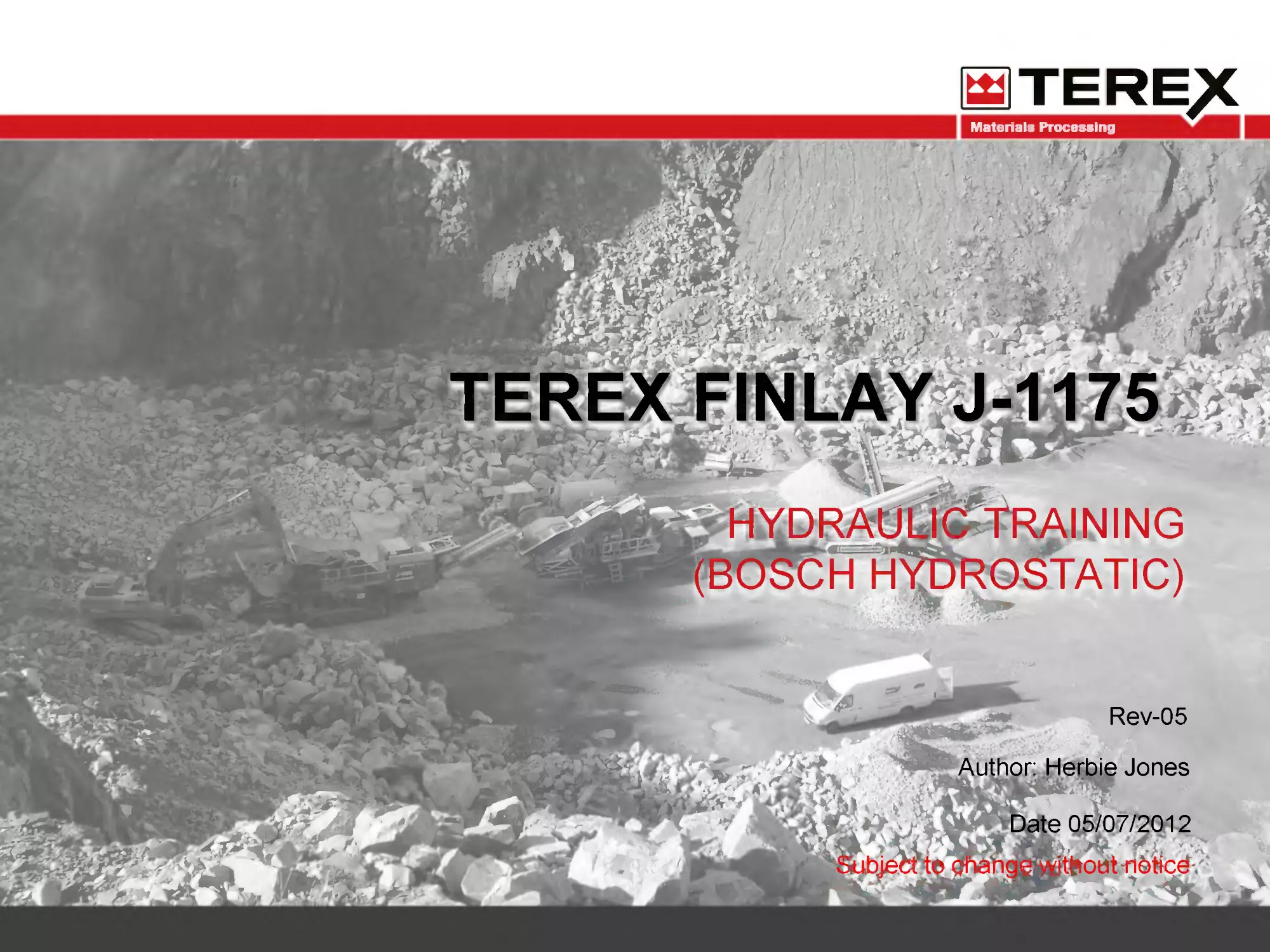
                    Rev-05
Author: Herbie Jones
Materials Processing

J-1175 SCHEMATIC
ЩТЕРЕХ
Materials Processing

J-1175 SCHEMATIC
ЩТЕРЕХ
Materials Processing
HOT CLIMATE & STOCKPILER DRIVE

J-1175 HYDRAULICS
ЩТЕРЕХ
Materials Processing
WATER PUMP OPTION

J-1175 HYDRAULICS - PRE-SCREEN
ЩТЕРЕХ
Materials Processing

POWER UNIT ORIENTATION-LHS
FIXED DISPLACEMENT
TANDEM PUMPS
VARIABLE DISPLACEMENT
TANDEM PUMPS
6 PORT DIVERTER’S
(Upper valve out of sight)
PRESSURE RELIEF
VALVE
T-BLOCK
CEE-TOP 5
PRESSURE TRANSDUCER
Charge/Crushing Pressure
HYDRAULIC PULLROD
OVERIDE BUTTON
FLOW CONTROL/S
PRE-SCREEN BLOCK
JAW ADJUSTMENT
CEE-TOP 3

POWER UNIT ORIENTATION-RHS
ЩТЕРЕХ
Materials Processing
OIL COOLER
HIGH PRESSURE
INLINE FILTER
(6 MICRON)
NODE BLOCKS
#1,2 & 3
HYDRAULIC OIL
TEMPERATURE SENSOR
RETURN
MANIFOLD
HYDRAULIC PULLROD
ADJUSTMENT BLOCK

HYDRAULIC TANK
ЩТЕРЕХ
Materials Processing
Sentry Breather
2 off Return
filters
3 Off suction pipes for
the tandem and
single pumps
Hydraulic oil
level sensor
Oil fill pipe
> The sentry air breather replaces the standard breather cap on a tank. The air sentry breather uses a three stage
filtration system to ensure optimum protection by removing water vapour and solid contaminants before they enter
the oil tank.
> The hydraulic oil level sensor is located next to the suction lines. If the oil level drops below minimum it will shut
the engine down and will display ‘Low Hydraulic Oil’ on the main display screen.
> The return filters have a blockage indicator, mounted on both filter housings. The filters
should be changed every 500hrs, but if the indicator is in the red and showing a blockage then
the filter elements should be changed. The filters have a rating of 10 MICRON.

RETURN FILTER & BREATHER
ЩТЕРЕХ
Materials Processing
RETURN FILTER ASSEMBLY
SENTRY AIR BREATHER

HYDROSTATIC SYSTEM
ЩТЕРЕХ
Materials Processing
CRUSHER DRIVE

HYDROSTATIC SYSTEM
Materials Processing
TRACK DRIVE
Inlet flow
Case pressure
Control pressure
Charge pressure
High pressure

VARIABLE DISPLACEMENT PUMP
ЩТЕРЕХ
Materials Processing
SERVO PRESSURE PORT
SERVO PISTON (SWASH
ADJUSTMENT)
SWASH PLATE & ARM
NEUTRAL SWASH POSITION
PUMP PISTONS
>	This is a sectioned view of the internal
workings of variable displacement piston
pump.
>	The pump is in a neutral position at the
moment, this is noted by the way that the
swash plate is at 90o to the axis of the
pump pistons, as shown.
>	This means that the pistons are not
being able to pump oil and generate
pressure.

VARIABLE DISPLACEMENT PUMP
ЩТЕРЕХ
Materials Processing
FULL SWASH POSITION
DRIVEN HUB
>	You can now see how the servo piston has
been shifted to the right hand side, thus
shifting the linkage arm and put the swash
plate to its full operating angle, shown.
>	The pistons are now being drawn ‘in & out’
as the driven hub rotates thus creating a
sucking and pumping effect on the opposite
ends of the pistons as they are being spun
against the angled swash plate.
>	A sectioned view can be seen on the
following slides.

HYDROSTATIC PUMP
ЩТЕРЕХ
WORKING VIDEO
Materials Processing

HYDROSTATIC PUMP - WORKING
ЩТЕРЕХ
Materials Processing

PUMPS SCHEMATIC
ЩТЕРЕХ
Materials Processing
>	This is the schematic variable displacement pumps. Our charge oil enters at the ‘G’ ports, and the ‘MA &
MB’ ports are the operational lines for the hydrostatic system.
>	If the pressure in the system exceeds the value of 395 BAR then ports ‘MA & MB’ will cross and allow oil to
circulate within the system only for a given time frame.

PUMP SCHEMATIC
ЩТЕРЕХ
Materials Processing

PUMP CONTROL
Materials Processing
Pump Displacement
Fwd direction 0 - 100%
Servo control pressure
Rev direction
Servo control pressure
Fwd direction
Pump Displacement
Rev direction 0 - 100%
> Shown in the above graph is how the pump displacement is controlled via the pilot pressure (Charge oil) being
sent to the servo in either a forward or reverse direction,
> With only the engine running no oil is being pumped, when the PLC starts to increase the mA value the servo oil
pressure increases accordingly, at 6 BAR Servo pressure the pump displacement starts to change slightly and the
pump and just starts to deliver oil to the crusher motor once the servo pressure reaches its maximum of 18 BAR
the pump will have reached its maximum displacement.

CRUSHER FIXED DISPLACEMENT MOTOR
Materials Processing
0.35 BAR
261kW @ 1900 RPM
CATERPILLAR C9 T3
Internal PORV's
395 Bar (not shown)
MAIN
CONV'R TAIL
RAISE/LOWER
PILOT OPERATED
DIRECTIONAL VALVE
(6 PORT DIVERTER)
SIDE CON
495cc/rev
10.25.5210
J VIBRATING
• FEEDER
• 450-850 rpr
-21-40 LPM
I 85CC/REV
60 LPM
981 MOTOR RPM
350 BAR-192KW
80 Lrr
MANIFOLD DRAIN HOSE
вЕТиеч
H*Ktrtl_D
Aside conveyor
1 33cc/rev
BOSCH A4VG110 Set TiANttM
PUMP - 10.24.3692
46cc/rev
PRIORITY
BYPl
175 BAR
FEEDER
80 LPb
MAIN CONVEYOR 80 l_P
"OLDING RAMS
(SEE SHEET 2)
PURGE VALVE SET
AT 16 BAR
RIGHT
TRACK
MOTOR
The Crusher Motor is
fixed @ 355CC/REV
RETURN MANIFOLD

PURGE VALVE BREAKDOWN
Materials Processing
housing.
> When the crusher is running the crusher motor purge valve uses the high pressure oil (On one side of the
motor) to shift the spool & allow low pressure oil (From low pressure side of motor) to pass over the 16 BAR relief
this an average of 16 LPM (approximately)this purged oil is also used to flush the motor before leaving with the
case drain oil to be cooled by the Hydraulic cooler.
NOTE: THE PURGE RELIEF IS FACTORY SET AND SHOULD NOT BE ADJUSTED!!!

6 PORT DIVERTER
SIDE CONVEYOR
PRIORITY
175 BAR
-■I LOT OPERATED
located inside the LHS of the main
drive motor.
IONAL VALVE
T DIVERTER)
761RW @ 1900 RPM
CATERPILLAR Г.9 ТЯ
-CEDING
:see s
Webtec
10.16.6115
flow to either the tracks or crusher
shown.
SIDE GDIS
495cc/rev
L0.£5.521C
395cc/rev
^ILOT OPERATED
LI IL _:т г nN AL V AL .
(6 PORT DIVERTER
Materials Processing
hydraulic cabinet. The purpose of
the diverters is to change the oil
The diverters are pilot operated as

T-BLOCK/PRESSURE TRANSDUCER
ЩТЕРЕХ
HYDRAULIC CABINET LHS
Materials Processing
!175 BAR
FEEDER
80 LPM
MAIN CONVEYOR 80 LPM
PILOT OPERATED
-.DIRECTIONAL VALVE
1(6 PORT DIVERTER)
The crusher pressure transducer
located in the ‘T’ block measures the
hydrostatic charge pressure with only
the engine is running,
Once the crusher is started the
transducer will then be reading the
actual crushing pressure and will be
displayed on the PDM screen.
The T-Block is located on the LHS wall
of the Hydraulic cabinet (Just below
the 6 port diverters.) Its purpose is to
combine the oil flows from both
Hydrostatic pumps (46 & 47) for the
main crusher drive system.
CRUSHER MOTDR (BOSCH A2FM>
HOTDRi 355 cc/rev - 1025.4044

FIXED DISPLACEMENT PUMPS
ЩТЕРЕХ
Materials Processing
SIDE CONVEYOR
PRIORITY
BYPASS
not ^nnwn)
MAIN CONVEYOR 80 LPt“
< 1DI№ rBQi 4 F4
-OLDING RAMS
:SEE SHEET 2)
ZDNV'R TAIL
RA IS /I wh R
Э1ЕПТ OPERATED
DIRECTIONAL VALV
=TLOT OPERATED
DIRECTIONAL VALVE
C6 PORT DIVERTER)
SIDE CON
495cc/rev
L0.£5.521C
i VIBRATING
28cc Single pump
Side conveyor, Magnet,
Pullrod & Main Conveyor tail
(Raise/Lower)
FEEDER
CATERPILLAR C9 T3
[ 450-850 rpr
-21-40 LPM
85CC/REV
46/46cc Tandem pump
Pump nearest engine driving the
Feeder & the pump on the outside
driving Main conveyor & supplying
Charge oil (For Hydrostatic system).

HYDRAULIC OIL COOLER/S
ЩТЕРЕХ
Materials Processing
5 Bar Check Valve
>	The hydraulic oil cooler is located in the RHS of the main
control cabinet. The return line from the feeder, main conveyor
and Cee-top5 is combined to form the inlet line to the oil cooler.
>	This line also has a check valve set at 5 BAR, meaning that if
the pressure of oil is too high then the in the cooler, a certain
amount will bypass the cooler and go straight to tank until the
pressure is less than 5 BAR.
>	The thermostat switch will start the fan once the oil
temperature has reached approximately 47 degrees.
Oil return to tank
By-Pass Oil from
check valve
Oil inlets
to cooler
(Optional) Additional Electric Hot
Climate Cooler (Fitted above
magnet area).

CEE-TOP 5 MAIN HYDRAULIC VALVE BLOCK gTEREX
Materials Processing

CEE-TOP 5 MAIN HYDRAULIC VALVE BLOCK gTEREX
Materials Processing
DIRT CONVEYOR SOLENOID
T
MAGNET CONVEYOR SOLENOID
TAIL SECTION (Raise/Lower)
FEEDER CONTROL SOLENOID
MAIN CONVEYOR SOLENOID

RELIEF VALVES (C-Top5)
ЩТЕРЕХ
Materials Processing
FEEDER RELEIF VALVE
FEEDER PRESSURE COMPENSATOR VALVE
CHARGE PRESSURE RELIEF VALVE
MAIN CONVEYOR RELIEF VALVE
MAIN RELIEF FOR DIRT & MAGNET CONVEYORS, TAIL
SECTION RAISE/LOWER & MANUAL VALVE BLOCKS

ADJUSTMENT OF RELIEF VALVES
VALVE COVER NUT
ALLEN-KEY
VALVE ADJUSTMENT, 4.5mm
1)
2)
Materials Processing
RELIEF VALVES
Main Conveyor
Charge Pressure
VALVE ADJUSTMENT LOCKING
NUT
REMEMBER!!
Do not exceed 210Bar, or Finlay
recommended setting, for the main
conveyor.
If you need to adjust the setting of the relief valves, once you have consulted Finlay, you can proceed as follows:
> Remove the valve cover nut.
> Then loosen the locking nut in an anti-clockwise direction, taking care not to let the valve adjuster move with the
locking nut and thus disrupt the original setting.
>	By using a 4.5mm align-key you can increase the setting by turning the valve adjuster in a clockwise direction.

MAIN CONVEYOR SPEED ADJUSTMENT gfEREX
Materials Processing
location
flow
>	The Webtec flow control is located inside the main hydraulic cabinet behind the middle support member of the
power unit and connected to the Cee-Top 5 via a 90 degree fitting.
>	To alter the speed of the main conveyor simply turn the gauge, the Priority flow goes to the main conveyor
motor while the bypass is returned back into the charge line for the Hydrostatic system.

MAGNET SPEED ADJUSTMENT
Materials Processing
Adjusting Dial
Webtec flow
control location
>	The Webtec flow control is located inside the main hydraulic cabinet and connected to the Cee-Top 5 via a 90
degree fitting.
>	To alter the speed of the Magnet conveyor simply turn the gauge, the Priority flow goes to the magnet motor
and the bypass is connected into the return side of the magnet motor.

ORIFICE PLUGS FOR FEEDER CONTROL gTEREX
Materials Processing
> The 2 orifice plugs shown, both have
a 0.5mm hole drilled in them to vent oil
> The plugged port, next to the feeder pressure port ‘G’,
must be removed, and then the 2 orifice plugs can be
removed if necessary using a 3mm align key.
32
over the pressure compensator valve.
> They are located under the plug port,
next to the feeder pressure port
labelled ‘G’.

PIPING CONFIGURATIONS
Materials Processing
BOTTOM VIEW OF MANIFOLD
“A”	Pressure Line to Dirt Conveyor
“F”	Lower Tail Section (J-1175	ONLY)
“B”	Return Line from Dirt Conveyor
“G”	Pressure Line to	Feeder
“C”	Pressure Line to Magnet
“H”	Pressure Line to	Main Conveyor
“D”	Tank Line
“J”	Charge Line
“E”	Raise Tail Section (J-1175 ONLY)

PIPING CONFIGURATIONS - CONT’D j^TEREX
Materials Processing
LHS VIEW OF MANIFOLD
RHS VIEW OF MANIFOLD
P1 - PRESSURE LINE TO DIRT CONVEYOR, MAGNET, TAIL SECTION RAISE/LOWER & MANUAL VALVES.
P2 - PRESSURE LINE TO FEEDER
P3 - PRESSURE LINE TO MAIN CONVEYOR
T - TANK LINE
GUAGE - CHARGE PRESSURE TEST POINT (Before Filter)

CHARGE PRESSURE
ЩТЕРЕХ
Materials Processing
>	The relief valve labelled #14 is the Main Conveyor primary relief valve,
set at 210 Bar (maximum). If the Main conveyor stalled under load you
can see how the relieved oil will still be held at 40 BAR via the 40 BAR
relief labelled #8.
>	This relief valve is the charge oil main relief and is set in factory around
38-40 Bar. The charge pressure can be checked from the gauge port
shown opposite. This arrangement is such to ensure that if there is
blockage or seizure on the Main Conveyor and the oil is forced to dump
over the primary relief we will still have charge oil going to the hydrostatic
pumps.
>	When the Main Conveyor is not being run the oil passes through the
valve, labelled 2B and sent out port ‘J’ to the Charge Oil High Pressure in
Line Filter then on to the Hydrostatic Pumps.
>	When the Main Conveyor is engaged the pressurised oil will be
supplied to the Main Conveyor motor through port ‘H’ and its return oil will
then be linked back into the charge line leaving port ‘J’.

CHARGE PRESSURE CONT’D
Materials Processing
TEST POINT
CHARGE PRESSURE RELIEF VALVE
>	Charge pressure is very important to the workings of this hydraulic system, it is
very important to adhere to the proper service intervals.
>	Track brake release, Track diverters & Purge operation rely solely on good
Charge Pressure.
>	There are other relief valves located in the variable displacement pumps, crusher motor and track drive motors
that control the charge oil pressure.
>	The charge oil is used to adjust the servo piston on the main pumps, it also pumps in cool oil into the
hydrostatic system, it is used as the pilot pressure to divert the 6 Port Diverters and to release the track brakes.

CEE-TOP 3 HYDRAULIC BLOCK
ЩТЕРЕХ
Materials Processing
^ILOT OPERATED
DIRECTIONAL VALV
C6 PORT DIVERTER)
control of the brakes when in
whether the machine will be in
The Cee-top 3 diverts oil for the
tracking mode and controls the pilot
operated directional valves (6 port
diverter valves) to determine
tracking or crushing mode.

TRACK CONTROL VALVE
ЩТЕРЕХ
Materials Processing
•Drive line
•Drive line
• Drain line to tank
• Case drain line
•	Brake release line from Cee-top3
•	Main relief valve
• Purge valve relief valve

FLOW REGULATOR VALVE & PRV
Materials Processing
Pressure Relief Valve
Priority/By-pass Control
setting which can be
adjusted using an Allen
key
Standard Flow Control J
By-pass line to Cee-top 5
Priority line to Hydraulic Pullrod
An extra flow control valve is also fitted if any one of the following options are required,
>	Hydraulic Stockpiler drive
>	Hydraulically driven water pump
In this example the pressure line from the single pump firstly goes through a PRV, then to the flow control
valve. By-pass pressure line is transferred to the Cee-top 5, which in turn is operating the dirt conveyor. The
Priority pressure line goes to the hydraulic pull rod. Note that if any of the other options are required then 2
Flow Controls valves are required.

1)	Outlet Pressure Port (To flow)
2)	Pressure Port 1 (From Pump
3)	Gauge Point Port
4)	Relief Port to tank
5)	Mounting Holes
6)	Relief Setting Adjustment

FLOW REGULATOR VALVE
1)
2)
3)
4)
5)
Pressure port
Regulated Port
Bypass Port
Flow Adjustment
Mounting Holes
> Once you have correctly fitted the flow regulator valve, you need to
ensure that the valve has been set correctly as the flow going to the pull
Mounting Position of Flow
Regulator Valve.
rod is the REGULATED flow.
Materials Processing
> You must not divert the full flow of the pump to the pull rod system.
Flow Adjusting Screw
Locking Nut
>	Firstly loosen the locking nut, then make sure that the adjustment screw
is completely turned in, clockwise.
>	Then turn it back, anti-clockwise, 1/4 turn.
>	This setting will suit initially and will stand as protection for the pull rod
hydraulic system, as the bulk of the oil is being diverted to the bypass line.

MAIN PRV & FLOW REGULATOR
ЩТЕРЕХ
Materials Processing
BYPASS CONVEYOR
HOPPE? LEFT WALL
HOPPER RACK WALL
HOPPER &SGHT WALL
LP
EXTENDED
BYPASS CONVEYOR
ELESCDPIC #P
MAIN-CEN HEAD ХЕСПИГч
EXTENDED
BYPASS CDNVEYQR
TELESCOPIC
Flow regulator valve, mounted after
PRV and before main Cee-Top 5
hydraulic manifold.
1/5 JsAk
Main pressure relief
valve, set @175 Bar,
direct from pump.

J-1175 HYDRAULIC PULL ROD
ЩТЕРЕХ
Materials Processing
Hydraulic Pull Rod Controls
Hydraulic Pull Rod Control Bank
& Pressure Release Valve
Over-ride Button & Adjustment
Directional Valve
>	The manual restricting valve #2 must be in the open
position, screwed fully out.
>	If the manual restrictor valve is left in the closed
position when the dump solenoid is energised the
pressure in the Pullrod system will not be able to drop to
zero, & adjustment of the jaw may not be possible.
>	Possible damage may be incurred on the adjusting
wedges’ contact faces.

HYDRAULIC PULL ROD ADJUSTMENT
ЩТЕРЕХ
CSS ADJUSTMENT
Materials Processing
STEP 1: Stop the jaw in its fully open
position.
STEP 2: Press & hold the over-ride
button.
STEP 3: Adjust jaw setting with
directional valve.
STEP 4: Release over-ride button &
begin crushing.

J-1175 FULLY HYDRAULIC PULL ROD
ЩТЕРЕХ
Materials Processing
COMPONENTS:
1)	Manual Dump Valve
2)	High Pressure Relief Valve
3)	Pressure Gauge
4)	Solenoid Dump Valve
5)	Low Pressure Relief Valve (Behind
Pressure Transducer)
6)	Pressure Transducer
7)	Main Solenoid Directional Valve

SETTING CORRECT SPRING TENSION ^TEREX
Materials Processing
MAX PRESSURE
>	To set the spring tension set your engine rpm to 1900 rpm. (Two people required to complete this task.)
>	Firstly remove the ram stopper plate at the rear of the support tube (figurel)
Manual dump Valve
Ram Stopper Plate
>	Then open the manual dump valve so as to allow the spring to
extend to its full length, then mark where the rear guide runner is in
the tube section, shown in figure 1.
>	Then close the manual dump valve and allow the ram to charge
up.
>	When the guide runner has stopped moving, measure how far it
moved when compressing the spring, This should be 80mm (This
gives the spring a compressed length of 300mm

SETTING CORRECT SPRING TENSION |^|TEREX
Materials Processing
MAX PRESSURE
> You can adjust the settings on the screen accordingly to give you the correct measurement, i.e. if under 80mm,
increase the value slightly and then press the oil dump button and allow the pressure to drop in the ram, then
release the button and allow the ram to recharge then repeat the measurement.
> Repeat this step until the correct measurement is achieved.
Adjust this value to get the correct
spring compression.
IE Increase this value if the pullrod spring
compresses less than 80mm and
decrease this value if the spring
compresses more than 80mm

SETTING CORRECT PULL ROD RECHARGE
LENGTH (MIN PRESSURE)	 STEREX
Materials Processing
Once the correct high pressure setting has been achieved, the
low pressure setting must now be set.
>	The low pressure setting needs to be set such that the rear
guide runner moves back a max of 10-12mm before the system
re-charges.
>	To set this, 1 person must open the manual dump valve
SLIGHTLY. (This releases the pressure on the pullrod ram and
allows it to creep releasing the spring tension.)
>	The other must sit with a tape measure on the rear runner
and measure the distance the rear runner travels back before
the ram recharges.
>	If the measurement is bigger than 10-12mm, then the tension Min value on the screen needs to be increased
slightly. and the measurement repeated.
>	If the measurement is smaller than 10-12mm, then the tension Min value on the screen needs to be decreased
slightly and the measurement repeated.
>	It is important that the movement of the spring between the high and the low pressure set points is a Min and
Max of 10mm & 12mm respectively).

SETTING CORRECT PULL ROD RECHARGE
LENGTH (MIN PRESSURE)	 S TEREX
Adjust this value to get the correct
spring compression.
Increase this value if the pullrod creeps
back more than 10mm before the
system recharges.
Decrease the value if the pullrod creeps
back less than 10mm before the system
recharges.
Materials Processing
IF THE DIFFERENCE IS TOO GREAT THE TENSION ON THE TOGGLE PLATE WILL NOT BE
SUFFICIENT ENOUGH AND IT COULD FALL OUT DURING OPERATION!
PLEASE NOTE THE TENSION MAX PRESSURE SETTING MUST BE GREATER THAN THE TENSION
MIN PRESSURE SETTING.

CHECKING SPEED OF RAM MOVEMENT gТЕREX
Materials Processing
> When the ram has stopped moving, make note of what pressure is being displayed on the pressure gauge. The
nominal pressure in the pull rod system should be approximately 60 - 65 bar.
— PULL ROD PRESSURE
GAUGE
>	Once complete, keeping the manual valve shut, press the red button on
the control box, hold down for a few seconds then release it.
>	At this moment watch the speed at which the ram closes in on the spring,
it should take no more than 3 or 4 seconds to compress at an engine speed
of 1900rpm.
>	If it takes over 4 seconds for the ram to compress the spring you need to
turn the adjusting screw on the flow regulator fractionally anti-clockwise until
the correct speed is reached.
>	If it goes too quickly, fractionally turn the flow regulator screw clockwise
until the correct speed is reached.

HYDRAULIC STOCKPILER
ЩТЕРЕХ
Materials Processing
3
1
2
Stockpiler
Drive with
bridge hose
REG p[pW Regulator
PRV
175 Bar
4
BYP
1
2
Stockpiler Relief Valve
Bridging Hose
Main PRV
175 Bar
Cee-Top 5
Hy drawl c
Manifold
Approximate oil flow available at
stockpiler supply 36Lt/min.
3
4
Timing Gear Hydraulic Pump
CAT C9 ACERT Engine
Stockpiler Drive Location

HYDRAULICALLY DRIVEN WATER PUMP gTEREX
Materials Processing
1
2
4
v
7
G)
(2
(3
®
Flow Diverter Valve
Motor Flow Control Valve
Hydraulic Drive Motor
Motor to Pump Coupling
Water Pump
Approximate oil flow available to hydraulic motor:
36Lt/min, delivering 1200rpm to water pump. At
given rpm the water pump will be capable to
deliver up to 54Lt/min @ 6.9 Bar.
Water Main Relief Valve
Water Pump Location
Running dry stack

PRE-SCREEN - OPTION
ЩТЕРЕХ
By-pass to
Vibrating feeder
Flow Regulator Valve
1
Materials Processing
Anti-Cavitation
loop
PRV
Priority (Regulated, to Pre screen)
Pre-screen
solenoid
Tank line
Pre-screen
Buffers

PRE-SCREEN - OPTION
ЩТЕРЕХ
CONFIGURATION MODE
I
CRUSHER SETPOINTS
ENGINE INFORMATION
TRACK SWASH VALUES
CRUSHER SWASH VALUES
AUTO START/SHUTDOWN TIMES
MANUAL START TIMES
TEST START TIMES
HYDRAULIC OIL TEMPERATURE
HYDRAULIC PULLROD
OPTIONS
-
ж
Materials Processing
>	If options such as a Pre-screen or Hot Climate Pack
have been fitted to the machine, they can be switched
ON or OFF from the OPTIONS page.
>	Once on this page use the Scroll button & move the
curser alongside the channel then press down on it to
enter. (A passcode will be needed to change).
>	It is possible to scroll through the options selected
and if they are ON or OFF.

HAMMER - OPTION
Pressure Relief Valve
Priority (Regulated, to Hammer)
Materials Processing