/




Text
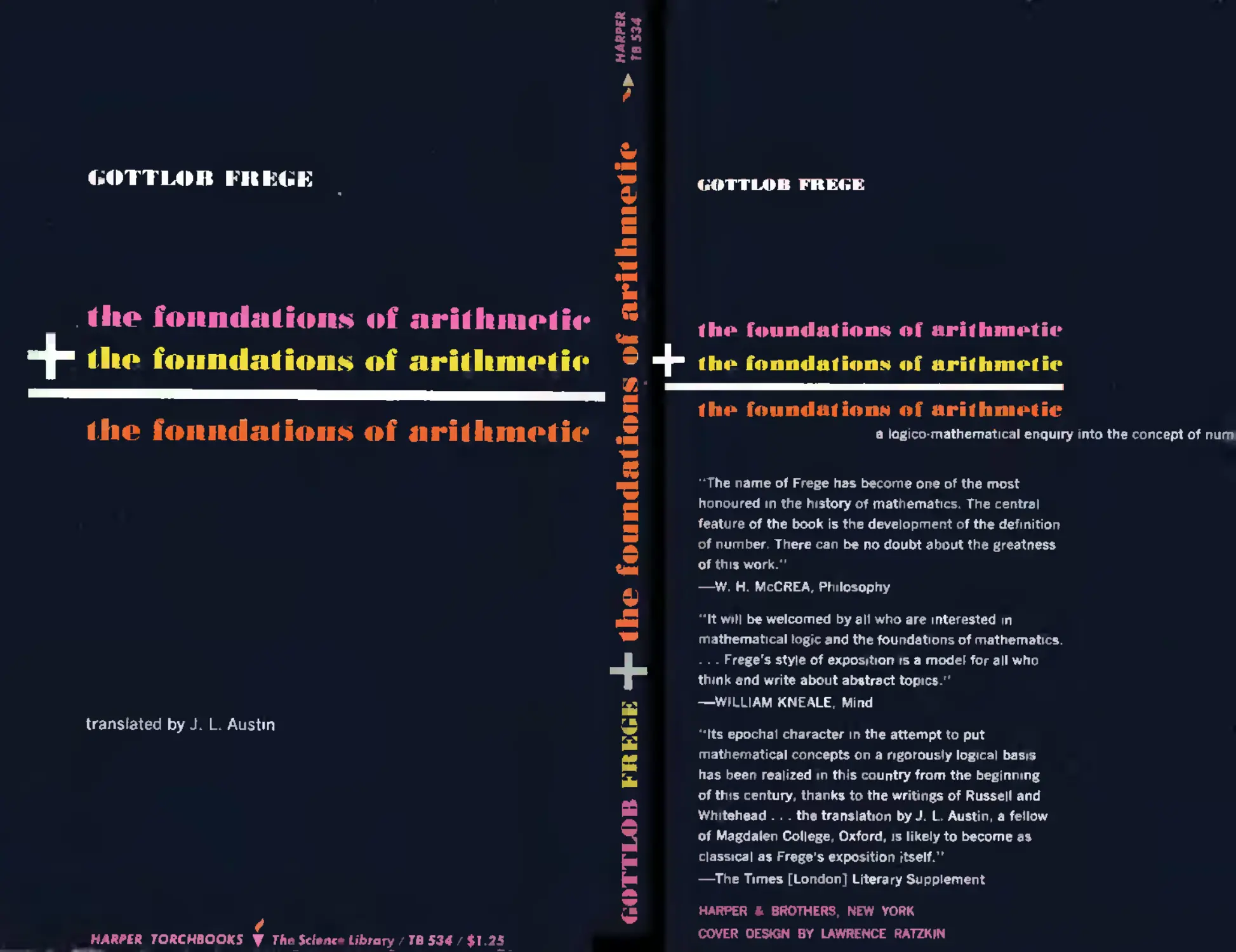
                    t.'OTTLOB FIIKUK
VOTTLOB FRE«E
the foundations of arithmetic
"|~ the foundations of arithmetic
fa
8
^ th<* foundations of arithmetic*
* ^p the fonndationN of arithmetic*
the foundations of arithmetic .:
the foundationw of arilhnietic
a logico-mathematical enquiry into the concept of n
I
translated by J. L. Austin
3
H
H
HARPER TOUCHBOOKS J Tha $tl»nt» library / TB 534 / $1.25
"The name of Frege has become one of the most
honoured in the history of mathematics. The central
feature of the book is the development of the definition
of number. There can be no doubt about the greatness
of this work."
—W. H. McCREA, Philosophy
"It will be welcomed by all who are interested in
mathematical logic and the foundations of mathematics.
. . . Frege's style of exposition is a model for all who
think and write about abstract topics."
—WILLIAM KNEALE. Mind
"Its epochal character in the attempt to put
mathematical concepts on a rigorously logical basis
has been realized in this country from the beginning
of this century, thanks to the writings of Russell and
Whitehead ... the translation by J. L. Austin, a fellow
of Magdalen College, Oxford, is likely to become as
classical as Frege's exposition itself."
—The Times [London] Literary Supplement
HARPER & BROTHERS, NEW YORK
COVER OEStGN BY LAWRENCE RATZKIN

The
FOUNDATIONS
of
ARITHMETIC
A logico-mathematical enquiry into
the concept of number
GOTTLOB FREGE
Translated by J. L. Austin
Second Revised Edition
▼
harper torchbooks / The Science Library
HARPER ¢^ BROTHERS, NEW YORK

THE FOUNDATIONS OF ARITHMETIC
Printed in the United States of America
This volume was first published in 1950 by
Basil Blackwell & Mott, Ltd. The revised edition
of 1953 is here reprinted by arrangement.
First Harper Torchbook edition published 1960

Translator's Note
Words and footnotes in square brackets are insertions by the translator.
The pagination of the German text is the same as in the original German
edition, except that in the original the "Analysis of Contents" pages were
not numbered.
Some of Frege's references and quotations, which are not always accurate,
have been corrected in the translated version.
Translator's Preface to the Second Edition
Though users of the first edition of this version will perhaps not be anywhere
seriously misled in doctrine, a large number of passages in it have called, and
some even howled, for improvements in fidelity or lucidity. The translator's
thanks are due to several readers, and in particular to Mr. P. T. Geach, for their
trouble in contributing emendations and suggestions: nothing could be more
welcome than more of the same.
There is justice in the general criticism that the version is too long. Here and
there it has been possible to do something to correct this, but it is too late and
too difficult now to strike a fresh compromise throughout between the claims of
brevity and those of naturalness and clarity. Frege is an unusually, even at times
an unduly, succinct writer, and the German text must be allowed to remain the
final testimony to his style.
The translations originally chosen for Frege's principal terms remain
unchanged, except that Begrifftwort has now become "concept word" instead of
"general term" and wirklicb "actual" instead of "existent." Critics of some
others of these translations have perhaps not sufficiently realized that Frege's
inherited philosophical vocabulary (at least as he was using it at this period) is
a dated one. It is that which was Englished by his contemporaries, the "British
Idealists":' and they certainly used, for example, "idea" for Vorsttllmg and
"proposition" for Sat%, though not unnaturally they attached to those words
meanings different from (and doubtless less clear than) those fashionable half a
century later. Frege's thought cannot be reproduced accurately, nor can his
terms be translated consistently, unless we are prepared to accept, even in him,
something short of complete (or contemporary) sophistication.

Analysis of Contents.
> i. Recent work in mathematics has shown a tendency towards rigour
of proof and sharp definition of concepts I
5 2. This critical examination must ultimately extend to the concept
of Number itself. The aim of proof. ..... 2
§ }. Philosophical motives for such an enquiry: the controversies as to
whether the laws of number are analytic or synthetic, a priori or
a posteriori. Sense of these expressions . . . . 3
§ 4. Task of the present work 4
I. Views of certain writers on the nature
of arithmetical propositions.
Are numerical formulae provable?
§ 5. Kant denies this, which Hankel justly calls a paradox
§ 6. Leibniz's proof that 2 + 2 "■ 4 contains a gap. Grassmann's
definition of a + b is faulty .......
§ 7. Mill's view that the definitions of the individual numbers assert
observed facts, from which the calculations follow, is without
foundation ..........
§ 8. These definitions do not require, for their legitimacy, the
observation of his facts ........
J
7
9
11

vn
MOB
Art tbt laws of arithmetic inductive truths}
§ 9. Mill's law of nature. In calling arithmetical truths laws of nature,
Mill is confusing them with their applications . . • 12
§ 10. Grounds for denying that the laws of addition are inductive
truths: numbers not all of the same sort; the definition of number
does not of itself yield any set of common properties of numbers;
probably the reverse is true and induction should be based on
arithmetic 14
5 11. Leibniz's term "innate" 17
Art tbt laws of arithmetic synthetic a priori or analytic?
S iz. Kant. Baumann. Lipschitz. Hankel. Inner intuition as the
ground of knowledge 17
§ i}. Distinction between arithmetic and geometry . 19
§ 14. Comparison between the various kinds of truths in respect of
the domains that they govern . . . . . . 20
§ 15. Views of Leibniz and W. S. Jevons 21
§ 16. Against them, Mill's ridicule of the "artful manipulation of
language". Symbols are not empty simply because not meaning
anything with which we can be acquainted 22
§ 17. Inadequacy of induction. Conjecture that the laws of number
are analytic judgments; what in that case is the use of them.
Estimate of the value of analytic judgments . . . 2}
II. Views of certain writers on the
concept of Number.
§ 18. Necessity for an enquiry into the general concept of Number . 24
§ 19. Its definition not to be geometrical 2;
§ 20. Is number definable? Hankel. Leibniz 26
Is Number a property of external things?
§ 21. Views of M. Cantor and E. Schroder 27
§ 22. Opposite view of Baumann: external things present us with no
strict units. Their number apparently dependent on our way of
regarding them 28
§ 2j. Mill's view untenable, that the number is a property of the
agglomeration of things 29

viii
MOB
§ 24. Wide range of applicability of number. Mill. Locke. Leibniz's
immaterial metaphysical figure. If number were something
sensible, it could not be ascribed to anything non-sensible . . 30
§ 25. Mill's physical difference between z and 3. Number according
to Berkeley not really existent in things but created by the mind. 32
Is number something subjective}
§ 26. Lipschitz's description of the construction of numbers will not
do, and cannot take the place of a definition of the concept.
Number not an object for psychology, but something objective 33
§ 27. Number is not, as Schloemilch claims, the idea of the position
of an item in a series 36
The sit theory of Number.
28. Thomae's name-giving 38
III. Views on unity and one.
Doet the number word "one" express a property o/ebjeetsf
§ 29. Ambiguity of the terms "povds" and "unit". E. Schroder's
definition of the unit as an object to be numbered is apparently
pointless. The adjective "one" does not add anything to a
description, cannot serve as a predicate . . . . . 39
§ 30. Attempts to define unity by Leibniz and Baumann seem to blur
the concept completely . 41
§ 31. Baumann's criteria, being undivided and being isolated. The
notion of unity not suggested to us by every object (as Locke) . 41
§ 32. Still, language does indicate some connexion with being
undivided and isolated, with a shift of meaning however . . 42
§ 33. Indivisibility (G. Kdpp) as a criterion of the unit is untenable . 43
Are units identical with one another}
% 34. Identity as the reason for the name "unit". E. Schroder.
Hobbes. Hume. Thomae. To abstract from the differences
between things does not give us the concept of their Number,
nor does it make the things identical with one another . . 44

IX
not
§ }]. Indeed diversity is actually necessary, if we are to speak of
plurality. Descartes, E. Schroder. W. S. Jevons 46
§ 36. The view that units are different also comes up against difficulties.
Different distinct ones in W. S. Jevons 46
§ 37. Definitions of number in terms of the unit or one by Locke,
Leibniz and Hesse 48
§ 38. "One" is a proper name, "unit" a concept word. Number
cannot be defined as units. Distinction between "and" and + ■ 48
§ 39. The difficulty of reconciling identity of units with distinguish-
ability Is concealed by the ambiguity of "unit" . . . . 50
Attimpts to ovtrcomt tbi difficulty.
§ 40. Space and time as means of distinguishing between units.
Hobbes. Thomae. Against them: Leibniz, Baumann, W. S.
Jevons 51
§ 41. The purpose not achieved 53
§ 42. Position in a series as a means of distinguishing between units.
Hankel's putting 54
$ 43. Schroder's copying of objects by the symbol 1 . . . 54
$ 44. Jevons' abstraction from the character of the differences while
retaining the fact of their existence. 0 and 1 are numbers like
the rest. The difficulty still remains 55
Solution of tbi difficult}.
§ 45. Recapitulation 58
$ 46. A statement of number contains an assertion about a concept.
Objection that the number varies while the concept does not 5 9
$ 47. That statements of number are statements of fact explained by
the objectivity of concepts 60
Removal of certain difficulties 61
Corroboration found in Spinoza 62
B. Schroder's account quoted 62
Correction of the same 63
Corroboration found in a German idiom . . . 64
Distinction between component characteristics of a concept and
its properties. Existence and number 64
Unit the name given to the subject of a statement of number.
How indivisible and isolated. How identical and
distinguishable 6]
s
$
s
s
s
s
$
48.
49.
JO.
5».
J*-
53-
54-

X
PAG*
IV. The concept of Number.
Entry individual number it a self-subsistent object.
§ ]]. Attempt to complete the definitions of the individual numbers
as given by Leibniz 67
$ 56. The attempted definitions are unusable, because what they
define is a predicate in which the number is only an element . 67
§57. A statement of number should be regarded as an identity
between numbers 68
§ j 8. Objection that we can form no idea of number as a self-subsistent
object. In principle number cannot be imagined 69
§ 59. Because we cannot imagine an object, we are not to be debarred
from investigating it . 70
$ 60. Even concrete things are not always imaginable. In seeking the
meaning of a word, we must consider it in the context of a
proposition 71
$ 61. Objection that numbers are not spatial. Not every objective
object is spatial 72
To obtain the concept of Number, we must fix the sense of a numerical identity.
% 62. We need a criterion for numerical identity . . . -73
§ 63. Possible criterion in one-one correlation. Doubt as to the logic
of defining identity specially for the case of numbers 73
§ 64. Examples of similar procedures: direction of a line, orientation
of a plane, shape of a triangle . . . . 74
§ 6]. Attempt at a definition. A second doubt: are the laws of identity
satisfied? 76
§ 66. Third doubt: the criterion of identity fails to cover all cases 77
§ 67. We cannot supplement it by taking as a defining characteristic
of a concept the way in which an object is introduced . . 78
$ 68. Number as the extension of a concept 79
§ 69. Elucidation 80
Our definition completed and its worth proved,
$ 70. The relation-concept 81
§ 71. Correlation by means of a relation 83
§ 72. One-one relations. The concept of Number 84

§ 7j. The Number which belongs to the concept F is identical with
the Number which belongs to the concept G, if there exists a
relation which correlates one to one the objects falling under F
with those falling under G 8]
§ 74, Nought is the Number which belongs to the concept "not
identical with itself" 86
$ 75. Nought is the Number which belongs to a concept under which
nothing falls. No object falls under a concept if nought is the
Number belonging to that concept 88
§ 76. Definition of the expression "n follows in the series of natural
numbers directly after *" ' 89
§ 77. 1 is the Number which belongs to the concept "identical with o" 90
§ 78. Propositions to be proved by means of our definitions . . 91
§ 79. Definition of following in a series 92
§ 80. Comments on the same. Following is objective 92
§ 81. Definition of the expression "x is a member of the ^-series ending
withy* 94
§ 8 z. Outline of the proof that there is no last member of the series
of natural numbers .... . . . . 94
$ 8}. Definition of finite Number. No finite Number follows in the
series of natural numbers after itself 95
Infinite Numbers.
§ 84. The Number which belongs to the concept "finite Number" is an
infinite Number 96
§ 8j. Cantor's infinite Numbers; "power." Divergence in terminology 97
§ 86. Cantor's following in the succession and my following in the
series 98
V. Conclusion.
§ 87. Nature of the laws of arithmetic 99
§ 88. Kant's underestimate of the value of analytic judgments . . 99
§ 89. Kant's dictum: "Without sensibility no object would be given to
us." Kant's services to mathematics 101
§ 90. For the complete proof of the analytic nature of the laws of
arithmetic we still need a chain of deductions with no link
missing .......... 102
$ 91. My concept writing makes it possible to supply this lack . . 103
Other numbers.
§ 92. The sense, according to Hankel, of asking whether some
number is possible 104
§ 9}. Numbers are neither outside us in space nor subjective . . 10;

XII
FAOI
§ 94. That a concept is free from contradiction is no guarantee that
anything falls under it, and itself requires to be proved . . 10;
§ 95. We cannot regard (f—b) without more ado as a symbol which
solves the problem of subtraction ..... 106
§ 96. Not even the mathematician can create things at will . . 107
§ 97. Concepts are to be distinguished from objects . . . 108
§ 98. Hankel's definition of addition ...... 108
§ 99. The formalist theory defective ...... 109
§ 100. Attempt to produce an interpretation of complex numbers by
extending the meaning of multiplication in some special way . no
§ 101. The cogency of proofs is affected, unless it is possible to produce
such an interpretation in
§ ioz. The mere postulate that it shall be possible to carry out some
operation is not the same as its own fulfilment. . . .111
§ ioj. Kossack's definition of complex numbers is only a guide
towards a definition, and fails to avoid the importation of foreign
elements. Geometrical representation of complex numbers . 112
§ 104. What is needed is to fix the sense of a recognition-judgment for
the case of the new numbers. ...... 114
§10;. The charm of arithmetic lies in its rationality . . . 115
§ 106-109. Recapitulation nj -119

INTRODUCTION
When we ask someone what the number one is, or what
the symbol i means,* we get as a rule the answer "Why, a
thing". And if we go on to point out that the proposition
"the number one is a thing"
is not a definition, because it has the definite article on one
side and the indefinite on the other, or that it only assigns the
number one to the class of things, without stating which
thing it is, then we shall very likely be invited to select
something for ourselves—anything we please—to call one. Yet if
everyone had the right to understand by this name whatever
he pleased, then the same proposition about one would mean
different things for different people,—such propositions
would have no common content. Some, perhaps, will decline
to answer the question, pointing out that it is impossible to
state, either, what is meant by the letter a, as it is used in
arithmetic; and that if we were to say "a means a number,"
this would be open to the same objection as the definition
"one is a thing." Now in the case of a it is quite right to
decline to answer: a does not mean some one definite number
which can be specified, but serves to express the generality
of general propositions. If, in a + a — a = a, we put for a
* [I have tried throughout to translate Bedtulung and its cognates by
"meaning" and Sim and its cognates by "sense", in view of the importance Frege
later attached to the distinction. But it is quite evident that he attached no
special significance to the words at this period.]

XIV
some number, any we please but the same throughout, we
get always a true identity.* This is the sense in which the letter
a is used. With one, however, the position is essentially
different. Can we, in the identity i + i = *> put for 1 in both
places some one and the same object, say the Moon? On the
contrary, it looks as though, whatever we put for the first 1,
we must put something different for the second. Why is it
that we have to do here precisely what would have been wrong
in the other case? Again, arithmetic cannot get along with a
alone, but has to use further letters besides (b, c and so on),
in order to express in general form relations between different
numbers. It would therefore be natural to suppose that the
symbol 1 too, if it served in some similar way to confer
generality on propositions, could not be enough by itself. Yet surely
the number one looks like a definite particular object, with
properties that can be specified, for example that of remaining
unchanged when multiplied by itself? In this sense, a has no
properties that can be specified, since whatever can be asserted
of a is a common property of all numbers, whereas ix = 1
asserts nothing of the Moon, nothing of the Sun, nothing of
the Sahara, nothing of the Peak of Teneriffe; for what could be
the sense of any such assertion?
Questions like these catch even mathematicians for that
matter, or most of them, unprepared with any satisfactory
answer. Yet is it not a scandal that our science should be so
unclear about the first and foremost among its objects, and one
which is apparently so simple? Small hope, then, that we
shall be able to say what number is. If a concept fundamental
to a mighty science gives rise to difficulties, then it is surely
an imperative task to investigate it more closely until those
difficulties are overcome; especially as we shall hardly succeed
in finally clearing up negative numbers, or fractional or
complex numbers, so long as our insight into the foundation
of the whole structure of arithmetic is still defective.
* [Gltichimg. This also means, and would often be more naturally translated,
"equation". But I have generally retained "identity", because this is
sometimes essential and because Frege does understand equations as identities.
For similar reasons I have translated glikh "identical", though it can mean
"equal" or even merely "similar". Cp. §§ $4, 65.]

XV
Many people will be sure to think this not worth the
trouble. Naturally, they suppose, this concept is adequately
dealt with in the elementary textbooks, where the subject
is settled once and for all. Who can believe that he has
anything still to learn on so simple a matter? So free from all
difficulty is the concept of positive whole number held to be,
that an account of it fit for children can be both scientific and
exhaustive; and that every schoolboy, without any further
reflexion or acquaintance with what others have thought,
knows all there is to know about it. The first prerequisite
for learning anything is thus utterly lacking—I mean, the
knowledge that we do not know. The result is that we still
rest content with the crudest of views, even though since
Herbart's1 day a better doctrine has been available. It is sad
and discouraging to observe how discoveries once made are
always threatening to be lost again in this way, and how much
work promises to have been done in vain, because we fancy
ourselves so well off that we need not bother to assimilate its
results. My work too, as I am well aware, is exposed to this
risk. A typical crudity confronts me, when I find calculation
described as "aggregative mechanical thought".2 I doubt
whether there exists any thought whatsoever answering to this
description. An aggregative imagination, even, might sooner
be let pass; but that has no relevance to calculation. Thought
is in essentials the same everywhere: it is not true that there are
different kinds of laws of thought to suit the different kinds of
objects thought about. Such differences as there are consist
only in this, that the thought is more pure or less pure, less
dependent or more upon psychological influences and on
external aids such as words or numerals, and further to some
1 Collected Worics, ed. Hartenstein, Vol. X, part i, XJmriss padagagiscber
VorUsungm, § 25 2, n. 2: "Two does not mean two things, but doubling" etc.
8 K. Fischer, System der Logik md Mttaphysik oder Wissmscbaftilehrt, 2nd edn.,
§94-

XVI
extent too in the finer or coarser structure of the concepts
involved; but it is precisely in this respect that mathematics
aspires to surpass all other sciences, even philosophy.
The present work will make it clear that even an inference
like that from n to n + i. which on the face of it is peculiar
to mathematics, is based on the general laws of logic, and
that there is no need of special laws for aggregative thought.
It is possible, of course, to operate with figures mechanically,
just as it is possible to speak like a parrot: but that hardly
deserves the name of thought. It only becomes possible at all
after the mathematical notation has, as a result of genuine
thought, been so developed that it does the thinking for us,
so to speak. This does not prove that numbers are formed
in some peculiarly mechanical way, as sand, say, is formed out
of quartz granules. In their own interests mathematicians
should, I consider, combat any view of this kind, since it is
calculated to lead to the disparagement of a principal object
of their study, and of their science itself along with it. Yet
even in the works of mathematicians are to be found
expressions of exactly the same sort. The truth is quite the other way:
the concept of number, as we shall be forced to recognize,
has a finer structure than most of the concepts of the other
sciences, even although it is still one of the simplest in
arithmetic.
In order, then, to dispel this illusion that the positive whole
numbers really present no difficulties at all, but that universal
concord reigns about them, I have adopted the plan of
criticizing some of the views put forward by mathematicians and
philosophers on the questions involved. It will be seen how
small is the extent of their agreement—so small, that we find
one dictum precisely contradicting another. For example, some
hold that "units are identical with one another," others that
they are different, and each side supports its assertion with
arguments that cannot be rejected out of hand. My object in this is

XV11
to awaken a desire for a stricter enquiry. At the same time
this preliminary examination of the views others have put
forward should clear the ground for my own account, by
convincing my readers in advance that these other paths
do not lead to the goal, and that my opinion is not just one
among many all equally tenable; and in this way I hope to
settle the question finally, at least in essentials.
I realize that, as a result, I have been led to pursue arguments
more philosophical than many mathematicians may approve;
but any thorough investigation of the concept of number is
bound always to turn out rather philosophical. It is a task
which is common to mathematics and philosophy.
It may well be that the co-operation between these two
sciences, in spite of many d-marches from both sides, is not so
flourishing as could be wished and would, for that matter,
be possible. And if so, this is due in my opinion to the
predominance in philosophy of psychological methods of
argument, which have penetrated even into the field of logic.
With this tendency mathematics is completely out of sympathy,
and this easily accounts for the aversion to philosophical
arguments felt by many mathematicians. When Stricker,1
for instance, calls our ideas* of numbers motor phenomena
and makes them dependent on muscular sensations, no
mathematician can recognize his numbers in such stuff or knows
where to begin to tackle such a proposition. An arithmetic
founded on muscular sensations would certainly turn out
sensational enough, but also every bit as vague as its foundation.
No, sensations are absolutely no concern of arithmetic. No
more are mental pictures, formed from the amalgamated traces
of earlier sense-impressions. All these phases of consciousness
are characteristically fluctuating and indefinite, in strong
contrast to the definiteness and fixity of the concepts and objects of
1 Studitn iiber Association der Vorstellmgen, Vienna 1883.
* [Vorstellmgen. I have translated this word consistently by "idea", and
cognate words by "imagine", "imagination", etc. For Frege it is a psychological
term, cp. p. x* below.]

xviii
mathematics. It may, of course, serve some purpose to
investigate the ideas and changes of ideas which occur during the
course of mathematical thinking; but psychology should not
imagine that it can contribute anything whatever to the
foundation of arithmetic. To the mathematician as such these
mental pictures, with their origins and their transformations,
are immaterial. Stricker himself states that the only idea he
associates with the word "hundred" is the symbol ioo. Others
may have the idea of the letter C or something else; does it
not follow, therefore, that these mental pictures are, so far as
concerns us and the essentials of our problem, completely
immaterial and incidental—as incidental as chalk and
blackboard, and indeed that they do not deserve to be called ideas
of the number a hundred at all? Never, then, let us suppose
that the essence of the matter lies in such ideas. Never let
us take a description of the origin of an idea for a definition,
or an account of the mental and physical conditions on
which we become conscious of a proposition for a proof of
it. A proposition may be thought, and again it may be true;
let us never confuse these two things. We must remind
ourselves, it seems, that a proposition no more ceases to
be true when I cease to think of it than the sun ceases to
exist when I shut my eyes. Otherwise, in proving
Pythagoras' theorem we should be reduced to allowing for the
phosphorous content of the human brain; and astronomers
would hesitate to draw any conclusions about the distant
past, for fear of being charged with anachronism,—with
reckoning twice two as four regardless of the fact that our
idea of number is a product of evolution and has a history
behind it. It might be doubted whether by that time it had
progressed so far. How could they profess to know that the
proposition 2X2 = 4 was already in existence in that remote
epoch? Might not the creatures then extant have held the
proposition 2x2 = 5, from which the proposition 2X2 = 4
was only evolved later through a process of natural selection

xix
in the struggle for existence? Why, it might even be that
2 x 2 == 4 itself is destined in the same way to develop into
2 x 2 = 31 Est modus in rebus, sunt certi denique finesX The
historical approach, with its aim of detecting how things
begin and of arriving from these origins at a knowledge of
their nature, is certainly perfectly legitimate; but it has also its
limitations. If everything were in continual flux, and nothing
maintained itself fixed for all time, there would no longer be
any possibility of getting to know anything about the world
and everything would be plunged in confusion. We suppose,
it would seem, that concepts sprout in the individual mind like
leaves on a tree, and we think to discover their nature by
studying their birth: we seek to define them psychologically, in
terms of the nature of the human mind. But this account makes
everything subjective, and if we follow it through to the end,
docs away with truth. What is known as the history of
concepts is really a history either of our knowledge of concepts or
of the meanings of words. Often it is only after immense
intellectual effort, which may have continued over centuries, that
humanity at last succeeds in achieving knowledge of a concept
in its pure form, in stripping off the irrelevant accretions which
veil it from the eyes of the mind. What, then, are we to say of
those who, instead of advancing this work where it is not yet
completed, despise it, and betake themselves to the nursery,
or bury themselves in the remotest conceivable periods of
human evolution, there to discover, like John Stuart Mill,
some gingerbread or pebble arithmetic! It remains only to
ascribe to the flavour of the bread some special meaning for
the concept of number. A procedure like this is surely the very
reverse of rational, and as unmathematical, at any rate, as it
could well be. No wonder the mathematicians turn their
backs on it. Do the concepts, as we approach their supposed
sources, reveal themselves in peculiar purity? Not at all,*

XX
we see everything as through a fog, blurred and
undifferentiated. It is as though everyone who wished to know about
America were to try to put himself back in the position of
Columbus, at the time when he caught the first dubious glimpse
of his supposed India. Of course, a comparison like this proves
nothing,- but it should, I hope, make my point clear. It may
well be that in many cases the history of earlier discoveries is a
useful study, as a preparation for further researches; but it
should not set up to usurp their place.
So far as mathematicians are concerned, an attack on such
views would indeed scarcely have been necessary; but my
treatment was designed to bring each dispute to an issue for
the philosophers as well, as far as possible, so that I found
myself forced to enter a little into psychology, if only to repel
its invasion of mathematics.
Besides, even mathematical textbooks do at times lapse
into psychology. When the author feels himself obliged to give
a definition, yet cannot, then he tends to give at least a
description of the way in which we arrive at the object or concept
concerned. These cases can easily be recognized by the fact
that such explanations are never referred to again in the course
of the subsequent exposition. For teaching purposes,
introductory devices are certainly quite legitimate; only they should
always be clearly distinguished from definitions. A delightful
example of the way in which even mathematicians can confuse
the grounds of proof with the mental or physical conditions
to be satisfied if the proof is to be given is to be found in
E. Schroder.1 Under the heading "Special Axiom" he
produces the following: "The principle I have in mind might well
be called the Axiom of Symbolic Stability. It guarantees us
that throughout all our arguments and deductions the symbols
1 Lebrbutb dtr Arithmttik. mi Algibra, [Leipzig 1873].

XXI
remain constant in our memory—or preferably on paper,"
and so on.
No less essential for mathematics than the refusal of all
assistance from the direction of psychology, is the recognition
of its close connexion with logic. I go so far as to agree
with those who hold that it is impossible to effect any sharp
separation of the two. This much everyone would allow, that
any enquiry into the cogency of a proof or the justification of a
definition must be a matter of logic. But such enquiries
simply cannot be eliminated from mathematics, for it is only
through answering them that we can attain to the necessary
certainty.
In this direction too I go, certainly, further than is usual.
Most mathematicians rest content, in enquiries of this kind,
when they have satisfied their immediate needs. If a definition
shows itself tractable when used in proofs, if no contradictions
are anywhere encountered, and if connexions are revealed
between matters apparently remote from one another, this
leading to an advance in order and regularity, it is usual to
regard the definition as sufficiently established, and few
questions are asked as to its logical justification. This
procedure has at least the advantage that it makes it difficult to miss
the mark altogether. Even I agree that definitions must show
their worth by their fruitfulness: it must be possible to use
them for constructing proofs. Yet it must still be borne in
mind that the rigour of the proof remains an illusion, even
though no link be missing in the chain of our deductions, so
long as the definitions are justified only as an afterthought, by
our failing to come across any contradiction. By these methods
we shall, at bottom, never have achieved more than an
empirical certainty, and we must really face the possibility that
we may still in the end encounter a contradiction which brings
the whole edifice down in ruins. For this reason I have felt
bound to go back rather further into the general logical
foundations of our science than perhaps most mathematicians
will consider necessary.

xxii
In the enquiry that follows, I have kept to three
fundamental principles:
always to separate sharply the psychological from the
logical, the subjective from the objective;
never to ask for the meaning of a word in isolation, but
only in the context of a proposition;
never to lose sight of the distinction between concept
and object.
In compliance with the first principle, I have used the word
"idea" always in the psychological sense, and have distinguished
ideas from concepts and from objects. If the second principle
is not observed, one is almost forced to take as the meanings
of words mental pictures or acts of the individual mind, and
so to offend against the first principle as well. As to the third
point, it is a mere illusion to suppose that a concept can be
made an object without altering it. From this it follows that a
widely-held formalist theory of fractional, negative, etc.,
numbers is untenable. How I propose to improve upon it can be no
more than indicated in the present work. With numbers of
all these types, as with the positive whole numbers, it is a
matter of fixing the sense of an identity.
My results will, I think, at least in essentials, win the
adherence of those mathematicians who take the trouble to
attend to my arguments. They seem to me to be in the air,
and it may be that every one of them singly, or at least
something very like it, has been already put forward; though
perhaps, presented as they are here in connexion with each
other, they may still be novel. I have often been astonished
at the way in which writers who on one point approach my
view so closely, on others depart from it so violently.
Their reception by philosophers will be varied, depending
on each philosopher's own position; but presumably those

XX111
empiricists who recognize induction as the sole original
process of inference (and even that as a process not actually
of inference but of habituation) will like them least. Some one
or another, perhaps, will take this opportunity to examine
afresh the principles of his theory of knowledge. To those
who feel inclined to criticize my definitions as unnatural, I
would suggest that the point here is not whether they are
natural, but whether they go to the root of the matter and are
logically beyond criticism.
I permit myself the hope that even the philosophers, if
they examine what I have written without prejudice, will find
in it something of use to them.

§ i. After deserting for a time the old Euclidean
standards of rigour, mathematics is now returning to them,
and even making efforts to go beyond them. In arithmetic,
if only because many of its methods and concepts originated
in India, it has been the tradition to reason less strictly than in
geometry, which was in the main developed by the Greeks.
The discovery of higher analysis only served to confirm this
tendency; for considerable, almost insuperable, difficulties
stood in the way of any rigorous treatment of these subjects,
while at the same time small reward seemed likely for the efforts
expended in overcoming them. Later developments, however,
have shown more and more clearly that in mathematics a
mere moral conviction, supported by a mass of successful
applications, is not good enough. Proof is now demanded
of many things that formerly passed as self-evident. Again
and again the limits to the validity of a proposition have been
in this way established for the first time. The concepts of
function, of continuity, of limit and of infinity have been
shown to stand in need of sharper definition. Negative and
irrational numbers, which had long since been admitted into
science, have had to submit to a closer scrutiny of their
credentials.
In all directions these same ideals can be seen at work—
rigour of proof, precise delimitation of extent of validity, and
as a means to this, sharp definition of concepts.

2
§ 2. Proceeding along these lines, we are bound
eventually to come to the concept of Number* and to the simplest
propositions holding of positive whole numbers, which form
the foundation of the whole of arithmetic. Of course, numerical
formulae like 7+5 = 12 and laws like the Associative Law
of Addition are so amply established by the countless
applications made of them every day, that it may seem almost
ridiculous to try to bring them into dispute by demanding a proof
of them. But it is in the nature of mathematics always to
prefer proof, where proof is possible, to any confirmation by
induction. Euclid gives proofs of many things which
anyone would concede him without question. And it was when
men refused to be satisfied even with Euclid's standards of
rigour that they were led to the enquiries set in train by the
Axiom of Parallels.
Thus our movement in favour of all possible rigour has
already outstripped in many directions the demand originally
raised, while the demand has itself continually grown in scope
and urgency.
The aim of proof is, in fact, not merely to place the truth
of a proposition beyond all doubt, but also to afford us insight
into the dependence of truths upon one another. After we have
convinced ourselves that a boulder is immovable, by trying
unsuccessfully to move it, there remains the further question,
what is it that supports it so securely? The further we pursue
these enquiries, the fewer become the primitive truths to
which we reduce everything; and this simplification is in itself
a goal worth pursuing. But there may even be justification for
a further hope: if, by examining the simplest cases, we can
bring to light what mankind has there done by instinct,
and can extract from such procedures what is universally valid
in them, may we not thus arrive at general methods for forming
concepts and establishing principles which will be applicable
also in more complicated cases?
* [Ampbl, i.e. cardinal number, cp. § 4 n. I have always used "Number"
to translate this, and "number" for the more usual and general Zabl.
Throughout most of the present work the distinction is not important, and Frege uses
the two words almost indifferently.]

3
§ 3- Philosophical motives too have prompted me to
enquiries of this kind. The answers to the questions raised
about the nature of arithmetical truths—are they a priori
or a posteriori? synthetic or analytic?—must lie in this same
direction. For even though the concepts concerned may
themselves belong to philosophy, yet, as I believe, no decision
on these questions can be reached without assistance from
mathematics—though this depends of course on the sense
in which we understand them.
It not uncommonly happens that we first discover the
content of a proposition, and only later give the rigorous
proof of it, on other and more difficult lines; and often this
same proof also reveals more precisely the conditions
restricting the validity of the original proposition. In general,
therefore, the question of how we arrive at the content of a
judgement should be kept distinct from the other question,
Whence do we derive the justification for its assertion?
Now these distinctions between a priori and a posteriori,
synthetic and analytic, concern, as I see it,1 not the content of
the judgement but the justification for making the judgement.
Where there is no such justification, the possibility of drawing
the distinctions vanishes. An a priori error is thus as complete
a nonsense as, say, a blue concept. When a proposition is
called a posteriori or analytic in my sense, this is not a
judgement about the conditions, psychological, physiological and
physical, which have made it possible to form the content of
the proposition in our consciousness; nor is it a judgement
about the way in which some other man has come, perhaps
erroneously, to believe it true; rather, it is a judgement about
the ultimate ground upon which rests the justification for
holding it to be true.
This means that the question is removed from the sphere
of psychology, and assigned, if the truth concerned is a
1 By this I do not, of course, mean to assign a new sense to these terms,
but only to state accurately what earlier writers, Kant in particular, have meant
by them.

4
mathematical one, to the sphere of mathematics. The problem
becomes, in fact, that of finding the proof of the proposition,
and of following it up right back to the primitive truths. If,
in carrying out this process, we come only on general logical
laws and on definitions, then the truth is an analytic one,
bearing in mind that we must take account also of all propositions
upon which the admissibility of any of the definitions depends.
If, however, it is impossible to give the proof without making
use of truths which are not of a general logical nature, but
belong to the sphere of some special science, then the
proposition is a synthetic one. For a truth to be a posteriori, it must
be impossible to construct a proof of it without including an
appeal to facts, i.e., to truths which cannot be proved and are
not general, since they contain assertions about particular
objects. But if, on the contrary, its proof can be derived
exclusively from general laws, which themselves neither need
nor admit of proof, then the truth is a priori.1
§ 4. Starting from these philosophical questions, we
are led to formulate the same demand as that which had
arisen independently in the sphere of mathematics, namely
that the fundamental propositions of arithmetic should be
proved, if in any way possible, with the utmost rigour; for
only if every gap in the chain of deductions is eliminated with
the greatest care can we say with certainty upon what primitive
truths the proof depends; and only when these are known shall
we be able to answer our original questions.
1 If we recognize the existence of general truths at all, we must also admit
the existence of such primitive laws, since from mere individual facts nothing
follows, unless it be on the strength of a law. Induction itself depends on the
general proposition that the inductive method can establish the truth of a law,
or at least some probability for it. If we deny this, Induction becomes nothing
more than a psychological phenomenon, a procedure which induces men to
believe in the truth of a proposition, without affording the slightest justification
for so believing.

5
If we now try to meet this demand, we very soon come
to propositions which cannot be proved so long as we do not
succeed in analysing concepts which occur in them into
simpler concepts or in reducing them to something of greater
generality. Now here it is above all Number which has to be
either defined or recognized as indefinable. This is the point
which the present work is meant to settle.1 On the outcome of
this task will depend the decision as to the nature of the laws
of arithmetic.
To my attack on these questions themselves I shall preface
something which may give a pointer towards their answers.
For suppose there should prove to be grounds from other
points of view for believing that the fundamental principles
of arithmetic are analytic, then these would tell also in favour
of their being provable and the concept of Number definable;
while any grounds for believing the same truths to be a
posteriori would tell in the opposite direction. The rival
theories here, therefore, may well be submitted first to a
passing scrutiny.
I. Views of certain writers on the nature of arithmetical
propositions.
Are numerical formulae provable?
§ 5. We must distinguish numerical formulae, such as
2 + 3 = 5, which deal with particular numbers, from general
laws, which hold good for all whole numbers.
The former are held by some philosophers2 to be
unprovable and immediately self-evident like axioms. Kant3
1 In what follows, therefore, unless special notice is given, the only "numbers"
under discussion are the positive whole numbers, which give the answer to the
question "How many?".
* Hobbes, Locke, Newton. Cf. Baumann, Dii Ltbrtn von Zeit, Raum md
Matbematik, [Berlin 1868, Vol. I], pp. 241-42, }6j ff., 475-76. [Hobbes, Exami-
nalio et Emendatio Mathematical Hodiernal, Amsterdam 1668, Diall. I-III, esp.
I, p. 19 and III, pp. 62-63; Locke, Essay, Bk. IV, esp. dp. iv, § 6 and cap. vii,
§§ 6 and 10; Newton, Aritbmitica Universalis, Vol. I, cap. i-iii, esp. iii, n. 24.]
3 Critique of Pure Reason; Collected Works, ed. Hartenstein, Vol. Ill, p. 157
[Original cdns. A 164/B205].

6
declares them to be unprovable and synthetic, but hesitates
to call them axioms because they are not general and because
the number of them is infinite. Hankel1 justifiably calls this
conception of infinitely numerous unprovable primitive
truths incongruous and paradoxical. The fact is that it
conflicts with one of the requirements of reason, which must be
able to embrace all first principles in a survey. Besides, is it
really self-evident that
135664 + 37863 = 173527?
It is not; and Kant actually urges this as an argument for
holding these propositions to be synthetic. Yet it tells rather
against their being unprovable; for how, if not by means
of a proof, are they to be seen to be true, seeing that they are
not immediately self-evident? Kant thinks he can call on
our intuition of fingers or points for support, thus running
the risk of making these propositions appear to be empirical,
contrary to his own expressed opinion; for whatever our
intuition of 37863 fingers may be, it is at least certainly not
pure. Moreover, the term "intuition" seems hardly
appropriate, since even 10 fingers can, in different arrangements,
give rise to very different intuitions. And have we, in fact,
an intuition of 13 5 664 fingers or points at all? If we had, and
if we had another of 37863 fingers and a third of 173527
fingers, then the correctness of our formula, if it were
unprovable, would have to be evident right away, at least as
applying to fingers; but it is not.
Kant, obviously, was thinking only of small numbers.
So that for large numbers the formulae would be provable,
though for small numbers they are immediately self-evident
through intuition. Yet it is awkward to make a fundamental
distinction between small and large numbers, especially as it
would scarcely be possible to draw any sharp boundary
between them. If the numerical formulae were provable
1 VorUsmgm iibtr Mi compltxen Zablen md ibrtn Funcliomn, p. jj.

7
from, say, 10 on, we should ask with justice "Why not from
5 on? or from 2 on? or from 1 on?"
§ 6. Other philosophers again, and mathematicians, have
asserted that numerical formulae are actually provable.
Leibniz1 says:
"It is not an immediate truth that 2 and 2 are 4; provided
it be granted that 4 signifies 3 and 1. It can be proved, as
follows:
Definitions: (1) 2 is 1 and 1
(2) 3 is 2 and 1
(3) 4 is 3 and 1
Axiom: If equals be substituted for equals, the equality
remains.*
Proof: 2 + 2 = 2+1 + 1 (by Def. 1) = 3 + 1 (by
Def. 2) = 4 (by Def. 3).
.'. 2 + 2 = 4 (by the Axiom)."
This proof seems at first sight to be constructed entirely
from definitions and the axiom cited. And the axiom too could
be transformed into a definition, as Leibniz himself does
transform it in another passage.8 It seems as though we need
to know no more of 1, 2, 3 and 4 than is contained in the
definitions. If we look more closely, however, we can
discover a gap in the proof, which is concealed owing to the
omission of the brackets. To be strictly accurate, that is, we
should have to write:
2+2 = 2 +(1 + 1)
(2 + 1) + 1 = 3 + 1 = 4.
What is missing here is the proposition
2 + (1 + 1) = (2 + 1) + 1,
which is a special case of
a + Q> + c) = (a + V) + c.
If we assume this law, it is easy to see that a similar proof can
1 Nouvtaux Rrsais, IV, § 10 (Erdmann cdn., p. 563).
* Non inelegant specimen dtmonstrandi in abitractii (Erdmann edn., p. 94).
* [Mittatit des cbosis igalts & la place, I'fgalitf dtmiure.]

8
be given for every formula of addition. Every number, that
means, is to be defined in terms of its predecessor. And
actually I do not see how a number like 437986 could be given
to us more aptly than in the way Leibniz does it. Even
without having any idea of it, we get it by this means at our disposal
none the less. Through such definitions we reduce the
whole infinite set of numbers to the number one and increase
by one, and every one of the infinitely many numerical
formulae can be proved from a few general propositions.
This opinion is shared by H. Grassmann and H. Hankel.
Grassmann attempts to obtain the law
a + (b + 1) = (a + b) + 1
by means of a definition, as follows1:
"If a and b are any arbitrary members of the basic series,
then by the sum a + b is to be understood that member of the
basic series for which the formula
a+(b + e) = a + b + e
is valid."
e here is to be taken to mean positive unity. This definition
can be criticized in two different ways. First, sum is defined in
terms of itself. If we do not yet understand the meaning of
a + b, we do not understand the expression a -\- (b -\- e) either.
This criticism, however, can perhaps be evaded if we say
(admittedly going against the text) that what he is intending to
define is not sum but addition. In that case, the criticism
could still be brought that a -\- b would be an empty symbol if
there were either no member or several members of the basic
series which satisfied the prescribed condition. That this
does not in fact ever happen, Grassmann simply assumes
without proof, so that the rigour of his procedure is only
apparent.
1 Lthrbuch der Matbtmatik JSr bobtri Lthranstolttn, Part 1 Aritbmttik, p. 4.
Stettin i860 [= #s. Matb. u. Pbys. Werkt, ed. Engel, II, i, p. 301].

9
§ -j. It might well be supposed that numerical formulae
would be synthetic or analytic, a posteriori or a priori, accords
ing as the general laws on which their proofs depend are so.
John Stuart Mill, however, is of the opposite opinion.
At first, indeed, he seems to mean to base the science, like
Leibniz, on definitions,1 since he defines the individual
numbers in the same way as Leibniz; but this spark of sound
sense is no sooner lit than extinguished, thanks to his
preconception that all knowledge is empirical. He informs us,
in fact,* that these definitions are not definitions in the logical
sense; not only do they fix the meaning of a term, but they also
assert along with it an observed matter of fact. But what in
the world can be the observed fact, or the physical fact (to
use another of Mill's expressions), which is asserted in the
definition of the number 777864? Of all the whole wealth
of physical facts in his apocalypse, Mill names for us only a
solitary one, the one which he holds is asserted in the
definition of the number 3. It consists, according to him, in this,
that collections of objects exist, which while they impress
the senses thus, °0°, may be separated into two parts, thus, 00 0.
What a mercy, then, that not everything in the world is nailed
down; for if it were, we should not be able to bring off this
separation, and 2+1 would not be 3! What a pity that Mill
did not also illustrate the physical facts underlying the numbers
0 and 1!
"This proposition being granted," Mill goes on, "we
term all such parcels Threes." From this we can see that it is
really incorrect to speak of three strokes when the clock
strikes three, or to call sweet, sour and bitter three sensations
1 Sjslim of Logic, Bk. Ill, cap. zziv, § 5 (German translation by J. Scbiel).
* Op. dt., Bk. n, cap. vi, § 2.

10
of taste; and equally unwarrantable is the expression "three
methods of solving an equation." For none of these is a parcel
which ever impresses the senses thus, °0°.
Now according to Mill "the calculations do not follow
from the definition itself but from the observed matter of'
fact." But at what point then, in the proof given above of
the proposition 2+2 = 4, ought Leibniz to have appealed to
the fact in question? Mill omits to point out the gap in the
proof, although he gives himself a precisely analogous proof
of the proposition 5 + 2 = 7.1 Actually, there is a gap,
consisting in the omission of the brackets; but Mill overlooks
this just as Leibniz does.
If the definition of each individual number did really
assert a special physical fact, then we should never be able
sufficiently to admire, for his knowledge of nature, a man who
calculates with nine-figure numbers. Meantime, perhaps Mill
does not mean to go so far as to maintain that all these facts
would have to be observed severally, but thinks it would
be enough if we had derived through induction a general
law in which they were all included together. But try to
formulate this law, and it will be found impossible. It is not
enough to say: "There exist large collections of things which
can be split up." For this does not state that there exist
collections of such a size and of such a sort as are required for,
say, the number 1,000,000, nor is the manner in which they
are to be divided up specified any more precisely. Mill's
theory must necessarily lead to the demand that a fact should
be observed specially for each number, for in a general law
precisely what is peculiar to the number 1,000,000, which
necessarily belongs to its definition, would be lost. On Mill's
view we could actually not put 1,000,000 = 999,999 + 1 unless
1 Op. cit., Bk. Ill, cap. nriv, § 5.

II
we had observed a collection of things split up in precisely
this peculiar way, different from that characteristic of any and
every other number whatsoever.
§ 8. Mill seems to hold that we ought not to form the
definitions 2 = 1+1,3 = 2+1,4 = 3 + 1, and so on,
unless and until the facts he refers to have been observed. It is
quite true that we ought not to define 3 as (2 + 1), if we
attach no sense at all to (2 + 1). But the question is whether,
for this, it is necessary to observe his collection and its
separation. If it were, the number 0 would be a puzzle; for up to
now no one, I take it, has ever seen or touched 0 pebbles.
Mill, of course, would explain 0 as something that has no
sense, a mere manner of speaking; calculations with 0 would
be a mere game, played with empty symbols, and the only
wonder would be that anything rational could come of it.
If, however, these calculations have a serious meaning, then
the symbol 0 cannot be entirely without sense either. And the
possibility suggests itself that 2 + 1, in the same way as o,
might have a sense even without Mill's matter of fact being
observed. Who is actually prepared to assert that the fact
which, according to Mill, is contained in the definition of an
eighteen-figure number has ever been observed, and who is
prepared to deny that the symbol for such a number has, none
the less, a sense?
Perhaps it is supposed that the physical facts would be
used only for the smaller numbers, say up to 10, while the
remaining numbers could be constructed out of these. But
if we can form 11 from 10 and 1 simply by definition, without
having seen the corresponding collection, then there is no
reason why we should not also be able in this way to construct
2 out of 1 and 1. If calculations with the number 11 do not
follow from any matter of fact uniquely characteristic of that
number, how does it happen that calculations with the number

12
2 must depend on the observation of a particular collection,
separated in its own peculiar way?
It may, perhaps, be asked how arithmetic could exist, if
we could distinguish nothing whatever by means of our senses,
or only three things at most. Now for our knowledge,
certainly, of arithmetical propositions and of their applications,
such a state of affairs would be somewhat awkward—but
would it affect the truth of those propositions? If we call a
proposition empirical on the ground that we must have made
observations in order to have become conscious of its content,
then we are not using the word "empirical" in the sense in which
it is opposed to "a priori". We are making a psychological
statement, which concerns solely the content of the
proposition; the question of its truth is not touched. In this sense,
all Munchhausen's tales are empirical too; for certainly all sorts
of observations must have been made before they could be
invented.
Are the laws of arithmetic inductive truths?
§ 9. The considerations adduced thus far make it
probable that numerical formulae can be derived from the
definitions of the individual numbers alone by means of a few
general laws, and that these definitions neither assert observed
facts nor presuppose them for their legitimacy. Our next task,
therefore, must be to ascertain the nature of the laws involved.
Mill1 proposes to make use, for his proof (referred to
above) of theformula 5 + 2 = 7, of the principle that "Whatever
is made up of parts, is made up of parts of those parts." This
he holds to be an expression in more characteristic language
of the principle familiar elsewhere in the form "The sums of
equals are equals." He calls it an inductive truth, and a law of
nature of the highest order. It is typical of the inaccuracy of
1 Op. tit., Bk. Ill, cap. xziv, § 5.

*3
his exposition, that when he comes to the point in the proof
at which, on his own view, this principle should be
indispensable, he does not invoke it at all; however, it appears that his
inductive truth is meant to do the work of Leibniz's axiom
that "If equals be substituted for equals, the equality remains."
But in order to be able to call arithmetical truths laws of nature,
Mill attributes to them a sense which they do not bear.
For example,1 he holds that the identity i = i could be false,
on the ground that one pound weight does not always weigh
precisely the same as another. But the proposition i = i is
not intended in the least to state that it does.
Mill understands the symbol + in such a way that it
will serve to express the relation between the parts of a
physical body or of a heap and the whole body or heap; but
such is not the sense of that symbol. That if we pour 2 unit
volumes of liquid into 5 unit volumes of liquid we shall have
7 unit volumes of liquid, is not the meaning of the proposition
54.2 = 7, but an application of it, which only holds good
provided that no alteration of the volume occurs as a result,
say, of some chemical reaction. Mill always confuses the
applications that can be made of an arithmetical proposition,
which often are physical and do presuppose observed facts,
with the pure mathematical proposition itself. The plus symbol
can certainly look, in many applications, as though it
corresponded to a process of heaping up; but that is not its meaning;
for in other applications there can beno question of heaps or
aggregates, or of the relationship between a physical body and
its parts, as for example when we calculate about numbers of
events. No doubt we can speak even here of "parts"; but then
we are using the word not in the physical or geometrical sense,
but in its logical sense, as we do when we speak of tyrannicides
1 Op. cit, Bk. II, cap. vi, § }.

»4
as a part of murder as a whole. This is a matter of logical
subordination. And in the same way addition too does not
in general correspond to any physical relationship. It follows
that the general laws of addition cannot, for their part, be laws
of nature.
§ 10. But might they not still be inductive truths
nevertheless? I do not see how that is conceivable. From what
particular facts are we to take our start here, in order to
advance to the general? The only available candidates for the
part are the numerical formulae. Assign them to it, and of
course we lose once again the advantage gained by giving our
definitions of the individual numbers; we should have to cast
around for some other means of establishing the numerical
formulae. Even if we manage to rise superior to this
misgiving too, which is not exactly easy, we shall still find the
ground unfavourable for induction; for here there is none of
that uniformity, which in other fields can give the method a
high degree of reliability. Leibniz1 recognized this already:
for to his Philalethe, who had asserted that
"the several modes of number are not capable of any other
difference but more or less; which is why they are simple
modes, like those of space,"*
he returns the answer:
"That can be said of time and of the straight line, but
certainly not of the figures and still less of the numbers,
which are not merely different in magnitude, but also
dissimilar. An even number can be divided into two equal parts,
an odd number cannot; three and six are triangular numbers,
four and nine are squares, eight is a cube, and so on. And this
is even more the case with the numbers than with the figures;
for two unequal figures can be perfectly similar to each other,
but never two numbers."
We have no doubt grown used to treating the numbers
1 Baumann, op. cit., Vol. II, p. 39 (Erdmann cdn,, p. 24}),
* [Derived from Locke, Essay, Bk. II, cap. rvi, § 5.]

15
in many contexts as all of the same sort, but that is only because
we know a set of general propositions which hold for all
numbers. For the present purpose, however, we must put
ourselves in the position that none of these has yet been
discovered. The fact is that it would be difficult to find an
example of an inductive inference to parallel our present case.
In ordinary inductions we often make good use of the
proposition that every position in space and every moment in time
is as good in itself as every other. Our results must hold good
for any other place and any other time, provided only that the
conditions are the same. But in the case of the numbers this
does not apply, since they are not in space or time. Position
in the number series is not a matter of indifference like position
in space.
The numbers, moreover, are related to one another quite
differently from the way in which the individual specimens of,
say, a species of animal are. It is in their nature to be arranged
in a fixed, definite order of precedence; and each one is formed
in its own special way and has its own unique peculiarities,
which are specially prominent in the cases of o, i and 2.
Elsewhere when we establish by induction a proposition about a
species, we are ordinarily in possession already, merely from
the definition of the concept of the species, of a whole series of
its common properties. But with the numbers we have
difficulty in finding even a single common property which has not
actually to be first proved common.
The following is perhaps the case with which our putative
induction might most easily be compared. Suppose we have
noticed that in a borehole the temperature increases regularly
with the depth; and suppose we have so far encountered a
wide variety of differing rock strata. Here it is obvious that
we cannot, simply on the strength of the observations made
at this borehole, infer anything whatever as to the nature of
the strata at deeper levels, and that any answer to the question,
whether the regular distribution of temperature would
continue to hold good lower down, would be premature. There
is, it is true, a concept, that of "whatever you come to by going
on boring," under which fall both the strata so far observed
and those at lower levels alike; but that is of little assistance

i6
to us here. And equally, it will be no help to us to learn in
the case of the numbers that these all fall together under the
concept of "whatever you get by going on increasing by one."
It is possible to draw a distinction between the two cases, on
the ground that the strata are things we simply encounter,
whereas the numbers are literally created, and determined in
their whole natures, by the process of continually increasing
by one. Now this can only mean that from the way in which a
number, say 8, is generated through increasing by one all its
properties can be deduced. But this is in principle to grant
that the properties of numbers follow from their definitions,
and to open up the possibility that we might prove the general
laws of numbers from the method of generation which is
common to them all, while deducing the special properties
of the individual numbers from the special way in which,
through the process of continually increasing by one, each one
is formed. In the same way in the geological case too, we
can deduce everything that is determined simply and solely
by the depth at which a stratum is encountered, namely its
spatial position relative to anything else, from the depth itself,
without having any need of induction; but whatever is not so
determined, cannot be learned by induction either.
The procedure of induction, we may surmise, can itself
be justified only by means of general propositions of arithmetic
—unless we understand by induction a mere process of
habituation, in which case it has of course absolutely no power
whatever of leading to the discovery of truth. The procedure of the
sciences, with its objective standards, will at times find a high
probability established by a single confirmatory instance,
while at others it will dismiss a thousand as almost worthless;
whereas our habits are determined by the number and strength
of the impressions we receive and by subjective
circumstances, which have no sort of right at all to influence our
judgement. Induction [then, properly understood,] must
base itself on the theory of probability, since it can never
render a proposition more than probable. But how probability

17
theory could possibly be developed without presupposing
arithmetical laws is beyond comprehension.
§ ii. Leibniz1 holds the opposite view, that the
necessary truths, such as are found in arithmetic, must have
principles whose proof does not depend on examples and
therefore not on the evidence of the senses, though doubtless
without the senses it would have occurred to no one to think
of them. "The whole of arithmetic is innate and is in virtual
fashion in us." What he means by the term "innate" is
explained by another passage, where he denies "that Everything
we learn is not innate. The truths of number are in us and yet
we still learn them, whether it be by drawing them forth from
their source when learning them by demonstration (which
shows them to be innate), or whether it be ...".
Are the laws of arithmetic synthetic a priori or analytic?
§ 12. If we now bring in the other antithesis between
analytic and synthetic, there result four possible combinations,
of which however one, viz.
analytic a posteriori
can be eliminated. Those who have decided with Mill in
favour of a posteriori have therefore no second choice, so that
there remain only two possibilities for us still to examine, viz.
synthetic a priori
and
analytic.
Kant declares for the former. In that case, there is no
1 Baumann, op. cit., Vol. II, pp. 15-14 (Erdmann cdn., pp. 195, 208-9).
* Baumann, op. cit., Vol. II, p. }8 (Erdmann cdn., p. 212).

i8
alternative but to invoke a pure intuition as the ultimate
ground of our knowledge of such judgements, hard though
it is to say of this whether it is spatial or temporal, or whatever
else it may be. Baumann1 agrees with Kant, although for
rather different reasons. Lipschitz,* too, holds that certain.
propositions, namely that which asserts that Number is
independent of the method of numbering and also the
Commutative and Associative Laws of Addition, are derived from
inner intuition. Hankel8 bases the theory of real numbers
on three fundamental propositions, to which he ascribes the
character of "common notions" (notiones communes): "Once
expounded they are perfectly self-evident; they are valid for
magnitudes in every field, as vouched for by our pure intuition
of magnitude; and they can without losing their character be
transformed into definitions, simply by defining the addition
of magnitudes as an operation which satisfies them." In the
last statement here there is an obscurity. The definition can
perhaps be constructed, but it will not do as a substitute for
the original propositions; for in seeking to apply it the question
would always arise: Are Numbers magnitudes, and is what
we ordinarily call addition of Numbers addition in the sense of
this definition? And to answer it, we should need to know
already his original propositions about Numbers. Moreover,
the expression "pure intuition of magnitude" gives us pause.
If we consider all the different things that are called
magnitudes: Numbers, lengths, areas, volumes, angles, curvatures,
masses, velocities, forces, illuminations, electric currents, and
so forth, we can quite well understand how they can all be
brought under the single concept of magnitude; but the term
"intuition of magnitude," and still worse "pure intuition of
1 Op. dt., Vol. II, p. 669.
* Lehrbuth der Analysis, Vol. I, p. 1 [Bonn 1877].
» Op. cit., pp. 54-55.

i9
magnitude", cannot be admitted as appropriate. I cannot
even allow an intuition of 100,000, far less of number in
general, not to mention magnitude in general. We are all too.
ready to invoke inner intuition, whenever we cannot produce
any other ground of knowledge. But we have no business,
in doing so, to lose sight altogether of the sense of the word
"intuition".
Kant in his Logic (ed. Hartenstein, vol. VIII, p. 88)
defines it as follows:
"An intuition is an individual idea (repicbsentatio
singularis), a concept is a general idea (REPRiBSENTATio per
notas communes) or an idea of reflexion (REPRiBSENTATio
discursiva)."
Here there is absolutely no mention of any connexion
with sensibility, which is, however, included in the notion of
intuition in the Transcendental Aesthetic, and without which
intuition cannot serve as the principle of our knowledge of
synthetic a priori judgements. In the Critique of Pure Reason
(ed. Hartenstein, vol. Ill, p. 55)* we read:
"It is therefore through the medium of sensibility that
objects axe. given to us and it alone provides us with intuitions"
It follows that the sense of the word "intuition" is wider
in the Logic than in the Transcendental Aesthetic. In the sense of
the Logic, we might perhaps be able to call 100,000 an intuition;
for it is not a general concept anyhow. But an intuition in
this sense cannot serve as the ground of our knowledge of
the laws of arithmetic.
§ 13. We shall do well in general not to overestimate
the extent to which arithmetic is akin to geometry. I have
already quoted a warning to this effect from Leibniz. One
geometrical point, considered by itself, cannot be distinguished
in any way from any other; the same applies to lines and planes.
Only when several points, or lines or planes, are included
together in a single intuition, do we distinguish them. In
geometry, therefore, it is quite intelligible that general pro-
[Original cdns., A19/B3}]

20
positions should be derived from intuition; the points or lines
or planes which we intuite are not really particular at all,
which is what enables them to stand as representatives of the
whole of their kind. But with the numbers it is different;
each number has its own peculiarities. To what extent a
given particular number can represent all the others, and at
what point its own special character comes into play, cannot be
laid down generally in advance.
§ 14. If, again, we compare the various kinds of truths
in respect of the domains that they govern, the comparison
tells once more against the supposed empirical and synthetic
character of arithmetical laws.
Empirical propositions hold good of what is physically
or psychologically actual, the truths of geometry govern all
that is spatially intuitable, whether actual or product of
our fancy. The wildest visions of delirium, the boldest
inventions of legend and poetry, where animals speak and
stars stand still, where men are turned to stone and trees
turn into men, where the drowning haul themselves up out
of swamps by their own topknots—all these remain, so long
as they remain intuitable, still subject to the axioms of geometry.
Conceptual thought alone can after a fashion shake off this
yoke, when it assumes, say, a space of four dimensions or
positive curvature. To study such conceptions is not useless
by any means; but it is to leave the ground of intuition entirely
behind. If we do make use of intuition even here, as an aid, it
is still the same old intuition of Euclidean space, the only
space of which we have any picture. Only then the intuition
is not taken at its face value, but as symbolic of something
else; for example, we call straight or plane what we actually
intuite as curved. For purposes of conceptual thought we
can always assume the contrary of some one or other of the
geometrical axioms, without involving ourselves in any self-
contradictions when we proceed to our deductions, despite

21
the conflict between our assumptions and our intuition. The
fact that this is possible shows that the axioms of geometry
are independent of one another and of the primitive laws of
logic, and consequently are synthetic. Can the same be said
of the fundamental propositions of the science of number?
Here, we have only to try denying any one of them, and
complete confusion ensues. Even to think at all seems no
longer possible. The basis of arithmetic lies deeper, it seems,
than that of any of the empirical sciences, and even than that of
geometry. The truths of arithmetic govern all that is
numerable. This is the widest domain of all; for to it belongs not
only the actual, not only the intuitable, but everything
thinkable. Should not the laws of number, then, be connected
very intimately with the laws of thought?
§ 15. Statements in Leibniz can only be taken to mean
that the laws of number are analytic, as was to be expected,
since for him the a priori coincides with the analytic. Thus
he declares1 that the benefits of algebra are due to its
borrowings from a far superior science, that of the true logic. In
another passage* he compares necessary and contingent truths
to commensurable and incommensurable magnitudes, and
maintains that in the case of necessary truths a proof or
reduction to identities* is possible. However, these
declarations lose some of their force in view of Leibniz's* inclination
to regard all truths as provable: "Every truth", he says,
"has its proof a priori derived from the concept of the terms,
notwithstanding it does not always lie in our power to achieve
this analysis." Though of course the comparison to
commensurable and incommensurable magnitudes erects a fresh
1 Baumann, op. cit., Vol. II, p. 56 (Erdmann edn., p. 424).
* Baumann, op. cit., Vol. II, p. 57 (Erdmann cdn., p. 8}).
a Baumann, op. cit., Vol. II, p. 57 (Pertz cdn., Vol. II, p. 55 [=Gerhardt edn.,
phi/. Scbr., Vol. II, p. 62]).
* [UenlitStm]

22
barrier between necessary and contingent truths, which for us
at least is insuperable.
A very emphatic declaration in favour of the analytic
nature of the laws of number is that of W. S. Jevons1: "I hold
that algebra is a highly developed logic, and number but.
logical discrimination."
§ 16. But this view, too, has its difficulties. Can the great
tree of the science of number as we know it, towering,
spreading, and still continually growing, have its roots in bare
identities*? And how do the empty forms of logic come to
disgorge so rich a content?
To quote Mill:* "The doctrine that we can discover
facts, detect the hidden processes of nature, by an artful
manipulation of language, is so contrary to common sense,
that a person must have made some advances in philosophy to
believe it." J
Very true—if it be supposed thai; during the artful
manipulation we do not think at all. Mill1 is here criticizing
a kind of formalism that scarcely anyone would wish to
defend. Everyone who uses words or mathematical symbols
makes the claim that they mean something, and no one will
expect any sense to emerge from empty symbols. But it is
possible for a mathematician to perform quite lengthy
calculations without understanding by his symbols anything intuit-
able, or with which we could be sensibly acquainted. And that
does not mean that the symbols have no sense; we still
distinguish between the symbols themselves and their content,
even though it may be that the content can only be grasped
by their aid. We realize perfectly that other symbols might
have been arranged to stand for the same things. All we
need to know is how to handle logically the content as made
sensible in the symbols and, if we wish to apply our calculus
to physics, how to effect the transition to the phenomena.
1 Tbi Principles of Scienci, London 1879, p. 156 [1874 edn., p. 174].
* Op. cit., Bk. II, cap. vi, § 2.
* [Identitatm]

23
It is, however, a mistake to see in such applications the real
sense of the propositions; in any application a large part of
their generality is always lost, and a particular element enters
in, which in other applications is replaced by other particular
elements.
§ 17. However much we may disparage deduction, it
cannot be denied that the laws established by induction are
not enough. New propositions must be derived from them
which are not contained in any one of them by itself. No
doubt these propositions are in a way contained covertly in
the whole set taken together, but this does not absolve us from
the labour of actually extracting them and setting them out
in their own right. This seen, we can see also the following
possibility. Instead of linking our chain of deductions direct
to any matter of fact, we can leave the fact where it is,
while adopting its content in the form of a condition. By
substituting in this way conditions for facts throughout the
whole of a train of reasoning, we shall finally reduce it to a
form in which a certain result is made dependent on a certain
series of conditions. This truth would be established by
thought alone or, to use Mill's expression, by an artful
manipulation of language. It is not impossible that the laws
of number are of this type. This would make them analytic
judgements, despite the fact that they would not normally
be discovered by thought alone; for we are concerned here
not with the way in which they are discovered but with the
kind of ground on which their proof rests; or in Leibniz's1
words, "the question here is not one of the history of our
discoveries, which is different in different men, but of the
connexion and natural order of truths, which is always the
same." It would then rest with observation finally to decide
whether the conditions included in the laws thus" established
are actually fulfilled. Thus we should in the end arrive at the
same position as we should have reached by linking our chain
1 Nouvtaux Essais, IV, § 9 (Erdmann edn., p. 362).

24
of deductions direct to observed matters of fact. But the type
of procedure here indicated is in many cases to be preferred,
because it leads to a general proposition, which need not be
applicable only to the facts immediately under consideration.
The truths of arithmetic would then be related to those of logic
in much the same way as the theorems of geometry to the
axioms. Each one would contain concentrated within it a
whole series of deductions for future use, and the use of it
would be that we need no longer make the deductions one
by one, but can express simultaneously the result of the whole
series.1 If this be so, then indeed the prodigious development
of arithmetical studies, with their multitudinous applications,
will suffice to put an end to the widespread contempt for
analytic judgements and to the legend of the sterility of pure
logic. )
This is not the first time that such a view has been put
forward. If it could be worked out in detail, so rigorously
that not the smallest doubt remained, that, it seems to me,
would be a result not entirely without importance.
II. Views of certain writers on the concept of
Number.
§ 18. On turning now to consider the primary objects
of arithmetic, we must distinguish between the individual
numbers 3, 4 and so on, and the general concept of Number.
1 It is remarkable that Mill too (op. cit., Bk. II, cap. vi, § 4) seems to express
this view. His sound sense, in fact, from time to time breaks through his
prejudice in favour of the empirical. But this same prejudice as often brings
everything back into a muddle, by making him confuse the physical applications
of arithmetic with arithmetic itself. He seems to be unaware that a hypothetical
judgement can be true even when the antecedent is not true.

*5
Now we have already decided in favour of the view that the
individual numbers are best derived, in the way proposed by
Leibniz, Mill, H. Grassmann and others, from the number
one together with increase by one, but that these definitions
remain incomplete so long as the number one and increase
by one are themselves undefined. And we have seen that we
have need of general propositions if we are to derive the
numerical formulae from these definitions. Such laws cannot,
just because of their generality, follow from the definitions of
the individual numbers, but only from the general concept of
Number. It is this concept that we shall now submit to a
closer examination; in the course of this we may expect to have
also to discuss the number one and increase by one, as a result
of which in turn we shall expect to complete the definitions of
the individual numbers.
§ 19. At this point I should like straight away to oppose
the attempt to think of number geometrically, as a ratio
between lengths or surfaces. Obviously, the thought behind
this was to facilitate the numerous applications of arithmetic
to geometry by putting the rudiments of both in the closest
connexion from the outset.
Newton1 proposes to understand by number not so much
a set of units as the relation in the abstract between any given
magnitude* and another magnitude of the same kind which
is taken as unity. It may be granted that this is an apt
description of number in the wider sense, in which it includes
[besides the integers] also fractions and irrational numbers;
but it presupposes the concepts of magnitude and of relation
in respect of magnitude. This should presumably mean that a
definition of number in the narrower sense, or cardinal Number,
will still be needed; for Euclid**, in order to define the identity
of two ratios between lengths, makes use of the concept of
equimultiples, and equimultiples bring us back once again
1 Baumann, op. cit., Vol. I, p. 475 [Arithmetka Universalis, Vol. I, cap. ii, $.]
* [quantitas]
** [EUmtnts, Bk. V., Dcf. 5.]

26
to numerical identity. However, let it be, as it may be, the
case that identity of ratios between lengths can in fact be
defined without any reference to the concept of number.
Even so, we should still remain in doubt as to how the number
defined geometrically in this way is related to the number of
ordinary life, which would then be entirely cut off from
science. Yet surely we are entitled to demand of arithmetic
that its numbers should be adapted for use in every
application made of number, even although that application is not
itself the business of arithmetic. Even in our everyday sums,
we must be able to rely on the science of arithmetic to provide
the basis for the methods we use. And moreover, the question
arises whether arithmetic itself can make do with a geometrical
concept of number, when we think of some of the notions that
occur in it, such as the Number of roots of an equation or of
numbers prime to and smaller than a given number. On the
other hand, the number which gives the answer to the
question How many} can answer among other things how many
units are contained in a length. And operations with negative,
fractional and irrational numbers can all be reduced to
operations with the natural numbers. Perhaps what Newton
wished to understand by magnitudes, in defining number as a
relation between magnitudes, was not geometrical magnitudes
only, but also sets. In that case, however, his definition is
useless for our purposes, since the expression "relation between
a set and the unit of the set" tells us no more than the
expression "number by which a set is determined."
§ 20. The first question to be faced, then, is whether
number is definable. Hankel1 declares that it is not, in
these words: "What we mean by thinking or putting a thing
once, twice, three times, and so on, cannot be defined, because
of the simplicity in principle of the concept of putting." But
the point is surely not so much the putting as the once, twice
and three times. If this could be defined, the indefinability
1 Op. cit., p. 1.

27
of putting would scarcely worry us. Leibniz is inclined to
regard number as an adequate idea, meaning one which is so
clear that every element contained in it is also clear, or at least
as an almost adequate one.
If the general inclination is, on the whole, to hold that
Number is indefinable, that is more because attempts to define
it have failed than because anything has been discovered in
the nature of the case to show that it must be so.
Is Number a property of external things?
§ 21. Let us try at least to assign to Number its proper
place among our concepts. In language, numbers most
commonly appear in adjectival form and attributive
construction in the same sort of way as the words hard or heavy
or red, which have for their meanings properties of external
things. It is natural to ask whether we must think of the
individual numbers too as such properties, and whether,
accordingly, the concept of Number can be classed along with that,
say, of colour.
That it can, seems to be the view of M. Cantor,1 when
he calls mathematics an empirical science in so far as it begins
with the consideration of things in the external world. On
his view, number originates only by abstraction from objects.
For E. Schroder* number is modelled on actuality,
derived from it by a process of copying the actual units with
ones, which he calls the abstraction of number. In this copying,
the units are only represented in point of their frequency, all
1 GrwidzSgi tintr Ekmntarmatbematik, p. 2, § 4. Similarly Lipschitz, op. cit.,
p. 1.
* Op. cit., pp. 6, 10-11.

28
other properties of the things concerned, such as their colour
or shape, being disregarded. Here frequency is only another
name for Number. It follows, therefore, that Schroder puts
frequency or Number on a level with colour and shape, and
treats it as a property of things.
§ 22. Baumann1 rejects the view that numbers are
concepts extracted from external things: "The reason being
that external things do not present us with any strict units;
they present us with isolated groups or sensible points, but
we are at liberty to treat each one of these itself again as a
many." And it is quite true that, while I am not in a position,
simply by thinking of it differently, to alter the colour or
hardness of a thing in the slightest, I am able to think of the
Iliad either as one poem, or as 24 Books, or as some large
Number of verses. Is it not in totally different senses that we
speak of a tree as having 1000 leaves and again as having
green leaves? The green colour we ascribe to each single leaf,
but not the number 1000. If we call all the leaves of a tree
taken together its foliage, then the foliage too is green, but it is
not 1000. To what then does the property 1000 really belong?
It almost looks as though it belongs neither to any single one
of the leaves nor to the totality of them all; is it possible that it
does not really belong to things in the external world at all?
If I give someone a stone with the words: Find the weight of
this, I have given him precisely the object he is to investigate.
But if I place a pile of playing cards in his hands with the
words: Find the Number of these, this does not tell him
whether I wish to know the number of cards, or of complete
packs of cards, or even say of honour cards at skat. To have
given him the pile in his hands is not yet to have given him
completely the object he is to investigate; I must add some
1 Op. cit., Vol. II, p. 669.

29
further word—cards, or packs, or honours. Nor can we
say that in this case the different numbers exist in the same
thing side by side, as different colours do. I can point to the
patch of each individual colour without saying a word, but I
cannot in the same way point to the individual numbers. If I
can call the same object red and green with equal right, it is a
sure sign that the object named is not what really has the green
colour; for that we must first get a surface which is green only.
Similarly, an object to which I can ascribe different numbers
with equal right is not what really has a number.
It marks, therefore, an important difference between
colour and Number, that a colour such as blue belongs to a
surface independently of any choice of ours. The blue colour
is a power of reflecting light of certain wavelengths and of
absorbing to varying extents light of other wavelengths; to
this, our way of regarding it cannot make the slightest
difference. The Number i, on the other hand, or ioo or any other
Number, cannot be said to belong to the pile of playing cards
in its own right, but at most to belong to it in view of the way
in which we have chosen to regard it; and even then not in
such a way that we can simply assign the Number to it as a
predicate. What we choose to call a complete pack is obviously
an arbitrary decision, in which the pile of playing cards has
no say. But it is when we examine the pile in the light of this
decision, that we discover perhaps that we can call it two
complete packs. Anyone who did not know what we call
a complete pack would probably discover in the pile any other
Number you like before hitting on two.
§ 23. To the question: What is it that the number belongs
to as a property? Mill1 replies as follows: the name of a
number connotes, "of course, some property belonging to the
1 Op. cit., Bk. Ill, cap. xxiv, § ).

3°
agglomeration of things which we call by the name; and that
property is the characteristic manner in which the
agglomeration is made up of, and may be separated into, parts."
Here the definite article in the phrase "the characteristic
manner" is a mistake right away; for there are very various
manners in which an agglomeration can be separated into
parts, and we cannot say that one alone would be characteristic.
For example, a bundle of straw can be separated into parts by
cutting all the straws in half, or by splitting it up into single
straws, or by dividing it into two bundles. Further, is a heap
of a hundred grains of sand made up of parts in exactly the
same way as a bundle of ioo straws? And yet we have the same
number. The number word "one", again, in the expression
"one straw" signally fails to do justice to the way in which
the straw is made up of cells or molecules. Still more difficulty
is presented by the number o. Besides, need the straws form
any sort of bundle at all in order to be numbered? Must we
literally hold a rally of all the blind in Germany before we can
attach any sense to the expression "the number of blind in
Germany"? Are a thousand grains of wheat, when once
they have been scattered by the sower, a thousand grains of
wheat no longer? Do such things really exist as agglomerations
of proofs of a theorem, or agglomerations of events? And yet
these too can be numbered. Nor does it make any difference
whether the events occur together or thousands of years
apart.
§ 24. This brings us to another reason for refusing to
class number along with colour and solidity: it is applicable
over a far wider range.
Mill1 maintains that the truth that whatever is made
up of parts is made up of parts of those parts holds good for
natural phenomena of every sort, since all admit of being
Op. cit., Bk. Ill, cap. xxiv, J 5.

31
numbered. But cannot still far more than this be numbered?
Locke1 says: "Number applies itself to men, angels, actions,
thoughts—everything that either doth exist or can be
imagined." Leibniz8 rejects the view of the schoolmen that
number is not applicable to immaterial things, and calls
number a sort of immaterial figure, which results from the
union of things of any sorts whatsoever, for example of God,
an angel, a man and motion, which together are four. For
which reason he holds that number is of supreme universality
and belongs to metaphysics. In another passage8 he says:
"Some things cannot be weighed, as having no force and
power; some things cannot be measured, by reason of having
no parts; but there is nothing which cannot be numbered.
Thus number is, as it were, a kind of metaphysical figure."
It would indeed be remarkable if a property abstracted
from external things could be transferred without any change
of sense to events, to ideas and to concepts. The effect would
be just like speaking of fusible events, or blue ideas, or salty
concepts or tough judgements.
It does not make sense that what is by nature sensible
should occur in what is non-sensible. When we see a blue
surface, we have an impression of a unique sort, which
corresponds to the word "blue"; this impression we recognize
again, when we catch sight of another blue surface. In order
to suppose that there is in the same way, when we look at a
triangle, something sensible corresponding to the word
"three", we should have to commit ourselves to finding that
same thing again in three concepts too; so that something
non-sensible would have in it something sensible. It may
1 Baumann, op. cit., Vol. I, p. 409. [Essay, Bk. II, cap. xvi, § 1].
* Baumann, op. cit., Vol. II, pp. 2-3 [Etdmann edn., p. 8].
5 Baumann, op. cit., Vol. II, p. 56 [Etdmann edn., p. 162].

32
certainly be granted that a sensible impression of a sort does
correspond to the word "triangular", but then the word
must be taken as a whole. The three in it we do not see
directly; rather, we see something upon which can fasten an
intellectual activity of ours leading to a judgement in which
the number 3 occurs. How is it after all that we do become
acquainted with, let us say, the Number of figures of the
syllogism as drawn up by Aristotle? Is it perhaps with our
eyes? What we see is at most certain symbols for the syllogistic
figures, not the figures themselves. How are we to be able to
see their Number, if they themselves remain invisible?
However, it may be argued that it is enough to see the symbols;
their number is identical with the number of the figures.
But then, how do we know this? For that, we must have
already ascertained the number of the figures by some other
means. Or is the proposition "The Number of figures of the
syllogism is four" only another way of putting the proposition
that "The Number of symbols for figures of the syllogism is
four?" Of course it is not. There is no intention of saying
anything about the symbols; no one wants to know anything
about them, except in so far as some property of theirs directly
mirrors some property in what they symbolize. Besides, the
same thing can, without any logical fallacy, be symbolized by
several different symbols, so that there is not even any need
for the number of symbols to coincide with the number of
things symbolised.
§ 25. While for Mill the number is something physical,
for Locke and Leibniz it exists only as a notion.* Mill1 is,
of course, quite right that two apples are physically different
from three apples, and two horses from one horse; that they
are a different visible and tangible phenomenon." But are
1 Op. dt., Bk. HI, cap. xxiv, S j.
* Strictly speaking we should add: provided that they are a phenomenon at
all. For if someone has one horse in Germany and one in America (and no others),
then he does possess two horses; yet these two horses do not form a
phenomenon,—only each one of the two by itself could be so described.
• [indtrUu]

33
we to infer from this that their twoness or threeness is
something physical? One pair of boots may be the same visible
and tangible phenomenon as two boots. Here we have a
difference in number to which no physical difference corresponds;
for two and one pair are by no means the same thing, as Mill
seems oddly to believe. How is it possible, after all, for two
concepts to be physically distinguishable from three concepts?
To quote Berkeley1: "It ought to be considered that
number . . . is nothing fixed and settled, really existing in
things themselves. It is entirely the creature of the mind,
considering, either an idea by itself, or any combination of
ideas to which it gives one name, and so makes it pass for a
unit. According as the mind variously combines its ideas,
the unit varies; and as the unit, so the number, which is only
a collection of units, doth also vary. We call a window one,
a chimney one, and yet a house in which there are many
windows, and many chimneys, hath an equal right to be called
one, and many houses go to the making of one city."
Zr number something subjective?
§ 26. This line of thought may easily lead us to regard
number as something subjective. It looks as though the way
in which number originates in us may prove the key to its
essential nature. The matter would thus become one for a
psychological enquiry. This is indeed what Lipschitz* is
thinking of when he writes: "Anyone who proposes to make
a survey of a number of things, will begin with some one
particular thing and proceed by continually adding a new
one to those previously selected." This seems to describe
much better how we acquire say the intuition of a constellation
than how we construct numbers. The intention to make a
1 Baumann, op. cit., Vol. II, p. 428 [Ntv Tbtoiy of Vision, § 109].
* Op. cit., p. 1. I take it that Lipschitz means to refer to a mental process.

34
survey is not essential; for it will scarcely be maintained that
it becomes any easier to survey a herd after we have learned
how many head it comprises.
No description of this kind of the mental processes which
precede the forming of a judgement of number*, even if more
to the point than this one, can ever take the place of a genuine
definitioh of the concept. It can never be adduced in proof
of any proposition of arithmetic; it acquaints us with none of
the properties of numbers. For number is no whit more an
object of psychology or a product of mental processes than,
let us say, the North Sea is. The objectivity of the North Sea is
not affected by the fact that it is a matter of our arbitrary choice
which part of all the water on the earth's surface we mark
off and elect to call the "North Sea". This is no reason for
deciding to investigate the North Sea by psychological
methods. In the same way number, too, is something
objective. If we say "The North Sea is 10,000 square miles in extent"
then neither by "North Sea" nor by "10,000" do we refer to
any state of or process in our minds: on the contrary, we assert
something quite objective, which is independent of our ideas
and everything of the sort. If we should happen to wish, on
another occasion, to draw the boundaries of the North Sea
differently or to understand something different by "10,000",
that would not make false the same content that was previously
true: what we should perhaps rather say is, that a false content
had now taken the place of a true, without in any way depriving
its predecessor of its truth.
The botanist means to assert something just as factual
when he gives the Number of a flower's petals as when he
gives their colour. The one depends on our arbitrary choice
just as little as the other. There does, therefore, exist a certain
similarity between Number and colour; it consists, however,
not in our becoming acquainted with them both in external
things through the senses, but in their being both objective.
* [For Frege, a "judgement of number" {Zablurtbeil), like its verbal expression,
a "statement of number" (Zab/angabe), is one as to bow many of something there
are.]

35
I distinguish what I call objective from what is handleable
or spatial or actual. The axis of the earth is objective, so is the
centre of mass of the solar system, but I should not call them
actual in the way the earth itself is so. We often speak of the
equator as an imaginary line; but it would be wrong to call it
an imaginary line in the dyslogistic sense; it is not a creature of
thought, the product of a psychological process, but is only
recognized or apprehended by thought. If to be recognized
were to be created, then we should be able to say nothing
positive about the equator for any period earlier than the date
of its alleged creation.
Space, according to Kant, belongs to appearance. For
other rational beings it might take some form quite different
from that in which we know it. Indeed, we cannot even know
whether it appears the same to one man as to another; for we
cannot, in order to compare them, lay one man's intuition of
space beside another's. Yet there is something objective in
it all the same; everyone recognizes the same geometrical
axioms, even if only by his behaviour, and must do so if he
is to find his way about the world. What is objective in it is
what is subject to laws, what can be conceived and judged,
what is expressible in words. What is purely intuitable is
not communicable. To make this clear, let us suppose two
rational beings such that projective properties and relations are
all they can intuite—the lying of three points on a line, of four
points on a plane, and so on; and let what the one intuites as a
plane appear to the other as a point, and vice versa, so that what
for the one is the line joining two points for the other is the
line of intersection of two planes, and so on with the one
intuition always dual to the other. In these circumstances they
could understand one another quite well and would never
realize the difference between their intuitions, since in projective
geometry every proposition has its dual counterpart; any
disagreements over points of aesthetic appreciation would not

36
be conclusive evidence. Over all geometrical theorems they
would be in complete agreement, only interpreting the words
differently in terms of their respective intuitions. With the
word "point", for example, one would connect one intuition
and the other another. We can therefore still say that this word
has for them an objective meaning, provided only that by this
meaning we do not understand any of the peculiarities of their
respective intuitions. And in this sense the axis of the earth
too is objective.
The word "white" ordinarily makes us think of a certain
sensation, which is, of course, entirely subjective; but even in
ordinary everyday speech, it often bears, I think, an objective
sense. When we call snow white, we mean to refer to an
objective quality which we recognize, in ordinary daylight, by
a certain sensation. If the snow is being seen in a coloured
light, we take that into account in our judgement and say, for
instance, "It appears red at present, but it if white." Even a
colour-blind man can speak of red and green, in spite of the
fact that he does not distinguish between these colours in his
sensations; he recognizes the distinction by the fact that
others make it, or perhaps by making a physical experiment.
Often, therefore, a colour word does not signify our subjective
sensation, which we cannot know to agree with anyone else's
(for obviously our calling things by the same name does not
guarantee as much), but rather an objective quality. It is in this
way that I understand objective to mean what is independent
of our sensation, intuition and imagination, and of all
construction of mental pictures out of memories of earlier
sensations, but not what is independent of the reason,—for what
are things independent of the reason? To answer that would
be as much as to judge without judging, or to wash the fur
without wetting it.
§ 27. For that reason I cannot agree with Schloemilch1
Handbueb dtr algebraiscbtn Analysis, p. 1.

37
either, when he calls number the idea of the position of an item
in a series.1 If number were an idea, then arithmetic would be
psychology. But arithmetic is no more psychology than, say,
astronomy is. Astronomy is concerned, not with ideas of the
planets, but with the planets themselves, and by the same token
the objects of arithmetic are not ideas either. If the number two
were an idea, then it would have straight away to be private
to me only. Another man's idea is, ex pi termini, another idea.
We should then have it might be many millions of twos on
our hands. We should have to speak of my two and your two,
of one two and all twos. If we accept latent or unconscious
ideas, we should have unconscious twos among them, which
would then return subsequently to consciousness. As new
generations of children grew up, new generations of twos
would continually be being born, and in the course of
millennia these might evolve, for all we could tell, to such a pitch
that two of them would make five. Yet, in spite of all this, it
1 Another possible objection is, that on this theory the same idea of a
position in a series would have always to appear whenever the same number
occurred, which obviously does not happen. My arguments would be beside
the point if he meant by idea an objective notion [Idet]; but in that case what
distinction would there be between the idea of the position and the position
itself?
An idea in the subjective sense is what is governed by the psychological
laws of association; it is of a sensible, pictorial character. An idea in the objective
sense belongs to logic and is in principle non-sensible, although the word which
means an objective idea is often accompanied by a subjective idea, which
nevertheless is not its meaning. Subjective ideas are often demonstrably different in
different men, objective ideas are the same for all. Objective ideas can be
divided into objects and concepts. I shall myself, to avoid confusion, use "idea"
only in the subjective sense. It is because Kant associated both meanings with
the word that his doctrine assumed such a very subjective, idealist complexion,
and bis true view was made so diiHcult to discover. The distinaion here drawn
stands or falls with that between psychology and logic. If only these themselves
were to be kept always rigidly distinct!

38
would still be doubtful whether there existed the infinite
number of numbers that we ordinarily suppose, io10, perhaps,
might be only an empty symbol, and there might exist no idea
at all, in any being whatever, to answer to the name.
Weird and wonderful, as we see, are the results of taking
seriously the suggestion that number is an idea. And we
are driven to the conclusion that number is neither spatial
and physical, like Mill's piles of pebbles and gingersnaps,
nor yet subjective like ideas, but non-sensible and objective.
Now objectivity cannot, of course, be based on any sense-
impression, which as an affection of our mind is entirely
subjective, but only, so far as I can see, on the reason.
It would be strange if the most exact of all the sciences
had to seek support from psychology, which is still feeling its
way none too surely.
The set theory of Number.
§ 28. Some writers define Number as a set or multitude
or plurality. All these views suffer from the drawback that
the concept will not then cover the numbers 0 and 1.
Moreover, these terms are utterly vague: sometimes they
approximate in meaning to "heap" or "group" or "agglomeration",
referring to a juxtaposition in space, sometimes they are so
used as to be practically equivalent to "Number", only
vaguer. No analysis of the concept of Number, therefore, is
to be found in a definition of this kind. Thomae1 requires
for the formation of number that item-sets which differ be
given different names. By this he evidently means to refer to a
process of bringing out more sharply the characteristics of the
sets in question, of which the giving of names is only the
external sign. The question is, just what is this process like?
EUmentan Tbeorie dtr analyiiscbtn Fmcliotun, p. I.

39
Obviously, the notion of number would not result if, instead
of "3 stars", "3 fingers" and "7 stars", we tried introducing
names in which there were no recognizable common elements.
It is not a matter simply of assigning names, but of symbolizing
in its own right the numerical element. For this, we must
needs have come to recognize that element in its peculiarity.
Furthermore, it should be noted that there are two
different views. Some call number a set of things or objects;
others, following Euclid1, define it as a set of units. This last
expression demands a separate discussion.
m. Views on unity and one*.
Does the number word "one" stand for a property of
objects?
§ 29. In the definitions which Euclid gives at the
beginning of Book VH of the Elements, he seems to mean by
the word "/javas" sometimes an object to be numbered,
sometimes a property of such an object, and sometimes the
number one. We can translate it consistently by the German
"Einheit", but only because that word itself shifts over the
same variety of meanings.
According to Schroder*: "Each of the things to be
numbered is called a unit." We may well wonder why we
must first bring the things under the concept of unity, instead
of simply defining number right away as a set of things, which
would throw us back once again onto the first of the two views.
The most obvious answer is that in calling the things units we
are supposed to be adding to our description of them; under
the influence of the grammatical form, we are regarding "one"
1 Movis ion, KaS1 1)v ixaoTov r&v Svrmv iv \iytrai. 'ApiBfios 8i to 4k
liovdBmv ovyKtlfitvov irXfjBot. ["A unit is that by virtue of which each of the
things that exist is called one. A number is a multitude composed of units."]
• Op. cit., p. j.
* [It is not possible in English to do entire justice to the ambiguities of the
German Einbeit, which covers both "unit" and "unity", not to mention
"oneness". Moreover Einbeit is a verbal derivative of Ein (whereas "unit/y" is not
derived directly from "one"), and derivatives of either word can be described
alike as derivatives of Ein or "one". These facts make SS 29, 32 and 37, in
particular, more plausible in German than in English.]

40
as a word for a property and taking "one city" in the same way
as "wise man". In that case a unit would be an object
characterized by the property "one" and would stand to "one"
in the same relation as "a sage" to the adjective "wise".
Now reasons have already been given as conclusive against the
view that number is a property of things; but there are several
further arguments against the present suggestion in particular.
It must strike us immediately as remarkable that every single
thing should possess this property. It would be
incomprehensible why we should still ascribe it expressly to a thing at all.
It is only in virtue of the possibility of something not being
wise that it makes sense to say "Solon is wise." The content
of a concept diminishes as its extension increases; if its
extension becomes all-embracing, its content must vanish altogether.
It is not easy to imagine how language could have come to
invent a word for a property which could not be of the slightest
use for adding to the description of any object whatsoever.
If it were correct to take "one man" in the same way as
"wise man", we should expect to be able to use "one" also
as a grammatical predicate, and to be able to say "Solon was
one" just as much as "Solon was wise". It is true that "Solon
was one" can actually occur, but not in a way to make it
intelligible on its own in isolation. It may, for example, mean
"Solon was a wise man", if "wise man" can be supplied from
the context. In isolation, however, it seems that "one" cannot
be a predicate.1 This is even clearer if we take the plural.
Whereas we can combine "Solon was wise" and "Thales was
wise" into "Solon and Thales were wise", we cannot say
"Solon and Thales were one". But it is hard to see why this
1 Usages do occur which appear to contradict this; but if we look more
closely we shall find that some general term has to be supplied, or else that "one"
is not being used as a number word—that what it is intended to assert is the
character (not of being unique, but) of being unitary.

41
should be impossible, if "one" were a property both of Solon
and of Thales in the same way that "wise" is.
§ 30. In line with this is the fact that no one has ever
been able to give a definition of the property "one". Leibniz1
indeed says that "By one is meant whatever we grasp in one
act of the understanding," but this is to define "one" in terms
of itself. Besides, surely we can also grasp what is many in
one act of the understanding? Leibniz admits as much in the
same passage. Baumann* does no better when he says: "That
is one, which we apprehend as one", and further:
"Whatever we take as a point, or refuse to take as further subdivided
into parts, that we regard as one; but every one of outer
intuition, whether empirical or pure, can also be regarded as a
many. Every idea is one when isolated in contrast with
another; but in itself it can again be distinguished into a many."
This sweeps away every limit to the application of the
concept imposed by the nature of the facts, and everything is
made dependent on our way of regarding them. I ask once
more: How can it make sense to ascribe the property "one" to
any object whatever, when every object, according as to how
we look at it, can be either one or not one? How can a science
which bases its claim to fame precisely on being as definite and
accurate as possible repose on a concept as hazy as this is?
§ 31. Now although Baumann3 bases the concept of one
on inner intuition, he refers nevertheless, in the passage just
cited, to certain criteria for being one, namely being
undivided and being isolated. If this were correct, then we should
have to expect animals, too, to be capable of having some sort
of idea of unity. Can it be that a dog staring at the moon does
have an idea, however ill-defined, of what we signify by the
1 Baumann, op. cit.. Vol. II, p. 2 (Erdmann edn., p. 8).
» Op. cit., Vol. II, p. 669.
a Op. cit., Vol. II, p. 669.

42
word "one"? This is hardly credible—and yet it certainly
distinguishes individual objects: another dog, its master, a
stone it is playing with, these certainly appear to the dog every
bit as isolated, as self-contained, as undivided, as they do to us.
It will notice a difference, no doubt, between being set on by
several other dogs and being set on by only one, but this is
what Mill calls the physical difference. We need to know
specifically: is the dog conscious, however dimly, of that
common element in the two situations which we express by the
word "one", when, for example, it first is bitten by one larger
dog and then chases one cat? This seems to me unlikely. I
infer, therefore, that the notion of unity is not, as Locke1
holds, "suggested to the understanding by every object
without us, and every idea within", but becomes known to us
through the exercise of those higher intellectual powers which
distinguish men from brutes. Consequently, such properties
of things as being undivided or being isolated, which animals
perceive quite as well as we do, cannot be what is essential in
our concept.
§ 32. Still, we may suspect that they have some sort of
connexion with it. Language indicates as much by forming
"united" as a derivative from "one". The more the internal
contrasts within a thing fade into insignificance by comparison
with the contrasts between it and its environment, and the
more the internal connexions among its elements overshadow
its connexions with its environment, the more natural it
becomes for us to regard it as a distinct object. For a thing to
be "united" means that it has a property which causes us, when
we think of it, to sever it from its environment and consider it
on its own. In the same way we can explain how the French
"uni" comes to mean "even" or "smooth". The word "unity"
too, is used in a similar manner, when we speak of the political
1 Baumann, op. cit., Vol. I, p. 409 [Essay, Bk. II, cap. vii, § 7].

43
unity of a country or the unity of a work of art.1 But in this
sense "unity" is connected not so much with "one" as with
"united" or "unitary". For when we say the Earth has one
moon, we do not mean to point out that our satellite is isolated,
or self-contained, or undivided; rather, we are contrasting the
satellite system of the Earth with that of Venus or Mars or
Jupiter. So far as being isolated goes, or being undivided,
the moons of Jupiter could stand up quite well to our moon,
and in that sense they are every bit as unitary.
§ 33. Some writers go still further, and demand
something not merely undivided but indivisible. G. Kopp* calls
whatever is thought of as self-contained and incapable of
dissection, whether we become acquainted with it through the
senses or otherwise, an individual; and individuals which are
to be numbered he calls ones, evidently using "one" here in
the sense of "unit". Baumann too, when arguing for his view
that external things do not present us with strict units on the
ground that we are free to treat them as many, gives as a
criterion of a strict unit that it must be incapable of dissection.
Obviously, by tightening up its internal cohesion without
limit, they hope to arrive at a criterion for their unit which is
independent of any arbitrary way of regarding things. This
attempt collapses because we are then left with practically
nothing fit to be called a unit and to be numbered. The result
is that we at once begin to retrace our steps, by giving as the
criterion not that the thing itself should be incapable of
dissection in fact, but that we should think of it as such. This brings
us back once again to our way of regarding things, with all its
fluctuations. And is it really of any advantage to think of
things as being what they are not? On the contrary, any
1 On the history of the word "unit" cf. Eucken, Gtscbicbti der philosophiscben
Terminologii, pp. 122-23, *J^> 22°-
* Scbularitbmilik, pp. )-6, Eisenach 1867.

44
conclusions drawn from a false assumption are liable to be
false; while if there are no conclusions to be drawn from our
unit's being incapable of dissection, why bother to assume that
it is? If it does no harm, and in fact is actually necessary, to
take our strict units none too strictly, what was the point of
being strict? Unless perhaps all that was meant was that we
should not think of the possibilities of dissection—as though
lack of thought could get us anywhere 1 Besides, there are
cases where we simply cannot avoid thinking of them, where a
conclusion is actually based on the way in which a unit is
made up of parts, as for instance in the problem: If there are
24 hours in one day, how many are there in three days?
Are units identical* with one another?
§34. Every attempt to define "one" as a property
having thus failed, we must finally abandon the view that in
designating a thing a unit we are adding to our description
of it. We come back once again to our question: Why do we
call things units, if "unit" is only another name for thing, if
any and every thing is a unit or can be regarded as one?
E. Schroder1 gives as the reason, that the word is used for
ascribing to the items that are to be numbered the necessary
identity. But to begin with it is not easy to see why the words
"thing" and "object" could not indicate this just as well. And
further, it is natural to ask: Why do we ascribe identity to
objects that are to be numbered? And is it only ascribed to
them, or are they really identical? In any case, no two objects
are ever completely identical. On the other hand, of course, we
can practically always engineer some respect in which any two
objects whatever agree. And with that we are back once more
at our arbitrary way of regarding things, unless we are willing,
regardless of truth, to ascribe to things an identity going
beyond any they actually possess. In actual fact, many writers
1 Op. cit., p. j.
* [gbieb. See footnote on p. 11« above.]

45
do call units identical without any qualification. Hobbes3
states that: "Number in the absolute sense in mathematics
presupposes units identical* one with another out of which
it is formed." Hume* holds the component parts of quantity
and number to be entirely similar. Thomae8 calls the
individual member of his set a unit, and says in so many words
that units are identical with each other—though we might
with as much or even more justice say that the individual
members of his set must be different from each other. Now
what has this alleged identity to do with number? The
properties which serve to distinguish things from one another
are, when we are considering their Number, immaterial and
beside the point. That is why we want to keep them out of it.
But we shall not succeed along the present lines. For suppose
that we do, as Thomae demands, "abstract from the peculiarities
of the individual members of a set of items", or "disregard, in
considering separate things, those characteristics which serve
to distinguish them". In that event we are not left, as Lip-
schitz maintains, with "the concept of the Number of the
things considered"; what we get is rather a general concept
under which the things in question fall. The things themselves
do not in the process lose any of their special characteristics.
If, for example, in considering a white cat and a black cat,
I disregard the properties which serve to distinguish them,
then I get presumably the concept "cat". Even if I proceed
to bring them both under this concept and call them, I suppose,
units, the white one still remains white just the same, and the
black black. I may not think about their colours, or I may
propose to make no inference from their difference in this
respect, but for all that the cats do not become colourless
and they remain different precisely as before. The concept
"cat", no doubt, which we have arrived at by abstraction,
1 Baumann, op. cit., Vol. I, p. 242 [op. cit., Dial. I, p. 16 = Molesworth
edn., p. 18].
* Baumann, op. cit., Vol. II, p. 568 [Enquiry concerning Human Understanding,
Sect. XII, part iii, § iji].
a Op. cit., p. 1.
* [atqnaUs]

46
no longer includes the special characteristics of either, but of
it, for just that reason, there is only one.
§ 35. We cannot succeed in making different things
identical simply by dint of operations with concepts. But
even if we did, we should then no longer have things in the
plural, but only one thing; for, as Descartes1 says, the
number (or better, the plurality) in things arises from their
diversity. And as E. Schroder* justly observes: "That
things should be numbered is a reasonable demand only where
the objects submitted appear clearly distinguishable from one
another (for example, spatially and temporally separated) and
isolated in contrast with one another." It does actually happen
at times that too great similarity, for instance of the uprights
in a railing, does make numbering difficult. W. S. Jevons8
makes this point with unusual force: "Number is but another
name for diversity. Exact identity is unity, and with difference
arises plurality." And again (p. 157)*: "It has often been said
that units are units in respect of being perfectly similar to each
other; but though they may be perfectly similar in some
respects, they must be different in at least one point, otherwise
they would be incapable of plurality. If three coins were so
similar that they occupied the same place at the same time,
they would not be three coins, but one."
§ 36. However, the view that units must be different
comes up, as soon transpires, against fresh difficulties. Jevons
defines a unit as "any object of thought which can be
discriminated from every other object treated as a unit in the
same problem." But this is to define unit in terms of itself,
1 Baumann, op. cit., Vol. I, p. 10} [Principia, Part I, § 60].
• Op. cit., p. j.
a Op. cit., p. 156 [1874 edn., p. 175].
* [1874 cdn., p. 176]

47
and the qualifying clause "which can be discriminated from
every other object" fails to describe it any more precisely,
because it goes without saying: we call them other objects
simply and solely because we can discriminate them from the
first mentioned. Jevons1 goes on: "Whenever I use the symbol
5 I really mean
i + i + l + i + i»
and it is perfectly understood that each of these units is
distinct from each other. If requisite I might mark them thus
i'+ i"+ i'"+ i""+ i •"
Certainly it is requisite to mark them differently, if they are
different: otherwise the utmost confusion must result. For
if a difference simply in the position in which the i appears
were to be made to mean of itself a difference in the unit, this
convention would have to be laid down as a rule without any
exception, or else we should never know whether i + i was
to be taken to mean z or i. Accordingly, we should have to
give up the equation i = i and we should never, to our
embarrassment, be able to mark the same thing twice. That
obviously will not do. If, however, we adopt the alternative
plan, of assigning different symbols to different things, it is
hard to see why we still retain in our symbols a common
element; why not write, instead of
i'+ i"+ i'"+ i""+ i'"",
simply
a + b + c + d-\- e?
Yet the case for identical units has already been finally
abandoned as hopeless, and it helps not at all to point out that
they are to some extent similar. So our one slips through our
fingers; we are left with the objects in all their particularity.
The symbols
i', i", i'"
tell the tale of our embarrassment. We must have identity—
1 Op. cit., p. 162 [1874 edn., p. 182].

48
hence the i; but we must have difference—hence the strokes;
only unfortunately, the latter undo the work of the former.
§ 37. In other writers we meet with the same difficulty.
In Locke1 we read: "By the repeating . . . of the idea of an
unit, and joining it to another unit, we make thereof one
collective idea, marked by the name two. And whosoever
can do this and proceed on, still adding one more to the last
collective idea which he had of any number, and give a name
to it, may count." Leibniz* defines number as 1 and 1 and 1
or as units. Hesse8 writes: "Anyone who can form for
himself an idea of the unit which in algebra is expressed by the
symbol 1, . . . can go on to conceive a second unit as good as
the first, and then further units of the same sort. The union
of the second with the first into a single whole yields the
number 2."
In these passages, the relation between the meanings of
the words "unit" and "one" should be noticed. Leibniz
understands by unitas a concept under which this one and that
one and the other one fall, or as he also puts it: "Abstractum
ab uno est Unitas". Locke and Hesse seem to use unit and
one to mean the same. Indeed Leibniz, in the last analysis,
does so too; for when he calls each individual object falling
under his concept of unitas a unum, this word is being used to
signify not the individual object but the concept under which
they all fall.
§ 38. However, if confusion is not to become worse
confounded, it is advisable to observe a strict distinction
1 Baumann, op. cit., Vol. I, pp. 410-11 [Essay, Bk. II., cap. xvi, § j],
* Baumann, op. cit., Vol. II, p. 3 [Erdmann edn., p. 53].
a Viir Spirits [Leipzig 1872], p. 2.

49
between unit and one. When we speak of "the number one",
we indicate by means of the definite article a definite and unique
object of scientific study. There are not divers numbers one,
but only one. In i we have a proper name, which as such does
not admit of a plural any more than "Frederick the Great"
or "the chemical element gold". It is no accident, nor is it a
notational inexactitude, that we write i without any strokes
to mark differences., Jevons would rewrite the equation
3 — 2 = 1
in some such way as this:
(r + i" + i'") — (i" + i'") = i'.
But what would be the remainder of
(i' + i" + i'") — (i"" + i ) ?
Certainly not i'. It follows, therefore, that on his view there
would be not only distinct ones but also distinct twos and so
on; for i""+ i'"" could not be substituted for i"+ i'".
This puts us in a position to see quite clearly that number
is not an agglomeration of things. Arithmetic would come
to a dead stop, if we tried to introduce in place of the number
one, which is always the same, different distinct things,
however similar the symbols for them; yet to make the symbols
identical would be, of course, a mistake, and surely we cannot
suppose that the mainspring of arithmetic is a piece of faulty
notation. It is therefore impossible to regard i as a symbol
for different distinct objects, for Iceland, Aldebaran, Solon,
and so on. The absurdity can be best brought out by taking
the case of an equation which has three roots, namely 2, 5 and
4. Suppose now with Jevons we write for 3
I'4. 1"+ i'";
and let us take 1' and 1" and 1'" to be units, that is, still
following Jevons, to be the objects currently under consideration.
It follows that 1' would here mean 2, and 1" 5, and 1'" 4.
Then would it not be more intelligible, instead of 1' + 1" +
1'", to write

5°
2+5+4?
Only concept words can form a plural. If, therefore, we
speak of "units", we must be using the word not as equivalent
to the proper name "one", but as a concept word. If this term
"unit" means "object to be numbered", then number cannot be
defined as units. But if we understand by "unit" a concept
which includes under it the number one and nothing else, a
plural makes no sense, and it becomes impossible once more to
define number, with Leibniz, as units, or as i and i and i;
for if "and" is used as in "Bunsen and Kirchhof", then i and i
and i is not 3 but 1, just as gold and gold and gold is never
anything else but gold. The plus symbol in
1+1+1=3
must, therefore, be interpreted differently from the "and"
which we use in symbolizing a collection or a "collective
idea".
§ 39. We are faced, therefore, with the following
difficulty:
If we try to produce the number by putting together
different distinct objects, the result is an agglomeration in
which the objects contained remain still in possession of
precisely those properties which serve to distinguish them from
one another; and that is not the number. But if we try to do it
in the other way, by putting together identicals, the result runs
perpetually together into one and we never reach a plurality.
If we use 1 to stand for each of the objects to be numbered,
we make the mistake of assigning the same symbol to different
things. But if we provide the 1 with differentiating strokes, it
becomes unusable for arithmetic.
The word "unit" is admirably adapted to conceal this
difficulty; and that is the real, though no doubt unconscious,
reason why we prefer it to the words "object" and "thing".
We start by calling the things to be numbered "units", without
detracting from their diversity; then subsequently the concept

5i
of putting together (or collecting, or uniting, or annexing,
or whatever we choose to call it) transforms itself into that of
arithmetical addition, while the concept word "unit" changes
unperceived into the proper name "one". And there we have
our identity. If I annex to the letter a first an n and then a d,
anyone can easily see that that is not the number 3. If,
however, I bring the letters a, n and d under the concept "unit",
and now, instead of "a and n and d", say "a unit and a unit
and a further unit" or "1 and 1 and 1", we are quite prepared
to believe that this does give us the number 3. The difficulty is
so well hidden under the word "unit", that those who have
any suspicion of its existence must surely be few at most.
Here, indeed, is an artful manipulation of language worthy
of Mill's censure; for this is no outward manifestation of an
inward process of thought, but only the illusion of one.
Here we really do have the impression that words devoid of
thought must possess some mysterious power, if what is
different is to be made identical simply by being called a
unit.
Attempts to overcome the difficulty.
§ 40. We consider next some detailed views which
represent attempts to overcome this difficulty, although they have
not always been produced with that end clearly and
consciously in view.
The first suggestion is to call for assistance on a certain
property of time and space, as follows. One point of space,
considered by itself, is \ absolutely indistinguishable from
another, and so is a straight line, or a plane, or one of a number
of congruent bodies or areas or line-segments: they are
distinguishable only when-/conjoined as elements in a single

52
total intuition. Here, therefore, we seem to get identity
combined with distinguishability. With the parts of time, the
same applies. This is presumably why Hobbes1 holds it for
hardly conceivable that the identity of units should result
from anything but the division of the continuum. As Thomae*
puts it: "If we consider a set of individuals or units in space
and number them one after the other, for which time is
necessary, then, abstract as we will, there remain always as
discriminating marks of the units their different positions in
space and in the order of succession in time."
The first doubt that strikes us about any such view is that
then nothing would be numerable except what is spatial and
temporal. Leibniz8 long ago rebutted the view of the
schoolmen that number results from the mere division of the
continuum and cannot be applied to immaterial things. Baumann*
dissociates number emphatically from time: he claims that the
concept of the unit is thinkable even apart from time. Jevons*
writes: "Three coins are three coins, whether we count them
successively or regard them all simultaneously. In many cases
neither time nor space is the ground of difference, but pure
quality alone enters. We can discriminate, for instance, the
weight, inertia, and hardness of gold as three qualities, though
none of these is before or after the other, either in space or
time. Every means of discrimination may be a source of
plurality." I would add that, if the objects numbered do not
follow one after another in actual fact, but it is only that they
are numbered one after another, then time cannot be the ground
of discrimination between them. For, if we are to be able to
number them one after another, we must already be in posses-
1 Baumann, op. cit., Vol. I, p. 242 [loc. cit., p. 45« above].
* Op. cit., p. 1.
* Baumann, op. cit., Vol. II, p. 2 (loc. cit., p. jie above].
* Op. cit., Vol. II, p. 668.
* Op. cit., p. 157 [1874 edn., p. 176].

53
sion of distinguishing marks. Time is only a psychological
necessity for numbering, it has nothing to do with the concept
of number. We do represent objects which are non-spatial
and non-temporal by spatial or temporal points, and this may
perhaps be of advantage in carrying out the procedure of
numbering; but it presupposes, fundamentally, that the
concept of number is applicable to the non-spatial and the non-
temporal.
§ 41. But further, supposing we do disregard all
distinguishing marks except those of space and time, do we then
really succeed in combining distinguishability with identity?
Not at all. We are not one step nearer a solution. Whether
the objects are so much more similar or so much less is beside
the point, if they have still to be kept separate in the end.
I cannot here symbolize the individual points, or lines or
whatever it may be, all alike by 1, any more than for purposes
of geometry I can call them one and all A; in the one case as
in the other, it is essential to distinguish between them.
It is only considered in themselves, and neglecting their spatial
relations, that points of space are identical with one another;
if I am to think of them together, I am bound then to consider
them in their collocation in space, or else they fuse
irretrievably together into one. Now points taken together as a
group may perhaps fall into some pattern or other like a
constellation or may equally arrange themselves somehow or
other on a straight line; and a group of identical segments may
lie perhaps with their end-points adjacent so as to combine
into a single segment or perhaps at a distance from one another.
Patterns produced in this way can be completely different while
thfc number of their elements remains the same. So that here
once again we should have different distinct fives, sixes, and
so forth. Points of time, again, are separated by time intervals,
long or short, equal or unequal. All these are relationships
which have absolutely nothing to do with number as such.
Pervading them all is an admixture of some special element,
which number in its general form leaves far behind. Even a
single moment itself has something sui generis, which serves to

54
distinguish it from, say, a point of space, and of which there
is no trace in the concept of number.
§ 42. Another way out is to invoke instead of spatial
or temporal order a more generalized concept of series, but
this too fails of its object; for their positions in the series cannot
be the basis on which we distinguish the objects, since they
must already have been distinguished somehow or other, for
us to have been able to arrange them in a series. Any such
arrangement always presupposes relations between the objects,
whether spatial or temporal or logical relations, or relations
of pitch or what not, which serve to lead us on from one
object to the next and which are necessarily bound up with
distinguishing between them.
When Hankel1 speaks of our thinking or putting a thing
once or twice or three times, this too seems to be an attempt to
combine in the things to be numbered distinguishability with
identity. But it is obvious too at once that it is not successful;
for his ideas or intuitions of the same object must, if they are
not to coalesce into one, be different in some way or other.
Moreover we are, I imagine, entitled to speak of 45 million
Germans without having first to have thought or put an
average German 45 million times, which might be somewhat
tedious.
§ 43. It is probably in order to avoid the difficulties
which Jevons runs into through making each symbol 1 mean
one of the objects numbered, that E. Schroder allows it only
to copy the object. The consequence is that he gives a
definition not of number but only of numerals. To give his own
words*: "To arrive at a symbol capable of expressing how many
1 Op. cit., p. 1.
* Op. cit., pp. j ff.

55
of such units1 are present, we direct our attention upon each
one of them in turn once, and copy it by a stroke (a one),
thus, i; these ones we put in a row side by side, only linking
them up to each other by the symbol + (plus) because
otherwise in, for example, would be read, following the usual
number notation, as one hundred and eleven. In this way we
get a symbol such as:
i + i + i+i + i.
the composition of which we can describe by saying:
'A natural number is a sum of ones'"
This passage shows that for Schroder number is a
symbol. What the symbol expresses, which is what I have
been calling number, is taken, with the words "how many of
such units are present", as already known. Even by the word
"one" he understands the symbol i, not its meaning. The
symbol + is introduced solely to serve as a visible mark,
without any content of its own, for linking up the other
symbols; only later does he define addition. He could indeed
have put what he means more briefly by saying that we write
down side by side as many symbols i as we have objects to be
numbered, and link them up by the symbol +• Nought
would be expressed by writing down nothing.
§ 44. To avoid carrying over into number the
distinguishing marks of the things numbered, Jevons* invokes
abstraction: "There will now be little difficulty in forming a
clear notion of the nature of numerical abstraction. It consists
in abstracting the character of the difference from which
plurality arises, retaining merely the fact. When I speak of
1 Objects to be numbered.
* Op. cit., p. ij8 [1874 edn., p. 177].

56
three men I need not at once specify the marks by which each
may be known from each. Those marks must exist if they are
really three men and not one and the same, and in speaking of
them as many I imply the existence of the requisite differences.
Abstract number, then, is the empty form of difference"
How are we to interpret this? Either we can abstract
from the distinguishing properties of things before uniting
them into a whole: or we can first form a whole and then
abstract from the distinguishing properties. By the first
method we should never get so far as to distinguish the things
at all, and consequently could not retain the fact of the existence
of the differences either; the second method seems to be what
Jevons intends. But by it we should never, it seems to me,
arrive at a number like 10,000, for it is beyond our powers to
grasp so many differences at once and retain the fact of their
existence; while to go through them one after another is not
enough, for the number would never be complete. We do our
numbering in time, of course; but that does not give us the
number itself, it only tells us the number of whatever it is
we are numbering. Moreover, to tell us how to abstract is not,
in any case, to define for us what abstraction is.
What are we to understand by "the empty form of
difference"? Perhaps some proposition like
"a is different from b"
where a and b are left indefinite? Can this proposition be, say,
the number 2? But does the proposition
"The Earth has two poles"
mean the same as
"The North Pole is different from the South"?
Obviously not. The second proposition could be true without
the first being so, and vice versa. And for the number 10,000
we should then have as many as

57
i,ooo . 999
i . 2
such propositions, each stating a difference.
With the numbers o and i in particular, what Jevons
says simply will not work. What is it, in fact, that we are
supposed to abstract from, in order to get, for example, from
the moon to the number i ? By abstraction we do indeed get
certain concepts, viz. satellite of the Earth, satellite of a planet,
non-self-luminous heavenly body, heavenly body, body, object.
But in this series i is not to be met with; for it is no concept
that the moon could fall under. In the case of o, we have
simply no object at all from which to start our process of
abstracting. It is no good objecting that o and i are not
numbers in the same sense as z and 3. What answers the
question How many? is number, and if we ask, for example,
"How many moons has this planet?", we are quite as much
prepared for the answer 0 or 1 as for 2 or 3, and that without
having to understand the question differently. No doubt
there is something unique about o, and about 1 too; but the
same is true in principle of every whole number, only the
bigger the number the less obvious it is. To make out of this
a difference in kind is utterly arbitrary. What will not work
with 0 and 1 cannot be essential to the concept of number.
Finally, by taking number to arise in this manner we do
not by any means remove the difficulty encountered when we
were considering the symbolization of 5 by
1'4. 1" 4. 1'" 4. 1 ""4. 1
This notation agrees well with what Jevons says about the
formation of number by abstraction; the strokes above the
line, that is, indicate that a difference exists, without however
specifying of what sort. But the mere existence of the
difference is already enough, as we have seen, to produce on
Jevons* view different distinct ones and twos and threes,

58
which is utterly incompatible with the existence of
arithmetic.
Solution of the difficulty.
§ 45. It is time now to survey what has been so far
established and the questions which still remain unanswered.
Number is not abstracted from things in the way that
colour, weight and hardness are, nor is it a property of things
in the sense that they are. But when we make a statement of
number*, what is that of which we assert something? This
question remained unanswered.
Number is not anything physical, but nor is it anything
subjective (an idea).
Number does not result from the annexing of thing to
thing. It makes no difference even if we assign a fresh name
after each act of annexation.
The terms "multitude", "set" and "plurality" are
unsuitable, owing to their vagueness, for use in defining number.
In considering the terms one and unit, we left unanswered
the question: How are we to curb the arbitrariness of our ways
of regarding things, which threatens to obliterate every
distinction between one and many?
Being isolated, being undivided, being incapable of
dissection—none of these can serve as a criterion for what we
express by the word "one".
If we call the things to be numbered units, then the
assertion that units are identical is, if made without
qualification, false. That they are identical in this respect or that is
true enough but of no interest. It is actually necessary that
the things to be numbered should be different if number is
to get beyond 1.
We were thus forced, it seemed, to ascribe to units two
contradictory qualities, namely identity and distinguish-
ability.
A distinction must be drawn between one and unit.
The word "one", as the proper name of an object of mathe-
* [See n. on p. }4« supra.]

39
matical study, does not admit of a plural. Consequently, it is
nonsense to make numbers result from the putting together
of ones. The plus symbol in i + i = 2 cannot mean such a
putting together.
§ 46. It should throw some light on the matter to consider
number in the context of a judgement which brings out its
basic use. While looking at one and the same external
phenomenon, I can say with equal truth both "It is a copse" and
"It is five trees", or both "Here are four companies" and
"Here are 500 men". Now what changes here from one
judgement to the other is neither any individual object, nor
the whole, the agglomeration of them, but rather my
terminology. But that is itself only a sign that one concept has been
substituted for another. This suggests as the answer to the
first of the questions left open in our last paragraph, that the
content of a statement of number is an assertion about a
concept. This is perhaps clearest with the number b. If I say
"Venus has 0 moons", there simply does not exist any moon
or agglomeration of moons for anything to be asserted of;
but what happens is that a property is assigned to the concept
"moon of Venus", namely that of including nothing under it.
If I say "the King's carriage is drawn by four horses", then I
assign the number four to the concept "horse that draws the
King's carriage".
It may be objected that a concept like "inhabitant of
Germany" would then possess, in spite of there being no
change in its defining characteristics, a property which varied
from year to year, if statements of the number of inhabitants
did really assert a property of it. In reply to this, it is enough
to point out that objects too can change their properties
without that preventing us from recognizing them as the
same. In this case, however, we can actually give the
explanation more precisely. The fact is that the concept "inhabitant
of Germany" contains a time-reference as a variable element
in it, or, to put it mathematically, is a function of the time.

6o
Instead of "a is an inhabitant of Germany" we can say "«
inhabits Germany", and this refers to the current date at the
time. Thus in the concept itself there is already something
fluid. On the other hand, the number belonging to the concept
"inhabitant of Germany at New Year 1883, Berlin time" is
the same for all eternity.
§ 47. That a statement of number should express
something factual independent of our way of regarding things can
surprise only those who think a concept is something
subjective like an idea. But this is a mistaken view. If, for example,
we bring the concept of body under that of what has weight,
or the concept of whale under that of mammal, we are asserting
something objective; but if the concepts themselves were
subjective, then the subordination of one to the other, being a
relation between them, would be subjective too, just as a
relation between ideas is. It is true that at first sight the
proposition
"All whales are mammals"
seems to be not about concepts but about animals; but if we
ask which animal then are we speaking of, we are unable to
point to any one in particular. Even supposing a whale is
before us, our proposition still does not state anything about it.
We cannot infer from it that the animal before us is a mammal
without the additional premiss that it is a whale, as to which
our proposition says nothing. As a general principle, it is
impossible to speak of an object without in some way
designating or naming it; but the word "whale" is not the name of any
individual creature. If it be replied that what we are speaking
of is not, indeed, an individual definite object, but
nevertheless an indefinite object, I suspect that "indefinite object" is
only another term for concept, and a poor one at that, being

61 ■■-'
self-contradictory. However true it may be that our
proposition can only be verified by observing particular animals,
that proves nothing as to its content; to decide what it is about,
we do not need to know whether it is true or not, nor for what
reasons we believe it to be true. If, then, a concept is
something objective, an assertion about a concept can have for its
part a factual content.
§ 48. Several examples given earlier gave the false
impression that different numbers may belong to the same
thing. This is to be explained by the fact that we were there
taking objects to be what has number. As soon as we restore
possession to the rightful owner, the concept, numbers reveal
themselves as no less mutually exclusive in their own sphere
than colours are in theirs.
We now see also why there is a temptation to suggest
that we get the number by abstraction from the things. What
we do actually get by such means is the concept, and in this we
then discover the number. Thus abstraction does genuinely
often precede the formation of a judgement of number.
It would be an analogous confusion to maintain that the way
to acquire the concept of fire risk is to build a frame house,
with timber gables, thatched roof and leaky chimneys.
The concept has a power of collecting together far superior
to the unifying power of synthetic apperception. By means of
the latter it would not be possible to join the inhabitants
of Germany together into a whole; but we can certainly bring
them all under the concept "inhabitant of Germany" and
number them.
The wide range of applicability of number also now
becomes explicable. Not without reason do we feel it puzzling
that we should be able to assert the same predicate of physical
and mental phenomena alike, of the spatial and temporal and
of the non-spatial and non-temporal. But then, this simply
is not what occurs with statements of number any more than
elsewhere; numbers are assigned only to the concepts, under

62
which are brought both the physical and mental alike, both the
spatial and temporal and the non-spatial and non-temporal.
§ 49. Corroboration for our view is to be found in
Spinoza,1 where he writes: "I answer that a thing is called
one or single simply with respect to its existence, and not
with respect to its essence; for we only think of things in terms
of number after they have first been reduced to a common
genus. For example, a man who holds in his hand a sesterce
and a dollar will not think of the number two unless he can
cover his sesterce and his dollar with one and the same name,
viz., piece of silver, or coin; then he can affirm that he has
two pieces of silver, or two coins; since he designates by the
name piece of silver or coin not only the sesterce but also the
dollar." Unfortunately, he goes on: "From this it is clear,
therefore, that nothing is called one or single except when
some other thing has first been conceived which, as has been
said, matches it", and he holds further that we cannot properly
call God one or single, because it would be impossible for us
to form an abstract concept of his essence. Here he makes the
mistake of supposing that a concept can only be acquired by
direct abstraction from, a number of objects. We can, on the
contrary, arrive at a concept equally well by starting from
defining characteristics; and in such a case it is possible for
nothing to fall under it. If this did not happen, we should
never be able to deny existence, and so the assertion of existence
too would lose all content.
§ 50. E. Schroder2 calls attention to the fact that, if
we are to be able to speak of the frequency of a thing, the
name of the thing concerned must always be a generic name,
a general concept word or notio communis; "So soon, that is, as
we picture an object complete—with all its properties and in
1 Baumann, op. cit., Vol. I, p. 169 [Epittolai doclorum quorundam tiirorum,
No. 50«/J. Jelles].
• Op. cit., p. 6.

63
all its relations, it will present itself as unique in the universe,
and there will no longer be anything to match it. The name
of the object takes on at once the character of a proper name
{nomen proprium), and the object itself cannot be thought of
as one which is found more than once. But observe that
this holds good not only of concrete objects, but generally of
anything and everything, even where the idea of it arises
through abstractions, provided only that this idea contains in it
sufficient elements to constitute the thing concerned a
completely determinate thing. . .". For a thing to be numbered
"first becomes possible in so far as, for that purpose, we
disregard or abstract from some of its peculiar characteristics
and relations, which distinguish it from all other things;
this has the effect of turning what was the name of the thing
into a concept applicable to more than one thing."
§ 51. What is true in this account is wrapped up in
such distorted and misleading language, that we are obliged
to straighten it out and sort the wheat from the chaff. To
start with, it will not do to call a general concept word the
name of a thing. That leads straight to the illusion that the
number is a property of a thing. The business of a general
concept word is precisely to signify a concept. Only when
conjoined with the definite article or a demonstrative pronoun
can it be counted as the proper name of a thing, but in that
case it ceases to count as a concept word. The name of a thing
is a proper name. An object, again, is not found more than
once, but rather, more than one object falls under the same
concept. That a concept need not be acquired by abstraction
from the things which fall under it has already been pointed
out in criticizing Spinoza. Here I will add that a concept does
not cease to be a concept simply because only one single
thing falls under it, which thing, accordingly, is completely
determined by it. It is to concepts of just this kind (for
example, satellite of the Earth) that the number 1 belongs,

64
which is a number in the same sense as 2 and 3. With a
concept the question is always whether anything, and if so
what, falls under it. With a proper name such questions make
no sense. We should not be deceived by the fact that language
makes use of proper names, for instance Moon, as concept
words, and vice versa; this does not affect^the distinction
between the two. As soon as a word is used with the indefinite
article or in the plural without any article, it is a; concept word.
§ 52. Further confirmation of the view that number is
assigned to concepts is to be found in idiom; just as in English
we can speak of "three barrel", so in German we speak
generally of "ten man", "four mark" and so on. The use of the
singular here may indicate that the concept is intended, not the
thing. The advantage of this way of speaking is particularly
noticeable in the case of the number 0. Elsewhere, it must be
admitted, our ordinary language does assign number not to
concepts but to objects: we speak of "the number of the bales"
just as we do of "the weight of the bales". Thus on the face
of it we are talking about objects, whereas really we are
intending to assert something of a concept. This usage is
confusing. The construction in "four thoroughbred horses"
fosters the illusion that "four" modifies the concept
"thoroughbred horse" in just the same way as "thoroughbred" modifies
the concept "horse." Whereas in fact only "thoroughbred"
is a characteristic used in this way; the word "four" is used to
assert something of a concept.
§ 53. By properties which are asserted of a concept
I naturally do not mean the characteristics which make up
the concept. These latter are properties of the things which
fall under the concept, not of the concept. Thus "rectangular"
is not a property of the concept "rectangular triangle"; but
the proposition that there exists no rectangular equilateral
rectilinear triangle does state a property of the concept
"rectangular equilateral rectilinear triangle"; it assigns to it
the number nought.

65
In this respect existence is analogous to number.
Affirmation of existence is in fact nothing but denial of the number
nought. Because existence is a property of concepts the onto-
logical argument for the existence of God breaks down. But
oneness* is not a component characteristic of the concept
"God" any more than existence is. Oneness cannot be used in
the definition of this concept any more than the solidity of a
house, or its commodiousness or desirability, can be used in
building it along with the beams, bricks and mortar.
However, it would be wrong to conclude that it is in principle
impossible ever to deduce from a concept, that is, from its
component characteristics, anything which is a property of the
concept. Under certain conditions this is possible, just as we
can occasionally infer the durability of a building from the type
of stone used in building it. It would therefore be going too
far to assert that we can never infer from the component
characteristics of a concept to oneness or to existence; what is
true is, that this can never be so direct a matter as it is to assign
some component of a concept as a property to an object
falling under it.
It would also be wrong to deny that existence and
oneness can ever themselves be component characteristics of a
concept. What is true is only that they are not components
of those particular concepts to which language might tempt us
to ascribe them. If, for example, we collect under a single
concept all concepts under which there falls only one object,
then oneness is a component characteristic of this new concept.
Under it would fall, for example, the concept "moon of the
Earth", though not the actual heavenly body called by this
name. In this way we can make one concept fall under another
higher or, so to say, second order concept. This relationship,
however, should not be confused with the subordination of
species to genus.
§ 54. It now becomes possible to give a satisfactory
definition of the term "unit". E. Schroder writes, on p. 7
of his text book already referred to: "This generic name or
* [I.e. the character of being single or unique, called by theologians "unity".]

66
concept will be called the denomination of the number formed
by the method given, and constitutes, in effect, what is meant
by its unit."
Why not, in fact, adopt this very apt suggestion, and call a
concept the unit relative to the Number which belongs to it?
We can then achieve a sense for the assertions made about the
unit, that it is isolated from its environment and is indivisible.
For it is the case that the concept, to which the number is
assigned, does in general isolate in a definite manner what falls
under it. The concept "letters in the word three" isolates the
t from the b, the b from the'r, and so on. The concept "syllables
in the word three" picks out the word as a whole, and as
indivisible in the sense that no part of it falls any longer under
that same concept. Not all concepts possess this quality.
We can, for example, divide up something falling under the
concept "red" into parts in a variety of ways, without the
parts thereby ceasing to fall under the same concept "red".
To a concept of this kind no finite number will belong.
The proposition asserting that units are isolated and indivisible
can, accordingly, be formulated as follows:
Only a concept which isolates what falls under it in a
definite manner, and which does not permit any arbitrary
division of it into parts, can be a unit relative to a finite
Number.
It will be noticed, however, that "indivisibility" here
has a special meaning.
We can now easily solve the problem of reconciling
the identity of units with their distinguishability. The word
"unit" is being used here in a double sense. The units are
identical if the word has the meaning just explained. In the
proposition "Jupiter has four moons", the unit is "moon of
Jupiter". Under this concept falls moon I, and likewise also
moon II, and moon HI too, and finally moon IV. Thus we
can say: the unit to which I relates is identical with the unit
to which II relates, and so on. This gives us our identity.

67
But when we assert the distinguishability of units, we mean
that the things numbered are distinguishable.
IV. The concept of Number.
Every individual number is a selj-subsistent object.
§ 55. Now that we have learned that the content of a
statement of number is an assertion about a concept, we can
try to complete the Leibnizian definitions of the individual
numbers by giving the definitions of 0 and of 1.
It is tempting to define 0 by saying that the number 0
belongs to a concept if no object falls under it. But this
seems to amount to replacing 0 by "no", which means the
same. The following formulation is therefore preferable:
the number 0 belongs to a concept, if the proposition that a
does not fall under that concept is true universally, whatever
a may be.
Similarly we could say: the number 1 belongs to a concept
F, if the proposition that a does not fall under F is not true
universally, whatever a may be, and if from the propositions
"a falls under F" and "b falls under F"
it follows universally that a and b are the same.
It remains still to give a general definition of the step
from any given number to the next. Let us try the following
formulation: the number (« + 1) belongs to a concept F,
if there is an object a falling under F and such that the number
n belongs to the concept "falling under F, but not a".
§ 56. These definitions suggest themselves so
spontaneously in the light of our previous results, that we shall have
to go into the reasons why they cannot be reckoned satisfactory.
The most likely to cause misgivings is the last; for strictly
speaking we do not know the sense of the expression "the

68
number n belongs to the concept G" any more than we do
that of the expression "the number (« + i) belongs to the
concept F". We can, of course, by using the last two
definitions together, say what is meant by
"the number i + i belongs to the concept F"
and then, using this, give the sense of the expression
"the number i + i + i belongs to the concept F"
and so on; but we can never—to take a crude example—
decide by means of our definitions whether any concept has
the number Julius Caesar belonging to it, or whether that
same familiar conqueror of Gaul is a number or is not.
Moreover we cannot by the aid of our suggested definitions prove
that, if the number a belongs to the concept F and the number
b belongs to the same concept, then necessarily a = b. Thus
we should be unable to justify the expression "the number
which belongs to the concept F", and therefore should find it
impossible in general to prove a numerical identity, since we
should be quite unable to achieve a determinate number. It is
only an illusion that we have defined o and i; in reality we have
only fixed the sense of the phrases
"the number o belongs to"
"the number i belongs to";
but we have no authority to pick out the o and i here as self-
subsistent objects that can be recogmzed as the same again.
§ 57. It is time to get a clearer view of what we mean
by our expression "the content of a statement of number is an
assertion about a concept". In the proposition "the number 0
belongs to the concept F", 0 is only an element in the predicate
(taking the concept F to be the real subject). For this reason I
have avoided calling a number such as 0 or 1 or 2 a. property of a
concept. Precisely because it forms only an element in what is
asserted, the individual number shows itself for what it is,
a self-subsistent object. I have already drawn attention above
to the fact that we speak of "the number 1", where the definite
article serves to class it as an object. In arithmetic this self-

69
subsistence comes out at every turn, as for example in the
identity 1 + 1=2. Now our concern here is to arrive at a
concept of number usable for the purposes of science; we
should not, therefore, be deterred by the fact that in the
language of everyday life number appears also in attributive
constructions. That can always be got round. For example,
the proposition "Jupiter has four moons" can be converted
into "the number of Jupiter's moons is four". Here the word
"is" should not be taken as a mere copula, as in the proposition
"the sky is blue". This is shown by the fact that we can say:
"the number of Jupiter's moons is the number four, or 4"
Here "is" has the sense of "is identical with" or "is the same
as". So that what we have is an identity, stating that the
expression "the number of Jupiter's moons" signifies the same
object as the word "four". And identities are, of all forms of
proposition, the most typical of arithmetic. It is no objection
to this account that the word "four" contains nothing about
Jupiter or moons. No more is there in the name "Columbus"
anything about discovery or about America, yet for all that it
is the same man that we call Columbus and the discoverer of
America.
§ 5 8. A possible criticism is, that we are not able to form
of this object which we are calling Four or the Number of
Jupiter's moons any sort of idea1 at all which would make it
something self-subsistent. But that is not the fault of the self-
subsistence we have ascribed to the number. It is easy, I
know, to suppose that in our idea of four dots on a die there
is to be found something which corresponds to the word
"four"; but that is a misapprehension. We have only to think
of a green field, and try whether the idea alters when we
replace the indefinite article by the number word "one";
nothing fresh is added—whereas with the word "green", there
really is in the idea something which corresponds to it. If we
"Idea" in the sense of something like a picture.

70
imagine the printed word "gold", we shall not immediately
think of any number in connexion with it. If we now ask
ourselves how many letters it contains, the number 4 is the
result; yet the idea does not become in consequence any more
definite, but may remain completely unaltered. Where we
discover the number is precisely in the freshly added concept
"letter in the word gold". In the case of the four dots on the
die, the matter is rather more obscured, because the concept
thrusts itself upon us so immediately, owing to the similarity
of the dots, that we scarcely notice its intervention. We can
form no idea of the number either as a self-subsistent object or
as a property in an external thing, because it is not in fact
either anything sensible or a property of an external thing.
But the point is clearest in the case of the number o; we shall
try in vain to form an idea of 0 visible stars. We can, of course,
think of a sky entirely overcast with clouds; but in this there is
nothing to correspond to the word "star" or to 0. All we
succeed in imagining is a situation where the natural judgement
to make would be: No star is now to be seen.
§ 59. It may be that every word calls up some sort of
idea in us, even a word like "only"; but this idea need not
correspond to the content of the word; it may be quite different
in different men. The sort of thing we do is to imagine a
situation where some proposition in which the word occurs
would be called for; or it may happen that the spoken word
recalls the written word to our memory.
Nor does this happen only in the case of particles. There is
not the slightest doubt that we can form no idea of our distance
from the sun. For even although we know the rule that we
must multiply a measuring rod so and so many times, we still
fail in every attempt to construct by its means a picture
approximating even faintly to what we want. Yet this is no

7i
reason for doubting the correctness of the calculation which
established the distance, not does it prevent us in any way
from taking that distance as a fact upon which to base further
inferences.
§ 60. Even so concrete a thing as the Earth we are
unable to imagine as we know it to be; instead, we content
ourselves with a ball of moderate size, which serves us as a
symbol for the Earth, though we know quite well it is very
different from it. Thus even although our idea often fails
entirely to coincide with what we want, we still make
judgements about an object such as the Earth with considerable
certainty, even where its size is in point.
Time and time again we are led by our thought beyond
the scope of our imagination, without thereby forfeiting
the support we need for our inferences. Even if, as seems to
be the case, it is impossible for men such as we are to think
without ideas, it is still possible for their connexion with
what we are thinking of to be entirely superficial, arbitrary
and conventional.
That we can form no idea of its content is therefore no
reason for denying all meaning to a word, or for excluding it
from our vocabulary. We are indeed only imposed on by the
opposite view because we will, when asking for the meaning
of a word, consider it in isolation, which leads us to accept
an idea as the meaning. Accordingly, any word for which we
can find no corresponding mental picture appears to have no
content. But we ought always to keep before our eyes a
complete proposition. Only in a proposition have the words
really a meaning. It may be that mental pictures float before
us all the while, but these need not correspond to the logical
elements in the judgement. It is enough if the proposition
taken as a whole has a sense; it is this that confers on its parts
also their content.
This observation is destined, I believe, to throw light

72
on quite a number of difficult concepts, among them that of the
infinitesimal,1 and its scope is not restricted to mathematics
either.
The self-subsistence which I am claiming for number
is not to be taken to mean that a number word signifies
something when removed from the context of a proposition,
but only to preclude the use of such words as predicates or
attributes, which appreciably alters their meaning.
§ 61. But, it will perhaps be objected, even if the Earth
is really not imaginable, it is at any rate an external thing,
occupying a definite place; but where is the number 4?
It is neither outside us nor within us. And, taking those
words in their spatial sense, that is quite correct. To give
spatial co-ordinates for the number 4 makes no sense; but the
only conclusion to be drawn from that is, that 4 is not a spatial
object, not that it is not an object at all. Not every object
has a place. Even our ideas* are in this sense not within us
(beneath our skin); beneath the skin are nerve-ganglia, blood
corpuscles and things of that sort, but not ideas. Spatial
predicates are not applicable to them: an idea is neither to the
right nor to the left of another idea; we cannot give distances
between ideas in millimetres. If we still say they are within us,
then we intend by this to signify that {hey are subjective.
Yet even granted that what is subjective has no position
in space, how is it possible for the number 4, which is
objective, not to be anywhere? Now I contend that there is no
contradiction in this whatever. It is a fact that the number 4
is exactly the same for everyone who deals with it; but that
has nothing to do with being spatial. Not every objective
object* has a place.
1 The problem here is not, as might be thought, to produce a segment
bounded by two distinct points whose length is dx, but rather to define the
sense of an identity of the type
#(*) - &)&
* Understanding this word in its purely psychological, not in its
psychophysical, sense.
* [objektivtj Gegenttand]

73
To obtain the concept of Number, we must fix the sense of a numerical
identity.
§ 62. How, then, are numbers to be given to us, if we
cannot have any ideas or intuitions of them? Since it is only
in the context of a proposition that words have any meaning,
our problem becomes this: To define the sense of a proposition
in which a number word occurs. That, obviously, leaves us
still a very wide choice. But we have already settled that
number words are to be understood as standing for self-
subsistent objects. And that is enough to give us a class of
propositions which must have a sense, namely those which
express our recognition of a number as the same again. If we
are to use the symbol a to signify an object, we must have a
criterion for deciding in all cases whether b is the same as a,
even if it is not always in our power to apply this criterion.
In our present case, we have to define the sense of the
proposition
"the number which belongs to the concept F is the same
as that which belongs to the concept G";
that is to say, we must reproduce the content of this
proposition in other terms, avoiding the use of the expression
"the Number which belongs to the concept F".
In doing this, we shall be giving a general criterion for the
identity of numbers. When we have thus acquired a means of
arriving at a determinate number and of recognizing it again
as the same, we can assign it a number word as its proper
name.
§ 63. Hume1 long ago mentioned such a means: "When
two numbers are so combined as that the one has always an
unit answering to every unit of the other, we pronounce them
equal." This opinion, that numerical equality or identity
1 Baumann, op. cit., Vol. II, p. 565 Tnatist, Bk. I, Part iii, Sea. 1].

74
must be defined in terms of one-one correlation, seems in
recent years to have gained widespread acceptance among
mathematicians.1 But it raises at once certain logical doubts
and difficulties, which ought not to be passed over without
examination.
It is not only among numbers that the relationship of
identity is found. From which it seems to follow that we
ought not to define it specially for the case of numbers. We
should expect the concept of identity to have been fixed first,
and that then, from it together with the concept of Number,
it must be possible to deduce when Numbers are identical
with one another, without there being need for this purpose of
a special definition of numerical identity as well.
As against this, it must be noted that for us the concept of
Number has not yet been fixed, but is only due to be
determined in the light of our definition of numerical identity.
Our aim is to construct the content of a judgement which can
be taken as an identity such that each side of it is a number.
We are therefore proposing not to define identity specially for
this case, but to use the concept of identity, taken as already
known, as a means for arriving at that which is to be regarded
as being identical. Admittedly, this seems to be a very odd
kind of definition, to which logicians have not yet paid enough
attention; but that it is not altogether unheard of, may be
shown by a few examples.
§ 64. The judgement "line a is parallel to line b", or,
using symbols,
can be taken as an identity. If we do this, we obtain the
concept of direction, and say: "the direction of line a is identical
with the direction of line b". Thus we replace the symbol / / by
1 Cf. E. Schroder, op. cit„ pp. 7-8; E. Kossak, Die Ehmenle der Aritbmetik,
Programm dts'Pr'udricbs-Wtrdtr'scben Gymnasiums, Berlin 1872, p. 16; G. Cantor,
Grmdlagtn eimr aUgtmtinen Mamicbfaltighitslchre, Leipzig 1883.

75
the more generic symbol =, through removing what is specific
in the content of the former and dividing it between a and b.
We carve up the content in a way different from the original
way, and this yields us a new concept. Often, of course,
we conceive of the matter the other way round, and many
authorities define parallel lines as lines whose directions are
identical. The proposition that "straight lines parallel to the
same straight line are parallel to one another" can than be very
conveniently proved by invoking the analogous proposition
about things identical with the same thing. Only the trouble
is, that this is to reverse the true order of things. For surely
everything geometrical must be given originally in intuition.
But now I ask whether anyone has an intuition of the direction
of a straight line. Of a straight line, certainly; but do we
distinguish in our intuition between this straight line and
something else, its direction? That is hardly plausible. The
concept of direction is only discovered at all as a result of a
process of intellectual activity which takes its start from the
intuition. On the other hand, we do have an idea of parallel
straight lines. Our convenient proof is only made possible by
surreptitiously assuming, in our use of the word "direction",
what was to be proved; for if it were false that "straight lines
parallel to the same straight line are parallel to one another",
then we could not transform a / / b into an identity.
We can obtain in a similar way from the parallelism of
planes a concept corresponding to that of direction in the case
of straight lines; I have seen the name "orientation"* used for
this. From geometrical similarity is derived the concept of
shape, so that instead of "the two triangles are similar" we
say "the two triangles are of identical shape" or "the shape
of the one is identical with that of the other". It is possible to
derive yet another concept in this way, to which no name has
yet been given, from the collineation of geometrical forms.
* [Stellung]

76
§ 65. Now in order to get, for example, from parallelism1
to the concept of direction, let us try the following definition:
The proposition
"line a is parallel to line b"
is to mean the same as
"the direction of line a is identical with the direction of
line b".
This definition departs to some extent from normal
practice, in that it serves ostensibly to adapt the relation of
identity, taken as already known, to a special case, whereas
in reality it is designed to introduce the expression "the
direction of line a", which only comes into it incidentally. It is
this that gives rise to a second doubt—are we not liable,
through using such methods, to become involved in conflict
with the well-known laws of identity? Let us see what these
are. As analytic truths they should be capable of being derived
from the concept itself alone. Now Leibniz's* definition is as
follows:
"Things are the same as each other, of which one can
be substituted for the other without loss of truth".*
This I propose to adopt as my own definition of identity.
Whether we use "the same", as Leibniz does, or "identical", is
not of any importance. "The same" may indeed be thought
to refer to complete agreement in all respects, "identical"**
only to agreement in this respect or that; but we can adopt a
form of expression such that this distinction vanishes. For
example, instead of "the segments are identical in length",
we can say "the length of the segments is identical" or "the
same", and instead of "the surfaces are identical in colour",
"the colour of the surfaces is identical". And this is the way
in which the word has been used in the examples above.
1 I have chosen to discuss here the case of parallelism, because I can express
myself less clumsily and make myself more easily understood. The argument
can readily be transferred in essentials to apply to the case of numerical identity.
* Non inelegant spidmtn demonstrandi in abstrattis (Erdmann edn., p. 94).
* [Eadem sunt, quorum mum potest substitm alien salva vtritati.]
** [Still more "equal" or "similar", which the German ghicb can also mean.]

77
Now, it is actually the case that in universal substitutability
all the laws of identity are contained.
In order, therefore, to justify our proposed definition of
the direction of a line, we should have to show that it is
possible, if line a is parallel to line b, to substitute
"the direction of b"
everywhere for
"the direction of a".
This task is made simpler by the fact that we are being taken
initially to know of nothing that can be asserted about the
direction of a line except the one thing, that it coincides with
the direction of some other line. We should thus have to show
only that substitution was possible in an identity of this one
type, or in judgement-contents containing such identities as
constituent elements.1 The meaning of any other type of
assertion about directions would have first of all to be defined,
and in defining it we can make it a rule always to see that it
must remain possible to substitute for the direction of any line
the direction of any line parallel to it.
§ 66. But there is still a third doubt which may make us
suspicious of our proposed definition. In the proposition
"the direction of a is identical with the direction of b"
the direction of a plays the part of an object,* and our definition
affords us a means of recognizing this object as the same again,
in case it should happen to crop up in some other guise, say
as the direction of b. But this means does not provide for all
1 In a hypothetical judgement, for example, an identity of directions might
occur as antecedent or consequent.
* This is shown by the definite article. A concept is for me that which can
be predicate of a singular judgement-content, an object that which can he
subject of the same. If in the proposition
"the direction of the axis of the telescope is identical with the direction
of the Earth's axis"
we take the direction of the axis of the telescope as subject, then the predicate
is "identical with the direction of the Earth's axis". This is a concept. But the
direction of the Earth's axis is only an element in the predicate; it, since it can
also be made the subject, is an object.

78
cases. It will not, for instance, decide for us whether England
is the same as the direction of the Earth's axis—if I may be
forgiven an example which looks nonsensical. Naturally no
one is going to confuse England with the direction of the
Earth's axis; but that is no thanks to our definition of direction.
That says nothing as to whether the proposition
"the direction of a is identical with q"
should be affirmed or denied, except for the one case where
q is given in the form of "the direction of b". What we lack
is the concept of direction; for if we had that, then we could
lay it down that, if q is not a direction, our proposition is to be
denied, while if it is a direction, our original definition will
decide whether it is to be denied or affirmed. So the temptation
is to give as our definition:
q is a direction, if there is a line b whose direction is q.
But then we have obviously come round in a circle. For in
order to make use of this definition, we should have to know
already in every case whether the proposition
"q is identical with the direction of b"
was to be affirmed or denied.
§ 67. If we were to try saying: q is a direction if it is
introduced by means of the definition set out above, then we
should be treating the way in which the object q is introduced
as a property of q, which it is not. The definition of an object
does not, as such, really assert anything about the object,
but only lays down the meaning of a symbol. After this has
been done, the definition transforms itself into a judgement,
which does assert about the object; but now it no longer
introduces the object, it is exactly on a level with other
assertions made about it. If, moreover, we were to adopt this way
out, we should have to be presupposing that an object can only
be given in one single way; for otherwise it would not follow,
from the fact that q was not introduced by means of our
definition, that it could not have been introduced by means of it. All
identities would then amount simply to this, that whatever

79
is given to us in the same way is to be reckoned as the same.
This, however, is a principle so obvious and so sterile as not
to be worth stating. We could not, in fact, draw from it any
conclusion which was not the same as one of our premisses.
Why is it, after all, that we are able to make use of identities
with such significant results in such divers fields? Surely it is
rather because we are able to recognize something as the same
again even although it is given in a different way.
§ 68. Seeing that we cannot by these methods obtain
any concept of direction with sharp limits to its application,
nor therefore, for the same reasons, any satisfactory concept
of Number either, let us try another way. If line a is parallel
to line b, then the extension of the concept "line parallel to
line a" is identical with the extension of the concept "line
parallel to line b"; and conversely, if the extensions of the two
concepts just named are identical, then a is parallel to b. Let us
try, therefore, the following type of definition:
the direction of line a is the extension of the concept
"parallel to line a";
the shape of triangle t is the extension of the concept
"similar to triangle /".
To apply this to our own case of Number, we must
substitute for lines or triangles concepts, and for parallelism
or similarity the possibility of correlating one to one the objects
which fall under the one concept with those which fall under
the other. For brevity, I shall, when this condition is satisfied,
speak of the concept F being equal* to the concept G; but I
must ask that this word be treated as an arbitrarily selected
symbol, whose meaning is to be gathered, not from its
etymology, but from what is here laid down.
My definition is therefore as follows:
the Number which belongs to the concept F is the
* [Ghich^abUg—an invented word, literally "identinumerate" or "taut-
arithmic"; but these are too clumsy for constant use. Other translators have used
"equinumerous"; "equinumerate" would be better. Later writers have used
"similar" in this connexion (but as a predicate of "class" not of "concept").]

8o
extension1 of the concept "equal to the concept
F".
§ 69. That this definition is correct will perhaps be
hardly evident at first. For do we not think of the extensions
of concepts as something quite different from numbers? How
we do think of them emerges clearly from the basic assertions
we make about them. These are as follows:
1. that they are identical,
2. that one is wider than the other.
But now the proposition:
the extension of the concept "equal to the concept F"
is identical with the extension of the concept "equal
to the concept G"
is true if and only if the proposition
"the same number belongs to the concept F as to the
concept G"
is also true. So that here there is complete agreement.
Certainly we do not say that one number is wider than
another, in the sense in which the extension of one concept
is wider than that of another; but then it is also quite
impossible for a case to occur where
the extension of the concept "equal to the concept F"
would be wider than
1 I believe that for "extension of the concept" we could write simply
"concept". But this would be open to the two objections:
1. that this contradicts my earlier statement that the individual numbers
are objects, as is indicated by the use of the definite article in expressions
like "the number two" and by the impossibility of speaking of ones, twos, etc.
in the plural, as also by the fact that the number constitutes only an element
in the predicate of a statement of number;
2. that concepts can have identical extensions without themselves
coinciding.
I am, as it happens, convinced that both these objections can be met; but to do
this would take us too far afield for present purposes. I assume that it is known
what the extension of a concept is.

8i
the extension of the concept "equal to the concept G".
For on the contrary, when all concepts equal to G are also
equal to F, then conversely also all concepts equal to F are
equal to G. "Wider" as used here must not, of course, be
confused with "greater" as used of numbers.
Another type of case is, I admit, conceivable, where the
extension of the concept "equal to the concept F" might be
wider or less wide than the extension of some other concept,
which then could not, on our definition, be a Number; and
it is not usual to speak of a Number as wider or less wide
than the extension of a concept; but neither is there anything
to prevent us speaking in this way, if such a case should
ever occur.
Our definition completed and its worth proved.
§ 70. Definitions show their worth by proving fruitful.
Those that could just as well be omitted and leave no link
missing in the chain of our proofs should be rejected as
completely worthless.
Let us try, therefore, whether we can derive from our
definition of the Number which belongs to the concept F any
of the well-known properties of numbers. We shall confine
ourselves here to the simplest.
For this it is necessary to give a rather more precise
account still of the term "equality". "Equal" we defined in
terms of one-one correlation, and what must now be laid
down is how this latter expression is to be understood, since it
might easily be supposed that it had something to do with
intuition.
We will consider the following example. If a waiter
wishes to be certain of laying exactly as many knives on a
table as plates, he has no need to count either of them; all he

82
has to do is to lay immediately to the right of every plate a
knife, taking care that every knife on the table lies immediately
to the right of a plate. Plates and knives are thus correlated
one to one, and that by the identical spatial relationship.
Now if in the proposition
"o lies immediately to the right of A"
we conceive first one and then another object inserted in place
of a and again of A, then that part of the content which
remains unaltered throughout this process constitutes the
essence of the relation. What we need is a generalization of
this.
If from a judgement-content which deals with an object a
and an object b we subtract a and b, we obtain as remainder a
relation-concept which is, accordingly, incomplete at two
points. If from the proposition
"the Earth is more massive than the Moon"
we subtract "the Earth", we obtain the concept "more massive
than the Moon". If, alternatively, we subtract the object,
"the Moon", we get the concept "less massive than the
Earth". But if we subtract them both at once, then we are left
with a relation-concept, which taken by itself has no [assert-
ible] sense any more than a simple concept has: it lias always
to be completed in order to make up a judgement-content.
It can however be completed in different ways: instead of
Earth and Moon I can put, for example, Sun and Earth, and
this eo ipso effects the subtraction.
Each individual pair of correlated objects stands to the
relation-concept much as an individual object stands to the
concept under which it falls—we might call them the subject
of the relation-concept. Only here the subject is a composite
one. Occasionally, where the relation in question is
convertible, this fact achieves verbal recognition, as in the proposi-

»3
tion "Peleus and Thetis were the parents of Achilles".1 But
not always. For example, it would scarcely be possible to
put the proposition "the Earth is bigger than the Moon"
into other words so as to make "the Earth and the Moon"
appear as a composite subject; the "and" must always indicate
that the two things are being put in some way on a level.
However, this does not affect the issue.
The doctrine of relation-concepts is thus, like that of
simple concepts, a part of pure logic. What is of concern to
logic is not the special content of any particular relation,
but only the logical form. And whatever can be asserted of
this, is true analytically and known a priori. This is as true
of relation-concepts as of other concepts.
Just as
"a falls under the concept F"
is the general form of a judgement-content which deals with
an object a, so we can take
"a stands in the relation ^ to b"
as the general form of a judgement-content which deals with
an object a and an object b.
§ 71. If now every object which falls under the concept
F stands in the relation ^ to an object falling under the concept
G, and if to every object which falls under G there stands in
the relation <j> an object falling under F, then the objects
falling under F and under G are correlated with each other
by the relation <j>.
It may still be asked, what is the meaning of the
expression
"every object which falls under F stands in the relation
^ to an object falling under G"
in the case where no object at all falls under F. I understand
this expression as follows:
1 This type of case should not be confused with another, in which the
"and" joins the subjects in appearance only, but in reality joins two propositions.

84
the two propositions
"a falls under F"
and
"a does not stand in the relation <j> to any object
falling under G"
cannot, whatever be signified by a, both be true together;
so that either the first proposition is false, or the second is, or
both are. From this it can be seen that the proposition "every
object which fells under F stands in the relation ^ to an
object falling under G" is, in the case where there is no object
falling under F, true; for in that case the first proposition
"a falls under F"
is always false, whatever a may be.
In the same way the proposition
"to every object which falls under G there stands in
the relation ^ an object falling under F"
means that the two propositions
"a falls under G"
and
"no object falling under F stands to a in the
relation ^"
cannot, whatever a may be, both be true together.
§ 72. We have thus seen when the objects falling under
the concepts F and G are correlated with each other by the
relation ^. But now in our case, this correlation has to be
one-one. By this I understand that the two following
propositions both hold good:
1. If d stands in the relation j> to a, and if d stands in the
relation <f> to e, then generally, whatever d, a and e may
be, a is the same as e.
2. If d stands in the relation <j> to a, and if b stands in the
relation <f> to a, then generally, whatever d, L and a may be,
d is the same as b.
This reduces one-one correlation to purely logical

85
relationships, and enables us to give the following
definition:
the expression
"the concept F is equal to the concept G"
is to mean the same as the expression
"there exists a relation <j> which correlates one to one
the objects falling under the concept F with the objects
falling under the concept G".
We now repeat our original definition:
the Number which belongs to the concept F is the
extension of the concept "equal to the concept F"
and add further:
the expression
"«is a Number"
is to mean the same as the expression
"there exists a concept such that n is the Number
which belongs to it".
Thus the concept of Number receives its definition,
apparently, indeed, in terms of itself, but actually without
any fallacy, since "the Number which belongs to the concept
F" has already been defined.
§ 73. Our next aim must be to show that the Number
which belongs to the concept F is identical with the Number
which belongs to the concept G if the concept F is equal to
the concept G. This sounds, of course, like a tautology.
But it is not; the meaning of the word "equal" is not to be
inferred from its etymology, but taken to be as I defined it
above.
On our definition [of "the Number which belongs to the
concept F"], what has to be shown is that the extension of the
concept "equal to the concept F" is the same as the extension
of the concept "equal to the concept G", if the concept F
is equal to the concept G. In other words: it is to be proved
that, for F equal to G, the following two propositions hold
good universally:
if the concept H is equal to the concept F,

86
then it is also equal to the concept G;
and
if the concept H is equal to the concept G,
then it is also equal to the concept F.
The first proposition amounts to this, that there exists a'
relation which correlates one to one the objects falling under
the concept H with those falling under the concept G, if
there exists a relation ^ which correlates one to one the objects
falling under the concept F with those falling under the
concept G and if there exists also a relation ip which correlates
one to one the objects falling under the concept H with
those falling under the concept F. The following arrangement
of letters will make this easier to grasp:
HfF+G.
Such a relation can in fact be given: it is to be found in
the judgement-content
"there exists an object to which c stands in the relation
ip and which stands to b in the relation <j>",
if we subtract from it c and b—take them, that is, as the terms
of the relation. It can be shown that this relation is one-one,
and that it correlates the objects falling under the concept H
with those falling under the concept G.
A similar proof can be given of the second proposition
also.1 And with that, I hope, enough has been indicated of
my methods to show that our proofs are not dependent at any
point on borrowings from intuition, and that our definitions
can be used to some purpose.
§ 74. We can now pass on to the definitions of the
individual numbers.
1 And likewise of the converse: If the number which belongs to the concept
F is the same as that which belongs to the concept G, then the concept F is
equal to the concept G.

87
Since nothing falls under the concept "not identical
with itself", I define nought as follows:
o is the Number which belongs to the concept "not
identical with itself".
Some may find it shocking that I should speak of a concept
in this connexion. They will object, very likely, that it contains
a contradiction and is reminiscent of our old friends the
square circle and wooden iron. Now I believe that these old
friends are not so black as they are painted. To be of any use
is, I admit, the last thing we should expect of them; but at the
same time, they cannot do any harm, if only we do not assume
that there is anything which falls under them—and to that
we are not committed by merely using them. That a concept
contains a contradiction is not always obvious without
investigation; but to investigate it we must first possess it
and, in logic, treat it just like any other. All that can be
demanded of a concept from the point of view of logic and
with an eye to rigour of proof is only that the limits to its
application should be sharp, that we should be able to decide
definitely about every object whether it falls under that concept
or not. But this demand is completely satisfied by concepts
which, like "not identical with itself", contain a contradiction;
for of every object we know that it does not fall under any
such concept.1
On my use of the word "concept",
"a falls under the concept F"
is the general form of a judgement-content which deals with
1 The definition of an object in terms of a concept under which it falls is a
very different matter. For example, the expression "the largest proper fraction"
has no content, since the definite article claims to refer to a definite object. On
the other hand, the concept "fraction smaller than I and such that no fraction
smaller than one exceeds it in magnitude" is quite unexceptionable: in order,
indeed, to prove that there exists no such fraction, we must make use of just
this concept, despite its containing a contradiction. If, however, we wished to

88
an object a and permits of the insertion for a of anything
whatever. And in this sense
"a falls under the concept 'not identical with itself'"
has the same meaning as
"a is not identical with itself"
or
"a is not identical with a".
I could have used for the definition of nought any other
concept under which no object falls. But I have made a point
of choosing one which can be proved to be such on purely
logical grounds; and for this purpose "not identical with
itself" is the most convenient that offers, taking for the
definition of "identical" the one from Leibniz given above [(§ 65)],
which is in purely logical terms.
§ 75. Now it must be possible to prove, by means of
what has already been laid down, that every concept under
which no object falls is equal to every other concept under
which no object falls, and to them alone; from which it follows
that 0 is the Number which belongs to any such concept, and
that no object falls under any concept if the number which
belongs to that concept is 0.
If we assume that no object falls under either the concept
F or the concept G, then in order to prove them equal we
have to find a relation ^ which satisfies the following
conditions:
every object which falls under F stands in the relation
^ to an object which falls under G; and to every object
which falls under G there stands in the relation <j> an
object falling under F.
use this concept for defining an object falling under it, it would, of course, be
necessary first to show two distinct things:
1. that some object falls under this concept;
2. that only one object falls under it.
Now since the first of these propositions, not to mention the second, is false,
it follows that the expression "the largest proper fraction" is senseless.

89
In view of what has been said above [(§ 71)] on the
meaning of these expressions, it follows, on our assumption
[that no object falls under either concept], that these
conditions are satisfied by every relation whatsoever, and therefore
among others by identity, which is moreover a one-one
relation; for it meets both the requirements laid down [in
§ 72] above.
If, to take the other case, some object, say a, does fall
under G, but still none falls under F, then the two
propositions
"a falls under G"
and
"no object falling under F stands to a in the
relation ^"
are both true together for every relation ^; for the first is
made true by our first assumption and the second by our
second assumption. If, that is, there exists no object falling
under F, then a fortiori there exists no object falling under F
which stands to a in any relation whatsoever. There exists,
therefore, no relation by which the objects falling under F
can be correlated with those falling under G so as to satisfy
our definition [of equality], and accordingly the concepts F and
G are unequal.
§ 76. I now propose to define the relation in which
every two adjacent members of the series of natural numbers
stand to each other. The proposition:
"there exists a concept F, and an object falling under it
x, such that the Number which belongs to the concept
F is n and the Number which belongs to the concept
'falling under F but not identical with x' is m"
is to mean the same as
"« follows in the series of natural numbers directly
after m".
I avoid the expression "n is the Number following next
after m", because the use of the definite article cannot be
justified until we have first proved two propositions.1 For
See note on p. 87* f.

9°
the same reason I do not yet say at this point "n = m + i,"
for to use the symbol = is likewise to designate {m + i) an
object.
§ 77. Now in order to arrive at the number 1, we have
first of all to show that there is something which follows in
the series of natural numbers directly after 0.
Let us consider the concept—or, if you prefer it, the
predicate—"identical with o". Under this falls the number 0.
But under the concept "identical with 0 but not identical with
o", on the other hand, no object falls, so that 0 is the Number
which belongs to this concept. We have, therefore, a concept
"identical with o" and an object falling under it o, of which
the following propositions hold true:
the Number which belongs to the concept "identical
with o" is identical with the Number which belongs to
the concept "identical with o";
the Number which belongs to the concept "identical
with 0 but not identical with o" is 0.
Therefore, on our definition [(§ 76)], the Number which
belongs to the concept "identical with o" follows in the
series of natural numbers directly after 0.
Now if we give the following definition:
1 is the Number which belongs to the concept "identical
with o",
we can then put the preceding conclusion thus:
1 follows in the series of natural numbers directly
after 0.
It is perhaps worth pointing out that our definition of
the number 1 does not presuppose, for its objective legitimacy,
any matter of observed fact.1 It is easy to get confused over
this, seeing that certain subjective conditions must be satisfied
if we are to be able to arrive at the definition, and that sense
experiences are what prompt us to frame it.* All this, how-
1 Non-general proposition.
* Cf. B. Erdmann, Die Axiom Jer Geometrit, p. 164.

91
ever, may be perfectly correct, without the propositions
so arrived at ceasing to be a priori. One such condition is,
for example, that blood of the right quality must circulate
in the brain in sufficient volume—at least so far as we know;
but the truth of our last proposition does not depend on this;
it still holds, even if the circulation stops; and even if all
rational beings were to take to hibernating and fall asleep
simultaneously, our proposition would not be, say, cancelled
for the duration, but would remain quite unaffected. For a
proposition to be true is just not the same thing as for it to
be thought.
§ 78. I proceed to give here a list of several propositions
to be proved by means of our definitions. The reader will
easily see for himself in outline how this can be done.
1. If a follows in the series of natural numbers directly
after o, then a is = 1.
2. If 1 is the Number which belongs to a concept, then
there exists an object which falls under that concept.
3. If 1 is the Number which belongs to a concept F; then,
if the object x falls under the concept F and if y falls
under the concept F, x is = j; that is, x is the same asj.
4. If an object falls under the concept F, and if it can be
inferred generally from the propositions that x falls
under the concept F and that j falls under the concept F
that x is = j, then 1 is the Number which belongs to the
concept F.
5. The relation of m to n which is established by the
proposition:
"n follows in the series of natural numbers directly
after m"
is a one-one relation.
There is nothing in this so far to state that for every
Number there exists another Number which follows
directly after it, or after which it directly follows, in the
series of natural numbers.

92
6. Every Number except o follows in the series of natural
numbers directly after a Number.
§ 79. Now in order to prove that after every Number («)
in the series of natural numbers a Number directly follows, we
must produce a concept to which this latter Number belongs.
For this we shall choose the concept
"member of the series of natural numbers ending
with «",
which requires first to be defined.
To start with, let me repeat in slightly different words
the definition of following in a series given in my Begriffs-
scbrift [Concept Writing]*:
The proposition
'if every object to which x stands in the relation <j>
falls under the concept F, and if from the proposition
that d falls under the concept F it follows universally,
whatever d may be, that every object to which d stands
in the relation j> falls under the concept F, then j
falls under the concept F, whatever concept F may be"
is to mean the same as
"j follows in the ^-series after x"
and again the same as
"x comes in the ^-series beforey.
§ 80. It will not be time wasted to make a few comments
on this. First, since the relation ^ has been left indefinite, the
series is not necessarily to be conceived in the form of a spatial
and temporal arrangement, although these cases are not
excluded.
Next, there may be those who will prefer some other
definition as being more natural, as for example the following:
if starting from x we transfer our attention continually from
one object to another to which it stands in the relation <j>, and
if by this procedure we can finally reach j, then we say thaty
follows in the ^-series after x.
* [Cp- § 91 and notes.]

93
Now this describes a way of discovering that y follows,
it does not define what is meant byj's following. Whether, as
our attention shifts, we reach y may depend on all sorts of
subjective contributory factors, for example on the amount
of time at our disposal or on the extent of our familiarity
with the things concerned. Whethery follows in the ^-series
after x has in general absolutely nothing to do with our
attention and the circumstances in which we transfer it; on
the contrary, it is a question of fact, just as much as it is a fact
that a green leaf reflects light rays of certain wave-lengths
whether or not these fall into my eye and give rise to a sensation,
and a fact that a grain of salt is soluble in water whether or not
I drop it into water and observe the result, and a further fact
that it remains still soluble even when it is utterly impossible
for me to make any experiment with it.
My definition lifts the matter onto a new plane; it is no
longer a question of what is subjectively possible but of what
is objectively definite. For in literal fact, that one proposition
follows from certain others is something objective,
something independent of the laws that govern the movements
of our attention, and something to which it is immaterial
whether we actually draw the conclusion or not. What I have
provided is a criterion which decides in every case the question
Does it follow after?, wherever it can be put; and however
much in particular cases we may be prevented by extraneous
difficulties from actually reaching a decision, that is irrelevant
to the fact itself.
We have no need always to run through all the members
of a series intervening between the first member and some
given object, in order to ascertain that the latter does follow
after the former. Given, for example, that in the ^-series b
follows after a and c after b, then we can deduce from our
definition that c follows after a, without even knowing the
intervening members of the series.
Only by means of this definition of following in a series
is it possible to reduce the argument from n to (« + 0» which
on the face of it is peculiar to mathematics, to the general
laws of logic.

94
§ 81. If now we have for our relation $ the relation of
m to n established by the proposition
"« follows in the series of natural numbers directly
after m"
then we shall say instead of "^-series" "series of natural
numbers".
I add the following further definition:
The proposition
"j follows in the ^-series after x otj is the same as x"
is to mean the same as
■ "j is a member of the ^-series beginning with x"
and again the same as
"x is a member of the ^series ending withy.
It follows that a is a member of the series of natural
numbers ending with n, if n either follows in the series of
natural numbers after a or is identical with a.1
§ 82. It is now to be shown that—subject to a condition
still to be specified—the Number which belongs to the
concept
"member of the series of natural numbers ending with n"
follows in the series of natural numbers directly after n.
And in thus proving that there exists a Number which
follows in the series of natural numbers directly after n, we
shall have proved at the same time that there is no last member
of this series. Obviously this proposition cannot be established
on empirical lines or by induction.
To give the proof in full here would take us too far afield.
I can only indicate briefly the way it goes. It is to be proved
that
1. if a follows in the series of natural numbers directly after
d, and if it is true of d that:
1 If n is not a Number, then n itself is the only member of the series of natural
numbers ending with »,—if that is not too shocking a way of putting it.

95
the Number which belongs to the concept
"member of the series of natural numbers ending with d"
follows in the series of natural numbers directly after d,
then it is also true of a that:
the Number which belongs to the concept
"member of the series of natural numbers ending with a"
follows in the series of natural numbers directly after a.
It is then to be proved, secondly, that what is asserted of
d and of a in the propositions just stated holds for the number
o. And finally it is to be deduced that it also holds for n if n
is a member of the series of natural numbers beginning with o.
The argument here is an application of the definition I have
given [(§§ 79, 81)] of the expression
"y follows in the series of natural numbers after x",
taking for our concept F what is asserted above fin i.] of d
and a conjointly, but with o and n substituted for d and a.
§83. In order to prove the proposition 1. of the last
paragraph, we must show that a is the Number which belongs
to the concept "member of the series of natural numbers
ending with a, but not identical with a". And for this, again,
it is necessary to prove that this concept has an extension
identical with that of the concept "member of the series of
natural numbers ending with d". For this we need the
proposition that no object which is a member of the series of natural
numbers beginning with 0 can follow in the series of natural
numbers after itself. And this must once again be proved by
means of our definition of following in a series, on the lines
indicated above.1
1 E. Schroder (op. cit., p. 6}) seems to regard this proposition as a
consequence of a system of notation which could conceivably be different. Here
once more we must be struck by the drawback which vitiates his whole treat-

96
It is this that obliges us to attach a condition to the
proposition that the Number which belongs to the concept
"member of the series of natural numbers ending
with n"
follows in the series of natural numbers directly after «,—
the condition, namely, that n must be a member of the series
of natural numbers beginning with o. For this there is a
convenient abbreviation, which I define as follows:
the proposition
"n is a member of the series of natural numbers
beginning with o"
is to mean the same as
"n is a finite Number".
We can thus formulate the last proposition above as
follows: no finite Number follows in the series of natural
numbers after itself.
Infinite Numbers.
§ 84. Contrasted with the finite Numbers are the infinite
Numbers. The Number which belongs to the concept "finite
Number" is an infinite Number. Let us symbolize it by, say, 00 x.
If it were a finite Number, it could not follow in the series of
natural numbers after itself. But it can be shown that this is
what 00 x does.
About the infinite Number 00 x so defined there is nothing
mysterious or wonderful. "The Number which belongs to
the concept F is 001" means no more and no less than this: that
there exists a relation which correlates one to one the objects
falling under the concept F with the finite Numbers. In terms
ment of this matter,—that we do not really know whether the numbef is a symbol
and if so what its meaning is, or whether the number itself is the meaning of
the symbol. He is not entitled to infer, from the fact that we arrange for our
symbols to differ so that the same one never recurs, that the meanings of those
symbols are therefore also different.

97
of our definitions this has a perfecdy clear and unambiguous
sense; and that is enough to justify the use of the symbol oo
and to assure it of a meaning. That we cannot form any idea
of an infinite Number is of absolutely no importance; the same
is equally true of finite Numbers. So regarded, our Number oo lf
has a character as definite as that of any finite Number; it can
be recognized again beyond doubt as the same, and can be
distinguished from every other.
§ 8 5. It is only recently that infinite Numbers have been
introduced, in a remarkable work by G. Cantor.1 I heartily
share his contempt for the view that in principle only finite
Numbers ought to be admitted as actual. Perceptible by
the senses these are not, nor are they spatial—any more than
fractions are, or negative numbers, or irrational or complex
numbers; and if we restrict the actual to what acts on our
senses or at least produces effects which may cause sense-
perceptions as near or remote consequences, then naturally
no number of any of these kinds is actual. But it is also true
that we have no need at all to appeal to any such
sense-perceptions in proving our theorems. Any name or symbol that
has been introduced in a logically unexceptionable manner
can be used in our enquiries without hesitation, and here our
Number c»i is as sound as 2 or 3.
While in this I agree, as I believe, with Cantor, my
terminology diverges to some extent from his. For my
Number he uses "power", while his concept* of Number has
reference to arrangement in an order. Finite Numbers,
1 Op. cit., p. 74« above.
* This expression may seem to conflict with my earlier insistence on the
objective nature of concepts; but all that I mean is subjective here is his use
of the word.

98
certainly, emerge as independent nevertheless of sequence in
series, but not so transfinite Numbers. But now in ordinary use
the word "Number" and the question "how many?" have no
reference to arrangement in a fixed order. Cantor's Number
gives rather the answer to the question: "the how-manyeth
member in the succession is the last member?" So that it
seems to me that my terminology accords better with ordinary
usage. If we extend the meaning of a word, we should take
care that, so far as possible, no general proposition is
invalidated in the process, especially one so fundamental as that
which asserts of Number its independence of sequence in
series. For us, because our concept of Number has from
the outset covered infinite numbers as well, no extension of
its meaning has been necessary at all.
§ 86. To obtain his infinite Numbers Cantor introduces
the relation-concept of following in a succession, which differs
from my "following in a series". On his account we should get
a succession if, for example, we arranged the finite positive
whole numbers in an order such that the odd numbers followed
one another just as they do, among themselves, in the series of
natural numbers, and similarly the even numbers, but with
the further stipulation that every even number was to follow
after every odd number. In this succession o, for instance,
would follow after 13. But no number would come directly
before 0. Now this is a situation which cannot arise on my
definition of following in the series. It can be strictly proved,
without appeal to any axiom borrowed from intuition, that ifjr
follows in the ^-series after x then there exists an object which
comes in that series directly before j. Now it looks to me
as though precise definitions of following in the succession
and of Number in Cantor's sense are still wanting. Thus
Cantor appeals to the rather mysterious "inner intuition",
where he ought to have made an effort to find, and indeed
could actually have found, a proof from definitions. For I
think I can anticipate how his two concepts could have been
made precise. At any rate, nothing in what I have said is

99
intended to question in any way their legitimacy or their
fertility. On the contrary, I find special reason to welcome in
Cantor's investigations an extension of the frontiers of
science, because they have led to the construction of a purely
arithmetical route to higher transfinite Numbers (powers).
V. Conclusion.
§ 87. I hope I may claim in the present work to have
made it probable that the laws of arithmetic are analytic
judgements and consequently a priori. Arithmetic thus
becomes simply a development of logic, and every proposition
of arithmetic a law of logic, albeit a derivative one. To apply
arithmetic in the physical sciences is to bring logic to bear on
observed facts;1 calculation becomes deduction. The laws of
number will not, as Baumann* thinks, need to stand up to
practical tests if they are to be applicable to the external
world; for in the external world, in the whole of space and all
that therein is, there are no concepts, no properties of
concepts, no numbers. The laws of number, therefore, are not
really applicable to external things; they are not laws of
nature. They are, however, applicable to judgements holding
good of things in the external world: they are laws of the laws
of nature. They assert not connexions between phenomena,
but connexions between judgements; and among judgements
are included the laws of nature.
§ 88. Kant3 obviously—as a result, no doubt, of defining
them too narrowly—underestimated the value of analytic
judgements, though it seems that he did have some inkling
1 Observation itself already includes within it a logical activity.
* Op. cit., Vol. II, p. 670.
» Op. cit., Vol. Ill, pp. }9 ff. [Original edns., A6 ff./Bio ff.].

100
of the wider sense in which I have used the term.1 On the
basis of his definition, the division of judgements into analytic
and synthetic is not exhaustive. What he is thinking of is the
universal affirmative judgement; there, we can speak of a
subject concept and ask—as his definition requires—whether
the predicate concept is contained in it or not. But how can
we do this, if the subject is an individual object? Or if the
judgement is an existential one? In these cases there can
simply be no question of a subject concept in Kant's sense.
He seems to think of concepts as defined by giving a simple
list of characteristics in no special order; but of all ways of
forming concepts, that is one of the least fruitful. If we look
through the definitions given in the course of this book, we
shall scarcely find one that is of this description. The same
is true of the really fruitful definitions in mathematics, such as
that of the continuity of a function. What we find in these is
not a simple list of characteristics; every element in the
definition is intimately, I might almost say organically, connected
with the others. A geometrical illustration will make the
distinction clear to intuition. If we represent the concepts
(or their extensions) by figures or areas in a plane, then the
concept defined by a simple list of characteristics corresponds
to the area common to all the areas representing the defining
characteristics; it is enclosed by segments of their boundary
lines. With a definition like this, therefore, what we do—in
terms of our illustration—is to use the lines already given
in a new way for the purpose of demarcating an area.2 Nothing
essentially new, however, emerges in the process. But the
more fruitful type of definition is a matter of drawing boundary
lines that were not previously given at all. What we shall be
able to infer from it, cannot be inspected in advance; here,
1 On p. 43 [B14] he says that a synthetic proposition can only be seen to be
true by the law of contradiction, if another synthetic proposition is
presupposed.
* Similarly, if the characteristics are joined by "or".

101
we are not simply taking out of the box again what we have
just put into it. The conclusions we draw from it extend
our knowledge, and ought therefore, on Kant's view, to be
regarded as synthetic; and yet they can be proved by purely
logical means, and are thus analytic. The truth is that they are
contained in the definitions, but as plants are contained in their
seeds, not as beams are contained in a house. Often we need
several definitions for the proof of some proposition, which
consequently is not contained in any one of them alone, yet
does follow purely logically from all of them together.
§ 89. I must also protest against the generality of
Kant's1 dictum: without sensibility no object would be
given to us. Nought and one are objects which cannot be
given to us in sensation. And even those who hold that the
smaller numbers are intuitable, must at least concede that they
cannot be given in intuition any of the numbers greater than
1000 100° 100°, about which nevertheless we have plenty of
information. Perhaps Kant used the word "object" in a
rather different sense; but in that case he omits altogether to
allow for nought or one, or for our 00 v—for these are not
concepts either, and even of a concept Kant requires that we
should attach its object to it in intuition.
I have no wish to incur the reproach of picking petty
quarrels with a genius to whom we must all look up with
grateful awe; I feel bound, therefore, to call attention also
to the extent of my agreement with him, which far exceeds
any disagreement. To touch only upon what is immediately
relevant, I consider Kant did great service in drawing the
distinction between synthetic and analytic judgements. In
calling the truths of geometry synthetic and a priori, he
1 Op. cit., Vol. Ill, p. 82 [Original edns., A51/B75.]

102
revealed their true nature. And this is still worth repeating,
since even to-day it is often not recognized. If Kant was
wrong about arithmetic, that does not seriously detract, in
my opinion, from the value of his work. His point was,
that there are such things as synthetic judgements a priori;
whether they are to be found in geometry only, or in arithmetic
as well, is of less importance.
§ 90. I do not claim to have made the analytic character
of arithmetical propositions more than probable, because it
can still always be doubted whether they are deducible solely
from purely logical laws, or whether some other type of
premiss is not involved at some point in their proof without
our noticing it. This misgiving will not be completely allayed
even by the indications I have given of the proof of some of
the propositions; it can only be removed by producing a chain
of deductions with no link missing, such that no step in it
is taken which does not conform to some one of a small
number of principles of inference recognized as purely logical.
To this day, scarcely one single proof has ever been conducted
on these lines; the mathematician rests content if every
transition to a fresh judgement is self-evidently correct, without
enquiring into the nature of this self-evidence, whether it is
logical or intuitive. A single such step is often really a whole
compendium, equivalent to several simple inferences, and into
it there can still creep along with these some element from
intuition. In proofs as we know them, progress is by jumps,
which is why the variety of types of inference in mathematics
appears to be so excessively rich; for the bigger the jump, the
more diverse are the combinations it can represent of simple
inferences with axioms derived from intuition. Often,
nevertheless, the correctness of such a transition is immediately
self-evident to us, without our ever becoming conscious of
the subordinate steps condensed within it; whereupon, since
it does not obviously conform to any of the recognized types
of logical inference, we are prepared to accept its self-evidence
forthwith as intuitive, and the conclusion itself as a synthetic

io3
truth—and this even when obviously it holds good of much
more than merely what can be intuited.
On these lines our synthetic based on intuition cannot
possibly be cut cleanly away from our analytic. Nor shall we
succeed in compiling with certainty a complete set of axioms
of intuition, such that from them alone we can derive, by
means of the laws of logic, every proof in mathematics.
§ 91. The demand is not to be denied: every jump must
be barred from our deductions. That it is so hard to satisfy
must be set down to the tediousness of proceeding step by
step. Every proof which is even a little complicated threatens
to become inordinately long. And moreover, the excessive
variety of logical forms that has gone into the shaping of our
language makes it difficult to isolate a set of modes of inference
which is both sufficient to cope with all cases and easy to take
in at a glance.
To minimize these drawbacks, I invented my concept
writing. It is designed to produce expressions which are
shorter and easier to take in, and to be operated like a calculus
by means of a small number of standard moves, so that no step
is permitted which does not conform to the rules which are
laid down once and for all.1 It is impossible, therefore, for any
premiss to creep into a proof without being noticed. In this
way I have, without borrowing any axiom from intuition,
given a proof of a proposition* which might at first sight be
taken for synthetic, which I shall here formulate as follows:
If the relation of every member of a series to its successor
is one- or many-one, and if m andy follow in that series after
x, then either j comes in that series before m, or it coincides
with m, or it follows after m.
1 It is designed, however, to be capable of expressing not only the logical
form, like Boole's notation, but also the content of a proposition.
* Begriffsscbrift, Halle a/S. 1879, p. 86, Formula ijj.

104
From this proof it can be seen that propositions which
extend our knowledge can have analytic judgements for their
content.1
Other numbers.
§ 92. Up to now we have restricted our treatment to
the [natural] Numbers. Let us now take a look at the other
kinds of numbers, and try to make some use in this wider
field of what we have learned in the narrower.
Hankel,* in an attempt to make clear the sense of asking
whether some particular type of number is possible, writes
as follows:
"Number to-day is no longer a thing, a substance, existing
in its own right apart from the thinking subject and the
objects which give rise to it, a self-subsistent element in the
sort of way it was for the Pythagoreans. The question whether
some number exists can therefore only be understood as
referring to the thinking subject or to the objects thought
about, relations between which the numbers represent. As
impossible in the strict sense the mathematician counts only
what is logically impossible, that is, self-contradictory. That
numbers which are impossible in this sense cannot be admitted,
needs no proof. But if the numbers concerned are logically
possible, if their concept is clearly and fully defined and there-
1 This proof will certainly still be found far too lengthy, a disadvantage
which may, perhaps, be thought to be more than outweighed by the practically
absolute certainty that it contains no mistake and no gap. My aim at that time
was to reduce everything to the smallest possible number of the simplest possible
logical laws. Consequently, I made use of only one principle of deduction.
However, even at that time I noted in my Preface, p. vii, that for "the further
application of my writing it would be imperative to admit more such principles.
This can be done without loosening any link in the chain of deduction, and it is
possible to achieve in this way a remarkable degree of compression.
* Op. cit., pp. 6-7.

io5
fore free from contradiction, then the question whether they
exist can amount only to this: Does there exist in reality or in
the actual world given to us in intuition a substratum for these
numbers, do there exist objects in which they—relations, that
is, for the mind, of the type defined—can become
phenomenal?"
§ 93. Hankel's first sentence leaves it doubtful whether
he holds that numbers exist in the thinking subject, or in the
objects which give rise to them, or in both. In the spatial
sense they are, in any case, neither inside nor outside either the
subject or any object. But, of course, they are outside the subject
in the sense that they are not subjective. Whereas each
individual can feel only his own pain or desire or hunger, and can
experience only his own sensations of sound and colour,
numbers can be objects in common to many individuals,
and they are in fact precisely the same for all, not merely
more or less similar mental states in different minds. In
making the question of the existence of numbers refer to
the thinking subject, Hankel seems to make it a
psychological question, which it is not in any way. Mathematics
is not concerned with the nature of our mind, and the answer
to any question whatsoever in psychology must be for
mathematics a matter of complete indifference.
§ 94. Further, exception must be taken to the statement
that the mathematician counts as impossible only what is self-
contradictory. A concept is still admissible even though its
defining characteristics do contain a contradiction: all that we
are forbidden to do, is to presuppose that something falls
under it. But even if a concept contains no contradiction, we
still cannot infer that for that reason something falls under it.
If such concepts were not admissible, how could we ever
prove that a concept does not contain any contradiction?
It is by no means always obvious; it does not follow that
because we see no contradiction there is none there, nor
does a clear and full definition afford any guarantee against

io6
it. Hankel1 proves that any closed field of complex numbers
of higher order than the ordinary, if made subject to all the
laws of addition and multiplication, contains a contradiction.
Now that is something that needs to be proved; it is not
seen immediately. Before his proof was given, anyone could
always, by using a number system of that type, have arrived
at remarkable results, nor would they have been any worse
founded than the theory of determinants, if, with Hankel,*
we base that on alternate numbers; for who can assure us
that there is not some hidden contradiction in the concept
of these numbers also? And moreover, even if we could
exclude this possibility generally for as many alternate units
as we please, it would still not follow that such units exist.
Yet that is precisely what we need. We will take an example
from Euclid's Elements, Book I, Theorem 18:
In any triangle the greater side subtends the greater
angle.
To prove this, Euclid cuts off from the greater side AC
a segment AD equal to the lesser side AB, making use for
this purpose of a previously given construction. The proof
would collapse, if there were no such point as D, and it is
not enough that we discover no contradiction in the concept
"point on AC whose distance from A is equal to B's". Euclid
proceeds to join BD. That there exists such a line is still
another proposition on which the proof depends.
§ 95. Strictly, of course, we can only establish that a
concept is free from contradiction by first producing
something that falls under it. The converse inference is a fallacy,
and one into which Hankel falls. Referring to [the operation
of finding x from] the equation x -\- b = c [(subtraction)] he
says:8
1 Op. cit., pp. 106-7.
» Op. cit., § }5, pp. 121-4.
* Op. cit., p. 5. Similarly E. Kossak, op. cit., p. 17 ad Jin.

i°7
"It is obvious that, for b > c, there is no number x in
the series i, 2, 3, . . . which solves our problem; the subtraction
is then impossible. There is nothing, however, to prevent us
from regarding the difference (c — b) in this case as a symbol
which solves the problem and which is to be operated with
exactly as if it were a figure number in the series 1, 2, 3 . . ."
Nevertheless, there is something to prevent us from
regarding (2 — 3) without more ado as a symbol which solves
the problem; for an empty symbol is precisely no solution;
without some content it is merely ink or print on paper, as
which it possesses physical properties but not that of making 2
when increased by 3. Really, it would not be a symbol at all,
and to use it as one would be a mistake in logic. Even for
c > b, it is not the symbol ('V — b") that solves the problem,
but its content.
§ 96. We might just as well say this: among numbers
hitherto known there is none which satisfies the simultaneous
equations
x + 1 = 2
X+ 2 = I,
but there is nothing to prevent us from introducing a symbol
which solves the problem. Ah, but there is, it will be replied:
to satisfy both the equations simultaneously involves a
contradiction. Certainly, if we are requiring a real number or an
ordinary complex number to satisfy them; but then all we have
to do is to widen our number system, to create numbers
which do meet these new requirements. Then we can wait and
see whether anyone succeeds in producing a contradiction in
them. Who can tell what may not be possible with our new
numbers? Naturally (c — b) cannot then remain one-valued;
but then ^/a likewise, if we wish to introduce negative
numbers, has to cease to be one-valued; and with complex
numbers log a too becomes many-valued.
And why not create still further numbers which permit
the summation of diverging series? But that will do,—even

io8
the mathematician cannot create things at will, any more than
the geographer can; he too can only discover what is there
and give it a name.
This is the error that infects the formalist theory of
fractions and of negative and complex numbers.1 It is made
a postulate that the familiar rules of calculation shall still
hold, where possible, for the newly-introduced numbers, and
from this their general properties and relations are deduced.
If no contradiction is anywhere encountered, the introduction
of the new numbers is held to be justified, as though it were
impossible for a contradiction still to be lurking somewhere
nevertheless, and as though freedom from contradiction
amounted straight away to existence.
§ 97. That this mistake is so easily made is due, of
course, to the failure to distinguish clearly between concepts
and objects. Nothing prevents us from using the concept
"square root of—1"; but we are not entitled to put the definite
article in front of it without more ado and take the expression
"the square root of—1" as having a sense. Given that/'2 = —1,
we can give a proof of the formula expressing the sine of any
multiple of the angle 0 in terms of sin 0 and cos o; but we
ought not to forget that this proposition continues to imply
the condition that i2 = — 1, which we are not entitled to drop
without remark. If there existed nothing at all of which the
square was —1, then for all our proof was worth the formula
might not be correct,2 since the condition j2 = —1, on which
its validity patently depends, would never be fulfilled. It
would be as though in a geometrical proof we had made use
of an auxiliary line which is quite impossible to construct.
§ 98. Hankel3 introduces two sorts of operation, which
he calls lytic and thetic, and which he defines by means of
1 Cantor's infinite Numbers ate in like case.
• It might always be possible to prove it strictly in some other way.
a Op. cit., p. 18.

109
certain properties that they are to possess. There is nothing
against this, so long as it is only not presupposed that operations
of these sorts and objects such as their results would be
exist.1 Later* he symboli2es an operation which is thetic,
one-valued* and associative by (a + b), and the corresponding
lytic, and likewise one-valued*, operation by (a — b). An
operation which etc.? But which one? Any we care to
choose? Then that is not a definition of {a + b); and besides,
what if none such exists? If the word "addition" had as yet no
meaning, it would be quite in order logically to say: we propose
to call an operation of this sort an addition; but what we cannot
say is: we propose to call an operation of this sort tht operation
of addition, and to symboli2e it by (a + b). For it has not yet
been established that there is one and only one such operation.
We cannot define by putting on one side of our identity the
indefinite article and on the other the definite. Hankel,
however, goes on to speak next without more ado of "the
modulus of the operation", without having proved that there
is one and only one modulus.
§ 99. In a word, this purely formalist theory is not
sufficient. What is valuable in it is simply this. We can
prove that if any operation possesses certain properties, such
as that of being associative or commutative, then certain
propositions hold good of it. So that if we go on to show
that addition and multiplication, which are already known to
us, possess these properties, we can then proceed immediately
to assert our propositions of addition and multiplication,
without repeating the proof at length for each case individually.
Thus it is only after we have applied our formal theory to
operations given from elsewhere, that we arrive at the
familiar propositions of arithmetic. But we have not the
slightest right to suppose that we can use it as a method
for introducing addition and multiplication. It does not give
1 This Hankel really does already by using the Identity &(f, *)— a.
* Op. cit., p. 29.
* [Literally 'perfectly one-valued', a term defined by Hankel.]

no
their actual definitions, but only lays down the lines for them.
We may say: the name "addition" is to be given only to an
operation which is thetic, one-valued and associative, but there
is nothing at all in this as yet to say which operation it is that is
to be so called. So far as this goes, there is nothing to stop us
calling multiplication addition and symbolizing it by {a + b),
nor could anyone say definitely whether 2 + 3 was 5 or 6.
§ 100. If we abandon this purely formal method of
treatment, we may fasten instead on the circumstance that,
simultaneously with the introduction of new numbers, the
meanings of the words "sum" and "product" are extended.
We take some object, let us say the Moon, and proceed by
definition: Let the Moon multiplied by itself be —1. This
gives us a square root of —1 in the shape of the Moon. There
seems to be nothing wrong with this definition, since the
meaning hitherto assigned to multiplication says nothing as to
the sense of a product such as the Moon into the Moon, so
that as we now come to extend its meaning we can make it,
for the Moon, whatever we choose. But we need also the
product of a real number into the square root of—1. So let us
choose instead as our square root of —1 the time-interval of
one second, and let this be symbolized by i. Thus 3/ will mean
the time-interval of 3 seconds, and so on.1 What object shall
we then symbolize by, say, 2 + 3'? What meaning should be
assigned to the plus symbol in this case? Now this must be
1 We should be equally entitled to choose as further square roots of — i a
certain quantum of electricity, a certain surface area, and so on; but then we
should naturally have to use different symbols to signify these different roots.
That we are able, apparently, to create in this way as many square roots of —i
as we please, is not so astonishing when we reflect that the meaning of the
square root of — 1 is not something which was already unalterably fixed before
we made these choices, but it decided for the first time by and along with them.

Ill
laid down generally for all such cases, which clearly is not
going to be easy. However, let us just assume that we have
successfully secured a sense for all symbols of the form a + bi,
and a sense such that the familiar laws of addition hold good
of it. What we should then have to do would be to lay it
down further that in general
{a + hi) {c + di) = ac — bd + i(ad + be),
thus defining the extended meaning of multiplication.
§ 101. We should now be able to prove the formula
for cos («o), if we knew that from the identity of complex
numbers the identity of their real parts can be inferred. That
would have to result from the sense of a + bi, which we
are here taking to have been made available. Our proof of the
formula would thus hold only for complex numbers and their
sums and products in the sense fixed by us. Now since for
real integral n and real o /' disappears completely from the
identity in the formula, we are tempted to conclude therefore
that it is quite immaterial whether ;' means a second or a
millimetre or anything else, provided only that our laws of addition
and multiplication hold good; everything depends on that,
and the rest we need not bother about. Well, perhaps it is
indeed possible to assign a whole variety of different meanings
to a + bi, and to sum and product, all of them such that those
laws continue to hold good; but it is not immaterial whether
we can or cannot find some such a sense for those expressions.
§ 102. It is common to proceed as if a mere postulation
were equivalent to its own fulfilment. We postulate that it
shall be possible in all cases to carry out the operation of
subtraction,1 or of division, or of root extraction, and suppose
that with that we have done enough. But why do we not
postulate that through any three points it shall be possible to
draw a straight line? Why do we not postulate that all the laws
1 Cp. Konak, op. cit., p. 17.

112
of addition and multiplication shall continue to hold for a
three-dimensional complex number system just as they do for
real numbers? Because this postulate contains a contradiction.
Very well then, what we have to do first is to prove that these
other postulates of ours do not contain any contradiction.
Until we have done that, all rigour, strive for it as we will, is
so much moonshine.
In a geometrical theorem where a constructed line is used
for the proof, the auxiliary line does not occur in the theorem.
Perhaps more than one such line is possible, as for instance
where we can select a point at will. But however much we
can dispense with each and any of them individually, still the
cogency of our proof depends on its being possible to draw
some line of the required character. Merely to postulate it is
not enough. So in our case likewise, it is not immaterial to the
cogency of our proof whether "a + hi" has a sense or is
nothing more than printer's ink. It will not get us anywhere
simply to require that it have a sense, or to say that it is to
have the sense of the sum of a and hi, when we have not
previously defined what "sum" means in this case and when
we have given no justification for the use of the definite article.
§ 103. Against the particular sense we have proposed
to assign to ";'" many objections can of course be brought.
By it, we are importing into arithmetic something quite
foreign to it, namely time. The second stands in absolutely
no intrinsic relation to the real numbers. Propositions proved
by the aid of complex numbers would become a posteriori
judgements, or rather, at any rate, synthetic, unless we could
find some other sort of proof for them or some other sense
for /. We must at least first make the attempt to show that all
propositions of arithmetic are analytic.
Kossak's1 account of complex number—"the composite
1 Op. cit., p. 17.

ii3
idea of heterogeneous groups of identical elements"1—
appears to avoid importing anything foreign, but this
appearance is only due to the vagueness of his terminology. We are
given no answer at all to the question, what does i + ' really
mean? Is it the idea of an apple and a pear, or the idea of
toothache and gout? Not both at once, at any rate, because
then i + i would not be always identical with i + i. The
temptation is to say: it depends on the special meaning we
assign to it. Very well then, Kossak's statement once again
does not yet give us any definition at all of complex number,
it only lays down the general lines to proceed along. But we
need more; we must know definitely what ";'" means, and if
we do proceed along his lines and try saying it means the idea
of a pear, we shall once again be introducing something foreign
into arithmetic.
What is commonly called the geometrical representation of
complex numbers has at least this advantage over the proposals
so far considered, that in it i and ;' do not appear as wholly
unconnected and different in kind: the segment taken to
represent / stands in a regular relation to the segment which
represents i. Though I may add that, strictly, it is not correct
that i here means a certain segment and i a segment
perpendicular to it of the same length; on the contrary, "i" means in
all contexts the same. A complex number, on this
interpretation, shows how the segment taken as its representation is
reached, starting from a given segment (the unit segment),
by means of operations of multiplication, division, and
rotation.2 However, even this account seems to make every
theorem whose proof has to be based on the existence of a
complex number dependent on geometrical intuition and so
synthetic.
1 Cf. for the term "idea" § 27, for "group" what is said about
"agglomeration" in § 23 and § 25, and for the identity of the elements §§ 34-39.
* For simplicity I neglect incommensurable) here.

ii4
§ 104. How are complex numbers to be given to us
then, and fractions and irrational numbers? If we turn for
assistance to intuition, we import something foreign into
arithmetic; but if we only define the concept of such a number
by giving its characteristics, if we simply require the number
to have certain properties, then there is still no guarantee that
anything falls under the concept and answers to our
requirements, and yet it is precisely on this that proofs must be
based.
Well, how do things stand with the [natural] Numbers?
Have we really no right to speak of iooo 100° 100° until such time
as that many objects have been given to us in intuition? Is it,
till then, an empty symbol? Not at all. It has a perfectly
definite sense, even although, psychologically speaking and
having regard to the shortness of human life, it is impossible
for us ever to become conscious of that many objects;1 in spite
of that, iooo mm 100° is still an object, whose properties we
can come to know, even though it is not intuitable. To
convince ourselves of this, we have only to show, introducing
the symbol a" for the «th power of a, that for positive integral
a and n this expression always refers to one and only one
positive whole number. To give the proof of this in detail
would take us too far afield for present purposes. A general
idea of the way it goes can be gathered from the method used
to define nought in § 74, one in § 77, and the infinite Number 0¾
in § 84, and from the outline of the proof that aftet every finite
Number in the series of natural numbers a Number directly
follows (§§ 82-3).
In the same way with the definitions of fractions, complex
numbers and the rest, everything will in the end come down
to the search for a judgement-content which can be
transformed into an identity whose sides precisely are the new
1 A simple calculation shows that millions of years -would not be time enough
for that.

"5
numbers. In other words, what we must do is fix the sense of a
recognition-judgement for the case of these numbers. In doing
so, we must not forget the doubts raised by such
transformations, which we discussed in §§ 63-68. If we follow the same
procedure as we did there, then the new numbers are given
to us as extensions of concepts.
§ 105. On this view of numbers1 the charm of work on
arithmetic and analysis is, it seems to me, easily accounted for.
We might say, indeed, almost in the well-known words: the
reason's proper study is itself. In arithmetic we are not
concerned with objects which we come to know as something
alien from without through the medium of the senses, but
with objects given directly to our reason and, as its nearest kin,
utterly transparent to it.*
And yet, or rather for that very reason, these objects are
not subjective fantasies. There is nothing more objective than
the laws of arithmetic.
§ 106. Let us cast a final brief glance back over the
course of our enquiry. After establishing that number is
neither a collection of things nor a property of such, yet at the
same time is not a subjective product of mental processes
either, we concluded that a statement of number asserts
something objective of a concept. We attempted next to define the
individual numbers o, 1, etc., and the step from one number
to the next in the number series. Our first attempt broke down,
because we had defined only the predicate which we said was
1 It too might be called formalist. However, it is completely different from the
view criticized above under that name.
* By this I do not mean in the least to deny that without sense impressions
we should be as stupid as stones, and should know nothing either of numbers
or of anything else; but this psychological proposition is not of the slightest
concern to us here. Because of the ever-present danger of confusing two
fundamentally different questions, I make this point once more.

n6
asserted of the concept, but had not given separate definitions
of o or i, which are only elements in such predicates. This
resulted in our being unable to prove the identity of numbers.
It became clear that the number studied by arithmetic must
be conceived not as a dependent attribute, but substantially.1,
Number thus emerged as an object that can be recognized
again, although not as a physical or even a merely spatial
object, nor yet as one of which we can form a picture by means
of our imagination. We next laid down the fundamental
principle that we must never try to define the meaning of a
word in isolation, but only as it is used in the context of a
proposition: only by adhering to this can we, as I believe, avoid
a physical view of number without slipping into a
psychological view of it. Now for every object there is one type of
proposition which must have a sense, namely the recognition-
statement, which in the case of numbers is called an identity.
Statements of number too are, we saw, to be considered as
identities. The problem, therefore, was now this: to fix the
sense of a numerical identity, that is, to express that sense
without making use of number words or the word "number".
The content of a recognition-judgement concerning numbers
we found to be this, that it is possible to correlate one to one
the objects falling under a concept F with those falling under a
concept G. Accordingly, our definition had to lay it down
that a statement of this possibility means the same as a
numerical identity. We recalled similar cases: the definition of
direction derived from parallelism of lines, that of shape
derived from similarity of figures, and so on.
§ 107. The question then arose: when are we entitled
to regard a content as that of a recognition-judgement?
For this a certain condition has to be satisfied, namely that it
1 The distinction corresponds to that between "blue" and "the colour of the
sky".

"7
must be possible in every judgement to substitute without
loss of truth the right-hand side of our putative identity for
its left-hand side. Now at the outset, and until we bring
in further definitions, we do not know of any other assertion
concerning either side of such an identity except the one, that
they are identical. We had only to show, therefore, that the
substitution is possible in an identity.
One doubt, however, still remained, which was this.
A recognition-statement must always have a sense. But now
if we treat the possibility of correlating one to one the objects
falling under the concept F with the objects falling under the
concept G as an identity, by putting for it: "the Number
which belongs to the concept F is identical with the Number
which belongs to the concept G", thus introducing the
expression "the Number which belongs to the concept F",
this gives us a sense for the identity only if both sides of it
are of the form just mentioned. A definition like this is not
enough to enable us to decide whether an identity is true or
false if only one side of it is of this form. We were thus led
to give the definition:
The Number which belongs to the concept F is the
extension of the concept "concept equal to the concept F",
where a concept F is called equal to a concept G if there exists
the possibility of one-one correlation referred to above.
In this definition the sense of the expression "extension
of a concept" is assumed to be known. This way of getting
over the difficulty cannot be expected to meet with universal
approval, and many will prefer other methods of removing
the doubt in question. I attach no decisive importance even
to bringing in the extensions of concepts at all.
§ 108. It now still remained to define one-one
correlation; this we reduced to purely logical relationships. Next, we

Ii8
first gave an outline of the proof of the proposition: the
number which belongs to the concept F is identical with the
number which belongs to the concept G, if the concept F is
equal to the concept G; and then gave definitions of nought,
of the expression "« follows in the series of natural numbers
directly after m", and of the number i, showing that i follows
in the series of natural numbers directly after o. After adducing
a number of propositions which can easily be proved at this
stage, we proceeded to go rather more closely into the
following proposition, from which we learn that the number series
is infinite:
After every number there follows in the series of natural
numbers a number.
This led us to the concept "member of the series of
natural numbers ending with «", with the aim of showing
that the Number belonging to this concept follows in the
series of natural numbers directly after «. We began by
defining this in terms of the following of an objecty after an
object x in a series in general <f>. The sense of this expression
too was reduced to purely logical relationships. And by this
means we succeeded in showing that the inference from n
to (« + i), which is ordinarily held to be peculiar to
mathematics, is really based on the universal principles of inference
in logic.
Now to prove that the number series is infinite, we
needed to make use of the proposition that no finite number
follows in the series of natural numbers after itself. And so
we arrived at the concepts of finite and infinite number.
We showed that fundamentally the latter is no less logically
justified than the former. For the sake of comparison, Cantor's
infinite Numbers and his "following in the succession" were
referred to, and at the same time the divergence in his
terminology was pointed out.
§ 109. From all the preceding it thus emerged as a very
probable conclusion that the truths of arithmetic are analytic
and a priori; and we achieved an improvement on the view of

ii9
Kant. We saw further what is still needed to raise this
probability to a certainty, and indicated the path which must lead
to that goal.
Finally, we made use of our results in a critique of a
formalist theory of negative, fractional, irrational and complex
numbers, which made the inadequacy of the theory evident.
We came to see that its error lies in taking it as proved that a
concept is free from contradiction if no contradiction has
revealed itself, and in taking freedom from contradiction in a
concept as sufficient guarantee in itself that something falls
under it. This theory imagines that all we need do is make
postulates; that these are satisfied then goes without saying.
It conducts itself like a god, who can create by his mere word
whatever he wants. It had also to be censured for passing off
as a definition what is only a guide towards a definition, and
one which, if we followed it, would lead to the introduction
into arithmetic of foreign elements; these do not, it is true,
obtrude into the words of the "definition", but only because it
remains a mere guide.
The formalists are thus in danger of relapsing into an
a posteriori or at any rate a synthetic theory, however high on
the summits of abstraction they may seem to themselves to be
floating.
Now we, from our previous treatment of the positive
whole numbers, have seen that it is possible to avoid all
importation of external things and geometrical intuitions into
arithmetic, without, for all that, falling into the error of the
formalists. Here, just as there, it is a matter of fixing the
content of a recognition-judgement. Once suppose this
everywhere accomplished, and numbers of every kind, whether
negative, fractional, irrational or complex, are revealed as no
more mysterious than the positive whole numbers, which in
turn are no more real or more actual or more palpable than
they.