/
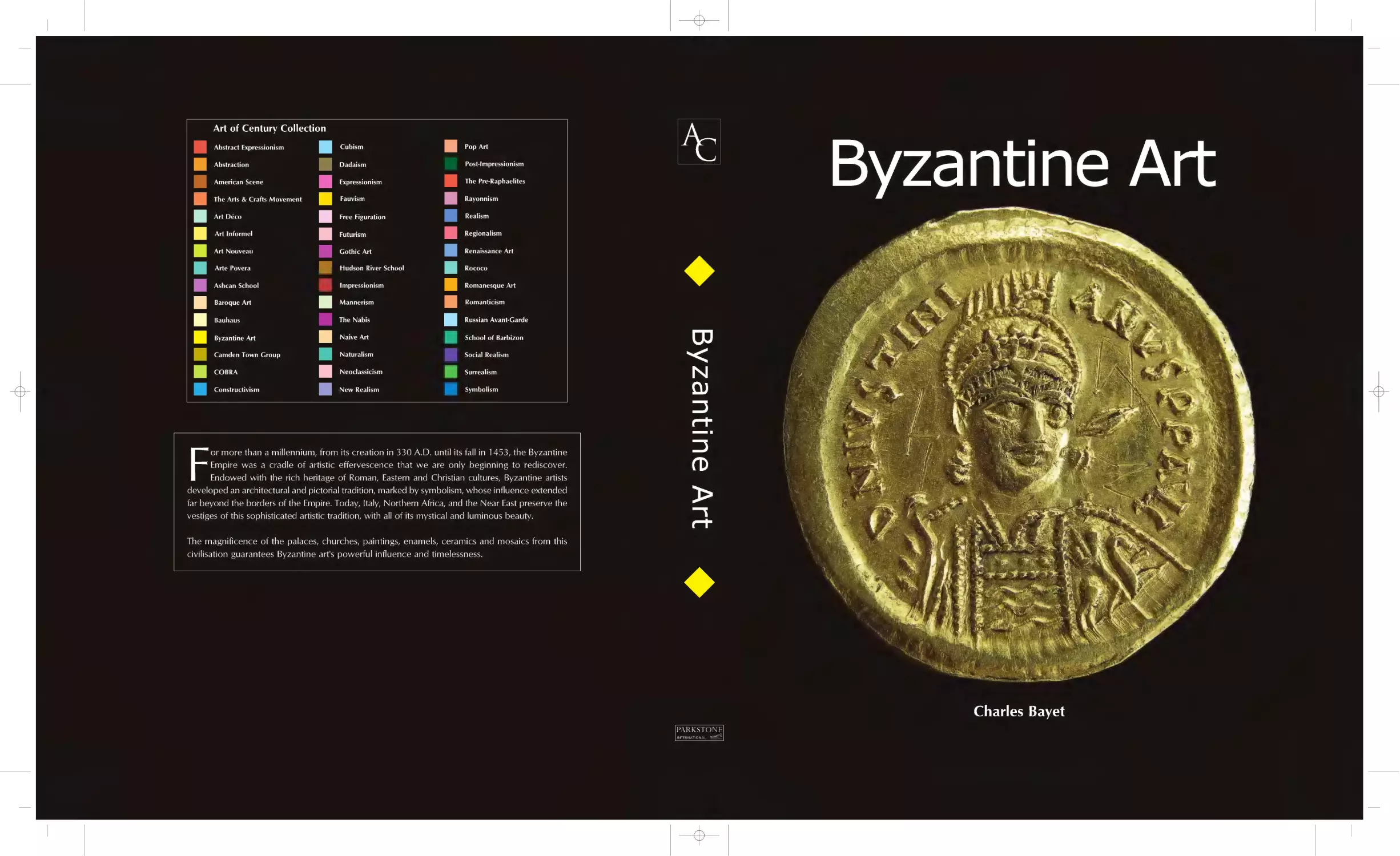


Author: Bayet C.
Tags: byzantine art history of art art history history of byzantium medieval art icon painting
ISBN: 978-1-78042-797-3


Text
                    Art of Century Collection
Cubism

Pop Art

Abstraction

Dadaism

Post-Impressionism

American Scene

Expressionism

The Pre-Raphaelites

The Arts & Crafts Movement

Fauvism

Rayonnism

Art Déco

Free Figuration

Realism

Art Informel

Futurism

Regionalism

Art Nouveau

Gothic Art

Renaissance Art

Arte Povera

Hudson River School

Rococo

Ashcan School

Impressionism

Romanesque Art

Baroque Art

Mannerism

Romanticism

Bauhaus

The Nabis

Russian Avant-Garde

Byzantine Art

Naive Art

School of Barbizon

Camden Town Group

Naturalism

Social Realism

COBRA

Neoclassicism

Surrealism

Constructivism

New Realism

Symbolism

F

or more than a millennium, from its creation in 330 A.D. until its fall in 1453, the Byzantine
Empire was a cradle of artistic effervescence that we are only beginning to rediscover.
Endowed with the rich heritage of Roman, Eastern and Christian cultures, Byzantine artists
developed an architectural and pictorial tradition, marked by symbolism, whose influence extended
far beyond the borders of the Empire. Today, Italy, Northern Africa, and the Near East preserve the
vestiges of this sophisticated artistic tradition, with all of its mystical and luminous beauty.

A
C

Byzantine Art

Byzantine Art

Abstract Expressionism

The magnificence of the palaces, churches, paintings, enamels, ceramics and mosaics from this
civilisation guarantees Byzantine art's powerful influence and timelessness.

Charles Bayet

AC BYZAN 4C.qxp

11/6/2008

8:47 AM

Page 2

Text : Charles Bayet
Translation: Anne Haugen and Jessica Wagner
Coffeehouse Translations, LLC

Layout :
Baseline Co Ltd,
33 Ter - 33 Bis Mac Dinh Chi St.
Star Building, 6th Floor
District 1, Ho Chi Minh City, Vietnam

© Parkstone Press International, New York, USA
© Confidential Concepts, Worldwide, USA

All rights reserved
No part of this publication may be reproduced or adapted without the permission of the
copyrights holder, throughout the world. Unless otherwise specified, copyright on the
works reproduced lies with the respective photographers. Despite intensive research, it
has not always been possible to establish copyright ownership. Where this is the case we
would appreciate notification.

ISBN : 978-1-78042-797-3

AC BYZAN 4C.qxp

11/6/2008

8:47 AM

Page 3

Charles Bayet

Byzantine Art

AC BYZAN 4C.qxp

11/10/2008

8:47 AM

Page 4

AC BYZAN 4C.qxp

11/6/2008

8:48 AM

Page 5

Contents
Introduction

7

I. Early Byzantine Art (306-843)

9

II. The Renaissance of Byzantine Art (843-1204)

79

III. Late Byzantine Art (1204-1453)

157

Conclusion

189

Chronology

190

Glossary

194

Bibliography

196

List of Illustrations

197

AC BYZAN 4C.qxp

11/6/2008

8:49 AM

Page 6

AC BYZAN 4C.qxp

11/6/2008

8:49 AM

Page 7

Introduction
Byzantine art has been alternately strongly attacked and strongly advocated. For many
years, critics’ only references to the movement produced the most unflattering epithets.
The word itself, Byzantine, which refers to both painting and politics, used to arouse
immediate ire in the elite artistic circles of the nineteenth century. It had become
established that this term was used to refer to a type of art that had created nothing but
unsightly, unpleasing works and which, condemned to stagnation from its very
conception, had neither progressed nor changed.
Later on, those who attempted to defend the unappreciated era often did its reputation
harm with their excessive zeal. Before it had even been clearly defined what was to be
understood by the term “Byzantine”, these overly active panegyrists claimed to
recognise its influence in nearly every country and on every monument in the West.
Losing its contemptuous nuance, the term “Byzantine” was becoming very vague and,
above all, very elastic. Everyone believed himself to have the right to use it according
to his own fancy. The term thus accompanied half of the works of the Middle Ages; as
for the others, experts strained to recognise at the very least the influence of the Greek
masters. In this way, other works were assimilated under the Byzantine banner and
declared its vassals.
These invasions of style provoked some resistance. In France, Italy, and Germany, art
historians affirm that, before even the twelfth or thirteenth century, the West had
produced its own local schools whose existence must not be forgotten.. This reaction to
the older civilisation’s artistic style was quite strong, at times excessive. In Italy, one
encountered scholars who refused to see Byzantine influence anywhere. Some, unfamiliar
with the history and monuments of the East, even claimed that the artistic principles
that developed in the Mediterranean during the fourth century were actually bequeathed
to the Byzantine Empire by the Italians.
One point is worth noting: detractors and apologists have often followed the same
method. Before speaking of the relationship between Byzantine art and other styles,
many do not take the pains to study it in its context and in its works. Perhaps it would
have been better to reject the word “Byzantine”, which is not precise and which was
exploited to such a degree, and rather to discuss neo-Hellenistic art or Greek art of the
Middle Ages; however it seems useless to go against convention, words take on the value,
above all, by the meaning given them.

Arch of Constantine, 312-315.
Marble, 21 x 25.7 x 7.4 m.
Rome.

7

AC BYZAN 4C.qxp

8

11/6/2008

8:49 AM

Page 8

AC BYZAN 4C.qxp

11/6/2008

8:49 AM

Page 9

I. Early Byzantine Art (306-843)
A. The Birth of a New Style (306-527)
t the beginning of the fourth century, under the reign of Constantine, a great
revolution transpired in Christian history; in the wake of persecution,
Christianity suddenly found itself in imperial favor. This development exerted
a profound influence on the development of Christian art. It blossomed openly in new
and richer forms. Churches were erected everywhere. “In each city,” wrote the
contemporary ecclesiastical historian Eusebius, “celebrations take place for the
consecration of churches and newly constructed oratories. On this occasion, the
bishops assemble, pilgrims come rushing in from distant lands; one sees the sudden
outpouring of affection from man to his fellow man.” Constantine himself was the
driving force behind this movement and, in order to increase the number of holy
structures, put the riches of the State at the disposal of the Christians.

A

The transformation of ancient Byzantium into Constantinople is a milestone in
history. A consequence of this change was the division of the former Roman Empire
into two parts, which were fated to meet different ends. Constantinople became the
axis of a brilliant civilisation, where eastern influences were mixed with Hellenism.
From this viewpoint, its geographic situation is indeed enviable: Constantinople was
connected with both Europe and Asia; its vessels could harbour within its vast and
secure port, keeping the city in continuous contact on one side with the regions of the
Black Sea and on the other, with all the peoples of the Mediterranean. Thence came
the immense influence that the city exerted during the Middle Ages, as well as its
splendour and wealth.
It was in 324 that Constantine chose Byzantium. In Antiquity, certain religious rites
were followed to found a city. In the well-known story, Romulus traced the first outline
of Rome with the blade of a plow. A fourth century historian recounts that
Constantine himself also traced the outline of the new capital with the point of his
lance. He said that he was following the indications of an angel, who was walking in
front of him. Work on the city was accelerated to such a degree that, according to one
chronicler, the consecration supposedly took place only nine months later. It is true
that a city can be consecrated, just as with a church, long before termination. The
ceremonial consecration date for Constantinople is recorded: it took place on the
eleventh of May, 330. The circumstances surrounding this event are indicative of the
role assigned to Constantinople by the emperor: it was to be a Christian capital, and
he entrusted the blessing of his city to the bishops. In addition, “he ordered by law,”
writes the historian Socrates Scholasticus, “that she would be called the second Rome.
This law was carved on a marble table placed in the Strategeion, near the equestrian
statue of the emperor.”
In planning the new capital, Constantine was preoccupied with imitating Rome. Like
Rome, Constantinople had seven hills and was divided into fourteen regions; there was

Bust of Arcadius Wearing the Imperial
Diadem, early fifth century.
Marble.
Archaeological Museum, Istanbul.

9

AC BYZAN 4C.qxp

11/6/2008

8:49 AM

Page 10

even a Capitoline Hill. The main Forum, known as the Augustaeum, remained famous
throughout the entire Middle Ages. It may have predated Constantine, who was content
simply to embellish it. A portico dominated all four sides, and statues were placed
underneath. Among these was a group representing Constantine and his mother,
Helena, standing to either side of the cross. This archetype has remained traditional in
the East and can still be found reproduced on frescos and engravings.

Christ in Majesty Giving a Blessing,
fourth century.
Opus sectile.
Ostia Museum, Ostia, Italy.
Baptistry of Neon, 458.
Marble.
Ravenna, Italy.

10

The period extending from Constantine to Justinian was a formative age for Byzantine
art. Christian architecture was the progeny of Greco-roman architecture but in certain
regions of the East, especially in Syria, it had already undergone drastic changes, made
more complex by foreign elements. Today, it can be experienced through the ruins of
Palmyra and Baalbek by the layout, the appearance of the principal lines, and the
decoration. These constructions have an original appearance; what is especially
remarkable is the tendency to substitute curves for straight lines, archways for
shouldered flat arches. The new trend spread rapidly. Already at the beginning of the
fourth century, there was a palace in Dalmatia that had roots in this Asiatic architecture,
that of Diocletian who had resided in Asia during his entire reign and then retired to
Solin after abdicating.
The Byzantine Empire, such as it were after the death of Theodosius, must have exerted
its new influence with a certain degree of force, as the Asian provinces were bringing
their prosperity and the luster of their civilisation to the European provinces, and it was
there that Hellenistic thought proved to be more active and creative. Even during the
time of Constantine, Christian architects in Asia seem to have already proven to be more

AC BYZAN 4C.qxp

11/6/2008

8:49 AM

Page 11

11

AC BYZAN 4C.qxp

11/6/2008

8:49 AM

Page 12

AC BYZAN 4C.qxp

11/10/2008

10:40 AM

Page 13

AC BYZAN 4C.qxp

14

11/6/2008

8:49 AM

Page 14

AC BYZAN 4C.qxp

11/6/2008

8:49 AM

Page 15

innovative. If circular churches were found in the West, in the East they seem to have
been of a bolder design: the church in Antioch was especially astonishing to people of
the time. This type of structure is no longer seen in the ancient Byzantine Empire, save
as one well preserved monument, and it is true that it is not found in Asia at all save in
Thessaloniki: it is a vast rotunda, measuring 24 metres in diameter. Within the thickness
of the walls, seven vaulted chapels are housed; an eighth, situated on the axis of the
main door, is farther inward and forms a long apse of 19.37 metres, which stands apart
within the walls. This church had probably served previously as the mausoleum of the
emperor Galerius.
One can quietly observe the attempts leading up to the development of the cupola atop
pendentives. In Seleucia and Ctesiphon, the cupola can be found used over a square
design. The trail of this innovative spirit is found in the monuments that can still be
appreciated, such as the church of St. Demetrios in Thessaloniki. The basic layout is of
a basilica with an atrium, narthex, and partial double walls, but inside, there are two
levels, and the upper encircles the church, reaching even over the narthex. The capitals,
the heads of columns, already take on distinctive shapes. They are generally still
connected with antique forms, though altered. They are made of two parts, and it is not
the main section that receives the most acute pressure from the arches; it weighs on the
headboards, which form a sort of upper capital. It is a small jump from this innovation
to the superposition of two genuine capitals. Additionally, in two places, one is struck by
even more creative forms: classical examples were abandoned completely for bell-shaped
capitals, sculpted in the contemporary style, that is to say as a sort of cubic mass around
which ornamentation winds its way, which simulates an additional sculpture.
In Constantinople itself, from Constantine to Justinian, the construction of thirty-eight
new churches or monasteries has been noted, according to a Byzantine chronicler.
Hardly any details are available on their architectonic characteristics; it seems, however,
that after a fire, the Hagia Sophia was reconstructed “with cylindrical vaults”. There, as
in Asia, the architects, who were called upon incessantly to produce new works, had to
compete zealously. It fell to them to discover ingenious and original combinations. While
in the West the misfortunes of the empire distracted people from artistic matters, in the
East, a generally more positive situation favored their development. Rather than
reproduce the same models over and over, with less intelligence and less care, Greek
architects were constantly modifying and perfecting them.
From this time on, the mosaic was more and more the preferred decorative style. In St.
George of Thessaloniki, the cupola covering the church was decorated entirely in
mosaics. Today, only a portion of it remains; there are large compartments where saints
are located standing upright, in an orant posture, amid a rich architectural framework.
The craftsmanship of these mosaics is extremely beautiful, and, despite the mutilations
they have suffered and their faded colours, they give off a very grand effect. The
slightest ornamental details bear witness to a fine and delicate taste; arabesques and
palmette bands are elegantly designed.
The mosaics of the fifth century, which decorate the churches of Ravenna in Italy, must
also be attributed to Byzantine art. Before this city became the residence of the

The Good Shepherd and the Starry Sky,
fifth century.
Mosaic.
Galla Placidia Mausoleum, Ravenna,
Italy.
The Good Shepherd (detail), fifth century.
Mosaic.
Galla Placidia Mausoleum, Ravenna,
Italy.
The Tetrarchs: Diocletian, Maximian,
Constantius Chlorus, and Galerius,
fourth century.
Porphyry.
South façade of St. Mark’s Basilica,
Venice.

15

AC BYZAN 4C.qxp

11/6/2008

8:50 AM

Page 16

AC BYZAN 4C.qxp

11/6/2008

8:50 AM

Page 17

AC BYZAN 4C.qxp

11/6/2008

8:50 AM

Page 18

Byzantine governor of Italy under Justinian, it was already artistically linked to the East.
The mosaics of the Orthodox Baptistery and the Galla Placidia Mausoleum are
distinguished by the rich craftsmanship and the pleasing harmony of the decor. [See p. 34]
At the Baptistery, the Baptism of Christ is portrayed on a large medallion, forming the
center of the cupola. In curious contrast, the Jordan River is present in this scene in the
guise of a fluvial god, which is striking evidence of the persistent influence of ancient art.
Along the outer edge of the medallion winds a circular band with full length images of the
twelve apostles. Although they all give the same general impression, the artist avoided too
high a level of monotony by slightly varying positions and giving individual characteristics
to each face. Farther down still, a second band is decorated in architectonic patterns. Finally,
near to the ground, among the golden arabesques, the faces of eight saints stand out. In the
Galla Placidia Mausoleum, the decor remains intact. Above the door, immediately within the
entrance, a mosaic representing the Good Shepherd recalls classical works with its free
style. Seated amid his flock, the Shepherd caresses a ewe with his right hand, while in his
left he holds a cross with a long descending arm; the face, surrounded by blond curls,
radiates a calm and uniform beauty. [See p. 12-13]
Throughout the rest of the chapel are other figures in ancient dress. The ornamentation
is elegant in design and rich in colour; amid the arabesques, which couple green with
gold, two stags drink from a spring. This motif is one found in the illuminations of
manuscripts up through the final days of Byzantine art.
During this time a taste for metalwork was already spreading, which would subsequently
continue to develop. It was a response to a love of luxury which, as previously seen, is one
of the characteristics of Constantinian art. Constantine introduced the diadem and adorned
his clothes with pearls and precious stones – the pomposity of his wealth seemed to him to
be an exterior symbol of his power; the attitude of the emperor contributed to the
penetration of these ideas into the artistic realm. It was considered better to honour
religion and to increase the beauty of Christian monuments than to attempt to decorate
them with the rarest of materials. To the churches of Rome, Constantine donated five foot
tall reproductions, in gold and silver, of the Savior, the apostles, and angels. His generosity
was no less in the East. After describing the Church of the Holy Sepulchre, Eusebius adds,
“One wouldn’t know how to say how many adornments and gifts of gold, silver, and
precious stones with which Constantine enriched it. These works were crafted with art.” In
Constantinople, he also mentions golden bas-reliefs. In the palace and in many public
squares in the city towered golden crosses, decorated with fine stones.

Great Palace Mosaic, late fifth to early
sixth century.
Mosaic.
Great Palace Mosaic Museum, Istanbul.
Theodosian Walls, 412-413.
Istanbul.

18

Nothing of these works done in precious materials remains today. One could guess the
style of the figures and ornamentation that adorned them based on a lead font, intended
for holy water, whose Greek inscription is indicative of its origin. Diverse characters are
displayed: next to the Good Shepherd, a gladiator is depicted at the moment just after
seizing the crown laid on a cippus. Next to these subjects are found bands of pampres,
palms, and peacocks drinking from a bowl; the four rivers of terrestrial paradise spill
from a butte surmounted by a cross, with stags present, drinking. In one corner, a Nereid
sits astride a seahorse. This peculiar mélange of paganism and Christianity was very
common in the fourth century.

AC BYZAN 4C.qxp

11/7/2008

8:42 AM

Page 19

19

AC BYZAN 4C.qxp

20

11/6/2008

8:50 AM

Page 20

AC BYZAN 4C.qxp

11/6/2008

8:50 AM

Page 21

B. Art under Justinian and His Successors (527-726)
1. Architecture
At the debut of the sixth century, Justinian had already been partially directing affairs
during the reign of his uncle Justin (518-527); he was then himself the sole emperor for
nearly forty years (527-565). He encouraged artistic development throughout his
empire. Justinian was a great builder. His historiographer Procopius dedicated an entire
work to the structures, built by order of the emperor.
The most famous of all is the Hagia Sophia in Constantinople, which, it can be said, was
the epitome of Byzantine art, for both its decoration and its architecture. No church in
the history of Christian art holds more significance: even Notre Dame-de-Paris had its
equals in the neighboring provinces. The Hagia Sophia has the double advantage of
marking the advent of a new style and of achieving, in one fell swoop, proportions, such
as have never been surpassed in the East. [See p. 20]
A church already existed in the main Forum, which was consecrated to Divine Wisdom.
Built under Constantine, it had been partially destroyed by flames in 404, during a public
riot on behalf of St. John Chrysostom. Theodosius had it repaired but in 532, during a
terrible sedition, which nearly caused Justinian to lose his throne, the Hagia Sophia fell
prey to a new bout of arson. Victorious over the rebels, the emperor reconstructed it,
attempting to surpass in splendour all the most famous ancient structures ever
described, the temple of Solomon in particular.
Rarely had the folly of extravagance been pushed so far. The most elaborate of
materials – gold, silver, ivory, and precious stones – were used with an incredible
abundance, even to the point of offending good taste: it seems that Justinian had less
an appreciation for beauty than for costliness, and that his vision was to dazzle
onlookers with the spectacle of enchanting luxury. He wanted gold and silver
everywhere. The labours on the Hagia Sophia thus absorbed immense sums of
money. In order for there to be sufficient funds, new taxes had to be levied and drastic
measures taken. The ambo alone, with the altar, cost a year’s revenue from Egypt;
Justinian was also writing to governors and government officials to send already
worked materials, which the desecration of old monuments. The praetor Constantine
had ordered from Ephesus eight columns in antique green. They came from Cyzicus,
Troas, the Cyclades, and Athens. A Roman widow, Marcia, had sent eight columns of
porphyry, removed from a temple to the Sun. There was a wild array of marbles and
stones of every colour, but within the natural polychromy, there was nothing
displeasing, with the knowledge of tastefully combining the many shades. Even the
land was very costly. Justinian was hardly content with the placement of the old
Constantinian church and therefore had to purchase the surrounding houses, in the
most affluent district of the city.
The names of the two principal architects who directed the labour are known –
Anthemius of Tralles and Isidore of Miletus. Their contemporaries praised their
knowledge, but it is Anthemius who was first acknowledged, by general consensus.

Plan of the Hagia Sophia, sectional
view, 537.
Hagia Sophia, Istanbul.
Hagia Sophia, southern view, 537.
Hagia Sophia, Istanbul.

21

AC BYZAN 4C.qxp

11/6/2008

8:50 AM

Page 22

These two artists came from those Asian provinces where the architecture in the fourth
and fifth centuries had developed with more originality. Under their orders one
hundred masters or chiefs of the building sites had been assigned, each of whom
commanded one hundred workers. Once the terrain had been cleared and the
foundation laid, the patriarch Eutychius recited prayers for the success of the
enterprise, and the emperor himself placed the first stone. He immediately had an
oratory constructed and some rooms from which he supervised the progress. Later,
people would entertain themselves telling a mass of miraculous stories that supposedly
occurred during the construction: an angel had described to the slumbering emperor
the plan he was to adopt; another revealed to him hidden treasures, at a time when funds
were lacking; yet another was supposed to have indicated to him that three apses were
necessary for the completion of the cathedral. All these legends prove how much this
mammoth enterprise had inspired the popular imagination.
The labour had begun shortly after the arson; the dedication took place the seventh
of December 537. The emperor left his palace for the Augustaeum, mounted on a
four-horse chariot; then, arriving at the church, he descended, ran from the great
entrance gate up to the ambo, and there, with hands extended, he cried, “Glory to
God who judged me worthy to complete such a work! Solomon, I have conquered
you.” This audacious exclamation well proves that in his eyes this temple was the
epitome of the new law that he had just promulgated. He saw to the organisation and
the maintenance of the church with the same pomp: three hundred sixty-five estates
were ascribed to the areas surrounding Constantinople and one thousand clerics were
charged with their service. From the exterior, the Hagia Sophia gives an impression
of mediocrity, and the cupola itself, bold as its construction may be, seems
depressing. One must enter the church in order to fully comprehend the originality
and splendour. [See p. 23-25]

Hagia Sophia, interior view facing
west, 537.
Hagia Sophia, Istanbul.

22

Before the temple stretches the atrium. A double narthex is found adjoining the
church through nine doors. Apart from the eastern apse, the church is contained
within a rectangular space 77 metres in length by 76.70 metres in width, including
the thickness of the walls. The interior is divided into a central section, the nave, and
two lateral sections. In the center of the structure, a cupola rises, with a 31 metre
diameter, inscribed within a square. It rests on four large arches, with an opening
equal to the diameter, which, in turn, rest on four wide pillars. Immense spherical
pendentives jut out into the open air, filling the space between the large arches, and
come out to meet the cupola. On the two arches perpendicular to the nave, the eastern
and western arches, rest two semicircular domes; by contrast, to the north and at the
median of the main cupola, the large arches are closed off by a solid wall, supported
with colonnades. Around the semicircle, which is covered by the large, eastern halfdome, three apses are carved out: the principal apse, in the center, which extends to
the east and terminates with a vault in the shape in a quarter sphere and two
secondary apses to the right and left of the principal apse. The bottom of the two
secondary apses is opened on the shoulders, and their archway is supported in this
section by two columns. The perimeter of the western semicircle is sculpted in the
same manner, but the central archway does not end in a quarter sphere. The arch
extends to the facing wall, into which are cut the three doors joining the narthex.

AC BYZAN 4C.qxp

11/7/2008

8:44 AM

Page 23

23

AC BYZAN 4C.qxp

11/6/2008

8:51 AM

Hagia Sophia, interior view, 537.
Hagia Sophia, Istanbul.

24

Page 24

AC BYZAN 4C.qxp

11/6/2008

8:51 AM

Page 25

25

AC BYZAN 4C.qxp

26

11/6/2008

8:51 AM

Page 26

AC BYZAN 4C.qxp

11/6/2008

8:51 AM

Page 27

The shoulders, from the ground up to the cradle of the arches, are divided into two
levels, the upper bearing the name of gynaeceum. The light penetrates throughout
the entire structure through a large number of bays: forty windows open at the base
of the cupola, and others are cut into the walls of the north and median arches, in
the half-domes and in the apses.
The construction of the central cupola had been a difficult problem to resolve because
of the immense proportions that had been desired for it. Massive pillars had been
allocated as points of support, carved with great care to prevent them from giving way
or splitting under the pressure they were to support. Nevertheless, for a while there was
concern for the cupola itself: the architects who had had the audacity to build it were
challenged by their own work. They therefore employed particular materials, notably
white, spongy tiles, manufactured in Rhodes, and so light that five were needed to equal
the weight of one regular tile.
Despite these precautions, it was not before they recognised how well founded were
their fears. The following years were riddled with earthquakes that were sometimes
extremely violent: there was one in 553 that lasted forty days, another in 557 that
razed a portion of the city. The cupola of the Hagia Sophia felt the effect of these
repeated tremors, fissures formed, and on the seventh of May 558, it collapsed.
According to some authors, the architects charged with researching the cause of the
accident declared that it had been erroneous to remove the wooden scaffolding too
quickly in order to work on the mosaics. Justinian had the cupola rebuilt. Anthemius
and Isidore had died, but the latter had left a nephew, who was charged with this
project. He increased yet again the elevation of the cupola, but at the same time he
gave more solidity to the great arches. This time, the curves and the scaffolding were
left in place longer, and then the lower part of the church was flooded so that the
falling wooden pieces would not weaken the new construction.
Everything in the furnishings and decoration of the church bespoke the vision of
magnificence with which Justinian’s mind was saturated. Toward the center of the
structure, the ambo was a large stand topped with a cross and a dome: the
magnificence of gold and precious stones was combined with that of the most
beautiful marble. The sanctuary was separated from the rest of the church by a
railing of pure silver. On the columns, images of Christ, the Virgin, angels, apostles,
and prophets stood out on medallions. The altar was golden and from this dazzling
background gleamed gems and enamels. Stretched above, in the form of a ciborium,
was a dome with a golden cross at its apex; four columns of gilded silver supported
it. “Who would not be astonished,” said a poet of the time, “by the appearance of the
splendour of the holy table? Who could comprehend her provenance, when she
scintillates with varied colours and when one sees her at times reflecting the
brilliance of gold and silver, at others shining like a sapphire, casting…multiple rays,
following the colouration of fine stones, pearls, and metals of all sorts, of which
she is comprised?” At night, during the great celebrations, the church was lighted up
like a beacon for, according to Byzantine writers, there were no fewer than 6000
gilded candelabras.

Basilica of San Vitale, 527-548.
Ravenna, Italy.

27

AC BYZAN 4C.qxp

11/6/2008

8:51 AM

Page 28

AC BYZAN 4C.qxp

11/6/2008

8:51 AM

Page 29

AC BYZAN 4C.qxp

11/6/2008

8:51 AM

Page 30

In other places, saints and prophets stood out beneath archways. Only small fragments
remain, but they furnish some idea of what was once the Hagia Sophia, when she shone
brightly, draped entirely in this rich garment of mosaics. Rarely in the history of art can
one encounter an ensemble that is so imposing, an accord of architecture and adornment
so perfect.
The Hagia Sophia is the apogee of Byzantine art, as it was developed under Justinian
and his successors. Contemporaries admired it, artists have been inspired by it, yet it
must not be believed that it was imposed as a model from which one dare not stray.
In architecture, the use of the cupola was spreading more and more. From a technical
standpoint, the construction of the Hagia Sophia had drawn architects to study this
form of their art with more care and to better realise the effect it produced, the use that
could be made of it, and the rules that needed to be applied. From that time on, Latinate
basilicas became the exception in the East, but in the new churches with cupolas, hardly
anyone was content to copy the layout of the Hagia Sophia. The cupola served as the
theme around which numerous variations were created, and in Constantinople itself, in
the vicinity of the Hagia Sophia, other churches were raised in the same style under
Justinian, but in a very different layout. More than one had even been started and
finished before the Hagia Sophia.
The church of the Hagia Sophia at Thessaloniki seems also to belong to the reign of
Justinian, although Procopius makes no mention of it. Several travellers have noted that
the architect seems to have imitated the Hagia Sophia of Constantinople. The great
central cupola is indeed present, resting on four pillars, but it is no longer accompanied
by two large half-domes, as at Constantinople, and consequently, alongside remarkable
similarities, some essential differences must be distinguished. In Asia, in the region of
Antioch, the church of Dana displays no cupola and is closer to the standard basilica; on
the other hand, one curious example of a horseshoe arch may be highlighted, which
would pass from Byzantine to Arabic architecture. The Byzantines themselves had
borrowed this form from the architects of central Asia.
Let us now move on to Italy, which had just been partially re-conquered by Justinian’s
forces. Ravenna, where the exarchs resided, was like a miniature of Constantinople. In
this city, famous for some centuries, the monuments of the time crowd in on each other
and are quite well preserved.

Basilica of San Vitale, interior view,
527-548.
Ravenna, Italy.
Monastery of St. Catherine, 527-565.
Mount Sinai, Egypt.

30

Among the churches of Ravenna, the most famous and most important is that of San
Vitale. [See p. 26] Its construction had begun before the Byzantine conquest, in the year
526, but it was only completed in 546, and the decoration of the structure attests to the
fact that Justinian and Theodora enriched it with their gifts. According to various
inscriptions, the labour of San Vitale, as well as that of several other churches of
Ravenna, was allegedly directed by a man named of Julian, who fulfilled the duties of
treasurer (argentarius). San Vitale is in the shape of an octagon; on the interior, eight
wide pillars are connected by arches from which soars a high cupola. The circular base

AC BYZAN 4C.qxp

11/6/2008

8:52 AM

Page 31

31

AC BYZAN 4C.qxp

32

11/6/2008

8:52 AM

Page 32

AC BYZAN 4C.qxp

11/6/2008

8:52 AM

Page 33

Procession of Martyrs, 493-526.
Mosaic.
Basilica of Sant’Apollinare Nuovo,
Ravenna, Italy.

33

AC BYZAN 4C.qxp

34

11/6/2008

8:53 AM

Page 34

AC BYZAN 4C.qxp

11/6/2008

8:53 AM

Page 35

of the cupola attaches to the octagonal layout by eight small pendentives. In order to
minimise the weight of the vault and to ensure its solidity, the architects built it with
clay pipe, nestled one inside the next. The shape of the cupola is not evident from
without, as it is in the churches of the East; it is hidden under a pyramid-shaped roof.
Begun prior to the Hagia Sophia, San Vitale is distinguished from it by certain essential
characteristics. It has consequently been proposed to recognise not Byzantine influence,
but that of a school of architecture that existed in Milan during the fourth and fifth
centuries. Yet whether in the ornamental sculpture or the splendid mosaic decoration,
everything betrays collaboration, or at least an education of Greek artists. It is difficult
to believe that this influence does not extend to the very plan of the structure,
considering that it was primarily in the East that the polygonal form had been applied
to churches.
On the other hand, in other religious structures in Ravenna dating from the same
time, the architects preserved the layout of the ancient Latin basilica. Among the
most interesting, the church of Sant’Apollinare in Classe is situated outside the walls
of the city.
Byzantine architects mostly used brick, and they generally retained the form given
to the material by the Romans. Manufactured with care and often created with
markings that allowed for the identification of the date and character of the
structures, these bricks were connected by a mortar of a very heavy consistency.
The core of the walls was ordinarily made of concrete, and the bricks formed only
a façade. Byzantine constructions were therefore extremely solid; in many places, the
city walls have resisted the attacks of time and man and have been preserved nearly
intact for centuries.
On the interior, ornamental sculpture developed in the most original and curious forms.
It is thus that the capitals of Byzantine churches present a marvelous array of
appearances: in some places the most finely detailed tapestry seems to be cast upon a
cubic stone mass, while in other places, there are foliated bell capitals. Images of animals,
birds, and vessels at times further complicate the decoration. These ancient examples of
Greek and Roman architecture have been neglected or profoundly altered; as time
advances, fewer traces of them are found. However the Byzantines did not invent all
these ornamental combinations from which they drew such pleasing result; once again
they borrowed from the East, and some of the models, by which they were often
inspired, are found in the monuments of Persia.
As elaborate and varied as the decoration of Byzantine capitals may be a decline in the
sculpting process must be acknowledged. Those who had worked on them did not know
how to add depth to their ornamentation, scouring the stone on the surface rather than
cutting it with more profound layers, and their works often came closer to the style of
metalworking than to that of sculpture.

Galla Placidia Mausoleum, fifth century.
Ravenna, Italy.

35

AC BYZAN 4C.qxp

11/6/2008

8:53 AM

Page 36

Justinian and His Retinue, c. 546.
Mosaic.
Basilica of San Vitale, Ravenna, Italy.

36

AC BYZAN 4C.qxp

11/6/2008

8:53 AM

Page 37

Theodora and Her Retinue, c. 546.
Mosaic.
Basilica of San Vitale, Ravenna, Italy.

37

AC BYZAN 4C.qxp

11/6/2008

8:53 AM

Page 38

2. Painting, Mosaics, and Illuminations
In a large number of churches from the sixth and seventh centuries, such as the Hagia
Sophia, mosaics pour out the wealth of their adornments and are displayed as brilliant
works. Byzantine artists loved to depict huge compositions whose details were all
distinct; they avoided subjects that involved a large number of figures mingled with one
another; they gave preference to those with almost no action, the postures calm and
regular, in which the characters could be arranged without at all disturbing the
uniformed arrangement of the ensemble. At times they would place the same number on
one side as on the other, so as not to disturb the compositional equilibrium. This
principle of symmetry had to be maintained in Byzantine art. The painters’ mentality
was so imbued with it that it was applied assiduously, even in the smallest works. For this
reason this art, even while losing at times something on the side of authenticity and
artistic freedom, was so well suited for the decoration of huge structures.
From a technical perspective, Byzantine tile setters had no less understood the demands
of their art. While, during the Middle Ages, the number of shades was increased so as
to attain the appearance of a fresco, the Byzantine artists only used them in small
numbers, juxtaposing contrasting colours, neglecting intermediate shades. Since the
mosaic is made to be seen from afar, the harshness of these contrasts is lost within the
overall harmony of the work; but on the other hand, everything stands out with an
incomparable vigor and brilliance. The figures leap out of a background of blue or
intense gold; the vibrant and clear colours of the clothing form a powerful contrast with
this uniform shade of the background. Often, a black line traces the outline of the body
and facial features to better enhance the picture. Everything in the process contributes
therefore to giving the work the look of a well composed piece that captures the
attention through striving to create the illusion of poignant definition.
Some mosaics from this time can still be found in the East. In a church in Thessaloniki,
which bore the same name and today has been transformed into a mosque, the
Ascension of Christ is portrayed on the vault of the cupola, while on the apse, the
Virgin, seated on a gem-encrusted throne, bears the Baby Jesus in her arms. One of the
famous monasteries of Mt. Sinai preserves some mosaics that have been attributed to
the same era, which reenact various episodes from the life of Moses and the
Transfiguration of Christ.
Moreover, in Constantinople itself, this genre of decoration was used in more than just
the churches: Procopius describes one mosaic found at the Great Palace. “The artists,” he
says, “have depicted the wars and battles of the realm, the cities taken in Italy and Africa.
Justinian is victorious, thanks to Belisarius, who, returning with his army brought him
the loot of kings, kingdoms, and treasures. In the middle, Justinian and Theodora, filled
with exultation, celebrate this triumph, while the kings of the Goths and the Vandals
beg for clemency. Around them, the senators display their joy.”
St. Apollinare, sixth century.
Mosaic, Basilica of Sant’Apollinare in
Classe,
Ravenna, Italy.

38

Once again, it is to Ravenna that one must go to find the most beautiful Byzantine
mosaics of the era. Of this genre, nothing is equal to the decoration of the apse of San
Vitale. Immediately upon entering, the gaze is drawn to two large compositions of

AC BYZAN 4C.qxp

11/6/2008

8:53 AM

Page 39

AC BYZAN 4C.qxp

40

11/6/2008

8:53 AM

Page 40

AC BYZAN 4C.qxp

11/6/2008

8:54 AM

Page 41

41

AC BYZAN 4C.qxp

11/6/2008

8:54 AM

Page 42

AC BYZAN 4C.qxp

11/6/2008

8:54 AM

Page 43

historical interest. On one side, Justinian surrounded by dignitaries and guards, and on
the other side, Theodora attended by her retinue, offer gifts to the church: the empress
crosses the atrium, where the holy fountain is located, while a servant raises before her
the veils hung at the door of the temple. Her costume is splendid: large embroidery,
depicting the Adoration of the Magi, adorns the hem of her cloak; jewels cover her
chest; from her hair, coils of pearls and gems hang to her shoulders; a tall diadem crowns
her haloed head. This is a vibrant evocation of the past: these symmetrically arranged
figures, who are presented full-face, these women with their regular features, their large,
fixed eyes, their uniformed posture, the splendour of their costumes, all this offers,
finally, a glimpse of the court of Byzantium, which is impossible to forget, so rich and
so elegant, and where a meticulous etiquette ruled. [See p. 36-37]
It would be impossible to describe all the mosaics of San Vitale and the other buildings
of Ravenna. However, one of the most remarkable is the long procession of female
saints that unfolds atop the arcades of one nave in Sant’Apollinare Nuovo; they bear
crowns to the Virgin; their attire is rich, their heads are adorned with mitres, but the
regularity of their features, a slight and gracious incline of the head, gives them a
particular charm. One involuntarily muses on classical Antiquity and certain works of
incomparable perfection, where this idea of order and harmony dominates. Since this
beautiful epoque of Greek art, many qualities have been lost; yet in these mosaics, one
regains a sense of the relationship between the past and the present.

Christ Pantocrator, sixth century.
Icon.
Monastery of St. Catherine, Mount
Sinai, Egypt.
St. Peter, sixth century.
Icon.
Monastery of St. Catherine, Mount
Sinai, Egypt.
Codex Purpureus Rossanensis (Rossano
Gospels), the Judgement of Pilate, sixth
century.
Painting on parchment, 30 x 25 cm.
Cathedral Treasury, Rossano, Italy.
Genesis, Rebecca and Eliezer, sixth
century.
Painting on parchment, 31 x 25 cm.
Österreichische Nationalbibliothek,
Vienna.

43

AC BYZAN 4C.qxp

11/6/2008

8:54 AM

Page 44

It is thus no less interesting to study the illuminated manuscripts from this era, which
have preserved for us a smaller image of the big picture. One of the oldest, the
manuscript of Genesis, kept in the National Library at Vienna, offers well-conceived
compositions in which the artist discovered how to introduce life and grace into the
illuminations and illustrations. The women in them are draped with an arrangement of
elegantly simple folds, reminiscent of Antiquity. [See p. 43]
A manuscript of the Gospel, found at Rossano in the south of Italy and dated to around
the sixth century, contains an entire series of paintings whose subjects are borrowed
from the New Testament. [See p. 42]
A manuscript of the works of the doctor Dioscurides, also kept in Vienna, bears its date:
it was written for a princess of the imperial family, Juliana Anicia, who lived in
Constantinople at the end of the fifth century and the beginning of the sixth. It is not
about religious events, and the painter seems to have been especially inspired by secular
works. On the first sheet, Anicia is portrayed seated between two personifications,
Magnanimity and Wisdom, while a prostrate woman kisses her feet and a winged genie
presents her with an open book. Their posture is simple and natural, and the well drawn
figures pleasantly stand out from a dark blue background. The framing is particularly
exquisite – small Cupids engage in the artistic work, some painting, others sculpting or
building. It is correct to say that these figures recall certain paintings from Pompey and
Herculaneum; the resemblance is, in fact, surprising, and the technique is as free and as
gracious. [See p. 47]
The Laurentian Library in Florence possesses a Syriac manuscript, produced in 586
in a Mesopotamian convent, by a monk named Rabbula. Nearly every page is framed
with a large architectural drawing, tall porticos, supported by fragile and elegant
colonnettes. [See p. 48]
On the façade or surrounding these delicate constructions, groups of birds, animals, and
trees, treated in a graceful and researched style, then little scenes whose subjects are
borrowed from the sacred texts. Toward the end of the volume are some compositions
of greater proportions: one is famous because it displays one of the first examples of the
Crucifixion. [See p. 48]

Basilica of San Vitale, north wall,
527-548.
Mosaic.
Ravenna, Italy.

44

The subjects treated in manuscripts are numerous: many belong to the Old
Testament, some to the history of Christianity, such as the Lapidation of St. Peter
and the Conversion of St. Paul. At the end of the manuscript is placed a large and
beautiful illumination that occupies an entire page; at the top, two medallions contain
images of Saints Anne and Simeon; beneath, Christ, the Virgin, St. John the Baptist,
the great priest Zacharias, and St. Elizabeth are arranged beside each other. The
posture of the characters, the religious serenity on their faces, the gold that gleams
behind their halos and on their clothing all combine to give this painting an arresting
appearance. It seems copied from some mosaic and, furthermore, is not of the same
style as the preceding illuminations.

AC BYZAN 4C.qxp

11/6/2008

4:26 PM

Page 45

45

AC BYZAN 4C.qxp

11/6/2008

8:54 AM

Page 46

St. Demetrios, seventh century.
Mosaic
Thessaloniki, Greece.
Dioscorides, Princess Anicia Juliana,
De Materia Medica, 512.
Painting on parchment, 36.5 x 26.6 cm.
Österreichische Nationalbibliothek,
Vienna.

46

AC BYZAN 4C.qxp

11/6/2008

8:54 AM

Page 47

47

AC BYZAN 4C.qxp

11/7/2008

9:02 AM

Page 48

Rabbula Gospels, the Crucifixion and
the Resurrection, 586.
Manuscript, 33 x 25.5 cm.
Biblioteca Mediceo Laurenziana,
Florence.
Rabbula Gospels, the Ascension, 586.
Manuscript, 33 x 25.2 cm.
Biblioteca Mediceo Laurenziana,
Florence.

48

AC BYZAN 4C.qxp

11/6/2008

8:54 AM

Page 49

These few observations are indicative of how complex the decoration of these
manuscripts is. Sometimes they take us further into the past: even in the eighth or ninth
century, painters had used ancient manuscripts whose images they repeated. But the
artists whose works were being reproduced had by no means themselves created all
these compositions: more akin to the third and fourth centuries, they knew those
monuments, were inspired by them, so certain illuminations of the more recent edge of
the Byzantine Empire can give a sense of the frescos that had decorated the most ancient
churches. Previously, the well-known work of a famous artist would become a model
that was copied almost exactly; this is why some illuminations appear to be
reproductions of mosaics. On this point, one can give clear proof: thus the angel head
framed in a medallion located at the Hagia Sophia reappeared many times and is seen
again in a manuscript from the twelfth century.
As for mural painting, though the works themselves have been lost, the texts of
contemporary writers make some examples known. The mosaic was a mode of
decoration that was too extravagant to use always; so they often had to resort to the
fresco. A rhetorician, Choricius, described at length those adorning a church in Gaza
from the sixth century.

Codex Purpureus Rossanensis (Rossano
Gospels), The Entry into Jerusalem,
sixth century.
Manuscript, 31 x 26 cm.
Cathedral Treasury, Rossano, Italy.

49

AC BYZAN 4C.qxp

50

11/6/2008

8:54 AM

Page 50

AC BYZAN 4C.qxp

11/6/2008

8:55 AM

Page 51

All the subjects were borrowed from the New Testament. The cycle of paintings begins
with the Annunciation: the angel, descending from the heavens, approaches the Virgin
who is occupied with her spinning; he speaks to her, and his words seem almost to reach
the viewer. The Virgin is astonished by this unexpected sight, and the crimson she is
weaving nearly escapes from her hands. The Visitation follows, and Elizabeth is seen
rushing toward the Virgin, whose knees she desires to embrace, while the latter impedes
her from doing so. Later, the Nativity is depicted, the donkey and the ox are near the
manger where the newborn rests; the Virgin is reclining, half leaning on her right arm.
Then a celestial voice informs the shepherds, diverting them from their flocks; they leave
them in the pasture, near a spring, under the guard of a watchdog, and stand to the call.
Some carry their staffs, others lean on theirs. The angel appears to them, pointing the
way to the Child; the flocks, who are not in the least suspicious of the apparition, graze
or drink, but the dog, being more intelligent, seems to comprehend that something
extraordinary is taking place.
The following painting depicts the old man Simeon, greeting the divine Child, who is
carried in the arms of his mother. Such are the scenes treated from the childhood of
Christ. Those that follow illustrate the principal miracles of the Savior. First, we attend
the wedding at Cana: Christ, accompanied by his mother, transforms the water into wine;
one of the servants pours the water from a vase into the amphorae; another, after having
filled the basin, circulates it around the table; the wine seems to have a pleasant bouquet,
for the delighted face of the one drinking shows the pleasure he finds in it. Here is the
mother-in-law of Peter, healed by the Savior at the request of the apostle; there, the
paralytic and the slave of the centurion, delivered from their sufferings. Further on, we
follow the body of the widow’s son into the tomb, dead in the flower of his youth;
women follow behind in mourning, but their sorrow changes to joy at the sight of the
miracle brought about by Christ. The repentance of the adulterous woman, the calming
of the storm, Christ walking on water and saving Peter, the healing of the demonpossessed man and the lame man, and the resurrection of Lazarus are figured into this
second series of subjects, as well.
Finally come episodes borrowed from the last days of Christ: the Last Supper, the
betrayal of Judas, the judgment and sufferings of Christ, Pilate washing his hands, the
Crucifixion, the soldiers guarding the tomb, the Ascension. Unfortunately, Choricius, at
first generous with his details on the composition of these paintings, then becomes more
sparing after the episode of the wedding at Cana, and some of the last scenes are
scarcely mentioned.
Nevertheless, his descriptions clearly show the spirit that presided over the order and
composition of these paintings; nowhere near all the subjects of the Gospel were
addressed, but those present were divided into three chronological series: childhood
scenes, miracles, and the Passion. Thus was the development of the system of
decoration whose origins have been indicated.

Bust portrait of Eutropius, late fifth century.
Marble, height: 32 cm.
Kunsthistorisches Museum, Vienna.

51

AC BYZAN 4C.qxp

52

11/6/2008

4:44 PM

Page 52

AC BYZAN 4C.qxp

11/6/2008

4:44 PM

Page 53

Christ Restoring the Law, fourth or fifth
century.
Marble.
St. Francis Basilica, Ravenna, Italy.

53

AC BYZAN 4C.qxp

11/6/2008

8:55 AM

Page 54

3. Sculpture and Metalworking

Theodosius Receiving Tribute from the
Barbarians, detail from the base of the
Obelisk of Theodosius, 390-393.
Marble, height: 430 cm.
Hippodrome, Istanbul.
Sarcophagus, reputedly of Archbishop
Theodorus, late fifth to early sixth century.
Marble.
Basilica of Sant’Apollinare in Classe,
Ravenna, Italy.
Sarcophagus, reputedly of St. Barbatian,
425-450.
Marble.
Cathedral, Ravenna, Italy.
Sarcophagus with Stylistic Decoration,
c. 500.
Marble.
Basilica of Sant’Apollinare in Classe,
Ravenna, Italy.

54

While architecture and painting blossomed in the most original of forms, sculpture was
on a decline. It is true that the sculptures of emperors continued to be erected; Procopius
describes the statue of Justinian, which stands in the Augustaeum across from the Hagia
Sophia and remained there until around the time of the capture of Constantinople by
the Turks. “On a horse of bronze is seated the statue of the emperor, remarkable in his
dress, which is that of Achilles.” Elsewhere he speaks of statues so skillfully crafted that
they were believed to be of the hand of Phidias, Lysippus, and Praxiteles. These
bombastic praises are without foundation and it is difficult to form a meritorious idea of
these works. There remain, nevertheless, two works that display the splendour of
statuary throughout the course of the fifth century, the head of Arcadias and the famous
bust of Eutropius in the Kunsthistorisches Museum in Vienna. [See p. 8 and 50]
Sculpture would have been redeveloped with radiance if the Church had tried to protect
it, but it was never able to overcome the mistrust of which sculpture had been the object;
the Church remembered that sculpture had given the most attractive and perfect forms
to idolatry, and, if it was not exactly banned, it was hardly encouraged.
Moreover, some monuments of this era show how much this sense of sculpture is innate
to Greek genius. In place of the heavy figures of Roman decadence, more skillful works
abound, and in Constantinople, the bas-reliefs on the obelisk of Theodosius at the
Hippodrome, though still rather mediocre, attest to a progression. [See p. 54]

AC BYZAN 4C.qxp

11/6/2008

10:12 AM

Page 55

55

AC BYZAN 4C.qxp

56

11/6/2008

8:55 AM

Page 56

AC BYZAN 4C.qxp

11/6/2008

8:55 AM

Page 57

57

AC BYZAN 4C.qxp

58

11/7/2008

10:27 AM

Page 58

AC BYZAN 4C.qxp

11/6/2008

8:55 AM

Page 59

In Thessaloniki the debris of an ambo that dates to around the end of the fourth century
still exists. The bas-reliefs demonstrate the story of the Magi. A characteristic of
slightly stiff majesty is already expressed there, and the Virgin holding the Child is
depicted seated in a hieratic position, in which the naïve and familiar grace of older
Christian compositions is no longer present. In Ravenna, some of the sarcophagi of the
time that are scattered throughout the churches and in the streets are the works of
Greek artists. [See p. 55]
In Ravenna, very early on, sculptors had the same tendency to neglect the portrayal of
human character. Most common on their bas-reliefs are sheep, doves, peacocks, vases
from which vines burst forth, monograms, and crosses, all in a variety of groupings, but
always with a great love for symmetry.
Even in secular art, it seems that metalworking was taking the place of sculpture.
Already in the fifth century, statues in gold and silver could be seen standing in public
areas, like that of Eudokia, the wife of Arcadius, and of Theodosius II. In the
Augustaeum a silver statue of Theodosius the Great had been placed. This search for
grandeur was dangerous for sculpture: it was customary to give more attention to the
splendour of the material than to the style of the figures. However, when it came to
casting the metal, whether precious metals or bronze, the Byzantines retained great
technical skill.
Their superiority was no less great in their work with ivory. Throughout the Middle
Ages, the East had famous ivory carving guilds, which primarily sculpted diptychs,
covers for Evangeliaria, and caskets. Among the works remaining, several have a
historical quality and portray the princes and characters of the time.
One of the most famous works in the history of Byzantine art is the Barberini ivory. It
depicts an emperor on a rearing horse, exulting over his enemies. It symbolises his
imperial power and his claim to terrestrial domination. This magnificent ivory embodies
the quintessential skill of Byzantine artists. [See p. 57]
Another example, the diptych preserved at Monza, was the subject of much debate, and
one may recognise Galla Placidia and Valentinian III, accompanied by a warrior, who
was taken in turns to be Theodosius II and Aëtius. The diptych of the consul Anastasius
(517), nephew to the emperor of the same name, is all the more interesting because it
shows the state of the official attire of important Byzantine government officials in the
sixth century. Dressed in richly embroidered fabrics, whose fit is no longer reminiscent
of the toga, the consul presides over the games; he shakes the cloth that signals the
commencement of the games; underneath, the finish of the races and the gladiatorial
fights against ferocious beasts are depicted. The diptych of Areobindus, consul in 506,
portrays the same theme. [See p. 62]

Diptych of the Consul Anastasius, 517.
Ivory, height: 36 cm.
French National Library, Cabinet des
Médailles, Paris.

Religious ivory carvings are often of a better style and are distinguishable by their
elegant qualities and a delicacy of craftsmanship that is truly extraordinary. In this
genre, one of the most beautiful works that might be cited from the sixth century is half

Throne of Bishop Maximianus,
546-554.
Ivory.
Archepiscopal Museum, Ravenna, Italy.

The Triumphant Emperor, Barberini
Ivory, early sixth century.
Ivory, 34.2 x 26.8 cm.
Louvre Museum, Paris.

59

AC BYZAN 4C.qxp

11/6/2008

8:55 AM

Page 60

Jewelry from the Mersinsky Treasure,
sixth or seventh century.
Gold, 5.7 cm.
Hermitage Museum, Saint Petersburg.

60

AC BYZAN 4C.qxp

11/10/2008

10:46 AM

Page 61

The Cross of Emperor Justin II, c. 575.
Gilded silver and precious stones, height:
40 cm.
Treasury of St. Peter’s, Vatican City.

61

AC BYZAN 4C.qxp

11/6/2008

8:56 AM

Page 62

of a diptych representing an angel standing upright under a richly decorated arcade. A
few steps separate him from the ground; with one hand, he leans on a long scepter and
with the other, he holds a globe, surmounted by a cross. His wings, widely spread, are
painstakingly crafted; his raiment, consisting of a tunic and an outer cloak, displays a
drapery of excellent taste and rare elegance. As for his head, framed in thick curls, it is
an exemplary representation of perfect regularity. The eyes, open wide, give his face a
vivacious expression; his posture is noble and imposing without stiffness. Those who
have dealt with this ivory have been correct to note that the artist must have been
familiar with and have taken as models artwork from Antiquity. However, it would be
incorrect to see here a mere imitation of a pagan example. Along with the influence of
the past, a realistic originality must also be noted in the overall ensemble of the figure,
as well as great skill in the details of its execution.
In the sacristy of the cathedral in Ravenna, the throne of Bishop Maximianus, dated to
the same time, is completely decorated with bas-reliefs in ivory. The most striking
feature is found on the front of the throne: St. John the Baptist and the four evangelists
occupy five arcades. Above and below run wide boarders whose decoration is exquisitely
delicate and rich: vine branches grow gracefully, and within the coils frolic crowds of
birds and animals of all types. [See p. 58]
And so ivory sculpture progressed, while marble sculpture degenerated. As the fourth
century fades, it seems that the practice of cutting deeply into stone and exacting from
it lifelike scenes was lost. At least on works of limited dimensions, such as the
aforementioned, some of the master qualities of great sculpture still appear.
In the form of non-enameled metalwork, nothing remains but a few pieces dating
from this era. There is a cross in gilded silver, encrusted with gems, which is
preserved at the Vatican and was given to Emperor Justin II around 575. [See p. 61]
Some repoussé medallions display images of Christ, the lamb, the emperor and the
empress. Another cross in silver, located in Ravenna, would be of great interest, but
it has been subjected to too many restorations. The Monza treasury contains metal
Greek ampoules whose dates and origins are certain. They were brought from
Palestine in the seventh century. Decorated with episodes from the New Testament,
such as the Nativity, the Resurrection and the Ascension, they are of great
iconographic importance; but the low value of the metal that comprises them hardly
allows them to be classified as true metalwork.
Panel of a Diptych of the Consul
Areobindus, 506.
Ivory, 39 x 13 cm.
Musée National du Moyen Age Thermes et Hôtel de Cluny, Paris.

62

The vase from Emesa dates, for all practical purposes, from the beginning of the seventh
century. It was fashioned from a sheet of hammered silver. A band encircling the vase
depicts eight characters from the Gospels: Christ between two apostles, the Virgin
between two angels, and St. Peter and St. Paul. [See p. 63]

AC BYZAN 4C.qxp

11/6/2008

8:56 AM

Page 63

Vase from Emesa, late sixth to early
seventh century. Silver, height: 45 cm.
Louvre Museum, Department of Greek
and Roman Antiquities, Paris.

63

AC BYZAN 4C.qxp

64

11/6/2008

8:56 AM

Page 64

AC BYZAN 4C.qxp

11/6/2008

8:56 AM

Page 65

The missorium of Theodosius I is a large ceremonial silver dish, preserved in the Real
Academia de Historia in Madrid. Most likely completed in Constantinople in celebration
of the tenth anniversary of the reign of Emperor Theodosius I, it is considered one of
the masterpieces of goldsmith work. [See p. 64]
Among the numismatic monuments, some are of artistic interest. From the end of the
sixth century, the fabrication of Byzantine money became particularly crude; however,
in the preceding era, certain specimens are outstanding for their precision and finesse.
[See front cover]
The previous pages have presented an overview of Byzantine art from the sixth and
seventh centuries. A summary of the resulting impression is in order before going on to
study the changes that took place during the following centuries.
It is an undisputable fact that Byzantine art, such as it were, stems in part from the art
of Antiquity. The force of tradition had always been great in the Hellenistic East. Still
today, the old mythological legends have not disappeared from Greece’s countryside; in
the narratives, the songs, and the uses of quotidian life, the memory of the divinities of
Olympus are constantly relived. Some are confused for the saints of modern religion;
however, behind the façade of borrowing, their traits can be discerned, half-erased. Even
where the Christian faith replaced pagan sanctuaries with its own churches, the old gods
were not entirely driven out, and something of their name was preserved in the places
where they reigned long ago.
But along with these elements of Greek origin were mixed other influences, some of
which came from the Far East. Among its most beautiful possessions, the Eastern
Empire then included the wealthy provinces of Syria, which served as an
intermediate zone between central Asia and Greece. Constantinople was connected
to these countries by its very location – a large portion of its population originated
there – the customs and art could not help but be affected by it. It was in constant
commercial and political contact with the most powerful monarchies of the East,
particularly with Persia. In architecture, these influences are very appreciable; but
the same can be said for decoration, where patterns are found borrowed from the
East at every turn, treated in the same vein and style. It is especially here that
Byzantine artists drew on the taste for magnificence and luxury, which appeared in
all of their works; from this also came their tendency to render all ornamental
details in a conventional manner. Art, in the knowledge it required of flora and
fauna, now faithfully reproduced nature, then altered and imagined artificial
specimens, ceaselessly repeated, and the imitation of realistic forms disappeared
almost entirely. The Byzantines followed the latter path and often they adopted
models long established in the East. One can see in their works complicated,
interlacing, bizarre flowers and fantastical animals so frequently found on the
monuments of India or Persia.

Missorium of Theodosius I, 387-388.
Partially gilded silver, diameter: 74 cm.
Royal Academy of History, Madrid.
Plaque of St. Simeon Stylites, sixth century.
Silver repoussé with gold, height: 29.6;
length: 26 cm.
Louvre Museum, Department of Greek and
Roman Antiquities, Paris.
Hercules and the Nemean Lion
(missorium), sixth century.
Silver, diameter: 40 cm.
French National Library, Cabinet des
Médailles, Paris.

65

AC BYZAN 4C.qxp

66

11/6/2008

8:56 AM

Page 66

AC BYZAN 4C.qxp

11/10/2008

10:37 AM

Page 67

67

AC BYZAN 4C.qxp

11/10/2008

10:57 AM

Aquamanile, seventh century.
Sard, height: 17.8 cm.
Louvre Museum, Department of
Decorative Arts, Paris.
Aquamanile, seventh century.
Agate, gold, height: 20.7 cm.
Louvre Museum, Department of
Decorative Arts, Paris.
Belt, seventh century.
Gold, 6.3 x 3.4 cm.
National Archaeology Museum, SaintGermain-en-Laye.

68

Page 68

However, Byzantine art was hardly satisfied with combining elements of diverse origins: it
proved to be truly innovative. Credit is due to it for having given a true individual
physiognomy to Christian concepts. In fact, it is especially in the religious domain that it is
manifested with all its originality and brilliance: one should not be surprised if one
considers how powerful religion was, and how much it was incorporated into everything for
the Greeks of the Middle Ages. Artists had been especially enamored of certain dominant
characteristics of Christianity — the splendour of triumphant religion, divine majesty, the
protective role of the saints — and they set about expressing them with vigor.
In this respect, the Byzantines were great masters; whether referring to the concept or
the execution, they understood the veritable rules of religious decoration, and it may be
noted that, in our time, painters who have tried to revive this genre of art have at times
been inspired by their works. Moreover, as will be seen later on, this general uniformity
did not remotely lead to a sterile immobility, and Byzantine art came to know the
transformative power of diverse schools.

AC BYZAN 4C.qxp

11/6/2008

4:38 PM

Page 69

69

AC BYZAN 4C.qxp

70

11/10/2008

10:58 AM

Page 70

AC BYZAN 4C.qxp

11/6/2008

8:57 AM

Page 71

C. Art under Iconoclasm (726-843)
From the death of Justinian to the debut of the eighth century, the Byzantine Empire
was subjected to many disasters. Arabic conquests consumed some of its wealthiest
provinces in Asia, while in the north, Slavic invasions spread devastation through the
countries between the Danube and the Mediterranean. Internally, the uncertain
transmission of imperial power was an incessant cause of trouble and disorder; in
erudition and customs, signs of decadence and ruin were apparent. However, thanks to
the domination of the Church, religious art continued to develop when a revolution
erupted that threatened its existence. Kindled and supported by fervent emperors, the
iconoclasts, or “breakers of images”, furiously attacked the works they considered to be
a remnant of the old idolatry.
Truth be told, it was not only the fate of the images that was made uncertain in this
famous battle. Although the iconoclasts are known mostly through the accounts of their
adversaries, recent research has demonstrated that they had enormous plans and
dreamed of a general reorganisation of the State.
When they attacked religious art, it was because in it the monks found one of their
most powerful means of action. In their hands, Christianity was transformed; they
had made of it a material religion, an offspring of paganism, which no longer related
to the everyday except on the surface. From the fourth century on, these dangerous
tendencies had continued to develop; among the chroniclers and hagiographers it was
no longer a question of icons and relics, but rather of the miraculous power
attributed to them. They were no longer merely venerated but worshipped as true
divinities. Already many had been disquieted by these aberrations and had preached
the return to a more primitive Christianity, but the vox populae of the monks
suffocated their protestations. These crude superstitions had nothing to do with art,
though they altered and demeaned it along with religion. Thus the iconoclasts did
not proclaim themselves hostile in principle to all artistic manifestations; only icons
incited their wrath, and, to justify their doctrine, they recalled that God himself had
prohibited them in the Bible.
In 726, Emperor Leo the Isaurian promulgated the first edict against the iconodules.
He contented himself with ordering that they be suspended higher in the churches,
so that they could not be kissed and thus lavished with the signs of material
adoration. In 728, he went further and removed them. These measures brought about
revolts in Greece and Italy, where Pope Gregory II placed himself at the head of the
resistance. In Constantinople, the opposition was especially heated on the part of the
monks and common people; riots broke out. On the door of the imperial palace, an
image of Christ was raised that was the object of special veneration; Leo attempted
to remove it. The women who were present rushed up and knocked over the imperial
officer; the crowd had to be dissipated, which brought about several deaths, arrests,
and executions. The battle became harsher yet under the reign of Constantine V, the
son of Leo the Isaurian, who acceded power in 741. The resistance that the emperor
faced led him devastatingly to excess: religious art had its martyrs. In 754,
Constantine convened in council the bishops on his side. “We are convinced,” they

Chludov Psalter, Christ on the Cross,
Iconoclasts Destroying an Icon of
Christ, ninth century.
Manuscript, 16.2 x 10.8 cm.
Museum of History, Moscow.

71

AC BYZAN 4C.qxp

11/6/2008

8:57 AM

Griffon on a Medallion, eighth to
ninth century,
Gold, diameter: 4.2 cm.
Louvre Museum, Department of
Decorative Arts, Paris.
Hagia Irene, eighth century.
Istanbul.

72

Page 72

AC BYZAN 4C.qxp

11/6/2008

8:57 AM

Page 73

AC BYZAN 4C.qxp

74

11/6/2008

8:57 AM

Page 74

AC BYZAN 4C.qxp

11/6/2008

8:57 AM

Page 75

said, “that the shameful art of painting is a blaspheme against the fundamental dogma
of our salvation, that is, the incarnation of Christ…What is the ignorant artist doing
who, in a sacrilegious spirit of avarice, depicts what must not be depicted and wants,
with his soiled hands, to give form to what must not be believed save in the heart? He
makes an image, and he calls it Christ. The name of Christ signifies God and man.
Consequently, if there is an image of both God and man, then the artists has foolishly
attempted to depict the divine, which is impossible, and married in his work the
divine with created flesh, a mixture that must never take place…If some say that we
are correct on the subject of the images of Christ, but we are erroneous on the
subject of the images of Mary, the prophets, the apostles, and the martyrs, who were
mere men and were not made up of two natures, we will reply that they must all be
rejected equally. Christianity has completely overturned paganism, not only pagan
sacrifices, but pagan images.”
General measures followed these declarations, and, in the churches, mural paintings
and mosaics were covered in lime. However, such was the power of decorative art that
people recoiled before the sad impression of the white and naked walls. Religious
scenes were substituted with landscapes and totally secular compositions. As with
Muslims mosques, where the same prohibitions apply, decorative art still finds a
place, and at times charms the eyes with a thousand ingenious combinations of
drawings and colours.
From this council on, the persecutions of the monks and the iconodules became more
severe. Many were thrown in prison, beaten, and put to death. Constantine V even
succeeded in his pursuit of the complete ruin of monasticism in the Empire. This
violence incited a reaction. The successor of Constantine V, Leo IV (775-780),
already showed himself to be less rabid; after his death, Empress Irene attempted to
reestablish icon veneration and to impose the authority of a new council upon the
decisions of the council of 754. Her first attempts were not successful. The
iconoclasts counted many supporters within the army; the imperial guards drove off
the assembled bishops, threatening them with death. Irene, however, managed to
break down this resistance, and in 787, the council reconvened at Nicaea. The acts
that underline these deliberations concerns the history of art, for the bishops worked
to gather all historical and theological arguments, in favor of the veneration of icons.
The work of the council of 754 was abolished. “We decree the restoration of the holy
images,” the Fathers said. “They will be restored in the churches, on objects of
worship, on vestments, on the walls, on individual works of art, in houses, and on the
streets; for, the more they are seen, the more is brought to mind the respectful
memory due to the figures they represent.”

Quadriga, from the reliquary of
Charlemagne at Aix-la-Chapelle, eighth
century.
Silk, 75 x 72.5 cm.
Musée National du Moyen Age Thermes et Hôtel de Cluny, Paris.

75

AC BYZAN 4C.qxp

11/6/2008

8:57 AM

Page 76

In the first half of the ninth century, the iconoclasts again held the advantage. Leo the
Armenian (813-820) and Theophilus (829-842) favored them. Once again the images
disappeared and Theophilus ordered the closure of all monasteries in the cities and
villages. However, the cause of the iconoclasts would definitively give way. At the death
of Theophilus, his son being only three years of age, it was his widow Theodora who
exercised power. Even during the life of her husband, she never ceased secretly to
champion the cause of the images. Immediately, from all corners of the empire, monks
rushed to stand by her and her family; they easily triumphed, and it was even decided
that each year, a great celebration, the Day of Orthodoxy, would be held in honor of the
restoration of the veneration of icons.
Such was this famous quarrel that troubled the empire for more than a century. It holds
interest both for the history of art and of political institutions. Even before it ended, it
had resulted in the withdrawal of Byzantine domination from most of Italy; by contrast,
however, it had infused into the Hellenistic civilisation a new life that would ensure
several more centuries of power and glory.
As for art, it can be said that it did something in the midst of these battles. The painters
who were associated with monasticism, far from allowing themselves to become
discouraged by threats and persecutions, worked with more obstinacy. From this era date
the rendering of a quadriga on silk. This image is of a victorious charioteer at the
Hippodrome in Constantinople. According to tradition, this fabric possibly served to
cover the remains of the body of Charlemagne. [See p. 74]

The Crucifixion, early ninth century.
Cloisonné enamel.
Metropolitan Museum of Art,
New York.

76

However, at the same time, a more independent school was forming that seemed to
draw its inspiration from ancient models with new fervor. These diverse elements
would combine to producea true renaissance after the dispute over the images.
Moreover, the iconoclastic emperors had hardly been, as their enemies would have
had others believe, crude barbarians, attempting to snuff out all of civilisation.
Surrounded by scholars and literati, they had even encouraged the arts, all the while
robbing them of their religious characteristics. One of the most ardent among them,
Theophilus, was noted for the beautiful constructions he undertook. He expanded and
embellished the great imperial palace, and he commissioned splendid mosaics.
Churches were erected under his orders, and, even though examples were sparse, they
were lavished with all the wealth of ornamental decoration without treatment of
religious themes.

AC BYZAN 4C.qxp

11/6/2008

8:57 AM

Page 77

77

AC BYZAN 4C.qxp

78

11/6/2008

8:57 AM

Page 78

AC BYZAN 4C.qxp

11/6/2008

8:57 AM

Page 79

II. The Renaissance of Byzantine Art (843-1204)
A. Art under the Macedonians and the Komnenoi
1. Architecture
ever was the Byzantine Empire more powerful and more prosperous than in the
ninth and tenth centuries, under the rule of the Macedonians (867-1057). The
great princes of that era were of a sounder intelligence and grander energy
than Justinian; they better understood the interests of Hellenistic civilisation. Intrepid
warriors and skilled administrators, they discovered how to make use of all intellectual
and material resources in the Eastern Empire.

N

The founder of the dynasty, Basil the Macedonian (867-886), forged the way later
followed by Nicephorus Phokas, John Tzimiskes, and Basil II. The Empire defended itself
valiantly against the invasions that flowed into their provinces from the north and the
south: the Slaves were pushed back, the Bulgars stopped dead, Cyprus, Crete, and Cilicia
were reconquered from the Arabs; from all sides, Hellenism regained a portion of the
territories it had lost.
Internally, modified legislation preserved a part of the reforms of the iconoclasts, the
administration was reorganised and in the larger cities industry and trade led to a truly
marvelous increase in wealth. Constantinople was at that time the center of world
commerce, serving as the port city between the East and the West: Arab, French, Italian,
and Asian merchants would flock there. Constantinople was the intermediary of their
exchanges, at the same time that its merchants sold them silks, embroideries, carpets,
ivories, and all the precious objects that, gained at great cost, propagated Byzantine
influence in the most distant countries. At that time in the Middle Ages, the customs and
wares of Byzantium played approximately the same role as the those of Paris do in our
time. Constantinople was not the only city to prosper at the expense of the rest of the
Empire: in many other cities such as Thessaloniki, Thebes, Corinth, this activity was
taking place, this convergence of foreign merchants.
This development of industrial and commercial life also corresponded to a new
flowering of intellectual life. Constantinople had a university where philosophy, rhetoric,
and mathematics were taught; the emperor chose from there those he judged to be
meritorious of the highest government positions. The schools of Athens were erected:
student came all the way from France and England. And one should not believe that the
teaching received there was always narrow and base. The famous patriarch Photius, who
fought with Rome, was familiar with all secular antiquity and all Christian literature, and
he summarised it in his Myriobiblion; but he was also an original thinker, often very bold.
He was by no means isolated in the society of his time; among the literati, many
contemplated and reasoned. The efforts of the iconoclasts had as a consequence opened
many minds, which broke free of monastic tyranny to reconcile the Christian faith with
a return to ancient Greek culture. The Byzantine Empire even had its popular epics;

Icon of the Triumph of Orthodoxy, late
fourteenth century,
Painting on wood, 39 x 31 cm.
British Museum, London.

79

AC BYZAN 4C.qxp

11/6/2008

8:57 AM

Page 80

Digenis Akritas was one of the heroes in the battle against the Arabs in Asia Minor.
The renaissance extended to the arts. The emperors favored it; Basil the Macedonian set
the example and one of his descendents, Constantine Porphyrogenitus, obligingly
described the edifices that he had had built and decorated.

Plan of the Monastery of Nea Moni, 1042.
Monastery of Nea Moni, Chios, Greece.
Monastery of Nea Moni, 1042.
Mosaic.
Monastery of Nea Moni, Chios, Greece.

80

From the point of view of architectural history and Byzantine decoration, it may be
noted that analogies existed among those buildings and the churches from the same time
period. Secular and religious architecture were subject to the same principles, and they
offered the same combinations. In palace layouts, whether it were in rooms, atriums, even
peristyles, the circular form, the cupola, and the apse were present. The
Chrysotriclinium bears the same plan as a church. These facts prove the unity with
which Byzantine architecture was simultaneously applied in very different structures,
and yet this is one of the characteristics of a truly original art. When one studies the
works of the ancient Greek architects or the French architects of the thirteenth century,
one recognises that they also obeyed this principle, that they always reproduced the same
essential forms, all the while accommodating the various uses of the monuments. On the
contrary, at other times, this unity disappears, and the structures are only more or less
pleasing compilations of all forms and styles. From that comparison, is one not correct
to conclude that Byzantine art is no accident, the fortuitous result ill-combined of
individual fancies and foreign elements, but rather on the contrary, well-organised, lively,
and responsive to the people’s own genius?

AC BYZAN 4C.qxp

11/10/2008

10:38 AM

Page 81

81

AC BYZAN 4C.qxp

82

11/6/2008

8:58 AM

Page 82

AC BYZAN 4C.qxp

11/6/2008

8:58 AM

Page 83

From the exterior, the Byzantine church presents, as in the past, the form of a rectangle
with a choir that juts out from the eastern side; the interior, cut by columns and the four
huge pillars that support the central cupola, is in the form of a Greek cross. The choir
itself, which from the outside appears to be an addition to the rectangle, is isolated from
the rest of the church on the inside; a large enclosure, normally of wood, separates it
from the iconostasis, thus named for the sacred images and paintings that adorn it. It is
there, at the back of the choir, hidden from the view of the masses, that the priest
performs the holy rites. Within the sanctuary, an upper level extends, traditionally
reserved for women.
Architects who were familiar with the construction of cupolas knew that in order to
support them, it was not necessary to use massive pillars that encumbered the church
and deflated its light appearance. They reduced the thickness and often substituted them
with columns; consequently, the interiors appear finer. The cupola, which remained the
invariable theme of architecture, never seemed to lose its popularity. In the time of
Justinian, some buildings already boasted five; that which had been an innovation became
the rule. Even that number was not enough, and new parts of the building were sought
out where still more cupolas could be installed; sometimes the narthex would be used,
divided into compartments which would each hold their own dome. It is for this reason
that in some Byzantine churches, twelve tiny domes are grouped around one large one.
However, it was not sufficient to increase the number of domes; modifications to
the form were also desired. Viewed from within, that of the Hagia Sophia, which is

Monastery of Hosios Loukas, 1011.
Hosios Loukas, Greece.
Daphni Monastery, eleventh century.
Greece.

83

AC BYZAN 4C.qxp

11/6/2008

8:58 AM

Page 84

connected directly to the body of the construction, produces a very lively impression
and in some way draws in the spectator below into its majestic development; on the
contrary, from outside, it seems that it does not project out far enough, and that there is
something heavy and depressing about the very mass of the church. The new builders,
on a quest for elegance, tried to make their cupolas more impressive and projected them
boldly into the air. To achieve this result, it was necessary to reject the practice of
uniting them as closely to the supports as in the past, and to give them for direct points
of support great arches that projected above the pillars and columns. Thus it was
conceived to pose between these huge arches and the cupola a rather high, cylindrical
drum. Some writers have perceived in that combination an attack on the true principles
of architecture; they reproached these new cupolas for not being in organic relation with
the rest of the ceiling and for being detached as if to form a separate monument.

Plan of the Monastery of Hosios Loukas,
1011.
Hosios Loukas, Greece.

If the drum had been introduced into the old model, Byzantine churches would not have
had nothing but an undecorated cylindrical wall; it would have been a shocking sight,
but people learned how artistically to adorn its shape as well as to make the best use of
it. The drum is generally polygonal, and the edges of the angles, with their vertical
orientation, express the idea of elevation sought by the artist. The impression of height
is better conveyed through long, thin colonnettes that decorate it and through tall,
narrow windows that grace it. Curved, horizontal lines of the construction outline the
facades and sides of the building. Rarely is there a pediment to mark the end of a roof,
for Byzantine architects rarely concealed the true form of their vaults behind the
triangular tympanum. Wherever this last plan is commonly found, a Latin influence
must undoubtedly be recognised, but it was only practiced later.

Monastery of Hosios Loukas, view of the
interior, 1011.
Hosios Loukas, Greece.

In newer Byzantine churches, windows were usually plentiful. Constructed with a round
arch, they took on many different shapes, again demonstrating the search for variety and

84

AC BYZAN 4C.qxp

11/6/2008

4:49 PM

Page 85

85

AC BYZAN 4C.qxp

11/6/2008

8:58 AM

Page 86

AC BYZAN 4C.qxp

11/6/2008

8:58 AM

Page 87

elegance. Here, the bay is divided into twin windows, separated by a colonnette; there,
they are trilobate and almost always closed behind slabs of latticed stone.
It is also in the brickwork of the walls that this preoccupation is visible. The builders
used stone and brick, but they did not mix them in uniformly alternating rows, and,
using this diversity of materials, they learned to create decorative effects that change
from one monument or wall to another. To the traditional opus spicatum of the Romans,
which did not disappear, they added a plethora of new combinations. On the walls of
buildings, the bricks are manipulated into a thousand designs, alluring in the ingenious
creativity of their arrangements. It is even common to see them arranged into letters
and forming inscriptions.
In summation, while the previous century had seen the birth of the major themes of
Byzantine architecture, this century was dedicated to refining them. The essential
elements and general carpentry of sixth century churches were accepted, but they
sought to change the look of the old edifice by rendering it lighter in appearance and
more picturesque.
The churches of that period that still exist are far too numerous to even dream of
counting. Some, whose dates are certain, can serve as models for the rest.
In Constantinople, one of the most elegant is the Church of Theotokos, built by an
individual who lived during the reigns of Leo the Philosopher and of Constantine
Porphyrogenitus. Arches supported by columns and large windows open the façade,
giving it life and adorning it, while also letting an abundance of light pour into the
narthex. The varying designs of alternating brick and stone further enhance the charm
of this impression, while above the façade, on the second floor, stand cupolas placed on
drums. The apse, in the shape of a pentagon, is pierced at mid-height by arches
supported by colonnettes.
In the same city one finds the monastic Church of Christ Pantocretor, built in the first
half of the twelfth century by order of Irene, wife of John Komnenos. It is divided, so
to speak, into three churches: one contains the tomb of Manuel Komnenos, the second
was reserved for the monks, the third for the people. In the sixteenth century, the
richness of the marble that decorated it provoked the admiration of Patrus Gillius.
Since then, the edifice has suffered, but one can still discern what care had been taken
in its construction.
Thessaloniki possesses perhaps the most interesting series of churches from that time.
No fewer than three bear mentioning: the Agioi Apostoloi, St. Elias Church, which
appears to date from 1012, and the Church of the Virgin, which was consecrated in 1028.
All three cathedrals bear great similarities to one another, but the first is the most
exquisite. In Greece proper, in the Peloponnesus, churches of the types just examined
are numerous, but their history is not well known and many are of a more recent date.

Christ, thirteenth century.
Mosaic.
Hagia Sophia, Istanbul.

87

AC BYZAN 4C.qxp

11/6/2008

8:58 AM

Page 88

2. Mosaics, Painting, and Illuminations
If we pass on from architecture to decoration, similarities between secular and religious
art become evident. The mosaics that decorated the imperial bedchamber are
reminiscent of those found in the churches. Figures are arranged in the same
configurations, standing upright in tranquil positions, around one or two other
characters. Still penetrated by the ideas of unity and symmetry that had dominated since
the sixth century, Byzantine painting naturally tended to express them in homogenous
ways, whether decorating secular buildings or temples. Also, between the celestial and
the terrestrial – Christ, Sovereign of the heavens, and the emperor – a parallelism was
established that may also be noted during the time of Constantine and has never been
forgotten in art.
The mosaic, in such high regard during the preceding centuries, was always very
sophisticated. We have seen how it was used in the palace rooms and those of the New
Church. In the Hagia Sophia, there was an image of the Virgin carrying the Baby Jesus
and accompanied by Constantine and Justinian; the rest of the church was repaired
throughout, wherever the need was need was evident. Outside the capital, some
important works exist in assorted locations. [See p. 90-91]
In the Hagia Sophia, Christ is depicted in all the glory of his power, seated on a
magnificent throne, blessing with one hand, holding in the other an open book that reads:
“Peace be to you! I am the light of the world.” To his right and left, two medallions frame
the heads of the Virgin and the archangel Michael; at his feet, Emperor Leo VI is
prostrate, richly dressed and girded with a nimbus diadem. [See p. 96-97]
Even outside of the capital, mosaic art had been developing in certain areas, as shown
by the decoration of the monastic church of St. Luke’s in Phocis. The cupola is
overlaid in mosaics. In the center, the figure of Christ is dominant. All around in a
concentric zone are gathered the Virgin, St. John the Baptist, and the four archangels,
and below come the sixteen prophets. Several large-scale images also appear in
these mosaics, including the washing of the feet, the Anastasis, and the Crucifixion.
[See pp. 92, 94, 99]
On the vault of the cupola and the apses, down the length of the walls, immense
decorative mosaics unfold. On a background of gold or dark blue, great figures of a
majestic character appear. Finally, on the pendentives are represented four scenes from
the Gospel: the Annunciation, the Nativity, the Circumcision, and the Baptism. The
building had been reconstructed in 1011 upon the foundation of a church built in 944.
At the end of the eleventh century, in the monastic church of Daphni, near Athens, on
the pendentives of the cupola are depicted the Annunciation, the Nativity, the Baptism,
the Transfiguration, and the Crucifixion. [See p. 103]
Christ in Majesty between the Emperor
Constantine IX Monomachos and the
Empress Zoe, eleventh century.
Mosaic.
Hagia Sophia, Istanbul.

88

The monastery Nea Moni (New Monastery) on the Greek isle of Chios was founded in
1042 by the Byzantine Emperor Constantine IX Monomachos on the spot where three
hermits were said to have found an icon of the Virgin. Mosaics decorate the walls and

AC BYZAN 4C.qxp

11/6/2008

8:58 AM

Page 89

89

AC BYZAN 4C.qxp

11/6/2008

8:58 AM

Page 90

AC BYZAN 4C.qxp

11/6/2008

9:16 AM

Page 91

Mary with the Baby Jesus between
Constantine and Justinian, eleventh
century.
Mosaic.
Hagia Sophia, Istanbul.

91

AC BYZAN 4C.qxp

92

11/6/2008

9:16 AM

Page 92

AC BYZAN 4C.qxp

11/6/2008

9:16 AM

Page 93

ceilings, a portion of the dome, the nave, and the sanctuary. They are made with natural
stones and glass. Among these is a fantastic baptism of Christ. [See p. 95]
Several Eastern and Western churches keep images of the Virgin, which are accredited
with origins of miraculous legends; some are attributed to St. Luke, who became the
patron of painters during the Middle Ages. They do not lend themselves well to
attentive study; they are hardly available to curious onlookers, and they are often covered
with patches of reworked silver or gold, which simulates the clothing and hides the
greatest part of the painting. In judging them according to the more or less exact
reproductions that are available, many could not be attributed with any certainty to a
time prior to the thirteenth century. However, long before, the Byzantines were already
revering miraculous images of the Virgin. One of those with the most artistic value is
now located at Rome, in the Basilica of St. Mary Major; the beauty of the example of
the Virgin, the elegance of the arrangement of the drapery merits admiration. In the
churches of the convents of Athos, images of the Virgin are preserved, to which have
been assigned a very early date, without, however, accrediting St. Luke. There are none
that can said with certainty to date to early Antiquity. At St. Mark’s in Venice, a painted
rendering of the Virgin is found, which tradition holds was stolen from the Greeks in a
battle in 1203. The Madonna, who received the name Nicopea (Victorious), is depicted
from the waist, holding her son. The rendering is good, and the look given the Virgin
by the artist is that which is found consistently in works of the time. The frame of the
painting is very elaborate, decorated all in enamel.
The monastery of St. Catherine on the Sinai, in Egypt, has retained to this day
numerous icons from this period. It is situated at the foot of Mt. Sinai and was
constructed by order of Emperor Justinian between 527 and 565 at the site of the
“Burning Bush”. One of the most celebrated icons is the Ladder of Divine Ascent,
described by John Climacus, a Syrian monk from the sixth or seventh century. His book,
thirty chapters in length, is intended to summarise the monastic experience. It is written
for monks, and it aims to help them attain, in thirty steps, perfection. [See p. 104]
The most famous icon from this time is the Theotokos (Mary) de Vladimir, also known
as the Virgin of Vladimir. It is one of the most revered orthodox icons in Russia. She is
considered the patron saint of Russia. The icon was painted in Constantinople at the
beginning of the twelfth century. Luke Chrysoberges, patriarch of Constantinople, sent
the icon as a gift to the Grand Duke Youry of Kiev around 1131. [See p. 106]
It is believed that the custom of executing small mosaic paintings had been introduced
around the tenth or eleventh century. To this effect, fragments of stone or glass were
used that were held together with white wax. It was a departure from the rules of the
mosaic to bend them to create these miniscule works where the true character of mosaic
was lost. However, these miniatures were widely sought after. Some remain in the
treasuries of the Eastern churches; the convent of Vatopedi possesses one that depicts
the Crucifixion. Others passed into the West. Two are preserved in the Florence
Cathedral treasury and reproduce episodes borrowed from the Gospel and the
Apocrypha: the Annunciation, the Nativity, the Presentation at the Temple, the Baptism
of Christ, the Transfiguration, the Resurrection of Lazarus, the Entry of Jesus into

The Crucifixion, early eleventh century.
Mosaic.
Hosios Loukas, Greece.

93

AC BYZAN 4C.qxp

11/6/2008

9:16 AM

Page 94

Jerusalem, the Crucifixion, the Descent of Christ into Hell, the Ascension, Pentecost,
and the Death of the Virgin. There is found, then, a whole series of compositions whose
study is interesting from the point of view of the development of Byzantine
iconography. At the Louvre Museum, a small mosaic of this genre portrays the
Transfiguration; two others belong to the Basilewsky Collection, and show the faces of
Samuel and St. Theodore.
Perusing the other miniatures of the time, illuminations, one sees that the painters
were classically trained, and that they learned their art well enough to reproduce the
positioning and the drapery, not in servile imitation, but with intelligent admiration.
They responded thus to the current trend of contemporary society. Popular cantos
celebrate beauty with even more graceful expression and display all the charm of
Greek poetry.

The Washing of the Feet, 1100.
Mosaic.
Hosios Loukas, Greece.

94

Nowhere are these qualities more manifest than in two Greek manuscripts, kept at the
National Library in Paris. One contains the homilies of St. Gregory of Naziance,
which are the work of artists plying their trade under royal protection, and was
produced for Basil the Macedonian. The illuminations are numerous, and several are
important compositions occupying an entire page. The first portrays the well known
figure of Christ, seated on the throne. [See p. 111] The second and third are of a more
historical interest: one is of Empress Eudokia, surrounded by her sons Leo and

AC BYZAN 4C.qxp

11/6/2008

9:16 AM

Page 95

The Baptism of Christ, eleventh century.
Mosaic.
Monastery of Nea Moni, Chios, Greece.

95

AC BYZAN 4C.qxp

11/6/2008

9:16 AM

Page 96

AC BYZAN 4C.qxp

11/6/2008

9:16 AM

Page 97

AC BYZAN 4C.qxp

11/6/2008

9:17 AM

Leo VI Prostrate Before Christ in
Majesty, 886-912.
Mosaic.
Hagia Sophia, Istanbul.

98

Page 98

AC BYZAN 4C.qxp

11/6/2008

9:17 AM

Page 99

Alexander; the other is of the emperor himself, between the prophet Elijah and the
Archangel Gabriel. To reiterate, on the walls in one of the rooms of the palace, Basil
had himself depicted in the middle of his family; it is probable that the compositions
found here can give some idea of the mosaics that have disappeared, although they
differ from them on several points.
One of the most ravishing compositions depicts David guarding his flock while playing
the lyre. Nearby, resting a hand on the shoulder of the shepherd, a young goddess,
Melody, inspires his song. Her ancient dress leaves uncovered arms and part of her
chest, a graceful and firm model; her head is half-inclined, and a soft smile animates the
regular beauty of her face. In a second plane, behind a fountain, a woman is hiding and
listening to David, only her head visible. In a corner of the painting, a young god is
stretched out on the ground, half-naked, his head crowned in leaves; he is the
personification of the mountain at Bethlehem. A surrounding countryside spreads out,
cold and shadowy. This is a far cry from the mosaics of San Vitale and even further from
the compositions that later Byzantine art would repeat. By contrast, it seems that the
artist had tried to eliminate everything that recalled grandeur, etiquette, and majestic
symmetry in search of grace and life alone, in their most natural forms. Most certainly,
if one was unfamiliar with the contents of the manuscript, it would seem that one were
regarding an idyll of Theocritus, rather than a Biblical scene. [See p. 112]

The Baptism of Christ, tenth century.
Icon.
Monastery of St. Catherine, Mount
Sinai, Egypt.

Elsewhere, it is Isaiah who prays, a theme that reintroduces a religious feeling. But
behind him, Night appears, in the guise of a young woman of a tall and elegant build.

The Anastasis, eleventh century.
Mosaic.
Hosios Loukas, Greece.

99

AC BYZAN 4C.qxp

11/6/2008

9:17 AM

Page 100

AC BYZAN 4C.qxp

11/6/2008

9:17 AM

Page 101

101

AC BYZAN 4C.qxp

11/6/2008

9:17 AM

Page 102

In an odd contrast, around her pagan face, brushing her naked shoulders, a Christian
nimbus is forming, while she holds above her head a veil studded with stars, whose light
fabric is billowing in the breeze. On the other side, a young child – a wingless Eros –
holds a torch and represents the Dawn. [See p. 113]

Christ Pantocrator, twelfth century.
Icon.
Bargello Museum, Florence.
Our Lady of Hodegetria, twelfth century.
Icon.
Byzantine Museum, Kastoria, Greece.
The Crucifixion and Saints in
medallions, eleventh or twelfth century.
Icon.
Monastery of St. Catherine, Mount
Sinai, Egypt.
The Crucifixion, eleventh century.
Daphni Monastery, Greece.

102

These compositions, intended for valuable manuscripts, were appreciated by its
contemporaries. After being admired, they were imitated, and even the lowliest of
artists were producing reproductions of works that the masters of the time had
originally conceived.
A manuscript of the Greek Menologue, stored at the Vatican, was produced for Basil II
(976-1025). Four hundred illuminations are included, all on backgrounds of gold. Eight
painters worked on it, and each one signed his work: Menas, Pantaleon, George, the two
Blacherniti, Nestor, Simeon, and Michael the Small. These each have a different level of
merit: Labarte considered Pantaleon and Nestor to be the most skillful, but it is the
finesse of Simeon that is truly striking. A great variety of subjects were depicted, as
they were present at all the celebrations of the year. They sometimes depicted New
Testament episodes, sometimes scenes of martyrs or saints praying. This precious
manuscript could sincerely be called the breviary of religious art for the Byzantines at
the end of the tenth century. [See p. 119]

AC BYZAN 4C.qxp

11/6/2008

9:17 AM

Page 103

103

AC BYZAN 4C.qxp

104

11/6/2008

9:17 AM

Page 104

AC BYZAN 4C.qxp

11/6/2008

9:17 AM

Page 105

Toward the thirteenth century, flaws became more noticeable. In a manuscript from the
eleventh century, which contained the sermons for the celebrations of the Virgin,
mythological personifications of rivers were still rather frequent and would never
actually vanish from Byzantine art. The decoration was always fine, and so, at the
beginning of the first sermon, on the golden background of the illumination, animals
and birds romp across multicoloured foliage. However, too often, when dealing with the
human figure, the rendering becomes clumsy or inaccurate; corporeal proportions were
no longer observed; because of a desire for an elegance of mannerism, they were
elongated and thinned.
An entire facet of Byzantine art is revealed through these manuscripts’ illumination of
history. The illustrations show that Byzantine iconography was as well developed then
as it would later appear. A subsequent chapter will show that, around the fifteenth
century, an artist drafted a painter’s manual in which compositions were noted for their
many religious subjects. Among these, some are quite old and can only be found in the
works of the fifth and sixth centuries; but for many, the standard seem to have been set
in the ninth, tenth, and eleventh centuries.
In this way, the illustrations of the homilies of St. Gregory of Naziance and of the
Menologue of Basil II are quite intriguing. Several contain an entire series of scenes
from the Old and New Testaments, which correspond in part with those that are still
today painted on church walls. Comparing the illuminations, whether those of
manuscripts, of the Menologue of Basil II or of the corresponding passages in the
manual from the fifteenth century, it is striking to find an almost complete identity. Even
if these illuminations are nothing more than small copies of the frescoes from the
eleventh and twelfth centuries, in their turn, the frescos from the following centuries –
thanks to their similarity with the copies – would reconnect wholly with the
iconographic system, which had then prevailed.
Among the prototypes of the saints represented in the manuscripts from this time, a
thread of the trends that had a place in Byzantine art is notable, and it can be said that
some are descended from Antiquity, while others are monastic in nature. The first are
holy warriors, ordinarily depicted in the form of Greek ephebes, based on their regular
features and their elegant and supple bodies, they seem more akin to youthful athletes of
the Panathenian Games. However, in opposition, the ascetic saints, with their scrawny
and angular limbs, their crude and wooden traits, recall that among the Church Fathers,
more than one condemned beauty. These are of a race all their own; from their foreign
appearance, they are recognizable as the family of Simeon Stylites, and in the depths of
the most austere monastery, the monks dreamed up these bodies withered by vigils and
fasting. Yet holy warriors and ascetic saints appear side by side in the illuminations of
the Menologue of Basil, like they do on the walls of Byzantine churches today.
Depicting opposing civilisations, they attest, by the strange contrast of their form, to
the diversity of the elements that comprise Byzantine art; some demonstrating how
powerful the persistence of ancient concepts were, others how great was the influence
of monastic thought.

The Ladder of Divine Ascent, twelfth
century.
Icon, 41 cm.
Monastery of St. Catherine, Mount
Sinai, Egypt.

105

AC BYZAN 4C.qxp

106

11/6/2008

9:18 AM

Page 106

AC BYZAN 4C.qxp

11/6/2008

9:18 AM

Page 107

107

AC BYZAN 4C.qxp

11/6/2008

9:18 AM

Page 108

3. Sculpture, Metalworking
The causes in the East for the decadence of great sculpture are indeed well known; illviewed by the Church, it had led only a precarious existence for many years. It has often
been affirmed that it was formally condemned in the 8th century, and the Fathers of the
Council of Nicaea sacrificed the art of sculpture over the course of their restoration the
veneration of icons. However, in the seventh meeting of that council, when the decisions
of the assembly were read, it was a matter of holy images, “let them be made with
colours or with stone or with some material, be it as it may.” The Greek Church today
considers statuary prohibited, but this is founded on tradition rather than on a canonic
rule. Islamic influence is perhaps no small contributor to these prohibitions.
The quarrel of the iconoclasts could very well have been fatal to sculpture. When the
iconodules triumphed, it is likely that they hardly encouraged sculpture, already so
forsaken. Yet this seems to correspond with their adversaries who had accused them of
idolatry. Nevertheless these reproaches would particularly affect statues, the works of
sculpture that reproduced the very reality of the human form. Bas-relief does not pose
this problem, as, to a certain degree, it is more akin to the conditions of painting, because
it expresses that same form only with the help of illusion and convention. The Church
therefore showed itself to be more flexible on that point; not only would sculpting in
ivory be maintained in all its brilliance, but marble and stone sculpture, restricted to basrelief, did not entirely disappear.
In Ravenna, in the church of Santa Maria in Porto, there is a bas-relief that,
according to legend, is supposed to have arrived miraculously in Italy from Greece
around the year 1100. The sigils that indicate the name of the Virgin as well as the
style of the work leave no doubt as to the origin of the sculpture; it must have been
brought back at the time of the Crusades. The Virgin is orant, her head is regular
and beautiful, and the overall effect shows a character of remarkable grandeur. The
execution is simple and quite pleasing, though it occasionally lacks softness in the
drapery. This work, lost in the depths of a foreign sanctuary, framed in a modern
border of poor taste, strikes the visitor; it seems to be exiled from a world where the
taste for beauty is preserved and united with religious sentiment. Apart from that,
one recognises a model, used repeatedly by artists, the likes of which Byzantine
sculpture has left adequate examples.
Bust of St. Nicolas and Saints in
medallions, tenth or eleventh century.
Icon.
Monastery of St. Catherine, Mount
Sinai, Egypt.
The Virgin of Vladimir, early twelfth
century.
Painting on wood, 78 x 55 cm.
State Tretiakov Gallery, Moscow.
The Annunciation, late twelfth century.
Monastery of St. Catherine, Mount
Sinai, Egypt.

108

Very often, marble or stone sculpture was limited to the rendering of animals or
ornamental designs. Numerous Byzantine flagstones that portray eagles, lions, or
panthers striking down does are found in the East. Many are crudely rendered and from
a decadent time. They have the particular characteristic of frequently imitating motifs
that eastern art had been repeating from a very distant past, and which continued
frequently to appear on fabrics woven in Asia during the Middle Ages.
To judge accurately the potential of Byzantine sculpture, one must look to the
ivories. Many were brought back to Europe at the time of the Crusades or in the
following centuries and are kept in the treasuries of churches, in museums, and in
private collections. They attest to the fact that from the eighth to the thirteenth

AC BYZAN 4C.qxp

11/6/2008

9:18 AM

Page 109

109

AC BYZAN 4C.qxp

110

11/6/2008

9:18 AM

Page 110

AC BYZAN 4C.qxp

11/6/2008

9:19 AM

Page 111

111

AC BYZAN 4C.qxp

11/10/2008

10:59 AM

Page 112

AC BYZAN 4C.qxp

11/6/2008

9:19 AM

Page 113

centuries, the development of that branch of sculpture corresponded with the
development of manuscript painting; they demonstrate the same qualities at first,
and later the same flaws.
One triptych, now at the Cabinet des Médailles in Paris, is from a slightly more recent
date, and some changes in the style can already be noticed. Some attribute this to the
eleventh or twelfth century, others to the end of the thirteenth century only; it seems
more likely that it dates from the late eleventh to the early twelfth century. At the
center of the triptych is a depiction of the Crucifixion. The Virgin and St. John are
standing to the sides of the cross; lower, near the pedestal, are Constantine and
Helena, in the form of tiny figures, only half the size of the others. At the very top,
above the arms of the cross, hover two angels. The lateral panels are occupied by ten
medallions, framing the heads of saints. The artists had not yet imagined placing on
the cross an emaciated Christ whose limbs are twisted by convulsions of agony; on
the contrary, the half-nude body is of fairly exact proportions and sufficiently
accurate detail. The traditions of the school of the ninth and tenth centuries had
therefore not yet been abandoned at this work’s conception; however, the great
elegance of the figures of the Virgin and St. John already approaches mannerism, and
the proportions are too elongated. These trends are also noteworthy in another ivory
depicting the Ascension of Christ. The composition and the execution are no longer

The Archangel Gabriel, early twelfth
century.
Icon, height: 111 cm.
St. Clement’s (Church of the Virgin
Peribleptos), Ohrid, Macedonia.
Christ Enthroned, Homilies of St.
Gregory of Naziance, 867-886.
Manuscript.
French National Library, Paris.
David Playing the Lyre, 867-886.
Manuscript.
French National Library, Paris.
Isaiah’s Prayer, Homilies of St. Gregory
of Naziance, 867-886.
Manuscript, 36 x 26 cm.
French National Library, Paris.

113

AC BYZAN 4C.qxp

114

11/6/2008

9:19 AM

Page 114

AC BYZAN 4C.qxp

11/6/2008

9:19 AM

Page 115

AC BYZAN 4C.qxp

11/6/2008

9:19 AM

Page 116

so full or so natural; the details are too elaborate, and the delicacy of the work is
excessive. But these flaws are dissimulated by the overall grace, and the figures of the
two angels flying and supporting the halo of Christ are of a finer style.
Another ivory at the Cabinet des Médailles dates from the tenth century. On a richly
decorated pedestal, Christ is standing, dressed in ancient garments, whose
arrangement still conserves the large, supple folds of the school of the masters. The
figure maintains accurate proportions and, under the draped clothing, a wellrendered and living body can be seen. The head, framed by long, curly locks of blond
hair, is remarkable for its beauty and grandeur. Christ is crowning the Emperor
Romanos and the Empress Eudokia, who are at his sides; but, due to a pedestal under
his feet, he towers over them, and the whole of the scene presents a pyramidal
arrangement and a very pleasing effect. These figures bear a striking contrast to the
depiction of Christ; stiff in their richly embroidered clothing, they betray the
conventional attitudes that Byzantine etiquette required. Their heads are veritable
portraits: Romanos is soft and smooth-faced as a eunich, in spite of his courageous
air, while the well-crafted traits of Eudokia display an intelligent beauty that affirms
what we know of her in history. [See p. 118]
Among the ivories from that era, many served as the binding of precious manuscripts,
but this system of decoration was applied to objects of all genres, as well as domestic
altars, like the one that is kept at the Christian museum at the Vatican, or to sacred
containers, like those found in Cortona and in Sens. The one in Cortona has the
advantage of bearing a date: it was given to a monastery by one of the clerks of the
Hagia Sophia during the reign of Nikephoros Phokas (963-969). The one at Sens,
commonly called “la Sainte Châsse” provides a long series of bas-reliefs that show scenes
from the stories of David and Joseph. One also finds there the eastern patterns that have
already been indicated on the flagstones of that era. [See p. 124]

The Vision of Ezekiel, 867-886.
Manuscript.
French National Library, Paris.

Works in ivory were not reserved exclusively for churches. Although most of the
ivory works that are known are decorated by religious subjects, one can nevertheless
cite some examples that are not of that character. The Basilewsky Collection, so rich
in artefacts from the Middle Ages, possesses several containers of this genre;
featured upon the most important vessels are sculpted warriors, some of whom wear
Asian dress. People supposed that this indicated a souvenir of victory brought back
from the Euphrates by Basil the Macedonian in 872. Though it is difficult to admit
such a precise date, at the very least one must recognise that it is a work from the
ninth or tenth century.

The Ascension, Homilies of James
Kokkinobaphos, twelfth century.
Manuscript, 23 x 16.5 cm.
French National Library, Paris.

The Cabinet des Médailles in the French National Library and the Louvre Museum
possesses a certain number of Byzantine cameos. All are decorated with religious
subjects. One of the most beautiful shows Christ between two warrior saints, St. George
and St. Demetrius. [See p. 125]

St. Mark, eleventh century.
Manuscript, 24 x 18.5 cm
Österreichische Nationalbibliothek,
Vienna.

Thus, while the art of carving fine stone seemed to have been lost in the West, in the
East it endured. However, if Labarte is to be believed, it would have disappeared
immediately following the period studied here. “Byzantine cameos,” he states, “are almost

116

AC BYZAN 4C.qxp

11/10/2008

10:59 AM

Page 117

AC BYZAN 4C.qxp

118

11/6/2008

9:19 AM

Page 118

AC BYZAN 4C.qxp

11/6/2008

9:20 AM

Page 119

all from prior to the eleventh century; there are some from the era when the decadence
of Byzantine art began; we know of none from a later date.” This chronology may be
somewhat too strict.
The Byzantines also excelled at the art of casting bronze, and their writers
sometimes discuss works of this genre. Constantine Porphyrogenitus describes in
detail the fountains that Basil the Macedonian had had erected in the atrium of the
new church; the bronze is married with marble, and the overall effect must have been
pleasing and picturesque. “One of these fountains,” he writes, “is in Saharan stone.
From the center of the base rises a pine cone pierced with holes. Above, on the
cornice that encircles the basin, are placed cocks, goats, and rams in cast bronze that
spout water through pipes.”
The early founders of the Greek Empire primarily owed their reputation to the doors
that they created for churches. The bronze door of the Hagia Sophia in
Constantinople, older even that the era we are studying, survives to this day.
Moreover, its decoration is rather simple and consists of crosses, fig leaves, and
ornamental patterns. In the tenth century, the Emperor Constantine Porphyrogenitus
commissioned silver doors with images of Christ and the Virgin for the
chrysotriclinium of the palace. In the eleventh century, the activity of Byzantine
workshops is evident today through a whole series of important works,
commissioned by the Italians. The great Italian cities had trading posts in the East;
some, such as Venice and Amalfi, had political and commercial relations with
Byzantium. The family of Count Mauro shone among the leading families of Amalfi:
two of its members were particularly famous, Maurus and his son Pantaleo. Both
sustained relations with Constantinople: they owned a rich house there and received
the titles of patrician and consul. Pantaleo played a political role and supported the
cause of the Greek emperors against the Normans. In 1066, he gave to the Amalfi

Christ Crowning Romanos IV and
Eudokia, 945-949.
Ivory, 24.6 cm.
French National Library, Cabinet des
Médailles, Paris.
The Presentation at the Temple,
Menologue of Basil II, early eleventh
century.
Manuscript, 36.4 x 28.4 cm.
The Vatican Library, Vatican City.

119

AC BYZAN 4C.qxp

11/6/2008

9:20 AM

Page 120

Cathedral its bronze doors, created at Constantinople, on which are depicted Christ,
the Virgin, St. Peter, and St. Andrew in the four main center compartments. When
Leo, the abbot of Monte Cassino, saw them, he was so moved that he sent the
measurements for the doors of his church to Constantinople. Pantaleo again
contributed to that expense, but the doors of Monte Cassino did not show any
figures; instead, it bore inscriptions enumerating the possessions of the Abby. In
1076, Pantaleo gave to the sanctuary of Monte Sant’Angelo sul Gargano some doors
whose decoration is much more interesting to the history of art; those of the church
of San Salvatore di Bireto in Atrani, donated in 1087 thanks to the generosity of his
son, who shared his name. In his turn, Robert Guiscard, after having seized Salerno
(1077), offered to its cathedral doors of the same origin. There, the figures of Robert
Guiscard, his wife, and the Protosebastos Landulf Botromiles, whom an inscription
names as the founder of the church, are at the sides of St. Matthew.
These works are covered rapidly in order to arrive at the most important, the doors
of St. Paul Outside The Walls in Rome. Here again, the inscriptions make known
with certainty their date and origin. They were commissioned by the abbot of the
church, Hildebrand, the future Pope Gregory the VII, and were cast at
Constantinople in 1070 by an artist named Stauracios; Pantaleo took care of the
costs. Although they disappeared in 1823 during the great fire that devastated St.
Paul Outside The Walls, they survived, despite being quite battered. They were not
put back in their former location, but rather set up in one of the vestibules of the
church. [See p. 132]
The subjects that are treated have already been seen many times: events from the life of
Christ, scenes of martyrs, figures of prophets and saints and inscriptions filling up to
fifty-four compartments. The style bears traces of the research that distinguished the
works at the end of the eleventh century from those of the ninth and tenth centuries:
proportion is not observed closely enough, and the figures are elongated. But what most
draws the attention here, as in the majority of these works, is the technique itself that
was used. They are not bas-reliefs, but damascened bronze plaques are present. On the
back of the metal, the artists drew the inverted features of the figures, and the folds of
the clothing; then, in the grooves thus rendered, he inserted filaments of silver and gold.
Their heads, feet, and hands were done in enamel. Unfortunately, this decoration, so rich
and elaborate, has suffered greatly; long before the fire of 1823, the precious materials
had attracted the greed of thieves.

Ariadne and Her Retinue, early sixth
century.
Ivory, 40 x 14 cm.
Musée National du Moyen Age Thermes et Hôtel de Cluny, Paris.
Virgin with the Infant Enthroned, tenth
century.
Ivory, height: 18.6 cm.
Petit Palais, Paris.

120

The works just examined are closer to metalwork than to sculpture. The art of
creating works out of precious metals, already well developed before the eighth
century, had always been equally appreciated. It was applied to secular furnishings
as well as objects of religious worship: churches, imperial palaces, and the houses of
the wealthy were overflowing with pieces of metalwork. Nothing is more perishable
than such works, for the value of the materials of which they are composed
compromises their durability. Too many successive conquests have devastated the
Byzantine Empire for most of these works of art to escape the avarice of
conquerors. Fortunately, among the conquerors, there would occasionally be one
who had long admired the works of the Byzantine metal smith and even previously

AC BYZAN 4C.qxp

11/6/2008

9:20 AM

Page 121

121

AC BYZAN 4C.qxp

11/6/2008

9:20 AM

The Pala d’Oro, twelfth to thirteenth
century.
Gold, silver, and precious stones,
height: 212 cm; length: 334 cm.
Treasury of St. Mark's, Venice.

122

Page 122

AC BYZAN 4C.qxp

11/10/2008

11:00 AM

Page 123

123

AC BYZAN 4C.qxp

11/6/2008

9:20 AM

Page 124

Triumph of Two Emperors (cover),
Hunting Lions, and Phoenix (sides),
early eleventh century.
Ivory, 26.4 x 13.4 x 13 cm.
Cathedral treasury, Troyes, France.
Urn, known as “La Sainte Châsse”,
twelfth to thirteenth century.
Ivory, enamel, height: 35 cm; diameter:
32.5 cm.
Sens Cathedral Treasury, Sens.

124

AC BYZAN 4C.qxp

11/6/2008

9:20 AM

Page 125

called upon their talents. Thus, not everything was destroyed; today it is through the
treasuries of a few Western churches that one can best get an idea of the decoration
of Greek churches.
Secular metalworking was not so fortunate. The following chapter will demonstrate the
brutal rapacity with which the Latins seized and destroyed anything that appeared to be
precious within the palaces: objects of gold, silver, and bronze were melted down to
make coins. Of these works, we have little more than descriptions taken down by
Byzantine authors about the wonders of the Imperial Palace.
It is especially at Venice, in the treasury of St. Mark’s, that the splendour with which
this art was developing can be assessed. Venice, in constant contact with the East,
filled the Basilica with the most beautiful religious furnishings, bought in
Constantinople. St. Mark’s often received such tokens as gifts from emperors wanting
to secure an alliance. Later, during the Fourth Crusade, it managed to become even
richer by looting the churches of Constantinople. Carefully guarded, many of these
works have managed to survive the years. In nearly all of them, the varying tones of
the enamel emphasise the splendour of the gold and silver, but there is one that

Cameo of St. Demetrios, eleventh century.
Jasper and chalcedony, height: 3.25 cm.
French National Library, Cabinet des
Médailles, Paris.

125

AC BYZAN 4C.qxp

126

11/6/2008

9:21 AM

Page 126

AC BYZAN 4C.qxp

11/10/2008

10:39 AM

Page 127

127

AC BYZAN 4C.qxp

11/6/2008

9:21 AM

Page 128

stands apart for its beauty and richness: the celebrated Pala d’Oro, which now serves
as the retable of the high altar at St. Mark’s. [See p. 122-123]
The Pala d’Oro has been the object of many descriptions, but also of heated debates.
This is not a homogeneous work, a whole, executed all at once — it is composed of parts
that differ by date and style. On this point, most scholars are in agreement, but they
cease to agree when it comes to determining the age of the various sections.
The whole of the Pala d’Oro is in the form of a rectangle whose base is
approximately 3.15 metres and whose height is approximately 2.10 metres. It folds
over itself, framed by wide borders, loaded with fine stones and chiseled medallions,
and featuring eighty-three pictures or enamel figures that stand out against a gold
background and are all isolated, whether by small columns or pilasters adorned with
pearls and fine stones. The tympana of the arches that arch between the pictures or
the figures and all the fields that can be seen between the enamels are covered with a
copious amount of precious stones, pearls of great value (thirteen hundred thirtynine stones and more than twelve hundred pearls), and tiny enamel medallions that
all together create an amazing luster and a richness that cannot be found in any other
metalwork monument.
The frame and spaces left open between the enamel figures have often been restored and
are in many places in the Italian style. The enamels, with very few exceptions, are
definitely Byzantine. They are split into two groups, or rather into two superposed
section. In the upper, the center is formed by a large medallion, from which the
Archangel Michael stands out in full length. The two sides are made up of six
compositions: Christ’s Entry into Jerusalem, the Crucifixion, Christ’s Descent into Hell,
the Ascension, Pentecost, and the Dormition of the Virgin.
The lower section, roughly twice the height, shows in the center the image of Christ
seated on a throne. Four small medallions house the Evangelists around him. To the
sides, above, and below, numerous figures of angels and saints attend the Savior and
form the celestial court. Finally, in the upper and side borders, scenes of the Evangelists
and episodes from the life of St. Mark unfold.
The Crucifixion, eleventh to twelfth
century.
Icon, height: 24 cm.
Treasury of St. Mark’s Basilica, Venice.
Reliquary of the True Cross, mid-tenth
century.
Gold, silver, and precious stones,
height: 48 cm.
Limbourg Cathedral Treasury, Limbourg.
Lapis Lazuli Icon, twelfth century.
Lapis lazuli, gold, pearls and precious
stones, height: 8.3 cm.
Louvre Museum, Department of
Decorative Arts, Paris.

128

By the style and the finesse of execution, these enamels inspire all that has already
been said of other Byzantine works, though they are not of the same value. It is
evident that multiple artists have worked on them, and they were not contemporaries.
According to an ancient tradition, which several passages of old Venetian chroniclers
confirm, the Doge Orseolo was supposed to have had brought a magnificent altar
front from Constantinople in 976, which was subsequently set up on the altar itself
and became the Pala d’Oro. Moving to the inscriptions on the monument itself, this
transformation could be attributed to the Doge Ordelafo Faliero, and he also could
have added new plaques to those that already existed (1105). Finally, in 1209 and in
1345, the Pala was again restored and enhanced with new gems. The intervention of
Ordelafo Faliero is confirmed by other testimony. Below the medallion of Christ is
the Virgin; she is surrounded, on one side, by the Empress Irene, wife of Alexis
Komnenos, who lived at the end of the eleventh century and the beginning of the

AC BYZAN 4C.qxp

11/10/2008

11:00 AM

Page 129

129

AC BYZAN 4C.qxp

130

11/6/2008

9:21 AM

Page 130

AC BYZAN 4C.qxp

11/6/2008

9:22 AM

Page 131

131

AC BYZAN 4C.qxp

132

11/6/2008

9:22 AM

Page 132

AC BYZAN 4C.qxp

11/6/2008

9:22 AM

Page 133

twelfth, and on the other side, by Ordelafo Faliero himself, dressed in the style of the
high dignitaries of the Byzantine court.
The details that have been given concerning this masterpiece of Byzantine
metalwork make it unnecessary to dwell on other monuments of this genre kept in
the treasury of St. Mark’s. Once again, Venice has only preserved but a part of that
which it formerly possessed; in several other churches there used to be Byzantine
retables that have since disappeared. Elsewhere, although so many precious works are
not found together in one place, beautiful pieces of Byzantine metalwork nevertheless
merit rapt attention. For example, the reliquary of Limburg is of great interest, as
its era and provenance are known with certainty. A Greek inscription indicates in fact
that it was completed on the order of the Emperors Constantine and Romanos, which
is to say between 948 and 959. The reliquary is in the form of a container; the center
of the cover and the interior of the box are decorated in enamels, whose frames are
adorned with pearls and precious stones. The most beautiful are those on the cover.
Seated on a throne, Christ is surrounded by the Virgin, St. John the Baptist, and two
angels. The twelve Apostles are spread out in lines above and below. “The diverse
figures on this reliquary,” says one of the archaeologists who has studied it most, “are
noble and handsome. In keeping with the character of the art of that time, their
attitude is serious; it seems rather harsh and stiff; but, on examining the figures up
close, one can see a delicacy in the forms that recall the works of Antiquity. The flow
of the drapery could rival that of classical execution.” Unfortunately, a rendering, no
matter how exact, would not be able to give a fair idea of these works, because it loses
the colouration that gives it its charm. [See p. 127]
One could also mention the reliquary of the stone of Christ’s sepulcher kept at the
Louvre Museum. This reliquary had been acquired by St. Louis after the sack of
Constantinople by the crusaders in 1204. It shows the tastes of Byzantine
metalworkers in the twelfth century. The subject is borrowed from the Gospel; seated
near the tomb of Christ, an angel announces to the saintly women that the Savior is
risen. [See p. 130]
The crown said to be of St. Stephan I, kept in Budapest, is less ancient, as indicated by
the figures of Michael Doukas (1071-1078) and his brother Constantine, both
reproduced on the enamel plaques. Images of Christ, the archangels, and various saints
decorate the perimeter. Subjects of the same genre, combined with more developed
compositions are shown on a Byzantine reliquary also kept in Hungary, in the city of
Gran. France also possesses a certain number of Byzantine enamels, but of less
importance or a more uncertain date.
From this sampling of arts from that era, one can draw a general impression. In the
majority of their works, whatever the material or importance, the Greeks
demonstrated their ideas of taste and elegance. Between the figures in the mosaics
and miniatures, and those that decorate enamels or fabrics, one can discern no
difference in style at all. The procedures alone vary, but the images are conceived with
the same thought, and the skill of both groups is often equally great. Is this not
characteristic of truly artistic eras?

Reliquary, Stone from Christ’s Sepulcher,
twelfth century.
Gilded silver, height: 42.6 cm.
Louvre Museum, Department of
Decorative Arts, Paris.
The Archangel Michael, eleventh century.
Icon, 46 cm.
St. Mark’s Museum, Venice.
Bronze door of the Basilica of St. Paul
Outside The Walls (detail), 1070.
Bronze.
Rome.

133

AC BYZAN 4C.qxp

11/10/2008

8:47 AM

Page 134

B. Byzantine Influences in the West
During the Middle Ages, the East and the West were never isolated from one another.
Well before the Crusades, their contact was frequent. Byzantium exercised a powerful
attraction for the western imagination; the princes of France, Germany, and Italy
constantly sent ambassadors there. Countless pilgrims departed for the Holy Land, often
visiting Constantinople; in their turn, Greek monks would come and settle in the West.
They could be found, not merely in the south of Italy, but in Rome, France, and
Germany. It was above all through trade that a rapport was established whose effects the
development of civilisation must have felt. In France, during the Merovingian era, there
were small Syrian colonies even in the center at Orléans. Each year, in western ports,
many vessels would set sail for Constantinople, Thessaloniki, and Alexandria, to acquire
products from the East. International travel was even more common when the Crusades
established permanent Latin settlements in eastern countries.
Votive Crown of Emperor Leo VI,
886-912.
Gold, cloisonné enamel and pearls,
height: 3.5 cm; diameter: 13 cm.
Treasury of St. Mark’s, Venice.
Paten with Christ Giving a Blessing,
eleventh century.
Alabaster, gold, and silver, diameter: 34 cm.
Treasury of St. Mark’s, Venice.

134

Among those Greeks who came to the West, there were some artists to whom the
testimony of several chroniclers bears witness. And it was not only spices, but also
decorative objects that merchants and travelers brought back from the East. These
artistic works were closely studied; often, they were imitated or used as inspiration for
western art. Following Byzantine art along all of its forays in the West would be a long
and difficult task; as it is impossible to dedicate more than a few pages to it here, only the
most important and best-established facts will be mentioned.

AC BYZAN 4C.qxp

11/6/2008

9:22 AM

Page 135

135

AC BYZAN 4C.qxp

136

11/6/2008

9:22 AM

Page 136

AC BYZAN 4C.qxp

11/6/2008

9:22 AM

Page 137

Leopards and Centaurs, twelfth or
thirteenth century.
Mosaic.
Chamber of Roger II, Palace of Roger II
of Sicily, Palermo.

137

AC BYZAN 4C.qxp

11/6/2008

9:22 AM

Page 138

Chalice of Romanos II, 959-963.
Sard, height: 28.5 cm.
St. Mark’s Museum, Venice.
Vessel, tenth to eleventh century.
Sard, enamelled gold, height: 24.6 cm.
Louvre Museum, Department of
Decorative Arts, Paris.
Shroud of St. Germain d’Auxerre, tenth
to eleventh century.
Silk, height: 160 cm.
Museum of Saint-Germain Abbey,
Auxerre, France.

138

AC BYZAN 4C.qxp

11/6/2008

9:23 AM

Page 139

AC BYZAN 4C.qxp

11/6/2008

9:23 AM

Page 140

AC BYZAN 4C.qxp

11/6/2008

9:23 AM

Page 141

The role played by Byzantium in the development of the arts in Italy has been the object
of many discussions. Some have expanded it and others have restrained it with equal
exaggeration. To arrive at several general conclusions, which are at the same time as
precise as possible, it is necessary to distinguish several regions within the country.
Italian art in the Middle Ages did not develop with uniformity. Italy had been divided
into a mass of cities and states that differed greatly in their political and artistic
conditions. In certain provinces, Greek domination was long maintained; elsewhere, it
disappeared quite early. While the activity in some cities was geared toward the East,
others only had less direct and more infrequent contact with the Empire of
Constantinople. It is therefore logical to study individuals whose destinies have been
diverse; so in many places Byzantine art enjoyed a rather long supremacy, while
elsewhere its influence had been weaker and more ephemeral.
In the south of Italy, the role played by Byzantium is evident. Throughout many
centuries, a large part of that territory was linked to the Empire of Constantinople
by religion, administration, and even language. The former Magna Graecia still
deserved that name. Even the quarrel of the iconoclasts, which split away the rest of
Italy from the East, fortified Hellenism in the south; the iconodules took refuge there
in great numbers and the Greek emperors did not concern themselves with them.
There was, in those provinces, a veritable Greek colonisation and a colonisation that
was in part monastic. In Calabria alone, the names of ninety-seven monasteries of
the order of St. Basil are known, which were founded during that era. This region
was the center of the Neo-Hellenistic civilisation. Byzantium was well-loved there,
and when the Normans arrived, they were vigorously resisted in many places. Robert
Guiscard besieged Taranto and Santa Severina with no small amount of difficulty;
even with violence, he was unable to pry the peoples from Hellenism. More than a
century would pass before the Latin rites would replace Orthodox. In certain places
in the twelfth century, the Greek language was still used, including in Sicily. In other
provinces, Byzantine culture, although less strongly rooted than in those two regions,
was nonetheless still very strong. “Is there a need to be reminded what the Normans
themselves, after the conquest, during the first period of their domination over the
south of Italy, borrowed from Greco-Byzantine civilisation? Not only did they adopt
Greek as one of the official languages of their chancellery, because it was the
language of a portion of their subjects, but their architecture remained entirely
Byzantine until around 1125. The first coins that they struck in Apulia and Otranto
imitate those of the Eastern Empire. The new style of dress, characterised by a long,
oriental-style mantel and a sort of Phrygian cap, that the entire East adopted around
1090, just before the First Crusade, in place of the short attire that prevailed until
that time, owed them its first introduction. And it is nothing more than Greek
fashion.” The Norman princes founded as many Greek monasteries as Latin. At court,
they had as many Byzantine poets, historians, and theologians as there were at the
imperial court. It was not until around the thirteenth century that kings and Church
undertook to extirpate by force the Eastern element.
Until then, in the provinces that formed their kingdom, a brilliant civilisation developed,
entirely imbued with Hellenism. Yet art is not the same everywhere. In Sicily, where
Islamic domination succeeded the Eastern emperors and preceded the Normans by more

The Great Admiral George of Antioch
at the Feet of the Virgin, 1149.
Mosaic.
La Martorana, Palermo.

141

AC BYZAN 4C.qxp

11/6/2008

9:24 AM

Page 142

than two centuries, Byzantine and Arabic art lived side by side and sometimes blended,
while at the same time western influences crept in. As for the architecture, the shapes of
the Greek church combine in a myriad of edifices with those of the Latin basilica, and
at times the cupola appeared on pendentives, as at St. John of the Hermits (outside the
walls of Palermo, twelfth century), the Martorana (Palermo, twelfth century), and the
chapel of San Cataldo (same city, twelfth century).
Christ Pantocrator, c. 1148.
Mosaic.
Cefalù Cathedral, Sicily.
Christ Pantocrator, 1148.
Mosaic.
Cefalù Cathedral, Sicily.

142

Roger II, who took the workers from the Greek fabric manufacturers, also commissioned
Byzantines to decorate the walls of his Sicilan churches. It was undoubtedly they who
created the beautiful mosaics of the Cefalù Cathedral (1148). Around Christ, placed at
the back of the apse, are grouped the figures of the Virgin, the prophets, and the saints.
[See p. 143]

AC BYZAN 4C.qxp

11/6/2008

9:24 AM

Page 143

AC BYZAN 4C.qxp

144

11/6/2008

9:24 AM

Page 144

AC BYZAN 4C.qxp

11/6/2008

9:24 AM

Page 145

At Palermo, the mosaics of the Palatine Chapel, consecrated around 1143, date from the
reign of Roger II and his successors. At the sides of the saintly figures, who, as at Cefalù,
occupy the apse, the rest of the church is decorated with scenes from the Old and New
Testaments. By strange contrast, Arabic art dominates the ceiling, displaying its figures
and Kufic inscriptions. [See p. 145].
During the same era, one of the officers of Roger II, the Greek Admiral George of
Antioch, was having a church built and decorated that was named after him, Santa Maria
dell’Ammiraglio (now the Martorana). The old building has been greatly modified, yet
some of the mosaics that were there still exist. One of them provides one of the earliest
dated examples of the Death of the Virgin. At another site in the church, George of
Antioch had himself depicted prostrate at the feet of the Madonna, while nearby is an
image of Christ crowning Roger. [See p. 140].

View of the Dome, 1149.
Mosaic.
La Martorana, Palermo.
The Creation of Eve, 1130-1143.
Mosaic.
Palatine Chapel, Palermo.

145

AC BYZAN 4C.qxp

146

11/6/2008

9:24 AM

Page 146

AC BYZAN 4C.qxp

11/6/2008

9:24 AM

Page 147

AC BYZAN 4C.qxp

11/6/2008

9:24 AM

Page 148

These works from the first half of the twelfth century are often remarkably wellexecuted, their composition well conceived, the design precise, and the colour scheme
brilliant. Nothing gave a better idea of the school of Byzantine mosaic that was then
flourishing and whose products were so rare in the East. But in the second half of that
century, there appear already to be some signs of decadence. The mosaics of the
Monreale Cathedral (completed around 1182) cannot compare to those at Cefalù; then
again, they display a more robust development. In the apse is a decoration that is
analogous to the aforementioned at Cefalù and Palermo. Down the length of the naves
and the lateral apses several series of subjects play out: scenes from the Old Testament,
scenes from the Gospel, and finally episodes from the histories of St. Peter and St. Paul.
It would not be correct to attribute to Greek hands all the mosaics from the Norman era.
Only the mosaic art of the Cefalù Cathedral and the Martorana seem to belong only to
the Byzantine tradition in their entirety. Some Italian students must already have been
working at the Palatine Chapel, and their productions became more evident and
important at Monreale Cathedral. [See p. 142]
Italy’s other extreme, Venice, is a Greek city. Its prosperity increased at the same rate
that neighboring Ravenna declined. Depopulated by Justinian II, ruined by the avarice of
the exarchs, the capital of Byzantine Italy had already been stripped of its former
splendour when, in the middle of the eighth century, it fell to Lombard hands, soon to
pass into those of the Pope. However, Venice managed to maintain its independence
from the Lombards and the French. The nominal suzerainty of the Greek emperors of
which Venice feigned recognition determined Venice’s fortune. Granted a plethora of
privileges, Venice increased its trade colonies on the coasts of the Mediterranean and
soon controlled the largest area of trade between the East and the West. But, along with
the Empire’s products, Venetian merchants brought Byzantine civilisation to their
homeland. Everything was reminiscent of Greece – the dress, the customs, the
ceremonial of the court of the doges and the titles hypatos and protospathaire, with which
the Venetians adorned the imperial court. Some of the luxury industries at which Venice
would soon excel were borrowed from the East, such as the arts of glass and crystal
work, and tanning leather.

Madonna Standing, late twelfth century.
Mosaic.
Cathedral of Santa Maria Assunta,
Torcello.
Orant Virgin, 1140.
Church of Santa Maria e San Donato,
Murano.
Monreale Cathedral, 1175-1190.
Mosaic.
Monreale, Sicily.

148

Therefore, for several centuries, Venetian monuments often echoed those that had been
erected at Constantinople. When the Doge Pietro Orseolo ordered the construction of
the breathtaking Church of St. Mark in 976,, although the ground was not consecrated
until 1085, he did not, according to any documented proof, use Greek-born architects. It
is certain, however, that those who constructed this monument, whatever their point of
origin, were practicing Byzantine architecture in its purest form. Even the materials,
marble, and columns which appear throughout the structure were obtained from the
East. However, even in Venice, the Greek standard did not dominate exclusively. In the
surrounding region, at Murano, Torcello and Grado, Latin forms reappear at the time
when St. Mark’s was being built; in secular buildings as in the churches, the two styles
are combined, blending their layouts and ornamentation.

AC BYZAN 4C.qxp

11/6/2008

9:24 AM

Page 149

149

AC BYZAN 4C.qxp

150

11/10/2008

10:40 AM

Page 150

AC BYZAN 4C.qxp

11/6/2008

9:25 AM

Page 151

When it comes to decorating their monuments, it is again to the East that the Venetians
turn. The enamels of the Pala d’Oro are Byzantine; the same is true for some of the
beautiful pieces in the Treasury. One of the doors of the church must have been
produced at Constantinople; two others appear Venetian, but are obviously imitations of
the foreign model. The Greek artists established in Venice formed a corporation in the
eleventh century. It was they, everything indicates, who began to create the mosaics of
St. Mark’s, and for many years local artists from that school conserved the style. [See p.
152-153; 155]
Their influence was not restricted by the walls of the city. At the Church of Murano,
the Virgin who decorates the apse is the purest of Byzantine art (twelfth century). [See
p. 147] Nearby, at Torcello, the majority of the mosaics still hold to that style (eleventh
and twelfth centuries): on the central apse the Virgin and the Apostles, on the west wall,
the Final Judgment, and on one lateral apse, Christ surrounded by archangels. (In that
composition, however, there are clear traces of Italian collaboration.) [See p. 146]
In the twelfth and thirteenth centuries, mosaic art was unveiled in Rome with new
brilliance. This renewal originated with the Greek masters who had been called to
Monte Cassino in the previous century by the Abbot Didier. Their works are plentiful
– the decorations of the apses of Santa Maria in Transtevere, Santa Francesca
Romana and San Clemente date from that time period. The artists who produced
them are not mere copy-cats. Though they borrowed from the East some samples and
compositions, they add personal touches. They had not forgotten the artistic
patrimony, and they conserve or revive the models of the Roman works from the
fourth, fifth, and sixth centuries in their ornamentation. Through these examples,
Byzantine influence, though modified, was preserved in Rome up to the very time it
passed down to Giotto. Pietro Cavallini, who completed the decoration of the apse at
Santa Maria in Transtevere around 1291, remained loyal to the Byzantine tradition,
although he blended it with new elements. From this technique of combination and
the preservation of rich traditions, Cavallini releases the character that is presented
in his beautiful scenes from the life of the Virgin. One senses, “the influence of Greek
style, but with more grace and a much better Italian method”, and already, all the
charm of the Renaissance begins to be revealed.
During this renaissance of which Tuscany was the center, what was the role of the
Byzantine masters? Vasari wrote that the Florentine magistrates called Greek artists
into their city to revive painting, which had been lost to them. For many years, people
were satisfied to repeat this statement, without noting how uncertain and often
erroneous the authority of Vasari proved to be. Precise and sagacious research has done
justice to this legend. In the documents of the time, there is no trace of this colony of
foreigners; it has, however, been established that painting was far from the state of
abandon that Vasari believed it to be, and that, in the center of Italy, many artists had
preceded Cimabue or Giotto. Without a doubt, in their far-from-perfect works, one can
point out many traits that resemble Greek pieces; the Italians departed little by little
from these Byzantine traditions that had been more or less widespread in the previous
era. The Italians owed to Byzantine artistry a more accurate sense of execution and
style, but already from among their best work, they were clearing the way for more

The Nativity, 1149.
Mosaic.
La Martorana, Palermo.

151

AC BYZAN 4C.qxp

11/6/2008

9:25 AM

Page 152

The Ascension of Christ, thirteenth century.
Mosaic.
St. Mark’s Basilica, Venice.

152

AC BYZAN 4C.qxp

11/6/2008

9:25 AM

Page 153

153

AC BYZAN 4C.qxp

11/6/2008

9:25 AM

Page 154

original masters. Artists who came in from outside the province were not the driving
force behind the Florentine renaissance. Giotto did not acquire his talent from the Greek
school; on the contrary, he managed to release influence that his predecessors had often
tried to set free. Here, everything supports Italy’s claims, and the new art that was
expressed with so much brilliance is truly Italy’s own. The masters of this period
discovered how to introduce a personal sense of life and truth that was continually
weakening among the Byzantines, and, while the latter distanced themselves from
nature, the former returned to it and applied to it their skill.
In Germany, from the tenth to the thirteenth centuries, traces of Christian art in the
East were also found. In 972, the son of Otto the Great, the future Otto II (the Red),
married a Greek princess, Theophanu. With her on the throne, it has often been said that
Byzantine artists came to Germany and initiated the Germans in the knowledge of their
style and processes. Though the importance of this event has sometimes been
exaggerated, it was nevertheless real, and German scholars themselves recognise it.
Foreign influence is above all noticeable in paintings, enamels, and pieces of metalwork
from the time. Among the monuments where it is most visible, it suffices to mention the
Evangeliarium given by the prince and his wife to the Abbey at Echternach (Library of
Gotha), several monuments from the time of Henri II (Library of Bamberg and Munich,
National Library of Paris), and the splendid golden altar that the Emperor had
presented to the Church of Basle (Musée de Cluny). Moreover, at the beginning of the
following century, the presence of Greek artists in Germany was again attested to by
one certain fact: Meinwerk, Bishop of Paderborn (1009-1036), used Byzantine craftsmen
for the construction of a church dedicated to St. Bartholemew. Throughout the eleventh
century, these eastern traces were more or less apparent, and the monk Theophilus, who
wrote his Schedula Diversaram Artium around that time or at the beginning of the twelfth
century, mentions more than once the methods of the Greeks.

Genesis Cupola, c. 1120.
Mosaic.
St. Mark’s Basilica, Venice.

154

In the Rhine Valley, an entire region, centered around Cologne, resorted to the use of
the cupola. Did the architects who erected them associate them, through some unknown
tradition, to those who had built Cathedral of Aix-la-Chapelle at the time of
Charlemagne? Whatever the merit that one attributes to that explanation, it couldn’t
possibly suffice, as the churches of the Rhine of that style do not have the same plan as
that at Aix and, again this time, it is quite difficult not to judge the East. The very
history of Cologne is disposed to it. “Mistress of the commerce of the Rhine, outpost
of Venice, great bazaar of the North, it had not awaited the Crusades to enter into
relations with the East. The peoples and customs of the Levant had taken up residence
there.” But, in Germany as in France, from the thirteenth century on, these foreign
traces tended to fade away.

AC BYZAN 4C.qxp

11/6/2008

9:25 AM

Page 155

155

AC BYZAN 4C.qxp

156

11/6/2008

9:26 AM

Page 156

AC BYZAN 4C.qxp

11/6/2008

9:26 AM

Page 157

III. Late Byzantine Art (1204-1453)
A. Art under the Eastern Roman Empire (1204-1261)
n the eleventh century, a whole series of grave events precipitated the decadent
dissolution of the Byzantine Empire and consequently led to the weakening of the
arts. The Macedonian family disappeared, and it was only with difficulty and after
much trouble that a new dynasty, that of the Komnenoi, managed to secure for itself the
possession of power. In Asia, new invaders, the Seljuk Turks, were making rapid
progress. Then the Crusades began, and the Latin West rushed down to the Greek East.
Byzantine historians are not of the opinion that the West came as defenders and see in
the crusaders adversaries rather than allies. Though they sometimes exaggerate, it is
nevertheless fair to recognise that the Latins were not at all concerned with the interests
of the Empire, and that they contributed rather to disorganizing and razing it.
Moreover, religious dissidence between people of the West and people of the East
impeded a lasting union. At the time of the First Crusade, not a half-century had passed
since the Church of Constantinople had crossed out from its diptychs the name of the
Pope and the Roman legates had declared at the altar of the Hagia Sophia a sentence of
excommunication against the patriarch Michael Cerularius (1054).

I

In spite of this antipathy between the two halves of Christendom, there was some
rapprochement, although of this, Greek civilisation would never gain the advantage. All
profits were for the West, where new artistic influences led the culture to blossom
around the religious tradition. At Jerusalem, a sort of fusion may have taken place
among elements of diverse origins. The court of Godfrey de Bouillon’s successors had,
in some respects, a Greco-Roman physiognomy; Byzantine artists would find themselves
side by side with artists from the West; often they would work together and borrow from
each other reciprocally.
When the crusaders besieged Jerusalem, most Christian buildings had disappeared or
were left in ruins. Up to the moment that the city was taken in 1187, they were
increasing the number of churches and monasteries. These constructions were the work
of Latin masters and bear no resemblance to the system of architecture that was in use
in the Byzantine Empire in the eleventh century; if some traits cause one to recall
certain eastern edifices, they are those models that, in the fifth and sixth centuries, were
raised in Syria, but modified and transformed in the West. Between the churches of the
Holy Land, which date from the Crusades, and those that, during the same era, were built
on the banks of the Seine, there is no discernable difference. But, as for monuments
decorated in the Latin style, architects often called upon the Greeks. One, named
Ephrem, while under the reign of Amalric I, created the mosaics of the Church of the
Nativity in Bethlehem in 1169 by the order of Manuel Komnenos. By the time they were
completed, they formed the length of the outer wall in a whole series of subjects that
corresponded to those one still sees today in Eastern churches. Unfortunately, of this
decoration, Greek in style and composition, today only fragments remain: a few figures
of angels, two or three scenes borrowed from the Gospels, some depictions relating to

Church of St. Theodore, 1290-1295.
Mystras, Greece.

157

AC BYZAN 4C.qxp

11/6/2008

9:26 AM

Page 158

the history of the Councils, and ornamental patterns. The mosaics in Bethlehem were
not isolated incidents of this kind of art. The Greek monk Phokas, visiting Jerusalem in
1177, reported that he had seen mosaics in other churches, and those of the Holy
Sepulcher, of which only minimal debris now remains, still existed in large part in the
seventeenth century.
This collaboration between the Greeks and the Latins can also be found in other works.
To cite just one example, the artistic cooperation is significant on an ivory produced in
Palestine for the Princess Melisende. The style of dress was at times Latin, at times
Greek, and the two styles were blended.
Would this alliance have grown closer, could the Kingdom of Jerusalem have served as
a center for an art both mixed and original? Its duration was too short; and, soon after,
the capital itself became the target of the Crusades.

The Pantanassa, early fifteenth century.
Fresco.
Mystras, Greece.
John VI Cantacuzenus at the Council of
Constantinople 1351, 1370-1375.
Manuscript, 33.5 cm.
French National Library, Paris.

158

In 1203, when the Latins arrived before Constantinople, the splendour of that city,
where for so many centuries monuments had accumulated and pressed against each
other, left them in awe. “And yet you can know that those who had never seen
Constantinople stared at it; because they could not have believed that there could be in
all the world a city so rich, when they saw those high walls and those rich towers by
which it was entirely surrounded, and those rich palaces and high churches, of which
there were so many that none could believe it, had he not seen it with his own eyes, and
the length and expanse of the city, that among all the rest was sovereign. And know that

AC BYZAN 4C.qxp

11/6/2008

9:26 AM

Page 159

AC BYZAN 4C.qxp

11/6/2008

9:26 AM

Page 160

Church of Agioi Apostoloi, early
fourteenth century.
Thessaloniki, Greece.
Plan of the Church of Agioi Apostoloi,
early fourteenth century.
Thessaloniki, Greece.

160

AC BYZAN 4C.qxp

11/6/2008

9:26 AM

Page 161

there not a man was so bold that his flesh did not tremble.” But soon, the disasters began;
a series of fires consumed a part of the city. “The barons of the army were greatly
saddened by it, and felt great pity to see those beautiful churches and rich palaces
crumble into ruin, and those great market streets burned up in a blazing fire,” and, in
one fell swoop, “more houses were burned than existed in the three largest cities in all
the Kingdom of France.”
Matters became worse when the crusaders finally took the city. All those marvels that
were hoarded in the treasuries of the palaces and churches were pillaged. At the Hagia
Sophia, the altar, adorned with enamels and precious stones, was smashed to pieces over
which the soldiers fought; the ambo and the iconostasis were robbed of their gold and
silver surfaces. The mercenaries led mules into the church that they would load up with
holy plunder, while, on the patriarch’s throne, a debauchee sang and danced. Even the
images of Christ and the Saints were not immune; they were used as stepladders. The
conquerors did not stop there; the imperial tombs at Agioi Apostoloi were despoiled for
their riches. Finally, the ancient masterpieces, stolen from throughout the Greek world
to bejewel Constantinople, knew no clemency before the avarice of the crusaders. Bronze
statues were thrown into the furnace and recast into heavy coins. Much was lost in this
disaster. The Byzantines themselves lost the models by which they had been many times
inspired, and whose sight had so contributed to maintain the cult of beauty. One Greek
who described these savage depredations, Nicetas Choniata, lamented the ruin of those

Icon of St. Demetrios, late thirteenth to
early fourteenth century.
Soapstone, silver, height: 10.4 cm.
Louvre Museum, Department of
Decorative Arts, Paris.

161

AC BYZAN 4C.qxp

11/6/2008

9:26 AM

Page 162

AC BYZAN 4C.qxp

11/6/2008

9:27 AM

Page 163

AC BYZAN 4C.qxp

11/6/2008

9:27 AM

Page 164

Anastasis, 1315-1321.
Fresco.
Kariye Camii (former Chora Church),
Istanbul.
Theodore Metochites Kneeling before
Christ, 1316-1321.
Mosaic.
Kariye Camii (former Chora Church),
Istanbul.
Presentation of the Virgin at the
Temple, 1315-1321.
Mosaic.
Chora Church, Istanbul.

164

works that had not managed to preserve the integrity of their forms; he cursed the
crusaders, and, addressing Constantinople itself: “Oh city! Eye of all the cities, famous
the world over, mother of Churches, center of science and art… fertile mother, once
clothed in imperial purple, now covered in filthy rages and deprived of your children!
You, who so recently were placed on a raised throne, whose step was excellent, the view
august, the stature magnificent, here you are humiliated and beaten; your precious
garments are slashed, the light in your eyes is snuffed out!” The historian, who had
himself witnessed these horrors, continued his lamentations and curses at length.
Reading his words, one can almost hear a funeral dirge, which modern Greeks, as in the
time of Homer, still sing over the beds of their dead.
It was, indeed, the ruin of that brilliant civilisation. Never again would the Eastern
Empire recover its former glory and prosperity. Yet the Latin occupation was brief: in
1261, Michael Palaiologos returned to Constantinople. But, as observed by
Montesquieu, “this new empire was but a ghost of the first”. Threatened by the
Turks, who relentlessly extended their conquests, futilely begging for assistance from
the West, the subsequent history of the Byzantine Empire belies little more than a
miserable existence.

AC BYZAN 4C.qxp

11/6/2008

9:27 AM

Page 165

AC BYZAN 4C.qxp

11/6/2008

9:27 AM

Page 166

AC BYZAN 4C.qxp

11/6/2008

9:28 AM

Page 167

AC BYZAN 4C.qxp

11/6/2008

9:28 AM

Page 168

AC BYZAN 4C.qxp

11/6/2008

9:28 AM

Page 169

B. Art under the Palaiologoi (1261-1453)
In the midst of adversity and ruin, it was difficult to discern how the arts might find new
life. The time of great creations had passed; tradition and imitation would soon
dominate. The Crusades, reaching their end, had brought no fruitful influence to Eastern
art. Almost no traces are visible, save a scarce few in architecture. These would still be
limited to certain territories where Latin settlements remained, such as Greece and the
islands. There, not only were western-style constructions common, but even in buildings
of Greek origin, foreign elements were often brought together. For example at Mystras,
a Latin bell tower stands next to Byzantine cupolas. For this study, these bastard
combinations inspire only secondary interest; they did not give rise to a new school, and
everywhere that artistic culture conserves some vigor, architects remain loyal to the
ancient models.
It is at Mystras, capital of the Despotate of Morea, that Byzantine art rivaled the artistic
production of Constantinople during the fourteenth century. It was the secondary city
of the Empire and the last great center of study with the philosopher Gemistus Pletho
at its head. The city attracted intellectuals and artists. It amassed an impressive quantity
of religious buildings, among them: the Pantanassa and the Church of Saint Theodore
[See p. 158 and 156]

The Dormition of the Virgin, 1265-1270.
Fresco.
Sopocani Monastery, Serbia.
Virgin and Child, 1315-1321.
Mosaic.
Kariye Camii (former Chora Church),
Istanbul.
The Virgin and Joseph being censused
before the Governor Quirinius, 1316-1321.
Mosaic.
Kariye Camii (former Chora Church),
Istanbul.

169

AC BYZAN 4C.qxp

11/6/2008

9:28 AM

Page 170

The Nativity, late fourteenth century.
Fresco.
Peribleptos Church, Mystras, Greece.

170

AC BYZAN 4C.qxp

11/6/2008

9:29 AM

Page 171

171

AC BYZAN 4C.qxp

11/6/2008

9:29 AM

Page 172

In Constantinople, from the thirteenth to fifteenth centuries, the emperors protected the
arts. Most of them, loyal to the examples from the past, embellished their palaces and
built monasteries and churches, but their efforts were only a partial success, and nothing
from that time could compare to the magnificent development of the arts in the ninth
and tenth centuries. If one consulted only the illuminations of a few manuscripts, it
would even seem that painting had fallen into an extreme decadence. In many of the
illuminations from the thirteenth, fourteenth, and fifteenth centuries, “The drawing is
mediocre, a black line belies the contours; though the faces have conserved a passable
likeness and are sometimes delicately finished, the extremities are hard and neglected,
the drapery is hard and angular.”
Reliquary of the True Cross, thirteenth
century.
Gilded silver and precious stones,
height: 25 cm.
Louvre Museum, Department of
Decorative Arts, Paris.
Chalice belonging to the Despot
Manuel Cantacuzenus Palaiologos of
Mistra, 1349-1380.
Jasper and silver, height: 19.5 cm;
length: 32 cm.
Mount Athos, Monastery of Vatopedi,
Greece.

172

In 1408, Manuel Palaiologos made a gift to the monastery of St. Denis of a manuscript
of Dionysius the Areopagite, now at the Louvre. On one of the first pages is a
representation of the emperor, accompanied by his wife and children. Imprisoned in the
heavy, metallic-looking clothing, fixed oddly to platforms, the characters no longer have
movement or life. Only the meticulously rendered heads still conserve some expression.
But it would not be an accurate judgment to base all the miniaturists of the time on that
strange composition. Others knew better how to arrange their subjects. In a manuscript
from the late fourteenth century, Emperor John Cantacuzenus is at the center of his
court: bishops, generals, and government officials surround his throne and have not lost
the gift of movement.

AC BYZAN 4C.qxp

11/6/2008

9:29 AM

Page 173

173

AC BYZAN 4C.qxp

11/6/2008

9:29 AM

Page 174

AC BYZAN 4C.qxp

11/6/2008

9:29 AM

Page 175

AC BYZAN 4C.qxp

176

11/6/2008

9:29 AM

Page 176

AC BYZAN 4C.qxp

11/6/2008

9:29 AM

Page 177

Elsewhere, (fourteenth century) a banquet is depicted. At a table are seated three young
men and a young woman, whose rich headpiece frames her black hair. “This tiny drawing
equals, in grace, spirit, and vivacity, what our skilled designers can do today.”
Still elsewhere, from the fifteenth century, is a Byzantine lord leaving on the hunt,
preceded by his servants and dogs; the scene is charming and full of life. Perhaps these
artists felt more eloquent when they had to work with subjects that gave them no
reason to contend with their empire’s intimidating religious tradition. Though art no
longer held the same general value as in previous centuries, meritorious works could
still be found.
In great decorative painting, it even seems that there had been an attempt at a
renaissance that did bear some fruit. In Constantinople artists were working who had
some talent. The proof of this can be seen in Chora Church (Kariye Camii). The church
was restored, during the reign of Andronikos II (1282-1328), by the great scholar
Theodore Metochites, who had it decorated in mosaics, one of which shows him
kneeling before Christ. In the narthex and the interior are portrayed the miracles of
Christ and numerous figures of saints. The workmanship of these mosaics is so
remarkable that they have been compared to works of the Giotto school. [See pp. 1625 and 168-9] In the fourteenth century, John Palaiologos was still having mosaic work

The Great Admiral Apokaukos,
Manuscript of Hippocrates, 1342.
Manuscript, height: 41,5 cm.
French National Library, Paris.
The Dormition of the Virgin, 1250-1300.
Icon, height: 44 cm.
Monastery of St. Catherine, Mount
Sinai, Egypt.
The Crucifixion, fourteenth century.
Icon.
St. Clement's (Church of the Virgin
Peribleptos), Ohrid, Macedonia.
The Archangel St. Michael, fourteenth
century.
Icon, 32.8 x 24.5 cm.
Museo Civico, Pisa.

177

AC BYZAN 4C.qxp

178

11/6/2008

9:29 AM

Page 178

AC BYZAN 4C.qxp

11/6/2008

10:35 AM

Page 179

179

AC BYZAN 4C.qxp

11/6/2008

9:30 AM

Page 180

done at the Hagia Sophia, as his face can be found mingling within more ancient works
restored through his own effort. In metalwork, the sumptuous icon of the Holy Face of
Genoa constitutes the most stunning masterpiece of the era. [See p. 188]

Virgin and Child, fourteenth century.
Icon.
National Museum, Ohrid, Macedonia.
The Nuns of the Abbey of BonneEspérance, fourteenth century.
Manuscript, 25 x 18 cm.
Bodleian Library, Oxford.
Jesus, fourteenth century.
Cloth.
Byzantine Museum, Athens.
The Entry into Jerusalem, the
Crucifixion, the Anastasis, the
Pentecost, Dormition of the Virgin,
fourteenth century.
Portative mosaic, 27 cm.
Bargello Museum, Florence.

180

However, as the years passed, the future became more threatening, and already all the
prophetic signs of the fall of the Empire were beginning to be evident. At the beginning
of the fifteenth century, Constantinople had already faded from its former glory. To the
fires of 1204 were added those that marked the re-entry of the Greeks, in 1261. The
Great Palace had been abandoned, and even to maintain the Hagia Sophia, the necessary
funds could not be found.
One curious document permits an image of Constantinople at the beginning of the
fifteenth century. In 1403, a Castillian ambassador, Ruy Gonzalès de Clavijo, made a
visit; the account of his journey was recorded. The city had not been restored after all
the disasters it had suffered, the population had diminished and the ruins were
numerous. “As big and as great a countenance as the city has … it nevertheless is
sparsely populated… In Constantinople there are grand buildings, houses, monasteries,
churches, of which the majority are fallen into ruin; but it clearly seems that, when this
city was in its youth, it must have been one of the most remarkable in the world. And it
is said that today there are still 3,000 churches, both large and small.”
The ambassador covered the main churches; he noted the curiosities, above all the
mosaics that decorated them. Outside the Hagia Sophia remained the colossal statue of

AC BYZAN 4C.qxp

11/6/2008

9:31 AM

Page 181

181

AC BYZAN 4C.qxp

182

11/6/2008

9:31 AM

Page 182

AC BYZAN 4C.qxp

11/6/2008

9:31 AM

Page 183

Justinian; on the cupola, and in the galleries of the church, mosaics glowed. At St.
John in Hebdomon, “there was a very rich figure of St. John, excellent for a mosaic
work; together with that door, a high dome adorned with beautiful images and figures
in mosaic.” Sometimes the traveler pointed out the subjects treated by the artists.
Thus at St. Marie of the River (modern-day St. Ozana Church), “There was a great
number of figures, and among them, an image of St. Mary, and opposite, to one side,
an image of an emperor, and to the other side an image of an empress, and, at the feet
of the image of St. Mary, are depicted thirty castles and towns with the name of each
written in Greek. And it was said of them that the aforementioned cities and castles
were in the domain of the aforementioned church, given to it by an emperor who was
its patron, who had a Roman name and was there interred.” In the cloister, “There
was depicted the branch of Jesse, the lineage of whom the Virgin St. Mary was
descended. It was a mosaic work, so marvelously rich and artistically worked that he
who has seen it has never seen another so marvelous.” On the interior of the church,
“The ceiling was all of mosaic work, and on the walls one could see depicted in
mosaic the beauties of the sacred history, from the time that the angel Gabriel
greeted the Virgin, to the birth of Jesus Christ Our Lord; then as he went throughout
the world with his disciples, and all the rest of his blessed life up to his crucifixion.”

Icon of Christ, early fourteenth century.
Painting on wood.
St. Clement’s (Church of the Virgin
Peribleptos), Ohrid, Macedonia.
The Assembly of the Apostles, early
fourteenth century.
Icon, 38 x 34 cm.
Museum of Fine Arts, Moscow.

183

AC BYZAN 4C.qxp

11/6/2008

9:31 AM

Page 184

At St. George, “The body of the church is very high and all covered in mosaic, and
one can see there the representation of Jesus Christ Our Lord as he rose up to
heaven,” then God the Father, and the Pentecost.

The Annunciation, early fourteenth
century.
Icon, 38 x 24 cm.
Macedonian National Museum, Skopje,
Macedonia.
Ecclesiastical Calendar for the Month of
February, fifteenth century.
Icon.
Monastery of St. Catherine, Mount
Sinai, Egypt.

184

In 1422, a Florentine, Bondelmonti, also described the appearance of Constantinople
and its monuments. He described it as ruined and worthy of pity. When he spoke of the
expanse of the city, of the Great Palace, it was in the past tense and of things that had
disappeared. After having lauded the antique splendour of the Hagia Sophia, he added,
with evident exaggeration: “Now, there is nothing left but the archway, because
everything has been destroyed and laid to waste.” This district, the most beautiful in the
city, was in ruin.
In 1453, the Turks besieged Constantinople. Soon the most beautiful churches were
converted into mosques; nearly everywhere, paintings and mosaics were destroyed or
covered over in calcimine.

AC BYZAN 4C.qxp

11/6/2008

9:31 AM

Page 185

185

AC BYZAN 4C.qxp

186

11/6/2008

9:31 AM

Page 186

AC BYZAN 4C.qxp

11/6/2008

9:31 AM

Page 187

AC BYZAN 4C.qxp

188

11/7/2008

10:08 AM

Page 188

AC BYZAN 4C.qxp

11/6/2008

9:32 AM

Page 189

Conclusion
Byzantine art is original: though it was not created nor developed entirely on its own, it
was able to appropriate what it lacked from other peoples and other times and to add
unique characteristics. Formed in the sixth century by the union of antique, oriental, and
Christian elements, it appeared with brilliance almost immediately in works in which
decoration and richness were in harmony with new forms of architecture.
In the ninth century, a marked return to the admiration of Antiquity designated a
second efflorescence in Byzantine art; from the eleventh century, however, art became
more monastic in nature, while posturing, poor research and bizarre notions altered
its appearance. After the Crusades, there was a new renaissance, whose duration was
sadly short. Soon after, following the misfortunes of the empire, art became weaker
throughout its declining years. It was nevertheless abundant and reminiscent of a
better time.
Byzantine art did not actually experience the constant uniformity so often attributed to
it; like other artistic styles, it passed through childhood, youth, adulthood, and aged
decadence. The same remarkable variety was present even in its history; time and again,
it was resuscitated, though it seemed to be failing. Moreover, for several centuries, its
reach stretched throughout the known world during the Middle Ages. Constantinople,
whose splendours and wealth captured imaginations everywhere, propagated the legacy
of its civilisation.

The Wedding at Cana, 1310.
Fresco.
Church of the Virgin Hodegetria, Mystras,
Greece.
The Transfiguration, fourteenth century.
Mosaic.
Church of Agioi Apostoloi, Thessaloniki,
Greece.
Icon of the Holy Face, 1384.
Paint on panel, 39 x 29 cm.
San Bartolomeo degli
Armeni Convent, Genoa.

189

AC BYZAN 4C.qxp

11/6/2008

9:32 AM

Page 190

Chronology
324 ?
325
379
395
410
431
438
441
476
527
529
533
535
537
565
610
629
634-650
672
678
685
698
717-718
755
800
812
813
843
863
867
902
913
941
944
961
962
969
970
1000
1045
1054
1078
1082
1096
1098
1099
1104
1118
1146
1149
1187
1189

190

Conversion of Constantine.
First Council of Nicaea.
Theodosius becomes Emperor of the Eastern Roman Empire.
Death of Theodosius., Arcadius becomes Emperor of the Eastern Roman Empire.
Sack of Rome by Alaric.
Council of Ephesus (dual nature of Christ and Mary as the mother of God).
Promulgation of the Codex Theodosianus, a compilation of all Roman laws.
Peace treaty with the Huns (Attila) stipulating that Theodosius pay them tribute.
Fall of the Western Roman Empire.
Accession of Justinian I.
Publication of the Codex Justinianus.
North Africa comes under Byzantine control.
Reconquest of Italy.
Consecration of the Hagia Sophia.
Death of Justinian.
Accession of Heraclius.
Victory of Byzantium over Persia.
Arab conquest of the Eastern Roman Empire.
Greek fire used for the first time.
Muslim armies lift the siege of Constantinople.
Accession of Justinian II.
Sack of Carthage by the Saracens, dissolving the Exarchate of Africa.
Last siege of Constantinople by the Arabs.
Constantine V defeats Bulgar army at the gates of Constantinople.
Charlemagne crowned Emperor of the Holy Roman Empire.
Byzantium recognises Charlemagne as Emperor.
Bulgar army besieges Constantinople.
Reestablishment of the veneration of icons.
Definitive defeat of the Arab offensive in the Eastern Roman Empire.
Accession of Basil I, beginning of the “Byzantine reconquest”.
Sack of Taormina by the Saracens. E, end of Byzantine domination in Sicily.
Accession of Constantine VII Porphyrogenitus.
Victory of the Byzantine fleet over Russian Normans near Constantinople.
Sack of Edessa by the Saracens.
Peace treaty with the Russians.
Sack of Aleppo by the army of the Emir de Mosul.
Byzantine forces recapture Crete from Muslims.
Occupation of Cilicia by the armies of Nicephorus and Leo Phokas.
December 25, John I Tzimiskes crowned Emperor.
Byzantine victory against the Rus’ at Arcadiopolis.
Dalmatian coast offered to Venice under Byzantine suzerainty.
Byzantine forces lay siege to Armenia.
Beginning of the Great Schism. Sack of Bari by Normans; end of Byzantine presence in Italy.
Defeat and capture of Romanos IV by Seljuk forces at Manzikert.
Sack of Antioch by the Seljuk Empire.
Venetians provide assistance to Byzantines in return for trade rights.
Departure of an “army of pilgrims”, marking the beginning of the First Crusade.
Arrival of Godfrey de Bouillon to lead the crusading armies at Constantinople.
Crusaders lay siege to Antioch and are trapped in the city.
Sack of Jerusalem by crusaders who then engage in a massacre of the population.
Defeat of crusaders near Edessa by the Turks.
Foundation of the Knights Templar by French knights at Jerusalem.
St. Bernard of Clairvaux preaches the Second Crusade at Vezelay.
Louis VII lifts the siege of Damascus, marking the end of the Second Crusade.
Military and commercial treaty with Venice. Sack of Jerusalem by Saladin.
Beginning of the Third Crusade.

AC BYZAN 4C.qxp

1190
1191
1198
1201
1202

1203
1204
1261
1304
1309
1331
1335
1347
1348
1352
1355
1362
1365
1376

1376
1376-1377
1379
1379
1387
1391
1391
1396
1397-1398
1399
1402
1403
1411
1422
1423
1423-1424
1430
1437
1439
1440
1444
1448
1449
1451
1453
1460
1461
1473

11/6/2008

9:33 AM

Page 191

Philippe II (Augustus) departs for the Third Crusade.
Richard the Lionheart lays siege to Cyprus, then under Byzantine control.
August,: Pope Innocent III calls for the liberation of Jerusalem.
Crusaders come to an agreement at Venice regarding a Fourth Crusade.
Venice officially joins the Crusade. Beginning of the Fourth Crusade (through 1204).
The Pope excommunicates Venetians for the sack of Zara.
Alexius IV requests help from the crusaders to recover the throne of Constantinople.
Arrival of crusaders outside Byzantium.
Sack and pillage of Constantinople by the crusaders, marking the end of the Fourth Crusade.
Michael VIII Palaiologos retakes Constantinople.
Sack of Ephesus by the Turks.
Knights Hospitaller lay siege to Rhodes.
Sack of Nicaea by Turkish forces.
Genoese lay siege to Lesbos.
Jean VI Cantacuzenus enters Constantinople. Epidemic of Black Plague at Constantinople.
Conflict with Genoa.
Victory of Genoese ships over Venice off the coast of Galata.
The Doge of Venice proposes annexation to the republic to Byzantium.
Turkish army lays siege to Adrianople.
Louis I the Great of Hungary seizes the Vidin Province.
Venice proposes to the emperor the purchase of the island of Tenedos.
Andronicus offers Gallipoli to Sultan Murad in return for an army.
Andronicus takes Constantinople and imprisons John V.
Andronicus IV offers the island of Tenedos to Genoa.
Governor of Tenedos offers the island to Venice.
John V and his son Manuel escape and join forces with Sultan Murad.
Murad furnishes an army in return for Philadelphia (modern-day Alaşehir, in Turkey) and a tribute.
July 1, John V and Manuel enter Constantinople.
Surrender of Thessloniki at the hands of the Turkish army.
February 16, death of John V.
The sultan annexes a quarter of Constantinople.
Defeat of Christian forces at Nicopolis.
Manuel II seeks aid from the west.
Manuel II receives military and financial support from France.
Arrival of the marshal of France, Boucicaut, at Constantinople.
The sultan is imprisoned by the Mongols during the Battle of Ankara.
Peace treaty with the Sultan Suleiman, restoring Thessaloniki.
Manuel II returns to Constantinople.
Sack of Adrianopolis and execution of Suleiman by his brother Mousa.
Mousa annuls the treaty of 1403 and launches his army against Byzantium.
Murad besieges Thessaloniki.
Failure of the tentative sack of Constantinople by Murad II.
Byzantium offers Venice sovereignty over Thessaloniki.
Voyage of Manuel II to seek aid from the west.
Sack of Thessaloniki by the sultan’s troops.
November, John VIII departs for a council at Ferrara.
Decree of reunification between the Eastern and Western Churches by the Council of Florence.
February, John VIII returns to Constantinople.
Defeat of Ladislaus of Hungary against the sultan’s troops.
October 31, Constantine succeeds to the throne on the death of his brother, John VIII.
Investiture ceremony of Constantine XI.
Sultan Mehmed II orders the construction of a citadel on the Bosphorus.
Sack of Constantinople by the Ottoman Turks, marking the fall of the Eastern Roman Empire.
Fall of Mystras.
Fall of Trebizond.
Marriage of Ivan III and Zoe Palailogina.

191

AC BYZAN 4C.qxp

11/6/2008

9:33 AM

Page 192

The Byzantine Empire

192

AC BYZAN 4C.qxp

11/6/2008

9:33 AM

Page 193

193

AC BYZAN 4C.qxp

11/6/2008

9:33 AM

Page 194

Glossary
Altarpiece (or altar piece):
Panel or collection of panels made of marble, stone, stucco, or
wood, usually painted or adorned in decorative patterns, placed
vertically behind the altar of a chuch.
Anastasis:
Resurrection. Wrongly called “the descent of Christ into limbo”,
this scene originated in the Byzantine Empire in the early seventh
century. Having managed to break down the gates of hell, Christ
ressuscitates Adam and Eve, and more generally, the souls of the
righteous from hell.
Apocrypha:
Adjective of Greek origin meaning “hidden away”, designating all
the inauthenticated writings imitating the books of the Old and
New Testaments.
Apse:
The termination at the sanctuary end of a church, generally
semicircular in plan but sometimes square or polygonal.
Baptistery:
Small building erected near a basilica or cathedral for the
administration of baptisms.
Beautiful Gates:
Central Gates of an iconostasis.
Byzantine:
The word Byzantine comes from Byzantium, the former name of
the capital of the Roman Empire, Constantinople. This term was
not used until the seventeenth century: it was created to create a
distinction between the history of the Roman Empire in Antiquity
and the history of the Eastern Roman Empire which, since that
time, has been considered Medieval Greek History.
Byzantine Empire:
From the year 396, at the death of Theodosius I, the Roman
Empire was divided into two parts: the Western Roman Empire,
which dissolved in 476, and the Eastern Roman Empire, or
Byzantine Empire, which lasted until 1453.

Canon:
Normative text defining the dogmatic and disciplinary rules of a
church, its teachings, or its principles. For example, the canons
established during the councils of 692 and 787, the teachings
promoted by icons, as well as the criteria for judging the liturgical
quality of an image in accordance with spiritual practices of the
Orthodox Church. A collection of hymns and liturgical texts.
Chalcedon:
See Council.
Council:
Special assembly of the bishops of a region (local council) or of an
entire Church (ecumenical council) in order to resolve a doctrinal,
canonical, or pastoral problem. There had been only seven
ecumenical counciles before the Great Schism of 1054 between the
Eastern Orthodox and the Roman Catholic Churches. This refers
to the First Council of Nicaea in 325, the First Council of
Constantinople in 381, the Council of Ephesus in 431, the Council
of Chalcedon in 451, the Second Council of Constantinople in 553,
the Third Council of Constantinople in 680, and the Second
Council of Nicaea in 787. Those that took place after the Schism,
organised by either of the two churches, are not considered
ecumenical.
Diptych:
A diptych is a painting or sculpture composed of two panels, fixed
or mobile, that face each other and in which the subjects face and
complete each other. Originally, diptychs were the tablets on which
imperial decrees were engraved. Throughout the duration of the
Empire, imperial diptychs, consular diptychs, or those of
important imperial officials were offered to celebrate events such
as the new year.
Dormition:
Representation of the Virgin Mary on her deathbed, surrounded by
the Apostles and Christ entrusting his Mother’s soul to the angels.
Epistyle:
Ancient term used to describe an architrave.

Byzantium:
Ancient Greek city, capital of Thrace, situated at the mouth of the
Bosphorus in a part of modern-day Istanbul. The city had been
rebuilt by Constantine and, renamed Constantinople in 300 AD,
became the capital of the Roman Empire, then of the Eastern
Roman Empire.

Forum:
For the Romans, the Forum was the public place where the citizens
would gather to barter and discuss political and economic affairs.

Cameo:
Fine stone sculpted in relief to emphasise its diversely coloured layers.

Hagiography:
Laudatory writings describing the lives of the saints.

194

Hagiographic Compendium:
Collection of images recounting the life of a saint.

AC BYZAN 4C.qxp

11/6/2008

9:33 AM

Page 195

Hierarch:
Title bestowed on certain high dignitaries of the Eastern Church,
which is to say the bishops.
Holy Face:
According to legend, King Abgarus of Edessa, suffering from
leprosy, is said to have sent one of his servants to seek out Christ
in the hopes of being cured. Christ had him procure a cloth on
which were then imprinted the features of his face. This miraculous
print is considered by the Orthodox Church to be the first icon to
come directly from the source, legitimizing all others.
Holy Mandylion (Image of Edessa):
Fabric on which the image of the face of Christ was miraculously
imprinted and was able to be sent to Abgarus, King of Edessa (see
Holy Face).
Iconoclasm:
Doctrine dating back to the seventh and eighth centuries which
attempted to suppress the veneration of images in the Byzantine
Empire. Two iconoclastic strikes, embodied by the destruction of
icons, took place over the course of the periods from 730 to 787, then
from 815 to 843. The veneration of icons was restored by an
ecclesiastical council the 11 of March, 843, the first Sunday of Lent, a
date since celebrated as the Day of Orthodoxy.
Iconoclast:
Literally “a breaker of images”, also called iconophobe, one who
combats images. In this case, iconoclasts are not opposed to all
types of images, only to anthropomorphic representations of God.
Iconoclastic Strike:
See Iconoclasm.
Iconodule:
Advocate or defender of images. During the iconoclastic strikes,
iconodules were also called iconophiles, or more generally the
Orthodox, opposed to the iconoclasts and [therefore] considered
heretics.
Iconograph:
Name given to a painter of icons.
Iconostasis:
Dividing wall, made up of three parts and decorated with icons, that
separates the nave from the sanctuary in an Orthodox church. From
the fifteenth century, these were sculpted of wood and then gilded.
Menologue:
Calendar enhanced with icons and biographies of saints organised
according to the order of the liturgical year.

Missorium:
Missorium is the Latin term commonly employed by historians and
art historians to indicate large ceremonial silver dishes of late
Antiquity.
Mosaic:
An assemblage of small, multicolour cubes or fragments of diverse
materials (stone, marble, enamel, glass, metal, wood) forming
decorative patterns adorning the surface of a floor, wall, ceiling, or
the surface of an object.
Palaiologos:
Name of one of the Byzantine aristocratic families that recaptured
Constantinople in 1261. Michael VIII Palailologos established an
imperial dynasty that reigned for two centuries (1261-1453).
Pantocrator :
Representation of Christ in majesty.
Patriarch:
Honorific title bestowed on a primate of the principal Orthodox
churches.
Schism:
From the Greek word skhisma, meaning “division”, this term
signifies the separation of a grup of believers from the dominant
religion. The Great Schism of the west in 1054 separated the
Church into East and West, over a conflict between the patriarchate
of Constantinople and Pope Leo IX.
Theotokos :
Litteraly “the Mother of God”, referring to the Virgin Mary, who
gave birth to Christ in his human form (Council of Ephesus); the
Council of Constantinople in 553 also honored her with the title
“Perpetual Virgin”.
Triptych:
A triptych consists of three panels, two of which can be folded over
the one in the middle.
Virgin:
In association with such words as Orant (in prayer), Hodegetria,
Eleousa, and others, virgin refers to various icons of the Blessed
Virgin Mary named for a place of consacration or a particular
image of the Mother of God.
Eleousa: Virgin of Tenderness. Her head is inclined towards the
Christ Child, cheek against cheek, in a gesture of tenderness.
Hodegetria : Virgin who Shows the Way, in reference to a sacred
icon of the monastery of Hodegos.

195

AC BYZAN 4C.qxp

11/6/2008

9:33 AM

Page 196

Bibliography
BECKWITH, J.

The Art of Constantinople: An Introduction to Byzantine Art. London: Phaidon, 1961.

COCHE DE LA FERTE,

Étienne. L'art de Byzance. Paris: Citadelles & Mazenod, 1981.

DIEHL, C.

Manuel de l'art byzantin. Paris: Picard, 1925.

KITZINGER, E.

Byzantine Art in the Making. London: Harvard University Press, 1977.

KITZINGER, E.

The Mosaics of Monreale. Palermo: S.F. Flaccovio, 1960.

KONDAKOV, N.P.

Icons. London: Sirrocco Publishers, 2006.

KRAUTHEIMER,

Richard and Slobodan CURCIC. Early Christian and Byzantine Architecture. New Haven and London: Yale University
Press, Pelican History of Art, 1986.

MAC DONALD, W.

Early Christian and Byzantine Architecture. New York: George Braziller, 1962.

MAINSTONE,

Rowland J.. Hagia Sophia. London: Thames & Hudson, 1988.

MANGO, C.

The Art of The Byzantine Empire, 312-1453. Toronto: University of Toronto Press, 1986.

MANGO,

Cyril. Byzantine Architecture. New York: Electa, 1976.

MATHEWS,

Thomas F.. The Art of Byzantium. London: Calmann and King, 1998.

NESBITT, J.W.

Byzantium : The Light in the Age of Darkness. New York: Ariadne Galleries, 1988.

OAKESHOTT, W.

The Mosaic of Rome from the Third to the Fourteenth Centuries. London: Thames Hudson, 1967.

PAOLUCCI, A.

Ravenna. London: Hacker Art Books, 1978.

RICE,

David Talbot. Art of the Byzantine Era. London: Thames & Hudson, 1963.

RODLEY,

Lyn. Byzantine Art and Architecture: An Introduction. Cambridge: Cambridge University Press, 1994.

VAN MILLINGEN, A.

Byzantine Churches in Constantinople: Their History and Architecture. London: Hesperides Press, 1912.

VOLBACH, W. F.

Art byzantin. Paris: A. Lévy, 1933.

WEITZMANN, K.

The Classical Heritage in Byzantium and Near Eastern Art. London: Gower Publishing Co., 1981.

196

AC BYZAN 4C.qxp

11/6/2008

9:33 AM

Page 197

List of Illustrations
A
Anastasis, 1315-1321
The Anastasis, eleventh century
The Annunciation, early fourteenth century
The Annunciation, late twelfth century
Aquamanile, seventh century
Arch of Constantine, 312-315
The Archangel Gabriel, early twelfth century
The Archangel Michael, eleventh century
The Archangel St. Michael, fourteenth century
Ariadne and Her Retinue, early sixth century
The Ascension of Christ, thirteenth century
The Ascension, Homilies of James Kokkinobaphos, twelfth century
The Assembly of the Apostles, early fourteenth century

162
99
184
109
68
6
110
131
177
120
152
115
183

B
The Baptism of Christ, eleventh century
The Baptism of Christ, tenth century
Baptistry of Neon, 458
Basilica of San Vitale, 527-548
Basilica of San Vitale, interior view, 527-548
Basilica of San Vitale, north wall, 527-548
Belt, seventh century
Bronze door of the Basilica of St. Paul Outside The Walls (detail), 1070
Bust of Arcadius Wearing the Imperial Diadem, early fifth century
Bust of St. Nicolas and Saints in medallions, tenth or eleventh century
Bust portrait of Eutropius, late fifth century

95
98
11
26
28
45
69
132
8
106
50

C
Cameo of St. Demetrios, eleventh century
Chalice belonging to the Despot Manuel Cantacuzenus Palaiologos of Mistra, 1349-1380
Chalice of Romanos II, 959-963
Chludov Psalter, Christ on the Cross, Iconoclasts Destroying an Icon of Christ, ninth century
Christ Crowning Romanos IV and Eudokia, 945-949
Christ Enthroned, Homilies of St. Gregory of Naziance, 867-886
Christ in Majesty between the Emperor Constantine IX Monomachos and the Empress Zoe, eleventh century
Christ in Majesty Giving a Blessing, fourth century
Christ Pantocrator, 1148
Christ Pantocrator, c. 1148
Christ Pantocrator, sixth century
Christ Pantocrator, twelfth century
Christ Restoring the Law, fourth or fifth century
Christ, thirteenth century
Church of Agioi Apostoloi, early fourteenth century
Church of St. Theodore, 1290-1295
Codex Purpureus Rossanensis (Rossano Gospels), The Entry into Jerusalem, sixth century
Codex Purpureus Rossanensis (Rossano Gospels), the Judgement of Pilate, sixth century
The Creation of Eve, 1130-1143
The Cross of Emperor Justin II, c. 575
The Crucifixion and Saints in medallions, eleventh or twelfth century
The Crucifixion, early eleventh century

125
173
138
70
118
111
89
10
143
142
40
100
52-53
86
160
156
49
42
145
61
102
92

197

AC BYZAN 4C.qxp

11/6/2008

9:33 AM

Page 198

The Crucifixion, early ninth century
The Crucifixion, eleventh century
The Crucifixion, eleventh to twelfth century
The Crucifixion, fourteenth century
D
Daphni Monastery, eleventh century
David Playing the Lyre, 867-886
Dioscorides, Princess Anicia Juliana, De Materia Medica, 512
Diptych of the Consul Anastasius, 517
The Dormition of the Virgin, 1250-1300
The Dormition of the Virgin, 1265-1270
E/G
Ecclesiastical Calendar for the Month of February, fifteenth century
The Entry into Jerusalem, the Crucifixion, the Anastasis, the Pentecost, Dormition of the Virgin, fourteenth century
Galla Placidia Mausoleum, fifth century
Genesis Cupola, c. 1120
Genesis, Rebecca and Eliezer, sixth century
The Good Shepherd (detail), fifth century
The Good Shepherd and the Starry Sky, fifth century
The Great Admiral Apokaukos, Manuscript of Hippocrates, 1342
The Great Admiral George of Antioch at the Feet of the Virgin, 1149
Great Palace Mosaic, late fifth to early sixth century
Griffon on a medallion, eighth to ninth century,
H
Hagia Irene, eighth century
Hagia Sophia, interior view facing west, 537
Hagia Sophia, interior view, 537
Hagia Sophia, southern view, 537
Hercules and the Nemean Lion (missorium), sixth century
I/J
Icon of Christ, early fourteenth century
Icon of St. Demetrios, late thirteenth to early fourteenth century
Icon of the Holy Face, 1384
Icon of the Triumph of Orthodoxy, late fourteenth century,
Isaiah’s Prayer, Homilies of St. Gregory of Naziance, 867-886
Jesus, fourteenth century
Jewelry from the Mersinsky Treasure, sixth or seventh century
John VI Cantacuzenus at the Council of Constantinople 1351, 1370-1375
Justinian and His Retinue, c. 546
L/M
The Ladder of Divine Ascent, twelfth century
Lapis Lazuli Icon, twelfth century
Leo VI Prostrate Before Christ in Majesty, 886-912
Leopards and Centaurs, twelfth or thirteenth century
Madonna Standing, late twelfth century
St. Mark, eleventh century
Mary with the Baby Jesus between Constantine and Justinian, eleventh century
Missorium of Theodosius I, 387-388
Monastery of Hosios Loukas, 1011
Monastery of Hosios Loukas, view of the interior, 1011
Monastery of Nea Moni, 1042
Monastery of St. Catherine, 527-565
Monreale Cathedral, 1175-1190

198

77
103
126
176

83
112
47
56
175
166-167

185
181
34
155
43
13
12
174
140
16
72

73
23
24-25
20
67

182
161
188
78
113
180
60
159
36

104
129
96-97
136-137
146
117
90-91
64
82
85
81
31
149

AC BYZAN 4C.qxp

11/6/2008

9:33 AM

Page 199

N/O
The Nativity, 1149
The Nativity, late fourteenth century
The Nuns of the Abbey of Bonne-Espérance, fourteenth century
Orant Virgin, 1140
Our Lady of Hodegetria, twelfth century

150
170-171
179
147
101

P
The Pala d’Oro, twelfth to thirteenth century
The Pantanassa, early fifteenth century
Panel of a Diptych of the Consul Areobindus, 506
Paten with Christ Giving a Blessing, eleventh century
Plan of the Church of Agioi Apostoloi, early fourteenth century
Plan of the Hagia Sophia, sectional view, 537
Plan of the Monastery of Hosios Loukas, 1011
Plan of the Monastery of Nea Moni, 1042
Plaque of St. Simeon Stylites, sixth century
The Presentation at the Temple, Menologue of Basil II, early eleventh century
Presentation of the Virgin at the Temple, 1315-1321
Procession of Martyrs, 493-526

122-123
158
62
135
160
20
84
80
66
119
165
32-33

Q/R
Quadriga, from the reliquary of Charlemagne at Aix-la-Chapelle, eighth century
Rabbula Gospels, the Ascension, 586
Rabbula Gospels, the Crucifixion and the Resurrection, 586
Reliquary of the True Cross, mid-tenth century
Reliquary of the True Cross, thirteenth century
Reliquary, Stone from Christ’s Sepulcher, twelfth century

74
48
48
127
172
130

S/T
Sarcophagus with Stylistic Decoration, c. 500
Sarcophagus, reputedly of Archbishop Theodorus, late fifth to early sixth century
Sarcophagus, reputedly of St Barbatian, 425-450
Shroud of St. Germain d’Auxerre, tenth to eleventh century
St. Apollinare, sixth century
St. Demetrios, seventh century
St. Peter, sixth century
The Tetrarchs: Diocletian, Maximian, Constantius Chlorus, and Galerius, fourth century
Theodora and Her Retinue, c. 546
Theodore Metochites kneeling before Christ, 1316-1321
Theodosian Walls, 412-413
Theodosius Receiving Tribute from the Barbarians, detail from the base of the Obelisk of Theodosius, 390-393
Throne of Bishop Maximianus, 546-554
The Transfiguration, fourteenth century
The Triumphant Emperor, Barberini ivory, early sixth century
Triumph of Two Emperors (cover), Hunting Lions, and Phoenix (sides), early eleventh century

55
55
55
139
39
46
41
14
37
164
19
54
58
187
57
124

U/V/W
Urn, known as “La Sainte Châsse”, twelfth to thirteenth century
Vase from Emesa, late sixth century, early seventh century
Vessel, tenth to eleventh century
View of the dome, 1149
Virgin and Child, 1315-1321
Virgin and Child, fourteenth century
The Virgin and Joseph being censused before the Governor Quirinius, 1316-1321
The Virgin of Vladimir, early twelfth century
Virgin with the Infant Enthroned, tenth century
The Vision of Ezekiel, 867-886
Votive Crown of Emperor Leo VI, 886-912
The Washing of the Feet, 1100
The Wedding at Cana, 1310

124
63
138
144
168
178
169
107
121
114
134
94
186

199

Art of Century Collection
Cubism

Pop Art

Abstraction

Dadaism

Post-Impressionism

American Scene

Expressionism

The Pre-Raphaelites

The Arts & Crafts Movement

Fauvism

Rayonnism

Art Déco

Free Figuration

Realism

Art Informel

Futurism

Regionalism

Art Nouveau

Gothic Art

Renaissance Art

Arte Povera

Hudson River School

Rococo

Ashcan School

Impressionism

Romanesque Art

Baroque Art

Mannerism

Romanticism

Bauhaus

The Nabis

Russian Avant-Garde

Byzantine Art

Naive Art

School of Barbizon

Camden Town Group

Naturalism

Social Realism

COBRA

Neoclassicism

Surrealism

Constructivism

New Realism

Symbolism

F

or more than a millennium, from its creation in 330 A.D. until its fall in 1453, the Byzantine
Empire was a cradle of artistic effervescence that we are only beginning to rediscover.
Endowed with the rich heritage of Roman, Eastern and Christian cultures, Byzantine artists
developed an architectural and pictorial tradition, marked by symbolism, whose influence extended
far beyond the borders of the Empire. Today, Italy, Northern Africa, and the Near East preserve the
vestiges of this sophisticated artistic tradition, with all of its mystical and luminous beauty.

A
C

Byzantine Art

Byzantine Art

Abstract Expressionism

The magnificence of the palaces, churches, paintings, enamels, ceramics and mosaics from this
civilisation guarantees Byzantine art's powerful influence and timelessness.

Charles Bayet