/


























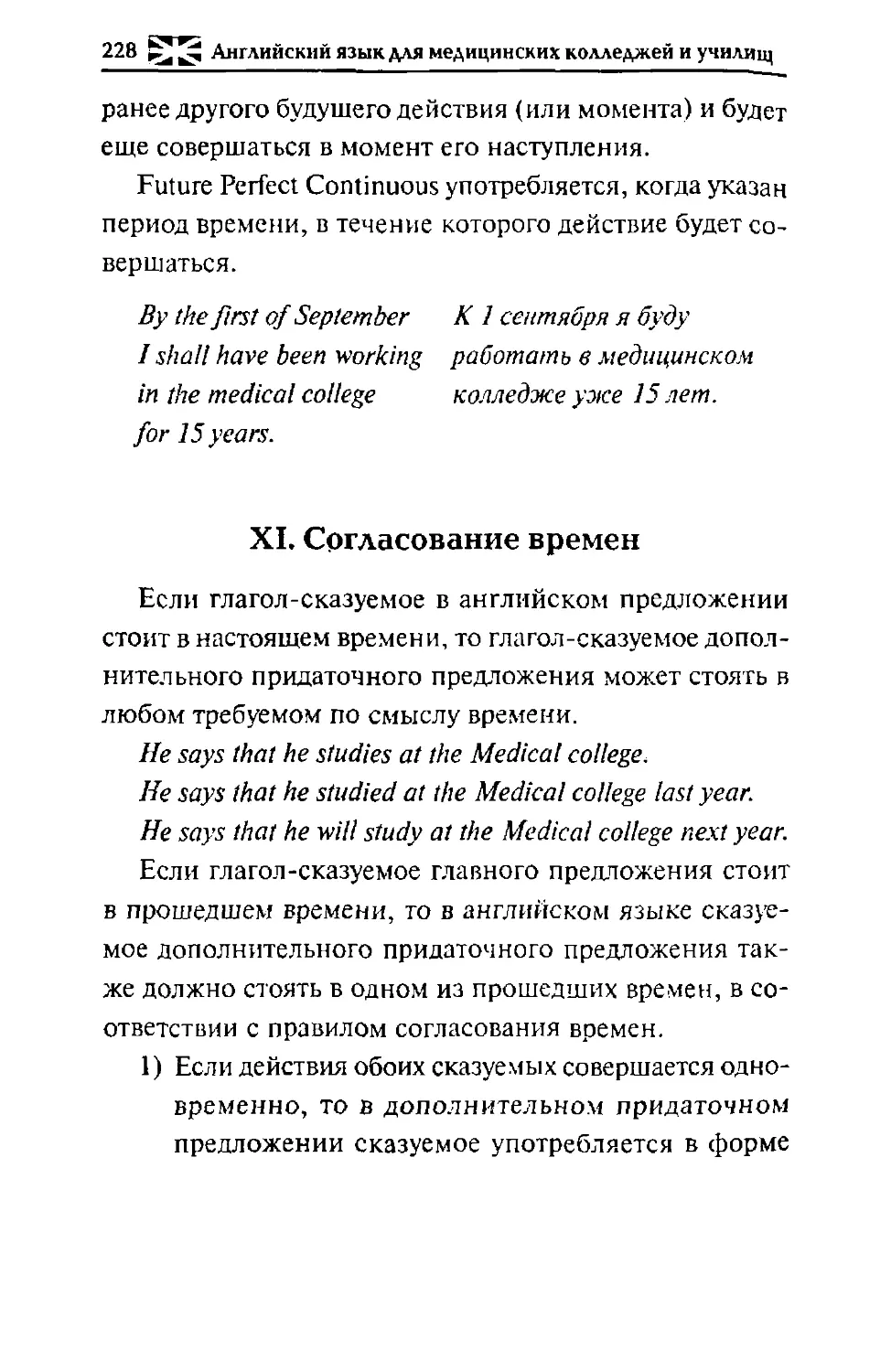


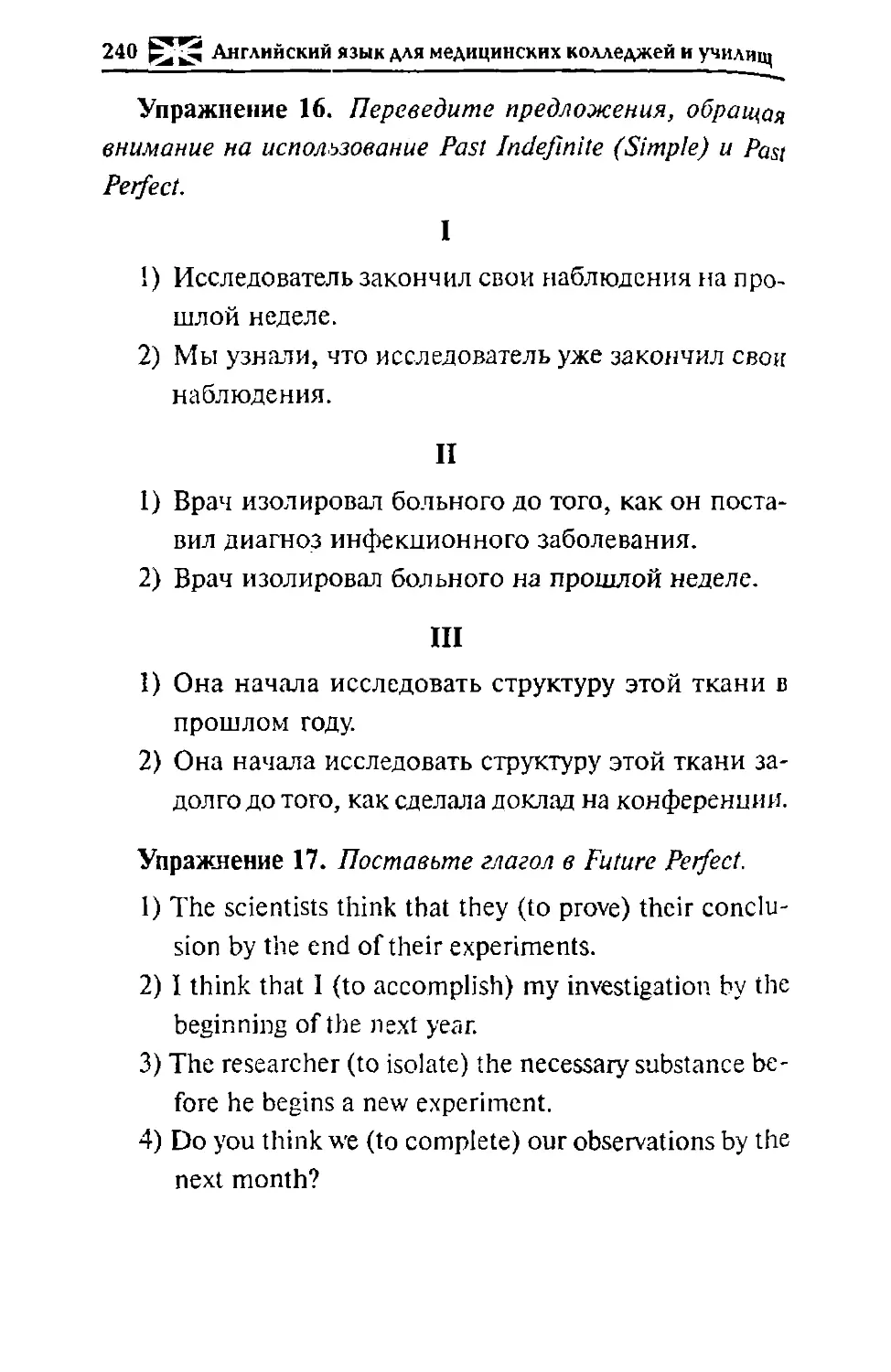


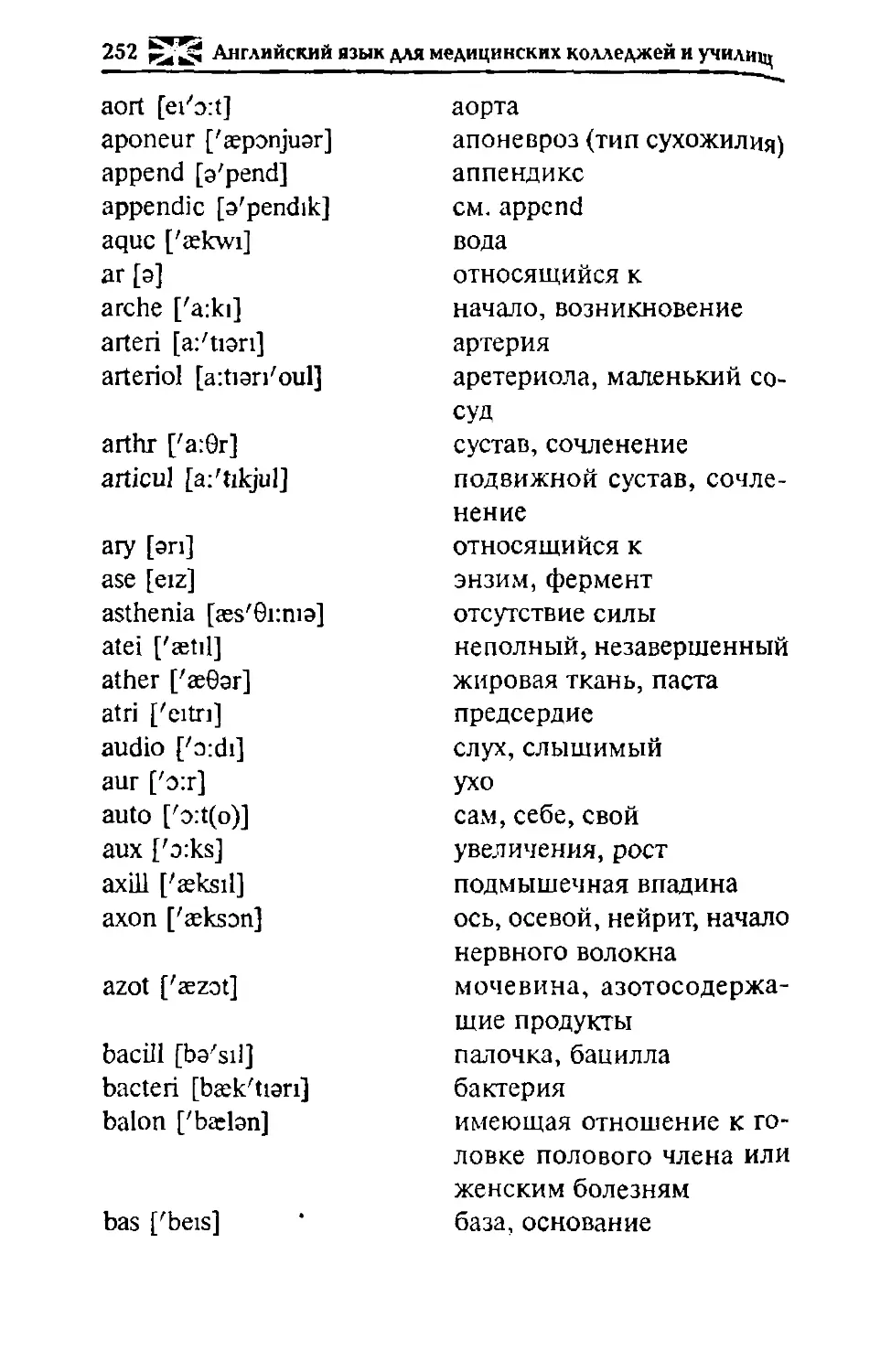


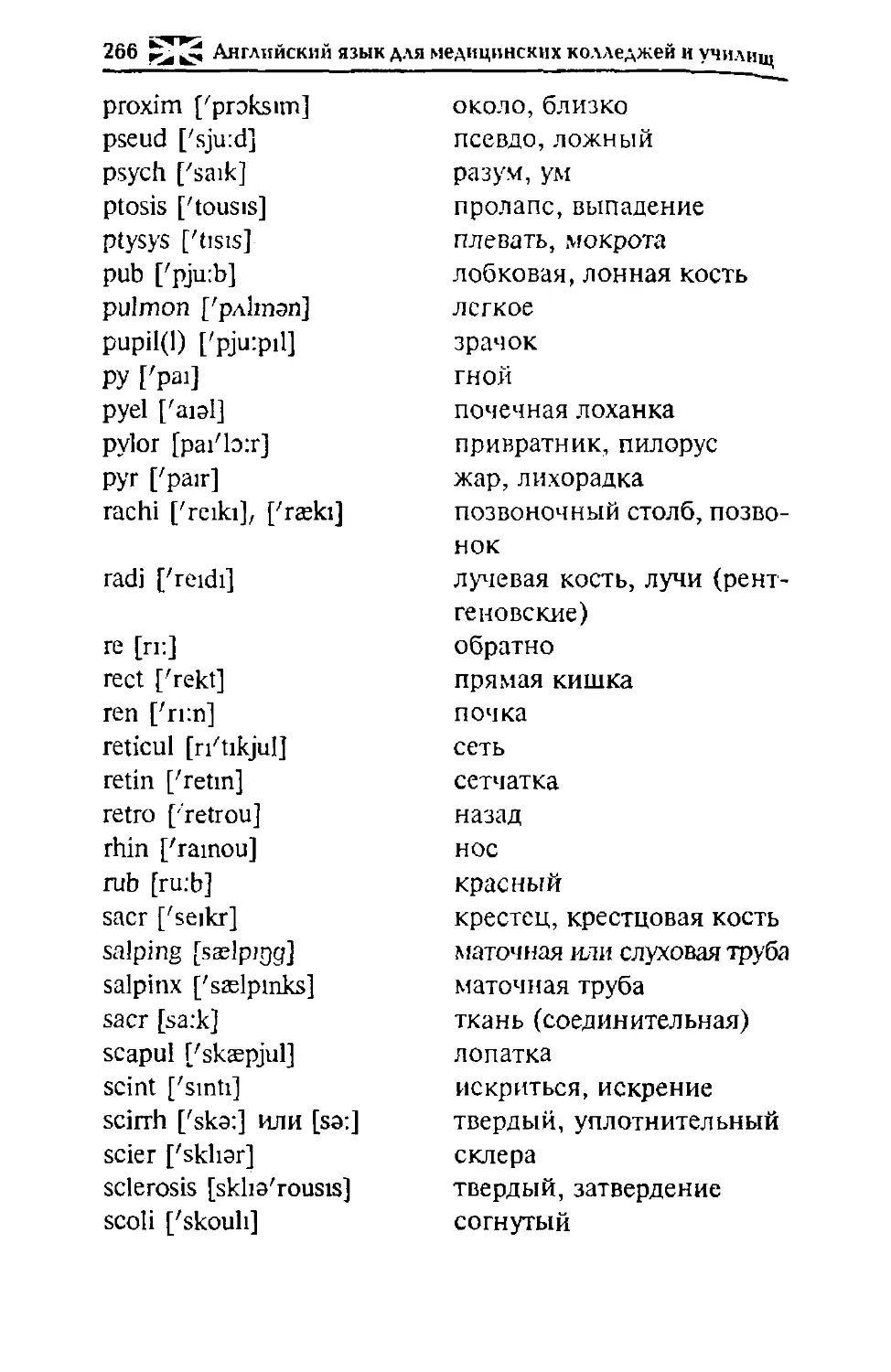


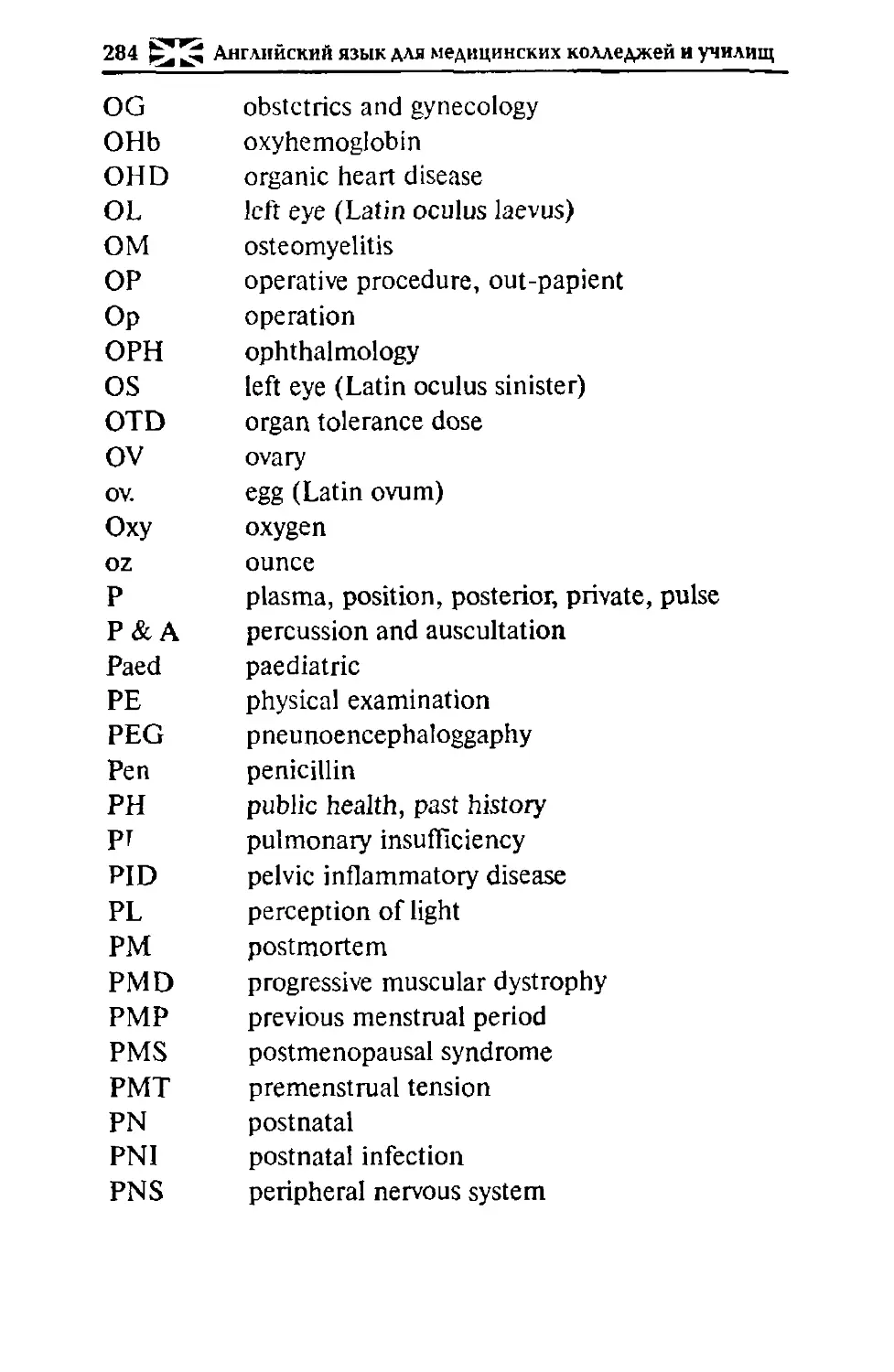


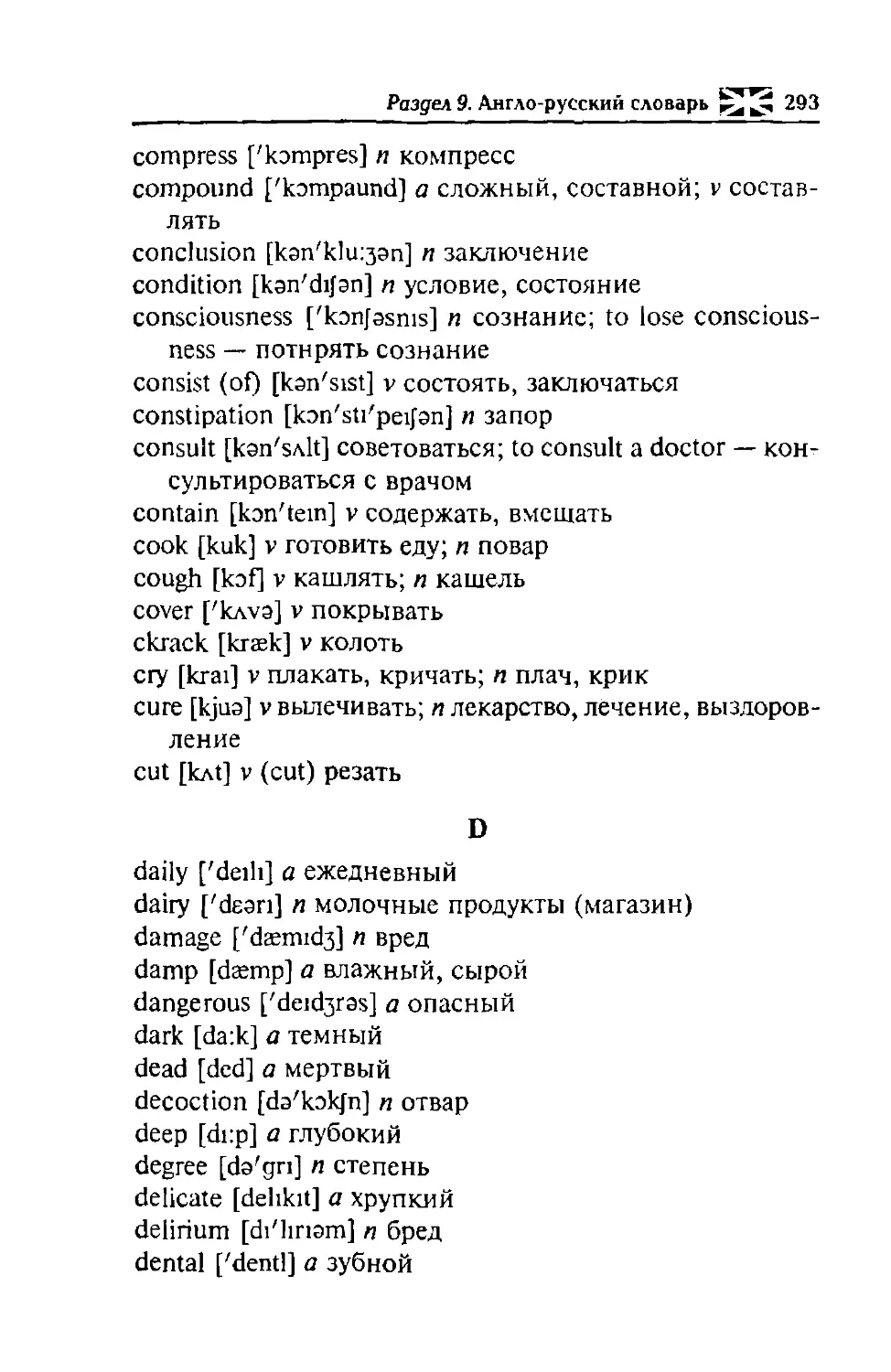


Author: Козырева Л.Г. Шадская Т.В.
Tags: английский язык языки мира
ISBN: 978-5-222-12399-7
Year: 2007

Text
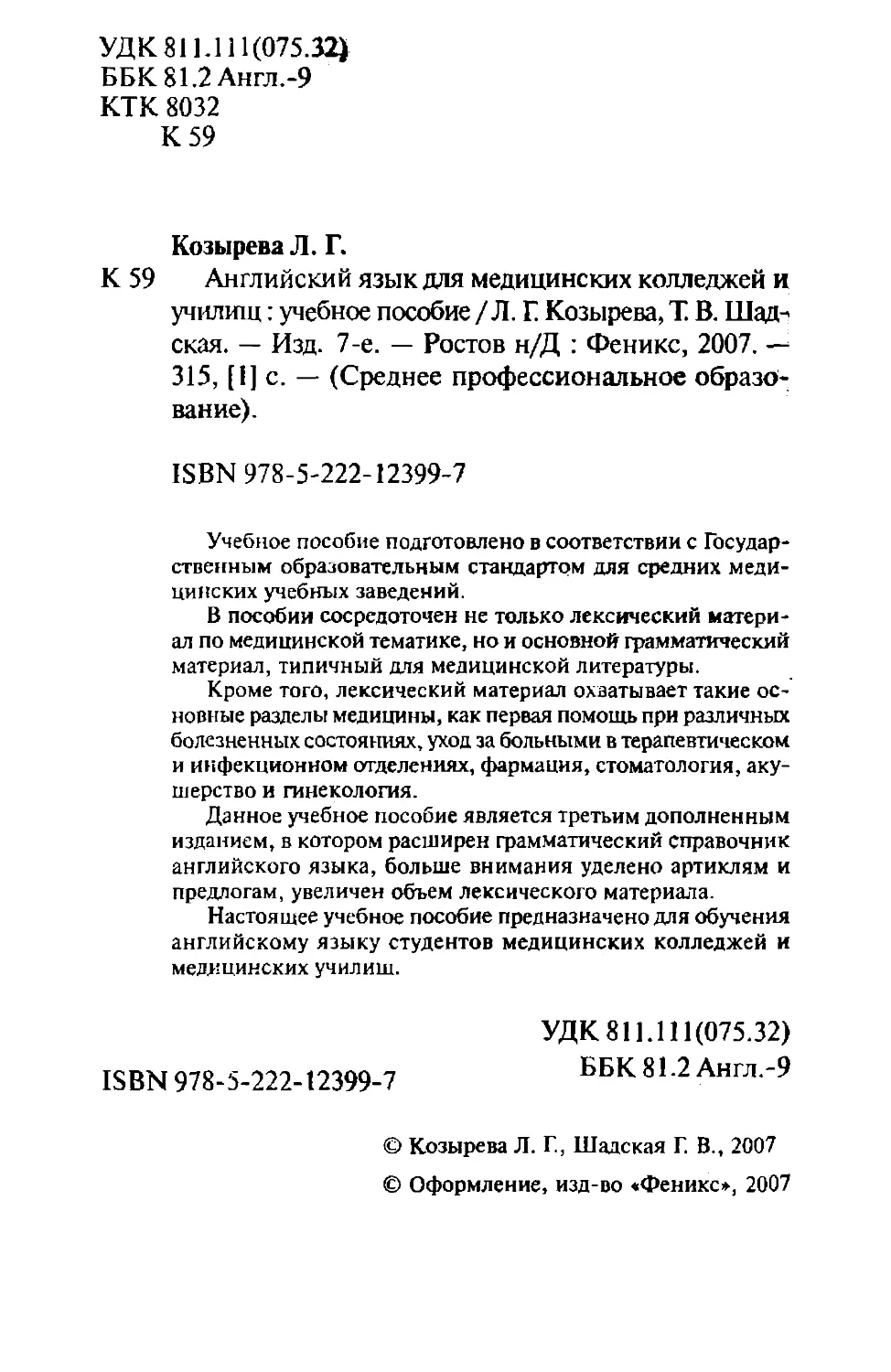
                    УДК 811.111(075.32)
ББК 81.2 Англ.-9
КТК 8032
К 59
Козырева Л. Г.
К 59 Английский язык для медицинских колледжей и
училищ: учебное пособие / Л. Г Козырева, Т. В. Шад-
ская. — Изд. 7-е. — Ростов н/Д : Феникс, 2007. —
315, [1] с. — (Среднее профессиональное образо¬
вание).
ISBN 978-5-222-12399-7
Учебное пособие подготовлено в соответствии с Государ¬
ственным образовательным стандартом для средних меди¬
цинских учебных заведений.
В пособии сосредоточен не только лексический матери¬
ал по медицинской тематике, но и основной грамматический
материал, типичный для медицинской литературы.
Кроме того, лексический материал охватывает такие ос~
новные разделы медицины, как первая помощь при различных
болезненных состояниях, уход за больными в терапевтическом
и инфекционном отделениях, фармация, стоматология, аку¬
шерство и гинекология.
Данное учебное пособие является третьим дополненным
изданием, в котором расширен грамматический справочник
английского языка, больше внимания уделено артиклям и
предлогам, увеличен объем лексического материала.
Настоящее учебное пособие предназначено для обучения
английскому языку студентов медицинских колледжей и
медицинских училищ.
ISBN 978-5-222-12399-7
УДК 811.111(075.32)
ББК 81.2 Англ.-9
О Козырева JI. Г., Шадская Г. В., 2007
© Оформление, изд-во «Феникс», 2007

АЛФАВИТ АНГЛИЙСКОГО языкаАа [ei]
Nn [en]
Bb [bi]
Oo [ou]
Сс [si:]
Pp [pi:]
Dd [di:]
Qq [kju:]
Ее [i:]
Rr [a:]
Ff[ef]
Ss [es]
Gg №»-]
Tt[ti:j
Hh [eitj]
Uu [ju:]
Ii[ai]
Vv [vi:]
Jj №ei]
Ww [Utb£e:i
Kk [kei]
Xx [eks]
U [el]
Yy [wai]
Mm [em]
Zz [zed]

Раздел 1
ВВОДНО-КОРРЕКТИВНЫЙ
КУРС
1.	Зачем нужно изучать
иностранные языки в среднем
специальном учебном заведении?
Вы занимались английским языком в школе. Значи¬
тельная роль изучению английского языка отводится в
медицинском колледже и училище.
Конечной целью изучения иностранного языка явля¬
ется овладение навыками чтения литературы по специ¬
альности для получения информации, а также закреп¬
ление навыков ведения беседы на иностранном языке в
пределах тем, связанных с будущей специальностью в
области медицины.
С каждым годом расширяются деловые связи меди¬
ков разных стран. Непрерывно растет объем информа¬
ции, в том числе и на иностранном языке. И в этой ра¬
боте неоценимую помощь Вам окажет умение читать и
переводить медицинскую литературу на английском
языке без помощи переводчика.
Изучение иностранного языка — дело трудное, но
доступное для будущих специалистов-медиков. А изве¬
стная английская пословица: Where there is a will, there
is a way «Была бы охота - наладится любая работа» под¬

Раздел 1. Вводно-коррективный курс	5
скажет Вам правильный подход к освоению иностран¬
ного языка.
А теперь — несколько слов об основных законах и
правилах английского языка. В английском языке не так
много правил. Но соблюдать их нужно неукоснительно,
чтобы не оказаться в неловкой ситуации.
Изучающий английский язык должен правильно
произносить слова, уметь построить фразу на иностран¬
ном языке, учитывая определенный порядок слов в по¬
вествовательных, отрицательных и вопросительных
предложениях, правильно использовать то или иное
грамматическое время.
Всем этим необходимо овладеть, чтобы уметь гово¬
рить на английском языке, чтобы понимать английскую
речь самому и чтобы окружающие понимали Вас.
А теперь остановимся подробно на чтении английс¬
ких гласных и согласных букв и их сочетаний.
2.	Чтение английских гласных
Буквы
Открытый СЛОГ
Закрытый слог
Буква г после
гласной
Буква гмежоу
гласными
a[ei]
[ei] plate
[ae] lamp
[а:] саг
[еэ] саге
e[i:]
[i:] he, Pete
[e] leg, men, sex
[э:] term, her,
per
[19] here
i[aO
[ai] time, life,
five
[j] six,J ip, sit
[э:] girl, first,
bird
[aid] tire
o[ou]
[ou] nose, note,
so
[э] hot, dog, not
[o;] pork, form
[о:] more
u[ju:]
[ju:] student,
tube, duty
[л] lunch, bus
[u] put, full
[э:] turn, burn
[jua] cure
У [waij
[ai] my, type
[i] system, gym
[з:] tyrtaean
[aia] tyre

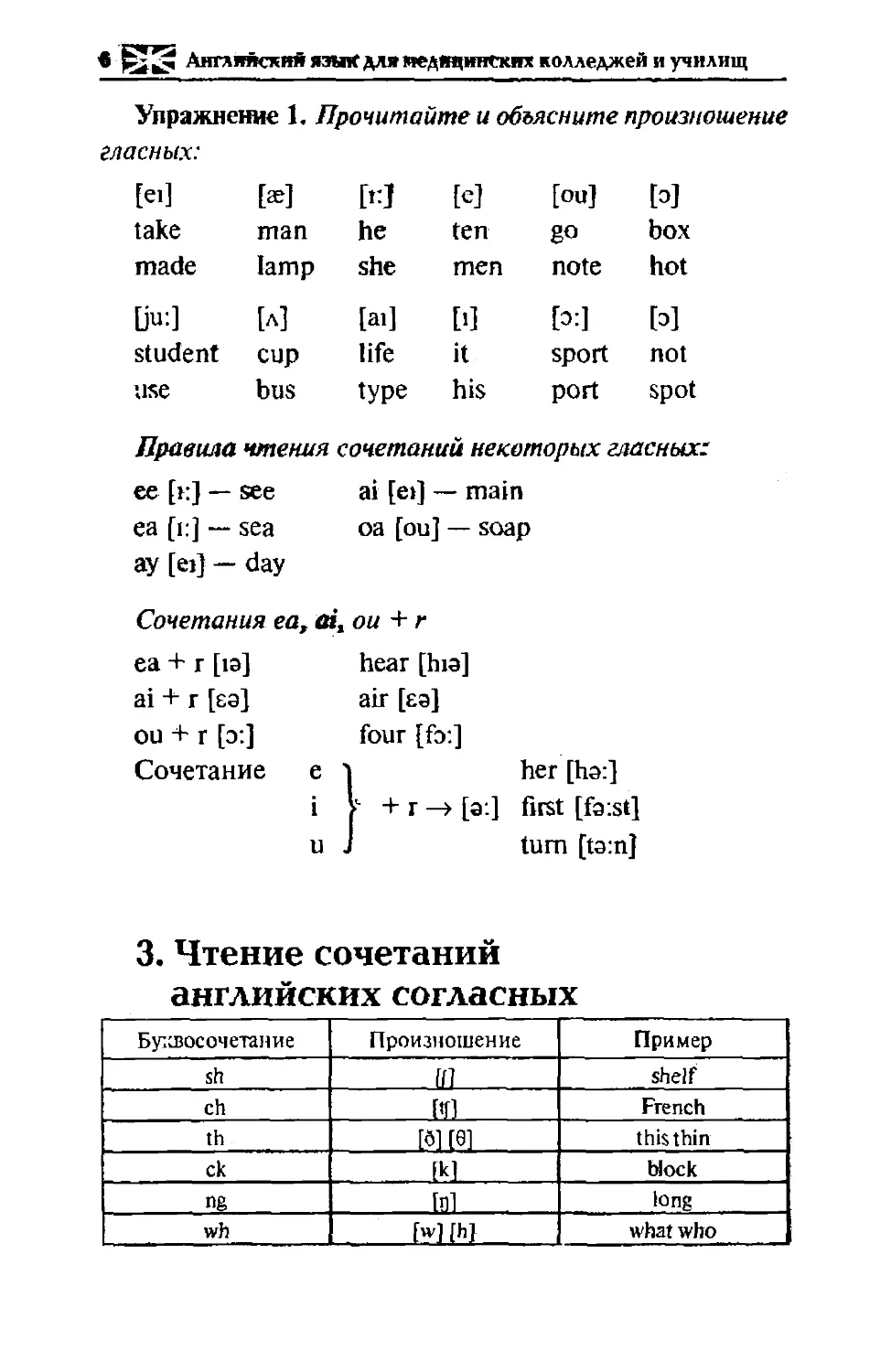
• ^5 Английски* яэнк для медицинских колледжей и училищ
Упражнение 1. Прочитайте и объясните произношение
гласных:
[е.]
[ae]
И
[e]
[ou]
take
man
he
ten
go
box
made
lamp
she
men
note
hot
[ju:]
W
[ai]
M
[o:]
M
student
cup
life
it
sport
not
use
bus
type
his
port
spot
Правила чтения сочетаний некоторых гласных:
ее [к] — see	ai [ei] — main
ea [i:] — sea	oa [ou] — soap
ay [ei] — day
Сочетания ea, Mt ou + r
ea + r [ia]
ai + r [ea]
ou + r [o:]
Сочетание
e
i
u
hear [hia]
air [еэ]
four [fo:]
her [ha:]
+ r —> [a:] first [fa:st]
turn [ta:n]
3.	Чтение сочетаний
английских согласных
Буквосочетание
Произношение
Пример
sh
m
shelf
ch
m
French
th
lb] [9]
this thin
ck
. ....... M
block
ng
[01
long
wh
MP4
what who

Раздел 1. Вводно-коррективный курс	7
Непроизносимые согласные
Буквосочетание
Произношение
Пример
wh
[w]
what, where
wh
M
who, whom
igh
[ai]
high, light
alk
[o:k]
talk
kn
M
know, knee
wr
[r]
write, wrong
gn
[n]
sign
Упражнение 2. Прочтите следующие слова:
who, whose, whom, whole
walk, talk
teach, much, chin
ring, long, bring, sing
black, back, block
she, ship, shot
this, that, then, thick, theme
4.	Словесное и фразовое ударение
Ударение — это выделение какого-либо слога или
слова по сравнению с другими слогами или словами.
Уцарение называется словесным, когда оно выделя¬
ет какой-либо слог в слове, и фразовым, когда оно вы¬
деляет слово в предложении.
Словесное ударение
Большинство двусложных слов имеет уда!рение на
первом слоге. Например: ‘farmer, ‘second, ‘pressure,
'strengthen, ‘college.

8	Английский	язык	для	медицинских	колледжей	и	училищ
В большинстве трех и четырехсложных слов, обыч¬
но, ударение падает на третий слог от конца слова. На¬
пример: ‘medicine, ‘regimen.
Если слово состоит из пяти и более слогов, то оно
имеет два ударения: главное — на третьем слоге от кон¬
ца и второстепенное — через слог от ударной гласной.
Например: sensi’tivity, uni’versity.
Фразовое ударение
Обычно фразовое ударение падает на слова, переда¬
ющие основное содержание предложения. В утверди¬
тельном предложении ударными являются существи¬
тельные, прилагательные, смысловые глаголы,
числительные, наречия, местоимения (указательные,
вопросительные). Неударны: артикли, союзы, предло¬
ги личные и притяжательные местоимения.
5.	Глаголы to be — быть
to have — иметь
Present
Past
Future
today
yesterday
tomorrow
I am, have
I was, had
I shall be/have
he is, has
he was, had
he will be/have
she is, has
she was, had
she will be/have
we are, have
we were, had
we shall be/have
you arc, have
you were, had
you will be/have
they are,have
they were, had
they will be/have

Раздел t. Вводно-коррективный курс S'S ®
Упражнение 3. Прочтите следующие предложения и
назовите время, в котором стоит глагол-сказуемое:
1) 1 am a student.
2) My grandmother was a chemist.
3) My sister will be a nurse.
4) My father has many books by Jack London.
5) We had a lesson in chemistry yesterday.
Упражнение 4. Поставьте глаголы to be и to have в нуж¬
ную временную форму.
1) We (to be) at the college yesterday.
2) My friend (to be) at the library tomorrow.
3) He (to have) a book by H. G. Wells last year.
4) My sister and my brother (to be) doctors.
5) I (to have) a sister and a brother.
6.	Артикли
В английском языке существуют два типа артиклей:
1) неопределенный артикль а (ап)
2) определенный артикль the
Артикль ставится перед существительным. Если су¬
ществительное имеет определение, то артикль ставится
перед определением. Так как неопределенный артикль
а (ап) означает “один”, “какой-либо”, то он использу¬
ется с существительными только в единственном чис¬
ле. Например: a girl, a small girl, an apple и т. д.
Когда же речь идет об уже известном предмете, то
употребляется определенный артикль the.
Например: the girl, the small girl, the apple и т. д.
Определенный артикль употребляется и в существи¬
тельных во множественном числе: the girls, the apples.

10 кс" Английский язык для медицинских колледжей и училищ
Основные случаи употребления
определенного, неопределенного
артиклей и их отсутствия
Нет артикля.
1) Имена собственные: My name is Bob.
2) Mr., Mrs., Miss, Sir, Madam, uncle, aunt, dad, mum.
3) Существительные с притяжательным местоимени¬
ем (my реп), с указательным местоимением (this
book).
4) Название стран, материков, городов: I live in Europe,
Russia, Moscow.
5) Неисчисляемые существительные: I like fresh air.
6) Существительные перед количественным числи¬
тельным: Open text ten, open page five.
7) Группа предметов с одинаковыми признаками:
Send me books.
8) Обозначение наук, учебных предметов: I like
History.
Определенный артикль the
происходит от указательного местоимения this — это.
!) Определенный предмет: Give me the book.
2) Обозначение фамилии как семьи: The Blacks, the
Smiths.
3) Множественное число известных предметов: Send
me the books
4) He первый раз в тексте: I see a room. The room is
large.
5) Определенная порция неисчисляемых существи¬
тельных: Give me the glass of milk.
6) Порядковые числительные: the first lesson.

Раздел I. Вводно-коррстттеный курс ^ II
7) Название газет, журналов, пароходов, гостиниц:
I read the «Nature»
8) Превосходная степень прилагательного: It is the
best film!
9) В сочетаниях: one of the, some of the, many of the,
most of the, all the, both the.
10) The Hague — Гаага — столица Голландии.
11) Названия государств с использованием админис¬
тративных терминов: the USA, the United Kingdom.
12) Этносы: the Indians.
13) Перед обстоятельством места: in the street.
14) Географические названия океанов, морей, озер,
рек, гор, пустынь и т. д.: The Urals, the Volga, the
Black sea, the Atlantic Ocean.
Ho: mount Vesuvius, lake Baikal, lake Ohio.
15) Названия войн: The Civil War.
16) Название документов: the Constitution.
17) Прилагательные в роли существительных: the old.
18) Стороны света: the North, the South, the East, the
West, the far East.
Неопределенный артикль a (an)
происходит от one — один.
1) Один. Единственное число: Take a pen, not two pens.
2) Один из класса предметов: I am a student.
3) Неопределенный предмет: Give me a book or а
notebook.
4) Первый раз в тексте: I see a dog. The dog was hungry.
5) Неопределенные порции неисчисляемого суще¬
ствительного: a cup of tea (любая чашка).
6) Абстрактное существительное + определение:
a quiet life.

12 55 Английский язык для медицинских колледжей и училищ
7) существительные со словами such, quite, rather.
Не is such a young boy!
8) После прилагательных со словами so, as, too, now.
too important a question.
9) В сочетаниях: a few, a little, a lot of.
Существуют словосочетания, в которых артикли
опускаются.
at home	at	noon
at school	to	go to bed
at work	to	go to school
at night	to	go to work
at lunch (tea)	in	winter
Перед порядковыми числительными употребляется
определенный артикль the: on the fourth of November.
7.	Порядок слов в английском
предложении
Утвердительное предложение
Подле¬
жащее
Ска¬
зуемое
Дополнение
Обстоятельство
косвен¬
ное без
предлога
прямое
косвен¬
ное с
предло¬
гом
места
времени
We
study
medicine
[
go
to the
college
every day
The
professor
delivers
lectures
to the
students
The
teacher
gives
us
all the
important
themes

Раздел i. Вводно-коррективный курс 2S
8.	Вопросы в английском языке
Вопросы бывают четырех типов: общие, специаль¬
ные, альтернативные и разделительные.
Общие вопросы
Общими вопросами называются такие вопросы, на
которые можно ответить да (yes) или нет (по). Такие воп¬
росы начинаются с вспомогательного глагола.
Do you study anatomy in college? Yes, I do.
Специальные вопросы
С помощью специальных вопросов выясняется ка¬
кой-либо факт или обстоятельства. Они относятся к
одному из членов предложения и начинаются с вопро¬
сительного слова:
who	кто? что? какой?
where	где? куда?
when               когда?
why	почему?
how	 как?
how many	0
J	сколько?
how much
how long	как долго? сколько?
what for	зачем?
Where do you study? 1 study at the Rostov medical college.
When do your lessons usually begin?
My lessons usually begin at 9.00.
Альтернативные вопросы
Альтернативные вопросы предполагают выбор одно¬
го из двух возможных вариантов и требуют полного от¬
вета.

14	Английский	язык	для	медицинских	колледжей	и	училищ
Do you study Latin or surgery in the first year? Vte study
Latin in the first year.
Разделительные вопросы
Цель разделительного вопроса состоит в уточнении
того или иного факта или обстоятельства. Эти вопросы
требуют полного ответа.
You study English, don’t you? (Вы изучаете английский
язык, не правда ли?) Yes, I study English.
You don’t study English, do you? (Вы не изучаете анг¬
лийский язык, не правда ли?) No, I don’t study English.
Порядок слов в вонроснтелыюм предложении
Вопроси¬
тельное
слово
Вспомо¬
гатель¬
ный
глагол
Подле¬
жащее
Сказу¬
емое
Допол¬
нение ,
Обстоятельство
места
времени
Who
-
-
goes
—
to the
college?
every day?
When
does
he
go
-
to the
college?
-
Does
he
go
-
to the
college?
every day?
where
does
he
go
— -
everyday?
—
Do
my friends
read
books
in the library
every day?
who
—
—
reads
books
in the library
every day?
where
do
my friends
read
books
—
every day?
How often
do
my friends
read
books
in the library?
What
do
my friends
read
-
in the library
everyday?
Упражнение 5. Ответьте на следующие вопросы. Оп¬
ределите тип вопроса.
1)	Are you a student of the medical college?

Раздел 1. Вводно-коррективный курс 5^*5* 15
2) Your sister lives in Moscow, doesn’t she?
3) Where were you born?
4) Do you live in the hostel or at home?
Упражнение 6. Поставьте общие вопросы к данным
предложениям и дайте ответы на вопросы.
1.1 have two sisters.
2. The students are in the library.
3. My friends will go to the cinema tomorrow.
4. My brother went home two hours ago.
Упражнение 7. Поставьте специальные вonpoсы со сле¬
дующими словами, данными в скобках.
1) My friend translates English texts very quickly (how, who).
2) 1 entered the medical college at the age of 17 (when, what).
3) She usually spends her holidays in the country (where,
what).
4) They will go for a walk in the evening (who, when).
5) Our lessons usually begin at 9 o’clock in the morning
(when).
9.	Контрольно-обобщающее
упражнения
Упражнение 1. Определите тип слога и прочитайте слова:
cat, men, first, pork, student, time, leg, tire, dog, type,
put, form, cure, plate, nose, my girl, more, car, name, must,
here.

18 1^*5» Английский язык для медицинских колледжей и училищ
Упражнение 2.	s and sh
see — she	She’s going to show us how to sew.
sue — shoe	What did she say to Mr. O’Shea?
so — show	I hope Sue’s wearing her shoes,
sock — shock For goodness sake, give that sleepy boy a
shake.
sigh — shy Did you say sack was in the shack? I said
it was in the shed.
Упражнение 3.	I and r
lay — ray	Did you want a red or a grey pencil?
lie — rye	There was a bright light on our right,
low — row	I was wrong when I said it wouldn’t be
long.
long — wrong	A lamb is not the same as a full-grown ram.
leak — reek	Did you say “lie” or “rye”. I say “rue”.
Oh, I thought you said “lie”.
Упражнение 4. The th sounds:
1	2	3
tin — thin	sin — thin	fin — thin
tick — thick	sick — thick	firm — therm
tie — thigh	sank — thank	first — thirst
4
day — they
doze — those
die — thy
5
van — than
vat — that
vine — thine

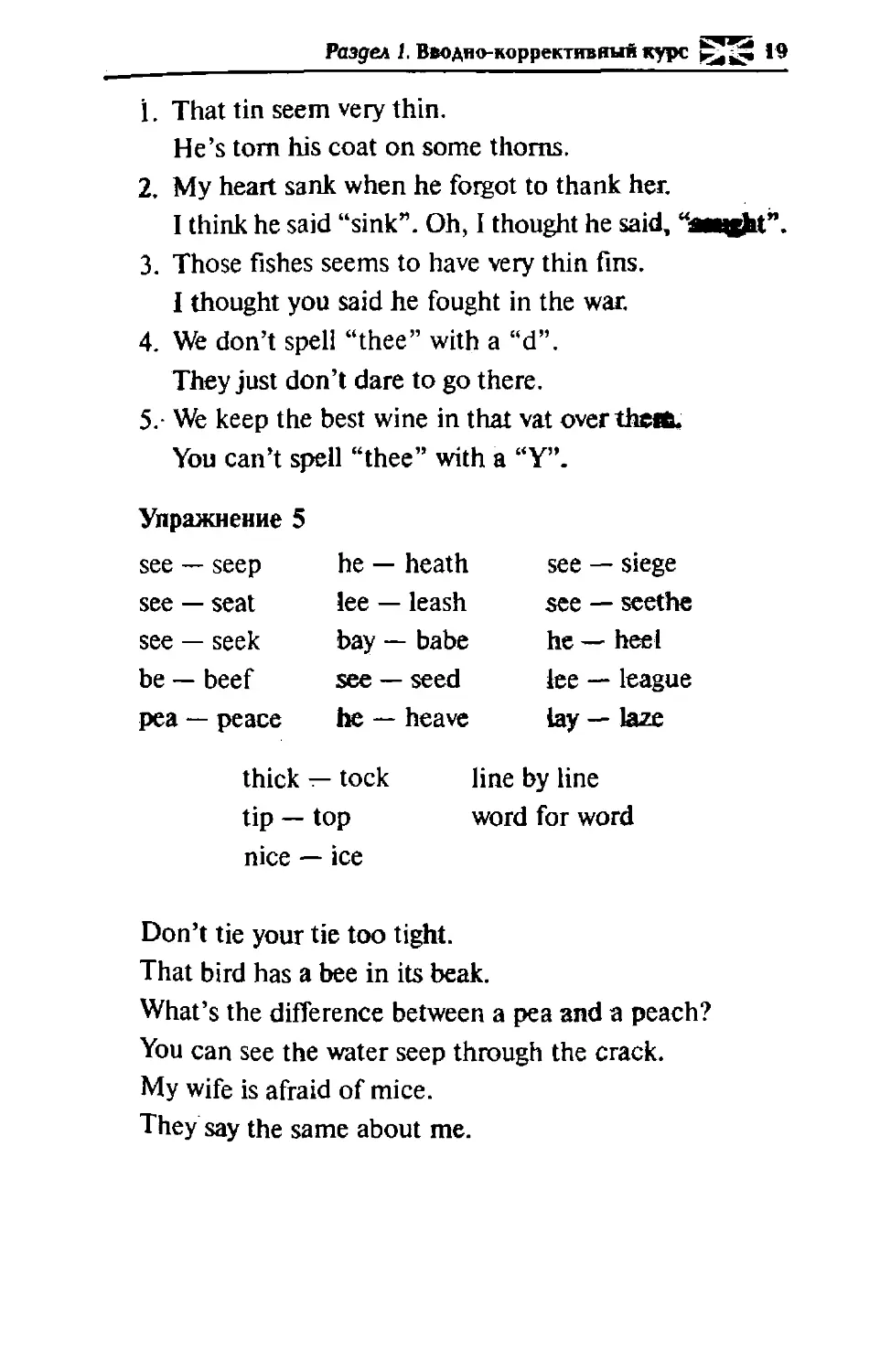
Раздел i. Вводно-корректнвяый курс	19
1. That tin seem very thin.
He’s tom his coat on some thorns.
2. My heart sank when he forgot to thank her.
I think he said “sink”. Oh, I thought he said, “a
3. Those fishes seems to have very thin fins.
I thought you said he fought in the war.
4. We don’t spell “thee” with a “d”.
They just don’t dare to go there.
5. We keep the best wine in that vat over the®.
You can’t spell “thee” with a “Y”.
Упражнение 5
see —	seep	he — heath	see — siege
see —	seat	lee — leash	see — seethe
see —	seek	bay — babe	he — heel
be — beef	see — seed	lee — league
pea — peace he — heave lay — laze
thick — tock	line by line
tip — top	word for word
nice — ice
Don’t tie your tie too tight.
That bird has a bee in its beak.
What’s the difference between a pea and a peach?
You can see the water seep through the crack.
My wife is afraid of mice.
They say the same about me.

20 'fr4	Английский язык для медицинских колледжей и училищ
Упражнение 6. Прочитайте скороговорки.
Here are some impossible “tongue-twisters”.
Even English-speaking people find them difficult to iay.
Learn them and impess your friends?
1. Six selfish shelfish.
2. The three thirty train to Tooting tootled through the
tunnel.
3. How many cuckoos could a good cook if a good cook
could cook cuckoos.
4. Canners can’t can chess but they can can peas.
5. The sixth sick sheik’s sixth sheep’s sick.
6. The Leith police dismisseth us.
Упражнение 7. Прочитайте «забавные стихи».
If you pronounce head, dead and bead,
You’ll hear the last word rhymes with deed,
And in this “poem” you will find many items of the kind.
Nasty-hasty; faster-chaster,
Master-plaster; taster-waster,
Brocade but decade; bow and bow,
Hose but lose; canoe but woe.
Can you pronounce without mistake:
Macleod-quay-query-rachel-ache
Petal-penal-want-plant-slant
Van-wan-rabies-grand and grant?
I don’t blame you if you can’t
Worm but form and doll but toll,
Cross but gross and poll but poll,

Раздел 1. Вводно-коррективнм|курс;
Horse but worse and lost but post,
Cost and frost but most and ghost,
Calm but value and pall but pal,
Tall but tally; gall but gal,
Star and bar and par but war.
10.	Several statements about
language learning. Do you agree
or disagree with these statements?
Discuss this problem.
!) It is easier for children than adults to learn a foreign
language.
2) Some people have special ability for learning languages.
3) Some languages are easier to learn than other.
4) People from my country are good at learning foreign
languages.
5) It is important to speak English with excellent pronun¬
ciation.
6) It is necessary to know about English-speaking cultures
in order to speak English.
7) You shouldn’t say anything in English until you can say
it correctly.
8) It is easier for someone who already speaks a foreign
language to learn another one.
9) People who are good at mathematics or science are not
good at learning a foreign language.

22 5^ ^ Авглвйолж шнк для медицинских колледжей и училищ
10) It is best to learn English in an English-speaking coun¬
try.
11) The most important part of learning a foreign language
is learning vocabulary words.
12) It is important to repeat and practice a lot.
13) Women are better than men at learning foreign lan¬
guages.
14) If beginning students are permitted to make errors in
English, it will be difficult for them to speak correctly
later on.
15) The most important part ofleaming a foreign language
is learning the grammar.
16) It is easier to speak than understand a foreign language.
17) It is important to practice with cassette tapes.
18) Learning a foreign language is different than learning
other academic subjects.
19) People who speak more than one language are very in¬
telligent.
20) Everyone can learn to speak a foreign language.
21) It is easier to read and write English than to speak and
understand it.
22) English is:
a) a very difficult language;
b) a difficult language;
c) a language of medium difficulty;
d) an easy language;
e) a very easy language.

Раздел 1. Вводно-коррективный курс	23
23)	If someone spent one hour a day learning a foreign lan¬
guage, how long would it take them to speak the lan¬
guage very well?
a) less than a year,
b) 1—2 years;
c) 3—5 years;
d) 5—10 years;
e) you can’t learn a language in 1 hour a day.

Раздел 2
ОСНОВНОЙ КУРС
1.	Our college
My name is Sveta Popova. I’m 17. I’m a student of the
medical college. Our college is one of the oldest educational
establishments of the region with its own traditions. Its grad¬
uates are considered to be the most highly trained specialists
in the region. There are 7 departments in our college. I would
like to tell you about them.
“Nursing Affair” gives qualification of a nurse of general
practice. A medical nurse is a chief assistant of a doctor. She
provides uninterrupted medical health, including preventive
and rehabilitation measures. Our graduates work in the poly¬
clinics, hospitals, kindergartens, schools and houses for aged
people. If you want to become a doctor assistant you should
study at the “Curative Affair” department. A doctor assistant
of general practice is a highly-trained specialist who works
independently in the policlinics, emergency ambulances and
hospitals. His main task includes prescription and perfor¬
mance of preventive, curative and diagnostic measures. The
graduates of this department are waited for at the stations of
emergency medical help, in the country-side hospitals and
in the military hospitals.
“Obstetrician Affair” is another interesting department, it
offers qualification of an obstetrician. An obstetrician pro-

Раздел 2. Основной курс ^^«25
vides preventive and curative medical help to the pregnant
women and patients with gynaecological diseases.
Boys and girls whose future profession is dentist study at
the “Stomatology”. A dentist is a highly-trained specialist
who works independently or under the guidance of a senior
doctor who provides preventive and curative medical help for
the population.
“Medical-prophylactic affair” gives qualification of a san¬
itary doctor assistant, who prevents appearance and spread¬
ing of infections and other kinds of the diseases. He controls
the influence of the conditions of work and life on a person’s
health and takes some measures to prevent this harmful in¬
fluence of the surroundings. They work in the centres of state
sanitary inspectors and laboratories of different branches.
A dental mechanic-while studying at the “Orthopedic sto¬
matology” departments a future specialist leams to make ar¬
tificial teeth and crowns, plastics and porcelain teeth. On
graduating from the college they usually work in the dental
mechanic laboratories. As for me I am a student of the “Phar¬
macy” department. My future profession is pharmaceutist.
I’ll be provided the population with different medicines. My
work will demand the knowledge of preventive rules, the rules
of herb’s preparation and so on.
The graduates of our department will be able to work in
the chemist’s, pharmacological enterprises, laboratories.
I like to study at our college very much.
Упражнение 1. Ответьте на вопросы.
1.	Where does Sveta Popova study? 2. How many depart¬
ments are there in the college? 3. What kind of qualification

26	Английский	язык	для	медицинских	колледжей	и	училищ
does the “Nursing affair” department give? 4. Who can work
at the station of emergency medical help? 5. What does an
obstertrician provide to the pregnant women and patients
with gynaecological diseases? 6. Where do the sanitary doc¬
tor assistants work? 7. What is Sveta’s future profession?
Упражнение 2. Скажите по-английски.
студентка медицинского колледжа; медицинская се¬
стра, фельдшер, главная задача; станция скорой помо¬
щи, акушерка, беременная, зубной врач, медицинская
помощь населению, условия работы, вредное влияние,
будущая профессия, знание.
2.	Части тела
1) body ['bodi] тело
2) head [hed] голова
3) hair [Ьеэ] волосы
4) face [feis] лицо
5) cheek [tfi:k] щека
6) eye [ai] глаз
7) ear [19] ухо
8) mouth [mau9] рот
9) tooth [tu:9J (pi. teeth [tir9] зуб, зубы
10) arm [a:m] рука
11) leg [leg] нога
12) hand [hasnd] кисть (руки)
13) finger [firjga] палец (руки)
14) toe [tou] палец (ноги)

Раздел 2. Основной курс	27
15) foot [fu:t] (pi. feet стопа, стопы
16) forehead ['forid] лоб
17) nose [nouz] hoc
18) shoulder ['Joulda] плечо
19) chest [tfest] грудь
20) back [baek] спина
Опишите внешность своего друга (подруги), используя
следующие прилагательные*
slender — stout	dark — fair
round — oval	rosy — pale
blue, grey, black, green, brown short — long
straight — upturned	broad — narrow
Ответьте на следующие вопросы:
1) What colour is your hair?
2) Is your hair long or short?
3) What colour are your eyes?
4) Is your face round or oval?
5) Are your cheeks rosy or pale?
6) Do you have healthy teeth?
3.	Внутренние органы человека
1) heart [ha:t] сердце
2) lungs [Iaqs] легкие
3) tongue [taj] язык
4) pharynx [faerigks] глотка
5) esophagus [l'sofagss] пищевод

28	Английский	язык	для	медицинских	колледжей	и	училищ
6) stomach ['sumak] желудок
7) liver ['liva] печень
8) gall bladder ['golblaeds] желчный пузырь
9) pancreas [pajgkrias] поджелудочная железа
10) duodenum [dju:sdi:nam] двенадцатиперстная кишка
11) small intestine [m'testin] тонкая кишка
12) appendix [s'pendiks] аппендикс
13) rectum ['rektam] прямая кишка
14) kidney ['kidm] почка
15) bladder ['blaeds] мочевой пузырь
16) uterus ['juitaras] матка
Переведите следующие предложения с русского на анг¬
лийский:
1) У вас бывают сердечные приступы?
2) В легких патологии не обнаружено.
3) Диагноз этого пациента — воспаление пищевода.
4) Ваш желудок требует внимательного изучения.
5) Печень — пальпируется (to be palpable) и болез¬
ненная.
6) После гриппа у пациента было осложнение со сто¬
роны почек.
4.	В терапевтическом отделении
Общий уход за больными
Предметы ухода за больными
1) амбулаторное лечение — out-patient treatment
2) стационарное лечение — hospital treatment

Раздел 2. Основной курс	24
3) терапевтическое лечение — medical treatment
4) хирургическое лечение — surgical treatment
5) назначить лечение — to prescribe treatment
6) неполное (полное) выздоровление — incomplete
(complete) recovery
7) резиновое судно — rubber bedpan
8) грелка — heater
9) горчичники — mustard plasters
10) измерить кровяное давление — to take  arterial  pres¬
sure
11) клизма — enema
12) медицинские банки — cups
13) пузырь для льда — ice-bag
14) промывать желудок — to give somebody a stomach
wash out
15) водяная грелка — hot water bottle/bag
резиновая грелка — rubber heater
электрическая грелка — electric pad
16) шприц — syringe
  17) делать инъекцию — to give an injection
18) внутривенная инъекция — intravenous injection
внутрикожная инъекция — intradermal injection
внутримышечная инъекция — intramuscular injec¬
tion
19) горячий компресс — hot compress
холодный компресс — cold compress
сухой компресс — dry compress
20) температура — temperature
показания термометра — thermometer readings
температурный листок — temperature chart

30 ^ ^ Английский язык для медицинских колледжей и училищ
просматривать температурный листок — to review
the temperature chart
поставить термометр — to insert a thermometer
измерить температуру — to take temperature
«сбить» температуру — to bring the fever down
Скажите по-английски:
1) Какая у вас сегодня
температура?
2) Вы выполняете все мои
указания?
3) Продолжайте внутри¬
венное введение анти¬
биотиков.
4) Поставьте градусник
больному.
5) Врач должен назначил
лечение.
6) Промойте желудок
больному немедленно.
7) Сделайте внутривен¬
ную инъекцию этому
больному.
8) Просматривать темпе¬
ратурный лист ежед¬
невно — важно для
медсестры.
1) What’s your temperature
today?
2) Are you following all my
instructions?
3) Go on intravenous anti¬
biotic therapy.
4) Insert a thermometer to
a patient.
5) A doctor must prescribe
treatment.
6) Give the patient a stom¬
ach wash out as soon as
possible.
7) Give an intravenous in¬
jection to this patient.
8) It is important for a
nurse to review the tem¬
perature chart daily.

Раздел 2. Основной курс 31
9)	Горчичники помогают
«сбить» температуру
пациента.
10) Вам следует измерить
кровяное давление па¬
циента и назначить ему
терапевтическое лече¬
ние.
11) Попное выздоровление
пациента — результат
хорошей работы врача
и медсестры.
9)	Mustard plasters help to
bring the patient’s fever
down.
10) You need to take arteri¬
al pressure of the patient
and prescribe him med¬
ical treatment.
11) Complete patient’s re¬
covery is a result of a
good work of a doctor
and a nurse.
Прочитайте и переведите текст, пользуясь словарём.
HYPERTENSION
Hypertension is defined as a sustained elevation of arteri¬
al blood pressure at a level of 140/90 or higher in persons
between the ages of 13—50 and 160/95 or higher in persons
over 50 years of age. Hypertension is classified as primary
(essential or idiopathic) or secondary. Primary hypertension,
which constitutes approximately 90 % of the cases, has an
unknown etiology. Secondary hypertension occurs as a result
of other pathological conditions such a Cushing’s syndrome,
increased intracranial pressure, renal disease, pheochromocy-
toma, and coarctation of the aorta. Hypertansion is classi¬
fied according to the degree of severity, ranging from Class I
(mild hypertension with a diastolic pressure between 90— 104
mm Hg) to Class III (severe hypertension with a diastolic

32 ^ S Английский язык для медицинских колледжей и училищ
pressure above 115 mm Hg). Accelerated or malignant hy¬
pertension is characterized by a sudden and rapid rise of dias-
tolic pressure above 120 mm Hg and concurrent Grade 111—
IV retinopathy. When the pressure elevation causes an
immediate threat to the client’s life, hypertensive crisis exists.
Упражнение 1. Ответьте на вопросы к тексту:
1. What is primary hypertension?
2. What is secondary hypertension?
3. WTien does hypertensive crisis exist?
Упражнение 2. Найдите в тексте английские эквива¬
ленты следующих русских слов и словосочетаний: кровяное
давление, уровень, первичная гипертония, вторичная ги¬
пертония, синдром Кушинга, неизвестная этиология, ги¬
пертонический криз.
WORK OF THE HUMAN HEART
The human heart contracts from the first moment of life
until the last one. The contractions of the heart pump the
blood through the arteries to all the parts of the body. Phys¬
iologists have determined that in the adult the heart makes
from 60 to 72 beats per minute. In children the rate of heart
beat is much higher. Research work has determined that rate
of heart beat increases depending on different emotions.
Each beat of the heart is followed by a period of rest. Each
contraction and a period of rest compose a cardiac cycle.
Each cardiac cycle consists of three phases: the first phase
of short contraction — the atrial systole, the second phase of

Раздел 2. Основной курс SS 33
a more prolonged contraction — the ventricular systole. The
period of rest is called the diastole.
Research work of many physiologists has estimated the
role of the ventricles as the main pump of the human heart.
Упражнение. Переведите следующие предложения:
1. The human heart makes 60—80 contractions per
minute.
2. On physical exertion the heart has a short period of rest
and the diastole becomes less.
3. Ten tons of blood are pumped through the heart daily.
4. The heart acts as a pump.
5. John Floyer, an English doctor, was the first scientist
to find out the varying pulse rate in men.
Упражнение. Найдите в тексте эквиваленты следую¬
щих русских слов и выражений:
человеческое сердце, сокращаться, сокращения сер¬
дца, артерия, взрослый человек, 72 удара в минуту, оп¬
ределить частоту сердцебиения, зависит от различных
эмоций, сердечный цикл, систола предсердия, систола
желудочка, диастола, насос.
Выучите следующие слова и словосочетания:
1) pump [рлтр] п насос, v накачивать, нагнетать,
выталкивать, выбрасывать
2). rate [reit] п частота, степень
pulse rate — частота пульса
respiratory rate — частота дыхания
3) beat [bx:t] п удар; v ударять (beat, beaten)

34	Английский	язык	для	медш
»п»мунШ1иу<т111ц
4) per minute — в минуту
5) contract [kan'traekt] сокращаться
6) artery ['a:tari] п артерия
7) systole ['sistah] п систола
8> diastole [dai'estsh] п диастола
9)	atrium [eitriam] п (pi. atria) предсердие
10)	ventricle ['ventrikl] п желудочек
HEART DISEASE
Выучите слова, прочитайте текст.
1. disorder [dis'o:ds] расстройство, нездоровее
2. congenital [kan'djemtl] врожденный
3. acquired [s'kwaisd] приобретенный
4. club-like [к1лЬ] зд. похожие на барабанные палочки
5. pulmonary [рл1шэпэп] а легочный
6. to depend on [di'pend] v зависеть от
7. to pick up [pik] уловить, обнаружить
8. puffiness ['pAfrnes] одутловатость
Heart disorders fall into two broad groups: congenital and
acquired. Congenital heart defects are caused by structural
defects. Acquired heart disease is mainly due to rheumatic
fever.
Congenital defects may result in cyanosis if the defect is
such that blood does not pass through the lungs for oxygen¬
ation. The patient has blue lips and blue-finger and toe-nails-
The ends of the fingers and toes are rounded and club-like.

Раздел 2. Основной курс	35
Sometimes there is an opening between the left and right
side of the heart, or even between the aorta and pulmonary
artery-
Symptoms depend on the type of heart disease. Some¬
times. the defect is picked up on a routine examination; at
other times there may be breathlessness, difficulty in walk¬
ing or running, swelling of feet and puffiness of face, and later
of the whole body. Some these anomalies can be surgically
corrected.
Упражнение 1. Переведите на английский язык.
врожденный, приобретенный, дефекты (пороки) сер¬
дца, структурные дефекты, врожденные пороки сердца,
у больного посиневшие губы, пальцы на руках и ногах —
закругленные, похожи на барабанные палочки, отвер¬
стие, легочная артерия.
Упражнение 2. Ответьте на вопросы к тексту.
1. What kind of groups do the heart disorders fall?
2. What are the symptoms of some congenital heart de¬
fects?
3. Gan these anomalies be surgically corrected?
FIRST AID
Выучите слова, прочитайте текст.
1. first aid [fa:st eid] первая помощь
2. knowledge ['nolu^J знание
3. essential [l'senfial] а неотъемлемый

36 SS Авглийский язык для медицинских колледжей и училищ
4. emergency [l'maidjansi] п непредвиденный случай
5. to lose [lu:z] v терять
6. calm [ka:m] а спокойный
7. injured [md3ed] а пострадавший
8. to hurt [ha:t] v причинить боль
9. bruise [bru:z] n ушиб, синяк
10. fracture ['fraektfs] n перелом
11. limb [li:m] n конечность
Some knowledge of first aid is essential for everyone and
should be an essential part of teaching at the medical college.
The most important thing in an emergency is not to lose
one’s head. When you give the first aid you must be very
calm. If the injured person has hurt himself with a fall, make
him lie down comfortably and see whether there are any cuts
or bruises. If movement of arm or leg hurts, there may be
fracture, so leave the limb in the position in which it is.
Упражнение 1. Переведите на английский язык:
знание, первая помощь, для каждого, неотъемлемая
часть, терять голову, пострадавший, движение руки или
ноги, может быть перелом.
Упражнение 2. Ответьте на вопросы к тексту:
1. What is the most important thing in an emergency?
2. How must a person act when he gives the first aid?
3. Do you know how to give the first aid?

BLEEDING
Выучите слова, прочитайте текст.
1. bleeding ['blr.dig] кровотечение
2. severe [si'via] а тяжелый
3. loss [los] потеря
4. case [keis] n случай
5. blood transfusion [bta.d 'trasns'^u^en] переливание
крови
Bleeding can lead to a severe loss of blood. The best way
to stop bleeding is by direct pressure with a clean cloth. If the
bleeding is from the arm or the leg, the limb can be kept in a
raised position. If the bleeding is from a nose, put a cold com¬
press on the nose. It will stop the blood. Ice placed on the
nose also stops bleeding. In severe case doctors make blood
transfusion.
Упражнение 1. Переведите на английский язык:
лучший способ остановить кровотечение, потеря
крови, чистая ткань, поднятое положение, кровотечение
из носа, холодный компресс, остановить кровотечение,
тяжелый случай, переливание крови.
Упражнение 2. Ответьте на вопросы к тексту:
1. What can lead to a severe loss of blood?
2. What is the best way to stop the bleeding?
3. What do the doctors do in severe cases?

38 jSs^S Английский язык для медицинских колледжей и училищ
FRACTURE
Выучите слова, прочитайте текст.
1. fracture [fraekt/э] п перелом
2. to break [breik] v ломать, перелом
3. bone [boun] n кость
4. pain [pem] n боль
5. swelling ['swehrj] и опухоль
6. tenderness ['tendsms] n мягкость
7. to confirm ['кэп'£э:т] v подтверждать
8. to immobilize ['lmoubilaiz] v делать неподвижным
9. splint [splint] n шина
10. stiff [stif] а жесткий
11. limb [hm] n конечность
12. joint [djomt] n сустав
13. to bind [bamd] v привязывать
14. above ['эЬлу] adv наверху
15. below [bi'lou] adv ниже
16. compound [kompaund] а сложный
17. sterile [sterail] а стерильный
18. gauze [goz] марля
19. to pierce [pies] v пронзать, протыкать, прокалывать
Fracture or break in the bone can result from any injury.
There is a pain, swelling and tenderness and there may be a
deformity. The injured part should be prevented from mov¬
ing. Usually, an X-ray is necessary to confirm whether there
is a fracture or not. The injured part can be immobilized with
a splint. A splint can be ready-made or improvized from any
stiff material (stick, ruler, magazine and so on). The splint

Раздел 2. Основной курс 39
should be wider than the limb being splinted, and long
enough to prevent movements of the joints near the fracture.
Bind the splint in place above and below the fracture. If the
person has a compound fracture you must take some sterile
gauze, put it over the wound and take the patient to the hos¬
pital immediately. A compound fracture is more serious, in
which broken bone has pierced the skin.
Упражнение 1. Переведите на английский язык.
может быть деформация, пострадавшая (поврежден¬
ная) часть, необходим рентген, подтвердить перелом,
готовая шина, шире, чем конечность, предотвратить
движения суставов, привязывать шину, взять стериль¬
ную марлю, сложный перелом, более серьезный, поло¬
манная кость, пронзить кожу.
Упражнение 2. Ответьте на вопросы к тексту
1. What are the symptoms of the fracture?
2. Is it necessary to use X-ray?
3. What kind of splints are used for immobilization?
4. What fractures are more serious?
Прочитайте и воспроизведите диалог в япцах.
AT THE DOCTOR'S
Patient: I haven’t been feeling well, doctor.
Doctor: What’s wrong with you?
Patient: I’ve had pain here — just bellow my heart.

42 f^ggj Английский язык для медицинских колледжей и училищ
9)	to keep him quiet j/kwaist] (здесь) не тревожить его
10) to empty ['empti] опорожнять
11) as soon as possible — как можно быстрее
12) stomach ['stAmak] желудок
13) to call in [кэ1] вызвать (врача)
14) immediately [l'mirdjdth] немедленно, тотчас же
15) sunstroke ['s/vnstrouk] солнечный удар
16) to cool [ku:l] охлаждать, (здесь) прохладный
17) shady [feidi] тенистое
18) sponge [spAndj] губка
19) to keep up — поддерживать
20) blood circulation [ssikjuleijn] кровообращение
Скажите по-английски:
потерять сознание, побрызгать холодной водой,
вдохнуть нашатырный спирт, положить на спину, под¬
нять ноги, накрыть одеялом, теплое питье, опорожнить
желудок, как можно быстрее, вызвать врача немедлен¬
но, прохладное, тенистое место, поднять голову и пле¬
чи, обтереть кожу губкой.
Внимательно изучите все ситуации. Найдите в них об¬
щие черты и различия.
HEADACHE
Выучите слова, прочитайте текст.
to occur [экэ:] v иметь место, встречаться
common ['кэтзп] а обыкновенный, простой
eye strain [stremj п усталость глаз (напряжение зрения)

Раздел 2. Основной курс	43
hunger [Ьлддэ] п голод
to accompany [э'клтрэю] сопровождать
mumps [тлтрз] п свинка
malaria [тэ'кэпэ] п малярия
measles [mizlz] п корь
brain tumour [brem tju:ma] опухоль мозга
Headache is a symptom of many diseases. It may occur
with common cold, fever, eye strain or hunger. It may ac¬
company mumps, malaria, measles and many other infec¬
tions. But if severe headache persists you should consult a
doctor. Frequent and persistent headache may sometimes be
a symptom of brain tumour.
Упражнение 1. Переведите на английский язык:
симптом многих болезней, обычная простуда, может
сопровождать, сильная головная боль, советоваться с
врачом, частая и постоянная головная боль, опухоль
мозга.
Упражнение 2. Ответьте на вопросы к тексту:
1. Headache is a symptom of many diseases, isn’t it?
2. Does it accompany measles and malaria?
3. What is a symptom of brain tumour?
PNEUMONIA
Выучите слова к тексту.
1.	acute [a'kju:t] острый, сильный;

44	Английский	язык	для	медицинских	колледжей	и	училищ
2. inflammation [mflameijn] воспаление;
3. to confirm [кэп'£э:т] подтверждать;
4. malnourished [maeliurijd] плохо питающийся.
Pneumonia is an acute inflammation of the lung. It may
be caused by bacteria or viruses. It may follow a cold and
bronchitis, or mav come on suddenly. It may also be a com¬
plication of measles or whooping cough. The child looks ill,
has fever, cough, and very rapid breathing. He may also com¬
plain of pain in the chest. A doctor should be consulted, and
depending on the severity the child may be treated at home
or admitted to a hospital. If his breathing is very rapid, he may
need oxygen. Most pneumonias can be treated with antibi¬
otics. Pneumonia can be dangerous in a malnourished child,
or in very young children, especially if it is due to an organ¬
ism called staphylococcus. Viral pneumonia cures gradually.
The child should be kept in bed, given plenty of water and a
highly nourishing diet.
Упражнение 1. Скажите по-английски:
острое воспаление, возникает неожиданно, ребенок
выглядит больным, учащенное дыхание, боль в груди,
может быть опасным, плохо питающийся ребенок.
Упражнение 2. Назовите симптомы воспаления легких
по-английски.

BRONCHITIS
Выучите слова, прочитайте текст.
bronchitis [brog'kaitas] п бронхит
severe [si'via] а тяжелый, серьезный
to spread [spred] v распространяться
air passages [paesid3is] зд. дыхательные пути
to interfere [inta'fis] v мешать, служить помехой.
frequently [frirkwsntly] adv часто
to persist [pa'sist] упорствовать
Bronchitis may be mild or severe. It simply means that the
cold has spread to the air passages. There may or may not be
fever, but the cough may be severe and it may interfere with
feeds and sleep. If there is fever and the person coughs fre¬
quently, you must consult a doctor. Even without fever, if the
cough persists a doctor should be consulted. Aspirin may be
given to bring down the fever.
Упражнение 1. Переведите на английский язык:
может быть слабый или тяжелый, дыхательные пути,
возможна лихорадка (жар), мешать сну, человек часто
кашляет, следует проконсультироваться с врачом, сни¬
зить жар.
Упражнение 2. Назовите основные симптомы бронхита.

RICKETS
Выучи слова и прочитай текст.
Rickets ['rikits] рахит
animal [animal] а животное
healthy ['helGi] а здоровый
treatment [trr.tment] п лечение
Rickets is a disease of the bones and is due to deficiency
of Vitamin D. Most foods, including animal milk, are poor
in Vitamin D, but if a child is eating well and is healthy, his
body can manufacture Vitamin D on exposure to sun. There¬
fore, it is important for children to remain outdoors as much
as possible. Breast milk has an adequate amount of this vita¬
min.
Rickets rusults in delayed sitting, crawling, walking and
so on. The legs become bowed and ends of bones near the
wrists and ankles become widened. There may be beading on
both sides of the chest, also called rickety rasary. There may
be bowing of arms or legs due to weight-bearing while crawl¬
ing and walking.
Treatment of rickets is with Vitamin D and the dose will
be determined by the doctor.
Скажите по-английски:
недостаток витамина Д; достаточное количество ви¬
тамина; будет определена врачом; как можно больше.

Раздел 2. Основной курс	4?
Прочитайте текст, пользуясь словарем.
A CASE FROM THE PRACTICAL MEDICINE
Today we discussed the case of a 22-year-old white man
who was in good health prior to two days ago, when he be¬
gan to have an abdominal pain. This pain was sporadic and
colicky in nature. It began in the epigastrium and has since
migrated to the right lower quadrant. The patient has had
three episodes of vomiting associated with the pain. He has
been anorectic and feverish. He has no bowel movements for
two days. He reported no diarrhea, coughing with expecto¬
ration or short of breath. He has no past history or famiiy
history of abdominal pain or any other disease. The pertinent
physical findings are related to the abdomen. There is ex¬
treme tenderness to palpation, especially over McBumey’s
point, Guarding, muscle rigidity and rebound tenderness are
all present. Bowel sounds are absent. There is a difference
between the axillary and the rectal temperature. His urinal¬
ysis, hemoglobin and hematocrit are within normal limits.
Nevertheless, both white blood count and red rate are ele¬
vated. His chest film is clear, but in the abdominal film we
observed the psoas line absent.
We established the differential diagnosis with acute pan¬
creatitis, acute cholecystitis, myocardial infarction, gas¬
troduodenal ulcer and perforation of an ulcer, finally, we de¬
cided the definitive diagnosis is acute appendicitis. Among
the possible complications to consider are perforation, ne¬

48 Английский язык для медицинских колледжей и училищ
crosis peritonitis. Therefore, the prognosis is anceps. The only
possible treatment is surgical: appendectomy.
(Berman H. S. Medicinc. Practical Sur¬
gery. London: Macmillian)
Прочитайте и переведите текст.
Определите: Симптомы какого заболевания описаны в
денном случае?
A CASE
Patient Orlov called in a physician from the polyclinic. He
could not go to the polyclinic himself because his tempera¬
ture was about 38°C. Soon doctor Smirnova, an experienced
therapeutist, came to the call.
Doctor Smirnova wanted to know the patient’s complains.
The patient said that a short, painful, dry cough associated
with rapied respiration had developed two days before. The
patient complained of the pain in the throat and behind the
breastbone. Doctor Smirnova listened to the heart and lungs
and then measured the patients’s blood pressure. The blood
pressure and the heart sounds were normal. But dry and moist
rales were heard in the lungs. The respiratory rate was con¬
siderably increased. The amount of the discharge from the
bronchial mucous membrane was large.
On the basis of all the findings the doctor made the
diagnosis of (acute bronchitis, acatarrh, a cold).

Раздел 2. Основной курс
Notes
1) a physician — врач
2) complaint — жалоба
3) to be associated — быть связанным с чем-либо
4) breastbone — грудина
5) moist rales — влажные хрипы
6) considerably — значительно
7) discharge — выделение
Составьте диалог между пациентам £^левым и док¬
тором Смирновой.
Прочитайте и переведите диалог.
Перечислите основные вопросы, которые были заданы
больному.
TAKING A PAST HISTORY
AND FAMILY HISTORY
Dr. Have you ever been sick before?
P- Yes, I had pneumonia.
Dr. Have you ever had scarlet, fever, measles, whooping
cough, chicken-pox?
P- Yes, I had all the childhood diseases.
Dr. And what about adult illnesses, have you ever had jaun¬
dice, heart or kidney trouble?
No, I have only had the ones I just told you.
Dr. Have you ever had any operations?
P- Yes, I’ve had my appendix out.
^r- Did you ever break any bones?

50	Английский	язык	для	медицинских	колледжей	и	училищ
P. I broke my leg in childhood.
Dr. Are your parents alive?
P. Yes, they are quite well.
Dr. Do you have brothers and sisters? Are they in good
health?
P. I have a sister and a brother. My brother is in good
health and sister has diabetes.
Dr. Are you married? Do you have any children?
P. Oh, yes. I’m married. 1 have a son and a daughter and
they seem to be all right.
Запомните названия следующих заболеваний:
1) pneumonia — пневмония
2) scarlet fever — скарлатина
3) measles — корь
4) whooping-cough — коклюш
5) chicken-pox — ветряная оспа
6) jaundice — желтуха
7) heart trouble — болезнь сердца
8) kidney trouble — заболевание почек
9) diabetes — диабет
Прочитайте диалог и воспроизведите его:
Tanya: You look rather pale, Marina. Are you ill?
Marina: I hope not. But as a matter of fact, I have a
headache.
Tanya:	Did you take your temperature?
Marina: I did and I found out that I had a slight
temperature.

Раздел 2. Основной курс	51
Tar'iya:	Let me have a look at your tongue and feel your
pulse. Show me your tongue. It is coated, and
your pulse is rapid and irregular. Besides, you
have a sore throat.
Me*rina: 1 see, that’s why I am feeling unwell.
Ta^ya: 1 think you have caught a bad flu (influenza).
You’d better see a doctor.
Обратите внимание на следующие словосочетания:
as a matter of fact — на самом деле
to take one’s temperature — измерить температуру
to feel one’s pulse — посчитать пульс
to feel unwell — плохо себя чувствовать
to catch a flu — заболеть гриппом
Прурочитайте диалоги, выучите, разыграйте по ролям.
1
Ja^ne:	I hear you’ve been ill.
R^alph: Well, I had the flu for a couple of weeks, but I’m
fine now.
Ja^ne:	You’re looking well. By the way, did you hear
about Mrs. Wilson?
Rs^alph: No, what about her?
Jafane:	She has such a bad case of the flu that they had
to take her to the hospital.
R;£.alph: Oh, I’m sorry to hear that.
2
K^Caren: What’s the matter with you?

52	Английский язык для медицинских колледжей и училищ
Nancy: I must have caught cold. I have a sore throat,
running nose and I am felling sore all over the
body.
Karen: You must stay at home and call a doctor in. Go
home as soon as possible.
Nancy: You are right. ГП go home and get into my bed.
Прочитайте диалог no ролям, выучите его.
Clark:	Hello, Bill. How are you?
Bill:	I’m fine. And you?
Clark:	O.K. But my sister is not feeling well.
Bill:	I’m sorry, what’s wrong with her.
Clark:	She has a cold and a slight fever.
Bill:	That’s too bad. I hope she’s feeling better soon.
SOME WAYS TO REDUCE STRESS
PICK THE BEST ONES FOR YOU
1. Sing a song.
2. Kiss your loved on.
3. Take three deep breaths.
4. Laugh out loud.
5. Hug a child.
6. Get enough rest.
7. Simplify your life.
8. Buy a flower.
9. Stand and stretch.
10. Take a hot bath.
11. Pat a friendly dog.

Раздел 2. Основной курс	53
12. Giggle with a toddler.
13. Go for a swim.
14. Do something different.
15. Write a daily journal.
16. Play a game for fun.
17. Plan a vacation.
18. Begin exercising.
19. Go on a picnic.
20. Call someone you like.
21. Take a long walk.
22. Smile at simply nothing.
23. Get a message.
24. Feed the birds.
25. Go to a museum.
26. Read a poem.
27. Eat properly.
28. Accept your limits.
29. Say a prayer.
Пропитайте и переведите историю болезни пациента,
определите диагноз.
CASE REPORT
Patient’s characteristics:
Age 22 Height 1,7 m Sex: M
Weigh: 70 kg
Main symptoms:
• pain in the right lower quadrant (sporadic and
colicky in nature)
• began in epigastrium 2 days ago.

54	Английский	язык	для	медицинских	колледжей	и	училищ
• moved to periumbilical region and right lower
quadrant.
Other symptoms:
fever, vomits (3), anorexia, constipation for two
days (no bowel movement). No diarrtidoa
Past history:	none
Family history:	none
Toxic habits:	none
Medications:	none
Physical finding:
— patient well oriented as to time,, place and person;
— well nourished;
— extreme tenderness to palpation mainly over
Me’Burney’s point;
— guarding, muscle rcgidity, rebound tenderness;
— difference: axillary — rectal temperature;
— bowel sounds: absent.
Diagnostic procedures:
urinalysis (-) CBC: WBC ?
sed rate:	T
Hg and ht: normal
Differential diagnosis:
acute pancreatitus, acute cholecystits, myocar¬
dial infarction, gastroduodenal ulser, perforation
of an ulcer.

Раздел 2. Основной курс ^ ^ 55
APPENDICITIS
Выучите слова, прочитайте текст.
appendicitis i^pendi'saitis] п — аппендицит
inflammation [,in!]/meijh] п — коспалепис
appendage jVponciids] п — придаток
surgeon {'<;эч1*,зп] п — хирург
laxative {'UeksativJ я — слабительное (средство)
purgative ['ps:gotiv] п — очищающее, слабительное
Appendicitis is an inflammation of the appendix, which
is small, finger-like appendage on the intestine. The patient
has pain in the abdomen, the middle of the abdomen to begin
with, which later settles in the lower part on the right side.
There is tenderness in the right lower abdomen. This is
usually accompanied by fever, and often vomiting.
It is important to consult the surgeon as soon as possible,
and till then nothing should be given by mouth — no food,
water or medicine, and certainly no laxative or purgative.
Упражнение 1. Скажите по-английски:
воспаление аппендикса, кишечник, боль в брюшной
полости, сопровождается лихорадкой, хирург, как мож¬
но быстрее, лекарство.
Упражнение 2. Назовите основные симптомы аппенди¬
цита.

56	Английский	язык	для	медицинских	колледжей	и	училищ
5.	В инфекционном отделении
DIPHTHERIA
Выучите слова к тексту.
1. contagious [kan'teic^as] заразный
2. to effect [l'fekt] поражать
3. whitish [waitif] беловатый
4. patch [paetf] налет
5. to spread [spred] распространять, расстилаться
6. windpipe [windpaip] дыхательное горло
7. complication [komph'keijn] осложнение
8. emergency [l'ma^ansi] неотложная помощь
9. convalescence [konva'lesns] выздоровление
10. to proceed [pra'si:d] продолжать
Diphtheria is a highly contagious disease which mainly
effects the throat. The symptoms are sore throat, fever, head¬
ache. There is difficulty in swallowing. There is a whitish
patch in the throat and if it spreads to the windpipe, there is
difficulty in breathing. The child looks ill and toxic. The dis¬
ease can lead to many complications of nerves, heart and kid¬
neys, and sometimes an emergency operation (trecheostomy)
may have to be done if the windpipe gets blocked with the
membrane and the child has difficulty in breathing. The child
will have to be hospitalized in an infectious diseases hospital
for 3-4 weeks, and then convalescense proceeds at home for

Раздел 2. Основной курс
few weeks more. This disease can be prevented by immu¬
nizing the child.
Упражнение 1. Скажите по-английски:
беловатый налет, заразное заболевание, трудности
при дыхании, выглядеть больным, дыхательное горло,
заболевание можно предупредить.
Упражнение 2. Назовите симптомы дифтерии по-анг¬
лийски.
HEPATITIS
Выучите слова к тексту:
1. jaundice [d3o:ndis] желтуха
2. to cut down [kAt doun] исключить
3. sewege ['sju:id3] сточные воды
4. resistant [ri'zistant] стойкий
This is quite a common disease and every now and then
one hears of someone who has jaundice. The disease is
acquired by drinking, or eating anything contaminated by the
hepatitis vims, which is passed in the infected person’s stool.
The presence of hepatitis is a pointer to the inadequate
arrangements of safe water supply and sewage disposal in a
locality. The virus is very resistant and even boiling does not
destroy it.
There is fever, loss of appetite, vomiting and pain in the
upper abdomen. Loss of appetite and a feeling of being ill is

58	Английский	язык	для	медицинских	колледжей	и	училищ
out of proportion of the fever. Even the smell or sight of food
may make the person sick. In 4-5 days the urine becomes dark
in colour, and later the eyes and skin become yellow. Gradu¬
ally, the appetite returns and the fever comes down.
The child should remain in bed as long as he has fever and
feels ill. Once his appetite returns he can play about in the
house, but should not go to nursery school till jaundice has
disappeared and he feels quite well.
In the acute stage, the child should be encouraged to drink
sweet drinks such as orange juice. Sugarcane juice is excel¬
lent. Sugar is good for recovery of the liver.
As the appetite returns, ordinary household food can be
given, but you should cut down on butter, oil, fried food.
Упражнение 1. Скажите по-английски:
потеря аппетита, боль в желудке, запах и вид пищи,
моча становится темной, кожа желтеет, печень.
Упражнение 2. Назовите симптомы гепатита по-ан¬
глийски.
GERMAN MEASLES
(RUBELLA)
Выучите слова к тексту:
1. pregnancy ['pregnansi] беременность
2. permissible [pa'misabl] допустимо
3. congenital [konMjenitl] врожденные

Раздел 2. Основной курс ^3 59
Xhis is a mild disease with low-grade fever, some pain be-
jiind ears due to enlargement of glands, and a mild pinkish
rash, which only lasts for a day or two. The whole illness lasts
2—3 days and needs no treatment at all. If, however, a preg¬
nant mother gets German measles during the first 3 months
of her pregnancy, there is great danger of the baby being born
with some congenital malformation. Under doctor’s advise
it is permissible to have an abortion induced for such an even¬
tuality. Fortunately, most mother would have already had the
infection in their childhood.
One attack of German measles usually gives a lifelong
immunity, although, rarely, a second attack may occur. A
vaccine has now been developed to prevent German measles.
Упражнение 1. Скажите по-английски:
боль за ушами, красноватая сыпь, беременная жен¬
щина, врожденные уродства, в детстве, беременность.
Упражнение 2. Назовите симптомы краснухи (рубеллы)
по-английски.
MUMPS
Выучите слова к тексту:
1. mumps [mAmps] свинка, эпидемический паратит
2. attack [a'taek] поражать
3. parotid [paerstid] околоушной
4. gland [glasnd] железа
5. angle [aerjgl] угол

60	Английский язык для медицинских колледжей и училищ
6. jaw [d3D:] челюсть
7. to occur [э'кэ:] иметь место, встречать
8. acquiring [s'kwaiaring] приобретение
9. moderate [modarit] умеренный, средний
10. gap [даер] интервал, промежуток
11. testicle [testikl] яичко (анат.)
12. ovaries [ouveris] яичник(анат.)
13. puberty [pjurbsti] половая зрелость.
Mumps is a communicable virus disease, that usually
attacks one or both parotid glands located near the angle of
the jaw. It commonly occurs between 5 and 15 years of age.
The incubation period, i. e., the period between acquiring the
infection and the first symptoms, is usually three weeks. One
attack gives immunity.
There is pain on opening the mouth or chewing, a
moderate degree of fever, loss of appetite, headache and body
pain. Both sides of the face may swell at the same time or
there may be a gap of a few days between one side and the
other. The swelling lasts about 6—7 days.
Mumps may affect testicles in boys and ovaries in girls,
resulting in sterility. This is rare before puberty, and so it is
best if children acquire the disease at a younger age.
Treatment consists of bed-rest during fever, mouth-washes to
keep the mouth clean and aspirin for fever and pain. Mumps
can be prevented by immunizing the child with mumps
vaccine.

Раздел 2. Основной курс	61
Упражнение 1. Скажите по-английски:
поражать околоушные железы, первые симптомы,
умеренная степень лихорадки, половая зрелость, проме¬
жуток в несколько дней, опухоль длится, может пора¬
жать, лечение состоит из..., может привести к беспло¬
дию.
Упражнение 2. Назовите симптомы паротита по-ан¬
глийски.
WHOOPING COUGH
Выучите слова к тексту:
1. cough [kof] кашель
2. to prolong [ргэ'Ьд] продлевать
3. complication [komph'keijn] осложнение.
A newborn baby has no immunity to this disease at all, and
so he must be kept protected from children who have any
kind of cough. Whooping cough seems like an ordinary cough
for the first few days, but gradually the bouts become more
and more prolonged and the child coughs continuously. His
face becomes red and he very often vomits. At the end of the
bout of cough, when he takes a deep breath, a croaky sound
is heard which is called the whoop and which gives the dis¬
ease its name. The disease is a prolonged one and the cough
may last 2—3 months. It can lead to lung complications also.
The child loses weight because of repeated vomiting. For¬
tunately, it can be prevented by immunizing the child with
triple antigen (DPT) injections.

62	^	Английский	язык	для	медицинских	колледжей	и	училищ
A child with whooping cough should be kept separate from
other children for the first 3—4 weeks. The disease is more
severe in babies under 1 year of age, and every effort must be
made to isolate them, at least.
Упражнение 1. Скажите по-английски:
новорожденный ребенок, обычный кашель, более
продолжительный кашель, ребенок теряет вес, глубокий
вдох, повторяющаяся рвота, осложнения на легкие.
Упражнение 2. Назовите симптомы коклюша по-анг¬
лийски.
CHICKENPOX
Выучите слова к тексту:
1. slight [slait] слабый
2. listlessness [hsthsnas] вялость
3. blisters ['bhstas] пузырьки
4. to scratch [skraetf] царапать.
The illness begins with fever, slight headache and listless¬
ness. With in a day or two spots appear on the chest or back,
which soon look like small blisters. Such new “crops” keep
appearing for 2—3 days and older ones get scabbed over.
There is a lot of itching and the child may scratch some of
the blisters. Chickenpox is usually a mild disease and there
is no particular treatment, except to keep the skin clean and
use some soothening lotion for itching. The itching can also
be relived by bathing the child with a small quantity of soda

Раздел 2. Основной курс
2—3 times a day. Antihistamine syrup to relieve itching should
only be given under medical advice.
As in the case of measles, there is no point keeping the
other children in the family away, as they have been exposed
to the disease already and it is just as well for them to get it
over with.
Упражнение 1. Скажите по-английски:
слабая головная боль, болезнь средней тяжести, чи¬
стая кожа, сыпь появляется на коже, облегчить зуд, мо¬
жет расцарапать.
Упражнение 2. Назовите симптомы ветряной оспы по-
английски.
What should you know about communicable diseases?
POLIOMYELITIS
The main symptoms of the disease are: slight fever, gen¬
eral discomfort, headache, stiff neck, stiff back. It may re¬
sult in paralysis of any part of body. The cause of poliomy¬
elitis is a virus. The incubation period of the disease is 7—21
days. The most susceptible patients are the children from 9
months to 5 years. The child should be isolated from onset
of the disease til! fever subsides. We can prevent poliomyeli¬
tis with oral polio vaccinc.
Notes
1) stiff — окостеневший
2) general discomfort — обшее недомогание

64	Английский	язык	для	медицинских	колледжей	и	училищ
3) susceptible — восприимчивый
4) onset — начало
5) to subside [sab'said] стихать, убывать, спадать.
TYPHOID
The main symptoms of the disease are fever, headache,
malaise. The cause of typhoid is a bacillus. The incubation
period is 7—21 days. The most susceptible patients are chil¬
dren and young adults. To treat the disease you should fol¬
low proper disposal of stools and urine and to give chloram¬
phenicol or substitute for 3—4 weeks. We can prevent typhoid
with typhoid vaccine.
Notes
1) malaise [mo'leiz] недомогание, дискомфорт
2) disposal [dis'pouzal] удаление, устранение
3) to substitute ['sAbstitju:t] заменять, замещать, заме¬
нитель, заместитель.
TONSILLITIS
The main symptoms of tonsillitis arc fever, cough, sore
throat. The cause of the disease is a streptococcus. The
incubation period is 2—5 days. The patients of all ages are
susceptible to the disease. To treat the patient with tonsillitis
we should give penicillin or substitute injections for 10 days.
There are no any ways of prevention of tonsillitis.

Раздел 2. Основной курс ^ 65
TETANUS
The main symptoms of tetanus arc stiffness of jaw, spasms
and convulsions, difficulty in swallowing. The cause of the
disease is a bacillus. The incubation period is from 5 days to
2 weeks. The disease is not communicable from person to
person. The patients of all the ages are susceptible to the
disease. The patient with tetanus should be hospitalized and
the wound should be cleaned immediately. A doctor must use
tetanus toxoid separate or in DPT to treat the patient.
Notes
1) tetanus ['tetanas] столбняк
2) separate ['separit] отдельно
Ответьте на вопросы.
1) What is the difference between the symptoms of polio¬
myelitis and typhoid?
2) Are there any similar symptoms between poliomyeli¬
tis and tetanus?
3) What are the causes of all these diseases?
4) What can you say about the treatment of poliomyeli¬
tis, typhoid, tonsillitis and tetanus?
5) Are there any ways of prevention of the diseases?
На основании следующей клинической картины опреде¬
лите, чем болел пациент.
The boy complained of a bad headache, vomiting and a
sore throat. His pulse was rapid. The inflammation of the
throat was associated with the enlargement of the glands of
3. Зак. 693

66 fa ^ Английский язык для медицинских колледжей и училищ
the neck. The patient was noted to have loss of appetite,
gastrointestinal disturbances and small amount of urine of
dark colour. His hands, legs and body were covered with a
fine red rash, it being most clearly marked on his abdomen.
Ответьте на вопросы к тексту.
1) What infectious disease is represented in the text?
2) What is the period of invasion in scarlet fever charac¬
terized by?
3) What are the typical symptoms of the disease?
4) What is the most characteristic complication after scar¬
let fever?
6.	Фармация
Основные лекарственные формы
1) аптека — pharmacy, chemist’s (shop)
2) отдел ручной продажи — chemist’s department
3) провизор, фармацевт — pharmacist
4) рецепт — prescription
5) рецептурный отдел — prescription department
6) отпускать лекарство — to dispense drugs (medicines)
7) побочное действие лекарственного средства —
adverse effect of a drug
8) терапевтическое действие лекарственного сред¬
ства — therapeutic action of a drug
9) лекарственное средство для внутреннего (наруж¬
ного) применения — drug for internal (external) use

Раздел 2. Основной курс ^ 67
Ю) принимать лекарство — to take a drug
каждый час — every hour
натошак — on an empty stomach
перед едой — before meals
после еды — after meals
по одной столовой ложке 2 раза в день — a table¬
spoonful twice a day
11) капли — drops
накапать семь капель — to drop seven drops
12) мазь — ointment
намазать мазь — to put the ointment on
13) микстура — mixture
встряхнуть бутылку с микстурой перед использо¬
ванием — to shake the bottle with the mixture before
use
14) настойка — tincture
принять 10 капель настойки — to take ten drops of
the tincture
15) отвар — decoction
давать отвар 3 раза в день после еды — to give
decoction three times a day after meal
16) пилюля — pill
обезболивающая пилюля — pain-relieving pii
17) порошок — powder
сложный порошок — compound powder
18) присыпка — dust, powder
19) раствор — solution

68 ^ ^ Английский язык для медицинских колледжей и училищ
давать раствор в соответствии с предписанием
врача — to give solution according to the doctor’s
instruction
20) свеча — suppository
применять свечи — to use suppositories
21) таблетка — tablet
полтаблетки — a half tablet
принимать таблетки 3 раза в день — to take tablets
three times a day
таблетка, покрытая оболочкой — coated tablet
22) растирать лекарство в порошок — to powder drug.
Скажите по-английски:
1) Не принимайте лекар¬
ства без назначения вра¬
ча.
2) Вы хорошо переносите
новокаин?
3) Закажите эту мазь в ап¬
теке.
4) Взбалтывайте эту мик¬
стуру перед употребле¬
нием.
5) Принимайте эту на¬
стойку по столовой
ложке два раза в день
до еды.
1) Don’t take drugs with¬
out a doctor’s advice.
2) Are you sensitive to No¬
vocain?
3) Order this ointment in
the chemist’s.
4) Shake this mixture be¬
fore use.
5) Take this tincture a ta¬
blespoonful twice a day
before meal.

Раздел 2. Основной курс ^^69
6) Принимайте эти таб¬
летки по одной каждые
четыре часа.
7) Храните свечи в про¬
хладном месте.
8) Запивайте эту пилюлю
молоком.
9) Не принимайте эти
капли натощак.
10) Выпишите лекарство
от болей в сердце.
11) Все лекарственные сред¬
ства разделяются на ле¬
карственные средства
для внутреннего и на¬
ружного применения.
6) Take this tablet one ev¬
ery four hours.
7) Keep the suppositories
in a cool place,
8) Take this pill with milk.
9) Don’t take these drops
on an empty stomach.
10) Prescribe medicine for
heartache.
11) All the drugs are for in¬
ternal and external use.
Прочтите и переведите текст.
AT A CHEMIST'S
On receiving a prescription from a doctor or on follow¬
ing a home treatment all of us need medicines, which are
ordered or bought at a chemist’s.
There are usually two departments in a large chemist’s at
the chemist’s department one can have the medicine imme¬
diately, other drugs have to be ordered at the prescription
department.
At any chemist’s all the drugs are kept in drug cabinets.
Each medicine has a label on it. White labels indicate drugs

70	^	Английский	язык	для	медицинских	колледжей	и	училищ
for internal use, yellow — for external use and blue — for
injections. The doze to be taken and the directions for the
administration are also indicated on a label. It is very impor¬
tant for chemists, nurses, doctors and patients themselves. It
prevents confusing (to confuse — путать) different remedies,
some of which are poisonous. Their over dosage may cause
unfavourable reactions and even death.
At the chemist’s one can buy different drugs for intramus-
culary and intravenous injections, for oral administration and
for external use.
Notes
1) a chemist’s (stop) — аптека
2) a chemist’s department — отдел ручной продажи
3) a prescription department — рецептурный отдел
4) for internal use — для внутреннего использования,
употребления
5) for external use — для внешнего использования
(для наружного употребления)
6) intramuscular — внутримышечный
7) intravenous — внутривенный
Опишите два основных отдела в аптеке.
Прочитайте следующие ситуации и ответьте на воп¬
росы:
Yesterday my sister went to the chemist’s and bought a box
of medicine with a white label on it.
Yesterday my friend was at the chemist’s and ordered the
medicine at the prescription department. In an hour he re-

Раздел 2. Основной курс {£*^5 71
ceived a small bottle with a yellow label on it. Which of them
had the medicine for internal use?
Прочитайте и переведите текст.
PHARMACY
Pharmacy is the science which treats of medicinal sub¬
stances. It deals not only with medicines and the art of com¬
pounding and dispensing them, but with their combination,
analysis and standardization.
The word “pharmacy” is also used to define the place
where medicines are compounded, dispensed and sold. The
title “pharmacist” is conferred upon a person who demon¬
strates that he is scientifically and professionally capable to
engage in the practice of pharmacy. The compounding of
medicines which requires the scientific combination of two
or more ingredients and their dispensing demand special,
knowledge, experience and high professional standards. To
become a pharmacist one should achieve knowledge of dif¬
ferent subjects, such as physics, chemistry, botany, etc.
Physics is the science, which deals with matter in gener¬
al, especially its relation to energy.
It generally deals with constitution and properties of mat¬
ter, mechanics, sound and light, heat, optics, electricity and
magnetism.
Chemistry is the science, which explains the composition
of matter and the transformations, which it undergoes. It has
many divisions such as General Chemistry, Organic Chem¬

72	Английский	язык	для	медицинских	колледжей	и	училищ
istry, Qualitative Analysis, Quantitative Analysis, Physical
Chemistry, Biochemistry and many other fields.
Botany is the science that deals with the structure, func¬
tions and classification of plants.
Pbarmacognozy is the science, dealing with the history,
source, cultivation, collection, preparation, distribution,
composition, purity and preservation of drugs of vegetable
and animal origin.
Pharmacology is the science of drugs.
A Pharmacopoeia is a book containing a list of medicinal
substances with formulas for their preparation.
The Pharmacopoeia describes also the proper method of
packaging and storing the drug.
Notes
1)	medicinal substances — лекарственные вещества
dispensing — расфасовка
3) constitution — состав
4) property — свойство, качество
5) composition — структура, состав
Прочтите и переведите следующие слова, используя
знание латинского языка.
pharmacy, medicine, drug, compound, dispense, pharma¬
cist, medicinal, prescribe, prescription.
Дайте определения следующим терминам:
pharmacy, pharmacist, physics, chemistry, botany,
pharmacognozy, pharmacology, Pharmacopoeia.

Раздел 2. Основной курс	73
Найдите в тексте эквиваленты следующих слов:
лекарственные вещества, искусство составления и
расфасовки лекарств, присваивать, требует специальных
знаний, опыта, имеет дело с составам и свойствами ве¬
щества, формулы для приготовления лекарственных
веществ, метод упаковки и хранения лекарств.
Прочитайте и переведите текст.
WATER
About three quarters of the earth’s surface is covered with
liquid water. In vapour form water is also an important con¬
stituent of the earth’s atmosphere. In combined form water
occurs in minerals (for example in gypsum). More over, wa¬
ter occurs in animals and vegetable tissues. It constitutes
about 70 percent of the human body and over 90 percent of
some vegetables.
Naturally occurring waters frequently contain dissolved
mineral substances. We have mineral waters in which the total
mineral content is significantly above the average.
Potable water is water which is fit to drink. Since water
dissolves a part of everything with which it comes in contact,
absolutely pure water does not occur in nature.
The water for drinking and domestic purposes is general¬
ly supplied by rivers, lakes, wells and springs. Such waters
usually contain salts of calcium, iron, magnesium, potassi¬
um, sodium, organic matters and traces of different gases
from the atmosphere. There is also a variety of suspended
matter in natural water.

74 5?^ ^5 Английский язык для медицинских колледжей и училищ
Good drinking water must be free from toxic salts, disease
producing organisms and from harmful contamination.
Notes
1) vapour — nap
2) tissue — ткань
3) potable water — питьевая вода
4) to dissolve — растворять
5) contamination — загрязнение, заражение
Закончите предложения в соответствии с текстом.
1) About three quarters of the earth’s surface is covered
with ...
2) In combined form water occurs in ...
3) Naturally occurring waters frequently contain ...
4) Potable water is water, which ...
5) The water for drinking and domestic purposes is gen¬
erally supplied by ...
6) Good drinking water must be free from ...
Прочитайте и переведите текст.
TABLETS
The tablet is the most common form for the administra¬
tion of a drug in a dry state.
A tablet shows definite properties of mechanical strength
and is characterized by a definite rate of desintegration with
water.

It is observed that tablets can be made from certain drugs,
even without the addition of auxiliary substances.
But for some drugs, the addition of auxiliary substance'
is found to be necessary' to overcome certain difficulties in
their tabletting.
The application of different pressure during tabletting
plays a veiy important role. It helps to avoid unnecessary
complications. Tablets, which should dissolve in the mouth,
must be more strongly compressed than other tablets for in¬
ternal administration.
Another important effect of higher pressures is an increase
in friction, which demands the use of greater amounts of lu¬
bricants and glidants. Glidants are added to the tablets to
improve their flow properties.
Notes
1) the most common form of medication — самая рас¬
пространенная форма лекарственных препаратов
2) without the addition — без добавления
3) auxiliary substanccs — вспомогательные (добавлен -
ные) вещества
4) to overcome difficulties — преодолеть трудности
5) friction — трение
6) lubricants — смазывающие вещества
7) glidants — скользящие вещества
8) flow property — скользящее свойство
Найдите в тексте эквиваленты следующих слов и вы¬
ражений.
Раздел Я Основной курс STr*

76	^	Английский	язык	для	медицинских	колледжей	и	училищ
самая распространенная форма лекарственных пре¬
паратов, определенные свойства, вспомогательные ве¬
щества, преодолеть определенные трудности, примене¬
ние определенного давления, растворяться во рту, для
внутреннего применения, увеличение трения, смазыва¬
ющие вещества, скользящие вещества, скользящее
свойство.
Переведите русские слова каждого предложения, ис¬
пользуя слова, данные ниже: to state, to find, to be necessary,
to know.
1) Известно, that the tablet is the most common form of
a drug.
2) Было установлено, that a tablet shows definite prop¬
erties of mechanical strength.
3) Было необходимо to avoid unnecessary complica¬
tions.
4) Было обнаружено, that another important effect of
higher pressures is an increase in friction.
Прочитайте и переведите текст.
PLANT
Plants are highly important sources of food for man. They
supply us with clothing and many other things as well. Plants
are grown and used for many purposes.
The principal parts of a plant are:
1)	the root system, 2) the stems and leaves, 3) the repro¬
ductive part made up of flowers or seeds.

Раздел 2. Основной курс ^ ^ 77
The roots have two main functions — to absorb plant nu¬
trients and water from the soil. As to stems and leaves, the
food used in growth is manufactured in the leaves. This pro¬
cess is known as photosynthesis. To support the leaves and
to connect them with the roots are the main functions of the
stem. The shape and the position of the leaves vary to a con¬
siderable extent with the species.
A flower is the part of the plant where seeds are produced.
AH parts of a plant must be developed well and proportion¬
ally enough to function properly. If conditions for plant growth
are bad, the plant will be too weak to develop its parts well.
Notes
1) reproductive part — органы размножения
2) vary to a considerable extent with the species — раз¬
личаются в значительной мере в зависимости от
вида
Ответьте на вопросы к тексту.
1) What are the principal parts of a plant?
2) What are the main functions of the roots?
3) What is photosynthesis?
4) What are the main functions of the stem?
5) Where are the seeds produced?
6) How must all parts of a plant be developed?
Найдите эквиваленты следующих русских слов и выра¬
жений:
важный источник пищи, ко невая система, в значи¬
тельной мере, различаются в зависимости от вида, ус¬
ловия для роста растения, слабое растение, фотосинтез.

78 {£4 а?* Английский язык для медицинских колледжей и училищ
Прочтите и переведите текст.
SOLUTION
Any chemically and physically homogeneous mixture of
two more substances is said to be a solution. It is possible to
have solution of solids in liquids, liquids in liquids, gases in
liquids, solids in solids, etc.
Depending upon the size of the dispersed particles we rec¬
ognize true solutions, colloidal solutions and suspensions.
If sugar is dissolved in water and the ultimate sugar parti¬
cle is of molecular dimensions, then a true solution is formed.
On the other hand, if very fine sand is mixed with water, con¬
sisting of many molecules, then a colloidal solution is formed.
From the pharmaceutical point of view solutions of sol*
ids in liquids are of the greatest importance.
The extent of solubility of different substances varies, but
it has a constant value at constant temperature.
Notes
1) solution — раствор
2) solid — твердое тело
3) liquid — жидкость
4) dimension — размер, величина
5) extent — степень
6) dispersed — рассеянные, распространенные
7) ultimate — элементарный

Раздел 2. Основной курс 2^» ^9
Найдите в тексте английские эквиваленты следующих
слов и выражений:
рассеянные частицы (взвешенные частицы), раство¬
ряться в воде, элементарная частица, молекулярного раз¬
мера, истинный раствор, коллоидный раствор, взвесь, с
другой стороны, с фармацевтической точки зрения, сте¬
пень растворимости, постоянная температура.
Ответьте на вопросы к тексту.
J) What is said to be a solution?
2) What solutions is it possible to have?
3) What solutions do we recognize?
4) How is a true solution formed?
5) How is a colloidal solution formed?
6) What can you say about the extent of solubility of dif¬
ferent substances?
Прочитайте и переведите инструкцию по медицинско¬
му применению Пападола.
PANABOL EXTRA SOLUBLE TABLETS
Description
Panadol Extra Soluble contains an additional ingredient
to provide extra relief from pain is based on paracetamol,
which is gentle on the stomach. This special Panadol Extra
Soluble Tablets foimulation is absorbed into the bloodstream
faster than conventional tablets to provide fast and effective
pain relief.

80 ^ ^ Английский язык для медицинских колледжей и училищ
Each effervescent tablet contains Paracetamol Ph. Eur.
500 mg and Caffeine Ph. Eur. 65 mg.
Indications
Panadol Extra Soluble is suitable for headache, migraine,
backache, rheumatic and muscle pains, neuralgia, toothache
and period pains. Panadol Extra Soluble also relieves discom¬
fort in colds, influenza, sore throats and helps reduce tem¬
perature. Panadol Extra Soluble contains no aspirin.
Dosage
ADULTS: 2 tablets dissolved in at least half a tumblerful
of water up to 4 times daily.
• Dose should not be repeated more frequently than ev¬
ery four hours.
• No more than eight tablets should be given in 24 hours.
• Panadol Extra Soluble should only be given to children
under 12 years of age on medical advice.
Cautionary notes
Do not exceed the stated dose. If symptoms persist, con¬
sult your doctor. Avoid drinking too much tea or coffee whilst
taking this product. For professional advice on medicines
consult your pharmacist.
Keep out of the reach of children.
Store below 30°C.
STERLING
HEALTH
Guildford, Surrey
Made in England.

Раздел 2. Основной курс *£^5 81
Прочитайте и переведите текст.
ESTER
It has already been explained, that an ester is the product
formed by the reversible reaction between an acid and an al¬
cohol. If an acid and an alcohol are mixed a condition of
equilibrium will eventually be setup when the rates of the
direct reaction (esterification) and reverse reaction (hydrol¬
ysis) are equal. It follows from the law of mass action that an
increase in the molecular concentration of anyone of the re¬
acting substances will displace the equilibrium in the oppo¬
site direction. Any excess of water will diminish the propor¬
tion of ester present at equilibrium. Consequently, in the
preparation of esters, it is necessary as a rule to use the an¬
hydrous acid and alcohol in order to obtain good yields, and
the reaction is usually carried out in the presence of an acid
catalyst (concentrated sulphuric acid or dry hydrogen chlo¬
ride).
An ester may be almost completely hydrolysed if it is heat¬
ed with water, provided that a large enough proportion of
water is used. The hydrolysis is usually slow, but is catalysed
by acids. It becomes complete if a dilute solution of an alka¬
li is used instead of water, for the acid produced by hydroly¬
sis is neutralized by the alkali as fast as it is formed, and so
can take no further part in the reaction. Most esters of or¬
ganic acids are pleasant — smelling, volatile liquids and many
of them are used in perfumery and in the production of arti¬
ficial flavouring agents.

82 ^ Английский язык для медицинских колледжей и училищ
Ethyl acatale is a typical example of an ester of an organ¬
ic acid. It is formed when acetyl chloride or acetic anhydride
acts on ethyl alcohol. Ethyl acetate is prepared by the inter¬
action of alcohol and glacial acid in the presence of concen¬
trated sulphuric acid.
Ethyl acetate is a colourless, mobile liquid, with a pleasant
fruity odour. Its weight per ml is 0.9 and it boils at 77. It is
soluble in water and is miscibie with alcohol, ether and
chloroform, forming neutral solutions. When ethyl acetate is
boiled with water under reflux condensation, it slowly
undergoes hydrolysis.
Ответьте на вопрос к тексту.
1)	What can you say about ester and its main features?
Прочитайте и переведите текст.
IMPORTANCE OF CARBON CHEMISTRY
It is well known that the element carbon plays an impor¬
tant role in the life on Earth. If all the carbon and carbon
compounds were suddenly removed from the earth it would
look like the surface of the moon. Many of the little every¬
day things would be quite impossible without the element
carbon. In on ordinary' pencil, for example, the inside of the
pencil made from graphite, which is an elementary form of
carbon, the wood and the paint on the surface of the pencil
are all carbon or carbon compounds. The paper of a book,
the cover and soon are also made of carbon compounds. All
of the clothes one weais including shoes cannot exist with¬
out carbon. If carbon compounds were removed from the

Раздел 2. Основной курс	83
human body, there would be nothing left except water and a
small residue of minerals and the same is true for all forms
of living matter. Fuels, foods and many drugs are mostly
made of carbon compounds. In addition, many carbon com¬
pounds such as plastics to be connected, with the life pro¬
cesses play a vital role in one’s life.
There are nearly two million different carbon compounds
to have been studied and described in the chemical literature
with thousands of new ones, which are reported every year.
Although there are 89 other naturally occurring elements, the
number of known carbon compounds is many times greater
than that of the known compounds which contain no carbon.
The very large and important branch of chemistry, which
studies and investigates carbon compounds, is called organ¬
ic chemistry. The name “organic” comes from the past when
chemical compounds produced from ones-living matter were
called “organic” and all other compounds were called inor¬
ganic.
The importance of carbon chemistry for man is great.
Every month several hundred new organic compounds are
prepared. A few of these new compounds become important
as medicines, plastics, textiles, solvents, food additives, cos¬
metics or some other products.
A very few number may provide an important explanation
of the mechanism of fundamental chemical reaction in the
human body. Most, however, become laboratory findings and
for the present, at least, have no practical application. The
preparation of new and different compounds through chem¬
ical reaction is called organic synthesis. The million or so

84	^ Английский язык для медицинских колледжей и училищ
organic compounds now known and characterized were syn¬
thesized in the laboratories of the world in the past 150 years.
Complex mixtures of hydrocarbon compounds contain¬
ing only carbon and hydrogen occur in very large quantities
in nature as petroleum and natural gas.
Many other organic compounds are prepared from these
materials after they are separated into their constituents.
From the simplest hydrocarbon, methane, come such prod¬
ucts as plastic vessels, acrylic fibers, vinyl paints, etc.
Notes
1) If all the carbon com- 1) Если бы весь углерод и
pounds were suddenly re-	углеродные соедине-
moved from the earth it	ния исчезли бы с Зем-
would look like the sur-	ли, она бы выглядела
face of the moon.	как поверхность Луны.
2) there would be nothing	2) ничего бы не осталось,
left except...	за исключением...
3) the same is true for all	3) то же нужно сказать и о
forms of living matter.	всех других формах
живой материи.
Ответьте на вопрос к тексту.
1)	What products can be prepared from hyi rocarbons?
Прочитайте и переведите текст.
BIOCHEMISTRY
The chemistry of life, or “biochemistry” as chemists call
it, is an area in which the classical fields of chemistry and

Раздел 2. Основной курс {£, ^ 85
biology meet. It can be called, molecular biology. Biochem¬
istry is known to be the study of the structures and reactions
of the thousands of compounds involved, in life process, it
is considered to be the most complex area of chemistry.
Living things are supposed to represent the most efficient,
sophisticated, compact chemical “factories” ever known.
How, for example, do cells of the body know when to divide
and multiply into new cells having the same characteristics
as the original cells? When the body is afflicted by disease or
by a wound how does the body protect itself and repair the
damage? We know these processes to involve thousands of
different chemical compounds.
When we compare the nervous system to man — made
electronic computers the efficiency and complexity of the
biological systems become even more impressive. Despite
great advances in computer technology, the greatest comput¬
er ever built is almost insignificant being compared to a hu¬
man brain weighing little more than a kilogram. A computer
can perform mathematical operations million of times faster
than a person, but think of some of the things the nervous
system can do. For example, it can cause your arm to reach
out and touch an object. The brain can translate signals from
the retina of the eyes into three dimensional colour images.
It can translate a series of frequences detected by the ear into
thoughts whereas a computer can only perform operations
being programmed by a person., is to t ie storage capacity the
brain really wins out. f he largest computers have storage ca¬
pacity of about one million “words” but some experts believe
the brain, to store up all the signals it receives.

86 S5 Английский язык для медицинских колледжей и училищ
The chemical processes of our bodies involve enormous¬
ly complex sequences of reactions details of these processes
being for from complete understanding. Nevertheless great
progress has been made in our understanding of the processes
that occur in the body.
The first half of this century might be termed the Golden
Age of Physics because so many discoveries in understand¬
ing the structure of molecules, atoms and nuclei were made.
By the same virtue we may be in the midst of a Golden Age
in Biochemistry. The next few years of research may bring
much increased understanding of chemical processes in cells.
Notes
1) sophisticated — усложненный
2) cell — клетка
3) to affect — страдать
4) retina — сетчатка
5) storage capacity — объем памяти
Прочитайте и переведите текст.
VITAMINS
In addition to carbohydrates, fats, proteins, mineral salts
and water, it is essential that the food of man and animals
contains small amounts of the substances called vitamins,
which the living organism is unable to manufacture by itself
and which have to be supplied from other sources, namely
diet. If anyone of same fifteen of more of these compounds
is lacking in the diet ihere occurs eventually a breakdown of

Раздел 2. Основной курс 1^^! 87
metabolic processes that results in symptoms of malnutrition
that are classed, at the deficiency diseases.
Vitamins are believed to belong to ancient elementary
organic compounds and to exist before life originated on
Earth. According to Academician Chagovets vitamins took
part in the building up of as primary organism together with
such “blocks” of living matter as nucleic acids, proteins ami-
noacids.
Like the hormones, vitamins are considered to be very
potent, and daily intake of the order of 0,1 to 5 mg is 2 ade¬
quate except in the case of vitamin С of which much larger
amounts are required. In addition to being “accessory food
factors” necessary for the maintenance of health and indeed
for life itself, the synthetic vitamins are now recognized as be¬
ing valuable therapentic agents for the treatment of deficiency
syndromes and as such they may legitimately be considered
as drugs.
The vitamins as a class are not chemically related, and
they are classified according to their solubility and chief ther¬
apeutic effect into two groups: 1) water — soluble vitamins
2)	fat — soluble vitamin group. It is known to be essential for
the maintenance of normal epithelial tissue.
Vitamins A is an unsaturated cyclic alcohol. It is synthe-
sezed by at least three separate processes.
It has been concentrated and isolated from the non- sa¬
ponifiable to be present in fish oil, both in the free alcohol
and in the ester form. The source of all vitamin A is in the
carotenoid pigments, the yellow — coloured, compounds
occuring in all chlorophyll — containing plants.

88	Английский	язык	для	медицинских	колледжей	и	училищ
In pure form it is a pale yellow oil, soluble in fat solvents,
having an ultra — violet absorption spectrum. The ester forms
of the vitamin have been found to possess greater stability
than the free alcohol.
Vitamin Bl, Vitamin B2, Vitamin B6, Vitamin B12, Vi¬
tamin С and other are stated to belong to the water — solu¬
ble vitamin class. Vitamin B2 (riboflavine) is built up from a
ribose and isoalloxazine residue, the name riboflavine being
derived from the sugar component and the intense yellow flu¬
orescence of it’s agucous solution. It is of wide occurrence
in, nature and constitutes a component of the flavin coen-
zome systems.
Vitamin С (ascorbic and acid) is essential for the normal
functioning of living cell and is involved in many enzymatic
reactions. It is required for the development of cartilage, teeth
and bones, for wound healing and aiding the absorption of
iron from the intestin. Gross deficiency causes scurvy.
Notes
1) breakdown — нарушение
2) to result in — зд. в результате появляются
3) the deficiency diseases — болезни, вызываемые не¬
хваткой факторов питания, болезни недостаточно¬
сти
4) of the order — порядок
5) in addition to being “accessory food /actors” — кро¬
ме того, они являются добавочными факторами
питания
6) as such — как таковые

Раздел 2. Основной курс ^ 89
7)	non-saponiflable fraction — неотъемлемая фракция
Ответьте на вопрос:
What is ascorbic acid essential for?
Прочитайте текст с помощью словаря.
SOME RULES FOR DRUG TAKING
If medicine is taken incorrectly, it may actually cause
harm.
As a rule, the prescription contains information about
dosage, doses, time for taking it and the way of taking. But
some patients don’t always follow the prescribed instructions.
Here some rules for drug taking:
1. Some medicines taken after meal can lose their effect.
Hence pharmacological therapy follows this general
rule: medicines having an organic structure should be
taken onc-half hour to one hour before meal-time.
2. Non-acid-resisting antibiotics (ampicillin, penicillin)
and other medicines should be taken with acidic juic¬
es or drinks containing alcohol.
3. Alcohol has a very negative influence on the effect of
medicines. It intensifies the effect of histamines, bar¬
biturates and tricyclic antidepressants. Alcohol increas¬
es the toxicity of barbiturates by more then 50 %.
4. Shake t he bottle with liquids or the last dose can be too
strong.
5. Keep the medicine in a cool place.

90 fig Английский язык для медицинских колледжей и училищ
7.	Стоматология
Основные стоматологические термины
1) Стоматология — stomatology
Стоматологическая поликлиника — stomatological
polyclinic
2) зуб(ы) — tooth (teeth)
кариес зуба — dental caries
коронка зуба — crown of a tooth
корень зуба — root of a tooth
пломбирование зуба — filling of a tooth
3) полость рта — mouth cavity
4) парадонтоз — paradontosis
5) челюсть — jaw, нижняя челюсть — lower jaw,
верхняя челюсть — upper jaw
6) язык — tongue
7) зубной (ые) протез (ы) — dental prosthesis (prosthe-
ses)
8) бормашина — dental drilling machine
9) зубоврачебное кресло — dentist’s chair
10) щипцы для удаления зубов — dental forceps
11) зубной врач — dentist
12) десна — gum
изъязвление десны — gum ulceration
повреждение десны — injury to the gum
разрыв десны — rupture to the gum
отек десны — edema to the gum
13) верхние зубы — upper teeth

Раздел 2. Основной курс	01
нижние зубы — lower teeth
живой зуб — live teeth
мертвый зуб — dead teeth
первые зубы — first teeth
постоянные зубы — permanent teeth
зуб мудрости — wisdom tooth
зубная боль — toothache
удаление зуба — extraction / pulling out of a tooth
14) предупреждение кариеса зубов — prevention of
dental caries
15) пломба — filling
временная пломба — temporary filling
постоянная пломба — permanent filling
поставить пломбу — to put a filling
16) прикус — occlusion, bite
глубокий прикус — deep occlusion / bite
патологический прикус — pathological occlusion
нормальный прикус — normal occlusion
аномалия прикуса — abnormality of occlusion
исправление / коррекция прикуса — correction of
bite, occlusion
нарушение прикуса — disturbance of occlusion
17) зубной протез — dental prosthesis
бюгельный зубной протез — claps dental prosthesis
пластмассовые протезы — plastic prosthesis
съемный зубной протез — removable prosthesis
протезировать зубы — to make a prosthesis appliance
for the teeth
удалять протез — to remove prosthesis

92	^	Английский	язык	для	медицинских	колледжей	и	училищ
Скажите по-английски:
1) У вас болят зубы.
2) Боль сильная или сла¬
бая, кратковременная
или длительная?
3) Прополощите рот ра¬
створом.
4) Сплюньте.
5) Вот больной зуб. Я вам
удалю его.
6) Вам надо запломбиро¬
вать зуб.
7) Осмотрите полость рта
больного.
8) Его коронка чрезвы¬
чайно болезненна.
9) У больного имеется на¬
рушение прикуса.
10) Первые зубы начинают
развиваться, когда ре¬
бенку 3—6 месяцев.
11) Во время первого визи¬
та врач обычно ставит
временную пломбу и
только затем постоян¬
ную.
1) Do you have a toothache?
2) Is the pain severe or mild,
brief or protracted?
3) Rinse your mouth out
with a solution.
4) Spit out, please.
5) This is the bad tooth. I
shall extract it.
6) The tooth needs filling.
7) Examine the patient’s
mouth cavity.
8) Its crow is extremely
tender.
9) The patient has the
disturbance of occlusion.
10) The first teeth begin to
develop when the baby is
three or six months old.
11) During the first visit of a
patient the dentist usually
puts a temporary filling
and only some time later
a permanent one.

Раздел 2. Основной курс
TEETH
Выучите слова, прочитайте текст
1) to erupt [г'глр!] v прорезываться
2) incisor [m'saiza] резей, передний зуб
3) gum [длт] п десна
4) tiny [tami] а очень маленький, крошечный
5) spot [spot] п пятно, пятнышко
6) to appear [э'рю] показываться, появляться
7) rapidity [rs'piditi] п быстрота, скорость
8) jaw [d3o:] п челюсть
9) cuspid [kASpid] клык
The first teeth erupt between 6 to 9 months. These are the
lower central incisors. The gums look a bit swollen for a few
days, and then tiny white spot appears, which is the tooth.
Over the next 3—4 months the teeth erupt with great rapidly
the lower central pair, the upper central pair and then two
more on eithers side in the lower and uppe r jaws — making
a total of 8 incisors. The rest of the teeth erupt in the manner
shown in the table below, till the baby has 20 teeth.
Central incisors 6 to 8 months
Lateral incisors 8 to 12 months
First moral	12	to	18 months
Cuspids	16	to	20 months
Second moral	20	to	30 months
The entire set of 20 teeth	erupt by the age of 2,5 years.
These are primary teeth.

96 «^5 Английский язык для медицинских колледжей и училищ
Р: Yes, I have.
D: It is a decaycd tooth and I must fill it. I’ll use a dental
drilling machine. But it is not painful. Today 1 shall put
only a temporary filling. But, does this tooth hurt you?
P: Yes, it does.
D: Your tooth is working loose and the root of the tooth
is damaged. I must extract it. So today I shall extract
this tooth and in two days I’ll put a filling in that one.
P: Oh, doctor. I am afraid.
D: Don’t be afraid. I’ll give you an injection. You will not
feel any pain. In ten minutes I’ll take the dental for¬
ceps and everything really will be all right.
P. Thank you, Doctor. I am sure now that everything re¬
ally will be all right.
Найдите в тексте эквиваленты следующих русских вы¬
ражений:
Что с вами?, у меня сильно болит зуб, зубное зерка¬
ло, зонд, разрушенный зуб (испорченный зуб), заплом¬
бировать, бормашина, временная пломба, зуб шатается,
корень зуба поврежден, удалить зуб, сделать инъекцию.
Переведите с русского на английский.
1) Каждый человек имеет верхнюю и нижнюю че¬
люсть.
2) Первый набор зубов появляется у ребенка в 3—6
месяцев.
2)	Второй постоянный набор зубов появляется в 13—
14 лет.

Раздел 2. Основной курс
4) Вы должны посещать стоматолога дважды в год
для предупреждения кариеса зубов.
5) Полость рта, десны и зубы должны быть всегда в
порядке.
8.	Акушерство и гинекология
Основные акушерско-
гинекологические термины
1) акушерство — obstetrics
2) гинекология — gynecology
3) беременность — pregnancy,
внематочная — extrauterine
4) аборт — abortion,
делать аборт — to perform abortion
5) противозачаточные средства — contraceptives
6) плод — fetus
7) роды — labor
трудные роды — difficult labor
безболезненные роды — painless labor
8) кесарево сечение — cesarean section
9) родильный дом — maternity home
10) патология беременности — pathology of pregnancy
11) токсикоз беременных — toxemia of pregnancy
12) околоплодные воды — amniotic fluid
13) плодный пузырь — water bag
вскрытие плодного пузыря — rupture of the water
bag

98 5SJ5 Английский язык для медицинских колледжей и училищ
14) послед — afterbirth
отделение последа — separation of afterbirth
15) пуповина — umbilical cord
перевязка пуповины — tying of the cord
разрыв пуповины — cord rupture
16) родовые схватки — birth pains, contractions
частые родовые схватки — frequent contractions
редкие родовые схватки — infrequent contractions
17) женское бесплодие — female sterility
18) маточное кровотечение — uterine bleeding
19) менструальный цикл — menstrual cyclc
20) климакс — climacteric
21) влагалище — vagina
22) яичник — ovary
заболевание яичника — ovarian disease
23) матка — uterus
заболевание матки — uterine disorder / disease
опущение матки — uterine prolapse
перфорация матки — perforation of the uterus
разрыв матки — uterine rupture
рак матки — uterine cancer
шейка матки — uterine neck.
Скажите по-английски:
1) В каком возрасте по-	1)	At what age did you have
явилась первая менст-	your first menstrual peri-
руация?	od?
2) У больной тяжелая	2)	The patient has a severe
форма климактеричес-	form of the climacteric
кого синдрома.	syndrome.

Раздел 2. Основной курс 5^ jij 98
3) У больной началось
сильное маточное кро¬
вотечение.
4) Начните переливание
крови. Примите меры
для остановки кровоте¬
чения.
5) Матка болезненная,
увеличенная и мягкая.
6) Левый яичник увели¬
чен.
7) Больная страдает бес¬
плодием.
8) Наступление беремен¬
ности невозможно.
PREGNANCY
Выучите слова, прочитайте текст.
1) pregnancy ['pregnansi] беременность
2) to expect [iks'pekt] v ожидать
3) to avoid [a'void] v избегать, исключать
4) advice [ad'vais] n совет, консультация
5) womb [wu:m] n матка
6) range [remdjJ n диапазон, пределы
7) premature [prema'tjua] а преждевременный, недо¬
ношенный
8) excitement [ik'saitmant] n волнение
9) expectancy [iks'pektansi] n ожидание, надежда.
3) The patient has developed
heavy uterine bleeding.
4) Begin blood transfusion.
Take steps to control
bleeding.
5) The uterus is tender, en¬
larged and soft.
6) The left ovary is enlarged.
7) The patient suffers from
sterility.
8) Pregnancy is impossible.
4*

100 5^, ^ Английский язык для медицинских колледжей и училищ
Pregnancy is a period of excitement, expectancy and a bit
of fear and nervousness for the future mother. It should be
an exciting experience, and for that, love and consideration
of the family as well as knowledge of what changcs are tak¬
ing place in the body and what to expect, is important.
The first 3 months of pregnancy arc important becausc
during this period the baby’s organs, like brain, heart, kid¬
neys, limbs, eyes and ears are being formed. Avoid any med¬
icine during this period. Some medicines can be harmful to
the growing baby and so no medicines, particularly pills for
sickness, headaches and anxiety should be taken without the
advice of the doctor.
The normal time the baby is in the mother’s womb is
about 40 weeks — 9 months and 1 week, but a few days ear¬
lier or later is within the range of normality. A baby who is
born earlier than his time is called'premature.
Упражнение 1. Переведите на английский язык:
беременность, период волнения, период ожидания,
булушая мать, изменения, имеют место (происходят),
первые три месяца беременности, избегайте, лекарства,
могут быть вредны, без совета врача, в пределах нормы,
называется недоношенный.
Упражнение 2, Ответьте на вопросы к тексту.
1. Is pregnancy a period of excitement and expectancy?
2. What period is more important for a future mother?
3. Is it harmful to take some pills during the pregnancy?

Раздел 2. Основной курс	101
A DIET FOR PREGNANT WOMEN
Выучите слова и прочитайте текст.
1) total [toutl] и целое, а полный, суммарный
2) need [ni:d] п потребность
3) to increase [in'kris] v повышать, увеличивать
4) to supply [soplai] v обеспечивать, восполнять
5) fetal [fetal] n зародыш, эмбрион
6) to consume [kans'jum] v потреблять, расходовать
7) extra [ekstrs] а дополнительный
8) snack [sneik] n легкая еда между завтраком, обедом
и ужином.
CALORIES
During pregnancy the total caloric needs increase to sup¬
ply energy for fetal development. A pregnant woman needs
approximately 300 more calories per day than before she be¬
comes pregnant. It may be a little less during the first trimes¬
ter and a little more in the last. Woman carrying twins will
need even more.
The extra 300 calories can come from an apple, half a
cheese sandwich and a carrot stick. The best way to consume
extra calories is healthy snacks eaten between meals.
Упражнение. Переведите no английский язык:
потребности в калориях повышаются, ежедневно, не¬
много меньше, немного больше, двойня, дополнитель¬
ные 300 калорий, полбутерброда с сыром, лучший спо¬
соб, получить дополнительные калории, здоровая еда,
между приемом пищи.

102 ^5 Английский язык для медицинских колледжей и училищ
Выучите слова и прочитайте текст.
PROTEIN, MINERALS, VITAMINS
1) Protein [proutin] n белок
2) cell [selj n клетка
3) maternal [ma'tamal] а материнский
4) nerve tissue [no:v'tisju:] нервная ткань
5) brain [brem] n мозг
6) dairy [deori] а молочная
7) minerals [minsrslz] n минералы
8) calcium ['kaelsiam] n кальций
9) phosphorus ['fosfsras] n фосфор
10) to require [n'kwaia] v нуждаться
11) source [so:s] n источник
12) adsorption [ab'sapfn] n поглощение, всасывание
13) zinc [zigk] n цинк
14) iron [aian] n железо
15) anemia [э'пкшю] n анемия
16) metabolism [me'taebshzmj n обмен веществ
17) cereal [sisrisl] n злаки, крупа.
Protein is a component of every body cell and important
for building the maternal blood supply. Protein also is nec¬
essary for fetal hair, skin, muscle, nerve tissue and brain de¬
velopment. Women need approximately 10 more grams of
protein daily — a total of 60 grams a day — during the preg¬
nancy.
Minerals. Calcium and phosphorus are important miner¬
als in fetal — bone development, a pregnant woman requires

Раздел 2. Основной курс 6^5 ЮЗ
1.200 mg of calcium and phosphorus daily. This is a 50 in¬
crease over what a woman needed before she became preg¬
nant.
Dairy products are excellent sources of both calcium and
phosphorus, as well as of vitamin D which is necessary for
calcium absorption.
Zinc is another mineral needed for fetal growth and de¬
velopment. Good food sources of zinc include meat, liver,
eggs, seafood.
Iron builds maternal blood volume and fetal blood and
muscle. Many women enter pregnancy with low iron stores,
resulting in anemia. Foods rich in iron include red meat, es¬
pecially liver, raisins and fortified breads and cereals.
Vitamins. Folic acid is a vitamin important in protein
metabolism, particularly in periods of rapid growth. Pregnant
women should start the day with a good breakfast. Fortified
ready-to eat cercal with milk and a glass of orange juice will
provide at least half needs. Green leafy vegetables, liver and
lentils are other good sources of folic acid.
Упражнение 1. Переведите на английский язык:
каждая клетка тела, для построения, развитие мозга,
более 10 г белка ежедневно, 50 %, до беременности, мо¬
лочные продукты, кальций, фосфор, витамин Д, цинк —
другой минерал, включают мясо, печень, яйца, мореп¬
родукты, низкое содержание железа, анемия, пища, бо¬
гатая железом, злаки, начинать день, стакан апельсино¬
вого сока, листовые овощи, фолиевая кислота.

104	Английский	язык для медицинских колледжей и училищ
Упражнение 2. Вставьте вместо пропусков соответ¬
ствующие слова или словосочетания:
approximately, to consume, body cell, excellent, twins,
pregnancy, folic acid.
A pregnant woman needs ... 300 more calories per day
then before she become pregnant. 2. Women carrying ... will
need even more. 3. The best way ... extra calorics is healthy
snacks eaten between meals. 4. Protein is a component of
every ... and important for building the maternal blood sup¬
ply. 5. Dairy products are ... sources of both calcium and
phosphorus. 6. Many women enter... with low iron stores.
7. Green, leafy vegetables, liver are good sources of
Прочитайте и переведите таблицу.
Daily Eating Guide for a Pregnant Woman
A healthy diet should be based on grain foods,
fruits and vegetables.
Food Group
Servings
Food Serving Size Nutrients
Fats. Gils, Sweets
U.se Sparingly
Meat, Poultry,
Fish, Dry Beans,
Eggs, Nuts
3
Meat, Poult ry Fish,
Eggs, Nuts, Sunflower
Seeds. Peas
2—3oz
-1
1/2-1 cup
Protein, Iron
В Vitamins
Zinc
Milk, Yogurt,
Cheese
4—5
Milk, Yogurt, Cheese
leup
I cup
1 1/2 07.
Calcium
Protein
Vitamin D
Fruit
3 or more
Canned Fruit, Fresh
Fniit
1/2 cup
1 piece
Vitamin A
Vitamin С
Veaetable
4 or more
Cooked Vegetables,
Raw Vegetables
1/2 cup
1 cup
Vitamin A
Vitamin С
Folid Acid,
Calcium
BreadXcreal,
Rice, Pasta
6-11
Bread, Biscuits, Rice,
Barley, Hot Cereal
1 slice
1
1 /2 cup
В Vitamins
Iron, Fiber

Раздел 2. Основной курс £-3 105
Additional servings may be added in appropriate to
amounts to achieve recommended weight gain. Women
expecting twins will need additional servings.
(From “Lamaze” 1995)
Parent’s magazine
VITAMINS
Выучите слова и прочитайте текст.
1) substance ['sAbstans] п вещество, субстанция
2) yolk [jouk] п желток
3) carbohydrate [ka:bou'haidreit] п углевод
4) amount [a'maunt] « количество
5) scurvy [skaivi] п цинга
6) to strengthan [strerjOan] v усиливать, укреплять
7) nervous [nsrvas] а нервная
Vitamins are special substances that the body needs, along
with proteins, fats, carbohydrates and minerals. Vitamin A is
needed for healthy eyes and is found in fish-liver oil, egg yolk,
butter, green vegetables and fruit.
Vitamin D is needed for healthy bones and for protection
against rickets. It is found in very small amounts in egg, but¬
ter and fish. Wfe get most of our Vitamin D from the sun.
Vitamin С protects against scurvy and is found in orang¬
es, lemons, tomatoes and green vegetables.
Vitamin В is present in milk, eggs, liver. It is needed to
strengthen our nervous system.
Упражнение 1. Переведите на английский язык:
особые вещества, белки, жиры и углеводы, яичный
желток, защита от рахита, в очень маленьких количе¬
ствах, против цинги, укреплять нервную систему.

*06	Английский	язык	для	медицинских	колледжей	и	училищ
Упражнение 2. Ответьте на вопросы.
1.	What are vitamins? 2. What is Vitamin A needed for?
3. What is Vitamin D needed for? 4. What Vitamin can
strengthen our nervous system?
Прочитайте и переведите диалог. Разыграйте его в
лицах.
A VISIT ТО A GYNECOLOGIST
Doctor: What is the matter with you? Do you have any
complaints?
Patient: Yes, there is something wrong with me and I think
that I am pregnant.
D: Are you married?
P: Yes, 1 am.
D: Is this your first pregnancy and have you ever per¬
formed abortion?
P: I have never performed abortion and I have a child. My
son is 7 years old.
D' How did your previous pregnancy proceed? Did you
feel well throughout the whole pregnancy?
P: My previous pregnancy was uneventful.
D: How did you feel in the first half of pregnancy? Did you
have any toxemia or nausea?
P: Yes, I had. And I have the same symptoms now. Usu¬
ally they are the true signs of pregnancy.
D: Do you and your husband want to have any more chil¬
dren?
P: Yes, we dream about a daughter. But I am afraid that
it can be complicated pregnancy.
D: Was your previous delivery premature or at term?

Раздел2.Основной курс £3
Р: At term, but I was younger then.
D: And how old are you now?
P: 1 am twenty-nine.
D: I think, that you are healthy enough to have the sec¬
ond child and that you will not have a threatened mis¬
carriage. I hope that everything will be all right.
Notes
1) complaint — жалоба
2) to be pregnant — быть беременной
3) to perform abortion — сделать аборт
4) uneventful — без осложнений
5) toxemia — токсинемия
6) nausea — тошнота
7) premature delivery — преждевременные роды
8) delivery at term — своевременные роды
9) threatened miscarriage — угрожающий выкидыш.
SMOKING
Выучите слова, прочитайте текст
urban ['э:Ьэп] а — городской
underweight ['Anda'weit]а — недоношенный
amazing [a'meizuj] а — удивительный, поразительный
despite [dis'pait] prep — несмотря ка
regarding [ri'ga:dig] prep — относительно, о, об
hazard ['hzezod] п — риск, опасность
unwise {'An'waiz] а — глупый, неблагоразумный
sneeze [sm:z] v — чихать

108	Английский	язык	для	медицинских	колледжей	и	училищ
Many young urban girls today smoke. While smoking is
bad for your health at any time, it is particularly so during
pregnancy and may result in an underweight, small-size baby,
and so smoking is best avoided during pregnancy. It is
amazing how people persist in smoking despite so much
warning regarding its hazards.
It is unwise to hold a lighted cigarette while holding the
baby. Smoke may also irritate baby and make him cough and
sneeze.
Упражнение 1. Скажите по-английски:
для вашего здоровья, особенно, исключить, во вре¬
мя беременности, удивительно, несмотря на, глупо, го¬
рящая сигарета, раздражать, кашлять.
Упражнение 2. Ответьте на вопросы к тексту.
1. Smoke is harmful to your health, isn’t it?
2. Is smoking bad for a pregnant woman?
3. Is it dangerous to hold a lighted cigarette while holding
the baby?
Грамматические упражнения
Местоимение The Pronoun
Упражнение 1. Замените выделенные слова личными
местоимениями.
1. Mary is a good nurse. 2. John and Tom are twins. 3. Mr.
Smith works in a hospital. 4. Ann is a doctor. 5. Peter and
Mike are my sons. 6. My friend and I are students of the
medical college.

Раздел 2. Основной курс	109
Упражнение 2. Заполните пропуски притяжательны¬
ми местоимениями.
1. This is a ward doctor, and these are ... patients. 2 Jane
is ... daughter, I like ... very much. 3. Olga is ... best ward
nurse. 4. What is ... name? 5. I have a dog, ... name is Ren.
6.	This child is ill, ... temperature is high. 7. We have got a
new flat, ... flat is rather big.
Упражнение 3. Заполните пропуски местоимениями ту,
her, his, your, our, their.
I.	Look at this nice girl! What is ... name? 2. What is ...
favourite subject? 3. ... sister is a nurse. 4. We like ... college
very much. 5.... wife is a teacher. 6. Mr. and Mrs. White are
from Boston,... son lives in New York.
Предлоги Prepositions
Упражнение 1. Вставьте вместо точек нужные пред¬
логи.
1.	Our college is... the center of the city. 2. Their flat is...
the second floor. 3. The sun is very hot, it’s nice to sit... the
tree. 4. There are some plates... the table. 5. Our TV-set is
... the corner of the room. 6. We’ll meet you ... the station.
Упражнение 2. Заполните пропуски предлогами време¬
ни at, in, on, by.
1.	1 always get up ... 7 o’clock. 2. We don’t go to the col¬
lege ... Sunday. 3.... summer they often go to the seaside. 4. He

i 10	^	Английский	язык	для	медицинских	колледжей	и	училищ
was bom ... 10th April. 5. They visited London ... 1998. 6. She
goes to the hospital... bus. 7. Our classes begin ... 8 a. m.
Упражнение 3. Заполните пропуски предлогами движе¬
ния и направления.
1. Can you tell us the way ... the hospital? 2.1 have never
been ... Greece. 3. The boys ran ... the road. 4.1 didn’t feel
well and didn’t go ... college. 5. After classes they went... the
Zoo. 6. We sat... the hill and watched the sea.
Вариант I. Вставьте предлоги:
1. My friend finished school... 1999.
2. We shall have English test... Monday.
3. 1 knew him well ... that time.
Вариант II. Вставьте предлоги:
1. I shall go for practice ... May.
2. My friends will go to the demonstration ... the first of
May.
3. It is cold ... winter.
Вариант III. Вставьте предлоги:
1. My father usually comes back home... 9 o’clock in the
evening.
2. They went to the river... the warm day.
3. I was born ... 1985.

Раздел 2. Основной курс S3 11 *
Степени сравнения прилагательных
Degrees of Comparison of Adjectives
Упражнение 1. Напишите степени сравнения прилага¬
тельных.
a) tall, clever, large, hot, old, easy;
b) difficult, interesting, delicate, famous, expensive;
c) good, bad, much, little.
Упражнение 2. Переведите на русский язык пословицы
и поговорки:
1. Better late then never. 2. It is easier said that done. 3.
Two heads are better than one. 4. The grass is always greener
on the other side.
Упражнение 3. Переведите на английский язык:
1. Света — наша лучшая студентка. 2. Это самое вы¬
сокое здание в нашем городе. 3. А. С. Пушкин — мой са¬
мый любимый поэт. 4. Какая самая длинная река в Ев¬
ропе? 5. Стив старше своего брата. 6. Этот магазин
самый большой в нашем городе.
Упражнение 4. Переведите предложения на русский
язык, обращая внимание на степени сравнения прилага¬
тельных.
1.	Winter is the most usual season for diphtheria. 2. Sur¬
gical treatment is probably best in all cases of toxic adenoma.
3.	Bronchopneumonia is the most important complication of
measles. 4. The most frequent complication is infection of the
rash through scratching. 5. Carbimasole is less toxic thai.
thiouracil.

112	Английский	язык	для	медицинских	колледжей	и	училищ
Вариант 1. Заполните пропуски в таблице.
«Степени сравнения прилагательных»
Положительная
степень
Сравнительная
степень
Превосходная
стспень
1. Interesting
more interesting
—>>—
2. New
—»—
the newest
3. Good
better
—»—
4. Bright
—»—
the brightest
Вариант 2. Заполните пропуски в таблице.
«Степени сравнения прилагательных»
Положительная
степень
Сравнительная
степень
Превосходная
степень
1.-»-
cleaner
the cleanest
2. Much
—»—
the most
3. Wonderful
more wonderful
—»—
4. Clean
clcaner
—»—
Вариант 3. Заполните пропуски в таблице.
«Степени сравнения прилагательных»
Положительная
степень
Сравнительная
степень
Превосходная
степень
1. Big
—>>—
the biggest
2. Hot
hotter
—»—
3.-»-
less
the least
4. Charming
—»—
the most charming

Раздел 2. Основной курс	*13
Числительные. The Numeral
Упражнение 1. Напишите словами количественные чис¬
лительные:
5, 8, 19, 11, 3, 13, 30,4, 16, 90.
Упражнение 2. Напишите количественные и порядко¬
вые числительные по образцу.
Образец: 2 — two — the second
5 — five — the fifth
1,3, 8, 4, 11, 16,21.
Упражнение 3. Переведите на русский язык:
fifty, eight, twelve, thirteen, eleven, one hundred ninety
six, thirty-three.
Оборот There + to be
Упражнение 1. Вставьте глагол to be в нужной форме:
1. There ... a specific test for glucose. 2.	There	...	some
patients in the ward. 3. There ... drugs	on the	plate. 4.	How
many students... there... in the college tomorrow? 5.... there
.any student in the room?
Упражнение 2. Переведите предложения на русский
язык:
1.	There is a large number of different types of bacteria.
2.	There are a lot of students in the laboratory. 3. There was
no specific treatment for Rubella. 4. Are there any dangers

114 й'5 Английский язык для медицинских колледжей и училищ
associated with aicohol? 5. There are a lot of articles on the
problem of Aids in this magazin. 6. There is a whitish patch
in the throat.
Упражнение 3. Измените утвердительные предложе¬
ния на вопросительные:
1. There will be two new students at the seminar. 2. There
is a regular programme of immunisation in our country. 3.
There are swelling and tenderness in the case of the affected
joints. 4. There are a lot of patients at the infectious diseases
hospital.
Present Simple
Упражнение 1. Вставьте вместо точек нужные глаголы.
1. My mother... a bad headache (have, has).
2. We ... shopping on Saturday morning (go, goes).
3. It... interesting (sound, sounds).
4. This nurse ... her work carefully (do, does).
5. Mary ... English at the medical college (teach, teaches).
6. Her teeth ... white and healthy (is, are).
7. He often ... my other classmates (meet, meets).
Упражнение 2. Составьте вопросы к предложениям,
начиная словами в скобках.
1.	She takes the temperature twice a day (Does).
2.1	live not far from my college (Where).
3. He likes to sit and watch the sunset (What).
4. Kate works in the bookshop (Who).

Раздел 2. Основной курс S3 115
5. I know English well (Do).
6. Tom often walks his dog early in the morning (When).
7. Pneumonia begins suddenly (Does).
8. Vitamins play a very important role in human health
(Do).
Упражнение 3. Сделайте предложение отрицательными.
I.	She lives in our town. 2. We study English. 3. The nurse
begins to take the patients’ temperature at 7 o’clock. 4. The
doctor feels my pulse. 5. You look well. 6. My best friend is
ill. 7. Her granny takes medicine regularly.
Past Simple
Упражнение 1. Вставьте вместо точек нужные глаго¬
лы в Past Simple.
1. The weather ... very bad yesterday (to be).
2. I... a bad headache and cold in the evening (to feel).
3. My mother ... in a doctor (to call).
4. The dentist... my tooth painlessly (to extract).
5. A child ... a high temperature, dry cough and a run¬
ning nose (to have).
Упражнение 2. Составьте вопросы к предложениям,
начиная словами в скобках.
1.1	visited my sister last summer (When).
2. My mother worked at the hospital (Where).
3. She took her child’s temperature (Did).
4. We decided to stay in this hotel (Who).
5. His wound was very bad (Was).

116 к»**;! Английский язык для медицинских колледжей и училищ
6. They went to the disco after classes (Where).
7. A nurse gave the first aid to an injured woman (What).
Упражнение 3. Сделайте предложение отрицательными.
1.	Не went to the office on foot. 2.1 had a bad cough and
a running nose. 3. A nurse put him in bed. 4. Bill took a tab¬
let for a stomachache. 5. The students helped the doctors and
nurses in the hospital. 6. She met me at the corner of the
street.
Future Simple
Упражнение 1. Вставьте вместо точек нужные глаго¬
лы Shall/Will.
1.1... give you an injection. 2. She ... go to the college on
Monday. 3. A doctor... prescribe medicine. 4. We ... buy a
new flat this year. 5. I’m ill. I ... go to bed. 6. They ... be at
home by nine o’clock. 7. Nick and Peter... come back home
the day after tomorrow.
Упражнение 2. Используйте оборот to be going to для
выражения будущего времени.
1.	Не (finish) his work tomorrow. 2.1 (see) the dentist next
week. 3. They (build) a new modern hospital. 4. Our English
teacher (give) us a test on Thursday. 5. We (phone) our
friends in an hour.

Раздел 2. Основной курс S5
Модальные глаголы
Упражнение 1. Поставьте правильно модальные глаго¬
лы сап, must, may.
. 1.... you speak English well? 2. The patient... stay in bed.
3.... I open the window and air the room? 4. We ... keep our
body in healthy condition. 5. We ... treat many disease by
diet. 6. Nobody ... read or write Latin. 7. You have a bad
toothache. You ... see a dentist. 8. Dust... have germs.
Упражнение 2. Переведите предложения на английский
язык.
1.	Вы должны принимать эти порошки на голодный
желудок. 2. Потеря крови может вызвать шок. 3. Мож¬
но войти, доктор? 4. Вы должны делать зарядку каждый
день. 5. Студенты могут брать книги в библиотеке. 6. Ты
умеешь делать инъекцию? 7. Сестра должна дать грел¬
ку лежачему больному.
Упражнение 3. Сделайте данные предложения вопроси¬
тельными.
1. A good dentist can extract teeth painlessly (Who ...).
2. The nurse must be very careful with bed patients (Must
...).
3. The infections diseases can pass through the mouth and
nose (How can ...).
4. Some poisons can cause asphyxia (What...).

1J8	Английский	я"1ык	для	медицинских	колледжей	и	училищ
Страдательный залог
The Passive Voice
Упражнение 1. Переведите предложения на русский
язык.
1. Some drags are made from plants.
2. Antibiotics were discovered by Fleming in 1929.
3. A doctor was sent for.
4. 1 was born in 1978.
5. The telephone was invented by Alexander Bell.
6. The work will have been done by Sunday.
7. Moscow was founded by Yuri Dolgoruki in 1147.
Упражнение 2. Замените действительный залог на
страдательный.
1. The student wrote English test at the lesson.
2. The teacher asks me at every lesson.
3. They will publish this book next week.
4. Ann looks after her brother Tom.
5. We received many letters.
6. We discussed some problems.
Упражнение 3. Переведите предложения на английский
язык.
1. Его раннее детство прошло на ферме.
2. Вопрос обсудят на собрании.
3. Палату проветрили и убрали.
4. Эти деревья были посажены пять лет назад.

Раздел 2. Основной курс S5 Ч®
Present Progressive (Continuous)
Упражнение 1. Поставьте глагол to be в нужной форме.
1. The students ... taking exam now.
2. It... raining now.
3. My friend ... waiting for me.
4. Granny ... working in the garden.
5. What... you doing?
6. Where ... he going?
Упражнение 2. Выбери Present Simple или Present
Progressive.
1.1... English very well (speak, am speaking).
2. My sister ... the piano in her room (plays, is playing).
3. Don’t go out. It... cats and dogs (rains, is raining).
4. We often ... to the college on foot (go, going).
5. English families usually ... tea at 5 o’clock (have, are
having).
6. The students ... a teacher very carefully (are listening,
listen).
Упражнение 3. Переведите предложения на английский
язык.
1.	Врач осматривает больного в палате. 2. Мы идем в
больницу сейчас. 3. Идет дождь, возьми зонт. 4. Что ты
делаешь? Я читаю интересную статью. 5. Медсестра
умывает лежачего больного в палате.

120 ^^5 Английский язык для медицинских колледжей и училищ
Past Progressive (Continuous)
Упражнение 1. Переведите на русскии язык.
1. When ту brother broke his leg my mother was won¬
dering what to do.
2. When 1 came back home my parents were watching
TV.
3. Yesterday when he was sitting in the room and read¬
ing a book he heard bad news on TV.
4. What were you doing at 9 o’clock yesterday?
Упражнение 2. Поставьте глаголы, данные в скобках в
Past Progressive.
1. A nurse (to bind) her patient, when the ward doctor
came.
2. She (to make) injection to a bed-patient when the stu¬
dents came into the ward.
3. The doctor (to take) the patient’s pulse, when the pa¬
tient’s face got pale.
4. When he (to look) for some papers on his desk he saw
a little bottle.
Future Progressive (Continuous)
Упражнение 1. Поставьте глаголы, данные в скобках в
Future Progressive.
1. Now he (to illustrate) how industry cooperates with the
natural environment.
2. I (to visit) my granny at this time tomorrow.
3. What... you ... at 11 a. m. tomorrow? (to do).

1Раздел 2. Основной курс S3 121
4. Our doctor (to go) to the hospital when I meet him.
5. Tomorrow at 10 o’clock the nurse (to take out) the
stitches.
Упражнение 2. Переведите предложения на русский
язык
1. Next Friday at 9 a. m. the dentist will be putting a
filling to my tooth.
2. At this time tomorrow we shall be discussing the results
of the operation.
3. I shall be doing my homework since 4 up 6 o’clock.
4. At 9 o’clock tomorrow our ward nurse will be making
injections, putting mustard plasters and cups.
Present Perfect Tense
Упражнение 1. Перепишите предложения, выбрав со¬
ответствующую форму Present Perfect Tense.
1. ... you ever ... the work of a surgeon in the operating-
room? (Did ... see, have ... seen).
2. I everything except the last article (have translat¬
ed, has translated).
3. He everything for the experiment (prepared, has
prepared).
4. We English test today (have written, to write).
Упражнение 2. Поставьте предложения в вопроситель¬
ную форму.
1.	The progress of chemistry has enabled our chemists to
make a lot of new chemical products.

122 S5 Английский язык для медицинских колледжей и училищ
2. The students have written Latin dictation
3. We have been to London with my friend.
4. She has given him this English book.
5. They have built new hospital in the village.
Past Perfect Tense
Упражнение 1. Прочитайте предложения. Определите
в какой последовательности совершались действия в пред¬
ложениях, подчеркните Past Perfect.
1.	My toothache disappeared after I had taken some med¬
icine. 2. He went to the college after he had had his break¬
fast. 3. When we came home, our granny had made tasty din¬
ner for us. 4. When Tom awoke, his mother had already gone.
Present Perfect Continuous
Упражнение 1. Перепишите предложения, выбрав со¬
ответствующую форму Present Perfect Continuous.
1. Не ... for 8 hours (have been operating has been oper¬
ating)
2. He ... since 8 o’clock (has been operating have been
operating)
3. I ... German for 3 years (has been studying have been
studying)
4. Peter ... for his exam since June (have been preparing
has been preparing)

Раздел 2. Основной курс	123
5. My friend ... in the library since 9 o’clock (have been
staying has been staying)
6. Tom ... cigarettes for 20 years (have been smoking has
been smoking)
Упражнение 2. Поставьте предложение в вопроситель¬
ную форму
]. Не has been driving for 3 hours.
2. Ann has been looking for a job for 6 months.
3. She has been typing since four o'clock.
4. Mr. Brown has been reading for two hours.
5. Mike has been waiting Mary for three hours.
6. I have been waiting for the bus since 10 o’clock.
Упражнение 3. Переведите предложения с русского на ан¬
глийский, используя Present Perfect или Present Perfect Continuous.
1. Целый вечер я печатаю. Я уже напечатала 20 стра¬
ниц.
2. Мы пишем контрольную работу уже 50 минут.
Некоторые студенты уже закончили ее.
3. Ты давно ждешь меня? Нет, я только что пришел.
4. Чем вы занимались сегодня утром? Сажали дере¬
вья в саду. Сколько деревьев вы посадили? Девять.
5. Я перевожу статью уже два часа, но еше не пере¬
вела ее.
6. Хирург делает операцию уже три часа, но еше не
закончил ее.

124 ^ ^5» Английский язык для медицинских колледжей н училищ
Упражнение 4. Поставьте предложения в отрицатель¬
ной форме.
1. It has been raining all morning.
2. Peter has been writing letters since 3 o’clock.
3. She has been practicing the violin since after lunch.
4. We have been painting the fence all afternoon.
5. I have been reading a book about education in England
for our lesson.
Past Perfect Continuous
Упражнение 1. Выберите соответствующую форму
Past Perfect Continuous или Past Continuous
1. He was tired, because ... in the garden all day (was
working had been working)
2. He told me that he ... in the river every weekend for the
last three years but he had never caught anything (had
been fishing was fishing)
3. The tourists... for the bus very long, so when it arrived,
it was already too late (were waiting had been waiting)
4. She looked at the watch. She ... at her report for 5 hours
(was working had been working)
5. My wife said that the children ... since 8 o’clock (had
been sleeping were sleeping)
6. When I entered Jane’s room yesterday I understood
that she ... (was crying had been crying)
7. He said that he ... at his report for a month (had been
working was working)

Раздел 2. Основной курс S3 *25
Future Perfect Continuous
Упражнение 1. Поставьте глагол в Future Perfect Con¬
tinuous, Future Perfect, Future Indefinite или Future Passive
1. If you come about 8:30 I ... the match on television
(shall be watching shall have watched)
2. If you come at 9:30 the match ... by then (will be fin¬
ished will have finished)
3. I hope 1 ... it by that time (shall finish shall have fin¬
ished)
4. By the end of this year I... a thesis for 5 years (shall be
writing shall have been writing) -
Упражнение 2. Используйте Future Perfect или Future
Perfect Continuous
1. We (finish) this exercise by 9 o’clock.
2. We are late. The lesson (start) by now.
3. By the end of March he (live) here for three years.
4. Young Betsy is growing up. By this time next year she
(begin) school.
5. They will be tired when they get there. They (travel)
all day.
6. She (have) lunch by the time wc arrive.
7. They (build) the road by the end of the year.
8. I (spend) all my money by tomorrow
9. We (fly) for twelve house by the time the plane lands.
10. The play (begin) before we reach the theatre.
11. Before the end of the year they (complete) the project.
12. I (work) for this company non-stop for twenty years by
the end of November.

126	Английский язык для медицинских колледжей и училищ
Согласование времен
Sequences of Tenses
Упражнение 1. Переведите прямую речь в косвенную.
1. The doctor says: “I’ll examine your teeth”.
2. The doctor said: “I’ll prescribe you some medicine”.
3. She said: “I translated the text”.
4. The teacher said: “Open the books and read the text”.
Упражнение 2. Выберите нужный глагол.
1. Tom said that he ... and could not read any more (is
tired, was tired).
2. My mother asked me ... back with news (to phone,
phone).
3. Whenever he goes, he ... a lot of new friends (makes,
making).
4. If your knee hurts you very much, you ... a doctor
(should see, would see).
5. She asked me what subjects... (I liked, did I like).
Вспомните грамматику и лексику:
Поставьте глагол в нужной форме:
1. In fainting a person ... consciousness.
A) is losing
B) loses
2. Red rash ... on his body yesterday.
A) appears
B) appeared
3. As the patient... of the dentist, the dental nurse ... him
an injection now.

Раздел 2. Основной курс S3 ^7
A) are afraid of A) gives
B) is afraid of В) is giving
4. Pete ... from 5 to 6 o’clock yesterday.
A) was reading
B) read
5. The syringe ... by the nurse ten minutes ago.
A) was boild
B) boiled
6. The patient... in a wheel chair into a ward in an hour.
A) will be taken
B) will take
7. Strong emotion, want of food, fatigue and pain ... the
causes of fainting.
A) are
B) is
8. Soon my friend ... a doctor
A) will be
B) is
C) was
9. Last year during my work with infectious patients. I...
two important tasks: to take care of the patient and to prevent
the spread of infection.
A) has
B) have
C) had
10. Grown up children with rickets... protruding bellies, big
heads and crooked legs.
A) have
B) has

128	Английский	язык	для	медицинских	колледжей	и	училищ
11. Высокая температура
A) headache
B) general pains
C) high temperature
12. Корь:
A) influenza
B) measles
C) rickets
13. Предотвратить распространение инфекции:
A) take carc of the hygiene
B) to prevent the spread of infection
C) the first symptoms
Найдите в правой колонке перевод каждого русского
выражения:
14. Укрепить сердце	A) to take blood test
15. Измерить кровяное	В) to strengthen the heart
давление
16. Сделать анализ крови С) to take the pulse
17. Измерить пульс	D) to take blood pressure
Переведите выражения:
18. To put cold cloth А) опорожнить желудок
on the head
19. It will relieve the pain	В) делать рентген
20. To make blood	С)	это облегчит боль
transfusion
21. To use x-rays	D)	причина обморока
22. The cause of fainting	E) дыхание быстрое
и поверхностное

Раздел 2. Основной курс ^ ^ 129
23. Breathing is rapid	F) делать переливание крови
and shallow
24. То empty the stomach G) положить холодную
ткань на голову.
В правой колонке найдите перевод каждого английско¬
го слова:
25. Enema	А) грелка
26. Hot-water	bag	В) градусник
27. Thermometer	С) шприц
28. Syringe	D) клизма
29. Bed-pan	Е) судно
По симптомам определите название заболевания:
30. The symptoms of ...
a patient has sore throat, fever headache, he often vomits.
His face is flushed, the skin is hot and dry. The rash appears
on the second day.
A) measles
B) pneumonia
C) scarlet fever
D) rickets
E) influenza
F) tonsillitis.
5. Зэк. 693

Раздел 3
КУРС УСТНОЙ РЕЧИ
Прочтите и переведите текст.
1) Расскажите, что вы узнали о Гиппократе.
2) Найдите предложения с глаголами to be и to have.
Обратите внимание на их перевод.
HIPPOCRATES —
'THE FATHER OF MEDICINE"
Hippocrates was born in 460 В. C. on the island (остров)
of Cos. He was the son of a doctor. Hippocrates studied
medicine and then he went from town to town where he
practiced the art of medicine. Jt is known that he drove out
(изгнал) the plague [pleig] (чума) from Athens by lighting
fires in the street of the city.
Hippocrates was known as an excellent doctor and a
teacher of medicine. He established medical schools in
Athenes and in other towns. He wrote several books and
many case histories (история болезни). Hippocrates taught
his pupils to examine the patient very attentively and to give
him quick help. He created medicine on the basis of
experience. He taught that every disease was a natural process
and it had natural causes. Hippocrates treated diseases by
exercise, massage, salt water baths, diet and suitable (под¬

Раздел 3. Курс устной речи S5 131
ходящий) medicine. Не observed diseases such а
pneumonia, tuberculosis and malaria and added to the
medical language such words as chronic, crisis, relapse (ре¬
цидив) and convalescence (выздоровлении).
Hippocrates made medicine an art, a science and a
profession.
Hippocrates is the most famous of all the Greek doctors.
He is often called “the father of Medicine” and some of his
ideas are still important.
Doctors in many countries take the Hippocratic Oath
(клятва). It is a collection of promises (обещание), written
by Hippocrates, which forms the basis of the medical code
of honour (кодекс чести). The Oath of Hippocrates contains
many of his basic thoughts and principles.
Ответьте на вопросы к тексту:
1) When was Hippocrates born?
2) How did he practice the art of medicine?
3) How did Hippocrates drive out the plague from Ath¬
ens?
4) Was Hippocrates an excellent doctor and a teacher of
medicine?
5) How did Hippocrates teach his pupils to examine the
patient?
6) How did Hippocrates treat diseases?
7) What are the words, added to the medical language, by
Hippocrates?
8) Who is the most famous of all the Greek doctors?
9) Why is Hippocrates called “the Father of Medicine”.

132	Английский	язык	для	медицинских	колледжей	и	училищ
10)	How is a collection of promises, written by Hippo¬
crates, called?
Прочитайте и переведите диалог:
THE HIPPOCRATIC OATH
Kate: Hallo! Where are you going from, Helen?
Helen: Hallo Kate! I am returning home from the medi¬
cal college.
K. Why are you so late?
H.	I was at the meeting.
K. What meeting?
H.The meeting was held to mark the graduation from
medical college and I was invited to attend the cere¬
mony.
K: Teil me, please, was there anything interesting at the
meeting?
H.	First of all I must say that it was a very solemn
(торжественная) ceremony. Our young specialists
looked very happy an excited.
K: Who made a speech?
H:The director did. Everybody was listening to her with
great attention. 1 shall always remember the words of
the professional oath of Hippocrates which the young
specialists were repeating after the director.
K: What is the essence of this oath?
H: The young specialists promised to give all their strength,
knowledge and abilities to people who need their help.
They promised to devote all their life to the protection

Раздел 3. Курс устной речи S3 133
of people’s health, to the fight against diseases, not to
do any harm to their patients. They promised to be true
to their profession.
K: Really, it is a great oath.
H: I felt great excitement. Now I understand still better all
the responsibility which I am going to take after my
graduation.
Выучите слова клятвы Гиппократа.
Выпишите английские эквиваленты следующих слово¬
сочетаний:
собрание было проведено, отметить окончание меди¬
цинского колледжа, быть приглашенным, посетить це¬
ремонию, произносить речь, сущность клятвы, посвя¬
тить всю свою жизнь защите здоровья людей, не вредить
больным, принять ответственность.
Прочтите и переведите текст.
MEDICINE IN THE MIDDLE AGES
Man tried to protect health during the Middle Ages. Certain
important health methods were used during this period. Epi¬
demics of diphtheria, typhoid, fever, leprosy (проказа), influ¬
enza, bubonic plague and other diseases took millions of lives.
Leprosy was spread for hundreds of years. This disease was
controlled not by medical means. The patients lived in spe¬
cial colonies away from other people. This was a very impor¬
tant advance in public health during this period.

134	Английский	язык	для	медицинских	колледжей	и	училищ
During the Middle Ages plague killed many millions of
people in Europe.
In 1348 the “Black Death” struck (поразила) Britain:
nobody knew how to fight with the disease. The doctors ad¬
vised people to run away from the affected (пораженные)
areas. Everybody agreed that plague was god’s punishment
(божья кара) for the sins (грех) of men.
Ответьте на вопросы к тексту:
1) What diseases took millions of lives in the middle ages?
2) How was leprosy controlled in the middle ages?
3) What disease struck Britain in 1348?
4) How was plague called?
5) Was plague god’s punishment for the sins of man?
Прочтите и переведите текст.
DEVELOPMENTS OF THE MIDDLE AGES
A very important development during the Middle Ages
was the hospital. Hospitals appeared in Ceylon early in the
fifth century В. C. and in India in 260 В. C. Hospitals were
founded during the Middle Ages in Italy, France, England,
Spain, and other European countries.
The number of hospital beds was not always an indication
of hospital size, usually great beds were used and four-six
patients were put on one bed.
Hospitals were founded to treat the sick people. Another
development during the Middle Ages was the foundation of
Universities. Many of the great European Universities were

Раздел 3. Курс устной речи	135
founded during the thirteenth and fourteenth centuries. Bi¬
ological sciences were taught in the universities. Students also
studied the human body and some diseases.
Найдите ответы на следующие вопросы в тексте:
1) What were important developments during the Mid¬
dle Ages?
2) When and where did the first hospitals appear?
3) Was the number of hospital beds an indication of hos¬
pital size?
4) What were hospitals founded for?
5) What sciences did students study in the universities in
the Middle Ages?
Найдите в тексте глаголы и определите их видо-вре-
менную форму.
Прочтите и переведите текст.
RAPID SCIENTIFIC ADVANCES
Great discoveries were made in the nineteenth century.
One of them was the discovery of cocaine, which was very
effective as a local anaesthetic. Surgeons could inject cocaine
into a certain part of the body and deaden (заглушать) the
pain in that part during the operation.
When the problem of pain was solved, surgeons could
carry out long and complicated operations.
A very important discovery was made by the French
chemist, physicist and bacteriologist Louis Pasteur. We know
him as the originator of the “germ theory” of disease. He

136 ^^5 Английский язык для медицинских колледжей и училищ
discovered fermentation and developed the process of
pasteurization. Louis Pasteur produced the theory that
disease and infection were caused by germs and he proved
that they were spread through the air. He found that germs
could be killed in the liquids (жидкостях) by heat (теплом)
and the term “pasteurization” was given to the process.
Rudolf Virchov became known for his work in cellular
pathology, and Herman von Helmholtz for his invention of
the ophthalmoscope in 1850.
Lord Joseph Lister introduced antiseptic surgery in 1867,
and Wilhelm K. Roentgen discovered X-rays in 1895. He
placed his hand in front of the apparatus and saw the rays
passed through the hand and cast a shadow (тень) of bones
on the screen (экран). As these rays were unknown to him,
he called them X-rays.
Answer the questions:
1) What was very effective as a local anaesthetic?
2) When could surgeons carry' out long and complicated
operations?
3) Who was the originator of the germ theory of disease?
4) What is pasteurization?
5) Who is the founder of cellular pathology?
6) What are the main scientific advances of the nineteenth
century?
7) What did Wilhelm K. Roentgen discover in 1895?

Раздел 3. Курс устной речи ^ ^ 137
Прочтите и переведите текст, пользуясь словарем.
THE DEVELOPMENTS
OF THE TWENTIETH CENTURY
During the first seventy years of the twentieth century
many discoveries were made in the treatment and prevention
of disease. In 1901 Karl LandSteincr discovered the blood
groups.
Some diseases are not caused by germs or infections but
by the lack (недостаток, нехватка) of certain substances in
our food. The discovery of vitamins in 1912 was very impor¬
tant to provide (обеспечить) people with a properly balanced
diet. In 1922 Sir Frederick Banting found that insulin was
very effective against diabetes. Penicillin was discovered in
1928 by Dr. Alexander Fleming who became the founder of
the modern science of antibiosis. Penicillin was used in hos¬
pitals to reduce infections in wounds during the Second
World War. Streptomycin and a series of anti-infection drugs
were discovered after penicillin. All these drugs are known as
antibiotics.
A drug known as sulphanilamide was discovered in 1935.
It became the first of the “miracle” drugs (чудодейственное
лекарства) which gave immediate and amazing results in the
treatment of many infectious diseases including pneumonia.
During the two world wars, great advances were made in
the field of plastic surgery, in which skin, bone or muscle was
taken from one part of the body and then was transplanted
to a badly injured area in another part.

138 g ^ Английский язык для медицинских колледжей и училищ
Great progress was made in the prevention and treatment
of cardiovascular diseases, cancer, bactcrial and viral infec¬
tions, kidney disorders and other main causcs of death and
disability (потеря трудоспособности). The individual of
*odav will live longer and more healthfully than ever before.
Найдите в тексте эквиваленты следующих русских
слов и выражений:
лечение и профилактика заболевания, группа крови,
быть причиной, недостаток определенных веществ,
обеспечить сбалансированной диетой, быть эффектив¬
ным, уменьшить инфекционное поражение ран, плас¬
тическая хирургия, трансплантировать кожу, кость,
мышцу, сердечно-сосудистые заболевания, рак, бакте¬
риальные и вирусные инфекции, причина смерти, по¬
теря трудоспособности.
Прочитайте и переведите текст.
FLORENCE NIGHTINGALE —
THE FOUNDER OF THE NURSING
PROFESSION
Nadezhda Andreevna Boyko who had taken part in the
Great Patriotic War as a medical nurse and who had saved
many Soviet soldiers during the most severe battles near
Novorossiysk, was awarded the medal of Florence Nightin¬
gale by the International Organization of Red Cross.
Do you know who Florence Nightingale was? One hun¬
dred years ago the first professional School for nurses was

Раздел 3. Курс устной речи	139
founded at one of the hospitals in London by a young En¬
glish woman Florence Nightingale. She was born on May 12,
1820, in the Italian city of Florence after which she was
named. She was one of the greatest women in the history' of
England.
In 1854 Miss Nightingale and 38 other nurses went to the
Crimea to help in the care of the sick and wounded British
soldiers during the Crimean War. Miss Nightingale never gave
an injection, never took blood pressure or made an electro¬
cardiogram, but she did her best establishing a more reason¬
able and hopeful way of handling all kinds of illness. This way
of handling has been used up to now. She w'as the first to es¬
tablish the nursing profession.
Notes
1) to take part — принимать участие
2) to award — награждать
to be awarded — быть награжденным
3) to be founded — быть основанным
4) to name after — назвать в честь чего-либо
5) reasonable — разумный, приемлемый
6) hopeful — подающий надежды, многообещающий
7) to handle — ухаживать, обращаться с кем-либо,
обходиться
8) prominent — выдающийся, известный
Ответьте на вопросы к тексту.
1)	Why was N. A. Boyko awarded the medal of Florence
Nightingale?

140 fzi Английский язык для медицинских колледжей и училищ
2) What International Organization awarded her this
medal?
3) What did Florence Nightingale and her nurses do dur¬
ing the war in the Crimea?
4) Why has the name of Florence Nightingale become
widely known?
Прочтите и переведите текст.
EDWARD JENNER
(1749—1823)
It was E. Jenner who made a great discovery in medicine.
His new method of “vaccination” (in Latin the word “vac¬
cines” means “cow”) was made known in 1798. At first his
discovery passed unnoticed. But soon the method was spo¬
ken about. People asked and demanded to be vaccinated. And
in a short time there was no part of the world that had not
taken up vaccination. It was vaccination against smallpox.
Edward Jenner was bom at Berkeley, Gloucestershire, on
May 17, 1749. He started practicing medicine in London at
St. George’s Hospital. When he was twenty-four he began
practice in his native town. Ever since he was a boy he liked
to observe things. Today, thanks to his discovery, the cases
of smallpox are very rare. A lot of countries sent him their
gifts, and even the French Emperor, Napoleon, in spite of
the fact that he was at war with England, released two Brit¬
ish prisoners when he learned that they were friends of Ed¬
ward Jenner. E. Jenner vaccinated free of charge anyone who
asked him to.

Раздел 3. Курс устной речи §23 *41
Notes
1) “cow” — Дженнер привил мальчику коровью оспу
и спас ему жизнь
2) to be at war — быть в состоянии войны
3) discovery — открытие
4) smallpox — оспа
5) to release — освобождать
6) free of charge — бесплатно.
Ответить на следующие вопросы к тексту:
1) When was the new method of “vaccination” published?
2) Who was the author of the new method of “vaccina¬
tion”?
3) Where was Edward Jenner born?
4) Where did E. Jenner start medicine?
5) Is smallpox a rare illness now?
Прочитайте и переведите текст.
MECHNIKOV 1.1.
1.1.	Mechnikov was born in 1845 in the village of Ivanov-
ka, not far from the city of Kharkov.
Since his early childhood I. I. Mechnikov had become
interested in natural sciences. Being a pupil of the sixth form
he began to attend the course of university lectures. Mech¬
nikov graduated from Kharkov University when he was only
19 years old. While studying at the University he published
several scientific articles in zoology.

142 25 Английский язык для медицинских колледжей и училищ
In 1870 at the age of 25 Mechnikov became one of the
leading professors of Odessa University. But twelve years lat¬
er, in 1882 he left the University demonstrating his protest
against the tzarist ministry of education. He began his intense
work in his private laboratory. In 1887 Mechnikov went
abroad and spent almost 30 years in Paris at the Pasteur In¬
stitute.
1.1.	Mechnikov was the first to observe the phenomenon
of phagocytosis in experiments with lower animals.
Mechnikov took great interest in this phenomenon and
began his regular observations. On the basis of his observa¬
tions he proved that white blood cells of the human being had
the ability to pass through the walls of the capillary vessels
and to destroy the invading microbes. Mechnikov called these
cells phagocytes and the phenomenon itself phagocytosis. He
also determined what defence forces the human body had and
why not every bacterial infection resulted in a disease.
In 1908 1.1. Mechnikov received the Nobel Prize for his
investigations on phagocytosis. Mechnikov performed con¬
siderable work on the effect of lactic acid on bacteria and
devoted many years of his life to the problem of aging.
He died in 1916 at the age of 71.
Notes
1) childhood — детство
2) to become interested — заинтересоваться
3) natural sciences — естественные науки
4) to attend — посещать

Раздел 3. Курс устной речи ^	143
5) to graduate from (the University) — закончить (уни¬
верситет)
6) tzarist ministry of education — царское министер¬
ство образования
7) to go abroad — уехать за границу
8) to observe — наблюдать
9) to take great interest in — сильно заинтересоваться
чем-либо, проявлять интерес к чему-либо
10) to determine — определять
11) white blood cells — белые кровяные клетки
12) defence forces — защитные силы
13) to result in — приводить к чему-либо
14) considerable — значительный
15) to devote — посвящать
16) the problem of aging — проблема старения
Закончить предложения:
1) I. 1. Mechnikov was born in ...
2) Since his early childhood Mechnikov had became in¬
terested in ...
3) Mechnikov graduated from the University when he was
only ...
4) In ... Mechnikov became one of the leading professors
of Odessa University.
5) Twelve years later he ieft the University demonstrat¬
ing his protest against...
6) In 1887 Mechnikov went abroad and spent almost 30
years in ...
7) I. J. Mechnikov was the first to observe ...

144	^	Английский	язык	для	медицинских	колледжей	и	училищ
8) Mechnikov called these cells ... and the phenomenon
itself...
9) In 1908 I. I. Mechnikov received the Nobel Prize for
his ...
10) Mechnikov performed considerable work on the effect
of... on bacteria and devoted many years of his life to
the problem of...
11) He died in ...
Прочитайте и переведите текст.
LOUIS PASTEUR
Louis Pasteur was born in 1822. He was a prominent
French chemist, one of the founders of modern microbiolo¬
gy. His research work helped much to establish the field of
bacteriology. In his early Pasteur devoted his energies to the
discovery of microorganisms in wine and beer production. He
introduced the idea of heat sterilization (pasteurization) for
these products and milk.
Later he became interested in hydrophobia. He showed
that viral pathogenic properties could be attenuated by pass¬
ing the virus through the body of a proper animal. On the
basis of these observations he developed a vaccine for hydro¬
phobia.
Continuing his investigation L. Pasteur discovered the
method to prevent some infections diseases by introducing at¬
tenuated causative agents. This method is known as vaccina¬
tion. It has helped to fight against many infections diseases.

Раздел 3. Курс устной речи ^ ^ 1-15
Notes
1) prominent — выдающийся, известный
2) to establish ['lsteblij] основывать, создавать
3) to devote one’s energy — посвятить свою энергию,'
силу
4) discovery [dis'Lwari] открытие, обнаружение
5) to be attenuated [o'tcnjueitid] быть ослабленным,
смягченным
6) observation [obza/veijn] наблюдение
7) to introduce [mtrs'djuis] представлять, вводить в
употребление.
Найдите английские эквиваленты в тексте:
выдающийся французский химик, основатель совре¬
менной микробиологии, посвятил свою энергию, откры¬
тие микроорганизмов, стерилизация жаром, заинтересо¬
ваться, патогенные свойства, могут быть ослаблены, на
основе этих наблюдений, разработал метод предотвра¬
щения инфекционных заболеваний.
Ответьте на вопросы к тексту:
1) When was Louis Pasteur bom?
2) Was he one of the founde rs of modern microbiology?
3) What did Pasteur devote his energies in his early years
for?
4) What idea did he introduce?
5) Did Pasteur become interested in hydrophobia later?
6) What did Pasteur develop on the basis of his observa¬
tions?
7) Who discovered the method of vaccination?

146 2S Английский язык для медицинских колледжей и училищ
Прочитайте ч переведите текст.
ROBERT KOCH
Robert Koch was a prominent German bacteriologist, the
founder of modern microbiology. He was born in 1843, died
in 1910. Koch carried on many experiments on mice
(мышах) in a small laboratory.
In 1882 Koch discovered tyberculosis bacilli. In his report
made in the Berlin Phisiological Society Koch described the
morphology of tybcrculosis bacilli and the ways to reveal
them. His discovery made him known all over the world. In
1884 Koch published his book on cholera. He included all
the investigations during the cholera epidemic in Egypt and
India into this book. Koch isolated a small comma-shaped
bacterium. He determined that these bacteria spread through
drinking water. In 1905 Koch got the Nobel prize for his
important scientific discoveries.
Notes
1) to cany on — проводить
2) mouse (pi. mice) — мышь, Мыши
3) bacillus (pi. bacilli [ba'silos] — бацилла [bs'silai]
бациллы
4) to reveal — обнаруживать
5) bacterium (pi. bacteria) [ЬаЖ'пэпэт] — бактерия,
бактерии
6) to spread [spred] — распространяться

Раздел 3. Курс устной речи	147
Закончите предложения.
1) Robert Koch was the founder ...
2) He was bom ..., died in ...
3) In 1882 Koch discovered ...
4)... made him know all over the world.
5) In 1884 Koch published his book on ...
6) Koch isolated a small... bacterium.
7) He determined that these bacteria spread through ...
8) In 1905 Koch got... for his important scientific discov¬
eries.
Прочитайте и переведите текст.
D. I. IVANOVSKY —
THE FOUNDER OF VIRILOGY
Dmitry Iosiphovitch Ivanovsky was born in 1864. In 1888
he graduated from Petersburg University and began to study
the physiology of plants and microbiology.
When D. I. Ivanovsky was investigating the tobacco mo¬
saic disease (мозаичная болезнь табака) he came to the
conclusion that this disease occurred due to a microscopic
agent, many times smaller than bacteria.
To prove this phenomenon D. I. Ivanovsky had to make
many experiments on various plants. At that time everybody
considered that bacteria were the smallest living organisms.
But then D. I. Ivanovsky had completed his experiment, he
came to conclusion that the living organism smaller than
bacteria existed in the environment. These living organisms
were called viruses.

148	^ Английский язык для медицинских колледжей и училищ
D. 1. Ivanovsky was the first scientist who was able to es¬
tablish the new branch of microbiology — virology.
Прочитайте предложения и выберите те, что соот¬
ветствуют тексту.
I
1) Ivanovsky began to study the physiology of plants and
microbiology.
2) Ivanovsky began to study various diseases of plants.
II
]) Tobacco mosaic disease occurred due to vinises.
2)	Tobacco mosaic disease did not occur due to bacteria.
III
1) Ivanovsky came to conclusion that the living organism
smaller than bacteria existed in the environment.
2) Ivanovsky came to conclusion that the living organism
smaller than bacteria did not exist in the environment.
IV
1) Virology is not the branch of inicrobiology.
2) Virology is the branch of microbiology.
Прочитайте и переведите текст.
PROFESSOR LESGAFT
Professor P. F. Lesgaft was bom in 1837. He was a prom¬
inent Russian anatomist and a talented teacher. He was the

Раздел 3. Курс устной речи 5^^ *49
first to work out the science of physical culture. After gradu¬
ation from the Academy he worked for the Degree of Doc¬
tor of Medicine. This degree was given to him in 1865 and
in 1868 he received the Degree of Doctor of Surgery.
About 130 scientific works were written by Prof. Lesgaft.
Many of them were translated into foreign languages. One of
his main books was called “The Basis of Theoretical Anato¬
my”. In his work Prof. Lesgaft divided the muscles into two
basic groups — static and dynamic. They were called strong
and skilled (ловкие).
He determined that the static muscles were formed by
short bands of muscular fibers, the dynamic muscles were
formed by the bands of long muscular fibers.
His studies on static and dynamic muscles were contin¬
ued by other scientists.
Notes
1) to work out — разработать
2) band [baend] — пучок
3) muscular — мышечный
4) fiber ['faiba] — волокно.
Закончите предложения, выбрав необходимые по смыс¬
лу варианты:
1) Lesgaft was a prominent researcher who
a) studied the structure of the human bones
b) worked out the science of physical culture
c) was bom in the 20th centure.
2) Lesgaft determined that the static muscles were formed by
a)	long bands of muscular fibers

160 25 Английский язык для медицинских колледжей и училищ
Найдите в тексте предложения, указывающие на:
1) географическое положение Лондона;
2) количество населения Лондона;
3) части Лондона;
4) характеристику Вест-Энда;
5) характеристику Ист-Энда;
6) достопримечательности;
7) значение Лондона как морского порта.
Скажите по-английски:
столица Великобритании, большой индустриальный
и культурный центр, район богачей, район рабочего
класса, известные музеи и театры, коммерческий центр
страны, политический центр Великобритании, известен
во всем мире, достопримечательности Лондона.
Прочитайте и переведите следующие названия:
the West End, the East End, the City, Houses of Parlia¬
ment, St. Paul’s Cathedral, Westminster Abbey, Buckingham
Palace, Trafalgar Square, Piccadilly Circus, British museum.
Прочитайте и переведите текст.
THE UNITED STATES OF AMERICA
The United States of America were founded on July 14th,
1776, when thirteen English colonies decided that they could
no longer regard themselves as subjects to the British Crown.
In 1783 the War of Independence ended in favour of the
colonists. The USA has increased its power. The original tliir-

Раздел 3. Курс устной речи
teen States have grown to fifty. The development of the USA
was hindered by a civil war between the Northern and South¬
ern States in the 1860s. The civil war ended in 1865.
The United States lies in the central part of the North
American continent with the Atlantic Ocean to the East, the
pacific to the West, Canada to the North, and Mexico and
the Gulf of Mexico to the South.
The USA is a republic of semiautonomous states, each
with its own govemer, capital and legislative body.
The federal government is headed by the President and a
Congress, consisting of a Senate and a House of Represen¬
tatives.
Ответьте на вопросы к тексту:
1) When were the United States of America founded?
2) When have the original thirteen States grown to fifty7
3) What was the development of the U. S. hindered by?
4) When did the civil war end?
5) What is the geographic position of the U.S.?
6) What kind of republic is the U. S.?
7) What can you say about the federal government of the
U. S.?
Скажите по-английски:
были основаны в, субъекты Британской короны, вой¬
на за независимость, препятствовать, гражданская вой¬
на, полуавтономные штаты, законодательные органы,
федеральное правительство.

162	^	Английский	язык	для	медицинских	колледжей	и	училищ
Прочтите и переведите текст.
WASHINGTON
Washington, the capital of the United States, is situated
on the Potomac River in the District of Columbia. The Dis¬
trict is named in honour of Columbus, the discoverer of
America.
The capital owes a great deal to the nation’s first Presi¬
dent, Gorge Washington. It was Washington who laid the
cornerstone of the Capitol Building, where Congress meets.
Washington is not very large. It cannot be compared with
such cities as New York, Chicago, Los Angeles, Detroit and
Philadelphia, which have more than a million inhabitans.
In the political life, it is the most important city in the
United States. The law-making centre of the United States
is the Capitol, with its great Hall of Representatives and Sen¬
ate Chamber. Today Washington is one of the world’s most
oeautiful capitals. It has become a great cultural, education¬
al and scientific centre, with its art galleries, museums, librar¬
ies, parks and monumental buildings.
Ответьте на вопросы к тексту:
1) What is the capital of the United States?
2) Where is Washington situated?
3) Who is the discoverer of America?
4) Who is the nation’s first President?
5) W'ho laid the cornerstone of the Capitol Building?
6) Is Washington a large city?

Раздел 3. Курс устной речи	163
7) What is the most important city in the political life of
the U. S.?
8) What is the law-making centre of the United States?
Прочитайте и переведите следующие названия:
The Potomac River, the district of Columbia, Capitol
Building, New York, Philadelphia, Chicago, Detroit, Los
Angeles, Hall of Representatives, Senate Chamber.
INTERESTING FACTS
The United Kingdom
The United Kingdom is very small compared with many
other countries in the world. However, there are only nine
other countries with more people, and London is the world’s
seventh biggest city.
The main areas of high land are in Scotland, Wales and
Cumbria.
The United Kingdom
This is abbreviation of ‘the United Kingdom of Great
Britain and Northern Ireland’. It is often further abbreviat¬
ed to ‘UK’, and is the political name of the country which is
made up of England, Scotland, Wales and Northern Ireland.

164	Английский	язык	для	медицинских	колледжей	и	училищ
Great Britain
This is the name of the island which is made up of En¬
gland, Scotland and Wales and so, strictly speaking, it does
not include Northern Ireland.
ПРАЗДНИКИ В АНГЛИИ
Easter eggs
At Easter time, the British celebrate the idea of new birth
by giving each other chocolate Easter eggs, which are opened
and eaten on Easter Sunday. On Good Friday makers sell hot
cross buns, which are toasted and eaten with butter. Easter
Monday, is a holiday and many people travel to the seaside
for the day or go and watch one of the many sporting events,
such as football or horse-racing.

Раздел 3. Курс устной речи	165
I'm in love!
On 14th February, St. Valentine’s
Day, many people send a card to the
one they love or someone whom they
have fallen in love with. People usually
do not sign these cards and a lot of time
is spent trying to guess who has sent
them!
Ghosts and witches
Hallowe’en means ‘holy evening’, and takes place on 31st
October. Although it is a much more important festival in the
United States than Britain, it is celebrated by many people
in the UK. It is particularly connected with witches and
ghosts.
At parties people dress up in strange costumes and pre¬
tend they are witches. They cut horrible faces in potatoes and

166	Английским	язык	для	медицинских	колледжей	и	училищ
other vegetables and put a candle inside, which shines
through the eyes. People may play difficult games such as try¬
ing to eat an apple from a bucket of water without using their
hands.
In recent years children dressed in white sheets knock on
doors at Hallowe’en and ask if you would like a ‘trick’ or
‘treat’. If you give them something nice, a ‘treat’, they go
away. However, if you don’t they play a ‘trick’ on you, such
as making a lot of noise or spilling flour on your front door¬
step!
Christmas
If you try to catch a train on 24th
December you may have difficulty in
finding a seat. This is the day when
many people are traveling home to be
with their families on Christmas Day,
25th December. For most British fam¬
ilies, this is the most important festival
of the year; it combines the Christian
celebration of the birth of Christ with
the traditional festivities of winter.
On the Sunday before Christmas many churches hold a
carol service where special hymns are sung. Sometimes car¬
ol- singers can be heard on the streets as they collect money
for charity. Most families decorate their houses with bright¬
ly- coloured paper or holly, and they usually have a Christ¬
mas tree in the corner of the front room, glittering with co¬
loured lights and decorations.

Раздел 3. Курс устной речи ^5
Прочтите и переведите текст.
THE RUSSIAN FEDERATION
The Russian Federation is the largest country in the world.
It occupies about one seventh of the earth’s surface. It covers
the eastern part of Europe and the Northern part of Asia. Its
total area is about 17 million square kilometers. The country
is washed by 12 seas of 3 oceans: the Pacific, the Arctic and
the Atlantic. In the South Russia borders on China, Mon¬
golia, Korea, Kazakhstan, Georgia and Azerbayan. In the
west it borders on Norway, Finland, the Baltic States, Be-
lorussia, the Ukraine. It also has got a sea border with the
USA.
There is hardly a country in the world where such variety
of scenery and vegetation can be found. We have steppes in
the south, plains and forests in the midland, tundra and taiga
in the north, highlands and deserts in the east.
There are two great plains in Russian: the Great Russian
Plain and the West Siberian Lowland. There are several
mountains, chains on the territory of the country: the Urals,
the Caucasus, the Altai and others. The largest mountain
chain, the Urals, separates Europe from Asia.
There are over two million rivers in Russia. Europe’s big¬
gest river the Volga flows into the Caspian Sea.
The main Siberian rives — the Ob, the North, the Amur
in the Far East flows into the Pacific Ocean.
Russia is rich in beautiful lakes. The world’s deepest lake
(1600 meters) is the Lake Baikal. It is much smaller than the
Baltic Sea, but there is much more water in it than in the

168	Английский язык для медицинских колледжей и училищ
Baltic Sea. The water in the lake is so clear that if you look
down you can count the stones on the bottom.
Russia has one-sixth of the world’s forests. They are con¬
centrated in the European north of the country in Siberia and
in the Far East.
On the vast territory of the country there are various types
of climate, from arctic in the North to subtropical in the
south. In the middle of the country the climate is temperate
and continental.
Russia is very rich in oil, cool, iron ore, natural gas, cop¬
per, nickel and other mineral resources.
Russia is a parliamentary republic. The Head of the state
is the President. The legislative power is exercised by the
Duma.
The capital of Russia is Moscow. It is its largest political,
scientific, cultural and industrial center. It is one of the old¬
est Russian cities.
At present, the political and economic situation in the
country is rather complicated.
There are a lot of problems in the national economy of
the Russian Federation. The industrial production is decreas¬
ing. The prices are constantly rising, the rate of inflation is
very high. People are losing their jobs because many facto¬
ries and plants are going bankrupt.
But in spite of the problems Russia is facing at present,
there are a lot of opportunities for this country to become one
of the leading countries in the world. Surely the younger gen¬
eration can do very much to make Russia as strong and pow¬
erful as it used to be.

Раздел 3. Курс устной речи	169
Ответьте на вопросы к тексту:
1) Where is the Russian federation situated?
2) What is the total area of the country?
3) What countries does Russia border on?
4) How many rivers are there in Russia?
5) Which is the longest river in Europe?
6) What can you say about the lake Baikal?
7) What mineral resources is the Russian Federation rich in?
8) What is the climate like in Russia?
9) Is Russia a parliamentary republic?
10) What can you say about the Russian economy?
Прочтите и переведите текст.
MOSCOW
Moscow is the capital of Russia, its political, economic,
commercial and cultural centre. It was founded eight centu¬
ries ago by Prince Yuri Dolgoruky. Historians have accept¬
ed, the year 1147 as the start of Moscow’s history. Gradually
the city became more and more powerful. In the 13th cen¬
tury Moscow was the centre of the struggle of Russian lands
for the liberation from tatar yoke. In the 16th century Mos¬
cow became the capital of the New united state. Though
Peter the Great moved the capital to St. Petersburg in 1712,
Moscow remained the heart of Russia. That is why it became
the main target of Napoleon’s attack. Fire had destroyed
three quarters of the city, but by the middle of the 19th cen¬
tury the Russian people restored Moscow completely. After
the October revolution Moscow became the capital again.

170	Английский	язык	для	медицинских	колледжей	и	училищ
Now Moscow is one of the largest cities in Europe. Its
total area is about nine hundred square kilometers. The pop¬
ulation of the city is over eight million.
Moscow is one of the most beautiful cities in the world.
The heart of Moscow is Red Square. It has more historic as¬
sociations than any other place in Moscow. The Kremlin and
St. Basil’s Cathedral are masterpieces of ancient Russian ar¬
chitecture. The main Kremlin tower, the Spasskaya Tow¬
er, has become the symbol of the country. On the territory
of the Kremlin one can see old cathedrals, the Bell Tower of
Ivan the Great, the Palace of Congresses, the Tzar-Cannon
and the Tzar-Bell, the biggest cannon and bell in the world.
Russian architects built St. Basil’s Cathedral in memory of
the victory over Kazan. There is a legend that Ivan the Ter¬
rible blinded the architects Barma and Postnic, because he
didn’t want them to create another masterpiece.
There are a lot of beautiful palaces, old mansions, cathe¬
drals, churches and monuments in Moscow. Now Moscow
Government is reconstructing Moscow and we hope that in
a few years the city will become even more beautiful.
There are more than 80 museums in Moscow. The larg¬
est museum are the Pushkin Museum of Fine Arts and the
State Tretyakov Gallery. Other unique museums in Moscow
include the All-Russia Museum of Folk Arts, the Andrei
Rublev Museum of Early Russian Art, Mikhail Glinka Mu¬
seum of Musical Culture and many others.
Moscow is famous for its theatres. The best-known of them
is the Bolshoi Opera House. Drama theatres and studios are
also very popular. Moscow is an industrial centre with high-

Раздел 3. Курс устной речи	171
jy developed engineering, electric, machine-building, light
and chemical industries.
Moscow is the country’s largest sport centre. It often be¬
comes a scene of international sports festivals.
Moscow is the seat of the Russian Parliament (the Duma)
and the centre of political life of the country. Moscow is a
scientific centre too. It is a city of students. There are over
80 higher educational institutions in it. Among them there
are the Russian Academy of Sciences, the oldest University,
many higher schools, colleges and scientific research imti-
tutes.
Ответьте на вопросы к тексту:
1) When was Moscow founded?
2) When did Moscow become the capital?
3) What is the total area of modem Moscow?
4) What is the population of Moscow?
5) What can you say about the places of interest of Mos¬
cow?
6) What can you see on the territory of the Kremlin?
7) What are the most famous Moscow museums?
8) What are the most famous Moscow theatres?
9) How many higher educational institutions are there in
Moscow?
10)	What is the oldest University in our country?

172	Английский	язык	для	медицинских	колледжей	и	училищ
Прочтите и переведите текст.
D. I. MENDELEYEV
(1834—1907)
A Russian name appeared in 1964 on the honorary board
of science at Bridgeport University, USA: Mendeleyev was
added to the list of the greatest geniuses — Euclid,
Archimedes, Copernicus, Galilei, Newton and Lavoisier. D.
I.	Mendeleyev, the explorer of nature, is the greatest chem¬
ist of the world. The Mendeleyev system has served for al¬
most 150 years as a key to discovering new elements and it
has retained its key capacity until now.
D. I. Mendeleyev was the fourteenth and the last child of
the Director of the Gymnasium at Tobolsk. After finishing
school at the age of 16 he was taken by his mother to St. Pe¬
tersburg and entered the Pedagogical Institute in 1850, took
a degree in chemistry in 1856 and in 1859 he was sent abroad
for two years for further training. He returned to St. Peters¬
burg in 1861 as Professor of Chemistry and gave a course of
lectures on chemistry at St. Petersburg’s University. His lec¬
tures were always listened to with great interest and attention.
Even in class of two hundred students everyone was able to
follow his discussions from the beginning to the end. Inter¬
esting experiments were made in his classes.
In 1868 Mendeleyev began to write a great text book of
chemistry, known in its English translation as the “Principles
of Chemistry” Hard work preceded it. Mendeleyev made
thousands of experiments and calculation, wrote a lot of let¬
ters, studied many reports. Everything in the world that was

Раздел 3. Курс устной речи S3
known about chemical elements Mendeleyev knew. For
months, for years he searched for missing data. All those data
were being brought together and grouped in a special way.
When compiling this, he tried to find some system of classi¬
fying the elements some sixty in all then known whose prop¬
erties he was describing. This led him to formulate the Peri¬
odic Law: “The properties of elements and, consequently, the
properties of the simple and complex bodies formed from
them are periodic functions of their atomic weights”. The
Law earned him lasting international fame. He presented it
verbally to the Russian Chemical Society in October 1868
and published it in February 1869. But Mendeleyev was rec¬
ognized as the author of the Periodic Law only after gallium,
scandium and germanium had been discovered in France,
Sweden and Germany and after the properties of a number
of elements predicted by Mendeleyev had been confirmed.
In this paper he set out clearly his discovery that if the el¬
ements are arranged in order of their atomic weights, chem¬
ically related elements appear at regular intervals. The great¬
ness of Mendeleyev’s achievement lies in the fact that he had
discovered a generalization that not only unified an enormous
amount of existing information but pointed the way to fur¬
ther progress.
Today the Periodic Law is studied by millions of school
children and by students at higher educational establishments
of natural sciences and engineering. It is studied by philoso¬
phers, historians, teachers and chemists.
The law serves as a basis for thousands of researches. The
Periodic Law crossed national boundaries and has become

174 Вй Английский язык для медицинских колледжей и училищ
the property of all nations, just like the works of Newton,
Lomonosov, Pavlov, Lobachevsky, Einstein and other. In our
country the Russian Chemical Society, a number of higher
and secondary schools, some industrial plants have been
named after Mendeleyev. The Academy of Sciences and the
Mendeleyev Society award the Mendeleyev Prize and the
Mendeleyev Gold Medal for outstanding research work in
chemistry.
Notes
1) honorary board — доска славы, почета
2) missing data — недостающие данные, сведения
3) when compiling this — собирая все материалы и
факты
4) some sixty in all — всего около шестидесяти
5) verbally — устно.
Прочитайте и переведите текст.
CANCER CELLS
The main difference between normal and cancer cell is
one of the growth and differentiation: most cancer cells are
in their structure more like those of the young organism (fe¬
tus) than those of the adult.
They generally grow and divide more rapidly and in a dis¬
organized fashion, but normal cells only divide and grow until
they come into contact with adjacent cell and then stop their
growth.

Раздел 3. Курс устной речи	175
0*'	"
Researchers have tried to treat cancers by using drugs
Which inhibit the division of cells. The most rapidly dividing
cancer cells will be affected by these drugs before the more
slowly growing normal cells.
The major problem in cancer research is concentrated on
trying to find out the more delicate difference between can¬
cer and normal cells.
Researchers study the stmcture of the cell wall and try to
determine why cancer cells do not recognize other cells.
Another branch of research has been to study the inter¬
nal mechanism of the cell, to find differences between the
nuclei of cancerous and normal cells, bccause the nucleus is
that part of the cell which appears to regulate the growth and
differentiation of all cells.
Notes
1) cancer [k'aensa] рак, злокачественная опухоль
2) adjacent [a'djeissnt] примыкающий, смежный
3) to inhibit [m'hibit] задерживать, тормозить, подав¬
лять (рост)
4) delicate ['delikit] деликатный, тонкий
5) nucleus (pi. nuclei) ['nju:klios] ядро клетки
['nju:kliaei] ядра клетки
6) differentiation [difarenji'eijan] дифференциация
Найдите английские эквиваленты в тексте:
основное различие, нормальные клетки, раковые
клетки, структура клетки, растут и делятся более быст¬
ро, войти в контакт, смежные клетки, тормозить деле¬
ние клеток, более тонкие различия, внутренний меха¬
низм клетки, найти различия между ядрами раковой и
нормальной клеток.

176 Английский язык для медицинских колледжей и училищ
WHAT MUST YOU KNOW ABOUT AIDS?
Aids is an illness that can kill. Aids is caused by a vims
called HIV. People with Aids can look and feel healthy. This
is the main risk of the disease.
You should know some important facts about Aids.
You can get infected with the Aids virus by:
1) having sex with a person who has the virus;
2) sharing needles to inject drugs with a person who has
the vims.
To protect yourself from Aids:
1) you should always use condom if you have sex. Use it
properly. Read the directions on the package.
2) Do not use anyone else’s needles. Don’t share your
needles with anyone.
Don’t forget that a woman with the Aids virus can infect
her unborn baby. A woman with the Aids virus can also pass
it to her baby when breast-feeding. If you think you may be
infected you can take your blood test and it can show if you
have the Aids virus.
You cannot get the Aids virus by:
1) sitting near someone;
2) shaking hands;
3) using bathrooms, telephones, drinking fountains;
4) eating in a restaurant;
5) sharing food, plates, cups, forks and spoons;
6) swimming in a pool;
7) being bitten by mosquitoes or other bugs;
8) giving blood.
You cannot get the Aids virus through the air or by every¬
day contact.

Раздел 3. Курс устной речи	177
Ответьте на вопросы к тексту:
1) What is the main risk of Aids?
2) What important facts should we know about Aids?
3) What should we do to protect ourselves from Aids?
4) Can we get the Aids virus by shaking hands, sharing
food, swimming in a pool?
5) Can we get the Aids virus through the air?
Прочитайте и переведите текст со словарем.
CAUSES OF SOME DISEASES
Cigarette smoking
This is a harmful habit which reduces the expectation of
good health and shortens life. Cigarette smokers absorb into
the lungs:
1. Nicotine. This is a habit-forming drug with a mild stim¬
ulatory effect. It causes construction of small blood vessels
and a rise in blood pressure.
2. Carcinogenic tars. These tars isolated from cigarette smoke
have been shown to cause cancer in experimental animals.
3. Carbon monoxide. Cigarette smokers have raised blood
levels of carboxyhaemoglobin passes through into the fetal
circulation.
The following ailments are prone to occur in cigarette
smokers:
Cancer of the lung. Heavy cigarette smokers are 30 times
as liable to develop cancer of the lung as non-smokers are.
There is overwhelming evidence that lung cancer is caused
by cigarette smoking.
Bronchitis and emphysema. Prolonged cigarette smoking
commonly leads to progressive cough and breathlessness, ul¬

178	Английский язык для медицинских колледжей и училищ
timately leading to respiratory incapacity. Gastric and duode¬
nal ulcers take longer to heal in cigarette smokers.
Pregnant women who smoke cigarettes have smaller babies
than nonsmokers, with a higher incidence of fetal abnormal¬
ities.
Alcohol
Alcohol is the basis of wine, beer and spirits. Taken in
moderation, with a meal, or in the company of friends, it can
be regarded as one of the pleasure of life. But as with any
drug, there are dangers as well as advantages associated with
alcohol. Alcohol is rapidly absorbed from the stomach and
intestine and soon appears in the blood. As the blood circu¬
lation through the lungs, alcohol diffuses into the air in the
alveoli. The higher the concentration of alcohol in the blood,
the higher the concentration in the breath.
This is the basis of the breathalyzer test used by the po¬
lice in motorists suspected of diiving while under the influ¬
ence of drink. Alcohol can also be measured in the blood. It
is metabolized (broken down) by the liver so that after 6 to 8
hours none can be detected in the blood or breath.
WHAT IS YOUR LEARNING LINE?
Read (he following statements and indicate how much they
apply to you.
1)1 enjoy learning in class with my friends.
2) I like to learn on my own by studying and thinking.
3) I want the teacher to correct all my mistakes.
4) I enjoy working in groups.

Раздел 3. Курс устной речи ^5
$) I think that a good teacher should be friendly.
6) I think that a good teacher is demanding.
7) I like to tell jokes.
8) I like to speak the teacher outside class.
9) I like music and rhythm in order to learn better.
10) I like to do things with my hands.
11) I talk too much.
12) My friends think I am funny and friendly.
13) My friends think I am shy.
14) My friends think I am a very good student.
15) My teachers think I never study.
16) My teachers think I move too much in class.
17) I like to read in my free time.
18) I like to talk to friends and tell jokes in my free time.
19) I like to practise sports in my free time.
20) While I am studying, I frequently stop and do other
things.
SOME INTERESTING FACTS
ABOUT ENGLISH LANGUAGE
/ Modern English has the largest vocabulary — more
then 600.000 words.
/ There are about 60.000 words in common use.
/ 450—500 words are added to the English vocabulary
every year.
/ About 70 % English words are loan.
/ 30 % of the words are native.
/ The most frequently used word is I.

180	Английский	язык	для	медицинских	колледжей	и	училищ
/ The longest word in English language is Pneumonoul-
tamicroscopicsilicovolcanoconiosis — it is a lung dis¬
ease.
У The newest letters added to the English alphabet are “j”
and “v”, which are of post-Shakespearean use.
/ The commonest letter is “e”.
/ The word “set” has 126 verbal uses and 58 noun uses.
/ The commonest English name is Smith — There are
about 1.700.000 people called Smith in America and
800.000 in England and Wales.
/ The largest English-language dictionary is Oxford En¬
glish Dictionary with 21.728 pages.
(From “Speak Out”)
IT IS INTERESTING TO KNOW
Question
1 am eager to know the main difference among these
words: pretty, beautiful, nice, handsome, graceful and fine.
Can we use handsome to describe a woman?
Answer
The words pretty, beautiful and handsome may be used to
describe physical attractiveness. While handsome is more fre¬
quently used to describe men, it is not uncommon to be used
with women especially, when physical beauty is associated
with dignity and maturity. Contemporary film stars who may
be described as handsome women are Catherine Deneuve and
Sopia Loren. Graceful pertains to poise and may be quite

Раздел 3. Курс устной речи SS I®1
independent of physical beauty. Nice and fine refer more to
a person’s character than to one’s appearance. Nice carries
with it the meaning of kind and friendly, fine may refer to
one’s honesty.
DISCUSS YOUR SIGNS
1) Capricorn
Dec. 23 to Jan. 20
Earth sign
Capricorn people are very ambitious and they work very
hard. They don’t like talking and they don’t listen well to
other people. They don’t like going to expensive restaurants.
They don’t like playing sports very much.
2) Sagittarius
Nov. 23 to Dec. 22
Fire sign
Sagittarius people don’t like sitting and doing nothing.
They like playing sports very much. They listen well to other
people and they are good teachers. They like travelling. They
aren’t careful with their money.
3) Scorpio
Oct. 24 to Nov. 22
Water sign
Scorpio people are often very intelligent and very ambi¬
tious, but they aren’t very honest. They don’t like working
with other people. They aren’t very interested in their fami¬
lies. But they don’t often change their friends.

4) Libra
Sept. 24 to Oct. 23
Air sign
Libra people are very romantic and charming. They are very
interested in art and they like dancing. They are very interest¬
ed in other people. They don’t like big change in their lives.
5) Virgo
Aug. 24 to Sept. 23
Earth sign
Virgo people are very logical and they work very careful¬
ly. They are interested in scicnce. They don’t like big or small
changes in their lives and they aren’t romantic, but they’re
very honest.
6) Leo
July 24 to Aug. 23
Fire sign
Leo people are very honest but they think they are won¬
derful. They like going to expensive restaurants very much.
They are ambitions and they like controlling other people,
but they don’t listen very carefully to other people.
7) Cancer
June 22 to July 23
Water sign
Cancer people are very good businessmen. They are very
interested in their families and they don’t like being alone.
They are interested in the sea. They have got a lot of imagi¬
nation and they are often afraid.
182	Английский	язык	для	медицинских	колледжей	и	училищ

Раздел 3. Курс устной речи £5
g) Gemini
May 22 to June 21
Air sign
Gemini people do lots of things well and they v/oric quick¬
ly, but they don’t like working hard. They like travelling and
writing very much. They are often very funny.
9)	Taurus
Apr. 21 to May 21
Earth sign
Taurus, people work slowly. They are very interested in
fool, but they are careful with their money. They like work¬
ing in the garden very much. They are usually happy but they
are often jealous.
10) Aries
March 22 to April 20
Fire sign
Aries people like dangerous sports and modern life. They
thing and talk quickly. They are often angry. They don’t like
big changes in their lives.
11) Pisces
Feb. 20 to March 21
Water sign
Pisces people are always very happy or very unhappy. They
are very interested in other people and they like helping other
people very much, but they are often lazy. They aren’t very
interested in their families. They don’t work very well.

184 Английский язык для медицинских колледжей и училщц
12)	Aquarius
Jan. 21 to Feb. 19
Air sign.
Aquarius people like modem like very much. They like
crowds and new ideas and they often change their ideas. They
are romantic, but they are very independent.
Notes
1) Capricorn ['kaepnkon] Козерог
2) Sagittarius [saed^i'tearias] Стрелец
3) Scorpio [s'ko:piou] Скорпион
4) Libra ['lrbrs] Весы
5) Virgo ['va:gou] Дева
6) Leo ['li:ou] Лев
7) Cancer [kaensa] Рак
8) Gemini [^emini] Близнецы
9) Taurus ['to:ros] Телец
10) Aries [еэп:з] Овен
11) Pisces ['pisi:z] Рыбы
12) Aquarius [s'kwesrias] Водолей
Ответьте на вопросы:
1) Do you think your partner’s sign is a good description?
Why/why not.
2) Do you thing your sign describes you well? Explain why.
TIME FOR FUN
Прочитайте и переведите стихотворение. Выучите его
наизусть.
WHEN I AM ILL
When I am ill, I go to bed.
And on the pillow lay my head.

Раздел 3. Курс устной речи
The doctor conies and says, “Dear me!
Whatever can the matter be?”
He feels my pulse and sees my tongue;
He tests my heart and then each lung;
He asks how old I am and then
He takes his paper and his pen.
'And makes a note of things that taste
So horried that I’m sure it’s waste
To take them. But he says, “Each noon
Take this, and you’ll be better soon”
Notes
1) to feel the pulse — изучать пульс
2) to test one’s heard and lungs — проверять сердце и
легкие
3) that taste so horrid — такие ужасные на вкус
4) it’s waste to take them — бесполезно принимать их
Прочитайте английские пословицы и найдите их рус¬
ские эквиваленты.
PROVERBS
1) Don’t bite the hand that feeds you.
2) Walls have ears.
3) Spare the rod and spoil the child.
4) Don’t throw out the baby with the bath water.
5) Don’t judge a book by its cover.
6) Let sleeping dogs lie.
7) Actions speak louder than words.
8) Don’t look a gift horse in the mouth.

186	Английский	язык	для	медицинских	колледжей	и	училищ
9)	May hay while the sun shines.
10) Curiosity killed the cat.
11) Don’t count your chickens before they hatch.
12) The early bird catches the worm.
13) Don’t put all your eggs in one basket.
14) Look before you leap.
15) Don’t put the cart before the horse.
16) An ounce of prevention is worth a pound of cure.
17) Practice what you preach.
18) All that glitters is not gold.
19) Two wrongs don’t make a right.
20) People in glass houses shouldn’t throw stones.
Notes
1) to spare [spsa] жалеть
2) rod — розги
3) to spoil [spoil] баловать, портить
4) hay [hei] сено
5) curiosity [kjuarositi] любопытство
6) to hatch — высиживать (цыплят), выводить (цып¬
лят)
Прочитайте и переведите анекдоты. Разыграйте их в
лицах.
ANECDOTES
I
Teacher:	How	old are you?
Little Jane: Eleven.
Teacher:	But	you	were	oniy	five last year, so you’re six this
year.

Раздел 3. Курс устной речи ^ ^ 187
Well, five last year and six this year make eleven.
II
Bobby, do you know that every boy in the United
States has a chance to be president?
Oh, no, not me. I’ve just sold my chance to Bill
for ten cents.
III
Little Albert came home from school with a new book
under his arm.
“It’s a prize, Mother”, he said
“A prize? What for, dear?”
“For natural history. Teacher asked me how many legs an
ostrich had and I said three”.
“But an ostrich has two legs”.
“I know it now, Mother. But all the pupils said four, so I
was the nearest”.
IV
Johnny laughed when the teacher read a story of a man
who swan a river three times before breakfast.
“Do you doubt that a good swimmer could do that?”
asked the teacher.
“No, sir”, answered Johnny”, but I wonder, why he did
not make it four times and get back to the side where his
clothes were”.
V
Bert: How did you like the football game?
little Jane:
Teacher:
Bobby:

188	Английский	язык	для	медицинских колледжей и училищ
Bertie: Oh, they didn’t play. Just as they started, one man
got the ball and started to run away with it, and they all began
to jump at one another.
VI. Nothing to Nothing
He and she came to the stadium when the second time
had already begun.
He: What’s the score?
A man: Nothing to nothing.
She: Wonderful? We haven’t missed anything.
VII
Tom:	How is your little brother, Johnny?
Johnny: He is ill in bed. He hurt himself.
Tom:	That is too bad. How did he do it?
Johnny: We played who could lean furthest out of the
window, and he won.
Notes
1) he hurt himself — он разбился
2) to lean — высунуться дальше
3) to win — победить
VIII
Mother: Johnny, how do you want to take this castor oil?
Johnny: With a fork.
Notes
1) castor oil ['ka^tar'Dil] касторка
2) a fork — вилка.

Раздел 3. Курс устной речи QS 189
IX
“You never saw my hands as dirty as that”, said Mother
to her little girl.
“I never saw you when you were a little girl”, was the
answer.
X. He has eaten it
Tommy likes to talk very much and his father did not al¬
low him to speak at mealtimes. Once at dinner Tommy want¬
ed to speak very much. At last his father saw it and asked
kindly, “Well, my boy, what is it?” “Are caterpillars good to
eat?” asked Tommy. “No”, said the father, “What makes you
ask that?” “You had one in your plate, but you have eaten it
now”, answered Tommy.
Notes
1) at mealtimes — во время еды
2) caterpillar — гусеница
JOKES
1)	“Why did you strike this dentist?”
“Because he got on my nerves”
to get on some’body’s nerves — играть на нервах
1) попасть на нерв
2) действовать на нервы
3) раздражать

190 S^'^S Английский язык для медицинских колледжей и училищ
2. My friend has wonderful memory: he always remember
what he must forget.
3. Tommy: My mother has the worst memory I’ve ever
known.
Charlie: You mean she forgets everything?
Tommy: No, she remembers everything.
4. “A voyage is not for me. I’m always seasick”, a passenger
on a big ship sighed.
“I’ve heard” another man said, “that a good cure for sea
sickness is a small piece of dry bread”.
“May be, but I think that a better cure is a large piece of
dry land”, — the first fellow replied.
1) to be seasick — страдать морской болезнью
2) cure [kjua] — лекарство, средство
5. “Pardon me for a moment, please”, said the dentist to
his patient, “but before beginning this work I must have my
drill”.
“Good heavens!” exclaimed the patient irritably, “can’t
you pull out a tooth without a rehearsal?”
1) drill — бормашина или тренировка — здесь игра
слов
2) irritably [ 'iritsbli] — раздраженно
3) rehearsal [n'ha:sl] — репетиция, тренировка
6. Steve: Do you go to school with your mother?
Bill: No, I don’t. I am in the second grade. I go to
school myself. It was in the first grade that I went
to school with my mother.

Раздел 3. Курс устной речи
Steve:	Why? My brother is in the fifth grade and the
teacher told him not to come to school withou:
mother.
7. Little Tommy: Daddy, are you growing taller all the
time?
Father: No, dear. Why do you ask?
Little Tommy: Because the top of your head is poking
through up your hair.
1) top of the head — макушка головы
2) is poking through up — виднеется над
8. — You don’t speak English well. I think it was rather
difficult for you when you were in England.
— Oh, no! It was not difficult for me, but for the English
people it was!
9. A doctor: Are you feeling very ill? Show me your tongue!
A patient: It’s no use, doctor. No tongue can tell how ill I
feel.
10. “Why are you late for you work, Mr. Green?”
“I overslept, sir”
“Why, do you sleep at home too?”
11. Mike:	Hi, Bob! Why the broad grin?
Bob:	I’ve just come from my dentist’s.
Mike:	Is that anything to laugh about?
Bob:	Yes, he wasn’t in and won’t be for two days.

192 §5 Английский язык для медицинских колледжей и училищ
12. Uncle George: Well, Sam, what are you going to do dur¬
ing this summer vacation?
Sam:	Last year I had mumps and chicken-pox. This
year 1 don’t know what I am going to do.
13. “Waiter? Bring me a ham sandwich”.
“With pleasure, sir”
“No, with mustard”
mustard ['mAStodj — горчица
14.	“I spent 9 hours over my anatomy book last night”
“Nine hours!”
“Yes, I left it under my bed when 1 went to sleep”

Раздел 3. Курс устной речи ^ 193
WORLD PIES
Read a word that represents one of the aspects of tkrapy
manipulation.

194	^	Английский	язык	для	медицинских	колледжей	и	училищ
Read a word that represents one of the medicinal forms.

Раздел 3. Курс устной речи S2
Read a word that represents one of the stomatological terms.

1Qfi счтз Диг.ийг„„й язык для медицинских колледжей и училищ
Read a word that represents one of the gynecological terms.

Раздел 3. Курс устной речи	197
Прочитайте статью из газеты “USA TODAY”и пере¬
ведите с помощью словаря.
RUSSIA'S ТВ EPIDEMIC
CREATES A GLOBAL THREAT
By Genine Babakian
USA Today
Moscow — if Russia’s tuberculosis epidemic continues
unchecked, 2 million Russians will be infected with particu¬
larly deadly form of ТВ by 2010, according to estimates by
international health officials.
The world Health Organization (WHO) reports that be¬
tween 1991—1997, ТВ infection and death rates in Russia
doubles earning Russia one of the highest ТВ mortality rates
in Europe. Last year, more than 100,000 new cases were reg¬
istered here, Russian health officials reported. Another sharp
rise is expected in 2000.
“This epidemic will not only affect Russia, but the rest of
the world, because ТВ knows no borders”, Doctor Without
Borders’ Hans Kluge said at a news conference Tuesday in
Moscow — the eve of World Health Organization’s fifth an¬
nual World Tuberculosis Day.
“Tuberculosis will become the principal epidemic of the
next century”, he said.
In a parallel news conference in Washington, D. C., Pan
American Health Organization (РАНО) leaders warned that
the ТВ threat in North and South America “has not dimin¬
ished in the 1990s”.

198	Английский	язык	для	медицинских	колледжей	и	училищ
Го illustrate the threat, health officials at the Moscow
news conference cited a recent case in which 13 passengers
on a flight from Paris to New York contracted ТВ from an
infected Russian passenger. Passed through the air, ТВ is
highly contagious. On average, one ТВ patient infects 15 to
20 people in one year, according to WHO figures.
Normally, ТВ is curable using an effective and inexpen¬
sive course of drugs. But strains of the disease that do not
respond to treatment can develop when the traditional course
of treatment is interrupted.
TRY TO REMEMBER:
Запомните эти выражения и используйте их в своей
речи.
As far as I know ...
My opinion is that...
1 have doubts about...
I’d like to stress the importance of...
1 wonder about...
I’d like to add that...
I’d like you to give more information about...
I agree that...
I’d like to comment on ...
Without going into detail...
The major reason for ... is ...
The major result is ...
I wish I could agree/he certain ..., but...
If we go into detail...
I see nothing wrong with ...

Раздел 3. Курс устной речи	199
I find it hard to believe ...
In this context 1 would like to add that ...
May I address a question to ...
I fully agree with ... because ...
One question is ...
THE REPORT ON SMOKING
RAISES NEW WORRIES
The most disturbing news in the 679 page report is the
assertion that smoking has exacted a heavier toll in death and
disease than had previously been thought. Among the find¬
ings:
Tobacco claims 390,000 lives a year, 90,000 more than
earlier estimates. Two-thirds of those deaths result from car¬
diovascular disease, lung cancer and chronic respiratory ail¬
ments like emphysema. The average male smoker is 22 times
as likely to die from cancer is a nonsmoker, double the pre¬
vious risk estimate. On the bright side, the USA has made
substantial strides in curtailing cigarette use. Only 29 % of
adults now light up, down from 40 % in 1965.
But the progress has not been spread equally over various
groups in the population. Smoking among blacks is higher
than average. Level of education is the best predictor of to¬
bacco use: the more years of schooling people have, the less
likely they are to smoke.
Cigarette use was declining among teenagers, but has now
leveled off. Children, especially girls, are taking up tobacco
at a younger age. Among high school seniors who have ever

200 ^ 5 Английский язык для медицинских колледжей и училищ
smoked, quarter took their first puff by the sixth grade and
half by the eighth. Restrictions on children’s access to ciga¬
rettes have weakened; many stores routinely ignore minimum
age of purchaser laws.
Notes
1) to disturb — беспокоить
2) assertion — утверждение
3) to cxact — приводить к
4) toll in death — смертность
5) previously — ранее
6) to claim lives — уносить жизни
7) estimate — оценка
8) to make substantial strides — сделать значительные ус¬
пехи
9) to curtail — сократить
10) double — вдвое больше, чем
11) to level off — снижаться
12) to decline — выравниваться
13) teenager — подросток
14) to take up tobacco — начать курить табак
15) restriction — ограничение
16) an access to — доступ к
17) routinely — обычно
18) store — торговая точка
19) purchaser — покупатель

Раздел 4
ГРАММАТИЧЕСКИЙ
СПРАВОЧНИК
I.	Местоимение (the pronoun)
Местоимение — часть речи, употребляемая вместо
имени существительного
Личные местоимения
Именительный падеж
Объектный падеж
I
я
тс
мне, меня
he
OH
him
его, ему
she
она
her
ее, ей
it
OHO (OH, 0113)
it
его, ему, ее, ей
we
мы
us
нас, нам
you
вы, ты
you
вас, вам, тебя, тебе
they
они
them
их, им
Притяжательные местоимения
Притяжательные местоимения выполняют функцию
определения и употребляются:
перед определяемым существительным
my brother	мой	брат
his	его
her	ее

202	^	Английский	язык	для	медицинских	колледжей	и	училищ
its (неодушевленный	предмет)	его
our	наш
your	твой,ваш
their	их
самостоятельно
mine	моя
his	его
hers (не употребляется)	ее
ours	наш
your	твой, ваш
theirs	*	их
Указательные местоимения
Единственное число
this	этот, эта, это
that	тот, та, то
Множественное число
these	эти
those	те
Усилительные и возвратные местоимения
В английском языке усилительные и возвратные ме¬
стоимения совпадают по форме.
Они образуются с помощью суффикса — self (selves —
во множественном числе)
Единственное число
myself	(я) сам
yourself	(ты, вы) сам, сами
himself	(он) сам
herself	(она) сама
itself	(оно) само

Раздел 4. Грамматический справочник 5^5 203
Множественное число
ourselves
yourselves
themselves
(мы) сами
(вы) сами
(они) сами
II.	Предлоги места, движения, времени
Предлог — служебное слово, передающее отношение
одного члена предложения к другому. Обычно предлог
стоит перед существительным, местоимением, герундием,
Классификация предлогов
Предлоги различаются по структуре (I) и назначению (II)
I. Простые — in, at, by
Производные — behind, across, along
Составные — throughout, without
Сложные — instead of, because of
II. Предлоги места, времени и направления.
1.	Предлоги места.
on — на, у, по, за
in — в, на, у
at — в, на, у, при, к, за, по
by — у, при, около, у
about — вокруг, около, у
above — над
below — ниже, под
between — между
under — под
near — возле, у, около
next to — рядом, около

204 S3 Английский язык для медицинских колледжей и училищ
around — вокруг, за, около
over — поверх
2. Предлоги направления.
across — через, поперек
along — вдоль, по
away from — от, прочь
from — от, из
of — от
off — от, с
through — через
to — к, в, на, до
towards — к, по направлению
past — мимо, за
up — вверх
down — вниз
in front of — перед, впереди
in the middle of — посреди
3. Предлоги времени.
at 5 o’clock — в 5 часов
at sixteen — в 16 лет
at night — ночью
at noon — днем
at the age of — в возрасте
at this time — в это время
by 6 o’clock — к 6 часам
by tomorrow — к завтрашнему дню
by the end — к концу
for a day — на день
in 2004 — в 2004 году
in winter — зимой
in November — в ноябре

Раздел 4. Грамматический справочник S^'^5 205
in the morning — утром
on the 4!h of November — 4-го ноября
past 12 o'clock — после 12 часов
since 7 o’clock- с 7 часов
since then — с тех пор
since children — с детства
until — до
Идиоматические выражения
at last — наконец
at the weekend — в конце недепи
up to — вплоть до
during the time — в течение дня
at once — сейчас же
at the end of — в конце
in time — вовремя
at breakfast — за завтраком
Наиболее часто встречающимися предложными вы¬
ражениями являются:
in this way — таким образом
in time — вовремя
on the average — в среднем
on the one hand — с одной стороны
on the other hand — с другой стороны
on the contrary — наоборот, напротив и т. д.
III.	Формы английского глагола
Формы английского глагола могут быть
1) личные
2) неличные

Раздел 4. Грамматический справочник	207
По способу образования Past Indefinite (Simple) и
participle II глаголы делятся на стандартные (правиль¬
ные) и нестандартные (неправильные).
Стандартные глаголы образуют Past Indefinite (Simpic)
и Participle II путем прибавления к основе инфинитива
(без частицы to) суффикса -ed для всех лиц единствен¬
ного и множественного числа: to ask спрашивать — asked
спросил — asked спрошенный.
Нестандартные глаголы образуют Past Indefinite
(Simple) и Participle II различными способами, которые
следует заучивать наизусть.
to write — wrote — written
to meet — met — met
to spend — spent — spent
Participle I образуется путем прибавления к основе
инфинитива (без частицы to) суффикса -ing: to work ра¬
ботать — working работающий, работавший.
IV.	Степени сравнения прилагательных
Имя прилагательное — часть речи, обозначающая
признак предмета, его свойство или качество:
a sick girl, small arteries.
Прилагательные имеют три степени:
1) положительная;
2) сравнительная;
3) превосходная.

208	^	Английский	язык	для	медицинских	колледжей	и	училищ
Образование степеней сравнения
прилагательных
1) У односложных 1! некоторых двусложных прила¬
гательных сравнительная степень образуется с помощью
суффикса -ег, а превосходная степень — с помощью
суффикса -est:
large ~ larger — the largest
big — bigger — the biggest
2) У многосложных прилагательных сравнительная
степень образуется путем добавления слова тоге — более
или less — менее, а превосходная степень — путем добав¬
ления слова most — наиболее или least — наименее:
difficult — more (less) difficult — the most (least) difficult
important — more (less) important — the most (least)
important.
Однако имеется ряд прилагательных, образующих
степени сравнения от разных основ. Их рекомендуется
запомнить:
Положительная
степень
Сравнительная
степень
Превосходная степень
good — хороший
better —лучше
the best — самый
лучший
bad — плохой
worse — хуже
the worst — самый
плохой
many, much — много
more — больше
the most — самый
большой
little —маленький
less — меньше
the least — самый
маленький

Раздел 4. Грамматический справочник	209
V. Числительные
Именем числительным называется часть речи, обо¬
значающая количество или порядок предметов. Имена
числительные делятся на количественные, отвечающие
на вопрос сколько? (one, two, three) и порядковые, отве¬
чающие на вопрос который? (first, second, third).
Таблица числительных
Первого десятка
Второго
десятка
Десятки
Многозначные
числа
Коли¬
чест¬
венные
Порядковые
Количест¬
венные
one
(the) first
11 eleven
10 ten
100 (one) hundred
two
(the) second
J2 twelve
20 twenty
1000 (one) thousand
three
(the) third
13 thirteen
30 thirty
1.000.000 (one)
four
(the) fourth
14 fourteen
40 forty
million
five
(the) fifth
15 fifteen
50 fifty
1.000.000.000 (one)
six
(the) sixth
16sisteen
60 sixty
milliard
seven
(the) seventh
17 seventeen
70 seventy
eight
(the) eighth
18 eighteen
80 eighty
nine
(the) ninth
19 nineteen
90 ninety
ten
(the) tenth
Составные количественные числительные читаются
так же, как и в русском языке: 27 — twenty-seven.
1356— читается как, one thousand three hundred and
fifty-six.
При образовании порядкового числительного, состо¬
ящего из нескольких цифр, изменению подвергается
только последняя цифра.
(the) 536 — the five hundred and thirty-sixth.

210	Английский	язык	для	медицинских	колледжей	и	училищ
При чтении хронологических дат в английском язы¬
ке годы обозначаются количественными числительны¬
ми: 1945 — nineteen forty-five тысяча девятьсот сорок пя¬
тый год.
Для обозначения дней и месяцев употребляются по¬
рядковые числительные.
Пишется: January, 1, 1998.
Читается:
1) вариант the first of Januaiy, nineteen ninety-eight;
2) вариант January the first, nineteen ninety-eight.
Оборот There + to be
Оборот there + to be употребляется тогда, когда в цен¬
тре внимания находится сказуемое, выраженное глаго¬
лами быть, иметь место, находиться, существовать. Этот
оборот обычно начинает предложение. Глагол to be сто¬
ит в личной форме, в нужном времени, числе и лице —
is, are, was, were, will be, has been, have been.
There is a syringe	—	На столе находится
on the tabic	шприц.
There are many patients	— В больнице много
in the hospital	пациентов.
There are different methods — Существует различные
of learning new words	методы запоминания
новых слов
В единственном числе после there + to be употребля¬
ется артикль а(ап). Во множественном числе артикля не
бывает, могут стоять слова some, any, по, many, few:

Раздел 4. Грамматический справочник	211
There is an English book — В библиотеке есть	книга
on pharmacology	по фармакологии,
in the library.
В вопросительной форме глагол to be ставится перед
there:
Is there a meeting	—	Есть ли сегодня собра-
at our college today?	ние в нашем колледже?
В отрицательной форме после there + to be ставится
отрицание по:
There are по books	—	В библиотеке нет книг
on pharmacology	по фармакологии,
in the library.
VI.	Времена группы
Indefinite (Simple) Active
Глаголы в форме Indefinite (Simple) относят действие
к настоящему, прошедшему или будущему времени, не
уточняя процесс протекания этого действия во време¬
ни. Все времена группы Indefinite (Simple) образуются
от инфинитива.
PRESENT INDEFINITE (SIMPLE)
Present Indefinite (Simple) образуется от инфинитива
без частицы to для всех лиц единственного и множе¬
ственного числа (кроме III лица единственного числа).
В 3 лице единственного числа добавляется суффикс -s.
I read	We read
You read
He She reads	They read

212 5^,^ Английский язык для медицинских колледжей и училищ
Это время используется для выражения обычного
действия, происходящего вообще, а не в момент разго¬
вора.
My friend works at the medical college.
Образование вопросительной
и отрицательной форм
Present Indefinite (Simple)
Отрицательная и вопросительная формы образуют¬
ся при помощи вспомогательных глаголов:
do {для всех лиц и чисел, кроме III лица ед. ч)
does (для III лица ед. числа) ;
При образовании отрицательной формы вспомога¬
тельные глаголы с частицей но/стоят после подлежаще¬
го. Основной глагол сохраняет форму инфинитива без
частицы to.
При образовании вопросительной формы (общий
вопрос) вспомогательные глаголы ставятся перед под¬
лежащим. Основной глагол стоит в форме инфинитива
без частицы to.
Форма
Present Indefinite (Simple)
утвердительная
We study English.
My sister works in the hospital.
вопросительная
Do we study English?
Yes, we do. No, we do not (don’t).
Does my sister work in the hospital?
Yes, she does.
No, she does not (doesn't).
отрицательная
We do not study English.
My sister does not work in the hospital.

Раздел 4. Грамматический справочник	213
PAST INDEFINITE (SIMPLE)
Past Indefinite (Simple) употребляется, когда речь идет
о действии, имевшем место в прошлом.
Стандартные глаголы образуют Past Indefinite (Simple)
путем прибавления к инфинитиву (без частицы to) суф¬
фикса -еd для всех лиц единственного и множественно¬
го числа.
I worked	We worked
You worked
He She worked	They worked
Нестандартные глаголы образуют Past Indefinite (Simple)
различными способами, не имеющими определенных
закономерностей.
Indefinite Past Indefinite (Simple)
to give	gave
to bring	brought
to meet	met
She got up very early, washed, dressed and went to the
college.
Образование вопросительной
и отрицательной форм
Past Indefinite (Simple)
Отрицательная и вопросительная формы образуют¬
ся при помощи вспомогательного глагола did (для всех
лиц и чисел).
При образовании отрицательной формы вспомога¬
тельный глагол did с частицей not стоят после подлежа¬
щего. Основной глагол сохраняет форму инфинитива

214	Английский	язык	для	медицинских	колледжей	и	училищ
без частицы го. При образовании вопросительной фор¬
мы (общий вопрос) вспомогательный глагол ставится
перед подлежащим. Основной глагол стоит в форме
инфинитива без частицы го.
Форма
Past Indefinite (Simple)
утвердительная
Wс studied English.
My sister worked in the hospital.
вопросительная
Did we study English?
Yes, we did. No, we did not (didn't).
отрицательная
Wc did not study English.
My sister did not work inthe hospital.
FUTURE INDEFINITE (SIMPLE)
Future Indefinite (Simple) образуется при помощи
вспомогательных глаголов shall (для I лица единствен¬
ного и множественного числа), will (для 1 и II лица един¬
ственного и множественного числа) и инфинитива гла¬
гола без частицы to.
I shall work	We shall work
You will work	'
He She will work They will work
Образование вопросительной
и отрицательной форм
Future Indefinite (Simple)
Отрицательная и вопросительная формы образуют¬
ся при помощи вспомогательных глаголов:
shall (для I лииа единственного и множественного
числа).

Раздел 4. Грамматический справочник	215
will (для II и 111 лица единственного и множествен¬
ного числа).
При образовании отрицательной формы вспомога¬
тельные глаголы с частицей not стоят после подлежаще¬
го. Основной глагол сохраняет форму инфинитива без
частицы to. При образовании вопросительной формы
(общий вопрос) вспомогательные глаголы ставятся пе¬
ред подлежащим. Основной глагол стоит в форме инфи¬
нитива без частицы to.
Форма
Future Indefinite (Simple)
утвердительная
We shall study English.
My sister will work in the hospital
вопросительная
Shall we study English?
Yes, we shall. No, we shall not (shan’t).
отрицательная
We shall not study English.
My sister will not work in the hospital.
В последнее время в разговорном американском ан¬
глийском языке все чаще используется вспомогатель¬
ный глагол will для I лица единственного и множествен
ного числа: 1 will go, We will go.
Но классический вариант английской грамматики
остается прежним: I shall go, We shall go.
VII.	Страдательный залог
(The Passive Voice Simple)
Страдательный залог — the Passive Voice — показыва¬
ет, что предмет или лицо, являющееся подлежащим,
подвергается действию.

216	Английский	язык	для	медицинских	колледжей	и	училищ
Her hand was broken. У нее была сломана рука.
Страдательный залог образуется при помощи вспо¬
могательного глагола to be в соответствующем времени
+ Participle 11 смыслового глагола.
Время
Present
Past
Future
Indefinite
(Simple)
The injection is
given
The injection was
given
The injection will
be given
На русский язык глаголы в страдательном залоге пе¬
реводятся:
1) сочетанием глагола быть (в прошедшем и будущем
времени) с краткой формой причастия страдатель¬
ного залога.
The text was translated. Текст был переведен.
2) возвратными глаголами.
Medical texts are translated by the students. Медицин¬
ские тексты переводятся студентами.
3) неопределенно-личной формой, т. е. без подлежащего.
The patient was examined. Пациента обследовали.
4) глаголом в действительном залоге.
The text was translated by the students. Студенты пе¬
ревели текст.
VIII.	Модальные глаголы
и их эквиваленты
Модальные глаголы обозначают не само действие, а
отношение к нему говорящего. Они выражают способ'
ность, возможность, допустимость, долженствование.

Раздел4. Грамматический справочник	217
Модальные глаголы употребляются в сочетании с ин¬
финитивом смыслового глагола без частицы to.
Эти глаголы:
1) не имеют неличных форм-инфинитива, причас¬
тия, герундия.
2) не изменяются ни по лицам, ни по числам (не
имеют окончания в 3 лице ед. числа).
Не can make this mixture himself.
3) образуют вопросительную форму путем подста¬
новки глаголов can, must, may перед подлежащи¬
ми, а отрицательную форму — путем добавления
отрицательной частицы not после модальных гла¬
голов (отрицание not в сочетании с модальным
глаголом сап пишется слитно cannot).
4) сап и may имеют формы настоящего и прошедше¬
го времени (could, might), глагол must имеет толь¬
ко форму настоящего времени.
Наряду с модальными глаголами can, may, must ис¬
пользуются их эквиваленты.
Эквиваленты модальных глаголов
I.	Выражение долженствования
1) must + инфинитив без частицы to в настоящем вре¬
мени выражает приказание:
You must do it at once.
2) to have + инфинитив с частицей to в настоящем,
прошедшем и будущем времени выражает должен-

218 Английский язык для медицинских колледжей и училщц
ствование. Часто переводится на русский язык
глаголом «приходится».
My friend had to leave for a month. Моему другу при¬
шлось уехать на месяц.
3) to be + инфинитив с частицей to в настоящем и про¬
шедшем времени означает долженствование, вы¬
текающее из предварительной договоренности.
The doctor was to examine the patient immediately. Врач
должен был осмотреть пациента немедленно.
4) should + инфинитив без частицы to употребляется
для выражения модального долга или совета, от¬
носящегося к настоящему или будущему времени.
You should take the drug today. Вам следует принять
лекарство сегодня.
II.	Выражение способности
или возможности совершения действия
1) сап + инфинитив без частицы to в настоящем вре¬
мени.
could + инфинитив без частицы to в прошедшем
времени.
Не can translate English newspapers without a dictionary.
He could translate English newspapers without a dictionary.
2) to be able + инфинитив с частицей to в настоящем,
прошедшем и будущем времени.
The nurse will be able to give you a stomach wash out in
ten minutes. Медсестра сможет промыть вам желу¬
док через 10 минут.

Раздел 4. Грамматический справочник	219
III.	Выражение допустимости совершения действия
1) may + инфинитив без частицы to в настоящем вре¬
мени.
might + инфинитив без частицы to в прошедшем
времени.
You may take this ointment any time you like.
2) to be allowed + инфинитив с частицей to в настоя¬
щем, прошедшем и будущем времени.
She was allowed to pass the examination.
IX. Времена группы
Continuous (Progressive) Active
Времена группы Continuous (Progressive) Active выра¬
жают действие, которое продолжается, продолжалось
или будет продолжаться в то время, о котором идет речь,
т. е. действие выражается в процессе его совершения.
Эти формы образуются при помощи вспомогательного
глагола to be в настоящем, прошедшем или будущем
времени + Participle I смыслового глагола.
На русский язык формы Continuous переводятся гла¬
голами настоящего, прошедшего или будущего време¬
ни несовершенного вида.

220	^	Английский	язык	для	медицинских	колледжей	и	училищ
Таблица Continuous(Progressive)
Tenses to be + ing-form (Participle I)
Время
Утвердительная
форма
Отрицательная
форма
Вопросительная
форма
L Present
I am -i
Не is
She is > writing
We are 1
They are J
I am not «i
He is
She is not \
We are not
You are not
They are not
writing
Ami
Is he
Is she
Are we
Are you
Are they «
^ writing
2. Past
I was '
He was
She was
We were
You were
They were
l writing
I was not
He was
She was not
We were not
You were not
They were not-
1 writing
Wasl
Was he 1
Was she I writing
Were we |
Were you
Were they^
3. Future
I shall be *
He will be
She will be
We shall be
You will be
They will be*
^ writing
1 shall not be
He will not be 1
She will not be 1 writing
We shall not be |
You will not be 1
They will not be*
Shall I be ■
Will he be
Will she be
Shall we be
Will you be
Will they be
l writing
X.	Времена группы Perfect Active
Форма Perfect всегда указывает на то, что действие за¬
кончено или закончится к определенному моменту в на¬
стоящем, прошедшем или будущем времени и, таким
образом, выражает предшествование.
Форма Perfect обычно переводится на русский язык
глаголами в форме прошедшего или будущего времени
совершенного вида.

Раздел 4. Грамматический справочник	221
форма Perfect образуется из личной формы глагола
to have в соответствующем времени (Present Indefinite
(Simple), Past Indefinite (Simple), Future Indefinite
(Simple) + Participle II смыслового глагола.
Present Perfect употребляется:
1) для выражения закончившегося действия, когда
время не указано.
I have taken arterial pressure.
2) С обстоятельствами, обозначающими период вре¬
мени, не закончившийся до настоящего момента:
today, this week, this month, this year.
He has finished his work today.
3) С наречиями неопределенного времени:
always, ever, never; often, seldom, already, just, yet.
I have never seen London. Я никогда не видел Лондон.
В этом случае глагол в Present Perfcct переводится
на русский язык глаголами несовершенного вида.
4) для обозначения действия, начавшегося в про¬
шлом и продолжающегося в настоящем, со слова¬
ми since — с тех пор как и for — в течение. В этом
случае глагол в Present Perfect обычно переводится
на русский язык глаголом в настоящем времени.
I have lived in Rostov-on-Don since 1985. Я живу в
Ростове-на-Дону с 1985 года.
Past Perfect — выражает действие, закончившееся до
начала другого действия или указанного момента в про¬
шлом.
The surgeon hadfinished the operation by 12 о ’clock sharp.

222	Английский	язык	для	медицинских	колледжей	и	училищ
The doctor had begun his morning round before the professor
came.
Future Perfect — выражает действие, которое закон¬
чится до начала другого действия или до указанного
момента в будущем.
The surgeon will have finished the operation by 12 о ’clock
sharp.
The doctor will have begun his morning round before the
professor comes.
Обратите внимание, что несмотря на то, что второй
основной глагол в предложении — comes переводится на
русский язык будущем временем, в английском вариан¬
те глагол стоит в форме (Present Indefinite (Simple).
Форма
Время
Present Perfect
Past Perfect
Future Perfect
утверди¬
тельная
I have consulted
a doctor.
I had already
consulted a doctor
by 5 o’clock.
\ shall have consulted a
doctor by 5 o’clock
tomorrow.
вопроси¬
тельная
Have you
consulted a
doctor?
Had you consulted a
doctor by 5 o’clock?
Will you have consulted
a doctor by 5 o’clock
tomorrow?
отрица¬
тельная
I have not
consulted a
doctor.
I had not consulted
a doctor by 5 o’clock
yesterday.
1 shall not have
consulted a doctor by 5
o’clock tomorrow.

Раздел 4 Грамматический справочник	223
The Present Perfect Continuous Tense
(Настоящее длительно-итоговое время)
Утвердительная форма
Вопросительная
форма
Отри нательная форма
1 have been working (I’ve
been working)
Have 1 been working
I have not been working
(haven’t been working)
™ 1 has been working
J (‘s been working)
He -j has not been
She > working (hasn‘t
It J been working)
We л have been
You > working (‘ve
They-* been working)
Have/You) ^
lThevJW0rking
We -I have not been
You > working (haven‘t
ThcyJ beenworkine)
Present Perfect Continuous образуется при помощи
вспомогательного глагола to be в форме Present Perfect
и Present Participle (причастие настоящего времени)
смыслового глагола.
1)	Present Perfect Continuous выражает действие, ко¬
торое началось в прошлом и продолжается в настоящий
момент. При употреблении этого времени обычно ука¬
зан период времени, в течении которого совершается
действие. Он может быть обозначен:
а) с помощью обстоятельных выражений типа all ту
life, these two years, all this week, all this year, lately и
т. д.
I have been working	Всю эту неделю
hard all this week	я много работаю.
б) с помощью предложных словосочетаний, обычно
с предлогом for:
It has been raining	Дождь идет уже
for two hours.	два часа.

224	^5 Английский язык для медицинских колледжей и училищ
в)	с помощью since.
Не came back	Он вернулся в три
at three о ’clock.	часа и с тех пор
Не has been working since.	работает.
Present Perfcct Continuous обычно употребляется с
динамическими глаголами.
Со статальными глаголами {to be, to see, to hear, to love,
to like, to want, to know, to have и т. д.) такого рода действия
выражаются с помощью Present Perfect.
I have know John since 1987.	Я знаю Джона
с 1987 года.
В отрицательных предложениях как с динамически¬
ми, так и со статальными глаголами, обычно употреб¬
ляется Present Perfect.
Mike lost his job 3 years ago.	Майк потерял работу
3 года назад.
Не hasn’t worked since	С тех пор он
не работает.
В отдельных случаях с глаголами to live, to work, to
study, to teach употребляется как Present Perfect, так и
Present Perfect Continuous.
He has lived in Paris	Он живет в Париже
for 5 years.	5 лет.
He has been living in Paris
for 5 years.
Необходимо обратить внимание на то, что когда в
предложении указано, как долго совершается действие,

226	Английский	язык для медицинских колледжей и училищ
The Past Perfect Continuous Tense
(Прошедшее длительно-итоговое время)
Утвердительная
форма
Вопросительная форма
Отрицательная форма
Не ч
She
It
We
You
They
I J
had been
l working
Cd been
working)
ft]
H . j 11 I been
Had< we / ,.
\ working
I you
1 they
1 j J
He «i
j had not been
Je \ w°rking
You [
They WOrking)
I J
Past Perfect Continuous образуется при помощи вспо¬
могательного глагола to be в форме Past Perfect (had been)
и Present Participle (причастия настоящего времени)
смыслового глагола.
1) Past Perfect Continuous употребляется для выраже¬
ния действий, начавшихся до указанного момента в
прошлом и продолжавшихся до этого момента.
В данном случае обычно указывается период време¬
ни, в течении которого происходило действие.
Не had been sleeping for	On уже два часа спал,
two hours when we	когда мы возвратились.
returned.
Past Perfect Continuous обычно употребляется только
с динамическими глаголами.
Со статальными глаголами такого рода действия вы¬
ражаются в Past Perfec.
2) Past Perfect Continuous употребляется также для
выражения длительного действия, которое закончилось

Раздел 4. Грамматический справочник	227
непосредственно перед моментом наступления другого
прошедшего действия.
They slopped talking
when I came in
J understood that
they had been talking
about me.
Они перестали разговари¬
вать, когда я вошел, я
понял, что они говорили
обо мне.
The Future Perfect Continuous Tense
(Будущее свершенное длительное время)
Утвердительная
форма
Вопросительная форма
Отрицательная форма
I 1 shall (will)
? have been
We j working
shall
(will)
I'}
I We J
have been
working
I 1 shall (will) not
> have been
We J working
Не л
' he
She
will have
she
и
\ been
will i
it
You
working
you
They
^ they
have been
working
will not have
been working
В настоящее время все чаще для местоимений I лица
единственного и множественного числа (I и We) упот¬
ребления вспомогательный глагол will вместо shall.
Future Perfect Continuous образуется при помощи
вспомогательного глагола to be в форме Future Perfect
{shall have been, will have been) и Present Participle (при¬
частия настоящего времени) смыслового глагола.
Future Perfect Continuous употребляется для выраже¬
ния длительного будущего действия, которое начнется

228 5^, Английский язык для медицинских колледжей и училищ
ранее другого будущего действия (или момента) и будет
еще совершаться в момент его наступления.
Future Perfect Continuous употребляется, когда указан
период времени, в течение которого действие будет со¬
вершаться.
By the first of September	К 1 сентября я буду
I shall have been working работать в медицинском
in the medical college колледже уже 15 лет.
for 15 years.
XI.	Согласование времен
Если глагол-сказуемое в английском предложении
стоит в настоящем времени, то глагол-сказуемое допол¬
нительного придаточного предложения может стоять в
любом требуемом по смыслу времени.
Не says that he studies at the Medical college.
He says that he studied at the Medical college last year.
He says that he will study at the Medical college next year.
Если глагол-сказуемое главного предложения стоит
в прошедшем времени, то в английском языке сказуе¬
мое дополнительного придаточного предложения так¬
же должно стоять б одном из прошедших времен, в со¬
ответствии с правилом согласования времен.
1)	Если действия обоих сказуемых совершается одно¬
временно, то в дополнительном придаточном
предложении сказуемое употребляется в форме

230	Английский	язык	для	медицинских	колледжей	и	училищ
XII. Отглагольное существительное
Отглагольное существительное совпадает по форме с
герундием и также часто выражает процесс, но оно явля¬
ется полноценным существительным со всеми его свой¬
ствами и переводится на русский язык существительным.
Основные признаки отглагольного
существительного
1) Имеет перед собой артикль или другой определи¬
тель.
The smoking of cigarettes is harmful for health.
Курить сигареты — вредно для здоровья.
Курение сигарет — вредно для здоровья.
2) Употребляется во множественном числе.
The reading of this device are wrong.
Показания этого прибора ошибочны.
3) Может иметь при себе правое определение, вводи¬
мое предлогом of.
The smoking of cigarettes is harmful for health.
Курение сигарет — вредно для здоровья.
XII.	Герундий (The Gerund)
Герундий — неличная форма глагола, имеющая грам¬
матические особенности глагола и существительного.
Герундий выражает действие как процесс: smoking — ку¬
рение, курить, improving — улучшение, улучшать.

Раздел 4. Грамматический справочник	231
Герундий произошел от отглагольного существитель¬
ного. Сохраняя некоторые признаки существительного,
герундий приобрел свойства глагола, а именно, формы
вида и залога.
Формы герундия
Active
Passive
Indefinite
examining
being examined
Perfect
having examined
having been examined
Функции герундия в предложении
1) Подлежащего
Smoking is not allowed. Курить не разрешается.
2) Именной части составного сказуемого
Abortion is removing of the fetus. Аборт — это удале¬
ние плода.
3) Дополнения
а) прямого
The patient needs examining at once. Больной нужда¬
ется в срочном обследовании.
б) предложного
Не knew of ту studying in the medical college. Он знал
о моей учебе в медицинском колледже.
4) Определения
There are different methods of treating this disease. Суще¬
ствуют различные способы лечения этого заболевания.

232	Английский	язык	для	медицинских	колледжей	и	училищ
5)	Обстоятельства
After receiving necessary information we can perform the
operation. Получив (после того, как мы получили) не¬
обходимые данные, мы можем сделать операцию.
Таким образом, герундий может переводиться суще¬
ствительным, инфинитивом, деепричастием, придаточ¬
ным предложением.
Сложные формы герундия чаше всего переводятся
придаточным предложением:
I remember his having been performed an operation as a
child. Я помню, что ему сделали операцию еще в дет¬
стве.
Признаки отличия герундия
от отглагольного существительного
1) Герундий не имеет артикля.
Smoking is harmful. Курение вредно.
2) Герундий не употребляется во множественном
числе.
His reading aloud improved his pronounciation. To, что
он чита.1 вслух, улучшило его произношение.
3) Правое определение с предлогом of не может сле¬
довать за герундием.
4) Есть предлог перед словом.
On coming to the library he took the necessary book.
Придя в библиотеку, он взял необходимую книгу.

Раздел 4. Грамматический справочник ^	233
XIV. Прямая и косвенная речь
Правила согласования времен соблюдаются при пе¬
реводе предложений из прямой речи в косвенную.
Прямая речь
1) She says “I like
medicine”.
Она говорит: «Я люб¬
лю медицину».
2) She said: “I like
medicine”.
Она сказала: «Я люб¬
лю медицину».
3) She said: “I shall give an
injection myself’.
Она сказала: «Я сама
сделаю инъекцию».
Косвенная речь
1) She says that she likes
medicine.
Она говорит, что
любит медицину.
2) She said that she liked
medicine.
Она сказала, что
любит медицину.
3) She said that she would
give an injection herself.
Она сказала, что сама
сделает инъекцию.
Предложения, выражающие общий вопрос в прямой
речи, вводятся в косвенную речь союзом whether или if.
She asked him: “Do you
like medicine?”
Она спросила его: «Вы
^ любите медицину?»
She asked him whether (if)
he liked medicine.
Она спросила его, любш
ли он медицину.

Раздел 5
ВСПОМНИТЕ
ГРАММАТИКУ
Контрольно-обобщающие
упражнения
Упражнение 1. Переведите предложения на русский
язык.
1) My friend has an increased temperature.
2) She has interesting scientific work.
3) We shall have many special subjects in the second year.
4) The students had a lecture in anatomy yesterday.
5) Now my relatives are in the city.
6) Is this young girl your friend?
Упражнение 2. Переведите предложения на английский
язык.
1) Вчера у нее была лекция по биологии.
2) Вчера она была на лекции по биологии.
3) Она будет завтра на собрании.
4) У нее будет завтра собрание.
5) Они близкие родственники.
6) У них много родственников.

Раздел 5. Вспомните грамматику т 235
Упражнение 3. Ответьте на вопросы по образцу:
Образец:	What does a student do?
Не studies.
1) What does a teacher do?
2) What does a chemist do?
3) What docs a doctor do?
4) What does a dentist do?
5) What does a writer do?
Упражнение 4. Поставьте глаголы в предложениях в
отрицательную и вопросительную формы.
1) My friend entered the Medical College a year ago.
2) She takes her entrance examinations.
3) He will become a student next year.
4) My friend gets an increased stipend.
5) She was interested in this report.
6) They work as doctors.
Упражнение 5. Из слов, данных в скобках, выберите
нужные по смыслу:
1) There are many (woman, women) among the doctors.
2) Her (child, children) is two years old.
3) The (life, lives) of great (man, men) are very interesting.
4) His father’s (foot, feet) ache (to ache — болеть).
5) Does your (tooth, teeth) ache?
Упражнение 6. Ответьте на вопросы:
1) Who takes an examination in anatomy at the end of the
first year?
2) Who treats people for different diseases?

236	Английский	язык	для	медицинских	колледжей	и	училищ
3) Who studies human anatomy?
4) Who gains knowledge of medicine at medical college?
Упражнение 7. Поставьте вопросы к данным предло¬
жениям, начиная со слов, указанных в скобках.
1) There are twenty-five students in our group (How
many...)
2) There are hundreds of books on medicine in our library
(How many...)
3) There was an interesting meeting in our group
(Where...)
4) There were many nurses at the surgical department
(Where...)
Упражнение 8. Переведите предложения, обращая вни¬
мание на модальные глаголы:
1) В колледже вы должны получить глубокие знания
по медицине.
2) Можно мне посетить вашу лекцию?
3) Вы можете (в состоянии) легко выполнить это за¬
дание.
4) Мы должны закончить работу в 6 часов.
5) Возможно преподаватель прочтет лекцию в среду.
Упражнение 9. Поставьте вопросы к выделенным словам.
1) Patients like doctor Somov because he is kind and tal¬
ented person.
2) A doctor must examine a patient carefully.
3) M. P. Konchalovsky is a prominent Soviet therapeutist.
4) The necessary remedy is on the nurse’s table.
5) My sister works as a nurse.

Раздел 5. Вспомните грамматику S3 237
Упражнение 10. Ответьте на вопросы, обращая внима¬
ние на время глаголов-сказуемых.
1) Do you study Biology?
2) Arc you studying Biology?
3) Do you attend lectures in Microbiology?
4) Are you attending the lecture in Microbiology?
5) Do you perform laboratory works?
6) Are you performing a laboratory work?
Упражнение 11. Замените прямую речь косвенной
1) The nurse said: “Your weight is too small”.
2) The doctor said: “Your blood pressure is higher on the
right arm than on the left arm”.
3) The lecturer said: “The blood vessels are divided into
arteries, veins and capillaries”.
4) The surgeon said: “The new method of the operation
on the heart is used widely”.
5) The doctor said: “The cause of the disease is clear”.
Упражнение 12. Обратите внимание на выделение в
предложениях слова и употребите необходимое в данном
случае время.
А.
1) The nurse already (to estimate) the number of blood
cells.
2) Any patient’s pulse rate never (to be) regular on phys¬
ical exertion.
3) The doctor just (to discharge) my mother from the
hospital.
4) Recently his respiratory rate (to increase) considerably.

238	Английский язык для медицинских колледжей и училищ
B.
1) Today the surgeon (to complete) the operation.
2) The patient (to lose) 3 kilograms of weight this month.
3) The teacher (to finish) to examine his students this
week.
C.
1) You (to determine) the number of this patient’s heart
beats?
2) She (not to serve) in the hospital.
3) The scientists (to estimate) the amount of blood
pumped by the heart daily.
D.
1) The young scientist (to publish) many articles since
2000.
2) I (not to see) him since he got his work appointment.
3) My brother (not to take) any treatment since he was
discharged from the hospital.
Упражнение 13. Переведите неопределенно-личные
предложения.
1) It is known that the increase of the number of leuco¬
cytes takes place when a person is ill.
2) Jt is determined that in the man the corpuscles form
from 39 to 50 percent of the blood volume.
3) It is considered that the first heart sound is the longest.
4) One can say that heart sounds are very important in
making the diagnosis of a heart disease.

Раздел 5. Вспомните грамматику ^5 239
Упражнение 14. Поставьте глагол в придаточном пред¬
ложении в соответствующем времени, учитывая, что
действие в нем произошло раньше действия в главном
предложении.
1) The doctor was told that the patient (to have) a sound
sleep the night before.
2) The nurse said that she already (to make) this patient’s
blood count.
3) The doctor considered that the changes in the patient’s
mental state (to take place) a month before.
4) It was stated that patient Orlov (to exist) the differences
in the white blood cell count before.
Упражнение 15. Переведите предложения, обращая
внимание на выделенные слова to find (находить), to find out
(устанавливать), to found (основывать) и их производные.
1) The extract findings of the white blood cell count were
normal.
2) Physiologists found that blood had vitamins.
3) The first Russian University was founded by Lomo¬
nosov.
4) Lesgaft is one of the founders of functional anatomy.
5) It was founded out that when a person died his body
continued to live for some time.
6) The foundation of anatomy as an exact science was laid
by Vesalius.
7) He found the book which he needed.

240 £'iS Английский язык для медицинских колледжей и училищ
Упражнение 16. Переведите предложения, обращая
внимание на использование Past Indefinite (Simple) и Past
Perfect.
I
1) Исследователь закончил свои наблюдения на про¬
шлой неделе.
2) Мы узнали, что исследователь уже закончил свои
наблюдения.
II
1) Врач изолировал больного до того, как он поста¬
вил диагноз инфекционного заболевания.
2) Врач изолировал больного на прошлой неделе.
III
1) Она начала исследовать структуру этой ткани в
прошлом году.
2) Она начала исследовать структуру этой ткани за¬
долго до того, как сделала доклад на конференции.
Упражнение 17. Поставьте глагол в Future Perfect.
1) The scientists think that they (to prove) their conclu¬
sion by the end of their experiments.
2) I think that I (to accomplish) my investigation by the
beginning of the next year.
3) The researcher (to isolate) the necessary substance be¬
fore he begins a new experiment.
4) Do you think we (to complete) our observations by the
next month?

Раздел 5. Вспомните грамматику ^	241
Упражнение 18. Переведите придаточные дополни¬
тельные предложения, соблюдая правила согласования вре¬
мен.
1) The therapeutist knew а) больной быстро выз-
that	доравливает.
b) больной уже выздоро¬
вел.
c) больной скоро выздо¬
ровеет.
2) The investigator said that а) он может доказать это
своими опытами.
b) он уже смог доказать
это своими опытами.
c) он сможет доказать это
своими опытами.
Упражнение 19. Из слов, данных в скобках, выберите
соответствующие по смыслу.
1) His hearing is (weak, delicate) and he can hear any
sound well.
2) The patient’s (tongue, language) was thickly coated.
3) The patient became quiet and soon (dropped, fell) as
sleep.
4) Last week my elder brother (fell, dropped) ill with the
grippe.
5) (May, allow) I measure this patient’s blood pressure?
6) On examination it was found out that the surface of the
skin was (quiet, smooth).
7) The surgeon performs (thin, delicate) operations on the
eyes.

242	Английский	язык	для	медицинских	колледжей	и	училищ
Упражнение 20. Ответьте на вопросы, заменяя инфи¬
нитивы, данные в скобках, герундия.
Образец:	What	is	a	reception	ward	used	for?	(to
receive patients).
A reception ward is used for receiving
patients.
1) What is a drug cabinet used for?
(to keep drugs and remedies)
2) What is a label used for?
(to indicate the dose of the medicine)
3) What is a temperature chart used for?
(to write down the patient’s temperature)
4) What is a patient’s card used for?
(to fill it in with all the findings about the patients dis¬
ease)
5) What is a cough mixture used for?
(to relieve a bad cough)
6) What are antibiotic injections used for?
(to prevent inflammation)
Упражнение 21. Из названий заболеваний выберите
подходящее для следующих описаний:
(appendicitis, gastritis, bronchitis, myocarditis, pneumo¬
nia, pleurisy, cholecystitis, tracheitis, pancreatitis)
1)... is the inflammation of the appendix.
2)... is the inflammation of the bronchi.
3)... is the inflammation of the gallbladder.
4)... is the inflammation of the mucous membrane of the
stomach.

Раздел 5. Вспомните грамматику §5
5)... is the inflammation of the heart muscle.
6)... is the inflammation of the pancreas.
7)... is the inflammation of the pleura.
8)... is the inflammation of the lung.
9)... is the inflammation of the trachea.
Упражнение 22. Ответьте на следующие вопросы.
1) What is gastritis?
2) What is tracheitis?
3) What is bronchitis?
4) What is myocarditis?
5) What is cholecystitis?
6) What is tonsillitis?
Упражнение 23. Замените инфинитивы, данные в скоб¬
ках, герундием.
1) After the recovery the patient stopped (to lose) his
weight.
2) My brother had to give up (to smoke) due to chronic
bronchitis.
3) The young physician tried (to introduce) various new
ways of treatment.
4) You must avoid (to catch) a cold as you have just been
ill with pneumonia.
5) What has prevented you from (to attend) this lecture1
Упражнение 24. Ответьте на вопросы, используя сло¬
ва, данные в скобках.
1)	What does a successful recovery depend on?
(following the prescribed treatment)

244	^	Английский	язык	для	медицинских	колледжей	и	училищ
2) What will you soon finish?
(carrying on my investigations)
3) What are you responsible for?
(summarizing the result of all the experiments)
4) What are you interested in?
(preventing poisonous effects of the drug)
5) What will you start doing next?
(making the analysis of the sputum)
Упражнение 25. Ответьте на альтернативные вопросы.
1) Does the term “aetiology” mean the causes of the dis¬
ease or the mechanism of its development?
2) Is urinalysis an instrumental or a laboratory study?
3) Are haemorrhage and vomiting subjective or objective
symptoms?
4) Is a productive cough associated with the discharge of
sputum or is it dry?
Упражнение 26. Поставьте вопросы к следующим пред¬
ложениям, используя вопросительные слова в скобках.
1) Moist rales have been changing gradually during the
whole course of the disease (when).
2) The tuberculous patient has been taking air baths for
about a month (what).
3) For several months the patient has been receiving food
with a large amount of proteins and carbohydrates
(what — какую).
4) Due to the use of antibiotics, the cure of tuberculosis
has been progressing during the recent years (why).

Раздел 5. Вспомните грамматику	245
ЗНАКИ ПРЕПИНАНИЯ
PUNCTUATION
точка
period/full stop
в конце предложения; после
инициалов, сокращений; в
десятичных дробях
запятая
.comma
после “yes” и “по” при ответе; при
обращении; после междометий;
в датах; при перечислении; перед
прямой речью; в разделительных
вопросах; в сложносочиненных
предложениях
двоеточие
colon
при написании времени;
при перечислении; в диалоге,
после имени говорящего
апостроф
*
apostrophe
при сокращении; в притяжательном
падеже
тире
dash
для усиления значения
вопроси¬
тельный
знак
?question mark
в конце вопросительного
предложения
восклица¬
тельный
знак
!exlamation mark
при выражении сильных эмоций
кавычки
« »quatation marks
при выделении прямой речи;
в названии книг, статей и т. д.
точка
с запятой
semicolon
в сложносочиненных предложениях.

Раздел 6
ТАБЛИЦА
НЕПРАВИЛЬНЫХ
ГЛАГОЛОВ
LIST OF IRREGULAR VERB
Infiniitive
Present Simple
to be
be
to beat
beat
to become
become
to begin
begin
to bite
bite
to blow
blow
to break
break
to bring
bring
to build
build
to buy
buy
to catch
catch
to choose
choose
to come
come
to cost
cost
to cut
cut
to dig
dig
to do
do
to draw
draw
Past Simple
Past Participle
was/were
been
beat
beaten
became
become
began
begun
bit
bitten
blew
blown
broke
broken
brought
brought
built
built
bought
bought
caught
caught
chose
chosen
came
come
cost
cost
cut
cut
dug
dug
did
done
drew
drawn

Раздел 6. Таблица неправильных глаголов §*§ 247
to drink
drink
drank
drunk
to drive
drive
drove
driven
to eat
eat
ate
eaten
to fall
fall
fell
fallen
to feed
feed
fed
fed
to feel
fee)
felt
felt
to fight
fight
fought
fought
to find
find
found
found
to fly
fly
flew
fiown
to forget
forget
forgot
forgotten
to forgive
forgive
forgave
forgiven
to freeze
freeze
froze
frozen
to get
get
got
got/
gotten(aMep.)
to give
give
gave
given
to go
go
went
gone
to grow
grow
grew
grown
to hang
hang
hung
hung
to have
have
had
had
to hear
hear
heard
heard
to hide
hide
hid
hidden
to hit
hit
hit
hit
to hold
hold
held
held
to hurt
hurt
hurt
hurt
to keep
keep
kept
kept
to know
know
knew
known
to lay
lay
laid
laid
to lead
lead
led
led
to learn
learn
Jeamt
learnt

248 ^^ Английский язык для медицинских колледжей и училищ
to leave
leave
left
left
to lend
lend
lent
lent
to let
let
let
let
to lie
lie
lay
lain
to light
light
lit
lit
to lose
lose
lost
lost
to make
make
made
made
to mean
mean
meant
meant
to meet
meet
met
met
to play
play
paid
paid
to put
put
put
put
to read
read
read
read
to ride
ride
rode
ridden
to ring
ring
rang
rung
to rise
rise
rose
risen
to run
run
ran
run
to say
say
said
said
to see
see
saw
seen
to sell
sell
sold
sold
to send
send
sent
sent
to set
set
set
set
to sew
sew
sewed
sewn/sewed
to shake
shake
shook
shaken
to shine
shine
shone
shone
to shoot
shoot
shot
shot
to show
show
showed
shown
to shut
shut
shut
shut
to sing
sing
sang
sung
to sit
sit
sat
sat

Раздел 6. Таблица неправильных глаголов S3 249
№ sleep
sleep
to speak
speak
to spend
spend
to spread
spread
to spring
spring
to stand
stand
to steal
steal
to stick
stick
to strike
strike
to string
string
to sweep
sweep
to swim
swim
to swing
swing
to take
take
to teach
teach
to tell
tell
to think
think
to throw
throw
to understand
understand
to wake
wake
to wear
wear
to win
win
to write
write
slept
slept
spoke
spoken
spent
spent
spread
spread
sprang
sprung
stood
stood
stole
stolen
stuck
stuck
struck
struck
strung
strung
swept
swept
swam
swum
swung
swung
took
taken
taught
taught
told
told
"thought
thought
threw
thrown
understood
understood
woke
woken
wore
worn
won
won
wrote
written

Раздел 7
ОСНОВНЫЕ
ГРЕКО-ЛАТИНСКИЕ
ТЕРМИНОЛОГИЧЕСКИЕ
ЭЛЕМЕНТЫ, ИСПОЛЬЗУЕМЫЕ
В АНГЛИЙСКОМ ЯЗЫКЕ
ПРИ ОБРАЗОВАНИИ
МЕДИЦИНСКИХ ТЕРМИНОВ
Терминоэлемент
Значение, передаваемое
терминоэлементом
и его произношение
в английском языке
а [э] (или [геп])
не, нет, без
ab [<еЬ]
от, прочь, удаление
abdomin ['abdomm]
живот
ас [аек]
относящийся к чему-то
acct ['assit]
уксус
acetabul [assi'tabjul]
большая берцовая кость
acid ['assid]
кислота, кислотный
acou jVku:]
слух
acr ['aekr]
конечность
act [cekt]
действие
actin [^aektin]
луч, радиус
acu [g'kju:]
заостренный, игла
ad [ced]
к, по направлению к, при¬
бавление

Раздел 7	251
aden ['«din]
adenoid ['asdinoid]
adip ['aedip]
adren [aed'run]
aer ['eisr]
aesthhest [i:s'9i:zi]
agglutin [a'glu:tm]
agogue [эдзд]
agra ['eigrs]
ai [э1]
alb ['aelb]
albumin [ael'bjutmm)
algesi [asJ'd3i:zi]
algia ['аеМзю]
alveol [ael'vj:ol]
ambly ['aembh]
amni ['asmni]
amphi [aemfi]
amyl [asmil]
an ['em]
ana ['зепэ]
ancyl (ankyl) ['aensil] ['aenkil]
andr ['asndrj
aneurysm ['aenjusrizm]
angi ['$nd3i]
anti ['asnti]
anter ['asntir]
anteri [aen'tiari]
anthrac ['аепЭгэк]
anti ['ajnti]
железа
аденоид
жир
железа, надпочечник, адре¬
налин
воздух
см. esthest
слипание, соединение
приводящий к, индуциру¬
ющий
схватки, судороги, боль
относящийся к
белый
белок
боль, избыточная чувстви¬
тельность
боль
альвиола
притупленный, ослаблен¬
ный
амниотический (мешок)
с обеих сторон
крахмал
анус
вверх, вновь, назад
согнутый, неподвижный
мужской
аневризма
сосуд
перед, до, вперед
передний, впереди
см. anter
угольная пыль
против, противо

252	:^J	Английский	язык	для	медицинских	колледжей	и	училиц
aort [ei'ort]
aponeur ['aeponjuar]
append [a'pend]
appendic [a'pendik]
aquc ['a;kwi]
аг [э]
arche ['a:ki]
arteri [action]
arteriol [aitiari'oul]
arthr ['a:0r]
articul [a.'tikjul]
ary [sri]
ase [eiz]
asthenia [ges'Sitms]
atei ['aetil]
ather ['агбэг]
atri ['eitri]
audio ['oidi]
aur [/o:r]
auto ['o:t(o)]
aux f'o:ks]
axill ['asksil]
axon ['seksDn]
azot ['aezot]
bacill [ba'sii]
bacteri [Ьгек'Пэп]
balon ['bailan]
bas ['beis]
аорта
апоневроз (тип сухожилия)
аппендикс
см. append
вода
относящийся к
начало, возникновение
артерия
аретериола, маленький со¬
суд
сустав, сочленение
подвижной сустав, сочле¬
нение
относящийся к
энзим, фермент
отсутствие силы
неполный, незавершенный
жировая ткань, паста
предсердие
слух, слышимый
ухо
сам, себе, свой
увеличения, рост
подмышечная впадина
ось, осевой, нейрит, начало
нервного волокна
мочевина, азотосодержа¬
щие продукты
палочка, бацилла
бактерия
имеющая отношение к го¬
ловке полового члена или
женским болезням
база, основание

bene ['Ьепэ]
bi [bai]
bili ['bill]
billirubin [bili'ru:bin]
blast [blasst]
blephar ['blefar]
brachi ['breiki]
brachy ['braski]
brady ['braedi]
bronch ['brogk]
bronchi |/Ъгэ!)к1]
bronchiol [brog'knol]
bry [brai]
bucc ['Ьлк]
burs ['ba:s]
calc fkaslk]
calcane ['kael'keim]
calci ['kslsi]
cali ['kaeli]
calori ['kaelari]
capnia ['кагршэ]
capit ['kaspit]
carcin ['kaism]
cardi ['ka:di]
саф ['ka:p]
cata ['kacta]
caud ['kod]
caust ['ko:st]
cauter ['koter]
cav ['kaev]
cec ['si.k]
хорошо, хороший
1) два, 2) жизнь
желчь
билирубин
относящийся к зародышу,
росту
глазное веко
рука, предплечье
короткий
медленный
бронхи
см. bronch
бронхиолы, мелкие бронхи
полный жизни
щека
сума, мешок
кальций
пяточная кость
кальций
чаша, относящайся к по¬
чечным чашечкам
тепло, калории
двуокись углекислого газа
голова
рак, канцер
сердце
запястье
вниз
хвост, нижняя часть тела
ожог
жар, нагревание, прижига¬
ние
полость, каверна
слепая кишка

254 25 Английский язык для медицинских колледжей и училищ
cele [/si:l]
cell ['sel]
centesis [sen'ti:sis]
centr ['sentr]
cephal ['sefal]
cept ['sept]
cerebell [seri'bel]
cerebr ['seribr]
cerumin [si'ru:min]
cervic ['sa:vik]
cheil ['kail]
chem ['kem]
chir ['kair]
chol(e) [koh]
cholecyst ['kolisist]
choledoch ['kolidok]
chondr f'kondr]
chon f'ko.ri]
chrom ['kroum]
chron ['kron]
cib ['sib]
cidal T'saidsl]
cide ['said]
cili ['sili]
cinc ['smi]
cipient (cm. cept)
cis ['siz]
clast ['klasst]
clavicul [kb'vikjul]
clisis ['klaisis]
(-cocci, pi.) ['kaksai]
грыжа
клетка
хирургический прокол для
удаления жидкости
центр, центральный
голова
брать, получать
мозжечковый
мозг, мозговой
сера
шея, шейка
губа
химический
кисть руки, рука
желчь
желчный пузырь
общий желчный проток
хрящ
хорион
цвет
время
еда, прием пищи
убивающий
разрушение, убийство
реснички, реснитчатое тело
движение
получатель, тот, кто прини¬
мает
резать
разрушать
ключица
орошение
см. coccus

Раздел 7 fcjJS 255
coccus ['кэкэз]
coccy [koksi]
col ['kol]
colp |/kolp]
con [kon]
coni ['koum]
conjunctiv [kond3Agk'aiv]
contra ['kontra]
cor ['кэг]
core ['kori]
come ['kom]
coron ['кэгэп]
cortic ['kotik]
cost ['kostj
crani ['kreini]
eras [kras]
crin ['knn]
crit [krit]
cry ['krai]
cript ['kript]
cusis ['kjusis]
cutane [kju'temi]
cyan(o) ['sais'nou]
cycl ['saikl]
cyesis [sai'i:sis]
cyst ['sist]
cyt ['sait]
cytosis [sai'tousis]
dacry ['d<Ekri]
daciyoaden [daekrioaedm]
dacryocyst ['daekriosist]
dactyl f'daektil]
округлый, похожий на яго¬
ду, бактерия
копчик
толстая кишка
влагалище
с, вместе
пыль, пыльца
соединительная ткань
против
зрачок
зрачок, внутренность, серд¬
цевина
роговица глаза
венечные сосуды сердца
кора, корка
ребро
череп
1) болезнь; 2) смесь
секретировать, выделять
(или cret) отделять
холод
скрытый
слух
кожа
синий
цикл, круг
беременность, зачатие
(или cyst) пузырь
клетка
состояние клетки
слеза
слезная железа
слезный мешок
палец

256	Английский	язык	для	медицинских	колледжей	и	училищ
de [di]
dec ['dek]
dent(i) ['denti]
derm ['da:m]
dermat(o) [darrm'tou]
desis ['di:sis]
dextr ['dekstr]
di [dai]
dia ['daia]
diaphor ['daiafor]
dips ['dips]
dis [dis]
dist ['dist]
dors ['do:s]
drome [droum]
duct ['cL\kt]
duoden [djuo'di:n]
dur ['djuar]
dys [dis]
ec [ek]
ech [ek]
ectasia [ek'teizia]
ectasis ['ektasis]
ecto ['ekto]
ectomy ['ektDmi]
electr [l'lektr]
em [em]
emesis ['emisis]
emia ['i:mio]
emphraxis [emGrasksis]
en [en, in]
encephal [en'sefal]
отсутствие, дефицит
десять
зуб
кожа
кожа
связывание
правый
два
завершенный, сквозной,
движение через
пот
жажда
разделение
отдаленный
задний отдел туловища,
спина
течение (болезни)
провод
двенадцатиперстная кишка
твердый
расстройство функции
вне, снаружи
звук, слух
растягивание, расширение
растягивание, расширение
удаленный, снаружи
удаление, иссечение
электричество
в, внутри
рвота
состояние крови
обструкция, блокада
в, внутри
мозг

Раздел 7 S3 257
endo ['endouj
enter ['entor]
eosin ['i:osin]
epi ['epi]
epididym [cpi'didim]
epigiott [epi'gbt]
episi [epi'sai]
erg(o) ['эдои]
erythem [eri'9i:m]
erythr [i'ri9r]
eso [i'sou]
esophag [l'sofag]
esthesi [i:s'0i:zi]
estr ['estr]
ethm ['e9m]
eti [i:ti]
eu [ju]
ex [eks]
exo ['kso]
fasci ['fasji]
femor ['femar]
ferent ['ferant]
fibr ['faibr]
fibrin ['faibrin]
fibros [fai'bros]
fibul ['fibjul]
fiss t'fis]
fluor ['fluar]
follicul [fa'likjul]
furc ['fa:k]
fusion ['fju:3n]
внутри
тонкий кишечник
розоватый
сверх, выше, на-, над-
придаток яичка
надгортанник
вульва, относящийся к на¬
ружным женским половым
органам
работа
покраснение
красный
направленный внутрь,
внутри
пищевод
ощущение
женский половой гормон
решетчатая кость
причина
хороший, хорошо
вне
снаружи, вне
фасция
бедро, бедренная кость
несущий
волокно
фибрин
фиброзная ткань
малоберцовая кость
расщепление, деление
фтор,свечение
относящийся к фаллликулу
разветвляющийся
выливание, излияние
9. Зак. 693

258	^	Английский	язык	для	медицинских	колледжей	и	училищ
gaiact [ga'ia^kt]
gangli ['gajggln]
gastr ['gaesrt]
gan ['gaen]
genesis [djenisis]
germ ['djaim]
gest ['djest]
gingiv ['d3ind3aiv]
glauc [/g*o:k]
gli ['glai]
globul ['gloubju:!]
globulin ['gloubjurlm]
giomerul [gbmerul]
gloss ['gbs]
glue ['glu:k]
gluttin ['glu:tin]
glye ['giaik]
gnos ['nous]
gon ['gon]
gonad ['gonad]
grade ['greid]
gram ['graem]
granul ['graenjl]
graph ['graef]
graphy ['graefi]
gravid ['grasvid]
gynec ['gainik, 'd/zaimk]
hern ['hi:m]
hemat ['hemst]
hemi ['hemi]
hepat ['hepat]
относящийся к молоку
ганглий, узел
желудок
или (gen №еп] ) произ¬
водящий, начинающий
происхождение, возникно¬
вение
отросток, семя
относящийся к беременно¬
сти
десна
серый
клей
шар, шарик
белок, протеин
клубочек
(или glott) язык
сахар, глюкоза
коллоид
или [glais] сахар, глюкоза
знание
семя
половая железа
движение
запись, регистрация
частица, гранула
инструмент для записи
процесс записи
беременность
женский, женщина
(или haem) кровь
(или haemat) кровь
половина
печень

Раздел?	259
herni ['ha:m]
грыжа
hidr ['haidr]
пот
hist ['hist]
ткань
histi ['histi]
тканевый
home ['houmi]
такой же, неменяющийся
humer ['hju:mar]
гумерус, кость плеча
hydr ['haidr]
вода, водный, жидкость
hyper ['haips]
сверх, избыток
hypn ['hipn]
сон
hypo ['haipou]
ниже, недостаток
hyster ['histsr]
маточный, матка
ia [19]
состояние, процесс
issis ['aiasis]
состояние
iatr ['aissis]
врач
ic [lk]
относящийся к
idi ['idi]
индивидуальный, собствен¬
ный, сам
He ['h]
(или ili) подвздошный
immun [i'mju:n]
защитный, защита
in [m]
1) не, нет; 2) в, внутри
infra ['infra]
ниже, под
inguin ['iggwm]
паховая область
inter ['mtar]
между
intra ['intra]
внутри
ion ['аюп]
ион (заряженная частица)
ir ['air]
радужная оболочка, ирис
irid ['aind]
см. ir
iso ['aiso]
такой же, равный
isch [;isk]
задерживать, препятство¬
вать
ischi ['iski]
седалищный
ist [1st]
специализирующийся в,
специалист
itis ['aitis]
воспаление
9*

260	Английский	язык	для	медицинских	колледжей	и	училищ
jejun [d3i'd3u:n]
kal(i) ['kach]
kary ['kaeri]
kerat ['kerat]
kinesi [ki'ni:si]
kyph ['kaif]
labi ['leibi]
Jacrirn ['laekrim]
lact ['laekt]
lamin Пагтт]
Iapar ['l$par]
laryng ['lacrigg]
later ['tetor]
lep ['lcp]
leuk [4iu:k]
lig(a) ['hgo]
lir.gu ['hr)gw(a)]
lip ['lip]
lith ['he]
lob ['laub]
logy [fcxfci]
lord ['b:d]
Juc [Iu:s, ;lu:k]
lumb ['1лгпЬ]
lymph [’’limf]
lymphaden [hm'faedin]
lymphangi [/Iimfsend3i]
lysis ['laisis]
lytic [litik]
macro ['maekra]
mal ['masl]
malacia [ma'leijia]
тошая кишка
калий, поташ
ядерный
роговой слой, роговица
движение
горб
губа
слеза
молоко
пластинка
стенка живота
гортань
боковой
взять, схватить
белый
связь, лигатура
язык
жир
камень
доля
исследование, изучение
кривая, искривление
прозрачный, светлый
поясничный отдел
лимфа
лимфатическая железа
лимфасосудистый
разрушение, лизис
разрушающий
большой, увеличенный,
увеличения
нарушенный, плохой
размягчение

Раздел 7 ^5 261
jnamm ['гпагт]
mandibul [maen'dibjul]
mast ['masst]
mastoid ['msestoid]
maxill [mack'sil]
medi ['mi:di]
medull [me'(L\l] или [medjul]
megaly ['megalt]
melan ['melsn]
men ['men]
mening(i) [mi'nmd3(i)]
meso ['mesa]
meta ['meta]
metacarp [meta'ka:p]
meter ['mi:ta]
metr ['mi:tr]
metri ['mi:tri]
mi ['mai]
micr(o) ['maikr(o)]
mimetic [mi'metik]
mit(o) [mi't(ou)]
mon [man]
morph ['mo:f]
mort ['mo:t]
muc ['mju:t(a)]
my ['mai]
myc f'maik]
myel ['maial]
myocardi [maia'kaidi]
myos ['maias]
относящийся к молочной
железе
нижняя челюсть
молочная железа
сосцевидный (отросток)
верхняя челюсть
средний, серединный
внутренний (средний) от¬
дел (органа)
увеличение
черный
месяц, относящийся к мен¬
струации
мозговая оболочка
средний
перемещение, изменение
кости кисти руки, пясть
мерить, измерять
1) матка, маточный; 2) из¬
мерение
(или metry) см. metr-
маленький
мало
подражател ьный
нить
один
форма, строение
смерть
слизистая оболочка
мышца
грибки, микозы
спинной мозг
сердечная мышца
мышца

262	Английский	язык	для	медицинских	колледжей	и	училищ
myring [rm'rigg] ['mirindj]
тух ['rmks]
narc ['na:k]
nas ['neiz]
nat(i) ['neit(i)]
natr ['neitr]
necr ['nekr]
nect ['nekt]
neo ['т:эи]
nephr ['nefr]
neur ['njuar]
neutr ['nju:tr]
noct ['nakt]
norm ['пэ:т]
nucle ['nju:kh]
ocul [okjul]
odont [ou'dont] [odont]
odynia [ou'dmia]
oid [Did]
ole [oul]
olecran [ouh'krem]
olig ['olig]
(o)logy ['*Ыз1]
oma ['ouim]
one ['ogk]
onych ['omk]
oo [эио], [о'эи], [o'o]
oophor [o'ofar, suofar]
opac [ou'paes]
opaq [ou'peik]
ophthalm [of'Gaslm]
барабанная перепонка
СЛИЗЬ
онемение, окоченение, от¬
носящийся к наркозу, от¬
носящийся к наркотикам
нос
рождение
относящийся к натрию
смерть, омертвение
соединить, связать
новый
почка
нерв
средний, нейтральный
ночь
правило, порядок, норма
ядро
глаз
зуб
боль
похожий на
маленький, уменьшение
локоть
скудный, малый по коли¬
честву
изучение, исследование
опухоль
опухоль
относящийся к ногтям
яйцо
относящийся к яичникам
затуманенный, невидимый
затуманенный, невидимый
глаз

Раздел 7 Jg S 263
opia ['oupia]
opsy ['opsi]
or [э]
or [d:]
orch ['o:k]
orchi ['oki]
orchid [o'kid]
orrhagia [o'reufya]
orrhaphy ['otafi]
orrhexis [o:'reksis]
orth [/o:9j
osis ['ousis]
osmia ['oznua]
oste ['osti]
ostomy ['astami]
ot ['out]
otomy ['otomi]
ous [as]
ov ['ouv]
ovari [ou'veari]
ox ['aks]
pachy ['рагк)]
palat ['paelst]
pan [рагп]
pancr [paegkr]
papill [pa'pil]
para ['paera]
para [para]
paresis [pa'n:sis]
partum ['pa:tam]
patell [pa'tel]
path ['paeG]
зрение
см. opia
тот, кто/что (выполняет
что-либо)
рот
яичко
см. orch
см. orch
истекать
шов
разрушать
правильный, прямой
состояние (болезненное)
запах
кость
делать отверстие
ухо
рассечение
относящийся
яйцо
яичники
кислород
толстый, плотный, твердый
небо
все, вся
поджелудочная железа
сосочек
около, близ, над
роженица, рожающая
ограничение движения
рождение
надколенник
болезнь, патология

264	Английский	язык	для	медицинских	колледжей	и	училищ
pathy ['paQi]
pector ['pektor]
pclv(i) ['pclvj]
penia ['pi:nia]
pcpsia ['pepsio]
per ['pa:]
peri ['peri], [pa'ri]
perine [pen'm:]
perone [pero'm:]
pexy ['peksi]
phag ['feg]
phagia ['feidjia]
phalang [fa'laegg]
pharmac ['fa:inak]
pharyng [fa'ring], [farmd3]
phas ['feiz]
phe ['fi:]
pheresis [fe'ri:sis]
phil [fil]
philia ['filia]
phleb [fieb]
phob ['faub]
phobia ['faubio]
phonia ['fauma]
phoresis [fb'ri:sis]
phoria ['foria]
phot [faut]
phren rfren]
патологический процесс,
болезнь
грудной
таз
уменьшение, пониженное
количество, недостаток
чего-либо
пищеварение
через
вокруг, над, окружение
промежность
малая берцовая кость
фиксировать
пожирать
поедание, пожирание
фаланга
лекарственный
глотка, горло
речь
темный, сумеречный
держать, поддерживать
любовь, средство
привязанность, любовь,
склонность
вена
боязнь,страх
боязнь,страх
звук
перенос, передача, переме¬
щение
бегущий, движущийся, пе¬
ренос
перемещение, свет
разум, ум

Раздел 7	205
phylaxis [fi'heksis]
phisi ['fizi]
physis ['fisisj
plas ['plaez]
plasia ['pleizio]
plasm [pleezm]
plasty [/placsti]
plegia ['pli:d3i3]
pleur ['pluar]
plex ['pleks]
pnea ['пкэ]
pneum [nju:m]
pneumon [nju:maun]
poiesis [poi'i:sis]
polio ['pouha]
poly ['poll]
polyp ['palip]
pont ['pont]
porosis [porousis]
post [poust]
poster [pos'tia]
prandial ['prandial]
pre [prr.]
presby ['prezbi]
pro [prou]
proct ['prokt]
prost [prost]
prot [Sprout]
prote [prauti]
защита, предохранение
природа
расти, рост
развитие, образование,
формирование
образование, развитие
рост, формирование
(хирургическое) восстанов¬
ление
частичное отсутствие дви¬
жения, паралич
плевра
сплетение (нервное)
дыхание
воздух, легкое (орган)
легкое (орган)
образование, творение
серое вещество (мозга)
много
полип
мост
разрежение, проход
после, позади
задний
еда
до, перед
пожилой, старый (по воз¬
расту)
до, перед
прямая кишка
(или prostat) предстатель¬
ная железа
нервный
протеин

266	£	Английский	язык	для	медицинских	колледжей	и	училищ
proxim ['proksim]
pseud ['sju:d]
psych ['saik]
ptosis ['tousis]
ptysys ['tisis]
pub ['pju:b]
pulmon ['рлЬпэп]
pupil(l) ['pju:pil]
РУ ['pai]
pyel ['aial]
pylor [pai'b:r]
pyr ['pair]
rachi ['reiki], ['ra2ki]
radi ['reidi]
re [n:]
rect ['rekt]
ren ['rr.n]
reticul [ri'tikjul]
re tin ['ret in]
retro [’retrou]
rhin ['rainou]
rub [ru:b]
sacr ['seikr]
salping [sselpigg]
salpinx ['seelpinks]
sacr [sa:k]
scapul ['skaepjul]
scint ['sinti]
scirrh ['ska:] или [sa:]
scier ['skliar]
sclerosis [skha'rousis]
scoli ['skouli]
около, близко
псевдо, ложный
разум, ум
пролапс, выпадение
плевать, мокрота
лобковая, лонная кость
легкое
зрачок
гной
почечная лоханка
привратник, пилорус
жар, лихорадка
позвоночный столб, позво¬
нок
лучевая кость, лучи (рент¬
геновские)
обратно
прямая кишка
почка
сеть
сетчатка
назад
нос
красный
крестец, крестцовая кость
маточная или слуховая труба
маточная труба
ткань (соединительная)
лопатка
искриться, искрение
твердый, уплотнительный
склера
твердый, затвердение
согнутый

Раздел 7	267
scope ['skoup]
инструмент для визуально¬
scopy ['skoupi]
го обследования
осмотр, исследование
scot ['skot]
темнота, темный
seb ['sr.b]
выделяемое сальных желез
secti ['sckji]
разрез
semi ['semi]
половина
seps ['seps]
инфекция
sia! ['saial]
слюна
sialaden [sai'aebdsn]
слюнные железы
sider ['sidarj
железо
sigmoid ['sigmoid]
сигмоидная кишка
sinus ['sainss]
синус, полость
som ['saum]
тело, туловище
somat [ssu'rrm]
тело, туловище
soirm ['somn]
сон
son ['saun]
звук
spasm [spa;zm]
сокращение мышц, подер¬
sperm ['sp3:m]
гивание
сперма, семенной, относя¬
spermat [spa'meet]
щийся к сперме
сперматозоид, мужская за¬
sphen ['sfi:n]
родышевая клетка
клин, клинообразный
spher ['sfis(r)]
сферический, круглый
sphygm f'sfigm]
пульс
spin ['spam]
позвоночник
spir f'spaisr]
дыхание
splen ['spli:nj
селезенка
spondyl ['spondilj
позвонки
squam ['skwiem]
чешуйка
stalsis ['staalsis]
сужение, сокращение

266	^	Английский	язык	для	медицинских	колледжей	и	училищ
proxim ['proksun]
pseud ['sju:d]
psych ['saik]
ptosis ['tousis]
ptysys ['tisis]
pub ['pju:b]
pulmon ['рлЬпэп]
pupil(I) ['pju:pil]
РУ t'pai]
pyel ['aisl]
pylor [pai'lorr]
pyr ['pair]
rachi ['reiki], ['raski]
radi ['reidi]
re [ri:]
rect ['rekt]
ren ['ri:n]
reticul [ri'tikjul]
retin ['retin]
retro ['retrou]
rhin ['rainou]
rub [ru:b]
sacr ['seikr]
salping [saelpigg]
salpinx ['saslpmks]
sacr [sa:k]
scapul ['skaepjul]
scint ['sinti]
scirrh ['ska:] или [sa:]
scier ['sklisr]
sclerosis [skhs'rousis]
scoli ['skouh]
около, близко
псевдо, ложный
разум, ум
пролапс, выпадение
плевать, мокрота
лобковая, лонная кость
легкое
зрачок
гной
почечная лоханка
привратник, пилорус
жар, лихорадка
позвоночный столб, позво¬
нок
лучевая кость, лучи (рент¬
геновские)
обратно
прямая кишка
почка
сеть
сетчатка
назад
нос
красный
крестец, крестцовая кость
маточная или слуховая труба
маточная труба
ткань (соединительная)
лопатка
искриться, искрение
твердый, уплотнительный
склера
твердый, затвердение
согнутый

Раздел 7	267
scope ['skoup]
инструмент для визуально¬
го обследования
scopy ['skoupi]
осмотр, исследование
scot ['skot]
темнота, темный
seb ['si:b]
выделяемое сальных желез
secti ['sekji]
разрез
semi ['semi]
половина
seps ['seps]
инфекция
sial ['saial]
слюна
sialaden [sai'asladan]
слюнные железы
sider ['sidar]
железо
sigmoid ['sigmoid]
сигмоидная кишка
sinus ['sainas]
синус, полость
som ['saum]
тело, туловище
somat [sau'maet]
тело, туловище
somn ['somn]
сон
son ['saun]
звук
spasm [spaszm]
сокращение мышц, подер¬
гивание
sperm ['spa.m]
сперма, семенной, относя¬
щийся к сперме
spermat [spa'maet]
сперматозоид, мужская за¬
родышевая клетка
sphen ['sfi:n]
клин, клинообразный
spher ['sfia(r)]
сферический, круглый
sphygm ['sfigm]
пульс
spin ['spainl
позвоночник
spir ['spaiar]
дыхание
splen ['spli:n]
селезенка
spondyl ['spondil]
позвонки
squam ['skwicm]
чешуйка
staisis ['staelsis]
сужение, сокращение

270 Андийский язык для медицинских колледжей и училищ
tropia ['troupia]
поворот, направление, об¬
раз действия
tropin ['troupin]
развивать
tympan (/timpan]
барабан, барабанная (пере¬
понка)
ule [ju:l]
маленький, уменьшитель¬
ность
uln [л1п]
относящийся к локтевой
кости
ultra ['Altre]
сверх, избыток
ungu ['Arjgw]
ноготь
un(i) Ou:n(i)]
один
ur ['ju:3r]
моча, мочевой
ureter [ju:a'n:tar]
мочеточник
urethr [jua'nGr]
мочеиспускательный (ка¬
нал)
uria ['juana]
выведение с мочой (чего-
либо)
uter ['ju:tar]
матка, маточка
uve [ju:vi]
сосудистый слой (глаза)
vacc [vseks]
вакцина
vagin [vas'djam]
влагалище
valv ['vaelv]
заслонка, клапан
vas ['vaes]
сосуд, сосудистый
ven ['vi:n]
вена
ventr ['ventr]
брюшина, брюшной
ventricul [ven'tnkjul]
желудочек, желудок
venul ['venjul]
венула, венулярный
vertebr ['va:tibr]
позвонок
vesic ['vesik]
пузырный, пузырь
vesicul [vi'sikjul]
пузырек
vir ['vair]
вирусный
viscer ['viser]
внутренние органы
vit ['vait]
жизнь

Раздел 7 S5 271
vitre ['vitrij
viilv [vaIv]
xanth ['z:en9]
xer ['zi:r]
yl [il]
zo ['zou]
zym [zaim]
стекловидный
наружные женские поло¬
вые органы
желтый
сухость
состояние или процесс
1) жизнь; 2) животное
фермент, катализатор

Раздел 8
ПЕРЕЧЕНЬ НАИБОЛЕЕ
РАСПРОСТРАНЕННЫХ
АББРЕВИАТУР
И СОКРАЩЕНИЙ, ПРИНЯТЫХ
В МЕДИЦИНСКОЙ
ЛИТЕРАТУРЕ
А
acute, anterior, attendance, absorbance, acid,
adrenalin, adult, allergy, anaesthetic
а
anterior, arterial
АА
Alcoholics Anonymous
ААА
abdominal aortic aneurysm, acute anxiety attack
ААЕ
acute allergic encephalitic
AAS
aortic arch syndrome
AAV
adeno-associated virus
АВ
abortion, apex beat, assisted breathing
,.ВВ
acid base balance
abd
abdomen
Abn
abnormal
ACD
absolute cardiac dullness
AC-DC
bisexual (homosexual and heterosexual)
ACH
arm, chest, height
ACS
American Cancer Society
act
active
adm
admission (to hospital)

Раздел 8 S5 273
ADME
absorption, distribution, metabolism, excretion
Admin.
administration
aet
age
aetiol
aetiology
AG
antigen, antiglobulin
A/G
albumin/globulin
AI
aortic in competence, aortic in sufficiency, arti¬
ficial in semination
AID
acute infectious disease, autoimmune disease
AIDS
acquired immune deficiency syndrome Alb albu¬
min
ale
alcohol
ALL
acute lymphocytic leukemia
ALV
artificial lung ventilation
a. m.
morning
AMA
American Medical Association
Amb
ambulance
AMI
acute myocardial infarction
AML
acute myeloblastic leukemia
amp
ampere, ampule
amu
atomic mass unit
AN
antenatal
anal
analysis, analgesic
anesth
anesthesia, anesthetic
Ang
angiogram
ANS
autonomic nervous system
anthropom anthropometry
ant. jentae. before breakfast (Latin ante jentaculum)
AP
anterior, posterior, aortic pressure, appendecto¬
my
a. p.
before dinner (Latin ante prandium)
APN
artificial pneumothorax

274 ^ Английский язык для медицинских колледжей и училищ
арраг
apparatus, apparent
approx
approximately
aq.
water (Latin aqua)
AR
adverse reaction, alarm reaction
ARD
acute respiratory disease
ARDS
adult (acute) respiratory distress syndrome
ARM
artificial rupture of the membranes
art
artery
artic
articulation
AS
alimentary system, arteriosclerosis
As
astigmatism
ASAP
as soon as possible
ASCVD
arteriosclerotic cardiovascular disease
ASHD
arteriosclerotic heart disease
AST
antisyphilitic treatment
AT
adjunctive therapy, air temperature
at fib
atrial fibrillation
ATY
antithrombocyte globulin
Athsc
atherosclerosis
atr
atrophy
aur fib
auricular fibrillation
aux
auxiliary
AV
aortic valve
AVC
atrioventricula. canal
A & W
alive and well
ax
axilla, axis
A2T
Aschheim Londek test (for pregnancy)
В
bacillus
b
born
BA
bronchial asthma
BAP
brachial artery presbui^
BB
breast biopsy

Раздел в	275
ввв
blood-brain barrier
BBD
baby bom dead
BBT
basal body temperature
вс
bone conduction
bd
twice a day (Latin bis die)
BDE
bile duct examination
BE
broncho-esophagology
BI
bone injury
BID
brought in dead
b.i.d.
twice a day (Latin bis in die)
BIL
bilirubin (test)
b.i.n.
twice a night (Latin bis in noctus)
BIP
bacterial in travenous protein
bkf
breakfast
BLC
blood culture
BLS
blood sugar
BLT
blood type
BMA
British Medical Association
bol
a large pill
BP
blood pressure, bed pan, birthplace
BPC
British Pharmaceutial Codex
BPH
benign prostatic hypertrophy
BR
bed rest
Br
bronchitis
Bronch
bronchoscopy
BS
blood sugar, breath sounds
Bsp
bronchospasm
BSR
blood sedimentation rate
BST
blood serologic test
ВТ
body temperature
BW
birth weight, body water, body weight
Bx
biopsy

276	Английский	язык	для	медицинских	колледжей	и	училищ
с.
carbon, cathode, centigrade (temperature scale),
cervical, cocaine, consultation, control, cortex
СА
cardiac arrest, coronary artery
Са
carcinoma, calcium
САСХ
cancer of the cervix
CAD
coronary artery disease
Capt
head presentation
свс
complete blood count
сс
current complaints
CCF
congestive cardiac failure
C&DB
cough and deep breath
СЕ
cardiac enlargement
сеп
centimeter, central [
cert
certificate, certified
cerv
cervical, cervix
CF
cardiac failure
Cgh
cough
C&
cocain and heroin
ch
chest, child
CHB
complete heart block
CHD
congenital heart disease, coronary heart disease
CHF
chronic (congestive) heart failure
chem
chemical, chemistry t
Chg
change
Chi
chloroform
Chlor
chloramphenicol
Cho/Vac
cholera vaccine
chpx
chickenpox
chr
chronic
ChrCF
chronic сап^ас faitare
Cl
cardiac index, coronary insufficiency
CNS
central nervous system
COD
cause of death

Раздел в	27	7
cod
codeine
coefT
coefficient
COLD
chronic obstructive lung disease
Comp
complemented
Conj
conjunctivitis
cons
consultant, consulting
coord
coordination
COPD
chronic obstructive pulmonary disease
COPE
chronic obstructive pulmonary emphysema
CP
constant pressure
C&P
cystoscopy and pyelography
Cp
chichenpox
CRD
chronic respiratory disease
CSM
cerebrospinal meningitis
CST
Convulsive Shock Therapy
CT
cerebral thrombosis, coronary thrombosis
CV
cardiovascular, colour vision, concentrated vol¬
ume
CVA
cardiovascular accident
CVP
central venous pressure
CVR
cardiovascular-respiratory
CVS
cardiovascular surgery (system)
CWS
cold water soluble
CWT
critical water temperature
CXR
chest X-ray
CYS
cystoscopy
cytol
cytology
DA
degenerative arthritis, dental anaesthetic, devel¬
opmental age.
DAH
disordered action of the heart
DAT
delayed action tablet
DBP
diastolic blood pressure

278 §1^5 Английский язык для медицинских колледжей и училищ
DBS
diffuse brain stimulation
DC
donor cells
DED
date (of) expccted delivery
Derm
dermatitis
Diph
diphtheria
DJD
degenerative joint disease
DL
lethal dose
DOB
date of birth
DPT
diphtheria, pertussis, tetanus (vaccine)
DP/Vac
diphtheria prophylactic vaccine
DU
duodenal ulcer
D&V
diarrhea and vomiting
DVT
deep venous thrombosis
Dx
diagnosis
DXR
deep X-ray radiation
DXT
deep X-ray therapy
E.
electrolytes, eye
EA
erythrocyte antibody
EAHF
eczema, asthma, hay fever (complex)
EBS
electric brain stimulation
ECG
electrocardiogram
ECHO
echoencephalogram
ECS
electroconvulsive shock
ECT
electroconvulsive therapy, enteric coated tablet
ECV
extracellular volume
EDC
expected date of confinement
EDD
expected date of delivery
EDM
early diastolic murmur
EDP
end-diastolic pressure
EE
ecological efficiency
EEG
electroencephologram, electroencepnolograph
EENT
eye-ear-nose and throat

Раздел 8 gjg 279
EFA
essentia! fatty acid
E & M
endocrine and metabolic
EMC
encephalomvocarditis
ENT
ear, nose and throat
EP
ectopic pregnancy
EST
electroshock therapy
ETT
exercise tolerance test
ETU
emergency treatment unit
EUA
examination under anaesthesia
EXREM
external radiation dose
Ez
eczema
F
Fahrenheit (temperature scale), father, female
FA
fatty acid, fluorescent antibodies
FAAsol
formalin, acetic, alcohol solution
FB
foreign body
FD
fatal dose
FFA
free fatty acids
FH
family history
f. m.
make a mixture (Latin fiat mistura)
FMD
foot and mouth disease
FMP
first menstrual period
FP
food poisoning
FPC
family planning clinic
FRC
functional residual capacity
Fried test
Friedman test (for pregnancy)
FS
full and soft (diet)
FSU
family service unit
FTND
full-term norma, delivery
FUO
fever of undetermined origin
Fx
fracture
g-
gram(s)
GA
antigen — antibody reaction

280	Английский	язык	для	медицинских	колледжей	и	училищ
G and А
gas and air
GABA
gamma aminobutyric acid
GB
gall bladder
G. С.
general condition
G. Н.
growth hormone
G. I.
gastrointestinal, globulin insulin
GIT
gastrointestinal tract
GLC
gas-liguid chromatography
GP
general paralysis
GPC
general physical condition
GTT
glucose tolerance test
GU
gastric ulcer
GGN
gynaelogy
Н
hospital
HAV
hepatitis A virus
НВ
hepatitis В
НЬ
haemoglobin
НВР
high blood pressure
HBV
hepatitus В virus
HCVD
hypertensive cardiovascular disease
HDN
hemolytic disease of the newborn
Hgb
hemoglobin
HL
half-life
НМ
head movements
НОТ
hyperbaric oxygenation therapy
HR
heart mte
hrs
hours
HS
heart sounds
ht
heart, height
1
inner, iodine, indtA
IC
intensive care
i. c.
intracutaneously

Раздел 8 gg 281
i/с
intracerebral
ICF
intracellural fluid
ICU
intensive care unit
ID
infectious disease
IH
infectious hepatitis
IHD
ischemic heart disease
IM, i. m.
intramuscularly
imp
improvement
IN
initial dose, intranasal
in situ
in natural or normal position
in vitro
within glass
in vivo
within a living body
int
internal, international
IOP
intraocular pressure
IP
in-patient
I. P.
intraperitoneal
IPD
individual protective device
IPV
inactivated poliomyelitis vaccine
IRL
infra-red light
1RU
industrial rehabilitation unit
i. s. q.
in status quo (Latin)
ITT
insulin tolerance test
1UD
intrauterine device
IV
intravenous, intraventricular
IVP
intravenous pyelogram
IVI
intravenous transfusion
Jj
jaw
jt
joint
JV
jugular vein
К
Kelvin (temperature scale)
KUB
kidney and upper bladder, kidney, ureter and
bladder

282	Английский	язык	для	медицинских	колледжей	и	училищ
L1
left, litre
LA
left angle, left atrium, local anesthesia
Lab
laboratory
LAF
lymphocyte activating factor
lb
pound (of weight), Latin libra
LBP
low back pain, low blood pressure
LCA
left coronary artery
LE
left eye
LFD
low fat diet
LFT
lung function tests
LMP
last menstrual period
lox
liquid oxygen
LRI
lower respiratory infection
LSR
liver, spleen, kidneys
LUA
left upper arm
LUQ
left upper quadrant
LV
left ventricle, live vaceine, lumba vertebra
L & W
live and well
M
male, malignant, morning, mother
MA
menstrual age, mental age
MABP
mean arterial blood pressure
MDF
myocardial depressant factor
MDM
mid-diastolic murmur
M/F
male/female
MFD
minimum fatal dose
M/F/S
married/widower/single
MFT
muscle function test
MH
marital history, menstrual history, mental health
MI
myocardial infarction
MID
minimal inhibiting dose
Misc
miscarriage
MLD
minimal lethal dose

Раздел 8	283
мм
mucous, membrane
MOP
midical outpatient
MPD
maximum permissible dose
MPL
maximum permissible level
MR
mentally retarded
MV
mechanical ventilation
MVP
mitral valve prolapse
N
nasal, negative, nerve
n, n
bom (Latin natus), neutron
NAD
no acute distress, nothing abnormal detected
NBI
no bone injury
NBM
nothing by mouth
ND
natural death, neoplastic disease, normal deliv¬
ery, not diagnosed, not done
NE
not examined, neurological examination
NFTD
normal full term delivery
NG
no good
N1
noisiness index
NK
not known
NMT
neuromuscular tension
NND
neonatal death
NPT
normal pressure and temperature
NS
nervous system
NSD
nominal standard dose
N & T
nose and throat
N & V
nausea and vomiting
О, о
oxigen, eye (Latin oculus)m oral(ly)
OA
old age, osteoarthritis
OB
obstetrics
Occ
occasionally
o. d.
daily (Latin omni die)
O&E
observation and examination

284 j! Английский язык для медицинских колледжей и училищ
OG
obstctrics and gynecology
ОНЬ
oxyhemoglobin
OHD
organic heart disease
OL
left eye (Latin oculus laevus)
ОМ
osteomyelitis
ОР
operative procedure, out-papient
Ор
operation
ОРН
ophthalmology
OS
left eye (Latin oculus sinister)
OTD
organ tolerance dose
OV
ovary
OV.
egg (Latin ovum)
Оху
oxygen
OZ
ounce
Р
plasma, position, posterior, private, pulse
Р & А
percussion and auscultation
Paed
paediatric
РЕ
physical examination
PEG
pneunoencephaloggaphy
Реп
penicillin
PH
public health, past history
РТ
pulmonary insufficiency
PID
pelvic inflammatory disease
PL
perception of light
РМ
postmortem
PMD
progressive muscular dystrophy
РМР
previous menstrual period
PMS
postmenopausal syndrome
РМТ
premenstrual tension
PN
postnatal
PNI
postnatal infection
PNS
peripheral nervous system

Раздел 8 S^ 285
р. о.
by mouth (Latin peros)
ро
post-operation, post operative
POP
Plaster of Paris
р. г.
per rectum
Prem.
premature
p. r. n.
as required (Latin pro re nata)
PT
patient, pulmonary tuberculosis
РТА
prior to admission
PU
peptic ulccr
PuD
pulmonary disease
PX
physical examination
Px
past history, prognosis
Q
quantity, volume of blood
q. i. d.
four times a day (Latin quater in die)
QT
Quick’s Test (for pregnancy)
quotid.
daily (Latin quotidie)
R
rate, rectal, resistance, respiration, right, red
г
roentgen
RA
radioactive, rheumatoid arthritis, right atrium
rad
radiation, radical
RAI
radioactive iodine
RBC
red blood cell
RC
red ceil, respiration care
RCA
right coronary artery
RD
reaction of degeneration, respiratory disease
RE
right eye
REG
radioencephalogram
RF
rheumatoid factor
RI
respiratory infection
RNA
ribonucleic acid
RS
respiratory system
RTI
respiratory tract infection

286	Английский	язык	для	медицинских	колледжей	и	училищ
RV
right ventricle
RVH
right ventricular hypertrophy
Кх
prescription
S
sacral
SA
sarcoma
S & А
sugar and acetone
SAR
specific absorption rate
Sat
satisfactory
SB
shortness of breath
SBE
shortness of breath on exertion
SBR
strict bed rest
Sc
subcutaneous
SED
skin erythema dose
SH
serum hepatitis, surgical history
S&H
speech and hearing
SIDS
sudden infant death syndrome
Sig
label (in prescriptions) (Latin signa)
SM
streptomycin, systolic murmur
Sn
sanitary
SNS
sympathetic nervous system
SOB
shortness of breath
SOP
standart operating, procedure, surgical outpa¬
tients
sp cd
spinal cord
Spt
spirit, sputum
S(R)
single dose
SQ
subcutaneous
ss
sretile solution
sss
soluble specific substance
stb
stillborn
sw
specific weight
Syph
syphilis

Раздел 8	287
т
temperature, term, treatment
ТВ
tuberculosis
ть
tubercle bacillus
твм
tuberculous meningitis
TD
tetanus and diphtheria
t. i. d.
three times a day (Latin ter in die)
TN
temperature normal
TP
temperature and pressure
TPR
temperature, pulse, respiration
TS
test solution
TSa
tumor specific antigen
TU
toxic unit
и
unit
UA
urinalysis
uc
urinary catheter
UGT
urogenital tract
UR
upper respiratory
URI
upper respiratory infection
UVL
ultraviolet light
VA
visual acuity
Vacc
vaccination
Vag
vaginitis
VC
color vision, vital capacity
VD
venereal disease, virus diarrhea
VDH
valvular disease of the heart
VF
ventricular fibrillation, visual field
Vf
field of vision
VGH
very good health
VP
vapor pressure, venous pressure
vss
vital signs stable
V&T
volume and tension (of pulse)
vu
varicose ulcer, very urgent

288	Английский	язык	для	медицинских	колледжей	и	училищ
W
varicose veins, vulva and vagina
Vx
vertex
W
weekly dose
WB
whole blood
WBC
white blood cell, white blood cell count
WC
whooping cough
WDWN
well developed, well nourished
W/F
white female
WHO
World Health Organisation
W/M
white male
WNL
within normal limits
WRC
washed red cells
WSB
water soluble base
Wt
weight
X
extra
XR
X-ray
XX
normal female chromosome type
XY
normal male chromosome type
YOB
year of birth
УГ
year
Z. b. ef.
zone of biological effect
ZEEP
/его end expiratory pressure
ZPY
zero population growth

Раздел 9
АНГЛО-РУССКИЙ
СЛОВАРЬ
Сокращения
а — adjective — прилагательное
adv — adverb — наречие
я — noun — существительное
pron — pronoun — местоимение
prep — preposition — предлог
v — verb — глагол
А
abdomen ['asbdamen] п  живот, брюшная полость
above [э'Ьлу] prep над; выше
absence ['aebsans] и отсутствие
accept [эк'sept] v принимать
accident ['aeksidant] п  несчастный случай
ache [eik] п  тупая боль
act [aektj v действовать
add [asd] v добавить
admit [ad'mit] v принимать
adult [a'dAlt] а взрослый
advice [ad'vais] n совет; v советовать
afraid [a'freid] а испуганный; to be afraid (of) — бояться
again [э'дет] adv опять
age [eid3] n возраст
agree [э'дгк] v соглашаться
aid [eid] n помощь; v помогать
air [вэ] n воздух; v проветривать
10. Зак. 693

290	^5	Английский	язык	для	медицинских	колледжей	и	училищ
allergic [9'h:d3ik] а аллергический
always ['olwaz] adv всегда
ambulance ['cembjulons] n машина скорой помощи
ampule ['a;mpju:l] n ампула
anaemia [э'пипнэ] n малокровие
anaesthesia [semrs'Srzja] n анестезия, local anaesthesia ме¬
стная — анестезия
anatomy [a'nastami] n анатомия
angry ['asggri] а раздражительным, сердитый
antibiotic [jentibai'otik] n антибиотик
appendicitis [apendi'saitis] n аппендицит
appetite ['aepitait] n аппетит
arm [a:m] n рука
artery ['a:tan] n артерия
asphyxia [ass'fiksia] n асфикция, удушие
attention [a'tenjsn] n внимание
attentive [a'tentiv] а заботливый, внимательный
avoid [a'void] с исключать
В
back [bask] n спина, adv. назад
bandage [b<endid3] n повязка, перевязка
basis [beisis] n основа
bath [ba:G] n ванна, купание; v купать, мыть
bean [bi:n] n боб
beat [bi:t] v (beat, beaten) ударять
beating ['butir)] n биение, пульсация
become [Ь'клт] v (became, become) становиться
belly ['beli] n живот
bind [baind] v (bound) перевязывать
biology [bai'ohdji] n биология
birth [Ьэ:0] n рождение
bite [ait] v (bit, bitten) кусать; и укус
blanket ['blaerjkit] n одеяло
bleed [bli:d] v (bled) кровоточить

Раздел 9. Англо-русский словарь ^ 29
bleeding ['bh:dir)] п кровотечение
blood [bL\d] п кровь
blood circulation [sa:kju'leijan] n кровообращение
blood pressure [pre[a] n артериальное давление
blood test — анализ крови
blood transfusion [traens'fju^an] переливание крови
blow [blou] v (blew, blown) дуть n удар
body ['bodi] n тело
bone [boun] n кость
bony [boum] a костный
both [bouG] pron оба
brain [brem] n мозг
break [breik] v (broke, broken) ломать, разбивать; n отвер¬
стие, трещина; nervous break-down — нервное рас¬
стройство
breath [breO] n дыхание, вдох
breathe [brr.d] v дышать
bright [brait] a светлый
broad [bro:d] a широкий
bronchus ['brogkas] n бронх; bronchi [brogfcai] ин. ч. бронхи
bruise [bru:z] n синяк, кровоподтек
brush [Ьгл{] v чистить n щетка
butter ['b\ta] n масло
buy [bai] v (bought) покупать
С
call [ko:l] v звать, вызывать; to call in a doctor — вызывать
врача
calm [ka:m] v успокаивать; a спокойный
caloric [ka'lonk] n теплота; a калорийный
cancerous ['kaensaras] a раковый
capillary [ka'pilari] n капилляр
carbo-hydrate ['ka:bou'haidreit] углевод
cardiogram [ka:diougrsm] n кардиограмма

292	Английский	язык	для	медицинских	колледжей	и	училип.
саге [кеэ] v беречь, заботиться; to take саге of — смотреть
за кем-либо
careful ['keaful] а заботливый, старательный
carry ['keri] v нести, carry out выполнять
case [keis] n случай, заболевание
catch [kaetf] v (caught) ловить, to catch a cold — просту¬
диться
cause [ko:z] v причинять, вызывать; n причина
cell [sel] n клетка
change [tjemdj] v менять; n изменение
chart [tjra:t] n карта
cheek [tji:k] n щека
cheese [tfi:z] n сыр
chest [t/estj n грудь
chew [tfu:] v жевать
chicken-pox ['tfilmpoks] n ветряная оспа
child [tjaild] n ребенок; children — дети
childish [t/aildij] детский
chill [tfa!] v охлаждать, студить; и простуда, озноб
circulation [saikju'leijan] п кровообращение
cleanness ['klirnms] п чистота
clip [klip] п скоба, скрепка
close [kiouz] v закрывать
cloth [kloQ] п ткань
clothes [kloudz] п белье, одежда; bedclothes — постельное
белье
cod liver oil ['kod'hvosil] n рыбий жир
cold [kould] n простуда; а холодный
collect [ka'lekt] v собирать
come [клгп] v (came, come) приходить
comfortable ['kAmfstsbl] а удобный
communicable [kamju:mk3bl] заразный
complain [ksm'plein] v жаловаться на боль
complete [kara'plKt] а полный
complication [komplr'keijn] n осложнение

Раздел 9. Англо-русский словарь	293
compress ['kompres] я компресс
compound ['kompaund] а сложный, составной; v состав¬
лять
conclusion [кэп'к1и:зэп] я заключение
condition [kan'difan] n условие, состояние
consciousness ['konjssms] я сознание; to lose conscious¬
ness — потнрять сознание
consist (of) [kan'sist] v состоять, заключаться
constipation [kon'sti'peifan] я запор
consult [ksn'sAlt] советоваться; to consult a doctor — кон¬
сультироваться с врачом
contain [kon'tern] v содержать, вмещать
cook [kuk] v готовить еду; n повар
cough [kof] v кашлять; я кашель
cover ['клуэ] v покрывать
ckrack [kraek] v колоть
cry [krai] v плакать, кричать; n плач, крик
cure [kjus] v вылечивать; я лекарство, лечение, выздоров¬
ление
cut [kAt] v (cut) резать
D
daily ['deili] а ежедневный
dairy ['dean] n молочные продукты (магазин)
damage ['da2mid3] я вред
damp [daemp] а влажный, сырой
dangerous ['deid3r3s] а опасный
dark [da:k] а темный
dead [ded] а мертвый
decoction [da'kokjn] я отвар
deep [di:p] а глубокий
degree [da'gri] я степень
delicate [delikit] а хрупкий
delirium [di'lmam] я бред
dental ['dent!] а зубной

294 ^	Английский язык для медицинских колледжей и училищ
dental mirror ['dentl'mira ] п зубное зеркало
dental nurse ['dentl'nais] п медсестра в кабинете зубного
врача
dentist ['dentist] п зубной врач
depend [di'pend] (on) v зависеть
depressed [di'prest] а угнетенный, подавленный
description [dis'knpjan] n описание
destroy [dis'troi] v разрушать
develop [di'velop] v развиваться (о болезни)
diagnose ['daiagnouz] v ставить диагноз
diagnosis [daiag'nousis] n диагноз
die [dai] v умирать
diet ['daiat] n пища, диета
different ['difrant] а различный
digestion [di'd3estJon] n пищеварение
digestiv [di'djestiv] а пещеварительный
discover [dis'Lvva] v открывать
disease [di'zi:z] n болезнь
disinfection [dizm'fekjon] n дезинфекция
dislike [dis'laik] n отвращение
disturb [dis'ts:b] v беспокоить, мешать
do [du:] v делать
doze [dous] n доза
dream [dn:m] n сон, мечта
dressing ['dresig] n повязка
drill [dril] n сверло (dental drill — бормашина)
drink [drigk] v пить, n питье
drop [drop] v капать; n капля
drug [dn\g] n лекарство, медикамент
dry [drai] v сушить а сухой
during ['djuarm] prep в течение
dust [d.\st] v вытирать пыль; n пыль
duty ['dju:ti] n обязанность

Раздел 8 gg 295
Е
ear [is] п ухо
earache ['isreik] п ушная боль
easy [i:zi] а легкий
eat [i:t] v (ate, eaten) есть
elbow ['clbou] n локоть
enema ['ешшэ] n клизма
emotion [l'moujan] n душевная волнение
empty ['emptij v опорожнять; а пустой
enough [l'nAf] adv достаточно
epidemic [epi'demik] n эпидемия
especially [ls'pejali] adv главным образом
even ['i:v3n] adv даже
examine [lg'zaermn] v осматривать, выслушивать больного
exercise ['ekssraiz] n упражнение
experience [iks'pisrians] n опыт
extract [iks'traekt] v удалять зуб
eye [aij n глаз
eyeball [;aibo:l] n глазное яблоко
F
face [fcis] n лицо
faint [feint] v падать в обморок; n обморок
fall [foil] v (fell, fallen) падать; to fall ill — заболеть
fast [fa:st] а быстрый
fasten ['fa:sn] v прикреплять
fat [fast] n жир; а жирный
fatique [f3'ti:g] v утомляться; n усталость
feed [fi:d] v (fed, fed) кормить
feel [fi:i] (felt, felt) чувствовать
fever [f'i:vs] я жар, лихорадка
fight [far.t] v (fought, fought) бороться
fill [fil] v пломбировать
finger ['firjga] n палец руки
first aid ['fs:st 'eid] первая помощь

296	^	Английский	язык	для	медицинских	колледжей	и	училищ
flat [flaet] а ровный, плоский
flow [flow] v течь
flue [flu:] п грипп
fluid ['flu:id] п жидкость; а жидкий
flush [fl/yf] п прилив крови
flushed [flA/d] а покрасневший
food [fu.d] п пиша
foot [fut] (feet) стопа (стопы)
forehead ['forid] «лоб
fracture ['fraektfs] n перелом, трещина
fresh [frej] а свежий
fright ['frait] n испуг
fruit [fru:t] n фрукт
G
game [geim] n игра
gauze [ga:z] n марля
general ['d^enarsl] а общий
give ['giv] v (gave, given) давать
gland [gla:nd] n железа
glasses ['gla:si:z] n очки
good [gud] а хороший, полезный
go [gou] v (went, gone) идти
gown [goun] n xaiax
grippe [grip] n грипп
grow [grou] v (grew, grown) расти; grown up — взрослый
gum [длт] десна
H
habit ['haebit] n привычка
hair [has] n волосы
half [ha:f] n половина
hand [haend] n кисть руки
happy ['hsepi] а счастливый

Раздел 9. Англо-русский словарь g 297
hard [ha:d] а сильный
harmful ['haimful] a вредный
hate [heit] v ненавидеть
head [hed] n голова
headache ['hcdeik] n головная боль
health [helG] n здоровье
healthy ['helGi] a здоровый
heart [ha:t] n сердце
heartache ['haiteik] n боль в сердце
heat [hi:t] v нагревать
heavy ['hevi] a тяжелый
high [hai] a высокий
hoarse [has] a хриплый
hobby ['hobi] n любимое занятие
hole [houl] n отверстие
hot [hot] a горячий
human ['hjurman] a человеческий
hungry ['Ълддп] a голодный
hurry ['Ьдп] v торопиться
hurt [ha:t] v (hurt, hurt) причинять боль
hygiene ['haid3i:n] гигиена
hypertension ['haipai'tenjan] n гипертония, повышенное
кровяное давление
hypochondria [haipou'kondria] h угнетенное состояние
hypotension ['haipor'tenjn] n гипотония, пониженное кро¬
вяное давление
I
identical [ai'dentiksl] a одинаковый
illness ['llnis] n болезнь
imagine [l'ma^m] v представлять
immediately jVrmidjoth] немедленно
immunity [i'mju:mti] n иммунитет
importance [lm'potsns] n значение
important [lm'portant] a важный, значительный

298	Английский	язык	для	медицинских	колледжей	и	училищ
impossible [lm'posabl] а невозможный
impression [im'prejsn] п впечатление
improve [lm'prurv] v улучшать
include [in'klu:d] v содержать
increase [m'kri:s] v усиливать, возрастать
incurablc [in'kjuarabl] а неизлечимый
independent [mdi'pendont] а независимый
indigestion [mdi'd^estfsn] n расстройство желудка
infect [in'fekt] v заражать
infection [in'fekjan] n инфекция, заражение
infectious [m'fekjas] а инфекционный, заразный
influenza [mflu'enzs] n вирусный грипп
infusion [m'fu^n] n настой
injection [in'd^ekjsn] n инъекция
injury [tndjari] n рана, повреждение
inoculation [mDkjuileifan] n прививка
insect ['msekt] n насекомое
instead of [m'stcd av] adv вместо
instruction [in'strAkJsn] n указание, инструкция
interest ['intrist] v интересоваться
interrupt [inta'rApt] v прерывать
intramuscularly [intra'niAskjulali] adv внутримышечно
iodine ['aiadi:n] n йод
iron ['am] n железо
isolate ['aisaleit] v изолировать
itch [it/] v чесаться
itching [фд] а зудящий
J
jar [d^a:] n банка, кувшин
jaw |сЬр:] n челюсть
joint [djomt] n сустав
joy ЙР1] n радость

Раздел 9. Англо-русский словарь Jsjg 296
К
keep [ki:p] v (kept, kept) держать
kidney ['kidni] n почка
kind [kamd] n вид, сорт а добрый
knee [m:] n колено
know [nou] v (knew, known) знать
knowledge ['nolidj] n знание
L
label ['lcibl] n этикетка
lancet ['la:nsit] я ланцет
large [laidj] а большой
last [la:st] v продолжаться
laugh [Ia:fj v смеяться
laughter [la:ftc] n смех
laxative ['laeksativ] n слабительное лекарство
lay [!ei] v (laid, laid) положить
learn [is:n] v (learnt, leamt) учить, узнавать
left [left] а левый
leg [leg] n нога
let [let] v (let, let) позволять
lie [lai] v (lay, lain) лежать
life [laif] n жизнь
light [lait] n свет; а светлый, легкий
like [laik] v любить, нравиться; adv как
limb [lim] n конечность
liquid [likvvid] n жидкость
listen [lisn] v слушать, прослушивать
liver ['hva] n печень
look [luk] v смотреть, выглядеть; to look after — ухажи¬
вать
lose [lu:zl v (lost, lost) терять
loss [las] потеря
low []ou] а низкий
lung [1лд] n легкое

300 ^ ^ Английский язык для медицинских колледжей и училищ
м
main [mein] а главный
make [meik] v (made, made) делать
matter ['maeta] иметь значение
meal [mi:l] n еда, пиша
mean [mi:n] v (meant, meant) значить, иметь в виду
measles ['muzlz] n корь
meat [mi:t] n мясо
medicine ['medsm] n медицина
memory ['mcmari] n память
mental [mentl] а умственный
method ['meGad] n метод
microbe ['maikroub] n микроб
mild [maild] а слабый, мягкий
mirror ['гтгэ] n зеркало
mistake [mis'teik] n ошибка
mix [miks] v мешать, смешивать
mixture ['mikstja] n микстура
moist [moist] а влажный, сырой
mortally ['mo:t3h] adv смертельно
mouth [mau9] n рот
move [mu:v] v двигаться
mumps [mAmps] а свинка
muscular ['mAskjub] мышечный
N
nail [neil] n ноготь, гвоздь
name [neim] и имя
native ['neitiv] а родной
nausea ['natsjs] n тошнота
neck [nek] n шея
need [ni:d] v нуждаться
nerve [na:v] n нерв
nervous [nsivas] а нервный

Раздел 9. Англо-русский словарь	301
new-born ['nju:bo:n] а новорожденный
normal ['nomslj а обыкновенный
nose [nous] п нос
nothing [гпл01Г]] ргоп ничего
nourish [-'nArif] v кормить, питать
nourishing ['nArifir)] а питательный
now [паи] adv сейчас, теперь
number ['пдтЬэ] п количество, число
nurse [no:s] п медсестра
nursing [n3:sig] п уход
О
object ['obd^ikt] п предмет
observe [nh'7a:vl v наблюдать
offer ['ofa] v предлагать
ointment ['omtmsnt] n мазь
operate ['opsreit] v оперировать
operation [opa'reifen] n операция
orally ['orah] adv прием (лекарства) внутрь
order ['ords] n предписание, порядок
other [лбз] а другой
oxygen ['oksid33n] n кислород
P
pain [pem] n боль
painful ['pemful] а болезненный
pale [peil] а бледный
panic ['pasnik] v пугать
pass [pa:s] v проходить, переходить
patient ['peifant] n больной а терпеливый
pay [pei] v платить; to pay attention to — обращать вни¬
мание
peeling ['pi:hrj] n шелушение
penicillin [peni'silm] n пенициллин
permanent ['paimanant] а постоянный

302	Английский	язык	для	медицинских	колледжей	и	училищ
personal ['pa:snl] а личный
pharmacology [faima'kolodji] п фармакология
physical ['fizikal] а физический
physician [fi'zijn] и врач
physiologist [fm'Dbctyst] п физиолог
pills [pilz] п пилюли
pillow ['pilou] п подушка
place [pleis] п место
plague [pleig] п чума
plate [pleit] п тарелка
pleasant ['pleznt] а приятный
pleasure ['р1езэ] и удовольствие
pneumonia [njuimounja] п пневмония, воспаление легких
poison ['poizn] п яд
poisoning ['poizmr)] п отравление
poor [риэ] а бедный, плохой
popular ['popjula] а популярный
posture ['postja] п осанка
powder ['pauda] п порошок
prescribe [pris'kraib] v прописывать
prescription [pris'kripjn] rt рецепт, предписание
press [pres] v нажимать
prevent [pri'vent] v предупреждать, предотвращать
probe ['proub] n зонд
produce [pra'dju:s] v вызывать, производить
product ['prodakt] продукт
profession [pra'fejn] профессия
prolong [pra'log] v продлевать, продолжать
promise ['promis] v обещать
prompt [prompt] а быстрый
protect [pra'tekt] v защищать, предохранять
protein ['prouti:n] n белок
pulse [рлк] n пульс
put [put] v (put, put) класть, ставить

Раздел 9, Англо-русский словарь	303
Q
quarantine ['kworanti:n] п карантин
quick [kwik] а быстрый
quietly [kwaisth] adv тихо, спокойно
quinsy ['kwinzi] n ангина
R
raise [reiz] v поднимать
rapid ['rsepidj а учащенный, быстрый
rash [raef] и сыпь
rate [rcit] n частота (пульса)
rather ['га:6э] adv довольно
raw [гэ:] а сырой
reaction ['п:эек[п] n реакция
recipe ['resipi] n рецещт
recover [п'клуэ] v выздоравливать
reduce [ri'dju:s] v понижать, уменьшать
refuse [ri'fiu:z] v отказываться
relieve [ri'lirv] v облегчать
remain [ri'mem] v оставаться
remember [n'memba] v помнить
remove [n'murv] v снимать, убирать
research [ri'ssitj] n исследование
rest [rest] n отдых, v отдыхать
restless ['resthsj а беспокойный
result [n'zAlt] n результат
rhythm ['пбэт] n ритм
rich [ntf] а богатый
rickets [rikits] n рахит
right [rait] а правый, правильный, верный
rinse [rms] v полоскать, n полоскание
rise [raiz] v (rose, risen) поднимать, n подъем
root [ru:t] n корень
round [raund] а круглый, сутулый

304 кГ» Английский язык для медицинских колледжей и училищ
rub [глЬ] v тереть
rude [ru:d] о грубый
rule [ru:I] п правило
run [глп] v (run, run) бежать
running [глшд] выделение, running nose насморк
S
salt [so:It] n соль
save [seiv] v спасать
scalpel ['skaelpsl] n скальпель
scar [ska:] n шрам
scarlet ['ska: lit] а алый
scarlet fever ['ska:ht 'fi.vs] скарлатина
science ['saisns] n наука
scientific ['saisntist] ученый
scissors ['si:z3z] n ножницы
scratch [skraetj] n царапина
secure [si'kjua] v чесаться
sedative ['sedativ] n снотворное, успокаивающее
send [send] v (sent, sent) посылать, отправлять
separate ['sepsrit] а отдельный
serious ['siarias] а серьезный
set [set] набор
severe [si'via] а сильный, тяжелый
shake [feik] v (shook, shaken) трясти, взбалтывать
shallow ['jalou] а поверхностный
shiver ['Jive] v знобить, дрожать
shock [fok] n шок
shoulder ['/ouldo] n плечо
shower [[аиэ] n душ
sick [sik] больной
side-effect ['said l'fskt] n побочное действие
sign [sain] n признак
skin [skin] n кожа
slight [slait] а слабый, хрупкий

Раздел 9. Англо-русский словарь	305
slow [slou] а медленный
smallpox [smo:lpoks] п оспа
smell [smel] п запах
smoke [smouk] v курить; п дым
sneeze [sm:z] v чихать
soap [soup] n мыло; v намыливать
soft [soft] а мягкий
solution [sa'lu:Jan] n раствор
sore [so:] а больной; n рана, язва
special ['spejal] а особенный
spit [spit] v плевать
spint [splint] n шина
sponge [spAnd3] n губка
spot [spot] n пятно
spread [spred] v (spread, spread) распространяться
stage [steid3] n стадия
stand [stasnd] v (stood, stood) стоять
stay [stei] v оставаться
sterile ['sterail] а стерильный
stitch [stitj] n стежок, шов
stomach ['stAmsk] n желудок
strength [strerj9] n сила
strengthen [strepGsn] v укреплять
strong [strorj] а крепкий, здоровый
subject [sAb3ikt] n предмет
successful [sak'sesfiil] а успешный, удачный
such [sAtf] а такой
suffer ['sAfo] v страдать
sugar ['Juga] n сахар
sulfa drugs ['sAlfa 'drAgz] n сульфамидные препараты
sunstroke ['sAnstrouk] n солнечный удар
suppository [sa'pozitari] n свеча
sure [|иэ] а верный; to be sure of — быть уверенным
surgery ['sa:d3ari] n хирургия
surgeon ['s3:d39n] n хирург

306 ^ ^ Английский язык для медицинских колледжей и училищ
swallow j/swolou] v глотать
sweat [swet] n пот, испарина
swelling ['swelig] n опухоль
symptom ['simptgm] n симптом
syringe ['sinned] n шприц
T
tablet ['taeblit] n таблетка
take [teik] v (took, taken) брать; to take care of — ухажи¬
вать
talk [to:k] v разговаривать
tall [toil] а высокий
task [ta:sk] n задание
taste [teist] n вкус
teeth [ti:6] n зубы
tell [tel] v (told, told) сказать
temperature ['tempriifa] n температура
temporary ['temparari] а временный
thank [Oaegk] v благодарить
therapeutic [Gera'pjuitik] а терапевтический
thermometer [Ga'momito] n градусник,
thin [0m] а тонкий, худой
think [Gigk] v (thought, thought) думать
throat [Grout] n горло, гортань
thumb [0лт] n большой палец
tincture ['tigktfs] n настойка
toe [tou] n палец ноги
tongue [t/o)] n язык
tonsill ['tonsi] n миндалина
tooth [tu:0] n зуб toothache зубная боль
touch [tAtf] v касаться
treat [tri:t] v лечить; treatment — лечение
try [trai] v пробовать
typhoid [taifoid] n брюшной тиф

Раздел 9. Англо-русский словарь	36?
U
unconscious [An'konjas] а бессознательный
understand [Anda'sta;nd] v (understood, understood) пони¬
мать
unwell [An'wel] а нездоровый
upper ['лрэ] а верхний
use [ju:z] v употреблять
useful ['ju:sful] полезный
V
vein [vein] n вена
vegetable ['ved3itabl] n овощ
virus ['vaiaras] n вирус
vomit ['vomit] v рвать
vomiting ['vomitir)] рвота
W
wait [weit] v ждать
want [wont] v хотеть
ward [wo:d] n палата
water ['wo:ta] n вода
weak [wi:k] а слабый
wear [wea] v (wore, worn) носить
well [wel] adv хорошо
wet [wet] v мочить; а мокрый
while [wail] adv пока
whooping cough ['huipig kof] n коклюш
widely ['waidli] adv широко
without [wi'daut] prep без
wonderful ['wAndaful] а удивительный
worry ['wAri] v волноваться
wound [wu:nd] n рана

308	Английский язык для медицинских колледжей и училищ
X
X-ray [rei] просвечивать рентгеном
Y
yolk [jouk] п желток
youth |ju:0] п молодость, молодежь
younthful ['juQful] а юный
г
zippy ['zipi] а живой, оживленный

Содержание
Алфавит английского языка	3
Раздел 1	4
Вводно-коррективный курс	4
1. Зачем нужно изучать иностранные языки
в среднем специальном учебном заведении? 4
2. Чтение английских гласных	5
3. Чтение сочетаний английских согласных	6
4. Словесное и фразовое ударение	7
5. Глаголы to be — быть; to have — иметь	8
6. Артикли	 9
Основные случаи употребления определенного,
неопределенного артиклей и их отсутствия	10
7. Порядок слов в английском предложении 12
8. Вопросы в английском языке	13
9. Контрольно-обобщающие упражнения	15
Фонетические упражнения Improving student
pronunciation	17
10. Several statements about language learning.
Do you agree or disagree with these statements?
Discuss this problem	21
Раздел 2. Основной курс	24
1. Our college	24
2. Части тела	26
3. Внутренние органы человека	27
4. В терапевтическом отделении	28

310	Английский	язык для медицинских колледжей и училищ
Общий уход за больными.
Предметы ухода за больными	28
Hypertension	31
Work of the Human Heart	 32
Heart Disease 	  34
First Aid	 35
Bleeding	 37
Fracture	    38
At the Doctor's...	39
The Patients Need Your Help	40
Headache	42
Pneumonia	43
Bronchitis	45
Rickets	46
A case from the Practical Medicine	47
A case	  48
Taking a Past History and Family History	49
Some Ways to Reduce Stress	 52
Case Report	,53
Appendicitis	55
5. В инфекционном отделении	56
Diphtheria  	56
Hepatitis.....	57
German measles (Rubella)	58
Mumps	   59
Whooping cough 	61
Chickenpox	62
Poliomyelitis	 63
Typhoid	  64
Tonsillitis	  64
Tetanus	65
6. Фармация	  66
Основные лекарственные формы	66

Содержание	311
At a Chcjnist’s	  69
Pharmacy	 71
Water	 73
Tablets	74
Plant	76
Solution 	   78
Panadol Extra Soluble Tablets	 79
Ester	    81
Importance of Carbon Chemistry	82
Biochemistry	      84
Vitamins 	    86
Some Rules for Drug Taking 	 89
7. Стоматология	  90
Основные стоматологические термины	90
Teeth  	    93
A visit to the dentist 	  94
At the Dentist’s	     95
8. Акушерство и гинекология	 97
Основные акушерско- гинекологические термины .. 97
Pregnancy	99
A Diet for Pregnant Women	101
Protein, minerals, vitamins	102
Vitamins	105
A Visit to a Gynecologist	106
Smoking	107
Грамматические упражнения	 108
Местоимение The Pronoun	108
Предлоги Prepositions  	109
Степени сравнения прилагательных.
Degrees of Comparison of Adjectives	 Ill
Числительные. The Numeral	113
Оборот There + to be	113

312 fcT] ^ Английский язык для медицинских колледжей и училищ
Present Simple	114
Past Simple	115
Future Simple	 	116
Модальные глаголы	117
Страдательный залог The Passive Voice	118
Present Progressive (Continuous)	119
Past Progressive (Continuous)	120
Future Progressive (Continuous)	120
Present Perfect Tense	121
Past Perfect Tense	122
Present Perfect Continuous	122
Past Perfect Continuous	124
Future Perfect Continuous	125
Согласование времен Sequences of Tenses	126
Раздел 3. Курс устной речи	130
Hippocrates — “the father of Medicine”	130
The Hippocratic Oath	132
Medicine in the Middle Ages	133
Developments of the Middle Ages	134
Rapid Scientific Advances	135
The Developments of the Twentieth Century	137
Florence Nightingale — the Founder of the Nursing
Profession	138
Edward Jenner (1749-1823)	 140
Mechnikov 1. 1	141
Louis Pasteur	144
Robert Koch	146
D. I. Ivanovsky — the Founder of Virilogy	147
Professor Lesgaft	148
A Prominent Russian Scientist 1. M. Sechenov	150
Health Service in Russia	151
Health Service in England	154
Medical Service in the USA	155

Содержание	3*3
Great Britain	156
The Union Jack	158
London	159
The United States of America	160
Washington	162
Interesting Facts	]63
The United Kingdom	163
The United Kingdom	163
Great Britain	164
Праздники в Англии	164
Easter eggs	164
I'm in love!	165
Ghosts and witches	165
Christmas	  166
The Russian Federation	167
Moscow	169
D. I. Mendeleyev (1834—1907)	 172
Cancer Cells	174
What Must You Know about Aids?	176
Causes of Some Diseases	177
Cigarette smoking	177
Alcohol	178
What is Your Learning Line?	178
Some Interesting Facts About English Language	179
It is Interesting to Know	 180
Question	180
Answer	180
Discuss Your Signs	181
Time for Fun	184
When I am ill 	184
Proverbs	185
Anecdotes	186
Jokes	189

314 ^^ Английский язык для медицинских колледжей и училищ
World Pies	193
Russia's ТВ epidemic creates a global threat	197
Try to remember:	198
The report on smoking raises new worries	199
Раздел 4. Грамматический справочник	201
I. Местоимение (the pronoun)	201
Личные местоимения	201
Притяжательные местоимения	201
Указательные местоимения	202
Усилительные и возвратные местоимения	202
II. Предлоги места, движения, времени 	203
Классификация предлогов	203
Ш. Формы английского глагола	205
IV. Степени сравнения прилагательных	207
Образование степеней сравнения
прилагательных	208
V. Числительные	209
Оборот There + to be	 210
V]. Времена группы Indefinite (Simple) Active	211
Present Indefinite (Simple)	211
Образование вопросительной и отрицательной
форм Present Indefinite (Simple)	212
Past Indefinite (Simple)	213
Образование вопросительной и отрицапшьной
форм Past Indefinite (Simple)	213
Future Indefinite (Simple)	214
Образование вопросительной и отрицательной
форм Future Indefinite (Simple)	  214
VII. Страдательный залог
(The Passive Voice Simple)	215
VIII. Модальные глаголы и их эквиваленты	216
Эквиваленты модальных глаголов	217
IX. Времена группы	219
Continuous (Progressive) Active	219

Содержание	315
X. Бремена группы Pcrfect Active	220
The Present Perfect Continuous Tense
(Настоящее длительно-итоговое время)	223
The Past Perfect Continuous Tense
(Прошедшее длительно-итоговое время)	226
The Future Perfect Continuous Tense
(Будущее свершенное длительное время)	227
XL Согласование времен	228
XII. Отглагольное существительное	230
Основные признаки отглагольного
существительного	230
XII. Герундий (The Gerund)	230
Формы герундия	231
Функции герундия в предложении  	231
Признаки отличия герундия от отглагольного
существительного	232
XIV. Прямая и косвенная речь	233
Раздел 5. Вспомните грамматику	234
Контрольно-обобшаюшие упражнения	234
Знаки препинания Punctuation	245
Раздел 6. Таблица неправильных глаголов
List of Irregular Verb	246
Раздел 7. Основные греко-латинские
терминологические элементы, используемые
в английском языке при образовании
медицинских терминов	250
Раздел 8. Перечень наиболее распространенных
аббревиатур и сокращений, принятых
в медицинской литературе	  272
Раздел 9. Англо-русский словарь	289

Серия «Среднее профессиональное образование*
Учебное пособие
Козырева Людмила Георгиевна,
Шадская Татьяна Владимировна
АНГЛИЙСКИЙ ЯЗЫК
для МЕДИЦИНСКИХ
КОЛЛЕДЖЕЙ И УЧИЛИЩ
Ответственный редактор Э. Юсупянц
Технический редактор JI. Багрянцева
Художник В. Кириченко
Корректоры: М. Черкасова, Г. Бибикова
Подписано в печать 14.08.2007.
Формат 84x108/32. Бумага тип. № 2.
Гарнитура NewtonC. Печать высокая.
Уел. печ. л. 16,8. Тираж 3000 экз.
Заказ Nq 693
Издательство «Феникс»
344082, г. Ростов-на-Дону, пер. Халтуринский, 80.
Отпечатано с готовых диапозитивов в ЗАО «Книга»
344019, г. Ростов-на-Дону, ул. Советская, 57.

Торговый Дом
Ф еникс
Для оптовых покупателей
Региональное представительство
198096’ г. Санкт-Петербург, ул. Кронштадтская, д. 11, оф. 17
Тел.: (812) 335-34-84.
Директор: Стрельникова Оксана Борисовна
E-mail: fnx.spbQmaiLru
Региональный менеджер: Завьялов Антон
Представительство осуществляет доставку грузов
автотранспортом и почтово-багажными вагонами,
транспортные расходы делятся 50/50.
В Санкт-Петербурге
книги издательства «Феникс» можно купить:
«Дом книги»
Невский проспект, 28
Тел.: 318-65-04, факс: 311-98-95
E-mail: noskova@hbook.spb.ru
Книги издательства «Феникс» в Украине:
ООО ИКЦ «Кредо»
г. Донецк, ул. Университетская, 96
Тел.: +38 (062) 345-63-08, 339-60-85
E-mail: moiseenko@skif.net.
г. Запорожье, ул. Глиссерная, 22, комната 19
Тел.: +330612-134951,145819
E-mail: vega@connint.net
г. Киев, ул. Вербовая, 17 (СПД Шкаран)
Тел.: +38044-4644946, 0509084576
E-mail: kredok@i.com.ua
Книги издательства «Феникс»
в фирменных магазинах г. Ростова-на-Дону:
1. пер. Соборный, 17, тел. 8(863)2-624-707
2. ул. Большая Садовая, 70, тел. 8(863)2-620673
3. ул. Немировича-Данченко, 78, тел. 8(863)2-446-934
Вы можете получить книги издательства «Феникс»
по почте, сделав заказ:
344082, г. Ростов-на-Дону, пер. Халтуринский, 80,
издательство «Феникс», «Книга-почтой»,
Лоза Игорю Викторовичу
Тел. 8-909-4406421; e-mail: tvoyakniga@mail.ru

Торговый Дом ч> еникс
В Москве книги издательства «Феникс»
можно купить:
Для книготорговых организаций
В региональном представительстве,
расположенном по адресу:
1. Ул. Космонавта Волкова, д. 25/2,1 этаж. М. «Войковское».
Тел. (095) 156-0568, 450-0835, 8-916-523-4376
E-mail: fenix-rn@yandex.ru
Контактное лицо: Моисеенко Сертей Николаевич
Для оптовых покупателей - оптовые издательские цены,
гибкая система скидок, бесплатная доставка по Москве.
2. Шоссе Фрезер, д. 17. М. «Авиамоторная»
Тел. (095) 107-44-98, 517-32-95, 711-79-81
Тел./факс 8-501-413-75-78
E-mail: mosfen@pochta.ru; mosfen@bk.ru
Директор Мячин Виталий Васильевич
3* В издательском Торговом Доме «КноРус»
Ул. 6. Переяславская, 46. М. «Рижская», «Проспект мира»
Тел. (095) 680-02-07,680-72-54,680-91-06, 680-92-13
E-mail: phoenix@knoru$,fu. Лебедев Андрей
В крупнейших магазинах:
ТД «гБиблио-Глобус»
Ул. Мясницкая, 6 (тел. 925-24-57)
ТД «Москва»
Ул. Тверская, 8 (тел. 229-66-43)
«Московский Дом книги»
Ул. Новый Арбат, 8 (тел. 29045-07)
«Молодая гвардия»
Ул. Большая Полянка, 28 (тел. 238-11-44)
«Дом педагогической книги»
Ул. Пушкинская, 7/5 (тел. 299-68-32)
«Медицинская книга»
Комсомольский проспект, 25 (тел. 245-39-27)
Самара и Тольятти
«Чакона» — книготорговая фирма
г. Самара, ул. Чкалова, д. 100. Тел. (846)242-96-30.
г. Тольятти, 15-й квартал, ул. Автостроителей, 56а, 2-й этаж.
Тел. (8482)30-84-17, 76-29-05. Интернет-магазин: www.chaconne.ru

ПРЕДЛАГАЕТ:
/ Около 100 новых книг каждый месяц
/ Более 3000 наименований книжной продукции
собственного производства
/ Более 1500 наименований обменной книжной продукции
от лучших издательств России
/ Оптовую и розничную торговлю книжной продукцией
/ Своевременную доставку книг в любую точку страны, за счет
издательства, автотранспортом и ж/д контейнерами
/ Многоуровневую систему скидок
/ Реальные цены
/ Надежный доход от реализации книг нашего издательства.
Наш адрес: 344082, г. Ростов-на-Дону, пер. Халтуринский, 80
Наш сайт: http://www.Phoenixrostov.ru
Торговый отдел:
Контактные телефоны:
8(863) 261-89-53, 261-89-54, 261-89-55, 261-89-56, 261-89-57
Факс: 8 (863) 261-89-58
По вопросам оптовых продаж
г. Ростов-на-Дону, trep. Халтуринский, 80
Тел.: 8(863) 261-89-53	E-mail: torg@phoenixrostov.ru
Представительство в г. Владивосток
г. Владивосток, ул. Фадеева, 45 А.
Директор: Калин Олег Владимирович
Тел. (4232) 23-73-18. E-mail: oleg38@maiLprimorye.ru
Уральское региональное предствительство
620085, г. Екатеринбург, ул. Сухоложская, д 8.
Тел./факс 8(343) 255-11-27, 228-15-42. E-mail: bookva@isnet.ru
Директор: Годунова Наталья Александровна
г. Челябинск, ООО «Интер-сервис ЛТД»
454036, г. Челябинск, Свердловский тракт, 14
E-mail: slava@intser.ru
Менеджер: Засим Вячеслав
г. Новосибирск, ООО «ТОП-Книга»
г. Новосибирск, ул. Арбузова, 1/1
Тел. (3832) 36-10-28 доб. 1438. E-mail: phoenix@top-kniga.ru
Менеджер: Михайлова Наталья
ОСУЩЕСТВЛЯЕТ:
ГАРАНТИРУЕТ: