/


Author: Aluffi P.
Tags: mathematics algebra exact sciences algebraic structures
ISBN: 978-0-8218-4781-7
Year: 2009

Text
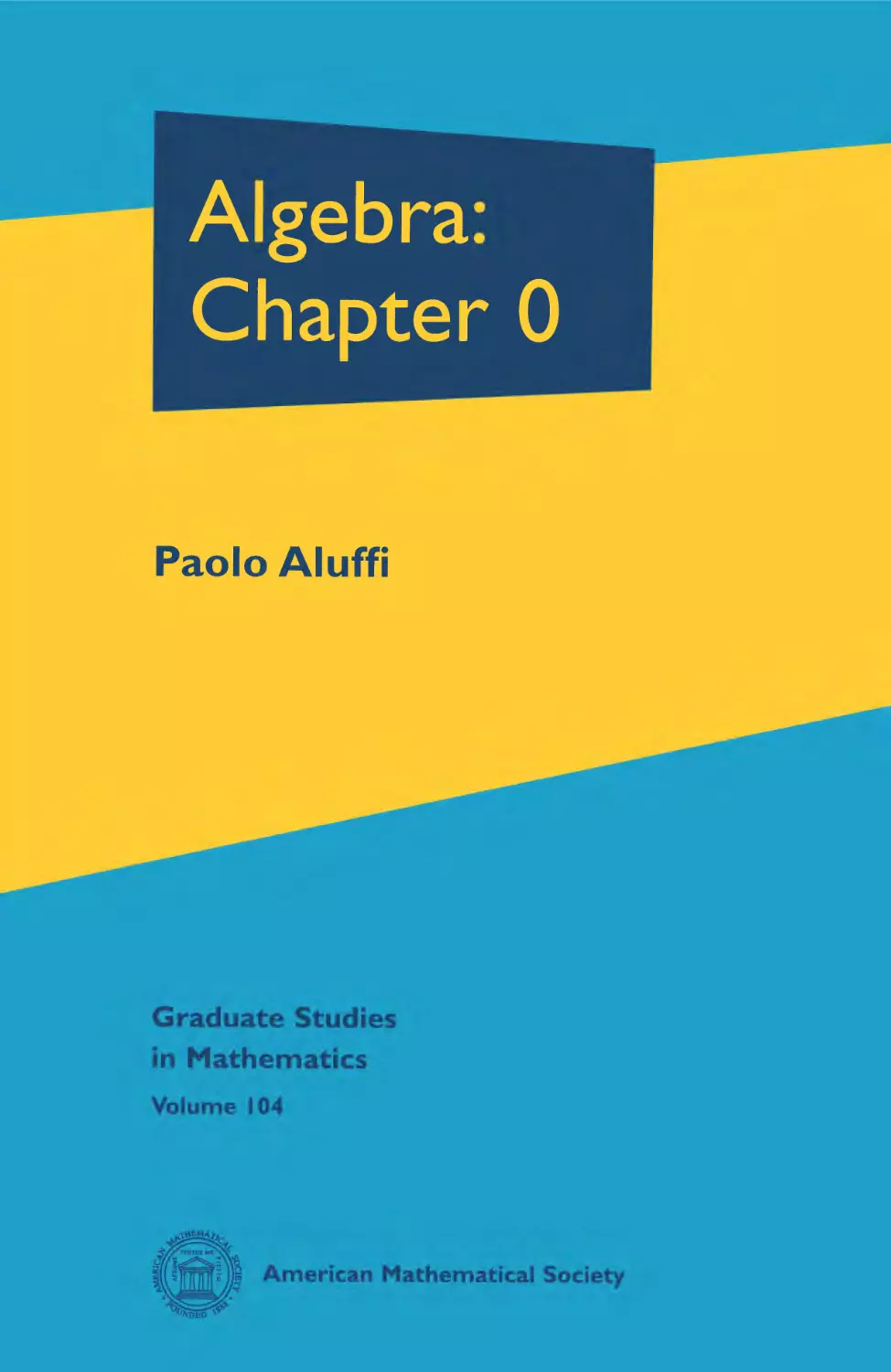
                    Algebra:
Chapter 0
Paolo Aluffi
Graduate Studies
in Mathematics
Volume 104
American Mathematical Society
Algebra:
Chapter 0

Algebra:
Chapter 0
Paolo Aluffi
Graduate Studies
in Mathematics
Volume 104
American Mathematical Society
Providence, Rhode Island
Editorial Board
David Cox (Chair)
Steven G. Krantz
Rafe Mazzeo
Martin Scharlemann
2000 Mathematics Subject Classification. Primary 00-01; Secondary 12-01, 13-01, 15-01,
18-01, 20-01.
For additional information and updates on this book, visit
www.ams.org/bookpages/gsm-104
Library of Congress Cataloging-in-Publication Data
Aluffi, Paolo, 1960-
Algebra: chapter 0 /Paolo Aluffi.
p. cm. — (Graduate studies in mathematics ; v. 104)
Includes index.
ISBN 978-0-8218-4781-7 (alk. paper)
1. Algebra—Textbooks. I. Title.
QA154.3.A527 2009
512—dc22	2009004043
Copying and reprinting. Individual readers of this publication, and nonprofit libraries
acting for them, are permitted to make fair use of the material, such as to copy a chapter for use
in teaching or research. Permission is granted to quote brief passages from this publication in
reviews, provided the customary acknowledgment of the source is given.
Republication, systematic copying, or multiple reproduction of any material in this publication
is permitted only under license from the American Mathematical Society. Requests for such
permission should be addressed to the Acquisitions Department, American Mathematical Society,
201 Charles Street, Providence, Rhode Island 02904-2294, USA. Requests can also be made by
e-mail to reprint-permission@ams.org.
© 2009 by the American Mathematical Society. All rights reserved.
The American Mathematical Society retains all rights
except those granted to the United States Government.
Printed in the United States of America.
@ The paper used in this book is acid-free and falls within the guidelines
established to ensure permanence and durability.
Visit the AMS home page at http://www.ams.org/
10 9 8 7 6 5 4 3 2 1	14 13 12 11 10 09
Contents
Introduction	xv
Chapter I.	Preliminaries: Set theory and categories	1
§1	. Naive set theory	1
1.1.	Sets	1
1.2.	Inclusion of sets	3
1.3.	Operations between sets	4
1.4.	Disjoint unions, products	5
1.5.	Equivalence relations, partitions,	quotients	6
Exercises	8
§2	. Functions between sets	8
2.1.	Definition	8
2.2.	Examples: Multisets, indexed sets	10
2.3.	Composition of functions	10
2.4.	Injections, surjections, bijections	11
2.5.	Injections, surjections, bijections:	Second viewpoint	12
2.6.	Monomorphisms and epimorphisms	13
2.7.	Basic examples	15
2.8.	Canonical decomposition	15
2.9.	Clarification	16
Exercises	17
§3	.	Categories	18
3.1.	Definition	18
3.2.	Examples	20
Exercises	26
§4	.	Morphisms	27
4.1.	Isomorphisms	27
4.2.	Monomorphisms and epimorphisms	29
v
vi	Contents
Exercises	30
§5	. Universal properties	31
5.1.	Initial and final objects	31
5.2.	Universal properties	33
5.3.	Quotients	33
5.4.	Products	35
5.5.	Coproducts	36
Exercises	38
Chapter II.	Groups, first encounter	41
§1	. Definition of group	41
1.1.	Groups and groupoids	41
1.2.	Definition	42
1.3.	Basic properties	43
1.4.	Cancellation	45
1.5.	Commutative groups	45
1.6.	Order	46
Exercises	48
§2	. Examples of groups	49
2.1.	Symmetric groups	49
2.2.	Dihedral groups	52
2.3.	Cyclic groups and modular arithmetic	54
Exercises	56
§3	. The category Grp	58
3.1.	Group homomorphisms	58
3.2.	Grp: Definition	59
3.3.	Pause for reflection	60
3.4.	Products et al.	61
3.5.	Abelian groups	62
Exercises	63
§4	. Group homomorphisms	64
4.1.	Examples	64
4.2.	Homomorphisms and order	66
4.3.	Isomorphisms	66
4.4.	Homomorphisms of abelian groups	68
Exercises	69
§5	. Free groups	70
5.1.	Motivation	7 0
5.2.	Universal property	71
5.3.	Concrete construction	72
5.4.	Free abelian groups	75
Exercises	78
§6	. Subgroups	79
6.1.	Definition	79
Contents	vii
6.2.	Examples: Kernel and image	80
6.3.	Example: Subgroup generated by	a subset	81
6.4.	Example: Subgroups of cyclic groups	82
6.5.	Monomorphisms	84
Exercises	85
§7	. Quotient groups	88
7.1.	Normal subgroups	88
7.2.	Quotient group	89
7.3.	Cosets	90
7.4.	Quotient by normal subgroups	92
7.5.	Example	94
7.6.	kernel normal	95
Exercises	95
§8	. Canonical decomposition and Lagrange’s theorem	96
8.1.	Canonical decomposition	97
8.2.	Presentations	99
8.3.	Subgroups of quotients	100
8.4.	HK/H vs. K/(H A K)	101
8.5.	The index and Lagrange’s theorem	102
8.6.	Epimorphisms and cokernels	104
Exercises	105
§9	. Group actions	108
9.1.	Actions	108
9.2.	Actions on sets	109
9.3.	Transitive actions and the category G-Set	110
Exercises	113
§10	.	Group objects in categories	115
10.1.	Categorical viewpoint	115
Exercises	117
Chapter III.	Rings and modules	119
§	1. Definition of ring	119
1.1.	Definition	119
1.2.	First examples and special classes	of rings	121
1.3.	Polynomial rings	124
1.4.	Monoid rings	126
Exercises	127
§2	. The category Ring	129
2.1.	Ring homomorphisms	129
2.2.	Universal property of polynomial rings	130
2.3.	Monomorphisms and epimorphisms	132
2.4.	Products	133
2.5.	EndAb(G)	134
Exercises	136
viii
Contents
§3	. Ideals and quotient rings	138
3.1.	Ideals	138
3.2.	Quotients	139
3.3.	Canonical	decomposition and consequences	141
Exercises	143
§4	. Ideals and quotients: Remarks and examples. Prime and maximal
ideals	144
4.1.	Basic operations	144
4.2.	Quotients of polynomial rings	146
4.3.	Prime and maximal ideals	150
Exercises	153
§5	. Modules over a ring	156
5.1.	Definition of (left-)R-module	156
5.2.	The category R-Mod	158
5.3.	Submodules and quotients	160
5.4.	Canonical decomposition and isomorphism theorems	162
Exercises	163
§6	. Products, coproducts, etc., in R-Mod	164
6.1.	Products and coproducts	164
6.2.	Kernels and cokernels	166
6.3.	Free modules and free algebras	167
6.4.	Submodule generated by a subset; Noetherian modules	169
6.5.	Finitely generated vs. finite type	171
Exercises	172
§7	. Complexes and homology	174
7.1.	Complexes and exact sequences	174
7.2.	Split exact sequences	177
7.3.	Homology and the snake lemma	178
Exercises	183
Chapter IV.	Groups, second encounter	187
§1	. The conjugation action	187
1.1.	Actions of groups on sets, reminder	187
1.2.	Center, centralizer, conjugacy classes	189
1.3.	The Class Formula	190
1.4.	Conjugation of subsets and subgroups	191
Exercises	193
§2	. The Sylow theorems	194
2.1.	Cauchy’s theorem	194
2.2.	Sylow I	196
2.3.	Sylow II	197
2.4.	Sylow III	199
2.5.	Applications	200
Exercises	202
Contents	ix
§3	.	Composition series and solvability	205
3.1.	The Jordan-Holder theorem	205
3.2.	Composition factors; Schreier’s theorem	207
3.3.	The commutator subgroup, derived series, and solvability	210
Exercises	213
§4	.	The symmetric group	214
4.1.	Cycle notation	214
4.2.	Type and conjugacy classes in Sn	216
4.3.	Transpositions, parity, and the alternating group	219
4.4.	Conjugacy in An; simplicity of An and solvability of Sn	220
Exercises	224
§5	. Products of groups	226
5.1.	The direct product	226
5.2.	Exact sequences of groups; extension problem	228
5.3.	Internal/semidirect products	230
Exercises	233
§6	. Finite abelian groups	234
6.1.	Classification of finite abelian groups	234
6.2.	Invariant factors and elementary divisors	237
6.3.	Application: Finite subgroups of multiplicative groups of fields 239
Exercises	240
Chapter V.	Irreducibility and factorization in integral domains	243
§1	. Chain conditions and existence of factorizations	244
1.1.	Noetherian rings revisited	244
1.2.	Prime and irreducible elements	246
1.3.	Factorization into irreducibles; domains with factorizations	248
Exercises	249
§2	. UFDs, PIDs, Euclidean domains	251
2.1.	Irreducible factors and greatest common divisor	251
2.2.	Characterization of UFDs	253
2.3.	PID => UFD	254
2.4.	Euclidean domain => PID	255
Exercises	258
§3	. Intermezzo: Zorn’s lemma	261
3.1.	Set theory, reprise	261
3.2.	Application: Existence of maximal ideals	264
Exercises	265
§4	. Unique factorization in polynomial rings	267
4.1.	Primitivity and content; Gauss’s lemma	268
4.2.	The field of fractions of an integral domain	270
4.3.	R UFD => R[x] UFD	273
Exercises	276
X
Contents
§5	. Irreducibility of polynomials	280
5.1.	Roots and reducibility	281
5.2.	Adding roots; algebraically closed fields	283
5.3.	Irreducibility in C[rc], R[rc],	285
5.4.	Eisenstein’s criterion	288
Exercises	289
§6	. Further remarks and examples	291
6.1.	Chinese remainder theorem	291
6.2.	Gaussian integers	294
6.3.	Fermat’s theorem on sums of squares	298
Exercises	300
Chapter VI.	Linear algebra	305
§1	. Free modules revisited	305
1.1.	R-Mod	305
1.2.	Linear independence and bases	306
1.3.	Vector spaces	308
1.4.	Recovering В from FR(B)	309
Exercises	312
§2	. Homomorphisms of free modules,	I	314
2.1.	Matrices	314
2.2.	Change of basis	318
2.3.	Elementary operations and Gaussian elimination	320
2.4.	Gaussian elimination over Euclidean domains	323
Exercises	324
§3	. Homomorphisms of free modules,	II	327
3.1.	Solving systems of linear equations	327
3.2.	The determinant	328
3.3.	Rank and nullity	333
3.4.	Euler characteristic and the Grothendieck	group	334
Exercises	338
§4	. Presentations and resolutions	340
4.1.	Torsion	340
4.2.	Finitely presented modules and free resolutions	341
4.3.	Reading a presentation	344
Exercises	347
§5	. Classification of finitely generated	modules over PIDs	349
5.1.	Submodules of free modules	350
5.2.	PIDs and resolutions	353
5.3.	The classification theorem	354
Exercises	357
§6	. Linear transformations of a free module	359
6.1.	Endomorphisms and similarity	359
6.2.	The characteristic and minimal polynomials	of an endomorphism	361
Contents	xi
6.3.	Eigenvalues, eigenvectors, eigenspaces	365
Exercises	368
§7	. Canonical forms	371
7.1.	Linear transformations of free modules;	actions of polynomial rings 371
7.2.	A;[t]-modules and the rational canonical	form	373
7.3.	Jordan canonical form	377
7.4.	Diagonalizability	380
Exercises	381
Chapter VII.	Fields	385
§1	. Field extensions, I	385
1.1.	Basic definitions	385
1.2.	Simple extensions	387
1.3.	Finite and algebraic extensions	391
Exercises	397
§2	. Algebraic closure, Nullstellensatz, and a little algebraic geometry	400
2.1.	Algebraic closure	400
2.2.	The Nullstellensatz	404
2.3.	A little affine algebraic geometry	406
Exercises	414
§3	. Geometric impossibilities	417
3.1.	Constructions by straightedge and compass	417
3.2.	Constructible numbers and quadratic extensions	422
3.3.	Famous impossibilities	425
Exercises	427
§4	. Field extensions, II	428
4.1.	Splitting fields and normal extensions	429
4.2.	Separable polynomials	433
4.3.	Separable extensions and embeddings in algebraic closures	436
Exercises	438
§5	. Field extensions, III	440
5.1.	Finite fields	441
5.2.	Cyclotomic polynomials and fields	445
5.3.	Separability and simple extensions	449
Exercises	452
§6	. A little Galois theory	454
6.1.	The Galois correspondence and Galois extensions	454
6.2.	The fundamental theorem of Galois theory,	I	459
6.3.	The fundamental theorem of Galois theory,	II	461
6.4.	Further remarks and examples	464
Exercises	466
§7	. Short march through applications of Galois theory	468
7.1.	Fundamental theorem of algebra	468
xii	Contents
7.2.	Constructibility of regular n-gons	469
7.3.	Fundamental theorem on symmetric functions	471
7.4.	Solvability of polynomial equations by radicals	474
7.5.	Galois groups of polynomials	478
7.6.	Abelian groups as Galois groups over Q	479
Exercises	480
Chapter VIII.	Linear algebra, reprise	483
§1	. Preliminaries, reprise	483
1.1.	Functors	483
1.2.	Examples of functors	485
1.3.	When are two categories ‘equivalent’?	487
1.4.	Limits and colimits	489
1.5.	Comparing functors	492
Exercises	496
§2	. Tensor products and the Tor functors	500
2.1.	Bilinear maps and the definition of tensor product	501
2.2.	Adjunction with Hom and explicit computations	504
2.3.	Exactness properties of tensor; flatness	507
2.4.	The Tor functors.	509
Exercises	511
§3	. Base change	515
3.1.	Balanced maps	515
3.2.	Bimodules; adjunction again	517
3.3.	Restriction and extension of scalars	518
Exercises	520
§4	. Multilinear algebra	522
4.1.	Multilinear, symmetric, alternating maps	522
4.2.	Symmetric and exterior powers	524
4.3.	Very small detour: Graded algebra	527
4.4.	Tensor algebras	529
Exercises	532
§5	. Hom and duals	535
5.1.	Adjunction again	536
5.2.	Dual modules	537
5.3.	Duals of free modules	538
5.4.	Duality and exactness	539
5.5.	Duals and matrices; biduality	541
5.6.	Duality on vector spaces	542
Exercises	543
§6	. Projective and injective modules and the	Ext	functors	545
6.1.	Projectives and injectives	546
6.2..	Projective modules	547
6.3.	Injective modules	548
Contents	xiii
6.4.	The Ext functors	551
6.5.	Ext^(G,Z)	554
Exercises	555
Chapter IX. Homological algebra	559
§1	. (Un)necessary categorical preliminaries	560
1.1.	Undesirable features of otherwise reasonable categories	560
1.2.	Additive categories	561
1.3.	Abelian categories	564
1.4.	Products, coproducts, and direct sums	567
1.5.	Images; canonical decomposition of morphisms	570
Exercises	574
§2	. Working in abelian categories	576
2.1.	Exactness in abelian categories	576
2.2.	The snake lemma, again	578
2.3.	Working with ‘elements’ in a small abelian category	581
2.4.	What is missing?	587
Exercises	589
§3	. Complexes and homology, again	591
3.1.	Reminder of basic definitions; general strategy	591
3.2.	The category of complexes	594
3.3.	The long exact cohomology sequence	597
3.4.	Triangles	600
Exercises	602
§4	. Cones and homotopies	605
4.1.	The mapping cone of a morphism	605
4.2.	Quasi-isomorphisms and derived categories	607
4.3.	Homotopy	611
Exercises	614
§5	. The homotopic category Complexes of projectives and injectives	616
5.1.	Homotopic maps are identified in the derived category	616
5.2.	Definition of the homotopic category of complexes	618
5.3.	Complexes of projective and injective objects	619
5.4.	Homotopy equivalences vs. quasi-isomorphisms in К (A)	620
5.5.	Proof of Theorem 5.9	624
Exercises	626
§6	. Projective and injective resolutions and the derived category	628
6.1.	Recovering A	629
6.2.	From objects to complexes	631
6.3.	Poor man’s derived category	635
Exercises	638
§7	. Derived functors	641
7.1.	Viewpoint shift	641
7.2.	Universal property of the derived functor	643
xiv
Contents
7.3.	Taking cohomology	645
7.4.	Long exact sequence of derived functors	647
7.5.	Relating LitF,	653
7.6.	Example: A little group cohomology	655
Exercises	658
§8	. Double complexes	661
8.1.	Resolution by acyclic objects	662
8.2.	Complexes of complexes	665
8.3.	Exactness of the total complex	670
8.4.	Total complexes and resolutions	672
8.5.	Acyclic resolutions again and balancing Tor and Ext	675
Exercises	677
§9	. Further topics	680
9.1.	Derived categories	681
9.2.	Triangulated categories	683
9.3.	Spectral sequences	686
Exercises	695
Index	699
Introduction
This text presents an introduction to algebra suitable for upper-level undergraduate
or beginning graduate courses. While there is a very extensive offering of textbooks
at this level, in my experience teaching this material I have invariably felt the
need for a self-contained text that would start ‘from zero’ (in the sense of not
assuming that the reader has had substantial previous exposure to the subject) but
that would impart from the very beginning a rather modern, categorically minded
viewpoint and aim at reaching a good level of depth. Many textbooks in algebra
brilliantly satisfy some, but not all, of these requirements. This book is my attempt
at providing a working alternative.
There is a widespread perception that categories should be avoided at first
blush, that the abstract language of categories should not be introduced until a
student has toiled for a few semesters through example-driven illustrations of the
nature of a subject like algebra. According to this viewpoint, categories are only
tangentially relevant to the main topics covered in a beginning course, so they can
simply be mentioned occasionally for the general edification of the reader, who will
in time learn about them (by osmosis?). Paraphrasing a reviewer of a draft of the
present text, ‘Discussions of categories at this level are the reason why God created
appendices.’
It will be clear from a cursory glance at the table of contents that I think
otherwise. In this text, categories are introduced on page 18, after a scant reminder
of the basic language of naive set theory, for the main purpose of providing a context
for universal properties. These are in turn evoked constantly as basic definitions
are introduced. The word ‘universal’ appears at least 100 times in the first three
chapters.
I believe that awareness of the categorical language, and especially some ap-
preciation of universal properties, is particularly helpful in approaching a subject
such as algebra ‘from the beginning’. The reader I have in mind is someone who
has reached a certain level of mathematical maturity—for example, who needs no
xv
xvi
Introduction
special assistance in grasping an induction argument—but may have only been ex-
posed to algebra in a very cursory manner. My experience is that many upper-level
undergraduates or beginning graduate students at Florida State University and at
comparable institutions fit this description. For these students, seeing the many in-
troductory concepts in algebra as instances of a few powerful ideas (encapsulated in
suitable universal properties) helps to build a comforting unifying context for these
notions. The amount of categorical language needed for this catalyzing function
is very limited; for example, functors are not really necessary in this acclimatizing
stage.
Thus, in my mind the benefit of this approach is precisely that it helps a true
beginner, if it is applied with due care. This is my experience in the classroom,
and it is the main characteristic feature of this text. The very little categorical
language introduced at the outset informs the first part of the book, introducing
in general terms groups, rings, and modules. This is followed by a (rather tradi-
tional) treatment of standard topics such as Sylow theorems, unique factorization,
elementary linear algebra, and field theory The last third of the book wades into
somewhat deeper waters, dealing with tensor products and Hom (including a first
introduction to Tor and Ext) and including a final chapter devoted to homological
algebra. Some familiarity with categorical language appears indispensable to me
in order to appreciate this latter material, and this is hopefully uncontroversial.
Having developed a feel for this language in the earlier parts of the book, students
find the transition into these more advanced topics particularly smooth.
A first version of this book was essentially a careful transcript of my lectures in
a run of the (three-semester) algebra sequence at FSU. The chapter on homological
algebra was added at the instigation of Ed Dunne, as were a very substantial number
of the exercises. The main body of the text has remained very close to the original
Transcript’ version: I have resisted the temptation of expanding the material when
revising it for publication. I believe that an effective introductory textbook (this
is Chapter 0, after all...) should be realistic: it must be possible to cover in class
what is covered in the book. Otherwise, the book veers into the ‘reference’ category;
I never meant to write a reference book in algebra, and it would be futile (of me)
to try to ameliorate excellent available references such as Lang’s ‘Algebra’.
The problem sets will give an opportunity to a teacher, or any motivated reader,
to get quite a bit beyond what is covered in the main text. To guide in the choice of
exercises, I have marked with a > those problems that are directly referenced from
the text, and with a -« those problems that are referenced from other problems. A
minimalist teacher may simply assign all and only the > problems; these do nothing
more than anchor the understanding by practice and may be all that a student
can realistically be expected to work out while juggling TA duties and two or three
other courses of similar intensity as this one. The main body of the text, together
with these exercises, forms a self-contained presentation of essential material. The
other exercises, and especially the threads traced by those marked with will offer
the opportunity to cover other topics, which some may well consider just as essen-
tial: the modular group, quaternions, nilpotent groups, Artinian rings, the Jacob-
son radical, localization, Lagrange’s theorem on four squares, projective space and
Introduction
xvii
Grassmannians, Nakayama’s lemma, associated primes, the spectral theorem for
normal operators, etc., are some examples of topics that make their appearance in
the exercises. Often a topic is presented over the course of several exercises, placed
in appropriate sections of the book. For example, ‘Wedderburn’s little theorem’
is mentioned in Remark III. 1.16 (that is: Remark 1.16 in Chapter III); particular
cases are presented in Exercises III.2.11 and IV.2.17, and the reader eventually ob-
tains a proof in Exercise VII.5.14, following preliminaries given in Exercises VII.5.12
and VII.5.13. The label and perusal of the index should facilitate the navigation
of such topics. To help further in this process, I have decorated every exercise with
a list (added in square brackets) of the places in the book that refer to it. For
example, an instructor evaluating whether to assign Exercise V.2.25 will be imme-
diately aware that this exercise is quoted in Exercise VII.5.18, proving a particular
case of Dirchlet’s theorem on primes in arithmetic progressions, and that this will
in turn be quoted in §VII.7.6, discussing the realization of abelian groups as Galois
groups over Q.
I have put a high priority on the requirement that this should be a self-contained
text which essentially crosses all t’s and dots all i’s, and does not require that the
reader have access to other texts while working through it. I have therefore made
a conscious effort to not quote other references: I have avoided as much as possible
the exquisitely tempting escape route ‘For a proof, see ....’ This is the main reason
why this book is as thick as it is, even if so many topics are not covered in it. Among
these, commutative algebra and representation theory are perhaps the most glaring
omissions. The first is represented to the extent of the standard basic definitions,
which allow me to sprinkle a little algebraic geometry here and there (for example,
see §VII.2), and of a few slightly more advanced topics in the exercises, but I stopped
short of covering, e.g., primary decompositions. The second is missing altogether.
It is my hope to complement this book with a ‘Chapter 1’ in an undetermined
future, where I will make amends for these and other shortcomings.
By its nature, this book should be quite suitable for self-study: readers working
on their own will find here a self-contained starting point which should work well
as a prelude to future, more intensive, explorations. Such readers may be helped
by the following ‘9-fold way’ diagram of logical interdependence of the chapters:
xviii
Introduction
This may however better reflect my original intention than the final product. For a
more objective gauge, this alternative diagram captures the web of references from
a chapter to earlier chapters, with the thickness of the lines representing (roughly)
the number of references:
With the self-studying reader especially in mind, I have put extra effort into
providing an extensive index. It is not realistic to make a fanfare for each and every
new term introduced in a text of this size by an official ‘definition’; the index should
help a lone traveler find the way back to the source of unfamiliar terminology
Internal references are handled in a hopefully transparent way For example,
Remark III. 1.16 refers to Remark 1.16 in Chapter III; if the reference is made from
within Chapter III, the same item is called Remark 1.16. The list in brackets
following an exercise indicates other exercises or sections in the book referring to
that exercise. For example, Exercise 3.1 in Chapter I is followed by [5.1, §VIII. 1.1,
§IX.1.2, IX. 1.10]: this alerts the reader that there are references to this problem in
Exercise 5.1 in Chapter I, section 1.1 in Chapter VIII, section 1.2 in Chapter IX,
and Exercise 1.10 in Chapter IX (and nowhere else).
Acknowledgments. My debt to Lang’s book, to David Dummit and Richard
Foote’s ‘Abstract Algebra,’ or to Artin’s ‘Algebra’ will be evident to anyone who
is familiar with these sources. The chapter on homological algebra owes much to
David Eisenbud’s appendix on the topic in his ‘Commutative Algebra’, to Gelfand-
Manin’s ‘Methods of homological algebra’, and to Weibel’s ‘An introduction to
homological algebra’. But in most cases it would simply be impossible for me to
retrace the original source of an expository idea, of a proof, of an exercise, or of
a specific pedagogical emphasis: these are all likely offsprings of ideas from any
one of these and other influential references and often of associations triggered by
following the manifold strands of the World Wide Web. This is another reason
why, in a spirit of equanimity, I resolved to essentially avoid references altogether.
In any case, I believe all the material I have presented here is standard, and I only
retain absolute ownership of every error left in the end product.
Introduction
xix
I am very grateful to my students for the constant feedback that led me to
write this book in this particular way and who contributed essentially to its success
in my classes. Some of the students provided me with extensive lists of typos and
outright mistakes, and I would especially like to thank Kevin Meek, Jay Stryker,
and Yong Jae Cha for their particularly helpful comments. I had the opportunity
to try out the material on homological algebra in a course given at Caltech in the
fall of 2008, while on a sabbatical from FSU, and I would like to thank Caltech
and the audience of the course for their hospitality and the friendly atmosphere.
Thanks are also due to MSRI for hospitality during the winter of 2009, when the
last fine-tuning of the text was performed.
A few people spotted big and small mistakes in preliminary versions of this
book, and I will mention Georges Elencwajg, Xia Liao, and Mirroslav Yotov for
particularly precious contributions. I also commend Arlene O’Sean and the staff at
the AMS for the excellent copyediting and production work.
Special thanks go to Ettore Aldrovandi for expert advice, to Matilde Marcolli
for her encouragement and indispensable help, and to Ed Dunne for suggestions
that had a great impact in shaping the final version of this book.
Support from the Max-Planck-Institut in Bonn, from the NS A, and from Cal-
tech, at different stages of the preparation of this book, is gratefully acknowledged.

Chapter I
Preliminaries: Set theory
and categories
Set theory is a mathematical field in itself, and its proper treatment (say via the
famous ‘Zermelo-Frankel’ axioms) goes well beyond the scope of this book and the
competence of this writer. We will only deal with so-called ‘naive’ set theory, which
is little more than a system of notation and terminology enabling us to express
precisely mathematical definitions, statements, and their proofs.
Familiarity with this language is essential in approaching a subject such as
algebra, and indeed the reader is assumed to have been previously exposed to it.
In this chapter we first review some of the language of naive set theory, mainly in
order to establish the notation we will use in the rest of the book. We will then
get a small taste of the language of categories, which plays a powerful unifying role
in algebra and many other fields. Our main objective is to convey the notion of
‘universal property’, which will be a constant refrain throughout this book.
1.	Naive set theory
1.1.	Sets. The notion of set formalizes the intuitive idea of ‘collection of objects’.
A set is determined by the elements it contains: two sets A, В are equal (written
A = B) if and only if they contain precisely the same elements. ‘What is an ele-
ment?1 is a forbidden question in naive set theory: the buck must stop somewhere.
We can conveniently pretend that a ‘universe’ of elements is available to us, and
we draw from this universe to construct the elements and sets we need, implicitly
assuming that all the operations we will explore can be performed within this uni-
verse. (This is the tricky point!) In any case, we specify a set by giving a precise
recipe determining which elements are in it. This definition is usually put between
braces and may consist of a simple, complete, list of elements:
A -= {1,2,3}
1
2
I. Preliminaries: Set theory and categories
is1 the set consisting of the integers 1, 2, and 3. By convention, the order2 in which
the elements are listed, or repetitions in the list, are immaterial to the definition.
Thus, the same set may be written out in many ways:
{1,2,3} = {1,3, 2} = {1,2,1,3,3, 2,3,1,1, 2,1,3}.
This way of denoting sets may be quite cumbersome and in any case will only really
work for finite sets. For infinite sets, a popular way around this problem is to write
a list in which some of the elements are understood as being part of a pattern—for
example, the set of even integers may be written
E = {••• , —2,0,2,4,6, • • },
but such a definition is inherently ambiguous, so this leaves room for misinterpre-
tation. Further, some sets are simply Too big’ to be listed, even in principle: for
example (as one hopefully learns in advanced calculus) there are simply too many
real numbers to be able to ‘list’ them as one may ‘list’ the integers.
It is often better to adopt definitions that express the elements of a set as
elements s of some larger (and already known) set S, satisfying some property P.
One may then write
A = {s e S | s satisfies P}
(G means element of...) and this is in general precise and unambiguous3.
We will occasionally encounter a variation on the notion of set, called ‘multiset’.
A multiset is a set in which the elements are allowed to appear ‘with multiplicity’:
that is, a notion for which {2,2} would be distinct from {2}. The correct way to
define a multiset is by means of functions, which we will encounter soon (see Ex-
ample 2.2).
A few famous sets are
•	0: the empty set, containing no elements;
•	N: the set of natural numbers (that is, nonnegative integers);
•	Z: the set of integers;
•	Q: the set of rational numbers;
•	R: the set of real numbers;
•	C: the set of complex numbers.
Also, the term singleton is used to refer to any set consisting of precisely one
element. Thus {1}, {2}, {3} are different sets, but they are all singletons.
Here are a few useful symbols (called quantifiers):
•	3 means there exists... (the existential quantifier);
is a notation often used to mean that the symbol on the left-hand side is defined by
whatever is on the right-hand side. Logically, this is just expressing the equality of the two
sides and could just as well be written c=’; the extra : is a psychologically convenient decoration
inherited from computer science.
% Ordered lists are denoted with round parentheses: (1, 2, 3) is not the same as (1,3, 2).
3But note that there exist pathologies such as Russell’s paradox, showing that even this style
of definitions can lead to nonsense. All is well so long as S is indeed known to be a set to begin
with.
1. Naive set theory
3
•	V means for all... (the universal quantifier).
Also, 3! is used to mean there exists a unique...
For example, the set of even integers may be written as
E — {a e Z | (Bn e Z) a = 2n} :
in words, “all integers a such that there exists an integer n for which a = 2n”. In
this case we could replace 3 by 3! without changing the set—but that has to do
with properties of Z, not with mathematical syntax. Also, it is common to adopt
the shorthand
E = {2n | n e Z},
in which the existential quantifier is understood.
Being able to parse such strings of symbols effortlessly, and being able to write
them out fluently, is extremely important. The reader of this book is assumed to
have already acquired this skill.
Note that the order in which things are written may make a big difference. For
example, the statement
(Va e Z) (36 e Z) b = 2a
is true: it says that the result of doubling an arbitrary integer yields an integer;
but
(36 e Z) (Va e Z) b = 2a
is false: it says that there exists a fixed integer b which is ‘simultaneously’ twice as
much as every integer—there is no such thing.
Note also that writing simply
b = 2a
by itself does not convey enough information, unless the context makes it completely
clear what quantifiers are attached to a and b: indeed, as we have just seen, different
quantifiers may make this into a true or a false statement.
1.2.	Inclusion of sets. As mentioned above, two sets are equal if and only if
they contain the same elements. We say that a set S is a subset of a set T if every
element of S is an element of T, in symbols,
SGT.
By convention, S CT means the same thing: that is (unlike < vs. <), it does not
exclude the possibility that S and T may be equal. To avoid any confusion, we will
consistently use C in this book. One adopts S С T to mean that S is ‘properly’
contained in T: that is, S С T and S ^T.
We can think of ‘inclusion of sets’ in terms of logic: SGT means that
s G S => s eT
(the quantifier Vs is understood); that is, ‘if s is an element of S, then s is an element
of T”; that is, all elements of S are elements of T; that is, S G T as promised.
Note that for all sets S', 0 C S' and S C S.
If S С T and T G S, then S = T.
4
I. Preliminaries: Set theory and. categories
The symbol |S| denotes the number of elements of S', if this number is finite;
otherwise, one writes |S| = oo. If S and T are finite, then
SCT => |S| < \T\.
The subsets of a set S form a set, called the power set, or the set of parts
of S. For example, the power set of the empty set 0 consists of one element:
{0}. The power set of S is denoted ^(S); a popular alternative is 2s, and indeed
|^(S)| = 21^1 if S is finite (cf. Exercise 2.11).
1.3.	Operations between sets. Once we have a few sets to play with, we can
obtain more by applying certain standard operations. Here are a few:
•	U: the union;
•	П: the intersection;
•	\: the difference;
•	П: the disjoint union;
•	x: the (Cartesian) product;
•	and the important notion of ‘quotient by an equivalence relation’.
Most of these operations should be familiar to the reader: for example,
{1,2,4} U {3,4,5} = {1,2,3,4,5}
while
{1,2,4} \ {3,4, 5} = {1,2}.
In terms of Venn diagrams of infamous ‘new math’ memory:
SUT	SnT	S\T
(the solid black contour indicates the set included in the operation).
Several of these operations may be written out in a transparent way in terms
of logic: thus, for example,
s G S n T (s e S' and 5 e T).
Two sets S and T are disjoint if S П T = 0, that is, if no element is ‘simulta-
neously’ in both of them.
The complement of a subset T in a set S is the difference set S \ T consisting
of all elements of S which are not in T. Thus, for example, the complement of the
set of even integers in Z is the set of odd integers.
The operations П, x, and quotients by equivalence relations are slightly more
mysterious, and it is very instructive to contemplate them carefully. We will look
1. Naive set theory
5
at them in a particularly naive way first and come back to them in a short while
when we have acquired more language and can view them from a more sophisticated
viewpoint.
1.4.	Disjoint unions, products. One problem with these operations is that their
output may not be defined as a set, but rather as a set up to isomorphisms of sets,
that is, up to bijections. To make sense out of this, we have to talk about functions,
and we will do that in a moment.
Roughly speaking, the disjoint union of two sets S and T is a set SIIT obtained
by first producing ‘copies’ S' and T' of the sets S and T, with the property that
S' П T' = 0, and then taking the (ordinary) union of S' and T'. The careful reader
will feel uneasy, since this ‘recipe’ does not define one set: whatever it means to
produce a ‘copy’ of a set, surely there are many ways to do so. This ambiguity will
be clarified below.
Nevertheless, note that we can say something about SIIT even on these very
shaky grounds: for example, if S consists of 3 elements and T consists of 4 elements,
the reader should expect (correctly) that SIIT consists of 7 elements.
Products are marred by the same kind of ambiguity, but fortunately there is
a convenient convention that allows us to write down ‘one’ set representing the
product of two sets S and T: given S and T, we let S x T be the set whose
elements are the ordered pairs4 (s,t) of elements of S and T:
SxT:= {($, t) such that s e S, t e T}.
Thus, if S = {1,2,3} and T = {3,4}, then
S x T = {(1,3), (1,4), (2,3), (2,4), (3,3), (3,4)}.
For a more sophisticated example, R x R is the set of pairs of real numbers, which
(as we learn in calculus) is a good way to represent a plane. The set Z x Z could
be represented by considering the points in this plane that happen to have integer
coordinates. Incidentally, it is common to denote these sets R2, Z2; and similarly,
the product A x A of a set by itself is often denoted A2.
If S and T are finite sets, clearly |S x T\ = |S| \T\.
Also note that we can use products to obtain explicit ‘copies’ of sets as needed
for the disjoint union: for example, we could let S' = {0} x S, T' = {1} x T,
guaranteeing that S' and T' are disjoint (why?); and there is an evident way to
‘identify’ S and S', T and T'. Again, making this precise requires a little more
vocabulary
The operations U, П, П, x extend to operations on whole ‘families’ of sets: for
example, if Si,..., Sn are sets, we write
n
Pl Si = Si n s2 n • • • n sn
i=l
^One can define the ordered pair (s,t) as a set by setting (s,t) = {s, {s, t}}: this carries the
information of the elements s, t, as well as conveying the fact that s is special (= the first element
of the pair).
6
I. Preliminaries: Set theory and categories
for the set whose elements are those elements which are simultaneously elements of
all sets Si,..., Sn; and similarly for the other operations. But note that while it is
clear from the definitions that, for example,
Si U S2 U S3 = (Si U S2) U S3 = Si U (S2 U S3),
it is not so clear in what sense the sets
Si x S2 x S3, (Si x S2) x S3, Si x (S2 x S3)
should be ‘identified’ (where we can define the leftmost set as the set of ‘ordered
triples’ of elements of Si, S2, S3, by analogy with the definition for two sets). In
fact, again, we can really make sense of such statements only after we acquire the
language of functions. However, all such statements do turn out to be true, as
the reader probably expects; by virtue of this fortunate circumstance, we can be
somewhat cavalier and gloss over such subtleties.
More generally, if У is a set of sets, we may consider sets
Us As IIs. ns,
se^ se^ sey
for the union, intersection, disjoint union, product of all sets in У. There are
important subtleties concerning these definitions: for example, if all S E У are
nonempty, does it follow that	nonempty? The reader probably thinks
so, but (if У is infinite) this is a rather thorny issue, amounting to the axiom of
choice.
By and large, such subtleties do not affect the material in this course; we will
partly come to terms with them in due time5, when they become more relevant to
the issues at hand (cf. §V.3).
1.5.	Equivalence relations, partitions, quotients. Intuitively, a relation on
elements of a set S is some special affinity among selections of elements of S. For
example, the relation < on the set Z is a way to compare the size of two integers:
since 2 < 5, 2 ‘is related to’ 5 in this sense, while 5 is not related to 2 in the same
sense.
For all practical purposes, what a relation ‘means’ is completely captured by
which elements are related to which elements in the set. We would really know all
there is to know about < on Z if we had a complete list of all pairs (a, b) of integers
such that a < b. For example, (2,5) is such a pair, while (5,2) is not.
This leads to a completely straightforward definition of the notion of relation:
a relation on a set S is simply a subset R of the product S x S. If (a, 6) G R, we
say that a and b are ‘related by 7?’ and write
aRb.
Often we use fancier symbols for relations, such as <, <, =,	....
5The reader will have to employ the axiom of choice in some exercises every now and then,
even before we come back to these issues, but this will probably happen below the awareness level,
and so it should.
1. Naive set theory
7
The prototype of a well-behaved relation is ‘=’, which corresponds to the ‘di-
agonal’
{(a, 6) e Sx S\a = b} = {(a,a)\ae S} CSxS.
Three properties of this very special relation turn out to be particularly important:
if ~ denotes for a moment the relation = of equality, then ~ satisfies
•	reflexivity: (Va e S) a ~ a\
•	symmetry: (Va e S') (\/b e S) a ~ b => b ~ a\
•	transitivity: (Va e S) (Vb e S) (Vc e S'), (a ~ b and b ~ c) => a ~ c.
That is, every a is equal to itself; if a is equal to b, then b is equal to a; etc.
Definition 1.1. An equivalence relation on a set S is any relation ~ satisfying
these three properties.	□
In terms of the corresponding subset R of S x S, ‘reflexivity’ says that the
diagonal is contained in R; ‘symmetry’ says that R is unchanged if flipped about
the diagonal (that is, if every (a, b) is interchanged with (b, a)); while unfortunately
‘transitivity’ does not have a similarly nice pictorial translation.
The datum of an equivalence relation on S turns out to be equivalent to a type
of information which looks a little different at first, that is, a partition of S. A
partition of S is a family of disjoint nonempty subsets of S, whose union is S: for
example,
= {{1,4,7}, {2,5,8}, {3,6}, {9}}
is a partition of the set
{1,2,3,4,5,6,7,8,9}.
Here is how to get a partition of S from a relation ~ on S: for every element
a e S, the equivalence class of a (w.r.t. is the subset of S defined by
[a]~ := {b e S | b ~ a};
then the equivalence classes form a partition of S (Exercise 1.2).
Conversely (Exercise 1.3) every partition is the partition corresponding in
this fashion to an equivalence relation. Therefore, the notions of ‘equivalence rela-
tion on S’ and ‘partition of S’ are really equivalent.
Now we can view as a set (whose elements are the equivalence classes with
respect to ~). This is the quotient operation mentioned in §1.3.
Definition 1.2. The quotient of the set S with respect to the equivalence relation ~
is the set
S/~ :=
of equivalence classes of elements of S with respect to	j
Example 1.3. Take S = Z, and let ~ be the relation defined by
a ~ b <=> a — b is even.
Then Z/~ consists of two equivalence classes:
z/~ = {[o]~,[i]~}.
8
I. Preliminaries: Set theory and categories
Indeed, every integer b is either even (and hence b—0 is even, so b ~ 0, and be [0]~)
or odd (and hence b—1 is even, so b ~ 1, and b G [1]~). This is of course the starting
point of modular arithmetic, which we will cover in due detail later on (§11.2.3). j
One way to think about this operation is that the equivalence relation ‘becomes
equality in the quotient’: that is, two elements of the quotient S/~ are equal if and
only if the corresponding elements in S are related by In other words, taking a
quotient is a way to turn any equivalence relation into an equality. This observation
will be further formalized in ‘categorical terms’ in a short while (§5.3).
Exercises
Exercises marked with a > are referred to from the text; exercises marked with a
-i are referred to from other exercises. These referring exercises and sections are
listed in brackets following the current exercise; see the introduction for further
clarifications, if necessary
1.1.	Locate a discussion of Russell’s paradox, and understand it.
1.2.	> Prove that if ~ is a relation on a set S, then the corresponding family
defined in §1.5 is indeed a partition of S\ that is, its elements are nonempty,
disjoint, and their union is S. [§1.5]
1.3.	> Given a partition on a set S, show how to define a relation ~ on S such
that & is the corresponding partition. [§1.5]
1.4.	How many different equivalence relations may be defined on the set {1,2,3}?
1.5.	Give an example of a relation that is reflexive and symmetric but not transitive.
What happens if you attempt to use this relation to define a partition on the set?
(Hint: Thinking about the second question will help you answer the first one.)
1.6.	> Define a relation ~ on the set R of real numbers by setting a ~ b <=> b—a G
Z. Prove that this is an equivalence relation, and find a ‘compelling’ description
for R/~. Do the same for the relation « on the plane R x R defined by declaring
(aijG-z) (^ljfyz) — &i в and 62 — g-2 £ Z. [§11.8.1, II.8.10]
2.	Functions between sets
2.1.	Definition. A common thread we will follow for just about every structure
introduced in this book will be to try to understand both the type of structures
and the ways in which different instances of a given structure may interact.
Sets interact with each other through functions. It is tempting to think of a
function f from a set A to a set В in ‘dynamic’ terms, as a way to ‘go from A
to B\ Similarly to the business with relations, it is straightforward to formalize
this notion in ways that do not need to invoke any deep ‘meaning’ of any given /:
everything that can be known about a function f is captured by the information of
2. Functions between sets
9
which element b of В is the image of any given element a of A. This information
is nothing but a subset of A x B:
rf •.= {(a, b) G A x В | b = f(a)} CAxB.
This set Г/ is the graph of /; officially, a function really ‘is’ its graph6.
Not all subsets Г С A x В correspond to (‘are’) functions: we need to put one
requirement on the graphs of functions, which can be expressed as follows:
(VaeA)pbeB) (a, 6) G Г/,
or (‘in functional notation’)
(Va G A) (Bib G B) f(a) = b.
That is, a function must send each element a of A to exactly one element of B,
depending on a. ‘Multivalued functions’ such as ±y/x (which are very important
in, e.g., the study of Riemann surfaces) are not functions in this sense.
To announce that f is a function from a set A to a set В, one writes f : A В
or draws the following picture (‘diagram’):
A—f-^B .
The action of a function f : A В on an element a G A is sometime indicated by
a ‘decorated’ arrow, as in
/(a).
The collection of all functions from a set A to a set В is itself a set7, denoted
BA. If we take seriously the notion that a function is really the same thing as its
graph, then we can view BA as a (special) subset of the power set of A x B.
Every set A comes equipped with a very special function, whose graph is the
diagonal in A x A: the identity function on A
idyi : A —» A
defined by (Va G A) idyi(a) = a. More generally, the inclusion of any subset S of a
set A determines a function S —> A, simply sending every element s of S to ‘itself’
in A.
If S is a subset of A, we denote by f(S) the subset of В defined by
f(S) ;= {beB\(3aeA)b = f(a)}.
That is, /(S') is the subset of В consisting of all elements that are images of elements
of S by the function f. The largest such subset, that is, /(A), is called the image
of f, denoted ‘im /’.
Also, f\s denotes the ‘restriction’ of f to the subset S'. this is the function
S В defined by
(yS&S): /|S(S) = /(S).
6To be precise, it is the graph Гу together with the information of the source A and the
target В of f. These are part of the data of the function.
7This is another ‘operation among sets’, not listed in §1.3. Can you see why we use BA for
this set? (Cf. Exercise 2.10.)
10
I. Preliminaries: Set theory and categories
That is, f\s is the composition (in the sense explained in the next subsection) f о i,
where i : S A is the inclusion. Note that f(S) = im(/|s).
2.2.	Examples: Multisets, indexed sets. The ‘multisets’ mentioned briefly in
§1.1 are a simple example of a notion easily formalized by means of functions. A
multiset may be defined by giving a function from a (regular) set A to the set
N* of positive8 integers; if m : A N* is such a function, the corresponding
multiset consists of the elements a e A, each taken m(a) times. Thus, the multiset
{a, a, a, b, b, b, b, b, c} is really the function m : {a, b, c} —> N* for which m(a) = 3,
m(b) = 5, m(c) = 1. As with ordinary sets, the order in which the elements are
listed is not part of the information carried by a multiset. Simple set-theoretic
notions such as inclusion, union, etc., extend in a straightforward way to multisets.
For another viewpoint on multisets, see Exercise 3.9.
Another example is given by the use of ‘indices’. If we write let ai,...,an
be integers..., we really mean consider a function a : {1,... ,n} —> Z..., with
the understanding that a?- is shorthand for the value a(i) (for i = 1,... ,n). It is
tempting to think of an indexed set {a^ei simply as a set whose elements happen
to be denoted a$, for i ranging over some ‘set of indices’ /; but such an indexed set
is more properly a function I —> A, where A is some set from which we draw the
elements at. For example, this allows us to consider ao and ai as distinct elements
of {aijieN, even if by coincidence ao — as elements of the target set A.
It is easy to miss such subtleties, and some abuse of notation is common and
usually harmless. These distinctions play a role in (for example) discussions of
linear independence of sets of vectors; cf. §VI. 1.2.
2.3.	Composition of functions. Functions may be composed: if f : A—> В and
g : В C are functions, then so is the operation g о f defined by
(*)	(Va G A) (f?o/)(a) :=5(/(a)):
that is, we use f to go from A to B, then apply g to reach C. Graphically we may
draw pictures such as
C
Such graphical representations of collections of (for example) sets connected by
functions are called diagrams. We will draw many diagrams, and in contexts sub-
stantially more general than the one at hand right now.
We say that the diagrams drawn above ‘commute’, or ‘are commutative’, mean-
ing that if we start from A and travel to C in either of the two possible ways pre-
scribed by the diagram, the result of applying the functions one encounters is the
same. This is precisely the content of the statement (*).
8Some references allow 0 as a possible multiplicity.
2. Functions between sets
11
Composition is associative: that is, if f : A —> В, g : В C, and h : C —> D
are functions, then h о (g о f) = (h о g) о f. Graphically, the diagram
hog
9°f
commutes. This important observation should be completely evident from the
definition of composition.
The identity function is very special with respect to compositions: if f : A —> В
is any function, then ids ° f = f and f о id a = f. Graphically, the diagrams
commute.
2.4.	Injections, surjections, bijections. Special kinds of functions deserve high-
lighting:
•	A function f : A —> В is injective (or an injection or one-to-one) if
a' ± °"	f(a!) * /(«") =
that is, if f sends different elements to different elements9.
•	A function f : A В is surjective (or a surjection or onto) if
(V6 G В) (3a G A) b = f(a) :
that is, if f ‘covers the whole of £?’; more precisely, if im/ = B.
Injections are often drawn °—>; surjections are often drawn
If f is both injective and surjective, we say it is bijective (or a bijection or a
one-to-one correspondence or an isomorphism of sets.) In this case we often write
f : A B, or
A = B,
and we say that A and В are ‘isomorphic’ sets.
Of course the identity function idyi : A —> A is a bijection.
If A = B, that is, if there is a bijection f : A —> B, then the sets A and В may
be ‘identified’ through /, in the sense that we can match precisely the elements a
of A with the corresponding elements /(a) of B. For example, if A is a finite set
and A = B, then В is necessarily also a finite set and |A| = \B\.
This terminology allows us to make better sense of the considerations on ‘dis-
joint union’ given in §1.3: the ‘copies’ A', Bf of the given sets A, В should simply
9Often one checks this definition in the contrapositive (hence equivalent) formulation, that is,
(W G A) (ya" G A) f(a') = f(a") a' = a".
12
I. Preliminaries: Set theory and categories
be isomorphic sets to A, B, respectively. The proposal given at the end of §1.4 to
produce such disjoint ‘copies’ works, because (for example) the function
f : A {0} x A
defined by
(Va e A) /(a) = (0, a)
is manifestly a bijection.
2.5.	Injections, surjections, bijections: Second viewpoint. There is an al-
ternative and instructive way to think about these notions.
If f : A —> В is a bijection, then we can ‘flip its graph’ and define a function
g : в A :
that is, we can let a = g(b) precisely when b = f(a). (The fact that f is both
injective and surjective guarantees that the flip of If is the graph of a function
according to the definition given in §2.1. Check this!)
This function g has a very interesting property: graphically,
f	g	g	f
id^	ids
commute; that is, д о f = idyi and f о д = id#. The first identity tells us that д is
a ‘left-inverse’10 of /; the second tells us that д is a ‘right-inverse’ of f. We simply
say that it is the inverse of f, denoted /-1. Thus, ‘bijections have inverses’.
What about the converse? If a function has an inverse, is it a bijection? This
is true, but in fact we can be much more precise.
Proposition 2.1. Assume А ф 0, and let f : A —> В be a function. Then
(1)	f has a left-inverse if and only if it is injective.
(2)	f has a right-inverse if and only if it is surjective.
Proof. Let’s prove (1).
( => ) If f : A В has a left-inverse, then there exists a g : В A such that
g о f = idyi • Now assume that a' a" are arbitrary different elements in A; then
<?(/(a')) = idA(a') = aV a" =	= g(f(a'%
that is, g sends f(a') and f(a") to different elements. This forces f(a') and f(a")
to be different, showing that f is injective.
( <= ) Now assume f : A В is injective. In order to construct a function
g : В A, we have to assign a unique value g(bj E A for each element b e B. For
this, choose any fixed element s e A (which we can do because A 0); then set
a if b = f(a) for some a E A,
s if b £ im f.
9(b) :=
10Never mind that д is drawn to the right of f in the diagram—we say that д is a Ze/t-inverse
of f because it is written to the left of /: д о f = id a .
2. Functions between sets
13
In words, if b is the image of an element a of A, send it back to a; otherwise, send
it to your fixed element s.
The given assignment defines a function, precisely because f is injective: indeed,
this guarantees that every b that is the image of some a e A by f is the image of a
unique a (two distinct elements of A cannot be simultaneously sent to b by /, since
f is injective). Thus every b e В is sent to a unique well-defined element of A, as
is required of functions.
Finally, the function g : В A is a left-inverse of f. Indeed, if a e A, then
5 = y(a) is of the first type, so it is sent back to a by g; that is, gof(a) = a = id^(a)
for all a e A, as needed.
The proof of (2) is left as an exercise (Exercise 2.2).	□
Corollary 2.2. A function f : A В is a bijection if and only if it has a (two-
sided) inverse.
If a function is injective but not surjective, then it will not have a right-inverse,
and it will necessarily have more than one left-inverse (this should be clear from
the argument given in the proof of Proposition 2.1). Similarly, a surjective function
will in general have many right-inverses; they are often called sections.
Proposition 2.1 hints that something deep is going on here. The definition
of injective and surjective maps given in §2.4 relied crucially on working directly
with the elements of our sets; Proposition 2.1 shows that in fact these properties
are detected by the way functions are ‘organized’ among sets. Even if we did not
know what ‘elements’ means, still we could make sense of the notions of injectivity
and surjectivity (and hence of isomorphisms of sets) by exclusively referring to
properties of functions.
This is a more ‘mature’ point of view and one that will be championed when we
talk about categories. To some extent, it should cure the reader from the discomfort
of talking about ‘elements’, as we did in our informal introduction to sets, without
defining what these mysterious entities are supposed to be.
The standard notation for the inverse of a bijection f is /-1. This symbol is
also used for functions that are not bijections, but in a slightly different context: if
f : A В is any function and T С В is a subset of B, then /-1(T) denotes the
subset of A of ‘all elements that map to T”; that is,
r1(T) = {aeA\f(a)eT}.
If T = {q} consists of a single element of B, f~\T) (abbreviated /-1(q)) is called
the fiber of f over q. Thus a function f : A В is a bijection if it has nonempty
fibers over all elements of В (that is, f is surjective), and these fibers are in fact
singletons (that is, f is injective). In this case, this notation /-1 matches nicely
with the notation of ‘inverse’ mentioned above.
2.6.	Monomorphisms and epimorphisms. There is yet another way to express
injectivity and surjectivity, which appears at first more complicated than what we
have seen so far but which is in fact even more basic.
14
I. Preliminaries: Set theory and categories
A function f : A В is a monomorphism (or monic) if the following holds:
for all sets Z and all functions af,of' : Z —> A
f о a' = f о of' => of = a".
Proposition 2.3. A function is injective if and only if it is a monomorphism.
Proof. ( => ) By Proposition 2.1, if a function f : A В is injective, then it
has a left-inverse д : В A. Now assume that a', a" are arbitrary functions from
another set Z to A and that
f о of = f о a";
compose on the left by g, and use associativity of composition:
(g ° f) ° a' = 9 ° (f ° a') = 9 ° (f ° a'') = (p 0 /) °
since g is a left-inverse of /, this says
idyi ° of = idyi ° of',
and therefore
a1 = of',
as needed to conclude that f is a monomorphism.
( <= ) Now assume that f is a monomorphism. This says something about
arbitrary sets Z and arbitrary functions Z A; we are going to use a microscopic
portion of this information, choosing Z to be any singleton {p}. Then assigning
functions of,of' : Z A amounts to choosing to which elements a' = a/(p),
a" = a/'(p) we should send the single element p of Z. For this particular choice of
Z, the property defining monomorphisms,
f о of = f о a" => of = of'
becomes
foof(p) = foof'(p) => a' = a";
that is
/(«') = /(a") of = a11.
Now two functions from Z = {p} to A are equal if and only if they send p to the
same element, so this says
f(a') = f(a”) => a' = a".
This has to be true for all o', a", that is, for all choices of distinct a', of’ in A. In
other words, f has to be injective, as was to be shown.	□
The reader should now expect that there be a definition in the style of the one
given for monomorphisms and which will turn out to be equivalent to ‘surjective’.
This is the case: such a notion is called epimorphism. Finding it, and proving
the equivalence with the ordinary definition of ‘surjective’, is left to the reader11
(Exercise 2.5).
11This is a particularly important exercise, and we recommend that the reader write out all
the gory details carefully.
2. Functions between sets
15
2.7.	Basic examples. The basic operations on sets provided us with several im-
portant examples of injective and surjective functions.
Example 2.4	. Let A, В be sets. Then there are natural projections тга, ttb'
Ax В
defined by
7Ta((u, b)) := а, 7Гв((а, 0) := b
for all (a, 6) e A x B. Both of these maps are (clearly) surjective.	j
Example 2.5	. Similarly, there are natural injections from A and В to the disjoint
union:
/
AIIB
obtained by sending a e A (resp., b e B) to the corresponding element in the
isomorphic copy Af of A (resp., B' of B) in AIIB.	j
Example 2.6	. If ~ is an equivalence relation on a set A, there is a (clearly surjec-
tive) canonical projection
A-----» Д/-
obtained by sending every a e A to its equivalence class [a]~.	j
2.8.	Canonical decomposition. The reason why we focus our attention on in-
jective and surjective maps is that they provide the basic ‘bricks’ out of which any
function may be constructed.
To see this, we observe that every function f : A —> В determines an equivalence
relation ~ on A as follows: for all a\a" e A,
a'~a"	=
(The reader should check that this is indeed an equivalence relation.)
Theorem 2.7. Let f : A В be any function, and define ~ as above. Then f
decomposes as follows:
where the first function is the canonical projection A—> A/~ (as in Example 2.6),
the third function is the inclusion imfCB, and the bijection f in the middle is
defined by
Ш := /(a)
for all a e A.
16
I. Preliminaries: Set theory and categories
The formula defining f shows immediately that the diagram commutes; so all
we have to verify in order to prove this theorem is that
•	that formula does define a function;
•	that function is in fact a bijection.
The first item is an instance of a class of verifications of the utmost importance.
The formula given for f has a colossal built-in ambiguity: the same element in A/~
may be the equivalence class of many elements of A; applying the formula for f
requires choosing one of these elements and applying f to it. We have to prove
that the result of this operation is independent from this choice: that is, that all
possible choices of representatives for that equivalence class lead to the same result.
We encode this type of situation by saying that we have to verify that f is
well-defined. We will often have to check that the operations we consider are well-
defined, in contexts very similar to the one epitomized here.
Proof. Spelling out the first item discussed above, we have to verify that, for all
a', a" in A,
[a']~ = [a'% => /(a') = f(a").
Now [a']~ = [a/z]^ means that a' ~ a", and the definition of ~ has been engineered
precisely so that this would mean f(a') = f(a") as required here. So f is indeed
well-defined.
To verify the second item, that is, that / : A/~ —> im / is a bijection, we check
explicitly that f is injective and surjective.
Injective: If /([a7]^) = f ([an]~, then f(a') = by definition of /; hence
a' ~ a" by definition of and then [a']^ = [а"]~. Therefore
7(M~) = /([«"]-) => [a']~ = [«"]-
proving injectivity.
Surjective: Given any b E imf, there is an element a E A such that /(a) = b.
Then
7([a]~) = f(a) = b
by definition of f. Since b was arbitrary in im /, this shows that f is surjective, as
needed.	□
Theorem 2.7 shows that every function is the composition of a surjection, fol-
lowed by an isomorphism, followed by an injection. While its proof is trivial, this is
a result of some importance, since it is the prototype of a situation that will occur
several times in this book. It will resurface every now and then, with names such
as The first isomorphism theorem’.
2.9.	Clarification. Finally, we can begin to clarify one comment about disjoint
unions, products, and quotients, made in §1.4. Our definition of A II В was the
(conventional) union of two disjoint sets A', B' isomorphic to A, B, respectively.
It is easy to provide a way to effectively produce such isomorphic copies (as we did
in §1.4); but it is in fact a little too easy—many other choices are possible, and one
does not look any better than any other. It is in fact more sensible not to make a
Exercises
17
fixed choice once and for all and simply accept the fact that all of them produce
acceptable candidates for A11В. From this egalitarian standpoint, the result of the
operation AIIB is not ‘well-defined’ as a set in the sense specified above. However,
it is easy to see (Exercise 2.9) that AIIB is well-defined up to isomorphism: that
is, that any two choices for the copies A', Bf lead to isomorphic candidates for
AIIB. The same considerations apply to products and quotients.
The main feature of sets obtained by taking disjoint unions, products, or quo-
tients is not really ‘what elements they contain’ but rather ‘their relationship with
all other sets’. This will be (even) clearer when we revisit these operations and
others12 in the context of categories.
Exercises
2.1.	> How many different bijections are there between a set S with n elements
and itself? [§11.2.1]
2.2.	> Prove statement (2) in Proposition 2.1. You may assume that given a family
of disjoint subsets of a set, there is a way to choose one element in each member of
the family13. [§2.5, V.3.3]
2.3.	Prove that the inverse of a bijection is a bijection and that the composition
of two bijections is a bijection.
2.4.	> Prove that ‘isomorphism’ is an equivalence relation (on any set of sets).
[§4-l]
2.5.	> Formulate a notion of epimorphism, in the style of the notion of monomor-
phism seen in §2.6, and prove a result analogous to Proposition 2.3, for epimor-
phisms and surjections. [§2.6, §4.2]
2.6.	With notation as in Example 2.4, explain how any function f : A —> В
determines a section of тг^-
2.7.	Let f : A В be any function. Prove that the graph Tf of f is isomorphic
to A.
2.8.	Describe as explicitly as you can all terms in the canonical decomposition
(cf. §2.8) of the function R —> C defined by r i—> е27ггг. (This exercise matches one
assigned previously Which one?)
2.9.	> Show that if A' = A" and В' = B", and further А'ПВ7 = 0 and A" QB" = 0,
then A' U B' = A" U B". Conclude that the operation АПВ (as described in §1.4)
is well-defined up to isomorphism (cf. §2.9). [§2.9, 5.7]
2.10.	> Show that if A and В are finite sets, then \BA\ = \B\[§2.1, 2.11, §11.4.1]
12The reader should also be aware that there are important variations on the operations we
have seen so far—particularly important are the fibered flavors of products and disjoint unions.
13This (reasonable) statement is the axiom of choice; cf. §V.3.
18
I. Preliminaries: Set theory and categories
2.11.	t> In view of Exercise 2.10, it is not unreasonable to use 2A to denote the set
of functions from an arbitrary set A to a set with 2 elements (say {0,1}). Prove
that there is a bijection between 2A and the power set of A (cf. §1.2). [§1.2, III.2.3]
3.	Categories
The language of categories is affectionately known as abstract nonsense, so named
by Norman Steenrod. This term is essentially accurate and not necessarily deroga-
tory: categories refer to nonsense in the sense that they are all about the ‘structure’,
and not about the ‘meaning’, of what they represent. The emphasis is less on how
you run into a specific set you are looking at and more on how that set may sit
in relationship with all other sets. Worse (or better) still, the emphasis is less on
studying sets, and functions between sets, than on studying ‘things, and things
that go from things to things’ without necessarily being explicit about what these
things are: they may be sets, or groups, or rings, or vector spaces, or modules, or
other objects that are so exotic that the reader has no right whatsoever to know
about them (yet).
‘Categories’ will intuitively look like sets at first, and in multiple ways. Cat-
egories may make you think of sets, in that they are ‘collections of objects’, and
further there will be notions of ‘functions from categories to categories’ (called func-
tors14). At the same time, every category may make you think of the collection of
all sets, since there will be analogs of ‘functions’ among the things it contains.
3.1.	Definition. The definition of a category looks complicated at first, but the
gist of it may be summarized quickly: a category consists of a collection of ‘objects’,
and of ‘morphisms’ between these objects, satisfying a list of natural conditions.
The reader will note that I refrained from writing a set of objects, opting for
the more generic ‘collection’. This is an annoying, but unavoidable, difficulty: for
example, we want to have a ‘category of sets’, in which the ‘objects’ are sets and
the ‘morphisms’ are functions between sets, and the problem is that there simply
is not a set of all sets15. In a sense, the collection of all sets is ‘too big’ to be a set.
There are however ways to deal with such ‘collections’, and the technical name for
them is class. There is a ‘class’ of all sets (and there will be classes taking care of
groups, rings, etc.).
An alternative would be to define a large enough set (called a universe) and
then agree that all objects of all categories will be chosen from this gigantic entity.
In any case, all the reader needs to know about this is that there is a way to
make it work. We will use the term ‘class’ in the definition, but this will not affect
any proof or any other definition in this book. Further, in some of the examples
considered below the class in question is a set (we say that the category is small
in this case), so the reader will feel perfectly at home when contemplating these
examples.
14However, we will not consider functors until later chapters: our first formal encounter with
functors will be in Chapter VIII.
15That is one thing we learn from Russell’s paradox.
3. Categories
19
Definition 3.1. A category C consists of
•	a class Obj(C) of objects of the category; and
•	for every two objects A, В of C, a set Home (A, B) °f morphisms, with the
properties listed below.	j
As a prototype to keep in mind, think of the objects as ‘sets’ and of morphisms
as ‘functions’. This one example should make the defining properties of morphisms
look natural and easy to remember:
•	For every object A of C, there exists (at least) one morphism 1a e Home (A, A),
the ‘identity’ on A.
•	One can compose morphisms: two morphisms f E Home (A, B) and g E
Home(B,C) determine a morphism gf E Homc(A, C). That is, for every
triple of objects А, В, C of C there is a function (of sets)
Homc(A, B) x Homc(B, C) -> Homc(A, C),
and the image of the pair (f,g) is denoted gf.
•	This ‘composition law’ is associative: if f E Home (А, В), g E Homc(B,C),
and h E Home (O', D), then
(hg~)f = h(gf).
•	The identity morphisms are identities with respect to composition: that is,
for all f E Home (A, B) we have
flA = f, =
This is really a mouthful, but again, to remember all this, just think of functions
of sets. One further requirement is that the sets
Homc (A, B), Homc(C,D)
be disjoint unless A = С, В = D; this is something you do not usually think about,
but again it holds for ordinary set-functions16. That is, if two functions are one and
the same, then necessarily they have the same source and the same target: source
and target are part of the datum of a set-function.
A morphism of an object A of a category C to itself is called an endomorphism;
Home (A, A) is denoted Endc(A). One of the axioms of a category tells us that
this is a ‘pointed’ set, as 1a E Endc(A). The reader should note that composition
defines an ‘operation’ on Endc(A): if /, g are elements of Endc(A), so is their
composition gf.
Writing ‘/ E Homc(A,B)’ gets tiresome in the long run. If the category is
understood, one may safely drop the index C, or even use arrows as we do with
set-functions: f : A B. This also allows us to draw diagrams of morphisms in
any category; a diagram is said to ‘commute’ (or to be a ‘commutative’ diagram) if
all ways to traverse it lead to the same results of composing morphisms along the
way, just as explained for diagrams of functions of sets in §2.3.
16We will often use the term ‘set-function’ to emphasize that we are dealing with a function
in the context of sets.
20
I. Preliminaries: Set theory and categories
In fact, we will now feel free to use diagrams as possible objects of categories.
The official definition of a diagram in this context would be a set of objects of a
category C, along with prescribed morphisms between these objects; the diagram
commutes if it does in the sense specified above. The specifics of the visual repre-
sentation of a diagram are of course irrelevant.
3.2.	Examples. The reader should note that 90% of the definition of the notion
of category goes into explaining the properties of its morphisms; it is fair to say
that the morphisms are the important constituents of a category. Nevertheless,
it is psychologically irresistible to think of a category in terms of its objects: for
example, one talks about the ‘category of sets’. The point is that usually the kind
of ‘morphisms’ one may consider are (psychologically at least) determined by the
objects: if one is talking about sets, what can one possibly mean for ‘morphism’
other than a function of sets? In other situations (cf. Example 3.5 below or Exer-
cise 3.9) it is a little less clear what the morphisms should be, and looking for the
‘right’ notion may be an interesting project.
Example 3.2	. It is hopefully crystal clear by now that sets (as objects), together
with set-functions (as morphisms), form a category; if not, the reader must stop
here and go no further until this assertion sheds any residual mystery17.
There is no universally accepted, official notation for this important category
It is customary to write the word ‘Set’ or ‘Sets’, with some fancy decoration for
emphasis. For example, in the literature one may encounter Set, Sets, Set, (Sets),
and many amusing variations on these themes. We will use ‘sans-serif’ fonts to
denote categories; thus, Set will denote the category of sets. Thus
•	Obj(Set) = the class of all sets;
•	for A, В in Obj(Set) (that is, for A, В sets) Homset(A^) = BA-
Note that the presence of the operations recalled in §§1.3-1.5 is not part of the
definition of category: these operations highlight interesting features of Set, which
may or may not be shared by other categories. We will soon come back to some of
these operations and understand more precisely what they say about Set. j
Example 3.3	. Here is a completely different example.
Suppose S' is a set and ~ is a relation on S satisfying the reflexive and transitive
properties. Then we can encode this data into a category:
•	objects: the elements of S;
•	morphisms: if a, b are objects (that is, if a, b G S), then let Hom(a, b) be the
set consisting of the element (a, b) G S x S if a ~ b, and let Hom(a, b) = 0
otherwise.
17We will give the reader such prompts every now and then: at key times, it is more useful
to take stock of what one knows than blindly march forward hoping for the best. A difficulty at
this time signals the need to reread the previous material carefully If the mystery persists, that’s
what office hours are there for. But typically you should be able to find your way out on your
own, based on the information we have given you, and you will most likely learn more this way.
You should give it your best try before seeking professional help.
3. Categories
21
Note that (unlike in Set) there are very few morphisms: at most one for any pair
of objects, and no morphisms at all between ‘unrelated’ objects.
We have to define ‘composition of morphisms’ and verify that the conditions
specified in §3.1 are satisfied. First of all, do we have ‘identities’? If a is an object
(that is, if а E S'), we need to find an element
la G Hom(a,a).
This is precisely why we are assuming that ~ is reflexive: this tells us that Va,
a ~ a; that is, Hom(a, a) consists of the single element (a, a). So we have no choice:
we must let
la = (a, a) G Hom(a, a).
As for composition, let a, b, c be objects (that is, elements of S) and
f G Hom(a, b), д G Hom(b, c);
we have to define a corresponding morphism gf G Hom(a, c). Now,
f G Hom(a, b)
tells us that Hom(a, b) is nonempty, and according to the definition of morphisms
in this category that means that a ~ b, and f is in fact the element (a, b) of A x B.
Similarly, g G Hom(b, c) tells us b ~ c and g = (b, c). Now
a ~ b and b ~ с => а ~ c
since we are assuming that ~ is transitive. This tells us that Hom(a, c) consists of
the single element (a, c). Thus we again have no choice: we must let
gf := (a, c) G Hom(A, C).
Is this operation associative? If f G Hom(a, b), g G Hom(b, c), and h G Hom(c, d),
then necessarily
/ = (a,b), <?=(b, c), h=(c,d)
and
gf = hg = (b,d)
and hence
h(gf) =	= (hg)f,
proving associativity
The reader will have no difficulties checking that la is an identity with respect
to this composition, as needed (Exercise 3.3).
The most trivial instance of this construction is the category obtained from a
set S taken with the equivalence relation ‘=’; that is, the only morphisms are the
identity morphisms. These categories are called discrete.
As another example, consider the category corresponding to endowing Z with
the relation <. For example,
22
I. Preliminaries: Set theory and categories
is a (randomly chosen) commutative diagram in this category. It would still be a
(commutative) diagram in this category if we reversed the vertical arrow 3 —> 3 or
if we added an arrow from 3 to 4, while we are not allowed to draw an arrow from
4 to 3, since 4^3.
These categories are very special—for example, every diagram drawn in them
is necessarily commutative, and this is very far from being the case in, e.g., Set.
Also note that these categories are all small.	j
Example 3.4	. Here is another18 example of a small category.
Let S again be a set. Define a category S by setting
•	Obj(S) =	the power set S (cf. §1.2 and Exercise 2.11);
•	for A, В objects of S (that is, A C S and В C S) let Hom$(A, B) be the pair
(A,B) if A С B, and let Hom$(A, B) = 0 otherwise.
The identity 1a consists of the pair (A, A) (which is one, and in fact the only
one, morphism from A to A, since A C A). Composition is obtained by stringing
inclusions: if there are morphisms
A-+B, B->C
in S, then А С В and BCG; hence А С C and there is a morphism A —> C.
Checking the axioms specified in §3.1 should be routine (make sure this is the
case!).
Examples in this style (but employing more sophisticated structures, such as
the family of open subsets of a topological space) are hugely important in well-
established fields such as algebraic geometry.	j
Example 3.5	. The next example is very abstract, but thinking about it will make
you rather comfortable with everything we have seen so far; and it is a very common
construction, variations of which will abound in the course.
Let C be a category, and let A be an object of C. We are going to define a
category Ca whose objects are certain morphisms in C and whose morphisms are
certain diagrams of C (surprise!).
•	Obj(Cyi) = all morphisms from any object of C to A; thus, an object of Ca is
a morphism f С Ношс(Я, A) for some object Z of C. Pictorially, an object of
f
Ca is an arrow Z A in C; these are often drawn Top-down’, as in
Z
f
A
What are morphisms in Ca going to be? There really is only one sensible way to
assign morphisms to a category with objects as above. The brave reader will want
to stop reading here and continue only after having come up with the definition
independently. There will be many similar examples lurking behind constructions
18Actually, this is again an instance of the categories considered in Example 3.3. Do you see
why? (Exercise 3.5.)
3. Categories
23
we will encounter in this book, and ideally speaking, they should appear completely
natural when the time comes. A bit of effort devoted now to understanding this
prototype situation will have ample reward in the future. Spoiler follows, so put
these notes away now and jot down the definition of morphism in Ca-
Welcome back.
•	Let /1, /2 be objects of Ca, that is, two arrows
in C. Morphisms Д —> /2 are defined to be commutative diagrams
in the ‘ambient’ category C.
That is, morphisms f g correspond precisely to those morphisms a : Z± -+ Z2
in C such that Д = /2^.
Once you understand what morphisms have to be, checking that they satisfy
the axioms spelled out in §3.1 is straightforward. The identities are inherited from
the identities in C: for f : Z A in Ca, the identity If corresponds to the diagram
which commutes by virtue of the fact that C is a category. Composition is also a
subproduct of composition in C. Two morphisms Д —> /2 —> /3 in Ca correspond
to putting two commutative diagrams side-by-side:
Zi------> Z2-----> Z$
and then it follows (again because C is a category!) that the diagram obtained by
removing the central arrow, i.e.,
Zi------------->Z3
24
I. Preliminaries: Set theory and categories
also commutes. Check all this(!), and verify that composition in Ca is associative
(again, this follows immediately from the fact that composition is associative in C).
Categories constructed in this fashion are called slice categories in the literature;
they are particular cases of comma categories.	j
Example 3.6. For the sake of concreteness, let’s apply the construction given in
Example 3.5 to the category constructed in Example 3.3, say for S' = Z and ~ the
relation <. Call C this category, and choose an object A of C—that is, an integer,
for example, A = 3. Then the objects of Ca are morphisms in C with target 3, that
is, pairs (n,3) 6 Z x Z with n < 3. There is a morphism
(m, 3) —> (n, 3)
if and only if m < n. In this case Ca may be harmlessly identified with the
‘subcategory’ of integers < 3, with ‘the same’ morphisms as in C.	j
Example 3.7. An entirely similar example to the one explored in Example 3.5 may
be obtained by considering morphisms in a category C from a fixed object A to all
objects in C, again with morphisms defined by suitable commutative diagrams. This
leads to coslice categories. The reader should provide details of this construction
(Exercise 3.7).	j
Example 3.8	. As a ‘concrete’ instance of a category as in Example 3.7, let C = Set
and A = a fixed singleton {*}. Call the resulting category Set*.
An object in Set* is then a morphism f : {*} —> S' in Set, where S is any set.
The information of an object in Set* consists therefore of the choice of a nonempty
set S and of an element s E S—that is, the element /(*): this element determines,
and is determined by, f.
Thus, we may denote objects of Set* as pairs (S', <$), where S is any set and
s € S is any element of S.
A morphism between two such objects, (S, s) —> (T,t), corresponds then (check
this!) to a set-function a : S —> T such that a (s') = t.
Objects of Set* are called ‘pointed sets’. Many of the structures we will study
in this book will be pointed sets. For example (as we will see) a ‘group’ is a set G
with, among other requirements, a distinguished element (its ‘identity’); ‘group
homomorphisms’ will be functions which, among other properties, send identities to
identities; thus, they are morphisms of pointed sets in the sense considered above.
j
Example 3.9	. It is useful to contemplate a few more ‘abstract’ examples in the
style of Examples 3.5 and 3.7. These will be essential ingredients in the promised
revisitation of some of the operations mentioned in §1.3. Their definition will appear
disappointedly simple-minded to the reader who has mastered Examples 3.5 and 3.7.
This time we start from a given category C and two objects A, В of C. We
can define a new category Ca,b by essentially the same procedure that we used in
order to define Ca-
3. Categories
25
• ОЬДСдв) = diagrams
in C; and
• morphisms
Zi
are commutative diagrams
We will leave to the reader the task of formalizing this rough description. This
example is really nothing more than a mixture of Ca and Св, where the two struc-
tures interact because of the stringent requirement that the same a must make both
sides of the diagram commute:
A = and ^1 = g2a
‘simultaneously’.
Flipping most of the arrows gives an analogous variation of Example 3.7, pro-
ducing a category which we may19 denote CA,B; details are left to the reader. j
Example 3.10	. As a final variation on these examples, we conclude by considering
the fibered version of Ca,b (and Сл,в). Take this as a test to see if you have really
understood Ca,b—experts would tell you that this looks fairly sophisticated for
students just learning categories, so don’t get disheartened if it does not flow too
well at first (but pat yourself on the shoulder if it does!). Start with a given
category C, and this time choose two fixed morphisms a : A —> C, (3 : В C in C,
with the same target C. We can then consider a category Ca^ as follows:
• Obj(Ca^) = commutative diagrams
in C, and
19There does not seem to be an established notation for these commonplace categories.
26
I. Preliminaries: Set theory and categories
• morphisms correspond to commutative diagrams
A solid understanding of Example 3.9 will make this example look just as tame; at
this point the reader should have no difficulties formalizing it (that is, explaining
how composition works, what identities are, etc.).
Also left to the reader is the construction of the ‘mirror’ example Ca’^, starting
from two morphisms а : C A, /3 : C В with common source.	j
Exercises
3.1.	> Let C be a category. Consider a structure Cop with
•	Obj(Cop) := Obj(C);
•	for A, В objects of Cop (hence objects of C), Hornet (A, H) := Home(B, A).
Show how to make this into a category (that is, define composition of morphisms
in Cop and verify the properties listed in §3.1).
Intuitively, the ‘opposite’ category Cop is simply obtained by ‘reversing all the
arrows’ in C. [5.1, §VIII.1.1, §IX.1.2, IX.1.10]
3.2.	If A is a finite set, how large is Endset(A)?
3.3.	> Formulate precisely what it means to say that la is an identity with respect
to composition in Example 3.3, and prove this assertion. [§3.2]
3.4.	Can we define a category in the style of Example 3.3 using the relation < on
the set Z?
3.5.	> Explain in what sense Example 3.4 is an instance of the categories considered
in Example 3.3. [§3.2]
3.6.	> (Assuming some familiarity with linear algebra.) Define a category V by
taking Obj(V) = N and letting Homv(n, m) = the set of m x n matrices with real
entries, for all n, m G N. (We will leave the reader the task of making sense of a
matrix with 0 rows or columns.) Use product of matrices to define composition.
Does this category ‘feel’ familiar? [§VI.2.1, §VIII. 1.3]
3.7.	> Define carefully objects and morphisms in Example 3.7, and draw the dia-
gram corresponding to composition. [§3.2]
3.8.	> A subcategory Cz of a category C consists of a collection of objects of C, with
morphisms Home (А, В) C Home (A, B) for all objects A, В in Obj(C'), such that
identities and compositions in C make Cf into a category. A subcategory Cf is full
4. Morphisms
27
if Home'(A, В) = Homc(A,B) for all A, В in Obj(Cz). Construct a category of
infinite sets and explain how it may be viewed as a full subcategory of Set. [4.4,
§VI.1.1, §VIII.1.3]
3.9.	> An alternative to the notion of multiset introduced in §2.2 is obtained by
considering sets endowed with equivalence relations; equivalent elements are taken
to be multiple instances of elements ‘of the same kind’. Define a notion of morphism
between such enhanced sets, obtaining a category MSet containing (a ‘copy’ of) Set
as a full subcategory (There may be more than one reasonable way to do this!
This is intentionally an open-ended exercise.) Which objects in MSet determine
ordinary multisets as defined in §2.2 and how? Spell out what a morphism of
multisets would be from this point of view. (There are several natural notions
of morphisms of multisets. Try to define morphisms in MSet so that the notion
you obtain for ordinary multisets captures your intuitive understanding of these
objects.) [§2.2, §3.2, 4.5]
3.10.	Since the objects of a category C are not (necessarily) sets, it is not clear
how to make sense of a notion of ‘subobject’ in general. In some situations it does
make sense to talk about subobjects, and the subobjects of any given object A in
C are in one-to-one correspondence with the morphisms A —» Q for a fixed, special
object Q of C, called a subobject classifier. Show that Set has a subobject classifier.
3.11.	> Draw the relevant diagrams and define composition and identities for the
category CA,B mentioned in Example 3.9. Do the same for the category
mentioned in Example 3.10. [§5.5, 5.12]
4.	Morphisms
Just as in Set we highlight certain types of functions (injective, surjective, bijective),
it is useful to try to do the same for morphisms in an arbitrary category. The reader
should note that defining qualities of morphisms by their actions on ‘elements’ is
not an option in the general setting, because objects of an arbitrary category do
not (in general) have ‘elements’.
This is why we spent some time analyzing injectivity, etc., from different view-
points in §§2.4-2.6. It turns out that the other viewpoints on these notions do
transfer nicely into the categorical setting.
4.1.	Isomorphisms. Let C be a category.
Definition 4.1. A morphism f € Home (A, B) is an isomorphism if it has a (two-
sided) inverse under composition: that is, if Эд e Home (B, A) such that
gf = 1a, fg = 1b-	j
Recall that in §2.5 the inverse of a bijection of sets f was defined ‘elementwise’;
in particular, there was no ambiguity in its definition, and we introduced the nota-
tion /-1 for this function. By contrast, the ‘inverse’ g produced in Definition 4.1
does not appear to have this uniqueness explicitly built into its definition. Luckily,
its defining property does guarantee its uniqueness, but this requires a verification:
28
I. Preliminaries: Set theory and categories
Proposition 4.2. The inverse of an isomorphism is unique.
Proof. We have to verify that if both gi and g% : В A act as inverses of a
given isomorphism f : A В, then g± = g%- The standard trick for this kind of
verification is to compose f on the left by one of the morphisms, and on the right
by the other one; then apply associativity. The whole argument can be compressed
into one line:
gi = giiB = gitfte) = (gif)ff2 = Up2 = 52
as needed.	□
Note that the argument really proves that if f is a morphism with a left-
inverse gi and a right-inverse #2, then necessarily f is an isomorphism, g^ = g2,
and this morphism is the (unique) inverse of f.
Since the inverse of f is uniquely determined by /, there is no ambiguity in
denoting it by /-1.
Proposition 4.3. With notation as above:
•	Each identity 1a is an isomorphism and is its own inverse.
•	If f is an isomorphism, then f~r is an isomorphism and further	= f.
•	If f e Homc(A, B), g e Homc(B,C) are isomorphisms, then the composition
gf is an isomorphism and (gf)~x = f~l9~l-
Proof. These all ‘prove themselves’. For example, it is immediate to verify that
f~rg~r is a left-inverse of gf: indeed20,
(/"VW) = ГЧ^дЮ =	= ГЧ = U-
The verification that f~rg~r is also a right-inverse of gf is analogous.	□
Note that taking the inverse reverses the order of composition: (g/)-1 =
Two objects A, В of a category are isomorphic if there is an isomorphism
f : A B. An immediate corollary of Proposition 4.3 is that ‘isomorphism’ is an
equivalence relation21. If two objects A, В are isomorphic, one writes A = B.
Example 4.4. Of course, the isomorphisms in the category Set are precisely the
bijections; this was observed at the beginning of §2.5.	j
Example 4.5. As noted in Proposition 4.3, identities are isomorphisms. They may
be the only isomorphisms in a category: for example, this is the case in the category
C obtained from the relation < on Z, as in Example 3.3. Indeed, for a, b objects of
C (that is, a,b € Z), there is a morphism f : a b and a morphism g : b a only
if a < b and b < a, that is, if a = b. So an isomorphism in C necessarily acts from
an object a to itself; but in C there is only one such morphism, that is, la. j
2 ° Associativity of composition implies that parentheses may be shuffled at will in longer
expressions, as done here (cf. Exercise 4.1).
21The reader should have checked this in Exercise 2.4, for Set; the same proof will work in
any category.
4. Morphisms
29
Example 4.6. On the other hand, there are categories in which every morphism is
an isomorphism; such categories are called groupoids. The reader ‘already knows’
many examples of groupoids; cf. Exercise 4.2.	j
An automorphism of an object A of a category C is an isomorphism from A to
itself. The set of automorphisms of A is denoted Ante (A); it is a subset of Endc(A).
By Proposition 4.3, composition confers on Autc(A) a remarkable structure:
•	the composition of two elements f,g e Autc(A) is an element gf € Autc(A);
•	composition is associative;
•	Autc(A) contains the element 1^, which is an identity for composition (that
is, flA = lAf = f);
•	every element f G Autc(A) has an inverse /-1 G Ante (A).
In other words, Autc(A) is a group, for all objects A of all categories C.
We will soon devote all our attention to groups!
4.2.	Monomorphisms and epimorphisms. As pointed out above, we do not
have the option of defining for morphisms of an arbitrary category a notion such
as ‘injective’ in the same way as we do for set-functions in §2.4: that definition
requires a notion of ‘element’, and in general no such notion is available for objects
of a category. But nothing prevents us from defining monomorphisms as we did in
§2.6, in an arbitrary category:
Definition 4.7. Let C be a category A morphism f e Home (A, B) is a monomor-
phism if the following holds:
for all objects Z of C and all morphisms ol ,a" G Ношс(Я, A),
f о ol — f о a" => ol = a".	j
Similarly, epimorphisms are defined as follows:
Definition 4.8. Let C be a category. A morphism f G Home (A, B) is an epimor-
phism if the following holds:
for all objects Z of C and all morphisms (3fE Homc(B,Z),
(3'of = /3"of => /3' = /3".
Example 4.9. As proven in Proposition 2.3, in the category Set the monomor-
phisms are precisely the injective functions. The reader should have by now checked
that, likewise, in Set the epimorphisms are precisely the surjective functions (cf. Ex-
ercise 2.5). Thus, while the definitions given in §2.6 may have looked counterintu-
itive at first, they work as natural ‘categorical counterparts’ of the ordinary notions
of inj ective/surj ective functions.	j
Example 4.10. In the categories of Example 3.3, every morphism is both a
monomorphism and an epimorphism. Indeed, recall that there is at most one mor-
phism between any two objects in these categories; hence the conditions defining
monomorphisms and epimorphisms are vacuous.	j
30
I. Preliminaries: Set theory and categories
Contemplating Example 4.10 reveals a few unexpected twists in these defini-
tions, which defy our intuition as set-theorists. For instance, in Set, a function is
an isomorphism if and only if it is both injective and surjective, hence if and only
if it is both a monomorphism and an epimorphism. But in the category defined
by < on Z, every morphism is both a monomorphism and an epimorphism, while
the only isomorphisms are the identities (Example 4.5). Thus this property is a
special feature of Set, and we should not expect it to hold automatically in every
category; it will not hold in the category Ring of rings (cf. §111.2.3). It will hold in
every abelian category (of which Set is not an example!), but that is a story for a
very distant future (Lemma IX. 1.9).
Similarly, in Set a function is an epimorphism, that is, surjective, if and only if
it has a right-inverse (Proposition 2.1); this may fail in general, even in respectable
categories such as the category Grp of groups (cf. Exercise II.8.24).
Exercises
4.1.	> Composition is defined for two morphisms. If more than two morphisms are
given, e.g.,
A -^-4- В —C D E,
then one may compose them in several ways, for example:
(i(hgY)f, i(Jhg)f), etc.
so that at every step one is only composing two morphisms. Prove that the result
of any such nested composition is independent of the placement of the parentheses.
(Hint: Use induction on n to show that any such choice for fnfn-i • • • Д equals
Carefully working out the case n = 5 is helpful.) [§4.1, §11.1.3]
4.2.	> In Example 3.3 we have seen how to construct a category from a set endowed
with a relation, provided this latter is reflexive and transitive. For what types of
relations is the corresponding category a groupoid (cf. Example 4.6)? [§4.1]
4.3.	Let A, В be objects of a category C, and let f e Home (A, B) be a morphism.
•	Prove that if f has a right-inverse, then f is an epimorphism.
•	Show that the converse does not hold, by giving an explicit example of a category
and an epimorphism without a right-inverse.
4.4.	Prove that the composition of two monomorphisms is a monomorphism. De-
duce that one can define a subcategory Cmono of a category C by taking the same
objects as in C and defining Homcmono (A, B) to be the subset of Home (A, B) con-
sisting of monomorphisms, for all objects A, B. (Cf. Exercise 3.8; of course, in
general Cmono is not full in C.) Do the same for epimorphisms. Can you define
a subcategory Cnonmono of C by restricting to morphisms that are not monomor-
phisms?
5. Universal properties
31
4.5.	Give a concrete description of monomorphisms and epimorphisms in the cate-
gory MSet you constructed in Exercise 3.9. (Your answer will depend on the notion
of morphism you defined in that exercise!)
5.	Universal properties
The ‘abstract’ examples in §3 may have left the reader with the impression that
one can produce at will a large number of minute variations of the same basic ideas,
without really breaking any new ground. This may be fun in itself, but why do we
really want to explore this territory?
Categories offer a rich unifying language, giving us a bird’s eye view of many
constructions in algebra (and other fields). In this course, this will be most apparent
in the steady appearance of constructions satisfying suitable universal properties.
For instance, we will see in a moment that products and disjoint unions (as reviewed
in §1.3 and following) are characterized by certain universal properties having to
do with the categories Ca,b and СЛ,В considered in Example 3.9.
Many of the concepts introduced in this course will have an explicit description
(such as the definition of product of sets given in §1.4) and an accompanying de-
scription in terms of a universal property (such as the one we will see in §5.4). The
‘explicit’ description may be very useful in concrete computations or arguments,
but as a rule it is the universal property that clarifies the true nature of the con-
struction. In some cases (such as for the disjoint union) the explicit description may
turn out to depend on a seemingly arbitrary choice, while the universal property
will have no element of arbitrariness. In fact, viewing the construction in terms
of its corresponding universal property clarifies why one can only expect it to be
defined ‘up to isomorphism’.
Also, deeper relationships become apparent when the constructions are viewed
in terms of their universal properties. For example, we will see that products of
sets and disjoint unions of sets are really ‘mirror’ constructions (in the sense that
reversing arrows transforms the universal property for one into that for the other).
This is not so clear (to this writer, anyway) from the explicit descriptions in §1.4.
5.1.	Initial and final objects.
Definition 5.1. Let C be a category. We say that an object I of C is initial in C
if for every object A of C there exists exactly one morphism I -+ A in C:
VA € Obj(C) : Homc(I, A) is a singleton.
We say that an object F of C is final in C if for every object A of C there exists
exactly one morphism A F in C:
VA € Obj(C) : Home (A, F) is a singleton.	j
One may use terminal to denote either possibility, but in general we would
advise the reader to be explicit about which ‘end’ of C one is considering.
A category need not have initial or final objects, as the following example shows.
32
I. Preliminaries: Set theory and categories
Example 5.2. The category obtained by endowing Z with the relation < (see
Example 3.3) has no initial or final object. Indeed, an initial object in this category
would be an integer i such that i < a for all integers a; there is no such integer.
Similarly, a final object would be an integer f larger than every integer, and there
is no such thing.
By contrast, the category considered in Example 3.6 does have a final object,
namely the pair (3,3); it still has no initial object.	j
Also, initial and final objects, when they exist, may or may not be unique:
Example 5.3. In Set, the empty set 0 is initial (the ‘empty graph’ defines the
unique function from 0 to any given object!), and clearly it is the unique set that
fits this requirement (Exercise 5.2).
Set also has final objects: for every set A, there is a unique function from A
to a singleton {p} (that is, the ‘constant’ function). Every singleton is final in Set;
thus, final objects are not unique in this category.	j
However, we claim that if initial/final objects exist, then they are unique up
to a unique isomorphism. We will invoke this fact frequently, so here is its official
statement and its (immediate) proof:
Proposition 5.4. Let C be a category.
•	If Ii, I2 are both initial objects in C, then Д = I2.
•	If Fi> F2 are both final objects in C, then F± = F2.
Further, these isomorphisms are uniquely determined.
Proof. Recall that (by definition of category!) for every object A of C there is at
least one element in Home (A, A), namely the identity 1a- If I is initial, then there
is a unique morphism I I, which therefore must be the identity 1/.
Now assume Д and I2 are both initial in C. Since Д is initial, there is a unique
morphism / : Д —> I2 hi C; we have to show that f is an isomorphism. Since I2 is
initial, there is a unique morphism g : I2 Д in C. Consider gf : Д —> Д; as
observed, necessarily
9f = l/i
since Ii is initial. By the same token
fg = i/2
since I2 is initial. This proves that f : Д I2 is an isomorphism, as needed.
The proof for final objects is entirely analogous (Exercise 5.3).	□
Proposition 5.4 “explains” why, while not unique, the final objects in Set are
all isomorphic: no singleton is more ‘special’ than any other singleton; this is the
typical situation. There may be psychological reasons why one initial or final object
looks more compelling than others (for example, the singleton {0} = 20 may look
to some like the most ‘natural’ choice among all singletons), but this plays no role
in how these objects sit in their category.
5. Universal properties
33
5.2.	Universal properties. The most natural context in which to introduce uni-
versal properties requires a good familiarity with the language of functors, which we
will only introduce at a later stage (cf. §VIII. 1.1). For the purpose of the examples
we will run across in (most of) this book, the following ‘working definition’ should
suffice.
We say that a construction satisfies a universal property (or ‘is the solution to
a universal problem’) when it may be viewed as a terminal object of a category.
The category depends on the context and is usually explained ‘in words’ (and often
without even mentioning the word category).
In particularly simple cases this may take the form of a statement such as 0 is
universal with respect to the property of mapping to sets; this is synonymous with
the assertion that 0 is initial in the category of Set.
More often, the situation is more complex. Since being initial/final amounts to
the existence and uniqueness of certain morphisms, the ‘explanation’ of a universal
property may follow the pattern, “object X is universal with respect to the following
property: for any Y such that..., there exists a unique morphism Y -+ X such
that....”
The not-so-naive reader will recognize that this explanation hides the definition
of an accessory category and the statement that X is terminal (probably final in
this case) in this new category It is useful to learn how to translate such wordy
explanations into what they really mean. Also, the reader should keep in mind that
it is not uncommon to sweep under the rug part of the essential information about
the solution to a universal problem (usually some key morphism): this information
is presumably implicit in any given set-up. This will be apparent from the examples
that follow.
5.3.	Quotients. Let ~ be an equivalence relation defined on a set A. Let’s parse
the assertion:
“The quotient A/~ is universal with respect to the property of mapping A to a
set in such a way that equivalent elements have the same image. ”
What can this possibly mean, and is it true?
The assertion is talking about functions
A~—->Z
with Z any set, satisfying the property
af ~a" => <p(a') = p(a").
These morphisms are objects of a category (very similar to the category defined in
Example 3.7); for convenience, let’s denote such an object by (9?, Z). The only rea-
sonable way to define morphisms (<^>1, Zfi) (922, ^2) is as commutative diagrams
34
I. Preliminaries: Set theory and categories
This is the same definition considered in Example 3.7.
Does this category have initial objects?
Claim 5.5. Denoting by тг the ‘canonical projection’ defined in Example 2.6, the
pair	is an initial object of this category.
This is what our writer meant by the mysterious assertion copied above. Once
this is understood, it is very easy to prove that the assertion is indeed correct.
Proof. Consider any (9?, Z) as above. We have to prove that there exists a unique
morphism (7г, A/~) fp,Zf that is, a unique commutative diagram
A
that is, a unique function p making this diagram commute.
Let [a]^ be an arbitrary element of A/~. If the diagram is indeed going to
commute, then necessarily
^(И~) = <?(«);
this tells us that p is indeed unique, if it exists at all—that is, if this prescription
does define a function A/~ Z.
Hence, all we have to check is that p is well-defined, that is, that if [ai]^ =
[0,2]then p(af) = <£>(^2); and indeed
[ai]~ = [a2]~ => ai ~ a2 =^- ^(ai) =
This is precisely the condition that morphisms in our category satisfy.	□
Note the several levels of sloppiness in the assertion considered above: it does
not tell us very explicitly what category to consider; it does not tell us that we
should especially pay attention to initial objects in this category Worst of all,
the solution to the universal problem is not really A/~, but rather the morphism
v.A^ A/~.
The reader should practice the skill of translating loose assertions such as the
one given above into precise statements; it is not at all uncommon to run into
examples at the same level of ‘abuse of language’ as this one.
The reason why we get away with writing such assertions is that the context
really allows the experienced reader to parse them effectively, and they are substan-
tially more concise than their spelled-out version. After all, there is in general no
conceivable choice for a morphism A A/~ other than the canonical projection;
hence, neglecting to mention it is forgivable. Also, the final object in the category
considered above is supremely uninteresting (what is it? cf. Exercise 5.5), so surely
we must have meant the initial one.
What do we learn by viewing quotients in terms of their universal property?
For example, suppose ~ is the equivalence relation defined starting from a function
f : A B, as in §2.8. Then the reader will realize easily that im/ also satisfies
5. Universal properties
35
the universal property given above for A/~; therefore (by Proposition 5.4) im/
and A/~ must be isomorphic. This is precisely the content of Theorem 2.7; thus,
the universal property sheds some light on the ‘canonical decomposition’ studied
in §2.8.
5.4.	Products. It is also a very good exercise to stare at a familiar construction
and try to see the universal property which may be behind it. We will now encourage
you, dear reader, to contemplate the notion of the product of two sets given in §1.4
and to see if the universal property it satisfies jumps out at you. Spoiler follows,
so this is a good time to stop reading these notes and to try on your own.
Here is the universal property. Let A, В be sets, and consider the product
A x В, with the two natural projections:
(see Example 2.4). Then for every set Z and morphisms
there exists a unique morphism a : Z Ax В such that the diagram
commutes.
In this situation, a is usually denoted fA x
Proof. Define \/z € Z
This function22 manifestly makes the diagram commute: Nz e Z
= тга(/а(Д Ш) = /д (-г),
showing that = /л and similarly тгвсг = /в-
Further, the definition is forced by the commutativity of the diagram; so cr is
unique, as claimed.	□
22Note that there is no ‘well-definedness’ issue this time.
36
I. Preliminaries: Set theory and categories
In other words, products of sets (or, more precisely, products of sets together
with the information of their natural projections to the factors) are final objects in
the category Ca,b considered in Example 3.9, for C = Set.
What is the advantage of viewing products this way? The main advantage
is that the universal property may be stated in any category, while the definition
of products given in §1.4 only makes sense in Set (and possibly in other categories
where one has a notion of ‘elements’)- We say that a category C has (finite) products,
or is a category ‘with (finite) products’, if for all objects A, В in C the category
Ca,b considered in Example 3.9 has final objects. Such a final object consists of the
data of an object of C, usually denoted Ax B, and of two morphisms A x В A,
AxB-^B.
Note that a ‘product’ from this perspective does not need to ‘look like a prod-
uct’. Consider our recurring example of the category obtained from < on Z, as
in Example 3.3. Does this category have products? Objects of this category are
simply integers a, b € Z; call a x b for a moment the ‘categorical’ product of a and
b. The universal property written out above becomes, in this case, for all z 6 Z
such that z < a and z <b, we have z < a x b.
This universal problem does have a solution Va, b: it is conventionally not
called a x b, but rather min(a, b). It is immediate to see that min(a,b) satisfies
the property. Thus this category has products, and in fact we see that the product
in this category amounts to the familiar operation of taking the minimum of two
integers.
Thus there is an unexpected connection between ‘the Cartesian product of two
sets’ and ‘the minimum of two integers’: both are examples of products, taken
in different categories; they both satisfy ‘the same’ universal property, in different
contexts.
5.5.	Coproducts. The prefix co- usually indicates that one is ‘reversing all ar-
rows’. Just as products are final objects in the categories Ca,b obtained by consid-
ering morphisms in C with common source, whose targets are A and B, coproducts
will be initial objects in the categories23 СЛ,В of morphisms with common tar-
get, whose sources are A and B. Dear reader, look away and spell this universal
property out before we do.
Here it is. Let A, В be objects of a category C. A coproduct А П В of A
and В will be an object of C, endowed with two morphisms iA : A —> А П B,
is : В -+ АП В and satisfying the following universal property: for all objects Z
and morphisms
Z
23These categories were also considered in Example 3.9; cf. Exercise 3.11.
5. Universal properties
37
there exists a unique morphism а : AIIВ Z such that the diagram
commutes.
The symmetry with the universal property of products is hopefully completely
apparent. We say that a category C has coproducts if this universal problem has a
solution for all pairs of objects A and B.
Is the reader familiar with any coproduct? Yes!
Proposition 5.6. The disjoint union is a coproduct in Set.
Proof. Recall (§1.4) that the disjoint union A II В is defined as the union of two
disjoint isomorphic copies A', B' of A, B, respectively; for example, we may let
A' = {0} x A, Bf = {1} xB. The functions гл, is are defined by
гЛ(а) = (0,а), iB(b) = (1,6),
where we view these elements as elements of ({0} x A) U ({1} x B).
Now let /л : A —> Z, /в : В —> Z be arbitrary morphisms to a common target.
Define
a : AIIВ = ({0} x A) U ({1} x B) Z
by
fA (a) if c = (0, a) 6 {0} x A,
fB(b)
This definition makes the relevant diagram commute and is in fact forced upon us
by this commutativity, proving that a exists and is unique.	□
cr(c) =
This observation tells us that the category Set has coproducts and further sheds
considerable light on the mysteries of disjoint unions. For example, there was an
element of arbitrariness in our choice of ‘a’ disjoint union, although different choices
led to isomorphic notions. Now we see why: terminal objects of a category are not
unique in general, although they are unique up to isomorphism (Proposition 5.4);
there is not a ‘most beautiful’ disjoint union of two sets just as there is not a ‘most
beautiful’ singleton in Set (cf. §5.1).
Also, an unexpected ‘symmetry’ between products and disjoint unions becomes
suddenly apparent from the point of view of universal properties.
The reader is invited to contemplate the notion of coproduct in the other cat-
egories we have encountered. For example (and probably not surprisingly at this
point) the category obtained from < on Z does have coproducts: the coproduct of
two objects (i.e., integers) a, b is simply the maximum of a and b.
38
I. Preliminaries: Set theory and categories
Exercises
5.1.	Prove that a final object in a category C is initial in the opposite category Cop
(cf. Exercise 3.1).
5.2.	> Prove that 0 is the unique initial object in Set. [§5.1]
5.3.	> Prove that final objects are unique up to isomorphism. [§5.1]
5.4.	What are initial and final objects in the category of ‘pointed sets’ (Exam-
ple 3.8)? Are they unique?
5.5.	> What are the final objects in the category considered in §5.3? [§5.3]
5.6.	> Consider the category corresponding to endowing (as in Example 3.3) the
set Z+ of positive integers with the divisibility relation. Thus there is exactly one
morphism d m in this category if and only if d divides m without remainder;
there is no morphism between d and m otherwise. Show that this category has
products and coproducts. What are their ‘conventional’ names? [§VII.5.1]
5.7.	Redo Exercise 2.9, this time using Proposition 5.4.
5.8.	Show that in every category C the products Ax В and В x A are isomorphic,
if they exist. (Hint: Observe that they both satisfy the universal property for the
product of A and B; then use Proposition 5.4.)
5.9.	Let C be a category with products. Find a reasonable candidate for the
universal property that the product A x В x C of three objects of C ought to
satisfy, and prove that both (A x В) x C and A x (В x C) satisfy this universal
property. Deduce that (Ax В) x C and Ax (В x C) are necessarily isomorphic.
5.10.	Push the envelope a little further still, and define products and coproducts
for families (i.e., indexed sets) of objects of a category.
Do these exist in Set?
It is common to denote the product A x • • • x A. by An.
n times
5.11.	Let A, resp. B, be a set, endowed with an equivalence relation resp. ~b-
Define a relation ~ on A x В by setting
(ai,bi) ~ (a2,b2) ai a2 and bi ~B b2.
(This is immediately seen to be an equivalence relation.)
•	Use the universal property for quotients (§5.3) to establish that there are func-
tions (A x B)/~ —> A/~a, (A x B)/~ —> B/~b-
•	Prove that (A xB)fy, with these two functions, satisfies the universal property
for the product of A/~a and B/~B.
•	Conclude (without further work) that (A x B)/~ = (A/~a) x (B/~b)-
Exercises
39
5.12.	-» Define the notions of fibered products and fibered coproducts, as terminal ob-
jects of the categories	considered in Example 3.10 (cf. also Exercise 3.11),
by stating carefully the corresponding universal properties.
As it happens, Set has both fibered products and coproducts. Define these
objects ‘concretely’, in terms of naive set theory. [II.3.9, III.6.10, III.6.11]

Chapter II
Groups, first encounter
In this chapter we introduce groups, we observe they form a category (called Grp),
and we study ‘general’ features of this category: what are the monomorphisms and
the epimorphisms in this category? what is the appropriate notion of ‘equivalence
relation’ and ‘quotients’ for a group? does a ‘decomposition theorem’ hold in Grp?
and other analogous questions.
In Chapter III we will acquire a similar degree of familiarity with rings and
modules. A more object-oriented analysis of Grp (for example, a treatment of the
famous Sy low theorems, ‘composition series’, or the classification of finite abelian
groups) is deferred to Chapter IV.
1. Definition of group
1.1. Groups and groupoids.
Joke 1.1. Definition: A group is a groupoid with a single object.	j
This is actually a perfectly viable definition, since groupoids have been defined
already (in Example 1.4.6); but most mathematicians would find it ludicrous to
introduce groups in this fashion, or they will at the very least politely express
doubts on the pedagogical effectiveness of doing so. In order to redeem himself, the
author will parse this definition right away to show what it really says. If * is the
lone object of such a groupoid G,
Homc(*, *) = Autc(*)
(because G is a groupoid!), and this set carries all the information about G. Call
this set G. Then (by definition of category) there is an associative operation on G,
with an identity 1*, and (by definition of groupoid, which says that every morphism
in G is an isomorphism) every g E G has an inverse g~r E G.
41
42
IL Groups, first encounter
That is what a group is1: a set G with a composition law satifsying a few key
axioms, i.e., associativity, existence of identity, and existence of inverses.
1.2. Definition. Now for the official definition. Let G be a nonempty set, endowed
with a binary operation, that is, a ‘multiplication’ map
• : G x G G.
Our notation will be
=: g*h
or simply gh if the name of the operation can be understood. The careful reader
may have expected that we should write h • g, in the style of what we have done
for categories, but this is what common conventions dictate2.
Definition 1.2. The set G, endowed with the binary operation • (briefly, (G, •),
or simply G if the operation can be understood) is a group if
(i)	the operation • is associative, that is,
(\/g, h,k € G) : (g • h) • к = g • (h, • k);
(ii)	there exists an identity element eG for •, that is,
(3eG € G) (Vg € G) : g • eG = g = eG • g;
(iii)	every element in G has an inverse with respect to •, that is,
(Vg e G) (3h e G) : g • h = eG = h • g.
Example 1.3. Since we explicitly require G to be nonempty, the most economical
way to concoct a group is by letting G = {e} be a singleton. There is only one
function G x G G in this case, so there is only one possible binary operation on
G, defined by
e • e \= e.
The three axioms trivially hold for this example, so {e} is equipped with a unique
group structure.
This is usually called the trivial group; purists should call any such group a
trivial group, since every singleton gives rise to one.	j
Example 1.4. The reader should check carefully (cf. Exercise 1.2) that (Z, +),
(Q,+), (K, +), (C, +), and several variations using • (for example, the subset
{+1,-1} of Z, with ordinary multiplication) all give example of groups. While
very interesting in themselves, these examples do not really capture at any intu-
itive level ‘what’ a group really is, because they are too special. For example, all
these examples are commutative (see §1.5).	j
1From this perspective, Joke 1.1 is a little imprecise: the group is not the groupoid G, but
rather the set of isomorphisms in G, endowed with the operation of composition of morphisms.
2Not without exceptions; see for example permutation groups, discussed in §2.
1. Definition of group
43
Example 1.5. My readers are likely familiar with an extremely important non-
commutative example, namely the group of invertible, nxn matrices with (say) real
entries, n > 2. We will generally shy away from this class of examples in these early
chapters, since we will have ample opportunities to think about matrices when we
approach linear algebra (starting in Chapter VI). But we may occasionally borrow
a matrix or two before then. The reader should now check that 2x2 matrices
with real entries, and such that ad—be ф 0, form a group under the ordinary matrix
multiplication:
ai
ci
di у
G-1G-2 + biCz
C1U2 + dlCz
U1&2 “h ^1^2
Ci&2 d-yd^
(The condition ad — be ф 0 guarantees that the matrix is invertible. What is its
inverse?) Since, for example,
1 1\ Л 0\
0 4 V
2 1\	/1 A
1	2y
1
1 1J \° 1J '
this group is indeed not commutative.
The group of invertible nxn matrices with real entries is denoted GLn(R). j
We will encounter more representative examples in §2.
1.3. Basic properties. From the ‘groupoid’ point of view, the identity eG would
be denoted 1*. It is not uncommon to omit G from the notation (when the group
is understood) and to use different symbols rather than e to denote this element:
1 and 0 are popular alternatives, depending on the context. In any case, for any
given group G this element is unique. That is, no other element of G can work as
an identity:
Proposition 1.6. If h € G is an identity of G, then h = eG.
Incidentally, this makes groups pointed sets in the sense of Example 1.3.8: every
group has a well-defined distinguished element.
Proof. Using first that eG is an identity and then that h is an identity, one gets3
h = eGh = eG.
(Amusingly, this argument only uses that eG is a ‘left’ identity and h is a ‘right’
identity.)	□
Proposition 1.7. The inverse is also unique: ifh-^hz are both inverses of д in G,
then h± = hz-
3As previously announced, we may omit the symbol • for the operation, since for the time
being we are only considering one operation. This will be done without warning in the future.
44
IL Groups, first encounter
Proof. This actually follows from Proposition 1.4.2 (by viewing G as the set of
isomorphisms of a groupoid with a single object). The reader should construct
a stand-alone proof, using the same trick, but carefully hiding any reference to
morphims.	□
Proposition 1.7 authorizes us to give a name to the inverse of g: this is usually4
denoted g~r.
One more notational item is in order. The definition of a group only contem-
plates the ‘product’ of two elements; in multiplying a string of elements, one may in
principle have a choice as to the order in which products are executed. For example,
(91 • 92) • 9s
stands for: apply the operation • to g^ and д%, and then apply • again to the result
of this operation and #3; while
• (.92 • 5з)
stands for: apply • to g% and #3, and then apply it again to g± and to the result of
this operation.
Associativity tells us precisely that the result of the operation on three elements
does not depend on the way in which we perform it. With this in mind, we are
authorized to write
91 • 92 • £3;
this expression is not ambiguous, by associativity. What about four or more ele-
ments? The reader should have checked in Exercise 1.4.1 that all ways to associate
any number of elements leads to the same result. So we are also authorized to write
things like
91 • 92 • 9s • * • • • 917’ч
this is also unambiguous. The reader should keep in mind, however, that of course
the order in which the elements are listed is important: in general,
91 • 92 • 9з • • * • • 917 7^ 92 • 91 • 9з • * • • • 917 •
Of course no such care is necessary if all gi coincide; the conventional ‘power’
notation can then be used5: g° = eg, and for a positive integer n
9n = 9- — -9j,	9~n =
n times	n times
It is easy to check that then \fg E G and Vm, n e Z
gm+n = gmgn.
4But note the ‘abelian’ case, discussed in §1.5.
5In the abelian case one uses ‘multiples’; cf. §1.5.
1. Definition of group
45
1.4.	Cancellation. ‘Cancellation’ holds in groups. That is,
Proposition 1.8. Let G be a group. Then \/a,g,h G G
да = ha => g = h, ag = ah => g = h.
Proof. Both statements are proven by multiplying (on the appropriate side) by a-1
and applying associativity For example,
да = ha => (#a)a-1 = (ha)a~r => g(aa-1) = Л,(аа-1) => geo = hea
=> g = h.
The proof for the other implication follows the same pattern.	□
Examples of operations which do not satisfy cancellation, and hence do not
define groups, abound. For instance, the operation of ordinary multiplication does
not make the set R of real numbers into a group: indeed, 0 ‘cannot be cancelled’
since 1 • 0 = 2 • 0 even if 1 ф 2. Of course, the problem here is that 0 does not
have an inverse in R, with respect to multiplication. As it happens, this is the only
problem with this example: ordinary multiplication does make
R* := R \ {0}
into a group, as the reader should check immediately.
1.5.	Commutative groups. One axiom not appearing in the definition of group
is commutativity: we say that the operation • is ‘commutative’ if
(iv) (Уд,heG):	g»h = h»g.
We say that two elements g, h ‘commute’ if gh = hg. Thus, in a commutative
group any two elements commute.
‘Commutative groups’ are important objects: they arise naturally in several
contexts, especially as ‘modules over the ring Z’ (about which we will have a lot to
say in Chapter III and beyond). When they do so, they are usually called abelian
groups.
The notation used in treating abelian groups differs somewhat from the stan-
dard notation for groups. This is to emphasize the ‘Z-module structure’, and it is
helpful when an abelian group coexists with other operations—a situation which
we will encounter frequently.
Thus, the operation in an abelian group A is, as a rule, denoted by 4- and is
called ‘addition’; the identity is then called Од; and the inverse of an element a G A
is denoted —a (and maybe should be called the ‘opposite’?). The ‘power’ notation
is of course replaced by ‘multiple’: 0a = 0, and for a positive integer n
na = a 4-  • • 4- a, (—n)a = (—a) 4- • • • (—a).
n times	n times
The reader should keep in mind that at this stage ‘na’ is a notation, not the
result of applying a binary operation to two elements n, a of A. Indeed, n G Z may
very well not be an element of A in any reasonable sense. Moreover, it may very
46
IL Groups, first encounter
well be that па = ma even if n m, in spite of the fact that ‘cancellation’ works
in groups.
The qualifier ‘abelian’ and the notation Oa, —a, etc., are mostly used for com-
mutative groups arising in certain standard situations: for example, the notions
of rings, modules, vector spaces are defined by suitably enriching a commutative
group, which is then promoted to ‘abelian’ for notational convenience.
There are other situations in which commutative groups arise naturally, without
triggering the ‘abelian’ notation. For example, the group (R*, •) mentioned at the
end of §1.4 is commutative, but its operation is indicated by • (if at all), and its
identity element is written 1. History, rather than logic, is often the main factor
determining notation.
1.6.	Order.
Definition 1.9. An element g of a group G has finite order ifQgn = e for some
positive integer n. In this case, the order \g\ is the smallest positive n such that
gn = e. One writes \g\ = oo if g does not have finite order.	j
By definition, if gn = e for some positive integer n, then |#| < n. One can be
more precise:
Lemma 1.10. If gn = e for some positive integer n, then \g\ is a divisor of n.
Proof. As observed, n > \g\ by definition of order, that is, n— |#| > 0. There must
then exist7 a positive integer m such that
r = n — \g\ - m > 0 and n — |#| • (m + 1) < 0,
that is, r < |#|. Note that
gr = gn-W-m = gn .	= e . e~™ = e.
By definition of order, |#| is the smallest positive integer such that g\g\ = e. Since
r is smaller than \g\ and gr = e, r cannot be positive; hence r = 0 necessarily. This
says
0 = n — \g\ • m,
that is, n = \g\ -m, proving that n is indeed an integer multiple of |#| as claimed. □
This lemma has the following immediate and useful consequence, which we
encourage the reader to keep firmly in mind:
Corollary 1.11. Let g be an element of finite order, and let N eZ. Then
gN = e <=> N is a multiple of \g\.
6Of course in an abelian group we would write the following prescription as ng = 0.
7Purists may object that here we are surreptitiously using fairly sophisticated information
about Z, namely the ‘division algorithm’, hence essentially the fact that Z is a Euclidean domain!
This is material that will have to wait until Chapter V to be given some justice. We may as well
be open about it and admit that yes, we are assuming that the readers have already acquired a
thorough familiarity with the operations of addition and multiplication among integers. Shame
on us!
1. Definition of group
47
Definition 1.12. If G is finite as a set, its order |G| is the number of its elements;
we write |G| = oo if G is infinite.	j
Cancellation implies that |g| < |G| for all д G G. Indeed, this is vacuously true
if |G| = oo; if G is finite, consider the |G| + 1 powers
9» = e,9, 9\93,...,9'a'
of g. These cannot all be distinct; hence
(3г, j) 0 < i < j < |G| such that дг = gi.
By cancellation (that is, multiplying on the right by д~г)
9j^ = e,
showing |ff| < (j - i) < |G|.
We will soon be able to formulate a much more precise statement concerning
the relation between the order of a group and the order of its elements: if g G G
and |G| is finite, then the order of g divides the order of G. This will be an
immediate consequence of Lagrange’s theorem; cf. Example 8.15.
Another general remark concerning orders is that their behavior with respect
to the operation of the group is not always predictable: it may very well happen
that g, h have finite order in a group G, and yet \gh\ = oo, or \gh\ = your favorite
positive integer: work out Exercise 1.12 and Exercise 2.6 if you don’t believe it.
On the other hand, the situation is more constrained if g and h commute. In
the extreme case in which g = h, it is easy to obtain a very precise statement:
Proposition 1.13. Let g G G be an element of finite order. Then gm has finite
order \fm > 0, and in faci?
lcm(m, |ffI) = |ff|
m	gcd(m, |ff|)'
Proof. The equality of the two numbers lcm(m’lgD and	follows from ele-
mentary properties of gcd and 1cm: lcm(a, b) = ab/ gcd(a, b) for all a and b. So we
only need to prove that \gm\ = Lcm(ra,|g|).
The order of gm is the least positive d for which
ffmd = e,
that is (by Corollary 1.11) for which md is a multiple of |#|. In other words, m\gm\
is the smallest multiple of m which is also a multiple of |#|:
m\gm\ = lcm(m, \g\).
The stated formula follows immediately from this.	□
In general, for commuting elements,
Proposition 1.14. Ifgh = hg, then \gh\ divides lcm(|^|, \h\).
8The notation 1cm stands for ‘least common multiple’. We are also assuming that the reader
is familiar with simple properties of gcd and 1cm.
48
IL Groups, first encounter
Proof. Let \g\ = m, \h\ = n. If TV is any common multiple of m and n, then
gN = hN = e by Corollary 1.11. Since g and h commute,
(gh)N =	• • (g/t) = gg • • • • • g • hh • • • • • h = gNhN = e.
N times	N times N times
As this holds for every common multiple N of m and n, in particular
(g/i)lcm<m’n) = e.
The statement then follows from Lemma 1.10.
□
One cannot say more about \gh\ in general, even if g and h commute (Exercise 1.13).
But see Exercise 1.14 for an important special case.
Exercises
1.1.	> Write a careful proof that every group is the group of isomorphisms of a
groupoid. In particular, every group is the group of automorphisms of some object
in some category [§2.1]
1.2.	> Consider the ‘sets of numbers’ listed in §1.1, and decide which are made into
groups by conventional operations such as + and •. Even if the answer is negative
(for example, (R, •) is not a group), see if variations on the definition of these sets
lead to groups (for example, (R*, •) is a group; cf. §1.4). [§1.2]
1.3.	Prove that (gb)-1 = h~rg~r for all elements g, h of a group G.
1.4.	Suppose that g2 = e for all elements g of a group G; prove that G is commu-
tative.
1.5.	The ‘multiplication table’ of a group is an array compiling the results of all
multiplications g • h:
•		e		h

e		e		h

9		9		9*h

(Here e is the identity element. Of course the table depends on the order in which
the elements are listed in the top row and leftmost column.) Prove that every row
and every column of the multiplication table of a group contains all elements of the
group exactly once (like Sudoku diagrams!).
2. Examples of groups
49
1.6.	-» Prove that there is only one possible multiplication table for G if G has
exactly 1, 2, or 3 elements. Analyze the possible multiplication tables for groups
with exactly 4 elements, and show that there are two distinct tables, up to re-
ordering the elements of G. Use these tables to prove that all groups with < 4
elements are commutative.
(You are welcome to analyze groups with 5 elements using the same technique,
but you will soon know enough about groups to be able to avoid such brute-force
approaches.) [2.19]
1.7.	Prove Corollary 1.11.
1.8.	-» Let G be a finite group, with exactly one element f of order 2. Prove that
Пдеа9 = /- [4-16]
1.9.	Let G be a finite group, of order n, and let m be the number of elements
g € G of order exactly 2. Prove that n — m is odd. Deduce that if n is even, then
G necessarily contains elements of order 2.
1.10.	Suppose the order of g is odd. What can you say about the order of g2 * *l
1.11.	Prove that for all g, h in a group G, \gh\ = \hg\. (Hint: Prove that \ада~11 =
\g\ for all a, g in G.)
1.12.	> In the group of invertible 2x2 matrices, consider
Verify that \g\ = 4, \h\ = 3, and \gh\ = oo. [§1.6]
1.13.	> Give an example showing that \gh\ is not necessarily equal to lcm(|#|, \h\f
even if g and h commute. [§1.6, 1.14]
1.14.	> As a counterpoint to Exercise 1.13, prove that if g and h commute and
#cd(|#|, \h\) = 1, then \gh\ = |#| \h\. (Hint: Let N = \gh\; then gN = (fo-1)7^ What
can you say about this element?) [§1.6, 1.15, §IV.2.5]
1.15.	-i Let G be a commutative group, and let g e G be an element of maximal
finite order, that is, such that if h € G has finite order, then \h\ < |#|. Prove that
in fact if h has finite order in G, then \h\ divides |^|. (Hint: Argue by contradiction.
If |h| is finite but does not divide \g\, then there is a prime integer p such that |#| =
pmr, \h\ = pns, with r and s relatively prime to p and m < n. Use Exercise 1.14 to
compute the order of gpmhs *.) [§2.1, 4.11, IV.6.15]
2. Examples of groups
2.1. Symmetric groups. In §1.4.1 we have already observed that every object A
of every category C determines a group, called Autc(A), namely the group of auto-
morphisms of A. In a somewhat artificial sense it is clear that every group arises in
this fashion (cf. Exercise 1.1); this fact is true in more ‘meaningful’ ways, which will
become apparent when we discuss group actions (§9): cf. especially Theorem 9.5
and Exercise 9.17.
50
IL Groups, first encounter
In any case, this observation provides the reader with an infinite class of very
important examples:
Definition 2.1. Let A be a set. The symmetric group, or group of permutations
of A, denoted Sa, is the group Autset(-^)- The group of permutations of the set
is denoted by Sn.	j
The terminology is easily justified: the automorphisms of a set A are the set-
isomorphisms, that is, the bijections, from A to itself; applying such a bijection
amounts precisely to permuting (‘scrambling’) the elements of A. This operation
may be viewed as a transformation of A which does not change it (as a set), hence
a ‘symmetry’.
The groups Sa are famously large: as the reader checked in Exercise 1.2.1,
|Sn| = n\. For example, IS70I > IO100, which is substantially larger than the
estimated number of elementary particles in the observable universe.
Potentially confusing point: The various conventions clash in the way the oper-
ation in Sa should be written. From the ‘automorphism’ point of view, elements of
Sa are functions and should be composed as such; thus, if f, g 6 Sa = Autset(A),
then the ‘product’ of f and g should be written g о f and should act as follows:
(Vp € A) : g о /(p) = p(/(p)).
But the prevailing style of notation in group theory would write this element
as fg, apparently reversing the order in which the operation is performed.
Everything would fall back into agreement if we adopted the convention of writ-
ing functions after the elements on which they act rather than before: (p)/ rather
than f(p). But one cannot change century-old habits, so we have no alternative
but to live with both conventions and to state carefully which one we are using at
any given time.
Contemplating the groups Sn for small values of n is an exercise of inestimable
value. Of course S± is a trivial group; S2 consists of the two possible permutations:
Г 1	1	( 1	2
< л л and < л
(2>->2	[2f-»1
which we could call e (identity) and f (flip), with operation
ее = ff = e, ef = fe = f.
In practice we cannot give a new name to every different element of every permuta-
tion group, so we have to develop a more flexible notation. There are in fact several
possible choices for this; for the time being, we will indicate an element a E Sn by
listing the effect of applying a underneath the list 1,..., n, as a matrix9. Thus the
elements e, f in S2 may be denoted by
A 2\	. fl 2\
e-(l 2j ’	~ \ 2 1J '
9This is only a notational device—these matrices should not be confused with the matrices
appearing in linear algebra.
2. Examples of groups
51
In the same notational style, S3 consists of
(A	2	3\ /1	2	3\ A	2	3\ A	2	3\ A	2	3\	A	2	3\ 1
|Д1	2	3j ’ у 2	1	3j ’ ^3	2	iJ’V	3	2/ДЗ	1	2/	’ у 2	3	1J J ’
For the multiplication, we will adopt the sensible (but not very standard) conven-
tion mentioned above and have permutations act ‘on the right’: thus, for example,
A	2	3\ A	2	3\ _	A	2	3\
1 у 2	1	ЗУ^З	1	2y —	уЗ	1	2y	— 1
and similarly
A 2 3\ A 2 3\ A 2 3\ A 2 3\
^2 1 3Д3 1 2^	’	V.2 1 З7 ^3 1 27
That is,
A	2	3\ A	2	3\ _ A	2	3\
у 2	1	3/^3	1	2y — yl	3	2 J
since the permutations on both sides of the equal sign act in the same way on
1, 2, 3. The reader should now check that
A	2	3\ A	2	3\	_ A	2	3\
\3	1	2 J у2	1	3/	\3	2	1)	'
That is, letting
A	2	3\ A	2	3\
x ~ (2	1	3)	’ у_(з	1	2) ’
then
ух ф xy,
showing that the operation in S3 does not satisfy the commutative axiom. Thus,
S3 is a noncommutative group; the reader will immediately realize that in fact Sn is
noncommutative for all n > 3.
While the commutation relation does not hold, other interesting relations do
hold in S3. For example,
x2 = e, y3 = e,
showing that S3 contains elements of order 1 (the identity e), 2 (the element ж),
and 3 (the element y\, cf. Exercise 2.2. (Incidentally, this shows that the result
of Exercise 1.15 does require the commutativity hypothesis.) Also,
A 2 3\	2
^=(з 2 l)=Xy
as the reader may check. Using these relations, we see that every product of any
assortment of x and у, хг1уг2хгзуг4 • • •, may be reduced to a product хгуЗ with
0 < г < 1, 0 < 7 < 2, that is, to one of the six elements
2	2
e, у, у , x, xy, xy :
for example,
y7x13y5 = (y3)2y(x2fxy3y2 = (yx)y2 = (xy2)y2 = xy3y = xy.
52
IL Groups, first encounter
On the other hand, these six elements are all distinct—this may be checked by
cancellation and order considerations10. For example, if we had xy2 = y, then we
would get x = y~r by cancellation, and this cannot be since the relations tell us
that x has order 2 and y~r has order 3.
The conclusion is that the six products displayed above must be all six elements
of S3:
S3 = {e,x,y,xy,y2,xy2}.
In the process we have verified that S3 may also be described as the group ‘gener-
ated’ by two elements x and y, with the ‘relations’ x2 = e, y3 = e, yx = xy2.
More generally, a subset A of a group G ‘generates’ G if every element of G
may be written as a product of elements of A and of inverses of elements of A. We
will deal with this notion more formally in §6.3 and with descriptions of groups in
terms of generators and relations in §8.2.
2.2. Dihedral groups. A ‘symmetry’ is a transformation which preserves a struc-
ture. This is of course just a loose way to talk about automorphisms, when we may
be too lazy to define rigorously the relevant category. As automorphisms of objects
of a category, symmetries will naturally form groups.
One context in which this notion may be visualized vividly is that of ‘geometric
figures’ such as polygons in the plane or polyhedra in space. The relevant category
could be defined as follows: let the objects be subsets of an ordinary plane R2 and
let morphisms between two subsets A, В consist of the ‘rigid motions’ of the plane
(such as translations, rotations, or reflections about a line) which map A to a subset
of B. A rigorous treatment of these notions would be too distracting at this point,
so we will appeal to the intuition of the reader, as we do every now and then.
From this perspective, the ‘symmetries’ of a subset of the plane are the rigid
motions which map it onto itself; they clearly form a group.
The dihedral groups may be defined as these groups of symmetries for the
regular polygons. Placing the polygon so that it is centered at the origin (thereby
excluding translations as possible symmetries), we see that the dihedral group for
a regular n-sided polygon consists of the n rotations by radians about the
origin and the n reflections about lines through the origin and one of the vertices.
Thus, the dihedral group for a regular n-sided polygon consists of 2n elements;
we will denote11 this group by the symbol
Again, contemplating these groups, at least for small values of n, is a wonder-
ful exercise. There is a simple way to relate the dihedral groups to the symmetric
groups of §2.1, capturing the fact that a symmetry of a regular polygon P is de-
termined by the fate of the vertices of P. For example, label the vertices of an
equilateral triangle clockwise by 1, 2, 3; then a counterclockwise rotation by an
angle of 2тг/3 sends vertex 1 to vertex 3, 3 to 2, and 2 to 1, and no other symmetry
of the triangle does the same.
10It may of course also be checked by explicit computation of the corresponding permutations,
but we are trying to illustrate the fact that the relations are ‘all we need to know’.
11 Unfortunately there does not seem to be universal agreement on this notation: some ref-
erences use the symbol Dn for what we call £>2n here.
2. Examples of groups
53
Visually, this looks like
the counterclockwise rotation of an equilateral
2 3
1
9 1 £ S3,
z /
In other words, we can associate with
triangle by 2тг/3 the permutation
1
3
Such a labeling defines a function
Dq S3;
further, this function is injective (since a symmetry is determined by the permuta-
tion of vertices it induces). In fancier language, which we will master in due time,
we say that Dq acts (faithfully) on the set {1, 2,3}.
It is clear that this can be done in several ways (for example, we could label the
vertices in different ways). However, any such assignment will have the property
that composition of symmetries in Z?2n corresponds to composition of permutations
in Sn; the reader should carefully work this out for several examples involving
Dq and D8 S4.
A concise way to describe the situation is that these functions are (group)
homomorphisms (cf. §4). Since both Dq and S3 have 6 elements and the function
Dq S3 given above is injective, it must also be surjective. Thus there are bijective
homomorphisms between Dq and S3; we say that these groups are isomorphic
(cf. §4.3). We will study these concepts very carefully in the next several sections.
As an alternative (and more abstract) way to draw the same conclusion, denote
by у the counterclockwise rotation considered above and by x the reflection about
the line through the center and vertex 3 of our equilateral triangle:
Reflecting twice gives the identity, as does rotating three times; thus
x2 = e, y3 = e.
Further, yx (rotating counterclockwise by 2тг/3, then flipping about the slanted
line) is the same symmetry as xy2 (flipping first, then rotating clockwise by 2тг/3).
That is,
yx = xy2.
54
IL Groups, first encounter
In other words, the group Dq is also generated by two elements x,y, subject to the
relations x2 = e, y3 = e, yx = xy2—precisely as we found for S3. Since Dq and S3
admit matching descriptions in terms of generators and relations (that is, matching
presentations; cf. §8.2), ‘of course’ they are isomorphic.
2.3. Cyclic groups and modular arithmetic. Let n be a positive integer. Con-
sider the equivalence relation on Z defined by12
(Va, b G Z) : a = b mod n <=> n | (b — a).
This is called congruence modulo n. We have encountered this relation already, for
n = 2, in Example 1.1.3. It is very easy to check that it is an equivalence relation,
for all n; the set of equivalence classes is often denoted by Zn, Z/(n), Z/nZ, or Fn.
We will opt for Z/nZ, which is not preempted by other notions13. We will denote
by [a]n the equivalence class of the integer a modulo n, or simply [a] if no ambiguity
arises.
The reader should check carefully that Z/nZ consists of exactly n elements,
namely
[0]n, [l]n ,•••, H
We can use the group structure on Z to induce an (abelian) group structure on
Z/nZ. In order to do this, we define an operation 4- on Z/nZ, by setting Va, b G Z
[a] + [b] := [a + b\.
Of course we have to check that this prescription is well-defined; luckily, this is
very easy: the following small lemma does the job, as it shows that the result of
the operation does not depend on the representatives chosen for the classes.
Lemma 2.2. If a = af modn and b = bf modn, then
(a 4- b) = (af 4- b') mod n.
Proof. By hypothesis n | (a' — a) and n | (b' — b); therefore Bk,t € Z such that
(a' — a) = kn, (b' — b) = tn.
Then
(a' 4- b') — (a 4- b) = (a' — a) 4- (b' — b) = kn 4- tn = (k 4- t)n,
proving that n divides (a7 4- b7) — (a 4- b), as needed.	□
Therefore, we have a binary operation 4- on Z/nZ. It is immediately checked
that the resulting structure is a group. Associativity is inherited from Z:
([a] 4- [b]) 4- [c] = [a 4- b] 4- [c] = [(a 4- b) 4- c] = [a 4- (b 4- c)] = [a] 4- [b 4- c] = [a] 4- ([b] 4- [c]);
and so are the identity [0] and ‘inverse’ — [a] = [—a].
It is also immediately checked that the resulting groups Z/nZ are commutative,
as the abelian-style notation suggests:
[a] 4- [b] = [a 4- b] = [b 4- a] = [b] 4~ [a].
12The notation n | m stands for n is a divisor of m; that is, rn — nk for some integer k.
13When n = p is prime, Zp is the official notation for ‘p-adic integers’, which are a completely
different concept; see Exercise VIII.1.19.
2. Examples of groups
55
We trust that this material is not new to the reader, who should in any case
check all these assertions carefully.
The abelian groups thus obtained, together with Z, are called cyclic groups;
a popular alternative notation for the group (Z/nZ,+) is Cn. This is adopted
especially when one wants to use the ‘multiplicative’ rather than ‘additive’ notation;
thus we can say that Cn is generated by one element x, with the relation xn = e.
Cyclic groups are tremendously important, and we will come back to them in
later sections. For the time being we record the fact that the element
[1]„ € Ъ/тЛ
generates the group, in the sense that every other element may be obtained as a
multiple of this element. For example, if m > 0 is an integer, then
[m]n = [j- +	+ Ijn = jl]n + • • • + [l]n — m • [l]n-
m times	m times
Equivalently, we may phrase this fact by observing that the order of [l]n in Z/nZ
is n: this implies that the n multiples 0 • [l]n, 1 • [l]n, ..., (n — 1) • [l]n must all be
distinct, and hence they must fill up Z/nZ.
Proposition 2.3. The order of[m\n in Z/nZ is 1 ifn | m, and more generally
gcd(m, n)
Proof. If n | m, then [m]n = [0]n. If n does not divide m, observe again that
[m]n = m [l]n and apply Proposition 1.13.	□
Remark 2.4. As a consequence, the order of every element of Z/nZ divides n =
|Z/nZ|, the order of the group. We will see later (Example 8.15) that this is a
general features of the order of elements in any finite group.	j
Corollary 2.5. The class [m]n generates Z/nZ if and only if gcd(m,n) = 1.
This simple result is quite important. For example, if n = p is a prime integer,
it shows that every nonzero class in the group Z/pZ generates it. In any case,
it allows us to construct more examples of interesting groups. The reader should
check (or recall; cf. Exercise 2.14) that there also is a well-defined multiplication on
Z/nZ, given by
[a]n  Mn Mn-
This operation does not define a group structure on Z/nZ: indeed, the class [0]n
does not have a multiplicative inverse. On the other hand, for any positive n denote
by (Z/nZ)* the subset of Z/nZ consisting of classes [m]n such that gcd(m,n) = 1:
(Z/nZ)* := {[m]n € Z/nZ | gcd(m,n) = 1}.
This subset is clearly well-defined: if m = m'modn, then gcd(m,n) = 1 <=>
gcd= 1 (Exercise 2.17), so the defining property of classes in (Z/nZ)* is
independent of representatives.
Proposition 2.6. Multiplication makes (fL/nft)* into a group.
56
IL Groups, first encounter
Proof. Simple properties of gcd’s show that if gcd(mi,n) = gcd(m2,n) = 1, then
gcd(mim2, n) = 1. (For example, if a prime integer divided both n and then
it would necessarily divide or m2, and one of the two gcd’s would not be 1.)
Therefore, the product of two elements in (Z/nZ)* is an element of (Z/nZ)*, and
• does define a binary operation
(Z/nZ)* x (Z/nZ)* -> (Z/nZ)*.
It is clear that this operation is associative (because multiplication is associative
in Z); [l]n is an element of (Z/nZ)* and is an identity with respect to multiplication;
so all we have to check is that elements of (Z/nZ)* have multiplicative inverses in
(Z/nZ)*.
This follows from Corollary 2.5. If gcd(m, n) = 1, then [m\n generates the
additive group Z/nZ, and hence some multiple of [m\n must equal [l]n:
(3a e Z) : a • [m]n = [l]n;
this implies
[a]n[m]n = [l]n.
Therefore [m]n does have a multiplicative inverse in Z/nZ, namely [a]n. The reader
will verify that gcd(a,n) = 1, completing the proof.	□
For instance, [8] 15 has a multiplicative inverse in (Z/15Z)*. Tracing the argu-
ment given in the proof,
2 - 8 + (—1) -15 = 1,
and hence [2] 15 • [8] 15 = [1]15: the multiplicative inverse of [8] 15 is [2] 15.
For n = p a positive prime integer, the group ((Z/pZ)*, •) has order (p — 1).
We will have more to say about these groups in later sections (cf. Example 4.6).
Exercises
2.1.	-1 One can associate an n x n matrix Ma with a permutation a G Sn by letting
the entry at (г, а (г)) be 1 and letting all other entries be 0. For example, the matrix
corresponding to the permutation
2
1
1
3
3\
2J
G S3
would be
/0	0	1\
Ma =	0	1	0	.
V	0	°/
Prove that, with this notation,
MaT = MaMT
for all а, т G Sn, where the product on the right is the ordinary product of matrices.
[IV.4.13]
2.2.	> Prove that if d < n, then Sn contains elements of order d. [§2.1]
Exercises
57
2.3.	For every positive integer n find an element of order n in
2.4.	Define a homomorphism Ds —> S4 by labeling vertices of a square, as we did
for a triangle in §2.2. List the 8 permutations in the image of this homomorphism.
2.5.	> Describe generators and relations for all dihedral groups (Hint: Let x
be the reflection about a line through the center of a regular n-gon and a vertex, and
let у be the counterclockwise rotation by 2тг/п. The group Z?2n will be generated
by x and y, subject to three relations14. To see that these relations really determine
use them to show that any product хг1уг2хгзуг4 • • • equals хгу^ for some i. i
with 0 < i < 1, 0 < j < n.) [8.4, §IV.2.5]
2.6.	> For every positive integer n construct a group containing two elements g, h
such that |0| = 2, \h\ = 2, and \gh\ = n. (Hint: For n > 1, Z?2n will do.) [§1.6]
2.7.	Find all elements of Z?2n that commute with every other element. (The parity
of n plays a role.)
2.8.	Find the orders of the groups of symmetries of the five ‘platonic solids’.
2.9.	Verify carefully that ‘congruence mod n’ is an equivalence relation.
2.10.	Prove that Z/nZ consists of precisely n elements.
2.11.	> Prove that the square of every odd integer is congruent to 1 modulo 8.
[§VII.5.1]
2.12.	Prove that there are no integers a,b, c such that a2 + b2 = 3c2. (Hint: By
studying the equation [a]2 4- [b]2 = 3[c]2 in Z/4Z, show that a, b, c would all have
to be even. Letting a = 2k, b = 2Д c = 2m, you would have k2 + ^2 = 3m2. What’s
wrong with that?)
2.13.	> Prove that if gcd(m,n) = 1, then there exist integers a and b such that
am 4- bn = 1.
(Use Corollary 2.5.) Conversely, prove that if am 4- bn = 1 for some integers a and
b, then gcd(m,n) = 1. [2.15, §V.2.1, V.2.4]
2.14.	> State and prove an analog of Lemma 2.2, showing that the multiplication
on Z/nZ is a well-defined operation. [§2.3, §111.1.2]
2.15.	—• Let n > 0 be an odd integer.
•	Prove that if gcd(m, n) = 1, then gcd(2m 4- n, 2ri) = 1. (Use Exercise 2.13.)
•	Prove that if gcd(r, 2ri) = 1, then gcd(z4!p,n) = 1. (Ditto.)
•	Conclude that the function [m]n —> [2m 4- п]2П is a bijection between (Z/nZ)*
and (Z/2nZ)*.
14Two relations are evident. To ‘see’ the third one, hold your right hand in front of and
away from you, pointing your fingers at the vertices of an imaginary regular pentagon. Flip the
pentagon by turning the hand toward you; rotate it counterclockwise w.r.t. the line of sight by
72°; flip it again by pointing it away from you; and rotate it counterclockwise a second time. This
returns the hand to the initial position. What does this tell you?
58
IL Groups, first encounter
The number ф(п) of elements of (Z/nZ)* is Euler’s ф-function. The reader has just
proved that if n is odd, then Ф(2п) = Ф(п). Much more general formulas will be
given later on (cf. Exercise V.6.8). [VII.5.11]
2.16.	Find the last digit of 123823718238456. (Work in Z/10Z.)
2.17.	> Show that if m = m! modn, then gcd(m, ri) = 1 if and only if gcd(m\ n) =
I- [§2.3]
2.18.	For d < n, define an injective function Z/dZ —> Sn preserving the operation,
that is, such that the sum of equivalence classes in Z/nZ corresponds to the product
of the corresponding permutations.
2.19.	> Both (Z/5Z)* and (Z/12Z)* consist of 4 elements. Write their multiplica-
tion tables, and prove that no re-ordering of the elements will make them match.
(Cf. Exercise 1.6.) [§4.3]
3.	The category Grp
Groups will be the objects of the category Grp. In this section we define the
morphisms in the category and deal with simple properties of these morphisms.
3.1.	Group homomorphisms. As we know, a group consists of two distinct
types of information: a set G and an operation15
mG : G x G G
satisfying certain properties. For two groups (G, mG) and (Н,тн\ a group homo-
morphism
P : (G, mG) -> (Я, mH)
is first of all a function (usually given the same name, p in this case) between the
underlying sets; but this function must ‘know about’ the operations mG on G, тн
on H. What is the most natural requirement of this sort?
Note that the set-function p : G —> H determines a function
(p x p) : G x G H x H :
we could invoke the universal property of products to obtain this function (cf. Ex-
ercise 3.1), but since we are dealing with sets, there is no need for fancy language
here—just define the function by
(V(a, b) e G x G) : (p x p)(a, b) = fy>(a), <£>(b)).
There is an diagram combining all these maps:
GxG^HxH
та	тн
G--------->H
15In §1, mG was denoted •; here we need to keep track of operations on different groups, so
for a moment we will use a symbol recording the group (and evoking ‘multiplication’).
3. The category Grp
59
What requirement could be more natural than asking that this diagram commute ?
Definition 3.1. The set-function cp : G H defines a group homomorphism if the
diagram displayed above commutes.	j
This is a seemingly complicated way of saying something simple: since <p and
тс, тн are functions of sets, commutativity means the following. For all a, b 6 G,
the two ways to travel through the diagram give
(a, b)	(a, b) I---> (79(a), 79(b))
a • b I---> <p(a • b)	79(a) • 79(b)
where we now write • for both operations: in G on the left, in H on the right.
Commutativity of the diagram means that we must get the same result in both
cases; therefore, Definition 3.1 can be rephrased as
the set-function 79 : G H is a group homomorphism if \fa, b e G
(p(a • b) = 79(a) • 72(b).
In other words, 79 is a homomorphism if it ‘preserves the structure’. This may
sound more familiar to our reader. As usual, the reason to bring in diagrams (as
in Definition 3.1) is that this would make it easy to transfer part of the discussion
to other categories.
If the context is clear, one may simply write ‘homomorphism’, omitting the
qualifier ‘group’.
3.2.	Grp: Definition. For G, H groups16 we define
HomGrp(G,H)
to be the set of group homomorphisms G H.
If G, H, К are groups and 79 : G H, : H К are two group homo-
morphisms, it is easy to check that the composition фор ; G К is & group
homomorphism: from the diagram point of view, this amounts to observing that
the ‘outer rectangle’ in
16We are yielding to the usual abuse of language that lets us omit explicit mention of the
operation.
60
IL Groups, first encounter
must commute if the two ‘inner rectangles’ commute. For arbitrary a, b € G, this
means,
(V’ о <p)(a • 6) = т/>(<д(а  0) = V>(SP(a) • <р(ЬУ) = ^(^(a))' №(&))
= (V’°9’)(a) •
where (1) holds because p is a homomorphism and (2) holds because is a homo-
morphism.
Further, it is clear that composition is associative (because it is for set-functions)
and that the identity function ide : G G is a group homomorphism. Therefore,
Grp is indeed a category.
3.3.	Pause for reflection. The careful reader might raise an objection: the group
axioms prescribe the existence of an identity element and of an ‘inverse’, that
is, a specific function
lg-.G^G, ^9y.= g-1.
Shouldn’t the definition of morphism in Grp keep track of this type of data? The
definition we have given only keeps track of the multiplication map пр.
The reason why we can get away with this is that preserving m automatically
preserves e and l:
Proposition 3.2. Let p : G H be a group homomorphism. Then
•	T{eG) = eH;
•	VgeG, -XiT1) = Р&Г1-
In terms of diagrams, the second assertion amounts to saying that
<z>
GH
bG	Lh
G-^H
must commute.
Proof. The first item follows from the definition of homomorphism and cancella-
tion: since ен = ен ’ ен,
ен  '/’(ес) = ^g) = <p(eG  eG) = p(eG) • ^(eG),
which implies ен = p(ea) by ‘cancelling ^(cq)’.
The proof of the second assertion is similar: \/g G G,
= (fl(9~1 • 9) = Р&а) = eH =	• ?(#),
implying p(g~r) = by cancellation.	□
3. The category Grp
61
3.4.	Products et al. The categories Grp and Set look rather alike at first: given
a group, we can ‘forget’ the information of multiplication and we are left with a set;
given a group homomorphism, we can forget that it preserves the multiplication
and we are left with a set-function. A concise way to express this fact is that there
is a ‘functor’ Grp Set (called in fact a ‘forgetful’ functor); we will deal with
functors more extensively much later on, starting in Chapter VIII.
However, there are important differences between these two categories. For
example, recall that Set has a unique initial object (that is, 0) and this is not the
same as the final objects (that is, the singletons). Also recall that a trivial group
is a group consisting of a single element (Example 1.3).
Proposition 3.3. Trivial groups are both initial and final in Grp.
This makes trivial groups ‘zero-objects’ of the category Grp.
Proof. It should be clear that trivial groups are final: there is only one function
from a set to a singleton, that is, the constant function; this is vacuously a group
homomorphism.
To see that trivial groups are initial, let T = {e} be a trivial group; for any
group G, define p : T G by T(e) = 6q. This is clearly a group homomorphism,
and it is the only possible one since every group homomorphism must send the
identity to the identity (Proposition 3.2).	□
Here is a similarity: Grp has products; in fact, the product of two groups G, H
is supported on the product G x H of the underlying sets.
To see this, we need to define a multiplication on G x H; the catchword here
is componentwise: define the operation in G x H by performing the operation on
each component separately. Explicitly, define V#i, #2 € G, Vfti, hzEH
(.91, hi)  (92,h2) = (gi92,hih2).
This operation defines a group structure on G x H: the operation is associative, the
identity is (ес,ея)> and the inverse of (g,h) is (g-1,//,-1). All needed verifications
are left to the reader. The group G x H is called the direct product of the groups G
and H.
Also note that the natural projections
G x H
(defined as set-functions as in §1.2.4) are group homomorphisms: again, this follows
immediately from the definitions.
Proposition 3.4. With operation defined componentwise, G x H is a product
in Grp.
Proof. Recall (§1.5.4) that this means that G x H satisfies the following universal
property: for any group A and any choice of group homomorphisms pg : A —> G,
62
IL Groups, first encounter
<рн • A -+ H, there exists a unique group homomorphism <pg x making the
diagram
commute.
Now, a unique set-function <pg x фн exists making the diagram commute,
because the set G x H is a product of G and H in Set. So we only need to check
that <pg x is a group homomorphism, and this is immediate (if cumbersome):
\/a,be A,
<PG x <Рн(аЬ) =	= (pG(a)<pG(b), <pH(a)<pH(b))
=	= (<pG x	x </>#(&)).
□
What about coproducts? They do exist in Grp, but their construction requires
handling presentations more proficiently than we do right now, and general coprod-
ucts of groups will not be used in the rest of the book; so the reader will have to
deal with them on his or her own. For an important example, see Exercise 3.8;
more will show up in Exercises 5.6 and 5.7, since free groups are themselves par-
ticular cases of coproducts. The reader will finally produce the coproduct of any
two groups explicitly in Exercise 8.7. For now, just realize that the disjoint union,
which works as a coproduct in Set (Proposition 1.5.6), is not an option in Grp: there
is no reasonable group structure on the disjoint union. The coproduct of G and H
in Grp is denoted G * H and is called the free product of G and H.
3.5.	Abelian groups. The category Ab whose objects are abelian groups, and
whose morphisms are group homomorphisms, will in a sense be more important for
us than the category Grp. In many ways, as we will see, Ab is a ‘nicer’ category17
than Grp. Again the trivial groups are both initial and final (that is, ‘zero’) objects;
products exist and coincide with products in Grp. But here is a difference: unlike
in Grp, coproducts in Ab coincide with products. That is, if G and H are abelian
groups, then the product GxH (with the two natural homomorphisms G G x H,
H G x H) satisfies the universal property for coproducts in Ab (cf. Exercise 3.3).
When working as a coproduct, the product G x H of two abelian groups is often
called their direct sum and is denoted G ф H.
There is a pretty subtlety here, which may highlight the power of the language:
even if G and H are commutative, the product GxH does not (necessarily) satisfy
17As we will see in due time (Proposition III.5.3), Ab is one instance of a general class of
categories of ‘modules over a commutative ring R’ (for R = Z). Unlike Grp, these categories are
abelian, which makes them very well-behaved. We will learn two or three things about abelian
categories in Chapter IX.
Exercises
63
the universal property for coproducts in Grp, even if it does in Ab. For an explicit
example, see Exercise 3.6.
Exercises
3.1.	> Let (p : G H be a morphism in a category C with products. Explain why
there is a unique morphism
x <£) : G x G H x H.
(This morphism is defined explicitly for C = Set in §3.1.) [§3.1, 3.2]
3.2.	Let (p : G	: H К be morphisms in a category with products, and
consider morphisms between the products G x G, H x H, К x К as in Exercise 3.1.
Prove that
x = (-0 X X </?).
(This is part of the commutativity of the diagram displayed in §3.2.)
3.3.	> Show that if G, H are abelian groups, then G x H satisfies the universal
property for coproducts in Ab (cf. §1.5.5). [§3.5, 3.6, §111.6.1]
3.4.	Let G, H be groups, and assume that G = H x G. Can you conclude that H
is trivial? (Hint: No. Can you construct a counterexample?)
3.5.	Prove that Q is not the direct product of two nontrivial groups.
3.6.	> Consider the product of the cyclic groups G2, G3 (cf. §2.3): G2 x G3. By
Exercise 3.3, this group is a coproduct of G2 and G3 in Ab. Show that it is not a
coproduct of G2 and G3 in Grp, as follows:
•	find injective homomorphisms G2 —> S3, G3 —> S3;
•	arguing by contradiction, assume that G2 x G3 is a coproduct of G2, G3, and
deduce that there would be a group homomorphism G2 x G3 —> S3 with certain
properties;
•	show that there is no such homomorphism.
[§3.5]
3.7.	Show that there is a surjective homomorphism Z * Z —> G2 * C3. (* denotes
coproduct in Grp; cf. §3.4.)
One can think of Z * Z as a group with two generators x, y, subject to no
relations whatsoever. (We will study a general version of such groups in §5; see
Exercise 5.6.)
3.8.	> Define a group G with two generators x, y, subject (only) to the relations
x2 = eG, y3 = ea. Prove that G is a coproduct of C2 and G3 in Grp. (The reader
will obtain an even more concrete description for C2 * G3 in Exercise 9.14; it is
called the modular group.) [§3.4, 9.14]
3.9.	Show that fiber products and coproducts exist in Ab. (Cf. Exercise 1.5.12.)
64
IL Groups, first encounter
4.	Group homomorphisms
4.1.	Examples. For any two groups G, H, the set HomGrp(G, H) is certainly
nonempty: at the very least we can define a homomorphism G —> H by sending
every element of G to the identity ен of H. Thus, HomGrp(G, H) is a ‘pointed set’
(cf. Example 1.3.8).
There is a purely categorical way to think about this: since Grp has zero-objects
{*} (recall that trivial groups are both initial and final in Grp; cf. Proposition 3.3),
there are unique morphisms
G —> {*},	{*}^Я
in Grp; their composition is the distinguished element of HomGrp(G, H) mentioned
above; we will call this element the trivial morphism.
More ‘meaningful’ examples can be constructed by considering the groups en-
countered in §2: for instance, the function Dq —> Sq defined in §2.2 is a homomor-
phism. Such examples will likely all be instances of the notion of group action. In
general, an ‘action’ of a group G on an object A of a category C is a homomorphism
G-> Ante (A);
that is, a group G ‘acts’ on an object if the elements of G determine isomorphisms
of that object to itself, in a way compatible with compositions. If C = Set, this
means that elements of G determine specific permutations of the set A. For exam-
ple, the symmetries of an equilateral triangle (that is, elements of Dq) determine
permutations of the vertices of that triangle (that is, permutations of a set with
three elements), and they do so compatibly with composition; this is what gives
us homomorphisms Dq S3. We say that Dq 'acts on the set of vertices’ of the
triangle.
The reader can (and should) construct many more examples of this kind. We
will have much more to say about actions of groups and other algebraic entities in
later sections.
Here is an example with a different flavor: the exponential function is a homo-
morphism from (R, +) to the group (R>0, •) of positive real numbers, with ordinary
multiplication as operation. Indeed, ea+b = eaeb. A similar (and very important)
class of examples may be obtained as follows: let G be any group and g e G any
element of G; define an ‘exponential map’ eg : Z —> G by
(Va e Z) : eg(a) := ga.
Then eg is (clearly) a group homomorphism. The element g generates G if and only
if eg is surjective.
One concrete instance of this homomorphism (in the abelian environment, thus
using multiples rather than powers) is the ‘quotient’ function irn : Z —> Z/nZ,
a । > a • [l]n = Hn •
with the notation introduced above, this is . This function is surjective; hence
[l]n generates Z/nZ. In fact, as observed in §2.3 (Corollary 2.5), [m]n generates
Z/nZ if and only if gcd(m,n) = 1.
4. Group homomorphisms
65
If m | n, there is a homomorphism
: Z/nZ Z/mZ
making the diagram
7rm([a]n) — Wmj
commute: that is,
the reader should check carefully that this function is well-defined (Exercise 4.1).
If m± and m2 are both divisors of n, we have homomorphisms	from
Z/nZ to both Z/miZ and Z/tu^Z and hence to their direct product. For instance,
since 6 = 2-3, there is a homomorphism
Z/6Z^Z/2ZxZ/3Z
(or, in ‘multiplicative notation’, Сб —> C2 x C3). Explicitly,
[0]б - ([0]2, [0]з)>	[1]6 - ([1]2, [1]з),	[2]6 - ([0]2, [2]3)>
Иб ~ ([1]2, [0]з)>	[4]6 - ([0]2, [1]3),	[5]6 ~ ([1]2, [2]3).
Note that this homomorphism is a bijection; as we will see in a moment (§4.3), this
makes it an isomorphism; in particular, Cq is also a product of C2 and C3 in Grp.
One can concoct a homomorphism Z/nZ Z/mZ also if n | m: for example,
the function Z/2Z —> Z/4Z defined by
[0]2	[0]4, [1]2	[2]4
is clearly a group homomorphism. Unlike 7r^, this homomorphism is not nicely
compatible18 with the homomorphisms тгп.
On the other hand, is there a nontrivial group homomorphism (for example)
C4 C7? Note that there are 74 = 2,401 set-functions from C4 to C7 (cf. Ex-
ercise 1.2.10); the question is whether any of these functions (besides the trivial
homomorphism sending everything to e) preserves the operation. We already know
that a homomorphism must send the identity to the identity (Proposition 3.2), and
that already rules out all but 216 functions (why?); still, it is unrealistic to write
all of them out explicitly to see if any is a homomorphism.
The reader should think about this before we spill the beans in the next sub-
section.
18A1so, note that while tv™ preserves multiplication as well as sum, this new homomorphism
does not; that is, it is not a ‘ring homomorphism’. This is immediately visible in the given
example: [1]г • [1]г = [Ц2, but [2)4 • [2)4 = [0)4.
66
IL Groups, first encounter
4.2.	Homomorphisms and order. Group homomorphisms are set-functions pre-
serving the group structure; as such, they must preserve many features of the the-
ory Proposition 3.2 is an instance of this principle: group homomorphisms must
preserve identities and inverses. It is also clear that if <p : G H is a group homo-
morphism and g is an element of finite order in G, then p(g) must be an element
of finite order in H: indeed, if gn = ea for some n > 0, then
= 4>(9n} = У’(ес) = ен-
In fact, this observation establishes a more precise statement:
Proposition 4.1. Let (p : G H be a group homomorphism, and let g G G be an
element of finite order. Then |<p(#)| divides \g\.
Proof. As observed, = ен; applying Lemma 1.10 gives the statement. □
Example 4.2. There are no nontrivial homomorphisms Z/nZ Z: indeed, the
image of every element of Z/nZ must have finite order, and the only element with
finite order in (Z, +) is 0.
There are no nontrivial homomorphisms <£ : C4 —> C7. Indeed, the orders of
elements in C4 divide 4 (cf. Proposition 2.3), and the orders of elements in C7
divides 7. Thus, the order of each (p(д') must divide both 4 and 7; this forces
|<p(#)| = 1 for all g, that is, <p(g) = e for all g G C4.	j
Of course the order itself is not preserved: for example, 1 G Z has infinite
order, while [l]n = 7rn(l) G Z/nZ has order n (with notation as in §4.1). Order is
preserved through isomorphisms, as we will see in a moment.
4.3.	Isomorphisms. An isomorphism of groups <p : G H is (of course) an
isomorphism in Grp, that is, a group homomorphism admitting an inverse
99-1 : H G
which is also a group homomorphism. Taking our cue from Set, if a homomorphism
of groups is an isomorphism, then it must in particular be a bijection between the
underlying sets. Luckily, the converse also holds:
Proposition 4.3. Let (p : G H be a group homomorphism. Then <p is an
isomorphism of groups if and only if it is a bijection.
Proof. One implication is immediate, as pointed out above. For the other impli-
cation, assume <p : G H is a bijective group homomorphism. As a bijection, (p
has an inverse in Set:
: H —» G;
we simply need to check that this is a group homomorphism. Let h±, ^2 be elements
of H, and let g± = (p~1(h±), g2 = <£-1(^2) be the corresponding elements of G. Then
•	/12) = 4T\<p(gi)  92(52)) = 5’-1(9’(5i • 52)) = 91-92 =	 <^-1(/i2)
as needed.	□
4. Group homomorphisms
67
Example 4.4. The function Dq —> Sq defined in §2.2 is an isomorphism of groups,
since it is a bijective group homomorphism. So is the exponential function (R, +) —>
(R>0, •) mentioned in §4.1. If the exponential function eg : Z —> G determined by
an element g e G (as in §4.1) is an isomorphism, we say that G is an ‘infinite cyclic’
group.
The function тг® x 7rf : Cq C2 x Cq studied (‘additively’) in §4.1 is an
isomorphism.	j
Definition 4.5. Two groups G, H are isomorphic if they are isomorphic in Grp
in the sense of §1.4.1, that is (by Proposition 4.3), if there is a bijective group
homomorphism G -+ H.	j
We have observed once and for all in §1.4.1 that ‘isomorphic’ is automatically
an equivalence relation. We write G = H if G and H are isomorphic.
Automorphisms of a group G are isomorphisms G G; these form a group
Autcrp(G) (cf. §1.4.1), usually denoted Aut(G).
Example 4.6. We have introduced our template of cyclic groups in §2.3. The
notion of isomorphism allows us to give a formal definition:
Definition 4.7. A group G is cyclic if it is isomorphic to Z or to Cn = Z/nZ for
19
some 3 n.	j
Thus, G2 x Cq is cyclic, of order 6, since C2 x Cq = Cq. More generally
(Exercise 4.9) Cm x Cn is cyclic if gcd(m,n) = 1.
The reader will check easily (Exercise 4.3) that a group of order n is cyclic if
and only if it contains an element of order n.
There is a somewhat surprising source of cyclic groups: if p is prime, the
group ((Z/pZ)*, •) is cyclic. We will prove a more general statement when we have
accumulated more machinery (Theorem IV.6.10), but the adventurous reader can
already enjoy a proof by working out Exercise 4.11. This is a relatively deep fact;
note that, for example, (Z/12Z)* is not cyclic (cf. Exercise 2.19 and Exercise 4.10).
The fact that (Z/pZ)* is cyclic for p prime means that there must be integers a
such that every nonmultiple of p is congruent to a power of a; the usual proofs of
this fact are not constructive, that is, they do not explicitly produce an integer with
this property. There is a very pretty connection between the order of an element of
the cyclic group (Z/pZ)* and the so-called ‘cyclotomic polynomials’; but that will
have to wait for a little field theory (cf. Exercise VII.5.15).
As we have seen, the groups Dq and Sq are isomorphic. Are Cq and Sq iso-
morphic? There are 46,656 functions between the sets Cq and Sq, of which 720 are
bijections and 120 are bijections preserving the identity. The reader is welcome to
list all 120 and attempt to verify by hand if any of them is a homomorphism. But
maybe there is a better strategy to answer such questions....	j
Isomorphic objects of a category are essentially indistinguishable in that cate-
gory Thus, isomorphic groups share every group-theoretic structure. In particular,
19This includes the possibility that n = 1, that is, trivial groups are cyclic.
68
IL Groups, first encounter
Proposition 4.8. Let <p : G H be an isomorphism.
•	(Vi? eG) : 192(5)1 = |5|;
•	G is commutative if and only if H is commutative.
Proof. The first assertion follows from Proposition 4.1: the order of <p(g) divides
the order of g, and on the other hand the order of g = 99-1 (99(g)) must divide the
order of 99(g); thus the two orders must be equal.
The proof of the second assertion is left to the reader.	□
Further instances of this principle will be assumed without explicit mention.
Example 4.9. Cq S3, since one is commutative and the other is not. Here is
another reason: in Cq there is 1 element of order one, 1 of order two, 2 of order
three, and 2 of order six; in S3 the situation is different: 1 element of order one, 3
of order two, 2 of order three. Thus, none of the 120 bijections Cq —> S3 preserving
the identity is a group homomorphism.
Note: Two finite commutative groups are isomorphic if and only if they have
the same number of elements of any given order, but we are not yet in a position
to prove this; the reader will verify this fact in due time (Exercise IV.6.13). The
commutativity hypothesis is necessary: there do exist pairs of nonisomorphic finite
groups with the same number of elements of any given order (same exercise). j
4.4.	Homomorphisms of abelian groups. We have already mentioned that Ab
is in some ways Tetter behaved’ than Grp, and we are ready to highlight another
instance of this observation. As we have seen, HomGrp(G, H) is a pointed set for
any two groups G, H. In Ab, we can say much more: Ногпдь is a group (in fact,
an abelian group) for any two abelian groups G, H.
The operation in HoniAb(G, H) is ‘inherited’ from the operation in H: if 99, :
G -+ H are two group homomorphisms, let 99 + be the function defined by
(Va G G) : (92 + V0(a) = 9?(a) +
Is 99 + a group homomorphism? Yes, because Va, b G G
(92 + ^)(a + b) = ip(a + b) + ^(a + b) = (99(a) + 99(6)) + (^(a) + V>(&))
= (92(a) + -0(a)) +	+ -0(0) = (92 + V)(a) + (<5 + -0)(0.
Note that the equality marked by ! uses crucially the fact that H is commutative.
With this operation, Ношдь(С, H) is clearly a group: the associativity of + is
inherited from that of the operation in H; the trivial homomorphism is the identity
element, and the inverse20 of 99 : G H is defined (not surprisingly) by
(Va G G) :	(—99)(a) = —99(a).
In fact, note that these conclusions may be drawn as soon as H is commutative:
HomGrp(G,H) is a group if H is commutative (even if G is not). In fact, if H is
20Unfortunate clash of terminology! We mean the ‘inverse’ as in ‘group inverse’, not as a
possible function H —> G.
Exercises
69
a commutative group, then HA = Homset(A, H) is a group for all sets A; we will
come back to this group in §5.4.
Exercises
4.1.	> Check that the function 7r^ defined in §4.1 is well-defined and makes the
diagram commute. Verify that it is a group homomorphism. Why is the hypothesis
m | n necessary? [§4.1]
4.2.	Show that the homomorphism 7Г2 x : C4 —> C2 x C% is not an isomorphism.
In fact, is there any nontrivial isomorphism G4 —> C2 x G2?
4.3.	> Prove that a group of order n is isomorphic to Z/nZ if and only if it contains
an element of order n. [§4.3]
4.4.	Prove that no two of the groups (Z,+), (Q, +), (R,+) are isomorphic to one
another. Can you decide whether (R,+), (C, +) are isomorphic to one another?
(Cf. Exercise VI. 1.1.)
4.5.	Prove that the groups (R x {0}, •) and (C \ {0}, •) are not isomorphic.
4.6.	We have seen that (R, +) and (R>0, •) are isomorphic (Example 4.4). Are the
groups (Q,+) and (Q>0,-) isomorphic?
4.7.	Let G be a group. Prove that the function G —> G defined by g g~r is a
homomorphism if and only if G is abelian. Prove that g g2 is a homomorphism
if and only if G is abelian.
4.8.	-1 Let G be a group, and let g G G. Prove that the function 7^ : G —> G defined
by (Va G G) : 7^(a) = дад~г is an automorphism of G. (The automorphisms 7^ are
called ‘inner’ automorphisms of G.) Prove that the function G —> Aut(G) defined
by g 7g is a homomorphism. Prove that this homomorphism is trivial if and
only if G is abelian. [6.7, 7.11, IV.1.5]
4.9.	> Prove that if m, n are positive integers such that gcd(m,ri) = 1, then
Cmn = Cmx Cn. [§4.3, 4.10, §IV.6.1, V.6.8]
4.10.	> Let p ф q be odd prime integers; show that (Z/p#Z)* is not cyclic. (Hint:
Use Exercise 4.9 to compute the order N of (Z/pgZ)*, and show that no element
can have order N.) [§4.3]
4.11.	> In due time we will prove the easy fact that if p is a prime integer, then
the equation xd = 1 can have at most d solutions in TLfpTL Assume this fact, and
prove that the multiplicative group G = (Z/pZ)* is cyclic. (Hint: Let g G G be an
element of maximal order; use Exercise 1.15 to show that = 1 for all h G G.
Therefore....) [§4.3, 4.15, 4.16, §IV.6.3]
4.12.	-1 • Compute the order of [9]31 in the group (Z/31Z)*.
• Does the equation x3 — 9 = 0 have solutions in Z/31Z? (Hint: Plugging in
all 31 elements of Z/31Z is too laborious and will not teach you much. Instead,
70
IL Groups, first encounter
use the result of the first part: if c is a solution of the equation, what can you say
about |c|?) [VIL5.15]
4.13.	Prove that AutGrP(Z/2Z x Z/2Z)	S3. [IV.5.14]
4.14.	> Prove that the order of the group of automorphisms of a cyclic group Cn is
the number of positive integers r < n that are relatively prime to n. (This is called
Euler’s ф-function; cf. Exercise 6.14.) [§IV.1.4, IV. 1.22, §IV.2.5]
4.15.	-i Compute the group of automorphisms of (Z, +). Prove that if p is prime,
then AutGrp(C'p) — Cp-i. (Use Exercise 4.11.) [IV.5.12]
4.16.	-i Prove Wilson’s theorem: a positive integer p is prime if and only if
(p — 1)! = —1 mod p.
(For one direction, use Exercises 1.8 and 4.11. For the other, assume d is a proper
divisor of p, and note that d divides (p — 1)!; therefore....) [IV.4.11]
4.17.	For a few small (but not too small) primes p, find a generator of (Z/pZ)*.
4.18.	Prove the second part of Proposition 4.8.
5. Free groups
5.1. Motivation. Having become more familiar with homomorphisms, we can
now contemplate one fancier example of a group. The motivation underlying this
new construction may be summarized as follows: given a set A, whose elements have
no special ‘group-theoretic’ property, we want to construct a group F(A) containing
A ‘in the most efficient way’.
For example, if A = 0, then a trivial group will do. If A = {a} is a singleton,
then a trivial group will not do: because although a trivial group {a} would itself
be a singleton, that one element a in it would have to be the identity, and that is
certainly a very special group-theoretic property. Instead, we construct an infinite
cyclic group {a) whose elements are ‘formal powers’ an, n G Z, and we identify a
with the power a1:
(a) :={••• , a-2, a-1, a0 = e, a1 = a, a2, o3,--- };
we take all these powers to be distinct and define multiplication in the evident
way—so that the exponential map
ea : Z —> (a), ea(n) := an
is an isomorphism. The fact that ‘all powers are distinct’ is the formal way to
implement the fact that there is nothing special about a: in the group F({a}) = (a),
a obeys no condition other than the inevitable a0 = e.
Summarizing: if A is a singleton, then we may take F(A) to be an infinite
cyclic group.
The task is to formalize the heuristic motivation given above and construct a
group F(A) for every set A. As we often do, we will now ask the reader to put
away this book and to try to figure out on his or her own what this may mean and
how it may be accomplished.
5. Free groups
71
5.2. Universal property. Hoping that the reader has now acquired an individual
viewpoint on the issue, here is the standard answer: the heuristic motivation is
formalized by means of a suitable universal property Given a set A, our group
F(A) will have to ‘contain’ A; therefore it is natural to consider the category &A
whose objects are pairs (j, G), where G is a group and
j : A G
is a set-function21 from A to G and morphisms
0’1,Gi) (j2,G2)
are commutative diagrams of set-functions
Gi^^G2
A
in which <p is required to be a group homomorphism.
The reader will be reminded of the categories we considered in Example 1.3.7:
the only difference here is that we are mixing objects and morphisms of one cate-
gory (that is, Grp) with objects and morphisms of another (related) category (that
is, Set). The fact that we are considering all possible functions A —> G is a way to
implement the fact that we have no a priori group-theoretic information about A:
we do not want to put any restriction on what may happen to the elements of A
once they are mapped to a group G; hence we consider all possibilities at once.
A free group F(A) on A will be (the group component of) an initial object
in ^A. This choice implements the fact that A should map to F(A) in the ‘most
efficient way’: any other way to map A to a group can be reconstructed from
this one, by composing with a group homomorphism. In the language of universal
properties, we can state this as follows: F(A) is a free group on the set A if there is a
set-function 7 : A —> F(A) such that, for all groups G and set-functions f : A G,
there exists a unique group homomorphism p : F(A) G such that the diagram
F(A) G
A
commutes. By general nonsense (Proposition 1.5.4), this universal property defines
F(A) up to isomorphism, if this group exists. But does F(A) exist?
Before giving a ‘concrete’ construction of F(A), let’s check that if A = {a} is
a singleton, then F(A) = Z, as proposed in §5.1. The function J : A —> Z will send
a to 1 € Z. For any group G, giving a set-function f : A G amounts to choosing
21 We could assume that j is injective, identifying A with a subset of G; the construction
would be completely analogous, and the resulting group would be the same. However, considering
arbitrary functions leads to a stronger, more useful, universal property.
72
IL Groups, first encounter
one element g = f (a) G G. Now, if a G G, then there is a unique homomorphism
92 : Z —> G making the diagram
<z>
Z—^G
commute: because this forces <p(l) = <p о j(a) = /(a) = g, and then the homo-
morphism condition forces (p(n) = gn. That is, ip is necessarily the exponential
map eg considered in §4.1. Therefore, infinite cyclic groups do satisfy the universal
property for free groups over a singleton.
5.3. Concrete construction. As we know, terminal objects of a category need
not exist. So we have to convince the reader that free groups F(A) exist, for every
set A.
Given any set A, we are going to think of A as an ‘alphabet’ and construct
‘words’ whose letters are elements of A or ‘inverses’ of elements of A. To formalize
this, consider a set A' isomorphic to A and disjoint from it; call a-1 the element
in Af corresponding to a G A. A word on the set A is an ordered list
(&1 , Oj2 5 ' * * 5 &n) )
which we denote by the juxtaposition
w = uia2 •••On,
where each ‘letter’ ai is either an element a G A or an element a-1 G A'. We will
denote the set of words on A by W(A); the number n of letters is the ‘length’ of w;
we include in ТУ (A) the ‘empty word’ w = (), consisting of no letters.
For example, if A = {a} is a singleton, then an element of W(A) may look like
a~r a~r aaaa~r aa~r.
An element of W({ж, у}) may look like
xxx~1yy~1 xxy~r x~1yy~1 xy~r x.
Now the notation we have chosen hints that elements in W(A) may be redun-
dant: for example,
xyy~rx and xx
are distinct words, but they ought to end up being the same element of a group
having to do with words. Therefore, we want to have a process of ‘reduction’ which
takes a word and cleans it up by performing all cancellations. Note that we have
to do this ‘by hand’, since we have not come close yet to defining an operation or
making formal sense of considering a-1 to be the ‘inverse’ of a.
Describing the reduction process is invariably awkward—it is a completely evi-
dent procedure, but writing it down precisely and elegantly is a challenge. We will
settle for the following.
5. Free groups
73
•	Define an ‘elementary’ reduction r : ТУ (A) —> ТУ (A): given w e ТУ (A), search
for the first occurrence (from left to right) of a pair aa~r or a~ra, and let
r(w) be the word obtained by removing such a pair. In the two examples
given above,
r(a~1a~1aaaa~1aa~1) = a~1aaa~1aa~1,
r(xxx~1yy~1 xxu-1 x~1yy~1 x^1 x) = xyy~1xxy~1x~1yy~1xy~1x.
•	Note that r(w) — w precisely when ‘no cancellation is possible’. We say that
w is a ‘reduced word’ in this case.
Lemma 5.1. IfwE ТУ(A) has length n, then22 r^J(w) is a reduced word.
Proof. Indeed, either r(w) = w or the length of r(w) is less than the length of
w; but one cannot decrease the length of w more than n/2 times, since each non-
identity application of r decreases the length by two.	□
•	Now define the ‘reduction’ R : ТУ (A) —> ТУ (A) by setting R(w) =
where n is the length of w. By the lemma, R(w) is always a reduced word.
For example, /?(a-1a_1aaaa_1aa-1) is the empty word, since
г4 (оГ1 a~r aaaa~r aa~r) — r3(a-1aaa_1aa-1) = r2(aa-1aa-1) ~ rfaaT1) = ();
and R(xxx~1yy~1xxy~1x~1yy~1xy~1x) = xxxy^y^x, as the reader may
check.
Let F(A) be the set of reduced words on A, that is, the image of the reduction map
R we have just defined.
We are ready to (finally) define free groups ‘concretely’. Define a binary oper-
ation on F(A) by juxtaposition & reduction: for reduced words w, w', define w • wf
as the reduction of the juxtaposition of w and wf,
w • wf := R(ww').
It is essentially evident that F(A) is a group under this operation:
•	The operation is associative.
•	The empty word e — () is the identity in F(A), since ew = we = w (no
reduction is necessary).
•	If w is a reduced word, the inverse of w is obtained by reversing the order of
the letters of w and replacing each a G A by a-1 e A' and each a-1 by a.
The most cumbersome of these statements to prove formally is associativity; it
follows easily from (for example) Exercise 5.4.
There is a function j : A —> F(A), defined by sending the element a G A to the
word consisting of the single ‘letter’ a.
Proposition 5.2. The pair (j, F(A\) satisfies the universal property for free groups
on A.
22 Ы denotes the largest integer < q.
74
IL Groups, first encounter
Proof. This is also essentially evident, once one has absorbed all the notation.
Any function f : A G to a group extends uniquely to a map <p : F(A)
G, determined by the homomorphism condition and by the requirement that the
diagram commutes, which fixes its value on one-letter words a 6 A (as well as on
a-1 e A').
To check more formally that (p exists as a homomorphism, one can proceed as
follows. If f : A —> G is any function, we can extend f to a set-function
ф : W(A) G
by insisting that on one-letter words a or a-1 (for a € A),
<p(a) = f (a), <£(a-1) = /(a)-1,
and that ф is compatible with juxtaposition:
ф(шшг) — ф('ш')ф(и/)
for any two words w, wf. The key point now is that reduction is invisible for ф:
viR-W) = <p(w),
since this is clearly the case for elementary reductions; therefore, since <p : F(A)
G agrees with ф on reduced words, we have for w,w' € F(A)
cp(w • w') = ф(ш • w') = ф(11(ши),У) = ф(иш1') = ф(и})ф(и/) = (p(w)(p(wf) :
that is, (p is a homomorphism, as needed.	□
Example 5.3. It is easy to ‘visualize’ F({a}) = Z; but it is already somewhat
challenging for the free group on two generators, F({x,y}). The best we can do is
the following: behold the infinite graph23
23This is an example of the Cayley graph of a group (cf. Exercise 8.6): a graph whose vertices
correspond to the elements of the group and whose edges connect vertices according to the action
of generators.
5. Free groups
75
obtained by starting at a point (the center of the picture), then branching out in
four directions by a length of 1, then branching out similarly by a length of 1/2,
then by 1/4, then by 1/8, then... (and we stopped there, to avoid cluttering the
picture too much). Then every element of F({x, y}) corresponds in a rather natural
way to exactly one dot in this diagram. Indeed, we can place the empty word at
the center; and we can agree that every x in a word takes us one step to the right,
every x~r to the left, every у up, and every y~l down. For example, the word
yx~ryx takes us here:
The reader will surely encounter this group elsewhere: it is the fundamental
group of the ‘figure 8’.	j
5.4. Free abelian groups. We can pose in Ab the same question answered above
for Grp: that is, ask for the abelian group Fab(A) which most efficiently contains
the set A, provided that we do not have any additional information on the elements
of A. Of course we do know something about the elements of A this time: they
will have to commute with each other in Fab(A). This plays no role if A — {a} is
a singleton, and therefore Fab({a}) = F({a}) = Z; but the requirement is different
for larger sets, so we should expect a different answer in general.
The formalization of the heuristic requirement is precisely the same universal
property that gave us free groups, but (of course) stated in Ab: Fab(A) is a free
abelian group on the set A if there is a set-function j : A Fab(A) such that,
for all abelian groups G and set-functions f : A —> G, there exists a unique group
homomorphism <p : Fab(A) —> G such that the following diagram commutes:
A
76
IL Groups, first encounter
Again, Proposition 1.5.4 guarantees that Fab(A) is unique up to isomorphism,
if it exists; but we have to prove it exists! This is in some way simpler than for
Grp, in the sense that Fab(A) is easier to understand, at least for finite sets A.
To fix ideas, we will first describe the answer for a finite set, say A — {1, • • • , n}.
We will denote by Z®n the direct sum
Z Ф • • • Ф Z;
n-times
recall (§3.5) that this group ‘is the same as’ the product24 Zn (but we view it as a
coproduct). There is a function j : A —> Z®n, defined by
j(z):=(O,---,O,. 1 , o, • • •, o) e z®n.
г-th place
Claim 5.4. For A — {1, • • • , n}, Z®n is a free abelian group on A.
Proof. Note that every element of Z®” can be written uniquely in the form
indeed,
(mb • • • ,mn) — (mi,0, • • • ,0) + (0,m2,0, • • • ,0)4-F (0, • • • , 0,m„)
= mi(l,0, ••• , 0) + m2(0,1,0, • • • ,0)4--hm„(0, ••• ,0,1)
= miJ(l) +-----Fm„)(n),
and (mi, • • • , m„) = (0, • • • , 0) if and only if all mi are 0.
Now let f : A G be any function from A = {1, • • • , n} to an abelian group G.
We define <p : Z®" -► G by
(n	\	n
^mij(i) j := ^2 mi /(«)
2=1	/	2=1
indeed, we have no choice—this definition is forced by the needed commutativity
of the diagram
A
and by the homomorphism condition. Thus (p is certainly uniquely determined, and
we just have to check that it is a homomorphism. This is where the commutativity
of G enters:
\2=1	/	\2=1	/	2=1	2=1	2=1
because G is commutative,
(ТЪ	\	/ TL	ТЪ	\
^2(m< + m") j(i) \ = <p I	>(0 + ZL mi	)
2=1	/	\2=1	2=1	/
as needed.	□
24Indeed, it is common to denote this group by Zn, omitting the ф. No confusion is likely,
but we will try to distinguish the two to emphasize that they play different categorical roles.
5. Free groups
77
Remark 5.5. A less hands-on, more high-brow argument can be given by contem-
plating the universal property defining free abelian groups vis-a-vis the universal
property for coproducts; cf. Exercise 5.7.	j
Now for the general case: let A be any set. As we have seen, HA = Homset(A, H)
has a natural abelian group structure if H is an abelian group (§4.4); elements
of HA are arbitrary set-functions a : A H. We can define a subset H®A of HA
as follows:
:= {a : A H \ a(a) ен for only finitely many elements a G A}.
The operation in HA induces an operation in H®A, which makes H®A into a
group .
The reader should note that H®A is the whole of HA if A is a finite set; and
that Z®A = Z®n if A = {1, • • • , n}: indeed, (mi, • • , mn) G Z®n may be identified
with the function {1, • • • , n} —> Z sending i to гщ.
For H = Z there is a natural function j : A —> Z®A, obtained by sending a G A
to the function	: A —> Z defined by
fl if x = a.
(VieA): ’-«Ho
Note that for A = {1, • • • , n} and identifying Z®A = Z®n, this function j is the
same function denoted j earlier.
Proposition 5.6. For every set A, Fab(A) = Z®A.
Proof. The key point is again that every element of Z®A may be written uniquely
as a finite sum
ma j(afi ma 0 for only finitely many a;
once this is understood, the argument is precisely the same as for Claim 5.4.	□
25Thus H®A is a subgroup of HA-, cf. §6.
78
IL Groups, first encounter
Exercises
5.1.	Does the category &A defined in §5.2 have final objects? If so, what are they?
5.2.	Since trivial groups T are initial in Grp, one may be led to think that (e,T)
should be initial in &A, for every A: e would be defined by sending every element
of A to the (only) element in T; and for any other group G, there is a unique
homomorphism T —> G. Explain why (e, T) is not initial in ^A (unless A = 0).
5.3.	> Use the universal property of free groups to prove that the map j : A -+ F(A)
is injective, for all sets A. (Hint: It suffices to show that for every two elements
a, b of A there is a group G and a set-function f : A —> G such that f(a) / /(b).
Why? How do you construct / and G?) [§III.6.3]
5.4.	> In the ‘concrete’ construction of free groups, one can try to reduce words
by performing cancellations in any order; the process of ‘elementary reductions’
used in the text (that is, from left to right) is only one possibility Prove that the
result of iterating cancellations on a word is independent of the order in which the
cancellations are performed. Deduce the associativity of the product in F(A) from
this. [§5.3]
5.5.	Verify explicitly that H®A is a group.
5.6.	> Prove that the group F({x,y}) (visualized in Example 5.3) is a coproduct
Z*Z of Z by itself in the category Grp. (Hint: With due care, the universal property
for one turns into the universal property for the other.) [§3.4, 3.7, 5.7]
5.7.	> Extend the result of Exercise 5.6 to free groups F({xi,..., #n}) and to free
abelian groups Fab({xi,..., xn}). [§3.4, §5.4]
5.8.	Still more generally, prove that F(AJIB) = F(A)*F(B) and that Fab(AHB) =
Fab(A) ф Fab(B) for all sets A, B. (That is, the constructions F, Fab ‘preserve
coproducts’.)
5.9.	Let G = Z®N. Prove that G x G G.
5.10.	Let F = Fab(A').
•	Define an equivalence relation ~ on F by setting /' ~ f if and only if f — /' = 2g
for some g e F. Prove that F/~ is a finite set if and only if A is finite, and in
that case |F/~| — 21л1.
•	Assume Fab(B) = Fab(A). If A is finite, prove that В is also, and that A = В
as sets. (This result holds for free groups as well, and without any finiteness
hypothesis. See Exercises 7.13 and VI. 1.20.)
[7.4, 7.13]
6. Subgroups
79
6. Subgroups
6.1.	Definition. Let (G, •) be a group, and let (H, •) be another group, whose
underlying set H is a subset of G.
Definition 6.1. (H, •) is a subgroup of G if the inclusion function i : H G is a
group homomorphism.	j
For example, the trivial group consisting of the single element eG is a subgroup
of G.
If (H, •) is a subgroup of (G, •), then Vfoi, ^2 € H\
(*)	i(hi • h2) = i(hi) • i(h2).
We say that the operation • on H is ‘induced’ from the operation • on G; in practice
one omits explicit mention of i and of the operations, and (*) guarantees that no
ambiguity will arise from this.
The subgroup condition may be streamlined. A subset H of a group G deter-
mines a subgroup if the operation • in G induces (by (*)) a binary operation in H
(we say that H is closed with respect to the operation in G), satisfying the group
axioms. Since the identity and inverses are preserved through homomorphisms
(Proposition 3.2), the identity ен of H will have to coincide with the identity cg
of G and the inverse of an element h G H has to be the same as the inverse of that
element in G. The most economical way to say all this is
Proposition 6.2. A nonempty subset H of a group G is a subgroup if and only if
(\/a,beH) : ab-1 G Я.
Proof. It is clear that if H is a subgroup, then the stated condition holds: indeed,
if b G H, then the inverse of b must also be in H and H is closed under the operation
of G.
Conversely, assume the stated condition holds; we have to check that H is
closed under the operation of G, the induced operation on H is associative, and
it admits an identity element and inverses (that is, it contains cg and is closed
under taking inverses in G). Since H is nonempty, we can find an element h G H.
Choosing a = b = h, we see that
eG = hh^1 = ab~r 6 H;
thus H contains the identity. Given any h G H, choosing a = eG and b = h shows
that
h~r =	= ab~r 6 H\
thus H contains the inverse of any of its elements. Given any hi,h2 E H, choose
a = hi, b = hf\ the stated condition says that
h1h2 = h1(h2}~1 =ab^
proving that H is closed under the operation.
Finally, the fact that the operation is associative in G implies immediately that
the induced operation is associative in Я, concluding the proof that Я, with the
induced operation, is a group.	□
80
IL Groups, first encounter
This criterion makes it particularly straightforward to check simple facts con-
cerning subgroups. For example,
Lemma 6.3. If {Ha}aeA is any family of subgroups of a group G, then
H= Q Hi
atA
is a subgroup ofG.
Proof. This follows right away from Proposition 6.2: H is nonempty, because
e e Ha for all q, soeEH; and
a, b e H (Va € A) :	=> (Va e A) : ab'1 e На ab~r e Я,
proving that H is a subgroup of G.	□
Similarly,
Lemma 6.4. Let p : G Gf be a group homomorphism, and let Hf be a subgroup
of Gf. Then (/9-1(JHr/) is a subgroup of G.
Proof. Recall (end of §1.2.5) that	consists of all g E G such that p(g) E
Hf. Since p(e&) =	€ H', this set is nonempty. If a, b e p~1(LIf), then p(a)
and p(b) are in H'. and hence
p(ab~r) = ^(a^b)”1 e H' :
thus, ab~r e </?-1(77). This implies that <р“1(Я/) is a subgroup of G, by Proposi-
tion 6.2,	□
6.2.	Examples: Kernel and image. Every group homomorphism p : G —> Gf
determines two interesting subgroups:
•	the kernel of p, ker p C G; and
•	the image of p, imt/? C G'.
Definition 6.5. The kernel of p : G —> Gf is the subset of G consisting of elements
mapping to the identity in G':
ker</> := {# ё GM#) = eG/} = ^(ec').	j
Since {e^f} is a subgroup of G', Lemma 6.4 shows that ker p is indeed a sub-
group of G. For an (even) more explicit argument, note that kert/? is nonempty,
since € ker p\ and if a, b are in ker p, then
= ес/её,1 = eG/,
proving that ub-1 € kerc/?. This shows that ker p is a subgroup of G, by Proposi-
tion 6.2.
The verification that im p is a subgroup is left to the reader. In fact, the reader
should check that the image of any subgroup of G is a subgroup of G'.
We will soon (§7.1) see that kernels are ‘special’ subgroups. As with most
constructions of importance in algebra, they satisfy a universal property, which
may be expressed as follows.
6. Subgroups
81
Proposition 6.6. Let cp : G Gf be a homomorphism. Then the inclusion i :
ker cp G is final in the category26 of group homomorphisms a : К G such that
(p о a is the trivial map.
In other words, every group homomorphism a : К G such that <p о a is the
trivial homomorphism (denoted ‘0’ in the diagram) factors uniquely through kerc/z
Proof. If a : К G is such that tp о a is the trivial map, then Vfc € К
(p о ce(fc) — (p(a(k)) = cg,
that is, a(k) e ker cp. We can (and must) then let a : К ker a simply be a itself,
with restricted target.	□
Proposition 6.6 indicates how one might define a notion analogous to ‘kernel’ in
very general settings. This viewpoint will be championed much later in this book,
especially in Chapter IX.
Remark 6.7. The argument shows that in fact kernels of group homomorphisms
satisfy a somewhat stronger universal property: any set-function a : К G
such that the image of ср о a is the identity in H must factor (as a set-function)
through ker cp.	j
6.3.	Example: Subgroup generated by a subset. If A C G is any subset, we
have a unique group homomorphism
<pA : F(A) G,
by the universal property of free groups. The image of this homomorphism is a
subgroup of G, the subgroup generated by A in G, often denoted27 {A).
Of course, if G is abelian, then (pA factors through Fab(Afi so we may replace
F(A) by Fab(A) in this case.
The ‘concrete’ description of free groups (§5.3) leads to the following description
of (A): it consists of all products in G of the form
aiU2U3•••an
where each ai is either an element of A, the inverse of an element of A, or the
identity. This is clearly the most ‘economical’ way to manufacture a subgroup of
G, given the elements of A.
26The reader should specify what the morphisms are in this category.
27If A = {gi,..., gr} is a finite set, one writes (gi,..., gr)-
82
IL Groups, first encounter
The reader who has not (yet) developed a taste for free groups may prefer
the following alternative description: A is the intersection of all subgroups of G
containing A,
(А)	П H.
H subgroup of G, H D A
Indeed, the intersection on the right-hand side is a subgroup of G by Lemma 6.3,
it contains A, and it is clearly the smallest subgroup satisfying this condition.
If A = {g} consists of a single element, then F(A) = Z and (рл • Z —> G is
nothing but the ‘exponential map’ eg (cf. §4.1); (A) = (g) is then the image of this
map:
{9} =im(e9) = {,9~2,9~1,e,9,92,...}.
The subgroup (g) is the ‘cyclic subgroup generated by д’: indeed, (g) is cyclic in the
sense of Definition 4.7; the reader can easily check this fact already (Exercise 6.4); it
will also be recovered as an immediate consequence of the construction of quotients
(cf. §7.5).
Definition 6.8. A group G is finitely generated if there exists a finite subset A C G
such that G = (A).	j
For examples, cyclic groups are finitely generated (in fact, they are generated
by a singleton). By definition, a group is finitely generated if and only if there is a
surjective homomorphism
for some n. One of the most memorable results proven in this book will give
a classification of finitely generated abelian groups: we will be able to prove that
every such group is a direct sum of cyclic groups (Theorem IV.6.6, Exercise VI.2.19,
and the generalization given in Theorem VI.5.6). The situation for general groups
is considerably more complex. The classification of finite (simple) groups is one of
the major achievements of twentieth-century mathematics, and it is spread over at
least 10,000 pages of research articles. To appreciate the difference in complexity,
note that there are 4% abelian groups of order 1024 up to isomorphism (as the
reader will be able to establish in due time: Exercise IV.6.6); allegedly, there are
49,487,365,402 if we count noncommutative ones as well28.
6.4.	Example: Subgroups of cyclic groups. We are ready to determine all
subgroups of all cyclic groups, that is, all subgroups of Z and of Z/nZ, for all n > 0
(because every cyclic group is isomorphic to one of these; cf. Definition 4.7). The
result is easy to remember: subgroups of cyclic groups are themselves cyclic groups.
It is convenient to start from Z. For d 6 Z we let
dZ :— (d) = {m € Z | 3q € Z, m = dq}\
that is, dZ denotes the set of integer multiples of d. Of course this is nothing but
the ‘cyclic subgroup of Z generated by d’.
Proposition 6.9. Let G C Z be a subgroup. Then G = dZ for some d > 0.
28This comparison is a little unfair, however, since it so happens that more than 99% of all
groups of order < 2000 have order 1024.
6. Subgroups
83
The proof will actually show that if G C Z is nontrivial, then d is the smallest
positive element of G, and the reader is invited to remember this useful fact.
Remark 6.10. By Proposition 6.9, every nontrivial subgroup of Z is in fact iso-
morphic to Z. Putting this a little strangely, it says that every subgroup of the
free group on one generator is free. It is in fact true that every subgroup of a
(finitely generated) free group is free; we will not prove this fact, although the dili-
gent reader will get a taste of the argument in Exercise 9.16. In any case, beware
that free groups on two generators already contain subgroups isomorphic to free
groups on arbitrarily many generators. Indeed, the commutator subgroup (cf. Ex-
ercise 7.12) [F, F] for F = F({x, y}) is isomorphic to a free group on infinitely many
generators (unfortunately, we will not prove this beautiful statement either). j
Proof of Proposition 6.9. If G = {0}, then G = 0Z. If not, note that G must
contain positive integers: indeed, if a 6 G and a < 0, then —a € G and —a > 0.
We can then let d be the smallest positive integer29 in G, and we claim G = dZ.
The inclusion dZ C G is clear. To verify the inclusion G C dZ, let m e G, and
apply ‘division with remainder’ to write
m = dq + r,
with 0 < r < d. Since n G G and dZ C G and since G is a subgroup, we see that
r = m — dq E G.
But d is the smallest positive integer in G, and r 6 G is smaller than d; so r cannot
be positive. This shows r = 0, that is, m = qd G dZ; G C dZ follows, and we are
done.	□
The ‘quotient’ homomorphism 7rn : Z —> Z/nZ (cf. §4.1) allows us to establish
the analogous result for finite cyclic groups:
Proposition 6.11. Let n > 0 be an integer and let G C Z/nZ be a subgroup. Then
G is the cyclic subgroup of%/n% generated by [d]n, for some divisor d of n.
Proof. Let 7rn : Z —> Z/nZ be the quotient map, and consider G' := tt“1(G). By
Lemma 6.4, G' is a subgroup of Z; by Proposition 6.9, G' is a cyclic subgroup of Z,
generated by a nonnegative integer d. It follows that
G = 7rn(G') = 7rn((d)) = ([d]n);
thus G is indeed a cyclic subgroup of Z/nZ, generated by a class [d]n. Further,
since n € Gf (because 7rn(n) = [n]n = [0]n G G) and G' = dZ, we see that d divides
n, as claimed.	□
As a consequence of Proposition 6.11, there is a bijection between the set of
subgroups of Z/nZ and the set of positive divisors of n. For example, Z/12Z has
29We are secretly appealing to the ‘well-ordering principle’. That every set of positive integers
should have a smallest element is one of those fact about Z—like the availability of division-with-
remainder—that we are assuming the reader is already familiar with.
84
IL Groups, first encounter
exactly 6 subgroups, because 12 has 6 positive divisors: 1, 2, 3, 4, 6, and 12. Here
is the corresponding list of subgroups:
<	[1]12> = {[0]12, [1] 12, [2]12, [3]12, [4]12, [5]12, [6] 12, [7] 12, [8] 12, [9]12, [10] 12, [11]12},
(И12) = {[0] 12, [2]12, [4] 12, [6] 12, [8] 12, [10]12},
<	[3] 12> = {[0]12, [3]12, [6]12, [9]12},
<	[4] 12> = {[0]12, [4]12, [8] 12},
<	[6]12> = {[0]12, И12},
<[12] 12> = {[0]12}.
Also note that if di, d2 are both divisors of n, and di | d2, then ([di]n) D ([^2]n)«
That is, the correspondence between subgroups of Z/nZ and divisors of n preserves
the natural lattice structure carried by these sets. We can draw these lattices for
Z/6Z as follows:
where lines connect multiples in one picture and subsets in the other. The reader
will draw the lattice of subgroups of S3, noting that it looks completely different
from the one for Z/6Z.
Contemplating subgroups of cyclic groups has pretty (and useful) ‘number-
theoretic’ consequences; cf. Exercise 6.14.
6.5. Monomorphisms. We end this section with some categorical considerations.
If H is a subgroup of G, the inclusion H G is an example of a monomorphism
in Grp in the ‘categorical’ sense of §1.4.2. In fact, it is easy to characterize all
monomorphisms p 6 Homcrp(G, G') (where G, G' are any groups):
Proposition 6.12. The following are equivalent:
(a)	p is a monomorphism;
(b)	ker<p = {eG};
(c)	p : G —> G' is injective (as a set-function).
Proof, (a) => (b): Assume (a) holds, and consider the two parallel compositions
ker p~z~~$G—^->G',
e
Exercises
85
where i is the inclusion and e is the trivial map. Both ip о i and <p о e are the trivial
map; since <p is a monomorphism, this implies i = e. But i = e implies that ker <p
is trivial, that is, (b) holds.
(b)	=> (c): Assume ker <p = {е^}. Then
<p(9i) = 4>(92)	= eO/ <p(gig21') = e&
gig^1 ё ker 99 => gig^1 = eG =^- gr = g2.
This shows that <p is injective, as needed.
(c)	=> (a): If cp is injective, then it satisfies the defining property for monomor-
phisms in Set: that is, for any set Z and any two set-functions о/, a/' : Z —> G,
(p о ar = (p о a" <=> 01 = a".
This must hold in particular if Z has a group structure and a', a" are group
homomorphisms, so <p is a monomorphism in Grp.	□
The equivalence (a) <=> (c) may lead the reader to think that from the point
of view of monomorphisms, Grp and Set are pretty much alike. This is not quite so:
while it is true that homomorphisms with a left-inverse are necessarily monomor-
phisms, as in Set (cf. Exercise 6.15), the converse is not true in Grp (cf. Exer-
cise 6.16).
Exercises
6.1.	-1 (If you know about matrices.) The group of invertible n x n matrices with
entries in R is denoted GLn(R) (Example 1.5). Similarly, GLn(C) denotes the group
of n x n invertible matrices with complex entries. Consider the following sets of
matrices:
•	SLn(R) = {M G GLn(R) I det(M) = 1};
•	SLn(C) = {M e GLn(C) I det(M) = 1};
•	On(R) = {M e GLn(R) I ММ1 = M*M = In}-
•	SOn(R) = {M e On(R) I detM = In};
•	Un(C) = {M e GLn(C) IМЛГ = M^M = /„};
•	SU„(C) = {M € U„(C) I det(M) = 1}.
Here In stands for the n x n identity matrix, is the transpose of M, is the
conjugate transpose of M, and det(M) denotes the determinant30 of M. Find all
possible inclusions among these sets, and prove that in every case the smaller set
is a subgroup of the larger one.
These sets of matrices have compelling geometric interpretations: for example,
SOs(R) is the group of ‘rotations’ in R3. [8.8, 9.1, III. 1.4, VI.6.16]
30If you are not familiar with some of these notions, that’s ok: leave this exercise and similar
ones alone if that is the case. We will come back to linear algebra and matrices in Chapter VI
and following.
86
IL Groups, first encounter
6.2.	-i Prove that the set of 2 x 2 matrices
(a b\
0 dj
with a, b, d in C and ad / 0 is a subgroup of GL2(C). More generally, prove that the
set of n x n complex matrices (a^)i<i5j<n with aij = 0 for i > j and ац • • • ann 0
is a subgroup of GLn(C). (These matrices are called ‘upper triangular’, for evident
reasons.) [IV. 1.20]
6.3.	-i Prove that every matrix in SU2(C) may be written in the form
(a + bi c + di\
—c + di a — bi J
where a, b, c, d € R and a2 + b2 + c2 + d2 = 1. (Thus, SU2(C) may be realized as
a three-dimensional sphere embedded in R4; in particular, it is simply connected.}
[8.9, III.2.5]
6.4.	> Let G be a group, and let g € G. Verify that the image of the exponential
map eg : Z —> G is a cyclic group (in the sense of Definition 4.7). [§6.3, §7.5]
6.5.	Let G be a commutative group, and let n > 0 be an integer. Prove that
{gn | <7 E G} is a subgroup of G. Prove that this is not necessarily the case if G is
not commutative.
6.6.	Prove that the union of a family of subgroups of a group G is not necessarily
a subgroup of G. In fact:
•	Let H, Hf be subgroups of a group G. Prove that H U H' is a subgroup of G
only if H CH' or H' CH.
•	On the other hand, let Hq С H± C JT2 £ • • • be subgroups of a group G. Prove
that Ц>0 Hi is a subgroup of G.
6.7.	—• Show that inner automorphisms (cf. Exercise 4.8) form a subgroup of
Aut(G); this subgroup is denoted Inn(G). Prove that Inn(G) is cyclic if and only
if Inn(G) is trivial if and only if G is abelian. (Hint: Assume that Inn(G) is cyclic;
with notation as in Exercise 4.8, this means that there exists an element a € G
such that V# 6 G Bn E Z 7p — 7™. In particular, gag~r = anaa~n = a. Thus a
commutes with every g in G. Therefore....) Deduce that if Aut(G) is cyclic, then
G is abelian. [7.10, IV.1.5]
6.8.	Prove that an abelian group G is finitely generated if and only if there is a
surjective homomorphism
Z ф • • ♦ ф Z -» G
n times
for some n.
6.9.	Prove that every finitely generated subgroup of Q is cyclic. Prove that Q is
not finitely generated.
Exercises
87
6.10.	-n The set of 2 x 2 matrices with integer entries and determinant 1 is denoted
SL2(Z):
SL’<Z) = {(“ £)
such that a,b,c,d € Z, ad — be = 1
Prove that SL2 (Z) is generated by the matrices
s =
0
1
and
1
1
(Hint: This is a little tricky. Let H be the subgroup generated by s and t. Given a
matrix m =	in SL2(Z), it suffices to show that you can obtain the identity
by multiplying m by suitably chosen elements of H. Prove that К j and
0 I are in H, and note that
-q 1/
a b\ /1 — (A _ (a
c d) yO 1 J ~ \c
b — qa
d — qc
and
Note that if c and d are both nonzero, one of these two operations may be used
to decrease the absolute value of one of them. Argue that suitable applications of
these operations reduce to the case in which c = 0 or d = 0. Prove directly that
m G H in that case.) [7.5]
6.11.	Since direct sums are coproducts in Ab, the classification theorem for abelian
groups mentioned in the text says that every finitely generated abelian group is a
coproduct of cyclic groups in Ab. The reader may be tempted to conjecture that
every finitely generated group is a coproduct in Grp. Show that this is not the case,
by proving that S3 is not a coproduct of cyclic groups.
6.12.	Let m, n be positive integers, and consider the subgroup (m,n) of Z they
generate. By Proposition 6.9,
(m, n) = dZ
for some positive integer d. What is d, in relation to m, n?
6.13.	-i Draw and compare the lattices of subgroups of C2 x C2 and C4. Draw the
lattice of subgroups of S3, and compare it with the one for Cq. [7.1]
6.14.	> If m is a positive integer, denote by ф(т) the number of positive integers
r < m that are relatively prime to m (that is, for which the ged of r and m is 1);
this is called Euler’s ф- (or ‘totient’) function. For example, 0(12) = 4. In other
words, ф(т) is the order of the group (Z/mZ)*; cf. Proposition 2.6.
Put together the following observations:
•	0(m) = the number of generators of Cm,
•	every element of Cn generates a subgroup of Cn,
•	the discussion following Proposition 6.11 (in particular, every subgroup of Cn is
isomorphic to Cm, for some m | n),
88
IL Groups, first encounter
to obtain a proof of the formula
52	= n.
m>0,m\n
(For example, 0(1) + 0(2) + 0(3) + 0(4) + 0(6) + 0(12) = 1 + 1 + 2 + 2 + 2 + 4=12.)
[4.14, §6.4, 8.15, V.6.8, §VII.5.2]
6.15.	> Prove that if a group homomorphism p : G Gf has a left-inverse, that
is, a group homomorphism 'ф : Gf G such that 'ф о p = id^/, then p is a
monomorphism. [§6.5, 6.16]
6.16.	> Counterpoint to Exercise 6.15: the homomorphism p : Z/3Z —> S3 given
by
2 0’ ’’“'Ms 1 2)'
3 1)
is a monomorphism; show that it has no left-inverse in Grp. (Knowing about normal
subgroups will make this problem particularly easy) [§6.5]
7. Quotient groups
7.1.	Normal subgroups. Before tackling ‘quotient groups’, we should clarify in
what sense kernels are special subgroups, as claimed in §6.2.
Definition 7.1. A subgroup N of a group G is normal if 4 g € G, 4n 6 N,
gng~r € N.	□
Note that every subgroup of a commutative group is normal (because then 4 g E
G, gng~r = n€N). However, in general not all subgroups are normal: examples
may be found already in S3 (cf. Exercise 7.1). There exist noncommutative groups
in which every subgroup is normal (one example is the ‘quaternionic group’ Qs;
cf. Exercise III. 1.12 (iv)), but they are very rare.
Lemma 7.2. If p : G G' is any group homomorphism, then ker p is a normal
subgroup ofG.
Proof. We already know that ker p is a subgroup of G; to verify it is normal note
that 4g € G, 4n € ker p
= у’ОксМз')-1 = е<з',
proving that gng~r E kerp.	□
Loosely speaking, therefore, kernel => normal. In fact more is true, as we
will see in a little while; for now I don’t want to spoil the surprise for the reader.
(Can the reader guess?)
There is a convenient shorthand to express conditions such as normality: if
g E G and A C G is any subset, we denote by gA, Ag, respectively, the following
subsets of G:
gA := {h € G | (3a € A) : h = да},
7. Quotient groups
89
Ад := {h € G | (Ba eA):h = ад}.
Then the normality condition can be expressed by
(V<? € G) : gNg-1 C N,
or in a number of other ways:
gNg"1 = N or gN C Ng or gN ~ Ng
for all g € G. The reader should check that these are indeed equivalent conditions
(Exercise 7.3) and keep in mind that ‘gN = Ng' does not mean that g commutes
with every element of TV; it means that if n e TV, then there are elements n', n" € TV,
in general different from n, such that gn = n'g (so that gN C Ng) and ng = gn"
(so that Ng C gN).
7.2.	Quotient group. Recall that we have the notion of a quotient of a set by
an equivalence relation (§1.1.5) and that this notion satisfies a universal property
(clumsily stated in §1.5.3). It is natural to investigate this notion in Grp.
We consider then an equivalence relation ~ on (the set underlying) a group G;
we seek a group G/~ and a group homomorphism 7Г : G —> G/~ satisfying the ap-
propriate universal property, that is, initial with respect to group homomorphisms
cp : G —> G' such that a ~ b => cp(a) = p>(b).
It is natural to try to construct the group G/~ by defining an operation • on the
set G/~. The situation is tightly constrained by the requirement that the quotient
map 7Г : G —> G/~ (as in §1.2.6) be a group homomorphism: for if [a] = 7r(a),
[b] = 7г(6) are elements of G/~ (that is, equivalence classes with respect to ~),
then the homomorphism condition forces
[a] • [b] = 7r(a) • 7г(Ь) = 7r(a6) = [ab].
But is this operation well-defined? This amounts to conditions on the equivalence
relation, which we proceed to unearth.
For the operation to be well-defined ‘in the first factor’, it is necessary that if
[a] = [a'], then [ab] = [afb] regardless of what b is; that is,
(\/g e G) : a ~ a! => ag ~ a'g.
Similarly, for the operation to be well-defined in the second factor we need
(\/g € G) : a ~ a! => да ~ да'.
Luckily, this is all that there is to it:
Proposition 7.3. With notation as above, the operation
[a] • [b] := [ab]
defines a group structure on G/~ if and only if \/a,af ,g € G
a ~ a' => да ~ да' and ag ~ a'g.
In this case the quotient function 7Г : G —> G/is a homomorphism and is universal
with respect to homomorphisms cp : G —> G' such that a ~ a' => <p(a) = <p(a').
90
IL Groups, first encounter
Proof. We have already noted that the condition is necessary. To prove it is
sufficient, with the stated consequences, assume \/a,a!,g G G
a ~ a! => да ~ gaf and ag ~ a'g.
Then the operation
[a] • [b] := [ab]
is well-defined, and we have to verify that it defines a group structure onGfy. The
associativity of • is inherited from the associativity of G: \fa, b,c G G
([a] •[&])• [c] = [ai>] • [c] = [(ab)c] = [a(bc)] = [a] • [&c] = [a] • ([£>]• [c]).
The class [cq] is an identity with respect to this operation: \/g e G
Ы • Ы = [ffeG\ = [#], ы • [5] = [eGg] = [0].
The class [p-1] is the inverse of [5]:
[tf-1] • Ы = kT1#] = Ы, [i?] • [p^1] =	= [еО].
This shows G/~ is indeed a group, and we have already observed that 7Г : G G/~
is a homomorphism: this is what led us to the definition of •.
To prove that G/~ satisfies the universal property, assume
: G Gf
is a group homomorphism such that a ~ a' => 9?(a) = Since (cf. §1.5.3)
the set G/~ satisfies the corresponding universal property in Set, we know that
there exists a unique set-function
ф : G/~	G',
defined31 by <p([a]) := <£>(a)« So we only need to check that this function ф is in fact
a group homomorphism, and this is immediate:
• [b]) = <p([ab]) = y>(ab) = <p(a~)<p(b) = £([a])£([b])
for all [a], [b] G G/~, as needed.	□
We will say that ~ is compatible with the group structure of G if the condition
given in Proposition 7.3 holds. Since the operation • on the quotient G/~ is
uniquely determined by the operation on G, we yield to the usual abuse of language
and omit it. If ~ is compatible, we will call G/~ the quotient group of G by
7.3.	Cosets. The conditions obtained in Proposition 7.3,
(t)	(V# e G) :	a ~ b =^- да ~ gb,
(ft)	(Уд e G) :	a ~ b =>• ag ~ bg,
lead to a complete description of all compatible relations on a group G. In fact,
each of these two conditions leads to a description of the relations satisfying it, and
we will analyze them separately; the reader should keep in mind that we have a
group structure onGfy only if both are satisfied.
Let’s begin with (f). Here is the description:
31The point of §1.5.3 is precisely that this function is well-defined.
7. Quotient groups
91
Proposition 7.4. Let ~ be an equivalence relation on a group G, satisfying (f).
Then
• the equivalence class of cg is a subgroup H of G; and
. a~b а-Ч eH <=Ф аН = ЬН.
Proof. Let H C G be the equivalence class of the identity; H / 0 as cg € H. For
a,b e H, we have cg ~ b and hence b~r ~ cg (applying (f), multiplying on the left
by 6-1); hence ab~r ~ a (by (f) again, multiplying on the left by a); and hence
ab-1 ~ a ~ eG
by the transitivity of ~ and since a € H. This shows that ab~l G H for all a,b G H,
proving that H is a subgroup (by Proposition 6.2).
Next, assume a, b G G and a ~ b. Multiplying on the left by a-1, (f) implies
ее? ~ a-16, that is, a-1b e H. Since H is closed under the operation, this implies
а~гЬН С Я, hence ЬН C aH; as ~ is symmetric, the same reasoning gives aH C
bH; and hence aH = bH. Thus, we have proved
=>	aH = bH.
Finally, assume aH = bH. Then a = aeG € ЬН, and hence а~гЬ G H. By definition
of H, this means a~1b. Multiplying on the left by a shows (by (f) again) that
a ~ b, completing the proof.	□
Proposition 7.4 shows that the equivalence classes of an equivalence relation
satisfying (f) are in fact all in the form
aH
for a fixed subgroup H, as a ranges in G. These important subsets determined by
a subgroup H deserve a name.
Definition 7.5. The left-cosets of a subgroup H in a group G are the sets aH, for
a G G. The right-cosets of H are the sets Ha, a € G.	j
Now, a ‘converse’ to Proposition 7.4 holds:
Proposition 7.6. If H is any subgroup of a group G, the relation defined by
(Va, b e G) : a ~L 6 <=> a“4 € H
is an equivalence relation satisfying (f).
Proof. This is straightforward and is mostly left to the reader (Exercise 7.8). To
see that the relation satisfies (f), note that
a ~L b => a-1b G H => a~1{g~1g)bEH => (ga)~\gb) € H => да~ьдЬ
for all g G G.	□
Taken together, Propositions 7.4 and 7.6 show
Proposition 7.7. There is a one-to-one correspondence between subgroups of G
and equivalence relations on G satisfying (f); for the relation corresponding to
a subgroup H, G/~l may be described as the set о/left-cosets aH of H.
92
IL Groups, first encounter
The reader should have no difficulty producing the mirror statements (and
proofs) giving a similarly exhaustive description of all equivalence relations satisfy-
ing (ff). The end result will be
Proposition 7.8. There is a one-to-one correspondence between subgroups of G
and equivalence relations on G satisfying (ft)/ for relation ^r corresponding to
a subgroup H, G/^r may be described as the set о/right-cosets Ha of H.
The relation corresponding to H in this second way is defined by
а b <=> ab-1 &H <=> Ha = Hb.
What may be surprising at first is that the relations and ^r corresponding
to the same subgroup H may very well not be the same relation. That is, left-cosets
and right-cosets of a subgroup need not coincide. Of course eH = He = H, and
more generally
(\/h e Я) : hH = Hh = H.
Further
(Va G G) : a e aH П Ha\
hence, if aH = Hb, then in fact necessarily aH = Ha. This is of course automati-
cally true if G is commutative, but it is simply not the case in general.
Example 7.9. Let G = S3, and let H be the subgroup consisting of the identity
and the 1	2 switch:
Then
while
f A 2 3\ A 2 3\ 1
2 3/ ’ у 2 1 3/ J ’
A 2	3\	(fl	2	3\	A	2	3\ 1
^3 1	^3	1	27’^3	2	1J J	’
и f1	2 3A _ f f1	2	3\	f1	2	3\ 1
M ^3	1 2/	(ДЗ	1	2/	’	yl	3	2у J	’
This state of affairs simply reflects the fact that the two conditions (f) and (ff)
are different: there is no reason to expect that if one holds, the other one should
also hold (unless G is commutative, of course). Once more, keep in mind that both
have to hold for the quotient G/~ to be a group, compatibly with the operation in
G; cf. Proposition 7.3.
7.4.	Quotient by normal subgroups. To stress the main point again, an arbi-
trary subgroup H of G leads to two partitions of G, which we have denoted
G/~l = {aH\ae G}, G/~R = {Ha\a€ G}.
The relation satisfies property (f) listed at the beginning of §7.3; ~R satisfies
(ff). A priori, these relations, and hence the corresponding partitions, are different.
The condition that ~l and ~r coincide (as is necessarily the case, for example,
if G is commutative) translates into a condition on H: for such ‘special’ subgroups,
(f) and (ff) get back together. The good news is that this condition is easy to
identify and is not new to the reader.
7. Quotient groups
93
Proposition 7.10. The relations ~l, corresponding to a subgroup H coincide
if and only if H is normal.
Proof. Two relations coincide if the corresponding partitions agree. Therefore
~l=~r <=> left- and right-cosets of H coincide <=> (Уд e G) : gH = Hg.
But this is one of the equivalent conditions defining the notion of normal subgroup
(cf §7.1), proving the statement.	□
The innocent-looking Proposition 7.10 is of fundamental importance. If H is
normal, then the one equivalence relation ~-=~L=~R corresponding to H satisfies
both (f) and (ff) (by Proposition 7.4 and its mirror statement), and hence (by
Proposition 7.3) the quotient
G/~ = {aH | a G G} = {Ha | a G G}
has a natural group structure.
Definition 7.11. Let H be a normal subgroup of a group G. The quotient group
of G modulo H, denoted32 G/H, is the group G/~ obtained from the relation ~
defined above. In terms of (left-) cosets, the product in G/H is defined by
(аЯ)(ЬЯ) := (аб)Я.
The identity element еа/н of the quotient group G/H is the coset of the identity,
eGH = H.	□
By Proposition 7.3, the quotient function
7Г : G —> G/H
sending g G G to gH = Hg is a group homomorphism and is universal with respect
to group homomorphisms p : G —> G' such that aH = bH => p(d) = p(b). This
universal property is extremely useful, so we will grace it with theorem status:
Theorem 7.12. Let H be a normal subgroup of a group G. Then for every group
homomorphism p : G Gf such that H C ker</? there exists a unique group
homomorphism p : G/H Gf so that the diagram
G-------------> G'
G/H
commutes.
Proof. We only need to match the stated universal property with the one we
proved in Proposition 7.3, and indeed,
Я C ker p <=> (Vft G Я) : p(K) = eGr
is equivalent to
(Va, b& Gy. ab-1 G H => ^(a^1) = eG,
32In a large display we sometime use the full ‘fraction’ notation .
94
IL Groups, first encounter
that is, to
(Va, b € G) : ab~1 € H => 99(a) = 99(b)
and finally, keeping in mind how the relation ~ corresponding to H is defined,
(Va, b € G) : a ~ b => 99(a) = 99(b),
the condition giving the universal property in Proposition 7.3.	□
7.5.	Example. The reader is already very familiar with an important class of
examples: the cyclic groups Z/nZ. Indeed, in §2.3 we defined Z/nZ as the set of
equivalence classes in Z with respect to the congruence equivalence relation
(Va, b 6 Z) : a = b mod n <=> n | (b — a).
Now we recognize that n | (b — a) is equivalent to
b - a e nZ,
which is the relation corresponding (in ‘abelian’ notation) to the subgroup nZ
of Z. This subgroup is of course normal, since Z is abelian. The ‘congruence classes
mod n’ are nothing but the cosets of the subgroup nZ in Z; using abelian notation
for cosets, we could write
[a]n = a + (nZ).
Of course the operation defined on Z/nZ in §2.3 matches precisely the one defined
above for quotient groups. This justifies the notation Z/nZ introduced in §2.3.
The reader can already appreciate in this simple context the usefulness of The-
orem 7.12. Let g € G be an element of order n and consider the exponential map
: Z —> G, N	gN.
By Corollary 1.11,
ker eg = {N G ZIN is a multiple of |#|} = nZ.
Theorem 7.12 then implies right away that eg factors through the quotient:
eg
Z-------------->G
Z/nZ
That is, there is an induced map
Z/nZ -> (g).
In fact, the ‘canonical decomposition’ of §1.2.8 implies that this is an isomorphism
(verifying that (g) is cyclic in the sense of Definition 4.7, as the reader should have
checked ‘by hand’ already in Exercise 6.4). We will formalize this observation in
general in the next section.
Also note that |#| = n = |fy)| in this case.
Exercises
95
7.6.	kernel normal. If H is a normal subgroup, we have now constructed
in gory detail a group G/H and a surjective homomorphism
7Г : G —> G/H.
What is the kernel of 7Г? The identity of G/H is the coset e^H, that is, H itself.
Therefore
kerтг = {g e G\ gH = H} = H.
This observation completes the circle of ideas begun in §7.1: there we had noticed
that every kernel (of a group homomorphism) is a normal subgroup; and now
we have verified that every normal subgroup is in fact a kernel (of some group
homomorphism). We encapsulate this in the slogan
kernel <=> normal:
in group theory33, ‘kernel’ and ‘normal subgroup’ are equivalent concepts.
For example, every subgroup in an abelian group is the kernel of some homo-
morphism: yet another indication that life is simpler in Ab than in Grp.
Exercises
7.1.	> List all subgroups of S3 (cf. Exercise 6.13) and determine which subgroups
are normal and which are not normal. [§7.1]
7.2.	Is the image of a group homomorphism necessarily a normal subgroup of the
target?
7.3.	> Verify that the equivalent conditions for normality given in §7.1 are indeed
equivalent. [§7.1]
7.4.	Prove that the relation defined in Exercise 5.10 on a free abelian group F =
Fab(A) is compatible with the group structure. Determine the quotient F/~ as a
better known group.
7.5.	-» Define an equivalence relation ~ on SL2(Z) by letting A ~ A1 <=> A1 —
±A. Prove that ~ is compatible with the group structure. The quotient SL2(Z)/~
is denoted PSL2 (Z) and is called the modular group; it would be a serious contender
in a contest for ‘the most important group in mathematics’, due to its role in
algebraic geometry and number theory Prove that PSL2(Z) is generated by the
(cosets of the) matrices
1
1
0
1
and
-A
0/ ’
(You will not need to work very hard, if you use the result of Exercise 6.10.) Note
that the first has order 2 in PSL2(Z), the second has order 3, and their product has
infinite order. [9.14]
33We will run into analogous observations in ring theory, where we will verify that kernels
and ideals coincide, and for modules, as kernels and submodules again coincide.
96
IL Groups, first encounter
7.6.	Let G be a group, and let n be a positive integer. Consider the relation
a~b (IgeGjab-1 =gn.
•	Show that in general ~ is not an equivalence relation.
•	Prove that ~ is an equivalence relation if G is commutative, and determine the
corresponding subgroup of G.
7.7.	Let G be a group, n a positive integer, and let H C G be the subgroup
generated by all elements of order n in G. Prove that H is normal.
7.8.	> Prove Proposition 7.6. [§7.3]
7.9.	State and prove the ‘mirror’ statements of Propositions 7.4 and 7.6, leading
to the description of relations satisfying (ff).
7.10.	—• Let G be a group, and H C G a subgroup. With notation as in Exercise 6.7,
show that H is normal in G if and only if V7 € Inn(G), 7(H) С H.
Conclude that if H is normal in G, then there is an interesting homomorphism
Inn(G) Aut(H). [8.25]
7.11.	> Let G be a group, and let [G,G] be the subgroup of G generated by all
elements of the form aba-1b-1. (This is the commutator subgroup of G; we will
return to it in §IV.3.3.) Prove that [G, G] is normal in G. (Hint: With notation
as in Exercise 4.8, g • aba-1b-1 • g~r = /yg(aba~1b~1).) Prove that G/[G, G] is
commutative. [7.12, §IV.3.3]
7.12.	> Let F = F(A) be a free group, and let f : A G be a set-function
from the set A to a commutative group G. Prove that f induces a unique homo-
morphism F/[F, F] —> G, where [F, F] is the commutator subgroup of F defined
in Exercise 7.11. (Use Theorem 7.12.) Conclude that F/[F,F] = Fab(A). (Use
Proposition 1.5.4.) [§6.4, 7.13, VI. 1.20]
7.13.	-1 Let A, В be sets and F(A), F(B) the corresponding free groups. Assume
F(A) = F(B). If A is finite, prove that В is also and A = B. (Use Exercise 7.12
to upgrade Exercise 5.10.) [5.10, VI. 1.20]
8. Canonical decomposition and Lagrange’s
theorem
We will collect in this section a number of observations on the structure of quotient
groups. All these results are straightforward, given the background work done so
far. Some of them are often given fancy names such as first isomorphism theorem
in the literature; we are not too fond of such terminology: the universal property
proven in Theorem 7.12 is really the only thing we need to take along, and it serves
us wonderfully well. The ‘isomorphism theorems’ are all immediate applications of
this universal property
8. Canonical decomposition and Lagrange’s theorem
97
8.1.	Canonical decomposition. The first observation comes from the canoni-
cal decomposition for set-functions, obtained in §1.2.8: every set-functions may be
viewed as the composition of a surjective map, followed by a bijective map, followed
by an injective map. We now know enough to state the corresponding (very useful)
results in Grp:
Theorem 8.1. Every group homomorphism p : G Gf may be decomposed as
follows:
G----» G/ ker p ——> im pQ---4 Gf
where the isomorphism p in the middle is the homomorphism induced by p (as in
Theorem 7.12).
It is important that the reader agree that we have already proved anything
that deserves to be proven here. We know that the projection on the left and the
inclusion on the right are homomorphisms and p comes from Theorem 7.12. The
decomposition is the same one obtained at the level of set-functions in §1.2.8; in
particular, the function in the middle is a bijection. Since bijective homomorphisms
are isomorphisms (Proposition 4.3), it is an isomorphism.
Theorem 8.1 should induce the following Pavlovian reaction: exposed to any
group homomorphism p : G G', the reader should instantaneously view G/ ker p
as (canonically identified with) a subgroup of G'. What is usually called the ‘first
isomorphism theorem’ is the particular case corresponding to surjective homomor-
phisms:
Corollary 8.2. Suppose p : G Gf is a surjective group homomorphism. Then
ker p'
Proof, imp = Gf in Theorem 8.1.	□
This result is very useful—it comes in extremely handy when proving that two
groups are isomorphic, both in theoretical contexts (as we will see in the rest of
this section) and in concrete instances.
Example 8.3. If C G\ and H2 Q Gz, then the product x H2 may be
viewed as a subset of Gi x G2. It is clear that if Gi, G2 are groups and Hi, H2
are subgroups, then Hi x H2 is a subgroup of Gi x G2. The following claim is a
prototype application of Corollary 8.2:
Claim 8.4. If C Gi and H2 C G2 are normal subgroups, then x Hz is a
normal subgroup of the group Gi x G2 and
Gi x G2 Gi G2
I x H2 “ Hi X H2
Indeed, composing the projections
7Ti : Gi x G2 —> Gi, 7Г2 : Gi x G2 —> G2
98
IL Groups, first encounter
with the morphisms to the quotients gives surjective homomorphisms
7Ti : Gi x G2 —77-,	7Г2 : Gi x G2 —77-
/11	112
and hence a homomorphism
Gi G2
7Г : Gi x G2 —77— x ——
111	112
by the universal property of products. Explicitly,
^(^1,^2) = (giHi,g2H2) :
in particular, 7г is surjective and
кегтг = {(gi,g2) e Gi x G2 | (giH^g^ = (Hi,H2)}
— {(#1 > #2) € Gi x G2 I gi € Hi, g2 G H2}
= HiX H2.
The claim then follows immediately from Corollary 8.2.
The result (of course) extends to more factors in the product. Any such check
should become second nature and is usually left to the reader.	j
Example 8.5	. As a particular case of Claim 8.4, take Hi = {eGi} C Gi and
H2 = G2 C G2:
Gi x G2 Gi	G2
G2	{e<7i}	G2
where on the left we identify G2 with the subgroup {cGi} x G2. For instance34
(cf. §4.1)
G6	G2xC3	„
1^2’	-I
Ьз Сз
Example 8.6	. The cyclic group C3 may be viewed as a subgroup of the dihedral
group Dq: the rotations of a triangle give a copy of C3 inside Dq. Then G3 is
normal in Dq, and
C3 2’
This can of course be checked ‘by hand’. But note that there is an evident surjective
homomorphism Dq —> C2, whose kernel is G3: map an element a of Dq to the
identity in C2 if it does not flip the triangle (that is, precisely when a e G3),
and map it to the other element if it does. Corollary 8.2 implies the stated facts
immediately.	j
Example 8.7	. One can give a circle (denoted S1) a group structure by identifying
its points with rotations of a plane about a point and adding them accordingly
The function
p : R1 S'1
34Abuses of language such as the formula which follows—in which one is not explicitly spec-
ifying how to realize C3 as a subgroup of Cq, because there is really only one way to do it—are
unfortunately commonplace.
8. Canonical decomposition and Lagrange’s theorem
99
mapping a number r to the result of a rotation by 2irr radians is then a surjective
group homomorphism; this is the identity precisely when we rotate by an integer
multiple of 2тг. Hence
ker p = Z C R.
By Corollary 8.2, therefore,
(Cf. Exercise 1.1.6.) Geometrically, this amounts to ‘wrapping’ R infinitely many
times around the circle, realizing R as the ‘universal cover’ of S1; here, Z plays the
role of ‘fundamental group’ of S1.	j
8.2.	Presentations. Every group is a quotient of a free group, and every abelian
group is a quotient of a free abelian group. Indeed, every group G can be surjected
upon by a free group, and in many ways (at the very least, F(G) will do!). Abelian
groups may be likewise surjected upon by free abelian groups. Then Corollary 8.2
produces the needed isomorphism of G with a quotient of a free group.
A presentation of a group G is an explicit isomorphism
G = ~JT
where A is a set and Я is a subgroup of ‘relations’. In other words, a presentation
is an explicit surjection
p : F(A) - G
of which R is the kernel. This is especially useful if A is small, and R may be
described very explicitly; usually this is done by listing ‘enough’ relations, that is,
a set Si of words ra 6 R = ker p generating it in the sense that R is the smallest
normal subgroup35 of F(A) containing Si.
Thus, a presentation of a group G is usually encoded as a pair (A\&), where A
is a set and Si C F(A) is a set of words, such that G = A/R with R as above.
A group is finitely presented if it admits a presentation (A, in which both
A and Si are finite. Finitely presented groups are not (necessarily) ‘small’: for
example, the free group on finitely many generators is (trivially) finitely presented.
We have already run into several examples of presentations. For instance,
the free group F(A) is presented by (A|0). More interestingly, the description of
S3 given in §2.1 ‘presents’ S3 as a quotient of the free group F({x,y}) (cf. Ex-
ample 5.3) by the smallest normal subgroup containing x2, y3, and yx = xy2:
(x,y\x2,y3,xyxy) in shorthand. From this point of view, it is clear that groups
admitting the same presentation (example: S3 and Dq) are isomorphic.
The situation is less idyllic than it may seem at first, though: even if a presen-
tation of a group G is known, it may be very hard to establish whether two explicit
35Note that this is a different requirement than the one adopted in §6.3, in which normality
plays no role.
100
IL Groups, first encounter
combinations of the generators coincide in G. This is known as the word problem,
and it has been shown to be undecidable in general36.
In any case, now that we know about presentations of groups, finding coprod-
ucts in Grp should be straightforward: see Exercise 8.7.
There is a ‘mirror’ statement analogous to the fact that all groups are quotients
of free groups: every group may be realized as a subgroup of a symmetric group.
This elementary observation goes under the name of Cayley’s theorem; its natural
place is within the discussion of group actions (cf. Theorem 9.5).
8.3.	Subgroups of quotients. The lattice of subgroups (cf. §6.4) of a quo-
tient G/H can be described very explicitly in terms of the lattice of subgroups
of the group G: simply keep the part of the lattice of subgroups of G corresponding
to subgroups which contain H.
Example 8.8	. Here is the effect of this operation on the lattice of subgroups of
Ci2 — Z/12Z (labeled by generators; cf. §6.4), after quotienting by H = ([6]) = C2:
The result matches the lattice of subgroups of Cq = C12/C2.	j
Here is why this works. First note that if H С К are subgroups of a group G
and H is normal in G, then H is normal in К.
Proposition 8.9. Let H be a normal subgroup of a group G. Then for every
subgroup К of G containing H, K/H may be identified with a subgroup of G/H.
The function
и : {subgroups К of G containing H} {subgroups of G/H}
defined by u(K) = K/H is a bijection preserving inclusions.
Proof. The group K/H consists of the cosets aH E G/H with a e K, and in
this sense it is a subset (and clearly a subgroup) of G/H. It is also clear that if
H С К C L, then u(K) = K/H CL/H = u(L); that is, и preserves inclusions.
36That is, there is no general algorithm that, given a presentation of a group G and two
words in the generators, will establish (in a finite time) whether those two words represent the
same element of G.
8. Canonical decomposition and Lagrange’s theorem
101
Thus we simply have to verify that и is a bijection, and for this it suffices to
produce an inverse function
v : {subgroups of G/H} {subgroups К of G containing H}.
Then let K' be a subgroup of G/H\ define v(K') to be the subset of G:
К := tv-1 (К') = {a G G\aH G K'},
where tv : G G/H is the canonical projection. Then К is a subgroup of G (by
Lemma 6.4) and contains H (because H = тг“1(е) and e G K1). The reader will
check that и and v are inverses of each other.	□
In fact, the correspondence is even nicer, in the sense that it preserves normal-
ity. The following statement is often called the third isomorphism theorem:
Proposition 8.10. Let H be a normal subgroup of a group G, and let N be a
subgroup of G containing H. Then N/H is normal in G/H if and only if N is
normal in G, and in this case
G/H ~ G
N/H ~ N'
Proof. If N is normal, then consider the projection
the subgroup H is contained in TV, which is the kernel of this homomorphism, so
we get (by the universal property of quotients, Theorem 7.12) an induced homo-
morphism
G G
H^ w
The subgroup N/H of G/H is the kernel of this homomorphism; therefore it is
normal.
Conversely, if N/H is normal in G/H, consider the composition
r , G G/H
H N/H'
The kernel of this homomorphism is TV; therefore N is normal. Further, this ho-
momorphism is surjective; hence the stated isomorphism (G/H)/(N/H) = G/N
follows immediately from Corollary 8.2.	□
8.4.	HK/H vs. K/(HOK). Section 8.3 deals with two ‘nested’ subgroups H С К
of a group G. What if H, К are not nested?
The notation introduced in §7.1 extends to subsets of G: if A C G, В C G,
then AB denotes the subset
AB :={ab\ae	B}.
It would be nice HHK were guaranteed to be a subgroup of G as soon as H and К
are subgroups, but this is simply not the case in general, if G is not commutative.
It is, however, the case if one of the subgroups is normal. The following is often
called the second isomorphism theorem.
102
IL Groups, first encounter
Proposition 8.11. Let H, К be subgroups of a group G, and assume that H is
normal in G. Then
•	HK is a subgroup of G, and H is normal in HK;
•	H Г\К is normal in K, and
HK К
~ HHK'
Proof. To verify that HK is a subgroup of G when H is normal, note that HК is
the union of all cosets Hk, with k 6 K; that is,
HK = 7Г“1(7Г(К)),
where 7r : G G/H is the canonical projection. Since 7r(JC) is a subgroup of G/H,
HK is a subgroup by Lemma 6.4. It is clear that H is normal in HK.
For the second part, consider the homomorphism
7? : К -+ HK/H
sending k € К to the coset Hk (that is, the inclusion К HK followed by the
canonical projection to the quotient). This is surjective: indeed, every element of
HK/H may be written as a coset
Hhk, heH,keK;
but Hhk = Hk, so Hhk = (p(k) is in the image of cp. By the omnipresent Corol-
lary 8.2,
HK ~ К
H ker (p'
What is ker (pl
ker92 = {keK\ ip(k) = e} = {keK\Hk = H} = {keK\keH} = HHK,
with the stated result.	□
8.5.	The index and Lagrange’s theorem. The notation G/H is used to denote
the set of left-cosets37 of H, even when H is not normal in G. Thus G/H is a set
in general, and it is a group when H is in fact normal in G.
Definition 8.12. The index of H in G, denoted [G : H], is the number of elements
\G/H\ of G/H, when this is finite, and oo otherwise.	j
Thus, [G : H] (if finite) denotes the number of left-cosets of H in G, regardless
of whether H is normal in G.
Lemma 8.13. Let H be a subgroup of a group G. Then \/g G G the functions
H-+gH, gh,
H-+Hg, h^hg
are bijections.
37This may seem an arbitrary choice (why not right-cosets?). It is. Writing from left to right
gives us a bias towards Ze/t-actions, and G acts nicely on the left on the set of Ze/t-cosets; this will
make better sense when we get to Example 9.4. In any case, there is a bijection between the set
of left-cosets and the set of right-coset: Exercise 9.10.
8. Canonical decomposition and Lagrange’s theorem
103
Proof. Both functions are surjective by definition of coset. Cancellation implies
that they are injective.	□
Corollary 8.14 (Lagrange’s theorem). If G is a finite group and H C G is a
subgroup, then |G| = [G : H] • \H\. In particular, \H\ is a divisor of |G|.
Proof. Indeed, G is the disjoint union of \G/H\ distinct cosets gH, and \gH\ = \H\
by Lemma 8.13.	□
Lagrange’s theorem is more useful than it may appear at first.
Example 8.15. The order \g\ of any element g of a finite group G is a divisor of
|G|: indeed, \g\ equals the order of the subgroup (g) generated by g.
Note: Therefore, g\G\ = cg for all finite groups G, all g € G.	j
Example 8.16. If |G| is a prime integer p, then necessarily G = Ti/pTi.
Indeed, let g € G be any element other than the identity, then (g} is a subgroup
of G, of order > 1. By Lagrange’s theorem, \{g)\ = p = |G|; that is, G = (g) is
cyclic of order p, as claimed.	j
Example 8.17 (Fermat’s little theorem). Let p be a prime integer, and let a be
any integer. Then ap = a mod p.
Indeed, this is immediate if a is a multiple of p; if a is not a multiple of p, then
the class [a]p modulo p is nonzero, so it is an element of the group (Z/pZ)*, which
has order p — 1. Thus
(Example 8.15); hence [a]£ = [u]p as claimed.	j
Warning: However, do not ask too much of Lagrange’s theorem. For example,
it does not say that if d is a divisor of |G|, then there exists a subgroup of G of
order d (the smallest counterexample is A4, a group of order 12, which does not
contain subgroups of order 6; the reader will verify this in Exercise IV.4.17); it does
not even say that if p is a prime divisor of |G|, then there is an element of order
p in G. This latter statement happens to be true, but for ‘deeper’ reasons. The
abelian case is easy (cf. Exercise 8.17). The general case is called Cauchy’s theorem,
and we will deal with it later on (cf. Theorem IV.2.1).
The index is a well-behaved invariant. It is clearly multiplicative, in the sense
that if H С К are subgroups of G, then
[G : H] = [G : K] • [К : H],
provided that these numbers are finite. Also, if H and К are subgroups of G and H
is normal (so that HK is a subgroup as well; cf. Proposition 8.11), then
'	' \нпк\
(again, provided this has a chance of making sense, that is, if the orders are finite):
this follows immediately from the isomorphism in Proposition 8.11 and index con-
siderations. In fact, the formula holds even without assuming that one of the
subgroups is normal in G. Do you see why? (Exercise 8.21.)
104
IL Groups, first encounter
Further, if H and G are finite, then Lemma 8.13 implies immediately that the
index of H in G, defined as the number of left-cosets of H in G, also equals the
number of right-cosets of H. It is in fact easy to show that there always is a bijection
between the set G/H of left-cosets and the set of right-cosets (cf. Exercise 9.10),
regardless of finiteness hypotheses. The set of right-cosets of H in G is often
(reasonably) denoted H\G.
8.6.	Epimorphisms and cokernels. The reader may expect that a mirror state-
ment to Proposition 6.12 should hold for group epimorphisms. This is almost true:
a homomorphism p : G —> H is an epimorphism (in the category Grp) if and only
if it is surjective. However, while one implication is easy, the proofs we know for
epimorphism => surjective in Grp are somewhat cumbersome.
The situation is leaner (as usual) in Ab: there is in Ab a good notion of cokernel;
this is part of what makes Ab an ‘abelian category’.
As is often the case, the reader may now want to pause a moment and try
to guess the right definition. Keeping in mind the universal property for kernels
(Proposition 6.6), can the reader come up with the universal property defining
‘cokernels’? Can the reader prove that these exist in Ab and detect epimorphisms?
Don’t look ahead!
Here is how the story goes. The universal property is (of course) obtained by
reversing the arrows in the property for kernels: given a homomorphism p : G —> G'
of abelian groups, we want an abelian group coker p equipped with a homomorphism
7Г : G' —> coker p
which is initial with respect to all morphisms a such that a о p = 0. That is, every
homomorphism a : G —> L such that a о p is the trivial map must factor (uniquely)
through coker p:
Cokernels exist in Ab: because the image of p is a subgroup of G', hence a normal
subgroup of G' since G' is abelian; the condition that a о p is trivial says that
im p C ker a, and hence
G' ~ v
;----= coker p
imp
satisfies the universal property, by Theorem 7.12.
The ‘problem’ in Grp is that imt/? is not guaranteed to be normal in G'; thus
the situation is more complex.
Also note that, in the abelian case, G'/ imc/? automatically satisfies a stronger
universal property: as stated, but with respect to any set-function Gf L which
is constant on cosets of im p.
We can now state a true mirror of Proposition 6.12, in Ab:
Exercises
105
Proposition 8.18. Let p : G Gf be a homomorphism of abelian groups. The
following are equivalent:
(a)	p is an epimorphism;
(b)	coker p is trivial;
(c)	p : G —> Gf is surjective (as a set-function).
Proof, (a) => (b): Assume (a) holds, and consider the two parallel compositions
G ——> G' =£ coker p,
e
where tv is the canonical projection and e is the trivial map. Both nop and eop are
the trivial map; since p is an epimorphism, this implies n = e. But n = e implies
that coker p is trivial, that is, (b) holds.
(b) => (c): If coker p = G'/irnp is trivial, then imt/? = G'; hence p is
surjective.
(c) => (a): If p is surjective, then it satisfies the universal property for epi-
morphisms in Set: for any set Z and any two set-functions a' and a" : G' Z,
oi о p = a" о p <=> af = a".
This must hold in particular if Z is endowed with a group structure and a', a,f are
group homomorphisms, so p is an epimorphism in Grp.	□
A cokernel may be defined in Grp: the universal property for the cokernel of
p : G —> G' is satisfied by G1 /N, where N is the smallest38 normal subgroup
of G' containing imt/? (Exercise 8.22). But Proposition 8.18 fails, because the
implication (b) => (c) does not hold: in Grp it is no longer true that only surjective
homomorphisms have trivial cokernel (cf. Exercise 8.23).
Exercises
8.1.	If a group H may be realized as a subgroup of two groups Gi and G2 and if
Gi G2
H ~ H '
does it follows that Gi = G2? Give a proof or a counterexample.
8.2.	—• Extend Example 8.6 as follows. Suppose G is a group and H C G is a
subgroup of index 2, that is, such that there are precisely two (say, left-) cosets
of H in G. Prove that H is normal in G. [9.11, IV. 1.16]
8.3.	Prove that every finite group is finitely presented.
38The intersection of any family of normal subgroups is normal, as the reader may readily
check, so this subgroup exists.
106
IL Groups, first encounter
8.4.	Prove that (a, b\a2, b2, (ab)n) is a presentation of the dihedral group I?2n-
(Hint: With respect to the generators defined in Exercise 2.5, set a = x and
b = xy, prove you can get the relations given here from the ones you obtained
in Exercise 2.5, and conversely)
8.5.	Let a, b be distinct elements of order 2 in a group G, and assume that ab has
finite order n > 3. Prove that the subgroup generated by a and b in G is isomorphic
to the dihedral group I?2n- (Use the previous exercise.)
8.6.	-i Let G be a group, and let A be a set of generators for G; assume A is
finite. The corresponding Cayley graph39 is a directed graph whose set of vertices
is in one-to-one correspondence with G, and two vertices gi, g% are connected by
an edge if #2 — gia for an a e A; this edge may be labeled a and oriented from gi
to ^2- For example, the graph drawn in Example 5.3 for the free group F({x,y})
on two generators x, у is the corresponding Cayley graph (with the convention that
horizontal edges are labeled x and point to the right and vertical edges are labeled у
and point up).
Prove that if a Cayley graph of a group is a tree, then the group is free.
Conversely, prove that free groups admit Cayley graphs that are trees. [§5.3, 9.15]
8.7.	> Let (A\&), resp., (A'\&f), be a presentation for a group G, resp., G' (cf. §8.2);
we may assume that A, A! are disjoint. Prove that the group G * G' presented by
(AUA'|^U^')
satisfies the universal property for the coproduct of G and G' in Grp. (Use the
universal properties of both free groups and quotients to construct natural homo-
morphisms G G * Gf, Gf G * G'.) [§3.4, §8.2, 9.14]
8.8.	-1 (If you know about matrices (cf. Exercise 6.1).) Prove that SLn(R) is
a normal subgroup of GLn(R), and ‘compute’ GLn(R)/ SLn(R) as a well-known
group. [VI.3.3]
8.9.	-1 (Ditto.) Prove that йОз(К) = SU2(C)/{±/2}, where /2 is the identity
matrix. (Hint: It so happens that every matrix in ЙОз(К) can be written in the
form
/a2 + b2 — c2 — d2 2(bc — ad)	2(uc + bd) \
I 2(ad + 6c) a2 — b2 + c2 — d2 2(cd — ab) |
\ 2(bd — ac) 2(ab + cd) a2—b2 — c2 + d2)
where a, b, c, d e R and a2+b2+c2 + d2 = 1. Proving this fact is not hard, but at this
stage you will probably find it computationally demanding. Feel free to assume this,
and use Exercise 6.3 to construct a surjective homomorphism SU2(C) йОз(К);
compute the kernel of this homomorphism.)
If you know a little topology, you can now conclude that the fundamental
group40 of SO3(R) is G2. [9.1, VI.1.3]
39Warning: This is one of several alternative conventions.
40If you really want to believe this fact, remember that 8Оз(К) parametrizes rotations in R3.
Hold a tray with a glass of water on top of your extended right hand. You should be able to rotate
the tray clockwise by a full 360° without spilling the water, and your muscles will tell you that
the corresponding loop in SC>3(R) is not trivial. But then you will be able to rotate the tray again
Exercises
107
8.10.	View Z x Z as a subgroup of R x R:
• • • •	• • • •
• • • •	• • • •
Describe the quotient
RxR
ZxZ
in terms analogous to those used in Example 8.7. (Can you ‘draw a picture’ of this
group? Cf. Exercise 1.1.6.)
8.11.	(Notation as in Proposition 8.10.) Prove ‘by hand’ (that is, without invoking
universal properties) that N is normal in G if and only if N/H is normal in G/H.
8.12.	(Notation as in Proposition 8.11.) Prove ‘by hand’ (that is, by using Propo-
sition 6.2) that HK is a subgroup of G if H is normal.
8.13.	-i Let G be a finite commutative group, and assume |G| is odd. Prove that
every element of G is a square. [8.14]
8.14.	Generalize the result of Exercise 8.13: if G is a group of order n and к is an
integer relatively prime to n, then the function G —> G, g gk is surjective.
8.15.	Let a, n be positive integers. Prove that n divides ф(ап — 1), where ф is
Euler’s 0-function; see Exercise 6.14. (Hint: Example 8.15.)
8.16.	Generalize Fermat’s little theorem to congruences modulo arbitrary (that is,
possibly nonprime) integers. Note that it is not true that an = amodn for all
a and n: for example, 24 is not congruent to 2 modulo 4. What is true? (This
generalization is known as Euler’s theorem.)
8.17.	> Assume G is a finite abelian group, and let p be a prime divisor of |G|.
Prove that there exists an element in G of order p. (Hint: Let g be any element
of G, and consider the subgroup (g); use the fact that this subgroup is cyclic to
show that there is an element h € (g) in G of prime order q. If q = p, you are done;
otherwise, use the quotient G/{h) and induction.) [§8.5, 8.18, 8.20, §IV.2.1]
8.18.	Let G be an abelian group of order 2n, where n is odd. Prove that G has
exactly one element of order 2. (It has at least one, for example by Exercise 8.17.
Use Lagrange’s theorem to establish that it cannot have more than one.) Does the
same conclusion hold if G is not necessarily commutative?
a full 360° clockwise without spilling any water, taking it back to the original position. Thus, the
square of the loop is (homotopically) trivial, as it should be if the fundamental group is cyclic of
order 2.
108
IL Groups, first encounter
8.19.	Let G be a finite group, and let d be a proper divisor of |G|. Is it necessarily
true that there exists an element of G of order d? Give a proof or a counterexample.
8.20.	> Assume G is a finite abelian group, and let d be a divisor of |G|. Prove
that there exists a subgroup H C G of order d. (Hint: induction: use Exercise 8.17.)
[§IV.2.2]
8.21.	> Let H, К be subgroups of a group G. Construct a bijection between the
set of cosets hK with h € H and the set of left-cosets of H П К in H. UH and К
are finite, prove that
m
[§8.5]
8.22.	> Let p : G —> G' be a group homomorphism, and let N be the smallest
normal subgroup containing imc/z Prove that G'/N satisfies the universal property
of coker p in Grp. [§8.6]
8.23.	> Consider the subgroup
f/1 2 3\ Л 2 3\1
[yl2 3y’y2 13yj
of S3. Show that the cokernel of the inclusion H S3 is trivial, although H S3
is not surjective. [§8.6]
8.24.	> Show that epimorphisms in Grp do not necessarily have right-inverses.
[§1.4.2]
8.25.	Let H be a commutative normal subgroup of G. Construct an interesting
homomorphism from G/H to Aut(If). (Cf. Exercise 7.10.)
9. Group actions
9.1. Actions. As mentioned in §4.1, an action of a group G on an object A of a
category C is simply a homomorphism
cr : G —> Autc(A).
The way to interpret this is that every element g G G determines a Transformation
of A into itself’, i.e., an isomorphism of A in C, and this happens compatibly with
the operation of G and composition in C.
In a rather strong sense, we really only care about groups because they act on
things: knowing that G acts on A tells us something about A; group actions are
one key tool in the study of geometric and algebraic entities.
In fact, group actions are one key tool in the study of groups themselves: one
of the best ways to ‘understand’ a group is to let it act on an object A, hoping
that the corresponding homomorphism a is an isomorphism, or at least an injective
monomorphism. For example, we were lucky with Dq in §2.2: we let Dq act on a
set with three elements (the vertices of an equilateral triangle) and observed that
the resulting a is an isomorphism. Thus Dq = S3. We would be almost as lucky
9. Group actions
109
by letting Dq act on the vertices of a square: then a would at least realize Ds as
an explicit subgroup of S4, which simplifies its analysis.
Definition 9.1. An action of a group G on an object A of a category C is faithful
(or effective) if the corresponding cr : G —> Autc(A) is injective.	j
The case C = Set is already very rich, and we focus on it in this chapter.
9.2. Actions on sets. Spelling out our definition of action in case A is a set, so
that Autc(A) is the symmetric group Sa, we get the following:
Definition 9.2. An action of a group G on a set A is a set-function
p:GxA-+A
such that d) = a for all a 6 A and
(V<?, h e G), (Va e A) : p(gh, a) = p(g, p(h, a)).	j
Indeed, given a function p satisfying these conditions, we can define a : G —>
HomSet(A, A) by cr(#)(a) = p(g,a). (This defines a(g) as a set-function A —> A, as
needed.) This function preserves the operation, because
= p(gh,a) = p(g,p(h,a)) = a(g)(p(h, a)) = а (д') (a (h) (a))
= a(g) о &(h)(a).
In particular, this verifies that <r(g-1) acts as the inverse of cr(g): because (Va € A)
c^-1) ocr(5)(a) = °(9~Xg)(a) = a(ec)(a) = p(eG>a) = a-
Thus the image of cr consists of invertible set-functions; cr is acting as a function
a :G-+SA,
and we have verified that this is a homomorphism, as needed.
Conversely, given a homomorphism cr : G —> Sa, define p : G x A —> A by
p(g,a) = a (g)(0); the same argument (read backwards) shows that p satisfies the
needed properties.
It is unpleasant to carry p along. In practice, one just writes да for p(g, a); the
requirements in Definition 9.2 amount then to e^a = a for all a € A and
(V#, h € G), (Va e A) : (gh)a = g(ha),
4as if’ p defined an associative operation.
If G acts on A, then e^a = a for all a 6 A; the action of a group G on a set A
is faithful if and only if the identity ев is the only element g of G such that да = a
for all a € A, that is, ‘fixing’ every element of A. An action is free if the identity
ее? is the only element fixing any element of A.
Example 9.3	. Every group G acts in a natural way on the underlying set G. The
function p : G x G —> G is simply the operation in the group:
(V^,a e G) :	p(^,a) = да.
по
IL Groups, first encounter
In this case the defining property really is associativity This is referred to as the
action by left-multiplication41 of G on itself. There is (at least) another very natural
way to act with G on itself, by conjugation: define p : G x G G by
p(g,K} = ghg~1.
This is indeed an action: \tg, h,k e G,
p(g, p(h, k)) = gp(h, k)g~1 = g(hkh~1)g~1 = (gh)k(gh)^1 = p(gh, k\ j
Example 9.4	. More generally, G acts by left-multiplication on the set G/H of
left-cosets (cf. §8.5) of any subgroup H: act by g € G on aH e G/H by sending it
to (ga)H.	j
These examples of actions are extremely useful in studying groups, as we will see
in Chapter IV. For instance, an immediate consequence is the following counterpart
to §8.2:
Theorem 9.5	(Cayley’s theorem). Every group acts faithfully on some set. That
is, every group may be realized as a subgroup of a permutation group.
Proof. Indeed, simply observe that the left-multiplication action of G on itself is
manifestly faithful.	□
The notion defined in Definition 9.2 is, for the sake of precision, called a /en-
action. A ngfttf-action would associate to each pair (g, a) with g € G and a 6 A an
element ag € A; our make-believe associativity would now say
a(gh) = (ag)h
for all a e A and g,h 6 G. This is a different requirement than the one given in
Definition 9.2; multiplication on the right in a group G gives a prototypical example
of a right-action of G (on itself).
Every right-action may be turned into a left-action with due care (cf. Exer-
cise 9.3). Therefore it is not restrictive to just consider left-actions; from now on,
an ‘action’ will be understood to be a /еД-action, unless stated otherwise.
9.3. Transitive actions and the category G-Set.
Definition 9.6. An action of a group G on a set A is transitive if Va, b e A 3g 6 G
such that b = да.	j
For example, the left-multiplication action of a group on itself is transitive.
Transitive actions are the basic ingredients making up every action; this is seen by
means of the following important concepts.
Definition 9.7. The orbit of a G A under an action of a group G is the set
OG(a) = {ga\g £ G}.	-I
41 This is /е/t-multiplication in the sense that the ‘acting’ element g of G is placed to the left
of the element a ‘acted upon’.
9. Group actions
111
Definition 9.8. Let G act on a set A, and let а G A. The stabilizer subgroup of
a consists of the elements of G which fix a:
StabG(u) := {g E G \ да = a}.	j
Orbits of an action of a group G on a set A form a partition of A; and we
have an induced, transitive action of G on each orbit. Therefore we can, in a
sense, ‘understand’ all actions if we understand transitive actions. This will be
accomplished in a moment, by studying actions related to stabilizers.
For any group G, sets endowed with a (left) G-action form in a natural way
a category G-Set: objects are pairs (p,A), where p : G x A —> A is an action (as
in Definition 9.2) and morphisms between two objects are set-functions which are
compatible with the actions. That is, a morphism
(p,A)	(p'.A')
in G-Set amounts to a set-function p : A A' such that the diagram
p	p'
A--------
commutes. In the usual shorthand notation omitting the p’s, this means that
Vp G G, Vu G A,
= <p(ga)j
that is, the action ‘commutes’ with p. Such functions are called (G-) equivariant.
We therefore have a notion of isomorphism of G-sets (defined as in §1.4.1); the
reader should expect (and should verify) that these are nothing but the equivariant
bijections.
Among G-sets we single out the sets G/H of left-cosets of subgroups H of G;
as noted in Example 9.4, G acts on G/H by left-multiplication.
Proposition 9.9. Every transitive left-action of G on a set A is isomorphic to the
left-multiplication of G on G/H, for H = the stabilizer of any a G A.
Proof. Let G act transitively on a set A, let a G A be any element, and let
H = StabG(a). We claim that there is an equivariant bijection
p : G/H A
defined by
ф(дН') := да
for all g G G.
Indeed, first of all p is well-defined: if g±H = gzH, then g^gz G H, hence
= a, and it follows that g^a = gza as needed. To verify that p is bijective,
define a function : A G/H by sending an element да of A to gH; is well-
defined because if g±a = g2a, then gfx(p2^) = a, so gfrgz G H and g±H = gzH. It
is clear that p and are inverses of each other; hence p is a bijection.
Equivariance is immediate: p(gf(gHf) = д'да = gfp(gH).	□
112
IL Groups, first encounter
Corollary 9.10. If О is an orbit of the action of a finite group G on a set A, then
О is a finite set and
| О | divides |G|.
Proof. By Proposition 9.9 there is a bijection between О and G/ Stabs (a) for any
element a G O\ thus
|O| • | StabG(a)| = \G\
by Corollary 8.14.
□
Corollary 9.10 upgrades Lagrange’s theorem to orbits of any action; it is ex-
tremely useful, as it provides a very strong constraint on group actions.
Example 9.11. There are no transitive actions of S3 on a set with 5 elements.
Indeed, 5 does not divide 6.	j
Ultimately, almost everything we will prove in Chapter IV on the structure of
finite groups will be a consequence of ‘counting arguments’ stemming from applica-
tions of Corollary 9.10 to actions of a group by conjugation or left-multiplication.
There may seem to be an element of arbitrariness in the statement of Propo-
sition 9.9: what if we change the element a of which we are taking the stabilizer?
The stabilizer may change, but it does so in a controlled way:
Proposition 9.12. Suppose a group G acts on a set A, and let a 6 A, g 6 G,
b = да. Then
Stabs (b) = ^Stabs(a)^-1.
Proof. Indeed, assume h E Stabs (a); then
(5^-1)(b) =	= gha = ga = b:
thus ghg~r e Stabs (b). This proves the D inclusion; C follows by the same argu-
ment, noting that a = g~rb.	□
For example, if Stabs (a) happens to be normal, then it is really independent
of a (in any given orbit). In any case, there is an isomorphism of G-sets beween
G/H and G/{gHg~1fi as follows from these considerations (and as the reader will
independently check in Exercise 9.13).
Exercises
113
Exercises
9.1.	(Once more, if you are already familiar with a little linear algebra...) The
matrix groups listed in Exercise 6.1 all come with evident actions on a vector
space: if M is an n x n matrix with (say) real entries, multiplication to the right by
a column n-vector v returns a column n-vector Mv, and this defines a left-action
on Rn viewed as the space of column n-vectors.
•	Prove that, through this action, matrices M G On(R) preserve lengths and angles
in Rn.
•	Find an interesting action of SL2(C) on R3. (Hint: Exercise 8.9.)
9.2.	The effect of the matrices
/1	0 \	/ °	A
^0 -1J’	^-1 оJ
on the plane is to respectively flip the plane about the ^/-axis and to rotate it 90°
clockwise about the origin. With this in mind, construct an action of Dq on R2.
9.3.	If G = (G, •) is a group, we can define an ‘opposite’ group G° = (G, •)
supported on the same set G, by prescribing
(V#, h G G) : g9h:=h-g.
•	Verify that G° is indeed a group.
•	Show that the ‘identity’: G° -+ G, g g is an isomorphism if and only if G is
commutative.
•	Show that G° = G (even if G is not commutative!).
•	Show that giving a right-action of G on a set A is the same as giving a homo-
morphism G° —> Sa, that is, a left-action of G° on A
•	Show that the notions of left- and right-actions coincide ‘on the nose’ for com-
mutative groups. (That is, if (#, a) ag defines a right-action of a commutative
group G on a set A, then setting да = ag defines a left-action).
•	For any group G, explain how to turn a right-action of G into a left-action
of G. (Note that the simple ‘flip’ да = ag does not work in general if G is not
commutative.)
9.4.	As mentioned in the text, rfy/^-multiplication defines a right-action of a group
on itself. Find another natural right-action of a group on itself.
9.5.	Prove that the action by left-multiplication of a group on itself is free.
9.6.	Let О be an orbit of an action of a group G on a set. Prove that the induced
action of G on G is transitive.
9.7.	Prove that stabilizers are indeed subgroups.
9.8.	For G a group, verify that G-Set is indeed a category, and verify that the
isomorphisms in G-Set are precisely the equivariant bijections.
114
IL Groups, first encounter
9.9.	Prove that G-Set has products and coproducts and that every finite object of
G-Set is a coproduct of objects of the type G/H = {left-cosets of H}, where H is
a subgroup of G and G acts on G/H by left-multiplication.
9.10.	Let H be any subgroup of a group G. Prove that there is a bijection between
the set G/H of left-cosets of H and the set H\G of right-cosets of H in G. (Hint:
G acts on the right on the set of right-cosets; use Exercise 9.3 and Proposition 9.9.)
9.11.	—• Let G be a finite group, and let H be a subgroup of index p, where p is
the smallest prime dividing |G|. Prove that H is normal in G, as follows:
•	Interpret the action of G on G/H by left-multiplication as a homomorphism
cr : G Sp.
•	Then G/kercr is (isomorphic to) a subgroup of Sp. What does this say about
the index of ker a in G?
•	Show that ker a С H.
•	Conclude that H = ker a, by index considerations.
Thus H is a kernel, proving that it is normal. (This exercise generalizes the result
of Exercise 8.2.) [9.12]
9.12.	—• Generalize the result of Exercise 9.11, as follows. Let G be a group, and
let H C G be a subgroup of index n. Prove that H contains a subgroup К that is
normal in G and such that [G : K] divides the gcd of |G| and n\. (In particular,
[G : K] < n!.) [IV.2.23]
9.13.	> Prove ‘by hand’ that for all subgroups H of a group G and \/g e G, G/H and
G/{gHg~r) (endowed with the action of G by left-multiplication) are isomorphic
in G-Set. [§9.3]
9.14.	-i Prove that the modular group PSL2(Z) is isomorphic to the coproduct G2 *
G3. (Recall that the modular group PSL2(Z) is generated by x = (? “J) and
у = (J “J), satisfying the relations x2 = y3 = e in PSL2(Z) (Exercise 7.5). The
task is to prove that x and у satisfy no other relation: this will show that PSL2(Z)
is presented by (x,y \ x2,y3), and we have agreed that this is a presentation for
C2 * G3 (Exercise 3.8 or 8.7). Reduce this to verifying that no products
(у±1ж)(?/±1х) • • • (y±1x) or (y^x^y^x) • • • (y^xjy*1
with one or more factors can equal the identity. This latter verification is tradi-
tionally carried out by cleverly exploiting an action42. Let the modular group act
on the set of irrational real numbers by
a b\ , x ar + b
C
Check that this does define an action of PSL2(Z), and note that
11	r
r) = 1----,	= i, yx(r) = l + r, y-1x(r') = ——.
r	1 — r	1 -p r
42The modular group acts on C U {00} by Mobius transformations. The observation that it
suffices to act on t \ Q for the purpose of this verification is due to Roger Alperin.
10. Group objects in categories
115
Now complete the verification with a case-by-case analysis. For example, a product
(y±1x)(y±1x') • • • (y^xjy cannot equal the identity in PSL/2(Z) because if it did, it
would act as the identity on R \ Q, while if r < 0, then y(r) > 0, and both yx and
y~rx send positive irrationals to positive irrationals.) [3.8]
9.15.	-» Prove that every (finitely generated) group G acts freely on any corre-
sponding Cayley graph. (Cf. Exercise 8.6. Actions on a directed graph are defined
as actions on the set of vertices preserving incidence: if the vertices tq, v% are
connected by an edge, then so must be gvi, gv% for every g € G.) In particular,
conclude that every free group acts freely on a tree. [9.16]
9.16.	> The converse of the last statement in Exercise 9.15 is also true: only free
groups can act freely on a tree. Assuming this, prove that every subgroup of a free
group (on a finite set) is free. [§6.4]
9.17.	> Consider G as a G-set, by acting with left-multiplication. Prove that
AutG_Set(G) G. [§2.1]
9.18.	Show how to construct a groupoid carrying the information of the action of
a group G on a set A. (Hint: A will be the set of objects of the groupoid. What
will be the morphisms?)
10. Group objects in categories
10.1.	Categorical viewpoint. The definition of group (Definition 1.2) is firmly
grounded on the category Set: A group is a set G endowed with a binary opera-
tion. ... However, we have noticed along the way (for example, in §3) that what is
really behind it is a pair of functions:
m : G x G -4 G, L.G-+G
satisfying certain properties (which translate into associativity, existence of inverses,
etc.). Much of what we have seen could be expressed exclusively in terms of these
functions, systematically replacing considerations on ‘elements’ by suitable commu-
tative diagrams and enforcing universal properties as a means to define key notions
such as the quotient of a group by a subgroup. For example, homomorphisms may
be defined purely in terms of the commutativity of a diagram: cf. Definition 3.1.
This point of view may be transferred easily to categories other than Set, and
the corresponding notions are very important in modern mathematics.
Definition 10.1. Let C be a category with (finite) products and with a final
object 1.
A group object in C consists of an object G of C and of morphisms
m : G x G -4 G, e : 1 —> G,	L.G-+G
116
IL Groups, first encounter
in C such that the diagrams
(G x G) x G -mx--> G x G
£=	m
Gx(GxG)  idgXm > G
lxG^^GxG
Gxl-^GxG
G-^GxG^>Gx g
m
1--------->G
G - ——> G x G '-XldG> G x G
commute.
Comments. The morphism A = id^ x id^ is the ‘diagonal’ morphism G
G x G induced by the universal property for products and the identity map(s)
G —> G. Likewise, the other unnamed morphisms in these diagrams are all uniquely
determined by suitable universal properties. For example, there is a unique mor-
phism 6 : G —> 1 because 1 is final. The composition with the projection
C^lxC-->G
is the identity; so is
1 x G--------> G 6Xidg> 1 x G
(why?); therefore the projection 1 x G —> G is indeed an isomorphism, as indicated.
The reader will hopefully realize immediately (Exercise 10.2) that our original
definition of groups given in §1 is precisely equivalent to the definition of group
object in Set; the commutativity of the given diagrams codifies associativity and
the existence of two-sided identity and inverses.
Most interesting categories the reader will encounter (not necessarily in this
book), such as the category of topological spaces, differentiable manifolds, algebraic
varieties, schemes, etc., will carry ‘their own’ notion of group object. For example,
a topological group is a group object in the category of topological spaces; a Lie
group is a group object in the category of differentiable manifolds, etc.
Exercises
117
Exercises
10.1.	Define all the unnamed maps appearing in the diagrams in the definition of
group object, and prove they are indeed isomorphisms when so indicated. (For the
projection 1 x G G, what is left to prove is that the composition
IxG^G^lxG
is the identity, as mentioned in the text.)
10.2.	> Show that groups, as defined in §1.2, are ‘group objects in the category of
sets’. [§10.1]
10.3.	Let (G, •) be a group, and suppose o:GxG->Gisa group homomorphism
(w.r.t. •) such that (G, o) is also a group. Prove that о and • coincide. (Hint: First
prove that the identity with respect to the two operations must be the same.)
10.4.	Prove that every abelian group has exactly one structure of group object in
the category Ab.
10.5.	By the previous exercise, a group object in Ab is nothing other than an
abelian group. What is a group object in Grp?

Chapter III
Rings and modules
1.	Definition of ring
In this chapter we will do for rings and modules what we have done in Chapter II for
groups: describe them in general terms, with particular attention to distinguished
subobjects and quotients. More detailed information on these structures will be
deferred to later chapters: in Chapter V we will look more carefully at several
interesting classes of rings, and modules (over commutative rings) will take center
stage in our rapid overview of linear algebra in Chapter VI and following. In this
chapter we will also include a brief jaunt into homological algebra, a topic that will
entertain us greatly in Chapter IX.
1.1.	Definition. Rings (and modules) are defined by ‘decorating’ abelian groups
with additional data. As motivation for the introduction of such structures, note
that all number-based examples of groups that we have encountered, such as Z or R,
are endowed with an operation of multiplication as well as the ‘addition’ making
them into (abelian) groups. The ‘ring axioms’ will reflect closely the properties and
compatibilities of these two operations in such examples.
These examples are, however, very special. A more sophisticated motivation
for the introduction of rings arises by analyzing further the structure of homomor-
phisms of abelian groups. Recall (§11.4.4) that if G, H are abelian groups, then
HomAb(G, H) is also an abelian group. In particular, if G is an abelian group, then
so is the set of endomorphisms EndAb(G) = HomAb(G,G). More is true: mor-
phisms from an object of a category to itself may be composed with each other (by
definition of category!). Thus, two operations coexist in EndAb(G): addition (in-
herited from G, making EndAb(G) an abelian group), and composition. These two
operations are compatible with each other in a sense captured by the ring axioms:
Definition 1.1. A ring (R, +, •) is an abelian group (Д, +) endowed with a second
binary operation •, satisfying on its own the requirements of being associative and
having a two-sided identity, i.e.,
119
120
III. Rings and modules
•	(Vr, s, t e R) : (r • s) • t = r • (s • t),
•	e R) (Vr e R) : r • 1R = r = 1R • r
(which make (Я, •) a monoid), and further interacting with + via the following
distributive properties:
•	(Vr, s, t € R) : (r + s) • t = r • s + r • t and t • (r + s) = t • r + t • s. j
The notation • is often omitted in formulas, and we usually refer to rings by
the name of the underlying set.
Warning: What we are calling a ‘ring’, others may call a ‘ring with identity’
or a ‘ring with 1’: it is not uncommon to exclude the axiom of existence of a
‘multiplicative identity’ from the list of axioms defining a ring. Rmgs without
identity are sometimes called mgs, but we are not sure this should be encouraged1.
The reader should check conventions carefully when approaching the literature.
Examples of structures without a multiplicative identity abound: for example, the
set 2Z of even integers, with the usual addition and multiplication, satisfies all the
ring axioms given above with the exception of the existence of 1 (and is therefore
a rng). But in these notes all rings will have 1.
Of course the multiplicative identity is necessarily unique: the argument given
for Proposition II.1.6 works verbatim.
The identity element of the abelian group underlying a ring is denoted Од (or
simply 0, in context) and is called the ‘additive’ identity. This is a special element
with respect to multiplication:
Lemma 1.2. In a ring R,
0 • r — 0 = r • 0
for all r € R.
Proof. Indeed, 0 = 0 + 0; hence, applying distributivity,
r-0 = r-(0 + 0) = r- 0 + r-0,
from which r • 0 = 0 by cancellation (in the group (R, +)). The equality 0 • r = 0 is
proven similarly.	□
It is equally easy to check that multiplication behaves as expected on ‘subtrac-
tion’. In fact, if —1 denotes the additive inverse of 1, then the additive inverse — r
of any r e R is the result of the multiplication (—1) • r: indeed, using distributivity,
r + (—1) • r = 1 • r + (—1) • r = (1 — 1) • r = 0 • r = 0
(by Lemma 1.2) from which (—l)r = — r follows by (additive) cancellation.
1The term ‘rng’ was introduced with this meaning by Jacobson; but essentially at the same
time Mac Lane introduced Rng as the name for the category of rings with identity. Hoping to steer
clear of this clash of terminology we have opted to call this category ‘Ring’.
1. Definition of ring
121
1.2.	First examples and special classes of rings.
Example 1.3. We can define a ring structure on a trivial group {*} by letting
* . * = * (as well as * + * = *); this is often called the zero-ring. Note that 0 = 1
in this ring (cf. Exercise 1.1).	j
Example 1.4. More interesting examples are the number-based groups such as Z
or R, with the usual operations. These are very well known to our reader, who will
realize immediately that they satisfy the requirements given in Definition 1.1; but
they are very special. Why?	j
To begin with, note that multiplication is commutative in these examples; this
is not among the requirements we have posed on rings in the official definition given
above.
Definition 1.5. A ring R is commutative if
• (Vr, s € R) : r - s = s • r.	j
Commutative rings (with identity) form an extremely important class of rings;
commutative algebra is the subfield of algebra studying them. We will focus on
commutative rings in later chapters; in this chapter we will develop some of the
basic theory for the more general case of arbitrary rings (with 1).
Example 1.6. An example of a noncommutative ring that is (likely) familiar to
the readers is the ring of 2 x 2 matrices with, say, real entries: matrices can be
added ‘componentwise’, and they can be multiplied as recalled in Example II. 1.5;
the two operations satisfy the requirements in Definition 1.1.
Square matrices of any size, and with entries in any ring, form a ring (Exer-
cise 1.4).	j
Example 1.7. The reader is already familiar with a large class of (commutative)
rings: the groups Z/nZ, endowed with the multiplication defined in §11.2.3 (that is:
[a]n • \b]n '= [ab]n; this is well-defined (cf. Exercise II.2.14)) satisfy the ring axioms
listed above.	j
The rings Z/nZ prompt us to highlight an important point. Another reason
why rings such as Z, Q, R, ... are special is that multiplicative cancellation by
nonzero elements holds in these rings. Of course additive cancellation is automatic,
since rings are in particular (abelian) groups; and multiplicative cancellation clearly
fails in general since one cannot ‘cancel 0’ (by Lemma 1.2). But even the fact that
(Va € R), a 0 : a • b = a • c => b = c,
which holds, for example, in Z, does not follow from the ring axioms.
Indeed, this cancellation property does not hold in all rings; it may well fail in
the rings Z/nZ. For example,
[2]6 • [4]6 = [8]6 = [2]б = [2]б • [1]б
even though [4]б	[1]б.
The problem here is that in Z/6Z there are elements а ф 0 such that a • b = 0
for some 6^0 (take a = [2]6, b = [3]б).
122
III. Rings and modules
Definition 1.8. An element a in a ring Я is a (left-)zero-divisor if there exist
elements b ф 0 in R for which ab = 0.	j
The reader will have no difficulty figuring out what a ng/zl-zero-divisor should
be. The element 0 is a zero-divisor in all nonzero rings R\ the zero ring is the only
ring without zero-divisors(i).
Proposition 1.9. In a ring R,
•	а e R is not a left- (resp., right-) zero-divisor if and only if left (resp., right)
multiplication by a is an injective function R R.
In other words, a is not a left- (resp., right-) zero-divisor if and only if multi-
plicative left- (resp., right-) cancellation by the element a holds in R.
Proof. Let’s verify the ‘left’ statement (the ‘right’ statement is of course entirely
analogous). Assume a is not a left-zero-divisor and ab = ac for b, c € R. Then, by
distributivity,
a(b — c) = ab — ac = 0,
and this implies b — c = 0 since a is not a left-zero-divisor; that is, b = c. This
proves that left-multiplication is injective in this case.
Conversely, if a is a left-zero-divisor, then 3b 0 such that ab = 0 = a • 0; this
shows that left-multiplication is not injective in this case, concluding the proof. □
Rings such as Z, Q, etc., are commutative rings without (nonzero) zero-divisors.
Such rings are very special, but very important, and they deserve their own termi-
nology:
Definition 1.10. An integral domain is a nonzero commutative ring R (with 1)
such that
(Va, b € R) : ab = 0 => a = 0 or b = 0.	j
Chapter V will be entirely devoted to integral domains.
An element which is not a zero-divisor is called a non-zero-divisor. Thus, inte-
gral domains are those nonzero commutative rings in which every nonzero element
is a non-zero-divisor. By Proposition 1.9, multiplicative cancellation by nonzero
elements holds in integral domains. The rings Z, Q, R, C are all integral domains.
As we have seen, some Z/nZ are not integral domains.
Here is one of those places where the reader can do him/herself a great favor by
pausing a moment and figuring something out: answer the question, which Z/nZ
are integral domains? This is entirely within reach, given what the reader knows
already. Don’t read ahead before figuring this out—this question will be answered
within a few short paragraphs, spoiling all the fun.
There are even subtler reasons why Z is a very special ring: we will see in due
time that it is a ‘UFD’ (unique factorization domain); in fact, it is a ‘PID’ (principal
ideal domain); in fact, it is more special still!, as it is a ‘Euclidean domain’. All of
this will be discussed in Chapter V, particularly §V.2.
1. Definition of ring
123
However, Q, R, C are more special than all of that and then some, since they
are fields.
Definition 1.11. An element и of a ring R is a left-unit if € R such that uv = 1;
it is a right-unit if Efo € R such that vu = 1. Units are two-sided units.	j
Proposition 1.12. In a ring R:
•	и is a left- (resp., right-) unit if and only if left- (resp., right-) multiplication
by и is a surjective functions R R;
•	if и is a left- (resp., right-) unit, then right- (resp., left-) multiplication by и
is injective; that is, и is not a right- (resp., left-) zero-divisor;
•	the inverse of a two-sided unit is unique;
•	two-sided units form a group under multiplication.
Proof. These assertions are all straightforward. For example, denote by pu : R
R ngW-multiplication by u, so that pu(r) — ru. If и is a right-unit, let v G R be
such that vu = 1; then Vr € R
Pu ° Pv(r) = Pu(rv) = (rv)u = r(vu) = rlR = r.
That is, pv is a right-inverse to pu, and therefore pu is surjective (Proposition 1.2.1).
Conversely, if pu is surjective, then there exists a v such that 1д = P(u)(v) = vu,
so that и is a right-unit.
This checks the first statement, for right-nnifs.
For the second statement, denote by Xu : R R Ze/t-multiplication by u:
An(r) = ur. Assume и is a right-nn\f, and let v be such that vu = 1д; then Vr G R
Xv ° Xu(r) = Xv(ur) = v(ur) = (vu)r = lRr = r.
That is, Xv is a left-inverse to Xu, so Xu is injective (Proposition 1.2.1 again).
The rest of the proof is left to the reader (Exercise 1.9).	□
Since the inverse of a two-sided unit и is unique, we can give it a name; of
course we denote it by u~r. The reader should keep in mind that inverses of left- or
right-units are not unique in general, so the ‘inverse notation’ is not appropriate
for them.
Definition 1.13. A division ring is a ring in which every nonzero element is a
two-sided unit.	j
We will mostly be concerned with the commutative case, which has its own
name:
Definition 1.14. A field is a nonzero commutative ring R (with 1) in which every
nonzero element is a unit.	j
The whole of Chapter VII will be devoted to studying fields.
By Proposition 1.12 (second part), every field is an integral domain, but not
conversely: indeed, Z is an integral domain, but it is not a field. Remember:
field => integral domain,
124
III. Rings and modules
integral domain =#> field.
There is a situation, however, in which the two notions coincide:
Proposition 1.15. Assume R is a finite commutative ring; then R is an integral
domain if and only if it is a field.
Proof. One implication holds for all rings, as pointed out above; thus we only have
to verify that if Я is a finite integral domain, then it is a field. This amounts to
verifying that if a is a non-zero-divisor in a finite (commutative) ring Я, then it is
a unit in R.
Now, if a is a non-zero-divisor, then multiplication by a in Я is injective (Propo-
sition 1.9); hence it is surjective, as the ring is finite, by the pigeon-hole principle;
hence a is a unit, by Proposition 1.12.	□
Remark 1.16. A little surprisingly, the hypothesis of commutativity in Proposi-
tion 1.15 is actually superfluous: a theorem known as Wedderburris little theorem
shows that finite division rings are necessarily commutative. The reader will prove
this fact in a distant future (Exercise VII.5.14).	j
Example 1.17. The group of units in the ring Z/nZ is precisely the group (Z/nZ)*
introduced in §11.2.3: indeed, a class [m]n is a unit if and only if (right-) multipli-
cation by [m]n is surjective (by Proposition 1.12), if and only if the map a i-> a[m]n
is surjective, if and only if [m]n generates Z/nZ, if and only if gcd(m,n) = 1
(Corollary II.2.5), if and only if [m]n € (Z/nZ)*.
In particular, those n for which all nonzero elements of Z/nZ are units (that is,
for which Z/nZ is a field) are precisely those n 6 Z for which gcd(m, n) = 1 for all
m that are not multiples of n; this is the case if and only if n is prime. Putting this
together with Proposition 1.15, we get the pretty classification (for integers p 0)
Ъ)рЪ integral domain Z/pZ field <=> p prime,
which the reader is well advised to remember firmly.	j
Example 1.18. The rings ^рЪ, with p prime, are not the only finite fields. In
fact, for every prime p and every integer r > 0 there is a (unique, in a suitable
sense) multiplication on the product group
Ъ)рЪ X • • • X JjfpJj
r times
making it into a field. A discussion of these fields will have to wait until we have
accumulated much more material (cf. §VII.5.1), but the reader could already try
to construct small examples ‘by hand’ (cf. Exercise 1.11).	j
1.3. Polynomial rings. We will study polynomial rings in some depth, especially
over fields; they are another class of examples that is to some extent already familiar
to our reader. I will capitalize on this familiarity and avoid a truly formal (and
truly tedious) definition.
1. Definition of ring
125
Definition 1.19. Let R be a ring. A polynomial f(x) in the indeterminate x and
with coefficients in R is a finite linear combination of nonnegative ‘powers’ of x
with coefficients in R\
f(x) = а^г = ao + U1X + а2я2 H-----------,
i>0
where all ai are elements of R (the coefficients) and we require ai = 0 for i 0.
Two polynomials are taken to be equal if all the coefficients are equal:
^^aiX1 = ^2/ЬгХг <=> (Vz > 0) : ai = bi>	j
i>0	i>0
The set of polynomials in x over R is denoted by Я [ж]. Since all but finitely
many ai are assumed to be 0, one usually employs the notation
f(x) = a0 + a±x H------h anxn
for ^2i>0 aix\ if ai = 0 for i > n.
At this point the reader should just view all of this as a notation: a polynomial
really stands for an element of an infinite direct sum of the group (Я, +). The
‘polynomial’ notation is more suggestive as it hints at what operations we are going
to impose on R[x]: if
f(x) = 52 aiX* and = У? bixl>
i>0	i>0
then we define
f(x) + g(x) :=	+ Ъ^хг
i>0
and
f(x)  g(x) := 52 52 aibixi+i-
k>0 i-\-j=k
To clarify this latter definition, see how it works for small k: f(x)- g(x) equals
+ (®o&i +	+ (®o&2 + aibi + ®2^о)^2 + (®о^з +	4~ 02^1 + оз^о)^3 4~ • • • ,
that is, business as usual.
It is essentially straightforward (Exercise 1.13) to check that Я [ж], with these
operations, is a ring; the identity 1 of Я is the identity of Я [ж], when viewed as a
polynomial (that is, 1#^] = 1д + 0ж + Ож2 + •••).
The degree of a nonzero polynomial f(x) = У2г>о aix\ denoted deg/(я), is the
largest integer d for which ad Ф 0- This notion is very useful, but really behaves
well (Exercise 1.14) only if R is an integral domain: for example, note that over
R = Z/6Z
deg([l] + [2]#) = 1, deg([l] + [3]#) = 1, but
deg(([l] + [2» • (1 + [3]x)) = deg([l] + [5» = 1^1 + 1.
Polynomials of degree 0 (together with 0) are called constants', they form a ‘copy’
of R in R[x], since the operations +, • on constant polynomials are nothing but the
original operations in R, up to this identification. It is sometimes convenient to
assign to the polynomial 0 the degree — oo.
126
III. Rings and modules
Polynomial rings in more indeterminates may be obtained by iterating this
construction:
K[x,y,z] := Л[ж] [у]И;
elements of this ring may be written as ‘ordinary’ polynomials in three indetermi-
nates and are manipulated as usual. It can be checked easily that the construction
does not really depend on the order in which the indeterminates are listed, in the
sense that different orderings lead to isomorphic rings (in the sense soon to be de-
fined officially). Different indeterminates commute with each other; constructions
analogous to polynomial rings, but with noncommuting indeterminates, are also
very important, but we will not develop them in this book (we will glance at one
such notion in Example VIII.4.17).
We will occasionally consider a polynomial ring in infinitely many indetermi-
nates: for example, we will denote by Я[ж1,ж2, • • •] the case of countably many
indeterminates. Keep in mind, however, that polynomials are finite linear combi-
nations of finite products of the indeterminates; in particular, every given element
of 7?[ж1, ^2, • • • ] only involves finitely many indeterminates. An honest definition of
this ring involves direct limits, which await us in §VIII. 1.4.
Rings of power series may be defined and are very useful; the ring of series
а^г =	+ - • • in x with coefficients in R, and evident operations,
is denoted Я[[я]]. Regrettably, we will only occasionally encounter these rings in
this book.
The ring Л[ж] is (clearly) commutative if R is commutative; it is an integral
domain if R is an integral domain (Exercise 1.15); but it has no chances of being
a field even if R is a field, since x has no inverse in Я [ж]. The question of which
properties of R are ‘inherited’ by R[x] is subtle and important, and we will give it
a great deal of attention in later sections.
1.4. Monoid rings. The polynomial ring is an instance of a rather general con-
struction, which is occasionally very useful. A semigroup is a set endowed with an
associative operation; a monoid is a semigroup with an identity element. Thus a
group is a monoid in which every element has an inverse; positive integers with
ordinary addition form a semigroup, while the set N of natural numbers (that is,
nonnegative integers2) is a monoid under addition.
Given a monoid (M, •) and a ring R, we can obtain a new ring Л[7И] as follows.
Elements of Л[7И] are formal linear combinations
m
where the ‘coefficients’ rm are elements of R and am 0 for at most finitely many
summands (hence, as in §1.3, as an abelian group R[M] is nothing but the direct
sum ЛфМ). Operations in Л[7И] are defined by
( a™ - m) + ( £ !>m 'm) = (am + 6m) • m,
mEM	тпЕМ
2Some disagree, and insist that N should not include 0.
Exercises
127
( 52 am -m)  ( J2 bm • m) = 52 52 (ami6m2)-m.
meM	meM	meM т±т2=т
The identity in B[M] is viewed as a formal sum in which all other summands
have 0 as coefficient.
The reader will hopefully see the similarity with the construction of the poly-
nomial ring R[x] in §1.3; in fact (Exercise 1.17) the polynomial ring R[x] may be
interpreted as B[N].
Group rings are the result of this construction when M is in fact a group. The
group ring B[Z] is a ring of ‘Laurent polynomials’ R[x, x~г], allowing for negative
as well as positive exponents.
Exercises
1.1.	> Prove that if 0 = 1 in a ring B, then Я is a zero-ring. [§1.2]
1.2.	-i Let S be a set, and define operations on the power set ^(S) of S by setting
VA,B e ^(S)
A + В := (A U В) \ (А П B), A • В = А П В :
A + B
A-B
(where the solid black contour indicates the set included in the operation). Prove
that (^(S),+, •) is a commutative ring. [2.3, 3.15]
1.3.	-i Let Я be a ring, and let S be any set. Explain how to endow the set Rs of
set-functions S R of two operations +, • so as to make Rs into a ring, such that
Rs is just a copy of R if S is a sigleton. [2.3]
1.4.	> The set of n x n matrices with entries in a ring R is denoted Mn(R). Prove
that componentwise addition and matrix multiplication make A4n(R) into a ring,
for any ring R. The notation gln(R) is also commonly used, especially for R = R
or C (although this indicates one is considering them as Lie algebras) in parallel with
the analogous notation for the corresponding groups of units; cf. Exercise II.6.1. In
fact, the parallel continues with the definition of the following sets of matrices:
•	sln(R) = {M e 0[n(R) | tr(M) = 0};
•	sln(C) = {M e 0[n(C) | tr(M) = 0};
•	son(R) = {M e sln(R) | M +	=	0};
•	sun(C) = {M e sln(C) | M + Mt = 0}.
Here tr M is the trace of M, that is, the sum of its diagonal entries. The other no-
tation matches the notation used in Exercise II.6.1. Can we make rings of these sets
128
III. Rings and modules
by endowing them with ordinary addition and multiplication of matrices? (These
sets are all Lie algebras; cf. Exercise VI. 1.4.) [§1.2, 2.4, 5.9, VI.1.2, VI. 1.4]
1.5.	Let R be a ring. If a, b are zero-divisors in R, is а+b necessarily a zero-divisor?
1.6.	-i An element a of a ring R is nilpotent if an — 0 for some n.
•	Prove that if a and b are nilpotent in R and ab = ba, then a + b is also nilpotent.
•	Is the hypothesis ab = ba in the previous statement necessary for its conclusion
to hold?
[3-12]
1.7.	Prove that [m] is nilpotent in Z/nZ if and only if m is divisible by all prime
factors of n.
1.8.	Prove that x = ±1 are the only solutions to the equation x2 = 1 in an integral
domain. Find a ring in which the equation x2 = 1 has more than 2 solutions.
1.9.	> Prove Proposition 1.12. [§1.2]
1.10.	Let Я be a ring. Prove that if a e R is a right-unit and has two or more
left-inverses, then a is not a left-zero-divisor and is a right-zero-divisor.
1.11.	> Construct a field with 4 elements: as mentioned in the text, the underlying
abelian group will have to be Z/2Z x Z/2Z; (0,0) will be the zero element, and (1,1)
will be the multiplicative identity The question is what (0,1) • (0,1), (0,1) • (1,0),
(1,0) • (1,0) must be, in order to get a field. [§1.2, §V.5.1]
1.12.	> Just as complex numbers may be viewed as combinations a + bi, where
a, b e R and i satisfies the relation i2 = — 1 (and commutes with R), we may
construct a ring3 H by considering linear combinations a + bi + cj + dk where
a, b, c, d e R and i, j, к commute with R and satisfy the following relations:
i2 = j2 = k2 = —1, ij = —ji = k, jk = — kj = i, ki = —ik = j.
Addition in H is defined componentwise, while multiplication is defined by imposing
distributivity and applying the relations. For example,
(l-H+j) • (2 + k) = 1-2+i-2+j -2+1-k+i-k+j -k = 2 + 2i+2j+ k —j+ i = 2 + 3i+j + k.
(i)	Verify that this prescription does indeed define a ring.
(ii)	Compute (a + bi + cj + dk)(a — bi — cj — dk), where a, b,c,d G R.
(iii)	Prove that H is a division ring.
Elements of IE are called quaternions. Note that Q8 := {=Ы, =Ьг, d=j, d=fc} forms a
subgroup of the group of units of IE; it is a noncommutative group of order 8, called
the quatemionic group.
(iv)	List all subgroups of Qs, and prove that they are all normal.
(v)	Prove that Q8, D8 are not isomorphic.
(vi)	Prove that Q8 admits the presentation (x,y | x2y~2, y\ xyx~1y).
[§11.7.1, 2.4, IV.1.12, IV.5.16, IV.5.17, V.6.19]
3The letter HI is chosen in honor of William Rowan Hamilton.
2. The category Ring
129
1.13.	> Verify that the multiplication defined in R[x] is associative. [§1.3]
1.14.	> Let Я be a ring, and let /(#),#(#) e R[x] be nonzero polynomials. Prove
that
deg(/(o:) +X®)) < max(deg(/(a:)),deg(s'(a:))).
Assuming that R is an integral domain, prove that
deg(/(x) • g(x}) = deg(/(s)) + deg(X®))-
1.15.	> Prove that R[x] is an integral domain if and only if R is an integral domain.
[§l-3]
1.16.	Let Я be a ring, and consider the ring of power series й[[ж]] (cf. §1.3).
(i)	Prove that a power series uq + o>ix + U2^2 H--is a unit in Я[[ж]] if and only
if ao is a unit in R. What is the inverse of 1 — x in Я[[ж]]?
(ii)	Prove that R[[#]] is an integral domain if and only if R is.
1.17.	> Explain in what sense R[x] agrees with the monoid ring B[N]. [§1.4]
2. The category Ring
2.1.	Ring homomorphisms. Ring homomorphisms are defined in the natural
way: if Я, S are rings, a function <p : R S is a ring homomorphism if it preserves
both operations and the identity element. That is, cp must be a homomorphism of
the underlying abelian groups,
(Va, b e R) : p(a + b) = cp(a) + <p(b),
it must preserve the operation of multiplication,
(Va, b € R) :	</?(ab) = (p(d)(p(t>),
and finally
pO-r) = Is-
It is evident that rings form a category, with ring homomorphisms as mor-
phisms. We will denote this category by Ring.
The zero-ring is clearly final in Ring. However, note that it is not initial:
because of the requirement that ring homomorphisms send 1 to 1, the only rings
to which zero-rings map homomorphically are the zero-rings (Exercise 2.1).
The category Ring does have initial objects: the ring of integers Z (with the
usual operations +, •) is initial in Ring. Indeed, for every ring R we can define a
group homomorphism p : Z R by
(Vn € Z) : p(n) = n • 1#,
that is, as the ‘exponential map’ corresponding to 1д G Я; cf. §11.4.1. But cp is
in fact a ring homomorphism, since <p(l) = 1д, and
p(mn) = (mn)lR = т(п1я) = (tuIr) • (п1д) = p(m) • p(n),
130
III. Rings and modules
where the equality = holds by the distributivity axiom4. This ring homomorphism
is unique, since it is determined by the requirement that <р(1) = and by the fact
that p preserves addition. Thus for every ring R there exists one and only one ring
homomorphism Z —> 7?, showing that Z is initial in Ring.
This should already convince the reader that Z is a very special ring. There is
in fact nothing arbitrary about Z: knowledge of the group Z determines the ring
structure of Z, as will be underscored below. This is one of the main reasons why
we included the ‘identity’ axiom in the list in Definition 1.1: there are many noniso-
morphic structures of ‘ring without identity’ on the group (Z, +) (cf. Exercise 2.15),
but only one structure of ring with identity (Exercise 2.16).
Ring homomorphisms preserve units: that is, if и is a (left-, resp., right-) unit
in R and p : R S is a ring homomorphism, then p(u) is a (left-, resp., right-)
unit. Indeed, if v is a (right-, say) inverse of tz, then
= <p(uv) = <p(lR) = ls,
so that p(y) is a (right-) inverse of p(u).
On the other hand, the image of a non-zero-divisor by a ring homomorphism
may well be a zero-divisor: for example, the canonical projection тг : Z —> Z/6Z
is a ring homomorphism, and 2 is a non-zero-divisor in Z, yet тг(2) = [2]6 is a
zero-divisor.
2.2.	Universal property of polynomial rings. Polynomial rings satisfy a uni-
versal property not unlike the one for free groups explored in §11.5.2. The simplest
(and possibly most useful) case is for the polynomial rings Z[rri, • • • , жп], and with
respect to commutative rings; we will leave the reader the pleasure of stating and
proving fancier notions.
Let A = {ai,... ,an} be a set of order n. Consider the category &a whose
objects are pairs (J, Я), where R is a commutative ring5 and
j : A R
is a set-function (cf. §11.5.2!); morphisms
(Л,Я1)	(72,^2)
are commutative diagrams
7?i-----> R2
A
in which p is a ring homomorphism.
For example, (г, Z[rr 1, • • • , xn]) is an object of ^4, where i : A Z[#i, • •  , xn]
sends ak to Xk-
4The reader should parse this display carefully, as there is a potentially confusing mix of two
operations: multiples (such as ml^) and multiplication in R (explicitly denoted here by •).
5For the reader interested in generalizations: only the requirement that	, j(an)
commute with every element of R is needed here.
2. The category Ring
131
Proposition 2.1. (z,Z[rci, • • • , xn]) is initial in S%a-
Proof. Let (j,R) be an arbitrary object of &a, we have to show that there is a
unique morphism (i,Z[xi, • • • ,#n]) —> (j, R), that is, there exists exactly one ring
homomorphism cp : Z[#i, • • • , xn\ —> R such that
Z[#i, • • • ,xn] - R
i s'
з
commutes.
As usual in these verifications, the key point is that the requirements posed on
<p force its definition. The postulated commutativity of the diagram means that
= j(ufc) for к = 1, • • • ,n. Then, since cp must be a ring homomorphism,
necessarily
• • • Xn ) = 52	• • • ^т)гт
= 52	• --j(amym,
where l : Z —> R is the unique ring homomorphism (as Z is initial in Ring).
Thus, if (p exists, then it is unique. On the other hand, the formula we just
obtained clearly6 preserves the operations and sends 1 to 1, so it does define a ring
homomorphism, concluding the proof.	□
Example 2.2. For n = 1, Proposition 2.1 says that if s is any element of a ring S,
then there is a unique ring homomorphism Z[x] S sending x to s and ‘extending’
the unique ring homomorphism l : Z —> S. In this case the commutativity of S is
immaterial (why?).	j
Example 2.3. More generally, let a : R S be a fixed ring homomorphism, and
let s e S be an element commuting with a(r) for all r € R. Then there is a unique
ring homomorphism a : R[x] -+ S extending a and sending x to s (Exercise 2.6).
In particular, we get an ‘evaluation map’ for polynomials over commutative
rings as follows. Given a polynomial f(x) = ^2i>oaix1/ ЯИ, every r e R
determines an element
= T,airl:
i>0
this may be viewed as a(f(xf), where a is obtained as above with a = id# : R R
and s = r.
Thus, every polynomial f(x) determines a polynomial function f : R R,
defined by г f(r). It is a good idea to keep the two concepts of ‘polynomial’ and
‘polynomial function1 well distinct (cf. Exercise 2.7).	j
6Well, it is really clear that it preserves addition; multiplication requires a bit of work, which
the reader would be well advised to perform. This is where the commutativity of R is used.
132
III. Rings and modules
2.3.	Monomorphisms and epimorphisms. The kernel of a homomorphism ip :
R S of rings is
ker p := {r € R | <p(r) = 0} :
that is, it is nothing but the kernel of p when the latter is viewed as a homomor-
phism of groups. As such, ker p is a subgroup of (Я, +); it satisfies an even stronger
requirement7, which we will explore at great length in §3.
The reader may hope that an analog to Proposition IL6.12 holds in Ring, and
this is indeed the case:
Proposition 2.4. For a ring homomorphism p : R^ S, the following are equiva-
lent:
(a)	p is a monomorphism;
(b)	ker(/? = {0};
(c)	p is injective (as a set-function).
Proof. We prove (a) => (b), leaving the rest to the reader. Assume p : R S is
a monomorphism and r e ker 9?. Applying the extension property of Example 2.2,
we obtain unique ring homomorpshisms evr : Z[x] —> R such that evr(x) = r and
evo : Z[x] —> R such that ev(rr) = 0. Consider the parallel ring homomorphisms:
Z[x]==4R-^S :
evo
since p(r) = 0 = 9?(0), the two compositions p о evr, p о evo agree (because they
agree on Z and they agree on x)\ hence evr = evo since p is a monomorphism.
Therefore
r = evr(x) = evo(#) = 0.
This proves r € ker p => r = 0, that is, (b).	□
By Proposition 2.4, if S R is a monomorphism, then S may be identified
with a subset of R\ the following definition formalizes this situation.
Definition 2.5. A subring S of a ring Я is a ring whose underlying set is a subset
of R and such that the inclusion function S R is a ring homomorphism. j
Equivalently, a subring of Я is a subset S C R which contains and satisfies
the ring axioms with respect to the operations +, • induced from R. It is immedi-
ately checked that S C R is a subring if it is a subgroup of (Я, +), it is closed with
respect to •, and it contains 1д. As a nonexample, the zero-ring is not a subring of
a nonzero ring R (because it does not contain 1д).
Proposition 2.4 may induce the reader to believe that Ring and Grp are rather
similar from this general categorical standpoint. But a new phenomenon occurs
concerning epimorphisms. A surjective map of rings is certainly an epimorphism
in Ring, since it is already an epimorphism in Set—we have run into this argument
earlier (e.g., ‘(c) => (a)’ in Proposition II.8.18); but unlike as in Set, Grp, and Ab,
7Note that ker <p cannot be a subring in any reasonable sense, according to our definition of
ring, since it does not contain a multiplicative identity in all but very pathological situations. It
is a subring if the identity requirement is omitted.
2. The category Ring
133
epimorphisms need not be surjective8 in Ring. Indeed, consider the inclusion ho-
momorphism of rings
l : Z Q :
l is not surjective, and hence it is not an epimorphism in Set or Ab (can the reader
‘describe’ coker z,? Exercise 2.12); but it is an epimorphism of rings. Indeed, if ai,
«2 are parallel ring homomorphisms
«2
and oi, 02 agree9 on Z, say о = oi|^ = O2|z, then they must agree on Q: because
for p, q e Z, q 0,
“) =	=	G = !>2)
\ Q /
is the same for both10. Thus, l satisfies the categorical requirement for epimor-
phisms (cf. §1.2.6).
Warning: Thus, in Ring, a homomorphism may well be both a monomorphism
and an epimorphism without being an isomorphism!
2.4.	Products. Products exist in Ring: if R±, R% are rings, then 7?i x T?2 may
be defined by endowing the direct product of groups R± x (cf. §11.3.4) with
componentwise multiplication. Thus, both operations on R± x R% are defined com-
ponentwise: V(ai,bi) € Ri, V(u2,b2) € R2,
(ui, bl) + (u2? ^2) := (al + U2) bl + ^2),
(ai, bi) • (a2,b2) := (ai • a2,bi • b2).
The identity in R± x is (1^,1^). The reader will check (Exercise 2.13) that
Ri x R2 is indeed a categorical product in Ring.
The reader should keep in mind that in general this is not the only ring struc-
ture one can define on the direct product of underlying groups. For example, as
mentioned in §1.2, one can define a field whose underlying group is Z/pZ x
while the product ring Z/pZ x Z/pZ is very far from being a field (why?).
The situation with coproducts is more unfortunate—dealing with this in any
generality (even for the case of commutative rings) requires tensor products, and
by the time we develop tensor products (§VIII.2), we will have almost forgotten
this question. But the universal property reviewed in §2.2 suffices to deal with
simple examples, and the reader should work out one template case now, for fun
(Exercise 2.14).
Incidentally—with the case of abelian groups in mind (§11.3.5), the reader may
be tempted to consider a ‘direct sum of rings’, agreeing with the product in the finite
8Unfortunately, some references define ring epimorphisms as ‘surjective ring homomor-
phisms’; this should be discouraged.
9As they must, since Z is initial.
10Note that a(q) must have a double-sided inverse in R since q has one in Q, namely 1/q.
In particular, oqfg-1) = a 2(<7-1) must agree, since they must equal this unique inverse of a(q);
cf. Proposition 1.12.
134
III. Rings and modules
case and maybe giving something interesting in general. This is less promising than
it looks: it does not satisfy the universal property of coproducts in Ring (why?),
and, further, the ‘infinite version’ is not a ring because it is missing the identity.
2.5.	EndAb(G). This is as good a place as any to expand a little on one of the main
examples of rings, and one that is not quite as special as the examples reviewed in
§1.2.
For every abelian group G, the group EndAb(G) := HoniAb(G, G) of endo-
morphisms of G is a ring, under the operations of addition and composition (as
discussed in the paragraph preceding Definition 1.1). Indeed, associativity follows
from the category axioms, and distributivity is immediately checked.
It is instructive to examine carefully the endomorphism ring of the abelian
group (Z, +):
Proposition 2.6. EndAb(^) — Z as rings.
Proof. Consider the function
p : EndAb(Z) Z
defined by
99(a) = a(l)
for all group homomorphisms a : Z —> Z. Then p is a group homomorphism: the
addition in EndAb(Z) is defined so that Vn e Z
(a + /3)(n) = a(ri) + /3(n)
(cf. §11.4.4); in particular
9?(a + /3) = (a + /3)(1) = a(l) + /3(1) = </>(a) + <p(/3).
Further, p is a ring homomorphism. Indeed, for a, (3 in EndAb(Z) denote a(l)
by a; then
a(ri) = na(l) = na = an
for all n € Z; in particular,
a(/3(l)) = a/3(l) = a(l)/3(l).
Therefore,
9?(a о /3) = (a о /3) (1) = a(/3(l)) = a(l)/3(l) = 9?(a)</?(/3)
as needed. Also, <£>(idz) = id^(l) = 1.
Finally, p has an inverse: for a € Z, let ^(a) be the homomorphism a : Z —> Z
defined by
(Vn € Z) : a(ri) = an;
the reader will easily check that 'ф is a ring homomorphism and inverse to p.
Therefore p is a ring isomorphism, verifying the statement.	□
2. The category Ring
135
Proposition 2.6 gives a sense in which the ring structure on Z is truly ‘natu-
ral’: this structure arises naturally from categorical considerations, there is nothing
‘arbitrary’ about it.
More generally, the rings EndAb(G) and other rings arising as endomorphism
rings of other structures (e.g., vector spaces) are arguably the most important class
of examples of rings. The entire theory of modules is based on the observation that
EndAb(G) is a ring for every abelian group G.
Some of the notions reviewed in §1.2 are expressed very concretely in these
endomorphism rings; for example, the group of units in EndAb(G) is nothing but
AutAb(G).
Every ring R interacts with the ring of endomorphisms of the underlying abelian
group (Я,+). For г e Л, define left- and right-multiplication by r by Ar, /zr,
respectively. That is, Va € R
Xr(a) = ra, = ar-
The following observation is nothing more than easy notation juggling, but it is
useful; it is a ‘ring analog’ of Cayley’s theorem (Theorem II.9.5):
Proposition 2.7. Let R be a ring. Then the function r Xr is an injective ring
homomorphism
X: R-^ EndAb(^)-
Proof. For any r € R and for all a, b € R, distributivity gives
Xr(a + 6) = r(a + 6) = ra + rb — Xr(a) + Xr(b) :
this shows that Xr is indeed an endomorphism of the group (R, +), that is, Xr €
EndAb(R)-
The function A : R EndAb(^) defined by the assignment r i—> Ar is clearly
injective, since if г ф s, then
Ar(l) = r s = As(l),
so that Xr^Xs.
We have to verify that A is in fact a homomorphism of rings. Recall that the
addition in EndAb(R) is inherited from R (cf. §11.4.4): for all r, s € R, Xr + As is
defined by
(Va E R) : (Ar + As)(a) = Ar(a) + As(a).
Thus, the fact that A preserves addition is an immediate consequence of distribu-
tivity: for all r, s, a e Л,
Ar+s(a) = (r + s)a = ra + sa = Xr(a) + As(a).
As for multiplication, it is associativity’s turn to do its job:
Ars(a) = (rs)a = r(sa) = rAs(a) = Ar(As(a)) = (Ar о As)(a).
Of course Ai is the identity, completing the verification.	□
136
III. Rings and modules
The function /1 : Я —> Епбдь(Я) defined by r /ir is ‘almost’ a ring homo-
morphism: the reader will check (Exercise 2.18) that
l^r+s = P'r “b Ms?
fJjrs — о /lr,
and /11 = id#. That is, /1 would in fact be a ring homomorphism if we ‘reversed’
multiplication11 in R. Of course this issue disappears if R happens to be commu-
tative (since then A = /1).
Exercises
2.1.	> Prove that if there is a homomorphism from a zero-ring to a ring Я, then R
is a zero-ring [§2.1]
2.2.	Let R and S be rings, and let 9? : R S be a function preserving both
operations +, •.
•	Prove that if 7? is surjective, then necessarily <£>(1#) = Is.
•	Prove that if </? 7^ 0 and S is an integral domain, then <м(1д) = Is-
(Therefore, in both cases cp is in fact a ring homomorphism).
2.3.	Let S be a set, and consider the power set ring <^(S) (Exercise 1.2) and
the ring (Z/2Z)5, you constructed in Exercise 1.3. Prove that these two rings are
isomorphic. (Cf. Exercise 1.2.11.)
2.4.	Define functions IE 0U(R) and IE £jl2(C) (cf. Exercises 1.4 and 1.12) by
for all a, b, c, d 6 R. Prove that both functions are injective ring homomorphisms.
Thus, quaternions may be viewed as real or complex matrices.
2.5.	-1 The norm of a quaternion w = a + bi + cj + dk, with a, b,c,d e R, is the
real number V(w) = a2 + b2 + c2 + d2.
Prove that the function from the multiplicative group И* of nonzero quaternions
to the multiplicative group R+ of positive real numbers, defined by assigning to
each nonzero quaternion its norm, is a homomorphism. Prove that the kernel of
this homomorphism is isomorphic to SU2(C) (cf. Exercise II.6.3). [4.10, IV.5.17,
V.6.19]
11 This issue is entirely analogous to the business of right-actions vs. left-actions; cf. §11.9.3,
especially Exercise II.9.3.
Exercises
137
2.6.	> Verify the ‘extension property’ of polynomial rings, stated in Example 2.3.
[§2.2]
2.7.	> Let R = Z/2Z, and let f(x) = x2—x\ note f(x) ф 0. What is the polynomial
function R —> R determined by /(ж)? [§2.2, §V.4.2, §V.5.1]
2.8.	Prove that every subring of a field is an integral domain.
2.9.	-i The center of a ring R consists of the elements a such that ar = ra for all
r 6 R. Prove that the center is a subring of R.
Prove that the center of a division ring is a field. [2.11, IV.2.17, VII.5.14,
VII.5.16]
2.10.	-« The centralizer of an element a of a ring R consists of the elements r G R
such that ar = ra. Prove that the centralizer of a is a subring of Я, for every a G R.
Prove that the center of R is the intersection of all its centralizers.
Prove that every centralizer in a division ring is a division ring. [2.11, IV.2.17,
VII.5.16]
2.11.	-i Let Я be a division ring consisting of p2 elements, where p is a prime.
Prove that R is commutative, as follows:
•	If R is not commutative, then its center C (Exercise 2.9) is a proper subring of
R. Prove that |C| would then consist of p elements.
•	Let r G R, r £ C. Prove that the centralizer of r (Exercise 2.10) contains both
r and C.
•	Deduce that the centralizer of r is the whole of R.
•	Derive a contradiction, and conclude that R had to be commutative (hence, a
field).
This is a particular case of Wedderburn’s theorem: every finite division ring is a
field. [IV.2.17, VII.5.16]
2.12.	> Consider the inclusion map l : Z Q. Describe the cokernel of l in Ab
and its cokernel in Ring (as defined by the appropriate universal property in the
style of the one given in §11.8.6). [§2.3, §5]
2.13.	> Verify that the ‘componentwise’ product 7?i x R% of two rings satisfies the
universal property for products in a category, given in §1.5.4. [§2.4]
2.14.	> Verify that Z[#i, x%] (along with the evident morphisms) satisfies the uni-
versal property for the coproduct of two copies of Z[x\ in the category of commu-
tative rings. Explain why it does not satisfy it in Ring. [§2.4]
2.15.	> For m > 1, the abelian groups (Z, +) and (mZ,+) are manifestly iso-
morphic: the function p : Z mZ, n mn is a group isomorphism. Use this
isomorphism to transfer the structure of ‘ring without identity’ (mZ, +, •) back
onto Z: give an explicit formula for the ‘multiplication’ • this defines on Z (that
is, such that ip(a • 6) = <p(a) • <£>(&)). Explain why structures induced by different
positive integers m are nonisomorphic as ‘rings without 1’.
138
III. Rings and modules
(This shows that there are many different ways to give a structure of ring
without identity to the group (Z, +). Compare this observation with Exercise 2.16.)
[§2.1]
2.16.	> Prove that there is (up to isomorphism) only one structure of ring with
identity on the abelian group (Z,+). (Hint: Let R be a ring whose underlying
group is Z. By Proposition 2.7, there is an injective ring homomorphism A : Я —>
EndAb(B), and the latter is isomorphic to Z by Proposition 2.6. Prove that A is
surjective.) [§2.1, 2.15]
2.17.	-« Let Я be a ring, and let E = EndAb(-R) be the ring of endomorphisms of
the underlying abelian group (Я, +). Prove that the center of E is isomorphic to
the center of R. (Prove that if а e E commutes with all right-multiplications by
elements of Я, then a is left-multiplication by an element of R\ then use Propo-
sition 2.7.) In particular, this shows that if R is commutative, then the center of
Endft(B) is isomorphic to R. [VIII.3.15]
2.18.	> Verify the statements made about right-multiplication u, following Propo-
sition 2.7. [§2.5]
2.19.	Prove that for n e Z a positive integer, EndAb(Z/nZ) is isomorphic to Z/nZ
as a ring.
3.	Ideals and quotient rings
3.1.	Ideals. In both Set and Grp we have been able to ‘classify’ surjective mor-
phisms: in both cases, a surjective morphism is, up to natural identifications, a
quotient by a (suitable) equivalence relation. In Grp, we have seen that such equiv-
alence relations arise in fact from certain substructures: normal subgroups.
The situation in Ring is analogous. We will establish a canonical decomposition
for rings, modeled after Theorems 1.2.7 and II.8.1; the corresponding version of the
‘first isomorphism theorem’ (Corollary II.8.2) will identify every surjective ring
homomorphism with a quotient by a suitable substructure. The role of normal
subgroups will be played by ideals.
Definition 3.1. Let Я be a ring. A subgroup I of (Я, +) is a left-ideal of R if
rl С I for all r e R; that is,
(VreB)(VaeI): rati;
it is a right-ideal ii Ir Q I for all r e R; that is,
(Vr e R)(\/a e /) : ar el.
A two-sided ideal is a subgroup I which is both a left- and a right-ideal.	j
Of course in a commutative ring there is no distinction between left- and right-
ideals. Even in the general setting, we will almost exclusively be concerned with
two-sided ideals; thus I will omit qualifiers, and an ideal of a ring will implicitly be
two-sided.
3. Ideals and quotient rings
139
Remark 3.2. As seen in §2.3, a subring of Я is a subset SCR which contains 1д
and satisfies the ring axioms with respect to the operations +, • induced from R.
Ideals are close to being subrings: they are subgroups, and they are closed
with respect to multiplication. But the only ideal of a ring R containing 1д is
R itself: this is an immediate consequence of the ‘absorption properties’ stated in
Definition 3.1. Thus ideals are in general not subrings; they are ‘rugs’.	j
Ideals are considerably more important than subrings in the development of
the theory of rings12. Of course the image of a ring homomorphism is necessarily a
subring of the target; but a lesson learned from §11.8.1 and following is that kernels
really capture the structure of a homomorphism, and kernels are ideals:
Example 3.3. Let p : R S be any ring homomorphism. Then kerc/? is an ideal
of R.
Indeed, we know already that ker p is a subgroup; we have to verify the absorp-
tion properties. These are an immediate consequence of Lemma 1.2: for all r e R,
all a e ker p, we have
(p(ra) = (p(r)<p(a) = 0 • a = 0,
cp(ar) = p(a)p(r) = a • 0 = 0.
More generally, it is easy to verify that the inverse image of an ideal is an ideal
(Exercise 3.2) and {Os} is clearly an ideal of S.
Similarly to the situation with normal subgroups in the context of groups, we
will soon see that ‘kernels of ring homomorphisms’ and ‘ideals’ are in fact equivalent
concepts.	j
3.2.	Quotients. Let I be a subgroup of the abelian group (R,+) of a ring R.
Subgroups of abelian groups are automatically normal, so we have a quotient group
R/Ц whose elements are the cosets of /:
r +1
(written, of course, in additive notation). Further, we have a surjective group
homomorphism
tt:R^—) гни + I.
As we have explored in great detail for groups, this construction satisfies a suit-
able universal property with respect to group homomorphisms (Theorem II.7.12).
Of course we are now going to ask under what circumstances this construction can
be performed in Ring, satisfying the analogous universal property with respect to
ring homomorphisms.
That is, what should we ask of /, in order to have a ring structure on R/Ц
so that 7Г becomes a ring homomorphism? Go figure this out for yourself, before
reading ahead!
12Arguably, the reason is that ideals are precisely the submodules of a ring R.
140
III. Rings and modules
As so often is the case, the requirement is precisely what tells us the answer.
Since 7Г will have to be a ring homomorphism, the multiplication in R/I must be
as follows: for all (a + I), (6 + I) in R/Ц
(a + /) • (6 + /) = 7r(a) • 7r(b) = 7r(a6) — ab + /,
i?
where the equality = is forced if 7Г is to be a ring homomorphism.
This says that there is only one sensible ring structure on R/Ц given by
(Va, b e R) : (a + /)(& + /) := ab + I.
The reader should realize right away that if this operation is well-defined, then it
does make R/I into a ring: associativity will be inherited from the associativity in
Я, and the identity will simply be the coset 1 +1 of 1.
So all is well, if the proposed operation is well-defined. But is it going to be
well-defined?
Example 3.4. It need not be, if I is an arbitrary subgroup of R. For example,
take Z as a subgroup of Q; then
o + z = 1 + z
(= Z) as elements of the group Q/Z, and | + Z is another coset, yet
0 • — H"Z - Z - + Z = 1 • — + Z.	j
Л
Assume then that the operation is well-defined, so that R/I is a ring and
7г : Я —> R/I is a ring homomorphism. What does this say about I?
Answer: I is the kernel of Я —> R/Ц so necessarily I must be an ideal, as seen
in Example 3.3!
Conversely, let us assume I is an ideal of Я, and verify that the proposed
prescription for the operation in R/I is well-defined. For this, suppose
+ Z = and bf + I = b" + /;
recall that this means that a" — af 6 I, b" — bf 6 I; then
a"&" - a'b' = a"b" - a"b' + a"bf - a'b' = a"(b" - &') + (a" - a')6' e /,
using both the left-absorption and right-absorption properties of Definition 3.1.
This says precisely that
a'b' + I = a"b" + /,
proving that the operation is well-defined.
Summarizing, we have verified that R/I is a ring, in such a way that the
canonical projection 7Г : R R/1 is a ring homomorphism, if and only if I is an
ideal of R.
Definition 3.5. This ring R/I is called the quotient ring of R modulo I. j
Example 3.6. We know that all subgroups of (Z, +) are of the form nZ for a
nonnegative integer n (Proposition II.6.9). It is immediately verified that all sub-
groups of Z are in fact ideals of the ring (Z, +, •)• The quotients Z/nZ are of course
nothing but the rings so-denoted in §1.2 (and earlier).
3. Ideals and quotient rings
141
The fact that Z is initial in Ring now prompts a natural definition. For a ring R,
let f : Z R be the unique ring homomorphism, defined by а а • 1д. Then
ker / = nZ for a well-defined nonnegative integer n determined by R.
Definition 3.7. The characteristic of R is this nonnegative integer n.	j
Thus, the characteristic of R is n > 0 if the order of 1# as an element of (R, +)
is a positive integer n, while the characteristic is 0 if the order of 1д is oo. j
We have now fulfilled our promise to identify the notions of ideal and kernel of
ring homomorphisms: every kernel is an ideal (cf. Example 3.3); and on the other
hand every ideal I is the kernel of the ring homomorphisms R R/1. We have
the slogan:
kernel ideal
in the context of ring theory.
The key universal property holds in this context as it does for groups; cf. The-
orem II.7.12. We reproduce the statement here for reference, but the reader should
realize that very little needs to be proven at this point: the needed (group) ho-
momorphism exists and is unique by Theorem II.7.12, and verifying it is a ring
homomorphism is immediate.
Theorem 3.8. Let I be a two-sided ideal of a ring R. Then for every ring homo-
morphism p : R S such that I C ker p there exists a unique ring homomorphism
p : R/I S so that the diagram
R--------->S
R/I
commutes.
As a reminder to the lazy reader, p is defined by
<p(r + /) := p(r);
(part of) the content of the theorem is that this function is well-defined (if I C
kerc/?), and it is a ring homomorphism.
3.3.	Canonical decomposition and consequences. As the reader should now
expect, Theorem 3.8 is the key element in a standard decomposition of every ring ho-
momorphism. This is entirely analogous to the decomposition of set-functions stud-
ied in §1.2.8 and the decomposition of group homomorphisms obtained in §11.8.1.
Here is the statement:
Theorem 3.9. Every ring homomorphism p : R —> S may be decomposed as
follows:
R '^^Rfker^p ZhnyA—S
142
III. Rings and modules
where the isomorphism (p in the middle is the homomorphism induced by cp (as in
Theorem 3.8).
The reader will realize that this statement requires no proof at this point: the
decomposition holds at the level of groups (by Theorem IL8.1) and the maps are
all ring homomorphisms as observed earlier in this section.
The ‘first isomorphism theorem’ for rings is an immediate corollary:
Corollary 3.10. Suppose cp : R^> S is a surjective ring homomorphism. Then
sr=-^~.
ker cp
As in the group case, the reader should develop the healthy instinctive reaction
of viewing every surjective homomorphism of rings as a quotient (by an ideal), up
to a natural identification.
Equally instinctive should be the realization that ideals of a quotient R/I are in
one-to-one correspondence with ideals of R containing I. Once more, not a whole
lot is new here: we already know (cf. §11.8.3) that the function
и : {subgroups J of R containing /} —> {subgroups of R/I}
defined by u(J) = J/I is a bijection preserving inclusions; it takes a moment to
check that J/I is an ideal of R/I if and only if J is an ideal of R. The main content of
this observation is best packaged in the corresponding ‘third isomorphism theorem’:
Proposition 3.11. Let I be an ideal of a ring R, and let J be an ideal of R
containing I. Then J/I is an ideal of R/I, and
R/I ~ R
J/I~T
Proof. Since I C J = ker(B	R/J), we have an induced ring homomorphism
<p : R/I R/J
by Theorem 3.8. Explicitly, <p(r + /) = r + J; <p is manifestly surjective. Since
ker (p = {r + 11 tp(r + /) = J} = {r + 11 r + J = J} = {r + 11 r G J} = J/I,
we see that J/I is an ideal (since it is a kernel), and the stated isomorphism follows
from Corollary 3.10.	□
What about the ‘second’ isomorphism theorem? This would be a relation
between the ideals
/ + J J
I ’ IQJ
of the rings R/I, R/(I A J), respectively, assuming I and J are ideals of R (and
where it is immediately checked that I + J and I A J are indeed ideals13).
The reader may want to go back to §11.8.4 for the version of this story for
groups. Our feeling is that Ring is not the best place to play this game, since
13The notation I 4- J should not surprise the reader: I, J are subgroups of the abelian
group so we know what it means to ‘add’ them; cf. §11.7.1.
Exercises
143
(/ + J)//, J/(IП J) are not even rings according to my conventions. Modules will
be a more natural context for this result.
In any case, the reader will benefit the most from exploring the matter on
his/her own; cf. Exercise 3.17.
Exercises
3.1.	Prove that the image of a ring homomorphism p : R S is a subring of S.
What can you say about p if its image is an ideal of S'? What can you say about p
if its kernel is a subring of Я?
3.2.	> Let p : R S be a ring homomorphism, and let J be an ideal of S. Prove
that I = p~\j} is an ideal of R. [§3.1]
3.3.	—• Let p : R S be a ring homomorphism, and let J be an ideal of R.
•	Show that p(J) need not be an ideal of S.
•	Assume that p is surjective; then prove that p{ J) is an ideal of S.
•	Assume that p is surjective, and let I — ker p\ thus we may identify S with R/I.
Let J = p(J\ an ideal of R/I by the previous point. Prove that
R/I ~ R
J ~ I + J'
(Of course this is just a rehash of Proposition 3.11.) [4.11]
3.4.	Let Я be a ring such that every subgroup of (Я, +) is in fact an ideal of R.
Prove that R = Z/nZ, where n is the characteristic of R.
3.5.	-i Let J be a two-sided ideal of the ring Л4П(Я) of n x n matrices over a ring R.
Prove that a matrix A E A4n(R) belongs to J if and only if the matrices obtained
by placing any entry of A in any position, and 0 elsewhere, belong to J. (Hint:
„	£11 x ixxl	x- /0 0 0\	c \ / 0 0 0\	/ 0 0 0 \ \ Го Z?1
Carefully contemplate the operation ooo def 100 = 000 . 3.6
\i 0 0/ y,? h i J \o 0 0/ Coo/'1 J
3.6.	—• Let J be a two-sided ideal of the ring A4n(B) of n x n matrices over a
ring R, and let I C R be the set of (1,1) entries of matrices in J. Prove that I is
a two-sided ideal of R and J consists precisely of those matrices whose entries all
belong to I. (Hint: Exercise 3.5.) [3.9]
3.7.	Let I? be a ring, and let a e R. Prove that Ra is a left-ideal of R and aR is
a right-ideal of R. Prove that a is a left-, resp. right-, unit if and only if R = aB,
resp. R = Ra.
3.8.	> Prove that a ring Я is a division ring if and only if its only left-ideals and
right-ideals are {0} and R.
In particular, a commutative ring R is a field if and only if the only ideals of R
are {0} and R. [3.9, §4.3]
144
III. Rings and modules
3.9.	-» Counterpoint to Exercise 3.8: It is not true that a ring Я is a division
ring if and only if its only two-sided ideals are {0} and R. A nonzero ring with this
property is said to be simple; by Exercise 3.8, fields are the only simple commutative
rings.
Prove that A4n(R) is simple. (Use Exercise 3.6.) [4.20]
3.10.	> Let p : к R be a ring homomorphism, where A; is a field and Я is a
nonzero ring. Prove that p is injective. [§V.4.2, §V.5.2]
3.11.	Let Я be a ring containing C as a subring. Prove that there are no ring
homomorphisms Я —> R.
3.12.	> Let Я be a commutative ring. Prove that the set of nilpotent elements of
R is an ideal of R. (Cf. Exercise 1.6. This ideal is called the nilradical of R.)
Find a noncommutative ring in which the set of nilpotent elements is not an
ideal. [3.13, 4.18, V.3.13, §VII.2.3]
3.13.	—• Let Я be a commutative ring, and let N be its nilradical (cf. Exercise 3.12).
Prove that R/N contains no nonzero nilpotent elements. (Such a ring is said to be
reduced.) [4.6, VII.2.8]
3.14.	-i Prove that the characteristic of an integral domain is either 0 or a prime
integer. Do you know any ring of characteristic 1? [V.4.17]
3.15.	-» A ring R is14 Boolean if a2 = a for all a € R. Prove that <^(S) is Boolean,
for every set S (cf. Exercise 1.2). Prove that every Boolean ring is commutative, and
has characteristic 2. Prove that if an integral domain R is Boolean, then R = Z/2Z.
[4.23, V.6.3]
3.16.	—• Let S' be a set and T C S a subset. Prove that the subsets of S contained
in T form an ideal of the power set ring ^(S). Prove that if S is finite, then every
ideal of ^(S) is of this form. For S infinite, find an ideal of ^(S) that is not of
this form. [V.1.5]
3.17.	> Let I, J be ideals of a ring R. State and prove a precise result relating the
ideals (/ + J)/1 of R/I and J/(IП J) of R/(I П J). [§3.3]
4. Ideals and quotients: Remarks and examples.
Prime and maximal ideals
4.1.	Basic operations. It is often convenient to define ideals in terms of a set of
generators.
Let a € R be any element of a ring. Then the subset I = Ra of Я is a left-ideal
of R. Indeed, for all r E R we have
rl = rRa C Ra
as needed. Similarly, aR is right-ideal.
14After George Boole.
4. Ideals and quotients: Remarks and examples
145
In the commutative case, these two subsets coincide and are denoted (a). This
is the principal ideal generated by a. For example, the zero-ideal {0} = (0) and the
whole ring R = (1) are both principal ideals.
In general (Exercise 4.1), if {Ia}aeA is a family of ideals of a ring Я, then the
sum Ia is an ideal of R. If aa is any collection of elements of a commutative
ring Я, then
(aa)atA - =	(ace)
OiEA
is the ideal generated by the elements aa. In particular,
(ai,..., an) = (ai) + • • • + (an)
is the smallest ideal of R containing ai,... ,an; this ideal consists of the elements
of R that may be written as
nai H-----h rnan
for n,..., rn e R. An ideal I of a commutative ring R is finitely generated if
I = (ai,..., an) for some ai,..., an € R.
Example 4.1. It is a good idea to get used to a bit of ‘calculus’ of ideals and
quotients in terms of generators; judicious use of the isomorphism theorems yields
convenient statements. For example, let Я be a commutative ring, and let a, b e R;
denote by b the class of b in R/(d). Then
(Я/(а))/(6)-Я/(а,6).
Indeed, this is a particular case of Proposition 3.11, since
(a,
(a
as ideals of R/(a).
Note that principal ideals are (very special) finitely generated ideals. These
notions are so important that we give special names to rings in which they are
satisfied by every ideal.
Definition 4.2. A commutative ring R is Noetherian if every ideal of R is finitely
generated.	j
Definition 4.3. An integral domain Я is a PID (‘Principal Ideal Domain’) if every
ideal of R is principal. '	j
Thus, PIDs are (very special) Noetherian rings. In due time we will deal at
length with these classes of rings (cf. Chapter V); Noetherian rings are very impor-
tant in number theory and algebraic geometry.
The reader is already familiar with an important PID:
Proposition 4.4. Z is a PID.
Proof. Let I C Z be an ideal. Since I is a subgroup, I = nZ for some n e Z, by
Proposition II.6.9. Since nZ = (n), this shows that I is principal.	□
146
III. Rings and modules
The fact that Z is a PID captures precisely ‘why’ greatest common divisors
behave as they do in Z: if m, n are integers, then the ideal (m, n) must be principal,
and hence
(m, n) = (d)
for some (positive) integer d. This integer is manifestly the gcd of m and n: since
m E (d) and n 6 (d), then d | m and d | n, etc.
If A; is a field, the ring of polynomials k[x] is also a PID; proving this is easy,
using the ‘division with remainder’ that we will run into very soon (§4.2); the reader
should work this out on his/her own (Exercise 4.4) now. This fact will be absorbed
in the general theory when we review the general notion of ‘Euclidean domain’, in
§V.2.4.
By contrast, the ring %[x] is not a PID: indeed, the reader should be able to
verify that the ideal (2, x) cannot be generated by a single element. As we will see
in due time, greatest common divisors make good sense in a ring such as Z[rr], but
the matter is a little more delicate, since this ring is not a PID15.
There are several more basic operations involving ideals; for now, the following
two will suffice.
•	Again assume that {1а}аеА is a collection of ideals of a ring R. Then the
intersection Ia is (clearly) an ideal of Я; it is the largest ideal contained
in all of the ideals Ia.
•	If I, J are ideals of Я, then IJ denotes the ideal generated by all products
ij with i e I, j e J. More generally, if fy,..., In are ideals in Я, then the
‘product’ fy • • • In denotes the ideal generated by all products fy • • • in with
i'k £ h-
The reader should note the clash of notation: in the context of groups (especially
§11.8.4) IJ would mean something else. Watch out!
It is clear that IJ С /П J', every element ij with i e I and j € J is in I (because
I is a right-ideal) and in J (because J is a left-ideal); therefore I П J contains all
products fy, and hence it must contain the ideal IJ they generate. Sometime the
product agrees with the intersection:
(4)	П (3) = (12) = (4) • (3) in Z;
and sometime it does not:
(4)	П (6) = (12)	(24) = (4) • (6).
The matter of whether IJ = I П J is often subtle; a prototype situation in which
this equality holds is given in Exercise 4.5.
4.2.	Quotients of polynomial rings. We have already observed that the quo-
tient Z/nZ is our familiar ring of congruence classes modulo n. Quotients of poly-
nomial rings by principal ideals are a good source of ‘concrete’, but maybe less
familiar, examples.
15It is, however, a ‘UFD’, that is, a ‘unique factorization domain’. This suffices for a good
notion of gcd; cf. §V.2.1.
4. Ideals and quotients: Remarks and examples
147
Let R be a (nonzero) ring, and let
f(x) = xd + ad-ixd~r 4-------h a^x + a0 e R[x]
be a polynomial; for convenience, we are assuming that f(x) is monic, that is, its
leading coefficient (the coefficient of the highest power of x appearing in f(xf) is 1.
In terms of ideals, this is not a serious requirement if the coefficient ring Я is a
field (Exercise 4.7), but it may be substantial otherwise: for example, (2x) C Z[x]
cannot be generated by a monic polynomial. Also note that a monic polynomial
is necessarily a non-zero-divisor (Exercise 4.8) and that if f(x) is monic, then
deg(/(ж)д(ж)) = deg f(x) + degg(aj) for all polynomials q(x).
It is convenient to assume that f(x) is monic because we can then divide by
f(x), with remainder. That is, if g(x) G R[x] is another polynomial, then there
exist polynomials q(x), r(x) G R[x] such that
5(z) = f(x)q(x) + r(x)
and16 degr(x) < deg/(x). This is simply the process of ‘long division’ of polyno-
mials, which is surely familiar to the reader, and can be performed over any ring
when dividing by monic polynomials17.
The situation appears then to be similar to the situation in Z, where we also
have division with remainder. Quotients and remainders are uniquely18 determined
by g(x) and f(x):
Lemma 4.5. Let f(x) be a monic polynomial, and assume
f(x)q^x) + ri(aj) = f(x)q2(x) + r2(x)
with both ri(aj) and r2(x) polynomials of degree < deg/(я). Then qi(x) = #2(2)
and Г1(я) = r2(x).
Proof. Indeed, we have
/(z)(Qi(я) - Q2(^)) = r2(x) - n(z);
if r2(x) 7^ ri(rr), then r2(x)— ri(x) has degree < deg/(я), while f(x)(qi(x) — q2(x))
has degree > deg /(ж), giving a contradiction. Therefore ri(rr) = r2(x), and qi(x) —
q2(x) follows right away since monic polynomials are non-zero-divisors.	□
The preceding considerations may be summarized in a rather efficient way in
the language of ideals and cosets. We will now restrict ourselves to the commutative
case, mostly for notational convenience, but also because this will guarantee that
ideals are two-sided ideals, so that quotients are defined as rings (cf. §3.2).
16Note: With the convention that the degree of the polynomial 0 is — oo, the condition
degr(a?) < deg/(a?) is satisfied by r(x) = 0.
17The key point is that if n > d, then for all a G R we have axn — axn~d f(x)-{-h(x) for some
polynomial h(a?) of degree < n. Arguing inductively, this shows that we may perform division
by with remainder for all ‘monomials’ axn, and hence (by linearity) for all polynomials
g(x) e K[®].
18This assertion has to be taken with a grain of salt in the noncommutative case, as different
quotients and remainders may arise if we divide ‘on the left’ rather than ‘on the right’.
148
III. Rings and modules
Assume then that R is a commutative ring. What we have shown is that, if
f(x) is monic, then for every g(x) € R[x] there exists a unique polynomial r(x) of
degree < deg f(x) and such that
0(x) + (/(ж)) = r(x) + (/(a;))
as cosets of the principal ideal (/fy)) in Я[ж].
Refining this observation leads to a useful group-theoretic statement. Note that
polynomials of degree < d may be seen as elements of a direct sum
R®d = ДФ---ФД:
d times
indeed, the function : R®d R[x] defined by
П, ’ • ’ , П/-1)) = r0 + Г1Ж H-h rd-rx^1
is clearly an injective homomorphism of abelian groups, hence an isomorphism
onto its image, and this consists precisely of the polynomials of degree < d. We will
glibly identify R®d with this set of polynomials for the purpose of the discussion
that follows.
The next result may be seen as a way to concoct many different and interesting
ring structures on the direct sum R®d:
Proposition 4.6. Let R be a commutative ring, and let f(x) E R[x] be a monic
polynomial of degree d. Then the function
p : R[x] R®d
defined by sending g(x) € R[x] to the remainder of the division of g(x) by f(x)
induces an isomorphism of abelian groups
p®d
(№)) ’
Proof. The given function p is well-defined by Lemma 4.5, and it is surjective
since it has a right inverse (that is, the function : R®d R[x] defined above).
We claim that p is a homomorphism of abelian groups. Indeed, if
gi fy) = /fy)#i fy) + n (x) and g2 fy) = f(x)q2 (x) + r2 fy)
with degnfy) < d, deg 7*2 fy) < d, then
^ify) +^fy) = /fy)fylfy) +Q2fy)) + fylfy) + r2fy))
and degfyify) + r2(xf) < d: this implies (again by Lemma 4.5)
p(9i(x) + ^fy)) = nfy) + r2(x) = ^fyify)) + ^fy2fy)).
By the first isomorphism theorem for abelian groups, then, p induces an iso-
morphism
ker p
On the other hand, p(g(xf) — 0 if and only if g(x) = f{x)q(x) for some q(x) € Rfy],
that is, if and only if g(x) is in the principal ideal generated by f(x)- This shows
kerp = (/fy)), concluding the proof.	□
4. Ideals and quotients: Remarks and examples
149
Example 4.7. Assume f(x) is monic of degree 1: f(x) = x — a for some а G R.
Then the remainder of g(x) after division by f(x) is simply the ‘evaluation’ g(a)
(cf. Example 2.3): indeed,
g(x) = (ж — а)д(ж) + г
for some r G R (the remainder must have degree < 1; hence it is a constant);
evaluating at a gives
g(a) = (a — a)g(a) + r = 0 • g(a) + r = r
as claimed. In particular, g(a) = 0 if and only if g{x) G (x — a).
The content of Proposition 4.6 in this case is that the evaluation map
Я[ж] R, g(x) i-> g(a)
induces an isomorphism
ДИ ~ R
(x — a)
of abelian groups; the reader will verify (either by hand or by invoking Corol-
lary 3.10) that this is in fact an isomorphism of rings.	j
Example 4.8. It is fun to analyze higher-degree examples. For every monic
f(x) G R[x] of degree d, Proposition 4.6 gives a different ring (that is, R[x]/(J(x)))
isomorphic to R®d as a group; one can then use this isomorphism to define a new
ring structure onto the group R®d.
For d = 1 all these structures are isomorphic (as seen in Example 4.7); but
interesting structures already arise in degree 2. For a concrete example, apply this
procedure with f(x) = x2 + 1: Proposition 4.6 gives an isomorphism of groups
what multiplication does this isomorphism induce on R ф Я? Take two elements
(a0, afy, (&o, &i) of Я® R. With the notation used in Proposition 4.6, we have
(a0, ai) =	+ a^x), (&0, &i) = (p(b0 + b^x).
Now a bit of high-school algebra gives
(a0 + aia)(6o + b]x) = aobo + (a0&i + ai60)# + ai&i^2
= (x2 + l)ai&i + ((ao&o - aibi) + (a0&i + ai60)#)
which shows
(p(fa0 + ai#)(60 + b±x)) = (aobo - afyi, a0&i + «i^o)-
Therefore, the multiplication induced on R Ф R by this procedure is defined by
(u0,ai) • (6o,&i) = («o^o ~ ai6i,a06i + afy0)-
This recipe may seem somewhat arbitrary, but note that upon taking R = R, the
ring of real numbers, and identifying pairs (x,y) G R Ф R with complex numbers
150
III. Rings and modules
x + iy, the multiplication we obtained on R ® R matches precisely the ordinary
multiplication in C. Therefore,
~ r
(Ж2 + 1)
as rings. In other words, this procedure constructs the ring C ‘from scratch’,
starting from R[#].	j
The point is that the polynomial equation x2 + 1 = 0 has no solutions in R;
the quotient R[#] /{x2 + 1) produces a ring containing a copy of R and in which the
polynomial does have roots (that is, ± the class of x in the quotient). The fact that
this turns out to be isomorphic to C may not be too surprising, considering that C
is precisely a ring containing a copy of R and in which x2 +1 does have roots (that
is, ±i).
Such constructions are the “algebraist’s way” to solve equations. We will come
back to them in §V.5.2, and in a sense the whole of Chapter VII will be devoted to
this topic.
4.3.	Prime and maximal ideals. Other ‘qualities’ of ideals are best expressed
in terms of quotients. We are still assuming that our rings are commutative—both
due to unforgivable laziness and because that is the only context in which we will
use these notions.
Definition 4.9. Let I (1) be an ideal of a commutative ring R.
•	I is a prime ideal if R/I is an integral domain.
•	I is a maximal ideal if R/I is a field.	j
Example 4.10. For all a € R, the ideal (x —a) is prime in R[x] if and only if R is an
integral domain; it is maximal if and only if Я is a field. Indeed, R[x]/(x — d) = R,
as we have seen in Example 4.7.
The ideal (2, rr) is maximal in Z[x], since
M -	(2)	- (2) Z/2Z
I
is a field (for the isomorphism =, cf. Example 4.1).	j
Of course these notions may be translated into terms not involving quotients
at all, and it is largely a matter of aesthetic preference whether prime and max-
imal ideals should be defined as in Definition 4.9 or by the following equivalent
conditions:
Proposition 4.11. Let I (1) be an ideal of a commutative ring R. Then
•	I is prime if and only if for all a,b 6 R
ab e I (a € I or b € I);
•	I is maximal if and only if for all ideals J of R
KJ => (1 = J or J = R).
4. Ideals and quotients: Remarks and examples
151
Proof. The ring R/I is an integral domain if and only if Va, b e R/I
a-b = 0 (a = 0 or 5 = 0).
This condition translates immediately to the given condition in Я, with a = a + /,
b = b + /, since the 0 in R/I is I.
As for maximality, the given condition follows from the correspondence between
ideals of R/I and ideals of R containing I (§3.3) and the observation that a commu-
tative ring is a field if and only if its only ideals are (0) and (1) (Exercise 3.8). □
From the formulation in terms of quotients, it is completely clear that
maximal => prime;
indeed, fields are integral domains. This fact is of course easy to check in terms of
the other description, but the argument is a little more cumbersome (Exercise 4.14).
Prime ideals are not necessarily maximal, but note the following:
Proposition 4.12. Let I be an ideal of a commutative ring R. If R/I is finite,
then I is prime if and only if it is maximal.
Proof. This follows immediately from Proposition 1.15.
□
For example, let (ri) be an ideal of Z, with n > 0; then
(n) prime <=> (n) maximal <=> n is prime as an integer.
Indeed, for nonzero n the ring Z/nZ is finite, so Proposition 4.12 applies; cf. Ex-
ample 1.17.
In general, the set of prime ideals of a commutative ring R is called19 the
spectrum of Я, denoted Spec R. We can ‘draw’ SpecZ as follows:
Actually, attributing the fact that nonzero prime ideals of Z are maximal to
the finiteness of the quotients (as we have just done) is slightly misleading; a better
‘explanation’ is that Z is a PID, and this phenomenon is common to all PIDs:
Proposition 4.13. Let R be a PID, and let I be a nonzero ideal in R. Then I is
prime if and only if it is maximal.
Proof. Maximal ideals are prime in every ring, so we only need to verify that
nonzero prime ideals are maximal in a PID; we will use the characterization of
prime and maximal ideals obtained in Proposition 4.11. Let I — (a) be a prime
ideal in R, with a 0, and assume I C J for an ideal of R. As Я is a PID, J = (5)
19Believe it or not, the term is borrowed from functional analysis.
152
III. Rings and modules
for some b e R. Since I = (a) C (5) = J, we have that а = be for some c € R. But
then b € (a) or c e (a), since I = (a) is prime.
If b € (a), then (b) C (a); and I = J follows. If c € (a), then c = da for some
d € R. But then
a = be = bda,
from which bd = 1 since cancellation by the nonzero a holds in R (since R is an
integral domain). This implies that b is a unit, and hence J = (b) = R.
That is, we have shown that if I C J, then either I = J or J = R: thus I is
maximal, by Proposition 4.11.	□
Example 4.14. Let A; be a field. Then nonzero prime ideals in k[x] are maximal,
since k[x] is a PID (as the reader has hopefully checked by now; cf. Exercise 4.4).
Therefore, a picture of Spec к [ж] would look pretty much like the picture of SpecZ
shown above: with the maximal ideals at one level, all containing the prime (and
nonmaximal) ideal (0).
This picture is particularly appealing for fields such as к = C, which are alge-
braically closed, that is, in which for every f(x) € k[x] there exists r € к such that
/(r) = 0. It would take us too far afield to discuss this notion at any length now;
but the reader should be aware that C is algebraically closed. We will come back
to this20. Assuming this fact, it is easy to verify (Exercise 4.21) that the maximal
ideals in С[ж] are all and only the ideals
(x-^)
where z ranges over all complex numbers. That is, stretching our imagination a
little, we could come up with the following picture for Spec С [ж]:
There is a ‘complex line21 worth’ of maximal ideals: for each z E C we have the
maximal (x — z); the prime (0) is contained in all the maximal ideals; and there
are no other prime ideals.
The picture for Spec Cf#] may serve as justification for the fact that, in algebraic
geometry, С[ж] is the ring corresponding to the ‘affine line’ C; it is the ring of an
algebraic curve. It turns out that the fact that there is exactly ‘one level’ of maximal
20A particularly pleasant proof may be given using elementary complex analysis, as a conse-
quence of Liouville’s theorem, or the maximum modulus principle; cf. §V.5.3.
21 We know: it looks like a plane. But it is a line, as a complex entity.
Exercises
153
ideals over (0) in С[я] reflects precisely the fact that the corresponding geometric
object has dimension 1.
In general, the (Krull) dimension of a commutative ring R is the length of the
longest chain of prime ideals in R. Thus, Proposition 4.13 tells us that PIDs, such
as Z, have ‘dimension Г. In the lingo of algebraic geometry, they all correspond to
curves.	j
Example 4.15. For examples of rings of higher dimension, consider
k[xi,... ,#n],
where & is a field. Note that there are chains of prime ideals of length n
(0) с (ях) c Oi,я2) £ • • • £ Оь • • • ^n)
in this ring. (Why are these ideals prime? Cf. Exercise 4.13.) This says that
fc[#i,..., xn] has dimension > n. One can show that n is in fact the longest length of
a chain of prime ideals in к [re i,..., xn]; that is, the Krull dimension of к [re i,..., жп]
is precisely n. In algebraic geometry, the ring C[#i,...,#n] corresponds to the
n-dimensional complex space Cn.
Dealing precisely with these notions is not so easy, however. Even the seemingly
simple statement that the maximal ideals of C[#i,..., xn] are all and only the ideals
01 —	, xn — zn), for 0i,..., zn) e Cn, requires a rather deep result, known
as Hilbert’s Nullstellensatz.	j
We will come back to all of this and get a very small taste of algebraic geometry
in §VII.2, after we develop (much) more machinery.
Exercises

4.1.	> Let Я be a ring, and let {Ia}aeA be a family of ideals of R. We let
ra such that ra E Ia and ra = 0 for all but finitely many oj> .
Prove that Ia is an ideal of R and that it is the smallest ideal containing all of
the ideals Ia. [§4.1]
4.2.	> Prove that the homomorphic image of a Noetherian ring is Noetherian. That
is, prove that if p : R S is a surjective ring homomorphism and R is Noetherian,
then S is Noetherian. [§6.4]
4.3.	Prove that the ideal (2, x) of Z[x] is not principal.
4.4.	> Prove that if A; is a field, then k[x] is a PID. (Hint: Let I C k[x] be any ideal.
If I = (0), then I is principal. If I ф (0), let /(ж) be a monic polynomial in I of
minimal degree. Use division with remainder to construct a proof that I = (/(ж)),
arguing as in the proof of Proposition II.6.9.) [§4.1, §4.3, §V.2.4, §V.4.1, §VI.7.2,
§ VII. 1.2]
154
III. Rings and modules
4.5.	> Let /, J be ideals in a ring Л, such that I + J = (1). Prove that IJ = IП J.
[§4-l]
4.6.	Let I, J be ideals in a ring R. Assume that R/{IJ) is reduced (that is, it has
no nonzero nilpotent elements; cf. Exercise 3.13). Prove that IJ = IC\J.
4.7.	> Let R = к be a field. Prove that every nonzero (principal) ideal in k[x] is
generated by a unique monic polynomial. [§4.2, §VL7.2]
4.8.	> Let R be a ring and f(x) G R[x] a monic polynomial. Prove that f(x) is
not a (left- or right-) zero-divisor. [§4.2, 4.9]
4.9.	Generalize the result of Exercise 4.8, as follows. Let Я be a ring, and let f(x)
be a left-zero-divisor in Я[ж]. Prove that 3b G R, b ф 0, such that f(x)b = 0. (Hint:
Let f(x) = adXd H------H uo, and let g(x) = bexe H-----h bo be a nonzero polynomial
of minimal degree e such that f(x)g(x) = 0. Deduce that adg(x) = 0, and then
prove ad-ig(x) = 0 for all г, by induction. What does this say about be?)
4.10.	Let d be an integer that is not the square of an integer, and consider the
subset of C defined by22
Q(Vd) := {a + bVd | a, b G Q}.
•	Prove that ^{x/~d) is a subring of C.
•	Define a function N : Q(Vd) —> Z by N(a + b-x/d) := a2 — b2d. Prove that
N(zw) = N(jz)N(w) and that N(z) 0 if z e Q(\/d), z ф 0.
The function N is a ‘norm’; it is very useful in the study of Q(Vct) and of its
subrings. (Cf. also Exercise 2.5.)
•	Prove that is a field and in fact the smallest subfield of C containing both
Q and Vd. (Use TV.)
•	Prove that Q^-x/ct) = Q|/]/(£2 — d). (Cf. Example 4.8.)
[V.1.17, V.2.18, V.6.13, VII.1.12]
4.11.	Let R be a commutative ring, a E Я, and /i(#),..., fr(x) G Я [ж].
•	Prove the equality of ideals
(/i(rr),..., fr(x), x — a) = (/1(a),..., fr(a), x - a).
•	Prove the useful substitution trick
Я [ж]	R
(/1(я),...,/г(я),я-а) ” (/i(a),...,/r(a)) ’
(Hint: Exercise 3.3.)
4.12.	> Let Я be a commutative ring and cq, • • • , an elements of R. Prove that
(ж1 ai,..., xn an)
[§VII.2.2]
22Of course there are two ‘square roots of d’; but the definition of Q(\/d) does not depend
on which one is used.
Exercises
155
4.13.	> Let R be an integral domain. For all к = 1,..., n prove that (sq, ...,#&)
is prime in P[#i,..., жп]. [§4.3]
4.14.	> Prove ‘by hand’ that maximal ideals are prime, without using quotient
rings. [§4.3]
4.15.	Let p : R S be a homomorphism of commutative rings, and let I C S be
an ideal. Prove that if I is a prime ideal in S', then is a prime ideal in R.
Show that is not necessarily maximal if I is maximal.
4.16.	Let Я be a commutative ring, and let P be a prime ideal of R. Suppose 0 is
the only zero-divisor of R contained in P. Prove that R is an integral domain.
4.17.	-i (If you know a little topology...) Let К be a compact topological space,
and let R be the ring of continuous real-valued functions on К, with addition and
multiplication defined pointwise.
(i)	For p G K. let Mp = {f € R | f(p) = 0}. Prove that Mp is a maximal ideal in
R.
(ii)	Prove that if Д,..., fr € R have no common zeros, then (Д,..., fr) = (1).
(Hint: Consider -|----------h /^.)
(iii)	Prove that every maximal ideal M in R is of the form Mp for some p € К.
(Hint: You will use the compactness of К and (ii).)
Conclude that p Mp defines a bijection from К to the set of maximal ideals
of R. (The set of maximal ideals of a commutative ring R is called the maximal
spectrum of Л; it is contained in the (prime) spectrum Spec Я defined in §4.3.
Relating commutative rings and ‘geometric’ entities such as topological spaces is
the business of algebraic geometry.)
The compactness hypothesis is necessary: cf. Exercise V.3.10. [V.3.10]
4.18.	Let R be a commutative ring, and let N be its nilradical (Exercise 3.12).
Prove that N is contained in every prime ideal of R. (Later on the reader will
check that the nilradical is in fact the intersection of all prime ideals of R: Exer-
cise V.3.13.)
4.19.	Let R be a commutative ring, let P be a prime ideal in Я, and let Ij be
ideals of R.
(i)	Assume that Д • • • Ir С P; prove that Ij С P for some j.
(ii)	By (i), if P D Plj=i Л? then P contains one of the ideals Ij. Prove or disprove:
if P D Ij, then P contains one of the ideals Ij.
4.20.	Let M be a two-sided ideal in a (not necessarily commutative) ring R. Prove
that M is maximal if and only if R/M is a simple ring (cf. Exercise 3.9).
4.21.	> Let к be an algebraically closed field, and let I C k[x] be an ideal. Prove
that I is maximal if and only if I = (x — c) for some c € k. [§4.3, §V.5.2, §VII.2.1,
§VII.2.2]
4.22.	Prove that (x2 + 1) is maximal in К[ж].
156
III. Rings and modules
4.23.	A ring R has Krull dimension 0 if every prime ideal in R is maximal. Prove
that fields and Boolean rings (Exercise 3.15) have Krull dimension 0.
4.24.	Prove that the ring Z[x\ has Krull dimension >2. (It is in fact exactly 2;
thus it corresponds to a surface from the point of view of algebraic geometry.)
5.	Modules over a ring
We have emphasized the parallels between the basic theory of groups and the basic
theory of rings; there are also important differences. In Grp, one takes the quotient
of a group, by a (normal sub) group, and the results is a group: throughout the
process one never leaves Grp. The situation is in a sense even better in Ab, where
the normality condition is automatic; one simply takes the quotient of an abelian
group by an abelian (sub)group, obtaining an abelian group.
The situation in Ring is not nearly as neat. One of the three characters in the
story is an ideal: which is not a ring according to the axioms listed in Definition 1.1,
in all but the most pathological cases. In other words, the kernel of a homomorphism
of rings is (usually) not a ring. Also, cokernels do not behave as one would hope
(cf. Exercise 2.12). Even if one relaxes the ring definition, giving up the identity
and making ideals subrings, there is no reasonably large class of examples in which
the ‘ideal’ condition is automatically satisfied by substructures. In short, Ring is
not a particularly pleasant category.
Modules will fix all these problems. If Я is a ring and I C R is a two-sided
ideal, then all three structures R, I, and R/I are modules over R. The category
of Я-modules is the prime example of a well-behaved category: in this category
kernels and cokernels exist and do precisely what they ought to. The category Ab
is a particular case of this construction, since it is the category of modules over
Z in disguise (Example 5.4). The category of modules over a ring R will share
many of the excellent properties of Ab; and we will get a brand new, well-behaved
category for each ring R. These are all examples23 of the important notion of
abelian category.
5.1.	Definition of (left-)R-module. In short, Я-modules are abelian groups
endowed with an action of R. To flesh out this idea, recall that ‘actions’ in general
denote homomorphisms into some kind of endomorphism structure: for example,
we defined group actions in §11.9.1 as group homomorphisms from a fixed group to
the groups of automorphisms of objects of a category.
We can give an analogous definition of the action of a ring on an abelian group.
Indeed, recall that if M is an abelian group, then EndAb(M) := Ношдь(М, M) is
a ring in a natural way (cf. §2.5). A left-action of a ring R on M is then simply a
homomorphism of rings
a : R EndAb(Af);
23In fact, it can be shown (‘Freyd-Mitchell’s embedding theorem’) that every small abelian
category is equivalent to a subcategory of the category of left-modules over a ring. So to some
extent we can understand abelian categories by understanding categories of modules well enough.
We will come back to this in Chapter IX.
5. Modules over a ring
157
we will say that a makes M into a left-R-module.
Similarly to the situation with group actions, it is convenient to spell out this
definition.
Claim 5.1. The datum of a homomorphism a as above is precisely the same as the
datum of a function
p : Rx M M
satisfying the following requirements: (Vr, s E R) (\/m, n E M)
•	p(r, m + ri) = p(r, m) + p(r, ri);
•	p(r + s, m) = p(r, m) + p(s, m);
•	p(rs,m) = p(r, p(s,m));
•	p(l,m) = m.
The proof of this claim follows precisely the pattern of the discussion in the
beginning of §11.9.2, so it is left to the reader (Exercise 5.2). Of course the relation
between p and a is given by
p(r, m) = cr(r)(m).
As always, carrying p around is inconvenient, so it is common to omit mention of
it: p(r, m) is often just denoted rm; this makes the requirements listed above a
little more readable. Summarizing and adopting this shorthand,
Definition 5.2. A left-B-module structure on an abelian group M consists of a
map R x M M, (r, m) rm, such that
•	r(m + n) = rm + rn;
•	(r + s)m = rm + sm;
•	(rs)m = r(sm):
•	Im = m.	□
l&g/^-B-modules are defined analogously. The reader can glance back at §11.9,
especially Exercise II.9.3, for a reminder on right- vs. left-actions; the issues here are
analogous. Thus, for example, a right-B-module structure may be identified with
a left-B°-module structure, where RQ is the ‘opposite’ ring obtained by reversing
the order of multiplication (Exercise 5.1). However, note that R and R° have no
good reasons to be isomorphic in general (while every group is isomorphic to its
opposite).
These issues become immaterial if R is commutative: then the identity R^ R°
is an isomorphism, and left-modules/right-modules are identical concepts. The
reader will not miss much by adopting the blanket assumption that all rings men-
tioned in this section are commutative. It is occasionally important to make this
hypothesis explicit (for example in dealing with algebras, cf. Example 5.6), but most
of the material we are going to review works verbatim for, say, left-modules over an
arbitrary ring as for modules over a commutative ring. We will write ‘module’ for
‘left-module’, for convenience; it will be the reader’s responsibility to take care of
appropriate changes, if necessary, to adapt the various concepts to right-modules.
158
III. Rings and modules
5.2.	The category Я-Mod. The reader should spend some time getting familiar
with the notion of module, by proving simple properties such as
(Vm 6 M) : 0 • m = 0,
(Vm e M) : (—1) • m = —m,
where M is a module over some ring (Exercise 5.3). The following fancier-sounding
(but equally trivial) property is also useful in developing a feel for modules:
Proposition 5.3. Every abelian group is a ^-module, in exactly one way.
Proof. Let G be an abelian group. A Z-module structure on G is a ring homo-
morphism
Z EndAb(G).
Since Z is initial in Ring (§2.1), there exists exactly one such homomorphism, prov-
ing the statement.	□
Thus, ‘abelian group’ and ‘Z-module’ are one and the same notion. Quite
concretely, the action of n 6 Z on an element a of an abelian group simply yields
the ordinary ‘multiple’ na; this operation is trivially compatible with the operations
in Z.
A homomorphism of R-modules is a homomorphism of (abelian) groups which
is compatible with the module structure. That is, if Af, N are Я-modules and
p : M N is a function, then p is a homomorphism of Я-modules if and only if
•	(Vmi e M)(Vm2 € M) : p(rn>i + m2) = p(mi) + ^(m2);
•	(Vr € R)(\/m € M) : p(rm) = rp(m).
It is hopefully clear that the composition of two 7?-module homomorphisms is an
Я-module homomorphism and that the identity is an Я-module homomorphism:
Я-modules form a category
which we will denote24 ‘B-Mod’.
Example 5.4. The category Z-Mod of Z-modules is ‘the same as’ the category Ab:
indeed, every abelian group is a Z-module in exactly one way (Proposition 5.3),
and Z-module homomorphisms are simply homomorphisms of abelian groups. j
Example 5.5. If R = к is a field, Я-modules are called к-vector spaces. We will
call the category of vector spaces over a field к ‘A;-Vect’; this is just another name
for A;-Mod. Morphisms in A;-Vect are often called25 linear maps. ‘Linear algebra’ is
the study of A;-Vect (extended to R-Mod when possible); Chapters VI and VIII will
be devoted to this subject.	j
24If R is not commutative, we should agree on whether Л-Mod denotes the category of
/eft-modules or of right-modules. We will mean ‘left-modules’.
25This term is also used for homomorphisms of R modules for more general rings R, but not
as frequently.
5. Modules over a ring
159
Example 5.6. Any homomorphism of rings а : R S may be used to define an
interesting Я-module: define p : R x S -+ S by
p(r, s) := ce(r)s
for all r E R and s 6 S. The operation on the right is simply multiplication in S',
and the axioms of Definition 5.2 are immediate consequence of the ring axioms and
of the fact that a is a homomorphism. For instance, taking S = R and а = id#
makes R a (left-) module over itself.
It is common to write rs rather than a(r)s.
The ring operation in S and the Я-module structure induced by a are linked
even more tightly if we require R to be commutative and a to map R to the center
of S: that is, if we require a(r), s to commute for every r € R, s e S. Indeed, in this
case the left-module structure defined above and the right-module structure defined
analogously would coincide; further, with these requirements the ring operation in S
(si,s2) I-» S1S2
is compatible with the Я-module structure in the sense that26
(risi)(r2s2) = a(ri)sia(r2)s2 = a(ri)a(r2)sis2 = (nr2)(sis2)
Vri,r2 € R, Vsi,S2 € S: that is, we can ‘move’ the action of R at will through
products in S.
Due to their importance, these examples deserve their own official name:
Definition 5.7. Let R be a commutative ring. An R-algebra is a ring homomor-
phism a : R S such that a(R) is contained in the center of S.	j
The usual abuse of language leads us to refer to an R- algebra by the name of
the target S of the homomorphism. Thus, an Я-algebra ‘is’ an Я-module S with a
compatible ring structure, or, if you prefer, a ring S with a compatible Я-module
structure. An Я-algebra S' is a division algebra if S is a division ring.
There is an evident notion of ‘.R-algebra homomorphism’ (preserving both the
ring and module structure), and we thus get a category Я-Alg. The situation
simplifies substantially if S is itself commutative, in which case the condition on
the center is unnecessary. ‘Commutative R-algebras’ form a category, which the
attentive reader will recognize as a coslice category (Example 1.3.7) in the category
of commutative rings.
Also, note that Z-AIg is just another name for Ring (why?).
The polynomial rings Я[я?1,... ,#n], as well as all their quotients, are commu-
tative R-algebras. This is a particularly important class of examples; for R = к
an algebraically closed field, these are the rings used in ‘classical’ affine algebraic
geometry (cf. §VII.2.3).	j
The trivial group 0 has a unique module structure over any ring R and is a zero-
object in Я-Mod, that is, it is both initial and final. As in the other main categories
we have encountered, a bijective homomorphism of Я-modules is automatically an
26More generally, this choice makes the multiplication in S ‘R-bilinear’.
160
III. Rings and modules
isomorphism in Я-Mod (Exercise 5.12). In these and many other respects, the
category Я-Mod (for any commutative ring R) and Ab are similar.
IfRis commutative, the similarity goes further: just as in the category Ab, each
set Hom д-Mod (^G N) may itself be seen as an object of the category (cf. §11.4.4)27.
Indeed, let M and N be Я-modules. Since homomorphisms of Я-modules are in
particular homomorphisms of abelian groups,
Hom^_Mod(Af,7V) C Ношдь(М, TV)
as sets (up to natural identifications). The operation making Ношдь(ТИ, TV) into an
abelian group, as in §11.4.4, clearly preserves HoniR_Mod (Af, TV); if follows that the
latter is an abelian group. For r € R and <p G HoniR-Mod (Af, AT), the prescription
(Vm G M) :	(r</?)(m) := r ip(m)
defines a function28 rtp : M N. This function is an Я-module homomorphism if
R is commutative, because (Va G R), (Vm G M)
= r(p(arrt) = (ra)(p(m) = (ar)(p(m) — а(г(р(тУ).
Thus, we have a natural action of R on the abelian group HoniR-Mod (Af, TV), and it
is immediate to verify that this makes Нотд_мод(АГ, TV) into an B-module.
Watch out: if R is not commutative, then in general Hom д-Mod (AT, N) is ‘just’
an abelian group. More structure is available if M, N are bimodules; cf. §VIII.3.2.
5.3.	Submodules and quotients. Since Я-modules are an ‘enriched’ version of
abelian groups, we can progress through the usual constructions very quickly, by
just pointing out that the analogous constructions in Ab are preserved by the R-
module structure.
A submodule N of an Я-module M is a subgroup preserved by the action of R.
That is, for all r E R and n G N, the element rn (defined by the Я-module structure
of M) is in fact in N. Put otherwise, and perhaps more transparently, N is itself
an Я-module, and the inclusion N С M is an Я-module homomorphism.
Example 5.8. We can view R itself as a (left-)B-module (cf. Example 5.6); the
submodules of R are then precisely the (left-) ideals of R.	j
Example 5.9. Both the kernel and the image of a homomorphism ср : M M'
of Я-modules are submodules (of M, Mf, respectively).	j
Example 5.10. If r G R and M is an Я-module, rM = {rm\m G M} is a
submodule of M. If I is any ideal of R, then IM = {rm | r e I,m G M} is a
submodule or R.
If N is a submodule of M, then it is in particular a (normal) subgroup of the
abelian group (M, +); thus we may define the quotient M/N as an abelian group.
27Notational convention: One often writes Нотд(М, N) for Hom#-Mod(-^\ TV). We will not
adopt this convention here but we will use it freely in later chapters.
28Parse the notation carefully: rep is the name of a function on the left, while rep(m) on the
right is the action of the element r G R on the element <p(m) G N, defined by the 7?-module
structure on N.
5. Modules over a ring
161
Of course it would be desirable to see this as a module, and as usual there is only
one reasonable way to do so: we will want the canonical projection
7г : M M/N
to be an Я-module homomorphism, and this forces
r(m + N) = гтг(гп) = firm) = rm + N
for all m e M. That is, we are led to define the action of R on M/N by
r(m + N) := rm + N.
Claim 5.11. For all submodules N, this prescription does define a structure of
R-module on M/N.
The proof of this claim is immediate and is left to the reader. The Я-module
M/N is (of course) called the quotient of M by N.
Example 5.12. If Я is a ring and I is a two-sided ideal of Я, then all three of /,
Я, and the quotient ring R/I are Я-modules: I is a submodule of Я, and the rings
R and R/I are in fact Я-algebras if R is commutative (cf. Example 5.6). j
Example 5.13. If R is not commutative and I is just a (say) left-ideal, then
the quotient R/I is not defined as a ring, but it is defined as a left-nwcMe (the
quotient of the module R by the submodule /). The action of R on R/I is given
by left-multiplication: r(a + I) = ra + I.
The reader should now expect a universal property for quotients, and here it is:
Theorem 5.14. Let N be a submodule of an R-module M. Then for every ho-
momorphism of R-modules ср : M P such that N C ker <p there exists a unique
homomorphism of R-modules (p : M/N P so that the diagram
M-------------->P
M/N
commutes.
As in previous appearances of such statements, this is an immediate conse-
quence of the set-theoretic version (§1.5.3) and of easy notation matching and com-
patibility checks. For an even faster proof, one can just apply Theorem II.7.12 and
verify that <p is an .R-module homomorphism.
Since every submodule N is then the kernel of the canonical projection M
M/N, our recurring slogan becomes, in the context of Я-Mod
kernel submodule :
unlike as in Grp or Ring, being a kernel poses no restriction on the relevant sub-
structures. Put otherwise, ‘every monomorphism in Я-Mod is a kernel’; this is one
of the distinguishing features of an abelian category.
162
III. Rings and modules
5.4.	Canonical decomposition and isomorphism theorems. The discussion
now proceeds along the same lines as for (abelian) groups; the statements of the key
facts and a few comments should suffice, as the proofs are nothing but a rehashing
of the proofs of analogous statements we have encountered previously. Of course
the reader should take the following statements as assignments and provide all the
needed details.
In the context of Я-modules, the canonical decomposition takes the following
form:
Theorem 5.15. Every R-module homomorphism ср : M Mf may be decomposed
as follows:
ч>
M----» Mj ker <p ~	M'
where the isomorphism (p in the middle is the homomorphism induced by cp (as in
Theorem 5.14) •
The ‘first isomorphism theorem’ is the following consequence:
Corollary 5.16. Suppose ср : M Mf is a surjective R-module homomorphism.
Then
M --------.
ker ip
If M is an Я-module and N is a submodule of M, then there is a bijection
(cf. §11.8.3)
и : {submodules P of M containing N} {submodules of M/N}
preserving inclusions, and the Third isomorphism theorem’ holds:
Proposition 5.17. Let N be a submodule of an R-module M, and let P be a
submodule of R containing N. Then P/N is a submodule of M/N, and
M/N ~ M
P/N ~ T'
We also have a version of the ‘second isomorphism theorem’ (cf. Proposi-
tion IL8.11), with simplifications due to the fact that normality is not an issue
in the theory of modules:
Proposition 5.18. Let N, P be submodules of an R-module M. Then
•	N + P is a submodule of M;
•	N A P is a submodule of P, and
N + P ~ P
N ~ NHP'
More generally, it is hopefully clear that the sum	and intersection
r\aNa of any family {TVoJa of submodules of an Я-module M (which are defined
as subgroups of the abelian group M; cf. for example Lemma II.6.3) are submodules
of M.
Exercises
163
Exercises
5.1.	> Let Я be a ring. The opposite ring R° is obtained from R by reversing the
multiplication: that is, the product a • b in R° is defined to be ba e R. Prove that
the identity map R R° is an isomorphism if and only if R is commutative. Prove
that Л4П(К) is isomorphic to its opposite (not via the identity map!). Explain
how to turn right-B-modules into left-B-modules and conversely, if R = R°. [§5.1,
VIIL5.19]
5.2.	> Prove Claim 5.1. [§5.1]
5.3.	t> Let M be a module over a ring R. Prove that 0 • m = 0 and that (—1) • m =
—m, for all m e M. [§5.2]
5.4.	-i Let Ebe a ring. A nonzero Я-module M is simple (or irreducible) if its only
submodules are {0} and M. Let M, N be simple modules, and let p : M N be
a homomorphism of Я-modules. Prove that either p — 0 or p is an isomorphism.
(This rather innocent statement is known as Schur’s lemma.) [5.10, 6.16, VI. 1.16]
5.5.	Let Я be a ring, viewed as an Я-module over itself, and let M be an Я-module.
Prove that Homд-Mod (Я, M) = M as Я-modules.
5.6.	Let G be an abelian group. Prove that if G has a structure of Q-vector space,
then it has only one such structure. (Hint: First prove that every element of G has
necessarily infinite order.)
5.7.	Let К be a field, and let к С К be a subfield of K. Show that К is a vector
space over к (and in fact a A;-algebra) in a natural way. In this situation, we say
that К is an extension of k.
5.8.	What is the initial object of the category Я-Alg?
5.9.	-i Let Я be a commutative ring, and let M be an Я-module. Prove that
the operation of composition on the Я-module End д-Mod (AT) makes the latter an
Я-algebra in a natural way.
Prove that A4n(R) (cf. Exercise 1.4) is an Я-algebra, in a natural way. [VI. 1.12,
VI.2.3]
5.10.	Let Я be a commutative ring, and let M be a simple Я-module (cf. Exer-
cise 5.4). Prove that End#_Mod(Af) is a division Я-algebra.
5.11.	> Let Я be a commutative ring, and let M be an Я-module. Prove that there
is a bijection between the set of Я^-module structures on M and End д-Mod (Af).
[§VL7.1]
5.12.	> Let Я be a ring. Let Af, N be Я-modules, and let p : M N be a
homomorphism of Я-modules. Assume p is a bijection, so that it has an inverse p~r
as a set-function. Prove that p~x is a homomorphism of Я-modules. Conclude
that a bijective Я-module homomorphism is an isomorphism of Я-modules. [§5.2,
§VI.2.1, §IX.1.3]
164
III. Rings and modules
5.13.	Let R be an integral domain, and let I be a nonzero principal ideal of R.
Prove that I is isomorphic to R as an Л-module.
5.14.	> Prove Proposition 5.18. [§5.4]
5.15.	Let Я be a commutative ring, and let /, J be ideals of R. Prove that
I • (R/J) = (J + J)/J as Л-modules.
5.16.	-i Let Я be a commutative ring, M an Л-module, and let a G R be a nilpotent
element, determining a submodule aM of M. Prove that M = 0 4=^> aM = M.
(This is a particular case of Nakayama’s lemma, Exercise VI.3.8.) [VI.3.8]
5.17.	> Let R be a commutative ring, and let I be an ideal of R. Noting that
Ptk c define a ring structure on the direct sum
ReesR(I) = лф/ф/2ф/3ф-- - .
j>0
The homomorphism sending R identically to the first term in this direct sum makes
Rees R(I) into an R-algebra, called the Rees algebra of I. Prove that if a G R is
a non-zero-divisor, then the Rees algebra of (a) is isomorphic to the polynomial
ring R[x] (as an Л-algebra). [5.18]
5.18.	With notation as in Exercise 5.17 let a G R be a non-zero-divisor, let I be
any ideal of R, and let J be the ideal al. Prove that ReesR(J) = Rees# (J).
6.	Products, coproducts, etc., in Я-Mod
We have stated several times that categories such as Л-Mod are ‘well-behaved’. We
will explore in this section the sense in which this can be formalized at this stage.
The bottom line is that these categories enjoy the same nice properties that we
have noted along the way for the category Ab.
We will also include here some general considerations on finitely generated
modules and algebras.
As in the previous section, we will write ‘module’ for ‘left-module’; the reader
should make appropriate adaptations to the case of right-modules. Little will be
lost by assuming that all rings appearing here are commutative (thereby removing
the distinction between left- and right-modules).
6.1.	Products and coproducts. As in Ab, products and coproducts exist, and
finite products and coproducts coincide, in Л-Mod. Indeed, recall the construction
of the direct sum of two abelian groups (§11.3.5): if M and N are abelian groups,
then M®N denotes their product, with componentwise operation. If M and N are
Я-modules, we can give an Л-module structure to M ф N by prescribing Vr G R
r(m, n) := (rm, rn).
This defines the direct sum of M, N, as an Л-module. Note that M ф N comes
together with several homomorphisms of Л-modules:
irM : M Ф N M, ttn : M ® N N
6. Products, coproducts, etc., in P-Mod
165
sending (m, ri) to m, n, respectively, and
iM ' M M N, iN : N M ф N
sending m to (m, 0) and n to (0,n).
Proposition 6.1. The direct sum M ф N satisfies the universal properties of both
the product and the coproduct of M and N.
Proof. Product: Let P be an Я-module, and let срм • P —> M, рм : P —> TV be
two Л-module homomorphisms. The definition of an Я-module homomorphism
рм x Pn : P —ТИ Ф TV
is forced by the needed commutativity of the diagram
That is,
(VpeF): (^x^)(p):=(^(p),^(p)).
This is an P-module homomorphism, and it is the unique one making the diagram
commute; therefore M ф N works as a product of M and TV.
Coproduct: View the preceding argument through a mirror! Let P be an R-
module, and let фм M P, фм : N P be two Я-module homomorphisms.
The definition of an P-module homomorphism
фм ® фN • TVf Ф N P
is forced by the needed commutativity of the diagram
That is29, (Vm G M)(Vn 6 TV)
(V’m © Ф1Ф) (m,n) = (Фм ® Vw)(m, 0) + (фм ф фх)(0, n)
= (Фм ® Фы) ° гм(т) + (фм © Фы) ° iN(ri)
= Фм(т) + фы(п).
This is an Я-module homomorphism: it is a homomorphism of abelian groups by
virtue of the commutativity of addition in P, and it clearly preserves the action of R.
2®This should look familiar; cf. Exercise П.З.З.
166
III. Rings and modules
Since it is the unique R-module homomorphism making the diagram commute, this
verifies that M ф N works as a coproduct of M and N.	□
It may seem like a good idea to write M x N rather than M ©TV when viewing
the latter as the product of M and TV; but in due time (§VIIL2) we will encounter
M x N again, in the context of ‘bilinear maps’, and in that context M x N is not
viewed as an R-module.
The reader should also work out the fibered versions of these constructions;
cf. Exercises 6.10 and 6.11.
The fact that finite products and coproducts agree in Л-Mod does not extend
to the infinite case (Exercise 6.7).
6.2.	Kernels and cokernels. The facts that Л-Mod has a zero-object (the 0-
module), its Hom sets are abelian groups (§5.2), and it has (finite) products and
coproducts make Л-Mod an additive category. The fact that Л-Mod has well-
behaved kernels and cokernels, which we review next, upgrades it to the status of
abelian category. (We will come back to these general definitions in §IX.l.)
In general, monomorphisms and epimorphisms do not automatically satisfy
good properties, even when objects of a given category are realized by adding
structure to sets. For example, we have seen that the precise relationship between
‘surjective morphism’ and ‘epimorphism’ may be rather subtle: epimorphisms are
surjective in Grp, but for complicated reasons (§11.8.6); and there are epimorphisms
that are not surjective in Ring (§2.3).
The situation in Л-Mod is as simple as it can be. Recall that we have identified
universal properties for kernels and cokernels (cf. §11.8.6); in the category R-Mod
these would go as follows: if
<p:M^N
is a homomorphism of Л-modules, then ker <p is final with respect to the property
of factoring Л-module homomorphisms a : P —> M such that ср о a = 0:
while coker (p is initial with respect to the property of factoring Л-module homo-
morphisms (3 : N P such that /3 о ср = 0:
Proposition 6.2. The following hold in R-Mod:
• kernels and cokernels exist;
6. Products, coproducts, etc., in Л-Mod
167
•	p is a monomorphism <=> ker p is trivial <<=> p is injective as a set-
function;
•	p is an epimorphism <=> coker p is trivial <=> p is surjective as a set-
function.
Further, every monomorphism identifies its source with the kernel of some mor-
phism, and every epimorphism identifies its target with the cokernel of some mor-
phism.
This proposition of course simply generalizes to R-Mod facts we know already
from our study of Ab, and a quick review should suffice for the careful reader. Ker-
nels exist: indeed, the ‘standard’ definition of kernel satisfies the universal proper-
ties spelled out above (same argument as in Proposition II.6.6). Cokernels exist:
indeed, let
coker p =------;
im^
if /3 : N P is such that /3 о p = 0, then im p C ker/3; so /3 must factor uniquely
through AT/im^ by the universal property of quotients, Theorem 5.14. That is,
TV/imt/? does satisfy the universal property for cokernels.
The proofs of all the implications in the second and third points in Proposi-
tion 6.2 follow familiar patterns from (for example) Proposition II.6.12 and Propo-
sition II.8.18. The last sentence of Proposition 6.2 simply reiterates the slogan
submodule <=> kernel and its mirror statement (which is just as true). Further
details are left to the reader.
By the way, whatever happened to the conditions characterizing monomor-
phisms and epimorphisms in Set (Proposition 1.2.1)? In Set, a function is a monomor-
phism if and only if it has a left-inverse, and it is an epimorphism if and only if it
has a right-inverse. We have learned not to expect any of this to happen in more
general categories. Modules are not an exception: the function Z —> Z defined by
‘multiplication by 2’ is a monomorphism without a left-inverse, and the projection
Z —> Z/2Z is an epimorphism without a right-inverse. We will come back to this
point in §7.2.
6.3.	Free modules and free algebras. The universal property of free R-modules
is modeled after the properties defining the other free objects we have encountered:
the goal is to define the R-module containing a given set A ‘in the most efficient
way’. Again, the situation will match the case of abelian groups closely, so the
reader may want to refer back to §11.5.4.
The universal property formalizing the heuristic requirement goes as follows:
given a set A, we seek an R-module FR(A), called a free R-module on the set
A, together with a set-function j : A —> FR(A), such that for all .R-modules M
and set-functions f : A M there exists a unique R-module homomorphism
168
III. Rings and modules
(p : Fr(A) M such that the diagram
A
commutes. Abstract nonsense guarantees that such an Я-module is unique up to
isomorphism if it exists at all (Proposition 1.5.4) and that the function j : A
Fr(A) is necessarily injective (cf. Exercise II.5.3). The question is, does it exist?
The answer will not appear to be very exciting, since it generalizes directly the
case of abelian groups (that is, Z-modules). Given any set A, define the (possibly
infinite) direct sum N®A of an Я-module N as follows:
TV®A := {a : A —> TV | a (a)	0 for only finitely many elements а € A}.
Of course this agrees with the definition given for abelian groups in §11.5.4; N®A
has an evident Я-module structure, obtained by defining, for all r € R and а € A,
(ra)(a) := r(a(a)).
For N = R we may define a function j : A —> R®A by sending а € A to the
function ja : A —> R:
1
0
(V# e A) :
if x = a,
if x ф a.
Claim 6.3. FR(A) R®A.
The proof of this claim matches precisely the proof of Proposition II.5.6 and
is left to the reader (Exercise 6.1). The key is that every element of R®A may be
written uniquely as a finite sum
52 Га a
aeA
(shorthand for raj(a)fi incidentally, this is how elements of The free R-
module on A’ are often written—this is legal, by virtue of Claim 6.3.
In particular, for A = {1,..., n} a finite set, Claim 6.3 states that the B-module
дфп, j :	Яфп defined by
j(i) := (0,... ,0,	1	,(),••• ,0) ейфп,
г-th place
satisfies the universal property for ^л({1,..., n}).
This is all entirely analogous to the story for Z-modules. The situation becomes
a little more interesting if we switch from Я-modules to commutative R-algebras;
the category is different, so we should expect a different answer. The finite case is
essentially the only one we will need in these notes, so assume A = {1,... ,n} is
a finite set. In this case, we write J?[A] for the polynomial ring B[#i,... ,жп]; we
have a set-function j : A —> R[A], defined by j(i) = X{.
Proposition 6.4. J?[A] is a free commutative R-algebra on the set A.
6. Products, coproducts, etc., in Я-Mod
169
Proof. The statement translates into the following: for every commutative R-
algebra S and every set-function f : A S, there exists a unique B-algebra
homomorphism </?: B[A] —> S' such that the diagram
RA\^S
A
commutes. Since S is an R-algebra, we have a fixed homomorphism of rings a :
R S (cf. Example 5.6). Then we may construct 7? : R[A] = R[x 1,..., xn\ S
by applying n times the ‘extension property’ of Example 2.3: extend a to Я [ж 1] so
as to map x± to /(1), then to B[#i, x2] — Я[ж1][ж2] so as to map x2 to /(2), etc.
Note that each extension is uniquely determined by its requirements.
This gives as a ring homomorphism and shows that it is unique. The reader
will verify that tp is also (automatically) an Я-module homomorphism, and hence
a homomorphism of Л-algebras, concluding the proof.	□
After the fact, the reader may want to revisit §2.2 and recognize that the ‘uni-
versal property of polynomial rings Ъ[х^,..., жп]’ given there was really a version of
their role as free objects in the category of commutative rings, a.k.a. commutative
Z-algebras.
It is not difficult to identify free objects in the larger category 7?-Alg: they
consist of ‘noncommutative polynomial rings’ R(A}, with variables from the set A
but without any condition relating ab and ba for a b in A. More precisely, R{A)
is isomorphic to the monoid ring (cf. §1.4) over the free monoid on A, consisting of
all finite strings of elements in A, with operation defined by concatenation30. We
will encounter this ring again, but only in the distant future (Example VIII.4.17).
6.4.	Submodule generated by a subset; Noetherian modules. Let M be
an Я-module, and let A С M be a subset of M. By the universal property of free
modules, there is a unique homomorphism of B-modules
<pA : R®a M.
The image of this homomorphism is a submodule of M, the submodule generated by
A in M, usually denoted {A) (or (<21,..., an) if A = {cq,..., an} is finite). Thus,
(A) = ra a I ra 7^ 0 for only finitely many elements a 6 A}.
aeA
It is hopefully clear that (A) is the smallest submodule of M containing A.
The module M is finitely generated if M = (A) for a finite set A, that is, if
and only if there is a surjective homomorphism of B-modules
Я®П M
for some n. One of the highlights of Chapter VI will be the classification of finitely
generated modules over PIDs (Theorem VI.5.6). We have already briefly mentioned
30This construction is similar to the free group on A, but without the complication of the
presence of inverses and of possible cancellations.
170
III. Rings and modules
the case for Z (recall that Z is a PID and Z-modules are nothing but abelian groups!)
back in §11.6.3.
Finitely generated Л-modules are tremendously important, but they are not as
well-behaved as one might hope at first. For example, it may be that a module M
is finitely generated, but some submodule of M is not finitely generated!
Example 6.5. Let R = Zfrri,^,...], a polynomial ring on infinitely many inde-
terminates. Then R is finitely generated as an Л-module: indeed, 1 generates it.
However, the ideal
(x1,X2,. ..)
of R generated by all indeterminates is not finitely generated as an P-module
(Exercise 6.14).	j
Definition 6.6. An Л-module M is Noetherian if every submodule of M is finitely
generated as an R-module.	j
Thus, a ring R is Noetherian in the sense of Definition 4.2 if and only if it is
Noetherian ‘as a module over itself’. The ring in Example 6.5 is not Noetherian.
We will study the Noetherian condition more carefully later on (§V.1.1); but
we can already see one reason why this is a good, ‘solid’ notion.
Proposition 6.7. Let M be an R-module, and let N be a submodule of M. Then
M is Noetherian if and only if both N and M/N are Noetherian.
Proof. If M is Noetherian, then so is M/N (same proof as for Exercise 4.2), and so
is N (because every submodule of N is a submodule of M, so it is finitely generated
because M is Noetherian). This proves the ‘only if’ part of the statement.
For the converse, assume N and M/N are Noetherian, and let P be a submodule
of M; we have to prove that P is finitely generated. Since P A N is a submodule
of N and N is Noetherian, PA TV is finitely generated. By the ‘second isomorphism
theorem’, Proposition 5.18,
P ~ P + 7V
PAV “ N 1
and hence P/(P A TV) is isomorphic to a submodule of M/N. Since M/N is Noe-
therian, this shows that Р/ (P A TV) is finitely generated.
It follows that P itself is finitely generated, by Exercise 6.18.	□
Corollary 6.8. Let R be a Noetherian ring, and let M be a finitely generated
R-module. Then M is Noetherian (as an R-module).
Proof. Indeed, by hypothesis there is an onto homomorphism Рфп -» M of R-
modules; hence (by the first isomorphism theorem, Corollary 5.16) M is isomorphic
to a quotient of P®n. By Proposition 6.7, it suffices to prove that R®n is Noetherian.
This may be done by induction. The statement is true for n = 1 by hypothesis.
For n > 1, assume we know that Лф(п-1) is Noetherian; since Дф(п-1) may be
viewed as a submodule of Лфп, in such a way that
Лфп
P®(n-1) “ R
6. Products, coproducts, etc., in B-Mod
171
(Exercise 6.4), and R is Noetherian, it follows that 7?®n is Noetherian, again by
applying Proposition 6.7.	□
6.5.	Finitely generated vs. finite type. If S is an Я-algebra, it may be ‘finitely
generated’ in two very different ways: as an Я-module and as an Я-algebra. It is
important to keep these two concepts well distinct, although unfortunately the
language used to express them is very similar.
The following definitions differ in three small details...
“S is finitely generated as a module
over R if there is an onto homomor-
phism of Я-modules from the free R-
module on a finite set to S'.”
“S is finitely generated as an algebra
over R if there is an onto homomor-
phism of R- algebras from the free R-
algebra on a finite set to S'.”
The mathematical difference is more substantial than it may appear. As we
have seen in §6.3, the free R-module over a finite set A = {1,..., n} is isomorphic
to R®n; the free commutative R-algebra over A is isomorphic to B[#i,..., жп].
Thus, a commutative31 ring S is finitely generated as an R-module if there is an
onto homomorphism of B-modules
R®n-^S
for some n; it is finitely generated as an R-algebra if there is an onto homomorphism
of E-algebras
R[xi, ...,xn\-»S
for some n. In other words, S is finitely generated as an R module if and only if
S' = R®n/М for some n and a submodule M of E®n; it is a finite-type R-algebra
if and only if S = R[xi,...,xn]/I for some n and an ideal I of R[x±,...,xn].
We say that S is finite in the first case32 and of finite type in the second. It
is clear that ‘finite’ => ‘finite type’; it should be just as clear that the converse
does not hold.
Example 6.9. The polynomial ring R[x] is a finite-type Я-algebra, but it is not
finite as an Я-module.	j
The distinction, while macroscopic in general, may evaporate in special, impor-
tant cases. For example, one can prove that if к and К are fields and к С К, then
К is of finite type over к if and only if it is in fact finite as a A;-module (that is, it is
a finite-dimensional &-vector space). This is one version of Hilbert’s Nullstellensatz,
a deep result we already mentioned in Example 4.15 and that we will prove (in an
important class of examples) in §VII.2.2.
David Hilbert’s name is associated to another important result concerning
finite-type 7?-algebras: if R is Noetherian (as a ring, that is, as an .R-module)
31 We are mostly interested in the commutative case, so we will make this hypothesis here;
the only change in the general case is typographical: (• • •) rather than [•••]. Also, note that a
commutative ring is finitely generated as an algebra if and only if it is finitely generated as a
commutative algebra; cf. Exercise 6.15.
32This is particularly unfortunate, since S may very well be an infinite set.
172
III. Rings and modules
and S' is a finite-type R-algebra, then S is also Noetherian (as a ring, that is, as
an S-module). This is an immediate consequence of the so-called Hilbert’s basis
theorem.
The proof of Hilbert’s basis theorem is completely elementary: it could be given
here as an exercise, with a few key hints; we will see it in
Exercises
6.1.	> Prove Claim 6.3. [§6.3]
6.2.	Prove or disprove that if R is ring and M is a nonzero Я-module, then M is
not isomorphic to M ф M.
6.3.	Let Я be a ring, M an Я-module, and p : M M an Я-module homo-
morphism such that p2 = p. (Such a map is called a projection.) Prove that
M = kerp ф imp.
6.4.	> Let Я be a ring, and let n > 1. View R®^n~^ as a submodule of B®n, via
the injective homomorphism Дф(п-1) R®n defined by
(ri,...,rn-i) i--> (n,...,rn_i,0).
Give a one-line proof that
Дф(п-1) - R'
[§6.4]
6.5.	> (Notation as in §6.3.) For any ring R and any two sets Ai, A2, prove that
(ДФА1)ФА2 R®(A1xA2\ [§VIII.2.2]
6.6.	-i Let Я be a ring, and let F = R®n be a finitely generated free B-module.
Prove that Hom^-Mod(F, R) = F. On the other hand, find an example of a ring R
and a nonzero Я-module M such that Hom^.Mod(M, R) = 0. [6.8]
6.7.	> Let A be any set.
•	For any family {Ma}aEA of modules over a ring R, define the product Пае A
and coproduct фаеЛ Ma- If Ma = R for all a € A, these are denoted RA, R®A,
respectively.
•	Prove that ZN Z®N. (Hint: Cardinality.)
[§6.1, 6.8]
6.8.	Let R be a ring. If A is any set, prove that Hom^_MOd(7?®A, R) satisfies
the universal property for the product of the family {Ra}aeA, where Ra = R for
all u; thus, Hom^_MOd(7?®A, R) = RA. Conclude that Hom#_MOd(7?®A, R) is not
isomorphic to R®A in general (cf. Exercises 6.6 and 6.7.)
6.9.	-i Let Я be a ring, F a nonzero free Я-module, and let p : M N be a
homomorphism of Я-modules. Prove that p is onto if and only if for all B-module
homomorphisms a : F N there exists an Я-module homomorphism /3 : F M
Exercises
173
such that a = /3 op. (Free modules are projective, as we will see in Chapter VIII.)
[7.8, VI.5.5]
6.10.	> (Cf. Exercise 1.5.12.) Let M, N, and Z be Я-modules, and let /z : M —> Z,
v : N Z be homomorphisms of Я-modules.
Prove that Я-Mod has ‘fibered products’: there exists an Я-module M Xz N
with Я-module homomorhisms тгм • M Xz N M, : M Xz N N, such that
цокм — vand which is universal with respect to this requirement. That is, for
every Я-module P and Я-module homomorphisms рм • P —> M, p^ : P N such
that /10 pM =	there exists a unique Я-module homomorphism P ^MxzN
making the diagram
commute. The module M Xz N may be called the pull-back of M along v (or of
N along /i, since the construction is symmetric). ‘Fiber diagrams’
M xz N-------> N
□
M » >Z
are commutative, but ‘even better’ than commutative; they are often decorated by
a square, as shown here. [§6.1, 6.11, §IX.1.4]
6.11.	> Define a notion of fibered coproduct of two Я-modules M, N, along an
Я-module A, in the style of Exercise 6.10 (and cf. Exercise 1.5.12)
A--------->N
м
м----> n м
Prove that fibered coproducts exist in Я-Mod. The fibered coproduct M Фа N is
called the push-out of M along v (or of N along /1). [§6.1]
6.12.	Prove Proposition 6.2.
6.13.	Prove that every homomorphic image of a finitely generated module is finitely
generated.
6.14.	> Prove that the ideal (rri, #2,.. •) of the ring Я = Z[#i, #2, • • • ] is not finitely
generated (as an ideal, i.e., as an Я-module). [§6.4]
6.15.	> Let Я be a commutative ring. Prove that a commutative Я-algebra S is
finitely generated as an algebra over Я if and only if it is finitely generated as a
commutative algebra over Я. (Cf. §6.5.) [§6.5]
174
III. Rings and modules
6.16.	> Let R be a ring. A (left-).R-module M is cyclic if M = (m) for some
m e M. Prove that simple modules (cf. Exercise 5.4) are cyclic. Prove that an
R-module M is cyclic if and only if M = R/I for some (left-)ideal I. Prove that
every quotient of a cyclic module is cyclic. [6.17, §VI.4.1]
6.17.	-i Let M be a cyclic .R-module, so that M = R/I for a (left-)ideal I (Exer-
cise 6.16), and let N be another R-module.
•	Prove that Нотд_мОс1(А7, N) = {n € N | (Va € I), an = 0}.
•	For a, b € Z, prove that HomB_Mod(Z/aZ, Z/bZ) = Z/ gcd(a, b)Z.
[7-7]
6.18.	> Let M be an R-module, and let N be a submodule of M. Prove that if N
and M/N are both finitely generated, then M is finitely generated. [§6.4]
7.	Complexes and homology
In many contexts, modules arise not ‘one at a time’ but in whole series: for example,
a real manifold of dimension d has one ‘homology’ group for each dimension from 0
to d. It is necessary to develop a language capable of dealing with whole sequences
of modules at once. This is the language of homological algebra, of which we will
get a tiny taste in this section, and a slightly heartier course in Chapter IX.
7.1.	Complexes and exact sequences. A chain complex of R-modules (or, for
simplicity, a complex) is a sequence of R-modules and R-module homomorphisms
^i+2 , r ^i+1 л ,	6?i	, di—1
------->	> Mi-----> Mi-1-----> • • •
such that (Vz) : di о = 0.
The notation (M.,d.) may be used to denote a complex, or simply M. for
simplicity (but do not forget that the homomorphisms di are part of the information
carried by a complex).
A complex may be infinite in both directions; ‘tails’ of 0’s are (usually) omitted.
Several possible alternative conventions may be used: for example, indices may be
increasing rather than decreasing, giving a cochain complex (whose homology is
called cohomology; this will be our choice in Chapter IX). Such choices are clearly
mathematically immaterial, at least for the simple considerations which follow.
The homomorphisms di are called boundary, or differentials, due to important
examples from geometry. Note that the defining condition
di о di+1 = 0
is equivalent to the requirement
im^+i C ker di.
We carry in our minds an image such as
7. Complexes and homology
175
when we think of a complex. The ovals are the modules Mp, the fat black dots are
the 0 elements; the gray ovals, getting squashed to zero at each step, are the kernels;
and we thus visualize the fact that the image of ‘the preceding homomorphism’ falls
inside the kernel of ‘the next homomorphism’.
The picture is inaccurate in that it hints that the ‘difference’ between the image
of di+i and the kernel of di (that is, the areas colored in a lighter shade of gray)
should be the same for all i; this is of course not the case in general. In fact, almost
the whole point about complexes is to ‘measure’ this difference, which is called the
homology of the complex (cf. §7.3). We say that a complex is exact ‘at Mi if it has
no homology there; that is,
imdi+i = ker di.
Visually,
This complex appears to be exact at the oval in the middle.
For example, if Mi = a trivial module (usually denoted simply by 0), then the
complex is necessarily exact at Mi, since then imc^+i — kerdz = 0.
A complex is exact and is often called an exact sequence if it is exact at all its
modules.
Example 7.1	. A complex
-->0-->L—^M-->•••
is exact at L if and only if a is a monomorphism.
Indeed, exactness at L is equivalent to ker a = image of the trivial homomor-
phism 0 L, that is, to
ker a — 0.
This is equivalent to the injectivity of a (Proposition 6.2).
176
III. Rings and modules
Example 7.2	. A complex
/3
------->M------------->0------> •••
is exact at N if and only if /3 is an epimorphism.
Indeed, the complex is exact at N if and only if im/3 = kernel of the trivial
homomorphism N 0, that is, im/3 = N.	j
Definition 7.3. A short exact sequence is an exact complex of the form
Oi	/3
0------------Ш-------->-V----->0.	j
As seen in the previous two examples, exactness at L and N is equivalent to a
being injective and /3 being surjective. The extra piece of data carried by a short
exact sequence is the exactness at Af, that is,
ima = ker /3;
by the first isomorphism theorem (Corollary 5.16), we then have
лг M M
N =------=-------.
ker /3 im a
All in all, we have good material to work on some more Pavlovian conditioning: at
the sight of a short exact sequence as above, the reader should instinctively identify
L with a submodule of M (via the injective map a) and N with the quotient M/L
(via the isomorphism induced by the surjective map /3, under the auspices of the
first isomorphism theorem).
Short exact sequences abound in nature. For example, a single homomorphism
<p : M Mf gives rise immediately to a short exact sequence
0------> ker cp--> M------> im (p---> 0 •
In fact, one important reason to focus on short exact sequences is that this obser-
vation allows us to break up every exact complex into a large number of short exact
sequences: contemplate the impressive diagram
im di+2 = ker di+i
0
0
0
0
7. Complexes and homology
177
The diagonal sequences are short exact sequences, and they interlock nicely by the
exactness of the horizontal complex.
This observation simplifies many arguments; cf. for example Exercise 7.5.
7.2.	Split exact sequences. A particular case of short exact sequence arises by
considering the second projection from a direct sum: Mi фМ2 there is then
an exact sequence
o-----> Mi------> Mi e m2------> m2------> о ,
obtained by identifying Mi with the kernel of the projection. These short exact
sequences are said to ‘split more generally, a short exact sequence
0-----> Mi------> N-----> M2------> 0
‘splits’ if it is isomorphic to one of these sequences in the sense that there is a
commutative diagram
0-----> Mi---------> N---------> M2------> 0
o-----> Mi------> Mi e М2------> m^------> 0
in which the vertical maps are all isomorphisms33.
Example 7.4. The exact sequence of Z-modules
0----->z—^->z---------> ------->0
is not split.	j
Splitting sequences give us the opportunity to go back to a question we left
dangling at the end of §6.2: what should we make of the condition of ‘having a
left- (resp., right-) inverse’ for a homomorphism? We realized that this condition is
stronger than the requirement of being a monomorphisms (resp., an epimorphism);
can we give a more explicit description of such morphisms?
Proposition 7.5. Let <p : M N be an R-module homomorphism. Then
•	ip has a left-inverse if and only if the sequence
0-----> M —> N----------> coker <p---> 0
splits.
•	cp has a right-inverse if and only if the sequence
0-----> ker (p--> M ——> N---------> 0
splits.
33In fact, this last requirement is somewhat redundant; cf. Exercise 7.11.
178
III. Rings and modules
Proof. We will prove the first part and leave the other as an exercise to the reader
(Exercise 7.6).
If the sequence splits, then cp may be identified with the embedding of M into
a direct sum M ф Mf, and the projection M ф M' M gives a left-inverse of <p.
Conversely, assume that cp has a left-inverse 'ф:
0-Ш-^N
M
Then we claim that N is isomorphic to M ф ker 'ф and that cp corresponds to the
identification of M with the first factor: M M ф ker^ = N. The isomorphism
M Ф ker 'ф N is given by
(m, k) (p(m) + k;
its inverse N M ф ker 'ф is
n l“> C0(n)>n — 7?'0(n))-
The element n — (р'ффа) is in ker^ as it should be, since
'ффа — (рф)(п)) — 'ффа) — 'фср'ф^п) = 'ффг) — ^(n) = 0.
All necessary verifications are immediate and are left to the reader.	□
Because of Proposition 7.5, Я-module homomorphisms with a left-inverse are
called split monomorphisms, and homomorphisms with a right-inverse are called
split epimorphisms.
We will come back to split exact sequences (in the more demanding context
of Grp) in §IV.5.2 and then later again when we return to modules and, more
generally, to abelian categories (Chapters VIII and IX).
7.3.	Homology and the snake lemma.
Definition 7.6. The i-th homology of a complex
, ,	di+2 , T di+i _ di _ .. di-i
M.:---------> Mi+1----> Mi----> M-i------> • • •
of Я-modules is the Л-module
That is,	is a module capturing the ‘light gray annulus’ in the heuristic
picture of a complex. Of course
= 0 imc^+i = kerd^ <=> the complex M9 is exact at Mi :
that is, the homology modules are a measure of the ‘failure of a complex from being
exact’.
7. Complexes and homology
179
Example 7.7. In fact, homology should be thought of as a (vast) generalization
of the notions of kernel and cokernel. Indeed, consider the (very) particular case in
which M9 is the complex
0-----> Mr - Mo----------> о .
Then
Hi (Me) = ker	= coker	□
We will end this very brief excursion into more abstract territories by indicating
how a commutative diagram involving two short exact sequences generates a ‘long
exact sequence’ in homology. This is actually a particular case of a more general
construction—according to which a suitable commutative diagram involving three
complexes yields a really long ‘long exact homology sequence’. We will come back to
this general construction when we deal more extensively with homological algebra
in Chapter IX. The reader is also likely to learn about it in a course on algebraic
topology, where this fact is put to impressive use in studying invariants of manifolds.
In the simple form we will analyze, this is affectionately known as the snake
lemma. Consider two short exact sequences linked by homomorphisms, so as to
form a commutative diagram34:
0-----L\-------} fvl\----} 0
A	M	v
0-----> Lo	Mo	No------> 0
Lemma 7.8 (The snake lemma). With notation as above, there is an exact sequence
0 —> ker A —> ker p —> ker и —coker A —> coker p —> coker v —> 0 .
Remark 7.9. Most of the homomorphisms in this sequence are induced in a com-
pletely straightforward way from the corresponding homomorphisms A, p, v. The
one ‘surprising’ homomorphism is the one denoted 5; we will discuss its definition
below.	□
Remark 7.10. In view of Example 7.7, we could have written the sequence in this
statement as
0----> Hi(L.)------> Hi(M.)------> Hi (TV.)
Q	5
S Ho(L.)-------> Ho(M.)------> H0(N.)-----> o
where L. is the complex 0--------> Lq ——> Li------> 0 , etc. The snake lemma
generalizes to arbitrary complexes L., M., producing a ‘long exact homology
34In fact, it is better to view this diagram as three (very short) complexes linked by R-
module homomorphisms ai, fa so that ‘the rows are exact’. In fact, one can define a category
of complexes, and this diagram is nothing but a ‘short exact sequence of complexes’; this is the
approach we will take in Chapter IX.
180
III. Rings and modules
sequence’ of which this is just the tail end. As mentioned above, we will discuss
this rather straightforward generalization later (§IX.3.3).	j
Remark 7.11. A popular version of the snake lemma does not assume that is
injective and (3q is surjective: that is, we could consider a commutative diagram of
exact sequences
Li-------> Mi------> M> 0
A	M	v
0------> Lq------Mg---------> No
The lemma will then state that there is ‘only’ an exact sequence
ker A------> ker /z----> ker и ——> coker A-------> coker /z----> coker v • -i
Proving the snake lemma is something that should not be done in public, and
it is notoriously useless to write down the details of the verification for others to
read: the details are all essentially obvious, but they lead quickly to a notational
quagmire. Such proofs are collectively known as the sport of diagram chase, best
executed by pointing several fingers at different parts of a diagram on a blackboard,
while enunciating the elements one is manipulating and stating their fate35.
Nevertheless, we should explain where the ‘connecting’ homomorphism 5 comes
from, since this is the heart of the statement of the snake lemma and of its proof.
Here is the whole diagram, including kernels and cokernels; thus, columns are exact
(as well as the two original sequences, placed horizontally):
0	0	0
0-------> ker A-------> ker /z-------> ker v
6
coker A--------> coker /a-----> coker v-----> 0
0	0	0
By the way, we trust that the reader now sees why this lemma is called the snake
lemma.
35Real purists chase diagrams in arbitrary categories, thus without the benefit of talking
about ‘elements’, and we will practice this skill later on (Chapter IX). For example, the snake
lemma can be proven by appealing to universal property after universal property of kernels and
cokernels, without ever choosing elements anywhere. But the performing technique of pointing
fingers at a board while monologuing through the argument remains essentially the same.
7. Complexes and homology
181
Definition of the snaking homomorphism 6. Let a e kerz/. We claim that a
can be mapped through the diagram all the way to coker A, along the solid arrows
marked here:
0	0	0
0	CL
/31
0	c------->b 0
Iм
CKn
0 e-------------> d a * •	0
f	0
0	0	0
Indeed,
•	ker z/ C TVi; so view a as an element b oi N±.
•	/?i is surjective, so Be € Mi, mapping to b.
•	Let d = /z(c) be the image of c in Mq.
•	What is the image of d in the spot marked *? By the commutativity of the
diagram, it must be the same as z/(6). However, b was the image in TVi of
a € ker z/, so z/(6) = 0. Thus, d € ker /?0. Since rows are exact, ker (3q = imceo;
therefore, Be € Lq, mapping to d.
•	Finally, let f € coker p be the image of e.
We want to set 6(a) := f.
Is this legal? At two steps in the chase we have taken preimages:
•	Be e Mi such that /3i(c) = 6,
•	Be e Lq such that ceo(e) = d.
The second step does not involve a choice: because oq is injective by assumption,
so the element e mapping to d is uniquely determined by d. But there was a choice
involved in the first step: in order to verify that 6 is well-defined, we have to show
that choosing some other c would not affect the proposed value f for 6(a).
This is proved by another chase. Here is the relevant part of the diagram:
0  :	-	.o
A' Iм
0	 ed ....
f ..
182
III. Rings and modules
Suppose we choose a different c' mapping to the same b:
0	ai c'-^b	0.
Then ftd^d — c) = 0; by exactness, Эд e such that (o' — c) = aq(g):
0	9	(c' - с) —o 0.
Now the point is that, since columns form complexes, д dies in coker A:
oil / /	\	/51
0	9----(d - c)--------> 0	0
A	M
0
and it follows (by the commutativity of the diagram and the injectivity of a0) that
changing c to d modifies e to e + A(#) and f to f + 0 = f. That is, f is indeed
independent of the choice.
Thus 6 is well-defined!
This is a tiny part of the proof of the snake lemma, but it probably suf-
fices to demonstrate why reading a written-out version of a diagram chase may
be supremely uninformative.
The rest of the proof (left to the reader(!) but we are not listing this as an
official exercise for fear that someone might actually turn a solution in for grading)
amounts to many, many similar arguments. The definition of the maps induced
on kernels and cokernels is substantially less challenging than the definition of the
connecting morphism 8 described above. Exactness at most spots in the sequence
0 —> ker A —> ker /z —> ker v —coker A —> coker /z —> coker v —> 0
is also reasonably straightforward; most of the work will go into proving exactness
at ker i/ and coker A.
Dear reader: don’t shy away from trying this, for it is excellent, indispens-
able practice. Miss this opportunity and you will forever feel unsure about such
manipulations.
The snake lemma streamlines several facts, which would not be hard to prove
individually, but become really straightforward once the lemma is settled. For
example,
Corollary 7.12. In the same situation presented in the snake lemma (notation as
in §7.3), assume that /a is surjective and v is injective. Then A is surjective and v
is an isomorphism.
Proof. Indeed, /1 surjective => coker /а = 0; v injective => ker v — 0 (Proposi-
tion 6.2). Feeding this information into the sequence of the snake lemma gives an
Exercises
183
exact sequence
0-----> ker A----> ker /1---> 0------> coker A----> 0-----> coker 1/--> 0
Exactness implies coker A = coker v = 0 (Exercise 7.1); hence A and v are surjective,
with the stated consequences.	□
Several more such statements may be proved just as easily; the reader should
experiment to his or her heart’s content.
Exercises
7.1.	> Assume that the complex
---------------------------> 0------> M-----> 0-----> • • •
is exact. Prove that M = 0. [§7.3]
7.2.	Assume that the complex
------------------------> 0----> M------> M'-----> 0-----> • • •
is exact. Prove that M = M'.
7.3.	Assume that the complex
----------------> 0-----> L----> M M'------------> N-----> 0-----> • • •
is exact. Show that, up to natural identifications, L — ker and N = coker <p.
7.4. Construct short exact sequences of Z-modules
0----> z®N------> z®N------> z------> 0
and
0----> z®N------> z®N------> z®N----> 0.
(Hint: David Hilbert’s Grand Hotel.)
7.5.	t> Assume that the complex
----------------------------> M-------------->V------> •••
is exact and that L and N are Noetherian. Prove that M is Noetherian. [§7.1]
7.6.	> Prove the ‘split epimorphism’ part of Proposition 7.5. [§7.2]
7.7.	> Let
0---->M--------->N------------->0
be a short exact sequence of Я-modules, and let L be an P-module.
(i)	Prove that there is an exact sequence36
0----> Homfl_Mod(P, L)-----> Homfl-ModW L)-------> Hom#_Mod(Af, L).
36In general, this will be a sequence of abelian groups; if R is commutative, so that each
Homft.Mod is an Л-module (§5.2), then it will be an exact sequence of Л-modules.
184
III. Rings and modules
(ii)	Redo Exercise 6.17. (Use the exact sequence 0 —> I	R R/I —>0.)
(iii)	Construct an example showing that the rightmost homomorphism in (i) need
not be onto.
(iv)	Show that if the original sequence splits, then the rightmost homomorphism
in (i) is onto.
[7.9, VIII.3.14, §VIII.5.1]
7.8.	> Prove that every exact sequence
0----->M------->N------> F---->0
of R modules, with F free, splits. (Hint: Exercise 6.9.) [§VIII.5.4]
7.9.	Let
0----->M-------> N-----> F---->0
be a short exact sequence of Л-modules, with F free, and let L be an R-module.
Prove that there is an exact sequence
0 —> HornR-Mod(^ L) —> Homд-Mod(-^? L) —> HoniR-Mod(M, B) —0 •
(Cf. Exercise 7.7.)
7.10.	> In the situation of the snake lemma, assume that A and v are isomorphisms.
Use the snake lemma and prove that /1 is an isomorphism. This is called the ‘short
five-lemma,’ as it follows immediately from the five-lemma (cf. Exercise 7.14), as
well as from the snake lemma. [VIII.6.21, IX.2.4]
7.11.	> Let
(*)	0------> Ml------>	----> M2---------> 0
be an exact sequence of R-modules. (This may be called an ‘extension’ of M2
by M2.) Suppose there is any R-module homomorphism N —> Mi ф M2 making
the diagram
0-----> Mi--------> N---------> M2-----> 0
I
I
Ф
0-----> Ml-----> Ml ф M2------> M2-----> 0
commute, where the bottom sequence is the standard sequence of a direct sum.
Prove that (*) splits. [§7.2]
7.12.	Practice your diagram chasing skills by proving the ‘four-lemma’: if
Ai----> Bi-----> Ci------> Di
a	/3	7	8
Aq ------> Bq -> Cq -----> Dq
is a commutative diagram of R-modules with exact rows, a is an epimorphism, and
/3, 5 are monomorphisms, then 7 is an isomorphism. [7.13, IX.2.3]
Exercises
185
7.13.	Prove another37 version of the ‘four-lemma’ of Exercise 7.12: if
Bi------> Ci------> Di-----> Ei
/3	7	6	e
Bq -----> Cq -----> Dq ----> Eq
is a commutative diagram of /^-modules with exact rows, (3 and 6 are epimorphisms,
and e is a monomorphism, then 7 is an isomorphism.
7.14.	-1 Prove the ‘five-lemma’: if
Ai------> Bi------> Ci-----> Di-----> Ei
a	/3	7	8	e
Aq -----> Bq -----> Cq ----> Dq ----> Eq
is a commutative diagram of Я-modules with exact rows, /3 and 6 are isomorphisms,
a is an epimorphism, and e is a monomorphism, then 7 is an isomorphism. (You can
avoid the needed diagram chase by pasting together results from previous exercises.)
[7-Ю]
7.15.	-» Consider the following commutative diagram of B-modules:
0	0	0
0-------L2-----М2----------N2-------0
a
0-------> Li---> Ml--------> 7V1----> 0
/3
0-------> Lq---> Mq--------> Nq-----> 0
0	0	0
Assume that the three rows are exact and the two rightmost columns are exact.
Prove that the left column is exact. Second version: assume that the three rows
are exact and the two leftmost columns are exact; prove that the right column is
exact. This is the ‘nine-lemma’. (You can avoid a diagram chase by applying the
snake lemma; for this, you will have to turn the diagram by 90°.) [7.16]
7.16.	In the same situation as in Exercise 7.15, assume that the three rows are
exact and that the leftmost and rightmost columns are exact.
•	Prove that a is a monomorphism and (3 is an epimorphism.
•	Is the central column necessarily exact?
37It is in fact unnecessary to prove both versions, but to realize this one has to view the
matter from the more general context of abelian categories; cf. Exercise IX.2.3.
186
III. Rings and modules
(Hint: No. Place Z ф Z in the middle, and surround it artfully with six copies of Z
and two 0’s.)
•	Assume further that the central column is a complex (that is, /3 о а = 0); prove
that it is then necessarily exact.
7.17.	—• Generalize the previous two exercises as follows. Consider a (possibly
infinite) commutative diagram of B-modules:
0------> Li+l ----> Mi+l -----> M+l -----> 0
0------> Ц--------> Mi--------> Ni-------> 0
0------> Z/i-i---->	> M-i------> 0
in which the central column is a complex and every row is exact. Prove that the
left and right columns are also complexes. Prove that if any two of the columns
are exact, so is the third. (The first part is straightforward. The second part
will take you a couple of minutes now due to the needed diagram chases, and a
couple of seconds later, once you learn about the long exact (co)homology sequence
in §IX.3.3.) [IX.3.12]
Chapter IV
Groups, second encounter
In this chapter we return to Grp and study several topics of a less ‘general’ nature
than those considered in Chapter II. Most of what we do here will apply exclusively
to finite groups; this is an important example in its own right, as it has spectacular
applications (for example, in Galois theory; cf. §VII.7), and it is a good subject
from the expository point of view, since it gives us the opportunity to see several
general concepts at work in a context that is complex enough to carry substance,
but simple enough (in this tiny selection of elementary topics) to be appreciated
easily.
1.	The conjugation action
1.1.	Actions of groups on sets, reminder. Groups really shine when you let
them act on something. This section will make this point very effectively, since
we will get surprisingly precise results on finite groups by extremely simple-minded
applications of the elementary facts concerning group actions that we established
back in §11.9.
Recall that we proved (Proposition II.9.9) that every transitive (left-) action of
a group G on a set S' is, up to a natural notion of isomorphism, ‘left-multiplication
on the set of left-cosets G/H\ Here, H may be taken to be the stabilizer Stab^a)
of any element a e S, that is (Definition II.9.8) the subgroup of G fixing a. This
fact applies to the orbits of every left-action of G on a set; in particular, the number
of elements in a finite orbit О equals the index of the stabilizer of any a 6 O; in
particular (Corollary II.9.10) the number of elements |O| of an orbit must divide
the order |G| of G, if G is finite.
These considerations may be packaged into a useful ‘counting’ formula, which
we could call the class formula for that action; this name is usually reserved to the
particular case of the action of G onto itself by conjugation, which we will explore
more carefully below.
187
188
IV. Groups, second encounter
In order to state the formula, assume G acts on a set S', for a G S, let Ga
denote the stabilizer Stabc(a). Also, let Z be the set of fixed points of the action:
Z = {a G S I (V<? 6 G) : ga = a}.
Note that a G Z <=> Ga — G\ we could say that a G Z if and only if the orbit of
a is ‘trivial’, in the sense that it consists of a alone.
Proposition 1.1. Let S be a finite set, and let G be a group acting on S. With
notation as above,
|S| = |Z| + £[G : Ga],
aeA
where ACS has exactly one element for each nontrivial orbit of the action.
Proof. The orbits form a partition of S, and Z collects the trivial orbits; hence
|S| = |Z| + £ |0a|,
aEA
where Oa denotes the orbit of a. By Proposition IL9.9, the order |Oa| equals the
index of the stabilizer of a, yielding the statement.	□
The main strength of Proposition 1.1 rests in the fact that, if G is finite, each
summand [G : Ga] divides the order of G (and is > 1). This can be a strong
constraint, when some information is known about |G|. For example, let’s see what
this says when G is a p-group:
Definition 1.2. A p-group is a finite group whose order is a power of a prime
integer p.	j
Corollary 1.3. Let G be a p-group acting on a finite set S, and let Z be the fixed
point set of the action. Then
|Z| = |S| mod p.
Proof. Indeed, each summand [G : Ga] in Proposition 1.1 is a power of p larger
than 1; hence it is 0 mod p.	□
For instance, in certain situations this can be used to establish1 that Z ф 0: see
Exercise 1.1. Such immediate consequences of Proposition 1.1 will assist us below,
in the proof of Sylow’s theorems.
4n this sense, Proposition 1.1 is an instance of a class of results known as ‘fixed point
theorems’. The reader will likely encounter a few such theorems in topology courses, where the
role of the ‘size’ of a set may be played by (for example) the Euler characteristic of a topological
space.
1. The conjugation action
189
1.2.	Center, centralizer, conjugacy classes. Recall (Example II.9.3) that ev-
ery group G acts on itself in at least two interesting ways: by (left-) multiplication
and by conjugation. The latter action is defined by the following p : G x G G:
p(g,a) = gag^.
As we know (§11.9.2), this datum is equivalent to the datum of a certain group
homomorphism:
a : G SG
from G to the permutation group on G.
This action highlights several interesting objects:
Definition 1.4. The center of G, denoted Z(G), is the subgroup ker a of G. j
Concretely, the center2 of G is
Z(G) = e G| (Va e G) : да = ад}.
Indeed, ofg) is the identity in SG if and only if ofg) acts as the identity on G; that
is, if and only if gag~r = a for all a E G; that is, if and only if g commutes with all
elements of G. In other words, the center is the set of fixed points in G under the
conjugation action.
Note that the center of a group G is automatically normal in G: this is nearly
immediate to check ‘by hand’, but there is no need to do so since it is a kernel by
definition and kernels are normal.
A group G is commutative if and only if Z(G) = G, that is, if and only if the
conjugation action is trivial on G.
In general, feel happy when you discover that the center of a group is not trivial:
this will often allow you to set up proofs by induction on the number of elements
of the group, by mod-ing out by the center (this is, roughly, how we will prove the
first Sylow theorem). Or note the following useful fact, which comes in handy when
trying to prove that a group is commutative:
Lemma 1.5. Let G be a finite group, and assume G/Z(G) is cyclic. Then G is
commutative (and hence G/Z(G) is in fact trivial).
Proof. (Cf. Exercise 1.5.) As G/Z(G) is cyclic, there exists an element g E G such
that the class gZ(G) generates G/Z{G). Then Va E G
aZ(G) = (gZ(G))r
for some r E Z; that is, there is an element z E Z(G) of the center such that
a = gr z.
If now a, b are in G, use this fact to write
a = grz, b = gsw
for some s E Z and w E Z(Gf but then
ab = (grz)(gsw) = gr+szw = {gsw)(gr z) = ba,
2Why ‘Z’? ‘Center’ ifl Sentrum auf Seutfd).
190
IV. Groups, second encounter
where we have used the fact that z and w commute with every element of G. As a
and b were arbitrary, this proves that G is commutative.	□
Next, the stabilizer of a G G under conjugation has a special name:
Definition 1.6. The centralizer (or normalizer) Zg(o) of a G G is its stabilizer
under conjugation.	j
Thus,
ZG(a) = {g e GI gag~r ~ a} = {g € G\ga = ag}
consists of those elements in G which commute with a. In particular, Z(G) C Zg(q)
for all a G G\ in fact, Z(G) = P|aeG Zg(o)> Clearly a G Z(G) <=> ^c(a) = G.
If there is no ambiguity concerning the group G containing a, the index G may
be dropped.
Definition 1.7. The conjugacy class of a G G is the orbit [a] of a under the
conjugation action. Two elements a, b of G are conjugate if they belong to the
same conjugacy class.	j
The notation [a] is not standard; C(a) is used more frequently, but we are not
fond of it. Using [a] reminds us that these are nothing but the equivalence classes
of elements of G under a certain interesting equivalence relation.
Note that [a] = {a} if and only if gag~r = a for all g G G; that is, if and only
if да = ag for all g G G; that is, if and only if a G Z(G).
1.3.	The Class Formula. The ‘official’ Class Formula for a finite group G is the
particular case of Proposition 1.1 for the conjugation action.
Proposition 1.8 (Class formula). Let G be a finite group. Then
|G| = |Z(G)| + 2[G:Z(a)],
a£A
where A C G is a set containing one representative for each nontrivial conjugacy
class in G.
Proof. The set of fixed points is Z(G), and the stabilizer of a is the centralizer Z(af
apply Proposition 1.1.	□
The class formula is surprisingly useful. In applying it, keep in mind that every
summand on the right (that is, both |Z(G)| and each [G : Z(a)]) is a divisor of |G|;
this fact alone often suffices to draw striking conclusions about G.
Possibly the most famous such application is to p-groups, via Corollary 1.3:
Corollary 1.9. Let G be a nontrivial p-group. Then G has a nontrivial center.
Proof. Since |Z(G)| = |G| modp and |G| > 1 is a power of p, necessarily |Z(G)| is
a multiple of p. As Z(G) 0 (since cg G Z(G)), this implies |Z(G) | > p. □
1. The conjugation action
191
For example, it follows immediately (from Corollary 1.9 and Lemma 1.5; cf. Ex-
ercise 1.6) that if p is prime, then every group of order p2 is commutative.
In general, the class formula poses a strong constraint on what can go on in a
group.
Example 1.10. Consider a group G of order 6; what are the possibilities for its
class formula?
If G is commutative, then the class formula will tell us very little:
6	= 6.
If G is not commutative, then its center must be trivial (as a consequence of La-
grange’s theorem and Lemma 1.5); so the class formula is 6 = 1 + • • •, where • • •
collects the sizes of the nontrivial conjugacy classes. But each of these summands
must be larger than 1, smaller than 6, and must divide 6; that is, there are no
choices:
6=1+2+3
is the only possibility The reader should check that this is indeed the class formula
for S3; in fact, S3 is the only noncommutative group of order 6 up to isomorphism
(Exercise 1.13).	j
Another useful observation is that normal subgroups must be unions of conju-
gacy classes: because if H is a normal subgroup, a 6 H, and b = дад~г is conjugate
to a, then
b & дНд-1 = H.
To stick with the |G| = 6 example, note that every subgroup of a group must
contain the identity and its size must divide the order of the group; it follows that
a normal subgroup of a noncommutative group of order 6 cannot have order 2, since
2 cannot be written as sums of orders of conjugacy classes (including the class of
the identity).
1.4.	Conjugation of subsets and subgroups. We may also act by conjugation
on the power set of G\ if A C G is a subset and д € G, the conjugate of A is
the subset gAg'1. By cancellation, the conjugation map a 1—> gag~r is a bijection
between A and gAg~r.
This leads to terminology analogous to the one introduced in §1.2.
Definition 1.11. The normalizer Ng (A) of A is its stabilizer under conjugation.
The centralizer of A is the subgroup Zg(A) C Ng(A) fixing each element of A. j
Thus, g € Ng (A) if and only if3 gAg~r = A, and g € Zg(A) if and only if
Va € A, gag-1 = a.
For A = {a} a singleton, we have JVc({a}) = ^g({«}) = Zg(u). In general,
Zg(A) C Ng(A).
If H is a subgroup of G, every conjugate gHg~r of H is also a subgroup of G;
conjugate subgroups have the same order.
3If A is finite (but not in general), this condition is equivalent to gAg 1 C A.
192
IV. Groups, second encounter
Remark 1.12. The definition implies immediately that H C NG(H) and that H
is normal in G if and only if NG(H) = G. More generally, the normalizer NG(H)
of H in G is (clearly) the largest subgroup of G in which H is normal.	j
One could apply Proposition 1.1 to the conjugation action on subsets or sub-
group; however, there are too many subsets, and one has little control over the
number of subgroups. Other numerical considerations involving the number of
conjugates of a given subset or subgroups may be very useful.
Lemma 1.13. Let H C G be a subgroup. Then (if finite) the number of subgroups
conjugate to H equals the index [G : NG(H)] of the normalizer of H in G.
Proof. This is again an immediate consequence of Proposition II.9.9.	□
Corollary 1.14. If[G :H] is finite, then the number of subgroups conjugate to H
is finite and divides [G : Н].
Proof.
[G : H] = [G : NG(H)] • [NG(H) : H]
(cf. §11.8.5).	□
One of the celebrated Sylow theorems will strengthen this statement substan-
tially in the case in which H is a maximal p-group contained in a finite group G.
For a statement concerning the size of the normalizer of an arbitrary p-subgroup of
a group, see Lemma 2.9.
Another useful numerical tool is the observation that if H and К are subgroups
of a group G and H C NG(K)—so that gKg~r = К for all g € H—then conjuga-
tion by g G H gives an automorphism of К. Indeed, we have already observed that
conjugation is a bijection, and it is immediate to see that it is a homomorphism:
Vfci,fc2 e К
(9kig~1')(gk2g~1') = gki{g~x g')k2g~1 = gi.k^g-1.
Thus, conjugation gives a set-function
7	: H AutGrp(K).
The reader will check that this is a group homomorphism and will determine ker 7
(Exercise 1.21).
This is especially useful if H is finite and some information is available con-
cerning AutGrp(Ar) (for an example, see Exercise 4.14). A classic application is
presented in Exercise 1.22.
Exercises
193
Exercises
1.1.	> Let p be a prime integer, let G be a p-group, and let S' be a set such that
|S| Omodp. If G acts on S, prove that the action must have fixed points. [§1.1,
§2-3]
1.2.	Find the center of I?2n- (The answer depends on the parity of n. Use a
presentation.)
1.3.	Prove that the center of Sn is trivial for n > 3. (Suppose that a e Sn sends
a to b a, and let c a, b. Let т be the permutation that acts solely by swapping
b and c. Then compare the action of ar and та on a.)
1.4.	> Let G be a group, and let N be a subgroup of Z(G). Prove that N is normal
in G. [§2.2]
1.5.	> Let G be a group. Prove that G/Z(G) is isomorphic to the group Inn(G) of
inner automorphisms of G. (Cf. Exercise II.4.8.) Then prove Lemma 1.5 again by
using the result of Exercise II.6.7. [§1.2]
1.6.	> Let p, q be prime integers, and let G be a group of order pq. Prove that
either G is commutative or the center of G is trivial. Conclude (using Corollary 1.9)
that every group of order p2, for a prime p, is commutative. [§1.3]
1.7.	Prove or disprove that if p is prime, then every group of order p3 is commu-
tative.
1.8.	> Let p be a prime number, and let G be a p-group: |G| = pr. Prove that G
contains a normal subgroup of order pk for every nonnegative к < r. [§2.2]
1.9.	-i Let p be a prime number, G a p-group, and H a nontrivial normal subgroup
of G. Prove that H П Z(G) {e}. (Hint: Use the class formula.) [3.11]
1.10.	Prove that if G is a group of odd order and g 6 G is conjugate to p-1, then
9 = eG-
1.11.	Let G be a finite group, and suppose there exist representatives gi,... ,gr of
the r distinct conjugacy classes in G, such that Vi,.j, pipy = pypi. Prove that G is
commutative. (Hint: What can you say about the sizes of the conjugacy classes?)
1.12.	Verify that the class formula for both Ds and Qs (cf. Exercise III.1.12) is
8 = 2 + 2 + 2 + 2. (Also note that D$ Qs-)
1.13.	> Let G be a noncommutative group of order 6. As observed in Example 1.10,
G must have trivial center and exactly two conjugacy classes, of order 2 and 3.
•	Prove that if every element of a group has order < 2, then the group is commu-
tative. Conclude that G has an element у of order 3.
•	Prove that (p) is normal in G.
•	Prove that [y] is the conjugacy class of order 2 and [y] = {p,p2}.
•	Prove that there is an x 6 G such that yx = xy2.
194
IV. Groups, second encounter
•	Prove that x has order 2.
•	Prove that x and у generate G.
•	Prove that G = S3.
[§l-3, §2.5]
1.14.	Let G be a group, and assume [G : Z(G)] = n is finite. Let A C G be any
subset. Prove that the number of conjugates of A is at most n.
1.15.	Suppose that the class formula for a group G is 60 = 1 + 15 + 20 4-124-12.
Prove that the only normal subgroups of G are {e} and G.
1.16.	> Let G be a finite group, and let H C G be a subgroup of index 2. For
a € H, denote by [а]н, resp., [a] <7, the conjugacy class of a in H, resp., G. Prove
that either [а]н = [a]o or [а]н is half the size of [a] <7, according to whether the
centralizer Zg(o) is not or is contained in H. (Hint: Note that H is normal in G,
by Exercise II.8.2; apply Proposition II.8.11.) [§4.4]
1.17.	-1 Let H be a proper subgroup of a finite group G. Prove that G is not the
union of the conjugates of H. (Hint: You know the number of conjugates of LT;
keep in mind that any two subgroups overlap, at least at the identity.) [1.18, 1.20]
1.18.	Let S' be a set endowed with a transitive action of a finite group G, and
assume |S| > 2. Prove that there exists a g € G without fixed points in S, that
is, such that gs s for all s € S. (Hint: By Proposition II.9.9, you may assume
S = G/H, with H proper in G. Use Exercise 1.17.)
1.19.	Let H be a proper subgroup of a finite group G. Prove that there exists a
g E G whose conjugacy class is disjoint from H.
1.20.	Let G = GL2(C), and let H be the subgroup consisting of upper triangular
matrices (Exercise II.6.2). Prove that G is the union of the conjugates of H. Thus,
the finiteness hypothesis in Exercise 1.17 is necessary. (Hint: Equivalently, prove
that every 2x2 matrix is conjugate to a matrix in H. You will use the fact that
C is algebraically closed; see Example III.4.14.)
1.21.	> Let H, К be subgroups of a group G, with H C Ng{K). Verify that the
function 7 : H Autcrp(^) defined by conjugation is a homomorphism of groups
and that ker 7 = H A Zg(K), where Zg(K) is the centralizer of K. [§1.4, 1.22]
1.22.	> Let G be a finite group, and let H be a cyclic subgroup of G of order p.
Assume that p is the smallest prime dividing the order of G and that H is normal
in G. Prove that H is contained in the center of G.
(Hint: By Exercise 1.21 there is a homomorphism 7 : G —> Auto^-H); by
Exercise II.4.14, AutGrp(-ff) has order p — 1. What can you say about 7?) [§1.4]
2. The Sy low theorems
2.1.	Cauchy’s theorem. The ‘Sylow theorems’ consist of three statements con-
cerning p-subgroups (cf. Definition 1.2) of a given finite group G. The form we will
2. The Sylow theorems
195
give for the first of these statements will tell us that G contains p-groups of all sizes
allowed by Lagrange’s theorem: if p is a prime and pk divides |G|, then G contains
a subgroup of order pk. The proof of this statement is an easy induction, provided
the statement for к = 1 is known: that is, provided that one has established
Theorem 2.1 (Cauchy’s theorem). Let G be a finite group, and let p be a prime
divisor of |G|. Then G contains an element of order p.
As it happens, only the abelian version of this statement is needed for the proof
of the first Sylow theorem; then the full statement of Cauchy’s theorem follows
from the first Sylow theorem itself. Since the (diligent) reader has already proved
Cauchy’s theorem for abelian groups (in Exercise IL8.17), we could directly move
on to Sylow theorems.
However, there is a quick proof4 of the full statement of Cauchy’s theorem
which does not rely on Sylow and is a good illustration of the power of the general
‘class formula for arbitrary actions’ (Proposition 1.1). We will present this proof,
while also encouraging the reader to go back and (re)do Exercise II.8.17 now.
Proof of Theorem 2.1. Consider the set S of p-tuples of elements of G:
such that ui • • • ap = e. We claim that |S| = |G|P“1: indeed, once ai,... ,ap-i are
chosen (arbitrarily), then ap is determined as it is the inverse of ai • • • ap-i.
Therefore, p divides the order of S as it divides the order of G.
Also note that if Qi • • • ap = e, then
«2 • • • apa^ = e
(even if G is not commutative): because if ai is a left-inverse to «2 • • • ap, then it is
also a right-inverse to it.
Therefore, we may act with the group Z/pZ on S: given [m] in Z/pZ, with
0 < m < p, act by [m] on
{Pl, • • • , Up}
by sending it to
{O'm+l? • • • ? ^pi • • • ?	•
as we just observed, this is still an element of S.
Now Corollary 1.3 implies
\Z\ = |S| = 0 mod p,
where Z is the set of fixed points of this action. Fixed points are p-tuples of the
form
(*)	{a,..., a};
and note that Z ф 0, since {e,... ,e} 6 Z. Since p > 2 and p divides \Z\, we
conclude that \Z\ > 1; therefore there exists some element in Z of the form (*),
with a 7^ e.
4This argument is apparently due to James McKay.
196
IV. Groups, second encounter
This says that there exists an a e G, a ф e, such that ap = e, proving the
statement.	□
We should remark that the proof given here proves a more precise result than
the raw statement of Theorem 2.1: every element of order p in G generates a cyclic
subgroup of G of order p, and we are able to say something about the number of
such subgroups.
Claim 2.2. Let G be a finite group, let p be a prime divisor of |G|, and let N be
the number of cyclic subgroups of G of order p. Then N = 1 modp.
The proof of this fact is left to the reader (as an incentive to really understand
the proof of Theorem 2.1).
Claim 2.2, coupled with the simple observation that if there is only 1 cyclic
subgroup H of order p, then that subgroup must be normal (Exercise 2.2), suffices
for interesting applications.
Definition 2.3. A group G is simple if its only normal subgroups are {e} and G
itself.	j
Simple groups occupy a special place in the theory of groups: one can ‘break
up’ any finite group into basic constituents which are simple groups; we will see
how this is done in §3.1. Thus, it is important to be able to tell whether a group is
simple or not5.
Example 2.4. Let p be a positive prime integer. If |G| = mp, with 1 < m < p,
then G is not simple.
Indeed, consider the subgroups of G with p elements. By Claim 2.2, the number
of such subgroups is = Imodp. Thus, if there is more than one such subgroup,
then there must be at least p + 1. Any two distinct subgroups of prime order can
only meet at the identity (why?); therefore this would account for at least
l + (p + l)(p-l) = p2
elements in G. Since |G| = mp < p2, this is impossible. Therefore there is only
one cyclic subgroup of order p in G, which must be normal as mentioned above,
proving that G is not simple.	j
2.2.	Sylow I. Let p be a prime integer. A p-Sylow subgroup of a finite group G
is a subgroup of order pr, where |G| = prm and (p, m) = 1. That is, P C G is a
p-Sylow subgroup if it is a p-group and p does not divide [G : P].
If p does not divide the order of |G|, then G contains a p-Sylow subgroup:
namely, {e}. This is not very interesting; what is interesting is that G contains a
p-Sylow subgroup even when p does divide the order of G:
Theorem 2.5 (First Sylow theorem). Every finite group contains a p-Sylow sub-
group, for all primes p.
5In fact, a complete list of all finite simple groups is known: this is the classification result
mentioned at the end of §11.6.3, arguably one of the deepest and hardest results in mathematics.
2. The Sylow theorems
197
The first Sylow theorem follows from the seemingly stronger statement:
Proposition 2.6. Ifpk divides the order ofG, then G has a subgroup of order pk.
The statements are actually easily seen to be equivalent, by Exercise 1.8; in
any case, the standard argument proving Theorem 2.5 proves Proposition 2.6, and
we see no reason to hide this fact. Here is the argument:
Proof of Proposition 2.6. If к = 0, there is nothing to prove, so we may assume
к > 1 and in particular that |G| is a multiple of p.
Argue by induction on |G|: if |G| = p, again there is nothing to prove; if |G| > p
and G contains a proper subgroup H such that [G : H] is relatively prime to p,
then pk divides the order of H, and hence H contains a subgroup of order pk by
the induction hypothesis, and thus so does G.
Therefore, we may assume that all proper subgroups of G have index divisible
by p. By the class formula (Proposition 1.8), p divides the order of the center Z(G).
By Cauchy’s theorem6, Ba e Z(G) such that a has order p. The cyclic subgroup
N = (a) is contained in Z(G), and hence it is normal in G (Exercise 1.4). Therefore
we can consider the quotient G/N.
Since |G/7\7| = \G\/p and pk divides |G| by hypothesis, we have that pk~r
divides the order of G/N. By the induction hypothesis, we may conclude that
G/N contains a subgroup of order pk~\ By the structure of the subgroups of
a quotient (§11.8.3, especially Proposition II.8.9), this subgroup must be of the
form P/N, for P a subgroup of G.
But then \P\ = IF/A’I • |7\T| = pfc-1 - p= pk, as needed.	□
There are slicker ways to prove Theorem 2.5. We will see a pretty (and in-
sightful) alternative in §2.3; but the proof given above is easy to remember and is
a good template for similar arguments.
Remark 2.7. The diligent reader worked out in Exercise II.8.20 a stronger state-
ment than Proposition 2.6, for abelian groups. The arguments are similar; the
advantage in the abelian case is that any cyclic subgroup produced by Cauchy’s
theorem is automatically normal, while ensuring normality requires a few twists
and turns in the general case (and, as a result, yields a weaker statement). j
2.3.	Sylow II. Theorem 2.5 tells us that some maximal p-group in G attains
the largest size allowed by Lagrange’s theorem, that is, the maximal power of the
prime p dividing |G|.
One can be more precise: the second Sylow theorem tells us that every maximal
p-group in |G| is in fact ар-Sylow subgroup. It is as large as is allowed by Lagrange’s
theorem.
The situation is in fact even better: all p-Sylow subgroups are conjugates of
each other7. Moreover, even better than this, every p-group inside G must be
contained in a conjugate of any fixed p-Sylow subgroup.
6Note that, as mentioned in §2.1, we only need the abelian case of this theorem.
7Of course if P is a p-Sylow subgroup of G, then so are all conjugates gPg-1 of P.
198
IV. Groups, second encounter
The proof of this very precise result is very easy!
Theorem 2.8 (Second Sylow theorem). Let G be a finite group, let P be ap-Sylow
subgroup, and let H C G be a p-group. Then H is contained in a conjugate of P:
there exists g € G such that H C gPg~r.
Proof. Act with H on the set of left-cosets of P, by left-multiplication. Since there
are [G : P] cosets and p does not divide [G : P], we know this action must have
fixed points (Exercise 1.1): let gP be one of them. This means that \/heH:
hgP = gP;
that is, g~rhgP = P for all h in H; that is, д~гНд С P; that is, H C gPg-1, as
needed.	□
We can obtain an even more complete picture of the situation. Suppose we
have constructed a chain
Ho = {e} C Hi C • • • C Hk
of p-subgroups of a group G, where \Hi\ = рг. By Theorem 2.8 we know that Hk
is contained in some p-Sylow subgroup, of order pr = the maximum power of p
dividing the order of G. But we claim that the chain can in fact be continued one
step at a time all the way up to the Sylow subgroup:
Ho = {e} c Hi c ... С Hk c Hfc+1 c .. • C Hr;
and, further, Hk may be assumed to be normal in Hk+±. The following lemma will
simplify the proof of this fact considerably and will also help us prove the third
Sylow theorem.
Lemma 2.9. Let H be a p-group contained in a finite group G. Then
[Ng(H) : H] = [G : H] mod p.
Proof. If H is trivial, then Ng(H) = G and the two numbers are equal.
Assume then that H is nontrivial, and act with H on the set of left-cosets of
H in G, by left-multiplication. The fixed points of this action are the cosets gH
such that \/heH
hgH = gH,
that is, such that g~rhg e H for all h e H; in other words, H C gHg~\ and hence
(by order considerations) gHg~r = H. This means precisely that g e Ng(H).
Therefore, the set of fixed points of the action consists of the set of cosets of H in
TVG(H).
The statement then follows immediately from Corollary 1.3.	□
As a consequence, if Hk is not ар-Sylow subgroup ‘already’, in the sense that p
‘still’ divides [G : Hk], thenp must also divide [NG(Hk) : Hk]. Another application
of Cauchy’s theorem tells us how to obtain the next subgroup Hk+± in the chain.
More precisely, we have the following result.
2. The Sylow theorems
199
Proposition 2.10. Let H be a p-subgroup of a finite group G, and assume that H
is not a p-Sylow subgroup. Then there exists a p-subgroup Hf of G containing H,
such that [Hf : H] = p and H is normal in Hf.
Proof. Since H is not a p-Sylow subgroup of G, p divides [NG(IT) : Я], by
Lemma 2.9. Since H is normal in NG(H\ we may consider the quotient group
Ng(H)/H, and p divides the order of this group. By Theorem 2.1, NG(H)/H has
an element of order p; this generates a subgroup of order p of Ng^H^/H, which
must be (cf. §11.8.3) in the form Hf/Н for a subgroup Hf of NG(H).
It is straightforward to verify that H' satisfies the stated requirements. □
The statement about ‘chains of p-subgroups’ follows immediately from this
result.
Note that Cauchy’s theorem and Proposition 2.10 provide a new proof of Propo-
sition 2.6 and hence of the first Sylow theorem.
2.4.	Sylow III. The third (and last) Sylow theorem gives a good handle on the
number of p-Sylow subgroups of a given finite group G. This is especially useful in
establishing the existence of normal subgroups of G: since all p-Sylow subgroups
of a group are conjugates of each other (by the second Sylow theorem), if there is
only one p-Sylow subgroup, then that subgroup must be normal8.
Theorem 2.11. Letp be a prime integer, and let G be a finite group of order |G| =
prm. Assume that p does not divide m. Then the number of p-Sylow subgroups of
G divides m and is congruent to 1 modulo p.
Proof. Let Np denote the number of p-Sylow subgroups of G.
By Theorem 2.8, the p-Sylow subgroups of G are the conjugates of any given
p-Sylow subgroup P. By Lemma 1.13, Np is the index of the normalizer NG(P)
of P; thus (Corollary 1.14) it divides the index m of P. In fact,
m = [G : P] = [G : Ng(P)] • [Ng(P) : P] = Np • [TVG(P) : Р].
Now, by Lemma 2.9 we have
m = [G : P] = [Ng(P) : P] mod p;
multiplying by Np, we get
mNp = m mod p.
Since m ф. Omodp and p is prime, this implies
Np = 1 mod p,
as needed.	□
Of course there are other ways to prove Theorem 2.11: see for example Exer-
cise 2.11.
8 For an alternative viewpoint, see Exercise 2.2.
200
IV. Groups, second encounter
2.5.	Applications. Consequences stemming from the group actions we have en-
countered, and especially the Sylow theorems, may be applied to establish exquisitely
precise facts about individual groups as well as whole classes of groups; this is often
based on some simple but clever numerology
The following examples are exceedingly simple-minded but will hopefully con-
vey the flavor of what can be done with the tools we have built in the previous
two sections. More examples may be found among the exercises at the end of this
section.
2.5.1.	More nonsimple groups.
Claim 2.12. Let G be a group of order mpr, where p is a prime integer and
1 < m < p. Then G is not simple.
(Cf. Example 2.4.)
Proof. By the third Sylow theorem, the number Np of p-Sylow subgroups divides
m and is in the form 1 + kp. Since m < p, this forces к = 0, Np = 1. Therefore G
has a normal subgroup of order pr; hence it is not simple.	□
Of course the same argument gives the same conclusion for every group of order
mpr, where (m,p) = 1 and the only divisor d of m such that d = 1 mod p is d = 1.
Example 2.13	. There are no simple groups of order 2002.
Indeed9,
2002 = 2 • 7 • 11 • 13;
the divisors of 2 • 7 • 13 are
1,2,7, 13, 14, 26, 91, 182 :
of these, only 1 is congruent to 1 mod 11. Thus there is a normal subgroup of
order 11 in every group of order 2002.	j
The reader should not expect the third Sylow theorem to always yield its fruits
so readily, however.
Example 2.14	. There are no simple groups of order 12.
Note that 3 = 1 mod 2 and 4 = 1 mod 3: thus the argument used above does not
guarantee the existence of either a normal 2-Sylow subgroup or a normal 3-Sylow
subgroup.
However, suppose that there is more than one 3-Sylow subgroup. Then there
must be 4, by the third Sylow theorem. Since any two such subgroups must intersect
in the identity, this accounts for exactly 8 elements of order 3. Excluding these
leaves us with the identity and 3 elements of order 2 or 4; that is just enough room
to fit one 2-Sylow subgroup. This subgroup will then have to be normal.
Thus, either there is a 3-Sylow normal subgroup or there is a 2-Sylow normal
subgroup—either way, the group is not simple.	j
9It is safe to guess that this statement has been assigned on hundreds of algebra tests across
the world in the year 2002.
2. The Sylow theorems
201
Even this more refined counting will often fail, and one has to dig deeper.
Example 2.15	. There are no simple groups of order 24.
Indeed, let G be a group of order 24, and consider its 2-Sylow subgroups; by
the third Sylow theorem, there are either 1 or 3 such subgroups. If there is 1, the
2-Sylow subgroup is normal and G is not simple. Otherwise, G acts (nontrivially)
by conjugation on this set of three 2-Sylow subgroups; this action gives a nontrivial
homomorphism G —> S3, whose kernel is a proper, nontrivial normal subgroup of
G—thus again G is not simple.	j
The reader should practice by selecting a random number n and trying to say
as much as he/she can, in general, about groups of order n. Beware: such problems
are a common feature of qualifying exams.
2.5.2. Groups of order pq, p < q prime.
Claim 2.16. Assume p < q are prime integers and q Imodp. Let G be a group
of order pq. Then G is cyclic.
Proof. By the third Sylow theorem, G has a unique (hence normal) subgroup H
of order p. Indeed, the number Np of p-Sylow subgroups must divide q, and q is
prime, so Np = 1 or q. Necessarily Np = Imodp, and q Imodp by hypothesis;
therefore Np = 1.
Since H is normal, conjugation gives an action of G on H, hence (by Exer-
cise 1.21) a homomorphism 7 : G —> Aut(H). Now H is cyclic of order p, so
I Aut(H)| = p — 1 (Exercise 4.14); the order of 7(G) must divide both pg and p — 1,
and it follows that 7 is the trivial map.
Therefore, conjugation is trivial on H: that is, H C Z(G). Lemma 1.5 implies
that G is abelian.
Finally, an abelian group of order pq, with p < q primes, is necessarily cyclic:
indeed it must contain elements g, h of order p, q, respectively (for example by
Cauchy’s theorem), and then \gh\ = pq by Exercise II.1.14.	□
For example, this statement ‘classifies’ all groups of order 15, 33, 35, 51, ...:
such groups are necessarily cyclic.
The argument given in the proof is rather ‘high-brow’, as it involves the auto-
morphism group of H; that is precisely why we gave it. For low-brow alternatives,
see Exercise 2.18 or Remark 5.4.
The condition q 1 modp in Claim 2.16 is clearly necessary: indeed, IS31 = 2-3
is the product of two distinct primes, and yet S3 is not cyclic. The argument given
in the proof shows that if G = \pq\, with p < q prime, and G has a normal subgroup
of order p, then G is cyclic. If q = Imodp, it can be shown that there is in fact
a unique noncommutative group of order pq up to isomorphism: the reader will
work this out after learning about semidirect products (Exercise 5.12). But we are
in fact already in the position of obtaining rather sophisticated information about
this group, even without knowing its construction in general (Exercise 2.19).
For fun, let’s tackle the case in which p = 2.
202
IV. Groups, second encounter
Claim 2.17. Let q be an odd prime, and let G be a noncommutative group of
order 2q. Then G = Dzq, the dihedral group.
Proof. By Cauchy’s theorem, 3y € G such that у has order q. By the third Sylow
theorem, (y) is the unique subgroup of order q in G (and is therefore normal).
Since G is not commutative and in particular it is not cyclic, it has no elements of
order 2q; therefore, every element in the complement of (y) has order 2; let x be
any such element.
The conjugate xyx~r of у by x is an element of order q, so xyx-1 e (y). Thus,
= yr for some r between 0 and q — 1.
Now observe that
(yrY = (xyx~1Y = xyrx~1 = x2y(x~1)2 = у
since |#| = 2. Therefore, i/7"2-1 = e, which implies
q | (r2 - 1) = (r - l)(r+ 1)
by Corollary II.l.ll. Since q is prime, this says that q | (r — 1) or q | (r + 1); since
0 < r < q — 1, it follows that r = lorr = q- 1.
If r = 1, then xyx~l = y, that is, xy — yx. But then the order of xy is 2q (by
Exercise II. 1.14), and G is cyclic, a contradiction.
Therefore r = q — 1, and we have established the relations
' x2 = e,
< yq = e,
ч yx = xyq~r.
These are the relations satisfied by generators x, у of as the reader hopefully
verified in Exercise II.2.5; the statement follows.	□
Claim 2.17 yields a classification of groups of order 2q, for q an odd prime: such
a group must be either abelian (and hence cyclic, by the usual considerations) or
isomorphic to a dihedral group. For q = 3, we recover the result of Exercise 1.13:
every noncommutative group of order 6 is isomorphic to Dq = Sq.
Exercises
2.1.	> Prove Claim 2.2. [§2.1]
2.2.	> Let G be a group. A subgroup H of G is characteristic if 9?(Я) С H for
every automorphism cp of G.
•	Prove that characteristic subgroups are normal.
•	Let H С К C G, with H characteristic in К and К normal in G. Prove that H
is normal in G.
•	Let G, К be groups, and assume that G contains a single subgroup H isomorphic
to К. Prove that H is normal in G.
Exercises
203
•	Let К be a normal subgroup of a finite group G, and assume that \K\ and \G/K\
are relatively prime. Prove that К is characteristic in G.
[§2.1, §2.4, 2.13, §3.3]
2.3.	Prove that a nonzero abelian group G is simple if and only if G = Z/pZ for
some positive prime integer p.
2.4.	> Prove that a group G is simple if and only if its only homomorphic images
(i.e., groups Gf such that there is an onto homomorphism G Gf) are the trivial
group and G itself (up to isomorphism). [§3.2]
2.5.	Let G be a simple group, and assume p : G —> G' is a nontrivial group
homomorphism. Prove that p is injective.
2.6.	Prove that there are no simple groups of order 4, 8, 9, 16, 25, 27, 32, or 49.
In fact, prove that no p-group of order > p2 is simple.
2.7.	Prove that there are no simple groups of order 6, 10, 14, 15, 20, 21, 22, 26,
28, 33, 34, 35, 38, 39, 42, 44, 46, 51, 52, 55, 57, or 58. (Hint: Example 2.4.)
2.8.	Let G be a finite group, p a prime integer, and let N be the intersection of
the p-Sylow subgroups of G. Prove that N is a normal p-subgroup of G and that
every normal p-subgroup of G is contained in N. (In other words, G/N is final
with respect to the property of being a homomorphic image of G of order [Gl/p6*
for some a.)
2.9.	—• Let P be a p-Sylow subgroup of a finite group G, and let H C G be a p-
subgroup. Assume H C NG(P). Prove that H С P. (Hint: P is normal in NG(P),
so PH is a subgroup of NG(P) by Proposition II.8.11, and \PH/P\ = \H/(PQH)\.
Show that this implies that PH is a p-group, and hence PH = P since P is a
maximalp-subgroup of G. Deduce that H С P.) [2.10]
2.10.	—• Let P be a p-Sylow subgroup of a finite group G, and act with P by
conjugation on the set of p-Sylow subgroups of G. Show that P is the unique fixed
point of this action. (Hint: Use Exercise 2.9.) [2.11]
2.11.	> Use the second Sylow theorem, Corollary 1.14, and Exercise 2.10 to paste
together an alternative proof of the third Sylow theorem. [§2.4]
2.12.	Let P be a p-Sylow subgroup of a finite group G, and let H C G be a
subgroup containing the normalizer NG(P). Prove that [G : H] = Imodp.
2.13.	-» Let P be a p-Sylow subgroup of a finite group G.
•	Prove that if P is normal in G, then it is in fact characteristic in G (cf. Exer-
cise 2.2).
•	Let H C G be a subgroup containing the Sylow subgroup P. Assume P is
normal in H and H is normal in G. Prove that P is normal in G.
•	Prove that NG(NG(P)) = P.
[3-12]
2.14.	Prove that there are no simple groups of order 18, 40, 45, 50, or 54.
204
IV. Groups, second encounter
2.15.	Classify all groups of order n < 15, n 8,12: that is, produce a list of
nonisomorphic groups such that every group of order n 8,12, n < 15 is isomorphic
to one group in the list.
2.16.	-« Let G be a noncommutative group of order 8.
•	Prove that G contains elements of order 4 and no elements of order 8.
•	Let у be an element of order 4. Prove that G is generated by у and by an element
x (y), such that x2 = e or x2 = y2.
•	In either case, G = {e,y,y2,y3,x,yx,y2x,y3x}. Prove that the multiplication
table of G is determined by whether x2 = e or x2 = y2, and by the value of xy.
•	Prove that necessarily xy = y3x. (Hint: To eliminate xy = y2x, multiply on the
right by y.)
•	Prove that G = D& or G = Qg-
[6.2, VII.6.6]
2.17.	-i Let R be a division ring (Definition III.1.13), and assume \R\ = 64. Prove
that R is necessarily commutative (hence, a field), as follows:
•	The group of units of R has order 63. Prove it has a commutative subgroup G
of order 9. (Sylow.)
•	Prove that R is the only sub-division ring of R containing G.
•	Prove that the set of elements of R commuting with every element of G is a
sub-division ring of R containing G. (Cf. Exercise III.2.10.)
•	Conclude that G is contained in the center of R. Recall that the center of R is a
sub-division ring of R (cf. Exercise III.2.9), and conclude that R is commutative.
Like Exercise III.2.11, this is a particular case of a theorem of Wedderburn, accord-
ing to which every finite division ring is a field. [VII.5.16]
2.18.	> Give an alternative proof of Claim 2.16 as follows: use the third Sylow
theorem to count the number of elements of order p and q in G\ use this to show
that there are elements in G of order neither 1 nor p nor q; deduce that G is cyclic.
[§2-5]
2.19.	> Let G be a noncommutative group of order pq, where p < q are primes.
•	Show that q = 1 modp.
•	Show that the center of G is trivial.
•	Draw the lattice of subgroups of G.
•	Find the number of elements of each possible order in G.
•	Find the number and size of the conjugacy classes in G.
[§2.5]
2.20.	How many elements of order 7 are there in a simple group of order 168?
2.21.	Let p < q < r be prime integers, and let G be a group of order pqr. Prove
that G is not simple.
3. Composition series and solvability
205
2.22.	Let G be a finite group, n — |G|, and p be a prime divisor of n. Assume that
the only divisor of n that is congruent to 1 modulo p is 1. Prove that G is simple.
2.23.	-i Let Np denote the number of p-Sylow subgroups of a group G. Prove that
if G is simple, then |G| divides Npl for all primes p in the factorization of |G|. More
generally, prove that if G is simple and H is a subgroup of G of index AT, then |G|
divides Nl. (Hint: Exercise IL9.12.) This problem capitalizes on the idea behind
Example 2.15. [2.25]
2.24.	> Prove that there are no noncommutative simple groups of order less than 60.
If you have sufficient stamina, prove that the next possible order for a noncommu-
tative simple group is 168. (Don’t feel too bad if you have to cheat and look up a
few particularly troublesome orders > 60.) [§4.4]
2.25.	-i Assume that G is a simple group of order 60.
•	Use Sylow’s theorems and simple numerology to prove that G has either five
or fifteen 2-Sylow subgroups, accounting for fifteen elements of order 2 or 4.
(Exercise 2.23 will likely be helpful.)
•	If there are fifteen 2-Sylow subgroups, prove that there exists an element g E G
of order 2 contained in at least two of them. Prove that the centralizer of g has
index 5.
Conclude that every simple group10 of order 60 contains a subgroup of index 5.
[4.22]
3. Composition series and solvability
We have claimed that simple groups (in the sense of Definition 2.3) are the ‘basic
constituents’ of all finite groups. Among other things, the material in this section
will (partially) justify this claim.
3.1.	The Jordan-Holder theorem. A series of subgroups Gi of a group G is a
decreasing sequence of subgroups starting from G:
G = Go D Gi D G2 2 • • • .
The length of a series is the number of strict inclusions.
A series is normal if G^+i is normal in Gi for all i. We will be interested in the
maximal length of a normal series in G; if finite, we will denote this number11 by
^(G). The number ^(G) is a measure of how far G is from being simple. Indeed,
^(G) = 0 if and only if G is trivial, and ^(G) = 1 if and only if G is nontrivial and
simple: for a simple nontrivial group, the only maximal normal series is
G Э {e}.
10The reader will prove later (Exercise 4.22) that there is in fact only one simple group of
order 60 up to isomorphism and that this group contains exactly five 2-Sylow subgroups. The
result obtained here will be needed to establish this fact.
11There does not appear to be a standard notation for this concept.
206
IV. Groups, second encounter
Definition 3.1. A composition series for G is a normal series
G = Go D Gi D G2 2 * ’ * 2 Gn = {e}
such that the successive quotients Gi/Gi+± are simple.	j
It is clear (by induction on the order) that finite groups have composition series,
while infinite groups do not necessarily have one (Exercise 3.3). It is also clear that
if a normal series has maximal length ^(G), then it is a composition series. What is
not clear is that the converse holds: conceivably, there could exist maximal normal
series of different lengths (the longest ones having length ^(G)). For example, why
can’t there be a finite group G with ^(G) = 3 and two different composition series
G 2 Gi 2 G2 2 {e}
and
G 2 G'i 2 {4
(that is: a finite group G with ^(G) = 3 and a simple normal subgroup G[ such
that G/Gfr is simple)?
Part of the content of the Jordan-Holder theorem is that (luckily) this cannot
happen. In fact, the theorem is much more precise: not only do all composition
series have the same length, but they also have the same quotients (appearing,
however, in possibly different orders).
Theorem 3.2 (Jordan-Holder). Let G be a group, and let
G = Go 2 Gi 2 G2 Э • • • 2 Gn = {e},
G = G'DG'1DG'D..oC = H
be two composition series for G. Then m = n, and the lists of quotient groups
Hi = Gi/Gi^i, H' = G^/G^+1 agree (up to isomorphism) after a permutation of
the indices.
Proof. Let
(*)	G = Go 2 Gi 2 G2 2 • • • 2 Gn = {e}
be a composition series. Argue by induction on n: if n = 0, then G is trivial, and
there is nothing to prove. Assume n > 0, and let
(**)	G = G'0?G'1DGl2?---2G'm = {e}
be another composition series for G. If Gi = G^, then the result follows from the
induction hypothesis, since Gi has a composition series of length n — 1 < n.
We may then assume Gi G'r. Note that GiG^ = G: indeed, GiG^ is normal
in G (Exercise 3.5), and Gi C GiGp but there are no proper normal subgroups
between Gi and G since G/Gi is simple.
Let К = Gi П G'x, and let
К D Kr D K2 2 • • • 2 Hr = {e}
3. Composition series and solvability
207
be a composition series for K. By Proposition II.8.11 (the “second isomorphism
theorem”),
Gi _ Gi ~ GiG'x = G	Gi ~ G
К “ Gi П Gi “ Gi ~ Gi and К ~ Gi
are simple. Therefore, we have two new composition series for G:
G 2 Gi 2 К 2	2 ... D {e}
II II II II
G 2 G'l 2 к э	D ••• D {e}
which only differ at the first step. These two series trivially have the same length
and the same quotients (the first two quotients get switched from one series to the
other).
Now we claim that the first of these two series has the same length and quotients
as the series (*). Indeed,
Gi 2 к 2 Kr 2 K2 2 • • • 2 Kr = {e}
is a composition series for Gi: by the induction hypothesis, it must have the same
length and quotients as the composition series
Gi 2 ^2 2 • • • 2	= {e};
verifying our claim (and note that, in particular, r = n — 2).
By the same token, applying the induction hypothesis to the series of length
Gi 2 к 2 Kr 2 K2 2 • • • 2 Kn_2 = {e},
shows that the second series has the same length and quotients as (**), and the
statement follows.	□
3.2.	Composition factors; Schreier’s theorem. Two normal series are equiv-
alent if they have the same length and the same quotients (up to order). The
Jordan-Holder theorem shows that any two maximal finite series of a group are
equivalent. That is, the (isomorphism classes of the) quotients of a composition
series depend only on the group, not on the chosen series. These are the compo-
sition factors of the group. They form a multiset12 of simple groups: the ‘basic
constituents’ of our loose comment back in §2.
It is clear that two isomorphic groups must have the same composition factors.
Unfortunately, it is not possible to reconstruct a group from its composition factors
alone (Exercise 3.4). One has to take into account the way the simple groups are
‘glued’ together; we will come back to this point in §5.2.
The intuition that the composition factors of a group are its basic constituents
is reinforced by the following fact: if G is a group with a composition series, then
the composition factors of every normal subgroup N of G are composition factors
of G and the remaining ones are the composition factors of the quotient G/N.
12See §1.2.2 for a reminder on multisets: they are sets of elements counted with multiplicity.
For example, the composition factors of Z/4Z form the multiset consisting of two copies of Z/2Z.
208
IV. Groups, second encounter
Example 3.3. Let G = Z/6Z = {[0], [1], [2], [3], [4], [5]}. Then
{[0], [1], [2], [3], [4], [5]} Э {[0], [3]} D {[0]}
is a composition series for G; the quotients are Z/3Z, Z/2Z, respectively. The (nor-
mal) subgroup N = {[0], [2], [4]} Turns off’ the second factor: indeed, intersecting
the series with N gives
{[0],[2],[4]}D{[0]} = {[0]},
a series with composition factor Z/3Z. On the other hand, ‘mod-ing out by TV’
turns off the first factor: keeping in mind [3] + N = [1] + TV, etc., we find
{[0] +	[1] + N} = {[0] + N, [1] + N} D {[0] + TV},
a series with lone composition factor Z/2Z.	j
This phenomenon holds in complete generality:
Proposition 3.4. Let G be a group, and let N be a normal subgroup of G. Then
G has a composition series if and only if both N and G/N have composition series.
Further, if this is the case, then
£(G)=£(N)+£(G/N),
and the composition factors of G consist of the collection of composition factors of
N and of G/N.
Proof. If G/N has a composition series, the subgroups appearing in it correspond
to subgroups of G containing TV, with isomorphic quotients, by Proposition II.8.10
(the “third isomorphism theorem”). Thus, if both G/N and N have composition
series, juxtaposing them produces a composition series for G, with the stated con-
sequence on composition factors.
The converse is a little trickier. Assume that G has a composition series
G = Gq 2	2 ^2 2 * * * 2	= {e}
and that N is a normal subgroup of G. Intersecting the series with N gives a
sequence of subgroups of the latter:
N = G П N D Gi П N D • • • 2 {e} A N = {e}
such that G*+i A N is normal in Gi A TV, for all i. We claim that this becomes a
composition series for N once repetitions are eliminated. Indeed, this follows once
we establish that
GiQN
Gi+1 A N
is either trivial (so that G*+i A TV = G* A TV, and the corresponding inclusion may
be omitted) or isomorphic to G^/G^+i (hence simple, and one of the composition
factors of G). To see this, consider the homomorphism
3. Composition series and solvability
209
the kernel is clearly G^+i ПЛ'; therefore (by the first isomorphism theorem) we have
an injective homomorphisms
GjQN	Gj
Gi+i П N Gi+i
identifying (Gi П N)/(Gi+i П N) with a subgroup of Gi/Gi+i. Now, this subgroup
is normal (because N is normal in G) and Gi/Gi+i is simple; our claim follows.
As for G/N, obtain a sequence of subgroups from a composition series for G:
G G±N G2N {eG}N ,
~ ~N~ ~ ~~N~ ~	~ —n~ = ^/N},
such that (Gi+iN)/N is normal in (GiN)/N. As above, we have to check that
(GjN)/N
(Gi+1N)/N
is either trivial or isomorphic to G^/G^i- By the third isomorphism theorem, this
quotient is isomorphic to (GiN)/(Gi+iN). This time, consider the homomorphism
Gi GiN -»
GiN
Gi+1N •
this is surjective (check!), and the subgroup G*+i of the source is sent to the identity
element in the target; hence (by Theorem IL7.12) there is an onto homomorphism
Gi Gi + N
Gi+i	Gi+i + N
Since Gi/Gi+i is simple, it follows that (Gi + lV)/(Gi+i + N) is either trivial or
isomorphic to it (Exercise 2.4), as needed.
Summarizing, we have shown that if G has a composition series and N is normal
in G, then both N and G/N have composition series. The first part of the argument
yields the statement on lengths and composition factors, concluding the proof. □
One nice consequence of the Jordan-Holder theorem is the following observa-
tion. A series is a refinement of another series if all terms of the first appear in the
second.
Proposition 3.5. Any two normal series of a finite group ending with {e} admit
equivalent refinements.
Proof. Refine the series to a composition series; then apply the Jordan-Holder
theorem.	□
In fact, Schreier’s theorem asserts that this holds for all groups (while the
argument given here only works for groups admitting a composition series, e.g.,
finite groups). Proving this in general is reasonably straightforward, from judicious
applications of the second isomorphism theorem (cf. Exercise 3.7).
210
IV. Groups, second encounter
3.3.	The commutator subgroup, derived series, and solvability. It has
been a while since we have encountered a universal object; here is one. For any
group G, consider the category whose objects are group homomorphisms a : G A
from G to a commutative group and whose morphisms a —> /3 are (as the reader
should expect) commutative diagrams
G
where 9? is a homomorphism.
Does this category have an initial object? That is, given a group G, does there
exist a commutative group which is universal with respect to the property of being
a homomorphic image of G?
Yes.
Such a group may well be thought of as the closest ‘commutative approximation’
of the given group G. To verify that this universal object exists, we introduce the
following important notion. (The diligent reader has begun exploring this territory
already, in Exercise II.7.11.)
Definition 3.6. Let G be a group. The commutator subgroup of G is the subgroup
generated by all elements
ghg~xh~x
with g,h 6 G.	j
The element ghg~rh~l is often denoted [g,h] and is called the commutator of
g and h. Thus, g, h commute with each other if and only if [g, h] = e.
In the same notational style, the commutator subgroup of G should be denoted
[G, G]; this is a bit heavy, and the common shorthand for it is G', which offers
the possibility of iterating the notation. Thus, G" may be used to denote the
commutator subgroup of the commutator subgroup of G, and G^ denotes the г-th
iterate. We will adopt this notation in this subsection for convenience, but not
elsewhere in this book (as we want to be able to ‘prime’ any letter we wish, for any
reason).
First we record the following trivial, but useful, remark:
Lemma 3.7. Let cp : Gi G% be a group homomorphism. Then 4g, h € Gi we
have
= И#), у’(Л)]
and ^(Gi) C G'2.
This simple observation makes the key properties of the commutator subgroup
essentially immediate (cf. Exercise II. 7.11):
Proposition 3.8. Let Gf be the commutator subgroup ofG. Then
•	G' is normal in G;
•	the quotient G/G' is commutative;
3. Composition series and solvability
211
•	if а : G A is a homomorphism of G to a commutative group, then Gf C
ker a;
•	the natural projection G G/Gf is universal in the sense explained above.
Proof. These are all easy consequences of Lemma 3.7:
—By Lemma 3.7, the commutator subgroup is characteristic, hence normal
(cf. Exercise 2.2).
—By Lemma 3.7, the commutator of any two cosets gG', hG' is the coset of the
commutator [g, h]\ hence it is the identity in G/G'. As noted above, this implies
that G/G' is commutative.
—Let a : G	A be a homomorphism to a commutative group. By Lemma 3.7,
ol(G') C A' — {e}: that is, Gf C kerce.
—The universality follows from the previous point and from the universal prop-
erty of quotients (Theorem II.7.12).	□
Taking successive commutators of a group produces a descending sequence of
subgroups,
G 2 G' 2 G" D G'" 2 • • • ,
which is ‘normal’ in the sense indicated in §3.1.
Definition 3.9. Let G be a group. The derived series of G is the sequence of
subgroups
G 2 G' 2 G" 2 G'" 2 • • • .	j
The derived series may or may not end with the identity of G. For example,
if G is commutative, then the sequence gets there right away:
G 2 G' = {e};
however, if G is simple and noncommutative, then it gets stuck at the first step:
G = G' = G" = •• •
(indeed, G' is normal and {e} as G is noncommutative; but then G' = G since
G is simple).
Definition 3.10. A group is solvable if its derived series terminates with the iden-
tity	□
For example, abelian groups are solvable.
The importance of this notion will be most apparent in the relatively distant
future because of a brilliant application of Galois theory (§VII.7.4). But we can
already appreciate it in the way it relates to the material we just covered. A normal
series is abelian, resp., cyclic, if all quotients are abelian, resp., cyclic13.
Proposition 3.11. For a finite group G, the following are equivalent:
(i) All composition factors of G are cyclic.
(ii) G admits a cyclic series ending in {e}.
13Thus, a composition series should be called ‘simple’; to our knowledge, it is not.
212
IV. Groups, second encounter
(Hi) G admits an abelian series ending in {e}.
(iv) G is solvable.
Proof, (i) => (ii) => (iii) are trivial, (iii) (i) is obtained by refining an
abelian series to a composition series (keeping in mind that the simple abelian
groups are cyclic p-groups).
(iv) => (iii) is also trivial, since the derived series is abelian (by the second
point in Proposition 3.8).
Thus, we only have to prove (iii) => (iv). For this, let
G = Go 2 Gi 2 G2 2 ’ • ‘ 2 Gn = {e}
be an abelian series. Then we claim that G^ C Gi for all i, where G^ denotes
the г-th ‘iterated’ commutator subgroup.
This can be verified by induction. For i — 1, G/Gi is commutative; thus
G' C Gi, by the third point in Proposition 3.8. Assuming we know G^ C Gi, the
fact that Gi/Gi+i is abelian implies G^ C Gi+i, and hence
G(i+1) = (G&)y сс'гС Gi+1,
as claimed.
In particular we obtain that G^ C Gn = {e}: that is, the derived series
terminates at {e}, as needed.
Example 3.12. All p-groups are solvable. Indeed, the composition factors of a
p-group are simple p-groups (what else could they be?), hence cyclic.
Corollary 3.13. Let N be a normal subgroup of a group G. Then G is solvable if
and only if both N and G/N are solvable.
Proof. This follows immediately from Proposition 3.4 and the formulation of solv-
ability in terms of composition factors given in Proposition 3.11.
The Feit-Thompson theorem asserts that every finite group of odd order is
solvable. This result is many orders of magnitude beyond the scope of this book:
the original 1963 proof runs about 250 pages.
Exercises
213
Exercises
3.1.	Prove that Z has normal series of arbitrary lengths. (Thus, ^(Z) is not finite.)
3.2.	Let G be a finite cyclic group. Compute ^(G) in terms of |G|. Generalize to
finite solvable groups.
3.3.	> Prove that every finite group has a composition series. Prove that Z does
not have a composition series. [§3.1]
3.4.	> Find an example of two nonisomorphic groups with the same composition
factors. [§3.2]
3.5.	> Show that if H, К are normal subgroups of a group G, then HK is a normal
subgroup of G. [§3.1]
3.6.	Prove that Gi x G2 has a composition series if and only if both Gi and G2
do, and explain how the corresponding composition factors are related.
3.7.	> Locate and understand a proof of (the general form of) Schreier’s theorem
that does not use the Jordan-Holder theorem. Then obtain an alternative proof of
the Jordan-Holder theorem, using Schreier’s. [§3.2]
3.8.	> Prove Lemma 3.7. [§3.3]
3.9.	Let G be a nontrivial p-group. Construct explicitly an abelian series for G,
using the fact that the center of a nontrivial p-group is nontrivial (Corollary 1.9).
This gives an alternative proof of the fact that p-groups are solvable (Example 3.12).
3.10.	-« Let G be a group. Define inductively an increasing sequence Zq = {e} C
Q Z2 C • • • of subgroups of G as follows: for i > 1, Zi is the subgroup of G
corresponding (as in Proposition II.8.9) to the center of G/Zi-\.
•	Prove that each Zi is normal in G, so that this definition makes sense.
A group is14 nilpotent if = G for some m.
•	Prove that G is nilpotent if and only if G/Z(G) is nilpotent.
•	Prove that p-groups are nilpotent.
•	Prove that nilpotent groups are solvable.
•	Find a solvable group that is not nilpotent.
[3.11, 3.12, 5.1]
3.11.	-1 Let H be a nontrivial normal subgroup of a nilpotent group G (cf. Ex-
ercise 3.10). Prove that H intersects Z(G) nontrivially. (Hint: Let r > 1 be the
smallest index such that Bh / e, h E H A Zr. Contemplate a well-chosen commuta-
tor [p, h\.) Since p-groups are nilpotent, this strengthens the result of Exercise 1.9.
[3-14]
14There are many alternative characterizations for this notion that are equivalent to the one
given here but not too trivially so.
214
IV. Groups, second encounter
3.12.	Let H be a proper subgroup of a finite nilpotent group G (cf. Exercise 3.10).
Prove that H C NG(H). (Hint: Z(G) is nontrivial. First dispose of the case in
which H does not contain Z(G), and then use induction to deal with the case
in which H does contain Z(G).) Deduce that every Sylow subgroup of a finite
nilpotent group is normal15. (Use Exercise 2.13.)
3.13.	-i For a group G, let G^ denote the iterated commutator, as in §3.3. Prove
that each G^ is characteristic (hence normal) in G. [3.14]
3.14.	Let H be a nontrivial normal subgroup of a solvable group G.
•	Prove that H contains a nontrivial commutative subgroup that is normal in G.
(Hint: Let r be the largest index such that К = H П G^ is nontrivial. Prove
that К is commutative, and use Exercise 3.13 to show it is normal in G.)
•	Find an example showing that H need not intersect the center of G nontrivially
(cf. Exercise 3.11).
3.15.	Let p, q be prime integers, and let G be a group of order p2q. Prove that G
is solvable. (This is a particular case of Burnside’s theorem: for p, q primes, every
group of order paqb is solvable.)
3.16.	> Prove that every group of order < 120 and 60 is solvable. [§4.4, §VH.7.4]
3.17.	Prove that the Feit-Thompson theorem is equivalent to the assertion that
every noncommutative finite simple group has even order.
4. The symmetric group
4.1.	Cycle notation. It is time to give a second look at symmetric groups. Recall
that Sn denotes the group of permutations (i.e., automorphisms in Set) of the set
In §11.2 we denoted elements of Sn in a straightforward but inconvenient
way:
/1234567 8\
67	\8 1 2 75 3 46/
would stand for the element in Sg sending 1 to 8, 2 to 1, etc.
There is clearly “too much” information here (the first row should be implicit),
and at the same time it seems hard to find out anything interesting about a per-
mutation from this notation. For example, can the reader say anything about the
conjugates of a in Sg? For maximal enlightenment, try to do Exercise 4.1 now, and
then try again after absorbing the material in §4.2. In short, we should be able to
do better.
As often is the case, thinking in terms of actions helps. By its very definition,
the group Sn acts on the set	; so does every subgroup of Sn. Given a
permutation a G Sn, consider the cyclic group (a) generated by a and its action on
{1,..., n}. The orbits of this action form a partition of {1,..., n}; therefore, every
15This property characterizes finite nilpotent groups; cf. Exercise 5.1.
4. The symmetric group
215
a E Sn determines a partition of {1,..., n}. For example, the element a G Sg given
above splits {1,..., 8} into three orbits:
{1,2,3,6,8}, {4,7}, {5}.
The action of {a) is transitive on each orbit. This means that one can get from
any element of the orbit to any other element and then back to the original one by
applying a enough times. In the example,
4	7 i—> 4, 5m5.
Definition 4.1. A (nontrivial) cycle is an element of Sn with exactly one nontrivial
orbit. For distinct cq,..., ar in {1,..., n}, the notation
(^1 0-2 • • •	)
denotes the cycle in Sn with nontrivial orbit {ai,..., ar}, acting as
।	0,2 ।	... 1 > (hp 1	.
In this case, r is the length of the cycle. A cycle of length r is called an r-cycle, j
The identity is considered a cycle of length 1 in a trivial way and is denoted by
(1) (and could just as well be denoted by (г) for any г).
Note that (aiU2...ar) = (0,2 • • • arai) according to the notation introduced
in Definition 4.1: the notation determines the cycle, but a nontrivial cycle only
determines the notation ‘up to a cyclic permutation’.
Two cycles are disjoint if their nontrivial orbits are. The following observation
deserves to be highlighted, but it does not seem to deserve a proof:
Lemma 4.2. Disjoint cycles commute.
The next one gives us the alternative notation we were looking for.
Lemma 4.3. Every a e Sn, a ф e, can be written as a product of disjoint nontrivial
cycles, in a unique way up to permutations of the factors.
Proof. As we have seen, every a G Sn determines a partition of {1,... ,n} into
orbits under the action of (<t). If a e, then (a) has nontrivial orbits. As a acts
as a cycle on each orbit, it follows that a may be written as a product of cycles.
The proof of the uniqueness is left to the reader (Exercise 4.2).	□
The cycle notation for a G Sn is the (essentially) unique expression of a as a
product of disjoint cycles found in Lemma 4.3 (or (1) for a = e). In our running
example,
a = (18632) (47),
and keep in mind that this expression is unique cum grano salis: we could write
cr = (63218)(47) = (74)(21863) = (32186)(74) = • • • ,
and all of these are ‘the same’ cycle notation for a.
216
IV. Groups, second encounter
4.2.	Type and conjugacy classes in Sn. The cycle notation has obviously an-
noying features—such as the not-too-unique uniqueness pointed out a moment ago,
or the fact that
(123)
can be an element of S3 just as well as of Siooooo, and only the context can tell.
However, it is invaluable as it gives easy access to quite a bit of important informa-
tion on a given permutation. In fact, much of this information is carried already
by something even simpler than the cycle decomposition.
A partition of an integer n > 0 is a nonincreasing16 sequence of positive integers
whose sum is n. It is easy to enumerate partitions for small values of n. For example,
5 has 7 distinct partitions:
5=l+l+l+l+l
= 2 + 14-1 + 1
=2+2+1
=3+1+1
= 3 + 2
= 4+1
= 5.
The partition Ai > A2 > • • • > Ar may be denoted
[Ai,..., Ar] \
for example, the fourth partition listed above would be denoted [3,1,1]. A nicer
‘visual’ representation is by means of the corresponding Young (or Ferrers) diagram,
obtained by stacking Ai boxes on top of A2 boxes on top of A3 boxes on top of....
For example, the diagrams corresponding to the seven partitions listed above are
[1,1,1,1,1] [2,1,1,1]	[2,2,1]	[3,1,1]	[3,2]	[4,1]	[5]
□ Ш Ш ГШ СШ ГТТТП I I I I I I
Definition 4.4. The type of cr e Sn is the partition of n given by the sizes of the
orbits of the action of [a) on {l,...,n}.	J
It is hopefully clear (from the argument proving Lemma 4.3) that the type of
a € Sn is simply given by the lengths of the cycles in the decomposition of cr as
the product of disjoint cycles, together with as many 1’s as needed. In our running
example,
cr= (18632) (47) E S8
has type [5,2,1]:
16Of course this choice is arbitrary, and nondecreasing sequences would do just as well.
4. The symmetric group
217
The main reason why Types’ are introduced is a consequence of the following
simple observation.
Lemma 4.5. Let т E Sn, and let (cq ... ar) be a cycle. Then
r(ai... ar)r-1 = (air-1... arr-1).
The funny notation air-1 stands for the action of the permutation r-1 on
a± G	; recall that we agreed in §11.2.1 that we would let our permutations
act on the right, for consistency with the usual notation for products in groups.
Proof. This is verified by checking that both sides act in the same way on {1,..., n}.
For example, for 1 < i < r
(^r-1)(r(ai... ar)r-1) = аДах... ar)r-1 = ai+iT-1
as it should; the other cases are left to the reader.	□
By the usual trick of judiciously inserting identity factors r-1r, this formula
for computing conjugates extends immediately to any product of cycles:
r(ai... ar) • • • (bi... bs)T-1 = (сит-1... arr-1) • • • (&ir-1... bsr-1).
This holds whether the cycles are disjoint or not. However, since r is a bijection,
disjoint cycles remain disjoint after conjugation. This is essentially all there is to
the following important observation:
Proposition 4.6. Two elements of Sn are conjugate in Sn if and only if they have
the same type.
Proof. The ‘only if’ part of this statement follows immediately from the preceding
considerations: conjugating a permutation yields a permutation of the same type.
As for the ‘if’ part, suppose
ai = (ai... ar)(bi... bs) •  • (cx... ct)
and
are two permutations with the same type, written in cycle notation, with r > s >
• • • > t (so the type is [r, s,..., t]). Let т be any permutation such that ai = а\т,
bj = b'jT, ..., Ck = c'kr for all i, j, ..., k. Then Lemma 4.5 implies a? = tctit-1,
so ai and cr2 are conjugate, as needed.	□
Example 4.7. In Ss,
(18632) (47) and (12345) (67)
must be conjugate, since they have the same type. The proof of Proposition 4.6
tells us that
t(18632)(47)t~1 = (12345)(67)
218
IV. Groups, second encounter
for
1	2	3	4	5	6	7	8
1	8	6	3	2	4	7	5
and of course this may be checked by hand in a second. Running this check, and
especially staring at the second row in r vis-a-vis the cycle notation of the first
permutation, should clarify everything.	j
Summarizing, the type (or the corresponding Young diagram) tells us every-
thing about conjugation in Sn.
Corollary 4.8. The number of conjugacy classes in Sn equals the number of par-
titions ofn.
For example, there are 7 conjugacy classes in indexed by the Tetris look-
alikes drawn above.
It is also reasonably straightforward to compute the number of elements in each
conjugacy class, in terms of the type. For example, in order to count the number
of permutations of type [2, 2,1] in note that there are 5! = 120 ways to fill the
corresponding Young diagram with the numbers 1,..., 5:
that is, 120 ways to write a permutation as a product of two 2-cycles:
(ар^Хазоц);
but switching ai w a 2 and аз а4, as well as switching the two cycles, gives the
same permutation. Therefore there are
permutations of type [2, 2,1]. Performing this computation for all Young diagrams
for S$ gives us the size of each conjugacy class, that is, the class formula (cf. §1.2)
for S5:
120 = 1 + 10 + 15 + 20 + 20 + 30 + 24.
Example 4.9. There are no normal subgroups of size 30 in S5.
Indeed, normal subgroups are unions of conjugacy classes (§1.3); since the
identity is in every subgroup and 30 — 1 = 29 cannot be written as a sum of the
numbers appearing in the class formula for S5, there is no such subgroup. j
This observation will be dwarfed by much stronger results that we will prove
soon (such as Theorem 4.20, Corollary 4.21); but it is remarkable that such precise
statements can be established with so little work.
4. The symmetric group
219
4.3. Transpositions, parity, and the alternating group. For n > 1, consider
the polynomials
An = (xt Xj) C 2L[xi,..., xn],
that is,
Ai = l,
Д2 = «1 - X2,
Д3 = (zi - £2X^1 - Жз)(ж2 - Жз),
Д4 = (xi - Ж2)(Ж1 - Жз)(а!1 - ж4)(ж2 - 0!зХ®2 - ячХ^з - ж4),
We can act with any а е Sn on An, by permuting the indices according to a:
*=	*£jcr)'
For example,
A4(1234) = (x2 - х3)(х2 - X4)(x2 - £i)(#3 - я4)Оз - £i)(#4 - #1) = -^4-
In general, it is clear that Ancr is still the product of all binomials (xi — Xj), where
the factors are permuted and some factors may change sign in the process. Hence,
Ancr = ±An, where the factor ±1 depends on a.
Definition 4.10. The sign of a permutation a E Sn, denoted (—I)67, is determined
by the action of a on An:
Ancr = (—l)<7An.
We say that a permutation is even if its sign is +1 and odd if its sign is —1. j
Note that Ver, r € Sn we have
Ап(ат) = (Апсг)т :
it follows that (—l)aT = (—1)<7(—1)T. Viewing {—1, +1} as a group under multi-
plication17, we see that the ‘sign’ function
6 : Sn —> {—1,+1},	е(<т):=(-1Г
is a homomorphism.
Here is a different viewpoint on this sign function. A transposition is a cycle of
length 2. Every permutation is a product of transpositions:
Lemma 4.11. Transpositions generate Sn.
Proof. Indeed, by Lemma 4.3 it suffices to show that every cycle is a product of
transpositions, and indeed
(ai • • • о>г) — (^1^2) (^1^3) ’ ’'
as may be checked by applying18 both sides to every element of {1,..., n}.	□
17This is the group of units in Z; of course it is isomorphic to C2-
18Don’t forget that permutations act on the right.
220
IV. Groups, second encounter
Of course a given permutation may be written as a product of transpositions
in many different ways. However, whether an even number of transpositions or an
odd number is needed only depends on a. Indeed,
Lemma 4.12. Let a = ti • • -rr be a product of transpositions. Then a is even,
resp., odd, according to whether r is even, resp., odd.
Proof. This follows immediately from the facts that e is a homomorphism and the
sign of a transposition is —1: indeed, (ij) acts on An by permuting its factors and
changing the sign of exactly one factor (namely, the factor ±(^ — Xjf).	□
Definition 4.13. The alternating group on {1,..., n}, denoted An, consists of all
even permutations a E Sn.	j
The alternating group is a normal subgroup of Sn, and
[Sn : An] = 2
for n > 2: indeed, An = kere, and e is surjective for n > 2.
It is very easy to tell whether a permutation a belongs to An in terms of the
type of a. Indeed (by the argument proving Lemma 4.11) a cycle is even, resp., odd,
if it has odd, resp., even, length19. Pictorially, a permutation a E Sn is even if and
only if n and the number of rows in the Young diagram of a have the same parity
Take n = 5 for example:
The starred types correspond to even permutations. Adding up the sizes of the
corresponding conjugacy classes,
1 + 15 + 20 + 24 = 60,
confirms that A$ has index 2 in S5.
However, do not read too much into this computation: we are not claiming
that these are the sizes of the conjugacy classes in A$, only that these are the
conjugacy classes in S$ making up the normal subgroup A$. Conjugacy in An is
rather interesting and ties in nicely with the issue of the simplicity of An.
4.4. Conjugacy in An; simplicity of An and solvability of Sn. Denote by
[cr]sn, resp., [<т]ап, the conjugacy class of an even permutation a in Sn, resp., An.
Clearly [сг]ап C [cr]sn; we proceed to compare these two sets.
Lemma 4.14. Let n>2, and let a € An. Then [сг]ап = [cr]sn or the size of [сг]ап
is half the size of [cr]sn, according to whether the centralizer Zsn(&) is not or is
contained in An.
19Note the unfortunate terminology clash. For example, 3-cycles are even permutations.
4. The symmetric group
221
Proof. (Cf. Exercise 1.16.) Note that
zAn(<r) = An n Zsn(<r) :
this follows immediately from the definition of centralizer (Definition 1.6). Now
recall that the centralizer of cr is its stabilizer under conjugation, and therefore the
size of the conjugacy class of cr equals the index of its centralizer.
If Z5n(cr) C An, then Яап(сг) = Z5n(cr), so that
[Sn : ZSn(a)] = [S„ : ZAn(a)] = [Sn : An][A„ : ZA„(a)] = 2  [An :
therefore, [сг]ап is half the size of [cr]sn in this case.
If Z$n(a) g An, then note that AnZ$n(a) = Sn: indeed, AnZsn((T) is a sub-
group of Sn (because An is normal; cf. Proposition II.8.11), and it properly contains
An, so it must equal Sn as An has index 2 in Sn. Applying the second isomorphism
theorem (Proposition II.8.11) gives
[Л„ : ZAn(a)] = [A„ : An П ZSn(a)] = [AnZSn(a) : ZSn(a)] = [Sn : ZSn(a)],
so the classes have the same size. Since [сг]ап C [cr]sn in any case, it follows that
И An —	completing the proof.	□
Therefore, conjugacy classes of even permutations either are preserved from Sn
to An or they split into two distinct, equal-sized classes. We are now in a position
to give precise conditions determining which happens when.
Proposition 4.15. Let a e An, n>2. Then the conjugacy class of a in Sn splits
into two conjugacy classes in An precisely if the type of a consists of distinct odd
numbers.
Proof. By Lemma 4.14, we have to verify that Zsn(cr) is contained in An precisely
when the stated condition is satisfied; that is, we have to show that
a = таг-1 т is even
precisely when the type of a consists of distinct odd numbers.
Write a in cycle notation (including cycles of length 1):
cr = (oq ... aA)(&i... &M) • • • (Ci ... cy\
and recall (Lemma 4.5) that
Terr-1 = (air-1... aAT-1)(biT-1...	• • • (cxt-1 ... c^r-1).
Assume that A, p..., v are odd and distinct. If rcrr-1 = cr, then conjugation
by r must preserve each cycle in a, as all cycle lengths are distinct:
r(ai... aA)r-1 = (ai... aA), etc.,
that is,
(air-1... aAr-1) = (ai... aA), etc.
This means that r acts as a cyclic permutation on (e.g.) ai,..., a\ and therefore
in the same way as a power of (oq ... aA). It follows that
T = (di • • • ад)г(Ь1...	• • • (cx... cuy
222
IV. Groups, second encounter
for suitable r,Since all cycles have odd lengths, each cycle is an even
permutation; and r must then be even as it is a product of even permutations.
This proves that Z$n(cr) C An if the stated condition holds.
Conversely, assume that the stated condition does not hold: that is, either some
of the cycles in the cycle decomposition have even length or all have odd length but
two of the cycles have the same length.
In the first case, let r be an even-length cycle in the cycle decomposition of a.
Note that rar~r = a: indeed, r commutes with itself and with all cycles in a other
than r. Since r has even length, then it is odd as a permutation: this shows that
2 An, as needed.
In the second case, without loss of generality assume A = p, and consider the
odd permutation
r= (aii>i)(a2i>2) • • • (axbx)
conjugating by т simply interchanges the first two cycles in <r; hence rar-1 = a.
As т is odd, this again shows that Zsn(cr) £ An, and we are done.	□
Example 4.16. Looking again at A$, we have noted in §4.3 that the types of
the even permutations in are [1,1,1,1,1], [2, 2,1], [3,1,1], and [5]. By Proposi-
tion 4.15 the conjugacy classes corresponding to the first three types are preserved
in A$, while the last one splits.
Therefore there are exactly 5 conjugacy classes in A$, and the class formula for
is
60 = 1 + 15 + 20 + 12 + 12.	□
Finally! We can now complete a circle of thought begun in the first section of
this chapter. Along the way, the reader has hopefully checked that every simple
group of order < 60 is commutative (Exercise 2.24); and we now see why 60 is
special:
Corollary 4.17. The alternating group A5 is a simple noncommutative group of
order 60.
Proof. A normal subgroup of A5 is necessarily the union of conjugacy classes,
contains the identity, and has order equal to a divisor of 60 (by Lagrange’s theorem).
The divisors of 60 other than 1 and 60 are
2, 3,4, 5,6, 10, 12, 15, 20, 30;
counting the elements other than the identity would give one of
1, 2, 3, 4, 5, 9, 11, 14, 19, 29
as a sum of numbers 1 from the class formula for A5. But this simply does not
happen.	□
The reader will check that A6 is simple, by the same method (Exercise 4.21).
It is in fact the case that all groups An, n > 5, are simple (and noncommutative),
implying that Sn is not solvable for n > 5, and these facts are rather important in
view of applications to Galois theory (cf., e.g., Corollary VII.7.16). Note that A2
is trivial, A3 = Z/3Z is simple and abelian, and Л4 is not simple (Exercise 2.24).
4. The symmetric group
223
The alternating group A$ is also called the icosahedral (rotation) group: indeed,
it is the group of symmetries of an icosahedron obtained through rigid motions.
(Can the reader verify20 this fact?)
The simplicity of An for n > 5 may be established by studying 3-cycles. First
of all, it is natural to wonder whether every even permutation may be written as a
product of 3-cycles, and this is indeed so:
Lemma 4.18. The alternating group An is generated by 3-cycles.
Proof. Since every even permutation is a product of an even number of 2-cycles,
it suffices to show that every product of two 2-cycles may be written as product of
3-cycles. Therefore, consider a product
(a6)(cd)
with a / b, c / d. If (ab) = (cd), then this product is the identity, and there is
nothing to prove. If {a, b}, {c, d} have exactly one element in common, then we
may assume c — a and observe
(ab)(ad) = (abd).
If {a, b}, {c, d} are disjoint, then
(ab)(cd) = (abc)(adc),
and we are done.	□
Now we can capitalize on our study of conjugacy in An:
Claim 4.19. Let n > 5. If a normal subgroup of An contains a 3-cycle, then it
contains all 3-cycles.
Proof. Normal subgroups are unions of conjugacy classes, so we just need to verify
that 3-cycles form a conjugacy class in An, for n > 5. But they do in Sn, and the
type of a 3-cycle is [3,1,1,...] for n > 5; hence the conjugacy class does not split
in An, by Proposition 4.15.	□
The general statement now follows easily by tying up loose ends:
Theorem 4.20. The alternating group An is simple for n > 5.
Proof. We have already checked this for n = 5, and the reader has checked it for
n = 6. For n > 6, let N be a nontrivial normal subgroup of An; we will show that
necessarily N = An, by proving that N contains 3-cycles.
Let т 6 N, т / (1), and let cr e An be a 3-cycle. Since the center of An is
trivial (Exercise 4.14) and 3-cycles generate An, we may assume that т and a do
not commute, that is, the commutator
[т, cr] = т(ат~1а~1) = (тсгт-1)сг_1
20It is good practice to start with smaller examples: for instance, the tetrahedral rotation
group is isomorphic to A4.
224
IV. Groups, second encounter
is not the identity. This element is in N (as is evident from the first expression,
as N is normal) and is a product of two 3-cycles (as is evident from the second
expression, since the conjugate of a 3-cycle is a 3-cycle).
Therefore, replacing т by [r, cr] if necessary, we may assume that r € N is
a nonidentity permutation acting on < 6 elements: that is, on a subset of a set
T C {1,..., n} with \T\ = 6. Now we may view Aq as a subgroup of An, by letting
it act on T. The subgroup N П Aq of Aq is then normal (because N is normal) and
nontrivial (because r € N П Aq and r / (1)). Since Aq is simple (Exercise 4.21),
this implies N П Aq = Aq. In particular, N contains 3-cycles.
By Claim 4.19, this implies that N contains all 3-cycles. By Lemma 4.18, it
follows that N = An, as needed.	□
Corollary 4.21. For n> 5, the group Sn is not solvable.
Proof. Since An is simple, the sequence
Sn э An э {(1)}
is a composition series for Sn. It follows that the composition factors of Sn are
Z/2Z and An. By Proposition 3.11, Sn is not solvable.	□
In particular, S$ is a nonsolvable group of order 120. This is in fact the smallest
order of a nonsolvable group; cf. Exercise 3.16.
Exercises
4.1.	> Compute the number of elements in the conjugacy class of
1	2	3	4	5	6	7	8\
8	1	2	7	5	3	4	6j
in S8. [§4.1]
4.2.	> Suppose
(ai... ar)(bi... bs) • • • (ci... ct) = (di...	... ev) • • • (Л ... fw)
are two products of disjoint cycles. Prove that the factors agree up to order.
(Hint: The two corresponding partitions of {1,..., n} must agree.) [§4.1]
4.3. Assume a has type [Ai,..., Ar] and that the A/s are pairwise relatively prime.
What is | a I? What can you say about |cr|, without the additional hypothesis on
the numbers A*?
4.4.	Make sense of the ‘Taylor series’ of the infinite product
1 1 1 1 1
(1 — x) (1 — X2) (1 — X3) (1 — Я4) (1 — X5)
Prove that the coefficient of xn in this series is the number of partitions of n.
4.5.	Find the class formula for Sn, n < 6.
Exercises
225
4.6.	Let N be a normal subgroup of S4. Prove that |7Vj = 1, 4, 12, or 24.
4.7.	> Prove that Sn is generated by (12) and (12... ri).
(Hint: It is enough to get all transpositions. What is the conjugate of (12) by
(12...n)?) [4.9, §VII.7.5]
4.8.	-1 For n > 1, prove that the subgroup H of Sn consisting of permutations
fixing 1 is isomorphic to Sn-i. Prove that there are no proper subgroups of Sn
properly containing H. [VII.7.17]
4.9.	By Exercise 4.7, S4 is generated by (12) and (1234). Prove that (13) and
(1234) generate a copy of D8 in S4. Prove that every subgroup of S4 of order 8 is
conjugate to ((13), (1234)). Prove there are exactly 3 such subgroups. For all n > 3
prove that Sn contains a copy of the dihedral group D2n, and find generators for it.
4.10.	—• • Prove that there are exactly (n — 1)! n-cycles in Sn.
• More generally, find a formula for the size of the conjugacy class of a permu-
tation of given type in Sn. [4.11]
4.11.	Let p be a prime integer. Compute the number of p-Sylow subgroups of Sp.
(Use Exercise 4.10.) Use this result and Sylow’s third theorem to prove again the
‘only if’ implication in Wilson’s theorem (cf. Exercise II.4.16.)
4.12.	> A subgroup G of Sn is transitive if the induced action of G on {1,..., n}
is transitive.
•	Prove that if G C Sn is transitive, then |G| is a multiple of n.
•	List the transitive subgroups of S3.
•	Prove that the following subgroups of S4 are all transitive:
— ((1234)) = C4 and its conjugates,
- ((12)(34), (13)(24)) = C2 x C2,
— ((12)(34), (1234)) = D8 and its conjugates,
— A4, and S4.
With a bit of stamina, you can prove that these are the only transitive subgroups
of S4.
[§VII.7.5]
4.13.	(If you know about determinants.) Prove that the sign of a permutation cr,
as defined in Definition 4.10, equals the determinant of the matrix Ma defined in
Exercise II.2.1.
4.14.	> Prove that the center of An is trivial for n > 4. [§4.4]
4.15.	Justify the ‘pictorial’ recipe given in §4.3 to decide whether a permutation
is even.
4.16.	The number of conjugacy classes in An, n > 2, is (allegedly)
1,3,4,5,7,9,14,18,24,31,43,....
Check the first several numbers in this list by finding the class formulas for the
corresponding alternating groups.
226
IV. Groups, second encounter
4.17.	> • Find the class formula for A4.
• Use it to prove that A4 has no subgroup of order 6. [§11.8.5]
4.18.	For n > 5, let H be a proper subgroup of An. Prove that [An : H] > n.
Prove that An does have a subgroup of index n for all n > 3.
4.19.	Prove that there are no nontrivial actions of An on any set S with |S| < n.
Construct21 a nontrivial action of A4 on a set S, |S| = 3. Is there a nontrivial
action of A4 on a set S with |S| = 2?
4.20.	-1 Find all fifteen elements of order 2 in A$, and prove that A5 has exactly
five 2-Sylow subgroups. [4.22]
4.21.	> Prove that Aq is simple, by using its class formula (as is done for A5 in the
proof of Corollary 4.17). [§4.4]
4.22.	-1 Verify that A5 is the only simple group of order 60, up to isomorphism.
(Hint: By Exercise 2.25, a simple group G of order 60 contains a subgroup of index 5.
Use this fact to construct a homomorphism G —> S5, and prove that the image of
this homomorphism must be A5.) Note that A5 has exactly five 2-Sylow subgroups;
cf. Exercise 4.20. Thus, the other possibility contemplated in Exercise 2.25 does
not occur. [2.25]
5. Products of groups
We already know that products exist in Grp (see §11.3.4); here we analyze this notion
further and explore variations on the same theme, with an eye towards the question
of determining the information needed to reconstruct a group from its composition
factors.
5.1.	The direct product. Recall from §11.3.4 that the (direct) product of two
groups H, К is the group supported on the set H x К, with operation defined com-
ponentwise. We have checked (Proposition II.3.4) that the direct product satisfies
the universal property defining products in the category Grp.
There are situations in which the direct product of two subgroups N, H of a
group G may be realized as a subgroup of G. Recall (Proposition II.8.11) that if
one of the subgroups is normal, then the subset NH of G is in fact a subgroup of
G. The relation between NH and N x H depends on how N and H intersect in
G, so we take a look at this intersection.
The ‘commutator’ [A, B] of two subsets A, В of G (see §3.3) is the subgroup
generated by all commutators [a, b] with a € A, btB.
Lemma 5.1. Let N, H be normal subgroups of a group G. Then
[N,H] CVnH.
21 You can think algebraically if you want; if you prefer geometry, visualize pairs of opposite
sides on a tetrahedron.
5. Products of groups
227
Proof. It suffices to verify this on generators; that is, it suffices to check that
[n, h] =	= (nhn~1)h~1 e N A H
for all n € N, h 6 H. But the first expression and the normality of N show that
[n, h] e N; the second expression and the normality of H show that [п,Я] E Я. □
Corollary 5.2. Let N, H be normal subgroups of a group G. Assume NC\H = {e}.
Then N, H commute with each other:
(Vn e N) (V/z E Я) nh = hn.
Proof. By Lemma 5.1, [TV, H] = {e} if NC\H = {e}; the result follows immediately.
□
In fact, under the same hypothesis more is true:
Proposition 5.3. Let N, H be normal subgroups of a group G, such that NftH =
{e}. ThenNH^NxH.
Proof. Consider the function
p-.NxH^NH
defined by <p(n, h) = nh. Under the stated hypothesis, p is a group homomorphism:
indeed
7?((ni, Я1) • (n2, Я2)) = ^((nxn2, Я1Я2))
= П1П2Д1Д2
= П1Д1П2Д2
since Я, Н commute by Corollary 5.2
= <£((niA)) * ^((^Лг)).
The homomorphism p is surjective by definition of NH. To verify it is injective,
consider its kernel:
ker p = {(n, h) € N x H | nh = e}.
If nh = e, then n € N and n = Я-1 € Я; thus n = e since N A H = {e}. Using the
same token for Я, we conclude h = e; hence (n, Я) = the identity in Л' x Я, proving
p is injective.
Thus p is an isomorphism, as needed.	□
Remark 5.4. This result gives an alternative argument for the proof of Claim 2.16:
if |G| = pq, with p < q prime integers, and G contains normal subgroups H, К of
order p, q, respectively (as is the case if q ф 1 modp, by Sylow), then H A К = {e}
necessarily, and then Proposition 5.3 shows НК = H x K. As |ЯЯ| = |G| = pq,
this proves G = H x К = Тл/рТл x Z/qZ. Finally, (1,1) has order pq in this group,
so G is cyclic, with the same conclusion we obtained in Claim 2.16.	j
228
IV. Groups, second encounter
5.2.	Exact sequences of groups; extension problem. Of course, the hypoth-
esis that both subgroups N, H are normal is necessary for the result of Proposi-
tion 5.3: for example, the permutations (123) and (12) generate subgroups N, H of
S3 meeting only at {e}, and N is normal in S3, but S3 = NH is not isomorphic to
the direct product of N and H. It is natural to examine this more general situation.
Let N, H be subgroups of a group G, with N normal (but with no a priori
assumptions on H) and such that N П H = {e}; assume G = NH. We are after a
description of the structure of G in terms of the structure of N and H.
It is notationally convenient to use the language of exact sequences, introduced
for modules in §111.7.1. A (short) exact sequence of groups is a sequence of groups
and group homomorphisms
1------------------------------->1
where 'ф is surjective and tp identifies N with ker^. In other words (by the first
isomorphism theorem), use <p to identify N with a subgroup of G; then the sequence
is exact if N is normal in G and ф) induces an isomorphism G/N H.
The reader should pause a moment and check that if G, N, H are abelian, then
this notion matches precisely the notion of short exact sequence of abelian groups
(i.e., Z-modules) from §111.7.1; a notational difference is that here the trivial group
is denoted22 T’ rather than ‘O’.
Of course there always is an exact sequence
1----->.V------>NxH--------->H------->1 :
map n G N to (n, ен) and (n, h) G N x H to h. However, keep in mind that this
is a very special case: to reiterate the example mentioned above, there also is an
exact sequence
1-----> G3-----> S3-----> C2-----> 1 ,
yet S3 C3 x C2.
Definition 5.5. Let N, H be groups. A group G is an extension of H by N if
there is an exact sequence of groups
1----->.V------>G------>//------>1.	□
The extension problem aims to describe all extensions of two given groups,
up to isomorphism. For example, there are two extensions of C2 by G3: namely
Cq = G3 x C2 and S3; we will soon be able to verify that, up to isomorphism, there
are no other extensions.
The extension problem is the ‘second half’ of the classification problem: the
first half consists of determining all simple groups, and the second half consists of
figuring out how these can be put together to construct any group23. For example,
22This is not unreasonable, since groups are more often written ‘multiplicatively’ rather than
additively, so the identity element is more likely to be denoted 1 rather than 0.
23As mentioned earlier, the first half has been settled, although the complexity of the work
leading to its solution justifies some skepticism concerning the absolute correctness of the proof.
The status of the second half is, as far as we know, (even) murkier.
5. Products of groups
229
if
G — Gq Z) Gi Z) G2 G$ Z) G4 ~ {eJ-
is a composition series, with (simple) quotients Hi = Gi/Gi+i, then G is an ex-
tension of Hq by an extension of H^ by an extension of Hz by H3: knowing the
composition factors of G and the extension process, it should in principle be possible
to reconstruct G.
We are going to ‘solve’ the extension problem in the particular case in which
H is also a subgroup of G, intersecting N at {e}.
Definition 5.6. An exact sequence of groups
1----->.V------>G------>//------> 1
(or the corresponding extension) is said to split if H may be identified with a
subgroup of G, so that N QH = {e}.
We encountered this terminology in §111.7.2 for modules, thus for abelian groups.
Note that the notion examined there appears to be more restrictive than Defini-
tion 5.6, since it requires G to be isomorphic to a direct product N x H. This
apparent mismatch evaporates because of Proposition 5.3: in the abelian case,
every split extension (according to Definition 5.6) is in fact a direct product.
Of course split extensions are anyway very special, since quotients of a group G
are usually not isomorphic to subgroups of G, even in the abelian case (cf. Exer-
cise 5.4).
Lemma 5.7. Let N be a normal subgroup of a group G, and let H be a subgroup
of G such that G = NH and N П H = {e}. Then G is a split extension of H by N.
Proof. We have to construct an exact sequence
1----->N------->G------>H------->1 ;
we let N G be the inclusion map, and we prove that G/N = H. For this,
consider the composition
a : H G G/N.
Then a is surjective: indeed, since G = NH, \fg e G we have g = nh for some
n e N and h € H, and then
gN = nhN = h(h~1nh)N = hN = a(h).
Further, ker си = {h € H | hN = TV} = N A H = {e}; therefore a is also injective,
as needed.	□
To recap, if in the situation of Lemma 5.7 we also require that H be normal in
G, then G is necessarily isomorphic to the ‘trivial’ extension N x H: this is what
we have proved in Proposition 5.3. We are seeking to describe the extension ‘even
if’ H is not normal in G.
230
IV. Groups, second encounter
5.3. Internal/semidirect products. The attentive reader should have noticed
that the key to Proposition 5.3 is really Corollary 5.2: if both N and H are normal
and NPiH = {e}, then N and H commute with each other. This is what ultimately
causes the extension NH to be trivial. Now, recall that as soon as N is normal,
then every subgroup H of G acts on N by conjugation: in fact (cf. Exercise 1.21)
conjugation determines a homomorphism
7 :	AutGrp(-W), h^yh.
(Explicitly, for h € H the automorphism : N —» N acts by 7h(n) := hahr1.)
The subgroups H and N commute precisely when 7 is trivial. Corollary 5.2 shows
that if N and H are both normal and N A H = {e}, then 7 is indeed trivial.
This is the crucial remark. The next several considerations may be summarized
as follows: if N is normal in G, H is a subgroup of G, N Pl H = {e} and G = NH,
then the extension G of H by N may be reconstructed from the conjugation action
7 : H —> AutGrP(7V). The reader is advised to stare at the following triviality, which
is the motivating observation for the general discussion:
(*) (Vni, n2 e TV), (V/zi, h2 e H) щГцгЖ = (ni^i^^f1)) (^1^2)-
This says that if we know the conjugation action of H on N, then we can recover
the operation in G from this information and from the operations in N and H.
Here is the general discussion. It is natural to abstract the situation and begin
with any two groups N, H and an arbitrary homomorphism2^
0 : H AutGrp(TV), h 0h.
Define an operation on the set N x H as follows: for щ,П2 € N and hi,h,2 € H,
let
(™1A) 90 (n2,h2) '.=
This will look more reasonable once it is compared with (*)!
Lemma 5.8. The resulting structure (N x H, •#) is a group, with identity element
(cn, ел).
Proof. The reader should carefully verify this. For example, inverses exist because
(ni, hl) *0 (6^-1 (^r1)^?1) =	= (едг,ен)
and similarly in the reverse order.	□
Definition 5.9. The group x H, •#) is a semidirect product of N and H and is
denoted by N x$ H.	j
For example, the ordinary direct product is a semidirect product and corre-
sponds to в = the trivial map. If the reader feels a little uneasy about giving
one name (semi direct product) for a whole host of different groups supported on
the Cartesian product, welcome to the club. In fact, it gets worse still: it is not
24The reason why we are not denoting the image of h by 0 as 0(h) is that this is an auto-
morphism of N and we dislike the notation 0(h) (n) for the image of n € N obtained by applying
the automorphism corresponding to h. The alternative 0fr(n) looks a little easier to parse.
5. Products of groups
231
uncommon to omit ‘0’ from the notation and simply write N xi H for a semidirect
product25.
In any case, the notation is too heavy to carry around, so we generally revert
back to the usual simple juxtaposition of elements in order to denote multiplication
in N xi H. The following proposition checks that semidirect products are split
extensions:
Proposition 5.10. Let N, H be groups, and let 0 : H AutQrp(7V) be a homo-
morphism; let G = N xi H be the corresponding semidirect product. Then
•	G contains isomorphic copies of N and H;
•	the natural projection G H is a surjective homomorphism, with kernel N;
thus N is normal in G, and the sequence
1---->.V------> N ---------->77------> 1
is (split) exact;
•	NfH = {eG};
•	G = NH;
•	the homomorphism 0 is realized by conjugation in G: that is, for h E H and
n G N we have
Oh(n) — hnhT1
in G.
Proof. The functions N G, H G defined for n G TV, h G H by
пн>(п,ен), h (едг, h)
are manifestly injective homomorphisms, allowing us to identify TV, H with the
corresponding subgroups of G. It is clear that N П H = {(ея, e#)} = {ec}, and
(п,ен) (eN,h) = (п, h)
shows that G = NH.
The projection G H defined by
(n, h) h
is a surjective homomorphism, with kernel TV; therefore N is normal in G. Finally,
(ejv, Л) •# (n, eH) (eN, Ti)-1 = (9h(n), h) (eN, h-1) = (0ft(n), ея),
as claimed in the last point.	□
Our original goal of ‘reconstructing’ a given split extension of a group H by a
group N is a sort of converse to this proposition. More precisely,
25This is actually OK, if N and H are given as subgroups of a common group G, in which
case the implicit action is just conjugation.
232
IV. Groups, second encounter
Proposition 5.11. Let N, H be subgroups of a group G, with N normal in G.
Assume that N П H = {e}, and G = NH. Let у : H AutGrp(TV) be defined by
conjugation: for h G H, n G N,
<7h(n) = hnh 1
Then G = N x7 H.
Proof. Define a function
ip: N H
by (p(n, h) = nh; this is clearly a bijection. We need to verify that p is a homomor-
phism, and indeed (Vn G TV), (VftGff):
^((ni, /и)	(n2, h2f) = ^((ni7/n (n2), hrh2))
= nih^n2(hf 1h1)h2 = (nihifin2h2)
= (£((п1,МЫ(™2,Ы)
as needed.	□
When realized ‘within’ a group, as in the previous proposition, the semidirect
product is sometime called an internal product.
Remark 5.12. If N and H commute, then the conjugation action of H on N is
trivial; therefore 7 is the trivial map, and the semidirect product N x7 H is the
direct product NxH. Thus, Proposition 5.11 recovers the result of Proposition 5.3
in this case.	j
Example 5.13. The automorphism group of C3 is isomorphic to the cyclic group
C2: if C3 = {e,y,y2}, then the two automorphisms of C3 are
e h-> e,
y^->y\
У2 ^У-
Therefore, there are two homomorphisms C2 Аи1сгр(Сз): the trivial map, and
the isomorphism sending the identity to id and the nonidentity element to a. The
semidirect product corresponding to the trivial map is the direct product C3 x C2 =
Cq\ the other semidirect product x C2 is isomorphic to S3. This can of course
be checked by hand (and you should do it, for fun); but it also follows immediately
from Proposition 5.11, since N = ((123)), H = ((12)) C S3 satisfy the hypotheses
of this result.	j
The reader should contemplate carefully the slightly more general case of dihe-
dral groups (Exercise 5.11); this enriches (and in a sense explains) the discussion
presented in Claim 2.17.
In fact, semidirect products shed light on all groups of order pq, for p < q
primes; the reader should be able to complete the classification of these groups
begun in §2.5.2 and show that if q = Imodp, then there is exactly one such non-
commutative group up to isomorphism (Exercise 5.12).
Exercises
233
The reader would in fact be well-advised to try to use semidirect products to
classify groups of small order: if a nontrivial normal subgroup N is found (typically
by applying Sylow’s theorems), with some luck the classification is reduced to the
study of possible homomorphisms from known groups to AutGrp(JV) and can be
carried out. See Exercise 5.15 for a further illustration of this technique.
Exercises
5.1.	> Let G be a finite group, and let Pi,..., Pr be its nontrivial Sylow subgroups.
Assume all Pi are normal in G.
•	Prove that G = Pi x • • • x Pr. (Induction on r; use Proposition 5.3.)
•	Prove that G is nilpotent. (Hint: Mod out by the center, and work by induction
on |G|. What is the center of a direct product of groups?)
Together with Exercise 3.10, this shows that a finite group is nilpotent if and only
if each of its Sylow subgroups is normal. [3.12, §6.1]
5.2.	Let G be an extension of H by N. Prove that the composition factors of G
are the collection of the composition factors of H and those of N.
5.3.	Let
G = Go Э Gi Э • • • D Gr = {e}
be a normal series. Show how to ‘connect’ {e} to G by means of r exact sequences
of groups, involving only {e}, G, and the quotients Hi = Gi/Gi^.
5.4.	> Prove that the sequence
0----> Z —Z------------> Z/2Z-----> o
is exact but does not split. [§5.2]
5.5.	In Proposition III.7.5 we have seen that if an exact sequence
0----> M N-------------> ЛГ/О^М))-------> 0
of abelian groups splits, then has a left-inverse. Is this necessarily the case for
split sequences of groups?
5.6.	Prove Lemma 5.8.
5.7.	Let N be a group, and let a : N N be an automorphism of N. Prove
that a may be realized as conjugation, in the sense that there exists a group G
containing N as a normal subgroup and such that a(n) = gng~r for some g 6 G.
5.8.	Prove that any semidirect product of two solvable groups is solvable. Show
that semidirect products of nilpotent groups need not be nilpotent.
5.9.	> Prove that if G = N x H is commutative, then G = N x H. [§6.1]
234
IV. Groups, second encounter
5.10.	Let N be a normal subgroup of a finite group G, and assume that |AT|
and |Сж/1\Г| are relatively prime. Assume there is a subgroup H in G such that
\H\ = |Gr/I\I|. Prove that G is a semidirect product of N and H.
5.11.	> For all n > 0 express I?2n as a semidirect product Cn x# G2, finding 0
explicitly. [§5.3]
5.12.	> Classify groups G of order pq, with p < q prime: show that if |G| — pq,
then either G is cyclic or q = Imodp and there is exactly one isomorphism class
of noncommutative groups of order pq in this case. (You will likely have to use the
fact that AutGrp(Cq) = Cq-i if q is prime; cf. Exercise II.4.15.) [§2.5, §5.3]
5.13.	—• Let G = N H be a semidirect product, and let A be the subgroup of G
corresponding to ker в С H. Prove that К is the kernel of the action of G on the
set G/H of left-cosets of H. [5.14]
5.14.	Recall that S3 = AutGrp (G2 x G2) (Exercise II.4.13). Let l be this isomor-
phism. Prove that (C2 x G2) xt S3 = S4. (Hint: Exercise 5.13.)
5.15.	> Let G be a group of order 28.
•	Prove that G contains a normal subgroup N of order 7.
•	Recall (or prove again) that, up to isomorphism, the only groups of order 4 are
G4 and G2 x G2. Prove that there are two homomorphisms C4 —> AutGrp (AT)
and two homomorphisms G2 x G2 —> AutGrp (AT) UP to the choice of generators
for the sources.
•	Conclude that there are four groups of order 28 up to isomorphism: the two
direct products G4 x G7, G2 x G2 x G7, and two noncommutative groups.
•	Prove that the two noncommutative groups are D28 and G2 x D14.
[§5.3]
5.16.	Prove that the quaternionic group Qs (cf. Exercise III. 1.12) cannot be written
as a semidirect product of two nontrivial subgroups.
5.17.	Prove that the multiplicative group И* of nonzero quaternions (cf. Exer-
cise III. 1.12) is isomorphic to a semidirect product SU2(C) x (Hint: Exer-
cise III.2.5.) Is this semidirect product in fact direct?
6. Finite abelian groups
We will end this chapter by treating in some detail the classification theorem for
finite abelian groups mentioned in §11.6.3.
6.1.	Classification of finite abelian groups. Now that we have acquired more
familiarity with products, we are in a position to classify all finite abelian groups26.
In due time (Proposition VI.2.11, Exercise VI.2.19) we will in fact be able to
classify all finitely generated abelian groups: as mentioned in Example II.6.3, all
26Of course fancier semidirect products will not be needed here; cf. Exercise 5.9.
6. Finite abelian groups
235
such groups are products of cyclic groups27. In particular, this is the case for finite
abelian groups: this is what we prove in this section.
Since in this section we exclusively deal with abelian groups, we revert to the
abelian style of notations: thus the operation will be denoted +; the identity will
be 0; direct products will be called direct sums (and denoted ф); and so on.
First of all, we will congeal into an explicit statement a simple observation that
has been with us in one form or another since at least as far back as28 Exercise II.4.9.
Lemma 6.1. Let G be an abelian group, and let H, К be subgroups such that \H\,
\K\ are relatively prime. Then H + К = H ф К.
Proof. By Lagrange’s theorem (Corollary II.8.14), H C\K = {0}. Since subgroups
of abelian groups are automatically normal, the statement follows from Proposi-
tion 5.3.	□
Now let G be a finite abelian group. For each prime p, the p-Sylow subgroup
of G is unique, since it is automatically normal in G. Since the distinct nontrivial
Sylow subgroups of G are p-groups for different primes p, Lemma 6.1 immediately
implies the following result.
Corollary 6.2. Every finite abelian group is the direct sum of its nontrivial Sylow
subgroups.
(The diligent reader knew already that this had to be the case, since abelian groups
are nilpotent; cf. Exercise 5.1.) Thus, we already know that every finite abelian
group is a direct sum of p-groups, and our main task amounts to classifying abelian
p-groups for a fixed prime p. This is somewhat technical; we will get there by a
seemingly roundabout path.
Lemma 6.3. Let G be an abelian p-group, and let g € G be an element of maximal
order. Then the exact sequence
0------> (g)-----> G------> G/(p)------> 0
splits.
Put otherwise, there is a subgroup L of G such that L maps isomorphically to
G/(p) via the canonical projection, that is, such that (g) C\L = {0} and (p) + L = G.
Note that it will follow that G = (p) Ф L, by Proposition 5.3.
The main technicality needed in order to prove this lemma is the following
particular case:
Lemma 6.4. Let p be a prime integer and r > 1. Let G be a noncyclic abelian
group of order pr+1, and let g 6 G be an element of order pr. Then there exists an
element h 6 G, h £ (g), such that \h\ = p.
27The natural context to prove this more general result is that of modules over Euclidean
rings or even principal ideal domains.
28In fact, this observation will really find its most appropriate resting place when we prove
the Chinese Remainder Theorem, Theorem V.6.1.
236
IV. Groups, second encounter
Lemma 6.4 is a special case of Lemma 6.3 in the sense that, with notation as in
the statement, necessarily (h) = G/{g}, and in fact G = (g) ф (h) (and the reader
is warmly encouraged to understand this before proceeding!). That is, we can split
off the ‘large’ cyclic subgroup (g) as a direct summand of G, provided that G is
not cyclic and not much larger than (g). Lemma 6.3 claims that this can be done
whenever (g) is a maximal cyclic subgroup of G. We will be able to prove this more
general statement easily once the particular case is settled.
Proof of Lemma 6.4. Denote (g) by K, and let h! be any element of G, h! £ K.
The subgroup К is normal in G since G is abelian; the quotient group G/K has
order p. Since h! £ K, the coset h! + К has order p in G/K; that is, ph! e K. Let
к = ph!.
Note that |fc| divides pr; hence it is a power of p. Also |fc| / pr, otherwise
\h!\ = pr+1 and G would be cyclic, contrary to the hypothesis.
Therefore |fc| = ps for some s < г; к generates a subgroup (k) of the cyclic
group K, of order ps. By Proposition II.6.11, (fc) = {pr~sg}. Since s < r, (fc) C
(pp); thus, к = mpg for some m € Z.
Then let h = h! — mg: h / 0 (since h! K), and
ph = ph! — p(mg) = к — к = О,
showing that \h\ = p, as stated.	□
Proof of Lemma 6.3. Argue by induction on the order of G; the case |G| = p° =
1 requires no proof. Thus we will assume that G is nontrivial and that the statement
is true for every p-group smaller than G.
Let g € G be an element of maximal order, say pr, and denote by К the
subgroup (p) generated by p; this subgroup is normal, as G is abelian. If G = K,
then the statement holds trivially. If not, G/K is a nontrivial p-group, and hence it
contains an element of order p by Cauchy’s theorem (Theorem 2.1). This element
generates a subgroup of order p in G/K, corresponding to a subgroup Gz of G of
order pr+1, containing K. This subgroup is not cyclic (otherwise the order of p is
not maximal).
That is, we are in the situation of Lemma 6.4: hence we can conclude that there
is an element h € Gf (and hence h € G) with h £ К and \h\ = p. Let H = (h) C G
be the subgroup generated by h, and note that К П H = {0}.
Now work modulo H. The quotient group G/H has smaller size than G, and
g + H generates a cyclic subgroup К' = (К + H)/H = К/(КПН) = К of maximal
order in G/H. By the induction hypothesis, there is a subgroup Lf of G/H such
that Kf + U = G/H and Kf П L' = {O^/h}- This subgroup L' corresponds to a
subgroup L of G containing H.
Now we claim that (i) К + L = G and (ii) К П L = {0}. Indeed, we have the
following:
(i)	For any a € G, there exist mg + H € Kf, t + H € L' such that a + H =
mg + I + H (since K' + U = G/H). This implies a — mg € L, and hence
a € К + L as needed.
6. Finite abelian groups
237
(ii)	If a e KDL, then а + H € K' FiLf = {Og/h}> and hence a € H. In particular,
a e К П H = {0}, forcing a = 0, as needed.
(i) and (ii) imply the lemma, as observed in the comments following the statement.
□
Now we are ready to state the classification theorem; the proof is quite straight-
forward after all this preparation work. We first give the statement in a somewhat
coarse form, as a corollary of the previous considerations:
Corollary 6.5. Let G be a finite abelian group. Then G is a direct sum of cyclic
groups, which may be assumed to be cyclic p-groups.
Proof. As noted in Corollary 6.2, G is a direct sum of p-groups (as a consequence
of the Sylow theorems). We claim that every abelian p-group P is a direct sum of
cyclic p-groups.
To establish this, argue by induction on \P\. There is nothing to prove if P is
trivial. If P is not trivial, let g be an element of P of maximal order. By Lemma 6.3
P={g)®P'
for some subgroup Pf of P; by the induction hypothesis Pf is a direct sum of cyclic
p-groups, concluding the proof.	□
6.2.	Invariant factors and elementary divisors. Here is a more precise version
of the classification theorem. It is common to state the result in two equivalent
forms.
Theorem 6.6. Let G be a finite nontrivial abelian group. Then
•	there exist prime integerspi,...,pr and positive integers nij such that |G| =
Hi,jPT’j and
•	there exist positive integers 1 < d\ | • • • | ds such that |G| =	• • • ds and
„ Z	Z
G “ ~T~П7 ®	® 7 Г77 •
Further, these decompositions are uniquely determined by G.
The first form is nothing but a more explicit version of the statement of Corol-
lary 6.5, so it has already been proven. We will explain how to obtain the second
form from the first. The uniqueness statement29 is left to the reader (Exercise 6.1).
The prime powers appearing in the first form of Theorem 6.6 are called the
elementary divisors of G; the integers di appearing in the second form are called
invariant factors. To go from elementary divisors to invariant factors, collect the
29Of course the ‘uniqueness’ statement only holds up to trivial manipulation such as a per-
mutation of the factors. The claim is that the factors themselves are determined by G, in the sense
that two direct sums of either form given in the statement are isomorphic only if their factors
match.
238
IV. Groups, second encounter
elementary divisors in a table, listing (for example) prime powers according to in-
creasing primes in the horizontal direction and decreasing exponents in the vertical
direction; then the invariant factors are obtained as products of the factors in each
row:
dr =	Pl11	P221	P331
dr—i =	p?2	P222	P332
dr—2 =	Pl13	P223	Рз33

Conversely, given the invariant factors di, obtain the rows of this table by
factoring di into prime powers: the condition d\ | • • • | dr guarantees that these will
be decreasing.
Repeated applications of Lemma 6.1 show that if d = p™1 • • for distinct
primes pi and positive щ (as is the case in each row of the table), then
z ~ z z
dZ ~ p^Z ®"'®p^Z’
proving that the two decompositions given in Theorem 6.6 are indeed equivalent.
This will likely be much clearer once the reader works through a few examples.
Example 6.7. Here are the two decompositions for a (random) group of order
29160 = 23 • 36 • 5:
/ z z z z z z z z \ / z z z z \
\2Z ® 2Z ® 2Z ® 3Z ® 3Z ® 3^Z ®	® 5Z /	\3Z ® 6Z ® 18Z ® 90»)
and here is the corresponding table of invariant factors/elementary divisors:
90 =	2	32	5
18 =	2	32
6 =	2	3
3 =		3
Example 6.8. There are exactly 6 isomorphism classes of abelian groups of or-
der 360. Indeed, 360 = 23 • 32 • 5; the six possible tables of elementary divisors
are shown below. In terms of invariant factors, the six distinct abelian groups of
order 360 (up to isomorphism, by the uniqueness part of Theorem 6.6) are therefore
z	Z	Z 	 /14	z	Z	Z Л4
360Z’	2Z 180Z’	2Z ®	2Z	® 90Z’
z z /14 		Z Z /14	Z /14	Z	Z /14
3Z 120Z’	6Z 60Z’	2Z ®	6Z	® 30Z’
6. Finite abelian groups
239
6.3. Application: Finite subgroups of multiplicative groups of fields. Any
classification theorem is useful in that it potentially reduces the proof of general
facts to explicit verifications. Here is one example illustrating this strategy:
Lemma 6.9. Let G be a finite abelian group, and assume that for every integer n
the number of elements g E G such that ng = 0 is at most n. Then G is cyclic.
The reader should try to prove this ‘by hand’, to appreciate the fact that
it is not entirely trivial. It does become essentially immediate once we take the
classification of finite abelian groups into account. Indeed, by Theorem 6.6
Z	Z
G = угг ®	® тут
№)	(ds)
for some positive integers 1 < d± | • • • | ds. But if s > 1, then |G| > ds and dsg = 0
for all g G G (so that the order of g divides ds), contradicting the hypothesis.
Therefore s = 1; that is, G is cyclic.
Lemma 6.9 is the key to a particularly nice proof of the following important
fact, a weak form of which30 we ran across back in Example II.4.6. Recall that the
set F* of nonzero elements of a field F is a commutative group under multiplication.
Also recall (Example III.4.7) that a polynomial /(ж) G F[x] is divisible by (x — a)
if and only if /(a) = 0; since a nonzero polynomial of degree n over a field can
have at most n linear factors, this shows31 that if f(x) e F[x] has degree n, then
f(a) = 0 for at most n distinct elements a G F.
Theorem 6.10. Let F be a field, and let G be a finite subgroup of the multiplicative
group (F, •)• Then G is cyclic.
Proof. By the considerations preceding the statement, for every n there are at
most n elements a G F such that an — 1 = 0, that is, at most n elements a G G
such that an = 1. Lemma 6.9 implies then that G is cyclic.	□
30The diligent reader has proved that particular case in Exercise II.4.11. The proof hinted
at in that exercise upgrades easily to the general case presented here. My point is not that the
classification theorem is necessary in order to prove statements such as Theorem 6.10; our point
is that it makes such statements nearly evident.
31 Unique factorization in F[x] is secretly needed here. We will deal with this issue more
formally later; cf. Lemma V.5.1.
240
IV. Groups, second encounter
As a (very) particular case, the multiplicative group ((Z/pZ)*, •) is cyclic: this
is the fact pointed to in Example IL4.6.
Preview of coming attractions: Finitely generated (as opposed to just finite)
abelian groups are also direct sums of cyclic groups. The only difference between
the classification of finitely generated abelian groups and the classification of finite
abelian groups explored here is the possible presence of a Tree’ factor Z®r in the
decomposition. The reader will first prove this fact in Exercise VI.2.19, as a conse-
quence of ‘Gaussian elimination over integral domains’, and then recover it again
as a particular case of the classification theorem for finitely generated modules
over PIDs, Theorem VI.5.6. Neither Gaussian elimination nor the very general
Theorem VI.5.6 are any harder to prove than the particular case of finite abelian
groups laboriously worked out by hand in this section—a common benefit of finding
the right general point of view is that, as a rule, proofs simplify. Technical work
such as that performed in order to prove Lemma 6.3 is absorbed into the work
necessary to build up the more general apparatus; the need for such technicalities
evaporates in the process.
Exercises
6.1.	> Prove that the decomposition of a finite abelian group G as a direct sum
of cyclic p-groups is unique. (Hint: The prime factorization of |G| determines the
primes, so it suffices to show that if
z z z z
---— Ф • • • Ф -— = ---— Ф • • • Ф -—,
priZ	prrnZ pS1Z	pSnZ
with ri > • • • > rm and si > • • • > sn, then m = n and ri = Si for all i. Do this by
induction, by considering the group pG obtained as the image of the homomorphism
G^G defined by g pg.) [§6.2, §VL5.3, VI.5.12]
6.2.	Complete the classification of groups of order 8 (cf. Exercise 2.16).
6.3.	Let G be a noncommutative group of order p3, where p is a prime integer.
Prove that Z(G) Z/pZ and G/Z(G) Z/pZ x Z/pZ.
6.4.	Classify abelian groups of order 400.
6.5.	Let p be a prime integer. Prove that the number of distinct isomorphism classes
of abelian groups of order pr equals the number of partitions of the integer r.
6.6.	> How many abelian groups of order 1024 are there, up to isomorphism?
[§П.6.3]
6.7.	-i Let p > 0 be a prime integer, G a finite abelian group, and denote by
p : G —> G the homomorphism defined by p(p) = pg.
•	Let A be a finite abelian group such that pA = 0. Prove that A = ’L/p’L ф • • • ф
TLjpTL
•	Prove that pkerp and p(cokerp) are both 0.
Exercises
241
•	Prove that ker p = coker p.
•	Prove that every subgroup of G of order p is contained in ker p and that every
subgroup of G of index p contains im p.
•	Prove that the number of subgroups of G of order p equals the number of sub-
groups of G of index p.
[6-8]
6.8.	—• Let G be a finite abelian p-group, with elementary divisors pni,..., рПг (ni >
n2 > • • • )• Prove that G has a subgroup H with invariant divisors pmi,... ,pms
(mi > m2 > • • •) if and only if s < r and mi < rii for i = 1,..., s. (Hint: One
direction is immediate. For the other, with notation as in Exercise 6.7, compare
kerp for H and G to establish s < r; this also proves the statement if all rii = 1.
For the general case use induction, noting that if G = ^Z/p^Z, then p(G) =
Prove that the same description holds for the homomorphic images of G. [6.9]
6.9.	Let H be a subgroup of a finite abelian group G. Prove that G contains a sub-
group isomorphic to G/H. (Reduce to the case of p-groups; then use Exercise 6.8.)
Show that both hypotheses ‘finite’ and ‘abelian’ are needed for this result. (Hint:
Qs has a unique subgroup of order 2.)
6.10.	The dual of a finite group G is the abelian group Gv := HomQrp(G, C*),
where C* is the multiplicative group of C.
•	Prove that the image of every a E Gv consists of roots of 1 in C, that is, roots
of polynomials xn — 1 for some n.
•	Prove that if G is a finite abelian group, then G = Gv. (Hint: First prove this for
cyclic groups; then use the classification theorem to generalize to the arbitrary
case.)
In Example VIII. 6.5 we will encounter another notion of ‘dual’ of a group.
6.11.	• Use the classification theorem for finite abelian groups (Theorem 6.6) to
classify all finite modules over the ring Z/nZ.
• Prove that if p is prime, all finite modules over Z/pZ are free32.
6.12.	Let G, H, К be finite abelian groups such that G®H = G®K. Prove that
H = K.
6.13.	-i Let G, H be finite abelian groups such that, for all positive integers n, G
and H have the same number of elements of order n. Prove that G = H. (Note:
The ‘abelian’ hypothesis is necessary! G4 x G4 and Qs x G2 are nonisomorphic
groups both with 1 element of order 1, 3 elements of order 2, and 12 elements of
order 4.) [§H.4.3]
6.14.	Let G be a finite abelian p-group, and assume G has only one subgroup of or-
der p. Prove that G is cyclic. (This is in some sense a converse to Proposition IL6.11.
You are welcome to try to prove it ‘by hand’, but use of the classification theorem
will simplify the argument considerably.)
32As we will see in Proposition VI.4.10, this property characterizes fields.
242
IV. Groups, second encounter
6.15.	Let G be a finite abelian group, and let a e G be an element of maximal
order in G. Prove that the order of every b G G divides |a|. (This essentially
reproduces the result of Exercise IL 1.15.)
6.16.	Let G be an abelian group of order n, and assume that G has at most one
subgroup of order d for all d | n. Prove that G is cyclic.
Chapter V
Irreducibility and
factorization in integral
domains
We move our attention back to rings and analyze several useful classes of integral
domains. One guiding theme in this chapter is the issue of factorization: we will
address the problem of existence and uniqueness of factorizations of elements in a
ring, abstracting good factorization properties of rings such as Z or к [ж] (for к a
field) to whole classes of integral domains. The reader may want to associate the
following picture with the first part of this chapter:
Blanket assumption: all rings considered in this chapter will be commutative1. In
fact, most of the special classes of rings we will consider will be integral domains,
l-Also, recall that all our rings have 1; cf. Definition III. 1.1.
243
244
V. Irreducibility and factorization in integral domains
that is, commutative rings with 1 and with no nonzero zero-divisors (cf. Defini-
tion III.1.10).
1.	Chain conditions and existence of factorizations
1.1.	Noetherian rings revisited. Let R be a commutative ring. Recall that R
is said to be Noetherian if every ideal of R is finitely generated (Definition III.4.2).
In fact, this is a special case of the corresponding definition for modules: a mod-
ule M over a ring R is Noetherian if every submodule of M is finitely generated
(Definition III.6.6). In §111.6.4 we have verified that this condition is preserved
through exact sequences: if M, TV, P are R-modules and
0----->N------->M------->P------>0
is an exact sequence of R-modules, then M is Noetherian if and only if both N
and P are Noetherian (Proposition III.6.7). An easy and useful consequence of this
fact is that every finitely generated module over a Noetherian ring is Noetherian
(Corollary III.6.8).
The Noetherian condition may be expressed in alternative ways, and it is useful
to acquire some familiarity with them.
Proposition 1.1. Let R be a commutative ring, and let M be an R-module. Then
the following are equivalent:
(1)	M is Noetherian; that is, every submodule of M is finitely generated.
(2)	Every ascending chain of submodules of M stabilizes; that is, if
Nr C TV2 C TV3 C • • •
is a chain of submodules of M, then Bi such that Ni = Ni+i = TV$+2 = • • • •
(3)	Every nonempty family of submodules of M has a maximal element w.r.t. in-
clusion.
The second condition listed here is called the ascending chain condition (a.c.c.)
for submodules. For M = R, Proposition 1.1 tells us (among other things) that a
ring is Noetherian if and only if the ascending chain condition holds for its ideals.
Proof. (1)	(2): Assume that M is Noetherian, and let
TVi c tv2 c tv3 c • • •
be a chain of submodules of M. Consider the union
N = \jNi-.
i
the reader will verify that N is a submodule of M. Since M is Noetherian, N is
finitely generated, say N = {n±,... ,nr). Now nk € N => Пк € Ni for some i;
by picking the largest such i, we see that Bi such that all n±, • • • , nr are contained
in Ni. But then N C Ni, and since Ni C Ni+i C • • • are all contained in N = Ni,
it follows that Ni = Ni+i = TV*_|_2 = • • • as needed.
(2) => (3): Arguing contrapositively, assume that M admits a family of
submodules that does not have a maximal element. Construct an infinite ascending
1. Chain conditions and existence of factorizations
245
chain as follows: let TVi be any element of since TVi is not maximal in there
exists an element A2 of & such that C TV2; since is not maximal in there
exists an element of & such that A2 $ АГ3; etc. The chain
M C n2 c tv3 c • • •
does not stabilize, showing that (2) does not hold.
(3) => (1): Assume (3) holds, and let N be a submodule of M. Then the
family of finitely generated subsets of N is nonempty (as (0) G <F); hence it has
a maximal element Nf. Say that Nf = (ni,... ,nr). Now we claim that Nf = N:
indeed, let n G N; the submodule (ni,..., nr, n) is finitely generated, and therefore
it is in as it contains N' and N' is maximal, necessarily (щ,..., nr, n) = TV; in
particular n^N', as needed.
This shows that N = Nf is finitely generated, and since N С M was arbitrary,
this implies that M is Noetherian.	□
Noetherian rings are a very useful and flexible class of rings. In §111.6.5 we
mentioned the important fact that every finite-type algebra over a Noetherian ring is
Noetherian. ‘Finite-type (commutative) algebra’ is just a fancy name for a quotient
of a polynomial ring (§111.6.5), so this is what the fact states:
Theorem 1.2. Let R be a Noetherian ring, and let J be an ideal of the polynomial
ring R[xi,..., xn]. Then the ring R[x±,... ,xn\/J is Noetherian.
Note that finite-type R algebras are (in general) very far from being finitely
generated as modules over R (cf. again §111.6.5), so it would be foolish to expect
them to be Noetherian as R-modules. The fact that they turn out to be Noetherian
as rings (that is, as modules over themselves) provides us with a huge class of
examples of Noetherian rings, among which are the rings of (classical) algebraic
geometry and number theory Thus, entire fields of mathematics are a little more
manageable thanks to Theorem 1.2.
The proof of this deep fact is surprisingly easy. By Exercise 1.1, it suffices to
prove that
R Noetherian => Я[ж1,..., xn] Noetherian;
and an immediate induction reduces the statement to the following particular case,
which carries a distinguished name;
Lemma 1.3 (Hilbert’s basis theorem). R Noetherian => R[x] Noetherian.
Proof. Assume R is Noetherian, and let I be an ideal of Я [ж]. We have to prove
that I is finitely generated.
Recall that if f(x) = adXd + ad-ix^1 -|------H ao G R[x] and ad 0, then ad is
called the leading coefficient of f(x). Consider the following subset of R:
A = {0} U {a G R | a is a leading coefficient of an element of I}.
It is clear that A is an ideal of R (Exercise 1.6); since R is Noetherian, A is finitely
generated. Thus there exist elements /1(ж),..., fr(x) € I whose leading coefficients
ai,..., ar generate A as an ideal of R.
246
V. Irreducibility and factorization in integral domains
Now let di be the degree of fi(x), and let d be the maximum among these
degrees. Consider the sub-B-module
M = (I,#,#2,..., xd~1) С ,
that is, the Я-module consisting of polynomials of degree < d. Since M is finitely
generated as a module over Я, it is Noetherian as an Я-module (by Corollary IIL6.8).
Therefore, the submodule
МП/
of M is finitely generated over R, say by #1(2),..., g8(x) € I.
Claim 1.4.
I = (А (ж), • • •, A-(z), 5i(z),..., gs(x)).
This claim implies the statement of the theorem. To prove the claim, we only
need to prove the C inclusion; to this end, let а(ж) € / be an arbitrary polynomial
in /. If degce(a;) > d, let a be the leading coefficient of a(x). Then а € A, so
B&i,..., br € R such that
a —	+ • • • + brar.
Letting e = degce(rc), so that e > di for all г, this says that
a(x) — bixe~dl fi(x) — ... — brxe~dr fr(x)
has degree < e. Iterating this procedure, we obtain a finite list of polynomials
/31 (я),... ,/Зг(я) e R[x] such that
a(x) - /31(ж)/1(ж)--------(3r(x)fr(x)
has degree < d. But this places this element in M П /; therefore 3ci,..., cs e R
such that
a(x) - /31(я)/1(я)--------(3r(x)fr(x) = crg^x) H------)rCsgs(x),
and we are done, since this verifies that
a(x) =	H----h /Зг(я)/г(я) + щ^х) H------h csgs(x)
ё (/i 0), •, fr^g^x), gs(xf),
completing the proof of Claim 1.4, hence of Lemma 1.3, hence of Theorem 1.2. □
1.2.	Prime and irreducible elements. Let Я be a (commutative) ring, and let
a,b € R. We say that a divides b, or that a is a divisor of 6, or that & is a multiple
of a, if b € (a), that is,
(3c e Я), b = ac.
We use the notation a | b.
Two elements a, b are associates if (a) = (&), that is, if a | b and b | a.
Lemma 1.5. Let a, b be nonzero elements of an integral domain R. Then a and
b are associates if and only if a = ub, for и a unit in R.
1. Chain conditions and existence of factorizations
247
Proof. Assume a and b are associates. Then Be, d € R such that
b = ас, а = bd;
therefore а = bd = acd, i.e.,
u(l — cd) = 0.
Since cancellation by nonzero elements hold in integral domains, this implies cd = 1.
Thus c is a unit, as needed.
The converse is left to the reader.	□
Incidentally, here the reader sees why it is convenient to restrict our attention
to integral domains: for this argument to work, a must be a non-zero-divisor.
For example, in Z/6Z the classes [2]6, [4]6 of 2 and 4 are associates according to
our definition, yet [4]6 cannot be written as [2]6 times a unit. Away from the
comfortable environment of integral domains, even harmless-looking statements
such as Lemma 1.5 may fail.
The notions reviewed above generalize directly the corresponding notions in Z.
We are going to explore analogs of other common notions in Z, such as ‘primality’
and ‘irreducibility’, in more general integral domains.
Definition 1.6. Let Я be an integral domain.
•	An element a e R is prime if the ideal (a) is prime; that is, a is not a unit
and (cf. Proposition Ш.4.11)
a | be => (a | b or a | c).
•	An element a e R is irreducible if a is not a unit and
a = be => (b is a unit or c is a unit).
There are useful alternative ways to think about the notion of ‘irreducible’: a
nonunit a is irreducible if and only if
•	a = be implies that a is an associate of b or of c;
•	a = be implies that (a) = (b) or (a) = (c) (Lemma 1.5);
•	(a) C (b) => (5) = (a) or (b) = (1) (Exercise 1.12);
•	(a) is maximal among proper principal ideals (just rephrasing the previous
point!).
It is important to realize that primality and irreducibility are not equivalent;
this is somewhat counterintuitive since they are equivalent in Z, as the reader
should verify2 (Exercise 1.13). What is true in general is that prime is stronger
than irreducible:
Lemma 1.7. Let R be an integral domain, and let a e R be a nonzero prime
element. Then a is irreducible.
2This fact will be fully explained by the general theory, so the reader should work this out
right away.
248
V. Irreducibility and factorization in integral domains
Proof. Since (a) is prime, (a)	(1); hence a is not a unit. If а = be, then
be = a E (a); therefore b E (a) or c E (a) since (a) is prime. Assuming without
loss of generality b € (a), we have (b) C (a). On the other hand a = be implies
(a) C (b): hence (a) = (b), that is, a and b are associates, as needed.	□
We will soon see under what circumstances the converse statement holds.
1.3.	Factorization into irreducibles; domains with factorizations.
Definition 1.8. Let R be an integral domain. An element r E R has a factorization
(or decomposition) into irreducibles if there exist irreducible elements Qi,...,Qn
such that r = q\ • • • qn.
This factorization is unique if the elements qi are determined by r up to order
and associates, that is, if whenever
r = Ql • ' ' Qm
is another factorization of r into irreducibles, then m = n and is an associate of
qi after (possibly) shuffling the factors.	j
Definition 1.9. An integral domain Я is a domain with factorizations (or factor-
izations exist in R’) if every nonzero, nonunit element r E R has a factorization
into irreducibles.	j
Definition 1.10. An integral domain R is factorial, or a unique factorization
domain (abbreviated UFD), if every nonzero, nonunit element r E R has a unique
factorization into irreducibles.	j
The terminology introduced in Definition 1.9 does not appear to be too stan-
dard; by contrast, UFDs are famous.
We will study the unique factorization condition in §2. For now, it seems
worth spending a little time contemplating the mere existence of factorizations.
Interestingly, this condition is implied by an ascending chain condition, for a special
class of ideals.
Proposition 1.11. Let R be an integral domain, and let r be a nonzero, nonunit
element of R. Assume that every ascending chain of principal ideals
(г) С (n) С (r2) c (r3) c • • •
stabilizes. Then r has a factorization into irreducibles.
Proof. Assume that r does not have a factorization into irreducible elements. In
particular, r is itself not irreducible; thus € R such that r = ri$i and
(г) С (n), (r) C ($i). If both ri, si have factorizations into irreducibles, the
product of these factorizations gives a factorization of r; thus we may assume that
(e.g.) ri does not have a factorization into irreducibles. Therefore we have
O') £ (n)
and ri does not have a factorization; iterating this argument constructs an infinitely
increasing chain
(r)C(n)C(r2)C(r3)C...,
Exercises
249
contradicting our hypothesis.	□
Thus, factorizations exist in integral domains in which the ascending chain con-
dition holds for principal ideals. This has the following immediate and convenient
consequence:
Corollary 1.12. Let R be a Noetherian domain. Then factorizations exist in R.
Proof. By Proposition 1.1, Noetherian domains satisfy the ascending chain condi-
tion for all ideals.	□
Corollary 1.12 verifies part of the picture presented at the beginning of the
chapter: the class of Noetherian domains is contained in the class of domains with
factorization. This inclusion is proper: for instance, the standard example of a
non-Noetherian ring,
Z[#i,£2,#3, • • •],
(Example III.6.5) does have factorizations. Indeed, every given polynomial f e
Z[#i, #2, • • • ] involves only finitely many variables3, so it belongs to a subring
Z[#i, • • • ,xn\ isomorphic to an ordinary polynomial ring over Z; further, this sub-
ring contains every divisor of f. It follows easily (cf. Exercise 1.15) that the ascend-
ing chain condition for principal ideals holds in Z[#i, ^2, #з, • •. ], because it holds
in Z[a?i,..., xn\ (since this ring is Noetherian, by Hilbert’s basis theorem).
Exercises
Remember that in this section all rings are taken to be commutative.
1.1.	> Let R be a Noetherian ring, and let I be an ideal of R. Prove that R/I is a
Noetherian ring. [§1.1]
1.2.	Prove that if R[x] is Noetherian, so is R. (This is a ‘converse’ to Hilbert’s
basis theorem.)
1.3.	Let A; be a field, and let f 6 k[x], f £ k. For every subring R of k[x] containing
к and /, define a homomorphism cp : k[t] R by extending the identity on к and
mapping t to f. This makes every such R a к[t]-algebra (Example III.5.6).
•	Prove that k[x] is finitely generated as a к [^-module.
•	Prove that every subring R as above is finitely generated as a &[t]-module.
•	Prove that every subring of k[x] containing A; is a Noetherian ring.
1.4.	Let R be the ring of real-valued continuous functions on the interval [0,1].
Prove that R is not Noetherian.
1.5.	Determine for which sets S the power set ring <^(S) is Noetherian. (Cf. Ex-
ercise III.3.16.)
3Remember that polynomials are finite linear combinations of monomials; cf. §111.1.3.
250
V. Irreducibility and factorization in integral domains
1.6.	> Let I be an ideal of R[x], and let A C R be the set defined in the proof of
Theorem 1.2. Prove that A is an ideal of R. [§1.1]
1.7.	Prove that if Я is a Noetherian ring, then the ring of power series Я[[ж]]
(cf. §111.1.3) is also Noetherian. (Hint: The order of a power series aixt
smallest i for which ai 0; the dominant coefficient is then ai. Let Ai C R be the
set of dominant coefficients of series of order i in /, together with 0. Prove that
Ai is an ideal of R and Ao C Ai С A2 C • • •. This sequence stabilizes since R is
Noetherian, and each Ai is finitely generated for the same reason. Now adapt the
proof of Lemma 1.3.)
1.8.	Prove that every ideal in a Noetherian ring R contains a finite product of prime
ideals. (Hint: Let & be the family of ideals that do not contain finite products of
prime ideals. If & is nonempty, it has a maximal element M since R is Noetherian.
Since M G M is not itself prime, so Ba, b G R s.t. a M, b M, yet ab G M.
What’s wrong with this?)
1.9.	—• Let Я be a commutative ring, and let I C R be a proper ideal. The reader
will prove in Exercise 3.12 that the set of prime ideals containing I has minimal
elements (the minimal primes of Z). Prove that if R is Noetherian, then the set
of minimal primes of I is finite. (Hint: Let & be the family of ideals that do not
have finitely many minimal primes. If & ф 0, note that & must have a maximal
element I, and I is not prime itself. Find ideals Ji, J2 strictly larger than I, such
that Ji J2 C /, and deduce a contradiction.) [VI.4.10]
1.10.	-i By Proposition 1.1, a ring R is Noetherian if and only if it satisfies the
a.c.c. for ideals. A ring is Artinian if it satisfies the d.c.c. (descending chain con-
dition) for ideals. Prove that if R is Artinian and I C R is an ideal, then R/I is
Artinian. Prove that if R is an Artinian integral domain, then it is a field. (Hint:
Let r G R, r ф 0. The ideals (rn) form a descending sequence; hence (rn) = (rn+1)
for some n. Therefore....) Prove that Artinian rings have Krull dimension 0 (that
is, prime ideals are maximal in Artinian rings4). [2.11]
1.11.	Prove that the ‘associate’ relation is an equivalence relation.
1.12.	> Let R be an integral domain. Prove that a G R is irreducible if and only
if (a) is maximal among proper principal ideals of R. [§1.2, §2.3]
1.13.	> Prove that prime 4=^ irreducible in Z. [§1.2, §2.3]
1.14.	For a, b in a commutative ring Я, prove that the class of a in R/(b) is prime
if and only if the class of b in R/(a) is prime.
1.15.	> Identify S = Z[aq,... ,xn] in the natural way with a subring of the poly-
nomial ring in countably infinitely many variables R = Z[xi, X2, X3,..Prove
that if f G S and (/) C (#) in Я, then д G S as well. Conclude that the ascend-
ing chain condition for principal ideals holds in Я, and hence Я is a domain with
factorizations. [§1.3, §4.3]
4One can prove that Artinian rings are necessarily Noetherian; in fact, a ring is Artinian if
and only if it is Noetherian and has Krull dimension 0. Thus, the d.c.c. implies the a.c.c., while
the a.c.c. implies the d.c.c. if and only if all prime ideals are maximal.
2. UFDs, PIDs, Euclidean domains
251
1.16.	Let
=	Z[^i,a?2,^3,...]
(X1 — X^,X2 — X%, . . . ) ’
Does the ascending chain condition for principal ideals hold in R?
1.17.	> Consider the subring of C:
Z[v^5] := {a + biVb | a, b e Z}.
•	Prove that this ring is isomorphic to Z[t]/(t2 — 5).
•	Prove that it is a Noetherian integral domain.
•	Define a ‘norm’ N on Z|V—5] by setting N(a + biy/5) = a2 + 5b2. Prove that
N(zw) = N(z)N(w). (Cf. Exercise Ш.4.10.)
•	Prove that the units in Z[-\/—5] are ±1. (Use the preceding point.)
•	Prove that 2, 3, 1 + ^a/5, 1 — ^л/5 are all irreducible nonassociate elements of
Z[x/=5].
•	Prove that no element listed in the preceding point is prime. (Prove that the
rings obtained by mod-ing out the ideals generated by these elements are not
integral domains.)
•	Prove that Z[\/^5] is not a UFD.
[§2.2, 2.18, 6.14]
2. UFDs, PIDs, Euclidean domains
2.1. Irreducible factors and greatest common divisor. An integral domain
R is a UFD if factorizations exist in R and are unique in the sense of Definition 1.8.
Thus, in a UFD all elements (other than 0 and the units) determine a multiset
(a set of elements ‘with multiplicity’; cf. §1.1.1) of irreducible factors, determined
up to the associate relation. We can also agree that units have no factors; that is,
the corresponding multiset is 0.
The following trivial remark is at the root of most elementary facts about
UFDs, such as the characterization of Theorem 2.5:
Lemma 2.1. Let R be a UFD, and let a,b,c be nonzero elements of R. Then
• (a) £ (b) <=> the multiset of irreducible factors of b is contained in the
multiset of irreducible factors of a;
• a and b are associates (that is, (a) = (b)J <=> the two multisets coincide;
• the irreducible factors of a product be are the collection of all irreducible factors
ofb and ofc.
The proof is left to the reader (Exercise 2.1). The advantage of working in
a UFD resides in the fact that ring-theoretic statements about elements of the
ring often reduce to straightforward set-theoretic statements about multisets of
irreducible elements, by means of Lemma 2.1.
252
V. Irreducibility and factorization in integral domains
One important instance of this mechanism is the existence of greatest common
divisors. We have liberally used this notion (at least for integers) in previous
chapters; now we can appreciate it from a more technical perspective.
Definition 2.2. Let R be an integral domain, and let a, b G R. An element d G R
is a greatest common divisor (often abbreviated ‘gcd’) of a and b if (a, b) C (d) and
(d) is the smallest principal ideal in R with this property.	j
In other words, d is a gcd of a and b if d | a, d | b, and
c | a, c | b c | d.
This definition is immediately extended to any finite number of elements.
Note that greatest common divisors are not defined uniquely by this prescrip-
tion: if d is a greatest common divisor of a and b, so is every associate of d. Thus,
the notation ‘gcd(a, b)’ should only be used for the associate class formed by all
greatest common divisors of a, b. Of course, language is often (harmlessly) abused
on this point. For example, the fact that we can talk about the greatest common
divisor of two integers is due to the fact that in Z there is a convenient way to choose
a distinguished element in each class of associate integers (that is, the nonnegative
one).
Also note that greatest common divisors need not exist (cf. Exercise 2.5); but
they do exist in UFDs:
Lemma 2.3. Let R be a UFD, and let a, b be nonzero elements of R. Then a, b
have a greatest common divisor.
Proof. We can write
a = uq^1   -qfy', b = vq^1 • • • q@r
where и and v are units, the elements qi are irreducible, qi is not an associate of qj
for i j, and ai > 0, fy > 0 (so that the multisets of irreducible factors of a,
resp., b, consist of those qi for which ai > 0, resp., fy > 0; the units u, v are
included since the irreducible factors are only defined up to the associate relation).
We claim that
J = min(a!i,/3i) . . . min(ar,/3r)
ел
is a gcd of a and b. Indeed, d is clearly a divisor of a and b; and if c also divides
a and b, then the multiset of factors of c must be contained in both multisets of
factors for a and b (by Lemma 2.1); that is,
c = wq[r -q^r
with w a unit and ^i < ai, ^i < fy. This implies 7^ < min(c^,fy), and hence c | d
(again by Lemma 2.1), as needed.	□
Of course the argument given in the proof generalizes one of the standard
ways to compute greatest common divisors in Z: find smallest exponents in prime
factorizations. But note that this is not the only way to compute the gcd in Z;
we will come back to this point in a moment. In fact, greatest common divisors
in Z have properties that should not be expected in a more general domain: for
2. UFDs, PIDs, Euclidean domains
253
example, the result of Exercise II.2.13 does not generalize to arbitrary domains
(and not even to arbitrary UFDs), as the reader will check in Exercise 2.4.
2.2. Characterization of UFDs. It is easy to construct integral domains where
unique factorization fails. The diligent reader has already analyzed one example
(Exercise 1.17); for another, in the domain5
R = C[x,y,z,w]
(xw — yz)
the (classes of the) elements x, y, z, w are irreducible and not associates of one
another; since xw — yz = 0 in R, the element r = xw has two distinct factorizations
into irreducibles: r = xw = yz.
Note that this ring is Noetherian, by Theorem 1.2 (and in particular factor-
izations do exist in R). Thus, there are Noetherian integral domains that are not
UFDs.
Also note that this ring provides an example in which the converse to Lemma 1.7
does not hold: indeed, (the class of) x is irreducible, but the quotient
C[x,y,z,w] / A	C[x,y,z,w]	C[x,y,z,w]
(xw — yz) I	J	(x,XW — yz) (x,yz)
is not an integral domain (because у 0, z 0, and yet yz = 0 in this ring); that
is, я is not prime.
In fact, and maybe a little surprisingly, the issue of unique factorization is
inextricably linked with the relation between primality and irreducibility. Indeed,
the ‘converse’ to Lemma 1.7 does hold in UFDs:
Lemma 2.4. Let R be a UFD, and let a be an irreducible element of R. Then a
is prime.
Proof. The element a is not a unit, by definition of irreducible. Assume be e (a):
thus (be) C (a), and by Lemma 2.1 the irreducible factors of a, that is, a itself,
must be among the factors of b or of c. We have b E (a) in the first case and с e (a)
in the second. This shows that (a) is a prime ideal, as needed.	□
In fact, more is true. Provided that the ascending chain condition for principal
ideals holds, then UFDs are characterized by the equivalence between irreducibility
and primality.
Theorem 2.5. An integral domain R is a UFD if and only if
•	the a. c. c. for principal ideals holds in R and
•	every irreducible element of R is prime.
Proof. (	) Assume that Я is a UFD. Lemma 2.4 shows that irreducible ele-
ments of R are prime. To prove that the a.c.c. for principal ideals holds, consider
an ascending chain
(n) C (r2) C (r3) c • • • .
5jn algebraic geometry, this is the ring of a ‘quadric cone in A4’. The vertex of this cone (at
the origin) is a singular point, and this has to do with the fact that R is not a UFD.
254
V. Irreducibility and factorization in integral domains
By Lemma 2.1, this chain determines a corresponding descending chain of multisets
of irreducible factors. A descending chain of finite multisets clearly stabilizes, and it
follows (by Lemma 2.1 again) that (г*) = (n+i) = (r^_|_2) = ... for large enough i.
( <= ) Now assume that R satisfies the a.c.c. for principal ideals and irre-
ducibles are prime. Proposition 1.11 implies that factorizations exist in R; we have
to verify uniqueness. Let Qi,..., qm and , q'n be irreducible elements of Л,
and assume
qi • • • qm = q’l • • • q'n-
Then	€ (qi), and (qi) is a prime ideal (by hypothesis); thus q^ e (qi)
for some г, which we may assume to be 1 after changing the order of the factors.
Therefore q[ = uq± for some и 6 R. Since q{ is irreducible and q± is not a unit,
necessarily и is a unit. Thus Qi and qf1 are associates. Canceling Qi and replacing
Q2 by uq^ we find
92 • • • qm = q'2 • • • q'n-
Repeating this process matches all factors one by one. It is clear that m = n,
because otherwise we will obtain 1 = a product of irreducibles, contradicting the
fact that irreducibles are not units.	□
Theorem 2.5 is a pleasant statement, but it does not make it particularly easy to
check whether a given ring is in fact a UFD. The situation is not unlike that with
Noetherian rings: the a.c.c. is a sharp equivalent formulation of the Noetherian
condition, but in practice one relies more often on other tools, such as Hilbert’s
basis theorem, in order to establish that a given ring is Noetherian. Does an analog
of Hilbert’s basis theorem hold for unique factorization domains?
Answering this question requires some preparatory work, and we will come back
to it in §4.
2.3.	PID => UFD. There are simple ways to produce examples of UFDs.
Recall (from §111.4) that a principal ideal domain (abbreviated PID) is an integral
domain in which every ideal is principal. In §111.4 we have observed that
•	PIDs are Noetherian.
•	Z and к [ж] (where A; is a field) are PIDs.
•	If R is a PID and a, b G Л, then d is a greatest common divisor for a and b if
and only if (a, 6) = (d). In particular, if d is a greatest common divisor of a
and b in a PID Л, then d is a linear combination of a and b: 3r,s € R such
that d = ra + sb.
•	If I is a nonzero ideal in a PID, then I is prime if and only if it is maximal.
We now add one important point to this list:
Proposition 2.6. If R is a PID, then it is a UFD.
Proof. Let R be a PID. Since PIDs are Noetherian, the a.c.c. holds in R (for all
ideals, hence in particular for principal ideals); we verify that irreducible elements
are prime in Л, which implies that R is a UFD, by Theorem 2.5.
2. UFDs, PIDs, Euclidean domains
255
Let а € R be an irreducible element, and assume be E (a); we have to show
that either b or c is in (a). If b € (a), we are done; thus, assume b £ (a). Then
(a, 6) Э (a); as Я is a PID, 3d € R such that (d) = (a, 6), and hence (d) Э (a).
This implies that (a, 6) = (d) = (1), because a is irreducible and ideals generated
by irreducible elements are maximal among principal ideals (cf. Exercise 1.12).
Hence 3r, s € R such that ra + sb = 1. Multiplying by c, we obtain that
c = rac + sbe e (a)
as needed.
In particular, k[x] is a UFD if A; is a field, and Z is a UFD—which hopefully
will not come as a big surprise to our readers6. Note that at this point we have
recovered the fact stated in Exercise 1.13 in full glory.
Proposition 2.6 justifies another feature of the picture given at the beginning
of this chapter: the class of UFDs is contained in the class of PIDs. We will soon
see that the inclusion is proper, that is, that there are UFDs which are not PIDs;
for example, %[x\ is not a PID (Exercise 2.12), yet
Z[x] is a unique factorization domain
as we will soon be able to prove (Theorem 4.14). In fact, there are UFDs which
are not Noetherian, as represented in the picture; however, these examples are best
discussed after more material has been developed (Example 4.18).
The reader can already get a feel for the gap between UFD and PID, by con-
templating the fact (recalled above and essentially tautological) that, in a PID,
greatest common divisors of a, b are linear combinations of a and b. This is a
very strong requirement: for example, it characterizes PIDs among Noetherian do-
mains, as the reader will check (Exercise 2.7); it does not hold in general UFDs
(Exercise 2.4).
2.4.	Euclidean domain PID. The excellent properties of Z and к [ж] (where
A; is a field) make these rings even more special than PIDs: they are Euclidean
domains.
Informally, Euclidean domains are rings in which one may perform a ‘division
with remainder’: this is the case for Z and for k[x\, as observed in §111.4. The point
is that in both Z and k[x] one can define a notion of ‘size’ of an element: |n| for an
integer n and deg/(я) for a polynomial f(x). In both cases, one has control over
the size of the ‘remainder’ in a division. The definition of Euclidean domain simply
abstracts this mechanism.
For the purpose of this discussion7, a valuation on an integral domain R is any
function v : R \ {0}	Z-°.
®This fact is known as the fundamental theorem of arithmetic.
7Entire libraries have been written on the subject of valuations, studying a more precise
notion than what is needed here.
256
V. Irreducibility and factorization in integral domains
Definition 2.7. A Euclidean valuation on an integral domain Я is a valuation
satisfying the following property8: for all a G R and all nonzero b G R there exist
q,r G R such that
a = qb + r,
with either r = 0 or u(r) < u(b). An integral domain Я is a Euclidean domain if it
admits a Euclidean valuation.	j
We say that q is the quotient of the division and r is the remainder. Division
with remainder in Z and in k[x] (where A; is a field) provide examples, so that Z
and k[x] are Euclidean domains.
Proposition 2.8. Let R be a Euclidean domain. Then R is a PID.
The proof is modeled after the instances encountered for Z (Proposition III.4.4)
and k[x] (which the reader has hopefully worked out in Exercise III.4.4).
Proof. Let I be an ideal of R; we have to prove that I is principal. If I = {0},
there is nothing to show; therefore, assume I {0}. The valuation maps the
nonzero elements of I to a subset of Z-°; let b G I be an element with the smallest
valuation. Then we claim that I = (b); therefore I is principal, as needed. Since
clearly (b) С I, we only need to verify that I C (b).
For this, let a G I and apply division with remainder: we have
a = qb + r
for some q, r in Я, with r = 0 or u(r) < u(b). But
r = a — qb G I :
by the minimality of u(b) among nonzero elements of I, we cannot have v(r) < v(b).
Therefore r = 0, showing that a = qb G (b), as needed.	□
Proposition 2.8 justifies one more feature of our picture at the beginning of the
chapter: the class of Euclidean domains is contained in the class of principal ideal
domains.
This inclusion is proper, as suggested in the picture. Producing an explicit
example of a PID which is not a Euclidean domain is not so easy, but the gap
between PIDs and Euclidean domains can in fact be described very sharply: PID
may be characterized as domains satisfying a weaker requirement than ‘division
with remainder’.
More precisely, a ‘Dedekind-Hasse valuation’ is a valuation v such that Va, b,
either (a, b) = (b) (that is, b divides a) or there exists r G (a, b) such that u(r) < u(b).
This latter condition amounts to requiring that there exist q, s G R such that
as = bq-\-r with v(r) < v(b); hence a Euclidean valuation (for which we may in fact
choose s = 1) is a Dedekind-Hasse valuation. It is not hard to show that an integral
domain is a PID if and only if it admits a Dedekind-Hasse valuation (Exercise 2.21).
For example, this can be used to show that the ring Z[(l + \/—19)/2] is a PID: the
8It is not uncommon to also require that v(ab) > v(b) for all nonzero a, b G R; but this is not
needed in the considerations that follow, and cf. Exercise 2.15.
2. UFDs, PIDs, Euclidean domains
257
norm considered in Exercise 2.18 in order to prove that this ring is not a Euclidean
domain turns out to be a Dedekind-Hasse valuation9. Thus, this ring gives an
example of a PID that is not a Euclidean domain.
One excellent feature of Euclidean domains, and the one giving them their
names, is the presence of an effective algorithm computing greatest common divi-
sors: the Euclidean algorithm. As Euclidean domains are PIDs, and hence UFDs,
we know that they do have greatest common divisors. However, the ‘algorithm’
obtained by distilling the proof of Lemma 2.3 is highly impractical: if we had to
factor two integers a, b in order to compute their gcd, this would make it essentially
impossible (with current technologies and factorization algorithms) for integers of
a few hundred digits. The Euclidean algorithm bypasses the necessity of factoriza-
tion: greatest common divisors of thousand-digit integers may be computed in a
fraction of a second.
The key lemma on which the algorithm is based is the following trivial general
fact:
Lemma 2.9. Let a = bq + r in a ring R. Then (a, b) = (b,r).
Proof. Indeed, r = a — bq G (a, b), proving (b, r) C (a, b); and a = bq + r G (b, r),
proving (a, b) C (b, r).	□
In particular,
(Vc G Я), (a,b) C (c)	(b,r) C (c);
that is, the set of common divisors of a, b and the set of common divisors of b, r
coincide. Therefore,
Corollary 2.10. Assume a = bq + r. Then a, b have a gcd if and only ifb, r have
a gcd, and in this case gcd(a, b) = gcd(b,r).
Of course ‘gcd(a, b) = gcd(b, r)’ means that the two classes of associate elements
coincide.
These considerations hold over any integral domain; assume now that Я is a
Euclidean domain. Then we can use division with remainder to gain some control
over the remainders r. Given two elements a, b in R, with b 0, we can apply
division with remainder repeatedly:
a = bqi + ri,
b = T1Q2 + Г2,
Г1 = r2q2 + П,
as long as the remainder ri is nonzero.
Claim 2.11. This process terminates: that is, = 0 for some N.
9This boils down to a case-by-case analysis, which we are happily leaving to our most patient
readers.
258
V. Irreducibility and factorization in integral domains
Proof. Each line in the table is a division with remainder. If no ri were zero, we
would have an infinite decreasing sequence
v(b) > u(n) > u(r2) > u(r3) > • • •
of nonnegative integers, which is nonsense.	□
Thus the table of divisions with remainders must be as follows: letting ro = b,
a = r0Qi +n,
b = r1q2 + r2,
ri =r2q2 + r3,
tn-s = ^v-2Qv-2 + r^v-i,
rN-2 = r^-iqN-l
with гдг-i 0.
Proposition 2.12. With notation as above, гдг-i is a gcd of a, b.
Proof. By Corollary 2.10,
gcd(a, b) = gcd(b, n) = gcd(n, r2) = • • • = gcd(nv_2, nv-i).
But rN-2 = глг-iQn-i gives rN_2 e (rjv-1); hence (rN_2,rN_i) = (nv-i). There-
fore гдг-i is a gcd for r^-2 and гдг-i, hence for a and b, as needed.	□
The ring of integers and the polynomial ring over a field are both Euclidean
domains. Fields are Euclidean domains (as represented in the picture at the be-
ginning of the chapter), but not for a very interesting reason: the remainder of the
division by a nonzero element in a field is always zero, so every function qualifies
as a ‘Euclidean valuation’ for trivial reasons.
We will study another interesting Euclidean domain later in this chapter (§6.2).
Exercises
2.1.	> Prove Lemma 2.1. [§2.1]
2.2.	Let Я be a UFD, and let a, b, c be elements of R such that a | be and gcd(a, b) =
1. Prove that a divides c.
2.3.	Let n be a positive integer. Prove that there is a one-to-one correspondence
preserving multiplicities between the irreducible factors of n (as an integer) and
the composition factors of Z/nZ (as a group). (In fact, the Jordan-Holder theorem
may be used to prove that Z is a UFD.)
2.4.	> Consider the elements x,y in Z[x,y]. Prove that 1 is a gcd of x and y, and
yet 1 is not a linear combination of x and y. (Cf. Exercise IL2.13.) [§2.1, §2.3]
Exercises
259
2.5.	> Let R be the subring of Z[t] consisting of polynomials with no term of
degree 1: a0 + a2t2 H-----F
•	Prove that R is indeed a subring of Z[t], and conclude that R is an integral
domain.
•	List all common divisors of tb and t6 in R.
•	Prove that t5 and t6 have no gcd in R.
[§2.1]
2.6.	Let Я be a domain with the property that the intersection of any family of
principal ideals in R is necessarily a principal ideal.
•	Show that greatest common divisors exist in R.
•	Show that UFDs satisfy this property.
2.7.	> Let R be a Noetherian domain, and assume that for all nonzero a, b in Я,
the greatest common divisors of a and b are linear combinations of a and b. Prove
that Я is a PID. [§2.3]
2.8.	Let Я be a UFD, and let I (0) be an ideal of R. Prove that every descending
chain of principal ideals containing I must stabilize.
2.9.	-» The height of a prime ideal P in a ring R is (if finite) the maximum length h
of a chain of prime ideals Pq U Px C ••• С P^ = P in Я. (Thus, the Krull dimension
of Я, if finite, is the maximum height of a prime ideal in Я.) Prove that if R is a
UFD, then every prime ideal of height 1 in R is principal. [2.10]
2.10.	-i It is a consequence of a theorem known as Krull’s Hauptidealsatz that every
nonzero element in a Noetherian domain is contained in a prime ideal of height 1.
Assuming this, prove a converse to Exercise 2.9, and conclude that a Noetherian
domain R is a UFD if and only if every prime ideal of height 1 in R is principal.
[4-16]
2.11.	Let Я be a PID, and let I be a nonzero ideal of R. Show that R/I is an
artinian ring (cf. Exercise 1.10), by proving explicitly that the d.c.c. holds in R/I.
2.12.	> Prove that if R[x] is a PID, then R is a field. [§2.3, §VI.7.1]
2.13.	> For a, 6, c positive integers with c > 1, prove that ca — 1 divides cb — 1 if
and only if a | b. Prove that xa — 1 divides xb — 1 in Z[x] if and only if a | b. (Hint:
For the interesting implications, write b = ad + r with 0 < r < a, and take ‘size’
into account.) [§VIL5.1, VIL5.13]
2.14.	> Prove that if A; is a field, then &[[#]] is a Euclidean domain. [§4.3]
2.15.	> Prove that if Я is a Euclidean domain, then R admits a Euclidean valua-
tion v such that v(ab) > v(b) for all nonzero a, b e R. (Hint: Since P is a Euclidean
domain, it admits a valuation v as in Definition 2.7. For a 0, let v(a) be the
minimum of all v(ab) as b 6 Я, b 0. To see that Я is a Euclidean domain with
respect to v as well, let a, b be nonzero in Я, with b ] a\ choose q, r so that a = bq-\-r,
with v(r) minimal; assume that F(r) > F(b), and get a contradiction.) [§2.4, 2.16]
260
V. Irreducibility and factorization in integral domains
2.16.	Let R be a Euclidean domain with Euclidean valuation u; assume that
u(a6) > v(b) for all nonzero a, b € R (cf. Exercise 2.15). Prove that associate
elements have the same valuation and that units have minimum valuation.
2.17.	-i Let R be a Euclidean domain that is not a field. Prove that there exists a
nonzero, nonunit element c in R such that Va € R, 3g, r 6 R with a = qc + r and
either r = 0 or r a unit. [2.18]
2.18.	> For an integer d, denote by Q(>/d) the smallest subfield of C containing
Q and л/d, with norm N defined as in Exercise Ш.4.10. See Exercise 1.17 for the
case d = —5; in this problem, you will take d = —19.
Let 6 = (1 + гд/19)/2, and consider the following subring of Q(-\/—19):
ii □_ 7\/To	I
a + b 2V - | a, b e Z к
•	Prove that the smallest values of N(z) for z — a + b8 € Z[<5] are 0, 1, 4, 5. Prove
that N(a + b6) > 5 if b 0.
•	Prove that the units in Z[<5] are ±1.
•	If c € Z[<5] satisfies the condition specified in Exercise 2.17, prove that c must
divide 2 or 3 in Z[<5], and conclude that c = ±2 or c — ±3.
•	Now show that $q e Z[<5] such that 6 = qc + r with c = ±2, ±3 and r = 0, ±1.
Conclude that Z[(l + л/—19)/2] is not a Euclidean domain. [§2.4, 6.14]
2.19.	-i A discrete valuation on a field A; is a homomorphism of abelian groups
v : (A;*, •)	(Z, +) such that v(a + 6) > min(u(a), u(b)) for all a, b € k* such that
a + b € k*.
•	Prove that the set R := {a e k* | u(a) > 0} U {0} is a subring of k.
•	Prove that R is a Euclidean domain.
Rings arising in this fashion are called discrete valuation rings, abbreviated DVR.
They arise naturally in number theory and algebraic geometry. Note that the
Krull dimension of a DVR is 1 (Example Ш.4.14); in algebraic geometry, DVRs
correspond to particularly nice points on a ‘curve’.
•	Prove that the ring of rational numbers a/b with b not divisible by a fixed prime
integer p is a DVR.
[2.20, VIII.1.19]
2.20.	-i As seen in Exercise 2.19, DVRs are Euclidean domains. In particular, they
must be PIDs. Check this directly, as follows. Let R be a DVR, and let t € R be an
element such that v(t) = 1. Prove that if I C R is any nonzero ideal, then I = (tk)
for some к > 1. (The element t is called a ‘local parameter’ of R.) [4.13, VII.2.18]
2.21.	> Prove that an integral domain is a PID if and only if it admits a Dedekind-
Hasse valuation. (Hint: For the <= implication, adapt the argument in Proposi-
tion 2.8; for => , let v(a) be the size of the multiset of irreducible factors of a.)
[§2-4]
3. Intermezzo: Zorn’s lemma
261
2.22.	-i Suppose R C S is an inclusion of integral domains, and assume that R is
a PID. Let a,b € R, and let d 6 R be a gcd for a and b in R. Prove that d is also
a gcd for a and b in S. [5.2]
2.23.	Compute d = gcd(5504227617645696,2922476045110123). Further, find a, b
such that d = 5504227617645696a + 2922476045110123 5.
2.24.	> Prove that there are infinitely many prime integers. (Hint: Assume by
contradiction that pi,... ,Pn is a complete list of all positive prime integers. What
can you say about pi.....Pn + 1? This argument was already known to Euclid,
more than 2,000 years ago.) [2.25, §5.2, 5.11]
2.25.	-» Variation on the theme of Euclid from Exercise 2.24: Let f(x) e Z[x] be
a nonconstant polynomial such that /(0) = 1. Prove that infinitely many primes
divide the numbers /(n), as n ranges in Z. (If pi,... ,pw were a complete list of
primes dividing the numbers f(n), what could you say about /(pi • • -рмхуГ)
Once you are happy with this, show that the hypothesis /(0) = 1 is unnecessary
(If /(0) = a 0, consider /(pi • • -р^аж). Finally, note that there is nothing special
about 0.) [VII.5.18]
3. Intermezzo: Zorn’s lemma
3.1.	Set theory, reprise. We leave ring theory for a moment and take a little
detour to contemplate an issue from set theory. As remarked at the very outset,
only naive set theory is used in this book; all set-theoretic operations we have used
so far are nothing more than a formalization of intuitive ideas regarding collections
of objects. However, we will occasionally need to refer to a less ‘intuitively obvious’
set-theoretic statement: for example, this statement is needed in order to show that
every ideal in a ring is contained in a maximal ideal (Proposition 3.5).
This set-theoretic fact is Zorn’s lemma. An order relation on a set Z is a
relation which is reflexive, transitive, and antisymmetric: the first two terms are
familiar to the reader, and the third means that
(Va, b € Z), a b and b a => a = b.
Typical prototypes are the < relation on Z or the inclusion relation C among subsets
of a given set. We use a b to denote a b and b a.
A pair (Z, ^), consisting of a set Z and an order relation on Z, is called
a poset, for partially ordered set. The qualifier ‘partially’ is not necessary, but
convenient, as it reminds us that if a, b e Z, then it is not necessarily the case
that a b or b a: for example, C does not satisfy this additional requirement
in general (while (Z, <) does). An order is total if it does satisfy this additional
requirement. A totally ordered set is not called a ‘toset’, as would seem reasonable,
but rather a chain.
An element m of a poset Z is maximal if nothing comes properly ‘after’ it in
the order:
(Va 6 Z), m a => m = a.
262
V. Irreducibility and factorization in integral domains
For example, maximal ideals in a ring are maximal elements in the set of proper
ideals, that is, ideals (1) (by Proposition Ш.4.11). An upper bound for a subset
S' of a poset Z is an element и E Z coming after every element of S:
(Va E S), а u.
Notions of ‘smallest’ (or, rather, ‘least’) or ‘largest’ are defined in the evident
way.
Posets may or may not have maximal elements, upper bounds, etc.: for exam-
ple, the family of finite subsets of an infinite set does not have maximal elements.
All this terminology comes together in the following statement:
Lemma 3.1 (Zorn’s lemma). Let Z be a nonempty poset. Assume that every chain
in Z has an upper bound in Z; then there exists a maximal element in Z.
The status of Zorn’s lemma is peculiar: on the one hand, it is complex enough
that no one we know of finds it ‘intuitively clear’; on the other hand, it turns out to
be logically equivalent1® to the axiom of choice, which does look reasonable to most
people, and to the ‘well-ordering theorem’, which we find intuitively unreasonable.
We will not prove all these equivalences (the diligent reader will prove them in the
exercises and should in any case have no trouble locating more detailed proofs);
but we will attempt to describe the situation in general terms and explain why the
unreasonable statement implies the other two.
The axiom of choice states that if & is a family of disjoint nonempty subsets of
a set Z, then we can form a new set by selecting one element x from each X €	.
This may sound reasonable, but it raises rather subtle points: for example, it can
be shown that this axiom is independent of the other axioms of (Zermelo-Frankel)
set theory. Also, it has disturbingly counterintuitive consequences, such as the
Banach-Tarski paradox10 11.
The subtlety of the axiom of choice boils down to the following question: how
does one choose the element x? This is not controversial if Z (and hence ^) is
finite, but, not surprisingly, it becomes an issue if Z is infinite.
A suitable order relation on Z would come in handy here: if is an order
relation on Z such that every nonempty subset of Z has a least element, then we
could simply let x be the least element of X for each X G We say that Z
is well-ordered by or that is a well-ordering on Z, if this is the case. (The
abbreviation woset is also used in the literature, but not very often.) For example,
the set Z>0 of positive numbers is well-ordered by <; this fact is called the well-
ordering principle.
Thus, the statement of the axiom of choice is really ‘clear’ if the set Z is the
set Z>0 of positive numbers. It may seem somewhat less so for the set Z, since Z
is not well-ordered by <; however, it takes a moment (Exercise 3.4) to construct a
10 Equivalent in the sense that each can be derived from the other together with the other
axioms of ‘Zermelo-Frankel’ set theory.
11One can subdivide a solid ball of radius 1 into finitely many pieces, then reassemble them
after rotations and translations in 3-space and obtain two balls of radius 1.
3. Intermezzo: Zorn’s lemma
263
different relation on Z, making Z a well-ordered set. Thus, the axiom of choice is
also completely transparent for Z = Z or any countable set (like Q) for that matter.
The well-ordering principle is at the basis of proofs by induction: in fact (cf. Ex-
ercise 3.5) it is equivalent to the so-called principle of induction. More is true,
however. If (Z, z<) is any woset, then we can consider the following ‘principle of
induction’ on Z:
Let S C Z be a subset such that \/a € Z
((Vb e Z), b a => b e S) => a e S;
then S = Z.
That is, Z is the only set S with the property that a 6 S if all b Z a are in S.
(Note that the least element a of Z is automatically in S, since the condition on
all b Z a is vacuously true in this case.)
The reader will recognize that for Z = Z>0 with the relation <, this is the
ordinary principle of induction.
Claim 3.2. Let Z be any woset. Then the principle of induction holds for Z.
Proof. Let S C Z be a subset with the property given above, and assume S C Z.
Then the complement T of S in Z is nonempty; hence it has a least element a.
Now if b Z a, then necessarily b E S (otherwise b 6 T, contradicting the fact that a
is the least element in T). But the property of S then forces a G S, contradiction.
Therefore T is empty; i.e., S — Z.	□
This is remarkable, since it extends induction to uncountable sets12, provided
a well-ordering is available.
For example, if we had a well-ordering on R, then we could prove a statement
about all reals ‘by induction’. Many people find this somewhat counterintuitive,
and hence so seems the following amazing claim:
Theorem 3.3 (Well-ordering theorem). Every set admits a well-ordering.
As argued above, this implies that the axiom of choice holds on every set: if you
accept the well-ordering theorem, the statement of the axiom of choice becomes as
evident for every set as it is for the set of positive integers. The catch is of course
that the axiom of choice is used in the proof of the well-ordering theorem; in fact,
the statements are equivalent.
In any case, the statement of the well-ordering theorem is easy to absorb (even
if perhaps less ‘intuitively clear’ than the axiom of choice). The well-ordering
theorem is equivalent to Zorn’s lemma, since they are both equivalent to the axiom
of choice. The good news is that the derivation of Zorn’s lemma from the well-
ordering theorem is reasonably straightforward:
Well-ordering theorem => Zorn’s lemma. Let (Z, <) be a nonempty poset such
that every chain in Z has an upper bound in Z. By the well-ordering theorem, there
12Even beyond; in the context of ordinals this induction principle is called transfinite induc-
tion.
264
V. Irreducibility and factorization in integral domains
is a well-ordering13 on Z. Define a function f from Z to the power set of Z as
follows:
' {a} if ({a} U f(bf) is totally ordered by <;
P / \	b~^CL
f((l) =
0 if ({a} U I^J /(&)) is not totally ordered by <.
<	b^a
The fact that Z is well-ordered by implies that f is defined for every a € Z.
Indeed, let T be the set of elements of Z for which f is not defined; if T 0,
T has a least element a w.r.t. z<; but then /(&) is defined for all b a, and the
prescription given for /(a) defines f at a, a contradiction.
Let S = (Jaez f(a)- clear that S is totally ordered by <: if a, b € S, and
(say) b -< a, then both a and b belong to
{а} и Um
6-<a
which is totally ordered by < by construction.
We claim that S' is a maximal totally ordered subset14 of Z\
Claim 3.4. If S C S' C Z and S' is totally ordered by <, then S = S'.
Indeed, let T be the complement of S in S'. If T is nonempty, let a e T and
observe that
{«} и U /О’)
b^a
is totally ordered by <, since it is a subset of {a} U S C S'. But then /(a) = {a},
that is, a 6 S, a contradiction.
Since S is a chain, by the hypothesis of Zorn’s lemma S has an upper bound,
m. It is now clear that m must be maximal in Z w.r.t. <, verifying the statement
of Zorn’s lemma. Indeed, if m' > m, then S U {m'} is totally ordered; hence
S = S U {m'} by the claim. This means m' 6 S, and hence m' = m since m is an
upper bound for S.	□
Zorn’s lemma is the key to several basic results in algebra, the first of which we
are about to encounter; the reader will sample a few more results in the exercises.
The reader will also encounter equally basic applications of Zorn’s lemma (or of
other manifestations of the axiom of choice) in other fields: for example Tychonoff’s
theorem in topology and the Hahn-Banach theorem in functional analysis.
3.2.	Application: Existence of maximal ideals. Recall (§111.4.3) that an ideal
m of a ring R is maximal if and only if R/m is a field, if and only if no other ideal
stands between I and R= (1), that is, if and only if m is maximal with respect to
inclusion, in the family of proper ideals of R. It is not obvious from this definition
that maximal ideals exist, but they do:
13Watch out: we are considering two orderings on Z: < (about which we want to say
something) and (about which we know something already).
14The existence of maximal totally ordered subsets is known as the Hausdorff maximal
principle; it is also equivalent to the axiom of choice.
Exercises
265
Proposition 3.5. Let I ф (1) be a proper ideal of a commutative ring R. Then
there exists a maximal ideal m of R containing I.
This is immediate if R is Noetherian, by applying condition (3) from Propo-
sition 1.1 to the family of proper ideals of R containing I. The argument for
arbitrary rings is a classic application of Zorn’s lemma. In fact, this is the first
application given by M. Zorn in his 1935 article introducing a ‘maximum principle’
(now known as Zorn’s lemma). The result had earlier been proven by Krull, using
the well-ordering theorem.
Proof. The set J? of proper ideals of R containing I is ordered by inclusion. Then
let be a chain of proper ideals, and consider
U:= (J J.
We claim that U is a proper ideal containing I; hence it is an upper bound for
in J?. This proves that every chain in J? has an upper bound, and it follows that
J? has maximal elements, by Zorn’s lemma.
To verify our claim, it is clear that U contains I and that it is an ideal (for
example, if a, b 6 U, then 3J € such that a, b € J; hence aibeJ, and therefore
a ± b e U). We have to check that U is proper. But if U = (1), then 1 € J for some
J 6 contradicting the fact that consists of proper ideals.	□
Note that this argument relies crucially on the fact that R has a multiplicative
unit 1, and indeed the stated fact is not true in general for rings without 1 (Exer-
cise 3.9). Also, the use of Zorn’s lemma is not just a convenient trick; the statement
is known to be equivalent to the axiom of choice, by work of W. Hodges.
Exercises
3.1.	Prove that every well-ordering is total.
3.2.	Prove that a totally ordered set (Z, z<) is a woset if and only if every descending
chain
Z\ Z2 >2 z3 >2 • • •
in Z stabilizes.
3.3.	Prove that the axiom of choice is equivalent to the statement that a set-
function is surjective if and only if it has a right-inverse (cf. Exercise 1.2.2).
3.4.	> Construct explicitly a well-ordering on Z. Explain why you know that Q
can be well-ordered, even without performing an explicit construction. [§3.1]
3.5.	> Prove that the (ordinary) principle of induction is equivalent to the state-
ment that < is a well-ordering on Z>0. (To prove by induction that (Z>0,<)
is well-ordered, assume it is known that 1 is the least element of Z>0 and that
Vn e Z>0 there are no integers between n and n + 1.) [§3.1]
266
V. Irreducibility and factorization in integral domains
3.6.	In this exercise assume the truth of Zorn’s lemma and the conventional set-
theoretic constructions; you will be proving the well-ordering theorem.
Let Z be a nonempty set, and let be the set of pairs (S', <) consisting of a
subset S of Z and of a well-ordering < on S. Note that CZ is not empty (singletons
can be well-ordered). Define a relation on SZ by prescribing
(S,<)^(T,<')
if and only if S' С T, < is the restriction of <' to S, and every element of S precedes
every element of T \ S w.r.t. <'.
•	Prove that is an order relation in fZ.
•	Prove that every chain in fZ has an upper bound in
•	Use Zorn’s lemma to obtain a maximal element (M, <) in fZ. Prove that M = Z.
Thus every set admits a well-ordering, as stated in Theorem 3.3.
3.7.	In this exercise assume the truth of the axiom of choice and the conventional
set-theoretic constructions; you will be proving the well-ordering theorem15.
Let Z be a nonempty set. Use the axiom of choice to choose an element
7(S) S for each proper subset S C Z. Call a pair (S, <) a ^-woset if S C Z, <
is a well-ordering on S, and for every а € S, а = 7({6 G S, b < a}).
•	Show how to begin constructing a 7-woset, and show that all 7-wosets must
begin in the same way.
Define an ordering on 7-wosets by prescribing that (U, <")	(T, <') if and only if
U CT and <" is the restriction of <'.
•	Prove that if (U, <")	(T, <'), then 7(U) € T.
•	For two 7-wosets (S, <) and (T, <'), prove that there is a maximal 7-woset
(U, <zz) preceding both w.r.t. (Note: There is no need to use Zorn’s lemma!)
•	Prove that the maximal 7-woset found in the previous point in fact equals (S, <)
or (T, <'). Thus, is a total ordering.
•	Prove that there is a maximal 7-woset (M, <) w.r.t. z< (Again, Zorn’s lemma
need not and should not be invoked.)
•	Prove that M = Z.
Thus every set admits a well-ordering, as stated in Theorem 3.3.
3.8.	Prove that every nontrivial finitely generated group has a maximal proper
subgroup. Prove that (Q, +) has no maximal proper subgroup.
3.9.	> Consider the rng (= ring without 1; cf. §111.1.1) consisting of the abelian
group (Q, +) endowed with the trivial multiplication qr = 0 for all Q,r 6 Q. Prove
that this rng has no maximal ideals. [§3.2]
3.10.	As shown in Exercise III.4.17, every maximal ideal in the ring of continuous
real-valued functions on a compact topological space К consists of the functions
vanishing at a point of К.
15We learned this proof from notes of Dan Grayson.
4. Unique factorization in polynomial rings
267
Prove that there are maximal ideals in the ring of continuous real-valued func-
tions on the real line that do not correspond to points of the real line in the same
fashion. (Hint: Produce a proper ideal that is not contained in any maximal ideal
corresponding to a point, and apply Proposition 3.5.) [Ш.4.17]
3.11.	Prove that a UFD Я is a PID if and only if every nonzero prime ideal in R is
maximal. (Hint: One direction is Proposition III.4.13. For the other, assume that
every nonzero prime ideal in a UFD R is maximal, and prove that every maximal
ideal in R is principal; then use Proposition 3.5 to relate arbitrary ideals to maximal
ideals, and prove that every ideal of R is principal.)
3.12.	-i Let R be a commutative ring, and let I C R be a proper ideal. Prove that
the set of prime ideals containing I has minimal elements. (These are the minimal
primes of /.) [1.9]
3.13.	-i Let R be a commutative ring, and let N be its nilradical (Exercise Ш.3.12).
Let r^N.
•	Consider the family & of ideals of R that intersect the ideal (r) only at 0. Prove
that & has maximal elements.
•	Let I be a maximal element of &. Prove that I is prime.
•	Conclude r^N => r is not in the intersection of all prime ideals of R.
Together with Exercise Ш.4.18, this shows that the nilradical of a commutative
ring R equals the intersection of all prime ideals of R. [Ш.4.18, VII.2.8]
3.14.	-i The Jacobson radical of a commutative ring R is the intersection of the
maximal ideals in R. (Thus, the Jacobson radical contains the nilradical.) Prove
that r is in the Jacobson radical if and only if 1 + rs is invertible for every s 6 R.
[VI.3.8]
3.15.	Recall that a (commutative) ring R is Noetherian if every ideal of R is finitely
generated. Assume the seemingly weaker condition that every prime ideal of R is
finitely generated. Let & be the family of ideals that are not finitely generated in
R. You will prove & — 0.
•	If &	0, prove that it has a maximal element I.
•	Prove that R/I is Noetherian.
•	Prove that there are ideals Ji, containing I, such that Ji J2 Q I-
•	Give a structure of R/I module to I/Ji J2 and J1/J1Л-
•	Prove that I/Ji J2 is a finitely generated Л/1-module.
•	Prove that I is finitely generated, thereby reaching a contradiction.
Thus, a ring is Noetherian if and only if its prime ideals are finitely generated.
4. Unique factorization in polynomial rings
We now return to regular programming and study unique factorization in polyno-
mial rings; we will finally establish the fact (already hinted at) that R[x] is a UFD
if R is a UFD.
268
V. Irreducibility and factorization in integral domains
Among the necessary preparatory work we also discuss the field of fractions of
an integral domain; this is a particular instance of the process of localization of a
ring (or a module) at a multiplicative subset, which the diligent reader will explore
a little more in the exercises.
4.1.	Primitivity and content; Gauss’s lemma. One issue that we have en-
countered already, and will encounter again, is the description of the ideals of
the polynomial ring Я [ж], given enough information about R. For example, we
have proved that the ideals of k[x] are principal if A; is a field, and Hilbert’s basis
theorem shows that all ideals of R[x] are finitely generated if all ideals of R are
(Exercise Ш.4.4 and Lemma 1.3).
An even more naive observation is simply that every ideal I of R generates an
ideal of R[ж]:
/Я[ж] := {a0 + a±x H----h adXd e R[x] | Vz, ai € I}.
Lemma 4.1. Let R be a ring, and let I be an ideal of R. Then
IR[x]
The proof of this lemma is a standard application of the first isomorphism
theorem and is left to the reader (Exercise 4.1).
Corollary 4.2. If I is a prime ideal of R, then /Я[ж] is prime in R[x].
Proof. If I is prime in R, then R/I is an integral domain; hence so is R[x]/IR[x] =
(Я//)[ж], and therefore /Я[ж] is prime in Я [ж].	□
We will use this fact in a moment.
The following definitions can be studied for every commutative ring; our main
application will be to UFDs.
Definition 4.3. Let Я be a commutative ring, and let
f = ao + aix H-----h adXd e R[x]
be a polynomial.
•	f is very primitive if for all prime ideals p of R, f gL рЯ[ж].
•	f is primitive if for all principal prime ideals p of R, f gL рЯ[ж].	j
The notion of ‘primitive’ polynomial is standard, but it is not usually pre-
sented in this way; the standard definition is the equivalent formulation given in
Lemma 4.5. As for ‘very primitive’, this term is essentially a joke—our excuse for
bringing up this notion is that it is very natural and that unfortunately some ref-
erences blur the distinction between this notion and the notion of ‘primitive’. We
hope to ward off any possible confusion by being rather explicit on this point. Very
primitive polynomials are primitive, but the converse does not hold in general, even
for UFDs (cf. Exercise 4.3).
Perhaps the most important fact about ‘primitivity’ is the following easy re-
mark.
4. Unique factorization in polynomial rings
269
Lemma 4.4. Let R be a commutative ring. Then for f,g€ R[x]
fg is primitive <=> both f and g are primitive.
Proof. This is an easy consequence of Corollary 4.2:
fg primitive <=> Vp prime and principal in 7?, fg p7?[rc]
<=> Vp prime and principal in Я, f £ pj?[^] and g gL pл[#]
<=> f is primitive and g is primitive
since рЯ[я] is prime if p is a prime ideal.	□
The analogous equivalence holds for very primitive polynomials (Exercise 4.4).
Lemma 4.4 will be ultimately responsible for the fact that R[x] is a UFD if R is
a UFD, which is our main objective in this section. If Я is a UFD, the notion
of ‘primitive’ has the following interpretation; we accompany it with the ‘very
primitive’ case, for comparison.
Lemma 4.5. Let R be a commutative ring and f = uq + a±x H------------+ adXd € R[x]
as above.
•	f is very primitive if and only if (a0> •.., ad) = (1).
•	If R is a UFD, then f is primitive if and only if gcd(uo,..., ad) = 1.
Proof. If (ao,... ,ad) = (1), then no prime ideal can contain all coefficients ai,
and it follows that f is very primitive. Conversely, if f is very primitive, then the
coefficients of f are not all contained in any one prime ideal, and in particular they
are not all contained in any maximal ideal (since maximal ideals are prime). Thus,
(uo,..., ad) = (1) in this case, since every proper ideal is contained in a maximal
ideal by Proposition 3.5. This proves the first point.
For the second point note that, in a UFD, gcd(ao,... ,ad) 1 if and only if
there exists an irreducible element q € R such that (uq, • • • ?^d) U (q). As (q) is
then prime (by Lemma 2.4), the second point follows as well.	□
With this in mind, in order to capitalize on Lemma 4.4, it is convenient to give
a name to the gcd of the coefficients of a polynomial. We now assume that R is a
UFD, since this is the case of greatest interest in the applications.
Definition 4.6. Let R be a UFD. The content of a nonzero polynomial f e R[ж],
denoted cont/, is the gcd of its coefficients.	j
Of course the content of a polynomial is only defined up to units. We find this
ambiguity distasteful. What is uniquely determined is the principal ideal generated
by the content of f, which we will denote
(cont;) :
thus f is primitive precisely when (cont/) = (1). We will take a somewhat stubborn
approach and deal with principal ideals throughout, rather with individual (but only
defined up to unit) elements. The reader should keep in mind that ideals may be
multiplied (cf. §111.4.1), and if (a), (b) are principal ideals, then their product (a)(b)
is the principal ideal (ab).
270
V. Irreducibility and factorization in integral domains
The proof of the following remarks is immediate from the definition; hence it
is left to the reader (Exercise 4.5):
Lemma 4.7. Let R be a UFD, and let f G R[x]. Then
•	(/) = (cont/)(/); where f is primitive;
•	if (/) = (c)(#), with c G R and д primitive, then (c) = (cont/).
In view of its consequences, the following fact is rather profound, and it there-
fore deserves a name. Some references call the result of Lemma 4.4, or its main
consequence (Theorem 4.14), Gauss’s lemma. We prefer to use this name for the
following statement.
Proposition 4.8 (Gauss’s lemma). Let R be a UFD, and let f,gE Я[ж]. Then
(cont/5) = (cont/Xcont^).
Proof. This follows easily from our preparatory work. Write
(/5) = ((cont/)(/)) ((conts)(g)) = (cont/)(cont5) (fg),
with f, g primitive. By Lemma 4.4, fg is primitive; by Lemma 4.7 it follows that
(cont/)(cont^) is the content of fg, as needed.	□
Note the following immediate consequence:
Corollary 4.9. Let R be a UFD, and let f,g G Я[ж]. Assume (/) C (#). Then
(cont/) C (cont^).
4.2.	The field of fractions of an integral domain. Gauss’s lemma is the key
to the important observation that if Я is a UFD, then so is R[x]. However, we need
one more tool before we can prove this fact; this is one instance of the important
process of localization.
In the case we need for our immediate goal, the process starts from any integral
domain and produces a field, in precisely the same way the field Q of rational
numbers may be obtained from the integral domain Z. This construction is known
as the field of fractions (or field of quotients) of the integral domain R. It satisfies
the following beautiful universal property.
Given an integral domain R, consider the category & whose objects are pairs
where К is a field and i : R К is an injective ring homomorphism. Morphisms
are defined in the style of every analogous construction we have encountered: that is,
a morphism (i, К) (j, L) is determined by a homomorphism of fields a : К L
making the following diagram
К-----~>L
\ /
R
commute.
4. Unique factorization in polynomial rings
271
Note that ce, as every homomorphism of fields, is necessarily injective (Exer-
cise Ш.3.10); this is compatible with the requirement that i : R К be injective
to begin with. The injectivity of R К also forces R to be an integral domain,
since subrings of fields are necessarily integral domains.
Definition 4.10. The field of fractions K(R) of R is an initial object of the cate-
gory	j
Thus, K(R) is the ‘smallest field containing R\
The usual caveats apply to any such definition: the initial object of Sft carries
not only the information of a field К (the field of fractions proper), but also of a
specific realization of R as a subring of К; this distinction is blurred in common use
of the language. Also, of course this prescription only defines the field of fractions
up to isomorphism (as is true of any universal object; cf. Proposition 1.5.4).
Finally, just stating the universal property does not guarantee that the sought-
for initial object exists. Thus, our next task is the construction of an initial object
for Fortunately, the construction is essentially straightforward: we just need to
formalize a notion of ‘fraction’ of elements of R.
Consider the set R x (Я*) of pairs (a,r) of elements of R, where r 0. The
pair (a,r) will be associated with a ‘fraction’ the reader would be well-advised
to put this book away now and carry out the construction of К(R) on his/her own,
profiting from this major hint.
Here is the construction. Denote by - the equivalence class of (a, r) € R x (R*)
r
with respect to the following equivalence relation:
(a,r) ~ (b, s) <=> as — br = 0.
The reader will verify that this is indeed an equivalence relation. As a set, K(R)
is defined by
K(R) := {“ |a e ]?,r € fl) .
It is clear that these ‘fractions’ behave much as ordinary fractions. For example,
as a
rs r
if s 0: indeed,
(as)r = a(rs)
by associativity and commutativity in R, and this shows
(as, rs) ~ (a, r)
as needed.
We define operations on KfiRf) as follows:
a	b	as + br
r s rs 1
a	b	ab
r	s	rs
272
V. Irreducibility and factorization in integral domains
Of course one must verify that these operations are well-defined; this is also left to
the reader. The fact that R is an integral domain is used in these definitions: it
guarantees that rs ф 0 if r ф 0 and s 0.
Now we claim that K{Rf) is made into a field by these operations. This is a
the following
r(s£) r(st) r(st) rs
straightforward verification; for example, distributivity amounts to
computation:
а (b	c\	a (bt + cs)	a(bt + cs) a(bt) a(cs) ab
r \s	t J	r
a b
r s
ас
rt
G Я); the
st
a c
r t
The zero element is the fraction у (or in fact £ for any nonzero
multiplicative identity is the fraction | (or in fact for any nonzero r € R). Since
r s	rs	1
s r	rs	1
for all J 7^ | (that is, for all r 0), every nonzero element in K(R) has an inverse,
as promised.
An ‘inclusion map’ i : R K(R) is defined by
a
1’
it is immediately checked that this is an injective ring homomorphism. It is common
to use this map to identify R with its isomorphic copy inside K(R) and simply
view Я as a subring of K(R).
Claim 4.11. (i,K(R\) is initial in
Proof. Let j : R L be any injective ring homomorphism from Я to a field L.
We need to define an induced homomorphism j : K(R) L so that the diagram
К-------->L
\
R
commutes, and we must show that j is unique. Now, the definition of j is in fact
forced upon us: if j exists as a homomorphism, then necessarily
~/a\	~ /a\~ f/гх-Л	л /а\ л /г\-1	~	- x
j w =J uP \= 0 °Ha))0 °4r) )
Thus j is indeed unique, if it exists. On the other hand, the prescription
J (^) = j(a)
does define a function K(R) —> L: indeed, if (a,r) ~ (6, s), then
as = br
4. Unique factorization in polynomial rings
273
in R, hence
in L, and (note that j(r), j(s) are nonzero in L since r, s are nonzero in R and j is
injective)
showing that the proposed j is well-defined. The reader will verify that it is a ring
homomorphism, concluding the proof of the claim.	□
Example 4.12. With the notation introduced above, F(Z) = Q.
The universal property implies immediately that F К(F) is an isomorphism
if F is itself a field. Thus, the construction adds nothing to Q, R, C, Z/pZ, etc.
If R is any integral domain, so that R[x] is also an integral domain, К(Я[ж]) is
a famous field:
Definition 4.13. The field of rational functions with coefficients in R is the field
of fractions of the ring Я [ж]. This field is denoted R(x).	j
Elements of R(x) are fractions of polynomials
p(x)
with p(x),q(x) € R[x] and q(x) 0. The term function is inaccurate, since the
‘function’ R R given by а is not defined for all a e R (not for those for
which q(a) = 0, that is); and the function itself does not suffice to determine the
element in R(x) (cf. Exercise Ш.2.7).	j
4.3. R UFD => R[x] UFD. We are now in a position to prove the analogue of
Hilbert’s basis theorem for unique factorization domains, that is,
Theorem 4.14. Let R be a UFD; then R[x] is a UFD.
For example, this result (and an immediate induction) shows that the rings
Z[#i,..., xn] and k[xi,..., xn] (for к a field) are UFDs. Theorem 4.14 is also often
called Gauss’s lemma.
As a measure of how delicate the statement of Theorem 4.14 is, note that the
power series ring Я[[ж]] is not necessarily a UFD if Я is a UFD; examples of this
phenomenon are however not easy to construct. Of course &[[#]] is a UFD if A; is a
field, since A?[[rr]] is a Euclidean domain in this case (Exercise 2.14).
By Theorem 2.5, in order to prove Theorem 4.14, we have to verify that R[x]
satisfies the a.c.c. for principal ideals and that every irreducible element in R[x]
is prime, provided that R is itself a UFD. The general idea is to reduce these
questions to matters in K[rr], where К = K(R) is the field of fractions of R:
as we know, JCfz] is a UFD (in fact it is a Euclidean domain, and Euclidean
domain => PID => UFD, as shown in §2).
The following lemma captures the most crucial ingredient of the interaction
between R[x] and K[x]:
274
V. Irreducibility and factorization in integral domains
Lemma 4.15. Let R be a UFD, and let К = K(R) be its field of fractions. For
nonzero fig 6 Я [ж], denote by (/), (g) the principal ideals /Я[ж], #Я[я] in Я [ж],
and denote by (J)k, (д)к the principal ideals fK[x]> gK[x] in К [ж]. Assume
•	(cont^) C (cont/) and
•	(5)к C
Then (<?) C (/).
Proof. Since (д)к С (/)#, we have g = fh, where h € K[x]. Write h = ^h, where
a, b € R and h € Я[ж] is a primitive polynomial: this can be done by collecting
common denominators in h, then applying the first point of Lemma 4.7. We then
have
bg = afh
in Я [ж]. By Gauss’s lemma and since h is primitive,
(a cont f) = (b cont g);
and since (cont^) C (cont/) by hypothesis, we obtain
(acont/) C (6cont/).
Since R is an integral domain and (cont/) (0), this implies
a = be
for some c € R. But then h = ^h = ch € Я [ж], and g = fh € (f); that is, (g) C (/)
in R[x], as needed.	□
The first application is the following description of the irreducible elements
of R[x]; this will also be used in the proof of Theorem 4.14 and is independently
interesting.
Proposition 4.16. LetR be a UFD, and let К be its field of fractions. Let f € R[x]
be a nonconstant, irreducible polynomial. Then f is irreducible as an element of
K[x].
Proof. First note that f is primitive: otherwise we could factor out its content,
and f would not be irreducible.
Next, assume f = gh, with g, h 6 Л’ЭД; we have to prove that either g or h is
a unit in K[x]. Let c, d 6 К such that
g = cg, h = dh,
and g, h are primitive polynomials in Я [ж]. By Lemma 4.4, gh is also primitive;
thus (contp/J = (1) = (cont/); further,
(/)k = (£4)k
as cd 7^ 0 is a unit in K. By Lemma 4.15 we obtain
(/) = ш
as ideals of Я [ж]; that is, f = ugh with и e R[x] a unit. As f is irreducible in R[x],
this implies that either g or h is a unit in R[x]. But then g or h were units in K[x],
verifying that f is irreducible in К [ж].	□
4. Unique factorization in polynomial rings
275
We have always found this fact almost counterintuitive: К is ‘larger’ than Я,
so one may expect that it should be ‘easier’ to factor polynomials over К than over
R. Proposition 4.16 tells us that this is not the case: with due attention to special
cases, irreducibility in R[x] is ‘the same as’ irreducibility in К [ж]. To be precise,
Corollary 4.17. Let R be a UFD and К the field of fractions of R. Let f e R[x]
be a nonconstant polynomial. Then f is irreducible in R[x] if and only if it is
irreducible in K[x] and primitive.
The proof amounts to tying up loose ends, and we leave it to the reader (Ex-
ercise 4.21).
We can now prove the main result of this section. We will make systematic use
of the characterization of UFDs found in Theorem 2.5.
Proof of Theorem 4.14. We begin by verifying the a.c.c. for principal ideals
тЯ[я]. Let
(A) с (/2) c (/3) c • • •
be an ascending chain of principal ideals of Я [ж]. By Corollary 4.9, this induces an
ascending chain of principal ideals
(cont/J C (cont/2) C (cont/3) c • • •
in R; since J? is a UFD, this chain stabilizes: that is, (cont/J = (cont/i+1) for16
i 0. On the other hand, with notation as in Lemma 4.15 we have
(Л)кс(/2)кс(/з)кс-
as a sequence of ideals in К [ж]; since K[x] is a UFD (because it is a PID; cf. §2.3)
this sequence stabilizes. Therefore, (/*)# = (A+i)k for i 0.
By Lemma 4.15, (Ji) = (Л+i) for i 0; that is, the given chain of principal
ideals stabilizes, as needed.
Next, we consider an irreducible element f of Я [ж]. We verify that (/) is a
prime ideal; by Theorem 2.5 it then follows that R[x] is a UFD, as stated.
If f is irreducible and constant, then f is prime in Я as Я is a UFD, and it
follows that f is prime in R[x] (by Corollary 4.2). Thus we may assume that f is
nonconstant and irreducible (and in particular primitive) in Я [ж].
By Proposition 4.16, f is irreducible as an element of К [ж]; since K[x] is a PID,
(J) к is prime in Consider the composition
(J)k
We claim that kerp = (/). Indeed, the inclusion D is trivial; for the other inclusion,
note that p(p) = 0 implies that д is divisible by f in К [ж]; that is, (д)к Q (J)k\ and
we have (cont^) C (cont/) since (cont/) = (1) as f is primitive. By Lemma 4.15, we
obtain that (p) C (/), i.e., д is divisible by f in Я [ж], as needed. Since kerp = (/),
we find that p induces an injective homomorphism
R[x] K[x]
16‘For i 0’ is shorthand for (BN > 0) (Vz > N) ..., that is, ‘for all sufficiently large i...
276
V. Irreducibility and factorization in integral domains
Since the ring on the right is an integral domain (as (J) к is prime in А?[ж]), so is
the ring on the left. This proves that (/) is prime in Я[ж], and we are done. □
Summarizing, if R is a UFD, then factorization in R[x] is The same as’ factor-
ization in the polynomial ring K[x] over the field of quotients of R. If f(x) e Я[ж],
then f(x) has a prime factorization in К [re] for the simpler reason that К [re] is a
PID, hence a UFD; but if R itself is a UFD, then we know that each of the factors
may be assumed to be in R[x] to begin with (cf. Exercise 4.23).
Example 4.18. As mentioned already, Theorem 4.14 implies that several impor-
tant rings, such as Z[#i,..., xn] or C[rei,..., xn], are UFDs; for example Z[x] is a
UFD, as announced in §2.3. Further, arguing as in Exercise 1.15 to reduce to the
case of finitely many indeterminates, it follows that	• • •] is a UFD: this is
an example of a non-Noetherian UFD, promised a while back (and illustrating the
last missing feature of the picture presented at the beginning of the chapter). j
Exercises
4.1.	> Prove Lemma 4.1. [§4.1]
4.2.	Let R be a ring, and let I be an ideal of R. Prove or disprove that if I is
maximal in R, then /Я[ж] is maximal in Я [ж].
4.3.	> Let Я be a PID, and let f e Я [ж]. Prove that f is primitive if and only if it
is very primitive. Prove that this is not necessarily the case in an arbitrary UFD.
4.4.	> Let Я be a commutative ring, and let f,g e Я[ж]. Prove that
fg is very primitive <=> both f and g are very primitive.
[§4-l]
4.5.	> Prove Lemma 4.7. [§4.1]
4.6.	Let Я be a PID, and let К be its field of fractions.
•	Prove that every element c€K can be written as a finite sum
Ea*
p?
where the pi are nonassociate irreducible elements in Я, > 0, and di,Pi are
relatively prime.
•	Hi = Hj	are two such expressions, prove that (up to reshuffling)
Pi = Qi, П = Si, and сц = bi modpp.
•	Relate this to the process of integration by ‘partial fractions’ you learned about
when you took calculus.
Exercises
277
4.7.	> A subset S' of a commutative ring Я is a multiplicative subset (or multiplica-
tively closed) if (i) 1 e S and (ii) s,t 6 S => st G S. Define a relation on the set
of pairs (a, s) with a G R, s G S as follows:
(a, s) ~ (a', s') <=> (3t G S), t(s'a — so!) = 0.
Note that if R is an integral domain and S = R \ {0}, then S is a multiplicative
subset, and the relation agrees with the relation introduced in §4.2.
•	Prove that the relation ~ is an equivalence relation.
•	Denote by the equivalence class of (a, s), and define the same operations +, •
on such ‘fractions’ as the ones introduced in the special case of §4.2. Prove that
these operations are well-defined.
•	The set S~rR of fractions, endowed with the operations +, •, is the localization^7
of R at the multiplicative subset S. Prove that S~rR is a commutative ring and
that the function а у defines a ring homomorphism £ : R S~lR.
•	Prove that £(s) is invertible for every s 6 S.
•	Prove that R S~rR is initial among ring homomorphisms f : R R' such
that f(s) is invertible in R' for every s G S.
•	Prove that S'-1 Я is an integral domain if R is an integral domain.
•	Prove that S~rR is the zero-ring if and only if 0 6 S'.
[4.8, 4.9, 4.11, 4.15, VII.2.16, VIIL1.4, VIII.2.5, VIII.2.6, VIII.2.12, §IX.9.1]
4.8.	-i Let S be a multiplicative subset of a commutative ring Я, as in Exercise 4.7.
For every Я-module M, define a relation ~ on the set of pairs (m, s), where m G M
and s G S:
(m, s) ~ (mr, s') <=> (3t G S), t(s'm — sm') = 0.
Prove that this is an equivalence relation, and define an S-1 .R-module structure
on the set S~rM of equivalence classes, compatible with the Я-module structure
on M. The module S~rM is the localization of M at S. [4.9, 4.11, 4.14, VIII.1.4,
VIII.2.5, VIII.2.6]
4.9.	-i Let S be a multiplicative subset of a commutative ring Я, and consider the
localization operation introduced in Exercises 4.7 and 4.8.
•	Prove that if I is an ideal of R such that JAS' = 0, then17 18 Iе := S-1/ is a proper
ideal of S^R.
•	If £ : Я —> S~~rR is the natural homomorphism, prove that if J is a proper ideal
of Я-1Я, then Jc := £~\J) is an ideal of Я such that J П S = 0.
•	Prove that (Jc)e = J, while (/e)c = {a G Я | (3s G S) sa G I}.
•	Find an example showing that (Ie)c need not equal I, even if IП S = 0. (Hint:
Let S = {1, ж, ж2,... } in Я = С[ж,г/]. What is (/e)c for I = (xy)l)
[4.10, 4.14]
17The terminology is motivated by applications to algebraic geometry; see Exercise VII.2.17.
18The superscript e stands for ‘extension’ (of the ideal from a smaller ring to a larger ring);
the superscript c in the next point stands for ‘contraction’.
278
V. Irreducibility and factorization in integral domains
4.10.	-» With notation as in Exercise 4.9, prove that the assignment p S-1p
gives an inclusion-preserving bijection between the set of prime ideals of R disjoint
from S and the set of ideals of S~rR. (Prove that (pe)c = p if p is a prime ideal
disjoint from S.) [4.16]
4.11.	-i (Notation as in Exercise 4.7 and 4.8.) A ring is said to be local if it has a
single maximal ideal.
Let R be a commutative ring, and let p be a prime ideal of R. Prove that the
set S = R x p is multiplicatively closed. The localizations S'-1/?, S-1M are then
denoted Rp, Mp.
Prove that there is an inclusion-preserving bijection between the prime ideals
of Rp and the prime ideals of R contained in p. Deduce that Rp is a local ring19.
[4.12, 4.13, VI.5.5, VII.2.17, VIIL2.21]
4.12.	—• (Notation as in Exercise 4.11.) Let Я be a commutative ring, and let M
be an Л-module. Prove that the following are equivalent20:
•	M = 0.
•	Mp = 0 for every prime ideal p.
•	Mm = 0 for every maximal ideal m.
(Hint: For the interesting implication, suppose that M 0; then the ideal {r G
R | (Vm G M),rm = 0} is proper. By Proposition 3.5, it is contained in a maximal
ideal m. What can you say about Mm?) [VIII. 1.26, VHI.2.21]
4.13.	-» Let к be a field, and let v be a discrete valuation on k. Let R be the
corresponding DVR, with local parameter t (see Exercise 2.20).
•	Prove that R is local (Exercise 4.11), with maximal ideal m = (t). (Hint: Note
that every element of R x m is invertible.)
•	Prove that к is the field of fractions of R.
•	Now let A be a PID, and let p be a prime ideal in A. Prove that the localization
Ap (cf. Exercise 4.11) is a DVR. (Hint: If p = (p), define a valuation on the field
of fractions of A in terms of ‘divisibility by p’.)
[VII.2.18]
1	9We have the following picture in mind associated with the two operations R/Р, Rp for a
prime ideal F:
Can you make any sense of this?
2	0The way to think of this type of results is that a module M over R is zero if and only if it
is zero ‘at every point of SpecF’. Working in the localization Mp amounts to looking ‘near’ the
point p of Spec F; this is what is local about localization. As in this exercise, one can often detect
‘global’ features by looking locally at every point.
Exercises
279
4.14.	With notation as in Exercise 4.8, define operations N i—> Ne and N i—> Nc
for submodules N С M, N C S~1M1 respectively, analogously to the operations
defined in Exercise 4.9. Prove that (7Vc)e = N. Prove that every localization of a
Noetherian module is Noetherian.
In particular, all localizations S~rR of a Noetherian ring are Noetherian.
4.15.	—• Let Я be a UFD, and let S' be a multiplicatively closed subset of R (cf. Ex-
ercise 4.7).
•	Prove that if q is irreducible in Л, then q/1 is either irreducible or a unit in
S~rR.
•	Prove that if a/s is irreducible in S-1B, then a/s is an associate of q/1 for some
irreducible element q of R.
•	Prove that S~TR is also a UFD.
[4-16]
4.16.	Let R be a Noetherian integral domain, and let s E Я, s 0, be a prime
element. Consider the multiplicatively closed subset S = {1, s,s2,...}. Prove that
Я is a UFD if and only if S~rR is a UFD. (Hint: By Exercise 2.10, it suffices to
show that every prime of height 1 is principal. Use Exercise 4.10 to relate prime
ideals in R to prime ideals in the localization.)
On the basis of results such as this and of Exercise 4.15, one might suspect
that being factorial is a local property, that is, that Я is a UFD if and only if Rp
is a UFD for all primes p, if and only if Rm is a UFD for all maximals m. This
is regrettably not the case. A ring R is locally factorial if Rm is a UFD for all
maximal ideals m; factorial implies locally factorial by Exercise 4.15, but locally
factorial rings that are not factorial do exist.
4.17.	> Let F be a field, and recall the notion of characteristic of a ring (Def-
inition Ш.3.7); the characteristic of a field is either 0 or a prime integer (Exer-
cise III.3.14.)
•	Show that F has characteristic 0 if and only if it contains a copy of Q and that
F has characteristic p if and only if it contains a copy of the field Z/pZ.
•	Show that (in both cases) this determines the smallest subfield of F; it is called
the prime subfield of F.
[§5.2, §VII.1.1]
4.18.	-i Let R be an integral domain. Prove that the invertible elements in R[x]
are the units of Л, viewed as constant polynomials. [4.20]
4.19.	> An element a e R in a ring is said to be nilpotent if an = 0 for some n > 0.
Prove that if a is nilpotent, then 1 + a is a unit in R. [VI.7.11, §VII.2.3]
4.20.	Generalize the result of Exercise 4.18 as follows: let R be a commutative
ring, and let f = uq + a±x H-----h ad%d e R[ж]; prove that f is a unit in R[x] if and
only if ao is a unit in R and ai,..., ad are nilpotent. (Hint: If bo + b±x H---h bexe
is the inverse of /, show by induction that a^be-i = 0 for all i > 0, and deduce
that ad is nilpotent.)
280
V. Irreducibility and factorization in integral domains
4.21.	> Establish the characterization of irreducible polynomials over a UFD given
in Corollary 4.17. [§4.3]
4.22.	Let A; be a field, and let /, д be two polynomials in k[x, у] = к [ж] [г/]. Prove that
if f and д have a nontrivial common factor in k(x)[г/], then they have a nontrivial
common factor in к [ж, у].
4.23.	> Let R be a UFD, К its field of fractions, f(x) € R[x], and assume f(x) =
a(x)(3(x) with а(ж), (3(x) in K[x]. Prove that there exists a с € К such that
са(х) e Я[я], с-1/3(ж) € Я[ж], so that
f(x) = (са(ж))(с-1/3(ж))
splits f(x) as a product of factors in Я[ж].
Deduce that if ol(x)(3(x) = f(x) e R[x] is monic and а(х) e K[x] is monic,
then се(ж),/3(ж) are both in R[x] and (3(x) is also monic. [§4.3, 4.24, §VII.5.2]
4.24.	In the same situation as in Exercise 4.23, prove that the product of any
coefficient of a with any coefficient of /3 lies in R.
4.25.	Prove Fermat’s last theorem for polynomials: the equation
fn^gn = hn
has no solutions in C[t] for n > 2 and /, g, h not all constant. (Hint: First, prove
that /, g, h may be assumed to be relatively prime. Next, the polynomial 1 — tn
factorizes in <C[t\ as ПГ=1(1 ~ CO f°r С = е27гг/п; deduce that fn = П?=1(^ ~ C^)-
Use unique factorization in C[f] to conclude that each of the factors h — Qg is an
n-th power. Now let h — g = an, h — £g = bn, h — C?g = cn (this is where the n > 2
hypothesis enters). Use this to obtain a relation (Aa)n +	= (ус)п, where A,
/z, v are suitable complex numbers. What’s wrong with this?)
The same pattern of proof would work in any environment where unique factor-
ization is available; if adjoining to Z an n-th root of 1 lead to a unique factorization
domain, the full-fledged Fermat’s last theorem would be as easy to prove as indi-
cated in this exercise. This is not the case, a fact famously missed by G. Lame as
he announced a ‘proof’ of Fermat’s last theorem to the Paris Academy on March 1,
1847.
5. Irreducibility of polynomials
Our work in §4.3, especially Corollary 4.17, links the irreducibility of polynomi-
als over a UFD with their irreducibility over the corresponding field of fractions.
For example, irreducibility of polynomials in Z[x] is ‘essentially the same’ as irre-
ducibility in Q[#]. This can be useful in both directions, provided we have ways
to effectively verify irreducibility of polynomials over one kind of ring or the other.
We collect here several remarks aimed at establishing whether a given polynomial
is irreducible and briefly discuss the notion of algebraically closed field.
5. Irreducibility of polynomials
281
5.1. Roots and reducibility. Let Я be a ring and f e Я[ж]. An element а E R
is a root if /(a) — 0. Recall (Example III.4.7) that a polynomial f(x) € R[x] is
divisible by (ж — a) if and only if a is a root of f. More generally, we say that a is a
root of f with multiplicity r if (ж — a)r divides f and (x — a)r+1 does not divide r.
The reader is probably familiar with this notion from experience with calculus. For
example, the graph of polynomials with roots of multiplicities 1,2, and 3 at 0 look
(near the origin), respectively, like
Lemma 5.1. Let R be an integral domain, and let f e R[x] be a polynomial of
degree n. Then the number of roots of f, counted with multiplicity, is at most n.
Proof. The number of roots of f in R is less than or equal to the number of roots
of f viewed as a polynomial over the field of fractions К of Д; so we may replace R
by K.
Now, K[x] is a UFD, and the roots of f correspond to the irreducible factors
of f of degree 1. Since the product of all irreducible factors of f has degree n, the
number of factors of degree 1 can be at most n, as claimed.	□
It is worth remembering the trick of replacing an integral domain R by its field
of fractions К, used in this proof: one is often able to use convenient properties
due to the fact that К is a field (the fact that K[x] is a UFD, in this case), even
if R is very far from satisfying such properties (Я[ж] may not be a UFD, since R
itself need not be a UFD).
Also note that the statement of Lemma 5.1 may fail if R is not an integral
domain. For example, the degree 2 polynomial x2 + x has four roots over Z/6Z.
282
V. Irreducibility and factorization in integral domains
The innocent Lemma 5.1 has important applications: for example, we used
it (without much fanfare) in the proof of Theorem IV.6.10. Also, recall that a
polynomial f e R[x] determines an ‘evaluation functions’ (cf. Example III.2.3)
R R, namely r i—> f(r). The reader checked in Exercise III.2.7 that in general
the function does not determine the polynomial; but polynomials are determined
by the corresponding functions over infinite integral domains:
Corollary 5.2. Let R be an infinite integral domain, and let fig 6 R[x] be poly-
nomials. Then f = g if and only if the evaluation functions r i—> f(r), r i—> g(r)
agree.
Proof. Indeed, the two functions agree if and only if every a € R is a root of
f — g; but a nonzero polynomial over R cannot have infinitely many roots, by
Lemma 5.1.	□
Clearly, an irreducible polynomial of degree > 2 can have no roots. The con-
verse holds for degree 2 and 3, over a field:
Proposition 5.3. Let к be a field. A polynomial f e k[x] of degree 2 or 3 is
irreducible if and only if it has no roots.
Proof. Exercise 5.5.	□
Example 5.4. Let F2 be the field Z/2Z.
The polynomial f(t) = t2 +1 + 1 e F2 [t] is irreducible, since it has no roots:
/(0) = /(1) = 1. Therefore the ideal (t2 +1 + 1) is prime in F2^], hence maximal
(because F2[£] is a PID: don’t forget Proposition III.4.13). This gives a one-second
construction of a field with four elements:
F2W
G2 +1 +1) ‘
The reader (hopefully) constructed this field in Exercise III. 1.11, by the tiresome
process of searching by hand for a suitable multiplication table. The reader will
now have no difficulty constructing much larger examples (cf. Exercise 5.6). j
Proposition 5.3 is pleasant and can help to decide irreducibility over more
general rings: for example, a primitive polynomial f € %[x] of degree 2 or 3 is
irreducible if and only if it has no roots in Q. Indeed, f is irreducible in Z[x]
if and only if it is irreducible in Q[rc] (by Corollary 4.17). However, note that
e.g. 4ж2 — 1 = (2x — 1)(2ж + 1) is primitive and reducible in Z[z], although it has
no integer roots. Also, keep in mind that the statement of Proposition 5.3 may fail
for polynomials of degree > 4: for example, ж4 + 2x2 + 1 = (x2 + I)2 is reducible in
Q[&], but it has no rational roots.
Looking for rational roots of a polynomial in %[x] is in principle a finite en-
deavor, due to the following observation (which holds over every UFD). This is
often called the ‘rational root test’.
Proposition 5.5. Let R be a UFD, and let К be its field of fractions. Let
f(x) = a0 + aix H--------------------------H e R[x],
5. Irreducibility of polynomials
283
and let с = E К be a root of f, with p,qE R, gcd(p, q) = 1. Then p | ao and
q | an in R.
Proof. By hypothesis,
p	pn
ao + a±—H • • • + an—- = 0;
q	qn
that is,
aoqn + aipqn-1 H----H anpn = 0.
Therefore
aoqn = -7>(aiQn-1 H----H -1),
proving that p | (aoqn). Since the gcd of p and q is one, this implies that the
multiset of factors of p is contained in the multiset of irreducible factors of ao, that
is, p | a0.
An entirely similar argument proves that q | an.	□
Example 5.6. Looking for rational roots of the polynomial
3 - 2x + 3z2 - 2ж3 + 3z4 - 2z5
is therefore reduced to trying fractions with q = ±1,±2, p = ±1,±3. As it
happens, | is the only root found among these possibilities, and it follows that it
is the only rational root of the polynomial.	j
5.2. Adding roots; algebraically closed fields. A homomorphism of fields
i-.k^F
is necessarily injective (cf. Exercise III.3.10): indeed, its kernel is a proper ideal
of k, and the only proper ideal of a field is (0). In this situation we say that F
(or more properly the homomorphism г) is an extension of k. Abusing language a
little, we then think of к as contained in F: к C F. Keep in mind that this is the
case as soon as there is any ring homomorphism к F.
There is a standard procedure for constructing extensions in which a given
polynomial acquires a root; we have encountered an instance of this process in
Example III.4.8. In fact, the resulting field is almost universal with respect to this
requirement.
Proposition 5.7. Let к be a field, and let fit') € k[t] be a nonzero irreducible
polynomial. Then
 (/(*))
is a field, endowed with a natural homomorphism i : к F (obtained as the
composition к k[x] F) realizing it as an extension of к. Further,
• f(x) € k[x] C F[x] has a root in F, namely the coset oft;
284
V. Irreducibility and factorization in integral domains
• if к С К is any extension in which f has a root, then there exists a homomor-
phism j : F К such that the diagram
F
commutes.
Proof. Since A; is a field, k[t] is a PID; hence (J(tf) is a maximal ideal of k[t], by
Proposition IIL4.13. Therefore F is indeed a field. Denoting cosets in k[t]/(f(t)) =
F by underlining, we have
/(£) = Л*) = о,
as claimed.
To verify the second part of the statement, suppose к С К is an extension and
f(u) = 0, with и € К. This means that the evaluation homomorphism
6 : k[t] К
defined by e(g(t)) := g(u) vanishes at f(t\, hence (/(£)) C ker(e), and the universal
property of quotients gives a unique homomorphism
satisfying the stated requirement.	□
We have stopped short of claiming that the extension constructed in Propo-
sition 5.7 is universal with respect to the requirement of containing a root of f
because the homomorphism j appearing in the statement is not unique: in fact,
the proof shows that there are as many such homomorphisms as there are roots of
f in the larger field К. We could say that F is ver sal, meaning ‘universal without
uni(queness)’. We would have full universality if we included the information of the
root of /; we will come back to this construction in Chapter VII, when we analyze
field extensions in greater depth.
Example 5.8. For к — R and f(x) = ж2+1, the field constructed in Proposition 5.7
is (isomorphic to) C: this was checked carefully in Example III.4.8.
Similarly, Q[t]/(t2 — 2) produces a field containing Q and in which there is a
‘square root of 2’. There are two embeddings of this field in R, because R contains
two distinct square roots of 2: ±л/2.	j
The fact that the irreducible polynomial f €k[x] acquires a root in the exten-
sion F constructed in Proposition 5.7 implies that f has a linear (i.e., degree 1)
factor over F; in particular, if deg(/) > 1, then f is no longer irreducible over F.
Given any polynomial f e А; [ж], it is easy to construct an extension of к in
which f factors completely as a product of linear factors (Exercise 5.13). The case
in which this already happens in к itself for every nonzero f is very important, and
hence it is given a name.
5. Irreducibility of polynomials
285
Definition 5.9. A field к is algebraically closed if all irreducible polynomials in
к [ж] have degree 1.	j
We have encountered this notion in passing, back in Example IIL4.14 (and
Exercise III.4.21). The following lemma is left to the reader:
Lemma 5.10. A field к is algebraically closed if and only if every polynomial
f € k[x] factors completely as a product of linear factors, if and only if every
nonconstant polynomial f € k[x] has a root in k.
In other words, a field к is algebraically closed if the only polynomial equations
with coefficients in к and no solutions are equations ‘of degree O’, such as 1 = 0.
The result known as Nullstellensatz (also due to David Hilbert; we have mentioned
this result in Chapter III) is a vast generalization of this observation and one of
the pillars of (old-fashioned) algebraic geometry We will come back to all of this
in §VII.2.
Is any of the finite fields we have encountered (such as Z/pZ, for p prime)
algebraically closed? No. Adapting Euclid’s argument proving the infinitude of
prime integers (Exercise 2.24) reveals that algebraically closed fields are infinite.
Proposition 5.11. Let к be an algebraically closed field. Then к is infinite.
Proof. By contradiction, assume that к is algebraically closed and finite; let the
elements of к be ci,..., c^.
Then there are exactly N irreducible monic polynomials in k[x], namely (ж —
ci),..., (x — cn). Consider the polynomial
f(x) = (x - Cl)......(x - cN) + 1 :
for all с E к we have
/(c) = (c - Cl)......(c - cjv) + 1 = 1 / 0,
since c equals one of the c/s. Thus /(x) is a nonconstant polynomial with no roots,
contradicting Lemma 5.10.	□
Since finite fields are not algebraically closed, the reader may suspect that
algebraically closed fields necessarily have characteristic 0 (cf. Exercise 4.17). This
is not so: there are algebraically closed fields of any characteristic. In fact, as we will
see in due time, every field F may be embedded into an algebraically closed field;
the smallest such extension is called the ‘algebraic closure’ of F and is denoted F.
Thus, for example, Z/2Z is an algebraically closed field of characteristic 2.
The algebraic closure Q is a countable subfield of C. The extension Q C Q,
and especially its ‘Galois group’, cf. §VII.6, is considered one of the most important
objects of study in mathematics (cf. the discussion following Corollary VII.7.6).
We will construct the algebraic closure of a field rather explicitly, in §VII.2.1.
5.3.	Irreducibility in С[ж], R[rc], Q[rc]. Every polynomial f E С[ж] factors com-
pletely over C. Indeed,
Theorem 5.12. C is algebraically closed.
286
V. Irreducibility and factorization in integral domains
Gauss is credited with providing the first proof21 of this fundamental theorem
(which is indeed known as the fundamental theorem of algebra.)
‘Algebraic’ proofs of the fundamental theorem of algebra require more than we
know at this point (we will encounter one in §VIL6, after we have seen a little Galois
theory); curiously, a little complex analysis makes the statement nearly trivial. Here
is a sketch of such an argument. Let / 6 С[ж] be a nonconstant polynomial; the
task (cf. Lemma 5.10) consists of proving that f has a root in C. Whatever /(0)
is, we can find an r € R large enough that |/(z)| > |/(0)| for all z on the circle
|z| = r (since f is nonconstant, lim^^oo |/(z)| = +oo). The disk |z| < r is compact,
so the continuous function |/(z)| has a minimum on it; by the choice of r, it must
be somewhere in the interior of the disk, say at z = a. The minimum modulus
principle (cf. Exercise 5.16) then implies that /(a) = 0, q.e.d.
By Theorem 5.12, irreducibility of polynomials in С[ж] is as simple as it can
be: a nonconstant polynomial f e С[ж] is irreducible if and only if it has degree 1.
Every f e С[ж] of degree > 2 is reducible.
Over R, the situation is almost as simple:
Proposition 5.13. Every polynomial f € R[rr] of degree > 3 is reducible.
The nonconstant irreducible polynomials in R[rr] are precisely the polynomials
of degree 1 and the quadratic polynomials
f = ax2 + bx + c
with b2 — 4ac < 0.
Proof. Let / G R[x] be a nonconstant polynomial:
f = a0 + ai_x H---H anxn,
with all ai € R. By Theorem 5.12, f has a complex root z:
a0 + • • • + anzn = 0.
Applying complex conjugation z ~z and noting that сЦ = ai since щ 6 R,
a0 + afz H-----h anzn = oq + afz H----h a^zn = a0 + a±z H-----h anzn = 0 :
this says that z is also a root of f. There are two possibilities:
•	either z = z, that is, z — r was real to begin with, and hence (ж — r) is a factor
of f in R[a?]; or
•	27^2, and then (x — z) and (x — z) are nonassociate irreducible factors of f
in С[ж]. In this case (since С[ж] is a UFD!)
x2 — (z + z)x + zz = (x — z)(x — z)
divides f.
21 Actually, Gauss’s first proof apparently had a gap; the first rigorous proof is due to Argand.
Later, Gauss fixed the gap in his proof and provided several other proofs.
5. Irreducibility of polynomials
287
Since both z + 2 and zz are both real numbers, this analysis shows that every
nonconstant f E has an irreducible factor of degree < 2, proving the first
statement.
The second statement then follows immediately from Proposition 5.3 and the
fact that the quadratic polynomials in R[rr] with no real roots are precisely the
polynomials ax2 + bx + c with b2 — kac <0.	□
The following remark is an immediate consequence of Proposition 5.13 and is
otherwise evident from elementary calculus (Exercise 5.17):
Corollary 5.14. Every polynomial f e R[rc] o/odd degree has a real root.
Summarizing, the issue of irreducibility of polynomials in С[ж] or R[rr] is very
straightforward. By contrast, irreducibility in Q[rr] is a complicated business: as we
have seen (Proposition 4.16), it is just as subtle as irreducibility in Z[rr]. There is
no sharp characterization of irreducibility in %[x]; but the following simple-minded
remarks (and Eisenstein’s criterion, discussed in §5.4) suffice in many interesting
cases.
One simple-minded remark is that if cp : R —> S is a homomorphism, and a
is reducible in Я, then 79(a) is likely to be reducible in S. This is just because if
a = be, then 79(a) = 79(6)79(0).
Of course this is not quite right: for example because 79(a) and/or 79(6) and/or
79(c) may be units in S. But with due care for special cases this observation may
be used to great effect, especially in the contrapositive form: if 79(a) is irreducible
in S, then a is (likely...) irreducible in R.
Here is a simple statement formalizing these remarks, for R = Z[x]. The natural
projection Z —> Z/pZ induces a surjective homomorphism 7г : Z[x] —> Z/pZ[#]:
quite simply, тг(/) is obtained from f by reading all coefficients modulo p; we will
write ‘/modp’ for the result of this operation.
Proposition 5.15. Let f 6 %[x] be a primitive polynomial, and let p be a prime
integer. Assume /modp has the same degree as f and is irreducible in Z/pZ[z].
Then f is irreducible in Z[a?].
Proof. Argue contrapositively: if f is primitive and reducible in %[x\ and deg / =
n, then f = gh with degp = d, deg 6, = e, dfe = n, and both d, e, positive. But
then the same can be said of f modp, so f modp is also reducible.	□
The hypothesis on degrees is necessary, precisely to take care of the ‘special
cases’ mentioned in the discussion preceding the statement. For example, (2ж3 +
Зж2 + Зж + 1) equals (x2 + x + 1) mod 2, and the latter is irreducible in Z/2Z[rr];
yet (2x + 1) is a factor of the former. The point is of course that 2x + 1 is a unit
mod 2.
Warning: As we will see in a fairly distant future (Example VII.5.3), there
are irreducible polynomials in %[x\ which are reducible modulo all primes! So
Proposition 5.15 cannot be turned into a characterization of irreducibility in Z[a?].
It is however rather useful in producing examples. For instance,
288
V. Irreducibility and factorization in integral domains
Corollary 5.16. There are irreducible polynomials in %[x] and Q[rr] of arbitrarily
large degree.
Proof. By Proposition 4.16, the statement for %[x] implies the one for (Ц)[ж]. By
Proposition 5.15, it suffices to verify that there are irreducible polynomials in
Z/pZfz] of arbitrarily large degree, for any prime integer p. This is a particular
case of Exercise 5.11.	□
5.4.	Eisenstein’s criterion. We are giving this result in a separate subsection
only on account of the fact that it is very famous; it is also very simple-minded,
like the considerations leading up to Proposition 5.15, and further it is not really a
‘criterion’, in the sense that it also does not give a characterization of irreducibility.
The result is usually stated for Z, but it holds for every ring R.
Proposition 5.17. Let R be a (commutative) ring, and let p be a prime ideal of
R. Let
f = aQ + a±x H------h anxn e R[ж]
be a polynomial, and assume that
•	ai € p for i = 0,..., n — 1;
•	a0 p2.
Then f is not the product of polynomials of degree < n in Я [ж].
Proof. Argue by contradiction. Assume f = gh in Я[ж], with both d = degg and
e = deg h less than n = deg /; write
g = bo + b±x H------h bdxd, h = cq-^c-ix -\-----h cexe,
and note that necessarily d > 0 and e > 0. Consider f modulo p: thus
l = gh in (Л/р)[a:],
where f denotes f modulo p, etc.
By hypothesis, f_ = anxn modulo p, where an 0 in Я/р. Since Я/р is an
integral domain, factors of f_ must also be monomials: that is, necessarily
9 = bdxd, h = cexe.
Since d > 0, e > 0, this implies b0 € p, cq € p.
But then ao = boco € p2, contradicting the hypothesis.	□
For example, ж4 + 2ж2 +2 must be irreducible in Z[z] (and hence in Q[z]): apply
Eisenstein’s criterion with R = Z, p = (2). More exciting applications involve whole
classes of polynomials:
Example 5.18. For all n and all primes p, the polynomial xn — p is irreducible
in Z[z]. This follows immediately from Eisenstein’s criterion and gives an alterna-
tive proof of Corollary 5.16.	j
Exercises
289
Example 5.19. This is probably the most famous application of Eisenstein’s cri-
terion. Let p be a prime integer, and let
f(x) = 1 + x + x2 H-----+ xp~r e Z[z].
These polynomials are called cyclotomic; we will encounter them again in §VII.5.2.
It may not look like it, but Eisenstein’s criterion may be used to prove that
f(x) is irreducible. The trick (which the reader should endeavor to remember) is
to apply the shift x x + 1. It is hopefully clear that f(x) is irreducible if and
only if f(x + 1) is; thus we are reduced to showing that
f(x + 1) = 1 + (x + 1) + (x + I)2 H----h (x + l)p-1
is irreducible. This is better than it looks: since f(x) = (xp — 1)/(ж — 1),
/(* + !) =
(x + 1)P - 1
(x + 1) - 1
Eisenstein’s criterion proves that this is irreducible, since (^) = p and
Claim 5.20. For p prime and к = 1,... ,p — 1, p divides
There is nothing to this, because
ЛЛ =
\kj k\(p — k)\
and p divides the numerator and does not divide the denominator; the claim follows
as p is prime. It may be worthwhile noting that this fact does not hold if p is not
prime: for example, 4 does not divide (4).	j
Exercises
5.1.	-» Let /(ж) € С[ж] prove that a is a root of f with multiplicity r if and only
if /(a) = f'(a) =  • • = f^r-1\a) = 0 and f^r\a) = 0, where f(k\a) denotes the
value of the &-th derivative of f at a. Deduce that f(x) e С[ж] has multiple roots
if and only if gcd(/(z), /'(ж))	1. [5.2]
5.2.	Let F be a subfield of C, and let /(ж) be an irreducible polynomial in Е[ж].
Prove that /(ж) has no multiple roots in C. (Use Exercises 2.22 and 5.1.)
5.3.	Let R be a ring, and let /(ж) = a0^2n + ^2^2n-2 H---Hu2^2 + ao € R[x] be a
polynomial only involving even powers of x. Prove that if g(x) is a factor of /(ж),
so is g(—x).
5.4.	Show that ж4 + x2 +1 is reducible in Z[a?]. Prove that it has no rational roots,
without finding its (complex) roots.
5.5.	> Prove Proposition 5.3. [§5.1]
5.6.	> Construct fields with 27 elements and with 121 elements. [§5.1]
290
V. Irreducibility and factorization in integral domains
5.7.	Let R be an integral domain, and let f(x) € R[ж] be a polynomial of degree d.
Prove that f(x) is determined by its value at any d + 1 distinct elements of R.
5.8.	-i Let К be a field, and let ao,... ,a^ be distinct elements of K. Given any
elements bo,..., bd in K, construct explicitly a polynomial f(x) € K[x] of degree d
such that /(ao) = b0,..., f(ad) = bd, and show that this polynomial is unique.
(Hint: First solve the problem assuming that only one bi is not equal to zero.) This
process is called Lagrange interpolation. [5.9]
5.9.	-i Pretend you can factor integers, and then use Lagrange interpolation (cf. Ex-
ercise 5.8) to give a finite algorithm to factor polynomials22 with integer coefficients
over (Ц)[ж]. Use your algorithm to factor (ж — 1)(ж — 2)(ж — 3)(ж — 4) + 1. [5.10]
5.10.	Prove that the polynomial (ж — 1)(ж — 2) • • • (ж — n) — 1 is irreducible in Q[rr]
for all n > 1. (Hint: Think along the lines of Exercise 5.9.)
5.11.	> Let F be a finite field. Prove that there are irreducible polynomials in F[x]
of arbitrarily high degree. (Hint: Exercise 2.24. Note that Example 5.16 takes care
of Z/pZ, but what about all other finite fields?) [§5.3]
5.12.	Prove that applying the construction in Proposition 5.7 to an irreducible
linear polynomial in к [ж] produces a field isomorphic to k.
5.13.	> Let A; be a field, and let f € k\x\ be any polynomial. Prove that there is an
extension к C F in which / factors completely as a product of linear terms. [§5.2,
§VI.7.3]
5.14.	How many different embeddings of the field Q[£]/(£3 — 2) are there in R?
How many in C?
5.15.	Prove Lemma 5.10.
5.16.	> If you know about the ‘maximum modulus principle’ in complex analysis:
formulate and prove the ‘minimum modulus principle’ used in the sketch of the
proof of the fundamental theorem of algebra. [§5.3]
5.17.	> Let / € R[rr] be a polynomial of odd degree. Use the intermediate value
theorem to give an ‘algebra-free’ proof of the fact that / has real roots. [§5.3,
§VII.7.1]
5.18.	Let f e Z\x] be a cubic polynomial such that /(0) and /(1) are odd and
with odd leading coefficient. Prove that / is irreducible in Q[rr].
5.19.	Give a proof of the fact that y/2 is not rational by using Eisenstein’s criterion.
5.20.	Prove that x6 + 4ж3 + 1 is irreducible by using Eisenstein’s criterion.
5.21.	Prove that 1 + x + x2 -|----1- xn~r is reducible over Z if n is not prime.
5.22.	Let Я be a UFD, and let a € R be an element that is not divisible by
the square of some irreducible element in its factorization. Prove that xn — a is
irreducible for every integer n > 1.
22It is in fact much harder to factor integers than integer polynomials.
6. Further remarks and examples
291
5.23.	Decide whether y5 + x2y3 + x3y2 + x is reducible or irreducible in С[ж, у].
5.24.	Prove that С[ж, у, z, w\/(xw — yz) is an integral domain, by using Eisenstein’s
criterion. (We used this ring as an example in §2.2, but we did not have the patience
to prove that it was a domain back then!)
6. Further remarks and examples
6.1.	Chinese remainder theorem. Suppose all you know about an integer is
its class modulo several numbers; can you reconstruct the integer? Also, if you
are given arbitrary classes in Z/nZ for several integers n, can you find an TV e Z
satisfying all these congruences simultaneously?
The answer is no in both cases, for trivial reasons. If an integer N satisfies given
congruences modulo ni,..., n^, then adding any multiple of n\ • • • Пк to N produces
an integer satisfying the same congruences (so N cannot be entirely reconstructed
from the given data); and there is no integer N such that N = 1 mod 2 and N =
2 mod 4, so there are plenty of congruences which cannot be simultaneously satisfied.
The Chinese remainder theorem (CRT) sharpens these questions so that they
can in fact be answered affirmatively, and (in its modern form) it generalizes them
to a much broader setting. Its statement is most pleasant for PIDs; it is very
impressive23 even in the limited context of Z. Protoversions of the theorem have
already appeared here and there in this book, e.g., Lemma IV.6.1.
We will first give the more general version, which is in some way simpler. Let
R be any commutative ring.
Theorem 6.1. Let Д,... ,1k be ideals of R such that Ц + Ij = (1) for all i ф j.
Then the natural homomorphism
is surjective and induces an isomorphism
The ‘natural’ homomorphism p is determined by the canonical projections
R-+ R/Ij and the universal property of products; the homomorphism p is induced
by virtue of the universal property of quotients, since • • • Ik Q Ij for all j, hence
h - - - Ik Q ker p. In fact, clearly
ker p = Ji П • • • П Ik]
so the second part of the statement of Theorem 6.1 follows immediately from the
first part, the ‘first isomorphism theorem’, and the following (independently inter-
esting) observation:
23 Allegedly, a large number of ‘Putnam’ problems can be solved by clever applications of
the CRT.
292
V. Irreducibility and factorization in integral domains
Lemma 6.2. Let Д,..., Д be ideals of R such that Ц + Ij = (1) for all i j.
Then Ii • • • Ik = Ii П • • • П Ik •
Proof. A simple induction reduces the general statement to the case к = 2. There-
fore, assume I and J are ideals of Я, such that I+J = (1). The inclusion IJ C IC\J
holds for all ideals /, J, so the task amounts to proving /П J С IJ when I+J = (1).
If I + J = (1), then there exist elements a € /, b € J such that a + b = 1. But
if r € IП J, then
r = r • 1 = r(a + b) = ra + rb e IJ :
because ra € IJ as r € J and a € /, while rb € IJ as r € I and b € J. The
statement follows.	□
Thus, we only need to prove the first part of Theorem 6.1: the surjectivity of
under the given hypotheses. The proof of this is a simple exercise but may be tricky
to set up. The following remark streamlines it considerably:
Lemma 6.3. Let Д,..., Д be ideals of R such that Ц + Ik = (1) for all i =
l,...,/c —1.	+	=
Proof. By hypothesis, for i = 1,..., к — 1 there exists ai e Ik such that 1 — ak 6 R.
Then
(1 — Gl) • • • (1 — Gfc-l) € h • • • Ik-1,
and
1 — (1 — ai) • • • (1 - Gfc_i) e Ik,
because it is a combination of gi, ..., ak-i E Ik-	□
Proof of Theorem 6.1. Argue by induction on k. For к = 1, there is nothing to
show. For к > 1, assume the statement is known for fewer ideals. Thus, we may
assume that the natural projection induces an isomorphism
R R R
Ii	Ik-i
and all that we have left to prove is that the natural homomorphism
is surjective. By Lemma 6.3, (Д • • • Ik-1) + Ik — (1); thus we are reduced to the
case of two ideals.
Let then I, J be ideals of a commutative ring Л, such that I + J = (1), and let
ti,tj £ R', we have to verify that 3r e R such that r = rj mod I and r = r j mod J.
Since I + J = (1), there are a € I, b € J such that a + b = 1. Let r = arj + brr.
then
r = arj + (1 — a)ri = n + a(rj — ri) = ri mod I
as a 6 I, and
r = (1 — b)rj + brj = rj + b(rj — rj) = rj mod J
as b e J, as needed, and completing the proof.	□
6. Further remarks and examples
293
In a PID, the CRT takes the following form:
Corollary 6.4. Let R be a PID, and let ai,... ,ak € R be elements such that
gcd(a*, afi) = 1 for all i j. Let a = ai • • • a*,. Then the function
R R	R
(a)	(ai) X X (afe)
defined by r + (a) i—> (r + (ai),..., r + (а&)) is an isomorphism.
This is an immediate consequence of Theorem 6.1, since (in a PID!) gcd(a, b) =
1 if and only if (a, 6) = (1) as ideals. This is not the case for arbitrary UFDs, and
indeed the natural map
is not surjective (check this!), even though gcd(2,z) = 1. But the kernel of this
map is (2x); and this is what can be expected in general from the CRT over UFDs
(Exercise 6.6).
As Z is a PID, Corollary 6.4 holds for Z and gives the promised answer to a
revised version of the questions posed at the beginning of this subsection. In fact,
tracing the proof in this case gives an effective procedure to solve simultaneous
congruences over Z (or in fact over any Euclidean domain, as will be apparent from
the argument).
To see this more explicitly, let ni,..., Пк be pairwise relatively prime integers,
and let n = ni • • -nj^ for each i, let mi = п/щ. Then щ and mi are relatively
prime24, and we can use the Euclidean algorithm to explicitly find integers a^bi
such that
+ birni = 1.
The numbers qi = b^i have the property that
qi = 1 mod qi = 0 mod nj i
(why?). These integers may be used to solve any given system of congruences
modulo ni,..., n^ indeed, if n,..., Гк € Z are given, then
N := riQi H------
satisfies
N = n • 0 H------h n • H-----h rk • 0 = ri mod щ
for all i.
The same procedure can be applied over any Euclidean domain R; see Exer-
cise 6.7 for an example.
24This is a particular case of Lemma 6.3 and is clear anyway from gcd considerations.
294
V. Irreducibility and factorization in integral domains
6.2. Gaussian integers. The rings Z and k[x] (where A; is a field) may be the
only examples of Euclidean domains known to our reader. The next most famous
example is the ring of Gaussian integers; this is a very pretty ring, and it has
elementary but striking applications in number theory (one instance of which we
will see in §6.3).
Abstractly, we may define this ring as
and we are going to verify that Z[z] is a Euclidean domain.
The notation Z[z] is justified by the discussion in §5.2 (cf. especially Propo-
sition 5.7): Z[z] may be viewed as the ‘smallest’ ring containing Z and a root of
x2 + 1, that is, a square root i of —1. The natural embedding
Z[z] R[z]
(x2 + 1) “ (x2 + 1)
and the identification of the rightmost ring with C (Example III.4.8) realize Z[z] as
a subring of C; tracing this embedding shows that we could equivalently define
Z[z] = {a + bi e C | a, b G Z}.
Thus, the reader should think of Z[z] as consisting of the complex numbers whose
real and imaginary parts are integers; this may be referred to as the ‘integer lattice’
in C:
—2 — i
This picture is particularly compelling, because it allows us to ‘visualize’ principal
ideals in Z[i]: simple properties of complex multiplication show that the multiples
of a fixed w G Z[z] form a regular lattice superimposed on Z[i]. For example, the
fattened dots in the picture
6. Further remarks and examples
295
represent the ideal (—2 — г) in Z[z]: an enlarged, tilted lattice superimposed on
the integer lattice in C. The reader should stop reading now and make sure to
understand why this works out so neatly
A Gaussian integer is a complex number, and as such it has a norm
N(a + bi) := (a + bi) (a — bi) = a2 + b2.
Geometrically, this is the square of the distance from the origin to a + bi.
The norm of a Gaussian integer is a nonnegative integer; thus N is a function
Z[z] ^Z^°.
Lemma 6.5. The function N is a Euclidean valuation on Z[z]; further, N is mul-
tiplicative in the sense that Vz, w e Z[z]
N(zw) = N(z)N(w).
Proof. The multiplicativity is an immediate consequence of the elementary prop-
erties of complex conjugation:
N(zw) = (zw)(fzw) = (zz) (ww) = N(z)N(w).
To see that N is a Euclidean valuation, we have to show how to perform a ‘division
with remainder’ in Z[z]. It is not hard, but it is a bit messy, to do this algebraically;
we will attempt to convince the reader that this is in fact visually evident (and
then the reader can have fun producing the needed algebraic computations).
Let z,w e Z[z], and assume w 0. The ideal (w) is a lattice superimposed
on Z[i]. The given z is either one of the vertices of this lattice (in which case z is a
multiple of w, so that the division z/w can be performed in Z[z], with remainder 0)
or it sits inside one of the ‘boxes’ of the lattice. In the latter case, pick any of the
vertices of that box, that is, a multiple qw of w, and let r = z — qw. The situation
may look as follows:
296
V. Irreducibility and factorization in integral domains
Then we have obtained
z — qw + r,
and the norm of r is the square of the length of the segment between qw and z.
Since this segment is contained in a box, and the square of the size of the box
is 7V(w), we have achieved
7V(r) < 7V(w),
completing the proof.
□
As we know, all sorts of amazing properties hold for the ring of Gaussian
integers as a consequence of Lemma 6.5: Z[z] is a PID and a UFD; irreducible
elements are prime in Z[z]; greatest common divisors exist and may be found by
applying the Euclidean algorithm, etc. Any one of these facts would seem fairly
challenging in itself, but they are all immediate consequences of the existence of a
Euclidean valuation and of the general considerations in §2.
The fact that the norm is multiplicative simplifies further the analysis of the
ring Z[i].
Lemma 6.6. The units of Z[z] are ±1, ±г.
Proof. If и is a unit in Z[z], then there exists v G Z[z] such that uv = 1. But
then N(u)N(y) = N(uv) = 7V(1) = 1 by multiplicativity, so N(u) is a unit in Z.
This implies N(u) = 1, and the only elements in Z[z] with norm 1 are ±1, ±г. The
statement follows.	□
Lemma 6.7. Let q G Z[z] be a prime element. Then there is a prime integer p G Z
such that N(q) = p or N (q) = p2.
Proof. Since q is not a unit, N(q) 1 (by Lemma 6.6). Thus N(q) is a nontrivial
product of (integer) primes, and since q is prime in Z[i] D Z, q must divide one
of the prime integer factors of 7V(q); let p be this integer prime. But then q | p
in Z[z], and it follows (by multiplicativity of the norm) that N(q) | N(p) = p2.
Since N(q) 1, the only possibilities are N(q) = p and N(q) = p\ as claimed. □
6. Further remarks and examples
297
Both possibilities presented in Lemma 6.7 occur, and studying this dichotomy
further will be key to the result in §6.3. But we can already work out several cases
‘by hand’:
Example 6.8. The prime integer 3 is a prime element of Z[i]; this can be verified
by proving that 3 is irreducible in Z[z] (since Z[z] is a UFD). For this purpose, note
that since 7V(3) = 9, the norm of a factor of 3 would have to be a divisor of 9,
that is, 1, 3, or 9. Gaussian integers with norm 1 are units, and those with norm
9 are associates of 3 (Exercise 6.10); thus a nontrivial factor of 3 would necessarily
have norm equal to 3. But there are no such elements in Z[i]; hence 3 is indeed
irreducible.
The prime integer 5 is not a prime element of Z[i]: running through the same
argument as we just did for 3, we find that a factor of 5 should have norm 5, and
2 + i does. In fact, 5 — (2 + г)(2 — г) is a prime factorization of 5 in Z[i].
Visually, what happens is that the lattice generated by 3 in Z[z] cannot be
refined further into a tighter lattice, while the one generated by 5 does admit a
refinement:
298
V. Irreducibility and factorization in integral domains
(the circles represent complex numbers with norm 3, 5, respectively).	j
The reader is encouraged to work out several other examples and to try to figure
out what property of an integer prime makes it split in Z[z] (like 5 and unlike 3).
But this should be done before reading on!
6.3. Fermat’s theorem on sums of squares. Once armed with our knowledge
about rings, playing with Z[i] a little further teaches us something new about Z—
this is a beautiful and famous example of the success achieved by judicious use of
generalization over brute force.
First, let us complete the circle of thought begun with Lemma 6.7. Say that
a prime integer p splits in Z[z] if it is not a prime element of Z[i]; we have seen in
Example 6.8 that 5 splits in Z[z], while 3 does not.
Lemma 6.9. A positive integer prime p G Z splits in Z[z] if and only if it is the
sum of two squares in Z.
Proof. First assume that p = a2 + 62, with a, b G Z. Then
p = (a + bi)(a — bi)
in Z[z], and 7V(a ± bi) = a2 + b2 = p 1, so neither of the two factors is a unit
in Z[z] (Lemma 6.6). Thus p is not irreducible, hence not prime, in Z[i].
Conversely, assume that p is not irreducible in Z[i]: then it has an irreducible
factor q G Z[z], which is not an associate of p. Since q | p, by multiplicativity of
the norm we have N(q) | N(p) = p2, and hence N(q) = p since q and p are not
associates (thus N(q) p2) and q is not a unit (thus N(q) Ф 1). If q = a + bi, we
find
p = N(q) = a2 + b2,
verifying that p is the sum of two squares and completing the proof.	□
Thus, 2 splits (as 2 = I2 + I2), and so do
5 = l2 + 22, 13 = 22 + 32, 17 = 12 H-42, ...
while
3, 7, 11, 19, 23, ...
remain prime if viewed as elements of Z[i].
The next puzzle is as follows: what else distinguishes the primes in the first
list from the primes in the second list? Again, the reader who does not know the
answer already should pause and try to come up with a conjecture and then prove
that conjecture! Do not read the next statement before trying this on your own25!
2^The point we are trying to make is that these are not difficult facts, and a conscientious
reader really is in the position of discovering and proving them on his or her own. This is extremely
remarkable: the theorem we are heading towards was stated by Fermat, without proof, in 1640,
and had to wait about one hundred years before being proven rigorously (by Euler, using ‘infinite
descent’). Proofs using Gaussian integers are due to Dedekind and had to wait another hundred
years. The moral is, of course, that the modern algebraic apparatus acts as a tremendous amplifier
of our skills.
6. Further remarks and examples
299
Lemma 6.10. A positive odd prime integer p splits in Z[z] if and only if it is
congruent to 1 modulo 4.
Proof. The question is whether p is prime as an element of Z[z], that is, whether
Z[z]/(p) is an integral domain. But we have isomorphisms
Z[z] Z[z]/(z2 + l) Z[z] Z[z]/(p) Z/pZ[z]
(p)	(p)	(p, x2 + 1)	(x2 + 1)	(x2 + 1)
by virtue of the usual isomorphism theorems (including an appearance of Lemma 4.1)
and taking some liberties with the language (for example, (p) means three different
things, hopefully self-clarifying through the context). Therefore,
p splits in Z[z] Z[z]/(p) is not an integral domain
4=Ф> Z/pZ[a?]/(a?2 + 1) is not an integral domain
<	=> x2 + 1 is not irreducible in Z/pZ[rr]
<	=> x2 + 1 has a root in Z/pZ
<	=> there is an integer n such that n2 = — 1 modp,
and we are reduced to verifying that this last condition is equivalent to p = 1 mod
4, provided that p is an odd prime.
For this purpose, recall (Theorem IV.6.10) that the multiplicative group G of
Z/pZ is cyclic; let g € G be a generator of G. Since p is assumed to be odd, p — 1
is an even number, say 2£: thus g has order |G| = 2Л Also, denote the class of an
integer n mod (p) by n. Since g is a generator of G, for every integer n there is an
integer m such that n = gm.
The class —1 generates the unique subgroup of order 2 of G (unique by the
classification of subgroups of a cyclic group, Proposition II.6.11); since g^ does the
same, we have
Therefore, with n = gm, we see that n2 = — Imodp if and only if g2m = p€, that
is, if and only if
2m = £ mod 2£.
Summarizing, Bn 6 Z such that n2 = —Imodp if and only if Вт € Z such that
2m = ^mod2^. Now this is clearly the case if and only if £ is even, that is, if and
only if (p — 1) = 2£ is a multiple of 4, that is, if and only if p = 1 mod 4; and we
are done.	□
Putting together Lemma 6.9 and Lemma 6.10 gives the following beautiful
number-theoretic statement:
Theorem 6.11 (Fermat). A positive odd prime p 6 Z is a sum of two squares if
and only ifp= lmod4.
Remark 6.12. Lagrange proved (in 1770) that every positive integer is the sum of
four squares. One way to prove this is not unlike the proof given for Theorem 6.11:
it boils down to analyzing the splitting of (integer) primes in a ring; the role of Z[z]
is taken here by a ring of ‘integral quaternions’.	j
300
V. Irreducibility and factorization in integral domains
The reader should pause and note that there is no mention of UFDs, Euclidean
domains, complex numbers, cyclic groups, etc., in the statement of Theorem 6.11,
although a large selection of these tools was used in its proof. This is of course the
dream of the generalizer: to set up an abstract machinery making interesting facts
(nearly) evident—facts that would be extremely mysterious or that would require
Fermat-grade cleverness to be understood without that machinery.
Exercises
6.1.	Generalize the CRT for two ideals, as follows. Let I, J be ideals in a commu-
tative ring R\ prove that there is an exact sequence of R-modules
„ T т r. * R R	R
0---->lnJ--------->R------->- x --------->7777-------->0
1 J i j
where p is the natural map. (Also, explain why this implies the first part of
Theorem 6.1, for к = 2.)
6.2.	Let R be a commutative ring, and let a G R be an element such that a2 = a.
Prove that R~ R/(a) x J?/(l — a).
Show that the multiplication in R endows the ideal (a) with a ring structure,
with a as the identity26. Prove that (a) = R/(l — a) as rings. Prove that R =
(a) x (1 — a) as rings.
6.3.	Recall (Exercise 3.15) that a ring R is called Boolean if a2 = a for all a E R.
Let R be a finite Boolean ring; prove that R = 'Lf'XL x • • • x Z/2Z.
6.4.	Let R be a finite commutative ring, and let p be the smallest prime dividing
|R|. Let Ii,..., Ik be proper ideals such that R + Ij = (1) for i j. Prove that
к < logp \R\. (Hint: Prove K"1 < |Ii| • • • |Д| < (|R|/#.)
6.5.	Show that the map %[x]	Z[or]/(2) x Z[#]/(x) is not surjective.
6.6.	> Let R be a UFD.
•	Let a, b G R such that gcd(a, 6) = 1. Prove that (а) П (6) = (ab).
•	Under the hypotheses of Corollary 6.4 (but only assuming that R is a UFD)
prove that the function p is injective.
[§6.1]
6.7.	> Find a polynomial f G Q[rr] such that f = 1 mod(#2 + l) and f = x mod ж100.
[§6.1]
6.8.	-i Let n e Z be a positive integer and n = p^1 • • its prime factoriza-
tion. By the classification theorem for finite abelian groups (or, in fact, simpler
26This is an extremely unusual situation. Note that this ring (a) is not a subring of R if
a 7 1 according to Definition III.2.5, since the identities in (a) and R differ.
Exercises
301
considerations; cf. Exercise II.4.9)
z ~ z z
w шx’”xш
as abelian groups.
•	Use the CRT to prove that this is in fact a ring isomorphism.
• Prove that
/ z V / z V / z у
(w до х‘”х1ш/
(recall that (Z/nZ)* denotes the group of units of Z/nZ).
•	Recall (Exercise IL6.14) that Euler’s ф-function ф(п) denotes the number of
positive integers < n that are relatively prime to n. Prove that
Ф(п) =	- 1) • Prr~1(Pr - !)•
[II.2.15, VII.5.19]
6.9.	Let I be an ideal of Z[z]. Prove that Z[z]// is finite.
6.10.	> Let z,w e Z[z]. Show that if z and w are associates, then N(z) = N(w).
Show that if w E (z) and N(z) = N(w), then z and w are associates. [§6.2]
6.11.	Prove that the irreducible elements in Z[z] are, up to associates: 1 + i\ the
integer primes congruent to 3 mod 4; and the elements a±bi with a2 + b2 an integer
prime congruent to 1 mod 4.
6.12.	-i Prove Lemma 6.5 without any ‘visual’ aid. (Hint: Let z = a+bi, w = c+di
be Gaussian integers, with w 0. Then z/w — ^^2 + ^2 4.^ - Find integers e, f
such that |e —	| < | and \f —	| < and set q = e + if. Prove that
— q\ < Why does this do the job?) [6.13]
6.13.	-1 Consider the set Z[\/2] = {a + by/2 | a, b e Z} С C.
•	Prove that Z[\/2] is a ring, isomorphic to Z[t]/(t2 — 2).
•	Prove that the function N : Z[\/2] Z defined by N(a + by/2) = a2 — 2b2 is
multiplicative: N(zw) = N(z)N(w). (Cf. Exercise III.4.10.)
•	Prove that Z[\/2] has infinitely many units.
•	Prove that Z[\/2] is a Euclidean domain, by using the absolute value of N as
valuation. (Hint: Follow the same steps as in Exercise 6.12.)
[6.14]
6.14.	Working as in Exercise 6.13, prove that Z[^/—2] is a Euclidean domain. (Use
the norm N(a + 5л/—2) = a2 + 2b2.)
If you are particularly adventurous, prove that Z[(l + y/d)/2] is also a Euclidean
domain27 for d = —3, —7, —11. (You can still use the norm defined by N (a+by/d) =
a2 — db2\ note that this is still an integer on Z[(l + y/d)/2], if d = 1 mod 4.)
27You are probably wondering why we switched from Z[y/dj to Z[(l + y/d)/2]. These rings
are the ‘ring of integers’ in Q(-\/d); the form they take depends on the class of d modulo 4. Their
study is a cornerstone of algebraic number theory.
302
V. Irreducibility and factorization in integral domains
The five values d = -1,-2, resp., -3,-7,—11, are the only ones for which
ZfVd], resp., Z[(l + a/5)/2], is Euclidean. For the values d = —19, —43, —67, —163,
the ring Z[(l + a/c/)/2] is still a PID (cf. §2.4 and Exercise 2.18 for d = —19); the
fact that there are no other negative values for which the ring of integers in Q(\/d)
is a PID was conjectured by Gauss and only proven by Alan Baker and Harold
Stark around 1966. Also, keep in mind that Z[V^5] is not even a UFD, as you
have proved all by yourself in Exercise 1.17.
6.15.	Give an elementary proof (using modular arithmetic) of the fact that if an
integer n is congruent to 3 modulo 4, then it is not the sum of two squares.
6.16.	Prove that if m and n are two integers both of which can be written as sums
of two squares, then mn can also be written as the sum of two squares.
6.17.	Let n be a positive integer.
•	Prove that n is a sum of two squares if and only if it is the norm of a Gaussian
integer а + bi.
•	By factoring a2 + b2 in Z and а + bi in Z[z], prove that n is a sum of two squares
if and only if each integer prime factor p of n such that p = 3 mod 4 appears
with an even power in n.
6.18.	-» One ingredient in the proof of Lagrange’s theorem on four squares is the
following result, which can be proven by completely elementary means. Let p > 0
be an odd prime integer. Then there exists an integer n, 0 < n < p, such that np
may be written as 1 + a2 + b2 for two integers u, b. Prove this result, as follows:
•	Prove that the numbers a2, 0 < a < (p — l)/2, represent (p + l)/2 distinct
congruence classes mod p.
•	Prove the same for numbers of the form — 1 — 62, 0 < b < (p — l)/2.
•	Now conclude, using the pigeon-hole principle.
[6-21]
6.19.	—• Let I С IE be the set of quaternions (cf. Exercise III. 1.12) of the form
|(1 + i + j + k) + bi + cj + dk with a, b,c,d G Z.
•	Prove that I is a (noncommutative) subring of the ring of quaternions.
•	Prove that the norm 7V(w) (Exercise III.2.5) of an integral quaternion w G II is
an integer and 7V(wiW2) = TV(wi)TV(w2).
•	Prove I has exactly 24 units in I: ±1, ±г, ±j, ±fc, and |(±1 ± i ± j ± k).
•	Prove that every w G I is an associate of an element a + bi + cj + dk G I with
u, b,c,dE Z.
The ring I is called the ring of integral quaternions. [6.20, 6.21]
6.20.	-i Let I be as in Exercise 6.19. Prove that I shares most good properties of
a Euclidean domain, notwithstanding the fact that it is noncommutative.
•	Let z, w G I, with w ф 0. Prove that Bq, r G I such that z = qw + r, with
7V(r) < N(w). (This is a little tricky; don’t feel too bad if you have to cheat
and look it up somewhere.)
Exercises
303
•	Prove that every left-ideal in I is of the form Iw for some w E I.
•	Prove that every z,w E ft, not both zero, have a ‘greatest common right-divisor’
d in I, of the form az + (3w for се, /3 E I.
[6-21]
6.21.	Prove Lagrange’s theorem on four squares. Use notation as in Exercises 6.19
and 6.20.
•	Let z E I and n E Z. Prove that the greatest common right-divisor of z and n
in I is 1 if and only if (ЛГ(2),т) = 1 in Z. (If az + /Зп = 1, then N(a)N(z) =
7V(1 — /3n) = (1 — /Зп)(1 — /3n), where /3 is obtained by changing the signs of the
coefficients of г, j, k. Expand, and deduce that (AT(;z),n) | 1.)
•	For an odd prime integer p, use Exercise 6.18 to obtain an integral quaternion
z = 1+ai+bj such that p | N(z). Prove that z and p have a common right-divisor
that is not a unit and not an associate of p.
•	Say that w E I is irreducible if w = a/3 implies that either a or /3 is a unit. Prove
that integer primes are not irreducible in I. Deduce that every positive prime
integer is the norm of some integral quaternion.
•	Prove that every positive integer is the norm of some integral quaternion.
•	Finally, use the last point of Exercise 6.19 to deduce that every positive integer
may be written as the sum of four perfect squares.

Chapter VI
Linear algebra
In several branches of science, ‘algebra’ means ‘linear algebra’: the study of vector
spaces and linear maps, that is, of the category of modules over a ring R in the very
special case in which Я is a field (and often one restricts attention to very special
fields, such as R or C).
This will be one of the main themes in this chapter. However, we will stress
that much of what can be done over a field can in fact be done over less special rings.
In fact, we will argue that working out the general theory over integral domains
produces invaluable tools when we are working over fields: the paramount example
being canonical forms for matrices with entries in a field, which will be obtained as
a corollary of the classification of finitely generated modules over a PID.
Throughout the main body of this chapter (but not necessarily in the exercises)
R will denote an integral domain; most of the theory can be extended to arbitrary
commutative1 rings without major difficulty.
1.	Free modules revisited
1.1.	R-Mod. For generalities on modules, see §111.5. A module over R is an abelian
group M, endowed with an action of R. The action of r e R on m e M is denoted
rm: there is a notational bias towards Ze/t-modules (but the distinction between
left- and right-modules will be immaterial here as R is commutative). The defining
axioms of a module tell us that for all ri, Г2, r e R and m, mi, m2 G M,
•	(ri + r2)m = rxm + r2m,
•	Im = m and (пг2)т = п(г2т),
•	r (mi + m2) = rmi + rm2-
J-The hypothesis of commutativity is very convenient, as it allows us to identify the notion of
left- and rzg/it-modules, and the fact that integral domains have fields of fractions simplifies many
arguments. The reader should keep in mind that many results in this chapter can be extended to
more general rings.
305
306
VI. Linear algebra
Modules over a ring R form the category R-Mod, which we encountered in
Chapter III. This category reflects subtle and important properties of R, and we
are going to attempt to uncover some of these features. As a first approximation,
we look at the Tull subcategory’ (cf. Exercise 1.3.8) of Я-Mod whose objects are
free modules and in which morphisms are ordinary morphisms in Я-Mod, that is,
Я-linear group homomorphisms.
The goal of the first few sections of this chapter is to give a very explicit
description of this subcategory: in the case of finitely generated free modules, this
can be done by means of matrices with entries in R. Later in the chapter, we
will see that matrices may also be used to describe important classes of nonfree
modules.
1.2.	Linear independence and bases. The reader is invited to review the defi-
nition of free .R-modules given in §111.6.3: FR(jST) denotes an Я-module containing
a given set S and universal with respect to the existence of a set-map from S. We
proved (Claim III.6.3) that the module R®s with ‘one component for each element
of S’ gives an explicit realization of FR(S).
The main point of this subsection will be that, for reasonable rings Я, the
set S can be recovered2 ‘abstractly’ from the free module FR(S). For example, it
will follow easily that Rm = Rn if and only if m = n\ this is the first indication
that the category of (finitely generated) free modules does indeed admit a simple
description.
Our main tool will be the famous concepts of linearly independent subsets and
bases. It is easy to be imprecise in defining these notions. In order to avoid obvious
traps, we will give the definitions for indexed sets (cf. §1.2.2), that is, for functions
i : I -4- M from a (nonempty) indexing set I to a given module M. The reader
should think of г as a selection of elements of M, allowing for the possibility that
the elements ma G M corresponding to a e I may not all be distinct.
Recall that for all sets I there is a canonical injection j : I -+ FR(I) and any
function i : I -+ M determines a unique R-module homomorphism p : FR(J) M
making the diagram
I
commute: this is precisely the universal property satisfied by FR(I).
Definition 1.1. We say that the indexed set i : I —> M is linearly independent if
p is injective; i is linearly dependent otherwise. We say that i generates M if p is
surjective.	□
Put in a slightly messier, but perhaps more common, way, an indexed set
S = {ma}aei of elements of M is linearly independent if the only vanishing linear
2This is not necessarily the case if R is not commutative.
1. Free modules revisited
307
combination
52	= °
aEl
is obtained by choosing ra = 0 Vo e Ц S is linearly dependent otherwise. The
indexed set generates M if every element of M may be written as ^ата for
some choice of ra. (As a notational warning/reminder, keep in mind that only finite
sums are defined in a module; therefore, in this context the notation stands for
a finite sum. When writing ma in an ordinary module, one is implicitly
assuming that ma = 0 for all but finitely many a e I.)
Using indexed sets in Definition 1.1 takes care of obvious particular cases such
as m and m being linearly dependent since 1 • m + (—1) • m = 0: if г : I —> M is not
itself injective, then is surely not injective (by the commutativity of the diagram
and the injectivity of J), so that i is linearly dependent in this case. Because of
this fact, the datum of a linearly independent i : I —> M amounts to a (special)
choice of distinct elements of M; the temptation to identify the elements of I with
the corresponding elements of M is historically irresistible and essentially harmless.
Thus, it is common to speak about linearly dependent/independent subsets of M.
We will conform to this common practice; the reader should parse the statements
carefully and correct obvious imprecisions that may arise.
A simple application of Zorn’s lemma shows that every module has maximal
linearly independent subsets. In fact, it gives the following conveniently stronger
statement:
Lemma 1.2. Let M be an R-module, and let S С M be a linearly independent
subset. Then there exists a maximal linearly independent subset of M containing
S.
Proof. Consider the family S? of linearly independent subsets of M containing S,
ordered by inclusion. Since S is linearly independent, У 0. By Zorn’s lemma, it
suffices to verify that every chain in <5? has an upper bound. Indeed, the union of
a chain of linearly independent subsets containing S is also linearly independent:
because any relation of linear dependence only involves finitely many elements and
these elements would all belong to one subset in the chain.	□
Remark 1.3. This statement is in fact known to be equivalent to the axiom of
choice; therefore, the use of Zorn’s lemma in one form or another cannot be by-
passed.	j
Note that the singleton {2} C Z is a ‘maximal linearly independent subset’ of
Z, but it does not generate Z. In general this is an additional requirement, leading
to the definition of a basis.
Definition 1.4. An indexed set В M is a basis if it generates M and is linearly
independent.	j
Again, one often talks of bases as ‘subsets’ of the module M; since the images
of all b e В are necessarily distinct elements, this is rather harmless. When В is
finite (or at any rate countable), the extra information carried by the indexed set
308
VI. Linear algebra
can be encoded by ordering the elements of B; to emphasize this, one talks about
ordered bases.
Bases are necessarily maximal linear independent subsets and minimal gener-
ating subsets; this holds over every ring. What will make modules over a field, i.e.,
vector spaces, so special is that the converse will also hold.
In any case, only very special modules admit bases:
Lemma 1.5. An R-module M is free if and only if it admits a basis. In fact,
В С M is a basis if and only if the natural homomorphism R®B M is an
isomorphism.
Proof. This is immediate from Definition 1.1: if В С M is linearly independent
and generates M, then the corresponding homomorphism R®B —> M is injective
and surjective. Conversely, if tp : R®B —> M is an isomorphism, then В is identified
with a subset of M which generates it (because p is surjective) and is linearly
independent (because is injective).	□
By Lemma 1.5, the choice of a basis В of a free module M amounts to the
choice of an isomorphism R®B = M; this will be an important observation in due
time (e.g., in §2.2).
Once a basis В has been chosen for a free module M, then every element m G M
can be written uniquely as a linear combination
m = гъЬ
ьев
with гъ G R. As always, remember that all but finitely many of the coefficients гъ
are 0 in any such expression.
1.3.	Vector spaces. Lemma 1.5 is all that is needed to prove the fundamental
observation that modules over a field are necessarily free. Recall that modules over
a field к are called к-vector spaces (Example III.5.5). Elements of a vector space
are called (surprise, surprise) vectors, while elements of the field are called3 scalars.
By Lemma 1.5, proving that vector spaces are free modules amounts to proving
that they admit bases; Lemma 1.2 reduces the matter to the following:
Lemma 1.6. Let R = к be a field, and let V be a к-vector space. Let В be a
maximal linearly independent subset ofV; then В is a basis ofV.
Again, this should be contrasted with the situation over rings: {2} is a maximal
linearly independent subset of Z, but it is not a basis.
Proof. Let v G V, v B. Then В U {v} is not linearly independent, by the
maximality of B; therefore, there exist cq, ..., Ct G к and (distinct) bi,..., bt G В
such that
cqv + ci bi + • • • + ctbt = 0,
3This terminology is also often used for free modules over any ring.
1. Free modules revisited
309
with not all Cq, ..., ct equal to 0. Now, cq Ф 0: otherwise we would get a linear
dependence relation among elements of B. Since к is a field, cq is a unit; but then
v = (-Cq XCl)i>l H----h (-Cq 1Ct)6t,
proving that v is in the span of B. It follows that В generates V, as needed. □
Summarizing,
Proposition 1.7. Let R = к be a field, and let V be a к-vector space. Let S
be a linearly independent set of vectors of V. Then there exists a basis В of V
containing S.
In particular, V is free as a k-module.
Proof. Put Lemma 1.2, Lemma 1.5, and Lemma 1.6 together.	□
We could also contemplate this situation from the ‘mirror’ point of view of
generating sets:
Lemma 1.8. Let R = к be a field, and let V be a к-vector space. Let В be a
minimal generating set for V; then В is a basis ofV.
Every set generating V contains a basis ofV.
Proof. Exercise 1.6.	□
Lemma 1.8 also fails on more general rings (Exercise 1.5). To reiterate, over
fields (but not over general rings) a subset В of a vector space is a basis <=> it is
a maximal linearly independent subset <=> it is a minimal generating set.
1.4.	Recovering В from FR(Bfi We are ready for the ‘reconstruction’ of a set
В (up to a bijection!) from the corresponding free module FR(B). This is the
result justifying the notion of dimension of a vector space, or, more generally, the
rank of a free module. Again, we prove a somewhat stronger statement.
Proposition 1.9. Let R be an integral domain, and let M be a free R-module.
Let В be a maximal linearly independent subset of M, and let S be a linearly
independent subset. Then41 |Sj < \B\.
In particular, any two maximal linearly independent subsets of a free module
over an integral domain have the same cardinality.
Proof. By taking fields of fractions, the general case over an integral domain is
easily reduced to the case of vector spaces over a field; see Exercise 1.7. We may
then assume that R = к is a field and M = V is a A;-vector space.
We have to prove that there is an injective map j : S B, and this can be
done by an inductive process, replacing elements of В by elements of S ‘one-by-
one’. For this, let < be a well-ordering on S, let v E S, and assume we have defined
j for all w E S with w < v. Let Bf be the set obtained from В by replacing all
4Here, |A| denotes the cardinality of the set A, a notion with which the reader is hopefully
familiar. The reader will not lose much by only considering the case in which B, S are finite sets;
but the fact is true for ‘infinite-dimensional spaces’ as well, as the argument shows.
310
VI. Linear algebra
j(w) by w, for w < v, and assume (inductively) that B' is still a maximal linearly
independent subset of V. Then we claim that j(y) G В may be defined so that
•	j(w) f°r all w < Щ
•	the set B" obtained from B' by replacing j (y) by v is still a maximal linearly
independent subset.
(Transfinite) induction (Claim V.3.2) then shows that j is defined and injective on
S', as needed.
To verify our claim, since B' is a maximal linearly independent set, Bf U {v}
is linearly dependent (as an indexed set5), so that there exists a linear dependence
relation
(*)	cov + Cl61 H----h Ctbt = 0
with not all Ci equal to zero and the bi distinct in Bf. Necessarily cq 0 (because
B’ is linearly independent); also, necessarily not all the bi with Ci 0 are elements
of S (because S is linearly independent). Without loss of generality we may then
assume that ci 0 and b± G Bf \ S. This guarantees that b± j(w) for all w < v;
we set j(y) = 6i.
All that is left now is the verification that the set B” obtained by replacing 6i
by v in B' is a maximal linearly independent subset. But by using (*) to write
V =	-------C^Ctbt,
this is an easy consequence of the fact that Bf is a maximal linearly independent
subset. Further details are left to the reader.	□
Example 1.10. An uncountable subset of С[ж] is necessarily linearly dependent.
Indeed, С[ж] has a countable basis over C: for example, {1, x, ж2, ж3,... }. j
Corollary 1.11. Let R be an integral domain, and let A, В be sets. Then
FR(A) = Fr(B) there is a bijection A = B.
Proof. Exercise 1.8.	□
Remark 1.12. We have learned in Lemma 1.2 that we can ‘complete’ every lin-
early independent subset S' to a maximal one. The argument used in the proof of
Proposition 1.9 shows that we can in fact do this by borrowing elements of a given
maximal linearly independent subset.	j
Remark 1.13. As a particular case of Corollary 1.11, we see that if R is an integral
domain, then Rm = Rn if and only if m = n. This says that integral domains satisfy
the TBN (Invariant Basis Number) property’.
Strange as it may seem, this obvious-looking fact does not hold over arbitrary
rings: for example, the ring of endomorphisms of an infinite-dimensional vector
space does not satisfy the IBN property. On the other hand, integral domains are a
bit of an overshoot: all commutative rings satisfy the IBN property (Exercise 1.11).
5This allows for the possibility that v G B' ‘already’. In this case, the reader can check that
the process we are about to describe gives j(y) = v.
1. Free modules revisited
311
One way to think about this is that the category of finitely generated free
modules over (say) an integral domain is ‘classified’ by Z-°: up to isomorphisms,
there is exactly one finitely generated free module for any nonnegative integer. The
task of describing this category then amounts to describing the homomorphisms
between objects corresponding to two given nonnegative integers; this will be done
in §2.1.	j
As a byproduct of the result of Proposition 1.9, we can now give the following
important definition.
Definition 1.14. Let R be an integral domain. The rank of a free Я-module M,
denoted rk# M, is the cardinality of a maximal linearly independent subset of M.
The rank of a vector space is called the dimension, denoted dim^ V.	j
This definition will in fact be adopted for more general finitely generated mod-
ules when the time comes, in §5.3.
Finite-dimensional vector spaces over a fixed field form a category Since vector
spaces are free modules (Proposition 1.7), Corollary 1.11 implies that two finite-
dimensional vector spaces are isomorphic if and only if they have the same dimen-
sion.
The subscripts R, к are often omitted, if the context permits. But note that, for
example, viewing the complex numbers as a real vector space, we have dim^ C = 2,
while dime C = 1. So some care is warranted.
Proposition 1.9 tells us that every linearly independent subset S' of a free R-
module M must have cardinality lower than rk# M. Similarly, every generating set
must have cardinality higher than the rank. Indeed,
Proposition 1.15. Let R be an integral domain, and let M be a free R-module;
assume that M is generated by S: M = (S). Then S contains a maximal linearly
independent subset of M.
Proof. By Exercise 1.7 we may assume that Я is a field and M = V is a vector
space. Use Zorn’s lemma to obtain a linearly independent subset В C S which is
maximal among subsets of S. Arguing as in the proof of Lemma 1.6 shows that
S is in the span of B, and it follows that В generates V. Thus В is a basis, and
hence a maximal linearly independent subset of V, as needed.	□
Remark 1.16. We have used again the trick of switching from an integral domain
to its field of fractions. The second part of the argument would not work over
an arbitrary integral domain, since maximal linearly independent subsets over an
integral domain are not generating sets in general.
Another standard method to reduce questions about modules over arbitrary
commutative rings to vector spaces is to mod out by a maximal ideal; cf. Exercise 1.9
and following.	j
312
VI. Linear algebra
Exercises
1.1.	-i Prove that R and C are isomorphic as Q-vector spaces. (In particular, (R, +)
and (C,+) are isomorphic as groups.) [II.4.4]
1.2.	-i Prove that the sets listed in Exercise III. 1.4 are all R-vector spaces, and
compute their dimensions. [1.3]
1.3.	Prove that 5112(C) = 5o3(R) as R-vector spaces. (This is immediate, and not
particularly interesting, from the dimension computation of Exercise 1.2. However,
these two spaces may be viewed as the tangent spaces to SU2(C), resp., SO3(R),
at I; the surjective homomorphism SU2(C) —> SOs(R) you constructed in Exer-
cise II.8.9 induces a more ‘meaningful’ isomorphism 5112(C) —> so3(R). Can you
find this isomorphism?)
1.4.	Let V be a vector space over a field k. A Lie bracket on V is an operation
[•,•]: V x V —> V such that
•	(Viz, v, w e V), (Va, b e k),
[au + bv, w] = a[u, w] + b\v, w],	[w, au + bv] = a[w, u] + b[w, u],
•	(Vu e V), [u,u] = 0,
•	and (Viz,i;, w e V), [[iz, 17], w] + [[17, w],iz] + [[w,iz],u] = 0.
(This axiom is called the Jacobi identity.) A vector space endowed with a Lie
bracket is called a Lie algebra. Define a category of Lie algebras over a given field.
Prove the following:
•	In a Lie algebra V, [iz, 17] = — [i7,iz] for all iz,i7 e V.
•	If V is a A;-algebra (Definition III.5.7), then [17, w] := vw — wv defines a Lie
bracket on V, so that V is a Lie algebra in a natural way
•	This makes gln(R), gln(C) into Lie algebras. The sets listed in Exercise III. 1.4
are all Lie algebras, with respect to a Lie bracket induced from gl.
•	5112(C) and 503(R) are isomorphic as Lie algebras over R.
1.5.	> Let R be an integral domain. Prove or disprove the following:
•	Every linearly independent subset of a free Я-module may be completed to a
basis.
•	Every generating subset of a free R-module contains a basis.
[§l-3]
1.6.	> Prove Lemma 1.8. [§1.3]
1.7.	> Let R be an integral domain, and let M — R®A be a free E-module. Let К
be the field of fractions of Я, and view M as a subset of V = K®A in the evident
way. Prove that a subset S С M is linearly independent in M (over R) if and
only if it is linearly independent in V (over K). Conclude that the rank of M (as
Exercises
313
an Я-module) equals the dimension of V (as a JC-vector space). Prove that if S
generates M over Я, then it generates V over К. Is the converse true? [§1.4]
1.8.	> Deduce Corollary 1.11 from Proposition 1.9. [§1.4]
1.9.	> Let Я be a commutative ring, and let M be an Я-module. Let m be a
maximal ideal in R, such that mM = 0 (that is, rm = 0 for all r e m, m e M).
Define in a natural way a vector space structure over B/m on M. [§1.4]
1.10.	—• Let Я be a commutative ring, and let F = R®B be a free module over R.
Let m be a maximal ideal of Я, and let к = R/m be the quotient field. Prove that
F/mF = k®B as k-vector spaces. [1.11]
1.11.	> Prove that commutative rings satisfy the IBN property. (Use Proposi-
tion V.3.5 and Exercise 1.10.) [§1.4]
1.12.	Let V be a vector space over a field k, and let R = End/c_vect(Vr) be its ring of
endomorphisms (cf. Exercise III.5.9). (Note that R is not commutative in general.)
•	Prove that End/c_vect(Vr Ф V) = R^ as an B-module.
•	Prove that R does not satisfy the IBN property if V =
(Note that V V © V if V = &®N.)
1.13.	—• Let A be an abelian group such that EndAb(A) is a field of characteristic 0.
Prove that A = Q. (Hint: Prove that A carries a Q-vector space structure; what
must its dimension be?) [IX.2.13]
1.14.	-i Let V be a finite-dimensional vector space, and let p : V V be
a homomorphism of vector spaces. Prove that there is an integer n such that
ker pn+1 = ker pn and im pn+r = im pn.
Show that both claims may fail if V has infinite dimension. [1.15]
1.15.	Consider the question of Exercise 1.14 for free R-modules F of finite rank,
where R is an integral domain that is not a field. Let p : F —> F be an B-module
homomorphism.
What property of R immediately guarantees that ker pn+1 = ker pn for n 0?
Show that there is an Я-module homomorphism p : F —> F such that im pn+1 C
pn for all n > 0.
1.16.	-i Let M be a module over a ring R. A finite composition series for M (if it
exists) is a decreasing sequence of submodules
M = Mo Э Mi Э • • • Э Mm = (0)
in which all quotients	are simple Я-modules (cf. Exercise III.5.4). The
length of a series is the number of strict inclusions. The composition factors are
the quotients
Prove a Jordan-Holder theorem for modules: any two finite composition series
of a module have the same length and the same (multiset of) composition factors.
(Adapt the proof of Theorem IV.3.2.)
314
VI. Linear algebra
We say that M has length mifM admits a finite composition series of length m.
This notion is well-defined as a consequence of the result you just proved. [1.17,
1.18, 3.20, 7.15]
1.17.	Prove that a &-vector space V has finite length as a module over к (cf. Ex-
ercise 1.16) if and only if it is finite-dimensional and that in this case its length
equals its dimension.
1.18.	Let M be an Л-module of finite length m (cf. Exercise 1.16).
•	Prove that every submodule N of M has finite length n < m. (Adapt the proof
of Proposition IV.3.4.)
•	Prove that the ‘descending chain condition’ (d.c.c.) for submodules holds in M.
(Use induction on the length.)
•	Prove that if R is an integral domain that is not a field and F is a free F-module,
then F has finite length if and only if it is the 0-module.
1.19.	Let A; be a field, and let f(x) e k[x] be any polynomial. Prove that there
exists a multiple of f(x) in which all exponents of nonzero monomials are prime
integers. (Example: for f(x) = 1 + x5 + xQ,
(1 + x5 + x6)(2x2 — x3 + x5 — x8 + x9 — a?10 + ж11)
= 2x2 -x3 + x5 + 2x7 + 2Я11 - ж13 + ж17.)
(Hint: k[x]/(f(x)) is a finite-dimensional A;-vector space.)
1.20.	—• Let A, В be sets. Prove that the free groups F(A), F(B) (§11.5) are
isomorphic if and only if there is a bijection A = B. (For the interesting direction:
remember that F(A) = F(B) => Fab(A) = Fab(B), by Exercise II.7.12). This
extends the result of Exercise II.7.13 to possibly infinite sets A, B. [II.5.10]
2. Homomorphisms of free modules, I
2.1.	Matrices. As pointed out in §1, Corollary 1.11 amounts to a classification
of free modules over an integral domain: if F is a free module, then there is a
set A (determined up to a bijection) such that F = R®A. The choice of such an
isomorphism is precisely the same thing as the choice of a basis of F (Lemma 1.5).
This is simultaneously good and bad news. The good news is that if Fi, F2 are
free, then it must be possible to ‘understand’6
Hom# (Fi, F2)
entirely in terms of the corresponding sets Ai, A% such that Fi = ЛфЛ1, F2 = R®A<2.
That is, this set of morphisms in R-Mod may be identified with
Нотя(йфЛ\йфЛ2).
The bad news is that this identification Hohir(Fi,F2) = Нот^(ЛфЛ1,R®A<2)
is not ‘canonical’, because it depends on the chosen isomorphisms Fi = ЛфЛ1,
6For notational simplicity we will denote Нотд.мос|(7W, N) by Нотд(М, TV); this is very
common, and no confusion is likely.
2. Homomorphisms of free modules, I
315
F2 = R®a<2, that is, on the choice of bases. We will therefore have to do some work
to deal with this ambiguity (in §2.2).
The point of this subsection is to deal with the good news, that is, describe
Нош#(ЛфЛ1, ЛфЛ2). This can be done in a particularly convenient way when the
free modules are finitely generated, the case we are going to analyze more carefully.
Also recall (from §111.5.2) that one of the good features of the category Л-Mod
is that the set of morphisms Hom# (M, TV) between two Л-modules is itself an
Л-module, in a natural way. The task is then to describe as explicitly as possible7
Нот#(Лп,Лт)
as an R-module, for every choice of m,n e Z-°.
This will be done by means of matrices with entries in R. We trust that the
reader is familiar with the general notion of an m x n matrix; we have occasionally
used matrices in examples given in previous chapters, and they have showed up
in several exercises. An m x n matrix with entries in R is simply a choice of mn
elements of R. It is common to arrange these elements as an array consisting of m
rows and n columns:
/ Гц	Г12	• • •	rln \
r2i	r22		r2n
(г^')г=1,--- ,m =	.
,n	:
yml	' * ^mn/
with rij € R. For any given m, n the set jMm>n(^) of m x n matrices with entries
in R is an abelian group under entrywise addition8
(aifi) + (fiij) ' = (O'ij + bij)
(cf. Example II. 1.5); this is in fact an Л-module, under the action
г(ау) := (ratj)
for r e R. From this point of view, the set of m x n matrices is simply a copy of
the Л-module Rmn.
However, there are other interesting operations on these sets. If A = (aik) is
an m x p matrix and В = (bkfi) is ар x n matrix, then one may define the product
of A and В as
p
A ' В = (difc) • (fikfi)	^ik^kj)?
k=l
this operation is (clearly) distributive with respect to addition and compatible with
the Л-module structure. It is just a tiny bit messier to check that it is associative,
in the sense that if А, В, C are matrices of size, respectively, m x p, p x q, and
q x n, then
(A-B)-C = A-(B-C).
7We are now writing Rn for what was denoted R®n in previous chapters. This is a slight
abuse of language, but it makes for easier typesetting.
8Note that we will be dropping the extra subscripts giving the range of the indices and will
write (rij) rather than (riJ)i=i>... >m: these subscripts are an eyesore, and the context usually
makes the information redundant.
316
VI. Linear algebra
The reader should have no trouble reconstructing the proof of this fact (Exer-
cise 2.2).
In particular, we have a binary operation on the set A4n(B) of square n x n-
matrices, and this operation is associative, distributive w.r.t. +, and admits the
identity element
/1 o ... 0\
0 1 ••• 0
\o 0 ... 1/
(the identity matrix, denoted Jn). That is, Mn(R) is a ring (Example III. 1.6) and
in fact an Я-algebra (Exercise 2.3). Except in very special cases (such as n = 1)
this ring is not commutative.
Matrices of type n x 1 are called column n-vectors; matrices of type 1 x m
are called row m-vectors, for evident reasons. An element of a free Я-module Rn
is nothing but the choice of n elements of R, and we can arrange these elements
into row or column vectors if we please; the standard choice is to represent them
as column vectors:
V2
tRn.
We will denote by e$ the elements of the ‘standard basis’ of Rn:
so that
\Vn)
n
y=i
The elements Vj e R are the ‘components’ of v.
Interpreting elements of Rn as column vectors, we can act on Rn with an mxn
matrix, by left-multiplication: if A = (atj) is an m x n matrix and v e Rn is a
column vector, the product is a column vector in Rm:
/ an
^21
&12	•	•	•	ain \
a>22	•	•	•	a2n
0>m2	'	'	’	Q-mn/
V2
xVn/
( <211^1 + <212^2 + • • ’ + a^nVn, \
O21V1 + a22V2 4------------h a2nvn
4“ arrt2V2 “h •  ’ “h amnVn/
\®ml
Lemma 2.1. For all m x n matrices A with entries in R:
• The function p : Rn Rm defined by <p(v) = A • v is a homomorphism of
R-modules.
2. Homomorphisms of free modules, I
317
• Every R-module homomorphism Rn —> Rm is determined in this way by a
unique m x n matrix.
Proof. The first point follows immediately from the elementary properties of ma-
trix multiplication recalled above: Vr, s G R, Vv, w G Rn
<p(rv + sw) = A • (rv + sw) — rA • v + sA • w = rc^(v) + $<£>(w)
as needed.
For the second point, let p : Rn Rm be a homomorphism of Я-modules; let
aij be the г-th component of <р(еД so that
(aiA
/
Then A = (aij) is an m x n matrix, and Vv G Rn with components Vj,
(	+ ai2^2 + • • • + ainrn
^21^1 + ^22^2 + • • • + O/2nVn
/ arjVj \
\flmlVl + ®m2^2 + ' ’ ' + ^mn^n /
a2jVj
\amjvj/
n
3=1
n
=	= ¥>(v),
as needed. The homomorphism induced by a nonzero matrix is manifestly nontriv-
ial; this implies that the matrix A associated to a homomorphism tp is uniquely
determined by tp.	□
The reader should attempt to remember the recipe associating a matrix A to
a homomorphism (p as in the proof of Lemma 2.1: the 7-th column of A is simply
the column vector <p(ej). The collection of these vectors determines cp—since a
homomorphism is determined by its action on a set of generators.
Lemma 2.1 yields the promised explicit description of Нотд(Яп, Rm):
Corollary 2.2. The correspondence introduced in Lemma 2.1 gives an isomorphism
of R-modules
Mm>n(R)^HomR(Rn,Rm).
Proof. The reader will check that the correspondence is a bijective homomorphism
of Я-modules; this is enough, by Exercise III.5.12.	□
This is very good news, and it gets even better. Don’t forget that Я-Mod is a
category; that is, we can compose morphisms. Therefore, there is a function9
HomR(Rp,Rm) x HomR(Rn,Rp) -+ HornR(Rn,Rm),
9Here we am reversing the order of the Hom sets on the left w.r.t. the convention used in
Definition 1.3.1.
318
Vi. Linear algebra
mapping fy>, VO to (£ о ,0; on the other hand, the matrix product gives a function
X Adp^^R)	Al m,n (R') ч
mapping (A, B) to A • B. That is, we have a diagram
А4тп,р(-К) x .Л4р}П(-й)	A4mjn(.R)
Нотя(ДР,Ят) x Нотя(Яп,ДР)---------->Нотя(Яп,Ят)
where the vertical maps are (induced by) the isomorphisms obtained in Corol-
lary 2.2.
Lemma 2.3. This diagram commutes. That is, the matrix corresponding to a
composition ip о is the product of the matrices corresponding to <p and 'ф.
Proof. This follows immediately from the associativity of matrix multiplication:
for v G Rn and A G Мт^(К), В G MPin(R),
A • (B • v) = (A • B) • v;
that is, the successive action of В and A is equivalent to the action of A • B. □
Here is a summary of the situation. Given an integral domain R, we can
construct a ‘toy category’ as follows: we let Z-° be the set of objects, and we
define the set of morphisms Hom(n, m) to be the set of matrices A4m,n(^)5 with
composition given by the matrix product (cf. Exercise 1.3.6). Then we have verified
that this toy category is ‘essentially the same as’ the category of finitely generated
free R-modules and R-module homomorphisms10.
For example, by virtue of Proposition 1.7, if R = k is a field, then Я-Mod =
A;-Vect consists exclusively of free A;-modules. The toy category we just described
is a faithful snapshot of the category of finite-dimensional k-vector spaces.
2.2.	Change of basis. It is time to deal with the bad news.
Free modules are only defined up to isomorphism, as is any structure satisfying
a universal property. Writing a free module as a direct sum R®A amounts to
making the choice of one specific realization. As we pointed out at the end of §1.2,
by Lemma 1.5 this choice is equivalent to the choice of a basis of the module.
The price to pay for representing homomorphisms of free modules by matrices
is that this correspondence relies on the choice of a basis: we say that it is not
canonical. It is essential to be able to keep track of this choice. For finitely generated
free modules, this also boils down to the action of a matrix, as we proceed to see.
Let F be a free module, and choose two bases A, В for F; assume that F is
finitely generated, so that A, В are finite sets, and further |A| = |B| (= rkF) by
10The reader should not take this statement too seriously: we have identified together all
free modules isomorphic to a given one, which is a rather drastic operation. We will take a more
formal look at this situation in Example VIII. 1.8.
2. Homomorphisms of free modules, I
319
Proposition 1.9. The two bases correspond to two isomorphisms
r®a F, R®B F .
Then
R®A ----------->
is an isomorphism, which corresponds to a matrix as seen in Lemma 2.1; we may
call this matrix NB. Explicitly, the J-th column of NB is the image of the j'-th
element of A, viewed as a column vector in R®B. That is, letting11
A = (ai,... ,аД В = (bi,... ,br),
we have NB =	,r, with
r
i/T1 o^a,-) =
i=i
This equality is written in R®B; in practice one views the basis vectors ay, b* as
vectors of F and would therefore simply write
ay = njjbj,
i=l
that is, the corresponding equality in F.
Definition 2.4. The matrix NB is called the matrix of the change of basis. j
Since it represents an isomorphism, the matrix of the change of basis is neces-
sarily an invertible matrix.
To our knowledge there is no established convention on the notation for this
matrix, and in any case we would find it futile to try to remember any such con-
vention. Any choice of notation will lead to a pleasant ‘calculus’: for example, the
definition given above implies immediately = (A’J)-1 and N^NB = N%. In
our experience, any such manipulation is immediately clarified by writing isomor-
phisms out explicitly, so no convention is necessary.
For example, let’s work out the action of a change of basis on the matrix
representation of a homomophism a : F —> G of two free modules. The diagram
taking care of the needed manipulations is
R®a	R®c
R®B	R®d
Let NB be the matrix of vB = 'ф-1 о as above, and let MB be the matrix for
Me = 17-1 0 P-
11 Ordering the elements of a basis is convenient, for example because it allows us to talk
about the ‘j-th element’ of the basis. Hence we have the ‘tuple’ notation.
320
VI. Linear algebra
Choose the basis A for F and C for G. Then the matrix representing a will be
the matrix P corresponding to
p-1 о а о ср : R®a R®c.
If on the other hand we choose the basis В for F and D for (S', then we represent
a by the matrix Q corresponding to
cr—1 о а о <ф : R®B R®D.
Now,
сг-1 оао'ф = о p-1) о а о (<p о (i/J)-1) =Mc ° (p-1 ° а ° т) °
and by Lemma 2.3 this shows
Q = Mg • P •	= Mg -P-Ng.
This is hardly surprising, of course: starting from a vector expressed as a combina-
tion of b’s, Np converts it into a combination of a’s; P acts on it by giving its image
under a as a combination of c’s; and converts it into d’s. That accomplishes
Q’s job, as it should.
Summarizing this discussion,
Proposition 2.5. Let а : F G be a homomorphism of finitely generated free
modules, and let P be a matrix representing it with respect to any choice of bases
for F and G. Then the matrices representing a with respect to any other choice of
bases are all and only the matrices of the form
M’P-N,
where M and N are invertible matrices.
Definition 2.6. Two matrices P,Q G	are equivalent if they represent
the same homomorphism of free modules Rn Rm up to a choice of basis. j
This is manifestly an equivalence relation. Properly speaking, the ‘abstract’
homomorphism a : F G is not represented by one matrix as much as by the whole
equivalence class with respect to this relation. Proposition 2.5 gives a computational
interpretation of equivalence of matrices: P and Q are equivalent if and only if there
are invertible M and N such that Q = MPN.
2.3.	Elementary operations and Gaussian elimination. The idea is now to
capitalize on Proposition 2.5, as follows: given a homomorphism a : F G between
two free modules, find ‘special’ bases in F and G so that the matrix of a takes a
particularly convenient form. That is, look for a particularly convenient matrix in
each equivalence class with respect to the relation introduced in Definition 2.6.
For this, we can start with random bases in F and G, representing a by a
matrix P and then (by Proposition 2.5) multiply P on the right and left by invertible
matrices, in order to bring P into whatever form is best suited for our needs.
There is an even more concrete way to deal with equivalence computationally.
Consider the following three ‘elementary (row/column) operations’ that can be
performed on a matrix P:
2. Homomorphisms of free modules, I
321
•	switch two rows (or two columns) of P\
•	add to one row (resp., column) a multiple of another row (resp., column);
•	multiply all entries in one row (or column) of P by a unit of R.
Proposition 2.7. Two matrices P,Q e Л4т5П(Я) are equivalent if Q may be
obtained from P by a sequence of elementary operations.
Proof. To see that elementary operations produce equivalent matrices, it suffices
(by Proposition 2.5) to express them as multiplications on the left or right12 by
invertible matrices. Indeed, these operations may be performed by suitably multi-
plying by the matrices obtained from the identity matrix by performing the same
operation. For example, multiplying on the left by
/1 0 0 0\
0 0 0 1
0 0 10
\0 1 0 0/
interchanges the second and fourth row of a 4 x n matrix; multiplying on the right
by
/1 0 c\
010
\° ° V
adds to the third column of a m x 3 matrix the c-multiple of the first column. The
diligent reader will formalize this discussion and prove that all these matrices are
indeed invertible (Exercise 2.5).	□
The matrices corresponding to the elementary operations are called elementary
matrices. Linear algebra over arbitrary rings would be a great deal simpler if
Proposition 2.7 were an ‘if and only if’ statement. This boils down to the question
of whether every invertible matrix may be written as a product of elementary
matrices, that is, whether elementary matrices generate the ‘general linear group’.
Definition 2.8. The n-th general linear group over the ring R, denoted GLn(7?),
is the group of units in Л4П(Я), that is, the group of invertible n x n matrices with
entries in R.	j
Brief mentions of this notion have occurred already; cf. Example II. 1.5 and
several exercises in previous chapters.
The elementary matrices are elements of GLn(B); in fact, the inverse of an
elementary matrix is (of course) again an elementary matrix. The following obser-
vation is surely known to the reader, in one form or another; in view of the foregoing
considerations, it says that the relation introduced in Definition 2.6 is under good
control over fields.
12Multiplying on the left acts on the rows of the matrix; multiplying on the right acts on its
columns.
322
VI. Linear algebra
Proposition 2.9. Let R = к be a field, and let n>0 be an integer. Then GLn(k)
is generated by elementary matrices.
Thus, two matrices are equivalent over a field if and only if they are linked by
a sequence of elementary operations.
Proof. Let A = (a^) be an n x n invertible matrix. In particular, some entry in
the first column of A is nonzero; by performing a row switch if necessary, we may
assume that an is nonzero. Multiplying the first row by aj^1, we may assume that
an = 1:
( 1	U12	• • .
^21 ^22 • • •	^ln
\^nl ^n2 • • •	fyin/
Adding to the second row the (—021)-multiple of the first row clears the (2,1) entry.
After performing the analogous operation on all rows, we may assume that the only
nonzero entry in the first column is the (1,1) entry:
^1	U12	• • •
0	022	• • •	aln
\0	an2	...	ann/
Similarly, adding to the second column the (—ai2)-multiple of the first column
clears the (1,2) entry. Performing this operation on all columns reduces the matrix
to the form
/1	0	...	0\
0	a22	...	ain	f 1	0
; ;	= yVI7
\P	an2	...	annf
where A7 denotes a (clearly invertible) (n — 1) x (n — 1) matrix13.
Repeating the process on A' and on subsequent smaller matrices reduces A to
the identity matrix In. In other words, In may be obtained from A by a sequence
of elementary operations:
In = M • A • N,
where M and N are products of elementary matrices. But then
A = M~1-N~1
is itself a product of elementary matrices, yielding the statement.	□
Note that, with notation as in the preceding proof, A-1 = N • M; thus, the
process explained in the proof may be used to compute the inverse of a matrix (also
cf. Exercise 3.5).
When applied only to the rows of a matrix, the simplification of a matrix by
means of elementary operations is called Gaussian elimination. This corresponds
13The vertical and horizontal lines alert the reader to the fact that the sectors of the matrix
are themselves matrices; this notation is called a block matrix.
2. Homomorphisms of free modules, I
323
to multiplying the given matrix on the left by a product of elementary matrices,
and it suffices in order to reduce any square invertible matrix to the identity (Ex-
ercise 2.15). ‘
We will sloppily call ‘Gaussian elimination’ the more drastic process including
column operations as well as row operations; this is in line with our focus on
equivalence rather than ‘row-equivalence’. Applied to any rectangular matrix, this
process yields the following:
Proposition 2.10. Over a field, every m x n matrix is equivalent to a matrix of
the form
/ I 0 \
yo 0~)
(where r < min(m,n) and ‘0’ stands for null matrices of appropriate sizes).
Different matrices of the type displayed in Proposition 2.10 are ^equivalent
(for example by rank considerations; cf. §3.3). Thus, Proposition 2.10 describes all
equivalence classes of matrices over a field and shows that for any given m, n there
are in fact only finitely many such classes (over a field!).
2.4.	Gaussian elimination over Euclidean domains. With due care, Gauss-
ian elimination may be performed over every Euclidean domain. A 2 x 2 example
should suffice to illustrate the general case: let
О 9 е
for a Euclidean domain R, with Euclidean valuation N. After switching rows and/or
columns if necessary, we may assume that N(a) is the minimum of the valuations
of all entries in the matrices. Division with remainder gives
b = aq + r
with r = 0 or AT(r) < N(a). Adding to the second column the (—#)-multiple of the
first produces the matrix
(a	r \
c d — qcJ '
If r 0, so that 7V(r) < N(a), we begin again and shuffle rows and columns so that
the (1,1) entry has minimum valuation. This process may be repeated, but after a
finite number of steps the (1,2) entry will have to vanish: because valuations are
nonnegative integers and at each iteration the valuation of the (1,1) entry decreases.
Trivial variations of the same procedure will clear the (2,1) entry as well,
producing a matrix
/e 0\
\° f)'
Now (this is the cleverest part) we claim that we may assume that e divides f in R,
with no remainder. Indeed, otherwise we can add the second row to the first,
(e
324
VI. Linear algebra
and start all over with this new matrix. Again, the effect of all the operations will
be to decrease the valuation of the (1,1) entry, so after a final number of steps we
must reach the condition e | f.
The reader will have some fun describing this process in the general case. The
end result is the following useful remark:
Proposition 2.11. Let R be a Euclidean domain, and let P e	Then P
is equivalent to a matrix of the form14
/ d1 • • •	0 0 \
0 • • • dr 0
\~0 — 6 6” /
with di | • • • | dr.
This is called the Smith normal form of the matrix.
Proposition 2.11 suffices to prove a weak form of one of our main goals (a classi-
fication theorem for finitely generated modules over PIDs) over Euclidean domains;
this will hopefully be clear in a little while, but the reader can gain the needed in-
sight right away by contemplating Proposition 2.11 vis-a-vis the classification of
finite abelian groups (Exercise 2.19).
Remark 2.12. As a consequence of the preceding considerations and arguing as
in the proof of Proposition 2.9, we see that GLn(B) is generated by elementary
matrices if Я is a Euclidean domain. The reader may think that some cleverness in
handling Gaussian elimination may extend this to more general rings, but this will
not go too far: there are examples of PIDs R for which GLn(B) is not generated
by elementary matrices.
On the other hand, some cleverness does manage to produce a Smith normal
form for any matrix with entries in a PID: the presence of a good gcd suffices to
adapt the procedure sketched above (but one may need more than elementary row
and column operations). We will take a direct approach to this question in §5. j
Exercises
2.1.	Prove that the subset of A^CR) consisting of matrices of the form
1
r 1J
is a group under matrix multiplication and is isomorphic to (7?, +).
2.2.	> Prove that matrix multiplication is associative. [§2.1]
14Here r < min(m, n), the bottom-right 0 stands for a null (m — г) X (n — r) matrix, etc.
Exercises
325
2.3.	> Prove that both Mn(R) and Нотд(Яп, Rn) are Я-algebras in a natural way
and the bijection Нотд(Яп,Яп) = A4n(R) of Corollary 2.2 is an isomorphism of
R-algebras. (Cf. Exercise III.5.9.) In particular, if the matrix M corresponds to
the homomorphism : Rn Rn, then M is invertible in A4n(R) if and only if (p
is an isomorphism. [§2.1, §3.2, §6.1]
2.4.	Prove Corollary 2.2.
2.5.	> Give a formal argument proving Proposition 2.7. [§2.3]
2.6.	—• A matrix with entries in a field is in row echelon form if
•	its nonzero rows are all above the zero rows and
•	the leftmost nonzero entry of each row is 1, and it is strictly to the right of the
leftmost nonzero entry of the row above it.
The matrix is further in reduced row echelon form if
•	the leftmost nonzero entry of each row is the only nonzero entry in its column.
The leftmost nonzero entries in a matrix in row echelon form are called pivots.
Prove that any matrix with entries in a field can be brought into reduced
echelon form by a sequence of elementary operations on rows. (This is what is
more properly called Gaussian elimination.) [2.7, 2.9]
2.7.	-» Let M be a matrix with entries in a field and in reduced row echelon form
(Exercise 2.6). Prove that if a row vector r is a linear combination of the
nonzero rows of M, then equals the component of r at the position corresponding
to the pivot on the г-th row of M. Deduce that the nonzero rows of M are linearly
independent. [2.9]
2.8.	-i Two matrices M, N are row-equivalent if M = PN for an invertible matrix
P. Prove that this is indeed an equivalence relation, and that two matrices with
entries in a field are row-equivalent if and only if one may be obtained from the
other by a sequence of elementary operations on rows. [2.9, 2.12]
2.9.	-i Let A; be a field, and consider row-equivalence (Exercise 2.8) on the set of mx
n matrices jMm,n(A:). Prove that each equivalence class contains exactly one matrix
in reduced row echelon form (Exercise 2.6). (Hint: To prove uniqueness, argue by
contradiction. Let M, N be different row-equivalent reduced row echelon matrices;
assume that they have the minimum number of columns with this property. If the
leftmost column at which M and N differ is the fc-th column, use the minimality
to prove that M, N may be assumed to be of the form
Use Exercise 2.7 to obtain a contradiction.)
The unique matrix in reduced row echelon form that is row-equivalent to a
given matrix M is called the reduced echelon form of M. [2.11]
326
VI. Linear algebra
2.10.	> The row space of a matrix M is the span of its rows; the column space of
M is the span of its column. Prove that row-equivalent matrices have the same row
space and isomorphic column spaces. [2.12, §3.3]
2.11.	Let A; be a field and M e Atm,n(fc). Prove that the dimension of the space
spanned by the rows of M equals the number of nonzero rows in the reduced echelon
form of M (cf. Exercise 2.9).
2.12.	-i Let A; be a field, and consider row-equivalence on jMm?n(A;) (Exercise 2.8).
By Exercise 2.10, row-equivalent matrices have the same row space. Prove that,
conversely, there is exactly one row-equivalence class in Л1т}П(А;) for each subspace
of kn of dimension < m. [2.13, 2.14]
2.13.	-i The set of subspaces of given dimension in a fixed vector space is called
a Grassmannian. In Exercise 2.12 you have constructed a bijection between the
Grassmannian of r-dimensional subspaces of kn and the set of reduced row echelon
matrices with n columns and r nonzero rows.
For r = 1, the Grassmannian is called the projective space. For a vector space V,
the corresponding projective space PV is the set of ‘lines’ (1-dimensional subspaces)
in V. For V = kn, PV may be denoted P^-1, and the field к may be omitted if it is
clear from the context. Show that P£-1 may be written’as a union A?n-1 U kn~2 U
• • • U k1 U A;0, and describe each of these subsets ‘geometrically’.
Thus, Pn-1 is the union of n ‘cells’15, the largest one having dimension n — 1
(accounting for the choice of notation). Similarly, all Grassmannians may be written
as unions of cells. These are called Schubert cells.
Prove that the Grassmannian of (n — l)-dimensional subspaces of kn admits a
cell decomposition entirely analogous to that of PJ?”1. (This phenomenon will be
explained in Exercise VIII.5.17.) [VII.2.20, VIII.4.7, VIII.5.17]
2.14.	> Show that the Grassmannian Grfc(2,4) of 2-dimensional subspaces of A;4 is
the union of 6 Schubert cells: A;4 U k3 U k2 U k2 U k1 U k°. (Use Exercise 2.12; list
all the possible reduced echelon forms.) [VIII.4.8]
2.15.	> Prove that a square matrix with entries in a field is invertible if and only
if it is equivalent to the identity, if and only if it is row-equivalent to the identity,
if and only if its reduced echelon form is the identity. [§2.3, 3.5]
2.16.	Prove Proposition 2.10.
2.17.	Prove Proposition 2.11.
2.18.	Suppose a : Z3 —> Z2 is represented by the matrix
/ -6 12 18\
15 36 54/
with respect to the standard bases. Find bases of Z3, Z2 with respect to which a
is given by a matrix of the form obtained in Proposition 2.11.
15Here, a ‘cell’ is simply a subset endowed with a natural bijection with for some I.
3. Homomorphisms of free modules, II
327
2.19.	> Prove Corollary IV.6.5 again as a corollary of Proposition 2.11. In fact,
prove the more general fact that every finitely generated abelian group is a direct
sum of cyclic groups. [§11.6.3, §IV.6.1, §IV.6.3, §2.4, §4.1, §4.3]
3. Homomorphisms of free modules, II
The work in §2 accomplishes the goal of describing Hoiur(F, G), where F and G
are free .R-modules of finite rank; as we have seen, this can be done most explicitly
if, for example, Я is a field or a Euclidean domain. We are not quite done, though:
even over fields, it is important to ‘understand the answer’—that is, examine the
classification of homomorphisms into finitely many classes, highlighted at the end
of §2.3. Also, the frequent appearance of invertible matrices makes it necessary
to develop criteria to tell whether a given matrix is or is not in the general linear
group. We begin by pointing out a straightforward application of the classification
of homomorphisms.
3.1.	Solving systems of linear equations. A moment’s thought reveals that
Gaussian elimination, through the auspices of statements such as Proposition 2.9,
gives us a tool to solve systems of linear equations over a field or a Euclidean
domain16. This is another point which does not seem to warrant a careful treatment
or memory gymnastic: writing things out carefully should take care of producing
tools as need be. To describe a typical situation, suppose
^ll^T H- ’ ’ * H- ^ln^n -
<
4" ' ” 4" ^mn^n =
is a system of m equations in n unknowns, with aij, in a Euclidean domain R.
We want to find all solutions x±,..., xn in R.
(Q'll ’ ’ * Q'ln
®ml * ’ * ^mn /
‘solving for x’ in the matrix equation
and x =
this amounts to
A • x = b.
Of course, if m = n and the matrix A is square and invertible, then the solutions
are obtained simply as
x = A~r • b.
Here A-1 may be obtained through Gaussian elimination (cf. Proposition 2.9) or
through determinants (§3.2).
16Of course one can deal with systems over arbitrary integral domains R by reducing to the
field case, by embedding R in its field of fractions.
328
VI. Linear algebra
Even without requiring anything special of the ‘matrix of coefficients’ A, row
and column operations will take it to the standard form presented in Proposi-
tion 2.11; that is, it will yield invertible matrices M, N such that
with notation as in Proposition 2.11. Gaussian elimination is a constructive pro-
cedure: watching yourself as you switch/combine rows or columns will produce M
and N explicitly. Now, letting у = (yj) and c = Mb, the system
(M • A • N) • у = c
solves itself:
' diyi = ci
< dryr — cr
0 = cr i
has solutions if and only if dj | Cj for all j and Cj = 0 for j > r; moreover, in this
case yj = d~rcj for J = 1,..., r, and yj is arbitrary for j > r. This yields y, and
the reader will check that x = Ny gives all solutions to the original system.
Such arguments can be packaged into convenient explicit procedures to solve
systems of linear equations. Again, it seems futile to list (or try to remember) any
such procedure; it seems more important to know what is behind such techniques,
so as to be able to come up with one when needed.
In any case, the reader should be able to justify such recipes rigorously. The
most famous one is possibly Cramer’s rule (Proposition 3.6) which relies on de-
terminants and is, incidentally, essentially useless in practice for any decent-size
problem.
3.2.	The determinant. Let a : F G be a homomorphism of free R-modules
of the same rank, and let A be the matrix representing a with respect to a choice
of bases for F and G. As a consequence of Lemma 2.3 (cf. Exercise 2.3), a is an
isomorphism if and only if A is a unit in Л4П(Я), that is, if and only if it is invertible
as a matrix with entries in R. This may be detected by computing the determinant
of A.
Definition 3.1. Let A = (a,ij) e A4n(R) be a square matrix. Then the determinant
of A is the element
det(A) =	(-!)" П^) e R.
aeS1
3. Homomorphisms of free modules, II
329
Here Sn denotes the symmetric group on {1,... ,n}, and we write17 18 a(i) for
the action of a e Sn on i e {1,..., n}; (—I)67 is the sign of a permutation (Defini-
tion IVA. 10, Lemma IV.4.12).
The reader is surely familiar with determinants, at least over fields. They
satisfy a number of remarkable properties; here is a selection:
—The determinant of a matrix A equals the determinant of its transpose A1 =
(сф), defined by setting
aij = aJi
for all i and j (that is, the rows of A* are the columns of A). Indeed,
n	n	n
detA* = E(-l)CTIIaU)= E(-1)ana-(Oi=
creSn i=l	aESn i=l	creSn i=l
by the commutativity of the product in Я; and cr-1 ranges over all permutations
of {1,..., n} as a does the same, and with the same sign, so the right-most term
equals det A.
—If two rows or columns of a square matrix A agree, then det A = 0. Indeed, it
is enough to check this for matching columns; the case for rows follows by applying
the previous observation. If columns j and j' of A are equal, the contribution to
det A due to a a E Sn is equal and opposite in sign to the contribution due to the
product of a and the transposition (jjf), so det A = 0.
—Suppose A = {aij) and В = (b^) agree on all but at most one row: = b^
if i ф k, for all j and some fixed k. Let Cij :=	= bij for i k, Ckj := akj + b^j,
and let C := (c^). Then
det(C) = det (A) + det(B).
This follows immediately from Definition 3.1 and distributivity. Applying this
observation to the transpose matrices gives an analogous statement for matrices
differing at most along a column.
We will record more officially the effect of elementary operations on determi-
nants:
Lemma 3.2. Let A be a square matrix with entries in an integral domain R.
•	Let A! be obtained from A by switching two rows or two columns. Then
det(A') = — det(A).
•	Let A' be obtained from A by adding to a row (column) a multiple of another
row (column). Then det (A7) = det (A).
•	Let A' be obtained from A by multiplying a row (column) by an element^
c G R. Then det(A') = cdet(A).
In other words, the effect of an elementary operation on det A is the same as mul-
tiplying det A by the determinant of the corresponding elementary matrix.
17Consistency with previous encounters with the symmetric group (e.g., §IV.4) would demand
that we write гсг; but then we would end up with things like (аца’, which are very hard to parse.
18For an elementary operation, c should be a unit; this restriction is not necessary here.
330
VI. Linear algebra
Proof. These are all essentially immediate from Definition 3.1. For example,
switching two columns amounts to correcting each a in the definition by a fixed
transposition, changing the sign of all contributions to the ^2 in f^e definition. The
third point is immediate from distributivity. Combining the third operation and
the two remarks preceding the statement yields the second point. Details are left
to the reader (Exercise 3.2).	□
This observation simplifies the theory of determinants drastically. If R = к is
a field and P e Mn(k), Gaussian elimination (Proposition 2.10) shows
A — Ei • • • Ea •

where r < n and E^, E'- are elementary matrices. Then Lemma 3.2 gives that
det (A) = det(Ei) JJ det(E') det
i	j
0
o’
(In particular, det A 0 only if r = n.) Useful facts about the determinant follow
from this remark. For example,
Proposition 3.3. Let R be a commutative ring.
•	A square matrix A € A4n(R) is invertible if and only if det A is a unit in R.
•	The determinant is a homomorphism19 GLn(B) (R*,-). More generally,
for A,BeMn(R),
det (A • B) = det (A) det(B).
Proof for R = a field. If R = к is a field, we can use the considerations imme-
diately preceding the statement. The first point is reduced to the case of a block
matrix
0
o’
for which it is immediate. In fact, this shows that det A = 0 if and only if the linear
map kn kn corresponding to A is not an isomorphism. In particular, for all A, В
we have det (AB) = 0 if and only if AB is not an isomorphism, if and only if A or В
is not an isomorphism, if and only if det(A) = 0 or det(B) = 0. So we only need
to check the homomorphism property for invertible matrices. These are products
of elementary matrices ‘on the nose’, and the homomorphism property then follows
from Lemma 3.2.	□
Before giving the (easy) extension to the case of arbitrary commutative rings,
it is helpful to note the following explicit formulas. A ‘submatrix’ obtained from a
given matrix A by removing a number of rows and columns is called a minor of A;
more properly, this term refers to the determinants of square submatrices obtained
19Recall that (7?*, •) denotes the groups of units of R.
3. Homomorphisms of free modules, II
331
in these ways. If A € Mn(R), the cofactors of A are the (n — 1) x (n — 1) minors
of A, corrected by a sign. More precisely, for A = (aij) we will let
	/ Uli	Uij-i		CLln
A® := (~l)i+j' det	<4-11	• • <44-11	• ‘	Ij — 1 — 1	<4—lj'4-1 ai+lj+l	In Qi+ln
	\ <4г1	O'nj — 1	<4ij4-1	^nn /
Lemma 3.4. With notation as above,
•	for all i = 1,... ,n, det (A) = Y^j=i
•	for all j = 1,..., n, det (A) = ZX=i UijA^.
Proof. This is a simple (if slightly messy) induction on n, which we leave to the
diligent reader.	□
Of course Lemma 3.4 is simply stating the famous strategy computing a deter-
minant by expanding it with respect to your favorite row or column. This works
wonderfully for very small matrices and is totally useless for large ones, since the
number of computations needed to apply it grows as the factorial of the size of the
matrix. From a computational point of view, it makes much better sense to apply
Gaussian elimination and use the considerations preceding Proposition 3.3.
But Lemma 3.4 has the following important implication:
Corollary 3.5. Let R be a commutative ring and A € Mn(R). Then
'^(11) ...	A(ni)
^(In) . . .	y|(nn)
A(nl>\
^(nn) i
• A = det(A) In.
Note the switch in the role of i and j in the matrix of cofactors. This matrix
is called the adjoint matrix of A.
Proof. Along the diagonal of the right-hand side, this is a restatement of Lemma 3.4,
Off the diagonal, one is evaluating (for example)
for i' i. By Lemma 3.4 this is the same as the determinant of the matrix obtained
by replacing the г-th row with the г'-th row; the resulting matrix has two equal rows,
so its determinant is 0, as needed.	□
332
VI. Linear algebra
In particular, Corollary 3.5 proves that we can invert a matrix if we can invert
its determinant:
/A^ • • • A(nl)
A"1 = det(A)"1
\A(ln) ... A(nn)
this holds over any commutative ring, as soon as det A is a unit. In practice the
computation of cofactors is ‘expensive’, so in any given concrete case Gaussian
elimination is likely a better alternative (at least over fields); cf. Exercise 3.5.
But this formula for the inverse has good theoretical significance. For example,
we are now in a position to complete the proof of Proposition 3.3.
Proof of Proposition 3.3 for commutative rings. The first point follows from
the second and from what we have just seen. Indeed, we have checked that
A e A4n(7?) admits an inverse A-1 e A4n(R) if det (A) is a unit in Я; conversely,
if A admits an inverse A-1 e Л4П(Я), then
det(A) det(A-1) = det(AA-1) = det (Jn) = 1
by the second statement, so that det (A-1) is the inverse of det (A) in R.
Thus, we just need to verify the second point, that is, the homomorphism
property of determinants. In order to verify this over every (commutative) ring,
it suffices to verify the ‘universal’ identity obtained by writing out the claimed
equality, for matrices with indeterminate entries. For example, for n = 2 the
statement is
det (det (У1	У2\	= det (Х1У1 + Х2Уз	Х1У2 + ^22/4
\^3	^4 J \Уз	У4 J \ХзУ1 + £42/3	Х3У2 + Х4У4
which translates into the identity
(®i®4 - я2£з)(2/12/4 - узуз) = fyi?/i +я22/з)(яз2/2 + Я42/4) - (®i2/2 + x2y±)(x3yi +я42/з);
since this identity holds in ,..., 2/4], it must hold in any commutative ring, for
any choice of x±,..., у4: indeed, Z is initial in Ring.
Now, we have verified that the homomorphism property holds over fields; in
particular it holds over the field of fractions of Z[#n,..., xnn, г/н,..., ynn]- It
follows that it does hold in Z[#n,..., xnn, г/н,..., ynn], and we are done. □
The ‘universal identity’ argument extending the result from fields to arbitrary
commutative rings is a useful device, and the reader is invited to contemplate it
carefully.
As an application of determinants (and especially cofactors) we can now go
back to the special case of a system of n equations in n unknowns
A • x = b,
cf. §3.1, in the case in which det A is a unit.
Proposition 3.6 (Cramer’s rule). Assume det (A) is a unit, and let A^ be the
matrix obtained by replacing the j-th column of A by the column vector b. Then
Xj = det(A)-1 det(A^^).
3. Homomorphisms of free modules, II
333
Proof. Using Lemma 3.4, expand det(A^) with respect to the 7-th column:
det(A^) =^A^bi.
2 = 1
Therefore
/AC11) ... А(П1Л /6Л
= A-1b = det(A)-1 :	:	•	:
\ACln) ••• AC””)/ \bn)
/ЕХ1	/ det(A)-1 det^C1))^
= det(^)”1	:	=	:
\ZT=i A^bi) Kdet(A)-1 det(A("));
which gives the statement.
3.3. Rank and nullity. According to Proposition 2.10, each equivalence class of
matrices over a field has a representative of the type
( /r 0 \
The reason why two different m x n matrices of this type are surely inequivalent
is that if a : V W (with V and W free modules, vector spaces in this case) is
represented by a matrix of this form, then r is the dimension of the image of a.
Therefore, matrices with different r cannot represent the same a.
This integer r is called the rank of the matrix and deserves some attention. We
will discuss it for matrices with entries in a field, leaving generalizations to more
general rings to the reader (for now at least).
The column (row) space of a matrix P over a field к is the span of the columns
(rows) of P. The column (row) rank of P is the dimension of the column (row)
space of P.
Proposition 3.7. The row rank of a matrix over a field к equals its column rank.
Proof. Equivalent matrices have the same ranks. Indeed, let P G Л4т?п(А;); the
row space of P consists of all row vectors
(ai ••• am) = (vi • • • vm) • P
obtained as each Vi ranges in k. If Q = MPN, with M and N invertible, let
(wi ••• Wm) =	••• Vrrf) • M~r; then
(wi ••• wm)’Q={v1 ••• vm)M^MPN) = (ai ••• am) • N.
This shows that multiplication on the right by N maps the row space of P (isomor-
phically, since N is invertible) to the row space of Q; thus the two spaces have the
same dimension, as claimed. Minimal variations on the same argument show that
the column ranks of P and Q agree. (Cf. Exercise 2.10.)
334
VI. Linear algebra
Applying this observation and Proposition 2.10 reduces the question to matrices
Ir 0
0 I 0
for which row rank = r = column rank, proving the statement.	□
The result upgrades easily to matrices over an arbitrary integral domain R
(applying the usual trick of embedding R in its field of fractions).
In view of Proposition 3.7, we can simply talk about the rank of a matrix:
Definition 3.8. Let M e М.ш,п(к) be a matrix over a field k. The rank of M is
the dimension of its column (or, equivalently, row) space.	j
One way to rephrase Proposition 2.10 is that matrices over a field are classified
up to equivalence by their rank.
The foregoing considerations translate nicely in more abstract terms for a linear
map a : V W between finite-dimensional vector spaces over a field k. Using the
convenient language introduced in §111.7.1, note that each a determines an exact
sequence of vector spaces
0------> ker a----> V------> im a-----> 0 •
Definition 3.9. The rank of ce, denoted rko, is the dimension of ima. The nullity
of о is dim(ker o).	j
Claim 3.10. Let a : V —> W be a linear map of finite-dimensional vector spaces.
Then
(rank of a) + (nullity of a) = dim V.
Proof. Let n = dimV and m = dimW. By Proposition 2.10 we can represent a
by an n x m matrix of the form
( Irl 0 \
у о 0 J ‘
From this representation it is immediate that rko = r and the nullity of a is n — r,
with the stated consequence.	□
Summarizing, rko equals the (column) rank of any matrix P representing a;
similarly, the nullity of a equals ‘dim V minus the (row) rank’ of P. Claim 3.10 is
the abstract version of the equality of row rank and column rank.
3.4. Euler characteristic and the Grothendieck group. Against our best
efforts, we cannot resist extending these simple observations to more general com-
plexes. Claim 3.10 may be reformulated as follows:
Proposition 3.11. Let
0----->u------> V----->W------->0
be a short exact sequence of finite-dimensional vector spaces. Then
dim(V) = dim(U) + dim(VF).
3. Homomorphisms of free modules, II
335
Equivalently, this amounts to the relation dim(V/?7) = dim(V) — dim(?7).
Consider then a complex of finite-dimensional vector spaces and linear maps:
^Г	ТГ	ТГ	<*W-1	OC2 Tr CQ
V® :	0-------> Vn-----Vv—1--------*  ----Vi--------Vo------> 0
(cf. §111.7.1). Thus, Oi-i о ai = 0 for all i. This condition is equivalent to the
requirement that im(c^+i) C ker(c^); recall that the homology of this complex is
defined as the collection of spaces
яда =
The complex is exact if im(c^+i) = ker(c^) for all i, that is, if = 0 for all i.
Definition 3.12. The Euler characteristic of V® is the integer
Ж) dimCK)-
The original motivation for the introduction of this number is topological: with
suitable positions, this Euler characteristic equals the Euler characteristic obtained
by triangulating a manifold and then computing the number of vertices of the
triangulation, minus the number of edges, plus the number of faces, etc.
The following simple result is then a straightforward (and very useful) gener-
alization of Proposition 3.11:
Proposition 3.13. With notation as above,
i=Q
In particular, ifV. is exact, then х(У*) — 0-
Proof. There is nothing to show for TV = 0, and the result follows directly from
Proposition 3.11 if TV = 1 (Exercise 3.15). Arguing by induction, given a complex
ТГ	zx	ТГ	TZ-	°W-1	3-2 Tr	Tr
V® :	0------> Vjv----> Vjv—i —~* ’ ’------Vi-------> Vq----0?
we may assume that the result is known for ‘shorter’ complexes. Consider then the
truncation
Т к/	ТГ	<3N-1	(32 Tr CQ
:	0-----> Vn-i-----> • • •--> Vi--------> Vo--> 0 •
Then
and
Hi(V.) = ЯДУ.') for 0 < i < N - 2,
while
Hn-M = ker(oW_1), Hjv-i(V.) =	HN(V.) = ker(cw).
By Proposition 3.11 (cf. Claim 3.10),
dim(Vjv) = dim(im(ce;v)) + dim(ker(ce;v))
336
VI. Linear algebra
and
dim(H^-i(K)) = dim(ker(cETv-i)) — dim(im(ce^));
therefore
Шт(Н^1(Ю) - dim(VN) = dim(HN-i(K)) - dim(HN(K)).
Putting all of this together with the induction hypothesis,
Ж') = £(-1)Ч1ш(Я4(Ч'))
г=0
gives
х(У«) = ЖШ-1)^пп(м
N-l
= £(-1)‘<Ит(Я(У.')) + (-l^dim^)
i=Q
N-2
= £(-l)‘dnn(#i(V.')) +	- dim(VN))
i=0
N-2
=	(-1)' dim(ffi(V.)) +	- dim(HN(V.)))
2=0
N
= £(-1)Чшг(ВД))
2=0
as needed.	□
In terms of the topological motivation recalled above, Proposition 3.13 tells us
that the Euler characteristic of a manifold may be computed as the alternating sum
of the ranks of its homology, that is, of its Betti numbers.
Having come this far, we cannot refrain from mentioning the next, equally
simple-minded, generalization. The reader has surely noticed that the only tool
used in the proof of Proposition 3.13 was the ‘additivity’ property of dimension,
established in Proposition 3.11: if
0------>U-----> V----->W------->0
is exact, then
dim(V) = dim(?7) + dim(W).
Proposition 3.13 is a formal consequence of this one property of dim.
With this in mind, we can reinterpret what we have just done in the following
curious way Consider the category k-X/ect? of finite-dimensional k-vector spaces.
Each object V of k-X/ect? determines an isomorphism class [V]. Let F(fc-Vect^) be
the free abelian group on the set of these isomorphism classes; further, let E be the
subgroup generated by the elements
и - [t/] - m
for all short exact sequences
W------> V—>w
0
>0
3. Homomorphisms of free modules, II
337
in k-X/ect?. The quotient group
tf^-Vect') :=
E
is called the Grothendieck group of the category k-X/ect?. The element determined
by V in the Grothendieck group is still denoted [V].
More generally, a Grothendieck group may be defined for any category admitting
a notion of exact sequence.
Every complex V. determines an element in K(/c-Vect/), namely
Xk(V,) := £(-1)‘И € K(fc-Vect').
i
Claim 3.14. With notation as above, we have the following:
•	Xk ‘is an Euler characteristic ’, in the sense that it satisfies the formula given
in Proposition 3.13:
^.) = D-iW4
i
•	Xk is a ‘universal Euler characteristic in the following sense. Let G be an
abelian group, and let 5 be a function associating an element ofG to each finite-
dimensional vector space, such that 8(V) = 8(V') if V = Vf and 8(V/U) =
<5(V) — 8(U). For V* a complex, define
Xg(V.) = £(-iy<5(K)-
Then 6 induces a (unique) group homomorphism
K(k-Vectf>) G
mapping Xk(V,) to Xg(K).
•	In particular, 6 = dim induces a group homomorphism
K(k-\/ectf) Z
such that Xk(V,) »-»• x(V.).
•	This is in fact an isomorphism.
The best way to convince the reader that this impressive claim is completely
trivial is to leave its proof to the reader (Exercise 3.16). The first point is proved
by adapting the proof of Proposition 3.13; the second point is a harmless mixture
of universal properties; the third point follows from the second; and the last point
follows from the fact that dim(A;) = 1 and the IBN property
The last point is, in fact, rather anticlimactic: if the impressively abstract
Grothendieck group turns out to just be a copy of the integers, why bother defin-
ing it? The answer is, of course, that this only stresses how special the category
fc-Vect^ is. The definition of the Grothendieck group can be given in any context in
338
VI. Linear algebra
which complexes and a notion of exactness are available (for example, in the cate-
gory of finitely generated20 modules over any ring). The formal arguments proving
Claim 3.14 will go through in any such context and provide us with a useful notion
of ‘universal Euler characteristic’.
We will come back to complexes and homology in Chapter IX.
Exercises
3.1.	Use Gaussian elimination to find all integer solutions of the system of equations
7x — 36y + 12г = 1,
—Sx + 42т/ — 14г = 2.
3.2.	> Provide details for the proof of Lemma 3.2. [§3.2]
3.3.	Redo Exercise II.8.8.
3.4.	Formalize the discussion of ‘universal identities’: by what cocktail of universal
properties is it true that if an identity holds in Z[xi,..., xr], then it holds over
every commutative ring R, for every choice of Xi G R7 (Is the commutativity of R
necessary?)
3.5.	> Let A be an n x n square invertible matrix with entries in a field, and
consider the n x (2n) matrix В = (A|Jn) obtained by placing the identity matrix
to the side of A. Perform elementary row operations on В so as to reduce A to In
(cf. Exercise 2.15). Prove that this transforms В into (/n|A-1).
(This is a much more efficient way to compute the inverse of a matrix than by
using determinants as in §3.2.) [§2.3, §3.2]
3.6. —• Let R be a commutative ring and M = (mi,..., mr) a finitely generated
/0>
R-module. Let A G A4r(R) be a matrix such that A •	•*	=	•
\mj \0;
det(A)m = 0 for all m G M. (Hint: Multiply by the adjoint.) [3.7]
. Prove that
3.7.	-i Let R be a commutative ring, M a finitely generated R-module, and let J
be an ideal of R. Assume JM = M. Prove that there exists an element b G J such
that (1 + b)M = 0. (Let mi,..., mr be generators for M. Find an r x r matrix
В with entries in J such that
VIII.1.18]
/mA
\mr/
. Then use Exercise 3.6.) [3.8,
20Note that some finiteness condition is likely to be necessary. We cannot define a
‘Grothendieck group of A;-Vect’ because the isomorphism classes of objects in A;-Vect do not form
a set: there is one for each cardinal number, and cardinal numbers do not form a set.
Exercises
339
3.8.	-л Let R be a commutative ring, M be a finitely generated Я-module, and let
J be an ideal of R contained in the Jacobson radical of R (Exercise V.3.14). Prove
that M = 0 4=^> JM = M. (Use Exercise 3.7. This is Nakayama’s lemma, a
result with important applications in commutative algebra and algebraic geometry.
A particular case was given as Exercise III.5.16.) [III.5.16, 3.9, 5.5]
3.9.	-i Let R be a commutative local ring, that is, a ring with a single maximal
ideal m, and let M, N be finitely generated Я-modules. Prove that if M = mM+N,
then M = N. (Apply Nakayama’s lemma, that is, Exercise 3.8, to M/N. Note
that the Jacobson radical of R is m.) [3.10]
3.10.	-i Let Я be a commutative local ring, and let M be a finitely generated R-
module. Note that M/mM is a finite-dimensional vector space over the field Я/т;
let mi,... ,mr G M be elements whose cosets mod vaM form a basis of M/mM.
Prove that ,..., mr generate M.
(Show that (mi,... ,mr) + mM = M\ then apply Nakayama’s lemma in the
form of Exercise 3.9.) [5.5, VIII.2.24]
3.11.	Explain how to use Gaussian elimination to find bases for the row space and
the column space of a matrix over a field.
3.12.	-i Let R be an integral domain, and let M E A4m)n(R), with m < n. Prove
that the columns of M are linearly dependent over R. [5.6]
3.13.	Let A; be a field. Prove that a matrix M e -A4m?n(A;) has rank < r if and only
if there exist matrices P e	Q € Mr,n(k) such that M = PQ. (Thus the
rank of M is the smallest such integer.)
3.14.	Generalize Proposition 3.11 to the case of finitely generated free modules
over any integral domain. (Embed the integral domain in its field of fractions.)
3.15.	> Prove Proposition 3.13 for the case N = 1. [§3.4]
3.16.	> Prove Claim 3.14. [§3.4]
3.17.	Extend the definition of Grothendieck group of vector spaces given in §3.4 to
the category of vector spaces of countable (possibly infinite) dimension, and prove
that it is the trivial group.
3.18.	Let At/P be the category of finitely generated abelian groups. Define a
Grothendieck group of this category in the style of the construction of A(/c-Vect^),
and prove that K(At/p) = Z.
3.19.	-1 Let At/ be the category of finite abelian groups. Prove that assigning to ev-
ery finite abelian group its order extends to a homomorphism from the Grothendieck
group К (At/) to the multiplicative group (Q*, •). [3.20]
3.20.	Let Я-Мос/ be the category of modules of finite length (cf. Exercise 1.16)
over a ring R. Let G be an abelian group, and let 6 be a function assigning an
element of G to every simple Я-module. Prove that 5 extends to a homomorphism
from the Grothendieck group of Я-Мос/ to G.
Explain why Exercise 3.19 is a particular case of this observation.
340
VI. Linear algebra
(For another example, letting = 1 G Z for every simple module M shows
that length itself extends to a homomorphism from the Grothendieck group of
Я-МосИ to Z.)
4. Presentations and resolutions
After this excursion into the idyllic world of free modules, we can come back to earth
and see if we have learned something that may be useful for more general situations.
Modules over a field are necessarily free (Proposition 1.7), not so for modules over
more general rings. In fact, this property will turn out to be a characterization of
fields (Proposition 4.10).
It is important that we develop some understanding of nonfree modules. In this
section we will see that homomorphisms of free modules carry enough information
to allow us to deal with many nonfree modules.
4.1.	Torsion. There are several ways in which a module M may fail to be free:
the most spectacular one is that M may have torsion.
Definition 4.1. Let M be an Я-module. An element m G M is a torsion element
if {m} is linearly dependent, that is, if 6 Я, r 0, such that rm = 0. The
subset of torsion elements of M is denoted Тогд(ТИ). A module M is torsion-free
if Тогд(ТИ) = {0}. A torsion module is a module M in which every element is a
torsion element.	j
The subscript R is usually omitted if there is no uncertainty about the base
ring.
A commutative ring is torsion-free as a module over itself if and only if it
is an integral domain; this is a good reason to limit the discussion to integral
domains in this chapter. Also, the reader will check (Exercise 4.1) that if R is an
integral domain, then Tor(M) is a submodule of M. Equally easy is the following
observation:
Lemma 4.2. Submodules and direct sums of torsion-free modules are torsion-free.
Free modules over an integral domain are torsion-free.
Proof. The first statement is immediate; the second follows from the first, since
an integral domain is torsion-free as a module over itself.	□
Lemma 4.2 gives a good source of torsion-free modules: for example, ideals
in an integral domain R are torsion-free (because they are submodules of the free
module Я1). In fact, ideals provide us with examples of another mechanism in
which a module may fail to be free.
Example 4.3. Let R = Z[rr], and let I = (2, x). Then I is not a free R-module.
More generally, let I be any nonprincipal ideal of an integral domain R; then I is
a torsion-free module which is not free.
4. Presentations and resolutions
341
Indeed, if I were free, then its rank would have to be 1 at most, by Propo-
sition 1.9 (a basis for I would be a linearly independent subset of R, and R has
rank 1 over itself); thus one element would suffice to generate /, and I would be
principal.	j
What is behind this example is a characterization of PIDs in terms of ‘torsion-
free submodules of a rank-1 free module’ (Exercise 4.3). This is a facet of the main
result towards which we are heading, that is, the classification of finitely generated
modules over PIDs (Theorem 5.6). The gist of this classification is that finitely
generated modules over a PID can be decomposed into cyclic modules. We have
essentially proved this fact already for modules over Euclidean domains (it follows
from Proposition 2.11; see Exercise 2.19), and we have looked in great detail at the
particular case of Z-modules, a.k.a. abelian groups (§IV.6); we are almost ready to
deal with the general case of PIDs.
Definition 4.4. An Я-module M is cyclic if it is generated by a singleton, that is,
if M = R/I for some ideal I of R.	j
The equivalence in the definition is hopefully clear to our reader, as an immedi-
ate consequence of the first isomorphism theorem for modules (Corollary III.5.16).
If not, go back and (re)do Exercise III.6.16.
Cyclic modules are witness to the difference between fields and more general
rings: over a field &, a cyclic module is just a 1-dimensional vector space, that is a
‘copy of fc’; over more general rings, cyclic modules may be very interesting (think
of the many hours spent contemplating cyclic groups). In fact, we can tell that a
ring is a field by just looking at its cyclic modules:
Lemma 4.5. Let R be an integral domain. Assume that every cyclic R-module is
torsion-free. Then R is a field.
Proof. Let с G Я, c 0; then M = R/(c) is a cyclic module. Note that Tor(M) =
M: indeed, the class of 1 generates R/(c) and belongs to Tor(M) since c • 1 is 0
mod (c) and c 0. However, by hypothesis M is torsion-free; that is, Tor(M) =
{0}. Therefore M = Tor(M) is the zero module.
This shows R/(c) is the zero Я-module; that is, (c) = (1). Therefore, c is a
unit. Thus every nonzero element of Я is a unit, proving that Я is a field. □
Lemma 4.5 is a simple-minded illustration of the fact that we can study a ring R
by studying the module structure over R, that is, the category .R-Mod, and that
we may not even need to look at the whole of 7?-Mod to be able to draw strong
conclusions about R.
4.2.	Finitely presented modules and free resolutions. The ‘right’ way to
think of a cyclic Я-module M is as a module which admits an epimorphism from Я,
342
VI. Linear algebra
viewing the latter as the free rank-1 B-module21:
R1------> M------> 0.
The fact that M is surjected upon by a free Я-module is nothing special. In fact,
every module M admits such an epimorphism:
R®A------> M------> о
provided that we are willing to take A large enough; if we are desperate, A = M
will surely do. This is immediate from the universal property of free modules; if
the reader does not agree, it is time to go back and review §111.6.3. What makes
cyclic modules special is that A can be chosen to be a singleton.
We are now going to focus on a case which is also special, but not quite as
special as cyclic modules: finitely generated modules are modules for which we can
choose A to be a finite set (cf. §111.6.4). Thus, we will assume that M admits an
epimorphism from a finite-rank free module:
Rm M-------------> 0
for some integer m. The image by 7Г of the m vectors in a basis of Rm is a set of
generators for M.
Finitely generated modules are much easier to handle than arbitrary modules.
For example, an ideal of R can tell us whether a finitely generated module is torsion.
Definition 4.6. The annihilator of an Я-module M is
Аппд(ТИ) := {r € R | Vm € M, rm = 0}.	j
The subscript is usually omitted. The reader will check (Exercise 4.4) that
Ann(M) is an ideal of R and that if M is a finitely generated module and R is an
integral domain, then M is torsion if and only if Ann(M) 0.
We would like to develop tools to deal with finitely generated modules. It
turns out that matrices allow us to describe a comfortably large collection of such
modules.
Definition 4.7. An Я-module M is finitely presented if for some positive integers
m, n there is an exact sequence
Rn Rm-------------> M-----)• 0.
Such a sequence is called a presentation of M.	j
In other words, finitely presented modules are cokernels (cf. III.6.2) of homo-
morphisms between finitely generated free modules. Everything about M must
be encoded in the homomorphism <p; therefore, we should be able to describe the
module M by studying the matrix corresponding to <p.
There is a gap between finitely presented modules and finitely generated mod-
ules, but on reasonable rings the two notions coincide:
21In context the exactness of a sequence of jR-modules will be understood, so the displayed
sequence is a way to denote the fact that there exists a surjective homomorphism of jR-modules
from R to M; cf. Example IIL7.2. Also note the convention of denoting R by R1 when it is viewed
as a module over itself.
4. Presentations and resolutions
343
Lemma 4.8. If R is a Noetherian ring, then every finitely generated R-module is
finitely presented.
Proof. If M is a finitely generated module, there is an exact sequence
Rm —M-----------> 0
for some m. Since R is Noetherian, Rm is Noetherian as an .R-module (Corol-
lary III.6.8). Thus кегтг is finitely generated; that is, there is an exact sequence
Rn------> ker 7Г---> 0
for some n. Putting together the two sequences gives a presentation of M.	□
Once we have gone one step to obtain generators and two steps to get a pre-
sentation, we should hit upon the idea to keep going:
Definition 4.9. A resolution of an .R-module M by finitely generated free modules
is an exact complex
--------> Rm3-----> Г-------->	----> Rm°------> M------> 0. j
Iterating the argument proving Lemma 4.8 shows that if R is Noetherian, then
every finitely generated module has a resolution as in Definition 4.9.
It is an important conceptual step to realize that M may be studied by studying
an exact complex of free modules
--------> Rrn-----> Я™2------> Rmi-----> Rm°
resolving M, that is, such that M is the cokernel of the last map. The Bm° piece
keeps track of the generators of M; Rmi accounts for the relations among these
generators; Rm2 records relations among the relations; and so on.
Developing this idea in full generality would take us too far for now: for exam-
ple, we would have to deal with the fact that every module admits many different
resolutions (for example, we can bump up every тг by one by direct-summing each
term in the complex with a copy of R\ sent to itself by the maps in the complex).
We will do this very carefully later on, in Chapter IX.
However, we can already learn something by considering coarse questions, such
as ‘how long’ a resolution can be. A priori, there is no reason to expect a free
resolutions to be ‘finite’, that is, such that mi = 0 for i >> 0. Such finiteness
conditions tell us something special about the base ring R.
The first natural question of this type is, for which rings R is it the case that
every finitely generated .R-module M has a free resolution ‘of length O’, that is,
stopping at mo? That would mean that there is an exact sequence
0-----> Rm°-----> M-------> 0.
Therefore, M itself must be free. What does this say about R?
Proposition 4.10. Let R be an integral domain. Then R is a field if and only if
every finitely generated R-module is free.
344
VI. Linear algebra
Proof. If R is a field, then every Я-module is free, by Proposition 1.7. For the
converse, assume that every finitely generated Я-module is free; in particular, every
cyclic module is free; in particular, every cyclic module is torsion-free. But then R
is a field, by Lemma 4.5.	□
The next natural question concerns rings for which finitely generated modules
admit free resolutions of length 1. It is convenient to phrase the question in stronger
terms, that is, to require that for every finitely generated .R-module M and every
beginning of a free resolution
дт0	> 0,
the resolution can be completed to a length 1 free resolution. This would amount
to demanding that there exist an integer mi and an Л-module homomorphism
Rmi Rm° such that the sequence
0-----> Rmi-------> Rm° -л—> M-------> 0
is exact. Equivalently, this condition requires that the module кегтг of relations
among the тщ generators necessarily be free.
Claim 4.11. Let R be an integral domain satisfying this property. Then R is
a PID.
Proof. Let I be an ideal of Я, and apply the condition to M = R/I. Since we
have an epimorphism
Л1 R/i------------> 0,
the condition says that кегтг is free; that is, I is free. Since I is a free submodule
of R, which is free of rank 1, I must be free of rank < 1 by Proposition 1.9.
Therefore I is generated by one element, as needed.	□
The classification result for finitely generated modules over PIDs (Theorem 5.6),
which we keep bringing up, will essentially be a converse to Claim 4.11: the mys-
terious condition requiring free resolutions of finitely generated modules to have
length at most 1 turns out to be a characterization of PIDs, just as the length 0
condition is a characterization of fields (as proved in Proposition 4.10). We will
work this out in §5.2.
4.3.	Reading a presentation. Let us return to the brilliant idea of studying a
finitely presented module M by studying a homomorphism of free modules
(*)	: Rn —+ Rm
such that M = coker <p. As we know, we can describe completely by considering
a matrix A representing it, and therefore we can describe any finitely presented
module by giving a matrix corresponding to (a homomorphism corresponding to) it.
4. Presentations and resolutions
345
In many cases, judicious use of the material developed in §2 allows us to deter-
mine the module M explicitly. For example, take
1
2
5
3\
3 ’
9/
this matrix corresponds to a homomorphism Z2 —> Z3, hence to a Z-module, that is,
a finitely generated abelian group G. The reader should figure out what G is more
explicitly (in terms of the classification of §IV.6; cf. Exercise 2.19) before reading
on. In the rest of this section we will simply tie up loose ends into a more concrete
recipe to perform these operations.
Incidentally, a number of software packages can perform sophisticated oper-
ations on modules (say, over polynomial rings); a personal favorite is Macaulay2.
These packages rely precisely on the correspondence between modules and matrices:
with due care, every operation on modules (such as direct sums, tensors, quotients,
etc.) can be executed on the corresponding matrices. For example,
Lemma 4.12. Let A, В be matrices with entries in an integral domain R, and let
M, N denote the corresponding R-modules. Then M ф N corresponds to the block
matrix
A 0
o“b
Proof. This follows immediately from Exercise 4.16.
Coming back to (*), note that the module M cannot know which bases we
have chosen for Rn or that is, M = coker tp really depends on the homomor-
phism ip, not on the specific matrix representation we have chosen for tp. This is an
issue that we have already encountered, and treated rather thoroughly, in §2.2 and
following: ‘equivalent’ matrices represent the same homomorphism and hence the
same module. In the context we are exploring now, Proposition 2.5 tells us that
two matrices A, В represent the same module M if there exist invertible matrices
P, Q such that В = PAQ.
But this is not the whole story. Two different homomorphisms <pi, <p2 may
have isomorphic cokernels, even if they act between different modules: the extreme
case being any isomorphism
pm ____ДТП
whose cokernel is 0 (regardless of the isomorphism and no matter what m is).
Therefore, if a matrix A! corresponds to a module M, then (by Lemma 4.12) so
does the block matrix
where Ir is the r x r identity matrix (and r is any nonnegative integer); in fact, Ir
could be replaced here by any invertible matrix.
The following proposition attempts to formalize these observations.
346
VI. Linear algebra
Proposition 4.13. Let A be a matrix with entries in an integral domain R, and
let В be obtained from A by any sequence of the following operations:
•	switch two rows or two columns;
•	add to one row (resp., column) a multiple of another row (resp., column);
•	multiply all entries in one row (or column) by a unit of R;
•	if a unit is the only nonzero entry in a row (or column), remove the row and
column containing that entry.
Then В represents the same R-module as A, up to isomorphism.
Proof. The first three operations are the ‘elementary operations’ of §2.3, and they
transform a matrix into an equivalent one (by Proposition 2.7); as observed above,
this does not affect the corresponding module, up to isomorphism.
As for the fourth operation, if и is a unit and the only nonzero entry in (say) a
row, then by applications of the second elementary operation we may assume that
и is also the only nonzero entry in its column; without loss of generality we may
assume that и is in fact the (1,1) entry of the matrix; that is, the matrix is in block
form:
But then A and A' represent the same module, as needed.	□
Example 4.14. The matrix with integer entries
/1 3\
2 3
\5 9/
determines an abelian group G. Subtract three times the first column from the
second column, obtaining
/1 0 \
2 -3 h
\5 -6/
the (1,1) entry is a unit and the only nonzero entry in the first row, so we can
remove the first row and column:
(-3\
now change the sign, and subtract twice the first row from the second, leaving
/3\
W ’
Therefore G is isomorphic to the cokernel of the homomorphism
p : Ti —> Тл ф Ti
mapping 1 to (3,0). This homomorphism is injective and identifies Z with the
subgroup 3Z ф 0 of the target. Therefore
G = coker p =
3Z ffi 0 3Z
Exercises
347
By virtue of Gaussian elimination, the ‘algorithm’ implicitly described in Propo-
sition 4.13 will work without fail over Euclidean domains (e.g., over the polynomial
ring in one variable over a field), in the sense that it will identify the finitely
generated module corresponding to a matrix with an explicit direct sum of cyclic
modules, as in Example 4.14. This is too much to expect over more general rings,
since in general elementary transformations do not generate GL\ cf. Remark 2.12.
Exercises
4.1.	> Prove that if R is an integral domain and M is an .R-module, then Tor(M)
is a submodule of M. Give an example showing that the hypothesis that R is an
integral domain is necessary. [§4.1]
4.2.	> Let M be a module over an integral domain R, and let N be a torsion-free
module. Prove that Нот#(ТИ, TV) is torsion-free. In particular, Hom#(M, R) is
torsion-free. (We will run into this fact again; see Proposition VIII.5.16.) [§VIII.5.5]
4.3.	> Prove that an integral domain R is a PID if and only if every submodule
of R itself is free. [§4.1, 5.13]
4.4.	> Let Я be a commutative ring and M an Я-module.
•	Prove that Ann(TVf) is an ideal of R.
•	If R is an integral domain and M is finitely generated, prove that M is torsion
if and only if Ann(M) 0.
•	Give an example of a torsion module M over an integral domain, such that
Ann(M) = 0. (Of course this example cannot be finitely generated!)
[§4.2, §5.3]
4.5.	-i Let M be a module over a commutative ring R. Prove that an ideal I of Я
is the annihilator of an element of M if and only if M contains an isomorphic copy
of R/I (viewed as an Я-module).
The associated primes of M are the prime ideals among the ideals Ann(m),
for m € M. The set of the associated primes of a module M is denoted Assr(M).
Note that every prime in Assr(M) contains Аппд(М). [4.6, 4.7, 5.16]
4.6.	-> Let M be a module over a commutative ring Я, and consider the family
of ideals Ann(m), as m ranges over the nonzero elements of M. Prove that the
maximal elements in this family are prime ideals of Я. Conclude that if Я is
Noetherian, then Ass 0 (cf. Exercise 4.5). [4.7, 4.9]
4.7.	-> Let Я be a commutative Noetherian ring, and let M be a finitely generated
module over Я. Prove that M admits a finite series
M = Mo 2 ТИ1 D • • • D Mm = (0)
in which all quotients Mi/Mi+i are of the form Я/р for some prime ideal p of Я.
(Hint: Use Exercises 4.5 and 4.6 to show that M contains an isomorphic copy M'
348
VI. Linear algebra
of R/pi for some prime pi. Then do the same with M/Mf, producing an M" D Mf
such that M"/М' = R/p2 for some prime p2- Why must this process stop after
finitely many steps?) [4.8]
4.8.	Let Я be a commutative Noetherian ring, and let M be a finitely generated
module over R. Prove that every prime in Ass# (M) appears in the list of primes
produced by the procedure presented in Exercise 4.7. (If p is an associated prime,
then M contains an isomorphic copy N of R/p. With notation as in the hint in
Exercise 4.7, prove that either pi = p or TV П Mr = 0. In the latter case, N maps
isomorphically to a copy of R/p in M/M'; iterate the reasoning.)
In particular, if M is a finitely generated module over a Noetherian ring, then
Ass(TU) is finite.
4.9.	Let M be a module over a commutative Noetherian ring R. Prove that the
union of all annihilators of nonzero elements of M equals the union of all associated
primes of M. (Use Exercise 4.6.)
Deduce that the union of the associated primes of a Noetherian ring R (viewed
as a module over itself) equals the set of zero-divisors of R.
4.10.	Let Я be a commutative Noetherian ring. One can prove that the minimal
primes of Ann(M) (cf. Exercise V.1.9) are in Ass(M). Assuming this, prove that
the intersection of the associated primes of a Noetherian ring R (viewed as a module
over itself) equals the nilradical of R.
4.11.	Review the notion of presentation of a group, (§11.8.2), and relate it to the
notion of presentation introduced in §4.2.
4.12.	Let p be a prime ideal of a polynomial ring k[xi,..., xn] over a field k, and
let R =	... ,xn]/p. Prove that every finitely generated module over R has a
finite presentation.
4.13.	-i Let Я be a commutative ring. A tuple (ai, 0,2,..., an) of elements of Я is a
regular sequence if ai is a non-zero-divisor in R, 02 is a non-zero-divisor modulo22
(ai), аз is a non-zero-divisor modulo («1,02), and so on.
For a, b in R, consider the following complex of B-modules:
(	*)	0------> R R®R —R	-----> 0
where 7Г is the canonical projection, di(r, s) = ra + sb, and ^(t) = (bt, —at). Put
otherwise, d± and d>2 correspond, respectively, to the matrices
(a b),	( Ь ) .
v	7	\ aJ
•	Prove that this is indeed a complex, for every a and b.
•	Prove that if (a, b) is a regular sequence, this complex is exact.
The complex (*) is called the Koszul complex of (a, b). Thus, when (a,b) is а
regular sequence, the Koszul complex provides us with a free resolution of the
module R/(a,b). [4.14, 5.4, VIII.4.22]
22That is, the class of 0,2 in R/(ai) is a non-zero-divisor in R/(ai)-
5. Classification of finitely generated modules over PIDs
349
4.14.	-i A Koszul complex may be defined for any sequence a^,... ,an of elements
of a commutative ring R. The case n = 2 seen in Exercise 4.13 and the case n = 3
reviewed here will hopefully suffice to get a gist of the general construction; the
general case will be given in Exercise VIII.4.22.
Let a, b, c e R. Consider the following complex:
0-----> R d3-> R Ф R Ф R d2- > R Ф R Ф R dl-> R - - »	> 0
where 7Г is the canonical projection and the matrices for d2, are, respectively,
(0	— c —b\ f a\
—c 0 a I , I — b I .
b a 0 /	\ c /
•	Prove that this is indeed a complex, for every a, b, c.
•	Prove that if (a, b, c) is a regular sequence, this complex is exact.
Koszul complexes are very important in commutative algebra and algebraic geom-
etry. [VIII.4.22]
4.15.	> View Z as a module over the ring R = Z[x,t/], where x and у act by 0.
Find a free resolution of Z over R.
4.16.	> Let 72 : Rn —> Rm and • Rp Rq be two .R-module homomorphisms,
and let
v e : Rn e Rp -> Rm e Rq
be the morphism induced on direct sums. Prove that
coker (72 ф V>) = coker 72 ф coker
[VIII.4.21]
4.17.	Determine (as a better known entity) the module represented by the matrix
1 + 3x 2x 3x\
1 + 2x 1 + 2x — x2 2x j
? /
X	x	X )
over the polynomial ring k[x] over a field.
5. Classification of finitely generated modules over
PIDs
It is finally time to prove the classification theorem for finitely generated modules
over arbitrary PIDs. We have already proved this statement in the special case of
finite Z-modules (§IV.6), and the diligent reader has worked out a proof in the less
special case of finitely generated modules over Euclidean domains, in Exercise 2.19.
Now we go for the real thing.
350
VI. Linear algebra
5.1.	Submodules of free modules. Recall (Lemma 4.2, Example 4.3) that a
submodule of a free module over an arbitrary integral domain R is necessarily
torsion-free but need not be free. For example, the ideal I = (x,?/) of R = k[x,y]
(with к a field, for example) is torsion-free as an Я-module, but not free: for this
to become really, really evident, it is helpful to rename x = а, у = b when these
are viewed as elements of I and observe that a and b are not linearly independent
over k[x, y], since ya — xb = 0.
On the other hand, submodules of a free module over a field are automatically
free: simply because every module over a field is free (Proposition 1.7). It is
reasonable to expect that ‘some property in between’ being a field and being a
friendly UFD such as k[x,y\ will guarantee that a submodule of a free module is
free. We will now prove that this property is precisely that of being a principal
ideal domain.
Proposition 5.1. Let R be a PID, let F be a finitely generated free module over R,
and let M C F be a submodule. Then M is free.
We will actually prove a more precise result, in view of the full statement of
the classification theorem: we will show that there is a basis (xi,..., xn) of F and
elements a-^... ,am of R (with m < n) such that
У1 =	• • • ? Ут = ^m^m
form a basis of M. That is, not only do we prove that M is free, but we also show
that there are ‘compatible’ bases of F and M.
In order to do this, we may of course assume that M ф 0: otherwise there is
nothing to prove. Most of the work will then go into showing that if M 0, we can
split one direct summand off M; iterating this process will prove the proposition23.
This is where the PID condition is used, so we will single out the main technical
point into the following statement.
Lemma 5.2. Let R be a PID, let F be a finitely generated free module over R, and
let M C F be a nonzero submodule. Then there exist at R, x6F,yt M, and
submodules Fr C F and Mf С M, such that у = ax, Mf = Ff П M, and
F = (x)®Ff, M={y)®Mf.
The reader would find it instructive to pause a moment and try to imagine how
the PID hypothesis may enter into the proof of this lemma. The PID hypothesis is
a hypothesis on R, so the question is, where is the special copy of R to which we
can apply it? Don’t read on until you have spent a moment thinking about this.
It is tempting to look for this copy of R among the ‘factors’ of F = Rn: for
example, we could map F to R by projecting onto the first component:
7Г(П, ...,Гп)= Г1.
But there is nothing special about the first component of Rn; in fact there is
nothing special about the particular basis chosen for F, that is, the particular
23In a loose sense, this is the same strategy we employed in the proof of the classification
result for finite abelian groups in §IV.6.
5. Classification of finitely generated modules over PIDs
351
representation of F as Rn. Therefore, this does not look too promising. The way
out of this bind is to democratically map F to R in every possible way: we consider
all homomorphisms p : F R. This is a set that does not depend on any extra
choice, so it is more likely to carry the information we need.
For each p, p(M) is a submodule of R, that is, an ideal of R; so we have a
chance to use the PID hypothesis with profit. In fact, the much weaker fact that
R is Noetherian guarantees already that there must be some homomorphism a for
which a(M) is maximal among all ideals p(M}. This copy of R, that is, the target
of such a homomorphism o, is special for a good reason, independent of inessential
choices. The fact that Я is a PID tells us that a(M) is principal, and then we are
clearly in business.
Here is the formal argument:
Proof. For all p e Hoiur(F, Я), p(M) is a submodule of R, that is, an ideal.
The family of all these ideals is nonempty, and PIDs are Noetherian; therefore (by
Proposition V.1.1) there exists a maximal element in the family, say a(M), for a
homomorphism a : M R. The fact that implies immediately that some
p(M) 0 (for example, take for p the projection to a suitable factor of Bn); hence
a(M) 7^ 0.
Since R is a PID, a(M) is principal: a(M) = (a) for some a G R, а ф 0. Since
a G a(M), there exists an element у G M such that a(y) = a. These are the
elements a, у mentioned in the statement.
We claim that a divides p(y) for all p € Hoiur(F, R). Indeed, let b be a
generator of (a, p(y)) (which exists since R is a PID; of course b is simply a gcd of
a and р(уУ), and let r, s G R such that b = ra-\-sp(y)\ consider the homomorphism
:= ra + sp. Since a E (b), we have a(M) C (b). On the other hand
b = ra + sp(y) = (ra + sp)(y) = V’Q/) G 'ф(М);
therefore (b) С 'ф(М). It follows that a(M) С 'ф(М), and by maximality a(M) =
'ф(М)} hence (a) = (b), and in particular a divides p(y), as claimed.
Let у = (si,..., sn) as an element of F = Rn. Each Si is the image of у by a
homomorphism F R (that is, the г-th projection), so a divides all of them by
what we just proved. Therefore 3ri,... ,rn G R such that si = arp, let
x = (n,...,rn) G F.
This is the element x mentioned in the statement. By construction, у = ax. Fur-
ther, a = a(y) = a(ax) — aa(x)\ since R is an integral domain and а Ф 0, this
implies a(x) — 1.
Finally, we let Ff = ker a and Mf = F'0M, and we can proceed to verify the
stated direct sums.
First, every z G F may be written as
z = a(z)x + (z — a(z)x);
by linearity
a(z — a(z)x) = a(z) — a(z)a(x) = a(z) — a(z) = 0,
352
VI. Linear algebra
that is, z — a(z)x E ker a. This implies that F = (x) + Ff. On the other hand,
rx E Ff => а(гх) = 0 => rcfix) = 0 => r = 0: that is, (x) A F' = 0.
Therefore
F = (x) er',
as claimed (cf. Exercise 5.1).
Second, if z E M, then a divides a(zfi. indeed, ofiz) E a(M) = (a). Writing
cfiz) — ca, we have a(jp)x — cax = cy\ splitting z as above, we note
z — a(z)x — z — cy EM E\F' — Mr,
and this leads as before to
M = (y)®M',
concluding the proof.	□
Once Lemma 5.2 is established, the proof of Proposition 5.1 is mere busywork:
Proof of Proposition 5.1. If M — 0, we are done. If not, applying Lemma 5.2
to M C F produces an element уг E M and a submodule С M such that
М={У1}®М^.
If M1-1’ = 0, we are done; otherwise, apply Lemma 5.2 again (to M'1' C F) to
obtain У2 €	and M& C so that
м = Ы®(Ы®м(2)).
This process may be continued, producing elements 7/1,... ,ym E M such that
M = Ы ® • • • Ф (ym) © M(m\
so long as the module is nonzero. However, by Proposition 1.9 we know
m < n, since 7/1,..., ym are linearly independent in F. It follows that the process
must stop; that is, = 0 for some m < n. That is,
м = (У1) e • ’ • e (ym)
is free, as needed.	□
Note that the proof has not used part of the result of Lemma 5.2, that is, the
fact that the ‘factor’ (y) of M is a submodule of a corresponding factor (x) of F.
This is needed in order to upgrade Proposition 5.1 along the lines mentioned after
its statement. Here is that stronger statement:
Corollary 5.3. Let R be a PID, let F be a finitely generated free module over R,
and let M C F be a submodule. Then there exist a basis (ж1?... , xn) of F and
nonzero elements ai,... ,am of R (m < n) such that (ai^i,..., amxm) is a basis
of M. Further, we may assume ai |	| • • • | am.
This statement should be compared with Proposition 2.11: it amounts to a
‘Smith normal form over PIDs’; cf. Remark 2.12.
5. Classification of finitely generated, modules over PIDs
353
Proof. Now that we know that submodules of a free module are free, we see that
the submodule Ff C F produced in Lemma 5.2 is free. The first part of the
statement then follows from Lemma 5.2, by an inductive argument analogous to
the proof of Proposition 5.1, and is left to the reader.
The most delicate part of the statement is the divisibility condition. By induc-
tion it suffices to prove ai | a2, and for this we refer back to the proof of Lemma 5.2:
(ai) is maximal among the ideals of R, as <p ranges over all homomorphisms
F R. Consider then any24 homomorphism <p such that <^(#1) = <^(x2) = 1.
Since (^(ш) —	we have (ai) C <p(M); by maximality (ui) =
Therefore u2 = Ha2^2) = ^(^/2) € <^(M) = (ui), proving ai | a2 as needed. □
The logic of the argument given in this section is somewhat tricky: it takes
Lemma 5.2 to prove Proposition 5.1; but then it takes Proposition 5.1 (proving
that F' is free) to revisit Lemma 5.2 and squeeze from it the stronger Corollary 5.3.
5.2.	PIDs and resolutions. Proposition 5.1 allows us to complete the circle of
ideas begun in §4.2.
Proposition 5.4. Let R be an integral domain. Then R is a PID if and only if
for every finitely generated R-module M and every epimorphism
Rm°	> 0,
there exist a free R-module Rmi and a homomorphism ят : Rmi Rm° such that
the sequence
0-----> Rmi Rm° > M----------------> 0
is exact.
Proof. The fact that the stated condition implies that R is a PID was proved
in Claim 4.11. For the converse, let тго : Rm° —> M be an epimorphism; then
кег7г0 is free by Proposition 5.1; the result follows by choosing any isomorphism
7Ti : Г1 ^кег(тго).	□
The content of Proposition 5.4 is possibly simpler than its awkward formulation:
Proposition 5.4 is simply a characterization for PIDs analogous to the characteri-
zation of fields worked out in Proposition 4.10. This is another example of the fact
that we can study a ring R by looking at how 7?-Mod is put together.
The reader can well imagine the ‘length-n’ version of the condition appearing
in these results: we may ask for the class of integral domains R with the property
that for all finitely generated modules M and all partial free resolutions of M,
_	7Гп-1	7Г1	7Tn
дтп_! ----->--------> Rm0 _2_> M------> 0 ,
24In order to define a homomorphism on a free module F, one may define it on a basis of F
and then extend it by linearity; there is no restriction on the possible choices for the images of
basis elements. The reader who is not sure about this should review the universal property of free
modules!
354
VI. Linear algebra
there exists a homomorphism irn : Rmn	Rmn-i such that
7Vn	TTn —1	7Ti	7Tq
0 ----> Rmn -----> Г'-1 ----->--------> Rm0 -----> M ----> q
is exact. We have proved that this condition characterizes fields for n = 0 and PIDs
for n = 1.
The alert reader should now have a dejd vu, as we have already encountered
a notion that is 0 precisely for fields and 1 for PIDs: the Krull dimension of a
ring; cf. Example III.4.14. Of course this is not a coincidence, but the full relation
between the Krull dimension and the bound on the length of free resolutions is be-
yond the scope of this book25. ‘Most’ rings (even rings with finite Krull dimension)
do not satisfy any such bound for all modules. The local rings satisfying the finite-
ness condition described above for some n correspond in the language of algebraic
geometry to ‘smooth’ points on varieties of dimension < n.
5.3.	The classification theorem. The notion of the rank of a free module (Defi-
nition 1.14) extends naturally to every finitely generated module M over an integral
domain R.
Definition 5.5. Let R be an integral domain. The rank rk M of a finitely generated
.R-module M is the maximum number of linearly independent elements in M. j
It should be clear that this number is finite (Exercise 5.6).
Theorem 5.6. Let R be a PID, and let M be a finitely generated R-module. Then
the following hold:
•	There exist distinct prime ideals (gi),..., (gn) G R, positive integers rij, and
an isomorphism
M RrkM ф [ ф -Д- j .
•	There exist nonzero, nonunit ideals (cq),..., (am) of R, such that (ai) D
(a2) 2 • • • D (am), and an isomorphism
These decompositions are unique (in the evident sense).
After all our preparatory work, this statement practically proves itself. We
will describe the arguments in general terms, leaving the details to the enterprising
reader.
The two forms taken by the theorem go under the name of invariant factors
and elementary divisors, as in the case of abelian groups. As in the case of abelian
groups, the equivalence between the two formulations amounts to careful bookkeep-
ing, and we will not prove it formally; see §IV.6.2 for a reminder of how to go from
25The most persistent of readers will take a more sophisticated look at these bounds in the
exercises to §IX.8.
5. Classification of finitely generated modules over PIDs
355
one to the other. The role played by Lemma IV.6.1 in that discussion is taken over
by the Chinese remainder theorem, Theorem V.6.1, in this more general setting.
As the two formulations are equivalent, it suffices to prove the existence and
uniqueness of the decompositions given in Theorem 5.6 for any one of the two.
The existence is a direct consequence of the results in §5.1. Indeed, let M be a
finitely generated module; thus there is an epimorphism
Rn M-------------> 0
where n is the number of generators of M. Apply Corollary 5.3 to the submodule
ker 7г C Rn: there exist a basis (aq,..., xn) of Rn and nonzero elements ai,..., am
of R such that (ai#i,..., is a basis of кегтг and further ai | ♦ • • | am.
That is, M is presented by the n x m matrix
/ui • • •	0 \
0 ' ' '
0	...	0	’
\0	...	0/
By Proposition 4.13, we may assume that ui,... ,am are not units: if any one of
them is, the corresponding row and column may be omitted from the matrix (and
n corrected accordingly). It follows that
M JL Ф . . . Ф JL ф R(n-m)
(^1)	(flm)
with ai | • • • | am nonzero nonunits, as prescribed by Theorem 5.6, and the existence
is proved.
As for the uniqueness of the representations, if
м Rr e t,
with T a torsion module26, then r = rkM and T = Тогд(М) (Exercise 5.10). Thus,
the Tree part’ and the Torsion part’ in the decompositions given in Theorem 5.6
are determined uniquely.
This reduces the uniqueness question to the structure of torsion modules: as-
suming that
ZT\ ~ /ТХ
with pi^ qk irreducible elements of R, the task is to show that the range of the
indices is the same and, up to reordering, (p^) = (qi) and = Sij for all i, j.
Since a finitely generated module is torsion if and only if its annihilator is
nonzero (Exercise 4.4), it is reasonable that Ann(Af) will be of some use here.
26Recall that this means that every element of T is a torsion element; cf. §4.1.
356
VI. Linear algebra
Lemma 5.7. Let M be a torsion module, expressed as in Theorem 5.6 (withrkM =
0). Then Ann(M) = (am). Further, the prime ideals (g$) are precisely the prime
ideals of R containing Ann(M).
Proof. By hypothesis
R	R
(&1)	\^m)
with ai | • • • | am. If r G Ann(M), then
0 = r(l,..., 1) = (r,..., r).
In particular r = 0 modulo (am); that is, r G (am). Thus Ann(M) C (am).
For the reverse inclusion, assume r E (am) and у G M. Identifying M with its
decomposition, write у = (т/i,..., ?/m), with yi € R/(ai)- Since r e (am) C (a$), we
have ryi = 0 for all i; therefore ry = 0, and r G Ann(M) as needed.
For the second part of the statement, tracing the equivalence between the two
decompositions in Theorem 5.6 shows that the qfs are precisely the irreducible
factors of so the assertion follows from the first part.	□
By Lemma 5.7, the sets {ik} of irreducibles appearing in (*) must co-
incide (up to inessential units): the ideals they generate are precisely the prime
ideals containing Ann(M). The fact that the sets coincide also follows from the
observation that the isomorphism in (*) must match like primes, in the sense that
an element of a factor
R
(p?)
in the source must land in a combination of quotients in the target by powers of the
same prime this follows by comparing annihilators (cf. Exercise 5.11). Therefore,
uniqueness is reduced to the case of a single irreducible q G R: it suffices to show
that if
R	R Z	Z
7---г Ф • • • Ф 7-г = 7---7 Ф • • • Ф 7——7,
(9n)	(gS1)	(gSn)
with и > • • • > rm and $i > • • • > sn, then m = n and ri = Si for all i. This
situation reproduces precisely the key step the reader used in the proof of uniqueness
for the particular case of abelian groups, in Exercise IV.6.1. Of course we will not
spoil the reader’s fun by giving any more details this time (Exercise 5.12).
Remark 5.8. To summarize, the information carried by a torsion module over a
PID is equivalent to the choice of a selection of nonzero, nonunit ideals (ui),..., (u^)
such that
(cq) Э (a2) 2 • • • D (um).
We have seen that (am) is in fact the annihilator ideal of the module; it would be
nice if we had a similarly explicit description of all invariants (oq),..., (am). As a
preview of coming attractions, we could call the ideal
(cq • • • &77T,)
the characteristic ideal of the module27. In situations in which we can compute
both the annihilator and the characteristic ideal, comparing them may lead to
27Warning: This does not seem to be standard terminology.
Exercises
357
strong conclusions about the module. For example, a torsion module is cyclic if
and only if its annihilator and characteristic ideals coincide.
Further, the prime ideals appearing in Theorem 5.6 have been characterized
as the prime ideals containing the annihilator ideal. They may just as well be
characterized as those prime ideals containing the characteristic ideal, as the reader
will check (Exercise 5.15).
Finally, note that from this point of view it is immediate that the characteristic
ideal is contained in the annihilator ideal. We will run into this fact again, in an
important application (Theorem 6.11).	j
Exercises
5.1.	> Let TV, P be submodules of a module ТИ, such that N A P = {0} and
M = N + P. Prove that M = N ф P. (This is a word-for-word repetition of
Proposition IV.5.3 for modules.) [§5.1]
5.2.	Let R be an integral domain, and let M be a finitely generated B-module.
Prove that M is torsion if and only if гкТИ = 0.
5.3.	Complete the proof of Corollary 5.3.
5.4.	Let R be an integral domain, and assume that u, b 6 R are such that a 0,
b (a), and Я/(а), J?/(a, b) are both integral domains.
•	Prove that the Krull dimension of R is at least 2.
•	Prove that if R satisfies the finiteness condition discussed in §5.2 for some n,
then n > 2.
You can prove this second point by appealing to Proposition 5.4. For a more
concrete argument, you should look for an Я-module admitting a free resolution of
length 2 which cannot be shortened.
•	Prove that (a, 6) is a regular sequence in R (Exercise 4.13).
•	Prove that the Я-module J?/(a, 5) has a free resolution of length exactly 2.
Can you see how to construct analogous situations with n > 3 elements ui,..., un?
5.5.	-i Recall (Exercise V.4.11) that a commutative ring is local if it has a single
maximal ideal m. Let Я be a local ring, and let M be a direct summand of a finitely
generated free Я-module: that is, there exists an Я-module N such that M ф TV is
a free B-module.
•	Choose elements mi,...,mr e M whose cosets mod mTVf are a basis of M/mM
as a vector space over the field R/m. By Nakayama’s lemma, M = (mi,'. .., mr)
(Exercise 3.10).
•	Obtain a surjective homomorphism 7Г : F = R®r —> M.
358
VI. Linear algebra
•	Show that 7Г splits, giving an isomorphism F = Мфкег тг. (Apply Exercise IIL6.9
to the surjective homomorphism 7Г and the free module M ф N to obtain a
splitting M F; then use Proposition IIL7.5.)
•	Show ker 7r/mker 7Г = 0. Use Nakayama’s lemma (Exercise 3.8) to deduce that
кегтг = 0.
•	Conclude that M F is in fact free. [VIII.2.24, VIII.6.8, VIII.6.11]
Summarizing, over a local ring, every direct summand of a finitely generated28
free .R-module is free. Using the terminology we will introduce in Chapter VIII, we
would say that ‘projective modules over local rings are free’. This result has strong
implications in algebraic geometry, since it underlies the notion of vector bundle.
Contrast this fact with Proposition 5.1, which shows that, over a PID, every
submodule of a finitely generated free module is free.
5.6.	> Let R be an integral domain, and let M = (mi,..., mr) be a finitely gener-
ated module. Prove that rkM < r. (Use Exercise 3.12.) [§5.3]
5.7.	Let R be an integral domain, and let M be a finitely generated module over R.
Prove that rkM = rk(M/ Tor(M)).
5.8.	Let R be an integral domain, and let M be a finitely generated module over
R. Prove that rkM = r if and only if M has a free submodule N = Rr, such that
M/N is torsion.
If R is a PID, then N may be chosen so that 0 —> TV —> M —> N/M —> 0 splits.
5.9.	Let R be an integral domain, and let
0----> Mi-------> M2-----> M3------> 0
be an exact sequence of finitely generated Я-modules. Prove that rkM2 = rkMi +
rkM3.
Deduce that ‘rank’ defines a homomorphism from the Grothendieck group of
the category of finitely generated Я-modules to Z (cf. §3.4).
5.10.	> Let Я be an integral domain, M an Я-module, and assume M = Rr ф T,
with T a torsion module. Prove directly (that is, without using Theorem 5.6) that
r = rkM and T Тогд(М). [§5.3]
5.11.	> Let Я be an integral domain, let M, N be Я-modules, and let : M -+ N
be a homomorphism. For m e M, show that Ann((m)) C Ann((<p(m))). [§5.3]
5.12.	> Complete the proof of uniqueness in Theorem 5.6. (The hint in Exer-
cise IV.6.1 may be helpful.) [§5.3]
5.13.	Let M be a finitely generated module over an integral domain Я.
Prove that if Я is a PID, then M is torsion-free if and only if it is free. Prove
that this property characterizes PIDs. (Cf. Exercise 4.3.)
5.14.	Give an example of a finitely generated module over an integral domain which
is not isomorphic to a direct sum of cyclic modules.
2^The finite rank hypothesis is actually unnecessary, but the proof is harder without this
condition.
6. Linear transformations of a free module
359
5.15.	> Prove that the prime ideals appearing in the elementary divisor version of
the classification theorem for a torsion module M over a PID are the prime ideals
containing the characteristic ideal of M, as defined in Remark 5.8. [§5.3]
5.16.	Prove that the prime ideals appearing in the elementary divisor version of
the classification theorem for a module M over a PID are the associated primes
of M, as defined in Exercise 4.5.
5.17.	Let R be a PID. Prove that the Grothendieck group (cf. §3.4) of the category
of finitely generated Л-modules is isomorphic to Z.
6. Linear transformations of a free module
One beautiful application of the classification theorem for finitely generated mod-
ules over PIDs is the determination of ‘special’ forms for matrices of linear maps of
a vector space to itself.
Several fundamental concepts are associated with the general notion of a linear
map from a vector space to itself, and we will review these concepts in this section.
Not surprisingly, much of the discussion may be carried out for free modules over
any integral domain Л, and we will stay at this level of generality in (most of) the
section. Theorem 5.6 will be used with great profit when R is a field, in the next
section.
6.1.	Endomorphisms and similarity. Let R be an integral domain. We have
considered in some detail the module Hom^(F, G) of Л-module homomorphisms
F -G
between two free modules. For example, we have argued that describing such
homomorphisms for finitely generated free modules F, G amounts to describing
matrices with entries in R, up to ‘equivalence’: the equivalence relation introduced
in §2.2 accounts for the (arbitrary) choice of bases for F and G.
We now shift the focus a little and consider the special case in which F = G,
that is, the Л-module End#(F) of endomorphisms a of a fixed free Л-module F:
F—-+F-
Note that End#(F) is in fact an R-algebra: the operation of composition makes it
a ring, compatibly with the Л-module structure (cf. Exercise 2.3).
From the point of view championed in §2, the two copies of F appearing in
End#(F) = Hoiur(F, F) are unrelated; they are just (any) isomorphic representa-
tives of a free module of a given rank. There are circumstances, however, in which
we need to really choose one representative F and stick with it: that is, view a as
acting from a selected free module F to itself, not just to an isomorphic copy of
itself. In this situation we also say that a is a linear transformation of F, or an
operator on F.
From this different point of view it makes sense to compare elements of F
‘before and after’ we apply o; for example, we could ask whether for some v G F
360
VI. Linear algebra
we may have a(v) = Av for some A G R, or more generally whether a submodule
M of F may be sent to itself by a. In other words, we can compare the action of
a with the identity29 I: F F.
In terms of matrix representations (in the finite rank case) the description of a
can be carried out as we did in §2, but with one interesting twist. In §2.2 we dealt
with how the matrix representation of a homomorphism changes when we change
bases in the source and in the target. As we are now identifying source and target,
we must choose the same basis for both source and target. This leads to a different
notion of equivalence of matrices:
Definition 6.1. Two square matrices A, В G A4n(R) are similar if they represent
the same homomorphism F F of a free rank-n module F to itself, up to the
choice of a basis for F.	j
This is clearly an equivalence relation. The analog of Proposition 2.5 for this
new notion is readily obtained:
Proposition 6.2. Two matrices A, В G A4n(R) are similar if and only if there
exists an invertible matrix P such that
В=PAP-1.
The reader who has really understood Proposition 2.5 will not need any detailed
proof of this statement: it should be apparent from staring at the butterfly diagram
Rn	Rn
which we are essentially copying from §2.2. The difference here is that we are
choosing the same basis for source and target; hence the two triangles keeping
track of the change of basis are the same. Suppose A (resp., B) represents a with
respect to the choice of basis dictated by (p (resp., that is, A (resp., B) is the
matrix of the ‘top’ (resp., bottom) composition
p'1 о a о p : Rn -> Rn
(resp., т/;-1 о a о If P is the matrix representing the change of basis тг, then
В = PAP-1 simply because the diagram commutes:
о a о = (тг о </?-1) о a о (p о тг-1) = 7Г о (</?-1 о а о р') о тг-1.
Proposition 6.2 suggests a useful equivalence relation among endomorphisms:
Definition 6.3. Two В-module homomorphisms of a free module F to itself,
a, /3 : P —> P,
29The existence of the identity is one of the axioms of a category; every now and then, it is
handy to be able to invoke it.
6. Linear transformations of a free module
361
are similar if there exists an automorphism 7Г : F F such that
(3 = 7Г о а о 7Г-1.	J
In the finite rank case, similar endomorphisms are represented by similar matri-
ces, and two endomorphisms ce, /3 are similar if and only if they may be represented
by the same matrix by choosing appropriate (possibly different) bases on F. The
interesting invariants determined by similar endomorphisms will turn out (not sur-
prisingly) to be the same.
From a group-theoretic viewpoint, similarity is an eminently natural notion to
study: the group GL(F) = Aut#(F) of automorphisms of a free module acts on
End#(F) by conjugation, and two endomorphisms ce, (3 are similar if and only if
they are in the same orbit under this action. If the reader prefers matrices, the
group GLn(F) of invertible n x n matrices with entries in R acts by conjugation on
the module A4n(F) of square n x n matrices, and two matrices are similar if and
only if they are in the same orbit.
Natural questions arise in this context. For example, we should look for ways
to distinguish different orbits: given two endomorphisms ce, /?, can we effectively
decide whether a and (3 are similar? One way to approach this question is to
determine invariants which can distinguish different orbits. Better still, we can
look for ‘special’ representatives within each orbit, that is, of a given similarity
class. In other words, given an endomorphism a : F —> F, find a basis of F with
respect to which the matrix description of a has a particular, predictable shape.
Then ce, (3 are similar if these distinguished representatives coincide.
This is what we are eventually going to squeeze out of Theorem 5.6, in the
friendly case of vector spaces over a fixed field.
6.2.	The characteristic and minimal polynomials of an endomorphism.
Let a e End/г(F) be an endomorphism of a free P-module; henceforth we are often
tacitly going to assume that F is finitely generated (this is necessary anyway as
we are aiming to translate what we do into the language of matrices). We want
to identify invariants of the similarity class of ce, that is, quantities that will not
change if we replace a with a similar linear map (3 E End#(F).
For example, the determinant is such a quantity:
Definition 6.4. Let a E End#(F). The determinant of a is det a := det A, where
A is the matrix representing a with respect to any choice of basis of F.	j
Of course there is something to check here, that is, that det A does not depend
on the choice of basis. But we know (Proposition 6.2) that A, В represent the
same endomorphism a if and only if there exists an invertible matrix P such that
В — PAP''1; then
det(B) = det(PAP-1) = det(P) det(A) det(P-1) = det(A)
by Proposition 3.3. Thus the determinant is indeed independent of the choice of
basis. Essentially the same argument shows that if a and (3 are similar linear
transformations, then det (a) = det(/3) (Exercise 6.3).
362
VI. Linear algebra
By Proposition 3.3, a linear transformation a is invertible if and only if det a
is a unit in R. If R is a field, this of course means simply det a 0. Even if R is
not a field, det a 0 says something interesting:
Proposition 6.5. Let a be a linear transformation of a free R-module F = Rn.
Then det а ф 0 if and only if a is injective.
Proof. Embed R in its field of fractions К, and view a as a linear transformation
of Kn\ note that the determinant of a is the same whether it is computed over R
or over К. Then a is injective as a linear transformation Rn —> Rn if and only if it
is injective as a linear transformation Kn —> Kn, if and only if it is invertible as a
linear transformation Kn —> Kn, if and only if det a 0.	□
Of course over integral domains other than fields a may fail to be surjective
even if det a 0; and care is required even over fields, if we abandon the hypothesis
that the free modules are finitely generated (cf. Exercises 6.4 and 6.5).
Another quantity that is invariant under similarity is the trace. The trace of a
square matrix A = (a^j) € Mn(R) is
n
tr(A) :=
i=l
that is, the sum of its diagonal entries.
Definition 6.6. Let a € End#(F). The trace of a is defined to be tree := trA,
where A is the matrix representing a with respect to any choice of basis of F. j
Again, we have to check that this is independent of the choice of basis; the key
is the following computation.
Lemma 6.7. Let A, В € Mn(R). Then tr(AB) = tr(BA).
Proof. Let A = (aij), В = (b^). Then AB = (Zjc=i aikbkj)', hence
tr(AB) = O'ikbki-
i=l k=l
This expression is symmetric in A, B, so it must equal tr(BA).	□
With this understood, if В = PAP-1, then
tr(B) = tr((PA)P“1) = tr(P-1(PA)) = tr((P“1P)A) = tr(A),
showing (by Proposition 6.2) that similar matrices have the same trace, as needed.
Again, the reader will check that the same token shows that similar linear
transformations have the same trace.
The trace and determinant of an endomorphism a of a rank-n free module are
in fact just two of a sequence of n invariants, which can be nicely collected together
into the characteristic polynomial of a.
6. Linear transformations of a free module
363
Definition 6.8. Let F be a free Л-module, and let а € End#(F). Denote by I
the identity map F F. The characteristic polynomial of a is the polynomial
Pa(t) •— det(tl — a) € R[t\.	j
Proposition 6.9. Let F be a free R-module of rank n, and let a € Endft(F).
•	The characteristic polynomial Pa(t) is a monic polynomial of degree n.
•	The coefficient of tri~1 in Pa(t) equals — tr(a).
•	The constant term of Pa(t) equals (—l)n det(ce).
•	If a and (3 are similar, then Pa(t) = Pptf)-
Proof. The first point is immediate, and the third is checked by setting t = 0. To
verify the second assertion, let A = (a^) be a matrix representing a with respect
to any basis for F, so that
/t —«11	— «12
Pa(t) = det
—a2i
t — «22
aln \
^2n
\ &ni ^n2	• • • t ann/
Expanding the determinant according to Definition 3.1 (or in any other way), we
see that the only contributions to the coefficient of £n-1 come from the diagonal
entries, in the form
n
(-an)
г=1
and the statement follows.
Finally, assume that a and (3 are similar. Then there exists an invertible 7Г
such that /3 = 7госео7г-1, and hence
tl — (3 = 7Г о (tl — а) о 7Г-1
are similar (as endomorphisms of F[t]n). By Exercise 6.3 these two transformations
must have the same determinant, and this proves the fourth point.	□
By Proposition 6.9, all coefficients in the characteristic polynomial
tn - (tra)tn-1 + • • • + (-l)n(deta)
are invariant under similarity; as far as we know, trace and determinant are the
only ones that have special names.
Determinants, traces, and more generally the characteristic polynomial can
show very quickly that two linear transformations are not similar; but do they tell
us unfailingly when two transformations are similar? In general, the answer is no,
even over fields. For example, the two matrices
A A=(1 A
ij '	V
both have characteristic polynomial (t — l)2, but they are not similar. Indeed, I is
the identity and clearly only the identity is similar to the identity: PIP-1 = I for
all invertible matrices P.
364
VI Linear algebra
Therefore, the equivalence relation defined by prescribing that two transforma-
tions have the same characteristic polynomial is coarser than similarity. This hints
that there must be other interesting quantities associated with a linear transforma-
tion and invariant under similarity.
We are going to understand this much more thoroughly in a short while (at least
over fields), but we can already gain some insight by contemplating another kind
of ‘polynomial’ information, which also turns out to be invariant under similarity.
As Endft(.F) is an ^-algebra, we can evaluate every polynomial
f(t) = rmtm +	4-----F r0 E R[t]
at any a E End^(F):
/(ce) = rmam +	4-----h r0 G End^(F).
In other words, we can perform these operations in the ring End#(F); multiplica-
tion by r E R amounts to composition with ri E End#(F), and ak stands for the
A;-fold composition a о • • • о a of a with itself. The set of polynomials such that
/(ce) = 0 is an ideal of R[t] (Exercise 6.7), which we will denote and call the
annihilator ideal of a.
Lemma 6.10. If a and /3 are similar, then
Proof. By hypothesis there exists an invertible тг such that /3 = тг о а о тг-1. As
(Зк = (тг о а о 7Г~1)к = (тг о СЕ о ТГ-1) о (тг о Се о тг-1) о • • • О (тг о СЕ о тг-1) = тг о ак о ТГ-1,
we see that for all f(t) E R[t] we have
/(/?) =7Г0/(а)0 7Г-1.
It follows immediately that /(ce) = 0 <=> /(/3) = 0, which is the statement. □
Going back to the simple example shown above, the polynomial t — 1 is in the
annihilator ideal of the identity, while it is not in the annihilator ideal of the matrix
An optimistic reader might now guess that two linear transformations are sim-
ilar if and only if both their characteristic polynomials and annihilator ideals co-
incide. This is unfortunatley not the case in general, but we promise that the
situation will be considerably clarified in short order (cf. Exercise 7.3).
In any case, even the simple example given above allows us to point out a
remarkable fact. Note that the (common) characteristic polynomial (t — l)2 of I
and A annihilates both:
7	\0 0/	\0 0/
This is not a coincidence: Pa(t) G for all linear transformations ce. That is,
6. Linear transformations of a free module
365
Theorem 6.11 (Cayley-Hamilton). Let Ра(Т) be the characteristic polynomial of
the linear transformation a G Enda(F). Then
Pa{oi) = 0.
This beautiful observation can be proved directly by judicious use of Cramer’s
rule30, in the form of Corollary 3.5; cf. Exercise 6.9. In any case, the Cayley-
Hamilton theorem will become essentially evident once we connect these linear
algebra considerations with the classification theorem for finitely generated modules
over a PID; the adventurous reader can already look back at Remark 5.8 and figure
out why the Cayley-Hamilton theorem is obvious.
If R is an arbitrary integral domain, we cannot expect too much of R[t], and it
seems hard to say something a priori concerning However, consider the field of
fractions К of R (§V.4.2); viewing a as an element of End^(JCn) (that is, viewing
the entries of a matrix representation of a as elements of F, rather than Я), a will
have an annihilator ideal ‘over К’, and it is clear that
Sa = J^QR[f\.
The advantage of considering	С К[t] is that К[t] is a PID, and it follows that
has a (unique) monic generator.
Definition 6.12. Let F be a free F-module, and let a E End#(F). Let К be
the field of fractions of R. The minimal polynomial of a is the monic generator
ma(t) e K[t] of	j
With this terminology, the Cayley-Hamilton theorem amounts to the assertion
that the minimal polynomial divides the characteristic polynomial: ma(t) | Pa(t).
Of course the situation is simplified, at least from an expository point of view,
if R is itself a field: then К = R, ma(t) G R[t], and = (mQ(t)). This is one
reason why we will eventually assume that R is a field.
6.3. Eigenvalues, eigenvectors, eigenspaces.
Definition 6.13. Let F be a free F-module, and let a G End#(F) be a linear
transformation of F. A scalar A G R is an eigenvalue for a if there exists v E F,
v 0, such that
a(v) = Av.	j
For example, 0 is an eigenvalue for a precisely when a has a nontrivial kernel.
The notion of eigenvalue is one of the most important in linear algebra, if not in
algebra, if not in mathematics, if not in the whole of science. The set of eigenvalues
of a linear transformation is called its spectrum. Spectra of operators show up
everywhere, from number theory to differential equations to quantum mechanics.
The spectrum of a ring, encountered briefly in §111.4.3, was so named because it
may be interpreted (in important motivating contexts) as a spectrum in the sense
30Here is an even more direct ‘proof’: Pofa) = det(cU — a) = det(0) = 0. Unfortunately
this does not work: in the definition det(t/ — a) of the characteristic polynomial, t is assumed to
act as a scalar and cannot be replaced by a. Applying Cramer’s rule circumvents this obstacle.
366
VI Linear algebra
of Definition 6.13. The ‘spectrum of the hydrogen atom’ is also a spectrum in this
sense.
It is hopefully immediate that similar transformations have the same spectrum:
for if /3 = 7г о а о 7г“1 and a(v) = Av, then
/3(?r(v)) = 7г о а о 7r-1(7r(v)) = 7г о (a(v)) = tt(Av) = Att(v);
as 7r(v)	0 if v 0, this shows that every eigenvalue of a is an eigenvalue of /3.
If F is finitely generated, then we have the following useful translation of the
notion of eigenvalue:
Lemma 6.14. Let F be a finitely generated R-module, and let a E End/^F). Then
the set of eigenvalues of a is precisely the set of roots in R of the characteristic
polynomial Pa(t).
Proof. This is a straightforward consequence of Proposition 6.5:
A is an eigenvalue for a <=> 3v 0 such that a(v) = AI(v)
<	=> 3v 0 such that (AZ — a)(v) = 0
<	=> XI — a is not injective
<	=> det (AZ — a) = 0
4=Ф P.(A) = 0
as claimed.	□
It is an evident consequence of Lemma 6.14 that eigenvalue considerations
depend very much on the base ring R.
Example 6.15. The matrix
/0
V 0 )
has no eigenvalues over R, while it has eigenvalues over C: indeed, the characteristic
polynomial t2 + 1 has no real roots and two complex roots. The reader should
observe that, as a linear transformation of the real plane R2, this matrix corresponds
to a 90° counterclockwise rotation; the reason why this transformation has no (real)
eigenvalues is that no direction in the plane is preserved through a 90° rotation, j
Example 6.16. An example with a different flavor is given by the matrix
/0
V °/ ’
This has characteristic polynomial t2 — 2; hence it has eigenvalues over R, but
not over Q. Geometrically, the corresponding transformation flips the plane about
a line; but that line has irrational slope, so it contains no nonzero vectors with
rational components.	j
As another benefit of Lemma 6.14, we may now introduce the following notion:
Definition 6.17. The algebraic multiplicity of an eigenvalue of a linear transfor-
mation a of a finitely generated free module is its multiplicity as a root of the
characteristic polynomial of a.	j
6. Linear transformations of a free module
367
For example, the identity on F has the single eigenvalue 1, with (algebraic)
multiplicity equal to the rank of F.
The sum of the algebraic multiplicities is bounded by the degree of the charac-
teristic polynomial, that is, the dimension of the space. In particular,
Corollary 6.18. The number of eigenvalues of a linear transformation of Rn is
at most n. If the base ring R is an algebraically closed field, then every linear
transformation has exactly n eigenvalues (counted with algebraic multiplicity).
Proof. Immediate from Lemmas 6.14, V.5.1, and V.5.10.	□
There is a different notion of multiplicity of an eigenvalue, related to how big
the corresponding31 eigenspace may be.
Definition 6.19. Let A be an eigenvalue of a linear transformation a of a free
Я-module F. Then a nonzero v € F is an eigenvector for a, corresponding to the
eigenvalue A, if a(v) = Av, that is, if v € ker(AZ — a). The submodule ker(AZ — a)
is the eigenspace corresponding to A.	j
Definition 6.20. The geometric multiplicity of an eigenvalue A is the rank of its
eigenspace.	j
This is clearly invariant under similarity (Exercise 6.14). Geometric and alge-
braic multiplicities do not necessarily coincide: for example, the matrix
A 1\
\° V
has characteristic polynomial (t — l)2, and hence the single eigenvalue 1, with
algebraic multiplicity 2. However, for a vector v =
/1	1\ (vi\ _
\0 1) \y2J \ v2 J
equals lv if and only if v2 =0: that is, the eigenspace corresponding to the single
eigenvalue 1 consists of the span of the vector (J) and has dimension 1. Thus, the
geometric multiplicity of the eigenvalue is 1 in this example.
Contemplating this example will convince the reader that the geometric multi-
plicity of an eigenvalue is always less than its algebraic multiplicity. In the neatest
possible situation, an operator a on a free module F of rank n may have all its n
eigenvalues in the base ring R, and each algebraic multiplicity may agree with the
corresponding geometric multiplicity If this is the case, F may then be expressed
as a direct sum of the eigenspaces, producing the so-called spectral decomposition of
F determined by a (cf. Exercise 6.15 for a concrete instance of this situation). The
action of a on F is then completely transparent, as it amounts to simply applying
a (possibly) different scaling factor on each piece of the spectral decomposition.
31If we were serious about pursuing the theory over arbitrary integral domains, we would feel
compelled to call this object the eigenmodule of a. However, we are eventually going to restrict
our attention to the case in which the base ring is a field, so we will not bother.
368
VI. Linear algebra
If A is a matrix representing а e Endft(V) with respect to any basis, then а
admits a spectral decomposition if and only if A is similar to a diagonal matrix:
ZAi 0 ...	0\
\ 0	0 ... An/
where Ai,..., An are the eigenvalues of a. In this case we say that A (or a) is
diagonalizable. A moment’s thought reveals that the columns of P are then a basis
of V consisting of eigenvectors of a.
Once more, we promise that the situation will become (even) clearer once we
bring Theorem 5.6 into the picture.
Exercises
In these exercises, R denotes an integral domain.
6.1.	Let к be an infinite field, and let n be any positive integer.
•	Prove that there are finitely many equivalence classes of matrices in A4n(k).
•	Prove that there are infinitely many similarity classes of matrices in A4n(k).
6.2.	Let F be a free Я-module of rank n, and let a,/3 € End#(F). Prove that
det(a о /3) = det(ce) det(/3). Prove that a is invertible if and only if det(ce) is
invertible.
6.3.	> Prove that if a and /3 are similar in the sense of Definition 6.3, then det (a) =
det(/3) and tr(a) = tr(/3). (Do this without using Proposition 6.9!) [§6.2]
6.4.	> Let F be a finitely generated free Л-module, and let a be a linear trans-
formation of F. Give an example of an injective a which is not surjective; in fact,
prove that a is not surjective precisely when det R is not a unit. [§6.2]
6.5.	> Let A; be a field, and view k[t] as a vector space over к in the evident way.
Give an example of a A;-linear transformation k[t] k[t] which is injective but not
surjective; give an example of a linear transformation which is surjective but not
injective. [§6.2, §VII.4.1]
6.6.	Prove that two 2x2 matrices have the same characteristic polynomial if and
only if they have the same trace and determinant. Find two 3x3 matrices with
the same trace and determinant but different characteristic polynomials.
6.7.	> Let a € End#(F) be a linear transformation on a free Л-module F. Prove
that the set of polynomials f(t) e R[t] such that /(ce) = 0 is an ideal of R[t]. [§6.2]
6.8.	> Let A e А4П(Л) be a square matrix, and let A* be its transpose. Prove that
A and A1 have the same characteristic polynomial and the same annihilator ideals.
[§7.2]
Exercises
369
6.9.	> Prove the Cayley-Hamilton theorem, as follows. Recall that every square
matrix M has an adjoint matrix, which we will denote adj(M), and that we proved
(Corollary 3.5) that adj(M) • M = det(M) • I. Applying this to M = tl — A (with
A a matrix realization of a e End#(F)) gives
(*)	adj(tl — A) • (tl — A) = Pa(t) • 1.
Prove that there exist matrices E A4n(R) such that adj (/J — A) = Bktk;
then use (*) to obtain Pa(A) = 0, proving the Cayley-Hamilton theorem. [§6.2]
6.10.	> Let Fi, F2 be free Л-modules of finite rank, and let ai, resp., ce2, be linear
transformations of Fi, resp., F2. Let F = Fi ф F2, and let a = cq фа2 be the
linear transformation of F restricting to oq on Fi and ce2 on F2.
•	Prove that Pa(t) = Pai(t)Pa2(t). That is, the characteristic polynomial is mul-
tiplicative under direct sums.
•	Find an example showing that the minimal polynomial is not multiplicative
under direct sums.
[6.11, §7.2]
6.11.	-1 Let a be a linear transformation of a finite-dimensional vector space V,
and let Vi be an invariant subspace, that is, such that a(Vi) C V±. Let a± be
the restriction of a to Vi, and let V2 = V/V±. Prove that a induces a linear
transformation ce2 on V2, and (in the same vein as Exercise 6.10) show that Pa(t) =
Pai(t)Pa2(t). Also, prove that trar = trcej + tra^ f°r r > 0. [6.12]
6.12.	Let a be a linear transformation of a finite-dimensional C-vector space V.
Prove the identity of formal power series with coefficients in C:
1 / °°л \
——-------7- = exp V tr ar — .
det(l — at) I	r J
(Hint: The left-hand side is essentially the inverse of the characteristic polynomial
of a. Use Exercise 6.11 to show that both sides are multiplicative with respect
to exact sequences 0 —> Vi —> V —> V2 —> 0, where Vi is an invariant subspace.
Use this and the fact that a admits nontrivial invariant subspaces since C is alge-
braically closed (why?) to reduce to the case dimV = 1, for which the identity is
an elementary calculus exercise.)
With due care, the identity can be stated and proved (in the same way) over
arbitrary fields of characteristic 0. It is an ingredient in the cohomological inter-
pretation of the ‘Weil conjectures’.
6.13.	Let A be a square matrix with integer entries. Prove that if A is a rational
eigenvalue of A, then in fact A E Z. (Hint: Proposition V.5.5.)
6.14.	> Let A be an eigenvalue of two similar transformations a, (3. Prove that the
geometric multiplicities of A with respect to a and (3 coincide. [§6.3]
6.15.	> Let a be a linear transformation on a free Л-module F, and let Vi,... ,vn
be eigenvectors corresponding to pairwise distinct eigenvalues Ai,...,An. Prove
that vi,..., vn are linearly independent. (Hint: If not, there is a shortest linear
370
VI. Linear algebra
combination riv^ + • • • + rmVim = 0 with all rj € R, rj Ф 0. Compare the action
of a on this linear combination with the product by A^.)
It follows that if F has rank n and a has n distinct eigenvalues, then a induces
a spectral decomposition of F. [§6.3, VII.6.14]
6.16.	-i The standard inner product on V = Rn is the map V x V —> R defined by
(v, w) := v* • w
(viewing elements v G V as column vectors). The standard hermitian product on
W = Cn is the map W x W C defined by
(v, w) :=	• w,
where for any matrix M, stands for the matrix obtained by taking the complex
conjugates of the entries of the transpose M*.
These products satisfy evident linearity properties: for example, for A e C and
v, w e W
(Av, w) = A(v, w).
Prove32 that a matrix M e A4n(R) belongs to On(R) if and only if it preserves
the standard inner product on Rn:
(Vv, w 6 Rn) (Mv, Mw) = (v, w).
Likewise, prove that a matrix M € A4n(C) belongs to Un(C) if and only if it
preserves the standard hermitian product on Cn. [6.18]
6.17.	-i We say that two vectors v, w of Rn or Cn are orthogonal if (v, w) = 0.
The orthogonal complement Vх of v is the set of vectors w that are orthogonal to v.
Prove that if v ф 0 in V = Rn or Cn, then vx is a subspace of V of dimension n — 1.
[7.16, VIII.5.15]
6.18.	-i Let V = Rn, endowed with the standard inner product defined in Exer-
cise 6.16. A set of distinct vectors vi,...,vr is orthonormal if (vj,vj) = 0 for
i j and 1 for г = j. Geometrically, this means that each vector has length 1,
and different vectors are orthogonal. The same terminology may be used in Cn,
w.r.t. the standard hermitian product.
Prove that M e On(R) if and only if the columns of M are orthonormal, if and
only if the rows of M are orthonormal33.
Formulate and prove an analogous statement for Un(C). (The group Un(C) is
called the unitary group. Note that, for n = 1, it consists of the complex numbers
of norm 1.) [6.19, 7.16, VIII.5.9]
6.19.	-i Let vi,..., vr form an orthonormal set of vectors in Rn.
32See Exercise IL6.1 for the definitions of On(R) and Un(C). We trust that basic facts on
inner products are not new to the reader. Among these, recall that for v, w E Rn, (v, v) equals the
square of the length of v, and (v, w) equals the product of the lengths of v and w and the cosine
of the angle formed by v and w. Thus, the reader is essentially asked to verify that M E On(R) if
and only if M preserves lengths and angles, and to check an analogous statement in the complex
environment.
33The group On(R) is called the orthogonal group; orthonormal group would probably be a
more appropriate terminology.
7. Canonical forms
371
•	Prove that vi,...,vr are linearly independent; so they form an orthonormal
basis of the space V they span.
•	Let w = QiVi H------f- nrvr be a vector of V. Prove that ai = (v$, w).
•	More generally, prove that if w G Rn, then (v$,w) is the component of in
the orthogonal projection wy of w onto V. (That is, prove that w — wy is
orthogonal to all vectors of V.)
For reasons such as these, it is convenient to work with orthonormal bases. Note
that, by Exercise 6.18, a matrix is in On(R) if and only if its columns form an
orthonormal basis of Rn. Again, the reader should formulate parallel statements
for hermitian products in Cn. [6.20]
6.20.	The Gram-Schmidt process takes as input a choice of linearly independent
vectors vi,..., vr of and returns vectors wi,..., wr spanning the same space V
spanned by Vi,..., vr and such that (w*, wj) = 0 for i j. Scaling each w$ by its
length, this yields an orthonormal basis for V.
Here is how the Gram-Schmidt process works:
—	wi := vi.
—	For к > 1, Wfc := v/c — orthogonal projection of V& onto (wi,..., w^-i).
(Cf. Exercise 6.19.) Prove that this process accomplishes the stated goal.
6.21.	-i A matrix M € Aln(Rn) is symmetric if М* = M. Prove that M is
symmetric if and only if (Vv,w € Cn), (Mv,w) = (v,Mw).
A matrix M e A4n(Cn) is hermitian if = M. Prove that M is hermitian if
and only if (Vv,w € Cn), (Mv,w) = (v,Mw).
In both cases, one may say that M is self-adjoint; this means that shuttling it
from one side of the product to the other does not change the result of the operation.
A hermitian matrix with real entries is symmetric. It is in fact useful to think
of real symmetric matrices as particular cases of hermitian matrices. [6.22]
6.22.	-i Prove that the eigenvalues of a hermitian matrix (Exercise 6.21) are real.
Also, prove that if v, w are eigenvectors of a hermitian matrix, corresponding to
different eigenvalues, then (u, w) = 0. (Thus, eigenvectors with distinct eigenvalues
for a real symmetric matrix are orthogonal.) [7.20]
7. Canonical forms
7.1. Linear transformations of free modules; actions of polynomial rings.
We have promised to use Theorem 5.6 to better understand the similarity relation
372
VI. Linear algebra
and to obtain special forms for square matrices with entries in a field. We are now
ready to make good on our promise.
The questions the reader should be anxiously asking are, where is the PID?
Where is the finitely generated module? Why would a classification theorem for
these things have anything to tell us about matrices? Once these questions are
answered, everything else will follow easily. In a sense, this is the one issue that
we keep in our mind concerning all these considerations: once we remember how to
get an interesting module out of a linear transformation of vector spaces, the rest
is essentially an immediate consequence of standard notions.
Once more, while the main application will be to vector spaces and matrices
over a field, we do not need to preoccupy ourselves with specializing the situation
before we get to the key point. Therefore, let’s keep working for a while longer on
our given integral domain34 R.
Claim 7.1. Giving a linear transformation on a free R-module F is the same as
giving an R\t\-module structure on F, compatible with its R-module structure.
Here R[t] is the polynomial ring in one indeterminate t over the ring R. The
claim is much less impressive than it sounds; in fact, it is completely tautological.
Giving an B[£]-module structure on F compatible with the Л-module structure is
the same as giving a homomorphism of B-algebras
p : R[t] End#(F)
(this is an insignificant upgrade of the very definition of module from §111.5.1).
By the universal property satisfied by polynomial rings (§111.2.2, especially Exam-
ple III.2.3), giving p as an extension of the basic Л-algebra structure of End#(F) is
just the same as specifying the image p(t), that is, choosing an element of End#(F).
This is precisely what the claim says.
Our propensity for the use of a certain language may obfuscate the matter,
which is very simple. Given a linear transformation a of a free module F, we can
define the action of a polynomial
/(t) = rmtm +	H------h r0 e J?[t]
on F as follows: for every v 6 F, set
/(0(v) := rTOam(v) + гт_гат~x(v) H---------h rov,
where ak denotes the /г-fold composition of a with itself; we have already run into
this in §6.2. Conversely, an action of R[t] on F determines in particular a map
a : F F, that is, ‘multiplication by f:
v ь—> tv,
the compatibility with the Л-module structure on F tells us precisely that a is a
linear transformation of F. Again, this is the content of Claim 7.1.
Tautological as it is, Claim 7.1 packs a good amount of information. Indeed,
the R[t] module knows everything about similarity:
34In fact, the requirements that R be an integral domain and that F be free are immaterial
here; cf. Exercise III.5.11.
7. Canonical forms
373
Lemma 7.2. Let a, (3 be linear transformations of a free R-module F. Then the
corresponding R[t\-module structures on F are isomorphic if and only if a and /3
are similar.
Proof. Denote by Fa, F@ the two F[^]-modules defined on F by a, (3 as per
Claim 7.1.
Assume first that a and (3 are similar. Then there exists an invertible F-linear
transformation тг : F —> F such that
(3 = 7Г o O' о 7Г-1;
that is, 7г о a = /3 о тг. We can view 7Г as an F-linear map
Fa Fp.
We claim that it is F[t]-linear: indeed, multiplication by t is a in Fa and (3 in Fp,
so
7r(tv) = тг о ce(v) = (3 о 7r(v) = ^7r(v).
Thus 7Г is an invertible R [t]-linear map Fa Fp, proving that Fa and Fp are
isomorphic as R[t]-modules.
The converse implication is obtained essentially by running this argument in
reverse and is left to the reader (Exercise 7.1).	□
Corollary 7.3. There is a one-to-one correspondence between the similarity classes
of R-linear transformations of a free R-module F and the isomorphism classes of
R[t]-module structures on F.
Of course the same statement holds for square matrices with entries in R, in
the finite rank case.
Corollary 7.3 is the tool we were looking for, bridging between classifying sim-
ilarity classes of linear transformations or matrices and classifying modules. The
task now becomes that of translating the notions we have encountered in §6 into
the module language and seeing if this teaches us anything new.
In any case, since we have classified finitely generated modules over PIDs,
it is clear that we will be able to classify similarity classes of transformations of
finite-rank free modules—provided that R[t] is a PID. This is where the additional
hypothesis that R be a field enters the discussion (cf. Exercise V.2.12).
7.2. A;[t]-modules and the rational canonical form. It is finally time to spe-
cialize to the case in which R = к is a field and F has finite rank; so F = V is
simply a finite-dimensional vector space. Let n = dim V.
By the preceding discussion, choosing a linear transformation of V is the same
as giving V a A;[t]-module structure (compatible with its vector space structure);
similar linear transformations correspond to isomorphic к [^-modules. Then V is
a finitely generated module over k\t\, and k[t] is a PID since A; is a field (Exer-
cise III.4.4 and §V.2); therefore, we are precisely in the situation covered by the
classification theorem.
Even before spelling out the result of applying Theorem 5.6, we can make use
of its slogan version: every finitely generated module over a PID is a direct sum
374
VI. Linear algebra
of cyclic modules. This tells us that we can understand all linear transformations
of finite-dimensional vector spaces, up to similarity, if we understand the linear
transformation given by multiplication by t on a cyclic к [^-module
where f(t) is a nonconstant monic polynomial:
f(t) = tn +	H------|-r0.
It is worthwhile obtaining a good matrix representation of this poster case. We
choose the basis
1, t, , i”-1
of V (cf. Proposition III.4.6). Recall that the columns of the matrix corresponding
to a transformation consist of the images of the chosen basis (cf. the comments
preceding Corollary 2.2). Since multiplication by t on V acts as
1 I—
t i—>£2,
ч Г-1 Ы-Г = -Fn-it”"1------------r0,
the matrix corresponding to this linear transformation is
/0	0	0	...	0	-r0	\
1	0	0	...	0	-ri
0	1	0	...	0	-r2
0	0	0...	0	-rn_2
\0 0 0 ... 1 -rn_J
Definition 7.4. This is called the companion matrix of the polynomial /(t), de-
noted Cf^ty	J
Theorem 5.6 tells us (among other things) that every linear transformation
admits a matrix representation into blocks, each of which is the companion matrix
of a polynomial. Here is the statement of Theorem 5.6 in this context:
Theorem 7.5. Let к be a field, and let V be a finite-dimensional vector space. Let
a be a linear transformation on V, and endow V with the corresponding k[t]-module
structure, as in Claim 7.1. Then the following hold:
•	There exist distinct monic irreducible polynomials piftfi... ,ps(t) £ k[t] and
positive integers rij such that
7? (p<(«)r«)
as k[t]-modules.
7. Canonical forms
375
•	There exist monic nonconstant polynomials fi(t),..., fm(t) e k[t] such that
AG) I ••• | fm(t) and
V “
(AG))
Ф---Ф
(/mG))
as k[t]-modules.
Via these isomorphisms, the action of a onV corresponds to multiplication by t.
Further, two linear transformations a, /3 are similar if and only if they have
the same collections of invariants Pi(t)rzj (‘elementary divisors’), fi(t) (‘invariant
factors’).
Proof. Since dimV is finite, V is finitely generated as a A;-module and a fortiori as
a к [^-module. The two isomorphisms are then obtained by applying Theorem 5.6.
All the relevant polynomials may be chosen to be monic since every polynomial
over a field is the associate of a (unique) monic polynomial (Exercise III.4.7). The
fact that the action of a corresponds to multiplication by t is precisely what de-
fines the corresponding к [^-module structure on V. The statement about similar
transformations follows from Corollary 7.3.	□
Theorem 7.5 answers (over fields) the question raised in §6.1: we now have a
list of invariants which describe completely the similarity class of a linear transfor-
mation. Further, these invariants provide us with a special matrix representation
of a given linear transformation.
Definition 7.6. The rational canonical form of a linear transformation a of a
vector space V is the block matrix
where /i(t), ..., fm(t) are the invariant factors of a.
The rational canonical form of a square matrix is (of course) the rational canon-
ical form of the corresponding linear transformation. The following statement is an
immediate consequence of Theorem 7.5.
Corollary 7.7. Every linear transformation admits a rational canonical form. Two
linear transformations have the same rational canonical form if and only if they are
similar.
Remark 7.8. The ‘rational’ in rational canonical form has nothing to do with
Q; it is meant to remind the reader that this form can be found without leaving
the base field. The other canonical form we will encounter will have entries in
a possibly larger field, where the characteristic polynomial of the transformation
factors completely	j
376
VI. Linear algebra
Corollary 7.7 fulfills explicitly another wish expressed at the end of §6.1, that
is, to find one distinguished representative in each similarity class of matrices/linear
transformations. The rational canonical form is such a representative.
The next obvious question is how the invariants we just found relate to our
more naive attempts to produce invariants of similar transformations in §6.
Proposition 7.9. Let fi(t) | • • • | fm(t) be the invariant factors of a linear trans-
formation a on a vector space V. Then the minimal polynomial ma(t) equals fxn{t),
and the characteristic polynomial Pa(t) equals the product fi(t) • • • fm(t).
Proof. Tracing definitions, (ma(tf) is the annihilator ideal of V when this is viewed
as a A;[^]-module via a (as in Claim 7.1). Therefore the equality of ma(t) and fm(t)
is a restatement of Lemma 5.7.
Concerning the characteristic polynomial, by Exercise 6.10 it suffices to prove
the statement in the cyclic case: that is, it suffices to prove that if f(t) is a monic
polynomial, then f(t) equals the characteristic polynomial of the companion matrix
Explicitly, let
/(i) = tn + rn_1tn~'L H----+ r0
be a monic polynomial; then the task amounts to showing that
	/ t	0	0
	-1	t	0
	0	-1	t
det
	0	0	0
	\0	0	0
0	r0
0	ri
0	Г2
= /G).
-1 t + rn-i/
This can be done by an easy induction and is left to the reader (Exercise 7.2). □
Corollary 7.10 (Cayley-Hamilton). The minimal polynomial of a linear transfor-
mation divides its characteristic polynomial.
Proof. This has now become evident, as promised in §6.2.	□
Finding the rational canonical form of a given matrix A amounts to working
out the classification theorem for the specific fc[t]-module corresponding to A as in
Claim 7.1. As k[t] is in fact a Euclidean domain, we know that this can be done by
Gaussian elimination (cf. §2.4). In practice, the process consists of compiling the
information obtained while diagonalizing tl — A over k[t] by elementary operations.
The reader is invited to either produce an original algorithm or at least look it up
in a standard reference to see what is involved.
Major shortcuts may come to our aid. For example, if the minimal and char-
acteristic polynomials coincide, then one knows a priori that the corresponding
module is cyclic (cf. Remark 5.8), and it follows that the rational canonical form is
simply the companion matrix of the characteristic polynomial.
7. Canonical forms
377
In any case, the strength of a canonical form rests in the fact that it allows us
to reduce general facts to specific, standard cases. For example, the following state-
ment is somewhat mysterious if all one knows are the definitions, but it becomes
essentially trivial with a pinch of rational canonical forms:
Proposition 7.11. Let A € A4n(k) be a square matrix. Then A is similar to its
transpose.
Proof. If В is similar to A and we can prove that В is similar to its transpose B\
then A is similar to its transpose A*: because В = PAP-1, B* = QBQ-1 give
A* = (Р^Р)А(Р^Р)-1.
Therefore, it suffices to prove the statement for matrices in rational canonical form.
Further, to prove the statement for a block matrix, it clearly suffices to prove it
for each block; so we may assume that A is the companion matrix C of a polynomial
f(t). Since the characteristic and minimal polynomials of the transpose C* coincide
with those of C (Exercise 6.8), they are both equal to f(t). It follows that the
rational canonical form of C* is again the companion matrix to f(t)\ therefore C*
and C are similar, as needed.	□
7.3. Jordan canonical form. We have derived the rational canonical form from
the invariant factors of the module corresponding to a linear transformation. A
useful alternative can be obtained from the elementary divisors, at least in the case
in which the characteristic polynomial factors completely over the field k. If this is
not the case, one can enlarge к so as to include all the roots of the characteristic
polynomial: the reader proved this in Exercise V.5.13. The price to pay will be that
the Jordan canonical form of a linear transformation a € Endfc(V) may be a matrix
with entries in a field larger than k. In any case, whether two transformations are
similar or not is independent of the base field (Exercise 7.4), so this does not affect
the issue at hand.
Given a € Endfc(V), obtain the elementary divisor decomposition of the corre-
sponding k[t]-module, as in Theorem 7.5:
It is an immediate consequence of Proposition 7.9 and the equivalence between
the elementary divisor and invariant factor formulations that the characteristic
polynomial Pa(t) equals the product
IMri<
i'll
Lemma 7.12. Assume that the characteristic polynomial Pa(t) factors completely;
that is,
s
ад=П(*-А<Г‘
i=l
where Xi, i = 1,..., s, are the distinct eigenvalues of a (and mi are their algebraic
multiplicities; cf. §6.3). Then pi(t) = (t — Xi), and mi = rij.
378
VI. Linear algebra
In this situation, the minimal polynomial of a equals
s
wW = n(*-A’)maMry}-
г=1
Proof. The first statement follows from uniqueness of factorizations. The state-
ment about the minimal polynomial is immediate from Proposition 7.9 and the
bookkeeping giving the equivalence of the two formulations in Theorem 7.5.	□
The elementary divisor decomposition splits V into a different collection of
cyclic modules than the decomposition in invariant factors: the basic cyclic bricks
are now of the form k[t]/(p(t)r) for a monic prime p(f); by Lemma 7.12, assuming
that the characteristic polynomial factors completely over k, they are in fact of the
((Х-ЛП
for some A € к (which equals an eigenvalue of a) and r > 0. Just as we did for
‘companion matrices’, we now look for a basis with respect to which a (= multipli-
cation by t; keep in mind the fine print in Theorem 7.5) has a particularly simple
matrix representation. This time we choose the basis
(t-xy~\ (t-xy~2, , (t-xy = l.
Multiplication by t on V acts (in the first line, use the fact that (t—Af = 0 in V) as
' (t - Af-1 ^£(t - Af"1 = A(t - Af"1 + (t- A)r = A(t - Af"1,
(t - Af2 ^t(t - Af “2 = (t - Af"1 + A(t - Af-2,
11—— (t — А) И- A.
Therefore, with respect to this basis the linear transformation has matrix
/А 1 0
0 A 1
0 0 A
0 0\
0 0
0 0
0 0 0
\0 0 0
A 1
0 А/
Definition 7.13. This matrix is the Jordan block of size r corresponding to A,
denoted J\,r.	j
We can put several blocks together for a given A: for (rf = (n,... ,rg), let

With this notation in hand, we get new distinguished representatives of the
similarity class of a given linear transformation:
7. Canonical forms
379
Definition 7.14. The Jordan canonical form of a linear transformation ce of a
vector space V is the block matrix
			\

		t^As,(rsj) /
where (t — Xi)rij are the elementary divisors of a (cf. Lemma 7.12).	j
This canonical form is ‘a little less canonical’ than the rational canonical form,
in the sense that while the rational canonical form is really unique, some ambiguity
is left in the Jordan canonical form: there is no special way to choose the order
of the different blocks any more than there is a way to order35 the eigenvalues
Ai,..., As.
Therefore, the analog of Corollary 7.7 should state that two linear transforma-
tions are similar if and only if they have the same Jordan canonical form up to a
reordering of the blocks. As we have seen, every linear transformation a e Endfc(V)
admits a Jordan canonical form if Pa(t) factors completely over k\ for example, we
can always find a Jordan canonical form with entries in the algebraic closure of k.
Example 7.15. One use of the Jordan canonical form is the enumeration of all
possible similarity classes of transformations with given eigenvalues. For example,
there are 5 similarity classes of linear transformations with a single eigenvalue A
with algebraic multiplicity 4, over a 4-dimensional vector space: indeed, there are 5
different ways to stack together Jordan blocks corresponding to the same eigenvalue,
within a 4 x 4 square matrix:
0 0 \
1 0
A 1
0 A /
The Jordan canonical form clarifies the difference between algebraic and geo-
metric multiplicities of an eigenvalue. The algebraic multiplicity of A as an eigen-
value of a linear transformation a is (of course) the number of times A appears in
the Jordan canonical form of a. Recall that the geometric multiplicity of A equals
the dimension of the eigenspace of A.
Proposition 7.16. The geometric multiplicity of X as an eigenvalue of a equals
the number of Jordan blocks corresponding to X in the Jordan canonical form of a.
350f course if the ground field is Q or R, then we can order the Ai’s in, for example, increasing
order. However, this is not an option on fields like C.
380
VI. Linear algebra
Proof. As the geometric multiplicity is clearly additive in direct sums, it suffices
to show that the geometric multiplicity of A for the transformation corresponding
to a single Jordan block
/А 1
0 A
0 0\
о 0
0 0
\0 0
A 1
0 А/
is 1.
(vA
: be an eigenvector corresponding to A. Then
vr!
/ Avi + v2\
Av2 + «3
\ Avr /
yielding
V2 = * ’ • = Vr = 0.
That is, the eigenspace of A is generated by
/л
0
\0/
and has dimension 1, as needed.
7.4. Diagonalizability. A linear transformation of a vector space V is diagonal-
izable if it can be represented by a diagonal matrix.
The question of whether a given Unear transformation is or is not diagonalizable
is interesting and important: as we pointed out already in §6.3, when a € Endfc(V)
is diagonalizable, then the vector space V admits a corresponding spectral decompo-
sition: a is diagonalizable if and only if V admits a basis of eigenvectors of a. Much
more could be said on this important theme, but we are already in the position of
giving useful criteria for diagonalizability.
For example, the diagonal matrix representing a will necessarily be a Jordan
canonical form for ce, consisting of blocks of size 1. Proposition 7.16 tells us that
this can be detected by the difference between algebraic and geometric multiphcity,
so we get the following characterization of diagonalizable transformations:
Corollary 7.17. Assume the characteristic polynomial of a € Endfc(V) factors
completely over k. Then a is diagonalizable if and only if the geometric and alge-
braic multiplicities of all its eigenvalues coincide.
Another view of the same result is the following:
Exercises
381
Proposition 7.18. Assume the characteristic polynomial of a G End^(V) factors
completely over k. Then a is diagonalizable if and only if the minimal polynomial
of a has no multiple roots.
Proof. Again, diagonalizability is equivalent to having all Jordan blocks of size 1
in the Jordan canonical form of a. Therefore, if the characteristic polynomial of a
factors completely, then a is diagonalizable if and only if all exponents r^ appearing
in Theorem 7.5 equal 1. By the second part of Lemma 7.12, this is equivalent to
the requirement that the minimal polynomial of a have no multiple roots. □
The condition of factorizability in these statements is necessary in order to
guarantee that a Jordan canonical form exists. Not surprisingly, whether a matrix
is diagonalizable or not depends on the ground field. For example,
/0
V 0 )
is not diagonalizable over R (cf. Example 6.15), while it is diagonalizable over C.
Endowing the vector space V with additional structure (such as an inner prod-
uct) singles out important classes of operators, for which one can obtain precise and
delicate results on the existence of spectral decompositions. For example, this can
be used to prove that real symmetric matrices are diagonalizable (Exercise 7.20.)
The reader will get a taste of these ‘spectral theorems’ in the exercises.
Exercises
As above, к denotes a field.
7.1.	> Complete the proof of Lemma 7.2. [§7.1]
7.2.	> Prove that the characteristic polynomial of the companion matrix of a monic
polynomial f (t) equals f(T). [§7.2]
7.3.	> Prove that two linear transformations of a vector space of dimension < 3 are
similar if and only if they have the same characteristic and minimal polynomials.
Is this true in dimension 4? [§6.2]
7.4.	> Let A; be a field, and let if be a field containing k. Two square matrices
A, В e A4n(k) may be viewed as matrices with entries in the larger field K. Prove
that A and В are similar over к if and only if they are similar over K. [§7.3]
7.5.	Find the rational canonical form of a diagonal matrix
/Ax	0	...	0	\
0	a2	...	0
•	•	.	•	?
\ о 0 ... xj
assuming that the A, are all distinct.
382
VI. Linear algebra
7.6.	Let
/ 6	-10 -10\
A =	3	-5	-6	.
\-l	2	3 /
•	Compute the characteristic polynomial of A.
•	Find the minimal polynomial of A (use the Cayley-Hamilton theorem!).
•	Find the invariant factors of A.
•	Find the rational canonical form of A.
7.7.	Let V be a A;-vector space of dimension n, and let а E Endfc(V). Prove that
the minimal and characteristic polynomials of a coincide if and only if there is a
vector v e V such that
v, a(v),	cen-1(v)
is a basis of V.
7.8.	Let V be a &-vector space of dimension n, and let а E Endfc(V). Prove that the
characteristic polynomial Pa(i) divides a power of the minimal polynomial ma(t).
7.9.	What is the number of distinct similarity classes of linear transformations on
an n-dimensional vector space with one fixed eigenvalue A with algebraic multiplic-
ity n?
7.10.	Classify all square matrices A E Mn(k') such that A2 = A, up to similarity.
Describe the action of such matrices ‘geometrically’.
7.11.	A square matrix A E Mn(k) is nilpotent (cf. Exercise V.4.19) if Ak = 0 for
some integer k.
•	Characterize nilpotent matrices in terms of their Jordan canonical form.
•	Prove that if Ak = 0 for some integer k, then Ak = 0 for some integer к no larger
than n (= the size of the matrix).
•	Prove that the trace of a nilpotent matrix is 0.
7.12.	Let V be a finite-dimensional &-vector space, and let а E Endfc(V) be a
diagonalizable linear transformation. Assume that W С V is an invariant subspace,
so that a induces a linear transformation a\w € Endfc(W). Prove that а|цл is also
diagonalizable. (Use Proposition 7.18.) [7.14]
7.13.	-i Let R be an integral domain. Assume that A E M.n(R) is diagonalizable,
with distinct eigenvalues. Let В E Mn(R) be such that AB = BA. Prove that
В is also diagonalizable, and in fact it is diagonal w.r.t. a basis of eigenvectors
of A. (If P is such that PAP~X is diagonal, note that PAP~r and PBP'1 also
commute.) [7.14]
7.14.	Prove that ‘commuting transformations may be simultaneously diagonalized’,
in the following sense. Let V be a finite-dimensional vector space, and let cr, /3 E
Endfc(V) be diagonalizable transformations. Assume that а(3 = (За. Prove that V
has a basis consisting of eigenvectors of both a and (3. (Argue as in Exercise 7.13
to reduce to the case in which V is an eigenspace for a; then use Exercise 7.12.)
Exercises
383
7.15.	A complete flag of subspaces of a vector space V of dimension n is a sequence
of nested subspaces
o = Vo C Vi C • • • C Vn_i C vn = V
with dim V = i. In other words, a complete flag is a composition series in the sense
of Exercise 1.16.
Let V be a finite-dimensional vector space over an algebraically closed field.
Prove that every linear transformation a of V preserves a complete flag: that is,
there is a complete flag as above and such that a(VQ Q Vi-
Find a linear transformation of R2 that does not preserve a complete flag.
7.16. (Schur form) Let A e Mn(C).
P e Un(C) such that
Prove that there exists a unitary matrix
A = P
0
0
/Ai *	*
0 A2	*
So not only is A similar to an upper triangular matrix (this is already guaranteed
by the Jordan canonical form), but a matrix of change of basis P ‘triangularizing’
the matrix A can in fact be chosen to be in Un(C). (Argue inductively on n. Since
C is algebraically closed, A has at least one eigenvector Vi, and we may assume
(vi, Vi) = 1. For the induction step, consider the complement v^; cf. Exercise 6.17,
and keep in mind Exercise 6.18.)
The upper triangular matrix is a Schur form for A. It is (of course) not unique.
7.17.	-1 A matrix M E Л4П(С) is normal if	Note that unitary
matrices and hermitian matrices are both normal.
Prove that triangular normal matrices are diagonal. [7.18]
7.18.	-1 Prove the spectral theorem for normal operators: if M is a normal matrix,
then there exists an orthonormal basis of eigenvectors of M. Therefore, normal
operators are diagonalizable; they determine a spectral decomposition of the vector
space on which they act. (Consider the Schur form of M; cf. Exercise 7.16. Use
Exercise 7.17.) [7.19, 7.20]
7.19.	Prove that a matrix M E Л4П(С) is normal if and only if it admits an
orthonormal basis of eigenvectors. (Exercise 7.18 gives one direction; prove the
converse.)
7.20.	> Prove that real symmetric matrices are diagonalizable and admit an or-
thonormal basis of eigenvectors. (This is an immediate consequence of Exercise 7.18
and Exercise 6.22.) [§7.4]

Chapter VII
Fields
The minuscule amount of algebra we have developed so far allows us to scratch the
surface of the unfathomable subject of field theory. Fields are of basic importance
in many subjects—number theory and algebraic geometry come immediately to
mind—and it is not surprising that their study has been developed to a particularly
high level of sophistication. While our profoundly limited knowledge will prevent us
from even hinting at this sophistication, even a cursory overview of the basic notions
will allow us to deal with remarkable applications, such as the famous problems of
constructibility of geometric figures. We will also get a glimpse of the beautiful
subject of Galois theory, an amazing interplay of the theory of field extensions, the
solvability of polynomials, and group theory.
1.	Field extensions, I
We first deal with several basic notions in field theory, mostly inspired by easy linear
algebra considerations. The keywords here are finite, simple, finitely generated,
algebraic.
1.1.	Basic definitions. The study of fields is (of course) the study of the category
Fid of fields (Definition III. 1.14), with ring homomorphisms as morphisms. The
task is to understand what fields are and above all what they are in relation to one
another.
The place to start is a reminder from elementary ring theory1: every ring ho-
momorphisms from a field to a nonzero ring is injective. Indeed, the kernel of
a ring homomorphism to a nonzero ring is a proper ideal (because a homomor-
phism maps 1 to 1 by definition and 1 7^ 0 in nonzero rings), and the only proper
ideal in a field is (0). In particular, every ring homomorphism of fields is injective
(fields are nonzero rings by definition!); every morphism in Fid is a monomorphism
(cf. Proposition III.2.4).
1The last time we made this point was back in §V.5.2.
385
386
VII. Fields
Thus, every morphism к —» К between two fields identifies the first with a
subfield of the second. In other words, one can view К as a particular way to
enlarge k, that is, as an extension of k. Field theory is first and foremost the
study of field extensions. We will denote a field extension by к С К (which is less
than optimal, because there may be many ways to embed a field into another);
other popular choices are К /к (which we do not like, as it suggests a quotienting
operation) and
К
к
(which we will avoid most of the time, as it is hard to typeset).
The coarsest invariant of a field к is its characteristic; cf. Exercise V.4.17. We
have a unique ring homomorphisms г : Z —> A; (Z is initial in Ring: 1 must go to 1
by definition of homomorphism, and this fixes the value of i(n) for all n 6 Z); the
characteristic of k, char A;, is defined to be the nonnegative generator of the ideal
ker г; that is, char к = 0 if i is injective, and char к = p > 0 if ker i = (p)	(0).
Put otherwise, either n • 1 is only 0 in к for n = 0, in which case char A; = 0,
or n • 1 = 0 for some n ф 0; char к = p > 0 is then the smallest positive integer for
which p • 1 = 0 in k. Since fields are integral domains, the image z(Z) must be an
integral domain; hence ker i must be a prime ideal. Therefore, the characteristic of
a field is either 0 or a prime number.
If к С К is an extension, then char A; = char К (Exercise 1.1). Thus, we could
define and study categories Fld0, Fldp of fields of a given characteristic, without
losing any information: these categories live within Fid, without interacting with
each other2. Further, each of these categories has an initial object: Q is initial
in Fldg, and3 := TLjpTL in Fldp; the reader has checked this easy fact in Exer-
cise V.4.17, and now is an excellent time to contemplate it again. In each case,
the initial object is called the prime subfield of the given field. Thus, every field is
in a canonical way an extension of its prime subfield: studying fields really means
studying field extensions. To a large extent, the ‘small’ field к will be fixed in what
follows, and our main object of study will be the category Fld& of extensions of A;,
with the evident (and by now familiar to the reader) notions of morphisms.
The first general remark concerning field extensions is that the larger field is
an algebra, and hence a vector space over the smaller one (by the very definition of
algebra; cf. Example III.5.6).
Definition 1*1. A field extension к C F is finite, of degree n, if F has (finite)
dimension dimF = n as a vector space over k. The extension is infinite otherwise.
The degree of a finite extension к C F is denoted by [F : k] (and we write
[F : k] = oo if the extension is infinite).	j
2They do interact in other ways, however—for example, because Z is initial in Ring, so Z
maps to all fields.
3We are going to denote the field Z/pZ by in this chapter, to stress its role as a field
(rather than ‘just’ as a group).
1. Field extensions, I
387
In §V.5.2 we have encountered a prototypical example of finite field extension:
a procedure starting from an irreducible polynomial f(x) e k[x] with coefficients
in a field and producing an extension К of к in which f(t) has a root. Explicitly,
К =
is such an extension (Proposition V.5.7). The quotient is a field because k[t] is
a PID; hence irreducible elements generate maximal ideals—prime because of the
UFD property (cf. Theorem V.2.5) and then maximal because nonzero prime ideals
are maximal in a PID (cf. Proposition III.4.13). The coset of t is a root of f(x)
when this is viewed as an element of K[x]. The degree of the extension к С К
equals the degree of the polynomial f(x) (this is hopefully clear at this point and
was checked carefully in Proposition III.4.6).
The reader may wonder whether perhaps all finite extensions are of this type.
This is unfortunately not the case, but as it happens, it is the case in a large
class of examples. As we often do, we promise that the situation will clarify itself
considerably once we have accumulated more general knowledge; in this case, the
relevant fact will be Proposition 5.19.
Also recall that we proved that these extensions are almost universal with
respect to the problem of extending к so that the polynomial f(t) acquires a root.
We pointed out, however, that the uni in universal is missing; that is, if к C F is
an extension of к in which has a root, there may be many different ways to
put К in between:
к С К C F.
Such questions are central to the study of extensions, so we begin by giving a second
look at this situation.
1.2.	Simple extensions. Let к C F be a field extension, and let a € F. The
smallest subfield of F containing both к and a is denoted k(afi that is, к (a) is the
intersection of all subfields of F containing к and a.
Definition 1.2. A field extension к C F is simple if there exists an element a G F
such that F = k(a).	j
The extensions recalled above are of this kind: if К = k[t\/(/(£)) and a denotes
the coset of t, then К = k(a)'. indeed, if a subfield of К contains the coset of t,
then it must contain (the coset of) every polynomial expression in t, and hence it
must be the whole of К.
We have always found the notation k(a) somewhat unfortunate, since it sug-
gests that all such extensions are in some way isomorphic and possibly all isomorphic
to the field k(t) of rational functions in one indeterminate t (cf. Example V.4.12).
This is not true, although it is clear that every element of k(a) may be written as
a rational function in a with coefficients in к (Exercise 1.3). In any case, it is easy
to classify simple extensions: they are either isomorphic to k(t) or they are of the
prototypical kind recalled above. Here is the precise statement.
Proposition 1.3. Let к C k(a) be a simple extension. Consider the evaluation
map € : k[t] —» k(a), defined by f(t) i—> /(a). Then we have the following:
388
VII. Fields
•	e is injective if and only if к C k(a) is an infinite extension. In this case,
k(a) is isomorphic to the field of rational functions к ft).
•	e is not injective if and only if к С к (a) is finite. In this case there exists
a unique monic irreducible nonconstant polynomial p(t) E k[t] of degree n =
[fc(a) : k] such that
Via this isomorphism, a corresponds to the coset oft. The polynomial p(t) is
the monic polynomial of smallest degree in k[t] such that p(a) = 0 in k(a).
The polynomial p(t) appearing in the first part of the statement is called the
minimal polynomial of a over k.
Of course the minimal polynomial of an element ce of a (‘large’) field depends
on the base (‘small’) field k. For example, \/2 E C has minimal polynomial t2 — 2
over Q, but t — д/2 over R.
Proof. Let F = k(a). By the ‘first isomorphism theorem’, the image of c : k[t] F
is isomorphic to fc^]/ker(e). Since F is an integral domain, so is fc^]/ker(e); hence
ker(c) is a prime ideal in k[t\.
—	Assume ker(c) = 0; that is, c is an injective map from the integral domain
k[t] to the field F. By the universal property of fields of fractions (cf. §V.4.2), c
extends to a unique homomorphism
k(t) F.
The (isomorphic) image of k(t) in F is a field containing к and ce; hence it equals F
by definition of simple extension.
Since c is injective, the powers ce° = 1, ce, ce2, ce3, ... (that is, the images c(^))
are all distinct and linearly independent over к (because the powers 1, t, t2, ... are
linearly independent over k)\ therefore the extension к C F is infinite in this case.
—If ker(c) 7^ 0, then ker(c) = (p(t)) for a unique monic irreducible nonconstant
polynomial p(t), which has smallest degree (cf. Exercise III.4.4!) among all nonzero
polynomials in ker(c). As (p(t)) is then maximal in k[t], the image of c is a subfield
of F containing a = eft). By definition of simple extension, F = the image of c;
that is, the induced homomorphism
W))
is an isomorphism. In this case [F : k] = degp(^), as recalled in §1.1, and in
particular the extension is finite, as claimed.	□
The alert reader will have noticed that the proof of Proposition 1.3 is essentially
a rehash of the argument proving the ‘versality’ part of Proposition V.5.7.
Example 1.4. Consider the extension Q C R.
1. Field extensions, I
389
The polynomial x2 — 2 e Q[a?] has roots in R: therefore, by Proposition V.5.7
there exists a homomorphism (hence a field extension)
such that the image of (the coset of) t is a root a of x2 — 2. Proposition 1.3 simply
identifies the image of this homomorphism with Q(ce) C R.
This is hopefully crystal clear; however, note that even this simple example
shows that the induced morphism e is not unique (hence the ‘lack of uni’): because
there are more than one root of x2 — 2 in R. Concretely, there are two possible
choices for ce: a = +V2 and a = — y/2. The choice of a determines the evaluation
map c and therefore the specific realization of Q[£]/(£2 — 2) as a subfield of R.
The reader may be misled by one feature of this example: clearly Q(a/2) =
Q(—д/2), and this may seem to compensate for the lack of uniqueness lamented
above. The morphism may not be unique, but the image of the morphism surely
is? No. The reader will check that there are three distinct subfields of C isomorphic
to Q[£]/(£3 — 2) (Exercise 1.5).
Ay, there’s the rub. One of our main goals in this chapter will be to single out
a condition on an extension к C F that guarantees that no matter how we embed F
in a larger extension, the images of these (possibly many different) embeddings will
all coincide. Up to further technicalities, this is what makes an extension Galois.
Thus, Q C Q(a/2) will be a Galois extension, while Q C Q(\/2) will not be a Galois
extension. But Galois extensions will have to wait until §6, and the reader can put
this issue aside for now.	j
One way to recover uniqueness is to incorporate the choice of the root in the
data. This leads to the following refinement of the (uni)versality statement, adapted
for future applications.
Proposition 1.5. Let i : k± C F± = fci(ai), k^ Q F^ = ^{012) be two finite simple
extensions. Let P\(t) E resp., P2(t) E k2[t], be the minimal polynomials ofo^,
resp., «2- Let i \ k\ k2 be an isomorphism, such that4
=P2{t).
Then there exists a unique isomorphism j : F\ —» F2 agreeing with i on k\ and such
that j(cei) = «2-
Proof. Since every element of fci(ai) is a linear combination of powers of oq with
coefficients in k±, j is determined by its action on k± (which agrees with г) and by
J(cei), which is prescribed to be CE2. Thus an isomorphism j as in the statement is
uniquely determined.
To see that the isomorphism j exists, note that as i maps pi(t) to P2(t), it
induces an isomorphism
ki [t] ~ k2[t]
(PiW) (P2(i))’
4Of course any homomorphism of rings f : R —> S induces a unique ring homomorphism
f : R[t] —> S[t] sending t to t, named in the same way by a harmless abuse of language.
390
VII. Fields
Composing with the isomorphisms found in Proposition 1.3 gives j:
~	~ k2[t] ~	.
as needed.	□
Thus, isomorphisms lift uniquely to simple extensions, so long as they preserve
minimal polynomials. We may say that j extends i, and draw the following diagram
of extensions:
ki-----> k2
We will be particularly interested in considering isomorphisms of a field to
itself, subject to the condition of fixing a specified subfield к (that is, extending the
identity on fc), that is, automorphisms in Fld^. Explicitly, for к C F an extension,
we will analyze isomorphisms j : F F such that Vc € k, j(c) = c.
We will denote the group of such automorphisms by Aut&(F). This is probably
the most important object of study in this chapter, so we should make its definition
official:
Definition 1.6. Let к C F be a field extension. The group of automorphisms of
the extension, denoted Aut&(F), is the group of field automorphisms j : F —» F
such that j\k = idfc.	j
Corollary 1.7. Let к C F = k(a) be a simple finite extension, and let p(x) be
the minimal polynomial of a over k. Then | Aut^(F)| equals the number of distinct
roots of p(x) in F; in particular,
|Autfe(F)|<[F:fc],
with equality if and only if p(x) factors over F as a product of distinct linear poly-
nomials.
Proof. Let j e Autfc(F). Since every element of F is a polynomial expression in a
with coefficients in k, and j extends the identity on k, j is determined by J (a).
Now
P(j(«)) = J'(p(a)) = J (°) = 0 :
therefore, j(a) is necessarily a root of p(x). This shows that | Autfc(F)| is no larger
than the number of roots of p(x).
On the other hand, by Proposition 1.5 every choice of a root of p(t) determines a
lift of the identity to an element j e Autfc(F), establishing the other inequality. □
Corollary 1.7 is our first hint of the powerful interaction between group theory
and the theory of field extensions; this theme will haunt us throughout the chapter.
The proof of Corollary 1.7 really sets up a bijection between the roots of an
irreducible polynomial p(t) E k[t] in a larger field F and the group Autfc(F). A
particularly optimistic reader may then hope that the roots of p(t) come endowed
1. Field extensions, I
391
with a group structure, but this is hoping for too much: the bijection depends on
the choice of one root a, and no one root of p(t) is ‘more beautiful’ than the others.
However, we have established that if F = k(a) is a simple extension ofk, then the
group Autfc(F) acts faithfully and transitively on the set of roots of p(t) in F. In
other words, Autfc(F) can be identified with a certain subgroup of the symmetric
group acting on the set of roots of p(t).
More generally (Exercise 1.6) the automorphisms of any extension act on roots
of polynomials. One conclusion we can draw from these preliminary considerations
is that the analysis of Autfc(F) is substantially simplified if к C F is a simple
extension к (a) and further if the minimal polynomial p(x) of a factors into degpfy)
distinct linear terms in F. It will not come as a surprise that we will focus our
attention on such extensions in later sections: an extension is Galois precisely if it
is of this type. (The reader is invited to remember this fact, but its import will not
be fully appreciated until we develop substantially more material.)
1.3. Finite and algebraic extensions. The dichotomy encountered in Proposi-
tion 1.3 provides us with one of the most important definitions in field theory:
Definition 1.8. Let к C F be a field extension, and let a 6 F. Then a is algebraic
over k, of degree n if n = [fc(a) : k] is finite; a is transcendantal over к otherwise.
The extension к C F is algebraic if every a e F is algebraic over k.	j
By Proposition 1.3, a € F is algebraic over к if and only if there exists a
nonzero polynomial f(x) E k[x] such that /(ce) = 0. The minimal polynomial of
a is the monic polynomial of smallest degree satisfying this condition; as we have
seen, it is necessarily irreducible.
Also note that if a is algebraic over k, then every element of k(a) may in fact
be written as a polynomial with coefficients in k.
Finite extensions are necessarily algebraic:
Lemma 1.9. Let к C F be a finite extension. Then every a 6 F is algebraic over
k, of degree < [F : к].
Proof. Since к С k(a) C F, the dimension of к (a) as a A;-vector space is bounded
by dinifc F — [F : k].	□
Concretely, if к C F is finite and a 6 F, then the powers l,ce, ce2... are
necessarily linearly dependent; and any nontrivial linear dependence relation among
them provides us with a nonzero polynomial f(x) e k[x] such that /(ce) = 0.
The literal converse of the claim that ‘finite extensions are algebraic’ is not true;
we will see an example in a moment. However, something along these lines holds;
understanding the situation requires a more careful look at finiteness conditions.
First of all, compositions of finite extensions are finite extensions, and the
degree behaves nicely with respect to this operation:
Proposition 1.10. Let к С E C F be field extensions. Then к C F is finite if and
only if both к С E and E C F are finite. In this case,
[F : k] = [F : E][E : к].
392
VII Fields
Proof. If F is finite-dimensional as a vector space over k, then so is its subspace E;
and any linear dependence relation of elements of F over the field к gives one over
the larger field E. It follows that if к C F is finite, then so are к С E and E C F.
Conversely, assume к С E and E C F are both finite. Let (ei,..., em) be a
basis for E over k, and let (Д,..., fn) be a basis for F over E. It will suffice to
show that the mn products
(61/1,61/2,
form a basis for F over k.
Let g G F. Then 3di,... ,dn € E such that
n
J=1
since the elements fj span F over E. Since E is spanned by the elements over
Zc, 3ci7',..., cmj e к such that \/j
m
dj = У^ Cijei.
i=l
It follows that
m n
9 — У^ У^ cijeifj :
i=l j=l
therefore the products eifj span F over k. (This suffices to prove that к C F is
finite.)
To verify that these elements are linearly independent, assume
У^ = 0
ij
for Xij e k. Then we have
УУУ? = 0’
3 i
implying Xijei = 0 for all j, since the elements fj are linearly independent
over E. As the elements ei are linearly independent over k, this shows that all Xij
equal 0, as needed.	□
The formula given in the statement should look familiar to the reader: glance
at the end of §11.8.5. Of course this is not accidental; the reader should take it as
another hint that the world of groups and the world of fields have deep interac-
tion. As in the case of groups, we draw the immediate (but powerful) consequence,
reminiscent of Lagrange’s theorem:
Corollary 1.11. Let к C F be a finite extension, and let E be an intermediate
field (that is, к С E C F). Then both [E : k] and [F : E] divide [F : к].
As with Lagrange’s theorem, judicious use of this result will make otherwise
mysterious statements melt into trivialities.
1. Field extensions, I
393
Example 1.12. Let к C F be a field extension, and let a 6 F be an algebraic
element over k, of odd order. Then we claim that a may be written as a polynomial
in ce2, with coefficients in k.
Indeed, к (a2) is intermediate between к and к (a):
к С k(a2) C к (a);
what can we say about the degree d of к (a) over &(ce2)? Since a satisfies the
polynomial t2 — ce2 € &(ce2)[^], d < 2. On the other hand, d divides [fc(a) : k]
by Corollary 1.11, and [fc(a) : k] is odd, so d 2. Therefore d = 1, proving
k(a) = k(a2), and in particular a E к (a2), which is the claim.	j
Here is something else that should evoke fond memories for the reader: back
in §111.6.5 we had encountered an important distinction between finite algebras
and algebras of finite type. An algebra is finite over the base ring if it is finitely
generated as a module, that is, if it admits an onto homomorphism (of modules)
from a finitely generated free module; a commutative algebra is of finite type if
it admits an onto homomorphism (of algebras) from a polynomial ring in finitely
many variables.
Something along the same lines is going to occur here. An extension к C F is
finite if and only if dim^ F is finite, that is, if and only if F is a finite A;-algebra.
The other finiteness condition takes the following form.
Definition 1.13. A field extension к C F is finitely generated if there exist
cei,..., an 6 F such that
F = fc(ai)(a2) • • • («n)-	-*
Remark 1.14. This is not literally the same as saying that F is a finite-type
A;-algebra: even in the case of simple extensions, if a is transcendental, then the
natural evaluation map c : k[t] —» к (of) of Proposition 1.3 is not onto. However,
this is an epimorphism of rings in the categorical sense, as the reader will check
(Exercise 1.17); thus, the ‘categorical spirit’ behind the finite-type condition is
preserved in this context.
This subtlety raises an interesting question: what if a field extension к C F is
really a finite-type A;-algebra? This turns out to be an important issue, and we will
come back to it in §2.2.	j
We will use the notation
к(а±,а2,... ,cen)
for the field fc(ai)(a2) • • • (<^n)- For к C F and a^,...,an e F, the elements
of the field F = к(а±,... ,an) are all the elements of F which may be written
as rational functions in the afis, with coefficients in к (cf. Exercise 1.3). Put
otherwise, к(оц,..., an) is the smallest subfield of F containing k(afi),..., k(an)
(it is the composite of these subfields). It is clear that the order of the elements ai
is irrelevant.
Coming back to the issue of finite vs. algebraic, these two notions do coincide
for finitely generated extensions.
394
VII. Fields
Proposition 1.15. Let к C F = &(oq,..., an) be a finitely generated field exten-
sion. Then the following are equivalent:
(i) к C F is a finite extension.
(ii) к C F is an algebraic extension.
(Hi) Each ai is algebraic over k.
If these conditions are satisfied, then [F : k] < the product of the degrees of ai
over k.
Proof. Lemma 1.9 shows that (i) => (ii); (ii) => (iii) trivially. Thus, we only
need to prove that (iii) => (i), and to bound the degree of F over к in the process.
Assume that each ai is algebraic over k, and let di be the degree of ai over k.
By definition, к C k(afi) is finite, of degree di. By Exercise 1.16, each extension
к(аъ..., c^-i) C fc(ai,...,aj
is finite, of degree < di. Applying Proposition 1.10 to the composition of extensions
к C k(afi) C k(a-L, ce2) Q • ‘ • Q k(ai,..., an) = F
proves that к C F is finite and [F : k] < d± • • • dn, as needed.	□
While rather straightforward, Proposition 1.15 has always seemed remarkable
to us: it says (in particular) that if a and (3 are algebraic over a field k, then so are
a ± /?, a/3, ce/?-1, and any other rational function of a and (3. If all we knew were
the simple-minded definition of ‘algebraic’ (that is, ‘root of a polynomial’), this
would seem rather mysterious: given a polynomial f(x) of which a is a root and a
polynomial g(x) of which (3 is a root, how do we construct a polynomial h(x) such
that (for example) h(a + /?) = 0? The answer is that we do not need to perform
any such construction, by virtue of Proposition 1.15.
One immediate consequence of this observation is that the set of algebraic
elements of any extension forms a field:
Corollary 1.16. Let к C F be a field extension. Let
E = {a e F\a is algebraic over k}.
Then E is a field.
Example 1.17. Let Q С C be the set of complex numbers that are algebraic over
Q; then Q is a field, by Corollary 1.16, and the extension Q C Q is (tautologically)
algebraic. Note that Q C Q is not a finite extension, because in it there are elements
of arbitrarily high degree over Q: indeed, there exist irreducible polynomials in
of arbitrarily high degree, as we observed in Corollary V.5.16.
Elements of Q are called algebraic numbers; the complex numbers in the com-
plement of Q are transcendental over Q (by definition); they are simply called
transcendental numbers. Elementary cardinality considerations show that Q is
countable; thus, the set of transcendental numbers is uncountable. Surprisingly,
it may be substantially difficult to prove that a given number is transcendental:
for example, the fact that e is transcendental was only proved around 1870, by
Charles Hermite. The number 7Г is transcendental (Lindemann, ca. 1880); is
1. Field extensions, I
395
transcendental (Gelfond-Schneider, 1934). No one knows whether тге, тг + e, or тге
are transcendental.	j
Another consequence of Proposition 1.15 is the important fact that composi-
tions of algebraic extensions are algebraic (whether finitely generated or not):
Corollary 1.18. Let к С E C F be field extensions. Then к C F is algebraic if
and only if both к С E and E C F are algebraic.
Proof. If к C F is algebraic, then every element of F is algebraic over k, hence
over E, and every element of E is algebraic over k; thus E C F and к С E are
algebraic.
Conversely, assume к С E and E C F are both algebraic, and let a € F. Since
a is algebraic over E, there exists a polynomial
/(ж) = xn + en_i2:n_1 н------1- e0 e E[x]
such that f(a) = 0. This implies that in fact a is ‘already’ algebraic over the
subfield fc(eo, • • •, en_i) С E; therefore,
fc(e0,. ., en_i) C k(eo,..., en_i, ce)
is a finite extension. On the other hand,
к C fc(e0,.. • ,en_i)
is a finite extension by Proposition 1.15, since each is in E and therefore algebraic
over k. By Proposition 1.10
к C fc(e0,... ,en_i,ce)
is finite. This implies that a is algebraic over k, as needed, by Lemma 1.9.	□
We will essentially deal only with finitely generated extensions, and Proposi-
tion 1.15 will simplify our work considerably. Also, since finitely generated exten-
sions are compositions of simple extensions, the reader should expect that we will
give a careful look at automorphisms of such extensions.
It may in fact come as a surprise that, in many cases, finitely generated ex-
tensions turn out to be simple to begin with; we will prove a precise statement to
this effect in due time (Proposition 5.19). The reader already has enough tools to
contemplate easy (but interesting) examples, such as the following. This should
serve as an encouragement to look at many more.
Example 1.19. Consider the extension Q C Q(-\/2, 4/3).
—By Proposition 1.15 we know that this is a finite (hence algebraic) extension,
of degree at most 4.
—Thus any five elements in Q(a/2, 4/3) must be linearly dependent over Q. We
consider powers of 4/2 + 4/З:
1, (Т2 + л/3), (л/2 + \/з)2, (\/2 + 7з)3, (V2 + V3)4
must be linearly dependent. Thus, there must be rational numbers <79,..., <73 such
that
(4/2 -|- д/з)^ + <73(4/2 -|- л/3)3 -|- <72(4/2 + 4/З)2 + <71(4/2 -|- 4/3) + <7о — 0-
396
VII. Fields
—Elementary arithmetic shows that this relation is satisfied for q0 = 1, q± = 0,
q% = —10, q$ = 0: that is, л/2 + \/3 is a root of the polynomial
/(t)=t4-10t2 + l.
In fact, it is easily checked that /(t) vanishes at all four combinations
—It follows that
/(t) = (i - (-V2 - V3))(t - (-V2 + V3))(t - (л/2 - V3))(t - (a/2 + V3))
and that f(t) is irreducible over Q (no proper factor of f(t) has rational coefficients).
Thus y/2 + y/3 has degree 4 over Q.
—Consider the composition of extensions
Q C Q(a/2 + ^3) C Q(V2, a/3).
By Corollary 1.11,
4 = [Q(a/2 + V3): Q] < [Q( A a/3) : Q],
On the other hand we know that [Q(a/2, л/З) : Q] < 4; thus we can conclude that
this degree is exactly 4, and it follows that
Q(^2,^3) = Q(^2 + \/3) :
the extension was simple to begin with. (In due time we will prove that this is a
typical example, not a contrived one.)
—Staring now at the composition
Q C Q(^2) C Q(^2, УЗ),
Proposition 1.10 tells us that [Q(\/2, \/3) : Q(a/2)] = 2. That is, a side-effect of the
computation carried out above is that the polynomial t2 — 3 must be irreducible
over Q(i/2); this is not surprising, but note that this method is very different from
anything we encountered back in §V.5.
—The fact that the other roots of the minimal polynomial of y/2 + y/3 ‘looked
so much like’ y/2 + y/3 is not surprising. Indeed, since Q(a/2) C Q(\/2, у/З) is
a simple extension, we know (cf. Proposition 1.5 and following) that there is an
automorphism of Q(a/2, y/3) fixing Q(a/2) (and hence Q) and swapping y/3 and
—y/3. Similarly, there is an automorphism fixing Q(\/3) and swapping y/2 and
—y/2. These automorphisms must act on the set of roots of f(t) (Exercise 1.6):
applying them and their composition to y/2 + y/3 produces the other three roots of
Ж
—In fact, at this point we know that G = AutQ(Q(i/2, \/3)) must consist
of 4 elements (by Corollary 1.7) and has at least two elements of order 2 (both
automorphisms found above have order 2). This is enough to conclude that G is
not a cyclic group, and hence it must be isomorphic to the group Z/2Z x Z/2Z. j
Exercises
397
Exercises
1.1.	> Prove that if к С К is a field extension, then char A; = char K. Prove that
the category Fid has no initial object. [§1.1]
1.2.	Define carefully the category Fld& of extensions of k.
1.3.	> Let к C F be a field extension, and let a e F. Prove that the field к (a)
consists of all the elements of F which may be written as a rational function in ce,
with coefficients in k. Why does this not give (in general) an onto homomorphism
k(t) -> fc(ce)? [§1.2, §1.3]
1.4.	Let к C k(a) be a simple extension, with a transcendental over k. Let E be a
subfield of к (a) properly containing k. Prove that k(a) is a finite extension of E.
1.5.	> (Cf. Example 1.4.)
•	Prove that there is exactly one subfield of R isomorphic to Q[A]/(A2 — 2).
•	Prove that there are exactly three subfields of C isomorphic to Q[£]/(£3 — 2).
From a ‘topological’ point of view, one of these copies of Q[A]/(A3 — 2) looks very
different from the other two: it is not dense in C, but the others are. [§1.2]
1.6.	> Let к C F be a field extension, and let f(x) € k[x] be a polynomial. Prove
that Autfc(F) acts on the set of roots of f(x). Provide examples showing that this
action need not be transitive or faithful. [§1.2, §1.3]
1.7.	Let к C F be a field extension, and let a 6 F be algebraic over k.
•	Suppose p(x) e k[x] is an irreducible monic polynomial such that p(ce) = 0; prove
that p(x) is the minimal polynomial of a over k, in the sense of Proposition 1.3.
•	Let f(x) E k[x]. Prove that /(ce) = 0 if and only if p(x) | f(x).
•	Show that the minimal polynomial of a is the minimal polynomial of a certain
A;-linear transformation of F, in the sense of Definition VI.6.12.
1.8.	Let f(x) e k[x] be a polynomial over a field к of degree d, and let cei,..., ad
be the roots of f(x). For a subset I C {1,..., d}, denote by aj the sum ai.
Assume that aj 6 к only for I = 0 and I = {1,..., d}. Prove that f(x) is irreducible
over k. [7.14]
1.9.	Let A; be a finite field. Prove that the order |fc| is a power of a prime integer.
1.10.	Let A be a field. Prove that the ring of square n x n matrices Л4П(А;)
contains an isomorphic copy of every extension of к of degree < n. (Hint: If к C F
is an extension of degree n and a 6 F, then ‘multiplication by ce’ is a A;-linear
transformation of F.) [5.20]
1.11.	Let к C F be a finite field extension, and let p(x) be the characteristic
polynomial of the A;-linear transformation of F given by multiplication by a. Prove
that p(ce) = 0.
398
VII Fields
This gives an effective way to find a polynomial satisfied by an element of an
extension. Use it to find a polynomial satisfied by д/2 + д/З over Q, and compare
this method with the one used in Example 1.19. [1.12]
1.12.	Let к C F be a finite field extension, and let a 6 F. The norm of ce,
is the determinant of the linear transformation of F given by multiplica-
tion by a (cf. Exercise 1.11, Definition VI.6.4).
Prove that the norm is multiplicative: for ce, (3 e F,
= ^Су(«)^су(/3).
Compute the norm of a complex number viewed as an element of the extension
R С C (and marvel at the excellent choice of terminology). Do the same for elements
of an extension Q(v^) of Q, where d is an integer that is not a square, and compare
the result with Exercise III.4.10. [1.13, 1.14, 1.15, 4.19, 6.18, VIII.1.5]
1.13.	Define the trace tr^cy(ce) of an element a of a finite extension F of a
field к by following the lead of Exercise 1.12. Prove that the trace is additive:
+ /3) = trfecF(a) + trfccF(/?)
for ce,/3 G F. Compute the trace of an element of an extension Q C Q(Vd!), for d
an integer that is not a square. [1.14, 1.15, 4.19, VIII.1.5]
1.14.	-.Let к C k(a) be a simple algebraic extension, and let xd+ad-ixd 1H-h^o
be the minimal polynomial of a over k. Prove that
^TkQk(a)(a) = -Cbd-i and Nkck(a-)(a) = (-l)da0.
(Cf. Exercises 1.12 and 1.13.) [4.19]
1.15.	Let к C F be a finite extension, and let a 6 F. Assume [F : fc(a)] = r.
Prove that
trkGF(a) = rtrkQk^(a) and NkcF(a) = NkQk^(ay.
(Cf. Exercises 1.12 and 1.13.) (Hint: If	is a basis of F over k(a) and
a has degree d over k, then (Л^)г=1,-,r is a basis of F over k. The matrix
3 = 1,••• ,d-l
corresponding to multiplication by a with respect to this basis consists of r identical
square blocks.) [4.19, 4.21]
1.16.	> Let к C L C F be fields, and let a 6 F. If к C k(a) is a finite extension,
then L C L(a) is finite and [L(a) : L\ < [fc(a) : к]. [§1.3]
1.17.	> Let к C F = к(а^... ,an) be a finitely generated extension. Prove that
the evaluation map
к [U , • • • , ^n]	1
is an epimorphism of rings (although it need not be onto). [§1.3]
1.18.	Let R be a ring sandwiched between a field к and an algebraic extension F
of k. Prove that R is a field.
Is it necessary to assume that the extension is algebraic? [1.19]
Exercises
399
1.19.	Let к C F be a field extension of degree p, a prime integer. Prove that
there are no subrings of F properly containing к and properly contained in F. (Use
Exercise 1.18.)
1.20.	Let p be a prime integer, and let a = %/2 G R. Let g(x) G Q[#] be any non-
constant polynomial of degree < p. Prove that a may be expressed as a polynomial
in g(a) with rational coefficients.
Prove that an analogous statement for -\/2 is false.
1.21.	Let к C F be a field extension, and let E be the intermediate field consisting
of the elements of F which are algebraic over k. For a G F, prove that a is algebraic
over E if and only if a G E. Deduce that Q is algebraically closed.
1.22.	Let к C F be a field extension, and let a G F, (3 G F be algebraic, of degree
d, e, resp. Assume d, e are relatively prime, and let p(x) be the minimal polynomial
of (3 over k. Prove p(x) is irreducible over к (a).
1.23.	Express д/2 explicitly as a polynomial function in y/2 + -\/3 with rational
coefficients.
1.24.	Generalize the situation examined in Example 1.19: let A; be a field of char-
acteristic 2, and let a, b G к be elements that are not squares in k; prove that
k(y/d, у/Ь) = k(yfa + д/Ь).
Prove that k(y/d, y/b) has degree 2, resp., 4, over к according to whether ab is,
resp., is not, a square in k.
1.25.	-3 Let £ := д/2 + \/2.
•	Find the minimal polynomial of £ over Q, and show that Q(£) has degree 4 over
Q.
•	Prove that л/2 — y/2 is another root of the minimal polynomial of
•	Prove that л/2 — y/2 G Q(£). (Hint: (a + b}(a — b) = a2 — &2.)
•	By Proposition 1.5, sending £ to y/2 — y/2 defines an automorphism of Q(£) over
Q. Find the matrix of this automorphism w.r.t. the basis 1,£,£2,£3.
•	Prove that Au1q(Q(£)) is cyclic of order 4.
[6.6]
1.26.	Let к C F be a field extension, let I be an indexing set, and let {оц}^
be a choice of elements of F. This choice determines a homomorphism p of k-
algebras from the polynomial ring k[I] on the set I to F (the polynomial ring
is a free commutative A;-algebra; cf. Proposition III.6.4). We say that	is
algebraically independent over к if p is injective. For example, distinct elements
oq,..., an of F are algebraically independent over к if there is no nonzero polyno-
mial /(#i,..., xn) G k[xi,..., xn] such that /(oq,..., an) = 0.
Prove that oq,..., an are algebraically independent if and only if the assign-
ment I—> oq,..., tn i—> an defines a homomorphism of A;-algebras (and hence
an isomorphism) from the field of rational functions k(t^ ..., An) to fc(oq,..., an).
[1-27]
400
VII. Fields
1.27.	-i With notation and terminology as in Exercise 1.26, the indexed set {oti}iei
is a transcendence basis for F over к if it is a maximal algebraically independent
set in F.
•	Prove that {ce7}zE/ is a transcendence basis for F over к if and only if it is
algebraically independent and F is algebraic over k({ai}iei).
•	Prove that transcendence bases exist. (Zorn)
•	Prove that any two transcendence bases for F over к have the same cardinality
(Mimic the proof of Proposition VI. 1.9. Don’t feel too bad if you prefer to deal
only with the case of finite transcendence bases.)
The cardinality of a transcendence basis is called the transcendence degree of F
over fc, denoted tr.degfcCF. [1.28, 1.29, 2.19]
1.28.	Let к С E C F be field extensions. Prove that tr.deg^Qy is finite if and
only if both tr.degfeCE and tr.deg£CF (see Exercise 1.27) are finite and in this case
tr.degfccF = tr.degfecs + tr.degfi£K •
[7-3]
1.29.	An extension к C F is purely transcendental if it admits a transcendence
basis {cti}iei (see Exercise 1.27) such that F = k({oti}iei).
Prove that any field extension f C F may be decomposed as a purely tran-
scendental extension followed by an algebraic extension. (Not all field extensions
may be decomposed as an algebraic extension followed by a purely transcendental
extension.) [1.30]
1.30.	Let к С к(ce) be a simple extension, with a transcendental over k. Let E be
a subfield of к (a) properly containing k. Prove that tr.degfcC£; = 1.
Liiroth’s theorem asserts that in this situation к С E is itself a simple tran-
scendental extension of k\ that is, it is purely transcendental (Exercise 1.29).
2. Algebraic closure, Nullstellensatz, and a little
algebraic geometry
One of the most important extensions of a field к is its algebraic closure к C k; this
was mentioned already in §V.5.2, and we can now prove that к exists and is unique
(up to isomorphism). Once this circle of ideas is approached, the temptation to say
a few words about the important result known as Hilbert’s Nullstellensatz, at the
cost of a small digression into algebraic geometry, will simply be irresistible.
2.1.	Algebraic closure. Recall (Definition V.5.9) that a field К is algebraically
closed if all irreducible polynomials in K[x] have degree 1, that is, if every polyno-
mial in К [ж] factors completely as a product of linear terms. Equivalently (Exer-
cise III.4.21) every maximal ideal in K[x\ is of the form (x — c), for с E K.
Now that we have a little more vocabulary, we can recast this definition yet
again, as follows.
2. Algebraic closure, Nullstellensatz, and a little algebraic geometry
401
Lemma 2.1. For a field K, the following are equivalent:
•	К is algebraically closed.
•	К has no nontrivial algebraic extensions.
•	If К C L is any extension and a G L is algebraic over K, then a G K.
The proof is a straightforward application of the definitions and a good exercise
(Exercise 2.1).
Definition 2.2. An algebraic closure of a field к is an algebraic extension к С к
such that к is algebraically closed.	j
Of course, every polynomial f(x) G k[x] will split into linear factors over k: so
does every polynomial in the much larger fc[rr], as к is algebraically closed. The
requirement that к С к be algebraic ensures that no other intermediate field L,
kCLCk,
may be algebraically closed: indeed, L С к would be a nontrivial algebraic exten-
sion, contradicting Lemma 2.1. In fact, the only subfield of к containing all roots
of all nonconstant polynomials in k[x] is к itself (Exercise 2.2); thus, the algebraic
closure of a field is ‘as small as possible’ subject to this requirement. Not surpris-
ingly, к turns out to be unique up to isomorphism, so that we can speak of the
algebraic closure of k.
Theorem 2.3. Every field к admits an algebraic closure к C k; this extension is
unique up to isomorphism.
Concerning existence, the idea is to construct ‘by hand’ a huge extension К of
к where every polynomial f(x) E k[x] factors completely. The elements of К which
are algebraic over к will form an algebraic closure of k.
The construction is done in steps, each step including ‘one more root’ of all
nonconstant polynomials in k[x]. Here is a formalization of this step.
Lemma 2.4. Let к be a field. Then there exists an extension к С К such that
every nonconstant polynomial f(x) E k[x] has at least one root in K.
Proof. (This construction is apparently due to Emil Artin.) Consider a set SF =
{tf} in bijection with the set of nonconstant monic polynomials /(ж) G k[x], and
let k[<SF] be the corresponding polynomial ring5 in all the indeterminates tf. Let
I Q k[^] be the ideal generated by all polynomials f (tf).
Then I is a proper ideal. Indeed, otherwise we could write
n
(*)	1=22^
i=l
where ai E k[^]. We claim that this cannot be done: indeed, we can construct
an extension к C F where the polynomials fi(x),..., fn(x) have roots ai,..., an,
^Here is another rare occasion where we need to consider polynomial rings with possibly infin-
itely many indeterminates. An element of is simply an ordinary polynomial with coefficients
in k, involving a finite number of indeterminates from &.
402
VII. Fields
respectively (apply Proposition V.5.7 n times); view (*) as an identity in
and plug in tf. = ai, obtaining
1 = 5? ai  A(ai) = 5? Qi • o = o,
2 = 1	2=1
which is nonsense.
Since I is proper, it is contained in a maximal ideal m (Proposition V.3.5).
Thus, we obtain a field extension
m
by construction every nonconstant monic (and hence every nonconstant) polynomial
f(x) has a root in K, namely the coset of tf.	□
The field constructed in Lemma 2.4 contains at least one root of each noncon-
stant polynomial f(x) E k[x], but this is not good enough: we are seeking a field
which contains all roots of such polynomials. Equivalently, not only should f(x)
have (at least) one linear factor x — a in К [#], but we need the quotient polynomial
f(x) /(x — a) E K[x\ to have a linear factor and the quotient by that new factor to
have one, etc. This prompts us to consider a whole chain of extensions
к С К i С K2 С K3 C • • •
where is obtained from к by applying Lemma 2.4, K2 is similarly obtained
from Ki, etc.
Now consider the union L of this chain6. For every two a, b E L, there is an i
such that a, b E we can define a + 6, a • b in L by adopting their definition in
Ki, and the result does not depend on the choice of г. It follows easily that L is a
field.
Claim 2.5. The field L is algebraically closed.
Proof. If /(a?) e L[x] is a nonconstant polynomial, then f(x) E Ki for some г;
hence f(x) has a root in Ki+± C L. That is, every nonconstant polynomial in L[x]
has a root in L, as needed.	□
Proof of the existence of algebraic closures. The existence of algebraic clo-
sures is now completely transparent, because of the following simple observation:
Lemma 2.6. Let к C L be a field extension, with L algebraically closed. Let
к := {a E L \ a is algebraic over k}.
Then к is an algebraic closure of k.
The construction reviewed above provides us with an algebraically closed field
L containing any given field k, so the lemma is all we need to prove.
6This is an example of direct limit, a notion which we will introduce more formally in
§ VIII.1.4.
2. Algebraic closure, Nullstellensatz, and a little algebraic geometry
403
By Corollary 1.16, к is a field, and the extension к С к is tautologically alge-
braic. To verify that к is algebraically closed, let a be algebraic over k\ then
к С к C k(ot)
is a composition of algebraic extensions, so к С к(ce) is algebraic (Corollary 1.18),
and in particular a is algebraic over k. But then а G k, by definition of the latter.
It follows that к is algebraically closed, by Lemma 2.1.	□
Remark 2.7. Zorn’s lemma was sneakily used in this proof (we used the existence
of maximal ideals, which relies upon Zorn’s lemma), and it is natural to wonder
whether the existence of algebraic closures may be another statement equivalent to
the axiom of choice. Apparently, this is not the case7.	j
Next, we deal with uniqueness. It may be tempting to try to set things up
in such a way that algebraic closures would end up being solutions to a universal
problem; this would guarantee uniqueness by abstract nonsense. However, we run
into the same obstacle encountered in Proposition V.5.7: morphisms between ex-
tensions depend on choices of roots of polynomials, so that algebraic closures are
not ‘universal’ in the most straightforward sense of the term.
Therefore, a bit of independent work is needed.
Lemma 2.8. Let к C L be a field extension, with L algebraically closed. Let к C F
be any algebraic extension. Then there exists a morphism of extensions i : F L.
As pointed out above, i is by no means unique!
Proof. This argument also relies on Zorn’s lemma. Consider the set Z of homo-
morphisms
iK : К -> L
where К is an intermediate field, к С К C F, and ix restricts to the identity on
k', Z is nonempty, since the extension i^ : к C L defines an element of Z. We give
a poset structure to Z by defining
ix iKf
if К С К' C F and ixr restricts to ix on K. To verify that every chain C in Z has
an upper bound in Z, let Kc be the union of the sources of all ix C (Kc is clearly
a field); if a G Kc, define zj<c(ce) to be ix(afi where ix is any element of C such
that a G К. This prescription is clearly independent of the chosen К and defines
a homomorphism Kc L restricting to the identity on k. This homomorphism is
an upper bound for C.
By Zorn’s lemma, Z admits a maximal element is, corresponding to an inter-
mediate field к C G C F. Let H = ic^G) be the image of G in k.
We claim that G = F: this will prove the statement, because it will imply that
there is a homomorphism ip : F L extending the identity on k.
Arguing by contradiction, assume that there exists an a G F \ G, and consider
the extension G C G(a). Since a G F is algebraic over k, it is algebraic over G;
7Allegedly, the existence of algebraic closures is a consequence of the compactness theorem
for first-order logic, which is known to be weaker than the axiom of choice.
404
VII. Fields
thus, it is a root of an irreducible polynomial p(x) G G[a?]. Consider the induced
homomorphism
zq : G[rr] —» H[x],
and let h(x) = iQ^g^x)). Then h(x) is an irreducible polynomial over H, and it has
a root (3 in L (this is where we use the hypothesis that L is algebraically closed!).
We are in the situation considered in Proposition 1.5: we have an isomorphism of
fields io : G —»	we have simple extensions G{a), H(j3); and a, (3 are roots of
irreducible polynomials g(x), h(x) = iG^gixf). By Proposition 1.5, %g lifts to an
isomorphism
*G(a) : G(a) H(/3) C L
sending a to (3. This contradicts the maximality of %g\ hence G = F, concluding
the argument.	□
Proof of uniqueness of algebraic closures. Let к C fc, к C ki be two algebraic
closures of fc; we have to prove that there exists an isomorphism k± —» к extending
the identity on k.
Since к C k± is algebraic and к is algebraically closed, by Lemma 2.8 there
exists a homomorphism i : k± —» к extending the identity on k\ this homomorphism
is trivially injective, since k± is a field. It is also surjective, by Lemma 2.1: oth-
erwise ki С к is a nontrivial algebraic extension, contradicting the fact that k± is
algebraically closed. Therefore i is an isomorphism, as needed.	□
2.2.	The Nullstellensatz. If К is an algebraically closed field, then every maxi-
mal ideal in K[x] is of the form (ж — c), for с E К (Exercise III.4.21). This statement
has a straightforward-looking generalization to polynomial rings in more indeter-
minates: if К is algebraically closed, then every maximal ideal in K[xi,... ,xn] is
of the form (#i — ci,..., xn — cn).
Proving this statement is more challenging than it may seem from the looks of
it; it is one facet of the famous theorem known as Hilbert’s Nullstellensatz (“theorem
on the position of zeros”). The Nullstellensatz has made a few cameo appearances
earlier (see Example III.4.15 and §111.6.5 in particular), and we will spend a little
time on it now. We will not prove the Nullstellensatz in its natural generality, that
is, for all fields; this would take us too far. Actually, there are reasonably short
proofs of the theorem in this generality, but the short arguments we have run into
end up replacing a wider (and useful) context with ingenious cleverness; we do not
find these arguments particularly insightful or memorable.
By contrast, the theorem has a very simple and memorable proof if we make
the further assumption that the field is uncountable. Therefore, the reader will have
a complete proof of the theorem (in the form given below, which does not assume
the field to be algebraically closed) for fields such as R and C but will have to trust
on faith regarding other extremely important fields such as Q.
The most vivid applications of the Nullstellensatz involve basic definitions in
algebraic geometry, and we will get a small taste of this in the next section; but the
theorem itself is best understood in the context of the considerations on ‘finiteness ’
mentioned in §1.3; see especially Remark 1.14. We pointed out that if к C F
2. Algebraic closure, Nullstellensatz, and a little algebraic geometry
405
is finitely generated as a field extension, then F need not be finitely generated
(that is, ‘finite-type’) as a k-algebra, and we raised the question of understanding
extensions F that are finite-type A;-algebras. The following result answers this
question. It is our favorite version of the Nullstellensatz; therefore we will name
it so:
Theorem 2.9 (Nullstellensatz). Let к C F be afield extension, and assume that F
is a finite-type k-algebra. Then к C F is a finite (hence algebraic) extension.
The reader should pause and savor this statement for a moment. As pointed
out in §111.6.5, an algebra к —> S may very well be of finite type (as an algebra),
without being finite (i.e., finitely generated as a module): S = k[t] is an obvious
example. The content of Theorem 2.9 is that the distinction between finite-type
and finite disappears if S is a field.
As mentioned above, we will only prove this statement under an additional
(and somewhat unnatural) assumption, which reduces the argument to elementary
linear algebra.
Proof for uncountable fields. Assume that к is uncountable.
Let к C F be a field extension, and assume that F is finitely generated as an
algebra over k\ in particular, it is finitely generated as a field extension. We have
to prove that к C F is a finite extension, or equivalently (by Proposition 1.15) that
it is algebraic, that is, that every a e F \ к is the root of a nonzero f(x) e k[x\.
Now, by hypothesis F is the quotient of a polynomial ring over k:
k[xly... ,xn]-----» F ;
this implies that there is a countable basis of F as a vector space over k, because
this is the case for k[x^,..., xn\. Consider then the set
f 1 )
\ a — c ) cek
this is an uncountable subset of F; therefore it is linearly dependent over к (Propo-
sition VI.1.9). That is, there exist distinct ci,... ,сш e к and nonzero coefficients
Ai,..., Xm e k, such that
A i	A777
----— + • • • +	— = 0.
CE — Ci	CE — Cm
Expressing the left-hand side with a common denominator gives
5(a)
for f(x) 7^ 0 in k[x] and g(a) 0 (Exercise 2.4). This implies /(ce) = 0 for a
nonzero f(x) e k[x], and we are done.	□
Regardless of its proof, the form of the Nullstellensatz given in Theorem 2.9
does not look much like the other results we have mentioned as associated with it.
For one thing, it is not too clear why Theorem 2.9 should be called a theorem on
the ‘position of zeros’. The result deserves a little more attention.
406
VII. Fields
The form stated at the beginning of this section is obtained as follows:
Corollary 2.10. Let К be an algebraically closed field, and let I be an ideal of
К[^1,..., хп]. Then I is maximal if and only if
I =(x1-C1,...,Xn~ Cnfi
for ci,... ,cn e K.
Proof. For ci,..., cn e К
K[xr,...,xn]	~
(#1 Ci,..., xn cn)
(Exercise III.4.12) is a field; therefore (xi — ci,..., xn — cn) is maximal. Conversely,
let m be a maximal ideal in K[xi,... ,xn], so that the quotient is a field and the
natural map
K L _ K[xr,...,xn]
m
is a field extension. The field L is finitely generated as a /f-algebra; therefore
К C L is an algebraic extension by Theorem 2.9. Since К is algebraically closed,
this implies that L = К (Lemma 2.1); therefore, there is a surjective homomorphism
99 : K[x\,..., xn] —» К
such that m = ker 99. Let Ci := Then
(aq — ci,..., xn — Cn) Q ker 99 = m;
but (aq — ci,..., xn — cn) is maximal, so this implies m = (aq — cq,..., xn — cn), as
needed.	□
Note how very (trivially) false the statement of Corollary 2.10 is over fields
which are not algebraically closed: (a?2 + 1) is maximal in R[x]. No such silliness
may occur over C, for any number of variables.
2.3.	A little affine algebraic geometry. Corollary 2.10 is one of the main rea-
sons why ‘classical’ algebraic geometry developed over C rather than fields such
as R or Q: it may be interpreted as saying that if К is algebraically closed, then
there is a natural bijection between the points of the product space Kn and the max-
imal ideals in the ring K[x^,... ,xn]- This is the beginning of a fruitful dictionary
translating geometry into algebra and conversely. It is worthwhile formalizing this
statement and exploring other ‘geometric’ consequences of the Nullstellensatz.
For К a field, denotes the affine space of dimension n over K, that is, the
set of n-tuples of elements of K:
A-к = {(ci,... ,cn) I Ci e K}.
Elements of are called points.
Objection: Why don’t we just use ‘/fn’ for this object? Because the latter
already stands for the standard n-dimensional vector space over K; so it carries
with it a certain baggage: the tuple (0,..., 0) is special, so are the vector subspaces
of Kn, etc. By constrast, no point of A^ is ‘special’; we can carry any point to
any other point by a simple translation. Similarly, although it is useful to consider
2. Algebraic closure, Nullstellensatz, and a little algebraic geometry
407
affine subspaces, these (unlike vector subspaces) are not required to go through the
origin. Affine geometry and linear algebra are different in many respects.
We have already established that, by the Nullstellensatz, if К is algebraically
closed, then there is a natural bijection between the points of and the maximal
ideals of the polynomial ring K[x^,... ,xn\. Concretely, the bijection works like
this: the point p = (ci,..., cn) corresponds to the set of polynomials
= {Ж) e k[xi, ... ,xn] | f(p) = o},
where f(p) is the result of applying the evaluation map:
/(^i,...,xn) /(ci,...,cn) e к.
This of course is nothing but the homomorphism
p : K[x1, ...,xn\—> К
defined by prescribing Xi 1—> a; the set J^(p) is simply ker p, which is the maximal
ideal
(a?i Ci,..., xn cn).
This correspondence p 1—> <У(р) may be defined over every field; the content of
Corollary 2.10 is that every maximal ideal of K[xi,..., xn] corresponds to a point
of in this way, if К is algebraically closed.
It is natural to upgrade the correspondence as follows (again, over arbitrary
fields): for every subset S C A^, consider the ideal
^(S) = {№) € K[X!,... ,xn] |Vp G S,f(p) = 0},
that is, the set of polynomials ‘vanishing along S’; it is immediately checked that
this is indeed an ideal of K\xi,... ,xn\. We can also consider a correspondence
in the reverse direction, from ideals of K[x±,..., xn\ to subsets of A^, defined by
setting for every ideal I,
:= {p = (C1,.. ., cn) G A^ | V/ G 7, /(C1,..., cn) = 0}.
Thus, У (I) is the set of common solutions of all the polynomial equations f = 0
as f G Г. the set of points ‘cut out in A^’ by the polynomials in I.
In its most elementary manifestation, the dictionary mentioned in the beginning
of the section consists precisely of the pair of correspondences
{subsets of A^} <-	>. {ideals in K[x\,..., a?n]} .
r
The set У (/) is often (somewhat improperly) called the variety of I, while J^(S)
is (also improperly) the ideal of S.
The function У can be defined (using the same prescription) for any set A C
К [aq,..., xn], whether A is an ideal or not; it is clear that У (A) = У (/) where I is
the ideal generated by A (Exercise 2.5). Hilbert’s basis theorem (Theorem V.1.2)
tells us something rather interesting: К[х^,..., xn] is Noetherian when К is a field;
hence every ideal I is generated by a finite number of elements. Thus, for every
ideal I there exist polynomials Д,..., fr such that (abusing notation a little)
У(/) = У(Л,...,Л).
408
VII. Fields
In other words, if a set may be defined by any set of polynomial equations, it may
in fact be defined by a finite set of polynomial equations8.
We will pass in silence many simple-minded properties of the functions У, У
(they reverse inclusions, they behave reasonably well with respect to unions and
intersections, etc.); the reader should feel free to research the topic at will. But
we want to focus the reader’s attention on the fact that (of course) У, У are not
bijections; this is a problem, if we really want to construct a dictionary between
‘geometry’ and ‘algebra’.
For example, there are (in general) lots of subsets of which are not cut out
by a set of polynomial equations, and there are lots of ideals in К[aq,..., xn] which
are not obtained as У (S') for any subset S C A^.
We will leave to the reader the task of finding examples of the first phenomenon
(Exercise 2.6). The way around it is to restrict our attention to subsets of A^ which
are of the form У (I) for some ideal I.
Definition 2.11. An (affine) algebraic set is a subset S C A^ such that there
exists an ideal I С К[aq,..., xn] for which S = У(/).	_i
This definition may seem like a cheap patch: we do not really know what the
image of У is, so we label it in some way and proceed. This is not entirely true—the
family of algebraic subsets of a given A^ has a solid, recognizable structure: it is
the family of closed subsets in a topology on A^ (Exercise 2.7); this topology is
called the Zariski topology.
Studying affine algebraic sets is the business of affine algebraic geometry. The
aim is to understand ‘geometric’ properties of these sets in terms of ‘algebraic’
properties of corresponding ideals or other algebraic entities associated with them.
Example 2.12. Here are pictures of two algebraic subsets of A|:
The first is У((т/ — ж2)); the second is У((?/2 — a?3)). What feature of the ideal
(y2 — a?3) is responsible for the ‘cusp’ at (0,0) in the second picture? The reader
will find out in any course in elementary algebraic geometry.	_j
The fact that У is not surjective leads to interesting considerations. The
standard example of an ideal that is not the ideal of any set is (x2) in A [a;]: because
8We distinctly remember being surprised by this fact the first time we ran into it.
2. Algebraic closure, Nullstellensatz, and a little algebraic geometry
409
wherever x2 vanishes, so does x\ hence if x2 G J?(S) for a set S, then x G as
well. This motivates the following definitions.
Definition 2.13. Let I be an ideal in a commutative ring R. The radical of I is
the ideal
Vi := {r e R\Bk > 0,rk & I}.
An ideal I is a radical ideal if I = л/l.	_j
The reader should check that \/7 is indeed an ideal; it may be characterized as
the intersection of all prime ideals containing I (Exercise 2.8).
Example 2.14. An element of a commutative ring R is nilpotent if and only if it is
in the radical of the ideal (0) (cf. Exercise V.4.19). The reader has encountered this
ideal, called the nilradical of R, in the exercises, beginning with Exercise III.3.12.
Prime ideals p are clearly radical: because fk G p => f G p, and therefore
д/p C p (the other inclusion holds trivially for all ideals).	j
Lemma 2.15. Let К be a field, and let S be a subset of A^. Then the ideal
is a radical ideal of K[x^,..., rrn].
Proof. The inclusion У(5) C д/У(5) holds for every ideal, so it is trivially sat-
isfied. To verify the inclusion д/У (S) C У(5), let f e д/У(5). Then there is an
integer к > 0 such that fk e J^(S); that is,
/(p)fe = 0.
But then
(VpeS), /(P) = 0,
proving f G as needed.	□
In view of these considerations, for any field we can refine the correspondence
between subsets of and ideals of К[a?i,..., xn} as follows:
{algebraic subsets of A^}	_> {radical ideals in К[#i,..., a?n]} ;
r
as we have argued, it is necessary to do so if we want to have a good dictionary. In
the rest of the section, J? and У will be taken as acting between these two sets.
While we have tightened the correspondence substantially, the situation is still
less than idyllic. Over arbitrary fields, the function У is now surjective by the very
definition of an affine algebraic subset (cf. Exercise 2.9); but it is not necessarily
injective. An immediate counterexample is offered over К = R by the ideal (z2 + l):
this is maximal, hence prime, hence radical, and
У(ж2 + 1) = 0 = У (1).
Here is where the Nullstellensatz comes to our aid, and here is where we see what
the Nullstellensatz has to do with the ‘zeros’ of an ideal (= У of that ideal).
Proposition 2.16 (Weak Nullstellensatz). Let К be an algebraically closed field,
and let I C K[x^,..., xn\ be an ideal. Then У {I) = 0 if and only if I = (1).
410
VII. Fields
Proof. If I — (1), then У(/) = 0 by definition.
Conversely, assume that I (1). By Proposition V.3.5, I is then contained in
a maximal ideal m. Since К is algebraically closed, by Corollary 2.10 we have
m = (#i - ci,..., xn - cn)
for some ci,..., cn E K\ so V/(rri, ..., xn) E I there exist #i,..., gn E К[a?i,..., xn]
such that
n
f(xi,...,xn) = ^g(x1,...,xn)(xi - Ci).
i=l
In particular,
n
/(ci,...,cn) =	.. ,cn)(ci - Ci) = 0 :
3=1
that is, (ci,..., cn) ET (/). This proves У (I)	0 if I (1), and we are done. □
This is encouraging, but it does not seem to really prove that У is injective.
As it happens, however, it does: we can derive from the ‘weak’ Nullstellensatz the
following stronger result, which does imply injectivity:
Proposition 2.17 (Strong Nullstellensatz). Let К be an algebraically closed field,
and let I C K[x±,..., xn\ be an ideal. Then
ЛП1У) = Vi.
This implies that the composition / о У is the identity on the set of radi-
cal ideals; that is, У has a left-inverse, and therefore it is injective (cf. Proposi-
tion 1.2.1!).
Proof. Note that У(У(/)) is a radical ideal (by Lemma 2.15). It follows immedi-
ately from the definitions that I C <У(У(/)); therefore
Vi с VOT)) = ^(*V))-
We have to verify the reverse inclusion: assume that f E У(У(/)); that is, assume
that
ftp) = 0
for all p E such that Уд E I,g(p) = 0; we have to show that there exists an m
for which fm E I.
The argument is not difficult after the fact, but it is fiendishly clever9. Let у
be an extra variable, and consider the ideal J generated by I and 1 — fy in
К [a?i,..., xn, у]. More explicitly, assume
I = (91, •,9т)
(since K[x\,..., xn] is Noetherian, finitely many generators suffice); we can view
gfix\,... ,xnfi resp., /(#i, ... ,xn) E K[xi,... ,xn], as polynomials Gi(xi,... ,xn,y),
resp., F(xi,..., xn, у) E K[xi,..., xn, y], and let
J=(G1,...,Gr,l-Fy).
9This is called the Rabinowitsch trick and dates back to 1929. It was published in a one-page,
eighteen-line article in the Mathematische Annalen.
2. Algebraic closure, Nullstellensatz, and a little algebraic geometry
411
As К [aq,..., xn, y] has n + 1 variables, the ideal J defines a subset У (J) in A^4-1.
We claim У( J) = 0.
Indeed, assume on the contrary that У (J) ф and let p = (ai,..., an,b) in
A^+1 be a point of e У (J). Then for i = 1,..., r
• • • > an, у) = 0»
but this means
9i (&1 •) • •.,	— 0
for i = 1,..., r; that is, (ai,..., an) E У(/). Since f vanishes at all points of У(/),
this implies
f (&1 4 • • • 1 ^n) ~ 0?
and then
(1 - Fy)(ar,... ,an,b) = 1 - /(ai,... ,an)b =1-0 = 1.
But this contradicts the assumption that p 6 У(7). Therefore, У (J) = 0.
Now use the weak Nullstellensatz: since К is algebraically closed, we can con-
clude J = (1). Therefore, there exist polynomials Hi(x±,..., xn,y), i = 1,... ,r,
and L(xi,... ,xn,y), such that
. ,xn,y^Gi(x1,... ,xn,y) + L(xi,... ,xn,y)(l - F(x±,... ,xn,y)y) = 1.
2 = 1
We are not done being clever: the next step is to view this equality in the field
of rational functions over К rather than in the polynomial ring, which we can do,
since the latter is a subring of the former. We can then plug in у = 1/F and still
get an equality, with the advantage of killing the last summand on the left-hand
side:
Hi ( Xi, . . . , Xn, — j Gi f X}, ..., xn, — j =1.
\ F J \ F J
Further,
Gi ^i,... ,xn, F) =	...,xn)
(Gi is just the name of gi in the larger polynomial ring and only depends on the
first n variables), while
1
,..., xn, —
г
hi(x1,...,xn)
f(xr,...,xn)m
where hi E K[xi,..., xn\ and m is an integer large enough to work for all i =
1,..., r. Expressing in terms of a common denominator, we can rewrite the identity
as
higi + • • • + hrgr _
or
fm — ^ipi + • • • + hrgr.
We have proved this identity in the field of rational functions; as it only involves
polynomials, it holds in K[x\,... ,xn}. The right-hand side is an element of I, so
this proves f E y/l, and we are done.	□
412
VII. Fields
The addition of the variable у in the proof looks more reasonable (and less like
a trick) if one views it geometrically. The variety У(1 — xy) in is an ordinary
hyperbola:
The projection (ж, у) h-> x may be used to identify У(1 — xy) with the complement
of the origin (that is, У(х)) in the “x-axis” (viewed as A^). Similarly, У(1 — fy)
is a way to realize the Zariski open set A^ \ У (/) as a Zariski closed subset in a
space A^+1 of dimension one higher.
The proof of Proposition 2.17 hinges on this fact, and this fact is also an
important building block in the basic set-up of algebraic geometry, since it can be
used to show that the Zariski topology has a basis consisting of (sets which are
isomorphic in a suitable sense to) affine algebraic sets.
We will officially record the conclusion we were able to establish concerning the
functions У, У:
Corollary 2.18. Let К be an algebraically closed field. Then for any n > 0 the
functions
{algebraic subsets of A^}	> {radical ideals in K[xi,... ,#n]}
Г
are inverses of each other.
Proof. Proposition 2.17 shows that У о У is the identity on radical ideals, so У is
injective, and У is surjective by definition of affine algebraic set. It follows that
У is a bijection and У is its inverse.	□
Summarizing: If К is algebraically closed, then studying sets defined by poly-
nomial equations in a space Kn is ‘the same thing as’ studying radical ideals in a
polynomial ring K[x^,..., xn].
This correspondence is actually realized even more effectively at the level of
/f-algebras. We say that a ring is reduced if it has no nonzero nilpotents; then R/I
is reduced if and only if I is a radical ideal (Exercise 2.8).
2. Algebraic closure, Nullstellensatz, and a little algebraic geometry
413
Definition 2.19. Let S C be an algebraic set. The coordinate ring of S is the
quotient10
К[хъ ...,xn\
<^s) •
Thus, the coordinate ring of an algebraic set is a reduced, commutative K-
algebra of finite type. The reader will establish a ‘concrete’ interpretation of this
ring, as the ring of ‘polynomial functions’ on S, in Exercise 2.12. One way to think
about the Nullstellensatz (in its manifestation as Corollary 2.18) is that, if К is
algebraically closed, then every reduced commutative /f-algebra of finite type R
may be realized as the coordinate ring of an affine algebraic set S'; the points of S
correspond in a natural way to the maximal ideals of R (Exercise 2.14).
In fact, in basic algebraic geometry one defines the category of affine algebraic
sets over a field К in terms of this correspondence: morphisms of algebraic sets
are defined so that they match homomorphisms of the corresponding (reduced,
finite-type) /f-algebras. (The reader will encounter a more precise definition in
Example VIII.1.9.)
This dictionary allows us to translate every ‘geometric’ feature of an algebraic
set (such as dimension, smoothness, etc.) into corresponding ‘algebraic’ features of
the corresponding coordinate rings. Once these key algebraic features have been
identified, then one can throw away the restriction of working on reduced finite-
type algebras over an algebraically closed field and try to ‘do geometry’ on any (say
commutative, Noetherian) ring. For example, it turns out that PIDs correspond
to (certain) smooth curves in the affine geometric world; and then one can try to
think of Z as a ‘smooth curve’ (although Z is not a reduced finite-type /f-algebra
over any field KI) and try to use theorems inspired by the geometry of curves to
understand features of Z—that is, use geometry to do number theory11.
Another direction in which these simple considerations may be generalized is
by ‘gluing’ affine algebraic sets into manifold-like objects: sets which may not
be affine algebraic sets ‘globally’ but may be covered by affine algebraic sets. A
concrete way to do this is by working in projective space rather than affine space;
the globalization process can then be carried out in a straightforward way at the
algebraic level, where it translates into the study of ‘graded’ rings and modules—
more notions for which, regretfully, we will find no room in this book (except for a
glance, in §VIII.4.3). In the second half of the twentieth century a more abstract
viewpoint, championed by Alexander Grothendieck and others, has proven to be
extremely effective; it has led to the intense study of schemes, the current language
of choice in algebraic geometry, We have encountered the simplest kind of schemes
when we introduced the spectrum of a ring R, Spec#, back in §111.4.3.
10The notation ^[S]’ is fairly standard, although it may lead to confusion with the usual
polynomial rings; hopefully the context takes care of this. It makes sense to incorporate the name
of the field in the notation, since one could in principle change the base field while keeping the
‘same’ equations encoded in the ideal 3^(5*).
11This is of course a drastic oversimplification.
414
VII. Fields
Exercises
2.1.	> Prove Lemma 2.1. [§2.1]
2.2.	> Let к С к be an. algebraic closure, and let L be an intermediate field. Assume
that every polynomial f(x) E k[x] C L[x] factors as a product of linear terms in
L[a?]. Prove that L = k. [§2.1]
2.3.	Prove that if A; is a countable field, then so is A;.
2.4.	> Let A; be a field, let ci,..., cm E к be distinct elements, and let Ai,..., Xm
be nonzero elements of k. Prove that
_A_ + ... +	0.
X C]_	X
(This fact is used in the proof of Theorem 2.9.) [§2.2]
2.5.	> Let /f be a field, let A be a subset of К[sq,..., rrn], and let I be the ideal
generated by A. Prove that У (A) = У(/) in A^. [§2.3]
2.6.	> Let К be your favorite infinite field. Find examples of subsets S C A^ which
cannot be realized as V(J) for any ideal I C К[х±,... ,xn]. Prove that if If is a
finite field, then every subset S C A^ equals V(/) for some ideal I С К [rzq,..., rrn].
[§2.3]
2.7.	> Let If be a field and n a nonnegative integer. Prove that the set of algebraic
subsets of A^ is the family of closed sets of a topology on A^. [§2.3]
2.8.	> With notation as in Definition 2.13:
•	Prove that the set \/l is an ideal of R.
•	Prove that y/1 corresponds to the nilradical of R/I via the correspondence be-
tween ideals of R/I and ideals of R containing I.
•	Prove that is in fact the intersection of all prime ideals of R containing I.
(Cf. Exercise V.3.13.)
•	Prove that I is radical if and only if R/I is reduced. (Cf. Exercise III.3.13.)
[§2.3]
2.9.	> Prove that every affine algebraic set equals У(/) for a radical ideal I. [§2.3]
2.10.	Prove that every ideal in a Noetherian ring contains a power of its radical.
2.11.	Assume a field is not algebraically closed. Find a reduced finite-type K-
algebra which is not the coordinate ring of any affine algebraic set.
2.12.	> Let К be an infinite field. A polynomial function on an affine algebraic
set S C A^- is the restriction to S of (the evaluation function of) a polynomial
/(^1,..., xn) E K[x±,..., xn\. Polynomial functions on an algebraic S manifestly
form a ring and in fact a /f-algebra. Prove that this /f-algebra is isomorphic to
the coordinate ring of S. [§2.3, §VIII.1.3, §VIIL2.3]
Exercises
415
2.13.	Let К be an algebraically closed field. Prove that every reduced commutative
K-algebra of finite type is the coordinate ring of an algebraic set S in some affine
space A^.
2.14.	> Prove that, over an algebraically closed field K, the points of an algebraic
set S correspond to the maximal ideals of the coordinate ring К[S] of S, in such a
way that if p corresponds to the maximal ideal mp, then the value of the function
f e A"[S] at p equals the coset of f in К[S]/tnp = К. [§2.3, VIII.1.8]
2.15.	Let К be an algebraically closed field. An algebraic subset S of is
irreducible if it cannot be written as the union of two algebraic subsets properly
contained in it. Prove that S is irreducible if and only if its ideal У (S) is prime, if
and only if its coordinate ring К[S] is an integral domain.
An irreducible algebraic set is ‘all in one piece’, like A^ itself, and unlike (for
example) У{xy) in the affine plane A^ with coordinates x, y. Irreducible affine
algebraic sets are called (affine algebraic) varieties. [2.18]
2.16.	> Let К be an algebraically closed field. The field of rational functions
К(a?i,..., xn) is the field of fractions of A"[A^-] = К[a?i,..., rrn]; every rational
function a = § (with G 0 and F, G relatively prime) may be viewed as defining
a function on the open set A^ \ y(G); we say that a is ‘defined’ for all points in
the complement of У (G).
Let G G K[x^ ..., rrn] be irreducible. The set of rational functions that are
defined in the complement of y(G) is a subring of К{х±,... ,xn). Prove that this
subring may be identified with the localization (Exercise V.4.7) of К [A^] at the
multiplicative set {1, G, G2, G3,... }. (Use the Nullstellensatz.)
The same considerations may be carried out for any irreducible algebraic set S,
adopting as field of ‘rational functions’ K{S) the field of fractions of the integral
domain К [S']. [2.17, 2.19, §6.3]
2.17.	-i Let К be an algebraically closed field, and let m be a maximal ideal of
K[x\,... ,xn], corresponding to a point p of A^. A germ of a function at p is
determined by an open set containing p and a function defined on that open set; in
our context (dealing with rational functions and where the open set may be taken
to be the complement of a function that does not vanish at p) this is the same
information as a rational function defined at p, in the sense of Exercise 2.16.
Show how to identify the ring of germs with the localization К[A^]m (defined
in Exercise V.4.11).
As in Exercise 2.16, the same discussion can be carried out for any algebraic
set. This is the origin of the name ‘localization’: localizing the coordinate ring of a
variety V at the maximal ideal corresponding to a point p amounts to considering
only functions defined in a neighborhood of p, thus studying V ‘locally’, ‘near p’.
[V.4.7]
2.18.	-i Let К be an algebraically closed field. Consider the two ‘curves’ C± : у =
x2, C% '• у2 = x3 in A^ (pictures of the real points of these algebraic sets are shown
in Example 2.12).
416
VII. Fields
•	Prove that lf[Ci] = K[t] = /С[А^], while K[C2] may be identified with the
subring _Z<[£2,£3] of K[t] consisting of polynomials ao + a^t2 + • • • + adtd with
zero co efficient. (Note that every polynomial in K[x,y\ may be written as
f(x) + g(x)y + h(x, y)(y2 — x3) for uniquely determined polynomials /(ж), <?(#),
•	Show that Ci, C2 are both irreducible (cf. Exercise 2.15)»
•	Prove that If [Ci] is a UFD, while К [C2] is not.
•	Show that the Krull dimension of both К [Ci] and К [C2] is 1. (This is why these
sets would be called ‘curves’. You may use the fact that maximal chains of prime
ideals in К[x,y\ have length 2.)
•	The origin (0,0) is in both Ci, C2 and corresponds to the maximal ideals mi,
resp., m2, in If [Ci], resp., К [C2], generated by the classes of x and y.
•	Prove that the localization К[Ci]mi is a DVR (Exercise V.4.13). Prove that the
localization К [СУтг is n°t a DVR. (Note that the relation y2 = x3 still holds
in this ring; prove that К[Cf2]m2 is not a UFD.)
The fact that a DVR admits a local parameter, that is, a single generator for its
maximal ideal (cf. Exercise V.2.20), is a good algebraic translation of the fact that
a curve such as Ci has a single, smooth branch through (0,0). The maximal ideal of
If [C2]m2 cannot be generated by just one element, as the reader may verify. [2.19]
2.19. Prove that the fields of rational functions (Exercise 2.16) of the curves Ci
and C2 of Exercise 2.18 are isomorphic and both have transcendence degree 1 over к
(cf. Exercise 1.27).
This is another reason why we should think of Ci and C2 as ‘curves’. In fact,
it can be proven that the Krull dimension of the coordinate ring of a variety equals
the transcendence degree of its field of rational functions. This is a consequence of
Noether’s normalization theorem, a cornerstone of commutative algebra.
2.20.	Recall from Exercise VI.2.13 that P^ denotes the ‘projective space’ pa-
rametrizing lines in the vector space lfn+1. Every such line consists of multiples of
a nonzero vector (cq, ..., cn) E lfn+1, so that P^ may be identified with the quo-
tient (in the set-theoretic sense of §1.1.5) of lfn+1 \ {(0,..., 0)} by the equivalence
relation ~ defined by
(co,...,cn) ~ (co,..., О <=> (ЗА E If*), (cq, ..., c'n) = (Ac0,..., Acn).
The ‘point’ in P^ determined by the vector (cq, ..., cn) is denoted (cq :...: cn);
these are the ‘projective coordinates’12 of the point. Note that there is no ‘point’
(0:...:0).
Prove that the function » P^ defined by
(ci, • • •, cn) I > (1 I Ci I ... I cn)
is a bijection. This function is used to realize A^ as a subset of P^. By using
similar functions, prove that P^ can be covered with n + 1 copies of A^, and relate
12This is a convenient abuse of language. Keep in mind that the c^’s are not determined by
the point, so they are not ‘coordinates’ in any strict sense. Their ratios are, however, determined
by the point.
3. Geometric impossibilities
417
this fact to the cell decomposition obtained in Exercise VI.2.13. (Suggestion: Work
out carefully the case n = 2.) [2.21, VIII.4.8]
2.21.	Let F(xQ,..., xn) E K[xq, ..., xn\ be a homogeneous polynomial. With
notation as in Exercise 2.20, prove that the condition ‘F(cq, ..., cn) = 0’ for a
point (cq :...: cn) E F^ is well-defined: it does not depend on the representative
(cq, ..., cn) chosen for the points (cq :...: cn). We can then define the following
subset of F^:
Г (F) := {(c0 :...: cn) E F£| F(c0,..., cn) = 0}.
Prove that this ‘projective algebraic set’ can be covered with n + 1 affine algebraic
sets.
The basic definitions in ‘projective algebraic geometry’ can be developed along
essentially the same path taken in this section for affine algebraic geometry, us-
ing ‘homogenous ideals’ (that is, ideals generated by homogeneous polynomials;
see §VIII.4.3) rather than ordinary ideals. This problem shows one way to relate
projective and affine algebraic sets, in one template example. [VIII.4.8, VIII.4.11]
3. Geometric impossibilities
Very simple considerations in field theory dispose easily of a whole class of geometric
problems which had seemed unapproachable for a very long time—problems which
preoccupied the Greeks and were only solved in the relatively recent past.
These problems have to do with the construction of certain geometric fig-
ures with ‘straightedge and compass’, that is, subject to certain very strict rules.
The practical utility of these constructions would appear to be absolute zero, but
the intellectual satisfaction of being able to thoroughly understand matters which
stumped extremely intelligent people for a very long time is well worth the little
side trip.
3.1. Constructions by straightedge and compass. We begin with two points
О, P in the ordinary, real plane. You are allowed to mark (‘construct’) more points
and other geometric figures in the plane, but only according to the following rules:
• If you have constructed two points A, B, then you can draw the line joining
them (using your straightedge).
• If you have constructed two points A, B, then you can draw the circle with
center at A and containing В (using your compass).
• You can mark any number of points of intersection of any two distinct lines,
line and circle, or circles that you have drawn already.
Performing these actions leads to complex (and beautiful) collections of lines and
circles; we say that we have ‘constructed’ a geometric figure if that figure appears
as a subset of the whole picture.
For example, here is a recipe to construct an equilateral triangle with О, P as
two of its vertices:
418
VII. Fields
(1)	draw the circle with center O, through P;
(2)	draw the circle with center P, through O;
(3)	let Q be any of the two points of intersection of the two circles;
(4)	draw the lines through O, F; O, Q; and P, Q.
Of course О, P, Q are vertices of an equilateral triangle.
It is a pleasant exercise to try to come up with a specific sequence of basic moves
constructing a given figure or geometric configuration. The enterprising reader
could try to produce the vertices of a pentagon by a straightedge-and-compass
construction, without looking it up and before we learn enough to thwart pure
geometric intuition.
The general question is to decide whether a figure can or cannot be constructed
this way Three problems of this kind became famous in antiquity:
•	trisecting angles;
•	squaring circles;
•	doubling cubes.
For example, one assumes one has already constructed two lines forming an angle 0
and asks whether one can construct two lines forming 0/3. This is trivially possible
for some constructible 0\ we just constructed an angle of 7r/3, so evidently we were
able to trisect the angle 7r; but can this be done for all constructible angles?
The answer is no. Similarly, it is not possible to construct a square whose area
equals the area of a (constructible) circle, and it is not possible to construct the
side of a cube whose volume is twice as large as a cube with given (constructible)
side.
Field theory will allow us to establish all this13. Later we will return to these
constructions and study the question of the constructibility of regular polygons
with a given side: it is very easy to construct equilateral triangles (we just did),
squares, hexagons; it is not too hard to construct pentagons; but the question
13However, for the impossibility of squaring circles we will use the transcendence of %, which
we are taking on faith.
3. Geometric impossibilities
419
of which polygons are constructible and which are not connects beautifully with
deeper questions in field theory.
The three problems listed above have an illustrious history; they apparently
date back to at least 414 B.C., if one is to take this fragment from Aristophanes’
“The birds” as an indication:
METON: By measuring with a straightedge there
the circle becomes a square with a court within.1^
The problems depend on the precise restrictions imposed on the constructions.
For example, one can trisect angles if one is allowed to mark points on the straight-
edge (thus making it a ruler); in fact, this was already known to Archimedes (Ex-
ercise 3.13).
Translating these geometric problems into algebra requires establishing the fea-
sibility of a few basic constructions.
First of all, one can construct a line containing a given point A and perpendic-
ular to a given line £ (thus, £ contains at least another constructible point B). For
this, draw the circle with center A and containing B;
—if this circle only intersects £ at B, then the line through A and В is perpen-
dicular to £:
—otherwise, the circle intersects £ at a second point C (whether A is on £ or
not):
and once C is determined, the line through A and perpendicular to £ may be found
by joining the two points of intersection D, E of the two circles with centers at B,
resp., C, and containing C, resp., B:
14We thank Matilde Marcolli for the translation. For those who are less ignorant than we are:
xavovi кроот^ек ‘(va
6 xuxXoc YEVTjTai ooi TETpdycovoc xav dyopd
420
VII. Fields
Applying this construction twice gives the line through a point A and parallel
to a given line:
which is often handy.
Judicious application of these operations allows us to bring a Cartesian refer-
ence system into the picture. Starting with the initial two points О, P, we can
construct perpendicular Cartesian axes centered at O, with P marking (say) the
point (1,0) on the ‘x-axis’:
and constructing a point A = (x,y) is equivalent to constructing its projections
X = (x, 0), Y = (0, y) onto the axes, and in fact it is equivalent to constructing the
two points X = (ж, 0) and Y' = (y, 0):
3. Geometric impossibilities
421
It follows that determining which figures are constructible by straightedge and
compass is equivalent to determining which numbers may be realized as coordinates
of a constructible point.
Definition 3.1. A real number r is constructible if the point (r,0) is constructible
with straightedge and compass (assuming О = (0,0) and P = (1,0), as above). We
will denote by % С К the set of constructible real numbers.	j
Also, we can identify the real plane with C, placing О at 0 and P at 1, and we
say that z — x + iy is constructible if the point (ж, у) is constructible by straightedge
and compass. We will denote by % Q C the set of constructible complex numbers.
Summarizing the foregoing discussion, we have proved:
Lemma 3.2. A point (x, y) is constructible by straightedge and compass if and only
if x + iy e if and only if x,y E ^r.
The next obvious question is what kind of structure these sets of constructible
numbers carry, and this prompts us to look at a few more basic straightedge-and-
compass constructions.
Lemma 3.3. The subset ^r C R of constructible numbers is a subfield of R.
Likewise, a sub field of C, and in fact % — %(0-
Proof. The set ^r C R is nonempty, so in order to show it is a field, we only
need to show that it is closed with respect to subtraction and division by a nonzero
constructible number (cf. Exercise II.6.2).
The reader will check that ^r is closed under subtraction (Exercise 3.2). To
see that ^r is closed under division, let a, b E ^r, with b 7^ 0. Since A = (0, a) and
В = (6, 0) are constructible by hypothesis, we can construct C as the ^/-intersect
of the line through P = (1,0) and parallel to the line through A and B, as in the
following picture15:
15In the picture we are assuming a > 0 and b > 1; the reader will check that other possibilities
lead to the same conclusion.
422
VII. Fields
Since the triangles AOB and COP are similar, we see that C = (0, a/6); it follows
that a/b is constructible.
The fact that is a subfield of C is an immediate consequence of the fact that
^r is a field, and the proof of this is left to the enjoyment of the reader (Exercise 3.7).
The fact that — ^r(0 is a restatement of the fact that x + iy E if and only
if x and у are in ^r.	□
We may view ^r and % as extensions of Q, drawing a bridge between con-
str uctibility by straightedge and compass and field theory: we will be able to under-
stand constructibility of geometric figures if we can understand the field extensions
Q C C %.
Happily, we can understand these extensions!
3.2. Constructible numbers and quadratic extensions. Our goal is to prove
the following amazingly explicit description of ^r (immediately implying one for
%).
Theorem 3.4. Let 7 E R. Then у E ^r if and only if there exist real numbers
51,... ,5k such that Yj = 1,..., к
№,...,5,-) :Q(51,...,5J_1)] = 2
and у E Q(5i,... ,5/c).
In other words, 7 E R is constructible if and only if it can be placed in the top
field of a sequence of (real) quadratic extensions over Q. Since = ^r(^), fhe
same statement holds for constructible complex numbers, including i in the list of
5j (or simply allowing the 5j to be complex numbers; cf. Exercise 3.9).
The proof of this theorem is as explicit as one can possibly hope. From a given
straightedge-and-compass construction of a point (x, y) one can obtain an explicit
sequence 5i,..., 5 k as in the statement, such that x and у belong to the extension
Q(5i, ...,5k); conversely, from any element 7 of any such extension one can obtain
an explicit construction of a point (7,0) by straightedge and compass.
Proof. Let’s first argue in the ‘geometry to algebra’ direction. A configuration
of points, lines, and circles obtained by a straightedge-and-compass construction
3. Geometric impossibilities
423
may be described by the coordinates of the points and the equations of the lines
and circles. Suppose that at one stage in a given construction all coordinates of all
points and all coefficients in the equations of lines and circles belong to a field F;
we will say that the configuration is defined over F.
Then we claim that for every object constructed at the next stage, there exists
a number 5 E R, of degree at most 2 over F, such that the new configuration is
defined over F(5). The ‘only if’ part of the theorem follows by induction on the
number of steps in the construction, since at the beginning the configuration (that
is, the pair of points О = (0, 0), P = (1,0)) is defined over Q.
Verifying our claim amounts to verifying it for the basic operations defining
straightedge-and-compass constructions. The reader will check (Exercise 3.5) that
the point of intersection of two lines defined over F has coordinates in F and that
lines and circles determined by points with coordinates in F are defined over F. So
5 = 1 works in all these cases.
For the intersection of a line £ and a circle C, assume that £ is not parallel to
the ?/-axis (the argument is entirely analogous otherwise) and that it does meet C;
let
у = mx + r
be the equation of £ and let
x2 + y2 + ax + by + c = 0
be the equation of C. We are assuming that a,b,c,m,r E F. Then the x-
coordinates of the points of intersection of £ and C are the solutions of the equation
x2 + (mx + r)2 + ax + b(mx + r) + c = 0.
The ‘quadratic formula’ shows that these coordinates belong to the field F(VD\
where D is the discriminant of this polynomial: explicitly,
D = (2mr + bm + a)2 — 4(m2 + 1)(^2 + br + c),
but this is unimportant. What is important is that D E F\ hence 5 = VD satisfies
our requirement.
For the intersection of two (distinct) circles defined over F, nothing new is
needed: if
J x2 + y2 + aix + bpy + ci = 0,
| x2 + y2 + a2x + b2y + c2 = 0
are two circles, subtracting the two equations shows that their points of intersection
coincide with the points of intersection of a circle and a line:
J x2 + y2 + aix + bpy + ci = 0,
[ (ni - a2)x + (bi - b2y) + (ci - c2) = 0,
with the same conclusion as in the previous case.
This completes the verification of the ‘only if’ part of the theorem.
To prove that every element of an extension as stated is constructible, again
argue by induction: it suffices to show that if (i) 6 E R, (ii) all elements of F are
constructible, and (iii) r = 52 E F, then 5 is constructible (note that in order to
424
VII. Fields
construct an element of degree 2 over F, it suffices to construct the square root of
the discriminant of its minimal polynomial). Therefore, all we have to show is that
we can ‘take square roots’ by a straightedge-and-compass construction. Here is the
picture (if r > 1):
If A = (r, 0) is constructible, so is В = (—r, 0); C is the midpoint of the segment BP
(midpoints are constructible, Exercise 3.1); the circle with center C and containing
P intersects the positive ?/-axis at a point Q = (0,5), and elementary geometry
shows that 52 = r. Therefore 5 is constructible, concluding the proof of the theorem.
□
For example, one can construct an angle of 3°: allegedly
cos 3° = | (л/з + 1) ^5 + 75 + Tjt (Тб - У2) (y/5 - 1),
and this expression shows that
cos3° e Q(a/2, a/3, л/5)(\/б +V5);
that is (by Theorem 3.4), cos3° is constructible. Of course once A = (cos 0,0) is
constructed, so is the angle 0:
Here is another example of a ‘constructive’ application of Theorem 3.4:
Example 3.5. Regular pentagons are constructible.
3. Geometric impossibilities
425
Indeed, it suffices to construct the point A = (cos(2tt/5), 0), and it so happens that
7 = cos(2tt/5) satisfies
(*)	472 + 27 - 1 = 0
(in fact, 7 is half of the inverse of the golden ratio: у =	. It follows that
7 e Q(\/5), and hence it is constructible by Theorem 3.4. In fact, the proof shows
how to construct y/b, so the reader should now have no difficulty producing a
straightedge-and-compass construction of a regular pentagon (Exercise 3.6). j
We will come back to constructions of regular polygons once we have studied
field theory a little more thoroughly (cf. §7.2). By the way, how does one figure
out that 7 = cos(2tt/5) should satisfy the identity (*)? This is easy modulo some
complex number arithmetic; see Exercise 3.11.
3.3. Famous impossibilities. Theorem 3.4 easily settles the three problems men-
tioned in §3.1, via the following immediate consequence:
Corollary 3.6. Let у G % be a constructible number. Then [Q(y) : Q] is a power
of2.
Proof* By Lemma 3.3 and Theorem 3.4, there exist ..., 6k G R such that
7 £	• • • ,<W)>
and each 6j has degree < 2 over Q(5i,..., 6j-i). Repeated application of Proposi-
tion 1.10 shows that
[Q(5i,... ,6k,i) : Q]
is a power of 2, and since
QCQ(7)CQ(Jb..,4,i),
the statement follows from Corollary 1.11.	□
In particular, constructible real numbers must satisfy the same condition.
Consider the problem of trisecting an angle. We know we can construct an
angle of 60° (this is a subproduct of the construction of an equilateral triangle).
Constructing an angle of 20° is equivalent (Exercise 3.10) to constructing the com-
plex number 7 on the unit circle and with argument тг/9:
426
VII. Fields
Now 79 = —1; that is, 7 satisfies the polynomial
It does not satisfy t3 + 1; therefore its minimal polynomial over Q is a factor of
t6 - t3 + 1.
However, this polynomial is irreducible over Q (substitute t 1—> t — 1, and apply
Eisenstein’s criterion), so
[Q(7) : Q] = 6.
By Corollary 3.6, 7 is not constructible. Therefore there exist constructible angles
which cannot be trisected.
Similarly, cubes cannot be doubled because that would imply the constructibil-
ity of \/2, which has degree 3 over Q, contradicting Corollary 3.6.
Squaring circles amounts to constructing 7г, and 7г is not even algebraic (al-
though, as we have mentioned, the proof of this fact is not elementary), so this is
also not possible.
As another example, constructing a regular 7-gon would amount to constructing
a 7-th (complex) root of 1,
By definition, £ satisfies
t7 - 1 = (i - l)(i6 + i5 + - - - + t + 1);
as £	1, £ must satisfy the cyclotomic polynomial t6 + • • • + 1. This is irreducible
(Example V.5.19); hence again we find that £ has degree 6 over Q, and Corollary 3.6
implies that the regular 7-gon cannot be constructed with straightedge and compass.
Of course 67’ is not too special: if p is a positive prime integer, the cyclotomic
polynomial of degree p — 1 is irreducible (Example V.5.19 again); hence
[Q(y : Q] = p - 1,
where Qp is the complex p-th root of 1 with argument 2ir/p. Therefore, Corollary 3.6
reveals that if p is prime, then the regular p-gon can be constructed only if p—1 is
a power of 2. This is even more restrictive than it looks at first, since if p = 2k + 1
Exercises
427
is prime, then necessarily к is itself a power of 2 (Exercise 3.15). Primes of the
form 22 + 1 are called Fermat primes:
3, 5, 17, 257, 65537
(the ‘next one’, 232 + 1 = 4294967297 = 641 • 6700417, is not prime; in fact, no one
knows if there are any other Fermat primes, and yet some people conjecture that
there are infinitely many).
These considerations alone do not tell us that if p is a Fermat prime, then the
regular p-gon can be constructed with straightedge and compass; but they do tell
us that the next case to consider would be p = 24 + 1 = 17, and it just so happens
that
27Г	У17 - 1 + v/2\/34 + 6v^ + У2(У17- 1)^17- уТ? - 8 VW17 + V17 + vW17 - У17
as noted by Gauss at age 19. Therefore (by Theorem 3.4) the 17-gon is constructible
by straightedge and compass. As we have announced already, the situation will be
further clarified soon, allowing us to bypass heavy-duty trigonometry.
Exercises
3.1.	> Prove that if A, В are constructible, then the midpoint of the segment AB
is also constructible. Prove that if two lines ^i, ^2 are constructible and not parallel,
then the two lines bisecting the angles formed by £1 and £2 are also constructible.
[§3-2]
3.2.	> Prove that if a, b are constructible numbers, then so is a — b. [§3.1]
3.3.	Find an explicit straightedge-and-compass construction for the product of two
real numbers.
3.4.	Show how to square a triangle by straightedge and compass.
3.5.	> Let F be a subfield of R.
•	Let A = (ха,Уа)> В = (хв^Ув) be two points in R2, with ха,Уа, хв,Ув в F.
Prove that the line through A, В is defined over F (that is, it admits an equation
with coefficients in F).
•	Prove that the circle with center at A and containing В is defined over F.
•	Let , £2 be two distinct, nonparallel lines in R2, defined over F, and let (x, y) =
£1 Cl £2- Prove that x,y e F.
[§3.2]
3.6.	> Devise a way to construct a regular pentagon with straightedge and compass.
[§3-2]
428
VII. Fields
3.7.	> Identify the (real) plane with C, and place О, P at 0,1 e C. Let be the
set of all constructible points, viewed as a subset of C. Prove that is a subfield
ofC. [§3.1]
3.8.	For 6 E C, 5	0, let 0$ be the argument of 6 (that is, the angle formed by
the line through 0 and 5 with the real axis). Prove that 5 E % if and only if |5|,
cos 0§, sin 0$ are all constructible real numbers.
3.9.	> Let 7i,... ,7fc € be constructible complex numbers, and let К be the
field Q(7i, ..., 7fc) G Let 5 be a complex number such that [K(S) : K] = 2.
Prove that 5 E^q.
Deduce that there are no irreducible polynomials of degree 2 over % and that
is the smallest subfield of C with this property. [§3.2]
3.10.	> Prove that if two lines in any constructible configuration form an angle
of 0, then the line through О forming an angle of 0 clockwise with respect to the
line OP is constructible.
Deduce that an angle 0 is constructible anywhere in the plane if and only if
cos 0 is constructible. [§3.3]
3.11.	> Verify that 7 = cos(2tt/5) satisfies the relation (*) given in §3.2. (If
a = sin(27r/5), note that z = у + icr satisfies zb — 1.) [§3.2]
3.12.	Prove that the angles of 1° and 2° are not constructible. (Hint: Given what
we know at this point, you only need to recall that there exist trigonometric formulas
for the sum of two angles; the exact shape of these formulas is not important.) For
what integers n is the angle n° constructible?
3.13.	> Prove that a = | in the following picture:
This says that angles can be trisected if we allow the use of a ‘ruler’, that is, a
straightedge with markings (here, the construction works if we can mark a fixed
distance of 1 on the ruler). Apparently, this construction was known to Archimedes.
[§3.1]
3.14.	Prove that the regular 9-gon is not constructible.
3.15.	> Prove that if 2k + 1 is prime, then A; is a power of 2. [§3.3]
4. Field extensions, II
It is time to continue our survey of different flavors of field extensions. The keywords
here are splitting fields, normal, separable.
4. Field extensions, II
429
4.1.	Splitting fields and normal extensions. In §2 we have constructed the
algebraic closure к of any given field k: every polynomial in k[x] factors as a
product of linear terms (that is, ‘splits’) in k[x], and к is the ‘smallest’ extension
of к satisfying this property
Here is an analogous, but more modest, requirement: given a subset C k[x]
of polynomials, construct an extension к C F such that every polynomial in &
splits as a product of linear terms over F, and require F to be as small as pos-
sible with this property- We then call F the splitting field for In practice we
will only be interested in the case in which & is a finite collection of polynomi-
als fi (x),..., fr (x); then requiring that each fi (x) splits over F is equivalent to
requiring that the product fi(x) • • • fr(x) splits over F.
That is, for our purposes it is not restrictive to assume that & consists of a
single polynomial f(x) E k[x\.
Definition 4.1. Let A; be a field, and let f(x) E k[x] be a polynomial of degree d.
The splitting field for f(x) over к is an extension F of к such that
d
/(ж) =cIp-Oi)
i=l
splits in Ffy], and further F = fc(ai,..., afi) is generated over к by the roots of
f(x) in F.	j
Note that it is clear that a splitting field exists: given f(x) E k[x], the subfield
F С к generated over к by the roots of f(x) in к satisfies the requirements in
Definition 4.1. But we have written the splitting field, and this is justified by the
uniqueness part of the following basic observation, which also evaluates ‘how big’
this extension can be.
Lemma 4.2. Let к be a field, and let f(x) E k[x], Then the splitting field F for
f(x) over к is unique up to isomorphism, and [F : k] < (deg/)!.
In fact, if l : kf к is any isomorphism of fields and g(x) E k'[x] is such that
f(x) = ь(д(х)), then l extends to an isomorphism of any splitting field of g(x) over
k' to any splitting field of f(x) over k.
Proof. We first construct explicitly a splitting field and obtain the bound on the
degree mentioned in the statement. Then we prove the second part, which implies
uniqueness up to isomorphism.
The construction of a splitting field and the given bound on the degree are an
easy application of our basic simple extension found in Proposition V.5.7. Arguing
inductively, assume the splitting field has been constructed and the bound has
been proved for all fields and all polynomials of degree (deg f — 1). Let q(t) be any
irreducible factor of f(t) over k\ then
к C Ff :=
is an extension of degree degg < deg/, in which q(x) (and hence f(x)) has a root
(the coset a of t) and therefore a linear factor x — a. The polynomial h(x) :=
430
VII. Fields
f(x)/(x — <л) € F'[a:] has degree (deg / — 1); therefore a splitting field F exists for
h(x), and
[F:F']<(degf-l)l.
The factors of f(x) over F are (x — a) and the factors of h(x), which are linear; it
follows that F is a splitting field for f(x) and
[F : k] = [F : Ff][Ff : k] < (deg/)(deg/ - 1)! = (deg/)!
as stated.
To prove that isomorphisms l : к’ —» к extend to isomorphisms of splitting
fields as stated, let G be a splitting field for g(x) and consider the composition
к' к C k. Since the extension kf C G is algebraic, by Lemma 2.8 there exists
a morphism of extensions l : G к over kf. Since G is generated over kf by the
roots of g(x) in G, we have
^(G) = fc(ai,... C k,
where the c^’s are the roots of f(x) = ь(д(х)) in k. Therefore L := l(G) is indepen-
dent of the chosen isomorphism l and splitting field G. Applying this observation
to the given l and to the identity к к proves the statement (as both G and F
are isomorphic to L).	□
Example 4.3	. By definition, Q(z) is the splitting field of x2 + 1 over Q, and C is
the splitting field for the same polynomial, over R.	j
Example 4.4	. The splitting field F of x8 — 1 over Q is generated by £ := e27™/8:
indeed, the roots of x8 — 1 are all the 8-th roots of 1, and all of them are powers
of C
In fact, £ is a root of the polynomial x4 + 1, which is irreducible over Q; therefore
F = Q(C) is ‘already’ the splitting field of x4 + 1. The degree of F over Q is
[Q(0 : Q] = 4,
way less than the bounds 8!, 4! obtained in Lemma 4.2.
To understand this splitting field (even) better, note that i = £2 is in F, and
so is д/2 = С + C7; thus F contains Q(z, д/2). Conversely, £ = ^(1 + г) e Q(i, д/2).
Therefore, the splitting field of ж4 + 1 (a.k.a. the splitting field of x8 — 1) is Q(z, Vty.
Analyzing Q C Q(z, д/2) (as we did for the extension in Example 1.19) shows that
its group of automorphisms over Q is Z/2Z x Z/2Z.	j
4. Field extensions, II
431
Example 4.5	. Variation on the theme: x4 — 1. The situation changes if instead
of x4 + 1 we consider x4 — 1: this polynomial factors over Q,
x4 — 1 = (x — 1)(# + 1)(^2 + 1),
and it follows that the splitting field is the same as for x2 + 1, that is, just Q(z). j
Example 4.6. Variation on the theme: x4 + 2. The overoptimistic reader may
now hope that the difference between the splitting fields of x4 + 1 vs. x4 — 1 over
Q is just due to the fact that the first polynomial is irreducible over Q and the
second is not. This example will nip any such guess in the bud. With notation as
in Example 4.4, the roots of x4 + 2 are
^2<, </2<3, л/2<5 , a/2<7.
Therefore, with К = Q(-\/2£, д/2£3, -\/2C5, v^C7) the splitting field of x4 + 2,
К C Q«, ^2) = Q(z, д/2, ^2) = Q(z, ^2).
On the other hand, д/2 = (-\/2£)3/(-\/2£3) e K\ hence i = (-\/2£)2/x/2 e K\ hence
C = VZ(1 + i) e K; hence \/2 = (v^O/C C K- Therefore, Q(z, \/5) С K, and the
conclusion is that the splitting field of x4 + 2 equals К = Q(z, -\/2). A simple degree
computation (Exercise 4.3) shows [K : Q] = 8 and in particular the splitting field
of ж4 + 2 is certainly not isomorphic to the splitting field of x4 + 1.	j
Examples such as these have always left me with the impression that field
theory must be rather mysterious: innocent-looking variations on the parameters
of a problem may cause dramatic changes in the corresponding field extensions. On
the plus side, this hints that field theory can indeed be a very precise tool in (for
example) the study of polynomials.
Splitting fields will play an important role in the rest of the story. They are
even more special than they may appear to be at first: it turns out that not only do
they split the given polynomial, but they also automatically split any irreducible
polynomial which dares touch them with a root. This makes splitting fields normal
extensions:
Definition 4.7. A field extension к C F is normal if for every irreducible poly-
nomial f(x) e k[x], f(x) has a root in F if and only if f(x) splits as a product of
linear factors over F.	j
Theorem 4.8. A field extension к C F is finite and normal if and only if F is the
splitting field of some polynomial f(x) E k[x].
Proof. Assume к C F is finite and normal. Then F is finitely generated: F =
k(&i,..., ar) with ai algebraic over k. Let pfit) be the minimal polynomial of ai
over k. As F is normal over k, each pfit) splits completely over F, and hence so
does f(t) = pi(t)'' - Pr(f)- If follows that F is the splitting field of f(x).
Conversely, assume that F is a splitting field for a polynomial f(x) E k[x], and
let p(x) E k[x] be an irreducible polynomial, such that F contains a root a of p(x).
Viewing F as a subfield of the algebraic closure k, let fi E к be any other root of
p(x); we are going to show that fi E F. This will prove that F contains all roots of
p(xfi implying that к C F is normal, and к C F is finite by Lemma 4.2.
432
VII. Fields
By Proposition 1.5, there exists an isomorphism l : fc(a) —>&(/?) extending the
identity on к and sending a i-> (3. We also consider the subfield F(ff) C k, viewed
as an extension of k(J3). Putting everything in one diagram:
k(a)Q-------> Fc------> к
b
----->k
(Note: If we join the two copies of к on the right by the identity map, the corre-
sponding diagram does not commute: l sends a e к in the top row to (3 E к in the
bottom row.) Now observe that F may be viewed as the splitting field of f(x) over
k(a): indeed, it contains all the roots of f(x) and is generated over к (and hence
over k(cff) by these roots. By the same token, F(ff) is the splitting field for f(x)
over k(J3). By Lemma 4.2, l extends to an isomorphism // : F —> F(J3). Since l
restricts to the identity on fc, l' is an isomorphism of A;-vector spaces; in particular,
dim/c F = dim/c F(J3) (keep in mind that splitting fields are finite extensions).
Now consider the different fc-linear map of A;-vector spaces i : F F(ff) simply
given by the inclusion within k:
kCFC F(/?) C k.
Since F and F(j3) are A;-vector spaces of the same finite dimension, i must also be
an isomorphism. In other words,
[F(/3) : F] = 1;
that is, (3 e F as needed.	□
Remark 4.9. This argument is somewhat delicate. With notation as in the proof,
the diagram
A;(q)c------> F
k(Jty------> F(J3)
is commutative, while the diagram
k^afi------> F
----->F(/3)
is not commutative if (3 a. Indeed, l sends a to ff while i sends a to a. The
key point in the argument is the observation that if there exists one isomorphism
between two finite-dimensional vector spaces V, W, then every injective linear map
V W must be an isomorphism. Finite dimensionality is necessary in order to
draw this conclusion; cf. Exercise VI.6.5.	’’	j
Example 4.10. If a complex root of an irreducible polynomial p(x) E	may
be expressed as a polynomial in i and v^2 with rational coefficients, then all roots
4. Field extensions, II
433
of р(ж) may be expressed likewise in terms of i and -\/2. Indeed, we have checked
(Example 4.6) that Q(z, -\/2) is a splitting field over Q; hence it is a normal extension
of Q.	□
4.2. Separable polynomials. Our intuition may lead us to think that if a poly-
nomial factors as a product of linear factors and we are not ‘purposely’ repeating
one of the factors (as in (x — I)2 (x — 2)), then these will be distinct. For example,
surely irreducible polynomials necessarily split as products of distinct factors in an
algebraic closure, right? Wrong.
Example 4.11. Let p be a prime, and consider the field Fp(t) of rational functions
over Fp. Then the polynomial
xp - t e Ер(^)[ж]
is irreducible: by Eisenstein’s criterion it is irreducible in Рр[£][ж] (since (t) is prime
in Fp[t]), hence in Ер(£)[ж] by Proposition V.4.16. Let и be a root of this polynomial
in an extension L of Fp(£) (for example L could be the algebraic closure of Fp(t),
or more modestly a splitting field for the polynomial). Then (Exercise 4.8)
xp — t = (x — u)p
in L[x]; that is, и has multiplicity p as a root of f(x).
In other words, the minimal polynomial over Fp(t) of и G L vanishes p times
at u, and there is nothing to do about this: no smaller power of (x — u) than
(x — u)p = xp — t has coefficients in Fp(t) (a smaller power would give a nontrivial
factor of xp — t, and xp — t is irreducible).	j
We have always found this example difficult to visualize, because of intuition
developed in characteristic 0, and as we will see, no such pathology can occur in
characteristic 0.
Definition 4.12. Let к be a field. A polynomial /(ж) G k[x] is separable if it
has no multiple factors over its splitting field; /(ж) is inseparable if it has multiple
factors over its splitting field.	j
Thus, the polynomial xp — t in Example 4.11 is inseparable. We suppose the
terminology reflects the fact that we cannot ‘separate’ its roots: they come clumped
together like quarks in a proton, and we cannot take them apart.
Of course Definition 4.12 does not depend on the chosen splitting field, since
these are unique up to isomorphism (Lemma 4.2). In fact, to detect separability,
we can use any field in which the polynomial splits as a product of linear factors
(by Exercise 4.1). The first, somewhat surprising, observation about separability is
that we can in fact detect it without leaving the field of coefficients of /(ж). This
fact uses a notion borrowed from calculus: for a polynomial
/(ж) = a0 + П1Ж + a2x2 H-------h anxn,
we denote by /'(ж) the ‘derivative’
/'(ж) = ai + 2a2x H----+ nanxn~r.
434
VII. Fields
Of course this is a purely formal operation; no limiting process is at work over
arbitrary fields. Still, all expected properties of derivatives hold, as the reader
should check: for example, (Jgf = f'g + fg' as usual.
Lemma 4.13. Let к be a field, and let f(x) G k[x]. Then f(x) is separable if and
only if f(x) and f'(x) are relatively prime.
By definition, f(x) and f'(x) are relatively prime precisely when the greatest
common divisor of f(x) and f'(x) is 1. Note that if к C F, the gcd of f(x) and
f'(x) is the same whether it is considered in k[x] or in F[rr]: for example because it
can be computed by applying the Euclidean algorithm (§V.2.4), and this proceeds
in exactly the same way whether it is performed in k[x] or in F[rr].
Proof. First assume that f(x) is not separable. Then f(x) has a multiple root in
a splitting field F; that is,
f(x) = (x- a)mg(x)
for some a e F, g(x) G F[rr], and m > 2. Therefore
f\x) = m(x - a)m~rg(x) + (x - a)mg'(x),
and it follows that (x — a) is a common factor of f(x) and f'(x) in F[x]. Therefore
gcd(/(rr), /'(ж)) ф 1 in F[#]; hence gcd(/(rr), f(xf} 1 in k[x]\ that is, /(#), f'(x)
are not relatively prime.
Conversely, assume gcd(/(#),/'(#)) 7^ 1, so f(x) and f'(x) have a common
irreducible factor (x — a) in the algebraic closure к of k. Write f(x) = (x — a)h(x);
we have
f'(x) = h(x) + (x — a)hf(x),
and it follows that x — a divides h(x) since it divides f'(x). But then
(a: - a)2 | /(a);
hence f(x) is inseparable.	□
For example, the polynomial xp — t of Example 4.11 may be seen to be insepa-
rable without invoking splitting fields: the derivative of xp — t equals pxp~r = 0 in
characteristic p, and gcd(zp — t,0) = xp — t 1.
This example captures one of the key features of inseparability:
Lemma 4.14. Let к be a field, and let f(x) G k[x] be an inseparable irreducible
polynomial. Then ff(x) = 0.
Proof. Since f(x) is inseparable, f(x) and f'(x) have a common irreducible factor
q(x) by Lemma 4.13; but as f(x) is itself irreducible, q(x) must be an associate
of /(#), and in particular its degree is larger than the degree of f'(x) if f(x) ± 0.
As q(x) I f'(xfi the only option is that f'(x) = 0.	□
This already tells us that irreducible polynomials are necessarily separable in
characteristic 0: in characteristic 0, the derivative of a nonconstant polynomial
4. Field extensions, II
435
clearly cannot vanish. In fact, Lemma 4.14 gives us a precise picture of what
inseparable, irreducible polynomials must look like. If
n
i=Q
is irreducible and inseparable, then the characteristic of the field must be a positive
prime p, and by Lemma 4.14 we must have
n
f'(x) =	= 0;
i=0
that is, iai = 0 for all i. Now idi = 0 is automatic if г is a multiple of p, and it
implies сц = 0 for all the indices i which are not multiples of p. Therefore, the only
nonvanishing coefficients in f(x) must be those corresponding to indices which are
multiples of p:
f(x) = a0 + apxp + d2px2p + ...;
therefore, f(x) must in fact be a polynomial in xp. (The reader will refine this
picture further by working out Exercise 4.13 and following.)
This leads us to a precise result linking separability and a flavor of fields that
we have not yet run into.
Definition 4.15. Let A; be a field of characteristic p > 0. The Frobenius homo-
morphism is the map к к defined by x xp.	j
The Frobenius homomorphism may not look like a homomorphism of rings, but
it is (Exercise 4.8). It must be injective, as is every nontrivial ring homomorphism
from a field; but it is not necessarily surjective.
Definition 4.16. A field к is perfect if char к = 0 or if char к > 0 and the Frobenius
homomorphism is surjective.	j
Proposition 4.17. Let к be a field. Then к is perfect if and only if all irreducible
polynomials in k[x] are separable.
Proof. We will prove that irreducible polynomials over a perfect field are separable,
leaving the other implication to the reader (Exercise 4.12).
We have already noted that irreducible polynomials are separable over fields of
characteristic zero. In positive characteristic p, we have observed that an insepara-
ble irreducible polynomial must be of the form
m
i=0
Since Frobenius is surjective, there exist bi such that b? = di. Thus
m	m	/ m	\ P
f(x) = £ bf (x?y = ^(bixr = £ b^	= g(xy,
i=Q	i=Q	\i=0	/
where g(x) = Y^biX1 and keeping in mind that the Frobenius map is a homomor-
phism. But this contradicts the irreducibility of f(xfi so there is no such polyno-
mial.	□
436
VII. Fields
Corollary 4.18. Finite fields are perfect. Therefore, over finite fields, irreducible
polynomials are separable.
Proof. The Frobenius map is injective (because it is a homomorphism of fields), so
it is surjective over finite fields, by the pigeon-hole principle. Therefore finite fields
are perfect, and the second part of the statement follows from Proposition 4.17. □
The reader now sees why we have chosen the somewhat unusual field Fp(fi)
in Example 4.11: we need a field of positive characteristic, but no example of
irreducible inseparable polynomial can be found over Fp, by Corollary 4.18; to
concoct an example, we need to enlarge the field so that it is infinite and to throw
in an element (that is, t) for which there is no p-th root, that is, which is not in
the image of Frobenius.
4.3. Separable extensions and embeddings in algebraic closures. The ter-
minology examined in the previous section extends to the language of field exten-
sions. If к C F is an extension and a e F, we say that a is separable over к if the
minimal polynomial of a over к is separable; a is inseparable otherwise.
Definition 4.19. An algebraic field extension к C F is separable if every a e F is
separable over k.	j
With this terminology, Proposition 4.17 may be restated in the following more
impressive form:
Proposition 4.20. A field к is perfect if and only if every algebraic extension of
к is separable.
In particular, algebraic extensions of Q (or any field of characteristic zero) and
of every finite field are necessarily separable.
The separability condition is exceedingly convenient, and we will essentially
adopt it henceforth: all extensions we will seriously consider will be separable. One
convenient feature of separable extensions is the following alternative description
of the separability condition.
We have seen (Lemma 2.8) that every algebraic extension к C F may be
embedded in an algebraic closure к C k, and we pointed out that this can in general
be done in many different ways. If finite, the number of different homomorphisms
F —» к extending the identity on к is denoted by
[F: k]s.
Definition 4.21. This is the separable degree of F over k.	j
It is clear that this number is independent of the chosen algebraic closure к C k.
What does it have to do with separability?	,?
Lemma 4.22. Let к C k(a) be a simple algebraic extension. Then [fc(a) : k]s equals
the number of distinct roots in к of the minimal polynomial of a. In particular,
[fc(a) : k]s < [fc(a) : k], with equality if and only if a is separable over k.
4. Field extensions, II
437
Proof. The proof is essentially (and not by coincidence) a rehash of the proof of
Corollary 1.7. Associate with each l : k(a) к extending id^ the image l(o), which
must be a root of the minimal polynomial of a. This correspondence is injective,
since ь(а) determines l (as l extends the identity on k). To see it is surjective, let
/3 E к be any other root, and consider the extension k(j3) C k; by Proposition 1.5
there is an isomorphism к (a) —» k(J3) sending a to /3, and composing with the
embedding k(j3) С к defines the corresponding l, as needed.	□
Thus, the ‘separable degree’ does detect separability, for simple extensions.
Further, it is multiplicative over successive extensions:
Lemma 4.23. Let к С E C F be algebraic extensions. Then [F : k]s is finite if
and only if both [F : E]s, [E : k]s are finite, and in this case
[F : k]s = [F : E]S[E : k]s.
Proof. Different embeddings of E into к extend to different embeddings of F into k,
by Lemma 2.8; and embeddings of F into E = к extending the identity on E extend
a fortiori the identity on k. Therefore, if any of [F : E]s, [E : k]s is infinite, then
so is [F : k]s.
For the converse implication, it suffices to prove the stated degree formula. But
every embedding F С к extending the identity on к may be obtained in two steps:
first extend the identity to an embedding E C k, which can be done in [E : k]s ways;
and then extend the chosen embedding E С к = E to an embedding F С E = k,
which can be done in [F : E]s ways. There are precisely [F :	: k]s ways to
do this, as stated.	□
Lemmas 4.22 and 4.23 allow us to recast separability of finite extensions entirely
in the light of counting embeddings in an algebraic closure:
Proposition 4.24. Let к C F be a finite extension. Then [F : k]s < [F : k], and
the following are equivalent:
(i)	F = к(а±,..., ar), where each ai is separable over k;
(ii)	к C F is separable;
(iii)	[F : k]s = [F:k\.
Proof. Since F is finite over k, it is finitely generated. Let F = k(ai,.., ,arfi
Then using Lemma 4.23, Lemma 4.22, and Proposition 1.10,
[F : k]s = \k(ai,...^r-^ar) : k(ar,... ,or-i)]s • • • [fc(oq) : k]s
< [fc(oi,..., or_i)(or) : к(а±,.,., or-i)] • • • [fc(oq) : k]
= [F : к].
This proves the stated inequality.
(i)	=> (iii): If each ai is separable over k, then it is separable over the field
k(ai,..., Qi-i) (Exercise 4.15), so the inequality is an equality by Lemma 4.22.
438
VII. Fields
(iii)	=> (ii): Assume [F : k]s = [F : k], and let a G F. We have к С к (a) C F;
hence by Lemma 4.23
• [F : k(a)]s[k(a) •’ k]s = [F : k]s = [F : k] = [F : k(a)][k(a) : к].
Since both separable degrees are less than or equal to their plain counterparts, the
equality implies
[fc(a) : k]s = [fc(a) : k],
proving that a is separable, by Lemma 4.22. Therefore the extension к C F is
separable according to Definition 4.19.
(ii) => (i) is immediate from Definition 4.19, since finite extensions are finitely
generated.	□
For example, if a is separable over k, then every /3 G к(ce) is separable. This
would seem rather mysterious from the definition alone: why should the fact that
the minimal polynomial of a has distinct roots in к imply the same for the minimal
polynomial of /?? It does, by virtue of Proposition 4.24.
Remark 4.25. While we have only proved [F : k]s < [F : k\, one can in fact prove
that [F : k]s divides [F : k\: in fact, [F : k]s is the degree of a certain intermediate
field Fsep over k. The diligent reader will prove this in Exercise 4.18.
Exercises
4.1.	> Let A; be a field, /(#) G k[x], and let F be the splitting field for /(a?) over
k. Let к С К be an extension such that /(#) splits as a product of linear factors
over К. Prove that there is a homomorphism F —» К extending the identity on k.
[§4.2]
4.2.	Describe the splitting field of x6 + a?3 + 1 over Q. Do the same for x4 + 4.
4.3.	> Find the order of the automorphism group of the splitting field of x4 + 2
over Q (cf. Example 4.6). [§4.1]
4.4.	Prove that the field Q(-\/2) is not the splitting field of any polynomial over Q.
4.5.	> Let F be a splitting field for a polynomial f(x) G k\x], and let g(x) G k[x]
be a factor of /(x). Prove that F contains a unique copy of the splitting field of
[§5.1]
4.6.	Let к C Fi, к C F% be two finite extensions, viewed as embedded in the
algebraic closure к of к. Assume that Fi and F2 are splitting fields of polynomials
in k[x]. Prove that the intersection F1 A F2 and the composite F1F2 (the small-
est subfield of к containing both Fi and F2) are both also splitting fields over k.
(Theorem 4.8 is likely going to be helpful.)
4.7.	> Let к C F = fc(a) be a simple algebraic extension. Prove that F is normal
over к if and only if for every algebraic extension F С К and every cr G Autfc(A"),
(7(F) = F. [§6.1]
Exercises
439
4.8.	> Let p be a prime, and let A; be a field of characteristic p. For a,btK, prove
that16 (a + b)p = ар + Ър. [§4.2, §5.1, §5.2]
4.9.	Using the notion of ‘derivative’ given in §4.2, prove that (fg)' = f'g + fg' for
all polynomials f,g.
4.10.	Let к C F be a finite extension in characteristic p > 0. Assume that p does
not divide [F : к]. Prove that к C F is separable.
4.11.	> Let p be a prime integer. Prove that the Frobenius homomorphism on
is the identity. (Hint: Fermat.) [§5.1]
4.12.	> Let A; be a field, and assume that к is not perfect. Prove that there are
inseparable irreducible polynomials in k[x], (If char A; = p and и E k, how many
roots does xp — и have in k?) [§4.2]
4.13.	> Let A; be a field of positive characteristic p, and let f(x) be an irreducible
polynomial. Prove that there exist an integer d and a separable irreducible polyno-
mial Лер(^) such that
= fsep(xpd).
The number pd is called the inseparable degree of fix). If /(ж) is the minimal
polynomial of an algebraic element a, the inseparable degree of a is defined to
be the inseparable degree of f(x). Prove that a is inseparable if and only if its
inseparable degree is > p.
The picture to keep in mind is as follows: the roots of the minimal polyno-
mial f(x) of a are distributed into deg/sep ‘clumps’, each collecting a number of
coincident roots equal to the inseparable degree of a. We say that a is ‘purely
inseparable’ if there is only one clump, that is, if all roots of f(x) coincide (see
Exercise 4.14). [§4.2, 4.14, 4.18]
4.14.	-i Let к C F be an algebraic extension, in positive characteristic p. An
element a e F is purely inseparable over к if ap Ek for some17 d > 0. The
extension is defined to be purely inseparable if every a E F is purely inseparable
over k.
Prove that a is purely inseparable if and only if [k(a) : k]s = 1, if and only if
its degree equals its inseparability degree (Exercise 4.13). [4.13, 4.17]
4.15.	> Let к C F be an algebraic extension, and let a E F be separable over k.
For every intermediate field к С E C F, prove that a is separable over E. [§4.3]
4.16.	-i Let к С E C F be algebraic field extensions, and assume that к С E is
separable. Prove that if a E F is separable over E, then к C E(a) is a separable
extension. (Reduce to the case of finite extensions.)
Deduce that the set of elements of F which are separable over к form an inter-
mediate field Fsep, such that every element a E F, a Fsep is inseparable over k.
For F = k, A;sep is called the separable closure of k. [4.17, 4.18]
^This is sometimes referred to as the freshman’s dream, for painful reasons that are likely
all too familiar to the reader.
17Note the slightly annoying clash of notation: elements of к are not inseparable, yet they
are purely inseparable according to this definition.
440
VII. Fields
4.17.	-I Let к C F be an. algebraic extension, in positive characteristic. With
notation as in Exercises 4.14 and 4.16, prove that the extension Fsep C F is purely
inseparable. Prove that an extension к C F is purely inseparable if and only if
Fsep = k. [4.18]
4.18.	> Let к C F be a finite extension, in positive characteristic. Define the
inseparable degree [F : k]i to be the quotient [F : k]/[F : k]s.
•	Prove that [k(ce) : k]i equals the inseparable degree of ce, as defined in Exer-
cise 4.13.
•	Prove that the inseparable degree is multiplicative: if к С E C F are finite
extensions, then [F : k]i = [F : E]i[E : k]i.
•	Prove that a finite extension is purely inseparable if and only if its inseparable
degree equals its degree.
•	With notation as in Exercise 4.16, prove that [F : k]s = [Fsep : k] and [F : k\i =
[F : Fsep]. (Use Exercise 4.17.)
In particular, [F : k]s divides [F : k]; the inseparable degree [F : k\i is an integer.
[§4.3]
4.19.	-i Let к C F be a finite separable extension, and let ti,..., be the distinct
embeddings of F in к extending id&. For a e F, prove that the norm Жсг(^)
(cf. Exercise 1.12) equals flf=i bi(a) and its trace trfcCF(a) (Exercise 1.13) equals
Sf=i^(Q)- (Hint: Exercises 1.14 and 1.15.) [4.21, 4.22, 6.15]
4.20.	-i Let к C F be a finite separable extension, and let a e F. Prove that for
all cr e Autfc(F), ^с/?(се/сг(се)) = 1 and tr^cF^ — сг(о')) = 0. [6.16, 6.19]
4.21.	-i Let к С E C F be finite separable extensions, and let a e F. Prove that
№cf(«) = M;Cf(№cf(^)) and trfcGF(a) = tTkCE^EQF^fi
(Hint: Use Exercise 4.19: if d = [E : k] and e — [F : E], the de embeddings of F
into к lifting idfc must divide into d groups of e each, according to their restriction
to E.)
This ‘transitivity’ of norm and trace extends the result of Exercise 1.15 to
separable extensions. The separability restriction is actually unnecessary; cf. Exer-
cise 4.22. [4.22]
4.22.	Generalize Exercises 4.19—4.21 to all finite extensions к C F. (For the norm,
raise to power [F : k]i; for the trace, multiply by [F : k]i.)
5. Field extensions, III
The material in §4 provides us with the main tools needed to tackle several key
examples. In this section we study finite and cyclotomic fields, and we return to
the question of when a finite extension is in fact simple (cf. Example 1.19).
5. Field extensions, III
441
5.1. Finite fields. Let F be a finite field, and let p be its characteristic. We know
(§1.1) that F may be viewed as an extension
FpCF
of = Ъ)рЪ\ let d = [F : Fp]. Since F has dimension d as a vector space over Fp,
it is isomorphic to F^ as a vector space, and in particular \F\ — pd is a power of p.
The general question we pose is whether there exist fields of cardinality equal
to every power of a prime, and we aim to classifying all fields of a given cardinality.
The conclusion we will reach is as neat as it can be: for every prime power q there
exists exactly one field F with q elements, up to isomorphism.
Also recall (Remark III. 1.16) that, by a theorem of Wedderburn, every finite
division ring is in fact a finite field. Thus, relaxing the hypothesis of commutativity
in this subsection would not lead to a different classification.
Theorem 5.1. Let q = pd be a power of a prime integer p. Then the splitting field
of the polynomial xq — x over Fp is a field with precisely q elements.
Conversely, let F be a field with exactly q elements; then F is a splitting field
for xq — x over Fp. The polynomial xq — x is separable over Fp.
Proof. Let F be the splitting field of xq — x over Fp. Let E be the set of roots
of f(x) = xq — x in F. Since f(x) — qxq~r — 1 = — 1 (as q = 0 in character-
istic p), we have (/(ж),/'(a?)) = 1; hence (Lemma 4.13) /(#) is separable, and E
consists of precisely q elements. We claim that E is a field, and it follows that
E = F. Indeed, F is generated by the roots of f(xfi hence the smallest subfield
of F containing E is F itself.
To see that E is a field, let a, b E E. Then aq — a and bq = b\ it follows that
(a — b}q = aq + (—V)qbq = a — b
(using Exercise 4.8; note that (—1)Q = — 1 if p is odd and (—1)Q = +1 = — 1 if
p = 2). If 6^0,
(аГ1)9 = aq(bqfi-1 =ab~1.
Thus E is closed under subtraction and division by a nonzero element, proving that
E is a field and concluding the proof of the first statement.
To prove the second statement, let F be a field with exactly q elements. The
nonzero elements of F form a group under multiplication, consisting of q — 1 ele-
ments; therefore, the (multiplicative) order of every nonzero a E F divides q — 1
(Example II.8.15). Therefore,
a 7^ 0 => aq~1 = 1 => aq — a = 0;
of course 0q — 0 = 0. In other words, the polynomial xq — x has q roots in F (that
is, all elements of F1!); it follows that F is a splitting field for xq — x, as stated. □
Corollary 5.2. For every prime power q there exists one and only one finite field
of order q, up to isomorphism.
Proof. This follows immediately from Theorem 5.1 and the uniqueness of splitting
fields (Lemma 4.2).	□
442
VII. Fields
Since there is exactly one isomorphism class of fields of order q for any given
prime power q, we can devise a notation for a field of order q; it makes sense to
adopt18 Fq. This is called the Galois field of order q.
Example 5.3. Let p be a prime integer. Then we claim that the polynomial x4 +1
is reducible19 over Fp (and therefore over every finite field).
Since x4 + 1 = (x + I)4 in Г2[ж], the statement holds for p = 2. Thus, we may
assume that p is an odd prime. Then we claim that x4 + 1 divides xp — x. Indeed,
the square of every odd number is congruent to 1 mod 8 (Exercise II.2.11); hence
8 | (p2 — 1); hence x8 — 1 divides — 1 (Exercise V.2.13); hence
(a?4 + 1) | (x8 — 1) | (xp -1 — 1) | (xp — x).
It follows that я4 + 1 factors completely in the splitting field of xp — x, that is,
in Fp2. If a is a root of x4 + 1 in Fp2, we have the extensions
Fp CFp(q) CFp2;
therefore (Corollary 1.11) [Fp(a) : Fp] divides [Fp2 : Fp] = 2. That is, a has degree 1
or 2 over Fp. But then its minimal polynomial is a factor of degree 1 or 2 of (#4 + l),
showing that the latter is reducible.	j
Theorem 5.1 has many interesting consequences, and we sample a few in the
rest of this subsection.
Corollary 5.4. Let p be a prime, and let d < e be positive integers. Then there is
an extension Fpd C Fpe if and only if d \ e. Further, if d | e, then there is exactly
one such extension, in the sense that Fpe contains a unique copy of Fpd.
All extensions Fpd C Fpe are simple.
Proof. If there is an extension as stated, then Fp C Fpd C Fpe; hence [Fpd : Fp]
divides [Fpe : Fp] by Corollary 1.11. This says precisely that d | e.
Conversely, assume that d | e. As
pe-l = (/_l)((/)5-l + ... + l),
we see that pd — 1 divides pe — 1, and consequently xpd~1 — 1 divides a:pe-1 — 1
(Exercise V.2.13). Therefore
(xp — x) | (xpe — x).
By Theorem 5.1, Fpe is a splitting field for the second polynomial. It follows that it
contains a unique copy of the splitting field for the first polynomial (Exercise 4.5),
that is, of Fpd.
For the last statement, recall that the multiplicative group of nonzero elements
of a finite field is necessarily cyclic (Theorem IV.6.10). If a e Fpe is a generator of
this group, then a will generate Fpe over any subfield; if d | e, this says Fpe = Fpd(ce),
so Fpd C Fpe is simple.	□
18Keep in mind that Fg is not the ring ’L/cLL unless q is prime: if q is composite, then Z/gZ
is not an integral domain.
19Of course a?4 + 1 is irreducible over Z. This example shows that Proposition V.5.15 cannot
be turned into an ‘if and only if’ statement.
5. Field extensions, III
443
These results can be translated into rather precise information on the structure
of the polynomial ring over a finite field. For example,
Corollary 5.5. Let F be a finite field. Then for all integers n > 1 there exist
irreducible polynomials of degree n in F[a?].
Proof. We know F = Fpd for some prime p and some d > 1. By Corollary 5.4 there
is an extension Fpd C Fpdn, generated by an element a. Then [Fpdn : Fpd] = n,
and it follows that the minimal polynomial of a over F = Fpd is an irreducible
polynomial of degree n in F[x] .	□
In fact, our analysis of extensions of finite fields tells us about explicit fac-
torizations, leading to an inductive algorithm for the computation of irreducible
polynomials in Fg[rr]:
Corollary 5.6. Let F = Fq be a finite field, and let n be a positive integer. Then
the factorization of xq — x in F[x] consists of all irreducible monic polynomials
of degree d, as d ranges over the positive divisors of n. In particular, all these
polynomials factor completely in Fqn.
Proof. By Theorem 5.1, Fqn is the splitting field of xqn — x over Fp, and hence
over Fg = F.
If f(x) is a monic irreducible polynomial of degree d, then F[rr]/(/(rr)) = F(a)
is an extension of degree d of F, that is, an isomorphic copy of FQd. By Corollary 5.4,
if d | n, then there is an embedding of Fgd in Fqn. But then a must be a root of
xqn — x, and hence xqn — x is a multiple of f(x), as this is the minimal polynomial
of a. This proves that every irreducible polynomial of degree d | n is a factor of
n
xq — x.
Conversely, if f(x) is an irreducible factor of xqn — x, then FQn contains a root
a of f(xfi we have the extensions F = Fq C Fg(a) C Fqn, and Fg(a) = Fqd for
d = deg a. It follows that d | n, again by Corollary 5.4.	□
The picture we are trying to convey is the following: the qn roots of xqn — x
clump into disjoint subsets, with each subset collecting the roots of each and every
irreducible polynomial of degree d | n in F[rr].
Example 5.7. Let’s contemplate the case q = 2: F2 = TjfTL.
•	n = 1: the polynomial x2 — x factors as the product of x and (x — 1) (which
we could write as (x + 1) just as well, since we are working over F2). These are all
the irreducible polynomials of degree 1 over F2.
•	n = 2: the polynomial x4 — x must factor as the product of all irreducible
polynomials of degree 1 and 2; in fact
ж4 — x = x(x — l)(a?2 + x + 1),
and the conclusion is that there is exactly one irreducible polynomial of degree 2
over F2, namely x2 + x + 1.
444
VII. Fields
•	n = 3: the quotient of x8 — x by x(x — 1) is a polynomial of degree 6, which
must therefore be the product of the two irreducible polynomials of degree 3 over
F2. It takes a moment to find them:
ff3 + x2 + 1, x3 + x + 1.
It also follows that Fg may be realized in two ways as a quotient of F2[ff] modulo
an irreducible polynomial:
F2 [a?]	F2 [a?]
(ff3 + ff2 + 1) (ff3 + ff + 1) ’
We know that these two fields must be isomorphic because of Theorem 5.1; it is
instructive to find an explicit isomorphism between them (Exercise 5.3).
•	n = 4 and 5: these cases are left to the enjoyment of the reader (Exercise 5.4).
•	n = 6: the factorization of ff64 — x must include ff, ff — 1, the one irreducible
polynomial of degree 2, and the two irreducible polynomials of degree 3 found above,
and that leaves room for 9 polynomials of degree 6, which must be all and only the
irreducible polynomials of degree 6 over F2. So the 64 elements of Fg4 cluster as
follows:
The two dotted rectangles delimit the (unique) copies of F4 and Fg contained in Fg4;
these intersect in the (unique) copy of F2.
Again, F64 may be realized by quotienting F2[ff] by the ideal generated by any
of the irreducible polynomials of degree 6; this gives 9 ‘different’ realizations of this
field.	j
The picture drawn above for Fg4 means next to nothing, but it may help us focus
on one last element of information we are going to extract regarding finite fields.
Note that the effect of any automorphism of Fg4 must be to scramble elements in
each sector represented in the picture, without mixing elements in different sectors
and without interchanging sectors. Indeed, every automorphism of an extension
sends roots of an irreducible polynomial to roots of the same polynomial.
Since extensions of finite fields are simple extensions, our previous work allows
us to be much more precise. Restricting our attention to the extensions Fp C Fpd,
for a prime p, we know these can be realized as simple extensions by an element
with minimal polynomial of degree d. This polynomial is necessarily separable
5. Field extensions, III
445
(Fp is perfect), so Corollary 1.7 immediately gives us the size of the automorphism
group:
| AutFp(Fp£i)| = d.
But what is this group?
Proposition 5.8. Aut]pp(Fpd) is cyclic, generated by the Frobenius isomorphism.
Proof. Let p be the Frobenius homomorphism Fpd —» FpCz: p(x) = xp. The
Frobenius homomorphism is an isomorphism on a finite field (Corollary 4.18) and
restricts to the identity on Fp (Exercise 4.11), so p e AutFp(Fpd). Since we know a
priori the size of this group, all we have to show is that the order of p is d.
Let e = Then pe = id; hence xp& = x for all x e Fpd. In other
words, the (nonzero) polynomial xpe — x has pd roots in Fpd; this implies pd < pe
(Lemma V.5.1). Equivalently, d < e, yielding
| AutFp(Fpd)| < |^|.
But then these two numbers must be equal, since the order of an element always
divides the order of the group (Example II.8.15).	□
Two last comments on finite fields are in order:
—For n large enough, the stupendously large (but finite) field Fpni works as an
approximation of the algebraic closure Fp: indeed, this field contains roots of all
polynomials of degree < n in Fp[rr], by Corollary 5.6.
This observation can be turned into the explicit construction of an algebraic
closure of Fp: by Corollary 5.4 there are extensions
Fp C Fp2 C Fp6 C Fp4i C • • •
and the union of this chain of fields20 gives a copy of Fp.
—Finite fields form a category, which (by Corollary 5.4) should strongly remind
the reader of the ‘toy’ category encountered in Exercise 1.5.6. There is an impor-
tant difference, however: in that category every object has exactly one automor-
phism, while we have just checked that finite fields may have many automorphisms.
Challenge: The reader has encountered a very similar situation in a different (but
related) context. Where?
5.2. Cyclotomic polynomials and fields. In the last several sections we have
often encountered roots of 1 in C; the extensions they generate are very important.
Let n be a positive integer. We will denote by Qn the complex number е27гг^п;
thus, the n roots of the polynomial xn — 1 in C are the n distinct powers of £n;
they form a cyclic subgroup of order n of the multiplicative group of C, which we
will denote pn.
Pictorially, the roots of 1 are placed at the vertices of a regular n-gon centered
at 0, with one vertex at 1.
20A more formal construction requires the notion of direct limit; cf. §VIII. 1.4.
446
VII. Fields
A primitive n-th root of 1 is a generator of pLn. Thus, £n is primitive; from our
work on cyclic groups, we know (Corollary IL2.5) that is a primitive n-th root
of 1 if and only if m is relatively prime to n. In particular, there are </>(n) primitive
roots of 1, where ф is Euler’s totient function (cf. Exercise IL6.14). Thus,
ФпСг):= П (^-0= П
C primitive root of 1	l<m<n,(m,n)=l
is a polynomial of degree ф(п).
Definition 5.9. The polynomial Фп(#) is called the n-th cyclotomic polynomial, j
It is clear that Фп(#) is a monic polynomial of degree </>(n). It is perhaps a
little less immediate that Фп(гг) has rational (in fact, integer) coefficients and that
it is irreducible over Q. We will prove these facts in short order.
Example 5.10. If n = p is prime, then every nonidentity element of [ip = Cp is a
generator: every p-th root of 1 is primitive except 1 itself. Therefore
_ 1
Фр(^) = — _ 1 H---------------hl
is the particular case encountered in Example V.5.19, where we proved that Фр(я)
is indeed irreducible.	_j
What if n is not prime?
Lemma 5.11. For all positive integers n,
xn-l= П $d(*)-
l<c?|n
Proof. If n = de, then every d-th root £ of 1 is an n-th root of 1, because CJ1 =
(de — (С*)е = 1- In particular, every primitive d-th root £ of 1 is an n-th root of 1.
On the other hand, every £ e generates a subgroup H of pn, and H = p,d for
d equal to the order of £, a divisor of n (Proposition II.6.11). Thus, every £ e pn
is a primitive d-th root of 1 for some d | n.
Thus the set of n-th roots of 1 equals the union of the sets of primitive d-th roots
of 1, as d ranges over all positive divisors of n. The statement follows immediately:
_ i = П (ж _ = П । Ц - о j = П
l<c?|n \ £ primitive cZ-th root of 1	j l<cZ|n
as claimed.
□
5. Field extensions, III
447
This argument brings us back to simple group-theoretic considerations. The
reader can check that Lemma 5.11 implies immediately the result of Exercise II.6.14,
by comparing degrees of both sides of the stated identity.
Lemma 5.11 yields an inductive computation of cyclotomic polynomials; the
fact that Фп(я0 € Zfrr] follows from this fact. Explicitly,
Corollary 5.12. The cyclotomic polynomials Фп(гг) have integer coefficients.
Proof. Use induction on n. Note that Ф1(я) = x — 1, and assume we have
shown that all Фт(я) have integer coefficients for m < n. In particular, f(x) :=
П1<с%,^<п is a monic polynomial with integer coefficients. Since f(x) is
monic, we can divide it into xn — 1 with remainder, within Z[x]: Bq(x),r(x) G Z[x]
such that
xn - 1 = f(x)q(x) + r(z),
with r(x) = 0 or degr(a?) < deg f(x). On the other hand, by Lemma 5.11,
xn -1 = f(xy&n(x)
inC[#]. Therefore
/(ж)(Ф(ж) - q(x)) = r(x)
in C[#]. But this forces r(x) = 0 (otherwise we would have degr(z) > deg f{x)).
Therefore Ф(ж) = д(ж) e Z[x].	□
Example 5.13. The reader can spend some quality time computing explicitly the
cyclotomic polynomials Фп(гг) for several nonprime numbers n, working inductively
and capitalizing on the fact that we know explicitly Фр(х) for prime p.
For example, a?4 — 1 = Ф1(я)Ф2(я)Ф4(я); therefore
ж / \	— 1	2	1
$4^) =	----- = x2 + 1.
xz - 1
Since xQ — 1 = Ф1(ж)Ф2(ж)Фз(ж)Фб(ж),
/r / \	a?6 - 1	2
Фб W = 7~2----2 ,-------—TV = X2 - X + 1.
(a?2 - l)(z2 + x + 1)
Since z12 - 1 = Ф1(ж)Ф2(ж)Фз(^)Ф4(^)Фб(^)Ф12(^),
r12 - 1
Ф12^ = (xe - 1)(ж2 + 1) =x4-x2 + 1’
and so on ad libitum.	j
The optimistic reader may now start guessing that the coefficients of Фп(гг)
are always 0 or ±1 (so would we, if we didn’t know better). Apparently the first
counterexample is found for n = 105 (Exercise 5.9), and the coefficients are known
to get as large as one pleases for n >> 0.
The irreducibility of Фп(#) is a bit trickier, in particular because separability
sneaks into the standard argument (which is why we had to wait until now to
present it).
Proposition 5.14. For all positive n, Фп(ж) € %[x\ is irreducible over Q.
448
VII. Fields
(Since Фп(а?) is monic, irreducibility in QW is equivalent to irreducibility in
Z[x]; cf. Corollary V.4.17.)
Proof. Arguing by contradiction, assume Фп(#) is reducible. Then its roots
with (m,n) = 1, are divided among the factors; we can choose a root of one
irreducible monic factor /(#), such that another root £™p (for some prime p not
dividing n) is not a root of f(x). Write
Фп(^) =
since Фп(ж) e %[x] and Фп(а?), f(x) are monic, then f(x) and g(x) have integer
coefficients (cf. Exercise V.4.23). By our choice, f(x) is the minimal polynomial
of over Q, and g(C™p) = 0.
It follows that is a root of g(xpfi and hence f(x) | g(xp). Therefore we can
write
d(xP') = f(x)h(x)
with h(x) E Щх\. Reading the last equation modulo p, we get (again using Exer-
cise 4.8, and denoting cosets by underlining)
g(x)p = / (^Шж) in И
in particular, f(x) and g(x) must have a nontrivial common factor £(x) in Fp[rr].
But then
Ф)2 I ffx)g(x) :
the reduction of Фп(ж) modulo p must have a multiple factor.
This implies that xn — 1 e Fp[rr] has a multiple factor; that is, it is inseparable.
However, its derivative nxn~r E Fp[a?] is nonzero (because p does not divide n by
assumption), and Lemma 4.13 implies that xn — 1 is separable in Fp[rr].
This contradiction shows that our assumption that Фп(#) is reducible must be
nonsense, proving the statement.	□
Definition 5.15. The splitting field Q(£n) for the polynomial xn — 1 over Q is the
n-th cyclotomic field.	j
By Proposition 5.14, Q(£n) is an extension of Q of degree </>(n); Фп(я) is the
minimal polynomial of Qn.
As usual, we now preoccupy ourselves with the automorphism group of this
extension, and as in previous examples the situation is very neat.
Proposition 5.16. AutQ(Q(£n)) is isomorphic to the group of units in
Proof. We know that AutQ(Q(£n)) has cardinality </>(n) (Corollary 1.7; the roots
are distinct since Ф(п) is separable), so all we need to do is exhibit an injective
homomorphism
j : (Z/nZ)* -» AutQ(Q(Cn)).
For [m]n E (Z/nZ)*, that is, for m an integer relatively prime to n, let j([m]n) be
the unique automorphism Q(£n) ~» Q(Cn) sending £n to (cf. Proposition 1.5);
5. Field extensions, III
449
this is evidently independent of the representative m. Then j is clearly injective,
and
J([mi]n)oj([m2]n)((n) = J>i]„)(C) = C2mi
agrees with the action of	showing that j is a homomorphism and
concluding the proof.	□
Example 5.17. The reader should consider Examples 4.4 again: by what we have
just proved, the automorphism group of the splitting field of x8 — 1 is isomorphic
to the group of units in Z/8Z; this group is immediately seen to be isomorphic to
(Z/2Z) x (Z/2Z), confirming the claim made in Example 4.4.	j
The constructibility of the regular n-gon by straightedge and compass is of
course equivalent to the constructibility of the complex number £n. Since we now
know that [Q(Cn) • Q] = Ф(п)) Corollary 3.6 tells us that the regular n-gon is con-
structible by straightedge and compass only if ф(п) is a power of 2. This condition
can be chased a little further (Exercise 5.19). In any case, we shall return to this
theme one more time, after we absorb a little Galois theory.
5.3. Separability and simple extensions. All the examples of field extensions
we have encountered so far were simple extensions, although sometimes this may
not be completely apparent at first (cf. Example 1.19). There is a good reason for
this: most of the examples we have seen were separable extensions, and we can now
prove that a finite separable extension is necessarily simple.
Here is a nice criterion for simplicity (which does not involve any separability
condition):
Proposition 5.18. An algebraic extension к C F is simple if and only if the
number of distinct intermediate fields к С E C F is finite.
Proof. Assume F = к (a) is simple and algebraic, and let qk(x) be the minimal
polynomial of a over k. Embed F in an algebraic closure к of к. If E is an
intermediate field, then F = E(a) is also a simple, algebraic extension; denote
by the minimal polynomial of a over E. Since qk(x) E E[x] for all E and
фДа) = 0, we know that each ##(#) is a factor of qk(x).
We claim that E is in fact determined by ##(#). Since qk(x) has finitely many
factors in k, this proves that there are only finitely many intermediate fields, that
is, the ‘only if’ part of the statement.
To verify our claim, we will show that E is generated (over k) by the coefficients
of qs(x). To see this, let E' be the subfield of E generated by к and the coefficients
of ##(#). Then qE^x) E E'[x], and since qE^x) is irreducible over E, it must be
irreducible over E'. Note that E'(ot) = F = E(a). We have Er С E C F; therefore
degfefy)) = [F : E'] = [F : E][E : E'] = deg(tefy))[E : E'],
from which [E : E'] = 1; that is, E = E' as needed. This concludes the proof of
the ‘only if’ part of the statement.
To prove the ‘if’ part, assume that there are only finitely many intermediate
fields к С E C F. The extension к C F must be finitely generated (otherwise
450
VII. Fields
we could construct an infinite sequence of subextensions к C fc(ai) C fc(ai,a2) Q
• • • CF, and we would have infinitely many intermediate fields), hence finite since
it is algebraic. If A; is a finite field, then so is F, and the extension is automatically
simple by Corollary 5.4; thus we may assume that к is infinite, and we have to show
that every finitely generated algebraic extension F = fc(ai,..., ar) is simple.
Arguing inductively, we may assume without loss of generality that F = k{a, /3).
For every c E k, we have the intermediate field
F C k(ca + /3) C k(a, (3).
But there are only finitely many intermediate fields, while к is infinite, so for some
с d in к we must have
k(c'a + /3) = k{ca + /?).
It follows that
a = -Q + —(co+_/?) e k(ca + (3) and (3 = {ca + (3) — ca E k(ca + /3)
c — c
and therefore k{a^(5} C k{ca + /?). The other inclusion holds trivially, so k{a^0} —
k(ca + /3) is simple.	□
Here is the connection with separability:
Proposition 5.19. Every finite separable extension is simple.
Proof. Arguing inductively as in the proof of Proposition 5.18, we may assume
F = k{a,/3fi with a and (3 separable (and in particular algebraic) over k, and we
may assume к is an infinite field.
Consider the set I of embeddings ь : F к of F in an algebraic closure of
fc, extending the identity of A;. If l d in I and x is an indeterminate, then the
polynomials
l{o)x + /.(/?), l'{o)x + /(/?)
are different: otherwise d (a) = l(o) and l' (J3) = so l, d would act in the same
way on the whole of fc(a,/?), forcing l = d.
Therefore, the polynomial
f(x) = П + 'W -	+ <'(/?))) e fc[x]
is not identically 0. Since к is infinite, it follows that Зс E к such that /(c) 7^ 0;
that is, distinct l E I map
7 = ca + (3
to distinct elements
«(?) = t(a)c + «(/?)
(each l extends idfc, so l{c) = l). Since the cardinality of I is [F : k]s (Defini-
tion 4.21) and each /,(7) is a root of the minimal polynomial of 7 over fc, we have
[F : k]s < [£(7) : k] < [F : к].
5. Field extensions, III
451
By assumption the extension is separable, so [F : k]s = [F : k] by Proposition 4.24,
implying [A; (7) : k] = [F : k] and finally
F = fc(7),
concluding the proof.	□
Proposition 5.19 is a good illustration of why separability is a technically desir-
able condition. To stress the point even further, note that we are now in a position
to extend the convenient inequality found in Corollary 1.7 to all finite separable
extensions:
Corollary 5.20. Let к C F be a finite, separable extension. Then
|Autfe(F)|<[F:A;],
with equality if and only if к C F is a normal extension.
Proof. Since к C F is finite and separable, Proposition 5.19 implies it is simple:
F = k(a) for some a e F. The inequality follows immediately from Corollary 1.7,
and equality holds if and only if the minimal polynomial f(x) of a factors into
distinct linear factors in F. In this case F is the splitting field of f(x), so it
is normal over к by Theorem 4.8. Conversely, if F is normal over k, then f(x)
splits completely in F and has distinct roots since a is separable over k; therefore
I Autfc(F)| = [F : k], again by Corollary 1.7.	□
Example 5.21. By Proposition 5.19, if we want to construct a nonsimple finite
extension, we have to use inseparable elements; to produce an example, we jazz up
Example 4.11 a little. Consider the field of rational functions F = Fp(u,v) in two
variables over and the subfield к = Fp(s,tfi where s = up and t = vp. Then
к C F is an algebraic extension; the minimal polynomial of и over к is xp — s; the
minimal polynomial of v over k(u) is yp — t; it follows that
[F:k]=p2.
As c ranges in A;, we obtain intermediate fields
к C k(cu + u) C F.
If any two choices c, d led to the same intermediate field, then we would deduce
that k(u, v) = k(cu+v) by arguing as in the proof of Proposition 5.18. In particular,
we would have
[fc(cu + v) : k] = p2.
But this is not the case, since (cu + v)p = cps +1 E k(s, t) = k\ hence the minimal
polynomial of cu + v over к has degree at most p. Since к = Fp(s,t) is infinite,
there are infinitely many intermediate fields, and it follows (by Proposition 5.18)
that F is not a simple extension of A;.	j
452
VII Fields
Exercises
5.1.	Let p > 0 be a prime integer. Prove that the additive group of a finite field
with pd elements is isomorphic to (Z/pZ)d.
5.2.	Prove that every element of a finite field F is a sum of two squares in F. (Hint:
Keep in mind that the multiplicative group of F is cyclic.)
5.3.	> Find an explicit isomorphism
_______~ F2[ar]
(a?3 + x2 + 1)	(a?3 + x + 1) ’
[§5.1]
5.4.	> Find all irreducible polynomials of degree 4 over F2, and count those of
degree 5. [§5.1]
5.5.	Find the number of irreducible polynomials of degree 12 over F9.
5.6.	Write out explicitly the action of the cyclic group C4 onFie, in terms of any
realization of this field as a quotient of F2 [ж].
5.7.	Let p be a prime integer. View the Frobenius automorphism <p : Fpd —» Fpd as
a linear transformation of the F-vector space Fpd. Find the rational canonical form
of <p. (Adapt the proof of Proposition 5.8 to show that the minimal polynomial of
<p is xd — 1.)
5.8.	For a prime p, find the factorization of Фр(#) over Fp.
5.9.	> Find all cyclotomic polynomials Фп(я) for 1 < n < 15. Compute Ф1об(^)-
[§5.2]
5.10.	Find the cyclotomic polynomials Ф2т(ж) for all m > 0.
5.11.	Prove that if n is odd, then Ф2П(я) = Фп(—#)• (Hint: Draw the primitive
14-th roots of 1 side-by-side to the primitive 7-th roots of 1; then go back to
Exercise II.2.15 to justify the fact you observe.)
5.12.	Let a, n be positive integers, with a > 1. Prove that if Фп(а) divides a — 1,
then n = 1. (Remember that Фп(а) is a product of complex numbers a — £, where
£ is a primitive n-th root of 1. What does this tell you about the size of Фп(а)?)
[5-14]
5.13.	Let a, d, n be positive integers, with d < n and a > 1. Assume that ad — 1
divides an — 1. Prove that Фп(а) divides the quotient (an — l)/(ncZ — 1). (Hint:
Exercise V.2.13.) [5.14]
5.14.	> Let R be a finite division ring.
•	Prove that the center of R (Exercise III.2.9) is isomorphic to Fg, for q a prime
power. Prove that \R\ = qn for some n.
Exercises
453
•	For every r E R, prove that the centralizer of x in the multiplicative group (R*, •)
has order qd — 1 for some d < n.
•	Prove that there are integers d±,..., dr < n such that
r rin _ i
3=1
(Hint: Class equation.)
•	Deduce that Фп(#) divides q — 1 and hence n = 1. (Use Exercises 5.12 and 5.13.)
•	Conclude that R equals its center, showing that R is commutative.
Thus, every finite division ring is a field: this is Wedderburn’s little theorem. The
argument given here is due to Ernst Witt. [§III.1.2]
5.15.	> Let n,p, n be integers, with p, n positive and p prime, p\n.
•	Show that xn — 1 has no multiple roots modulo p.
•	Show that if p divides Фп(а), then an = 1 modulo p. (In particular, p \ a, so
[a]p e (Z/pZ)*.)
•	Show that if p divides Фп(а), then ad 1 modulo p for every d < n.
•	Deduce that p | Фп(а) if and only if the order of [a]p in (Z/pZ)* is n.
•	Compute Ф1б(9), and show it is divisible by 31. Then look back at the first part
of Exercise II.4.12.
[§11.4.3, 5.16, 5.17]
5.16.	If q is a prime that divides an — 1 and does not divide ad — 1 for any d < n,
then q is said to be a primitive prime divisor of an — 1. By Exercise 5.15, if q { n
and q | Фп (a), then q is a primitive prime divisor of an — 1. The Birkhoff- Vandiver
theorem asserts that an — 1 has primitive prime divisors for all but a very short list
of exceptions: n = 1, a = 2; n = 2, a + 1 a power of 2; and n = 6, a = 2.
Assuming this statement, we can give another proof of Wedderburn’s theorem
(published in 2003 by Nicolas Lichiardopol). Let R be a finite division ring.
•	Prove that there is a prime p such that \R\ = pn for some integer n.
•	If n = 1, then R = Fp. If n = 2 or if p = 2 and n = 6, then R is commutative:
the reader has proved this in Exercises III.2.11 and IV.2.17.
•	Therefore, by Birkhoff-Vandiver we may assume that pn — 1 has a primitive
prime divisor p'.
•	Prove that there is an element a of order pf in the multiplicative group (77*, •)
of R.
•	Prove that R is the only sub-division ring of R containing a.
•	Prove that the centralizer of a in R (Exercise III.2.10) is R itself; deduce that a
is in the center of R (Exercise III.2.9).
•	Prove that the center of R is R: this shows that R is commutative.
Thus, R is a finite field.
454
VII. Fields
Note that the Birkhoff-Vandiver theorem gives another rapid way to conclude
Witt’s proof: a primitive prime divisor of qn — 1 would divide q — 1 by (*), showing
that n = 1.
5.17.	Let n,p, n be integers, with p, n positive and p prime, p \ n. Assume that
p divides Фп(а). Prove that p = Imodn. (Use Exercise 5.15.) [5.18]
5.18.	> Let n > 0 be any integer. Prove that there are infinitely many prime
integers = Imodn. (Use Exercise 5.17 together with Exercise V.2.25.)
The result of this exercise is a particular case of Dirichlet’s theorem on primes
in arithmetic progressions; see §7.6. [§7.6]
5.19.	> Prove that the regular n-gon can be constructed by straightedge and com-
pass only if n = 2mpi.. .pr, where m > 0 and the factors pi are distinct Fermat
primes. (Hint: Use Exercise V.6.8.) [§5.2, §7.2]
5.20.	Recall from Exercise 1.10 that every field extension of degree < n over a
field A; is a sub-fc-algebra of the ring of matrices Mn(k). Prove that if к is finite or
has characteristic 0, then every extension of к contained in Л4п(к) has degree < n.
5.21.	Prove that if к C F is the splitting field of a separable polynomial, then it is
the splitting field of an irreducible separable polynomial.
5.22.	Let к be an infinite field. If F = k(oti,..., ar\ with each аг separable over k,
prove that there exist ci,..., cr E к such that F = k(cioti + • • • + crar).
5.23.	> Let к be a field, and let n > 0 be an integer. Assume that there are
no irreducible polynomials of degree n in k[x]. Prove that there are no separable
extensions of к of degree n. [§7.1]
6. A little Galois theory
Galois theory is a beautiful interplay of field theory and group theory, originally
motivated by the problem of determining ‘symmetries’ among roots of a polynomial.
Galois was interested in concrete relations which must necessarily hold among the
roots of a polynomial, the most trivial example of which being the fact that if
a, (3 are roots of x2, + px + q, then a + (3 = — p and a/3 = q. Interchanging
the roots ce, (3 has no effect on the quantities a + /?, a(3. More generally, for a
higher degree polynomial there may be several quantities which are invariant under
certain permutations of the roots. These quantities and the corresponding groups of
permutations may be viewed as invariants determined by the polynomial, yielding
a sophisticated tool to study the polynomial.
6.1.	The Galois correspondence and Galois extensions. In the language
of field theory, subsets of the roots of a polynomial f(x) determine intermediate
fields of the splitting field of f(x\ and groups of permutations of the roots give
automorphisms of these intermediate fields. With this in mind, it is not surprising
that splitting fields should come to the fore; the fact that one can characterize such
6. A little Galois theory
455
fields in terms of groups of automorphisms (Theorem 6.9 below) will be key to the
whole discussion.
Before wading into these waters, we should formalize the precise relation be-
tween groups of automorphisms of an extension and intermediate fields.
Definition 6.1. Let к C F be a field extension, and let G C Autfc(F) be a group
of automorphisms of the extension. The fixed field of G is the intermediate field
Fg := {ce e F\Yg G G, got = ce}.	j
The fact that FG is indeed a subfield of F containing к is immediate. The
notion of fixed field allows us to set up a correspondence
{intermediate fields E: к С E C F} {subgroups of Autfc(F)} ,
sending the intermediate field E to the subgroup Aut^(F) of Autfc(F) and the
subgroup G C Autfc(F) to the fixed field FG.
Definition 6.2. This is known as the Galois correspondence.	j
Lemma 6.3. The Galois correspondence is inclusion-reversing. Further, for all
subgroups G of Aut&(F) and all intermediate fields kCEQF:
•	e C
•	G C AutyG(F).
Further still, denote by ExE% the smallest subfield of F containing two intermediate
fields Ex, E2, and denote by (Gi,G2) the smallest subgroup of Autfc(F) containing
two subgroups Gx, G^- Then
•	Aut£1£?2 (F) = Aut£?1 (F) П Aut#2 (F);
•	p{Gi,G2) — pG± p| pG2
Proof. Exercise 6.1.	□
Of course the reader should start wondering whether there are situations guar-
anteeing that the inclusions appearing in Lemma 6.3 are equalities, making the
Galois correspondence a bijection. This is precisely where we are heading. The
first observation is that this is not always the case:
Example 6.4. Consider the extension Q C <3(^2). Since
[Q(^2) : Q] = 3
is prime, the only intermediate fields are Q and Q(\/2) (by Corollary 1.11). Con-
cerning Au1q(Q(v//2)), since {/2 6 R, we have an extension Q(^2) C R; since {/2 is
the only cube root of 2 in R, we see that the minimal polynomial t3 — 2 of {/2 has a
single root in Q(^2). By Corollary 1.7, Au1q(Q(v//2)) consists of a single element:
it is trivial.
Thus, in this example the Galois correspondence acts between a set with two
elements and a singleton:
{Q, Q( W {AutQ(Q(^))} = {e} •
456
VII. Fields
In particular, the function associating with each intermediate field the correspond-
ing automorphism group is not injective in general.	j
This example shows that the inclusion E C 7?AutF(F) |n Lemma 5 3 may be
proper: Q is properly contained in Q(-\/2), which is the fixed field of the (only)
subgroup of AutQ(Q(v^2)). Fortunately, the situation with the other inclusion is
more constrained:
Proposition 6.5. Let к C F be a finite extension, and let G be a subgroup
of Autfe(F). Then |G| = [F : FG], and
G — .K-wtipG (fE}.
In particular, the Galois correspondence (from intermediate fields to automorphism
groups) is surjective for a finite extension.
Proving this fact leads us to examining very carefully finite extensions of the
type FG C F. Surprisingly, these turn out to satisfy just about every property we
have encountered so far:
Lemma 6.6. Let к C F be a finite extension, and let G be a subgroup of Autfc(F).
Then Fg C F is a finite, simple, normal, separable extension.
Remark 6.7. The key to this lemma is the following observation, which is worth
highlighting.
If a E F and g E G, note that да must be a root of the minimal polynomial of
a over k; there are only finitely many roots, so the G-orbit of a consists of finitely
many elements a = a±,... ,an. The group G acts on the orbit by permuting its
elements; therefore, every element of G leaves the polynomial
Qa(i) = (<-«!)•••(<- an)
fixed. In other words, the coefficients of this polynomial must be in the fixed
field FG. Further, qa(fi) is separable since it has distinct roots. Finally, note
that deg #<□,(£) < |G|.	j
With this in mind, we are ready to prove the lemma.
Proof of Lemma 6.6. The extension FG C F is finite because к C F is finite.
Let a E F; by the remark following the statement of the lemma, о is a root of
a separable polynomial qa(t) with coefficients in FG. It follows that a is separable
over FG; hence the extension is separable according to Definition 4.12.
Since FG C F is finite and separable, it is simple by Proposition 5.19; let a be
a generator. The polynomial qa(fi) splits in F, and F is generated over FG by the
roots of qa(t) (indeed, = a suffices to generate F over FG); therefore, F is a
splitting field for qa(i) over FG according to Definition 4.1. Therefore F& C F is
normal by Theorem 4.8, and we are done.	□
Proposition 6.5 is a consequence of Lemma 6.6:
6. A little Galois theory
457
Proof of Proposition 6.5. By Lemma 6.3, G is a subgroup of Autpo(F), and in
particular
|G|<|AutKO(F)|.
In order to verify that G = AutFG, it suffices to prove the converse inequality. By
Lemma 6.6, F = FG(o) for some а € F; therefore | Autpo(F)| equals the number
of distinct roots in F of the minimal polynomial of о over FG (by Corollary 1.7).
With notation as in Remark 6.7, о is a root of qa(x) E FG[ж]; hence the minimal
polynomial of a is a factor of q&(x). Since by construction the number of roots of
q&(x) is < |G|, we obtain
|AutFG(F)| < |G|,
as needed.
To verify that [F : FG] = |G|, just note that [F : FG] = |AutFo(F)| by
Corollary 5.20, since FG C F is normal and separable by Lemma 6.6.	□
Remark 6.8. The hypothesis that the extension is finite in Proposition 6.5 is
necessary: the Galois correspondence is not necessarily surjective in the infinite
case. Not all is lost, though: one can give a suitable topology to the group of
automorphisms and limit the Galois correspondence to closed subgroups of the
automorphism group, recovering results such as Proposition 6.5. The reader is
welcome to explore this further—we will not be able to take this more general
point of view here.	j
Theorem 6.9. Let к C F be a finite field extension. Then the following are
equivalent:
(1)	F is the splitting field of a separable polynomial f(t) E k[t] over k;
(2)	к C F is normal and separable;
(3)	\ Autk(F)\ = [F : k];
(4)	к = plAutfc(F) is the fixed field of Aufy(F);
(5)	the Galois correspondence for к C F is a bijection;
(6)	к C F is separable, and if F С К is an algebraic extension and a E Aut^(A),
then cr(F) = F.
Proof. Most of the needed implications have been proven along the way.
(1)	<=> (2) by Theorem 4.8; (2)	(3) by Corollary 5.20. (3)	(4) follows
from Proposition 6.5, applied to the extension ^Autfe(F) q p. Proposition 6.5,
we have
[F : FAutfc(f)] = |Autfc(F)|;
since к C pAutk(F) q p, ft follows that к = р^и^(Р) jf an(j only if | Autfc(F)| =
[F : к].
(2)	(6) holds by Exercise 4.7, since finite separable extensions are simple
(Proposition 5.19).
To prove (5) => (4), let E = FAutk(Fy Proposition 6.5, AutF(F) =
Autfc(F). Assuming that the Galois correspondence is bijective, it follows that
к = E = ^Autfc(F)^ giving (4).
458
VII. Fields
Finally, we prove that (1) => (5). Since к C F is a finite extension, we
already know that the Galois correspondence from intermediate fields to subgroups
of Autfc(F) has a right inverse (Proposition 6.5), so it suffices to show it has a left-
inverse. Therefore, it suffices to verify that every intermediate field E equals the
fixed field of the corresponding subgroup Aut^F1). Then let E be an intermediate
field. By (1), F is the splitting field of a separable polynomial f(t) e k[t] C E[t];
therefore, condition (1) holds for the extension E C F. As we have already proved
that (1)	(4), this implies that E = pAut£(F), anc[ we are done.	□
Definition 6.10. A finite extension к C F is Galois if it satisfies any of the
conditions listed in Theorem 6.9.	j
Warning: We will not study the Galois condition for infinite extensions (cf. Re-
mark 6.8). Thus Galois extensions will implicitly be finite in what follows.
Condition (6) is technically useful and helps with visualizing the Galois condi-
tion. If a finite separable extension к C F is not Galois, then F can be embedded
in some larger extension к С К (for example, in the algebraic closure к C k) in
many possible ways:
If к C F is Galois, all these images must coincide:
Of course there are possibly still many ways21 to embed F in If, but they all have
the same image F.
The mysterious comments at the end of Example 1.4 are now hopefully clear.
Galois extensions of a field к are well-defined subfields of k, preserved by auto-
morphisms of к over k. Contrast this situation with the non-Galois extension
Q C Q(\/2), which admits three different embeddings in Q. For example, it does
not make sense to talk about The’ composite of Q(a/2) and Q(v^2), as a subfield
of (for instance) C: according to the chosen embedding of Q(v^2), this may or may
21In fact, precisely [F : k]s = [F : k] = | Autfc(F)| if К = к and hence for all KJF.
6. A little Galois theory
459
not be a subfield of R. But22 it does make sense to talk about the composite of two
Galois extensions к G Fi, к G F2, since both F± and F% are well-defined as subfield
of A;, so their composite F1F2 is independent of the choice of embeddings Fi C fc,
F2 Qk.
Definition 6.11. If A; C F is a Galois extension, the corresponding automorphism
group Autfc (F) is called the Galois group of the extension.	j
To reiterate, the extension Q C Q({/2) is not a Galois extension: as we have
observed in Example 6.4, Au1q(Q(v/2)) is trivial (hence, for example, condition (3)
of Theorem 6.9 does not hold).
On the other hand, we have already run into several examples of Galois exten-
sions: the examples of splitting fields we have seen in §4.1 are all Galois extensions.
The ‘Galois fields’ of §5.1 are (surprise, surprise) Galois extensions of their prime
subfields, by Theorem 5.1. The cyclotomic fields (§5.2) are Galois extensions of Q.
A Galois extension к G F is cyclic, abelian, etc., if the corresponding group
of automorphisms Autfc(F) is cyclic, abelian, etc. For example, Q C Q(^8) is an
abelian, but not cyclic, Galois extension (cf. Proposition 5.16 and Example 5.17).
6.2. The fundamental theorem of Galois theory, I. The fundamental theo-
rem of Galois theory amounts to a more complete description of the Galois corre-
spondence for Galois extensions.
At this stage, this is what we know:
•	If к G F is a (finite) Galois extension, then there is an inclusion-reversing
bijection
{intermediate fields E: к G E G F} {subgroups of Autfc(F)} :
through this bijection, the intermediate field E corresponds to the subgroup
Aut£?(F) of Autfc(F), and the subgroup G G Autfc(F) corresponds to the fixed
field Fg.
•	For every intermediate field E,
[F : E] = | Aut#(F)|.
The extension E G F is then also a Galois extension (Exercise 6.3), and
[E:/c] = |Autfc(F):Aut^(F)|:
this follows from Lagrange’s theorem (Corollary II.8.14) and its field theory
counterpart (Proposition 1.10).
•	The extension к G E is not necessarily Galois. (Once more Q(\/2) gives a
counterexample, since it can be viewed as intermediate in the splitting field
of t3 — 2 over Q.)
The fact that the Galois correspondence is a bijection may be upgraded as
follows:
22‘Separability’ does not play a role in these considerations; thus they best convey ‘Galoisness’
in, say, characteristic 0.
460
VII. Fields
Theorem 6.12. Let к C F be a Galois extension. The Galois correspondence is
an inclusion-reversing isomorphism of the lattice of intermediate subfields ofkQF
with the lattice of subgroups of Aut& (F).
That is (with notation as in Lemma 6.3), if E±, are intermediate fields and
Gi, G<2 are the corresponding subgroups of Autfc(F), then E± Г1Е2 corresponds to
(G-^Gz) and E1E2 corresponds to Gi Пб?2-
Proof. This follows immediately from Theorem 6.9 and Lemma 6.3, which gives
AutB1B2(F) = 0x0 G2, F<G1’G2> = E?i П E2
as needed.	□
In this context, it is common to use the ‘vertical’ depiction of field extensions,
with a parallel notation for subgroups:
F
I
E
к
Aut#(F)
Autfc(F)
The content of Theorem 6.12 is that the lattice of intermediate fields of a Galois
extension к C F and the lattice of subgroups of the corresponding Galois group are
identical.
Example 6.13. For finite fields, this coincidence of lattices was essentially proven
‘by hand’ in Corollary 5.4 and Proposition 5.8. For example, the extension F2 C Fg4
is Galois, with cyclic Galois group Cq, generated by the Frobenius automorphism 99.
The lattices are
^64
F2
Theorem 6.12 is often used in the ‘groups to fields’ direction: finding the lattice
of subgroups of a finite group is essentially a combinatorial problem, and through
the Galois correspondence it determines the lattice of intermediate fields .of a cor-
responding Galois extension.
Example 6.14. The extension Q(a/2, л/3) = Q(\/2 + л/3) studied in Example 1.19
is the splitting field of the polynomial f4 — 10£2 + 1, so it is Galois. We found that
6. A little Galois theory
461
its Galois group is Z/2Z x Z/2Z; the lattice of this group has no mysteries for us:
((0,0))
((1,0))
((1,1))
((0,1))
Z/2Z x Z/2Z
and therefore the lattice of intermediate fields is just as transparent:
Q(x/2, x/3)
(The intermediate fields are determined by recalling the generators of the corre-
sponding subgroups, as found in Example 1.19: the flip \/3 i—> — \/3 leaves Q(\/2)
fixed, etc.) Galois theory tells us that there is no other intermediate field. _j
6.3.	The fundamental theorem of Galois theory, II. Another popular no-
tational device is to mark an extension by the corresponding Galois group, if the
extension is Galois:
	F / |AutB(F)
Autfc(F) |	E к
Example 6.4 shows that the extension к С E need not be a Galois extension:
Q(\/2) is an intermediate field for the extension of Q into the splitting field for the
polynomial — 2 (which is Galois, by part (1) of Theorem 6.9), but as we have
seen, it is not Galois. The splitting field has degree 6 over Q and is a quadratic
extension of Q(a/2). This is in fact the typical situation: every finite separable
extension may be enlarged to a Galois extension (Exercise 6.4).
In any case, the question of whether the extension of the base field к in an
intermediate field E of a Galois extension к C F is Galois is central to the theory
The outcome of the discussion will be very neat, and this is possibly the most
striking part of the fundamental theorem of Galois theory:
Theorem 6.15. Let к C F be a Galois extension, and let E be an intermediate
field. Then к С E is Galois if and only if Aut^(F) is normal in Autfc(F); in this
case, there is an isomorphism
Autk(E) =
Autfc(F)
Aute(F) ’
462
VII. Fields
The ‘problem’ with Q C Q(^2) is that the automorphism group of the splitting
field of t3 — 2 is S3 (as we will soon be able to verify: cf. Example 7.19). The
subgroup corresponding to Q(a/2) has index 3; hence (as we know, since we are
well acquainted with S3) it is not normal.
The fact that the Galois group of к С E will turn out to be isomorphic to the
quotient Autfc(F)/ Aut#(F) in the Galois case should not be too surprising, since
we know already that in any case [E : k] equals the index of Aut#(F) in Aut&(F),
and the index equals the order of the quotient if the subgroup is normal. In general,
[E : k] equals the number of cosets of Aut£?(F) in Autfc(F), and it is worth shooting
for a concrete interpretation of these cosets, even when к С E does not turn out to
be a Galois extension.
We already know that the number of left-cosets of Aut#(F) equals the index
of Aut£?(F) in Autfc(F), hence [E : k], hence [E : k]s (because к С E is separable,
as a subextension of a separable extension), and hence there must exist a bijection
between the left-cosets g Aut^(F) as g ranges in Aut^(F) and the different embed-
dings ь : E —> к in an algebraic closure of к, extending idk- We are now going to
find a ‘meaningful’ bijection between these two sets.
Fix an embedding F С к of F in an algebraic closure of k, and let I be the
set of embeddings ь : E к extending the identity on k. It is a good idea to
view к С E as an abstract extension, rather than identifying E with a specific
intermediate field in F; the fact that we can view E as an intermediate field of the
extension к C F simply means that ь(Е) C F for some ь E I.
The following general observations clarify the situation considerably:
•	For all ь E J, ь(Е) C F.
Indeed, к С E is simple (finite and separable => simple, Proposition 5.19). If
E = k(a), then ь is determined by b(a), which is necessarily a root of the minimal
polynomial of a over k. But к C F is normal and contains some root b(a) of this
polynomial; hence F contains all of them (Definition 4.7). That is, ь(а) E F for all
ь E /, implying b(k(af) C F for all ь E I.
•	Let ь E /, and let g E Autfc(F); then g о ь E I. Therefore, Autfc(F) acts on I.
Here g о ь is interpreted in the following way: t(F) C F, as we have seen; hence
g restricts to a homomorphism b(E) F, and g о ь is the composition of this
homomorphism with b.
This is an excellent moment to review the material on group actions we covered
in §11.9, especially §11.9.3. Recall in particular that we were able to classify all
transitive actions of a group on a set (Proposition II.9.9); this is precisely our
situation:
•	The action of Aut^(F) on I is transitive.
This follows from the ‘uniqueness of splitting fields’, Lemma 4.2. Indeed,.let ti, £
I. Both ti(F), bz(E) contain fc, and F is a splitting field over к (part (1) of
Theorem 6.9); hence F is a splitting field (for the same polynomial) over both ^i(F)
and ь2(Е). By Lemma 4.2, there exists an automorphism g : F F extending the
6. A little Galois theory
463
isomorphism
ь2 о /.j"1 : h(F) -> b2(E).
Then g G Autfc(F) (since ь2 о z,”1 restricts to the identity on fc), and the fact that
g restricts to ь2 о ь^1 means precisely that g о = ь2.
Now choose one ь G /, and use it to identify E with an intermediate field of
к C F. Then Aut^(F) = Autt(#)(F) is the subgroup of Autfc(F) consisting of
those elements g which restrict to the identity on E = b(E), that is, the stabilizer
of b.
•	As an A\itk(E)~set, I is isomorphic to the set of left-cosets of Aut^(F) in
Autfe(F).
At this point, this follows immediately from Proposition II.9.9.
As promised, we have found a meaningful bijection between the two sets, ‘ex-
plaining’ the equality
[E : к] = [E : k]s = \I\ = [Autfe(F) : AutE(F)]
that we had already discovered by numerical considerations (= Lagrange’s theorem;
cf. the beginning of §6.2). Further, we are now in a position to prove Theorem 6.15.
Proof of Theorem 6.15. As observed above, the Autfc(F)-stabilizer of ь G I
equals Autt(#)(F). By Proposition II.9.12, stabilizers of different ь are conjugates
of each other; if Aut^(F) is normal, it follows that for all ь G I
Autt(#)(F) = Aut^(F).
This implies that ь(Е) = E for all ь G I, since the Galois correspondence is bijective
for the Galois extension к C F. It follows that к С E satisfies condition (6) of
Theorem 6.9; hence it is Galois.
Conversely, assume that к С E is Galois; by the same condition (6), z,(F) = E
for all ь G I. Restriction to E = ь(Е) then defines a homomorphism
p : Autfe(F)----> Autfc(F).
This homomorphism is surjective (because the Aut^ (F)-action on I is transitive),
and its kernel consists of those g G Aut^(F) which restrict to the identity on F,
that is, precisely of Aut£?(F). This shows that Aut^(F) is normal and establishes
the stated isomorphism by virtue of the ‘first isomorphism theorem’ for groups,
Corollary II.8.2.	□
Remark 6.16. There is a parallel between Galois theory and the theory of covering
spaces in topology. In this analogy, Galois extensions correspond to regular covers;
the Galois group of an extension corresponds to the group of deck transformations;
and Theorem 6.15 corresponds to the fact that the quotient of a regular cover by a
normal subgroup of the group of deck transformations is again a regular cover.
More general (connected) covers correspond to more general algebraic exten-
sions. A space is simply connected if and only if it admits no nontrivial connected
covers, so this notion corresponds in field theory to the condition that a field К
admits no nontrivial algebraic extensions, that is, that К is algebraically closed.
Viewing the fundamental group of a space as the group of deck transformations
464
VII. Fields
of its fundamental cover suggests that we should think of the Galois group of the
algebraic closure23 к C k as ‘the fundamental group’ of a field к.
In algebraic geometry this analogy is carried out to its natural consequences.
A covering map of algebraic varieties X —> У determines a field extension Х(У) C
X(X), where X(X), K(Y) are the ‘fields of rational functions’ (in the affine case,
these are just the fields of fractions of the corresponding coordinate rings; cf. Ex-
ercise 2.16). One can then use Galois theory to transfer to the algebro-geometric
environment notions such as the fundamental group, without appealing to topolog-
ical notions (such as ‘continuous maps from S'1’), which would be problematic in,
e.g., positive characteristic.	_j
6.4.	Further remarks and examples. Suppose к C F and к С К are two finite
extensions contained in a larger extension of к (for example, we could choose specific
embeddings F C fc, К С к in an algebraic closure of к). Then we can consider the
composite FK (cf. Lemma 6.3) of F, К in the larger extension. It is natural to
question how the Galois condition behaves under this operation.
Proposition 6.17. Suppose к C F is a Galois extension and к С К is any finite
extension. Then К C KF is a Galois extension, and K\i\>k(KF) = Autyn#(F).
Pictorially,
KF r
G FHK
1
к
Proof. As к C F is Galois, it is the splitting field of a separable polynomial
f(x) E к[х] С X[a;]. The roots of f(x) generate F over k, so they generate KF
over K; in other words, KF is the splitting field of f(x) over K, so К C KF is
Galois.
If or : KF —» KF is an automorphism extending the identity on К (and hence
on kfi then cr restricts to a homomorphism F —» cr(F) extending the identity on k.
Since к C F is Galois, cr(F) = F ((6) in Theorem 6.9). Thus, ‘restriction’ defines
a natural group homomorphism
p : Autx(XF) —> Autfc(F).
We claim that p is injective. Indeed, by definition every or E Aut^XF) is the
identity on K: if cr restricts to the identity on F, then cr is the identity on the
composition KF; that is, cr = id in Aut^(XF).
Therefore, Aut^(XF) may be identified with a subgroup G of Autfc(F). Since
every cr E Aut^(XF) fixes K, the restriction p(cr) fixes FDK; that is, FG D FnF
Conversely, suppose a E FG; then К (a) is in the fixed field of Aut^(XF), which
is К itself since К C KF is Galois (condition (4) of Theorem 6.9). That is, a E K,
23Of course the extension к С к is not finite in general, so one needs the infinite version of
Galois theory; cf. Remark 6.8.
6. A little Galois theory
465
and it follows that FG = Ff]K. By Proposition 6.5, G = Autyn#(F), concluding
the proof.	□
We will leave to the reader the pleasure of verifying that if both к C F and
к С К are Galois, then FK is also Galois over k, and so is F A К (Exercise 6.13).
Example 6.18. We have studied cyclotomic fields Q(£n) as extensions of Q; Q(£n)
is the splitting field of xn — 1, so these extensions are Galois; we have proved
(Proposition 5.16) that AutQ(Q(£n)) is isomorphic to the group of units in Z/nZ.
Now let к be any field of characteristic zero. The splitting field of xn — 1 over к
is the composite k(ff) of к and Q(£). By Proposition 6.17 the extension к C k(ff) is
Galois, and Autfc(fc(£)) is isomorphic to a subgroup of the group of units of Z/nZ.
In particular, it is abelian.	_j
The previous example gives an important class of abelian Galois extensions.
Remarkably, we can classify all cyclic Galois extensions, if we impose some restric-
tion on the base field k.
Proposition 6.19. Let к C F be an extension of degree m. Assume that к contains
a primitive m-th root of 1 and char A; does not divide24 m. Then к C F is Galois
and cyclic if and only if F = k(5), with E k.
That is, under the given hypotheses on &, the cyclic Galois extensions of к
are precisely those of the form к C k{ у/с), with с E k. This is part of Kummer
theory, a basic tool in the study of abelian extensions. Proposition 6.19 will be a
key ingredient in our application of Galois theory to the solvability of polynomial
equations.
Proof. Let (6 A be a primitive m-th root of 1.
First assume that F = k(F), with Sm = с E k. Then all m roots of the
polynomial xm — c,
6, (5, c2J, •••, C'4
are in F, and F is generated by them; therefore F is the splitting field of the separa-
ble (since char A; does not divide m) polynomial xm — c over k; hence (Theorem 6.9,
part (1)) к C F is Galois.
To see that Autfc(F) is cyclic, note that every <p E Autfc(F) is determined
by </>(£), which is necessarily a root of xm — c; therefore <p(5) = for some i,
determined up to a multiple of m. This defines an isomorphism of Autfc(F) with
Z/mZ, as is immediately verified.
Conversely, assume that к C F is Galois and Aut&(F) is cyclic, generated by 99.
The automorphisms (//,г = 0,...,т—1, are pairwise distinct; thus they are linearly
independent over F (Exercise 6.14). Therefore, there exists an a E F such that25
<5 := a + ГМ«) + •'' + r(m“2)^m“2 W +	/ 0.
2 4 We will apply this result in §7.4; for convenience, we will take char к = 0 in that application.
25This is called a Lagrange resolvent.
466
VII. Fields
Note that
<p(6) = y>(a) + C V(«) + • • • + r(m"2)^m-1(a) + r(m-1)a = C3
(since £ e k, so <p(£) = Q. This implies that 6 is not fixed by any nonidentity
element of Autfc(F); that is, Aut^fF) = {e}; that is, k(6) = F. Further,
<^(5m) = (<^(5))m =	= 6m;
that is, 6m is fixed by 99, and hence by the whole of Autfc(F). Since к C F is
Galois, this implies 6m e к (Theorem 6.9, part (4)). That is, 6 satisfies the stated
conditions.	□
Exercises
6.1.	> Prove Lemma 6.3. [§6.1]
6.2.	Prove that quadratic extensions are Galois.
6.3.	> Let к C F be a Galois extension, and let E be an intermediate field. Prove
that E C F is a Galois extension. [§6.2]
6.4.	> Let к С E be a finite separable extension. Prove that E may be identified
with an intermediate field of a Galois extension к C F of k.
In fact, prove that there is a smallest such extension к C F, in the sense that
if к С E С К, with к С К Galois, then there exists an embedding of F in К which
is the identity on E. (The extension к C F is the Galois closure of the extension
к С E. It is clearly uniquely determined up to isomorphism.) [§6.3, 6.5]
6.5.	We have proved (Proposition 5.19) that all finite separable extensions к С E
are simple. Let к C F be a Galois closure of к С E (Exercise 6.4). For a e E,
prove that E = к (a) if and only if a is moved by all cr e Autfc(F) \ Aut£?(F).
6.6.	• Prove that Q C Q(-\/2 + \/2) is Galois, with cyclic Galois group. (Cf. Ex-
ercise 1.25.)
•	Prove that Q C Q(-\/3 + a/5) is Galois and its Galois group is isomorphic to
(Z/2Z) x (Z/2Z).
•	Prove that Q C Q(yl + \/2) is not Galois, and compute its Galois closure
Q C F. Prove that Au1q(F) = D8. (Use Exercise IV.2.16.)
6.7.	Let p > 0 be prime, and let d | e be positive integers, so that there is an
extension Fpd C Fpe. Prove that AutFpd Fpe is cyclic, and describe a generator of
this group. (This generalizes Proposition 5.8; use Galois theory,)
6.8.	Let к C F be a Galois extension of degree n, and let E be an intermediate
field. Assume that [E : k] is the smallest prime dividing n. Prove к С E 'is Galois.
6.9.	Let к C F be a Galois extension of degree 75. Prove that there exists an
intermediate field E, with kC E CF, such that the extension к С E is Galois.
Exercises
467
6.10.	Let к C F be a Galois extension and E an intermediate field. Prove that the
normalizer of Aut^(F) in Autfc(F) is the set of cr E Autfc(F) such that cr(E) С E.
Use this to give an alternative proof of the fact that E is Galois over к if and
only if Aut#(F) is normal in Autfc(F).
6.11.	Let к С E and E C F be Galois extensions.
•	Find an example showing that к C F is not necessarily Galois.
•	Prove that if every cr E Aut^(E) is the restriction of an element of Autfc(F),
then kCF is Galois.
6.12.	Find two algebraic extensions к C F, к С К and embeddings F C fc,
(7i : К С к, (72 : К С к extending k С к, such that the composites Fcri(A’),
F(72(A) are not isomorphic.
Prove that no such example exists if F and К are Galois over к.
6.13.	> Let к C F and к С К be Galois extensions, and assume F and К are
subfields of a larger field. Prove that к C FK and к C F A К are both Galois
extensions. [§6.4, §7.4]
6.14.	> Let к C F be a field extension, and let 991,..., в Aut&(F) be pairwise
distinct automorphisms. Prove that 991,..., are linearly independent over F.
(Recycle/adapt the hint for Exercise VI.6.15.) [§6.4, 6.16, §IX.7.6]
6.15.	Let к C F be a Galois extension, and let a E F. Prove that
Akf(a) = cr(a), trfccHa) = E
creAutfc(F)	at Autfc(F)
(Exercise 4.19.)
6.16.	> Let к C F be a cyclic Galois extension of degree d, and let 99 be a generator
of Autfc(F). Let a E F be an element such that	= 1.
•	Prove that the automorphisms idy, 99, ..., (pd~r are linearly independent over F.
(Exercise 6.14.)
•	Prove that there exists a 7 e F such that
/3 := у + 0^(7) + ^(y9(a)(y92(7) H---h atp(a) • • • rpd'2(a)^-1 (7) 7^ 0.
•	Prove that	• • • (/9d~1(a) 99^(7) = 7, and deduce that a =
Together with the result of Exercise 4.20, the conclusion is that an element a of
a cyclic Galois extension as above has norm 1 if and only if there exists a /3 such
that a = (3/yHJ3).
This is Hilbert’s theorem 90 (the 90-th theorem in Hilbert’s Zahlbericht, a report
on the state of number theory at the end of the nineteenth century commissioned
by the German Mathematical Society). [6.17, §IX.7.6, IX.7.18]
6.17.	Exercise 6.16 should remind the reader of the proof of Proposition 6.19, and
for good reasons. Assume that к C F is a cyclic Galois extension of degree m and
that к contains a primitive m-th root £ of 1. Use Hilbert’s theorem 90 to prove
468
VII. Fields
that F = к (5) for a 6 such that 6m E k, thereby recovering one direction of the
statement of Proposition 6.19. (Hint: What is №cf(C-1)?)
The case of Hilbert’s theorem 90 needed here is due to Kummer.
6.18.	Use Hilbert’s theorem 90 to find all rational roots a,b of the equation a2 +
b2d = 1, where d is a positive integer that is not a square. (Hint: a2 + b2d equals
^QCQ(V^d)(a +	cf. Exercise 1.12.)
6.19.	-i Let к C F be a cyclic Galois extension of degree d, and let 99 be a generator
of Autfc(F). Let a E F be an element such that 1г&су(а) = 0. Prove an ‘additive
version’ of Hilbert’s theorem 90:
•	Prove that there exists a 7 e F such that tr^crf?) Ф 0.
•	Stare at the expression
^(7) + (a + </?(c^))(^2(7) H-----h (a + </?(a) H----h (y9cZ~2(a))(y9d-1(7).
•	Prove that there exists a /3 E F such that a = /3 — tp(j3).
Together with Exercise 4.20, this says that an element a of a cyclic Galois extension
as above has trace 0 if and only if there exists a /? such that a = (3 — </>(/?). For an
application, see Exercise 7.15. [7.15]
7.	Short march through applications of Galois
theory
Galois theory is a pervasive tool, with wide-ranging applications. We have neither
the competence nor room in this book for an adequate survey of applications of the
theory, but even the few examples reviewed in this section should suffice to convey
its considerable power.
7.1.	Fundamental theorem of algebra. Theorem 6.15 and a little group theory
are essentially all that is needed26 to give an algebraic proof of the fundamental
theorem of algebra, promised back in §V.5.3.
Theorem 7.1. C is algebraically closed.
Proof. Let f(x) E C[rr] be a nonconstant polynomial; we have to prove that f(x)
has roots in C. Note that if f(x) has no roots in C, then neither does f(x)f(x) E
R[x]; that is, we may assume that /(a?) has real coefficients. Let F be a splitting
field for f(x) over R; embed F in an algebraic closure of R (we ‘don’t know yet’
that C is algebraically closed!), and consider the extension
R C F(i).
This extension is Galois: it is the splitting field of the square-free part27 of f(x)(x2+
1). Let G = AutR(F(z)).
26We are cheating a little, actually, since the intermediate value theorem will also be used be-
hind the scenes. This is not too surprising: the completeness of R must enter the proof somewhere.
27That is, take each irreducible factor of the polynomial with a power of exactly 1. Over a
perfect field, square-free polynomials are clearly separable.
7. Short march through applications of Galois theory
469
By Sylow I (Theorem IV.2.5), G has a 2-Sylow subgroup H. The index [G : H]
is odd, so it corresponds to a finite, separable extension R С E with [E : R] odd.
However, every polynomial of odd degree over R has a real root (Exercise V.5.17,
which only uses elementary calculus), and it follows that R С E is trivial (Exer-
cise 5.23).
Therefore [G : H] = 1, proving that G is a 2-group. Since C = R(i) C F(z),
the Galois group of the (Galois) extension
С C F(z)
is a subgroup of G; therefore it is a 2-group: | Autc(F(z))| = 2n for some n > 0.
Now recall (Proposition IV.2.6) that every group of order pn, with p prime,
contains subgroups of order pm for all 0 < m < n. In particular, if n > 1, then
Autc(F(z)) contains a subgroup of order 2n-1, which corresponds to a quadratic
extension of C via the Galois correspondence. However, there are no quadratic
extensions of C, because there are no irreducible quadratic polynomials in С[ж]
(Exercise 5.23 again).
This contradiction shows that n = 0; that is, Autc(F(z)) is necessarily trivial.
This proves that F(i) = C and in particular that C contains the roots of f(x)- □
The argument can be simplified further, bypassing the use of Sylow’s theorem
at the price of a slight increase in length. But why should we attempt to bypass
Sylow’s theorem, after the effort put into proving it in Chapter IV?
7.2.	Constructibility of regular n-gons. We return one last time to the issue
of constructing regular n-gons. Simpler considerations have given us constraints
on n that must necessarily be fulfilled for the regular n-gon to be constructible: if
n = p is prime, we have found that p — 1 must be a power of 2 (§3.3); this was
upgraded for any n to the condition that ф(п) is a power of 2, in §5.2 (and an
even more explicit condition is given in Exercise 5.19). But these are all ‘negative’
results: we have not as yet proved that if ф(п) is a power of 2, then the regular
n-gon is constructible. This is where Galois theory comes into the picture.
Proposition 7.2. Let к C F be a Galois extension, and assume [F : k] = pr for
some prime p and r > 0. Then there exist intermediate fields
k = E0QEiCE2C-’CEr=F
such that [Ei : E^-i] = p for i = 1,..., r.
Proof. As the Galois correspondence is bijective for Galois extensions (Theo-
rem 6.9, part (5)), this statement follows immediately from the fact that a group
of order pr, with p prime, has a complete series of p-subgroups; cf. for example the
discussion following the statement of Theorem IV.2.8.	□
Theorem 7.3. The regular n-gon is constructible by straightedge and compass if
and only if ф(п) is a power of 2.
Proof. As recalled above, we have already established the
direction.
470
VII. Fields
For the converse, assume ф(п) = 2r for some r. The extension Q C Q(£n)
is Galois (it is the splitting field of Фп(#)), of order [Q(£n) : Q] = ф(п) = 2r
(Proposition 5.14). Proposition 7.2 shows that the condition given in Theorem 3.4
is satisfied and therefore that Qn is constructible, as needed.	□
For example, </>(17) = 16 = 24; the Galois group of Q(Ci?) over Q is isomorphic
to (Z/17Z)* (by Proposition 5.16), and therefore (Theorem IV.6.10) it is cyclic, of
order 16. A generator of (Z/17Z)* is [6] 17; it follows that AutQ(Q(£i7)) is generated
by the automorphism cr defined by £17 1—> £f7. The sequence of subgroups
AutQ(Q(Ci7)) = (а) 2 (<r2) 2 (cr4) 2 (a8) 2 {e}
corresponds via the Galois correspondence to a sequence
Q c Q(51) c Q(52) c Q(53) C Q(Ci7).
It is instructive to apply what we now know to see how one may determine a
generator 5i for the first extension, that is, the fixed field of cr2. Let Q = £17. As
a Q-vector space, Q(£) is generated by £, £2,..., £16. To find the fixed field of cr2,
write out a general element of Q(£):
+ <22£2 + аз£3 + <^4^4 + <^бС5 + абС6 + <27 £7 + <2sC8 + <2д£9
+ aioC10 + П11С11 + <2i2£12 + а1зС13 + <2i4<714 + а1бС15 + ai6C16
and apply cr2: £ 1—> (С6)6 = С36 = С2;
П1£2 + (22^4 + азС6 + &4£8 + ^бС10 + «бС12 + 6i7C14 + ПвС16 + &9С
+ <21оС3 + <2ц£5 + П12С7 + <^1зС9 + <3'14С11 + а1бС13 + П1бС15 •
The element is fixed if and only if
<2i = a<2 = <24 = ns — a16 — a15 — a13 — a9?
a3 — a6 — a12 = <27 = (214 = (2ц = a$ = (210,
and it follows that the fixed field of cr2 is generated by
£1 = C + c2 + c4 + c8 + c16 + c15 + c13 + c9
and by С3 + С6 + С12 + С7 + С14 + с11 + C5 + c10 = —1 — 5i (remember that £ is a
root of Ф17(я) = x16 + • • • + x + 1). Pictorially,
7, Short march through applications of Galois theory
471
The sum of the roots marked by black dots is 5i; the white roots add up to — 1 — 5i.
The theory tells us that 5i has degree 2 over Q, so dtf must be a rational combination
of 1 and 5i. Indeed, pencil and paper and a bit of patience (and the relation £17 = 1)
give
52 = (С + С2 + С4 + C8 + C16 + C15 + C13 + C9)2
= 3(C + С2 + С4 + C8 + C16 + C15 + C13 + C9)
+ 4(c3 + C6 + c12 + c7 + C14 + C11 + C5 + C10) + 8
= 3<51 + 4(—1 - 51) + 8
= —5i + 4.
Thus, we find that 51+51—4 = 0. Solving for 5i (note that 5i > 0, as the black
dots to the right of 0 outweigh those to the left),
So we could easily construct 5i. The same procedure applied to the other extensions
may be used to produce 52, 5з, and finally £17, whose real part is the complicated
expression given at the end of §3.3.
7.3.	Fundamental theorem on symmetric functions. Let ti,... ,tn be inde-
terminates. The polynomial
Pn(z) := (# - й) • • • (z - tn) e Z[^i,... ,Ц[ж]
is universal in the sense that every polynomial of degree n with coefficients in (say)
an integral domain may be obtained from Рп(ж) by suitably specifying £i,... ,tn,
possibly in a larger ring (Exercise 7.2). The coefficients of the expansion
Pn(x) = xn - Sitti, ... ,tn)xn 1 4----h (-l)nsn(^i,. . . ,tn)
472
VII. Fields
are (up to sign) the elementary symmetric functions of ti, ..., tn. For example, for
n = 3,
^з) = ti + t-2 + £3?
si(^b £2, £3) = М2 + Мз + Мз,
31(^1, ^2> ^3) = ЙМз-
The functions зДМ..., tn) are symmetric in the sense that they are invariant
under permutations of M • • Mn (because Рп(ж) is invariant); they are elementary
by virtue of the following important result, which has a particularly simple proof
thanks to Galois theory.
Theorem 7.4 (Fundamental theorem on symmetric functions). Let К be a field,
and let (p E К(^i,..., tn). Then <p is symmetric if and only if it is a rational
function (with coefficients in К) of the elementary symmetric functions si,... ,sn.
Here we are viewing the s/s as elements of К [ti,..., tn\, which we can do
unambiguously since Z is initial in Ring.
Proof. Let F = К (ti,..., tn), and let к = К (si,..., sn) be the subfield generated
by the elementary symmetric functions over К.
Then F is a splitting field of the separable polynomial Pn(x) over k. In partic-
ular к C F is a Galois extension, and
\ Autk(F)\ = [F : k\ < n\
by Lemma 4.2. The symmetric group Sn acts (faithfully) on F by permuting
and this action is the identity on к = K(s±,..., sn) since each Si is
symmetric. Thus Sn may be identified with a subgroup of Autfc(.F); but \Sn| = n!,
so it follows that Autfc(F) = Sn.
Since к C F is Galois, we obtain к = FSn. This says precisely that if 99 E
K(t\,..., tn), then <p is invariant under the Sn action on ti,..., tn if and only if
(p E к = K(si,, sn), which is the statement.	□
It is not difficult to strengthen the result of Theorem 7.4 and prove that every
symmetric polynomial is in fact a polynomial in the elementary symmetric functions.
Note that the argument given in the proof amounts to the following result,
which should be recorded for individual attention:
Lemma 7.5. Let К be a field, ti,... ,tn indeterminates, and let si,..., sn be the
elementary symmetric functions on ti,... ,tn. Then the extension
K(si,... ,sn) С К(ti,...,tn)
is Galois, with Galois group Sn.
This result and Cayley’s theorem (Theorem II.9.5) immediately yield the fol-
lowing:
Corollary 7.6. Let G be a finite group. Then there exists a Galois extension к C F
such that Autfc(F) = G.
7. Short march through applications of Galois theory
473
Proof. Exercise 7.4.
□
It is not known whether к may be chosen to be Q in Corollary 7.6. The proof
hinted at above realizes A; as a rather large field, and it is not at all clear how one
may ‘descend’ from this field to Q. This is the inverse Galois problem, a subject
of current research. The reader can appreciate the difficulty of this problem by
noting that even realizing Sn as a Galois group over Q (for all n) is not so easy,
although it is true that for every n there are infinitely many polynomials of degree n
in %[х] whose splitting fields have Galois group Sn over Q (see Example 7.20 and
Exercise 7.11 for the case n = p prime). If you want a memorable example to carry
with you, Schur showed (1931) that the splitting field of the ‘truncated exponential’
has Galois group Sn over Q for n 4 (and An for n = 4).
It is known (Shafarevich, 1954) that every finite solvable group is the Galois
group of a Galois extension over Q.
The inverse Galois problem may be rephrased as asking whether every finite
group is a quotient of the Galois group of Q over Q. We have already mentioned
that this object (which may be interpreted as the ‘fundamental group of Q’; cf. Re-
mark 6.16) is mysterious and extremely interesting28.
Going back to Lemma 7.5, the alternating group An has index 2 in Sn, so
it corresponds to a quadratic extension of К($i,..., sn) via the Galois correspon-
dence. It is easy to determine a generator of this extension: it must be a function
of t±,... ,tn which is invariant under the action of all even permutations and not
invariant under the action of odd permutations. We have used such a function
precisely to define even/odd permutations, in §IV.4.3:
A =	(ti — tj).
l<i<j<n
To see that A has degree 2 over K(si,..., sn), simply note that the discriminant
D = ^= П
is invariant under the action of all permutations, and therefore it belongs to the
field К($i,..., sn) by Theorem 7.4. This proves
Corollary 7.7. With notation as above, the extension
K(st,... ,sn)(VD) C Kfa,... ,tn)
is Galois, with Galois group An.
28According to J. S. Milne, the ‘most interesting object in mathematics’ is the etale fun-
damental group of the projective line over Q with the three points 0, 1, oo removed. This is an
extension of the Galois group of Q over Q.
474
VII. Fields
7.4.	Solvability of polynomial equations by radicals. This is possibly the
most famous elementary application of Galois theory and one that is very close to
Galois’ own original motivation.
Quadratic polynomial equations
x2 + bx + c = 0
are famously solved (in29 characteristic 7^ 2) by the quadratic formula:
—b ± \/b2 — 4ac
Analogous, but more complicated, formulas exist for equations of degree 3 and 4
(Tartaglia/Cardano/Ferrari, around 1540; this generated a priority dispute which
degenerated into base personal attacks). Equations of degree 5 and higher resisted
the best efforts of mathematicians for centuries. The most ambitious goal, in line
with what occurs for degrees 2, 3, and 4, would be to produce a formula for the
solutions to the ‘general’ polynomial equation
xn + an_i^n~2 H-------h aQ = 0
in terms of the coefficients ai and basic operations such as taking roots. This would
be a solution ‘by radicals’ of the equation.
Well, such a formula simply does not exist:
Theorem 7.8. The general polynomial equation of degree 5 or higher admits no
solution by radicals.
We are being intentionally vague about the ground field in which the problem
is posed; a ‘formula’ such as the quadratic formula ought to hold over any field
in which it makes sense; for example, the field should not have characteristic 2
in the case of the quadratic formula. An easy way to avoid any such snag is
to work in characteristic zero: this has the main technical advantage of ensuring
automatic separability of polynomials xm — 1, whose roots define the ‘radicals’;
cf. Proposition 6.19. Therefore, we will assume in what follows that the ground
field has characteristic 0.
The ‘general polynomial’ is the ‘universal’ polynomial Pn(rr) introduced in §7.3,
taken over a chosen ground field K: the general polynomial
xn - Six^1 H-------h (—l)nsn £
with к = К($i,..., sn) and Si elementary symmetric functions in (‘indeterminate’)
roots tiy..., tn. It is in fact no harder to deal with the more general case of arbitrary
irreducible polynomials f(x) e k[x], over any field к (of characteristic zero); this is
what we will do.
A formula by radicals expresses a root ti of f(x) as an element of an extension
obtained from к in the following fashion:
к C &(<Ji) C fc($i, $2) G • • • C fc($i,..., 5r)
where for all i = 1,..., r we have S™*	&№,•••, <^-i) for some exponent
29In characteristic 2, one can give a formula in terms of ‘2-roots’, which are roots of the
Artin-Schreier equation, and avoid the problematic division by 2; see Exercise 7.16.
7. Short march through applications of Galois theory
475
Definition 7.9. Extensions of this type are called radical extensions.	j
Some facts about radical extensions are immediate from the definition: for
example, if к C F and к С К are two radical extensions and F, К are subfields of
a larger field, then к C FK is radical (Exercise 7.5). Also,
Lemma 7.10. Every separable radical extension is contained in a Galois radical
extension.
Proof. Let к C F be a separable radical extension. In particular к C F is finite
and separable, so F = k(ot) for some a G F (Proposition 5.19). Let p(x) be the
minimal polynomial of a over k. The splitting field L of p(x) over к may be obtained
as the composite of cr(F) as or ranges over the embeddings of F in fc, extending id&:
indeed, this composite is generated over к by all cr(a), which range over all roots of
p(x). As a composite of radical extensions, L is radical over k. As a splitting field
of a separable polynomial, L is Galois over к (Theorem 6.9, part (1)), and we are
done.	□
Galois theory will allow us to relate solvability by radicals of a polynomial f(x)
with a precise statement on the splitting field of f(x). Here is a first formalization
of this connection:
Lemma 7.11. Let к be a field of characteristic 0, and let f(x) G k[x] be an irre-
ducible polynomial. Then there exists a formula solving f(x) by radicals if and only
if the splitting field of f(yc) is contained in a Galois radical extension.
Proof. If the splitting field of f(x) is contained in a radical extension (Galois or
not), then the roots may be written as combinations of field operations and radicals,
as needed.
For the converse, assume f(x) is solvable by radical. A formula for a root t±
can be turned into a formula for any other root ti by applying an element (Ti of
(for example) Autfc(fc) sending ti to ti (such an automorphism exists since /(ж) is
irreducible). Thus, if a formula exists for one root, then a formula exists for all
roots. The composite of all the corresponding radical extensions gives one, possibly
larger, radical extension of к containing all roots of f(x). Therefore, the splitting
field of f(x) is contained in a radical extension of k. By Lemma 7.10, this extension
may be assumed to be Galois, as needed.	□
In a nutshell, we will understand solvability of polynomial equations by radicals
if we understand radical Galois extensions. As demanded by the general philosophy
underlying Galois theory, we should aim to characterize these extensions in terms
of their Galois groups. It turns out that the right condition (modulo technical
considerations) is that the Galois group should be solvable.
Definition 7.12. A Galois extension к C F is solvable if Autfc(F) is a solvable
group.	j
The reader may want to revisit §IV.3.3 now, for a reminder on solvability in
group theory. (We are approaching an explanation for the ‘solvable’ terminology!)
476
VII. Fields
Just as radical extensions decompose as sequence of cyclic extensions, solvable
groups have cyclic composition factors (Proposition IV.3.11). We will say30 that
a radical, resp., solvable, extension к C F ‘has enough roots of 1’ if к contains a
primitive M-th root of 1 for a common multiple M of the order of the corresponding
cyclic factors.
Lemma 7.13. Let к C F be a Galois extension, with char A; = 0. Provided it has
enough roots of 1, к C F is radical if and only if it is solvable.
Proof. Modulo the fundamental theorem of Galois theory, this is a straightforward
generalization of Proposition 6.19.
Indeed, assume that к C F is radical:
к Qk{5r) Q ' - Qk(5r,...	= F
with 8™* e к(5i,..., 5i-i). By hypothesis, к contains primitive m^-th roots of 1 for
all i. Consider the corresponding series of subgroups of G = Autfc(F(£)):
G = G0DGi M-DGr = {e},
with Gi = Aut/c((5lv.>)(5.)(F). Note that F is Galois over each intermediate field.
Each extension
&(5i,... ,5i-i) C A;(5i,... ,5J
satisfies the hypothesis of Proposition 6.19, and it follows that it is Galois and cyclic.
By the fundamental theorem (Theorem 6.15) each Gi is normal in the previous
Gi-i, with cyclic quotient, and it follows that G is solvable (Proposition IV.3.11
(ii))-
The same argument in reverse, using the converse implication in Proposi-
tion 6.19, proves that solvable extensions with enough roots of 1 are radical. □
How do we account for the possible absence of the needed roots of 1? Surpris-
ingly, this affects the statement in a rather minor way.
Proposition 7.14. Let к be a field of characteristic 0, and let к C F be a Galois
extension. Then к C F is solvable if and only if it is contained in a Galois radical
extension.
The characteristic 0 in Proposition 7.14 is an overshoot; as in Proposition 6.19,
it would suffice to require that char к does not divide the relevant degrees.
Proof. Assume Aut&(F) is solvable. Let M be a common multiple of the order of
the cyclic quotients, and let £ be a primitive M-th root of 1 in an algebraic closure
к of k. The splitting field k(Q of xM — 1 over к is Galois over к (xM — 1 is separable
since к has characteristic 0). By Proposition 6.17, the extension k(£) C F(£) is
also Galois, with Galois group isomorphic to Autfc(£)np(F). As k(ff) A F is Galois
over к (Exercise 6.13), this subgroup is normal, and it follows (Corollary IV.3.13)
that Autfc(^)(F(Q) is solvable.
30Warning! This is nonstandard terminology.
7. Short march through applications of Galois theory
477
Since k(ff) C F(£) has enough roots of 1, Lemma 7.13 implies that it is radical.
So is к C F(£), since к C k(fi) is itself trivially radical. This proves that к C F is
contained in a radical extension.
Conversely, assume that к C F is Galois and contained in a radical Galois
extension к C L. Let M be a common multiple of the order of cyclic factors in this
extension, and let £ be a primitive M-th root of 1. The composite L(£) is Galois
and radical over k(ff) (Proposition 6.17 and Exercise 7.5); further, it has enough
roots of 1.
By Lemma 7.13, k(ff) C L(£) is solvable. It follows that к C L(£) is solvable.
Indeed, this extension is Galois (Exercise 6.13); apply the fundamental theorem to
к c fc(C) C L(0
to establish that Autfc(fc(£)) is isomorphic to the quotient of Autfc(L(£)) by its nor-
mal subgroup Autfc(^)(L(^)). Both Autfc(£)(L(£)) (as shown above) and Autfc(fc(£))
(an abelian group; cf. Example 6.18) are solvable, and it follows that Aut&(L(£))
is solvable as promised, by Corollary IV.3.13.
Since F is an intermediate field and Galois over k, by the fundamental theorem
Autfe(F) is a homomorphic image of Autfc(L(£)). This shows that Autfc(F) is a
homomorphic image of a solvable group; hence it is itself solvable (Corollary IV.3.13
again), and we are done.	□
We may have lost sight of where we were heading; but we are ready to reconnect
with the study of solutions to polynomial equations.
Definition 7.15. The Galois group Gal& (/(#)) of a separable polynomial f(x) E
k[x] is the Galois group of the splitting field of f(x) over k.	j
Corollary 7.16. Let к be a field of characteristic 0, and let f(x) E k[x] be an
irreducible polynomial. Then f(x) is solvable by radicals if and only if its Galois
group is solvable.
Proof. This is an immediate consequence of Lemma 7.11 and Proposition 7.14. □
Corollary 7.16 is called Galois’ criterion. Ruffini (1799) and Abel (1824) had
previously established that general formulas in radicals for the solutions of equa-
tions of degree > 5 do not exist (that is, Theorem 7.8); but it was Galois who
identified the precise condition given in Corollary 7.16. Of course, Theorem 7.8
follows immediately from Galois’ criterion:
Proof of Theorem 7.8. By Lemma 7.5, the Galois group of the general polyno-
mial of degree n is Sn. The group Sn is not solvable for n > 5 (Corollary IV.4.21);
hence the statement follows from Corollary 7.16.	□
In fact, we could now do more: we know that S3 and S4 are solvable (cf. Exer-
cise IV.3.16); from a composition series with cyclic quotients we could in principle
decompose explicitly the splitting field of general polynomials of degree 3 and 4
as radical extensions and as a consequence recover the Tartaglia/Cardano/Ferrari
formulas for their solutions.
478
VII. Fields
7.5. Galois groups of polynomials. Impressive as Galois’ criterion is, it does
not in itself produce a single polynomials of degree (say) 5 over Q that is not
solvable by radicals. Finding such polynomials requires a certain amount of extra
work; we will be able to do this by the end of this subsection.
Computing Galois groups of polynomials is in fact a popular sport among
algebraists, excelling at which would require much more information than the reader
will glean here. We will just list a few straightforward observations.
To begin with, recall that an element of Autfc(F) must send roots of a poly-
nomial /(a?) e k[x] to roots of the same polynomial, and if f(x) is irreducible and
factors completely in F, then there are automorphisms sending any root of f(x) to
any other root (Proposition 1.5, Corollary 1.7). This elementary observation may
be rephrased as follows:
Lemma 7.17. Let f(x) E k[x] be a separable irreducible polynomial of degree n.
Then Gal/c(/(j:)) acts transitively on the set of roots of f(x) in k. In particular,
Galfc(/(#)) may be identified with a transitive subgroup of the symmetric group Sn.
Of course a subgroup of Sn is transitive if the corresponding action on {1,..., n}
is transitive; the diligent reader has run across this terminology in Exercise IV.4.12.
The reader will easily produce a statement analogous to Lemma 7.17 in case
/(a?) is reducible. Of course the action is not transitive in this case, and if the
factors of f(x) have degrees ni,..., nr, then Gal&(/(#)) is contained in a subgroup
of Sn isomorphic to Sni x • • • x Snr.
Lemma 7.17 (or its ‘reducible’ variations) already give some information. For
example, we see that the Galois group of a separable irreducible cubic can only be
A3 or S3, since these are the only transitive subgroups of S3. Similarly, the range
of possibilities for irreducible polynomials of degree 4 is rather restricted: S4, A4,
and isomorphic copies of the dihedral group D8, of Z/2Z x Z/2Z, and of Z/4Z
(Exercise 7.8). One approach to the computation of Galois groups of polynomials
amounts to defining invariants imposing further restrictions, leading to algorithms
deciding which of such possibilities occurs for a given polynomial.
We have already encountered the most important of these invariants: if the
roots of a separable polynomial f(x) E k[x] in its splitting field are oq,..., an, the
discriminant of f(x) is the element D = A2, where
A =	(o^ — ^j)-
Every permutation of the roots fixes D, so D must be fixed by the whole Galois
group; therefore, D E k. Odd permutations move A (if char A; 7^ 2), and even
permutations fix it; therefore A is fixed by the Galois group G (in other words,
A e fc) if and only if G C An. This proves
Lemma 7.18. Let к be a field of characteristic 7^ 2, and let f(x) E k[x] be a sepa-
rable polynomial, with discriminant D. Then the Galois group of f(x) is contained
in the alternating group An if and only if D is a square in k.
7. Short march through applications of Galois theory
479
Example 7.19. Lemma 7.18 and a discriminant computation are all that is needed
to compute the Galois group of an irreducible cubic polynomial
f(yc) = x3 + ax2 + bx + c.
It would be futile to try to remember the discriminant
D = a2b2 - 4a3c - 4b3 + 18abc - 27c2;
but one may remember the trick of shifting x by a/3 (in characteristic 7^ 3), with
the effect of killing the coefficient of x2:
/(ж - о) = х +px + q
О
for suitable р and q. This does not change D (shifting all roots ai by the same
amount has no effect on the differences ai — aj), yet
D = —4p3 - 27q2
is a little more memorable.
By Lemma 7.18 and the preceding considerations, the Galois group is A3 if D
is a square and S3 otherwise. For example, x3 — 2 has Galois group S3 over Q, since
D = —108 is not a square in Q; x3 — 3x +1 has discriminant 81 = 92, and therefore
it has Galois group A3 = Z/3Z.	j
The reader will have no difficulty locating a discussion of the different pos-
sibilities for polynomials of degree 4 and detailed information for higher degree
polynomials. We will just highlight the following simple observation.
Example 7.20. Let f(x) E Q[rr] be an irreducible polynomial of degree p, where
p is prime. Assume that f(x) has p — 2 real roots and 2 nonreal, complex roots.
Then the Galois group of f(x) is Sp.
Indeed, complex conjugation induces an automorphism of the splitting field and
acts by interchanging the two nonreal roots, so the Galois group G, as a subgroup
of Sp, contains a transposition. On the other hand, the degree of the splitting field
(and hence |G|) is divisible by p, because it contains a simple extension of order p,
obtained by adjoining any one root to Q. Since p is prime, G contains an element of
order p by Cauchy’s theorem (Theorem IV.2.1); the only elements of order p in Sp
are p-cycles, so G contains a p-cycle. It follows that G = Spj by (a simple variation
of) Exercise IVA.7.
For example, the Galois group of f(x) = x5 — 5x — 1 over Q is S5, giving a
concrete example of a quintic that cannot be solved by radicals (Exercise 7.10).
The reader will use this technique to produce polynomials of every prime de-
gree p in Z[x] whose Galois group is Sp (Exercise 7.11).	j
7.6. Abelian groups as Galois groups over Q. Having mentioned the inverse
Galois problem in §7.3, we should point out that the reader is now in the position
of proving that every finite abelian group may be realized as the Galois group of
an extension over Q.
480
VII. Fields
In fact, the reader can prove a much more precise result: every finite abelian
group may be realized as the group of some intermediate field of the extension
Q Q Q(Cn) of Q in a cyclotomic field. This uses a number-theoretic fact:
For every integer N, there are infinitely many primes p such that p = 1
mod N.
This is a particular case of Dirichlet’s theorem (1837), which states that if a, b are
positive integers and gcd(n, 6) = 1, then there are infinitely many primes of the form
a + nb with n > 0. The particular case a = 1, b = N needed here was apparently
already known to Euler and can be proven by elementary means (in fact, there is a
proof using cyclotomic polynomials: see Exercise 5.18). Assuming this fact, argue
as follows:
—By the classification theorem (Theorem IV.6.6), every finite abelian group G
is isomorphic to a product of cyclic groups
(Z/niZ) x - • • x (Z/nrZ).
—By Dirichlet’s theorem, we can then choose distinct primes Pi such that Pi = 1
mod щ.
—Let n = pi • • -pr', by the Chinese Remainder Theorem (Theorem V.6.1)
(Z/nZ)* (Z/piZ)* x • • • x (Z/prZ)*,
and the г-th factor on the right-hand side is cyclic of order pi — 1, a multiple of .
—It follows that (Z/nZ)* has a subgroup H such that G =	/Н.
—Since (Z/nZ)* = AutQ(Q(£n)) (Proposition 5.16) and cyclotomic fields are
Galois over Q, H corresponds to an intermediate field F, QC F C Q(£n).
—Since AutQ(Q(£n)) is abelian, H is automatically normal; hence, Q C F is
Galois, and Au1q(F) = G, as needed.
Thus, the ‘inverse Galois problem’ has an easy solution for abelian groups.
A much stronger result is true: it can be proven that every finite abelian
extension of Q is contained in some cyclotomic field. This is the Kronecker- Weber
theorem, dating back to the second half of the nineteenth century. The natural
context for this result is class field theory and is well beyond the scope of this book.
The reader will be able to verify (Exercise 7.19) that every quadratic extension of Q
is contained in some cyclotomic field.
Exercises
7.1.	Find explicitly a generator of a quadratic intermediate field of the extension
QCQ((1O).
7.2.	> Let R be an integral domain, and let /(a?) e R[x] be a polynomial of degree n.
Show how to obtain f(x) by specializing the ‘universal’ polynomial Pn(x) defined
in §7.3. [§7.3]
Exercises
481
7.3.	Prove that the elementary symmetric functions $i,..., sn (see §7.3) are alge-
braically independent. (Hint: Use Exercise 1.28.)
7.4.	> Prove that every finite group is isomorphic to the group of automorphisms
of some Galois extension. [§7.3]
7.5.	> Let к C F be a radical extension, and let к С К be any extension; assume
F and К are contained in a larger field. Prove that К C FK is radical. [§7.4]
7.6.	Let f(x) e be an irreducible cubic, and let p be a real root of f(x). Prove
that the splitting field of f(x) over Q is Q(p, л/CD), where D is the discriminant
of /(^).
7.7.	Let f(x) E be an irreducible cubic with exactly one real root. Prove that
the discriminant of f(x) is not a square in Q.
7.8.	> (Cf. Exercise IV.4.12.) Find (mathematically or by library search) the lattice
of subgroups of S4, and verify that the transitive subgroups of S4 are (isomorphic
to) S4, A4, D8, Z/2Z x Z/2Z, and Z/4Z. [§7.5]
7.9.	Compute the Galois group of the polynomial ж4 — 2.
7.10.	> Prove that the polynomial x5 — bx — 1 has exactly 3 real roots (this is a
calculus exercise!) and is irreducible over Q. Prove that its Galois group is S5.
[§7-5]
7.11.	> Let n > 0 be an integer. Note that
fn(x) := (x2 + 2) • x • (x — 2) • • • (x — 2(n — 2)) • (x — 2(n — 3))
has n — 2 rational roots and 2 nonreal, complex roots. Prove that for infinitely
many integers q, the polynomial
qfn(x) + 2 eZ[x]
has (n — 2) real roots, 2 nonreal complex roots, and is irreducible over Q. Conclude
that for each prime p there are infinitely many polynomials of degree p in Щх\
whose Galois group is Sp. [§7.3, §7.5]
7.12.	-1 Let f(x) E k[x] be a separable irreducible polynomial of prime degree p
over a field k, and let ai,..., ap be the roots of f(x) in its splitting field F. Prove
that the Galois group of f(x) contains an element cr of order p, ‘cycling’ through
the roots. [7.13]
7.13.	Let f(x) E k[x] be a separable irreducible polynomial of prime degree p
over a field k. Let a be a root of f(x) in fc, and suppose you can express another root
of f{x) as a polynomial in ce, with coefficients in k. Prove that you can express
all roots as polynomials in a and that the Galois group of f(x) is Z/pZ. (Use
Exercise 7.12.) [7.14]
7.14.	-1 Let A; be a field of characteristic p > 0, and let f(x) = xp — x — aE k[x\.
Assume that f(x) has no roots in k. Prove that f(x) is irreducible and that its
Galois group is Z/pZ. (Note that if a is a root of /(#), so is a + 1; use Exercises 1.8
and 7.13.)
The splitting field of f(x) is an Artin-Schreier extension of Fp. [7.16]
482
VII. Fields
7.15.	-i Let к C F be a cyclic Galois extension of degree p, where char к — p > 0.
Prove that it is an Artin-Schreier extension. (Hint: What is trfccr(l)? Use the
additive version of Hilbert’s theorem 90, Exercise 6.19.) [6.19]
7.16.	> The Artin-Schreier map on a field к of positive characteristic p is the
function
x i—> xp — x.
Denote this function by AS, and let denote its inverse (which is only defined
up to the addition of an element of Fp: see Exercise 7.14).
Express the solutions of a quadratic equation x2 + bx + c = 0 in characteristic 2
in terms of AJA, for b Ф 0. (For b Ф 0, the roots must live in an Artin-Schreier
extension of k, since the polynomial is then separable. It is inseparable for b = 0;
solving the equation in this case amounts to extending к by the unique square root
ofc.) [§7.4]
7.17.	-i Let f(x) G k[x] be a separable irreducible polynomial of degree n over a
field k, and let F be its splitting field. Assume Autfc(F) = Sn, and let a be a root
of /(ж) in F.
•	Prove that Autfc(Q)(F) = Sn-i-
•	Prove that there are no proper subfields of fc(a) properly containing k. (Hint:
Exercise IV.4.8.)
[7-18]
7.18.	Let f(x) G k[x] be a separable irreducible polynomial of degree n over a
field ky with Galois group Sn. Let a be a root of f(x) in k, and let g(x) G k[x] be
any nonconstant polynomial of degree < n. Prove that a may be expressed as a
polynomial in g(a), with coefficients in k. (Use Exercise 7.17.)
7.19.	> Let d be a positive integer.
•	Prove that the discriminant of a polynomial f(x) = П^=1(ж — equals the
product ±nf=i /'(«*)•
•	Prove that the discriminant of xd — 1 is and note that' this is a square
in Q(O).
•	Prove that Q(Csd) contains square roots of d and — d.
•	Conclude that every quadratic extension of Q may be embedded in a cyclotomic
field Q(Cn)> for a suitable n.
(This is a very special case of the Kronecker-Weber theorem.) [§7.6]
Chapter VIII
Linear algebra, reprise
We come back to linear algebra, with the task of studying slightly more sophis-
ticated constructions than those reviewed in Chapter VI. Our main goals are to
discuss some aspects of multilinear algebra, tensor products, and Hom, with spe-
cial attention devoted to dual modules. Along the way we will meet several other
interesting notions, including a first taste of projective and injective modules and
of Tor and Ext.
As in Chapter VI, we will attempt to deal with the more general case of R-
modules, specializing to vector spaces only when this provides a drastic simpli-
fication or conforms to inveterate habits. Covering the material at this level of
generality gives us an excellent excuse to complement the preliminary notions de-
scribed in the very first chapter of this book.
1. Preliminaries, reprise
1.1. Functors. In this book we have given an unusually early introduction to the
notion of category, motivated by the near omnipresence of universal problems at the
very foundation of algebra. The hope was that the unifying viewpoint offered by
categories would help the reader in the task of organizing the information carried
by the basic constructions we have encountered.
However, so far we have never seriously had to ‘go from one category to another’,
and therefore we have not felt compelled to complete the elementary presentation
of categories by discussing more formally how this is done. The careful reader has
likely seen it happen between the lines, at least in noninteresting ways: for example,
if we strip a ring of its multiplicative structure, we are left with an abelian group;
and if a field F is an extension of a field k, then we may view F as a A;-vector space:
thus, there are evident ways to go from Ring to Ab or from the category Fld& of
extensions of к to fc-Vect. More interesting examples are the group of units of a
ring, the homology of a complex, the automorphism group of a Galois field extension
483
484
VIII. Linear algebra, reprise
(and note that this latter ‘turns arrows around’; see below), etc. Implicitly, we have
in fact encountered many instances of such ‘functions between categories’.
The notion of functor formalizes these operations. A functor between two
categories C, D will ‘send objects of C to objects of D’, and since categories carry
the information of morphisms, functors will have to deal with this information as
well.
Definition 1.1. Let C, D be two categories. A covariant functor
& : C -> D
is an assignment of an object <^(A) e Obj(D) for every A e Obj(C) and of a
function
Homc(A,B) HomD(^(A),^(B))
for every pair of objects A, В in C; this function is also denoted1 & and must
preserve identities and compositions. That is,
<F(1a) = 1^(A)
VA e Obj(C), and
/(,6оа) = o ^(a)
VA, B,Ce Obj(C), Va e Homc(A, B), V(3 e Homc(B, C).
A contravariant functor C —» D is a covariant functor C°p —» D from the
opposite category.	j
The opposite category Qop is obtained from C by ‘reversing the arrows’; cf. Ex-
ercise 1.3.1. The fact that contravariant functors & : C —» D (that is, covari-
ant functors Qop —» D) preserve compositions means that VA, B,C e O'bj(C),
Va e Homc(A,B), V/3 e Homc(B,C):
Pictorially,
^(/3 о a) = &(a) о ^(/3)
0oa
is sent to
^(A)
^(/Зоск)
by a con^ravariant functor У. Note the switch in the order of composition. A
covariant functor ‘preserves’ arrows, in the sense that every diagram in C, say
1This is a little unfortunate, since the function depends on A and B, but in practice it does
not lead to confusion. Some authors prefer ^a,b, for clarity.
1. Preliminaries, reprise
485
is mapped by a covariant functor : C D to a diagram with arrows in like
directions:
W)
^(a2)

^(“3) ^(C) ^(7)
A contravariant functor У : C —» D ‘reverses’ the arrows:
^(«0/ v ’
fT(A)	------S'(D)
»(C)
In both cases, commutative diagrams are sent to commutative diagrams.
In many contexts, contravariant functors are called presheaves. Thus, a presheaf
of sets on a category C is simply a contravariant functor C —» Set.
If Home (A, B) carries more structure, we may require functors to preserve this
structure. For example, we have seen that for C = J?-Mod, the category of left-
modules over a ring R, HoniR_Mod(A, B) is itself an abelian group (end of §111.5.2);
a functor & : J?-Mod —> 5-Mod is additive if it preserves this structure, that is, if
the corresponding function
Нотд.мосИА В) -> Hom^ModA), <F(B))
is a homomorphism of abelian groups (for all В-modules A, B).
1.2.	Examples of functors. In practice, an assignment of objects of a category
for objects of another category often comes with a (psychologically) ‘natural’ com-
panion assignment for morphisms, which is evidently covariant or contravariant.
We say that this assignment is ‘functorial’ if it preserves compositions.
All the simple-minded operations mentioned at the beginning of §1.1 (such
as viewing a ring as an abelian group under addition) are covariant functors: for
example, the fact that a homomorphism of rings is in particular a homomorphism
of the underlying abelian groups amounts to the statement that labeling each ring
with its underlying abelian group defines a covariant functor Ring —» Ab. Since
such functors are obtained by ‘forgetting’ part of the structure of a given object,
they are memorably called forgetful functors.
We have already mentioned briefly a few slightly more imaginative examples;
here they are again.
Example 1.2. If R is a ring, we have denoted by B* the group of units in B;
every ring homomorphism В —» S induces a group homomorphism B* —> S*, and
this assignment is compatible with compositions; therefore this operation defines a
covariant functor Ring —> Grp.	j
486
VIII. Linear algebra, reprise
Example 1.3. The operation Autfc(_) from Galois field extensions to groups is
contravariantly functorial. Indeed, if к С E C F is viewed as a morphism of two
Galois extensions (к С E to к C F), we have a corresponding group homomorphism
Autfe(F) —> Autfc(E)
defined by restriction: 99 1—> 991#; the latter maps E to E by virtue of the Galois
condition. The composition of two restrictions is a restriction, so the assignment is
indeed functorial.	j
Example 1.4. In §111.4.3 we have defined the spectrum of a commutative ring R,
Spec R, as the set of prime ideals of R. If R, S are commutative rings and 99 : R —» S
is a ring homomorphism, then the inverse image of a prime ideal p is a prime
ideal; thus, 99 induces a set-function
(/ : Spec(S) -» Spec(^) .
This assignment is clearly functorial, so we can view Spec as a contravariant functor
from the category of commutative rings to Set. The reader will assign a topology
to Spec (J?) (Exercise 1.7), making this example (even) more interesting.	j
Example 1.5. If S is a set, recall (Example 1.3.4) that one can construct a cate-
gory S whose objects are subsets of S and where morphisms correspond to inclusions
of subsets. A presheaf of sets on S is a contravariant functor S —» Set. The pro-
totypical example consists of the functor which associates to U C S the set of
functions from U to a fixed set; the inclusion U С V is mapped to the restriction
p 1—> p\jj. More interesting (and very useful) examples may be obtained by consid-
ering richer structures. For instance, if T is a topological space, one can define a
category whose objects are the open sets in T and whose morphisms are inclusions;
this leads to the notion of presheaf on a topological space. Standard notions such
as ‘(the groups of) continuous complex-valued functions on op^n sets of T” are most
naturally viewed as the datum of a presheaf of abelian groups on T. Such concrete
examples often satisfy additional hypotheses, which make them sheaves, but that is
a topic for another book. In a sense, studying a branch of geometry (e.g., complex
differential geometry) amounts to studying spaces endowed with a suitable sheaf
(e.g., the sheaf of complex differentiable functions).	j
An important class of functors that are available on any category may be ob-
tained as follows, and this will be a source of examples in the next few sections.
Let C be a category, and let X be an object of C. Then the assignments
A Home (X, 4) , Л м Homc (A, X)
define, respectively, covariant and contravariant functors C —» Set. These are
denoted Homc(X,_), Homc(_, X), respectively For example, if
A-^B—^C
1. Preliminaries, reprise
487
is a diagram in C, stare at
Every а : A В determines a function
Homc(B,X) -» Home (Д X)
defined by mapping to	:= £,b ° % that is, by requiring the triangle on the left
to be commutative. The associativity of composition,
(c ° (^ ° a) = °Я ° Q 7
expresses precisely the contravariant functoriality of this assignment. The functor
Homc(_, X) is often denoted hx for short, if C is understood.
The brave reader may contemplate the fact that this technique associates to
each object X of a category C a presheaf of sets hx on C. This raises natural and
important questions, such as how to tell whether a given presheaf of sets in fact
equals hx for some object X of C (this makes & ‘representable’) or whether an
object X may be reconstructed from the corresponding presheaf hx- For example,
if Top is the category of topological spaces and p denotes the final object of Top
(that is, the one-point topological space), then hx(p) is nothing but X, viewed
as a set. For this reason, in such ‘geometric’ contexts (for example, in algebraic
geometry) hx(A) is called the ‘set of А-points of X’; hx is the functor of points
of X.
1.3.	When are two categories ‘equivalent’? Essentially every notion of ‘iso-
morphism’ encountered so far has boiled down to ‘structure-preserving bijection’,
and the reader may well expect that the natural notion identifying two categories
should be drawn from the same model: a functor matching objects of one category
precisely with objects of another, preserving the structure of morphisms.
One could certainly introduce such a notion, but it would be exceedingly re-
strictive. Recall that solutions to universal problems, that is, just about every
construction we have run across, are only defined up to isomorphism (Proposi-
tion 1.5.4). Requiring solutions in one context to match exactly with solutions in
another would be problematic. The structure of an object in a category is ad-
equately carried by its isomorphism class2, and a natural notion of ‘equivalence’
of categories should aim at matching isomorphism classes, rather than individual
objects. The morphisms are a more essential piece of information; the quality of a
functor is first of all measured on how it acts on morphisms.
20ne should not take this viewpoint too far. It is tempting to think of isomorphic objects
in a category as ‘the same’, but this is also problematic and does not lead (as far as we know) to
a workable alternative. For example, some objects in a category may have ‘more automorphisms’
than others, and this information would be discarded if we simply chopped up the category into
isomorphism classes, draconially promoting all isomorphisms to identity morphisms.
488
VIII. Linear algebra, reprise
Definition 1.6. Let C, D be two categories. A covariant functor : C —» D is
faithful if for all objects A, В of C, the induced function
Нотс(ДВ) HomD(^(A),<F(B))
is injective; it is full if this function is surjective, for all objects A, В.	j
‘Fully faithful’ functors : C —> D are bijective on morphisms, and it follows
easily that they preserve isomorphism classes: A = В in C if and only if <F(A) =
^(B) in D (Exercise 1.2). For all intents and purposes, a fully faithful functor
: C —> D identifies C with a full3 sub category of D, even if ‘on objects’ may
be neither injective nor surjective onto that subcategory. This idea is captured by
the following definition:
Definition 1.7. A covariant functor & : C —> D is an equivalence of categories if
it is fully faithful and ‘essentially surjective’; that is, & induces bijections on Horn-
sets, and for every object У of D there is an object X of C such that J^(X) = Y
in D.	□
Two categories C, D are equivalent if there is a functor & : C —» D satisfying
the requirements in Definition 1.7. It is not at all immediate that this is indeed an
equivalence relation (why is it symmetric?), but this turns out to be the case. In
fact, an equivalence of categories & has an ‘inverse’, in a suitably weakened sense:
a functor : D —> C such that there are ‘natural isomorphisms’ (see §1.5) from
and to the identity. Since we will not use these notions too extensively,
we will let the interested reader research the issue and find proofs.
Example 1.8. (Cf. Exercise 1.3.6.) Construct a category by taking the objects to
be nonnegative integers and Hom(m, n) to be the set of n x m matrices with entries
in a field k, with composition defined by product of matrices (and suitable care
concerning matrices with no rows or columns). The resulting category is equivalent
to the category of finite-dimensional A;-vector spaces. Indeed, we obtain a functor
from the former to the latter by sending n to the vector space kn (endowed with
the standard basis) and each matrix to the corresponding linear map. This functor
is clearly fully faithful, and it is essentially surjective because vector spaces are
classified by their dimension. This example makes (more) precise the heuristic
considerations at the end of §VI.2.1.	j
Example 1.9. Recall (Definition VII.2.19) that the coordinate ring of an affine
algebraic set over a field /f is a reduced, commutative, finite-type Jf-algebra. We
can define the category lf-Aff of affine If-algebraic sets by prescribing that the
objects be algebraic subsets of some affine Jf-space and defining4 Hom/<_Aff(S, T)
to be Нотк-А1е(АГ[Т],АГ[5]).
3See Exercise 1.3.8 for the definition of ‘full’ subcategory.
4The switch in the order of S and T is reasonable: as the reader has verified in Exer-
cise VII.2.12, lf[S] may be interpreted as the K-algebra of ‘polynomial functions’ on S’, any
function (p : S T determines a pull-back of functions, lf[T] —* lf[S]:
1. Preliminaries, reprise
489
Thus, K-Aff is defined in such a way that the functor /f-Aff° —> Jf-AIg that
maps an affine algebraic set S to its coordinate ring К[S] is an equivalence of the
opposite category of Jf-Aff with the subcategory of reduced, commutative, finite-
type /f-algebra.
1.4.	Limits and colimits. The various universal properties encountered along
the way in this book are all particular cases of the notion of categorical limit,
which is worth mentioning explicitly. Let & : I —» C be a covariant functor, where
one thinks of I as a category ‘of indices’. The limit of & is (if it exists) an object L
of C, endowed with morphisms' А/ : L —» <^(Г) for all objects I of I, satisfying the
following properties.
•	If а : I J is a morphism in I, then Aj = J^(a) о A/:
•	L is final with respect to this property: that is, if M is another object, endowed
with morphisms pi, also satisfying the previous requirement, then there exists
a unique morphism M L making all relevant diagrams commute* 5.
The limit L (if it exists) is unique up to isomorphism, as is every notion defined
by a universal property It is denoted lim JT The ‘left-pointing’ arrow reminds
us that L stands ‘before’ all objects of C indexed by I via & (but it is—up to
isomorphisms—the ‘last’ object that may do so). This notion is also called inverse,
or projective, limit.
Example 1.10 (Products). Let I be the ‘discrete category’ consisting of two objects
1,2, with only identity morphisms6, and let srf be a functor from I to any category C;
let Ai = A2 = j^(2) be the two objects of C ‘indexed’ by I. Then limj^ is
nothing but the product of Ai and A% in C, as defined in §1.5.4: a limit exists if
and only if a product of Ai and A^ exists in C.
We can similarly define the product of any (possibly infinite) family of objects in
a category as the limit over the corresponding discrete indexing category, provided
of course that this limit exists.	j
The limit notion is a little more interesting if the indexing category I carries
more structure.
Example 1.11 (Equalizers and kernels). Let I again be a category with two objects
1, 2, but assume that morphisms look like this:
а
(3
(3 t—> а := (3 о (p. The definition of Homx-AfF^, T) is concocted so as to ensure that this pull-back
operation is a homomorphism of K-algebras.
5 Any such datum of M and morphisms is called a cone for &. Therefore, the limit of & is
a ‘universal cone’: it is a final object in the (easily defined) category of cones of &.
6This latter prescription is what makes the category ‘discrete’; cf. Example 1.3.3.
490
VIII. Linear algebra, reprise
That is, add to the discrete category two ‘parallel’ morphisms a, /3 from one of the
objects to the other. A functor : I —> C amounts to the choice of two objects
Ai, A-2 in C and two parallel morphisms between them. Limits of such functors are
called equalizers. For a concrete example, assume C = J?-Mod is the category of
/^-modules for some ring R; let 99 : A2 —> Ai be a homomorphism, and choose
as above, with ^(a) = 99 and = the zero-morphism. Then lim Ж is nothing
but the kernel of 99, as the reader will verify (Exercise 1.14).	j
Example 1.12 (Limits over chains). In another typical situation, I may consist of
a totally ordered set, for example:
-------->4------>3------->2------>1
(that is, the objects are i, for all positive integers i, and there is a unique morphism
i —> j whenever i > j; we are only drawing the morphisms j + 1 —> j). Choosing
& : I —> C is equivalent to choosing objects Ai of C for all positive integers i and
morphisms <pji : Ai Aj for all i > j, with the requirement that фц = 1^., and
</>kj 0 Pji = Tki for all i > j > k. That is, the choice of & amounts to the choice of
a diagram
<^45 л 9?34	.	</?23	.	9?12	.
--------> A4 ------> A3 ----> A2 ----> Al
in C. An inverse limit lim & (which may also be denoted lim A^, when the mor-
phisms 99ji are evident from the context) is then an object A endowed with mor-
phisms q^i : A —> Ai such that the whole diagram
commutes and such that any other object satisfying this requirement factors uniquely
through A.
Such limits exist in many standard situations. For example, let C = 7^-Mod be
the category of left-modules over a fixed ring R, and let A^, tpji be as above.
Claim 1.13. The limit limA^ exists in J?-Mod.
Proof. The product Hi A consists of arbitrary sequences (a^)i>o °f elements ai E
Ai. Say that a sequence (aJsX) is coherent if for alH > 0 we have ai =	(&г+1)-
Coherent sequences form an J?-submodule A of the canonical projections
restrict to J?-module homomorphisms tpi : A Ai. The reader will check that A
is a limit limA^ (Exercise 1.15).	□
This example easily generalizes to families indexed by more general posets. j
The ‘dual notion’ to limit is the colimit of a functor & : I —» C. The colimit is
an object C of C, endowed with morphisms 7* : <F(I) —» C for all objects I of
such that 77 = 7j о for all a : I J and that C is initial with respect to
this requirement.
1. Preliminaries, reprise
491
Again, we have already encountered several instances of this construction: for
example, the coproduct of two objects Ai, A^ of a category is (if it exists) the
colimit over the discrete category with two objects, just as their product is the
corresponding limit. Cokernels are colimits, just as kernels are limits (cf. Exam-
ple 1.11).
The colimit of & is (not surprisingly) denoted lim^F and is called the direct,
or injective, limit of &.
For a typical situation consider again the case of a totally ordered set I, for
example:
1------>2------>3------>4------>••• .
A functor & : I —> C consists of the choice of objects and morphisms
л V>12 л ^23 л ”034 л 045
Ai-----> A2------> A3------> A4------> • • •
and the direct limit limA^ will be an object A with morphisms : Ai A such
that the diagram
commutes and such that A is initial with respect to this requirement.
Example 1.14. If C = Set and all the are injective, we are talking about a
‘nested sequence of sets’:
Al c A2 c A3 c A4 c . . • ;
the direct limit of this sequence would be the ‘infinite union’ IJi Аг-	-1
We have shamelessly relied on the reader’s intuition and used this notion al-
ready, for example when we constructed the algebraic closure of a field (in §VII.2.1)
or whenever we have mentioned polynomial rings with ‘infinitely many variables’
(e.g., in Example III.6.5). More formally, Аг consists of equivalence classes of
pairs (г, a^), where сц e Ai and (г, aj is equivalent to (j, dj) for i < j if aj = ^ij(ai)-
In the context of ^-modules, one can consider the direct sum D = Ai and
the submodule KQD generated by elements of the form dj — ^ij(ai) for all i < j
(where each Ai is identified with its image in D). Then the quotient D/К satisfies
the needed universal property, as the reader will check. In fact, it is no harder
to perform these constructions for more general posets (Exercise 1.16). They are
somewhat more explicit and better behaved in the case of directed sets: partially
ordered sets I such that \/i,j e I there exists к e I such that i < k, j < k.
Several standard constructions rely on a direct limit: for example, germs of
functions (or, more generally, ‘stalks of presheaves’) are defined by means of a
direct limit.
492
VIII. Linear algebra, reprise
1.5. Comparing functors. Having introduced functors as the natural notion of
‘morphisms between categories’, the next natural step is to consider ‘morphisms
between functors’ and other ways to compare two given functors. A detailed de-
scription of these notions is not needed in this book, but we want to mention briefly
a few concepts and essential remarks, again because they offer a unifying viewpoint.
Definition 1.15. Let C, D be categories, and let be (say, covariant) functors
C —> D. A natural transformation7 У is the datum of a morphism vx •
J^(X) —> ^(X) in D for every object X in C, such that Vo : X Y in C the
diagram
^(X)	^(У)
^(X) J^^(y)
commutes. A natural isomorphism is a natural transformation v such that vx is
an isomorphism for every X.	j
Natural transformations arise in many contexts, for example when comparing
different notions of homology or cohomology in topology. The reader is likely
to have run into the Hurewicz homomorphism (from tti to Hi); it is a natural
transformation. In fact, any statement such as ‘there is a natural (or canonical)
homomorphism... ’ is likely hiding a natural transformation between two functors.
This technical meaning of the word ‘natural’ matches, as a rule, its psychological
use.
A particularly basic and important example is the notion of adjoint functors,
which we will mention at a rather informal level, leaving to the inextinguishable
reader the task of making it formal by suitable use of natural transformations. Let
C, D be categories, and let : C —> D, : D —> C be functors. We say that & and
У are adjoint (and we say that is right-adjoint to and & is left-adjoint to ^)
if there are natural isomorphisms
Нотс(Х,^(У)) —^>HomD(^(X),y)
for all objects X of C and У of D. (More precisely, there should be a natural
isomorphism of ‘bifunctors’ C x D —> Set: Homc(_,^(_)) Homo(<F(_),_).)
Once again, several constructions we have encountered along the way may be
recast in these terms, and we will run into more instances of this situation in this
chapter.
Example 1.16. The construction of the free group on a given set (§11.5) is con-
cocted so that giving a set-function from a set A to a group G is ‘the same as’
giving a group homomorphism from F(A) to G (§11.5.2). What this really means
is that for all sets A and all groups G there are natural identifications
HomSet(A, S(G)) HomGrp(F(A), G) ,
?The symbol => is more standard than but it looks a little too much like the logical
connective => for our taste.
1. Preliminaries, reprise
493
where 5(G) ‘forgets’ the group structure of G. That is, the functor F : Set —> Grp
constructing free groups is left-adjoint to the forgetful functor S : Grp —> Set.
This of course applies to every other construction of ‘free’ objects we have
encountered: the free functor is, as a rule, left-adjoint to the forgetful functor, j
Thus, interesting functors may turn out to be adjoints of harmless-looking
functors. This has technical advantages: properties of the interesting ones may be
translated into properties of the harmless ones, thereby giving easier proofs of these
properties.
In fact, the very fact that a functor has an adjoint will endow that functor
with convenient features. We say that is a left-adjoint functor if it has a right-
adjoint, and that & is a right-adjoint functor if it has a left-adjoint. Some properties
of (say) right-adjoint functors may be established without even knowing what the
companion left-adjoint functor may be. Here is the prototypical example of this
phenomenon.
Lemma 1.17. Right-adjoint functors commute with limits.
That is, if : D C has a left-adjoint : C D and srf : I —> D is another
functor, then there is a canonical isomorphism
^(limj^) lim(£f о j^)
(if the limits exist, of course). As every good calculus student should readily
understand, this says that right-adjoint functors are continuous. (Needless to say,
left-adjoint functors turn out to commute with colimits and would rightly be termed
cocontinuous.)
We will not prove Lemma 1.17 in gory detail, but we will endeavor to convince
the reader that such statements are easier than they look and just boil down to
suitable applications of the universal properties defining the various concepts. By
contrast, proving that a specific given functor preserves products (for instance),
without appealing to abstract nonsense, may sometimes appear to involve some
‘real’ work.
Assume : D —> C is right-adjoint to & : C —> D and srf : I —> D is a given
functor. As we have seen, the limit of srf is final subject to fitting in commutative
diagrams
limj^
W)-------
(with hopefully evident notation). Applying У, we get commutative diagrams (in C)
(lim j^)
^(Az) /	\ ^(Aj)
о	> gf о
V 7	^о^(а)	V 7
494
VIII. Linear algebra, reprise
and hence, by the universal property defining the limit of У о
^(lim
<S о ^(/)---------> о ^( J)
Now, the morphisms (in C)
lim(^ о	о
determine, via the adjunction identification
Нотс(Х,^(У)) —^HomD(^(X),y)
morphisms (in D)
<F(lim(^ о j^)) —> sV(I) .
By the universal property defining limj^ we get
J^(lim(^ о
Applying adjunction again, the new morphism
J^(lim(^ о j^)) —»limj^
determines a unique morphism
lim(^ о	—> ^(lim«g/) .
Summarizing, we have obtained natural morphisms
^(limj^) —»lim(^ о j^) , lim(^ о	—» ^(lim^) .
The compositions of these are easily checked to be the identity (by virtue of the
uniqueness part of various universality properties invoked in the construction), con-
cluding the verification of Lemma 1.17.
What is missing from this outline is the explicit verification of the fact that
every needed diagram commutes, which is necessary in order to apply the universal
properties as stated. The reader will likely agree that such verifications, while
possibly somewhat involved, must be routine.
Lemma 1.17 implies, for example, that right-adjoint functors preserve products
and that they must ‘preserve kernels’ when kernels make sense.
1. Preliminaries, reprise
495
Example 1.18 (Exact functors). A functor is exact if it preserves exactness, that
is, it sends exact sequences to exact sequences. So far we have only studied exactness
in the context of modules over a ring (§111.7.1), so let R, S be rings and let & :
R-Mod —» S-Mod be an additive functor R-Mod —> S-Mod; & is exact if and only
if whenever
0-----> A ——^B—~—:>C------->0
is an exact sequence of 77-modules, then
0-----> ^(A)	^(B)	<^(C)------> 0
is an exact sequence of S-modules. It follows easily that the image of every exact
complex is exact (Exercise 1.23).
A common and very interesting situation occurs when a functor is not exact
but preserves ‘some’ of the exactness of sequences (we will encounter such examples
later in this chapter, for example in §2.3). We say that an additive functor & is
left-exact if whenever
tb
0-----> A——>B——
is exact, then so is
0-----> Я(А) Я(В) ^(C) .
It turns out that a left-exact functor gives rise to a whole sequence of ‘new’, related
(‘derived’) functors; this hugely important phenomenon is studied in homological
algebra, and we will come back to it in Chapter IX.
Claim 1.19. Right-adjoint additive functors 77-Mod —> S-Mod are left-exact.
As the reader will verify (Exercise 1.27), this follows from the fact that right-
adjoint functors preserve kernels. (Note that the exactness of the sequence amounts
to the fact that (p : A В identifies A with ker^.)
Of course the corresponding costatements hold: since left-adjoint functors pre-
serve colimits and cokernel are colimits, it follows that left-adjoint additive functors
: 77-Mod —> S-Mod are necessarily right-exact, in the sense that if
ср	tb
A—^B—^C-------------->0
is exact, then
^(A)	^(B) C-----------> 0
is also exact.
496
VIII. Linear algebra, reprise
Exercises
1.1.	Let / : C D be a covariant functor, and assume that both C and D
have products. Prove that for all objects A, В of C, there is a unique morphism
J^(A x B) —> <F(A) x <F(B) such that the relevant diagram involving natural
projections commutes.
If D has coproducts (denoted II) and & : C —> D is contravariant, prove that
there is a unique morphism ^(A) II$f(B) —> ^(A x B) (again, such that an appro-
priate diagram commutes).
1.2.	> Let & : C —> D be a fully faithful functor. If A, В are objects in C, prove
that A = В in C if and only if <F(A) = <F(B) in D. [§1.3]
1.3.	Recall (§11.1) that a group G may be thought of as a groupoid G with a single
object. Prove that defining the action of G on an object of a category C is equivalent
to defining a functor G —> C.
1.4.	Let В be a commutative ring, and let S C R be a multiplicative subset in the
sense of Exercise V.4.7. Prove that ‘localization is a functor’: associating with every
В-module M the localization S~~rM (Exercise V.4.8) and with every B-module
homomorphism p : M N the naturally induced homomorphism S^M S~rN
defines a covariant functor from the category of R-modules to the category of S~1R-
modules. [1.25]
1.5.	For F a field, denote by F* the group of nonzero elements of F, with multi-
plication. The assignment Fid —> Grp mapping F to F* and a homomorphism of
fields p : к F to the restriction p\k* : k* F* is clearly a covariant functor.
On the other hand, a homomorphism of fields8 к F is nothing but a field
extension к C F. Prove that the assignment F i—> F* on objects, together with
the prescription associating with every к C F the norm NkCF  F* k* (cf. Ex-
ercise VII.1.12), gives a contravariant functor Fid Grp. State and prove an
analogous statement for the trace (cf. Exercise VII. 1.13).
1.6.	Formalize the notion of presheaf of abelian groups on a topological space T.
If is a presheaf on T, elements of are called sections of on U. The
homomorphism puy :	<^(V) induced by an inclusion V C U is called the
restriction map.
Show that an example of presheaf is obtained by letting be the additive
abelian group of continuous complex-valued functions on U, with restriction of
sections defined by ordinary restriction of functions.
For this presheaf, prove that one can uniquely glue sections agreeing on over-
lapping open sets. That is, if U and V are open sets and su E Sy e ^(V)
agree after restriction to ВП V, prove that there exists a unique s 6 ^(FUF) such
that s restricts to su on U and to Sy on V.
This is essentially the condition making a sheaf. [IX. 1.15]
8Recall that there are no ‘zero-homomorphisms’ between fields; cf. §VII.1.1.
Exercises
497
1.7.	> Define a topology on SpecR by declaring the closed sets to be the sets V(I),
where I C Spec R is an ideal and V(/) denotes the set of prime ideals containing I.
•	Verify that this indeed defines a topology on Spec R. (This is the Zariski topology
on Spec R.)
•	Relate this topology to the Zariski topology defined in §VII.2.3.
•	Prove that Spec is then a contravariant functor from the category of commutative
rings to the category of topological spaces (where morphisms are continuous
functions).
[§l-2]
1.8.	Let К be an algebraically closed field, and consider the category X-Aff defined
in Example 1.9.
•	Denote by hs the functor Hom#_Aff(_, S) (as in §1.2), and let p = be a
point. Show that there is a natural bijection between S and h$(p). (Use Exer-
cise VII.2.14.)
•	Show how every p E Hom^_Aff(S,T) determines a function of sets S T.
•	If S C Ag, T C Ag, show that the function S T determined by a morphism
p E Hom#_Aff(S, T) is the restriction of a ‘polynomial function’ Ag —> Ag.
(Part of this exercise is to make sense of what this means!)
1.9.	Let C, D be categories, and assume C to be small. Define a functor cate-
gory Dc, whose objects are covariant functors C —> D and whose morphisms are
natural transformations9.
Prove that the assignment X i—> hx '•= Homc(_, V) (cf. §1.2) defines a covariant
functor C —> Setc . (Define the action on morphisms in the natural way) [1.11,
IX.1.11]
1.10.	Let C be a category, X an object of C, and consider the contravariant
functor hx := Homc(_,X) (cf. §1.2). For every contravariant functor : C —» Set,
prove that there is a bijection between the set of natural transformations hx &
and cF(X'), defined as follows. The datum of a natural transformation hx &
consists of a morphism from /i%(A) = Home (A X) to <F(A) for every object A
of C. Map hx to the image of idx € ^x(X) in <F(X). (Hint: Produce an inverse
of the specified map. For every f E ^(X) and every p E Home (A, X), how do you
construct an element of <F(A)?)
This result is called the Yoneda lemma. [1.11, IX.2.17]
1.11.	(Cf. Exercise 1.9.) Let C be a small category. A contravariant functor
C —» Set is representable if it is naturally isomorphic to a functor hx (cf. §1.2). In
this case, X ‘represents’ the functor. Prove that C is equivalent to the subcategory
of representable functors in Setc . (Hint: Yoneda; see Exercise 1.10.)
Thus, every (small) category is equivalent to a subcategory of a functor cate-
gory.
9The reason why C is assumed to be small is that this ensures that the natural transformations
between two functors do form a set.
498
VIII. Linear algebra, reprise
1.12.	Let C, D be categories, and let & : C —> D, : D —> C be functors. Prove
that 3? is left-adjoint to & if and only if, for every object Y in D, the object ^(У)
represents the functor hy ° &.
1.13.	Let Z be the ‘Zen’ category consisting of no objects and no morphisms. One
can contemplate a functor Sf from Z to any category C: no datum whatsoever need
be specified. What is lim^7 (when such an object exists)?
1.14.	> Verify that the construction described in Example 1.11 indeed recovers the
kernel of a homomorphism of 7?-modules, as claimed. [§1.4]
1.15.	> Verify that the construction given in the proof of Claim 1.13 is an inverse
limit, as claimed. [§1.4]
1.16.	> Flesh out the sketch of the constructions of colimits in Set and R-Mod
given in §1.4, for any indexing poset. In Set, observe that the construction of the
colimit is simpler if the poset I is directed; that is, if e I, there exists а к e I
such that i < k, j < k. [§1.4]
1.17.	Let R be a commutative ring, and let I C R be an ideal. Note that In C Im
if n > m, and hence we have natural homomorphisms <pmn : R/In —> R/Im for
n > m.
•	Prove that the inverse limit Ri := limR/In exists as a commutative ring. This
n
is called the I-adic completion of R.
•	By the universal property of inverse limits, there is a unique homomorphism
R—^Rj. Prove that the kernel of this homomorphism is In.
•	Let I = (x) in R[a?]. Prove that the completion 7?[rr]z is isomorphic to the power
series ring 7?[[rr]] defined in §111.1.3.
[1.18, 1.19]
1.18. Let R be a commutative Noetherian ring, and let I C R be an ideal. Then
In; the reader will prove this in Exercise 4.20.
Assume this, and prove that In equals the set of r E R such that (1—a)r = 0
for some a E I. (Hint: One inclusion is elementary. For the other, use the Nakayama
lemma in the form of Exercise VI.3.7. This result is attributed to Krull.)
For example, if I is proper, then In = (0) if R is an integral domain or if
it is local. In these cases, the natural map R —» Ri to the Z-adic completion is
injective (cf. Exercise 1.17).
1.19. An important example of the construction presented in Exercise 1.17 is the
ring of p-adic integers: this is the limit limZ/prZ, for a positive prime integer p.
The field of fractions of Zp is denoted Qp; elements of are called p-adic numbers.
•	Show that giving a p-adic integer A is equivalent to giving a sequence of integers
Ar, r > 1, such that 0 < Ar < pr, and that As = Ar modps if s < r.
•	Equivalently, show that every p-adic integer has a unique infinite expansion
A = a0 + ai • p + a2 • p2 + аз • p3 + • • •, where 0 < сц < p — 1.
Exercises
499
The arithmetic of p-adic integers may be carried out with these expansions in
precisely the same way as ordinary arithmetic is carried out with ordinary decimal
expansions.
•	With notation as in the previous point, prove that A E Zp is invertible if and
only if ao 7^ 0.
•	Prove that Zp is a local domain, with maximal ideal generated by (the image in
of) p,
•	Prove that Zp is a DVR (cf. Exercise V.2.19). (There is an evident valuation on
Qp-)
[§11.2.3]
1.20.	-i If m, n are positive integers and m | n, then (n) C (m), and there is an
onto ring homomorphism Z/nZ Z/mZ. The limit ring limZ/nZ exists and is
denoted by Z. Prove that Z = EndAt>(Q/Z). (Every f G EndAb(Q/^) is determined
by /(-); note that since n- = 1 = OmodZ, /(^) = for some integer p(n),
which may be chosen so that 0 < g(n) < n. Show that g(m) = g(n) mod m if
m | n, and think about how elements of Z may be described.) [1.21]
1.21.	Let Z be as in Exercise 1.20.
•	If R is a commutative ring endowed with homomorphisms R Ъ/рг% for all
primes p and all r, compatible with all projections Z/prZ —> ^1р8Ъ for s < r,
prove that there are ring homomorphisms R Z/nZ for all n, compatible with
all projections Z/nZ —> Z/mZ for m | n.
•	Deduce that Z satisfies the universal property for the product of Zp, as p ranges
over all positive prime integers.
It follows that Щ Zp = Z = EndAt>(Q/^)-
1.22.	Let C be a category, and consider the ‘product category’ С x C (make sense
of such a notion!). There is a ‘diagonal’ functor associating to each object X of C
the pair (X, X) as an object of С x C. On the other hand, there may be a ‘product
functor’ С x C —> C, associating to (X, У) a product X x У; for example, this is
the case in Grp. Convince yourself that the product functor is right-adjoint to the
diagonal functor. If there is a coproduct functor, verify that it is left-adjoint to the
diagonal functor.
1.23.	> Let R, S be rings. Prove that an additive covariant functor & : J?-Mod —>
&('Ф')
S-Mod is exact if and only if <^(A)-><^(B)--->^((7) is exact in S-Mod when-
ever A——>B——>C is exact in J?-Mod. Deduce that an exact functor sends exact
complexes to exact complexes. [§1.5, IX.3.7]
1.24.	Let R, S be rings. An additive covariant functor & : B-Mod —> S-Mod is
faithfully exact if ‘«F(A)—(B)—(<7) is exact in S-Mod if and only if
A——>B——>C is exact in В-Mod’. Prove that an exact functor & : В-Mod —>
500
VIIL Linear algebra, reprise
S-Mod is faithfully exact if and only if <F(M) 7^ 0 for every nonzero .R-module M,
if and only if <F(<p) 7^ 0 for every nonzero morphism 99 in 7^-Mod.
1.25.	Prove that localization (Exercise 1.4) is an exact functor.
In fact, prove that localization ‘preserves homology’: if
M, :----------> Mi+1 Mi	> •  •
is a complex of .R-modules and S is a multiplicative subset of R, then the localization
of the г-th homology of M. is the г-th homology	of the
localized complex
S^M. :-------------->	S^Mi	> • • •
[2.12, 2.21, 2.22]
1.26.	Prove that localization is faithfully exact in the following sense: let R be a
commutative ring, and let
(*)	0------> A-----> В-------> C-----> 0
be a sequence of .R-modules. Then (*) is exact if and only if the induced sequence
of Rp-modules
0------> Ap------> Bp-----> Cp------> 0
is exact for every prime ideal p of R, if and only if it is exact for every maximal
ideal p. (Cf. Exercise V.4.12.)
1.27.	> Let R, S be rings. Prove that right-adjoint functors .R-Mod —> S-Mod are
left-exact and left-adjoint functors are right-exact. [§1.5]
2.	Tensor products and the Tor functors
In the rest of the chapter we will work in the category .R-Mod of modules over a
commutative ring R. Essentially everything we will see can be upgraded to the
noncommutative case without difficulty, but a bit of structure is lost in that case.
For example, if R is not commutative, then in the category .R-Mod of Ze/t-.R-modules
the Hom-sets Hom^.Mod(Af,N) are ‘only’ abelian groups (cf. the end of §111.5.2).
A tensor product M N can only be defined if M is a right-.R-module and N is
a left-.R-module (in a sense, the two module structures annihilate each other, and
what is left is an abelian group). By contrast, in the commutative case we will be
able to define M N simply as an .R-module. In general, the theory goes through
as in the commutative case if the modules carry compatible left- and right-module
structures, except in questions such as the commutativity of tensors, where it would
be unreasonable to expect the commutativity of R to have no bearing. All in all, the
commutative case is a little leaner, and (we believe) it suffices in terms of conveying
the basic intuition on the general features of the theory.
Thus, R will denote a fixed commutative ring, unless stated otherwise.
2. Tensor products and the Tor functors
501
2.1.	Bilinear maps and the definition of tensor product. If M and N are
P-modules, we observed in the distant past (§111.6.1) that M ф N serves as both
the product and coproduct of M and N: a situation in which a limit coincides with
a colimit. As a set, M ф N is just M x A; the J?-module structure on M ф N
is defined by componentwise addition and multiplication by scalars. An P-module
homomorphism
МфА^Р
is determined by P-module homomorphisms M —> P and N —> P (this is what
makes M ф N into a coproduct).
But there is another way to map M x N to an P-module P, compatibly with
the P-module structures.
Definition 2.1. Let M, N, P be P-modules. A function 99 : M x N —> P is
R-bilinear if
•	Vm e M, the function n 1—> 99(777, n) is an P-module homomorphism N P,
•	Vn e N, the function m 1—> 99(777, n) is an P-module homomorphism M —> P. j
Thus, if 99 : M x N —> P is P-bilinear, then V777 e M, V771, E A, Vri, r2 E P,
99(777, 7-1771 + Г2772) = 7*199(777, 771) + 7*299(777, 772),
and similarly for 99(_, 77).
Note that 99 itself is not linear, even if we view M x N as the P-module Мф A,
as recalled above. On the other hand, there ought to be a way to deal with P-
bilinear maps ‘as if’ they were P-linear, because such maps abound in the context
of P-modules. For example, the very multiplication on P is itself an P-bilinear map
P x P —> P.
Our experience with universal properties suggests the natural way to approach this
question. What we need is a new P-module M 0R N, with an P-bilinear map
0 : M x A M ®R N,
such that every P-bilinear map M x A P factors uniquely through this new
module M 0R N,
M
m®rn
in such a way that the map 99 is a usual P-module homomorphism.
Thus, M0RN would be the ‘best approximation’ to M x A available in P-Mod,
if we want to view P-bilinear maps from M x A as R-linear. The module M 0R N
is called the tensor product of M and A over P. The subscript P is very important:
if M and A are modules over two rings P, 5, then 5-bilinearity is not the same
as P-bilinearity, so M 0R N and M 0s N may be completely different objects. In
context, it is not unusual to drop the subscript if the base ring is understood, but
we do not recommend this practice.
502
VIII. Linear algebra, reprise
The prescription given above expresses the tensor product as the solution to
a universal problem; therefore we know right away that it will be unique up to
isomorphism, if it exists (Proposition 1.5.4 once more), and we could proceed to
study it by systematically using the universal property.
Example 2.2. For all F-modules TV, R ®r N = N.
Indeed, every F-bilinear R x N —> P factors through N (as is immediately
verified):
R x N------>F
N
where 0(r,n) = rn. By the uniqueness property of universal objects, necessarily
N R N.	j
For another example, it is easy to see that there must be a canonical isomor-
phism
M N N M.
Indeed, every F-bilinear 99 : M x N P may be decomposed as10
M x N--------> N x	P,
where 7^(72,772) = 99(772, n); 'ф is also F-bilinear, so it factors uniquely through N ®r
M. Therefore, 99 factors uniquely through N and this is enough to conclude
that there is a canonical isomorphism N ®r M = M ®r N.
However, such considerations are a little moot unless we establish that M®rN
exists to begin with. This requires a bit of work.
Lemma 2.3. Tensor products exist in F-Mod.
Proof. Given F-modules M and ./V, we construct ‘by hand’ a module satisfying
the universal requirement. Let PR(M x AT) = f®(Mx7V) be the free F-module on
M x N (§111.6.3). This module comes equipped with a se^-map
j M x N FR(M x N),
universal with respect to all set-maps from M x N to any F-module P; the main task
is to make this into an R-bilinear map. For example, we have to identify elements
in Fr(M x N) of the form	+ 722) with elements 7(772,721) + j(rn, 722), etc.
Thus, let К be the F-submodule of FR(M x N) generated by all elements
7(772,2*1721 +r2n2) - 2*17 (Т72, 721) ~
and
7(2*17721 + 2*2m2,n) - 2*17(7721,72) -2*27(^2,72)
10Here is one situation in which the commutativity of R does play a role: if R is not commu-
tative, then this decomposition becomes problematic, even if M and N carry bimodule structures.
One can therefore not draw the conclusion M N = N ®r M in that case.
2. Tensor products and the Tor functors
503
as 772,7721,7722 range in M, 72,721,722 range in TV, and п,Г2 range in R. Let
Л/Г лг FR(M x N)
M®rN -.=-----------------------------------
endowed with the map 0 : M x N —» M ®R N obtained by composing j with the
natural projection:
® : M x N Fr(M x N)---------------->M®RN = FR(M x N)/K
The element ®(m, n) (that is, the class of j(m, n) modulo K) is denoted m 0 n.
It is evident that (772,72) —* m$n defines an R-bilinear map. We have to check
that M ®R N satisfies the universal property, and this is also straightforward. If
99 : M x N —» P is any R-bilinear map, we have a unique induced R-linear map ф
from the free R-module, by the universal property of the latter:
Fr(M x TV)
We claim that ф restricts to 0 on K. Indeed, to verify this, it suffices to verify
that ф sends to zero every generator of К, and this follows from the fact that 99 is
R-bilinear. For example,
^(j(m,rini +r2n2) - nj(772,721) -r2J(^,^2))
= ф(з(т, тупг + r2n2)) - ri^(j(m, щ)) - r2^(j(m, n2))
= 99(m, Г1721 + Г2П2) - ^199(772, 721) “	П2)
= 0.
It follows (by the universal property of quotients!) that ф factors uniquely through
the quotient by К:
M®RN = FR(MxN')/K
and we are done.	□
As is often the case with universal objects, the explicit construction used to
prove the existence of M ®R N is almost never invoked. It is however good to
keep in mind that elements of M ®R N arise from elements of the free .R-module on
MxN, and therefore an arbitrary element of M®RN is a finite linear combination
(*)	® nJ
504
VIII. Linear algebra, reprise
with e R, mi e M, and щ e N. The R-bilinearity of 0 : M x N —> M ®R N
amounts to the rules:
m 0 (ni + n2) = m 0 ni + m 0 П2,
(mi + m2) 0 n = mi 0 n + m2 0 n,
m 0 (rn) = (rm) 0n = r(m 0 n),
for all m, mi, m2 € M, ni, П2, n e N, and r e R. In particular, note that the coeffi-
cients ri in (*) are not necessary, since they can be absorbed into the corresponding
terms mi 0 n$:
^n(mi 0nj = ^(nmj
Elements of the form m 0 n (that is, needing only one summand in the expres-
sion) are called pure tensors. Dear reader, please remember that pure tensors are
special: usually, not every element of the tensor product is a pure tensor. See Exer-
cise 2.1 for one situation in which every tensor happens to be pure, and appreciate
how special that is.
Pure tensors are nevertheless very useful, as a set of generators for the tensor
product. For example, if two homomorphisms a, [3 : M$rN r~+ P coincide on
pure tensors, then a = /3. Frequently, computations involving tensor products are
reduced to simple verifications for pure tensors.
2.2.	Adjunction with Hom and explicit computations. The tensor product
is left-adjoint to Hom. Once we parse what this rough statement means, it will
be a near triviality; but as we have found out in §1.5, the mere fact that 0# is
left-adjoint to any functor is enough to draw interesting conclusions about it.
First, we note that every J?-module N defines, via 0#, a new covariant functor
J?-Mod —> J?-Mod, defined on objects by
M M N.
To see how this works on morphisms, let
ot : Mi —> М2
be an .R-module homomorphism. Crossing with N and composing with 0 defines
an 7^-bilinear map
Mi x N -> М2 x N -> М2 0 N,
and hence an induced /Minear map
a 0 N : Mi 0 N M2 0 N.
On pure tensors, this map is simply given by m 0 n 1—> a(m) 0 n, and functoriality
follows immediately: if (3 : Mq —> Mi is a second homomorphism, then (a 0 N) о
(/? 0 N) and (a о (3) 0 N both map pure tensors m 0 n to a(/3(m)) 0 n, so they
must agree on all tensors.
The adjunction statement given at the beginning of this subsection compares
this functor with the covariant functor P 1—> HomMod (A, P); cf. §1.2. Let’s see
more precisely how it works.
2. Tensor products and the Tor functors
505
We have defined M ®r N so that giving an P-linear map M ®r N —> P to an
J?-module P is ‘the same as’ giving an P-bilinear map M x N —> P. Now recall
the definition of P-bilinear map: 99 : M x N —> P is P-bilinear if both 99(772, _)
and 99(_, n) are P-linear maps, for all m e M and n e N. The first part of this
prescription says that 99 determines a function
M -+HomH(2V, P);
the second part says that this is an P-module homomorphism. Therefore, an R-
bilinear map is ‘the same as’ an element of
HomH(M, HomH(W, P)).
These simple considerations should be enough to make the following seemingly
complicated statement rather natural:
Lemma 2.4. For all R-modules M, N, P, there is an isomorphism of R-modules
HomH(M, HomH(W, P)) Нотл(М ®R N, P).
Proof. As noted before the statement, every a € Hom^(M, Homj?(W, P)) deter-
mines an P-bilinear map 99 : M x N —» P, by
(m, ri) 1—> 0(772) (72).
By the universal property, 99 factors uniquely through an P-linear map : M ®r
N —> P. Therefore, a determines a well-defined element Tp e Hom^(M ®r N,P).
The reader will check (Exercise 2.11) that this map a is P-linear and
construct an inverse.	□
Corollary 2.5. For every R-module N, the functor _®r N is left-adjoint to the
functor Hom# (AT, _).
Proof. The claim is that the isomorphism found in Lemma 2.4 is natural in the
sense hinted at, but not fully explained, in §1.5; the interested reader should have
no problems checking this naturality.	□
By Lemma 1.17 (or rather its co-version), we can conclude that for each P-
module AT, the functor_$rN preserves colimits, and so does Mby the basic
commutativity of tensor products verified in §2.1. In particular, and this is good
material for another Pavlovian reaction,
M _ and _ ®r N are right-exact functors
(cf. Example 1.18).
These observations have several consequences, which make ‘computations’ with
tensor products more reasonable. Here is a sample:
Corollary 2.6. For all R-modules Mr, М2, N,
(Mr e# м2) 0 n = (Mr ®R 2V) e (m2 ®r n).
506
VIII. Linear algebra, reprise
(Moreover, by commutativity, M (M ® N2) = (M Ni) ф (M ®r N2) just
as well.) Indeed, coproducts are colimits. In fact, 0 must then commute with
arbitrary (possibly infinite) direct sums:
(^^ Ма) ®r N = ^^(Ma	N).
olEA	OlEA
This computes all tensors for free J?-modules:
Corollary 2.7. For any two sets A, B:
R®a ®rR®b = R®AxB.
Indeed, ‘distributing’ the direct sum identifies the left-hand side with the direct
sum (R®A)®B, which is isomorphic to the right-hand side (Exercise III.6.5). For
finitely generated free modules, this simply says that R®m 0 R®n = R®mn.
Note that if ei,..., em generate M and Д,..., fn generate IV, then the pure
tensors ei®fj must generate M$rN. In the free case, if the e/s and f^s form bases
of R®m, R®n, resp., then the mn elements ei 0 fj must be a basis for R®™ 0 R®n.
Indeed they generate it; hence they must be linearly independent since this module
is free of rank mn. In particular, this is all that can happen if R is a field к and the
modules are, therefore, just &-vector spaces (Proposition VI. 1.7). Tensor products
are more interesting over more general rings.
Corollary 2.8. For all R-modules N and all ideals I of R,
R	N
I®rN~ in'
Indeed, _ 0д N is right-exact; thus, the exact sequence
0----->1----->R------> у----->0
induces an exact sequence
I N--------> R 0r N------> — 0^ N------> 0.
The image of I ®r N in R ®r N = N is generated by the image of the pure tensors
a 0 n with a E 7, n E N; this is IN. Thus, the second sequence identifies N/(IN)
with (R/I) N, as needed.
Corollary 2.9. For all ideals I, J of R,
R R R
T+J'
This follows immediately from Corollary 2.8 and the ‘third isomorphism theorem’,
Proposition III.5.17. Indeed, IR/J = (I + J)/ J.
Example 2.10. Z/mZ 0z Z/nZ = Z/ gcd(m, n)Z.
Indeed, (m) + (n) = (gcd(m,n)) in Z. For instance,
Z Z
-- 07 --- — 0,
2Z Z 3Z
a favorite on qualifying exams (cf. Exercise 2.2).	j
2. Tensor products and the Tor functors
507
Corollary 2.8 is a template example for a basic application of 0: tensor prod-
ucts may be used to transfer constructions involving R (such as quotienting by an
ideal I) to constructions involving 77-modules (such as quotienting by a correspond-
ing submodule). There are several instances of this operation; the reader will take
a look at localization in Exercise 2.5.
2.3.	Exactness properties of tensor; flatness. It is important to remember
that the tensor product is not an exact functor: left-exactness may very well fail.
This can already be observed in the sequence appearing in the discussion following
Corollary 2.8: for an ideal I of R and an 77-module TV, the map
I 0R N N
induced by the inclusion I C R after tensoring by N may not be injective.
Example 2.11	. Multiplication by 2 gives an inclusion
zc '2 > z
identifying the first copy of Z with the ideal (2) in the second copy. Tensoring by
Z/2Z over Z (and keeping in mind that R 0r N = N), we get the homomorphism
Z <2 Z
2Z 2Z’
which sends both [0] and [1] to zero. This is the zero-morphism, and in particular
it is not injective.	j
On the other hand, if N = R®A is free, then _ 0r N is exact. Indeed, every
inclusion
Afy C M2
is mapped to 0r R®A —> M2 0r R®a, which is identified (via Corollary 2.6)
with the inclusion
M®A C MfA.
Example 2.12	. Since vector spaces are free (Proposition VI.1.7), tensoring is exact
in A;-Vect: if
0-----Vi-------> V2------P3-------0
is an exact sequence of A;-vector spaces and W is a &-vector space, then the induced
sequence
0-----> V1 0k w-------> V2 0k W------> V3 0k w-------> 0
is exact on both sides.	j
The reader should now wonder whether it is useful to study a condition on
an 77-module N, guaranteeing that the functor _ 0R N is left-exact as well as
right-exact.
Definition 2.13. An 77-module N is flat if the functor _0r N is exact.
508
VIII. Linear algebra, reprise
In the exercises the reader will explore easy properties of this notion and useful
equivalent formulations in particular cases.
We have already checked that Z/2Z is not a fiat Z-module, while free modules
are fiat. Flat modules are hugely important: in algebraic geometry, ‘flatness’ is
the condition expressing the fact that the objects in a family vary ‘continuously’,
preserving certain key invariants.
Example 2.14. Consider the affine algebraic set У(xy) in the plane A2 (over a
fixed field k) and the ‘projection on the first coordinate’ У (xy) A1, (x, y) x:
In terms of coordinate rings (cf. §VII.2.3), this map corresponds to the homomor-
phism of &-algebras:
Ф1
(.Xy)
defined by mapping x to the coset x + (xy) (this will be completely clear to the
reader who has worked out Exercise VII.2.12!). This homomorphism defines a &[#]-
module structure on k[x,y\/(xy), and we can wonder whether the latter is fiat in
the sense of Definition 2.13. From the geometric point of view, clearly something
‘not flat’ is going on over the point x = 0, so we consider the inclusion of the ideal
(x) in k[x]:
k[x]Q—k[x]
Tensoring by k[x,y]/(xy), we obtain
k[x,y] .x k[x,y\
(xy) (xy)
which is not injective, because it sends to zero the nonzero coset y + (xy). Therefore
y\/(xy) is not flat as a A;[a?]-module.
The term flat was inspired precisely by such ‘geometric’ examples.	_j
2. Tensor products and the Tor functors
509
2.4.	The Tor functors. The ‘failure of exactness’ of the functor _®R N is mea-
sured by another functor J?-Mod —> J?-Mod, called Tor^(_, N): if N is fiat (for
example, if it is free), then Tor^(M, N) = Q for all modules M. In fact (amazingly)
if
0-----> A------>B------>Г------>0
is an exact sequence of В-modules, one obtains a new exact sequence after tensoring
by any N:
Torf (C, N)------> A ®R N------> В ®R N-------> C ®R N------> 0,
so if Tor^(C, N) = 0, then the module on the left vanishes; thus every short exact
sequence ending in C remains exact after tensoring by N in this case. In fact
(astonishingly) for all N one can continue this sequence with more Tor-modules,
obtaining a longer exact complex:
Torf (A, N) —> Torf (B, N) -> Torf (C, N) -> A®R N -> В ®R N -> C ®R N -> 0.
This is not the end of the story: the complex may be continued even further by
invoking new functors Tor^(_, JV), Tor^(_, JV), etc. These are the derived functors
of tensor. To ‘compute’ these functors, one may apply the following procedure:
given an В-module M, find a free resolution (§VI.4.2)
--------У R®s2-----> 7^051-----> R®s0------> TVf----> 0;
throw M away, and tensor the free part by AT, obtaining a complex M. ®R N:
--------> N&s2------> tvos'i----> туфЗо-----> о
(recall again that tensor commutes with colimits, hence with direct sums, therefore
0R N = N®my, then take the homology of this complex (cf. §111.7.3). As-
toundingly, this will not depend (up to isomorphism) on the chosen free resolution,
so we can define
Torf(M,2V) := Hi(M. ®N).
For example, according to this definition Tor^(M, N) = M ®R N (Exercise 2.14),
and Tor^(M, N) = 0 for alH > 0 and all M if N is flat (because then tensoring by
N is an exact functor, so tensoring the resolution of M returns an exact sequence,
thus with no homology). In fact, this proves a remarkable property of the Tor
functors: if Tor^(M, N) = 0 for all M, then Tor^(M, N) = 0 for all i > 0 for all
modules M. Indeed, N is then flat.
At this point you may feel that something is a little out of balance: why
focus on the functor _ ®R N, rather than M ®R _? Since M ®R N is canonically
isomorphic to N0RM (in the commutative case; cf. Example 2.2), we could expect
the same to apply to every Tor^: Tor^(M, N) ought to be canonically isomorphic
to Tor^(2V, M) for all i. Equivalently, we should be able to compute Tor^(M, Nf
as the homology of M ®R where TV. is a free resolution of N. This is indeed
the case.
In due time (§§IX.7 and 8) we will prove this and all the other wonderful facts
we have stated in this subsection. For now, we are asking the reader to believe that
the Tor functors can be defined as we have indicated, and the facts reviewed here
510
VIII. Linear algebra, reprise
will suffice for simple computations (see for example Exercises 2.15 and 2.17) and
applications.
In fact, we know enough about finitely generated modules over PIDs to get a
preliminary sense of what is involved in proving such general facts. Recall that we
have been able to establish that every finitely generated module M over a PID R
has a free resolution of length 1:
0------>	> R®m°------> M--------> 0 .
This property characterizes PIDs (Proposition VI.5.4). If
0------>A--------------->C----->0
is an exact sequence of 77-modules, it is not hard to see that one can produce
‘compatible’ resolutions, in the sense that the rows of the following diagram will be
exact as well as the columns:
0	0	0
0-----> R®ai ------> R®b' ----->	R&ci ----> 0	1
a	/3	7
0------> R®a°------> R&b°------>	> 0
0------> A---------> В---------> C--------> 0
0	0	0
(This will be proven in gory detail in §IX.7.) Tensor the two ‘free’ rows by N; they
remain exact (tensoring commutes with direct sums):
0------> N&ai------> N&b*-------> N&C1-----> 0
'y®N
0------> 2V®ao ----> 2уФ*>о ----> 2V®c0 ---> o
Now the columns (preceded and followed by 0) are precisely the complexes A9®RN,
B9 ®R N, Сл ®R N whose homology ‘computes’ the Tor modules. Applying the
snake lemma (Lemma III.7.8; cf. Remark III.7.10) gives the exact sequence
0-----> H^A. ®R V)----> Hi(B. ®R V)-----> H^C. ®R V)
c s-----------------------------------------------
S H„(A. ®я «)-----> H„(B. ®я N)-----» B0(C. ®я JV)---> 0,
Exercises
511
which is precisely the sequence of Tor modules conjured up above,
0----> Torf (A, N)-> Tor^(B, AQ-> Torf (C, N) -x
c-----------------s-------------------
S A ®R N-------> В ®R N-----> C ®R N-----> o
with a 0 on the left for good measure (due to the fact that Tor^ vanishes if R is a
PID; cf. Exercise 2.17).
Note that Tor^ vanishes for i > 0 if к is a field, as vector spaces are fiat,
and Torvanishes for i > 1 if R is a PID (Exercise 2.17). These facts are not
surprising, in view of the procedure described above for computing Tor and of the
considerations at the end of §VI.5.2: a bound on the length of free resolutions for
modules over a ring R will imply a bound on nonzero Tor’s. For particularly nice
rings (such as the rings corresponding to ‘smooth’ points in algebraic geometry)
this bound agrees with the Krull dimension; but precise results of this sort are
beyond the scope of this book.
Exercises
R denotes a fixed commutative ring.
2.1.	> Let M, N be 77-modules, and assume that N is cyclic. Prove that every
element of M ®R N may be written as a pure tensor. [§2.1]
2.2.	> Prove ‘by hand’ (that is, without appealing to the right-exactness of tensor)
that Z/nZ Z/mZ = 0 if m, n are relatively prime integers. [§2.2]
2.3.	Prove that R[xu ... ,xn] ®R R[yly ...,ym\^ R[xr,
2.4.	-i Let S, T be commutative 77-algebras. Verify the following:
•	The tensor product S ®R T has an operation of multiplication, defined on pure
tensors by ($i 0 ^i) • (s2 0 ^2) := -5152 0 and making it into a commutative
R- algebra.
•	With respect to this structure, there are 77-algebra homomorphisms is : S —>
S 0 T, resp., i? : T —> S 0 T, defined by г#($) :=	1, zy(£) := 1 0 t.
•	The 77-algebra S®RT, with these two structure homomorphisms, is a coproduct
of S and T in the category of commutative R-algebras: if U is a commutative
R-algebra and fs : S —> £7, fr ' T —» U are R-algebra homomorphisms, then
there exists a unique R-algebra homomorphism fs ® fr making the following
diagram commute:
512
VIII. Linear algebra, reprise
In particular, if S and T are simply commutative rings, then S 0z T is a coproduct
of S and T in the category of commutative rings. This settles an issue left open at
the end of §111.2.4. [2.10]
2.5.	> (Cf. Exercises V.4.7 and V.4.8.) Let S be a multiplicative subset of R, and
let M be an 77-module. Prove that S~rM = M 0R S~rR as 77-modules. (Use the
universal property of the tensor product.)
Through this isomorphism, M 0R S~rR inherits an S-177-module structure.
[§2.2, 2.8, 2.12, 3.4]
2.6.	-i (Cf. Exercises V.4.7 and V.4.8.) Let S be a multiplicative subset of R, and
let M be an 77-module.
•	Let N be an S-177-module. Prove that (S-1M) 0s-iR N = M 0R N.
•	Let A be an 77-module. Prove that (S-1A) 0R M = S'"1 (A 0R M).
(Both can be done ‘by hand’, by analyzing the construction in Lemma 2.3. For
example, there is a homomorphism M0RN —» (S~rM)0$-iRN which is surjective
because, with evident notation, у 0n = m0 in (S-1M) V; checking that
it is injective amounts to easy manipulation of the relations defining the two tensor
products.
Both isomorphisms will be easy consequences of the associativity of tensor
products; cf. Exercise 3.4.) [2.21, 3.4]
2.7.	Changing the base ring in a tensor may or may not make a difference:
•	Prove that Q Q — Q 0q Q-
•	Prove that C 0r С C 0c C.
2.8.	Let R be an integral domain, with field of fractions К, and let M be a finitely
generated 77-module. The tensor product V := M 0R К is a /f-vector space
(Exercise 2.5). Prove that dim# V equals the rank of M as an 77-module, in the
sense of Definition VI.5.5.
2.9.	Let G be a finitely generated abelian group of rank r. Prove that G0zQ — Qr-
Prove that for infinitely many primes p, G (Z/pZ) = (Z/pZ)r.
2.10.	Let к C k(o) = F be a finite simple field extension. Note that F 0k F has a
natural ring structure; cf. Exercise 2.4.
•	Prove that a is separable over к if and only if F 0k F is reduced as a ring.
•	Prove that к C F is Galois if and only if F 0k F is isomorphic to F^F:k^ as a
ring.
(Use Corollary 2.8 to ‘compute’ the tensor. The CRT from §V.6.1 will likely be
helpful.)
2.11.	> Complete the proof of Lemma 2.4. [§2.2]
2.12.	Let S be a multiplicative subset of R (cf. Exercise V.4.7). Prove that S~rR
is flat over R. (Hint: Exercises 2.5 and 1.25.)
2.13.	Prove that direct sums of flat modules are flat.
Exercises
513
2.14.	> Prove that, according to the definition given in §2.4, Tor^(M, N) is iso-
morphic to M N. [§2.4]
2.15.	> Prove that for r G R a non-zero-divisor and N an R-module, the module
Tor^ (R/(r), N) is isomorphic to the r-torsion of AT, that is, the submodule of
elements n G N such that rn = 0 (cf. §VI.4.1). (This is the reason why Tor is
called Tor.) [§2.4, 6.21]
2.16.	Let Z, J be ideals of R. Prove that Tor^(R/Z, R/ J) = (lnJ)/IJ. (For exam-
ple, this Tor^ vanishes if I-\- J = R, by Lemma V.6.2.) Prove that Tor^(R/Z, R/ J)
is isomorphic to Tor^_1(Z, R/J) for i > 1.
2.17.	> Let M, N be modules over a PID R. Prove that Tor^(M, N) = 0 for i > 2.
(Assume M, N are finitely generated, for simplicity.) [§2.4]
2.18.	Let R be an integral domain. Prove that a cyclic J?-module is flat if and only
if it is free.
2.19.	The following criterion is quite useful.
•	Prove that an R-module M is flat if and only if every monomorphism of R-
modules A В induces a monomorphism of .R-modules A M В M.
•	Prove that it suffices to verify this condition for all finitely generated modules B.
(Hint: For once, refer back to the construction of tensor products given in
Lemma 2.3. An element CLz0rrii G A M goes to zero in В M if the
corresponding element ^2г(а^тг) equals a combination of the relations defining
В M in the free R-module FR(B x M). This will be an identity involving
only finitely many elements of B; hence....)
•	Prove that it suffices to verify this condition when В = R and A = I is an ideal
of R. (Hint: We may now assume that В is finitely generated. Find submodules
Bj such that A = Bo C Bi C • • • C Br — B, with each Bj/Bj_± cyclic. Reduce
to verifying that A M injects in В M when В/A is cyclic, hence = R/I
for some ideal I. Conclude by a Tor^ argument or—but this requires a little
more stamina—by judicious use of the snake lemma.)
•	Deduce that an R-module M is flat if and only if the natural homomorphism
I	M —> IM is an isomorphism for every ideal I of R.
If you believe in Tor’s, now you can also show that an R-module M is flat if and
only if Tor^R/I, M) = 0 for all ideals I of R. [2.20]
2.20.	Let R be a PID. Prove that an R-module M is flat if and only if it is torsion-
free. (If M is finitely generated, the classification theorem of §VI.5.3 makes this
particularly easy. Otherwise, use Exercise 2.19.)
Geometrically, this says roughly that an algebraic set fails to be ‘flat’ over a
nonsingular curve if and only if some component of the set is contracted to a point.
This phenomenon is displayed in the picture in Example 2.14.
2.21.	-л (Cf. Exercise V.4.11.) Prove that flatness is a local property: an R-module
M is flat if .and only if is a flat Rp-module for all prime ideals if and only if
Mm is a flat Rm-module for all maximal ideals tn. (Hint: Use Exercises 1.25 and 2.6.
514
VIII. Linear algebra, reprise
The => direction will be straightforward. For the converse, let А С В be R-
modules, and let К be the kernel of the induced homomorphism A®RM —> B$rM.
Prove that the kernel of the localized homomorphism Am -^m ®Rm -^m
is isomorphic to and use Exercise V.4.12.) [2.22]
2.22.	-i Let M, N be P-modules, and let 5 be a multiplicative subset of R. Use the
definition of Tor given in §2.4 to show S"1 Tor^(M, IV) = Torf Я(5-1М, S-1_/V).
(Use Exercise 1.25.) Use this fact to give a leaner proof that flatness is a local
property (Exercise 2.21). [2.25]
2.23.	> Let
0-----> .U-----> .V----->P------>0
be an exact sequence of P-modules, and assume that P is fiat.
•	Prove that M is flat if and only if N is flat.
•	Prove that for all P-modules Q, the induced sequence
0-----> M ®R Q-------> N ®R Q------> P ®R Q------> 0
is exact.
[2.24, §5.4]
2.24.	Let R be a commutative Noetherian local ring with (single) maximal
ideal m, and let M be a finitely generated flat P-module.
•	Choose elements mi,..., mr € M whose cosets mod mM are a basis of M/mM
as a vector space over the field P/m. By Nakayama’s lemma, M = (mi,..., mr)
(Exercise VI.3.10).
•	Obtain an exact sequence
0-----> N------> R®r----> M-------> 0,
where N is finitely generated.
•	Prove that this sequence induces an exact sequence
0-----> V/mV-------> (P/m)®r------> M/mM--------> 0.
(Use Exercise 2.23.)
•	Deduce that N = 0. (Nakayama.)
•	Conclude that M is free.
Thus, a finitely generated module over a (Noetherian11) local ring is flat if and only
if it is free. Compare with Exercise VI.5.5. [2.25, 6.8, 6.12]
2.25.	Let R be a commutative Noetherian ring, and let M be a finitely generated
P-module. Prove that
M is flat Tor^(M, P/m) = 0 for every maximal ideal m of P .
11The Noetherian hypothesis is actually unnecessary, but it simplifies the proof by allowing
the use of Nakayama’s lemma.
3. Base change
515
(Use Exercise 2.21, and refine the argument you used in Exercise 2.24; remem-
ber that Tor localizes, by Exercise 2.22. The Noetherian hypothesis is actually
unnecessary, but the proofs are harder without it.)
3.	Base change
We have championed several times the viewpoint that deep properties of a ring R
are encoded in the category J?-Mod of R-modules; one extreme position is to simply
replace R with J?-Mod as the main object of study. The question then arises as to
how to deal with ring homomorphisms from this point of view, or more generally
how the categories 7^-Mod, S-Mod of modules over two (commutative) rings R,
S may relate to each other. The reader should expect this to happen by way of
functors between the two categories and that the situation at the categorical level
will be substantially richer than at the ring level.
3.1.	Balanced maps. Before we can survey the basic definitions, we must up-
grade our understanding of tensor products. It turns out that M N satisfies a
more encompassing universal property than the one examined in §2.1. Let M, N
be modules over a commutative ring R, as in §2.1, and let G be an abelian group,
i.e., a Z-module.
Definition 3.1. A Z-bilinear map <p : M x N —» G is R-balanced if Vm e M,
Vn e N, Vr e R,
(p[rm,n)=(p(m,rn).	j
If G is an J?-module and ip : M x N —» G is .R-bilinear, then it is ^-balanced12.
But in general the notion of ‘^-balanced’ appears to be quite a bit more general,
since G is not even required to be an .R-module. This may lead the reader to
suspect that a solution to the universal problem of factoring balanced maps may
be a different gadget than the ‘ordinary’ tensor product, but we are in luck in this
case, and the ordinary tensor product does the universal job for balanced maps as
well.
To understand this, recall that we constructed M N as a quotient
p®(MxN)
m®rn =-------------,
where К is generated by the relations necessary to imply that the map
M x N	-----
is .R-bilinear. We have observed that every element of M N may be written as
a linear combination of pure tensors:
0 np
12Also note that if R is not commutative and M, resp., N, carries a right-, resp., left-, R
module structure, then the notion of ‘balanced map’ makes sense. This leads to the definition of
tensor (as an abelian group) in the noncommutative case.
516
VIII. Linear algebra, reprise
it follows that the group homomorphism
z®(MxW) ^M0rN
defined on generators by (m, ri) м is surjective; its kernel Kb consists of the
combinations
]P(mi,nJ E	such that	e K,
where the sum on the right is viewed in	The reader will verify (Exer-
cise 3.1) that Kb is generated by elements of the form
(m, ni + П2) — (m, ni) — (m, П2),
(mi + m2, n) — (mi, n) — (m2, n),
(rm,n) — (m, rn)
(with m,mi,m2 E M, n,ni,n2 E N, r E R). Therefore, we have an induced
isomorphism of abelian groups
which amounts to an alternative description of M N. The point of this obser-
vation is that the group on the left-hand side of (*) is manifestly a solution to the
universal problem of factoring Z-bilinear, R-balanced maps. Therefore, we have
proved
Lemma 3.2. Let R be a commutative ring; let M, N be R-modules, and let G be
an abelian group. Then every Z-bilinear, R-balanced map 99 : M x N —> G factors
throughM^rN; that is, there exists a unique group homomorphism 7p : M$rN —>
G such that the diagram
M xN—^G
M®rN
commutes.
The universal property explored in §2.1 is recovered as the statement that if
G is an J?-module and 99 is R-bilinear, then the induced group homomorphism
M N —> G is in fact an R-linear map.
Remark 3.3. Balanced maps 99 : M x N —> G may be defined as soon as M is a
right-R-module and N is a Ze/t-R-module, even if R is not commutative: require
99(mr, n) = 99(772, rn) for all m E M, n E N, r E R. The abelian group defined
by the left-hand side of (*) still makes sense and is taken as the definition of the
tensor product M N; but note that this does not carry an R-module structure
in general. This structure is recovered if, e.g., M is a two-sided R-module. j
3. Base change
517
3.2.	Bimodules; adjunction again. The enhanced universal property for the
tensor will allow us to upgrade the adjunction formula given in Lemma 2.4. This
requires the introduction of yet another notion.
Definition 3.4. Let P, S be two commutative13 rings. An (77, S)-bimodule is an
abelian group N endowed with compatible 77-module and S-module structures, in
the sense that Vn e N, Vr e 77, Vs e S,
r(sn) = s(rn).	J
For example, as 77 is commutative, every 77-module N is an (77,77)-bimodule:
Vri, Г2 E 77 and Vn e N,
Г1(Г2П) = (Г1Г2)п = (г2Г1)п = Г2(Г1П).
If М is an 77-module and N is an (77, S)-bimodule, then the tensor product
M$rN acquires an S-module structure: define the action of s e S on pure tensors
m 0 n by
s(m -,= m® (sn),
and extend to all tensors by linearity. In fact, this gives M$rN an (77, S)-bimodule
structure.
Similarly, if N is an (77, S)-bimodule and P is an S-module, then the abelian
group Homs (A, P) is an (77, S)-bimodule: the 77-module structure is defined by
setting (ra)(n) = a(rn) for all r e 77, n e N, and а E Homs (A, P).
This mess is needed to even make sense of the promised upgrade of adjunction.
As with most such results, the proof is not difficult once one understands what the
statement says.
Lemma 3.5. Suppose M is an R-module, N is an (P, S)-bimodule, and P is an
S-module. Then there is a canonical isomorphism of abelian groups
HomH(M, Homs (A, P)) Homs(M ®R N, P).
Proof. Every element a E Hom#(M,Homs(A, P)) determines a map
<p : M x N —> P,
via 99(772, _) := 0(772); 99 is clearly Z-bilinear. Further, for all r E R, m E M, n E N:
p>(rm,n) = a(rm)(n) == го(т72)(т2) = a(m)(rn) = ip(m,rri),
1	2
where = holds by the P-linearity of a and = holds by the definition of the R-
module structure on Homs(-A, P). Thus 99 is P-balanced. By Lemma 3.2, such a
map determines (and is determined by) a homomorphism of abelian groups
: M ®R N P,
130nce more, the noncommutative case would be very worthwhile pursuing, but (not without
misgivings) we have decided otherwise. In this more general case one requires N to be both a
Ze/^-J^-module and a right-S-module with the compatibility expressed by (rn)s = r(ns) for all
choices of n € N, r € R, s G S. This type of bookkeeping is precisely what is needed in order to
extend the theory to the noncommutative case.
518
VIII. Linear algebra, reprise
such that <^(m,n) = <p(m 0 n). We claim that 99 is S-linear. Indeed, Vs € S and
for all pure tensors m 0 n,
Tp{s(m 0 n)) — Tp{m 0 (sn)) = 99(772, sn) = a(m)(sri) = sa(m)(n) = sp>(m,n)
= sTp(m 0 n),
where we have used the S-linearity of a(m). Thus,
Tp E Homs(M 0я N, P).
Tracing the argument backwards, every element of Homs(M 0# N,P) deter-
mines an element of Homj?(M, Homs(W, P)), and these two correspondences are
clearly inverses of each other.	□
If R = S, we recover the adjunction formula of Lemma 2.4; note that in this
case the isomorphism is clearly R-linear.
3.3.	Restriction and extension of scalars. Coming back to the theme men-
tioned at the beginning of this section, consider the case in which we have a ho-
momorphism f : R —» S of (commutative) rings. It is natural to look for functors
between the categories P-Mod and S-Mod of modules over R, S, respectively There
is a rather simple-minded functor from S-Mod to P-Mod (‘restriction of scalars’),
while tensor products allow us to define a functor from Р-Mod to S-Mod (‘exten-
sion of scalars’). A third important functor P-Mod —» S-Mod may be defined, also
‘extending scalars’, but for which we do not know a good name.
Restriction of scalars. Let f : P —» S be a ring homomorphism, and let N be
an S-module. Recall (§111.5.1) that this means that we have chosen an action of
the ring S on the abelian group N, that is, a ring homomorphism
cr : S EndAb(2V).
Composing with /,
ст о f : P S EndAb(2V)
defines an action of R on the abelian group N, and hence an P-module structure
on N.
(Even) more explicitly, if r E R and n E N, define the action of r on n by
setting
rn := f(rfn.
Since S is commutative, this defines in fact an (P, S)-bimodule structure on N.
Further, S-linear homomorphisms are in particular P-linear; this assignment is
(covariantly) functorial S-Mod —> P-Mod.
If f is injective, so that P may be viewed as a subring of S, then all we are doing
is viewing N as a module on a ‘restricted’ range of scalars, hence the terminology
For example, this is how we view a complex vector space as a real vector space, in
the simplest possible way.
We will denote by this functor S-Mod —> P-Mod induced from f by restric-
tion of scalars. Note that is trivially exact, because the kernels and images of a
homomorphism of modules are the same regardless of the base ring. In view of the
3. Base change
519
considerations in Example 1.18, this hints that /* may have both a left-adjoint and
a right-adjoint functor, and this will be precisely the case (Proposition 3.6).
Extension of scalars is defined from J?-Mod to S-Mod, by associating to an R-
module M the tensor product /*(М) := M ®R S, which (as we have seen in §3.2)
carries naturally an S-module structure. This association is evidently covariantly
functorial. If
R®B r&a м о
is a presentation of M (cf. §VI.4.2), tensoring by S gives (by the right-exactness of
tensor) a presentation of f*(M):
S®B s®A M®RS 0.
Intuitively, this says that f*(M) is the module defined by ‘the same generators and
relations’ as M, but with coefficients in S.
The third functor, denoted /!, also acts from J?-Mod to S-Mod and is yet
another natural way to combine the ingredients we have at our disposal: if M is an
.R-module, we have pointed out14 in §3.2 that
/!(M) := HomH(S,M)
may be given a natural S-module structure (by setting sa(s') := a(ss'))- This is
again evidently a covariantly functorial prescription.
Proposition 3.6. Let f : R S be a homomorphism of commutative rings. Then,
with notation as above, f* is right-adjoint to f* and left-adjoint to f'. In particular,
f* is exact, f* is right-exact, and /! is left-exact.
Proof. Let M, resp., N, be an .R-module, resp., an S-module. Note that, trivially,
Homs (S, TV) is canonically isomorphic to N (as an S-module) and to f*(N) (as an
.R-module). Thus15
Нотя(М, Д (TV)) HomH(M, Homs(S, N))
Homs(M ®R S, N) = Homs(/*(M), TV)
where we have used Lemma 3.5. These bijections are canonical16, proving that /*
is left-adjoint to /*.
Similarly, there is a canonical isomorphism N = N S (Example 2.2); thus
N 0S S = f*(N) as .R-modules, and for every .R-module M
HomH(A(2V),M) Homfl(7V®s S,M)
Homs(^,Hom^(S,M)) = Homs(2V,/!(M))
again by Lemma 3.5. This shows that f- is right-adjoint to /*, concluding the
proof.	□
14The roles of R and S were reversed in §3.2.
15These are isomorphisms of abelian groups, and in fact isomorphisms of R-modules if one
applies f* to the Homs terms.
16The reader should check this....
520
VIII. Linear algebra, reprise
Remark 3.7 (Warning). Our choice of notation, A, etc., is somewhat nonstandard,
and the reader should not take it too literally. It is inspired by analogs in the
context of sheaf theory over schemes, but some of the properties reviewed above
require crucial adjustments in that wider context: for example A is not exact as a
sheaf operation on schemes.	j
Exercises
In the following exercises, R, S denote commutative rings.
3.1.	> Verify that a combination of pure tensors ® ni) is zero in the tensor
productM$rN if and only if ^(m^, nJ E Z®(Mx7V) is a combination of elements
of the form
(m, m + П2) — (m, ni) — (m, П2),
(mi + m2, n) — (mi, n) — (m2, n),
(rm,n) — (m,rn),
with m,mi,m2 E M, n,n\,nz E N, r E R. [§3.1]
3.2.	If f : R —» S is a ring homomorphism and M, N are 5-modules (hence R-
modules by restriction of scalars), prove that there is a canonical homomorphism
of R-modules M ®R N —» M N.
3.3.	> Let R, S be commutative rings, and let M be an R-module, N an (R, 5)-
bimodule, and P as 5-module. Prove that there is an isomorphism of R-modules
M ®R (TV R) = (M ®R N) P.
In this sense, 0 is ‘associative’. [3.4, §4.1]
3.4.	> Use the associativity of the tensor product (Exercise 3.3) to prove again the
formulas given in Exercise 2.6. (Use Exercise 2.5.) [2.6]
3.5.	Let f : R —» S be a ring homomorphism. Prove that f' commutes with limits,
f* commutes with colimits, and A commutes with both. In particular, deduce that
these three functors all preserve finite direct sums.
3.6.	Let f : R —» S be a ring homomorphism, and let 99 : N± —» N% be a homo-
morphism of 5-modules. Prove that 99 is an isomorphism if and only if A (99) is an
isomorphism. (Functors with this property are said to be conservative.) In fact,
prove that A is faithfully exact: a sequence of 5-modules
0---->L------->M------>N------>0
is exact if and only if the sequence of R-modules
0----> Л (L)-----> a (M)------> A(V)-----> 0
is exact. In particular, a sequence of R-modules is exact if and only if it is exact as
a sequence of abelian groups. (This is completely trivial but useful nonetheless.)
Exercises
521
3.7.	Let i : к C F be a finite field extension, and let W be an F-vector space of
finite dimension n. Compute the dimension of г* (ТУ) as a k-vector space (where г*
is restriction of scalars; cf. §3.3).
3.8.	Let i : к C F be a finite field extension, and let V be a /с-vector space of
dimension n. Compute the dimension of г*(У) and i'(V) as F-vector spaces.
3.9.	Let f : R —» S be a ring homomorphism, and let M be an 77-module. Prove
that the extension f*(M) satisfies the following universal property: if N is an S-
module and <p : M —» N is an /Minear map, then there exists a unique S-linear
map ф : f* (M) —» S making the diagram
M—<f—^N
Г(М)
commute, where l : M —» f*(M) = M®rS is defined Ьутм m01. (Thus, f*(M)
is the ‘best approximation’ to the .R-module M in the category of S-modules.)
3.10.	Prove the following projection formula: if f : R —» S is a ring homomorphism,
M is an .R-module, and N is an S-module, then	0 s N) = M
as /^-modules.
3.11.	Let f : R —» S be a ring homomorphism, and let M be a flat .R-module.
Prove that f*(M) is a flat S-module.
3.12.	In ‘geometric’ contexts (such as the one hinted at in Remark 3.7), one would
actually work with categories which are opposite to the category of commutative
rings; cf. Example 1.9. A ring homomorphism f : R —» S corresponds to a morphism
f° : S° —> R° in the opposite category, and we can simply define etc., to be
/*, etc.
For morphisms	R° and g° : T° —» S° in the opposite category, prove
that
•	=
•	(foso)*=r«r,
•	(/°
where = stands for ‘naturally isomorphic’. (These are the formulas suggested by
the notation: a * in the subscript invariably suggests a basic ‘covariance’ property
of the notation, while modifiers in the superscript usually suggest contravariance.
The switch to the opposite category is natural in the algebro-geometric context.)
3.13.	Let p > 0 be a prime integer, and let 7r : Z —» Z/pZ be the natural projection.
Compute 7Г* (A) and тг! (A) for all finitely generated abelian groups A, as a vector
space over Z/pZ. Compute £*(A) and //(A) for all finitely generated abelian groups
A, where l : Z Q is the natural inclusion.
3.14.	Let f : R —» S be an onto ring homomorphism; thus, S ~ R/I for some ideal
/of R.
522
VIII. Linear algebra, reprise
•	Prove that, for all 77-modules M, f(M) = {m E M|Vu e I, am = 0}, while
J*(M) M/IM. (Exercise III. 7.7 may help.)
•	Prove that, for all S-modules N,	= N and	= N-
•	Prove that is fully faithful (Definition 1.6).
•	Deduce that if there is an onto homomorphism 77 —> S, then S-Mod is equivalent
to a full subcategory of R-Mod.
3.15.	Let f : R S be a ring homomorphism, and assume that the functor
: S-Mod —> R-Mod is an equivalence of categories.
•	Prove that there is a homomorphism of rings д : S —» EndAb(77) such that the
composition 77 —> S —> Еп4дь(77) is the homomorphism realizing 77 as a module
over itself (that is, the homomorphism studied in Proposition III.2.7).
•	Use the fact that S is commutative to deduce that g(S) is isomorphic to 77.
(Refine the result of Exercise III.2.17.) Deduce that f has a left-inverse g : S —>
77.
•	Therefore, о g* is naturally isomorphic to the identity; in particular, о
g*(S) = S as an 77-module. Prove that this implies that g is injective. (If
a E ker g, prove that a is in the annihilator of о g*(S).)
•	Conclude that f is an isomorphism.
Two rings are Morita equivalent if their category of left-modules are equivalent.
The result of this exercise is a (very) particular case of the fact that two commutative
rings are Morita equivalent if and only if they are isomorphic. The commutativity
is crucial in this statement: for example, it can be shown that any ring 77 is Morita
equivalent to the ring of matrices17 A4n,n(77), for all n > 0.
4.	Multilinear algebra
4.1.	Multilinear, symmetric, alternating maps. Multilinear maps may be
defined similarly to bilinear maps: if Mi,..., M^, P are 77-modules, a function
(/> : Mi x • • • x Me P
is R-multilinear if it is 77-linear in each factor, that is, if the function obtained
by arbitrarily fixing all but the г-th component is 77-linear in the г-th factor, for
г = 1,..., r.
Again it is natural to ask whether 77-multilinear maps may be turned into 77-
linear maps: whether there exists an 77-module Mi	Me through which
every 77-multilinear map must factor. Luckily, this module is already available to
us:
Claim 4.1. Every R-multilinear map Mi x • • • x Me P factors uniquely through
((• • • (Mi ®r М2)	• • •)	M^-i) ®r Me.
17The author was once told that Л4п,п(С) is ‘not seriously noncommutative’ since it is Morita
equivalent to C, which is commutative.
4. Multilinear algebra
523
Indeed, argue inductively: if 99 : Mi x • • • x Me —> P is multilinear, then for
every m^ e Mg, the function
(mi,... ,m^_i) h-> (/?(mi,... ,m^_i,m^)
is R-multilinear, so it factors through (• • • (Mi ®r М2)	• • •) ®r Me-i; therefore,
ip induces a unique bilinear map
((• • • (Mi ®r М2) ®r • • •) ®r Mg~i) x Mg P,
and this induces a unique linear map
((• • • (Ml ®R М2) ®R • • • ) ®R Mg-l) Mg —> P
by the universal property of ®r.
Of course the choice of pivoting on the last factor in this argument is arbi-
trary: any other way to associate the factors would produce a solution to the same
universal problem. For I = 3, it follows in particular that there are canonical
isomorphisms
(Ml ®R М2) ®R M% = Ml ®R (М2 ®R М3)
for all R-modules Mi, М2, М3. In this sense, the tensor product is associative18
in Я-Mod, and we are indeed authorized to use the notation Mi ®r • • • ®r Me.
Elements of this module are finite linear combinations
^mi^ 0 • • • 0 тц
i
of pure tensors. The structure map
Ml X • • • X Mg Ml 0Д • • • 0Д Mg
acts as (mi,..., m.g) 1—> mi 0 • • • 0 m,g. By the multilinearity of this map, we have,
e.g.,
(rmi) 0 • • • 0 me = mi 0 • • • 0 (rmg) = r(mi 0 • • • 0 тД
By convention, the tensor product over 0 factors is taken to be the base ring R.
Other important variations on the tensoring theme present themselves when
all the factors coincide. We will use the shorthand notation
Tfj(M) := M®e =
g times
for the Mold tensor product of a module M by itself; this is called the (Mh) tensor
power of M. For every Я-module P, every Я-multilinear map M^ —» P factors
uniquely through T^(M):

T^(M)
We set Тд(М) = M; by our convention, T^(M) = Я.
Now we can impose further restrictions on 99 and again study the corresponding
universal problems. Popular possibilities are
18In fact, the tensor product is associative in a fancier sense; cf. Exercise 3.3.
524
VIII. Linear algebra, reprise
•	(p may be required to be symmetric; that is, for all cr e Sy and all mi,..., m^,
require that
</>(mCT(i), • • •,	,те);
•	or (p may be required to be alternating; that is,
</?(mi,..., my) = 0 whenever m2 = mj for some i j.
The reader may have expected the second prescription to read for all cr e Sy
and all mi,..., my, require that
The problem with this version is that if the base ring has characteristic 2, then
there would be no difference between symmetric and alternating maps. But behold
the following:
Lemma 4.2. Let ip :	P be an R-multilinear function.
If <p is alternating, then for all cr e Sy, and all mi,..., my,
• • •, = (-1)CT
If 2 is a unit in R, the converse holds as well.
Proof. For the first statement, it suffices to show that interchanging any two fac-
tors switches the sign of an alternating function (since transpositions generate the
symmetric group). Since the other factors have no effect on this operation, this
reduces the question to the case I = 2. Therefore, we only have to show that if
</>(m, m) = 0 for all m e M, then
(^(m2,mi) = -^(mi,m2)
for all mi,m2 e M. For this, use bilinearity to expand 0 = <p(mi + m2,mi + m2),
and again use the alternating condition.
For the second statement, again we can reduce to the 1 = 2 case. For mi =
m2 = m, (^(m2,mi) = —</?(mi,m2) says (p(m,m) = —(p(m,m); therefore
2<^(m,m) = 0.
If 2 is a unit in R, this implies </>(m, m) = 0, as needed.	□
Thus, alternating maps do satisfy the (perhaps) more natural prescription, and
this in fact characterizes alternating maps in most cases.
4.2.	Symmetric and exterior powers. The symmetric, resp., alternating, con-
ditions come (of course) with companion universal objects: modules §^(M), A^(M)
(symmetric and exterior power19, respectively). The construction of these modules
follows patterns with which the reader is hopefully thoroughly familiar by now.
For example, let W C T^(M) be the submodule generated by all pure tensors
mi 0 • • • 0 m^ such that m2 = mj for some i j; then
<(M) :=
19The module Л^(7И) is also called the ^-th wedge power of M.
4. Multilinear algebra
525
satisfies the expected universal property for alternating maps, i.e., every multilinear,
alternating map	P induces a unique J?-linear map Tp\
-' — '»p

Here, the map A is of course the composition
M x  x M M ®	=
and W is the smallest submodule making the multilinear map A alternating. The
image of a pure tensor is denoted by using A rather than 0:
mi 0 • • • 0	i—> mi A • • • A m^.
The reader will verify (Exercise 4.1) that Ад(М) may indeed be constructed
as we have just claimed, and the reader will produce an analogous construction for
the symmetric power S^(M).
The module Ад(М) is generated by the pure ‘alternating’ tensors. By Lemma 4.2,
m2 A mi A m3 = —mi A m2 A m3
(for example), and, of course, mi A • • • A m^ = 0 if two of the m/s coincide. It
follows that if ei,..., er generate M, then A^(M) is generated by all
A • • • A ei£
with 1 < zi < • • • < i& < r. In particular, if M is finitely generated, then A^(M) =
0 for t 0. If M is free, we can be very precise:
Lemma 4.3. Let R be a commutative ring, and let M be a free R-module of rank r.
Then	is a free R-module of rank (^).
Proof. There are (£) sequences of indices zi,..., ц satisfying 1 < i\ < • • • < i& <r,
so we just need to show that the generators A • • • A e^ are linearly independent.
For a fixed I = (zi,..., if) with 1 < i± < • ♦ • < i% < r, consider the map
-» R
obtained by setting
{(—I)67 if 3 a permutation cr such that cr(J^) = i^, all k,
0 otherwise
and extending by multilinearity. Note that cr is unique if it exists, so the prescribed
value of (pi is well-defined. Also note that since M is free, every element of M
is expressed uniquely as a combination of the e/s; hence 99/ is well-defined for all
elements of Further, 99/ is evidently alternating (Exercise 4.5). Thus, it factors
uniquely through an J?-linear map
Tl :	If
526
VIII. Linear algebra, reprise
with the property that
{(—I)0- if Я a permutation cr such that cr(jk) — ik, all k,
0 otherwise.
Now assume that
A • • • A 0,
then with I = (ii,..., ifi)
-4„.^=w	^2	A---Ae<(, j = ^7(0) = 0.
\ l<3i< - <3^<r	/
This shows that there are no nontrivial linear dependence relations among the
generators A • ••A , as claimed.	□
Note that, in particular, it follows that if M is a free J?-module of rank r, then
KrRM R;
an isomorphism is induced by the map
: Mr R	c
obtained by setting
( ±1 if the indices ii,...,ir are distinct,
^1...г(ег1,..., взг) | q otherwise,
where the sign is determined by the permutation ordering the indices. (This is a
particular case of the maps considered in the proof of Lemma 4.3.)
Claim 4.4. Let A be an r x r matrix with entries in a field k, and let ai E kr be
the i-th column of A. Then with notation as above
det (A) =	• • •, ar).
This is immediate, since the standard properties of the determinant (obtained
in §VI.3.2) prove that it is a multilinear, alternating map of the columns and the
determinant of the identity matrix is 1. For this reason, the top exterior power of
a free module F (that is, A^(F) if F has rank r) is called the determinant of F,
denoted det F.
More generally, the functions give an explicit isomorphism between A^/T
and r(*).
Example 4.5. For V = k\ has dimension (^) = 6. On ‘pure wedges’ a± /\аъ,
the isomorphism A^V —> k6 works as follows. View the vectors Ui, а% as the two
columns of a 4 x 2 matrix A; then send ai A a% to the collection of the six 2 x 2
4. Multilinear algebra
527
/	a£\
(22
(2°
\al a2/
minors of A:
fa\al - a[a\\
a\a^ —
a^a^ — a^2
<2^2 “ ala2
(21(22 ~ ala2
~ а$а%/
This definition extends by linearity to the whole of A^V.	j
Similarly to the alternating case, if ei,..., eg generate M, then the symmetric
power is generated by the (images20 of) all tensors
d 0 • • • 0 eg
with 1 < h < • - • < it < r. In this case all S^(M) are, in general, nonzero.
4.3.	Very small detour: Graded algebra. We have obtained tensor, symmet-
ric, exterior powers of a module M for every nonnegative integer As it happens,
in each case it is useful to consider ‘all t at once’. The structures we obtain by
doing this are particular cases of a very important notion, which would deserve
much more space than we can allow.
A graded ring is a (not necessarily commutative) ring S endowed with a de-
composition
S = ^Si
3>0
of the abelian group (S, +) into a direct sum of abelian groups Si, for nonnegative
integers21 i, such that
Si • Sj C Si+j.
This prescription is parsed as follows: identify Si with its image in S by the natural
map; nonzero elements of Si are called homogeneous, of degree i; the condition pre-
scribes that the product of two homogeneous elements of degree г, j is homogeneous,
of degree i + j (provided it is not 0).
Example 4.6. The polynomial ring 77[a?i,..., xn\ over any ring R carries a natural
grading, given by the (ordinary) degree of polynomials. We may write
R[xi, ... ,xn] = 77 0 (a?i,... ,xn} 0 (x\,xrX2,...,x2)0 • •• .	j
The reader should have no difficulty providing the notions of graded modules
and algebras. For example, a graded ring S = ф^ Si is a graded algebra over a
graded ring R = ф^ Ri if it carries an action of R (making it into a ‘conventional’
77-algebra) and further Ri • Sj C Si+j. In particular, if R — Rq (so that R is a
commutative ring viewed as a graded ring by ‘concentrating’ it in degree 0), we are
just requiring each graded piece of S to be an 77-module.
20We are not aware of a universally accepted notation to denote ‘symmetric’ tensors; a
sensible choice would be a simple •, as in the special case of polynomial rings.
21 Of course, much more general gradings may be considered, but this is the case that will
occur in the applications in this section.
528
VIII. Linear algebra, reprise
For a concrete example, the commutative ring R[x^,... ,xn] is a graded R-
algebra, generated (as an algebra over R) by the piece of degree 1. This is an
important template for many interesting situations.
We cannot resist the temptation to mention another example from commutative
algebra:
Example 4.7. Let R be a commutative ring, and let I C R be an ideal. Then the
direct sum of R-modules
(J) f = r e i ® /2 ® i3 ® • • •
£>0
has a natural ring structure, since Г • P С Г+э. The resulting graded J?-algebra is
called the Rees algebra of I, Rees^I), and is of fundamental importance in algebraic
geometry (as it translates into the notion of blow-up, a particularly important class
of regular maps). The brave reader will try to explore the Rees algebra of the ideal
I = (x,y) in the polynomial ring k[x,y] over a field к (Exercise 4.21), which is the
simplest interesting instance of this construction (well, the second simplest: the
simplest example may be Exercise III.5.17).	j
The additional information carried by the grading on a ring is very substan-
tial, and the theory of graded rings and algebras is extremely rich. For example,
projective algebraic geometry may be developed by using graded rings along the
same lines we sketched in §VII.2.3 for the affine case. As we mentioned at the
end of §VII.2.3, this provides a ‘globalization’ procedure which leads to important
technical advantages.
For the (very modest) purpose of this section, the following general remarks
are all we need.
Graded rings form a category under ring homomorphisms, but they form a
more interesting one if we require the homomorphisms to preserve the grading;
that is, if S = ©i Si and T = ф^ Ti are graded rings, consider ring homomor-
phisms p : S —» T such that p{Si) C Ti. Such homomorphisms are called graded
homomorphisms. Of course, singling out a special class of homomorphisms will
then single out a special class of ideals, that is, those ideals which appear as kernels
of graded homomorphisms.
Definition 4.8. An ideal I of a graded ring S = ф^ Si is homogeneous if I =
ФД/Л$).
Lemma 4.9. Let S = ф^ Si be a graded ring and let I C S be an ideal of S. Then
the following are equivalent:
(i)	I is homogeneous;
(ii)	if s E S and s = Si is the decomposition of s into homogeneous elements
Si E Si, then s E I Si E I for all i;
(iii)	I admits a generating set consisting of homogeneous elements;
(iv)	I is the kernel of a graded homomorphism.
4. Multilinear algebra
529
Proof, (i) (ii) is the very definition of homogeneous ideal; (ii) (iii) is left
to the reader (Exercise 4.10).
(ii) ==> (iv): Assuming (ii) holds, define a grading on S/I by letting the piece
of degree i consist of (0 and) the cosets of the elements of degree i in S. This is
well-defined by (ii), and it is immediately checked that it induces a graded ring
structure on S/I. The ideal I is then the kernel of the graded homomorphism
S S/I, verifying (iv).
(iv) ==> (ii): Let : S T be a graded homomorphism, and assume I = ker 99.
Let s = JT Si E ker 99, with Si E Si. Then JT (^(sj = 0 in T, and (/^(sj is
homogeneous of degree i for all i. It follows that 99($;) = 0 for all г, that is, each
ai e ker 99 = I, implying (ii).	□
Note that a graded homomorphism 99 : S T induces a homomorphism of
abelian groups 99* :	—> Ti for each i. The ideal ker 99 is then the direct sum of all
ker ^i.
Example 4.10. The ideal I = (y — x2) is not homogeneous in the ring k[x,y],
if this is given the grading by the usual degree: indeed, у — x2 E I while у I,
contradicting condition (ii) of Lemma 4.9. The ideal (y,y — x2) is homogeneous,
since it equals (?/, x2) and both y, x2 are homogeneous.
The conventional grading of a polynomial ring is not the only option: we could
decide to grade k[x,y] by placing constants in degree 0 and assigning degree 2 to
the indeterminate x and degree 1 to y. With such a grading, the ideal (y — x2) is
homogeneous.	j
Projective algebraic geometry (almost) follows the blueprint of affine algebraic
geometry reviewed in §VII.2.3, but using only homogeneous ideals in fc[xi,... ,xn]
(taken with the usual grading).
4.4. Tensor algebras. Going back to the context of multilinear algebra, consider
again a module M over a commutative ring R. We define the tensor algebra of M
as the graded R-algebra
Т*Д(М) := фт!(М) :
the multiplication is defined on pure tensors by
(mi 0 • • • 0 mi) • (ni 0 • • • 0 nj) := mi 0 • • • 0 m^ 0 ni 0 • • • 0 nj
and is extended by linearity Similarly, we can define the symmetric algebra and
the exterior algebra of M:
£>0	£>0
Remark 4.11. The tensor algebra is not commutative; the symmetric algebra is
commutative; and the exterior algebra is ‘skew-commutative’ in the sense that if
a E Лд(ЛГ) and /3 E A^(M), then
a A/3 = (-l)^Aa
530
VIII. Linear algebra, reprise
(Exercise 4.16), where we use A to denote the operation in A^(M). The reader
should recognize this formula from the theory of differential forms; differential forms
provide perhaps the most important example of an exterior algebra.	j
The definitions of symmetric and exterior powers were concocted so as to yield
surjective graded homomorphisms of algebras
n(M) - A^(M).
As we have learned in Lemma 4.9, the kernels of these homomorphisms are certain
homogeneous ideals of the tensor algebra; these ideals must then be generated by
homogeneous elements.
Lemma 4.12. Let Is,I^ Q T*R(M) be the ideals respectively generated by all ele-
ments of the form (m 0 n — n 0 m) as m,n e M and by elements of the form m 0 m
as m e M. Then
Тй(М) A * / 71 /Г\ Тй(М)
Js	JA
as graded R-algebras.
Proof. We have observed in §4.3 that the kernel of a graded homomorphism is
the direct sum of the kernels of the induced homomorphisms in each degree; the
statement of the lemma then follows easily from the explicit descriptions of the
kernels of the canonical projections from the tensor powers to the symmetric and
exterior powers, given in §4.2.	□
Remark 4.13. In some cases it is also possible to construct subalgebras of T^(M)
isomorphic to S^(M) and A#(M). For example, tensors that are invariant under
the action of the symmetric group may be used to give a copy of S^(M) inside
T^(M): |(mi 0 m2 + m2 0 mi) would be such a ‘symmetric tensor’. However, the
introduction of denominators poses distasteful restrictions on the base ring R, and
for this reason we prefer the ‘quotient’ constructions of Lemma 4.12.	j
It is now straightforward to establish universal properties satisfied by the alge-
bras defined above. Note that by construction there are canonical isomorphisms of
M with Тд(М), S^(M), Ад(М), and in particular there are canonical maps
M -» T^(M), M -» S^(M), M -» A^(M).
Proposition 4.14. Let R be a commutative ring, and let M be an R-module. Then
for every R-algebra T and every R-module homomorphism p : M T there exists a
unique homomorphism of R-algebras p : T^(M) —> T making the following diagram
commute:

4. Multilinear algebra
531
Proposition 4.15. Let R be a commutative ring, and let M be an R-module. Then
for every commutative R-algebra S and every R-module homomorphism ф : M —» S
there exists a unique homomorphism of R-algebras ф : S^(M) —> S making the
following diagram commute:
-0
M—-—
3!^

Proposition 4.16. Let R be a commutative ring, and let M be an R-module.
Then for every R-algebra A and every R-module homomorphism A : M —> A such
that A(m)2 = 0 Vm e M, there exists a unique homomorphism of R-algebras A :
Ад(М) —* A making the following diagram commute:
M—-—>A
3!A

Details may now safely be left to the reader (who may for example establish
the first proposition from the universal property of tensor powers and then deduce
the second and third from Lemma 4.12).
Example 4.17. The free case is particularly easy to understand. For instance,
§^(Яфг) = R[x^,... ,xr\.
Indeed, the polynomial ring satisfies the appropriate universal property with respect
to mapping to commutative rings (cf. §111.2.2 and §111.6.4). Likewise, TR(R®r)
should be thought of as a ‘noncommutative’ polynomial ring, in which the r inde-
terminates do not commute with each other (cf. §111.6.3).	j
Of course the constructions Тд, Ад are all functorial, and their behavior
with respect to exact sequences is interesting and important. For example, suppose
0---->L------------>N---->0
is an exact sequence of J?-modules. Then L may be identified with a subset of
M = §д(М); hence it defines an ideal L • SR(M) of the algebra §д(М). It is not
hard to show that the sequence22
0-----> L . S71 (M)----->	> S^(2V)----> o
is exact. This is often useful in computations (cf. Exercise 4.21). We will leave any
further such explorations to the more motivated readers.
22The shift S* 1 is introduced in order to preserve degrees in this sequence.
532
VIII. Linear algebra, reprise
Exercises
In the following exercises, R denotes a commutative ring and к denotes a field.
4.1.	> Verify that the module Ад(М) constructed in §4.2 does satisfy the universal
property for alternating multilinear maps. Construct a module S^(M) satisfying
the universal property for symmetric multilinear maps. [§4.2]
4.2.	Define the action of Тд, S^, Ад on R-linear maps, making covariant functors
out of these notions.
4.3.	Let I be the ideal (x,y) in k\x,y\, so every element of I may be written (of
course, not uniquely) in the form fx+ду for some polynomials f,gG k[x, у]. Define
a function 99 : I x I к by prescribing
рЦлх + д±у, fax + g2y) := /1(0,0)^2(0,0) - /2(0,0)^(0,0).
•	Prove that ip is well-defined.
•	Prove that p is к [x, y]-bilinear and alternating.
•	Prove that IK^X^I 0.
Note that I has rank 1 as a k[x, ?/]-module; if it were free, its wedge with itself
would have to vanish.
4.4.	Let Fi and F2 be free /^-modules of finite rank.
•	Construct a ‘meaningful’ isomorphism det(Fi) 0 defy-Fb) = det(Fi ф F2).
•	More generally, prove that
Ф -F2) = ф ®R (A^F2).
i+j=r
4.5.	> Verify that the multilinear map pj defined in the proof of Lemma 4.3 is
alternating. [§4.2]
4.6.	Let V be a vector space, and let ... , G V. Prove that Vi,... , are
linearly independent if and only if Vi A • • • A щ 0.
4.7.	-i Let V be a &-vector space, and let {tq,...,t^}, {wi,..., w^} be two sets of
linearly independent vectors in V. Prove that {tq,..., t^}, {wi,..., w^} span the
same subspace of V if and only if tq A • • • A and A • • • A are nonzero multiples
of each other in A^V. (For the interesting direction, if fyi,..., ve) Ф (wi,..., w^),
there must be a vector и belonging to the first subspace but not to the second.
What can you say about (^ A • • • A v#) Л и and (wi A • • • A w^) Л и in A£ V?)
Deduce that there is an injective function from the Grassmannian of ^-di-
mensional subspaces of V (Exercise VI.2.13) to the projective space P(A^.V): the
Grassmannian is identified with the set of ‘pure wedges’ in the projectivization of
the exterior power A^ V. This is called the Pliicker embedding of the Grassmannian.
[4.8]
Exercises
533
4.8.	The Pliicker embedding described in Exercise 4.7 realizes the Grassmannian
Grfc(2,4) of 2-dimensional subspaces of k4 as a subset of the projectivization of
A2k4 = k6: Grfc(2,4) £ Choose projective coordinates (Exercise VII.2.20)
(^12 : #13 : #14 : #23 • ^24 ’ £34) in Р(А^А;4), listed according to the corresponding mi-
nors, as in Example 4.5. Prove that Grfc(2,4) is the locus of zeros
У (^12^34 - ^13^24 + £14X23)
(notation as in Exercise VII.2.21). (Remember that you know how to write every
point of Grfc(2,4): look back at Exercise VI.2.14.)
Thus, Grfc(2,4) may be viewed as a projective algebraic set. In fact, all Grass-
mannians may be similarly realized as projective algebraic sets (in the sense of
Exercise 4.11) via the corresponding Pliicker embeddings.
Prove that Gr&(2,4) may be covered with six copies of A4. (Recall from Exer-
cise VII.2.20 that may be covered with six copies of A|; prove that the intersec-
tion of each with Grfc(2,4) may be identified with in a natural way)
4.9.	Assume 2 is a unit in 77, and let F be a free 77-module of finite rank.
•	Define a function A : A^(F) —* T^(F) on a basis Ci Ae^, i < j, by setting
A(e^ A ej) = |(ei 0 ej — ej 0 ei) and extending by linearity. Prove that A is an
injective homomorphism of 77-modules and А(Д A /2) = |(/i 0 /2 — /2 0 /1) for
all л, Лек
•	Define a function cr : S^(F) —* T^(F) on a basis 0 ej, i < j, by setting
cr(ei 0 ej) = ^(ei 0 ej + ej 0 e^) and extending by linearity. Prove that cr is an
injective homomorphism of 77-modules and cr(/i 0 /2) = |(/i 0 /2 + /2 0 /1) for
all /iJ2eF.
•	Prove that A identifies A^(F) with the kernel of the map T^(F) —* S^(F) and
cr identifies S^(F) with the kernel of the map T^(F)	A2R(F).
In particular, there is a ‘meaningful’ isomorphism F 0r F = A^(F) 0 S^(F).
4.10.	> Prove the equivalence (ii) (iii) in Lemma 4.9. [§4.3]
4.11.	-1 Let I C &[xq,. .. ,xn] be a homogeneous ideal. Prove that the condition
‘F(cq, ..., cn) = 0 for all F G Г for a point (cq :...: cn) G is well-defined: it
does not depend on the representative (cq, ..., cn) chosen for the point (cq :...: cn).
(Cf. Exercise VII.2.21, but note that not all F in I are homogeneous.)
Thus, every homogeneous ideal I C fc[xo,. •., xn\ determines a ‘projective alge-
braic set’
У(1) := {(c0 :...: cn) G | (VF G I), F(c0,... ,cn) = 0}.
Note that У((х0,... ,xn)) = 0. The ideal (x0,... ,xn) = ф&[х0,... ,xn\i is
i>Q
irreverently called the irrelevant ideal. [4.8, 4.12]
4.12.	(Cf. Exercise 4.11.) Prove the ‘weak homogeneous Nullstellensatz’: if к is
algebraically closed and I C &[xq,..• >xn\ is an ideal, then У(7) = 0 if and only if
л/l is either fc[xo, • •., xn\ or the irrelevant ideal (xq, ..., xn). (Translate this into a
question about A£+1.)
534
VIII. Linear algebra, reprise
4.13.	Let A; be a field of characteristic zero. A differential operator in one variable,
with polynomial coefficients, is a linear combination
(*)	a0(x) + affx)dx 4----h ar(x)drx
where affx) E k[x]. Here x acts on a polynomial f(x) E k[x] by multiplication
by x, while dx acts by taking a formal derivative (as in §VIL4.2). With the evident
operations, differential operators form a ring, called the (first) Weyl algebra. Note
that the Weyl algebra is noncommutative: for example,
(xdx)f(x) = xf (ж),
while
(dxx)f(x) = dx(xf(x\) = f(x)+xf(x).
Therefore, (dxx — xdx)f(x) = f(x), or put otherwise
(**	)	dxx — xdx = 1
in the Weyl algebra. Prove that the Weyl algebra is isomorphic to the quotient
Tk((x,y))/(yx — xy — 1). (Use (**) to write any element of the Weyl algebra in the
form given in (*). Show that this representation is unique, and deduce that (**)
generates all relations among x and dx. Then use the first isomorphism theorem.)
The relation (**) expresses (up to a factor) the basic fact that in quantum
mechanics the position and momentum operators do not commute. The Weyl
algebra was introduced to study this phenomenon. Modules over rings of differential
operators are called D-modules.
4.14.	Let F be a free J?-module of rank r. Prove that S^(F) is free, and compute
its rank.
4.15.	Let Fi, F2 be free F-modules of finite rank. Prove that S^(Fi ф F2) =
4.16.	> Verify the skew commutativity of the exterior algebra, stated in Re-
mark 4.11. [§4.4]
4.17.	Let V be a vector space of dimension r. Prove that, as a vector space, the
exterior algebra A£(V) has dimension 2r.
4.18.	-i Prove that the Rees algebra Reesft(/) of an ideal I is Noetherian if R is
Noetherian. [4.19]
4.19.	-i Let R be a Noetherian ring, I an ideal of R, and consider the Rees algebra
Reesft(/) =	By Exercise 4.18, Reesft(/) is Noetherian.
• For t > 0, let Л U ff be ideals of R, and view J •— ®^>o Je as a sub-F-module
of Reesft(/). Prove that J is an ideal of Reesr (/) if ancTonly if InJe C J^n for
all t, n > 0.
• Assume J := ®^>0 Л is an ideal of ReesR^I). Prove that J admits a finite set
of homogeneous generators.
• Choose a finite set of homogeneous generators for J, and let s be the largest
degree of an element in this set. Prove that Js+i C /s+1 Jq + Is Ji + • • • + IJS
(as ideals of R).
5. Hom and duals
535
• Prove that Js+^ = Iе Js for all t > 0.
This is a particular case of the ‘Artin-Rees’ lemma. [4.20]
4.20.	Let R be a Noetherian ring, and let I be an ideal of R. Prove that
I • n„>0 In = n„>0 In- (Hint: Exercise 4.19.) [1.18]
4.21.	> Let A; be a field, and consider the ideal I — (x,y) in the ring R = k[x,y].
Prove that the Rees algebra ©J>0 F is isomorphic to the quotient of a polynomial
ring fc[#, ?/,$,£] by the ideal (tx — sy). Deduce that, in this case, the Rees algebra
of I is isomorphic to the symmetric algebra y](-0-
(For the last point, use the exact sequence mentioned at the end of §4.4. It will
be helpful to have an explicit presentation of I as a k[x, ?/]-module; for this, looking
back at Exercise VI.4.15 may help.) [§4.3, §4.4]
4.22.	Let a denote a list ai,..., an of elements of R, and let F = Rn. Rename
KrR(F) by RTr(a). Define .R-module homomorphisms dr : FCr(a) —> lfr_i(a) on
bases by setting
d(eh A • • • A eir) =	A • • • A e}. A • •  A eir,
.7=1
where the hat denotes that the hatted element is omitted.
•	Prove that dr_± о dr = 0.
Thus, a collection ai,..., an of elements of R determines a complex of .R-modules
0----> Kn(a) -------KY(a) -^4- K0(a) = R-------> R/I---> 0,
where I = (ai,..., an). This is called the Koszul complex of a.
•	Check that the complexes constructed in Exercises VI.4.13 and VI.4.14 are
Koszul complexes.
As proven for n = 2,3 in Exercises VI.4.13 and VI.4.14, the Koszul complex is
exact if (ai,..., an) is a regular sequence in R, providing a free resolution for R/I
in that case. Try to prove this in general. [VI.4.14]
5.	Hom and duals
Our rapid overview of tensor products has occasionally brought us into close prox-
imity with the Hom functors, and we will close this chapter by devoting some
attention to these functors. As in the case of tensors, we will be preoccupied with
adjunction and exactness properties, since concrete computations depend heavily
on these properties. We will deal with these properties more carefully in the next
(and last) section; in this section we will concentrate on one important special case
of Hom, that is, the duality functor.
As in the rest of the chapter, R denotes a fixed commutative ring.
536
VIII. Linear algebra, reprise
5.1.	Adjunction again. The careful reader will agree that almost everything
we know about the tensor product follows from the fact that it is a left-adjoint
functor. This fact is spelled out in Lemma 2.4, whose flip side gives us just as much
information concerning the covariant flavor of the Hom functor:
L Hom/?.Mod(^ L).
Explicitly, the following is an exact restatement of Corollary 2.5:
Corollary 5.1. For every R-module N, the functor Нотд(А,_) is right-adjoint
to the functor _ N .
What about the ‘contravariant’ flavor of Hom:
M I-* hN(M) := Hom^-ModCAf, N)
(this functor was discussed in general terms in §1.2)?
Proposition 5.2. For every R-module N, the functor Hom^(_, AT) is right-adjoint
to itself
This statement should be parsed carefully, because Нотд(_, W)us a contravari-
ant functor. The statement of Proposition 5.2 may lead us astray into thinking that
Hom^(_, 2V) must also be its own left-adjoint, and this is not the case (indeed this
would make it a right-exact functor, and we will soon see that Нотд(_, A) is not
right-exact in general).
The point is that, by definition of contravariant functor, Hn = Нотд(_, N)
should be viewed as a covariant functor from the opposite category:
hN : 7MVIodop Л-Mod;
it can also be viewed as a covariant functor to the opposite category,
h°£ : Л-Mod -> Л-Mod^,
by simply reversing arrows after the fact rather than before. A more precise state-
ment of Proposition 5.2 is that
Hn is right-adjoint to h°^.
Proof. Let L, M, N denote Л-modules. Recall (cf. the considerations preceding
Lemma 2.4) that Л-bilinear maps
<p : L x M —> N
may be identified with /Minear maps
Ь->Нотд(М, Nf
By the same token, they may be identified with /Minear maps
M -»Нотд(Т,А) :
for fixed m G M, the function ^(_, m) is an /Minear map L —> N. Tracing these
two identifications gives a canonical bijection
(*)	Нотд(Ь,Нотд(М,А)) Нотд(М, Нотл(Д A)).
5. Hom and duals
537
We are adhering to the convention that Horn/? stands for Hom^-Mod- We may view
it just as well as Нотд-Мос1о:р, provided that we reverse arrows; thus, the canonical
bijection in (*) may be rewritten as
Homfi.Mod(L,Honifl_Mod(M,^) = Нотд.Мос|ор (Нотд.Мо()»р (N, L),M)
or, using the notation introduced before the proof, as
Нотд_Мос|(Ь,^(М)) = Нотд_Мос1^(^(Ь),М).
This says that is right-adjoint to h°ff (the naturality requirement is also imme-
diate, and as usual it is left to the reader).	□
As both Нотд(А\ _) (by Corollary 5.1) and Нотд(_, Nf (by Proposition 5.2)
are right-adjoint functors, Lemma 1.17 tells us they commute with limits. This fact
must also be parsed carefully, because of the contravariant nature of Нотд(_, N):
for example, products are limits in R-Mod, but direct sums are colimits in R-Mod,
hence limits in 77-Modop. Thus,
Corollary 5.3. For every R-module N and every family	of R-modules,
Нотд^ЦМ) S ДНотд^М),
iel iel
Нотл(ф Mi,N) * ДНотд(Mi; N).
i£l	iel
Also, as pointed out in Claim 1.19, the fact that both the covariant and con-
travariant flavors of Hom are right-adjoints has immediate implications for their
exactness, adding yet another Pavlovian statement to the list:
Нотд(М, _) and Hom^(_, N) are left-exact functors.
By the contravariant nature of Нотд(_, TV), the left-exactness of the latter
means that if
A------------->C------->0
is an exact sequence of 77-modules, then the induced sequence
0-----> Нотд(С, N)-----> Нотд(В, N)------> Нотд(А, N)
is also exact. The diligent reader has verified this already ‘by hand’ in the distant
past (Exercise III.7.7), without appealing to adjunction. Direct proofs of the left-
exactness of both Hom functors are straightforward and instructive.
5.2.	Dual modules. We will explore further the exactness (and lack of exactness)
of Hom in §6. Before doing that, however, we want to examine one important
particular case of the contravariant aspect of the Hom functor.
Definition 5.4. Let M be an 77-module. The dual of M is the 77-module
Нотд(М, 77).	j
One use of the dual module is to translate Hom computations into 0 compu-
tations, at least in special cases.
538
VIII. Linear algebra, reprise
Proposition 5.5. Let M be any R-module, and let F be a free R-module of finite
rank. Then
Нотд(М, F) = MV ®rF.
Proof. By hypothesis F = R®n = Rn; hence
Ношя(М, F) Ношя(М, Rn) Hom(M, R)n Hom(M, R) ®R Rn My ®R F,
by Corollary 5.3.	□
In fact, note that for all R-modules M, N there is a natural ‘evaluation’ map
e : Mv ®R N -> Нотд(М, N)
defined on pure tensors by mapping f ®n (for f E Нотд(М, R) and n E N) to the
R-module homomorphism M N given by
m и-> /(m)n.
The reader will check (Exercise 5.5) that e is an isomorphism if N is free of finite
rank; this gives a more precise version of Proposition 5.5.
5.3.	Duals of free modules. By definition, the ‘duality’ functor M i—> Mv is a
particular case of the contravariant flavor of Hom; hence it is itself contravariant
and commutes with limits. Here is a first, immediate consequence:
Lemma 5.6. For every family {Mi} of R-modules, (ф^ MJV = Иг
Specializing to the case in which Mi = R for all i determines the dual of a free
module:
Corollary 5.7. The dual of a free module is isomorphic to a product of copies
of R:
(R®sy Rs.
In particular, (Rny = Rn: if F is a free R-module of finite rank, then Fv = F.
Proof. This follows from Lemma 5.6 and the fact that Rv = Hom^(i?, R) is iso-
morphic to R.	□
Carefully note the magically disappearing ф from the left-hand side to the
right-hand side in the statement of Corollary 5.7: direct sums become direct prod-
ucts through the contravariant Hom (Corollary 5.3). However, a direct product of
finitely many modules happens to be isomorphic to their direct sum (as we have
known for a long time: Proposition HI.6.1), hence the second part of the statement.
Remark 5.8. If S is infinite, Rs is ‘much larger’ than R®s: the first module
consists of all functions 5 —> R, while the second only retains those that are zero
for all but finitely many s E S.	j
Remark 5.9. Note that the set S is not determined by the isomorphism class
of a free module F = R®s. We proved in Corollary VI. 1.11 (if R is an integral
domain) that the cardinality of S is determined by the isomorphism class of F, but
of course S itself, say as a subset of F, is not. In fact, recall (§VI.1.2) that the
choice of a specific isomorphism F = R®s is equivalent to the choice of a basis
5. Hom and duals
539
®i(ej) ~
of F. Now, the isomorphism appearing in Corollary 5.7 requires knowledge of S;
indeed, we will verify in a moment (Example 5.11) that this isomorphism, even in
the finite case, does depend on the choice of a basis. It is not canonical! The reader
should endeavor to remember this slogan: a finite-rank free module—for example,
a finite-dimensional vector space—is isomorphic to its dual, but not canonically, j
This remark can be clarified by means of the following notion.
Definition 5.10. Consider the standard basis (e1?... ,en) of Rn. The dual basis
of (77n)v = Rn consists of (ei,...,en), where e (77n)v = HomR(Rn,R) is
determined by
1 if j = i,
0 otherwise.	J
The isomorphism (R^ = Rn of Corollary 5.7 is obtained precisely by match-
ing ei and ёг: this will be crystal clear to the reader who works out Exercise 5.7.
In particular, the vectors fy do form a basis of (77n)v.
Example 5.11. To see that these isomorphisms do depend on the choice of the
basis, consider the standard basis (ei,e2) of R2 and the corresponding dual basis
(ei,e2) of (772)v, and then choose a different basis (e^e^) for R2, where e'x = ei
and ez2 = ei + e2, and let (e^e^) be the corresponding dual basis. By definition
ei(e'2) = 0,
while
ei(e2) = ®i(ei + e2) = 1 + 0 = 1.
Therefore, e'x fy ei even if e[ = ei? the two isomorphisms R2 = (772)v determined
by the two bases are different.	j
The fact that duality leads to noncanonical isomorphisms is somewhat unpleas-
ant, but something magical will happen soon (§5.5): we will recover a canonical—
that is, independent of any choice—isomorphism (on finite-rank free modules) by
applying the duality functor twice. Whatever twist is introduced by the duality
functor will be untwisted by applying duality again.
5.4.	Duality and exactness. Before seeing this, let us contemplate another im-
mediate consequence of the fact that duality is a particular case of the contravariant
Hom:
Lemma 5.12. The duality functor is left-exact: every exact sequence
L--------------->N------->0
of R-modules induces an exact sequence
0-----> + '-----> Mv-------> Lv.
Proof. This is an immediate consequence of the left-exactness of Hom.	□
540
VIII. Linear algebra, reprise
The duality functor is not exact in general: for example, taking duals in the
exact sequence of abelian groups (a.k.a. Z-modules)
0-----> Z —Z---------> Z/2Z------> o
gives the sequence
(*)	0----> 0----> zv zv-----------> 0
since the dual of Z/2Z is zero (Exercise 5.6). The map 7 in this sequence is the
dual of the multiplication by 2. If f : Z —» Z is an element of Zv, then 7(7) is
obtained by composition:
z—^->z
J
Z
By linearity, 7(/)(n) = /(2n) — 2f(n) is even for all n e Z. Inp articular, the
identity Z —» Z (as an element of Zv) is not in the image of 7. Thus 7 is not
surjective, and the sequence (*) is not exact.
There are situations in which duality is exact; we will understand this better
after digesting §6, but the following observation will suffice for now.
Proposition 5.13. Let
0-----> M ——> N	P------>0
be an exact sequence of R-modules, with P free. Then the induced sequence
0-----> Pv Ny ,\p----------------> 0
is exact.
This is also not new to the diligent readers, as it is a particular case of Exer-
cise III.7.8 and, further, it is a consequence of Exercise 2.23. But here is a direct
argument:
Proof. Lemma 5.12 takes care of all but the surjectivity of the map _/Vv —» Mv
induced from M —» N:
The question is whether every 77-linear f : M —» R can be extended to an 77-linear
map д : N —» 77 so that f = д о p, that is, f = рУ (cj).
As P is free, P = FR(S) = R®s for some set S. Choosing (arbitrarily!)
preimages in M of the standard basis vectors es e 77®s gives a set-function S —» M,
extending to an 77-linear map p : P —» M by the universal property of free modules:
0---->M—^N^-^P------------>0 •
p
5. Hom and duals
541
By construction, v о p = idp. Now let n e N. Then i/(p(i/(n))) = i/(n), giving
p(n — p(i/(n))) = 0. By the exactness of the given sequence, Зт E M such that
n - p(v(n)) = p(m).
The element m is unique, since p is injective. Setting
g(n) := f(m)
gives the necessary extension. Indeed, g is immediately checked to be R-linear, and
#(/z(m)) = f(m) by definition.	□
In particular,
Corollary 5.14. The duality functor is exact on vector spaces.
5.5.	Duals and matrices; biduality. Even without the benefit of full exactness,
Lemma 5.12 and Corollary 5.7 reduce (in principle) the computation of the dual of
any finitely presented module to matrix calculus. If
Rn - - ° Rm-------> M-------> 0
is a presentation of an 77-module Af, then the dual Mv is identified with the kernel
of the dual of a:
0-----> Mv--------> Rm > Rn.
Here we are applying isomorphisms (7?m)v = Rm, (Rn)y = Rn from Corollary 5.7.
The map ov is obtained by applying the functor Homp(_, R) to the map a. Once
bases are chosen, a is determined by an m x n matrix; likewise, ov corresponds
to an n x m matrix. What is the relation between these two matrices? Of course
there is only one sensible answer to this question, and it is correct:
Lemma 5.15. Let A be the matrix representing a linear map a : Rn —» Rm
with respect to the standard bases. Then the dual map ov : (7?m)v —» (7?n)v is
represented by the transpose of A with respect to the corresponding dual bases.
The (easy) verification of this fact is left to the reader (Exercise 5.10). The
upshot is that the dual of the cokernel of a matrix A is the kernel of the transpose
of A.
Left-exactness of duality implies restrictions on which modules may appear as
duals of other modules:
Proposition 5.16. Let R be an integral domain, and let M be an R-module. Then
is torsion-free.
Proof. There is a surjection R®s M, thus, an exact sequence
7?ФТ -» R®s -> M -> 0.
Dualizing, Mv is realized as the kernel of the induced map Rs —» 7?T; hence Mv
may be identified with a submodule of a product Rs. The latter has no nonzero
torsion, so neither does Mv.	□
542
VIII. Linear algebra, reprise
The diligent reader has proved this already in Exercise VI.4.2 and probably
by a more direct way than what we did just now, but never mind. In any case,
remember that dualizing kills torsion. Practice this by working out Exercise 5.11.
Even if not every module is the dual of a module, we may wonder whether an
arbitrarily given module M has some relation with a suitably chosen dual, and this
is indeed the case: there is a canonical map to the ‘double-dual’,
cv:
To define this, consider the .R-bilinear map
Mv x M -> R
sending (/, m) to f(m). For every m E M, we get23 an R-linear map Mv —> R,
f i—> f(m), in other words, an element cu(m) of Mvv. It is immediately checked
that co is /Minear.
By Proposition 5.16, Mvv is torsion-free. In fact, the double-dual construction
is a standard way to ‘clean up’ a module, removing its torsion.
The map co is interesting even when torsion is not an issue. As we have seen
in Corollary 5.7, if F is a finite-rank free 77-module, then a choice of basis for F
determines an isomorphism F = Fv; but this does indeed depend on the basis, so
it is not a canonical isomorphism. Doing it twice,
p pv
may seem a priori bound to make the situation even worse—surely, if we com-
pose two noncanonical maps, then we cannot expect to get something canonical,
right? Well, we do in this case, since this composition is nothing but the map co
(Exercise 5.13) and co knows nothing about choices of bases or other such ambigui-
ties. Therefore, our slogan admits the following addendum: finite-rank free modules
are noncanonically isomorphic to their duals and canonically isomorphic to their
double-duals.
In terms of matrices (and keeping in mind that duality is exact on free modules)
this is perhaps not too surprising. After all, taking the transpose of a matrix twice
simply gives the matrix back; thus, even if making sense of the homomorphism
corresponding to the transpose of a matrix may depend on the choice of a basis,
surely such a choice is inessential if the transpose is taken twice.
Incidentally, a module M is reflexive if the corresponding map co is an iso-
morphism. Thus, reflexive modules are necessarily torsion-free and finite-rank free
modules are reflexive.
5.6.	Duality on vector spaces. In all these considerations, the case of vector
spaces over a field к is only special in that vector spaces are free. Collecting the
foregoing observations (including Exercise 5.1) for this particular case, we have the
following:
—Duality is a contravariant, exact functor on AxVect.
2^The reader with a categorical frame of mind can view this a little more formally by working
out Exercise 5.12.
Exercises
543
—If V, W are vector spaces, then (V ф IF)V = Vv ф Wv.
—If V, W are vector spaces and dimV < oo or dim W < oo, then Нот^(У, IV)
is isomorphic to Vv IV.
—If dimfc V < oo, a choice of a basis on V determines an isomorphism V = Vv.
—Finite-dimensional vector spaces are reflexive: if dim^ V < oo, then the
canonical map cj : V —> Vvv is an isomorphism.
Exercises
As usual, R is a fixed commutative ring unless stated otherwise.
5.1.	> Prove that if F is a free J?-module of finite rank and N is any J?-module,
then HomH(F, N) Fv ®R N. [§5.6]
5.2.	-i Let a : A В be a homomorphism of 7?-modules. Prove that a is an
epimorphism if the induced map24 q* : Нотд(В^) —> Нотд(А, N) is injective
for all В-modules N and a is a monomorphism if q* is surjective for all N.
Prove that the converse to the first statement holds and the converse to the
second statement does not hold. However, show that if a admits a left-inverse, then
q* is surjective for all N. [5.3, 6.3]
5.3.	Prove that a sequence
ex.	@
0---->A-------->B-------------->0
of -R-modules is exact if the induced sequence
(*)	0-------> Нотд(С, N) Нотд(В, V) Нотд(Л, W)----------------------> 0
is exact for all R-modules N. (You have done most of this already, in Exercise 5.2.
To show ker 7 C ima, choose N = В/ im(a).) Remember that the converse does
not hold, since in general Нотд(_, N) is not exact. What extra hypothesis on a
would guarantee the exactness of (*) for all N1
5.4.	Let I be an ideal of R. As I2 С I, there is a natural restriction map
Нотд(1,В//) —> Нотд(/2, B//). Prove that the image of this map is 0. Prove
that Homj?(///2, R/I) = Hom^(/, B/I). (This module is important in algebraic
geometry, as it carries the information of a ‘normal bundle’ in good situations.)
[6.20]
5.5.	> Prove that the evaluation map Mv 0rF Hom^(M, F) is an isomorphism
if F is free of finite rank, providing an alternative proof of Proposition 5.5. [§5.2]
5.6.	> Show that (Z/2Z)V = Homz(Z/2Z,Z) = 0. [§5.4]
5.7.	> Prove ‘directly’ that (B®s)v = Rs: how does an В-linear map R®s —» R
determine a function S —> B, and what is the inverse of this correspondence? [§5.3]
24Note that the ‘set-theoretic’ quality of a* is all that is needed here; in this problem, the
Д-module structure of Hom# is irrelevant. Thus, the result also holds for noncommutative R.
544
VIII. Linear algebra, reprise
5.8.	Prove that the datum of an J?-linear map M —* Mv is equivalent to the datum
of an 77-bilinear map M x M R, and explain why this equivalence can be set up
in two ways. If F — Rn is a free J?-module of finite rank, determine the bilinear
map F x F —* R corresponding to the isomorphism F = Fv given in Corollary 5.7.
5.9.	An 77-bilinear map 99 : M x M R is nondegenerate if the induced maps
M —* Mv are injective, and it is nonsingular if they are isomorphisms. The notions
coincide if M is a finite-dimensional vectors space. Prove that the ‘standard inner
product’ in Rn (defined in Exercise VI.6.18) is nondegenerate.
If M is free of rank n, let (ei,... ,en) be a basis of M, and let A = (aij) be
the matrix with entries aij =	Prove that 99 is nondegenerate if and only
if det A is nonzero, and it is nonsingular if and only if det A is a unit. (Cf. Propo-
sition VI.6.5.)
5.10.	Prove Lemma 5.15.
5.11.	> Let M be a finitely generated module over a PID, of rank r. ‘Compute’
the dual Mv. [§5.5]
5.12.	> Let M, N be 77-modules. Show that there is a canonical bijection
HomH(2V, Mv) Нотя(М, Ny).
Choosing N = M\ the left-hand side has a distinguished element, namely the
identity Mv . Prove that the corresponding element on the right is the map
ш : M -> Mvv defined in §5.2. [§5.5]
5.13.	> Let F = Rn be a finite-rank free 77-module. Verify that the composition
of the (noncanonical) isomorphisms F = Fv = Fvv from Corollary 5.7 is the
(canonical) isomorphism ш defined in §5.2. [§5.5]
5.14.	Let F be a free 77-module (of any rank). Prove that the canonical map
F —* Fvv is injective. What is the simplest example you know of a module M such
that M —* Mvv is not injective?
5.15.	Let V be a vector space, and let W С V be a subspace. The annihilator
of W is25
W1- := {v G Vv | (Vw G W), v(w) = 0}.
Prove that W1 is a subspace of Vv. If dimV = n and dimW = r, prove that
dim W1- = n — r.
Assuming V is finite dimensional, prove that, under the canonical isomorphism
yvv уW±J- maps isomorphically to W. [5.16, 5.17]
5.16.	Let
0-----> F±------> F2-----> F3------> 0
be an exact sequence of free 77-modules. Viewing Fi as a submodule of F2 and
extrapolating the notation introduced for vector spaces in Exercise 5.15, prove that
F± = F£.
25The notation is inspired by Exercise VI.6.17, which is a particular case of this problem.
Do you see why?
6. Projective and injective modules and the Ext functors
545
5.17.	Let V be a vector space of dimension n. Prove that there is a natu-
ral bijection between the Grassmannian Gr(r, V) of r-dimensional subspaces of V
(cf. Exercise VI.2.13) and the Grassmannian Gr(n — r, Vv) of (n — r)-dimensional
subspaces of the dual of V. (Use Exercise 5.15.)
In particular, the Grassmannian Grfc(n — l,n) has the same structure as the
projective space IPV = Gr^(l,n). We could in fact define the projective space
associated to a vector space V of dimension n to be the set of subspaces of ‘codi-
mension Г (that is, dimension n — 1) in V. There are reasons why this would be
preferable26, but established conventions are what they are. [VI.2.13]
5.18.	Let F be a free 7^-module of finite rank. For any r > 1, define a multilinear
map
S : F x • • • x F x Fv x • • • x R
by
5(^1,..., vr, wi,..., wr) = det(wi(t>y))i=i,... .
7=1,••• ,r
•	Prove that 5 is multilinear and alternating in the first r and in the last r entries.
•	Deduce that 5 induces a bilinear map 5 : Ar(F) x Ar(Fv) —> R.
•	Prove that 5 induces an isomorphism (Ar(F))v = Ar(Fv).
5.19.	Let R be a ring, not necessarily commutative, and let M be a Ze/t-F-module.
Prove that Mv carries a natural right-R-modvhe structure. Prove that Rft is iso-
morphic as a ring to the opposite ring R°. (Cf. Exercise III.5.1.)
6.	Projective and injective modules and the Ext
functors
We have seen in §5.1 that the Hom functors are left-exact, and not exact in general.
Studying this matter further leads us along a path parallel to the one traveled in
the case of tensor products. In that case, we singled out a class of special (‘flat’)
modules for which 0 is exact, and we discovered that the lack of exactness of tensor
products may be precisely measured in terms of a whole collection of new (‘Tor’)
functors. Precisely the same situation occurs for the covariant and contravariant
flavors of Hom, and we will close the chapter by summarizing this story.
This brief overview should suffice for standard applications the reader may en-
counter. We are also hoping that it will serve as motivation for the next chapter:
the wonderful facts that we will present here without proof (on Ext functors, anal-
ogous to the facts about Tor that were left without proof in §2.4) could be proven
in detail by ad hoc methods, without too much effort; but they find their most
natural setting in the wider apparatus of homological algebra and were in fact at
26The matter is not moot: it is true that there is a bijection between PV and Gr(n — 1, V),
but this bijection depends on the choice of a basis. Thus we cannot simply identify PV and
Gr(n — 1, V). We can identify PV and Gr(n — 1, Vv), and it is sometime useful to do so.
546
VIII. Linear algebra, reprise
the root of its development. The reader who bears with us throughout Chapter IX
will see complete proofs of all the facts advertised here and substantially more.
As in the rest of the chapter, R will be a commutative ring. As elsewhere, the
hypothesis of commutativity is essentially unnecessary; it has the convenient conse-
quence that the objects defined below (such as Ext^(Af, N) for two F-modules M
and IV) are naturally endowed with an R-module structure. If R is not necessarily
commutative, they are ‘just’ abelian groups.
6.1.	Projectives and injectives.
Definition 6.1. Let R be a (commutative) ring.
•	An J?-module P is projective if the functor Homj?(F,_) is exact.
•	An F-module Q is injective if the functor Нотд(_, Q) is exact.	j
Since Hom is left-exact in any case, these definitions admit the following straight-
forward translations:
Lemma 6.2. An R-module P is projective if and only if for all epimorphisms of
R-modules p : M N, every R-linear map p : P N lifts to an R-linear map
p : P M:
P
p
m'—^n---------->0
An R-module Q is injective if and only if for all monomorphisms or R-modules
A : L M, every R-linear map q : L —» Q extends to an R-linear map q : M Q:
0---->L—^M
Proof. This is straightforward. Since Нотд(_, Q) is left-exact for all Q, Q is
injective if and only if whenever a sequence
0------------->M
is exact, then so is the induced sequence
Нотд(М, Q)------> Нотд(Т, Q)----> 0.
This translates precisely into the given condition. The argument for projective
modules is entirely analogous.	□
Example 6.3. Taken as a module over itself, R is projective (because Homj?(F, M)
is canonically isomorphic to M, for all modules M) but not injective in general
(since the duality functor Нотд(_, R) is not exact in general; cf. §5.1).	j
6. Projective and injective modules and the Ext functors
547
A variation on the theme of Lemma 6.2 rephrases the projective/injective con-
ditions in terms of the splitting of sequences (cf. the end of §111.7.1). For example,
assume that P is projective; then we claim that every exact sequence
0----->Z ——v /’-------------->0
splits, in the sense that there is a submodule P' of M such that p, restricts to an
isomorphism P' P and M = X(L) Ф Pf. Indeed, since P is projective, then the
identity P P lifts to a homomorphism p : P M, and the reader can then
verify that Pf = p(P) fits the requirement. Loosely speaking, in this situation we
can simply replace M by L ф P.
Similarly, if
0----->Q------>M------> .V--->0
is exact and Q is injective, then the sequence necessarily splits. For example, Z is
not an injective Z-module, since the exact sequence
• 2
0 Z Z туг 0
manifestly does not split.
It is not difficult to show that these properties in fact characterize projective
and injective modules. With the terminology introduced in §111.7.1, a module P
is projective if and only if every epimorphism M P is a split epimorphism,
and a module Q is injective if and only if every monomorphism Q M is a split
monomorphism. Dotting all the i’s and crossing all the t’s is left to the enterprising
reader (Exercise 6.1).
6.2.	Projective modules. Lemma 6.2 does not necessarily help in acquiring a
feeling for projective or injective modules. We are reasonably happy with projective
modules, because of the following characterization:
Proposition 6.4. An R-module P is projective if and only if it is a direct summand
of a free module, that is, if and only if there exists a free R-module F, an R-
module К, and an isomorphism К ф P = F.
Proof. Any set S of generators of P determines a surjection of the free module
F = R®s onto P and hence an exact sequence
0----->K------>F------------->0 .
As observed above, such a sequence necessarily splits if P is projective; thus F =
К ф P in this case, as needed.
For the converse, assume that К фР = F for some free 77-module F. It is clear
that F satisfies the lifting property of Lemma 6.2:
F = K ФР
3/ b
M---------->N---------->0
548
VIII. Linear algebra, reprise
(if F = Fr(S), define /($) to be an arbitrary inverse image of f(s), for all s E S,
and extend to F by the universal property of free modules). It follows easily that the
lifting property holds for P, by judicious use of the natural maps P К ®P -» P.
Details are left to the reader.	□
For example, free modules are projective. Proposition 6.4 streamlines the ver-
ification of simple properties of projective modules:
Corollary 6.5. Let Pi, P2 be projective R-modules. Then Pi ф P2 and Pi P2
are projective. Projective modules are flat.
Proof. These statements follow easily from Proposition 6.4, the fact that 0 is
distributive with respect to Ф, and the fact that free modules are flat.	□
The categorically minded reader should look for alternate proofs of these facts.
For example, if Pi and P2 are both projective, the functor Homj?(Fi, Hom#(F2,_))
is exact; by adjunction, this is the functor Homj?(Fi F2,_); since this is exact,
Pi ®rP^ is projective.
A proof via adjunction of the fact that projective modules are flat is straightfor-
ward (Exercise 6.7), using the (nontrivial) fact that E-Mod has enough injectives,
discussed below. As it happens, finitely generated flat modules over, e.g., Noether-
ian rings, are projective; the diligent reader has already done all the work necessary
to prove this, in the exercises.
The fact that free modules are projective implies that E-Mod has enough pro-
jectives: this means that every E-module M admits a projective resolution, that is,
an exact sequence
• • •---> F3------> P2------> Pi------> Eo------> M •
Indeed, a free resolution of M is in particular a projective resolution. Since there
are in general ‘more’ projective modules than free modules, it can in principle be
‘easier’ to construct a projective resolution. The magic of homological algebra shows
that projective resolutions may be used in place of free resolutions in (for example)
computing Tor-modules. This will be clear once we go through some homological
algebra machinery, in Chapter IX, especially §IX.8.
6.3.	Injective modules. We may have inadvertently communicated to the reader
the message that every categorical notion leads in a straightforward way to a mirror
notion, by ‘just reversing arrows’. This would seem to be the case for injective
vs. projective modules: the definition of one kind is indeed obtained from the
definition of the other by simply reversing arrows in the key diagrams.
However, this is as far as this naive perception can go. A seemingly unavoidable
asymmetry of nature manifests itself here, making injective modules look more
mysterious than projectives. For example, there is no ‘easy’ description of injective
modules in the style of Proposition 6.4 (however, cf. Remark 6.13), and while it is
trivially the case that an arbitrary module is surjected upon by a projective (e.g.,
free) module, the ‘mirror’ statement for injectives is certainly not trivial.
6. Projective and injective modules and the Ext functors
549
The problem is that it is a little hard to picture an injective module: while
R itself is a trivial example of a projective .R-module, at this point the reader
would likely find it hard to name a single nonzero injective module over any ring
whatsoever. Well, say over any ring that is not a field: if R is a field, then R itself
is injective. (Why?) But if R is not a field... ? Suppose r is a non-zero-divisor in
7?, and consider the inclusion of the ideal (r) = R in R:
0-----> R —R ;
extending the identity on R through the multiplication by r,
0----->R —r—^R
~ r	3?
R~
requires the existence of s E R such that rs = 1. It cannot be done unless r is a
unit in R.
This tells us that in general R is not injective as an .R-module and puts the
finger on the ‘problem’: for Q to be injective, we must in particular be able to
extend any map I Q from an ideal I of R to a map R Q. A nice application
of Zorn’s lemma shows that this property characterizes injective modules:
Theorem 6.6. An R-module Q is injective if and only if every R-linear map f :
I Q, with I an ideal of R, extends to an R-linear map f : R^ Q.
This criterion is attributed to Reinhold Baer, who first introduced and studied
injective modules (ca. 1940).
Proof. The ‘only if’ part of the statement is immediate from the definition of
injective. To verify the ‘if’ part, assume Q satisfies the stated extension condition,
let L С M be any inclusion of R-modules, and let q : L Q be a given .R-linear
map:
0-----> M
We want to construct an extension q : M Q of q.
Consider the set E of pairs (L, g), where L ranges over the submodules of M
containing L and q : L —» Q extends q: q\^ = q. Then E is nonempty, since (£, q) E
E., and we can define a partial order on E by prescribing that (£', д')	(I/', g") if
Lf C L and q" extends q'. It is clear that every chain has an upper bound (take the
union of the corresponding L), so by Zorn’s lemma there exists a maximal extension
(L, g), and we are done if we can prove that L = M.
Arguing by contradiction, assume there exists m E Af, m L, and consider the
proper ideal I = {r E R | rm E L} of R. We can define an .R-linear map f : I —» Q
by putting
/(r) := «(rm);
550
VIII. Linear algebra, reprise
by hypothesis, this map extends to an Д-linear map f : R —» Q. But then we can
use this map to extend q beyond L: let L = L + (m) D L, and define q : L Q by
+ rm) := q(£) + /(r)
for I e L, r e R. This is immediately checked to be well-defined and clearly
extends q. But then (L,q) e E and (L,q) -< (L, q), contradicting the maximality
of and concluding the proof.	□
Theorem 6.6 completely clarifies the notion of injective modules in the case of
PIDs. An Д-module D is divisible if rD = D for every non-zero-divisor r E R, that
is, if we can ‘divide’ every element of D by every non-zero-divisor of R.
Corollary 6.7. Let R be a PID. Then an R-module Q is injective if and only if it
is divisible.
Proof. Exercise 6.14.	□
Example 6.8. Viewed as abelian groups (i.e., Z-modules), Q and Q/Z are injective.
More generally, if D is any divisible abelian group and К C D, then D/К is
injective. (Indeed, it is trivially divisible!)	j
Going from friendly PIDs like Z to arbitrary rings may still seem challenging,
but here is where some of our previous work pays off. Recall that for every ring
homomorphism f : S Rwe have defined in §3.3 a functor27 f[ : S-Mod —> Д-Mod,
by setting /!(M) = Нош^Д, M). This functor preserves injectives:
Lemma 6.9. Let f : S R be a homomorphism of commutative rings, and let Q
be an injective S-module. Then f'(Q) is an injective R-module.
Remark 6.10. Similarly, /* preserves projectives (Exercise 6.6).	j
Proof. By adjunction (Lemma 3.5),
HomH(_,/!(Q))^Hom5(A(_),Q)
as functors Д-Mod —» Д-Mod. Since /* is exact (Proposition 3.6) and Homs(_, Q) is
exact by hypothesis, Нотд(_, f‘ (Q)) must be exact. This is precisely the statement.
□
Since every ring Д admits a (unique) map l : Z —> Д, we have a good source of
injective objects in Д-Mod for every Д:
Corollary 6.11. Let R be a commutative ring. If D is any divisible abelian group,
then b‘(D) = Нот^(Д, D) is injective in Д-Mod.
This result is as close as the author can get to an ‘intuitive’ feeling for the
notion of injective module. For example, at this point we clearly see why ‘Д-Mod
has enough injectives’:
27Watch out—in §3.3 the homomorphism goes from R to S, so the definition of f' may look
backwards here.
6. Projective and injective modules and the Ext functors
551
Corollary 6.12. Let M be an R-module. Then M can be identified with a sub-
module of an injective R-module.
Proof. We claim that it suffices to show that Z-Mod has enough injectives, Indeed,
this will show that there exists a divisible abelian group D such that M C D (M
is in particular an abelian group); since J?-linear maps are in particular Z-linear,
M = Hom# (J?, M)	Hom^(J?, M) C Hom^(J?, D),
and the rightmost module is injective by Corollary 6.11.
Thus, we are reduced to the case R = Z and M = A an abelian group. There
is a surjective homorphism from Z®"4 to A and hence an identification
for some К C Z®A. Embedding Z®A in we obtain an injective homomorphism
and we are done since	/К is divisible (Example 6.8).	□
As an immediate consequence, every J?-module admits an injective resolution:
an exact sequence
0-----> M-------> Qo------> Qi-----> Qi------> Оз------> ’ ’'
in which every Qi is injective. Indeed, this is obtained by applying Corollary 6.12
to M to construct Qo and then applying it again to the cokernel of M —» Qq to
construct Qi, and so on.
The fact that J?-Mod has enough injectives has a generalization to sheaves,
which is an essential ingredient in the definition of sheaf cohomology, an extremely
important tool in modern algebraic geometry
Remark 6.13. Corollary 6.12 may be refined, proving that every module can in
fact be realized as a submodule of a product Hom^(J?, Q/Z)s (this is injective, by
Corollary 6.11 and Exercise 6.15). That is, products of J(Q/Z) = Hom^(J?,Q/Z)
play for injectives the role played by free modules (= coproducts of R = £*(Z))
for projectives. (Not surprisingly, they are said to be cofree.) It follows that every
injective J?-module is a direct summand of Hom^(J?, Q/Z)s for some S.	j
6.4.	The Ext functors. The next step to take now is the construction of tools to
‘quantify’ the lack of exactness of Нотд, in the same sense that the functors Torf
quantify the lack of exactness of The corresponding functors are called Ext#.
Since there are two functors associated with Hom (the covariant Hom#(M, _) and
the contravariant Hom#(_, W)), it would be natural to expect two corresponding
sequences of functors. Amazingly, the same ‘bifunctors’ Ext #(_,_) work for both!
For all /^-modules M and N, we have the following:
•	For all i > 0,
ЕхГд(М,_), Ex4(_,2V)
is a covariant, resp., contravariant, functor J?-Mod —> J?-Mod.
552
VIII Linear algebra, reprise
For z = 0,
Ext#(M, 2V) = HomH(M, N).
For every exact sequence
0----> A---->B------->C----->0
of F-modules, there are long exact sequences
0----->	A)-----> Нотя(М, В)-----> Нотд(М, С)
and
0-
S-ExtK(M, А) — X				 	>Ех1д(М, В) — 			£				> Extb(M, С)
SExt^(M, А) —		>Ext^(M, В) —		к	( 1\/Г
		? £jXA)^ylvl , Су )
->Нотд(С^) —	—> Нотл(В, 2V) — 	г/	—> Нотд(А, N)
Л
SExt^C.-W) —		>Ех*К(В,ЛГ)— 	Л			>Exta(A, N)

S Ex4(C, N)--------> Ext^(B, N)------> Ext#(A, N)-----> • • •
for suitable natural connecting morphisms Si, 6\.
This will be proven in Chapter IX. In any case, just knowing that such wonderful
things exist gives us enough information to be able to play with them a little. For
example,
—if Ext^(P,_) = 0, then P is projective;
—if Ext#(_, Q) = 0, then Q is injective.
Indeed, the exactness of the corresponding Hom^(F,_), resp., Homj?(_, Q), follows
immediately from the exact sequences displayed above.
In fact, pushing the envelope a little will tell us much more. Recall the pro-
cedure that defines Tor^(_, N) from the functor _ N: to compute the value of
these functors at a module M,
•	find a free resolution of Mi
------> R®s2-------> R&S!------> R&s0------> м-----> 0;
•	apply the functor _ N to the free part, obtaining a complex N:
------>	> туФЗо-----> о 5
•	define Tor by taking the homology of this complex:
Torf(M,N) := Ht(M. ® V),
We also pointed out that projective resolutions may be used in place of free res-
olutions28. This strategy is an example of the general procedure used to ‘derive’
28In fact, resolutions by flat modules suffice; this will be proven in Chapter IX.
6. Projective and injective modules and the Ext functors
553
functors. Can you dream up how the same strategy may be applied in order to
compute Ext-modules? Don’t read ahead until you have thought a little about
this!
Welcome back. In the case of Ext^(Af, TV), there would seem to be two natural
and possibly different ways to go:
—One could start from a projective resolution of M:
-------> P2-----> Pi-----> Po-----> M------> 0;
apply the contravariant Нотд(_, N) to the projective part, obtaining a new com-
plex Hom#(TVfe,TV), i.e.,
0------> Hom#(Fo, N)-----> Нотд(Р1, TV)-------> Hom#(P2, N)------>' ’ ’ >
and take cohomology29, proposing the definition
Ex4>(M,TV) := Я^(Нотя(ТИ.,Я)).
—Or one could start from an injective resolution of N:
0------> N------> Qo-----> Qi-----> Q2-----> •;
apply the covariant Нотд(ТИ, _) to the injective part, obtaining a new complex
Hom#(M, TV.), i.e.,
0------> Нотл(ТИ, Qo)----> Нотд(М, Qi)--------> Нотл(М, Q2)------> ’ >
and again take cohomology, leading to
ЕхРя(ТИ,Я) :=Я\Нотл(ТИ,Я.)).
These definitions are independent of all choices and agree with each other!
Again, the reader will have to wait for Chapter IX to see a proof that this is
the case and that the resulting modules do satisfy the requirements spelled out at
the beginning of this subsection. As in the case of Tor, the impatient reader can get
a good feel for the needed arguments by working out the case of finitely generated
modules over PIDs, making good use of the snake lemma.
The reader who is willing to take our word for now and believe all these beautiful
results is already in a position to perform many computations and to understand
injective/projective modules (even) better. For example,
Proposition 6.14. An R-module P is projective if and only z/Ext^(F,_) = 0, if
and only z/Ext^(F, _) = 0 for all i > 0.
An R-module Q is injective if and only if Ext#(_, Q) = 0, if and only if
Ext^(_, Q) = 0 for all i > 0.
Proof. The second assertion: we have already noted that Q is injective if Ext#(_, Q) =
0, and this is trivially the case if Ext#(_, Q) = 0 for all i > 0. So we just have to
29Recall from §111.7.1 that the homology of complexes with increasing (rather than decreas-
ing) indices is called cohomology; this is usually denoted H\ with ‘upper’ indices.
554
VIII. Linear algebra, reprise
prove that Ext^(_, Q) = 0 for all i > 0 if Q is injective. This is immediate from
the second definition given above: if Q is injective, then
0----->Q------>Q------>0----->0-----> •••
is an injective resolution of Q; thus, for an J?-module M, Ext#(M, Q) is the coho-
mology of the complex
0-----> Нотд(М, Q)------> 0------> 0----> • • •
giving Ext^(Af, Q) = Hom^(M, Q) and Ext^(M, Q) = 0 for i > 0 and all M.
The first assertion is proven similarly, using the first definition given above
for Ext.	□
6.5.	ExtJ(G,Z). We will attempt to convince the reader that computing Ext
modules is not too unreasonable, by discussing the computation of ExtJ(G,Z) for
an arbitrary finitely generated abelian group.
—Since Hom commutes with finite direct sums (Corollary 5.3), so does Ext;
this is an easy consequence of the definitions given above.
—By the classification theorem for finitely generated abelian groups, we are
reduced to computing Ext^(Z,Z) and Ext^(Z/mZ, Z), for all m > 0 and i > 0.
—The first module is Homz(Z, Z) = Z for i = 0, and it is 0 for i > 0: indeed,
this follows from Proposition 6.14, since Z is projective.
—The second module: use the projective resolution
0-----> Z ~Z----------> Ъ/тгЛ----> 0 ;
this yields that Ext^(Z/mZ, Z) is the cohomology of the complex
0-----> Homz(Z, Z) - — > Homz(Z, Z)-----> 0-----> 0---->* * * ?
that is,
o----->z—^Z----------->0----->0----->•••,
confirming that Ext^(Z/mZ, Z) = Homz(Z/mZ,Z) = 0 (Z has no torsion) and
computing Ext^(Z/mZ, Z) = Z/mZ, with vanishing Ext2 and higher.
—The conclusion is that Ext|(G, Z) picks up the free part of G, while Ext^(G, Z)
is isomorphic to the torsion part, and Ext^(G, Z) = 0 for i > 2 (as should have
been expected; cf. Exercise 6.18).
In particular, if G is a finite abelian group, then
G = Ext^(G, Z);
as it happens, this isomorphism is not canonical.
Another Ext computation gives a different interpretation of this group. The
exact sequence
0-----> Z-----> Q-----> Q/Z------> 0
is an injective resolution of Z; thus, ExtJ(G,Z) is the cohomology of
0-----> Homz(G, Q)------> Homz(G, Q/Z)------> 0----> • • • •
Exercises
555
If G is torsion (for example, if G is finite), it follows that Ext^(G, Z) is isomorphic
to Homz(G, Q/Z).
This group is the Pontryagin dual of G, denoted G. Thus, we have verified
that if G is a finite abelian group, then G is isomorphic (not canonically) to its
Pontryagin dual G = Homz(G,Q/Z). Of course this fact is not difficult to check
directly, but it is immediate from the point of view of Ext.
Finally, the notation Ext is due to the fact that one can construct a bijection
between the group Ext^(Af, N) and the set of equivalence classes of extensions
of M by V, that is, of exact sequences
0----> M------->E------> N------>0
modulo a suitable isomorphism relation (cf. §IV.5.2). For example, the direct sum
E = M ф N corresponds to the 0 element of this Ext group. The diligent reader
will construct this bijection in the exercises.
Exercises
As usual, R denotes a fixed commutative ring.
6.1.	> Prove that an P-module P is projective if and only if every epimorphism
M —» P splits and Q is injective if and only if every monomorphism Q M splits.
[§6.1]
6.2.	Prove that the result of Proposition 5.13 holds more generally whenever P is
a projective module.
6.3.	Prove that an /Minear map A —> В is injective if and only if the induced
map Homj?(B,Q) —> Hom^(A, Q) is surjective for all injective modules Q. (Hint:
P-Mod has enough injectives.) This strengthens the result of Exercise 5.2. [6.7]
6.4.	-i Let {Pi}iEi be a family of R-modules. Prove that Pi is projective if and
only if each Pi is projective. [IX.5.4]
6.5.	Prove that the dual of a projective module is projective. Prove that finitely
generated projective modules are reflexive (that is, isomorphic to their biduals).
6.6.	If f : S R is a ring homomorphism and P is a projective S-module, then
f*(P) is a projective P-module. [§6.3]
6.7.	> Give a proof of the fact that projective modules are flat, using adjunction.
(Hint: P-Mod has enough injectives, and Exercise 6.3.) [§6.2, 6.8]
6.8.	Prove that Exercises 2.24 and 6.7 together imply the result of Exercise VI.5.5.
6.9.	Prove that vector spaces are flat, injective, and projective. (Try to do this
directly, without invoking Baer’s criterion.)
6.10.	Prove that a finitely generated module over a PID is free if and only if it is
projective if and only if it is flat. (Do this ‘by hand’, without invoking Exercise 6.12.)
556
VIII. Linear algebra, reprise
6.11.	Prove that a finitely generated module over a local ring is projective if and
only if it is free. (You have already done this, in Exercise VI.5.5.)
Besides PIDs and local rings, there are other classes of rings for which projec-
tive and free modules coincide. Topological considerations suggested to Serre that
projective modules over a polynomial ring over a field should necessarily be free,
but it took two decades to prove that this is indeed the case. [6.12]
6.12.	An J?-module M is ‘locally free’ if Mp is free as an Rp-module for every
prime ideal p of R.
Prove that a finitely generated module over a Noetherian ring is locally free if
and only if it is projective if and only if it is flat. (Use the results of Exercises 2.24
and 6.11.)
The hypothesis of finite generation is necessary (cf. Exercise 6.13). [6.10]
6.13.	Prove that Q is flat, but not projective, as a Z-module. [6.12]
6.14.	> Prove that a module over a PID is injective if and only if it is divisible.
(Use Baer’s criterion.) [§6.3]
6.15.	> Prove that Qi®Q2 is injective if and only if Qi, Q2 are both injective. More
generally, prove that if {Qi}iei is a family of 77-modules, then Hi Qi is injective if
and only if each Qi is injective. [§6.3, IX.5.4]
6.16.	Prove that Z ф Q is flat as a Z-module but neither projective nor injective.
6.17.	Prove that Нотд(М,Я) = Ext^(Af, N), using any of the definitions pro-
vided for Ext#(M, TV).
6.18.	> Prove that if R is a PID, then Ext#(Af, N) = 0 for all i > 2 and all
77-modules M, N. [§6.5]
6.19.	Let r be a non-zero-divisor in R, and let M be an 77-module. Compute all
ExV(77/(r),M).
6.20.	Let I be an ideal of R. Prove that Ext^(7?//, R/I) — Нотд(//12, R/I)-
(Cf. Exercise 5.4. This says that this Ext module essentially computes the normal
bundle of an embedding.)
6.21.	-1 In Exercise 2.15 we have seen why Tor is called Tor. Why is Ext called Ext?
Let M, N, E be .R-modules. An extension of M by N is an exact sequence
(*)	0------> N------> E-----> M-------> 0.
Two extensions are ‘isomorphic’ if there is a commutative diagram
0-------> N----->E-------> M------->0
II 1 II
0-------> N-----> E'-----> M-------> 0
linking them. (Note that, by the snake lemma, the middle arrow must then be an
isomorphism: cf. Exercise III.7.10.) Extensions that are isomorphic to the standard
sequence 0——>0 are ‘trivial’.
Exercises
557
Every extension S as above determines an element e = б(<?) e Ext1 (TH, N) as
follows. The sequence (*) induces a long exact sequence of Ext, i.e.,
-> Hom#(E, TV)---> Нотд(^ N)--> Ext# (TH, N)-> • • ,
and we let c(<?) be the image in Ext#(TH, TV) of the distinguished element idyy- 6
Hom# (TV, TV).
Prove that if S and S' are isomorphic extensions, then c((?) = e(S’\ Prove
that if S is a trivial extension, then c((?) = 0. [6.22]
6.22.	Exercise 6.21 teaches us that extensions determine elements of Ext#. We
get an even sharper statement by constructing an inverse to the map e: for every
element к e Ext# (TH, TV), we will construct an extension е(к) such that с(е(к)) = к
and such that е(б(<?)) is isomorphic to S.
•	Let F be any free module surjecting onto TH, and let i : К F be the kernel of
7Г : F -» M. Since F is free (hence projective), a piece of the long exact sequence
of Ext, i.e.,
-------> Нотд(Х, N)------> Extk(M, 2V)----> Ex4(F, TV) = 0-----> • • • ,
tells us that there exists a homomorphism к : К —» N mapping to the element
к GExt^M, N).
•	We now have a monomorphism (г, fc) : К F ф N. Let E be the cokernel
(F ф N)/K, Prove that the epimorphism (7г, 0) : F ф N M factors through
this cokernel, defining an epimorphism E -» M.
•	Prove that the natural monomorphism V = м defines a monomor-
phism N E, identifying TV with the kernel of E —> TH.
•	We let е(к) be the extension
0----> N--->E----> TH-->0
that we have obtained. Prove that different choices in the procedure lead to
isomorphic extensions.
•	Prove that e(e(<^)) is isomorphic to S and that б(<?(к)) — k.
The upshot is that there is a natural bijection between Ext# (TH, TV) and the set
of isomorphism classes of extensions of M by N. Hence the name. ‘Higher’ Ext#
(г > 1) may also be treated similarly: for example, Ext#(TH, Nj can be analyzed in
terms of two-step extensions consisting of exact sequences
0-----> N----> Ei----> E2----> M-----> 0,
where two such extensions are ‘isomorphic’ if there is a diagram
0------> N------> Ei-----> E2-----> M-------> 0
0-------> TV----> E'------> E' -----> M--------> 0
This approach to Ext is attributed to Nobuo Yoneda.

Chapter IX
Homological algebra
The limited exposure to the Tor and Ext functors given in §VIII.2 and §VIII.6
should assist the reader in occasional encounters with these functors. However, it is
very worthwhile to go back, dotting all i’s and crossing all t’s as necessary to prove
the wonderful facts responsible for the existence and the behavior of these functors.
This is one motivation for the material covered in this chapter. Tor and Ext
are examples of derived functors, a machinery that would give us access to several
other important constructions, such as group or sheaf cohomology. Exploring any of
these applications would take us too far, but understanding the basics of homological
algebra, including a thorough look at derived functors, is in itself a very worthwhile
goal. The material covered here should arm the reader with enough information to
be able to absorb any application quickly when the time comes and the opportunity
arises. All the wonderful mysteries about Tor and Ext stated in Chapter VIII will
be recovered as very particular cases of the results presented in this chapter.
The natural context in which to play this game is that of abelian categories:
these are categories carrying good notions of kernels and cokernels, with properties
to which the reader is accustomed due to long exposure to the category J?-Mod
of modules over a ring. In fact, elementary (and not so elementary) presentations
of homological algebra often take the standpoint that one may as well work with
J?-Mod; allegedly, nothing of substance is lost by doing this rather than trying to
work in the more natural context of abelian categories.
We are not completely convinced. This pedagogical device has strong theo-
retical backing, provided by the Freyd-Mitchell embedding theorem: every small
abelian category is equivalent to a full subcategory of the category of left-modules
over a (not necessarily commutative) ring. However, we believe that some expo-
sure to purely ‘arrow-theoretic’ arguments is intrinsically beneficial, and the reader
should have the chance to acquire a taste for this type of reasoning. In any case,
we dislike the idea of simply asking the reader to believe that ‘most of what follows
works in a more general setting’, without providing some evidence for this fact.
559
560
IX. Homological algebra
Therefore, we will take a little time to look at abelian categories before getting
into homological algebra proper; this will be done in the first two sections of this
chapter, which an impatient reader could probably skip over without much harm.
While we will not prove the Freyd-Mitchell embedding theorem, we will give a solid
justification for the fact that we can indeed perform diagram chases by working with
‘elements’, in the sense of (for example) checking whether a diagram is commutative
or whether a given sequence is exact. Proving this will give us good practice in
maneuvering arrow-theoretic arguments; once we are done with it, we can indeed
develop homological algebra using conventional ‘element-theoretic’ arguments, with
a relatively clean conscience.
As for homological algebra proper, our general guiding principle will be to
hunt for the ‘essence of (co)homology’: what information in a complex (see §111.7)
is really responsible for its homology. This will motivate most constructions in this
chapter, including derived functors. A guiding beacon throughout the chapter will
be the notion of derived category: we will not construct derived categories in full
generality, but the reader should nevertheless emerge with a basic understanding
of what they are. One reason for this compromise is that we felt that delving into
triangulated categories would take us too far; they are only mentioned in passing
at the end of the chapter. Balancing Tor and Ext will motivate the introduction
of double complexes, and these in turn will motivate a quick treatment of spectral
sequences, in the last section.
1.	(Un)necessary categorical preliminaries
1.1.	Undesirable features of otherwise reasonable categories. The cate-
gory of modules over a ring R is the template example of an abelian category: a
category for which it makes sense to talk about ‘kernels’ and ‘cokernels’, ‘com-
plexes’, ‘exactness’, etc., and in which convenient results such as the ‘snake lemma’
hold. We begin by trying to concretize these thoughts a little.
As motivation for the key definitions, we will first list a few annoying features
of some of the categories we have encountered.
•	A category may not have initial or final objects; even if they are there, they
may not be the same objects (as in Set).
•	Products, coproducts may not exist (if the product of F2 and F3 existed in Fid,
what would its characteristic be?).
•	It may make no sense to talk about kernels and cokernels in a category; even
when it does make sense, they may not exist (kernels do not necessarily exist
in the category of finitely generated modules over a ring; cf. Example Ш.6.5).
•	Even when there are kernels and cokernels, monomorphisms need not be ker-
nels (nonnormal subgroups are not kernels: remember §11.7.6), and epimor-
phisms need not be cokernels (the injection Z —> Q is an epimorphism in Ring;
see §Ш.2.3).
•	A morphism may be a monomorphism and an epimorphism without being an
isomorphism (Ring again, same example).
1. (Un)necessary categorical preliminaries
561
Homological algebra will deal extensively with kernels, cokernels, exact sequences,
and the like: the material covered in §111.7 will be our starting point. That material
was developed for the category J?-Mod of (left-)modules over a ring, for which
none of the annoying things listed above occurs: in J?-Mod every epimorphism is
a cokernel, a map is an isomorphism if and only if it is a monomorphism and an
epimorphism, there is a zero-object (= both initial and final), and so on.
The notions of ‘additive’ and ‘abelian’ category extract the few key properties
that guarantee that no pathologies such as those listed above may occur. Working
in such categories ‘feels’ quite a bit like working in J?-Mod, in the sense that all
expected properties of kernels and cokernels hold. The Freyd-Mitchell embedding
theorem (see §2.4) will provide a mathematical reason supporting this psychological
fact.
1.2.	Additive categories.
Definition 1.1. A category A is additive if it has a zero-object, A has both finite
products and finite coproducts, and each set of morphisms Нотд(А, В) is endowed
with an abelian group structure, in such a way that the composition maps are
bilinear. A functor between two additive categories is additive if it preserves the
abelian group structures on Hom-sets.	_i
None of the categories mentioned in the list in §1.1 is additive. Even Grp (which
has kernels and cokernels, products, etc.) is not an additive category: the Hom-sets
in Grp do not have a natural abelian group structure. Of course Ab is additive, and
so are all categories J?-Mod.
If a category A is additive, it makes sense to talk about ‘zero-morphisms’ (which
we will denote by 0) and to add or subtract morphisms; two morphisms a, /3 are
equal if and only if a — /3 = 0. One can also talk about kernels and cokernels in
A, by adopting the categorical definitions as suitable limits and colimits (Exam-
ple VIIL1.11). Here are those definitions again, expanded for intelligibility:
Definition 1.2. Let : A —> В be a morphism in an additive category A. A
morphism l : К A is a kernel of 99 if 99 о l = 0 and for all morphisms £ : Z —> A
such that 99 о £ = 0 there exists a unique £ : Z К making the diagram
0
commute. A morphism 7г : В C is a cokernel of ip if 7Го</> = 0 and for all
morphisms (3 : В Z such that /3 о 99 = 0 there exists a unique 3 : C Z making
the diagram
C
0
commute.
562
IX. Homological algebra
Here is the same in sound-bite format:
If p о ( = 0, then £ factors uniquely through ker 99.
If /?o99 = 0, then (3 factors uniquely through coker99.
We have to get used to the fact that morphisms may have ‘many’ kernels (or
cokernels), uniquely identified with each other by virtue of being answers to a
universal question (Proposition 1.5.4); it is common to harmlessly abuse language
and talk about the kernel and the cokernel of a morphism. Further, we have to get
used to the fact that the kernel l : К A of a morphism A —> В is a morphism. In
a category such as Ab we are used to thinking of the kernel as a subobject of A, but
this is really nothing but the datum of an inclusion map: the kernel is really that
map. In an arbitrary category one cannot talk about ‘subobjects’ or ‘inclusions’;
the closest one can get to these notions is monomorphism. Similarly, ‘surjective’ is
not really an option; epimorphism is the appropriate replacement. Recall (§1.2.6)
that 99 : A —> В is a monomorphism if for all parallel morphisms £i, £2 • Z A,
Cl
Z=3A—^B,
C2
99 о £1 = 99 о £2 => Ci = £2- It is an epimorphism if for all parallel /?i, /32 ' В Z,
/?i o(y9 =	=> Z?i = Z?2- One benefit of working in an additive category is
that these definitions simplify a little:
Lemma 1.3. A morphism p : A В in ап additive category is a monomorphism
if and only if for all £ : Z A,
^oC = 0	£ = o.
It is an epimorphism if and only if for all (3 : В Z,
(3op = 0 => /3 = 0.
Proof. This is simply because two morphisms with the same source and target
are equal if and only if their difference in the corresponding Hom-set (which is an
abelian group by hypothesis) is 0.	□
Are kernels necessarily monomorphisms? Yes:
Lemma 1.4. In any additive category, kernels are monomorphisms and cokernels
are epimorphisms.
We will run into several such ‘dual’ statements, and we will give the proof for
one half, leaving the other half to the reader; as a rule, the two proofs mirror each
other closely. There is a good reason for this: the opposite (cf. Exercise 1.3.1) of
an additive category is additive, and kernels, monomorphisms, etc., in one corre-
spond to cokernels, epimorphisms, etc., in the other. Thus, proving one of these
statements for all additive categories establishes at the same time the truth of its
dual statement.
1. (Un)necessary categorical preliminaries
563
However, going through the motions necessary to produce stand-alone proofs
of the dual statements makes for good practice, and we invite the reader to work
out the corresponding exercises at the end of this section. It is invariably the case
that these arguments are relatively easy to understand and picture in one’s mind
but rather awkward to write down precisely. This seems to be a feature of many
arrow-theoretic arguments and probably reflects inveterate biases acquired by early
exposure to Set.
Proof. Let p : A В be a morphism in an additive category A, and let coker 99 :
В —> C be its cokernel. Let 7 : C —> Z be a morphism such that 7 о coker p = 0.
The composition (7 о coker 99) о p is 0; by definition of cokernel, 7 о coker 99 factors
uniquely through C:
Since 7 о coker 99 = 0 = 0 о coker 99, the uniqueness forces 7 = 0. This proves that
coker (/? is an epimorphism, by Lemma 1.3.
The proof that kernels are monomorphisms is analogous and is left to the reader
(Exercise 1.9).	□
Certain limits are guaranteed to exist in an additive category: finite products
and coproducts do. On the other hand, kernels and cokernels (which are also limits)
do not necessarily exist in an additive category. For example, the category of finitely
generated modules over a ring is additive, but it does not have kernels in general
(essentially because a submodule of a finitely generated module is not necessarily
finitely generated). But as soon as a morphism 99 does have kernels or cokernels
in an additive category, the basic qualities of that morphism can be detected ‘as
usual’ by looking at ker 99 and coker 99. For example,
Lemma 1.5. Let p : A В be a morphism in an additive category. If p has a
kernel, then p is a monomorphism if and only if 0 —> A is its kernel. If p has a
cokernel, then p is an epimorphism if and only if A —> 0 is its cokernel.
Compare this statement with Proposition Ш.6.2!
Proof. Let’s do kernels this time.
First assume p : A В is a monomorphism with a kernel l : К A. In
particular, top :K-^A-^B is the zero-morphism; therefore l = 0 by Lemma 1.3.
What about K7 If £ : Z —> A is any morphism such that the composition Z —>
A —> В is 0, then £ factors through l = 0 since l is the kernel of p. It follows that
C = 0 and in particular that it factors (uniquely) through 0 —> A. This proves that
0 —> A is a kernel of p, as stated.
Conversely, assume that 0 —> A is a kernel for p : A —> B, and let £ : Z —> A
be a morphism such that p о £ = 0. It follows that £ factors through 0 —> A, since
564
IX. Homological algebra
the latter is a kernel for (/?:
о
3! j /
0
This implies C = 0, proving that is a monomorphism.
The statement about epimorphisms and cokernels is left to the reader (Exer-
cise 1.9).	□
In view of Lemma 1.5, we should be able to use diagrams
O^A^B, A-»B-»0
to signal that A —> В is a monomorphism, resp., an epimorphism: think ‘exact’.
This is where we are heading, but the fact that kernels and cokernels do not nec-
essarily exist prevents us from effectively doing this in a category that is ‘only’
additive.
Incidentally, it is common to denote monomorphisms and epimorphisms by
suitably decorated arrows; popular choices are >—> and -», respectively.
1.3.	Abelian categories. The moral at this point is that if a morphism in an
additive category has kernels and cokernels, then these will behave as expected. But
kernels and cokernels do not necessarily exist, and this prevents us from going much
further. Also, while (as we have seen) kernels are monomorphisms and cokernels are
epimorphisms in an additive category, there is no guarantee that monomorphisms
should necessarily be kernels and epimorphisms should be cokernels. In the end,
we simply demand these additional features explicitly.
Definition 1.6. An additive category A is abelian if kernels and cokernels exist in
A; every monomorphism is the kernel of some morphism; and every epimorphism
is the cokernel of some morphism.	j
As mentioned already, В-Mod is an abelian category, for every ring R. The
prototype of an abelian category is Ab: this1 is why these categories are called
abelian.
Since kernels are necessarily monomorphisms (by Lemma 1.4), we see that in
an abelian category we can adopt a mantra entirely analogous to the useful ‘kernel
<=> submodule’ of §111.5.3 vintage: in abelian categories, the slogan would be
‘kernel <=> monomorphism’ (and similarly for cokernels vs. epimorphisms).
Remark 1.7. Just as it is convenient to think of monomorphisms A>—>B as defin-
ing A as a ‘subobject’ of B, it is occasionally convenient to think of epimorphisms
as ‘quotients’: if (/? : A>—>B is a monomorphism, we can use В/A to denote (the
target of) coker (/?. We will have no real use for this notation in this section, but it
will come in handy later on.	j
^There is nothing particularly ‘commutative’ about an abelian category.
1. (Un)necessary categorical preliminaries
565
The very existence of kernels and cokernels links these two notions tightly in
an abelian category:
Lemma 1.8. In an abelian category A, every kernel is the kernel of its cokernel;
every cokernel is the cokernel of its kernel.
Proof. We will prove the second half and leave the first half to the reader (Exer-
cise 1.9).
Let : A В be the cokernel of some morphism Z —> A; since A is abelian,
99 has a kernel l : К A. The composition Z —> A —> В is 0, so Z —> A factors
through l by definition of kernel:
Z-------> A—^—^B
К
Now let A —> C be a morphism such that the composition К A —> C is the
zero-morphism; then so is the composition Z —> A —> C. Therefore A —> C factors
through a unique morphism В Cf
Z------->A—^B
3! j
К
since (p is the cokernel of Z —> A. But this shows that <p : A —> В satisfies the
property defining the cokernel of its kernel К —> A, as stated.	□
Putting together Lemma 1.8 and Lemma 1.5, we can rephrase Definition 1.6
by listing the following requirements on a category A:
•	A is additive;
•	kernels and cokernels exist in A;
•	if 99 : A —> В is a morphism whose kernel is 0, then is the kernel of its
cokernel;
•	if *ф : В C is a morphism whose cokernel is 0, then <ф is the cokernel of its
kernel.
This is a popular equivalent reformulation of the definition of abelian category. The
last two requirements should call to mind the exact sequence
0----> A——>B ——+C----------->0
familiar from the В-Mod context. The reader can already entertain the sense in
which such a sequence can be ‘exact’ in an abelian category: the third requirement
identifies A (or, rather, A —> B) with the kernel of ?/>, and the fourth one identifies C
with the cokernel of ip.
566
IX. Homological algebra
Now suppose that A —> В is sandwiched between zeros:
0-------------------------> A >--» В-----> 0
in an exact sequence. One of our many Pavlovian reactions would make us want
to deduce that A В is an isomorphism, because this is the case in R-Mod, and
this indeed works in any abelian category:
Lemma 1.9. Let p \ A В be a morphism in an abelian category A, and assume
that p is both a monomorphism and an epimorphism. Then p is an isomorphism.
Remark 1.10. This fact does not hold in general additive categories. In fact,
the reader will encounter in Exercise 3.4 an example of an additive category with
kernels and cokernels (but nevertheless not abelian) and with morphisms that are
both monomorphisms and epimorphisms, without being isomorphisms.	j
Proof. The kernel of p exists (because A is abelian), and hence it is 0 —> A (by
Lemma 1.5, since p is a monomorphism). Similarly, В —> 0 is a cokernel of p.
Further, p is the cokernel of 0 —> A and the kernel of В —> 0, by Lemma 1.8.
Now consider the identity В B:
В
id
0-------> A > ' » В---------> 0
Since В —> В —> 0 is (trivially) the zero morphism and p is the kernel of В —> 0,
we obtain a unique morphism : В A making the diagram commute:
В
0------> A	в-------> 0
As рф> = ids, this shows that p has a right-inverse. Similarly, consider the identity
A —> A, as follows:
A
id
0-----> A > ' » В------> 0
The composition 0 —> A —> A is the zero morphism, and p is the cokernel of 0 —> A,
so we have a unique morphism rj : В A making this diagram commute:
A
0----------> A > - -» В----------------> 0
This says rjp = id^, so p has a left-inverse as well.
Thus, p has both a left-inverse rj and a right-inverse 'ф. It follows that т] =
is a two-sided inverse of p and that p is an isomorphism as promised (cf. Proposi-
tion 1.4.2).	□
1. (Un)necessary categorical preliminaries
567
The reader should note the arrow-theoretic nature of this argument. In the
category R-Mod we could have given the following (possibly) simpler argument:
by Proposition III. 6.2, monomorphisms are injective and epimorphisms are surjec-
tive; therefore is bijective, and bijective homomorphisms are isomorphisms by
Exercise Ш.5.12. Such set-theoretic arguments are not an option in an arbitrary
abelian category (at least until we develop the material of §2), since the objects of
an abelian category are not given as ‘sets’. Judicious use of appropriate universal
properties accomplishes the same goal and may be argued to convey a ‘deeper’ sense
of why the proven statement is true.
1.4. Products, coproducts, and direct sums. We will denote2 the product
of two objects A, В of an abelian category A by A x B, and we will denote their
coproduct by AIIB. Both exist, since A is additive.
The presence of these objects, and of kernels and cokernels, gives us access to
other interesting constructions.
Example 1.11. For instance, fibered products (or ‘pull-backs’) exist in any abelian
category, just as in В-Mod (cf. Exercise III.6.10). Consider a diagram
В
'Ф
A^C
in an abelian category. The fibered product of A and В over C is an object A Xc В
with morphisms to A and B, completing the commutative diagram
(//
A x с В-----> В
-0'	□	"0
A-----
and final with this property (that is what the small square in the middle of the
diagram is supposed to indicate). The fibered product may be constructed in this
context as the kernel of the difference of the two morphisms
Ip О (£>'
A
о чр
(just as in the particular case of В-Mod). The reader will prove that these ‘fiber
squares’ preserve kernels, in the sense that ker oker <// (Exercise 1.16).
Similarly, fibered coproducts (a.k.a. push-outs) may be constructed as cokernels
of coproducts and preserve cokernels.	j
In fact, in В-Mod such constructions are simplified by the fact that finite prod-
ucts and coproducts coincide, in the sense that the direct sum of two modules sat-
isfies both universal requirements for products and coproducts: Proposition III.6.1.
2As we will see, the single notation A® В will be an appropriate substitute for both notations.
568
IX. Homological algebra
But the direct sum of two modules Afi, М2 is defined by giving a module struc-
ture to the Cartesian product x М2. Again, this strategy cannot be applied
in a general abelian category, so we have to come up with an alternative. This
gives us another example of the contrast between set-theoretic and arrow-theoretic
arguments.
The coproduct AII В is endowed with morphisms
а^апв, b^aub..
which are easily checked to be monomorphisms (do this!). In an arbitrary category,
natural morphisms AII В A and AII В В are not available (example: Set).
In an abelian category (and in fact already in an additive category) we do have
such morphisms: map A —> A by the identity and В —> A by the zero-morphism
to obtain a unique morphism тга : A II В —> A, making the following diagram
commute:
You can similarly define a morphism тгв : AIIВ B. It follows (by the universal
property of products) that there is a unique morphism from АПВ to A x В making
the following diagram commute:
Now we claim that this morphism (tta, ttb) :AIIB^AxBis both a monomor-
phism and an epimorphism. By Lemma 1.9, this (and a simple induction) will
prove
Proposition 1.12. In an abelian category, finite products and coproducts coincide.
Proving Proposition 1.12 is a good exercise in manipulating arrows and univer-
sal properties. We will quickly review the ingredients going into the proof that the
morphism (тга^в) is a monomorphism. Similar arguments, proving that the same
morphism is an epimorphism, will be left to the reader.
In the process, we recover for these objects all the properties we expect on the
basis of our experience with В-Mod. Doing it ‘with arrows’ requires a bit of practice
but is not particularly difficult.
7Гв : AII В —> В is the cokernel of iA A —> AII B:
1. (Un)necessary categorical preliminaries
569
Indeed, suppose A AII В C is the zero-morphism; stare at
i л	у
A---UIIB-^C
В
and keep in mind that tv в is determined by the requirements that tv в ° г а = 0 and
7Гв oZb = ids. We have to show that 7 factors uniquely through тгв- Note that if
it factors at all, then the factorization is unique: indeed, if 7 = <Уо7Гв, then
6 = 6 о(тгв о zb) = (6 o^b) °iB =
So the only morphism that can work is 7oZb- Therefore, consider (7 oZb) °тгв:
— (7°^в) °тгв = 0 == 7oza (since tvb °iA = 0); and
— Ыв) ° тгв o^b = 7°^b (since тгв oZB = idB).
By the universal property of coproducts, it follows that (7<>zb) °ttb = 7, proving
that 7 indeed factors uniquely through тгв • This confirms that tv в • AIIВ —> В is
the cokernel of za-
•	za : A AIIВ is the kernel of tub • A IIВ B:
Indeed, za is a monomorphism since A—AIIB—A is the identity;
hence it is a kernel (definition of abelian category!); hence it is the kernel of its
cokernel (Lemma 1.8).
By the same token, tv a • A II В A is the cokernel of zb : В A II В and
i,B ' В AIIВ is the kernel of tv a • AII В A.
•	The morphism (tva,tvb) '• АП В —» A x В constructed above is a monomor-
phism:
Consider the kernel l of (тга,тгв). Composing with the projection to В gives
the zero-morphism:
7Г £?
К В ^7 A в
о
It follows that l factors through the kernel of tv в > that is, through za, and through zb ,
by the same token. Therefore we have the following commutative diagram:
A
В - - ..------
id
The composition К—>A—>A II В—>B is zero (because tv в — 0); therefore so
is the composition К—>B~^B. That is, К В is actually the zero-morphism;
a fortiori, ь = 0: the kernel of AII В A x В is 0, so this morphism is indeed a
monomorphism (by Lemma 1.5).
570
IX. Homological algebra
The same technique (or an appeal to the opposite category) proves that
•	the morphism (тга, тгв) : АПВ Ax В constructed above is an epimorphism.
We will happily leave this to the reader (Exercise 1.17).
This will conclude the proof of Proposition 1.12, by Lemma 1.9.	□
In view of Proposition 1.12, we can adopt for any abelian category A the conven-
tion of identifying All В and A x B, calling this object (defined up to isomorphism)
the direct sum of A and B, denoted A®B. This object comes endowed with natural
morphisms
a>—>лев,	b>—Мев, мв-и, лев—»b,
satisfying all the properties to which we have grown accustomed.
1.5. Images; canonical decomposition of morphisms. Yet another example
of the application of an arrow-theoretic perspective is the existence of ‘canonical
decompositions’ of morphisms in any abelian category, in terms completely anal-
ogous to the decompositions studied in Set (§1.2.8), Grp (§11.8.1), Ring (§111.3.3),
B-Mod (§111.5.4). In each of these previous examples we could simply argue that
the decomposition was the original decomposition obtained in Set, enriched as the
case may be with additional structures adapted to the category under examination.
This is not an option in the context of an abelian category, and yet the decomposi-
tion holds just as well: every morphism may be written as an epimorphism, followed
by an isomorphism, followed by a monomorphism. Here is the precise statement:
Theorem 1.13. Every morphism p : A В in an abelian category A may be
decomposed as

where A C is the cokernel of the kernel of p and К В is the kernel of the
cokernel of p. The induced morphism p : C —> К is uniquely determined and is an
isomorphism.
This theorem will follow from useful related considerations. Comparing the
statement with its set-theoretic counterpart suggests that
ker(coker p) : К >-------> В
should play the role of the ‘image of p\ Again note that the set-theoretic definition
of ‘image’ is not an option in the general context we are exploring: unlike groups,
rings, etc., the objects of a general abelian category are not ‘just’ sets endowed with
extra structure3. But look at your mental image of what the image of a function p
is; ours looks like this:
3However, we will soon recover a sense in which images in abelian categories can be ‘under-
stood’ in set-theoretic terms: see Lemma 2.7.
1. (Un)necessary categorical preliminaries
571
We can fit many ‘subobjects’ in В to which A maps via 99:
and Ш199 is the ‘smallest’ such subobject; that is, it is initial with the property of
being a subobject of В through which 99 factors. This intuition is precisely captured
by ker(coker (/>), once we adapt to thinking of ‘subobjects’ as ‘monomorphisms’:
Lemma 1.14. Let 99 : A В be a morphism in an abelian category, and let
l : К В be the kernel of the cokernel of <p. Then
•	l is a monomorphism;
•	99 factors through l; and
•	l is initial with these properties.
By Lemma 1.4, l is a monomorphism. It is clear that 99 factors through l:
the composition A В coker 99 is the zero-morphism, so there is a naturally
induced A —> К by the universal property of kernels. The more interesting part
of the statement of Lemma 1.14 asserts that if A : L>—>B is any monomorphism
through which 99 also factors, then l must factor uniquely through A:
572
IX. Homological algebra
Proof. Consider coker A:
Сокд
Since <p factors through A, the composition A —> В —> Сокд is 0; by the universal
property of coker we have an induced map:
A

coker ,
В-------5 Cokv
, I Э!
coker
CokA
Since К —> Cokv is the zero-morphism, this implies that
coker A i
К--------> В--------> Сок a
is the zero-morphism. Since A : L —> В is the kernel of its cokernel (Lemma 1.8), it
follows that there is a unique morphism К L making the diagram commute, as
stated.	□
Definition 1.15. Let <p : A —> В be a morphism in an abelian category. The
image of 99, denoted im</>, is ker(coker 99). The coimage of 99, denoted coimc^, is
coker (ker 99).	j
Lemma 1.14 motivates the first definition: every monomorphism through which
99 factors must factor uniquely through im 99. (Of course in this context the source of
im 99 is only defined up to (unique) isomorphism, as is every solution to a universal
problem.) As for the second definition, the reader will formulate the universal
property satisfied by coim^ (Exercise 1.19). With the convention mentioned in
Remark 1.7 and allowing for some abuse of language, the (target of the) coimage
of : A —> В is the ‘quotient’ А/кекр.
Our mental image, and surely yours, suggests that if К В is the image of 99,
then the induced morphism Tp : A —> К,

should be an epimorphism. This is indeed the case:
Lemma 1.16. Let (p : A В be a morphism in an abelian category, and let
im<y9 : К В, coim^ : A —> C be its image and coimage, respectively. Then the
induced morphisms A К and С В are, respectively, an epimorphism and a
monomorphism.
Proof. As usual, we will prove half of the statement and leave the other half to
the reader (Exercise 1.20.)
1. (Un) necessary categorical preliminaries
573
To verify that <p : A К is an. epimorphism, consider its image К' К:
im </?=ker coker	coker ip
К' >--------------------—> К----------Сок •
Recall that every epimorphism is the cokernel of its kernel (Lemma 1.8); in partic-
ular, coker у = coker(im^). Now, К' —> К is a monomorphism through which
factors:
ч>

Therefore, К' —> В is a monomorphism through which <p factors and ‘preceding’
im<y9 : К B. Since the image of <p is initial among such morphisms (as proven in
Lemma 1.14), necessarily im^ is an isomorphism. It follows that 0 = coker im^ =
coker ^2, proving that Ip is an epimorphism by Lemma 1.5.	□
To summarize the situation, we have the following commutative diagram of
epimorphisms and monomorphisms factoring a given morphism ip in an abelian
category:
Hopefully we have not lost track of our sought-for ‘canonical decomposition’:
(p : A --------------» C Z > К >-------------------> В •
We now see that this amounts to the statement that in an abelian category, there
is an induced isomorphism linking the coimage and the image of every morphism.
Proof of Theorem 1.13. A unique morphism : К C making the above
diagram commute exists, by the universal property of imcp (Lemma 1.14), as well
as by the universal property of coimc^. Since сро^ф = imcp is a monomorphism,
so is ip. Since <ip oip = coim(y9 is an epimorphism, so is It follows that is an
isomorphism (Lemma 1.9), and letting <p : С К be the inverse of concludes
the proof.	□
Loosely speaking, we can say that, in an abelian category, ‘image and coimage
are naturally isomorphic’. This is imprecise, since image and coimage are them-
selves morphisms; the isomorphism holds between the target of coimage and the
source of image. Of course, for friendly categories such as R-Mod this distinction
is immaterial.
574
IX. Homological algebra
Exercises
1.1.	Prove that if ^099 is an epimorphism, then *ф is an epimorphism. Prove that
if -0 о 99 is a monomorphism, then 99 is a monomorphism.
1.2.	Let 99 : A —> В be a morphism in an additive category. Prove that —99 is a
monomorphism, resp., epimorphism, if and only if 99 is.
1.3.	-1 A preadditive category is a category in which each Hom-set is endowed with
an abelian group structure in such a way that composition maps are bilinear. Prove
that a ring is ‘the same as’ a preadditive category with a single object.
Additive categories are preadditive categories with zero-objects and finite prod-
ucts and coproducts. Note that the notion of an ‘additive functor’ between pread-
ditive categories makes sense. [1.12]
1.4.	Let A be an additive category (preadditive would suffice), and let A be an
object of A. Show that ЕпЬд(А) has a natural ring structure.
1.5.	Let A, В be objects of an additive category A, with zero-object 0. Since 0
is both final and initial, Ношд(А, 0) and Нотд(0,В) are both singletons, so the
image of the composition
A-»0^B
is a single element e of Нотд(А, В). Prove that this is the identity element of the
abelian group Нотд(А, B). (Hint: Prove e + e = e.) In the text, this element is
denoted 0, the ‘zero-morphism’.
Prove that for every morphism 99 in A, (y9o0 = 0o(y9 = 0.
1.6.	> Prove that an object A of an additive category A is a zero-object if and only
if id^ equals the zero-morphism A —> A. [§4.2]
1.7.	Give a categorical definition of cokernel in the spirit of the definition for
kernel given in Example VIIL1.11, and verify that the ordinary notion of cokernel
in В-Mod satisfies this categorical requirement. Verify that your definition agrees
with the one given in Definition 1.2.
1.8.	Let 99 : A —> В be a morphism in an additive category A. Prove that l : К A
is a kernel for 99 if and only if for all objects Z the induced sequence
0----> Hoiua(Z, K}-----> Hoiua(Z, A)----> Нотд(В, В)
is exact. Formulate an analogous result for cokernels.
1.9.	> This exercise completes the proofs of results given in the text. The arguments
should be constructed so as to mirror the proofs of the companion statements given
in the quoted lemmas.
Let A be an additive category.
•	Let l : К A be a kernel in A; prove that l is a monomorphism. (Cf. Lemma 1.4.)
Exercises
575
•	Let 99 : A —> В be a morphism in A. If 99 has a cokernel, prove that 99 is an
epimorphism if and only if A 0 is its cokernel. (Cf. Lemma 1.5.)
•	If A is abelian, prove that every kernel in A is the kernel of its cokernel.
(Cf. Lemma 1.8.)
[§l-3]
1.10.	> Prove that the opposite Aop (cf. Exercise 1.3.1) of an abelian category is
an abelian category [§5.3]
1.11.	Let A be an abelian category, and let C be any small category. Prove that
the functor category Ac (cf. Exercise VIII. 1.9) is an abelian category.
For every object X of C, prove that the assignment & 1—> <F(X) (with evi-
dent action on morphisms of Ac, i.e., natural transformations) determines an exact
functor % : Ac -> A. [1.12, 1.14, 1.15, 2.15, 5.7]
1.12.	For a ring B, let R denote the preadditive category with a single object
determined by R (Exercise 1.3). Prove that the category В-Mod of left-B-modules
is equivalent to the full subcategory consisting of additive functors in the functor
category AbR (cf. Exercise 1.11). What about the category of hg/U-B-modules?
1.13.	Let В be a commutative ring, and let B-Mod^ denote the category of finitely
generated В-modules. Show that B-Mod^ need not be an abelian category; prove
that it is, provided R is Noetherian.
1.14.	Let T be a topological space. Recall that a presheaf on T with values in a
category A is a contravariant functor from a certain category associated with T to
A (Example VIII.1.5). Define the category of A-valued sheaves on T. Prove that
presheaves on T with values in an abelian category form an abelian category. (Hint:
Exercise 1.11.)
1.15.	Consider the presheaf of continuous complex-valued functions on a circle S1
(cf. Exercise VIII. 1.6) and the presheaf of continuous complex-valued functions
that do not vanish anywhere along the circle; the first is a sheaf of abelian groups
(under +), and so is the second (under •). Use the exponential map to define a
morphism exp :
Prove that exp is not an epimorphism of presheaves4: show that its cokernel
has value 0 over every proper open set of S1 but is nonzero over S1.
Watch out! Both presheaves satisfy the sheaf condition; cf. Exercise VIII. 1.6. Sheaves
of abelian groups form a full subcategory of the category of presheaves, and this category is also
abelian, but the inclusion functor is in general not exact. For example, the exponential map
considered above is an epimorphism of sheaves.
Also, for every open set U of T, the assignment & >—>	defines a functor both on the
category of presheaves of abelian groups and on the category of sheaves of abelian groups. This
functor is exact on presheaves (this is a particular case of Exercise 1.11), but the example given
above shows that it is not exact in general on sheaves. This lack of exactness is responsible for
the existence of sheaf cohomology.
576
IX. Homological algebra
1.16.	> Consider the pull-back diagram
AxcB--------> В
A----
in an abelian category; prove that the induced morphism from the source of ker (p1
to the source of ker <p is an isomorphism.
State and prove an analogous result for push-outs. [§1.4, §2.2, §6.2]
1.17.	> Prove that the morphism AII В A x В defined for objects A, В of an
abelian category is an epimorphism. [§1.4]
1.18.	Formulate a notion of ‘intersection’ of two monomorphisms with a common
target A >—> Z , В >—> Z in an abelian category. Prove that the intersection of
the natural monomorphisms A >—> А ф В , В >—> А ф В is 0.
1.19.	> Formulate the universal property satisfied by the coimage of a morphism
in an abelian category. [§1.5]
1.20.	> Let A —> В be a morphism in an abelian category, with coimage A —> C,
and let C —> В be the induced morphism. Prove that C —> В is a monomorphism.
(Cf. Lemma 1.16; you should not use Theorem 1.13, since Lemma 1.16 was used in
its proof.) [§1.5]
1.21.	Let <p : A —> В be a morphism in an abelian category, and assume <p
decomposes as an epimorphism тг followed by a monomorphism i:
Prove that necessarily тг = сошкр and i = im</>. [§7.4]
2. Working in abelian categories
2.1.	Exactness in abelian categories. Now that we have a good notion of image
in any abelian category, we can formalize the meaning of ‘exact sequence’. Consider
a sequence of objects and morphisms in an abelian category:
«л	-0
-------> A—^B—^C----------->••• •
The sequence is exact at В if
(1)	o(p = 0 and
(2)	coker (p о ker '0 = 0.
The first condition makes the sequence a ‘complex’; it tells us that <p factors through
ker 0. As ker 0 is a monomorphism, the universal property of images (Lemma 1.14)
yields a unique factorization of im</> through ker0. Similarly, the second condition
2. Working in abelian categories
577
tells us that ker-0 factors through ker(coker 99) =	This implies that imc/? and
ker-0 coincide. The conditions defining exactness can therefore be summarized as
• Ш199 = ker 'll).
Of course this recovers precisely the condition used to define the notion of exactness
of a sequence of 77-modules, in §111.7.1.
All expected elementary connotations of exactness hold in the context of abelian
categories as in R-Mod, as envisioned already in §1.2-1.3. With notation as above,
if the sequence is exact at B, then
is a monomorphism if and only if ip is the zero-morphism
and
99 is an epimorphism if and only if ф is the zero-morphism;
the sequence
0----->A—^B—^C-------------->0
is exact if and only if ip is a kernel of and is a cokernel of 99, and
0-------------------->0
is exact if and only if p is an isomorphism.
Example 2.1	. There is a natural exact sequence
0-------------------------->A-------> АфВ------->B------->0
where А ф В is the direct sum defined in §1.4.
Example 2.2	. For a slightly more interesting example, consider a diagram
D~—^B
and the associated sequence
D
W ,v')
> A® В

obtained by letting А ф В play both roles of product and coproduct. Then
•	the diagram is commutative if and only if this sequence is a complex;
•	the sequence obtained by adding a 0 to the left,
0----->D------> АфВ------->C ,
is exact if and only if D may be identified with the fibered product A x с В
(cf. Example 1.11);
• likewise, the sequence
D----->АфВ--------->C----->0
is exact if and only if C may be identified with the fibered coproduct А Пр В.
578
IX. Homological algebra
Indeed, the first assertion is trivial; the second and third amount to the explicit
construction of fibered products and coproducts mentioned in Example 1.11. _j
2.2. The snake lemma, again. The reader is now in the position of making
sense in any abelian category of all the statements given in §111.7 for sequences of
В-modules; this includes the definition of the homology of a complex as a measure
of the failure of exactness. These facts will be reviewed in §3. However, note that
while we can now state the snake lemma (Lemma Ш.7.8) in any abelian category,
the (sketch of the) proof given in §111.7 cannot be directly lifted from that context
and applied to this one, or so it would seem, since the definition of the ‘snaking’
homomorphism 6 given in §Ш.7 makes use of ‘elements’. Barring more sophisticated
alternatives, we should provide an arrow-theoretic alternative for the definition of 6.
This is perhaps not completely immediate.
As practice, note the following:
Lemma 2.3. Let
A xcB—-±B
be a fibered diagram in an abelian category, and assume p is an epimorphism. Then
p1 is also an epimorphism.
It takes seconds to realize that this is true in В-Mod, by chasing elements. An
arrow-theoretic proof is considerably subtler.
Proof. First, observe that if p : A —> C is an epimorphism, so is the map ЛфВ —>
C considered in Example 2.2. Since epimorphisms are cokernels in an abelian
category and cokernels are cokernels of their kernels (Lemma 1.8), we see that
А ф В —> C is the cokernel of the natural morphism
A xc В A® В.
To prove that pf is an epimorphism, it suffices (Lemma 1.3) to show that if
£ : В —> Z is a morphism for which £ о pr = 0, then C = 0.
For this, consider the morphism
obtained by using the fact that АфВ is a coproduct of A and B. The composition
A xc В A® В Z
agrees with £ о pr, so it is the zero-morphism. By the universal property of cokernels,
we have the factorization
2. Working in abelian categories
579
for a unique morphism Cf. By the commutativity of
4	(°,0
A-----иев—Az
c
we see that the composition Cf о : A —> C Z is the zero-morphism. Since is
an epimorphism, it follows that Cf = 0. This implies that (0, Cf : А ф В Z is the
zero-morphism, and we are done: £ = 0 as promised.	□
Here is a quicker proof (for those who have done their homework): if 99 is an
epimorphism, then А ф В C is an epimorphism, so the diagram is a push-out
as well as a pull-back (Example 2.2). By Exercise 1.16, coker 99' = coker 99 = 0;
therefore 99' is an epimorphism. The reader should have no difficulty now proving
the statement dual to Lemma 2.3, for fibered coproducts (Exercise 2.2).
Going back to the snake lemma, start from a commutative diagram linking two
exact sequences in an abelian category:
-r-	<^1	/^1
0-----У L\----> Mi------> Ah----> 0
л	м	v
0-----> Lo	Mo	No------> 0
The main task is to construct a connecting morphism5 6 : ker v coker A; once this
is done, we should prove the exactness of the sequence displayed in Lemma Ш.7.8.
We will leave this latter step to the more enterprising reader (who may want to
wait until we go through §2.3).
The enterprising reader should in fact try to construct 5, as an exercise in
coming up with arrow-theoretic proofs replacing well-understood element-theoretic
arguments. Feel free to stop reading here and resume when you have tried on your
own.
The ‘problem’ is that the universal properties of kernel and cokernel would
seem to guarantee the existence of morphisms to ker v and from coker A. There’s
the rub: how on earth are we going to get a morphism from ker v to coker A? (Last
chance to try on your own!)
The answer is to view ker v as a cokernel and coker A as a kernel. This can be
achieved by constructing suitable pull-back, resp., push-out, diagrams:
Mi (ker 1/) ——> ker v	Lq--------------> Mq
Mi---------------> TVi	coker A —> (coker A) Hl0 Mq
5To avoid unbearably heavy notation, we will write ker 1/, etc., for the source of the morphism
keri/, etc.
580
IX. Homological algebra
By Lemma 2.3, is an. epimorphism since /?i is an epimorphism, and ker/?i, ker/3(
have matching sources by Exercise 1.16. Analogous (dual) statements hold for the
second diagram (Exercises 2.2 and 1.16). Putting everything into one commutative
diagram,
0---------> Li---------> Mi x yvx (ker l/)------> ker v------> 0
Де	v
0------> coker A-----> (coker A) IIl0	> Nq-------> 0
has exact rows (not columns!). We get a morphism
c : Mi x yvx (ker z/)--> (coker A) IIl0 Mq .
Note that
б о (7 = 0, T о 6 = 0
by the commutativity of the diagram: indeed, the compositions
Li coker A, ker v Nq
are both zero. Since ker v plays the role of cokernel in the top row, e о cr = 0 implies
that c must factor through ker z/, giving a morphism
e' : ker v----> (coker A) IIl0 Mo .
Since coker A plays the role of kernel in the bottom row and т о er : ker v Nq is
the zero-morphism, e' must factor through coker A, finally yielding
6 : ker v coker A.
Writing elements out, the reader can verify that this morphism 6 agrees with the
connecting morphism 6 defined in §111.7.3. Together with maps induced by simpler
considerations, we obtain the sequence of morphisms
0--> ker A-> ker /л-> ker v —coker A-> coker /z-> coker v-> 0
in our abelian category We should now recommend that the reader prove the
exactness of this sequence, by appropriate arrow-theoretic arguments. This would
be excellent practice for many such facts that we will encounter when we finally do
begin to develop homological algebra.
However, assuming that we have already done this work in §111.7.3, by chasing
elements, is it really necessary to go back and redo it with arrows, in order to check
the exactness of the sequence in an abelian category?
2. Working in abelian categories
581
2.3. Working with ‘elements’ in a small abelian category. Our personal
feeling is that arrow-theoretic arguments are invariably more insightful than their
element-theoretic counterparts, even if they are ‘harder’ as a rule. At the very
least, they are more elegant: for example, in the construction of the connecting
morphism 6 just given above, there was no need to verify that the result was
‘well-defined’, while this requires an argument in the set-theoretic construction in
§111.7.3. Such issues are usually resolved once and for all at the start, when the key
universal properties are established, and it is not necessary to belabor them later.
Still, it is true that element-theoretic arguments are usually easier to concoct.
Lemma 2.3 appears to be a good example: in terms of elements the statement
of this lemma is completely obvious, less so from the diagrammatic point of view.
Exercise 2.12 gives another example: providing a purely arrow-theoretic proof of the
innocent result stated there is not so easy, while this result is essentially immediate
from a more mundane viewpoint. The reader could wonder whether it may not ‘be
enough’ to prove such facts—for example, check the commutativity of a diagram
or the exactness of a sequence—by simpler element-theoretic considerations.
This is indeed the case. We will present a construction which would suffice for,
e.g., the purpose of completing the proof of the snake lemma by chasing elements
rather than arrows. We find this construction instructive and pretty, so we will
take the time to go through it in some detail. However, be warned that the Freyd-
Mitchell embedding theorem (discussed in §2.4) will obliterate the actual usefulness
of the construction, since it provides us with a much stronger result. Thus, we
will ask the reader to wade through some material, with the understanding that
the result that we will quote thereafter (Theorem 2.9) will make that material
immediately obsolete. Our excuse is that while proving Theorem 2.9 is beyond
the scope of this book, the construction which we are about to describe is entirely
within our reach, and good propaganda for the philosophy underlying the functor
of points; this is important in, e.g., algebraic geometry and takes some practice to
get used to. In the end, the reader is likely to gain a better understanding of the
situation by appreciating a weaker result that we can prove entirely than by leaning
on a stronger result to be taken on faith. However, the hurried reader should feel
free to skip this material and jump directly to §2.4.
The idea is to define an appropriate notion of an ‘element’ of an object of an
abelian category6. The reader should look back at the brief discussion at the end
of §VIH.1.2: the ‘functor of points’ Ha = Нотд(_, A) associates to every object
Z the set of morphisms Z —> A; in several categories, applying this functor to a
final object in A ‘recovers’ A as a set. Working with final objects with this purpose
cannot work too well in categories with zero-objects (why?), but the idea underlying
the functor of points suggests that we look at morphisms
z-.Z->A
for a fixed object A in an abelian category A as (Z-flavored?!) ‘elements’ z of A.
If (/? : A —> В is a morphism in A, it makes sense to talk about the ‘element’ tp(z)
6We will systematically put quotes around this term, i.e., write ‘element’, to indicate that
we are referring to the relatively fancy notion we will introduce. The ‘elements’ will be ordinary
elements of an ordinary (pointed) set determined by the object of the category.
582
IX. Homological algebra
of B: simply compose morphisms, i.e.,
Z
z
<p(z)=z о ср
A^B
It would now be nice if one could simply check the commutativity of a diagram in A
or the exactness of a sequence by using these newly defined ‘elements’ as if they
were elements of objects in A. This does not quite work: for example, the simple-
minded statement of surjectivity at the level of these ‘elements’ is not equivalent
to the notion of epimorphism in A. Indeed, if p : A —> В is an epimorphism, it is
not necessarily the case that ‘for all elements г of В there exists an element z' of A
such that z — this would amount to saying that every morphism z : Z В
can be lifted to a morphism z’ : Z A,
3^'?
Z^->B
and this is simply not true in general (for example, in Ab one cannot lift the identity
Z/2Z —> Z/2Z along the projection Z —> Z/2Z). The problem is really that Hom
is not right-exact, so it does not preserve epimorphisms.
Maybe surprisingly, there is a way to fix this problem.
As a preliminary note, recall that in the distant past (Example 1.3.8) we con-
sidered the category Set* of ‘pointed sets’, whose objects consist of sets endowed
with the choice of a distinguished point (here we will denote by 0 the distinguished
point). All the algebraic structures we have encountered are pointed sets, often
in more than one way: for example, stripping an abelian group of all its structure
except its supporting set and the choice of the identity element leaves us with a
pointed set (in other words, this defines an evident forgetful functor Ab —> Set*).
The category Set* has a zero-object 0 (the singleton {0}); hence we can talk of
‘zero-morphisms’ in Set*. Further, the category Set* has enough structure to make
sense of the notion of an ‘exact sequence of pointed sets’: we can stipulate that
f 9
--------------------------------->•••
is ‘exact’ at T if the (set-theoretic!) image of f equals the ‘kernel’ of д (that is, the
preimage g-1(0)). This notion should be taken with a grain of salt: while it is the
case that S —> T —> 0 is exact at T if and only if S T is surjective, it is not true
that 0 —> T U is exact at T in Set* if and only if T U is injective (the only
requirement posed by the exactness of 0 —> T U is that the only element of T
mapping to the distinguished element in U is the distinguished element of T; this
is weaker than injectivity). The category Set* is, after all, not additive.
Now we are going to associate to every object A of a (small) abelian category A
a pointed set A. This will in fact give a functor A —> Set* with amazing properties:
a morphism will be a monomorphism, resp., an epimorphism, in A if and only if
2. Working in abelian categories
583
the corresponding function of pointed sets is injective, resp., surjective; the (arrow-
theoretic) notions of kernel and image in A will correspond precisely to the (set-
theoretic) kernel and image in Set*; a sequence of objects in A will be exact if and
only if the corresponding sequence of pointed sets is exact; and it will be possible
to verify whether a diagram commutes in A by working in Set*.
The upshot will be that in a sense we can chase a diagram in any small abelian
category by ‘chasing elements’. For example, working with ‘elements’ suffices to
complete the proof of the snake lemma, in the sense that the exactness (in A) of
the sequence obtained with the aid of the connecting morphism defined in §2.2 may
be verified by chasing ‘elements’, since this verifies exactness in Set*. A proof in
.R-Mod would transfer word-for-word to give a proof in any small7 abelian category.
This hints that the arrow-theoretic viewpoint that we have tried to defend in the
past several subsections, while elegant, is not really strictly necessary; we will come
back to this point in §2.4.
The construction can be given as an application of the abstract language de-
veloped in §VIII.l; but we promise that the resulting notion will be easy to con-
template, independently of this language. The idea is simply to take the functor
of points up to a relation identifying the ‘element’ Z —> A with all ‘elements’
W A.
The following abstract nonsense will have a simple-minded explanation. We will
(often silently) assume that A is small, to steer clear of any possible set-theoretic
subtlety It is convenient to consider a companion category A«_, with the same
objects as A but in which
HomA^ (Z, W) = {epimorphisms W--------»Z in A}.
This is legal, because the composition of two epimorphisms in A is an epimorphism;
but note that A«_ is no longer additive (the sum of two epimorphisms need not be an
epimorphism, so we lose the algebraic structure on Hom). Also note the reversing
of arrows; this is in order that the functor that we are about to define be covariant.
We will use A«_ as ‘index’ category for a limit. For a fixed object A of A, we
define a covariant functor
-» Set*
by ‘restricting’ the functor of points Ьа to A«_ and preserving the information of
the zero-morphism. That is, we set
J^a(Z) = HomA(Z, A)
for all objects Z of A«_ (that is, of A), viewing HomA(Z, A) as a pointed set by
distinguishing the zero-morphism, and define 2%a on morphisms by composition:
for a morphism Z —> W in A«_ (that is, an epimorphism a : W Z\
7If the relevant diagrams only involve finitely many objects, the smallness hypothesis is not
restrictive. The interested reader should research this issue; we will shamelessly gloss over it.
584
IX. Homological algebra
define
by sending z to w = z о a. Of course the zero-morphism is mapped to the zero-
morphism, so this is indeed a morphism in Set*.
Definition 2.4. Let A be an object of a small abelian category A. The pointed
set A of ‘elements of A’ is the colimit of
A := lim	j
Here is the simple-minded explanation. In the context of pointed sets, colimits
may be constructed by joining pointed sets at the distinguished point and then
taking a suitable quotient. For the case at hand, this translates into the following:
an ‘element’ of A consists of the choice of a morphism z : Z A in A, stipulating
that two morphisms z± : Z\ A, z^ : Z^ A determine the same ‘element’ if
there are epzmorphisms wi : W Z± and w2 : W Z2 in A such that the diagram
commutes. This is an equivalence relation, as the reader should check carefully
(Exercise 2.5).
Now we want to make the assignment A i—> A into a covariant functor A —> Set*,
and there is only one reasonable way to do so: for <p : A —> В and z : Z —» A,
define ф{%) by composing morphisms, i.e.,
A——> В
Z
This prescription is (manifestly) compatible with the equivalence relation, so it
defines a set-function ф : A —> B. The image of the zero-morphism is zero, so ф
is a morphism in Set*, as needed. The covariance property of this assignment is
evident. We have obtained the promised functor A —> Set*.
Now we will proceed to verify all the miracles we have advertised. In the
following, the symbol ~ will stand for the equivalence relation defined above8;
thus, two morphisms z± : Z± A, z± : Z2 —» A determine the same ‘element’ of A
if and only if z\ ~ ^2.
One useful preliminary observation is that the only morphism representing the
distinguished ‘element’ is the zero-morphism and that we can detect whether a
morphism is 0 by working in Set*:
^Warning: Later on in this chapter we will define a notion of homotopy, and we will recycle
the symbol ~ for that notion. The context and the meaning of the symbol will be completely
different.
2. Working in abelian categories
585
Lemma 2.5. z ~ 0 <=> z = 0. Further, a morphism p : A —> В in A is 0 if and
only if <p(z) = 0 for all z E A.
Proof. According to the definition given above, z : Z A is equivalent to 0 if and
only if there is an epimorphism W Z making the following diagram commute:
Since W Z is an epimorphism, this diagram commutes if and only if z — 0
(Lemma 1.3), as claimed.
For the second statement, consider the situation
If p = 0, then so is p(z) = poz. Conversely, if p(z) = 0 for all z, then taking
z : Z = A —> A to be the identity, we get p ~ 0, and hence p = 0 by the first
part.	□
This tells us in particular that we can verify the commutativity of a diagram
in A by working in Set*: because we can check whether two morphisms p,^ E
Ноша(А,В) are equal by verifying that their difference p — equals 0, which we
can do9 at the level of pointed sets (hence, by chasing elements!) by Lemma 2.5.
Concerning monomorphisms and epimorphisms,
Lemma 2.6. Let p : A В be a morphism in A. Then
•	p is a monomorphism if and only if p is injective;
•	p is an epimorphism if and only if p is surjective.
Proof. As usual, we will propose a division of labor: the reader will prove the first
statement (Exercise 2.6), and we will prove the second.
Assume p is an epimorphism, and let z : Z —» В represent an arbitrary ‘element’
of B. Consider the fiber product:
A----—
z'	Z
A Xp Z-------> Z
By Lemma 2.3, pf is an epimorphism. It follows that p oz' ~ z, that is, p(z') = z.
This shows that p is surjective.
9Note that we are not saying that p = p if and only if <£(z) = $(z) for all ‘elements’ z, this
is unfortunately not the case (cf. Exercise 2.10).
586
IX. Homological algebra
Conversely, assume ф : A —» В is surjective. In particular, there is an ‘element’
of A mapping to id^. This ‘element’ is represented by a morphism z : Z —> A,
and the condition ф(г) = id^ means that there are epimorphisms wi, W2, as in the
commutative diagram:
A--------------
Z	ids
Wi	Wo
z«-L\v—-»B
Since (poZoWi = W2 is an epimorphism, it follows that <p is an epimorphism, as
needed.	□
Next, let’s verify that the notions of ‘kernel’ and ‘image’ in an abelian category
A match precisely their simple-minded counterparts in Set*.
Lemma 2.7. With notation as above, let <p : A В be a morphism in a small
abelian category A, and let ф : A В be the corresponding function of pointed
sets. Let ker 99 : К A, resp., imp : I B, be the kernel and the image of <p,
respectively. Then
•	ker p identifies К with the subset (£>-1(0) of A;
•	imp identifies I with the image of ф in В.
Proof. These statements are very close to the universal properties satisfied by
kernel and image.
The reader will verify the statement about the kernel (Exercise 2.7). For the
image, recall that we have a decomposition of p,
.	im ф
p : A----» I >----> В ,
and that im(/) : Z —> В is a kernel of coker p (this is the definition of ‘image’
(cf. §1.5); the fact that A —> I is an epimorphism is part of the content of Theo-
rem 1.13).
To simplify the notation, let j = imc^. Then (by Lemma 2.6) j is an injective
function I В, mapping a representative z : Z —» I to j о z : Z —» B; we have to
verify that J (I) = imcfy To verify that j(z) is in the image of ф, consider the fiber
product
The bottom map is an epimorphism by virtue of Lemma 2.3, since the top map
in the fiber square is an epimorphism. This shows that p о z' ~ j(zfi that is,
j(z) = Ф^г) is in the image of ф, as claimed. This verifies that the image of j is
contained in the image of ф:
I image of ф С B.
2. Working in abelian categories
587
To show that every ‘element’ in the image of ф is obtained in this fashion, let
z : Z В be in the image of ф. That is, there is a z' : Z’ A and epimorphisms
wi, W2 making the following diagram commute:
<z?	coker <p
A--------------> В----Г Сок
z'	z
Wi	W2
Z' «— w —» z
Note that coker 99 о z о u>2 = (coker 99 о (p) о z' о wi =0; since W2 is an epimorphism,
it follows that coker 99 о z = 0. By the universal property of kernels, this says that
z factors uniquely through ker coker 99 = im 99 = j:
A----»I >-^B
Z
This gives an ‘element’ of I mapping to z, as needed.	□
Finally, let’s check that the functor is exact:
Proposition 2.8. Let A be a small abelian category. Then a sequence
in A is exact if and only if the corresponding sequence
is exact in Set*.
Proof. This now follows immediately from Lemma 2.7: exactness in A means that
im<y9 = ker-0, and exactness in Set* means that the image of ф equals /0-1(O). By
Lemma 2.7, these conditions are equivalent.	□
2.4.	What is missing? Pretty as it is, the construction presented in the previous
section has several shortcomings:
•	The structure of ‘pointed set’ is less rigid than, say, that of an abelian group;
since Ab is itself an abelian category, it would be more natural to land in Ab
than Set*, if possible10.
•	While we can check that a diagram commutes in A by performing some com-
putation in Set* (cf. the comments following Lemma 2.5), we have stopped
short of claiming that the functor A A is faithful, that is, that it induces
injective functions Нотд(А, В) —> Homset*(AB) for all A, B. In fact, the
functor is not faithful (Exercise 2.10).
10One way to do this would be to take the colimit in Ab rather than Set*, but we will not
pursue this possibility here.
588
IX. Homological algebra
•	The functor A —> Set* is not full; that is, it is not surjective on Hom-sets. In
other words, there will be many functions of pointed sets that are not induced
by morphisms in A. Thus, we cannot use ‘elements’ to construct morphisms in
A: the arrow-theoretic work performed in §2.2 in order to construct the con-
necting morphism remains necessary (even if the properties of this morphism
can then be verified by using ‘elements’).
Here another miracle occurs: it is in fact possible to construct fully faithful,
exact functors from any given (small) abelian category to a category of modules.
Here is the precise statement, which will be left without proof in this book:
Theorem 2.9 (Freyd-Mitchell theorem). Let A be a small abelian category. Then
there is a fully faithful, exact functor A —» В-Mod for a suitable ring R.
Caveat: In this statement R is not necessarily commutative; В-Mod denotes
the category of left-B-modules.
For a reminder on the full & faithful terminology, see Definition VHI.1.6.
Briefly, a functor & : A —> C is fully faithful if it induces a bijection Нотд(А, В) —>
Homc(<F(A), <F(B)) for all objects A, В in A. In practice, such a functor identifies
A with a subcategory of C. The exactness (cf. Example VIII.1.18) of the functor
A —» В-Mod ensures that kernels and cokernels match in the two environments, and
so on (note that the functor is automatically faithfully exact; see Exercise 2.16):
everything we laboriously checked in §2.3 for our poor man’s functor A —» Set*
holds for the much fancier functor provided by the Freyd-Mitchell theorem.
This functor is fully faithful: this means that one can in fact construct mor-
phisms in an arbitrary (small) abelian category by working with elements. Indeed,
this amounts to constructing the appropriate morphisms in the ambient category
В-Mod, and fullness guarantees that these morphisms ‘already’ exist in A.
So, at the end of the day we are really allowed to forget all our arrow-theoretic
work. Element-theoretic considerations suffice, even for the purpose of constructing
morphisms such as the ‘connecting morphism’ discussed in §2.2. Monomorphisms
really can be assimilated with ‘subobjects’, and ‘quotients’ in an abelian category
really are quotients in the ordinary sense.
This is impressive: it says that doing homological algebra in the category of
left-modules over a ring is essentially as general as doing it in an arbitrary (small)
abelian category, at least for what concerns constructions that do not require the
category to have special objects (such considerations will play a role in §5 and
following). In the rest of the chapter we will adopt the common compromise of dis-
cussing the basic notions of homological algebra in the context of abelian categories
while reverting back to element-theoretic considerations whenever this makes life
substantially easier. The Freyd-Mitchell theorem allows us to do this unapologeti-
cally, and often so would the simpler considerations of §2.3.
Exercises
589
Exercises
2.1.	In an abelian category, prove that A—is exact at В if and only
if -0 and coker (/> (both of which are morphisms with В as source) have the same
kernel, if and only if and ker-0 (both of which are morphisms with В as target)
have the same cokernel.
2.2.	> Consider a push-out diagram
D------—> В
(3	(3'
A—^AJ1dB
a
in an abelian category Prove that if a is a monomorphism, then a' is a monomor-
phism. (Cf. Lemma 2.3.) [§2.2]
2.3.	-1 Prove the ‘four-lemma’ (cf. Exercises III.7.12 and III.7.13) in every abelian
category. In fact, show that it is only necessary to prove one of the two forms of
the lemma, for the other then follows automatically. [III.7.13]
2.4.	Prove the ‘short five-lemma’ (cf. Exercise III.7.10) in any abelian category:
consider a commutative diagram
0------> Lr---> Mr-----> Ni------> 0
A	M	v
0------> Lo---> Mo-----> No------> 0
with exact rows in any abelian category, and assume that A and v are isomorphisms;
prove that /z is an isomorphism, by an explicit arrow-theoretic chase of the diagram.
[2-11]
2.5.	> Prove that the relation used in §2.3 to define the notion of ‘element’ of an
object of an abelian category is indeed an equivalence relation. [§2.3]
2.6.	> Prove that a morphism 99 : A —> В in a small abelian category is a monomor-
phism if and only if it is injective on ‘elements’. (Cf. Lemma 2.6.) [§2.3]
2.7.	> Let 99 : A —> В be a morphism in a small abelian category, and let ker 99 :
К A be a kernel of 99. Prove that the set of ‘elements’ of К may be identified
with ф~ 1(0), where ф : A —» В is the induced function on the corresponding sets
of elements. (Cf. Lemma 2.7.) [§2.3]
2.8.	-1 Let A be an abelian category, and let A be an object of A. Prove that
id a : A —> A and —id a : A —> A determine the same ‘element’ of A in the sense
of §2.3. [2.10]
2.9.	Prove that the equivalence relation ~ introduced in §2.3 does not preserve the
addition in Hom-sets, in the sense that 99 ~ ф =#> (99 + rf) ~ (ф + 77).
590
IX. Homological algebra
2.10.	> Let A denote an abelian category Prove that the functor A —> Set*, A A
defined in §2.3 is not faithful in general. (Use Exercise 2.8.) [§2.3, §2.4]
2.11.	Upgrade the result of Exercise 2.4, by proving the five-lemma: if
К i-----> Li-----> Mi------> 7V”i---->	О i
Kq -----> Lq-----> Mq------> Nq ----->	Oq
is a commutative diagram with exact rows in a (small) abelian category, with
monomorphisms, epimorphisms, isomorphisms as indicated, then /z is an isomor-
phism. Use ‘elements’ and the material developed in §2.3.
2.12.	> Let A : M —> L, v : M N be morphisms in an abelian category:
L^—M —^—>N •
Prove that11
im A im v
A(keriz) z/(kerA)*
(Hint: By the considerations in this section, this can be proved by using elements;
in fact, by the Freyd-Mitchell theorem it suffices to prove it in J?-Mod.) [§2.3, §9.3]
2.13.	By refining the construction in §2.3, one can show that every small abelian
category can be embedded in Ab. However, it is not always possible to do it fully.
Indeed, prove that the abelian category of finite-dimensional R-vector spaces is
not equivalent to any full subcategory of Ab. (Hint: If it were, the one-dimensional
vector space R would correspond to an abelian group A such that ЕпЬдь(А) =
EndR_vect(R)« But look at Exercise VI.1.13.)
2.14.	-i Let A be an abelian category, and let Az be a full subcategory of A. Prove
that Az is abelian and the inclusion functor A' C A is exact (and in particular it
preserves kernels and cokernels) if and only if
•	Az contains the zero-object of A,
•	A' is closed under ф, and
•	Az is closed under kernels and cokernels.
[2.15, 2.17, 3.3]
2.15.	Let A be a small abelian category Construct a category F of additive
contravariant functors A —> Ab, with natural transformations as morphisms, and
show that it is abelian. (Use Exercises 1.11 and 2.14.) [2.17]
2.16.	> Let A, В be abelian categories, and let & : A —> В be a faithful, exact
functor. Prove that it is faithfully exact: a sequence X —» Y —» Z is exact in A
if and only if the corresponding sequence «F(A’) —> <F(V) —> <F(Z) is exact in B.
[§2-4]
11Here A(keriz) denotes the image of the restriction of A to the source of keri/, etc.; see
Remark 1.7 for ‘quotients’.
3. Complexes and homology, again
591
2.17.	Upgrade the Yoneda lemma (Exercise VIII.1.10) to prove that every small
abelian category A is equivalent to a full subcategory of the category F of Exer-
cise 2.15, by means of the functor assigning to each object X in A the functor
hx = HomA(_, A).
Prove that this Yoneda embedding is left-exact and ‘reflects exactness’ in the
sense that X —» Y Z is exact in A if the corresponding sequence hx —> hy —> hz
is exact at hy (that is, if hx(A) hy(A) —> hz(A) is exact at hy(A') for all A
in A).
This is the beginning of a proof of the Freyd-Mitchell theorem. Since each
hx is left-exact, the Yoneda embedding lands in the subcategory L of F consisting
of left-exact additive contravariant functors. It turns out that L is abelian in its
own right (although its embedding in F is not exact; thus, Exercise 2.14 doesn’t
help), and the Yoneda embedding of A in L is exact. Finally, one proves that L
is equivalent to the category of modules over a ring (the endomorphism ring of a
‘faithfully projective’ object), and the Freyd-Mitchell theorem follows.
3.	Complexes and homology, again
After all these preliminary considerations, it is time to begin thinking in earnest
about homological algebra. We will be working in a fixed abelian category A; by
what we have seen in §2, we are allowed to pretend that the objects of A are
ordinary modules over a ring, at least if A is small. Thus we will deal with objects
and morphisms with the aid of usual set-theoretic considerations12. Until we get
to more sophisticated material, the reader will lose little or nothing by taking A to
be J?-Mod for some ring13 R.
We will start off with a reminder of what we did in §111.7.1. Once more, as we
now know, everything can in fact be done in the more general setting of an abelian
category.
3.1.	Reminder of basic definitions; general strategy. A chain complex
in A is a sequence of objects and morphisms,
di+2 , T di+i	di , .. di-i
• • • -->	------> Mi -----> Mi—i -----> • • •
such that (Vi), di odi+i = 0. We can just as well use ascending indices (which are
then traditionally written as superscripts),
л di—1 . cf . , 1 di+1
--------> мг~т-------> мг------> мг+г------> • • •,
and impose dzodz~1 = 0, with no change in the mathematics other than in the
nomenclature. This is a cochain complex (M*,d9) (or M9 for short), leading to
12In so doing, we will sweep the ‘smallness’ hypothesis under the carpet. This imprecision
should be harmless in any matter concerning only countably many objects of A, such as construct-
ing a diagram or checking that a diagram commutes. We will not deal with anything fancier than
this.
13In fact the reader may even assume that R is a commutative ring; commutativity plays no
essential role in the considerations in this chapter.
592
IX. Homological algebra
cohomology, etc. The morphisms dz are the differentials of the complex. It is not
uncommon to call ‘d’ all differentials within sight, decorating them by the name of
the complex if necessary to avoid confusion. So, d*M. would implicitly denote the
differential of the complex M*.
Whether to work ‘homologically’ or ‘cohomologically’ is essentially an aesthetic
question, until it becomes dictated by the specific context of an application. In §111.7
we chose homology; in this chapter we will choose cohomology: thus, indices will
be increasing upper indices. Setting Mi = М~г reconciles the two conventions.
Thus, a chain complex (M.,de) may be (and usually is) viewed as the cochain
complex (M-*, d_e).
The condition dM*"1 = 0 is equivalent to imcf-1 C kercf. The complex is
exact at Мг if imcf-1 = kercP; it is ‘exact’ if it is exact everywhere. The i-th
cohomology of a complex (M*,de) measures its ‘deviation from exactness’ at Мг:
:= .
imcP-1
Setting HffMJ = Н~г(М~*} gives homology from cohomology, if desired.
Remark 3.1. In an abelian category, the definition of cohomology should be parsed
as follows (cf. Remark 1.7). Let I Мг be imcf-1, and let К Мг be kercP;
since M* is a complex, imcP-1 factors through ker cP, giving a monomorphism
I —> K; then	is the cokernel of this morphism. We will use the ‘quotient’
notation as a good shorthand for this operation.	j
The following definition will undergo a few refinements later in the chapter:
Definition 3.2. (Preliminary) A resolution of an object A is a complex whose
cohomology is concentrated in degree 0 and isomorphic to A.	j
To be more precise, the datum of a resolution of A should include a specific
isomorphism of the cohomology of the complex with A; a common abuse of language
glosses over this point. In fact, this isomorphism in cohomology should be induced
by a morphism at the level of complexes, from the given complex to the complex
called l(A) later in this section. The notion of quasi-isomorphism (Definition 4.3)
will give us the correct framework in which to talk about resolutions precisely.
It is common to assume that resolutions M* are ‘bounded’ above or below,
that is, Ml = 0 for i > 0 or i < 0. For example, a complex
d~3 о d~2	dT1 n d°
--------> m~2------> M-1------> M°------> o----> o-----> • • •
is a resolution of A if coker d-1 = A, and the complex is exact otherwise. Down the
road we will restrict our attention to bounded (-above or -below) resolutions. In
a sense, this is not a very serious restriction: any resolution may be truncated (at
the price of changing the degree-0 term) in order to produce a bounded resolution
(Exercise 3.1). Note that the datum of a bounded-above resolution is equivalent to
that of an exact complex
--------> M2-----> Mi------> Mo-----> A------> 0 ;
this is the viewpoint we took in our previous encounter with resolutions, in §VI.4.2.
3. Complexes and homology, again
593
The complex
d1	d°
------->0---->0-—^A—-—>0---------->0------>••• ,
is a resolution of A, but not a very interesting one. Resolutions become useful if
the objects Мг are ‘special’ in some sense (usually, A should not be expected to be
special): for example, in the context of modules over a ring we could require the
objects Мг to be free, fiat, projective, etc. We will then say that the resolution
itself is free, flat, projective, etc.
There are many contexts in which the following strategy produces interesting
invariants:
Both Ext and Tor are examples of this general plan of attack: start with two R-
modules M, N; find (for example) a free resolution of M, and tensor it by N,
obtaining a chain complex; then the homology of this complex computes the mod-
ules Tor^(M, N) (cf. §VIII.2.4). Algebraic topology is a source of many other
examples and was in fact historically the main motivation driving the development
of homological algebra. In the 1950’s it became clear that this tool would be ex-
tremely useful in other fields; for example, it had a tremendous impact on algebraic
geometry, through the work of Alexander Grothendieck14 and others.
Now consider this strategy carefully. In every single useful application, there
are in fact many ways to associate a complex to a mathematical object: in the
example of Tor recalled above, there are infinitely many different free resolutions of
a given module; we have in fact claimed (in §VIII.6.4) that resolutions by projective
modules, or even flat modules, would all yield the same Tor modules. In general,
there is a gigantic degree of freedom in the choice of the appropriate complex
associated to the given mathematical object, and one of our main goals here will
be to show that (for a large class of interesting examples) the (co)homology of the
complex will not depend on this choice.
The inquiring reader should not stop there, however. Precisely because of this
large ambiguity, the informational gap from the complex associated to a mathemati-
cal entity to its cohomology is large. Could one do better than ‘taking cohomology’ ?
The natural approach would be to determine precisely where the ambiguity lies and
‘mod out’ the choice of a complex by this ambiguity. Whatever one gets from this,
it must be enough to determine the cohomology; but there may be a large amount
14Grothendieck’s 1957 paper “Sur quelques points d’algebre homologique” was so influential
that you can just refer to it by naming the journal in which it appeared. If you say “This is
proven in Tohoku”, without other qualifiers, most algebraic geometers will understand that you
mean this one paper of the thousands published in this journal in the past 50 years.
594
IX. Homological algebra
of interesting information carried by ‘complexes modulo ambiguity’ which is lost
by going ‘all the way down’ to cohomology
This is what we are up to: proving that the cohomology of the associated
complex is indeed independent of the choices, while keeping an eye out to detect
where the key information is really stored.
3.2.	The category of complexes. To being this exploration, we assemble cochain
complexes in A into a new category C(A):
•	Obj(C(A)) = {cochain complexes in A};
•	for M* = (M* N* =	cochain complexes, Homc(A)(Me, N‘)
consists of the commutative15 diagrams
Vv 7VZ” •	Д1 Ф
------> M1'1-------->	> • • •
a*
'' ,	dN*
------> 2\p-i--------> др------> др+1--------> • • •
in A. We will denote by a* the morphism determined by the collection аг. Every-
thing that should be checked in order to prove that C(A) is indeed a category should
be evident. The following is also essentially evident, but a little more interesting:
Lemma 3.3. C(A) is an abelian category.
We will leave to the reader the careful verification of this fact (Exercise 3.3).
In broad terms, morphisms between two given complexes form an abelian group,
essentially because if a1 and /Т : Мг —» Nz are both collections of morphisms
making the appropriate diagram commute, so is the collection of their sums аг + 13г.
Finite products and coproducts exist in C(A) as an easy consequence of the fact that
they do in A. As for kernels and cokernels, the commutativity of each square in (*)
and the universal properties of kernels and cokernels in A guarantee the existence
of morphisms making the larger diagrams
Ю Ki+1
ker a'
^Mi+1
> jVi+1
coker ol
coker tP'1'1
15Note the requirement that such diagrams commute. It will also be important to consider
diagrams that do not satisfy this requirement, but ‘morphisms of cochain complexes’ do. Actually,
a strong case could be made for requiring morphisms of cochain complexes to correspond to anti-
commutative diagrams, but conventions are what they are and we will adhere to them.
3. Complexes and homology, again
595
commute. The resulting sequences K9, C9 are immediately checked to be com-
plexes, and the collections kero? : Кг —»	coker аг :	Сг give morphisms
of complexes ker a9, coker a9 satisfying the universal property for kernels and cok-
ernels in C(A). The reader will check that every monomorphism in C(A) is a kernel
and every epimorphism is a cokernel by using the fact that this is the case in A.
Thus, we have a way to concoct a new abelian category from an old one. The
new category C(A) is a natural starting place to study resolutions of objects in
A, and it comes with the same general package of tools available in every abelian
category: we can talk about exact sequences of complexes, we have a canonical
decomposition of morphisms of complexes, and so on. A sequence of complexes
--------> L9----> M9------> N9-----> • • •
is exact in C(A) if and only if all sequences
--------> й-----> Mi------> №------> • • •
are simultaneously exact in A. Complexes of complexes will be important later on
(§8-2).
Popular variations on the definition of C(A) require the complexes to be bounded
above or below:
•	C+(A) denote the full16 subcategory of C(A) determined by complexes L9
which are bounded below, i.e., for which L1 = 0 for i <C 0.
•	C-(A) likewise denotes the full subcategory of bounded- above complexes.
These are also abelian categories, and so are further variations such as C-°(A)
(complexes L9 for which If = 0 for i < 0), C-°(A), and so on. These bounded
variants become unavoidable when dealing with resolutions.
It will also be necessary to consider categories of complexes in which the ob-
jects are restricted to belonging to a subcategory of A. We will devote particular
attention to the full subcategories P and I consisting of projective, resp., injective,
objects in A (see §5.3); thus, C-°(P), C—°(l) and other variations on the same
themes are fair game17. In the generalities that follow we will only deal with C(A),
to keep notation under control. The reader should have no difficulty determining
what extends immediately to the different variants of C(A) and what does not.
There are several functors and other operations available in this new setting;
many of them seem almost too simple-minded to mention. For example, for all
integers r we have a fully faithful, exact functor
Lr : A----C(A)
sending an object A of A to the complex
--------> 0-----> 0-------> A------> 0-----> 0----> • • •
T
degree r
16That is, morphisms between two objects in the subcategory agree with morphisms of the
same two objects in the ambient category. Cf. Exercise 1.3.8.
17But note that P and I are not abelian categories!
596
IX. Homological algebra
placing A in degree r and 0 in all other degrees. It is common to identify A with
its ‘image’ in C(A) via l = lq. We also have ‘shift’ functors
C(A)------->C(A),
M* l----->M[r]‘
defined by setting18 М[г]г = Мг+Г, dzM^ = (—l)r. Complexes can be ‘trun-
cated’ by replacing all terms of degree > r (or < r) with 0.
These operations turn out to be more important than they may look at first.
The importance of the following example is, on the contrary, apparent. We claim
that cohomology is a functor:
Lemma 3.4. For every integer i, the assignment
: M'\---ЯГ(ЛГ)
defines an additive covariant functor C(A) —> A.
Proof. Of course, the statement means that each Нг induces in a natural (and
functorial) way homomorphisms of abelian groups
HomC(A) (АГ, Я*) -> HomA (Я* (AT), Я* (N"))
for all complexes M*, N*. This follows from the commutativity requirement in the
definition of morphisms of complexes. Look at the relevant part of the diagram:
.	d1, 1	. d1 .. 1
мг~г--------> мг------> at+1

dri
The composition dn о аг = cf+1 о cf is 0 on ker dz by the commutativity of the square
on the right, so the restriction of аг to ker d1 factors through kerc/'L Composing
with the projection gives a morphism
ker cf
This morphism is 0 when restricted to imcf-1, by the commutativity of the square
on the left. Therefore аг induces a morphism
Я*(АГ) -» Я*(Я*)
in A, as needed. It is clear that this assignment is covariant.	□
We can also view cohomology as a functor C(A) —> C(A), by placing each
cohomology object Нг(М*) in degree г, connected by zero-morphisms, obtaining a
complex	Note that the cohomology of this complex equals the cohomology
of Af*, that is,
Я*(Я*(М*)) = Я*(АГ).
In this sense, taking cohomology feels like performing a ‘projection’.
18The sign in the differentials is inserted in order to avoid other annoying signs elsewhere;
signs do not change the isomorphism class of the complex (Exercise 3.5).
3. Complexes and homology, again
597
3,3.	The long exact cohomology sequence. The one fact we did explore at
any level of thoroughness in §111.7.1 is the famous snake lemma, Lemma III.7.8,
which has come back to entertain us in §2.2. Written cohomologically and with
the benefit of the language introduced in §3.2, the snake lemma takes the following
form. Consider a commutative diagram
0-----> L1-----> M1------> №------> 0
A0	M°
0-----> L°-----> _U°-----> №------> 0
with exact rows, and view the columns as complexes
L* :	---------> 0-----> L° L1-----------> 0----> • • • ,
M9, N9. The commutative diagram is then nothing but the datum of a short exact
sequences of (very special) complexes:
0-----> L*-----> M9------> N9-----> 0 •
The snake lemma tells us that there is then an exact sequence in A:
0----> H°(Le)--------> H°(Me)------> H°(^)
( s'-------------------------------------
S H1 (£•)------> H1 (Me)------> H1 (N9)-----> 0 .
Here, №, resp., H1, simply stands for the kernel, resp., cokernel, of the correspond-
ing map: nothing else is going on in these small complexes. The (element-theoretic)
definition of the ‘connecting’ morphism 6 is discussed thoroughly in §111.7.3 and can
be summarized (cohomologically speaking) as follows:
•	Start with n E H°(_/Ve) = ker i/° C №.
•	Choose any preimage m of n in M°.
•	Map m to /z°(m) e M1.
•	It is immediately seen that /z°(m) maps to 0 in W1; therefore it determines a
unique element £ E L1.
•	Set 5(n) = the class of £. in H1(Le) = coker(A°).
Pictorially,
<5(n)
0	^'•i-------->• 	0
1
0	•!----->•	- 0
n
We checked in §111.7.3 that choosing a different preimage for n in M°, while it may
change the element does not change its image in coker (Aq). Thus 6 is well-defined.
As we have seen in §2.2, it is relatively straightforward to provide an arrow-theoretic
598
IX. Homological algebra
version of this construction; but we have also seen (Theorem 2.9) that we do not
need to do that, so we will stay with elements in what follows.
Now we will upgrade this construction, in what should come across as a very
natural development. In fact, what we are going to do could be absorbed into the
snake lemma itself (cf. Exercise 3.10); but we have always found the ‘spread out’
chase compelling, so here it is. Take any short exact sequence in C(A),
0-----> I?------> M'--> N*------> 0 ,
linking three full-blown cochain complexes Le, Me, IVе; that is, consider a large
commutative diagram
0------> Z/+2------> AP+2-------> N^2-------> 0
Ai+1	/+1	vi+1
0------> Z/+1------> Mi+1-------> N^1-------> 0
xi	S'
0------> I/------>	-------> 2W-------> 0
A'"1	И"1
0------>	-----> M^1--------> Ni~1-----> 0
in A, where the rows are exact and the columns are complexes. The connecting
morphism constructed for the snake lemma still gives an interesting morphism
Li+1
6 : ker vz coker X1 =---— ,
imA2
obtained by ‘climbing the ladder’ in precisely the same way as for the snake lemma:
Where does the image 5(n) really lie? It is represented by an element £ in Z?+1,
determined by an element /лг(т) E im/A The image of /?(m) in Мг+2 must be 0,
3. Complexes and homology, again
599
because the central column is a complex:
0	OH T		>0 T	0
0	1 H-	1 —> /?(m) t	0
0		1 m i		—>•	0
0			0
It follows that ( e ker Аг+1, and therefore we can place S(ri) in cohomology,
<5(n) e -e--^1 = Hi+1(L*),
im Xi
and view 6 as a morphism
5:ker^->Hi+1(L*).
Next, the kernel of v1 contains the image of z/-1, again because columns are com-
plexes. What is the restriction of 6 to imi/-1? We claim it is 0. Indeed, if n
comes from Nz~\ then a preimage in Мг of г/г-1(п) may be obtained by taking a
preimage of n in AT-1 and mapping it to Мг; but since the central column is a
complex, this preimage maps to 0 in M^1. It follows that S(n) = 0 in this case:
Therefore, 6 factors through imH x. Since кегг/г/ im^ 1 is nothing but the coho-
mology H'L(N9'), we have obtained a morphism
6i :
On the other hand, each Нг is a functor (Lemma 3.4); thus there are natural
morphisms
H*(Le)------>
for each i. Note that completing this diagram with 0 on the left and on the right
does not give in general a short exact sequence in A (Exercise 3.8). In other words,
the г-th cohomology is not an exact functor even if, as we will see, the cohomology
sequence is exact at	Understanding the exactness and failure of exactness
of the functors Нг is, in a sense, what this discussion is all about.
Together with the connecting morphism, we get a ‘long sequence’ of objects
and morphisms in A,
------>
600
IX. Homological algebra
generalizing the sequence for H° and H1 obtained in the snake lemma. The atten-
tive reader must have seen the next result coming all along:
Theorem 3.5 (Long exact cohomology sequence). The sequence determined as
above by a short exact sequence of complexes is an exact sequence.
The snake lemma is recovered as a particular case of this statement (or con-
versely, depending on your taste; cf. Exercise 3.10).
Proof. The proof is a diagram chase, which everyone should perform once by
oneself in his or her lifetime. So it is mostly left as an exercise for the reader
(Exercise 3.9). But we will stress the extent to which Нг is exact ‘on the nose’:
part of the claim in this theorem is that if
a*
0 ----> L*------> M*-------> N*------> 0
is exact, then the sequence induced by functoriality of Нг
0-----> Н*(Ь9) —> 0
is exact at Нг(М9). This sequence is not exact in general at H2(L*) and TP (Vе);
the moral of the long exact cohomology sequence is that the failure of exactness
is precisely measured by other cohomology objects, by means of the connecting
morphisms.
Let’s check exactness at Нг(М). The sequence is a complex, simply because
Нг is a functor; thus we only have to verify that ker/3 C ima. If m is a class in
such that /?(m) = 0 in TP (TV), m is represented by an element m E ker /Т
such that /?г(т) 6 imi/-1: /?г(т) = И-1(п) for some n E N^1. There is an
m' E such that	= n, and m — /?-1(m') represents the same class
m in Нг(М) as m. By the commutativity of the diagram,
/?г(т - fy-1(mz)) = /Зг(ш) - z/-1(n) = 0.
Therefore there exists t E L1 such that = m —	then I represents a
class I E Нг(Ь9) such that a(£) = m, concluding the verification.
Verifying the exactness at the other places is similarly uninspiring and is left
to the reader19.	□
3.4.	Triangles. There is an aesthetically pleasing way to state what we just proved,
which turns out to provide a useful viewpoint, Take a short exact sequence of com-
plexes,
0-----> L*------> M9-------> Vе------> 0 ;
the element of surprise in the long exact sequence obtained in §3.3 is the fact that we
can connect N9 to L9 in an interesting way, after taking cohomology and allowing
for a shift. Well, if we are willing to settle for something less interesting, we can
connect N9 to L9 right away, by simply mapping N9 to 0 within L9:
N9 —% L9 .
19The reader is welcome to look for arrow-theoretic proofs. However, as discussed at length
in §2, element-based proofs suffice to prove the statement in any (small) abelian category.
3. Complexes and homology, again
601
The exactness of the original short exact sequence is then equivalent to the exactness
at the center of the three even shorter sequences:
N* •-—> L*------> M* ,
L*------> M*----> N* ,
M*------> N* —> L* .
A nice pictorial way to represent this situation is to fold the sequence into a trian-
gle20, i.e.,
У \ '
N9<-----M9
which we understand to be exact at its three vertices: this is an exact triangle
in C(A). The arrow marked by +1 is in this case simply the zero-morphism; the +1
records the fact that we are going to view this as a morphism from N9 to the shift
L[l]* of L9 (after all, 0 is 0 in all degrees). Thus, the triangle is shorthand for the
impressive commutative 3D-diagram
or (understanding the morphisms in the complexes) the single long sequence
--------> Ni-1 —77--------> Mi-----> № —Li+1---------> • • • ,
whose exactness is equivalent to the exactness of the original short sequence of
complexes. In §3.3 we have obtained from this another long exact sequence,
----->	^4	—> Н\М*) —>	-4 Hi+1(L*) —>•••>
which we fold again into an exact triangle:
H9(N9)<-------H9(M9)
20A common and easier to typeset notation is L'
^M*---->4* -	->
602
IX. Homological algebra
This time the morphism marked +1 is the interesting connecting morphism (while
the morphisms in the cohomology complexes are zero; see the end of §3.2).
Thus, the ‘long exact cohomology sequence’ takes us from a certain exact trian-
gle to another exact triangle. The first triangle arises from a short exact sequence
of complexes (the ‘connecting morphism’ is 0), while the second does not (the con-
necting morphism is in general nonzero).
Clearly something interesting is going on. Triangles obtained from short exact
sequences of complexes in C(A) appear to be ‘special’ and give rise to other exact
triangles through cohomology.
Actually, the situation may make the reader somewhat uncomfortable. While
two sides of the cohomology triangle are obtained by simply applying the coho-
mology functor to the corresponding sides of the original triangle, the third one is
obtained by a different process, involving the connecting morphism. The reader
may feel that there should be a mechanism to go from a triangle defined in terms
of an exact sequence to its counterpart in cohomology by simply applying the co-
homology functor.
This is indeed so. There is an important notion of ‘distinguished’ triangle, in a
category К (A) closely associated with C(A) and that we will encounter later21 (§5).
As with the ‘special’ triangles given above, distinguished triangles lead to long exact
sequences in cohomology, and in a somewhat more direct fashion. Distinguished
triangles satisfy a number of axioms, which define К (A) as a triangulated category.
Exploring these concepts at any level of depth is well beyond the scope of this
book, but towards the end of the chapter we will try to clarify these last cryptic
remarks (§9.2).
Exercises
3.1.	> Let (M*,c/e) be a resolution of an object A of an abelian category. Verify
that there are exact complexes
-----M~2	M-1---------> ker <7°-----> A--------> 0------> • • • ,
''-------> 0--------> A--------> coker d°----> M1-------M2--------> • ' ‘
and that replacing A by 0 in these complexes produces new resolutions of A. [§3.1,
§6.1]
3.2.	Let I be the category whose objects are the integers and where Homi (m,n)
consists of a singleton if m < n and is 0 otherwise (cf. Example 1.3.2). Show that the
category C(A) of cochain complexes is a full subcategory of the abelian category A1.
[3.3]
21 Beware that some authors call the distinguished triangles ‘exact’; there is some room for
confusion, since the special exact triangles in the present discussion are not ‘exact’ from this
viewpoint.
Exercises
603
3.3.	> Verify that the category C(A) of cochain complexes in an abelian category,
defined in §3.2, is itself an abelian category. (You can do this either ‘by hand’ or
by applying Exercises 3.2 and 2.14.) [§3.2]
3.4.	Let A be an abelian category. Define a category Seq(A) whose objects are
short exact sequences in A and where morphisms are commutative diagrams
0------Ai-------Вi-------> C±-----> 0
0-----> A 2-----> В 2----> C2-----> 0
Thus, Seq(A) may be viewed as a full subcategory of C(A).
•	Prove that Seq(A) is an additive category.
•	Prove that Seq(A) has kernels and cokernels. (Watch out: these are not the
same as in C(A). Keep the snake lemma in mind.)
•	Show that, for every object X of A,
idx
0----->0-------->x------->x------->0
1 id lidx I
0-----> x---------------->0------->0
is both a monomorphism and an epimorphism in Seq(A), although it is neither
a monomorphism nor an epimorphism in C(A) if X 0.
•	Prove that Seq(A) is not abelian if A has nonzero objects.
[§l-3, 3.11]
3.5.	> Let (Z/*,d*.) be a cochain complex; define new differentials d'*, by arbi-
trarily changing the sign of : д,гь. = =b<BL.. Show that (L*,d'*,) is a cochain
complex isomorphic to (L*,d£.). [§3.2]
3.6.	Provide an arrow-theoretic proof of Lemma 3.4 (cf. Remark 3.1).
3.7.	Let A, В be abelian categories. An additive functor & : A —> В is exact if it
maps short exact sequences in A to short exact sequences in B. Prove that exact
functors commute with cohomology: if is exact and L* is a cochain complex
in A, then He(J^(L*)) = J^(He(Le)), where J^(Le) denotes the cochain complex
in В obtained by applying & to all objects and morphisms in L*.
In particular, the image of an exact complex through an exact functor is still
an exact complex (cf. Exercise VIII. 1.23).
3.8.	> For any г, give an example of a short exact sequence of complexes
0-----> L*------> ЛГ-----> V--------> 0
such that the sequence
0-----> H*(Le)------>	> H^V)-------> 0
is not exact at either or H2(V*). [§7.2]
604
IX. Homological algebra
3.9.	> Provide the gory details for the long exact cohomology sequence (Theo-
rem 3.5). [§3.3, 3.10]
3.10.	> Here is a way to reduce Exercise 3.9 to the snake lemma itself.
Every complex (Le, Ae) determines a complex ker*, with the object22 kerA2+1
in degree г, connected by zero-morphisms, and a complex coker*, with the object
coker A2-1 in degree г, also connected by zero-morphisms.
Prove that A* induces a morphism A : coker* —> ker* in the abelian category
of complexes, such that ker A = and coker A = H(L*)[1]*.
Now work out the whole long exact cohomology sequence as a consequence
of the snake lemma. (You will use the version of the snake lemma given in Re-
mark III.7.11.) [§3.3, 3.13]
3.11.	Prove that the long exact cohomology sequence is functorial, in the sense
that it defines a covariant functor from the category Seq(C(A)) of short exact se-
quences (cf. Exercise 3.4) of complexes to the category of complexes. [7.13]
3.12.	Redo Exercise III.7.17.
3.13.	The viewpoint in Exercise 3.10 admits the following straightforward gener-
alization.
Let A be an abelian category. Define a new category dA, whose objects are pairs
(A, cZ), where A is an object of A and d : A —» A is a morphism (the ‘differential’)
such that d2 = 0. Morphisms (A, с/л) —> (B, cZg) in dA are morphisms <p : A —» В
commuting with the differentials: dsp = 99с/л-
•	Prove that d A is an abelian category.
•	For any (A, cZ) in dA, prove that d induces a morphism d : coker d —» ker d.
•	Define B(A, cZ) to be ker cZ. Prove that coker d = H(Ayd).
•	Show that H defines an additive functor dA —> A and that this functor is not
exact in general.
•	However, prove that every short exact sequence
0------> (А, с/л)---------> (В, c/g)--------> (C, de)--------> 0
in dA induces an exact triangle (in the sense of §3.4)
H(A,dA)
B(C,dc)<
H(B,dB)
3.14.	> Prove that if one of the vertices of a ‘special’ triangle arising from a short
exact sequence of complexes (as in §3.4) is exact, then the other two vertices have
isomorphic cohomologies, possibly up to a shift. [§4.1]
220f course ker and coker mean the target and source of the arrows ker and coker, respectively.
4. Cones and homotopies
605
3.15.	-i Define a ‘Grothendieck group’ and a ‘universal Euler characteristic’ % for
any abelian category A, in the style of the construction given in §VI.3.4.
Extend x t° aU bounded cochain complexes M9 in A, by setting x(M*) :=
£T(—1)гу(Мг). Prove that x(-^*) = х(Н9(М9У). For every short exact sequence
of bounded complexes 0 —> L* —> M9 N9 0 , prove that x(^*) — x(£*) +
х(П [4.3, 9.1]
4.	Cones and homotopies
If a9 : L9 M9 is a morphism of cochain complexes, it is natural to try to describe
the morphism induced in cohomology:
H9(a9) : H*(Le) H*(Me).
However, we have pointed out that H9 is not an exact functor, and this seems to
pose an obstacle to simple-minded strategies aimed at describing (for example) the
kernel or cokernel of H9(a9) in terms of the kernel or cokernel of a9. The long
exact cohomology sequence may be used to compensate for this lack of exactness;
we will see how in §4.1. We will also begin exploring a very important condition
(‘homotopy’) guaranteeing that two given morphisms of complexes induce the same
morphism in cohomology Homotopies will be so important that they will lead us
later on to change our notion of morphisms between complexes and construct a
new ‘homotopic category’ of complexes (see §5).
4.1.	The mapping cone of a morphism. Let a9 : L9 M9 be a mor-
phism of cochain complexes. The mapping cone MC(a)9 of a9 will allow us to
recover H*(oe) as the connecting morphism in a long exact cohomology sequence,
as constructed in §3.3. In fact, the mapping cone will give us the third vertex of a
‘special’ triangle (cf. the end of §3.4):
The degree-increasing morphism is the zero-morphism here (as in the ‘special’ tri-
angles encountered in §3.4); but taking cohomology
H*(M*)
#•(£[!]•) ^He(MC(a)e)
we will obtain morphisms
н^\ь9) = hXl[i]9) —> Hi+1(Me)
that, we claim, will be nothing but the morphisms induced in cohomology by the
given morphism a9. Thus, the morphisms induced in cohomology cannot be ex-
tended to exact sequences (that would clearly be asking too much), but they can
606
IX. Homological algebra
be extended to triangles arising by applying cohomology to an appropriate exact
sequence of complexes.
Incidentally, the triangle (f) displayed above (but with the degree-increasing
morphism replaced by —a9) will be the prototype of the ‘distinguished triangles’
mentioned in §3.4 (cf. §9.2).
Construction of the mapping cone. The objects of MC (a)9 are simply direct
sums of objects of L* and M9:
МС(аУ := L[1Y Mi = L^1 ф ЛГ;
but the morphisms dlMC^. : МС(а)г —*	are not the ‘obvious’ ones,
but rather
The sign in the first component is inherited from the shifting of Le; thus, the first
component is simply the differential of L[l]e. The second component mixes a9
(or rather its shift a[l]e) and the differential of M9. The reader should verify that
°	= so MC(a)9 is indeed a cochain complex (Exercise 4.1);
this is where the sign comes in. The mapping cone is a special case of the ‘total
complex’ determined by a double complex, to be explored later (§8.2).
Pictorially, MC(a)9 looks like this:
There are evident morphisms of complexes M9 —* MC(a)9 and MC{a)9 —* L[l]e,
induced by the natural morphisms Мг —> 1н1фМг —> Z?+1. Since the sequences
0------>	> Ь[1]* ф --------> ОД*--------> 0
are all exact, the sequence of complexes
0-----> M9-----> MC(a)9------> L[l]e---> 0
is exact.
Proposition 4.1. There is an exact triangle

He(L[l]e) <--H*(MC(a)*)
where the connecting morphism 6 is the morphism induced by a9 in cohomology.
Proof. The existence of the triangle is a direct consequence of Theorem 3.5; all we
have to check is that the connecting morphism indeed agrees with the morphism
4. Cones and homotopies
607
induced by a9. Chasing the diagram
0-----> Mi------> Li+1 ®	> Li+1---> 0
0-----> ЛГ'1----> Li ®	> IS-----> 0
with a class in Нг 1(L[l]e) = 7P(Le) represented by I e 17 (such that df. (^) = 0),
we find
a\L)\-----> (0,c?W)
(Л0)!------>£
which verifies the claim.
Corollary 4.2. Let ce* : L9 M9 be a morphism of cochain complexes. Then
the induced morphism H9(L9)	H9(M9) is an isomorphism if and only if the
mapping cone MC(a}' is an exact complex.
(Cf. Exercise 3.14.)
We should mention that mapping cones arose in topology: the mapping cone
of a continuous map f : X Y is obtained by considering X x [0,1], identifying
X x 0 to a point, and stitching X x 1 to Y by means of f. Analyzing chains of this
space leads to the (homological version of the) ‘algebraic’ mapping cone considered
above.
4.2.	Quasi-isomorphisms and derived categories. A component of our main
strategy consists of understanding when cochain complexes ‘have a good reason’
to have the same cohomology. Corollary 4.2 provides us with such a reason. The
morphisms singled out in that statement have a name:
Definition 4.3. A morphism a9 of cochain complexes is a quasi-isomorphism if it
induces an isomorphism in cohomology	j
By Corollary 4.2, this condition is equivalent to the exactness of the mapping
cone of a9.
Example 4.4. The datum of a resolution M9 of an object A of an abelian cate-
gory A, as in Definition 3.2 and with Мг = 0 for i > 0, is the same as the datum
of a quasi-isomorphism
q-iso. . ..
M9------> l(A)
608
IX. Homological algebra
where l places A in degree 0 and 0 in all other degrees. Here is a larger version of
the same diagram:
dlA dM*
--------> m~2	M-1 MQ о-------------------> • • •
----------> 0--------> 0--------> A-----> 0-----> • •
where the only nontrivial vertical map is the cokernel of .	j
Thus, quasi-isomorphisms may be viewed as generalizations of more simple-
minded resolutions. Also note that the mapping cone of a resolution as in Exam-
ple 4.4 is obtained (as the reader should check) by shifting the complex ‘one step
to the left’ and completing it with Л, obtaining the exact complex:
This is nothing but our other point of view on resolutions (as in §VI.4.2).
Remark 4.5. Quasi-isomorphisms with fixed target (resp., source) form a category
in a natural way, which we will leave to the reader to make precise. In particular,
resolutions in C-°(A) (resp., C-°(A)) of a given object of A, as in Example 4.4,
form a category	j
Wouldn’t it be nice if quasi-isomorphisms were actual isomorphisms, that is,
if they were invertible? In general, they are not. The following example will arise
several times to ward off any such hopes.
Example 4.6. In C(Ab), the morphism of complexes
--------> о----> z - > z-------> 0-----> • • •
7Г
-------->0-----* 0----->	---->0------> • • •
where тг is the natural projection, is a quasi-isomorphism, but it does not have an
?
inverse since there are no nontrivial homomorphisms Z/2Z —> Z.	j
In fact, this example shows that ‘quasi-isomorphism’ is not even an equivalence
relation (it is not symmetric). This is too bad—if it were, then the ‘equivalence
class of a complex’ would be the most natural candidate for the entity carrying the
maximal amount of cohomological information of a complex.
We will stop short of defining a ‘quasi-isomorphism relation’: in this book,
quasi-isomorphism is simply a particular quality of a morphism of cochain com-
plexes, not a relation. In any case recall that, even in the context of sets, taking
the quotient by an equivalence relation is not the ‘primary’ object of interest: the
quotient is just the solution to the natural universal problem of studying functions
to other sets with identical behavior on ‘equivalent’ elements. This is the primary
objective.
4. Cones and homotopies
609
Similarly, the primary objective in the present context is not so much to identify
together all complexes linked by a quasi-isomorphism, as it is to be able to shuttle
information back and forth between such complexes. The natural way to accomplish
this is to study environments in which quasi-isomorphisms do have inverses. More
precisely, it consists of studying additive functors
& : C(A) D
such that J^(pe) is an isomorphism for every quasi-isomorphism p*. (Cohomology
is such a functor.)
This sounds like yet another universal problem, and the natural line of attack
would be to solve it as such, that is, to define (if possible) a category D(A) endowed
with an additive functor C(A) —> D(A) such that quasi-isomorphisms in C(A) are
mapped to isomorphisms in D(A) and through which every as above must factor
uniquely:
C(A) D
D(A)
To be honest, we should take such a statement with a grain of salt: the natural
environment in which we should pose this universal problem would be a ‘category
of categories’, and we have not defined such a thing in this book. A category D(A)
as above does exist, at least if a certain ‘localization’ process can be carried out23:
it is the derived category of A. ‘Bounded’ versions D“(A), D+(A), and more, are
solutions to the corresponding universal problems for appropriately bounded com-
plexes.
These derived categories answer the main question underlying our strategy, of
understanding ‘what’ in a complex really determines its cohomology: the answer
amounts to viewing the complex in the appropriate derived category The con-
struction of D(A) consists roughly of taking the same objects as C(A) and formally
inverting the quasi-isomorphisms. The details of this construction are somewhat
involved and are best left to more advanced texts. But we will be able to capture its
essence in this book, at least in lucky cases (when the abelian category has ‘enough
injectives’ or ‘enough projectives’; see Definition 5.7).
The derived category has the unfortunate reputation of being an overly abstract
notion, and there are fundamental questions about whether it really is the best
approach to an abstract study of cohomology This is partly because the derived
category of an abelian category is not an abelian category and simple notions such as
kernel, cokernel, exact sequences are not available in D(A). This adds a substantial
layer of complication to the theory.
On the other hand, going past these difficulties, one finds that enough structure
remains to do much homological algebra: objects in D(A) have cohomology, and
there are ‘distinguished triangles’ (cf. §3.4) abstracting exact sequences and giving
23There may be set-theoretic issues with this process. However, these play no role in the
cases we will consider, in which A has ‘enough projectives’ or ‘enough injectives’.
610
IX. Homological algebra
long exact cohomology sequences. The derived category is a triangulated category,
like the more manageable homotopic category K(A) that we will soon define. Its
uses go beyond the confines of algebra or even mathematics: an approach to the
understanding of ‘D-branes’ in string theory is based on derived categories.
To get a sense of how counterintuitive D(A) must be, note that the zero-
morphism 0 : M9 M9 may well be a quasi-isomorphism: in fact, this is so
precisely when M9 is exact. Well, in any category D as above (and in particular
in the derived category D(A)) this zero-morphism remains the zero-morphism, but
it comes equipped with an inverse when it is a quasi-isomorphism. Thus, in the
derived category the zero-morphism on a complex involving nonzero objects may
well be invertible! This says that complexes that are nonzero in C(A) may become
zero-objects in the derived category.
Lemma 4.7. Let D be an additive category, and let : C(A) —> D be an additive
functor such that <^(p9) is an isomorphism for every quasi-isomorphism p9.
•	Let M9 be an exact complex in C(A). Then the complex ^(M9), obtained by
applying & to the objects and morphisms of M9, is a zero-object in D.
•	Let a9 : L9 N9 be a morphism in C(A) that factors through an exact
complex,
L9-----——>N9
M9
with M9 exact. Then is the zero-morphism.
Proof. The second claim follows from the first, since by applying to the given
diagram we obtain
& (ce* )
and we see that (a*) factors through a zero-object of D.
To verify the first claim, note that since M9 is exact, the zero-morphism: M9 —»
M9 is a quasi-isomorphism; hence it is mapped to an invertible morphism by
Since is additive, <F(0) = 0. It follows that id^v/*) = 0 and hence that ^(M9)
is a zero-object of D, by Exercise 1.6.	□
In the next several sections we will chase the notion of derived category, aiming
to understand it rather concretely in particularly favorable circumstances. We will
take it for granted that these categories exist. A detailed definition of these objects,
or a treatment of triangulated categories, is beyond the scope of this book.
4. Cones and homotopies
611
4.3. Homotopy. The foregoing considerations put our strategy into focus: we are
after constructions that determine cochain complexes ‘up to quasi-isomorphism’.
However, quasi-isomorphisms appear hard to deal with directly Thus, we look for
more manageable notions that may work as an effective replacement.
Like the mapping cone, this line of approach also owes its origins to topology:
in topology, ‘homeomorphism’ is often too harsh a requirement, while ‘homotopy
equivalence’ is a more malleable but still adequate notion. For example, homotopy
equivalent topological spaces have the same homology Distilling the algebra out of
this notion leads to an analog at the level of complexes.
To see how this is done, recall that if /, g are homotopic continuous functions
between two topological spaces X and У, then f and g induce the same map on the
homology of the spaces. To remind yourself of how this works, look at the picture:
This is supposed to represent the action of a homotopy between f and g on a chain а
in X: h(a) is obtained by mapping a x [0,1] to Y so as to get /(a) when restricting
to ax {0} and to get g(a) when restricting to a x {1}. Note that h(a) is a chain
of dimension 1 higher than the dimension of a, and that the boundary dh(a) of
this chain consists of /(a), g(a) and of the restriction of h to the boundary da of a:
taking the boundary ‘counterclockwise’,
dh(a) = g(a) - S+- f(a) + 6- = g(a) - f(a) - h(da)
(or so it would seem from the picture! As presented here, this is of course at best a
plausibility argument; it can be made rigorous, but that is someone else’s business).
That is,
g(a) — f(a) = dh(a) + h(da).
Since boundaries vanish in homology, /(a) and g(a) will agree in homology
Here is the translation into algebra of this pleasant geometric situation:
Definition 4.8. A homotopy h between two morphisms of cochain complexes
a9,(39 : L9 —>M9
is a collection of morphisms
: Z? —> Мг~г
such that Vi
(F - o? = d^. о v + hi+1 о 4..
We say that a9 is homotopic to (39 and write a9 ~ (39 if there is a homotopy between
a9 and /39.	j
612
IX. Homological algebra
We are dealing here with cochain complexes; this accounts for the fact that
while in the topological situation (where we were interested in chains rather than
cochains) the homotopy would shift dimensions up, in Definition 4.8 it shifts degrees
down.
Aside from its topological motivation, homotopy is not too easy to visualize.
The following diagram is not assumed to be commutative:
The morphisms hl do not usually define a morphism of complexes L* —> M[— 1]*:
the lozenges in this diagram are not required to commute.
Definition 4.9. A morphism a9 : L* —> M9 is a homotopy equivalence if there is
a morphism /3* : M9 L9 such that а9 о (39 ~ and /З9 о a9 ~ 1L., The com-
plexes L9, M9 are said to be homotopy equivalent if there is a homotopy equivalence
L9M9.	j
The reader should check that ~ is an equivalence relation and that ‘homotopy
equivalence of complexes’ is also (Exercise 4.4). Further, these relations are clearly
compatible with simple operations of morphisms (Exercises 4.5 and 4.6).
Proposition 4.10. Ifa9,/39 : L9 M9 are homotopic morphisms of complexes,
then a9, /39 induce the same morphisms on cohomology: H9(L9) —» H9(M9).
Proof. Let I e Нг(Те). Then I is represented by an element t e ker(d£.), and its
images in Нг(М9) under the morphisms induced by а9, /39 are represented by
Since oi9, /39 are homotopic, according to Definition 4.8 there are morphisms hl
such that
= d^.W)) + hi+1(di. (€)).
Since I 6 kerd^., the last term vanishes. This shows that
eirnc^.,
proving that /Т(^) ~ аг(£) vanishes in Нг(М*), as needed.	□
For example, if a9 is homotopic to the identity, then by Corollary 4.2 the cone
of a9 must be exact. It is a good exercise to verify this fact directly (Exercise 4.8).
Corollary 4.11. Homotopy equivalent complexes have isomorphic cohomology.
4. Cones and homotopies
613
Proof. Indeed, morphisms o* : L* —* Afe, /?• : M9 —* L9 such that /З9 о a9 and
a9 о (39 are both homotopic to the identity induce inverse morphisms in cohomology,
by Proposition 4.10.	□
Remark 4.12. In other words, homotopy equivalences of complexes are quasi-
isomorphisms. This does not yet solve the ‘problem’ that quasi-isomorphisms are
not invertible, since Example 4.6 shows that quasi-isomorphisms may well not be
invertible even up to homotopy. In other words, ‘homotopy equivalence’ is a more
restrictive notion than ‘quasi-isomorphism’. One reason to study complexes of in-
jective/projective modules, as we will do in §5.3, is precisely that quasi-isomorphism
and homotopy equivalence are equivalent notions for (bounded) complexes of in-
jective or projective modules. Since homotopy equivalence is a ready-made equiva-
lence relation on complexes, this will bypass any technicality needed to make sense
of ‘quasi-isomorphism’ as an equivalence relation.	j
Corollary 4.11 is the main technical reason that makes the strategy presented
in §3.1 work, in a class of interesting examples. As we will see in due time, in
these examples the cohomology of the relevant cochain complexes will end up being
independent of the choices, because these choices will produce homotopic complexes.
Another key observation will be that homotopy equivalence is preserved by any
additive functor. Suppose A, В are abelian categories and
<F : A—>B
is an additive functor (Definition 1.1). Then <F induces an additive functor pre-
serving the grading
C(^) : C(A) — C(B).
Lemma 4.13. With as above, if a9 ~ (39 in C(A), then C(<F)(ae) ~ C(F)(/?e)
in C(B), and if L9 and M9 are homotopy equivalent complexes in C(A), then
C(F)(Le) and C(F)(Me) are homotopy equivalent complexes in C(B).
Proof. The second assertion follows from the first. The first is an immediate
consequence of the fact that & is additive. Indeed, if h is a homotopy between
а9, /39 : L9 —> M9, then
ft - ft = d^.oft + hi+1
Since <F preserves the additive structure on Hom-sets, this implies
- ^(<?) =
showing that the collection of morphisms <F(/z2) gives a homotopy between F(oe)
and cF (/3е).	□
Note that the analogous statement does not hold for quasi-isomorphisms (Ex-
ercise 4.15): an additive functor does not preserve quasi-isomorphisms (while an
exact functor does).
Lemma 4.13 implies that the conclusion of Corollary 4.11 holds true after ap-
plying an additive functor:
614
IX. Homological algebra
Theorem 4.14. Let & : A —> В be an additive functor between two abelian cate-
gories. If L9, M9 are homotopy equivalent complexes in C(A), then the cohomology
complexes
are isomorphic.
The proof of this statement is essentially immediate after all our preparatory
work, so it is left to the reader (Exercise 4.16).
We are gracing this statement with theorem status because it is at the root of
the strategy we are pursuing. The content of Theorem 4.14 is that any mechanism
associating to a mathematical object a cochain complex determined up to homotopy
will give rise to a slew of interesting invariants: apply your favorite additive functor
to any such complex, take cohomology, and Theorem 4.14 guarantees that the
result will be independent of the specific chosen complex. This is (part of) the
reason underlying the various claims of independence on choices made in §VIII.2.4
and §VIII.6.4, concerning the definition of the Tor and Ext functors, as we will see
later in the chapter (§7, especially Examples 7.6 and 7.7).
Exercises
4.1.	> Verify that the cone of a morphism of complexes is a complex. [§4.1]
4.2. Let L*
—> 0 —» L —> 0 —> • • • and M9
• —» 0 —> M —» 0 —» • • • be two
complexes concentrated in degree 0. Giving a morphism a9 : L* —» M9 is then the
same as giving a morphism a : L M. Describe the mapping cone in this case
and its cohomology
4.3.	Let a* : L* —> M9 be a morphism of bounded complexes. Note that the map-
ping cone MC(a)9 of a is also bounded; thus, the three complexes Le, M9, MC(a)9
have a well-defined universal Euler characteristic (see Exercise 3.15). Prove that
4.4.	> Prove that the homotopy relation between morphisms of complexes and
the relation of homotopy equivalence between complexes are equivalence relations.
[§4.3, §6]
4.5.	> Let ct9y(39 : Zz* —> M9, к = 0,1, be morphisms of cochain complexes.
Assume that ce0 ~ oq ~ Prove that a0 ® oq ~ Z?o ® Z?i as morphisms
ZzJ ®	->• L* ® M[. [§4.3]
4.6.	> Let ae,a5,a* : L9 —» M9 and	: M9 —» N9 be morphisms of
co chain complexes.
(i)	Assume that a9 ~ 0 or /39 ~ 0. Prove that /39 о a9 ~ 0.
(ii)	Assume that a9 ~ oq and /39 ~ (39. Prove that /?o ° Qo /?Г ° oq •
(Hint: Use (i), while thinking about ideals.)
[§4.3, §5.2, §5.4, §5.5]
Exercises
615
4.7.	Prove that the equivalence class of morphisms of complexes L* —» M9 homo-
topic to a given morphism is parametrized by the set of collections of morphisms
h1 : I? —» AT-1, modulo the morphisms of complexes L[l]e M9.
4.8.	> Let a9 be a morphism of complexes, homotopic to the identity. Prove
directly (without appealing to Corollary 4.2) that the mapping cone of a9 is exact.
[§4-3]
4.9.	Let a9 : L9 M9 be a morphism of cochain complexes. The mapping
cylinder MCyl(a)9 is the cochain complex with objects L1 ©AT in degree i
and differential d9MCyl^9 defined by
= №.(€) +€',-4+.1(r),ai+1(n + 4/-(^)).
Verify that <?мсу1(ау о	= 0 and hence that MCyl (a)9 is indeed a cochain
complex. [4.10, 4.11, 4.12, 4.13]
4.10.	Topologically speaking, the mapping cylinder of a continuous map / : X Y
is obtained by considering Xx [0,1] and gluing X x 1 to Y by means of /; studying
(co)chains of this object leads to the algebraic mapping cylinder of Exercise 4.9.
As we learn in topology, two continuous maps X Y are homotopic if they
may be realized as the restrictions to X x 0, X x 1 of a continuous map from the
cylinder X x [0,1] to Y. Note that this cylinder is the mapping cylinder of idx-
Prove that two cochain maps ol9,/39 : L9 M9 are homotopic in the sense
of Definition 4.8 if and only if they extend to a cochain morphism (—a9, h9, /?•) :
MCyl(i&L.) M9.
4.11.	-i In topology, the mapping cone may be obtained by contracting X x 0 to a
point in the mapping cylinder (cf. Exercise 4.9 and the description of the mapping
cone given in §4.1).
In the algebraic version, this contraction amounts to mod-ing out the first
component of MCyl(a)9. For a cochain morphism a9 : L9 M9, prove that there
is an exact sequence of co chain complexes
0----> L9-------> MCyl(a)9------> MC(a)9-------> 0 .
[4.14]
4.12.	With notation as in Exercise 4.9 (in particular, for a cochain morphism
a9 : L9 M9), prove that there is an exact sequence of cochain complexes
0----> M9-------> MCyl(a)9------> MC(idL.)e--------> 0 .
Deduce that there is a quasi-isomorphism M9 MCyl(a)9. [4.13, 4.14]
4.13.	Still with notation as in Exercise 4.9, define maps p9 : M9 MCyl(a)9
and cr9 : MCyl(a)9 M9 by
p2(m) = (0,0,m),
сгг(^,^',т) = m — аг(£).
Prove that pe, cr9 are both cochain morphisms. Note that cr9p9 = id^*, and prove
that p9cr9 is homotopic to 1&мСу1(а)* • (Hint: (£, £',m) i—> (0,£,0).)
616
IX. Homological algebra
Conclude that M9 and MCyl(o)9 are homotopy equivalent. This strengthens
the conclusion of Exercise 4.12. [4.14]
4.14.	Combine Exercises 4.11, 4.12, and 4.13 to conclude that, up to homotopy
equivalence, a cochain morphism a* : —> M9 may be replaced with a monomor-
phism L9 MCyl(o)9 that induces the same morphism H9(a9) in cohomology
(up to the identification H9(M9) = Н9(МСу1(а)9У) and whose cokernel is the
mapping cone MC (a)9.
4.15.	> Prove that, in general, additive functors do not preserve quasi-isomor-
phisms. (Hint: Example 4.6.) Prove that exact functors do. (Hint: Use the
mapping cone.) [§4.3, §6]
4.16.	> Prove Theorem 4.14. [§4.3]
5.	The homotopic category. Complexes of
projectives and injectives
One message we have tried to convey in §4 is that while quasi-isomorphisms are
(by definition!) the morphisms of cochain complexes preserving cohomology and
therefore may be deemed to ‘capture the cohomology of a complex’, the stronger
notion of homotopy equivalence is in fact more natural from the point of view of
applications. This is the moral of Theorem 4.14: homotopy equivalent complexes
have the same cohomology for a much better reason than complexes linked by a
quasi-isomorphism. If our general aim is to understand what it means to make
all quasi-isomorphisms invertible (that is, understand the derived category D(A)),
we may begin by making homotopy equivalences invertible. This produces a new
category, the ‘homotopic category’ of complexes, that we approach in this section.
We also examine the privileged position of bounded complexes of projective and
injective objects regarding homotopy: for these complexes, quasi-isomorphisms are
necessarily homotopy equivalences. Verifying this requires rather technical consid-
erations, but it will be necessary in order to gain some understanding of the derived
category, in §6.
5.1.	Homotopic maps are identified in the derived category. To see that
this ‘homotopic category’ is a necessary stop on the way from C(A) to D(A), go back
to our higher-brow considerations at the end of §4.2. Again consider any additive
functor
& : C(A) D
transforming quasi-isomorphisms into isomorphisms. The simplest such functor is
cohomology; the universal one is the functor from C(A) to the mystifying derived
category D(A). We have verified in Proposition 4.10 that homotopic maps induce
the same morphism in cohomology Might this not be the case for any functor
as above? It is!
Lemma 5.1. Let & : C(A) —> D be an additive functor such that is an
isomorphism in D for all quasi-isomorphisms p9 in C(A).
5. The homotopic category. Complexes of projectives and injectives
617
Let a* : L* M* be homotopic morphisms in C(A). Then J^(ae) =
in D.
Proof. Equivalently (as & is additive), we verify that if o* ~ 0, then J^(oe) = 0.
By Lemma 4.7, it suffices to show that o* factors through an exact complex.
This exact complex is the mapping cone	of the identity id^* : L* —>
L*. Recall (§4.1) that
MC(idL.y =Г+1фГ,
with differential defined by
= ( — c^L*1(a)’ a + ^L* W)-
Since the identity is trivially a quasi-isomorphism, MC (idbT) is an exact complex
(Corollary 4.2). The morphism
Г -» MC(idL.)\ (0,6)
always commutes with differentials, so it defines a morphism of complexes L* —>
MC(id.L*y• By contrast, a morphism
MC(idL.)9 M*
is not always available. Under our hypothesis, however, there is a homotopy a* ~ 0,
that is, morphisms
W : Г
such that a1 = oh1 + h1^1 о. Define morphisms
: MC(idL.y Мг by (a,b) V+1(a) W(6).
It is clear that the composition
Г MC(idL.y -» Мг
is a\ All we have to check now is that the collection тгг defines a morphism of
complexes: this will show that a* factors through the exact complex MC (id]^)9,
hence that J^(ce*) = 0 (by Lemma 4.7), concluding the proof of this lemma. That
is, we have to verify that
(*)
for all i. The left-hand side of (*) acts as follows:
(a,b) » h\a) + cS-'tb) »	+ а*~\ЬУ).
The right-hand side acts as
{a, b) (-d£.(a), a + ^/(b))	-hi+\<tL. (a)) + a\a + <f~\b)).
Thus the needed equality is
or, equivalently,
(4У oh1 + h,+10(TL. -a^a) = (cd orfjf.1 - oa'-'jft)
Va G Ll+1, Vb G L\ But both sides are 0: the right-hand side because a* is a
morphism of complexes and the left-hand side because h is a homotopy a9 ~ 0. □
618
IX. Homological algebra
Lemma 5.1 tells us that every functor transforming quasi-isomorphisms into
isomorphisms must factor through the category obtained from C(A) by identifying
together homotopic morphisms. It is time to define this category.
5.2.	Definition of the homotopic category of complexes.
Definition 5.2. Let A be an abelian category. The homotopy category К (A) of
cochain complexes in A is the category whose objects are the cochain complexes in
A (that is, the same objects of C(A)) and whose morphisms are
HomK(A)(i,,M*) HomC(A)(I/*, Af*)/ ~
where ~ is the homotopy relation.	j
Yes, but is this a category? Recall that the homotopy relation ~ respects
composition (Exercise 4.6); in other words, the operation of composition
Homc(A)(l*,M*) x HomC(A)(Me, JVe) —>Нотс(А)(Ь*Д‘)
does descend to an operation
HomK(A)(L*,M*) x HomK(A)(Me,N9) —> Нот«(А)(1Д N9).
Checking the category axioms is routine and is left to the patient reader.
Bounded variations K~(A), K+(A), etc., are obtained likewise from C-(A),
C+(A), etc. The considerations which follow will apply to all these versions. The
further variations K-(P), resp., K+(l), in which the complexes will be required
to consist of projective, resp., injective, objects from A (cf. §5.3) will also play a
crucially important role.
As to the general structure underlying the homotopic category,
Lemma 5.3. Let A be an abelian category. Then the homotopic category К (A) of
complexes is an additive category.
Proof. Exercise 5.1.	□
However, note that, in general, the homotopic category is not abelian. Indeed,
homotopic maps do not have the same kernel or cokernel in general, so defining
these notions becomes problematic. As we already mentioned in §3.4, К (A) is a
triangulated category; the ‘distinguished triangles’ are the triangles arising from
the cones of morphisms, as in §4.1. (We will briefly describe the situation in §9.2.)
The main motivation for the introduction of the homotopic category is that
homotopy equivalences become isomorphisms in К (A). More precisely, by definition
there is a functor
C(A) —» K(A),
mapping every object to ‘itself’ and every morphism to its homotopy class. Ho-
motopy equivalences in C(A) become isomorphisms in К (A) because the relation
а9 о/39 id in C(A) becomes а9 о/39 = id in К (A). The homotopic category is
obtained from C(A) by making all homotopy equivalences invertible on the nose.
We can then reinterpret Lemma 5.1 as the following ‘factorization’ result:
5. The homotopic category. Complexes of projectives and injectives
619
Proposition 5.4. Let & : C(A) —> D Ъе ап additive functor such that
is an isomorphism in D for all quasi-isomorphisms p* in C(A). Then & factors
uniquely through K(A);
C(A) D
K(A)
Proof. Exercise 5.2.
□
In particular, there must be a unique functor from К (A) to the subtler derived
category D(A). The situation is of course analogous for all bounded versions of
these objects: the natural functors from the appropriately bounded complexes to
the corresponding derived categories factor uniquely through the corresponding
homotopic categories:
C-(A)	C+(A)
I	1
K'(A)	K+(A)
1	I
D"(A)	D+(A)
A particular case of Proposition 5.4 is the fact that the cohomology functor on C(A)
(resp., C-(A), C+(A)) descends to a functor on К (A) (resp., K~(A), K+(A)). This
fact also follows directly from Proposition 4.10: homotopic maps induce the same
morphism in cohomology.
5.3.	Complexes of projective and injective objects. We should now ask ‘how
far’ К (A) may be from D(A). We have inverted all homotopy equivalences in К (A),
but not all quasi-isomorphisms are homotopy equivalences: keep Example 4.6 in
mind. If we want to think of К (A) as a first approximation to D(A), we should
focus on complexes for which there is essentially no distinction between quasi-
isomorphisms and homotopy equivalences.
It turns out that there are such complexes: those consisting of projective or
injective objects.
Recall (Definition VIII.6.1) that an J?-module M is ‘projective’ if the functor
Homj?(M,_) is exact and it is ‘injective’ if Homj?(_, M) is exact. We can adopt
these definitions in any abelian category:
Definition 5.5. Let A be an abelian category. An object P of A is projective if the
functor Нотд(Р,_) is exact. An object Q is injective if the functor Нотд(_, Q) is
exact.	j
General remarks such as Lemma VIII.6.2 or the comments about splitting of
sequences at the end of §VIII.6.1 hold in any abelian category, and a good exercise
620
IX. Homological algebra
for the reader is to collect all such information and verify that it does hold in this
new context.
Also note that, at this level of generality, the parts of the theory dealing with
injective objects are a faithful mirror of the parts dealing with projective objects.
This is of course not a coincidence: the opposite of an abelian category is again
abelian (Exercise 1.10), and projectives in one become injectives in the other. Thus,
it is really only necessary to prove statements for, say, projectives in arbitrary
abelian categories: the corresponding statements for injectives will automatically
follow.
This dual state of affairs should not be taken too far: projectives and injectives
in a fixed abelian category may display very different features. For example, the
characterizations worked out in §VIII.6.2 and §VIII.6.3 use the specific properties of
the categories J?-Mod, so they should not be expected to have a simple counterpart
in arbitrary abelian categories.
We will denote by P, resp., I, the full sub categories of A determined by the
projective, resp., injective, objects. Of course these are not abelian categories in
any interesting case. Note that an abelian category may well have no nontrivial
projective or injective objects.
Example 5.6. The category of finite abelian groups is abelian (surprise, surprise),
but contains no nontrivial projective or injective objects (Exercise 5.5).	_j
Definition 5.7. An abelian category A has enough projectives if for every object A
in A there exists a projective object P in A and an epimorphism P----» A • The
category has enough injectives if for every object A in A there is an injective object Q
in A and a monomorphism A>—>Q.	_i
These definitions are not new to the reader, since we ran across them in §VIII.6:
in particular, we have already observed that, for every commutative ring P, P-Mod
has enough projectives (this is not challenging: free modules and their direct sum-
mands are projective, Proposition VIII.6.4) and enough injectives (this is challeng-
ing; we verified it in Corollary VIII.6.12).
Example 5.6 shows that we should not expect an abelian category A to have
either property. An important case in which one can show that there are enough
injectives is the category of sheaves of abelian groups over a topological space;
this is a key step in the definition of sheaf cohomology as a ‘derived functor’. In
general, categories of sheaves do not have enough projectives. On the other hand,
the category of finitely generated abelian groups has enough projectives but not
enough (indeed, no nontrivial) injectives. So it goes.
5.4.	Homotopy equivalences vs. quasi-isomorphisms in К (A). As we al-
ready mentioned, we will be interested in certain subcategories of К (A) determined
by complexes of projective or injective objects of A.
Definition 5.8. We will denote by K~(P) the full subcategory of K(A) consisting of
bounded-above complexes of projective objects of A, and we will denote by K+(l)
the full subcategory of К (A) consisting of bounded-below complexes of injective
objects of A.	j
5. The homotopic category. Complexes of projectives and injectives
621
The main result of the rest of this section is the following:
Theorem 5.9. Let A be an abelian category, and let a9 : P* —> P9, resp., a9 :
Q9 Q9, be a quasi-isomorphism between bounded-above complexes of projectives,
resp., bounded-below complexes of injectives, in /\. Then a9 is a homotopy equiva-
lence.
Corollary 5.10. In K“(P) and K+(l), (homotopy classes of) quasi-isomorphisms
are isomorphisms.
That is, all quasi-isomorphisms between bounded complexes of projectives or
injectives are ‘already’ inverted in K“(P), K+(l). Thus, these categories are very
close to the corresponding derived categories. In fact, we will see that if A has
enough projectives, then K“(P) ‘suffices’ to describe D“(A) (in a sense that will
be made more precise); similarly, K+(l) acts as a concrete realization of D+(A) if
A has enough injectives.
The proof of Theorem 5.9 will require a few preliminaries, which further clarify
the role played by complexes of projective and injective objects with regard to
homotopies.
A complicated way of saying that a complex N9 in C(A) is exact is to assert
that the identity map idyy* and the trivial map 0 induce the same morphism in co-
homology, as they would if they were homotopic to each other. It is however easy to
construct examples of exact complexes for which the identity is not homotopic to 0.
As the reader will verify (Exercise 5.11), this has to do with whether the complex
splits or not; in general, a complex N9 is said to be ‘split exact’ if idyy* is homo-
topic to 0. Keeping in mind that projective or injective objects ‘cause’ sequences
to split, it may not be too surprising that for bounded exact complexes consisting
of projective or injective objects the identity does turn out to be homotopic to 0.
To verify this, we study special conditions that ensure that morphisms are
homotopic to 0.
Lemma 5.11. Let P9 be a complex of projective objects of an abelian category A
such that Рг = 0 for i > 0, and let L9 be a complex in C(A) such that IF(L9) = 0
for i < 0.
Let a9 : P9 L9 be a morphism inducing the zero-morphism in cohomology.
Then a9 is homotopic to 0.
The reader will provide the ‘injective’ version of this statement, dealing with
morphisms from a complex which is exact in positive degree to a complex of injec-
tives Q9 with Qz = 0 for i < 0.
Proof. We have to construct morphisms hi : Рг L^1:
d~2.	dp1.
------------> p-2 --------> p-1 ---------> pO ---------> 0---------> ’ * ’
622
IX. Homological algebra
such that
(*)	ai = di£.1ohi^hi+1od^..
Of course tf = 0 necessarily for i > 0. For i = 0, use the fact that the morphism
induced by tf on cohomology is 0; this says that ce° factors through the image
of d^.1:
P°
a0
d'l _i
Z/-1-----> im dL. -----> 0
Since P° is projective, there exists a morphism hQ : P° —> L-1 such that ce° =
d^.1 ° ^°> as needed.
To define tf-1 for г < 0, proceed inductively and assume that tf and tf^1
satisfying (*) have already been constructed. Note that by (*) (and the fact that
Pe is a complex)
4'1 о tf о 4'.1 = (tf - tf^1 о 4.) о dp1 = tf о (Гр1 - tf^1 о 0 = tf о (Г'1 :
Therefore
4'1 o(c?-1 - tf о 4".1) = 4’1 о с?"1 - tf о 4".1 = 0,
since a9 is a morphism of cochain complexes. This tells us that c/-1 — tf odj,".1
factors through kerd^i1. Since L9 is exact at Z?-1 for i < 0, kerc/^i1 = imd^;2.
Therefore, we again have a factorization
pi— 1
If-2 ——> imd^.2--------> 0
Now F’-1 is projective; therefore there exists h1^1 : F’-1 —> Ll~2 such that
- W о cfc1 = 4".2 ° V"1,
x	Ij	1
which is precisely what we need for the induction step.	□
Corollary 5.12. Let P9 be a bounded-above cochain complex of projectives of an
abelian category A, and let L9 be an exact complex in C(A).
Then every morphism of complexes P9 —» L9 is homotopic to 0.
This follows immediately from (a harmless shift of) Lemma 5.11, since every
morphism to an exact complex has no choice but to induce the zero-morphism in
cohomology
5. The homotopic category. Complexes of projectives and injectives
623
The ‘injective’ version of Corollary 5.12 is that morphisms from an exact com-
plex L* to a bounded- below complex Q* of injectives are necessarily homotopy
equivalent to 0.
Note that in all these considerations the complexes P9, Q9 are required to
live in the ‘bounded’ versions C~(P), C+(l): all objects should vanish in degree
sufficiently high or low. This furnishes the ‘start’ of the inductive construction of
the homotopy in the proof of Lemma 5.11. It is an essentially inescapable feature
of the theory.
Corollary 5.13. Let P9 (resp., Q9) be a bounded-above exact complex of projec-
tives (resp., a bounded-below exact complex of injectives). Then P9 (resp., Q9) is
homotopy equivalent to the zero-complex.
Proof. Exercise 5.12.	□
Corollary 5.13 is the first manifestation of the principle captured more fully
by Theorem 5.9: we have just verified that, for suitably bounded complexes of
projectives or injectives, ‘quasi-isomorphic to 0’ is the same as ‘homotopy equivalent
to O’.
Another consequence of Lemma 5.11 is the following remark, showing that
quasi-isomorphisms are ‘non-zero-divisors’ up to homotopy, with respect to mor-
phisms from complexes of projectives. This will be useful in the next section, for
example to show that certain lifts are uniquely defined up to homotopy.
Lemma 5.14. Let A be an abelian category, and let p9 : L9 M9 be a quasi-
isomorphism in C(A). Let P9 be a bounded-above complex of projectives, and let
a9 : P9 L9 be a morphism of cochain complexes such that the composition
is homotopic to the zero-morphism. Then a9 ~ 0.
Proof. Let Нг : Рг Мг~г define a homotopy between p9 о a9 and 0, so that
—рг оаг =	оНг + 1T+1 odpt. Consider the mapping coneMC(p)* of p9 (§4.1),
and define morphisms
(P = hP) :Pi^Li^ = MC^py-1 :
d‘
d'1
&
aMC(p)9
/?*-1	0"
.	.	c aMC(p)*
-----------> z?-1 e мг~2---------> ьг e
We claim that these give a morphism of cochain complexes P9 MC(p)[-l]*.
Indeed24,
/3i+1 о d^p. = (ai+1 о сРР., hi+1 о ) and
°	= №• °	~P" °ai ~ dM- °
24It is time to review how the differential of the mapping cone was defined in §4.1. The
negative sign will now come in very handy.
624
IX. Homological algebra
these are equal, by definition of h2 and since ce* is a morphism of complexes.
Now, p* is a quasi-isomorphism by hypothesis. Therefore MC(p)* is an exact
complex (Corollary 4.2). Applying Corollary 5.12, it follows that /?* is homotopic
to zero. But ce* is the composition
P* МОД1-1]* = L* ф M[-1]*----------------> L* ,
so (Exercise 4.6, part (i)) the fact that /?* ~ 0 implies that ce* 0, concluding the
proof.	□
Example 5.15. To see that ce* may not be zero on the nose even if p* oce* = 0,
look back again at Example 4.6:
P* :	--------> 0---> Z ld	> Z-----> 0----> • • •
a*	id	-2
L* :	--------> 0---> Z —Z-----------> 0----> • • •
p*
M* :	--------> 0---> 0------>	> 0----> • • •
Here p* is a quasi-isomorphism, and p*oCE* = 0. According to Lemma 5.14, the
(nonzero) morphism ce* is homotopic to 0. (Indeed, a homotopy is immediately
visible. What is it?)	j
5.5. Proof of Theorem 5.9. Theorem 5.9 will follow from a more general obser-
vation: a quasi-isomorphism to a complex of projectives, resp., from a complex of
injectives25, has a right, resp., left, homotopy inverse.
Proposition 5.16. Let A be an abelian category, and let L* be a complex in C(A).
Let P* in C~(P) be a bounded-above complex of projectives, and let ce* : L* —» P*
be a quasi-isomorphism. Then there exists a morphism of complexes (3* : P* —> L*
such that ce* о /?* is homotopic to idp*.
(For the injective version, if Q* is a bounded-below complex of injectives and
ce* : Q* —» L* is a quasi-isomorphism, then there exists a morphism /?*:£*—» Q*
such that /?* о ce* ~ idq..)
Proof. Since ce* : L* —» P* is a quasi-isomorphism, the mapping cone MC(ce)* of
ce is an exact complex (Corollary 4.2). Let p* be the morphism of complexes
p* = (0, idP.) : Pe L[l]' e Pe = MC(ce)*.
Since MC(ce)* is exact, p* is homotopic to zero by Corollary 5.12. Therefore, there
exist morphisms
: Pi МС(се)^"1 = Г ф P2-1
such that
(*)	Р'=^С(а)-о^ + ^+1о4- :
25That is, going ‘the wrong way’: projectives like being the sources of morphisms, and
injectives like to be targets.
5. The homotopic category. Complexes of projectives and injectives
625
'MC(a)9	aMC(aj*
Now we unravel what this says. Write hl out in components:
= (^,/f)
with /31 : Рг —»If and h1 : Рг Рг~г. We claim that
(i) the collection {/Зг} is a morphism of cochain complexes: /?г+1 о dp. = dp. ° (P
for all i and
(ii) the morphisms h1 give a homotopy а9 о /39 ~ idp*.
Indeed, the left-hand side of (*) is
pl = (0, idpt);
the right-hand side is
= (-di. о ог о fr + dip.1 о V) + (z?i+1 о <ТР., hi+1 о dip.}.
It follows that (*) amounts to
-4,.о^ =0,
idp. - ai о = dp.1 о hi + hi+1 о dip.,
that is, precisely (i) and (ii).
The morphism of complexes (39 : Pe —> L* is the needed homotopy right-inverse
of a9.	□
Taking L9 to be a suitably bounded complex of projectives or injectives finally
establishes Theorem 5.9:
Proof of Theorem 5.9. We will give the argument for projectives.
By Proposition 5.16, since P9 is in C“(P) and a9 : P9 P9 is a quasi-
isomorphism, there exists a morphism of complexes (39 : P9 P9 such that
of о (39 ~ idp*.
This implies that H9(a9) oH9(J39) = id (Proposition 4.10). Since H9(a9) is invert-
ible, so is (/P): therefore, /39 is a quasi-isomorphism. Now P9 is also in C-(P);
hence by Proposition 5.16 there exists a morphism of complexes a9' : P9 P9
such that (З9 о a9' ~ idp*. Since
a9' ~ (a9 о /?•) о a9' = а9 o(/?e о a9') ~ a9,
(Exercise 4.6), it follows that (З9 о a9 ~ idp*. Thus a9 is a homotopy equivalence,
as stated.	□
626
IX. Homological algebra
Exercises
5.1.	> Prove that the homotopic categories K(A), K-(A), K+(A) of an abelian
category A are additive. [§5.2]
5.2.	> Prove Proposition 5.4. [§5.2]
5.3.	Provide a reasonable definition of ‘projective’ and ‘injective’ objects in any
category, and prove that, according to your definition, every set is both projective
and injective in Set.
5.4.	> Upgrade Exercises VIII.6.4 and VIII.6.15 to objects of any abelian category.
[5.9, 6.3, §7.4]
5.5.	> Let F be a nontrivial finite abelian group. Prove that there are exact
sequences of finite abelian groups
0 -► Ai -» d2 - F -► 0, 0	/L - 0
which do not split.
Deduce that the category of finite abelian groups has no nontrivial projective
or injective objects. [§5.3]
5.6.	> Let A, В be abelian categories, and let : A —> В, : В —> A be additive
functors. Assume that is left-adjoint to and that У preserves epimorphisms.
Prove that if P is a projective object in A, then <F(P) is a projective object in B.
Formulate an analogous result for injective objects. [5.8, §7.1]
5.7.	-> Let A be an abelian category, and let C be a small category. Assume that
A contains all products indexed by any set26; for example, Р-Mod satisfies this
condition for every ring R. For an object A of A and a set S, denote by As the
product of A indexed by S. Note that any set-map S T determines a morphism
AT As in A.
For any object X of C, we will define a functor SC : A —> Ac; a much more
simple-minded functor SC : Ac —» A was defined in Exercise 1.11.
For every object A of A, & (A) must be an object of Ac, that is, a functor
C —» A. The value of this functor at the object Y of C is prescribed to be
^(A)Y := AHomc(y’X\
Every morphism Y —> Z in C determines a function Homc(Z, X) Homc(Y.X),
and this defines a morphism SC (A)Y —> SC (A)Z.
•	Prove that this prescription defines SC (A) as a functor C —> A.
•	Prove that SC is a functor A —> Ac, with the evident action on morphisms.
•	Prove that Ж is right-adjoint to SC.
26Recall that ‘infinite’ products may be defined as limits; see Example VIII. 1.10.
Exercises
627
(Hint: You have to identify HomAc(J^, &(A)) with HomA(^(X), A). Given a
natural transformation a : —> ^T(A), evaluate at X and extract the identity
component to obtain a morphism J^(X) —> A. Then show that this one piece of
information determines the whole natural transformation.) [5.8, 5.9]
5.8.	-i As in Exercise 5.7, let C be a small category and let A be an abelian cate-
gory containing all products indexed by sets. Prove that the functor preserves
injectives for all objects X of C: if Q is an injective object of A, then 95(Q) is
injective in Ac. (Hint: Exercise 5.6.) [5.9]
5.9.	Let C be a small category, and let A be an abelian category containing all
products indexed by sets. Assume that A has enough injectives. Let & : C —> A be
a functor. For every object X of C, let Qx be an injective object of A admitting a
monomorphism <F(X) >—>Qx •
•	With notation as in Exercise 5.7, let =2 := IIxGObj(C)	(prove that this
product exists in Ac).
•	Prove that =2 is injective in Ac. (Exercises 5.4 and 5.8.)
•	Define a morphism —> =2, and prove it is a monomorphism. (Use adjunction.)
Therefore, we can conclude that Ac has enough injectives if A is an abelian category
with enough injectives and A is closed with respect to products indexed by sets.
Prove that if A is an abelian category with enough projectives and A is closed
with respect to coproducts indexed by sets, then Ac has enough projectives. (Hint:
(Ac)op (Aop/c°P\) [5.10]
5.10.	Prove that the category of presheaves of abelian groups on a topological
space has enough injectives and enough projectives27. (Use Exercise 5.9.)
5.11.	> Let N* be the complex
-------->0------>K------>M------->N------>0------>••• •
Prove that N* is exact and splits (in a sense analogous to the one given for modules
in §111.7.2) if and only if idyv* is homotopic to 0 (cf. Proposition III.7.5). Deduce
that every additive functor sends split exact sequences to split exact sequences.
More generally, let N* be any complex. Prove that idyy* is homotopic to 0
(that is, N' is ‘split exact’ as defined in §5.4) if and only if N' is isomorphic to a
complex of the form
j— 3	j — 2	j— 1	i0
• • •	> м~2 © M-1	M-1 © m° м° © м1 м1 © m2 —> • • •
where d? is 0 on the Мг factor, and (id^+i, 0) on the AT+1 factor. [§5.4, 6.3, §7.4]
5.12. > Prove that every exact, bounded-above complex of projectives is homotopy
equivalent to zero. Prove that every exact, bounded-below complex of injectives is
homotopy equivalent to zero. [§5.4]
27The category of sheaves of abelian groups on a topological space also has enough injectives,
but in general it does not have enough projectives.
628
IX. Homological algebra
5.13. Let A be an abelian category, and let a* : L* M* be a quasi-isomorphism
in C(A). Assume that (3* is a homotopy one-sided inverse of a*. Prove that (3* is
also a quasi-isomorphism.
5.14. Let P*, P* be bounded-above complexes of projective objects in an abelian
category A. (You may assume A has enough projectives, if that helps.) Let L* be
a (not necessarily bounded) complex in C(A).
•	Assume that there are quasi-isomorphisms
Prove that P* and P* are homotopy equivalent.
•	Assume that there are quasi-isomorphisms
p0*
Pl*
L*
Prove that P* and P* are homotopy equivalent. (This may turn out to be
challenging. If so, wait until you have covered §6, in particular Theorem 6.6.)
[6	.5]
6.	Projective and injective resolutions and the
derived category
Theorem 5.9 is very good news. It tells us that if we are willing and able to change
our viewpoint and adopt bounded complexes of projectives or injectives as our
natural environment, then we will have an excellent handle on the subtle notion
of quasi-isomorphism: because quasi-isomorphisms become homotopy equivalences
in that environment and homotopy equivalences are better behaved than arbitrary
quasi-isomorphisms. For example, homotopy equivalence of complexes is manifestly
an equivalence relation (Exercise 4.4), while quasi-isomorphism is not (see the dis-
cussion following Example 4.6). Further, homotopy equivalences are preserved by
every additive functor (Theorem 4.14), while general quasi-isomorphisms are not
(Exercise 4.15).
The question is therefore how to switch to a homotopic environment and adopt
complexes of projectives or injectives as our primary object of study, while keeping
intact the essential information carried by the objects of A or even the complexes
in C(A).
This can be done if A has enough projectives or enough injectives; in this
situation, we will be able to produce an adequate description of the derived category
(§6.3).
6. Projective and injective resolutions and the derived category
629
6.1.	Recovering A. Recall once more that a ‘copy’ of an abelian category A is
available within C(A), by associating with every object A in A the complex l(A)
having A in degree 0 and 0 elsewhere. Composing with the functor C(A) —> K(A)
realizes A as a full subcategory of К (A) (Exercise 6.1). We will look for ‘more
interesting’ copies of A in the homotopic category.
Let us begin by recalling (and sharpening) our definition of projective/injective
resolutions of an object A.
Definition 6.1. Let A be an object of an abelian category A.
A projective resolution of A is a quasi-isomorphism P9 ^(A), where P9 is a
complex in C-°(P).
An injective resolution of A is a quasi-isomorphism l(A) —» Qe, where Q9 is a
complex in C-°(l).	j
By common abuse of language, we will often refer to P9 or Q9 as the resolution,
leaving the quasi-isomorphism understood.
Remark 6.2. The terminology is potentially confusing, since it hints that the
resolutions themselves may be projective/injective as objects of the abelian cate-
gory C(A), or of its bounded variations. This is not the case (Exercise 6.3). j
Projective or injective resolutions need not exist: as we pointed out (Exam-
ple 5.6), an abelian category may have no nontrivial projective or injective objects.
It is however clear that such resolutions exist if the category has enough projec-
tives/injectives: if A has enough projectives, then given any object A of A there
is a projective Pq with an epimorphism 7Г : Pg —> A; and then a projective Pi
with an epimorphism d-1 : P-1 —> кегтг; and then a projective P-2 with an
epimorphism d~2 : P~2 —> kerd-1; and so on. Letting dp. be the composition
Рг—>ker<f+1>—>Рг+1 gives
d~2.	d-1.
--------> P-2 ----> p-1 -----> P° ----> 0----> • ’ * ,
a projective resolution of A. Just as clearly, if A has enough injectives, then every
object A has an injective resolution.
Now consider the category of homotopy classes of quasi-isomorphisms with
target z,(A) (cf. Remark 4.5): this is a ‘homotopic category of resolutions’ of A.
We claim that projective resolutions, if they exist, are initial in this category.
(Analogously, injective resolutions are final in the homotopic category of quasi-
isomorphism with source t(A).)
As the reader knows, this means that projective resolutions are supposed to
map uniquely (in K(A)) to every resolution of A. The following key lemma proves
this and more:
Lemma 6.3. Let A be an object of an abelian category A. Let M9 be a resolution
of A, and let P9 be any complex in C~°(P). Let
</>:Я0(Р*)^Я°(ЛГ)=А
be an arbitrary morphism. Then
630
IX. Homological algebra
•	there exist morphisms of complexes a* : F* —> M9 inducing p at the level
°f H°;
•	different morphisms satisfying the previous requirement are necessarily homo-
topy equivalent.
Of course an analogous statement holds for complexes Qe in C~°(l), giving
morphisms of cochain complexes M9 Q9 inducing a given morphism in .
Proof. We have to define о? : Рг —> Мг for all i. Since a1 = 0 necessarily for
i > 0, we may as well replace M9 with its truncated version (cf. Exercise 3.1) and
then extend both P* and this complex as follows:
-----> p-2	p-1 -d-9- - > p0 -------> P°(Pe) ------> 0
a~2	Oi~1	a0
-----> M~2	M'1 ^dfM. H°(M9) = A-------------------> 0
Note that the bottom complex is then exact. The morphism p is given to us, and
the task is to define the dotted lifts i < 0, so as to obtain a morphism of
complexes.
Now, P° is projective and maps to A by <^o7r; this guarantees the existence of
a lifting ce° of p. (The map P° —> M° to the degree-0 term of the original complex
is obtained by following with ker dPM. >—>M° .) Next, note that
p о суО о dp} — p о 7г о dp} = 0;
therefore, се° о df} factors through ker p. Since the bottom complex is exact, ker p =
imd^1.. Therefore, we have the diagram
p-i
d-1.
M-1------> im > 0
and a lift a 1 then exists since P 1 is projective.
The construction of the other а-г, i > 1, proceeds inductively in precisely the
same way, using at each step the fact that the bottom complex is exact.
This proves the existence of a9 : F* —> M9. Its uniqueness up to homotopy
follows immediately from Lemma 5.11.	□
Summarizing, if A contains enough projectives, then every object A of A admits
a projective resolution, and further this is initial among all resolutions with target
if A). If A has enough injectives, then every object A of A admits an injective
resolution, and this is final among all resolutions with source if A).
Recall that initial, resp., final, objects of a category are always unique up to
isomorphism (Proposition 1.5.4). Here, this says the following:
6. Projective and injective resolutions and the derived category
631
Proposition 6.4. Any two projective (resp., injective) resolutions of an object A
of an abelian category A are homotopy equivalent.
(This is also a direct consequence of Lemma 6.3.)
The moral we extract from these considerations is that if an abelian category A
has enough (say) projectives, then we can associate with each object A of A an
object of K-°(P), determined up to homotopy. This can in fact be done functorially,
in the sense that morphisms in A can be lifted to morphisms of corresponding
projective resolutions:
Proposition 6.5. Let Aq, Ai be objects of an abelian category /\, and let P* be
a projective resolution of Ai, i = 0,1. Then every morphism p : Aq —* Ai in A is
induced by a morphism a* : P* —+ P*, uniquely determined up to homotopy.
Of course an analogous statement holds for injective resolutions.
Proof. By hypothesis, p is a morphism H°(P*)	HQ(P*). The complex P*
consists of projectives, and P* is a resolution of Ay therefore a lift a* exists and
is unique up to homotopy, as an immediate consequence of Lemma 6.3.	□
The assignment provided by Proposition 6.5 is clearly covariant. The bottom
line is that the part of A consisting of objects with (say) projective resolutions
is equivalent to a full subcategory of K~(P). Dear reader, please formalize this
assertion, for it is a key point (Exercise 6.2). If A has enough projectives, this gives
the promised ‘copy’ of A within K“(P).
Of course the situation is entirely analogous concerning the sub category of A
consisting of objects admitting an injective resolution and K+(l).
6.2.	From objects to complexes. Suppose that an abelian category A has
enough projectives. At this point we hopefully agree (Exercise 6.2) that the ho-
motopic category K~(P) contains a full subcategory which is equivalent to A: the
(homotopy) category of projective resolutions of objects of A. While a priori each
object of A corresponds to many projective resolutions, these are all homotopy
equivalent to one another (by Proposition 6.4), hence isomorphic in K“(P); mor-
phisms in A correspond precisely to homotopy classes of morphisms between pro-
jective resolutions (by Proposition 6.5), hence to morphisms in K~(P).
In practice, this says that we can use this subcategory of K~(P) as a replace-
ment for the original abelian category A. We are very close to achieving our goal of
identifying the ‘essential nature’ of cohomology: since homotopy equivalent com-
plexes have the same cohomology (by Theorem 4.14) and additive functors preserve
homotopy equivalence, objects of K“(P) are ideal carriers of cohomology invariants:
while applying an additive functor to objects of A in general destroys cohomolog-
ical information, applying ‘the same functor’ to a corresponding object in K“(P)
preserves that information.
We will follow this lead in the next section; the functors Tor^ and ExP encoun-
tered in Chapter VIII will arise precisely in this fashion and will stand as our poster
examples of derived functors.
632
IX. Homological algebra
Of course, exactly the same situation will occur if A has enough injectives, in
which case the appropriate replacement for A is found in K+(l). We will say a word
about the general situation when projectives or injectives are not available, in §9.1.
The reader should now wonder whether the categories K“(P), K+(l) may in fact
be used to extract cohomological information for any (bounded) complex, not just
for resolutions of a given object of A. As observed in §4.2, resolutions (in C“(A)
or C+(A)) are just special cases of quasi-isomorphisms; the natural question is
whether every (suitably bounded) complex has a ‘quasi-isomorphic copy’ in K“(P)
or K+(l), again uniquely defined up to isomorphism in the homotopy category (that
is, up to homotopy equivalence in C(A)).
This is indeed the case.
Theorem 6.6. Assume the abelian category A has enough projectives, and let L* be
a complex in C“(A). Then there exists a bounded-above complex of projectives P*
and a quasi-isomorphism P* L*, and P* is uniquely defined up to homotopy
equivalence. Further, every morphism a* of complexes in C“(A) lifts to a morphism
of the corresponding projective resolutions in K~(P), also uniquely determined (up
to homotopy).
The lift obtained in the last part of this statement exists in the homotopy
category: any representative in C“(P) will be a ‘homotopy lift’ of oe, in the sense
that the relevant diagram will only be guaranteed to commute up to homotopy.
We will call a complex P* as in the statement a ‘projective resolution of L*’;
this is a slight abuse of language, since it forgets the specific quasi-isomorphism
P*
As always, there is a mirror statement to Theorem 6.6 for injectives, which we
will leave to the reader to formulate precisely It is a particularly good exercise for
the reader to construct a stand-alone proof for the injective case.
Proof. The proof of this result is admittedly rather technical, as it involves many
of the tools that we have developed.
Construction of P*. We may assume that L* is in C-°(A),
d~2.
--------> L~2	L-1 L°-------------> 0-----> • * * ,
and we are seeking a complex P* in C-°(P) and a quasi-isomorphism A* : P* —> L9:
dpi	dp1.
--------> P-2 -----> p-1 -----> pO -----> 0 ----> • ’ *
A"2	A’1	A0	A1
d~i
--------> L~2	L-1 L°-------------> 0-----> • • •
The construction will give us a little more: we will obtain a projective P* and
an epimorphism A* : P* —> L* and moreover such that each induced morphism
Аг : ker dp. —» ker df. is also an epimorphism.
For i > 0, necessarily Аг = 0. Arguing inductively, we may assume we have
already constructed a suitable Аг+1 and use it to construct Аг. Here is the diagram
6. Projective and injective resolutions and the derived category
633
summarizing this inductive step:
Here, dzL. restricts the target of dp,. The square is a pull-back (cf. Examples 1.11
and 2.2). The morphism Аг+1 on the right is an epimorphism by induction, and it
follows that the morphism on the left is also an epimorphism, by Lemma 2.3. A
projective object Рг with an epimorphism to the fibered product exists because A
has enough projectives; the composition Аг : Рг —» Ьг is then also an epimorphism,
as claimed. Since the square is a pull-back, the kernel of 7r maps isomorphically
to the kernel of dlL. (Exercise 1.16); it follows easily that the new induced map
X1 : ker dp, —* ker dp, is an epimorphism, concluding the inductive step and the
construction of the complex P* and of the morphism A*.
To see that the morphism induced in cohomology by A* is an isomorphism,
look again at the pull-back diagram and note that JP+1(Pe), resp., 7P+1(Le), may
be realized as the cokernel of 7r, resp., dp,. Since Аг+1 is an epimorphism, so is the
morphism
(d£.,-Ai+1)	: Pekerd^.1 ker dpi1.
As the diagram is a pull-back, this implies (as observed in Example 2.2) that it is
a push-out as well, and (Exercise 1.16 again) it follows that the induced morphism
coker тг —* coker dp, is an isomorphism. As noted, this is nothing but
Hi+1(Ae) : Hi+1(Pe) —> Pi+1(Le),
so we are done.
Uniqueness up to homotopy. It suffices to compare an arbitrary P in C-°(P)
mapping to Le with the complex Pe constructed in the first part of the proof.
Working on the same diagram used above,
634
IX. Homological algebra
we claim that the morphism P —» L* lifts to a morphism P P*. Indeed, both
complexes are 0 in degree 0; thus, for i Э* 0, Рг —» Рг is necessarily the zero-
morphism. Arguing inductively once more, we assume the lift has been constructed
in all degrees > г, and we construct it in degree i.
The composition Рг P^1	P^1	agrees with the composition
P P P —» Рг+2, so it is the zero-morphism. Therefore this composition
factors through ker dpi1: this gives the dotted morphism in the diagram. By the
universal property of fibered products, we obtain the dashed morphism. Since Рг
maps epimorphically to L1 xkercp+i ker dp.1, the needed lift Аг : Рг —> Рг exists as
P is projective. The ‘outer’ diagram is commutative by construction; hence the
collection X1 gives a morphism of cochain complexes A*. Note that so far we have
not used the hypothesis that A is a quasi-isomorphism.
We now have the following commutative diagram in C“(A):
Both A* and A are quasi-isomorphisms; therefore so is A*. Theorem 5.9 implies
then that A* is a homotopy equivalence, as needed.
Lifting morphisms. Let a* : L —> L* be any morphism in C-(A). The argu-
ment we have just given shows that if P is in С-(P) and L* is in C- (A), then every
morphism P —» L* lifts to a morphism P —> P*, where P* is the complex con-
structed in the first part of the proof. In fact, we have now established that there
exists a homotopy lift28 to any complex P* mapping quasi-isomorphically to Le,
since every such complex is homotopy equivalent to the one constructed earlier.
Applying this observation to any complex P mapping quasi-isomorphically
to L lifts a* as needed.
Finally, assume that both aj, a* lift a* homotopically:
This means that A* о (a* — a*) is homotopic to 0:
It follows that ce* — ceJ 0, by Lemma 5.14, and this concludes the proof. □
2^That is, the corresponding diagram will commute up to homotopy. In general, a lift
in C~(P) may not exist; cf. Exercise 6.10.
6. Projective and injective resolutions and the derived category
635
6.3.	Poor man’s derived category. We are now in a position to close a rela-
tively large circle of ideas. We claim that if the abelian category A has enough
projectives, resp., injectives, then K~(P), resp., K+ (I), is a solution ‘up to isomor-
phisms’ of the universal problem presented in §4.2. The precise statement is the
following.
By Proposition 5.4, the functor C(A) —> D(A) factors through the homotopic
category; this of course holds for the bounded versions of these categories as well.
Thus, we have functors K“(A) —> D~(A) and K+(A) —> D+(A). By restriction, we
obtain functors
K"(P)	D~(A), K+(l)	D+(A).
Theorem 6.7. Let A be an abelian category with enough projectives. Then the
functor K~(P) —» D“(A) is an equivalence of categories.
If A has enough injectives, then the functor K+(l) —> D+(A) is an equivalence
of categories.
Theorem 6.7 is proven in full detail in any more complete treatment of homo-
logical algebra. Since we have not actually constructed D“(A), we cannot really
prove this statement here; but we now know enough to appreciate why Theorem 6.7
should be true, in the sense that K“(P), K+(l) satisfy the expected universal prop-
erties. We will deal with the projective side of the story, since the injective side
mirrors it faithfully
Assume that A has enough projectives. Define a functor £? : C~(A) —>
K~(P) by associating with every bounded-above complex L* any projective res-
olution ^(Le) of L* (which exists by Theorem 6.6) and with every morphism
a9 : L* —> M* in C~(A) the morphism <^(ae) in K“(P) lifting a9.
The morphism ^(ce*) is the homotopy class of a homotopy lift of ce*; we have
proved that any two such lifts are homotopy equivalent. It also follows that £? is
indeed a functor: for example, if a* : L9 M9 and /39 : M9 —» N9 are morphisms
in C~(A), then both ^(/?*) о ^(ce*) and ^(/3* oq*) are classes of homotopy lifts
of /?• oq*; therefore ^(/?*) о 3?(a9) = &(j39 о a9) by uniqueness, as needed.
Note that there is a very large element of arbitrariness in the choice of we
are not prescribing any particular recipe for choosing a projective resolution rather
than another. But all such resolutions are homotopically equivalent, as proven in
Theorem 6.6; therefore different choices would only move the resolutions in their
isomorphism class in K~(P).
Remark 6.8. There is an efficient way to clarify (and defuse) this arbitrariness.
Suppose S?, S?' are two choices for the resolution functor C“(A) —> K“(P). Thus,
we have chosen two projective resolutions ^(L*), ^'(L*) for each object L* in
C~(A). By Theorem 6.6, there is a homotopy equivalence between ^(L*) and
^'(!/•), that is, an isomorphism : ^(L*) —» ^'(L*) in K~(P); this isomor-
phism is unique (since it lifts the identity on L* and lifts are unique up to ho-
motopy). Further, for every morphism of cochain complexes a9 : L9 —» L*, the
636
IX. Homological algebra
diagram

Pl>
f ГУ •
commutes: this is again by the uniqueness of lifts up to homotopy, since рь* о ^(ae)
and ^'(ae) оръ* both correspond to lifts of a9 to ^(LJ) —>
This says that there is a unique natural isomorphism29 between any two choices
of functors of projective resolutions. In a categorical context, this is essen-
tially as good as uniqueness. Thus the arbitrariness in the choice of & is less
dramatic than it may seem at first.	j
Choose any functor & as above. We claim that & : C“(A) —> K~(P) is
essentially a solution to the universal problem defining the derived category D~(A).
Here is a more precise statement:
Theorem 6.9. With notation as above, we have the following.
•	If p9 is a quasi-isomorphism in C“(A), then &(p9) is an isomorphism in K“(P).
•	Let & : C~(A) —> D be an additive functor such that ^{p9} is an iso-
morphism for every quasi-isomorphism p9. Then there exists a functor & :
K~(P) D, such that the diagram
C“(A)^—>D
K-(P)
commutes up to natural isomorphism. (That is, there is a natural transfor-
mation v : & о & such that
vL.
is an isomorphism for every complex L9 in C (A) J The functor & is unique
up to natural isomorphism.
The fact that the diagram does not commute on the nose should not be too
disturbing. It corresponds to the fact (stated in Theorem 6.7) that there is ‘only’
an equivalence of categories between K“(P) and D“(A), not a hard and fast ‘iso-
morphism’. As we already pointed out in §VIII. 1.3, this is what should be expected
in a categorical context.
29‘Natural transformations’ were rapidly defined in §VIII. 1.5, Definition VIII. 1.15. They are
the most sensible notion of a morphism between functors. A natural isomorphism is a natural
transformation that is an isomorphism on each object.
6. Projective and injective resolutions and the derived category
637
Proof. For the first point, let p* : L* —> M9 be any morphism in C (A). By
Theorem 6.6, p9 lifts to a morphism of resolutions: we have a diagram
^(L*)	^(M*)
Ml*	Mm*
L*-------
which commutes up to homotopy; here //£•, рм* are quasi-isomorphisms, and
&(p9) is the homotopy class of pr*. If p9 is a quasi-isomorphism, then so is pr*
(since the diagram commutes up to homotopy; hence it commutes after taking co-
homology); it follows that ^(p*) is an isomorphism in this case, by Corollary 5.10.
To prove the factorization property, define & : K-(P) —> D by setting
?(Pe)	J^(P*)
for any bounded-above complex P* of projectives, and define & of a morphism in
K~(P) to be J^(oe), for any representative a9 of that morphism.
The fact that the action of & on morphisms is well-defined is precisely the
content of Lemma 5.1: homotopic morphisms have the same image in D. It is
immediate that & is a functor, and we have to check the statement about commu-
tativity up to isomorphism of the diagram and the uniqueness of & up to natural
isomorphism.
Then let L9 be a complex in C~ (A). By construction there is a quasi-isomorphism
P'L* • &(L9) L9. Since & maps quasi-isomorphisms to isomorphisms, the in-
duced morphism
vL. : J(^(L*)) =	> &(L9}
is an isomorphism. We just have to verify that the isomorphisms vl* define a
natural transformation: that is, that for all morphisms a9 : L9 —» M9 in C~(A) the
diagram
________________________ ______________________
^L*	^M*
J^(L*)---------------> PIM*)
commutes. This diagram (in D) is obtained by applying & to the diagram (in
C(A))
^(L*)
L9----------> M9
where a'* is a homotopy lift of a9. This diagram commutes up to homotopy, so
the previous one commutes on the nose, again by Lemma 5.1.
638
IX. Homological algebra
To see that & is unique up to isomorphism, let & : K~(P) —» D be another
functor satisfying the same property Thus there is a natural isomorphism v :
& о	. For P* a complex in K~(P), consider the composition pp*\
ПР-) - -	> ^(^(P»)) —> ^(P‘) = ?(P-)
(keep in mind that since pp* : ^(Pe) —> P* is a quasi-isomorphism, J^(/zp.) is
invertible in D). The reader will verify (Exercise 6.12) that this defines p : &	&
as a natural isomorphism, concluding the proof.	□
If A has enough injectives, we can define a functor =2 : C+(A) —> K+(l) by
choosing an injective resolution for every bounded-below complex. The situation
concerning this functor is precisely analogous to the situation just reviewed for the
functor &, modulo reversing arrows as appropriate.
Summary. If an abelian category A has enough projectives (resp., enough in-
jectives), then the homotopic category K"(P) (resp., K+(l)) works as a replacement
of the derived category D“(A) (resp., D+(A)). As we have argued earlier, viewing
a complex in these categories is the most natural way to extract the maximum
amount of ‘cohomological’ information from the complex. The category A itself (or
a category equivalent to A) sits as a full subcategory of these categories.
To reiterate the key point, there is a clear advantage in stopping short of taking
cohomology. Resolving a complex L* by a complex P* of (say) projectives, thanks
to Theorem 6.6, gives us an entity which certainly captures the cohomological
information of L* but that can still be manipulated with the entire range of tools
available in dealing with complexes. For example, we can apply to P* any additive
functor and still obtain a complex whose cohomology only depends on the original
complex L* (by Theorem 4.14). The cohomology of L* is only one example of the
cohomological invariants that may be extracted from L*; viewing L* in the derived
category gives direct access to all these invariants.
We will capitalize on these considerations in the next section.
Exercises
6.1.	> Prove that the full subcategory of К (A) consisting of complexes concentrated
in degree 0 is a copy of the abelian category A. [§6.1]
6.2.	> Assuming that A has enough projectives, prove that the full subcategory
A of K~(P) consisting of complexes with cohomology concentrated in degree 0 is
equivalent to A. (Prove that 77° is fully faithful on this subcategory.) [§6.1, §6.2,
6.13, §7.1]
6.3.	> Let A be an abelian category, and let P* be a complex that is projective as
an object ofC(X).
•	Prove that each Рг is projective in A.
Exercises
639
•	Prove that there is a morphism of complexes P* —> AfC(idp*)[—1], such that
for each i the corresponding morphism Рг —> Рг ф P^1 is of the form (id, hP).
•	Prove that the collection Нг gives a homotopy between idp* and 0.
•	Conclude that P* is a split exact complex of projectives.
•2
(For example, the complex ••^O^Z^Z^O^-- • is not projective in
C(Ab).)
•	Conversely, prove that if P* is a split exact complex of projectives, then P*
is projective in C(A). (Hint: Use Exercises 5.11 and 5.4 to reduce to the case
----->0^P^P^0^--«.)
•	If P* is a bounded-above complex of projectives, prove that P* is projective as
an object of C(A) if and only if it is exact.
[§6.1]
6.4.	> Let A be an abelian category with enough projectives, and let g? : C“(A) —>
K~(P) be a functor choosing a projective resolution for every bounded-above com-
plex, as in §6.3. Prove that & induces a functor К- (A) —> K~ (P), which we will also
denote by &. (Use Lemma 5.14.) Next, let J? be the embedding K”(P) —> K~(A).
Prove that о is naturally isomorphic to the identity functor and that there is
a natural transformation (not an isomorphism in general)	idK-(A). [§7.1,
§7.2]
6.5.	(Cf. Exercise 5.14.) Let A be an abelian category with enough projectives,
and suppose there is a chain of quasi-isomorphisms
in C (A), with P* and P in С (P). Prove that P* and P are homotopy equiva-
lent.
Formulate and prove a statement in which the morphisms point to (rather than
from) L*, Ц, L*n.
6.6.	Let A be an abelian category, and assume for simplicity that A has enough
projectives. Let рГ : M* N* be a morphism in C~(A). Prove that /Р induces
the zero-morphism in D“(A) if and only if there exists a quasi-isomorphism A* :
L* —> M* in C~(A) such that /Р о A* is homotopic to zero.
6.7.	For any integer m > 1, view the short exact sequence
0----> Z ~ > Z------> Z/mZ------> o
as a complex in C(Ab). Prove that the identity morphism on this complex is not ho-
motopic to zero, but it induces the zero-morphism in the derived category P“(Ab).
6.8.	For any integer m > 1, view the short exact sequence
0----> Z —Z---------> Z/mZ-----> o
640
IX. Homological algebra
as a complex in C(Ab). Find explicitly a projective resolution of this complex
produced by the argument at the beginning of the proof of Theorem 6.6.
6.9.	-i Show that the morphism induced in D-(Ab) by the cochain map
0-----> z —-—> z-------> 0
2
0-----> Z---> Z/3Z-----> о
is the zero-morphism, while the morphism induced by
0-----> Z —z-----------> 0
id	-2
0-----> Z---> Z/3Z-----> о
is not the zero-morphism. Note that both morphisms induce 0 in cohomology.
Thus, nonzero morphisms in the derived category may induce the zero-morphism
in cohomology. (This is another indication that the derived category carries more
information than ‘just’ cohomology) [6.10, 6.11]
6.10.	> Consider the second morphism given in Exercise 6.9, together with a pro-
jective resolution of the bottom complex:
Prove that a ‘true’ lift as indicated by the dashed arrows does not exist but that
one exists up to homotopy (as prescribed by Theorem 6.6). [§6.2]
6.11.	Let R be an integral domain, and let r be a nonzero, nonunit element of R.
Construct a nonzero morphism in D~(/£-Mod) between the complexes
-> 0--> 0------> R/(r)-----> 0----> • • •
-------> 0-------> R-------> 0-------> 0-----> • • •
matching degrees as indicated. (This will be particularly easy if you have worked
out Exercise 6.9).
6.12.	> Complete the proof that the functor & in Theorem 6.9 is unique up to
natural isomorphism. [§6.3]
7. Derived functors
641
6.13.	> (Cf. Exercise 6.2.) Let A be an abelian category with enough projectives,
and let A be the subcategory of К - (P) whose objects have cohomology concentrated
in degree 0. Choosing (arbitrarily) a projective resolution for every object A of A
and lifting morphisms as in Proposition 6.5, we obtain a functor A —> A; with
notation as in §6.3, this is o l. It is clear that H° о & о l is the identity functor
on A. Prove that there is a natural transformation from the identity functor on A
to	[§7.1]
7. Derived functors
We will now adopt the blanket assumption that A is an abelian category with
enough projectives, so that—as explained in §6.3—the homotopic category K~(P)
is a concrete realization (up to equivalence of categories) of the derived category
of the bounded-above complexes in A. Of course everything would go through,
with appropriate changes, for bounded-below complexes in the presence of enough
injectives. These assumptions are not necessary in order to develop this material,
but they simplify it substantially
7.1.	Viewpoint shift. After deriving categories, it should not seem too far-fetched
to derive functors.
We have seen (Exercises 6.2 and 6.13) that, if A has enough projectives, then
the full subcategory A of K“(P) whose objects are complexes with cohomology
concentrated in degree 0 is equivalent to A:	is a fully faithful, surjective functor
A —> A. With notation as in §6.3, the functor & о l associating with every object
of A a projective resolution gives a ‘weak’ inverse to H°. As pointed out in §6.3,
there are many different possible each of them will determine a copy & о z,(A)
of A in K~(P).
It may be argued that any such realization of (a category equivalent to) A is
‘better’ than A itself. Indeed, we have repeatedly stressed that all the cohomological
information carried by a complex is ideally captured by viewing that complex in
the derived category, and for the complex l(M) determined in the simplest way by
an object M of A, this simply means replacing l(M) with any projective resolution
of M, viewed as an object of K“(P).
This, however, raises a question: if & : A —> В is a functor and we are serious
about replacing A with its counterpart(s) in D~(A), then there should be a way to
‘reinterpret’ & in this new context: induce in some natural way a ‘derived functor’
D~(A) —> D~(B). One would hope that this functor should carry at least as much
information as & and satisfy better properties.
Now we claim that there indeed is an evident way to induce a functor between
the realizations of the derived categories in terms of K-(P). It is a little less clear
what question this functor answers—that is, what kind of universal property it
satisfies. The reader is invited to sort all of this out before we do it.
642
IX. Homological algebra
Say that & : A —> В is an additive functor between two abelian categories. It
is clear that & extends to a functor
C(^) :	C(A) —» C(B)
(we briefly encountered this functor in §4): the complex L* is sent to the complex
C(<F)(Le) whose objects are <F(I7) and whose differentials are (</£•). Note that
the functoriality and additivity of & imply that
Ж) о ^(d£.) = о 4.) = ^(o) = о,
so that C(<F)(Le) is indeed a complex. It is equally clear that if a9 is a morphism of
cochain complexes in C(A), then the collection defines a morphism in C(B),
and that this assignment is functorial. Now, we already checked (Lemma 4.13) that
homotopic morphisms in C(A) are sent to homotopic morphisms in C(B); it follows
that & induces a functor K(<^) : K(A) —> K(B). The diagram
A-------—>B
L	L
K(A) K(B)
commutes. Also, this operation clearly preserves boundedness conditions.
If now it were the case that additive functors send projective objects to projec-
tive objects, then we could restrict K(<F) to K~(P(A)) and land in K“(P(B)) (where
P(A) and P(B) denote the classes of projective objects in A, resp., B); given our
discussion in §6.3, this would give us a natural candidate for the ‘derived functor’
of
However, additive functors do not preserve projectivity or injectivity in gen-
eral. Why should they? For example, ‘tensor’ does not preserve projectives30 (Ex-
ercise 7.1). Assuming that В has enough projectives, the natural way to ‘fix’ this
problem is to apply a corresponding functor T^b constructed as in §6.3, associating
with each complex a projective resolution. By Lemma 5.14, sends homotopic
morphisms to homotopic morphisms; hence T^b also descends to a functor defined
on the homotopic category (cf. Exercise 6.4).
Definition 7.1. The left-derived functor of & is the composition
K~(P(A))------——> K"(A) K(,F) > K~(B)—^4 K"(P(B))
LcF
where <Уд is the ‘inclusion’ of K~(P(A)) as a full subcategory of K“(A).	j
It would seem sensible to denote this functor as D”(<F); but the notation ‘LF’
is well established, so we will adopt it.
Of course a parallel discussion can be carried out if A, В have enough injectives,
and it leads to a ‘right-derived functor’ D+(^*), pardon me, R^*.
30Note that tensor is right-exact, and it is so because it is left-adjoint to another functor; see
Corollary VIII.2.5. Functors that are left-adjoints to right-exact functors do preserve projectives:
Exercise 5.6.
7. Derived functors
643
7.2.	Universal property of the derived functor. The definition we have given
for the derived functor depends on the chosen resolution functor , so that :
K“(P(A)) —> K“(P(B)) is really only defined up to a natural isomorphism. In any
case, the derived functor should be thought of as the natural counterpart of & at
the level of the derived categories of A and B: up to equivalences of categories,
acts as D“(A) —» D“(B).
Still, it is not too clear exactly what question this definition answers. For
example, the derived functor does not fit into a commutative diagram analogous to
the one displayed above:
A ?? >B
K~(P(A))	> K~(P(B))
Here A and В are the replacements for A, В in the corresponding derived categories,
discussed at the beginning of §7.1, that is, the subcategories whose objects have
cohomology concentrated in degree 0. The point is that there is no reason why
applying to a complex whose cohomology is concentrated in degree 0 should
yield a complex with the same property, unless & is very special to begin with.
This may be viewed as a nuisance. On the contrary, it is one of the main values
of deriving categories and functors. Recasting an additive functors J : A В at
the level of derived categories, one gets access to interesting new invariants even
when starting from (the equivalent copy in the derived category of) A itself.
Exactness plays an important role in these considerations:
Example 7.2. Suppose that & is (additive and) exact. Then we claim that A is
sent to В by LJF
Indeed, let P* be a complex in А: Нг(Р*) = 0 for i 0. The image L^*(Pe)
is obtained by choosing a projective resolution FJ^P.) of ^*(Pe). Since quasi-
isomorphisms preserve cohomology and exact functors commute with cohomology
(Exercise 3.7),
P\L^(P*)) = ЯЧР>(Р.}) Я\^(Р*)) ^(Я\Р*)) = 0
for i 0. Therefore LF(Pe) is an object of B.
We also see that HQ(LJ^(P*)) = /(Я°(Р*)) in this case: this says that the
restriction of to A —> В agrees with & if & is exact, modulo the equivalences
of categories between A, resp., B, and A, resp., B.	-i
The moral of Example 7.2 is that deriving exact functors is relatively straight-
forward, and we cannot expect to learn anything new about an exact functor by
deriving it. We will mostly be interested in deriving functors that are not exact on
the nose but preserve a certain amount of exactness.
644
IX. Homological algebra
Another diagram that may look promising is
кт
К" (A)---—
??
MP(A)) K-(P(B))
This also should not be expected to commute. Note that since most of the functors
appearing here are only defined up to natural isomorphism, the best we could hope
for is that this diagram commutes up to natural isomorphism: that is, conceivably
there could be a natural isomorphism
1^о^А^воК(Д
Well, in general there isn’t (Exercise 7.3). What is good for, then?
Proposition 7.3. The left-derived functor satisfies the following universal
property:
•	There is a natural transformation
^воК(Д
•	for every functor У : K~(P(A)) —> K“(P(B)) and every natural transformation
у :	> ^b°K(^). there is a unique (up to natural isomorphism) natural
transformation У —>	inducing a factorization of у: У о ^a	о
УВоК(Д
Thus, excuse our poor diagram, for it is doing its best to commute, and any
choice of a bottom side other than would make it commute even less.
Proof. If we have done our homework (and in particular Exercise 6.4), then we
know that there is a natural transformation
idK-(A);
composing on the left by ^b ° K(<F) gives the first point, since = ^b ° K(<F) о
by definition.
To verify the second point, note that every natural transformation У
will induce a natural transformation 7 as in the statement, by the first point; on
the other hand, every factorization of 7,
У о	о	0 K(cF),
comes from one and only one (up to natural isomorphism) natural transformation
, because this can be recovered by composing on the right by idjrA (and
again using Exercise 6.4):
У -Ci о 0 <Уа 0 K(^) о j^a — L^.
This concludes the proof.	□
The reader should formulate the universal property satisfied by the right-
derived functor. In this case, not surprisingly, all natural transformations go ‘back-
wards’.
7. Derived functors
645
Remark 7.4. The fact that there is a natural transformation J? о > id (Exer-
cise 6.4), used in the proof of Proposition 7.3, has another interesting consequence.
Let А, В, C be abelian categories, and let & : A —> В, : В —» C be additive func-
tors. Assume that A and В have enough projectives, so that the derived functors
and are defined, as well as the derived functor L(^ о ^). Then there is a
natural transformation
L^oLJ^L(^o^).
Indeed, in the same notational style as above, \JS о L<F expands to
S?q о K(^) о/в о о K(cF) о j^A,
and contracting J^B о ^B to idK-(B) takes this to
о K(^) O K(<F) O ^A = L(gf O ^).
If additional conditions are satisfied (for example, if & preserves projectives), then
this natural transformation is a natural isomorphism, so L ‘distributes’ through
compositions in this case (Exercise 7.4).
Towards the end of the chapter the reader will look again at the relation between
о and L(^ о ^) from a different point of view, using spectral sequences
(Exercises 8.8 and 9.10).	j
7.3.	Taking cohomology. The content of Proposition 7.3 is again in line with our
main strategy: in moving from A to B, the left derived functor & is the functor that
preserves ‘as much cohomological information as possible’ regarding bounded-above
complexes, in the sense that it is the closest one can get to extending & : A —» В
to a functor D~(A) —> D“(B).
Applying cohomology extracts this information; actually, when deriving on the
left, the indexing works better if we take homology rather than cohomology The
i-th left-derived functor of & is the functor := Н~г о L^. Note that
L^(F*) = H-\^b(C(^)(F*))) H-\C(^)(F*)),
since ^в(С(^)(Р*)) is quasi-isomorphic to C(^*)(Fe). Thus, if cohomology is all
we are interested in, it is not necessary to find a projective resolution of C(^)(Fe).
(In particular, we can define \-i^ even if В does not have enough projectives.)
At this point we can come down to earth and define each Ц& as a functor A
B: we know that this is a somewhat limited scope (because can properly be
defined on the much subtler D~ (A)), but it will be the source of the only applications
we will really consider at any level of depth, and historically this is how derived
functors arose originally.
Definition 7.5. Let A, В be abelian categories, and assume that A has enough
projectives. Let & : A —» В be an additive functor. The i-th left-derived functor
of & is the functor A —> В given by
For an object M in A, the complex in C(B) with L^(M) in degree —i and with
vanishing differentials is denoted by Le^(Af).	j
646
IX. Homological algebra
Let’s spell this out. Given an object M of A, L^(Af) is obtained by finding
any projective resolution P^ of M, applying the functor C(<F) to to obtain
a complex in C(B), and taking the (—z)-th cohomology of this complex31. Up to
isomorphism, the result does not depend on the choice of the projective resolution:
this is clear from the path of concepts that led us here, and it is directly implied by
•	Proposition 6.4, showing that any two projective resolutions are homotopy
equivalent, in conjunction with
•	Theorem 4.14, showing that the images of homotopy equivalent complexes via
an additive functor have isomorphic cohomology.
Of course we can similarly define the i-th right-derived functor R2^ of an
additive functor & : A —> В and complexes R*<F(Af), provided that A has enough
injectives: concretely, R2^*(M) is the cohomology of the image of an injective
resolution of M, i.e.,
R2cF = H2 о R^ о о ьк.
So far, we have always implicitly assumed that & was a covariant functor.
Contravariant functors A —> В should be viewed as covariant functors Aop —> В
(Definition VIII. 1.1); the roles of injectives and projectives should therefore be
swapped. Thus, the right-derived functors of an additive contravariant functor
A —> В will be defined if A has enough projectives: Kop will then have enough
injectives, as needed.
The attentive reader already knows two families of examples of derived func-
tors, both defined from the category J?-Mod of modules over a (commutative) ring
to itself. Recall that J?-Mod has both enough projectives and injectives (as seen
in §VIIL6.2 and §VIII.6.3); thus every covariant/contravariant functor J?-Mod —>
J?-Mod can be derived on the left and on the right.
Example 7.6. Every ^-module N determines a functor _ ®r N: M i-> M ®r N
(see §VIII.2.2). The Ze/t-derived functor of _ ®r N is denoted _ ®r N and acts
D-(/£-Mod) —> D-(J?-Mod). The г-th left-derived functor of _®r N, viewed as a
functor J?-Mod —> J?-Mod, is Tor^(_0j?V): indeed, the construction of Torf (M, TV)
given in §VIII.2.4 matches precisely the ‘concrete’ interpretation of the г-th left-
derived functor given above. The reader may note that in §VIII.2.4 we used a
free resolution of M; free modules are projective, so this was simply a convenient
way to choose a projective resolution. The fact that we could use any projective
resolution of M to compute Tor^(M, N) was mentioned at the end of §VIII.6.2 and
was attributed there to the ‘magic of homological algebra’. This piece of magic has
now been explained in gory detail.
However, we also mentioned that flat resolutions may be used in place of pro-
jective resolutions, and this piece of magic still needs to be explained. The same
applies to the fact, mentioned in §VIII.2.4, that Тогг(М, V) may in fact be com-
puted by using a projective resolution of N rather than M. Both mysteries will be
dispelled in §8.	j
31 Projective resolutions of an object are complexes with nonzero objects only in degree < 0;
hence Ц& = 0 for i < 0.
7. Derived functors
647
Example 7.7. Similarly, Homj? admits a right-derived functor RHom#, and its
manifestations as the right-derived functors of Нотд(М,_) are the Ext modules:
Ext^(Af, V) is (isomorphic to) the г-th cohomology of Нотд(М, ./Vе), where N* is
an injective resolution of N. As mentioned in §VIII.6.4, it is also the г-th cohomol-
ogy of Homj?(Af*,V), where M* is a projective resolution of M. This projective
resolution should really be viewed as an injective resolution in the opposite category
77-Modop, since the functor Нотд(_, N) is contravariant.
At this point we understand why the results of these operations are independent
of the chosen injective/projective resolution. We are, however, not quite ready to
verify that the two strategies lead to the same Ext functor; this last point will also
be clarified in §8.
Also note that we could define the Ext functors as functors to Ab on any
abelian category with enough injectives and/or projectives: any abelian category
has left-exact Hom functors32 to Ab.	j
7.4.	Long exact sequence of derived functors. The most remarkable property
of the functors Tor^ and Ext2 mentioned in Chapter VIII is probably that they
‘repair’ the lack of exactness of 0, Hom, respectively, in the sense that they agree
with these functors in degree 0 and they fit into long exact sequences. We stated the
existence of these exact sequences in §VIII.2.4 and §VIII.6.4, without proof (save
for indications in case the base ring R is a PID); now we are ready to understand
fully why these sequences exist, in the general context of derived functors.
We will keep assuming that A has enough projectives. We will prove that every
short exact sequence
0----->L-------->M------->N-------->0
in A induces a ‘long exact sequence of derived functors’; the sequences for Tor and
Ext encountered in Chapter VIII will be particular cases. Surely the reader expects
this general fact to follow one way or the other from the long exact cohomology
sequence (Theorem 3.5); that reader will not be disappointed.
From a more sophisticated perspective, what happens is that derived functors
fit the vertices of a ‘distinguished triangle’ in the derived category: as we mentioned
in passing in §4.2, these triangles play the role of exact sequences in the homotopic
and derived categories, which do not happen to be abelian. Distinguished triangles
give rise to long exact sequences, in much the same way as do exact sequences of
complexes in the abelian case explored in §3.3.
Since we do not have the machinery of triangulated categories at our disposal,
we have to resort to bringing the action back to the ordinary category of complexes,
with the aim of using Theorem 3.5. The key point is therefore the following:
assuming that A has enough projectives and that
0----->L----------------->N-------->0
is an exact sequence in A, can we arrange for projective resolutions of L, Af, N to
form an exact sequence in C(A)?
32In fact, the presence of injectives or projectives may be bypassed if we adopt the ‘Yoneda’
viewpoint on Ext.
648
IX. Homological algebra
Yes. This is often called the ‘horseshoe lemma’, after the shape of the main
diagram appearing in its proof.
Lemma 7.8. Let
(*)	0--------------------> L--> M--> N--> 0
be an exact sequence in an abelian category A with enough projectives. Assume
Pi, Pn are projective resolutions of L, N, respectively. Then there exists an exact
sequence
(**	)	0-> p*-> Pm-> Pn-> 0
where P^ is a projective resolution of M, inducing (*) in cohomology.
By ‘inducing (*) in cohomology’ we mean that the (not too) long exact coho-
mology sequence induced by (**) reduces to the HQ part, since all other cohomology
objects of a resolution vanish; identifying the zero-th cohomology of the resolutions
with the corresponding objects, this part is nothing but the original short exact
sequence (*).
Proof. The hypotheses give us the solid part of the diagram
0-----------------------> L--> M--> N-> 0
0---->F°	>P$f		> Pn--->0
0	> PL1	> Pm	> P^	0
0----> Pl 2	> Pm	> P^--> 0
and our task is to fill in the blanks with projective objects and morphisms so that
all rows are exact, and the middle column is a resolution of M. We claim that
we can let Ргм := Pf ф this is projective (Exercise 5.4), and the standard
morphisms make each sequence
0------> Pf------> Pl Ф P^------> PZN------> 0
exact, so all we have to produce are morphisms giving an exact complex
------------> Ff 2 Ф P^2-----> Ff1 Ф F^1-----> F£ ф F%------> M------> 0
fitting in the commutative diagram displayed above.
As always, the construction follows an inductive pattern. Since P^ is projective
and M —» N is an epimorphism, the morphism P^ —» N lifts to a morphism
7. Derived functors
649
(3 : Pjy M. On the other hand, Ff maps to M via a : F£ —> L M. Thus,
there is a morphism
TTM := а ф /3 : P^®Pn —* M,
and the diagram
0------> L--------> M---------> N------> 0
Kl	KM	KN
o------> Pl----> Pl ф pqn-----> pqn----> о
commutes by construction (note that the composition F£ ф P^ M N is
0 on the Pl factor, by the exactness of the top row). The morphism лм is an
epimorphism, by an immediate application of the snake lemma.
The snake lemma and the fact that ль is an epimorphism also imply that the
kernels of the vertical maps form an exact sequence, and we have epimorphisms
from P^1 and F^1 to the corresponding kernels since the columns of the original
diagram are exact:
0------> ker 7tl--> ker тгм---> ker тгуу---> 0
nL 1	^N1
p~l	p~l
We let P^1 = P^1 Ф F^1 and define тг^1 : F^ 1 ф F^1 —> кегтгм —> F£ ф F$- by
the same mechanism used above:
0------> L-----------> M----------> N------> 0
KL	Km	Kn
0------> P°L------> Pl ф P°N------> P°N----> 0
0------> P^-------> Pl1 ® Pn1-----> Pn1----> 0
By the snake lemma, F£x ф F^1 —> кегтгд/ is an epimorphism, and this implies
exactness of the central column at F£ Ф Fy. Continuing inductively constructs P',t
as required.	□
Lemma 7.8 tells us that we can lift exact sequences of objects to exact sequences
of projective resolutions. Morally, we would like to say that the functor & assigning
to every object of A a projective resolution in К (A) is ‘exact’; but as К (A) is not
abelian, this is simply not an option. Lemma 7.8 gets as close as possible to such a
statement. In fact, from the construction of P^ given in the proof, it is easy to show
(Exercise 7.5) that F^- is the mapping cone of a morphism p* : Fyy[—l]e —> F*, so
650
IX. Homological algebra
that we obtain a ‘distinguished triangle’
Pt
?n <---MC(p)9 — Pm
in the sense mentioned in §4.1. These are the triangles giving the homotopic cat-
egory the structure of ‘triangulated category’. Thus, the functor & allows us to
construct a distinguished triangle in K(P) starting from a ‘special’ exact triangle

<w) <-------б(м)
in the sense of §3.4. The horseshoe lemma shows that this functor preserves as
much exactness as is allowed by the context.
We should also note that once short exact sequences are lifted, we can in fact
lift every complex; this will be needed later. Here is the precise statement:
Corollary 7.9. Let
M' :	-------> ЛГ 3-----> M~2-----> M-1-------> M°-----> 0
be a complex in an abelian category A with enough projectives. Then there is a
complex of complexes:
Pm* :	• * *	>	> pm~2 рм-г	* 0
such that each P^i is a projective resolution of Мг and inducing M* in cohomology.
If M* is exact, then P9,^ may be chosen to be exact.
Proof. Break up M9 into short exact sequences
0------> Ki---->	> r+1------> 0
together with exact sequences
0------> P-----> Ю------> H1-----> 0
where Кг is the kernel of Мг —> Мг+1, P+1 is its image, and Нг is the cohomology
at M\ Choose arbitrary projective resolutions Pp, P^p of P and H\ for all i.
Then the horseshoe lemma (Lemma 7.8) yields projective resolutions of Кг and
short exact sequences
0	Pp	Ppp	PHi 0 ,
with evident notation, and then the horseshoe lemma again and the previous se-
quences give projective resolutions PMi of Мг and short exact sequences
0 PKi	Pj i+1	0 •
Z Derived functors
651
The P^i can now be assembled into a sequence, by using differentials obtained by
the compositions
PMi ~* Pii+1 ~* Pk^1 ~* Pm^1,
It is clear that one obtains a complex and that P^i, resp., Pfi+1, are the kernel,
resp., the image, of P^i —> P^i+i (Exercise 1.21). The statements follow. (If
M9 is exact, then P = K\ and the construction gives Pp = P^n so that P^. is
exact.)	□
Remark 7.10. The proof of Corollary 7.9 shows that the resolution F^-., i.e.,
. . . d~4y p* d~3 у p* d~2 у P* d~1 у p* v Л
can in fact be chosen so that imd2, kerd2, and the cohomology kerd2/ imd2-1 are
all projective resolutions of the corresponding objects from M9. This is useful in
some applications. Resolutions satisfying this property are called Cartan-Eilenberg
(or Tully projective’) resolutions.	j
Coming back to the issue at hand, we are one step away from the promised
long exact sequence of derived functors. The last ingredient is the following:
Lemma 7.11. Let A be an abelian category, and let
(*)	0-------> L*------> M9------> F*------> 0
be an exact sequence of complexes in A, where Рг is projective for all i. Let & :
A —> В be any additive functor of abelian categories. Then the sequence obtained
by applying & to (*),
0------> ^(L*)-------> J^(M*)------> <F(F*)------> 0 ,
is exact.
Note that we are not asking & to be exact in any sense.
Proof. Since F2 is projective, the sequence
0----------------------------> Li-----> M2-------> F2------> 0
splits (see the end of §VIII.6.1). It follows that
0------> ^(L2)-------> J^(M2)------> J^(F2)------> 0
is (split and) exact for all i (Exercise 5.11). Exactness of a sequence of complexes
is determined by exactness at each degree, so this proves the statement.	□
Now the long exact sequence of right-derived functors is an immediate conse-
quence of the long exact cohomology sequence.
Theorem 7.12. Let & : A —> В be an additive functor of abelian categories, and
assume A has enough projectives. Every exact sequence
0------>L---------------->N-------->0
652
IX. Homological algebra
in A induces a long exact sequence
-------> L2J^(L)-----> L2^(M)-------> L2^(7V)
/-------------------- $2 -----------------
4 LieF(L)-------> L1^(M)------> L1^(7V)
/	- 5i —-----------------'
S Lo^(L)-------> Lo^-(M)------> Lo^(TV)------> 0
in B. Further, this assignment is covariantly functorial.
The last sentence means that a morphism of short exact sequences will induce
a morphism of the corresponding long exact sequences, compatibly with compo-
sitions. We will leave the diagram chases necessary to prove this to the reader
(Exercise 7.7).
Proof. By Lemma 7.8, the given exact sequence is induced by an exact sequence
of projective resolutions
0-----> P*------Pm--------Pn 0 .
By Lemma 7.11, the corresponding sequence
0-----> ^(P£)------» ^(Pm)--------> ^(РЛ)-------> o
in C(B) is exact. As the cohomology objects of these complexes are precisely the
left-derived functors of the long exact cohomology sequence determined by this
sequence (by Theorem 3.5) gives a long exact sequence as stated.	□
Once more in the style of §3.4, Theorem 7.12 tells us that the triangle


induces a triangle33
L.eF(L)
L.^(TV) <--------L.^(M)
The vertices of this triangle are complexes in C-°(B).
33The indexing is potentially confusing: the lower • indicates ‘homological’ indexing, which
is opposite to the degree of the corresponding cochain complexes. So	corresponds to
degree —i, which is sent by the northeast arrow to cohomological degree — i + 1, corresponding to
Li-i^(L), as it should.
7. Derived functors
653
A completely similar situation occurs for right-derived functors: if A has enough
injectives, an exact sequence as above induces a triangle
R*^(L)
Re^(2V) <-------R*^(M)
where now the vertices are complexes in C-°(B).
7.5. Relating	R2^*. The reader may have noticed that 0 was derived
to the left to obtain Tor, while Hom was derived to the right to obtain Ext. The
asymmetry mandating this choice lies in the fact that 0 is right-exact, while Hom is
left-exact: any additive functor can be derived to the left or to the right (in the pres-
ence of enough projectives, resp., enough injectives), and the derived functors will
fit in long exact sequences as proven in Theorem 7.12; but only functors satisfying
a measure of exactness can be recovered directly from their derived versions.
To state this fact more precisely, we go back to general considerations for the
left-derived functor of an additive functor & : A —> B, where A and В are abelian
categories and A has enough projectives, and we now assume that & is right-exact.
Proposition 7.13. Let & : A —» В be a right-exact additive functor. Then =
0 for i < 0, and Lq^* is naturally isomorphic to &.
Proof. Projective resolutions F* of an object M of A are in C-°(A): it follows
that C(^)(Fe) is 0 in positive degree, hence so is its cohomology. Since Hi = Н~г
(cf. 3.1), the first claim follows.
As for the second, since the sequence
F-1-------> F°----> M------> 0
is exact by construction and since & is right-exact, the sequence
^(F"1)--------> ^(F°)------> ^(M)-----> 0
is exact. This induces an isomorphism : L0^(M) = F°(C(^’)(F*))	<F(M).
If 99 : Mq is a morphism in A, by Proposition 6.5 there exists a morphism of
projective resolutions a* : Fo* —> Ff inducing 99: there is a commutative diagram
-----> Pq1----> Po°-----> Mo-----> 0
CE-1	<2°	Ф
-----> Pf1----> Pf------> Ml-----> 0
654
IX. Homological algebra
and H°(ae) agrees with 99. Applying & and truncating, we get a commutative
diagram
Wc?1)-------> ^(Po°)-----> /(л/о)------> o
Л»’1)	/(a0)
^(PT1)------> ^(Pi)------>	-----> 0
with exact rows since & is right-exact. It follows that the diagram
Lo^(Mo) L<(y-) -> Lo^(Mi)
"Mq I	I
commutes, proving that v : LqJ^ —> & is a natural isomorphism.
Going back to Theorem 7.12, we see that tf & is right-exact, then the tail end
of the long exact sequence of left-derived functors for & consists of an application
of & itself. Thus, the situation in this case is the following: starting from a short
exact sequence
0------>L-------->M--------------->0
in A, we apply & to obtain an exact sequence
^(L)--------> cF(M)------->	> 0
in which we lost ‘the 0 on the left’. The long exact sequence saves the day, continuing
the new sequence into an exact complex:
--------> L2^(L)---------> L2^(M)--------> L2eF(lV)
/	----§2----------------------
S Li^(L)---------> Li^(M)---------> LieFCZV)
/------------------------------------------)
S eF(L)----------> eF(M)--------->	----> 0
That is, LiJ^ measures the extent to which & fails to be left-exact, and the
higher give further measures of this failure.
Similarly, R0^* is naturally isomorphic to & if & is Zejft-exact. In this case,
applying & to the original sequence gives the exact sequence
0------> eF(L)------->	> J^(2V)
7. Derived functors
655
where we lost the 0 on the right; the job of the right-derived functors of & is to
extend this sequence to an exact complex
0-------> cF(L)-------> <F(Af)-------->
z-------------------)
S Ri^(L)---------> RicF(M)-------> RiJ^-ZV)
'
S R2^(L)---------> R2^(M)--------> R2^(2V)-----> • • •
No identification of & with any of its derived functors should be expected if &
does not satisfy some exactness property If & is exact on the nose, then both LoJ^
and R°J^ agree with & (up to natural isomorphism); but this is no cause for great
excitement, since all other , R2& vanish in this case (Exercise 7.8). As already
pointed out in Example 7.2, one should not expect to learn anything new from an
exact functor by deriving it.
7.6. Example: A little group cohomology. In the beginning of this chapter
we pointed out that the general strategy informing the development of homological
algebra has numerous applications and we mentioned group and sheaf cohomology
as examples. Here are a few words on group cohomology (sheaf cohomology would
take us too far).
How do we extract ‘cohomological invariants’ from a group G? Consider the
category G-Mod of abelian groups endowed with a left-G-action, equivalently, the
category of left-Z[G]-modules, where Z[G] is the group ring briefly encountered
in §111.1.4. Objects of G-Mod may be called G-modules.
For a G-module Af, MG denotes the set of elements that are fixed under the
action of G: these are reasonably called the invariants of the action. Note that
MG is an abelian group carrying a trivial action of G; it is clear that setting
M	MG defines a covariant functor G : G-Mod —» Ab. Both G-Mod and Ab
are abelian categories, and it takes a moment to realize that G is a left-exact
functor: the reader should either check this directly or do Exercise 7.16 and then
remember Claim VIII. 1.19. The reader should in fact contemplate why this functor
is not right-exact: if G acts trivially on a coset [m] of a quotient M/L, there is no
reason a priori why G should act trivially on a representative m.
We would have drawn this conclusion without difficulty before delving into ho-
mological algebra. Homological algebra tells us how to address this type of situation
and ‘quantify’ precisely the failure of exactness, by means of an appropriate derived
functor.
The г-th right-derived functor of G is denoted Нг (G, _). Therefore, H°(G, M) =
MG, and for every short exact sequence of G-modules
0---------------------->N-------->0
we obtain (from Theorem 7.12) a long exact sequence of abelian groups:
0-----> Lg------>MG------->№-------->H1(G, L)------->H1(G, Af)------>••• .
656
IX. Homological algebra
Note that MG = Horn^fG] (Z, M), where Z is given the trivial module structure.
Thus, Нг(С) M) = Ext^jG] Af); as we know already (and as will finally be verified
in §8), this can be computed by an injective resolution of M or by a projective
resolution of Z.
Example 7.14. Take G = Z. Then Z[G] is the ring Z[rr, x г] of Laurent polyno-
mials. As Z[a;,a?_1]/(1 — x) = Z, with the trivial action (check this!), the complex
.(1—x\
-----------> 0-----------> Z[a?, аД1]------------> Zfy, a?-1]------------> 0------------> • • •
is a free, hence projective, resolution of Z, endowed with the trivial Z-action. Ap-
plying the (contravariant) Ноп1£[Ж)Ж-1](_, Af), we see that H*(Z, M) is computed
by the cohomology of
» 0-----------------------> M--------------------------> M--------------------------> о------------------------> • • •.
‘Multiplication by a?’ on M is nothing but the action of the generator of G = Z.
We conclude that H°(Z, M) = ker(Af M) = (as we knew already),
HX(Z,M) =
M
(l-z)Af’
and 7P(Z, M) = 0 for all i < 0 and i > 2.
Example 7.15 (Finite cyclic groups). Let G = Cm be a cyclic group of order
m; then Z[G] = Z[a?]/(a?m — 1). Again it is not difficult to produce a projective
resolution of Z (with trivial action) in the category of Z[Gm]-modules: letting
N = 1 + x -----h a?m-1 = (1 — a;m)/(1 — a?), the reader will verify that the complex
Z[Cm] ДД Z[Cm] Z[Cm] ДД Z[Cm]---------------> 0----> • • •
has cohomology = Z, concentrated in degree 0 (i.e., on the last nonzero term).
Applying Homz[cm](_, Af), we get the complex
•(l-ж)	.yy	-(i-Д	-N
-----> 0-------> M-------> M----—> M----------> M-------> • • •
and deduce that Нг(М, — 0 for i < О, Я°(СШ, M) = MCm, and for all i > 0
Н2г+1(Ст,М) =
ker(M Д M)
(1-ж)М
H2i(Cm,M)^
MCm
N-M'
There is a standard free resolution of Z over a group ring Z[G], which leads to
a concrete description of group cohomology For a finite group G, of order m, the
beginning of this resolution goes as follows. Consider the complex
(t)	-------> Z[G]m2 -^Д Z[G]m Z[G] -^Д Z------------> 0----> • • •
7. Derived functors
657
Here, a basis of Z[G]mfc over Z[G] consists of A;-tuples [#i,... ,дь\ of elements of G.
The morphisms in (f) are defined by setting
^2([51,5г]) = 51 Ы - [5152] + [ffl],
on the bases and extending by Z[G]-linearity, and d° sends every g E G to 1, so
that dP(^geGagg) — Ylag- (Needless to say, d~k may be defined for all k.) The
reader will check that (f) is exact (Exercise 7.17), at least for the part relevant to
the discussion that follows. Therefore,
-------> Z[G]m2 Z[G]m Z[G]-------------------> 0-----> •
is (the beginning of) a free Z[G]-resolution of Z (endowed with the trivial G-action),
and group cohomology can be computed as the cohomology of the complex obtained
by applying HomZ[G] (_, M) to this resolution:
О Homz[G] (Z[G], M) Homz[G] (Z[G]m, M) -> Homz[G] (Z[G]m2, M) -> • • • .
Here, HomZ[q(Z[G]mfc, Af) = Mmk may be identified with the abelian group of
functions Gfc —> M, since every Z[G]-linear map Z[G]mfc —> M is determined by
its action on a basis. Denote this abelian group by Gfc(G,M): this is the group of
k-cochains of G with values in M.
We can now summarize what we have found as follows:
Proposition 7.16. Let G be a finite group, and let M be a G-module. Then the
group cohomology Нг(С,М) is the cohomology of the cochain complex
0------> C°(G, M) C1 (G, M) C2(G, M) -—> • • •
induced by (f).
Tracing definitions, we see that for a E G0(G,M) — M and a : G —> M
in C\G,Mfi
= да-a,
(51,5г) =51 <*(52) - а(515г) + «(51)-
Example 7.17. Let G be the Galois group of a finite Galois extension к C F. Then
G acts on the multiplicative group F* of F, and we can view F* as a G-module.
Claim 7.18. H1(G,F*) = 0.
Indeed, with notation as above we have H^GyF*) = kerdG/ imdG, and we
can compute this quotient explicitly. Let a E C\G,F*)\ denote by ag the image
of g in F* by a. The ‘cocycle condition’ a E kerd^ translates into
Otgh = Otg ’ gfah)
for all g, h in G. (We are now writing the operation in F* multiplicatively and
viewing elements of G as automorphisms of F.)
658
IX. Homological algebra
The elements h E G are pairwise distinct as automorphisms of F, so by Exer-
cise VII.6.14 they must be linearly independent. Therefore, there exists a 7 e F
such that
/3 ; = OCh • /1(7)	0.
heG
Thus /? e F*, and for all д E G
э№) = E ^h) ’ ^)W = E a9 loi9h ’	= a9
hEG	h^G
where the equality marked = holds by the cocycle condition. That is, we have
found that there exists a /? e F* such that
°9 9(/3)
for all д E G. But this says precisely that a is in the image of proving that
kerd^,/imd(t = 0, as claimed.
Claim 7.18 is significant: it goes under the name of Hilbert’s theorem 90, be-
cause in the case in which G is the Galois group of a finite cyclic extension, it
recovers precisely the classical result with this name. The reader had the opportu-
nity to prove this particular case in Exercise VII.6.16 and now will enjoy the chance
to verify that indeed Claim 7.18 implies Hilbert’s result (Exercise 7.18).	j
Group cohomology is a useful tool in algebraic number theory, algebraic topol-
ogy, and other fields, and so is the companion ‘group homology’ H9(G,M), defined
analogously by the left-derived functors of the functor associating with every
G-module M the module
(gm - m)geG
(just as the elements of MG are called invariants, elements of MG are called coin-
variants of the action). For example, in Example 7.14 we verified that H1(Z, Af) =
The reader should now have no difficulty computing simple ex-
amples, such as the homology He(Z, Af) (Exercise 7.19).
Exercises
7.1.	> Let 22 : Ab —> Ab be the additive functor defined by tensoring by Z/2Z:
22(A) := A Z/2Z. Prove that no nontrivial projective abelian groups can be
written as 22 (P), for any abelian group P. [§7.1]
7.2.	Let A, В be abelian categories, let & : A —> В be an additive functor, and let
C(<F) : C(A) —> C(B) be the corresponding functor of complexes. If a* : L9 —» M9
is a morphism in C(A), prove that C(<F) sends the mapping cone of a9 to the
mapping cone of C(J^)(ae).
Exercises
659
7.3.	> With notation as in Proposition 7.3, prove that the natural transformation
о	о K(cF) is not necessarily an isomorphism. (Hint: View the
quasi-isomorphism in Example 4.6 as a projective resolution in Z-Mod, and take
& : Z-Mod (Z/2Z)-Mod to be (Z/2Z).) [§7.2]
7.4.	> (Cf. Remark 7.4.) Let А, В, C be abelian categories, and let & : A —> B,
S : В —» C be additive functors. Assume that A and В have enough projectives,
so that the derived functors and VS are defined, as well as the derived functor
L(^ о ^). Further, assume that & maps projective objects to projective objects.
Prove that VS о and L(^ о ^*) are naturally isomorphic. [§7.2]
7.5.	> With notation as in Lemma 7.8, show that there is a morphism p* :
Fzv[—1]* —> F* such that P^ is homotopy equivalent to the mapping cone MC(p)9.
(Hint: Look at the proof of the lemma; use the differentials P[^PlN P^1
to define morphisms P^ F£+1.) [§7.5]
7.6.	Let В, C be abelian categories, and assume В has enough projectives, so
that Cartan-Eilenberg resolutions can be constructed, as in Corollary 7.9 (cf. also
Remark 7.10). Let S : В —» C be an additive functor, and let M* : • • • M~2
M~x M° —> 0 be a complex in B. Let F*/f.: • • • —» F^-_2 —>	P^o ~> 0
be a Cartan-Eilenberg resolution of M*. Prove that S maps the cohomology of
this complex isomorphically to the cohomology of the complex • • • —> ^(F^-_2) —>
^(F^--1) —» ^(F^-o) —> 0. (Hint: With notation as in the proof of Corollary 7.9,
for all i and j we have exact sequences 0 —> Fj^ —> P3Mi Pp+i 0 and
0 —> Pji P3Ki P3Hi 0. Note that these necessarily split.)
Stenographically, ^(H9(F*/7-.)) = №(^(F^-.)), where cohomology is computed
with respect to the M-degree. Also note that, by construction,	is a
projective resolution of F9(Me); cf. Remark 7.10. This will be an ingredient in
the comparison of derived functors for the composition of two functors by means
of spectral sequences; cf. Exercises 8.8 and 9.10. [9.10]
7.7.	> Complete the proof of Theorem 7.12 by showing that morphisms of short
exact sequences induce morphisms of the corresponding long exact sequences of
derived functors. [§7.4]
7.8.	> Let A, В be abelian categories, and let & : A —> В be an exact functor.
Assume A has both enough projectives and enough injectives, so that and
R2^* are both defined. Prove that and R2& are both the zero functor for
i * 0. [§7-5]
7.9.	> Let A, В be abelian categories, and let & : A —» В be an additive functor.
Assume A has enough projectives, so that is defined. Prove that if F is
projective, then Lq^(P) = <F(F) and L^(F) = 0 for i 0. [§8.1]
7.10.	Let A, В be abelian categories, and let : A —> В be an additive functor.
Assume A has enough projectives, so that is defined. Prove that Lo(^*) is a
right-exact functor, determining the same higher derived functors i > 0, as &.
7.11.	Let A, В be abelian categories, and let : A —> В be an additive functor;
assume A has enough projectives. Let
0----->K------->F------M------->0
660
IX. Homological algebra
be a short exact sequence in A, with P projective. Prove that L^(A) = Ц-i J^(A),
for all i > 1. [7.12]
7.12.	> Generalize Exercise 7.11 as follows: with the same notation, assume
0-----> К------> Bk-------->--------> B'1----> A-----> 0
is an exact sequence in A, such that L^(B~J) = 0 for i > 0, 1 < j < k. Prove
that U<F(A)	for all i > k. [§8-1, 8.11]
7.13.	-i Let A, В be abelian categories. A collection of functors	: A —> B, i > 0,
is called a (‘cohomological’) 6-functor if
• every short exact sequence
(t)	0----> L------> M------> N-----> 0
in A determines ‘connecting morphisms’
-» ^+1(L)
such that the induced sequence
(i)	0------> ^°(L)-------> ^°(7U)----> ^°(A) -X
Z-----------------6°----------------'
S	>-----------> ^(A)
Z----------------------------------->
S^i+1(L)-------->•••
is exact;
• the assignment of a complex (|) for every short exact sequence (f) is functorial
(in the sense specified in Exercise 3.11).
Prove that for every additive functor & : A —> B, the derived functors R2^*, i > 0,
form a cohomological 5-functor. Prove that cohomology itself is a 5-functor from
C-°(A) to A.
Define a notion of ‘homological’ 5-functor {^}, and prove that left-derived
functors give an example. [7.14, 8.14]
7.14.	-i ‘Morphisms’ {^г}	{^г} of 5-functors (Exercise 7.13) are natural trans-
formations of the individual functors 9^ —> that induce morphisms of the cor-
responding long exact sequences (J), for every short exact sequence (f) (in other
words, that preserve the connecting morphisms 5).
A 5-functor {^} is universal if for every 5-functor {5^г}, every natural trans-
formation	extends to a unique morphism of 5-functors
Universal 5-functors are of course unique up to isomorphism.
It is not hard (but it involves a fair number of diagram chases) to show that a
6-functor {3^г} is universal if for every i > 0 and every object A of A there exists a
monomorphism i : A В for some B, such that 9г(г) = 0. This makes each
i > 0, effaceable. Figure out how the proof begins: assume that {9г} and {9^г} are
5-functors and that 91 is effaceable; show how to extend a natural transformation
8. Double complexes
661
^7° —>	to a natural transformation 3^ —> 5^, compatibly with the connecting
morphisms. (Hint: If 3^ is effaced by i : A —> B, let C = coker г and consider the
exact sequence	[7.15]
7.15.	-i Assume the result stated in Exercise 7.14. Prove that right-derived func-
tors are universal cohomological 5-functors. (Equivalently, left-derived functors are
universal homological ^-functors.) For an abelian category A, Prove that cohomol-
ogy, viewed as a collection of functors from C-°(A) to A, is a universal 5-functor.
(Hint: To efface U& for i > 0, use injectives. To efface Нг for i > 0, stare at the
sequence of complexes mentioned right before the statement of Proposition 4.1.)
The upshot is that in order to verify that a given collection of functors agrees
with the derived functors of a given (say) left-exact functor, it suffices to verify that
they form a cohomological 5-functor and that the effaceability condition holds. This
is used, for example, to obtain concrete realizations of sheaf cohomology. [8.14]
7.16.	> Prove that the functor defined in §7.6 is right-adjoint to the functor
Ab —> G-Mod associating with an abelian group A the same group, endowed with
the trivial G-action. Give an analogous interpretation for the functor •£. [§7.6]
7.17.	> Consider the complex (f) defined in §7.6. Define maps /г-1, Л°, h in the
diagram
by
h(a):=a-eG, h°(g):=[g],	hrr([g]') := [eG,g]
(and extending by Z[G]-linearity). Use these maps to verify that the complex (f)
is exact at Z, Z[G], Z[G]m. [§7.6]
7.18.	> Deduce Hilbert’s theorem 90 (as stated in Exercise VII.6.16) as a conse-
quence of the vanishing of Claim 7.18. (Hint: Use the result of Example 7.15).
[§7.6]
7.19.	> Compute the group homology Be(Z, M) for any abelian group M carrying
a Z-action. [§7.6]
8. Double complexes
A few mysteries remain on the table concerning Tor and Ext: the fact that, e.g.,
flat resolutions may be used in place of projective ones in order to compute Tor and
the fact that resolving ‘either argument’ leads to the same functors. For example,
Ext#(M, N) may be computed by using a projective resolution of M or an injective
resolution of N.
Both mysteries are (of course) instances of general features of the theory, which
we examine in this section. The first can be dispelled with a pleasant inductive
662
IX. Homological algebra
argument that seems worth presenting (§8.1). But everything is clarified substan-
tially by going one step further and considering double complexes, as we do in the
remaining subsections.
8.1.	Resolution by acyclic objects. Let A be an abelian category with enough
projectives, and let & : A —> В be an additive functor to another abelian category.
At this point we know how to construct left-derived functors : A —> В of
in two words,	is computed by applying to a projective resolution of M
and taking (co)homology of the resulting complex.
It follows in particular that U<F(F) = 0 for i > 1 if P is projective (cf. Exer-
cise 7.9): if P is projective, then t(F):
-------->0------->0------>P------->0------> •••
is a projective resolution of F, so Lei^*(F) is the cohomology of
--------> 0------> 0-----> <F(F)------> 0------> ” •;
that is,
f &(PY г = 0,
L^p> 4 0-  / 0.
This says that projective objects are acyclic’ with respect to left-derived func-
tors:
Definition 8.1. Let & be an additive functor. An object M of A is ^-acyclic
(w.r.t. left-derived functors) if L^(M) = 0 for i 0.	j
An object M is J^-acyclic with respect to right-derived functors if R2 J^(M) = 0
for i 0. In practice, this notion is really useful only for right-exact or left-exact
functors; the first are derived on the left, and the second on the right (cf. §7.5), so
in context we can just talk about ‘J^-acyclic’ objects.
While projectives are acyclic for every right-exact functor, a given functor &
may admit other ^-acyclic objects.
Example 8.2. Let R be a commutative ring. Recall (Definition VIII.2.13) that an
R-module M is flat if _ ®r M is exact, or equivalently (by the symmetry of 0) if
Af 0r _ is flat. Flat modules are acyclic with respect to tensor products, in a very
strong sense: if N is flat, then Tor*(M, V) = 0 for i 7^ 0 and all M; see §VIII.2.4 to
be reminded of why, or—better—prove it anew. Further, since (as we will finally
prove in this section) Tor functors may be computed by resolving either argument,
we also know that, ‘symmetrically’, if M is flat, then ТогДМ, V) = 0 for all i 7^ 0
and all modules N. Thus, a flat module is acyclic for every functor & defined
by _ 0r N, for all modules N.	j
Here is the punch line. In §VIII.6.4 we had claimed that flat resolutions could
be used in place of free or projective resolutions, in order to compute Tor. We are
going to verify that ^-acyclic resolutions suffice in order to compute LzjF.
8. Double complexes
663
Theorem 8.3. Let & : A —» В be a right-exact functor of abelian categories, and
assume A has enough projectives. Let
A* :	------> A-2	A-1 A0------------> 0------> • • •
be a resolution of an object M of A, such that every object Аг is ^-acyclic. Then
for all i
If the objects Аг are projective, the statement is the very definition of L^. The
theorem states that ^-acyclic objects may be used in place of projective objects
in the computation of L^.
Proof. The first two cases follow from explicit computations. To begin with, the
sequence
A-1 —> A0 —> M —> 0
is exact by assumption, and & is right-exact; thus
J^A'1)--------> <F(A0)----->	> 0
is exact, and it follows that
Я°(С(^)(А*)) S ^(M) S Lo^(M).
Next, let К be the kernel of A0 —» M\ so we have the short exact sequence
(*)	0-----> К-----> A0------> M------> 0 •
Applying Theorem 7.12 (and Proposition 7.13), we obtain a long exact sequence
ending with
Li^(A°)-------> Li^(M)------>	> ^(A°)------>	> 0 .
The leftmost term is 0 since A0 is ^-acyclic. It follows that
Li^(M) кег(^(Я) ^(A0))	Я“1(С(^)(А‘)) :
for the second =, apply the result of (the straightforward) Exercise 8.1 to the exact
complex
--------> A’1-----> A0-----> M-----> 0-------> • • • •
Finally, use induction on i. We have just verified that the theorem holds for all
objects M and for i = 0,1; given i > 1, assume the statement is known for all
objects of A and all indices < i. Truncating/shifting A*,
--------> A-3-----> A-2----> A'1-------> 0---> • • •
(so that A-1 is placed in degree 0), gives an ^-acyclic resolution of K; by the in-
duction hypothesis, Li-i^’(A’) may be computed by applying C(<^) to this complex
and taking cohomology:
On the other hand, the other terms in the long exact sequence obtained by applying
Theorem 7.12 to (*) give
------> LisF(A°)------> L^(M)--------> Ц_1^(Я)------> Ц_1^(А°)-------> • • • ;
664
IX. Homological algebra
since A0 is acyclic and i > 1, this shows that
L^(M)
(also cf. Exercise 7.12) and concludes the proof.	□
Example 8.4. Let R be a commutative ring, and let
F. :	-------> F2-----> Fi----> Fo-----> 0
be a resolution of an 77-module M by flat 77-modules. Then for every 77-module TV,
тоггй(мл) = яяа 0д n).
Indeed, flat modules are acyclic with respect to JV (Example 8.2), so this is now
a consequence of Theorem 8.3.	j
Theorem 8.3 raises an interesting possibility: since ^-acyclic objects suflice in
order to compute the derived functors of & (at least when & is right-exact), the
reader can imagine that there may be situations in which A does not have enough
projectives, and yet left-derived functors of a functor & may be defined because A
has enough J^-acyclic objects (in a suitable sense). This is indeed the case. The
reader will run into such examples in more advanced treatments of the subject.
(See Exercise 8.14 for a typical situation.)
There is an alternative viewpoint on the question addressed by Theorem 8.3.
Let A9 be an ^-acyclic resolution of an object M, and let P^ be a projective
resolution. We will apply C(<F) and place the resulting complexes as sides of an
array:
------> ^(A'2)----> ^(A"1)---> ^(A°)
> > >
>^(M)
The result of Theorem 8.3 is that taking cohomology of the top row of this diagram
gives the same result as taking cohomology of the rightmost column. Might there
not be a way to ‘interpolate’ between these two cohomologies, by cleverly filling in
the dotted portion of this diagram?
Double complexes may be used to this effect, as we will see in a moment.
8. Double complexes
665
8.2.	Complexes of complexes. We warned the reader as far back as §3.2 that we
would examine complexes of complexes, that is, objects of C(C(A)), for an abelian
category A. We have run across particular cases: the exact sequences of complexes
leading to the long exact cohomology sequence (§3.3) and the construction of the
mapping cone (§4.1). The latter case generalizes in a straightforward way, as we
will see now.
Keeping with the tradition established earlier in the chapter, we will concentrate
on the ‘bounded-above’ case; the reader should have no difficulty reproducing the
bounded-below version of what we will do and should be aware of the fact that the
material can be developed to a large extent without boundedness conditions.
An object of C-°(C-°(A)) is a complex
d~2'*	(Г1'*
--------> M"3’*-----> M-2’*------> M"1’*-----> M°’*------> о----> • • •
in which the object Мг>* in degree i is itself a complex in C-°(A). The subscript
h stands, rather unimaginatively, for ‘horizontal’; we have (££ о = 0. An
example that will motivate the next construction is the particular case in which
only two objects are nonzero:
(*)	----------> 0------> 0-------> L*	> 0-------> • • •
(and we are considering the particular case in which Le, M* are bounded above).
We will (arbitrarily) place M* in degree 0 and L* in degree —1. We can view the
information carried by (*) as a commutative diagram:
The mapping cone	constructed in §4.1 is obtained by
•	shifting the complex in degree —i by г,
•	direct-summing the rows and morphisms of the resulting diagram, collapsing
it to a single vertical complex:
666
IX. Homological algebra
Note that, due to the shift, the diagram on the left has become anti commutative
in the process. The extra signs are necessary in order that	be a complex.
Now we will apply the same procedure to the more general case
d"3’*	d'2'*	d~1>9
-----> _U > -U 2'*-------------> M-1’*------> M°’e------> о-----> • • •.
This corresponds to the commutative diagram
surrounded by 0 above and to the right (omitted here not to clutter the diagram; the
upper indices of the differentials are sacrificed for the same reason); the subscript v
stands for ‘vertical’. As above, we shift by i, with the effect of changing
the sign of the differentials in the odd-shifted columns; we will let 6V denote dv
on even-degree columns and — dv on odd-degree columns. The resulting diagram is
anticommut ative:
8. Double complexes
667
Taking direct sums of the objects and morphisms on each row, as in the case of the
mapping cone, determines a new complex, called the total complex TC(M)' of the
given complex of complexes.
Double complexes capture this construction:
Definition 8.5. A double (cochain) complex on an abelian category A is an array
of objects Мг^ of A, i,j e Z, endowed with morphisms
such that
=0,
eijo^+^+ioe=o.
That is, the columns AT’* and the rows both form complexes, and the
whole diagram anticommutes. Dropping the position specification, the conditions
defining a double complex are summarized in the easier-to-parse prescription
dh ° dfo — 0,
du о 5и — 0,
k du ° dh -j- d^ о dv — 0.
Double complexes, with or without appropriate boundedness conditions (such as
requiring MZ,J = 0 for i > 0, j > 0, as in the case considered above), form a
category in an evident way. It is equally evident that this category is equivalent
to the correspondingly bounded category of complexes of complexes: every object
of C-°(C-°(A)) determines a double complex by setting d^ = (—, as above.
Changing the signs of odd rows rather than columns leads to an isomorphic double
complex, Exercise 8.4; in fact, other choices may be convenient depending on the
situation.
From this viewpoint, the total complex TC(M)' (also called the simple of the
double complex Me,e) is obtained by direct-summing objects and morphisms of the
668
IX. Homological algebra
double complex along diagonals:
M°’°
^tot
M~lfi ф M° -1
M~2,° ф M-1'1 ф M°~2
L-3
“tot
M'3’0 e m-2’-1 ф m-1’-2 ф m°~3
Definition 8.6. The total complex TC(M)* of a double complex is defined
by setting TC(M)k :=	with differentials (written stenographically)
^tot = dh Ч- ^v-	-i
Claim 8.7. (ТС(М)*, d*ot) is indeed a complex.
Proof. The question is whether the composition of two consecutive differentials
vanishes, as it should. Insisting with our shorthand,
d>tot ° dtot = (d/i Ф fiy') °(d/i 4- $г>) — dh о d^ 4~ d^ о dv 4~	° dh 4~ $v ° $v 0.
The reader will formalize this computation (Exercise 8.3).	□
It is clear from the definition that TC(M)* agrees with the mapping cone,
when Me,e is concentrated in degrees —1 and 0.
The total complex is defined even without any boundedness hypothesis, but
then one has to choose whether to use direct sums or direct products as objects of
the complex. Since only bounded complexes will be needed in the applications we
will see, we will happily leave such complications aside and limit the discussion to
the bounded case.
Example 8.8. Operations such as Нотд or 0 determine double complexes. For a
‘first quadrant’ example, let Le, resp., Me, be a complex in C-°(A), resp. C-°(A):
-------> L“2------> L-1-----> £°-------> 0------> • • •
---------> 0-------> M°-------> M1-----> M2------> • • • •
We can consider the complex in C-°(C-°):
------> 0 —> HomA(Le, M°) —> HomA(Le, M1) —> HomA(Le, M2) —> • • • ,
8. Double complexes
669
that is, in ‘grid’ form (and omitting zeros to the left and below):
HomA(L'2, M°)----> HomA(L~2, M1)--> HomA(L~2, M2)--> • • •
HomA(L-1,M0)----->HomA(Z-1,M1)---->HomA(L~1,M2)---->•••
HomA(L°, M°)-----> HomA(L°, M1)---> HomA(L°, M2)---> • • •
We could also consider the complex of complexes
-----> 0 —> HomA(L°, Me)	HomA(L-1,7И*) —> HomA(L-2, Me)	• • •
and this would lead to the grid obtained by flipping the previous one about the
main diagonal. The two corresponding total complexes are then clearly isomor-
phic (Exercise 8.4), and by a slight abuse of language they can both be denoted
TC(HomA(L, M))e. The degree-г piece of this total complex, i.e.,
HomA(T~\ M°) Ф HomA(L"i+1, M1) ф • • • ф HomA(L°, АГ),
parametrizes degree-preserving morphisms from objects of L* to objects of М[г]е.
These are not cochain morphisms L* М[г]е, since the corresponding diagrams
-------> 0---> М\г\^ —>	>-----> M\i]° —> М[г]х —> • • •
----->	> L-i-----> L~i+1--->-----> L°------> 0----> • • •
do not satisfy any commutativity hypothesis. The reader will verify (Exercise 8.5)
that, with suitable positions:
•	the kernel of consists of morphisms of cochain complexes L* —> М[г]е;
•	the image of consists of morphisms that are homotopy equivalent to 0;
and hence
•	the cohomology of TC(HomA(L, Af))e parametrizes morphisms in the homo-
topy category.
For (a trivial) example, TC(HomA(L,Af))° = HomA(L°,M°), and d®ot(a) = 0
means that the images otod^* in HomA(L-1,M°) and d°M. о a in HomA(L°,M1)
both vanish:
d~L-
-----> L-1----> L°-------> 0----->
\ \
\ \
\ OL	\
0 \	0 \
-----> о------> m° ——> M1-------->
670
IX. Homological algebra
This is precisely the condition needed for a to define a morphism of cochain com-
plexes L* —» M9. It follows that in this situation Н°(ТС(НотА(Ь, M))e) is simply
Homc(A)(T*,M9) = Нотк(А)(Le,M9) (there are no nontrivial homotopies in this
case).
The identification of the г-th cohomology of the total complex with the Hom-set
Нотк(д)(Те, М[г]е) requires care with the signs34.	j
8.3. Exactness of the total complex. The cohomology of the total complex of
a double complex can be computed by an extremely clever device called spectral
sequence, which we will (briefly) encounter in §9.3. There are standard situations,
however, in which one can conclude immediately that the total complex is exact,
and this is at the root of the applications we will present. The statement is neat
and memorable:
Theorem 8.9. Let A be an abelian category, and let
(*)	-------->	> M"2’e------> M-1'9------> м°’е------> о-----> • • •
be a complex in C-°(C-°(A)). Let T9 be the corresponding total complex. Then
•	A/* (*) is exact, then T9 is exact;
•	if each complex Мг'9 is exact, then T9 is exact.
The proof will yield a more precise statement on the vanishing of individual
degrees of the cohomology of the total complex (Exercise 8.6).
Mutatis mutandis, Theorem 8.9 holds for complexes in C-°(C-°(A)), with mi-
croscopic adjustments to the proof; we will take this for granted in the applications.
In fact, the boundedness hypothesis can be relaxed: one of the two given exactness
statements will still hold if only one of the C is bounded. The point is that the
proof relies on an inductive argument, which goes through as soon as it has a place
to start. The reader is welcome to explore all these ramifications.
In terms of double complexes, Theorem 8.9 says that the total complex of a
(suitably bounded) double complex is exact if the rows or the columns of the double
complex are exact.
Proof. It is enough to prove the second statement: the first one follows by flipping
the double complex corresponding to (*) (cf. Exercise 8.4).
34A clever way out of the sign quagmire in this computation is to choose another way to
get a double complex out of Нотд(1/*, M9). For example, replacing the vertical differentials d^3
by (—iy+J+1dv3 still makes the array anticommutative as needed and irons out annoying sign
mismatches elsewhere.
8. Double complexes
671
To prove the second statement, we assume that the columns in the staggered
(anticommutative) diagram
0
associated with (*) are exact and that we have an element
m =	• • • ,m-i) e ф M~i+1 ’-1 ф • • • ф M°
such that dt°t(rri) = 0; we are expected to produce an element
n = (n°,n-1,- • • , n-2-1) € M-2-1,0 ф M-2’-1 ф M~i+1~2 Ф • • • Ф
such that	= m.
The little induction that accomplishes this is conceptually very simple, but
notationally challenging. We believe that viewing it in action in a simple case (we
will choose i = 2) suffices to convey all that needs to be conveyed. Thus, assume
that m = (m°, m-1 ,m“2) is in the kernel of dtot; that is,
+ (Цт-1) = 0,
dh^rrT1) + 6v(m~2) = 0.
We choose n° = 0. Since is exact, there exists n-1 e M~2’~1 such that
б^пГ1) = m°. Since the diagram anticommutes,
6V o<4(n_1) = -dh o^(n-1) = —dh(mQ) =
Therefore, m~1 —	e ker£v, and since is exact, there exists n~2 e
M~r~2 such that <^(п-2) = m-1 — ^(n-1). That is,
d/i(n-1) + 6v(n~2) = m~r.
The next step is entirely analogous:
6vodh(n~2) = -dho$v(n~2) = -dhirrT1 - dh(n~r}) = -dh(rrrr) = 8v(rrT2)
(using the fact that dh ° dh = 0); therefore m~2 — ^(n-2) e ker£v, and since M0,e
is exact, there exists n-3 e M0’-2 such that Sv(n~3) = mT2 — dh(n~2). That is,
dh(n~2) + <Mn~3) =
672
IX. Homological algebra
With these choices, dtot(^) equals
dh(n°) +	+ dh(n-1) + ^(n-2) + dh(n-2) + ^(n-3) = 0 + m° + m-1 + m~2 = m
as needed.
The case for arbitrary i simply requires additional repetitions of the basic steps
performed for i = 2.	□
Example 8.10. Here is a taste of how convenient Theorem 8.9 is. Let F* be a
complex in C-°(A), where each Рг is projective, and let L* be an exact complex in
C-°(A). Since Рг is projective, HomA(F2, L*) is still exact. Therefore, the complex
-----> 0 —HomA(F°, Le) —> HomA(F-1, L*) —> HomA(F-2, L*) —> • • •
satisfies the hypothesis of the second statement given in Theorem 8.9 (in the sym-
metrically bounded version). According to Theorem 8.9, the corresponding to-
tal complex is exact; as seen in Example 8.8 (cf. Exercise 8.5), this says that
Нотк(А)(Р*, L|z]*) = 0 for all i. In other words, every cochain morphism from a
bounded-above complex of projectives to a bounded-below exact complex is homo-
topic to 0. This recovers Corollary 5.12, up to easy adjustments, taking care of the
boundedness hypothesis on L*.	j
8.4. Total complexes and resolutions. Example 8.10 illustrates well the power
of results such as Theorem 8.9: the nuts-and-bolts-style arguments used in §5 are
bypassed, and statements such as Corollary 5.12 are placed in a clarifying context35.
The same strategy will allow us to revisit the question examined in §8.1, letting a
double complex draw the conclusion of Theorem 8.3. We will then finally be able
to go back to the last remaining mystery concerning Tor and Ext, dealing with why
we can compute these functors ‘by resolving either argument’. This will conclude
a large circle of ideas, begun in Chapter VIII.
These applications rely on one more remark concerning double complexes and
their simples. The heavy notation poses a substantial obstacle in appreciating what
follows; the reader should take comfort in our assurance that notation is the only
obstacle here—the constructions are actually straightforward.
We have studied in §6.2 the problem of constructing complexes of projectives
(for example) that are quasi-isomorphic to a given complex N9: Theorem 6.6 ac-
complishes this. We have called the corresponding quasi-isomorphism a (projective)
resolution of N9. Now that we are working in C-°(C-°(A)), this looks like an even
worse abuse of language: viewing a (bounded-above) complex N9 as an object of
the abelian category Az = C-°(A), a (bounded-above) resolution of N9 ought to be
a complex M9'9 in C-°(A/) endowed with a quasi-isomorphism
dh	dh
--------> M~2'*------> M'1'*-------> M°’*------> о-----> • • •
-----------> 0----------> 0--------> tv*-------> 0-----> • •
35But we strongly believe in the pedagogic usefulness of first going through the nuts and
bolts!
8. Double complexes
673
in C~°(A/). In other words, a resolution of N' should be a complex whose
cohomology (computed in C-°(A')) is concentrated in degree 0 and agrees with N*.
We are going to verify that these two notions of ‘resolution’ of a complex are
compatible (so no language abuse occurs after all): taking the total complex of a
resolution Mof N* (in the ‘new’ sense of the term) again gives a resolution of N*
(in the ‘old’ sense).
Before stating this more explicitly, consider more generally any cochain mor-
phism in36 C-°(C-°(A)) from to a complex (of complexes) concentrated in
degree 0:
--------> M~2'* —M°’*------------------------> о-----> • • •
a*
----------> 0----------> 0--------> N*-------> 0-----> • • •
This means that a* о dh = 0, so we can fold this diagram into a single complex of
complexes:
MN
------> M~2'*	M-1'*	M°’* N*---------> 0--> • • • •
That is, agrees with the complex obtained by shifting by one step to
the left, with N' inserted in degree 0. For now, we are making no assumptions on
the cohomology of
We want to compare the various total complexes that can be defined in this
situation. We can map the total complex of to JVe,
0
>0
M°’°
м-ьо e Mo,-i
M-2,0 ® M-1'1 ® M°"2
obtaining a morphism of cochain complexes37
TC(a)' :	TC(M*’*)---------> W .
(This morphism is of course just an instance of the evident functoriality of the
construction of the total complex.)
3®Of course a parallel discussion can be carried out in C-°(C-°(A)), and with other bound-
edness possibilities. This is left to the reader as usual.
37Note that, e.g.,	—> 7И0’-1 N~Y is the zero-morphism (because а* о dh = 0).
The morphism from	to N* only sees 7И0’*, so it clearly is a morphism of cochain
complexes.
674
IX. Homological algebra
Or, we can shift the M-part of this diagram and view the last display as the
construction of the total complex of Mf)*:
№
M°’° ® TV"1
M"1’0 Ф M° -1 ® N'2
M~2'° ® M'1 -1 ® M° ~2 ® N~3
This involves a sign change in the vertical differentials of the Af-part, due to the
shift.
Claim 8.11. The total complex of is the mapping cone of TC(a)9:
TC(MNy = MC(TC(a})*.
Verifying this claim only amounts to chasing the definitions, so it can safely be
left to the reader (Exercise 8.7). The following consequence compares the different
notions of ‘resolution’, as promised a moment ago.
Theorem 8.12. Let A be an abelian category, and denote by the category
C-°(A). Let N* be an object of /\!, and let
-> M“3’*---> M-2’*----> M'1’*----> M°’e----> 0----> • • •
be a complex in C-°(A/), with total complex T*.
•	Assume that (*) is a resolution of N* in C-(AZ). ThenT* is quasi-isomorphic
to N* in C-°(A) (that is, it is a resolution of N* in the sense used in §6.2
and following).
•	Assume that the cohomology of each is concentrated in degree 0. Then T*
is quasi-isomorphic to the complex of cohomology objects induced by (*):
-----> H°(M~3’e) —> Я°(М-2’*) —> Я^М'1’*) —> Я°(М°’е) —> 0 —> • • • •
The statement of Theorem 8.12 extends that of Theorem 8.9; its proof is a
nearly immediate consequence of the latter. As we mentioned at the beginning
of §8.3, these statements are vastly generalized by the machinery of spectral se-
quences, which provide a general framework for the computation of the cohomology
of the total complex of a double complex. We will recover Theorem 8.12 once we
have learned a bit about spectral sequences in §9.3, but it is not hard (and it is a
good exercise) to prove this statement by hand, as we proceed to do.
Proof. The second statement follows from the first, by flipping the corresponding
double complex about the main diagonal.
8. Double complexes
675
The first statement follows from Theorem 8.9 and Claim 8.11. Indeed, let
be the exact complex
-> M“2’*---> M-1’*----> M0’*----> N*-----> 0---> • • • ;
by Theorem 8.9, TC(Mn)* is exact; by Claim 8.11 this is the mapping cone of the
induced morphism T* —» IVе, and it follows (Corollary 4.2) that this morphism is
a quasi-isomorphism, as needed.	□
To appreciate the usefulness of Theorem 8.12, again in the context of our (hard)
work in §6, note that it provides us with a convenient bridge between resolving
objects (see Lemma 6.3) and resolving complexes (as in Theorem 6.6). Indeed, by
Corollary 7.9 (which relies on the horseshoe lemma, therefore on resolving individual
objects of A) every bounded-above complex N* in an abelian category with enough
projectives may be viewed as the complex induced in HQ from a complex
-> p-3,*----> p-2,*-----> p-i,*-----> po,*----> о
where Рг,е is a projective resolution of Nz . The total complex of Fe,e is then
a projective resolution of IVе, by the second statement in Theorem 8.12. This
reproduces the main content of Theorem 6.6, bypassing the nastiest details of the
proof given in §6.
As mentioned in Remark 7.10, double complexes of projectives (or, working
in C-°, injectives) resolving a given complex (and satisfying the additional condition
explained in Remark 7.10) are called Cartan-Eilenberg resolutions. Their systematic
use can simplify the material we presented in §6 but at the price of dealing early
with double complexes.
8.5. Acyclic resolutions again and balancing Tor and Ext. Finally we go
back to the last mysteries remaining concerning Tor and Ext. As a warm-up (and
another illustration of the power of double complexes), go back to the question we
studied in §8.1: we ended that subsection by lining up the complexes obtained by
applying an additive functor & to an ^-acyclic resolution A* of an object M and
to a projective resolution of the same object, as sides of an array Corollary 7.9
tells us how to fill the rest of the array: start from
(*)	--------> A'2--------> A'1-----> A0-------> M-------> 0------> • • • ,
which is exact by hypothesis; using Corollary 7.9, view (*) as the complex induced
in HQ by an exact complex
-----> p-2,*----> p-L*------> po,*----->	> о-----> • • •
where F2,e is a projective resolution of A1 and P^ is a projective resolution of
M. Since (**) is exact, the rows of the double complex corresponding to (**) are
676
IX. Homological algebra
projective resolutions of the projective objects P^-. Now apply
	> <Р(А~2) —		^(A-1) — T	—> ^(A°) — T	T
	> J?(p-2>°) - T	1 —>^(P-1-0) — T	1 —>	—	। 1 T
1 	^(p-2"1) -	1 —> J^p-i,-1) -	-> ^(P° -1) -	1 1 1 T
	>^(P-2--2) -	—^^(p-2’-1) -	-> ^(p-2-0) -	। 1 «^K2) T 1
Since each Ргм is projective and each Аг is ^-acyclic, every row and every column
of the part of this diagram within the dashed lines is exact. Therefore we can apply
Theorem 8.12 to the complex
/(P*’e) :	-----> ^(F-2’*) —> ^(P'1’*) —^(P°>*) —-> 0 —• • •
and discover that the total complex TCfHP^Pf)* is quasi-isomorphic to both com-
plexes C(<F)(Ae) and C(^)(F^). It follows that
fP(C(^)(A’)) - Я*(С(^)(Р^)) - L^(M),
which was the conclusion of Theorem 8.3.
This example illustrates the general strategy of other applications of double
complexes: the cohomologies of two complexes are shown to be isomorphic by
showing that there is an exact double complex interpolating between them. This
strategy finally justifies the claims that Tor and Ext functors can be computed by
resolving either one of their arguments.
Theorem 8.13. Let M,N be modules over a commutative ring R, and let P^,
resp., P^, be projective resolutions of M, resp., N. Then
H\P*M N) H*(M ®R PM (=* Torf(M, N)).
The first term was our official definition of Tor, as originally given in §VIII.2.4
(where we used free resolutions); see also Example 7.6. Theorem 8.13 makes good
on our old promise (also made in §VIII.2.4) to show that the Tor functors could be
computed by resolving the second factor rather than the first.
Proof. Apply Theorem 8.12 to the complex
(*)	------> Рщ2 ®r Pn —> P^1	Pn —^й° Pn —>	•
Since each P3N is projective, the cohomology of this complex is concentrated in
degree 0 and equals M ®r P^. It follows that
TC(Pm ®r Pn)9 is quasi-isomorphic to M ®r P^,
Exercises
677
by the first statement in Theorem 8.12. On the other hand, since each P^- is
projective, the complex Pm®rP^ is a resolution of PlM^N\ that is, the cohomology
of each Ргм ®r P^ is concentrated in degree 0 and equals Pfa ®r N. Thus, the
complex (*) induces the complex P^ ®r N in H°, and
is quasi-isomorphic to P^ 0 N,
by the second statement in Theorem 8.12. The result follows.	□
Theorem 8.14. Let M,N be modules over a commutative ring R, and let P^,
resp., Q9N, be a projective resolution of M, resp., an injective resolution of N.
Then
/Г(Нотд(Р^)) НЧНошд(М, Q^)) (S
The proof of Theorem 8.14 is left to the reader (Exercise 8.9): Example 8.8
and the strategy extensively discussed above will hopefully make this a very easy
task.
This statement completes the verification of all claims concerning Tor and Ext
made in Chapter VIII, in the sense that the extent to which we have developed the
general theory of homological algebra makes those seemingly magical claims now
essentially evident. Hopefully, the same will apply to other encounters the reader
may have with simple applications of homological algebra.
In any case, this seems a fitting place to end the main body of this last chapter.
In §9 we will give a brief look at material that really lies beyond the scope of these
notes.
Exercises
8.1.	> Let A, В be abelian categories, let A9 be an exact complex in C(A), and
let & be a right-exact functor A —» B. Let Кг be the kernel of d\. Prove that
Рг(С(^)(Л*)) ^ker(^(^+1) -> ^(Ai+1)).
[§8.1]
8.2.	Let M be an object of an abelian category A with enough projectives, and let
/ : A -> В be an additive functor. Let A9 be an J^-acyclic resolution of M, and
let J1 := imd^. Prove that
L^(M)	LltF( J~i+1)
for all i > 1.
8.3.	> Verify carefully that dtot °dtot = 0 (cf. Claim 8.7). [§8.2]
8.4.	> We have obtained a double complex from a commutative array of objects
Мг^ and differentials d9'9 by ‘changing the signs of every other column’. Prove
that changing the sign of every other row leads to an isomorphic double complex.
(In particular, the cohomology of the total complex is essentially unaffected by
flipping the original array.) [§8.2, §8.3]
678
IX. Homological algebra
8.5.	> With notation as in Example 8.8, prove that the г-th cohomology of the
total complex of Ноша(1/*, Afe) is isomorphic to Нотф)(В*, M9[г]). (Warning:
These isomorphisms require careful sign adjustments.) [§8.2, §8.3]
8.6.	> Let Afe,e be a double complex on an abelian category A, such that (for
example) Мг^ = 0 for i,j > 0. Prove that Hk(TC(M)9) = 0 if the rows (or the
columns) of M*’* are exact at all Мг^ with i + j = k. [§8.3]
8.7.	> Prove Claim 8.11. [§8.4]
8.8.	Let А, В, C be abelian categories, and let & : A —> В, У : В —> C be additive
functors. Assume that A and В have enough projectives, that & sends projectives
of A to ^-acyclic objects of B, and that is right-exact.
Let A be an object of A, and let M9: • • • —> M~2 M~r —» M° —> 0 be
a projective resolution of A. Let P^M. be a Cartan-Eilenberg resolution of the
complex ^M9 (as constructed in Corollary 7.9). Consider the complex
(t)	*  *	>	0
obtained by applying У to P#M. • Finally, let T9 be the total complex correspond-
ing to (f).
Prove that Hn(Te) Ln(^ о <F)(A).
(Hint: Prove that the cohomology of each term of (f) is concentrated in degree 0,
and apply Theorem 8.12.) [§7.2, 7.6, 9.10]
8.9.	> Prove Theorem 8.14: Let Af, N be modules over a commutative ring 77, and
let P^-, resp., Q9N, be a projective resolution of Af, resp., an injective resolution
of TV; prove that
H\HomR(P9M,N)) ^B*(HomH(M,Q^)),
completing the justification for the definition of the Ext functors given in §VIII.6.4.
[§8.5]
8.10.	If an abelian category A has enough projectives and injectives, we can define
functors Ех1д as derived functors of Нотд, by resolving either component (as we
did in P-Mod).
Prove that an object P of A is projective if and only if Ех1д(Р, В) = 0 for all
objects В of A, if and only if Ext д(Р, В) = 0 for all objects В of A and all i > 1.
Prove that an object Q of A is injective if and only if Ех1д(А, Q) = 0 for all
objects A of A, if and only if Ех1д(А, Q) = 0 for all objects A of A and all i > 1.
8.11.	-i Let A be an abelian category with enough injectives and projectives. The
projective dimension of an object A of A is the minimum number d = pd(A) such
that there exists a projective resolution
. . . -> p—d ----> p-d+1 ----> . . . -> pO --> 0 ---> • • •
of A, if this number exists, or oo if A has no finite projective resolution. Prove that
the following are equivalent:
(i)	pd(A) < d.
Exercises
679
(ii)	If 0 —» К P d+1 —> • • • —> P° —> 0 is a resolution of A and all Рг are
projective, then К is also projective.
(iii)	Extn(A, В) = 0 for all objects В and all n > d.
(iv)	Extd+1(A,B) = 0 for all objects B.
(Hint: (ii) => (i) ==> (iii) ==> (iv) => (ii). For the last implication, use
‘dimension shifting’: adapt Exercise 7.12.) [8.12, 8.13]
8.12.	-i Let A be an abelian category with enough injectives and projectives. The
injective dimension of an object В of A is the minimum number d = id(B) such
that there exists an injective resolution
------> 0---> Q°--->------> Qd~r---> Qd----> 0---> • • •
of B, if this number exists, or oo if В has no finite injective resolution. Prove that
the following are equivalent:
(i)	id(B) < d.
(ii)	If 0 —> Q° —> • • • —> Qd~r —> (7 —> 0 is a resolution of В and all Q1 are
injective, then C is also injective.
(iii)	Extn(A,B) = 0 for all objects A and all n > d.
(iv)	ExtcZ+1(A,B) = 0 for all objects A.
(See Exercise 8.11.) [8.13]
8.13.	(See Exercises 8.11 and 8.12.) Let A be an abelian category with enough
injectives and projectives. Prove that the supremum of pd(A), A e Obj(A), equals
the supremum of id(B), В e Obj(A), and give an Ext interpretation for this num-
ber.
This is called the global dimension of A. If В is a ring, the global dimension of
R is the global dimension of В-Mod. This invariant is of fundamental importance in
commutative algebra. The relation between this number and the Krull dimension
of В is subtle and important.
8.14.	> Let А, В, C be categories. A bifunctor J ; Ax Cis an assignment of
an object <F(A, B) of C for every object A of A and В of B, such that for all objects
A in A, В in B, := <F(A,_) is a (say, covariant) functor and := <F(_,B) is
a (say, contravariant) functor; further, for all morphisms Ai —> A^ in A, Bi —> B2
in B, the induced diagram
^(AbBJ------->^(АъВ2)
^(А2,Вт)----->^(A2,B2)
is required to commute. (Arrows in this diagram should be directed according to
the covariance of & in its arguments.)
For example, Нотд(_,_) is a bifunctor in this sense from A x A to Ab. For В
a commutative ring, _ is a bifunctor В-Mod x В-Mod —> В-Mod, covariant in
both arguments.
680
IX. Homological algebra
Now assume that А, В, C are abelian categories and that J : A x В -» C is a
bifunctor, such that is additive and covariant, &b is additive and contravariant,
and both are left-exact. Also, assume that В has enough injectives.
Say that an object E of A is -exact if the functor is exact. An ‘^-exact
resolution’ of an object A of A is a resolution in C-°(A) consisting of ^-exact
objects. The category A has ‘enough ^-exact objects’ if every object A admits an
epimorphism E —» A with ^-exact source. Assume that this is the case, so that
every object of A admits an cF-exact resolution.
Note that we are not assuming that A has enough projectives: in principle,
therefore, we should not be able to define a right-derived functor for ^B. We are
going to look for an adequate replacement, using the fact that ^b is one component
of a bifunctor.
Since В has enough injectives, the functor can be right-derived for every
object A. Define T^B(A) to be R^(B); note that T°^B(A) = J^(B) =
^(А,В) = ^в(А).
•	Prove that every exact sequence 0 —» Ai —» A^ —» A3 —» 0 in A induces a long
exact sequence
0-------> ^в(Аз)--------> ^в(Аг)-------> ^b(Ai)
/---------------------5°-----------------—У
S Т^вИз)-------------->-----------> Т^в(А) -X
----------------------5i----------------------X
S Г+1^в(Аз)------------> • • •
•	Prove that the Тг^в form a 5-functor, in the sense of Exercise 7.13.
•	Prove that if E is an J^-exact object of A, then T2^B(E) = 0 for i > 0, and
deduce that the Тг^в form a universal 5-functor.
•	Let £?:•••—» E~2 —» E~r —» E° —» A —» 0 be an ^-exact resolution of A.
Then Тг^в — Нг(^в(Е*)). (Hint: Mimic the proof of Theorem 8.3.)
The upshot is that the interplay of the two functors ^A and S^b allows us to
define Тг^в as if it were a right-derived functor, using T-exact objects in place of
projectives. This gives a universal 5-functor, which agrees with the standard right-
derived functor when A has enough projectives (by Exercise 7.15 and the uniqueness
of universal 5-functors). [§8.1]
9. Further topics
This last section touches upon issues that arise naturally in the context of this
chapter and for which a (much) more extensive treatment would be needed. This
will hopefully whet the reader’s appetite for more and encourage further study of
homological algebra beyond the basics covered here. We will be somewhat detailed
in §9.3, illustrating the spectral sequence associated to a double complex, since
9. Further topics
681
this can be done reasonably quickly (but delving into any other application of
spectral sequences would simply take us too far). For the other themes in this
section (derived and triangulated categories) we will really do no more than a little
propaganda.
9.1.	Derived categories. Derived categories made their appearance in §4.2 and
have since served as a guiding concept motivating the natural development of the
subject, but we have stopped short of constructing them in general. The closest we
have come to a concrete description of the derived category is in the ‘poor man’s
version’ of §6.3, which should actually be labeled the ‘rich man’s version’, since it
relies on the fortunate presence of enough projectives/injectives. Also, the versions
D“(A), D+(A) considered there are necessarily bounded, as they rely on bounded
resolutions of objects and complexes in A.
Derived categories may be defined without such restrictions. For an abelian
category A, the objects of D(A) are taken to be the same as in C(A), that is,
cochain complexes; boundedness conditions may be included here, if desired. As
for morphisms, remember that the whole point of the derived category is to ‘invert
quasi-isomorphisms’; the most direct way to do this is essentially the same as the
process that allows us to ‘invert all nonzero elements of an integral domain’, leading
to the construction of the field of fractions (see §V.4.2). This process, in a more
general version dealing with inverting ‘multiplicative subsets’ of a ring, is called
localization (Exercise V.4.7). Categories may be localized as well. For example, the
homotopic category К (A) may be viewed as the localization of C(A) with respect
to homotopy equivalences: these become isomorphisms in К (A). Localizing K(A)
with respect to homotopy classes of quasi-isomorphisms yields D(A).
In necessarily oversimplified terms, suppose you want to make a class of mor-
phisms of a category C invertible. In the new category, any ‘roof’ diagram
with a in that class will determine a morphism /LeT1 : A -> B; that is, the dashed
arrow will have to exist as a morphism in the new category. These are the analogs
of the ‘fractions’ in the field of fractions; the localization of C may be defined by
taking the same objects as in C and setting morphisms in the new category to be
compositions of ‘roofs’, up to a suitable equivalence relation. For example, all roofs
682
IX. Homological algebra
with a in the chosen class should be identified to one another and to id л in the
localized category; the roof
will work as the inverse of a in the localization.
As the reader can imagine, working out the construction in earnest requires
dealing with nontrivial technical issues. These are more manageable when the
class of morphisms to be inverted is ‘localizing’ (for example, the composition of
two such morphisms should also be a morphism in the class); for example, this
condition allows us to represent the composition of two roofs as a roof. To mention
one set-theoretic difficulty, one should make sure that morphisms A —> В in the
localization still form a set, even if the roofs connecting A to В may a priori form
a proper class.
With all these caveats in mind, the localization process can be carried out
on К (A) with respect to quasi-isomorphisms and does produce a category D(A)
satisfying the universal property for derived categories described in §4.2. If A has
(for example) enough projectives, then the bounded version D~(A) is equivalent to
the homotopy category K“(P) of complexes of projectives, as we have endeavored
to justify in §6.3. The latter should be viewed as a convenient way to ‘compute’
the former in favorable circumstances.
Summarizing, a morphism L* —> M* in the derived category D(A) of an abelian
category A can be represented as a roof diagram
N*
quasi-isomorphism^/^
L*	M'
of (homotopy classes of) morphisms of cochain complexes, modulo a suitable equiv-
alence relation. Note that the construction is applied to К (A), rather than the
simpler-minded C(A): for one thing, one might as well start from К (A), since the
functor C(A) —> 0(A) will have to factor through the homotopic category (Propo-
sition 5.4). In any case it just so happens that, unfortunately, quasi-isomorphisms
do not form a localizing class of morphisms in C(A), while their homotopy classes
are localizing in К (A). So it goes.
Once we believe that this prescription does define a category—for example, that
the composition of two roofs can be represented by a roof and that this composition
is associative—then it is essentially clear that D(A) satisfies the universal property
specified in §4.2. However, the real benefits of introducing the derived category lie
deeper, for example in its structure as a triangulated category. A brief discussion
of this concept follows.
The reader should check that the composition of two roofs is indeed a roof
(Exercise 9.2); this may be easier after acquiring a little familiarity with distin-
guished triangles. Also, note that the diagram in Exercise 9.2 does not commute
9. Further topics
683
in C(A), but it does in К (A). This is an indication that it would be problematic to
go ‘directly’ from C(A) to D(A).
9.2.	Triangulated categories. One reason for not treating derived categories to
any real extent in this book is that to do so would require us to define precisely the
notion of triangulated category. The same applies in fact to homotopic categories
of complexes. We have pointed out in §5.2 that these categories should not be
expected to be (and indeed are not) abelian, but they preserve enough structure
to make sense of, for example, long exact cohomology sequences. The fact that
derived functors ended up having long exact sequences associated to them (§7.4)
bears witness to this fact.
The essential ingredients of a triangulated (additive) category are a ‘translation’
functor, which in the case of К (A) or D(A) is realized as the shift functor L* i—> L[l]e;
and a class of diagrams
A
C<-----В
where the morphism labeled ‘+Г acts as C A[l]; these diagrams are called
distinguished triangles. A common alternative notation is
A------>B--------
Distinguished triangles are required to satisfy several axioms. Among them,
is required to be distinguished for every A; every morphism a : A В must be
a side of a distinguished triangle; triangles isomorphic to a distinguished triangle
(in the evident sense) must be distinguished; and distinguished triangles can be
‘rotated’:
is distinguished if and only if
is distinguished. There is more, including an infamous octahedral axiom (so named
since a popular way to state it invokes an octahedral diagram). The reader will
have no difficulties locating this information in the literature.
684
IX. Homological algebra
The category К (A) is triangulated: the translation functor is the basic shift of
a complex, and distinguished triangles are those isomorphic to
MC(a)9 <---M*
That is, the ‘third vertex’ of a triangle with an assigned side a9 : L* —» M9 is the
mapping cone of a9, and the unlabeled sides are the natural cochain morphisms
M9 -» MC(a)9, MC(a)* -» L[l]9 studied in §4.1.
It would be problematic to make the same choice in C(A), since while
0
would be distinguished as needed, since L9 is the mapping cone of the zero-morphism
0 —> Le, the rotation of this triangle, i.e.,
0<-------L9
would not seem to be, since the mapping cone of the identity is not 0. But the
mapping cone of the identity is homotopically equivalent to 0 (Exercise 9.3), so the
rotated triangle is indeed distinguished in К (A), as it should be, according to the
axioms. More generally, it is easy to see (Exercise 9.4) that if a9 : L9 —» M9 is a
cochain morphism, so that we have a distinguished triangle,
L9
— M9
then the mapping cone of /?• is in fact homotopy equivalent to L[l]e; the rotation
M9
L[l]9<-------MC(a)9
is distinguished as required, as the reader should check.
Applying the cohomology functor to a distinguished triangle in К (A) yields an
exact triangle: indeed, as we have just seen, we may assume that the triangle is (*)
9. Further topics
685
(up to isomorphism in К (A)), and taking cohomology gives the exact triangle
Я*(Ме)
H9(MC(a)9)
obtained in Proposition 4.1. In general, a cohomological functor on a triangulated
category is an additive functor to an abelian category, mapping distinguished trian-
gles to exact triangles and hence inducing long exact sequences. Thus, cohomology
is a cohomological functor on К (A); this will not surprise our reader. The functors
Hom(A, _) and Hom(_, A) (to Ab) are cohomological functors on every triangulated
category, for every object A.
The derived category D(A) and its bounded versions are triangulated categories,
with distinguished triangles described as above—that is, isomorphic (in D(A)) to
the basic triangles determined by mapping cones. The natural functor К (A) —> 0(A)
is a functor of triangulated categories, in the sense that it preserves the translation
functor and it sends distinguished triangles to distinguished triangles.
Isomorphism in the derived category is a less stringent notion than in the
homotopic category, so there are ‘more’ distinguished triangles in D(A) than in
К (A). For example, if
0-----> L* —5—> M*	> 0
is a short exact sequence, as above, there is in general no distinguished triangle
2V* M9
in К (A) (for any choice of ye): indeed, N9 need not38 be homotopically equivalent
to MC(a)9. But such triangles do exist in D(A)!
In fact, we are now well-equipped to make (better) sense of the mysterious
remarks at the end of §3.4. The ‘special triangles’
7\
N9<-----ЛГ
arising as in §3.4 from a short exact sequence
(3*
0-----> L* " > AT > N9------------> 0
are not distinguished in K(A), and in general no replacement for the zero-morphism
will fix this problem. On the other hand, the reader can now verify (Exercise 9.5)
that there is a quasi-isomorphism MC(a)' N9: this can be shown by computing
38Why? Construct an example showing this.
686
IX. Homological algebra
explicitly another mapping cone and applying Corollary 4.2. Thus, in the derived
category the standard distinguished triangle
L'
MC(a)' - M'
is isomorphic to a triangle
which is therefore distinguished in D(A) (cf. Exercise 9.6). Applying the cohomology
functor to this triangle directly gives the exact triangle
Яе(Те)
<------Я*(Ме)
expressing the long exact cohomology sequence as in §3.4, without having to single
out the +1 morphism for special consideration. In retrospect, the zero-morphism
we insisted on using when folding ‘special’ triangles in §3.4 turns out to be an
artifact: placing the triangle in the derived category shows that there is a more
informed choice for this morphism. This choice is not available in C(A) and is not
even in K(A), but it is available in D(A) and leads transparently to the long exact
sequence in cohomology.
If & : A -» В is a functor between abelian categories, the induced functor
K(<F) : K(A) —> K(B) is a functor of triangulated categories, and so are the bounded
variations K±(tF) : K±(A) —> K±(B). The derived functors LF, R<F : D±(A) —>
□±(В) encountered in §7.2 are also functors of triangulated categories. This fact
is responsible for the good properties of derived functors, such as the long exact
sequences studied in §7.4.
9.3.	Spectral sequences. We mentioned in §8.3 that ‘spectral sequences’ may be
used to compute the cohomology of a double complex. There unfortunately does
not seem to be an easy entry point in the subject of spectral sequences, which is
marred by intrinsic notational complexity. We will limit ourselves to a very scant
description of the concept and some information linking it back to §8.4. Our moti-
vation is that, in the literature, references to results such as Theorem 8.12 are often
replaced by sentences such as ‘by an immediate spectral sequence argument... ’,
and we should try to explain to the reader what this means.
9. Further topics
687
Given that we were thinking about triangles a moment ago, the following con-
struction may be helpful in appreciating the notion of spectral sequence. Let
A
be an exact triangle39 in an abelian category; we are placing no assumption on
the ‘degree’ of 7 (and indeed, we are not assuming we have defined a translation
functor). Let d : E E be the composition /3 о 7; since 7 о /3 = 0, we have
dod = /3 0(7 о (3) 07 = 0.
Thus we can take the homology of E with respect to d and define
E, = ker a!
imd
Further, we can let A! := ima and let
•	a'	: A!	Ar be the restriction of a to A';
•	/3'	: A'	E' be defined by /?'(a(a)) := [/3(a)];
•	7'	: Ef	A' be defined by 7z([e]) := 7(e),
where [e] denotes the class of e e E in E'. (Since /3 07(e) = d(e) = 0, 7(e) e ker/3 =
im a = A'.) All needed verifications (such as the independence on the representative
e of [e] in the third prescription) are straightforward, from the exactness of the given
triangle.
Claim 9.1. The new triangle
A'
/4
—A'
is again exact.
The reader will have no difficulty proving this statement (Exercise 9.7).
The datum of an exact triangle as above is called an exact couple, which we find
confusing since a triangle has three vertices (but it is true that only two objects are
involved here); the new exact triangle (couple) obtained in Claim 9.1 is the derived
couple, which we find even more confusing since there is no derived category or
functor in sight. Exact couples arose in topology (they are due to W. Massey), and
the terminology reflects their origin.
Of course we can turn the crank at will and get derived couple after derived
couple: let Ai = A, E± = E, etc., and inductively define A*+i := А\, Е^± := E[,
etc. For example, /%+i is obtained by ‘rewinding’ the morphism a a total of i times
S^That is, ima = ker/3, im/3 — ker7, and im.7 = kera.
688
IX. Homological algebra
and then applying the original morphism (3: we can do this since Ai+i is the image
of аг.
Thus, one exact triangle produces a whole sequence of triangles and in par-
ticular a sequence of objects Ei, each endowed with a differential di, such that
Ei-^i = ker di / im di.
Definition 9.2. A spectral sequence {(Ei, djfy=i,2,... is a sequence of objects Ei
and morphisms di : Ei —» Ei in an abelian category, such that di о di = 0 and
Ei+i = ker di / im di.	j
Thus, exact couples are a way to produce spectral sequences. There is a sense
in which we can turn the crank ‘infinitely many times’; in fact, this can be done
with any spectral sequence. To see this, let
Zi = Ei, Bi = 0,
so that Ei = Zi/Bi\ inductively, assume we have defined Zi C Zi,Bi C Zi so
that Ei = Zi/Bi, and let Zi+i = kercfy B^+i — im^; define Zi+i, B^i as the
corresponding subobjects of Zi. Then
T? ~ Zi + l ~
= = ’
Bi+l ^г+1
realizing E^i as a subquotient^0 of Ei, and
Bi c -- - c Bi c Bi+i c •.- c Zi+i c Zi c • •. c Zi.
Define40 41
Boo :=□£?;, Zoo-Q/i, Boo-f^.
.	-Doo
г	г
This ‘ultimate’ subquotient Eqq is the limit of the spectral sequence; it is common
to say that the spectral sequence Er abuts to E^. By definition, if dr = dr^i =
• • • = 0, then Zoo = Zr and Boo = Br, so that Boo — Er; in this case we say that
the sequence collapses at Er.
The reader will verify (Exercise 9.8) that if the spectral sequence arises from
an exact couple, as above, then
Zoo = 7-1(Qimar), Bx = /?(|J ker ar),
so the limit Boo has a concrete realization in this case.
Typically, a spectral sequence is as interesting as its limit, especially if some
fortunate circumstance causes its collapse very soon; it is not too uncommon to
have situations in which B^ = B2. If all goes well, this translates into a useful
relation between the given ‘input’ Bi and the interesting ‘output’ Boo-
40That is, as a quotient of a subobject.
41Here we are implicitly working in a category Д-Mod of modules over a ring, containing
the given abelian category A (invoking the Freyd-Mitchell theorem). The infinite unions and
intersections used here make sense in Я-Mod; the limits and the corresponding Eqq are therefore
defined as objects in Я-Mod and in general not as objects of A. But if, e.g., the sequence collapses
at Er, then = Br, = Zr, and Eoo exists in A. In practice, this difficulty will play no role
in the considerations that follow.
9. Further topics
689
Where is my double complex? We promised that spectral sequences could be
used to ‘compute’ the cohomology of the total complex of a double complex. We
will now see how a double complex gives rise to an exact couple and hence to a
spectral sequence. This is a particular case of a useful mechanism producing an
exact sequence from a filtration.
A ‘descending filtration’ of M consists of a sequence of sub objects:
M D • • • D Мш D Mm+i D • • • .
For example, the series of subgroups of a group G considered in §IV.3.1 are filtra-
tions of G. If M is an object of an abelian category, a filtration as above determines
an associated graded object
gr(M) := (£)gr(M)m, gr(M)m :=
We will assume this is an object of the same category for simplicity, although
this is not necessarily the case (abelian categories are not necessarily closed under
infinite direct sums); since only finitely many objects will be involved in any specific
computation, this plays no role.
Start with a double complex Me,e; we will assume that = 0 for i < 0,
3 < 0:
As always, zero-objects to the left and below the given part of the diagram are
implicit; we are assuming (as in Definition 8.5) that the diagram anticommutes, so
that the differential of the total complex TC'(M)* is simply dh + 5V. Analogous
results can be obtained if = 0 for i > 0, j > 0 and in fact under more relaxed
hypotheses; such considerations are left to the reader.
Let T* = TC(M)' denote the total complex: therefore, Tk =	Мг^.
This complex admits (at least) two filtrations: a horizontal filtration and a vertical
filtration. We will focus on the vertical one, and again it is understood that a
parallel discussion would hold for the horizontal one. The vertical filtration ТД is
690
IX. Homological algebra
defined by chopping off the terms to the left of a vertical bar i = m in the diagram
AZ0'2
A/" 1
A/00
That is, we set
A/1’2	M2,2	M3,2	. . .
<5-y	<5-y
yVl.l	Ал...
A/1-"	M2’0	M3-0	> • • •
Tkn := ф Mi,j,
i+j=k
i>m
still with differential dh + Sv. We will denote the corresponding graded object
by gr*(T), to record the fact that this arises from the vertical filtration. (The •
reminds us that this is still a complex.) Explicitly, the term of ‘filtration degree’m
in gr£(T) is grufc(7)m = TA/TA+1 =	.
The differential dh + 8V induces the differential 6V on this graded piece, since dh is
zero modulo the next piece of the filtration. The modules on the original array can
therefore be labeled as follows:
Г'''. i''''. А'. fx
elm, gt’fT); gr;(T)2	e4(:r)3
T	1	T	1\
elm, elm, elm, elm,
1	T	T	i\
elm, elm, elm, elm.
with dashes connecting pieces with the same degree in gr*(T).
The filtration on T* also determines a filtration on the cohomology of T*: we
can take	to be the image in H*(T9) of	Thus, we also have
a graded object grvThe relation between H9(gr*(Ty) and grvH*(T*) is
subtle: this relation is what spectral sequences will help us understand.
The monomorphisms С ТД define a monomorphism ТД —» фш ТД,
of which gr* (T) is the cokernel: we have an exact sequence
0--> фш --> фш ТД->	> 0 •
9. Further topics
691
As we know since §3.3, this determines an exact triangle (couple!)

<------------н-(фттд)
Note that a decreases the filtration degree by 1, leaving the cohomology degree к
unchanged; (3 leaves both unchanged; and 7 increases both by 1. This is particularly
clear if one draws a small slice of the sequence (f), sufficient to see the connecting
morphism in action on a piece of given filtration and cohomology degrees:
0-----> T%+\	-----> grJ+1(T)m-----> 0
'—
0-----> T^+1------> ТД-------+ grJ(T)TO------> 0
Definition 9.3. The spectral sequence of the double complex(with respect to
the vertical filtration) is the spectral sequence determined by this exact couple, j
We will denote this spectral sequence by VE, with the absurdly positioned in-
dex v recording that VE arises from the vertical filtration. The horizontal filtration
leads likewise to a spectral sequence ^E.
All terms vEr of the spectral sequence are sub quotients of the first one, VE^ =
Remark 9.4. The differential dr = (3r°^r acts by increasing the cohomological
degree A; by 1 and the filtration degree m by r: indeed, is simply induced by 7,
so it increases both к and m by 1 (as observed above); (3r is obtained by applying
(3 after undoing (r — 1) times the effect of a (as pointed out after Claim 9.1), so it
does not change к but increases m by (r — 1).	j
Interest in the sequence rests on the interpretation for its limit in the statement
that follows, which also summarizes the situation.
Theorem 9.5. Let M*'* be a double complex in an abelian category. Assume that
Мгл = 0 for i < 0, j < 0, and let T* be the total complex of M*>*. Then, with
notation as above, there exists a spectral sequence {(vEi,di)}i such that
VE.	VEX - gr,
In other words, ‘turning the crank’ moves the gr from inside the cohomology
to outside of it. The limit VEX does not quite compute the cohomology of the
total complex, as we glibly announced in §8.3, but it computes the graded object
determined by a filtration on the cohomology of the total complex, and this is good
enough for many applications.
692
IX. Homological algebra
Proof. The limit VEX can be computed directly from the exact couple (Exer-
cise 9.8), as a subquotient of VE^. it is the quotient Z^/B^ where
Zoo = 7-1(P|imar), Boo = /3([Jkeror).
г	T
The computation is streamlined by focusing on a specific degree к for the cohomol-
ogy and m for the grading. The corresponding part in vEr is	and
a acts as Hk(T^) Я/с(ТД_1). Note that
if r » 0, then Hfc(7A+r) = 0, Hfc(7^-r) = W),
under our boundedness hypothesis: indeed, T- = 0 if i > j, and T* = T* for i < 0.
By the first of these observations, the piece sent by ar to	is 0 for r >* 0,
and it follows that im otr = 0. Therefore,
Zqo = ker 7 = im/3.
By the second observation, kero7" stabilizes to ker(Hfc(7^) Hk(T*)) for each k,
hence
Boo = /3(фкег(Я’(ГД) Я‘(Т’))).
m
Denote by i/m :	the morphisms induced in cohomology by the
monomorphisms 7Д —> T* and by v = ф um their direct sum. We have morphisms
Я’(й(т)) Z— ©m я-(тд) ©m я-(т*),
and we have obtained
~ im/3
v 00 ~ /3(kerp)‘
By the innocent Exercise 2.12,
im /3 im v
(3(kerv) i/(ker/?)’
by the exactness of the original couple,
ker/3 = ima = фпп(Я*(ТД+1) -> Я’(Г^)),
m
hence
p(ker/3) = ^impTO+i.
m
Therefore
.Boo Ф
m,
as stated.	□
Theorem 9.5 is a substantial generalization of Theorems 8.9 and 8.12. To see
that it implies Theorem 8.12, note again that
rr<k
= Ф = Q}Mm’k~m,
m яг 4-1	m
9. Further topics
693
with its ‘vertical’ differential 6V. The term vEr of the spectral sequence is the
cohomology of this complex, that is, the cohomology of the columns of the orig-
inal double complex, suitably shifted. If the cohomology of each column M2,e is
concentrated in degree 0, then VE1 is simply the complex
*
------> 0---> H°(M°’e)---> Я^М1’*)----> Я°(М2’е)----> • • ;
hence VE2 is the cohomology of this complex, and higher differentials of the spec-
tral sequence are 0 by degree considerations. It follows that the sequence collapses
at vE2j and by Theorem 9,5 this says that grv(ffe(Te)) is isomorphic to the coho-
mology of (*). In this case we clearly have grv(ffe(T*)) =	so the conclusion
reproduces the corresponding statement in Theorem 8.12. This is what is meant
by the incantation ‘by an immediate spectral sequence argument’ we mentioned in
the beginning of this subsection.
This reasoning and other applications of the spectral sequence of a double
complex are easier to understand if the various degrees and shifts are visualized in
a more compelling way. View the original double complex
M°’2 T	M1-2 т	M2’2 T	M3’2 T
I M0-1 т	l м1’1 т	I м2’1 T	1 M3-1 T
	1 M1’0	1 M2’0	1 •   M3’0
as an ‘Eq term in the sequence. The horizontal differentials are dotted out to
highlight the fact that VE1 is obtained by taking the cohomology of the columns;
this gives
WM) —>	—> н\т;/тг) —> н5(т;/тг> —>
H\TS/TO —> №(ВД —> НЗ(Т2‘/Т3‘) —> h4(t3W) —> • • •
я°№) —>	—> Н2(т;/т^ —> н3(?з/Л) —> • • •
For example, the part in degree 2 of Я3^г*(Т)) is the cohomology of the second
column M2,e computed at gr3(T)2 = M2,1, so we placed the corresponding object
in position (2,1). The differential of VE± increases both the cohomolog-
ical degree and the filtration degree by 1, as indicated. Such diagrams are somewhat
hard to parse. To simplify dealing with the indices, it is common to assign degrees
(z,j) to the terms in VE± according to the indices of the objects
at which the cohomology is computed; that is, set
VE^ = Н^(Т-/Т-+1).
694
IX. Homological algebra
Then the same array is drawn as
Ei’2
________v		к гр‘2,‘2
? v-^1	?
3,2
1
---> VE

_____к ZT’^d ______к iy2,l
7	? V-&1
vE
3,1
1
77i0,0 _______<	7-nl,0 ________.	t-i2,0 _______i tti3,0
The next term VE2 is obtained by taking the cohomology of VE±. Its differential
acts by increasing m by 2 and к by 1, that is, г by 2 and j by —1. We can draw
this as
In general, vEr is the cohomology of уЕг_1у and its differential increases m by r
and A; by 1 (Remark 9.4); that is, (г, J) i—> (i+r,j — (r — 1)). Pictorially, differentials
at different stages act like this:
and so on. This picture of a ‘rotating’ differential may be the image that most people
have in mind when they think of a spectral sequence. The argument sketched
above, deriving Theorem 8.12 from Theorem 9.5, is probably clearer from this
point of view: if the cohomology of the columns is concentrated in degree 0, then
VE± is concentrated along the bottom row of the array It is then clear that all
differentials di for i > 2 will have to be zero, since either their source or their target
is zero. Thus the sequence collapses at VE2 and yields the cohomology of the total
complex by Theorem 9.5. The other situation considered in Theorem 8.12 can be
analyzed by using the sequence ^Ei obtained from the horizontal filtration.
Exercises
695
Of course, spectral sequences are not limited to these simple applications. The
Grothendieck spectral sequence ‘computes’ the derived functor of the composition
of two functors42: for example, if : A —» В and : В —» C are two right-exact
functors and & sends projectives to projectives, then there is a spectral sequence
whose term collects the compositions Lp^o LqtF and that abuts to Lp+g(^o^).
For instance, if f : R S is a homomorphism of commutative rings (so that
S may be viewed as an В-module), A is an .R-module, and В is an S-module
(and hence an .R-module, via /), then there is a ‘change-of-ring spectral sequence’
Torp (Tor^(A, S), В) => Tor^(A, B). In topology, the Serve spectral sequence can
be used to compute the homology of a fibration in terms of the homology of the base
and of the fiber. It would be completely futile for us to attempt to do any justice to
the range of applications of spectral sequences: the set of mathematicians X such
that there is an important X-spectral sequence includes (but is not limited to)
Adams, Atiyah, Barratt, Bloch, Bockstein, Bousfield, Cartan, Connes, Eilenberg,
Federer, Frolicher, Green, Grothendieck, Hirzebruch, Hochschild, Hodge, Hurewicz,
van Kampen, Kan, Kunneth, Leray, Lichtenbaum, Lyndon, May, Miller, Milnor,
Moore, Novikov, de Rham, Quillen, Rothenberg, Serre, Steenrod, ....
Many important spectral sequences may be derived as particular instances of
the Grothendieck spectral sequence mentioned above. The reader will have the
pleasure of seeing how this spectral sequence is put together by working out Exer-
cise 9.10.
Exercises
9.1.	Let A be an abelian category. Since the objects of К (A) and D(A) are sim-
ply cochain complexes, a ‘universal Euler characteristic’ x is defined for bounded
complexes in these categories (see Exercise 3.15). Prove that if
is a distinguished triangle in K(A) or D(A), then xC®) = x(^) + x(Cf)«
9.2.	> Let A be an abelian category, and suppose two complexes Le, N* are con-
nected by an ‘upside-down roof’ (a ‘trough’?)
42For a different viewpoint on this question, see Remark 7.4.
696
IX. Homological algebra
Prove that they are also connected by a regular roof: there exists a complex N9
and morphisms N9 L9 and N9 M9 such that the diagram
2V*
quasi-isomorphism^/
L*	M*
quasi-isomorphism
commutes in К (A). Deduce that the composition of two roofs may be consolidated
into a single roof in K(A). (Hint: Let a* : L* —> N9, (3 : M9 N* be the given
morphisms, with /3 a quasi-isomorphism. Consider the composition y* : L* —>
N* MC(J3y, and let N* := MC(7)[-1]‘. We have Г = Р® Мг ©N^1, with
morphisms to Мг given, respectively, by (Д m, n) h-> Д (^,m,n) i—> —m; these
define morphisms of cochain complexes. The morphisms TV2 —> Ж-1 defined by
(I, m, n) h-> — n define the homotopy showing that the diagram commutes in К (A).
To verify that N9 —> L* is a quasi-isomorphism, use the fact that MC$)9 is exact,
and rotate a triangle.) [§9.1]
9.3.	> Let a* : L* —> M9 be an isomorphism of cochain complexes. Prove that
MC(o)9 is homotopy equivalent to 0. [§9.2, 9.4]
9.4.	> Let a9 : L9 M9 be a cochain morphism, and let (39 : M9 MC(a)9 be
the natural morphism. Prove that MC{{3)* is homotopy equivalent to L[l]e. (Hint:
Do Exercise 9.3 first.) [§9.2]
9.5.	> Let
a9
0------> L9------> M9------> N9------> 0
be a short exact sequence of cochain complexes on an abelian category.
•	Prove that there is a cochain morphism у* : MC (a)9 N9 through which
(39 : M9 N9 factors.
•	Prove that	is an exact complex. (Hint: Chase elements.)
•	Conclude that MC (a)9 is quasi-isomorphic to N9.
[§9.2]
9.6.	> Let
a*	0*
0------> L9------> M9------> N9------> 0
be a short exact sequence of cochain complexes on an abelian category A. Prove
that there is a morphism N9 —» L[l]e in the derived category D(A), inducing the
connecting morphism 7P(1\P) —> _ZP+1(Le) in cohomology. [§9.2]
9.7.	> Prove Claim 9.1. [§9.3]
9.8.	> Let (Pr, dr)r=i)2,... be a spectral sequence arising from an exact couple
Exercises
697
Prove that the limit Еж is isomorphic to 7 1(Qr imar)//3(|Jr ker ar). (Hint: In
fact, Zr+i = 7'1(imar) and Br+i = (3(ker cU).) [§9.3]
9.9.	Let vEr be the spectral sequence of a first-quadrant double complex from the
vertical filtration, as in §9.3. Prove that VE^ = УЕг^ for r > j + 1.
9.10.	> Let А, В, C be abelian categories, and let & : A —> В, : В —> C be
additive functors. Assume that A and В have enough projectives, that & sends
projectives of A to ^-acyclic objects of B, and that is right-exact.
Let A be an object of A, and let • • • —>	MQ —> 0 be
a projective resolution of A. Let P^w be a Cartan-Eilenberg resolution of the
complex (as constructed in Corollary 7.9). Consider the complex
obtained by applying to P^M. •
This is precisely the set-up of Exercise 8.8. Now take the double complex asso-
ciated with (f), and construct the spectral sequence corresponding to the horizontal
filtration. Prove that the E^ term of this sequence has terms
hE™ = L^(L^(A)).
(Use Exercise 7.6 to compute the hE^ term.)
This is the Grothendieck spectral sequence mentioned at the end of §9.3. Prove
that it abuts to Le(^ о J^*)(A).
(Use the ‘horizontal’ version of Theorem 9.5, together with the computation of
the cohomology of the total complex from Exercise 8.8.) [§7.2, 7.6, §9.3]

Index
An, 38
Аппд(М), 342
Аазд (M), 347
Autfc(F), 390
Autc(A), 29
BA, 9
C, 2
C(A), 594
(co : • • •: cn), 416
D(A), 609
Dc, 497
D2n, 52
dim*, V, 311
Endc(A), 19
/*, 519
Л, 518
Egep, 439
442
G * H, 62
G/H, 93, 102
GLn(R), 43
Galfe(/(a:)), 477
H, 128
H\G, 104
Homc (A, B), 19
I, 620
id(B), 679
Inn(G), 86
K(A), 618
K+(l), 620
K~(P), 620
fc(a), 387
fc(cei,..., on), 393
K-Aff, 488
LJ?, 642
h*R, 529
lim, 491
lim, 489
605, 606
MCyl(a)9, 615
, 445
N, 2
№cf(“), 398
P, 620
0>(S), 4
PV, 326
pd(A), 678
Q, 2
Q(7d), 154
Qs, 128
QP, 498
R, 2
RJ?, 642
R{A), 169
Rp, 278
Reesfl(Z), 528
гкйМ, 311
SL2(Z), 87
S^R, 277
SJj, 529
Seq(A), 603
TC(M)*, 667, 668
T^, 523
Тогд(М), 340
tr(A), 362
trfeCf(a), 398
693
Z, 2
Cn, 445
Z, 499
Zp, 498
699
700
Index
3, 2
V, 3
», 275
11
564
11, 564
see natural transformation
2a, see power set
y/l, see radical of an ideal
Ф, see direct sum
0, see tensor product
a.c.c., see ascending chain condition
Abel, Niels Henrik, 477
Abel-Ruffini theorem, 477
abelian category, 156, 559, 564
abelian group, 45, 62
finite, classification, 234
finitely generated, 82, 234, 327
abstract nonsense, 18
abuts (spectral sequence), 688
action, 64
effective, 109
faithful, 109
free, 109
of a group, 108
of a ring, 156
orbit of, 110
transitive, 110
acyclic object, 662
additive
category, 561
functor, 485, 561, 613
adjoint functors, 492, 498, 642
preserve limits/colimits, 493
adjoint matrix, 331, 369
affine
algebraic set, 408
space, 406
algebra, 159
commutative, 159
division, 159
finite, 171, 405
finite type, 171, 405
finitely generated, 171
free commutative, 168
Rees, 164, 528
algebraic
closure, 285, 400, 445
element of an extension, 391
geometry, 406
number, 394
algebraic closure, 285, 400
of finite fields, 445
algebraic set
affine, 408
projective, 533
algebraically closed
C is, 152, 286, 468
algebraically independent set, 399
Alperin, Roger, 114
alternating group, 220, 473
An is simple for n > 5, 222
conjugacy in, 221
is generated by 3-cycles, 223
alternating multilinear map, 524
annihilator, 544
ideal of a module, 342
Archimedes, 428
Argand, Jean-Robert, 286
Artin, Emil, 401
Artinian ring, 250
Artin-Rees lemma, 535
Artin-Schreier
extension, 481
map, 482
Artinian ring, 250
ascending chain condition, 244
for principal ideals, 248, 253, 275
associate elements in a ring, 246
associated
graded object, 689
prime, 347
associative law, 42
automorphism, 29, 49, 67, 192
inner, 69, 86
of a field extension, 390
axiom of choice, 6, 262, 265, 307, 403
Baer, Reinhold
criterion, 549
Baker, Alan, 302
balanced bilinear map, 515
Banach, Stefan, 262
Banach-Tarski paradox, 262
basis, 306
ordered, 308
standard, 316
transcendence, 400
Betti numbers, 336
bifunctor, 679
bijective, 11
bilinear map, 501
nondegenerate, 544
nonsingular, 544
bimodule, 517
binary operation, 42
Вirkhoff-Vandiver theorem, 453
block matrix, 322
Boole, George, 144
Boolean ring, 144, 156, 300
Burnside, William
theorem, 214
Index
701
calculus, 433
cancellation, 45, 46, 121, 122
holds in integral domains, 122
canonical decomposition
in Grp, 97
in Ring, 141
in Д-Mod, 162
in Set, 15
in abelian categories, 570
canonical form
Jordan, 379
rational, 375
Cartan-Eilenberg resolution, 651, 675
category, 18
Ab, 62, 68
Fid, 385
G-Mod, 655
Grp, 58
G-Set, 111
/c-Vect, 158
Д-Alg, 159
Ring, 129
Я-Mod, 158
Set, 20
Set*, 24
Seq(A), 603
abelian, 156, 559, 564
additive, 561
comma, 24
coslice, 24
derived, 609, 681
discrete, 21, 489
equivalence of, 487
of affine algebraic sets, 488
of complexes, 594
of functors, 497
opposite, 26, 38
preadditive, 574
slice, 24
small, 18, 22
subcategory
full, 26, 595
triangulated, 602, 610, 618, 650, 683
with coproducts, 37
with products, 36
Cauchy, Augustin Louis
theorem, 103, 195
Cayley, Arthur
graph, 74, 106
theorem, 110, 472
Cayley-Hamilton theorem, 365, 369, 376
center
of a group, 189
of a ring, 137, 159
centralizer, 137, 190, 191
chain, 261
change of basis, 319
characteristic
of a field, 386, 435
of a ring, 141
characteristic ideal of a module, 356
characteristic polynomial, 362
is a multiple of the minimal polynomial,
376
Chinese remainder theorem (CRT), 235,
291
class formula, 187, 190
classification
of finite abelian groups, 234
of finitely generated abelian groups, 82,
327
of finitely generated modules over PIDs,
349
cochain
complex, 591
of a group, 657
coefficient, 125
cofactors of matrices, 331
cofree module, 551
cohomological functor, 685
cohomology, 174, 178, 553, 592
as functor, 596
long exact sequence, 600
of groups, 655
coimage, 572
isomorphic to image, 573
coinvariant of a group action, 658
cokernel, 104
categorical definition, 491, 561
in Ab, 104
in Ring, 137
in R-Mod, 167
universal property, 104, 166
colimit, 490, 498
column space of a matrix, 333
comma category, 24
commutative, 45
ring, 121
commutator, 210
of two subsets, 226
companion matrix, 374
completion of a ring, 498
complex, 174, 335, 591
cochain, 591
double, 667
exact, 175, 592
in an abelian category, 576
of complexes, 665
split exact, 621, 627
total, 606
composite field, 393, 438
composition
factors, 207, 313
series, 206, 313
702
Index
cone
mapping, 605, 623, 624
of a functor, 489
congruence, 54
conjugacy class, 190
in Sn, 216
conjugation, 110, 189
connecting morphism, 180, 580
conservative functor, 520
constant, 125
constructible
geometric figures, 417
numbers, 421
regular polygons, 469
content of a polynomial, 269
contravariant functor, 484
coordinate ring of an algebraic set, 413
coproduct, 36
fibered, 39, 173
in an abelian category, 567
of abelian groups, 62
of algebras, 511
of groups, 62, 100
of modules, 165
of rings, 133, 512
universal property, 36
cosets of a subgroup, 91
coslice category, 24
covariant functor, 484
Cramer, Gabriel
rule, 328, 332, 365
cycle, 215
notation, 215
cyclic group, 54, 67, 103
Z/pZ* is a, 67, 240
infinite, 67, 70
subgroup of, 82
the multiplicative group of a finite field is
a, 239, 442
cyclic module, 174, 341
cyclotomic
field, 448, 480
polynomial, 67, 289, 426, 446
cylinder
mapping, 615
D-brane, 610
D-module, 534
d.c.c., see descending chain condition
Dedekind, Richard, 256, 298
degree, 125
in a graded ring, 527
inseparable, 439, 440
separable, 436
delta functor, 660, 680
derivative of a polynomial, 433
derived
couple, 687
functor, 642, 645
composition, 645, 695
left, 645
right, 646
derived category, 609, 681
poor man’s, 635
derived series of a group, 211
descending chain condition, 250, 314
determinant
of a matrix, 328
of a module, 526
of an endomorphism, 361
diagonalizable
linear transformation, 368, 380
real symmetric matrices are, 381
diagram, 10
chase, 180
commutative, 10, 19
in a category, 20
differential
form, 530
of a complex, 592
operator, 534
dihedral group, 52, 225
presentation, 57, 106
dimension
global, 679
injective, 679
Krull, of a ring, 153, 250, 354, 679
of a vector space, 311
projective, 678
direct limit, 402, 491
direct product, 61, 226
direct sum, 62, 76, 77, 164
in an abelian category, 570
directed set, 491, 498
Dirichlet, Peter Gustav Lejeune
theorem on primes in arithmetic
progressions, 454, 480
discrete valuation ring, 260, 278
discriminant, 473, 478, 482
disjoint union, 4, 16
distinguished triangle, 606, 683
divisible
module, 550
division
algebra, 159
ring, 123, 128
double complex, 667
dual
basis, 539
double, 542
group, 241
kills torsion, 542
module, 537
Pontryagin, 555
Index
703
vector space, 537
DVR, 260, 278, 416
echelon form, 325
of a matrix, 325
effaceable functor, 660
effective action, 109
eigenspace, 367, 379
eigenvalue of a linear transformation, 365
multiplicity of, 366, 367, 379
eigenvector, 367
Eisenstein, Ferdinand Gotthold Max
criterion, 288
element, 1
of an object of an abelian category, 584
elementary
divisors, 237, 354
operations, 320
symmetric functions, 472
endomorphism, 19, 119, 134, 359
characteristic polynomial of an, 362
determinant of an, 361
trace of an, 362
enough
injectives, 550, 620
projectives, 548, 620
epimorphism, 29
in an additive/abelian category, 563
of groups, 104
of modules, 167
of rings, 132, 398
of sets, 14
split, 178, 547
equalizers, 490
equivalent categories, 487
equivariant function, 111
essentially surjective functor, 488
Euclid, 261
Euclidean algorithm, 257
Euclidean domain, 255, 323, 341, 347
PID, 256
Euler, Leonhard, 298
ф-function, 58, 70, 87, 107, 301
characteristic
of a complex, 335
universal, 337, 605, 695
theorem, 107
exact
couple, 687
functor, 495, 588, 603, 613, 643
faithfully, 499
left- or right-, 495, 653
sequence, 175, 228
in an abelian category, 576
of Ext, 552
of pointed sets, 582
of Tor, 509
short, 176
split, 177, 229, 621, 627
triangle, 601, 684
exactness property
of ®, 507
of Hom, 537
of T* , S* , A* 531
It7 rC7 Jtt7
of adjoint functors, 495
of functors, 495
of the duality functor, 539, 541
exponential map, 64
Ext, 551, 647
long exact sequence, 552
may be computed by resolving either
argument, 553, 677
why it is called Ext, 556
extension
algebraic, 391
Artin-Schreier, 481
degree of an, 386
field, 163, 283
finite, 386
finitely generated, 393
Galois, 458
normal, 431
of groups, 228
of modules, 184, 555, 556
of scalars, 518
quadratic, 422
contained in cyclotomic field, 482
radical, 475
separable, 436
simple, 387, 449
solvable, 475
split, 177, 229, 231
exterior
algebra, 529
power, 524
factorial ring (UFD), 248
factorization into irreducibles, 248
unique, 248
faithful
action, 109
faithfully exact, 499
functor, 488, 587
Feit-Thompson theorem, 212, 214
Fermat, Pierre de
last theorem, 280
little theorem, 103, 107, 439
primes, 427, 454
theorem on sums of squares, 298, 299
Ferrers diagram, 216
fiber, 13
square, 567
fibered products and coproducts, 39, 173
in an abelian category, 567, 577
704
Index
field, 123
algebraic closure, 285, 400, 401, 445
algebraically closed, 152, 285
characteristic of, 386, 435
composite, 393
cyclotomic, 448, 480
extension, 163, 283, 386
algebraic, 391
degree of a, 386
finite, 386
finite => algebraic, 391
finitely generated, 393
Galois, 458
normal, 431
quadratic, 422, 482
radical, 475
separable, 436
simple, 387, 449
solvable, 475
finite, 441
fixed, 455
Galois, 442
intermediate, 392
of fractions, 270
of quotients, 270
of rational functions, 273
perfect, 435
prime subfield of, 279, 386
splitting, 429
filtration, 689
finite field, 441
finite separable extensions are simple, 450
five-lemma, 185, 590
short, 184, 589
fixed field, 455
flag of subspaces, 383
flat
criterion for flatness, 513, 514
free => , 508
is a local property, 513
module, 507, 552, 662
modules over local rings are free, 514
projective => , 548
forgetful functor, 485
right-adjoint to free, 493
four-lemma, 184, 589
Frankel, Abraham, 1
free
abelian group, 75
action, 109
algebra, 167
functor, left-adjoint to forgetful, 493
group, 70
universal property, 71
locally, 556
module, 167, 305
basis of, 306
homomorphisms of, 314
is flat, 508
is projective, 548
product, 62
resolution of a module, 343
freshman’s dream, 439
Freyd-Mitchell embedding theorem, 156,
559, 588, 591
Frobenius, Georg
homomorphism, 435
full
functor, 488, 588
subcategory, 26, 595
function, 9
composition, 10
identity, 9
set-function, 19
functor, 61
J-functor, 660, 680
additive, 485, 561, 613
adjoint, 492, 498, 642
bifunctor, 679
category, 497
cohomological, 685
cohomology, 596
cone of a, 489
conservative, 520
continuous, 493
contravariant, 484
covariant, 484
derived, 509, 642, 645
effaceable, 660
equivalence of categories, 488
essentially surjective, 488
exact, 495, 588, 603, 613, 643
Ext, 551
faithful, 488, 587
forgetful, 485, 493
full, 488, 588
fully faithful, 488
natural
isomorphism, 492
transformation, 492, 636
of points, 487, 581
represent able, 487, 497
Tor, 509
fundamental theorem
of algebra, 286, 468
of arithmetic, 255
on symmetric functions, 471
Galois, Evariste
closure, 466
criterion, 477
extension, 391, 454, 458, 657
field, 442
group of a polynomial, 477
Index
705
group of an extension, 459
inverse problem, 473
theory, 454
Gauss, Carl Friedrich, 286, 302
elimination, 322
lemma, 270, 273
Gaussian elimination, 322, 347, 376
over Euclidean domains, 323
Gaussian integers, 294
gcd, 252
general linear group, 321
germ of a rational function, 415
global dimension, 679
golden ratio, 425
graded
algebra, 527
homomorphisms, 528
module, 413, 527
ring, 413, 527
Gram-Schmidt process, 371
graph, 9
Grassmannian, 326, 545
Grayson, Dan, 266
greatest common divisor, 252
Grothendieck, Alexander, 413
group, 337, 605
spectral sequence, 695, 697
group, 29, 42
p-group, 188, 190
abelian, 45, 62
action, 64, 108
coinvariant, 658
invariants, 655
alternating, 220, 473
automorphism
inner, 86, 193
center of a, 189
class formula, 190
cohomology, 655
cyclic, 54, 67, 82, 103
described by generators and relations, 99
dihedral, 52, 225
dual, 241
finitely generated, 82
finitely presented, 99
free, 70
free abelian, 75
general linear, 321
generated by a subset, 52, 81
Grothendieck, 337, 605
homology, 658
homomorphism, 59
infinite cyclic, 67, 70
modular, 63, 95, 114
nilpotent, 213, 233
object, 115
of order p2, 191
of order p2q, 214
of order p3, 240
of order pq, 201, 232
of order 8, 204, 240
of permutations, 50
of units in a ring, 123
opposite, 113
orthogonal, 370
presentation, 99
quaternionic, 88, 128, 234
quotient, by a normal subgroup, 93
quotient, by an equivalence relation, 90
ring, 127, 655
simple, 196, 205
solvable, 211, 475
symmetric, 50, 478
trivial, 42, 61
unitary, 370
groupoid, 29, 41
Hamilton, William Rowan, 128
Hasse, Helmut, 256
Hauptidealsatz, 259
Hausdorff, Felix
maximal principle, 264
height of a prime ideal, 259
hermitian
matrix, 3.71
product, 370
Hilbert, David
basis theorem, 172, 245, 407
Grand Hotel, 183
Nullstellensatz, 153, 171, 285, 400, 404
‘theorem 90’, 467, 658
Zahlbericht, 467
Hodges, Wilfrid, 265
Hom
functors, 486
is left-exact, not right-exact, 537
is right-adjoint, 536
homogeneous
element of a graded ring, 527
ideal, 528
homological algebra, 174, 495, 559
homology and cohomology, 178, 335, 592
computing Ext, 553
computing Tor, 509
homology of groups, 658
homomorphism
as Ext0, 552
of field extensions, 386
of fields, 385
of groups, 59
of rings, 129
homomorphism of groups, 53
homotopy
between morphisms of complexes, 611
706
Index
equivalence of complexes, 612
homotopy category of complexes, 618, 669
horseshoe lemma, 648
Hurewicz, Witold, 492
hydrogen atom, 366
IBN property, 310, 313
icosahedral group, 223
ideal, 138
<=> kernel, 141
annihilator, 342
characteristic, 356
finitely generated, 145
homogeneous, 528
intersection, 146
irrelevant, 533
maximal, 150
prime, 150
minimal, 250, 267, 348
principal, 145
product, 146, 269
radical, 409
sum, 145
identity element, 42
image
isomorphic to coimage, 573
of a morphism, in an abelian category,
572
indeterminate, 125
induction, 265
principle of, 265
transfinite, 263
injective, 29
Д-Mod has enough injectives, 548, 550
abelian group, 550
dimension, 679
enough injectives, 550, 620
function, 11, 12, 14
module, 546
object of an abelian category, 619
resolution, 629
resolution of a module, 551
inner product, 370
inseparable
degree, 439, 440
element of an extension, 436
polynomial, 433
purely, 439
integral domain, 122
Invariant Basis Number property, 310
invariant factors, 237, 354
invariants of a group action, 655
inverse, 42
is unique, 43
inverse Galois problem, 473
inverse limit, 489
irreducible, 247
=> prime in UFDs, 253
algebraic set, 415
factor, 251
module, 163
irrelevant ideal, 533
isomorphism, 27
<=> monomorphism and epimorphism,
in abelian categories, 566
of sets, 11
quasi-, 607
theorems, 97, 101, 142, 162
Jacobi, Carl Gustav Jacob
identity, 312
Jacobson, Nathan, 120
radical, 267
Jordan block, 378
Jordan canonical form, 379
Jordan-Holder theorem, 206
kernel, 80, 132
<=> ideal, in Ring, 141
<=> monomorphism, in an abelian
category, 564
<=> normal subgroup, in Grp, 95
<=> submodule, in Я-Mod, 161
categorical definition, 490, 561
universal property, 81, 166
Koszul, Jean-Louis
complex, 348, 535
Kronecker-Weber theorem, 480, 482
Krull, Wolfgang, 498
dimension, 153, 250, 354
Hauptidealsatz, 259
theorem, 265
Kummer, Ernst, 468
theory, 465
Lagrange, Joseph Louis
four-square theorem, 299, 303
interpolation, 290
resolvent, 465
theorem, 103
Lame, Gabriel, 280
lattice
of intermediate fields of an extension, 460
of subgroups, 84
of a quotient, 100
Laurent polynomial, 127, 656
leading coefficient, 147, 245
lemma
Artin-Rees, 535
five-, 185, 590
four-, 184, 589
Gauss’s, 270
horseshoe, 648
Nakayama’s, 164, 339, 357, 514
Index
707
nine-, 185
Schur’s, 163
snake, 179, 510, 553, 579, 597
Yoneda, 497, 591
Zorn’s, 262, 265, 307, 311, 403, 549
Lichiardopol, Nicolas, 453
Lie, Sophus
algebra, 127, 312
bracket, 312
limit, 489
direct, 445, 491
injective, 491
inverse, 489
projective, 489
linear
map, 158
maps, similar, 361
polynomial, 284
transformation, 359
linearly dep endent/independent, 306
Liouville, Joseph
theorem, 152
local
parameter, in a DVR, 260
ring, 278, 339, 357, 514, 556
localization, 270, 415, 681
as a functor, 496
is exact, 500
of a module, 277, 496
of a ring, 277
locally factorial, 279
locally free, 556
<=> flat, 556
<=> projective, 556
long exact sequence
in (co)homology, 600
of (co)homology, 180
of derived functors, 647, 651
of Ext, 552
of Tor, 509
Liiroth, Jacob
theorem, 400
Mac Lane, Saunders, 120
mapping
cone, 605, 623, 624, 665
in topology, 607
cylinder, 615
in topology, 615
Marcolli, Matilde, 419
Massey, William, 687
matrices, 43, 315
adjoint, 331
block, 322
cofactors of, 331
companion, 374
corresponding to homomorphisms, 316
diagonalizable, 368, 380
echelon form, 325
elementary, 321
elementary operations, 320
equivalent, 320
hermitian, 371
inverse, through determinants, 332
inverse, through Gaussian elimination,
338
Jordan canonical form of, 379
minor of, 330
normal, 383
of change of basis, 319
orthogonal, 370
rational canonical form of, 375
ring of, 121, 316
self-adjoint, 371
similar, 360
symmetric, 371
transpose, 329, 377, 541
triangular, 86
unitary, 370
maximal ideal, 150
every proper ideal is contained in a, 265
McKay, James, 195
Milne, James S., 473
minimal polynomial
divides the characteristic polynomial, 376
of a linear transformation, 365, 397
of an element of a field extension, 388
minor of a matrix, 330
Mobius transformation, 114
modular group, 63, 95, 114
module, 157
Z-module <=> abelian group, 158
algebra, 159
associated to a linear transformation, 372
bimodule, 517
cofree, 551
divisible, 550
dual, 537
finite, 171
finite length, 314
finitely generated, 169, 342
over a PID, 240, 349, 354
finitely presented, 342
flat, 507
free, 167, 306
injective, 546
irreducible, 163
localization, 277, 496
Noetherian, 170
over a group, 655
projective, 173, 546
quotient, 161
reflexive, 542
simple, 163, 174
708
Index
submodule, 160
torsion, 340, 355
torsion-free, 340
monic polynomial, 147
monoid, 120, 126, 169
monomorphism, 29
in an additive/abelian category, 563
of groups, 84
of modules, 167
of rings, 132
of sets, 14
split, 178, 547
Morita, Kiiti
equivalent rings, 522
morphism, 18
trivial, 64
multilinear map, 522
alternating, 524
symmetric, 524
multiplication table, 48
multiplicative subset, 277
multiplicatively closed set, 277
multiplicity
of a root of a polynomial, 281
of an eigenvalue, algebraic, 366, 379
of an eigenvalue, geometric, 367, 379
multiset, 2, 10, 27, 207, 251
Nakayama, Tadashi
lemma, 164, 339, 357, 514
natural
isomorphism, 492
transformation, 492
natural projection, 15
natural transformation, 636
nilpotent, 128, 144, 279, 382, 409
group, 213, 233
nilradical, 144, 155, 267, 409
and associated primes, 348
nine-lemma, 185
Noether, Emmy
normalization theorem, 416
Noetherian
module, 170
ring, 145, 244, 267
non-zero-divisor, 122
nondegenerate bilinear map, 544
nonsingular bilinear map, 544
norm
in H, 136
in Q(Vd), 154, 260
inZ[T=2], 301
in Z[y=5], 251
in Z[z], 295
of an element of a field extension, 398,
440, 467
is transitive, 440
normal
bundle, 543, 556
extension, 431
subgroup, 88
<=> kernel, 95
normalizer, 191
nullity, 334
Nullstellensatz, 153, 171, 404
strong, 410
weak, 409
homogeneous, 533
object
final, 31
initial, 31
terminal, 31, 33
zero-, 61, 64, 159, 561
octahedral axiom, 683
operator, 359
opposite category, 26, 38, 484, 620
orbit, 110
order
of a group, 47
of a power series, 250
of an element, 46
ordered basis, 308
ordered pairs, 5
orthogonal
complement, 370
group, 370
vectors, 370
orthonormal set of vectors, 370
PSL2(Z), 95, 114
p-adic
integers, 498
numbers, 498
partial fractions, 276
partition, 7
of a positive integer, 216, 224, 240
Pavlovian reaction, 97, 176, 505, 537, 566
perfect field, 435
permutation, 50
conjugate, 217
cycle notation, 215
even, odd, 219
type of, 216
PID, 145, 254
=> UFD, 254
characterization of, 259, 344, 347, 353,
358
classification of finitely generated
modules over a, 240, 354
divisible over a <=> injective, 550
pivot, 325
platonic solids, 57
Pliicker, Julius
Index
709
embedding, 532
pointed set, 24
polynomial, 125
constant, 125
content of a, 269
cyclotomic, 67, 289, 426, 446
derivative of a, 433
function, 131, 282
inseparable, 433
irreducible over a UFD, 275
Laurent, 127, 656
monic, 147
primitive, 268
root, 281
separable, 433
very primitive, 268
with noncommuting indeterminates, 169,
531
Pontryagin, Lev Semenovich
dual, 555
poset = partially ordered set, 261
power
series, 126, 498
order, 250
ring, Euclidean domain, 259
ring, Noetherian, 250
ring, not necessarily a UFD, 273
set, 4, 18, 127
preadditive category, 574
presentation
of a group, 99
of a module, 342
presheaf, 485, 575
on a topological space, 486
prime
=> irreducible, 247
associated, of a module, 347
element in an integral domain, 247
ideal, 150
minimal, 250, 267, 348
nonzero ideals are maximal in a PID, 151
subfield, 279, 386
primitive
polynomial, 268
very, 268
prime divisor, 453
root of 1, 446
principal ideal domain, see PID
principle of induction, 263
product, 5, 489
direct, 61, 226
fibered, 39, 173
free, 62
in an abelian category, 567
of groups, 61
of modules, 165
of rings, 133
semidirect, 230
universal property, 35
projection, 172
formula, 521
projective
Д-Mod has enough projectives, 548
and splitting sequences, 547
dimension, 678
enough projectives, 548, 620
flat ==> , in some cases, 548
module, 173, 546
modules over local rings are free, 358, 556
object of an abelian category, 619
resolution, 629
resolution of a module, 548
projective space, 326, 413, 416
algebraic set in, 417, 533
coordinates in, 416
pull-back, 173
in an abelian category, 567
pure tensor, 504
purely inseparable, 439
push-out, 173
in an abelian category, 567
quantifier, 2
quasi-isomorphism, 592, 607
quaternion, 128, 136, 234, 302
integral, 302
norm, 136
quaternionic group, 88, 128, 234
quotient, 4, 7
group, 90, 93
in an abelian category, 564, 588
module, 161
ring, 140
universal property, 33
Rabinowitsch, J. L.
trick, 410
radical of an ideal, 409
rank
of a linear map, 334
of a matrix, 334
of a module, 311, 354
rational
canonical form, 375
function, 387
root test, 282
rational function, 273
reduced ring, 144, 412, 512
Rees, David
algebra, 164, 528
refinement
of a normal series, 209
reflexive module, 542, 555
710
Index
regular polygon, constructibility of a, 418,
424, 426, 449, 469
regular sequence, 348, 535
relation, 6
compatible with a group structure, 90
equivalence, 7
order, 261
representable functor, 497
resolution, 509, 592, 607, 629
Cartan-Eilenberg, 651, 675
fully projective, 651
injective, 551, 629
of a complex, 632, 672
of a module, 343
projective, 548, 629
restriction
of scalars, 518
of sections of a presheaf, 496
ring, 119
Artinian, 250
Boolean, 144, 156, 300
center of a, 137, 159
characteristic of, 141
commutative, 121
discrete valuation, 260, 278
division, 123, 128
domain with factorizations, 248
Euclidean domain, 255
factorial, 248
graded, 413, 527
homomorphism, 129
ideal of, 138
integral domain, 122
Krull dimension of a, 153, 250, 354, 679
local, 278, 339, 357, 514, 556
localization, 270, 277, 415
Noetherian, 145, 244, 267
of Laurent polynomials, 127
of matrices, 121
of power series, 126, 250, 259, 273, 498
of quaternions, 128, 136, 302
PID, 145
polynomial, 124
quotient, 140
reduced, 144, 412, 512
simple, 144
subring, 132
UFD, 248
zero-, 121
rng, 120, 139
roof diagram, 681, 682
root
of 1, 445
of a polynomial, 281
primitive, 446
row space of a matrix, 333
Ruffini, Paolo, 477
SO3(R), 85
is a quotient of SU2(C), 106
SU2(C), 106
and quaternions, 136, 234
is simply connected, 86
scalar, 308
extension, 518
restriction, 518
scheme, 413
Schreier’s theorem, 209
Schubert, Hermann
cells, 326
Schur, Issai, 473
decomposition, 383
form, 383
lemma, 163
section, 13
of a presheaf, 496
self-adjoint matrix, 371
semidirect product, 230
semigroup, 126
separable
closure, 439
degree, 436
element of an extension, 436
extension, 436
polynomial, 433
series of subgroups, 205, 689
abelian, 211
composition, 206
cyclic, 211
derived, 211
equivalent, 207
normal, 205
Serre, Jean-Pierre
problem, 556
set, 1
-function, 19
indexed, 10
multiset, 10
of parts, 4
pointed, 24
power, 4, 18, 127
Shafarevich, Igor, 473
sheaf, 486, 496, 575
cohomology, 575
shift functor, 596
short exact sequence, 176
of complexes, 597
similar
endomorphisms, 361
matrices, 360
simple
group,196, 205
of order 60, 205, 222
module, 163, 174
of a double complex, 667
Index
711
ring, 144
singleton, 2, 24
slice category, 24
Smith normal form, 324
snake lemma, 179, 510, 553, 579, 597
solvability of polynomial equations, 474
solvable
extension, 475
for n > 5, Sn is not, 224
group, 211, 475
Spec^, 151, 413, 486
spectral
decomposition, 367, 380
theorem, 383
spectral sequence, 670, 686
Grothendieck, 695, 697
of a double complex, 691
picture, 694
spectrum
maximal, 155
of a ring, 151, 413, 486
of an operator, 365
split
epimorphism, 178, 547
exact complex, 621, 627
exact sequence, 177
monomorphism, 178, 547
splitting
field, 429
sequence, 177, 229, 547
stabilizer, 111, 187
standard basis, 316
Stark, Harold, 302
Steenrod, Norman, 18
straightedge-and-compass constructions,
417
subgroup
p-Sylow, 196
centralizer, 190, 191
characteristic, 202
commutator, 83, 96, 210, 226
cosets of, 91
cyclic, 82
generated by a subset, 81
index of, 102
normal, 88
normalizer, 191
of a free group, 83
of cyclic group, 82
stabilizer, 111, 187
transitive, of Sn, 225
submodule, 160
<=> kernel, 161
generated by a subset, 169
subobject classifier, 27
subring, 132
surjective function, 12
Sylow theorems
first, 196
second, 198
third, 199
symmetric
algebra, 529
functions
elementary, 472
fundamental theorem, 471
group, 50, 214, 478
conjugacy in, 217
is generated by transpositions, 219
matrix, 371
multilinear map, 524
power, 524
symmetry, 52
systems of linear equations, 327
Tarski, Alfred, 262
tensor
algebra, 529
as Toro, 509
by free modules is exact, 507
commutes with direct sums, 505
is associative, 523
is left-adjoint to Hom, 505, 517
is right-exact, not left-exact, 505, 507
power, 523
product, 501
pure, 504
theorem
Abel-Ruffini, 477
Baer’s criterion, 549
Birkhoff-Vandiver, 453
Burnside’s, 214
Cauchy’s, 195
abelian case, 107
Cayley’s, 110, 472
for rings, 135
Cayley-Hamilton, 365, 376
characterizations of Galois extensions,
457
Chinese remainder, 291
classification of finite abelian groups,
237, 480
classification of finitely generated
modules over a PID, 354
cohomology of total complexes, 674
constructibility of the regular n-gon, 469
derived functors are computed by acyclic
resolutions, 663
Dirichlet’s, 454, 480
Euler’s, 107
exactness of the total complex, 670
Ext may be computed by resolving either
argument, 677
Feit-Thompson, 212, 214
712
Index
Fermat’s
last, 280
little, 103, 107, 439
on sums of squares, 298
first isomorphism
for groups, 97
for modules, 162
for rings, 142
fixed point, 188
Freyd-Mitchell embedding, 156, 559, 588,
591
fundamental
of algebra, 285, 468
of arithmetic, 255
of Galois theory, 460, 461
on symmetric functions, 471
Hilbert’s
‘90’, 467, 482, 658
basis, 172, 245, 407
Nullstellensatz, 153, 171, 405, 409, 410
Jordan-Holder, 206, 313
Kronecker-Weber, 480, 482
Krull
Hauptidealsatz, 259
Krull’s, 265
Lagrange’s, 103
Lagrange’s four-square, 299, 303
Liouville’s, 152
long exact sequence
in cohomology, 600
of derived functors, 651
Liiroth’s, 400
Noether’s normalization, 416
of nonsolvability by radicals, 474
on constructibility by straightedge and
compass, 422
realization of the derived category, 635
Schreier’s, 209
second isomorphism
for groups, 101
for modules, 162
for rings, 142
spectral, for normal operators, 383
Sy low’s
first, 196
second,198
third, 199
third isomorphism
for groups, 101
for modules, 162
for rings, 142
Tor may be computed by resolving either
argument, 676
Wedderburn’s (little), 124, 137, 204, 441,
453
well-ordering, 263
Wilson’s, 70, 225
Tor, 509, 646
long exact sequence, 509
may be computed by resolving either
argument, 509, 676
why it is called Tor, 513
torsion
element, 340
module, 340, 355
submodule, 340
total complex
conditions for exactness, 670
of a double complex, 668
total complex of a double complex, 606
totient function, 87
trace
of a matrix, 362
of an element of a field extension, 398,
440, 467
is transitive, 440
of an endomorphism, 362
transcendence
basis, 400
degree, 400
transcendental
тг is, 394, 418, 426
element of an extension, 391
number, 394
purely, extension, 400
transitive
action, 110
subgroup of Sn, 225, 478
transitivity of norm and trace, 440
transpose of a matrix, 329, 377, 541
transposition, 219
triangle
distinguished, 602, 606, 650, 683
exact, 601, 684
triangular matrix, 86
triangulated category, 602, 610, 618, 650,
683
UFD, 248
H[rc] is if R is, 273
Щх] is a, 276
characterization of, 253
every PID is a, 254
is not a local property, 279
locally factorial, 279
primes of height 1 are principal in a, 259
unique factorization domain, see UFD
unit, 123
unitary group, 370
universal
identity, 332
property, 31, 489
upper bound, 262
Index
713
valuation
Dedekind-Hasse, 256
discrete, 260
Euclidean, 256
variety, 407, 415
vector, 308, 316
bundle, 358
space, 158, 308
basis, 306
dimension, 311
dual, 537
Venn, John
diagram, 4
versal, 284, 388
Wedderburn, Joseph
(little) theorem, 124, 137, 204, 441, 453
wedge power, 524
Weil, Andre
conjectures, 369
well-defined, 16
well-ordering, 262
principle, 83, 262
theorem, 263
Weyl, Hermann
algebra, 534
Wilson, John
theorem, 70, 225
Witt, Ernst, 453
word, 72
word problem, 100
woset = well-ordered set, 262
Yoneda, Nobuo
Ext, 557
lemma, 497
Young diagram, 216
Zariski, Oscar
topology, 408, 497
Zermelo, Ernst, 1
Zermelo-Frankel, 1, 262
zero-divisor, 122
and associated primes, 348
non-, 122
zero-morphism, in an abelian category, 561,
574
zero-object, 61, 64, 159, 561
Zorn, Max
lemma, 262, 265, 307, 311, 403, 549

Titles in This Series
104 Paolo Aluffi, Algebra: Chapter 0, 2009
103 Branko Griinbaum, Configurations of points and lines, 2009
102 Mark A. Pinsky, Introduction to Fourier analysis and wavelets, 2009
101 Ward Cheney and Will Light, A course in approximation theory, 2009
100 I. Martin Isaacs, Algebra: A graduate course, 2009
99 Gerald Teschl, Mathematical methods in quantum mechanics: With applications to
Schrodinger operators, 2009
98 Alexander I. Bobenko and Yuri B. Suris, Discrete differential geometry: Integrable
structure, 2008
97 David C. Ullrich, Complex made simple, 2008
96 N. V. Krylov, Lectures on elliptic and parabolic equations in Sobolev spaces, 2008
95 Leon A. Takhtajan, Quantum mechanics for mathematicians, 2008
94 James E. Humphreys, Representations of semisimple Lie algebras in the BGG category
O, 2008
93 Peter W. Michor, Topics in differential geometry, 2008
92 I. Martin Isaacs, Finite group theory, 2008
91 Louis Halle Bowen, Graduate algebra: Noncommutative view, 2008
90 Larry J. Gerstein, Basic quadratic forms, 2008
89 Anthony Bonato, A course on the web graph, 2008
88 Nathanial P. Brown and Narutaka Ozawa, C*-algebras and finite-dimensional
approximations, 2008
87 Srikanth B. Iyengar, Graham J. Leuschke, Anton Leykin, Claudia Miller, Ezra
Miller, Anurag K. Singh, and Uli Walther, Twenty-four hours of local cohomology,
2007
86 Yulij Ilyashenko and Sergei Yakovenko, Lectures on analytic differential equations,
2007
85 John M. Alongi and Gail S. Nelson, Recurrence and topology, 2007
84 Charalambos D. Aliprantis and Rabee Tourky, Cones and duality, 2007
83 Wolfgang Ebeling, Functions of several complex variables and their singularities
(translated by Philip G. Spain), 2007
82 Serge Alinhac and Patrick Gerard, Pseudo-differential operators and the Nash-Moser
theorem (translated by Stephen S. Wilson), 2007
81 V. V. Prasolov, Elements of homology theory, 2007
80 Davar Khoshnevisan, Probability, 2007
79 William Stein, Modular forms, a computational approach (with an appendix by Paul E.
Gunnells), 2007
78 Harry Dym, Linear algebra in action, 2007
77 Bennett Chow, Peng Lu, and Lei Ni, Hamilton’s Ricci flow, 2006
76 Michael E. Taylor, Measure theory and integration, 2006
75 Peter D. Miller, Applied asymptotic analysis, 2006
74 V. V. Prasolov, Elements of combinatorial and differential topology, 2006
73 Louis Halle Rowen, Graduate algebra: Commutative view, 2006
72 R. J. Williams, Introduction the the mathematics of finance, 2006
71 S. P. Novikov and I. A. Taimanov, Modern geometric structures and fields, 2006
70 Sean Dineen, Probability theory in finance, 2005
69 Sebastian Montiel and Antonio Ros, Curves and surfaces, 2005
68 Luis Caffarelli and Sandro Salsa, A geometric approach to free boundary problems,
2005
TITLES IN THIS SERIES
67 T.Y. Lam, Introduction to quadratic forms over fields, 2004
66 Yuli Eidelman, Vitali Milman, and Antonis Tsolomitis, Functional analysis, An
introduction, 2004
65 S. Ramanan, Global calculus, 2004
64 A. A. Kirillov, Lectures on the orbit method, 2004
63 Steven Dale Cutkosky, Resolution of singularities, 2004
62 T. W. Korner, A companion to analysis: A second first and first second course in
analysis, 2004
61 Thomas A. Ivey and J. M. Landsberg, Cartan for beginners: Differential geometry via
moving frames and exterior differential systems, 2003
60 Alberto Candel and Lawrence Conlon, Foliations II, 2003
59 Steven H. Weintraub, Representation theory of finite groups: algebra and arithmetic,
2003
58 Cedric Villani, Topics in optimal transportation, 2003
57 Robert Plato, Concise numerical mathematics, 2003
56 E. B. Vinberg, A course in algebra, 2003
55 C. Herbert Clemens, A scrapbook of complex curve theory, second edition, 2003
54 Alexander Barvinok, A course in convexity, 2002
53 Henryk Iwaniec, Spectral methods of automorphic forms, 2002
52 Ilka Agricola and Thomas Friedrich, Global analysis: Differential forms in analysis,
geometry and physics, 2002
51 Y. A. Abramovich and C. D. Aliprantis, Problems in operator theory, 2002
50 Y. A. Abramovich and C. D. Aliprantis, An invitation to operator theory, 2002
49 John R. Harper, Secondary cohomology operations, 2002
48 Y. Eliashberg and N. Mishachev, Introduction to the h-principle, 2002
47 A. Yu. Kitaev, A. H. Shen, and M. N. Vyalyi, Classical and quantum computation,
2002
46 Joseph L. Taylor, Several complex variables with connections to algebraic geometry and
Lie groups, 2002
45 Inder K. Rana, An introduction to measure and integration, second edition, 2002
44 Jim Agler and John E. McCarthy, Pick interpolation and Hilbert function spaces, 2002
43 N. V. Krylov, Introduction to the theory of random processes, 2002
42 Jin Hong and Seok-Jin Kang, Introduction to quantum groups and crystal bases, 2002
41 Georgi V. Smirnov, Introduction to the theory of differential inclusions, 2002
40 Robert E. Greene and Steven G. Krantz, Function theory of one complex variable,
third edition, 2006
39 Larry C. Grove, Classical groups and geometric algebra, 2002
38 Elton P. Hsu, Stochastic analysis on manifolds, 2002
37 Hershel M. Farkas and Irwin Kra, Theta constants, Riemann surfaces and the modular
group, 2001
36 Martin Schechter, Principles of functional analysis, second edition, 2002
35 James F. Davis and Paul Kirk, Lecture notes in algebraic topology, 2001
34 Sigurdur Helgason, Differential geometry, Lie groups, and symmetric spaces, 2001
33 Dmitri Burago, Yuri Burago, and Sergei Ivanov, A course in metric geometry, 2001
For a complete list of titles in this series, visit the
AMS Bookstore at www.ams.org/bookstore/.
Algebra: Chapter 0 is a self-contained introduction to the main
topics of algebra, suitable for a first sequence on the subject at
the beginning graduate or upper undergraduate leveLThe primary
distinguishing feature of the book, compared to standard textbooks
in algebra, is the early introduction of categories, used as a unifying
theme in the presentation of the main topics. A second feature
consists of an emphasis on homological algebra: basic notions on
Courtesy of Ryals
complexes are presented as soon as modules have been introduced, and an extensive
last chapter on homological algebra can form the basis for a follow-up introduc-
tory course on the subject. Approximately 1,000 exercises both provide adequate
practice to consolidate the understanding of the main body of the text and offer the
opportunity to explore many other topics, including applications to number theory
and algebraic geometry. This will allow instructors to adapt the textbook to their
specific choice of topics and provide the independent reader with a richer exposure
to algebra. Many exercises include substantial hints, and navigation of the topics is
facilitated by an extensive index and by hundreds of cross-references.
AMS on the Web
For additional information
and updates on this book, visit
www.ams.org/bookpages/gsm-104
www.ams.org