/
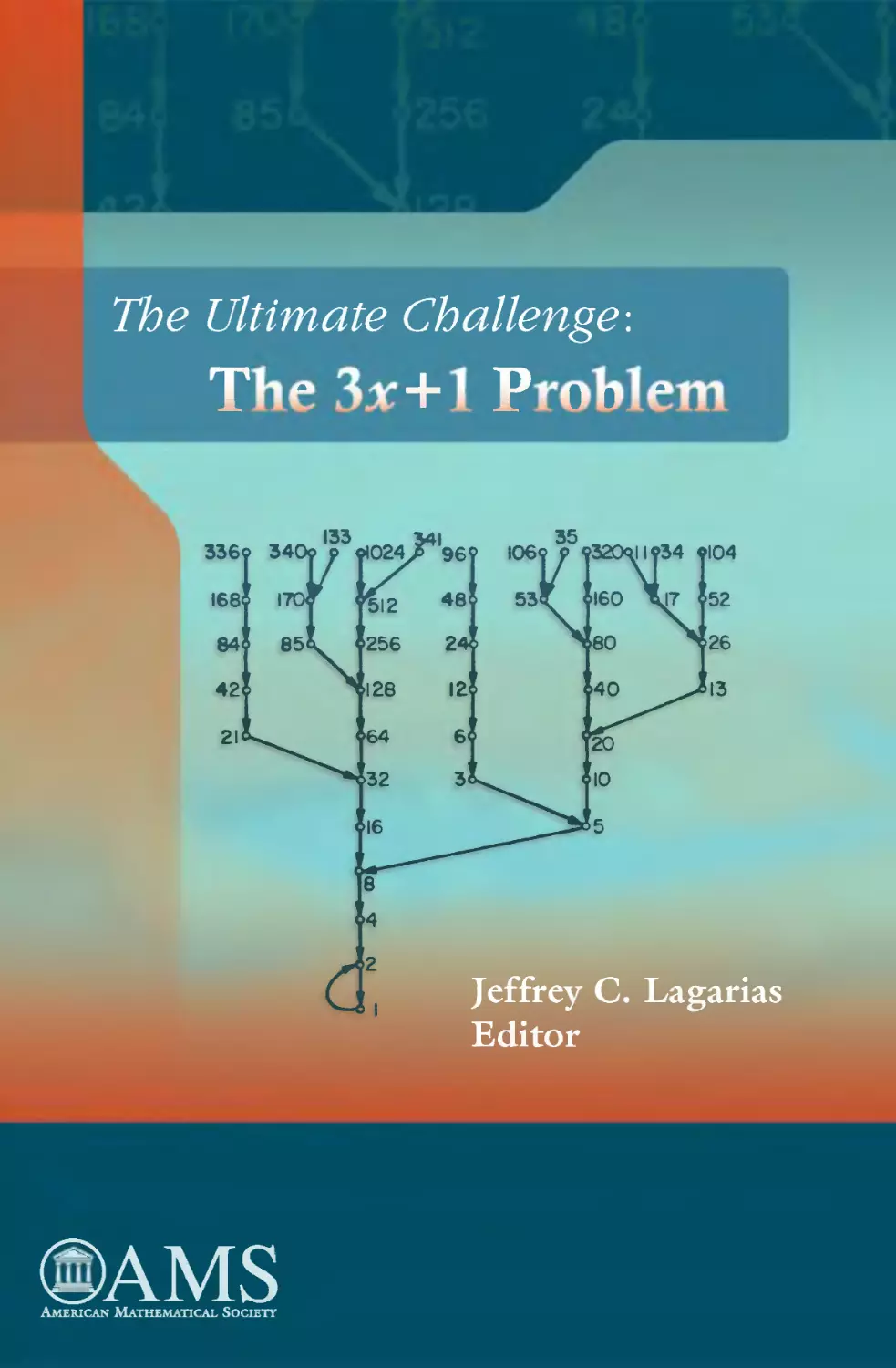


Author: Lagarias J.C.
Tags: mathematics algebra math problems collatz conjecture
ISBN: 978-8218-4940-8
Year: 1949

Text
                    The Ultimate Challenge,
T + P i.
Jeffrey C. Lagarias
Editor
©AMS
American Mathematical Society

The Ultimate Challenge:
The 3*+l Problem
i v.?
4 ,-l
J'"
1
\?
Jeffrey C. Lagarias
Editor
>AMS
American Mathematical Society
Providence, Rhode Island

2000 Mathematics Subject Classification. Primary 11B83, 37A45:
Secondary 111337, 68Q99.
For additional information and updates on this book, visit
www.ams«org/bookpages/mbk-78
The AMS is grateful to the many publishers that have permitted the reprint of then-
papers in this volume. For specific acknowledgements, please see the editor's Preface.
Library of Congress Catalog! ng-in-Publicatioti Data
The ultimate challenge : the 3x -|-1 problem / Jeffrey C Lagarias. editor,
p. cm.
Includes bibliographical references.
ISBN 978-8218-4940-8 <alk. paper)
1. Sequences (Mathematics) 2. Polynomials. 3. Harmonic analysis. I. Lagarias, Jeffrey C,
1949- II. Title: Ultimate challenge : the 3ar + 1 problem. III. Title: Ultimate challenge : the
triple plus one problem.
QA292.U48 2010
51o'.24—dc22
2010035270
Copying and reprinting. Individual readers of this publication, and nonprofit libraries
acting for them, are permitted to make feir use of the material, such as to copy a chapter for use
in teaching or research. Permission is granted to quote brief passages from this publication in
reviews, provided the customary acknowledgment of the source is given*
Republication, systematic copying, or multiple reproduction of any material in this publication
is permitted only under license from the American Mathematical Society. Requests for such
permission should be addressed to the Acquisitions Department, American Mathematical Society,
201 Charles Street, Providence, Rhode Island 02904-2294 USA. Requests can also be made by
e-mail to reprint-permi8sionQam8.org.
© 2010 by the American Mathematical Society. All rights reserved.
Reprinted with corrections by the American Mathematical Society. 2012.
The American Mathematical Society retains all rights
except those granted to the United States Government.
Copyright of individual articles may revert to the public domain 28 years
after publication. Contact the AMS for copyright status of individual articles.
Printed in the United States of America.
@ The paper used in this book is acid-free and falls within the guidelines
established to ensure permanence and durability.
Visit the AMS home page at http://www.ams.org/
109 8 76 543 2 15 14 13 12

Fourier believed that the main goals of
mathematics were to serve the common good and to explain
natural phenomena. However a philosopher like him
should have known that science is solely for the honor
of the human spirit. Therefore a question about
numbers is as important as a question about the world.
Carl Oustav Jacob Jacobi
It is already remarkable and philosophically
significant that the first and simplest questions about the
numbers 1,2,3,... present such profound difficulties.
These difficulties must be overcome.
David Hilbert
"Hopeless* Absolutely hopeless."
Paul Erdos

Contents
Preface ix
PART I. Overview and Introduction
The 3x + 1 problem: an overview
Jeffrey C. Lagarias 3
The Sx 4-1 problem and its generalizations
Jeffrey C. Lagarias 31
PART II. Survey Papers
A 3x 4-1 survey: Number theory and dynamical systems
Marc Chamberland 57
Generalized 3x 4-1 mappings: Markov chains and ergodic theory
K. R. Matthews 79
Generalized Sx 4-1 functions and the theory of computation
Pascal Michel and Maurice Margenstern 105
PART III: Stochastic Modelling and Computation Papers
Stochastic models for the 3a: 4-1 and 5x 4-1 problems and related problems
Alex V. Kontorovich and Jeffrey C. Lagarias 131
Empirical verification of the 3x 4-1 and related conjectures
Tomas Oliveira e Silva 189
PART IV. Reprinted Early Papers
Cyclic sequences and frieze patterns (The Fourth Felix Behrend Memorial
Lecture)
H. S. M. Coxeter 211
Unpredictable iterations
J. H. Conway 219
Iteration of the number-theoretic fimction: f(2n) = ti, f(2n 4-1) = 3n + 2
C. J. Everett 225
Don't try to solve these problems!
Richard K. Guy 231

viii CONTENTS
On the motivation and origin of the (3n + l)-problem
LOTHAR COLLATZ
FRACTRAN: A simple universal programming language for arithmetic
J. H. Conway
PART V: Annotated Bibliography
The 3x + 1 problem: An annotated bibliography (1963-1999)
Jeffrey C. Lag arias

Preface
The 3a: 4-1 problem, also known as the Collatz problem, is a notorious unsolved
problem in arithmetic. Consider the operation on positive integers x given by: if
x is odd, multiply it by 3 and add 1; while if x is even, divide it by 2. The 3rr + 1
problem asks whether, starting from any positive integer x, repeating this operation
over and over will eventually reach the number 1. The answer appears to be "yes"
for all such x but this has never been proved. Despite its simple appearance, this
problem is believed to be extraordinarily difficult.
A goal of this book is to report on what is known about the problem. It is
divided into five parts. This book contains two introductory papers on the problem,
three survey papers on the problem's connections to various fields, two papers
devoted to stochastic models and computational results for the problem, six reprinted
papers of historical interest, and a paper which giving an annotated bibliography
of work on this problem up to 2000. We now describe in more detail the papers
appearing in this volume.
PART I, Overview and Introduction. Part I of this volume contains two
introductory papers on the 3x + 1 problem.
(1) Jeffrey C. Lagarias, The 3rr -h 1 problem: an overview ([15]).
This paper gives a brief review of the 3a; 4-1 problem, its history, its connection
to various fields of mathematics, and its current status. It discusses generalizations
of the problem, and describes areas for mathematical research that it impacts. It
summarizes current "world record" on various aspects of the problem. It formulates
some directions for future research. Finally it discusses whether or not this problem
is a good mathematical problem.
(2) Jeffrey C. Lagarias, The 3a: -h 1 problem and its generalizations, American
Math. Monthly 92 (1985), 3-23 ([14]).
This paper describes the 3a;-f 1 problem and related problems. It presents, with
proofs, basic results on the behavior of iterates modulo powers of 2, and shows that
most integers n iterate to some value less than n. It formulates basic conjectui'es
on trajectories and cycles, all of them still unsolved. It focuses on number theoretic
aspects of the problem. Although this paper only covers work through 1984, it
is still up to date as an introduction to the basic features of the problem. This
reprinted version includes minor corrections and updates the reference citations.
IX

X
PREFACE
PART II. Three Survey Papers. Part II of this volume presents three
current survey papers on aspects of work on the 3a: + 1 problem.
(3) Marc Chamberland, A 3x + l survey: number theory and dynamical systems
([3])-
This paper reports on research progress in various directions on the 3a:+ 1
problem covering the period 1985 through 2007. It includes number theory results and
dynamical systems results, as well as other connections. It emphasizes the problem
viewed as a dynamical system, and discusses generalizations to dynamical systems
on larger spaces. This paper is a revised and extended version of the author's earlier
survey paper [2], written in the Catalan language.
(4) Keith R. Matthews, Generalized 3x + 1 mappings: Markov chains and
ergodic theory ([19]).
This paper summarizes work on Markov chain models for iterating generalized
3x + 1 maps, much of it due to the author. These models supply heuristics for the
behavior of iteration of a general class of functions that include the 3x +1 function.
It contains many interesting examples whose limiting behavior under iteration is
not understood, even on a conjectural level. This is a potentially fruitful area for
further research.
(5) Maurice Margenstern and Pascal Michel, Generalized 3z + 1 functions and
the theory of computation ([18]).
This paper surveys the appearance of (3a: + 1)—like functions in
mathematical logic and in the theory of computation. In 1972 John Conway [5] exhibited
a 3x -f 1-like function that gives an undecidable computational problem, and he
later ([6]) expanded on this construction to show how to formulate any computer
program using such functions, presented as a programming language FRACTRAN.
Other 3x + 1-like functions have been used to show that various "small" Turing
machines, those with few states and small alphabets, which are not known to be
universal computers, nevertheless can encode some apparently difficult problems.
PART III, Stochastic Modelling and Computation Papers. Part III of
this volume presents two papers on mathematical modelling and empirical results
from large computations.
(6) Alex Kontorovich and Jeffrey C. Lagarias, Stochastic models for the 3rc -f-1
problem and related problems ([13]).
This paper reports on various stochastic models for the behavior of 3x -f 1
iterates and for comparison, results on iterates for the f>x + 1 function. A remarkable
feature of the 3x + 1 map is that, although the iteration is deterministic, the best
models for the behavior of the iteration are probabilistic. Such stochastic
models make predictions about the behavior for iterating a "generic" integer, and also
make predictions about the extreme behavior of some integers that may be
observed. These models include random walk models for forward iteration, branching
processes and branching random walk models for backwards iteration. A third set

PREFACE
xi
of branching process models can model the growth of 3a; 4-1 trees, viewed 3-adically.
(7) Tomas Olivera e Silva, Empirical verification of the 3a: -f 1 conjecture and
related conjectures ([20]),
This paper reports on the latest computations of the Zx + 1 problem, and
some related functions. In particular the Zx + 1 conjecture is verified for all n <
5.764 x 10¹⁸. Results of the computations include tests of some of the predictions
of the stochastic models above. It is an interesting challenge to write efficient
progams to verify the 3$ + 1 Conjecture to some bound and also collect statistics
on the conjecture.
PART IV. Reprinted Early Papers* Part IV of this volume presents six
early papers of historical interest, in chronological order. These papers are short,
easy to read, and most are hard to obtain in their original source. We provide
an editorial commentary after each paper, including additional references and
biographical information.
(8) H. S. M. Coxeter, Cyclic sequences and frieze patterns: The Fourth Felix
Behrend Memorial Lecture, Vinculum 8 (1971), 4-7 ([7]).
This paper is the written version of a 1970 lecture, which was published in 1971
in Vinculum, the journal of the Mathematical Association of Victoria (Australia).
To my knowledge it is the earliest published paper that explicitly states the 3.t 4-1
problem. It presents the problem at the end of the lecture as "mathematical
gossip/* Coxeter offers a $50.00 prize for its solution. The main subject of the paper,
cyclic sequences and frieze patterns, is of interest in its own right.
(9) John H. Conway, Unpredictable iterations^ in: Proc. 1972 Number Theory
Conference (Univ. Colorado, Boulder, Colo., 1972), Univ. Colorado, Boulder,
Colo. 1972, pp. 49-52 ([5]).
This 1972 paper, from the proceedings of a number theory conference held
at the University of Colorado, shows that a generalization of the 3,t + 1 problem
is undecidable. Conway later used this encoding to design a computer language
FRACTRAN for universal computation using multiplication of fractions, see paper
(13) below.
(10) C. J. Everett, Iteration of the number theoretic function /(2n) = n,
f(2n + 1) = 3n + 2, Advances in Math. 25 (1977), 42-45. ([9]). Reprinted with
permission of Elsevier.
This 1977 paper gives an elegant proof of a basic result showing that almost
positive integers n iterate to a smaller value under action iteration of the 3s+1
function. A similar result was independently obtained in 1976 by Riho Terras [21], [22].
(11) Richard K. Guy, Don't try to solve these problems!, American Math.
Monthly 90 (1983), 35-41 ([10]).
This 1983 paper, written for the Unsolved Problems column of the American
Mathematical Monthly, presents a potpourri of 3a* -f 1-like problems, including the
original problem. True to its name, so far none of the four problems formulated

xii
PREFACE
there have been solved.
(12) Lothar Collatz, On the motivation and origin of the (3ra + 1) problem
(Chinese), J. Qufu Normal University. Natural Science Edition [Qufu shi fan da
xue xue bao) 12 (1986), No. 3, 9-11 ([4]).
This 1986 paper, written in Chinese, is the only paper of Lothar Collatz that
discusses his work on the 3x + 1 problem. It is based on a talk that Collatz gave
at Qufu Normal University, Qufu, Shandong, China. Here we present an English
translation of this paper, using Collatz's original illustrations.
(13) John H. Conway, FRACTRAN: A simple universal programming language
for arithmetics In: Open Problems in Communication and Computation (T. M.
Cover and B. Gopinath, Eds.). Springer-Verlag: New York 1987, pp. 3-27 ([6]).
Reprinted with kind permission of Springer Science-hBusiness Media.
This 1987 paper of Conway expands on his 1972 paper to show how to encode
any computational problem in terms of iteration of a suitable 3x + 1-like function.
The programming language name FRACTRAN is a pun on FORTRAN (The IBM
Mathematical Formula Translating System). This is not the only pun in this paper.
PART V. Annotated Bibliography. Part V of this volume an an annotated
bibliography of work on the 3a: -h 1 problem and related iteration problems, from
1963-1999.
(14) Jeffrey C. Lagarias, The Zx + 1 problem: An annotated bibliography (1983-
1999) ([16]).
This bibliography attempts to be relatively complete over the period cited. It
includes a number of papers from the "prehistory" of the problem, in the 1960:s. It
also covers many papers appearing in unusual places, not covered by Mathematical
Reviews or Zentralblatt fur Mathematik. It groups papers on the problem into
ten year subintervals. The growth of the number of papers in these time intervals,
which total 8, 34, 52 and 103 papers, respectively, show increasing effort devoted
to the 3a: + 1 problem and generalizations. A follow-up bibliography, currently
covering the period 2000-2009 ([17]) is posted on the math arXiv.
Book Title: The Ultimate Challenge. The results known about the 3x + l
problem strongly suggest that it does not fit in the scope of classical "structural"
mathematics. Instead it seems to lie in a wilderness between the well-organized
part of matJiematical knowledge, typified by the subjects covered in the volumes
of Bourbaki, and the boundary of undecidable problems, those problems that can
encode the action of a universal computer. The title does not assert the problem
is "ultimate" in its importance. Rather, "ultimate challenge" refers to the contrast
between the simplicity of the statement of the problem and the apparent
difficulty (perhaps impossibility) of resolving the problem. The papers in this volume
give ample warning that the problem shows no sign of being solvable at present.
Remember, not all challenges need to be accepted!
Epigraphs: References. The statement of G. C. J. Jacobi is taken from a
letter to Legendre written in 1830, published in 1875 in Borchardt [1, p. 272]

REFERENCES
xiii
II est vrai que M. Fourier avait ]'opinion que le but principal de
math^matiques etait Putitlite publique et Implications des ph&iomcs
naturels; mais un philosophe comme ltii aurail du savoir que le but
unique dc la science, c'est Thonneur de l'esprit humain, et que sous
ce titre, une question des nombres vaut autanl qu'une question du
systfeme du mondc.
The statement of D. Ililberi is taken from a 1931 paper on foundations on
mathematics (Hilbert [12, p. 486]).
Es ist schon an sich merkwurdig \md philosophich bedeutsam, dass
die ersten und einfachsten Fragen liber die Zahlcn 1,2,3>... so
tieflegcnde Schwierigkeiten bieten. Diese Schwierigkeiten musscn
iiberwunden werden.
The statement of P. Erd6s was made in conversation, sometime after publication
of the 1985 survey paper ([8]).
Acknowledgments. 1 think Gerasimos Ladas for encouragement to prepare
a volume on this topic. I thank Andreas Blass, Mark Conger, Alex Kontorovich,
Stephen R. Miller, Chris Xiu and Mike Zieve for various forms of assistance in
this project. The three survey papers in this volume, and that of T. OUveira e
Silva, have been peer-reviewed. I thank the anonymous reviewers for their efforts.
I thank Sergei Gelfand for his positive suggestions about the title and production
of this volume. During the period of this work I received suppoil from NSF Grants
DMS-0500555 and DMS-0801029.
Jeffrey C Lagarias
Ann Arbor, Michigan
August 2010
References
[1] C. W. Borchardt, Editor. Correspondence math£matique entre Legendre et Jacobi. J. reine
Angew. Math. 80 (1875). 205-279.
(2) M. ChamberlaiuL Una actualizachio del problem a 3x + 1 [An update on the 3x +1 problem]
(Catalan), Butlletf Societat Catalans de Matematiques 18 (2003), No.l, 19-45.
(3] M. Chamberland, A 3x + 1 survey: number theory and dynamical systems, paper in this
volume.
[4] L. Collatz. On the motivation and origin of the (3n+ 1)- problem (Chinese), J. Qufu Normal
University, Natural Science Edition [Qufu shi fan da xue xue bao] 12 (1986), No. 3, 9-11.
[Translation included in this volume]
[5] J. H. Conway, Unpredictable Iterations. Proc. 1972 Number Theory Conference (Univ.
Colorado, Boulder, Colo., 1972 )t pp. 49-52. Univ, Colorado, Boulder, Colo. 1972.
[6] J. H. Conway, FRACTRAN: A Simple Universal Computing Language for Arithmetic, In:
Open Problems in Communication and Computation (T. M. Cover and B. Gopinath, Eds.),
Springer-Yerlag: New York 1987, pp. 3-27 [Reprinted in this volume]
[7] H. S. M. Coxeter, Cyclic sequences and frieze patterns: The Fourth Felix Behrend Memorial
Lecture), Vinculum 8 (1971), 4-7. [Reprinted in this volume]
[8] P. Erdos, Private communication with J. C. Lagarias.
[9] C. J. Everett, Iteration of the number theoretic function /(2n) = n,f(2n + 1) = 3n + 2,
Advances in Math. 25 (1977), 42-45. [Reprinted in this volume]
[10] R. K. Guy, Don't try to solve these problems!, American Math. Monthly 90 (1983), 30-41.
[Reprinted in this volume]
[11] R. K. Guy, Conway's prime-producing machine, Math. Magazine 56 (1983), no. I, 26-33.

xiv PREFACE
[12] D. Hilbert, Die Grundlagen der elementaren Zahtentheorie, Math. Annalen 104 (1931), 484-
494. [English Translation: Chap, 17 of P. Mancosu, Prom Brouwer to Hilbert. The debate on
the foundations of mathematics m the 1920% Oxford Univ. Press: New York 1998]
[13] A.V. Kontorovich and J. C. Lagarias, Stochastic models for the 3a; + 1 problem and 5a; -I-1
problems, paper in this volume.
[14] J. C. Lagarias, The 3a; +1 problem and its generalizations, Atner. Math. Monthly 92 (1985),
3-23. [Reprinted with corrections in this volume].
[15] J. C. Lagarias, The 3x + 1 problem: an overview, paper in this volume.
[16] J. C. Lagarias, The 3a; + 1 Problem: An Annotated Bibliography (1963-1999), paper in this
volume.
[17] J. d Lagarias, The 3x 4- 1 Problem: An Annotated Bibliography, II (2000-2009),
arXiv:math/0608208.
[18] P. Michel and M. Margenstern, Generalized 3x-f 1 functions and the theory of computation,
paper in this volume.
[19] K. R. Matthews, Generalized 3a; + 1 mappings: Markov chains and ergodic theory, paper in
this volume.
[20) T. Oliveira e Silva, Empirical verification of the 3a; -f 1 and related conjectures, paper in this
volume.
[21] R, Terras, A stopping time problem on the positive integers, Acta Arithmetica 30 (1976),
241-252.
[22] R. Terras, On the existence of a density, Acta Arithmetica 35 (1979), 101-102.

PART I.
Overview and Introduction

The 3x + 1 Problem: An Overview
Jeffrey C. Lagarias
1. Introduction
The Zx +1 problem concerns the following innocent seeming arithmetic
procedure applied to integers: If an integer x is odd then "multiply by three and add
one", wliile if it is even then "divide by two". This operation is described by the
Collatz function
{3x + l itx= 1 (mod 2),
x
- if i = 0 (mod 2).
The 3a + 1 problem, which is often called the Collatz problem, concerns the behavior
of this function under iteration, starting with a given positive integer n.
3x + 1 Conjecture. Starling from any positive integer n} iterations of the
function C(x) will eventually reach the number 1. Thereafter iterations will cycle,
taking successive values 1,4,2,1,....
This problem goes under many other names, including the Syracuse problem,
Hasse's algorithm, KakutanVs problem and Ulam's problem.
A commonly used reformulation of the 3a: -f 1 problem iterates a different
function, the 3x + 1 function, given by
{?^~2 ifx = l(mod 2),
x
| if x = 0 (mod 2).
Rom the viewpoint of iteration the two functions arc simply related; iteration of
T(x) simply omits some steps in the iteration of the Collatz function C(x). The
relation of the 3z + 1 function T(x) to the Collatz function C(x) is that:
( C{C{x)) if a si (mod 2) ,
T(x) = {
[ C(x) if x = 0 (mod 2) .
As it turns out, the function T(x) proves more convenient for analysis of the problem
in a number of significant ways, as first observed independently by Riho Terras ([88),
[89]) and by C. J. Everett [27],
<©2010 American Mathematical Society

4
JEI'FRBY C. LAGARIAS
The 3a; + 1 problem has fascinated mathematicians and non-mathematicians
alike. It has been studied by mathematicians, physicists, and computer scientists.
It remains an unsolved problem, which appears to be extremely difficult.
This paper aims to address two questions:
(1) What can mathematics currently say about this problem?
(2) How can this problem be hard, when it is so easy to state?
To address the first question, this overview discusses the history of work on the
problem. Then it describes generalizations of the problem, and lists the different
fields of mathematics on which the problem impinges. It gives a brief summary of
the current strongest results on the problem.
Besides the results summarized here, this volume contains more detailed surveys
of mathematicians' understanding of the Zx 4- 1 problem and its generalizations.
These cover both rigorously proved results and heuristic predictions made using
probabilistic models. The book includes several survey articles, it reprints
several early papers on the problem, with commentary and it presents an annotated
bibliography of work on the problem and its generalizations.
To address the second question, let us remark first that the true level of
difficulty of any problem can only be determined when (and if) it is solved. Thus
there can be no definitive answer regarding its difficulty. The track record on the
3a: -f 1 problem so far suggests that, this is an extraordinarily difficult problem,
completely out of reach of present day mathematics. Here we will only say that
part of the difficulty appears to reside in an inability to analyze the pseudorandom
nature of successive iterates of T(x)} which could conceivably encode very difficult
computational problems. We elaborate on this answer in §7.
Is the 3x + 1 problem an important problem? Perhaps not for its individual
sake, where it merely stands as a challenge. II seems to be a prototypical example
of an extremely simple to state, extremely hard to solve, problem. A middle of the
road viewpoint is that this problem is representative of a large class of problems,
concerning the behavior under iteration of maps that are expanding on part of
their domain and contracting on another part of their domain. This general class
of problems is of definite importance, and is currently of great interest as an area
of mathematical (and physical) research; for some perspective, see Hasselblatt and
Katok [45]. Progress on general methods of solution for functions in this class
would be extremely significant.
This overview describes where things currently stand on the 3a: + 1 problem
and how it relates to various fields of mathematics. For a detailed introduction to
the problem, see the following paper of Lagarias [58] (in this volume). In §2 we
give some history of the problem; this presents some new information beyond that
given in [58]. Then in §3 we give a flavor of the behavior of the 3a: -I-1 iteration.
In §4 we discuss various frameworks for generalizing the problem; typically these
concern iterations of functions having a similar appearance to the 3a: -f 1 function.
In §5 we review areas of research: these comprise different fields of mathematics and
computer science on which this problem impinges. In §6 we summarize the current
best results on the problem in various directions. In §7 we discuss the hardness of
the 3x + 1 problem. In §8 we describe some research directions for future progress.

THE 3:r + 1 PROBLEM: AN OVERVIEW
5
In §9 we address the question: "Is the 3x -h 1 problem a good problem?" In the
concluding section §10 we offer some advice on working on 3#+ 1-related problems.
2. History and Background
The 3s-f 1 problem circulated by word of mouth for many years. It is generally
attributed to Lothar Collatz, He has stated ([14]) that he took lecture courses in
1929 with Edmund Landau and FHtz von Lettenmeyer in Gottingen, and courses
in 1930 with Oskar Perron in Munich and with Issai Schur in Berlin, the latter
course including some graph theory. He was interested in graphical representations
of iteration of functions. In his notebooks in the 1930's he formulated questions on
iteration of arithmetic functions of a similar kind (cf. [58, p. 3]). Collatz is said
by others to have circulated the problem orally at the International Congress of
Mathematicians in Cambridge, Mass. in 1950. Several people whose names were
subsequently associated with the problem gave invited talks at this International
Congress, including H. S. M. Coxeter, S. Kakutani, and S. Ulam. Collatz [15] (in
this volume) states that he described the 3a: 4-1 problem to Helmut Hasse in 1952
when they were colleagues at the University of Hamburg. Hasse was interested in
the problem, and wrote about it in lecture notes in 1975 ([44]). Another claimant
to having originated the 3x +1 problem is Bryan Thwaites [90], who asserts that he
came up with the problem in 1952. Whatever is its true origin, the 3rc H-1 problem
was already circulating at the University of Cambridge in the late 1950's, according
to John H. Conway and to Richard Guy [43].
There was no published mathematical literature about the 3x + 1 problem
until the early 1970's. This may have been, in part, because the 1960's was a period
dominated by Bourbaki-style mathematics. The Bourbaki viewpoint emphasized
complete presentations of theories with rich internal structure, which interconnect
with other areas of core mathematics (see Mashaal [65]). In contrast, the 3a: -f 1
problem initially appears to be an isolated problem unrelated to the rest of
mathematics. Another obstacle was the difficulty in proving interesting results about the
Zx + 1 iteration. The results that could be proved appeared pathetically weak, so
that it could seem damaging to one's professional reputation to publish them. In
some mathematical circles it might have seemed in bad taste even to show interest
in such a problem, which appears declasse.
During the 1960's, various problems related to the 3x -f-1 problem appeared in
print, typically as unsolved problems. This included one of the original problems
of Collatz from the 1930's, which concerned the behavior under iteration of the
function
U(2n) = 3n, U{4n + 1) = 3n + 1, U(in + 3) = 3n + 2.
The function U(n) defines a permutation of the integers, and the question
concerns whether the iterates of the value n = 8 form an infinite set. This problem
was raised by Murray Klamkin [52] in 1963 (see Lagarias [58, p. 3]), and remains
unsolved. Another such problem was posed by Ramond Queneau, a founder of
the FYench mathematical-literary group Oulipo (Ouvroir de litterature potentielle),
which concerns allowable rhyming patterns generalizing those used in poems by the
12-th century troubadour, Arnaut Daniel. This problem turns out to be related to
a (Zx -f l)-like function whose behavior under iteration is exactly analyzable, see

6
JEFFREY C. LAGARIAS
Roubaud [80], Concerning the Sx + 1 problem itself, during the 1960's large
computations were done testing the truth of the conjecture. These reportedly verified
the conjecture for all n < 10u.
To my knowledge, the 3x + 1 problem first appeared in print in 1971, in the
written version of a 1970 lecture by H. S. M. Coxeter [22] (in this volume). It
was presented there "as a piece of mathematical gossip." In 1972 it appeared in six
different publications, including a Scientific American column by Martin Gardner
[32] that gave it wide publicity. Since then there has been a steady stream of work
on it, novy amounting to several hundred publications.
Stanislaw Ulam was one of many who circulated the problem; the name "Ulam's
problem'* has been attached to it in some circles. He was a pioneer in ergodic
theory and very interested in iteration of functions and their study by computer;
he formulated many problem lists (e.g. [92]s [21]). A collaborator, Paul Stein (87,
p. 104], wrote about Ulam:
Stan was not a uumber theorist, but he knew many number-theoretical
facts. As all who knew him well will remember, it was Stan's
particular pleasure to pose difficult, though simply stated, questions
in many branches of mathematics. Number theory is a field
particularly vulnerable to the "Ulam treatment," and Stan proposed
more than his share of hard questions; not being a professional in
the field, he was under no obligation to answer them.
Ulam's long term collaborator C. J. Everett [27] wrote one of the early papers
about the 3x + 1 problem in 1977.
The *3x + 1 problem can also be formulated in the backwards direction, as that
of determining the smallest set So of integers containing 1 which is closed under
the affine maps x •-> 2x and 3a? + 2 \-> 2x + 1, where the latter map may only
be applied to inputs 3.r -f 2 whose output 2x + 1 will be an integer. The 3x + 1
conjecture then asserts that 50 will be the set of all positive integers. This connects
the 3x 4- 1 problem with problems on sets of integers which arc closed under the
action of affine maps. Problems of this sort were raised by Isard and Zwicky [51]
in 1970. In 1970-1971 David Klarner began studying sets of integers closed under
iteration of affine maps, leading to joint work with Richard Rado [54], published in
1974. Interaction of Klarner and Paul Erdos at the University of Heading in 1971
led to the formulation of a (solved) Erdos prize problem: Does the smallest set S\ of
integers containing 1 and closed under the affine maps x t-+ 2x + 1, x i-> 3x + I and
x h+ 6x + 1 have a positive (lower asymptotic) density? This set S\ was proved to
have zero density by 13. J. Crampin and A. J. W. Hilton (unpublished), according
to Klarner [53], The solvers collected £ 10 from Erdos ([50]). Later Klarner [53,
p. 47] formulated a revised problem:
Klarner's Integer Sequence Problem* Does the smallest set of integers S2
containing 1 and closed under the affine maps x i->- 2:u, x »-> 3x -t- 2 and x h-> 6x 4- 3
have a positive (lower asymptotic) density?
This problem remains unsolved; see the paper of Guy [40] (in this volume) and
accompanying editorial commentary.
Much early work on the problem appeared in unusual places, some of it in
technical reports, some in problem journals. The annotated bibliography given in
this book [60] covers some of this literature, see also its sequel [61]. Although

THE 3x + 1 PROBLEM: AN OVERVIEW
4000-
3000!
i
L
2000
1000-
20 40 60 80
Figure 1. Trajectory of n = 649 plotted on standard vertical scale
the problem began life as a curiosity, its general connection with various other
areas of mathematics,'including number theory, dynamical systems and thcoiy of
computation, have made it a respectable topic for mathematical research. A number
of very well known mathematicians have contributed results on it, including John
H. Conway [16] and Yakov G. Sinai [84]. [85].
3. 3a; H-1 Sampler
The fascination of the 3x 4- 1 problem involves its simple definition and the
apparent, complexity of its behavior under iteration: there seems to be no simple
relation between the input value n and the iterates of n. Exploration of its structure
has led to the formulation of a web of subsidiary conjectures about the behavior of
iterates of the 3x + 1 function and generalizations; these include conjectures (CI) -
(C5) listed in §8. Many of these conjectures seem to be extremely difficult problems
as well, and their exploration has led to much further research. Since other papers
in this volume give much more information on this complexity, here we give only a
brief sampler of 3a: + 1 function behavior,
3-1. Plots of Trajectories. By the trajectory of x under a function T, we
mean the forward orbit of x, that is, the sequence of its forward iterates
(x,T(x),TW(x)>TW(x)>...). Figure 1 displays the 3a: + 1-function iterates of
n — 649 plotted on a standard scale. We see an irregular series of increases and
decreases, leading to the name "hailstone numbers" proposed by Hayes [46], as
hailstones form by repeated upward and downward movements in a thunderhead.
To gain insight into a problem it helps to choose an appropriate scale for
picturing it. Here it is useful to view long trajectories on a logarithmic scale, i.e.,
to plot logT(*>(n) versus k. Figure 2 displays the iterates of no = 100[7rl035J on
such a scale. Using this scale we see a decrease at a certain geometric rate to the
value of 1, indicated by the trajectory having roughly a constant slope. This is
characteristic of most long trajectories. As explained in §3.3 a probabilistic model
predicts that most trajectories plotted on a logarithmic scale will stay close to a
line of constant slope — ^logf ~ -0.14384, thus taking about 6.952121ogrc steps

JEFFREY C. LAGARIAS
100 200 300 400 500
FIGURE 2. Trajectory of no = 100|7r • 1035J plotted on a
logarithmic vertical scale. The dotted line is a probability model prediction
for a "random" trajectory for this size N.
to reach 1. This line is pictured as the dotted line in Figure 2. This trajectory
takes 529 steps to reach n = 1, while the probabilistic model predicts about 600
steps will be taken.
On the other hand, plots of trajectories suggest that iterations of the 3x + 1
function also seem to exhibit pseudo-random features, i.e. the successive iterates
of a random starting value seem to increase or decrease in an unpredictable
manner. FVom this perspective there are some regularities of the iteration that appear
(only) describable as statistical in nature: they are assertions about the majority
of trajectories in ensembles of trajectories rather than about individual trajectories.
3.2. Patterns. Close examination of the iterates of the 3# + 1 function T(x)
for different starting values reveals a myriad of internal patterns. A simple pattern
is that the initial iterates of n — 2m — 1 are
T<*>(2™ - 1) = 3* ■ 2m~* - 1, for 1 < k < m.
In particular, T<m)(2m - 1) = 3m - 1; this example shows that the iteration can
sometimes reach values arbitrarily larger than the initial value, either on an absolute
or a relative scale, even if, as conjectured, the iterates eventually reach 1. Other
patterns include the appearance of occasional large clusters of consecutive numbers
which all take exactly the same number of iterations to reach the value L Some of
these patterns are easy to analyze, others are more elusive.
Table 1 presents data on iterates of the 3z -b 1 function T(x) for n = Nq + m,
0 < m = lOjf + k < 99, with
n0 = IOOLtt • 1035J = 31,415,926,535,897,932,384,626,433,832,795,028,800.
Here Ooo(n) denotes the total stopping time for n, which counts the number of
iterates of the 3x + 1-function T(x) needed to reach 1 starting from n, counting
n as the 0-th iterate. This number is the same as the number of even numbers
appearing in the trajectory of the Collatz function before first reaching 1.

THE 3x + 1 PROBLEM: AN OVERVIEW
9
TABLE 1. Values of total stopping time er^n) for n = no + 10j + A;, with
720 := 100[tt • 1035J = 31,415,926,535,897,932,384,626,433,832,795,028,800.
\k = 0
Jfe-1
\k = 2
\k = Z
\k = A
& = 5
fc = 6
\k = 7
;jfc = 8
fr = 9
j = 0
529
659
846
846
659
659
659
529
529
529
j = l
529
659
529
529
659
659
529
529
678
678
J =2
529
529
659
659
659
846
659
659
659
659
i = 3
678
678
529
846
846
846
846
846
846
659
j =4
529
659
529
659
678
678
678
659
529
529
i = 5
529
529
529
529
529
529
846
659
846
529
j = 6
846
846
659
659
846
529
529
529
529
529
3 = 7
529
529
846
846
846
529
846
846
529
529
J«8
846
529
529
529
846
846
659
659
846
659
j = 9
846
529
659
659
659
659
846
529
846
846
We observe that the total stopping time function takes only a few different
values, namely: 529, 654, 678 and 846. and these four values occur intermixed in
a somewhat random-appearing way, but with some regularities. Note that around
no ~ 3.14 x 1037 the predicted "average size" of a trajectory is 6.95212 log no « 600.
In the data here we also observe "jumps" of size between the occurring values on
the order of 100.
This is not a property of just this starting value. In Table 2 we give similar
data for blocks of 100 near n = 1035 and 1036, respectively. Again we observe that
there are also four or five values occurring, but now they are different values. In
this table we present data on two other statistics: the frequency statistic gives the
count of these number of occurrences of each value* and the l-ratio statistic denotes
the fraction of odd iterates occurring in the given trajectory up to and including
when 1 is reached. It is an experimental fact that all sequences in the table having
the same total stopping time also have the same 1-ratio. In the first two blocks
the value Ooofa) = 481 (resp. 351) that occurs with frequency 1 is that for the
intial value n — 1035 (resp. n — 1036) in the given interval; these initial values
are unusual in being divisible by a high power of 2. Probabilistic models for the
3x + l-function iteration predict that even and odd iterates will initially occur with
equal frequency, so we may anticipate the 1-ratio values to be relatively close to
0.5.
Table 2 Values of total stopping time, their frequencies, and 1-ratio for
(a) 1035 < 7i < 1035 + 99, (b) 1036 < n < 1036 + 99, (c) n0 < n < n0 + 99.
<7e»(n)
481
508
573
592
836
(a) 1035
freq.
1
19
49
10
21
1-ratio
0.47817
0.48622
0.50261
0.50675
0.54306
o-oc(n)
351
467
508
519
(b) 10ao
freq.
1
72
21
6
1-ratio j
0.41594
0.46895 j
0.48228
0.48554
k»(n)
529
654
678
846
(c)n0
freq.
38
28
7
27
1-ratio
0.48204
0.51138
0.51474
0.53782

10
JEFFREY C. LAGARIAS
The data in Table 2 suggests the following heuristic: as n increases only a few
values of cr^n) locally occur over short intervals; there is then a slow variation in
which values of cr oc(n) occur. However these local values are separated from each
other by relatively large "jumps" in size. We stress that this is a purely empirical
observation, nothing like this is rigorously proved! Our heuristic did not quantify
what is a "short interval" and it did not quantify what "relatively large jumps"
should mean. Even the existence of finite values for a^n) in the tables presumes
the 3x + 1 conjecture is true for all numbers in the table.
3.3. Probabilistic Models. A challenging feature of the 3x-\-l problem is the
huge gap between what can be observed about its behavior in computer experiments
and what can be rigorously proved. Attempts to understand and predict features
of empirical experimentation have led to the following curious outcome: the use
of probabilistic models to describe a deterministic process. This gives another
theme of research on this problem: the construction and analysis of probabilistic
and stochastic models for various aspects of the iteration process.
A basic probabilistic model of iterates of the 3a;-f 1 function T(x) proposes that
most trajectories for 3.T -f 1 iterates have equal numbers of even and odd iterates,
and that the parity of successive iterates behave in some sense like independent
coin flips. A key observation of Terras [88] and Everett [27], leading to this model,
is that the initial iterates of the 3,t -f 1 function have this property (see Lagarias
[58, Lemma B]).) This probabilistic model suggests that most trajectories plotted
on a logarithmic vertical scale should appear close to a straight line having negative
slope equal to ~~ log | ~ -0.14384, and should thus take about 6.95212 log n steps
to reach 1.
The corresponding behavior of iterates of the Collatz function C(x) is more
complicated. The allowed patterns of even and odd Collatz function iterates always
have an even iterate following each odd iterate. Probabilistic models taking this
into account are more complicated to formulate and analyze than that for the
3x -f 1 function; this is a main reason for studying the 3x + 1 function rather than
the Collatz function. Use of the probabilistic model above allows the heuristic
inference that Collatz iterates will be even about two-thirds of the time.
A variety of fairly complicated stochastic models, many of which are rigorously
analyzable (as probability models), have now been formulated to model various
aspects of these iterations, see Kontorovich and Lagarias [56] (in this volume).
Rigorous results for such models lead to heuristic predictions for the statistical
behavior of iterates of the generalized 3x + 1 map. The model above predicts
the behavior of "most" trajectories. A small number of trajectories may exhibit
quite different behavior. One may consider those trajectories that that seem to
offer maximal value of some iterate of T^k\n) compared to n. Here a probabilistic
model (see [56, Sec. 4.3] in this volume) predicts that the statistic
logfaiax^! (T^(n))
p{n) :-
logn
as n -> oo should have p[n) < 2 -f o(l) for all sufficiently large n. Figure 3.3
offers a plot of the trajectory, for the value m = 1980976057694878447, which
attains the largest value of the statistic p(n) over 1 < n < 1018; this value was
found by Oliveira e Silva [76, Table 6] (in this volume). This example has p(n-\) «
2.04982. Probabilistic models suggest that the extremal trajectories of this form

THE 3x + 1 PROBLEM: AN OVERVIEW
11
200 400 600 800
Figure 3. Extremal trajectory nt = 1980976057694878447 given
in Oliveira e Silva's Table 6.
will approach a characteristic shape which consists of two line segments, one of
length 7.645 log n steps of slope about 0.1308 up to the maximal value of about
21ogn, the second of about 13.905 log n steps of slope about -0.1453 to 0, taking
21.55 log n steps in all. This shape is indicated by the dotted lines on Figure 3.3
for comparison purposes.
Another prediction of such stochastic models, relevant to the 3a; -f 1 conricture,
is that the number of iterations required for a positive integer n to iterate to 1
under the 3x + 1 function T(x) is at most 41.677647 log n (see [62], [56, Se<*t.4]).
In particular such models predict, in a quantitative form, that there will be no
divergent trajectories.
These stochastic models can be generalized to model the behavior of many
generalized 3a: -f 1 functions, and they make qualitatively different predictions
depending on the function. For example, such models predict that no orbit of iteration
of the 3a: + 1 function "escapes to infinity" (divergent trajectory). However for the
5.t -I-1 function given by
{^-tl if* = 1 (mod 2),
| if a: = 0 (mod' 2),
similar stochastic models predict that almost all orbits should "escape to infinity"
([56, Sect. 8]). These predictions are supported by experimental computer evidence,
but it remains an unsolved problem to prove that there exists even one trajectory
for the hx ■+■ 1 problem that "escapes to infinity".
There remains considerable research to be done on further developing stochastic
models. The experiments on the 3x -f 1 iteration reported above in §3.2 exhibit
some patterns not yet explained by stochastic models. In particular, the behaviors
of total stopping times observed in Tables 1 and 2, and the heuristic presented
there, have not yet been justified by suitable stochastic models.

12
JEFFREY C. LAGARIAS
4. Generalized Zx + 1 functions
The original work on the 3z + 1 problem viewed it as a problem in number
theory. Much of the more recent work views it as an example of a special kind
of discrete dynamical system, as exemplified by the lecture notes volume of G.
J. Wirsching [95], As far as generalizations are concerned, a very useful class
of functions has proved to be the set of generalized Collatz functions which are
defined below. These possess both number-theoretical and dynamic properties; the
number-theoretic properties have to do with the existence of p-adic extensions of
these maps for various primes p.
At present the 3x + 1 problem is most often viewed as a discrete dynamical
system of an arithmetical kind. It can then be treated as a special case, within the
framework of a general class of such dynamical systems. But what should be the
correct degree of generality in such a class?
There is significant interest in exploring the behavior of dynamical systems of an
arithmetic nature, since these may be viewed as "toy models" of more complicated
dynamical systems arising in mathematics and physics. There are a wide variety
of interesting arithmetic dynamical systems. The book of Silverman [82] studies
the iteration of algebraic maps on algebraic varieties. The book of Schmidt [81]
considers dynamical systems of algebraic origin, meaning Zrf-actions on compact
metric groups, using ergodic theory and symbolic methods. The book of Fursten-
berg [30] considers various well structured arithmetical dynamical systems; for a
further development see Glasner [34]. The generalized 3x + 1 functions studied in
this book provide another distinct type of arithmetic discrete dynamical system.
We present a taxonomy of several classes of functions which represent successive
generalizations of the 3x + 1 function. The simplest generalization of the 3a: + 1
function is the Zx + k function, which is defined for k = 1 or 5 (mod6), by
{^-t-^ if x = 1 (mod 2),
| if x = 0 (mod 2) .
The generalization of the 3x + 1 conjecture to this situation is twofold: first, that
under iteration every orbit becomes eventually periodic, and second, that there are
only a finite number of cycles (periodic orbits). This class of functions occurs in
the study of cycles of the 3a; + 1 function (Lagarias [59]). Note that the 3x + 1
function T(x) can be extended to be well defined on the set of all rational numbers
having odd denominator, and a rescaling of any T-orbit of such a rational number
r = ^ to clear its denominator k will give an orbit of the map Tz&- Thus, integer
cycles of the 3x + k function correspond to rational cycles of the 3x + 1 function
having denominator fc.
lb further generalize, let d > 2 be a fixed integer and consider the function
defined for integer inputs x by
(4.1) f(x) = aiX + bi ifx = i (mod d), 0 < t < d - 1,
a

THE 3x + 1 PROBLEM: AN OVERVIEW
13
where {(a*, 6*) : 0 <i < d — 1} is a collection of integer pairs. Such a function is
called admissible if the integer pairs (a*, 6*) satisfy the condition
(4.2) ia,i + bi = 0 (mod d) for 0 < i < d - 1.
This condition is necessary and sufficient for the map f(x) to take integers to
integers. These functions f(x) have been called generalized Collatz functions, or
ROW A functions (Residue-Class-Wise Affine functions). Generalized Collatz
functions have the nice feature that they have a unique continuous extension to the space
Zrf of rf-adic integers in the sense of Mahler [64].
An important subclass of generalized Collatz functions are those of relatively
prime type. These are the subclass of generalized Collatz functions for which
(4.3) gcd(a0ai • • • ad_i, d) = 1.
This class includes the 3x+1 function T(x) but not the Collatz function C(x) itself.
It includes the 5x + 1 function T^(x)y which as mentioned above appears to have
quite different long-term dynamics on the integers Z than does the 3x +1 function.
Functions in this class have the additional property that their unique extension to
the d-adic integers Z<* has the d-adic Haar measure as an invariant measure. This
permits ergodic theory methods to be applied to their study, see the survey paper
of Matthews [67, Thm. 6.2] (in this volume) for many examples.
As a final generalization, one may consider the class of integer-valued
functions, which when restricted to residue classes (mod d) are given by a polynomial
Pi(x) for each class i (modd). Members of this class of functions have arisen in
several places in mathematics. They are now widely called quasi-polynomial
functions or quasi-polynomials. Quasi-polynomials appear in commutative algebra and
algebraic geometry, in describing the Hilbert functions of certain semigroups, in
a well known theorem of Serre, see Bruns and Herzog [9, pp. 174-175] and Bruns
and Ichim [10]. In another direction, functions that count the number of lattice
points inside dilated rational polyhedra have been shown to be quasi-polynomial
functions (on the positive integers), starting with work of Ehrhart [23], see Beck
and Robins [6] and Barvinok [5, Chap. 18]. They also have recently appeared in
differential algebra in connection with g-holonomic sequences, see Garoufalidis [33].
Such functions were introduced in group theory by G. Higman in 1960 [48] under
the name PORC functions (polynomial on residue class functions). Higman's
motivating problem was the enumeration of p-groups, cf. Evseev [28], The class of all
quasi-polynomial functions is closed under addition and pointwise multiplication,
and forms a commutative ring under these operations.
We arrive at the following taxonomy of function classes of increasing generality:
{3x + 1 function T(x)} C {3x + k functions Tztk(x)}
C {generalized Collatz functions of relatively prime type}
C {generalized Collatz functions}
C {quasi-polynomial functions}.
For applications in mathematical logic, it has proved useful to further widen
the definition of generalized Collatz functions to allow partially defined functions.
Such functions are obtained by dropping the admissibility condition (4.2); they map
integers to rational numbers having denominator dividing d. If a non-integer value
is encountered, then one cannot iterate such a function further. In this circumstance

14
JEFFREY C. LAGARIAS
we adopt the convention that if a non-integer iteration value is encountered, the
calculation stops in a special "undefined" state. This framework allows the encoding
of partially-defined (recursive) functions. One can use this convention to also define
composition of partially defined functions.
5. Research Areas
Work on the 3:r -f 1 problem cuts across many fields of mathematics. Six basic
areas of research on the problem are: (1) number theory: analysis of periodic
orbits of the map; (2) dynamical systems: behavior of generalizations of the 3a; -h 1
map; {Z)ergodic theory: invariant measures for generalized maps; (4) theory of
computation: undecidable iteration problems; (5) stochastic processes and probability
theory: models yielding heuristic predictions for the behavior of iterates; and (6)
computer science: algorithms for computing iterates and statistics, and explicit
computations. We treat these in turn.
(1) Number Theory
The connection with number theory is immediate: the Zx + 1 problem is a
problem in arithmetic, whence it belongs to elementary number theory. Indeed it
is classified as an unsolved problem in number theory by R. K. Guy [42, Problem
E16]. The study of cycles of the 3# -h 1 map leads to problems involving exponential
Diophantine equations. The powerful work of Baker and Masser-Wiistholz on
linear forms in logarithms gives information on the non-existence of cycles of various
lengths having specified patterns of even and odd iterates. A class of generalized
3a: -h 1 functions has been defined in a number theory framework, in which
arithmetic operations on the domain of integers are replaced with such operations on
the ring of integers of an algebraic number field, or by function field analogues such
as a polynomial ring with coefficients in a finite field. Number-theoretic results are
surveyed in the papers of Lagarias [58] and Chamberland [11] in this volume.
(2) Dynamical Systems
The theory of iscrete dynamical systems concern the behavior of functions under
iteration; that of continuous dynamical systems concern flows or solutions to
differential equations. The 3x4-1 problem can be viewed as iterating a map, therefore it
is a discrete dynamical system on the state space Z. This viewpoint was taken in
Wirsching [95]. The important operation for iteration is composition of functions.
One can formulate iteration and composition questions in the general context of
universal algebra, cf. Lausch and Nobauer [63, Chap, 4.5]. In the taxonomy above,
the classes of generalized Sx + 1 functions, and quasi-polynomial functions are each
closed under addition and composition of functions. The iteration properties of
the first three classes of functions above have been studied, in connection with the
Sx + 1 problem and the theory of computation. However the iteration of general
quasi-polynomial functions remains an unexplored research area.
Viewing the problem this way suggests that it would be useful in the study
of the Sx + 1 function to obtain dynamical systems on larger domains, including
the real numbers M and the complex numbers C. Other extensions include defining
analogous functions on the ring Z2 of 2-adic integers, or, for generalized 3x + 1

THE 3s + 1 PROBLEM: AN OVERVIEW
15
maps, on a ring of d-adic integers, for a value of d determined by the function.
When one considers generalized 3x + 1 functions on larger domains, a wide variety
of behaviors can occur. These topics are considered in the papers of Chamberland
[11] and Matthews [67] in this volume. For a general framework on topological
dynamics see Akin [1].
(3) Ergodic Theory
The connection with ergodic theory arises as an outgrowth of the dynamical
systems viewpoint, but adds the requirement of the presence of an invariant
measure. It was early observed that there are finitely additive measures which are
preserved by the 3a: -h 1 map on the integers. Extensions of generalized 3a: +1
functions to d-adic integers lead to maps invariant under standard measures (countably
additive measures). For example, the (unique continuous) extension of the 3a: 4-1
map to the 2-adic integers has 2-adic measure as an invariant measure, and the map
is ergodic with respect to this measure. Ergodic theory topics are considered in the
surveys of Matthews [67] and Kontorovich and Lagarias [56] in this volume. An
interesting open problem is to classify all invariant measures for generalized 3x -f1
functions on the d-adic integers.
(4) Mathematical Logic and the Theory of Computation
The connection to logic and the theory of computation starts with the result
of Conway that there is a generalized 3a: + 1 function whose iteration can simulate
a universal computer. Conway [16] exhibited an unsolvable iteration problem for
a particular generalized Zx + 1 function: starting with a given input which is a
positive integer n, decide whether or not some iterate of this map with this input is
ever a power of 2. In this connection note that the 3x 4-1 problem can be
reformulated as asserting that, starting from any positive integer n, some iterate C^(n)
of the Collatz function (or of the 3a: + 1 function) is a power of 2. It turns out
that iteration of 3a: 4- 1-like functions had already been considered in understanding
the power of some logical theories even in the late 1960's; these involved partially
defined functions taking integers to integers (with undefined output for some
integers), cf. Isard and Zwicky [51]. More recently such functions have arisen in
studying the computational power of "small" Turing machines, that are too small
to encode a universal computer. These topics are surveyed in the paper of Michel
and Margenstern [68] in this volume.
(5) Probability Theory and Stochastic Processes
A connection to probability theory and stochastic processes arises when one
attempts to model the behavior of the 3a: + 1 iteration on large sets of integers.
This leads to heuristic probabilistic models for the iteration, which allow
predictions of its behavior. Some authors have argued that the iteration can be viewed as
a kind of pseudo-random number generator, viewing the input as being given by a
probability distribution, and then asking how this probability distribution evolves
under iteration. In the reverse direction, one can study trees of inverse iterates (the
inverse map is many-to-one, giving rise to a unary-binary tree of inverse iterates).
Here one can ask for facts about the structure of such trees whose root node is
an integer picked from some probability distribution. One can model this by a

16
JEFFREY C. LAGARIAS
stochastic model corresponding to random tree growth, e.g. a branching random
walk. These topics are surveyed in the paper of Kontorovich and Lagarias [56] in
this volume.
(6) Computer Science: Machine Models, Parallel and Distributed Computation
In 1987 Conway [17] (in this volume) formalized the FYactran model of
computation as a universal computer model, based on his earlier work related to the 3x+1
problem. This computational model is related to the register machine (or counter
machine) model of Marvin Minsky ([70], [71, Sect. 11.1]). Both these machine
models have recently been seen as relevant for developing models of computation
using chemical reaction networks, and to biological computation, see Soloveichik et
al [86] and Cook et al. [20].
The necessity to make computer experiments to test the 3x +1 conjecture, and
to explore various properties and patterns of the 3# + 1 iteration, leads to other
questions in computation. One has the research problem of developing efficient
algorithms for computing on a large scale, using either parallel computers or a
distributed computer system. The 3a; -h 1 conjecture has been tested to a very large
value of n, see the paper of Oliveira e Silva [76] in this volume. The computational
method used in [76] to obtain record results can be parallelized. Various large
scale computations for the 3a: + 1 problem have used distributed computing, cf.
Roosendaal [79].
6. Current Status
We give a brief summaay of the current status of the problem, which further
elaborates answers to the two questions raised in the introduction.
6.1. Where does research currently stand on the 3a; H- 1 problem?
The 3a: + 1 problem remains unsolved, and a solution remains unapproachable at
present. To quote a still valid dictum of Paul Erdos ([58, p. 3]) on the problem:
"Mathematics is not yet ready for such problems."
Research has established various "world records", all of which rely on large
computer calculations (together with various theoretical developments).
(Wl) The 3x + 1 conjecture has now been verified for all n < 20 x 258 «
5.7646 x 10¹⁸ (Oliveira e Silva [76] (in this volume)).
(W2) The trivial cycle {1,2} is the only cycle of the 3a; -I- 1 function on the
positive integers having period length less than 10,439,860,591. It is also
the only cycle containing less than 6,586,818,670 odd integers (Eliahou
[24, Theorem 3.2]*).
(W3) Infinitely many positive integers n take at least 6.143 log n steps to reach
1 under iteration of the 3a: -f- 1 function T(x) (Applegate and Lagarias
[3])-
*This number is the bound (21,0) given in [24, Table 2). The smaller values in Table 2 are
now ruled out by the computations in item (Wl) above.

THE 3x + 1 PROBLEM: AN OVERVIEW
17
(W4) The positive integer n with the largest currently known value of C, such
that it takes Clogn iterations of the 3a; -f 1 function T(x) to reach 1, is
n = 7,219,136,416,377,236,271,195 with C « 36.7169 (Roosendaal [79,
3x + 1 Completeness and Gamma records]).
(W5) The number of integers 1 < n < X that iterate to 1 is at least X084, for
all sufficiently large X (Krasikov and Lagarias [57]).
There has also been considerable progress made on showing the nonexistence
of various kinds of periodic points for the 3a: +1 function, see Brox [8] and Simons
and de Weger [83]. These bounds are based on number-theoretic methods involving
Diophantine approximation.
6.2. Where does research stand on generalizations of the 3a: + 1
problem? It has proved fruitful to view the 3a: -h 1 problem as a special case of wider
classes of functions. These function classes appear naturally as the correct level
of generality for basic results on iteration; this resulted in the taxonomy of
function classes given in §3. There are some general results for these classes and many
unsolved problems.
The 3a: + k problem seems to be the correct level of generality for studying
rational cycles of the 3x -f 1 function ([59]). There are extensive results on cycles
of the 3a: -h 1 function, and the methods generally apply to the 3a: + A; function as
well, see the survey of Chamberland [11] (in this volume).
The class of generalized 3a: + 1 functions of relatively prime type is a very
natural class from the ergodic theory viewpoint, since this is the class on which the
d-adic extension of the function has d-adic Haar measure as an invariant measure.
The paper of Matthews [67] (in this volume) reports general ergodicity results and
raises many questions about such functions.
The class of generalized Collatz functions has the property that all functions
in it have a unique continuous extension to the domain of d-adic integers Z<j. This
general class is known to contain undecidable iteration problems, as discussed in the
paper of Michel and Margenstern [68] (in this volume). The dynamics of general
functions in this class is only starting to be explored; many interesting examples are
given in the paper of Matthews [67] (in this volume). An interesting area worthy of
future development is that of determining the existence and structure of invariant
Borel measures for such functions on Z^, and determining whether there is some
relation of their structure to undecidability of the associated iteration problem.
6.3. How can this be a hard problem, when it is so easy to state? Our
answer is that there are two different mechanisms yielding hard problems, either or
both of which may apply to the 3a: -h 1 problem. The first is "pseudorandomness";
this involves a connection with ergodic theory. The second is "non-computability".
Both of these are discussed in detail in this volume.
The "ergodicity" connection has been independently noted by a number of
people, see for example Lagarias [58] (in this volume) and Akin [2]. The unique
continuous extension of the 3a:4-1 map T(x) to the 2-adic integers Z2 gives a function
which is known to be ergodic in a strong sense, with respect to the 2-adic measure.
It is topologically and metrically conjugate to the shift map, which is a maximum
entropy map. The iterates of the shift function are completely unpredictable in

18
JEFFREY C. LAGARIAS
the ergodic theory sense. Given a random starting point, predicting the parity of
the n-th iterate for any n is a "coin flip" random variable. The 3a; + 1 problem
concerns the behavior of iterating this function on the set of integers Z, which is a
dense subset of Z2, having 2-adic measure zero. The difficulty is then in finding and
understanding non-random regularities in the iterates when restricted to Z. Various
probabilistic models are discussed in the paper of Kontorovich and Lagarias [56]
(in this volume). Empirical evidence seems to indicate that the 3a: + 1 function on
the domain Z retains the "pseudorandomness" property on its initial iterates until
the iterates enter a periodic orbit. This supports the 3x + 1 conjecture and at the
same time deprives us of any obvious mechanism to prove it, since mathematical
arguments exploit the existence of structure, rather than its absence.
A connection of a generalized Collatz function to "non-computability" was
made by Conway [16] (in this volume), as already mentioned. Conway's undecid-
ability result indicates that the 3ar + 1 problem could be close to the unsolvability
threshold. It is currently unknown whether the 3x +1 problem is itself undecidable,
however no method is currently known to approach this question. The survey of
Michel and Margenstern [68] (in this volume) describes many results on generalized
3x +1 functions that exhibit undecidable or difficult-to-decide iteration problems.
The Zx + 1 function might conceivably belong to a smaller class of generalized 3x + l
functions that evade undecidability results that encode universal computers. Even
so, it conceivably might encode an undecidable problem, arising by another
(unknown) mechanism. As an example, could the following question be undecidable:
"Is there any positive integer n such that T^k\n) > 1 for 1 < k < 100 log n?"
7. Hardness of the 3x + l problem
Our viewpoint on hard problems has evolved since 1900, starting with Hilbert's
program in logic and proof theory and benefiting from developments in the theoiy
of computation. Starting in the 1920's, Emil Post uncovered great complexity in
studying some very simple computational problems, now called "Post Tag Systems".
A Tag system in the class TS(/j,> v) consists of a set of rules for transforming words
using letters from an alphabet A = {ai,..., aM} of ji symbols, a deletion number (or
shift number) v > 1, and a set of jj, production rules
aj M> Wj := aj,0ajA • • • aji7lj, 1 < j < \i,
in which the output Wj is a finite string (or word) of length rij in the alphabet
A. Starting from an initial string S a Tag system looks at the leftmost symbol of
S\ call it a^, then attaches to the right end of the string the word Wj} and finally
deletes the first v symbols of the resulting string Swj> thus obtaining a new string
S". Here the "tag" is the set of symbols wj attached to the end of the word, and the
iteration halts if a word of length less than v is encountered. The halting problem is
the question of deciding whether for an arbitrary initial word 5, iteration eventually
reaches the empty word. The reachability problem is that of deciding whether, given
words S and 5, starting from word S will ever produce word S under iteration. The
halting problem is a special case of the reachability problem. Post [78] reports that
in 1920-1921 he found a complete decision procedure* for the case \i = 2, v = 2,
i.e. the class T(2,2). He then tried to solve the case \i = 2, v > 2, without success.
tPost did not publish his proof. A decision procedure for both problems is outlined in de
Mol [73].

THE 3a + 1 PROBLEM: AN OVERVIEW
19
He reported [78, p. 372] that the special case \x = 2, v = 3 with A — {0,1} and the
two production rules
(7.4) 0 •-» w0 = 00, 1 h-m^ = 1101
already seemed to be an intractable problem. We shall term this problem
Post's Original Tag Problem. Is there a recursive decision procedure for
the halting problem for the Tag system in T(2,3) given by the rules 0 •-> 00 and
1^1101?
Leaving this question aside, Post considered the parameter range \i > 2, v = 2. He
wrote (78, p. 373]:
For a while the case v — 2, \x > 2 seemed to be more promising,
since it seemed to offer a greater chance of a finitely graded series
of problems. But when this possibility was explored in the early
summer of 1921, it rather led to an overwhelming confusion of
classes of cases, with the solution of the corresponding problem
depending more and more on problems of ordinary number theory.
Since it had been our hope that the known difficulties of number
theory would, as it were, be dissolved in the particularities of this
more primitive form of mathematics, the solution of the general
problem of "tag" appeared hopeless, and with it our entire program
of the solution of finiteness problems.
Discouraged by this, Post reversed course and went on to obtain a "Normal Form
Theorem" ([77]), published in the 1940's, showing that a general logical problem
could be reduced to a form slightly more complicated than Tag Systems. In 1961
Marvin Minsky [70] proved that Post Tag Systems were undecidable problems in
general. In the next few years Hao Wang [94], J. Cocke and M. Minsky [13] and
S. Ju. Maslov [66] independently showed undecidability for the subclass of Post
Tag Systems consisting of those with v = 2, thus showing that Post was right to
quit trying to solve problems in that class. At present the recursive solvability or
unsolvability in the class T(2, v) remains open for all v > 2. Post's original tag
problem, which is the halting problem for one special function in T(2,3), is still
unsolved, see Lisbeth De Mol [72], [74, p. 93], and for further work [73], [75].
Recently de Mol showed that the 3a;+1 problem can be encoded as a reachability
problem for a tag system in T(3,2) ([74, Theorem 2.1]). This tag system encodes
the 3a: + 1 function, and the reachability problem is:
3x + 1 Tag Problem. Consider the tag system Tq in T(3,2) with alphabet
A = {0,1,2}, deletion number v = 2, and production rules
0 i-» 12, 1 >-+ 0, 2 >-+ 000.
For each n > 1, if one starts from the configuration S = 0n, will the tag system
iteration for Tc always reach state 5 = 0?
In 1931 Kurt Godel [35] showed the existence of undecidable problems: he
showed that certain propositions were undecidable in any logical system
complicated enough to include elementary number theory. This result showed that
Hilbert's proof theory program could not be carried out. Developments in the
theory of computation showed that one of Godel's incompleteness results corresponded
to the unsolvability of the halting problem for Turing machines. This was based on

20
JEFFREY C. LAGARIAS
the existence of a universal Turing machine, that could simulate any computation,
and in his 1937 foundational paper Alan Turing [91] already showed one could be
constructed of a not very large size.
We now have a deeper appreciation of exactly how simple a problem can be
and still simulate a universal computer. Amazingly simple problems of this sort
have been found in recent years. Some of these involve cellular automata, a model
of computation developed by John von Neumann and Stansilaw M. Ulam in the
1950's. One of these problems concerns the possible behavior of a very simple one-
dimensional nearest neighbor cellular automaton, Rule 110, using a nomenclature
introduced by Wolfram [96], [97]. This rule was conjectured by Wolfram to give a
universal computer ([98, Table 15], [99, pp. 575-577]). It was proved to be weakly
universal by M. Cook (see Cook [18], [19]). Here weakly universal means that the
initial configuration of the cellular automaton is required to be ultimately periodic,
rather than finite. Another is John H. Conway's game of "Life," first announced in
1970 in Martin Gardner's column in Scientific American (Gardner [31]), which is
a two-dimensional cellular automaton, having nearest neighbor interaction rules of
a particularly simple nature. Its universality as a computer was later established,
see Berkelamp, Conway and Guy [7. Chap. 25]. Further remarks on the size of
universal computers are given in the survey of Michel and Margenstern [68] (in this
volume).
There are, however, reasons to suspect that the 3a: -h 1 function is not
complicated enough to be universal, i.e. to allow the encoding of a universal computer in
its input space. First of all, it is so simple to state that there seems very little room
in it to encode the elementary operations needed to create a universal computer.
Second, the 3a; + 1 conjecture asserts that the iteration halts on the domain of all
positive integer inputs, so for each integer n, the value F(n) of the largest integer
observed before visiting 1 is recursive. To encode a universal computer, one needs
to represent all recursive functions, including functions that grow far faster than
any given recursive function F(n). It is hard to image how one can encode it here as
a question about the iteration, without enlarging the domain of inputs. Third, the
3x + 1 function possesses the feature that there is a nice (finitely additive)
invariant measure on the integers, with respect to which it is completely mixing under
iteration. This is the measure that assigns mass ^ to each complete arithmetic
progression (mod 2n), for each n > 1. This fundamental observation was made in
1976 by Terras [88], and independently by Everett [27] in 1977, see Lagarias [58,
Theorem B] for a precise statement. This "mixing property" seems to fight against
the amount of organization needed to encode a universal computer in the inputs.
We should caution that this observation by itself does not rule out the possibility
that, despite this mixing property, a universal computer could be encoded in a very
thin set of input values (of "measure zero"), compatible with an invariant measure.
It just makes it seem difficult to do. Indeed, the 1972 encoding of a universal
computer in the iteration of a certain generalized 3x +1 function found by Conway [16]
(in this volume) has the undecidability encoded in the iteration of a very thin set
of integers. However Conway's framework is different from the 3x 4-1 problem in
that the halting function he considers is partially defined.
Even if iteration of the 3x +1 function is not universal, it could still potentially
be unsolvable. Abstractly, there may exist in an axiomatic system statements
F(n) for a positive integer predicate, such that -F(l), F(2),F(3),... are provable in

THE 3x + 1 PROBLEM: AN OVERVIEW
21
the system for all integer n, but the statement (Vn) F(n) is not provable within
the system. For example, one can let F(n) encode a statement that there is no
contradiction in a system obtainable by a proof of length at most n. If the system
is consistent, then F(1),F(2),... will all individually be provable. The statement
(Vn) F(n) then encodes the consistency of the system. But the consistency of a
system sufficiently complicated to include elementary number theory cannot be
proved within the system, according to Godel's second incompleteness theorem.
The pseudo-randomness or "mixing" behavior of the 3x -h 1 function also seems
to make it extremely resistant to analysis. If one could rigorously show a
sufficient amount of mixing is guaranteed to occur, in a controlled number of iterations
in terms of the input size n, then one could settle part of the 3# + 1 conjecture,
namely prove the non-existence of divergent trajectories. Here we have the
fundamental difficulty of proving in effect that the iterations actually do have an explicit
pseudo-random property. Besides this difficulty, there remains a second
fundamental difficulty: solving the number-theoretic problem of ruling out the existence of an
enormously long non-trivial cycle of the 3a: -f 1 function. This problem also seems
unapproachable at present by known methods of number theory. However the
finite cycles problem does admit proof of partial results, showing the nonexistence
of non-trivial cycles having particular patterns of even and odd iterates.
A currently active and important general area of research concerns the
construction of pseudo-random number generators: these are deterministic recipes
that produce apparently random outputs (see Knuth [55, Chap. 3]). More
precisely, one is interested in methods that take as input n truly random bits and
deterministically produce as output n +1 "random-looking" bits. These bits are to
be "random-looking" in the sense that they appear random with respect to a given
family of statistical tests, and the output is then said to be pseudo-random with
respect to this family of tests. Deciding whether pseudo-random number generators
exist for statistical tests in various complexity classes is now seen as a fundamental
question in computer science, related to the P = NP probem, see for example Gol-
dreich [37], [38]. It may be that resolving the issue of the pseudo-random character
of iterating the 3x + 1 problem will require shedding light on the general existence
problem for pseudo-random number generators.
All we can say at present is that the 3x + 1 problem appears very hard indeed.
It now seems less surprising than it might have once seemed that a problem as
simple-looking as this one could be genuinely difficult, and inaccessible to known
methods of attack.
8. Future Prospects
We observe first that further improvements are surely possible on the "world
records" (Wl)-(W5) above. In particular, concerning (W3), it seems scandalous
that it is not known whether or not there are infinitely many positive integers n
which iterate to 1 under the Zx + 1 map T(x) and take at least the "average"
number lo*4/3 logn « 6.95212 log n steps to do so. Here the stochastic models for
the 3x -I-1 iteration predict that at least half of all positive integers should have
this property! These "world records" are particularly worth improving if they can
shed more light on the problem. This could be the case for world record (5), where
there is an underlying structure for obtaining lower bounds on the exponent, which
involves an infinite family of nonlinear programs of increasing complexity ([57]).

22
JEFFREY C. LAGARIAS
Analysis of the 3a; -h 1 problem has resulted in the formulation of a large set of
"easier" problems. At first glance some of these seem approachable, but they also
remain unsolved, and are apparently difficult. As samples, these include:
(CI) (Finite Cycles Conjecture) Does the 3x + 1 function have finitely many
cycles (i.e. finitely many purely periodic orbits on the integers)? This is
conjectured to be the case.
(C2) (Divergent Trajectories Conjecture-1) Does the 3a; + 1 function have a
divergent trajectory, i.e., an integer starting value whose iterates are
unbounded? This is conjectured not to be the case.
(C3) (Divergent Trajectories Conjecture-2) Does the 5x + 1 function have a
divergent trajectory? This is conjectured to be the case.
(C4) (Infinite Permutations-Periodic Orbits Conjecture) If a generalized Collatz
function permutes the integers and is not globally of finite order, is it
true that it has only finitely many periodic orbits? The original Collatz
function U(n)y which is a permutation, was long ago conjectured to have
finitely many cycles. A conjecture of this kind, imposing extra conditions
on the permutation, was formulated by Venturini [93, p. 303 top].
(C5) (Infinite Permutations-Zero Density Conjecture) If a generalized Collatz
function permutes the integers, is it true that every orbit has a (natural)
density? Under some extra hypotheses one may conjecture that all such
orbits have density zero; compare Venturini [93, Sec. 6].
Besides these conjectures, there also exist open problems which may be more
accessible. One of the most intriguing of them concerns establishing lower bounds
for the number 7Ti (x) of integers less than x that get to 1 under the 3x +1 iteration.
As mentioned earlier it is known ([57]) that there is a positive constant Cq such
that
iri(«) > c0a;0-84.
It remains an open problem to show that for each e > 0 there exists a positive
constant c(e) such that
7Ti(&) > c(e)xl~c.
Many other specific, but difficult, conjectures for study can be found in the papers
in this volume, starting with the problems listed in Guy [40].
We now raise some further research directions, related to the papers in this
volume. A first research direction iB to extend the class of functions for which the
Markov models of Matthews [67] can be analyzed. Matthews shows that the class of
generalized 3x+1 functions of relatively prime type ([67, Sec. 2]) is analyzable. He
formulates some conjectures for exploration. It would be interesting to characterize
the possible d-adic invariant measures for arbitrary generalized Collatz functions.
It may be necessary to restrict to subclasses of such functions in order to obtain
nice characterizations.
A second research direction concerns the class of generalized 3x + 1 functions
whose iterations extended to the set of d-adic integers are ergodic with respect to
the d-adic measure, cf. Matthews [67, Sec. 6]).
Research Problem. Does the class of generalized Collatz functions of
relatively prime type contain a function which is ergodic with respect to the standard
d-adic measure, whose iterations can simulate a universal computer? Specificially,
could it have an unsolvable iteration problem of the form: "Given positive integers

THE 3x + 1 PROBLEM: AN OVERVIEW
23
(n^rn) as input, does there exist k such that the k-th iterate T^(n) equals m?"
Or does ergodicity of the iteration preclude the possibility of simulating universal
computation?
A third research direction concerns the fact that generalized Collatz functions
have now been found in many other mathematical structures, especially if one
generalizes further to integer-valued functions that are piecewise polynomial on
residue classes (mod d). These functions axe the quasi-polynomial functions noted
above, and they show up in a number of algebraic contexts, particularly in counting
lattice points in various regions. It may prove worthwhile to study the iteration
of various special classes of quasi-polynomial functions arising in these algebraic
contexts.
At this point in time, in view of the intractability of problems (C1)-(C5) it
also seems a sensible task to formulate a new collection of even simpler "toy
problems" , which may potentially be approachable. These may involve either changing
the problem or importing it into new contexts. For example, there appear to be
accessible open problems concerning variants of the problem acting on finite rings
(Hicks et al. [47]). Another promising recent direction is the connection of these
problems with generating sets for multiplicative arithmetical semigroups, noted by
Earkas [29]. This has led to a family of more accessible problems, where various
results can be rigorously established ([4]). Here significant unsolved problems remain
concerning the structure of such arithmetical semigroups. Finally it may prove
profitable to continue the study, initiated by Klarner and Rado [54], of sets of
integers (or integer vectors) closed under the action of a finitely generated semigroup
of affine maps.
9. Is the Zx + 1 problem a "good" problem?
There has been much discussion of what constitutes a good mathematical
problem. We can not do better than to recall the discussion of Hilbert [49] in his famous
1900 problem list. On the importance of problems he said {[49, p. 437]):
The deep significance of certain problems for the advance of
mathematical science in general, and the important role they play in
the work of the individual investigator, are not to be denied. As
long as a branch of science offers an abundance of problems, so
long is it alive; a lack of problems foreshadows extinction or the
cessation of independent development. Just as every human
undertaking pursues certain objects, so also mathematical research
requires its problems. It is also by the solution of problems that
the investigator tests the temper of his steel; he finds new methods
and new outlooks, and gains a wider and freer horizon.
Hilbert puts forward three criteria that a good mathematical problem ought to
satisfy:
It is difficult and often impossible to judge the value of a problem
correctly in advance; for the final award depends upon the gain
which science obtains from the problem. Nevertheless we can ask
whether there are general criteria which mark a good mathematical
problem. An old flench mathematician said: "A mathematical
theory is not to be considered complete until you have made it so

24
JEFFREY C LAGARIAS
clear that you can explain it to the first man that you meet on the
street." This clearness and ease of comprehension, here insisted
on for a mathematical theory, I should still more demand for a
mathematical problem if it is to be perfect; for what is clear and
easily comprehended attracts, the complicated repels us.
Moreover a mathematical problem should be difficult in order
to entice us, but not completely inaccessible, lest it mock at our
efforts. It should be to us a guide post on the mazy paths to hidden
truths, and ultimately a reminder of our pleasure in its successful
solution.
FVom the viewpoint of the Hilbert criteria for a good problem, we see that:
(1) The 3x + 1 problem is a clear, simply stated problem;
(2) The Zx + 1 problem is a difficult problem;
(3) The Zx + 1 problem initially seems accessible, in that it possesses a fairly
intricate internal structure.
But - and it is a big wbut" - the evidence so far suggests that obtaining a proof
of the Zx+1 problem is inaccessible! Not only does this goal appear inaccessible, but
various simplified conjectures derived from it appear to be completely inaccessible
in their turn, leading to a regress to formulation of a series of simpler and simpler
inaccessible problems, namely conjectures (Cl)-(C5) listed in §8.
We conclude that the Zx +1 problem comes close to being a "perfect" problem
in the Hilbert sense. However it seems to fail the last of Hilbert's requirements: It
mocks our efforts! It is possible to work hard on this problem to no result. It is
definitely a dangerous problem! It could well be that the 32 + 1 problem remains
out of human reach. But maybe not. Who knows?
10. Working on the Zx + 1 probem
Whether or not the Zx + 1 problem is a "good" problem, it is not going away,
due to its extreme accessibility. It offers a large and tantalizing variety of patterns
in computer experiments. This problem stands as a mathematical challenge for the
21-st century.
In working on this problem, the most cautious advice, following Richard Guy
[40] is:
Don't try to solve these problems!
But, as Guy said [40, p. 35], some of you may be already scribbling, in spite of the
warning!
We also note that Paul Erd6s said, in conversation, about its difficulty ([25]):
"Hopeless. Absolutely hopeless."
In Erdfis-speak, this means that there are no known methods of approach which
gave any promise of solving the problem. For other examples of Erdfls's use of the
term "hopeless" see Erdos and Graham [26, pp. 1, 27, 66, 105].
At this point we may recall further advice of David Hilbert [49, p. 442] about
problem solving:

THE 3* + 1 PROBLEM: AN OVERVIEW
25
If we do not succeed in solving a mathematical problem, the rear
son frequently consists in our failure to recognize the more general
standpoint from which the problem before us appears only as a
single link in a chain of related problems. After finding this
standpoint, not only is this problem frequently more accessible to our
investigation, but at the same time we come into possession of a
method that is applicable to related problems.
The quest for generalization cuts in two directions, for Hilbert also says [49, p. 442]:
He who seeks for methods without having a definite problem in
mind seeks for the most part in vain.
Taking this advice into account, researchers have treated many generalizations
of the 3x + 1 problem, which are reported on in this volume. One can consider
searching for general methods that apply to a large variety of related iterations.
Such general methods as are known give useful information, and answer some
questions about iterates of the 3x + 1 function. Nevertheless it is fair to say that they
do not begin to answer the central question:
What is the ultimate fate under iteration of such maps over all time?
My personal viewpoint is that the Zx +1 problem is somewhat dangerous, and
that it is prudent not to focus on resolving the 3a? + 1 conjecture as an immediate
goal. Rather, one might first look for more structure in the problem. Also one
might profitably view the problem as a "test case", to which one may from time
to time apply new results arising from the ongoing development of mathematics.
When new theories and new methods are discovered, the Sx + 1 problem may be
used as a testbed to assess their power, whenever circumstances permit.
To conclude, let us remind ourselves, following Hilbert [49, p. 438]:
The mathematicians of past centuries were accustomed to devote
themselves to the solution of difficult particular problems with
passionate zeal. They knew the value of difficult problems.
The 3x + 1 problem stands before us as a beautifully simple question. It is hard
to resist exploring its structure. We should not exclude it from the mathematical
universe just because we are unhappy with its difficulty. It is a fascinating and
addictive problem.
Acknowledgments. I am grateful to Michael Zieve and Steven J, Miller each
for detailed readings and corrections. Marc Chamberland, Alex Kontorovich, and
Keith R. Matthews also made many helpful comments. I thank Andreas Blass for
useful comments on incompleteness results and algebraic structures. The author
was supported by NSF Grants DMS-0500555 and DMS-0801029.
References
[1] B. Akin, The general topology of dynamical systems, Graduate Studies in Mathematics 1.,
American Mathematical Society, Providence, RI1993.
[2] E. Akin, Why is the 3x + 1 Problem Hard?, In: Chapel Hill Ergodic Theory Workshops (I.
Aasani, Ed.), Contemp. Math, vol 356, Amer. Math. Soc. 2004, pp. 1-20.
[3] D. Applegate and J. C. Lagarias, Lower bounds for the total stopping time of 3a +1 iterates,
Math. Comp. 72 (2003), 1035-1049.
[4] D. Applegate and J. C. Lagarias (2006), The 3a+l semigroup> J. Number Theory 177 (2006),
146-159.

26
JEFFREY C LAGARIAS
[5] A. Barvinok, Integer Points in Polyhedra, European Math.Soc. Publishing, ETH, Zurich
2008.
[6] M. Beck and S. Robins, Computing the continuous discretely. Integer-point enumeration in
polyhedraj Springer: New York 2007.
[7] E. R. Berlekamp, J. H. Conway and R. K. Guy, Winning Ways for Your Mathematical Plays,
Volume 4 (Second Revised Edition) A. K. Peters, Ltd. 2004.
[8] T. Brox, Collatz cycles with few descents, Acta Arithmetica 92 (2000), 181-188.
[9] W. Bruns and J. Herzog, Cohen-Macaulay ringst Cambridge Univ. Press: Cambridge 1993.
[10] W. Bnins and B. Ichim, On the coefficients of Hilbert quasipolynomials, Proc. Amer. Math.
Soc. 135 (2007), No. 5, 1306-1308.
[11] M. Chamberland, A 3s +1 Survey: Number theory and dynamical systems, in this volume.
[12] V. Chvatal, D. Klarner and D. E. Knuth, Selected combinatorial research problems, Stanford
Computer Science Dept. Technical Report STAN-CS-72-292 June 1972, 31 pages.
[13] J. Cocke and M. Mlnsky, Universality of tag systernB with P = 2, Journal of the ACM 11,
(1964), No. 1, 15-20.
[14] L. Collatz, Letter to Michael E. Mays, dated 17 Sept. 1980.
[15] L. Collatz, On the motivation and origin of the (3n-f-l)- problem (Chinese), J. Qufu Normal
University, Natural Science Edition [Qufu shi fan da xue xue bao] 12 (1986), No. 3, 9-11.
[16] J. H. Conway, Unpredictable Iterations, Proc. 1972 Number Theory Conference (Univ.
Colorado, Boulder, Colo., 1972 ), pp. 49-52. Univ. Colorado, Boulder, Colo. 1972.
[17] J. H. Conway, FRACTRAN: A Simple Universal Computing Language for Arithmetic, In:
Open Problems in Communication and Computation (T. M. Cover and B. Gopinath, Eds.),
Springer-Verlag: New York 1987, pp. 3-27 [Reprinted in this volume]
[18] M. Cook, Universality in elementary cellular automata, Complex Systems 15 (2004), 1-40.
[19] M. Cook, A concrete view of rule 110 computation, T. Neary, D. Woods, A. K. Seda and N.
Murphy (Elds.), Proceedings International Workshop on The Complexity of Simple Programs
(CSP 2008), EPCTS (Electronic Proceedings in Theoretical Computer Science) 1 (2009),
31-55.
[20] M. Cook, D. Soloveichik, E. Winfree and J. Bruck, Programmability of Chemical Reaction
Networks, to appear in a Festschrift for Grzegorz Rosenberg, Springer-Verlag.
[21] Necia Grant Cooper (Ed), From Cardinals to Chaos. Reflections on the life and legacy of
Stanslaw Ulam, Cambridge Univ. Press: Cambridge 1989 [Reprint of Los Alamos Science,
Vol. 15.]
[22] H. S. M. Coxeter, Cyclic sequences and frieze patterns: The Fourth Felix Behrend Memorial
Lecture), Vinculum 8 (1971), 4-7. [Reprinted in this volume]
[23] L. Ehrhart, Sur un probleme de g£om£trie diophantienne linSaire. II. Systemes dlophantiens
Unmakes, J. Reine Angew. Math. 227 (1967), 25-49.
[24] S. Etiahou, The 3x+1 problem: new lower bounds on nontrrvial cycle lengths, Discrete Math.
118 (1993), 45-56.
[25] P. Erd5s, Private communication with J. C. Lagarias.
[26] Paul Erdc* and R. L. Graham, Old and new problems and results in combinatorial
number theory Monographie No. 28 de L'Enseignement Mathe'matique, Kundig: Geneva 1980.
(Chapter 1 appeared in: Enseign. Math. 25 (1979), no. 3-4, 326-344. )
[27] C. J. Everett, Iteration of the number theoretic function /(2n) = n, /(2n +1) = 3n -h 2,
Advances in Math. 25 (1977), 42-45.
[28] A. Evseev, Higman's PORC conjecture for a family of groups, Bull. London Math. Soc. 40
(2008), 405^14.
[29] H. M. Parkas, Variants of the 3i\f+1 conjecture and multiplicative semigroups, in: Geometry,
spectral theory, groups, and dynamics, pp. 121-127, Contemp. Math. Vol 387, Amer. Math.
Soc: Providence, RI 2005.
[30] H. Furstenberg, Recurrence in ergodic theory and combinatorial number theory, Princeton
University Press, Princeton, NJ 1981.
[31] M. Gardner, Mathematical Games, Scientific American 223 (1970) Number 4 (October),
120-123.
[32] M. Gardner, Mathematical Games, Scientific American 226 (1972) Number 6 (June), 114-
118.
[33] S. GaroufalidiB, The degree of a g-holonomic sequence is a quadratic quasi-polynomial, eprint:
arxiv:1006,4680vl

THE 3a: + 1 PROBLEM: AN OVERVIEW
27
[34] E. Glasner, Ergodic Theory via joinings, Mathematical Surveys and Monographs, Vol. 101,
American Mathematical Society, Providence, RI, 2003.
[35] K. Godel, Uber formal unentscheidbare Satzes der Principia Mathematica und verwandter
Sy8teme I, [On formally undecidable propositions of Principia mathematica and related
systems I) Monatshefte fur Mathematik und Pbysik 28 (1931), 173-198. (English translation in
[36, p. 14^-195].)
[36] K. Godel, Collected Works, Volume I. Publications 1929-1936, S. Feferman et al. (Eds.) ,
Oxford University Press: New York 1986.
[37] O. Goldreich, Foundations of cryptography. Basic tools. Cambridge University Press:
Cambridge 2001.
[38] O. Goldreich, A Primer on Pseudorandom Generators, University Lecture Series, No. 55,
American Math. Society: Providence, RI 2010.
[39] K. Greenberg, Integer valued functions on the integers, Math. Medley 17 (1989), 1-10.
[40] R. K. Guy, Don't try to solve these problemsl, American Math. Monthly 90 (1983), 35-41.
[Reprinted in this volume]
[41] R. K. Guy, Conway's prime-producing machine, Math. Magazine 56 (1983), no. 1, 26-33.
[42] R, K. Guy, Unsolved Problems in Number Theory. Third Edition. Problem Books in
Mathematics, Springer-Verlag; New York 2004.
[43] R. K. Guy, private communication, 2009.
(44] H. Hasse, Unsolved Problems in Elementary Number Theory, Lectures at University of Maine
(Orono), Spring 1975, Mimeographied notes.
[45] B. Hasselblatt and A. B. Katok, Introduction to the modern theory of dynamical systems,
Cambridge Univ. Press, Cambridge 1995.
[46] B. Hayes, Computer recreations: The ups and downs of hailstone numbers, Scientific
American 250 , No. 1, (1984), 10-16.
[47] K. Ricks, G. L. Mullen, J. L. Yucas and R. Zavislak, A Polynomial Analogue of the 37V 4-1
Problem?, American Math. Monthly 115 (2008), No. 7, 615-622.
[48] G. Higman, Enumerating p-groups II: Problems whose solution is PORC, Proc. London Math.
Soc. 10 (I960), 566-582.
[49] D. Hilbert, Mathematische Probleme, Gottinger Nachrichten (1900) 253-297. Reprinted in:
Archiv der Mathematik und Physik, 3rd Ser. 1 (1901) 44-63 and 213-237. (English translation:
Mathematical Problems, Bull. Amer. Math. Soc. 8 (1902) 437-479. Reprinted in:
Mathematical Developments Arising From HUbert Problems, Proc. Symp. Pure Math. Volume 28, AMS:
Providence 1976, pp. 1-34.)
[50] A. J. W. Hilton, private communication, 2010.
[51) S, D. Isard and H. M. Zwicky, Three open questions in the theory of one-symbol Smnllyan
systems, SIGACT News, Issue No. 7, 1970, 11-19.
[52] M. Klamkin, Problem 63 - 13*, SI AM Review 5 (1963), 275-276.
[53] D. A, Klarner, A sufficient condition for certain semigroups to be free, Journal of Algebra 74
(1982), 40-48.
[54] D. A. Klaraer and R. Rado, Arithmetic properties of certain recursively defined sets, Pacific
J. Math. 53 (1974), No. 2, 445-463.
[55] D. E. Knuth, The Art of Computer Programming. Vol S. Seminumerical Algorithms. Second
Edition, Addison-Wesley: Reading, MA 1981.
[56] A.V. Kontorovich and J. C. Lagarias, Stochastic models for the 3x + 1 problem and
generalizations, paper in this volume.
[57] I. Krasikov and J. C. Lagarias, Bounds for the 3$ -f 1 problem using difference inequalities,
Acta Arith. 109 (2003), no. 3, 237-258.
[58] J. C. Lagarias, The 3x+1 problem and its generalizations, Amer. Math. Monthly 92 (1985),
3-23. [Reprinted with corrections in this volume].
[59] J. C, Lagarias, The set of rational cycles for the 3i +1 problem, Acta Arithmetica 56 (1990),
33-53.
[60] J. C. Lagarias, The 3x + 1 Problem: An Annotated Bibliography (1963-1999), paper in this
volume.
[61] J. C. Lagarias, The 3x + 1 Problem: An Annotated Bibliography, II (2000-2009),
arXiv:math/0608208.
[62] J. C- Lagarias and A. Weiss, The 3x + 1 problem: Two stochastic models, Annals of Applied
Probability 2 (1992), 229-261.

28
JEFFREY C. LAGARIAS
[63] H. Lausch and W. Nobauer, Algebra of Polynomials, North-Holland Publ. Co.: Amsterdam
1973.
[64] K. Mahler, Lectures on diophantine approximations. Part I. g-adic number and Roth's
theorem. Prepared from notes of R. P. Bambah of lectures given at Univ. of Notre Dame in the
Rail of 1957, Univ. of Notre Dame Press, Notre Dame, Ind. 1961, xi+188pp.
[65] M. Mashaal, Bourbaki: A Secret Society of Mathematicians. (Translated from 2002 Rrench
original by A. Pierrehumbert) American Math. Society, Providence RI 2006.
[66] S. Ju. Maslov, On E. L. Post's "tag problem" (Russian), Trudy Mat. Inst. Steklov 72 91964),
57-68. [Engtish translation: American Math. Soc. Translations, Series 2, Vol. 97 (1970), 1—14.]
[67] K. R. Matthews, Generalized 3a; H-1 mappings: Markov chains and ergodic theory, paper in
this volume.
[68] P. Michel and M. Margenstern, Generalized 3a? -h 1 functions and the theory of computation,
paper in this volume.
[69] S. J. Miller and R. Tkkloo-Bighash, An invitation to modern number theory, Princeton
University Press: Princeton NJ 2006.
[70] M. Minsky, Recursive unsolvability of Post's problem of tag and other topics in the theory of
Turing machines, Annals of Mathematics 74 (1961), 437^455.
[71] M. Minsky, Computation: Finite and Infinite Machines, Prentice-Hall, Inc: Engelwood Cliffs,
NJ 1967.
[72] L. De Mol, Closing the circle: An analysis of Emil Post's Early Work, Bull. Symbolic Logic
12 (2006), No. 2, 267-289.
[73] L. De Mol, Study of limits of solvability in tag systems, pp. 170-181 in: J. Durand-Lose,
M. Margenstern (Eds.), Machines, Computations, Universality, MCU 2007, Lecture Notes
in Computer Science, vol. 4664, Springer-Verlag: New York 2007.
[74] L. De Mol, Tag systems and Collatz-like functions, Theoretical Computer Science 290 (2008),
92-101.
[75] L. De Mol, On the boundaries of solvability and unsolvability in tag systems. Theoretical
and experimental results., in: T. Neary, D. Woods, A. K. Seda and N. Murphy (Eds.),
Proceedings International Workshop on The Complexity of Simple Programs (CSP £008),
EPCTS (Electronic Proceedings in Theoretical Computer Science) 1 (2009), 56-66.
[76] T. Oliveira e Silva, Empirical verification of the Sx 4-1 and related conjectures, paper in this
volume.
[77] E. L. Post, Formal reductions of the general combinatorial decision problem, Amer. J. Math.
65 (1943), 197-215.
[78] E. L. Post, Absolutely unsolvable problems and relatively undecidable propositions- account
of an anticipation, in: M. Davis, Ed., The Undecidable. Basic Papers on Undecidable
Propositions, Unsolvable Problems and Computable Functions, Raven Press: New York 1965.
(Reprint: Dover Publications, 2004).
[79] Eric Roosendaal, On the 3a; + 1 problem, web document, available at:
http: //www. er icr. nl/ wondrous / index. html
[80] J. Roubaud, Un probleme combinatoire pos£ par poesie lyrique des troubadours,
Matematiques et Sciences Humaines 27 Autumn 1969, 5-12.
[81] Klaus Schmidt, Dynamical Systems of Algebraic Origin. Progress in Math., 128. Birkhauser
Verlag: Basel 1995.
[82] J. Silverman, The Arithmetic of Dynamical Systems. Springer-Verlag: New York 2007.
[83] J. Simons and B. de Weger, Theoretical and computational bounds for ro-cycles of the 3n+1
problem, Acta Arithmetica 117 (2005), 51-70.
[84] Ya. G. Sinai, Statistical (3X + l)-Problem, Dedicated to the memory of Jiirgen K. Moser.
Coram. Pure Appl. Math. 56 No. 7 (2003), 1016-1028.
[85] Ya. G. Sinai, Uniform distribution in the (3a; + 1) problem, Moscow Math. Journal 3 (2003),
No. 4, 1429-1440. (S. P. Novikov 65-th birthday issue).
[86] D. Soloveichik, M. Cook E. Winfree and J. Bruck, Computation with finite stochastic chemical
reaction networks, Natural Computing 7 (2008), 615-633.
[87] Paul R. Stein, Iteration of maps, strange attractors, and number theory-an Ulamian
potpourri, pp. 91-106 in [21].
[88] R. Terras, A stopping time problem on the positive integers, Acta Arithmetica 30 (1976),
241-252.
[89] R. Terras, On the existence of a density, Acta Arithmetica 35 (1979), 101-102.

THE 3s + 1 PROBLEM: AN OVERVIEW
29
[90] B. Thwaites, My conjecture, Bull. Inst. Math. Appl, 21 (1985), 35-41.
[91] A. M. Turing, On computable numbers, with an application to the Entschidungsproblem,
Proc London Math. Soc. 42 (1937), 230-265. Corrections, 43 (1937), 544-546.
[92] S. Ulam, Problems in Modern Mathematics, John Wiley and Sons: New York 1964.
[93] G. Venturini, On a generalization of the 3a?-1-1 problem, Adv. Appl. Math. 19 (1997), 295-305.
[94] Hao Wang, Tag systems and lag systems, Math. Annalen 152 (1963), 65-74.
[95] G. J. Wirsching, The Dynamical System Generated by the 3n+1 Function^ Lecture Notes in
Math. No. 1681, Springer-Verlag: Berlin 1998.
[96] S. Wolfram, Statistical mechanics of cellular automata, Rev. Mod. Phys. 55 (1983), 601-644.-
[97] S. Wolfram, Universality and complexity and cellular automata, Physica C 10 (1984), 1-35.
[98] S. Wolfram, Theory and Applications of Cellular Automata, World Scientific: Singapore
1987.
[99] S. Wolfram, Cellular Automata and Complexity: Collected Papers, Westview Press: Perseus
Books Group 1994.
Department of Mathematics, University of Michigan, Ann Arbor, MI 48109-1109
E-mail address: lagarlaBQumlch.edu

The 3x + 1 Problem and its Generalizations
Jeffrey C. Lagaxias
1. Introduction
The 3z +1 problem, also known as the Collatz problem, the Syracuse
problem, KokutanVs problem, Hasse's algorithm, and Ulam's problem, concerns the
behavior of the iterates of the function which takes odd integers n to 3n +1 and even
integers n to n/2. The 3x + 1 Conjecture asserts that, starting from any positive
integer n, repeated iteration of this function eventually produces the value 1.
The 3x+l Conjecture is simple to state and apparently intractably hard to solve.
It shares these properties with other iteration problems, for example that of aliquot
sequences (see Guy [36], Problem B6) and with celebrated Diophantine equations
such as Format's last theorem. Paul Erdos commented concerning the intractability
of the 3x +1 problem: "Mathematics is not yet ready for such problems." Despite
this doleful pronouncement, study of the 3x + 1 problem has not been without
reward. It has interesting connections with the Diophantine approximation of log2 3
and the distribution (mod 1) of the sequence {(3/2)* :fc— 1,2,...}, with questions
of ergodic theory on the 2-adic integers Za> and with computability theory —
a generalization of the 3rr 4-1 problem has been shown to be a computationally
unsolvable problem. In this paper I describe the history of the 3a: +1 problem and
survey all the literature I am aware of about this problem and its generalizations.
The exact origin of the 3x +1 problem is obscure. It has circulated by word of
mouth in the mathematical community for many years. The problem is traditionally
credited to Lothar Collatz, at the University of Hamburg. In his student days
in the 1930's, stimulated by the lectures of Edmund Landau, Oskar Perron, and
Issai Schur, he became interested in number-theoretic functions. His interest in
graph theory led him to the idea of representing such number-theoretic functions
as directed graphs, and questions about the structure of such graphs are tied to the
behavior of iterates of such functions [25]. In his notebook dated July 1, 1932, he
considered the function
' 2
-7i , if 7i = 0(mod 3) ,
u
4 1
9{n)=\ 3n~3> tfn = l(mod3),
4 1
~n + 77 , if n = 2(mod 3) ,
31

32
JEFFREY C. LAGARIAS
which gives rise to a permutation P of the natural numbers
/123456789 \
f'\l 3 2 5 7 4 9 11 6 ...J'
He posed the problem of determining the cycle structure of P, and asked in
particular whether or not the cycle of this permutation containing 8 is finite or infinite,
i.e., whether or not the iterates gW (8) remain bounded or are unbounded [24]. I
will call the study of the iterates of g(n) the original Collatz problem. Although
Collatz never published any of his iteration problems, he circulated them at the
International Congress of Mathematicians in 1950 in Cambridge, Massachusetts,
and eventually the original Collatz problem appeared in print ([9], [47], [62]). His
original question concerning g^ (8) has never been answered; the cycle it belongs
to is believed to be infinite. Whatever its exact origins, the 3rc +1 problem was
certainly known to the mathematical community by the early 1950's; it was discovered
in 1952 by B. Thwaites [72].
During its travels the 3rr + 1 problem has been christened with a variety of
names. Collatz's colleague H. Hasse was interested in the 3a: + 1 problem and
discussed generalizations of it with many people, leading to the name Hasse's
algorithm [40]. The name Syracuse problem was proposed by Hasse during a visit to
Syracuse University in the 1950's. Around 1960, S. Kakutani heard the problem,
became interested in it, and circulated it to a number of people. He said "For about
a month everybody at Yale worked on it, with no result. A similar phenomenon
happened when I mentioned it at the University of Chicago. A joke was made that
this problem was part of a conspiracy to slow down mathematical research in the
U.S. [45]." In this process it acquired the name Kakutani's problem. S. Ulam also
heard the problem and circulated the problem at Los Alamos and elsewhere, and
it is called Ulam}s problem in some circles ([13], [72]).
In the last ten years the 3a: +1 problem has forsaken its underground existence
by appearing in various forms as a problem in books and journals, sometimes
without attribution as an unsolved problem. Prizes have been offered for its solution:
$50 by H. S. M. Coxeter in 1970, then $500 by Paul Erdos, and more recently jCIOOO
by B. Thwaites [72]. Over twenty research articles have appeared on the 3x + 1
problem and related problems.
In what follows I first discuss what is known about the 3a; + 1 problem itself,
and then discuss generalizations of the problem. I have included or sketched proofs
of Theorems B, D, E, F, M and N because these results are either new or have not
appeared in as sharp a form previously; the casual reader may skip these proofs.
2. The 3x+l problem.
The known results on the 3x +1 problem are most elegantly expressed in terms
of iterations of the function
r 3n + l
(2.1) T(n) = {
if n = l(mod. 2) ,
^ , if n = 0(mod2) .
One way to think of the 3a: + 1 problem involves a directed graph whose vertices
are the positive integers and that has directed edges from n to T(n). I call this

THE 3x + 1 PROBLEM AND ITS GENERALIZATIONS
33
graph the Collatz graph of T(n) in honor of L .Collatz [25]. A portion of the Collatz
graph of T(n) is pictured in Figure 1.
168* 170^ JfC\Z 48?
84* 8st J256 24*
d
104
336? 340? ]j* H0Z4j?*S61 1069 ? 9320^11934 9
53? 9160 AF #52
^680 ^926
94
Figure 1. A portion of the Collatz graph of iterates of the
function T(n).
A directed graph is said to be weakly connected if it is connected when viewed as
an undirected graph, i.e., for any two vertices there is a path of edges joining them,
ignoring the directions on the edges. The 3x + 1 Conjecture can be formulated in
terms of the Collatz graph as follows.
3x+l Conjecture (First form).
integers is weakly connected.
The Collatz graph of T(n) on the positive
We call the sequence of iterates (UyT^.T^^^T^^n),...) the trajectory of
n. There are three possible behaviors for such trajectories when n > 0.
(i) Convergent trajectory. Some T^(n) = 1.
(ii) Non-trivial cyclic trajectory. The sequence T^k\n) eventually becomes
periodic and T^(n) ^ 1 for any k > 1.
(iii) Divergent trajectory, lim^oo T^k\n) = oo.
The Zx + 1 Conjecture asserts that all trajectories of positive n are convergent. It
is certainly true for n > 1 that T^k\n) = 1 cannot occur without some T^k\n) < n
occurring. Call the least positive k for which T^k\n) < n the stopping time a(ri)
of n, and set a(n) = oo if no k occurs with T^k\n) < n. Also call the least positive
k for which T^k\n) = 1 the total stopping time a^n) °f n> an(^ ^ ^oo(^) = oo if
no such k occurs. We may restate the 3# -f 1 Conjecture in terms of the stopping
time as follows.

34
JEFFREY C. LAGARIAS
Table 1. Behavior of iterates T<*> (n).
n
1
7
27
250-l
250
250 + l
2500 _ !
2500 + 1
*(»)
oo
7
59
143
1
2
1828
2
ffoo(n)
2
11
70
383
50
223
4331
2204
s(n) 1
2
3.7
171.
6.37 x 10⁸
1
1.50
1.11 x 1088
1.50
3x+l Conjecture (Second form). Every integer n > 2 has a finite stopping
time.
The appeal of the ix -f1 problem lies in the irregular behavior of the successive
iterates T^k\n). One can measure this behavior using the stopping time, the total
stopping time, and the expansion factor $(n) defined by
sup*>0:T(fe>(n)
s(n) =
n
if n has a bounded trajectory and s{n) = +oo if n has a divergent trajectory. For
example n = 27 requires 70 iterations to arrive at the value 1 and
suPfc>0r(fc)(2f)
5(27) =
4616
171 .
27 27
Table 1 illustrates the concepts defined so far by giving data on the iterates T^(n)
for selected values of n.
The 3x +1 Conjecture has been numerically checked for a large range of values
of n. It is an interesting problem to find efficient algorithms to test the conjecture
on a computer. The current record for verifying the 3x + 1 Conjecture seems to
be held by Nabuo Yoneda at the University of Tokyo, who has reportedly checked
it for all n < 240 « 1.2 x 10¹² [2]. In several places the statement appears that
A. S. Fraenkel has checked that all n < 250 have a finite total stopping time; this
statement is erroneous [32].
2.1. A heuristic argument. The following heuristic probabilistic argument
supports the Zx + 1 Conjecture (see [28]). Pick an odd integer no at random
and iterate the function T until another odd integer n\ occurs. Then \ of the time
ni = (3no+l)/2, \ of the time ni = (3n0+l)/4, | of the time n\ = (3no+l)/8, and
so on. If one supposes that the function T is sufficiently "mixing" that successive
odd integers in the trajectory of n behave as though they were drawn at random
(mod 2k) from the set of odd integers (mod 2k) for all fc, then the expected
growth in size between two consecutive odd integers in such a trajectory is the
multiplicative factor
1/2 /Q\l/4 /o\l/8
(I)' (I)' (I)
-i-

THE 3x + 1 PROBLEM AND ITS GENERALIZATIONS
35
Consequently this heuristic argument suggests that on average the iterates in a
trajectory tend to shrink in size, so that divergent trajectories should not exist.
Furthermore it suggests that the total stopping time <Joo(n) is (in some average
sense) a constant multiple of logn.
From the viewpoint of this heuristic argument, the central difficulty of the
3x + 1 problem lies in understanding in detail the "mixing" properties of iterates
of the function T(n)(mod 2k) for all powers of 2. The function T(n) does indeed
have some "mixing" properties given by Theorems B and K below; these are much
weaker than what one needs to settle the 3a: +1 Conjecture.
2.2. Behavior of the stopping time function. It is Riho Terras}s ingenious
observation that although the behavior of the total stopping time function seems
hard to analyze, a great deal can be said about the stopping time function. He
proved the following fundamental result ([67], [68]), also found independently by
Everett [31].
Theorem A (Terras). The set of integers Sk = {n:n has stopping time < k}
has limiting asymptotic density F(k), i.e., the limit
F(k) = lim -#{n :n<x and a(n) < k}
X—KX) X
exists. In addition, F(k) -> 1 as k —» oo, so that almost all integers have a finite
stopping time.
The ideas behind Terras's analysis seem basic to a deeper understanding of the
3x + 1 problem, so I describe them in detail In order to do this, I introduce some
notation to describe the results of the process of iterating the function T(n). Given
an integer n, define a sequence of 0 - 1 valued quantities Xi(n) by
(2.2) T(i)(n) E= Xi(n) (mod 2) , 0 < i < oo ,
where T^ (n) = n. The results of first k iterations of T are completely described
by the parity vector
(2.3) vk(n) = (x0(n)y... ,a;fc_i(n)) ,
since the result of k iterations is
(2.4) T^{n) = Xk(n)n + pk(n),
where
oa:o(n)+...+xjk_i(n)
(2-5) A*(n) = -k
and
(2.6) pk{n) = 2>i(n) ^ •
Note that in (2.5), (2.6) both Xk and pk are completely determined by the parity
vector v = v*(n) given by (2.3); I sometimes indicate this by writing Afc(v), pk(v)
(instead of Afc(n), pjt(n)). The formula (2.4) shows that a necessary condition for
r<fc>(n) <n is that
(2.7) Xk(n) < 1 ,

3( JEFFREY C. LAGARIAS
Table 2. Cycle structure and order of permutation Qfc-
nr
i
2
3
4
5
6
Qk
identity
identity
(1,5)
(1,5)(2,10)(9,13)
(1,21)(2,10)(4)20)(5,17)(7,23)(9)29)25,13)(18,26)
(1)21)(2)42)(3,35)(4.20)(5,17,37,49)
(7,23)(8)40)(9,29,25,13)(10)34)
(18,58)50,26)(19,51)(27,59)(33,53)
(36,52)(29,55)(41,61,57,45)
order
1
1
2
2 !
4
4
since pjt(n) is nonnegative. Terras [67] defines the coefficient stopping timew(n) to
be the least value of k such that (2.7) holds, and +oo if no such value of k exists.
It is immediate that
(2.8) u(n) < a(n) .
The function u>(ri) plays an important role in the analysis of the behavior of the
stopping time function <r(n), see Theorem C.
The formula (2.2) expresses the parity vector v = Vfc(n) as a function of n.
Terra's idea is to reverse this process and express n as a function of v.
Theorem B. The function Qk : Z -> Z/2*Z defined by
fc-i
Qfe(n) = £>(n)2*
is periodic with period 2k. The induced function Qk : Z/2feZ -> Z/22Z is a
permutation, and its order is a power of 2.
Proof (sketch). The theorem is established by induction on fc, using the
inductive hypotheses:
(1) Xi(n) is periodic with period 2*+1 for 0 < i < k — 1. In fact
(2.9) Xi(n + 2*) = Xi(n) + 1 (mod 2)
for 0 < i < k - 1.
(2) Qjt(n) is periodic with period 2k.
(3) Ajt(n) and pfe(n) are periodic with period 2k.
(4) Qk is a permutation whose order divides 2fc. Also
(2.10) Qk(n + 2*-1) = Qk(n) + 2fc~x (mod 2k) .
I omit the details. D
The cycle structure and order of the first few permutations Qk are given in
Table 2. (One-cycles are omitted.) It is interesting to observe that the order of
the permutation Qk seems to be much smaller than the upper bound 2k proved in
Theorem B. Is there some explanation of this phenomenon?

THE 3x + 1 PROBLEM AND ITS GENERALIZATIONS 37
Theorem B allows one to associate with each vector v = (vo,.. .,Vfc-i) 6
(Z/2Z)fe of length A; a unique congruence class S(v) (mod 2k) given by
S(v) = {n: v = (x0(n),...,a:fe_i(n))} .
The integer
noCvJstOfc)-1^^! (mod 2fc)
with 0 < np(v) < 2k is the minimal element in S(v) and 5(v) is the arithmetic
progression:
5(v) = {n0(v) + 2ki : 0 < i < oo} .
Now I consider the relation between a vector v and stopping times for integers
n e S(v). Define a vector v = (vq, vi> ..., ^jt-i) of length fc to be admissible if
(1) (t>o + ... + vfc_1)ln3<fcln2,
(2) (v0 + ... + Vi) ln3 > (< + 1) In2, when 0 < * < k - 2.
Note that all admissible vectors v of length k have
(2.11) vo + ... + vfc-i = [*0],
where 0 = In 2/In 3 = (log23)_1 « .63093 and [a:] denotes the largest integer < x.
The following result is due to Terras.
Theorem C. (Terras), (a) The set of integers with coefficient stopping time
k are exactly the set of integers in those congruence classes n (mod 2k) for which
there is an admissible vector v of length k with n = no(v).
(b) Let n = no(v) for some vector v of length k. If v is admissible, then
all sufficiently large integers congruent to n (mod 2k) have stopping time k. Ifv
is not admissible, then only finitely many integers congruent to n (mod 2k) have
stopping time k.
Proof The assertions made in (a) about coefficient stopping times follow from
the definition of admissibility, because that definition asserts that
(i) Afc(v) < 1,
(ii) Ai(v) > 1 for 1 <<<fc-l.
To prove (b), first note that if v is admissible of length fc, then
T{t)(n) > -^ n >nfarl<i<fc-l,
and so all elements of 5(v) have stopping time at least k. Now define e*, > 0 by
Z[k9]
(2.12) £fe = 1 _ _ ,
where 9 = (log2 3)_1, and note that (2.11) implies that
3V0+...+VAS-1
€fc = 1 - Afc(v) = 1 ^t
for all admissible v. Now for n G S(v) for an admissible v, (2.4) may be rewritten
as
(2.13) TW(n) = n + (pk(v)-ekn).
Hence when v is admissible, those n in S(v) with
(2.14) n>€i-1p*(v)

38
JEFFREY C. LAGARIAS
have stopping time fc, and w(n) = cr(n) = k in this case.
Now suppose v is not admissible. There are two cases, depending on whether
or not some initial segment (v0}..., Vi) of v is admissible. No initial segment of v
is admissible if and only if
(2.15) (v0 + ... + Vi-i) log3 > ilog2 for 1 < i < k - 1 ,
and when (2.15) holds say that v is inflating. If v is inflating, Afc(v) > 1 so that
T(k\ri) > n for all n in S'(v) by (2.4), so that no elements of 5(v) have stopping
time k or less. In the remaining case v has an initial segment w = (vo, v\,..., Vi)
with i < k — 1 which is admissible. Now S(v) C £(w) and all sufficiently large
elements of 5(w) have stopping time % + 1 < k by the argument just given. □
Theorem C asserts that the set of integers Ik with a given coefficient stopping
time k is a set of arithmetic progressions (mod 2fc), which has the immediate
consequence that Ik has the asymptotic density
d(h) = lim -#{n : n < x and n £ Ik}
X-KX> X
which is given by
d(Ik) = -j-#{v : v is admissible and of length k} .
Furthermore Theorem C asserts that the set
Sk = {n : n has stopping time A; }
differs from Ik by a finite set, so that Sk also has an asymptotic density which is the
same as that of Ik- Consequently, Theorem C implies the first part of Theorem A,
that the set of all integers with stopping time at most k have an asymptotic density
F(k) given by
(2.16) F(k) *= ^ weight (v) ,
v admissible
length (v) < fc
where
weight (v) = 2" lenSth <v> .
Now the formula (2.16) can be used to prove the second part of Theorem A, and
in fact to prove the stronger result that F(k) approaches 1 at an exponential rate
as k —^ oo.
Theorem D. For allk>l,
(2.17) 1 - F(k) = Um -#{n : n < x and a(n) > k} < 2"1* ,
x—>oo X
where
(2.18) ij = 1 - fr(0) « .05004... .
Here H(x) = — zlog2x — (1 — z)log2(l — x) is the entropy function and 0 =
Proof. Let C = Ci U C2, where
Ci = {v : v is admissible and length (v) < k}
and
C2 = {v : v is inflating and length (v) = k} .

THE 3x + 1 PROBLEM AND ITS GENERALIZATIONS 39
Then C has the property that for any binary word w of length k there is a unique
v eC with v a prefix of w. Now for any v with length (v) < k
weight (v) = ^ weight(w) ,
where the sum is over all w of length k for which v is a prefix of w. Hence
y^ weight(v) = ^^ weight(w) = 1 .
v^c length(w)=fc
Prom (2.16) this implies that
£ weight(v) = 2-fe|C2| = l~F(fc),
vec2
where IC2I denotes the number of vectors in C2. The already proved first part of
Theorem A shows that
1 — F(k) = lim -#{n :n<x and a(n) > k} ,
x—>cx> X
so that to prove (2.17) it suffices to bound IC2I from above.
Now the definition (2.15) of an inflating vector implies that
v:J>
i=0
>ke
so that
(2-19) IO.I < E 0) •
j>k$ V/
The right side of (2,19) is just the tail of the binomial distribution. It is easily
checked using Stirling's formula that for any constant ot > \ and any e > 0 the
bound
£G)-(h)—
M+e)k
\ i ) V Ikn] )
j>ka
holds for all sufficiently large k. With more work one can obtain the more precise
estimate (Ash [8], Lemma 4.7.2) that for any a > \
j>ka V/
which used in (2.19) implies (2.17). □
Theorem D cannot be substantially improved; it can be proved that for any
e > 0 we have
|C2| > 2<"W-€>fc
for all sufficiently large k depending on c. Hence for any e > 0
1 - F(k) > 2"to+e>fc
holds for all sufficiently large k depending on e.

40
JEFFREY C. LAGARIAS
2.3. What is the relation between the coefficient stopping time and
the stopping time? Theorem C shows that generally they are equal: For any fixed
k at most a finite number of those n having coefficient stopping time u>(n) < k have
a(n) ^ u>(ri). Terras [67] and later Garner [34] conjecture that this never occurs.
Coefficient Stopping Time Conjecture. For all n > 2, the stopping time
a(n) equals the coefficient stopping time u>(n).
The Coefficient Stopping Time Conjecture has the aesthetic appeal that if it is
true, then the set of positive integers with stopping time k is exactly a collection of
congruence classes (mod 2fc), as described by part (i) of Theorem C. Furthermore,
the truth of the Coefficient Stopping Time Conjecture implies that there are no
nontrivial cycles. To see this, suppose that there were a nontrivial cycle of period k
and let no be its smallest element, and note that cr(no) = oo. Then T^(uq) > no
for 1 < i < k - 1 and
(2.20) T^(no) = Afc(n0)no + pk(n0) = no .
Now pfc(no) ^ 0 since no isn't a power of 2, so that (2.20) implies that A* (no) < 1.
Hence u;(no) < fc, so that u;(no) ^ cr(no).
The following result shows that the Coefficient Stopping Time Conjecture is
"nearly true." I will use it later to bound the number of elements not having a
finite stopping time.
Theorem E. There is an effectively computable constant fco such that ifvis
admissible of length k>ko, then all elements of S(v) have stopping time k except
possibly the smallest element no(v) of S.
Proof (sketch). The results of A. Baker and N. I. Feldman on linear forms
in logarithms of algebraic numbers ([10], Theorem 3.1) imply that there is an
effectively computable absolute constant Co > 0 such that for all kyl > 1,
|A;log2-nog3|>A:-Co .
Consequently there is an effectively computable absolute constant c\ such that for
k, I > C\ one has
|2fc~3'|>i2*ATCl ,
and (2.12) then yields
ek > *TCl .
Since v is admissible, uo+.. .+Vfc-i < 0fc, where 0 = (log2 3)"1 by (2.11). Therefore
= g> 2*-* ~lg 2^1+fc(1~g)V2J
But all elements of 5(v) except no(v) exceed 2k and
2* > k^+W-W > €fc Vfc(v)
for all sufficiently large ft, so the theorem follows by (2.14). D

THE 3x + 1 PROBLEM AND ITS GENERALIZATIONS
41
2.4. How many elements don't have a finite stopping time? The results
proved so far can be used to obtain an upper bound for the number of elements not
having a finite stopping time. Let
7r*(x) = \{n : n < x and <r(n) < oo}| .
The following result is the sharpest known result concerning the size of the
"exceptional" set of n with a(n) — oo.
Theorem F. There is a positive constant c\ such that
(2.21) \^*{x)-x\<cixl-'n ,
where r\ « .05004... is the constant defined in Theorem D.
Proof. Suppose 2k~l < x < 2k. Then
\{n : n < x and a(n) = oo}| = J7r*(a;) — x\ < Si + S2 1
where Si = #{n < 2* : u>(n) > k + 1} and S2 = #{n < 2k : w(n) < k and
u)(n) J^ <r(n)}. Now Theorem D shows that
(2.22) Si < c2(2k)l-r> < 2c2x1-r> ,
and Theorem E shows that
£2 ^ #{v : v admissible and length (v) < k} + C3 ,
where C3 = #{n : u;(n) < fco and a>(n) ^ <r(n)} is a constant by Theorem C. Now
#{v : v admissible and length (v) = i} < #{v : vq + ... + Vi_i = [i0]}
using the binomial theorem and Stirling^ formula. Hence
S2 < c^l~^k + c3 < (2c5 + c3)x1^ .
Then this inequality and (2.22) imply (2.21) with ci = 2c2 + c3 -I- 2c5. D
2.5. Behavior of the total stopping time function. Much less is known
about the total stopping time function than about the stopping time function. One
phenomenon immediately observable from a table of the total stopping times of
small integers is the occurrence of many pairs and triples of integers having the
same finite total stopping time. Erom Figure 1 we see that o"oo(20) = ^oo(21) = 6,
*oo(12) = <Too(13) = 7, <7oo(84) = aoo(85) = 8, ^(52) = (7^(53) = 9, and
<Too (340) = o-oo (341) = 10. Indeed for larger values of n, multiple consecutive values
occur with the same total stopping time. For example there are 17 consecutive
values of n with cr^n) = 40 for 7083 < n < 7099. A related phenomenon is that
over short ranges of n the function <Too(n) tends to assume only a few values (C.
W. Dodge [70]). As an example the values of (^(n) for 1000 < n < 1099 are given
in Table 3. Only 19 values for <7oo(rc) are observed, for which a frequency count
is given in Table 4. Both of these phenomena have a simple explanation; they are
caused by coalescence of trajectories of different n's after a few steps. For example
the trajectories of 8fc + 4 and 8fc + 5 coalesce after 3 steps, for all A; > 0. More
generally, the large number of coalescences of numbers ni and n2 close together
in size can be traced to the trivial cycle (1,2), as follows. Suppose ni and n2
have (Jooini) = (Too(n2)(mod 2), and let <Too(ni) = t\ > <Joo{n2) = r2. Then the
trajectories of ni and n2 coalesce after at most ri — 1 iterations, since T^-^fni) =

42 JEFFREY C. LAGARIAS
Table 3. Values of the total stopping time o-oo(n) for 1000 < n < 1099.
0
1
2
3
4
5
6
7
8
1 9
1000
-1009
72
91
72
29
45
45
45
61
72
72
1010
-1019
42
42
72
72
26
26
34
99
34
42
1020
-1029
34
34
42
42
10
26
26
26
80
80
1030
-1039
80
26
80
99
80
80
80
80
42
42
1040
^1049
23
80
80
80
23
23
80
80
23
42
1050
-1059
23
61
53
53
53
107
23
53
23
23
1060
-1069
80
80
80
50
23
50
23
42
18
18
1070
-1079
18
107
23
18
18
18
23
23
34
34
1080
-1089
31
88
31
88
31
31
88
88
15
31
1090
-1099
31
31
23
23
23
50
61
88
61
23
Table 4. Values of <Too(n) and their frequencies for 1000 < n < 1099.
o-oo(n)
10
15
18
23
26
freq.
1
1
6
17
6
<Too(n)
29
31
34
42
45
freq.
1
7
6
9
3
o-oo (n)
50
53
61
72
80
freq.
3
4
4
6
16
<T<x>(n)
88
91
99
107
freq.
5
1
2
2
since the trajectory of n2 continues to cycle around the trivial
cycle. Kin addition Ari_i(ni) = Ari_i(n2), which nearly always happens if ni and
n2 are about the same size, then the trajectories of 2ri~1fc + n*, and 2ri~1fc + n2
coalesce after at most n — 1 iterations, for k > 0. In particular, a<x>(2ri~1fc + ni) =
^oo(2ri"1fc+n2) then holds for k > 1. In this case the original coalescence of ni and
ri2 has produced an infinite arithmetic progression (mod 2T'1"1) of coalescences.
The gradual accumulation of all these arithmetic progressions of coalescences of
numbers close together in size leads to the phenomena observed in Tables 3 and 4.
Although the 3x + 1 Conjecture asserts that all integers n have a finite total
stopping time, the strongest result proved so far concerning the density of the set
of integers with a finite total stopping time is much weaker.
Theorem G. (Crandall). Let
fltotaifa) = \{n:n<x and <T<x>(n) < oo}| .
Then there is a positive constant c* such that
*totai(aO > x°*
for all sufficiently large x.
Assuming that the 3x + 1 Conjecture is true, one can consider the problem of
determining the expected size of the total stopping time function (Too(ft). Crandall
[28] and Shanks [63] were guided by probabilistic heuristic arguments (like the

THE 3a? + 1 PROBLEM AND ITS GENERALIZATIONS
43
one described earlier) to conjecture that the average order of a^n) should be a
constant times Inn; more precisely, that
^£*oo(n)~2Nn|j Ins.
A modest amount of empirical evidence supports these conjectures, see [28].
2.6. Are there non-trivial cycles? A first observation is that there are
other cycles if negative integers are allowed in the domain of the function. There
is a cycle of period 1 starting from n = — 1, and there are cycles of length 3 and
11 starting from n = -5 and n = -17, respectively. Bohm and Sontacchi [13]
conjecture that these cycles together with the cycles starting with n = 0 and n = 1
make up the entire set of cycles occurring under iteration of T(n) applied to the
integers Z. Several authors have proposed the following conjecture ([13], [28], [41],
[67]).
Finite Cycles Conjecture. There are only a finite number of distinct cycles
for the function T{n) iterated on the domain Z.
One can easily show that for any given length k there are only a finite number
of integers n that are periodic under iteration by T with period fc, in fact at most
2fc such integers, as observed by Bohm and Sontacchi [13]. To see this, substitute
the equation (2.4) into
(2.23) TW(n)=n, neZ
to obtain the equation
There are only 2k choices for the 0 — 1 vector v = (zo> •.. ,#*-i)> and for each
choice of v the equation (2.24) determines a unique rational solution n = n(v).
Consequently there are at most 2k solutions to (2.23). Bohm and Sontacchi also
noted that this gives an (inefficient) finite procedure for deciding if there are any
cycles of a given length fc, as follows: Determine the rational number n(v) for each
of the 2k vectors v, and for each n(v) which is an integer test if (2.23) holds.
The argument of Bohm and Sontacchi is a very general one that makes use
only of the fact that the necessaxy condition (2.24) for a cycle has a unique solution
when the values Xi are fixed. In fact, considerably more can be proved about the
nonexistence of nontrivial cyclic trajectories using special features of the necessaxy
condition (2.24). For example, several authors have independently found a much
more efficient computational procedure for proving the nonexistence of nontrivial
cyclic trajectories of period < fc; it essentially makes use of the inequality
(1-Afc(v))n<pfe(v),
which must hold for v = (rco,a?i,.. .,£&) satisfying (2.24). This approach also
allows one to check the truth of the Coefficient Stopping Time Conjecture for all n
with u>(n) < k. The basic result is as follows.
Theorem H. (Terras). For each k there is a finite bound M(k) given by
(2.25) M(k) = maxfc1 pi(v): v admissible, length (v) = i < k)

44
JEFFREY C. LAGARIAS
such that u(n) < k implies that u(ri) = a(n) whenever n > M(fc). Consequently:
(i) // a(n) < oo for all n < M(k), then there are no non-trivial cycles of
length < k.
(ii) Ifu)(n) = <r(n) for all n < M(k)f then u>(n) < k implies u){n) = o{n).
Proof. The existence of the bound M(k) follows immediately from (2.14), and
(ii) follows immediately from this fact.
To prove (i), suppose a nontrivial cycle of length < k exists. We observed
earlier that if no is the smallest element in a purely periodic nontrivial cycle of length
< fc, then cj(no) =i <k and <j(no) = oo. The first part of the theorem then implies
that no < M(fc). This contradicts the hypothesis of (i). □
Theorem H can be used to show the nonexistence of nontrivial cycles of small
period by obtaining upper bounds for the M(k) and checking that condition (i)
holds. This approach has been taken by Crandall [28], Garner [34], Schuppar [61]
and Terras [67]. In estimating M(k), one can show that the quantities pt(v) are
never very large, so that the size of M(k) is essentially determined by how large
can get. The worst cases occur when 3^' is a very close approximation to 2iy
i.e., when i/[iO] is a very good rational approximation to <f> = log23. The best
rational approximations to <f> are given by the convergents Pk/<lk of the continued
fraction expansion of <f> = [1; 1,1,2,2,3,1,5,2,23,2,2,1,1,55,1,4,3...]. Crandall
[28] uses general properties of continued fraction convergents to obtain the following
quantitative result.
THEOREM I. (Crandall). Let no be the minimal element of a purely periodic
trajectory of period ft. Then
(2.26) fc>|minf^, -^J-) ,
where Pi/qj is any convergent of the continued fraction expansion of log2 3 mth
^>4.
As an application, use Yoneda*s bound [2] that no > 240 and choose j = 13 in
(2.26), noting that ga3 = 190737 and qi4 = 10590737, to conclude that there are no
nontrivial cycles with period length less than 275,000.
Further information about the nonexistence of nontrivial cyclic trajectories
can be obtained by treating the necessary condition (2.24) as an nonexponential
Diophantine equation. Davidson [29] calls a purely periodic trajectory of period k
a circuit if there is a value i for which
no<T(no)<--'<Tw(no)
and
T^>(n0) > T<i+1>(n0) > > T^(n0) = no ,
i.e., the parity vector vjt(no) = (#o(fto)> • ■ • >£fc-i(fto)) has the special form
1 , when 0 < j < [k0] - 1 ,
0 , when [k6] < j < k - 1 ,
Xj(n0) =

THE 3x + 1 PROBLEM AND ITS GENERALIZATIONS
45
where 9 = (log2 3)""1. The cycle starting with no = 1 is a circuit. Davidson observed
that each solution to the exponential Diophantine equation
(2.27) (2a+6 - Zb)h = 2a - 1 , a > 1
gives rise to a circuit of length k = a + b with [k$] = b and no = 2bh — 1, and
conversely. (The equation (2.27) is the necessary condition (2.24) specialized to the
vector (2.27). R. Steiner [64] showed that (a, 6, h) = 1,1,1) is the only solution of
(2.27), thus proving the following result.
Theorem J. (Steiner). The only cycle that is a circuit is the trivial cycle.
Proof (sketch). Steiner's method is to show first that any solution of (2.27)
with a > 4 has the property that (a + b)/b is a convergent in the continued fraction
expansion of log2 3 since (2.27) implies that
\a + b
(2.28) 0 <
log23
61n2(2»-l) '
He checks that this rational approximation (a + 6)/6 is so good that it violates
the effective estimates of A. Baker [[10], p. 45] for linear forms in logarithms of
algebraic numbers if b > 10199. Finally he checks that (2.28) fails to hold for all
that b < 10199 by computing the convergents of the continued fractions of log2 3 up
tolO199. □
The most remarkable thing about Theorem J is the weakness of its conclusion
compared to the strength of the methods used in its proof. The proof of Theorem J
does have the merit that it shows that the coefficient Stopping Time Conjecture
holds for the infinite set of admissible vectors v of the form (2.27).
2.7. Do divergent trajectories exist? Several authors have observed that
heuristic probabilistic arguments suggest that no divergent trajectories occur.
Divergent Trajectories Conjecture. The function T : Z -> Z has no
divergent trajectories, i.e., there exists no integer no for which
(2.29) lim |T(fc>(no)| = oo.
fc->oo
If a divergent trajectory {T^(no) : 0 < k < oo} exists, it cannot be equidis-
tributed (mod 2). Indeed if one defines
N*(k) = \{j : j < k and T^(no) = 1 (mod 2)}| ,
then it can be proved that the condition (2.29) implies that
N*(k)
(2.30) Urn inf —^ > (logo 3)"1 « .63097 .
fc->oo k
Theorem F constrains the possible behavior of divergent trajectories. Indeed,
associated to any divergent trajectory D = {T^k\no) : k > 1} is the infinite set
Ud = {n : n G D and T^k\n) > n for all k > 1}. Since a(n) = oo for all n G Ud>
Theorem F implies that
(2.31) \{n e UD : n < x}\ < cis1"*7 ,
where r\ « .05004. Roughly speaking, (2.31) asserts that the elements of a divergent
trajectory cannot go to infinity "too slowly."

46
JEFFREY C. LAGARIAS
2.8. Connections of the 3x + 1 problem to ergodic theory. The study of
the general behavior of the iterates of measure preserving functions on a measure
space is called ergodic theory. The Zx +1 problem has some interesting connections
to ergodic theory, because the function T extends to a measure-preserving function
on the 2-adic integers Z2 defined with respect to the 2-adic measure. To explain
this, I need some basic facts about the 2-adic integers Z2, cf. [14], [49]. The 2-adic
integers Z2 consist of all series
a = ao 4- ai2 + a222 H , all a* = 0 or 1 ,
where the {oj : 0 < i < 00} are called the 2-adic digits of a. One can define
congruences (mod 2k) on Z2 by a = 0 (mod 2fe) if the first k 2-adic digits of a
and /3 agree. Addition and multiplication on Z2 are given by
X = Qf + /3^X(mod 2*) = a(mod 2fc) + /3(mod 2k) for all k ,
X = a/3&X (mod 2k) = a (mod 2k) • /?(mod 2k) for all k .
The 2-adic valuation H2 on Z2 is given by |0|2 = 0 and for a J^ 0 by |a|2 = 2"fe,
where a* is the first nonzero 2-adic digit of a. The valuation H2 induces a metric d
on Z2 defined by
d(a,/3) = |a-/?|2.
As a topological space Z2 is compact and complete with respect to the metric d\ a
basis of open sets for this topology is given by the 2-adic discs of radius 2~k about
a:
Bk(a) = {/3 € Z2 : a = /3 (mod 2*)} .
Finally one may consistently define the 2-adic measure ^2 on Z2 so that
M2(B*(<*)) = 2"fe ;
in particular ^2^2) = 1- The integers Z are a subset of Z2; for example
-l = l + l'2 + l-22 + -" .
Now one can extend the definition of the function T : Z -> Z given by (2.1) to
T : Z2 -> Z2 by
if a = 0 (mod 2) ,
^— , if a = 1 (mod 2) .
Ergodic theory is concerned with the extent to which iterates of a function
mix subsets of a measure space. I will use the following basic concepts of ergodic
theory specialized to the measure space Z2 with the measure ^2- A measure-
preserving function H : Z2 -> Z2 is ergodic if the only ^-measurable sets E for
which H~1(E) = E are Z2 and the empty set, i.e., such a function does such a
good job of mixing points in the space that it has no nontrivial ^-invariant sets.
It can be shown [[39], p. 36] that an equivalent condition for ergodicity is that
1 N
i& TV ^^(#-j(£fc(a)) n Bi(P)) = M2(Sfc(a))M2(S/(^)) = 2'^ ,
T(a) =

THE 3z + 1 PROBLEM AND ITS GENERALIZATIONS
47
for all a, 0 G Z2 and all integers fc, / > 0. This condition in turn is equivalent to
the assertion that for almost all a G Z2 the sequence of iterates
{ff*(a):i=== 0,1,2,...}
is uniformly distributed (mod 2k) for all k > 1. A function if : Z2 -> Z2 is strongly
mixing if
Jim /x2(ir"(i?fe(a)) nW)) = 2-<fc+<>
for all a, /3 G Z2 and all fc, / > 0. Strongly mixing functions are ergodic.
The following result is a special case of a result of K. P. Matthews and A. M.
Watts [51].
THEOREM K. The map T is a measure-preserving transformation o/Z2 which
is strongly mixing. Consequently it is ergodic, and hence for almost all a G Z2 the
sequence
{T«(a):i = 0,1,2,...}
is uniformly distributed (mod 2k) for all fe > 1.
Theorem K implies nothing about the behavior of T on the set of integers Z
because it is a measure 0 subset of Z2. In fact, the trajectory {T^(ri) : i = 0,1,2,...}
of any integer n can never have the property of the conclusion of Theorem K, for
if the trajectory is eventually periodic with period fc, it cannot be uniformly
distributed (mod 2fc_1), while if it is a divergent trajectory, it cannot even be equidis-
tributed (mod 2) by (2.30). Consequently, this connection of the 3x + 1 problem
to ergodic theory does not seem to yield any deep insight into the 3x + 1 problem
itself.
There is, however, another connection of the 3x -f 1 problem to ergodic theory
of Z2 that may conceivably yield more information on the Sx +1 problem. For each
a G Z2 define the 0-1 variables Xi by
T^(a) = Xi (mod 2) .
Now define the function Qoo • Z2 -> Z2 by Qoo(a) = /?, where
(2.32) /? = x0 + xi2 + z222 + -" .
The value Qoo(a) thus encodes the behavior of all the iterates of a under T.
The following result has been observed by several people, including R. Terras
and C. Pomerance, but has not been explicitly stated before.
Theorem L. The map Qoo : Z2 —> Z2 is a continuous, one-to-one, onto and
measure-preserving map on the 2-adic integers Z2.
Proof. This is essentially a consequence of Theorem B. Use the fact that Qoo (a)
= <2n(a)(mod 2n). For any ai,a2 in Z2, if |ax - a2| < 2~n, then ax = a2 (mod
2n), so
Qoo{*i) = Qnion) = Qn(a2) = Qoo(a2)(mod 2n) ,
so that |<2oo(ai) - <3oo(a2)| < 2~n and Q^ is continuous. If ot\ ^ a2, then
c*i ^ a2 (mod 2n) for some n, so that
<9oo(ai) = Qn(ai) £ Qn{oi2) = Qoo(ct2) (mod 2n)
and Qoo is one-to-one. To see that Qqq is onto, given a one can find /?n so that
Qn(pn) = a (mod 2n) ,

48
JEFFREY C. LAGARIAS
since Qn is a permutation. Then \Qoo(Pn) — <*\2 < 2~n. Now {/3n} forms a Cauchy
sequence in the 2-adic metric and Z2 is compact, hence the limiting value /? of {/3n}
satisfies Qoo(P) = a- Now Q^ is defined, and Qoo(a) = Q^1(a)(mod 2n) implies
that Q^ is continuous. D
The 3a: + 1 Conjecture can be reformulated in terms of the function Qoo as
follows.
3x+l Conjecture (Third form). Let N+ denote the positive integers. Then
Qco(N+) C |Z. In fact Qoo{N+) C \Z - Z.
For example QCX)(1) = Et~o22n = -!/3, Qoc(2) = -2/3, and Q^) =
-20/3.
The behavior of the function <3oo under iteration is itself of interest. Let Q2
denote the set of all rational numbers having odd denominators, so that Q2 C Z2.
The set Q2 consists of exactly those 2-adic integers whose 2-adic expansion is finite
or eventually periodic. The Finite Cycles Conjecture is equivalent to the assertion
that there is a finite odd integer M such that
<?~(Z) C ^Z .
In fact one can take M = Yl(2l — 1), where the product runs over all integers I
for which there is a cycle of minimal length I. As a hypothesis for further work I
advance the following conjecture.
Periodicity Conjecture. Qoo(Q2) = Q2-
For example, one may calculate that Qoo(10) = -26/3, <2oo(-26/3) = -54,
Qoo(-54) = -82/7, Qoo(-82/7) =?/15. It can be shown that if n has a
divergent trajectory, then the sequence (#o(n),a:i(n),X2(n), • • •) cannot be eventually
periodic. As a consequence the truth of the Periodicity Conjecture implies the
truth of the Divergent Trajectories Conjecture.
Theorem B has a curious consequence concerning the fixed points of iterates of
Qoc
Theorem M. Suppose the kth iterate QhJ of Q^ has a fixed point a £ Z2
which is not a fixed point of any Qoo for 1 <l < k. Then k is a power of 2.
Proof By hypothesis Q^(a) = a and Q$(a) = ai ^ a, for 1 < I < k. All the
a«'s are distinct for 0 < I < fc, since Q&\a) = Q&\a) implies Q^"h)(a) = a,
since <5oo is one-one and onto. Consequently one can pick m large enough so that
all the residue classes on (mod 2m) are distinct, for 0 < I < fc, where ao = a. Now
the action of (^(mod 2m) is exactly that of the permutation Qm> hence
0S?(a(mod 2m)) = ai (mod 2m)
for 0 < I < k. In particular (a0(mod 2m), ax (mod 2m),... ,a*_i (mod 2m))
makes up a single cycle of the permutation Qm> hence k is a power of 2 by
Theorem B. □

THE 3x + 1 PROBLEM AND ITS GENERALIZATIONS
49
3. Generalizations of Zx + 1 problem.
The 3a; + 1 problem can be generalized by considering other functions U :
N -> N defined on the natural numbers N that are similar to the function T.
The functions J consider to be similar to the function T are the periodically linear
functions^ which are those functions U for which there is a finite modulus d such
that the function U when restricted to any congruence class k (mod d) is linear.
Some reasons to study generalizations of the Zx + 1 problem are that they may
uncover new phenomena, they can indicate the limits of validity of known results,
and they can lead to simpler, more revealing proofs. Here I discuss three directions
of generalizations of the Zx 4- 1 problem. These deed with algorithmic decidability
questions, with the existence of stopping times for almost all integers, and with the
fractional parts of (3/2)k.
3.1. Algorithmic decidability questions. J. H. Conway [26] proved the
remarkable result that a simple generalization of the Zx + 1 problem is algorithmi-
cally undecidable. He considers the class F of periodically piecewise linear functions
g : N -+ N having the structure
(3.1) g(n) = T^rn if n = k (mod d) , for 0 < k < d- 1 ,
specified by the nonnegative integers (d, oo,..., a^-i). These axe exactly the
functions g : N -» N such that g(n)/n is periodic with some finite period d.
Theorem Q. (Conway). For every partial recursive function f defined on a
subset D of the natural numbers N there exists a function g : N -* N such that
(1) g{n)/n is periodic (mod d) for some d and takes rational values.
(2) There is some iterate k>\ such that gW (2m) = 2J for some j if and only
ifm is in D.
(3) p(fc)(2m) = 2-Km> for the minimal k>l such that gw(2m) is a power of 2.
Conway^ proof actually gives in principle a procedure for explicitly constructing
such a function g given a description of a Turing machine1 that computes /. He
carried out this procedure to find a function g associated to a particular partial
recursive function / having the property that /(2Pn) = 2Pn+l, where pn is the nth
prime; this is described in Guy [37].
By choosing a particular partial recursive function whose domain is not a
recursive subset of N, e.g., a function /o that encodes the halting problem for Turing
machines, we obtain the following corollary of Theorem O.
Theorem P (Conway). There exists a particular, explicitly constructMe
function go : N -> N such that go{n)/n is periodic (mod d) for a finite modulus d
and takes rational values, for which there is no Turing machine that, when given n,
always decides in a finite number of steps whether or not there exists some iterate
(/o (n) with k>\ which is a power of 2.
1 Conway^ proof used Minsky machines, which have the same computational power as Turing
machines.

50
JEFFREY C. LAGARIAS
3.2. Existence of stopping times for almost all integers. Several authors
have investigated the range of validity of the result that T(n) has a finite stopping
time for almost all integers n by considering more general classes of periodicity
linear functions. One such class G consists of all functions U = U{my d, R) which
are given by
n
d *
(3.2) U(n)={ mn-r
if n = 0 (mod d) ,
if n ^ 0 (mod d), and r € R is such that
mn = r (mod d) ,
where m and d are positive integers with (m, d) = 1 and .R = {r* : ri = i (mod d),
1 < z < d — l}isa fixed set of residue class representatives of the nonzero residue
classes (mod d). The 3x+1 function T is in the class G. H. Moller [54] completely
characterized the functions U = C/(m, d, R) in the set G which have a finite stopping
time for almost all integers n. He showed they are exactly those functions for which
(3.3) m < dd/V-V .
E. Heppner [41] proved the following quantitative version of this result, thereby
generalizing Theorem D.
Theorem Q. (Heppner). Let U — C/(m,d,i?) be a function in the class G.
(i) If m < dd/(d~x\ then there exist real numbers <$i,<52 > 0 such that for
N = [logs/log d] we have #{n : n < x and U^(n) > nx~Sl} = 0{xl~s*) as
x —> oo.
(ii) If m > dd^d~l\ then there exist real numbers $3,<$4 > 0 such that for
N = [logx/logd] we have #{n : n < x and Uw{n) < nx5*} = 0(z1-<j4) as
X —> OO.
J.-P. Allouche [1] has further sharpened Theorem Q and Matthews and Watts
[51], [52] have extended it to a larger class of functions.
It is a measure of the difficulty of problems in this area that even the following
apparently weak conjecture is unsolved.
Existence Conjecture. Let U be any function in the class G. Then:
(i) U has at least one purely periodic trajectory ifm< dd^d^;
(ii) U has at least one divergent trajectory ifm> dd^d~^.
3.3. Fractional parts of (3/2)fc. Attempts to understand the distribution
( mod 1) of the sequence {(3/2)fc : 1 < k < oo} have uncovered oblique connections
with ergodic-theoretic aspects of a generalization of the 3x + 1 problem. It is
conjectured that the sequence (3/2)fc is uniformly distributed (mod 1). (This
conjecture seems intractable at present.)
One approach to this problem is to determine what kinds of (mod 1)
distributions can occur for sequences {(3/2)fc£ : 1 < k < oo}, where £ is a fixed real
number. In this vein K. Mahler [48] considered the problem of whether or not
there exist real numbers £, which he called Z-numbers> having the property that
(3-4) 0<((f) fUj.* = U3,.. ,
*{(i)'«H-

THE 3<c + 1 PROBLEM AND ITS GENERALIZATIONS
51
where {x} = x — [x] is the fractional part of x. He showed that the set of Z-
numbers is countable, by showing that there is at most one Z-number in each
interval [n>n+1), for n = 1,2,3,.... He went on to show that a necessary condition
for the existence of a Z-number in the interval [n}n + 1) is that the trajectory
(n, W(n), WW(n),...) of n produced by the periodically linear function
i 37i
if n = 0 (mod 2) ,
(3.5) W(n) = {
2 '
3n + l
if n = 1 (mod 2) ,
satisfy
(3.6) Ww(n) $ 3 (mod 4) , 1 < k < oo .
Mahler concluded from this that is unlikely that any Z-numbers exist. This is
supported by the following heuristic argument. The function W may be interpreted
as acting on the 2-adic integers by (3.5), and it has properties exactly analogous to
the properties of T given by Theorem K. In particular, for almost all 2-adic integers
a the sequence of iterates (a, W{cx)y W^2\a)y...) has infinitely many values k with
WW(a) = 3 (mod 4). Thus if a given n G Z behaves like almost all 2-adic integers
a, then (3.6) will not hold for n. Note that it is possible that all the trajectories
(n,VK(n),W^(n),...) for n > 1 are uniformly distributed (mod 2k) for all fc,
unlike the behavior of the function T(n).
In passing, I note that the possible distributions (mod 1) of {(3/2)*£; 1 <
k < oo} for real £ have an intricate structure (see G. Choquet [16]-[22] and
A. D. Pollington [57], [58]). In particular, Pollington [58] proves that there are
uncountably many real numbers £ such that
s^dM^'*"'-"
in contrast to the at most countable number of solutions £ of (3.4).
4. Conclusion.
la the Zx -I-1 problem intractably hard? The difficulty of settling the 3a: -f 1
problem seems connected to the fact that it is a deterministic process that simulates
"random" behavior. We face this dilemma: On the one hand, to the extent that the
problem has structure, we can analyze it — yet it is precisely this structure that
seems to prevent us from proving that it behaves "randomly." On the other hand,
to the extent that the problem is structureless and "random," we have nothing
to analyze and consequently cannot rigorously prove anything. Of course there
remains the possibility that someone will find some hidden regularity in the 3a: H-1
problem that allows some of the conjectures about it to be settled. The existing
general methods in number theory and ergodic theory do not seem to touch the 3a:+
1 problem; in this sense it seems intractable at present. Indeed all the conjectures
made in this paper seem currently to be out of reach if they are true; I think there
is more chance of disproving those that are false.
If the 3a: + 1 problem is intractable, why should one bother to study it? One
answer is provided by the following aphorism: "No problem is so intractable that
something interesting cannot be said about it." Study of the 3a: + 1 problem

52
JEFFREY C. LAGARIAS
has uncovered a number of interesting phenomena; I believe further study of it
may be rewarded by the discovery of other new phenomena. It also serves as a
benchmark to measure the progress of general mathematical theories. For example,
future developments in solving exponential Diophantine equations may lead to the
resolution of the Finite Cycles Conjecture.
If all the conjectures made in this paper are intractable, where would one begin
to do research on this deceptively simple problem? As a guide to doing research,
I ask questions. Here are a few that occur to me: For the 3a: + 1 problem, what
restrictions are there on the growth in size of members of a divergent trajectory
assuming that one exists? What interesting properties does the function Qoo have?
Is there some direct characterization of Qoo other than the recursive definition
(2.32)?
References
[1] J.-P. Allouche, Sur la conjecture de "Syracuse-Kakutani-Collatz," S&ninaire de Theorie des
Nombres, 1978-1979. Exp. No. 9, 15, pp., CNRS, Talence (France) 1979.
[2) Shiro Ando, letter to J. C. Lagarias, Feb. 18, 1983. Reports that Prof. Nabuo Yoneda (Dept.
of Information Science, Tokyo Univ.) has verified the 3x 4-1 conjecture for all n < 240 =
1.2 x 10¹².
[3] R. V. Andree, Modern Abstract Algebra, Holt, Reinhart, and Winston, 1971.
[4] Anon., The 3x + 1 problem. Popular Computing, 1 (April 1973) 1-2.
[5] Anonymous, 3x+ 1 (continued), Popular Computing, 1 (July 1973) 6-7.
[6] Anon., 3s + 1 strings, Popular Computing, 2 (April 1973) 12-13.
[7] Anon., 3s + 1 once again, Popular Computing, 3 (April 1975) 4-5.
[8] R. Ash, Information Theory^ Interscience Publishers, Wiley, New York, 1965.
[9] A. O. L. Atkin, Comment on Problem 63-13, SIAM Review, 8 (1966) 234-236.
[10] A. Baker, Transcendental Number Theory, Cambridge Univ. Press, 1975.
[11] M. Beeler, W. Gosper, R. Schroeppel, HAKMEM, Memo 239, Artificial Intelligence
Laboratory, M.I.T. 1972, p. 64. Presents some numerical results on cycles for the Sx + 1 and related
problems.
[12] J. Blazewicz and A. Pettorossi, Collatz's Conjecture and Binary Sequences, Institute of
Control Engineering, Technical University of Poznan, Poznan, Poland (preprint) March 1983.
[13] C. Bohm and G. Sontacchi, On the existence of cycles of given length in integer sequences
like Xn+i = 3n/2 if xn even, and xn+i = Zx + 1 otherwise, Atti Accad. Naz. Lincei Rend.
CI. Sci. Fis. Mat. Natur., 64 (1978) 260-264,
[14] Z. I. Borevich and I. R. Shafarevich, Number Theory, Academic Press, New York, 1966.
[15] M. J. Bruce, Crazy roller coaster, Math. Teacher, 71 (January 1978) 45-49.
[16] G. Choquet, Repartition des nombres &(3/2)n; mesures et ensembles associes, C. R. Acad.
Sci. Paris, 290 (31 mars 1980) 575-580.
[17] , Algorithmes adapted aux suites (kO11) et aux chaines associ^es, C. R. Acad.
Sci. Paris, 290 (28 avril 1980) 719-724.
[18] , 0-Jeux r&mrsifs et application aux suites (fc0n); sotenoi'des de IIz, C. R.
Acad. Sci. Paris, 290 (19 mai 1980) 863-868.
[19] , Construction effective de suites (fc(3/2)n). Etude des mesures (3/2)-stables,
C. R. Acad. Sci. Paris, 291 (15 septembre 1980) 69-74.
[20] , Les ferm£s (3/2)-stables de II; structure des ferm^s d&iombrables;
applications arithmetiques, C. R. Acad. Sci. Paris, 291 (29 septembre 1980) 239-244.
[21] , 0-fermes; 0-chaines et 0-cycles (pour 0 = 3/2), C. R. Acad. Sci. Paris, 202
(5 Janvier 1981) 5-10.
[22] , 0-ferm£s et dimension de Hausdorff. Conjecturers de travail. Arithmetique
des 0-cycles (oii 0 = 3/2), C. R. Acad. Sci. Paris, 292 (9 fevrier 1981) 339-344. See especially
Conjecture D, which arises from a generalization of the problem considered by Mahler [48];
cf. (3.4) in the text.
[23] L. Collatz, letters to R. Terras, 7 May 1976 and 2 Sept. 1976.

THE 3x + 1 PROBLEM AND ITS GENERALIZATIONS
53
[24] , letter to L. Garner, 17 March 1980. In none of these letters does L. Collatz
actually state that he proposed the 3a: + 1 problem.
[25] , Verzweigungsdiagramme und Hypergraphen, International Series for
Numerical Mathematics, vol. 38, Birkhauser, 1977. This paper remarks on the use of graphical
representations to study iteration problems, as in Fig. 1 in the text. It does not discuss the
3x + 1 problem.
[26] J. H. Conway, Unpredictable Iterations, Proc. 1972 Number Theory Conference, University
of Colorado, Boulder, Colorado (1972) 49-52.
[27] H. S. M. Coxeter, Cyclic Sequences and Frieze Patterns (The Fourth Felix Behrend Memorial
Lecture), Vinculum 8 1971, 4-7. In this 1970 lecture Coxeter offered a $50 prize for a proof
of the 3a: + 1 Conjecture and $100 for a counterexample, according to C. W. Trigg [70].
[28] R. E. Crandall, On the "3s + 1" problem, Math. Comp., 32 (1978) 1281-1292.
[29] J. L. Davidson, Some Comments on an Iteration Problem, Proc. 6th Manitoba Conf. on
Numerical Mathematics (1976) 155-159.
[30] R. Dunn, On Ulam's Problem, Dept. of Computer Science Report #CU-CS-011-73,
University of Colorado, Boulder, January 1973. Reports on computer programs to test the 3x + 1
Conjecture and to calculate the densities F(k) in (2.16) for k < 21.
[31] C. J. Everett, Iteration of the number theoretic function f(2n) = n, f(2n +1) = 3n + 2,
Advances in Math.,25 (1977) 42-45.
[32] A. S. Fraenkel, private communication 1981.
[33] M. Gardner, Mathematical Games, Scientific American, 226 (June 1972) 114-118.
[34] L. E. Garner, On the Collatz 3n+ 1 algorithm, Proc. Amer. Math. Soc, 82 (1981) 19-22.
[35] F. Gruenberger, 3x + 1 revisited, Popular Computing, 7 (Oct. 1979) 3-12.
[36] R. K. Guy, Unsolved Problems in Number Theory, Springer-Verlag, New York, 1981
(Problem E16).
[37] , Don't try to solve these Problems!, American Math. Monthly, 90 (1983)
35-41.
[38] , Conway's prime producing machine, Math. Mag., 56 (1983) 26-33.
[39] P. Halmos, Lectures on Brgodic Theory, Math. Soc. of Japan, Tokyo, 1956 (Reprint: Chelsea,
New York).
[40] H. Hasse, Unsolved Problems in Elementary Number Theory, Lectures at U. Maine (Orono),
Spring 1975, dittoed notes, pp. 23-33. He states (p. 23) that Thompson has proved the Finite
Cycles Conjecture, a result I am unable to verify.
[41] E. Heppner, Eine Bemerkung zum Hasse-Syracuse Algorithmus, Archiv. Math., 31 (1978)
317-320,
[42] I. N. Herstein and I. Kaplanaky, Matters Mathematical, 2nd ed., Chelsea, New York, 1978,
44-45. They call the problem the "Syracuse algorithm."
[43] D. Hofstadter, Godel, Escher, Bach, Basic Books, New York, 1979. Brings the 3x+l problem
to a wide audience by stating it on pp. 400-402.
[44] S. D. Isard and A. M. Zwicky, Three open questions in the theory of one-symbol Smullyan
systems, SIGACT News (1969) 11-14. They propose the problem: Let f(n) = n/3 if n =
0 (mod 3) and let g(n) = 2n + 1. Can all numbers n = 0 or 1 (mod 3) be reduced to 1 by
a series of operations / and g? See [70], p. 148.
(45) S. Kakutani, private communication 1981.
[46] David Kay, Undergraduate Research Project no. 2, Pi Mu Epsilon J. (1972) 338.
[47] M. S. Klamkin, Problem 63-12, SIAM Review, 5 (1963) 275-276. States the problem:
Consider the permutation / : iV+ -> N+ defined by /(3n) = 2n, f(3n — 1) = 4n — 1,
/(3n — 2) = 4n — 3. Does n = 8 have an infinite trajectory? How many finite cycles are
there for /? This function was the original one proposed by L. Collatz in 1932. [24].
[48] K. Mahler, An unsolved problem on the powers of 3/2, J. Austral. Math. Soc, 8 (1968) 313-
321. The problem Mahler studies was originally proposed by Prof. Saburo Uchiyama (Tsukuba
Univ.), according to S. Ando [2]. It arose indirectly in connection with the function g(k) of
Waring's problem, see G. H. Harding and E. M. Wright, An Introduction to the Theory of
Numbers (4th ed.), Oxford Univ. Press, 1960, Theorem 393ff.
[49] , P-adic numbers and their functions, 2nd edition Cambridge Univ. Press,
1976.
[50] K. R. Matthews and G. M. Leigh, A generalization of the Syracuse algorithm to Fq[x], J.
Number Thery 25 (1987), 274-278.

54
JEFFREY C. LAGARIAS
[51] K. R. Matthews and A. M. Watts, A generalization of Hasse's generalization of the Syracuse
algorithm, Acta Arithmetica, 43 (1983) 75-83.
[52] , A Markov approach to the generalized Syracuse algorithm, Acta Arithmetica
45 (1985), 29-42.
[53] , Some invariant probability measures on the polyadic numbers, Colloq. Math.
53 (1992), 191-202.
[54] H. Moller, Uber Hasses Verallgemeinerung des Syracuse-Algorithmus (Kakutani's Problem),
Acta Arithmetica, 34 (1978) 219-226. This paper claims A. Fraenkel checked that /<*> (n) = 1
for all n < 250, a result in error [32]. In a note added in proof it asserts the proofs of Terras
[67] are faulty. They seem essentially correct to me, and Terras [68] supplies elided details.
[55] J. Nievergelt, J. Farrar, and E. M. Reingold, Computer Approaches to Mathematical
Problems, Prentice-Hall, Englewood Cliffs, NJ, 1974, 211-217. They discuss the problem of
checking the 3a: H-1 Conjecture for a given n and give some interesting empirical observations.
[56] C. Stanley Ogilvy, Tomorrow's Math, Oxford Univ. Press, Oxford, 1972, 103.
[57] A. D. Pollington, Intervak Constructions in the Theory of Numbers, Thesis, University of
London, 1980. See especially Chapter 5, which contains results related to Mahler's problem
[48].
[58] , Progressions arithm^tiques generalises et le probleme des (3/2)n, C. R. Acad.
Sci. Paris, 292 (16 fevrier 1981) 383-384.
[59] L. Ratzan, Some work on an unsolved palindromic algorithm, Pi Mu Epsilon J., 5 (Fall 1973)
463-466.
[60] D. A. Rawsthome, Imitation of an Iteration, Math. Magazine 58 (1985), 172-176.
[61] B. Schuppar, Kettenbriiche und der 3a + 1 Algorithmus, preprint.
[62] D. Shanks, Comments on Problem 63-13, SIAM Review, 7 (1965) 284-286. Gives the result
of a computer search on Collatz' original problem (see [9], [47]), and a heuristic concerning
lengths of finite cycles.
[63] , Western Number Theory Conference Problem 1975 #5 (R. Guy, ed.)
(mimeographed sheets). States a conjecture on the average size of the total stopping time
function.
[64] R. P. Steiner, A Theorem on the Syracuse Problem, Proc. 7th Manitoba Conference on
Numerical Mathematics-1977, Winnipeg (1978) 553-559.
[65] , On the "Qx + 1 Problem," Q odd, Fibonacci Quarterly, 19 (1981) 285-288.
[66] , On the "Qa + 1 Problem," Q odd II, Fibonacci Quarterly, 19 (1981) 293-296.
[67] R. Terras, A stopping time problem on the positive integers, Acta Arith.metica 30 (1976)
241-252.
[68] , On the existence of a density, Acta Arithmetica 35 (1979) 101-102.
[69] R. Tijdeman, Note on Mahler's 3/2 problem, Det Kongelige Norske Videnskabers Selskab
Skrifter, No. 16, 1972.
[70] C. W. Trigg, C. W. Dodge and L. F. Meyers, Comments on Problem 133, Eureka (now Crux
Mathematicorum) 2, no. 7 (August-September 1976) 144-150. Problem 133 is the 3x + 1
problem, proposed by K. S. Williams, who said he was shown it by one of his students.
C. W. Trigg gives a good history of the problem.
[71] M. Vaughan-Lee, letter to L. Garner, Aug. 10, 1981. Michael Vaughan-Lee (Oxford U.) has
verified the 3a: + 1 Conjecture for n < 232 ^ 4.5 x 10⁹ on a Sinclair 2X81 Microcomputer.
[72] C. Williams, B. Thwaites, A. van der Poorten, W. Edwards, and L. Williams, Ulam's
Conjecture continued again, 1000 pounds for proof. Rumored proof disclaimed. References, PPC
Calculator J., 9 (Sept. 1982) 23-24. Gives some history of the problem. B. Thwaites states
he originated the 3x + 1 problem in 1952 and offers 1000 pounds for a proof of the 3a? + 1
Conjecture.
[73] M. Yamada, A convergence proof about an integral sequence, Fibonacci Quarterly, 18 (1980)
231-242. The proofs in this paper are incorrect, see MR 82d:10026.

PART II.
Survey Papers

A Sx + 1 Survey: Number Theory and Dynamical Systems
Marc Chamberland
1. Introduction
The 3x-|-l Problem is perhaps today's most enigmatic unsolved mathematical
problem: it can be explained to child who has learned how to divide by 2 and multiply
by 3, yet there are relatively few strong results toward solving it. Paul Erdos was
correct when he stated, "Mathematics is not ready for such problems."
The problem is also referred to as the 3n -I-1 problem and is associated with
the names of Collatz, Hasse, Kakutani, Ulam, Syracuse, and Thwaites. It may be
stated in a variety of ways. Defining the Collatz function as
r( \- / 3iC +1 £ = ! (mod 2)
I I x = 0(mod2),
the conjecture states that for each ra e Z+, there is a k G Z+ such that C^ (m) = 1,
that is, any positive integer will eventually iterate to 1. Note that an odd number m
iterates to 3m+1 which then iterates to (3m + l)/2. One may therefore "compress"
the dynamics by considering the map
TW.| ^ * = l(mod2)
1 W - \ | i = 0 (mod
2).
The map T is usually favored in the literature.
To a much lesser extent some authors work with the most dynamically
streamlined 3x + 1 function, F : Z+dd -» Zjdd, defined by
F(x) = 3* + 1
where m(x) equals the number of factors of 2 contained in x. While working with
F allows one to work only on the odd positive integers, the variability of m seems
to prohibit any substantial analysis.
There have been several earlier surveys on the 3x+l problem. The paper of
Lagarias[52](1985) thoroughly catalogued earlier results, made copious connections,
and developed many new lines of attack; it has justly become the classical reference
for this problem. The book of Wirsching[102](1998) studies dynamical systems
attached to the 3x+l problem, and begins with an extensive survey, followed by
several chapters of new results. In 2003 Lagarias posted on the math arXiv an
2000 Mathematics Subject Classification. Primary: 11B83.
Key words and phrases. 3x + 1 problem, Collatz conjecture.
57

58
MARC CHAMBERLAND
annotated bibliography of work on this problem through 2000, another valuable
resource: an updated version of it appears in this volume. He also has a sequel
annotated bibliography available [57] (2008) as a preprint on the mathematics arXiv.
Here we present a survey that is complementary to the work of Lagarias and
Wirsching. It covers results in number theory and in dynamical systems, with
special emphasis on the latter. It reflects my views on how work on this problem
can be structured. In active areas, I review both new contributions and state
some older contributions for the sake of completeness. In other areas which have
seen fewer recent developments, such as work on functional equations and cellular
automata, the reader may consult other surveys, and other papers in this volume.
This paper is a revised and updated version of my earlier survey article on the
3x+l problem, officially published in Chamberland[24](2003), in Catalan.
2. Numerical Investigations and Stopping Time
The structure of the positive integers forces any orbit of T to iterate to one of the
following:
(1) the trivial cycle {1,2}
(2) a non-trivial cycle
(3) infinity (the orbit is divergent)
The 3x + 1 Problem claims that option 1 occurs in all cases. Oliveira e
Silva[72, 73] (1999,2000) proved that this holds for all numbers n < 100 x 250 «
1.12 x 10¹⁷. This was accomplished with two 133MHz and two 266MHz DEC
Alpha computers and using 14.4 CPU years. This computation ended in April 2000.
Roosendaal[76](2003) claims to have improved this to n = 195 x 250 « 2.19 x 10¹⁷.
His calculations continue, with the aid of many others in this distributed-computer
project. Since 2005 Olivera e Silva has resumed computations on the problem on
a larger scale, and results of his computations are reported in this special issue. In
particular, he has verified that the 3x+l Conjecture holds for all integers less than
4.0 x 10¹⁸.
The record for proving the non-existence of non-trivial cycles is that any such
cycle must have length no less than 272,500,658 (see equation (3)). This was derived
with the help of numerical results like those in the last paragraph coupled with the
theory of continued fractions - see section 5 for more on cycles.
There is a natural algorithm for checking that all numbers up to some N iterate
to one. First, check that every positive integer up to N — 1 iterates to one, then
consider the iterates of N. Once the iterates go below iV, you are done. For this
reason, one considers the so-called stopping time of n, that is, the number of steps
needed to iterate below n :
a(n) = inf{fc:T<«(n)<n}.
Related to this is the total stopping timey the number of steps needed to iterate to
1:
a0o(n)=inf{*:T(lB)(n) = l}.
One considers the height of n, namely, the highest point to which n iterates:
ft(n) = sup{r(fc>(n):fc€Z+}.

A 3a; + 1 SURVEY: NUMBER THEORY AND DYNAMICAL SYSTEMS
59
4000-
3000-
2000-
1000-
0-
o
o
o
o a o ° o °
o
o
o
o
o
o
o
°
o
o
o
o
o
o
O*<*^«toooooo|
10 20 30 40 50 60 70
Figure 1. Orbit starting at 27.
Note that if n is in a divergent trajectory, then aoo(rc) = h(n) = oo. These functions
may be surprisingly large even for small values of n. For example,
<r(27) = 59, (700(27) = 111, h(27) = 9232.
The orbit of 27 is depicted in Figure 1.
Roosendaal[76](2003) has computed various "records" for these functions1.
Various results about consecutive numbers with the same height are catalogued
by Wirsching[102, pp.21-22](1998).
2.1. Stopping Time The natural algorithm mentioned earlier can be
rephrased: the 3x + 1 problem is true if and only if every positive integer has a
finite stopping time. Terras[91, 92](1976,1979) has proven that the set of positive
integers with finite stopping time has density one. Specifically, he showed that the
1Roosdendaal has different names for these functions, and he applies them to the map C(x).

60
MARC CHAMBBRLAND
limit
F(Jfe):= lim — \{n < m : <r(n) < k}\
exists for each k € Z+ and limfc_>oo F(fc) = 1. A shorter proof was provided
by Everett[35](1977). Lagarias[52](1985) proved a result regarding the speed of
convergence:
F(k) > 1 - 2-^
for all k e Z+, where r\ = 1 - if (0), #(z) = -xlog(z) - (1 - x) log(l - x) and
0 = (log2 3)-1. He uses this to constrain any possible divergent orbits:
\{n € Z+ : n < x, a(n) = oo}| < cix1"^
for some positive constant c\. This implies that any divergent trajectory cannot
diverge too slowly. Along these lines, Garcia and Tal[38](1999) have recently proven
that the density of any divergent orbit is zero. This result holds for more general
sets and more general maps.
Along different lines, Venturini[95](1989) showed that for every p > 0, the set
{n € Z4" : T^(n) < pn for some k} has density one. Allouche[l](1979) showed
that {n e Z+ : T^(n) < nc for some k} has density one for c > 3/2 - log2 3 «
0.869. This was improved by Korec[46](1994) who obtained the same result with
c > log4 3 « 0.7924.
Not surprisingly, results of a probabilistic nature abound concerning these 3x+l
functions. An assumption often made is that after many iterations, the next iterate
has an equal chance of being either even or odd. Wagon[99](1985) argues that the
average stopping time for odd n (with the function C(x)) approaches a constant,
specifically, the number
£[1 + 2i + ilog2 31-j^ » 9.477955
where Ci is the number of sequences containing 3/2 and 1/2 with exactly i 3/2's
such that the product of the whole sequence is less than 1, but the product of any
initial sequence is greater than 1. Note that this formula bypasses the pesky "+1",
perhaps justified asymptotically. This seems to be borne out in WagonJs numerical
testing of stopping times for odd numbers up to n = 109, which matches well
with the approximation given above. Slakmon and Macot[84] formally consider
T—iterations as a random walk and show that almost all starting points approach
the trivial cycle.
2.2. Total Stopping Time Results regarding the total stopping time are
also plenteous. Applegate and Lagaxias[9](2002) make use of two new auxiliary
functions: the stopping time ratio
7(n) - T^T'
and the ones-ratio p(n) for convergent sequences, defined as the ratio of the number
of odd terms in the first cr^n) iterates divided by <Joo{n). It is easy to see that
7(n) > l/log2 for all n, with equality only when n = 2fe. Stronger inequalities are
7(n) " log2-p(n)log3

A 3a? + 1 SURVEY: NUMBER THEORY AND DYNAMICAL SYSTEMS
61
for any convergent trajectory, while if p(n) < 0.61, then for any positive c,
7(w)*log2-rfn)log3+g
for all sufficiently large n. If one assumes that the ones-ratio equals 1/2 (which
is equivalent to the equal probability of encountering an even or an odd after
many iterates), we have that the average value of 7(71) is 2/log(4/3) « 6.95212, as
has been observed by Shanks[80](1965), Crandall[30](1978), Lagarias[52](1985),
Rawsthorne[75](1985), Lagarias and Weiss [56](1992), and Borovkov and Pfeifer
[18] (2000). Experimental evidence supports this observation. Compare this with
the upper bounds suggested by the stochastic models of Lagarias and Weiss [56]
(1992):
lim sup 7(71) « 41.677647.
n->oo
Applegate and Lagarias[9](2002) note from records of Roosendaal[76](2003) what
is apparently the largest known value of 7:
n = 7,219,136,416,377,236,271,195
produces ^(n) = 1848 and 7(n) & 36.7169. Applegate and Lagarias seek a
lower bound for 7 which holds infinitely often. Using the well-known fact that
j»(fc)(2* - 1) = 3* - 1 (see, for example, Kuttler[51](1994)), they note that
They go on to show that there are infinitely many converging n whose ones-ratio
is at least 14/29, hence giving the lower bound
29
^291og2-141og3~6-14316
for infinitely many n. Though the proof involves an extensive computational search
on the Collatz tree to depth 60, the authors note with surprise that the probabilistic
average of 7(n) - approximately 6.95212 - was not attained.
Roosendaai[76](2003) defines a function which he calls the residue of a number
x £ Z+, denoted Res(x). Suppose x is a convergent C-trajectory with E even terms
and O odd terms before reaching one. Then the residue is defined as
*"<•> == ^o-
Roosendall notes that Res(993) = 1.253142..., and that this is the highest residue
attained for all x < 232. He conjectures that this holds for all x £ Z+.
Zarnowski[104](2001) recasts the 3x -f-1 problem as one with Markov chains.
Let g be the slightly altered function
{22*1 x = i (mod 2), x>l
f x = 0 (mod 2)
1 z = l,
en the column vector whose nth entry is one and all other entries zero, and the
transition matrix P be defined by
>H;
if 9(i) = J,
otherwise.

62
MARC CHAMBERLAND
Figure 2. The CoUatz graph.
This gives a correspondence between g^k\n) and e^Pfc, and the 3x + 1 Problem is
true if
lim Pk = [l 0 0 .-•],
fc-»oo
where 1 and 0 represent constant column vectors. Zarnowski goes on to show that
the structure of a certain generalized inverse X of / — P encodes the total stopping
times of Z+.
For pictorial representations of stopping times for an extension of T, see Du-
mont and Reiter[33].
2.3. The Collatz Graph and Predecessor Sets The topic of stopping
times is intricately linked with the Collatz tree or Collatz graph, the directed graph
whose vertices are predecessors of one via the map T. It is depicted in Figure 2.3.
The structure of the Collatz graph has attracted some attention. Andaloro
[4] (2002) studied results about the connectedness of subsets of the Collatz graph.
Urvoy [93] (2000) proved that the Collatz graph is non-regulax, in the sense that it
does not have a decidable monadic second order theory; this is related to the work
of Conway mentioned in Section 4.
Instead of analyzing how fast iterates approach one, one may consider the set
of numbers which approach a given number a, that is, the predecessor set of a:
PT(a) := {b € Z+ : T^(b) = a for some k G Z+}

A 3x + 1 SURVEY: NUMBER THEORY AND DYNAMICAL SYSTEMS 63
Since such sets are obviously infinitely large, one may measure those terms in the
predecessor set not exceeding a given bound xy that is,
Za(x) := \{n G PT(a) : n < x}\.
The size of Za(x) was first studied by Crandall[30](1979), who proved the existence
of some c> 0 such that
Zi(x) > xCj x sufficiently large.
Wirsching[102, p.4](1998) notes that this result extends to Za(x) for all a ^
0 mod 3. Using the tree-search method of Crandall, Sander[78] (1990) gave a
specific lower bound, c = 0.25, and Applegate and Lagarias[6](1995) extended this to
c = 0.643. Using functional difference inequalities, Krasikov[48](1989) introduced
a different approach and obtained c = 3/7 « 0.42857. Wirsching[100](1993) used
the same approach to obtain c = 0.48, Applegate and Lagarias[7](1995) superseded
these results with Z\{x) > x°-sl> for sufficiently large z, by enhancing Krasikov's
approach with nonlinear programming. Recently, Krasikov and Lagarias[49](2002)
streamlined this approach to obtain
Z\(x) > x°'uy x sufficiently large.
Wirsching[102](1998) has pushed these types of results in a different direction.
On a seemingly different course, for j> k € Z+ let Rj^ denote the set of all sums of
the form
2a0 + 2ai3 + 2Q232 + • • • + 2a'3J'
where j + k > ao > • • • > atj > 0. The size of Rj^ satisfies
K*l-('#')•
To maximize the size, one has |ify_ij| = (^'). Wirsching posed the following
"covering conjecture": there is a constant K > 0 such that for every j,/eZ+ we
have the implication
l^i-ijl >K -2- 3*_1 ==*► Rj-ij covers the prime residue classes to modulus 3*.
This conjecture implies a stronger version of the earlier inequalities:
liminf I inf 2*^*1) > 0 for any 5 e (0,1).
*-><*> \a^o mod 3 x° J
Wirsching argues that, intuitively, the sums of mixed powers can be seen as
accumulated non-linearities occuring when iterating the map T.
A large part of Wirsching's book [102] (1998) concerns a finer study of the
predecessor sets using the functions
ei(k,a) = \{b e Z+ : T^l\b) = a, k even iterates, I odd iterates}].
Defining the nth estimating series as
oo
Sn(a) := J2 e' (n + \! loS2(3/2)J, a),
Wirsching proves the implication
8 (ri) / X\^°&2 &
liminf * > 0 => Za(x) > C (- I for some constant C > 0 and large x.
n-»oo pn \a/

64
MARC CHAMBBRLAND
Since e*(fc,a) depends on a only through its residue class to modulo 3', Wirsching
considers the functions e*(fc, •) whose domain is Z3, the group of 3-adic integers.
Since e*(fc,a) = 0 whenever I > 1 and 3|a, the set {ej(fc, •) : I > l,fc > 0} is
a family of functions on the compact topological group Z3 of invertible 3-adic
integers. This application of 3-adic integers to the Sx + 1 Problem was first seen
in Wirsching[101](1994), and similar analysis was also done by Applegate and
Lagarias[8](1995). The functions e* (fc, •) are integrable with respect to Z^'s unique
normalized Haar measure, yielding the 3-adic average
ei(k) := J^ ei{k, a)da = g ^ ( J" J •
Several results follow with this approach, including
liminf — / sn(a)da > 0,
n->oo 2n Jz*
implying that every predecessor set Pt(o>) with a =£ 0 mod 3 has positive density.
2.4. Other Trajectory Statistics Gluck and Taylor[39](2002) have
studied another "global statistic" besides the total stopping time function a^n). If
0oo(ai) = P under the map C, the authors define a function2 A as
A ( x ai02 + a2a3 -I h Opa\
A(0l) = af + 4 + ... + a* '
where 02,03,...,Op are the consecutive C-iterates of a\. For any odd m > 3, they
show that
9 a, ^ *
13 < ^(m) < 7-
Moreover, these bounds are sharp since
lim A
n-foo
and
Gluck and Taylor also produce a normalized histogram of A for values between 220
and 220 + 20001, and its randomized counterpart. These two histograms bear a
resemblance, hinting at the stochastic/probabilistic approach to this problem.
Kontorovich and Miller[46] connect the 3x+l problem to Benford's Law. Let
3/0 be an odd integer taken randomly from [1,T] and consider the subsequence of
odd numbers {y/J of its 3x+l iterates (use the streamlined function F mentioned
at the beginning of this article). Form the sequence {jk, i < k < n}. Then for any
base B such that logB 2 is irrational of finite Diophantine type, the sequence
Urn lim {—,l<fc<n}
n->oo T-+oo J/0
approaches the Benford distribution. Lagarias and Soundararajan[55] extend this
to give a more precise version of how close the T-iterates are to the Benford
distribution.
2Gluck and Taylor used the symbol C for their new function; to avoid confusion with the
Collatz function C, I am using the symbol A.

A 3z + 1 SURVEY: NUMBER THEORY AND DYNAMICAL SYSTEMS 65
3. Representations of Iterates of a 3x + 1 Map
The oft-cited result in this area is due to Bohm and Sontacchi[17](1978): the Zx +1
problem is equivalent to showing that each n e Z+ may be written as
3m v h )
where m € Z+ and 0 < Vq < v\ < • • • vm are integers. Similar results were obtained
by Amig6[2, Prop.4.2](2001).
Sinai[83](2003) studies the function F on the set n defined as
n = {1} u n+ u n-, n±1 = 6Z+ ± l.
Let fci, &2>..., km € Z+ and c = ±1. Then the set of x € IT to which one can apply
FlWpfa)... ^(fcm) is an arithmetic progression
0.(*ii*2,—>fcm>e) _ /g . (2kl+k2+'"+krn +q ) + e\
for some qm such that 1 < qm < 2*1+Af2+,"+*m. Moreover,
F(ki)Ffa)...pikm)((Tikitk2t...tkmft)^ _ ^g. (3mp + r) +^j
for some r and 5 satisfying l<r<3m,5 = ±l. Results in this spirit may be found
in Andrei et al [5] (2000) and Kuttler[51](1994). Sinai uses this result to obtain
some distributional information regarding trajectories of F. Let 1 < m < M,
Xq € n and
(m\ = log(F<m)(o;o)) - log(a?0) 4- m(21og2 - log3)
U\MJ y/M
If 0 < t < 1, then u(t) behaves like a Wiener trajectory.
Related to these results is the connection made in Blecksmith et al [16] (1998)
between the 3a: + 1 problem and 3-smooth representations of numbers. A number
n G Z+ has a 3-smooth representation if and only if there exist integers {a,} and
{bi} such that
k
n = ^2a'36*, ai > a2 > • • • > ak > 0, 0 < h < b2 < • • • < bk.
t=i
Note the similarity with the terms considered by Wirsching in the last section.
These numbers were studied at least as early as Ramanujan. A 3-smooth
representation of n is special of level k if
n = 3* + tf-1?11 + - • • + 3 • 2afc"1 4- 2ftfc
in which every power of 3 appears up to 3*. For a fixed k} each, n has at most
one such representation - see Lagarias[53](1990), who credits the proof to Don
Coppersmith. Blecksmith et aZ. then offer the reader to prove that m € Z+
iterates to 1 under C if and only if there are integers e and / such that the positive
integer n = 2e — 3^m has a special 3-smooth representation of level fc = / — 1. The
choice of e and / is not unique, if it exists.

66
MARC CHAMBERLAND
Figure 3. Dynamics of Integers (a) mod 3 and (b) mod 4.
4. Reduction to Residue Classes and Other Sets
Once one is convinced that the Sx + 1 problem is true, a natural approach is
to find subsets ScZ+ such that proving the conjecture on S implies it is true
on Z+. It is obvious this holds if S = {x : x = 3 mod 4} since numbers in
the other residue classes decrease after one or two iterations. Puddu[74](1986)
and Cadogan[22](1984) showed that this works if S *= {x : x = 1 mod 4}. The
work of Bohm and Sontacchi[17](1978) implies that m odd T-iterates of x equals
(3/2)m(# + 1) — 1, hence odds must eventually become even. Coupling this with
the dynamics of integers in Z4 (see Figure 3b) implies both S = {x : x = 1 mod 4}
and S = {x : x = 2 mod 4} are sufficient. Similarly, Figure 3a indicates S = {x :
x = 1 mod 3} or S = {x : x = 2 mod 3} suffice. Andaloro[3](2000) has improved
these to S = {x : x = 1 mod 16}. All of these sets have an easily computed positive
density, the lowest being Andaloro's set S at 1/16.
Korec and Znam[47](1987) significantly improve this by showing the sufficiency
of the set S = {x : x = a mod pn} where p is an odd prime, a is a primitive root
mod p2, p /a, and n € Z+. This set has density p~n which can be made arbitrarily
small. In a similar vein, Yang[103](1998) proved the sufficiency of the set
In : n = 3 + y(4* - 1) mod 22k+2\
for any fixed k € Z+. Most recently, Monks[68] showed that any set of the form
{A + Bn : n > 0} with A > 0 and B > 1 is sufficient.
Korec and Znam also claimed to have a sufficient set with density zero, but
details were not provided. To this end, a recent result of Monks[67](2002) is
noteworthy. The last section showed how difficult it is to find a usable closed form
expression for 1<k\x). If the "+1" was omitted from the iterations, this would
yield T^(x) = 3ma:/2fe) where m is the number of odd terms in the first k
iterations of x. Monks[67](2002) has proven that there are infinitely many "linear

A 3a? + 1 SURVEY: NUMBER THEORY AND DYNAMICAL SYSTEMS
67
R(n) =
versions" of the 3a: + 1 problem. An example given is the map
T-j-n if ll|n
^n if 15|n and NOT A
■^ n if 17|n and NOT A
%n ifb\nandNOTA
Jn if 21 \n and NOT A
% n if 13|n and NOT A
\ n if 7\n and NOT A
fn if 4|n and NOT A
In if 2|n and NOT A
In otherwise
where NOT A means "none of the above" conditions hold. Monks shows the 3x +
1 problem is true if and only if for every positive integer n the ii-orbit of 2n
contains 2. The proof uses Conway's Fractran language[29](1987) which Conway
used [28] (1972) to prove the existence of a similar map whose long-term behavior
on the integers was algorithmically undecidable. Connecting this material back to
sufficient sets, one notes that the density of the set {2n : n € Z+} is zero (albeit,
one has a much more complicated map).
5. Cycles
Studying the structure of any possible cycles of T has received much attention.
Letting fi be a cycle of T, and f20dd, nevcn denote the odd and even terms in
f2, one may rearrange the equation
J> = £t(x)
to obtain
52 z= Yl x + \nodd\-
xSCl^vcn XtQodd
This was noted by Chamberland[25](1999) and Monks[67](2002).
Using modular arithmetic, Figure 3 indicates the dynamics of integers under T
both in Z3 and Z4. Since no cycles may have all of its elements of the form 0 mod 3,
0 mod 4, or 3 mod 4, the figures imply that no integer cycles (except {0}) have
elements of the form form 0 mod 3. Also, the number of terms in a cycle congruent
to 1 mod 4 equals the number congruent to 2 mod 4. This analysis was presented
by Chamberland[25](1999).
An early cycles result concerns a special class of T-cycles called circuits. A
circuit is a cycle which may be written as k odd elements followed by I even elements.
Davison[31](1976) showed that there is a one-to-one correspondence between
circuits and solutions (kjyh) in positive integers such that
(1) (2fc+l-3*)h = 2l-l.
It was later shown using continued fractions and transcendental number theory (see
Steiner[85](1977), Rozier[77](1990)) that equation (1) has only the solution (1,1,1).
This implies that {1,2} is the only circuit. Much later, Simons[81](2005) showed
that the 3x+l problem admits no 2-cycles (2 concatenated circuits). Simons and

68
MARC CHAMBBRLAND
de Wegner[82](2005) continue this approach for m-cycles. They show that there
are no nontrivial m-cycles for m < 68.
For general cycles of T, Bohm and Sontacchi[17](1978) showed that x e Z+ is
in an n-cycle of T if and only if there are integers 0 < vq < v\ < • • • < vm = n such
that
2n - 3m ^
fe=0
A similar result is derived by B. Seifert[79](1988).
Eliahou[34](1993) has given some strong results concerning any non-trivial
cycle Q of T. Letting fio denote the odd terms in fi, he showed
where m and M are the smallest and largest terms in (i. Note that for "large"
cycles this implies
iSrlog23-
Eliahou uses this in conjunction with the Diophantine approximation of log2 3 and
the numerical bound m > 240 to show that
|fi| = 301994a + 170879156 + 85137581c
where a, 6, c are nonnegative integers, b > 1 and ac = 0. Similar results were found
by Chisala[26](1994) and Halbeisen and Hungerbuhler[40](1997). This approach
was pushed the farthest by Tempkin and Arteaga[89](1997). They tighten the
relations in (2) and use a better lower bound on m to obtain
(3) \Q\ = 187363077a + 2725006586 + 357638239c
where a, 6, c are nonnegative integers, b > 1 and ac = 0. This gives the lower bound
272,500,658 for any nontrivial cycle.
It is not apparent how the even-odd dissection of a cycle used in these results
may be extended to a finer dissection of the terms in a cycle, say, mod 4. Related
to this, Brox[20](2000) has proven that there are finitely many cycles such that
cti < 21og(ai +^3)
where ai equals the number of terms in a cycle congruent to * mod 4.
6. Extending T to Larger Spaces
A common problem-solving technique is to imbed a problem into a larger class of
problems and use techniques appropriate to that new space. Much work has been
done along these lines for the 3a: H-1 problem. The subsequent subsections detail
work done in increasingly larger spaces.
6.1. The Integers Z The first natural extension of T is to all of Z. The
definition of T suffices to cover this case. One soon finds three new cycles: {0},
{—5, —7, —10}, and the long cycle
{-17, -25, -37, -55, -82, -41, -61, -91, -136, -68, -34}.
These new cycles could also be obtained (without minus signs) if one considered
the map define T'(n) = —T(-n)> which corresponds to the "3x — 1" problem. It

{3x+l
I
A3x + 1 SURVEY: NUMBER THEORY AND DYNAMICAL SYSTEMS 69
is conjectured that these cycles are all the cycles of T on Z. This problem was
considered by Seifert[79](1988).
6.2. Rational Numbers with Odd Denominators Just as the study of
the "3x-l" problem of the last subsection is equivalent to the 3# + 1 problem on
Z~, Lagarias[53](1990) has extended the 3x +1 to the rationals by considering the
class of maps
^ s = l (mod 2)
x = 0 (mod 2)
positive k = ±1 mod 6 with (a:, k) = 1. He has shown that cycles for Tk correspond
to rational cycles x/k for the 3x + 1 function T. Lagaxias proves there are integer
cycles of Tk for infinitely many k (with estimates on the number of cycles and bounds
on their lengths) and conjectures that there are integer cycles for all fc. Halbeisen
and Hungerbiihler[40](1997) derived similar bounds as Eliahou[34](1993) on cycle
lengths for rational cycles.
6.3. The Ring of 2-adic Integers Z2 The next extension is to the ring Z2
of 2-adic integers consisting of infinite binary sequences of the form
00
a = a0 + ai2 + a222 + - - - = ^aj2j
i=o
where a,j G {0,1} for all non-negative integers j. Congruence is defined by a =
ao mod 2.
Chisala[26](1994) extends C to Z2 but then restricts his attention to the
rationals. He derives interesting restrictions on rational cycles, for example, if m is the
least element of a positive rational cycle, then
rmiog23i
m > Z m — o.
A more developed extension of T, initiated by Lagarias[52](1985), defines
r:Z^Z,,r(a):={(3of1)/2 '^l
= 0 mod 2
mod 2
It has been shown (see Mathews and Watts[61](1984) and Miiller[70](1991)) that
the extended T is surjective, not injective, infinitely many times differentiable,
not analytic, measure-preserving with respect to the Haar measure, and strongly
mixing. Similar results concerning iterates of T may be found in Lagarias[52] (1985),
Muller[70](1991),[71](1994) and Terras[91](1976). Defining the shift map a : Z2 ->
Z2 as
W"l f x = 0(mod2) '
Lagarias[52](1985) proved that T is conjugate to a via the parity vector map $ * :
Z2 -* Z2 defined by
00
*-1(a0 = X)2* (T*(x) mod 2)>
Jfc=0
that is, $ o T o $_1 = a. Bernstein[14](1994) gives an explicit formula for the
inverse conjugacy $, namely
$(2do + 2dl + 2d2 + • ■ •) = ~2do - ^2dl - ^=2d2
o 9 27

70
MARC CHAMBERLAND
where 0 < do < d\ < d^ < — He also shows that the 3x +1 problem is equivalent
to having Z+ C $ (|Z). Letting Q0dd denote the set of rationals whose reduced
form has an odd denominator, Bernstein and Lagarias[15](1996) proved that the
Sx + 1 problem has no divergent orbits if $_1(Qodd) C (Qodd)-
Recent developments along these lines have been made by Monks and Yazinski
[69] (2002). Since Hedlund[41] (1969) proved that the automorphism group of a is
simply Aut(a) = {id, V}, where id is the identity map and V(x) = — 1 - xy Monks
and Yazinski define a function f2 as
t) = $oyo$-1.
We then have that ft is the unique nontrivial autoconjugacy of the 3a; +1 map, i.e.
fioT = Toft and fi2 = id. Coupled with the results of Bernstein and Lagarias, the
authors show that three statements are equivalent: ^1{Qodd) C (Q<xta)> ^(Qodd) C
(Qodd)> and no rational 2-adic integer has a divergent T-trajectory.
Monks and Yazinski also extend the results of Bliahou[34] (1993) and Lagarias
[52](1985) concerning the density of "odd" points in an orbit. Let Kn(x) denote the
number of ones in the first n-digits of the parity vector x. If x e Q0dd eventually
enters an aperiodic orbit, then
In(2)__ < nm Kn^ < ln(2)
ln(3 + 1/ra) ~ n-^oo n ~" ln(3 + 1/M)
where m, M are the least and greatest cyclic elements in the eventual cycle. If
£ € Qodd diverges, then
^<liminf^M.
ln(3) n-*oo n
Monks and Yazinski define another extension of T, namely £ : Z2 -> Z2 as
ttT\ - { V(x) x e= 1 (mod 2)
*W " \ § x = 0 (mod 2)
and prove that the 3x + 1 problem is equivalent to having the number one in the
£-orbit of every positive.
6.4. The Gaussian Integers and Z2[i] Joseph[43](1998) extends T further
to ^[i], defining f as
f(a) = {
a/2, if a e [0]
(3a + l)/2, ifae[l]
(3a + t)/2, ifa€[i]
(3a + l + i)/2, ifo€[l+i]
where [x] denotes the equivalence class of x in Z2[i]/2Z2[i]. Joseph shows that f is
not conjugate to T x T via a Z2-module isomorphism, but is topologically conjugate
to T x T. Arguing akin to results of the last subsection, Joseph shows that T is
chaotic (in the sense of Devaney). Kucinski[5O](2000) studies cycles of Joseph's
extension f restricted to the Gaussian integers Z[t].
6.5. The Real Line R A further extension of T to the real line R is
interesting in that it allows tools from the study of iterating continuous maps. In an

A 3x + 1 SURVEY: NUMBER THEORY AND DYNAMICAL SYSTEMS
71
unpublished paper, Tempkin[90](1993) studies what is geometrically the simplest
such extension: the straight-line extension to the Collatz function C:
W " \C(lx\) + {z-lx\){C(\x\)-C{lx\))% x?Z
_ ( -(5n-2)z + n(10n-3), xe[2n-l,2n]
" \ (5n + 4)a; - n(10n + 7), x e [2n, 2n-h 1] '
Tempkin proves that on each interval [n,n + 1], n G Z+, L has periodic points
of every possible period. Capitalizing on the fact that iterates of piecewise linear
functions axe piecewise linear, he also shows that every eventually periodic point of
L is rational, every rational is either eventually periodic or divergent, and rationals
of the form fc/5 with k ^ 0 mod 5 are divergent.
Tempkin also mentions a smooth extension to C, namely
_, N 7x + 2 bx + 2
£(*) •= —j— + —J— cos(tt(x + 1))
but conducts no specific analysis with it. Chamberland[23](1996) studies a similar
extension to T:
/(*) := 2COSAT) + -2-Sm (t)
^1 2x + l , ,
= X + ^ COS(7TX).
Chamberland shows that any cycle on Z+ must be locally attractive. By also
showing that the Schwarzian derivative of / is negative on R+, this implies the
long-term dynamics of almost all points coincides with the long-term dynamics of
the critical points. One quickly finds that there are two attracting cycles,
Ax := {1,2}, A2 := {1.192531907..., 2.138656335...}.
Chamberland conjectures that these are the only two attractive cycles of / on R+.
This is equivalent to the Sx + 1 problem. It is also shown that a monitonically
increasing divergent orbit exists. Chamberland compactifies the map via the home-
omorphism <j{x) = 1/x on [/Ui,oo) (fa is the first positive fixed point of the map
/), yielding a dynamically equivalent map h defined on [0,)lai] as
x€(Of/ii]
w \ 0, x = 0
Lastly, Chamberland makes statements regarding any general extension of /: it
must have 3-cycle, a homoclinic orbit (snap-back repeller), and a monotonically
increasing divergent trajectory. To illustrate how chaos figures into this extension,
Ken Monks replaced x with z in Chamberland's map and numerically generated
the filled-in Julia set3. A portion of the set is indicated in Figure 4.
In a more recent paper, Dumont and Reiter[32](2003) produce similar results
for the real extension
f(x) := \ (38in2^x/2^ + sin2(7rx/2)) .
3The Julia set of a map / informally consists of those points whose long-time behavior under
repeated iteration of / can change drastically under arbitrarily small perturbations. The filled-in
Julia set is indicated in black in Figure 4.

T.
MARC CHAMBBRLAND
FIGURE 4. Julia set of Chaniberland's map extended to the
complex plane
The authors have produced several other extensions, as well as figures representing
stopping times; see Dumont and Reiter[33](2001).
Borovkov and Pfeifer[18](2000) also show that any continuous extension of T
has periodic orbits of every period by arguing that the map is turbulent: there exist
compact intervals A\ and Av such that A\ U A<i = f{A\) O /(A2).
Misiurewicz and Rodrigues[65](2004) considered extending T to the positive
real line, but with a twist. Let Tq(x) = x/2 and Ti(x) = (3x +1)/2. For a specified
initial point, what happens if one applies To or T\ with equal probabihty? One
now considers the semigroup S whose generators are To and T\. The authors show
that every intial point has a dense orbit, and the set of periodic points (points x
where there is some A € S such that A(x) = x) is dense. This type of map and
its dynamics are commonly seen in iterated function systems. These results are
extended to T0(x) = ax, T\{x) = bx + 1, where 0<a<l<&by Bergelson,
Misiurewicz and Senti[13](2006).
Lastly for extensions of T to the real line, we mention the work of Konstan-
dinidis [44] who considers the discontinuous funtions
T(X) = {3-f Lxj-l(mod2)
[x\ = 0 (mod 2).
An advantage of this extension over the continuous ones is the main result: all
cycles are contained in the integers. Konstandinidis conjectures that all positive x
approach {1,2}.
6.6. The Complex Plane <D Letherman,' Schleicher and Wood[59](1999)
offer the next refinement of this approach: they extend T to the complex plane
with
f(z) := 0 + o ^ ~~ cos(7r;Z)) (;Z+2)+"(2~ cos(7r2?) ) sin(7r20 + h(z) sin2 (71-2).
Note that the first two terms (with z replaced by x) match Chamberland's
extension. The clear dynamic advantage of this new function is that the set of critical
points on the real line is exactly Z. They improve Chamberland's result by
showing that on [n,n + 1], with n € Z+, there is a Cantor set of points that diverge
monotonically. On the complex plane, Letherman et al use techniques of complex
dynamics to derive results about Fatou components4. In particular, they show that
4The Fatou set of a function / is the complement of the Julia set.

A 3x + 1 SURVEY: NUMBER THEORY AND DYNAMICAL SYSTEMS
73
no integer is in a Baker domain (domain at infinity). One concludes then that any
integer either belongs to a super-attracting periodic orbit or a wandering domain.
7. Generalizations of 3a: + 1 Dynamics
There have been many investigations of maps which have similar dynamics to T
but are not extensions of T. Here one is usually changing the function, as opposed
to last section where the space was extended.
Belagaand Mignotte[12](1998) considered the "3x+cf problem, and conjecture
that for any odd d > — 1 and not divisible by three, all integer orbits enter a finite
set (hence every orbit is eventually periodic). Note that the "3x — 1" problem is
equivalent to the 3x+l problem on the negative integers, considered in the previous
section. Belaga[ll](2003) continues this study.
Another obvious generalization is the class of "qx + 1" problems. Steiner[86,
87] (1981) extended his cycle results and showed that for q = 5, there is only
one non-trivial circuit (13 -» 208 -¥ 13), while q = 7 has no non-trivial circuits.
Franco and Pomerance[37](1995) showed that if q is a Wieferich number5, then
some x € Z+ never iterates to one. Crandall[30](1978) conjectured that this is
true for any odd q > 5. Wirsching[102](1998) offers a heuristic argument using
p-adic averages that for q > 5, the qx + 1 problem admits either a divergent
trajectory or infinitely-many different periodic orbits. Related here is the work of
Volkov[98](2006) considers the 5x+l problem and develops similar results to those
seen in Section 2.3.
Mignosi[64](1995) looked at a related generalization, namely
T,(B),| IW nSl(mod2)
n = 0 (mod 2)
for any /? > 1 and reR. The case /3 = 3/2 is equivalent to T. Mignosi conjectures
that for any ft > 1, there are finitely many periodic orbits. This is proven for
p = V^ and a hueristic argument is made that this conjecture holds for almost all
0 € (1,2). Brocco[19](1995) modifies the map to
»,r(n) = {
fan + r\ n = 1 (mod 2)
§ n = 0 (mod 2)
for 1 < a < 2. He shows for his map that the Mignosi's conjecture is false if the
interval ((r — l)/(a — 1), r/(a — 1)) contains an odd integer and a is a Salem number
or a PV number6 .
Matthews and Watts[61, 62] (1984,1985) deal with multiple-branched maps of
the form
6 An odd integer q is called a Wieferich number if 21^ = 1 mod g2, where l(q) is the order of
2 in the multiplicative group (Z/?Z). Wiefereich numbers have density one in the odd numbers.
6 A Salem number is a real algebraic number greater than 1 all of whose conjugates z satisfy
\z\ < 1, with at least one conjugate satisfying \z\ = 1. A Pisot-Vijayaraghavan (PV) number is a
real algebraic number greater than 1 all of whose conjugates z satisfy \z\ < 1.

74
MARC CHAMBBRLAND
where d > 2 is an integer, rao, mi,..., m<*_i are non-zero integers, and r0, ri, r<f_i €
Z such that r^ = tra* mod d. They mirror their earlier results (seen in the last
section) by extending this map to the ring of d-adic integers and show it is measure-
preserving with respect to the Haar measure. Information about divergent
trajectories may be found in Leigh[58](1986) and Buttsworth and Matthews[21](1990).
Ergodic properties of these maps has been studied by Venturini [94, 96, 97]
(1982,1992,1997). An encapsulating result of [97] (1997) essentially claims that
the condition |momi • -*md-i| < 1 gives "converging" behavior, while divergent
orbits may occur if [momi • • ■ m^-il > 1. A special class of these maps - known
as Hasse functions, which are "closer" to the 3x + 1 map T - have been studied
by AUouche [l](1979)f Heppner [42](1978), Garcia and Tal (38](1999) and MoUer
[66](1978), with similar results. A recent survey of these generalized mappings -
with many examples - has been written by Matthews[63](2002).
Parkas [36] considered the map
{n/3, n = 0 (mod 3)
(3n + l)/2, n s 7 or 11 (mod 12) .
(n+l)/2, n=lor5 (mod 12)
and showed that each positive integer iterates to one.
Seemingly farther removed from the 3a:+ 1 problem are results due to Stolarsky
[88] (1998) who completely solves a problem of "similar appearance." First, recall
Beatty's Theorem which states that if a, ft > 1 are irrational and satisfy l/a+l//3 =
1, then the sets
A = {[no| : n € Z+}, B = {[n$\ : n € Z+}
form a partition of Z+. If a = <f> := (1 + \/5)/2, we have /? = </>2 = (3 + VE)/2.
Stolarsky considers the map
/(m) = i r*i. *»es •
He proves that / admits a unique periodic orbit, namely {3,7}. Defining b(n) =
[n/JJ, the set {6^(3) : k e Z+} - which has density zero - characterizes the
eventually periodic points. All other positive integers have divergent orbits. The
symbolic dynamics are simple: any trajectory has an itinerary of either Bl{AB)°°
or Bl(AB)kA°° for some integers fc, I > 0.
8. Miscellaneous
Margenstern and Matiyasevich[60](1999) have encoded the Sx + 1 problem as a
logical problem using one universal quantifier and several existential quantifiers.
Specifically, they showed that T^(2a) = b for some m e Z+ if and only if there
exist tu,p, r, s G Z+ such that a, b < w and
/ 4(w + l)(p + r) + 1 \ / pw \ f rw \
V P + r ){ s ){ t ) X
/ 2io + l \ / 2s + 2t + r + b((4w + 3)(p + r) + 1) \
l^ w J \ 3a + (<fco + 4)(3i + 2r + «) )
fp + r\( 3a + (4w + 4)(3t + 2r + s) \ =
^ p J V 2a + 2t + r + b((4w + 3)(p + r) + l) J ~ l moa ^

A 3a? + 1 SURVEY: NUMBER THEORY AND DYNAMICAL SYSTEMS 75
Farkas[36] considers the multiplicative semigroup generated by {(2n+l)/(3n+
2) : n > 1} U {2}. If the 3x+l Problem is true, then the semigroup contains all the
positive integers. Applegate and Lagarias[10](2006) proved that this semigroup
indeed contains all the positive integers. Similar semigroups and associated problems
(such as the so-called "Weak 3x+l Problem") may be found in Lagarias [54] (2006)
and Applegate and Lagarias[10](2006).
Acknowledgement: I owe a huge debt to the earlier surveys of Lagarias and
Wirsching on this problem, and the annotated bibliography. The author is grateful
to Jeff Lagarias and Ken Monks for sharing some the most recent developments on
this problem, and to Ken Monks, Toni Guillamon i Grabolosa and the anonymous
referee for many helpful suggestions.
9. *
References
[I] J.-P. Allouche. Sur la conjecture de "Syracuse-Kakutani-Collatz". S&ninaire de ThSorie des
Nombres, 1978-1979, Exp. No. 9, 15 pp., CNRS, Talence, 1979.
[2] J.M. Amigo. Accelerated Collatz Dynamics. Centre de Recerca Matematica preprint, no. 474,
July 2001.
[3] P. Andaloro. On total stopping times under 3x + l iteration. Fibonacci Quarterly, 38, (2000),
73-78.
[4] P. Andaloro. The Zx + 1 problem and directed graphs. Fibonacci Quarterly, 4Q(1), (2002),
43-54.
[5] S. Andrei, M. Kudlek and R.S. Niculescu. Some Results on the Collatz Problem, Acta
Informatica , 37(2), (2000), 145-160.
[6] D. Applegate and J. Lagarias. Density Bounds for the Zx +1 Problem. I. Tree-search method.
Mathematics of Computation, 64, (1995), 411-426.
[7] D. Applegate and J. Lagarias. Density Bounds for the Zx + 1 Problem. II. Krasikov-
InequaUties. Mathematics of Computation, 64, (1995), 427-438.
[8] D. Applegate and J. Lagarias. The Distribution ofZx + l Trees. Experimental Mathematics,
4(3), (1995), 193-209.
[9] D. Applegate and J. Lagarias. Lower Bounds for the Total Stopping Time of Zx +1 Iterates.
Mathematics of Computation, 72(242), (2002), 1035-1049.
[10] D. Applegate and J. Lagarias. The 3x + 1 semigroup. Journal of Number Theory, 177.
(2006), 146-159.
[II] E. Belaga. Effective polynomial upper bounds to perigees and numbers of (3x+d)~ cycles of
a given odd length. Acta Arithmetica, 106(2), (2003), 197-206.
[12] E. Belaga and M. Mignotte. Embedding theZx + l Conjecture inaZx + d Context,
Experimental Mathematics, 7(2), (1998), 145-151.
[13] V. Bergelson, M. Misiurewicz and S. Senti. Affine Actions of a Free Semigroup on the Real
Line eprint: arxiv:math.DS/0601473, (2006).
[14] D. Bernstein. A Non-iterative 2-adic Statement of the ZN + 1 Conjecture . Proceedings of
the American Mathematical Society, 121, (1994), 405-408.
[15] D. Bernstein and J. Lagarias. The Zx-{-l Conjugacy Map. Canadian Journal of Mathematics,
48,(1996), 1154-169.
[16] R. Blecksmith, M. McCallum and J. Selfridge. 3-Smooth Representations of Integers.
American Mathematical Monthly, 105(6), (1998), 529-543.
[17] C. Bohm and G. Sontacchi. On the Existence of Cycles of given Length in Integer Sequences
like xn+i = xn/2 if xn even, and xn+i — Zxn +1 otherwise. Atti della Accademia Nazionale
dei Lincei. Rendiconti. Classe di Scienze Fisiche, Matematiche e Naturali. Serie VIII , 64,
(1978), 260-264.
[18] K. Borovkov and D. Pfeifer. Estimates for the Syracuse Problem via a Probabilistic Model.
Theory Probab. Appl., 45, (2000), 300-310.

76
MARC CHAMBERLAND
[19] S. Brocco. A note on MignosVs generalization of the {ZX + l)~problem. Journal of Number
Theory, £2(2), (1995), 173-178.
[20] T. Brox. Collatz Cycles with Few Descents. Acta Arithmetica, 92(2), (2000), 181-188.
[21] R. Buttsworth and K. Matthews. On some Markov matrices arising from the generalized
Collatz mapping . Acta Arithmetica, 55(1), (1990), 43-57.
[22] C. Cadogan. A Note on the Zx + 1 Problem. Caribbean Journal of Mathematics, 3, (1984),
67-72.
[23] M. Chamberland. A Continuous Extension oftheZx+1 Problem to the Real Line. Dynamics
of Continuous, Discrete and Impulsive Systems, 2, (1996), 495-509.
[24] M. Chamberland. Una actualizacio del problema 3x+l (Catalan, translated by Toni GuiU
lamon i Grabolosa) [An Update on the 3x+l Problem] . Butlleti de la Societat Catalana de
Matematiques, 18, (2003), 19-45.
[25] M. Chamberland. Announced at the "Roundatable Discussion", International Conference on
the Collatz Problem and Related Topics, August 5-6, 1999, Katholische Universitat Eichstatt,
Germany .
[26] B. Chisala. Cycles in Collatz Sequences. Publications Mathematicae Debrecen, 45, (1994),
35-39.
[27] K. Conrow. http ://www —personal.ksu.edu/"kconrow/gentrees.html.
[28] J. Conway. Unpredictable Iterations. Proceedings of the Number Theory Conference
(University of Colorado, Boulder), (1972), 49-52.
[29] J.Conway. FRACTRAN: A Simple Universal Programming Language for Arithmetic. Open
Problems in Communication and Computation (Ed. T.M. Cover and B. Gopinath), Springer,
New York, (1987), 4-26.
[30] R.E. Crandall. On the "Zx + 1" Problem. Mathematics of Computation, 32, (1978), 1281-
1292.
[31] J. Davison. Some Comments on an Iteration Problem. Proceedings of the Sixth Manitoba
Conference on Numerical Mathematics , (1976), 155-159.
[32] J. Dumont and C. Reiter. Real Dynamics Of A 3-Power Extension Of The Zx +1 Function.
Dynamics of Continuous, Discrete and Impulsive Systems, (2003), to appear.
[33] J. Dumont and C. Reiter. Visualizing Generalized 3x+l Function Dynamics. Computers &
Graphics, 25(5), (2001), 883-898.
(34] S. Eliahou. The Zx +1 Problem: New Lower Bounds on Nontrivial Cycle Lengths. Discrete
Mathematics, llg, (1993), 45-56.
[35] C.J. Everett. Iteration of the Number-Theoretic Function /(2n) = n, /(2n + 1) = 3n + 2.
Advances in Mathematics, 35, (1977), 42-45.
H. M. Farkas (2005), Variants of the 3N + 1 problem and multiplicative semigroups, In:
Geometry, Spectral Theory, Groups and Dynamics: Proceedings in Memory of Robert Brooks,
Contemporary Math., Volume 387, Amer. Math. Soc, Providence, 2005, pp. 121127.
[36] H. M. Farkas. Variants of the 3N + 1 problem and multiplicative semigroups. Geometry,
Spectral Theory, Groups and Dynamics: Proceedings in Memory of Robert Brooks,
Contemporary Mathematics, American Mathematical Society, Providence, 387, (2005), 121-127.
[37] Z. Franco and C. Pomerance. On a Conjecture of Crandall concerning the qx + 1 Problem.
Mathematics of Computation, 64(211), (1995), 1333-1336.
[38] M. Garcia and F. Tal. A Note on the Generalized 3n +1 Problem. Acta Arithmetica, 9Q(3),
(1999), 245-250.
[39] D. Gluck and B. Taylor. A New Statistic for the 3x+l Problem. Proceedings of the American
Mathematical Society, 130(5), (2002), 1293-1301.
[40] L. Halbeisen and N. Hungerbuhler. Optimal Bounds for the Length of Rational Collatz
Cycles. Acta Arithmetica, 7g(3), (1997), 227-239.
[41] G. Hedlund. Endomorphisms and Automorphisms of the Shift Dynamical System.
Mathematical Systems Theory, 3, (1969), 320-375.
[42] E. Heppner. Eine Bemerkung zum Hasse-Syracuse Algorithmus. Archiv der Mathematik,
31(3), (1978), 317-320.
[43] J. Joseph. A Chaotic Extension of the Zx +1 Function to Z<^\. Fibonacci Quarterly, 36(4),
(1998), 309-316.
[44] P. Konstadinidis. The Real Zx + 1 Problem. Acta Arithmetica, 122(1), (2006), 35-44.
[45] A. Kontorovich and S. Miller. Benfords law, values of L-functions and the 3x+l problem.
Acta Arithmetica, 120(3), (2005), 269-297.

A 3ar + 1 SURVEY: NUMBER THEORY AND DYNAMICAL SYSTEMS 77
[46] I. Korec. A Density Estimate for the$x + \ Problem. Mathematica Slovaca, 44(J.)» (1994),
85-89.
[47] I. Korec and S. Znam. A Note on the Sx + 1 Problem. American Mathematical Monthly,
94, (1987), 771-772.
[48] I. Krasikov. How many numbers satisfy the 3X + 1 conjecture? International Journal of
Mathematics and Mathematical Sciences , 12, (1989), 791-796.
[49] I. Krasikov and J. Lagarias. Bounds for the 3x + 1 Problem using Difference Inequalities.
arXiv:math.NT/0205002 vl, April 30, 2002.
[50] G. Kucinski. Cycles of the 3x + l Map on the Gaussian Integers. Preprint dated May, 2000.
[51] J. Kuttler. On the 3x + l Problem. Advances in Applied Mathematics, 15, (1994), 183-185.
[52] J. Lagarias. The 3x4-1 Problem and its Generalizations. American Mathematical Monthly,
92. (1985), 1-23. Available online at www.cecm.sfu.ca/organlcs/papers.
[53] J. Lagarias. The Set of Rational Cycles for the 3x + 1 Problem. Acta Arithmetica, §g,
(1990), 33-53.
[54] J. Lagarias. Wild and Wooley Numbers. American Mathematical Monthly, 113. (2006),
97-108.
[55] Lagarias and Soundararajan. Benfords Law for the 3x -f 1 Function, Journal of the London
Mathematical Society, 74, (2006), 289-303.
[56] J. Lagarias and A. Weiss. The 3x + 1 Problem; Two Stochastic Models. Annals of Applied
Probability, 2, (1992), 229-261.
[57] J. Lagarias. 3x+l Problem Annotated Bibliography, http://arxiv.org/abs/math/0608208,
April 22, 2008.
[58] G.M. Leigh. A Markov process underlying the generalized Syracuse algorithm. Acta
Arithmetica, 46(2), (1986), 125-143.
[59] S. Letherman, D. Schleicher, and R. Wood. The 3n+l-Problem and Holomorphic Dynamics.
Experimental Mathematics, 8(3), (1999), 241-251.
[60] M. Margenstern and Y. Matiyasevich. A binomial representation of the 3x+l problem. Acta
Arithmetica, 91(4), (1999), 367-378.
[61] K. Matthews and A.M. Watts. A Generalization of Hasse's Generalization of the Syracuse
Algorithm. Acta Arithmetica, 43(2), (1984), 167-175.
[62] K. Matthews and A.M. Watts. A Markov Approach to the generalized Syracuse Algorithm.
Acta Arithmetica, 45(1), (1985), 29-42.
[63] K. Matthews, http : //vww.maths.uq.edu.au/ ~krm, August 15, 2002.
[64] F. Mignoei. On a generalization of the 3x + 1 problem. Journal of Number Theory, 55(1),
(1995), 28-45.
[65] M. Misiurewicz and A. Rodrigues. Real 3x +1 Proceedings of the American Mathematical
Society, 133(4). (2004), 1109-1118.
[66] H. Moller. Uber Hasses Verallgemeinerung des Syracuse-Algorithmus (Kakutanis Problem).
Acta Arithmetica, 34(3), (1978), 219-226.
[67] K. Monks. 3x + 1 Minus the +. Discrete Mathematics and Theoretical Computer Science,
5(1), (2002), 47-54.
[68] K. Monks. The sufficiency of arithmetic progressions for the 3x + 1 conjecture. Proceedings
of the American Mathematical Society, 134(10), (2006), 2861-2872.
[69] K. Monks and J. Yazinski. The Autoconjugacy of the 3x+l Function. Discrete Mathematics,
to appear.
[70] H. Miiller. Das *3n+l' Problem. Mitteilungen der Mathematischen Gesellschaft in Hamburg,
12, (1991), 231-251.
[71] H. Miiller. Uber eine Klasse 2-adischer Funktionen im Zusammenhang mit dem *3x + 1 '-
Problem. Abhandlungen aus dem Mathematischen Seminar der Universitat Hamburg , 64,
(1994), 293-302.
[72] T. Oliveira e Silva. Maximum excursion and stopping time record-holders for the 3x + 1
problem: computational results. Mathematics of Computation, 6§(225), (1999), 371-384.
[73] T. Oliveira e Silva. http : //www.ieeta.pt/~tos/3x + l.html.
[74] S. Puddu. The Syracuse Problem (spanish). Notas de la Sociedad de Matemtica de Chile ,
5, (1986), 199-200.
[75] D. Rawsthorne. Imitation of an Iteration. Mathematics Magazine, 5§, (1985), 172-176.
[76] E. Roosendaal. The 3x+l Problem, (web document).
http : //personal.computrain.nl/eric/wondrouB/.

78
MARC CHAMBERLAND
[77] O. Rozier. Demonstration de Vabsense de cycles d'une certain forme pour le Probleme de
Syracuse. Singularity I, (1990), 9-12.
[78] J. Sander. On the (SN + \)-Conjecture. Acta Arithmetica, &>, (1990), 241-248.
[79] B. Seifert. On the Arithmetic of Cycles for the Collatz-Hasse ('Syracuse') Problem. Discrete
Mathematics, 68> (1988), 293-298.
[80] D. Shanks. Comments on Problem 63-13. SIAM Review, 7, (1965), 284-286.
[81] J. Simons. On the Nonexistence of 2-Cycles for the 3x+l Problem Mathematics of
Computation, 74261, (2005), 1565-1572.
[82] J. Simons and B. de Weger. Theoretical and computational bounds for m-cycles of the 3n+1-
problem. Acta Arithmetica, 117(1), (2005), 51-70.
[83] Y. Sinai. Statistical (3x+l) - Problem. Communications on Pure and Applied Mathematics,
56(7), (2003), 1016-1028.
[84] A. Slakmon and L. Macot. On the Almost Convergence of Syracuse Sequences Statistics and
Probability Letters, 76(15), (2006), 1625-1630.
[85] R. Steiner. A Theorem on the Syracuse Problem. Proceedings of the Seventh Manitoba
Conference on Numerical Mathematics and Computing , (1977), 553-559.
[86] R. Steiner. On the "QX + 1 problem", Q odd. Fibonacci Quarterly, 19(3), (1981), 285-288.
[87] R. Steiner. On the "QX+l problem", Q odd. II. Fibonacci Quarterly, 19(4), (1981), 293-296.
[88] K. Stolarsky. A Prelude to the 3a? + 1 Problem. Journal of Difference Equations and
Applications, 4, (1998), 451-461.
[89] J. Tempkin and S. Arteaga. Inequalities Involving the Period of a Nontrivial Cycle of the
3n + 1 Problem. Draft of Circa October 3, 1997.
[90] J. Tempkin. Some Properties of Continuous Extensions of the Collatz Function. Draft of
Circa October 5, 1993.
[91] R. Terras. A Stopping Time Problem on the Positive Integers. Acta Arithmetica, 30, (1976),
241-252.
[92] R. Terras. On the Existence of a Density. Acta Arithmetica, 35, (1979), 101-102.
[93] T. Urvoy. Regularity of congruential graphs. Mathematical foundations of computer science
2000 (Bratislava), 680-689, Lecture Notes in Computer Science, 1893. Springer, Berlin, (2000),
see also http : //www. irisa.fr/galion/turvoy/ .
[94] G. Venturing Behavior of the iterations of some numerical functions. (Italian). Istituto
Lombardo. Accademia di Scienze e Lettere. Rendiconti. Scienze Matematiche e Applicazioni.
A , 116, (1982), 115-130.
[95] G. Venturini. On the Zx + 1 problem. Advances in Applied Mathematics, 1Q(3), (1989),
344-347.
[96] G. Venturini. Iterates of number-theoretic functions with periodic rational coefficients
(generalization of the 3x + l problem). Studies in Applied Mathematics, 86(3)» (1992), 185-218.
[97] G. Venturini. On a generalization of the 3x +1 problem. Advances in Applied Mathematics,
19(3), (1997), 295-305.
[98] S. Volkov. A probabilistic model for the bk + 1 problem amd related problems. Stochastic
Processes and Applications, 116(4), (2006), 662-674.
[99] S. Wagon. The Collatz Problem. Mathematical Intelligencer, 7(1), (1985), 72-76.
[100] G. Wirsching. An Improved Estimate concerning 3n+l Predecessor Sets. Acta Arithmetica,
S3, (1993), 205-210.
[101] G. Wirsching. A Markov Chain underlying the Backward Syracuse Algorithm. Revue
Roumaine de Mathematiques Pures et Appliquees, 39, (1994), 915-926.
[102] G. Wirsching. The Dynamical System Generated by the 3n + 1 Function. Springer,
Heidelberg, (1998)
[103] Z.H. Yang. An Equivalent Set for the 3x + 1 Conjecture. Journal of South China Normal
University, Natural Science Edition, no.2, (1998), 66-68.
[104] R. Zaraowski. Generalized Inverses and the Total Stopping Times of Collatz Sequences.
Linear and Multilinear Algebra, 49(2), (2001), 115-130.
Department of Mathematics and Statistics, Grinnell College, Grinnell IA, 50112,
USA
E-mail address: chamberldmath.grinnell.edu

Generalized 3x + 1 Mappings: Markov Chains and Ergodic
Theory
K.R. Matthews
Abstract. This paper reviews connections of the 3x + I mapping and its
generalizations with ergodic theory and Markov chains. The work arose out
of efforts to describe the observed limiting frequencies of divergent trajectories
in the congruence classes (modm).
1. Introduction
One of the most tantalizing conjectures in number theory is the so-called Zx+1
conjecture, attributed to Lothar CoUatz [6]. Let the CoUatz mapping C : Z -► Z
be defined by
m rwJ */2 if x = 0 (mod 2)
W W " \ 3x + 1 if x = 1 (mod 2).
CoUatz conjectured that if x > 1, then the trajectory
xiC(x)iC2(x)i...
eventuaUy reaches the cycle 1,4,2,1, also denoted by (1,4,2). If x G Z, it is also
conjectured that the trajectory {Ck(x)} eventuaUy reaches this cycle or one of the
cycles
(a) (-1);
(b) (-5, -14, -7, -20, -10);
(c) (-17, -50, -25, -74, -37, -110, -55, -164, -82, -41, -122, -61,
-182, -91, -272, -136, -68, -34);
(d) <0>.
Another version of the problem iterates the Sx + 1 function, T(x)y defined by
(9\ TM-t xl2 tf* = 0(mod2)
W iW"| (3x + l)/2 ifx = 1 (mod2).
The conjecture here is that a positive integer x has iterates
x,T(x)iT2(x)1...
that eventuaUy reach the cycle (1,2).
The Collatz map and the 3x+l map are both special cases of generalized CoUatz
mappings, introduced in Section 2, about which conjectural (heuristic) predictions
can be made concerning the behaviour of trajectories. Broadly speaking, there
©2010 American Mathematical Society
79

80
K.R. MATTHEWS
are similar conjectures that can be made about such mappings which seem equally
unsolvable and tantalizing.
Since 1981, in a series of papers [26, 27, 25, 20, 4, 22], the author and
collaborators were led to connections with ergodic theory and Markov chains. This
analysis proceeds by studying the behaviour of the iterates modulo d. This is
modelled by a Markov chain, which if irreducible, predicts that most trajectories
spend a fixed fraction of time in each congruence class mod d (for a given number
of steps). This permits one to compute an asymptotic exponential growth rate
of the size of iterates; if it exceeds 1, one predicts most trajectories will diverge;
while if it is between 0 and 1, one predicts almost all trajectories will enter cycles.
More generally, one can also analyze the behaviour of iterates modulo m for an
arbitrary modulus m (where it simplifies things to require that d divides m). It
turns out experimentally that divergent trajectories also possess some regularity of
distribution of iterates in congruence classes mod m for arbitrary modulus m.
It is easy to describe the conjectural picture for mappings of relatively prime
type, as defined in section 2, a class which include the 3a;H-l mapping. The Markov
chains take a fairly simple form in this case. However the Markov chains are more
difficult to describe for maps of non-relatively prime type, and this case leads to
many open problems.
There are natural generalizations to other rings of interest to number theorists,
namely GF(q)[x] and the ring of integers of an algebraic number field. The
conjectural picture is not so clear with GF(q)[x], Also with number fields, it is not just
a matter of studying finitely many cycles in the ring of integers. It seems likely
there are in addition to finitely many cycles, finitely many "lower dimensional"
T-invaxiant subsets within which divergent trajectories move in a regular manner.
We illustrate these possibilities with maps in GF(2)[a;],Z[\/2] and Z[\/3].
For an account of other work on the Zx + 1 problem, we refer the reader to
Lagarias' survey [18], Wirsching's book [33] and Guy's problem book [12, pages
215-218].
2. Generalized 3a; -h 1 mappings
Let d > 2 be a positive integer and mo,...,m^i be non-zero integers. Also
for i = 0,..., d — 1, let r* € Z satisfy r* = ivm (modd). Then the formula
(3) T{x) = miX~n if x = i (mod d)
d
defines a mapping T : Z —> Z called the generalized Collatz mapping or
generalized 3x + 1 mapping. In this definition we allow gcd{m^r^d) > 1, so that the
denominator in lowest terms of (3) for a given x = i (mod d) may be any divisor
ofd.
The minimal integer d = d(T) > 1 such that the mapping is affine on each
residue class (mod d) is called the modvitis of the mapping T.
As examples, the Collatz mapping C{x) in (1) corresponds to parameter choices
d = 2, mo = 1 mi = 6, r0 = 0, ri = —2 in (3) while the 3x+1 mapping corresponds
to the choices d = 2, mo = 1, m\ = 3, ro = 0, r\ = —1.
EQUIVALENT FORM: An equivalent form of (3) is:
(4) T(x) = \^j~\ + (H ifx = i (mod d),

GENERALIZED 3x + 1 MAPPINGS: MARKOV CHAINS AND ERGODIC THEORY 81
where ao,...,ad-i are any given integers and [y\ denotes the largest integer no
larger than y. (Here ai = ^^p- where 0 < Si < d has Si = imi (mod d).)
We say that a generalized Zx + 1 map T is of relatively prime type if all
multipliers mi are relatively prime to d, i.e., gcd(momi • • • mj-i, d) = 1, and otherwise it
is of non-relatively prime type. If no restrictions are put on T, we call it of general
type. For example, the 3x +1 map (2) is of relatively prime type, and the Collatz
map (1) is of non-relatively prime type.
The behaviour of generalized Zx -f 1 maps (at least conjecturally) is quite well
understood in the relatively prime case, as we shall explain in sections 3 and 4. We
describe auxiliary models which appear to make accurate predictions how
trajectories behave in the relatively prime case. These models continue to work well for
many maps in the non-relatively prime case; however many mysteries remain for
maps in this case.
Starting in 1982 , Tony Watts and I investigated the frequency of occupation
of congruence classes modulo m of trajectories for generalized 3x+l functions of
relatively prime type. Here we consider a general integer modulus m, not necessarily
related to d. The distribution of occupation frequencies in the particular case of
congruence classes modulo d is directly relevant to the growth in size of its members
of a trajectory, since it determines the number of multipliers m^ occurring in the
iteration. In effect we construct auxiliary Markov model problems which lead to
predictions of when trajectories should enter cycles or divergent trajectories, as
given in Conjecture 3.1 below. These models are described in the next section.
In the remainder of this section we state basic formulas for forward and
backwards iteration of a generalized Collatz map.
We first give a basic formula on forward iteration of a generalized Collatz map.
Let T be a generalized Collatz mapping and let TK(x) represent its K-th iterate.
If TK(x) = i (mod rf), 0 < i < d, we define mjf(x) = m*,rx(x) = U so that
(5) TK+\x) = mK^Ti(x)^rK^x\
d
THEOREM 2.1. LetT be a generalized Collatz mapping, and let TK{x) represent
its K-th iterate. Then
(6)
K( , _ mo{x)---mK-i(x) ( _ \i rj(x)<?
dK v km°(*)-m>
(ii) IfTix) ^ 0 for all i > 0, then
K-l
m »-w.'»-"ff-M.n(i-;5ggy-
Proof. Both parts follow by induction on Ky using equation (5). D
The following result gives basic facts on allowable sequences of congruence
classes modulo m, which underlies the analysis of backwards iteration.
Let S(j, m) denote the congruence class consisting of integers j modulo m, i.e.,
■BC?\m) = {xeZ:x = j(mod m)}.

82
K.R. MATTHEWS
THEOREM 2.2. Let T be a generalized Collatz map with modulus d. Let B(j, m)
denote the congruence class consisting of integers x = j (mod m). Then
(i) The set T^1(B(jim)) is a disjoint union of Nj>m > 0 congruence classes
(modmd), where
d-l
i = 0
gcd(m4,m)|j-T(i)
where T(i) = m^~ri. In particular, in the relatively prime case, where
gcd(m;, m) = 1 for i = 0,..., d - 1, all Nj%m = d. In the general case it
is possible that some JVi>m = 0.
(ii) In the relatively prime case, the da cylinders
(8) C(io,ii,...,ia-i;d) = B(io^
comprise the complete set of da congruence classes modulo da.
(iii) In the relatively prime case, if A — B(j,da) and B = B(k,d^), then
T~K(A) HB is a disjoint union of dK~& congruence classes mod dK+a,
ifK>0.
Proof. Properties (i) and (ii) are proved in [26]. Property (ii) has been the
basis of many papers on the subject. Property (iii) then follows from Property (ii)
by expressing A and B as disjoint unions of cylinders. D
In 4.2 we associate to this data a Markov matrix Qt(to).
3. Relatively Prime Case: Growth Rate of Iterates
In this section we treat generalized Collatz maps of relatively prime type. In
section 3.1 we formulate a general conjecture on the existence of cycles and divergent
trajectories. In section 3.2 we describe proved results supporting this conjecture.
3.1. Conjecture on Cycles and Divergent Trajectories. Matthews and
Watts [26] analyzed the relatively prime case and formulated the following
conjectures, and supported them with computer evidence.
Conjecture 3.1. For generalized Collatz mappings (3) of relatively prime type,
(i) //|mo-•-rrid-il < dd, then all trajectories {TK{n)}> n € Z, eventually
cycle. In particular there always must be at least one cycle.
(ii) // |mo • • -rnd-i\ > dd, then almost all trajectories {TK{n)}y neZ are
divergent (that is, TK(n) -> dboo, except for an exceptional set S of integers
n satisfying #{n € S\ — X <n < X} = o(X).) In particular, there must
exist at least one divergent trajectory.
(iii) The number of cycles is finite.
(iv) If the trajectory {TK(n)}> n € Z is not eventually cyclic, then the iterates
are uniformly distributed (mod da) for each a > 1:
tirn^ jfe card{K < N\TK(n) = j (mod d°)} = ^,
for 0<j<da-l.

GENERALIZED 3x + 1 MAPPINGS: MARKOV CHAINS AND ERGODIC THEORY 83
We note that the equality case
(9) |m0---md_i| = dd
which is not covered in (i) and (ii) can never occur due to the relative primality
condition gcd(momi - -m,f_i,d) = 1. Thus Conjecture 3.1 covers all generalized
Collatz maps T of relatively prime type.
The first three parts of Conjecture 3.1 are generalizations of earlier conjectures
of Moller [28], who studied a special subclass of mappings (3). Also the last part
of (i) generalizes a conjecture of Lagarias [19] concerning the existence of at least
one cycle.
Note that in these conjectures the prediction of overall cycling or divergence is
independent of the remainder values r* in (3), or equivalently of the integers a* in
(1)). This is a nice feature of relatively prime type mappings; in the non-relatively
prime case, for fixed (d,mo,mi, ...,md-i) the choice of the integers a< may affect
the cycling or divergence behaviour of trajectories. Another difference with the
general case is that the condition (9) may occur for some T of non-relatively prime
type.
These conjectures (i)-(iv) all appear intractable for general maps of relatively
prime type. However apart from (iv) they can be proved in some very special cases,
namely where the map T is strictly increasing (resp. strictly decreasing) on all
sufficiently large |n|.
In Section 5 we present various examples of such maps, which give supporting
empirical evidence in favor of parts (i)-(iv) of Conjecture 3.1. In the next two
subsections we present theorems which also support parts of this conjecture.
3.2. Growth Rate Heuristic for Forward Iteration. It follows from
Theorem 2.1 that the size of iterates is determined by the fraction of the time the
iterate spends in the class i (mod d). Suppose over the first K steps a trajectory
spends time fo in the class i (mod d). Then formula Theorem 2.1(2) suggests that
(io) r"W~n (?)*«-3 (H-f)*.
i=0 \i=0 /
For mappings of relatively prime type, it turns out that the distribution describing
an "average" input is uniform distribution, where all fa = ^.
Assuming that the TK(x) are uniformly distributed mod d, we would conclude
from (10) that the iterates |TK(x)| grow geometrically at some rate (either
expanding or contracting). For, on taking logarithms on the right side of Theorem 2.1 (2),
we obtain
K-\ K-\
log|T*(x)| = ]T k>g|m,(x)| +logx - Klogd+ Y, loS
i=0 i=0
Then as a» = ri(x)/(mi(x)Ti(x)) -> 0, we have bi = log|l - a»| ->■ 0 and hence
^(&o H H bjK-i) -► 0. Consequently
1 1 K~l
- log \TK(x)\ = - £ log |m,(*)| - logd + o(l).
rj(x)
miix^ixU'

84
K.R. MATTHEWS
Hence if the TK(x) are uniformly distributed mod d, we deduce
£]og|T*(*)|-> 5X>gK|-logd,
i=0
and hence
d
(See [27, Theorem 1.1(b)] for a more general statement.)
This supports parts (i) and (ii) of Conjecture 3.1. One can also see it as
justifying part (hi) in the case that the growth rate constant is smaller than one.
In this case one expects that the iterates will contract to a finite basin, in which
there can be only finitely many periodic orbits.
In fact in the forward iteration approach one can look at the growth of size of
iterates, for a fixed number K of steps, averaged over all inputs —N < x < N, as
N -> oo, and precisely justify this heuristic in this limiting situation.
THEOREM 3.1. Let T be a generalized Collatz mapping of relatively prime type
with modulus d. Then the first K steps of the iteration are periodic for all x (mod
dK), and the values of iterates
(z,T(aO,T2(x),... ,TK"\x))(mod d)
take on all dK possible values (mod d). That is, the values of the first K classes
are uniformly distributed (mod d).
Proof. This follows from Theorem 2.2, part (2).
Theorem 3.1 does not rigorously establish the heuristic, which is concerned
with behaviour in a different limiting case, where x is fixed and K -> oo. To switch
between the two limiting cases, requires establishing ergodic behaviour, which we
discuss further in section 6.
4. Relatively Prime Case: Markov Models and Ergodic Sets
In this section we consider the behaviour modulo m of the iterates of a
generalized Collatz map of relatively prime type. We can consider this problem in two
ways: one is for a fixed number of iterations, averaging over all inputs, the second
is on all iterates of a divergent trajectory.
4.1. Conjecture on Distribution Modulo m. We considered many
examples of generalized Collatz maps of relatively prime type which conjecturally have
divergent trajectories. Computer experiments indicated that for each m > 1, every
divergent trajectory eventually occupies certain congruence classes mod m with
positive limiting frequencies, depending on T. We make the following conjecture.
Conjecture 4.1. Let T be a generalized Collatz mapping of relatively prime
type. Then for each integer m>2, and each trajectory viewed modulo m will have
a limiting frequency of iterates fa in each residue class i (mod m), which depends
on the initial starting point of the trajectory.
Stated this way, the conjecture is obviously true for any trajectory that enters
a periodic orbit; the limiting frequencies are completely determined by the periodic
orbit. The interesting case is that of divergent trajectories.

GENERALIZED 3x + 1 MAPPINGS: MARKOV CHAINS AND ERGODIC THEORY 85
A simple example is given by the 5x + 1 mapping. Here divergent trajectories
axe not known to exist, but conjecturally most trajectories will be divergent (by
Conjecture 3.1), and we can experimentally sample the distribution modulo m of
apparently divergent trajectories. Now consider the case of modulus m = 5. One can
show that any trajectory starting from a non-zero integer will eventually visit the
class 3 (mod 5) and thereafter remain in the T-invariant set Z—B(0y 5). Here we find
experimentally the elements in each divergent trajectory appear to occupy the
congruence classes 0,1,2,3,4 (mod5) with limiting frequencies v = (0> tk>^5> il» 1l)
respectively.
We explain this conjecture below, using Markov chain models for iteration
(mod to). We use such models to formulate a more precise version of this
conjecture below, which gives a way to predict the limiting frequencies in any particular
case.
For the 5a: -h 1 problem these rational numbers are the limits
(11) Pj= lim /x{B(i,5)nT-K(B(j,5))}//i{^,5)}, 0 < j < 4,
where Pj is independent of i and we define /x(S') = ^ if S is a disjoint union of
r congruence classes mod m. (Here y, is a finitely additive measure on Z.) Also
/i{J?(i, 5) fl T~K(B(ji 5))}/fx{B(i, 5)} is the (i, j) element of the K-th power of a
Markov matrix Qt(5) defined by the recipe in section 4.2.
4.2. Markov chains: maps of relatively prime type. Now we describe
Markov chain models Qt{™>) for describing the iterates modulo m of a generalized
Collatz mapping T of relatively prime type.
It was implicit in the proof of [27, Lemma 2.8] that if B is the cylinder:
B = B(i0> m) fl T"1 (B(ii, m)) n--.fl T-K{B{iK,rn))y
then
(12) n(B) = qioil(m) • ••^-^(^(^0^)},
where
(13) qij(m) = fi{B(i,m) nT-\B{j,m))}/ii{B{iym)} 0 < i, j < m - 1,
Then (see [27, Lemma 2.9]), the matrix
QT{m) = [qij(m)]
is an m x m Markov matrix^ i.e., a matrix whose elements are non-negative and
whose rows sum to unity. That is, it is the transition matrix of a finite Markov
chain, see [14] or [29]. (Here we are using the transpose of the matrix used in [27].)
If rf|m, a simple formula exists for %(m):
M**J-| o otherwise.
If d does not divide m, the formula for q^ (m) becomes more complicated.
With Pij(m) = dqij(m), we have \pij(m)]K = [pkja?(^)]» where PKjk(™>) is the
number of congruence classes (modmd^) that constitute B(i, m)C\T~K{B(j, m)).
(See [27, Lemma 2.8]). This result also holds under the more general condition
gcd(m^, d2) =s gcd(ra*, d), 0 < i < d,
provided d divides m.

86
K.R. MATTHEWS
Then for example, Theorem 2.2 (3) tells us that with m = day {Q(m)}K = ^H
if K > a, where H has all its entries 1.
For information on Markov chains, the reader may consult Grimmett [11] or
Kemeny, Snell and Knapp [15].
To introduce Markov chains, we need a probability space, which we take to be
the Prufer ring Z. (See [30] or [10, pages 7-11].) Like the d-adic integers, this ring
can be denned as a completion of Z. The congruence class {x G Z\x = j (modm)}
is also denoted by B(j>m). Then our finitely additive measure [x on Z extends to
a probability Haar measure on Z.
Equation (12) can then be interpreted as showing that the sequence of
random set-valued functions Yk{x) = B(TK(x)i7n), x G Z, forms a Markov chain
with states B(0,m),...,B(m — l,m), with transition probabilities %(m), given by
equation (13). For equation (12) can be rewritten as
Pr (Y0(x) = B(i0) m),... YK(x) = B(iKy m)) = qioil (m) • • • qiK_liK(m)/ra.
Then from an ergodic theorem for Markov chains (Durrett [7, Example 2.2,
page 341]) we have the following result:
Proposition 4.1. Let C be a positive recurrent class and for each B eC, let
Pb be the component of the unique stationary distribution over C.
Pr ( lim j^i card{n\n < K, Yn(x) = B} = pB\Yn(x) enters Cj = 1.
In other words, if Sc is the union of the congruence classes ofC,
Pr ( lim j±^ card{n\n< K, Tn{x) G B} = PB^ix) enters Se) = 1.
This, together with computer evidence, leads to formulation of the following
sharper form of Conjecture 4.1.
Conjecture 4.2. Let T be a generalized Collatz mapping of relatively prime
type, having a divergent trajectory. Then for each integer m > 2, this divergent
trajectory viewed modulo m will eventually enter some positive recurrent ergodic
component Sc of the associated Markov chain Qt(^i)^ o,nd will occupy each
congruence class B of C with positive limiting frequency psf given by the invariant
probability distribution on C.
We mention two other asymptotic density conjectures:
Conjecture 4.3. If {TK(n)} is a divergent trajectory starting in Sc, then
(14) lim ^ card{K < N\TK(n) = i0 (mod m),..., TK+k(n) = ik (mod m)}
= Qioh (m)''' Qik-iik {m)/m.
(15) lim ^ card{K < N\TK(n) == j (mod md)}
= - lim -t±t card{K < N\TK(n) =e j (mod m)}.
Now we present an example.

GENERALIZED 3x + 1 MAPPINGS: MARKOV CHAINS AND ERGODIC THEORY 87
Example 4.1. The Zx + 1 mapping with m = 3
0
Here
0t(3) =
i
2
0
0
0
1
2
Then
{Qt(S)V -
k _
1
2*
0
0
1(1 + 1=11^-
1
Also C = {B(l, 3), 5(2,3)} and {<?r(3)}fe
i(2-^)
1/3
1/3
1/3
2/3
2/3
2/3
We remark that in papers [4, 22, 27], the matrices Qt(w) and sets Sc were
studied in some detail for mappings T of relatively prime type. The structure of
these sets can be quite complicated.
The positive recurrent classes can be determined numerically using an algorithm
from [9]. Also see implementation [24].
It seems likely that there are finitely many sets Sc as m varies, if and only if
T(Z) = Z.
5. Relatively Prime Case: Examples
Our first example is a strict generalization of the Zx +1 problem, usually called
the 3x + k problem.
Example 5.1.
where k is an odd integer.
x/2
{Zx 4- *)/2
if x = 0(mod2)
if a: = 1 (mod 2),
Here, as with the 3x + 1 problem, Conjecture 3.1 predicts that all trajectories
appear to reach one of finitely many cycles. Here we observe empirically that the
number of cycles for T5t appears to strictly increase with t. (See Fig. 1.) On the
other hand, in [19] it is observed that the only cycles for T3* are exactly 3* times
those of 2\.
Cycles for the 3s + k problem were studied in Lagarias [19]. He showed that
there exist k having an arbitrarily large (finite) number of cycles. He noted that
the number of cycles as a function of fc empirically appeared to be a complicated
function of fc, and that numbers k of the form k = 2a — 3d for a > 1 appeared to
have an unusually large number of cycles. In fact, as pointed out by Alan S. Jones
in 2002, if k = 22c+1 - 9, the numbers 2n + 3,1 < n < c, generate c different cycles
of length 2c +1. Actually the paper of Lagarias [19] studied an equivalent problem,
concerning rational cycles of the 3x + 1 problem, and noted that rational cycles
with denominator k correspond in a one-to-one fashion with integral cycles of the
Zx + fc probem.
For fc = 371, we believe there are 9 cycles (lengths in parentheses):
0 (1), -371 (1), 371 (2), -1855 (3), -6307 (11), 25 (222), 265 (4), 721 (29), -563 (14).

88
K.R. MATTHEWS
t
0
1
2
3
4
5
le
# of cycles for T$t
5
10
13
17
19
21
23
max cycle-length
11
27
34
118
118
165
433
Figure 1. Observed number of cycles for T6t, 0 < t < 6.
We next consider cycles in a further generalization of the Sx + 1 mapping.
Example 5.2.
: + a)/2 if x = 0 (mod 2)
n
where a is even, 6 odd.
*>={(£"
+ 6)/2 ifx = l(mod2),
We expect all iterates to eventually cycle, with finitely many cycles including
the following:
(i) (a);
(ii) (-6);
(iii) (6 +2a, 26 +3a);
(iv) (-56-4a,-76-6a,-106-9a);
(v) (-176 - 16a, -256 - 24a, -376 - 36a, -556 - 54a, -826 - 81a,
-416-40a, -616-60a, -916-90a, -1366-135a, -686-67a, -346-33a).
The reader is referred to the author's CALC number theory calculator program
[23] for a cycle-finding program called cycle.
By choosing mo,... ,md-i so that their product is close to, but less than dd
in absolute value, one expects some trajectories to take many iterations to reach a
cycle and for some cycles to be rather long. For example:
Example 5.3.
T(x) =
x/A if# = 0(mod4)
(3x-3)/4 ifx = l(mod4)
(5x-2)/4 if x = 2 (mod 4)
(17z-3)/4 if x = 3 (mod4).
Here 1 • 3 • 5 • 17 = 255 = 44 — 1 < 44, so this map falls in case (i) of Conjecture
3.1. We have found 17 cycles, starting at values 0,-3,2,3,6, (period 1747), -18,
-46, -122, -330, -117, -137, -186, -513 (period 1426), -261, -333,5127, -5205.
Regarding the divergent trajectory part of conjecture 3.1(ii), the simplest
example where things are evident numerically, but defy proof, is the 5# +1 mapping:
Example 5.4. The (5x +1)/2 Problem.
T(x)
x/2 ifx = 0(mod2)
(5z + l)/2 ifx = l(mod2).

GENERALIZED 3x + 1 MAPPINGS: MARKOV CHAINS AND ERGODIC THEORY 89
Probabilistic models for behaviour of the 5x + 1 problem indicate that most
trajectories should be divergent. Some models are detailed at length in Volkov
[32]. The trajectory {TK(7)} appears to be divergent. However T is known to
have 5 cycles, with starting values 0, 1, 13, 17, —1, and infinitely many integers
have trajectories entering these cycles.
We next consider the original map attributed to Collatz (see [18]), which is a
permutation. It first appeared in print in Klamkin [16] in 1963.
Example 5.5. (Collatz-Klamkin)
{2z/3 if x = 0 (mod 3)
(4c-l)/3 if x = 1 (mod 3)
(4x + l)/3 ifx = 2(mod3).
The map T is a 1-1 mapping and its inverse is the 4-branched mapping
{3x/2 if x = 0 (mod 4)
(3rr + l)/4 ifx = l(mod4)
3x/2 ifz = 2(mod4)
(3z-l)/4 if a: = 3 (mod 4).
The trajectory {TK(8)} appears to be divergent. There are 9 known cycles, with
starting values: —44, —4, —2, —1,0,1,2,4,44.
The set of generalized 3x + l mappings is closed under composition: If Ti,T2
have di,d2 branches respectively, then T = T2T1 has didfc branches. For example
if we take 2i,T2 to be the Sx + 1,5a: + 1, mappings, then we obtain the following
map.
Example 5.6.
T(x) =
x/A if # = 0 (mod 4)
(3a: + l)/4 ifa: = l(mod4)
(5x + 2)/4 ifx = 2(mod4)
(15x + 7)/4 if x = 3 (mod 4).
Here all trajectories appear to enter cycles, with 7 known cycles, having starting
values: -749,-2,0,1,7,10,514.
Now we consider examples which conjecturally have divergent trajectories, and
we consider the behaviour of iterates modulo m for various m.
Example 5.7. The (5# + l)/2 mapping with m = 5. The Markov chain formed
by states 0,1,2,3,4 mod 5 has transition matrix
Qr(5) =
The set of states C = {1,2,3,4 (mod 5)} form a positive recurrent class with
limiting probabilities v = (^, ^, ^, ^).
Example 5.8. The (5x-3)/2 mapping with 3|ra. This example, discovered by
Tony Watts, was a very interesting one. Empirical data suggested there exist two
measures on Z with respect to which T is ergodic and whose values on congruence
classes give the observable frequencies of occupation of integer congruence classes.
/2
0
0
0
0
0
0
1/2
0
0
0
0
0
0
1/2
1/2
1
1/2
1/2
1/2
0
0
0
1/2
0

90
K.R. MATTHEWS
With m = 15, the Markov chain formed by states 0,...,14 (mod 15) has two
positive classes:
d = {1,2,4,7,8,11,13,14 (mod 15)}, C2 = {3,6,9,12 (mod 15)},
with limiting probabilities
1 VIS'SO* 15'30' 15' 15' 15' 1$J ' * \1S * 15' 15* 15/ *
respectively.
6. Ergodic Theory
One innovation in Matthews and Watts [26] was the introduction of ergodic
theory (see [3]). It uses an extension of mapping T to a mapping of the d-adic
integers Zd into itself. The d-adic integers Zd can be regarded as a completion of
Z, consisting of all formal sums
oo
x = Yli **<**» a* G {0, 1,..., d - 1},
with addition and multiplication done as with ordinary positive integers, by
"carrying the digit". (See [17] or [21].) Here Zd is a complete metric space, under the
d-adic metric
d{xiy) = \x-y\d,
in which | • \d is the d-adic norm, given by |0|d = 0 and \x\d = d~fc, where k =
minai?£o(?)> if £ ^ 0. We note that the integers Z are dense in Zd in its metric
topology.
THEOREM 6.1. Let T : Z -» Z be a generalized Collatz mapping, with modulus
d. Then there is a unique continuous extension T : Zd -» Zd, where %d denotes the
d-adic integers.
Proof. The behaviour of the map T(x) for x G Zd is determined by its first d-
adic digit x = ao (mod d), which determines its congruence class oo = i(mod d),
and T(x) = mix^rt is a d-adic integer. This defines a continuous map of Zd to
itself, because the sets {a € Zd : a = i (mod d) are both open and closed in the
d-adic topology. It obviously agrees with the map T on Z, and since Z is dense in
Zd it is unique. D
This extension makes sense for an arbitrary generalized Collatz mapping. For
such mappings of relatively prime type, one can say much more. The space Zd is a
compact group under addition, and as such has a canonical Haar measure, which
may be normalized to have volume 1. This measure is a (Borel) measure called the
d-adic measure /id, which is completely determined by its values
/id(B(j,da) = Md({* e Zd : x =j (mod d*)}) = ±.
Here we note that the cylinders B(jyda), originally defined on Z, now make sense
onZd.
THEOREM 6.2. Let T :%i-tZbe a generalized Collatz mapping, with modulus d,
that is of relatively prime type, and let T :Zd~>%'d denote its continuous extension
toZd.

GENERALIZED 3x + 1 MAPPINGS: MARKOV CHAINS AND ERGODIC THEORY 91
(1) The mapping T is measure-preserving for the d-adic measure. That is,
where A is a Haar-measurable set in Z^.
(2) The mapping T is strongly mixing. That is,
Vmonif-K(A) n B) = m(A)m(B)
for all Haar-measurable sets A and B in Zd-
(3) The map f is ergodic. That is, f~l(A) = A => fj,(A) = 0 or 1. In
particular, there holds
^ ^ card{K < N\fK(x) = j (mod da)} = JL
for almost all x £ Z<j.
Proof. (1) Let us assume that T is a generalized Collatz mapping of relatively
prime type. Then by Theorem 2.2, Property (ii), the inverse image of a congruence
class mod da is the disjoint union of d classes mod da+1 . This gives the measure-
preserving property on cylinders, i.e., T~1{B{j^da)) has ^-measure equal to ^-.
The measure preserving property holds in general since the cylinders generate the
Borel sets.
(2) Theorem 2.2, Property (iii) implies the strongly mixing property on
cylinders B(j,da)y whence it holds for general measurable sets.
(3) The strong mixing property for a measure-preserving map implies ergodicity
of f. Now the Ergodic Theorem [3, page 12] applied to the measurable set B(j> da)
gives the required property
^ ^ card {K < N\fK(x) = j (mod d*)} = JL,
for almost all x G Zd- O
For a map of relatively prime type, applying the ergodic theorem to the cylinder
(8) gives a similar result for the d-adic integers x which satisfy
fK(x) = i0 (modd),... yfK^a-\x) =e ia_! (modd),
namely, for almost all x £ Z<* these have a limiting density ^.
Theorem 6.2 implies that, on the level of ergodic theory, for generalized Collatz
maps of relatively prime type, the predictions of limiting densities of iterates (mod
da) of trajectories are correct, if one takes a generic input x € Z<*.
A much stronger ergodic property can be proved for some generalized Collatz
maps of relatively prime type.
THEOREM 6.3. Let T be the Sx + 1 map. There is a 3x + 1 conjugacy map
Ct : Z2 —► Z2, which is an automorphism such that
CTof = S2o CT,
where £2 is the 2-adic shift map
£2(2) = —7T^> for x = a° (m°d 2).

92
K.R. MATTHEWS
Here the 2-adic shift mapping simply chops off the first 2-adic digit and shifts
the 2-adic expansion one unit to the right; it has the maximal amount of mixing
possible. This result is proved in Lagarias [18] and is studied further in Bernstein [1]
and Bernstein and Lagarias [2]. The 3x +1 conjecture can be encoded in properties
of this conjugacy map. An analogous result should hold for all generalized Collatz
mappings of relatively prime type (by a similar proof): they are conjugate to the
d-adic shift map.
Finally we note another nice feature of the d-adic extension for maps of
relatively prime type.
THEOREM 6.4. (Moller) Let T be a generalized Collatz mapping of relatively
prime type. Then every d-adic integer x £ Z<j possesses an d-adically convergent
series given by:
~ moW * •• mi{x)
Proof. Moller [28, p. 221] proves this result for a related mapping H.
Equation (6) holds for d-adic integers and gives
K-l
mo(x)" -mK-\{x)x = ^ ri(x)#mi+i(x) --mK-i{x) (moddK)
and this is equivalent to (16), as rao(#),...,mK-i(x) are units in Z^.
Theorem 6.4 tells us that the congruence classes mod d occupied by the iterates
of x e Zd in fact completely determine x. A corresponding expansion is used to
advantage later in Section 8 for a mapping T : GF(2)[x] -> GF(2)[x]. (See mapping
(27) below.)
What happens from the ergodic theory viewpoint for generalized Collatz maps
not of relatively prime type? Here we enter mysterious terrain, which is much more
complicated. The first issue is that the d-adic measure need not be an invariant
measure for the map T : Z<* ->> Z^. There is the issue of finding an invariant Borel
measure for this map. We do not know of a general construction of an invariant
measure on Z<j, although it can be done for special classes of maps. Also, it appears
that there are cases where there may be more than one invariant measure that
is absolutely continuous with respect to the d-adic measure. When an invariant
measure is constructed, there then remains the issue of determining ergodicity of
the maps for such measures.
7. General Case: Leigh and Venturini Markov chains
In 1983, George Leigh, then a 4th year mathematics student at the
University of Queensland, suggested that to predict the frequencies mod m of divergent
trajectories for the generalized Collatz mapping (3), we should restrict m to be a
multiple of d and allow the states of the Markov chain to be all congruence classes
in Z of the form mfc, where fc divides some power of d. The idea is to keep track
of how much information we have on the congruence classes to which an iterate
belongs.
Leigh's viewpoint leads to chains with states with the startling feature that
the congruence classes for different states may sometimes have one included inside

GENERALIZED 3x + 1 MAPPINGS: MARKOV CHAINS AND ERGODIC THEORY 93
another. For example, in the mapping of Example 8.5 below, which has modulus
d = 8, if we start off in state £(4,8), then we know T(x) is in £(0,32) (here we
keep track only of powers of 2 in the modulus) Then B(0,32) is all the information
we have about where T(x) is located. All the information is in the current state,
regardless of the previous states of the trajectory. It turns out that this chain also
has a state B(0,8), which must be kept separate from f?(0,32).
Leigh introduced two related Markov chains, denoted by {Xn} and {Yn}. We
shall consider here only the latter one. (Leigh proved the two chains contain
equivalent information.) To define his Markov chain {1^}, we need some definitions:
Let mi = bidi, where bi 6 Z, di £ N and gcd(d, &*) = 1, where di divides some
power of d, 0 < i < d. Let d\m. We define a sequence of random functions on
Z : x -> Yn(x) e B, where B is the collection of congruence classes of the form
B(j, mi), k dividing some power of d:
(1) The set of states {B} that the chain can reach, are defined recursively by
the following recipe:
(a) Yq(x) = J3(x,m);
(b) Yn+i(x) = B(Tn+1(s),mfcn+i), where
(17) ^_lH-tWH-_^_5,
and where j is determined by T^x) =.; (modd), 0 < j < d — 1.
(2) Transition probabilities qsB' are defined for B, B1 e B, as follows:
Let B = B(j,mk)y Bf = B{j',mk'). Then
(18)
qBB, = I Vk = ^^ if k' = iEdfe ™d T^ = f (modmkdj/d)y
1 0 otherwise.
Then (see [20, page 133]), the set-valued functions {Yn(x)} form a Markov
chain with transition probabilities qsB'» by virtue of the equation
Pr (Y0(x) = Bo, • • •, Yn{x) = Bn) = qBoB1qB1B2''' QBn^Bn/m.
Leigh gives a recursive scheme for constructing the states reached. This shows
that at stage n, there are d/ gcd(djkrt1d)) possibilities for Yn+i(x) and that all
these possibilities arise for suitable initial values x. The scheme depends on the
following result:
Lemma 7.1. IfYn(x) = B(?,M),0 < j < M and Ml = Mdj/d, then
(19) y„+1(x) = B(T(j) + tM\ Af"),
where M" = 1cm (Af', m) and 0 < t < ^- = d/gcd {djkn, d).
//
Conversely ifO<t< ^-, there exists a y such that (19) holds with x replaced
byy.
Remark 7.1. The converse follows from a fundamental equation of Leigh ([20,
(42) p. 132]), which asserts that there exist £/, w, with gcd(w, d) = 1, such that for
all a
(20) Tn+1 (x + aU) = Tn+1 (x) + awM'

94
K.R. MATTHEWS
and the fact that ^p^ divides a power of d.
The recursive step is depicted as follows, in Leigh's notation:
B(j,M)$B(T(j),M') $B{TU),M")
->B(T(j) + M',M")
-+B{TV) + ii&-l)M',M").
Now let C be a positive recurrent class (assuming that one exists) and for each
B G C, let ps be the corresponding limiting probability. Then from the result of
Durrett [7] mentioned earlier, we have
Pr ( lim -j^card{n\n < K, Yn(x) = B} = pB\Yn(x) enters Cj = 1.
To find the limiting frequency Pi of occupancy of a particular congruence class
I?(t,ra), we must sum the contributions of each congruence class in C which is
contained in B(z,m), obtaining
(21) Pr (/, = Pi\Yn(x) enters C) = 1,
where
(22) fj = lim j±pi card {n; n<K, 7™ (3) = j (mod m)}
and
(23) Pj = £>*•
B C B(j, m)
(See [20, Theorem 5].)
For mappings T of relatively prime type, or when
gcd(mt,<22) = gcd(rai,d), 0 < i < d,
(equivalently di\d for all i) this Markov chain reduces to the one implicitly studied
by Matthews and Watts. However in the general case the chain can be infinite.
Leigh ([20, equations (15, 23)]) also proved that if
Pnij == Pr(Tn(x) = j (modm)|a: = i (modm)),
then
(24) Pn«= £ ^
BCB(j,m)
(25) jMm^ — J2 Pnij = ^PjfBfrmK*
n<N C
where fB(i,m)c = Pr(l^(E) G C for some n|y0 =* B{iym)),
In the case where there is just one positive recurrent class C which is aperiodic
and B(z,m) € C, then (25) reduces to
(26) jfcE^-Pi"

GENERALIZED 3s + 1 MAPPINGS: MARKOV CHAINS AND ERGODIC THEORY 95
We finish this section with some generalizations of conjectures 3.1 (i),(ii) and
(iv) due to Leigh. Here we define Sc to be the union of the states in a positive class
C, i.e.,
Sc = (J B'
B€C
Conjecture 7.1. (Leigh) Suppose that the Markov chain {Yn} above has
finitely many states. Then:
(a) Every divergent trajectory will eventually enter some positive class Sc and
mil occupy each class BofC with limiting frequency ps •
(b) Let C be a positive recurrent class for the Markov chain mod d and let pi be
defined by (28). Then if
ni^r<'.
i=0
all trajectories starting in Sc will eventually cycle.
However if
i=0
almost all trajectories starting in Sc diverge.
8. General Case: Examples
The general case exhibits a much wider variety of behaviours under iteration
than the relatively prime case.
We begin with a family of maps including the original form of Collatz version
for the Zx + 1 problem.
Example 8.1. (Collatz family) For an integer a,
r ( \ - / x/2 if x = ° (mod 2)
°aW " { Sx + a if x = 1 (mod2),
The original version of Collatz [6] for the 3x +1 problem is the case a = 1. The
3x + 1 map is given by
rr( \- f C^x) = x/2 ifx = 0(mod2)
1 W - j C2^ = (3x + 1)/2 if x = l (mod 2).
so in this case we expect all trajectories of C\ should enter cycles. However for
a = 0 every trajectory of Co diverges (except x = 0), for once an iterate becomes
odd, it increases in size monotonically. In fact whenever a is an even integer there
are divergent orbits, by similar reasoning. This example illustrates that the value
of integers a* in (1) matter in determining the behaviour of orbits in the general
case.
Example 8.2.
x/3-1 ifz = 0(mod3)
T(x) =: { (x + 5)/3 if x = 1 (mod 3)
103-5 if x = 2 (mod 3)

K.R. MATTHEWS
There appear to be five cycles, with starting values 0, 5, 17, —1, —4. However
this example becomes less mysterious if we consider the related mapping
T'(x)
_ / T(x) if x == 0 or 1 (mod3)
- \ T2(x) = (10a: - 8)/3 if x = 2 (mod 3).
For T' is a mapping of relatively prime type and Conjecture 3.1 predicts that all
trajectories eventually cycle.
Our next example contains provably divergent trajectories.
Example 8.3.
T(x)
■{
2x if x = 0 (mod 3)
(7x + 2)/3 ifx = l(mod3)
(x-2)/3 if x = 2 (mod 3)
Using an abbreviated notation, the transition probabilities scheme is:
£(0,3)
£(i,3)
£(2,4)
£(0,3)
£(0,1)
£(o, l)
£(0,3)
£(0;1;2,3)
£(0;1;2,3).
The states axe £(0,3),£(1,3) and 5(2,3) with
Qt(3) =
There is one positive recurrent class C\ = {5(0, 3)} and transient states 5(1, 3)
and 5(2,3).
Here 3\x implies 3|T(#); so once a trajectory enters the zero residue class mod
3, it remains there and diverges. Experimental evidence strikingly suggests that
if a trajectory takes values Tk(x) = ±1 (mod 3) for all k > 0, then the trajectory
must eventually enter one of the cycles -1,-1 or —2, —4, —2. The author offers a
$100 (Australian) prize for a proof. This problem seems just as intractable as the
3a; 4-1 problem and is a simple example of the more general Conjecture (4.2) on
divergent trajectories.
Example 8.4.
T(x) =
12x-l if x = 0 (mod 4)
20s if x = 1 (mod 4)
(3z-6)/4 if x = 2 (mod 4)
(s-3)/4 if x = 3 (mod 4).
To predict the frequency distribution mod 4 of divergent trajectories, we find
there are 8 states in the Markov chain:
S = {5(0,4), 5(1, 4), B(2,4), 5(3,4), 5(15,16), 5(4,16), 5(47,64), 5(11,16)}
with corresponding transition probability scheme and matrix Q(4):
£(0,4)
£(1,4)
£(2,4)
£(3,4)
£(15,16)
£(4,16)
5(47,64)
£(11,16)
->
—¥
-t
-¥
-t
-¥
-¥
->
£(15,16)
£(4,16)
£(0,1)
£(0,1)
£(3,4)
£(47,64)
£(11,16)
£(2,4)
-¥
-t
->•
-¥
-*
-t
-t
-¥
£(15,16)
£(4,16)
£(0;1;2;3,4)
£(0;1;2;3,4)
£(3,4)
£(47,64)
£(11,16)
£(2,4)

GENERALIZED 3* + 1 MAPPINGS: MARKOV CHAINS AND ERGODIC THEORY 97
0
0
1/4
1/4
0
0
0
0
0
0
1/4
1/4
0
0
0
0
0
0
1/4
1/4
0
0
0
1
0
0
1/4
1/4
1
0
0
0
1
0
0
0
0
0
0
0
0
1
0
0
0
0
0
0
0
0
0
0
0
1
0
0
0
0
0
0
0
0
1
0
Qr(4) =
The Markov matrix is primitive (its 8th power is positive) and the limiting
probabilities are (^, ^, ^, ^, ^, ^, ^, ^) To find the predicted frequency p0
for the congruence class 0(mod4), we must sum the contributions arising from
the states 5(0,4) and 5(4,16), namely Po = ^ + ^ = ^- Similarly the other
_2_
10
+ T5 +
15 + 15 = &• Then a8
frequencies are p^ = ^,p2 = ^,P3
122/10201/10(!)2/10(1)5/10 > 1(
we expect most trajectories to be divergent. The trajectory starting with 21 appears
to be divergent.
We have found 6 cycles, with starting values —1, 5,
-19, -4, -6, 19133.
Example 8.5. (Leigh [20, page 140])
T(x) =
x/4
(x + l)/2
20x - 40
(x - 3)/8
20x + 48
(3x - 13)/2
(lis - 2)/4
(x + l)/8
if x = 0 (mod 8)
if x = 1 (mod 8)
if x = 2 (mod 8)
if x = 3 (mod 8)
if a? = 4 (mod 8)
if ac = 5 (mod 8)
if x = 6(mod8)
if x = 7 (mod 8)
We find there axe 9 states in the Markov chain mod 8:
5(0,8), 5(1,8), 5(2,8), £(3,8), 5(4,8), 5(5,8), 5(6,8), 5(7,8), 5(0,32),
with corresponding transition probability scheme:
£(0,8)
£(i,8)
£(2,8)
£(3,8)
£(4,8)
£(5,8)
£(6,8)
£(7,8)
£(0,32)
£(0,2)
£(1,4)
5(0,32)
£(0,1)
J3(0,32)
£(1,4)
£(0,2)
£(0,1)
£(0,8)
The corresponding transition matrix is
Qt(8) =
1/4 0
0 1/2
0 0
1/4
0
0
1/8 1/8 1/8 1/8
0 0 0 0
0 1/2
1/4 0
0
1/4
1/8 1/8 1/8 1/8
L 1 0 0 0
£(0;2;4;6,8)
£(i;5,8)
£(0,32)
£(0;1;2;3;4;5;6;7,8)
£(0,32)
£(1;5,8)
B(0;2;4;6,8)
£(0;1;2;3;4;5;6;7,8)
£(0,8)
1/4 0 1/4 0
0 1/2 0 0
0 0 0 0
1/8 1/8 1/8 1/8
0 0 0 0
0 1/2 0 0
1/4 0 1/4 0
1/8 1/8 1/8 1/8
0 0 0 0
There are two positive recurrent classes: C\ = {5(1,8), 5(5,8)} and
C2 = {5(0,8), 5(0,32), 5(2,8), 5(4,8), 5(6,8)},
with transient states 5(3,8) and 5(7,8).
The limiting probabilities are Vi = (^, |) and v2 = (|,|,|,|,|), respectively.

98
K.R. MATTHEWS
= \ and as
We have Pi = P5
(i)1/2(D1/2<i,
we expect every trajectory starting in S^ = 5(1, 8) U 5(5, 8) to cycle.
Also po = § + \ = | and Vi = P4 = P6 = |- Then as
we expect most trajectories starting in Sc2 = 5(0,2) to diverge, displaying
frequencies v = (|, g, |i |) in the respective component congruence classes. (Leigh uses
another Markov chain {Xn} and arrives atv = (|,^,^,^), which is erroneous, as
one discovers on observing the apparently divergent trajectory starting with 46.)
We have found 13 cycles, with starting values
{0, 1, 10, 13, 61, 158, 205, 3292, 4244, -2, -11, -12, -18}.
G. Venturini (see [31]) further expanded on Leigh's ideas and gave many
interesting examples. One spectacular example is worth mentioning.
Example 8.6. (Venturini)
T(s) =
2500x/6 + 1
(21x - 9)/6
(x + 16)/6
(21x - 51)/6
(21x - 72)/6
(x + 13)/6
if x = 0 (mod 6)
if re = 1 (mod 6)
if x = 2 (mod 6)
if x = 3 (mod 6)
if x = 4 (mod 6)
if x = 5 (mod 6).
There are 9 states in the Markov chain mod 6:
5(0, 6), 5(1, 6), 5(2,6), 5(3,6), 5(4,6), 5(5,6), 5(1, 12), 5(5,12), 5(9,12).
These form a recurrent class with limiting probabilities
v — (-1L -20- _53_ _20. _18_ _55. _6_ _6_ 6 \
v ~~ V202» 202> 202' 202» 202» 202» 202» 202> 202/'
Noting that 5(1, 12) C 5(1, 6), 5(5,12) C 5(5,6), 5(9,12) C 5(3,6), we get
_ 9 ^=J0r4.^_ Ji „0 — .53.
P3 ~~ 202 "r 202 """ 101 > ^4 ~" 101» ^5 "~ 202 ^ 202 ~~ 202*
Then (2fO)9/ioi ^is/ioi ^53/202 ^13/101 ^./ioi ^61/202 < x ^ we
expect all trajectories to eventually cycle, in fact, there appear to be two cycles,
with starting values 2 and 6.
Example 8.7.
T(z) =
2x-2
(* " 3)/2
(2a? - l)/3
7x/3
(5rr - 2)/6
9x
if x = 0 (mod 6)
if x = 1 (mod 6)
if x = 2 (mod 6)
if x = 3 (mod 6)
if a; = 4 (mod 6)
if x = 5 (mod 6).
There are 14 Markov states, with two periodic positive recurrent classes:
C1 = {5(5,6), 5(45,54), 5(15,18)},
C2 = {5(5,12), 5(45,108), 5(33,36)},
where Sc2 C S^ and corresponding limiting probabilities vi=V2 = (|,|,|).
We also have transient states
5(0,6), 5(1,6), 5(2,6), 5(3,6), 5(4,6), 5(10,12), 5(1,12), 5(9,12).
For both d and C2, we have Ps = § + 5 = §, Ps = §• Also (|)2/391/3 > 1.
Hence we expect most trajectories starting in S^ and 5c2 to diverge.

GENERALIZED 3x + 1 MAPPINGS: MARKOV CHAINS AND ERGODIC THEORY 99
The trajectories {J*(-l)} and {Tk(5)} apparently diverge. Experimentally,
{Tfc(-1)} meets each of 5(11,12), 5(99,108), 5(15,36) with limiting frequencies
1/3 and does not meet Sc2\ {Tk(5)} meets each of 5(5,12), 5(45,108), 5(33,36)
with limiting frequencies 1/3. Also 5(11,12) U 5(99,108) U 5(15,36) = SCl - Sc2
is T-invariant. There appears to be one cycle (-2).
Venturini gave the following sufficient condition for the {Yn} chain to be finite:
THEOREM 8.1. ([31, Theorem 7, p. 196]). Let Dn(x) = djo--djn_lf where
^(x) = ji (modd) for 0 < % < n—1. Suppose D„(x) divides dv for allx^O < x <du.
Then Kn(x) = mK'n(x), where K'n(x) divides dv~l for all n > 0.
We finish this section with an example where there are infinitely many states
in the Markov chain. The example was suggested by Chris Smyth in 1993.
Example 8.8.
T( . _ / I3z/2J if x = 0(mod2)
iW- \ [2x/3\ if x si (mod 2).
This can be regarded as a 6-branched mapping. The integer trajectories are
much simpler to describe than the Markov chain: Non-zero even integers are
successively multiplied by 3/2 until one gets an odd integer: if k is even, say
k = 2r(2c + l),r > 1, then k eventually reaches 3r+2(2c + 1) = 6fc' + 3. Also
6* + 1 -> 4k -* 6k -+ 9k -> 6k, while 6k 4- 3 -> 4fc + 2 -y 6k + 3.
Finally 6fc + 5 —> Ak + 3 and unless we encounter 0 or —1 (fixed points), we
must eventually reach 5(1,6) or 5(3,6).
With m = 6, yn(0) = 5(0,2 ♦ 3n+1) for n > 0.
9. Other rings: Finite fields
It is natural to investigate analogous mappings T for rings other than Z, where
division is meaningful, namely the ring of integers of a global field. Here global
fields are algebraic number fields or function fields in one variable over a finite field,
cf. Cassels and Erohlich [5, Chapter 2].
The author and George Leigh experimented with the ring GF(2)[x] of
polynomials over the field with two elements. Here the conjectural picture for trajectories
is not so clear. In [25] we examined the following mapping:
Example 9.1. (Matthews and Leigh [25]) Over GF(2)[x]}
( | if/ = 0(moda:)
(27) T(f)={
[ (*a+y+1 if/ = l(modx)
This is an example of relatively prime type and \ttiq • • • ra|d|_i| = |d|'d', where
|/| = 2degA Most trajectories appear to cycle. However the trajectory starting
from 1 + x + x3 exhibits a regularity which enabled its divergence to be proved (see
Figure 2). If Ln = 5(2n - 1), then
Figure 2 shows the first 37 iterates.

K.R. MATTHEWS
1101
11001
111101
1001001
01101101
1101101
11011001
110111101
1101001001
11001101101
111111011001
1000010111101
01001001001001
1001001001001
01101101101101
1101101101101
11011011011001
110110110111101
1101101101001001
11011011001101101
110110111111011001
1101101000010111101
11011001001001001001
110111101101101101101
1101001011011011011001
11001100110110110111101
111111111101101101001001
1000000001011011001101101
01000000100110111111011001
1000000100110111111011001
01000010111101000010111101
1000010111101000010111101
01001001001001001001001001
1001001001001001001001001
01101101101101101101101101
1101101101101101101101101
11011011011011011011011001
Figure 2. The first 37 iterates for Example 9.1.
There are infinitely many cycles. In particular, the trajectories starting with
gn = (l+x2n~1)/(H-x) are purely periodic, with period-length 2n. Figure 3 shows
the cycle printout for g±.
liiiiniiiiiiii
1000000000000011
01000000000001111
1000000000001111
01000000000110011
1000000000110011
01000000011111111
1000000011111111
01000001100000011
1000001100000011
01000111100001111
1000111100001111
01011001100110011
1011001100110011
00111111111111111
0111111111111111
111111111111111
Figure 3. Cycle g4.
Example 9.2. (Hicks, Mullen, Yucas and Zavislak [13]) Over GF(2)[x],
iif = 0(modx)
(a?+1J'+1 if/ = l(modx)
The paper [13] shows that all orbits converge to one of the fixed points 0,1.
(28)
T(f)

GENERALIZED 3x + 1 MAPPINGS: MARKOV CHAINS AND ERGODIC THEORY 101
10. Other rings: algebraic number fields
Let d be a non-unit in the ring Ok of integers of an algebraic number field K.
Again, the conjectural picture for trajectories is not entirely clear. Here are three
examples.
EXAMPLE 10.1. T : Z[\/2] -► Z[V2] be defined by
T(n\ - / a/^ if a = ° (mod ^
w \ (3a + l)/V2 ifa = l(modV5).
Writing a = x + yy/2, where x, y € Z, we have equivalently
(yyx/2) if x = 0 (mod 2)
(3y, (3x + l)/2) if x = 1 (mod2).
t(», y) = {
There appear to be finitely many cycles with starting values
{0, 1, -1, -5, -17, -2 - 3\/2, -3 - 2\/2, 9 + l(h/5}.
An interesting feature is the presence of at least three one-dimensional T-
invariant sets 5i, 52, 53 in Z x Z:
5i : a: = 0 or y = 0, 52 : 2z + y + 1 = 0 or x + 4j/ + 1 = 0,
53: z + 2/ + l = 0ora; + 22/ + l = 0ors + 2y + 2 = 0.
Trajectories starting in Si or 52 oscillate from one line to the other, while
those starting in 53 oscillate between the first and either of the second and third.
Trajectories starting in Si will cycle, as T2(#,0) = (C(a;),0), where C denotes the
3a: H- 1 mapping.
Most divergent trajectories appear to be evenly distributed mod (V2)a.
However divergent trajectories starting in 52 or 53 present what at first sight appear to
be anomalous frequency distributions mod 2. By considering T2, these are explicar
ble in terms of the predicted "one-dimensional" uniform distribution. For example,
if 2a; + y + 1 = 0, then
T2^ v\ - / (¥1 ~3* - !) if x s ° (mod2)
J- l*,W-| (9^3_9x-4) if x = l(mod2).
Example 10.2. T: Z[V§) -► Z[V§) is defined by
!x/y/3 ifa; = 0(mod>/3)
(x-l)/V5 if& = l(modV5)
(4s + l)/\/3 ifx = 2(mod\/3)
We have found 103 cycles. The trajectory starting with -1 + 7y/S appears
to be divergent. Divergent trajectories produce limiting frequencies approximating
(•27, -32,40) in the residue classes 0,1,2 (mod y/3).
Finally it should be pointed out that divergent trajectories need not tend to
infinity in absolute value:
Example 10.3. T : Z[\/2| -> Z[\/2] be defined by
T/ x J (1-V§WV§ ifa = 0(modv/2)
W \ (3a + l)A/5 ifa=l(mod\/2).
If {Tx(x)} is a divergent trajectory and TK(x) = xk + yK\fi">*K<>yK € Z,
then apparently xx/yK -> —>/2 and TK(a:) -» 0.

102
K.R. MATTHEWS
11. Concluding Remarks
This paper is intended to draw attention to the Markov chains that arise from
generalized Collatz maps T : Z ->> Z. When the number of states is finite, these
chains give confident predictions regarding cycling and almost everywhere
divergence of trajectories, as well as predicting the frequencies of occupation of certain
congruence classes by divergent trajectories.
In the non-relatively prime case, the question of when there are only finitely
many cycles remains open.
The conjectural situation for rings other than Z also invites systematic
investigation.
Acknowledgements. The author is indebted to the reviewer for vastly
improving the presentation of the paper and for suggesting the inclusion of Theorem
6.3. The author also thanks George Leigh for answering email queries in December
1993 and providing a computer program which constructs the transition matrix
(18) for the {Yn} chain. The author also thanks Owen Jones, Richard Pinch and
Anthony Quas for helpful conversations when the author was on study leave at the
Department of Pure Mathematics, University of Cambridge, July-December 1993.
References
[1] D. J. Bernstein, A non-iterative 2-adic statement of the 3x + l conjecture, Proc. Amer. Math.
Soc. 121 (1994), 405-408.
[2] D. J. Bernstein and J. C. Lagarias, The 3x + 1 conjugacy map, Canadian J. Math. 48 (1996),
1154-1169.
[3] P. Billingsley, Ergodic theory and information, John Wiley, New York 1965.
[4] R. N. Buttsworth and K. R. Matthews, On some Markov matrices arising from the
generalized Collatz mapping, Acta Arith. 55 (1990), 43-57.
[5] J. W. S. Cassels and A. Frohlich, Algebraic Number Theory, Academic Press, London 1967.
[6] L. Collatz, On the origin of the Sx + 1 problem (Chinese), J. of Qufu Normal University,
Natural Science Edition 12 (1986) No. 3, 9-11.
[7] R. Durrett, Probability: Theory and Examples, Third Edition. Thomson-Brooks/Cole (2005).
[8] H. M. Farkas, Variants of the SN + 1 problem and multiplicative semigroups, in:
Geometry, Spectral Theory, Groups and Dynamics: Proceedings in Memory of Robert Brooks,
Contemporary Math., Volume 387, Amer. Math. Soc, Providence, 2005, pp. 121-127.
[9] B. L. Fox and D. M. Landi, An algorithm for identifying the ergodic subchains and transient
states of a stochastic matrix, Communications of the ACM, 11 (1968), 619-621.
[10] M. D. FVied and M. Jarden, Field Arithmetic, Brgebnisse der Mathematik und ihrer Gren-
zgebiete, Band 11, Springer, 1986.
[11] G. R. Grimmett and D. R Stirzaker, Probability and random processes, Oxford University
Press, 1992.
[12] R. K. Guy, Unsolved problems in number theory, Second Edition, Vol. 1, Problem books in
Mathematics, Springer, Berlin 1994.
[13] K. Hicks, G. L. Mullen, J. L. Yucas and R. Zavislak, A Polynomial Analogue of the SN -f-1
Problem?, American Math. Monthly 115 (2008), No. 7, 615-622.
[14] A. Kaufmann and R. Cruon, Dynamic Programming, Academic Press, New York 1967.
[15] J. R. Kemeny, J. L. Snell and A. W. Knapp, Denumerable Markov Chains, Second Edition.
With a chapter of Markov random fields, by David GrifFeath. Graduate Texts in Mathematics,
No. 40, Springer-Verlag: New York 1976.
[16] M. S. Klamkin, Problem 63 - 13, SI AM Review 5 (1963), 275-276.
[17) N. Koblitz, p-adic numbers, p-adic analysis and zeta-functions, Graduate Text 58, Springer,
1981.
[18] J. C. Lagarias, The 3x + 1 problem, Amer. Math. Monthly (1985), 3-23.
[19] J. C. Lagarias, The set of rational cycles for the 3&+1 problem, Acta Arith. 56 (1990), 33-53.

GENERALIZED 3x + 1 MAPPINGS: MARKOV CHAINS AND ERGODIC THEORY 103
[20] G, M. Leigh, A Markov process underlying the generalized Syracuse algorithm, Acta Arith.
46 (1985), 125-143.
[21] K. Mahler, p-adic numbers and their functions, Second Edition, Cambridge University Press,
Cambridge, 1981.
[22] K. R. Matthews, Some Borel measures asssociated with the generalized Collatz mapping,
Colloquium Math. 63 (1992), 191-202.
[23] K. R. Matthews, http://www.numbertheory.org/calc/krm_calc.html, Number theory
program CALC.
[24] K. R. Matthews, http://www.numbertheory.org/php/fox_landiO.php, Implementation of
the Fox-Landi algorithm.
[25] K. R. Matthews and G. M. Leigh, A generalization of the Syracuse algorithm in Fq[x], J.
Number Theory, 25 (1987), 274-278.
[26] K. R. Matthews and A. M. Watts, A generalization of Hasse's generalization of the Syracuse
algorithm, Acta Arith. 43 (1984), 167-175.
[27] K. R. Matthews and A. M. Watts, A Markov approach to the generalized Syracuse algorithm,
ibid. 45 (1985), 29-42.
[28] H. Moller, Uber Hasses Verallgemeinerung des Syracuse-Algorithmus (Kakutanis Problem),
ibid. 34 (1978), 219-226.
[29] M. Pearl, Matrix theory and finite mathematics, McGraw-Hill, New York 1973.
[30] A. G. Postnikov. Introduction to analytic number theory, Amer. Math. Soc, Providence R.I.
1988.
[31] G. Venturini. Iterates of number-theoretic functions with periodic rational coefficients
(generalization of the Zx +1 problem), Stud. Appl. Math. 86 (1992), no.3, 185-218.
[32] S. Volkov, A probabilistic model for the 5k -f 1 problem and related problems, Stochastic
Processes and Applications 116 (2006), 662-674.
[33] G. Wirsching. The Dynamical System Generated by the 3n + 1 Function, Lecture Notes in
Mathematics 1682, Springer 1998.
Department of Mathematics, University op Queensland, Brisbane, Queensland,
Australia 4072
E-mail address: keithaattQgmail.com

Generalized 3aH-l functions and the theory of computation
Pascal Michel and Maurice Margenstern
Abstract. This survey displays some links between the theory of computation
and functions that generalize the 33+1 function T defined by T(n) = n/2 if n
is even and T(n) = (3n + l)/2 if n is odd. While the behavior of function T,
when it is iterated on integers, is an open problem, the behavior of some of its
generalizations, when iterated, was proved by Conway to be undecidable. The
idea of the proof is that iteration steps simulate computation steps. The 3a+l
function and its generalizations are shown to be useful in the classifications of
some well known models of computation such as Turing machines, tag systems
and cellular automata. They are also related to Diophantine representations,
grammars and rewriting systems.
1. Introduction
The 3z+l Junction is the function T on integers defined by
TV ^ — / n/2 ^ n *S even>
iW~\ (3n + l)/2 if n is odd.
Let us iterate this function, starting for example from number 7, as follows.
7,11,17,26,13,20,10,5,8,4,2,1,2,1,....
We see that the values reach the loop 2,1,2,1,.... What will happen if we start
from another positive number? Do we always reach the loop 2,1,2,1,...? We do
not know the answer to this question. It is an open problem in mathematics. The
Collatz conjecture claims that, when function T is iterated on a positive integer, its
values always reach this loop (see Lagarias (1985) for a survey).
When a mathematician faces a problem stubbornly resisting a proof, a natural
way out is to study variants or generalizations of the initial problem. The condition
on the parity of n in the definition of T(n) can be replaced by a condition on n
modulo d for any integer d > 2. Then, the ftinctions n/2 and (3n -I-1)/2 can be
replaced by functions (an+b)/d. So we get generalized Collatz functions, hoping that
studying them will lead to ideas useful to solve Collatz conjecture. The outcome
turns out to be both unexpected and fruitful. The bad news is that there exist
generalized Collatz functions with an intrinsically undecidable behavior. The good
news is that generalized Collatz functions have risen to the status of all-purpose
model of computation. Roughly, the idea is that the lines of the definition of a
generalized Collatz function are equivalent to the lines of a program, iteration is
©2010 American Mathematical Society
105

106
PASCAL MICHEL AND MAURICE MARGENSTERN
equivalent to computation, and the successive values of the function are equivar
lent to the successive states of the computing device, with initial and final values
corresponding to input and output.
In Section 2, we display the ideas that were used by Conway (1972) to prove
that generalized Collatz functions can have an undecidable behavior when they
are iterated, and we give some consequences of this seminal property. Then we
present some links between generalized Collatz functions and some other models of
computation: Turing machines in Section 3, tag systems in Section 4, and cellular
automata in Section 5. In Section 6, we give a Diophantine representation of the
3#+l problem by means of binomial coefficients. In Section 7, we define congru-
ential systems, that is a further generalization of generalized Collatz functions. In
Section 8, we see some other encodings of the 3z+l problem.
2. Undecidability of predicting iterations
We define the notions of generalized Collatz function, periodically linear
function and Fractan program, and we state Conway's theorem: when these functions
are iterated, there are no algorithms to predict their behaviors, or, equivalently,
their behaviors are undecidable. Then, these iterated functions have the properties
of all well known computation models. They have universal models, they can
compute some fashionable functions, such as the 3x+l function, and they can be used
to prove the undecidability of new problems. They also provide a new example
of rig-complete problem. Finally, we display another generalization of the 3x+l
function with iterates that have an undecidable behavior.
2.1. Conway's theorem.
Definition 2.1. A mapping g : Z -¥ Z is a generalized Collatz function if
there exist an integer d > 2 and rational numbers a0, &o> ■ • • , Q>d-u bd-i such that,
for alii, 0<i<d-l, and ailneZ,
g(n) = <2in + bi if n = i (mod d).
In this definition, rational numbers a*, bi are chosen such that aw+bi is always
integral when n = i (mod d).
The iterates of g are defined by g°(n) = n, and, for all k > 0, gk+l(ri) =
g(gk{n)). The problem is to know whether the sequence of iterates n, g(n), g2{ri)>...
reaches a given number, 1 for example. Conway (1972) proved the following
theorem.
Theorem 2.2 (Conway, 1972). There is no algorithm which, given a generalized
Collatz function g and an integer n, determines whether or not there exists a positive
integer k such that gk(n) = 1.
Of course, the integer 1 to be reached can be replaced by any other integer.
Note that computing n, g(n)y g2(n)i..., waiting for the value 1, is not a relevant
algorithm. With this procedure, if 1 is reached, we will know, but if 1 is never
reached, we will never know. And we want to know within a finite time.
What is an algorithm? In 1936, many authors were aiming at a formal definition
of the notion of algorithm. Church had defined A-calculus, Kleene had defined \i-
recursive functions, but it was Alan Turing who gave the most fruitful definition,
by defining what is now called a Turing machine (see definition in Section 3). Then
a function on the set of integers is computable (or recursive) if it is computable by

GENERALIZED 3s +1 FUNCTIONS AND THE THEORY OF COMPUTATION 107
a Turing machine. The other definitions were proved to be equivalent to Turing's
one. Some classical references for the theory of computation are Rogers (1967),
Soare (1987) and Odifreddi (1989).
Theorem 2.2 states that there is no computable function which, given the
numerators and denominators of the rational numbers defining p, and an integer n,
has value 1 if there is a positive integer k such that gk(n) = 1, and has value 0
otherwise. When there is no algorithm to solve a problem, this problem is said
to be undecidable. So the behavior of iterating generalized Collatz functions is
undecidable.
To prove Theorem 2.2, Conway proved that it is true for the special case of
generalized Collatz functions such that b{ = 0 for all i.
Definition 2.3. A mapping g : Z -> Z is a periodically linear function if it
satisfies the following condition:
(i) There is an integer d>2 and rational numbers ao,..., a^i such that, for
alli,0<i<d-l, and all n € Z,
g(n) = a{U if n = i (mod d)>
or, equivalently, the following condition:
(ii) The function with rational values g(n)/n is periodic with smallest positive
period d > 2.
In this definition, rational numbers a* = Pi/q% are such that q% divides gcd(z, d).
It is very easy to prove that Conditions (i) and (ii) are equivalent: integer d > 2 in
Condition (i) is the period of g(n)/n in Condition (ii).
THEOREM 2.4 (Conway, 1972). There is no algorithm which, given a
periodically linear function g and an integer n, determines whether or not there exists a
positive integer k such that gk(n) = 1.
To prove this theorem, Conway proved that iterating periodically linear
functions enable us to simulate any computable function.
Theorem 2.5 (Conway, 1972). (i) For any partial computable function f, there
exists a periodically linear function g such that, for all nonnegative integer n,
2'<n>=0*(2n)>
where k is the smallest positive integer such that gk(2n) is a power of 2.
(ii) Moreover, there exists a computable function which maps a program for f
to the parameters rf, ao,..., a^-i of the definition of g.
This theorem deals with partial computable functions, which axe not necessarily
defined everywhere, but only on the set of integers on which the Turing machine
that defines the function stops. If /(n) is undefined, then there is no positive integer
k such that the iterate gk(2n) is a power of 2.
Let us see why Theorem 2.5 implies Theorem 2.4. Suppose that there exists an
algorithm which, given a periodically linear function g and an integer n, determines
whether or not gk{n) = 1 for a positive integer fc. Then, by Theorem 2.5, there
exists an algorithm which, given a program for a computable function /, and an
integer n, determines whether or not f(n) = 0. But it is known that no such
algorithm exists (This is a special case of Rice's theorem: see Rogers (1967), pp.
33-34).

108
PASCAL MICHEL AND MAURICE MARGENSTERN
Theorem 2.5 is true for special periodically linear functions, those that are
definable by a Fractan program.
Definition 2.6 (Conway, 1987). (a) A Fractan program is a finite
sequence of positive rational numbers r = [ri,... ,rt].
(b) A Fractan program r = [ri,..., rt] defines a partial function (pr on positive
integers by <pr(n) = nn, if i is the smallest number such that rin is
integral, and (pr(n) is undefined if such a smallest i does not exist.
(c) Iterating a Fractan program r = [r\,..., rt] defines a partial function tyr
on positive integers by ^v(n) = <fr(n), where y>r(n),<#Kn),... ,<pjf(n) are
defined and y?£+1(n) is undefined. If <pr(n) is undefined, or if (p^(n) is
defined for all k, then ij)T{n) is undefined.
Note that, by adding to a Fractan program [ri,... ,rt] an integer rt+i that is
a prime number larger than any prime number dividing a denominator of an r^,
we get a function <pr that is always defined, and function ij)r is no longer relevant.
Then iterating function y?r can still define a partial function i/>fr as follows. We
examine the sequence <pr(n)> y?r(n)> • • •> until a number with a special form occurs,
and then ip'r(n) is extracted from this number. That is the way Conway proceeds
in his theorem stated below as Theorem 2.7.
Example. If r = [f£, §], then <pr(10) = 21, y?r(21) = 15, and yv(15) is undefined,
soVv(10) = 15.
Functions (pr defined by Fractan programs are special cases of partial
periodically linear functions. If r = [ri,... ,rt], r» = ^i is an irreducible fraction, and
d = lcm(#i,... ,<&), then there exist rational numbers ao,... ,ad-i such that, for
all positive integer n, <Pr(n) = ^n or is undefined when n = i (mod d).
Example, r = [^j, f ], d = lcm(10,7) = 70, and for a positive integer n,
<pr(n) = %n if n = 0,10,20,30,40,50,60 (mod 70),
(pr(n) = f n if n s 7,14,21,28,35,42,49,56,63 (mod 70),
(fr(n) undefined otherwise.
Theorem 2.7 (Conway, 1987). (i) For any partial computable function f, there
exists a Fractan program r such that, for all nonnegative integer n,
2^n) = ^(2n),
where k is the smallest positive integer such that v?^(2n) is a power of 2.
(ii) Moreover, there exists a computable function which maps a program for f
to the Fractan program r.
Sketch of proof. A computable function can be computed by a Minsky machine
(Minsky, 1967). A Minsky machine has registers ai,... ,am, that contain
nonnegative integers, and a program made of a finite sequence of numbered instructions,
each one being of one among the following three types.
• add 1 to register a*, and go to the next instruction,
• if ai > 0, decrease it by 1 and go to the next instruction, and if a* = 0,
go to instruction No. &,
• stop the computation.

GENERALIZED 3z+l FUNCTIONS AND THE THEORY OF COMPUTATION 109
For any partial computable function /, there exists a Minsky machine starting
with n, 0,..., 0 in its registers, stopping with /(n), 0,..., 0 in its registers if f(n) is
defined, and never stopping if f(n) is undefined.
lb prove that any partial computable function can be computed by iterating a
Practan program, it is sufficient to prove that a Minsky machine can be simulated
by iterating a Practan program. If the Minsky machine has m registers, with
nonnegative integers ai,..., am, these registers are coded by the number 2ai x3a* x
• • • xp£j*, where pm is the mth prime number. If the program of the Minsky machine
has r instructions, numbered from 1 to r, then prime numbers pm+i,... ,pm+r are
used to code these instructions. The machine starts with n in its first register, 0
elsewhere, and is reading the first instruction, so the initial code is 2n x pm+i. If
the fc-th instruction is "add 1 to register a* and go to the next instruction", then it
is coded by multiplying by PiP™+fc+1. If the fcth instruction is "if a* > 0, decrease
it by 1 and go to the next instruction, and if a* = 0, go to instruction No. jn, then
it is coded by two successive fractions, the first one being Pwltfc+1, and the second
one being ^nd±.
We will not specify in detail how iterating a Practan program can simulate a
Minsky machine. For more detailed accounts, see Conway (1987), Burckel (1994)
or Kurtz and Simon (2007). The following two examples can be easily checked.
(1) r = [f£, § ]. Then t/>r(2a x 5) = 3a x 5 if a > 0, which corresponds to
moving a number from the first register to the second one.
(2) r' = [^, £]. Then Vv(2a x 36 x 7) = 2a+6 x 56 x 7 if b > 0, which
corresponds to adding to the first register the number contained in the
second one, and moving this number from the second register to the third
one.
2.2. Universal functions. Turing machines, that will be seen in Section 3,
Minsky machines, and iteration of Fractan programs are computation models that
are able to compute all partial computable functions. A computation model
endowed with this property has universal members. A universal member can simulate
single-handed the computation of all partial computable functions. For example, a
universal Turing machine can simulate any Turing machine on any input. Likewise,
there exist universal Rractan programs.
THEOREM 2.8 (Conway, 1987). There exists a Practan program u that is
universal in the following sense.
Let fc be defined by
/c(n) = m if V«(c22") = 22"\
and fc{ri) is undefined i/^u(c22 ) is undefined or isywi^of the form 22 .
Then every partial computable function appears in the sequence of functions
/0>/l>/2>--"
Conway (1987) gave an explicit example of universal Fractan program, with
24 fractions, and stated that John Rickard had found a universal Fractan program
with 7 fractions, but with very complicated fractions.
Ka£££k (1992) gave a universal generalized Collatz function with modulus d =
396.

110
PASCAL MICHEL AND MAURICE MARGENSTERN
2.3. Fractan programs as a computation model. Once we have a
computation model that can compute all partial computable functions, it is tempting
to use it to program some fashionable functions. So Guy (1983) and Conway (1987)
gave Fractan programs which produce by iteration the list of prime numbers.
Conway (1987) gave a Rractan program which produces the list of decimal digits of
the number ir. Monks (2002) gave a Fractan program which produces the 3#+l
function, as follows.
Theorem 2.9 (Monks, 2002). Let T be the 3x+l function, defined by T(n) =
n/2 ifn is even, T(n) = (3n + l)/2 ifn is odd. When the Fractan program
r 1 136 5 4 26 7 1 33 5 1
V~ [lV 15 '17'5'21'13'7' 4 '2' J
starts at 2n, then the powers of 2 that appears are exactly 2n, 2T^n\ 2T (n\ —
2.4. Conway's theorem as a tool to prove undecidability. The usual
way to prove that a new problem is undecidable is the following one: a problem
known to be undecidable is chosen, and this problem is reduced to a special case of
the new problem. Then, were the new problem decidable, the known one would be
too, which is impossible. So the new problem is undecidable. This is what was done
above to prove that generalized Collatz functions have undecidable behavior. The
behavior of Minsky machines, known to be undecidable, was reduced to a special
case of the behavior of iterated generalized Collatz functions.
Once a problem is known to be undecidable, it can be added to the list of
problems that can be used to prove that a new problem is undecidable. So, now,
the undecidable problem of the behavior of iterated generalized Collatz functions
can be used to prove that new problems axe undecidable. This is what was done
by Devienne et al. (1993) and by Marcinkowski (1999).
Devienne et al. (1993) extended Theorem 2.4 to the following one.
Theorem 2.10 (Devienne et al., 1993). There is no algorithm which, given a
periodically linear function g such that there exists a positive integer p such that
gp{l) = 1, and given an integer n, determines whether or not there is k such that
gk(n) =1.
These authors used this theorem to prove the undecidability of the halting
problem for programs with exactly one right-linear binary Horn clause.
Marcinkowski (1999) wrote that he was inspired by the work of Devienne et
al. (1993) when he proved the undecidability of some properties of DATALOG
programs by using generalized Collatz functions.
2.5. A Il^-complete problem. We can define a hierarchy of problems, all
of them undecidable, but "more and more undecidable", as follows. A subset A
of N is recursive if its characteristic function xa (such that xa(^) = 1 if n £ At
and xx(n) = 0 if n £ A) is computable. Likewise, recursive subsets of N* can be
defined for k > 2. Then a subset B of N is n£ if there exists a recursive subset A
of Nfc+1, such that, for all n e N,
ntB <*=> (Vni)(3n2)...(Qnfc)(n,ni,n2,...,n/fe) e A,
where quantifiers V and 3 are alternating, so Q is V if k is odd and Q is 3 if k is
even.

GENERALIZED 3z+l FUNCTIONS AND THE THEORY OF COMPUTATION 111
There exist, among njj sets, sets called IlJJ-complete, that are the hardest n£
sets, because any 11° set can be reduced to a II°-complete set. For example, the set
{program for / : / is total} is Il^-complete, where a partial computable function is
total if it is defined everywhere.
Kurtz and Simon (2007) proved that the set of generalized Collatz functions g
such that (\/n)(3k)gk(n) = 1 is a Il^-complete set.
2.6. Undecidability of another variant of the Zx+1 function. Lehtonen
(2008) proved the following theorem.
THEOREM 2.11 (Lehtonen, 2008). There exist recursive sets At, with t €
{—9, —8,... ,8,9}, that form a partition of the set of odd positive integers, such
that, if function f is defined by
f(n) = J 3n + * ifneAt
* ^ ' \ n/2 ifnis even,
then there is no algorithm to decide, given a positive integer n, whether or not there
exists a positive integer k such that fk(n) = 1.
The idea of the proof is the following one. In a first stage, as it is usual, the first
p steps of a computation of a Turing machine can be coded by a string that contains
the description of the Turing machine and, successively for each step 0,1,... ,p, the
description of the tape and the state at this step. In a second stage, each of these
strings is coded by string made of a 1, followed by a string on alphabet {0,2},
providing an integer written in ternary representation. Then, not only integers coding
for a finite number of steps of a computation of a Turing machine are considered,
but also arbitrary prefixes of such integers written in ternaiy representation. If
n codes for a prefix of an ongoing computation of a Turing machine, then f(n)
codes for a prefix of the same computation, with one digit added: f(n) = 3n + 0 or
/(n) = 3n + 2. Else, if n codes for a stopped computation or does not code validly
for a prefix of a computation, then f(n) is defined such that the iterates fk(n) go
down to 1. So only a never halting computation is coded by a sequence of iterates
fk(n) going to infinity, and in all other cases the sequence of iterates fk(n) has
limit 1. If the simulated Turing machine is universal, an algorithm which decides,
given n, whether or not there exists k such that fk(n) = 1 would decide the halting
problem for this Turing machine, which is impossible.
3. Classification of Turing machines
Turing machines are one of the standard models of computation, and the
halting problem for Turing machines is the paradigmatic example of an undecidable
problem. Of course, given two natural models of computation that have universal
members, such as Turing machines and generalized Collatz functions, it is always
possible to code either of them into the other one. But we present two
unexpected links between them. First, the 3x+l function and other generalized Collatz
functions enable us to refine the classification of Turing machines according to their
numbers of states and symbols. Second, the behaviors of the successive record
holders in the busy beaver competition turn out to involve generalized Collatz functions,
or a further generalization of these functions.

112
PASCAL MICHEL AND MAURICE MARGENSTERN
A
B
C
0
1RB
ORC
1LC
1
IRH
IRS i
lL^J
Table 1. An example of Turing machine
3.1. Turing machines. There are many types of Turing machines. Here, we
will consider Turing machines with a single tape, made of cells, infinite in both
directions. Each cell contains a symbol from a finite set S = {$i,... ,sn}. The
machine can be in a state from a finite set Q = {qu... ,<&}. A single read-write
tape head moves on the tape, reading and writing symbols on the cells. These
moves are determined by the transition function, which is a mapping
5 : Q x S —► S x {L, R} x (Q U {#})•
If 6(q> s) = (s', D, g'), then, when the machine is in state q and is reading symbol
s on a cell, it replaces s by s' on this cell, moves one cell left or right according to
D = L or D = R> and leaves state q to enter state qf.
Initially, the tape contains an input, which is a word made of a finite sequence
of symbols, while the other cells of the tape contain the blank symbol si. Initially,
the tape head reads the leftmost symbol of the input, and the state is the initial
state qi. A computation step consists in an application of the transition function 5.
A special state H, outside the set <2, is called the halting state. If the halting state
H is reached, then the computation stops, and then the output of the computation
is what is written on the tape. If state H is never reached, the computation never
stops. A configuration of the machine consists in the description of the symbols
written on the tape, the state of the machine, and the place of the tape head.
Example. Consider the following Turing machine with set of symbols S = {0,1}
and set of states Q = {At B, C}. The blank symbol is 0, the initial state is A, and
the transition function is given by Table 1.
When this machine is launched on the blank tape (where all symbols axe blank
ones), the initial configuration is ... 0(A0)0..., where the place of the tape head is
shown by putting both the state and the scanned symbol between parentheses, and
the dots mean an infinite string of 0s. After 14 computation steps, the configuration
is ... 0111(if 1)110... and the computation stops, since halting state H is reached.
Even with the simple type of Turing machine we have defined, any computable
function on integers can be computed. That is, for any partial computable function
/, there exists a Turing machine as it is defined above such that, when it is launched
on an input coding integer n, it stops with an output coding integer /(n), and never
stops if f(n) is undefined.
The halting problem for a Turing machine M is the following one: given an
input x for M, does the computation of M on x stop?
There exists a Turing machine U with inputs of the form (M,x), where M
codes for a Turing machine and x codes for an input, such that U simulates the
computation of Turing machine M on input x. Such a Turing machine is called
universal
The halting problem for a universal Turing machine U is undecidable, that is,
there is no algorithm to decide whether or not machine U stops on an input. It

GENERALIZED 3s+l FUNCTIONS AND THE THEORY OF COMPUTATION 11*
symbols
18
•
9
8
7
6
5
4
3
2
U
;
T
0
D
D
2
U
T
0
D
3
U
T
4
U
T
O
5
U
6
7
8
U
9
T
10
...
...
U
18
Table 2. Type of Turing machine in TM(states, symbols) : U =
Universal, T = Three-x-plus-one, O = Open Collatz-like problem,
D = all Decidable
can be proved that there exist Turing machines that are not universal but have an
undecidable halting problem. But the proof is indirect, and presently all proofs of
undecidability for the halting problem of a particular Turing machine are made by
proving that the machine can simulate a universal Turing machine, and so is itself
universal.
3.2. Classification according to numbers of states and symbols. Let
TM(k) n) be the set of Turing machines that have fc states and n symbols. This is a
finite set, and with the definition given above, it has (2(k + l)n)kn members. Note
also that TM(k}n) can be embedded in TM(kfynf) if fc < fc', n < n'. A natural
question is: from which values of fc and n can we find universal Turing machines in
TM(k)n)7 We refer to Margenstern (2000) for a survey of this topic and we give
the presently known results.
There are universal Turing machines in the following sets.
• TM(2,18): Rogozhin (1996).
• TM(3,9): Kudlek and Rogozhin (2002).
• TM(4,6): Rogozhin (1982).
• TM(5,5): Rogozhin (1982).
• TM(6,4): Neary and Woods (2007).
• TM(9,3): Neary (2006).
• TM(18,2): Neary (2006).
These sets are labelled with a U in Table 2.
Note that these universal Turing machines should not be confused with
universal Turing machines from Cook (2004), that are never halting Turing machines
that simulate universal cellular automata on a tape with a well designed infinite
initial configuration.
On the other hand, all the Turing machines in the following classes are
decidable.
• TM(fc,l): trivial.
• TM(l,n): Hermann (1968).

114 PASCAL MICHEL AND MAURICE MARGENSTERN
A
B
C
D
E
b
1LE
ORC
bRA
0
bRA
ORB
1RB
ORC
OLE
i-I
bRD
IRC
ORD
1RD
1LE
Table 3. Machine M0 in TM(5,3)
• TM(3,2): Pavlotskaya (1978).
• TM(2,3): Pavlotskaya (unpublished).
These sets are labelled with a D in Table 2.
This leaves 42 sets TM(k, n) for which the problem is unsettled. We can find
another criterion to make a distinction between these remaining sets. In some of
these sets, there are Hiring machines that simulate the iteration of the 3#+l
function defined by T(n) = n/2 if n is even, T(n) — (3n + l)/2 if n is odd. Michel
(1993) found a machine in TM(6,3) which, on an input n written in binary,
computes the iterates Tk(n) until it reaches 1, and then stops. So the halting problem
for this machine depends on the conjecture on the iterates of T. Margenstern (2000)
and Baiocchi (1998) found machines that simulate function T without halting) so
they compute successively all iterates Tk[n) for k > 1. Then, reaching the value
1 is attested by the machines reaching some special configurations. Such machines
were found in the following sets : TM(2,8), TM(3,5), TM(4,4), TM(5,3) and
TM(10,2). These sets axe labelled with a T in Table 2. Table 3 gives the transition
function for Turing machine M0 in TM(5,3), where b is the blank symbol. For this
machine, we have the following theorem.
Theorem 3.1. The following two conditions are equivalent
(i) (Collatz conjecture) For all positive integer n, there exists a positive
integer k such that Tk(n) = 1.
(ii) For all positive integer n, written np... UiUq in binary, there exists a
positive integer t such that the initial configuration ... b{Ano)n\ ... ripb ...of
machine Mo leads in t computation steps to the configuration... b(Al)b —
For many generalized Collatz functions, the behavior of their iterates is an open
problem. So simulating these iterations by Turing machines give halting problems
for these Turing machines that are open problems. Michel (1993, 2004) found such
machines in the following sets: TM(2,4), TM(3,3) and TM(5,2). These sets are
labelled with an O in Table 2. We will see below how the machines in these sets
were found.
3.3. Generalized Collatz functions from busy beaver competition.
The busy beaver competition was defined by Rado (1962) to provide a noncom-
putable function with a simple and explicit definition. In the set TM(kyn) of
Turing machines with k states and n symbols, we consider the subset HTM(k, n)
of machines that halt when they are launched on a blank tape, that is a tape full
of blank symbols. For a Turing machine M in HTM(k) n), we denote by $(M) the
number of steps made by M before it stops, and we denote by a(M) the number of

GENERALIZED 3s+l FUNCTIONS AND THE THEORY OP COMPUTATION 115
non-blank symbols left on the tape when M stops. Then the busy beaver functions
are
5(fc,n) = max{s(M) : M e HTM(k,n)},
£(Jfe,n) = maxMM): M e HTM(k,n)}.
That is, 5(fc, n) is the greatest number of steps made by a Turing machine with k
states and n symbols that stops when it starts from a blank tape. And £(fc, n) is
the greatest number of non-blank symbols left on the tape by such a machine when
it stops.
Rado (1962) considered only machines with n = 2 symbols. He proved that
functions 5(fc) = 5(fc, 2) and £(&) = £(fc, 2) are not computable (they grow faster
than any computable function), and he asked for the values of S(k) and £(k) for
small fc. Brady (1988) considered machines with n > 3 symbols. The following
values are known.
• 5(2,2) = 6, £(2,2) = 4: Rado (1962).
• 5(3,2) = 21, 27(3,2) = 6: Lin and Rado (1965).
• 5(4,2) = 107, £(4,2) = 13: Brady (1983), and Kopp, cited by Machlin
and Stout (1990).
For all other values of fc, n > 2, only lower bounds are known.
• 5(5,2) > 47,176,870, £(5,2) > 4098: Marxen and Buntrock (1990).
• 5(6,2) > 2.5 x 102879, £(6,2) > 4.6 x 101439: Terry and Shawn Ligocki
in 2007.
• 5(2,3) > 38, £(2,3) > 9: Brady (1988) and Michel (2004).
• 5(3,3) > 1.1 x 10¹⁷, £(3,3) > 374,676,383: Terry and Shawn Ligocki in
2007.
• 5(4,3) > 1.0 x 1014072, £(4,3) > 1.3 x 107036: Terry and Shawn Ligocki
in 2008.
• 5(2,4) > 3,932,964, £(2,4) > 2050: Terry and Shawn Ligocki in 2005.
• 5(3,4) > 5.2 x 1013036, £(3,4) > 3.7 x 106518: Terry and Shawn Ligocki
in 2007.
• 5(2,5) > 1.9 x 10704, £(2,5) > 1.7 x 10352: Terry and Shawn Ligocki in
2007.
• 5(2,6) > 2.4 x 109866, £(2,6) > 1.9 x 104933: Terry and Shawn Ligocki
in 2008.
Accounts of successive record holders for functions 5(fc, n) and £(fc, n) have been
given in Marxen's and Michel's websites (see References). When we study the
behaviors of these record holders to find out how simply definable machines can
achieve big performances, we face a surprising fact. Nearly all these machines
simulate generalized Collatz functions or variants of such functions. Let us give
two examples. In the following, if C and D are two configurations of a Turing
machine, we write C h (t) D if configuration C leads to configuration D in t
computation steps.
Example 1. Table 4 gives the transition function for Turing machine Mi with
5 states and 2 symbols discovered in September 1989 by Marxen and Buntrock
(1990). It stops in 47,176,870 steps, and leaves 4098 symbols 1 on the tape. It is
the present record holder for both 5(5,2) and £(5,2). Let C(n) = ... 0(A0)ln0...,

116
PASCAL MICHEL AND MAURICE MARGENSTERN
A
B
C
D
E
0
1RB
IRC
1RD
ILA
1RH
■.. Machine
1
1LC
1RB
OLE
1LD
OLA
Mi in j
A
B
0
1RB
1LB
1
2LA
ILA
2
IRA
SRB
3
IRA
1RH
Table 5. Machine M2 in TM(2,4)
where ln denotes the string of n symbols 1. Then we have, for all k > 0,
C(3k) h (5fc2 + 19k +15) C(5k + 6)
C(3Jfc + l) h(5fc2 + 25fc + 27) C(5fc + 9)
C(3& + 2) h(6fc + 12) ...01(#0)l(001)fc+110...
So the behavior of machine Mi depends on the iterates of the partial generalized
Collatz function g\ defined by
5x(3A;) = 5fc + 6
0i(3fc + l) = 5fc + 9
<7i(3fc + 2) undefined.
Michel (1993) proved that this machine halts on all inputs if and only if for all
nonnegative integers n there is a positive integer A; such that <7i(n) k undefined.
So the halting problem for machine Mi is presently an open problem.
Example 2. Table 5 gives the transition function for Turing machine M2 with 2
states and 4 symbols discovered in February 2005 by Terry and Shawn Ligocki. It
stops in 3,932,964 steps and leaves 2050 non-blank symbols on the tape. It is the
present record holder for both 5(2,4) and E(2,4). Let C(n, 1) = ... 0(AO)2n10...,
and C(n,2) = ...0(A0)2n110.... Then we have ...0(40)0• • • h (6) C(l,2), and,
for all k > 0,
C(3fc,l)
C(3& + 1,1)
C(3Jb + 2,l)
C(3A:,2)
C(3Jfc + l,2)
C(3k +2,2)
h (15fc2 + 9Jk + 3)
h (15A:2 + 24Jk + 13)
h (15A:2 + 29A; + 17)
h (15Jfe2 + life + 3)
h (15fc2 + 21fc + 7)
h (15fc2 + 36& + 21)
C(5fc + l,l)
...0135fc+2l(J?l)0...
C(5fc + 4,2)
C(5fc + 1,2)
C(5& + 3,1)
...0135fc+4l(#l)0...

GENERALIZED 3z+l FUNCTIONS AND THE THEORY OP COMPUTATION 117
So the behavior of machine M2 depends on the iterates of the following partial
function ^2:Nx{l,2}^Nx {1,2}.
<72(3k,l) = (5fc + l>l)
#2(3fc 4-1,1) undefined
S2(3fc + 2,l) = (5fc + 4,2)
02(3fc,2) = (5fc + l,2)
02(3fc + l,2) = (5fc + 3,l)
02(3fc + 2,2) undefined.
We have here a further generalization of generalized Collatz functions, that Michel
(1993) called Collatz-like functions. Because the halting problem for machine M2
depends on the iterates of function g<i, it is presently an open problem.
4. Classification of tag systems
4.1. Tag systems. Tag systems have a very simple definition, first given
by Emil Post in 1921. A tag system S has m symbols from a finite alphabet
A = {ai,... ,om}, a shift number n which is a positive integer, and productions
P(ai),..., P(am) in the set A* of words of finite length over the alphabet A. The
productions are often written as follows.
ai -> P(ai)
am -> F(am).
The computation of tag system S on a word a € A* is the sequence of words a = c*o,
ai, ♦.., where a/5+1 is obtained from cck by deleting the first n symbols of a& and
appending P(a,i) if a* is the first symbol of <*&. The computation stops if the length
of ctk is less than n. See Minsky (1967) for more on tag systems.
For example, let S\ be the tag system defined by m = 2, A = {0,1}, n = 3,
and the productions
0 -> 00
1 -y 1101.
This tag system was first defined by Post. It has the following computation on the
word a = 100.
100,1101,11101,011101,10100,001101,10100,...
This computation becomes periodic and never stops.
The halting problem for a tag system S is the following one: given a word a,
does the computation of S on a stop? If there is an algorithm which, on input a,
decides whether or not the computation of tag system 5 on a stops, then S is said
to be decidable. Otherwise, S is undecidable. The decidability of tag system S\
defined above is still an open problem, despite the simplicity of its definition.
Like for Turing machines, an undecidability result for a tag system is gotten by
proving it to be universal, that is capable of simulating a universal Turing machine.
4.2. Classification according to number of symbols and shift number.
Let TS(m) n) be the set of tag systems with m symbols in the alphabet, and shift
number n. All the tag systems in the following sets are decidable.
• T5(l,n): trivial.
• rS(m,l): Wang (1963).

118
PASCAL MICHEL AND MAURICE MARGENSTERN
# T5(2,2): DeMol(2007).
On the other hand, there are universal tag systems in T5(576,2) (see De Mol (2007,
2008); the existence of a universal tag system in T5(288,2) is not yet proved (De
Mol, personal communication)).
We have seen that Collatz function and Coilatz-like problems enable us to
display Turing machines with an open halting problem in sets TM(k% n) with small
values of k and n. Likewise, they enable De Mol (2008) to get a tag system with
an open halting problem in the set T5(3,2). This tag system Si has alphabet
A = {0,1,2}, shift number n = 2, and productions
0 -► 12
1 -► 0
2 -> 000.
The computation of S% on 0n yields 0n/2 in n computation steps if n is even, and it
yields 0^3n+1^2 in n+1 computation steps if n is odd. The computation of 52 stops
when it reaches the word 0. So the halting problem for tag system 52 depends on
the conjecture for the 3#+l function.
Thus, tag system Si in T5(2,3) and tag system 52 in T5(3,2) show that there
are open decidability problems for tag systems in sets TS(my n) with small values
of m and n.
5. Classification of cellular automata
Cellular automata are another widespread model of computation. By making
time and space discrete, they can be used in physics to simulate evolution of systems
where the future state of each point depends on the current states of its neighbor
points. We give the definition of cellular automata and a simulation of the 3x+l
function by a 1-dimensional cellular automaton.
5,1. Cellular automata. A cellular automaton A has a d-dimensional grid
Zd, a finite set of states S = {qit..., qn}, a finite set N = {vi,..., vm} of vectors
of Zd , called the neighborhood of A, and a transition function S : 5m -» 5. A
configuration is a mapping c : Zd -> 5 which assigns a state in 5 to each cell of the
gridZd.
The computation of the cellular automaton iona configuration c is the
sequence of configuration c = Co, Ci,..., where cjt+i is obtained from Cfc by replacing
the state in every cell x € Zd by the state given by function S from the states in the
m cells in the neighborhood {z + vi,...,x + vm} of cell x, that is, for all x 6 Zd,
cjb+i(») = S{ck(x + «i),..., ck(x + vm)).
The most studied cellular automata are the 2-dimensional ones with von
Neumann neighborhood (each cell has 5 neighbors) or Moore neighborhood (each
cell has 9 neighbors), and the 1-dimensional ones, where the neighborhood is
N = {—1,0,1}, so each cell has 3 neighbors, itself and the adjacent cells.
For each dimension d > 1 and each choice of neighborhood Ny one can ask for
the smallest number of states that allows a cellular automaton to be universal, or
to simulate the 3#+l function.
Results are known for various notions of universality in the 2-dimensional and
1-dimensional cases. Ollinger (2002) gave an intrinsically universal 1-dimensional
cellular automaton with neighborhood N = {—1,0,1} and 6 states. We give below

GENERALIZED 3 a: +1 FUNCTIONS AND THE THEORY OF COMPUTATION 119
a 1-dimensional cellular automaton that simulates the 3aH-l function with
neighborhood 7V = {-1,0,1} and 5 states.
5.2. Simulation of the 3x+l function. Several papers on the simulation
of the 3z+l function were written, by Korec (1992), Goles et al. (1998), Baiocchi
and Margenstern (2001) and Bostick (2004), where the cellular automaton with the
smallest number of states have 7, 7, 5 and 7 states respectively. Here, we shall
construct a cellular automaton according to the guidelines of Baiocchi and
Margenstern (2001). The construction relies on the simulation of the Turing machine
which we indicate in Table 1.
i
0
1
2
/
-
uRf
zIA
Li
z
_L
L
uLO
LI
R
u
_L2
LI
zL2
L
R
Table 1. Machine M3 in TM(5,3) simulating the function 3#+l. This machine
can be obtained from machine Mq in TM(5,3) by exchanging R and L in the table
of the machine, see Table 3.
The principle of working of the machine is easy to understand. The machine
is based on the representation of natural numbers in base 6 in a notation which
makes use of both base 2 and base 3. We shall call this the mixed base. If we write
k
n = ^ aj6j, we get that aj € {0,..., 5} and we shall write %• = 3Xj + Xj with
i=o
Xj e {0,1} and Xj £ {0,1,2}. In machine M3, 0 and 1 are replaced by z and u
respectively. Accordingly, a digit in base 6 is replaced by 2 symbols, one in base 2
and the other in base 3. The interest of this representation lies in the following
remark. Consider the Euclidean division of n by 2. This provides us with two
numbers m and r such that n = 2m+r with r e {0,1}. Writing m in the mixed
k
base as m = ^(33^+^)6^, as m requires no more digits than n, the identification
of the coefficients gives us that:
(0 Yk = 0
(«) Vj = (SXj+Xj) div 2 for j = 1,..., k
{in) Yj = (3X7+1+0^+1) mod 2 for j = 1,..., fc,
setting Yk+1 = yk+\ = 0.
Now, 3n+l = 3(2m)+3r+l = 6ra+3r+l, so that the main part of the
representation of 3n+l in the mixed base is obtained by a shift to the left from that
of m, followed by a simple tuning at the last step. Indeed, 3r+l is at most 4 so that
it is the lowest digit of the representation of 3n+l in base 6. In the mixed base,
this last value 4 will be represented by u _. Accordingly, we have to define rules
to compute the quotient in the division of n by 2. These rules are easily defined by
the above equalities (i)> (ii) and (Hi).

20 PASCAL MICHEL AND MAURICE MARGENSTERN
R
\ x'
X
R
The transformation of these rules into rules of a one-dimensional cellular
automaton are straightforward. This gives us a cellular automaton with six states, z,
u, 0, 1, 2 and the blank _.
It is interesting to notice that the representation in the mixed base allows to
give the data in the initial configuration of the automaton either in base 2, in
base 3 or in the mixed base. In the case of an initial configuration in base 2 or in
base 3, there is a first step of the computation of the iteration of the 3#+l function
which transforms the data in its representation in the mixed base and then, the
simulation goes on in this representation. However the simulation can also be read
in base 2 and in base 3 if we look at the space-time diagram of the computation.
Such a space-time diagram is a two-dimensional table where the rows represent the
successive configurations of the cellular automaton and the columns represent the
evolution of a cell in time. We consider the diagonals of the space-time diagram.
Say that the diagonals from top right to bottom left are of the first kind and that
those from top left to bottom right are of the second kind. Then, as explained
by Baiocchi and Margenstern (2001), the successive values of the iterations can be
read in base 2 on each second diagonal of the first kind and in base 3 on each second
diagonal of the second kind.
Below, we give the table of this six-state automaton in a condensed
representation.
-
-,z,u,0,l,2
->2>u>0,l
-
2 |
1
u
-,z,u,0,l,2
-,1,2
2
0
1
z,u
u
z
-,z,ia, 0,1,2
-
-
z,u
z
0,1
0
2
1
2
~'z
0,1,2
u
—,2,u,0,l,2
z
2
u
0
| -,0,1,2
z
u
-,z,u, 0,1,2
0
z
u
1
-I*
0,1,2
u
-,s,ia, 0,1,2
u
1
z
Table 2. The cellular automaton with 6 states simulating the computation
o/3z+L
Now, we get the announced five-state cellular automaton by requiring that the
initial data is given in base 3 and we apply the same table as in Table 2 in which z is
identified with the blank. This reduction can be performed by taking into account
that a representation in base 3 and in the mixed base implies that the neighbors

GENERALIZED 3*+l FUNCTIONS AND THE THEORY OF COMPUTATION 121
of z and u are in {0,1,2} unless the letter is at the border of the word representing
the number. And so, the true blank has at least an other blank neighbor.
This gives us the following result:
Theorem 5.1 (Baiocchi and Margenstern, 2001). The iterations of the junction
3a;-fl can be simulated by a five-state one-dimensional cellular automaton.
Baiocchi and Margenstern (2001) said that the implementation of the six-state
cellular automaton could provide a very fast computation of the iterations of 3aH-l.
To conclude this section about the computation of Zx+\ with cellular automata,
we mention another seven-state cellular automaton simulating these iterations by
Bostick (2004).
6. Diophantine representations by binomial coefficients
The role of binomial coefficients in computational problems appeared with the
pioneer work of Martin Davis, Harry Putnam and Julia Robinson on Hilbert's Tenth
Problem, see Davis et al. (1976) and a detailed account by Matiyasevich (1993). We
remind the reader that Hilbert's Tenth Problem asks whether there is an algorithm
which, being given a polynomial P{X\,...yXk) with integer coefficients as a list
of the coefficients and the corresponding degrees would say whether or not the
equation P{X\)...,X*.) = 0 has solutions among the integers. As the problem
turned out to be undecidable, the negative solution could not be imagined before
the foundational works of the 30's of the last century on the formalization of the
concept of algorithm.
Consider any formula of the form QiXi... Qk%k G(x\> • • •, Xk) where QS$ are
quantifiers and G is a quantifier-free formula defined by an elementary function,
where the term elementary can be interpreted either unformally or formally, i.e. as
belonging to Grzegorczyk's hierarchy for instance. Then, it is important to remark
that binomial coefficients played a key role in the transformation of such a formula
into a formula of the form 3x\... 3xk P{xi>..., £*) = 0, where P is a polynomial
with integer coefficients. Several properties are at work in this transformation. In
particular, an important point is an old lemma proved by Kummer in the middle
of the 19e century which was several time re-discovered:
Lemma 6.1 (Kummer, 1852). Let a and n be natural numbers and let their
m m
binary representations be defined by a = ^Jc^2* and b = V^/?<2*, using the same
£=0 is=0
number m with possible leading 0 's as digits. Then we have at < fa for all i €
{0,... ,m-l} if and only if I j =1 mod 2.
With the notations of Lemma 6.1, the relation oti < fa for all i € {0,..., m—1}
is denoted by a *< b. This relation is very powerful. As an example, with the same
m
notations as in Lemma 6.1 we have that ^^Oifa = 0 if and only if a ^ (a+fc).
These relations, with the help of appropriate masks can be used to encode
finite sequences of numbers of a given length. We have no room to give the
details of these techniques and we refer the interested reader to Margenstern and
Matiyasevich (1999). Now, this encoding property enables us to view that
binomial coefficients can be used to encode the whole history of the computational steps

122
PASCAL MICHEL AND MAURICE MARGENSTERN
X
of a Turing machine. They can also be used to state simpler problems, in particular,
the conjecture about the iterations of the 3x+l function.
Indeed, in Margenstern and Matiyasevich (1999), it is proved that:
Theorem 6.2 (Margenstern and Matiyasevich, 1999). The Collatz conjecture
is true if and only if for every positive integer a there are natural numbers w and v
such that a <w and:
\ w / \ v / r=o 5=0 t=o v'
(w{y — r)\ (wr\
X V s )\t)
( Is + It + r + (Aw + 3)v + 1 \
V3((4k; + 4)t + a) + 2(Aw + A)r + (Aw + A)s)
/3((4tu + A)t + a) + 2(Aw + 4)r + (Aw + A)s\
\ 2s + 2t + r + (Aw + 3)v + l J K h
Although impressive, the formula stated in the theorem is a rather simple
encoding of properties of sequences of digits 0 and 1. In order that the reader
can understand the particularities of this encoding, let us remark the following.
Two coefficients which occur under the summations are of the form ( , I • ( ). In
such a summation where a and b are positive integers, f 1 = 0 when a > 6. As
the summation must be equal to 1 modulo 2, at least one term is not even. This
means that the summation replaces existential quantifiers on the corresponding
variables. Moreover, all the factors contained in a term under the summations must
be equal to 1 modulo 2 when the sum is not even. This means that each factor
is equal to 1 modulo 2. Now, when such a term is not 0 modulo 2, necessarily
1 , 1 = I ) = 1 which is equivalent to a = b. At last, note that the summation in
the theorem is finite as for large values of the variables on which the summation is
performed, one of the binomial coefficients under the summation or in front of it
vanishes. And so, connecting this feature with the applications of masks revealed
by Rummer's Lemma, we can better understand that binomial coefficients can be
used to formalize computations and also conjectures about such computations.
We also think that this example illustrates Yuri Matiyasevich's point of view
that binomial coefficients can be used for compact representation of conjectures.
But, as Yuri Matiyasevich emphasizes, such a representation can be useful to attack
conjectures: there are now efficient softwares to deal with closed formulas
involving sums of products of binomial coefficients. See PetrovSek, Wilf and Zeilberger
(1996) on automated hypergeometric and binomial coefficient identities, and see
Margenstern and Matiyasevich (1999) for other references.
7. Congruential systems
A congruential system C has, for each letter a from a finite alphabet A> a rule
of the form
(Pi *•)->(«, a),

GENERALIZED 3s +1 FUNCTIONS AND THE THEORY OF COMPUTATION 123
where p> g, r, s are nonnegative integers, with r < p and $ < q- The graph G(C)
of a congruential system C is the directed graph with labelled edges of the form
pn + r A qn + s,
where (p, r) A (g, s) is a rule of C, and n is a nonnegative integer. So the set
of vertices of this graph is a subset of N. The graph cam have loops, and several
edges, with distinct labels, can link two given integers. To be more readable, the
rule (p, r) A (qy s) will be written pn + r A qn + s.
Generalized Collatz functions are special cases of congruential systems. For
example, the 3x+l function yields the following congruential system with alphabet
^ = {a,6}.
2n A n
2n + 1 A 3n + 2.
The graph associated to this congruential system is called the Collatz's graph. It has
for set of vertices the set of positive integers, and the Collatz conjecture becomes:
for all positive integer n, there is a path from n to 1 in the Collatz's graph.
Since congruential systems are a further generalization of generalized Collatz
functions, they can have undecidable behaviors, and they give rise to open problems.
Isard and Zwicky (1970) studied the following congruential system
n A 3n
2n +1 -> n,
and asked whether there exists, in the associated graph, a path from 1 to every
positive integer congruent to either 0 or 1 modulo 3.
Urvoy (2000) made a link between congruential systems and properties of
infinite graphs arising from rewriting systems. He proved that the Collatz's graph is
not regular and so has an undecidable monadic second order theory.
8. Other representations
In this section, we present some other results on the 3x+l function, notably
some representations by grammars and rewriting systems.
8.1. Andrei, Chin and Nguyen's grammar. A phrase-structure grammar
G = (V, T, Py S) has a set V of variables^ a set T of terminals, such that V and T
are disjoint, a start symbol S G V, and a set P of productions. The productions
in set P are of the form a -► /?, with a^e (V U T)*, that is a and /? are strings
of symbols from the alphabet V U T, and moreover a contains at least one symbol
from V.
String 7o € (V U T)* derives directly string 71 £ (V U T)* in grammar G if
there is a production a -> ft in P such that 70 = uav and 71 = ufiv. Then we write
uav => u(3v. String 70 derives in n steps string 7n if 70 => 71 => • • • => 7n>
and then we write 70 =^> 7n- String 70 derives string 7 if there exists a nonnegative
integer n such that 70 derives in n steps string 7, and then we write 70 ==> 7.
The language generated by grammar G is L(G) = {w £ T* : 5 =^> w}. That
is, it is the set of strings of terminals that can be derived from the start symbol S.
It is known that a language can be generated by a phrase-structure grammar
if and only if it is computably enumerable, so phrase-structure grammars are as
powerful as Turing machines.

124
PASCAL MICHEL AND MAURICE MARGENSTERN
Andrei et al. (2007) gives the following phrase-structure grammar G, with set
of variables V = {S, <A,X, Y}> set of terminals T = {a, #}, start symbol S and set
of productions P as follows.
(1) S^#A# (5) AX#->Y#
(2) #A->#XA (6) A4>ty->KA
(3) jo->4ax (7) #r->#
(4) *#-►# (8) A->a
Informally, given a string #-An#, an X is created by production (2), moves
from left to right through the As and doubles their number by production (3), and
then vanished by production (4), or is transformed by production (5) into a Y",
which moves from right to left through the As and divides their number by three
by production (6), and vanished by production (7). When no Xs or Ys are present,
all the ^4s can be transformed in as by production (8) and the derivations stop.
It is easy to see that we have
Recall that the definition of the 3x+l function T can be written as T(2k) = k
and T(2fc + 1) = 3fc+2. So the derivations of this grammar go back up the Collatz's
graph from 1 to all possible numbers that give 1 by iteration of the 3x+l function.
Thus, the language generated by this grammar is L(G) = {#an# : 3k Tk{n) = 1},
and the Collatz conjecture is true if and only if L(G) = {#an# : n > 1}.
Andrei et al. (2007) were aiming to use properties of their grammar to study
the Collatz's graph.
8.2. Kaufmann's string arithmetic. Kaufmann (1995) considered strings
with three symbols: the star * and two brackets (, and ). A nonnegative integer
n is represented by n stars, and (n) stands for twice n. Then addition is given by
concatenation, and the following rules hold.
(1) )<<♦ blank
(2) ** f> (*)
(3) *# f> x* if x represents a nonnegative integer.
Each nonnegative integer has a normal form where there are no consecutive stars,
and which corresponds directly to the binary writing of the integer. For example,
26 is 11010 in binary writing, and has normal form ({({*)*))*). The normal form
can be obtained by applications of rules (1) and (2).
Multiplication of x and y is obtained by substituting y for every occurrence of
* in x.
Since this system encodes addition and multiplication of nonnegative integers,
it has the full power of arithmetic. The 3x+l function has a very pleasant form in
this system:
T((x)) = x
T({x)*) = (x*)x.
8.3. Blazewicz and Pettorossi's rewriting system. Blazewicz and Pet-
torossi (1983) considered the 3x+l function as a rewriting system. The terms are
the binary writings of positive integers, and the rewriting rules are the obvious

GENERALIZED 3i +1 FUNCTIONS AND THE THEORY OP COMPUTATION 125
ones: rewriting of an even integer by suppression of the final 0, and rewriting of an
odd integer n as the binary writing of (3n + l)/2.
They considered alternations in the binary writings, where symbols 0 and 1
are alternating. They proved that, from a term lrrl, such alternations in x axe
rewritten as runs of Os or Is, that is as sequences with only Os or only Is. They
also studied the patterns that give runs in the rewritten term. BVom these theorems
on the future of alternations and the past of runs, they derived corollaries on the
lengths of maximal runs in a term and in the rewritten term.
They were aiming at a measure from binary writings to nonnegative integers,
may be based on both the length and the number of runs and alternations, that
could well behave when the 3a;+l function is iterated.
8.4. Extensions to infinite words. The 3aH-l function on integers can be
easily extended to the ring of 2-adic integers Z2. Canales Chac6n and Vielhaber
(2004) used this extension to give an isometry of this ring with an exponential
structural complexity.
The members of the ring Z2 can be written as words of infinite lengths on the
alphabet {0,1}. Scollo (2005) considered the extension of the 3#+l function to Z2
as a rewriting system on these infinite words.
8.5. Shallit and Wilson's theorem. For all nonnegative integer i, let Si be
the set of positive integers that are the lengths of a trajectory of the 3ar+l function
from an integer to 1. Let r(Si) be the set of words on the alphabet {0,1} that
are binary writings of integers in S{. Shallit and Wilson (1992) proved that, for all
nonnegative integer i, r(Si) is regular.
9. Conclusion
Conway's theorem on the undecidability of behavior for some generalized Col-
latz functions has deep consequences. By this theorem, these functions are risen to
the rank of general model of computation, as were already Turing machines, tag
systems, etc. So, since the theorems of mathematics are computably enumerable,
any theorem can be coded into the behavior of a generalized Collatz function. On
the other hand, this powerful status kills any attempt to solve the Collatz conjecture
by embedding it in a well bounded theory of generalized Collatz functions.
We have seen in this survey that the 3rr+l function and its generalizations
are mainly used to give new open problems about Turing machines, tag systems,
cellular automata, etc. It can always be hoped that moving a difficult open problem
from its original background to anotner domain will help to find a new approach.
However, it seems that the encodings of the 3#+l problem and its generalizations
into the new domains are too simple to produce a breakthrough.
Acknowledgement. We thank Jeffrey Lagarias for giving us the opportunity to
write this article.
References
[1] §tefan Andrei, Wei-Ngan Chin and Huu Hai Nguyen, A functional view over the Collatz's
problem, 2007+, preprint.
[2] Claudio Baiocchi, 3N+1, UTM e Tag-systems (Italian), Dipartimento di Matematica
deH'Universita "La Sapienza" di Roma 98/38, 1998.

126
PASCAL MICHEL AND MAURICE MARGENSTERN
[3] Claudio Baiocchi and Maurice Margenstern, Cellular automata about the 3x+l problem, in:
Proc. LCCS 2001, Universite Paris 12, 2001, 37-45, available on the website http://lacl.univ-
parisl2.fr/LCCS2001/.
[4] Jacek Biazewicz and Alberto Pettorossi, Some properties of binary sequences useful for proving
Collatz's conjecture, Foundations of Control Engineering 8, 1983, 53-63.
[5] Brenton Bostick, An NKS Approach to the 3n+l Problem, NKS Conference 2004, 2004.
[6] Allen H, Brady, The determination of the value of Rado's noncomputable function E{k) for
four-state Turing machines, Mathematics of Computation 40, 1983, 647-665.
[7] Allen H. Brady, The busy beaver game and the meaning of life, in: The Universal Turing
Machine: a Half-Century Survey, R. Herken (Ed.), Oxford University Press, 1988, 259-277.
[8] S. Burckel, Functional equations associated with congmential functions, Theoret. Comput.
Set. 123, 1994, 397-406.
[9] Monica del Pilar Canales Chac6n and Michael Vielhaber, Structural and computational
complexity of isometries and their shift commutators, Electronic Colloquium on Computational
Complexity, Report No. 57, 2004, 24 pp. (electronic).
[10] John H. Conway, Unpredictable iterations, in: Proc. 1972 Number Theory Conference,
University of Colorado, Boulder, CO, 1972, 49-52.
[11] John H. Conway, FRACTAN: a simple universal programming language for arithmetic, in:
Open Problems in Communication and Computation (T. M. Cover and B. Gopinath, Eds.),
Springer-Verlag, 1987, 4-26.
[12] Matthew Cook, Universality in elementary cellular automata, Complex Systems 15, 2004,
1-40.
[13] Martin Davis, Yuri Matiyasevich and Julia Robinson, Hilbert's tenth problem. Diophantine
equations: positive aspects of a negative solution, in: Proc. Sympos. Pure Math. 28, Amer.
Math. Soc, 1976, 323-378.
[14] Liesbeth De Mol, Study of limits of solvability in tag systems, in: Proc. MCU 2007, Lecture
Notes in Computer Science No. 4664, Springer-Verlag, 2007, 170-181.
[15] Liesbeth De Mol, Tag systems and Collatz-like functions, Theoret Comput. Sci. 390, 2008,
92-101.
[16] Philippe Devienne, Patrick Lebegue and Jean-Christophe Routier, Halting problem of one
binary Horn clause is undecidable, in: Proc. STACS 1993, Lecture Notes in Computer Science
No. 665, Springer-Verlag, 1993, 48-57.
[17] Eric Goles, Maurice Margenstern, Martin Matamala, The 3x+l problem for cellular automata
on line, IFIPCA'98, Santiago de Chile, Dec. 1998.
[18] Richard K. Guy, Conway's prime producing machine, Math. Magazine 56, 1983, 26-33.
[19] G. T. Hermann, The uniform halting problem for generalized one state Turing machines, in:
Proc. 9th Annual Symposium on Switching and Automata Theory, IEEE Computer Society
Press, 1968, 368-372.
[20] Stephen D. Isard and Arnold M. Zwicky, Three open questions in the theory of one-symbol
Smullyan systems, ACM SIGACT News No. 7, 1970, 11-19.
[21] Frantisek KaScak, Small universal one-state linear operator algorithm, in: Proc. MFCS'92,
Lecture Notes in Computer Science No. 629, Springer-Verlag, 1992, 327-335.
[22] Louis H. KauiTman, Arithmetic in the form, Cybernetics and Systems 26, 1995, 1-57.
[23] Ivan Korec, The 3a;+1 problem, generalized Pascal triangles and cellular automata, Math.
Slovaca 42, 1992, 547-563.
[24] Manfred Kudlek and Yurii Rogozhin, A universal Turing machine with 3 states and 9 symbols,
in: Proc. DLT'01, Lecture Notes in Computer Science No. 2295, Springer-Verlag, 2002, 311-
318.
[25] Stuart A. Kurtz and Janos Simon, The undecidability of the generalized Collatz problem,
in: Proc. TAMC 2007, Lecture Notes in Computer Science No. 4484, Springer-Verlag, 2007,
542-553.
[26] Jeffrey C. Lagarias, The 3sc+l problem and its generalizations, The American Mathematical
Monthly 92, 1985, 3-23. See also: The3a:+1 problem: An annotated bibliography, (1963-1999)
at arXiv:math/0309224, and (2000-) at arXiv:math/0608208.
[27] Eero Lehtonen, Two undecidable variants of Collatz's problem, Theoret. Comput. Sci. 407,
2008, 596-600.
[28] Shen Lin and Tibor Rado, Computer studies of Turing machine problems, J. ACM 12, 1965,
196-212.

GENERALIZED 3s+l FUNCTIONS AND THE THEORY OF COMPUTATION 127
[29] Rona Machlin and Quentin F. Stout, The complex behavior of simple machines, Physica D
42, 1990, 85-98.
[30] Jerzy Marcinkowski, Achilles, Turtle, and undecidable boundedness problems for small DAT-
ALOG programs, SIAM J. Comput. 29, 1999, 231-257.
[31] Maurice Margenstern, Frontier between decidability and undecidability: a survey, Theoret.
Comput. Sci. 231, 2000, 217-251.
[32] Maurice Margenstern and Yuri Matiyasevich, A binomial representation of the 3x+l problem,
Acta Arithmetica 91, 1999, 367-378.
[33] Heiner Marxen, Busy Beaver, http://www.drb.insel.de/~heiner/BB.
[34] Heiner Marxen and Jurgen Buntrock, Attacking the Busy beaver 5, Bulletin of the EATCS
No. 40, 1990, 247-251.
[35] Yuri Matiyasevich, Hubert's Tenth Problem, Moscow, Fizmatlit, 1993 (in
Russian). English transl.: MIT Press, 1993. French transl.: Masson, 1995. Also see
at: http://logic.pdrm.ras.ru/~yumat/Journal/4cc, mirrored at: http://www.informatik.uni-
8tuttgart.de/ifi/ti/personen/Matiyasevich/H10Pbook.
[36] Pascal Michel, Busy beaver competition and Collatz-like problems, Archive Math. Logic 32,
1993, 351-367.
[37] Pascal Michel, Small Turing machines and generalized busy beaver competition, Theoret.
Comput. Sci. 326, 2004, 45-56.
[38] Pascal Michel, Historical survey of busy beavers,
http://www.logique.jussieu.fr/~michel/ha.html
[39] Marvin L. Minsky, Computation: Finite and Infinite Machines, Prentice-Hall, Englewood
Cliffs, N. J., 1967.
[40] Kenneth G. Monks, 3x+l minus the +, Discrete Math. Theoret. Comput. Sci. 5, 2002, 47-53.
[41] Turlough Neary, Small polynomial time universal Turing machines, in: Proc. 4th Irish
Conference on the Mathematical Foundations of Computer Science and Information Technology,
T. Hurley et al. (Eds.), 2006, 325-329.
[42] Turlough Neary and Damien Woods, Four small universal Turing machines, in: Proc. MCU
2007, Lecture Notes in Computer Science No. 4664, Springer-Verlag, 2007, 242-254.
[43] Piergiorgio Odifreddi, Classical Recursion Theory, North-Holland, Amsterdam, 1989.
[44] Nicolas Ollinger, The quest for small universal cellular automata, in: Proc. ICALP 2002,
Lecture Notes in Computer Science No. 2380, Springer-Verlag, 2002, 318-329.
[45] Liudmila M. Pavlotskaya, Sufficient conditions for halting problem decidability of Turing
machines (Russian), Avtomaty % Mashiny, 1978, 91-118.
[46] Marko Petrovsek, Herbert S. Wilf and Doron Zeilberger, A = B. With a foreword by Donald
E. Knuth, A. K. Peters, Ltd.: Wellesley, Mass., 1996.
[47] Tibor Rado, On non-computable functions, Bell System Technical Journal 41,1962, 877-884.
[48] Hartley Rogers, Jr., Theory of Recursive Functions and Effective Computability, McGraw-
Hill, New-York, 1967.
[49] Yurii Rogozhin, Seven universal Turing machines (Russian), Mat. Issledovaniya 69, 1982,
76-90.
[50] Yurii Rogozhin, Small universal Turing machines, Theoret. Comput. Sci. 168, 1996, 215-240.
[51] Giuseppe Scollo, cj-rewriting the Collatz problem, Fundamenta Informaticae 64, 2005, 405-
416.
[52] Jeffrey O. Shallit and David W. Wilson, The u3rr+l" problem and finite automata, Bulletin
of the EATCS No. 46, 1992, 182-185.
[53] Robert I. Soare, Recursively Enumerable Sets and Degrees, Springer-Verlag, Berlin, 1987.
[54] Tarifeuy Urvoy, Regularity of congruential graphs, in: Proc. MFCS 2000, Lecture Notes in
Computer Science No. 1893, Springer-Verlag, 2000, 680-689.
[55] Hao Wang, Tag systems and lag systems, Mathematische Annalen 152, 1963, 65-74.
Equipe de logique de l'universite Paris 7, case 7012, 75251 Paris Cedex 05, France
and Universite de Ceroy-Pontoise, IUFM, F-95000 Ceroy-Pontoise, France;,
CORRESPONDING ADDRESS: 59 RUE DU CARDINAL LEMOINE, 75005 PARIS, FRANCE.
E-mail address: michelQlogique.jussieu.fr

128 PASCAL MICHEL AND MAURICE MARGENSTERN
Laboratoire d'Informatique Theorique et Appliquee, EA 3097, Universite Paul Ver-
laine - Metz, IUT de Metz, Campus du Saulcy, 57045 Metz Cedex, France
E-mail address: margensQuniv-metz.fr

PART III.
Stochastic Modelling and Computation Papers

Stochastic Models for the 3x +1 and 5x + l Problems and
Related Problems
Alex V. Kontorovich and Jeffrey C. Lagarias
Abstract. This paper discusses stochastic models for predicting the
longtime behavior of the trajectories of orbits of the 3x + 1 problem and, for
comparison, the 5x +1 problem. The stochastic models are rigorously analyz-
able, and yield heuristic predictions (conjectures) for the behavior of 3x + 1
orbits and 5<c + 1 orbits.
1. Introduction
The 3x +1 problem concerns the following operation on integers: if an integer
is odd "multiply by three and add one," while if it is even "divide by two." This
operation is given by the Collatz function
!3n + 1 if n = 1 (mod 2) ,
- if n = 0 (mod 2) .
The 3x + 1 problem concerns what happens if one iterates this operation starting
from a given positive integer n. The unsolved 3x + 1 Problem or Collatz problem
is to prove (or disprove) that such iterations always eventually reach the number 1
(and therefter cycle, taking values 1,4,2,1). This problem goes under many other
names, including: Syracuse Problem, Hasse's Algorithm, KakutanVs Problem and
Ulam's Problem.
The 3x+1 Conjecture has now been verified for all n < 5.67 x 10¹⁸ by computer
experiments [31].
1.1. 3x + 1 Function. There are a number of different functions that encode
the Zx + 1 problem, which proceed through the iteration at different speeds. The
following two functions prove to be more convenient for probabilistic analysis than
AVK received support from an NSF Postdoc, grant DMS 0802998.
JCL received support from NSF Grants DMS-0500555 and DMS-0801029.
©2010 American Mathematical Society
131

132
ALEX V. KONTOROVICH AND JEFFREY C. LAGARIAS
the Collatz function. The first of these is the 3x 4-1 function T(n) (or 3x 4-1 map)
( ?n + l ifn = i(mod 2),
(1.2) T(n)=l
[ ^ ifnsO (mod 2) .
This function divides out one power of 2, after an odd input is encountered; it is
defined on the domain of all integers.
The second function, the accelerated 3x 4-1 function U(n), is defined on the
domain of all odd integers, and removes all powers of 2 at each step. It is given by
in which ord2(n) counts the number of powers of 2 dividing n. The function U(n)
was studied by Crandall [14] in 1978.
The long-term dynamics under iteration of the Zx 4-1 map has proved resistant
to rigorous analysis. It is conjectured that there is a finite positive constant C so
that all trajectories eventually enter and stay in the region — C < n < C. In
particular, there are finitely many periodic orbits and all trajectories eventually enter
one of these periodic orbits. On the domain of positive integers it is conjectured
there is is a single periodic orbit {1,2}; this is part of the 3x4-1 Conjecture. On the
domain of negative integers, the known periodic orbits are the three orbits {-1},
{-5, -7, -10} and {-17, -25, -37, -55, -82, -41, -61, -91, -136, -68, -34}.
1.2. 5x 4-1 Problem. For comparison purposes, we also consider the 5x 4-1
problem, which concerns iterates of the Collatz 5x 4-1 function
{5n 4-1 if n = 1 (mod 2) ,
5 «..0(»dS).
For this function we also have analogues of the other two functions above. We
define the 5x 4-1 function T&(n) (or 5x 4-1 map), given by
( *l+± ifn = l(mod 2),
(1.5) T5(n) = I
[ ^ if n = 0 (mod 2) .
It is defined on the set of all integers.
The second function, the accelerated 5x 4-1 function U&(n)y is defined on the
domain of all odd integers, and removes all powers of 2 at each step. It is given by
(L6) U*W = 2ordI(6n+l)»
in which ordain) counts the number of powers of 2 dividing n.
The long-term dynamics under iteration of the 5x 4-1 map on the integers is
conjecturally quite different from the Sx 4-1 map. It is conjectured that a density
one set of integers belong to divergent trajectories, ones with |T(fc)(n)| -* oo. It
is also conjectured that there are a finite number of periodic orbits, which include
the orbits {1,3,8,4,2} and {13,33,83,208,104,52,26} on the positive integers and

MODELS FOR THE 3ac + 1 AND 5ac + 1 PROBLEMS AND RELATED PROBLEMS 133
the orbit {—1, -2} on the negative integers. An infinite number of trajectories
eventually enter one of these orbits, but the set of all integers entering each of these
orbits is believed to have density zero.
1.3. Stochastic models. This paper is concerned with probabilistic models
for the behavior of the 3a: + 1 function iterates, and for comparison, the 5x +
1 function iterates. The absence of rigorous analysis of the long-term behavior
under iteration of these functions provides one motivation to formulate probabilistic
models of the behavior of the 3x + 1 map and 5x + 1 map. These models can
make predictions that can be compared to empirical data, which, by uncovering
discrepancies, may lead to the discovery of new hidden regularities in their behavior
under iterations. Note that both the 3x -f 1 map and the 5x + 1 map have the
positive integers and negative integers as invariant subsets; thus their dynamics
can be studied separately on these domains. The original problems concern their
dynamics restricted to the positive integers.
Here we survey what is known about iteration of these maps, in frameworks
which have a probabilistic interpretation. A great deal is known about the initial
behavior of the iteration of the 3x +1 map and 5x +1 map; such results are summar
rized in §2 and §7, respectively. Here some models for the 5x +1 problem axe new,
developed in parallel with models in Lagarias and Weiss [23]. The major unsolved
questions have to do with the behavior of long term aspects of the iterations. It
is here that stochastic models have an important role to play. We present models
for forward iteration of the map which are of random walk or Markov process type,
and models for backwards iteration of the map, which are branching processes or
branching random walks. Such models can address how the iteration behaves for
a randomly selected input value n. More sophisticated models address behavior of
"extremal" input values. Analysis of these latter models typically uses some variant
of the theory of large deviations.
We axe interested in using these stochastic models to explore similarities and
differences between the iteration behavior of the 3a: +1 and 5a: 4-1 functions. There
are many similarities which are exact parallels, listed in the concluding §11. The
main differences are: in short term iteration on the integers Z, 3x +1 iterates tend
to get smaller, while 5x 4-1 iterates tend to get larger (in absolute value). For
long term iteration it is conjectured that all 3x 4-1 trajectories eventually enter
finite cycles; it is conjectured that almost all 5x +1 trajectories diverge. Stochastic
models permit making some quantitative versions of this behavior. These include
the following (conjectural) predictions.
(1) The number of integers 1 < n < x whose 3x + 1 forward orbit reaches 1
is about x*73-1"0^, where % = 1.
(2) Restricting to those integers 1 < n < x whose 3x + 1 map forward orbit
includes 1, the trajectories of most such n reach 1 after about 6.95212 log n
steps.
(3) Only finitely many 3x + 1 map trajectories starting at x reach 1 after
more than (73 + c)logx steps, while infinitely many positive x reach 1
after more than (73 - e) logx steps, where 73 « 41.67765.
(4) The number of integers 1 < n < x whose 5x+l map forward orbit includes
1 is about x7?5+o(1), where 775 « 0.65049.

134
ALEX V. KONTOROVICH AND JEFFREY C. LAGARIAS
(5) Restricting to those integers 1 < n < x whose 5x + 1 map forward orbit
includes 1, the trajectories of most such n reach 1 after about 9.19963 logn
steps.
(6) Only finitely many 5x -f- 1 map trajectories starting at x reach 1 after
more than (75 -I- e) log x steps, while infinitely many positive x reach 1
after more than (75 - e) logx steps, where 75 « 84.76012.
In the case of the 3x + 1 map, extensive numerical evidence supports these
predictions. There has been much less computational testing of the 5x + 1 map,
and the predictions above are less tested in these cases.
We also survey a number of rigorous results that fit in this framework: these
results describe aspects of the initial part of the iteration. These include symbolic
dynamics for accelerated iteration, given in §6, which were used by Kontorovich
and Sinai [18] to show that suitably scaled versions of initial trajectories converge
in a limit to geometric Brownian motion. These also include results on Benford's
law for the initial base B digits of the initial iterates of the functions above, given
in §9.
1.4. Contents of the paper. In §2 through §6 we first consider the 3x + 1
function. Then in §7 and §8 we give comparison results for the 5x + 1 problem.
In §9 and §10 we give results on Benford's law and for 2-adic generalizations, in
parallel for both the 3x + 1 function and 5x +1 function.
In §2 we discuss the iteration of the 3x + 1 map. We describe its symbolic
dynamics, and formulate several statistics of orbits, which will be studied via
stochastic models in later sections. We state various rigorously proved results about
these statistics. For a given starting value n, these statistics include the X-stopping
time o-\(n), the total stopping time cr^n), the maximum excursion value t(n), and
counting functions Nk(n) and N£(ri), for the number of backward iterates at depth
A; of a given integer a, with the latter only counting iterates that are not divisible
by 3. We also review what has been rigorously proved about these statistics, and
give tables of empirical results known about these statistics, found by large scale
computations. Further data appears in the paper of Oliveira e Silva [31] (in this
volume).
In §3 we discuss stochastic models for a single orbit under forward iteration
of the Zx + 1 map. These include a multiplicative random product model (MRP
model) and a logarithmic rescaling giving an additive random walk model taking
unequal steps (BRW model), which has a negative drift. These models predict that
all orbits converge to a bounded set, and that the total stopping time <Joo(^) for the
Zx + 1 map of a random starting point n should be about 6.95212logn steps, and
as n —> 00 have a Gaussian distribution around this value, with standard deviation
proportional to \/logn.
In §4 we discuss models for extreme values of the total stopping time of the
Zx + 1 map. We introduce a repeated random walk model (RRW model) which
produces a random trajectory separately for each integer n. We present results
obtained using the theory of large deviations which rigorously determine behavior
in this model of a statistic which is an analogue of the scaled total stopping time
7(n) := ^~- The model predicts that the limit superior of these values should
be a constant 7rrw & 41.67765, which is larger than the average value 6.95212

MODELS FOR THE 3s + 1 AND bx + 1 PROBLEMS AND RELATED PROBLEMS 135
this variable takes. This prediction agrees fairly well with the empirical data given
in §2.
In §5 we survey results concerning forward iteration of the accelerated 3x + 1
map. These include a complete description of its symbolic dynamics. We also show
that a suitable scaling limit of these trajectories is a geometric Brownian motion,
and discuss the equidistribution of various images via entropy.
In §6 we describe stochastic models simulating backward iteration of the 3x +1
function. These models grow random labelled trees, whose levels describe branching
random walks. These models give exact answers for the expected number of leaves
at a given depth fc, analogous to the number of integers having total stopping time
fc, and also predict the extremal behavior of the scaled total stopping time function
7(n) := *~ \/. It yields a prediction for the limit superior of these values to be
7bp ~ 41.677647, the same value as for the repeated random walk process above.
In §7 and §8 we present analogous results for the 5x + 1 map. Much less
empirical study has been made for iteration of the 5x +1 function, so there is less
empirical data available for comparison.
In §7 we define 5x + 1 statistics of orbits. These are analogues of the 3x + 1
statistics given in §3, but some require modification to reflect the fact that 5x + 1
orbits grow on average. We also review what is known rigorously about the behavior
of this function; in particular the symbolic dynamics of the forward iteration of the
5x +1 map is exactly the same as that for the 3x +1 map. The statistics introduced
include a reverse analogue of the stopping time, the \+-stopping time <J*(n), and
also the total stopping time <roo(n\Ts). Since most trajectories are believed to be
unbounded, the total stopping time is believed to take the value +oo for almost
all initial conditons. In place of the maximum excursion value, we consider the
minimum excursion value t~(n)\
In §8 we present results on stochastic models for the 5x + 1 iteration. These
include repeated random walk models for the forward iteration of this function,
paralleling results of §4; the convergence to Brownian motion of appropriately scaled
trajectories, paralleling results of §5; and branching random walk models for inverse
iteration, paralleling results of §6. In the latter case we present some new results.
The most interesting results of the analysis of these models is the prediction that
the number of integers below x which iterate under the 5x +1 to 1 should be about
3^5+0(1) wjt^ £5 ^ 0.65041, and that all integers below x that eventually iterate to
1 necessarily do it in at most {^bp + o(l)) log a; steps, where 7s,bp » 84.76012.
In §9 we discuss another property of 3x+l iterates and 5x+l iterates: Benford's
law. In this context "Benford's law" asserts that the distribution of the initial
decimal digits of numbers in a trajectory {T^(n) : 1 < fc < m} approaches a
particular non-uniform probability distribution, the Benford distribution, in which
an initial digit less than fc occurs with probability log10 fc, so that 1 is the most
likely initial digit. We summarize results showing that most initial starting values
of both the 3x +1 map and the 5x +1 map have initial iterates exhibiting Benford-
like behavior; this property holds for any fixed finite set of initial iterates.
In §10 we review results on the extensions to the domain of 2-adic integers Z2
of the functions Tz{n) and T$(n). These functions have the pleasant property that
their definition makes sense 2-adically, and each function has a unique continuous

136
ALEX V. KONTOROVICH AND JEFFREY C. LAGARIAS
2-adic extension, which we denote T3 : Z2 -» Z2 and T5 : Z2 -> Z2, respectively.
These extended maps are measure-preserving for the 2-adic Haar measure, and are
ergodic in a very strong sense. The interesting feature is that at the level of 2-adic
extensions the 3a:+1 map and 5a:+1 map are identical maps from the perspective of
measure theory. They are both topologically and measurably conjugate to the full
shift on the 2-adic integers, hence they are topologically and measurably conjugate
to each other! Thus their dynamics are "the same." This contrasts with the great
difference between these maps view on the domain of integers.
In §11 we present concluding remarks, summarizing this paper, comparing
properties under iteration of the 3x + 1 map and 5a: -h 1 map. The short-run behavior
under iteration of these maps have some strong similarities. However all evidence
indicates that the long-run behavior of iteration for the 3x -I-1 map and the 5a; +1
map on the integers Z is very different. We also list a set of insights and topics for
further investigation.
Notation. For convenience, when comparing the 3x + 1 maps with the
corresponding 5z+l maps, we may write Cs(n)y Ts(n), U$(n) in place of C(n),T(n), U(n)
above.
Acknowledgments. The authors thank Steven J. Miller and Kevin Ford for
a careful reading of and many corrections to an earlier draft of this manuscript.
AVK wishes to thank the hospitality of Dorian Goldfeld and Columbia University
during this project.
2. The 3a: -h 1 Function: Symbolic Dynamics and Orbit Statistics
In this section we consider the 3x + 1 map T(ri). We recall basic properties
of its symbolic dynamics. We also define several different statistics for describing
its behavior on individual trajectories, and summarize what is rigorously proved
about these statistics. In later sections we will present probabilistic models which
are intended to model the behavior of these statistics.
2.1. 3x + l Symbolic Dynamics: Parity Sequence. The behavior of the
map T{n) under iteration is completely described by the parities of the successive
iterates.
Definition 2.1. (i) For a function T : Z -» Z and input value n £ Z define
the parity sequence ofn to be
(2.7) S(n) := (n (mod 2),T(n) (mod 2),T<2)(n) (mod 2),...)
in which T^(n) denotes the k-th iterate, so that T^(n) := T(T(n)). This is an
infinite vector of zeros and ones.
(ii) For k > 1 its fc-truncated parity sequence is a vector giving the initial
segment ofk terms of S(n), i.e.
(2.8)
SW(n) := (n ( mod 2),T(n) ( mod 2)}T^(n) ( mod 2), • • • 9T<k'l\n) ( mod 2)).
A basic result on the iteration is as follows.
Theorem 2.1. (Parity Sequence Symbolic Dynamics) The k-truncated parity
sequence S^(n) of the first k iterates of the Zx + 1 map T(x) is periodic in n with
period 2k. Each of the 2k possible 0—1 vectors occurs exactly once in the initial
segment 1 < n < 2k.

MODELS FOR THE 3x + 1 AND 5* + 1 PROBLEMS AND RELATED PROBLEMS 137
PROOF. This result is due to Terras [38] in 1976 and Everett [16] in 1977. A
proof is given as Theorem B in Lagarias [21]. □
An immediate consequence is that an integer n is uniquely determined by the
parity sequence S(n) of its forward orbit. To see this, note that any two distinct
integers fall in different residue classes (mod 2k) for large enough k, so will have
different parity sequences. The parity sequence thus provides a symbolic dynamics
which keeps track of the orbit. Taken on the integers, only countably many different
parity sequences occur out of the uncountably many possible infinite 0-1 sequences.
2.2. 3x + 1 Stopping Time Statistics: A-stopping times. The initial
statistic we consider is the number of iteration steps needed to observe a fixed
amount of decrease of size in the iterate.
Definition 2.2. For fixed \>0the A-stopping time a\{n) of a map T : Z -¥ Z
from input n is the minimal value of k > 0 such that T^(n) < An, e.g.
(2.9) <TX(n) := inf jfc > 0 : 1—^ < A j .
If no such value k exists, we set a\(ri) = +oo.
This notion for A = 1 was introduced in 1976 by Terras [38] who called it the
stopping time, and denoted it <r(n). The more general A-stopping time is interesting
in the range 0 < A < 1; it satisfies a\(n) = 0 for all A > 1.
Terras [38] studied the set of numbers having stopping time at most k, denoted
(2.10) Si(A0:={n: vi(n)<k}.
He used Theorem 2.1 to show ([38], [39]) that this set of integers has a natural
density, as defined below, and that this density approaches 1 as A; -» oo.
Later this result was generalized. Rawsthorne [32] in 1985 introduced the case
of general A, and Borovkov and Pfeifer [10, Theorem 2] in 2000 considered criteria
with several stopping time conditions.
There are several notions of density of a set E of the natural numbers N =
{1,2,3,...}. The lower asymptotic density D(S) is defined for all infinite sets E,
and is given by
(2.11) jD(E) := limmf j\{n e E : n < *}|.
The assertion that an infinite set E C N of natural numbers has a natural density
D(E) is the assertion that the following limit exists:
(2.12) B(E):= Un^|{n€E: n<t}\.
Sets with a natural density automatically have D(E) = D(E).
Theorem 2.2. (A-Stopping Time Natural Density)
(i) For the Zx +1 map T(n), and any fixed 0 < A < 1 and k > 1, the set S\(k)
of integers having X-stopping time at most k has a well-defined natural density
D(5a(*)).
(it) For A fixed and k -» oo, this natural density satisfies
(2.13) D(5A(*)) -> 1.
In particular, the set of numbers with finite X-stopping time has natural density 1.

138
ALEX V. KONTOROVICH AND JEFFREY C. LAGARIAS
Proof. For the special case A = 1, that is the stopping time, this is the basic
result of Terras [38], [39], obtained also by Everett [loJ> A proof for A = 1 is
given as Theorem A in Lagarias [21]. The idea is that by Theorem 2.1, each
arithmetic progression (mod 2fc) has iterates that multiply by a certain pattern
of | or | for the first k steps. A certain subset of the 2*-arithmetic progressions
(mod2*) will have the product of these numbers fall below A, and these arithmetic
progressions give the density. To see that the density goes to 1 as k -> oo, one must
show that most arithmetic progressions (mod2fc) have a product smaller than one.
Theorem 2.1 says that all products occur equally likely, and since the geometric
mean of these products is (§)* < 1, one can establish that such a decrease occurs
for all but an exponentially small set of patterns, of size 0(2°-94995fc) out of 2k
possible patterns. One can show a similar result for decrease by a factor of any
fixed A, and a proof of natural density for general A > 0 is given in Borovkov and
Pfeifer [10, Theorem 3). D
The results above are rigorous results, and therefore we have no compelling need
to find stochastic models to model the behavior of stopping times. Nevertheless
stochastic models intended to analyze other statistics produce in passing models
for stopping time distributions. In §3.1 we present such a model, which gives
an interpretation of these stopping time densities as exact probabilities of certain
events.
Remark. The analysis in Theorem 2.2 treats A as fixed. In fact one can also
prove rigorous results which allow A to vary slowly (as a function of n), under the
restriction that A < log2 n.
2.3. 3x + 1 Stopping Time Statistics: Total Stopping Times. The
following concept concerns the speed at which positive integers iterate to 1 under the
map T, assuming they eventually get there.
Definition 2.3. The total stopping time cr^n) for iteration of the 3x+1 map
T(n) is defined for positive integers n by
cToo(n) := inf{fc > 0 : T^k\n) = 1}.
We set <7oo(n) = +oo if no finite k has this property.
The 3x + 1 Conjecture asserts that all positive integers have a finite total
stopping time.
Concerning lower bounds for this statistic, there are some rigorous results.
First, since each step decreases n by at most a factor of 2, we trivially have
^oo(n) > —^ « 1.4426logn.
log 2t
The strongest result on the existence of integers having a large total stopping
time is the following result of Applegate and Lagarias [5, Theorem 1.1].
Theorem 2.3. (Lower Bound for 3x + 1 Total Stopping Times) There are
infinitely many n whose total stopping time satisfies
(2-14) ^n)* Uw-uiogs)logn*6-143161°s-

MODELS FOR THE 3x + 1 AND 5a; + 1 PROBLEMS AND RELATED PROBLEMS 139
Nothing has been rigorously proved about either the average size of the total
stopping time, or about upper bounds for the total stopping time (since such would
imply the main conjecture!). This provides motivation to study stochastic models
for this statistic, to make guesses how it may behave.
The various stochastic models discussed in §3, as well as empirical evidence
given below, suggest that the size of this statistic will always be proportional to
logn. This motivates the following definition.
Definition 2.4. For n > 1 the scaled total stopping time 7oo(n) of the 3x + l
function is given by
(2.15) *.«:-^.
This value will be finite for all positive n only if the 3x + 1 conjecture is true.
A stochastic model in §3 makes strong predictions about the distribution of
scaled total stopping times: they should have a Gaussian distribution with mean
-l
M:=Qiog0 w6-95212
and variance
<r:=ilog3Qlog^\
cf. Theorem 3.2. In particular, half of all integers ought to have a total stopping
time 0*00(71) > fxlogn « 6.95212logn. It seems scandalous that there is no
unconditional proof that infinitely many n have a stopping time at least this large,
compared to the bound (2.14) in Theorem 2.3 above!
We next define a limiting constant associated with extremal values of the scaled
total stopping time for the Sx + 1 map.
Definition 2.5. The Zx + 1 scaled stopping constant is the quantity
(2.16) 7 = 73 := lim sup 7oo(n) = lim sup .
n->oo n->oo log 71
We now give empirical data about these extremal values. Table 1 presents
empirical data on record holders for the function 7oo(ft)> compiled by Roosendaal
[33]. This table also includes data on another statistic called the ones-ratio (or
completeness), taken from Roosendaal [33, Completeness and Gamma Records].
The function ones(n) counts the number of odd iterates of the Zx + 1 function to
reach 1 starting from n (including 1), and
(2.17) ones-ratio(n) := ones(n)/<Joo(n).
Table 1 shows that the function 7(n) is not a monotone increasing function of the
ones-ratio, compare rows 9 and 10. The values with question maxks mean that all
intermediate values have not been searched, so these values are not known to be
record holders.
In §4 we present a stochastic model which makes a prediction for the extremal
value of 7. A quite different model is discussed in §7, which makes exactly the
same prediction! For both models the analogue of the constant 7 := lim sup 700 (n)
exists and equals a constant which numerically is approximately 41.677647, with

140
ALEX V. KONTOROVICH AND JEFFREY C. LAGARIAS
Table 1. Record Values for 7oo(ra) and for ones-ratio(n).
1 fc
1
ft
1 3
4
R
fi
7
*
9
10
11
12
13
14
15
?16
?17
VIS
Y19
#k-th record n*
3
7
9
27
1*30 631
626 331
837 799
1 723 519
3 732 423
5 649 499
6 649 279
8 400 511
63 728 127
3 743 559 068 799
100 759 293 214 567
104 899 295 810 901 231
268 360 655 214 719 480 367
6 852 539 645 233 079 741 799
7 219 136 416 377 236 271195
(Too (nie)
5
11
13
70
278
319
329
349
374
384
416
429
592
966
1134
1404
1688
1840
1848
ones(njb)
2
5
6
41
164
189
195
207
222
228
248
256
357
583
686
850
1022
1115
1120
ones — ratio
0.400000
0.454545
0.461358
0.585714
0.589928
0.592476
0.592705
0.593123
0.593583
0.593750
0.596154
0.596737
0.603041
0.603520
0.604938
0.605413
0.605450
0.605978
0.606061
7oo(nfcj) 1
4.551196 |
5.652882 !
5.916555
21.238915
22.512720
23.899366
24.122828
24.303826
24.714906
24.699176
26.479917 |
26.907006 |
32.943545 ]
33.366656 |
35.169600 |
35.823841 |
35.885221
36.595864 |
36.716918 |
corresponding ones-ratio of about 0.609091.
data in Table 1.
Compare these predictions with the
2.4. 3x +1 Size Statistics: Maximum Excursion Values. Another
interesting statistic is the maximum value attained in a trajectory, which we call the
maximum excursion value.
Definition 2.6. The maximum excursion value t(n) is the maximum value
occurring in the forward iteration of the integer n, i.e.
(2.18) t(n):=max(T<*>(n): * > 0),
with t(n) = +oo if the trajectory is divergent.
The quantity t(n) will be finite for all n if and only if there are no divergent
trajectories for the Zx + 1 problem (but does not exclude the possibility of as yet
unknown loops) .
We define the following extremal statistic for maximum excursions.
Definition 2.7. Let the 3x + 1 maximum excursion ratio be given by
(2.19)
, . logt(n)
Then the 3x + 1 maximum excursion constant is the quantity
(2.20) - - i«~ — ^ - «- — lo^n)
p := limsupp(n) = limsup -
n->oo n-»oo log 71
The maximal excursion constant will be -f-oo if there is a divergent trajectory.
The fact that the logarithmic scaling used in defining this constant is the "correct"
scaling is justified by empirical data given in Oliveira e Silva [31] (in this volume)
and by the predictions of the stochastic model given in §3. As explained in §4.3 ,
the stochastic model prediction for the maximum excursion constant is p = 2.

MODELS FOR THE 3a; + 1 AND 5x + 1 PROBLEMS AND RELATED PROBL!
Table 2. Seeds n giving record heights for 3x + 1 maximum e:
cursion value t{n).
nr
i
2
i 3
4
5
<*
7
«
y
10
n
12
13
14
15
16
17
18
19
20
21
22
23
24
25
#k-th record n*k
2
3
7
15
27
255
447
639
703
1 819
4 255
4 591
9 663
20 895
26 623
31911
60 975
77 671
113 383
138 367
159 487
270 271
665 215
704 511
1 042 431
t(K)
2
8
26
80
4 616
6 560
19 682
20 782
125 252
638 468
3 405 068
4 076 810
13 557 212
25 071 632
53 179 010
60 506 432
296 639 576
785 412 368
1 241 055 674
1 399 161 680
8 601 188 876
12 324 038 948
26 241 642 656
28 495 741 760
45 119 577 824
nr
0.500
0.889
0.531
0.356
6.332
0.101
0.099
0.051
0.253
0.193
0.188
0.193
0.145
0.057
0.075
0.059
0.080
0.130
0.097
0.073
0.338
0.169
0.059
0.057
0.042
^ST
1.000
1.893
1.674 |
1.618 |
2.560|
1.586
1.620
1.539
1.792
1.781
1.800
1.805
1.790
1.712
1.746
1.728 |
1.771 1
1.819 1
1.799|
1.779
1.861
1.858
1.789
1.788
1.770
1.0'
0.5
200000
400000
.i
600000
800000
i ....
IxlO6
Figure 2.1. A plot of n versus the maximal excursion ratio p(i
for 3 < n < 1042431 and odd, cf. (2.19). The only seeds n in th
range with p(n) > 2 are n = 27, 31, 41, 47, 55, and 63 (which i
look at this scale as if they are on the y-axis).

142 ALEX V. KONTOROVICH AND JEFFREY C. LAGARIAS
TABLE 3. Values of n for which the maximal excursion ratio
P(n) = 1H£i > 2 (equivalently, r(n) = t{n)/n2 > 1), culled
from Oliveira e Silva's [31, Table 8] record t(n) values.
n
1 27
319 804 831
1 410 123 M3
3 716 509 988 199
9 016 346 070 511
1 254 251 874 774 375
i 1 980 976 057 694 848 447
t[n)
4 616
707 118 223 359 971 240
3 562 942 561 397 226 080
103 968 231 672 274 974 522 437 732
126 114 763 591 721 667 597 212 096
1 823 036 311 464 280 263 720 932 141 024
3.2012... xl0*°
r{n)
6.332
6.914
1.792
7.527
1.551
1.159
8.158
pin)
2.560
2.099
2.028
2.070
2.015
2.004
2.050 |
In Table 2 we give the set of initial champion values for the maximum excursion,
extracted from data of Oliveira e Silva [30]. For comparison we give for each the
ratio r(n) := ^. and the value of the maximal excursion ratio p(n) = °*1;/ ft \s
also useful to examine the larger table to 1018 given in Oliveira e Silva [31].
While record values of t(n) have received tremendous computational attention,
there has not been a substantial amount of effort put into congregating those n
with large p(n) (the difference being that the former seeks seeds n with large values
of t(n)y whereas the latter seeks large values of t(n) relative to the size of n).
We have computed that the only seeds n < 106 for which p(n) > 2 are: n 6
{27,31,41,47,55,63}, cf. Figure 2.1.
Nevertheless, some "large" values of p(n) already appear in tables of laxge
t(nYs. In Table 3 we extract from a table of t(n) champions computed by Oliveira
e Silva [31] the subset of seeds n for which p(n) > 2, i.e.
r(n) = -V > x-
n2
Only seven such values appear. This data seems to (however weakly) support
Conjecture 4.2.
2.5. 3a: -f 1 Count Statistics: Inverse Iterate Counts. In considering
backwards iteration of the Sx + 1 function, we can ask: given an integer a how
many numbers n have T^(n) — a, that is, iterate forward to a after exactly k
iterations?
The set of backwards iterates of a given number a can be pictured as a tree;
we call these 3x + 1 trees and describe their structure in §6. Here iVfc(a) counts
the number of leaves at depth k of a tree with root node a, and N%(a) counts the
number of leaves in a pruned 3x + 1 tree>
in which all nodes with label n = 0 (mod 3) have been removed. The
definitions axe as follows.
Definition 2.8. (1) Let Nk(a) count the number of integers that forward
iterate under the 3x + 1 map T(n) to a after exactly k iterations, i.e.
(2.21)
Nk(a) := \{n : T^(n) = o}|.

MODELS FOR THE 3s + 1 AND 5a; + 1 PROBLEMS AND RELATED PROBLEMS 143
(2) Let Nk(a) count the number of integers not divisible by 3 that forward iterate
under the 3x + 1 map T(n) to a after exactly k iterations, i.e.
(2.22) N£(a) := \{n : T^(n) = a, n£ 0(mod 3)}|.
The case a = 1 is of particular interest, since the quantities then count integers
that iterate to 1 . We set
Nk:=Nk(l), N*k:=N*k(l)-
The secondary quantity Nk (a) is introduced because it is somewhat more convenient
for analysis. It satisfies the monotonicity properties Nk(a) < -/V£+1(a) and
k
N*k(m) < Nk(a) < £>;(m) < (fc + l)tfjj(a).
i=o
We have the trivial exponential upper bound
(2.23) Nk(a)<2k.
since each number has at most 2 preimages. We are interested in the exponential
growth rate of Nk(a).
Definition 2.9. (1) For a given a the 3x + 1 tree growth constant 83(a) is
given by
(2.24) 63(a) := limsup - (logNk(a)).
fe-^oo £
(2) The 3x + 1 universal tree growth constant is 5 = 6$ = £3(1).
The constant 83(a) exists and is finite, as follows from the upper bound (2.23).
It is easy to prove unconditionally that £3 (3a) = 0, because the only preimages of
a number 3a are 2fc3a and Nk(Sa) = 1 for all k > 1. The interesting case is when
a ^ 0 (mod 3).
Applegate and Lagarias [2] determined by computer the maximal and minimal
number of leaves in pruned Sx + 1 trees of depth k for k < 30. The maximal and
minimal number of leaves in such trees at level k is given by
iV+ := max{iV£(a) : a (mod 3fc+1) with a =£ 0 (mod 3)}
and
Nk := min{JV£(a) : a (mod 3fe+1) with a # 0 (mod 3)},
respectively. Counts for the number of leaves in maximum and minimum size
trees of various depths k are given in the following table, taken from Applegate
and Lagarias ([2], [4]). It is known that the average number of leaves at depth k
(averaged over a) is proportional to (|) , therefore in Table 4 below we include the
value (%)k and the scaled statistics
This table also gives the number of distinct types of trees of each depth (there are
some symmetries which speed up the calculation) .
Applegate and Lagarias [2, Theorem 1.1] proved the following result by an easy
induction using this table.

144 ALEX V. KONTOROVICH AND JEFFREY C. LAGARIAS
Table 4. Normalized extreme values for Sx + 1 trees of depth k
k
1
'->,
3
4
f>
rt
7
*
«
10
II
12
13
14
15
16
17
18
19
20
21
2"2
23
24
25
26
27
28
29
30
# tree types
4
8
14
24
42
76
138
254
470
876
1638
3070
5766
10850
20436
38550
72806
137670
260612
493824
936690
1778360
3379372
6427190
12232928
23300652
44414366
84713872
161686324
308780220
*T
1
1
1
2
2
3
4
ft
6
U
11
16
20
27
36
48
64
87
114
154
206
274
363
484
649
868
1159
1549
2052
2747
K
2
3
4
6
8
10
14
18
24
32
42
55
74
100
134
178
237
311
413
548
736
988
1314
1744
2309
3084
4130
5500
7336
9788
(i)fc
1.33
1.78
2.37
3.16
4.21
5.62
7.49
9.99
13.32
17.76
23.68
31.57
42.09
56.12
74.83
99.77
133.03
177.38
236.50
315.34
420.45
560.60
747.47
996.62
1328.83
1771.77
2362.36
3149.81
4199.75
5599.67
D*
0.750
0.562
0.422
0.633
0.475
0.534
0.534
0.501
0.451
0.507
0.465
0.507
0.475
0.481
0.481
0.481
0.481
0.490
0.482
0.488
0.490
0.489
0.486
0.486
0.488
0.490
0.491
0.492
0.489
0.491
Dt
1.500
1.688
1.688
1.898
1.898
1.780
1.869
1.802
1.802
1.802
1.774
1.742
1.758
1.782
1.791
1.784
1.782
1.753
1.746
1.738
1.751
1.762
1.758
1.750
1.738
1.741
1.748
1.746
1.747
1.748
THEOREM 2.4. (3x +1 Tree Sizes) For any fixed a ^ 0 (mod 3) and for all
sufficiently large k,
(2.25) (1.302053)* < N£(a) < (1.358386)*.
In consequence, for any a ^ 0(mod 3),
(2.26) log(1.302053) < 63(a) < log(l.358386).
We describe probabilistic models for 3x + 1 inverse iterates in §6. The models
are Galton-Watson processes for the number of leaves in the tree, and branching
random walks for the sizes of the labels in the tree. The model prediction is that
53(a) = log (|) for all a £ 0 (mod 3).
2.6. 3x + 1 Count Statistics: Total Inverse Iterate Counts. In
considering backwards iteration of the Sx + 1 function from an integer a, complete data
is the set of integers that contain a in their forward orbit. The 3a: + 1 problem
concerns exactly this question for a = 1. The following function describes this set.
Definition 2.10. Given an integer a, the inverse iterate counting function
7ra{x) counts the number of integers n with \n\ < x that contain a in their forward

MODELS FOR THE 3x + 1 AND 5x + 1 PROBLEMS AND RELATED PROBLEMS 14*
orbit under the 3x + 1 function. That is,
(2.27) va(x) := #{n : \n\ < x and Tw(n) = a for some k > 0}.
It is possible to obtain rigorous lower bounds for this counting function. For
a = 0 (mod 3) the set of inverse iterates is exactly {2ka : k > 0} and 7ra(x) =
Llog2(rjr)J grows logarithmically. If a ^ 0 (mod 3) then ira(x) satisfies a bound
ira(x) > xc for some positive c, as was first shown by Crandall [14] in 1978. The
strongest method currently known to obtain lower bounds on 7ra(x) was initiated
by Krasikov [19] in 1989, and extended in [3], [20]. It gives the following result.
THEOREM 2.5. (Inverse Iterate Lower Bound) For each a ^ 0 (mod 3), there
is a positive constant xo(a) such that for all x > xo(a),
(2.28) na(x) > x084.
PROOF. This is proved in Krasikov and Lagarias [20]. The proof uses systems
of difference inequalities (mod 3*), analyzed in Applegate and Lagarias [3], and
by increasing k one gets better exponents. The exponent above was obtained by
computer calculation using k = 9. D
The following statistics measure the size of the inverse iterate set in the sense
of fractional dimension.
Definition 2.11. Given an integer a, the upper and lower 3x + 1 growth
exponents for a are given by
+ log7ra(a;)
ry+(a):=hmsup *y,
^-►oo lOgS
and
-( \ V • rl0g7Ta(z)
77o (a) := hminf —7—^-L.
13 v ' *->oo logs
If these quantities are equal, we define the 3x + 1 growth exponent 773(a) to be
^(a) = r£(a)=7?3(a).
We clearly have 773 (a) = 0 if a = 0 (mod 3). For the remaining values Apple-
gate and Lagarias made the following conjecture.
CONJECTURE 2.1. (3x + 1 Growth Exponent Conjecture) For all integers
a ^ 0 (mod 3), the 3x + 1 growth exponent 7/s(a) exists, with
(2.29) 773(a) = 1.
The truth of the 3x +1 Conjecture would imply that 773(1) = 1; however it does
not seem to determine 773(a) for all such a. Applegate and Lagarias [2, Conjecture
A] made the stronger conjecture that for each a ^ 0 (mod 3) 7ra(x) grows linearly,
i.e. there is a constant ca > 0 such that na(x) > cax holds for all x > 1.
Note that Theorem 2.5 shows that 77^" (a) > 0.84 when o^0 (mod 3). Thus
the lower bound in Conjecture 2.1 thus seems approachable. A stochastic model in
§6.5 makes the prediction that 773(a) = 1.

146
ALEX V. KONTOROVICH AND JEFFREY C. LAGARIAS
3a: +1 Forward Iteration: Random Product and Random Walk
Models
In this section we formulate stochastic models intended to predict the behavior
of iterations of the 3a: -f-1 map T(n) on a Random" starting value n. These models
are exactly analyzable. We describe results obtained for these models, which can
be viewed as predictions for the "average" behavior of the 3x + 1 function.
3.1. Multiplicative Random Product Model and A-stopping times.
Recall that the A-stopping time is defined (see (2.9)) by
ax(n) := inf{fc > 0 : I^lM < A}.
n
Rawsthorne [32] and Borovkov and Pfeifer [10] obtained a probabilistic
interpretation of the A-stopping time, as follows. They consider a stochastic model which
studies the random products
Yk := XiX2"'Xky
in which the Xi are each independent identically distributed (i.i.d.) random
variables Xi having the discrete distribution
3
- with probability |,
Xi = {
- with probability \,
1
2
We call this the 3a: + 1 multiplicative random product (3x + 1 MRP) model.
This model does not include the choice of the starting value of the iteration,
which would correspond to Xo\ the random variable Yk really models the ratio
—y °'. They define for A > 0 the X-stopping time random variable
(3.30) Vx(oj):=m{{k: Yk < A},
where oj = (-Xi, X2, X3,...) denotes a sequence of random variables as above. This
random vector u will model the effect of choosing a random starting value n = Xq
in iteration of the 3x -I-1 map.
This stochastic model can be used to exactly describe the density of A-stopping
times, as follows. Let F[E] denote the probability of an event E.
Theorem 3.1. (A-Stopping Time Density Formula) For the 3a: 4-1 function
T(n) the natural density 3(S\(k)) for integers having X-stopping time at most k is
given exactly by the formula
(3.31) D(SA(*))=P[l^(a;)<fc]>
in which V\ is the X-stopping time random variable in the 3a: + 1 multiplicative
random product (MRP) model
Proof. In 1985 Rawsthorne [32, Theorem 1] proved a weaker version of this
result, with B(S\(k)) replaced by the lower asymptotic density ©(^(fc)). The
result, using natural density, is a special case of Borovkov and Pfeifer [10, Theorem
3]. D

MODELS FOR THE 3x + 1 AND 5x + 1 PROBLEMS AND RELATED PROBLEMS 147
It is natural to apply the 3x + 1 MPR model with an initial condition added,
which is a proxy for the expected behavior of the total stopping time. To do this
we must allow variable A (as a function of n), in a range of parameters where there
is no rigorous proof that the model behavior agrees with that of iteration of the
map T(n)y namely for A = a logn with various a > 1. What is missing is a result
saying that it accurately matches the behavior of iteration of the 3x + 1 map.
The behavior of the resulting probabilistic model is rigorously analyzable, as
we discuss in the next subsection, cf. Theorem 3.2 below.
3.2. Additive Random Walk Model and Total Stopping Times. The
Zx +1 iteration takes Xo = n and xk = T^k\n). In studying the iteration, it is often
more convenient to use a logarithmic scale and set yk = log xk (natural logarithm)
so that
yh =logzfc :=logT(fc)(n).
Then we have
{yk + log | + ek if x = 1 (mod 2) ,
S/fc + logf ifs = 0(mod 2),
with
(3.33) ek := log (l + ^M •
Here ek is small as long as \xk\ is large.
Theorem 2.1 implies that if an integer is drawn at random from [1,2k] then its k-
truncated parity sequence will be uniformly distributed in {0, l}k. In consequence,
equations (3.32) and (3.33) show that the quantities logTW(n) (natural logarithm)
can be modeled by a random walk starting at initial position yo = logn and taking
steps of size log § if the parity value is odd, and log \ if it is even.
The MRP model considered before is converted to an additive model by making
a logarithmic change of variable, taking new random variables Wk := logJ*ffc. The
additive model considers the random variables Zk which are a sum of random
variables
Zk := Z0 + log Yk = ZQ + W1 + W2 + • • • 4- Wk,
Here Zo is a specified initial starting point, and Zk is the result of a (biased) random
walk, taking steps of size either log | or log \ with equal probability. In terms of
these variables, the A-stopping time random variable above is
Vx(v) = inf{fc : Zk - Z0 < log A}.
We consider the approximation of this iteration process by the following
stochastic model, which we term the 3x + 1 Biased Random Walk Model (3x +1 BRW
Model). For an integer n > 1 it separately makes a random walk which takes steps
of size log \ half the time and log § half the time. We can write such a random
variable as
&:=-log2 + <Uog3,
in which <$& are independent Bernoulli zero-one random variables. The random walk
positions {Zk : k > 0}, are then random variables having starting value Z0 = logn,
and with
Zfc:=Z0+fi+&+ •••+&.

148 ALEX V. KONTOROVICH AND JEFFREY C. LAGARIAS
The Zk define a biased random walk, whose expected drift \x is given by
(3.34) a* := £[&)] = -log2 + ^log3 = ±log (?\ « -0.14384.
The variance a of each step is given by
a := Var[&] = \ log 3 « 0.54930.
In the addive model we associate to a random walk a total stopping time random
variable
5oo(n) := min{A; > 0 : Zk < 0, given Z0 = logn},
which detects when the walk first crosses 0 (this corresponds in the multiphcative
model to reaching 1). The expected number of steps to reach a nonpositive value
starting from Zq = log n is
1 1
E[Soo(n)] = pr loga = . ± logn » 6.952121ogn.
As noted in §2, Borovkov and Pfeifer [10] consider the multiplicative stochastic
model obtained by exponentiation of the positions of the biased random walk above,
from a given starting value Xo = en°. They conclude the following result [10,
Theorem 5].
Theorem 3.2. (3X + 1 BRW Gaussian Limit Distribution) In the Biased
Random Walk Model, for each fixed n > 2 define the normalized random variable
_ Soo(n)-£logn
/x a<Jvlogn
which has cumulative distribution Junction Pn(x) := Prob[Zoo(n) < x]. Here fi =
| \ log 11, and a = \ log 3. Then for each fixed real x, allowing n to vary, one has
Pn{x) := Prob[Zoo(™) < x] —> $(x), as n -> oo,
where $(x) = -4^ /^ e~i* dt is the cumulative distribution function of the
standard normal distribution JV(0,1).
Borovkov and Pfeifer note further that the rate of convergence of the normalized
distribution Pn(x) with fixed n to the limiting nonnal distribution as n -» oo is
uniform in x, but is quite slow. They assert that for all n > 2 and all — oo < x < oo,
(3.35) |P„(x)-*(a:)| = o((logn)-*)>
where the implied constant in the O-symbol is absolute.
They also propose a better approximation to the distribution of the total
stopping time of a random integer of size near n, reflecting the fact that it is nonnegative
random variable. They assert that the rescaled variable
Y„(n) := 2=&
logn
should have a good second order approximation given by the nonnegative random
variable Y(n) having the distribution function
0" JO V27T*3
in which Cn is a normalizing constant ([10, eqn. (25)]).

MODELS FOR THE 3a: + 1 AND 5a; + 1 PROBLEMS AND RELATED PROBLEMS 149
I 2 3 4 8 $ 7 • • t0 11t2UMB1»1Tt0t020212229
x0 € [0.95x10*, 1.05x10*)
n = 10*
1 li^ll
ri~rHHiHi
i BBRnHH^HaS
-j/^^^^^l
..j.
! j-« J
j-i-i-
J;M -!|
M-r-ih>h|
:H
i ■
i i
T
h
I i
it
- ' i •
rj-l-,
4i-ij
1 2 > 4 ft 6 T 0 » W II 12 U M 19 » IT It tt 2* 21 22 23
a* € [1.95X10⁶, 2.05 xlO6)
wooo
14000
13000
10000
•000
WOO
2000
:.
- i
■
!-
e
Iff
A
■
JHt
r I :
- ! r
j
-♦---,
iHHHbL? '
1H-
J
1"
fe
j ! \ : j 1
r-U4j
hi-.-
t I -[-■ -
1
• | . ■ I
"1
lH
1 2 J 4 $e 7 »0WH12l3 141t1$lTl»*202l32Z»
CLASS
n = 2xl0«
*o € [3.5 XlO6, 4.5xlO6)
n = 4xl06
Figure 3.2. Histograms for C7oo(a;o)/lna;o and its stochastic anar
log T(n)/lnn with fitted density. Taken from Borovkov-Pfeifer
[10]. Copyright 2001, Society for Industrial and Applied
Mathematics. Reprinted with permission. All rights reserved.
They view the random variable Soo(n) as providing a model for the total
stopping time 0*00(71) of the 3x + l function, where one compares the ensemble of values
{<Joo(n) : x < n < c\x} with C\ > 1 fixed with independent samples of values
Soo(rc). The result above (with error term O (a* nJ) predicts that for any e > 0

150
ALEX V. KONTOROVTCH AND JEFFREY C. LAGARIAS
the number of values that do not satisfy
—i— 1 logx < <7oo(n) < I — H 1— ) log a;
I* (log*)*-/ " W~U (log»)i-V
is o(x)> as x -> oo. They compare the distribution of Y{n) with numerical data
g)~y for the 3x + 1 function for n « 106 and find fairly good agreement.
4. 3x + 1 Forward Iteration: Large Deviations and Extremal
Trajectories
Lagarias and Weiss [23] formulated and studied stochastic models which are
intended to give predictions for the extremal behavior of iteration of the 3x + 1
map T(n).
4.1. ZX +1 Repeated Random Walk Model. Lagarias and Weiss studied
the following Repeated Random Walk Model (3x +1 RRW Model), For each integer
n > 1, independently run a 3x + 1 biased random walk model trial with starting
value Zofn = logn. That is, generate an infinite sequence of independent random
walks {Zk}n : k > 0}, with one walk generated for each value of n. The model data
is the countable set of random variables
(4.36) u> := {ZkiU : n > 1, k > 0},
in which the initial starting points Zq%u := logn are deterministic, and all other
random variables stochastic. Pi'om this data, one can form random variables that
are functions of w, corresponding to the total stopping times and the maximum
excursion values above.
The Zx + 1 RRW model is exactly analyzable, and makes predictions for the
value of the scaled stopping time constant, and for the maximum excursion
constant. A subtlety of the RRW model is the fact that there are exponentially many
trials with inputs of a given length j, namely for those n with e> < n < e*+1,
which have initial condition j < Zo%n < j^ +1, so that the theory of large deviations
becomes relevant to the analysis.
4.2, Sx +1 RRW Model Prediction: Extremal Tbtal Stopping Times.
The Sx 4-1 RRW model can be used to produce statistics analogous to the seeded
total stopping time 7oo(™) and the 3x + 1 scaled stopping time constant 7 , cf.
(2.15) and (2.16).
For a given trial oj it yields an infinite sequence of total stopping time random
variables
5oo(«) := (Soo(l), 5oo(2), 5oo(3),.... Soo(n), • • • )>
where 5qo(^) is computed using the individual random walk 1ln. Thus we can
compute the scaled statistics -|™jp for n > 2, and set
7(0;) := limsup .
n-Kx> log n
as a stochastic analogue of the quantity 7.

MODELS FOR THE 3x + 1 AND 5a; + 1 PROBLEMS AND RELATED PROBLEMS 151
The 3x +1 RRW model has the following asymptotic limiting behavior for this
statistic, given by Lagarias and Weiss [23, Theorem 2.1].
Theorem 4.1. (3x +1 RRW Scaled Stopping Time Constant) For the 3x + 1
RRW model, with probability one the scaled stopping time
i \ v Sooiri)
7(u0 := lim sup -——-
n->oo logn
is finite and equals a constant
Irrw « 41.677647,
which is the unique real number 7 > (| log |) « 6.952 of the fixed point equation
(4.37) ™(^)=1.
Here the rate function g(a) is given by
(4.38) g(a) := sup ($a - logMRRW(0)),
eeR
in which
(4.39) MRRW(0) := i
is a moment generating function associated to the random walk.
Lagarias and Weiss also obtain a density result on the number of n getting
values close to the extremal constant, as follows ([23, Theorem 2.2]).
Theorem 4.2. (3x + 1 RRW Scaled Stopping Time Distribution) For the
Zx + 1 RRW model, and for any constant a satisfying
(4.40) ( - log - J < a < -YRRWy
one has the bound
(4.41) '[U"**'^*-}!]^-"*®)"1
In the reverse direction, for any e > 0 this expected value satisfies
M2) *[|{n<*: ^ > «}|
for all sufficiently large x > xo(e).
This theorem says that not only is there an upper bound irrw on the
asymptotic limiting value of the stopping ratio, but the set of n for which one gets
a value above a becomes very sparse (in the logarithmic sense) as a approaches
Irrw from below. Theorem 4.2 is analogous to obtaining a multifractal spectrum
for this problem. This result is well-suited for comparison with experimental data
on 3a; + 1 iterates.
This analysis suggest the following prediction, which we state as a conjecture.
Conjecture 4.1. (3a: + 1 Scaled Stopping Constant Conjecture) The 3x + 1
scaled stopping constant 7 is finite and is given by
(4.43) 7 = 1RRW « 41.677647.
xl-<*9(\lct)
> x1"ct9^1^c^~€

ALEX V. KONTOROVICH AND JEFFREY C. LAGARIAS
Figure 4.3. Scaled trajectories of njt maximizing i(n) for record
values from Table 1 (thin for 1 < A; < 10; regular for 11 < k < 15;
thick for 16 < k < 19), plotted against the predicted trajectory.
The large deviations model does more than predict an extremal value, it also
predicts that the numbers that approach the extremal value must have a trajectory
of iterates whose graph have a specified shape, which is a linear function when
properly scaled. In Figure 4.3 we graph the set of scaled points
{G£,^)— «}.
\\logn* logn
The predicted large deviations extremal trajectory in this scaling has graph a
straight Une connecting the points (0,1) and (irrw,0)- Figure 4.3 shows the
scaled trajectories with starting seeds n* taken from Table 1, i.e. those with record
values for 7oo(rc). Compare to Lagarias and Weiss [23, Figure 3].
4.3. 3x + 1 RRW Model Prediction: Maximum Excursion Constant.
For the 3a; + 1 RRW Stochastic Model, an appropriate statistic for a single trial
that corresponds to the maximum excursion value is
t(n\oj) := sup(ez*'" : k > 0).
The Zx +1 RRW model behavior for extremal behavior of maximum excursions
t{n\u) is given in the following result [23, Theorem 2.3].
Theorem 4.3. (Zx + 1 RRW Maximum Excursion Constant) For iheZx + l
RRW model, with probability one the quantities t(n}w) are finite for every n > 1.
In addition, with probability one the random quantity
(4.44)
log t(n;u;) / ZkjTl\
p{oj) := hmsup \ = hmsup sup r-f-
n->oo lOgn n->oo \fc>0 lOgn/
equals the constant
(4.45) pRRW = 2.
Lagarias and Weiss also prove [23, Theorem 2.4] a result permitting a
quantitative comparison with data.

MODELS FOR THE 3x + 1 AND Sx + 1 PROBLEMS AND RELATED PROBLEMS 153
2.51-
Figure 4.4. Scaled trajectories of seeds n from Table 3, plotted
against the predicted trajectory. The trajectory of n = 27 is thin,
while the others are thick.
Theorem 4.4. (3x -I-1 RRW Maximum Excursion Density Function) For the
3x + 1 RRW model, for any fixed 0 < a < 1, the expected value
(4.46)
as x -► oo.
logn
= 30*1-0(1))
-j : 0<fc<aco(n)|.
These theorems suggest formulating the following conjecture.
Conjecture 4.2. The 3x-M maximum excursion constant p defined in f2.20,)
is finite and is given by
(4.47) p = 2.
The large deviations model also makes a prediction on the graphs of the
trajectories achieving maximum excursion, when plotted as the scaled data points
Kfc logrWfoy
logn* logn
It asserts that extremal large deviation trajectories should approximate two
line segments, the first with vertices (0,1) to (7.645,2) and then from this vertex
to (21.55,0). The slope of the first line segment is f log 3 - log2 « 0.1308 and that
of the second line segment is (| log f)"1 « —0.1453. This prediction is shown as a
dotted black line in Figure 4.4; it shows substantial agreement with the empirical
evidence.
4.4. 3z+l RRW Model: Critique. The 3x+l repeated random walk model
has the feature that random walks for different n are independent. However the
actual 3x + 1 map certainly has a great deal of dependency built in, due to the
fact that trajectories coalesce under forward iteration. For example, trajectories of
numbers 8n-f-4 and 8n-f-5 always coalesce after 3 iterations of T. After coalescence,
the trajectories are completely correlated. In fact, the 3x 4-1 Conjecture predicts
that all trajectories of positive integers n reach the orbit {1,2} and then cycle,
whence they all should coalesce into exactly two classes, namely those that reach 1

154
ALEX V. KONTOROVICH AND JEFFREY C. LAGARIAS
in an odd number of iterations of T, and those that reach this orbit under an even
number of iterations.
For this reason, it is not apparent a priori whether the prediction in Conjecture
4.1 above of the constant 7 = irrw is reasonable. Our faith in Conjecture 4.1
relies on the fact that first, the same prediction is made using a branching random
walk model that incorporates dependency in the model, see Theorem 6.4 in §6, and
second, on comparison with empirical data in Table 1 .
5. 3z -h 1 Accelerated Forward Iteration : Brownian Motion
Now we consider the accelerated 3a; + 1 function U. Recall that U is defined
on odd integers, and removes all powers of 2 in one fell swoop. Iterates of the
accelerated function U are of course equivalent (from the point of view of the main
conjecture) to those of T, but there are some subtle differences which make studying
both points of view appealing.
For an odd integer n, we let o(n) count the number of powers of 2 dividing
Zn-r 1, so that
(5.48) o(n) := ord2(3n + 1).
Then the accelerated Zx + 1 function U is given by:
(5-49) U(n) := ^+1
In analogy with the (truncated) parity sequence, cf. Definition 2.1, we make
the following definition, giving a symbolic dynamics for the accelerated 3a? +1 map.
Definition 5.1. (i) For an odd integer n, define the o-sequence ofn to be
(5.50) V{n) :=(o1(n)yo2(n),o3(n)i...)
where
ok{n) := o(tf(fc>(n)),
and U^(n) denotes the k-th iterate ofU, as usuai. This is an infinite vector of
positive integers.
(ii) For k > 1 the fc-truncated o-sequence of n is:
(5.51) vW(n) := ^(n), o2{n),..., ok(n))
i.e. a vector giving the initial segment ofk terms ofV(n).
Definition 5.2. For an odd integer n and k>l} let the fc-size Bk{n) be the
sum of the entries in V'fc'(n), that is
$k(n) := Oi(n) + o2(n) + • - • + ojk(n).
5.1. The Structure Theorem. Notice that U{n) is not only odd, but is also
relatively prime to 3. Hence we lose no generality by restricting the domain for U
from Z to the (more natural) set II of positive integers prime to 2 and 3, i.e.
(5.52) n := {n E Z : gcd(n, 6) = 1}.
Moreover, II is the disjoint union of II^ and 11^, where U^ consists of positive
integers congruent to e (mod 6), e = 1 or 5.

MODELS FOR THE 3s + 1 AND 5x + 1 PROBLEMS AND RELATED PROBLEMS 155
Definition 5.3. Given e = 1 or 5, k > 1, and a vector (oi,..., ok) of positive
integers, let
2^(0!,..., 0*)
be the set of all n £ IlW with V'fc'(n) = (oi,..., o*).
The result analogous to Theorem 2.1 is given by Sinai [35] and Kontorovich-
Sinai [18].
Theorem 5.1. (Structure Theorem for o Symbolic Dynamics) Fix e = 1 or
5, andletneli^h
(i) The k-truncated o-sequence V^(n) of the first k iterates of the accelerated
map U(n) is periodic in n. Its period is 6 • 2B, where
s = Sfc(n) = oi(n) + o2(ri) + • • • + ok(n).
(ii) For any k > 1 and s > k, each of the (£~J J possible vectors (oi, • • • , Ofc)
witfi- Oj > 1 and Oi H h 0& = s occurs exactly once as V'^ (n) /or some n E 11^ m
tfie initial segment
l<n<6-2fl.
(^mj 7%e least element no € E^(oi,..., ok) satisfies no < 6 • 2B; moreover
Ew(oi,...,ofc) = J6-2*.m + n0| .
I Jm=0
PROOF. This is proved as part one of the Structure Theorem in Kontorovich-
Sinai [18], Here (iii) follows immediately from (i) and (ii). □
Again one easily shows that an integer n is uniquely determined by the o-
sequence V(n) of its forward [/-orbit.
Moreover, the following result shows that the image under the iterated map
t/(fc>ofne£(e)(oi,...,ofc)isalso a nice arithmetic progression!
THEOREM 5.2. (Iterated Structure Theorem) Fix e = 1 or 5, k > 1, a vector
(°i>' • • > Ok), and let 6 = 0i~\ h ok. Suppose 1 < no < 6 • 2s is the least element
of E(e)(oi,..., ojb). Then there is a 8k = 1 or 5 and an rk e {0,1,2,..., 3k - 1},
both depending only on e and (oi,..., ok), such that, for each positive integer m,
(5.53) tf <*>(6 • 2s • m + no) = 6(3* .m + rk) + Sk.
Moreover, 5k is determined by the congruence
(5.54) <k = 20fc(mod 3).
Proof. This is part two of the Structure Theorem in Kontorovich-Sinai [18].
Note that m is the same number on both sides of (5.53); this equation says that
an arithmetic progression with common difference 6 • 2* mapped under U^ to one
with common difference 6 • 3fc. D
5.2. Probability Densities. We first tweak the notion of natural density
defined in (2.12) on subsets of the natural numbers, by restricting to just elements
of our domain II. For a subset E C II, let the U-natural density be
Dn(S):= lim - \\n£yB:n<t\ = lim
"v ' t->oo t \\ ~ J I t~*,°°
<ne £:n< t\
ln£U:n<t\

156 ALEX V. KONTOROVICH AND JEFFREY C. LAGARIAS
provided that the limit exists. (The factor 3 appears because II contains two residue
classes modulo 6.)
For a vector (oi,..., o*) , let
S(oi,...,ofc):=S(1)(Di,...,ofc) U E<6>(olf...,ojb).
Recall that a random variable X is geometrically distributed with parameter 0 <
p < 1 if
V[X = m] = />m_1(l - p) for m = 1,2,3,...
Theorem 5.3. (Geometric Distribution)
(1) The sets E(°i»..., Ok) have a H-natural density given by
(5.55) Dn (E(oi,... ,ofc)) = 2~* = 2~°l . 2~°*•. .2~°k.
(2) This natural density matches the probability density of the distribution for
independent geometrically distributed random variables (pi,...,pfc) with parameter
p=\, which have
fi0 := E[pj] = 2, and a0 := Var[pj] = 2.
That is,
(5.56) P((pi = oi,...,pk = ok)] = Dn (E(oi,..., ok)).
Proof. (1) The existence of a natural density is automatic, since these sets
are finite unions of arithmetic progressions. For e = 1 or 5, we easily compute from
Theorem 5.1 that
Pn(s(e>(o1,...,ofc))=3-6 .^Uo.^-2-',
and hence (5.55) follows.
(2) The identity (5.56) is immediate from independence and (5.55). □
We now deduce the following result.
Theorem 5.4. (Central Limit Theorem) For the accelerated 3x + 1 map U,
with symbolic iterates (oi, 02,...), the scaled ordinates satisfy
lim Dn
k—►<»
n :
Qi(n) + --- + Qfc(n)-M>* < J = J_ f* e^/2du
V^k J V2n J^oo
Proof. This follows immediately from the argument above and the Central
Limit Theorem for geometrically distributed random variables. □
Compare the above to Theorem 3.2. The rate of convergence is again quite
slow (this feature is shared by Borovkov-Pfeifer; see (3.35)).
5.3. Brownian Motion. Consider some starting value xq = n G II, denote
its iterates by xk := U^k\xo)y and take logarithms yk := logx*;. As in (3.32) , the
multiplicative behavior of U is converted via logarithms to an additive behavior.
Normalize the above by
(5.57) u* := »-*-"*(*>,
V ' \/2fclog2
Then we have the following scaling limits for "random" accelerated trajectories,
chosen in the sense of density.

MODELS FOR THE 3a? + 1 AND 5a; +1 PROBLEMS AND RELATED PROBLEMS 157
Figure 5.5. A sample path of the 3x +1 map. Here we took the
starting value x0 = 123456789135 791113151719, computed 150
iterates of Uy and plotted a;*.
Theorem 5.5. (Geometric Brownian Motion Increments) Fix a partition of
the interval [0,1] as 0 = to < h < • ■ • < tr = 1. Given an integer k, set kj = [tjk\,
with,?' = 1,..., r. Then for any aj < bj,
»n [xo : ^ <wki -u)ki^ < fy, for all j = 1,2,...,r] -► JJ \*{bj)-Q{aj)\
as k —> oo, where recall that $(a) is the cumulative distribution function for the
standard normal distribution:
*(a) = -4= T e"u2/2d^.
PROOF. This appears as Theorem 5 in Kontorovich-Sinai [18]. See Figure
5.5. □
The interpretation of the above result is that the paths of the accelerated 3x+1
map, when properly scaled, approach those of a geometric Brownian motion, that
is, a stochastic process whose logarithm is a Brownian motion, or a Weiner process.
Remark. There are in fact two limits taken in the above theorem, whose
order is highly non-interchangeable! The first limit is hidden inside the definition
of density, that is, first we take the limit as x -> oo of the set of all xo < x satisfying
the given condition with the number k of iterates of U fixed, and only then do we
let k —> oo. If xo were to be fixed and k allowed to grow, there would be nothing
stochastic at all happening, since we believe the 3a; + 1 Conjecture!
Remark. The drift, as given in (5.57), is log(|) « -0.28768. Compare this
to (3.34), where the drift of the Biased Random Walk model is computed to be
\ log(|) « —0.14384. While it is not surprising that the accelerated map U should
have a more aggressive pull to the origin, it is curious that it is exactly twice as
fast (on an exponential scale) as the 3a; -h 1 function T.
Remark. Given that the drift of the (logarithm of the) accelerated 3a; + 1
function U is \i = log(|), one expects that the typical total stopping time of a seed

158 ALEX V. KONTOROVICH AND JEFFREY C. LAGARIAS
n is roughly
— log n « 3.476 log n.
M
5.4. Entropy.
Definition 5.4. The entropy of a random variable X taking values in [M] :=
{1,2,.. . ,M} is given by
M
H := - Yl P(X = ml logPf* = m).
m=l
The following facts are classical:
(i) If X is distributed uniformly in [M] then H = log M.
(ii) The entropy H is maximized by the uniform distribution.
The first is an elementary exercise, while the second is proved easily using, e.g.,
Lagrange's multiplier method.
In light of Theorem 5.2, for any fixed fc > 1, the value 0<rfc<3fc-lisa
function of the values e and (oi,..., o^), and hence has a natural density. For a
fixed r G [0,3fc — 1] we write
Dn[»o : Mxo) = t] to mean ^ Dn[Ew(oi,..., o*)].
("1 ok), €€{1,5}
*-*<*.°1 °fc)=r
One might hope that r* (which is a deterministic function but can be thought of as
a "random variable") is close to being uniformly distributed in {0,1,..., 3fc - 1};
then one could attempt to "bootstrap" iterations of U to one-another to have better
quantitative control on various asymptotic densities with k not too large. Were
this to be the case, the entropy (defined for this using B>n in place of P) would be
log 3* = fclog3.
Theorem 5.6. (Entropy of rk) There is some constant c > 0 such that the
entropy H of rk satisfies:
H>k\og3-clogk.
Proof. This statement is Theorem 5.1 in Sinai [35]. □
The function rk in Theorem 5.2 is accompanied by the residue class 6k € {1,5},
which satisfies, cf. (5.54),
<Jfc = 20fc(mod3).
It follows immediately from the fact that o* is geometrically distributed with
parameter 1/2, that
ID>n[zo : <$fc(zo) = 1] = Bnfco : °fc is even ] = g»
and hence of course, Dnfro : Sk(%o) = 5] = |.
Moreover, if rk is uniformly distributed, then so are the digits hk(j) € {0,1,2}
in its 3-adic expansion:
rk = hk(k - 1) • 3*"1 + hk(k - 2) - 3fc~2 + • • • + hk{l) • 3 + MO).
Note that only the first few leading digits hk (k -1), hk (k - 2),..., hk (k -1) are
needed to specify that location of rfc/3&, to within an error of 1/3*.

MODELS FOR THE 3a: + 1 AND 5* + 1 PROBLEMS AND RELATED PROBLEMS 159
THEOREM 5.7. (Joint Uniform Distribution) The joint distributions of(rk/Zky 6k)
converge weakly to the uniform distribution, that ist for any fixed t > 1 and
lh,...,&t€ {0,1,2}, as k-^oo,
Dn[*o : M*- 1) = Gi.M*-2) = fo.-.-.M* "0 = h,**(*<>) = 1] -► 3? • g»
and
1 2
Bnfco : fcfc(fc - 1) = *)i>hk(k - 2) = f)2,.. • ,M* - *) = h, **(&<>) = 5] -> - • -.
PROOF. This appears as Theorem 1 in Sinai [36]. See also [37]. D
6. 3x + 1 Backwards Iteration: 3a: + 1 Trees
One can also model backwards iteration of the Zx + 1 map T(x).
Backwards iteration is described by a tree of inverse iterates, and there are
either one or two inverse iterates. Here
j<-Q(n) = i {2n} if U S °'1 (m°d 3)>
W \ {2n,^} ifn = 2(mod 3).
Starting from a root node labelled a we can grow an infinite tree T(a) of all the
inverse iterates of a. Each node in the tree is labelled by its associated Zx + 1
function value. To a node labelled n we add either one or two (directed) edges
from the elements of T~l{n) to n, and we label these two edges by the value of this
element.
6.1. Pruned 3x+l Trees. Next we note that any a = 0 (mod 3) has exactly
one inverse iterate, which itself is 0 (mod 3). Thus if a = 0 (mod 3) the set of
inverse iterates forms a single branch that never divides. However if a ^ 0 (mod 3)
then the tree grows exponentially in size. It is convenient therefore to restrict to
numbers a ^ 0 (mod 3) and furthermore to prune such a tree to remove all nodes
n = 0 (mod 3). This produces an (infinite depth) pruned tree T*(a) which is
described by inverse iterates of the modified map
{2n} if n = 1,4,5 or 7 (mod 9),
{2n, ^1} if n = 2 or 8 (mod 9),
applied starting with root node labelled no := a. The pruning operation is depicted
in Figure 6.6, with root node assigned depth 0.
We obtain a reduced tree T*(a) obtained by labelling each node with the (mod
2) residue class of the Zx + 1 value assigned to that node. (One may also think of
this as labelling the directed edge leaving this node, with the exception of the root
node.)
We let T£ (a) denote the pruned tree with root node no = a, cut off at depth
fe, and we let T^(a) denote the same tree, keeping only the node labels (mod 2),
for all nodes except the root node, where no data is kept. Let N*(k\a) count the
number of depth k leaves in this tree. Then we have
(6.59) N*(k,a) := \{n: n £ 0 (mod 3) and T^k)(n) = a}|.
(6.58) f^\n)=, f_ 2n_2l

160
ALEX V. KONTOROVICH AND JEFFREY C. LAGARIAS
We have JV*(fc, a) < 2k as a consequence of the fact that each 3a: + 1 tree has at
most two upward branches at each node.
The following result gives information on the sizes of depth k trees over all
possible tree types ([23, Theorem 3.1]).
Theorem 6.1. (Structure of Pruned Sx + 1 Trees)
(1) For fc > 1 and a ^ 0 (mod 3), the structure of the pruned level k tree
7fc(a), and hence the number N*(k,a), is completely determined by a (mod 3fc+1).
(2) There are 2 • 3fc residue classes a (mod 3fc+1) with a ^ 0 (mod 3). For
these
(6.60)
J2 iV*(fc,a)=2.4/c.
a ( mod 3fc+!)
m&Q ( mod 3)
It follows that if a residue class a (mod 3&+1) with a ^ 0(mod 3) is picked with
the uniform distribution, the expected number of leaves in the random tree T^i0) &
exactly (|) .
We now consider the complete set of numbers having total stopping time k.
Set
(6.61) Nk := \{n : a^n) = k}\.
Recall from §2.5 that Nk = Nfc(l)> where Nk(a) counts the number of integers that
iterate to a after exactly k iterations of the 3x + 1 map T. We defined there the
3x + 1 tree growth constants
63(a) := limsup - logJVfc(o).
fe-yoo fc
Theorem 6.1 suggests the following conjecture for these tree growth constants, made
by Lagarias and Weiss [23].
16
(i) T4(l)
1 64 , 20
32
16
(«) 7i(4)
(iii) 77(4)
Figure 6.6. 3x + 1 trees 7i(a) and "pruned" 3x + 1 tree T£(a),
with fc = 4.

MODELS FOR THE 3* + 1 AND 5x + 1 PROBLEMS AND RELATED PROBLEMS 161
CONJECTURE 6.1. For each a ^ 0 (mod 3), the 3x + 1 tree growth constant
63(a) is given by
(6.62)
fc(
a) = log (|)
Applegate and Lagarias [2] determined by computer the maximal and minimal
number of leaves in 3x + 1 trees of depth fc for fc > 30. The maximal and minimal
number of leaves in such trees at level fc is given by
W+ := max{A/£(a) : a (mod 3fc+1) with a ^ 0 (mod 3)}.
and
N£ = min{JVX(a): a (mod 3fc+1) with a ^ 0 (mod 3)},
respectively. Figure 6.7 pictures maximal and minimal trees for depth fc = 5.
(Circled nodes indicate an omitted inverse iterate under T_1 that is = 0 (mod 3).)
224 ♦ ♦ 74
112 \ } 37
56
28 j
14(1)
7I
(i) 7^(7) attains JV~(5) = 2 (ii) 7? (20) attains 7V+(5) = 8
Figure 6.7. Maximal and Minimal depth 5 pruned 3x +1 Trees
The data on these counts N±(k) was presented already in §2.5, cf. Table 4.
Based on this data, Applegate and Lagarias [4, Conjecture C] formulated the
following strengthened conjecture, which implies Conjecture 6.1.
CONJECTURE 6.2. The maximal and minimal number of leaves of 3x +1 trees
satisfy, as fc -> 00,
(6.63)
(6.64)
Ni
K
-G)
fc+o(fc)
fc+o(fc)
6.2. 3x-f 1 Backwards Stochastic Models: Branching Random Walks.
Lagarias and Weiss [23] formulated stochastic models for the growth of 3x +1 trees
that were multi-type branching processes. Such models grow a random tree, with
nodes maxked as several different kinds of individuals. In this case the number of
nodes of each type at each depth k (also called generation fc) can be viewed as the
output of the branching process. The particular branching processes they used are
multi-type Galton- Watson processes.

162
ALEX V. KONTOROVICH AND JEFFREY C. LAGARIAS
Lagarias and Weiss also modeled the size of preimages of elements in a (pruned)
3a: +1 tree. This size is specified by a real number attached to each node. Branching
process models which attach to each node in the tree a real number giving the
position of those individuals on a line, according to some (possibly random) rule,
are models called multi-type branching random walks. Here the location of the
individuals on the line give the random walk aspect; offspring nodes at level k are
shifted in position from their parent ancestor at level k — 1 by a point process. The
process starts with a root node giving a single progenitor at level 0 (generation 0).
Lagarias and Weiss defined a hierarchy of branching random walk models, which
they denoted £[3'], for each j > 0. These branching random walk models, having
several kinds of individuals, model the backwards iteration viewed (mod 3J). The
model for j = 0 is simpler than the other models.
3x + 1 Branching Random walk B[S0]. There is one type of individual. With
probability § an individual has a single offspring located at a position shifted by
log 2 on the line from its progenitor, and with probability ^ it has two offspring
located at positions shifted log 2 and log | on the line from their progenitor. If the
progenitor is in generation (or depth) k — 1, the offspring are in generation fc. The
tree is grown from a single individual at generation 0, with specified location log a.
The more general models for j > 1 are given as follows.
3x + 1 Branching Random walk B[3J], (j > 1). There are p = 2 • 3*"1 types
of individuals, indexed by residue classes a (mod 3J) with a ^ 0 (mod 3). The
distribution of offspring of an individual of type a (mod 3J), at any given depth k
in the branching, is determined as follows: Regard a (mod 3J) labelling a node at
depth d — 1. Regard it as being, with probability | each, one of the three possible
residue classes a (mod 3J+1) consistent with it. The tree (of depth 1) with a as
root node, given by (T*)""1(d) has either one or two progeny, at depth 1 and their
node labels are well-defined classes (mod 3J), either 2a or, if it legally occurs,
^fl (mod 3J). The branching random walk then produces an individual of type
2a at generation fc +1 whose position is additively shifted by log 2 from that of the
generation k progenitor node, plus, if legal, another labelled ^3^, which is shifted
in position by log(|) on the line from that of the generation fc-node. The tree is
grown from a single individual at depth 0, with specified type and location log a.
In these models, the behavior of the random walk part of the model can be
completely reconstructed from knowing the type of each node. This is a very
special property of these branching random walk models, which does not hold for
general branching random walks.
In such models, one may think of the nodes as representing individuals, with
individuals at level fc being children of a particular individual at level fc - 1; the
random walk aspect indicates position in space of these individuals.
Let u denote a single realization of such a branching random walk 2?[3J] which
starts from a single individual tt>0,i of type 1 (mod V) at depth 0, with initial
position labeled log a. Here uj describes a particular infinite tree. We let Nk(w)
denote the number of individuals at level fc of the tree. We let S(ujk>j) denote the
position of the j-th individual at level fc in the tree, for 1 < j < Nk(w).

MODELS FOR THE 3a; + 1 AND 5x + 1 PROBLEMS AND RELATED PROBLEMS 163
These models are all supercritical branching processes in the following very
strong sense. In every random realization a;, the number of nodes at level d grows
exponentially in d, and there are no extinction events.
Lagarias and Weiss [23] observed that the predictions of these models stabilized
for all j > 1, as far as the behavior of asymptotic statistics related to Sx 4- 1 trees
is concerned. This is illustrated in the following theorems.
6.3. 3x + 1 Backwards Model Prediction: Tree Sizes. Concerning the
number of nodes Nk(w) in a realized tree at depth fc, Lagarias and Weiss proved
the following result [23, Corollary 3.1].
Theorem 6.2. (3x + 1 Stochastic Tree Size) For all j > 0, a realization w of
a tree grown in the 3x + 1 branching random walk model B[3j] has
(6.65) lim - (logiVfe(o;)) = log ( - ) , for almost every to.
fc->oo fc \3/
This result only uses the Galton-Watson structure built into the process B[&].
Its prediction is consistent with the rigourous results on average tree size for pruned
Sx + 1 trees given in Theorem 6.1, and it also supports Conjecture 6.1.
6.4. Sx + 1 Backwards Model Prediction: Extremal Total Stopping
Times. Next, as a statistic that corresponds to an extremal trajectory, consider
the first birth in generation fc, which is the leftmost individual on the line at depth
fc in the branching random walk. Denote the location of this individual by Ll(u>),
for a given realization u of the random walk. Lagarias and Weiss [23, Theorem 3.4]
proved the following result.
Theorem 6.3. (Asymptotic First Birth Location) For any 3x + 1 branching
random walk model Z3[3J] withj > 2, there is a constant (isp such that for allj > 0,
the branching random walk B[3j] has asymptotic first birth (leftmost birth)
LUlj)
(6.66) lim , = 0bp for almost every w.
fc-»oo fc
This constant j5bp « 0.02399 is determined uniquely by the properties that it is the
unique /? > 0 that satisfies
(6.67) g{fi) = 0
where
(6.68) g{a)^ -supe<0 (aB - log MBP (6)).
Here Mbp{9) is the branching process moment generating function
(6.69) MBP(0)^2 e + l(l)9.
Since the first birth individual at depth fc corresponds to taking fc iterations to
reach the root node, we can define a branching process scaled stopping limit 7bp(cj).
This is the BP modePs prediction for the scaled stopping constant 7 from (2.16),
defined by
fc
7£p(k>) •= lim sup ■
fc->oo
W

164
ALEX V. KONTOROVICH AND JEFFREY C. LAGARIAS
Theorem 6.3 implies that this value is constant (almost surely independent of u;),
and takes the value
(6.70) 7bp = (fop)"1.
Note that since Pbp & 0.02399, we have 1/@bp « 41.7. At this point we have two
completely different predictions for the scaled stopping constant 7, one from the
RRW model (cf. Theorem 4.1) which approximates forward iterations, and another
from the BP models which estimate backwards iterations. Applegate and Lagarias
then prove [23, Theorem 4.1] the following striking identity.
Theorem 6.4. (Zx +1 Random Walk-Branching Random Walk Duality) The
Zx + 1 repeated random walk (RRW) stochastic model scaled stopping time limit
Irrw and the Zx + 1 branching random walk (BP) model B[&] with j > 0, scaled
stopping time limit ^bp ore identical! I.e.,
(6.71) Irrw = 7£p.
PROOF. This is a consequence [23] of an identity relating the moment
generating functions associated to the two models, which is MBp(0) = Mrrw{0 + 1);
compare (4.39) and (6.69). □
REMARK. Recall the critique of the RRW model given in §4.4, that various
trajectories coalesce in their forward iterates. But the BP models, by their tree
construction, completely take into account the dependence caused by coalescing
trajectories! Since both models predict the same exact value for 7, it appears the
critique has been thwarted off.
6.5. 3a:-Hi Backwards Model Prediction: Total Preimage Counts. We
next consider what the branching process models have to say about the number of
integers below x that eventually iterate to a given integer a.
The following result gives, for the simplest branching random walk model, an
almost sure asymptotic of the number of inverse iterates of size below a given bound
([23, Theorem 4.2]).
Theorem 6.5. (Stochastic Inverse Iterate Counts) For a realization oj of the
branching random walk B[\], let 7*(£;u;) count the number of progeny located at
positions 5(0/^^-) < x, ie.
(6.72) /*(*; w) := #{ww : S(u>kj) < xjor any k > 1, 1 < j < Nk(u>)}.
Then the asymptotic estimate
(6.73) /* (a?; w) = x1+°W as x -> 00
holds almost surely.
The model statistic J*(x;u) functions as a proxy for the function 7r0(x), where
log a gives the position of the root node of the branching random walk. This result
is the stochastic analogue of Conjecture 2.1 about the 3x + 1 growth exponent.
7. The 5x + 1 Function: Symbolic Dynamics and Orbit Statistics
We now turn for comparison to the 5x + 1 iteration. Some features of the
dynamics of this iteration are similar to that of the Zx + 1 problem, and some are
different. Here the dynamics of iteration in the long run are expected to be quite
different globally from the 3z+l problem; most trajectories are expected to diverge.

MODELS FOR THE 3rc + 1 AND 5x + 1 PROBLEMS AND RELATED PROBLEMS 165
In this section we formulate several orbit statistics for this map, some the same as
for the 3x + 1 map, and some changed. We review basic results on them.
7.1. bx + 1 Forward Iteration: Symbolic Dynamics. The basic features
of the 5x + 1 problem are similar to the 3x + 1 problem. We introduce the parity-
sequence
(7.74) 56(n) := (n (mod 2),T5(n) (mod 2),T5(2)(n) (mod 2),...).
The symbolic dynamics is similar to the 3x + 1 map: all finite initial symbol
sequences of length fc occur, each one for a single residue class (mod 2k).
Theorem 7.1. (5z +1 Parity Sequence Symbolic Dynamics) The k-truncated
parity sequence S\ ' (n) of the first k iterates of the 5x + 1 map T(x) is periodic in
n with period 2k. Each of the 2k possible 0 — 1 vectors occurs exactly once in the
initial segment 1 < n < 2k.
Proof. The proof of this result exactly parallels that of Theorem 2.1. D
As before, the parity sequence of an orbit of xo uniquely determines xo-
Analysis of this recursion, assuming even and odd iterates are equally likely, as
prescribed by Theorem 7.1, we find the logarithms of iterates grow in size on the
average.
7.2. 5#-H Forward Iteration: A+- Stopping Times. Most 5#+l iteration
sequences grow on average, rather than shrinking on average. An appropriate notion
of stopping time for this situation is as follows.
Definition 7.1. For fixed A > 1, the A+-stopping time cr^(n) of a map
T$ : Z -> Z for input n is the minimal value ofk>0 such that T§ 'n > An, e.g.
(7.75) *$(n) := inf{fc > 0 : 5 w > A}.
n
If no such value k exists, we set 0^"(n) = 4-oo.
One now has the following result, which parallels Theorem 2.2 for the 3x + 1
map, except that here iterates grow in size rather than shrink in size.
Theorem 7.2. (A+-Stopping Time Natural Density)
(i) For the 5x + 1 map Ts(n), and fixed A > 1 and k > 1 , the set S*(k)
of integers having A+ -stopping time at most k has a well-defined natural density
D(5+(fc)).
(ii) This natural density satisfies
(7.76) lim D(SJ(*)) = 1.
In particular, the set of numbers with finite \+-stopping time has natural density
1.
Proof. Claim (i) follows using the Parity Sequence Theorem 7.1. Here the
set is a finite union of arithmetic progressions (mod 2fc), except a finite number of
initial elements may be omitted from each such progression.
The result (ii) can be established by a similar argument to that used for the
3x -I-1 problem in Theorem 2.2. D

166 ALEX V. KONTOROV1CH AND JEFFREY C. LAGARIAS
Here we note a surprise: there are infinitely many exceptional integers n that
have A+-stopping time equal to +00! This occurs because the 5x +1 problem has a
periodic orbit {1,3,8,4,2}, and infinitely many positive seeds no eventually enter
this orbit, e.g. no = 2 5-1 for any k > 2. All of these integers have a%(no) — +00.
Nevertheless Theorem 7.2 asserts that such integers have natural density zero.
7.3. 5a;-Hi Stopping Time Statistics: Total Stopping Times. The bx+1
problem has a finite orbit containing 1, and we may define total stopping time as
for the 3a: + 1 function.
Definition 7.2. For n > 1 the total stopping time ^(n^) of the 5x + 1
function is given by
(7.77) <Too(n;T5) := inf{fc > 1 : T5(fc)(n) = 1}.
We set Ooo(n\ T$) = +00 if no finite k has this property.
Here we expect that the vast majority of positive n will belong to
divergent trajectories, and only a small minority of n have a well-defined finite value
<Joo(ra;25) < 00. It is an open problem to prove that even a single trajectory (such
as that emanating from the starting seed no = 7) is divergent!
The best we can currently show unconditionally is a lower bound on the size of
the extremal total stopping time that grows proportionally to logn.
THEOREM 7.3. (Lower Bound for 5x + 1 Total Stopping Times) There are
infinitely many n whose total stopping time satisfies
(7.78) <roo(nyTz) > ^^±01\ logn « 4.79253logn.
Proof. The Parity Sequence Theorem 6.2 implies there is at least one odd
number n& with 1 < n* < 2k whose first k — 1 iterates are also odd, so that
^5 \nk) > (§)&n*- Since a single step can divide by at most 2, we necessarily have
(using log nk < Hog 2),
^oo(nkiT5) _fc_ + /fclogf+lognA 1 J_ + log § ^ 4J9253
lognfc logn* \ log2 / logn* log2 (log2)2
We do not know if these numbers n* have a finite total stopping time. □
The methods of Applegate and Lagarias [4] for 3a: + 1 trees can potentially be
applied to this problem, to further improve this lower bound, and to establish it
for numbers n having a finite total stopping time.
An interesting challenge is whether one can show for each c > 0 that only
a density zero set of n have °°\^^ < c. A stochastic model in §8.9 predicts
that all but finitely many trajectories having <Joo(n) > 85logn will necessarily
have <Joo(n) = +00, so establishing this for c = 85 would be consistent with the
prediction that only a density zero set of n have 1 in their forward orbit under T5.

MODELS FOR THE Zx + 1 AND 5a: + 1 PROBLEMS AND RELATED PROBLEMS 167
7.4. 5x + 1 Size Statistics: Minimum Excursion Values. In the
topsyturvy world of the 5x + 1 problem, since most trajectories get large, our substitute
for the maximum excursion constant is the following reversed notion.
Definition 7.3. For an integer n the minimal excursion value t" (n) of the
5rc -h 1 function is given by
(7.79) t~(n) := inf{|T5(fc)(n)| : k > 0}.
We have £~(0) = 0, while infinitely many n will have minimum excursion value
equal to 1.
Definition 7.4. For n>\ the minimal excursion constant p$ (n) of the hx + l
function is given by
(7.80) pi(n) := liminf lof~(n>.
We now immediately have the following result.
Theorem 7.4. The bx + 1 minimum excursion constant is given by
(7.81) pJT=0.
Proof. The inverse orbit of n = 1 for T5 contains {2J : j > 1}, whence
t~(2*) = l. D
We state this easy result as a theorem, because it has the remarkable feature,
among all the constants associated to these 3x + 1 and 5a: -f-1 maps, of being
unconditionally proved! It also has the interesting feature that the stochastic models
below make an incorrect prediction in this case, cf. Theorem 8.4.
7.5. 5a; -f-1 Count Statistics: 5a: -f-1 Tree Sizes. In considering backwards
iteration of the 5a: -h 1 function, we can ask: given an integer a how many numbers
n iterate forward to a after exactly k iterations, that is, Tg ' (n) = a?
The set of backwards iterates of a given number a can again be pictured as a
tree; we call these 5x + 1 trees. Now Nk{a) counts the number of leaves at depth
k of the tree with root node a, and 7V£ counts the number of leaves in a pruned
5x +1 free, which is one from which all nodes with label n = 0 (mod 5) have been
removed. The definitions are as follows.
Definition 7.5. (1) Let Nk{a\T$) count the number of integers that forward
iterate under the 5a: + 1 map Ts(n) to a after exactly k iterations, i.e.
(7.82) Nk(a;T5):=\{n: T5(fc)(n) = o}|.
(&) Let N£(a\Ts) count the number of integers not divisible by 5 that forward
iterate under the 5x + 1 map T&(n) to a after exactly k iterations, i.e.
(7.83) tf£(a;r6) := \{n : 2^>(n) = a,n£ 0(mod 5)}|.
The case a = 1 is of particular interest, since the quantities theiysount integers
that iterate to 1, and in this case we let
NktS :=JV*(1;T6), Nfo := JVJ(l;r8).

168 ALEX V. KONTOROVICH AND JEFFREY C. LAGARIAS
Definition 7.6. (1) For a given a the 5x +1 tree growth constant £5(a) for a
is given by
(7.84) 65(a) := limsup - (log JVfc(a;T5)).
(2) The 5x + 1 tree growth constant S5 = 55(1).
The constant 55(a) exists and is finite, as follows from the same upper bound
as in (2.23).
The following result gives information on the sizes of depth k pruned 5x + 1
trees over all possible tree types.
Theorem 7.5. (Structure of Pruned 5x + 1 Trees)
(1) For k > 1 and a ^ 0( mod 5), the structure of the pruned level k tree 7* (a),
and hence the number iV£(a'yTz), is completely determined by a (mod 5fe+1).
(2) There are 4 • 5k residue classes a (mod 5*+1) with a ^ 0 (mod 5). For
these
(7.85) £ A£(a;T5) =4-6*.
a ( mod 6M-1)
ajf 0 ( mod 5)
It follows that if a residue class a (mod 5fc+1) with a £ 0(mod 5) is picked
with the uniform distribution, the expected number of leaves in the random tree
7*k(a) is exactly (|) .
Proof. This result is shown by a method exactly similar to the Sx + 1 tree
case ([23, Theorem 3.1]). We omit details. □
Theorem 7.5 suggests the following conjecture.
Conjecture 7.1. For each a ^ 0 (mod 5), the 5x + 1 tree growth constant
65(a) is given by
(7.86) «B(a) = log
Compare this conjecture with the prediction of Theorem 8.7.
7.6. 5a; +1 Count Statistics: Total Inverse Iterate Counts. In
considering backwards iteration of the 5x +1 function from an integer a, the complete data
is the set of integers that contain a in their forward orbit. The following function
describes this set.
Definition 7.7. Given an integer a, the inverse iterate counting function
fla,5(s) counts the number of integers n with \n\ < x that contain a in their forward
orbit under the 3x + 1 function. That is
(7.87) Kats(x) := #{n : \n\ < x such that some T5(fc)(n) = a, k > 0}.
The inverse tree methods for the 3x + 1 problem carry over to the 5x + 1
problem, so that one can obtain a result qualitatively of the following type, by
similar proofs.
s-

MODELS FOR THE 3x + 1 AND 5x + 1 PROBLEMS AND RELATED PROBLEMS 169
Theorem 7.6. (Inverse Iterate Lower Bound) There is a positive constant C\
such that the following holds. For each a^ 0 (mod 5), there is some Xo(a) such
that for all x > xo(a),
(7.88) 7ra|5(x)>xCl.
The following statistics measure the size of the inverse iterate set in the sense
of fractional dimension.
Definition 7.8. Given an integer a, the upper and lower 5x + 1 growth
exponents for a are given by
+ , . log7Ta|5(x)
tjf (a) := hmsup ' v \
x-kx> log X
and
7j5 (a) := hminf e .
° x->oo log a;
// tfiese quantities are equal, we define the 5x + 1 growth exponent 775(a) £0 be
r?5(a)=Tji5-(a)=Tfcr(a).
In parallel with conjectures for the 3x + 1 map, we formulate the following
conjecture.
Conjecture 7.2. (5x + 1 Growth Exponent Conjecture) For all integers
a ^ 0 (mod 5), the 3x4-1 growth exponent 775(a) eariste, and Jafces a C07is$ant vafee
775 independent of a. 27ws value satisfies
(7.89) 775 < 1.
The stochastic models discussed in §8 suggest that the constant 775 exists and
takes a value strictly smaller than 1. There is some controversy concerning the
conjectured value of the constant. In §8 we present a repeated random walk model
and a branching random walk model that both suggest the value 775 « 0.649. A
different branching random walk model formulated by Volkov [40] suggests the value
775 « 0.678. Lower bounds toward this conjecture can be rigorously established, cf.
Theorem 7.6 above. We have not bothered to determine c\ in (7.88), though we
suspect it is well below either of the above predictions, and hence cannot distinguish
between them.
+ 1 Function: Stochastic Models and Results
We npw discuss stochastic models for the 5x + 1 problem paralleling those for
the 3^H-1 problem. These include random walk models for forward iteration of the
5ar + 1 map, analysis of the accelerated 5x + 1 map, and branching random walks
for the backwards iteration of the 5x + 1 map.
8.1. 5z+l Forward Iteration: Multiplicative Random Product Model.
Concerning forward iteration, we may formulate a multiplicative random product
model parallel to that in §3. Consider the random products
Yk := XiX2--Xk,

170 ALEX V. KONTOROVICH AND JEFFREY C. LAGARIAS
in which the Xi are each independent identically distributed (i.i.d.) random
variables Xi having the discrete distribution
Xi={
5
- with probability §,
y - with probability |.
We call this the 5x +1 multiplicative random product (MRP) model.
As before, this model does not include the choice of starting value of the
iteration, which would correspond to Xq\ the random variable Yk really models the
ratio 6 £ °'. We define for A+ > 1 the \+-stopping time random variable
(8.90) V£{u) := inf{fc : Yh > A}.
where u = (Xi> X2, X3, • • •) denotes a sequence of random variables as above. This
random vector u> models the change in size of a random starting value n = Xq that
occurs on iteration of the 5x + 1 map.
This stochastic model can be used to exactly account for the density of A+-
stopping times, as follows.
Theorem 8.1. (A+-Stopping Time Density Formula) For the 5x+l map T5 (n)
and any fixed A > 1, the natural density &(S\(k)) for integers having A+ -stopping
time at most k is given exactly by the formula
(8.91) B(Sl(k)) = nv+(uJ)<k],
in which V^ is the A"1" -stopping time random variable in the multiplicative random
product (MRP) model.
PROOF. This follows by a parallel argument to that in Borovkov and Pfeifer
[10, Theorem 3] for the 3x + 1 problem. D
Theorem 8.1 is the stochastic model parallel of Theorem 7.2.
8.2. 5x + 1 Forward Iteration: Additive Random Walk Model. We
next formulate additive random walk models, obtained after logarithmic rescaling
of the 5x + 1 iteration. The bx +1 iteration takes xq = n and Xk = T5 ^(n). Using
a logarithmic rescaling with yk = log Xk (natural logarithm) we have
Then we have
(8.92) 2/jk+i =
with
yk = logxk :=logT(fc)(n).
yk + log f + ek if x = 1 (mod 2),
Vk + log \ if x = 0 (mod 2),
(8.93) efe:=log(1 + _L).
Here ek is small as long as \xk\ is large.

MODELS FOR THE 3x + 1 AND 5x + 1 PROBLEMS AND RELATED PROBLEMS 171
We approximate the deterministic process above with the following random
walk model with unequal size steps. We take random variables
Wfc:=-log2 + <Jfclog5,
in which 5k are i.i.d. Bernoulli random variables. The random walk positions
{Zk : fc > 0}, are then random variables having starting value Zq = logm, for some
fixed initial condition m > 1, and with
Zk = Z0 + Wl + W2 + -- + Wk.
The Zk define a biased random walk, whose expected drift \i is given by
/i := E[Wk)} = - log 2 + i log 5 = 1 log (^\ « 0.11157.
The variance a of each step is given by
a := Var[Wfc] = \ log 5 « 0.80472.
Call this random walk the 5x +1 Biased Random Walk Model (5x+1 &RW Model).
Since the mean of this random walk is positive, this biased random walk has
a positive drift. This positive drift implies that a random trajectory diverges with
probability one.
THEOREM 8.2. For the 5x + l BRW model, with probability one, a trajectory
{Zk : fc > 0} diverges to +oo.
PROOF. This is an elementary fact about random walks with positive drift. D
This result implies that a generic trajectory has total stopping time equal to
+oo. That is, starting from Zo = logn, the probability P[jE?n] of the event En that
for some k > 1, the total stopping time condition Zk < 0 is satisfied, is strictly
smaller than 1, i.e., P[En] < 1. It is positive but decreases to 0 as n increases to
+oo. (To not confuse this fact with Theorem 8.2, even if Zk dips below 0, it charges
back up to infinity, almost surely.)
To obtain a result parallel to those of §3 on the average behavior of numbers n
having a finite total stopping time, one needs to condition on the set of n that have
a finite total stopping time. This appears an approachable problem, but requires a
more complicated analysis than that given in [23] or Borovkov and Pfeifer [10].
8.3. 5s +1 Forward Iteration: Repeated Random Walk Model. Next,
paralleling §4, we formulate a 5a: + 1 Repeated Random Walk (RRW) model as
follows. A model trial is the countable set of random variables
(8.94) u;:={Zfc,n:fc>0,n>l},
having initial condition Z^n = logn, with the individual random walks being 5a;+1
biased random walks, as above. In the following subsections we consider other
predictions that RRW model makes for various statistics.
Theorem 8.3. For the 5a; + 1 RRW model, with probability one, for every
n>\ the trajectory {Zk,n • k > 0} diverges to +oo.
PROOF. This follows immediately from Theorem 8.2, since the complement of
this event is a countable union of measure zero events. □

172
ALEX V. KONTOROVICH AND JEFFREY C. LAGARIAS
One might misinterpret the above as suggesting that the 5a; -h 1 RRW model
predicts that all trajectories are unbounded. Of course this is an incorrect
prediction. The 5x +1 iteration has some finite cycles, and furthermore there are infinite
number of integers that eventually enter one of these cycles. The stochastic model
above cannot account for such bounded trajectories! Instead we interpret the
stochastic model prediction to be that a density one set of integers lie on unbounded
trajectories.
This should make you very worried about relying on stochastic models to
predict that 3x + 1 trajectories decay! There could potentially be a set of measure
zero escaping to infinity, which the model simply cannot see. Such a pathological
trajectory is the heart and soul of the 3x+1 problem, and root cause of its difficulty!
8.4. 5x + 1 RRW Model Prediction: Minimum Excursion Constant.
The 5x + 1 RRW model has the following analogues of minimal excursion values
and of the minimum excursion constant.
Definition 8.1. For a realization u> = {Zk^n : k > 0,n > 1} of the 5x + 1
RRW model, the minimal excursion value t~(n,o;) is given, for each n > 1, by
(8.95) r{n,u) := inf{e^* : k > 0}.
Theorem 8.3 implies that with probability one the value t~ (n, a;) is well-defined
and strictly positive.
Definition 8.2. For a realization oj of the 5x +1 RRW model, the minimum
excursion constant pj (a;) is given by
(8.96) Ps(u):=limMl0gt~M.
Now a large deviations analysis yields the following result.
Theorem 8.4. (5x + 1 RRW Minimum Excursion Constant) For the 5a: H-1
RRW model, with probability one the quantities t~(n>u>) are finite for every n > 1.
In addition, with probability one the random quantity
(8-97) PsRRwi") •= Hm" l0gr(n;a;) = liminf (inf ^)
equals the constant
(8.98) plRRW = 1 - ^ « -1.86466,
in which 0* « 0.3490813 is the larger of the two real roots of the equation M5tRnw(0) =
1, where MstRRw(Q) := \ (2* + (§)*) & <* moment generating function associated
to the random walk.
Proof. This is proved by a large deviations argument similar to that used for
the maximum excursion constant for the 3x + 1 problem in Lagarias and Weiss
[23, Theorem 2.3]. We sketch the main computation. We estimate the probability
P(r> Hy x) on a single trial starting at log a; of having
—Zrlogx%logx > Hlogx.

MODELS FOR THE 3a; + 1 AND hx + 1 PROBLEMS AND RELATED PROBLEMS 173
We define a by the condition H = ar and find that the probability is given by
ChernofFs bound as
P(r, H, x) = exp {-gstRRw{o)r logx(l + o(l)),
in which
(8.99) g^RRW(a) := sup (aO - log M5iRRW(0))
sen
is a large deviations rate function, which is the Legendre transform of the logarithm
of the moment generating function MttRRw(0) = \ (2* 4- §)*). The repeated
random walk makes x trials 1 < n < x so the probability of a success over these
trials is xP(ry H> x), and we want this to be at least x*, so that a success occurs
infinitely often as x -> oo. (We also will let e -» 0, so we set it equal to zero in
what follows.) We want therefore to maximize H = ar subject to the constraint
that Q5tRRw(o)r < 1. To maximize we may take g(a)r = 1, whence r = -4jy can
be used to eliminate the variable r. We now have the maximization problem to
maximize H := 9bR*wta\ over 0 < a < oo. One finds an extremality condition for
maximization which yields
where a* achieves the maximum, and 6* is the corresponding value in the Legendre
transform. Uniqueness of the maximum follows from convexity properties of the
function logM##w(0). Detailed error estimates are also needed to verify that this
the maximum gives the dominant contribution. □
This constant p^RRW found in Theorem 8.4 is negative^ i.e. the minimum
excursion in the model reaches a real number much smaller than 1! As a prediction
for the 5a; 4-1 problem, this disagrees with the exact answer for minimum excursion
constant for the 5x + 1 problem p§ = 0 given in Theorem 7.4.
We view this inaccurate prediction as stemming from the discrepancy that
the 5x + 1 function takes only values on the integer lattice, and that its additive
correction term is not accounted for in this stochastic model. That is, the stochastic
model will not necessarily make good predictions on behavior of an orbit once an
orbit reaches a small value, e.g. |a:| < C for any fixed constant C. We may hope
that the 5x4-1 model still makes an accurate prediction concerns the question: how
many integers reach some small value, for example reaching the interval \x\ < C.
8.5. 5x4-1 RRW Model Prediction: Total Stopping Time Counts. We
can interpret the false prediction above for minimum excursions in a constructive
way: as soon as a 5x 4-1 trajectory achieves a size eZfc-n < 1, it enters a periodic
orbit. Therefore this condition can be treated as a "stopping time" condition that
detects when a trajectory reaches the value 1.
Theorem 8.5. (5x 4-1 RRW Total Stopping Time Counts) For ihebx + 1
RRW model and for a given u, let
Soo((jj) := {n > 1 : eZk*n < 1 holds for some k > 1}.
Collect those seeds n whose trajectory according to u "reaches 1". Let ^(-jo;)
denote the corresponding counting function,
7r6(x;u;) := #{1 <n<x :ne 5oo(w)}.

174
ALEX V. KONTOROVICH AND JEFFREY C. LAGARIAS
Then
r log7r5(a;;a;)
lim — = 775,hhvt» for almost every w.
x-*oo lOgX
Here Vb.rrw « 0.65049 is jit/en 6y ^iiiiw = 1 - Q$>rrw where Q$yRRw « 0.34951
is tfie urogue post&t/e solution to the equation
(8.100) M5,«w(0) := \ U + (|)$) = 1.
PROOF. This can be proved by a large deviations model similar in nature to
those considered in Lagarias and Weiss [23, Theorem 2.4], We sketch the main
estimate. For k = r log x, consider the probability P(r, x) that for a single random
walk eZkAo*x < 1. Since we make x draws for 1 < n < x in the repeated
random walk, the expected number of such individuals satisfying this property will be
xP(ryx). This probability is estimated using ChernofTs bound to be
P{ryx) = exp {-9^RRw{p)r logx(l + o(l)),
where a = £, and g^RRw is the large deviations rate function (8.99) in Theorem 8.4.
We now maximize this probability over r. To do this we eliminate r using r = £,
so we want to determine
9stRR\v(o)
t$,rrw •'= mm .
0<a<oo a
Then we obtain xP(r, x) < x1~7*»*«w+°(1) for all r, with equality holding for r = -^
where a* be the value that attains the maximum of f(a) := 9*>RRJv\a) taken on
the positive half-line. The extremality conditions for the minimum leads to the
condition Mrrw{Q{o>*)) = 1> where 0 is the Legendre transform variable, and also
to the identity
_ 95tRRw(a*)
t^rrw = — V(a ) := v^rrw
The strict convexity of the function log Mrrw{0) is used to get a unique minimum,
with tj^rrw = 1 — t^rrw- For a rigorous proof, one must control various error
estimates to show the dominant contribution to the probability comes from a small
region near a*. □
REMARK. The value of 6^rrw in the minimization problem in the proof of
Theorem 8.5 turns out to be identical to that in the maximization problem that is
needed for proving Theorem 8.4.
8.6. 5x + 1 Accelerated Forward Iteration: Brownian Motion. Kon-
torovich and Sinai [18] extended the Structure Theorem (that is, Theorems 5.1
and 5.2) and the consequences on the Central Limit Theorem (Theorem 5.4) and
geometric Brownian motion (Theorem 5.5) to a class of functions which they called
(d,0,h)-maps. The case d = 2, g = 5, and h = 1 corresponds to the accelerated
5a: + 1 function, 1/5(71).
The analogous distribution and Central Limit Theorems are proved in the same
way, leading to the following.

MODELS FOR THE Zx + 1 AND 5x + 1 PROBLEMS AND RELATED PROBLEMS 175
Theorem 8.6. (Geometric Brownian Motion) The rescaled paths of the
accelerated 5x + 1 map are those of a geometric Brownian motion with drift log(|). By
this we mean the following.
For an initial seed xq which is relatively prime to both 2 and 5, denote its
iterates by Xk := U$ (xq), ^ Vk := logajfe and define the scaled variable
Vk - Vo - felog(f)
u>fc := ;= —.
V 2k log 2
Partition the interval [0,1] as 0 = to < t\ < • < • < tr = 1, and set kj = [tjk\. Then
for any aj <bjt j = l,...,r,
Km P[x0 :aj <uk} -u^ <bjy for all j = 1,2,... ,r] = fj f *(6^) - *(a^) K
where $(a) 25 tfie cumulative distribution function for the standard normal
distribution.
Proof. This is a consequence of Theorem 5 in Kontorovich-Sinai [18]. D
Remark. The accelerated drift, log(|), is again double that of the Biased
Random Walk model, which predicts a drift of ~ log(|). A zero-mean, unit-variance
Wiener process Wt satisfies the "law of iterated logs" almost surely, that is:
hmsup ' ' = = 1,
t->oo v2£loglog*
with probability 1. Hence the drift being positive implies that almost every 5x + l
trajectory escapes to infinity (yet we emphasize again that we do not know how to
prove this for a single given trajectory!).
8.7. 5a: + l Backwards Stochastic Models: Branching Random Walks.
We next formulate branching random walks to model the 5x + 1 iteration in exact
analogy with the 3x + 1 models. We denote these models B[bj] for j > 0.
bx + 1 Branching Random walk B[50]. There is one type of individual. With
probability | an individual has a single offspring located at a position shifted by
log 2 on the line from its progenitor, and with probability 5 it has two offspring
located at positions shifted log 2 and log § on the line from their progenitor. If
the progenitor is in generation k — 1, the offspring are in generation k. The tree
is grown from a single individual in generation 0, the root, with specified initial
location log a.
The more general models for j > 1 are given as follows.
5x + 1 Branching Random walk B[&]y (j > 1). There are p = 4 • b^"1 types
of individuals, indexed by residue classes a (mod 5^) with a ^ 0 (mod 5). The
distribution of oflGspring of an individual of type a (mod 5>), at any given
generation (or depth) k in the branching, is determined as follows: Suppose a (mod 5^)
is the type of a node at depth k - 1. Now regard it as being, with probability \
each, one of the five possible residue classes a (mod bj+1) consistent with its class
(mod &). A tree of depth 1 having a as root node, then has either one or two
progeny, at depth 1, given by (T*)-1(a), whose node labels are well-defined classes
(mod bj), either 2a or, if it legally occurs, ^pI(mod j>i). The branching random

176
ALEX V. KONTOROVICH AND JEFFREY C. LAGARIAS
walk then produces an individual of type 2a at generation k whose position is ad-
ditively shifted by log 2 from that of the generation k — 1 progenitor node of type a
plus, if legal, another node of type ^^(mod &)} which is shifted in position by
log(|) on the line from that of the generation k — 1-node. The tree is grown from
a single individual at depth 0, with specified type and location log a.
Just as in the 3a;+1 branching random walk models, the behavior of the random
walk part of the model can completely reconstructed from knowing the type of each
node.
For the rest of this section, let u; denote a single realization of such a branching
random walk B[&] which starts from a single individual cjo.i °f type 1 (mod 5;)
at depth 0, with initial position label log \a\. Here w describes a particular infinite
tree. We let Nk(w) denote the number of individuals at level fc of the tree. We
let S(<*JkiJ) denote the position of the jf-th individual at level k in the tree, for
l<]<Nk(u>).
These models are supercritical branching processes exactly as for the 3a:+1 case:
In every random realization a;, the number of nodes at level d grows exponentially
in d, and there are no extinction events.
In terms of growth of trees of inverse iterates, these models will accurately
represent certain features of 5x + 1 trees, and not others. They might accurately
describe tree sizes. However these branching random walks very likely do not
accurately model positions of inverse iterates of the 5x + 1 in certain crucial ways.
Namely, individuals whose branching walk position is negative (corresponding to a
5a: +1 iteration value x falling in the interval (0,1)) are where the correction term
e*; in (8.93) in the 5a; +1 iteration becomes significant, breaking the size connection
of the model iterates and the 5a; +1 iterates.
We now give some quantities of the trees associated to a realization u of the
branching random walk B[5?]. We let Nk := Nk(w) denote the number of
individuals in generation fc, and let {u>kj *l<i< Nk(w)} denote the set of all individuals in
generation i, ordered by their branching random walk locations on the line, denoted
L(wfc,i) < L{(jki2) <-"< L(ukiNk).
The size of the element wkiu viewed as analogues of the 5x -f1 iterates, is the
exponentiated quantity
(8.101) Zkti := e^A
The branching random walk has the property that the sizes of most individuals in
a tree will tend to get larger. (This initially seems rather surprising, but note that
if a forward orbit is unbounded, then necessarily all backward orbits leading to it
must be unbounded as well!) We are interested in individuals whose size under the
5a: +1 iteration is around a given value x. The tree models will detect individuals
whose size is larger than x.
In the following subsections we address for the 5a: + 1 branching random walk
models the following questions.
1. What is the exponential growth rate of the quantities Nk(u>), as a function
offc?

MODELS FOR THE 3a: + 1 AND 5<c + 1 PROBLEMS AND RELATED PROBLEMS 177
2. What is the maximum level k that has some individual Z^ < x? This
requires analyzing the size of the first birth location L(u>fc,i).
3. How does the total number of individuals 7^(2:; oS) in the 5x +1 ttree having
location Z^ < x grow as a function of xl
8.8. Backwards Iteration Prediction: 5x + 1 Tree Counts. The size of
5# + 1 trees can be estimated for these models B[&] , as follows.
Theorem 8.7. (5x + 1 Stochastic Tree Size) For all j > 0 a realization u of
a tree grown in the 5as + 1 branching random walk model B[&] satisfies
(8.102) lim - (logNk(u)) = log ( - J , almost surely.
fc->oo K \5/
PROOF. This is proved in exactly similar fashion to the 3a;+1 stochastic model
case in Lagarias and Weiss [23, Corollary 3.1]. □
This result only uses the Galton-Watson process branching structure built into
the branching random walk B[&], It does not depend on the sizes of the iterates.
The conclusion of Theorem 8.7, viewed as a prediction of the growth behavior
of 5x + 1 trees, is consistent with the rigourous results on average tree size for
pruned 5x + 1 trees given in Theorem 7.5.
8.9. Backwards Iteration Prediction: Extremal Finite Total Stopping
Times. As indicated above, most integers for the 5rc +1 map will not have a finite
toted stopping time. However it is of interest to analyze the small subset of integers
that do have a total stopping time; these are exactly the integers in the tree of
inverse iterates of a = 1. We analyze what is the maximum generation fc that
contains an individual having size eL^Wfc»^ < x.
Denote the location of this first birth individual in generation k by I£(u>) :=
L(a;fcfi), for a given realization u of the random walk.
THEOREM 8.8. (Asymptotic 5x + 1 First Birth Location) There is a constant
fetBP such that, for all j >l, the branching random walk model B[&] has
asymptotic first birth (leftmost birth)
(8.103) lim TLl(u>) = /35>bp a. s.
k-¥oo K
This constant /3^bp » 0.01179816 is determined uniquely by the properties that it
is the unique constant with 0 > 0 that satisfies
(8-104) 9^(0) = 0.
where
(8.105) g5tBP(a) := -sup (a0-log (2* + |(|)^) .
PROOF. This is proved by an argument analogous to the 3z + 1 case analyzed
in Lagaxias and Weiss [23, Theorem 3.4], cf. Theorem 6.3. Here we use a branching
process (inverse) moment generating function
(8.106) M5,BP{e):=2e + ±(?j .

178
ALEX V. KONTOROVICH AND JEFFREY C LAGARIAS
• ' -^0.8 '
■ogg)
-0.6
-0.4
-0.2
8s
-0.5
-1.0
-1.5
BP
0.2
. . ia.
of
H?)
Figure 8.8. A plot of a versus <75,Bp(a), in the range log(2/5) <
a<|log(64/5).
A
-1.0*
i
-0.5
.
^*^*
-2
-3
-4
_ i
.^X* 0.5
-
-
Figure 8.9. A plot of a versus 0*, in the range log(2/5) < a < \ log(64/5).
in computing the rate function g5iBp(a)' We note that g$iBp(a) ls increasing for
log | < a < jjrlog^, (see Figure 8.8) and on this range the value 0* := 0(a)
achieving the extremum in (8.105) is an increasing function of a, reaching the value
(!)
0 = 0 at the upper endpoint (see Figure 8.9). We have g$Bp(a) = l°s(f) f°r
|logf <a<oo. D
Now one defines a branching random walk stopping limit
k
75,bp(w) := limsup .
Theorem 8.8 implies that this value is constant almost surely, equaling a value
75,bp given by
75,bp = ~ « 84.76012.
(8.107)
A,
BP

MODELS FOR THE 3x + 1 AND 5x + 1 PROBLEMS AND RELATED PROBLEMS 179
One can show the constants 7s,bp and 75,^1^ agree, just as for the 3x + 1
stochastic models.
THEOREM 8.9. (5x +1 Random Walk-Branching Random Walk Duality) The
5x + 1 repeated random walk (RRW) scaled stopping time limit ^,rrw and the
branching random walk stopping limit 75}Bp for the bx + 1 branching random walk
(BP) model B[&] with j = 0, are related by
(8.108) 75,ftw = 75,bp.
Proof. This result is proved using a relation between moment generating
functions
compare (8.100) and (8.105). It is identical in spirit to the proof in Lagarias and
Weiss [23, Theorem 4.1]. D
The analogue of this result applied to the 5x+1 problem would be the following
heuristic prediction: For any constant 7 > 7s,bp all but finitely many trajectories
having total stopping time o^n) > 7iogn necessarily have cr^n) = +00. We
could take 7 = 85, for example.
8.10. Backwards Iteration Prediction: Total Preimage Counts. The
following result gives, for the simplest branching random walk model B[50], an
almost sure asymptotic for the number of inverse iterates of size below a given
bound.
Theorem 8.10. (Stochastic Inverse Iterate Counts) For a realization w of the
branching random walk S[l], let I*(t\oj) count the number of progeny located at
positions Z(u)ktj) < x, i.e.
(8.109) r (x; w) := #{wfcj- : Z(uktj) < xjor any * > 1, 1 < j < Nk(w)}.
This quantity satsfies with probability one the asymptotic estimate
(8.110) r(*\w) = x^'Br+o^ as x -► 00,
in which 775,bp w 0.650919 is the maximum value of f(a) := ^95yBp(a) taken ov^
the interval 0 < a < g log ^.
PROOF. This is proved by a large deviations argument similar to that used
in Lagarias and Weiss [23, Theorem 4.2]. One counts the number of progeny at
level k for each level k satisfying the bound, by estimating the probability that a
random leaf satisfies the appropriate large deviations bound. One shows that this
number peaks for k « 0s,bp logs, where O^bp = ^r « 9.19963, where a* « 0.1087
is the value of a achieving the maximum above. One shows that the right side
is an upper bound for all levels fc, and that the sum total of levels k > 100 log a:
contribute negligibly to the stun. D
The model statistic I*(x\u>) functions as a proxy for the 5x +1 count function
tt*(x), where log |a| gives the position of the root node of the branching random
walk. This result is the stochastic analogue of Conjecture 2.1 about the 3x + 1
growth exponent. The argument above also makes the prediction is that the levels
k at which the bulk of the members of ita{x) occur has fc « -^ logx.

180
ALEX V. KONTOROVICH AND JEFFREY C. LAGARIAS
Remark. An entirely different set of branching random walk models has been
developed by S. Volkov [40] to model the bx+l problem. Volkov models counting all
non-divergent trajectories of the 5x +1 problem, which are those which enter some
finite cycle, and denotes the number of these below x by Q(x). Thus ir^x) < Q(z),
and conjecturally these should be of similar orders of growth. It is expected there are
finitely many cycles, and each should absorb roughly the same number of integers
below x, in the sense of the exponent in the power of x involved.
Volkov's branching process stochastic models grow a complete binary tree,
rather than a tree that may have either one or two branches from each node, as in
the models above. He suggests that the 5x + 1 problem can be modeled by such
trees, using an unusual encoding of the iterates (some edges encode several
iteration steps of the inverse Collatz function). In order to do this, his node weights are
chosen differently than above. He arrives at a predicted exponent r}^BP « 0.678,
which differs from the prediction t)s%bp « 0.650919 made in Theorem 8.10 above.
The empirical data Volkov presents seems insufficient to discriminate between these
two predicted exponents. It would be interesting for this problem to be investigated
further.
9. Benford's Law for 3x + 1 and 5x + 1 Maps
Another curious statistic satisfied by the 3x + 1 function was discovered by
Kontorovich and Miller [17]: Benford's Law.
In the late 1800s, Newcomb [29] noticed a surprising fact while perusing tables
of logarithms: certain pages were significantly more worn than others. Numbers
whose logarithm started with 1 were being referenced more frequently than other
digits. Instead of observing one-ninth (about 11%) of entries having a leading digit
of 1, as one would expect if the digits 1,2,..., 9 were equally likely, over 30% of
the entries had leading digit 1, and about 70% had leading digit less than 5. Since
log10 2 « 0.301 and log10 5 « 0.699, Newcomb speculated that the probability of
observing a digit less than k was log10 k. This logarithmic phenomenon became
known as Benford's Law after Benford [6] collected and in 1938 popularized
extensive empirical evidence of this distribution in diverse data sets.
Benford's law seems to hold for many sequences of numbers generated by
dynamical systems having an "expanding" property, see Berger et al [7] and Miller
and Takloo-Bighash [28, Chap. 9]. Benford behavior has been empirically observed
for initial digits of the first iterates of the 3x 4-1 map or accelerated 3x +1 map for
a randomly chosen initial number n. Here we survey some rigorous theorems
quantifying this statement, for initial iterates. Similar Benford results can be proved for
the 5a; -f 1 function.
We emphasize that the Benford law behavior quantified here concerns behavior
on a fixed finite set of initial iterates of these maps. Indeed, the 3x + 1 conjecture
predicts that Benford behavior cannot hold for the full infinite set of forward
iterates, since conjecturally they become periodic! However it remains possible that
a strong form of Benford behavior could hold on (infinite) divergent orbits of the
5x +1 problem.

MODELS FOR THE 3a; + 1 AND 5x + 1 PROBLEMS AND RELATED PROBLEMS 181
9.1. Benford's Law and Uniform Distribution of Logarithms. To make
Benford's law precise, we say that the mantissa function M(n) € [1,10) is the
leading entry of n in "scientific notation", that is, n = M{n) • 10L1o«io nJ. Benford's
law concerns the distribution of leading digit of the mantissa, while one can also
consider the distribution of the lower order digits of the mantissa.
Definition 9.1. An infinite sequence {ni,ri2,... ,nfc,...} satisfies the strong
Benford's Law (to base 10,) if the logarithmic digit frequency holds for any order
digits in the mantissa. That is, for any a £ [1,10),
(9.1H) J»m #{***■■"«*)<*} = loglo(a).
The strong version of Benford's law is well known to be equivalent to uniform
distribution mod 1 of the base 10 logarithms of the numbers in the sequence, cf.
Diaconis [15, Theorem 1].
Theorem 9.1. (Strong Benford Law Criterion) A sequence {ni,ri2,...}
satisfies the strong Benford's Law (or "is strong Benford") to base 10 if and only if
the sequence {log10ni,log10ri2,...} is equidistributed (mod 1), that is, for any
a€[0,l),
(9.112) lim #{fc^X:l0glQnfe(m°d 1)<a> = a.
The definition and theorem above extend to expansions in any integer base
B > 2. This result suggests the following general definition of strong Benford's
Law to any real base B > 1.
Definition 9.2. Let B > 1 be a real number. A sequence {ni, n%,..., n*,...}
satisfies the strong Benford's Law to base B if and only if the sequence {log^n^,
logB(n2),...}is uniformly distributed modulo one.
This definition is equivalent to the earlier one for integers expanded in a radix
expansion to any base B > 1. One can similarly define the mantissa function to
any real base B > 1, extending Definition 9.1.
Benford's Law is stated for infinite sequences. However one can obtain
approximate results that apply to finite sequences {a?i,£2> •♦•,£&}> by using the following
discrepancy measure of approximation to uniform distribution of such sequences.
Definition 9.3. Given a finite set y — {2/1,... ,yfc} of size k, for each 0 <
a < 1, set
v{y.a) := #0<fc:^(modl)<a} _ ^
K
The discrepancy T>(y) is defined by
Vty) := sup V(y; a) - inf P(^; a).
0<a<l 0<a<l
One always has V(y) < 1. The smallest possible discrepancy of a finite set y
is V(y) = 1/fc, attained by equally spaced elements yj = £, 1 < j < k.
A small discrepancy indicates that the set y is close to equidistributed modulo
1. In particular, for an infinite sequence X = {xj : j > 1}, if A* = {xj :l<j<k}
then X is uniformly distributed (mod 1) if and only if the discrepancies V(Xk) -> 0
as k -> 00.

182
ALEX V. KONTOROVICH AND JEFFREY C. LAGARIAS
lim Dn
&-KX>
9.2. Benford's Law for 3a: +1 Function Iterates. Kontorovich and Miller
[17] considered iterates of the accelerated Sx +1 function U(n). Fix an odd integer
n = no, and let {rai,ri2,...} be the sequence of iterates from the starting seed
no € II, where II consists of all positive integers relatively prime to 6. The main
Sx + 1 conjecture asserts that this sequence is eventually periodic, and hence it is
impossible for (9.112) to hold!
The following was their interpretation of (weak) "Benford behavior" for the
3a: + 1 function:
Theorem 9.2. For xo = n e II, denote its accelerated Zx + 1 iterates by
xk := U(k)(xo)- Now set y* := log10£& and define the shifted variables
Uk := Vk - Vo - fclog10 ( ^ J •
Then, for any ae [0,1),
\xo : cjfc(mod 1) < o = a.
Proof. This is established as Theorem 5.3 in Kontorovich and Miller [17]. □
Arguably, the normalization from y^ to ojk in Theorem 9.2 makes the above
result only an approximation to "true" Benford behavior, which should be that
Dn[#o : yk (mod 1) < a] -> a as fc -> oo.
Lagarias and Soundararajan [22] were able to use the non-accelerated Zx + 1
function T to show another approximation to Benford behavior, as follows.
Theorem 9.3. (Approximate Strong Benford *s Law for 3x4-1 Map) LetB>\
be any integer base. Then for a given N > 1 and each X > 2N, most initial starting
values xo in 1 < xo < X have first N initial Sx + 1 iterates {xk • 1 < k < N} that
satisfy the discrepancy bound
(9.113) V{{\ogBxk{mod l):l<k<N})< 2JV~^.
The exceptional set S(X, B) of initial seeds xq in 1 < xo < X that do not satisfy
the bound has cardinality
(9.114) \£(X,B)\<c(B)N-&
where c(B) is a positive constant depending only on the base B.
Proof. This is established as Theorem 2.1 in Lagarias and Soundararajan
[22]. D
9.3. Benford's Law for 5a: + 1 Function Iterates. The 5x + 1 map also
exhibits similar "Benford" behavior for its iterates. The results of [17] apply to
general (d, g, ft)-Maps, in particular, to the 5x 4-1 function, giving a direct analogue
of Theorem 9.2.
The method of proof in [22] of Theorem 9.3 should also extend to give
qualitatively similar results in the 5x +1 case. This proof relied on the Parity Sequence
Theorem for the 3a: +1 map which has an exact analogue for the 5a: + 1 map. The
proof in [22] also used some Diophantine approximation results for the
transcendental number a^ := log2 3, and qualitatively similar Diophantine approximation
results are valid for a$ := log2 5 needed in the 5x -I-1 case.

MODELS FOR THE Zx + 1 AND bx + 1 PROBLEMS AND RELATED PROBLEMS 183
These rigorous results concern only the initial iterates of 5x + 1 trajectories.
However since the 5a;-f 1 map conjecturally has divergent orbits, it seems a plausible
guess that a strong form of Benford behavior might hold on all infinite divergent
orbits of the 5x + 1 map.
10. 2-Adic Extensions of 3s + 1 and 5x + 1 Maps
What happens if we put these probabilistic models in a more general context?
We can obtain a perfect set of symbolic dynamics if we extend the domain of these
maps to the 2-adic integers. Such extensions axe possible for both the Sx + 1 map
T$(x) and the bx + 1 map Ts(x).
Theorem 10.1. The 3x+l map T3 and the bx+1 map T$ extend continuously
from maps on the integers to maps on the 2-adic integers Z2, viewing Z as a dense
subset 0/Z2. Denoting the extensions by T3 and T5, respectively, these maps have
the following properties.
(i) Both maps T3 and T& are homeomorphisms 0/Z2 to itself.
(ii) Both maps T3 and T5 are measure-preserving maps on Z2 for the standard
2-adic measure jj>2 on Z2.
(Hi) Both maps T3 and T5 are strongly mixing with respect to the measure 1*2,
hence ergodic.
Proof. For the 3x + 1 map, properties (i)-(iii) are stated in Lagarias [21,
Theorem K]. The property of strong mixing is an ergodic-theoretic notion explained
there. Akin [1] gives another proof of these facts for the 3x +1 map.
For the 5x + 1 map, properties (i)-(iii) may be established by proofs similar to
the Sx + 1 map case. This is based on the fact that an analogue of Theorem 2.1
holds for the symbolic dynamics of iterating the bx -f1 map. It is also a corollary
of results of Bernstein and Lagarias [9, Sect. 4], whose results imply that (i)-(iii)
hold more generally for all ax + 6-maps. Here the ax + b map Ta,b is
ax + b .„ „ , , rtV
—-— if x = l (mod 2),
Ta>b(x) :=
- ifx = 0 (mod 2),
where a and b are odd integers. □
A much stronger ergodicity result is valid for the 2-adic extensions of these
maps. Define the 2-adic shift map S : Z2 -> Z2 to be the 2-to-l map given for
a = 52jlo aJ^ = •ao(*ia2..., with eac^ aj = 0 or 1, by
S(a) = 5(.aoaia2 • • •) := .a\a2a$ • • •
That is,
o-l
(10.115) 5(a) = {
if a = 1 (mod 2)
£ ifa = 0(mod 2).
This map has the 2-adic measure as Haar measure, and is mixing in the strongest
sense.

184
ALEX V. KONTOROVICH AND JEFFREY C. LAGARIAS
Theorem 10.2. The 2-adic extensions T3 of the 3x+l map and T5 of the 5x+l
map are each topologically conjugate to the 2-adic shift map, by a conjugacy map
$3, resp. $5. That is, these maps are homeomorphisms 0/Z2 with $J1oT30$3 = S
and &S1 o (T)5 o $5 = S.
(1) The maps $j, j = 3 or 5, are solenoidal, i.e. for each n > 1 they have the
property
x = y (mod 2n) —> ^(x) = ^(y) (mod 2n).
(2) The inverses of these conjugacy maps are explicitly given by
*jH«):=JtMk)i«)(mod 2))2fc,
fc=0
for j = 3 or 5, and the residue (mod 2) is taken to be 0 or 1.
Proof. These results follow from Bernstein and Lagarias [9, Sect. 3, 4], where
results are proved for a general class of mappings including both the Sx + 1 map
and 5x + 1 map. □
Theorem 10.2 immediately gives the following corollary.
Corollary 10.1. The 2-adic extensions T3 of the 3x + 1 map and f5 of the
5x + 1 map are topologically conjugate and metrically conjugate maps.
The corollary shows that from the viewpoint of extensions to the 2-adic integers,
the 3x + 1 maps and the 5x + 1 maps have identical ergodic theory properties, i.e.
they are both conjugate to the shift map. That is, their symbolic dynamics is
"the same" in the topological sense, and their dynamics is also identical in the
measure-theoretic sense.
The original 3a: + 1 problem (resp. 5a: + 1 problem) concerns their behavior
when restricted to the dense set Z inside Z2. This set Z is countable, so has 2-adic
measure zero, so the general properties of ergodic theory allow no conclusion to be
drawn about behavior of iteration on these maps on Z. Indeed empirical data and
the stochastic models above show that the dynamics of iteration of the 3a: +1 map
and 5a: + 1 map are "not the same" on Z.
To conclude, we remark that the two accelerated functions Us and U$ also make
sense 2-adically, in a restricted domain. Let Z£ = {a G Z2 : a = 1 (mod 2)}.
We have U3 : Z£ -+ Z£ U {0} (in the latter case we set U(-\) = 0.) and t/5 :
Zj -> Z£ U {0} (in the latter case we set U(—\) = 0.) It might prove worthwhile
to find invariant measures for these functions, and to study their ergodic-theoretic
behavior.
11. Concluding Remarks
We have presented results on stochastic models simulating aspects of the
behavior of the 3a: +1 function and 5a: +1 problems. These models resulted in specific
predictions about various statistics of the orbits of these functions under iteration,
which can be tested empirically. The experimental tests done so far have generally
been consistent with these predictions.

MODELS FOR THE 3x + 1 AND 5x + 1 PROBLEMS AND RELATED PROBLEMS 185
11.1. Comparisons. We compare and contrast the behavior of these two
maps under iteration. The 3a: + 1 map and bx + 1 map are similar in the
following dimensions.
(1) (Symbolic dynamics) The allowed symbolic dynamics of even and odd
iterates is the same for the 3a: + 1 and 5x + 1 maps. Every finite symbol
sequence is legal.
(2) (Periodic orbits on the integers) Conjecturally, both the 3a: + 1 map and
5x +1 maps have a finite number of distinct periodic orbits on the domain
Z.
(3) (Periodic orbits on rational numbers with odd denominator) Every
possible symbolic dynamics for a periodic orbit is the periodic orbit for some
rational starting point, for both the 3a: +1 map and 5a: +1 map. That is,
extensions of the maps T3 and T5 to rational numbers with odd
denominator each have 2P periodic orbits of period p, for each p > 1. Here the
period p may not be the minimal period of the orbit, so a period k orbit
is also counted as a period p = kn orbit for each k > 1.
(4) (Benford Law behavior) Both the initial 3a: +1 function iterates of a
random starting point, and the initial 5a; H- 1 iterates of a random starting
point, with high probability exhibit strong Benford law behavior to any
integer base B > 2.
(5) (2-adic extensions) The 2-adic extensions of the two maps are topologically
and metrically conjugate. Therefore they have the same dynamics in the
topological sense, and in the ergodic theory sense, on the domain Z2.
The main differences between the 3a: +1 maps and 5x +1 maps concerns the
change in size of their interates.
(1) (Short-term behavior of iterates) For the 3rc -f-1 map, the initial steps of
most orbits shrink in size, while for the 5a: + 1 map most orbits expand
in size. This is rigorously quantified in §2 and §7.
(2) (Long-term behavior of iterates) The 3x +1 and 5a: -f 1 conjecturally differ
greatly in their long-term behavior of orbits on the integers. For the
3a: + 1 map, conjecturally all orbits are bounded. For the 5x + 1 map,
conjecturally a density one set of integers have unbounded orbits.
It is the long term behavior of iterates where all the difficulties connected with
the 3a: -I- 1 and 5a: + 1 function lie.
11.2. Insights. Comparison of the results of these stochastic models,
combined with deterministic results, deliver certain insights in understanding the 3a:-hi
and 5a: + 1 problem, and suggest topics for further work.
First, the 2-adic results indicate that the differences in of the dynamics of the
3x -f-1 map T3 and 5a: + 1 map on the integers are invisible at the level of measure
theory. Therefore these differences must depend in some way on number-theoretic
features inside the integers Z.
Second, the behavior of the iteration of these function of in Z, viewed inside the
2-adic framework, must be encoded in the specific properties of the conjugacy maps
$3 and $5 identifying these maps with the 2-adic shift map. Here we note that
there is an explicit formula for the 3a: + 1 conjugacy map, obtained by Bernstein
[8], and there is an analogous formula for the 5x +1 conjugacy map as well. These

186
ALEX V. KONTOROVICH AND JEFFREY C. LAGARIAS
conjugacy maps have an intricate structure, detailed in [9], which might be worthy
of further investigation.
Third, we observe that the ergodic behavior of the 2-adic extensions is exactly
the behavior that served as a framework to formulate the random walk models
presented in §3, §5, and §7. These random walk models yield information by combining
these model iterations with estimates of the size of iterates in the standard absolute
value on the real line R. That is, they use information from an archimedean norm,
rather than the non-archimedean norm on the 2-adic integers. Perhaps one needs
to consider models that incorporate both norms at once, e.g. functions on R x Z2.
Fourth, a suitable maximal domain, larger than Z, on which to understand the
difference between the 3x + 1 map T3 dynamics and the 5x + 1 map T5 dynamics
appears to be the domain
Q(2) :=QnZ2,
i.e. the set of rational numbers that are 2-adic integers. The set Q(2) is exactly
the set of rational numbers having an odd denominator, and both T3 and T5 leave
the set Q(2) invariant. This set includes all periodic orbits of both X3 and T$> and
from the viewpoint of existence of periodic orbits, these two maps are the same on
Q(2). The difference in the dynamics of these maps on Z seems to have something
to do with the distribution of these periodic orbits. Viewing Q(2) as having the
topology induced from the 2-adic topology, one may conjecture that T3 and T5 are
not topologically conjugate mappings on this domain.
Fifth, the 5x + 1 map exhibits various "exceptional" behaviors. Although
almost all of its integer orbits (conjecturally) diverge, nevertheless there exists an
infinite exceptional set of integers that have eventually periodic orbits. The density
(fractional dimension) of such integers is predicted" (conjecturally) to be a constant
5$ « 0.649, solving a large deviations functional equation. This seems a hard
problem to resolve rigorously. Now, for the 3x + 1 map, a similar prediction is made by
the models for the growth constant g = l. It too is the solution of a large deviations
functional equation. We currently know that 1 > g > 0.84. This analogy suggests
that rigorously proving that the growth constant £3 = 1 may turn out to be a much
harder problem than it seems at first glance.
Sixth, we note that there are extensions of the maps for backwards iteration to
larger domains, to the invertible 3-adic integers Z3 for the 3a; H-1 map, and to the
invertible 5-adic integers ZJ for the 5c-I-1 map. In effect the branching random walk
models may fruitfully be extended to allowing root node labels that are invertible
3-adic integers (resp. 5-adic integers), and this provides enough information to
grow the entire infinite tree. Various interesting properties of the extended 3x + 1
trees obtained this way have been obtained, cf. [4]. This is a topic worth further
investigation.
References
[1] Ethan Akin, Why is the 3x + 1 Problem Hard?, In: Chapel Hill Ergodic Theory Workshops
(I. Assani, Ed.)) Contemp. Math, vol 356, Amer. Math. Soc. 2004, pp. 1-20.
[2] D. Applegate and J. C. Lagarias, Density Bounds for the 3x + 1 Problem I. Tree-Search
Method, Math. Comp., 64 (1995), 411-426.
(3) D. Applegate and J. C. Lagarias, Density Bounds for the 3x -f 1 Problem II. Krasikov
Inequalities, Math. Comp., 64 (1995), 427-438.

MODELS FOR THE 3x + 1 AND 5a; + 1 PROBLEMS AND RELATED PROBLEMS 187
[4] D. Applegate and J. C. Lagarias, On the distribution ofZx + 1 trees. Experimental
Mathematics 4 (1995), 101-117.
[5] D. Applegate and J. C. Lagarias, Lower bounds for the for the total stopping time of Zx + 1
iterates, Math. Comp. 72 (2003), 1035-1049.
[6] F. Benford, The law of anomalous numbers. Proceedings of the American Philosophical
Society 78 (1938), 551-572.
[7] A. Berger, L. Bunimovich and T. Hill, One-dimensional dynamical systems and Benford's
law, Trans. Amer. Math. Soc. 357 (2005), 197-219.
[8] D. J. Bernstein, A non-iterative 2-adic statement of the Zx + 1 Conjecture, Proc. Amer.
Math. Soc. 121 (1994), 405-408.
[9] D. J. Bernstein and J. C. Lagarias, The 3a; 4-1 Conjugacy Map, Canadian J. Math. 48
(1996), 1154-1169.
[10] K. Borovkov and D. Pfeifer, Estimates for the Syracuse problem via a probabilistic model,
Theory of Probability and its Applications 45, No. 2 (2000), 300-310.
[11] R. N. Buttsworth and K. R. Matthews, On some Markov matrices arising from the
generalized Collatz mapping, Acta Arithmetica 66 (1990), 43-57.
[12] M. Chamberland, An update on theZx + 1 problem, (Catalan), Butlettf Societat Catalana
de Matematiques 18 (2003), No.l, 19-45.
[13] J. H. Conway, Unpredictable Iterations, Proc. 1972 Number Theory Conference (Univ.
Colorado, Boulder, Colo., 1972 ), pp. 49-52. Univ. Colorado, Boulder, Colo. 1972.
[14] R. E. Crandall, On the 'Sx+V problem, Math. Comp. 32 (1978), 1281-1292.
[15] P. Diaconis, The distribution of leading digits and uniform distribution (mod 1), Ann.
Prob. 5 (1977), 72-81.
[16] C. J. Everett, Iteration of the number theoretic function f{2n) = n, f[2n +1) = Zn + 2,
Advances in Math. 25 (1977), 42-45.
[17] A. V. Kontorovich and S. J. Miller, Benford's law, values of L-functions, and the 3a; + 1
problem, Acta Arithmetica 120 (2005), 26£-297.
[18] A. V. Kontorovich and Ya. G. Sinai, Structure Theorem for (d,g,h)-maps, Bull. Braz. Math.
Soc. (N.S.) 33 (2002), 213-224.
[19] I. Krasikov, How many numbers satisfy the Zx-\-l Conjecture?, Internatl. J. Math. & Math.
Sci. 12 (1989), 791-796.
[20] I. Krasikov and J. C. Lagarias, Bounds for the Zx + 1 problem using difference inequalities,
Acta Arithmetica 109 (2003), no. 3, 237-258.
[21] J. C. Lagarias, The Zx + 1 problem and its generalizations, Amer. Math. Monthly 92 (1985),
3-23.
[22] J. C. Lagarias and K. Soundararajan, Benford's Law for the 3a; + 1 Function, J. London
Math. Soc. 74 (2006), 289-303.
[23] J. C. Lagarias and A. Weiss, The 3x + l Problem: Two Stochastic Models, Annals of Applied
Probability 2 (1992), 229-261.
[24] G. M. Leigh, A Markov process underlying the generalized Syracuse algorithm, Acta
Arithmetica 46 (1986), 125-143.
[25] K. R. Matthews, The generalized Zx + 1 mapping: Markov chains and ergodic theory, this
volume.
[26] K. R. Matthews and A. M. Watts, A generalization of Hasse's generalization of the Syracuse
algorithm, Acta. Arithmetica 43 (1984), 167-175.
[27] K. R. Matthews and A. M. Watts, A Markov approach to the generalized Syracuse algorithm,
Acta Arithmetica 45 (1985), 29-^42.
[28] S. J. Miller and R. Takloo-Bighash, An Invitation to Modern Number Theory, Princeton
University Press: Princeton 2006.
[29] S. Newcomb, Note on the frequency of use of the different digits in natural numbers, Amer.
J. Math. 4 (1881), 39-40.
[30] T. Oliveira e Silva, Maximum excursion and stopping time record-holders for the 3a; + 1
problem: Computational results, Math. Comp. 68 (1999) No. 1, 371-384.
[31] T. Oliveira e Silva, Empirical verification of the 3a; +1 conjecture and related conjectures, in
this volume.
[32] D. W. Rawsthorne, Imitation of an iteration, Math. Mag. 58 (1985), 172-176.
[33] E. Roosendaal, On the 3x+l problem, website on distributed search for 3a: + 1 records,
http://www.ericr.nl/wondrous

188
ALEX V. KONTOROVICH AND JEFFREY C. LAGARIAS
[34] A. Shwartz and A. Weiss, Large deviations for performance analysis. Queues,
communications and computing With an appendix by Robert J. Vanderbei. Stochastic Modelling Series,
Chapman & Hall: London 1995.
[35] Ya. G. Sinai, Statistical (3X + l)-Problem, Dedicated to the memory of JUrgen K. Moser.
Comm. Pure Appl. Math. 68 No. 7 (2003), 1016-1028.
[36] Ya. G. Sinai, Uniform distribution in the (3oc +1) problem, Moscow Math. Journal 3 (2003),
No. 4, 1429-1440. (S. R Novikov 65-th birthday issue).
[37] Ya. G. Sinai, A theorem about uniform distribution, Commun. Math. Phys. 252 (2004),
581-588. (F. Dyson birthday issue)
[38] R. Terras, A stopping time problem on the positive integers, Acta Arith. 30 (1976), 241-252.
[39] R. Terras, On the existence of a density, Acta Arith. 35 (1979), 101-102.
[40] S. Volkov, A probabilistic model for the 5k + 1 problem and related problems, Stochastic
Processes and Applications 116 (2006), 662-674.
[41] S. Wagon, The Collatz Problem, Math. Intelligencer 7, No. 1 (1985), 72-76.
[42] G. J. Wirsching, On the combinatorial structure of Zx 4- 1 predecessor sets, Discrete Math.
148 (1996), No. 3, 265-286.
[43] G. J. Wirsching, The dynamical system generated by the 3n + 1 function. Lecture Notes in
Math. No. 1681, Springer-Verlag: Berlin 1998.
Department op Mathematics, Brown University, Providence, RI
E-mail address: alexkQmath.brovn.edu
Department of Mathematics, University of Michigan, Ann Arbor, MI 48109-1109
E-mail address: lagariasOumich.edu

Empirical verification of the Sx + 1 and related conjectures
Tom&s Oliveira e Silva
Abstract. This paper describes the strategy used by the author to verify
empirically the truth of the 3a; + 1 conjecture, also known as the Collatz
conjecture, for all positive integers up to 20 x 258 « 5.7646 x 10¹⁸. It also presents
some empirical results concerning two generalized Collatz mappings which
resemble in spirit the Zx+1 mapping. For each of these two mappings the growth
rate of the so-called maximum excursion record-holders is compared with the
conjectured growth rate obtained from the study of a Markov process which
was designed to mimic the behavior of the iterates of the generalized mapping.
1. Introduction
The Zx + 1 conjecture, which, in one popular form, states that the iterates no,
T(n0), T(T(no))> ..., with no > 0, of the function
V ' \(3n-f
...,-, if n is even
(1) T(B)-<"n+l)/2, if n is odd
eventually reach 1, has so far eluded proof. In the last decades the 3x+1 conjecture
has been verified by computer up to progressively larger hmits (cf. Table 1). This
was made possible not only by the use of faster and more numerous computing
resources, but also by the use of better algorithms. All empirical evidence available
so far suggests the truth of this conjecture.
The algorithm used in the verification effort reported in this paper is described
in detail in section 2; on contemporary processor cores, this algorithm is faster than
the one described in [12]. With it, and using considerable computing resources, we
were able to prove the following theorem.
Theorem 1. The 3x + l conjecture holds for all x < 20 x 258.
Let TM(n) = n and let, for i > 0, T^(n) = T(T^l\n)). The maximum
excursion for a starting value of n, denoted by £(n), is the maximum value attained
by the iterates T^(n)^ i = 0,1,..., if it exists, and infinity otherwise. It turns out
that the empirical observation made in [12], and predicted by a stochastic model of
the iterates of the 3a;+1 mapping [7], that the maximum excursion of the iterates of
the 3a;-f-1 mapping grows, for record-holders, like n2 remains valid (a record-holder
for a function / is a value of n for which /(m) < /(n) for all m < n).
Key words and phrases. Sx +1 problem, Kakutani bx + l problem, Kakutani 7x +1 problem,
empirical verification, maximum excursion, generalized Collatz mappings, Markov chain model.
©2010 American Mathematical Society
189

190
tomAs oliveira e silva
Table 1. Records of verification of the 3x + l conjecture. It seems
that there exist other (unpublished) records of verification before
the year 1992; Garner [4] mentions verifications up to 6 x 10⁷ and
2 x 10⁹.
limit
22 882 247 « 2.3 x 10⁷
240 w 1.1 x 10¹²
5.6 x 10¹³
24 X 250 « 2.7 X 10¹⁶
100 x 250 « 1.1 x 10¹⁷
309 x 250 « 3.5 x 10¹⁷
20 x 258 « 5.8 x 10¹⁸
year
1973
1983
1992
1999
2000
2004
2009
who
R. Dunn [2]
N. Yoneda (unpublished, see ref. 2 of [7])
G. Leavens and M. Vermeulen [8]
T. Oliveira e Silva [12]
T. Oliveira e Silva (unpublished)
E. Roosendaal (unpublished)
T. Oliveira e Silva (this paper)
The ideas used to test the 3a; + 1 conjecture can also be used to test other
similar conjectures. In this paper the behavior under iteration of two mappings of
the form
(2)
n f„\ ln/<i-D(n), iidv{n)>l
CKMn) = \Kn + l, if<Mn) = l
is also studied, where, in general, K is a positive integer larger than 1, V is an
ordered set of distinct positive integers larger that 1, and d<p(n) is equal to 1 if n
is not divisible by any of the elements of Z>, and is equal to the first such element
otherwise. Note that
(3)
C,3l{2}(w) = C'(n) =
In/2,
if n is even
I 3n + 1, if n is odd
is frequently used instead of T{n) in the study of the 3x +1 problem. Remarkably,
for the mappings £5,(2,3} and CV,{2,3,5} empirical observations suggest that,
starting from a positive integer, the iterates of each of these two mappings eventually
reach 1. (The study of the C5|{2,3} mapping was suggested to the author by Eric
Roosendaal.) Given the obvious similarity with what happens with the T mapping,
one may thus introduce the Kakutani 5x + 1 and 7x + 1 conjectures, which state
the same as the 3x +1 conjecture, but with T replaced by C5>{2,3} or C7>{2,3,5}>
respectively. Section 3 describes the algorithms used to test empirically the Kakutani
5x + 1 and 7x + 1 conjectures. With them, and using relatively modest computing
resources, we were able to prove the following two theorems.
Theorem 2. The Kakutani bx + 1 conjecture, which states that for a positive
initial value the iterates of Cz^s) eventually reach one, holds for all x < 1016.
Theorem 3. The Kakutani 7x + 1 conjecture, which states that for a positive
initial value the iterates 0/07^2,3,5} eventually reach one, holds for all x < 1014.
The mappings described by (2) are examples of so-called generalized Collatz
mappings [10]. In [9] it was conjectured that each mapping of this (more general)
type can be reasonably well modeled by a Markov process. The final section of this
paper, section 4, describes how to use the Markov process model to infer the rate
of growth of the maximum excursion record-holders for the C5j{2,3} and £7^2,3,5}
mappings. The main results of that section are summarized in the following two
conjectures, which are corroborated by the available empirical data.

EMPIRICAL VERIFICATION OF THE 3x + 1 AND RELATED CONJECTURES 191
Conjecture 1. The maximum-excursion record-holders for the C5){2,3}
mapping grow like n*>*, with pb « 1.442 762198 279.
Conjecture 2. The maximum-excursion record-holders for the ^7^2,3,5}
mapping grow like n*', with p7 « 2.215 508 001593.
2. Empirical verification of the 3x + 1 conjecture
In this section the algorithm used to verify the Zx +1 conjecture up to 20 x 258
is described in detail. It represents a small improvement of the algorithm presented
in [12]. While the old algorithm performed one iterate per step, the new one
performs a variable number of them; increasing the average number of iterates
performed per step makes the algorithm more efficient.
2.1. Reducing the number of test cases. In order to test the Zx + 1
conjecture for all positive integers smaller than a given limit, it is only necessary to
iterate T for a given initial value n0 > 2 as long as T^(no) > no- This is so
because once TM (7^) falls below no one has reached a case tested before; the first
such i is called the stopping time and is denoted by <r(n). Also, if TW(no) = no
for no > 2 and i > 0 then there exists a cycle of length i other that the cycle
1 -► 2 -» 1, which would render the Sx + 1 conjecture false. It is known that any
such "non-trivial" cycle must have a length of at least 10 439 860 591 (this result can
be inferred from [3], taking into consideration that the upper limit of verification
of the Zx +1 conjecture is now above 1.08 x 260).
All recent empirical verification efforts of the Zx + 1 conjecture are based on
the fact that to determine the branch trajectory history up to the i-th iterate it is
only necessary to know the value of n mod 2* (as in [5], n mod m = n — raLn/raJ,
where [x\ is the largest integer not smaller than x). In particular, the following
property of the mapping T is well known (see, for example, [14], [1], or (12]).
Proposition 1. Let n0 = 2*n^ + ra*, with n* = [rc/2*J and m* = no mod 2*.
Then,
(4) T^(n0) = Zk^mi)m + T^K),
where k{%\ m*) is the number of 'Vi is odd" branches of T that where taken in the
computation ofT^\mi).
A key observation used to speed-up the empirical verification of the Zx + 1
conjecture is, perhaps, best explained by an example. Consider what happens to
the iterates of all integers of the form 128n + 15:
T(°)(128n + 15) = 128n + 15 T<4>(128n + 15) = 648n + 80
( . T^>(128n + 15) = 192n + 23 T<5>(128n + 15) = 324n + 40
W T(2) (128n + 15) = 288n + 35 T^ (128n + 15) = 162n + 20
T<3) (128n + 15) = 432n + 53 T<7) (128n + 15) = 81n + 10.
Clearly, for any non-negative integer n, the first six iterates always stay above the
initial value, and the seventh always falls below the initial value. Thus, it is not
necessary to test numbers of this form. Careful analysis of this case reveals that if
one rearranges the columns of the matrix
( . [ 128 192 288 432 648 324 162 81
W 15 23 35 53 80 40 20 10

192
tomAs oliveira e silva
no
no
2m+0
ni+0
2m+ 1
3m+ 2
4n2 + l
3n2 + l
4n2 + 3
9n2+8
8n3+3
9n3+4
i + 7
27n3 + 26
16n4 + 3
9n4 + 2
16n4 + 11
27n4 + 20
16n4 + 7
27n4 +13
16n4 + 15
81n4 + 80
Figure 1. Prunned tree of depth 4. In each tree node, the top line
presents the initial value and the bottom line presents the value
after the first % iterates have been performed, where i is the depth
of the node (from 0 on the left to 4 on the right). Subdividing a
node is done by setting m = 2m+i + 0 for one of the branches, and
m = 2m+i +1 for the other, and then performing one more iterate.
in such a way that the first line becomes sorted in increasing order, then the second
line also becomes sorted in increasing order. This remarkable property of the
iterates has been verified empirically for all possible starting values modulo 246, under
the additional constraint than once it is known for certain that an iterate always
falls below the initial value no further iterates are used. This verification was done
using a pruned binary tree with a maximum depth of 46; figure 1 presents a very
small part of that tree. Two initial values are exceptional (0 and 1), because they
give rise to cycles when n» is zero; for these two cases the first and last elements of
the unsorted second row axe equal.
Table 2, which is an extension of table 1 of [12], presents the number n0(d)
of surviving tree nodes at depth d. Each such node represents a congruence class
modulo 2d for which the first d iterates always stay above the starting value. It
may be tempting to use the last column of table 2 as an indicator of the
speedup factor one gains by using a pruned tree of a given depth. Doing so, however,
would not be accurate, because it is also necessary to take into account the average
number of iterates needed to test a typical representative of each surviving tree leaf
(nodes of the tree at the prunning depth are called here leaves). To estimate this
average, let n0(d,fc) be the number of surviving tree nodes at depth d for which
k "n is odd" branches were taken in the first d iterates (obviously, 0 < k < d). If
the so-called coefficient stopping time conjecture is true (it is for d < 2592 [14]),
then n0(d,fc) = 0 when 3fc < 2d, and nQ(d,k) = nc(d - 1, k - 1) + n0(d - 1, fc)
otherwise [14, 12]. Starting from no(0,0) = 1, it is then possible to compute easily
the (conjectured) number of surviving tree nodes at a given depth; starting from
n0(d, k) = 1 and n0(dy I) = 0 for I ^ fc, it is possible to do the same for a tree node
at depth d and corresponding to k "n is odd" branches.
Before presenting numerical values, it must be mentioned that the time spent
generating the pruned tree becomes negligible if one tests many consecutive num-

EMPIRICAL VERIFICATION OF THE 3x + 1 AND RELATED CONJECTURES 193
Table 2. Number of surviving tree nodes, nQ(d)> at depth d; a
tree node at depth d is a survivor if and only if the first d iterates
stay above the initial value.
HT
nr
i
2
3
4
5
6
7
8
9
10
11
12
13
14
15
16
17
18
19
20
21
22
23
24
25
nQ(d)
1
1
1
2
3
4
8
13
19
38
64
128
226
367
734
1295
2114
4228
7495
14990
27328
46611
93222
168807
286581
573162
2d/n0{d) '
1.000
2.000
4.000
4.000
5.333 ,
8.000
8.000
9.846
13.474
13.474
16.000
16.000
18.124
22.322
22.322
25.303
31.001
31.001
34.976
34.976
38.370
44.993
44.993
49.693
58.543
58.543
nr
\2G~
27
28
29
30
31
32
33
34
35
36
37
38
39
40
41
42
43
44
45
46
47
48
49
50
n0(d)
1037374
1762293
3524586
6385637
12771274
23642078
41347483
82694966
151917636
263841377
527682754
967378591
1934757182
3611535862
6402835000
12805670000
23711865322
41700700058
83401400116
153993322696
269949796982
539899593964
995657382851
1991314765702
3734259929440
2d/n0(d) 1
64.691
76.161
76.161
84.075
84.075
90.833
103.875
103.875
113.087
130.229
130.229
142.074
142.074
152.222
171.723
171.723
185.479
210.934
210.934
228.480
260.673
260.673
282.703
282.703
301.505
bers belonging to a residue class associated with a surviving tree leaf. This is
so because, according to proposition 1, only one addition is required to compute
T^ (2d(nd +1) + md) once T^ (2dnd + md) is known. The first d iterates can then
be performed almost "for free"; they will not be accounted for in the average values
reported below.
Table 3 presents the average number of iterates required to process a number
belonging to a residue class of a random surviving leaf of a tree of depth d, as well
as the corresponding speed-up factor (with respect to processing a random integer
without using a pruned tree, i.e., depth 0). As expected, larger depths give larger
speed-ups. In [12] a tree depth of 40 was chosen, because 340 is the largest power
of 3 which can be represented by a 64-bit integer, and because it only took about
one hour to generate the entire pruned tree on the computers used at that time.
The improved algorithm described in this paper uses a deeper tree (d = 46) to take
advantage of a larger speed-up (44.866 versus 32.118, i.e., a 40% improvement).
Table 3 also presents the average number of iterates required to process a
number belonging to a residue class associated with a surviving leaf with the smallest
number of "n is odd" branches taken. As explained later, to increase the efficiency
of the inner loop of the improved algorithm this average should be large. According
to the last column of this table, 37, 40, 43, 46, and 48 are reasonably good values
for d. As mentioned above, the improved algorithm uses d = 46.

.94
TOMAS OLIVEIRA E SILVA
Table 3. Average number of iterates required to verify the
3xH-l conjecture for many "consecutive" numbers belonging to the
residue class associated with i) a random surviving leaf of a tree
with depth d (rf-avg column), and ii) a surviving leaf at depth d
with the smallest number k of "n is odd" branches taken ((rf, fc)-avg
column); k = \d^*£\. The first d iterates are not taken in
consideration because, according to proposition 1, their computation
takes constant time. The speed-up column presents the expected
speed-up factor with respect to using a tree of zero depth.
fcT
|T
i
2
3
4
5
6
7
8
9
10
11
12
13
14
15
16
17
18
19
20
21
22
23
24
25
d-avg
3.493
4.985
7.971
6.971
7.961
10.441
9.441
10.389
12.848
11.848
12.882
11.882
12.327
13.950
12.950
13.547
15.372
14.372
15.087
14.087
14.357
15.662
14.662
15.089
16.598
15.598
speed-up
1.000
1.401
1.753
2.004
2.340
2.676
2.959
3.310
3.663
3.972
4.338
4.703
5.135
5.588
6.020
6.524
7.044
7.534
8.097
8.672
9.335
10.034
10.718
11.502
12.319
13.109
fc
0
1
2
2
3
4
4
5
6
6
7
7
8
9
9
10
11
11
12
12
13
14
14
15
16
16
(rf,fc)-avg
3.493 ,
4.985
7.971
3.634
5.267
8.534
3.925
5.851
9.701
4.941
7.882
3.599
5.199
8.398 1
3.868
5.736
9.473
4.824
7.648
3.493
4.986
7.973
3.634
5.269
8.537
3.926
rr
\26~
27
28
29
30
31
32
33
34
35
36
37
38
39
40
41
42
43
44
45
46
47
48
49
50
d-avg
16.131
17.814
16.814
17.457
16.457
16.700
17.954
16.954
17.369
18.850
17.850
18.383
17.383
17.553
18.674
17.674
18.009
19.344
18.344
18.786
20.292
19.292
19.838
18.838
19.025
speed-up
14.006
14.932
15.820
16.821
17.843
18,997
20.207
21.399
22.740
24.129
25.481
26.993
28.546
30.289
32.118
33.936
35.971
38.086
40.162
42.478
44.866
47.192
49.771
52.413
55.352
fc
17
18
18
19
19
20
21
21
22
23
23
24
24
25
26
26
27
28
28
29
30
30
31
31
32
(dt fc)-avg
5.853
9.706
4.943
7.886
3.601
5.201
8.402
3.870
5.740
9.480
4.827 |
7.653
3.495
4.990
7.981
3.637
5.274
8.548
3.930
5.861
9.721
4.949
7.899
3.605
5.210
Table 4 presents the number of surviving nodes at depths 40 and 46 with k
"n is odd" branches taken, as well as the average number of iterates required to
test each such node. Surviving nodes with a low value of k are much more common
than those with a moderate or high value of fc; testing them uses, on average, a
relatively small number of iterates. It is thus important to optimize the way a small
number of iterates is handled by the algorithm.
Before describing how the iterates are performed in the new algorithm, two
further optimizations that reduce the number of test cases deserve to be mentioned.
The first, uses T(2n -f- 1) = 3n + 2 to state that it is not necessary to test initial
values which are congruent to 2 mod 3, because testing 2n + 1 automatically tests
the larger 3n + 2 [1, 8]. This observation alone accounts for a speed-up of 33.3%.
Using also T<3>(8n + 3) = 9n + 4 and T(6)(64n + 7) = 81n +10 gives rise to a
speedup of 45.7%, which is quite close to the best that can be achieved in this manner
(about 46.7%). The second, communicated to the author by Eric Roosendaal, takes

EMPIRICAL VERIFICATION OF THE 3x + 1 AND RELATED CONJECTURES 195
TABLE 4. Number of surviving leaves at depths 40 and 46 with k
"n is odd" branches taken, and their corresponding average number
of iterates.
nr
26
27
28
29
30
31
32
33
34
35
36
37
38
39
40
no(40,A;)
1899474678
1924081230
1338809812
729745534
329945187
125874920
40696860
11112915
2536964
476181
71660
8320
700
38
1
(40,fc)-avg
7.981
15.284
23.106
30.805
38.461
46.110
53.766
61.418
69.061
76.694
84.321
91.946
99.572
107.202
114.835
T"
30
31
32
33
34
35
, 36
37
38
39
40
41
42
43
44
45
46
no(46,fc)
84141805077
80085991810
53866144103
29645444727
13863626575
5 593869346
1958889113
595070080
156077950
35039652
6646079
1045517
132855
13110
943
44
1
(46,fc)-avg
9.721
17.219
24.786
32.451
40.107
47.770
55.428
63.071
70.699
78.321
85.944
93.569
101.199
108.832
116.469
124.107
131.747 !
advantage of the fact that the iterates of n and of n - 1 have some tendency to
coalesce [1]. For example, a starting number of the form 64n + 15 does not need
to be tested because T^(64n + 15) - T^{6An + 14) = T<5)(32n + 7) = 81n + 20.
By keeping track of the iterates of n and of n - 1 while the tree is being expanded,
and by discarding all nodes for which the two iterates become equal, about 17.5%
of the leaves can be discarded at any given depth.
2.2. Iterating T. The main difference between the algorithm presented in [12]
and the one presented in this paper has to do with how the iterates are performed.
In [12] the iterates were performed one at a time; on the Alpha processors used
at that time the idea, suggested in [8], of performing a fixed number of iterates in
one step was tried and found to be slower, due to complications related to the
detection of maximum excursions and to the application of the termination condition
T^(n) < n. To solve these problems, in the new algorithm a variable number of
iterates is performed in one step. Doing so while retaining the ability to detect,
for each n, the exact value of the maximum excursion, or to determine the exact
* for which T^(n) < n, turns out to be inefficient. Fortunately, in the search for
record-holders one is only interested in exceptionally large values of t(n) or of <r(n),
which are very rare. It is therefore enough to be able to detect with certainty if
t(n) is above a given threshold, or if a(n) is above another given threshold; after
finding each such exceptional value of n, a slower but exact algorithm can be used to
determine t(n) and <r(n), which can then be tested against the appropriate current
record-holder.
Let i be the current iterate number, and let S be the number of iterates to
be performed in a single step, with <5 < A. To ensure that a potential maximum
excursion record-holder is not missed, and to ensure that the iterates are stopped
when one iterate, skipped or not, falls below n, <5 has to satisfy the following two
conditions:

196
tomAs oliveira e silva
Table 5. Average number of iterates (<$-avg) performed in one
step for r = 10. A is the maximum number of iterates that can
be performed in one step (the actual number of iterates may be
smaller, as described in the main text); no skipped iterate can be
above a non-skipped iterate by a factor larger than r.
A
6-avg
6
4.656
7
5.391
8
6.129
9
6.949
10
7.733
11
8.519
12
9.298
13
10.081
14
10.908
15
11.715
(1) T<i+J'>(n) < rmax(71^(n),T(^)(n)) for 0 < j < <J, where r > 1 is a
tolerance factor,
(2) if TW*(n) < Tw(n) for some j < 5 then, for 0 < j < 5, it must be true
thatT(^)(n)<r(i+^(n).
In words, the first condition makes sure that no skipped iterate can attain a value
larger by a factor of r than a non-skipped iterate, and the second condition makes
sure that if one has to go down then one stops at a point lower than all the skipped
ones. It is possible, due to proposition 1, to compute a table of values of 5} of
3k(6'*m*\ and of T^ (m$), for each of the residue classes modulo 2A (for each residue
class do the first A iterates and record all relevant information of the last iterate
which satisfies the two conditions stated above). Such information, indexed by
T^(n) mod2A, can be used to compute T^+6\n) quickly. This information is
accessed randomly, so in practice A has to be small (all data should fit on the
processor's level 1 data cache).
Table 5 presents the average value of S for several values of A and for r = 10.
It turns out that these averages are relatively insensitive to the value of r as long
as it is sufficiently larger than 1 (say, r > 5). After measuring the speed of the
program for several values of A and on several different processors, A = 14 was
chosen (together with r = 10). The actual speed-up is smaller, by a factor of about
three for 32-bit code, than what table 5 suggests, because the (assembly) code used
to implement proposition 1 is considerably more complex than the code used to
perform one iterate of T.
2.3. Putting it all together. In our algorithm the 3x + 1 conjecture was
tested on consecutive intervals of 246+12 = 258 integers. Before testing each
interval, the maximum excursion threshold was set to one-thousandth of the largest
maximum excursion available at the time (since r = 10, one-tenth would have been
enough), and the stopping time threshold was set to the largest stopping time
available at the time minus 200. Using hindsight, the thresholds were set to reasonable
levels for the first interval; the missed record-holders were already known from
earlier computations. Although these thresholds were somewhat conservative, they
gave rise to a very small number of exceptional starting values (cf., for example, [7,
theorem 2.4]). The surviving leaves of the depth 46 tree were then generated.
For each such leaf 212 initial values were tested. Those congruent to 2 mod 3, to
4 mod 9, or to 10 mod 81 were immediately discarded because, as explained above,
testing them would be redundant. For each undiscarded initial value several iterates
were performed in each computational step until i) the number of iterates crossed
the stopping time threshold, or ii) the current iterate value was larger than the
maximum excursion threshold, or iii) the current iterate value was smaller than the
initial value. In the first two cases the initial value was exceptional, and required

EMPIRICAL VERIFICATION OF THE 3x + 1 AND RELATED CONJECTURES 197
further processing: the exact values of t(n) and a(n) were computed and were put,
if necessary, in a sorted list of candidate record-holders. Since these exceptional
values were very rare, testing them took an insignificant amount of time. After
testing all surviving nodes, the record-holders, if any, were saved, and the entire
process was done again for the next interval.
The entire work was parallelized in the following way. One computer, the
"master," distributed work to a pool of "workers" and collected the results they
produced. Each piece of work was distributed to two different workers, which
processed it independently of each other. The results (record-holder candidates and
a cyclic redundancy check sum which depended on the entire computation) were
returned to the master, which made sure that they matched exactly; in the 81 CPU-
years used, this redundancy test failed only once, which forced the incompatible
results to be invalidaded and, thus, to be recomputed. The master generated the
pieces of work by expanding the tree up to depth 20. Each depth-20 node received
by a worker was expanded to depth 46, and each surviving leaf was processed as
explained above (using assembly code in the inner loop to make it faster). It took
between 5 minutes and 20 hours to process each piece of work on a typical worker
computer (bought in 2004 or earlier), respectively for depth-20 nodes with the
smallest or the highest k (i.e., number of "n is odd" branches taken). There were
many more depth-20 nodes with a small k than with a large fc, so, by distributing the
pieces of work corresponding to a high k first, the disparity of execution times posed
no problem because, as was our case, there were many more pieces of work to be
done than there were workers to do them. Although it was possible to approximately
equalize the execution times for all work units by using a tree expansion of variable
depth on the master, we decided not to do so.
2.4. Results. The verification of the Zx + 1 conjecture using the algorithm
described above started on the summer of 2004. Each interval of 268 integers
took about 4 CPU-years (between two and four months of real time) to be double-
checked. Between 20 and about 100 different computers, all belonging to computing
laboratories of the University of Aveiro, participated in the verification effort. On
January 2009, when this distributed computation was terminated, 20 such intervals
had been processed. For the record, our previous program was run up to 100 x 250,
and was terminated in April 2000. Eric RoosendaaPs program had reached 309 x 250
when our new program overtook his on December 2004; on June 2010 it had reached
864x 250. (Hence, the record-holders reported below between 100 x 250 and 309 x 250
were discovered by Eric Roosendaal.)
As expected, no counter-example of the 3x+1 conjecture with n < 20 x 258 was
found. Table 6 present all t record-holders that are currently known, and table 7
does the same for a record-holders. As expected, the t record-holders are relatively
close to n2. As can be seen in figure 2, it remains unclear whether t(n)/n2 is
bounded from above or not. For example, with the available empirical data it is
not possible to discriminate between the following two possibilities: i) t(n) = 0(n2)y
or ii) t(n) = 0(n2loglogn).
3. Empirical verification of the Kakutani bx + 1 and 7x + 1 conjectures
The computational verification of the Kakutani 5a: +1 or of the 7x + 1
conjectures can be done along lines similar to those used for the verification of the 3x +1
conjecture. To avoid redundancy, only the main algorithmic differences between

tomAs olivbira b silva
Table 6. List of the t record-holders smaller than 20 x 258.
2
3
7
15
27
255
447
639
703
1819
4 255
4 591
9 663
20895
| 26623
t(n)
2
8
26
80
4616
6 560
19682
20 762
126 252
638468
3405068
4076 810
13 557 212
25071632
53179010
t(n)/n2 ,
0.500 1
0.889
0.531
0.356
6.332
0.101
0.099 |
0.051 1
0.253
0.193
0.188 I
0.193 '
0.146
0.057
0.075 |
1 **
31911
60975
77 671
113383
138 367
159 487
270 271
665 215
704 511
1042 431
1212 416
1441407
1875 711
1988 859
2 643183
Hn)
60606 432
296639 576
785 412 368
1 241055 674
1399161680
8 601188 876
12 324 038 948
26 241642 656
28496741760
45119 577 824
69 823 368 404
75 814787186
77 952174 848
78 457189112
96 229909 242
t(n)/n2 {
0.059
0.080
0.130
0.097 J
0.073
0.338
0.169 j
0.059
0.057
0.042
0.048 |
0.036
0.022
0.020
0.014
n
2 684 647
3 041127
3873 535
4637979
5 656 191
6416 623
6631675
19638 399
38 595 583
80049 391
120080895
210 964 383
319804 831
1 410 123 943
8 528817511
12 327829 503
23 035 537 407
45 871962271
51739 336 447
59152641055
59 436135 663
70141269775
77 566 362 659
110 243094 271
204 430613 247
231 913 730 799
272 025 660 643
446 559 217 279
567839862631
671673828 443
2674 309547647
3 716 509 988199
9016 346070511
64848 224337147
116 050121715 711
201321227677 935
265 078 413 377535
291732129 855135
394 491988532 895
406738 920960667
613 450176 662 511
737 482 236 053119
1254 251874 774 375
5 323048 232 813 247
8 562 235 014026 655
10 709980 568 908 647
49163 256101584231
82 450591202 377 887
93 264 792 503458119
172 545 331199 510 631
212 581558 780141311
255 875 336134 000 063
484 549 993128097 215
562 380758 422 254 271
628 226 286 374 752 923
891563131061253151
1038 743 969 413 717 663
I 1980 976057694 848447
t(n)
176 308 906472
311358950810
429 277 584 788
659401147466
1206 246 808 304
2 399998472 684
30171305 459816
153148462601876
237 318 849425 546
1092 571914 685 050
1638950788059 290
3 202 398 560560632
707118 223 359 971240
3562 942 661397 226 080
9 072 297 468 678 299 012
10361199 457 202 526 864
34 419 078 320 774 113 520
41170 824 451011417002
67 319 808 570 806 999 220
75 749 682 531195 100 772
102 868 194 685 920 926 084
210 483 556 894194 914 852
458 306 514 538 433 899 928
686 226 824 783 134 190180
707 630 396 504 827 496 644
1095171911941437 256 778
10 974 241 817 836 208 981 874
19 766 638 455 389 030 190 536
60 270 086 612 792 993 117 994
200 279 370 410 625 061016 864
385 209 974 924 871186 526 136
103 968 231672 274 974 522 437 732
126 114 763591 721 667597212096
637 053 460 104 079 232 893 133 864
1 265 292 033 916 892 480 613118 196
2 636 975 512 088 803 001946 985 208
2 867 204 078 078 966 655 847 716 826
3 537 558 936 133 726 760 243 328 464
6 054 282 113 227 445 504 606 919 650
12 800 696 705 021 228 411442 619 682
22 881441 742 972 862 145 992 619 776
37 684 666 798 782 446 690107 506 928
1823 036 311464 280 263 720 932141024
1964 730 439 297 455 725 829 478 995 944
13 471057 008 351679 202 003 944 688 336
175 294 593 968 539 094 415 936 960 141122
301753 104 069 007 668 258 074 264 675 786
875 612 750 096 198 197075 499 421 245 450
2115 362 774 686 865 777 485 863 406 680 032
2118 089 541 282 012 618 909 186 268 056 780
2176 718166 004 315 761101410 771585 688
2 415 428 612 584 587 115 646 993 931 986 234
4 332 751 846 533 208 436 890 106 993 276 834
6 718 947 974 962 862 349115 040 884 231 904
31 268 160 888 027 375 005 205 169 043 314 754
140 246 903 347 442 029 303 138 585 267 425 762
159 695 671984 678 120 932 209 599 662 563 676
32 012 333 661096 566 765 082 938 647132 369 010
t(n)/n*
0.024
0.034
0.029
0.031
0.038
0.058
0.686
0.397
0.159
0.171
0.114
0.072
6.914
1.792
0.125
0.068
0.065
0.020
0.021
0.022
0.029
0.043
0.076
0.056
0.017
0.020
0.148
0.099
0.156
0.264
0.054
7.527
1.551
0.151
0.094
0.065
0.041
0.042
0.039
0.077
0.061
0.069
1.159
0.069
0.184
1.528
0.125
0.129
0.243
0.071
0.048
0.037
0.018
0-021
0.079
0.176
0.148
8.158

EMPIRICAL VERIFICATION OF THE 3x + 1 AND RELATED CONJECTURES
Table 7. List of the a record-holders smaller than 20 x 258.
199
n
' 2
3
7
27
703
10087
35655
1 270271
362343
381727
626331
1027431
1126015
8 088063
13421671
! 20638335
26716671
56924955
<r(n)
1
4
7
59
81
105
135
164
165
173
176
183
224
246
287
292
298 1
308
n
63728127
217740015
1200 991791
1827397567
2 788008987
12235060455
898696369947
2081751768559
13179928405231
31835572457967
70665924117439
739448869367967
1008932249296231
118303688851791519
180352746940718 527
1236472189813 512351
2602714556700227743
a(n)
376
395
398
433
447
547
550
606
688
712
722
728
886
902
966
990
1005
10°
t(n)
w
10
-l
10
-2
•
III 1 1 1 1 1
r •
• 4
L ••
E ••
- • *
i i i i___
iiii
•
•
•
•
• ••
• <
9 . . #
t
•
i i i i
i j i —r
•
•
•
•• •
• •
- • • •'
•
i i i I
1 1 l# 1 A
•
l
III 1 1 1 1 1
••
•
• •• |
• H
1 1 1 ,J 1
10°
105
1010 1015
n
N 1020
Figure 2. The values of t(n)/n2 for the maximum excursion
record-holders smaller than N = 20 x 268.
the verification of the 3a; + 1 and the Kakutani 5x + 1 conjectures are described
in this section; the 7x + 1 case is similar and its details are left for the reader to
complete.
Proposition 1, which lies at the heart of the algorithm used to verify empirically
the 3x +1 conjecture, has a counterpart for the £5^2,3} mapping. Given the nature
of this mapping, it turns out that it is more convenient to put it in the following

200
tomAs oliveira b silva
form [15]:
{n/2, if n mod 2 = 0
n/3, if n mod 2 ^ 0 and n mod 3 = 0
5n-f-l, otherwise.
Proposition 2. Let k2{iimi)i k^i^rrii), andk^{i^mi) be respectively the
number of n/2, n/3, and 5x + 1 branches of Cf5,{2,3} (n) taken in the computation of
C^{2j}(mi). Let n = 2fc2(i»m<)3&3(i»mi), and let n0 = nni + mit with n{ = [n/r*J
and Ttii = ng mod ri. Then,
(8) <{2.3>("o) = 5M<!m°«« + <%}("»*)•
The application of this proposition is not as straightforward as that of
proposition 1, because the definition of m» is somewhat circular. Since the active branch
of <?5,{2,3} depends only on n mod 6, the values of 2fc2(*'mi>3**(i'mi), 5**(i'mi), and
C§\2 3i (mi) can be extracted from a table indexed by no mod 6*. In practice, as
described below, a shorter table is used.
As in the 3x + 1 case, the iterates of (^5^2,3} can be sorted without knowing
the value of n*. For example, the first seven iterates of 48n + 17 are
T<°> (48n + 17) = 48n + 17 T<4) (48n + 17) = 300n + 108
m T(1> (48n + 17) = 240n + 86 T& (48n + 17) = 150n + 54
W T(2) ^ + 17j = 120n + 43 T(6) ^ + 17) = 75n + 27
T& (48n + 17) = 600n + 216 T™ (48n + 17) = 25n + 9,
which implies that it is not necessary to test initial values of this form. Putting the
polynomial coefficients in two rows of a matrix and rearranging its columns so that
the first row becomes sorted in increasing order gives (the last row is the iterate
number) gives
" 25
(10)
Notice that the second row also becomes sorted. This property of the iterates,
verified empirically for 1*2(1,™*) < 16 and for kz(%m,i) < 8, can be used to
speedup considerably the verification of the Kakutani 5x + 1 conjecture, in a manner
similar to that described in section 2.
Instead of generating the surviving leaves by pruning a tree at a large depth, in
the 5x +1 case a simpler approach was used. The first iterates with £2(1, ™>i) < 15
and ks(iymi) < 6 of all initial values modulo 21536 were examined, and those for
which one iterate fell below the initial value were discarded. Out of 23887872
residues only 92242 survived. The k^^rni) and k$(i,mi) limits given above were
those that gave the smallest fraction of surviving residues under the constraint that
the total number of them was below 105 (cf. table 8). This constrain, and the one
of the next paragraph, were imposed to limit the amount of memory used by the
program; with this limit all frequently accessed data fits nicely in the processors
data caches. The verification of the 7x +1 case used the same approach; out of the
283453 = 2592000 residue classes, only 63507 survived.
An in the 3x + 1 case, in the 5x + 1 case several iterates were performed in
a single step. Table 9 presents the average number of iterates and the number
48
17
0
75
27
6
120
43
2
150
54
5
240
86
1
300 600
108 216
4 3

EMPIRICAL VERIFICATION OF THE 3x + 1 AND RELATED CONJECTURES 201
Table 8. Fraction of surviving residues and their number for
k2(iimi) < K2 and for kz(i>mi) < K3.
K2\KZ
12
13
14
' 15
16
3
0.015263
1688
0.015006
3319
0.014289
6321
0.014196
12560
0.014078
24911
4
0.009745
3233
0.008919
5918
0.008121
10778
0.007731
20520
0.007589
40 284
5
0.007697
7661
0.006 370
12681
0.005502
21904
0.005105
40651
0.004730
75329
6
0.006725
20080
0.005436
32464
0.004319
51580
0.003861
92242
0.003529
168579
7
0.006440
57687
0.004991
89418
0.003900
139738
0.003308
237059
0.002929
419811
Table 9. Average number of iterates performed in one step for
fc2(i,^i) < #2 and for kzii.mi) < #3, and the number 2K*ZKz of
residue classes for which data has to be recorded.
K2\KZ
4
5
6
7
8
2
3.500000
144
4.034722
288
4.451389
576
4.692708
1152
4.818576
2304
3
4.319444
432
5.020833
864
5.719907
1728
6.260417
3456
6.630787
6912
4
4.788580
1296
5.677469
2592
6.543210
5184
7.324267
10368
7.966821
20736
5
5.020062
3888
6.048354
7776
7.054913
15552
8.000514
31104
8.859986
62208
6
5.136488
11664
6.246999
23328
7.342635
46656
8.406143
93312
9.423547
186624
of rows of the table required to store all relevant information for several maximal
values of k2(i1mi) and of kz(iymi). To conserve memory, the number of rows was
constrained to be below 12000, which gave ^{i^rai) < 7 and £3(3, m*) < 4 as the
best choices. Given these limits, the maximum excursion threshold r has to be
larger than 45.212 (r = 50 was used in the program). Because the 7x + 1 case was
given less attention, the iterates of C7){2,3,5} were performed one at a time.
3.1. Results. The verification of the Kakutani 5rtr + 1 conjecture was
performed on the spare time of an old 450MHz Pentium III computer (kindly lent by
Miguel Oliveira e Silva) and was stopped after about 5 CPU-months when 1016
was reached. Table 10 presents the maximum-excursion record-holders of ^{2,3}
found during this verification. For this mapping, the maximum excursion for an
initial value of n was denoted by £5(71).
The verification of the Kakutani 7x + 1 conjecture was also performed on the
spare time of the same 450MHz Pentium III computer and was stopped after about
2 CPU-months when 1014 was reached. Table 11 presents the maximum-excursion
record-holders of C7>{2,3,5} found during this verification. For this mapping, the
maximum excursion for an initial value of n was denoted by £7(71).

202
tomAs oliveira e silva
Table 10. List of all maximum excursion record-holders for
C5>{2,3} Up tO 1016.
| n
324965 021
398902 655
1035 539 573
1163240831
2436773015
2909738 477
3968216183
4843 258 391
4995428117
10321682681
11788426685
23245 762 325
27293002 007
29162173757
54699628127
71453529 533
81867799181
303 304272 701
324164559605
335 300999321
389 794947 095
469 848666 647
865172295191
2014753058015
2296 736656535
2 795130 933 341
2 981236831103
4 762 958102 933
9770208066941
1 12193036187117
18425 237431901
26891720049 737
26 998 785 794453
39398516920445
1 62801989560725
78 088 737353087
144 463113398 813
299 734127 351573
, 360492 724870421
1 1972 745 444313335
2 316066 543155 957
4450 574 650632 053
6137195 959 891733
I 6510438441044213
*6(nn
5 370 031738 266
22 351914050766
26863385 244 516
66928 916839866
91027289009916
148405 221792 366
165479090366 616
238909977 203766
305 737834543266 i
432446197666266 1
833453179 667 016
1067042 033501166
2 074276 490 244 516
4539052265854866
5413005791199516 !
7819905 704484 366
38 513221689541866
38 673525 305161116
47524316 276011116 1
50965956755859366
73006100 494883 616 '
376189 810 799652 366
1101033339961411116
1118075145401479866
1141744958458823616
1543894 242 919637016 !
3533413 581914292 366
12 687240 379 655 386116
14053612657903775 616 1
17959572148 315 073 616
22 510347117 096 323 616
31539 798438 276477366 '
57 265 208 836 397 574 516
122174458860581184 366
215 376177400048543 266
685 571299 553 745 260 616
1378 847067203080186116 |
1581936475210 722 886116
12444914384485881157416 1
24 632173 613 577 422104 866
47973 089912494397762 016
69463 680 546 423 712363 266
90 397 020 019 079 025 229 866 !
173616401711338878613266 [
| n
r
5
17
23
41
53
65
71
77
95
221
317
365
383
3317
3 575
3 605
6473
24125
31901
39965
44183
183 733
317885
490541
519113
558 365
602 591
707735
753023
1019615
1463897
1 1597973
1752575
4595 735
6197855
8 757725
12447533
31001117
46 389533
85689 581
130 363 895
190 573175
1 310680671
324560 351
*5<")1
6
66
216
366 1
516
666
816
1116
2016 1
4 866
5 766
8 616 1
9 516
229866 1
286116
473616
737016
3 230 766 |
4438266
6 260016
10 637016
107662496
117661116
152291166
176254866
179 900 766
201566166
230 949 516
662 224116
860107416
1221182 016
1268 296866
2163 215616
4826872416
7167004866
15435 004866
17152119516
106102 036116
314 752 213116
415 898 911116
600185 953116
841506744366
1943958 512016
2310292588266
2681672 294916 |
4. The rate of growth of the Kakutani 5x + 1 and 7x + 1 maximum
excursion record-holders
Upon close examination, the record-holders of table 10 appear to satisfy ts(n) «
nP5, with ps « 1.44 (cf. figure 3), and whose of table 11 appear to satisfy ^(n) »
nP7, with pr « 2.22 (cf. figure 4). This section presents non-rigorous probabilistic
arguments that support these empirical observations, and that yield conjectured
values for p*> and p? (conjectures 1 and 2). Only the 5x +1 case will be described in
detail; the same arguments can be used to study the maximum excursions of other
generalized Collatz mappings [11, 9, 10].
Modulo 6, the iterates of C^^z} for a large initial n appear to be accurately
modeled by a Markov process with six states, one for each of the residue classes
modulo 6. Since the active branch of C^^z} depends only on n mod 6, it turns

EMPIRICAL VERIFICATION OF THE 3x +1 AND RELATED CONJECTURES 203
Table 11. List of all maximum excursion record-holders for
CV,{2,3,5} up to 1014.
n
T~
7
11
19
31
43
163
283
403
1111
1123
1243
1303
1549
1963
4123
9643
10003
11539
21431
76963
97031
468109
1351963
4553323
4778471
5163139
6563551
7 618843
45214123
65704243
161738 803
202903 723
208 854 751
240 605 389
315 329203
539397 283
598768 243
1201681111
1797386 923
2379632923
4577697 439
8118341803
21681207 511
49996533 811
120645183403
247292934 871
251172653443
588222381043
713 540981143
11408899 638811
14192648902 631
| 16877362155871
t7(n)1
8|
50
162
470
9584
28400
91890
193 040
265 070
291824
337100
388 830
524 070
3231824
18052070
30949850
31021880
65 552768
774659600
10276607888
38128783428
190067750300
4835458627140
25515 567812750
53371819453590
175961993364704
188057 534682690
2887456873364610
33 593011618349100
42910318 316 713730
68432 765698835210
168168088356 840650
215493326348 709620
238 207407183611090
3148 201366707 916940
3170755559888262200
4611059471298 024368
4743389 727551888120
39 208 014304697980190
111445 879791914102660
546700615 046 844620510
1530529 988512 829 992850
20217336401527498400420
133 286378 943790685 629 430
1772586 503063406674881070
9093063348 479883 964868 720
11775 623 360776250795887460
14 908129093 778286535042490
40790644396 515322 811208918
7157403 932 644 319420401386080
9192 294 603 131852 785 127 719 788
1310933 600 826889 791266912 256 770
3241740218240695 200803510633 870 |
out to be convenient to describe what happens to each of the six residue classes:
C5,{2,3} (6n + 0) = 3n C5,{2|3} (6n + 3) = 2n + x
(11) C,5j{2t3}(6n -I-1) = 30n + 6 C5>{2|3}(6n + 4) = 3n + 2
C5,{2,3} (6n + 2) = 3n + 1 C5,{2,3} (6n -I- 5) = 30n + 26.
In this particular case the Markov chain description of the iterates modulo 6 can
be easily constructed from this way of expressing the branches of Cst{293} [&]• For
example, since £5,(2,3} (6n + 0) = 3n, it follows that if the chain is in state 0

204
tomAs oliveira e silva
(corresponding to the residue class 0 modulo 6) then the next state is either 0 or
3 with equal probability (3n mod 6 is equal to 0 when n is even and is equal to
3 when n is odd). Doing this analysis for all branches yields the irreducible state
transition matrix
(12)
5,(2,3}
3 0
6 0
0 3
0 2
0 0
0 3 0 0
0 0 0 0
0 0 3
0 2 0
3 0 0
0 0 6 0 0
which has the stationary distribution
(13)
1
*5,{2f3} = = [844623].
27
(The empirical state transition matrix obtained by performing many consecutive
iterates for many large initial values of n agrees quite well with P5,(2,3}-) By
ignoring the constant oflEset present in five of the six branches of (11), the value of
logCg?23}(n) can be well approximated, for large n, by
TO— 1
(14) log n ^2 log /5|{2,3} (Xi), with x{ = c£j2>3} (n) mod 6,
i=0
where /5,{2,3}(a0 = limn-^ £5,(2,3} (6n+x)/(6n) is the "expansion factor" function
for the mapping 05,(2,3}. It will be useful later on to place the values of /5,{2,3}(^)
in a diagonal matrix; /5,{2,3}(0) on the first row, /5,{2,3}(1) on the second, and so
on up to /5,{2,3}(5). Doing so gives
(15) P5,(2,3} = diag(/5|{2>3}), with /5>{2,3} =
1 5 1 i i 5
2 2 3 2
Until further notice the subscript 5,(2,3} will be omitted in vector, matrix,
or function names; this simplifies the notation and makes the argument
immediately applicable to other mappings. As mentioned above, the sequence {x^ can
be mimicked by a realization of a Markov process {Xi} with transition matrix
P, as long as the iterates do not enter a cycle. It is therefore natural to replace
logn^^1log/(xi) by log n^)^ log f(Xi) in the study of record-breaking
values of the former summation; one then becomes interested in the large deviation
behavior of the latter summation. In particular, if
(16)
]TProb
n=l
logn^log/(Xi) > plogn for some m > 0
t=i
diverges, then, by the Borel-Cantelli lemma [13], the value oinYl^Li f(Xi) almost
surely surpasses np an infinite number of times (otherwise it does not); one may
then hope that the same happens to the maximum excursions of the iterates of C.
Of course, one is interested in the largest p that makes (16) divergent.
The following non-rigorous argument is an adaptation of the proof of
theorem 2.3 of [7], and has as objective the determination of the largest p that
makes (16) divergent. It assumes that the drift of the Markov chain, given by

EMPIRICAL VERIFICATION OF THE 3x + 1 AND RELATED CONJECTURES
205
7r/T, is negative. Applying the Chernoff bound to Y%Li l°g/P^) yields
(17) Prob
^log/(Xi) > am
.1=1
< exp(- sup(am0 - logE[eeZ?=i k*/(*«>])),
where E[-] denotes mathematical expectation; E[eB^^loe^Xi^] can be explicitly
computed by siunming the contribution of all possible paths of the chain starting
from an arbitrary initial state, with initial state probability (row) vector g, and
ending in any of the states. Doing so yields
(18) E[ee^=>**/<*«>] = qFeP •F6P1 = q{FeP)mly
m times
where 1 is a column vector of all ones. Assuming that FeP has only one eigenvalue
of largest absolute value, denoted by \(F0P)> the previous equation can be put,
for large m, in the following form:
(19) logJSle'EJlilo*/<*<)] = (m + o(m)) log A(F*P).
Using this result in (17) gives
(20) Prob
]T log/(*,)> am
*=i
< ex.p(-msup(a0- (l + o(l))log\(F6P))).
V 0>n /
Empirical evidence suggests that this bound is quite tight. This leads to the
conjecture that for large m
(21) Prob
£ log/(*<)> am
i=l
= exp(-m(l + o(l)) sup(a0 - log X(FeP)))
\ e>o '
This formula is similar to the formula for Prob^™ > am] that appears in the proof
of theorem 2.3 of [7], The rest of the proof of that theorem can then be used with
very few modifications. It turns out that the largest value of p which is conjectured
to make (16) divergent is given by
(22) p* = 1 + 1/0*,
0* being the only positive solution of the equation
(23) \{F6P) = 1.
It is interesting to observe that the perturbation theory of linear operators [6] gives
dO
0=0
i.e., a negative drift appears to be necessary for (23) to have a positive solution
(since cP\(FeP)/d02 appears to be positive for positive 0).
For the C5i{2,3} mapping, numerical computations give for 6* and p* the
approximate values
(25)
0* » 2.258 548 728 610 and p5 = p* » 1.442 762198 279,
Exactly the same values were obtained for the mapping C5){3)2}. That was to be
expected because the mappings Ck,v and Cj^zy, where V1 is a permutation of P,
have exactly the same maximum excursions. For the C7>{2,3,5} mapping, and for

206
TOMAS OLIVBIRA E SILVA
102r
«s(n)
101
10°
n 1 r
•• •
Vt *
j i_
n 1 r
• w9
I »l L
••
*•
/•
J ■ * ■ /
n 1 r
1 •
i I I
10°
104
108
n
10
12
1016
Figure 3. The values of t^{n)/npi for the C^{2,i) maximum
excursion record-holders, with the value of p$ given by conjecture 1.
W2e
101
tr{n)
nPr
10° k
io-1^
10
-2
E • 3
r * • 1
i—n —"1
E • 3
r • j
t # • 1 # 1
r • I * I i
i ••• "•'[•*• • \ H I
E • • • 3
E • * • 1 ** * 3
k 1 \—*—k —*—J
E ' I !
10°
102
104
106 108
n
10
,10
10
12
10
14
Figure 4. The values of t-J(n)/npl for the C77>{2,3,5} maximum
excursion record-holders, with the value of p? given by conjecture 2.
its permuted variants, numerical computations give for 6* and p* the approximate
values
(26) 0*« 0.822 701289 247 and p7 = p* » 2.215 508 001593.
These conjectured rates of growth of the iterates of Cs.^a} and of Cjt{2,3,5] agree
quite well with all available empirical data, as can be seen in figures 3 and 4.

EMPIRICAL VERIFICATION OF THE 3x + 1 AND RELATED CONJECTURES 207
References
Jacques Arsac. Algorithmes pour verifier la conjecture de Syracuse. Comptes Rendus de
VAcademie de Sciences de Paris, 303, Serie 1(4): 155-159, 1986.
R. Dunn. On Ulam's problem. Technical Report CU-CS-011-73, Department of Computer
Science, University of Colorado, Boulder, 1973.
Shalom Eliahou. The 3x +1 problem: New lower bounds on nontrivial cycle lengths. Discrete
Mathematics, 118(l-3):45-56, 1993.
Lynn E. Garner. On the collatz 3ra +1 algorithm. Proceedings of the American Mathematical
Society, 82(1):19~22, May 1981.
Ronald L. Graham, Donald E. Knuth, and Oren Patashnik. Concrete Mathematics. Addison-
Wesley, Reading, Massachusetts, second edition, 1994.
Tosio Kato. Perturbation Theory of Linear Operators. Springer-Verlag, Berlin / New York,
second edition, 1976.
J. C. Lagarias and A. Weiss. The 3a; + 1 problem: Two stochastic models. The Annals of
Applied Probability, 2(1):229-261, 1992.
Gary T. Leavens and Mike Vermeulen. 3a: 4-1 search programs. Computers and Mathematics
with Applications, 24(ll):79-99, 1992.
G. M. Leigh. A Markov process underlying the generalized Syracuse algorithm. Acta Arith-
metica, XLVI: 125-143, 1986.
K. R. Matthews. Generalized 3a:+ 1 mappings: Markov chains and ergodic theory. This book.
K. R. Matthews and A. M. Watts. A Markov approach to the generalized Syracuse algorithm.
Acta Arithmetica, XLV:29-42, 1985.
Tomas Oliveira e Silva. Maximum excursion and stopping time record-holders for the 3a; + 1
problem: Computational results. Mathematics of Computation, 68(225) :371-384, January
1999.
A. N. Shiryaev. Probability, volume 95 of Graduate Texts in Mathematics. Springer-Verlag,
Berlin / New York, second edition, 1996.
Riho Terras. A stopping time problem on the positive integers. Acta Arithmetica, XXX:241-
252, 1976. See also Vol. XXXV, pp. 101-102, 1979.
Cheng Yu Zhang. A generalization of Kakutani's conjecture. Nature Magazine, 13:267-269,
1990. In Chinese.
Electronics, Telecommunications, and Informatics Dept., University of Aveiro,
Portugal
Instituto de Enoenharia Electr6nica e Telematica de Aveiro
E-mail address: tosQua.pt

PART IV.
Reprinted Early Papers

Cyclic Sequences and Frieze Patterns
(The Fourth Felix Behrend Memorial Lecture)
H. S. M. Coxeter
Although I never had the pleasure of meeting Felix Behrend, his friend Bernhard
Neumann (who gave the first of these lectures) is also a friend of mine. Looking at
one of the obituaries, I noticed that Behrend's published works include at least one
paper on sequences, as well as a book Ulysses' Father (F.W. Cheshire. Melbourne,
1962). Mrs. Behrend kindly lent me her copy of this delightful book. In the form
of a series of bedtime stories for their elder daughter, it elaborates the famous tale
of Sisyphos and the indiscretion for which he was eternally condemned to roll a
heavy rock up a mountain, never quite reaching the summit before the rock would
slip from his grasp and fall crashing to the bottom, Behrend mentions also that
Sisyphos was one of the unfortunates whose torments were eased for a moment by
the music of Orpheus, visiting Hell in an attempt to bring back his wife, Eurydice.
Behrend was interested in analogies between Homer and the Old Testament. If
he were with us today, I would ask him whether he would accept, as an instance,
the analogy between Eurydice and Lot's wife. Both were leaving Hell, or the
devastated city of Sodom which symbolizes Hell. But there axe two differences: whereas
Orpheus lost Eurydice by looking back too soon, in the Bible story it was the lady
herself who looked back; and whereas the Greek Eurydice was drawn down again,
Lot's wife was transformed into a pillar of salt.
In another part of the book, Behrend remarks that the best way to tell a tale
is backwards, getting ever closer to the origin, which is the truth. So what was the
background of the story of Lot and his wife? When I was as young as the daughter
who listened to her father's stories, I used to enjoy, each evening, a chapter of
the Bible read by my own father or mother. Of all these chapters (including those
about Joseph and his brothers, that appealed so strongly to Thomas Mann), my own
favourite was Genesis 18 (beginning at verse 23), wherein Abraham was pleading
with God to spare Sodom if as many as fifty righteous people still lived there.
Gradually the critical number was reduced from 50 to 46, 40, 30, 20, 10. The
suspense was terrific, as each smaller number seemed to be the ultimate concession.
I soon learnt to appreciate the poetic language, including the magnificent line
Shall not the Judge of all the earth do right?
Monotony is subtly avoided by different turns of phrase each time a smaller number
is proposed. At first I wondered why Abraham's final number was not reduced to
5, but the next Chapter explains why this would have made no difference. The
actual number of good people in Sodom was exactly 4: Abraham's nephew Lot,
Lot's wife, and their two daughters. Moreover, God arranged for these four to be
211

212
H. S. M. COXETER
evacuated in the nick of time, only imposing the condition that they should not
look back. Of course Mrs. Lot did so, as any good lady would if her house were on
fire, but the result was disastrous.
Abraham's 50, 45, 40, 30, 20, 10 was a steadily decreasing sequence of positive
integers, and thus could not go on for ever. On the other hand, one increasing
sequence that does go on for ever is the sequence of Fibonacci numbers /i, /2,...
given by
/l = h = 1> /r+l = fr + /r-1.
This can be transformed into a cyclic sequence by taking residues modulo n, for
any integer n > 1. For instance, we may take n = 4 and obtain the "6-cycle"
1,1,2,3,1,0,1,1,2,3,1,....
Another cyclic sequence is given by
Ur+1 = (l+t^J/tir-i,
where u\ and u<i can be any positive numbers. For instance, if u\ = u<i = 1, the
sequence is
1,1,2,3,2,1,1,2,3,2,1,....
This 5-cycle seems to have been transmitted in the form of mathematical gossip
for a long time. For instance, R. C. Lyness mentioned it in the Mathematical
Gazette, 26 (1942), p. 62, 29 (1946), p. 231, and 45 (1961), pp. 207-209. I first
heard of it in a lecture by H. F. Baker when I was a student in Cambridge. One
mathematician, whom I met recently, ascribed it to Abel. The following neat proof
is by my Canadian colleague Israel Halperin. From
UiUs = 1+ U2, U2U4 = l + n3, ^3^5 = 1 + t*4, U4U6 = 1 + U5
we deduce
UIU3U4 = (1 + U2)U4 = U4 + 1 + t*3 = V>3 + 1 + t*4 = U3(l + Us) = ^3^4^-
Since U3U4 ^ 0, we conclude that u\ =u$.
This cyclic sequence may be exhibited as a frieze pdttcTTi'.
0 0 0 0 0 0 ...
1 1 1 1 1 1 ...
U\ U3 Us U<i U4 U\
U2 U4 U\ Us Us U2
11111 1 ...
0 0 0 0 0 0 ...
with the rule that every four adjacent numbers
b
a d
c
satisfy the equation ad — be = 1. Is such a pattern (with borders of O's and l's)
necessarily periodic? Some children, nine or ten years old, find it a fascinating

CYCLIC SEQUENCES AND FRIEZE PATTERNS 213
pastime to look for an answer experimentally. They should try first the narrow
pattern
0 0 0 0 0 0 0
1 1 1 1 1 1 ...
12 12 12
1 1 1 1 1 ...
0 0 0 0 0
and gradually increase the width, beginning with a prescribed diagonal row of ones
and twos on the left, either straight, as above, or bent as in the following more
complicated example:
000 0000 0 0
11111111 1 1 ...
12 3 15 12 2 4
15 2 4 4 13 7 3 ...
2 3 7 3 3 1 10 5
1 10 5 2 2 3 7 3 ...
13 731524
12 2 4 12 3 1 5 ...
Ill 111111
It can be explained to older children that a frieze pattern may be defined more
precisely as an arrangement of numbers
(0,0) (1,1) (2,2) (3,3) (4,4) (5,5)
(0,1) (1,2) (2,3) (3,4) (4,5)
(0,2) (1,3) (2,4) (3,5) (4,6)
(0,n-l) (l,n) (2,n+l)
(0,n) (l,n+l) (2,n + 2)
that (s, s + n) = 0 and (sy s +1) = (s + 1, s + n) = 1 for all s, and
(s, t)(% v) + (5, u)(v, t) + (5, v)(t, u) = 0
all s, t> u, v. It follows from this last relation that (5, s) = 0 and
(aft) + (M) = 0.
I must confess that I wasted many hours before realizing that it is easy to
establish the periodicity as follows. Setting u = s + 1 and v = s + n, we have
(5, t)(s + 1, s + n) + (5, s + l)(s + n, t) + (s, s + n)(t, 5 + 1) = 0.
Since (5 + 1, s + n) = 1 = (s, s + 1) and (5, $ + n) = 0, it follows that
(M) + (* + M)=0
and
(5, t) = (t,5+n) = (s + n,i + n).
This means that the pattern is of period n.
For further details, including applications to determinants, continued fractions,
and geometry, see my forthcoming paper Frieze patterns in the Davenport memorial
issue of Acta Arithmetica.

214
H. S. M. COXETBR
A more recent piece of mathematical gossip concerns the sequence of positive
integers x\y x2,..., where x\ is given and
av+i = -xr or 3xr + 1
according as xT is even or odd. For instance, if x\ = 50, as in the case of Abraham's
sequence, the terms are
50, 25, 76, 38, 19, 58, 29, 88, 44, 22, 11, 34, 17, 52, 26, 13, 40,
20, 10,5, 16,8,4,2, 1,4,2, 1,4, 2, ...
By trial one finds that the sequence will eventually settle down to 142, not only
when x\ = 50 but for any #i, suggesting the following conjecture:
For all choices of x\} there exists an n such that xn = 1.
This reminds me of another fascinating book which, like Ulysses) Father, is out
of print. On page 165 of J. L. Synge, Kandelman's Krim (Jonathan Cape, London,
1957) we read the following description of a typical working mathematician:
Even the moonlit track ahead of him faded from his
consciousness; for into his head had come a theorem which might be true
or might be false, and his mind darted hither and thither seeking
proofs to establish its truth and counter-examples to show that
it could not possibly be true.
I am tempted to follow the example of Paul Erdfis, who offers prizes for the
solution of certain problems. If the above conjecture is true, I will gladly award a
prize of fifty dollars to the first person who sends me a proof that I can understand.
If it is false, I offer a prize of a hundred dollars to the first one who can estabUsh a
counterexample.
I must warn you not to try this in your heads or on the back of an old envelope,
because the result has been tested with an electronic computer for all x\ < 500,000.
This means that, if the conjecture is false, the prizewinner must either find a
sequence of this kind which he can prove to be divergent, or else find a cyclic sequence
of this kind whose terms are all greater than half a million.
Whenever you spend days or weeks struggling with a problem that comes to
nothing, think of poor Sisyphos. As Felix Behrend puts it at the end of his book:
Sisyphos and his stone are the symbol of man and his eternal
striving, never ceasing, never fulfilled and yet always triumphant.
What more can you ask?
H. S. M. Coxeter
Editorial Commentary
(1) Coxeter's lecture refers to the life and work of Felix Adalbert Behrend (1911-
1962), based on his residing biographical material compiled by B. H. Neumann. The
following is the complete text of a biography written by B. H. Neumann[17] for the
Journal of the London Mathematical Society. (A more detailed account of the life
and work of F. A. Behrend appears in Cherry and Neumann [1].)
"Felix A Behrend was born at Berlin, Germany, on 23 April, 1911, the eldest
of four children of Dr Felix W Behrend and his wife Maria, nee Zoellner. Felix

CYCLIC SEQUENCES AND FRIEZE PATTERNS
2X5
Behrend senior was a mathematics and physics master at the Herderschule, a noted
"Reform-Realgymnasium" in one of the western suburbs of Berlin (where he also
taught this writer); he was a widely known educationalist, and later headmaster of
an important school elsewhere in Berlin, until demoted and finally dismissed by the
Nazis, partly because of some Jewish ancestry, partly because of his liberal political
views. Felix Behrend junior also went to the Herderschule, and passed out of it in
1929, with high distinction, to study mathematics and theoretical physics at the
Universities of Berlin and Hamburg. He soon showed himself a pure mathematician
of originality and imagination; his first three papers in the theory of numbers were
published in quick succession before he was 23 years old. After taking, in 1933,
his Dr phil. at the University of Berlin, he emigrated from Nazi Germany in 1934,
first to Cambridge, then to Zurich and Prague, where he worked as an actuary in
a life insurance company and continued his work in pure mathematics. He took
the degree of Doctor of Science at the Charles University of Prague in 1938, but
Czechoslovakia became unsafe in 1939, and he returned to Zurich and then to
England just before the outbreak of war.
During the brief scare in the summer of 1940 when Holland was overrun by
the German armies, Felix Behrend, like most adult male "enemy aliens" in Britain,
whether friends or foes of Hitler, was interned, and not long after transported to
Australia. At the instance of G H Haxdy, J H C Whitehead, and other prominent
British mathematicians, his release from internment was authorised before the end
of 1940, but he chose not to return to Britain - the journey to Australia on the
Dunera had been a harrowing experience - and remained in Australian internment
camps. The time spent there was not lost, but gave full play to his great pedagogical
gifts; he gave courses of lectures in the "camp university", and awakened an abiding
enthusiasm for mathematics in several younger fellow internees, among them Walter
F Freiberger, F I Mautner, and J R M Radok. The students were prepared for
examinations of the University of Melbourne, without textbooks because none were
available: in spite of this, or perhaps because of this, the teaching was highly
successful.
Release from internment came in 1942, through the efforts of T M Cherry, and
Felix Behrend joined his department at the University of Melbourne as a tutor.
There he remained, being successively promoted Lecturer (1943), Senior Lecturer
(1948), and Associate Professor (1954). He would have been made a (personal)
Professor, but the illness intervened that led to his premature death on 27 May,
1962, at the age of 51 years. He is survived by his widow Daisy, nee Pirnitzer, whom
he had married in 1945, and their two daughters.
Felix Behrend's sympathies within pure mathematics were wide, and his cre-
ativeness ranged over theory of numbers, algebraic equations, topology, and
foundations of analysis. A problem that caught his fancy early and that still occupied
him shortly before his death was that of finite models in Euclidean 3-space of the
real projective plane. He remained productive for much of the two years of his final
illness, and left many unfinished notes in which his work on foundations of analysis
is continued. A more detailed evaluation of his mathematical work is to be included
in a fuller obituary notice, by T M Cherry, to be published in the Journal of the
Australian Mathematical Society.
Felix Behrend was, like his father, an outstanding teacher. He took meticulous
care over the preparation of his lectures, which were always distinguished by great

216
H. S. M. COXETER
lucidity and a sense of beauty, and also by a sure feeling for the level of his audience.
His students could always rely on his sympathetic understanding of their problems
and on his imaginative but sound advice; he gave them unstintingly of his time.
Among Felix Behrend's recreations, classical music ranked high, but much the
most important was creative writing. He had as a young man been deeply impressed
by the novels of Thomas Mann, and he continued to admire him and to acknowledge
him as his master; but in his later writings the influence of Thomas Mann becomes
less noticeable, and his style more individual. Most of his essays and short stories
were written in German, and circulated privately among his friends. But he also
wrote in English, and his last work, completed only shortly before his illness took
its final turn, is a book, "Ulysses' Father", published shortly after his death : it is
a children's book of very great charm and will, like "Alice in Wonderland", surely
captivate grown-ups, too.
I acknowledge with gratitude the help I have received from Mrs F A Behrend
and from Dr Hilde Behrend, Felix Behrend's younger (and only surviving) sister,
in collecting some of the factual material I have used."
(2) Frieze patterns share with the 3a;-hi problem the property of being generated
by a kind of nonlinear recurrence. They have a very different structure however.
Coxeter published four papers on frieze patterns, two jointly with John Conway. He
also included this theory in his 1974 book on regular complex polytopes [3]. In the
first paper in 1971 ([8]) Coxeter gives constructions of frieze patterns and proves
that they have a certain involution symmetry. The first of two papers with John
Conway ([11]) in 1973 poses 35 problems relating frieze patterns and triangulated
polygons, and the second ([12]) outlines solutions to these problems. Finally, in
a 1999 paper written jointly with A. V. Kharchenko [13], he relates frieze patterns
to polytopes and honeycombs in 3-space and 4-space. He infers that the average
number of 4-dimensional bubbles surrounding a central one, in a 4-dimensional
froth, is 28.
(3) H. S. M. Coxeter (1907-2003) is famous as a geometer. Born in London and
home-schooled, he was educated at THnity Colleage at the University of Cambridge,
having undergraduate supervisor J. E. Littlewood, where he came Senior Wrangler
on the tripos. He had H. F. Baker as graduate advisor in geometry, and completed
his PhD in at Cambridge in 1931 with a thesis on polytopes (higher dimensional
polyhedra) having regular faces. The word "polytope" was coined by Alicia Boole
Stott, a daughter of George Boole, about 1902 (see [10], [19].) He also began
the study of groups generated by reflection symmetries ("kaledoscopes"). After
a TYinity Fellowship and two years in Princeton, he moved to the University of
Toronto in 1936, where he spent the rest of his career. He had an abiding interest in
geometry, group structures, and patterns. His name appears in the terms: Coxeter
groups, Coxeter graphs, Coxeter diagrams, and the Coxeter element in Lie group
and Lie algebra theory. He wrote the books, in chronological order: Non-Euclidean
Geometry [2], Regular Polytopes [3], Generators and Relations for Discrete Groups
(with W. O. J. Moser)[14], The Real Projective Plane [4], Introduction to Geometry
[6], Projective Geometry [7], and Regular Complex Polytopes [9].
Of significance here, G. H. Hardy suggested that Coxeter be the person to
update the classic 1892 book of W. W. Rouse Ball [20] titled: Mathematical
recreations and problems of past and present times. Rouse-Ball had been a tutor of
Littlewood at Cambridge, so that Coxeter was his mathematical descendant. He

CYCLIC SEQUENCES AND FRIEZE PATTERNS
217
did so, twice revising and updating the book, adding to it an extra chapter on
Polyhedra and removing some weak chapters. His revision raised the
mathematical level of the book, which appeared as W.W. Rouse-Ball and H. S. M. Coxeter,
Mathematical Recreations and Essays. [21]). He had a continuing interest in
mathematical games, exhibited for example in a 1953 paper on the golden ratio, which
among other things surveyed the connection between Beatty sequences and winning
positions in Wythoff's game [5].
Further biographical information on H. S. M. Coxeter can be found in Roberts
[18], and Roberts and Weiss [19]. For two appreciations of Coxeter's work see
Davis, Gninbaum and Sherk [16] and Davis and Ellers [15].
References
[1] T. M. Cherry and B. H. Neumann, Felix Adalbert Behrend, J. Australian Math. Soc. 4
(1964),264-270.
[2] H. S. M. Coxeter, Non-Euclidean Geometry, Sixth Edition, MAA Specturm, Math. Assoc.
America, Washington DC 1998. (First edition: Univ. of Toronto Press 1942)
[3] H. S. M. Coxeter, Regular Polytopes, Third edition. Dover, New York 1973. (First Edition:
Methuen, London 1948)
[4] H. S. M. Coxeter, The real projective plane, Third edition. With an appendix by George
Beck. Springer-Verlag, New York 1993. (First Edition 1949)
[5] H. S. M. Coxeter, The golden section, phyllotaxis and Wythoff's game, Scripta Math. 19
(1953), 135-143.
[6] H. S. M. Coxeter, Introduction to Geometry, Wiley Classics Library, John Wiley & Sons.
Inc., New York 1989. (First edition 1961).
[7] H. S. M. Coxeter, Projective Geometry, Revised reprint of second (1974) edition. Springer-
Verlag, New York 1994. (First edition: Blaisdell Publ Co. 1964)
[8] H. S. M. Coxeter, Frieze patterns, Acta Arithmetica 18 (1971), 297-310.
[9] H. S. M. Coxeter, Regular Complex Polytopes, Cambridge University Press, London-New
York 1974.
[10] H. S. M. Coxeter, Alicia Boole Stott (1860-1940). in: Women of mathematics, 220-224,
Greenwood: Westport, CT 1987.
[11] H. S. M. Coxeter and J. H. Conway, Triangulated polygons and frieze patterns, Math. Gazette
57 (1973), No. 400, 87-94.
[12] H. S. M. Coxeter and J. H. Conway, Triangulated polygons and frieze patterns, Math. Gazette
57 (1973), No. 401, 175-183.
[13] H. S. M. Coxeter and A. V. Kharchenko, Frieze patterns for regular star polytopes and
statistical honeycombs, Discrete geometry and rigidity (Budapest 1999), Period. Math. Hungar.
39 (1999), 51-63.
[14] H. S. M. Coxeter and W. O. J. Moser, Generators and relations for discrete groups, Fourth
edition. Ergebnisse der Mathematik und ihree Grezgebiete, Neue Folge, Band 14, Springer-
Verlag, Berline-Gottingen-Heidelberg, 1980. (First edition 1957)
[15] Chandler Davis and E. W. Ellers (Eds.), The Coxeter Legacy, American Math. Soc,
Providence 2006.
[16] Chandler Davis, Branko Gninbaum and F. A. Scherk (Eds.), The Geometric Vein. The
Coxeter Festschrift, Springer-Verlag, New York-Berlin 1981.
[17] B. H. Neumann, Felix Adalbert Behrend, Journal of the London Mathematical Society 38
(1963), 308-310.
[18] Siobhan Roberts, King of Infinite Space: Donald Coxeter, the Man Who Saved Geometry,
2006.
[19] S. Roberts and A. I. Weiss, Obituary: Harold Scott Macdonald Coxeter, FRS, 1907-2003,
Bull. London Math. Soc. 41 (2009), no. 5, 943-960.
[20] W. W. Rouse Ball, Mathematical recreations and problems of past and present times, MacMil-
lan, London 1892.
[21] W. W. Rouse Bail and H. S. M. Coxeter, Mathematical Recreations and Essays, Twelfth
Edition. University of Toronto Press 1974.

Unpredictable Iterations
J.H. Conway
Trinity College, Cambridge, England
Lothar Collatz has defined the function
gin) = J"/2 (» ^^
yy ' \3n + l (nodd)
and conjectured that for any positive integer n, there exists k such that
gk(n) = l.
The conjecture is still unproven, but has been verified for n < 109 by D.H. and
Emma Lehmer and J.L.Selfridge. It prompts consideration of more general
functions
g(n) = ain + bi (n = i mod P)
where a0,&o,.. ->ap-i)&p-i are rational numbers chosen so that g(n) is always
integral. What can be predicted about the iterates <7*(n)? Here we show that even
when b{ = 0, the behavior is unpredictable, in general.
THEOREM. If f is any computable function, there is a function g such that
(1) g(n)/n is periodic (with rational values)
(2) 2^n> = gk(2n)f where k is minimal positive subject to gk(2n) a power of
2.
Corollary. There is no algorithm, which, given a function g with g(n)/n
periodic, and given a number n, determines whether or not there is k with gk (n) = 1.
The word "computable" will mean "computable by a Minksy program", as defined
below. This is equivalent to (partial) recursive.
Minsky machines. These have registers a, 6, c,... capable of holding
arbitrary non-negative integers, and two types of order:
m y
-U+\ ^ $ : at the point m in the program, we add 1 to
register a, and proceed to n.
: at the point m of the program, we subtract 1
p
from register b and proceed to n, if b > 0, while if b = 0 we simply proceed to p.
219

220
J.H. CONWAY
A Minsky program consists of such orders:
All entry and exit points are conventionally labelled 0. Other labels are distinct
positive integers.
The example is a program to add the contents of register a to each of registers
6 and c, and clear a to 0. It is easy to write Minsky programs to simulate the orders
of more conventional computing machines (multiplication, etc.) so that functions
computable by such machines are computable in our sense. Equally, all (partial)
recursive functions are Minsky computable in the sense that there is a Minsky
program which started with register contents n, 0,0,... ends with register contents
/(n),0,0,....
Vector games. Suppose wo are given a finite list of vectors with integer
coordinates and the same dimension, e.g.:
(0,0,0
(-1,0,0
(0,0,0
(0,0,1
(0,1,0
(-1,0,0
(0,0,0
1,-1)
-3,1)
-3,0)
-2,3)
-1,2)
-0,1)
-0,0)
Then we can play the following game. Starting with a vector v with non-
negative integer coordinates, add to v the first vector from the list which preserves
this property. What happens when we repeat this indefinitely?
We show that for any computable /, there is a vector game, which when started
at (n,0,0,...) reaches (/(n),0,0,...). In fact we use vector games to simulate
Minsky programs, as follows.
We have one coordinate for each register, and two more coordinates (after
the vertical bar). For an order
(1,0,... | -m, n) and for an order J
we have a vector
we have a pair of
6 b
vectors (0, —1,0,... | —m, n), (0,0,0,... | —m,p) in that order. These vectors are

UNPREDICTABLE ITERATIONS
221
listed in decreasing order of m, and preceded by the vector (0,0,... | 1, —1). In
this way, our example of a Minsky program yields the given vector-list.
It is easy to see how the vector game so defined simulates the
corresponding Minsky program. Maybe some industrious reader will produce a short prime-
generating vector game.
Rational games. Suppose we have a finite list of rational numbers n,^,
..., r5. Then we can play another game. Starting with an integer n, replace n by
g(n) = Ti-n for the least i for which this is an integer. What happens when we
iterate?
Obviously, if we replace a vector (a, 6, c,...) by the number 2a365c..., we
obtain this game from our previous one. So we have proved that for any computable
function /, there is a rational game, which started at 2n, gets to 2^n) without
finding any intermediate power of 2.
Our main theorem now follows from the observation that for this function
p(n), g(ri)/n is periodic, with period dividing the least common denominator of
the ri. Since it is undecidable whether or not a given partial recursive function is
everywhere defined and identically zero, we obtain also the Corollary.
Of course, particular games of this type can still have predictable properties, so
that (for instance) our theorem says nothing about the CoUatz game. But it does
prohibit any general solution to games of this type, and also shows that there exist
special cases for which the prediction problem is unsolvable.
It is amusing to note that the Theorem contains the Kleene Normal Form
Theorem for recursive functions, since the functions ^(n), 2n, etc., are obviously
primitive recursive.
California Institute of Technology Jan.-Aug. 1972
University of Cambridge Aug. 1972 -¥ oo
Editorial Commentary
(1) This paper was one of the earliest mathematical papers on the 3x +1
problem. The results here grew out of J. H. Conway's interests in the theory of
computation and games. Some of his early studies in computation appear in his 1971
book Regular Algebra and Finite Machines [2]. In this paper Conway challenges
some industrious reader to produce a prime-generating vector game; this challenge
was answered in 1983 by R. K. Guy [12]. The computational model underlying this
paper using fractions was later formalized as FRACTRAN by Conway [4] in 1987.
This name was clearly intended as a pun on FORTRAN. Just as FORTRAN has
since become Fortran, FRACTRAN has since become Fractran.
(2) The Minsky machines defined in this paper are the counter machines
described in the textbook of Marvin Minsky [15, Sect. 11.1]. Minsky originally
introduced them to show the unsolvability of Post's problem of 'tag* in 1961 ([14]).
(3) The Kleene Normal Form theorem for partial recursive functions (Kleene
[13, Sec. 63, Theorem XIX]) states, when specialized to the one-variable case, the
following:

222
J.H. CONWAY
Theorem. There are primitive recursive functions U{y) and Ti(y,e,x) such
that for any one-variable partial recursive function f(x) there is some positive
integer e ("Godel number") such that
f(x) = U(wT1(yye,x)=0)
where juy is a quantifier that enotes the least positive integer y such that T\(y, e, x) =
0, and is undefined otherwise ([13, Sec. 57]). Furthermore the primitive recursive
function U(y) has the additional property that
f(x) = U(y), for any y such that Ti(y}e,x) = 0.
Kleene [13, Sec. 58, Theorem IX] gives a construction of suitable primitive
recursive functions U and Ti(y, e,x).
(3) John Horton Conway (1937-) is well known for his work in geometry, group
theory, algebra and various other subjects of his own invention. He was educated
in Cambridge at Gonville and Caius College, where he received his BA in 1959.
He completed a PhD at Cambridge with supervisor Harold Davenport in 1964 on
Waring's problem for degree five, showing that each integer can be written as a
sum of 37 fitth powers. This result was not published because it was independently
proved and published first by Chen Jing-run. He is most well known for the
construction of several of the sporadic finite simple groups, the Conway groups, which
axe obtained from automorphism groups of the Leech lattice. With Simon P.
Norton he proposed conjectures giving connections between the Monster simple group
and modular forms, termed Monstrous moonshine". These conjectures were
eventually proved by his student Richard Borcherds, who was awarded a Fields medal
in part for this work. Some of his work on groups and lattices appears in the book
with N. J. A. Sloane on Sphere Packings, Lattices and Groups ([10]). In algebra
he studied Quaternions and Icosians, both introduced by William Rowan Hamilton
(see [11]). He is known for inventing a new system of numbers, the field of "surreal
numbers", which include all ordinal numbers, and for an extended theory of
combinatorial mathematical games (see [3], [1]). The set of all (equivalence classes of)
games form a group containing the field of surreal numbers. This theory includes
as a special case, the game of Life, which is a 2-dimensional cellular automaton,
now proved to be universal. He has published on a wide range of subjects, on
each of which he has his own viewpoint, full of stimulating ideas. These include
books on algebra and computation ([2]), on numbers (with Richard Guy [8]) and
on integral quadratic forms ([7]). Two of his more remarkable results involving
recursive constructions are his study of "audioactive decay" sequences (Conway [5])
and constructions of lexicographic codes ([9], [6]).
References
[1] E. Berlekamp, J. H. Conway and PL K. Guy, Winning ways for your mathematical plays. Vols.
1- 4 Second edition. A. K. Peters Ltd., Natick Mass. 2001-2004. [First Edition: Harcourt-
Brace-Jovanovich, London-New York 1982 (Two volumes).
[2] J. H. Conway, Regular Algebra and Finite Machines, Chapman and Hall: London 1971. (Zbl
0231.94041)
[3] J. H. Conway, On Numbers and Games, Second edition. A. K. Peters, Ltd. Natick, MA 2001.
(First edition: London Math. Society Monographs, No. 6, Academic Press-London, New York
1976).

UNPREDICTABLE ITERATIONS
223
[4] J. H. Conway, FRACTRAN: A Simple Universal Computing Language for Arithmetic, In:
Open Problems in Communication and Computation (T. M. Cover and B. Gopinath, Eds.),
Springer-Verlag: New York 1987, pp. 3-27 [Reprinted in this volume]
[5] J. H. Conway, The weird and wonderful chemistry of audioactive decay, in: T. H. Cover and
B. Gopinath, Eds., Open Problems in Communication and Computation. Springer-Verlag:
New York 1987, pp. 173-188.
[6] J. H. Conway Integral lexicographic codes, Discrete Mathematics 83 (1990), no. 2-3, 219-235.
[7] J. H. Conway, The sensual (quadratic) form, With the assistance of Francis Y. C. Fung,
Cams Mathematical Monographs No. 26, Math. Assoc. America: Washington DC. 1997.
[8] J. H. Conway and R. K. Guy, The Book of Numbers, Copernicus, New York 1996.
[9] J. H. Conway and N. J. A. Sloane, Lexicographic codes: error-correcting codes from game
theory, IEEE Trans. Information Theory, 32 (1986), 337-348.
[10] J. H. Conway and N. J. A. Sloane, Sphere Packings, Lattices and Groups, Third edition.
With additional contributions by E. Bannai, R. E. Borcherds, J. Leech, S. P. Norton, A.
M. Odlyzko, R. A. Parker, L. Queen and B. B. Venkov. Grundlehren der Mathematischen
Wissenschaften, Band 290. Springer-Verlag, New York 1999. (First Edition 1988)
[11] J. H. Conway and D. A. Smith, On quaternions and octoniona: their geometry, arithmetic,
and symmetry, A. K. Peters, Inc., Natick, MA 2003, xii+159pp.
[12] R. K. Guy, Conway's Prime Producing Machine, Mathematics Magazine 56 (1983), No. 1,
26-33.
[13] S. Kleene, Introduction to Metamathematics, Van Nostrand: Princeton 1952.
[14] M. Minsky, Recursive unsolvability of Post's problem of 'tag' and other topics in the theory
elf Turing machines, Annals of Math. 74 (1961). 437-455.
[15] M. Minsky, Computation: Finite and Infinite Machines, Prentice-Hall, Inc: Engelwood Cliffs,
NJ 1967.

(1) f(m) = {
ITERATION OF THE NUMBER-THEORETIC FUNCTION
/(2n) = n, /(2n + 1) = 3n + 2
C. J. EVERETT
It is a long-standing conjecture that, under iteration of the number-theoretic
function,
/(2n) = n, /(2n + 1) = 3n + 2,
every integer m has an iterate fk{m) = 1. Since virtually nothing is known about
the question, save that it seems to be true for m up to the millions, it may be of
interest to know that almost every m has an iterate fk(m) < m, a result proved in
the present paper.
I. Introduction
Under iteration of the function
ra/2; m even,
(3m + l)/2; m odd,
every integer m > 0 gives rise to an infinite sequence of integers
(2) m—> [mo,mi,m2,.»],
where mn = fn(m). Thus for m = 7, one finds that
7 —> [7,11,17,26,13,20,10,5,8,4,2,1,2,1,2,...]
with Z11 (7) = 1. It has been conjectured that every m > 1 has an iterate fk (m) = 1.
It is shown here that, at any rate, almost every integer m has an iterate fk(m) < m.
II. The Parity Sequence
The sequence (2) may be used to assign to every integer m > 0 a "parity
sequence"
(3) m —> {zo>£i>Z2,-}>
where xn = 0 if mn = fn(m) is even, and xn = 1 if it is odd. For example, one sees
from above that
7—^{1,1,1,0,1,0,0,1,0,0,0,1,0,1,0,...}
It is trivial that m -> {0,0,0,...} iffm = 0. Similarly m -+ {1,0,1,0,...} iff ra= 1,
and hence the parity sequence for any m terminates in {x^, Xk+i,...} = {1,0,1,0,...}
iff mi* = fk(m) = 1- Thus the above conjecture asserts that every parity sequence
not the zero sequence terminates in 1,0,1,0,.... If so, the list of parity sequences
for m = 1,2,... in (3) would be rather remarkable, in view of the following property,
which it does indeed have; namely the 2^ parity sequences for the integers m < 2N
225

226 C. J. EVERETT
have subsequences {#o,..., zjv-i} ranging over the full set of 2^ 0,1 vectors. Thus
for N = 2, one sees that
0 —► [0,0,...] —► {0,0,...}
1 —► [1,2,...] —► {1,0,...}
2 —► [2,1,...] —► {0,1,...}
3 _> [3)5)...] _> {1,1,...}.
Moreover, all integers m = a + 2NQ, Q = 0,1,2,... have identical parity sequences
through component rcw-i. This is the substance of Theorem 1.
Theorem 1. An arbitrary diadic sequence {a?o,...,%n-i} arises via (3) from a
unique integer m < 2N. Specifically, the xn determine m and m^ to be of the
forms
m == aN-i + 2NQN\ 0 < aN-i < 2N.
JV-l
(4) mN = bs-i + 3XQN; 0 < &jv-i < 3X, X = ]T Xn'
o
Hence the correspondence (3) is one to one.
Proof by induction on N = 1,2... For N = 1, xo = 0 implies m = 2C?i, Mi = Qi,
whereas #o = 1 implies m — 1 + 2Qi, mi = 2 + 3C?i. Assuming Eq. (4) for any
N > 1, we must consider two cases, depending on the parity of the current bj\r-i.
Case L &w-i even.
(a) xn = 0 implies Qn = 2<2w-n, m = ajv-i + 2iV+1Qjv+i, m// = 6jv-i +
3X - 2QN+1, mN+1 = (6at-i/2) + 3xQ*+i.
(b) xN = 1 implies QN = 1 + 2Qjv+i, m = o^-i + 2^ + 2N+1QN+U
mN = (&N_i + 3*) + 3* • 2Qjv+i, rojv+i = (§)(3&at-i + 3X+1 + 1) + 3x+1Qn+i
where £(36*-i + 3X+1 + 1) < £[3(3* - 1) + 3X+1 + 1] = 3X+1 - 1 < 3X+1.
Case i7. 6jv-i odd.
(a) a* = 0 implies QN = 1 + 2Qjy+i, m = ajv-i + 2N + 2n+1Qjv+i,
m* = (6^_i + 3X) + 3X • 2Q^+i, m^+i = (£)(6n-i + 3X) + 3xQ*+i, where
(i)(^_1 + 3x)<(i)(2.3x) = 3x.
(b) a?jv = 1 implies Qn = 2Qjv+i, m = ajv-i + 2N+lQN+i, m^ = &n-i +
3X • 2QN+i, ttitv+i = (i)(3bAr-i + 1) + 3x+1Q^+i < where (£)(3&7\r_i + 1) <
(|)(3X+1 + 1) < 3X+1. Hence Eq. (4) is true at stage JV + 1 in all cases.
Corollary. The correspondence
m —► [mo,...,m^i] —> {aso,...,ZAr-i}
induces a one to one mapping of all positive integers m <2N on the set of all 2N
diadic vectors {rco,... , £n-i}.
III. A Density Theorem
Let A(M) denote the number of positive integers m < M having some iterate
fk(m) < m. Our object is to show that the density A(M)/M approaches 1 as
M -> oo.

ITERATION OF THE NUMBER^THEORETIC FUNCTION 227
Consider first the case M = 2N, for which we have the correspondence of the
corollary
m —> [mo, ...,m;v-i] —> {a>o,...,sjv-i}-
Roughly, the idea is that most diadic sequences have nearly the same number of
O's and l*s if N is large. Moreover, xn = 0 implies mn+i/rrin = £, while xn = 1
implies mn+i/rrin = (ZQ -h 2)/(2Q + 1) < 5/3 if mn > 1. Hence most integers
m < 2N should have mjv — {\)N^2{\)N^2rno < mo- In fact, it follows from a well-
known inequality of probability (Ref. 1) that the set Hm of all diadic sequences
{£o> ...,xjv-i} such that
(5) 2~e<iV<2+€'
where X = J^o* xn,* = L- (5), L = log2/log(10/3) satisfies the relation
(6) *HN/2N > 1 - ±e2N.
Since condition (5) implies the inequality
(7) X/N < L,
it is clear that the set Dat of diadic sequences satisfying Eq. (7) contains the set
Hn> and hence
(8) #DN > ##„.
Now except for the integer to = 1, the integers m < 2N whose parity sequences
{x0, xi,..., xjv-i} satisfy (7) are of two kinds, those for which some mn = fn(m) =
1 (< m), n < AT - 1, and the rest, for which no such mn = 1. But for the latter,
the equivalence of (7) with
(1/2)"-*(5/3)* < 1
shows that
tun = mo(rai/rao) • • • (mjv/^iv-i) < (l/2)N~x(5/3)xmo <mo = m.
It follows that A(2N) > #DN - 1 > #HN - 1, and hence by (6),
(9) lim A(2N)/2N = 1.
N-+oo
It remains to consider the case 2N < M < 2Ar+1. If we set An = A(2N), and
define
(10) 71* = 2" + {(2"+* - 2N) - (AN+1 - AN)} = An + (2n+1 - AN+1) > 2N,
then for M = 2^ + 1,..., n^, it is obvious that
(11) A(M)/M > AN/nN.
On the other hand, for M = tin + k, k = 1,2,..., 2^+1 - 1 - tin, one ha*
(12) A(M)/M > (AN + k)/(nN + k)> AN/nNy
since nN>2N >AN. Now by Eqs. (9) and (10)
An/2n
An,Un = An/2" + 2(1-An+1/2W) ~* *'

228
C. J. EVERETT
and hence by (9), (11), and (12),
lim A(M)/M = 1.
M-*oo
In this way we are led to Theorem 2.
Theorem 2. For the function f defined in Eq. (1), "almost every" integer m has
some iterate m* = fk(m) < m, in the sense that the density A(M)/M of such
integers approaches unity.
References
[1] J. V. Uspensky, Introduction to Mathematical Probability, McGraw-Hill, New York (1937)
p. 209.
Los Alamos Scientific Laboratory, Los Alamos, New Mexico 89745
Editorial Commentary.
(1) This paper was first issued in 1976 as Los Alamos report LA-6449-MS. The
main results of this paper were obtained independently, and published slightly
earlier, by Riho Terras [14], [15] in 1976. The analysis of Terras proves a stronger
result, namely that for each ra > 1, there exists a natural density of the set of
integers which have some iterate fk(n) < n with 1 < k < m. This result is
presented in Lagaxias [8, Theorem A]. We have included Everett's paper here for
its short and elegant proof.
(2) Cornelius Joseph Everett, Jr. (1914-1987) completed his Ph.D. at the
University of Wisconsin in 1940 as a student of C. C. MacDuffee, with a thesis titled:
"Rings as Groups with Operators." After the degree he joined the faculty at the
Unversity of Wisconsin, where in the late 1940's he had as his sole doctoral
student Herbert J. Ryser, jointly advising him with C. C. MacDuffee. Ryser became
afterwards a distinguished combinatorialist.
Everett's career is intertwined with that of Stansiaw M. Ulam. He was a long time
collaborator of Ulam, starting at the University of Wisconsin and continuing later
at Los Alamos National Laboratories. Ulam was an instructor at the University
of Wisconsin (1941-1943) before he moved to Los Alamos, and after the war he
persuaded Everett to work at Los Alamos (Ulam [16, Chaps. 7 and 10]). About
Everett's mathematical work habits, Ulam [16, p. 131] wrote:
Everett exhibited a trait of mind whose aspects are, so to say,
non-additive: persistence in thinking. Thinking continuously or
almost continuously for an hour is at least for me-and I think for
many mathematicians-more effective than doing it for two half-
hour periods. It is like climbing a slippery slope. If one stops, one
tends to slide back.
About Everett's personality, Ulam wrote ([16, p. 195])
In Madison he was already a shy and retiring man, but as time
passed he became more and more of a recluse. In the early days of
his stay at Los Alamos, although he was reluctant to mingle with
people, he could still be coaxed into coming to our house if one

ITERATION OF THE NUMBER-THEORETIC FUNCTION
229
made the solemn promise that no one else would be there at the
same time. Later he even refused to do that, and the only place
one can see him is in his little windowless cubicle of an office or in
a carrel in the excellent laboratory library."
In 1948 Everett and Ulam ([4], [5]) wrote several papers on branching processes
in n dimensions. Paul Stein [12, p. 94] says:
I recently asked Everett how he and Stan had worked together on
these papers. Everett's reply was succinct. "Ulam told me what
to do and I did it."
In 1950 Everett and Ulam did extensive calculations to show that Edward Teller's
original design for the "super" [H-bomb] would ignite but then have the fusion
reaction fizzle out ([9, Chap. 14, p. 343]):
Group T-8 [at Los Alamos] consisted mainly of Ulam and his
University of Wisconsin associate Dr. C. J. Everett. Ulam never
concealed his dependence on Everett: "I had some general,
sometimes only vague, ideas. Everett supplied the rigor, the ingenuities
and the details of the proof, and final constructions." In these
Ulam-Everett calculations, sometimes miscalled the "debunking of
Teller's super," Everett "virtually wore out his slide rule." Ulam's
admirers said that at this stage he was working single-handedly;
his critics said the single hand was that of Everett.
This work eventually stimulated Ulam to have an idea that, improved by Teller,
led to a working H-bomb design, and to a joint patent of Teller and Ulam. For
Ulam's personal view of this history, see ([16, Chap. 11]) and for other views, see
Rhodes [10], Carlson [2] and Bernstein [1].
In the 1950's Ulam pioneered the investigation of iteration of nonlinear maps.
This included the Fermi, Pasta, Ulam problem ([7]), which involves non-Unear
oscillations, and which, contrary to expectation, did not become completely random
but returned close to an initial configuration after not too long a time. Ulam's
investigations of non-linear problems continued into the 1960's jointly with Paul
Stein [11] and others. During this period Ulam continued work with Everett on
many problems, see Everett and Ulam [6] and Ulam [17].
From 1965 to 1975 Ulam left Los Alamos to became professor and chairman of
the mathematics department at the University of Colorado, Boulder, while Everett
remained at Los Alamos. Ulam continued to visit Los Alamos during summers.
Since the Zx + 1 problem is a prototype "toy" non-linear iteration, Ulam took an
interest in it and circulated it. At some point he interested Everett in the problem,
resulting in his paper. Everett's interest in nonlinear problems continued for the
rest of his life, including his last paper, Stein and Everett [13].
References
[1] J. Bernstein, John von Neumann and Klaus Puchs: an unlikely collaboration, Phys. Perspect.
12 (2010), 36-50.
[2] B. Carlson, How Ulam set the stage. History has not given enough credit to the main man
behind the H-bomb, Bulletin of the Atomic Scientists 59 (2003), No. 4, 46-51.
[3] Necia Grant Cooper, (Ed), From Cardinals to Chaos. Reflections on the Life and Legacy of
Stanislaw Ulam, Cambridge University Press: Cambridge 1990.

230
C. J. EVERETT
[4] C. J. Everett and S. M. Ulam, Multiplicative systems I., Proc. Natl. Acad. Sci. U. S. A. 34
(1948), 403-405.
[5] C. J. Everett and S. M. Ulam, Multiplicative systems in several variables, I, II, III, Los
Alamos Technical Reports LA-683, June 7, 1948, LA-690, June 11, 1948, and LA-707, Oct.
28, 1948. (Reprinted in Ulam [17, Chap. 3].)
[6] C. J. Everett and S. M. Ulam, The entropy of interacting populations, Los Alamos Technical
Report LA-4256, 1969. (Reprinted in Ulam [17, Chap. 14].)
[7] E. Fermi, J. Pasta and S. Ulam, Studies of Nonlinear Problems^ Document LA-1040 (May
1955). (Reprinted as paper 266 in: Collected Papers of Enrico Fermi, Vol 2, The University
of Chicago Press: Chicago 1965, and in Ulam [17, Chap. 5].).
[8] J. C. Lagarias, The 3« +1 problem and its generalizations, Amer. Math. Monthly 92 (1985),
3-23.
[9] N. Macrae, John von Neumann. The scientific genius who pioneered the modern computer,
game theory, nuclear deterrence, and much more. Pantheon Books: New York 1992. [Reprint:
American Math. Society: Providence, RI 1999]
[10] R. Rhodes, Dark sun: The Making of the Hydrogen Bomb, Simon and Schuster: New York
1995.
[11] P. R. Stein and S, M. Ulam, Nonlinear transformation Studies on Electronic Computers, Los
Alamos Technical Report LADC-5688, 1963. (Reprinted in Ulam [17], Chpater 11.)
[12] P. R. Stein, Iteration of maps, strange attractors, and number theory-An Ulamian potpourri,
in: Cooper [3].
[13] P. R. Stein and C. J. Everett, On the iteration of a brjective transformation of integer fc-tuples,
Discrete Math. 63 (1987), No. 1, 67-79.
[14] R. Terras, A stopping time problem on the positive integers, Acta Arithmetica 30 (1976),
No. 3, 241-252.
[15] R. Terras, On the existence of a density, Acta Arithmetica 35 (1979), no. 1, 101-102.
[16] S. Ulam, Adventures of a Mathematician, Charles Scribner's Sons: New York 1976. (Reprint:
University of California Press: Berkeley 1991.)
[17] S. M. Ulam, Analogies between analogies. The mathematical reports of S. M. Ulam and his
Los Alamos collaborators. Edited and with a foreword by A. R. Bednarek and FVancoise
Ulam. With a bibliography of Ulam by Barbara Hendry. Univ of California Press, Berkeley,
CA 1990,

Don't Try to Solve These Problems!
Richard K. Guy
Such an exhortation will likely produce the opposite effect, but I'm serious, and
will explain why. This article has been in mind for some time, but its eruption is
triggered by a proposal from
Schmuel Schreiber, Department of Mathematics and Computer
Science, Bar-Ilan University, Ramat-Gan, Israel.
PROBLEM 0. For an integer a define the set Sa inductively by
(1) a € Sa) (2) if k G Sa> then 2k + 2 6 5a, (3) if k € 5a, then 3fc + 3 € Sa.
Equivalently, define a function sa(n) on the integers by
(1) sa(l) = a, (2) sa(2k) = 2sa(k) + 2, (3) sa(2k + 1) = 3sa(k) + 3.
For a < -3 or a > 2 is sa injective? Or does Sa contain repeated elements?
Some of you are already scribbling, in spite of the warning! More cautious
readers may have been reminded of other problems, perhaps one or more of the
following.
Problem 1. The diophantine equation a2 + b2 + c2 = 3a6c has the singular
solutions (1,1,1) and (2,1,1). Other solutions can be generated from these, because
the equation is quadratic in each variable, for example, b = 2, c = 1 gives a2 —
6a -h 5 = 0, a = 1 or 5 and (5,2,1) is a solution. Each solution, apart from the
singular ones, is a neighbor of just three others, and they form a binary tree. Is
this a genuine tree, or can the same number be generated by two different routes
through it?
PROBLEM 2. Consider the sequence an+1 = On/2 (an even), an+i = 3dn + 1
(an odd). For each positive integer a\ is there a value ofn such that an = 1?
PROBLEM 3. Consider the mapping
2m -> 3m, 4m - 1 -> 3m - 1, 4m + 1 -* 3m + 1.
This generates the cycles (1), (2, S), (4, 6, 9, 7, 5) and (44, 66, 99, 74, 111, 83,
62, 93, 70, 105, 79, 59). Are there others?
Problem 0 can be visualized as a binary tree generated by the pair of unary
functions a -> 2a + 2, a -> 3a + 3. For example, if a = 1, we have Figure 1.
The number 66 appears twice in Figure 1, by making three steps to the right,
or by making one to the left, one to the right and two to the left. A right step
multiplies by 3 (roughly); a left step multiplies by 2 (roughly); the coincidence is
231

RICHARD K. GUY
Figure 1. Binary tree generated by two unary functions.
®
FIGURE 2. Small values of a lead to coincidences.
4
18 27
M /\
34 51 32 78 54 81 82 123 56 87 88 132 90 135 136 204
/\/\/\/\/\/\ /\/\ /\/\ /\/\/\/\ /\ /\
Figure 3. Binary tree generated by a -> 2a — 2 and a -> 3a — 3.
roughly explained by the approximation: two right « three left; 32 « 23. Is this
another example of the strong law of small numbers [11]? If we try other small
values for a, we find similar coincidences (Figure 2).
Let us look at a = —4. We've omitted the minus signs; alternatively, change
the plus signs to minuses in each of conditions (2) and conditions (3) in Problem
0. The binary tree is now as in Figure 3.
The numbers that appear, when arranged in numerical order, are

DON'T TRY TO SOLVE THESE PROBLEMS!
233
4, 6, 9, 10, 15, 16, 18, 24, 27, 28, 30, 34, 42, 45, 46, 51, 52, 54,
58, 66, 69, 78, 81, 82, 87, 88, 90, 99, 100, 102, 106, 114, 123, 130,
132, 135, 136, 150, 153, 154, 159, 160, 162, 171, 172, 174, 178,
195, 196, 198, 202, 204, 210, ....
Does a number ever occur twice? I sent an earlier draft of this article to John
Leech, who disobeyed orders, started scribbling, and found that had I continued
Figure 3,1 would have discovered 258 and 402 on the next row, with both of these
repeated two rows further down. In fact, reinstating the minus signs and using L
for a left step and R for a right one, we can write these coincidences as
-4L7 = -258 = -1RL2R2 and - 4L2#L4 = -402 = -4R2LR2
and those starting from 1 and 0 in Figures 1 and 2 as
1LRL2 = 66 = LR3 and 0L4 = 30 = OLR2.
The last coincidence starts with a left step in either case, so can be regarded as
a coincidence starling with 2: 2L3 = 30 = 2R2. Leech used his computer to find
coincidences starting with 3, 4 and 5:
3LRLRL10 = 177150 = 3R7LR2
4L4i?8 = 626574 = 4RL7RLRL4
5L7RL2R6 = 241662 = 5B2L12.
Since SR = 12 = 5L and 3L2 = 18 = 5i?, this last gives another coincidence starting
from 3. We have seen coincidences starting from —1, —2, —3 and —4; Leech also
found
-5L3i?4 = -1986 = -5ii2L6
-7LRL2RL3RL* = -143250 = -7R2L2R6
-8LRL* = -9474 = -8R?LR2
-9L10 = -7170 = -9#L2i?4
-10L3RLe = -12354 = -10R2LRA
-41L5i?2L6 = -166146 = -IIR4LRL2R2
and conjectures that there will always be "duplicate fruits on the trees" no matter
where you start. If you want a coincidence starting with —6, note that — 6R = —10,
hut it would be cleaner to find one of the form -6L • • • = — 6R..., and I'm tempted
to strengthen Leech's conjecture to:
For each integer n, there are strings L... and R... such that nL... = nR... ?
Stop press! In yet another letter Leech proves his conjecture, so don't bother
to solve this problem!
In problem 1 a binary tree is similarly generated by the pair of ternary functions
(a, by c) -¥ (Sab — c, a, 6), (a, 6, c) -> (3ac — 6, a, c)
as in Figure 4.
We can exhibit more of the tree by simplifying it as in Figure 5. To recapture
the triples from this, choose any entry for a, and its immediate predecessor for 6.
Then c is found when travelling up the tree, just after the first step after the first
rightward step. For example, a = 985 has predecessor b = 169. When travelling

RICHARD K. GUY
0,1,1)
(2,1
,1)
(5,2,1)
/ \
(29,5,2) (13,5,1)
/ \ / \
(433,29,5) (169,29,2) (194,13,5) (34,13,1)
/ \ / \ / \ / \
Figure 4. Binary tree of Markoff triples.
433 169
/\ /\ /\
37886 6466 14701 985 7581 2897
34
1325 89
5741 135137 518418077 233
/\
62210 610
1597
/\
4181
/\ A
10946
/\
28857
/\
Figure 5. Simplified Markoff tree.
upwards from 985, the first rightward step is from 29 to 5. The next step is from 5
to 2, so c = 2.

DON'T TRY TO SOLVE THESE PROBLEMSl
235
152 25
V S
72 76
S S
224 37 36 38
V S S N,
142 18 116 19
^ V ^ ^
56 9 58
^ / S
28 29 176
v v •-
14 88
-v v
7 44
V S
22
V
11
^
192 34
\
96 104
^ "v
48 52
"V
24
30
"V
J 00
/
50
S
180
V
90
y
45
136
y
68
y
\
17
S
^v
26
200
S
272
y
120
s
60
S
30
^
15 92
V y
46
S
23 140
"v S
70
^
35 242
^ S
106
^
53 320
V >^
160 160
12 13 80 84
8 40 42
3 20 21 129
10 64
\ jf
5 32
16
8
1 —-4
v /
Figure 6. Does the Collatz algorithm give any more cycles?
Whether or not there are repetitions in the sequence of Markoff numbers
1, 2, 5, 13, 29, 34, 89, 169, 194, 233, 433, 610, 985, 1325, 1597,
2897, 4181, 5741, 6466, 7561, 9077, 10946, 14701, 28657, 37666,
51641, ...
has become a notorious problem. There are occasional claims to have proved
uniqueness, but none seem to hold water [19]. Don Zagier [23] has some results on
distribution, but none on distinctness. He can show that the problem is equivalent
to the unsolvability of a certain system of diophantine equations, so we may be
nearing the realm of Hilbert's tenth problem. Hence the title of this paper.
Problem 2 is associated with various names: Collatz, Hasse, KaJkutani, Syrar
cuse. It is just as notorious. Lothar Collatz told me that he thought of it when
a student. One of its several waves of popularity started when he mentioned it to
several people at the 1950 International Mathematical Congress in Cambridge (the
wrong Cambridge). Presumably some mathematicians from Syracuse (the wrong
Syracuse) became interested in it; the boys from Syracuse can perhaps fill in that
bit of hi story.

236
RICHARD K. GUY
Is the graph of the Collatz sequence unicyclic? Figure 6 includes all the numbers
up to 26; the branch containing 27 is a much longer one, but still comes down to 1
after 111 steps.
After a long and inconclusive correspondence some years ago, a claimant to
have a proof eventually admitted that "Erd6s says that mathematics is not yet ripe
enough for such questions." Hence the title of this paper.
Problem 3 is one of John Conway's permutation sequences. It is similar to the
Collatz problem, but here the function has an inverse
3m -► 2m, 3m - 1 -* 4m - 1, 3m + 1 -» 4m + 1
(if the number's a multiple of 3, take a third off; otherwise add a third on) so
the sequence can be pursued in either direction. Its graph consists of a number of
disjoint cycles and doubly infinite chains. But it hasn't even been proved that an
infinite chain exists! What is the status of the sequence containing the number 8?
..., 41, 31, 23, 17, 13, 10, 15, 11, 8, 12, 18, 27, 20, 30, 45, 34,
51,38,57,43,32,....
What gives a cycle? Each term is either 3/2 times the previous one, or
approximately 3/4 of it. Our best chance of getting back to an earlier value is to find a
power of 3 which is close to a power of 2. The known cycles of lengths 1, 2, 5 and
12 correspond to the approximations of 3\ 32, 35 and 312 by 22, 23, 28 and 219.
The last is the ratio of D sharp to E flat! In fact in each of problems 0, 2 and 3,
the convergents
1238196584485 1054 24727 50508
1 1 2 5 12 41 53 306 665 15601 31867 #"
to the continued fraction for log 3 to the base 2 are of significance. Note that there
arc cycles corresponding to the denominators 1, 2, 5 and 12. It has been shown
that there are none of length 41, 53 or 306. Computers can push numerical results
quite a long way, but it's not clear that they can be of any use with such problems.
In [5] Conway relates families of sequences similar to that in Problem 3 to the
vector reachability problem and Minsky machines. Hence the title of this paper.
Postscript. After I'd written this, the following problem of David A. Klarner
reached me from two different directions. There seem to be some significant
similarities.
Problem 4. Let S be the smallest set of numbers such that 1 € S and ifxeS,
then 2x, 3x + 2 and 6x + 3 each belong to S, i.e.,
S = {1,2,4,5,8,9,10,14,15,16,17,18,20,26,27,28,29,30,32,33,34,...}.
Does S have positive density? That is, as n -> oo is
liminf \S n {1,2,...,n}\/n -» 0 ?
References
[1] Michael Beeler, William Gosper, and Rich Schoeppel, Hakmera, Memo 239, Artificial
Intelligence Laboratory, M.I.T., 1972, p. 64.
[2] Corrado Bohm and Giovanna Sontacchi, On the existence of cycles of given length in integer
sequences like xn+i = xn/2 if xn even, and xn+i = Sxn + 1 otherwise, Atti Acead. Naz.
Lincei Rend. CI. Sci. Fiz. Mat. Natur. (8) 64 (1978) 260-264.
(3] J. W. S. Cassels, An Introduction to Diophantine Approximation, Cambridge, 1957, 27-44.

DON'T TRY TO SOLVE THESE PROBLEMSI
237
[4] H. Cohn, Approach to Markoffs minimal forms through modular functions, Ann. of Math.,
Princeton (2) 61 (1955) 1-12.
[5] J. H. Conway, Unpredictable iterations, Proc. Number Theory Conf., Boulder, 1972, 49-52.
[6] R. E. Crandall, On the "3z+r problem, Math. Comput., 32 (197S) 1281-1292; MR58#494;
ZbL 395.10013.
(7) L. E. Dickson, Studies in the Theory of Numbers, Chicago Univ. Press, 1930, Chap. 7.
[8] C. J. Everett, Iteration of the number-theoretic function f(2n) = n, /(2n+l) = 3n + 2, Adv.
in Math., 25 (1977) 42-45; MR56#15552; Zbl. 352.10001.
[9] G. FVobenius, Uber die Markoffschen Zahlen, S.-B. Preuss. Akad. Wlss. Berlin (1913) 458-487.
[10] Martin Gardner, Mathematical Games, A miscellany of transcendental problems, simple to
state but not at all easy to solve, Scientific Amer., 226 #6 (Jun 1972) 114-118, esp. p. 115.
[11] Martin Gardner, Mathematical Games, Patterns in primes are a clue to the strong law of
small numbers, Scientific Amer., 243 #6 (Dec 1980) 18-28.
[12] Richard K. Guy, Unsolved Problems in Number Theory, Springer, New York, 1981, Problems
D12, E16, E17.
[13] E. Heppner, Eine Bernerkung zum Hasse-Syracuse-Algorithmus, Arch. Math. (Basel), 31
(1977/79) 317-320; MR80d:10007; Zbl. 377.10027.
[14] David C. Kay, Pi Mu Epsilon J., 5 (1972) 338.
[15] A. Markoff, Sur les formes quadratiques binaires ind&inies, Math. Ann., 15 (1879) 381-409.
[16] H. Moller, Uber Hasses Verallgemeinerung der Syracuse-Algorithmus (Kakutani's Problem),
Acta. Arith., 34 (1978) 219-226; MR57#16246; Zbl. 329.10008.
[17] R. Remak, Uber indefinite binare quadratische Minimalformen, Math. Ann., 92 (1924) 155-
182.
[18] R. Remak, Uber die geometrische Darstellung der indefinitiven binaren quadratischen
Minimalformen, Jber. Deutsch Math.-Verein, 33 (1925) 228-245.
[19] Gerhard Rosenberger, The uniqueness of the Markoff numbers, Math. Camp., 30 (1976)
361-365; but see MR53#280.
[20] Ray P. Steiner, A theorem on the Syracuse problem, Congressus Numerantium XX, Proc.
7th Conf. Numerical Math. Comput. Manitoba, 1977, 553-559; MR80g:10003.
[21] Riho Terras, A slopping time problem on the positive integers, Acta Arith., 30 (1976) 241-252;
MR58#27879 (and see 35 (1979) 100-102; MR80h:10066).
[22] L. Ju. Vulah, The diophantine equation p2 + 2q2 + 3r2 = 6pqr and the Markoff Spectrum
(Russian), Trudy Moskov. Inst. Radiotehn. Elektron. i Avtomat. Vyp. 67 Mat, (1973) 105-
112, 152; MR58#21957.
[23] Don B. Zagier, Distribution of Markov numbers, Abstract 796-A37, Notices Amer. Math.
Soc, 26 (1979) A-543.
[24] David A. Klarner, An algorithm to determine when certain sets have 0-density, J. Algorithms,
2 (1981) 31-43; Zbl. 464.10046.
Department op Mathematics and Statistics, The University op Calgary, Calgary,
Alberta, Canada T2N 1N4
Editorial Commentary
(1) The present paper is one of many problem collections assembled by R. K.
Guy. Here is the current status of these problems. As the paper notes, Problem 0 is
solved (in the negative) by John Leech (unpublished). Problem 1, the uniqueness of
Markoff numbers, remains open. Problems 2 is the 3x + 1 problem, which remains
open. Problem 3 has a history that predates John Conway. This problem has been
attributed to Collatz, who states he thought of it in 1932, see Lagarias [24, p. 3],
where it is termed the original Collatz problem. Independent of this, it was posed in
1963 by Murray Klamkin [18] as a SIAM Review problem, with 1965 commentary
supplied by Dan Shanks [25] giving the heuristic above, and further commentary
by A. O. L. Atkin [1] giving a method to determine all cycles of a given length,
and showing there are no cycles of length less than 200 other than the known ones.

238
RICHARD K. GUY
This problem remains open. Problem 4 was posed in 1982 by David Klarner [20,
pp. 147-148]. In the early 1970's he studied, in joint work with Richard Rado
[23], the structure of sets of integers closed under a finite set of affine operations.
Under some conditions these consist of a finite number of arithmetic progressions,
under other conditions they are complicated sets, which may or may not have a
positive density. Other work of Klarner on this topic (some with others) includes
[16], [17], [19], [21], [22]. In [20] he reports that Erdos posed a prize problem of
deciding whether the smallest set of integers that includes 1 and which is closed
under iteration by the affine maps fi(x) = 2a;+1, f2{x) = 3z + l and fs(x) = 6x + l
has a positive density. He states that it was settled by G. J. Crampin and A. J. W.
Hilton (unpublished) who showed it has density 0, using the fact that the semigroup
generated by {fi(x) : 1 < i < 3} under composition has a nontrivial relation.
Klarner [20] establishes that the semigroup generated by g\(x) = 2x,g2{x) = 3a;-h2
and #3 (a;) = 6a; + 3 is a free semigroup, which leaves unresolved the question of
the lower density of the set of integers it generates. Problem 4 is still open. These
four problems all appear in Guy's 2004 book Unsolved Problems in Number Theory
(Third Edition) [11] as Problems D12, El6, E17 and E36, respectively.
(2) Richard K. Guy (1916—) was born in Warwickshire. He received a B. A. and
M. A. at the University of Cambridge, the latter in 1941. After the war he studied
number theory with Theodor Estermann at the University College, London. He
held positions at the University of Singapore 1951-1963, then was Professor and
Head of Department of Math and Humanities, Indian Institute of Technology, New
Delhi, 1962-1965, culminating in his 1965 move to the University of Calgary, where
he is now a Faculty Professor.
He is well known for his work in the theory of combinatorial games. The latter
started with his first paper in 1956 (with C. A. B. Smith) [9]. He interested John
H. Conway in this subject, later joined by Elwyn Berlekamp, and this culminated
in their four volume treatise on combinatorial games [2]. About this subject he
says in 1991 ([13]):
"Perhaps Pve never done any serious mathematics. Perhaps there
isn't any serious mathematics. The subject of combinatorics is
only slowly acquiring respectability and combinatorial games will
clearly take longer than the rest of combinatorics."
He is also well known for many collections of unsolved problems, with
commentary, of which a sampling are Guy [10], Erdos and Guy [8], Guy [11], and Croft,
Falconer and Guy [6]. About these, the first edition (1981) of Unsolved problems
in number theory [11] says:
"If the book is to serve its purpose it will start becoming out of
date the moment it appears."
It and its second and third editions all include the 3x +1 problem, of course
[Problem E16: Collatz's sequence]. In connection with the 3x + l problem, his 1983
paper [12] presents an implementation of the computing scheme of Conway [3] in
the Zx +1 problem framework to compute the successive prime numbers. This can
be formalized as a FRACTRAN program, see Conway [4].
He is known for composing and solving chess endgames. He notes that chess
problems were described by G. H. Hardy [15, p. 88] as "genuine mathematics,

DON'T TRY TO SOLVE THESE PROBLEMS!
239
but in some sense 'trivial1 mathematics." Nevertheless an interesting combinatorial
game: "Dawson's Chess," arose from such considerations.
References
A. O. L. Atkin, Comment on problem 63 - 13*, SIAM Review 8 (1966), 234-236.
E. Berlekamp, J. H. Conway and R. K. Guy, Winning ways for your mathematical plays.
Volumes 1-4. Second edition. A. K. Peters Ltd., Natick Mass. 2001-2004. [First Edition:
Harcourt-Brace-Jovanovich, London-New York 1982 (Two volumes)].
J. H. Conway, Unpredictable Iterations, Proc. of the Number Theory Confeence (Univ.
Colorado, Boulder, Colorado 1972), pp. 49-52, Univ. Colorado, Boulder, CO. 1972.
J. H. Conway, FRACTRAN- A Simple Universal Computing Language for Arithmetic, in:
Open Problems in Communication and Computation (T. M. Cover and B. Gopinath, Eds.),
Springer-Verlag: New York 1987, pp. 3-27.
J. H. Conway and R. K. Guy, The Book of Numbers, Copernicus, New York 1996.
H. T. Croft, K. J. Falconer, and R. K. Guy, Unsolved problems in geometry. Corrected reprint
of the 1991 original. Unsolved Problems in Intuitive Mathematics II, Springer-Verlag: New
York 1994. (198pp)
P. Erd6s and R. L. Graham, Old and New Problems and Results in Combinatorial Number
Theory, Mongraphie Enseign. Math. No. 28 , Kundig: Geneva 1980
P. Erdos and R. K. Guy, Crossing number problems, Amer. Math. Monthly 80 (1973), 52-58.
R. K. Guy and C. A. B. Smith, The G-values of various gmes, Proc. Camb. Phil. Soc. 52
(1956), 514-526.
R. K. Guy, Unsolved combinatorial problems, 1971 Combinatorial Mathematics and its
Applications (Proc. Conf. , Oxford 1969), pp. 121-127, Academic Press: London.
R. K. Guy, Unsolved problems in number theory. Third Edition. Unsolved Problems in
Intuitive Mathematics, I, Springer-Verlag 2004, 437pp. (First Edition: 1981, Second Edition:
1994).
R. K. Guy, Conway's Prime Producing Machine, Mathematics Magazine 66 (1983), No. 1,
26-33.
Mathematics from fun & fun from mathematics: an informal autobiographical history of
combinatorial games, pp. 287-295 in: Paul Halmos: Celebrating 50 Years of Mathematics
(J. H. Ewing and F. W. Gehring, Eds.), Springer-Verlag: New York 1991.
R. K. Guy, Aviezri Fraenkel and combinatorial games, Electronic Journal of Combinatorics
8 (2001), no. 2, 6pp.
Godfrey Harold Hardy, A Mathematician's Apology, reprinted with a Foreword by C. P. Snow,
Cambridge University Press: Cambridge 1967.
D. G. Hoffman and D. A. Klarner, Sets of integers closed under affine operators-the closure
of finite sets, Pacific J. Math. 78 (1978), No. 2, 337-344.
D. G. Hoffman and D. A. Klarner, Sets of integers closed under affine operators-the finite
basis theorems, Pacific J. Math. 83 (1979), No. 1, 135-144.
M. S. Klamkin, Problem 63 - 13*, SIAM Review 5 (1963), 275-276.
D. A. Klarner, An algorithm to determine when certain sets have 0-density, J. Algorithms 2
(1981), 31-43.
D. A. Klarner, A sufficient condition for certain semigroups to be free, J. Algebra 74 (1982),
140-148.
D. A. Klarner, m-recognizability of sets closed under certain affine functions, Discrete Applied
Math. 21 (1988), 207-214.
D. A. Klarner and K. Post, Some fascinating integer sequences, Discrete Math. 106/107
(1992), 303-309.
D. Klarner and R. Rado, Arithmetic properties of certain recursively defined sets, Pacific J.
Math. 53 (1974), No. 2, 445-463.
J. C. Lagarias, The 3x +1 problem and its generalizations, Amer. Math. Monthly 92 (1985),
3-23.
D. Shanks, Comment on Problem 63 - 13*, SIAM Review 7 (1965), 284-286.

On the Motivation and Origin of the (3n + l)-Problem
Lothar Collatz
1. Graph Theory and Number Theoretic Functions
There are numerous connections between elementary number theory and
elementary graph theory. One such connection can be made using the fact that one
can picture a number theoretic function /(n) with a directed graph. One takes the
whole numbers n = 1,2,3,... as the vertices of the graph and for each draws an
arrow from n to /(n).
Through the lectures of Edmund Landau, Oscar Perron, Issai Schur and
others during my time as a student from 1928 through 1933, I became interested
in problems in the areas of number theoretic functions and graph theory. For the
graphs of number theoretic functions, I have undertaken the following classification:
I. Single-Valued Functions
(1) Line.
The graph is an unbounded line. Example: /(n) = n + 1.
(2) Tree.
Example: f(n) = n — g(n) where g(n) is the largest proper divisor of
n. For example, /(21) = 21 — 7 = 14. In the case of a prime number p,
/(p) = P — 1- A part of the tree appears in Figure 1, for the numbers 1
to 30.
Figure 1
(3) Forest.
The graph consists of k unconnected trees (2 < k < oo).
Example: f(n) = n + n2.
241

LOTHAR COLLATZ
4) Fixed Point.
The graph contains at least one fixed point, but no cycles. If f(q) = q
then we call q a fixed point. A graph with 2 or more fixed points is not
connected.
Example: /(n) = \{n2 -9n) +9 for whole numbers n > 1. The graph
in Figure 2 contains 2 fixed points, namely n = 2 and n = 9.
v/V „
7 0 V «
II -t It If
i » V >'»
I
44
Figure 2
5) Cycles.
The graph contains at least one cycle (and possibly also fixed points).
The number s of points on the cycle is called the length of the cycle. It is
assumed that s is finite and > 2.
Example:
f, v __ f 3n for n prime
^ ' ~~ | the sum of all proper divisors of n otherwise.
Thus /(l) = 3 and /(21) = 7 + 3 = 10. A small piece of the graph is
shown in Figure 3.
St
19
1
SI
\
It
9
90
*
» u{/,
*S 19 ll
\\ 1
»sP
11
1
24
•
•
15
\
167
1
70
»
27
./
tz
23
1
69
.*
^6
N /
4
•
2
1
3 f
99
t
2**7
J—;5-*fl—4 2I—W—7 4-B 75
Figure 3

ON THE MOTIVATION AND ORIGIN OF THE (3n + l)-PROBLEM 243
II. Multi-Valued Functions
Here several cases are possible. It is therefore more reasonable to employ the
idea of a hypergraph than to use graphs. (See pp. 16-20 in L. Collatz, Verzwei-
gungsdiagramme und Hypergraphen [1]). We consider here two examples.
(1) In the case of an n which is representable as a • 6, 1 < a < 6, we define
f(n) = b2 — a2. This definition gives a multi-valued function. Thus for n = 36 =
2 x 18 = 3 x 12 = 4 x 9, we take /(n) to be 324 - 4 = 320, 144 - 9 = 135,
and 81 - 16 = 65. One piece of the complex graph is shown in Figure 4. Above
each edge are the factors b and a (sometimes just b) which generate it. The cycle
(231,320,144) is marked with arrows in the figure.
Figure 4

244
LOTHAR COLLATZ
(2) A further example is the hypergraph which arises from the factorization of
the whole numbers. Each whole number n may be decomposed asn = u«v. One
considers all such pairs. (See L. Collatz, Different types of hypergraphs and several
applications, in: Graphs and other combinatorial topics (Prague 1982)', Tuebner-
Texte Math: Teubner: Leipzig 1983, pp. 30-49.)
2. The (3n + l)-Problem
As stated, I have found many graphs with cycles. Through factorization one
can easily find cycles. I tried, however, to get cycles for the functions above using
only elementary calculations. These examples for this purpose should be as simple
as possible, but also representative. If a graph contains a cycle, then /(n) < n for
some n, but f(n) > n for other n.
We define /(n) = § for even n, so /(n) < n, and f(n) = n + 1 for odd
n, so f(n) > n. This admits only the trivial cycle (1,2). If instead we define
f(n) = 2n -h 1, then there are no cycles to find, since the odd integers consistently
increase. Now we define the "3n + 1" function:
f, v _ f 3n -h 1 for odd n
W~ \ ? for even n.
In the graph, which is shown in Figure 5, I have only found the trivial cycle
(4,2,1).
I have experimented with many numbers. Before 1950 computers were not as
well-developed as they are today. Therefore I could not try any large numbers.
Using the iterative procedure
A(n) = /(/*-i(n))f fc = l,2,...,
/o(n) - f(n)
the following conjecture can be stated:
The (3n + l)-Coiyecture
Form a) For each n there is an index fc(n) so that fk(p) = 1
or, graph-theoretically,
Form b) The graph of the given function is connected.
If one can prove this conjecture, or give examples of cycles other than (4,2,1),
then this problem will be solved.
Since I could not solve the problem, I have not published the conjecture. I have
mentioned the problem at many meetings and in many talks. In 1952, when I came
to Hamburg, I explained the problem to my colleague Prof. Dr. Helmut Hasse. He
was also interested in it. He has explained it in talks in other cities.
There are already numerous publications on the (3n + l)-Problem. Only a few
are listed here ([2], [3], [4]).

ON THE MOTIVATION AND ORIGIN OF THE (3n + l)-PROBLEM
245
V
I
7 44- +5 HZ
\/
/ ; :
: '( }H : :
\ /
4B 51 55 32Q
* 40
I I
3 20
*r%
Jf:
V
I
5
y
32
p /
;/
/a
0
^
Figure 5
References
[1] L. Collatz, Verzweigungsdiagramme und Hypergraphen, In: Numerik und Anwendungen von
Eigenwertaufgaben und Verzweigungsproblemen (Tagung, Math. Forschungsinst Oberwol-
fach, 1976)j pp. 9-42, Internat. Schrifteneihe Numer. Math., 38, Birkhauser: Basel 1977.
[2] Lynn E. Garner, On heights in the Collatz 3n +1 problem, Discrete Math., 55 (1985), 57-64.
[3] Jeffrey C. Lagarias, The 3a; + 1 problem and its generalizations, Amer. Math. Monthly 92
(1985), 3-23.
[4] Stan Wagon, The CoUatz problem, Math. Intelligencer 7 (1985), No. 1, 72-76.
INSTITUT FUR ANGEWANDTE MATHEMATIK DER UNIVERSITAT HAMBURG

246
LOTHAR COLLATZ
Editorial Commentary
(1) Lothar Collatz is widely acknowledged as the originator of the 3x +1
problem. This paper, published in Chinese in J. Qufu Normal University, Natural
Science Edition 12 (1986), no. 3, 9-11, is the only paper that Collatz wrote
addressing the problem. The Chinese text states it is a translation by Zhi-Ping Ren,
presumably of a German text. This English translation, made by Mark Conger, is
based on a German retranslation of the Chinese paper, with checks of the Chinese
text made by Chris Xiu. The Chinese title translates literally as: "The cause of
the beginning of the (3n+l) problem." The original article has figures drawn by
Collatz which are reproduced here.
(2) Lothar Collatz (1910-1990) was a well-known German applied
mathematician. He was born in Arnsberg, Westphalia. Between 1928 and 1933 he studied
at Gottingen, Berlin, Greifswald and Munich. In Berlin he attended lectures of
Issai Schur, Alfred and Richard Brauer, Walter Ledermann and Helmut Wielandt.
At Gottingen he studied with Richard von Mises, Richard Courant and Edmund
Landau. He was attracted to problems in numerical analysis and mathematical
physics, and was influenced by work of Carl Runge. He started work as a student
of Richard von Mises, and took his oral exam hurriedly in November 1933, when
von Mises chose to leave Germany for Turkey to become professor at the
University of Istanbul. (Segal [13, p. 318]). He was awarded the doctorate in 1935 at
Berlin, officially with Alfred Klose, an astronomer, as advisor. He completed his
Habilitation in 1937 at Technische Hochschule Karlsruhe. He worked on difference
schemes for numerical solving ordinary and partial differential equations. In 1938
he published work on spline interpolation of Fourier coefficients (with W. Quade
[12]). He did early work on numerical computation of eigenvalues, publishing two
papers in 1939 ([3]) and a book on them in 1945 ([5]). He remained at Karlsruhe till
1943, when he accepted a mathematics chair at Technische Hochschule Hannover.
There he worked with engineers and wrote papers on mechanical and
mathematical physics. In 1951 he published a standard textbook on numerical methods to
solve differential equations [6], containing also theoretical error analysis. In 1952
he accepted a chair at the University of Hamburg, and remained there until his
retirement in 1978. He early on recognized the importance of electronic
computers. He did fundamental work in numerical linear algebra, see Eisner and Hadeler
[2]. In this area in 1942 he proved the Collatz inclusion theorem on spectra of
symmetric matrices [4]. In 1952 he introduced the notion of problems of monotone
type (monotone matrices) [7], useful for obtaining error estimates, and applied it to
some non-linear boundary value problems. These are finite difference analogues of
elliptic operators, cf. Varga [14]. He did important work in approximation theory,
surveyed in Meinardus and Niirnberger, Reissinger and Walz [11]. He had a long
term interest in graph theory, starting from when he was a student, as indicated in
this paper. He wrote one of the earliest papers on the spectra of finite graphs (with
U. Sinogowitz) [9]. (See Cvetkovic, Doob and Sachs [10] for further development
of this subject.) His formulation of the Zx -f 1 problem seems to have arisen from
study of graphical representation of iterative processes. He wrote over 150 papers.
Further information on Collatz *s life and work is given in the memorial volume [1].

ON THE MOTIVATION AND ORIGIN OF THE (3n + l)-PROBLEM 247
References
[1] L. Brendendiek, H. Burchad, U. Grothkopf, H. J. Oberle, G. Opfer and B. Werner, Eds.
Lothar Collatz 1910-1990, Inst, fllr Angewande Math, der Universitat Hamburg, Bericht 16,
1991, 118pp.
[2] C. Eisner and K. P. Hadeler, Lothar Collatz- On the occation of his 75-th Birthday, Lin. Alg.
Appl. 68 (1985), 1-8.
[3] L. Collatz, Gen aherte Berechnung von Eigenwerten, Z. Angew. Math. Mech. 19 (1939),
224-249, 297-318.
[4) L. Collatz, Einschlie^ungssatz fur chakterische Zahlen von Matizen, Math. Z. 48 (1942),
221-226.
[5] L. Collatz, Eigenwert probleme und ihre numerisched Behandlung, Akademisched Verlags-
geschellshaft, Leipzig 1945, 338pp.
[6] L. Collatz, Numerische Behandlung von Differentialgleichungen, Die Grundlehren der math-
ematischen Wissenscheften, Band 60, Springer-Verlag: Berlin, Gottingen, Heidelberg 1951.
(English Translation: The Numerical Treatment of Differential Equations, Third Edition,
Springer-Verlag: Berlin-Gottingen -Heidelberg 1960)
[7] L. Collatz, Aufgaben monotoner Art, Arch. Math. 3 (1952), 366-376.
[8] L. Collatz, Funktionalanalysis und numerische Mathematik Die Grundlehren der mathema-
tischen Wissenschaften, Band 120. Springer-Verlag: Berlin 1964. (English Translation:
Functional analysis and numerical mathematics^ Translation from the German by Hasjorg Oser,
Academic Press, New York-London 1966)
[9] L. Collatz and U. Sinogowitz, Spektren endlicher Grafen, Abh. Math. Sem. Univ. Hamburg
21 (1957), 63-77.
[10] D. Cvetkovic\ M. Doob, H. Sachs, Spectra of Graphs. Theory and applications. Third edition,
Johann Ambrosius Barth: Heidelberg 1995.
[11] G. Meinardus, G. Niirnberger, Th. Riessinger, and G. Walz, In memoriam: the work of Lothar
Collatz in approximation theory, J. Approx. Th. 67 (1991). 119-128.
[12] W. Quade and L. Collatz, Zur Interpolationstheorie der reellen periodischen Punktioned,
Proc. Preuss. Akad. Wise. (Math.-Phys. Kl.) 30 (1938), 383-429.
[13] Sanford L. Segal, Mathematicians under the Nazis, Princeton University Press: Princeton,
NJ 2003.
[14] R. Varga, On a discrete maximum principle, SLAM J. Numerical Analysis 3 (1966), No. 2,
355-359.

FRACTRAN: A Simple Universal Programming Language
for Arithmetic
J.H. Conway
1. Your Free Samples of FRACTRAN
To play the fraction game corresponding to a given list
of fractions and starting integer N, you repeatedly multiply the integer you have at
any stage (initially N) by the earliest fi in the list for which the answer is integral.
Whenever there is no such /*, the game stops.
(Formally, we define the sequence {Nn} by No = N> Nn+i = fiNni where i
(1 < i < k) is the least i for which fiNn is integral, as long as such an i exists.)
Theorem 1. When PRIMEGAME:
^rei^^M779577J_111315155
91 85 51 38 33 29 23 19 17 13 11 2 7 1
is started at 2, the other powers of 2 that appear, namely,
2,23,25,27,211,213,217,219,223,229,
are precisely those whose indices are the prime numbers, in order of magnitude.
Theorem 2. When PIGAME:
365 29_ 79_ 679 3159 83 473 638 434 89 17 79
46 161 575 451 413 407 371 355 335 235 209 122
31 41 517 111 305 23 73 61 37 19 89 41 833 53
183 115 89 83 79 73 71 67 61 59 57 53 47 43
86132367718347559j41_lJ_ _1_ _1_ 89
41 38 37 31 29 19 17 13 291 7 11 1024 97 1
is started at 2n, the next power of 2 to appear is 2*(n\ where for
n =0 1 2 3 4 5 6 7 8 9 10 11 12 13 14 15 16 17 18 19 20 ...
7r(n) = 3 14159265358979323846...
For an arbitrary natural number n, 7r(n) is the nth digit after the point in the
decimal expansion of the number 7r.
249

250
J.H. CONWAY
Theorem 3. Define fc(n) = mif POLYGAME:
583 629 437 82 615 371 1 53 43 23 341
559 551 527 517 329 129 115 86 53 47 46
41 47 29 37 37 299 47 161 527 159 1 11
43 41 37 31 31 29 23 15 19 7 17 13 3
when started at c22n, stops at 22 , and otherwise leave /c(n) undefined. Then every
computable function appears among /o, /i, /2,
2. The Catalogue
We remark that the "catalogue numbers" c are easily computed for some quite
interesting functions. Table 1 and its notes give fc for any c whose largest odd
divisor is less than 210 = 1024.
Table 1. The Catalogue
c
0
1
2
4
8
16
64
77
128
133
255
256
847
37485
2268945
2*
7 • ll2*
f • 10292*"1
c*
All defined values of fc
none
n-tn
0->l
0->2
l->2
2-+3
l->3
n-»0
0-»3
0-+0
n + 1 -»n + l
3-»4
n-> 1
0-+0, n + 1 ->■ n
n-¥n + 1
a-»6if26-2° = fc
n ->■ k
n-^n + k
n -+ 7r(n)
In this Table, n denotes
an arbitrary non-negative
integer.
We also have
A* a = /o;
f2kB = /2fe') /2*B' = ./W1!
/2*C = M; /2fcC = /847J
/2*d = /i33 (* = 0) or /o (fc > 0);
/2** = /255 (* = 0) or f2k (fc > 0);

FRACTRAN: A SIMPLE UNIVERSAL PROGRAMMING LANGUAGE
251
where
A is any odd number < 1024 not visible below:
B is 1, 3, 9, 13, 17, 27, 39, 45, 51, 81, 105, 115, 117, 135, 145, 153, 155,
161, 169, 185, 195, 203, 205, 217, 221, 235, 243, 259, 287, 289, 315,
329, 345, 351, 405, 435, 459, 465, 483, 507, 555, 585, 609, 615, 651,
663, 705, 729, 777, 861, 945, 975, 987, 1017, ...
B' is 165, 495, ...
C is 77, 91, 231, 273, 385, 455, 539, 1015, ...
C is 847,1001,...
D is 133, 285, 399, 665, 855, ...
E is 255, ....
Figure 1 gives a c for which fc(p) is the above function 7r(n).
/^ioo» , 2^101100! , 2^ioi2ioo! , 2^ioi3iooi , 2?frioi4ioo!\
+ 2W10l6lO0! + 2^10l6l00! + 2#?10l7l00, + 2%&10l8im
+ 2§& 101*100! + jftlOl "100! + 2*101n100l + 2^&10112100!
-I- 2*10ll3l00! -i- 2^10lUl00J + 2w10ll6l00! + 2W101161001
+ 2W10ll7l00! -1- 2?l10ll8lO0! 4. 2^10ll°1M + 2§710l20l00, I
4. 2§f10iail00! -1- 2$10l22l00! 4- 2f?lola3lO0, + 2ti101241001
, 2^ioi25ioo! , 2f§ioi26iooi 4. 2!i10i27iooi , 23810l28loo!
+ 2§?ioi29ioo! _j_ 2§f ioi30iooi _j_ 2B101311001 4.2folol32l°01
, 2W10l33l00! + 2ft101341001 4.24^101351001 -1- 27101361001
V 4. 2 A101"1001 4. 2T&5410l38l00! 4- 2lol3°100! /
328»-101l+290.101l J01I-1 ^o
Figure 1. The constant C*.
3. Avoid Brand X
Works that develop the theory of effective computation are often written by
authors whose interests are more logical than computational, and so they seldom
give elegant treatments of the essentially computational parts of this theory. Any
effective enumeration of the computable functions is probably complicated enough
to spread over a chapter, and we might read that "of course the explicit computation
of the index number for any function of interest is totally impracticable." Many of
these defects stem from a bad choice of the underlying computational model.
Here we take the view that it is precisely because the particular computational
model has no great logical interest that it should be carefully chosen. The
logical points will be all the more clear when they don't have to be disentangled by
the reader from a clumsy program written in an awkward language, and we can
then "sell" the theory to a wider audience by giving simple and striking examples

252
J.H. CONWAY
explicitly. (It is for associated reasons that we use the easily comprehended term
"computable function" as a synonym for the usual partial recursive function.")
4. Only FRACTRAN Has These Star Qualities
FRACTRAN is a simple theoretical programming language for arithmetic that
has none of the defects described above.
• Makes workday really easy!
FRACTRAN needs no complicated programming manual—its entire syntax
can be learned in 10 seconds, and programs for quite complicated and interesting
functions can be written almost at once.
• Gets those functions really clean!
The entire configuration of a FRACTRAN machine at any instant is held as a
single integer—there are no messy "tapes" or other foreign concepts to be
understood by the fledgling programmer.
• Matches any machine on the market!
Your old machines (Turing, etc.) can quite easily be made to simulate
arbitrary FRACTRAN programs, and it is usually even easier to write a FRACTRAN
program to simulate other machines.
• Astoundingly simple universal program!
By making a FRACTRAN program that simulates an arbitrary other
FRACTRAN program, we have obtained the simple universal FRACTRAN program
described in Theorem 3.
5. Your PRIMEGAME Guarantee!
In some ways, it is a pity to remove some of the mystery from our programs
such as PRIMEGAME. However, it is well said [2] that "A mathematician is a
conjurer who gives away his secrets," so we'll now prove Theorem 1.
To help in Figure 2, we have labeled the fractions:
ABCDEFGHI J K L M N
1778192329779577J_U1315 1 55
91 85 51 38 33 29 23 19 17 13 11 2 7 1
and we note that AB = §*f, EF = |, DG = f.
We let n and d be numbers with 0 < d < n and write n = qd + r (0 < r < d).
Figure 2 illustrates the action of PRIMEGAME on the number 5n7d13. We see
that this leads to f>ald''1\Z or 5n+17n13 according as d does or does not divide n.
Moreover, the only case when a power of 2 arises is as the number 2n7d_1 when
d = l.
It follows that when the game is started at 5n7n^113, it tests all numbers from
n—1 down to 1 until it first finds a divisor of n, and then continues with n increased
by 1. In the process, it passes through a power of 2n of 2 only when the largest
divisor of n that is less than n is d = 1, or in other words, only when n is prime.

FRACTRAN: A SIMPLE UNIVERSAL PROGRAMMING LANGUAGE
5n7d13
\{AB)dJ
2d3d5n_dll
\{EF)dK
\{AB)dJ
22d3<i5n"2'ill
\{EF)dK
22d5n-2d7<i13
,(AB)dJ
(EF)dK
29d5r7d13
r(ABYA
nnovjcL—r—li y
r >0// \r = 0
2n3r"17d-r-119 2n7d~1
\(DG)nH
LnMd~lN
3r-l5n7d-rn
3n5n+ln
(EF)nK
5n7d-i13 5n+17n13
Figure 2. The action of PRIMEGAME.
6. FRACTRAN—Your Free Introductory Offer
A FRACTRAN program may have any number of lines, and a typical line
might have the form
2 4
line 13 : - -> 7, - -> 14.
At this line, the machine replaces the current working integer N by |iV, if this
is again an integer, and goes to line 7. If §JV is not an integer, but |N is, we should
instead replace N by |N, and go to line 14. If neither §JV nor ^N is integral, we
should stop at line 13.

254
J.H. CONWAY
More generally, a FRACTRAN program line has the form
Pi P2 Pk
linen: ► rii, > 712, •••> > n>k>
Qi Q2 Qk
The action of the machine at this line is to replace N by *£N for the least i
(1 < i < k) for which this is integral, and then go to line n\\ or, if no ^N is integral,
to stop at line n. (A line with k = 0 is permitted and serves as an unconditional
stop order.)
A FRACTRAN program that has just n lines is called a FRACTRAN-n
program. We introduce the convention that a line that cannot be jumped to counts as
a |-line. (Sensible programs will contain at most one |-line, the initial line.)
We write
P±& Pk_
_qi Q2 qk
for the FRACTRAN-1 program
line 1 : — ->
Qi
Q2
Qk
We shall see that every FRACTRAN program can be simulated by a
FRACTRAN-1 program which starts at a suitable multiple of the original starting
number. With a FRACTRAN-1 \ program, we can make this multiple be 1.
The FRACTRAN-1 \ program
line 0 :
line 1 :
is symbolized by
g-1-
£-■
Pl i>2
Q1Q2"
^2
Q2
-»1,
£-►1,
92
Pi
P^P2
.91 92
. . . ,
§h:
.... *-l
Qk
Pk'
" Qk.
Note that the FRACTRAN-1£ program
m[/i/2.../fc]
started at AT, simulates the FRACTRAN-1 program
[/1/2...M
started at mN.
We shall usually suppose tacitly that our FRACTRAN programs are only
applied to working numbers N whose prime divisors appear among the factors of the
numerators and denominators of the fractions mentioned.
7. Beginners' Guide to FRACTRAN Programming
It's good practice to write FRACTRAN programs as flowcharts, with a node
for each program line and arrows between these nodes marked with the appropriate
fractions. We use the different styles of arrowhead

FRACTRAN: A SIMPLE UNIVERSAL PROGRAMMING LANGUAGE
255
for the options with decreasing priorities from a given node, and if several options
with fractions /, gy h at a node have adjacent priorities, we often amalgamate them
into a single arrow:
f,9>h
—=*■
The different primes that arise in the numerators and denominators of the
various fractions may be regarded as storage registers, and in a state in which the
current working integer is
N = 2a365c7d
we say that
register 2 holds a, or r2 = a
register 3 holds 6, or r$ = 6
register 5 holds c, or r$ = c
register 7 holds d, or r? = d
etc.
FRACTRAN program lines are then regarded as instructions to change the
contents of these registers by various small amounts, subject to the overriding
requirement that no register may ever contain a negative number. Thus the line
2 4
line 13 : - -> 7, - -> 14
«3 O
either replaces r2 by r2 + 1, r$ byr^-l (if r$ > 0)
or replaces r2 by r2 + 2, r§ by r$ — l (if r$ > 0)
or stops (if r$ = r$ = 0).
In our figures, unmarked arrows are used when the associated fractions are 1.
A tiny incoming arrow to a node indicates that that node will be used as a starting
node; a tiny outgoing arrow marks a node that may be used as a stopping node. A
few simple examples should convince the reader the FRACTRAN really does have
universal computing power. (Readers familiar with Minsky*s register machines will
see that FRACTRAN can trivially simulate them.)
The program
is a destructive adder: when started with r2 = a, r3 = 6, it stops with r2 = a + b>
r3 = 0. We can make it less destructive by using register 5 as working space: the
program
when started with r2 = afr^ = 6, r$ = 0, stops with r2 = a + b, r$ = b, r5 = 0.
By repeated addition, we can perform multiplication: the program

266
J.H. CONWAY
started with r% = a, r$ = 6, rs = 0, vi — c, stops with T2 = a + 6c, r3 = 6,
r5 = r7 = 0. We add an order | ("cleax 3") at the starting/finishing node and
formulate the result as an official FRACTRAN program:
line 1 : - -> 2, - -» 1
7 3
,. „ 10 rt 1 0
line 2 : — -► 2, r -» 3
o 1
i. o 3 0 1 ,
line 3 : - -► 3, T -► 1
5 1
When started at line 1 with N = 367c, it stops at line 1, with N = 2bc.
The program obtained by preceding this one by a new
,- ~ 21 - 1
line 0 : — -> 0, - -» 1,
^ i.
when started at line 0 with N = 2n, stops at line 1 with TV = 2n .
8. How to Use the FRACTRAN-1 Model
You can use a FRACTRAN-1 machine to simulate arbitrary FRACTRAN
programs. You must first clear the given program of loops, in a way we explain later,
and then label its lines (nodes) with prime numbers P, Q, R,... larger than any of
the primes appearing in the numerators and denominators of any of its fractions.
The FRACTRAN-1 program simulates
lineP: £ -+ Q, ^ -► Ry 4^5, ...
oaf
by the fractions
aQ cR eS
bPdPfP
in that order. If the FRACTRAN-0 program when started with N in state P stops
with M at line Qy the simulating FRACTRAN-1 program when started a PN stops
at QM.
Manufacturer's note. Our guarantee is invalid if you use your FRACTRAN-1
machine in this way to simulate a FRACTRAN program that has loops at several
nodes. Such loops may be eliminated by splitting nodes into two.
The third of our examples
becomes

FRACTRAN: A SIMPLE UNIVERSAL PROGRAMMING LANGUAGE 257
when each of the two nodes with a loop is split in this way, and the new nodes
are labeled with the primes 11, 13, 17, 19, 23. Accordingly, it is simulated by the
FRACTRAN-1 program
[13 170 19 13 69 11]
[77 39 13 17 95 19 J
If started with N = 2a367cll, this program stops with N = 2a+6c36ll. (The
factors of 11 here correspond to the starting and stopping states of the simulated
machine.)
We note that it is permissible to label one of the states with the number 1,
rather than a large prime number. The fractions corresponding to transitions from
this state should be placed (in their proper order) at the end of the FRACTRAN-1
program. If this is done, loops, provided they have lower priority than any other
transition, are permitted at node 1. Thus the FRACTRAN-1 program
[170 19 13 69 J_ 13 1]
L 39 13 17 95 19 7 3 J
simulates the previous program with a loop order | adjoined at the
starting/stopping node, which has been relabelled 1. This program, started at 367c, stops at
26c.
A given FRACTRAN program can always be cleared of loops and adjusted so
that 1 is its only stopping node. It follows that we can simulate it by a FRACTRAN-
1 program that starts at PN and stops at M when the original program started
at N and stopped at M. As we remarked in Section 6, we can simulate this by a
FRACTRAN-1^ program
P[...]
which starts at N and stops at M.
9. Your PIGAMB Guarantee
We now prove Theorem 2, which is equivalent to the assertion that the program
[365 29 J_ 1 1
L 46 161" 11 1024 J
(obtained by ignoring factors of 97 and dropping the final fraction ^ °f PIGAME),
when started at 2n • 89, stops at 2^n\ This FRACTRAN-1 program has been
obtained from the FRACTRAN program of Figure 3 by the method outlined in the
last section. The pairs of nodes 13 & 59, 29 & 71, 23 & 73, 31 & 67, and 43 & 53
were originally single nodes with loops.
We shall only sketch the action of this program, which we separate into three
phases. The first phase ends when the program first reaches node 37, the second
phase when it first reaches node 41, and the third phase when it finally stops, at
node 1.
The first phase, started at 89 with register contents
T2 = n, Tz = T§ = T7 = Tn = 0,
reaches 37 with contents
rft = 0, r3 = l, r5=£, r7 - 2 • 10n, rn = 0,
where E is a very large even number. To see this, ignore the 5 and 11 registers for a
moment, and see that it initially sets r*? = 2. Then each pass around the triangular

25£
.H. CONWAY
22 71
T "
43 v 11
29 ^ s 73
23^^- 41 -«<A 53
37 * 79 TT^ , _^_
^1 2 ( yT>TT»i(354
47 >> 17
49
Figure 3. A FRACTRAN program for digits of tt.
region multiplies r7 by 5 and puts it into r3 and is followed by passes around the
square region which double r3 and put it back into r?. This is done n times, so
that at the end of this phase we have r7 = 2 • 10n, as desired.
The first pass around the square ends with 4 in r5, and each subsequent pass at
least doubles this number, while keeping it even. At the last stage we pass around
this region 10n times and finish with an even number E > 4 x 210* in r5. It's easy
to check that registers 2, 3, and 11 end with the indicated values.
At the end of the second phase, we shall have
r 2 = rs = r? = 0,
r3 = 2 x 10n x E(E - 2)(E - 2)(E - 4){E - 4){E - 6) • • • 4 • 4 • 2 • 2 = N,
rn = lx(E- 1)(E - 1)(E - 3)(E - 3){E - 5)(E - 5) • • • 5 • 3 • 3 • 1 = D.
This is fairly easy to check, the essential point being that each sojourn in the
upper region multiplies r? by rs and puts it into ru (preserving the value of r& but
clearing r7), while in the lower region, we multiply r3 by r^ into r7 in a similar way,
and then (at the left) transfer r\\ back to r3. Register 5 is decreased by 1 as we
pass from the upper to the lower region; but when r$ = 1 we instead clear it and
pass to node 41, entering the third phase.
Now Wallis' product is
^_224466881010
2~13355779 9 ll" '
in which the successive fractions are obtained by alternately increasing the
denominator and numerator. If we truncate it so as only to include all factors whose
numerator and denominator are at most K, we obtain an approximation ttk for tt
which is within at most ^ of tt. So our ^ = 10n • 7Tb, where ttb is a very good
approximation indeed to tt. It is in fact so good that the nth decimal digit of 7r#
is the same as that of 7r. This digit can be obtained by reducing the integer part

FRACTRAN: A SIMPLE UNIVERSAL PROGRAMMING LANGUAGE
259
of ^ modulo 10, and it is easy to check that the third phase of our program does
just this, putting the answer in register 2 and clearing all other registers.
The assertion about the nth decimal digit of n^ is not trivial. For n = 0, our
approximation ttE is tt^ = ^. For n = 1 or 2, we have \ke — 7r| < 4x^io which
is less than ^jq> and since n = 3.141... the nth digits (n = 1 and 2) after the
decimal point in tte must both be correct.
For n > 3, the error in tte is at most
- < \ = io-sxio-1 < 10-42n
4 x 2™n (lOOO)10*
The desired assertion now follows from Mahler's [4] famous irrationality
measure for it: if | (in least terms) is any nonintegral rational number, then
P\ 1
* > -42-
q\ q&
10. How to Use Our Universal Program
In this section, we prove Theorem 3, using an ingenious lemma due to John
Rickard. We shall call a FRACTRAN-1 program [/i, /2, •. •, fk] monotone if /i <
/2</3 <■••</*.
Lemma. Any FRACTRAN-1 program can be simulated by a monotone one that
starts and stops with the same numbers.
Proof. Choose a new prime P that is bigger than the ratio between any two of
the fi and bigger than the inverse of any fa. Then [£, P/i, P2f2,P*fo, • • • >Pkfk]
simulates [/i, /2> /3> • • • > fk] and is monotone. The new program behaves exactly
like the old one, except that at each step a power of P is introduced, only to be
immediately cleared away before we copy the next step. □
We shall call a FRACTRAN-1 ± program
flfZ • • • i fj[flyf2y ••-,/*;]
monotone if
fi<f2 <•••<// ^d /i</2 <•••</*.
Then our universal program simulates monotone FRACTRAN-1 \ programs.
It codes such a program by three numbers, M*, M, and d, defined as follows.
We take d to be any common denominator of all the fractions mentioned and
suppose the given FRACTRAN-1^ program is
ml ml mj [.mi rri2 mk~\
d d d i d d d i
We then adjoin dummy numbers m^+1 and m/c+i, which are both multiples of
d and which satisfy
m* < mj < • • • < nij < m*j+\, rn\ < ra2 < • • • < mk < mk+i»
1
and
2M*
<M
where
M* = 2mi + 2m2 -I h 2m'+1
M = 2mi -h 2m2 H h 2mfc+1.

260
J.H. CONWAY
37&29 »
13
11 7 1
TI'T'T
Figure 4. A flowchart for POLYGAME.
The universal program POLYGAME, started at
2i\r3M5M*17d-i23
will simulate the given FRACTRAN-1\ program, started at N. This universal
FRACTRAN-1 program was obtained from the FRACTRAN program shown in
Figure 4, and accordingly, we consider starting the latter with r<i = N> r$ = M,
rs = M*, ryr = d — 1, at the node 23.
This works roughly as follows. After a new N has been found, the program
computes successive multiples Ny 2JV, 3iV,..., mNy and simultaneously repeatedly
halves M to get [M/2], [Af/4],..., [M/2m]. If [M/2m] is odd, so that m is one of
the TO*, it sees whether Nm is a multiple of d , and if so resets M and takes a new
N = mN/d, unless m was m^+i (i.e., [M/2m] = 1), when it arranges to stop at
node 1 with register 2 containing N and all other registers empty. For the first p it
uses M* in place of M.
Registers 13, 17, 19 function as a counter, whose count is stored in form from
which we can see at once if it is a multiple of d. If
^13 = Qy r\9 = r> rn = d — 1 — r with 0 < r < d,
then the count is the number qd + r. If the machine arrives at node 31 ("enters
the counter") with these values, then when it next arrives at node 23 ("leaves the
counter"), we shall have
fis = 0i ri9 = r + l, ny = d- 1 - (r + 1), ifr<d-l,
nL3 = 0-M, nL9 = 0, ri7 = d-l, ifr = d-l.
In other words, the value of the count will have increased by 1.
So if the machine is started at 23, with r5 = m = 0 and r2 = N, it will increase
the count by N while transferring N from register 2 to register 11, and then go
to node 47 (where its first action will be to retransfer N from register 11 back to
register 2).

FRACTRAN:. A SIMPLE UNIVERSAL PROGRAMMING LANGUAGE
Table 2. The Action of POLYGAME
261
node
23
1
23
47&41
23
47&41
23
1
2
N
N
N
0
N
0
mN
N
3
M
M
0
M
0
5
Mm
0
0
0
Mm+1
0
M
0
Contents of
7 11
0 0
0 0
M j-
0 0
0 0
registers:
13
«m
9m
9m
9m+l
9m+l
0
0
0
17
d-l-rm
d-l-rM
d-l-rm
d-1
d-1
0
19
rm
rm
tn
rm+l
rm+l
0
0
0
action
Mmodd y\ Mmeven
r»*° M
t
i f
Mm^Qj
^
\ km+l=0|
Y
J \
mN=qmd + rm(0<rm<d)
Mm=[M0/2»
After these remarks, the reader should have little difficulty in verifying the
transitions between particular configurations shown in Table 2.
We suppose that for particular positive numbers d, iV, M, and Mo with
[|Mq] < M we define for varying values of m the numbers Mm, </m, rm by
Mm = [M0/2™]
miV* = qmd + rm
(0 < rm < d).
Then Table 2 shows that unless Mm is odd and rm = 0, the special type of
configuration in the first line of the table leads to a similar one (in the fifth line)
with m increased by 1. In the excepted case, if Mm+i ^ 0, we obtain another such
special configuration (in the seventh line), but with m (and the count) reset to 0,
the new initial value Mo = M for Mm, and ^^ as the new N. If instead Mm+i was
0, we arrive at the last line of a the table, and stop at node 1, with N in register 2
and all other registers empty. The cases with Mm odd and rm = 0 are called resets.
Now suppose we start the machine in the special configuration in the top line
of the table, with ra = 0, and the initial value Mo of Mm set to the number
2m0 _j_ 2mi -| j- 2mk+1,
where
mo < m>\ < • • • < Trik+\
and rrifc+i is divisible by d. Then before the next reset, we have the equivalences
Mm odd «*=> m is one of the m,
rm = 0 <$=^ mN/d is an integer
Mm+i = 0 <*=> m = mk.

262
J.H. CONWAY
So the next reset will be at the first of the m* for which rriiN/d is integral, and
will either
replace N by rriiN/d> and reset m to 0 and Mm to M (if i < fc),
or stop at node 1, with N in register 2 and the rest empty (i = k).
This completes the required verifications. Initially, we set m = 0 and Mo =
M*, but all subsequent resets will put M0 = M, in accordance with the rules for
FRACTRAN-1 § programs.
A FRACTRAN-1 program is a FRACTRAN-11 program with M = M*. For
this we can use the alternate catalogue number 7M17d-141.
11. Applications, Improvements, Acknowledgments
For the function
[\N (iVeven)
[3N + 1 (AT odd),
the Collatz problem asks whether for every positive integer N there exists a k for
which gk(N) = 1. See [3] for a survey of this problem.
We can ask similar questions for more general Collatz functions
g(N) = aNN + bN,
where aw and b^ are rational numbers that only depend on the value of N modulo
some fixed number D. We proved in [1] that there is no algorithm for solving
arbitrary Collatz problems. Indeed, for any computable function /(n), there is a
FRACTRAN-1 program [/1/2 ... fk] with the property that when we start it at 2n,
the first strictly later power of 2 will be 2^n\ In other words, we can define / by
2'<n>=/(2n),
where k is the smallest positive integer for which gk(2n) is a power of 2, and the
function g(N)> which has the above form, is just foN for the least i which makes
this an integer. This result is an explicit version of Kleene's Normal Form Theorem.
We note that g(N)/N is a periodic function with rational values, so that g(N)
is a Collatz function for which &w is always 0. So even for Collatz functions of
this special type there can be no decision procedure. By applying the argument to
a universal fraction game, we can get a particular Collatz-type problem with no
decision procedure.
(We remark that of course Collatz problems with arbitrary b^ are harder to
solve, rather than easier. We might, for instance, define one that simulates a
program written in 10 segments, each segment using only the numbers ending in a
given decimal digit, and in which control is transferred between the segments only
at certain crucial—and recursively unpredictable—times.)
John Rickard tells me that he has found a seven fraction universal program of
type 22n • c -> 22/(n) and a nine fraction one of type 2n • c -> 2*^. However, it
seems that his fractions are much too complicated ever to be written down. I used
one of Rickard's ideas in Section 10. Mike Guy gave valuable help in computing
the catalogue numbers in Section 2. Of course, the responsibility for any errors in
these numbers rests entirely with him.

FRACTRAN: A SIMPLE UNIVERSAL PROGRAMMING LANGUAGE 263
References
[1] J.H. Conway, "Unpredictable Iterations," in Proceedings of the Number Theory Conference,
Boulder, Colorado, pp. 49-52 (1972).
[2] J.H. Conway, "FRACTRAN—A Simple Universal Programming Language for Arithmetic,"
Open Problems Commun. Compute pp. 4-26 (1986).
[3] J.C. Lagarias, "The 3a? + 1 Problem and Its Generalizations," Am. Math. Monthly, 92, No. 1,
pp. 3-25 (1985).
[4] K. Mahler, "On the Approximation of 7r," Indagationes Math., 15, pp. 30-42 (1953).
Department of Mathematics, Princeton University, Princeton, NJ 08544
Editorial Commentary
(1) The FRACTRAN programming model extends the formalism of Conway's
1972 paper on the 3x-hl problem ([1]); see the editorial commentary for that paper.
FRACTRAN is intended as a name parallel to FORTRAN. Just as FORTRAN has
now become Fortran, FRACTRAN is now called Fractran. The prime-producing
algorithm given in Theorem 1 was presented earlier in Guy [5]. It is also discussed
in the book of Conway and Guy [2]. In 2002 Kenneth G. Monks [8] encoded the
Zx + 1 iteration as a Eractran program and used it to derive some properties of
cycles of the iteration.
(2) To interpret Figure 1, the integer constant c^ is a label for the modified
PIGAME program given at the beginning of Section 9, encoded using the method
of Section 10 in the universal program. It first converts this PIGAME program
to a different FRACTRAN-1 program given by the Lemma in Section 10, using
the new prime P = 101. The first ten lines of Figure 1 represent the exponent
of 3; parentheses are added to the figure to clarify this point. The number c^ is
extracted from the number 2JV3M5M*17d_123 given in Section 10 by omitting the
factor 2N giving input value N = 2n to the program, as follows: it takes d = 101!,
M* = 289-ioi! + 290-ion^ with j = l and mj = 89 • 101!, m\ = 90 • 101!, and
M = Y%Z\ 2mi> in which mi = £101! and ntj = /j-il01! for 2 < j < k + 1.
(3) The Rractran computational model is related to Marvin Minsky's
computational model of register machines (also called counter machines). These machines
may store an arbitrarily large nonnegative integer in a single register, as described
in Minsky ([6], [7, Sect. 11.1]). In the Fractran model the exponents of certain
given primes function as registers, as explained here and in Conway [1]. Recently it
has been noted that register machine models are relevant to making computations
using chemical reaction networks, and in biological computation, as discussed in
Soloveichik et al [9] and Cook et al [3]. Concerning the computational power of the
Fractran model, J. Endrullis, C. Grabmeyer and D. Hendricks [4] showed that the
problem of deciding if a Rractran program halts on all positive integer inputs is a
IlSj-complete problem.
References
[1] J. H. Conway, Unpredictable Iterations, In: Proc. 1972 Number Theory Conference,
University of Colorado, Boulder, CO. 1972, pp. 49-52.
[2] J. H. Conway and R. K. Guy, The Book of Numbers, Copernicus, New York 1996.
[3] M. Cook, D. Soloveichik, E. Winfree and J. Bruck, Programmability of Chemical Reaction
Networks, to appear in Festscrift for Grzegorz Rozenberg, Springer-Verlag.

264
J.H. CONWAY
[4] J. Endrullis, C. Grabmeyer and D. Hendriks, Complexity of FVactran and Productivity, in:
R. A. Schmidt (Ed.)-, Automated Deduction- CADE 22, Lecture Notes in Computer Science,
2009, Volume 5663, Springer-Verlag, 2009, pp. 371-387.
[5] R. K. Guy, Conway's Prime Producing Machine, Mathematics Magazine 56 (1983), No. 1,
26-33.
[6] M. Minsky, Recursive unsolvability of Post's problem of 'tag' and other topics in the theory
of Turing machines, Annals of Math. 74 (1961). 437-455.
[7] M. Minsky, Computation: Finite and Infinite Machines, Prentice-Hall, Inc: Engelwood Cliffs,
NJ 1967.
[8] K. G. Monks, 3a?+l Minus the +, Discrete Math, and Theoretical Computer Science 5 (2002),
47-54.
[9] D. Soloveichik, M. Cook E. Winfree and J. Bruck, Computation with finite stochastic chemical
reaction networks, Natural Computing 7 (2008), 615-633.

PART V.
Annotated Bibliography

The 3x + l Problem: An Annotated Bibliography (1963-1999)
Jeffrey C. Lagarias
1. Introduction
The 3a: +1 problem is most simply stated in terms of the CoUatz function C(x)
defined on integers as "multiply by three and add one" for odd integers and "divide
by two" for even integers. That is,
C( \ _ [3x + l if s = 1 (mod 2) ,
if if a: = 0 (mod 2) ,
The Zx + 1 problem^ or CoUatz problem, is to prove that starting from any positive
integer, some iterate of this function takes the value 1.
Much work on the problem is stated in terms of the 3a: + 1 function
if x = 1 (mod 2),
if x == 0 (mod 2) .
The Sx + 1 conjecture states that every m > 1 has some iterate T^(m) = 1.
The 3x+l problem is generally attributed to Lothar CoUatz and has reportedly
circulated since at least the early 1950's. It also goes under the names Syracuse
Problem, Hasse's Algorithm,) KakutanVs Problem and Ulam's Problem. The first
published reference to a 3a: + 1-like function that I am awaxe of is Klamkin (1963),
which concern's CoUatz's original function, which is a permutation of the integers.
CoUatz has stated that he studied this function in the 1930's, see Lagarias (1985).
The Zx +1 problem itself was reportedly described in an informal lecture of CoUatz
in 1950 at the International Math. Congress in Cambridge, Massachusetts (see
Shanks (1965) and Trigg et al (1976)). The first journal appearance of the Zx + 1
problem itself seems to be the text of a 1970 lecture of H. S. M. Coxeter, which
appeared in Coxeter (1971). This was followed by Beeler et al (1972), Conway
(1972), Gardner (1972), Kay (1972) and Ogilvy (1972). See Bryan Thwaites (1985)
for his assertion to have (independently) formulated the problem in 1952. See
CoUatz (1986) for his assertions on formulating the 3a: + 1 problem prior to 1952.
The 3a: + 1 problem can also be rephrased as a problem concerning sets of
integers generated using affine maps. Let T be the smallest set of integers including
1 and closed under iteration of the affine maps x ■-> 2x and Zx -h 2 ■-> 2a: + 1.
Here the latter map is the affine map y -» ^p1, with input restricted to integers
y = 2 (mod 3), so that the output is an integer. The 3a: -h 1 conjecture asserts
that T is the set of all positive integers. Therefore this bibliography includes work
©2010 American Mathematical Society
T(s)
■
267

268
JEFFREY C. LAGARIAS
on sets of integers generated by iteration of affine maps, tracing back to Isard and
Zwicky (1970) and Klarner and Rado (1974), which includes a problem of Erdos,
described in Klarner (1982).
As of 1999 the 3a; +1 conjecture was verified up to 2 x 10¹⁶ by a computation of
Oliveira e Silva (1999). It has since been verified to at least 2 x 10¹⁸ in independent
computations by Oliveira e Silva and RoosendaaL At present the 3x +1 conjecture
remains unsolved.
This annotated bibliography mainly covers research articles and survey articles
on the Zx + 1 problem and related problems. It includes the surveys: Lagarias
(1985), Muller (1991) and the first chapter of Wirsching (1998a). For more recent
information see the surveys in this volume. It provides additional references to
earlier history, much of it appearing as problems, with the first of these appearing
in 1963. It also includes a few influential technical reports that were never published.
The papers are grouped in 10 year blocks: 1960-1969, 1970-1979, 1980-1989, 1990-
1999. The list includes 8, 34, 52 and 103 papers in these decades. References are
ordered by author's surname within 10 year blocks; Chinese authors have surnames
written first.
2. Terminology
We use the following definitions. The trajectory or forward orbit of an integer
m is the set
{mtT(m),T^(m),...}.
The stopping time a(m) of m is the least k such that T^(m) < m, and is oo if no
such k exists. The total stopping time a^m) is the least k such that m iterates
to 1 under k applications of the function T i.e.
^oo(m) := inf {fc : T^k\m) = 1}.
The scaled total stopping time or gamma value 7(m) is
log m
The height h(m) the least k for which the Collatz function C(x) has C^k\m) = 1.
It is easy to show that
h(m) = <Too (to) + d(ra),
where d(m) counts the number of iterates T^k\m) in 0 < k < a^m) that are odd
integers. Finally, the function ira(x) counts the number of n with \n\ < x whose
forward orbit under T includes a.
3. Bibliography 1960-1969
All published results in the 1960's were "prehistory". They concern related
problems, without stating the 3a;+1 problem itself, with the first of these appearing
in 1963. We include work on a Collatz permutation, proposed as an unsolved
problem by Klamkin (1963), and commented on by Atkin (1965) and Shanks (1965).
We also include work on (3x + l)-like function which arose in connection with poetic
rhyming patterns, in a problem raised by Queneau (1963), a founding member of
the French mathematical-literary group Oulipo. The work of Mahler (1968) on Z-
numbers involves yet another (3a; + l)-like function. During this period the 3a; + 1

THE 3x +1 PROBLEM: AN ANNOTATED BIBLIOGRAPHY (1963-1999) 269
problem itself circulated by word of mouth, and computations were reportedly done
testing it up to n = 500,000.
(60-1) Arthur O. L. Atkin (1966), Comment on Problem 63 -13*, SIAM Review
8 (1966), 234-236.
This comment gives more information of the problem of Klamkin (1963)
concerning iteration of the original Collatz function, which is a permutation of
the positive integers. Adding to the comment of Shanks (1965), he notes there
is a method which in principle can determine all the cycles of a given period p
of this map. This method determines upper and lower bounds on the integers
that can appear in such a cycle. By computer calculation he shows that aside
from the known cycles of periods 1, 2, 5 and 12 on the nonnegative integers,
there are no other cycles of period less than 200.
He gives an example casting some doubt on the heuristic of Shanks (1965)
concerning the possible lengths of periods. He shows that for the related
permutation /(3n) = 4n + 3, /(3n+1) = 2n, /(3n+2) = 4n +1, which should obey
a similar heuristic, that it has a cycle of period 94 (least term n = 140), and 94
is not a denominator of the continued fraction convergent to log2 3.
Atkin presents a heuristic argument asserting that the Collatz permutation
should only have a finite number of cycles, since the iterates grow "on average"
at an exponential rate.
(60-2) Monique Bringer (1969), Sur un probleme de R. Queneau, Math&natiques
et Sciences Humaines [Mathematics and Social Science], 27 Autumn 1969, 13-
20.
This paper considers a problem proposed by Queneau (1963) in connection
with rhyming patterns in poetry. It concerns, for a fixed n > 2, iteration of the
map on the integers
c / v _f f if x is even,
dn[X)l~ \2a^=£ if x is odd.
This map acts as a permutation on the integers {1,2,... ,n} and it also has
the fixed point 5n(0) = 0. It is called by the author a spiral permutation of
{1,2,..., n}. The paper studies for which n this spiral is a cyclic permutation,
and calls such numbers admissible.
The motivation for this problem was that this permutation for n = 6
represents a poetic stanza pattern, the sestina, used in poems by an 11th century
TVoubadour, Arnaut Daniel. This pattern for general n was studied by Raymond
Queneau (1963), who determined small values of n giving a cyclic permutation.
His colleague Jacques Roubaud (1969) termed these rhyme schemes n—ines or
quenines. Later he called these numbers Queneau numbers, cf. Robaud (1993).
In this paper the author, a student of Roubaud, shows that a necessary
condition for a number n to be admissible is that p — 2n + 1 be prime. She
shows that a sufficient condition to be admissible is that 2 be a primitive root
(mod p). She deduces that if n and 2n +1 are both primes then n is admissible,
and that the numbers n = 2* and n = 2k — 1 are never admissible. Finally she
shows that all p = 1 (mod 8) are not admissible.
Note. The function 8n(x) is defined on the integers, and is of Zx + 1 type
(i.e. it is a periodically linear function). Its long term behavior under iteration is

270
JEFFREY C. LAGARIAS
analyzable because the function 8n(x) decreases absolute value on each iteration
for any x with \x\ > 2n+l. Thus all orbits eventually enter —2n-l < x < 2nH-l
and become eventually periodic. One can further show that all orbits eventually
enter the region {0,1,..., n} on which Sn(x) is a permutation.
(60-3) Murray S. Klamkin (1963), Problem 63 - 13*, SIAM Review 5 (1963),
275-276.
The problem is: "Consider the infinite permutation
/ 1 2 3 4 5 6 ... \
r~\ 1 3 2 5 7 4 ,,J
taking n *-* f(n) where / : N+ -> N+ is given by /(3n) = 2n, /(3n - 1) =
4n - 1, /(3n — 2) = An - 3. We now write P as a product of cycles
P = (l) (2,3) (4,5,7,9,6) (8,11,15,...
It is conjectured that the cycle (8,11,15,...) is infinite. Other problems
concerning P are:
(a) Does the permutation P consist of finitely many cycles?
(b) Are there any more finite cycles than those indicated? "
This function was the original function proposed by L. Collatz in his
private notes in 1932. See Shanks (1965) and Atkin (1966) for comments on this
problem. This problem remains unsolved concerning the orbit of n = 8 and
part (a). Concerning (b) one more cycle was found, of period 12 with smallest
element n = 144. Atkin (1966) presents a heuristic argument suggesting there
are finitely many cycles.
Note, In 1963 M. Klamkin proposed another problem, jointly with A. L.
Tritter, concerning the orbit structure of a different infinite permutation of the
integers [Problem 5109, Amer. Math. Monthly 70 (1963), 572-573]. For this
integer permutation all orbits are cycles. A solution to this problem was given
by G. Bergman, Amer. Math. Monthly 71 (1964), 569-570.
(60-4) Kurt Mahler (1968), An unsolved problem on the powers o/3/2, J.
Australian Math. Soc. 8 (1968), 313-321. (MR 37 #2694, ZbL 155 #95.).
A Z-number is a real number £ such that 0 < {{(§)*£}} < \ holds for all
k > 1, where {{x}} denotes the fractional part of x. Do Z-numbers exist? The
Z-number problem was originally proposed by Prof. Saburo Uchiyama (Tsukuba
Univ.) according to S. Ando (personal communication), and was motivated
by a connection with the function g(k) in Waring's problem, for which see G.
H. Hardy and E. M. Wright, An Introduction to the Theory of Numbers (4-th
edition), Oxford Univ. Press 1960, Theorem 393 ff. and Stemmler (1964).
Mahler shows that existence of Z-numbers relates to a question concerning
the iteration of the 3x + 1-like function
alri^l33^ **sl(n»Dd 2),
9{ ' \f ifx = 0(mod 2).
Mahler showed that a Z-number exists in the interval [n, n +1) if and only if no
iterate gM(n) = 3 (mod 4). He uses this relation to prove that the number of
^-numbers below x is at most O(x07). He conjecures that no Z-numbers exist,
a problem which is still unsolved.

THE 3x + 1 PROBLEM: AN ANNOTATED BIBLIOGRAPHY (1963-1999) 271
Note. Leopold Flatto (1992) subsequently improved Mahler's upper bound
on Z-numbers below x to 0(x6), with 0 = log2 § ~ 0.59.]
(60-5) Raymond Queneau (1963), Note complementaire sur la Sextine, Subsidia
Pataphysica, No.l (1963), 79-80.
This short note is a comment on a preceding article in Subsidia Pataphysica
by A. Taverna, Arnaut Daniel et la Spirale, Subsidia Pataphysica, No. 1 (1963),
73-78. Arnaut Daniel was a 12-th century troubadour who composed poems in
Occitan having a particular rhyming pattern, called a sestina. Dante admired
him and honored him in several works, including the Divine Comedy, where
Daniel is depicted as doing penance in Purgatory in Purgatorio. The rhyming
pattern of the sestina had six sextets with rhyme pattern involving a cyclic
permutation of order 6, followed by a triplet. The work of Taverna observes
that this cyclic permutation can be represented using a spiral pattern.
Queneau considers the "spiral permutation" on numbers {1,2,..., n} which
which takes 2p to p and 2p + 1 to n — p. He raises the question: For which n
is a similar spiral permutations in the symmetric group Sn a cyclic
permutation? Call these allowable n. The example of the sestina is the case n = 6; this
pattern he terms the sextine. He says it is easy to show that numbers of the
form n = 2xy + x + y, with x, y > 1, are not allowable numbers; this excludes
n = 4,7,10 etc. He states that 31 integers n < 100 are allowable, namely
n = 1,2,3,5,6,9,11,14,18,23,26,29,30,33,35,39,41,50,51,53,65,69,74,81,83,
86,89,90,95,98,99.
Queneau's question was later formulated as the behavior under iteration of
a (Sx + l)-like function Sn(x) on the range x e {1,2, ...,n}, as observed in
Roubaud (1969) and Bringer (1969). See also the paper Queneau (1972) which
includes a Sx -h 1-like function.
Notes, (i) Raymond Queneau (1903-1976) was a French poet and
novelist, and a founding member in 1960 of the Rrench mathematical-literary group
Oulipo (Ouvroir de litterature potentielle). He was a member of the
mathematical society of France starting in 1948, and published in 1972 a mathematical
paper in additive number theory. His final essay in 1976 was titled: "Les fon-
daments de la litterature d'apres David Hilbert" (La Biblioth&que Oulipienne,
No. 3); it set out an axiomatic foundation of literature in imitiation of Hilbert's
Foundations of Geometry, replacing "points", "straight line", and "plane" with
"word" , "sentence" and "paragraph", respectively, in some of Hilbert's axioms.
[English translation: The Foundations of Literature (after David Hilbert), in:
R. Queneau, I. Calvino, P. Fournel, J. Jouet, C. Berge and H. Mathews, Oulipo
Laboratory^ Texts from the Bibliotheque Oulipienne, Atlas Press: Bath 1995.]
He deduces from his axioms: "THEOREM 7. Between two words of a sentence
there exists an infinity of other words." To explain this result, he posits the
existence of "imaginary words."
(ii) This note is in the Oulipo spirit, considering literature obtainable when
mathematical restrictions are placed on its allowable form. Queneau also
discussed the topic of "Sextines" in his 1965 essay on the aims of the group Oulipo,
"Litterature potentielle", published in Batons, chiffres et lettres, 2nd Edition,
Gallimard: Paris 1965. [English translation: Potential Literature, pp. 181-196

272
JEFFREY C. LAGARIAS
in R. Queneau, Letters, Numbers, Forms: Essays 1928-1970 (Jordan Stump,
Translator), Univ. of Illinois Press: Urbana and Chicago 2007.]
(60-6) Jacques Roubaud (1969) , Un probleme combinatoire post par la poisie
lyrique des troubadours, Math£matiques et Sciences Humaines [Mathematics and
Social Science], 27 Autumn 1969, 5-12.
This paper addresses the question of suitable rhyming schemes for poems,
suggested by the schemes used by medieval troubadours, and raised in Queneau
(1963). This leads to combinatorial questions concerning the permutation
structure of such rhyming schemes. The author classifies the movement of rhymes by
permutation patterns. In section 5 he formulates three questions suggested by
the rhyme pattern of the sestina of Arnaut Daniel. One of these (problem (Pa))
is the question of Queneau (1963), which he states as iteration of the 3x + 1-like
function
( . _ J | if x is even
dnW:-\2n±l=* if x is odd
restricted to the domain {1,2,..., n}. This paper goes together with the analysis
of this function done by his student Monique Bringer (1969). In Robaud (1993)
he proposes further generalizations of these problems.
Note. Jacques Roubaud is a mathematician and a member of the literary
group Oulipo. In 1986 he wrote a spoof, an obiturary for N. Bourbaki (see pages
73 and 115 in: M. Mashaal, Bourbaki (A. Pierrehumbert, Trans.), Amer. Math.
Soc, Providence 2006). He discussed the mathematical work of Raymond
Queneau in J. Roubaud, La mathematique dans la methode de Raymond Queneau,
Critique: revue g6n6rale des publications fracaises et 6trangferes 33 (1977), no.
359, 392-413. [English Translation: Mathematics in the Method of Raymond
Queneau, pp. 79-96 in: Warren F. Motte, Jr. (Editor and Translator), Oulipo,
A Primer of Potential Literature, Univ. of Nebraska Press: Lincoln, NB 1986.]
(60-7) Daniel Shanks (1965), Comments on Problem 63 - 13*, SIAM Review 7
(1965), 284-286.
This note gives comments on Problem 63—13*, proposed by Klamkin (1963).
This problem concerns the iteration of Collatz's original function, which is a
permutation of the integers. He states that these problems date back at least to
1950, when L. Collatz mentioned them in personal conversations at the
International Math. Congress held at Harvard University. He gives the results of a
computer search of the orbit of 8 for Collatz's original function, observing that it
reaches numbers larger than 1010. He observes there are known cycles of length
1, 2, 5 and 12, the last having smallest element n = 144. He observes that
this seems related to the fact that the continued fraction expansion of log2 3 has
initial convergents having denominators 1, 2, 5, 12, 41, ... However he does not
know of any cycle of period 41. He notes that it is not known whether the only
cycle lengths that can occur must be denominators of such partial quotients.
Later Atkin (1966) proved there exists no cycle of period 41.

THE 3x + 1 PROBLEM: AN ANNOTATED BIBLIOGRAPHY (1963-1999) 273
(60-8) Rosemarie M. Stemmler (1964), The ideal Waring problem for exponents
401 - 200,000, Math. Comp. 18 (1964), 144-146. (MR 28 #3019)
The ideal Waring theorem states that for a given k > 2 each positive integer
is the sum of 2k + [(§ J non-negative fc-th powers, provided that the fractional
part {{x}} :■= x - [x\ of (|)fc satisfies
0< {{(|)fc»<l-(|)fc.
Study of the distribution of the fractional parts of powers of (§)fc motivated the
work of Mahler (1968) on Z-numbers. This paper checks that the inequality
above holds for 401 < k < 200000.
4. Bibliography 1970-1979
The first statement in print of the Sx -h 1 problem appears to be in a 1970
talk of Coxeter, documented in Coxeter (1971). It then was stated in Beeler et al
(1972), Conway (1972), Gardner (1972), Kay (1972) and Ogilvy (1972).
(70-1) Jean-Paul Allouche (1979), Sur la conjecture de "Syracvse-Kakutani-Collatz*',
Seminaire de Theorie des Nombres 1978-1979, Expose No. 9, 15pp., CNRS Tal-
ence (France), 1979. (MR 81g:10014).
This paper studies generalized 3x + 1 functions of the form proposed by
Hasse. These have the form
{m
^p- iin = j (mod d), !<3<d-l
if n = 0 (mod d) .
in which the parameters (d,m) satisfy d > 2, gcd(myd) = 1, and the set R —
{rj : 1 < j < d - 1} has each rj = —mj (mod d). The author notes that it is
easy to show that all maps in Hasse's class with 1 < m < d have a finite number
of cycles, and for these maps all orbits eventually enter one of these cycles. Thus
we may assume that m> d.
Allouche's paper proves two theorems. Theorem 1 improves on the results
of Heppner (1978). Let T(-) be a function in Hasse's class with parameters d, m.
Let a > 1 be fixed and set k = L^ffi^J • Let A, B be two rationals with A < B
that are not of the form ^ for integers i > 0, j > 1, and consider the counting
function
n=l ^ '
in which X(a,b){u) = 1 if A <u < B and 0 otherwise. Let C be the maximum
of the denominators of A and B. Then:
(i) If A < B < 0 then
Fa,AtB(x) = O (Cxty,
where the constant implied by the O-symbol is absolute,
(ii) If B > 0 and there exists e > 0 such that
d-1 logd logS
log m k log m
+ *,

274
JEFFREY C. LAGARIAS
then for fc > fco(e), there holds
Fa,AMx) = O (Cxi + x1"^^^)
for some r\ with 0 < rj < 1 which depends on c. This is true in particular when
m > with B fixed and x -¥ oo.
(iii) If B > A > 0 and if there exists e such that
d-1 < logd log A
d ~~ logm fclogra '
then for fc > fcofc), there holds
for some r) with 0 < t) < 1 which depends on €. This is true in particular when
m < with ^4 fixed and x —>► oo.
Theorem 2 constructs for given values d, m with gcd(m, d) = 1 with m >
d > 2 two functions jF(-) and (?(•) which fall slightly outside Hasse's class and
have the following properties:
(i) The function F(-) has a finite number of periodic orbits, and every n
when iterated under F(-) eventually enters one of these orbits.
(ii) Each orbit of the function G(-) is divergent, i.e. |G^(n)| -> oo as
k -¥ oo, for all but a finite number of initial values n.
To define the first function F(-) pick an integer u such that d < m < d",
and set
F(x) = {rsSrL if » = ^(mod <**)> *rf(j,d) = 1,
If + 5i lix-3 (mod <*")» J=0(mod d).
in which 0 < r7- < d1* is determined by mj+rj = 0( mod d"), and 0 < s^ < d""1
is determined by ^ + r7- = O(mod du~l). The second function G(x) is defined
by G(x) = F(a) + 1.
These functions fall outside Hasse's class because each is linear on residue
classes n(mod d") for some u > 2, rather than linear on residue classes (mod
d). However both these functions exhibit behavior qualitatively like functions
in Hasse's class: There is a constant C such that
\F(n)-^\<C if n==0(mod d).
\F(n) - ^| < C if n £ 0 (mod d).
a
and similarly for G(n), taking C = d"-1 + 1. The important difference is that
functions in Hasse's class are mixing on residue classes (mod dk) for all powers
of fc, while the functions F(-) and G(-) are not mixing in this fashion. The nature
of the non-mixing behaviors of these functions underlies the proofs of properties
(i), resp. (ii) for F(-), resp. <?(•).
(70-2) Michael Beeler, William Gosper and Richard Schroeppel (1972), HAK-
MEM, Memo 239, Artificial Intelligence Laboratory, MIT, 1972. (ONR Contract
N00014-70-A-0362-0002).
The influential memorandum, never published in a journal, is a collection of
problems and results. The list contains solved and unsolved problems, computer

THE 3a; + 1 PROBLEM: AN ANNOTATED BIBLIOGRAPHY (1963-1999) 275
programs to write, programming hacks, computer hardware to design. There are
191 items in all. Example:
"Problem 95: Solve chess. There are about 1040 possible positions; in
most of them, one side is hopelessly lost."
It contains one of the earliest statements of the 3x+l problem, which appears
as item 133. It was contributed by A. I. Lab members Richard Schroeppel,
William Gosper, William Henneman and Roger Banks. It asks if there are any
other cycles on the integers other than the five known ones. It asks if any orbit
diverges.
(70-3) Corrado Bohm and Giovanna Sontacchi (1978), On the existence of cycles
of given length in integer sequences like xn+i = xn/2 if xn even, and zn+i =
3xn + 1 otherwise, Atti Accad. Naz. Lincei Rend. CI. Sci. Fis. Mat. Natur.
64 (1978), 260-264. (MR 83h:10030)
The authors are primarily concerned with cycles of a generalization of the
3x +1 function. They consider the recursion in which zn+i = axn + 6, if a given
recursive predicate P(xn) is true, and zn+i = cxn+d if the predicate P(xn) false,
where a, 6, c, d and xn are rational numbers. They observe that as a consequence
of linearity alone there are at most 2k possible cycles of period &, corresponding
to all possible sequences of "true" and "false" of length n. Furthermore one
can effectively determine the 2n rationals that are the solutions to each of these
equations and check if they give cycles. Thus in principle one can determine all
cycles below any given finite bound. They observe that a rational number x in
a cycle of the Sx + 1-function T(-) of period n necessarily has the form
T^71""13m—k—12Vfc
x ~~ 2n - 3m
with 0 < vo < vi < • • • < vm = n. They deduce that every integer x in a cycle
of length n necessarily has \x\ < 3n.
Note. Further study of rational cycles of the 3x + 1 function appears in
Lagarias (1990).
(70-4) Vasik Chvatal, David A. Klarner and Donald E. Knuth (1972) Selected
combinatorial research problems, Stanford Computer Science Dept., Technical
Report STAN-CS-72-292, June 1972, 31 pages.
This report contains 37 research problems, the first 16 of which are due
to Klarner, the next 9 to Chvatal, and the remaining 11 to Knuth. This list
contains two problems about iterating affine maps. Problem 1 asks whether
the set of all positive integers reachable from 1 using the maps x »-» 2x + 1
and x \-> 3x + 1 can be partitioned into a disjoint union of infinite arithmetic
progressions. Problem 14 considers for nonnegative integers (mi,...)mr) the
set S = (mixi H + mrxr : 1) which is the smallest set of natural numbers
containing 1 and which is closed under the operation of adjoining m\Xi -\ h
mrxr whenever Xi are in the set. It states that Klarner has shown that S
is a finite union of arithmetic progressions provided that (i) r > 2, (it) the
greatest common divisor (mi,...,m)r) = 1, and, (Hi) the greatest common
divisor (mi + m<i H h rar, \\i rrti) = 1. It asks if the same conclusion holds if
hypothesis (iii) is dropped.

276
JEFFREY C. LAGARIAS
Note. Problem 1 was solved in the affirmative in Coppersmith (1975).
Problem 14 relates to the theory developed in Klarner and Rado (1974), and was
solved affirmatively in Hoffman and Klarner (1978), (1979).
(70-5) John H. Conway (1972), Unpredictable Iterations, In: Proc. 1972 Number
Theory Conference, University of Colorado, Boulder, CO. 1972, pp. 49-52. (MR
52 #13717).
This paper states the 3z+l problem, and shows that a more general function
iteration problem similar in form to the 3# + 1 problem is computationally
undecidable. It considers functions / : Z -» Z for which there exists a finite
modulus N and rational numbers {aj : 0 < j < N — 1} such that
g(n) = ajn if n = j (mod N).
In order that the map take integers to integers it is necessary that the
denominator of aj divide gcd(j,N). The computationally undecidable question becomes:
Given an /(•) in this class and an input value n = 2k decide whether or not
some iterate of n is a power of 2. More precisely, he shows that for any
recursive function /(n) there exists a choice of g(-) such that for each n there holds
2/(n) = ^fc(2n) for some k > 1 and this is the smallest value of k for which the
iterate is a power of 2. It follows that there is no decision procedure to recognize
if the iteration of such a function, starting from input n = 1?f, will ever encounter
another power of 2, particularly whether it will encounter the value 1.
The proof uses an encoding of computations in the exponents ep of a
multiplicative factorization n = 2e2 • 3*3 •.., in which only a fixed finite number of
exponents (e2, e3,..., ePr) control the computation, corresponding to the primes
dividing the numerators and denominators of all aj. The computation is based
on a machine model with a finite number registers storing integers of arbitrary
size, (the exponents (e2, e3,..., ePr)) and there is a finite state controller. These
are called Minsky machines in the literature, and are described in Chapter 11 of
M. Minsky, Computation: Finite and Infinite Machines, Prentice-Hall: Engle-
wood Cliffs, NJ 1967 (especially Sec. 11.1).
Note. Conway (1987) later formalized this computational model as FRAC-
TRAN, and also constructed a universal function /(•). See Burckel (1994) for
other undecidability results.
(70-6) Don Coppersmith (1975), The complement of certain recursively defined
sets, J. Combinatorial Theory, Series A 18 (1975), No. 3, 243-251. (MR 51
#5477).
This paper studies sets of nonnegative integers generated using a family of
affine functions, x «-► OiX+bi, starting from a given set of seeds A := {ci,..., c8}.
The author assumes all ai > 2, bi > 0, C* > 1 are integers. He calls any such
set an RD-set One may denote them S = {a\x + &i,..., a^x + bk : ci,..., cs),
as in Klarner and Rado (1974). Such a set is called good if its complement can
be expressed as a disjoint union of infinite arithmetic progressions, otherwise
it is bad. He proves a lemma stating that a set is good if its complement is a
union of (not necessarily disjoint) infinite arithmetic progressions. He uses this
lemma to reduce the problem to the case of a single seed (i.e. 5 = 1). A (possibly
negative) integer is called a feedback element if it is a fixed point of some sequence
of iterates of the maps above; it is determined by the affine functions, and such

THE 3a: + 1 PROBLEM: AN ANNOTATED BIBLIOGRAPHY (1963-1999) 277
elements need not be part any particular iJD-set. Theorem 1 says that for a
fixed set of maps, if either there are no feedback elements, or if there are but
no image of any feedback element under repeated iteration of the maps becomes
positive, then for any seed ci > 1 the associated iLD-set is good. Theorem 2
then gives a complicated sufficient condition on a set of maps for there to exist
at least one seed giving a bad .RD-set. In particular, Corollary 2b says that if
a > 2,m > 0 and b > 1 then the set S(c) := {ax+m(a — l),ax+m(a —1)+6 : c)
is bad for some c > 1. Theorem 3 gives a stronger sufficient condition, more
complicated to state, for a set of operators to have some seed giving a bad
.RD-set. The author asserts that this sufficient condition is "almost necessary."
Note. In Chvatal, Klarner and Knuth (1972), Problem 1 of Klarner asked
whether it was true that S := (2x + 1, Zx + 1 : 1) is a good set. That it is a
good set follows using Theorem 1, since it is easy to show by induction that
all operators obtained by composition necessarily have the form ax + b with
a > b > 1, so such operators have a fixed point x satisfying -1 < x < 0.
Thus this set of operators has no feedback elements. Theorem 1 imples that
S{c) := {2x + 1,3s + 1 : c) is good for all c > 1.
(70-7) Harold Scott MacDonald Coxeter (1971), Cyclic Sequences and Frieze Pat-
ternsj (The Fourth Felix Behrend Memorial Lecture), Vinculum 8 (1971), 4-7.
This lecture was given at the University of Melbourne in 1970. Coxeter
discusses various integer sequences, including the Lyness iteration un+i = ^J^,
which has the orbit (1,1,2,3,2) as one solution. He observes that a general
solution to the Lyness iteration can be produced by a frieze pattern with some
indeterminates. He then introduces the 3x + 1 iteration as "a more recent piece
of mathematical gossip." He states the 3x + 1 conjecture and then says: "I am
tempted to follow the example of Paul Erd6s, who offers prizes for the solutions
of certain problems. It the above conjecture is true, I will gladly offer a prize of
fifty dollars to the first person who send me a proof that I can understand. If it
is false, I offer a prize of a hundred dollars to the first one who can establish a
counterexample. I must warn you not to try this in your heads or on the back of
an old envelope, because the result has been tested with an electronic computer
for all xx< 500,000."
Note. Based on knowledge of this talk, Ogilvy (1972) mistakenly credits
Coxeter with proposing the 3x +1 problem. For more on Frieze patterns, see H.
S. M. Coxeter, Frieze patterns, Acta Arithmetica 18 (1971), 297-310, and J. H.
Conway and H. S. M. Coxeter, Triangulated polygons and Frieze patterns, Math.
Gazette 57 (1973) no. 400, 87-94; no 401, 175-183. Vinculum is the journal of
the Mathematical Association of Victoria (Melbourne, Australia).
(70-8) Richard E. Crandall (1978), On the (tSx +1" problem, Math. Comp. 32
(1978), 1281-1292. (MR 58 #494).
This paper studies iteration of the "3x+l" map and more generally the
"qx + r" map
T U)-!3^ if^Kmod2).
'•rW~\f ifx = 0(mod2).

278
JEFFREY C LAGARIAS
in which q > 1 and r > 1 are both odd integers. He actually considers iteration
of the map C9ir(-) acting on the domain of positive odd integers, given by
where e2(x) denotes the highest power of 2 dividing x.
Most results of the paper concern the map C3,i(-) corresponding to the 3a?+l
map. He first presents a heuristic probabilistic argument why iterates of C3ji(•)
should decrease at an exponential rate, based on this he formulates a conjecture
that the number of steps H(x) starting from x needed to reach 1 under iteration
of C^i (•) should be approximately H(x) « £*& for most integers. He proves
that the number of odd integers n taking exactly h steps to reach 1 is at least
Xi (log2 x)h. He deduces that the function ni(x) which counts the number of odd
integers below x that eventually reach 1 under iteration of 03,1 (•) has 7Ti (x) > xc
for a positive constant c. (He does not compute its value, but his proof seems
to give c = 0.05.) He shows there are no cycles of length less than 17985 aside
from the trivial cycle, using approximations to log2 3.
Concerning the uqx + rn problem, he formulates the conjecture that, aside
from (</,r) = (3,1), every map Cg>r(-) has at least one orbit that never visits
1. He proves that this conjecture is true whenever r > 3, and in the remaining
case r = 1 he proves it for q = 5, q = 181 and q = 1093. For the first two cases
he exhibits a periodic orbit not containing 1, while for q = 1093 he uses the fact
that there are no numbers of height 2 above 1, based on the congruence 29"1 =
1 (mod q2). (This last argument would apply as well to q = 3511.) He argues
the conjecture is true in the remaining cases because a heuristic probabilistic
argument suggests that for each q > 5 the "qx + 1" problem should have a
divergent trajectory.
(70-9) J. Leslie Davison (1977), Some Comments on an Iteration Problem, Proc.
6-th Manitoba Conf. On Numerical Mathematics, and Computing (Univ. of
Manitoba-Winnipeg 1976), Congressus Numerantium XVIII, Utilitas Math.:
Winnipeg, Manitoba 1977, pp. 55-59. (MR 58 #31773).
The author considers iteration of the map / : Z+ -> Z+ given by
(&±± ifnsl (mod 2),n>l
f(n) = I § if n = 0 (mod 2)
(l ifn=l,
This is essentially the Sx + 1 function, except for n = 1. He calls a sequence
of iterates of this map a circuit if it starts with an odd number n, produces a
sequence of odd numbers followed by a sequence of even numbers, ending at an
odd number n*. A circuit is a cycle if n = n*.
Based on computer evidence, he conjectures that the number of circuits
required during the iteration of a number n to 1 is at most K log n, for some
absolute constant K, He presents a probabilistic heuristic argument in support
of this conjecture.
He asks whether a circuit can ever be a cycle. He shows that this question
can be formulated as the exponential Diophantine equation: There exists a

THE 3* + 1 PROBLEM: AN ANNOTATED BIBLIOGRAPHY (1963-1999) 279
circuit that is a cycle if and only if there exist positive integers (fc, Z, h) satisfying
(2k+l-3k)h = 2l-l.
(Here there are fc odd numbers and / even numbers in the cycle, and h = 2^5r
where n is the smallest odd number in the cycle.) The trivial cycle {1,2} of the
Sx +1 map corresponds to the solution (fc, ly h) = (1,1,1), Davison states he has
been unable to find any other solutions. He notes that the 5z + 1 problem has
a circuit that is a cycle.
Steiner (1978) subsequently showed that (1,1,1) is the only positive solution
to the exponential Diophantine equation above.
(70-10) Richard Dunn (1973), On Ulam's Problem, Department of Computer
Science, University of Colorado, Boulder, Technical Report CU-CS-011-73,15pp.
This report gives early computer experiments on the 3a: + 1 problem. The
computation numerically verifies the 3x +1 conjecture on a CDC 6400 computer
up to 22,882,247. Dunn also calculates the densities F(k) defined in equation
(2.16) of Lagarias (1985) for fc < 21.
(70-11) Paul Erdos and R. L. Graham (1979), Old and new problems and results
in combinatorial number theory: van der Waerden's theorem and related topics,
Enseign. Math. 25 (1979), no. 3-4, 325-344. (MR 81f:10005).
This problem list includes problems raised in Klarner and Rado (1974),
Hoffman (1976), and Hoffman and Klarner (1978), (1979) on the smallest set of
nonnegative integers obtained from a given set A under iteration of a finite set R
of functions p(a?i,..., xr) = mo+mixi H \-mrxr) with nonnegative integer m*
for i > 1. Denoting this set < R : A >, one can ask for the size and structure of
this set. In the case of one variable functions R = {a\x + &i,..., arx + br} Erdos
showed (see Klarner and Rado (1974)) that if J2 £- < 1, then the set has density
0. The case when ^ ^ = 1 IS pointed to as a source of unresolved problems.
Erd6s had proposed as a prize problem: For R = {2x + 1,3x + 1,6x + 1} and
A = {1} is the set < R : A > of positive density? This was answered in the
negative by D. J. Crampin and A. J. W. Hilton (unpublished), as summarized
in Klarner (1982) and Klarner (1988).
(70-12) C. J. Everett (1977), Iteration of the number theoretic function f(2n) =
n, f(2n + 1) = 3n + 2, Advances in Math. 25 (1977), 42-45. (MR 56#15552).
This is one of the first research papers specifically on the Sx -f-1 function.
Here /(•) is the 3x + 1-function T(-). The author shows that the set of positive
integers n having some iterate T^k\n) < n has natural density one. The result
was obtained independently and contemporaneously by Terras (1976).
Note. Cornelius J. Everett, Jr. was one of Stanislaw M. Ulam's long-time
collaborators at Los Alamos. Everett did joint work with Ulam on many topics,
including several papers on branching processes in 1948. In 1950 he carried out
detailed calculations for Ulam on questions concerning behavior of nuclear fission
and fusion reactions and design questions on the feasibility of a hydrogen bomb.
Ulam later circulated the 3x + 1 problem and it is sometimes called "Ulam's
problem." This paper was first issued in 1976 as Los Alamos Technical Report
LA-6449-MS.

280
JEFFREY C. LAGARIAS
(70-13) Michael Lawrence FVedman (1972) Growth properties of a class of
recursively defined functionsy Ph. D. Thesis, Stanford University, June 1972, 81 pages
(D. E. Knuth, advisor).
Let g(ri) be a given nonnegative function defined on n > 0. This thesis
discusses solutions of the general recurrence M(0) = ^(0),
M(n + 1) := g(n + 1) + min (aM(k) + /3M(n - k)),
in which a, ft > 0. It has three chapters and a conclusion. The introduction
states that D. E. Knuth did earlier (unpublished) work with R. W. Floyd in 1964
on the case a = 1,/J = 2,(?(n) = n, which arose in analysis of an algorithm for
merging two sorted sequences of numbers into a single sorted sequence. Chapter
2 concern analysis in the special case where g(n) = n. Chapter 3 considers
more general cases. The author how the quantity M(n) has an interpretation in
terms of minimum total weight of weighted binary trees having n nodes. For the
analysis in the h(n) = n case. Theorem 2.1 sets D(n) = M(n) — M(n — 1) and
sets h(x) = J2{j:D(j))<x} 1> an(* shows that h(x) satisfies h(x) = 1 for 0 < x < 1
and the functional equation
h(x) = l + h(ZZ±) + h(^±).
It determines the growth rates of h(x) and M{x) in many circumstances. We
describe here thesis results mainly for the case min(a,/3) > 1 (Section 2.3) Let 7
be the unique positive solution to aT7 + /?~7 = 1. It is shown that the function
h(x) has order of magnitude re7 while M(x) has order of magnitude a;1+^.
Theorem 2.3.2 states that lim^oo h(x)x^'y exists if and only if lim^oo M(x)x~l~i
exists. It is shown the limits always exist if j**% is irrational, but in general
do not exist when j^^f is rational. Chapter 3 obtains less precise growth rate
information for a wide class of driving functions g(n). Some of the proofs use
complex analysis and Tauberian theorems for Dirichlet series. The conclusion
of the thesis states applications and open problems. One given application is
to answer a question raised by Klarner, see Klarner and Rado (1974).
FVedman shows that the set S of integers obtained starting from 1 and iterating
the affine maps x \-¥ 2x -f-1, x \-¥ Sx + 1 has density 0, and in fact the
number of such integers below x is at most 0(#7) where 2~7 + 3~7 = 1. (Here
7 « 0.78788.) This result follows from an upper bound on growth of h(x) above
when a = 2, /3 — 3, g(n) = n. It uses the fact that the function h(x) has an
interpretation as counting the number of elements < x in the multiset S := U^i0S^
generated by initial element So = {1} and inductively letting Sj+\ being the
image of Sj under iteration of the two affine maps x *-> ax + l> x *-> fix + I
(counting elements in 5 with the multiplicity they occur).
Note. This thesis also appeared as Stanford Computer Science Technical
Report STAN-CS-72-296. Some results of this thesis were subsequently published
in Fredman and Knuth (1974).
(70-14) Michael Lawrence FVedman and Donald E. Knuth (1974) Recurrence
relations based on minimization, J. Math. Anal. Appl. 48 (1974), 534-559 (MR
57#12364).

THE 3a; + 1 PROBLEM: AN ANNOTATED BIBLIOGRAPHY (1963-1999) 281
This paper studies the asymptotics of solutions of the general recurrence
M(0) = <,(0),
M(n+l):=g{n + l)+ min (aM(k) + 0M(n - k)),
0<k<n
for various choices of a,/?,p(n). They denote this Mgap(n) In §2-§4 they treat
the case g(n) = n, where they develop an interpretation of this quantity in terms
of weighted binary trees.; Mgctp is the minimum total weight of any rooted binary
tree with n nodes. The weight of a nodes in a finite binary tree T is given by
assigning the root node a = e the weight w(0) = 1, and then inductively denning
w(Lo) = l+aw(cr),w(Rcr) = l+/3w(cr); for example w(LRR) = l+a+a/3+a/32.
The toted weight function M(T) of a tree is the sum of the weights of all nodes
in it. They set M(n) := mmx:\T\^nM(T)y and show this quantity is Mgap(n)
for g(n) — n. In §3 they analyze the asymptotic behavior of M(n) in the case
min(a,/3) = 1, in §4 in the case min(a,/3) > 1. They let H(x) = h(x) +1 where
h(x) counts the number of node weights w(o) < x and observe that it satisfies
H (x) = 1 for 0 < x < 1 and the functional difference equation
H(x) = H(^) + H(^±).
They note that H(x) and M(x) are related using the fact that a depth n node
has weight w{an) < x if and only if H(x) > n. Now let 7 be the unique positive
solution to a"7 + /?"~7 = 1. For the case min(a,/?) < 1 Theorems 1 and 3 show
that Mgap grows no faster than a polynomial in n. For the case min(a,/3) > 1,
Lemma 4.1 shows that H(x) is on the order of a:7, and M(x) is on the order of
x1+i, so that one can write H(x) = c(x)x'ry M(x) = C{x)xl'irt, where c(x) and
C(x) are positive bounded functions. The asymptotic behaviors of H(x) and
M(x) now depends on properties of the positive real number j^lf. Theorem
4.1 shows that when j^% is rational, the function C(x) is usually an oscillatory
function having no limiting value at 00. Theorem 4.3 shows that when ^3 is
irrational, C(x) has a positive limiting value as x -» 00 so that M(x) ~ Cxl+i.
(Similar results hold for c(x)\ this was explicitly shown in Fredman (1972).)
The remainder of the paper treats other g(n). In §5 the case g(n) = 1, in
§6 the case g(n) = <5no, and in §7 the case g(n) = n2. Some proofs directly
use recurrence relations, others use complex analysis and Tauberian theorems,
discussed in an Appendix. See also Pippenger (1993) for proofs of some results
by more elementary methods.
Note. Many of these results appear in the PhD thesis of M. Fredman (1972).
Some cases are new. The analysis of §4 can be applied to upper bound the
number of elements below x of the minimal set of integers S containing 1 and
closed under the affine maps x -> 2x+l, x *-> 3x + l. Here |^| is irrational, and
the upper bound is asymptotic to Ca;7, for 7 « 0.78788. The size and structure
of the set S was a problem raised in Chvatal, Klarner and Knuth (1972), and in
Klarner and Rado (1974).

282
JEFFREY C. LAGARIAS
(70-15) Martin Gardner (1972), Mathematical Games, Scientific American 226,
No. 6, (June 1972), 114-118.
This article is one of the first places the 3a: 4-1 problem is stated in print.
Gardner attributes the problem to a technical report issued by M. Beeler, R.
Gosper, and R. Schroeppel, HAKMEM, Memo 239, Artificial Intelligence
Laboratory, M.I.T., 1972, p. 64. The Zx + 1 problem certainly predates this memo
of Beeler et al., which is a collection of problems.
(70-16) Helmut Hasse (1975), Unsolved Problems in Elementary Number Theory,
Lectures at University of Maine (Orono), Spring 1975. Mimeographed notes.
Hasse discusses the 3a: + 1 problem on pp. 23-33. He calls it the Syracuse
(or Kakutani) algorithm. He asserts that A. Praenkel checked it for n < 1050,
which is not the case (private communication with A. Praenkel). He states that
Thompson has proved the Finite Cycles Conjecture, but this seems not to be
the case, as no subsequent publication has appeared.
He suggests a generalization (mod m) for m > d > 2 and in which the map
is
Td(x) := m*V(r)if x = r (mod d)
a
in which f(r) = —mr (mod d). He gives a probabilistic argument suggesting
that all orbits axe eventually periodic, when m = d + 1.
Hasse's circulation of the problem motivated some of the first publications
on it. He proposed a class of generalized 3a: + 1 maps studied in Moller (1978)
and Heppner (1978).
(70-17) Ernst Heppner (1978), Eine Bemerkung zum Hasse-Syracuse
Algorithms, Archiv. Math. 31 (1978), 317-320. (MR 80d: 10007)
This paper studies iteration of generalized 3a: +1 maps that belong to a class
formulated by H. Hasse. This class consists of maps depending on parameters
of the form
T(n) = Tm,d,R(n)-^d ifns0(modd).
in which the parameters (d,m) satisfy d > 2, gcd(m,d) = 1, and the set R =
{tj : 1 < j < d — 1} has each rj = — mj (mod d). The qualitative behavior of
iterates of these maps are shown to depend on the relative sizes of m and d.
Heppner proves that if m < ddld~~x then almost all iterates get smaller, in
the following quantitative sense: There exist positive real numbers 8\, 62 such
that for any x > d} andiV= L|§|fJ, there holds
#{n < x : TW{n) > nx~*1} = 0{x1^).
He also proves that if m > dd/d"1 then almost all iterates get larger, in the
following quantitative sense: There exist positive real numbers $3,64 such that
for any x > d, and N = Le§§J> there nolds
#{n < x : T^N\n) < nx6*} = 0(a:1^4).
In these results the constants Sj depend on d and m only while the implied
constant in the O-symbols depends on m,d and R. This results improve on
those of Moller (1978).

THE 3x + 1 PROBLEM: AN ANNOTATED BIBLIOGRAPHY (1963-1999) 283
(70-18) Dean G. Hoffman and David A. Klarner (1978), Sets of integers closed
under affine operators- the closure of finite sets, Pacific Journal of Mathematics
78 (1978), No. 2, 337-344. (MR 801:10075)
This work extends work of Klarner and Rado (1974), concerning sets of
integers generated by iteration of a single multi-variable affine function. It
considers iteration of the affine map /(^i,..., xm) = miXi + • • • 4- mrXr + c
assuming that : (i) r > 2, (ii) each ra* ^ 0 and the greatest common divisor
(rai,m2,... ,mr) = 1. The author supposes that T is a set of (not
necessarily positive) integers that is closed under iteration of / in the sense that if
h,..., tr € T then /(tlf..., tr) € T. The main result, Theorem 12, states that
if in addition /(£, t,..., t) > t holds for all t € T, then the following two
statements are equivalent: (1) T is a finite union of infinite arithmetic progressions,
and (2) T is generated by some finite set A under iteration of the map /, using
A as a "seed."
(70-19) Dean G. Hoffman and David A. Klarner (1979), Sets of integers closed
under affine operators- the finite basis theorems, Pacific Journal of Mathematics
83 (1979), No. 1, 135-144. (MR 83e:10080)
This paper strengthens the results in Hoffman and Klarner (1978)
concerning sets of integers generated by iteration of a single multi-variable affine
function. The same hypotheses (i), (ii) are imposed on the function / as in that
paper. Without any further hypothesis, the authors now conclude that if T
is any set closed under iteration by /, then T is generated by a finite set of
"seeds" A> so we may write T = (/ : A) in the notation of Klarner and Rado
(1974). The second main result (Theorem 13) is the conclusion that either T is
a one-element set, or a finite union of one-sided infinite arithmetic progessions,
bounded below, or a finite union of two-sided infinite arithmetic progressions.
(70-20) Stephen D. Isard and Harold M. Zwicky (1970), Three open questions in
the theory of one-symbol Smullyan systems, SIGACT News, Issue No. 7, 1970,
11-19.
Smullyan systems are described in R. Smullyan, First Order Logic, [Ergeb-
nisse der Math. Vol. 43, Springer-Verlag, NY 1968 (Corrected Reprint: Dover,
NY 1995)] In this paper open question 2 concerns the set of integers that are
generated by certain Smullyan systems with one symbol x. If we let n label
a string of n x% then the system allows the two string rewriting operations
/(n) = 3n and g(4m + 3) = 2m + 1. The problem asks whether it is true that,
starting from n0 = 1, we can reach every positive number n = 1 (mod 3) by a
sequence of such string rewritings. The authors note that one can reach every
such number except possibly those with n = 80 (mod 81), and that the first few
numbers in this congruence class are reachable. In the reverse direction we axe
allowed instead to apply either of the rules F(3n) = n or G(2m + 1) = Am -f 3,
and we then wish to get from an arbitrary n = 1 (mod 3) to 1. An undecid-
ability result given at the end of the paper, using Minsky machines, has some
features in common with Conway (1972).
Note. This symbol rewriting problem involves many-valued functions in
both the forward and backward directions, which are linear on congruence classes
to some modulus. Trigg et. al (1976) cited this problem in a discussion of the

284
JEFFREY C. LAGARIAS
3x +1 problem, as part of its prehistory. The 3x + l problem has similar feature
(cf. Everett (1977)) with the difference that the 3z+l function is single-valued in
the forwards direction and many-valued only in the backwards direction. Michel
(1993) considers other rewriting rules which are functions in one direction.
(70-21) David Kay (1972), An algorithm for reducing the size of an Integer, Pi
Mu Epsilon Journal 4 (1972), 338.
This short note proposes the 3z + 1 problem as a possible undergraduate
research project. The Collatz map is presented, being denoted fc(n), and it is
noted that it is an unsolved problem to show that all iterates on the positive
integers go to 1. It states this has been verified for all integers up to a fairly
large bound.
The proposed research project asks if one can find integers p, q, r with p, q >
2, having the property that a result analogous to the 3z + 1 Conjecture can be
rigorously proved for the function
*(„):=/5 ifn^O(modp).
\qn + r if x =£ 0 (mod p) .
Note. This project was listed as proposed by the Editor of Pi Mu Epsilon;
the Editor was David Kay.
(70-22) David A. Klarner and Richard Rado (1973), Linear combinations of sets
of consecutive integers, American Math. Monthly 80 (1973), No. 9, 985-989.
(MR 48 #8378).
This paper arose from questions concerning the iteration of integer-valued
affine maps, detailed in Klarner and Rado (1974). This paper proves results
on additive unions of sets of consecutive positive integers, containing certain
larger sets of consecutive integers. It proves a vector-valued form of such a
result. The results allow improvement of certain results in Klarner and Rado
(1974), implying for example that when m, n are positive integers having greatest
common divisor (m, n) = 1 the set S = {rax + ny + 1 : 0) of integers generated
starting from 0 by iteration of the function p(x,y) = mx -f ny + 1 contains all
but finitely many positive integers in each arithmetic progressions (mod mn)
that it can allowably reach.
(70-23) David A. Klarner and Richard Rado (1974), Arithmetic properties of
certain recursively defined sets, Pacific J. Math. 53 (1974), No. 2, 445-463.
(MR 50 #9784).
This paper studies the smallest set of nonnegative integers obtained from a
given set A under iteration of a finite set R of affine maps
p(xi>... ,xr) = mo + mi#i H l-ra^r,
in which all m* axe integers, and mi > 0 for i > 1. They denote this set
(R : A). One can now ask questions concerning the size and structure of this
set. This paper gives some sufficient conditions for such a set to be a finite union
of arithmetic progressions, which are called per-sets\ such sets necessarily have
positive density. Theorem 4 shows that if A is already a per-set, then closure
under a map having greatest common divisor (mi,..., mr) = 1 will give a per-
set. Theorem 5 gives a general condition for a set < R : A > to be closed under

THE 3x + 1 PROBLEM: AN ANNOTATED BIBLIOGRAPHY (1963-1999) 285
multiplication. Conjecture 1 states that if R includes a function having greatest
common divisor (mi,... ,mr) = 1, and A = {1} then < R : A > is a per-set.
(The paper also announces a subsequent proof by Klarner of this conjecture;
this was carried out in Hoffman and Klarner (1978), (1979).) Conjecture 1 is
proved here in some cases, showing (Theorem 11) that {2x + ny : 1) is a per-set
for all odd integers n > 1. Conjecture 2 asserts that for all m,n > 1 the set
< rax + ny : 1 > contains a non-empty per-set. In the case of one variable
functions R = {m\x + f>i,... >mrx + br} it includes a theorem attributed to
Erdos (Theorem 8) showing that if J2 ~r < 1, then the set has density 0. The
authors mention a numerical study of the set S = (2x + ly3x + 1 : 1), which
has density 0 by Theorem 8. For this set Klarner (1972) had conjectured that
the complement N\5 could be written as a disjoint union of infinite arithmetic
progressions; this was proved by Coppersmith (1975).
Note. This work originally appeared as a series of Stanford Computer
Science Dept. Technical Reports in 1972, numbered: STAN-CS-72-269. Related
sequels by Klarner are STAN-CS-72-275, STAN-CS-73-338. The results in these
reports are superseded by Hoffman and Klarner (1978), (1979).
(70-24) Herbert MoUer (1978), Uber Hasses VeraLlgemeinerung des Syracuse-
Algorithmus (Kakutanis Problem), Acta Arith. 34 (1978), No. 3, 219-226.
(MR 57 #16246).
This paper studies for parameters d, m with d > 2, m > 1 and (m, d) = 1
the class of maps H : Z+\Z+ -> Z+\dZ+ having the the form
H(x) = ,x) (mx — rj) when rx = j (mod m), 1 < j < d — 1,
in which R(d) := {rj : 1 < j < d — 1} is any set of integers satisfying rj =
mjf(mod d) for 1 < j < d — 1, and da^ is the maximum power of d dividing
mx — rj. The Sx + 1 problem corresponds to d = 2, m = 3 and R(d) = {-1}.
The paper shows that if
then the set of positive integers n which have some iterate H^k\n) < n, has full
natural density 1 - ^ in the set Z+\dZ+. He conjectures that when m < dd/(d_1)
the exceptional set of positive integers which don't satisfy the conditon is finite.
The author's result generalizes that of Terras(1976) and Everett (1977). In
a note added in proof the author asserts that the proofs of Terras (1976) are
faulty. Terras's proofs seem essentially correct to me, and in response Terras
(1979) provided further details.
(70-25) Jiirg Nivergelt (1975), Computers and Mathematics Education,
Computers & Mathematics, with Applications, 1 (1975), 121-132.
The paper argues there is a strong connection between mathematics
education and computers. It points out that mathematics is an experimental science.
In an appendix the 3x + 1 problem is formulated as an example for
experimentation, and a number of its properties are derived. The author formulates the
Sx + 1 conjecture, says he does not know the answer, but that it can be
numerically studied. For the Collatz function he gives a heuristic that predicts that

286
JEFFREY C. LAGARIAS
the number of elements that take exactly s steps to iterate to 1 should grow like
a3, with a = \ (l + yf) « 1.26376.
Note. A similar discussion of the Sx + 1 problem also appears in pages
211-217 of the book: Jurg Nivergelt, J. Craig Farrar and Edward M. Reingold
(1974), Computer Approaches to Mathematical Problems, Prentice-Hall, Inc.:
Englewood Cliffs, NJ 1974.
(70-26) C. Stanley Ogilvy (1972), Tomorrow's Math: unsolved problems for the
amateur. Second Edition, Oxford University Press: New York 1972.
The Sx + 1 problem is discussed on pages 103-104. He states: "H. S. M.
Coxeter, who proposed it in 1970, stated then that it had been checked for all
N < 500,000. However if the conjecture is true, which seems likely, a proof will
have nothing to do with computers." (In fact Coxeter (1971) does not claim to
propose the problem but instead reports it "as a piece of mathematical gossip.")
He notes that the analogous conjecture for the 5a: + 1 problem is false, since
there is a cycle not reaching 1.
(70-27) Raymond Queneau (1972), Sur les suites s-additives, J. of Combinatorial
Theory, Series A, 12 (1972), 31-71. (MR 46 # 1741)
This is the detailed paper following the announcement in Comptes Rendus
Acad. Sci. Paris (A-B) 266 (1968), A957-A958. This paper studies sequences
of integers constructed by a "greedy" algorithm, where the first 2s integers
0 < u\ < u^ <...,< u2s are arbitrary, and thereafter each integer at is the
smallest integer that can be written in exactly s distinct ways as Sij = 1^+1^+1 +
■ • • + Ujy for some 1 < i < j < t. He shows that in order for the series not to
terminate the initial set must be a union of two arithmetic progressions of length
s, having the same common difference, one being {u, 2tz,..., su} and the other
{t>, v + ti,..., v + (s - l)u}. Letting 5(5, u> v) denoting the sequence generated
this way, he shows that for s > 2 and u > 3, then the sequence is infinite,
consisting of {v + nu:n> s}, together with the single term 2v + (25 — l)u. He
then considers cases with s > 2 and u = 1 or u = 2. Some sequences of the above
form are finite, and some are infinite; he presents some results and conjectures.
For s = 0,1 all s-sequences are infinite, and may have a complicated structure.
On page 63 there appears a Sx + 1-like function a(2p) = p — 1, cr(2p+1) = p
of the form considered in Queneau (1963).
(70-28) Lee Ratzan (1973), Some work on an Unsolved Palindromic Algorithm,
Pi Mu Epsilon Journal 5 (Fall 1973), 463-466.
The 3eH-1 problem and a generalization were proposed as an Undergraduate
Research Project by David Kay (1972). The author gives computer code to test
the conjecture, and used it to verify the Sx + 1 Conjecture up to 31,910. He
notices some patterns in two consecutive numbers having the same total stopping
time and makes conjectures when they occur.
(70-29) Daniel Shanks (1975), Problem #5, Western Number Theory Conference
1975, Problem List, (R. K. Guy, Ed.).
The problem concerns iteration of the Collatz function C(n). Let l(n) count
the number of distinct integers appearing in the sequence of iterates <7^(n),

THE 3x + 1 PROBLEM: AN ANNOTATED BIBLIOGRAPHY (1963-1999) 287
k > 1, assuming it eventually enters a cycle. Thus 1(1) = 3,1(2) = 3,2(3) = 8,
for example. Set S(N) = Sn=i '(n)- The Pr°blem asks whether it is true that
S(N) = ANlogN + BN + o(N) as TV -> oo,
where
Q A
A = - log - « 5.21409 and B = A(l - log 2) « 1.59996.
In order for S(N) to remain finite, there must be no divergent trajectories.
This problem formalizes the result of a heuristic probabilistic calculation based
on assuming the 3x + 1 Conjecture to be true.
(70-30) Ray P. Steiner (1978), A Theorem on the Syracuse Problem, Proc. 7-
th Manitoba Conference on Numerical Mathematics and Computing (Univ.
Manitoba-Winnipeg 1977), Congressus Numerantium XX, Utilitas Math.:
Winnipeg, Manitoba 1978, pp. 553-559. (MR 80g: 10003).
This paper studies periodic orbits of the Zx + 1 map, and a problem raised
by Davidson (1976). A sequence of iterates {ni,n2,... ,np,np+i} with T(nj) =
nj+i is called by Davidson (1977) a circuit if it consists of a sequence of odd
integers {ni, ri2,..., nj} followed by a sequence of even integers {n^i, 71^+2, • • •, ^p}»
with np+i = T(np) an odd integer. A circuit is a cycle if np+i = n\.
This paper shows that the only circuit on the positive integers that is a cycle
is {1,2}. It uses the observation of Davison (19 v) that these corresponds to
positive solutions (kj,h) to the exponential Diophantine equation
(2k+l - Zk)h = 2l - 1.
The paper shows that the only solution to this equation in positive integers is
(fc,Z,/i) = (1,1,1). The proof uses results from transcendence theory, Baker's
method of linear forms in logarithms (see A. Baker, Transcendental Number
Theory, Cambridge Univ. Press 1975, p. 45.)
Note. Solutions of this exponential Diophantine equation allowing negative
integers correspond to periodic orbits of the Zx + 1 function of this type on
the negative integers. One can prove by similar methods that there are exactly
three circuits that are cycles on the non-positive integers, namely {—1}, and
{—5, —7, —10}. These correspond to the solutions to the exponential
Diophantine equation (kyl,h) = (A;,0,0) for any fc > 1; and (2,1,-1), respectively. A
further solution (0,2,1) corresponds to the cycle {0} which is not a circuit by
the definition above.
(70-31) Riho Terras (1976), A stopping time problem on the positive integers,
Acta Arithmetica 30 (1976), 241-252. (MR 58 #27879).
This is the first significant research paper to appear that deals directly with
the Sx + 1 function. The Sx + 1 function was however the motivation for the
paper Conway (1972). The main result of this paper was obtained independently
and contemporaneously by Everett (1977).
A positive integer n is said to have stopping time k if the fc-th iterate
T^(n) < n, and T^j\n) > n for 1 < j < k. The author shows that the set
of integers having stopping time k forms a set of congruence classes (mod 2&),
minus a finite number of elements. He shows that the set of integers having a

288
JEFFREY C. LAGARIAS
finite stopping time has natural density one. Some further details of this proof
were supplied later in Terras (1979).
This paper introduces the notion of the coefficient stopping time /c(n) of an
integer n > 1. Write T^(n) = a(n)n+0(n) with a(n) = ^r~, where a(n) is the
number of iterates T^\n) = l(mod 2) with 0 < j < fc. Then /c(n) is defined to
be the least fc > 1 such that T^(n) = a(n)n+/?(n) has a(n) < 1, and /c(n) = oo
if no such value exists. It is clear that /c(n) < <r(n), where a(n) is the stopping
time of n. Terras formulates the Coefficient Stopping Time Conjecture, which
asserts that /c(n) = a(n) for all n > 2. He proves this conjecture for all values
k{u) < 2593. This can be done for «(n) below a fixed bound by upper bounding
/3(n) and showing bounding «(n) < 1 - 5 for suitable 8 and determining the
maximal value fj < 1 possible with j below the given bound. The convergents
of the continued fraction expansion of log2 3 play a role in determining the values
of j that must be checked.
(70-32) Riho Terras (1979), On the existence of a density, Acta Arithmetica 35
(1979), 101-102. (MR 80h:10066).
This paper supplies additional details concerning the proof in Terras (1976)
that the set of integers having an infinite stopping time has asymptotic density
zero. The proof in Terras (1976) had been criticized by Moller (1978).
(70-33) Robert Tijdeman (1972), Note on Mahler's S/2-problem, Det Kongelige
Norske Videnskabers Selskab Skrifter No. 16, 1972, 4 pages. (Zbl. 227: 10025.)
This paper concerns the Z-number problem of Mahler (1968), which asks
whether there exists any nonzero real number r\ such that the fractional parts
0 < {{*7(§)n}} < \ for all n > 0. By an elementary argument Tijdeman shows
that analogues of Z-numbers exist in a related problem. Namely, for every
fc > 2 amd m > 1 there exists a real number 77 € [m, m + 1) such that 0 <
{{T?(2A*l)n}} < _1_ hoWs for dl n > a
(70-34) Charles W. Trigg, Clayton W. Dodge and Leroy F. Meyers (1976),
Comments on Problem 133, Eureka (now Crux Mathematicorum) 2, No. 7 (August-
Sept.) (1976), 144-150.
Problem 133 is the 3x + 1 problem. It was proposed by K. S. Williams
(Concordia Univ.), who said that he was shown it by one of his students. C.
W. Trigg gives some earlier history of the problem. He remarks that Richard
K. Guy wrote to him stating that Lothar Collatz had given a lecture on the
problem at Harvard in 1950 (informally at the International Math. Congress).
He reported that in 1970 H. S. M. Coxeter offered a prize of $50 for proving the
3s + 1 Conjecture and $100 for finding a counterexample, in his talk: "Cyclic
Sequences and Frieze Patterns" (The Fourth Felix Behrend Memorial Lecture in
Mathematics), The University of Melbourne, 1970, see Coxeter (1971). He also
referenced a discussion of the problem in several issues of Popular Computing
No. 1 (April 1973) 1-2; No. 4 (July 1973) 6-7; No. 13 (April 1974) 12-13; No.
25 (April 1975), 4-5. Dodge references the work of Isard and Zwicky (1970).
Note. Lothar Collatz was present at the 1950 ICM as part of the DMV
delegation, but did not give an official lecture at the ICM.

THE 3x + 1 PROBLEM: AN ANNOTATED BIBLIOGRAPHY (1963-1999) 289
5. Bibliography 1980-1989
This decade includes the statements of Collatz (1986) and Thwaites (1985) to
have invented the 3x +1 problem. It also includes the treatment of Conway (1987)
on PRACTRAN.
(80-1) Sergio Albeverio, Danilo Merlini and Remiglio Tartini (1989), Una breve
introduzione a diffusioni su insiemi frattali e ad alcuni essempi di sistemi di-
namici semplici, Note di matematica e fisica, Edizioni Cerfim Locarno 3 (1989),
1-39.
This paper discusses dimensions of some simple fractals, starting with the
Sierpinski gasket and the Koch snowflake. These arise as a fixed set from
combining several linear iterations. It then considers an "arithmetical fractal" the
Collatz function iteration as analogous, as it is given by set of two linear
transformations. It looks at the tree of inverse iterates ("chalice") and estimates em-
prically the number of leaves at depth at most k as growing like ck for c « 1.265.
It discusses various cascades of points that arrive at the cycle {1,4,2}.
It then looks at a "geometric fractal" : a probalistic iteration schemes of
type: start with vertices of equilateral triangle, and a new point Xo not on the
triangle. Then form /(xo) = ^t** where £ > 0 is a parameter, then iterate
with k varying in any order through 1,2,3. Depending on the value of £ for
£ > 2 get an orbit supported on a set like the Sierpinski gasket, for 1 < £ < 2
get an orbit that diffuses through the plane, for £ = 1 get an orbit on a lattice,
and for £ < 1 get a divergent orbit. Finally it discusses an iterative physical
model, connects with statistical mechanics, critical exponents, the Ising model.
(80-2) S. Anderson (1987), Struggling with the Zx + 1 problem, Math. Gazette
71 (1987), 271-274.
This paper studies simple analogues of the 3z + 1 function such as
={r
yK ' ^ * if x s 0 (mod 2)
For A; = 1 when iterated this map gives the binary expansion of x. The paper
also reformulates the 3a; +1 Conjecture using the function:
/(*) =
f if x = 0 (mod 3) ,
§ if x == 2 or 4 (mod 6)
3x + 1 if x = 1 or (mod 6) .
(80-3) Jacques Arsac (1986), Algorithmes pour virifier la conjecture de Syracuse,
C. R. Acad. Sci. Paris 303,Serie I, no. 4, (1986), 155-159. [Also: RAIRO, Inf.
Theor. Appl. 21 (1987), 3-9.] (MR 87m:11128).
This paper studies the computational complexity of algorithms to compute
stopping times of Sx + 1 function on all integers below a given bound x.
(80-4) Jacek Blazewitz and Alberto Pettorossi (1983), Some properties of binary
sequences useful for proving Collatz's conjecture, J. Found. Control Engr. 8
(1983), 53-63. (MR 85e:11010, Zbl. 547.10000).
This paper studies the Zx + 1 Problem interpreted as a strong termination
property of a term rewriting system. They view the problem as transforming

290
JEFFREY C. LAGARIAS
binary strings into new binary strings and look in partcular at its action on the
patterns ln, 0n and (10)n occurring inside strings. The 3a: + 1 map exhibits
regular behavior relating these patterns.
(80-5) David W. Boyd (1985), Which rationals are ratios of Pisot sequences?,
Canad. Math. Bull. 28 (1985), 343-349. (MR 86j: 11078).
r 2 I
The Pisot sequence E(a^ a{) is defined by an+2 = ^T1 + k > where ao, a\
are integer starting values. If 0 < ao < a\ then ^^y converges to a limit 0 as
n —> oo. The paper asks: which rationals | can occur as a limit? If | > \
then | must be an integer. If | < § the question is related to a stopping time
problem resembling the 3a: +1 problem.
(80-6) Charles C. Cadogan (1984), A note on the Sx + 1 problem, Caribbean J.
Math. 3 No. 2 (1984), 69-72. (MR 87a:11013).
Using an observation of S. Znam, this paper shows that to prove the 3x + 1
Conjecture it suffices to check it for all n = 1 (mod 4). This result complements
the obvious fact that to prove the 3a: + 1 Conjecture it suffices to check it for all
n = 3 (mod 4). Korec and Znam (1987) obtained other results in this spirit,
for odd moduli.
(80-7) Thomas Cloney, Eric C. Goles and Gerard Y. Vichniac (1987), The 3x +
1 Problem: a Quasi-Cellular Automaton, Complex Systems 1(1987), 349-360.
(MR 88d:68080).
The paper presents computer graphics pictures of binary expansions of
{T^(m) : i = 1,2,...} for "random" large m, using black and white pixels
to represent 1 resp. 0 (mod 2). It discusses patterns seen in these pictures.
There are no theorems.
(80-8) Lothar Collatz (1986), On the Motivation and Origin of the (3n + 1)-
Problem, J. of Qufu Normal University, Natural Science Edition [Qufu shi fan
da xue xue bao. Zi ran ke xue ban] 12 (1986) No. 3, 9-11 (Chinese, translated
by Zhi-Ping Ren).
Lothar Collatz describes his interest since 1928 in iteration problems
represented using associated graphs and hypergraphs. He describes the structure
of such graphs for several different problems. He states that he invented the
3a; + 1 problem and publicized it in many talks. He says: "Because I couldn't
solve it I never published anything. In 1952 when I came to Hamburg I told
it to my colleague Prof. Dr. Helmut Hasse. He was very interested in it. He
circulated the problem in seminars and in other countries."
Note. Lothar Collatz was part of the DMV (Deutsche Mathematiker Verein-
igung) delegation to the 1950 International Congress of Mathematicians in
Cambridge, Massachusetts. There H. S. M. Coxeter, S. Kakutani and S. M. Ulam
were invited speakers, who had papers in the conference proceedings. Collatz
reportedly described the problem at this time to Kakutani and others in private
conversations, cf. Trigg et al (1976).

THE 3x + 1 PROBLEM: AN ANNOTATED BIBLIOGRAPHY (1963-1999) 291
(80-9) John H. Conway (1987), FRACTRAN- A Simple Universal Computing
Language for Arithmetic, in: Open Problems in Communication and
Computation (T. M. Cover and B. Gopinath, Eds.), Springer-Verlag: New York 1987, pp.
3-27. (MR 89c:94003).
FRACTRAN is a method of universal computation based on Conway's
(1972) earlier analysis in "Unpredictable Iterations." Successive computations
are done by multiplying the current value of the computation, a positive integer,
by one of a finite list of fractions, according to a definite rule which guarantees
that the resulting value is still an integer. A FRACTRAN program iterates a
function g(.) of the form
g(rn) := ?Lm if m = r (mod JV), 0 < r < N - 1,
qr
and each fraction ^ is positive with denominator qr dividing gcd(Ny r), so that
the function takes positive integers as positive integers. If the input integer is of
the form m = 2n then the FRACTRAN program is said to halt at the first value
encountered which is again a power of 2, call it 2^n\ The output f(n) = *
is undefined if the program never halts. A FRACTRAN program is regarded
as computing the partial recursive function {/(n) : n G Z>o}. FRACTRAN
programs can compute any partial recursive function. The paper gives a number
of examples of FRACTRAN programs, e.g. for computing the decimal digits of
7r, and for computing the successive primes. The prime producing algorithm
was described earlier in Guy (1983b).
Section 11 of the paper discusses generalizations of the 3x+l problem
encoded as FRACTRAN programs, including a fixed such function for which the
halting problem is undecidable.
(80-10) James M. Dolan, Albert F. Gilman and Shan Manickam (1987), A
generalization of Everett's result on the Collatz 3x + 1 problem, Adv. Appl. Math.
8 (1987), 405-409. (MR 89a:11018).
This paper shows that for any k > 1, the set of m 6 Z+ having k distinct
iterates T^(m) < m has density one.
(80-11) Peter D. T. A. Elliott (1985), Arithmetic Functions and Integer Products,
Springer-Verlag, New York 1985. (MR 86j: 11095)
An additive function is a function with domain Z+, which satisfies f(ab) =
f(a)-\-f(b) if (a, 6) = 1. In Chapters 1-3 Elliott studies additive functions having
the property that \f(an + b) — f{An + B)\ < Cq for all n > no, for fixed positive
integers a, 6, A> B with det
a 6
AB
7^ 0, and deduces that |/(n)| < Ci(logn)3
a b
AB
For the special case
a bound |/(n)| < C2(logn)
Wirsching's argument for
1 1
10
an earlier argument of Wirsching yields
On page 19 Elliott indicates that the analogue of
a b
AB
31
10
leads to the Sx + 1 function, and
implies that |/(n)| < C3CToo(^)- A strong form of the Sx + 1 Conjecture claims
that <7oo(rc) < c4logn, see Lagarias and Weiss (1992). Elliott proves elsewhere
by other arguments that in fact |/(n)| < C4logn holds. [P. D. T. A. Elliott, J.
Number Theory 16 (1983), 285-310.]

292
JEFFREY C. LAGARIAS
(80-12) Paul Erdos and R. L. Graham (1980), Old and new problems and
results in combinatorial number theory Monographie No. 28 de L'Enseignement
Mathematique, Kundig: Geneva 1980.
This book includes Erdos and Graham (1979) as one chapter. Thus it
includes problems raised in Klarner and Rado (1974), Hoffman (1976), and
Hoffman and Klarner (1978), (1979) on the smallest set of nonnegative
integers obtained from a given set A under iteration of a finite set R of functions
/>(#!,..., xr) = mo + mixi H h r?vxr, with nonnegative integer m$ for i > 1.
Denoting this set < R : A >, one can ask for the size and structure of this set.
In the case of one variable functions R = {a\x + &i,..., arx + br} Erd6s showed
(see Klarner and Rado (1974)) that if J2 £ < 1> then the set has density 0. The
case when ^2 £■ = 1 is pointed to as a source of unresolved problems. Erdos
had proposed as a prize problem: For R = {2x +1, Sx +1,6x + 1} and A = {1}
is the set < R : A > of positive density? This was answered in the negative by
D. J. Crampin and A. J. W. Hilton (unpublished), as summarized in Klarner
(1982) and Klarner (1988).
(80-13) Lynn E. Garner (1981), On the Collatz 3n + 1 algorithm^ Proc. Amer.
Math. Soc. 82 (1981), 19-22. (MR 82j: 10090).
The coefficient stopping time /c(n) introduced by Terras (1976) is the least
iterate k such that T^k\n) = a(n)n + /3(n), with a(n) < 1. Here a(n) = ^£-
where a(n) is the number of iterates T^\n) = l(mod 2) with 0 < j < fc.
One has /c(n) < a(n), where cr(n) is the stopping time of n, and the Coefficient
Stopping Time Conjecture of Terras (1976) asserts that «(n) = <r(ri) for all
n > 2. This paper proves that k{u) < 105,000 implies that «(n) < a(n). The
proof methods used are those of Terras (1976), who proved the conjecture holds
for /c(n) < 2593. They invove the use of the continued fraction expansion of
log2 3 and the truth of the 3x + 1 Conjecture for n < 2.0 x 10⁹.
(80-14) Lynn E. Garner (1985), On heights in the Collatz 3n + 1 problem,
Discrete Math. 55 (1985), 57-64. (MR 86j:11005).
This paper shows that infinitely many pairs of consecutive integers have
equal (finite) heights and equal total stopping times. To do this he studies how
trajectories of consecutive integers can coalesce. Given two consecutive integers
m, m + 1 having T^(m) ± T^{m + 1) for i < k and T^(m) = T^k\m + 1),
associate to them the pair (v, v;) of 0 — 1 vectors of length fc encoding the parity
of TW(rn) (resp. T^{m + 1)) for 0 < i < k - 1. Call the set A of pairs
(v, v') obtained this way admissible pairs. Garner exhibits collections B and S
of pairs of equal-length 0 — 1 vectors (b, b') and (s, s') called blocks and strings,
respectively, which have the properties: If (v,v;) e A and (b,b;) € B then the
concatenated pair (bv,bV) G A> and if (s,s;) G S then (sv'jS'v) G A. Since
(001,100) G Ay (10,01) G B and (000011,101000) G 5, the set A is infinite. He
conjectures that: (1) a majority of all positive integers have the same height as
an adjacent integer (2) arbitrarily long runs of integers of the same height occur.
(80-15) Wolfgang Gaschtitz (1982), Linear abgeschlossene Zahlenmengen L
[Linearly closed number sets L] J. Reine Angew. Math. 330 (1982), 143-158. (MR
83m:10095).

THE 3a; + 1 PROBLEM: AN ANNOTATED BIBLIOGRAPHY (1963-1999) 293
This paper studies subsets S of Z or N closed under iteration of an affine
map /(#!,••• ,£r) = wo + wiXi +W2X2-\ \-wrxr with integer wq,wi,.. . ,wr.
He shows for a general function one can reduce analysis to the case wo = 1
and initial seed value 0. A polynomial /(a?i,...,xr) e N[xi,...,xr] is controlled
("gebremst") if f(xiy... ,a;r) =$ (a?i+- • -+xr)f(xi>... >zr)+f (0>0,.. • ,0), where
/ ^ g means each coefficient of / is no larger than the corresponding coefficient of
g. It is m-controlled if /(0,0, • • • , 0) < m. Let Frym denote the set of m-controlled
polynomials in r variables, and let Frtm(wiy... ywr) = {f(wiy.. .ywr) : / €
■Fr,m}- Theorem 4.1 asserts that for / := 1 + w\X\ + • • • + wrxr the smallest
set containing 0 and closed under iteration of / is Fr>i (wi, W2, • • •, wr). He also
shows that if the greatest common divisor of (wi,... ywr) = 1 then (i) if Wi
are nonnegative then Frt7n(wiy..yWr) = N for all large enough m; (ii) if some
Wi is negative and some other Wi nonzero then for Frtm(it;i,..,i£;r) = Z for
large enough m. He applies these results to obtain a characterization of those
functions of two variables /(a?i, #2) = wq+wi x\+W2X2 such that the smallest set
of integers containing 0 and closed under its action consists of all nonnegative
integers N. They are exactly those functions with wo = 1, wi>W2 > 0, with
greatest common divisor (wi,W2) = 1> having the extra property that iteration
(mod W1W2) visits all residue classes (mod wiufy). He also obtains a criterion
for the smallest set to be Z. He notes that similar results were obtained earlier
by Hoffman and Klaxner (1978), (1979).
Note. This study was motivated by the author's earlier work on single-word
criteria for subgroups of abelian groups: W. Gaschiitz, Untergruppenkriterien
fur abelsche Gruppen, Math. Z. 146 (1976), 89-99.
(80-16) H. Glaser and Hans-Georg Weigand (1989), Das-ULAM Problem- Com-
putergestutze Entdeckungen, DdM (Didaktik der Mathematik) 17, No. 2 (1989),
114-134.
This paper views the 3a; H-1 problem as iterating the Collatz function, and
views it as an algorithmic problem between mathematics and computer science.
It views study of this problem as useful as training in exploration of
mathematical ideas. It formulates exploration as a series of questions to ask about
it, and answers some of them. Some of these concern properties of the trees of
inverse iterates of the Collatz function starting from a given number. It proves
branching properties of the trees via congruence properties modulo powers of 3.
This paper also discusses programming the 3$ +1 iteration in the programming
languages Pascal and LOGO.
(80-17) Richard K. Guy (1981), Unsolved Problems in Number Theory, Springer-
Verlag, New York 1981. [Second edition: 1994. Third Edition: 2004.]
Problem E16 discusses the Sx + 1 Problem. Problem E17 discusses
permutation sequences, includes Collatz's original permutation, see Klamkin (1963).
Problem E18 discusses Mahler's Z-numbers, see Mathler (1968). Problem E36
(in second edition) discusses Klarner-Rado sequences, see Klarner and Rado
(1974).
Note. Richard Guy (private conversation) informs me that he first heard of
the problem in the early 1960's from his son Michael Guy, who was a student
at Cambridge University and friends with John Conway. John Conway (private

294
JEFFREY C. LAGARIAS
conversation) confirms that he heard of the problem and worked on it as a
Cambridge undergraduate (BA 1959).
(80-18) Richard K. Guy (1983a) Don't try to solve these problems!, Amer. Math.
Monthly 90 (1983), 35-41.
The article gives six unsolved questions on iterations of arithmetic maps of
Zx + 1 type, one of which is the 3x + 1 problem itself. It mentions at second
hand a statement of P. Erdos regarding the Zx + 1 problem: "Mathematics
is not yet ripe enough for such questions." The Sx + 1 problem appears as
Problem 2. Problem 3 concerns cycles in the original Collatz problem, for which
see Klamkin (1963). Problem 4 asks the question : Let S be the smallest set
of positive integers containing 1 which is closed under x i-> 2xy x *-> 3x + 2,
x »-» 6x + 3. Does this set have a positive lower density?
(80-19) Richard K. Guy (1983b), Conway's prime producing machine. Math.
Magazine 56 (1983), 26-33. (MR 84j:10008).
This paper gives a 3s + 1-like function g(-) of the type in Conway (1972)
having the following property. If Pj denotes the j-th prime, given in increasing
order, then starting from the value n = 2P' and iterating under #(•), the first
power of 2 that is encountered in the iteration is 2Pj+1.
He shows that the associated register machine uses only four registers. See
also the paper Conway (1987) on FRACTRAN.
(80-20) Richard K. Guy (1986), John IsbelVs Game of Beanstalk and John
Conway's Game of Beans Don't Talk, Math. Magazine 59 (1986), 259-269. (MR
88c:90163).
John IsbelPs game of Beanstalk has two players alternately make moves
using the rule
_ (^ if 7^ = 0 (mod 2) ,
ni+1 ~ [Sni ±1 if m = 1 (mod 2) ,
where they have a choice if n* is odd. The winner is the player who moves to
1. In Conway's game the second rule becomes ^^, where 2* is the highest
power of 2 that divides the numerator. It is unknown whether or not there are
positions from which neither player can force a win. If there are then the 3x + 1
problem must have a nontrivial cycle or a divergent trajectory.
(80-21) Brian Hayes (1984), Computer recreations: The ups and downs of
hailstone numbers, Scientific American 250, No. 1 (January 1984), 10-16.
The author introduces the 3x + 1 problem to a general audience under yet
another name — hailstone numbers.
(80-22) Hong, Bo Yang (1986), About SX + 1 problem (Chinese), J. of Hubei
Normal University, Natural Science Edition, [Hubei shi fan xue yuan xue bao.
Zi ran ke xue ban] (1986), No. 1, 1-5.
Theorem 1 shows that if there is a positive odd number such that the
3# + 1 conjecture fails for it, then there are infinitely many such odd numbers,
and the smallest such number must belong to one of the congruence classes
7,15,27,31 (mod 32). Theorem 2 shows that if there is a positive odd number
such that the Sx + 1 conjecture fails for it, then there is such an odd number
that is 53 (mod 64).

THE 3x + 1 PROBLEM: AN ANNOTATED BIBLIOGRAPHY (1963-1999) 295
(80-23) Prazer Jarvis (1989), 13, 31 and the 3x + l problem, Eureka 49 (1989),
22-25.
This paper studies the function g(n) = h(n + 1) - /i(n), where h(n) is the
height of n, and observes empirically that g(n) appears unusually often to be
representable as 13# + Sly with small values of x and y. It offers a heuristic
explanation of this observation in terms of Diophantine approximations to log6 2.
Several open problems are proposed, mostly concerning the height function h(n).
(80-24) David A. Klarner (1981), An algorithm to determine when certain sets
have 0 density, Journal of Algorithms 2 (1981), 31-43. (MR 84h:10076).
This paper studies sets of integers that are closed under the iteration of
certain one variable affine maps. It considers the case when all maps fi(x) =
mx+ai are expanding maps with the same ratio m > 2. The problem is reduced
to the study of sets S(c) = (/i,...,/fc : c) which denotes the closure under
iteration of of these maps starting from a single seed element c. The density
6(S) of a sequence of nonnegative integers is the lower asymptotic density
S(S) := liminf —?— \S n {0,1,..., n}|.
n—>oo 71+1
If k < m then each sequence 5(c) automatically has zero density. If fc = m
and the semigroup of affine maps having generators A := {/* : 1 < i < m}
has a nontrivial relation, then all sequences S(c) have zero density, while if
this semigroup is free on fc generators, then they have positive density. The
paper gives an algorithm to determine whether a sequence S(c) has zero density
that works for all fc. It is based on the fact that the number nt := \A%/ ~ | of
distinct affine functions obtained by composition exactly t times satisfies a linear
homogeneous difference equation with constant coefficients. It follows that the
generating function F(z) := Y^ontzt *s a rational function F(z) = £» for
relatively prime polynomials P(z), Q(z). The problem is reduced to testing
whether Q(±) = 0 holds.
(80-25) David A. Klarner (1982), A sufficient condition for certain semigroups
to be free, Journal of Algebra 74 (1982), 140-148. (MR 83e:10081).
This paper studies sets of integers that are closed under the iteration of
certain one variable affine maps f%{x) = miX + &»» where rrii, bi are integers with
rrii > 2. It determines sufficient conditions for the semigroup generated by the
maps fi under composition to be a free semigroup. As motivation, it mentions
the Erdos problem asking whether the set of integers generated starting from
seed S = {1} by the maps fi(x) = 2x + 1, f2{x) = Zx + 1 and fz{x) = 6a: + 1
is of positive density. This problem was solved by D. J. Crampin and A. J.
W. Hilton (unpublished) who observed the density must be zero using the fact
that the semigroup generated by these functions is not free. The paper Klarner
(1981) gives an effective algorithm for the case when all m* are equal to an
integer m > 2. This paper first observes that a necessary condition for freeness
is that ^- + ^- + • • • + ~- < 1. Next renumber the functions so that the
mi rr%2 m>k —
quantities Pj = ^zi satisfy p\ < pi < • • • < pk- Strict inequalities now required
here for freeness because an equality pj = p^+i implies that the generators
fj and /j+i commute, giving a nontrivial relation. A sufficient condition for
freeness is that on each collection L(ii,...,ijb) of compositions using exactly

296
JEFFREY C. LAGARIAS
ij generators of type j the linear ordering of all these functions evaluated at
0 coincides with the lexicographic ordering induced on functional composition,
ordering the generators as f\ < f2 < • • • < fk> Theorem 2.1 characterizes the
latter condition, showing that these two orderings coincide if and only if, the
Pj satisfy the two conditions (i) pi < p2 < • • • < Pk and, (ii) pk£b* < Pl£ *+x
holds for 1 < j < k — 1. It then deduces some examples where the semigroups
are free. These include fi(x) = 2x -f- &i, f2(x) = 3x + b2i h{x) = 6a: + 63)
for the six cases (61,62,63) = (0,3,10), (0,2,3), (2,0,15), (1,0,2), (2,1,0), and
(1,6,0). The second of these cases gives the functions 2z, 3x + 2,6x + 3 posed
as unsolved Problem 4 in Guy (1983a).
Note. Anthony J. W. Hilton (private communication) reports that Erdos
and Klarner were both at University of Reading about 1971, and from their
discussions Erdos formulated the problem above. He could not immediately solve
it, and offered «£10 for a solution. A. J. W. Hilton thought of an approach for
finding a proof of density 0 by finding a relation in the semigroup, which was
completed with calculations by Dorothy Joan Crampin. They each received a
cheque. He reports: "I was so broke at the time that I immediately cashed mine
after xeroxing it." He also reports that Klarner's original interest in iterating
affine functions was stimulated by their work on another combinatorial problem.
D. J. Crampin and A. J. W. Hilton used iteration of (vector-valued) affine
functions to show the existence ofnxn Latin squares orthogonal to their transpose
of all sufficiently large n. Roughly speaking they used constructions that took
Latin squares of one size (with extra features) and used them to build Latin
rectangles of larger sizes, whose sizes were affine functions of the size of the orig-
nal squares They could thus produce suitable Latin squares of sizes generated
by various vector-valued affine functions, and needed to show the resulting sizes
included every suffciently large integer. A computer calculation was required,
and is described in: D. J. Crampin and A. J. W. Hilton, Remarks on Sade's
disproof of the Eider conjecture with an application to Latin squares orthogonai
to their transpose, J. Comb. Theory, Series A, 18 (1975), 47-59.
(80-26) David A. Klarner (1988), m-recognizability of sets closed under certain
affine functions. Discrete Applied Mathematics 21 (1988), no. 3, 207-214. (MR
90m:68075)
This paper studies sets of integers T that are closed under the iteration
of certain one variable affine maps. It assumes that all maps have the special
form fi(x) = meix + Oi, all with the same m > 2, with all ei > l,Oi > 0.
The author writes T = (A : S), where A denotes the finite set of maps and
S a finite set of "seeds". The main idea of the paper is to study the base m-
representations of the integers and to show these are described by languages
accepted by a finite automaton; such sets are called here m-recognizable. This is
the content of Theorem 1. This is exhibited on the example fi(x) = 3z, /2(E) =
Sx + 1, fo(x) = Zx + 4. Theorem 2 asserts that if 5 is an m-recognizable set,
then so is T = {A : S). Theorem 3 asserts that if T is m-recognizable so is the
translated set T + h.
At the end of the paper more general cases are discussed. He remarks that
for fx(x) = 2x + 1, f2(x) = 3x + 1, f3(x) = 6z + 1 with S = {1}, suggested
by Erd6s, the set T = (A : 5) has no discernible structure. He mentions that

THE 3a: + 1 PROBLEM: AN ANNOTATED BIBLIOGRAPHY (1963-1999) 297
Crampin and A. W. S. Hilton (unpublished) showed that this sequence has
(lower asymptotic) density zero, answering a question of Erdos. They used the
existence of the nontrivial relation under composition
/io/io/2 = /3o/i = 12a? + 7,
of these affine functions, so that A is not a free semigroup under composition
in this case. Klarner also notes that for the functions considered in this paper
there is an effective algorithm to test whether the resulting set has density zero,
generalizing results in Klarner (1981).
Note. This paper shows these sets are m-automatic sequences, in the
terminology of J.-P. Allouche and J. O. Shallit, Automatic Sequences, theory,
applications, generalizatins. Cambridge University Press, Cambridge 2003.
(80-27) Ivan Korec and Stefan Znam (1987), A Note on the Sx + 1 Problem,
Amer. Math. Monthly 94 (1987), 771-772. (MR 90g:11023).
This paper shows that to prove the 3x + 1 Conjecture it suffices to verify it
for the set of all numbers m = a (mod pn), for any fixed n > 1, provided that
2 is a primitive root (mod p) and (a,p) = 1. This set has density p~n.
(80-28) Ilia Krasikov (1989), How many numbers satisfy the 3x +1 Conjecture?,
Internatl. J. Math. & Math. Sci. 12 (1989), 791-796. (MR 91c:11013).
This paper shows that the number of integers < x for which the Sx + 1
function has an iterate that is 1 is at least x3/7. More generally, if 0a(x) = {n <
x : some T^(n) = o}, then he shows that, for a ^ 0 (mod 3), da(x) contains
at least z3/7 elements, for large enough x. For each fixed fc > 2 this paper
derives a system of difference inequalities based on information (mod 3fc). The
bound a:3/7 was obtained using k = 2, and by using larger values of fc better
exponents can be obtained. This was done in Applegate and Lagarias (1995b)
and Krasikov and Lagarias (2003).
(80-29) Jeffrey C. Lagarias (1985), The 3x + 1 problem and its generalizations,
Amer. Math. Monthly 92 (1985), 3-23. (MR 86i:11043).
This paper is a survey with extensive bibliography of known results on 3a:+1
problem and related problems up to 1984. It also contains improvements of
previous results and some new results, including in particular Theorems D, E,
F, L and M.
Theorem O has several misprints. The method of Conway (1972) gives,
for any partial recursive function /, a periodic piecewise linear function g, with
the property: iterating g with the starting value 2n will never be a power of 2 if
f(n) is undefined, and will eventually reach a power of 2 if f(n) is defined, and
the first such power of 2 will be 2^n\ Thus, in parts (ii) and (iii) of Theorem
O, occurrences of n must be replaced by 2n. On page 15, the thirteenth partial
quotient of log2(3) should be qis = 190537.
(80-30) George M. Leigh (1986), A Markov process underlying the generalized
Syracuse algorithm, Acta Arithmetica 46 (1986), 125-143. (MR 87i:11099)
This paper considers mappings T{x) = m*^~r» if x = i (mod d), where all
n = irrii (mod d). This work is motivated by earlier work of Matthews and
Watts (1984), (1985), and introduces significant new ideas.

298
JEFFREY C. LAGARIAS
Given such a mapping T and an auxiliary modulus m it introduces two
Markov chains, denoted {Xn} and {Yn}, whose behavior encodes information
on the iterates of T (modulo mdk) for all k > 1. In general, both Markov chains
have a countable number of states; however in many interesting cases both these
chains are finite state Markov chains. The states of each chain are labelled by
certain congruence classes B(xj,Mj) := {x : x = Xj(mod Mj)} with Mj\mdk
for some k > 1. (In particular B(xjiMj) c B(xk,Mk) may occur.) Any finite
path in such a chain can be realized by a sequence of iterates Xj = T^(xo) for
some xq € Z satisfying the congruences specified by the states. The author shows
the two chains contain equivalent information; the chain {Xn} has in general
fewer states than the chain {Yn} but the latter is more suitable for theoretical
analysis, in particular one chain is finite if and only if the other one is. If
such a chain has a positive ergodic class of states, then the limiting frequency
distribution of state occupation of a path in the chain in this class exists, and
from this the corresponding frequencies of iterates in a given congruence class
(mod m) can be calculated (Theorem 1- Theorem 4).
For applications to the map T on the integers, the author *s guiding
conjecture is: any condition that occurs with probability zero in the Markov chain
model does not occur in divergent trajectories on T. Thus the author conjectures
that in cases where the Markov chain is finite, there are limiting densities that
divergent trajectories for T (should they exist) spend in each residue class j
(mod ra), obtained from frequency distribution in ergodic states of the chain.
The author gets a complete analysis whenever the associated Markov chains
are finite. Furthermore Theorem 7 shows that any map T satisfying the
condition gcdfaiid?) = gcd(rrii)d) for 0 < i < d — 1, has, for every modulus ra,
both Markov chains {Xn} and {Yn} being finite chains. All maps studied in the
earlier work of Matthews and Watts (1984, 1985) satisfy this condition, and the
author recovers nearly all of their results in these cases.
In Sect. 5 the author suggests that when infinite Markov chains occur, that
one approximate them using a series of larger and larger finite Markov chains
obtained by truncation. Conjecture 2 predicts limiting frequencies of iterates
(mod ra) for the map T, even in these cases. The paper concludes with several
worked examples.
Note. This Markov chain approach was extended further by Venturini
(1992).
(80-31) Heinrich Lunkenheimer (1988), Eine kleine Untersuchung zu einem zahien-
theoretischen Problem, PM (Praxis der Mathematik in der Schule) 30 (1988),
4-9.
The paper considers the Collatz problem, giving no prior history or
references. It observes the coalescences of some orbits. It lists some geometric series
of integers which iterate to 1.
(80-32) Keith R. Matthews and George M. Leigh (1987), A generalization of
the Syracuse algorithm to Fq[x], J. Number Theory 25 (1987), 274-278. (MR
88f:11116).
This paper defines mappings analogous to the 3a:+1 function on polynomials
over finite fields, e.g. T(f) = £ if / == 0 (mod a;) and (x+1)V+i if / = 1 (mod

THE 3* + 1 PROBLEM: AN ANNOTATED BIBLIOGRAPHY (1963-1999) 299
x), over GF(2). It proves that divergent trajectories exist for certain such maps.
These divergent trajectories have a regular behavior.
(80-33) Keith R. Matthews and Anthony M. Watts (1984), A generalization of
Hasse's generalization of the Syracuse algorithm. Acta. Arithmetica 43 (1984),
167-175. (MR85i:11068).
This paper studies functions T(x) = mi*~rf for x = i ( mod d), where all m*
are positive integers and u = irrii (mod d). It is shown that if {T^k\m) : fc >
0} is unbounded and uniformly distributed (mod d) then m\mi — >m<i > dd
and limfe-^oolT^^m)!1^ = \{mi • • -rad)1/d. The function T is extended to
a mapping on the d-adic integers and is shown to be strongly mixing, hence
ergodic, on Z^. The trajectories {T^k\oj : fc > 0} for almost all u) G Z<* are
equidistributed (mod dk) for all fc > 1.
(80-34) Keith R. Matthews and Anthony M. Watts (1985), A Markov approach
to the generalized Syracuse algorithm, Acta Arithmetica 45 (1985), 29-42. (MR
87c:11071).
This paper studies the functions T(x) — m**~rf for x = i (mod d), where
all rrti are positive integers and r\ = irrii (mod d), which were considered in
Matthews and Watts (1984). Given a modulus m one associates to T a row-
stochastic matrix Q = [qjk] in which jt fc index residue classes (mod m) and q^
equals ^ times the number of residue classes (mod md) which are = fc(mod
m) and whose image under T is = jf(mod m). It gives sufficient conditions
for the entries of Ql to be the analogous probabilities associated to the iterated
mapping T^. Matthews and Watts conjecture that if S is an ergodic set of
residues (mod m) and {pti\ i € S) is the corresponding stationary vector on
5, and if A = Ui€s l^)** < 1 tnen all trajectories of T starting in S will
eventually be periodic, while if A > 1 almost all trajectories starting in S will
diverge. Some numerical examples are given.
(80-35) Wladyslaw Narkiewicz (1980), A note on a paper of H. Gupta concerning
powers of 2 and 5, Univ. Beograd. Publ. Elecktrotech. Fak. Ser. Mat. Fiz. No
678-715 (1980), 173-174.
P. Erdos raised the question: "Does there exist an integer m ^ 0,2,8 such
that 2m is a sum of distinct integral powers of 3?" This was motivated by work
of H. Gupta, Powers of 2 and sums of distinct powers of 3, Univ. Beograd.
Publ. Elecktrotech. Fak. Ser. Mat. Fiz. Nos. 602-633 (1980), 151-158.
Gupta checked numerically that the only solutions were m = 0,2 and 8, for
m < 4734. This paper shows that if N(T) denotes the number of such m <T
then N(T) < 1.62T9 where 9 = {§||. Diophantine properties of powers of 2
and 3 play a role in analyzing periodic orbits of the Sx + 1 problem and similar
iterations, cf. Steiner (1978). However the Erdos question arose in another
context.
(80-36) Clifford A. Pickover (1989), Hailstone 3n + 1 Number graphs, J.
Recreational Math. 21 (1989), 120-123.
This paper gives two-dimensional graphical plots of 3a; + 1 function iterates
revealing "several patterns and a diffuse background of chaotically-positioned
dots."

300
JEFFREY C LAGARIAS
(80-37) Susana Puddu (1986), The Syracuse problem (Spanish), 5th Latin
American Colloq. on Algebra - Santiago 1985, Notas Soc. Math. Chile 5 (1986),
199-200. (MR88c:11010).
This note considers iterates of the Collatz function C(x). It shows every
positive m has some iterate Ck(m) = 1 (mod4). If m = 3 (mod4) the smallest
such k must have Ck(m) = 5 (mod 12).
(80-38) Daniel A. Rawsthorne (1985), Imitation of an iteration, Math. Magazine
58 (1985), 172-176. (MR 861:40001).
This paper proposes a multiplicative random walk that models imitating
the "average" behavior of the Sx +1 function and similar functions. It compares
the mean and standard deviation that this model predicts with empirical Sx +
1 function data, and with data for several similar mappings, and finds good
agreement between them.
(80-39) H. J. J. te Riele (1983a), Problem 669, Nieuw Archief voor Wiskunde,
Series IV, 1 (1983), p. 80.
This problem asks about the iteration of the function
f(x\ = f* tfn = 0(mod 3)
M ; \|W5] ifn^0(mod 3) .
on the positive integers. The value n = 1 is a fixed point , and all powers
n = Sk eventually reach this fixed point. The problem asks to show that if two
consecutive iterates are not congruent to 0 (mod 3) then the trajectory of this
orbit thereafter grows monotonically, so diverges to +oo; otherwise the orbit
reaches 1.
Note. Functions similar in form to /(#), but with a condition (mod 2),
were studied by Mignosi (1995) and Brocco (1995).
(80-40) H. J. J. te Riele (1983b), Iteration of Number-theoretic functions, Nieuw
Archief voor Wiskunde, Series IV, 1 (1983), 345-360. [MR 85e:ll003].
The author surveys work on a wide variety of number-theoretic functions
which take positive integers to positive integers, whose behavior under iteration
is not understood. This includes the 3x + 1 function (IIL1) and the qx + 1
function (III.2). The author presents as Example 1 the function in te Riele
(1983a),
f(x)=h ifn^0(mod 3)
M ; \LW3J ifn^0(mod 3) .
He showed that this function has divergent trajectories, and that all non-divergent
orbits converge to the fixed point 1. He conjectures that almost all orbits on
positive integers tend to +oo. Experimentally only 459 values of n < 105 have
orbits converging to 1.
(80-41) Benedict G. Seifert (1988), On the arithmetic of cycles for the Collatz-
Hasse ('Syracuse') conjectures, Discrete Math. 68 (1988), 293-298. (MR 89a:
11031).
This paper gives criteria for cycles of 3x + 1 function to exist, and bounds
the smallest number in the cycle in terms of the length of the cycle. Shows

THE 3a; + 1 PROBLEM: AN ANNOTATED BIBLIOGRAPHY (1963-1999) 301
h(n) =
that if the 3x + 1 Conjecture is true, then the only positive integral solution of
2<-3r = lfal = 2,r = l.
Note. All integer solutions of 2l — 3r = 1 have been found unconditionally.
This can be done by a method of C. St0rmer, Nyt. Tidsskr. Math. B 19 (1908)
1-7. It was done as a special case of various more general results by S. Pillai,
Bull. Calcutta Math. Soc. 37 (1945), 15-20 (MR# 7, 1451); W. LeVeque,
Amer. J. Math. 74 (1952), 325-331 (MR 13, 822f); R. Hampel, Ann. Polon.
Math. 3 (1956), 1-4 (MR 18, 561c); etc.)
(80-42) Ray P. Steiner (1981a), On the "Qx + 1" Problem, Q odd, Fibonacci
Quarterly 19 (1981), 285-288. (MR 84m: 10007a)
This paper studies the Qx + 1-map
f^ti if n=l (mod 2), n>l
§ if n = 0 (mod 2)
1 ifn=l,
when Q is odd and Q > 3. It proves that the only circuit which is a cycle when
Q = 5 is {13,208}, that there is no circuit which is a cycle for Q = 7. Baker's
method is again used, as in Steiner (1978).
(80-43) Ray P. Steiner (1981b), On the "Qx + 1" Problem, Q odd II, Fibonacci
Quarterly 19 (1981), 293-296. (MR 84m:10007b).
This paper continues to study the Qx + 1-map
(S2±i ifn = l (mod 2),n>l
§ if n = 0 (mod 2)
1 ifn = l,
when Q is odd and Q > 3. It makes general remarks on the case Q > 7, and
presents data on from the computation of log2 § and log2 \ used in the proofs
in part I.
(80-44) Bryan Thwaites (1985), My conjecture, Bull. Inst. Math. Appl. 21
(1985), 35-41. (MR86j:11022).
The author states that he invented the 3x + 1 problem in 1952. He derives
basic results about iterates, and makes conjectures on the "average" behavior of
trajectories.
Note. The mathematical community generally credits L. Collatz as being
the first to propose the (Sx + l)-problem, see the comment of Shanks (1965)
and the paper of Collatz (1986). This would be an independent discovery of the
problem.
(80-45) Giovanni Venturini (1982), Svl Comportamento delle Iterazioni di Alcune
Funzioni Numeriche, Rend. Sci. Math. Institute Lombardo A 116 (1982), 115-
130. (MR 87i:11015; Zbl. 583.10009).
The author studies functions g(n) = arn + br for n = r (mod p) where ar
(0 < r < p) are positive rationals with denominator p. He mainly treats the
case that the ar take two distinct values. If r = (aoai • • • ap-\)l/p has r < 1
then for almost all n there is some fc with g^k\n) < n, while if r > 1 then the
iterates tend to increase.
h(n) =

302
JEFFREY C. LAGARIAS
Note, The Zentralblatt reviewer says that proofs are incomplete but
contain an interesting idea. Rigorous versions of these results have since been
established, see Lagarias (1985), Sect. 3.2.
(80-46) Giovanni Venturini (1989), On the Zx +1 Problem, Adv. Appl. Math 10
(1989), 344-347, (MR 90i: 11020).
This paper shows that for any fixed p with 0 < p < 1 the set of m € Z+
which either have some T^(m) = 1 or some T^(m) < pm has density one.
This result improves on Dolan, Gilman and Manickam (1987).
(80-47) Carlo Viola (1983), Un Problema di Aritmetica (A problem of arithmetic)
(Italian), Archimede 35 (1983), 37-39. (MR 85j:11024).
The author states the 3z+l problem, and gives a very brief survey of known
results on the problem, with pointers to the literature.
(80-48) Stanley Wagon (1985), The Collatz problem, Math. Intelligencer 7, No.
1, (1985), 72-76. (MR 86d:11103, Zbl. 566.10008).
This article studies a random walk imitation of the "average" behavior of
the Sx + 1 function, computes its expected value and compares it to data on
3z + 1 iterates.
(80-49) Wang, Shi Tie (1988), Some researches for transformation over recursive
programs, (Chinese, English summary) J. Xiamen University, Natural Science
Ed. [Xiamen da xue xue bao. Zi ran ke xue ban] 27, No. 1 (1988), 8-12. [MR
89g:68057, Zbl. 0689.68010]
English Abstract: "In this paper the transformations over recursive
programs with the fixpoint theory is reported. The termination condition of the
duple-recursive programs to compute the "91" function and to prove the Zx +1
problem is discussed."
Note. The author gives a general iteration scheme for computing certain
recursively defined functions. The 91 function F(x) is defined on positive integers
by the condition, if x > 100 then F(x) = x-10, otherwise F(x) = F(F(x + 11)).
(80-50) Blanton C. Wiggin (1988), Wondrous Numbers - Conjecture about the
3n + 1 family, J. Recreational Math. 20, No. 2 (1988), 52-56.
This paper calls Collatz function iterates "Wondrous Numbers" and
attributes this name to D. Hofstadter, Go del, Escher, Bach. He proposes studying
iterates of the class of "MU" functions
(% ifs = 0 (mod D) ,
Fd{x) = < (D + l)x - j if x == j (mod D)y 1 < j < D - 2 ,
{{D + l)x + 1 if x = -1 (mod D) ,
Fq is the Collatz function for D = 2. Wiggin's analogue of the 3a:+ 1 conjecture
for a given D > 2 is that all iterates of Fo(n) for n > 1 reach some number
smaller than D. Somewhat surprisingly, no D is known for which this is false.
It could be shown false for a given D by exhibiting a cycle with all members
> D\ no such cycles exist for x < 3 x 10⁴ for 2 < D < 12.

THE 3x + 1 PROBLEM: AN ANNOTATED BIBLIOGRAPHY (1963-1999) 303
(80-51) Masaji Yamada (1980), A convergence proof about an integral sequence,
Fibonacci Quarterly 18 (1980), 231-242. (MR 82d:10026)
This paper claims a proof of the 3x + 1 Conjecture. However the proof
is faulty, with specific mistakes pointed out in Math. Reviews. In particular,
Lemma 7 (iii) and Lemma 8 are false.
(80-52) Yang, Zhi and Zhang, Zhongfu (1988), Kakutani conjecture and graph
theory representation of the black hole problem, Nature Magazine [Zi ran za zhi
(Shanghai)] 11 (1988), No. 6, 453-456.
This paper considers the Collatz function (denoted J(n)) viewing iteration
of the function as a directed graph, with edges from n -» J(n). The set Nj
of Kakutani numbers is defined to be the set of all numbers that iterate to 1;
these form a connected graph. It phrases the 3x + 1 conjecture as Kakutani's
conjecture, asserting that all positive integers are Kakutani numbers.
It also discusses the "black hole" problem, which concerns iteration on n-
digit integers (in base 10), taking K(n) = n+ — n~ where n+ is the n-digit integer
obtained from n, arranging digits in decreasing order, and n" arranging digits in
increasing order. This iteration can be arranged in a directed graph with edges
from n to T(n). It is known that for 3-digit numbers, T(-) iterates to the fixed
point n = 495, and for 4-digit numbers it iterates to the fixed point n = 6174
(theltKaprekar constant). For more than 4-digits, iterations may enter cycles
of period exceeding one, called here "black holes". For n = 6 there is a cycle of
length 7 with n = 840852, and for n = 9 there is a cycle of length 14 starting
with n = 864197532. The paper is descriptive, with examples but no proofs.
Note. Study of the "Kaprekar constanf to various bases has a long history.
The starting point was: D. R. Kaprekar, An interesting property of the number
6174, Scripa Math. 21 (1955) 244-245. Relevant papers include H. Hasse and
G. D. Prichett, The determination of all four-digit Kaprekar constants, J. reine
Angew. Math. 299/300 (1978), 113-124; G. Prichett, A. Ludington and J.
F. Lapenta, The determination of all decadic Kaprekar constants, Fibonacci
Quarterly 19 (1981), 45-52. The latter paper proves that "black holes" exist
for eveiy n > 5.
6. Bibliography 1990-1999
This decade saw extensive work on the problem, including the Springer Lecture
Notes volume of Wirsching (1998a).
(90-1) Amal S. Amleh, Edward A. Grove, Candace M. Kent, and Gerasimos
Ladas (1998), On some difference equations with eventually periodic solutions,
J. Math. Anal. Appl. 223 (1998), 196-215. (MR 99f:39002)
The authors consider the boundedness and periodicity of solutions of the
set of difference equations
{\{ocxn + /3xn-i) if x = 0 (mod 2) .
jxn + 6xn-i if x = 1 (mod 2) ,
where the parameters a,/?,7,5 e {-1,1}, and the initial conditions (xq,xi) are
integers. There are 16 possible such iterations. Earlier Clark and Lewis (1995)
considered the case (a, /?,7,8) = (1,1,1,-1), and showed that all orbits with

304
JEFFREY C. LAGARIAS
initial conditions integers (#o,a;i) with gcd(xo,xi) = 1 converge to one of three
periodic orbits . Here the authors consider all 16 cases, showing first a duality
between solutions of (a,/?,7,5) and (—a,/?, — 7,<J), taking a solution {xn} of
one to {(—l)n+1zn} of the other. This reduces to considering the eight cases
with a = +1. They resolve six of these cases, as follows, leavng open the cases
(0^,7,*) = (1,-1,1,1) and (1,-1,-1,-1).
For the parameters (1,1,1,1) they show all orbits are eventually constant
or unbounded, and that unbounded orbits occur.
For the parameters (1,1,1, -1), the work of Clark and Lewis (1995) showed
all orbits are eventually periodic.
For the parameters (1,1,-1,1) all solutions are eventually periodic, and
there are five relatively prime cycles, the fixed points (1),(—1), the 4-cycles
(2, -1,3,1), (-2,1, -3,1) and the 6-cycle (1,0,1, -1,0, -1).
For the parameters (1,1, —1, —1) all solutions are eventually periodic, and
there are four relatively prime cycles, the fixpoints (1), (—1) and the 3-cycles
(-1,0,1), (1,0,-1).
(90-2) Stefan Andrei and Cristian Masalagiu (1998), About the Collatz
Conjecture, Acta Informatica 35 (1998), 167-179. (MR 99d:68097).
This paper describes two recursive algorithms for computing 3x + 1-trees,
starting from a given base node. A 3cc + 1-tree is a tree of inverse iterates of the
function T(.). The second algorithm shows a speedup of a factor of about three
over the "naive* first algorithm.
(90-3) David Applegate and Jeffrey C. Lagarias (1995a), Density Bounds for the
3z + l Problem I. Tree-Search Method, Math. Comp., 64 (1995), 411-426. (MR
95c: 11024)
Let nk{a) count the number of integers n having T^(n) = a. Then for
any a ^ 0 (mod 3) and sufficiently large fc, (1.299)* < nk(a) < (1.361)*. Let
7Tfc(a) count the number of \n\ < x which eventually reach a under iteration
by T. If a ^ 0 (mod 3) then 7ra(x) > or643 for all sufficiently large x. The
extremal distribution of number of leaves in 3x +1 trees with root a and depth
fc (under iteration of T-*1) as a varies are computed for fc < 30. The proofs are
computer-intensive.
(90-4) David Applegate and Jeffrey C. Lagarias (1995b), Density Bounds for the
Sx + 1 Problem II. Krasikov Inequalities, Math. Comp., 64 (1995). 427-438.
(MR 95c:11025)
Let Tra(x) count the number of \n\ < x which eventually reach a under
iteration by T. If a ^ 0 (mod 3), then ira(x) > x'809 for all sufficiently large
x. It is shown that the inequalities of Krasikov (1989) can be used to construct
nonlinear programming problems which yield lower bounds for the exponent 7 in
^a(^) > £7- The exponent above wets derived by computer for such a nonlinear
program having about 20000 variables.
(90-5) David Applegate and Jeffrey C. Lagarias (1995c), On the distribution of
%x + l trees, Experimental Mathematics 4 (1995), 101-117. (MR 97e:11033).
The extremal distribution of the number of leaves in 3a; + 1 trees with root
a and depth fc (under iteration of T"1) as a varies were computed for fc < 30 in
Applegate and Lagarias (1995a). These data appear to have a much narrower

THE 3x + 1 PROBLEM: AN ANNOTATED BIBLIOGRAPHY (1963-1999) 305
spread around the mean value (%)k of leaves in a Zx + 1 tree of depth k than is
predicted by (repeated draws from) the branching process models of Lagarias and
Weiss (1992). Rigorous asymptotic results are given for the branching process
models. The paper also derives formulas for the expected number of leaves
in a Zx + 1 tree of depth k whose root node is a (mod 3*). A 3-adic limit is
proved to exist almost everywhere as k -» oo, the expected number of leaves
being Woo (a) (5) where the function Woo : Z3 -» R almost everywhere satisies
the 3-adic functional equation
Woo(a) = I (Woo(2a) + 1>(amod 9)^ (^3^)) ■ (*)
in which ip(a) = 1 if a = 2 or 8(mod 9) and is 0 otherwise. (Here Z3 =
{a e Z3 : a ^ 0 (mod 3)}). It is conjectured that Woo is continuous and
everywhere nonzero. It is an open problem to characterize solutions of the
functional equation (*).
(90-6) Charles Ashbacher (1992), Farther Investigations of the Wondrous
Numbers, J. Recreational Math. 24 (1992), 1-15.
This paper numerically studies the "MU" functions Fd(x) of Wiggin (1988)
on x € Z+ for 2 < D < 12. It finds no exceptions for Wiggin's conjecture
that all cycles of Fd on Z+ contain an integer smaller than D, for x < 1.4 x
107. It tabulates integers in this range that have a large stopping time, and
observes various patterns. These are easily explained by observing that, for
n ^ 0 (mod £>), F{*\n) = n^1}"K ifnsfl (mod D), -1 < R < D - 2,
hence, for most n, Fp(ri) > n, although Fd decreases iterates on the average.
(90-7) Michael R. Avidon (1997), On primitive Z-smooth partitions o/n,
Electronic J. Combinatorics 4 (1997), no.l , 10pp. (MR 98a:11136).
The author studies the number r(n) of representations of n as sums of
numbers of the form 2a36 which are primitive (no summand divides another).
Iterates of Zx +1 function applied to n that get to 1 produces a representation of
n of this kind. The author proves results about the maximal and average order
of this function. See also Blecksmith, McCallum and Selfredge (1998) for more
information on the topic of 3-smooth representations of n.
(90-8) Claudio Baiocchi (1998), 3N+1, UTM e Tag-Systems (Italian), Dipaxti-
mento di Matematica delTUniversita "La Sapienza" di Roma, Report 98/38
(1998).
This technical report constructs small state Turing machines that simulate
the Zx + 1 problem. Let T(ky I) denote the class of one-tape Turing machines
with fc state, with Z-symbols, with one read head, and the tape is infinite in
two directions. The author constructs Turing machines for simulating the Zx +
1 iteration in the classes T(10,2),T(5,3),T(4,4),T(3,5) and T(2,8), working
on unary inputs. It follows that no method is curently known to decide the
reachability problem for such machines. The author then produces a universal
Turing machine in the class T(22,2).
Note. This work was motivated by a conference paper of M. Margenstern
(1998), whose journal version is: M. Margenstern, Theor. Comp. Sci. 231
(2000), 217-251.

306
JEFFREY C. LAGARIAS
(90-9) Ranan B. Banerji (1996), Some Properties of the 3n +1 Function,
Cybernetics and Systems 27 (1996), 473-486.
The paper derives elementary results on forward iterates of the 3s +1
function viewed as binary integers, and on backward iterates of the map g taking
odd integers to odd integers, given by
gin) := —^j— , where 2*||3n + 1 .
Integers n = 0(mod 3) have no preimages under g. If n ^ 0(mod 3) define
^~1(n) to be the unique integer t such that g(t) = n and t ^ 5(mod 8). Note
that each odd n there are infinitely many i with g(£) = n. If d(n) = 4n 4-1,
these preimages are just {d^g~l(n) : j > 1}. The ternary expansion of g~l(n) is
asserted to be computable from the ternary expansion of n by a finite automaton.
The author conjectures that given any odd integer n, there is some finite k such
that [g"l)^k\n) = 0(mod 3). Here we are iterating the partially defined map
g~l(6n + l) = 8n + l,
g-l(6n + 5) = 4n + 3,
and asking if some iterate is 0(mod 3). The problem resembles Mahler's Z-
number iteration [J. Australian Math. Soc. 8 (1968), 313-321].
(90-10) Enzo Barone (1999), A heuristic probabilistic argument for the Collatz
sequence. (Italian), Ital. J. Pure Appl. Math. 4 (1999), 151-153. (MR
2000d:11033).
This paper presents a heuristic probabilistic argument which argues that
iterates of the Sx + 1-function should decrease on average by a multiplicative
factor (f)1/2 at each step. Similar arguments appear earlier in Lagarias (1985)
and many other places, and trace back to the original work of Terras (1976),
Everett (1977) and Crandall (1978).
(90-11) Edward Belaga (1998), Reflecting on the 3x + l Mystery: Outline of a
Scenario- Improbable or Realistic? U. Strasbourg report 1998-49, 10 pages.
(http://hal.archives-ouvertes.fr/IRMA-ACF, file hal-0012576)
This is an expository paper, discussing the possibility that the 3s + 1
conjecture is an undecidable problem. Various known results, pro and con, are
presented.
(90-12) Edward Belaga and Maurice Mignotte (1999), Embedding the 3x + 1
Conjecture in a3x + d Context, Experimental Math. 7, No. 2 (1999), 145-151.
(MR 200d:11034).
The paper studies iteration on the positive integers of the 3x + d function
T(x)=i^ if a; = 1 (mod 2),
K ' \f ifz = 0 (mod 2) ,
where d > —1 and d = ±1 (mod 6). It proves that there is an absolute
constant c such that there are at most dkc periodic orbits which contain at most
k odd integers. Furthermore c is effectively computable. This follows using a

THE 3x + 1 PROBLEM: AN ANNOTATED BIBLIOGRAPHY (1963-1999) 307
transcendence result of A. Baker and G. Wiistholz [J. reine Angew. 442 (1993),
19-62.]
(90-13) Stefano Beltraminelli, Danilo Merlini and Luca Rusconi (1994), Orbite
inverse nel problema del 3n + 1, Note di matematica e fisica, Edizioni Cerfim
Locarno 7 (1994), 325-357.
This paper discusses the tree of inverse iterates of the Collatz function C(n)>
which it terms the "chalice." It states the Collatz conjecture, and notes that it
fails for the map
c ( \ — i3x + 5 if x s X (mod 2) >
\f ifz = 0(mod 2),
where there are at least two periodic orbits {1,8,4,2} and {5,20,10,5}; here
orbits with initial term x = 0 (mod 5) retain this property throughout the
iteration.
It studies patterns of inverse iterates in the tree with numbers written in
binary. The occurrence of patterns of odd iterates is described by congruence
classes (mod 2-3*), for the &-th odd iterate backwards. The authors conjecture
that if l(n) is the Collatz function total stopping time, then l(n) < n for all
sufficiently large n. They note that empirical data can be fitted by l(n) <
5.19 + 31.921ognuptol010.
(90-14) Lothar Berg and Giinter Meinardus (1994), Fhinctional equations
connected with the Collatz problem, Results in Math. 25 (1994), 1-12. (MR
95d:11025).
The 3x + 1 Conjecture is stated as Conjecture 1. The paper proves its
equivalence to each of Conjectures 2 and 3 below, which involve generating
functions encoding iterations of the 3a: + 1 function T(x). For m,n > 0 define
fm(z) = ZZoT{m)(n)*n and gn(w) - EZoT{m)(n)wm. The paper shows
that each fm{z) is a rational function of form
fm(z) - ^M-
(l-z2m)2'
where pm(z) is a polynomial of degree 2m+1 - 1 with integer coefficients.
Conjecture 2 asserts that each gn(w) is a rational function of the form
„ t„,\ - ^M
9nH = J—J,
where qn{w) is a polynomial with integer coefficients, with no bound assumed
on its degree. Concerning functional equations, the authors show first that the
fm{z) satisfy the recursions
fm+l(z*) = fm(z6) + ^ j^U*fm{<J#\
3* . n
j=0
in which uj := exp (2p) is a nontrivial cube root of unity. They also consider
the bivariate generating function F(zyw) = £^0£^oT(m)(n)*nw;m> which

308
JEFFREY C. LAGARIAS
converges for \z\ < 1 and |y| < § to an analytic function of two complex variables.
The authors show that it satisfies the functional equation
F{z3'w) = (i^)2 +wF(*6»w) + ^J2^f^^m .
They prove that this functional equation determines F(z,w) uniquely, i.e. there
is only one analytic function of two variables in a neighborhood of (z, w) = (0,0)
satisfying it. Next they consider a one-variable functional equation obtained
from this one by formally setting w = 1 (note this falls outside the known region
of analyticity of the function), and dropping the non-homogenous term. This
functional equation is
Conjecture 3 asserts that the only solutions h(z) of this functional equation that
are analytic in the unit disk \z\ < 1 are h(z) = co+ci(y£^) for complex constants
Co,Ci.
(90-15) Lothar Berg and Giinter Meinardus (1995), The 3n+l Collatz Problem
and Functional Equations, Rostock Math. Kolloq. 48 (1995), 11-18. (MR
97e:11034).
This paper reviews the results of Berg and Meinardus (1994) and adds some
new results. The first new result considers the functional equation
1 2
h(z3) = h(z6) + f- JVfc^*2).
6z ;=o
with uj := exp(^|i)> and shows that the only solutions h(z) that are entire
functions are constants. The authors next transform this functional equation to
an equivalent system of two functional equations:
h(z) + h(-z) = 2h(z2)
They observe that analytic solutions on the open unit disk to these two functional
equations can be studied separately. The second one is the most interesting.
Set $(z) := Jq h(z)dz for \z\ < 1. Making the change of variable z = e2^,
the unit disk \z\ < 1 is mapped to the upper half plane ira(£) > 0. Letting
</>(£) := $(e s^) the second functional equation above becomes
#30 + <f>(3t + |) = <«20 + 0(2£ + 1) + <f>(2£ + 2).
Here we also require 0(0 = <f>(£ + 3). The authors remark that it might also be
interesting to study solutions to this functional equation for £ on the real axis.
The paper concludes with new formulas for the rational functions /m(*0 studied
in Berg and Meinardus (1994).

THE 3x + 1 PROBLEM: AN ANNOTATED BIBLIOGRAPHY (1963-1999) 309
(90-16) Daniel J. Bernstein (1994), A Non-Iterative 2-adic Statement of the 3x+l
Conjecture, Proc. Amer. Math. Soc, 121 (1994), 405-408. (MR 94h:11108).
Let Z2 denote the 2-adic integers, and for x e Z2 write x = YlZo %di Wl^
0 < do < di < d2 < • • •. Set $(x) = - £^10 3^2^'. The map $ is shown to
be a homeomorphism of the 2-adic integers to itself, which is the inverse of the
map Qoo defined in Lagarias (1985). The author proves in Theorem 1 a result
equivalent to O"1 oTo$ = jS, where T is the (3a; + l)-function on Z2, and S is
the shift map
S^ = /tt if*^l(mod 2),
V ; \f if x = 0 (mod 2) .
He shows that the 3a; + 1 Conjecture is equivalent to the conjecture that Z+ C
$(|Z). He rederives the known results that Q fl Z2 C ©^(Q D Z2), and that
Qoo is nowhere differentiable, cf. Mxiller (1991).
(90-17) Daniel J. Bernstein and Jeffrey C. Lagarias (1996), The 3a;+1 Conjugacy
Map, Canadian J. Math., 48 (1996), 1154-1169. (MR 98a:11027).
This paper studies the map $ : Z2 —> Z2 of Bernstein (1994) that conjugates
the 2-adic shift map to the 3a; + 1 function. This is the inverse of the map
Qoo in Lagarias (1985); see also Akin (2004). The map $n = $ (mod 2n) is
a permutation of Z/2nZ. This permutation is shown to have order 2n"4 for
n > 6. Let $n denote the restriction of this permutation to (Z/2nZ)* = {a; :
x = 1 (mod 2)}. The function $ has two odd fixed points x = -1 and x = 1/3
and the 2-cycle {1,-1/3}, hence each $n inherits two 1-cycles and a 2-cycle
coming from these points. Empirical evidence indicates that $n has about 2n
fixed points for n < 1000. A heuristic argument based on this data suggests
that —1 and 1/3 are the only odd fixed points of $. The analogous conjugacy
map $25>-3 for the '25a; — 3* problem is shown to have no nonzero fixed points.
(90-18) Richard Blecksmith, Michael McCallum, and John L. Selfridge (1998),
S-Smooth Representations of Integers, American Math. Monthly 105 (1998),
529-543. (MR2000a:11019).
A 3-smooth representation of an integer n is a representation as a
sum of distinct positive integers each of which has the form 2a3d, and no term
divides any other term. This paper proves a conjecture of Erdos and Lewin that
for each integer t all sufficiently large integers have a 3-smooth representation
with all individual terms larger than t. They note a connection of 3-smooth
representations to the 3a; + 1-problem, which is that a number m iterates to 1
under the 3a; + 1 function if and only if there are positive integers e and / such
that n = 2e - Z^m is a positive integer that has a 3-smooth representation with
/ terms in which there is one term exactly divisible by each power of three from
0 to / — 1. The choice of e and / is not unique, if it exists.
(90-19) Stefano Brocco (1995), A Note on Mignosi's Generalization of the 3a; + l
Problem, J. Number Theory, 52 (1995), 173-178. (MR 96d:11025).
F. Mignosi (1995) studied the function 2> : N -» N defined by
Trn^ = /^nl ifn = l(mod 2)
M ; \f ifn = 0(mod 2) ,

310
JEFFREY C. LAGARIAS
where \x] denotes the smallest integer n > x. He also formulated Conjecture
Cp asserting that Tp has finitely many cycles and that every n € N eventually
enters a cycle under Tp. This paper shows that Conjecture Cp is false whenever
/? is a Pisot number or a Salem number. The result applies further to functions
T ^-/^n + al if*sl(mod 2).
i/3'*W~\f ifn = 0(mod 2),
for certain ranges of values of ft and a.
(90-20) Serge Burckel (1994), Functional equations associated with congruential
functions, Theoretical Computer Science 123 (1994), 397-406. (MR 94m.lll47).
The author proves undecidability results for periodically linear functions
generalizing those of Conway (1972). A periodically linear function / : Z -» Z is
one which is a linear function on each congruence class (modL) for some finite
L. The author shows it is undecidable whether a given function has f^k\l) = 0
for some fc > 1, and also whether a given function has the property: for each
n > 1, some f^k\n) = 0. He also shows that the 3x + 1 conjecture is equivalent
to a certain functional equation having only the trivial solution over the set of
all power-series R(z) = Y^L anZn with all a» = 0 or 1. The functional equation
is
3z*R(z3) - 3z9R(z6) - R(z2) - R(uz2) - R(co2z2) = 0
where u = exp(^p).
(90-21) Robert N. Buttsworth and Keith R. Matthews (1990), On some Markov
matrices arising from the generalized Collatz mapping. Acta Arithmetica 55
(1990), 43-57. (MR92a:11016).
This paper studies maps T(x) = mix^ri for x = i(mod d), where r* =
im,i( mod d). In the case where g.c.d. (mo,..., ntd-i, d) = 1 it gives information
about the structure of T-ergodic sets (mod m) asm varies. A set S C Z
is T-ergodic (mod m) if it is a union of fc congruence classes (mod m), S =
Ci U... U Cfc> such that T(S) C S and there is an n such that Cj n T^ (C<) ^ 0
holds for all i and j. It characterizes them in many cases. As an example, for
if x = 0 (mod 2) ,
T(?) i5,-3 ifs = i(mod 3)
the ergodic set (mod m) is unique and is {n : n 6 Z and (n.m^ 15) = 1}, i.e.
it is one of Z, Z — 3, Z — 5Z or Z — 3Z — 5Z as m varies. An example is given
having infinitely many different ergodic sets (mod m) as m varies.
(90-22) Charles C. Cadogan (1991), Some observations on the 3x + 1 problem,
Proc. Sixth Caribbean Conference on Combinatorics & Computing, University
of the West Indies: St. Augustine Trinidad (C. C. Cadogan, Ed.) Jan. 1991,
84-91.
Cadogan (1984) reduced the 3x + 1 problem to the study of its iterations
on numbers Ai = {n : n = 1 (mod 4)}. Here the author notes in particular
the subclass A = {1,5,21,85,...} where xi+\ = 1 + Axi of A\. He considers the
successive odd numbers occurring in the iteration. He forms a two-dimensional

THE 3x + 1 PROBLEM: AN ANNOTATED BIBLIOGRAPHY (1963-1999) 311
table partitioning all odd integers in which A\ is the first row and the first
column of the table is called the anchor set (see Cadogan (1996) for more
details) . He observes that Cadogan (1984) showed the iteration on higher rows
successively moves down rows to the first row, but from row A\ is flung back
to higher rows, except for the subclass A, which remains on the first row. He
comments that after each revisit to row A\ "the path may become increasingly
unpredictable." He concludes, concerning further work: "The target set A\ is
being vigorously investigated."
(90-23) Charles C. Cadogan (1996), Exploring the 3a: +1 problem /., Caribbean
J. Math. Comput. Sci. 6 (1996), 10-18. (MR 2001k: 11032)
This paper studies itertion of the Collatz function C(x)> which is here
denoted /(#), and it includes most of the results of Cadogan (1991). The author
gives various criteria under which trajectories will coalesce. He partitions the
odd integers 2N + 1 = Ug^iJ*, in which Rm = {n = 2m - 1 (mod 2m+1)}. It
enumerates their elements Rmj = (2m - 1) + (j - l)2m+1. and views these in
an infinite two-dimensional array in which the j-th column Cj consists of the
numbers {Rm,j : m > 1}. Cadogan (1984) showed that if x G Rm for some
ra > 2, then f^(x) 6 #m-i> thus after 2m iterations one reaches an element of
R\. Lemma 3.3 here observes that consecutive elements in columns are related
by by Rm+i,j = 1-1- 2Rmtj- For the first set R\ = {n = 1 (mod 4)}, Theorem
4.1 observes that if y = Ax + 1 then f^(y) = f(x). The author creates chains
{xn : n > 1} related by xn+\ = Axn + 1 and calls these ^-related elements.
Theorem 4.2 then observes that the trajectories of 5-related elements coalesce.
(90-24) Marc Chamberland (1996), A Continuous Extension of the Zx + \
Problem to the Real Line, Dynamics of Continuous, Discrete and Impulsive
Dynamical Systems, 2 (1996), 495-509. (MR 97f:39031).
This paper studies the iterates on R of the function
„ x nx / 7r:r\2 3s+ 1 / . 7nr\2
fix) = T(cosTj + -^_(sm_j
1 (x 1
which interpolates the Zx + 1 function T(-). A fact crucial to the analysis is
that / has negative Schwartzian derivative 5/ = 4r — § (4r) on R+. On the
interval [0,/xi), where \i\ = 0.27773... all iterates of / contract to a fixed point
0. Here /in denotes the n — th positive fixed point of /. The interval [/ui, /U3] is
invariant under /, where ^3 = 2.44570... and this interval includes the trivial
cycle Ai = {1,2}. On this interval almost every point is attracted to one of two
attracting cycles, which are A\ and A<i = {1.19253..., 2.13865...}. There is
also an uncountable set of measure 0 on which the dynamics is "chaotic." On
the interval [/J3,oo) the set of x that do not eventually iterate to a point in
[Mi>M3] is conjectured to be of measure zero. The point ^3 is proved to be a
"homoclinic point," in the sense that for any e > 0 the iterates of [^3,^3 + e)
cover the whole interval (/xi,oo). It is shown that any nontrivial cycle of the
j COS TTX .

312
JEFFREY C. LAGARIAS
3x + 1 function on the positive integers would be an attracting periodic orbit of
the function f(x).
(90-25) Busiso P. Chisala (1994), Cycles in Collatz Sequences, Publ. Math.
Debrecen 45 (1994), 35-39. (MR 95h:11019).
The author shows that for any ra-cycle of the Collatz map on positive
rational the least element is at least as large as (2\me^m — 3)"1, where 0 = log2 3.
Using this result, he derives a lower bound for Zx +1 cycle lengths based on the
continued fraction of 9 = [1, a\) a<i, a^...], in which the n-th convergent is ^-,
and the intermediate convergent denominator q^ is iqn+i + qn for 0 < i < an+i.
If the 3x + 1 conjecture is true for 1 < n < TV, and N > (2CW> - 3)"1,
where C(i,fc) = -^V> then there are no nontrivial cycles of the Sx + 1
function on Z+ containing less than <j£+1 odd terms. Using the known bound
N = 240 = 1.2 x 10¹², the author shows that there are at least qi5 = 10 787 915
odd terms in any cycle of the 3x + 1 function on Z+.
Note. Compare these results with those of Eliahou (1993).
(90-26) Dean Clark (1995), Second-Order Difference Equations Related to the
Collatz 3n + 1 Conjecture, J. Difference Equations & Appl., 1 (1995), 73-85.
(MR 96e:11031).
The paper studies the integer-valued recurrence gn+^+Cn if xn+\ + xn is
even, and xn = bFn+i-xnl+i # xn+i + xn is odd, for b > 1 an odd integer. For
b = 1,3,5 all recurrence sequences stabilize at some fixed point depending on X\
and #2, provided that x\ = x% = ^ (mod b). For 6 > 7 there exist unbounded
trajectories, and periodic trajectories of period > 2. In the "convergent" cases
6 = 3 or 5 the iterates exhibit an interesting phenomenon, which the author
calls digital convergence, where the low order digits in base b of xn successively
stabilize before the high order bits stabilize.
(90-27) Dean Clark and James T. Lewis (1995), A Collatz-Type Difference
Equation, Proc. Twenty-sixth International Conference on Combinatorics, Graph
Theory and Computing (Boca Raton 1995), Congr. Numer. Ill (1995), 129-
135. (MR98b:11008).
This paper studies the difference equation
= f Xn~ 12*n"2 if zn-i + xn-2 is even ,
|#n_i — xn-2 if xn-i + zn_2 is odd .
with integer initial conditions (xo, ^i)- It suffices to treat the case that gcd(xo, X\)
= 1. For such initial conditions the recurrence is shown to always converge to
one of the 1-cycles 1 or -1 or to the 6-cycle {3,2, -1, -3, —2, -1}.
(90-28) Dean Clark and James T. Lewis (1998), Symmetric solutions to a Collatz-
like system of Difference Equations, Proc. Twenty-ninth International
Conference on Combinatorics, Graph Theory and Computing (Baton Rouge 1998),
Congr. Numer. 131 (1998), 101-114. (see MR 99i:00021).

THE 3a; + 1 PROBLEM: AN ANNOTATED BIBLIOGRAPHY (1963-1999) 313
This paper studies the first order system of nonlinear difference equations
2n+l = L 2 -I
where |_-J is the floor function (greatest integer function). Let T(x,y) = (L^^J,
y—x) be a map of the plane, noting that T(xn, yn) = (zn+i, yn+i). The function
T is an invertible map of the plane, with inverse S = T~l given by S(x> y) =
i\x ~ 2*1' fa "*" 2D) usmS ^e ceiling function [*.]. One obtains an associated
linear map of the plane, by not imposing the floor function above., i.e. T(x, y) =
(h^> —x + y). The map T is invertible, and for arbitrary real initial conditions
(£o>2/o) the full orbit {T^(x0yyo) : —00 < k < 00} is bounded, with all points
on it being confined to an invariant ellipse. The effect of the floor function is to
perturb this linear dynamics. The authors focus on the question of whether all
orbits having integer initial conditions (xo,yo) remain bounded; however they
don't completely resolve this question. Note that integer initial conditions imply
the full orbit is integral; then invertibility implies that bounded orbits of this
type must be periodic.
The difference equation given above for integer initial conditions (#o>2/o)
can be transformed to a second order nonlinear recurrence by eliminating the
variable xn> obtaining.
[^-Jfe-i ifyn = l(mod 2)
*>n+i. j^.^ iffc = 0(mod 2).
with integer initial conditions (2/o>2/i)« They note a resemblance of this
recurrence in form to the 3x+l problem, and view boundedness of orbits as a (vague)
analogue of the Zx +1 Conjecture. Experimentally they observe that all integer
orbits appear to be periodic, but the period of such orbits varies erratically with
the initial conditions. For example the starting condition (64,0) for T has period
87, but that of (65,0) has period 930. They give a criterion (Theorem 1) for an
integer orbit to be unbounded, but conjecture this criterion is never satisfied.
The paper also studies properties of periodic orbits imposed by some
symmetry operators. They introduce the operator Q(x, y) := ([—x+ \)J, y), observe
it is an involution Q2 = J satisfying (TQ)2 = J and S = QTQ'1. They also
introduce a second symmetry operator U(x) y) := (—x, 1 — y) which is is an
involution U2 = I that commutes with T. These operators are used to imply
some symmetry properties of periodic orbits, with respect to the line x = y.
They also derive the result (Theorem 6): the sum of the terms yk that are even
integers in a complete period of a periodic orbit is divisible by 4; the sum of
all the yk over a cycle is strictly positive and equals the number of odd y^ that
appear in the cycle.
(90-29) Philippe Devienne, Patrick Lebegue, Jean-Christophe Routier (1993),
Halting Problem of One Binary Horn Clause is Undecidablef in: Proceedings
of STACS 1993, Lecture Notes in Computer Science No. 665, Springer-Verlag
1993, pp. 48-57. (MR 95e:03114).
The halting problem for derivations using a single binary Horn clause for
reductions is shown to be undecidable, by encoding Conway's undecidability result
on iterating periodically linear functions having no constant terms, cf. Conway

314
JEFFREY C. LAGARIAS
(1972). In contrast, the problem of whether or not ground can be reached using
reductions by a single binary Horn clause is decidable. [M. Schmidt-Schauss,
Implication of Clauses is Undecidable> Theor. Comp. Sci. 59 (1988), 287-296.]
(90-30) Peter Eisele and Karl-Peter Hadeler (1990), Game of Cards,
Dynamical Systems, and a Characterization of the Floor and Ceiling Functions, Amer.
Math. Monthly 97 (1990), 466-477. (MR 91h:58086).
This paper studies iteration of the mappings f(x) = a + \ f] on Z where a, b
are positive integers. These are periodical linear functions (mod 6). For 6 > 2,
every trajectory becomes eventually constant or reaches a cycle of order 2.
(90-31) Shalom Eliahou (1993), The Sx + 1 problem: New Lower Bounds on
Nontrivial Cycle Lengths, Discrete Math., 118(1993), 45-56. (MR 94h:11017).
The author shows that any nontrivial cycle on Z+ of the Sx+1 function T(x)
has period p = 301994A + 17087915J3 + 85137581C with A,ByC nonnegative
integers where B > 1, and at least one of A or C is zero. Hence the minimal
possible period length is at least 17087915. The method uses the continued
fraction expansion of log2 3, and the truth of the 3a; -H 1 Conjecture for all
n < 240. The paper includes a table of partial quotients and convergents to the
continued fraction of log2 3.
(90-32) Carolyn Farruggia, Michael Lawrence and Brian Waterhouse (1996), The
elimination of a family of periodic parity vectors in the Sx + 1 problem, Pi Mu
Epsilon J. 10 (1996), 275-280.
This paper shows that the parity vector 10& is not the parity vector of any
integral periodic orbit of the Sx + 1 mapping whenever k > 2. (For k = 2 the
orbit with parity vector 10 is the integral orbit {1,2}. )
(90-33) Marc R. Feix, Amador Muriel, Danilo Merlini, and Remiglio Tartini
(1995), The (Sx -f l)/2 Problem: A Statistical Approach, in: Stochastic
Processes, Physics and Geometry II, Locarno 1991. (Eds: S. Albeverio, U. Catta-
neo, D. Merlini) World Scientific, 1995, pp. 289-300.
This paper formulates heuristic stochastic models imitating various
behaviors of the Sx + 1 function, and compares them to some data on the Sx + 1
function. In Sect. 2 it describes a random walk model imitating "average"
behavior of forward iterates of the 3a; + 1 function. In Sect. 3 it examines trees of
inverse iterates of this function, and predicts that the number of leaves at level
k of the tree should grow approximately like A(|)fc as k —> oo. In Sect. 4 it
describes computer methods for rapid testing of the 3a: +1 Conjecture. In Sect.
5 it briefly considers related functions. In particular, it considers the Sx — 1
function and the function
{f if x = 0 (mod 3)
2f± if s = l (mod 3)
Z*±± if x = 2 (mod 3) .
Computer experiments show that the trajectories of f(x) for 1 < n < 200,000
all reach the fixed point {1}.

THE Zx + 1 PROBLEM: AN ANNOTATED BIBLIOGRAPHY (1963-1999) 315
Note. Lagarias (1992) and Applegate and Lagarias (1995c) study more
detailed stochastic models analogous to those given in §2, resp. §3 here.
(90-34) Marc R. Feix, Amador Muriel and Jean-Louis Rouet (1994), Statistical
Properties of an Iterated Arithmetic Mapping, J. Stat. Phys. 76 (1994), 725-
741. (MR 96b:ll"021).
This paper interprets the iteration of the Sx + 1 map as exhibiting a
"forgetting" mechanism concerning the iterates (mod 2*), i.e. after fc iterations
starting from elements it draws from a fixed residue class (mod 2*), the
iterate Tk(n) is uniformly distributed (mod 2k). It proves that certain associated
2k x 2k matrices M* has (Mk)k = J^ where J2k is the doubly-stochastic 2k x 2k
matrix having all entries equal to 2~k.
(90-35) Piero Filipponi (1991), On the 3n + 1 problem: Something old,
something new, Rendiconti di Mathematica, Serie VII, Roma 11 (1991), 85-103.
(MR 921:11031).
This paper derives by elementary methods various facts about coalescences
of trajectories and divergent trajectories. For example, the smallest
counterexample no to the Zx + 1 Conjecture, if one exists, must have no = 7,15,27,31,
39,43,63,75,79,91 (mod 96). The final Theorem 16 has a gap in its proof,
because formula (5.11) is not justified.
(90-36) Leopold Flatto (1992) , Z-numbers and fi-transformations, in: Symbolic
dynamics and its applications (New Haven, CT, 1991), Contemp. Math. Vol.
135, American Math. Soc, Providence, RI 1992, 181-201.(MR94c:11065).
This paper concerns the Z-number problem of Mahler (1968). A real number
a: is a Z-number if 0 < {{s(f)n}} < \ holds for all n > 0, where {{x}} denotes
the fractional part of x. Mahler showed that there is at most one Z-number
in each unit interval [n,n + 1), for positive integer n, and bounded the number
of such 1 < n < X that can have a Z-number by X0'7. This paper applies the
^-transformation of W. Parry [Acta Math. Acad. Sci. Hungar. 11 (1960),
401-416] to get an improved upper bound on the number of n for which a Z-
number exists. It studies symbolic dyanmics of this transformation for 0 = §,
and deduces that the number of 1 < n < X such that there is a Z-number in
[n, n+1) is at most Xe with 0 = log2(3/2) « 0.59. The paper also obtains related
results for more general Z-numbers associated to fractions | having q <p < g2.
(90-37) Zachary M. Franco (1990), Diophantine Approximation and the qx + 1
Problem, Ph.D. Thesis, Univ. of Calif, at Berkeley 1990. (H. Helson, Advisor).
This thesis considers iteration of the qx + 1 function defined by Cq(x) =
20X^+1) > where 2ord2M||2/, and both q and x are odd integers. The first part
of the thesis studies a conjecture of Crandall (1978), and the results appear in
Franco and Pomerance (1995). The second part of the thesis gives a method to
determine for a fixed q whether there are any orbits of period 2, i.e. solutions
of C¥\x) = xy and it shows that for |g| < 1011, only q = ±1, ±3, 5, -11, -91,

316
JEFFREY C. LAGARIAS
and 181 have such orbits. The method uses an inequality of F. Beukers [Acta
Arith. 38 (1981) 389-410].
(90-38) Zachary Franco and Carl Pomerance (1995), On a Conjecture of Crandall
Concerning the qx + 1 Problem, Math. Comp. 64 (1995), 1333-1336. (MRS
5j:11019).
This paper considers iterates of the qx+l function Cq(x) = 2ord*<£i+i) > where
2ord2(y)||y and both q and x are odd integers. Crandall (1978) conjectured that
for each odd q > 5 there is some n > 1 such that the orbit {Cq \n) : fc > 0}
does not contain 1, and proved it for q = 5,181 and 1093. This paper shows that
{q : CrandalPs conjecture is true for q} has asymptotic density 1, by showing
the stronger result that the set {q : C^ (ra) ^ 1 for all m € Z} has asymptotic
density one.
(90-39) David Gale (1991), Mathematical Entertainments: More Mysteries,
Mathematical Intelligencer 13, No. 3, (1991), 54-55.
This paper discusses the possible undecidability of the 3x +1 Conjecture. It
also discusses whether the orbit containing n = 8 under iteration of the original
Collatz function is infinite.
(90-40) Guo-Gang Gao (1993), On consecutive numbers of the same height in the
Collatz problem, Discrete Math., 112 (1993), 261-267. (MR 94i:11018).
This paper proves that if there exists one fc-tuple of consecutive integers all
having the same height and same total stopping time, then there exists infinitely
many such fc-tuples. (He attributes this result to P. Penning.) There is a 35654-
tuple starting from 2600-|-1. He conjectures that the set {n : C^{n) = CW(n +
1) for some k < log2 n} has natural density one, and proves that it has a natural
density which is at least 0.389.
(90-41) Manuel V. P. Garcia and Fabio A. Tal (1999), A note on the generalized
3n + 1 problem, Acta Arith. 90, No. 3 (1999), 245-250. (MR 2000i:11019).
This paper studies the generalized Sx + 1 function, defined for ra > d > 2
by
if x = 0 (mod d) ,
--^^ if z = a (mod d), a ^ 0,
where tt(x) denotes projection (mod d) onto a fixed complete set of residues
(mod d). The Banach density of a set B C Z+ is
n /Rx umtnm{mjlv H(Bn {o,o + l o + n-l})
n-*co n
The Banach density is always defined and is at least as large as the natural
density of the set B , if it exists. Call two integers mi and 7712 equivalent if there
is some positive integer k such that H^k\mi) = H^(7712). The authors assume
that m < dd^d~1j a hypothesis which implies that almost all integers have some
iterate which is smaller, and which includes the 3z +1 function as a special case.
They prove that if V is any complete set of representatives of equivalence classes
of Z+ then the Banach density of V is zero. As a corollary they conclude that
the Banach density of the orbit of any integer n under such a map H is zero.
g(«)=|iL.

THE 3a: + 1 PROBLEM: AN ANNOTATED BIBLIOGRAPHY (1963-1999) 317
In particular, the Banach density of any divergent trajectory for such a map is
zero.
(90-42) Gaston Gonnet (1991), Computations on the 3n+l Conjecture, MAPLE
Technical Newsletter 0, No. 6, Fall 1991.
This paper describes how to write computer code to efficiently compute
3x+l function iterates for very large x using MAPLE. It displays a computer plot
of the total stopping function for n < 4000, revealing an interesting structure of
well-spaced clusters of points.
(90-43) Lorenz Halbeisen and Norbert Hungerbiihler (1997), Optimal bounds for
the length of rational Collatz cycles, Acta Arithmetica 78 (1997), 227-239. (MR
98g:11025).
The paper presents "optimal" upper bounds for the size of a minimal element
in a rational cycle of length k for the 3a;+1 function. These estimates improve on
Eliahou (1993) but currently do not lead to a better linear bound for nontrivial
cycle length than the value 17,087,915 obtained by Eliahou. They show that
if the 3a: + 1 Conjecture is verified for 1 < n < 212,366,032,807,211, which is
about 2.1 x 10¹⁴, then the lower bound on cycle length jumps to 102,225,496.
Note. The 3a: + 1 conjecture has now been verified well beyond the bound
needed here, up to 2.7 x 10¹⁶ by Oliveira e Silva (1999)., and he has since
extended the verification to 5 x 10¹⁸.
(90-44) Gisbert Hasenjager (1990), Hasse's Syracuse-Problem und die Rolle der
Basen, in: Mathesis rationis. Festschrift far Heinrich Schepers, (A. Heinekamp,
W. Lenzen, M. Schneider, Eds.) Nodus Publications: Munster 1990 (ISBN 3-
89323-229-X), 329-336.
This paper, written for a philosopher's anniversary, comments on the
complexity of the 3x + 1 problem compared to its simple appearance. It suggests
looking for patterns in the iterates written in base 3 or base 27, rather than in
base 2. It contains heuristic speculations and no theorems.
(90-45) John A. Joseph (1998), A chaotic extension of the Collatz function to
Z2\i), Fibonacci Quarterly 36 (1998), 309-317. (MR 99f:11026).
This paper studies the function 1 T : %$\ -> %2[i] given by
ifa€[0] ,
ifa€[l],
if a € [i] ,
ifa€ [1 + i] >
where [a] denotes the equivalence class of a in Z2[t]/2Z2[i]. The author proves
that the map T is chaotic in the sense of R. L. Devaney [A First Course in
Dynamical Sysems: Theory and Experiment, Addison-Wesley 1992]. He shows that
T is not conjugate to T x T via a Z2-module isomorphism, but is topologically
conjugate to T x T. This is shown using an analogue Qoo of the 3a; +1 conjugacy
map Qqo studied in Lagarias (1985), Theorem L and in Bernstein and Lagarias
(1996).
W = i
SL
2
2
3a+i
2
3<H-l+i
2

318
JEFFREY C. LAGARIAS
(90-46) Prantisek KascaJk (1992), Small universal one-state linear operator
algorithms) in: Proc. MFCS '92, Lecture Notes in Computer Science No. 629,
Springer-Verlag: New York 1992, pp. 327-335. [MR1255147]
A one-state linear operator algorithm (OLOA) with modulus m, is
specified by data (cir, &r, Or) a triple of integers, for each residue class r 0 mod m).
Given an input integer #, the OLOA does the following in one step. It finds
x = r (mod m) and based on the value of r, it does the following. If <v = 0,
the machine halts and outputs x} calling it a final number, If cv ^ 0 it computes
to (orX + br DIV Cr = ^7^, and outputs this value, provided this output is
a nonnegative integer. If 0rT^£ is a non-integer or is negative, the the number
x is called a terminal number, and the machine stops. An OLOA L computes
a partially defined function m -> /l(^i) as follows. For initial input value m,
the OLOA is iterated, and halts with fz,(m) = x if x is a final number.
Otherwise /l(^) =t is viewed as undefined, and this occurs if the computation either
reaches a terminal number or else runs for an infinite number of steps without
stopping.
The author observes that the 3x + 1 problem can be encoded as an OLOA
L with modulus m = 30. The increase of modulus of the 3x + 1 function from
m = 2 to m = 30 is made in order to encode the 3a: + 1 iteration arriving at
value 1 as a halting state in the sense above. The 3x + 1 function input n is
encoded as the integer m = 5 • 2n~"1 to the OLOA. It is not known if the function
fi computed by this OLOA has a recursive domain D (//,), but if the 3z + 1
conjecture is true, then D(Fl) = N will be recursive.
The main result of the paper is that there exists an OLOA L with modulus
m = 396 which is a universal OLOA, i.e. there exists a unary recursive function
d such that dfi, is a universal unary recursive function. Here a unary partial
recursive function u is universal it there exists some binary recursive function
c such that Fx(y) = uc(x,y) where Fx(y) is an encoding of the z-th function
in an encoding of all unary partial recursive function, evaluated at input y. In
particular this machine L has an unsolvable halting problem, i.e. the function
fz, has domain D(/l) which is not recursive. The encoding of the construction
uses some ideas from Minsky machines, as in Conway (1972). The construction
of Conway would give a universal OLOA with a much larger modulus.
(90-47) Louis H. KaufFman (1995), Arithmetic in the form, Cybernetics and
Systems 26 (1995), 1-57. [Zbl 0827.03033]
This interesting paper describes how to do arithmetic in certain symbolic
logical systems developed by G. Spencer Brown, Laws of Form) George Unwin
& Brown: London 1969. Spencer-Brown's formal system starts from a primitive
notion of the additive void 0 and the multiplicative void 1, and uses division of
space by boundaries to create numbers, which are defined using certain
transformation rules defining equivalent expressions. Kauffman argues that these rules
give operations more primitive than addition and multiplication. He develops a
formal natural number arithmetic in this context, specifying replacement rules
for rearrangements of symbolic expressions, and gives a proof of consistency of
value (Theorem, p. 27).

THE 3* + 1 PROBLEM: AN ANNOTATED BIBLIOGRAPHY (1963-1999) 319
In Appendix A he presents a second symbolic system, called string
arithmetic. He discusses the 3z + 1 problem in this context. This system has three
kinds of symbols *,(,), where in representing integers the angles occur only in
matching pairs. The integer N is represented in unary as a string of N asterisks.
This integer has alternate expressions, in which the angles encode multiplication
by 2. Addition is given by concatenation of expressions. The transformation
rules between equivalent expressions are, if W is any string of symbols
** i—> (*)
)( <—> (blank)
*W <—> W*
A natural number can be denned as any string W equivalent under these rules
to some string of asterisks. For examples, these rules give as equivalent
representations of N = 4:
He observes that the 3a: + 1 problem is particularly simple to formulate in this
system. He gives transformation rules defining the two steps in the Zx + 1
function. If N = (W), then it is even, and then f = W, while if N = (W)*,
then it is odd and 3^+1 = (W*)W. These give the transformation rules
(Tl): (W) i-> W
(T2): (W)* *-> (W*)W
The 3a; + 1 Conjecture is equivalent to the assertion: starting from a string of
asterisks of any length, and using the transformation rules plus the rules (Tl)
and (T2), one can reach the string of one asterisk *. Kauffman says: "A more
mystical reason for writing the Collatz [problem] in string arithmetic is the hope
that there is some subtle pattern right in the notation of string arithmetic that
will show the secrets of the iteration."
(90-48) Timothy P. Keller (1999), Finite cycles of certain periodically linear
functions, Missouri J. Math. Sci. 11 (1999), no. 3, 152-157. (MR 1717767)
This paper is motivated by the original Collatz function /(3n) = 2n, /(3n +
1) = 4n + 1, /(3n -f 2) = 4n + 3, which is a permutation of Z, see Klamkin
(1963). The class of periodically linear functions which are permutations, were
characterized by Venturini (1997). The author defines a permutation of type
V to be a periodically linear function gp defined for an odd integer p > 1 by
gP(pn + r) = (p+(~-l)r)n + r for 0 < r < p— 1. The permutation #3 is conjugate
to the original Collatz function. This paper shows that for each L > 1 any
permutation of type V has only finitely many cycles of period L. The author
conjectures that for each odd p there is a constant so(p) such that if L > so(p)
is the minimal period of a periodic orbit of gp> then L is a denominator of a
convergent of the continued fraction expansion of 7P := i^ffe^7^r- For p = 7
these denominators start A(7) = {1,2,13,28,265,293,... }. He finds that g-j has
an orbit of period 265 with starting value n\ = 1621, and an orbit of period 293
with starting value ri2 = 293. This question was raised for the original Collatz
function by Shanks (1965).

320
JEFFREY C. LAGARIAS
(90-49) David A. Klarner and Karel Post (1992), Some fascinating integer
sequences, A collection of contributions in honour of Jack van Lint. Discrete
Mathematics 106/107 (1992), 303-309. (MR 93i:11031).
This paper studies sets of integers T that are closed under the iteration of
certain multi-variable affine maps a(a?i, • • • , xr) = mo + m\X\ H \- mrXr. It
is related to Klarner (1988), which considered one-variable functions. Here the
authors consider a single function of two variable. They fix an integer m > 2,
and study sets of integers closed under action of the two-variable function
7m(^> V) := mx + my + 1.
Let (7m : 0) denote the set generated starting from the element {0}. using
iteration of this function, which may have a complicated structure. They set
G& = (7m : 0) and consider the hierarchy of sumsets G&+V = G(1) + G(k).
One finds that G(2&) = {0} U (uJ^mG^'+i)). They introduce the affine
linear functions fj>i(x) = mx + i, and prove that M^2k^ := (/Ufe+i, /Xfe+2, • • • , \i2k :
{0,1,..., 2fc}) has M<2*> C G&k\ They deduce that M(2m~2) = N and hence in
Theorem 1 that G&k>> = N for all fc > m-1. They deduce from this that (7™ : 0)
is an m-recognizable set in the sense of Klarner (1988). They assert that for all
m that the sets C?W and G^2k^ all have positive limiting natural densities. They
carry this out for the case m = 5, and find that {G^\G^\G^\G^\G^)
have natural densities (^j,|>|>|>1)> respectively. They then derive a finite
automaton for generating the set (75 : 0).
(90-50) Ivan Korec (1992), The 3# + l problem, generalized Pascal triangles, and
cellular automata, Math. Slovaca, 42 (1992), 547-563. (MR 94g:11019).
This paper shows that the iterates of the Collatz function C(x) can
actually be encoded in a simple way by a one-dimensional nearest-neighbor cellular
automaton with 7 states. The automaton encodes the iterates of the function
C(x) written in base 6. The encoding is possible because the map x -» 3x +1 in
base 6 does not have carries propagate. (Compare the C(#)-iterates of x = 26
and x = 27 in base 6.) The Sx +1 Conjecture is reformulated in terms of special
structural properties of the languages output by such cellular automata.
(90-51) Ivan Korec (1994), A Density estimate for the Zx + 1 problem, Math.
Slovaca 44 (1994), 85-89. (MR 95h:11022).
Let Sp = {n : some T^k\n) < n^}. This paper shows that for any /? >
|2|-| = .7925 the set Sp has density one. The proof follows the method of E.
Heppner (1978).
(90-52) James R. Kuttler (1994), On the Zx + l problem, Adv. Appl. Math. 15
(1994), 183-185. (Zbl. 803.11018.)
The author states the oft-discovered fact that T^(2kn — 1) = Skn — 1 and
derives his main result that if r runs over all odd integers 1 < r < 2k — 1 then
T^(2kn+r) = 3pn+s, in which p G {1,2,..., k} and 1 < s < 3?, and each value
of p occurs exactly ( £~J J times. Thus the density of integers with T^ (n) > n
is exactly £> where a = YjV>ok (p-i)> ^^ 0 = "°S2 3. This counts the number
of inflating vectors in Theorem C in Lagarias (1985).

THE 3x + 1 PROBLEM: AN ANNOTATED BIBLIOGRAPHY (1963-1999) 321
(90-53) Jeffrey C. Lagarias (1990), The set of rational cycles for the 3x + l
problem, Acta Arithmetica 56 (1990), 33-53. (MR 91i:11024).
This paper studies the sets of those integer cycles of
if x = 1 (mod 2),
Tfe^ la> if x = 0 (mod 2)
for positive fc = ±1 (mod 6) which have (x, fc) = 1. These correspond to
rational cycles f of the 3x +1 function T. It conjectures that every Tk has such
an integer cycle. It shows that infinitely many fc have at least fc1_€ distinct such
cycles of period at most log fc, and infinitely many k have no such cycles having
period length less than fc1/3. Estimates are given for the counting function
C(kyy) counting the number of such cycles of Tk of period < yy for all fc < x
with y = /Slogs. In particular C(fc, l.Olfc) < 5fc(log fc)5.
(90-54) Jeffrey C. Lagarias (1999), How random are 3x + 1 function iterates?,
in: The Mathemagician and Pied Puzzler: A Collection in Tribute to Martin
Gardner, A. K. Peters, Ltd.: Natick, Mass. 1999, pp. 253-266.
This paper briefly summarizes results on extreme trajectories of 3x+l
iterates, including those in Applegate and Lagarias (1995a), (1995b),(1995c) and
Lagarias and Weiss (1992). It also presents some large integers n found by V. A.
Vyssotsky whose trajectories take c log n steps to iterate to 1 for various c> 35.
For example n = 37 66497 18609 59140 59576 52867 40059 has a^n) = 2565
and 7(n) = 35.2789. It also mentions some unsolved problems.
The examples above were the largest values of 7 for Zx +1 iterates known at
the time, but are now superseded by examples of Roosendaal (2004+) achieving
7 = 36.716.
(90-55) Jeffrey C. Lagarias, Horacio A. Porta and Kenneth B. Stolarsky (1993),
Asymmetric tent map expansions I. Eventually periodic points, J. London Math.
Soc, 47 (1993), 542-556. (MR 94h:58139).
This paper studies the set of eventually periodic points Per(Ta) of the
asymmetric tent map
{ax
,-„ if0<*<i
where a > 1 is real. It shows that Per(Ta) = Q(a) fl [0,1] for those a such that
both a and ^j are Pisot numbers. It finds 11 such numbers, of degree up to
four, and proves that the set of all such numbers is finite.
It conjectures that the property Per(Ta) = Q(a) fl [0,1] holds for certain
other a, including the reed root of s5 — x3 — 1 = 0. The problem of proving
that Pe^Ta) = Q(a) fl [0,1] in these cases appears analogous to the problem of
proving that the Sx + 1 function has no divergent trajectories.
Note. C. J. Smyth, There are only eleven special Pisot numbers, (Bull.
London Math. Soc. 31 (1989) 1-5) proved that the set of 11 numbers found
above is the complete set.
(90-56) Jeffey C. Lagarias, Horacio A. Porta and Kenneth B. Stolarsky (1994),
Asymmetric tent map expansions II. Purely periodic points, Illinois J. Math.
38 (1994), 574-588. (MR 96b:58093, Zbl 809:11042).

322
JEFFREY C. LAGARIAS
This paper continues Lagarias, Porta and Stolarsky (1993). It studies the set
Fix(Ta) of purely periodic points of the asymmetric tent map TQ(-) and the set
Pero(Ta) with terminating Ta-expansion, in those cases wwhen a and yz^ are
simultaneously Pisot numbers. It shows that Fix(Ta) C {7 e Q(&) and <r(a) €
A% for all embeddings a : Q(a) -> C with cr(a) ^ a}, in which each set A% is a
compact set in C that is the attractor of a certain hyperbolic iterated function
system. It shows that equality holds in this inclusion in some cases, and not in
others. Some related results for Pero(Ta) are established.
(90-57) Jeffrey C. Lagarias and Alan Weiss (1992), The Zx + 1 problem: Two
stochastic models, Annals of Applied Probability 2 (1992), 229-261. (MR
92k:60159).
This paper studies two stochastic models that mimic the "pseudorandom"
behavior of the Zx + 1 function. The models are branching random walks, and
the analysis uses the theory of large deviations.
For the models the average number of steps to get to 1 is c*o log n, where
a° = (\ 1°S 4) ~ 6-9 For both models it is shown that there is a constant
Co = 41.677... such that with probability one for any e > 0 only finitely many m
take (co + e) log m iterations to take the value 1, while infinitely many m take at
least (co — e) log m iterations to do so. This prediction is shown to be consistent
with empirical data for the Zx + 1 function.
The paper also studies the maximum excursion
*(n):= max Tw(n)
and conjectures that t(n) < n2+°^^ as n —> 00. An analog of this conjecture
is proved for one stochastic model. The conjecture t(n) < n2"1-0^ is consistent
with empirical data of Leavens and Vermeulen (1992) for n < 1012.
(90-58) Gary T. Leavens and Mike Vermeulen (1992), Zx + 1 search programs,
Computers & Mathematics, with Applications 24, No. 11,(1992), 79-99. (MR
93k:68047).
This paper describes methods for computing Zx + 1 function iterates, and
gives results of extensive computations done on a distributed network of
workstations, taking an estimated 10 CPU-years in total. The Zx + 1 Conjecture is
verified for all n < 5.6 x 10¹³. The paper presents statistics on various types of
extremal trajectories of Zx+1 iterates in this range. It gives a detailed discussion
of techniques used for program optimization.
(90-59) Simon Letherman, Dierk Schleicher and Reg Wood (1999), On the ZX+1
problem and holomorphic dynamics, Experimental Math. 8, No. 3 (1999), 241-
251. (MR 2000g:37049.)
This paper studies the class of entire functions
r t \ z t 1\/1 +C0S7TZ. 1,1 . . , / w . \2
hi*) '•= o + \z + o)( o ) + ~(o ~ COS7r20 smirz + h(z)(smirz)\
in which h(z) is an arbitrary entire function. Each function in this class
reproduces the Zx + 1-function on the integers, and the set of integers is contained in
the set of critical points of the function. The simplest such function takes h(z)
to be identically zero, and is denoted fo{z)- The authors study the iteration

THE 3s + 1 PROBLEM: AN ANNOTATED BIBLIOGRAPHY (1963-1999) 323
properties of this map in the complex plane C. They show that Z is contained in
the Fatou set of fk(z). There is a classification of the connected components of
the Fatou set of an entire function into six categories: (1) (periodic) immediate
basins of (super-) attracting periodic points, (2) (periodic) immediate basins of
attraction of rationally indifferent periodic points, (3) (periodic) Siegel disks, (4)
periodic domains at infinity (Baker domains), (5) preperiodic components of any
of the above, and (6) wandering domains. The following results all apply to the
function fo(z), and some of them are proved for more general fh(z). The Fatou
component of any integer must be in the basin of attraction of a superattracting
periodic point or be in a wandering domain; the authors conjecture the latter
does not happen. The existence of a divergent trajectory is shown equivalent to
fo(z) containing a wandering domain containing some integer. No two integers
are in the same Fatou component, except possibly —1 and —2. The real axis
contains points of the Julia set between any two integers, except possibly —1 and
—2. It is known that holomorphic dynamics of an entire function / is controlled
by its critical points. The critical points of fo(z) on the real axis consist of the
integers together with — |. The authors would like to choose h to reduce the
number of other critical points, to simplify the dynamics. However they show
that any map fh(z) must contain at least one more critical point in addition
to the critical points on the real axis (and presumably infinitely many.) The
authors compare and contrast their results with the real dynamics studied in
Chamberland (1996).
(90-60) Jerzy Marcinkowski (1999), Achilles, turtle, and undecidable boundedness
problems for small DATALOG programs, SIAM J. Comput. 29 (1999), 231-257.
(MR2002d:68035).
DATALOG is the language of logic programs without function symbols. A
DATALOG program consists of a finite set of Horn clauses in the language of
first order logic without equality and without functions.
The author introduces Achilles-Twrtle machines, which model the iteration
of Conway functions, as introduced in Conway (1972). These are functions
g : N -» N having the form
g(n) = -^n if n = jf(mod p), 0 < j < p - 1,
where for each j, aj > 0,^ > 1 are integers with qj\gcd(j,p) and with |f < p.
He cites Devienne, Leb6gue and Routier (1993) for the idea of relating Conway
functions to Horn clauses. In Section 2.3 he explicitly describes an Achilles-
Turtle machine associated to computing the Collatz function.
The paper proves that several questions concerning the uniform
boundedness of computations are undecidable. These include uniform boundedness for
ternary linear programs; unfiorm boundedness for single recursive rule ternary
programs; and uniform boundedness of single rule programs. These results give
no information regarding the 3x + 1 function itself.

324
JEFFREY C. LAGARIAS
(90-61) DSnut Marcu (1991), The powers of two and three, Discrete Math. 89
(1991), 211-212. (MR 92h:11026).
This paper obtains a similar result to Narkiewicz (1980), with a similar
proof, but obtains a slightly worse bound on the exceptional set N(T) < 2.52T*
where * = £§§.
Note. This paper cites a paper of Gupta appearing in the same journal as
Narkiewicz's paper [Univ. Beograd Elektrotech. Fak. Ser. Mat. Phys.] slightly
earlier in the same year, but rather strangely fails to cite Narkiewicz (1980). For
clarification, consult the Wikipedia article on D. Marcu.
(90-62) Maurice Margenstem and Yuri Matiyasevich (1999), A binomial
representation of the 3X + 1 problem, Acta Arithmetics 91, No. 4 (1999), 367-378.
(MR2001g:11015).
This paper encodes the 3a; 4-1 problem as a logical problem using one
universal quantifier and existential quantifiers, with an arithmetical formula using
polynomials and binomial coefficients. The authors observe that the use of such
expressions in a language with binomial coefficients often leads to shorter
formulations than are possible in a language just allowing polynomial equations and
quantifiers. They give three equivalent restatements of the 3a; 4-1 Conjecture in
terms of quantified binomial coefficient equations.
(90-63) Keith R. Matthews (1992), Some Borel measures associated with the
generalized Collatz mapping, Colloq. Math. 53 (1992), 191-202. (MR 93i:11090).
This paper studies maps of the form
T(x) = mix~ri ^x = i (mod d) m
a
These extend first to maps on the d-adic integers Z<*, and then further to
maps on the polyadic integers Z. Here Z is the projective limit of the set
of homomorphisms <f>n,m • Z —> Z/raZ where m|n. The open sets B(j,m)
:= {x € Z : x = ,; (mod m)} put a topology on Z, which has a Haar measure
a(B(j,m)) = ^. The paper proves conjectures of Buttsworth and Matthews
(1990) on the structure of all ergodic open sets (mod m). In particular the
ergodic sets link together to give finitely many projective systems, each giving
T-invariant measure on Z. The paper gives examples where there are infinitely
many ergodic sets.
(90-64) Danilo Merlini and Nicoletta Sala (1999), On the Fibonacci's attractor
and the long orbits in the 3n+1 problem, International Journal of Chaos Theory
and Applications 4, No. 2-3 (1999), 75-84.
This paper studies heuristic models for the Collatz tree of inverse iterates
of the Collatz function C(x), which the authors call the "chalice". They also
consider the length of the longest trajectories for the Collatz map. The author's
predictions are that the number of leaves in the Collatz tree at depth k should
grow like Ack where c = §(1 + yj\) » 1.2637 and A = 3^ » 0.6545. This
estimate is shown to agree closely with numerical data computed to depth k =
32. They predict that the longest orbits of the Collatz map should take no more

THE 3x + 1 PROBLEM: AN ANNOTATED BIBLIOGRAPHY (1963-1999) 325
than 67.1 logn steps to reach 1. This is shown to agree with empirical data for
the longest orbit found up to 1010 by Leavens and Vermeulen (1992).
Note. These models have some features like those given in Lagarias and
Weiss (1992) for the Zx + 1 map T(n). The asymptotic constants they obtain
differ from those in the models of Lagarias and Weiss (1992) because the Collatz
function C(x) takes one extra iteration each time an odd number occurs,
compared to for the Sx +1 mapping T(x). The Applegate and Lagarias estimate for
the number of nodes in the fc-th level of a 3x + 1 tree is (|)A;(1+0^1\ and their
estimate for the maximal number of steps to reach 1 for the 3x +1 map is about
41.677 logn.
(90-65) Karl Heinz Metzger (1995), Untersuchungen zum (3n+ I)-Algorithmic.
Teil I: Das Problem der Zyklen, PM (Praxis der Mathematik in der Schule) 38
(1995), 255-257. {Nachtrag zum Beweis de (3n+l)-Problems, PM 39 (1996),
217.)
The author studies cycles for the 3x + 1 map, and more generally considers
the bx +1 map for odd b. He exhibits a cycle for the 5# +1 that does not contain
1, namely n = 13. He obtains a general formula (4.1) for a rational number a
to be in a cycle of the 3x + 1 map, as in Lagarias (1990). At the end of the
paper is a theorem asserting that the only cycle of the Collatz map acting on
the positive integers is the trivial cycle {1,2,4}. The proof of this theorem has
a gap, however. The author points this out in the addendum, and says he hopes
to return to the question in future papers.
The author's approach to proving that the trivial cycle is the only cycle on
the positive integers is as follows. He observes that the condition (4.1) for c to
be a rational cycle with v odd elements can be rewritten as
&V I Xq
~~ Au + 2/o
for certain integers (#0,2/0 )> taking Av = 22u — W. He then observes that this
can be viewed as a special case of a linear Diophantine equation in (x, y),
c = -^ . with A c fixed,
Av + y'
which has the general solution (x, y) = ((c2 — 1)A + Ac, (c — I)A + Ac), for some
integer A. His proof shows that the case where (#o>2/o) 'las associated value
A = 0 leads to a contradiction. The gap in the proof is that cases where A i=- 0
are not ruled out.
(90-66) Karl Heinz Metzger (1999), Zyklenbestimmung beim {bn+\)-Algorithmu$>
PM (Praxis der Mathematik in der Schule) 41 (1999), 25-27.
For an odd number 6 the Collatz version of the bx + 1 function is
n ( \- \bx + 1 iix~1 (mod 2) >
6W~|f if a; = 0 (mod 2) .
The author studies cycles for the bn + 1 map. Let the size of a cycle count the
number of distinct odd integers it contains. The author first observes that 1 is
in a size one cycle for the bn +1 problem if and only if b = 2V — 1 for some v>\.
For the bx + 1 problem he shows that on the positive integers there is no cycle

326
JEFFREY C. LAGARIAS
of size 1, a unique cycle of size 2, having smallest element n = 1, and exactly
two cycles of size 3, having smallest elements n = 13 and n = 17, respectively.
At the end of the paper the author states a theorem asserting that the
only cycle of the Collatz map acting on the positive integers is the trivial cycle
{1,2,4}. This paper apparently is intended to repair the faulty proof in Metzger
(1995). However the proof of this result still has a gap.
(90-67) Pascal Michel (1993), Busy beaver competition and Collatz-like problems,
Archive Math. Logic 32 (1993), 351-367. (MR 94f:03048).
The Busy Beaver problem is to find that Turing machine which, among all
fc-state Turing machines, when given the empty tape as input, eventually halts
and produces the largest number E(A:) of ones on the output tape. The function
E(fc) is well-known to be non-recursive. This paper shows that the current
Busy Beaver record-holder for 5-state Turing machine computes a Collatz-like
function. This machine Ms of H. Marxen and G. Buntrock [Bulletin EATCS
No. 40 (1990) 247-251] has E(M5) = 47,176,870. Michel shows that M5 halts
on all inputs if and only if iterating the function g(3m) = 5m + 6, g(Sm + 1) =
5m -|- 9, g(3m + 2) =f eventually halts at f for all inputs. Similar results are
proved for several other 5-state Turing machines. The result of Mahler (1968)
on ^-numbers is restated in this framework: If a Z-number exists then there
is an input mo such that the iteration g(2m) = 3m, <?(4m + 1) = 6m + 2,
g(4m + 3) =t never halts with t when started from mo.
(90-68) Filippo Mignosi (1995), On a generalization of the 3x + 1 problem, J
Number Theory, 55 (1995), 28-45. (MR 96m:11016).
For real 0 > 1, define the function Tp : N -► N by
T(n) = S^n] ifnEl(mod 2>
M ; \f ifn = 0(mod 2).
Then /3 — § gives the (Sx + l)-function. Conjecture Cp asserts that Tp has
finitely many cycles and every n G N eventually enters a cycle under iteration
of Tp. The author shows that, for any fixed 0 < e < 1, and for f) either
transcendental or rational with an even denominator, if 1 < /3 < 2, then the
set 5(e,j6) = {n : some Tp \n) < en} has natural density one, while if ft > 2
then iS*(e,£) = {n : some Tp \n) > €-1n} has natural density one. For certain
algebraic ft different behavior may occur, and Conjecture Cp can sometimes be
settled. In particular Conjecture Cp is true for 0 = y/2 and false for 0 = ^f^-.
(90-69) Helmut A. Miiller (1991), Das *3n + 1' problem, Mitteilungen der Math.
Ges. Hamburg 12 (1991), 231-251. (MR 93c: 11053).
This paper presents basic results on Zx + 1 problem, with some overlap
of Lagarias (1985), and it presents complete proofs of the results it states, it
contains new observations on the 3#+1 function T viewed as acting on the 2-adic
integers Z2. For a € Iv the 2-adic valuation |a|2 = 2~~j if 2J||a. Miiller observes
that T(a) = Er=o("1)n"1(n + i)271"2^) where (n) = *(*-1>-;;fft-n+1>. The
function T(a) is locally constant but not analytic. Define the function Qoo :
Z2 -► Z2 by Qoo(c*) = ££oa*2i where a* = 0 if \T®(a)\2 < 1 and a» ^ 1 if

THE 3x + 1 PROBLEM: AN ANNOTATED BIBLIOGRAPHY (1963-1999) 327
|TW(a)|2 = 1. Lagarias (1985) showed that this function is a measure-preserving
homeomorphism of Z2 to itself. Miiller proves that Qoo is nowhere differentiate.
(90-70) Helmut A. Miiller (1994), Uber eine Klasse 2-adischer Punktionen im
Zusammenhang mit dem (e3x + 1 "-Problem, Abh. Math. Sem. Univ. Hamburg
64 (1994), 293-302.
(MR 95e:11032).
Let a = ££Loao,j2J be a 2-adic integer, and let T^(a) = ££L0a*j2J
denote its fc-th iterate. Miiller studies the functions Qj : Z2 -»• Z2 defined
by Qj(a) = Y^kLoakfik- ^e Proves that each function Qj is continuous and
nowhere differentiate. He proves that the function / : Z2 -> Q2 given by
/ = J2f=i AjQj(a) with constants Aj G Q2 is differentiate at a point a with
Tw(a) = 0 for some k > 0 if and only if 2A0 + At = 0 and A2 = A3 = ... =
AN = 0.
(90-71) Tom&s Oliveira e Silva (1999), Maximum excursion and stopping time
record-holders for the 3x +1 problem: Computational results, Math. Comp. 68
No. 1 (1999), 371-384, (MR 2000g:11015).
This paper reports on computations that verify the Sx + 1 conjecture for
n < 3 • 253 = 2.702 x 10¹⁶. It also reports the values of n that are champions for
the quantity ^, where
t(n) := sup T{k)(n) .
fc>i
In this range all t(n) < 8n2, which is consistent with the conjecture t(n) <
n2+o(i) of Lagarias and Weiss (1992).
Note: In 2004 he implemented an improved version of this algorithm. As
of October 2008 his computation verified the 3x+l conjecture up to 19 • 268 >
5.476 x 10¹⁸. See his webpage at: http://www.ieeta.pt/tos/; email:
tosQieeta.pt. This is the current record value for verifying the 3a: 4-1
conjecture.
(90-72) Elio Oliveri and Giuseppe Vella (1998), Alcune Questioni Correlate al
Problema Del "3D+1", Atti della Accademia di scienze lettere e arti di Palermo,
Ser. V, 28 (1997-98), 21-52. (Italian)
This paper studies the structure of forward and backward iterates of the
Sx + 1 problem, treating the iteration as proceeding from one odd integer to the
next odd iterate. It obtains necessary conditions for existence of a nontrivial
cycle in the 3z +1 problem. It observes that if (Di,..., Dn) are the odd integers
in such a cycle, then
TT 3jPi + 1 - o*i+-+en _ oft
11 Di -2
If the 3x +1 conjecture is verified up to D then ^^ > 3^+1, for all i, whence
. ,3.0 + 1, ,
nlo&2( 2 ^ > g2
They conclude that there must be an integer in the interval [n log2(3iy"1),n log2 3],
a condition which imposes a lower bound on n, the number of odd integers in

328
JEFFREY C. LAGARIAS
the cycle. In fact one must have k = l-^[nlog2 3J, and Maxi{Di} > (2* — 3)_1,
and £ is a good rational approximation to log2 3. Using the continued fraction
expansion of log2 3, including the intermediate convergents, the authors
conclude that if the 3x + 1 conjecture is verified for all integers up to D = 240 + 1,
then one may conclude n > 1078215.
The paper also investigates the numbers M(N}n) of parity-sequences of
length N which contain n odd values, at positions fci, fc2,. • - > fcn with fcn = AT,
and such that the partial sums hj = fci + fc2 + • • • + kj with all hj < Lj :=
L7#log23j. Here log2(3) « 1.585. These are the possible candidate initial parity
sequences for the smallest positive number in a nontrivial cycle of the 3a: + 1
iteration of period N or longer.
Note: The method of the authors for getting a lower bound on the length
of nontrivial cycles is similar in spirit to earlier methods, cf. Eliahou (1993) and
Halbeisen and Hiingerbuhler (1997). Later computations of the authors show
that if one can take D = 261 +1 « 2.306 x 10¹⁸, then one may conclude there are
no nontrivial cycles containing less than n = 6,586,818,670 odd integers. The
calculations of T. Olivera e Silva, as of 2008, have verified the 3z+l conjecture to
19 x 258 « 5.476 x 10¹⁸, so this improved cycle bound result is now unconditional.
(90-73) Margherita Pierantoni and Vladan 6urcic (1996), A transformation of
iterated Collatz mappings, Z. Angew Math. Mech. 76, Suppl. 2 (1996), 641-642.
(Zbl. 900.65373).
A generalized Collatz map has the form T(x) = aix+bi, for x = i (mod n),
in which ai = ^, 6* = &, with a^fa integers satisfying ioti + & = 0 (mod n).
The authors note there is a continuous extension of this map to the real line
given by
f(x) = ]T(arox + &m) (ge8*4^ =£W + Sft)e-2a^)
m=0 \h=0 J h=0
where {Ak}> {Bk} are the discrete Fourier transforms of the {a*}, res. {6,}. This
permits analysis of the iterations of the map using the discrete Fourier transform
and its inverse.
They specialize to the case n = 2, where the data (ao>ai>&o>&i) describing
T are half-integers, with bo and a\ +b\ integers. The 3s+1 function corresponds
to(ao,ai,60,bi) = (|,|,0,|). One has Aq = §(ao + aiMi = §(^o-«i),^o =
§(&o + &i)> #i = ^(&o — &i)- The authors note that the recursion
xk+i = f(xk) = (A0xk + B0) + (AxXk + J5i) cos(7rxfe)
can be transformed into a two-variable system using the auxiliary variable £k =
cos(7T£fc), as
Zfc+i = (A0xk + B0) + (AiXk + Bi)&
£fe+i = cos (ir(A0xk + B0) + n(Aixk + Bx)(k).
They give a formula for xm in terms of the data (£o>£o>£i> • • • ,£m-i)> namely
(ro—1 \ m—2 m—1
II(A) + i4iC)]a:o + (Bb+fm-iBi)+53(B6+&5i) J] (i4o+Mi).

THE 3x + 1 PROBLEM: AN ANNOTATED BIBLIOGRAPHY (1963-1999) 329
Now they study the transformed system in terms of the auxiliary variables £,- .
When the starting values (xq, xi) are integers, all subsequent values are integers,
and then the auxiliary variables & = ±1. Then the recursion for £fe+i above
can be simplified by trigonometric sum of angles formulas. In particular the
obtain recursions for the £j that are independent of the x'ks whenever ao and
ai are both integers, but not otherwise. Finally the authors observe that on
integer orbits £m is a periodic function of Xq (of period dividing 2m+1) which
can be interpolated using a Fourier series in cos ^n-, sin ^£jr, using the inverse
discrete Fourier transform. They give explicit interpolations for £m for the 3#+l
function for m = 0,1,2.
(90-74) Nicholas Pippenger (1993), An elementary approach to some analytic
asymptotics, SIAM J. Math. Anal. 24 (1993), No. 5, 1361-1377. (MR
95d:26004).
This paper studies asymptotics of recurrences of a type treated in Fredman
and Knuth (1974). It treats those in §5 and §6 of their paper, in which g(n) = 1,
and we set h(x) := H(x) — 1. These concern the recurrence M(0) = 1,
Af(n + l) = l+ min (aM(k) + /3M(n - k)),
0<k<n
in the parameter range min(a,)8) > 1. They reduced the problem to study of
the function h(x) satisfying h(x) = 0, 0 < x < 1 satisfying, for 1 < x < oo,
For a, /? > 1 let 7 be the unique positive solution to a7 +/?~7 = 1. Fredman and
Knuth showed that h(x) ~ Cz7, when {^| is irrational, and h(x) ~ D{x)x1,
where D(x) is a periodic function of the variable log a;, if |^| is rational.
Pippenger rederives these results using elementary arguments based on a geometric
interpretation of h(x) as a sum of binomial coefficients in a triangular subregion
of the Pascal triangle. He obtains detailed information on the function D(x) in
the case that j^ is rational.
(90-75) Qiu, Wei Xing (1997) , Study on "3a;+ 1" problem (Chinese), J. Shanghai
Univ. Nat. Sci. Ed. [Shanghai da xue xue bao. Zi ran ke xue ban] 3 (1997),
No. 4, 462-464.
English Abstract: "The paper analyses the structure presented in the
problem "3# +1" and points out there is no cycle in the problem except that x = 1."
(90-76) Jacques Roubaud (1993), N-ine, autrement dit quenine (encore),
Reflexions historiques et combinatoires sur la n-ine, autrement dit quenine. La Bib-
lioth£que Oulipienne, numero 66, Rotographie a Montreuil (Seine-Saint-Denis),
November 1993.
This paper considers work on rhyming patterns in poems suggested by those
of medieval troubadours. The n-ine is a generalization of the rhyme pattern of
the sestina of Arnaut Daniel, a 12-th century troubadour, see Queneau (1963),
Roubaud (1969). It considers a "spiral permutation" of the symmetric group

330
JEFFREY C. LAGARIAS
SW, which he earlier gave mathematically as
if x is even
if a: is odd
Sn(x) := I
2
2n+l-a?
restricted to the domain {1,2,..., n}.
Roubaud summarizes the work of Bringer (1969) giving restrictions on
admissible n. She observed p = 2n + 1 must be prime and that 2 is a primitive
root of p is a sufficient condition for admissibility. He advances the conjectures
that the complete set of admissible n are those with p = 2n + 1 a prime, such
that either ordp(2) = 2n, so that 2 is a primitive root, or else ordp(2) = n.
(This conjecture later turned out to require a correction; namely, to allow those
n with ordp(2) = n only when n = 3(mod 4).)
Roubaud suggests various generalizations of the problem. Bringer(1969)
had studied the inverse permutation to 5n} given by
'"" (2n+l
a ( \ _ ) "~ if 1 < * < f
MXJ:'^" ' 1 2x iff <x<n.
In Section 5 Roubaud suggests a generalization of this, to the permutations
dn(x) := <
3s if 1 < x < §
2n + 1 - 3x if f < a; < ^
(3z-(2n+l) if ^ <x<n.
Here n = 8 is a solution, and he composes a poem, "Novembre", a 3-octine, to
this rhyming pattern, in honor of Raymond Queneau. Call these solutions 3-
admissible, and those of the original problem 2-admissible. He gives the following
list of 3-admissible solutions for n < 200, which axe not 2-admissible: n =
8,15,21,39,44,56,63,68, 111, 116,128,140,165,176,200.
He concludes with some other proposed rhyming schemes involving spirals,
including the "spinine", also called "escargonine".
(90-77) Olivier Rozier (1990), Demonstraton de Vabsence de cycles d'une certain
forme pour le probttme de Syracuse, Singularite 1 no. 3 (1990), 9-12.
This paper proves that there are no cycles except the trivial cycle whose
iterates (mod 2) repeat a pattern of the form lm0m . Such cycles are called
circuits by R. P. Steiner, who obtained this result in 1978. Rozier's proof uses
effective transcendence bounds similar to Steiner's, but is simpler since he can
quote the recent bound
log 3 p
> <T16,
|log2 $|
when (p,q) = 1, which appears in M. Waldschmidt, Equationes diophantiennes
et Nombres Transcendents, Revue Palais de la Decouverte, 17, No. 144 (1987)
10-24.
(90-78) Olivier Rozier (1991), Probleme de Syracuse: "Majorations" elementaires
des cycles. Singularity 2, no. 5 (1991), 8-11.
This paper proves that if the integers in a cycle of the Zx + 1 function are
grouped into blocks of integers all having the same parity, for any k there are only

THE 3* + 1 PROBLEM: AN ANNOTATED BIBLIOGRAPHY (1963-1999) 331
a finite number of cycles having < k blocks. The proof uses the Waldschmidt
result
log 3 _
log2
> <T15.
(90-79) Jiirgen W. Sander (1990), On the (37V +1)-conjecture, Acta Arithmetica
55 (1990), 241-248. (MR 91m:11052).
The paper shows that the number of integers < x for which the Zx + 1
Conjecture is true is at least a:3/10, by extending the approach of Crandall (1978).
(Krasikov (1989) obtains a better lower bound x3?7 by another method.) This
paper also shows that if the Zx + 1 Conjecture is true for all n = |(22A: -
1) (mod 22fc_1), for any fixed fc, then it is true in general.
(90-80) Jeffrey O. Shallit and David W. Wilson (1991), The "3x+l" problem and
finite automata, Bulletin of the BATCS (European Association for Theoretical
Computer Science), No. 46, 1991, pp. 182-185.
A set S of positive integers is said to be 2-automatic if the binary
representations of the integers in S form a regular language L$ C {0,1}*. Let Si denote
the set of integers n which have some Zx + 1 function iterate T^\n) = 1, and
whose Zx + 1 function iterates include exactly i odd integers > 3. The sets Si
are proved to be 2-automatic for all i > 1.
(90-81) Kenneth S. Stolarsky (1998), A prelude to the Zx + 1 problem, J.
Difference Equations and Applications 4 (1998), 451-461. (MR 99k:11037).
This paper studies a purportedly "simpler" analogue of the Zx +1 function.
Let <f> = ±^. The function / : Z+ -► Z+ is given by
f/(WJ) = l_™/>2J+2> aUn>l,
\f(ln<f>2]) = n. aUn>l .
This function is well-defined because the sets A = {[n<f>\ : n > 1} and B =
{[n02J : n > 1} form a partition of the positive integers. (This is a special case
of Beatty's theorem.) The function / is analogous to the Zx +1 function in that
it is increasing on the domain A and decreasing on the domain B. The paper
shows that almost all trajectories diverge to +oo, the only exceptions being
a certain set {3,7,18,47,...} of density zero which converges to the two-cycle
{3,7}. Stolaxsky determines the complete symbolic dynamics of /. The possible
symbol sequences of orbits are Bt(AB)kAoc for some £, k > 0, for divergent
trajectories, and Bi(AB)°° for some I > 0, for trajectories that reach the two-
cycle {3,7}.
(90-82) Gyorgy Targonski (1991), Open questions about KW-orbits and iterative
roots, Aequationes Math. 41 (1991), 277-278.
The author suggests the possibility of applying a result of H. Engl (An
analytic representation for self-maps of a countably infinite set and its cycles,
Aequationes Math. 25 (1982), 90-96, MR85d.04001) to bound the number of
cycles of the Zx +1 problem. Engl's result expresses the number of cycles as the
geometric multiplicity of 1 as an eigenvalue of a map on the sequence space I1.

332
JEFFREY C. LAGARIAS
(90-83) Bryan Thwaites (1996), Two conjectures, or how to win £ 1000, Math.
Gazette 80 (1996), 35-36.
One of the two conjectures is the Zx + \ problem, for which the author offers
the stated reward.
Note. See the author's earlier paper Thwaites (1985) for his assertion to
have invented the 3a: + 1 problem.
(90-84) Toshio Urata and Katsufumi Suzuki (1996), Collatz Problem, (Japanese),
Epsilon (The Bulletin of the Society of Mathematics Education of Aichi Univ.
of Education) [Aichi Kyoiku Daigaku Sugaku Kyoiku Gakkai shi] 38 (1996),
123-131.
The authors consider iterating the Collatz function C(x) (denoted /(#)) and
the speeded-up Collatz function </>(x) mapping odd integers to odd integers by
(f>(x)^2f^l) with2e||3x + l.
They let in (resp. jn) denote the number of iterations to get from n to 1 of the
Collatz function (resp. the function <f>(x)). They study the Cesaro means
n n
*=1 k=l
and observe empiricially that
hn « 10.4137 log n- 12.56
mn « 2.406^ - 2
log 2
fit the data up to 4 x 10⁸. Then they introduce an entire function which
interpolate the Collatz function at positive integer values
/(*) = i*(cos^)2 + (3* + l)(sin^)2.
They also introduce more complicated entire functions that interpolate the
function <f>(x) at odd integer values.
F{z) = ^(cos H)2 / gan__L_ _ _!__]
in which a(n) := </>(2n + 1). They raise the problem of determining the Fatou
and Julia sets of these functions. These functions are constructed so that the
positive integer values (resp. positive odd integer values) fall in the Fatou set.
(90-85) Toshio Urata, Katsufumi Suzuki and Hisao Kajita (1997), Collatz
Problem II, (Japanese), Epsilon (The Bulletin of the Society of Mathematics
Education of Aichi Univ. of Education) [Aichi Kyoiku Daigaku Sugaku Kyoiku Gakkai
shi] 39 (1997), 121-129.
The authors study the speeded-up Collatz function </>(x) = &$±± which takes
odd integers to odd integers. They observe that every orbit of <p(x) contains some

THE Sx + 1 PROBLEM: AN ANNOTATED BIBLIOGRAPHY (1963-1999) 333
integer n = 1 (mod 4). They then introduce entire functions that interpolate
<(>(x) at positive odd integers. They start with
\n=0 v
(z-(2n + l))2 (2n+l)2J
in which a(n) := </>(2n + 1), so that F(2n + 1) = 0(2n + 1) for n > 0. They
observe F(z) has an attracting fixed point at zq = —0.0327, a repelling fixed
point at z = 0, and a superattracting fixed point at z = 1. They show that
the positive odd integers are in the Fatou set of F(z). They show that the
immediate basins of the Fatou set around the positive odd integers of F(z) are
disjoint. Computer drawn pictures are included, which include small copies of
sets resembling the Mandlebrot set.
The authors also introduce, for each integer p > 2, the entire functions
and, for p > 1, the entire functions.
!*(*)
/4 air*Y
smirz
^ (*-
otn
These functions also interpolate <j)(x) at odd integers, i.e.
</>(2n + 1) = Kp(2n + 1) = Lp(2n + 1) for n > 0.
(90-86) Toshio Urata and Hisao Kajita (1998), Collatz Problem III, (Japanese),
Epsilon (The Bulletin of the Society of Mathematics Education of Aichi Univ.
of Education) [Aichi Kyoiku Daigaku Sugaku Kyoiku Gakkai shi] 40 (1998),
57-65.
The authors study the speeded-up Collatz function <j>{x) = ^%±± which takes
odd integers to odd integers. They describe the infinite number of preimages
of a given x as {^f^ : n > 0} if x = 1 (mod 3) and {£^1^1 : n > 0}
if x = 2 (mod 3). They encode the trajectory of this function with a vector
(Pi>P2,P3i • • •) which keeps track of the powers of 2 divided out at each iteration.
More generally they consider the speeded-up (ax + d)-function, with a, d odd.
For yo an initial value (with yo ^ — ~), the iterates are yi = a^pl+t • They
encode this iteration for n steps by an n x n matrix
ich acts by
0:=
2Pi
—a
0
0
0
2P2
—a
0
0 •
0 •
2P3 .
0 •
• 0
• 0
0
• —a
—a
0
0
2?"
G
3/2
2/3
Vn
d - a(yn - y0)
d
d

334
JEFFREY C. LAGARIAS
The authors observe that det(0) = 2Pl+"H-Pn — an. A periodic orbit, one with
yn = y0) corresponds to a vector of iterates mapping to the vector with constant
entries d. They compute examples for periodic orbits of 5x + 1 problem, and
the 3x + 1 problem on negative integers. Finally they study orbits with yo a
rational number with denominator relatively prime to a, and give some examples
of periodic orbits.
(90-87) Toshio Urata (1999), Collatz Problem IV, (Japanese), Epsilon (The
Bulletin of the Society of Mathematics Education of Aichi Univ. of Education)
[Aichi Kyoiku Daigaku Sugaku Kyoiku Gakkai shi] 41 (1999), 111-116.
The author studies a 2-adic interpolation of the speeded-up Collatz function
(j>(n) defined on odd integers n by dividing out all powers of 2, i.e. for an odd
integer n, 4>{n) = 2p3(3n+i)> w^ere P(m) = ord2(m). Let Z£ = {cc € Z2 : x =
1 (mod 2)} denote the 2-adic units. The author sets OQ := Q H Z£, and one
has Z£ is the closure OQ of OQ C Z2. The author shows that the map <f>
uniquely extends to a continuous function <j>: 7L\ \ {-§} —► Z£. He shows that
if f(x) = 2x + 5 then f(x) leaves <f> invariant, in the sense that </>(f(x)) — <f>(x)
for all x e TL\ \ {-5}. It follows that f(f{x)) = Ax + 1 also leaves <f> invariant.
To each xeZ^I-5} he associates the sequence of 2-exponents (pi > P2 > • • •)
produced by iterating 0. He proves that an element x e Z£ \ {"x} uniquely
determine x; and that every possible sequence corresponds to some value x €
Z2 \ {-5} He shows that all periodic points of <f> on ZJ are rational numbers
x = I G OQ,and that there is a unique such periodic point for any finite sequence
(j?iyP2> • • • iPm) of positive integers, representing 2-exponents, having period m.
If C(pi,p2> • • • >Pm) = E^io12pl+",+^3m-1-'' then this periodic pont is
x = R(pi,P2 ... ,*») .= 2Pl+...+Pm _ 3m
He shows that an orbit is periodic if and only if its sequence of 2-exponents is
periodic.
(90-88) Giovanni Venturini (1992), Iterates of Number Theoretic Functions with
Periodic Rational Coefficients (Generalization of the Zx + 1 problem), Studies
in Applied Math. 86 (1992), 185-218. (MR 93b: 11102).
This paper studies iteration of maps g : Z —> Z of the form g(m) = ^(arm-^
br) if m = r (mod d) for 0 < r < d— 1, where d > 2 is an arbitrary integer, and
all ar, 6r € Z. These maps generalize the {Zx + l)-function, and include a wider
class of such functions than in Venturini (1989). The author's methods, starting
in section 3, are similar in spirit to the Markov chain methods introduced by
Leigh (1985), which in turn were motivated by work of Matthews and Watts
(1984, 1985).
The author is concerned with classifying #-ergodic sets S of such g which
are finite unions of congruence classes. For example, the mapping p(3m) = 2m,
g(3m +1) = Am + 3 and g(Sm + 2) = Am +1 is a permutation and has S = {m\
m = 0 or 5(mod 10)} as a p-ergodic set. He then associates a (generally finite)
Markov chain to such a p-ergodic set, whose stationary distribution is used to
derive a conjecture for the distribution of iterates {g^(n0 : fc > 1} in these
residue classes for a randomly chosen initial value no in S. For the example
above the stationary distribution is po = | and p5 = |. One can obtain also

THE 3x + 1 PROBLEM: AN ANNOTATED BIBLIOGRAPHY (1963-1999) 335
conjectured growth rates a(g\s) for iterates of a randomly chosen initial value in a
<7-ergodic set 5. For the example above one obtains a(g\s) = (f )2/3(a) = 1.0583.
The author classifies maps g into classes Gv(d), for v = 0,1,2,..., with
an additional class G00(d)- The parameter v measures the extent to which the
numerators ar of iterates of g(v) have common factors with d. The class Go(d)
consists of those maps g having gcd(a^a\.. . a<j_i,d) = 1, which is exactly the
relatively prime case treated in Matthews and Watts (1984) and the class G\(d)
are exactly those maps having gcd(ary d?) = gcd(ar, d) for all r, which were the
class of maps treated in Matthews and Watts (1985). His Theorem 7 shows that
for each finite v both of Leigh's Markov chains for auxilary modulus m = d are
finite for all maps in Gv(d) (strengthening Leigh's Theorem 7). The maps in
the exceptional class G00(d) sometimes, but not always, lead to infinite Markov
chains. The class Goo(d) presumably contains functions constructed by J. H.
Conway [Proc. 1972 Number Theory Conf., U. of Colorado, Boulder 1972, 39-
42] which have all br = 0 and which can encode computationally undecidable
problems.
The proof of the author's Corollary to Theorem 6 is incomplete and the
result is not established: It remains an open problem whether a Z-permutation
having an ergodic set S with a(g\s) > 1 contains any orbit that is infinite.
Sections 6 and 7 of the paper contain many interesting examples of Markov
chains associated to such functions g\ these examples are worth looking at for
motivation before reading the rest of the paper.
(90-89) Giovanni Venturini (1997), On a generalization of the Zx + 1 problem,
Adv. Appl. Math. 19 (1997), 295-305. (MR98j:11013).
This paper considers mappings T(x) = *rg~nr, for x = r (mod p)> having
tr e Z+ and Ur = rtr (mod p), with p > 1 being an integer. It shows that if gcd
(Mi • • -*p-i>p) = 1 with to*i.. .tp_i < pP then for any fixed p with 0 < p < 1
almost all m 6 Z have an iterate fc with \T^(m)\ < p\m\. The paper also
considers the question: when are such mappings T permutations of Z? It proves
they are if and only if Y%Zo £ = 1 and T(r) ■£ T(s) (mod (*r, t8)) for 0 < r <
s < p— 1. The geometric-harmonic mean inequality implies that £0 • • • £p-i > P9
for such permutations, except in the trivial case that all U = p. The paper states
on page 303 that the conditions to...tp-i > pP and gcd(toh •••£p_i,p) = 1
imply that the density of every orbit is 0. However this is not established; that
every orbit has density 0 remains an unproved conjecture.
(90-90) Giinther J. Wirsching (1993), An improved estimate concerning 3N + 1
predecessor sets, Acta Arithmetica, 63 (1993), 205-210. (MR 94e:11018).
This paper shows that, for all a ^ 0 (mod 3), the set 8a(x) := {n < x :
some T^k\x) = a} has cardinality at least a;*48, for sufficiently large x. This is
achieved by exploiting the inequalities of Krasikov (1989).
(90-91) Giinther J. Wirsching (1994), A Markov chain underlying the backward
Syracuse algorithm, Rev. Roumaine Math. Pures Appl. 39 (1994), no. 9,
915-926. (MR96d:11027).
The author constructs from the inverse iterates of the Zx + 1 function
('backward Syracuse algorithm') a Markov chain defined on the state space
[0,1] x Z3 , in which Z3 is the set of invertible 3-adic integers. He lets gn(k, a)

336
JEFFREY C. LAGARIAS
count the number of "small sequence" preimages of an element a € Z$ at depth
n + fc, which has n odd iterates among its preimages, and with symbol sequence
O*oi0ai ... ioa"-i 1, with X^ILo <** = * satisfying the "small sequence" condition
0 < <Xj < 2 • 3^x for 0 < j < n — 1. These quantities satisfy a functional
equation
9n(k,a) = 2 3n-1 2^ 9n~i[k-j, - J .
He considers the "renormalized" quantities
9(la):=kgn{k'a)
with
Tn = 21-^3""^n-1)(n-2)(3n - n) ,
He obtains, in a weak limiting sense, a Markov chain whose probability density
of being at (x, a) is a limiting average of g(xy a) in a neighborhood of (x, a) as the
neighborhood shrinks to (x>a). One step of the backward Syracuse algorithm
induces (in some limiting average sense) a limiting Markovian transition
measure, which has a density taJdng the form of a product measure \x\* s±i] ® $>
in which xr* *±i] is the characteristic function of the interval [f, ^^J and
0 is a nonnegative integrable function on Z£ (which may take the value +oo).
The results of this paper are included in Chapter IV of Wirsching (1996b).
(90-92) Giinther J. Wirsching (1996), On the combinatorial structure ofZN + 1
predecessor sets, Discrete Math. 148 (1996), 265-286. (MR 97b:11029).
This paper studies the set P(a) of inverse images of an integer a under the
3a: + 1 function. Encode iterates T^(n) = a by a set of nonnegative integers
(c*o, c*i,..., aM) such that the 0-1 vector v encoding {T^\n) (mod 2): 0 < j <
fc — 1} has v = 0a°l 0ai • • • 1 0Qti. Wirsching studies iterates corresponding to
"small sequences," which are ones with 0 < a* < 2 • 3*"1. He lets GM(a) denote
the set of "small sequence" preimages n of a having a fixed number /x of iterates
Tti\n) = 1 (mod 2), and shows that |GM(a)| = 2^-131/2^-1-^-2). He lets
£a(fci aO denote the number of such sequences with fc = ao + ai -1 h aM, and
introduces related combinatorial quantities ^(fc>/*) satisfying ]Co<Kfc^(^A* ~
1) > 9a(k, n). The quantities ^(fc, fi) can be asymptotically estimated^ and have
a (normalized) limiting distribution
ip(x) is supported on [0,1] and is a C°°-function. He suggests a heuristic
argument to estimate the number of "small sequence" preimages of a smaller than
2na, in terms of a double integral involving the function i>(x). The results
of this paper are included in Chapter IV of Wirsching (1998).
(90-93) Giinther J. Wirsching (1997), 3n + 1 predecessor densities and uniform
distribution in ZJ, in: (G. Nowak and H. Schoissengeier, Eds.) Proc. Conference
on Elementary and Analytic Number Theory (in honor of E. Hlawka)) Vienna,
July 18-20,1996, Wien: Universitat Wien, Institut fur Mathematik, 1996, pp.
230-240. (Zbl. 883.11010).

THE Zx + 1 PROBLEM: AN ANNOTATED BIBLIOGRAPHY (1963-1999) 337
This paper formulates a kind of equidistribution hypothesis on 3-adic
integers under backwards iteration by the 3x + 1 mapping, which, if true, would
imply that the set of integers less than x which iterate under T to a fixed integer
a ^ 0 (mod 3) has size at least xl~€ as x -> oo, for any fixed e > 0.
(90-94) Giinther J. Wirsching (1998a), The Dynamical System Generated by the
3n + 1 Function, Lecture Notes in Math. No. 1681, Springer-Verlag: Berlin
1998. (MR99g:11027).
This volume is a revised version of the author's Habilitationsscrift (Katholis-
che Universitat Eichstatt 1996). It studies the problem of showing that for each
positive integer a ^ 0 (mod 3) a positive proportion of integers less than x
iterate to a, as x -> oo. It develops an interesting 3-adic approach to this
problem. Chapter I contains a history of work on the 3x + 1 problem, and a
summary of known results. Chapter II studies the graph of iterates of T
on the positive integers, ("Collatz graph") and, in particular studies the graph
na(rr) connecting all the inverse iterates P(a) of a given positive integer a.
This graph is a tree for any noncyclic value a. Wirsching uses a special
encoding of the symbolic dynamics of paths in such trees, which enumerates symbol
sequences by keeping track of the successive blocks of O's. He then characterizes
which graphs 11° (r^) contain a given symbol sequence reaching the root node
a. He derives "counting functions" for such sequences, and uses them to obtain
a formula giving a lower bound for the function
P£(a) := {m : 2na < m < 2n+1a and some iterate T^(m) = a} ,
which states that
|i?(a)| := {m : 2» := f>(n + [\og2 (§) <| , a) , (1)
£=0 ^ '
where e*(k,a) is a "counting function." (Theorem II.4.9). The author's hope is
to use (1) to prove that
\Pf(a)\ > c(a)2n , n=l,2,... . (2)
for some constant c(a) > 0. Chapter III studies the counting functions
appearing in the lower bound above, in the hope of proving (2). Wirsching
observes that the "counting functions" e^(fc, a), which are ostensibly defined for
positive integer variables k} t, a, actually are well-defined when the variable a is
a 3-adic integer. He makes use of the fact that one can define a {Collatz graph'
na(IY) in which a is a 3-adic integer, by taking a suitable limiting process.
Now the right side of (1) makes sense for all 3-adic integers, and he proves that
actually sn(a) = +oo on a dense set of 3-adic integers a. (This is impossible for
any integer a because |jRp(a) | < 2na.) He then proves that $n(a) is a nonnegative
integrable function of a 3-adic variable, and he proves that its expected value
sn is explicitly expressible using binomial coefiicients. Standard methods of
asymptotic analysis are used to estimate $ny and to show that
liminf^>0, (3)
TWOO 2n
which is Theorem IIL5.2. In view of (1), this says that (2) ought to hold in some
"average" sense. He then proposes that (2) holds due to the:

338
JEFFREY C LAGARIAS
Heuristic Principle* As n -> oo, sn(a) becomes relatively close to sn, in
the weak sense that there is an absolute constant C\ > 0 such that
sn(a) > c\Sn for all n > no (a) . (4)
One expects this to be true for all positive integers a. A very interesting idea
here is that it might conceivably be true for all 3-adic integers a. If so, there
is some chance to rigorously prove it. Chapter IV studies this heuristic
principle further by expressing the counting function e^(fc, a) in terms of simpler
counting functions gt{k>a) via a recursion
k
e*(k> °) = ^Pe(k - j)gi(jt a) ,
in which pe(m) counts partitions of m into parts of a special form. Wirsching
proves that properly scaled versions of the functions gi "converge" (in a rather
weak sense) to a limit function which is independent of a, namely
ftfta)**-^-"*)*^) , (5)
for "most" values of fc and a. (The notion of convergence involves integration
against test functions.) The limit function ij): [0,1] —► R satisfies the functional-
differential equation
^(t) = |(«(3*)-*(a-2)). (6)
He observes that V> has the property of being C°° and yet is piecewise polynomial,
with infinitely many pieces, off a set of measure zero. There is a fairly well
developed theory for related functional-differential equations, cf. V. A. Rvachev,
Russian Math. Surveys 45 No. 1 (1990), 87-120. Finally, Wirsching observes
that if the sense of convergence in (5) can be strengthened, then the heuristic
principle can be deduced, and the desired bound (2) would follow.
(90-95) Giinther J. Wirsching (1998b), Balls in constrained urns and Cantor-like
sets, Z. fur Analysis u. Andwendungen 17 (1998), 979-996. (MR 2000b:05007).
This paper studies solutions to an integral equation that arises in the
author's analysis of the 3a: -h 1 problem (Wirsching (1998a)). Berg and Kriippel
(J. Anal. Appl. 17 (1998), 159-181) showed that the integral equation
*(x)=^t r *(»)*»
H ~ l Jqx-q+1
subject to <f> being supported in the interval [0, 1] and having /0 </>(y)dy = 1
has a unique solution whenever q > 1. The function <j>(y) is a C°°-function. In
this paper Wirsching shows that a certain iterative procedure converges to this
solution when q > |. He also shows that for q > 2 the function <f>(y) is piecewise
polynomial off a Cantor-like set of measure zero. The case of the 3x + l problem
corresponds to the choice q = 3.

THE 3x + 1 PROBLEM: AN ANNOTATED BIBLIOGRAPHY (1963-1999) 339
(90-96) Wu, Jia Bang (1992), A tendency of the proportion of consecutive
numbers of the same height in the Collatz problem (Chinese), J. Huazhong (Central
China) Univ. Sci. Technol. [Hua zhong gong xue yuan] 20, No. 5, (1992),
171-174. (MR 94b:11024, Zbl. 766.11013).
English Abstract: "The density distribution and length of consecutive
numbers of the same height in the Collatz problem are studied. The number of
integers, Ky which belong to n-tuples (n > 2) in interval [1,2N) (TV = 1,2,..., 24)
is accurately calculated. It is found that the density d(2N) (= K/2N — 1) of
K in [1,2N) is increased with N. This is a correction of Garner's inferences
and prejudgments. The longest tuple in [1,230), which is the 176-tuple with
initial number 722,067,240 has been found. In addition, two conjectures are
proposed." (The author refers to Garner (1985).)
(90-97) Wu, Jia Bang (1993), On the consecutive positive integers of the same
height in the Collatz problem (Chinese), Mathematica Applicata, suppl. 6 [Ying
yung shu hsiieh] (1993), 150-153. (MR 1 277 568)
English Abstract: "In this paper, we prove that, if a n-tuple (n consecutive
positive integers of the same height) is found, an infinite number of n-tuples can
be found such that each of n numbers in the same tuple has the same height.
With the help of a computer, the author has checked that all positive integers
up to 1.5 x 10⁸, verified the 3x +1 conjecture and found a 120-tuple, which is the
longest tuple among all checked numbers. Thus there exists an infinite number
of 120-tuples."
Note. A table of record holders over intervals of length 107 is included.
(90-98) Wu, Jia Bang (1995), The monotonicity of pairs of coalescence numbers
in the Collatz problem. (Chinese), J. Huazong Univ. Sci. Tech. [Hua zhong
gong xue yuan] 23 (1995), suppl. II, 170-172.
English Abstract: "A 310-tuple with an initial number 6,622,073,000 has
been found. The concepts such as the pairs of coalescence numbers, conditional
pairs of coalescence numbers and unconditional pairs of coalescence numbers are
suggested. It is proved that, in interval [1,2N], the density of conditional pairs
of coalescence numbers
d(2N) = ^7#{n <2N \n and n+1 are k(< N) times the pair of coalescence numbers^
is increased with N. A conjecture that, in interval [1,2^], the density of
do(2N) — 77/7#{?i <2N :n and n + 1 pair of coalescence number}
is also increased with iV, is proposed."
(90-99) Yang, Zhao Hua (1998), An equivalent set for the 3x +1 conjecture
(Chinese), J. South China Normal Univ. Natur. Sci. Ed. [ Hua nan shi fan da xue
xue bao. Zi ran ke xue ban] 1998, no. 2, 66-68. (MR 2001f: 11040).
The paper shows that the Zx + 1 Conjecture is true if, for any fixed fc > 1,
it is true for all positive integers in the arithmetic progression n = 3 + -y (4* —
1) (mod 22k+2). Note that Korec and Znam (1987) gave analogous conditions

340
JEFFREY C. LAGARIAS
for the 3x + 1 Conjecture being true, using a residue class (mod pk) where p is
an odd prime for which 2 is a primitive root.
(90-100) Zhang, Cheng Yu (1990), A generalization of Kakutani's conjecture.
(Chinese) Nature Magazine [Zi ran za zhi (Shanghai)] , 13 No. 5, (1990), 267-
269.
Let pi = 2,p2 = 3,... list the primes in increasing order. This paper
suggests the analysis of the mappings Td,k(%), indexed by d > 1 and k > 0, with
Td*{*) = <
if 2|s
if 3|a? and 2 { x
X
Pd-1
if pd\x and Pj \ x, 1 < j < d - 1,
(pd+ia; + (pd-i )* otherwise.
This function for (d>k) = (1,0) is the Collatz function. The author actually
does not give a tie-breaking rule for defining the function when several pj divide
x. However, this is not important in studying the conjecture below.
The author formulates the Kakutani (d,fc)-Conjecture, which states that
the function Tdfk(x) iterated on the positive integers always reaches the integer
(pd+i)k. Note that (pd+i)k always belongs to a cycle of the function Tdyk(%)-
This conjecture for (1, k) was presented earlier by the author, where it was shown
equivalent to the 3x + 1 Conjecture, and the name Kakutani conjecture comes
from Yang and Zhang (1988).
The author shows this conjecture is false for d = 4,5,6,8 because there is
a nontrivial cycle. The cycles he finds, for given p&+\ and starting value n are:
p5 = 11 (n = 17), p6 = 13 (n = 19), pr = 17 (n = 243), p9 = 29 (n = 179).
The author then modifies the Kakutani (d, fc)-Conjecture in these cases to
say that every orbit on the positive integers enters one of the known cycles. For
example he modifies Conjecture (4, k) to say that all orbits reach the value (11)*
or else enter the cycle containing 17 • (ll)fc. He proves that the Conjecture (d, k)
is equivalent to the modified Conjecture (d, 0) for d = 1,2,3,4.
(90-101) Zhang, Zhongfu and Yang, Shiming (1998), Problems on mapping
sequences (Chinese), Mathmedia [Shu xue chuan bo ji kan] 22 (1998), No. 2,
76-88.
This paper presents basic results on a number of iteration problems on
integers, represented as directed graphs, and lists twelve open problems. This
includes a discussion of the 3x + 1 problem. It also discusses iteration of the
map V(n) which equals the difference of numbers given by the decimal digits of
n rearranged in decreasing, resp. increasing order. On four digit numbers V(n)
iterates to a fixed point 6174, the Kaprekar constant, cf. D. R. Kaprekar, An
interesting property of the number 6174, Scripta Math. 21 (1955) 244-245.
(90-102) Zhou, Chuan Zhong (1995), Some discussion on the Sx + 1 problem
(Chinese), J. South China Normal Univ. Natur. Sci. Ed. [ Hua nan shi fan da
xue xue bao. Zi ran ke xue ban] 1995, No. 3, 103-105. (MR 97h:11021).
Let H be the set of positive integers that eventually reach 1 under iteration
by the Collatz function C(n); the Zx +1 conjecture states that H consists of all

THE 3x + 1 PROBLEM: AN ANNOTATED BIBLIOGRAPHY (1963-1999) 341
positive integers. This paper extends a result of B. Y. Hong (1986) by showing
that if the 3x + 1 Conjecture is not true the minimal positive n £ H that does
not iterate to 1 satisfies n = 7,15,27,31,39,63,79 or 91 (mod 96). It also proves
that if 22m+1 - 1 G H then 22m+2 - 1 G #. Finally the paper observes that the
numerical computation of C{n) could be simplified if performed in base 3.
(90-103) Zhou, Chuan Zhong (1997), Some recurrence relations connected with
the 3x + 1 problem (Chinese), J. South China Normal Univ. Natur. Sci. Ed.
[Hua nan shi fan da xue xue bao. Zi ran ke xue ban] 1997, no. 4, 7-8.
English Abstract: "Let N denote the set of natural numbers, J denote the
3x + 1 operator, and H = {n G N : there is k G N so that Jk(n) = 1}. The
conjecture if = N is the so-called 3x +1 problem. In this paper, some recurrence
relations on this problems are given."
Acknowledgements. I am indebted to B. Bailey, A. M. Bias, M. Chamber-
land, G.-G. Gao, J. Goodwin, C. Hewish, S. Kohl, Wang Liang, D. Merlini, P.
Michel, C. Reiter, T. Urata, G. Venturing S. Volkov and G. J. Wirsching for
references. I am indebted to the staff at Vinculum for supplying the Coxeter reference.
For help with Chinese references I thank W.-C. Winnie Li, Xinyun Sun, Yang Wang
and Chris Xiu. For help with Japanese references I thank T. Ohsawa.

342
Albeverio, Sergio 80-1
Allouche, Jean-Paul 70-1, 80-26
Amleh, Amal S. 90-1
Anderson, S. 80-2
Andrei, Stefan 90-2
Applegate, David 90-3, 90-4, 90-5
Arsac, Jacques 80-3
Ashbacher, Charles 90-6
Atkin, Arthur O. L. 60-1
Avidon , Michael R. 90-7
Baiocchi, Claudio 90-8
Baker, Alan 70-30, 90-12
Banerji, Ranan B. 90-9
Banks, Roger 70-2
Barone, Enzo 90-10
Beeler, Michel 70-2
Belaga, Edward 90-11, 90-12
Beltraminelli, Stefano 90-13
Berg, Lothar 90-14, 90-15, 90-95
Bergman, George 60-3
Bernstein, Daniel J. 90-16, 90-17
Beukers, FVits 90-37
Blazewitz, Jacek 80-4
Blecksmith, Richard 90-18
Bohm, Corrado 70-3
Boyd, David M. 80-5
Bringer, Monique 60-2
Brocco, Stefano 90-19
Buntrock, Gerhard 90-67
Burckel, Serge 90-20
Buttsworth, Robert N. 90-21
Cadogan, Charles 80-6, 90-22, 90-23
Chamberland, Marc 90-24
Chisala, Busiso R 90-25
Chvatal, Vasik 70-4
Clark, Dean 90-26, 90-27, 90-28
Cloney, Thomas 80-7
Collatz, Lothar 70-34, 80-8
Conway, John Horton 70-5, 70-7, 80-9
Coppersmith, Don 70-6
Coxeter, Harold Scott MacDonald 70-7
Crampin, D. J. 80-25, 80-26
Crandall, Richard E. 70-8
CurSid, Vladan 90-73
Davison, J. Leslie 70-9
Devaney, Robert L. 90-45
Devienne, Philippe 90-29
Dodge, Clayton W. 70-33
Dolan, James M. 80-10
Dunn, Richard 70-10
Eisele, Peter 90-30
Eliahou, Shalom 90-31
Elliott, Peter D. T. A. 80-11
INDEX
Index
Engl, Heinz W. 90-82
Erdos, Paul 70-7, 70-11, 80-12, 80-35
Everett, C. J. 70-12
Farrar, J. Craig 70-25
Farruggia, Carolyn 90-32
Feix, Marc R. 90-33, 90-34
Filipponi, Piero 90-33
Flatto, Leopold 90-36
Franco, Zachary M. 90-37, 90-38
FVedman, Michael Lawrence 70-13, 70-14
Gale, David 90-39
Gao, Guo-Gang 90-40
Garcia, Manuel V. P. 90-41
Gardner, Martin 70-15
Garner, Lynn E. 80-13, 80-14
Gaschiitz, Wolfgang 80-15
Gilman, Albert F. 80-10
Glaser, H. 80-16
Goles, Eric C. 80-7
Gonnet, Gaston 90-42
Gosper, William 70-2
Graham, Ronald L. 70-11, 80-12
Grove, Edward A. 90-1
Gupta, Hansraj 80-35
Guy, Richard K. 70-34, 80-17, 80-18, 80-19,
80-20
Hadeler, Karl-Peter 90-30
Halbeisen, Lorenz 90-43
Hampel, R. 80-41
Hasenjager, Gisbert 90-44
Hasse, Helmut 70-16, 80-8, 80-52
Hayes, Brian 80-21
Henneman, William 70-2
Heppner, Ernst 70-17
Hilton, Anthony J. W. 80-25, 80-26
Hoffman, Dean G. 70-18, 70-19
Hong, Bo Yang 80-22
Hungerbuhler, Norbert 90-43
Isard, Stephen D. 70-20
Jarvis, Frazer 80-23
Joseph, John A. 90-45
Kajita, Hisao 90-85, 90-86
Kaprekar, D. R. 80-52, 90-101
Kascak, Frantisek 90-46
Kauffman, Louis A. 90-47
Kay, David 70-21
Keller, Timothy P. 90-48
Kent, Candace M. 90-1
Klamkin, Murray S. 60-3
Klarner, David A. 70-4, 70-18, 70-19, 70-22
70-23, 80-24, 80-25, 80-26, 90-49
Knuth, Donald E. 70-4, 70-13, 70-14

INDEX
3
Korec, Ivan 80-27, 90-50, 90-51
Krasikov, Ilia 80-28
Kruppel, Manfred 90-95
Kuttler, James P. 90-52
Ladas, Gerasimos 90-1
Lagarias, Jeffrey C. 80-29, 90-3, 90-4, 90-5,
90-17, 90-53, 90-54, 90-55, 90-56, 90-57
Lapenta, J. F. 80-52
Lawrence, Michael 90-32
Leavens, Gary T. 90-58
Lebegue, Patrick 90-29
Leigh, George M. 80-30, 80-32
Letherman, Simon 90-59
LeVeque, William J. 80-41
Lewis, James T. 90-27, 90-28
Ludington, A. 80-52
Lunkenheimer, Heinrich 80-31
Mahler, Kurt 60-4
Manickam, Shan 80 10
Marcinkowski, Jerzy 90-60
Marcu, Danu$ 90-61
Margenstern, Maurice 90-8, 90-62
Marxen, H. 90-67
Masalagiu, Cristian 90-2
Matiyasevich, Yuri 90-62
Matthews, Keith R. 80-32, 80-33, 80-34,
90-21, 90-63
McCallum, Michael 90-18
Meinardus, Giinter 90-14, 90-15
Merlini, Danilo 80-1, 90-13, 90-33, 90-64
Metzger, Karl Heinz 90-65, 90-66
Meyers, Leroy F. 70-34
Michel, Pascal 90-67
Mignosi, Filippo 90-68
Mignotte, Maurice 90-12
Minsky, Marvin 70-5, 70-20
Moller, Herbert 70-24
Muller, Helmut A. 90-69, 90-70
Muriel, Amador 90-33, 90-34
Narkiewicz, Wladyslaw 80-35, 90-58
Nivergelt, Jiirg 70-25
Ogilvy, C. Stanley 70-26
Oliveira e Silva, Tomas 90-71
Oliveri, Elio 90-72
Parry, William 90-36
Pettorossi, Alberto 80-4
Pickover, Clifford A. 80-36
Pieratoni, Margherita 90-73
Pillai, S. S. 80-41
Pippenger, Nicholas 90-74
Pomerance, Carl 90-38
Porta, Horacio 90-55, 90-56
Post, Karel 90-46
Pritchett, G. D. 80-52
Puddu, Susana 80-37
Queneau, Raymond 60-5, 70-27
Qiu, Wei Xing 90-75
Rado, Richard 70-22, 70-23
Ratzan, Lee 70-28
Rawsthorne, Daniel A. 80-38
Reingold, Edward M 70-25
te Riele, H. J. J. 80-39, 80-40
Roubaud, Jacques 60-6, 90-76
Rouet, Jean-Louis 90-34
Routier, Jean-Cristophe 90-29
Rozier, Olivier 90-77, 90-78
Rusconi, Luca 90-13
Rvachev, V. A. 90-94
Sala, Nicoletta 90-64
Sander, Jiirgen 90-79
Schleicher, Dierk 90-59
Schmidt-Schauss, Manfred 90-29
Schroeppel, Richard 70-2
Seifert, Benedict G. 80-41
Selfridge, John L. 90-18
Shallit, Jeffrey Outlaw 80-26, 90-80
Shanks, Daniel 60-7, 70-29
Smullyan, Raymond M. 70-20
Smyth, Chris J. 90-55
Sontacchi, Giovanna 70-3
Spencer Brown, George 90-47
Steiner, Ray Phillip 70-30, 80-42, 80-43
Stemmler, Rosemarie 60-8
Stolarsky, Kenneth B. 90-55, 90-56, 90-81
St0rmer, Carl 80-41
Suzuki, Katsufumi 90-84, 90-85
Tal, Fabio A. 90-41
Targ6nski, Gy6rgy 90-82
Tartini, Remiglio 80-1, 90-33
Taverna, A. 60-5
Terras, Riho 70-31, 70-32
Thwaites, Bryan 80-44, 90-83
Tijdeman, Robert 70-33
Trigg, Charles W. 70-34
Ulam, Stanslaw 70-12
Urata, Toshio 90-84, 90-85, 90-86, 90-87
Vella, Giuseppe 90-72
Venturini, Giovanni 80-45, 80-46, 90-88,
90-89
Vermeulen, Mike 90-55
Vichniac, Gerard Y. 80-7
Viola, Carlo 80-47
Vyssotsky, Victor A. 90-54
Wagon, Stanley 80-48
Waldschmidt, Michel 90-77
Wang, Shi Tie 80-49
Waterhouse, Brian 90-32

344
INDEX
Watts, Anthony M. 80-33, 80-34
Weigand, Hans-Georg 80-16
Weiss, Alan 90-57
Wiggin, Blanton C. 80-50
Williams, Kenneth S. 70-34
Wilson, David W. 90-80
Wirsching, Giinther J. 90-90, 90-91, 90-92,
90-93, 90-94, 90-95
Wood, Reg 90-59
Wu, Jia Bang 90-96, 90-97, 90-98
Wustholz, Gisbert 90-12
Yamada, Masaji 80-51
Yang Shiming 90-101
Yang, Zhao Hua 90-99
Yang, Zhi 80-52
Zhang, Cheng Yu 90-100
Zhang, Zhongfu 80-52, 90-101
Zhou, Chuan Zhong 90-102, 90-103
Znam, Stefan 80-27
Zwicky, Harold M. 70-20
Department of Mathematics, University of Michigan, Ann Arbor, MI 48109-1109
E-mail address: lagariasdumich.edu

The * 1 problem. 01 Collat/ pioblem. concern^ tlK follow in<»
v.ii.iirH1 innocent mihmetk pu*.Yduit. ipplkdtoinu. It in
ink vi , i odd then nuliiply b\ thrc * and «dd oik \ hik it it
i^ even then di ide b' two The a 1 pioblem a^k whether,
stariin! from un\ pi Mine ini cr. riputiii" tin proccduu over
Liiid < »ir Mill ^ uitualb r«. ich Uk nuinU_i 1 Despite its simple
appt iran, llii pioblem i- unolwd. denviah atioiu ol the
piohlem are kno\ n lo be undeeidabk and the problem itself i
belk\edlob rxtraordinarih ilillicult.
This book ttpoits on what is kno\ n on this pioblem. It consist*
ol a collection ol paper which can be read independently ot each
other The bt )k K_ m^ with two intu ducton papei one mmii
in >\,uiew ind cunent statu1 ind the iwvtuid ivm-hisiur and
banc n ajli^ on the problem The .c aie lollowed It tluee surw1
paper on the problem, relating it to number theorv anil dvn inucil
itein u Markov chains and tr^odic theorv and to lo ric and
th, tru or ol i'oiiipui ilit n I he n^l papei pr^ents result on
piobjbihstu models lor behavior ol the iteration Thi» i" tolli Ad
b\ i paper ^iv inr the latest ci imputatn mal n- »ulls on the piohlem,
which veril^ its truth lor 4 in Fhe book also reprint six
e irl> p ipeis on the pioblem and related i|Lic>lk>n< lv L Collatz,
J. H. Conway. H S. \1. C ixetei. C J. Keren, and R K. (~ui>.,.ach
w ith editorial jmnuntar The book cone hide w ith .in annotated
bibli 'raph ot work on the problem up lo th \ear 2fKK)
ISBN 978-0-8218-A9A0-8
9l'780821 "849408
MBK778
For additional information
and updates on this book, visit
www.ams.org/bookpages/mbk-78
AMS on tbeWeb
www.ams.org